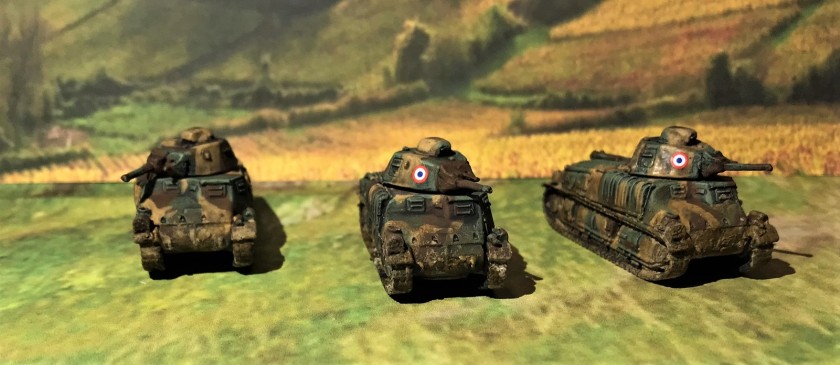
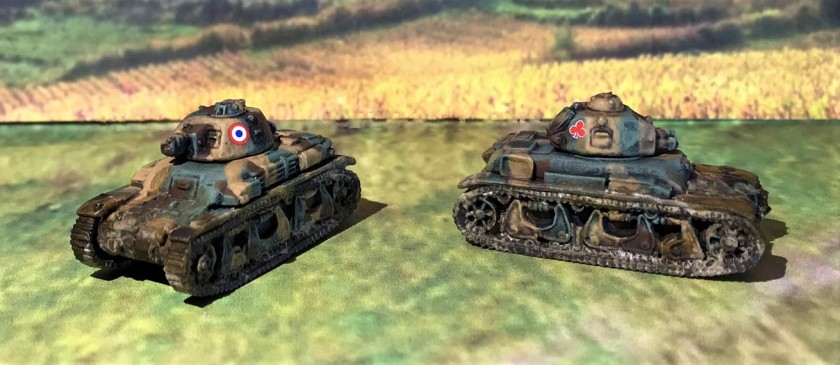
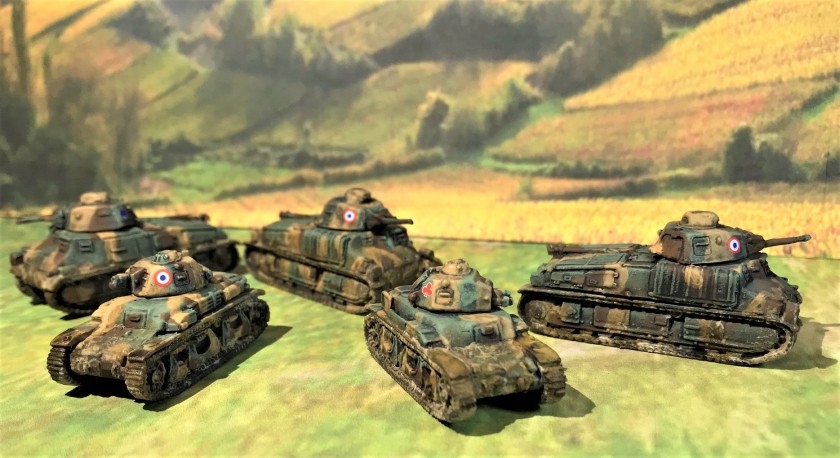
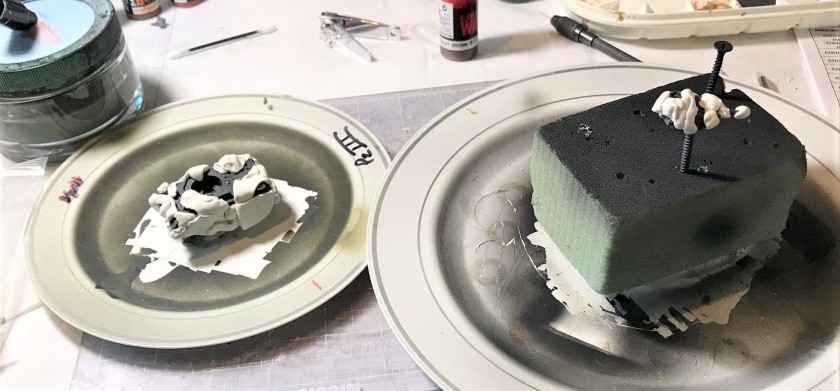
As 2018 comes near to a close, and with Christmas nearly upon us, I wanted to wish all of my readers and followers a very Merry Christmas and a Happy New Year! You have all been so supportive of this blog, which is a big part of my hobby work.
So, please know that I appreciate all of you from all over the world who take the time to read my blog and to share your feedback. And you know who you are, to include Azazel, Buck, IRO, Roger, Subedai, Alex, JNV, Faust, Dave, Pete, Tichy, maenoferren22, Alexis, Le Bim, Wudugast, The One, theuniversalgardener, theimperfectmodeler, savageddt, Luke, redcaer1690, Matt, reductivetendency, patmcf, backtothehammer, and many, many others (and I hope I got most of you – if not apologies).
I am so grateful for your blogs as well. I aim to not only share my work but to amuse and inspire you, as you inspire me. If I get you to chuckle or say “wow”, I have hit my target.
As you can see from my hobby tally, I had a very productive year, and I hope to add to my total before year’s end. Of course, I need to get in some golf posts once in a while, but that will have to wait until April at least as I do live in New England!
I hope that I make you smile a bit over the years with this blog – and while I cannot send a beer or a glass of wine (or a pint for you Brits, Aussies, Kiwis!), I do send my best wishes and a card below. Please keep on reading – I aim to keep it going in 2019!
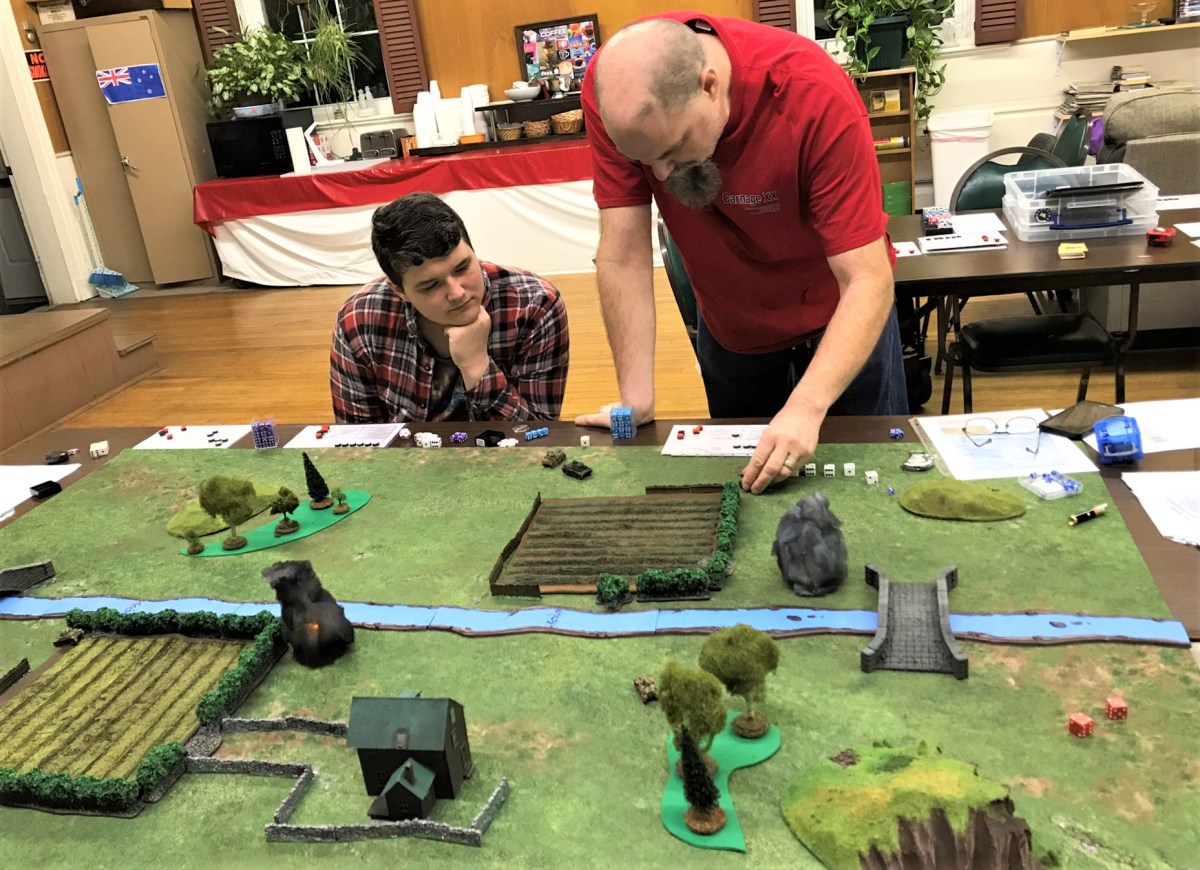
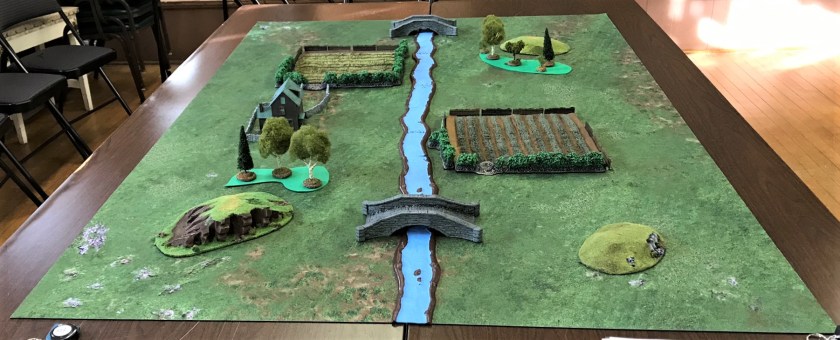
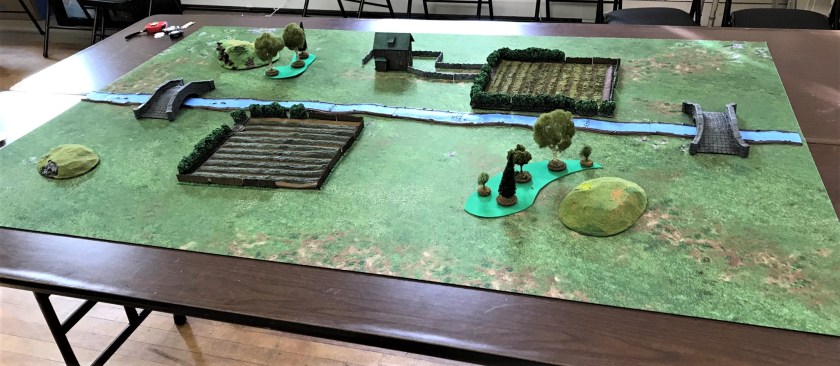
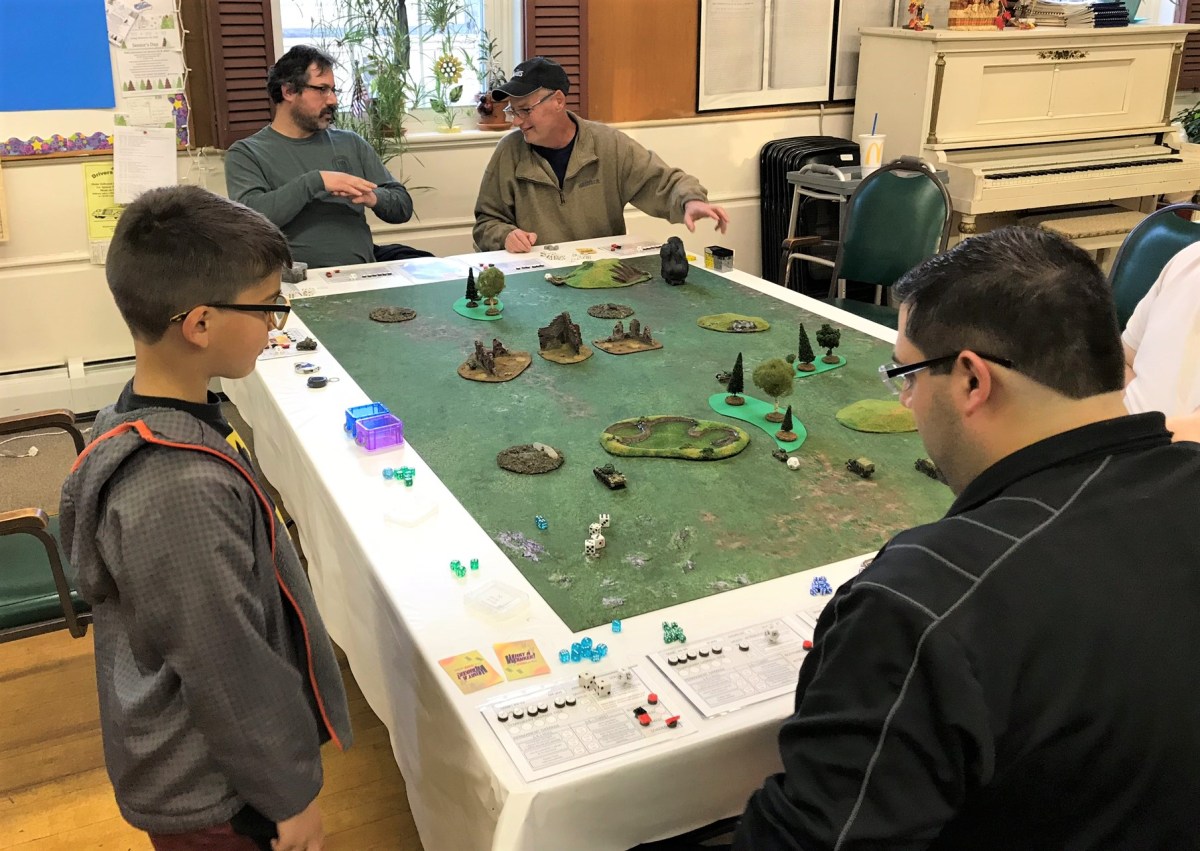
Each team was given poker chips to represent available points to choose and deploy their tanks. In this scenario, each had 25 points to choose three tanks. If a tank was destroyed, the winning team would get that many points in chips – which they could use to either upgrade a deployed tank, buy a new tank, or purchase a Bonus Card. The destroyed tank would respawn in the game. There was a river in the middle of the board, with roughly equivalent terrain on both sides of the board. I said that any tank on the opposite side of the river at the game’s end would count for two times as many points for victory. This gave each side an incentive to move forward.
For initial forces, the Germans chose two Panzer IVD’s (2 for 14 points) and a Panzer 38(t) (one for 9 points), leaving them with 2 chips extra. The Germans passed on choosing a Panzer IIC. The French chose two R35’s (2 for 14 points) and one SOMUA S35 (1 for 10 points), leaving them with one extra chip. While there were StuG IIIA and Char B1 bis vehicles in the inventories, I did not allow either to be chosen initially for reasons of play balance.
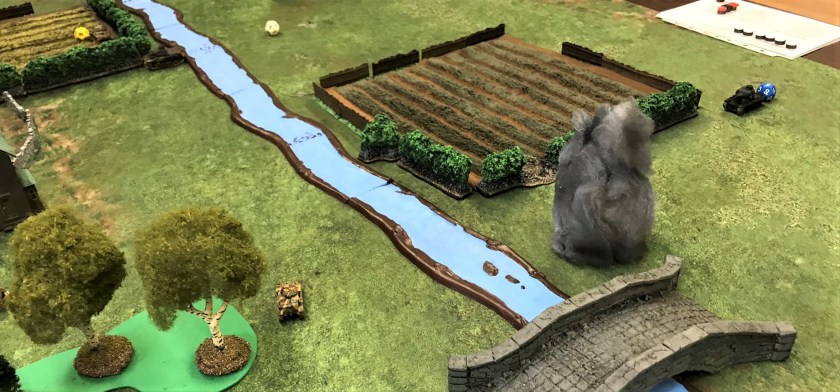
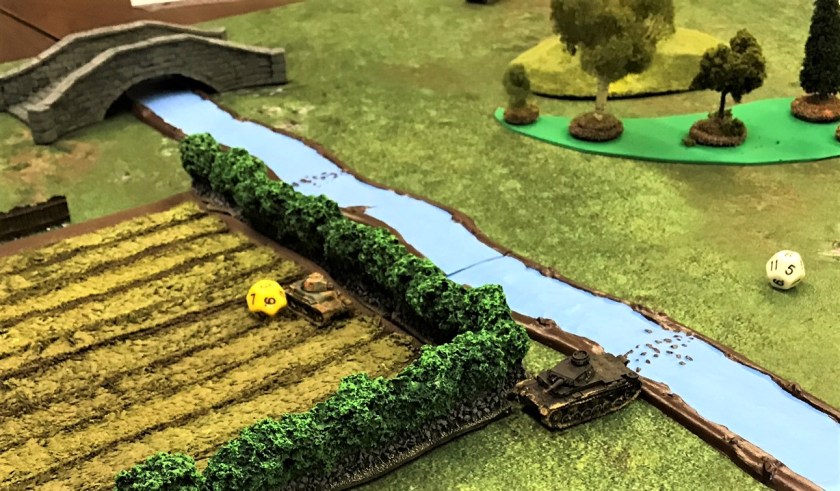
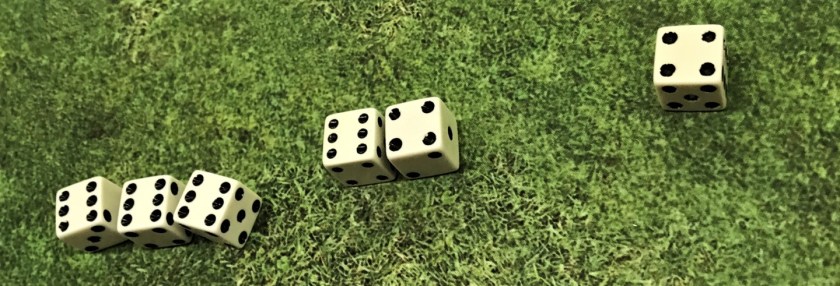
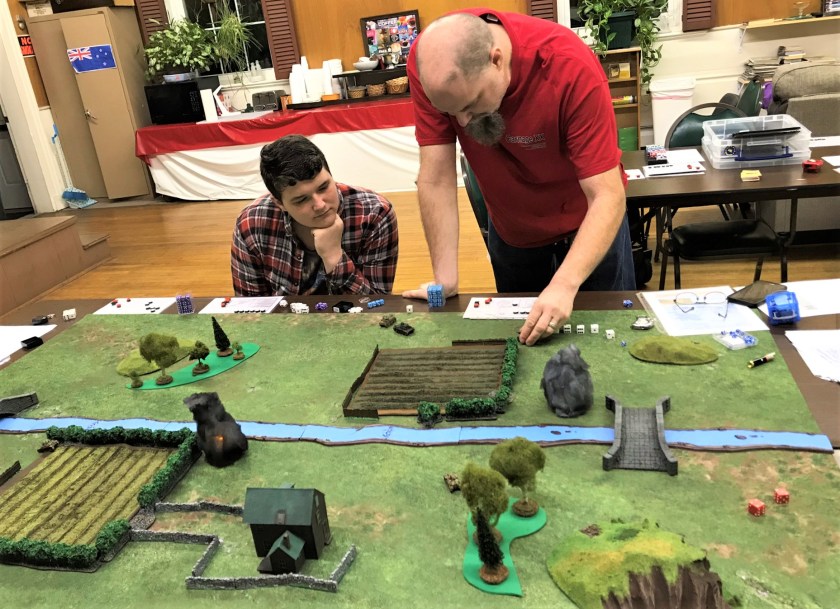
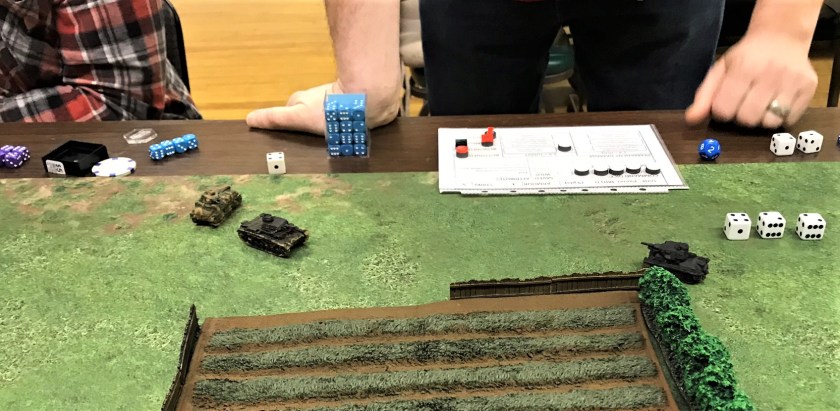
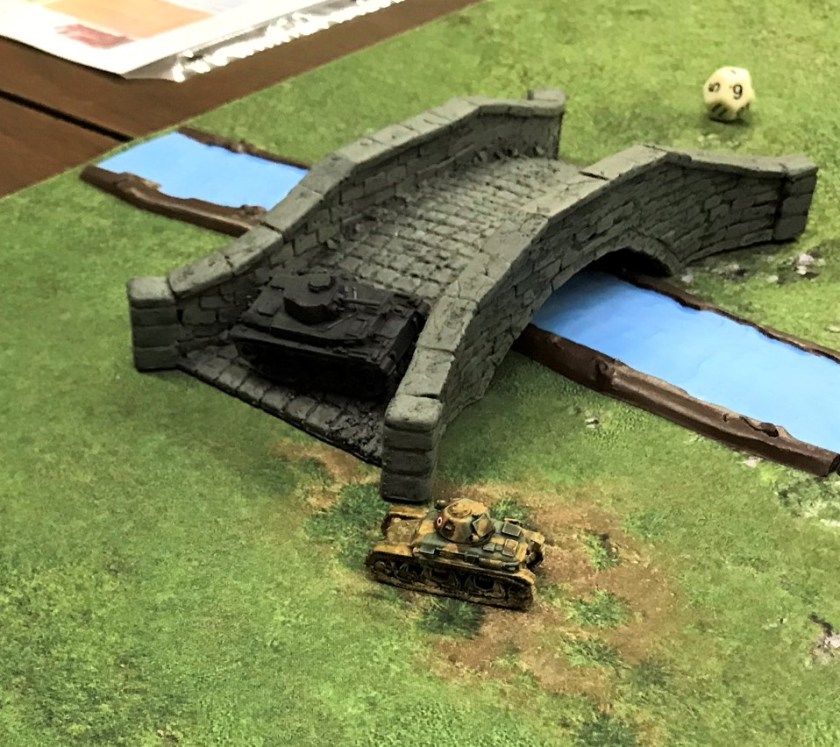
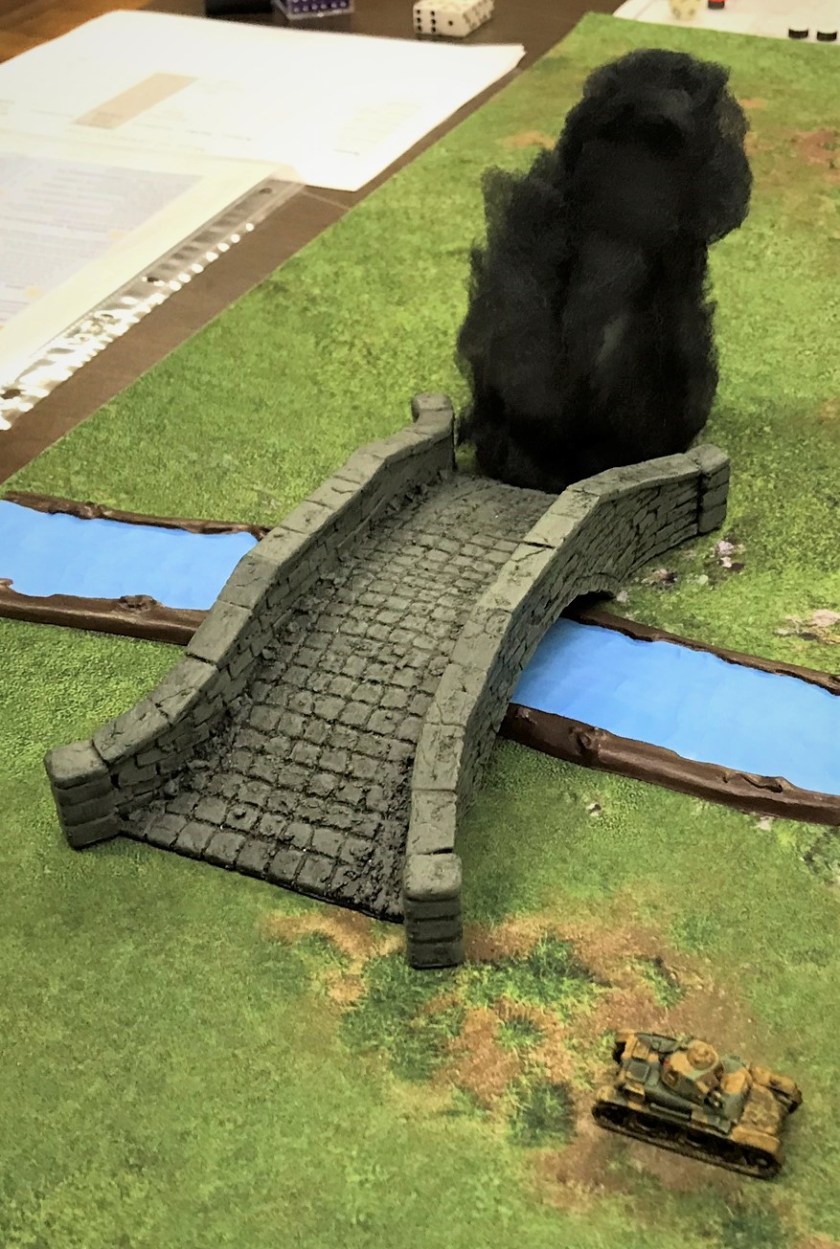
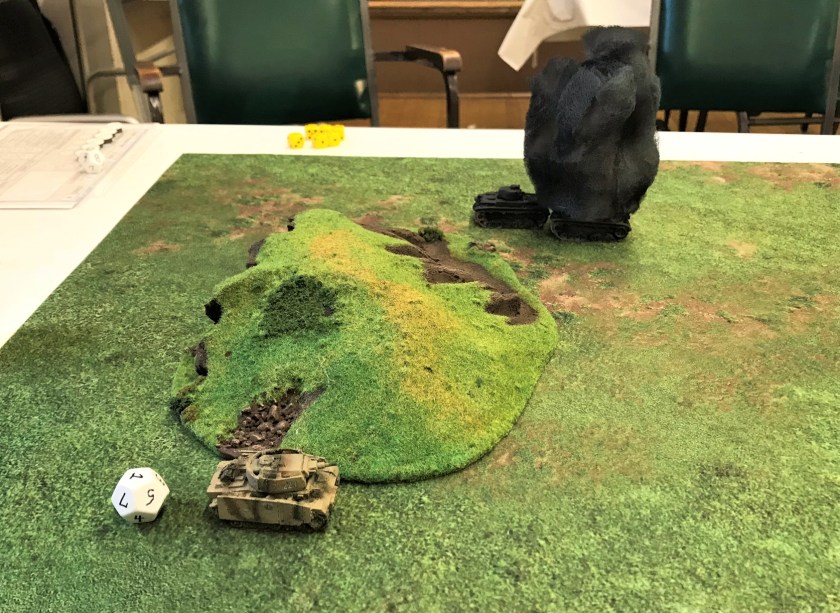
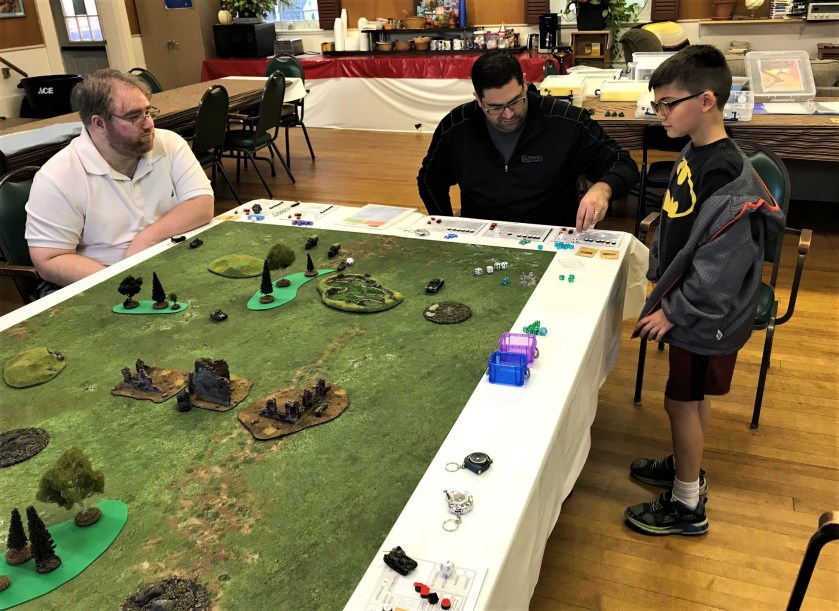
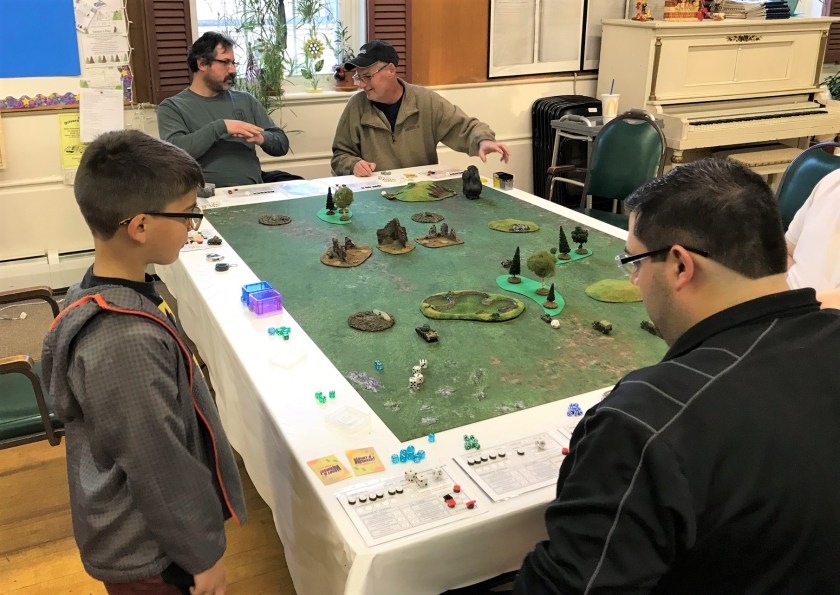
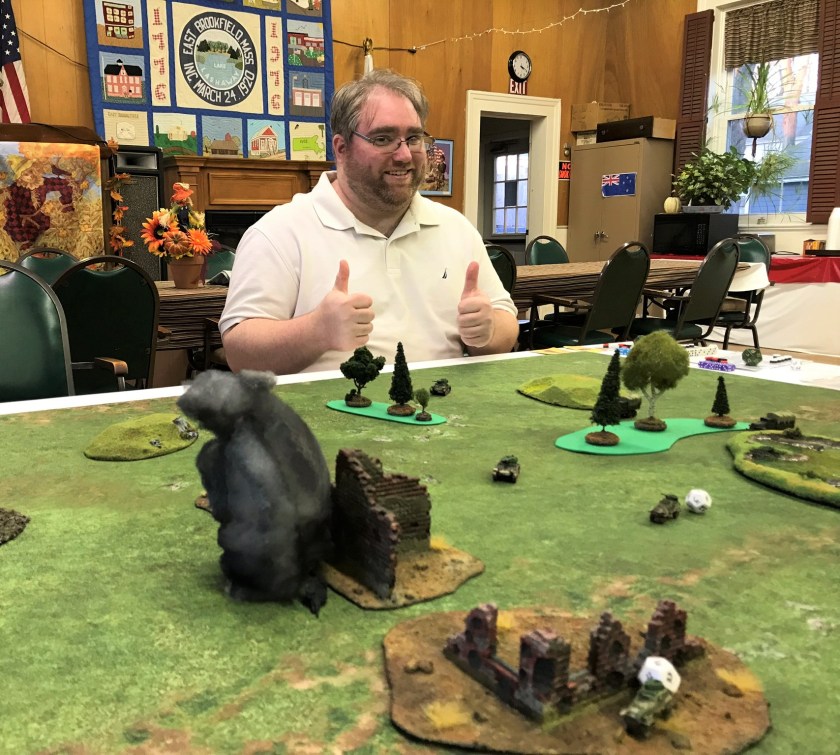
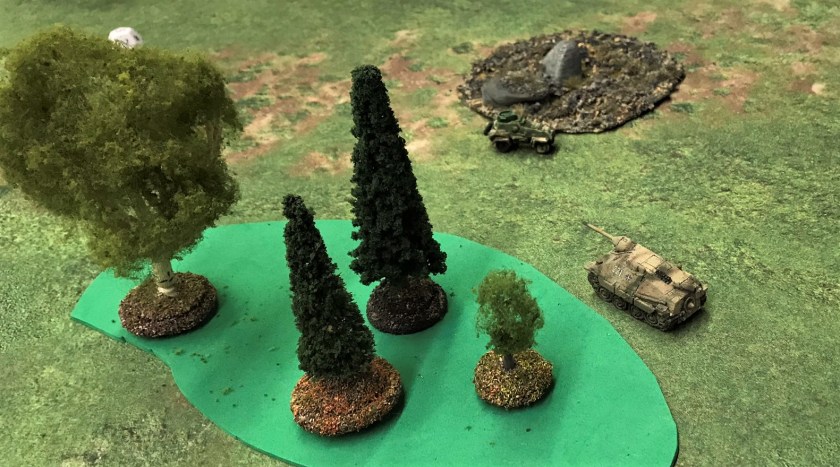
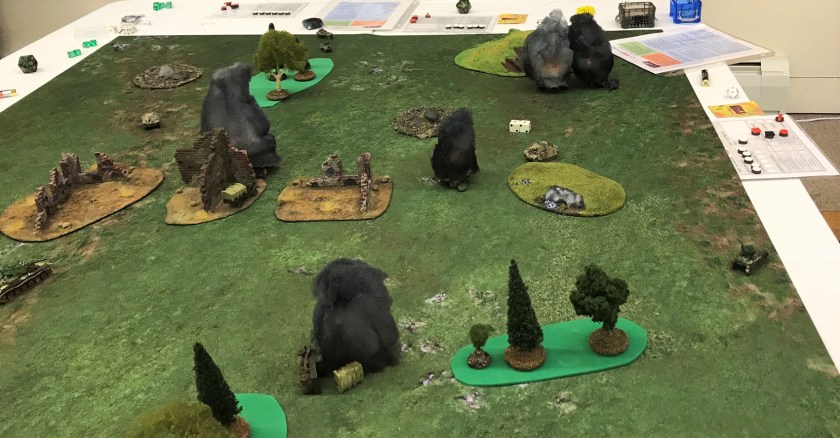
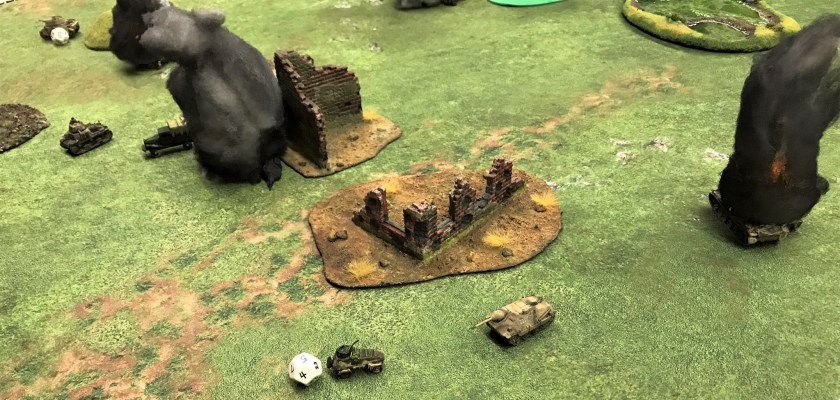
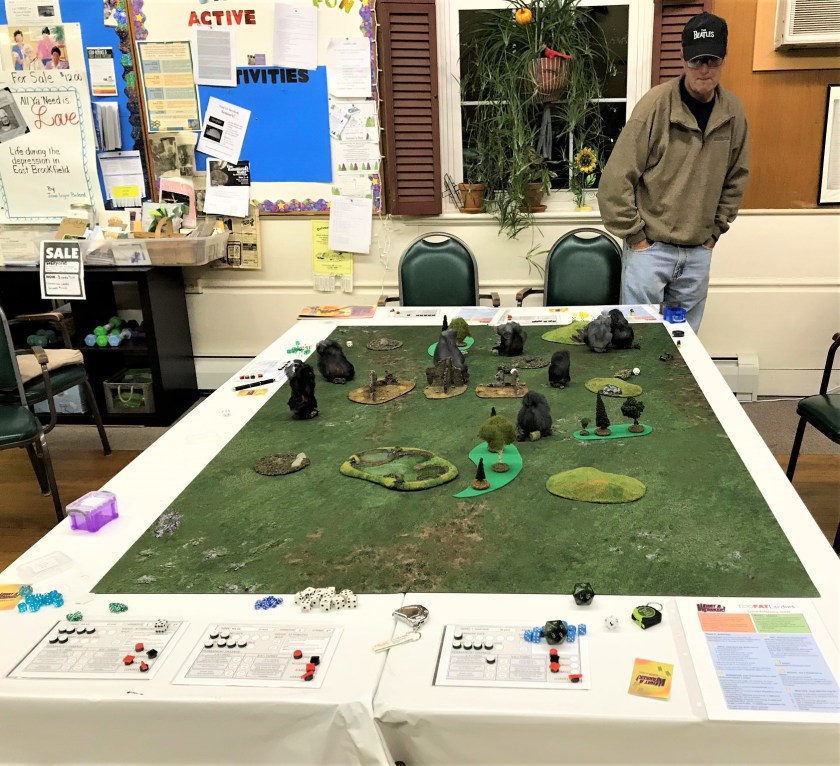
The game board set up. The Germans chose to enter on the right side.The Germans initially deployed from here, with the French deploying on the opposite side.In early action, a Panzer 38 (t) was knocked out by a flank shot from one of the R35’s as it hid on the left behind the bocage. A Panzer IVD and the other R35 watch it burn.The previously successful R35 runs behind the bocage. Another Panzer IV crosses the river at a ford (minor obstacle), but by this time it had been hit multiple times and was down to one Command Die……and the French SOMUA rolled this! An example of the French Command Dice rolls. Each 6 is a Wild card and each 4 is a firing die. Basically, this allowed the loaded French SOMUA to fire 3 times in that turn, contributing to the demise of the Panzer IVD. Unfortunately, the Germans’ rolls were hardly ever this good during the game.The previously mentioned unlucky Panzer IVD burns on the left by the bocage. Scott and Ethan Howland are maneuvering another Panzer IVD and a Panzer 38 (t) against the SOMUA S35.The SOMUA activates, and moves to the rear of the Panzer IVD, but is unable to get off a shot. The Germans were able to subsequently knock out the S35 in their only kill of the day.On the left French flank bridge, a duel went on between a Panzer IVD and an R35. The French were lucky and activated first, hitting the German in the side. Subsequently, the German reoriented, but was hit again and forced back.The Panzer IV was dispatched by the intrepid two man crew of the R35.
At that point the game was called. The French crossed one R35 to the other side of the river and got 14 points. The final score was France 38, Germans 12. It was a good rolling day for the French and a bad one for the Germans. The best tanks did not get to deploy, but both sides needed to use terrain well, and they did. It was nice to have some new players (Leif, Ethan, and Scott), thank you for coming. Everyone had fun, and I will run this scenario again.
Score Breakdown:
French 38 chips:
1 chip left over from initial deployment (1 chip)
Two Panzer IVD’s knocked out (14 chips)
1 Panzer 38 (t) knocked out (9 chips)
1 R35 on the other side of the river at game’s end (14 points)
Germans 12 chips:
2 chips left over from initial deployment (2 chips)
1 SOMUA knocked out (10 chips)
Our next session will be on January 5th at 2 PM at 110 Pleasant Street, East Brookfield, MA. Please follow us on FaceBook at the Mass Pikemen Gaming Club.
My focus continued to be on early war vehicles. I had enough forces for an early Eastern Front game between the Axis (Germans and Italians) and the Soviets, but I wanted to have more variety in terms of tanks available. My KV-1 platoon needed some help, so I added some BT-series tanks.
My other goal was to build German and French forces for a France 1940 scenario. For the Germans I added a Panzer IIC, a Panzer IIIE, and three StuG Ausf A assault guns to my fleet. For the French, I added two Renault 35’s and three SOMUA S-35’s. All of these came from the Flames of War line from Battlefront Miniatures. I really like their tanks, even though I don’t play Flames of War! I think that I can get some crossover between the early-war German forces for such a scenario and use some on the Eastern Front. Long term, I am also planning on designing a North Africa scenario for the British and the Germans, and some of the figures I got from Battlefront will serve nicely after I paint them in desert colors.
Regarding colors, I also acquired some of the Battlefront paints so as to understand the colors that they recommend. The current Battlefront “Colours of War” line mixes sets of 20 ml and 12 ml dropper bottles, as compared with Vallejo’s 17 ml bottles. It appears that at least some of their paints may have been made by Vallejo, at least in the past. I found them to be good paints that worked well either thinned in an airbrush or a regular brush. At the end of this post, I will share the paints and materials that I used for those interested.
In this post, in order I will discuss the Soviets, the French, and the German models I worked on in November. I also am submitting these as part of a Mechanical November community painting challenge run by Azazel (which is very fun to be a part of – check him out!).
Soviet
BT-5 & BT-7 in Blister
Priming the BT’s undercarriages
Painted up and needing weathering
The two Soviet tanks that I added were the BT-5 and the BT-7. An advantage of adding these will be that they also were used against the Finns in the Winter War and against the Japanese at Nomonhan in 1939 and during the Soviet Invasion of Manchuria in 1945. So, I can use them in different scenarios for sure. I followed the same procedure to paint these as I did my previous early war Soviet tanks.
For assembly, I again chose to magnetize the turrets by drilling out the hulls and the turrets and using rare earth magnets. I weathered all of the tanks, as I prefer my tanks to be muddy. I also left the crews out, as I did not like the way they fit in the turrets. Of note, their Christie suspensions (an American invention) would be reproduced with the T-34 series.
BT-5 (left) and BT-7 (right) frontal viewBT-5 (left) and BT-7 (right) rear view
French
I have always had an affinity for the French Army, as I have a French name (albeit of French-Canadian extraction), speak French, and spent time with three different Regiments du Genie (Engineer Regiments) back in the 1980’s.
SOMUA prepped for drilling and magnetizing the turrets
SOMUA’s assembled
R-35’s in the blister – tiny 2-man tanks!
Assembling and painting these would require new uses of poster tack, plastic plates, and wood screws. This allowed me to both safely handle the tanks in production but also to get the right look of the camouflage. I decided to leave the crews out, as I had little confidence that they would survive the tabletop for very long as the models were designed.
I also got to play with some decals from Battlefront. These did require retreatment with Liquid Decal Film from Microscale Industries before I used their other products to affix their decals. I could not believe that the French roundel decal came in two pieces (the blue dot was separate and had to be affixed after and onto the red-ringed white circle). That was annoying!
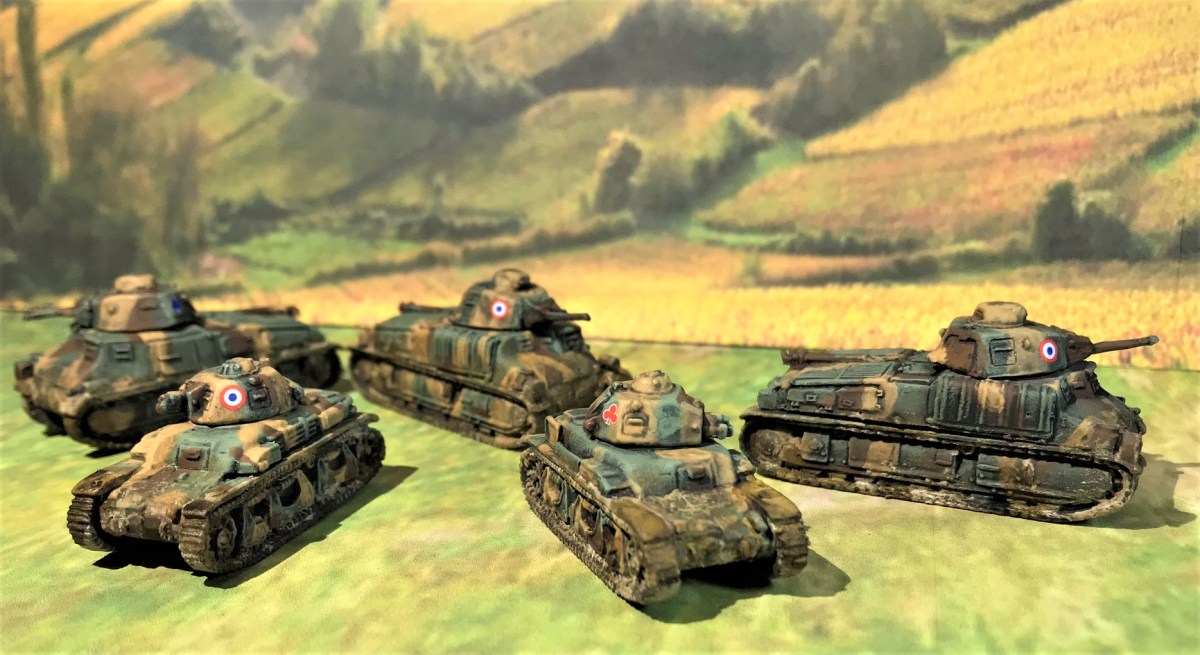
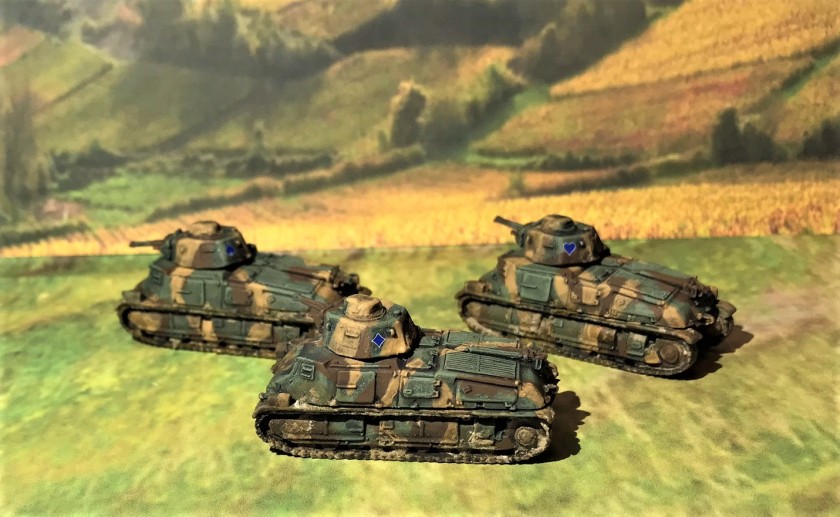
My new French tanks with my old Char B1 bis tanksThe three SOMUA S35’s, frontal viewSOMUA side view showing the card-suit designations on the turret backs
Renault R35’s
Nice group shot
German
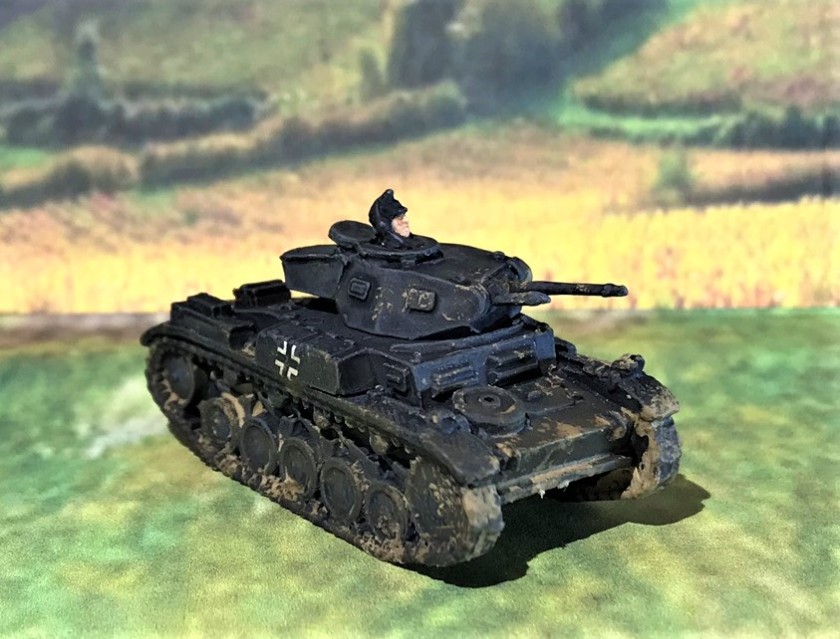
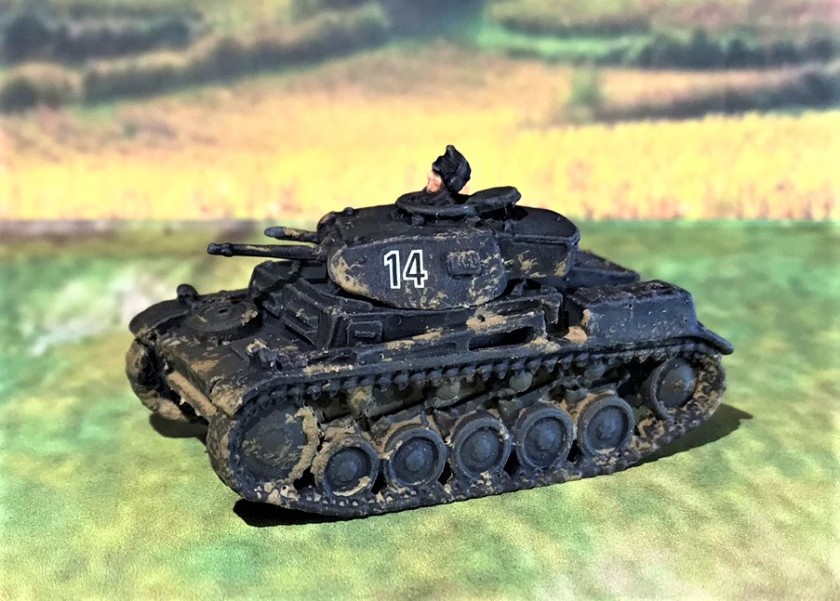
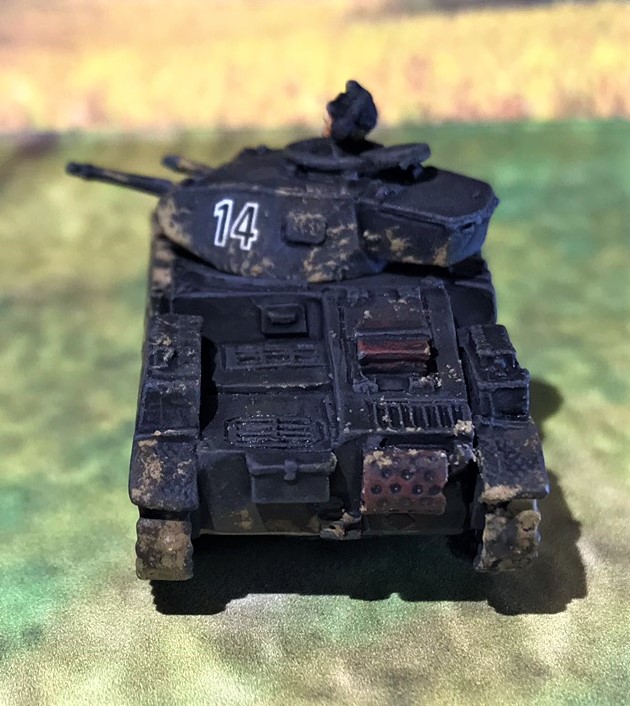
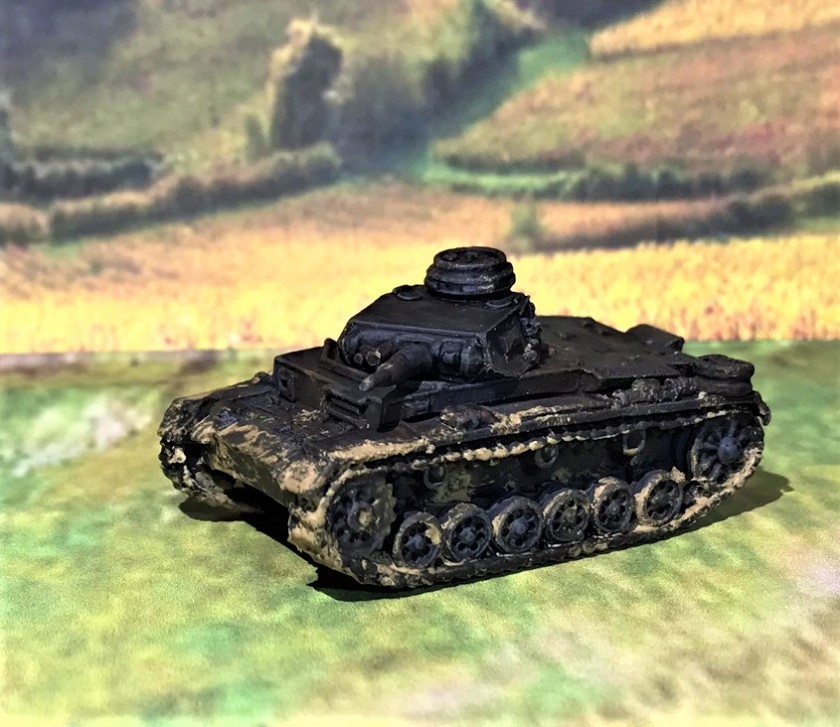
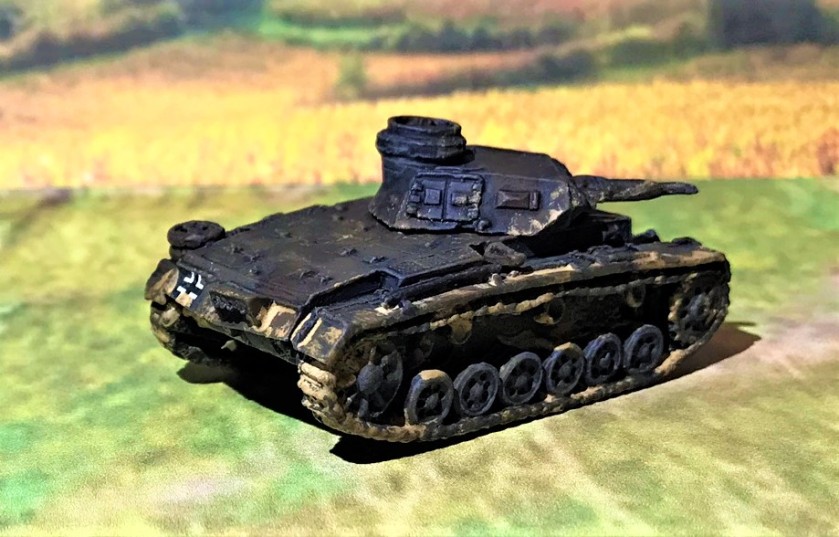
For the Germans, I chose to use the Panzer IIC, the Panzer IIIE, and the Sturmgeschutz Ausf A. The Panzer II’s came in a box of 5 – but was missing one tank gun. Battlefront has promised to make this good (and I expect it soon). I chose to make one of the Panzer II’s a France 1940 candidate, saving the other four for a North African scenario that I will complete later on. The Panzer IIIE came in three separate blisters. Ironically, the Panzer IIIE was the worst of the Germans to assemble. One gun was almost split, and the turrets were nearly three different sizes. There were a lot of mold lines to correct as well, especially on the tracks.
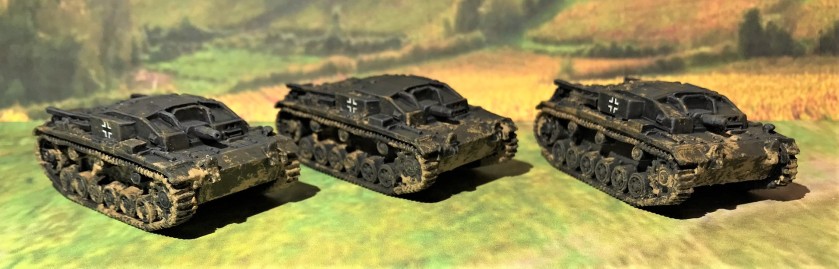
I repaired the one gun with green stuff, and chose it for the France 1940 group, saving the other two for North Africa. Lastly, historically it seems that very few StuG III’s made it to North Africa. Therefore, I added all three of the assault guns for my France 1940 scenario.
Panzer II’s prepped.
The Panzer IIIE blisters
The StuG Ausf A box.
Assembled/repaired Pz IIIE’s
Assembled StuG IIIA.
How I mounted the turrets
Mounted turrets for painting
Pz II and III primed
StuG IIIA’s base coated
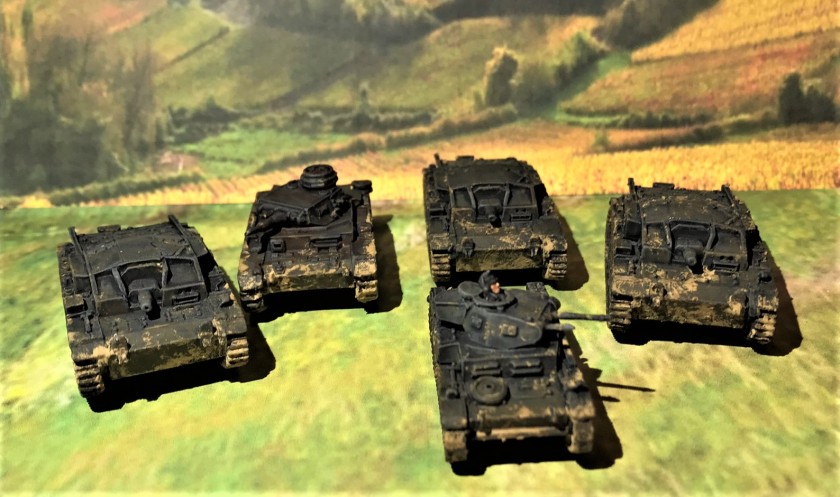
The Panzer IIIE prepped for camouflagePanzer IIC complete, left sidePanzer IIC, left side. The 14 is for my wife – her and my lucky number!Rear view of the tiny Panzer IIC.The Panzer IIIE completed. The brown camouflage doesn’t really show up as well here (so I guess it works!).Panzer IIIE opposite viewSturmgeschutz III Ausf A, frontal viewSturmgeschutz III Ausf A, left side viewSturmgeschutz III Ausf A, right side and rear viewMy Germans for the France 1940 scenario
I was glad to have finished these in time for our club’s monthly session (which I will post about shortly). I will be adding more to my fleet, but in the meantime, I hope you enjoyed these. Do you have a favorite?
I appreciate hearing your thoughts and feedback in the comments section below. Thanks for looking!
PAINTS, INKS, GLAZES, WASHES, AND FLOCKING USED:
COMMONLY USED ON MULTIPLE TANKS:
Vallejo “Flow Improver”
Vallejo “Airbrush Thinner”
Testors “Universal Acrylic Thinner”
Battlefront “German Camo Black Brown”
Battlefront “Dark Gunmetal”
Vallejo Mecha Color “Green”
Battlefront German Camo Black Brown
Vallejo “Surface Primer – Black”
Vallejo “Burnt Umber” (pigment)
Vallejo “Light Sienna” (pigment)
Vallejo “Light Slate Grey” (pigment)
Vallejo “Natural Umber” (pigment)
Vallejo Mecha Color “Light Rust Wash” (weathering)
On November 10, 2018, the Mass Pikemen held their monthly gaming session with a game of What a Tanker set on the Eastern Front in 1942. The scenario was a 1942/1943 one where a Soviet force consisting of 1 KV-1a heavy tank, 2 T-26 M1939 light tanks, 2 BA-64 armored cars, and a couple of Gaz trucks was surrounded and needed to break out through the Axis lines. It was my first chance to get all of my recently painted tanks on the tabletop.
Initially opposing the Soviets was a German force consisting of 2 Panzer IVd tanks and a 1 Panzer 38(t) tank. Reinforcements were staggered for the Axis, and they consisted of a 1 Panzer IIIN tank, a Hetzer tank destroyer (Jagdpanzer 38), and an Italian M13/41. It was imperative for the Soviets to exit the other side of the board with the KV-1 and the two trucks as quickly as possible.
The Germans moved on first – and one of the T-26’s was able to early on get a couple of shots in on one of the Panzer IVd’s, with the second one knocking it out. This was a fun event for 7-year old Jack Burns who was playing in his first war game ever. He was so excited to knock out the German tank.
The Panzer IIIN moves on the board as a reinforcement. The second Panzer IVd takes advantage of its burning comrade’s smoky wreck.
The Soviets KV-1a was slow to move forward, and the T-26’s outran it. The Panzer 38(t) moved up to the ruined factory and took aim at one of the T-26’s in the open. It fired, and missed the Soviet. Returning fire, the T-26 hit and knocked out the Panzer 38 (t). Two down for the Axis! Shortly after this, the other Panzer IVd peeked out from behind its brother, only to suffer the same fate from the plucky T-26. Three down now!
Chris Smedile, Jared Burns, and Jack Burns advance their vehicles. The Panzer 38 (t) is behind the wall in the center in a good defensive position, facing the T-26 that was to knock it out.Chris Comeau and Mike Morgan (and later myself) played the Axis. This view shows the length of the board the Soviets needed to cross. Each fighting vehicle had a magnetic dashboard, and its own colored dice. Command Dice were always white though.
Let me add a side note here on my rules modifications for this scenario. What a Tanker does not have rules for either armored cars or trucks. I modified them here for the armored cars, which I made Fast (easier to always move), and Small (tougher to hit). For their Armor, I only gave them a 1, which meant that any hit from a tank gun would very likely be enough to kill the BA-64. As the BA-64 only had a machine gun, I gave them 2 modified Strike dice. The modifications were twofold. First, their range was 24″ (half that of the tanks). Secondly, the BA-64’s would hit on a 6, but the only likely result of such a hit would be to force the target to button up if it was not already. If the BA-64 player rolled double-6’s, I would allow 2 strike dice. So the BA-64’s were harassers at best. I had the Gaz trucks move last, with 2 D6 of movement (no command dice). If they were hit, they were destroyed.
Chris celebrates his second kill, while the Panzer 38 (t) burns. You can see here behind the BA-64’s a D12, which I used for initiative rolls instead of D6’s and re-rolling for ties. It worked much easier and was much less confusing.
Back to the battle!
At this low point, they got reinforcements in consecutive turns. First, the Panzer IIIN came on in turn 2. In turn 4, the Axis got the Hetzer and the M13/41. The tide of battle was turning.
The Hetzer ignores the BA-64 and sets out to hunt the KV-1a.
The Panzer IIIN moved up to the hill, awaiting the T-26 and a truck. The German successively took both out, leaving the Soviets only with one T-26, one truck, the KV-1a, and the BA-64’s. The M13/41 rolled badly, and hid behind the Panzer IVd wrecks for better dice rolls, even taking humiliating fire from the BA-64’s that caused it to have to button up.
In the foreground, a Gaz truck burns. The crew of the Panzer IIIN behind the hill looks at the burning T-26 in front of it. In the left center, the Panzer 38 (t) burns, as do 2 Panzer IVd’s in the right rear. On the left, the showdown between the lumbering KV-1a and the Hetzer is about to begin.
The Hetzer moves fast, and tried to move around to the rear of the KV-1a. It succeeded, and missed with its initial rear shot. The KV-1a immediately turned the tables, turning 180°, and rotating its massive turret towards the diminutive tank destroyer. The Soviet again got initiative, firing not once, not twice, but three times – and unbelievably missing on all three attempts! The saving grace for the Hetzer was its Small characteristic, which meant the KV-1a needed a “7” instead of a “6” to hit.
The Hetzer then got initiative and rolled its Command Dice well enough to fire but not to maneuver towards the Soviet behemoth’s vulnerable rear. It decided to take a chancy shot at the frontal armor of the KV-1a. It got 5 hits on 7 dice (needed a “5” or “6” to hit). The Soviet player got zero saves, and the KV-1a was knocked out.
The KV-1a burns on the right, while the Hetzer and the M13/41 hunt the last truck (on the left). The BA-64 attempted a ramming attack on the Hetzer to give the truck a chance to escape.
The BA-64 ramming attack did nothing to the Hetzer, which dispatched the armored car with one shot. Meanwhile, the Italian M13/41 took out the last truck. The surviving BA-64 was destroyed by the Italian, leaving the Panzer IIIN and a damaged T-26 in a showdown. With the loss of the trucks and the KV-1a, the game was called an Axis victory.
Mike Morgan victoriously surveys the smoky battlefield.
The game was a fun one for winners and losers, with highs and lows for both. Next time, I will probably give the Soviets a second KV-1a.
The next Mass Pikemen’s gaming session will be on Saturday, December 1st from 2-8 PM, at 110 Pleasant Street in East Brookfield, MA. This is a change from our previous 3-9 PM time slot. We will be playing What a Tanker again!
Please join us, and share your thoughts and feedback in the comments section below!
I have been working on getting a fleet of tanks for the What a Tankergame from the Too Fat Lardies company. It’s a great game and has been a true hit with my gaming club, the Mass Pikemen. I have been working on building up a flexible group of tanks, and so far I am up to 71 tanks in 15mm/1:100 scale – not including ones needing assembly and painting.
My sources have been eBay, hobby stores, and Facebook. If I waited to paint them all, I would never do another project, so finding some mostly painted resin (and reasonably priced) models from Wargame Models in Ohio has helped shorten the process. Mostly I just washed and varnished the ones I have gotten from WMIO.
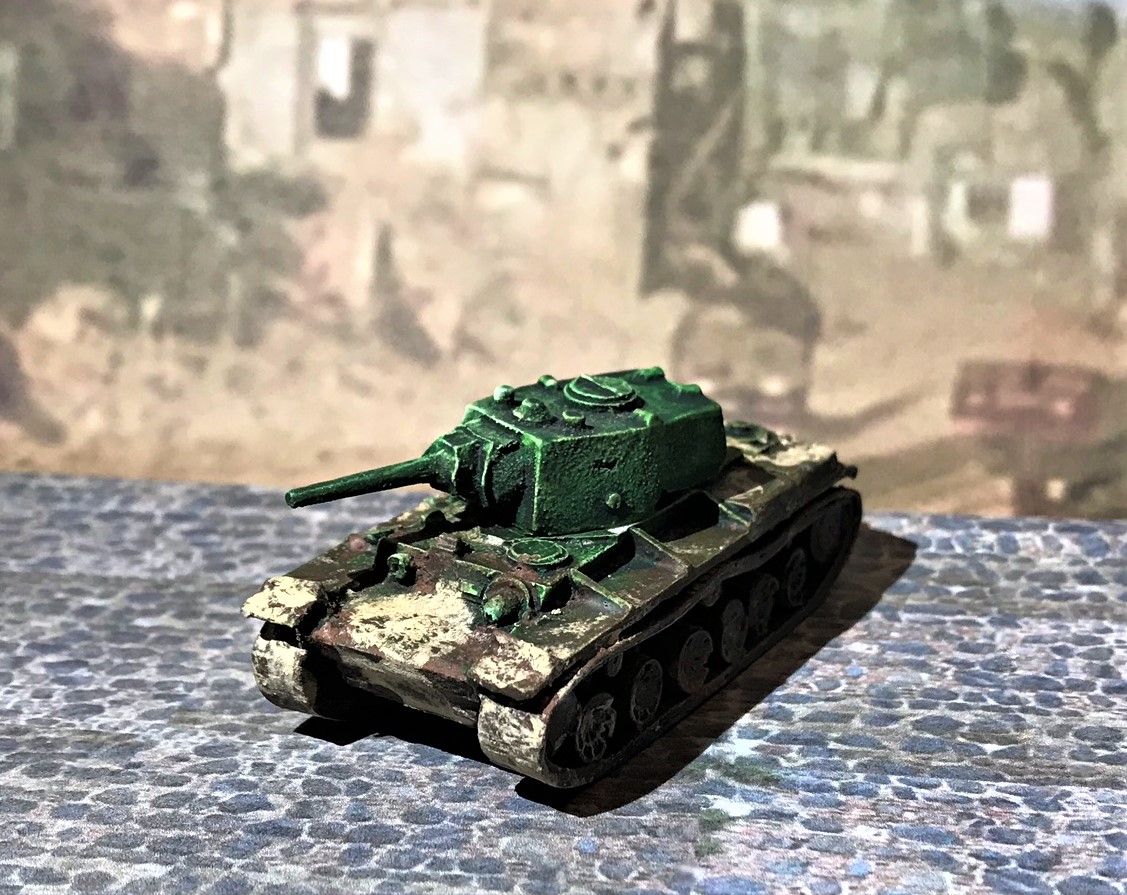
One group acquisition was from another source on eBay – it was a resin Soviet KV-1 platoon consisting of 5 KV-1’s heavy tanks, 2 T-26 light tanks, 2 BA-64 armored cars, and 2 trucks. I do not know the manufacturer. They had been given some sort of dark brown coating with splashes of lighter brown. They color-wise did not look particularly like Soviet tanks from 1941. This platoon is the main subject of this blog post.
My tank fleet grows – the KV-1 platoon is in the upper left.The platoon as I got it in the brown colors. I decided to make the heavy tanks as the KV-1a version. All of the turrets were not magnetized, which I did do as well as part of this project.I removed the resin post on the turret and drilled out 1/8″ holes in it and widened the preexisting hole in the hull. I got some nice neodymium 1/8″ x 1/16″ magnets for magnetizing from totalElement.com.
It was necessary to use a Sharpie to mark one end of the 1/8″ magnets such that I inserted them in the correct alignment (I did not want the turrets “blowing off” prematurely!). I glued the magnets into the holes with Gorilla Glue.
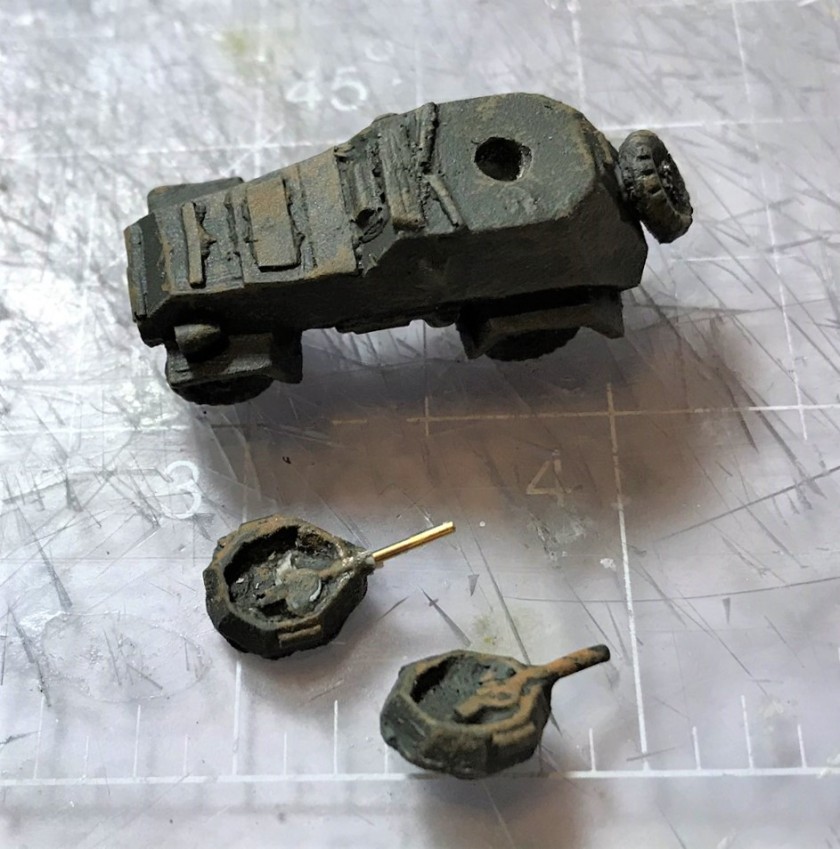
Each turret originally had this post that I removed and drilled underneath.Magnetized K-V1a turretBA-64 turret showing my repair of the gun. It was thin resin. The other resin gun broke later as well so these are not sturdy.
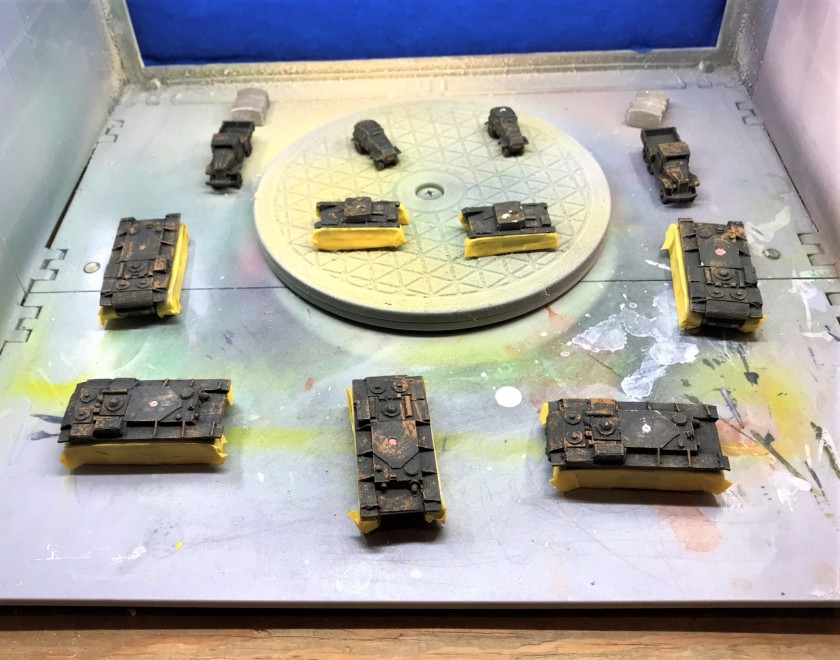
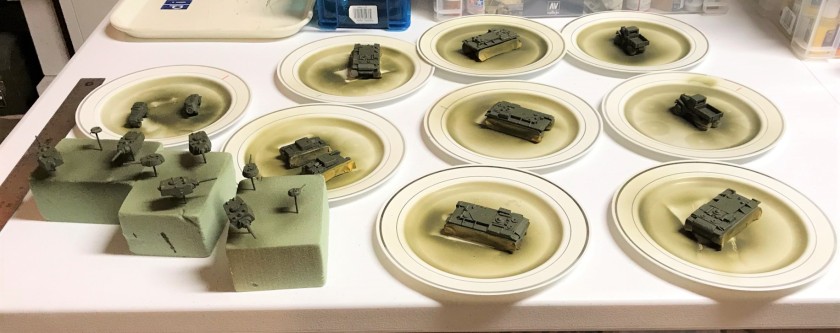
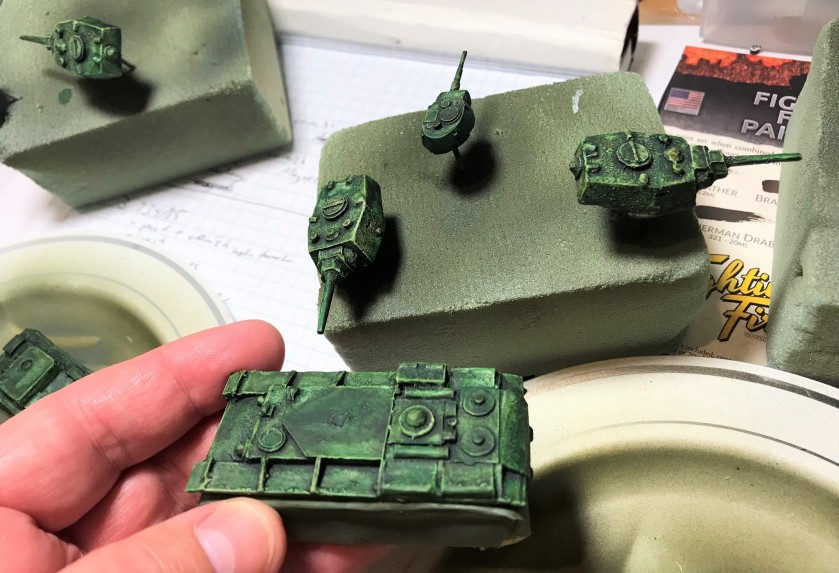
I needed to find a way to paint the figures without damaging the paint, and tanks were new to me. I decided to take advantage of the magnets on the turrets here. I used small nails inserted into styrofoam blocks (the kind used for flower crafts). For the hulls, I masked the tracks for secondary painting, and such that I could hold them safely.
How many turrets can fit on the head of a nail?The hulls masked for priming.
I airbrushed/primed the figures with Vallejo “Surface Primer – Russian Green”.
The platoon primed.
I then gave the figures an airbrushed base coat with a thinned coat of Vallejo Panzer Series “Camouflage Olive Green”.
The platoon base coated.Close up shot of one of the KV-1a hills after base coating.
These looked too drab, and not very Soviet green looking. I moved on to adding Vallejo Mecha Color “Green” with a light airbrushing. Next, I used a brush to dry brush Vallejo Mecha Color “Light Green” on the figures. I was able to then give the figures an appropriate light green by using Citadel “Biel-Tan Green” as a shade. It worked!
Contrast the before shading (turret on left) and after (turret on right). The light green helped give depth to the shaded turrets and hulls. I darkened everything with an additional shade – Citadel “Athonian Camoshade”.Before the “Athonian Camoshade”……and after adding the darker shade.
At this point, I removed the masking and painted the tracks. I then wanted to add some mud, dirt, and dust with pigments. I used several Vallejo pigments and binders (all listed at the end of this post). These models are small, (about 3″ long by 1½” wide by 1¾” high so I wanted to give enough weathering without overwhelming them.
An in-progress pic of weathering one of the hulls.All of the weathering done and the vehicles ready for varnish.KV-1a hull varnished.T-26 hull varnished.The platoon nice and dirty with the mud of Mother Russia.
This was my first attempt at painting any WWII tank models. I think I can do better, but early war Soviet tanks are pretty simple, as they had not usually added any markings. It will not be my last, and I am hoping that I get better with more tries. This project also is my first submission for Azazel’s November Community painting challenge – Mechanical November ’18. If you have not checked out his blog, it’s worth a look. Also, my next few posts will showcase tanks, so I hope you enjoy.
Now for some eye candy!
All five KV-1a’s with different angles to view. Ignore the giant tetrahedrons please!Front viewRear view. I “mudded” them up a bit here.The combat vehicles move out.One of each AFV I painted plus 2 trucks.KV-1a in an urban setting.T-26 in town (what’s left of it anyway).BA-64.
I hope that you enjoyed this post. Please let me know your thoughts and feedback below in the comments section.
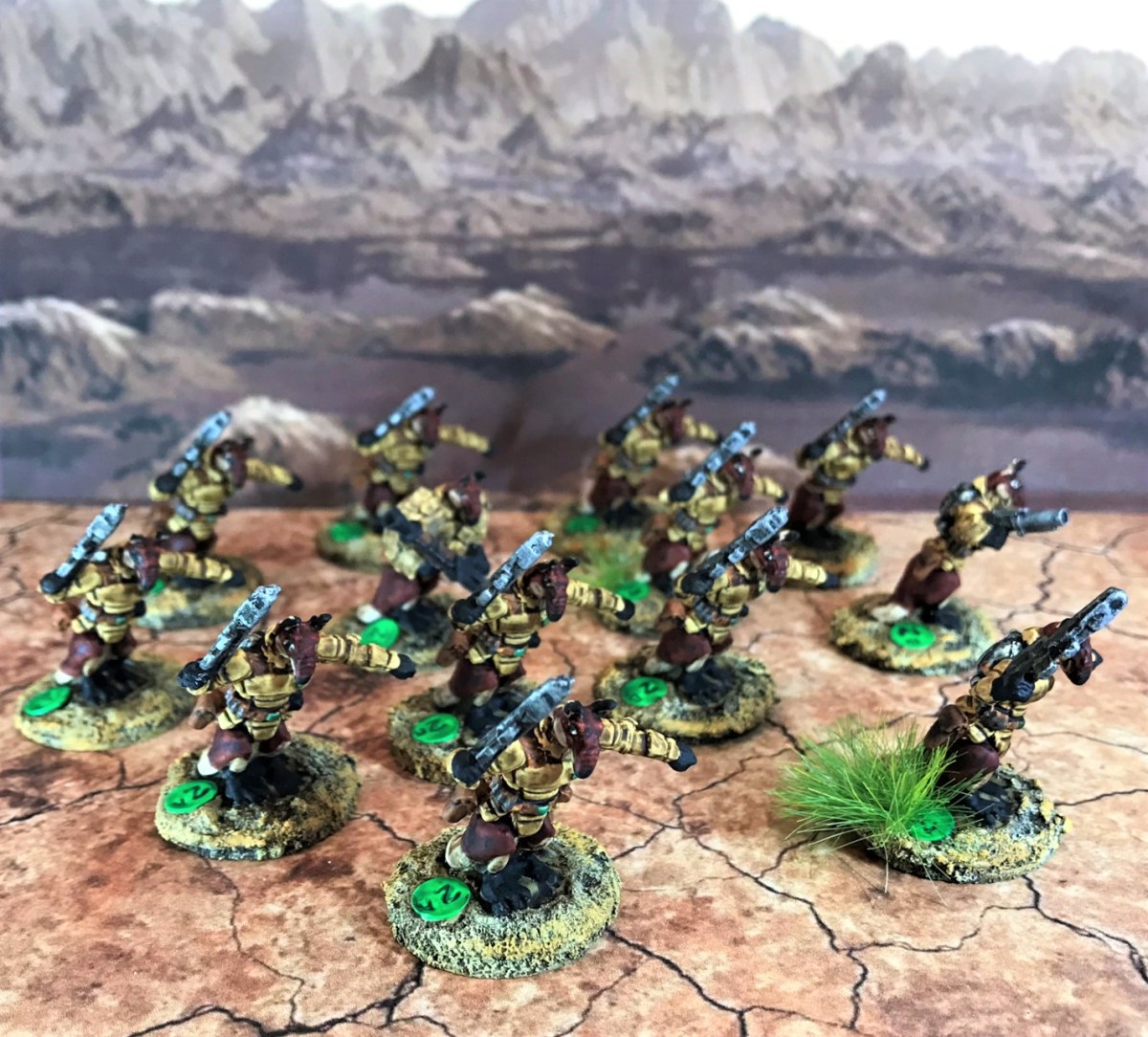
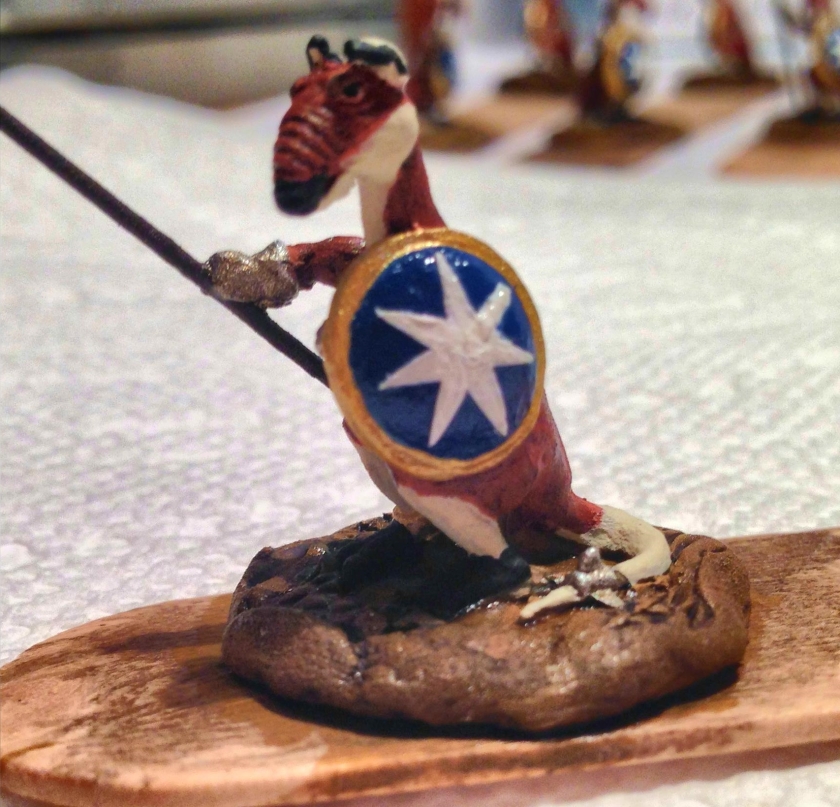
Back in 2016, I had finally completed an original Ral Partha “Rooman War Party” (#01-044) from 1977. This effort culminated in my building a 21-figure phalanx of pike-armed anthropomorphic kangaroos, replete with Australian 7-pointed stars on their shields.
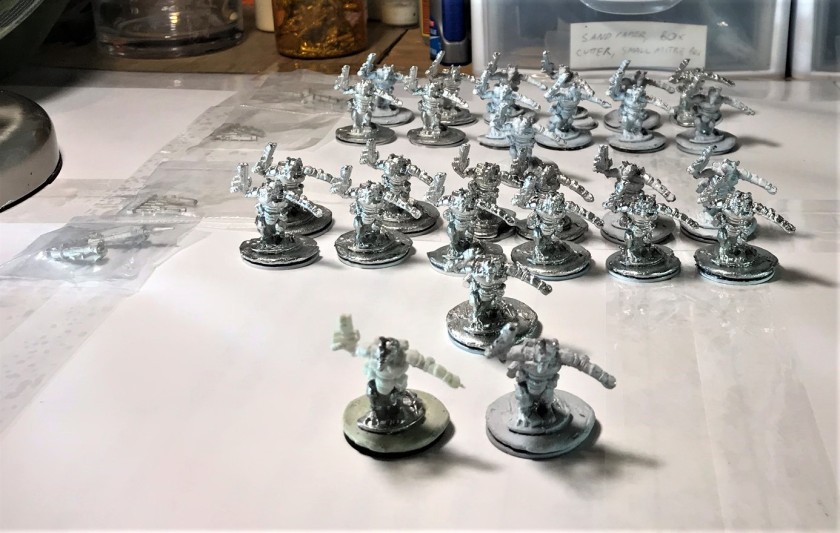
At that time, I also began to see that others, like the wonderfully named Imperial Rebel Ork (IRO for short) were doing amazing “kit-bashes” and conversions with different models. Of course, IRO uses plastic, and I’m more of an old school metal guy. I also was getting more into retro sci-fi figures and using them for skirmish games. I was inspired by IRO and Azazel (both Aussies) to push myself to do my own conversion. So, I combined two figures – a Ral Partha Rooman (25 mm scale) and a Reaper #80010, “Nova Corp Sergeant” (28 mm scale), made a mold, and cast a bunch of “Space Roomans” (in metal of course). You can read about that somewhat massive project here. Getting around to painting these took a bit longer, and even my good friend Buck Surdu painted some that I gave him much quicker than I did.
Ral Partha RoomanThe Reaper figure (circled) that I used was in a bunch of figures I got on eBay
Azazel is kind enough to run a monthly community painting challenge – and October’s was “Unit-ed October”, and focused on units. So, I took this opportunity to get these done. Of course, this effort was slightly affected by some gaming and the Red Sox winning the 2018 World Series (YES!), but I got them (the Space Roos that is) done by October 31st, 2018. I will use them in Combat Patrol™ games.
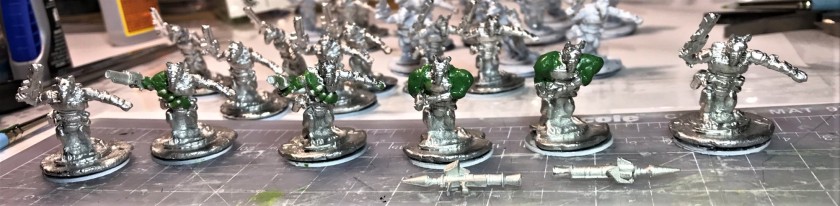
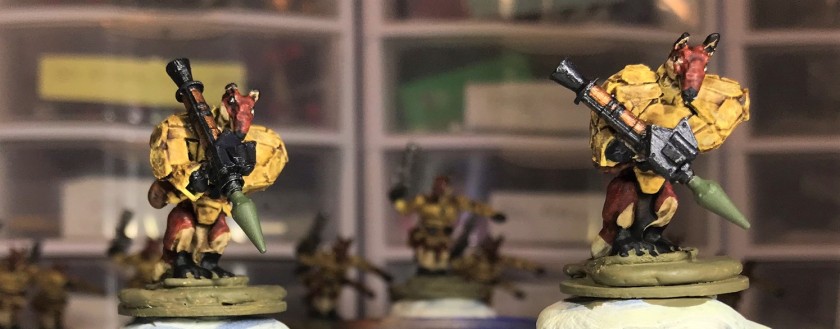
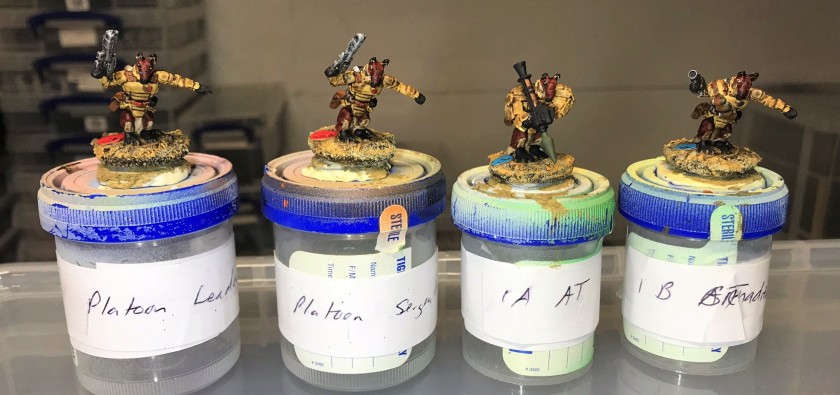
I decided to paint the Roos similar to the way I did the Roomans, except that I wanted a more dusty and dirty look to them, as they are intrepid infantrymen (infantryroos?). I also wanted to convert a couple of figures per squad (yes, a conversion of a conversion) to carry different weapons. In this case, I used a grenade launcher sprue from RBJ miniatures to make two Roos into grenadiers, and a different RPG sprue from RBJ to make two other Roos into anti-tank troopers. So my 28-figure platoon would consist of:
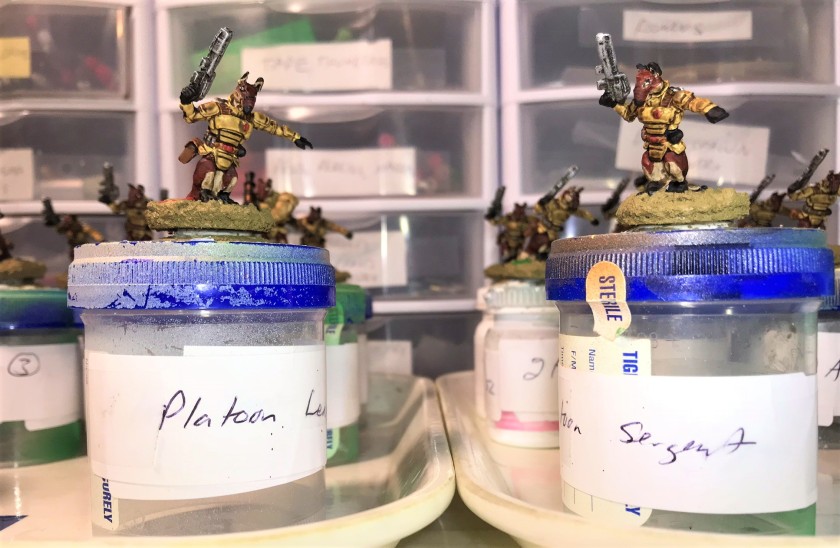
Platoon Leader
Platoon Sergeant
2 Space Roo Squads consisting of:
1 Squad Leader in each squad
2 teams of:
1 TL per team
4 Space Roos with assault rifles/blasters per team
1 Space Roo per team with either a grenade launcher or anti-tank weapon
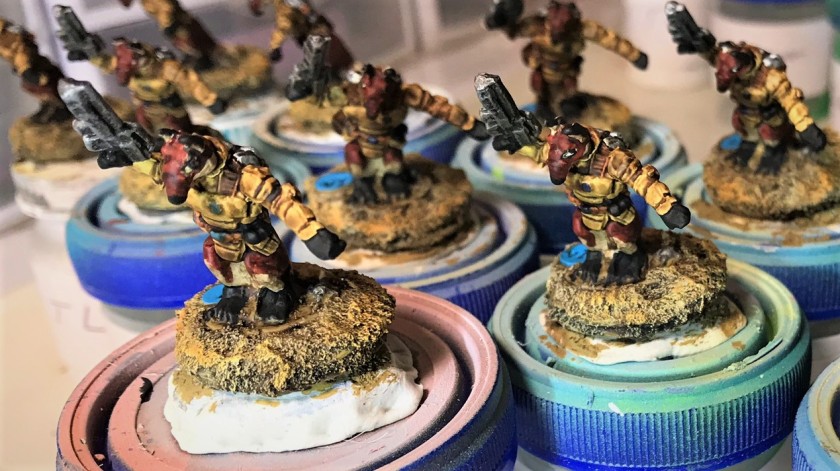
Two squads make a light platoon, but I think that they will be a potent elite fighting force on the tabletop. Also, these Roos are equipped with body armor on their torsos, and importantly, jet packs! I will also give them a higher rate of movement similar to what I did for the Space Phraints (1½ cards of movement). I cleaned and filed the models, and prepared them for conversion and priming by mounting them on 1″ steel washers.
The two squads behind their platoon leader and platoon sergeant. The weapons for conversion are on the left.
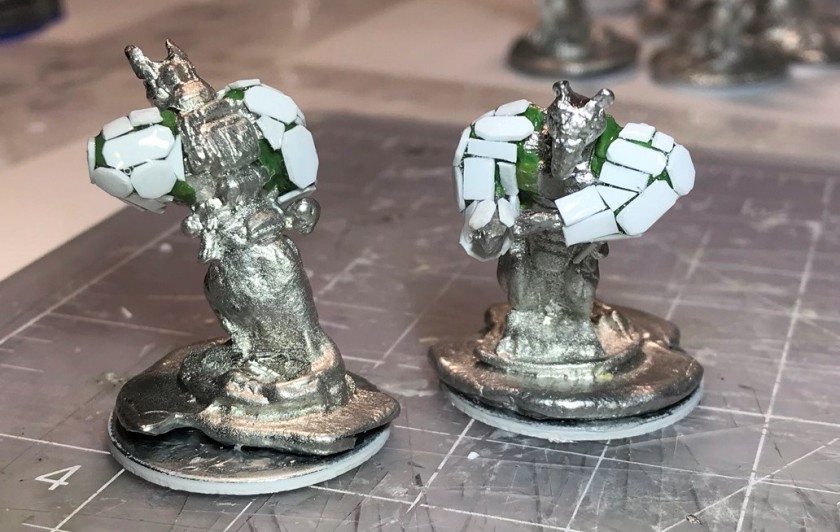
I had a tough time reorienting the arms of the RPG-armed Roos, and I needed to break them and use green stuff to create a proper pose. Pinning was not feasible unfortunately. I also used green stuff to mount the grenadiers’ launchers and to give them bandoleers of grenades. The grenadiers looked fine enough for the tabletop, but I was unhappy with the RPG Roos, as they looked “Popeye” like in their arms. As the Space Roos body armor gives them an angular body look, I decided to use a series of very small 2 mm polystyrene chips to create an “armored look” over the arms by affixing them with Gorilla glue.
The green stuff conversions – note the bulbous arms that needed attention on the AT Roos.My fix for the arms. You can see that my casts varied in terms of “crispness”. Clearly, I was going to need the brushwork to make these work.
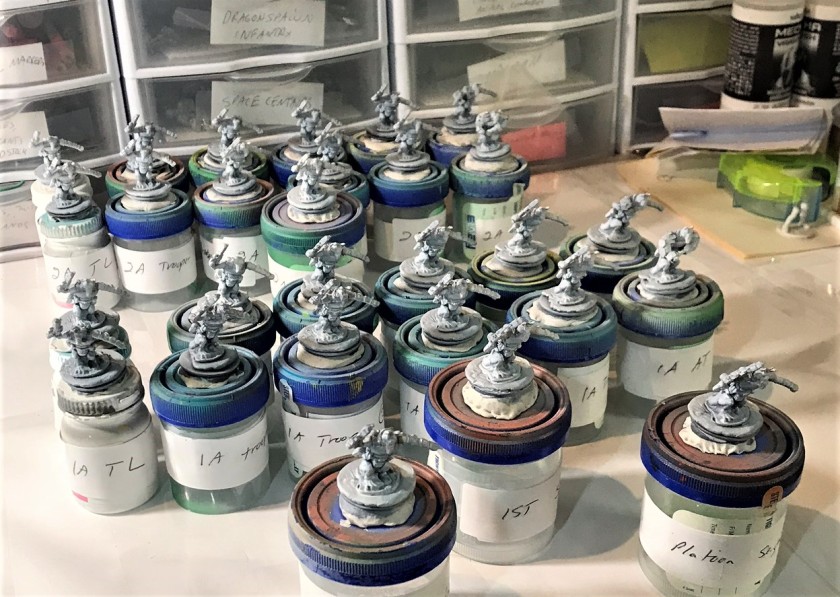
I ended up double priming these figures, as I knew that I would need to fix much with brushwork and painting. For example, there was a large indentation on the Roos’ left feet (paws?) that I needed to paint over. I thought that a thinned brush priming followed by a thinned airbrush priming would help. I think it did.
The platoon primed
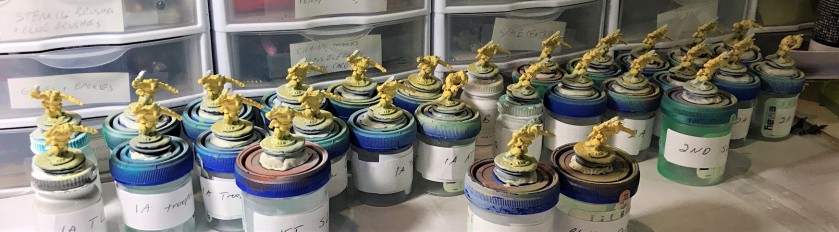
For their base colors, I went with a yellowy/sandy look for their armor, which I thought would reflect a desert or dusty deployment.
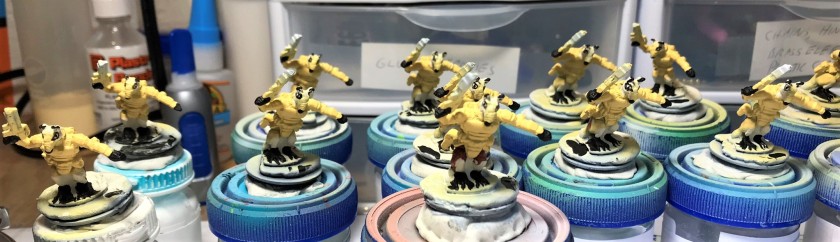
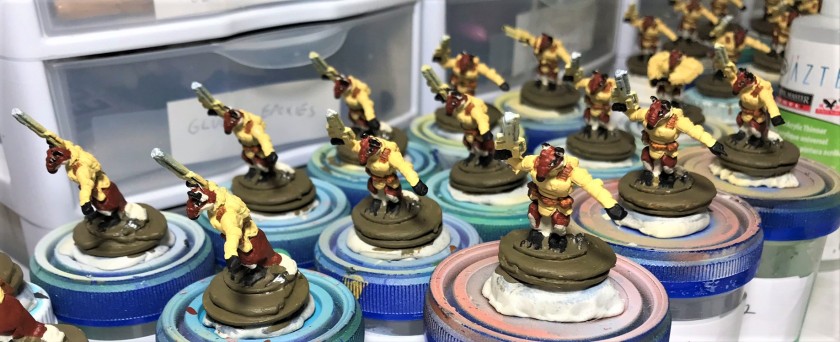
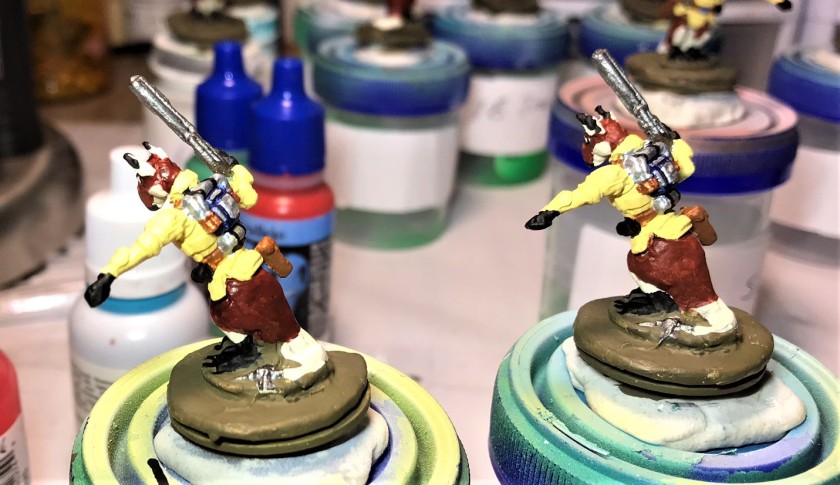
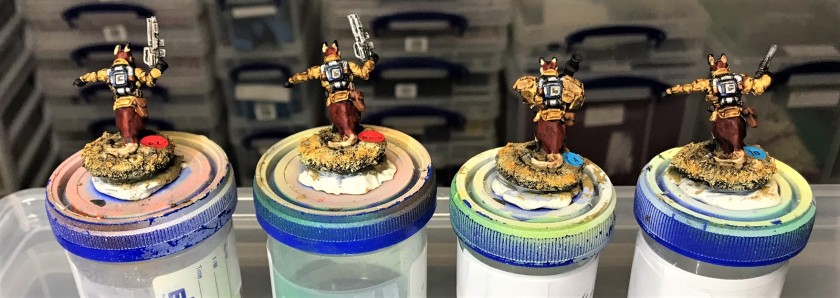
I airbrushed the armor with a yellowish/sand color. The idea was to use washes to bring out details (and allow me to obscure casting abnormalities). This would give me a nice camouflaged look at the end.Outlining the eyes, ears, feet, and gloves in black. I went with a red kangaroo coloring for the Roo parts .Moving on to fur painting. Inks and washes gave more depth to this later on.Jet packs!The bottom torso on the left has been painted with additional inks for depth.Comparison of the weapons – before (left) and after (right) dry brushing. The blue is indicative of the 1st Squad.
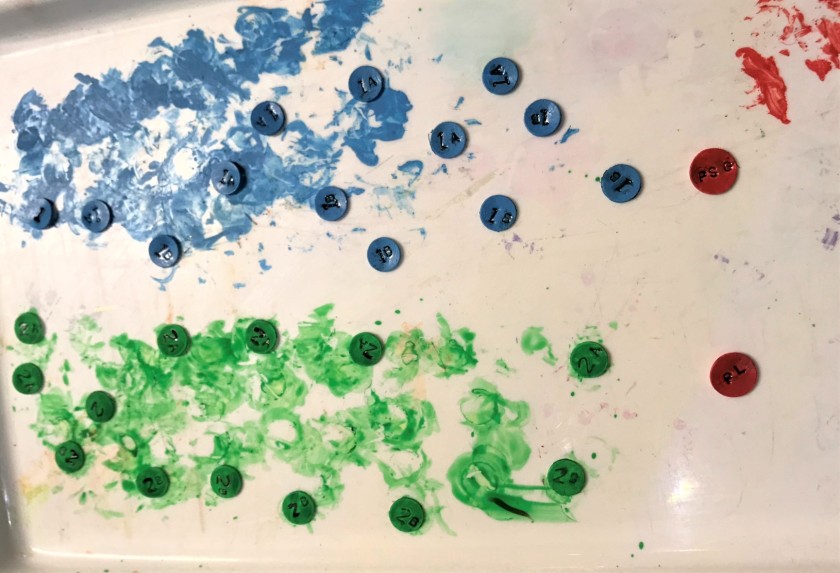
One of the issues I really want to focus on when I build a platoon is to make it easy for the players (some of us with “experienced” eyes) to see and identify a figure’s squad and team. I got some steel punches, and some jewelry stamps to make 1/4″ and 5/16″ placards that I could mount on the figures’ bases.
My 1/4″ punch and the two jewelry stamps next to the polystyrene placards. I did use 5/16″ placards for the platoon leader and platoon sergeant.The placards, stamped and painted. I used a wash to fill out the letters and numbers.Placard close up shot
Next, I washed the figures twice with Citadel “Agrax Earthshade”. I then mounted the RPG’s with Gorilla glue.
RPG Roos!
Lastly, I used a whole bottle of Citadel “Armageddon Dunes” to fill and shape around the bases and let them dry and harden. The placards were mounted into this paint. Then I gave the bases a wash with “Agrax Earthshade” and two different dry brush applications (Polly Scale “WWII German Armor Light Tan” and Vallejo “Light Brown”). Then I gave everything two coats of matte varnish.
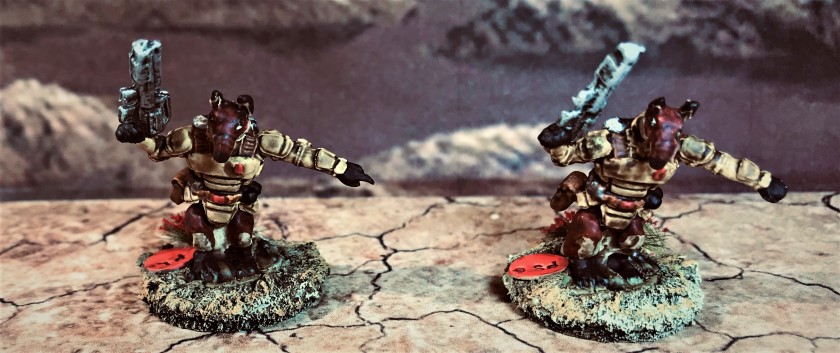
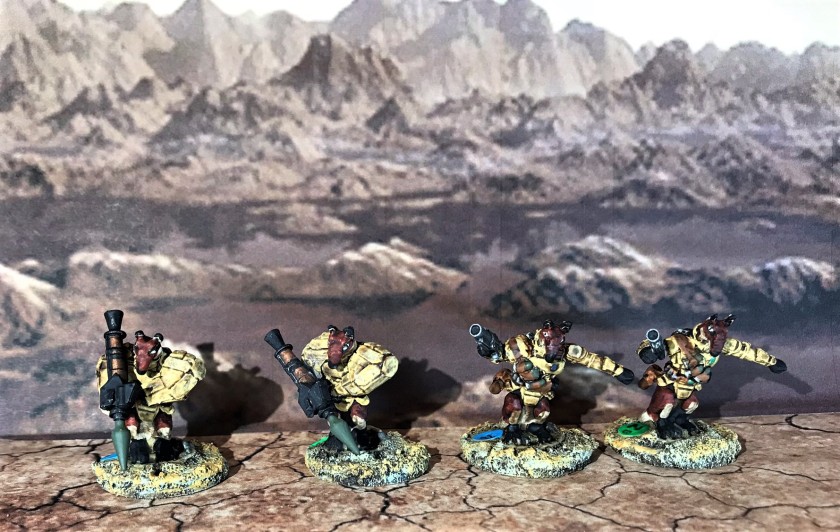
After filling the bases The platoon leader and platoon sergeant almost ready!Nice close up of the bases. The shading gave the body armor the dirty effect that I wanted.The four conversions of conversions, front……and back
After adding some tufts from Shadows Edge Miniatures for even better identification, the platoon was finally done (I LOVE their tufts). I am happy with it, given the work and effort it took to bring it to life. So, now, appropriately, I will share with you some eye candy!
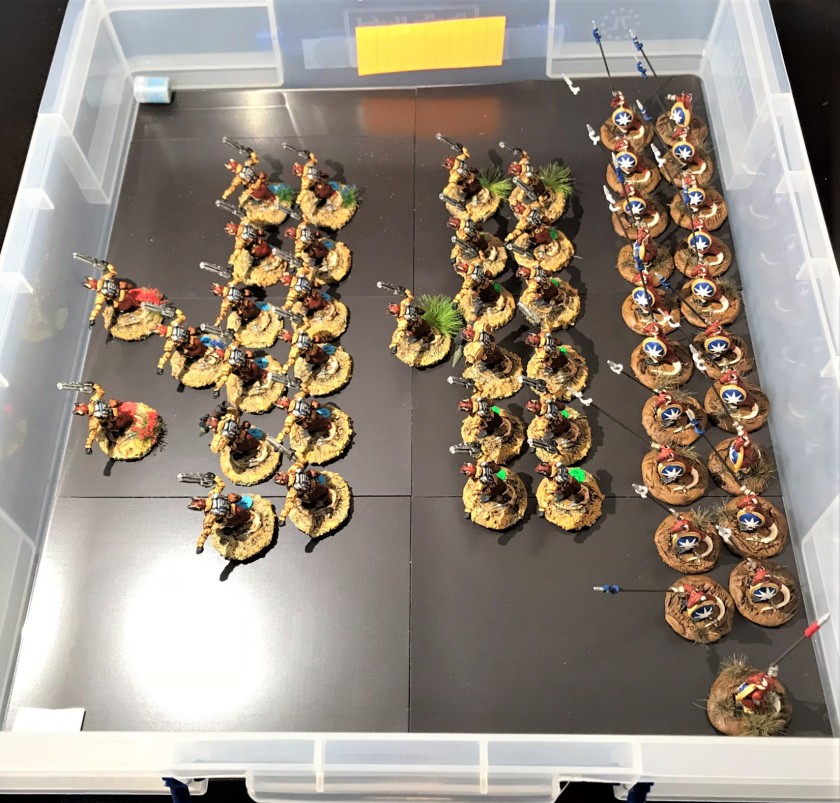
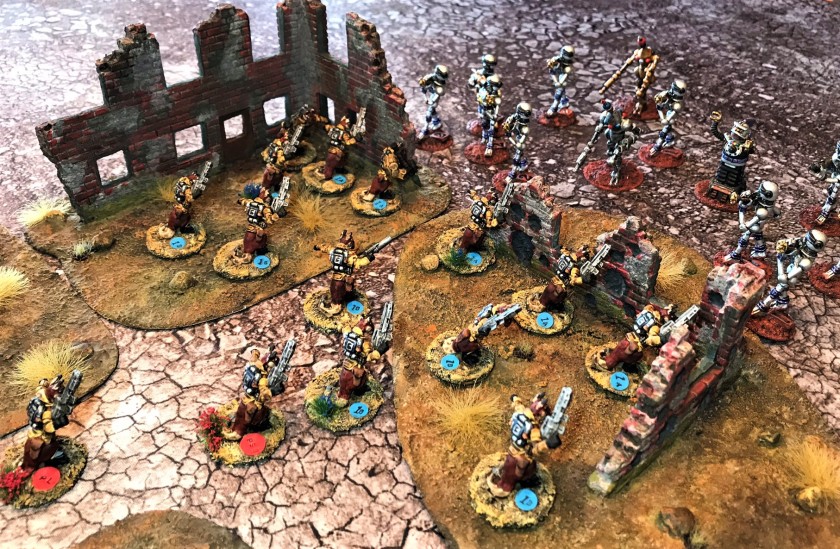
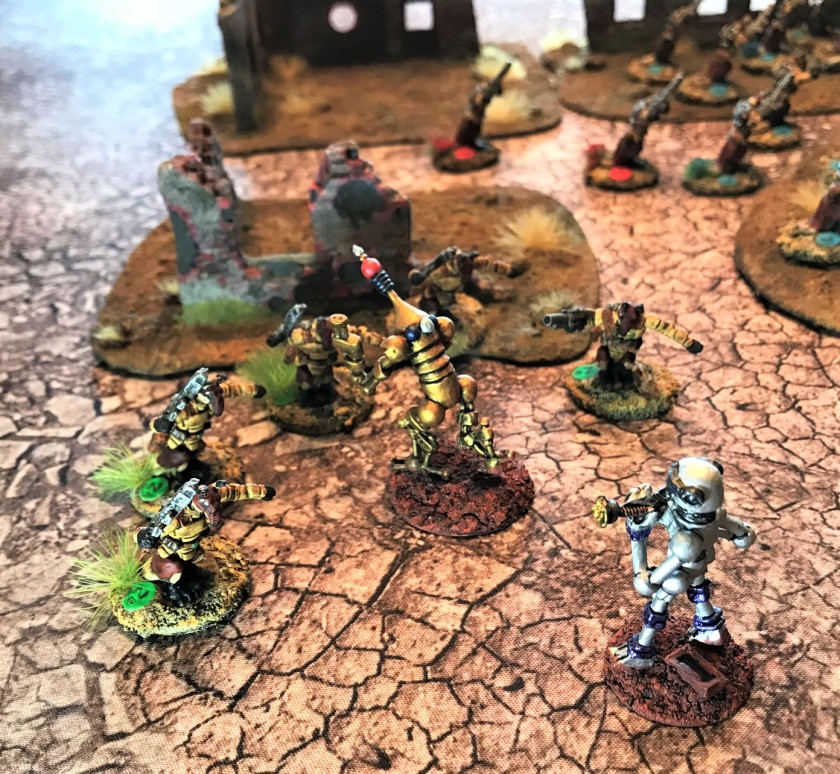
The platoon HQ, frontal view…and rear view, with a good view of the jet packs, red placards, and tufts. 1st Squad with blue placards2nd Squad with green placards and green tufts on the leaders.The AT and grenadier RoosThe Space Roos meet their ancestors, the Roomans!My box of Roos and RoomenThe Space Roos’ 1st Squad holds off the WarbotsThe 2nd Squad close Assaults Juggerbot
I am looking forward to seeing these guys in action soon. I appreciate your looking and hope that you enjoyed this post. I always read your feedback, so please let me know what you think in the comments section at the bottom of this post.
I dedicate this post to all my Aussie friends!
PAINTS, INKS, GLAZES, WASHES, AND FLOCKING USED:
Citadel “Imperium Primer”
Vallejo “Surface Primer – White”
Vallejo “Flow Improver”
Vallejo “Airbrush Thinner”
Testors “Universal Acrylic Thinner”
Vallejo Mecha Color “Sand Yellow”
Vallejo Game Air “Red Terracotta”
Citadel “Flayed One Flesh”
Americana “Bleached Sand”
Americana “Black Tie – Satin”
Vallejo “Black”
Vallejo “US Dark Green”
Tamiya “Copper XF-6”
Tamiya “X-20A Thinner”
Tamiya “XF-49 Khaki”
Vallejo Game Air “Weiss”
Tamiya “Gun Metal X-10”
Vallejo Game Air “Steel”
Vallejo Game Air “Beasty Brown”
Vallejo Mecha Color “Light Steel”
Vallejo Mecha Color “Dark Steel”
Vallejo Mecha Color “Metallic Blue”
Vallejo Game Air “Electric Blue”
Vallejo Mecha Color “Metallic Green”
Citadel “Hexwraith Flame”
Vallejo Mecha Color “SZ Red”
Secret Weapons Washes “Just Red” (ink)
P3 “Brown” (ink)
Secret Weapons Washes “Armor Wash” (wash)
Citadel “Nuln Oil Gloss” (wash)
Citadel “Agrax Earthshade” (wash)
Gorilla Glue
Citadel “Armageddon Dunes”
Polly Scale WWII “German Armor Light Tan”
Vallejo “Light Brown”
Vallejo Mecha Varnish “Matt Varnish”
Shadows Edge Miniatures 6 mm “Dark Forest Red” (tufts)
Shadows Edge Miniatures 6 mm “Dark Blue” (tufts)
Shadows Edge Miniatures 12 mm “Wild Tufts” (tufts)
Thanks again for looking and for your feedback! ESPECIALLY AUSSIES!
On October 20th, there was a Devens game day at the former Ft. Devens in Massachusetts. I was interested in attending for a couple of reasons. First, I am trying to get to more gaming events in the area. Second, I was stationed at Fort Devens while I was a member of the 39th Engineer Battalion (Combat) from 1989-1992, so I was intrigued to see the post again in its new configuration. Fort Devens was closed as an active duty US Army post in the 1990’s, and Massachusetts has redeveloped the post by bringing in a lot of industry. Still, some of the post is used by the reserves. In fact my old battalion area seems to have been saved and redeveloped for the reserves. That area is all fenced off now and I did not want to photograph the area and draw unwanted attention to doing so! Other buildings and barracks areas are untouched since closure, with actual trees growing out of the edifices yielding an apocalyptic/Walking Dead look. This blog post is a bit late, but I did get wrapped up in the baseball ALCS and the World Series, which were both won by the great Boston Red Sox!
The actual game sessions were held at the Fort Devens Museum. There were three games there – a WWI game, a naval game, and a pulp game. I did not get any pictures of the naval game but you can read about in an excellent post here. I focused on playing a WWI game (given that it is close to the centenary of the end of that conflict). The board is entirely scratch built, and I believe the rules were “Trench Warfare”, but I am not sure. The game master, Bill, did an excellent job, and I wanted to share his board as it was excellent. The event clearly tried to recruit younger gamers, which was admirable for growing our hobby.
Starting side for the Allies. From far to near, the attackers were US Marines, British, and French. It was a bit ahistorical but a fun game. While I commanded the French, I had two British tanks – a Mark IV and a Whippet.Another view of the Allies starting positions.A truly beautiful scratch built table. Bill (the game master) is pictured here standing. He did a nice job creating a trench works system with 2′ x 2′ modular sections.Some of the German forces – they were to engage the USMC is a series of bloody hand-to-hand battles.Advancing my poilus and tanksAn engaged group. Bill kept the game moving (unlike the actual WWI)!The Germans move up, and get hit by very lucky hits by my French 75mm artillery.The hand-to-hand battleTaking out the forward observation posts and then getting torched by a German flamethrowerGerman artillery disables my Mark IV
The game ended in a draw, but I enjoyed it a lot.
There was also a pulp game that I did not play in, but that looked interesting.
Pulp Alley GameDruids and Nazis? And Stonehenge?
Lastly, I looked around the museum and looked for anything related to my old unit. The only thing I saw was a donation from a former lieutenant from the 1977 time frame. I do think I could find a few things myself. Interestingly, I am a local, and the 39th had members who for the most part live in other parts of the country. I do commend the museum for trying to resurrect the posts history from WWI until closure.
The only mention of the 39th
My thanks to the folks who set up this event and to the folks at the museum!
Many of you who follow my blog have read about Buck Surdu, my good friend and author of multiple wargaming rules systems. Of course, he is a fellow West Pointer so that’s in his favor! He is a major shaker and mover in the H.A.W.K.’s (Harford County Weekly Kriegspielers) in Maryland, and has been involved with BARRAGE for years.
Little Wars TV interviewed Buck, and I thought some of you would find this interesting.
I fell in love with the Ral Partha fantasy offerings many years ago. Iron Wind Metals has a 3rd Kickstarter going and it’s worth looking at, especially if you are into Dryads/Ents or Fae.
This will be a very short blog post – but for those of you who love the old Archive Star Rovers figures, this will touch your heart! As many of you know, I have been collecting and painting Duck Wader, Star Ducks, Power-Armored Frinx, and a number of other Archive gems. I use them in Combat Patrol™ retro-sci-fi games – many of which my daughter Ellen Morin and her fiance Chris Smedile have played in and enjoyed.
Ellen’s birthday is in September, as is mine, but we did not get around to celebrating until the first Saturday in October. She got me a couple of very cool gifts. One was an awesome Boston Bruins sweater (cannot have too much Bruins gear by the way). The other was a painting of Duck Wader and some Frinx breaching a wall, with Star Ducks jet-packing through the air above! She used photos from my blog to sketch and ultimately paint the scene. I think it was an awesome gift! Here is the painting below: