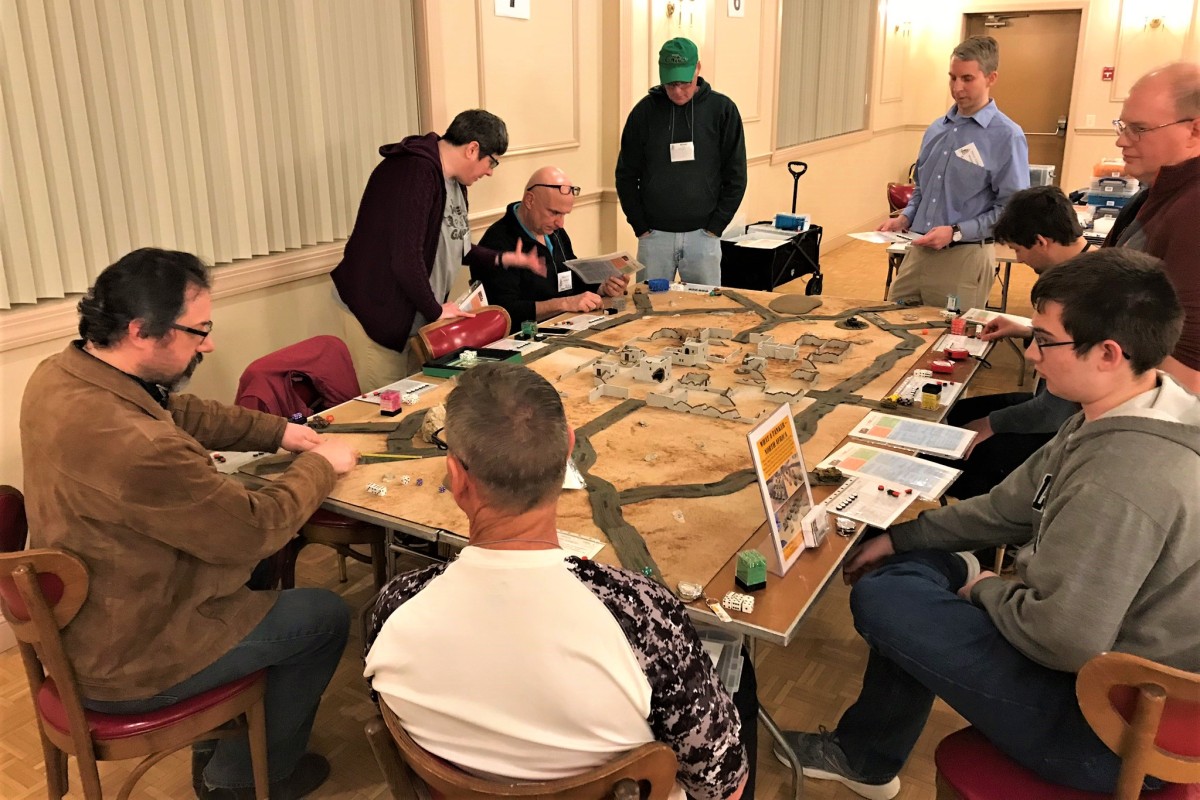
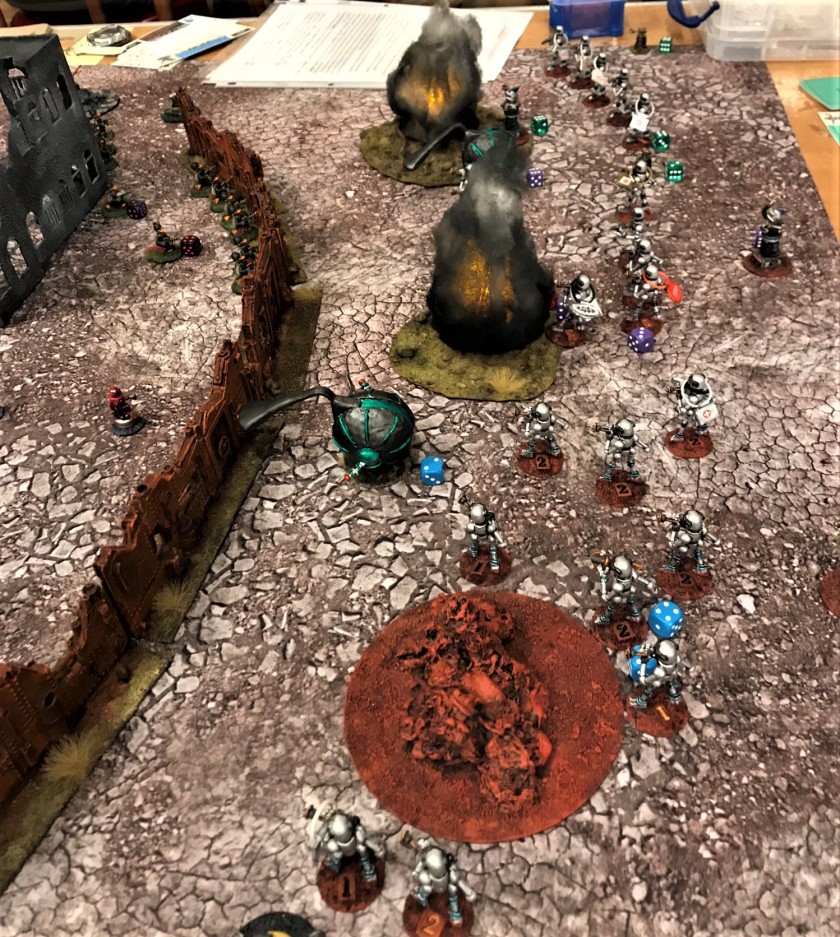
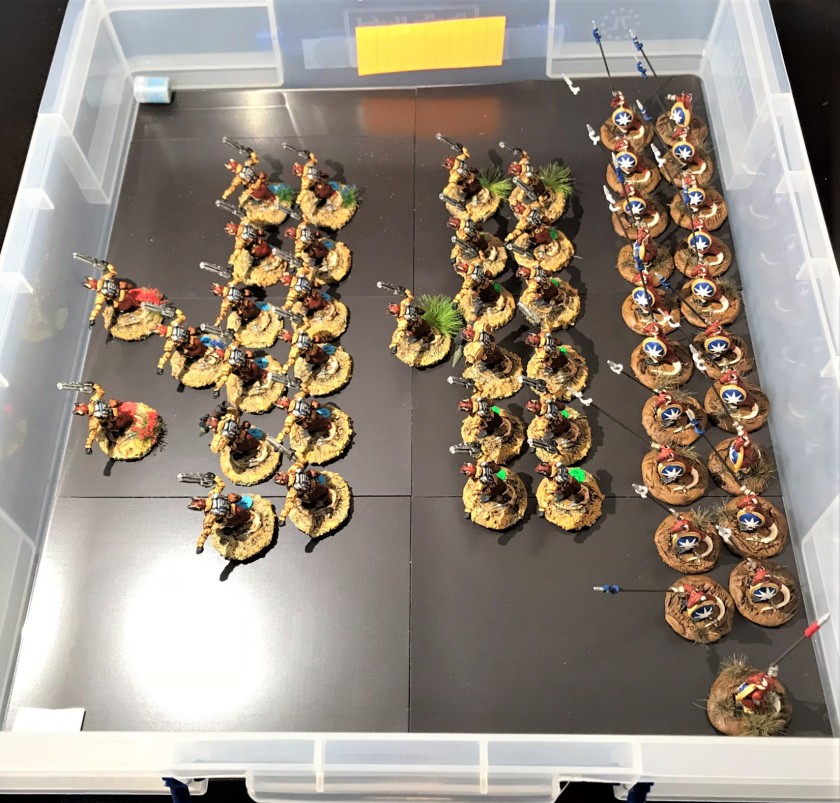
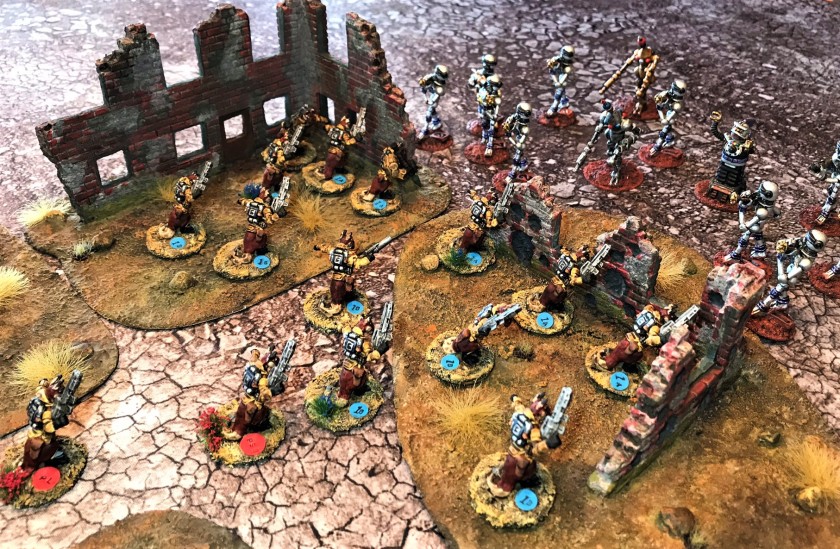
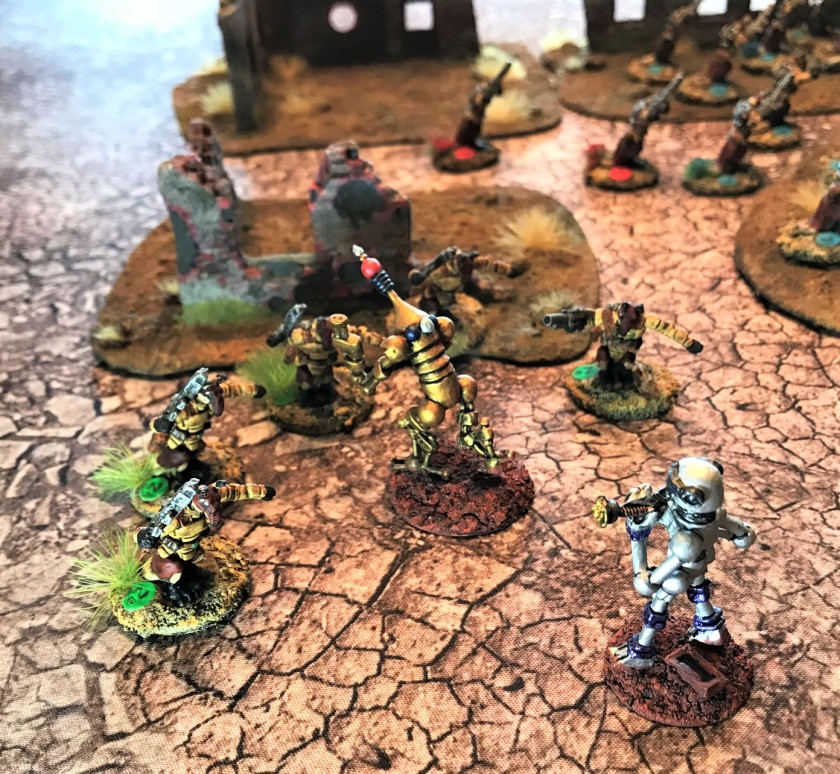
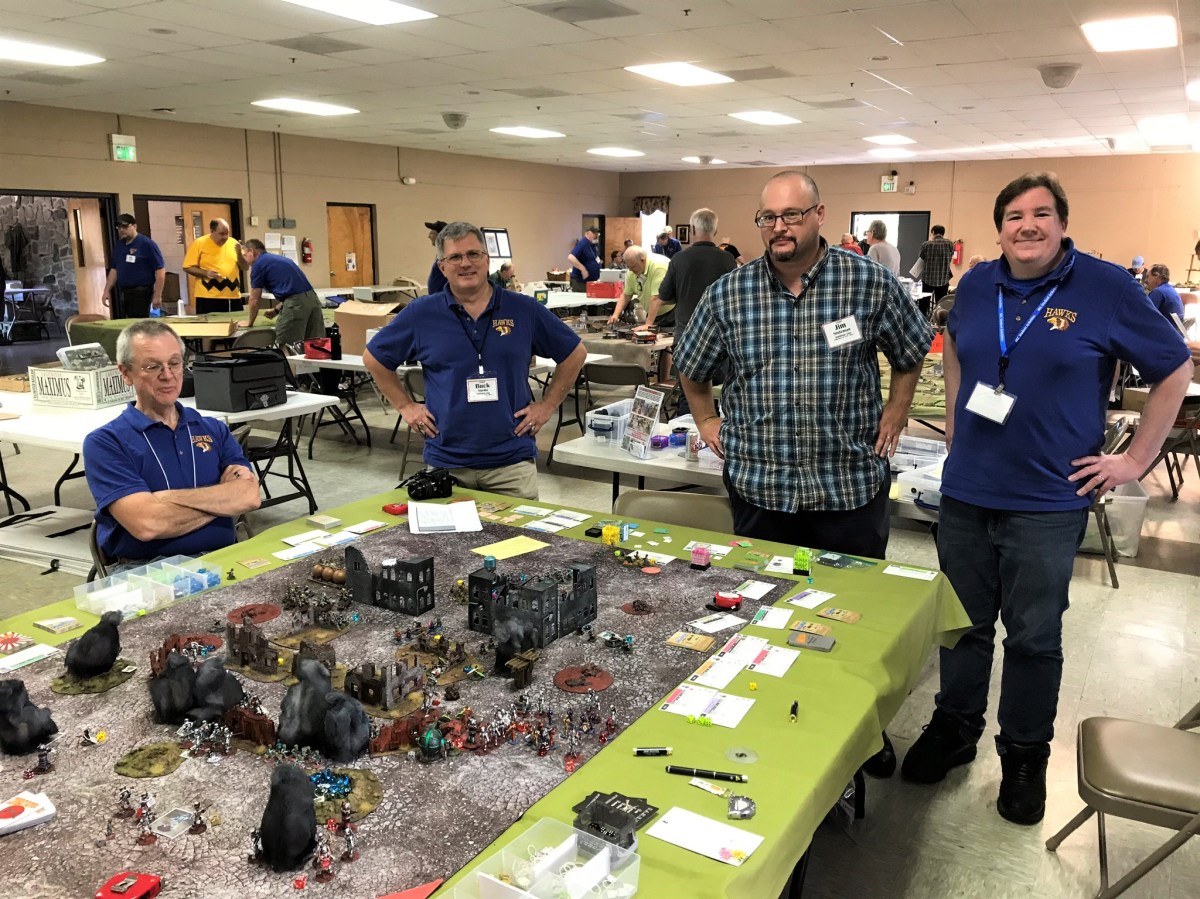
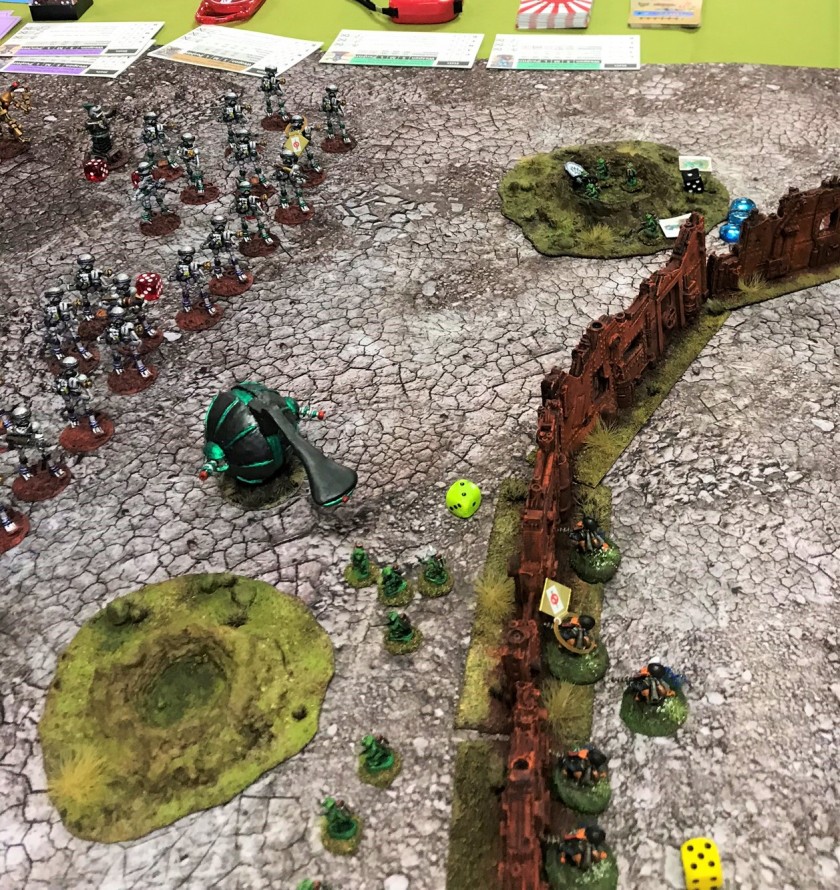
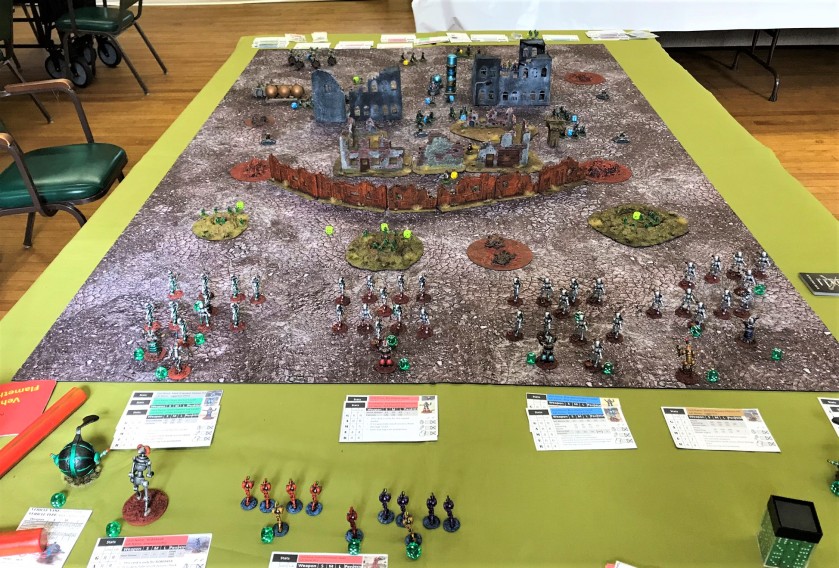
On Saturday, July 27th, the Mass Pikemen met for our monthly gaming session – this time it was another go at “Attack of the Warbots“. This game uses the Combat Patrol™ rules system, and the figures are Archive (from the late 1970’s/early 1980’s), Mega Miniatures (late 1990’s/early 2000’s), Wargames Supply Dump (now OOP), or my own creations. The links below for each can tell you more about them if you’re interested.
On the other end of the table, their Martian allies and a Roberker were attacking through some barriers and a ruined chemical plant as the Space Roos and Star Ducks responded. Meanwhile, inside the compound, there was RT-22 (commanding some Robo-Servo guns that were around the compound) and helping a Space Dwarf Assault Squad to repair the captured Mark 1. These were desperately attempting to repair a captured Mark 1 tank before the enemy stormed their repair facility.
The game went quickly once it started.
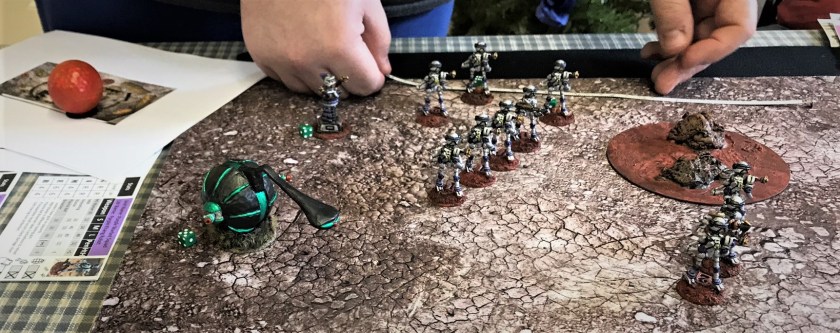
Randy advances his Warbots. His Mark 1 did not get to activate.
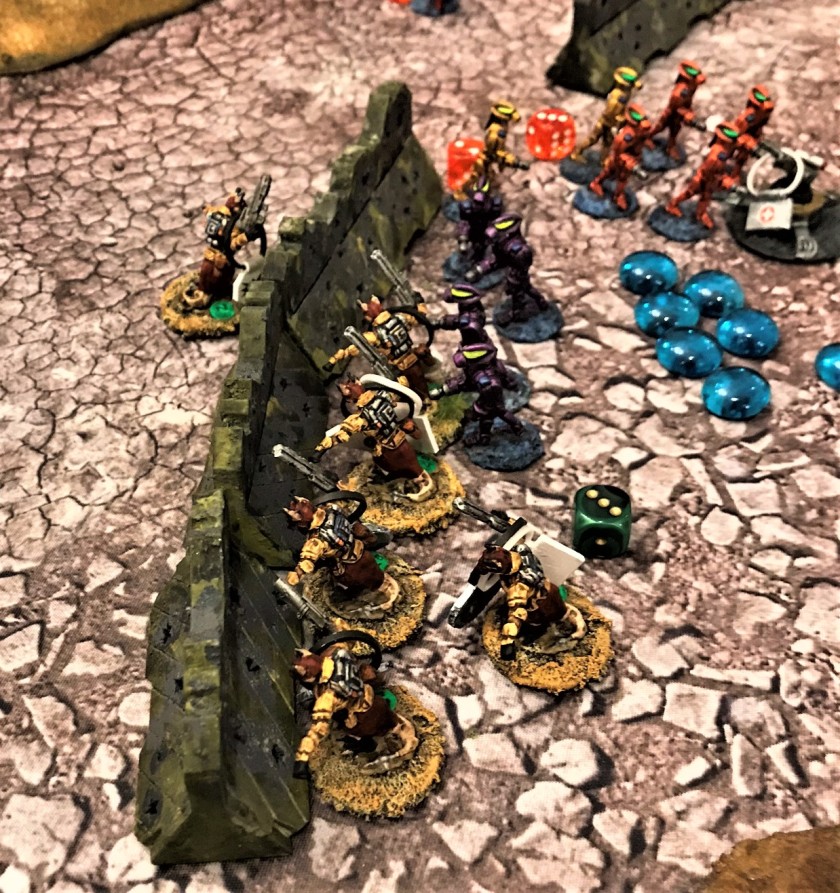
On the first turn, the Mark 1 above did not get to activate as no “5” came up. The Warbots chose not to pay one of their bonus chits to get a “5”. This allowed Leif to jet pack up a Space Roo with an RPG – who got a lucky hit and destroyed the tank.
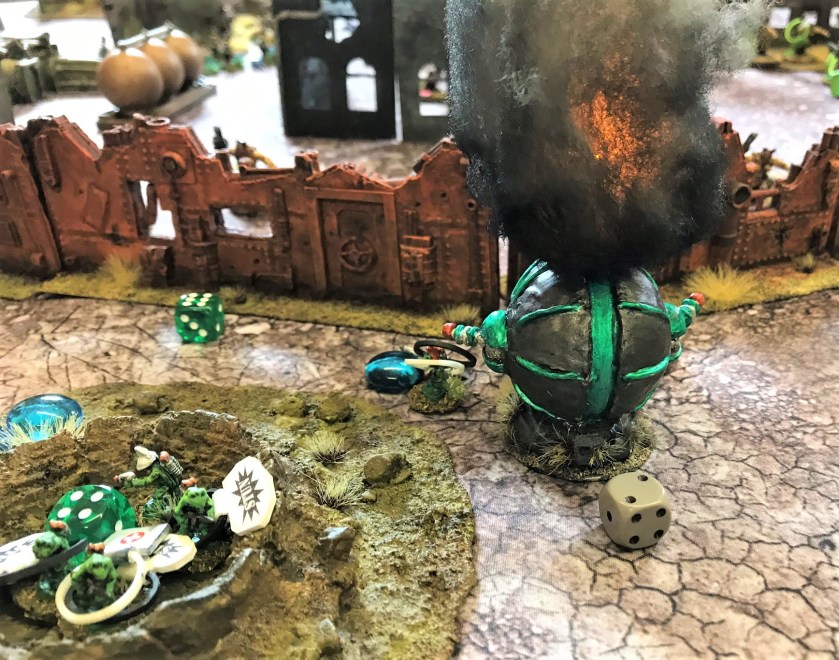
Christine’s Aphids meanwhile took heavy fire from the Warbots and Juggerbots, and were in danger of being wiped out. The remaining Mark 1 approached the wall. Leif jet-packed a lone heroic Space Roo over the wall to attack the tank with a satchel charge, only to stun it. The Aphid Platoon Leader, Lt. Hemipteran, valiantly attacked the other side of the tank with a satchel charge, and the remaining Mark 1 brewed up from the explosion.
The last Warbot controlled Mark 1 burns from the Aphid leader’s attack.
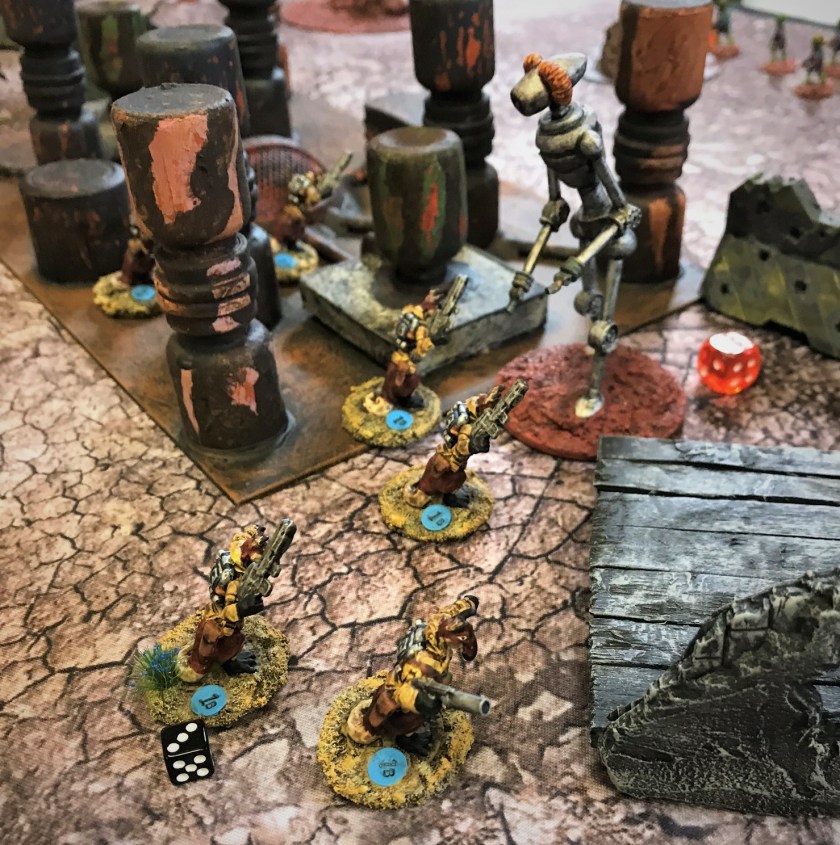
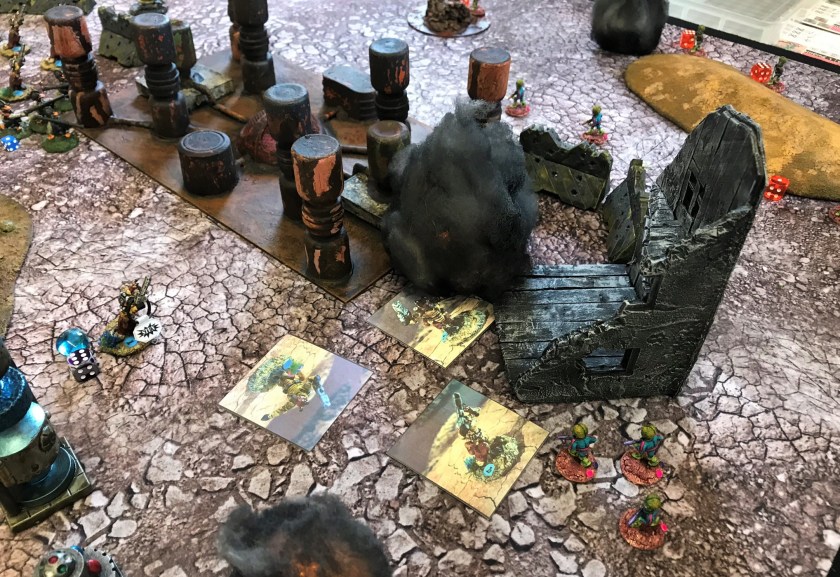
Meanwhile, on the other end of the board, Mike was making good progress with his Martians and his Roberker. Unfortunately for Roberker, a lucky Space Roo bullet hit his CPU, causing him to go rogue. In the game, a rogue robot attacks whatever he can see. Luckily for the attackers, he went rogue at the enemy Space Roos (commanded by Leif), who were eventually able to put him down with rifle fire and some of Christine’s Mortar duck supporting fire (called down ON TOP OF the Space Roos position). This was done with Leif’s approval – his Roos were valiant. Of course, several Roos bought the farm here.
Mike moves up his Martians.Roos assault by the chemical plant right before Roberker goes rogue.The Martians move up and shred the remaining Roos as Roberker burns. The cards indicate casualties.
Meanwhile, the Warbots on the other end managed to fire a plasma arc weapon and breach the wall such that one of Chris’ Warbot figures could go through at a time. Simultaneously, Leif successfully pulled some high cards and luckily repaired the captured Mark 1!
At this point, the game was called with a marginal victory for the Biological Alliance. They would have had to get the tank off the table, and there were Warbot reinforcements coming. My new ruined chemical plant had a lot of action!
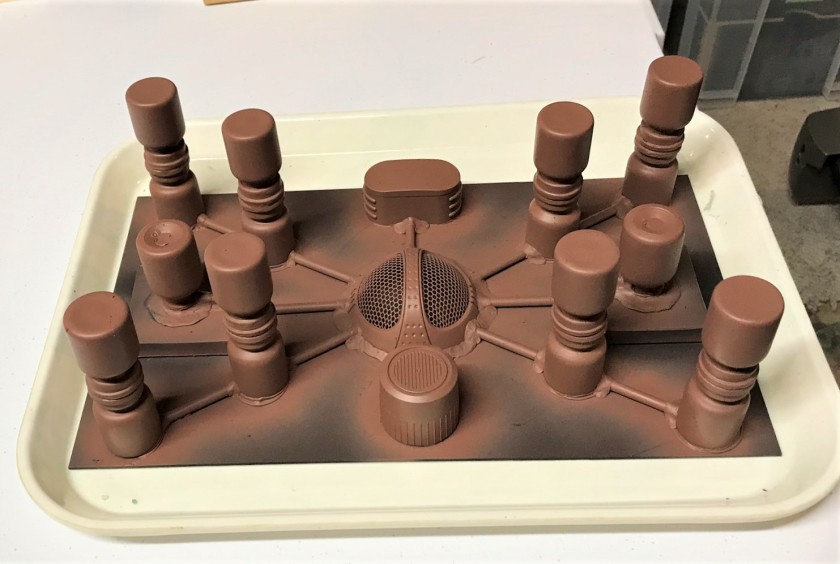
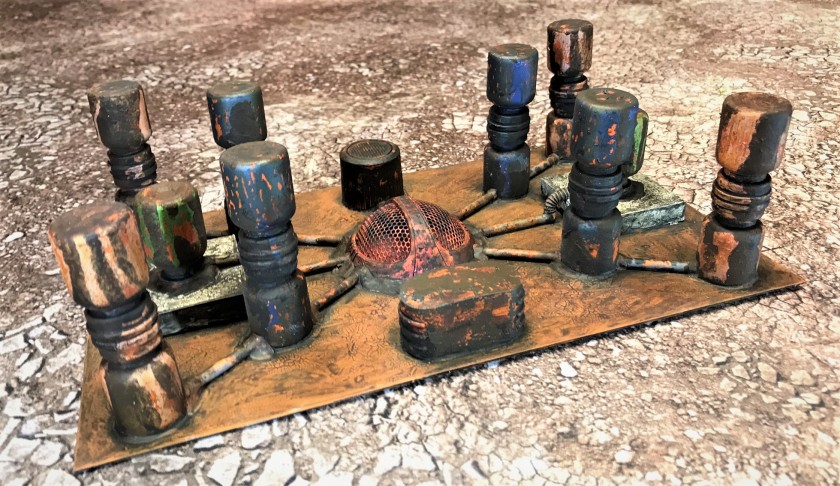
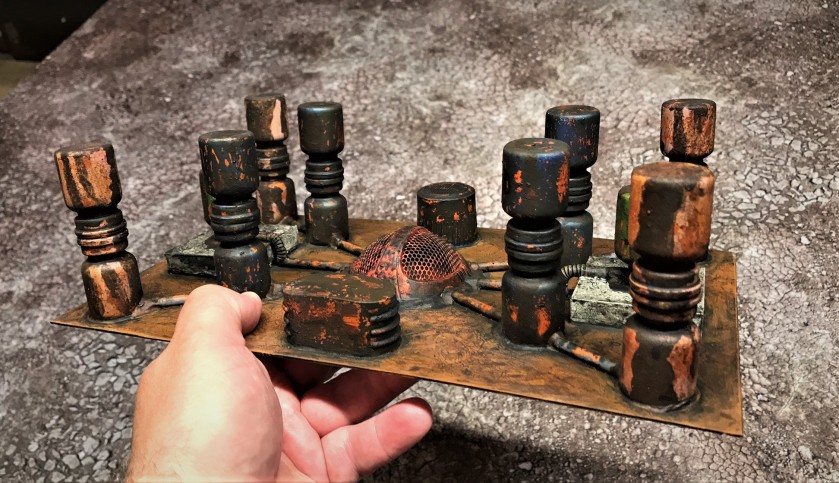
Sometimes you need to try new materials, new techniques, and change up your hobby projects to keep fresh. My tabletop battlefield for my Attack of the Warbots game scenario (using the Combat Patrol™ rules system) needed some more ruined industrial terrain. I also wanted to try some new painting techniques with chipping medium, as well as using some crackle paint. The goal was to make something ruined, rusty, with some degree of verticality that would complement my tabletop.
As far as building materials, I had been saving different bits and pieces of this and that for a few years in anticipation of scratch-building something to meet that need. I say saving, my wife says hoarding – (it’s not hoarding if the stuff is organized, labelled, and put away out of sight in drawers dear😁). A previous employer had supplied us with kits that contained dummy vials (empty) that we could use to teach the process of reconstitution of the real thing. At one point years ago, because the FDA drug labeling had changed, and the packaging that the kits had on them was no longer valid, we were ordered to throw them away. I did, but threw the vials into a drawer. I also had some oddly-shaped caps from body sprays, and a purloined cover from my wife’s blow dryer. To be fair, the cover no longer stayed attached, so that was fair game. I also had bits of polystyrene sheets and tubes, and leftover foam rubber pads (packing material) from something I no longer remember. So basically, I had a lot of trash to work with.
As the community painting challenge (run by Azazel) that I participate in for July was “The Jewel of July ’19 Community Painting Challenge”, I thought I’d switch up from doing tanks and make a scenery piece. The scenery qualifications were:
“It’s for the more impressive scenery pieces. A desert oasis or a (ruined?) temple or a bunker complex or a single bunker or a skyscraper or a Ferratonic Incinerator or a Kwik-E-Mart. A forest worth of trees or a jungle worth of plants.”
So, dear reader, you can be the judge of this project as a “jewel”, or not. It will have some good points and some not – I hope that if you have some feedback (good, bad, or otherwise) that you share it so that I and others can learn.
Construction and Planning
I assembled the assorted junk, and made a plan. The glass vials I decided would work well glued together top-to-top as chemical tanks. I had two vials that were plastic that I scuffed up, and I removed any paper labeling from all of them. The blow dryer screen would be the centerpiece. Using a leftover piece of polystyrene sheet (Evergreen #9060 – .06″ thick), I plotted out a chemical plant symmetrically. I made two elevated concrete pads for the shorter vials with thinner polystyrene (Evergreen #9020 – 0.02″ thick) and the foam pads, and Plastruct Bondene. For the vials, my epoxy of choice was E6000, though that did leave a lot of glue strings to clean up later. The tubing was Evergreen 3/16″ #226, complemented by cut plastic straws. Applying E6000 to the strws made them relatively solid. I used green stuff as the piping joints. The plan for the vials was to sequentially prime, apply rust paints, apply chipping medium, apply metallic paints, chip, and rust. The bases were to be done using AK crackle paints, with washing and dry brushing.
The missing cover came from here.The assembled terrain piece, unpainted.A side view of the unpainted piece. The smaller vials were plastic and held old normal saline. All were ordered to be discarded. This is how I did that.
Painting
I airbrush primed the piece with Vallejo Black primer, allowing 24 hours to dry. Then I airbrushed it with Vallejo Model Air “Rust” (#71.080).
Airbrushed with a rust base.
I then applied a liberal coat of Citadel “Ryza Rust” and a different Vallejo “Rust” (#71.069) that I hoped would show a nice rust effect under the final color coats. Then, I applied Vallejo “Chipping Medium” over the rust. I was very unsure of the amount to use here, or the pressure with which apply it with the air brush. Add to that the dry time, which I gave 24 hours – too much? I don’t know. Due to the terrain piece’s layout, it was also hard to get into all the areas with the chipping medium.
The rust on one side…
…and the other.
I then chose the final metallic colors for the vials, the pipes, the caps, and the screen. Those, and the other materials, you can see listed at the end of this post. I applied a caot of gloss black to the base to assist later “crackling”.
After applying the colors onto the vials.
At this point, I applied water with a stiff toothbrush to the vials, and that was supposed to cause the chipping. It did some places, but not everywhere. I had to resort to a toothpick in a lot of places, and that pulled ALL of the paint off. As repair, I used Citadel “Typhus Corrosion” trying to simulate rusted leaking tanks. I washed the vials with a light rust wash, and that turned the purple tanks pink/orange! I went back to the Typhus corrosion and tried to compensate.
After the chipping work.After the chipping work – I tried to make it look pretty contaminated and old.
Then, I needed to add the two different crackle paints, along with washes and highlights. Before that, I applied a gloss varnish to help the crackling effect and to help protect the chipping effects. I knew I could use a matte varnish later to dull it up.
Crackle paints drying in sun on the base. Glossy vials…for now anyways.After the crackle paint got a glossy wash.Close up – definitely need to remove the gloss. But first, some dry brushing of the crackle paint was in order.I sequentially dry brushed, washed, dry brushed, and washed the piece.
Finally, I airbrushed the piece with Vallejo Mecha Varnish “Matt Varnish”. As I had foam rubber part of the piece, I needed to avoid any use of rattle cans to prevent a real chemical meltdown!
Using the heat of my driveway to dry the piece.Complete and drying in the 90 degree sun.On the gaming mat.Close up of the crackling effect and the screen.Corroded tanks.Corroded tanks, opposite side.The smaller tank and its pad.
Space Roos reconnoiter in the plant.Space Roos are surprised by Martians in the plant.Well, at least it is done.
So, do I have a “Jewel of July” here. Maybe at least a garnet anyways. I think this is OK for the tabletop, given that it was basically made of trash. It hits the game tabletop today!
If you want to see a real “Jewel” – check out Alex’s piece here. THAT is impressive!
Back to my project, I was somewhat disappointed at the Vallejo “Chipping Medium”. I could not find much information on its use, and a lot of that was negative. The AK crackle paints are very good in my opinion, and I will look to see if they have a chipping product.
Any feedback – especially any thoughts on my process and the product – is always appreciated. As always, hope you enjoyed this post.
PAINTS, INKS, GLAZES, SHADES, WASHES, PIGMENTS, FLOCKING, GLUES AND MORE USED ON THIS PROJECT:
Battle Group Boston’s HAVOC 2019 (or HAVOC XXXV) is in the books. This previous weekend in Shrewsbury, MA was a Friday-Sunday gaming marathon that saw me run two games (“What a Tanker”in North Africa and “Attack of the Warbots” using Combat Patrol™). I also played in three other games: a First Boer War scenario using Combat Patrol™; “Look Sarge we are Invading Russia” using Look Sarge, No Charts™; and another “What a Tanker” game on Sunday. I have not been blogging much recently as my prep for the event took a lot of time. So, this post will share some shots of the events, with more focus on the games that either I ran as a GM or participated in as a player.
Of note, it was very nice to have my West Point classmate and good friend Dave Wood from the Maryland HAWKS make it up to play in my games and run two of his own. It was also great to see attendance and gaming from the Mass Pikemen, especially Mike Morgan, Leif Magnuson, Chris Comeau, and others.
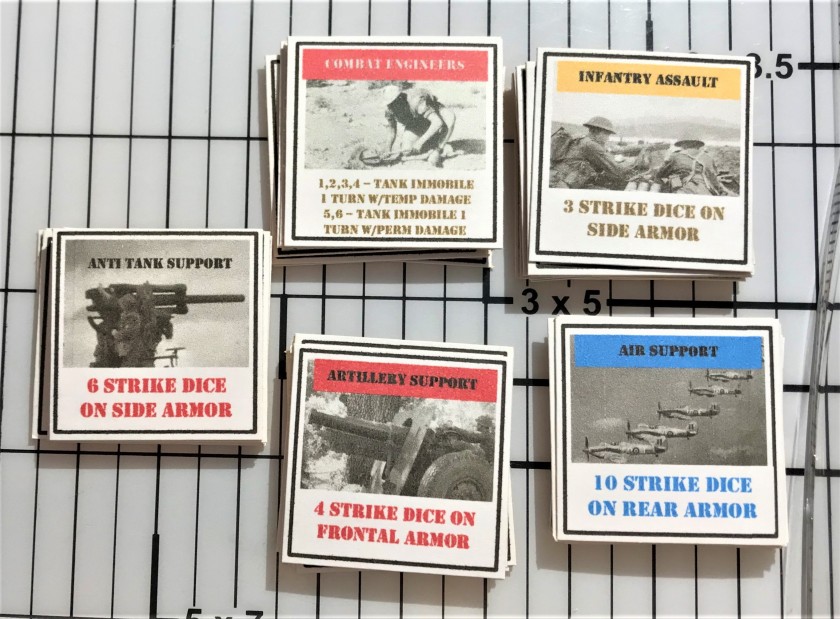
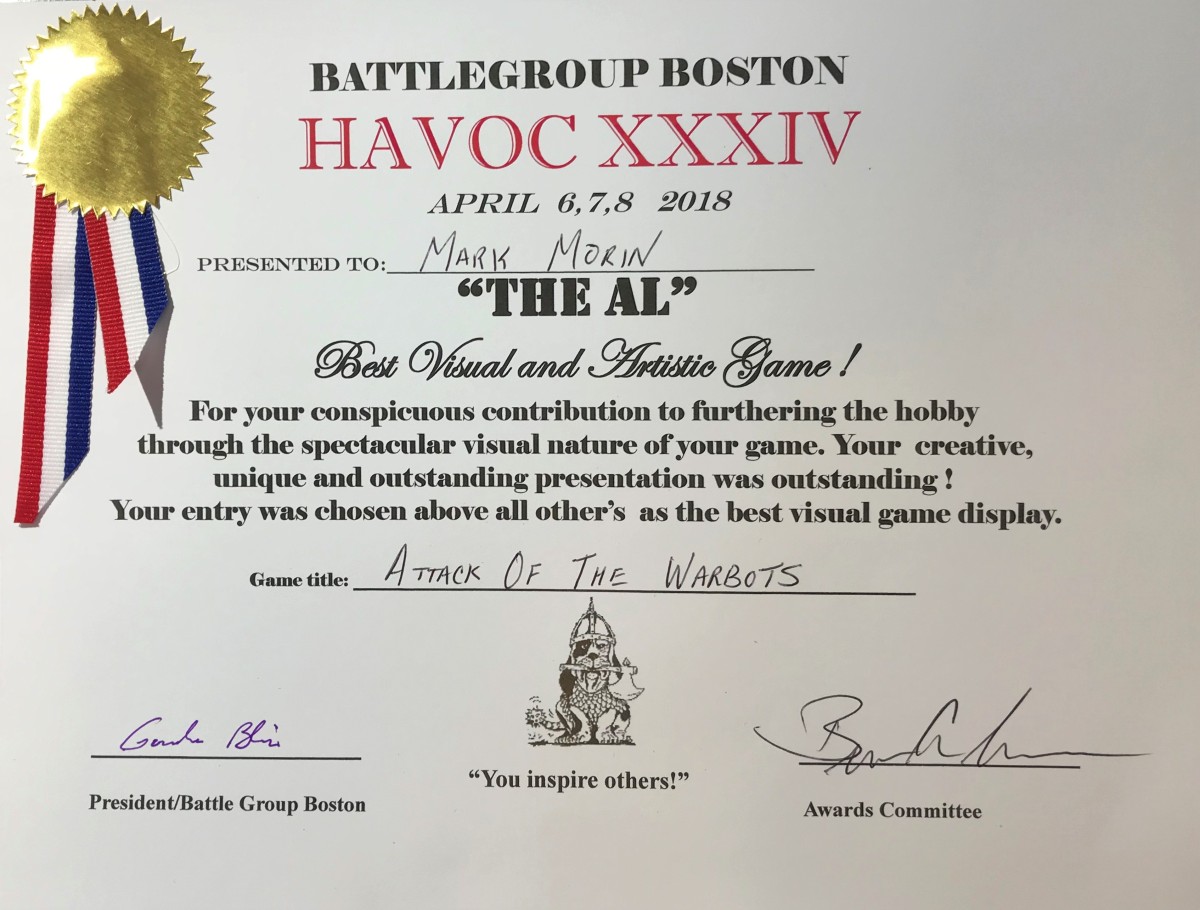
On Friday, I ran “What a Tanker – North Africa” and had a full table. I was able to roll out my new Bonus Attack cards that I created for the convention. They were very popular in the game and I will be expanding my use of them in the future based on the scenarios I run and the historical aspects of the specific theaters and scenarios/battles. I will adjust their use, and how I allow tank replacements going forward. Still, the game went very well, and I earned an award for the “Best in Time Slot”! The Axis battled back from early losses and defeated the British 104-58.
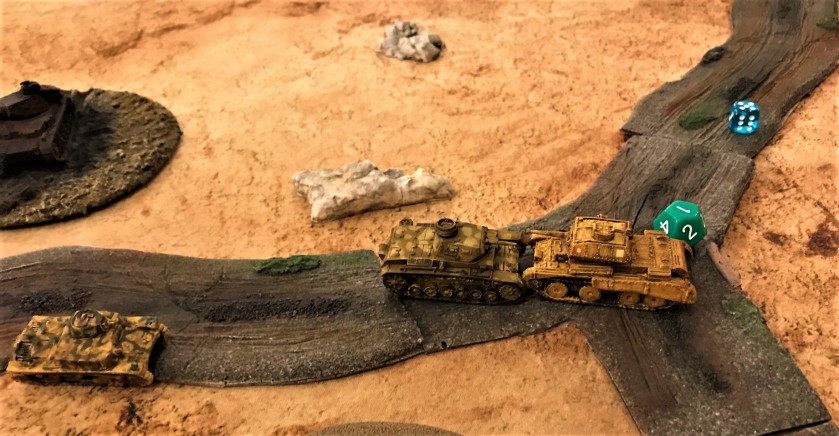
My game announcement posterMy “Bonus Attack” cards for the game. They worked well, especially the Combat Engineers.I mapped out the game board in my cellar beforehand. I got a new 8′ x 4′ badlands/desert mat that worked very well for the scenario from Frontline Gaming.Detail of the town I put in the middle of the battlefieldFriday night’s full crowd at What a Tanker – North Africa using 15mm tanks.The first use of one of my Bonus Attack cards – in this case an airstrike card on a hapless M11/39.What a Tanker – or in this case “What a Rammer” as a Panzer IIIE runs into an A13. The Panzer IIIE got the worst of it from the Brit, but the A13 was subsequently knocked out by an Italian M13/40.The game had a lot of action, but in the end the Axis prevailed.I was happy to earn this award, but the players’ enthusiasm carried the day.
Saturday, I played in two games, and ran a third. The first one Saturday morning was “First Battle of the First Boer War” using the Combat Patrol™ rules system as modified for this era. It was a fun game, with the Boers holding off the British as they attempted to seize a wagon. In the end, the Boers prevailed.
Dave Wood briefs the players on the Boer War scenario.Boers are outnumbered, but hold the wall – each glass bead represents a morale check. They held for a long time.
There were many other games – over 56 I believe, and I did not get a chance to take a picture of all of them, but here are some shots below.
A beautiful American Civil War board.Palestine in WWI. Definitely a game I would have loved to try.Wings of Glory.Bolt Action.A new sci-fi game, Trilaterum, had some beautiful scenery.Test of Honor – and note a 1970’s classic return in the back – OGRE – a near future tank game. I played that game with cardboard chits in the early 1980’s.
The next game went up in operational level and down in miniature scale. Dave Wood ran “Look Sarge, We are invading Russia”, using the Look Sarge No Charts set of rules and 6 mm microarmor. The Germans held off the Russian counterattack, and won the game. Both of Dave’s games were very well-received.
The Germans move down the road.
Skipping to Sunday, Leif Magnuson ran a nice What a Tanker game using 28mm tanks in an Eastern Front battle. It was a lot of fun, and the Soviets eked out a win. Leif also won an award for “Best in Time Slot” – well-deserved. This meant that our club (The Mass Pikemen) won two awards – and both were “What a Tanker” games!
“Ivan is a Tanker” run by Leif Magnuson.
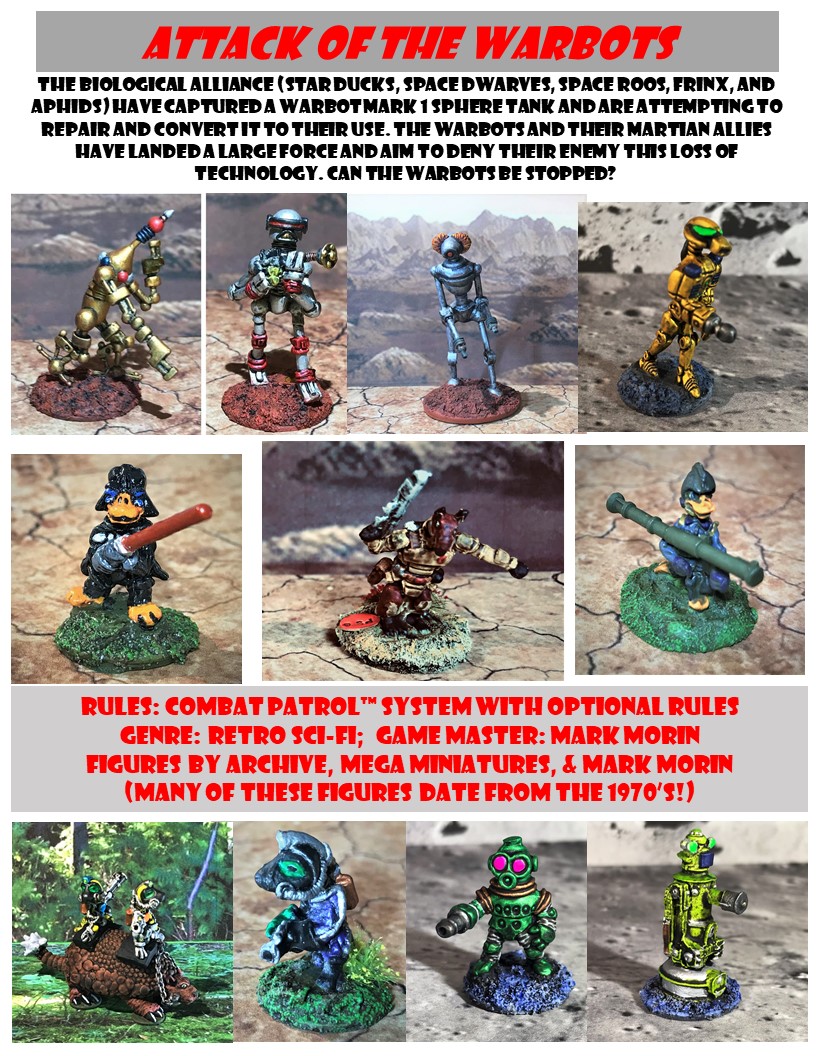
Flashing back to Saturday night – I ran an updated “Attack of the Warbots” game. The game was a success, as the players had a great time.
My game posterThe game set up plan.The tabletop is set – and the attack begins.The Warbots got slowed by the Aphids defense, but managed to advance a Mark 1 Sphere tank to the wall.On the other side of the board, Leif Magnuson’s Martians and Robot Peacekeepers press their attack against Chris Comeau’s Space Roos.Chris jet-packed his Space Roos into the heart of the Martian attack. The Star Ducks disabled a second Mark 1 Sphere tank with a satchel charge, immobilizing it and taking it out of the fight – a critical loss.Biological forces desperately converge on the Mark 1 Sphere tank as it breaks through and approaches the captured tank and its Space Dwarf repair crew.Meanwhile, the Robot Peacekeepers pulled a “Banzai” charge morale check and swarm the defending Space Roos on the other side of the table.
At this point in the battle, Duck Wader made a power leap with his Sith powers, and drove his light saber into the Warbot tank, resulting in its disabling just two inches from victory.
Nearby, Roberker, a giant robot (with flame-throwing arms) was the Warbots’ last chance. The Frinx shot Roberker a bit, and its resulting morale check caused a miracle result – apparently the robot lost face, ran away in shame, and blew himself up!
The suicide of Roberker. I replace these “ancient” miniatures on the battlefield when they become casualties with homemade cards.The card that did in Roberker. Note the morale result at the bottom – I have the Warbots use the South Pacific deck from Combat Patrol deck which have different (WWII Japanese) morale results.
The death of Roberker was followed by raucous laughter from the table – even from the player who had it happen to his Roberker.
I was tired after the weekend, but it was a great time. I want to thank all the players, as well as the GM’s, and especially Battle Group Boston for another fun convention!
I have been very busy – too busy to effectively write blog entries lately. I have been working on terrain and game support for the two games I will be running at HAVOC on April 5th and 6th. Each will support 10 players – and its my goal that all have a blast! So, in the interim, please enjoy these two announcements – hopefully I get some other stuff painted and blog-worthy for you dear readers! The link for the convention is here.
I am looking forward to seeing a number of friends – including my old USMA classmate (and HAWKS member) Dave Wood who is also running a couple of games – so that’s exciting too.
I’ll be running these two games!
I updated this game with my Space Roos and have new terrain!
Some of the items on the activity list below could be fairly called double-counting, but hey, no blood no foul! I tend to count projects in terms of their distinctive nature, ie the building/assembling/creating processes to me are different than painting, as is converting figures. I did not cast anything this year or make any molds as I still have plenty of figures to paint, and my hope is to knock out more of them in 2019, as I will not need to make as many game pieces/game aids.
This list, which is a separate page on my blog, helped me to stay focused. The adding of the hyperlinks that you see on the items below helps me to review past projects as prologue for future ones.
Thanks for checking this out – and good luck to all in 2019! Hope I keep you amused and entertained!
2018 Total Projects: 2,036
244 figures painted
0 figures cast
47 figures assembled
33 terrain pieces made or assembled
28 terrain pieces painted
10 figure conversions
867 creations or components sculpted or scratch-built
0 molds made
807 game pieces/game aids made and/or painted
January: 91 projects
Creations/components sculpted or scratch-built (91):
2 A9 Cruiser Mark I tanks (15mm/1:100 scale), from Battlefront Miniatures (#BR020)
1 A10 Cruiser Mark IIA (Desert) tank (15mm/1:100 scale), from Battlefront Miniatures (#BR023)
1 A13 Cruiser Mark IVA (Desert) tank (15mm/1:100 scale), from Battlefront Miniatures (#BR026)
1 Valentine III tank (15mm/1:100 scale), from Battlefront Miniatures (#BR061)
1 Crusader II tank (15mm/1:100 scale), from Battlefront Miniatures (#BR032)
1 Crusader III tank (15mm/1:100 scale), from Battlefront Miniatures (#BR034)
1 M3 Grant tank (15mm/1:100 scale), from Battlefront Miniatures (#BR100)
1 Churchill II tank (15mm/1:100 scale), from Battlefront Miniatures (#BR070)
5 M3 Stuart “Honey” tanks (15mm/1:100 scale), from Battlefront Miniatures (#BR006) – Brits will get two, I am saving one for future Soviet Lend-Lease, one for future captured German use in North Africa, and one as an American M3 for future captured Japanese use in Burma or the Philippines.
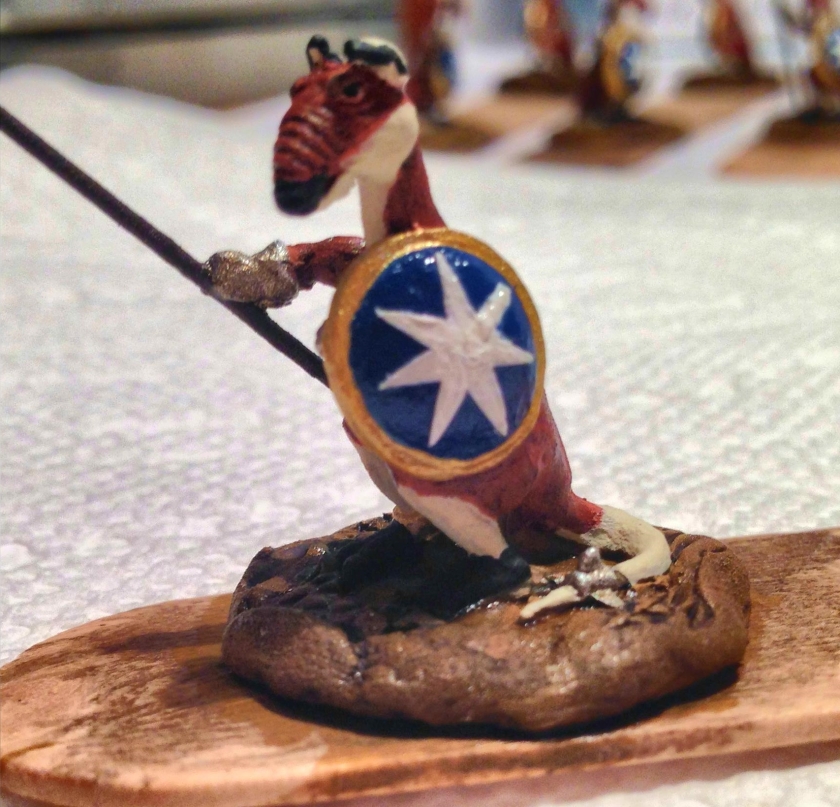
Back in 2016, I had finally completed an original Ral Partha “Rooman War Party” (#01-044) from 1977. This effort culminated in my building a 21-figure phalanx of pike-armed anthropomorphic kangaroos, replete with Australian 7-pointed stars on their shields.
At that time, I also began to see that others, like the wonderfully named Imperial Rebel Ork (IRO for short) were doing amazing “kit-bashes” and conversions with different models. Of course, IRO uses plastic, and I’m more of an old school metal guy. I also was getting more into retro sci-fi figures and using them for skirmish games. I was inspired by IRO and Azazel (both Aussies) to push myself to do my own conversion. So, I combined two figures – a Ral Partha Rooman (25 mm scale) and a Reaper #80010, “Nova Corp Sergeant” (28 mm scale), made a mold, and cast a bunch of “Space Roomans” (in metal of course). You can read about that somewhat massive project here. Getting around to painting these took a bit longer, and even my good friend Buck Surdu painted some that I gave him much quicker than I did.
Ral Partha RoomanThe Reaper figure (circled) that I used was in a bunch of figures I got on eBay
Azazel is kind enough to run a monthly community painting challenge – and October’s was “Unit-ed October”, and focused on units. So, I took this opportunity to get these done. Of course, this effort was slightly affected by some gaming and the Red Sox winning the 2018 World Series (YES!), but I got them (the Space Roos that is) done by October 31st, 2018. I will use them in Combat Patrol™ games.
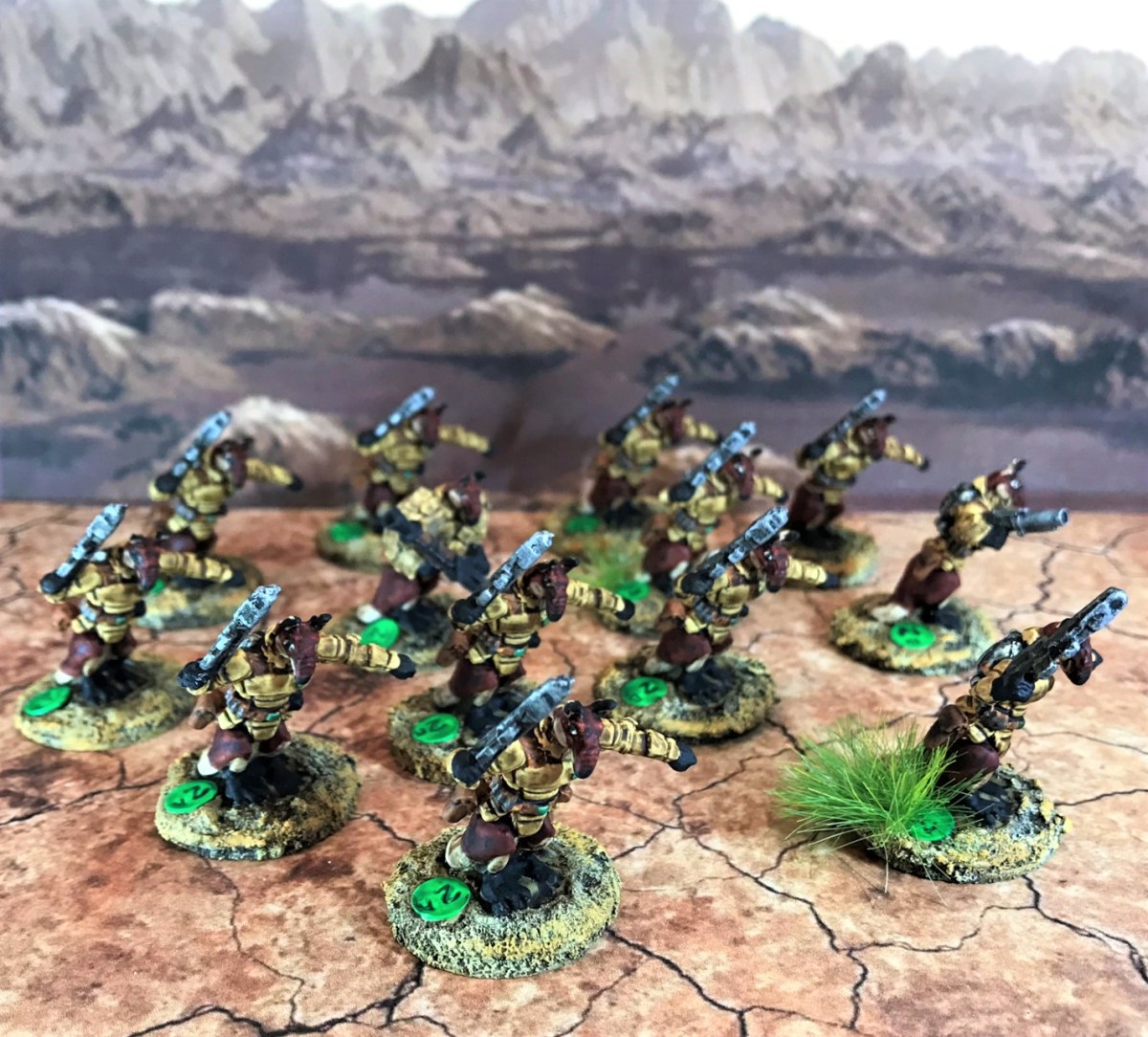
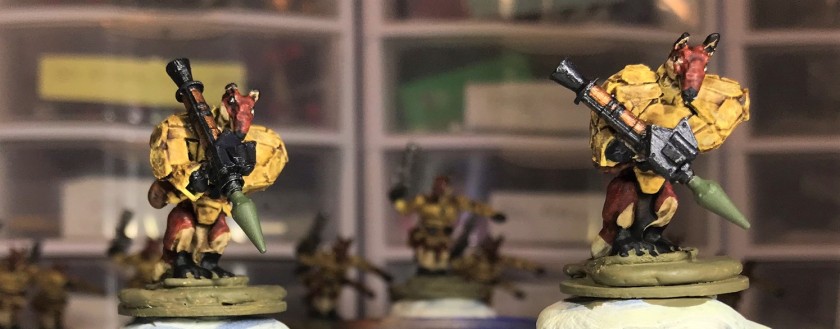
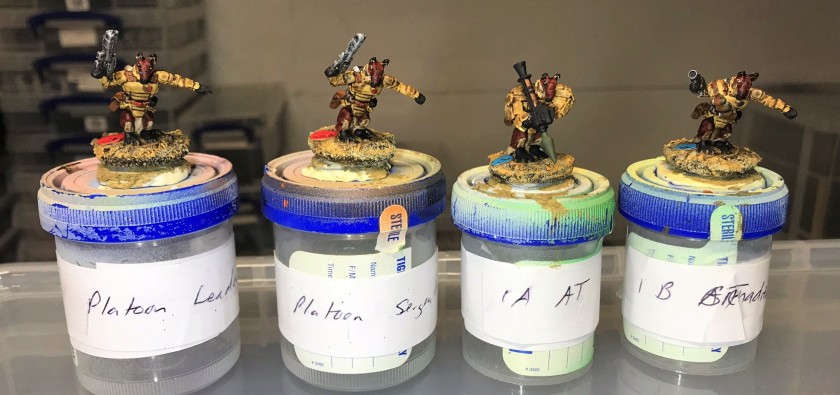
I decided to paint the Roos similar to the way I did the Roomans, except that I wanted a more dusty and dirty look to them, as they are intrepid infantrymen (infantryroos?). I also wanted to convert a couple of figures per squad (yes, a conversion of a conversion) to carry different weapons. In this case, I used a grenade launcher sprue from RBJ miniatures to make two Roos into grenadiers, and a different RPG sprue from RBJ to make two other Roos into anti-tank troopers. So my 28-figure platoon would consist of:
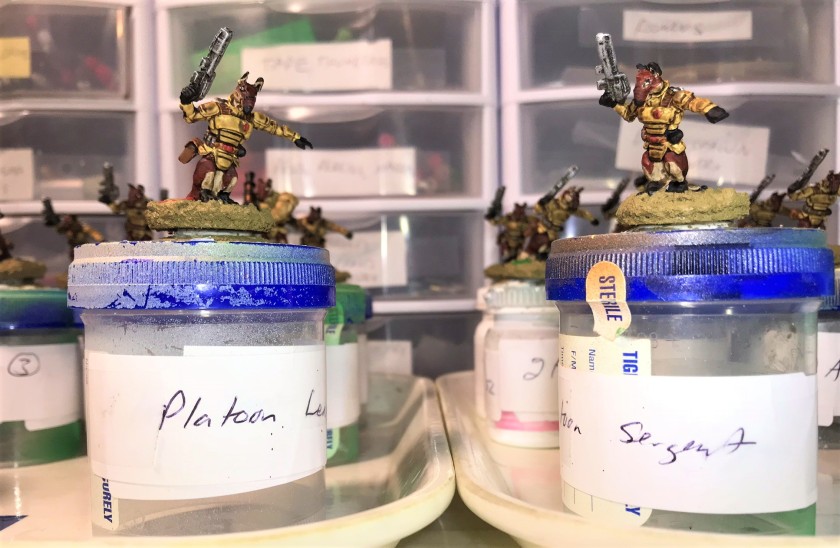
Platoon Leader
Platoon Sergeant
2 Space Roo Squads consisting of:
1 Squad Leader in each squad
2 teams of:
1 TL per team
4 Space Roos with assault rifles/blasters per team
1 Space Roo per team with either a grenade launcher or anti-tank weapon
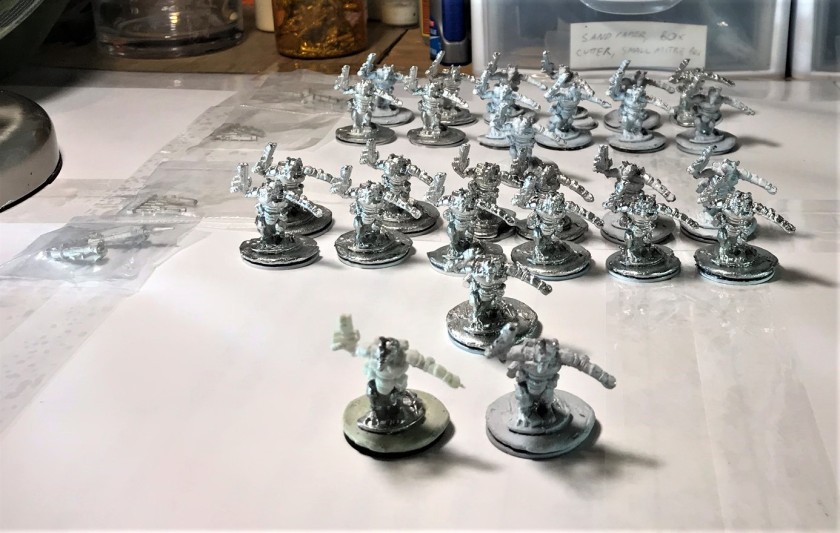
Two squads make a light platoon, but I think that they will be a potent elite fighting force on the tabletop. Also, these Roos are equipped with body armor on their torsos, and importantly, jet packs! I will also give them a higher rate of movement similar to what I did for the Space Phraints (1½ cards of movement). I cleaned and filed the models, and prepared them for conversion and priming by mounting them on 1″ steel washers.
The two squads behind their platoon leader and platoon sergeant. The weapons for conversion are on the left.
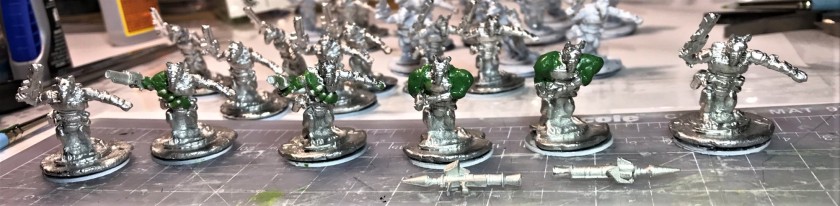
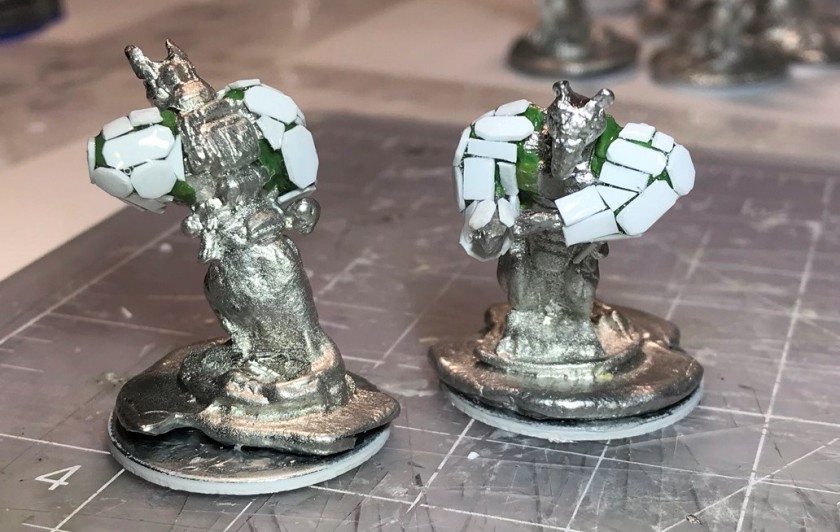
I had a tough time reorienting the arms of the RPG-armed Roos, and I needed to break them and use green stuff to create a proper pose. Pinning was not feasible unfortunately. I also used green stuff to mount the grenadiers’ launchers and to give them bandoleers of grenades. The grenadiers looked fine enough for the tabletop, but I was unhappy with the RPG Roos, as they looked “Popeye” like in their arms. As the Space Roos body armor gives them an angular body look, I decided to use a series of very small 2 mm polystyrene chips to create an “armored look” over the arms by affixing them with Gorilla glue.
The green stuff conversions – note the bulbous arms that needed attention on the AT Roos.My fix for the arms. You can see that my casts varied in terms of “crispness”. Clearly, I was going to need the brushwork to make these work.
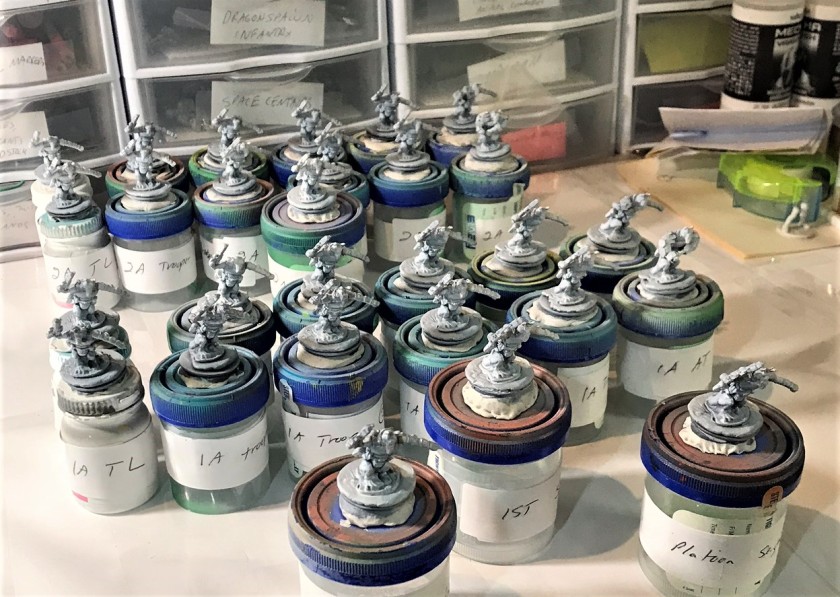
I ended up double priming these figures, as I knew that I would need to fix much with brushwork and painting. For example, there was a large indentation on the Roos’ left feet (paws?) that I needed to paint over. I thought that a thinned brush priming followed by a thinned airbrush priming would help. I think it did.
The platoon primed
For their base colors, I went with a yellowy/sandy look for their armor, which I thought would reflect a desert or dusty deployment.
I airbrushed the armor with a yellowish/sand color. The idea was to use washes to bring out details (and allow me to obscure casting abnormalities). This would give me a nice camouflaged look at the end.Outlining the eyes, ears, feet, and gloves in black. I went with a red kangaroo coloring for the Roo parts .Moving on to fur painting. Inks and washes gave more depth to this later on.Jet packs!The bottom torso on the left has been painted with additional inks for depth.Comparison of the weapons – before (left) and after (right) dry brushing. The blue is indicative of the 1st Squad.
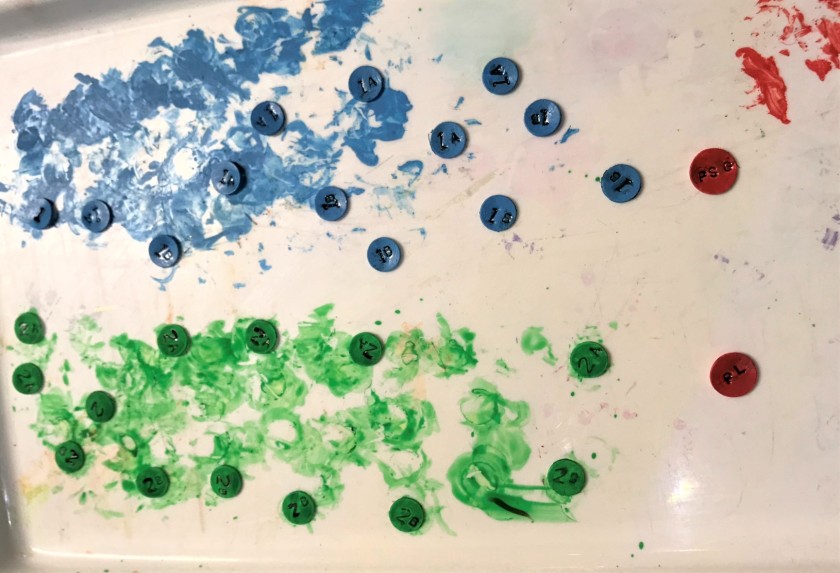
One of the issues I really want to focus on when I build a platoon is to make it easy for the players (some of us with “experienced” eyes) to see and identify a figure’s squad and team. I got some steel punches, and some jewelry stamps to make 1/4″ and 5/16″ placards that I could mount on the figures’ bases.
My 1/4″ punch and the two jewelry stamps next to the polystyrene placards. I did use 5/16″ placards for the platoon leader and platoon sergeant.The placards, stamped and painted. I used a wash to fill out the letters and numbers.Placard close up shot
Next, I washed the figures twice with Citadel “Agrax Earthshade”. I then mounted the RPG’s with Gorilla glue.
RPG Roos!
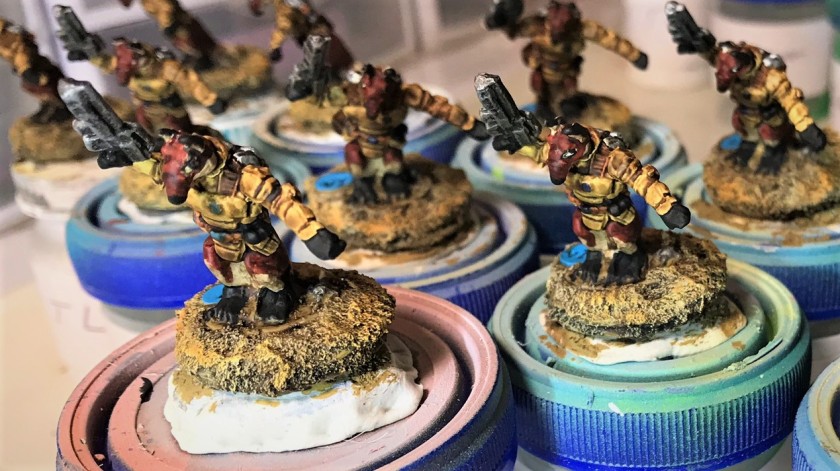
Lastly, I used a whole bottle of Citadel “Armageddon Dunes” to fill and shape around the bases and let them dry and harden. The placards were mounted into this paint. Then I gave the bases a wash with “Agrax Earthshade” and two different dry brush applications (Polly Scale “WWII German Armor Light Tan” and Vallejo “Light Brown”). Then I gave everything two coats of matte varnish.
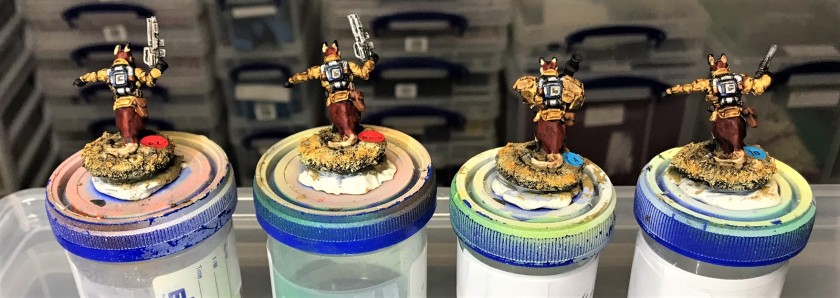
After filling the bases The platoon leader and platoon sergeant almost ready!Nice close up of the bases. The shading gave the body armor the dirty effect that I wanted.The four conversions of conversions, front……and back
After adding some tufts from Shadows Edge Miniatures for even better identification, the platoon was finally done (I LOVE their tufts). I am happy with it, given the work and effort it took to bring it to life. So, now, appropriately, I will share with you some eye candy!
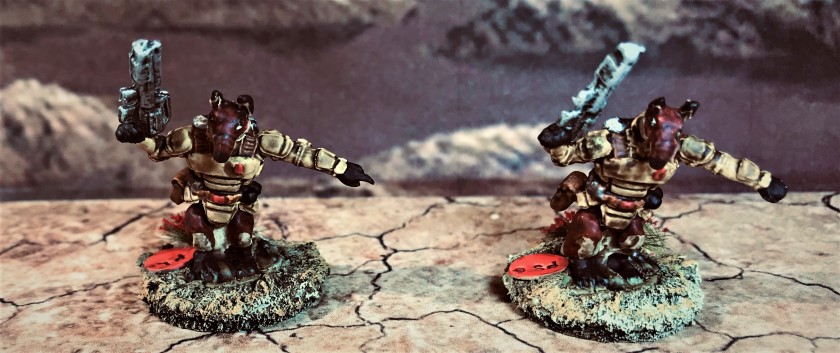
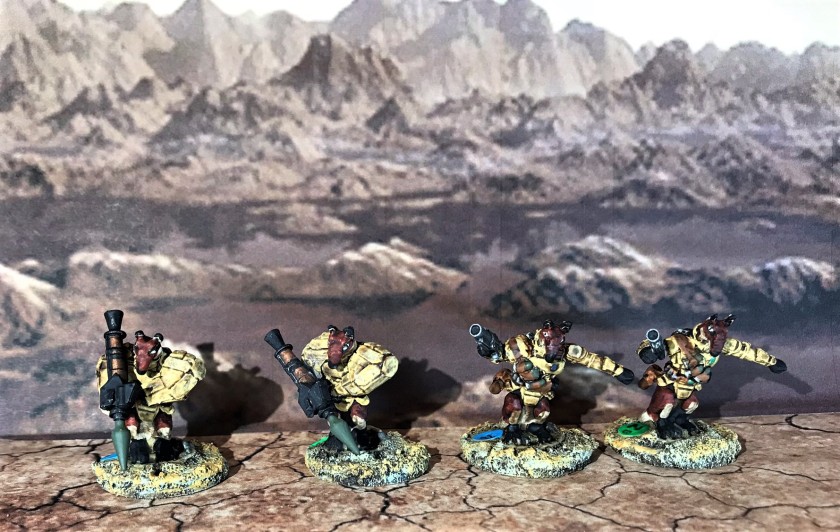
The platoon HQ, frontal view…and rear view, with a good view of the jet packs, red placards, and tufts. 1st Squad with blue placards2nd Squad with green placards and green tufts on the leaders.The AT and grenadier RoosThe Space Roos meet their ancestors, the Roomans!My box of Roos and RoomenThe Space Roos’ 1st Squad holds off the WarbotsThe 2nd Squad close Assaults Juggerbot
I am looking forward to seeing these guys in action soon. I appreciate your looking and hope that you enjoyed this post. I always read your feedback, so please let me know what you think in the comments section at the bottom of this post.
I dedicate this post to all my Aussie friends!
PAINTS, INKS, GLAZES, WASHES, AND FLOCKING USED:
Citadel “Imperium Primer”
Vallejo “Surface Primer – White”
Vallejo “Flow Improver”
Vallejo “Airbrush Thinner”
Testors “Universal Acrylic Thinner”
Vallejo Mecha Color “Sand Yellow”
Vallejo Game Air “Red Terracotta”
Citadel “Flayed One Flesh”
Americana “Bleached Sand”
Americana “Black Tie – Satin”
Vallejo “Black”
Vallejo “US Dark Green”
Tamiya “Copper XF-6”
Tamiya “X-20A Thinner”
Tamiya “XF-49 Khaki”
Vallejo Game Air “Weiss”
Tamiya “Gun Metal X-10”
Vallejo Game Air “Steel”
Vallejo Game Air “Beasty Brown”
Vallejo Mecha Color “Light Steel”
Vallejo Mecha Color “Dark Steel”
Vallejo Mecha Color “Metallic Blue”
Vallejo Game Air “Electric Blue”
Vallejo Mecha Color “Metallic Green”
Citadel “Hexwraith Flame”
Vallejo Mecha Color “SZ Red”
Secret Weapons Washes “Just Red” (ink)
P3 “Brown” (ink)
Secret Weapons Washes “Armor Wash” (wash)
Citadel “Nuln Oil Gloss” (wash)
Citadel “Agrax Earthshade” (wash)
Gorilla Glue
Citadel “Armageddon Dunes”
Polly Scale WWII “German Armor Light Tan”
Vallejo “Light Brown”
Vallejo Mecha Varnish “Matt Varnish”
Shadows Edge Miniatures 6 mm “Dark Forest Red” (tufts)
Shadows Edge Miniatures 6 mm “Dark Blue” (tufts)
Shadows Edge Miniatures 12 mm “Wild Tufts” (tufts)
Thanks again for looking and for your feedback! ESPECIALLY AUSSIES!
The H.A.W.K.’s held their BARRAGE convention in Havre de Grace, Maryland at the end of September 2018. They had over 70 gaming events, and it had been on my “hoping to attend” list for most of 2018. Also on my wish list was to be able to run my “Attack of the Warbots” game using the Combat Patrol™ card-based system. I was hoping to attend but was unsure (for several reasons) up to a week beforehand as to whether I was going to be able to go or not. In the end, the stars aligned, and I also got to run my game! Box checked!
There was a lot going on here – and I saw a lot of great games. The following is just a snippet, through my eyes, of the experiences that I had. The games and the game masters that I saw did an incredible job. Truly impressive. Certainly, the H.A.W.K.’s put on a great gaming convention and my kudos to all of them and the other game masters.
I started on Friday with running my latest iteration of “Attack of the Warbots” with my Archive, Mega Miniatures, and Wargames Supply Dump figures, all of which are OOP. I had seven players, with three on the Warbot side, and four on the defending side. Of note, I was lucky to have had as players both Buck Surdu (my old West Point buddy and the author of the Combat Patrol™ rules) and Dave Wood (my old West Point roommate who introduced me to tabletop gaming in 1982). I also had the good fortune to have Greg Priebe playing alongside Buck – and Greg wrote the Star Wars supplement for Combat Patrol™. Buck is very fond of ducks (in a good way of course), and was in command of Duck Wader and some Star Ducks, while Dave was on the Warbot side with a couple of Mark 1 Sphere tanks. Greg commanded the Aphids and the Frinx. A few other players were there but I did not get their names (sorry). The Warbots needed to recapture a lost Mark 1 before the defenders could repair it and get it off the board.
My flyer for the “Attack of the Warbots”Game set up from the attacking Warbot side. I got set up early, which is why there seems to be an empty hall, but it filled up quickly.Early action – the defenders gained the initiative and the Red Warbot squad on the left of the photo took casualties from effective Star Duck and Aphid fire. The Warbots smartly maneuvered a Mark 1 tank to attempt to breach the rusty steel wall defenses.Closer view of previous action showing Aphids in a bad place.Aphids strike back! They get a critical hit on a Red Warbot’s power plant, triggering a catastrophic explosion (smoke plume), which damaged several of its nearby comrades. This made this fire team have to make multiple morale checks (as shown by the red beads). One of these pinned the team in place for the remainder of the game. As the critical hit catastrophically destroyed the smoky Warbot, that plume would restrict line of sight for that pinned team as well!Dave Wood prepares to destroy the wall with his Mark 1’s Death Ray, and……the wall is breached, frying a few defending Star Ducks.Roberker moves towards the breach.Meanwhile, on the other flank, Duck Wader used a Force Leap to engage the Green Warbots in melee. He was able to give the Aphids on that side a brief respite. Wader got initiative again before the Warbots, and was able to Force Leap back to safety after damaging several Warbots with his light saber.Back on the right, the Warbots get one of their two Mark 1’s within a few inches of the building where the captured tank was being repaired. SSG Canvasback (yes, he has a name!), the 2nd Squad Leader, fires his Quackers Repeating Blaster and got a lucky hit, knocking out the tank’s left auto cannon sponson. This allowed enough suppressive fire cover for the Star Duck Squad led by SSG Gadwall to close assault the tank with satchel charges……and successfully knock out the Mark 1!! Roberker, a giant flame-throwing robot was following closely behind, but another critical hit from Greg Priebe’s Frinx immobilized the giant robot, stalling the attack.At the same time on the left flank, Duck Wader again Force-leaped over the wall into the midst of the Green Warbots, and launched a Force-Blast attack. This sent waves of destructive energy through the closely-crowded Warbots. Many were damaged, and one even had a power plant explosion, which caused even further damage to that team and multiple morale checks due to a second explosion. These morale checks eventually disrupted the attack as the Green Warbots either ran off the table, or got into a massive traffic jam at the breach. Here, you see Duck Wader after he had dispatched the Warbots. He was wounded, but had wreaked havoc on the Warbots.At this point, the other Warbot tank was immobilized, and the game was called as a defenders’ victory. It was a near-run thing as the defenders were unlucky in rapidly repairing their captured Mark 1, but they would have been able to complete the repairs. Here are some of the happy defenders – Rob Dean, Buck Surdu, Jim Stutzman, and Greg Priebe.
I then turned into a player, and decided to try a Lion Rampant game ably run by Philip Jones. We were the Vikings who had seized prelates, monks, and treasure in a raid, and were trying to escape to their longship, while being pursued and blocked by Welsh troops.
“Llandaff is in flames, the bishop and his monks carried off- but the men of Glywysing have the Vikings trapped between two forces as they try to get back to their ships. Will they break through or will Bishop Cyfeilliog be rescued?”My forcesOur initial deployment – Welsh would block us and harry us from the rear.The Welsh harry from the rear and Dave Wood prepares for battle.Vikings moving out.Crossing the river and all looks good……until Welsh forces combine to slow and stop us.A monk escapes!
Our casualties mounted! The game points were tallied, and rightly called for the Welsh. I did find the system fun, and Philip ran the game in a very fun way.
After this, I was walking around, and was recruited for a “What a Tanker” game run by Brian Lipscomb. It was set in North Africa, 15mm scale, with the British set against the Germans and Italians. Brian asked if I wanted to have a German or Italian tank. Being a sucker for a challenge, I of course said Italian. I was given a Fiat M13/40 tank.
My M13/40 tank sheet. Brian did a nice job with using magnets for managing data on the sheets.I am pursuing a rear shot on a British Stuart “Honey”. He slipped away, for the moment…Don Hogge pursued me in his Crusader II to take the pressure off the Honey. Don shot at me and missed. I rotated, fired, and smoked his tank.This allowed me to renew my approach on the Honey. I got hit with minor damage to my running gear. I returned fire, and got the Honey with my first shot. That’s two tanks! Later, I finished off a Matilda II for my third kill (on the deep left) – and all this with an Italian M13/40!
Needless to say, I really enjoyed this game and the mechanics. Brian is a superb GM. More on that in a bit…but this was a fun way to end Friday!
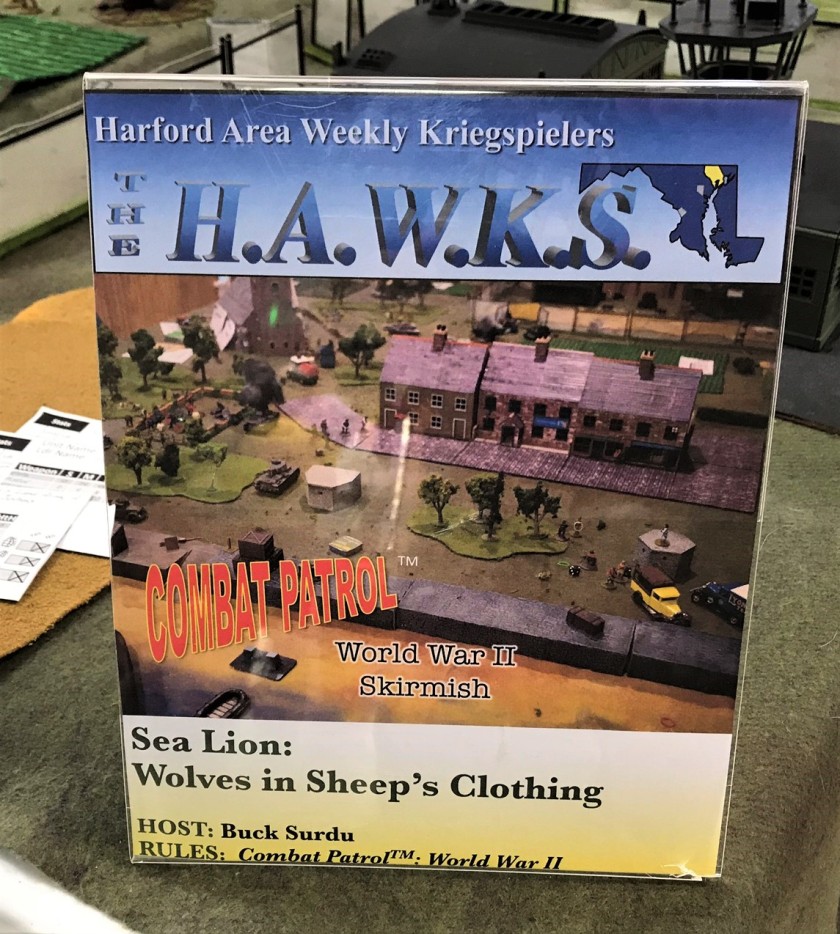
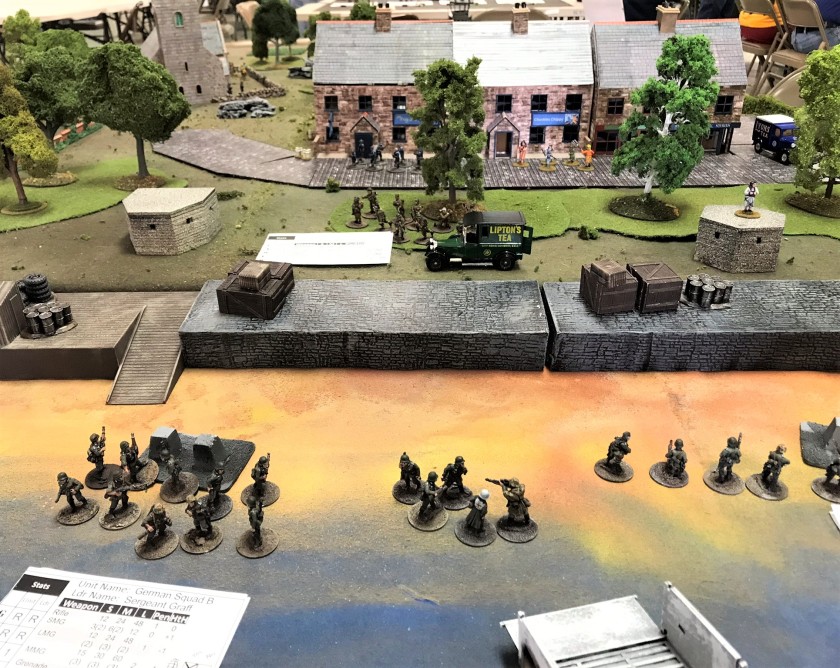
On Saturday, I had really looked forward to playing Buck’s Sea Lion game. There weren’t enough players, so it was called, BUT I wanted to share the unbelievably beautiful game set up. Buck will run this game at Fall In and you can read about a play test of the game here.
Rear of the tableSome Women’s Land Army troopsGreat scenery – these are the Germans assaulting the beach.Another view of the beach and wharves. Landing craft in front held two 35(t) tanks, and a Panzer III.Nice bars with British sailors and folks hanging out…or are they?
So again, I wandered around, and saw another Brian Lipscomb “What a Tanker” game, this time set on the Eastern Front. After Friday, I was happy to give it another go. I was teamed with two others who had not previously played the game. We had a certain number of points, so I volunteered to take a lesser tank (a T-70 light tank) so that they could have better ones – in this case a T-34 and an SU-76.
Love what he did with these data sheets and the magnets! This is for the T-70.I maneuvered alongside the T-34 and put the killing round into a Panzer IV. Kill #4 for the weekend.
At this point, Don Hogge and Buck Surdu visited the table put up a dollar each for anyone to kill me! Talk about motivation! We were being outmaneuvered by the Germans at this point, so I moved back and used my kill points to upgrade my T-70 to an SU-85.
My upgrade to an SU-85.
The scenario that Brian devised also had infantry (controlled by him as the GM and using a random events chart) – with the town as an objective. I used the SU-85 to hammer the German infantry as Soviet infantry was arriving. I killed four stands and got a bunch of kill points. I reminded my teammates that I had started off as a T-70, and they gave me one extra kill point, which allowed me to get a monster ISU-152. At the same time, the Germans were reinforced with a Jagdpanther and a Sturmgeschutz III.
My last upgrade – the ISU-152.
Immediately I maneuvered the ISU-152 to hit more infantry. The Germans decided to try to get me with their Jagdpanther and the Sturmgeschutz III. I moved my tank destroyer next to a building to face the Jagdpanther down the main street. He fired.
He missed!
I returned fire and destroyed the German tank destroyer.
My ISU-152 nails the Jagdpanther. Kill #5 for the weekend.Jagdpanther burns.
At this point, the Sturmgeschutz III was maneuvering to get a flank or rear shot on me. As the ISU-152 is very heavy and slow, I was only able to spin to face the Sturmgeschutz III. It was a question of initiative – and I got it, hit the German assault gun, and got kill #6 for the weekend (and the $2 bounty on me!).
Kill #6!
I then participated in a play test for a near future warfare scenario using cyber warfare with the Look Sarge No Charts system. It was run by Dave Wood and was interesting to do.
Dave explaining the system.Assault on the hill.
Every BARRAGE there is a pickup WWI air combat game that is a hoot. I’ve never managed to get a kill in the game before, but I did this year as a German. Eventually, I got shot up and had to glide home.
WWI fighter game – I had the red plane in the center.
The last tabletop game that I played in was a First Boer WarCombat Patrol™ game. I was on the Boer side and we had to defend our wagon from being seized by the British. The game was fun, but there was a low point. We had a couple of players from New Jersey who vanished mid-game without so much as a notice that they were leaving. I think they hated defending. Anyways, we struggled on and ended up winning the game. The other players were great sports, and were great company.
Boer War game
After this game at the end of the con, I got to play in the traditional LARP pirate game. I had a nerf crossbow (treated by the GM as a musket) that took out Buck with a shot to the glutes. My weapon later misfired, and the resultant damage took me out. That LARP is always a fun game though!
The flea market presented many vendors and items for sale. I grabbed a Verdun game that I had last played with a gaming club in Monterey, CA in 1985! I’m not sure when I will get to play it, or with whom, but it was OOP in 1985, so a nice find! Buck and I visited the Verdun battlefield in 1987 or so, so it was nice to get this game here.
I must congratulate again the H.A.W.K.’s on a well-run con. Little Wars TV attended and filmed so you can see more of the convention here.
Thanks for looking and as always, I love any feedback!
We had a good showing on Saturday at the September Mass Pikemen Gaming Club session. We played an “Attack of the Warbots” scenario using the Combat Patrol™ system.
The biological Alliance (Star Ducks, Space Dwarves, Frinx, and Aphids) have captured a Warbot Mark 1 Sphere tank and are attempting to repair and convert it to their use. The Warbots have landed a large force and aim to deny their enemy this loss of technology. Can the Warbots be stopped?
This one, like all of the games that I run, was modified for playability based on experience and the number of available players. This time I also got to add some new terrain and my new Wastelands gaming mat (which I described here and here). I did not take as many pictures as I had wanted to – but what I have is below.
The Aphids held up the Warbot attack and were almost wiped out by the Warbots. However, they did delay them enough to achieve a victory, however, the tide of battle was about to turn so it could have ended differently. Time just ran out on the Warbots.
The photos below are the set up and a bit of initial play.
The set up from the defenders’ side.
Set up from the attackers side. Reinforcements await deployment on the table’s edge.
Aphid casualties pile up as the Warbots move forward. The Aphids, defending the middle crater, were able to get a very lucky critical hit on the Warbots’ platoon sergeant, causing a catastrophic explosion of its power plant (the smoke plume in the center above). This explosion also killed and wounded several Aphids, and dented a couple of nearby Warbots.The Warbots move into the smoky crater that once held a squad of Aphids. The Warbots used a plasma ball breacher to fry the bugs, hence the smoke plume.Aphid and Star Duck mortars add to the chaos of the battlefield as the Warbots breach the initial wall defense and roast an unlucky Star Duck alive. Biological Alliance reinforcements move up on the right.
This fun scenario, with some minor tweaks, will be coming to BARRAGE on 9/28/2018!
For August, I decided that my efforts needed to be directed towards a few new areas that would be challenging for me. I wanted to get more terrain for my games, specifically some that would be useful in making my Combat Patrol™ games more visually appealing to the players. I also wanted to try to use some new techniques and incorporate new materials into my hobby kit bag.
This would involve working on things and using multiple materials with which I am less than fully experienced. My goal was to stretch my horizons as it were, and this goal also dovetailed nicely with the monthly painting challenge run by our Australian friend Azazel. The theme for August was “Technical August”, which was a wide-open challenge to try or improve upon techniques that we had little to no experience in doing previously. With that said, I decided that assembling, building, and painting some Armorcast terrain would be a good way to do that. Mainly my goal was to focus on using the five 4-pigment bottle sets of Vallejo Pigments that I have not really used (Dust & Dirt, Mud & Sand, Rust & Corrosion, Soot & Ashes, and Stone & Cement). I did use the Soot & Ashes set on some cheap 3D printed buildings, but otherwise not much.
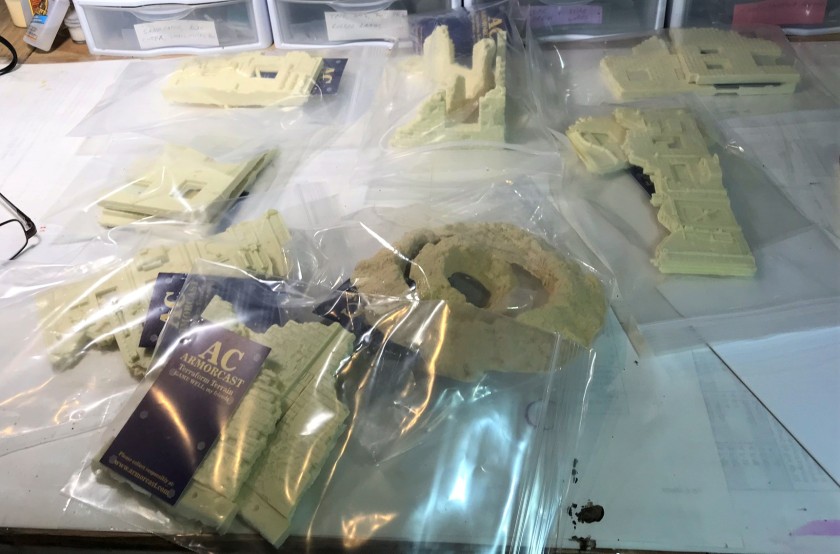
I acquired three types of Armorcast resin terrain (all suitable for 28mm scale) for the August challenge – craters, ruined buildings, and sci-fi ruined walls:
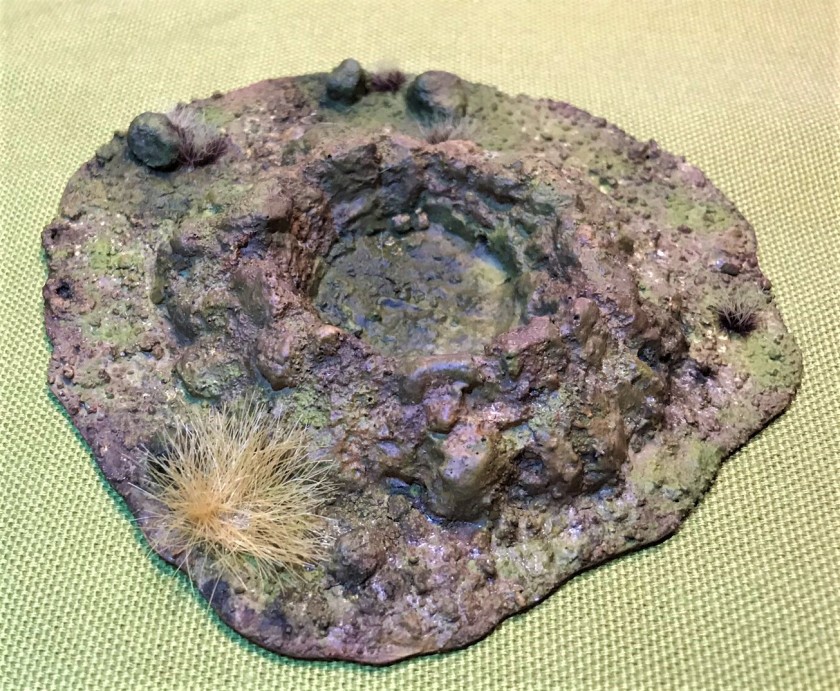
1 ACCR001 3-crater set (includes 3 differently-sized impact craters – 6″, 4″, and 3″ – and the set is the subject of this post)
5 ruined building corners (subjects of a future post)
As for my technical goals, my list of “challenge” skills, materials, and techniques include:
Assembling, building, and basing terrain
Use of materials to create weathering and rusting effects, to include:
Vallejo Pigments, to include application and fixing (covered in this blog post)
Vallejo Mecha Color weathering products
Weathering and rusting/oxidizing effect products, to incude:
Citadel Technical paints:
Typhus Corrosion
Ryza Rust
Nihilakh Oxide
Vallejo and Vallejo Mecha Color rusting and weathering products
Vallejo Pigments (various)
Vallejo Game Air rusts (71.069 and 71.080)
Vallejo Mecha Color Weathering products
Oil Stains (gloss)
Rust Wash
Rust Texture (Matt)
Create a new storage system for my terrain pieces
The ones above in bold font are ones I worked on for the 3-crater project. Others will be used for the remaining projects, even if that lasts into September (which is likely).
I had previously worked on some Armorcast sci-fi pieces and grenade blasts. I like their products, but wanted to get better at getting them on the tabletop.
My collection of resin awaiting work
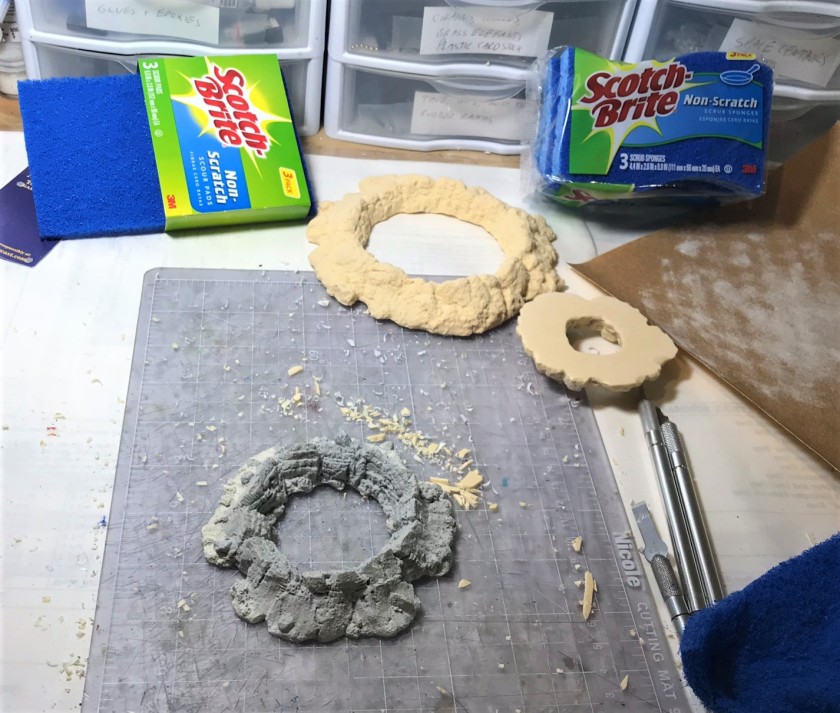
I got good advice from Armorcast (Gin Fritter) and Buck Surdu about preparing the resin for painting. I ended up using a few Exacto knives to remove flash, and then used Scotch-Brite pads to lightly (imperceptibly in fact) give the pieces a rubdown to achieve a “bite” for airbrush priming. Additionally, I used a 180 grit sandpaper sheet to scuff up the craters’ bottoms so that they would glue better to their planned bases. I then washed the pieces thoroughly with dish washing soap in the sink and let them dry.
Cleaning the resin craters – one was gray, the other two were not. You can see the sandpaper, pads, and removed resin.
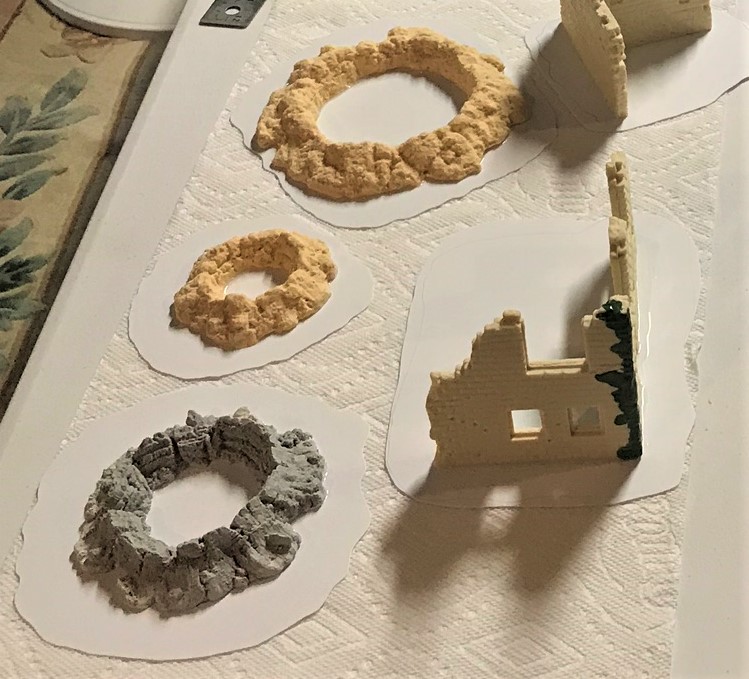
For basing, I chose to incorporate a few different materials. First, I cut irregular shapes from Evergreen Scale Models #9020 polystyrene sheets – which is quite thin (.020″/0.5 mm). I mounted the crater pieces to the cut shapes with Gorilla Glue. Then, I also used a number of differently sized thin steel bases from Wargames Accessories to mount under the shapes for both strength and to be able to later store and transport securely in magnetically lined storage boxes (which is another project in and of itself that I have planned). Here, I also used Gorilla Glue.
The polystyrene sheets that I used for basesMy craters and a ruined building on my polystyrene sheet bases
From my minimal experience with using pigments, I knew they had the potential for a huge mess. I learned that using a cafeteria-type tray would make using them easier. I hit my local Salvation Army and found four trays for this use. Interestingly, three of them were from a former Digital (DEC) facility (there were a lot of them in Massachusetts before Compaq and later Hewlett Packard consumed them in 1998). I removed what appeared to be ancient chili from them, and put them into use. I also got a small palette from Michael’s craft store to use just for pigments. I put that palette into a deep plastic Rubbermaid salad container, and I thereby effectively limited the migration of pigments from my work space. You definitely do not want to have a fan or strong air circulation going while using pigments!
Trays for using pigments. Oh DEC, your cafeteria trays soldier on…
I then used PVA glue (good old Elmer’s) to affix some play sand and some Woodland Scenics stones to the bases, and let them harden.
My sand and rocks for the bases
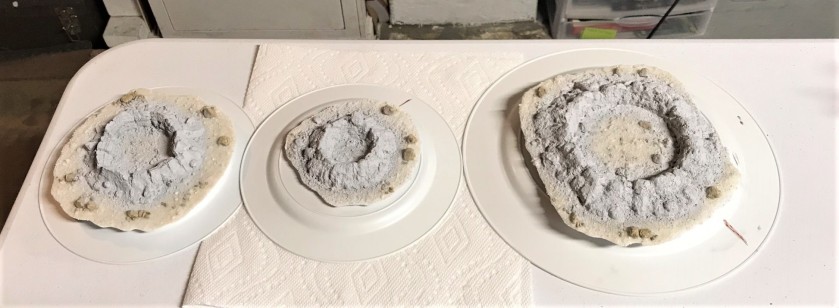
Next, in order that I could handle and work with the craters, I affixed their bases with poster tack to upside-down plastic plates before priming. I marked each plate with a brown ink line for reference, and proceeded to airbrush prime the set with Vallejo “Surface Primer – Gray”.
Primed craters
I then worked on the three craters sequentially, going from smallest to largest. For the smallest one, I dry brushed with multiple shades of brown (there is a list of materials that I used at the end of this blog). I was not sure that I needed to or if the pigments would be enough. Primarily, I used the four pigments from the Vallejo “Mud and Sand” set (“Light Yellow Ochre”, “Natural Umber”, “Light Sienna”, and “Light Slate Grey”) plus the Vallejo “Faded Olive Green”. I looked at the Vallejo YouTube video on pigments, and used some of the different techniques to apply and fix the pigments.
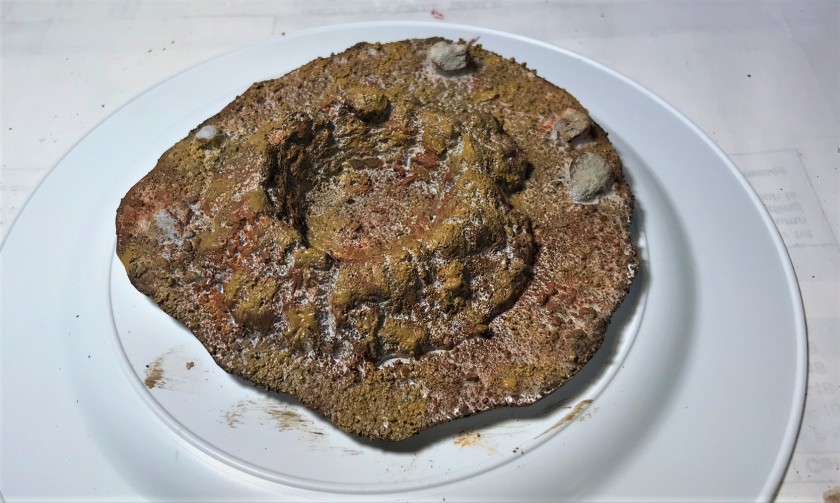
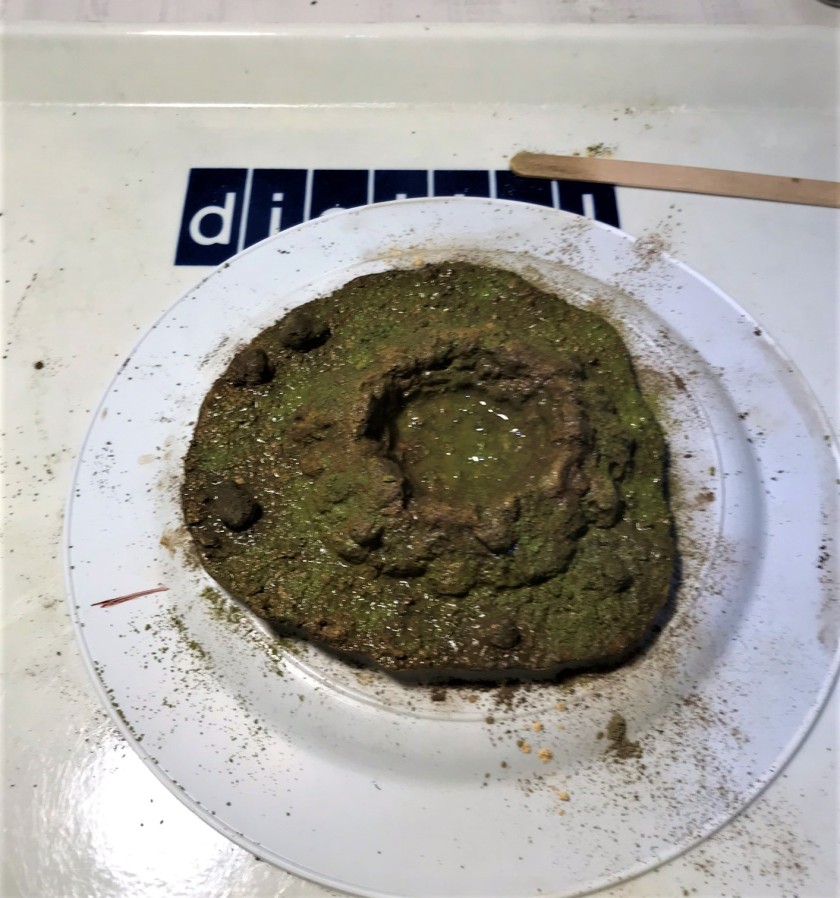
The smallest crater after heavy dry brushing.The first crater after applying multiple pigments in a dry fashion. I then fixed them with Vallejo “Airbrush Thinner” with a capillary action technique, leading to this mucky wet look.
After this, I moved on to the next larger crater, and also dry brushed it and used the same method of fixing the pigments. One downside that I discovered was that the airbrush thinner tended to dissolve the PVA holding the rocks in place (but not the sand). I replaced the displaced rocks on the bases after the airbrush thinner dried.
The middle-sized crater before fixing the pigments – I also added more colors before fixing them here – this is a lot of “Natural Umber”.
Lastly, I worked on the largest crater. Here, I passed on doing any dry brushing. For this one, I employed Vallejo “Pigment Binder” instead of the airbrush thinner to fix the pigments – and to prevent the dissolving issue under the added rocks. I also needed to use Secret Weapons Washes “Sewer Water” to give better shading. While the pigment binder worked, it did lead to a thicker application of pigment as you see below. I thought it blended too much – and I believe that one should use that product selectively. I subsequently added more pigments to make the crater less of a solid olive green, fixing them with airbrush thinner. It worked.
The largest painted crater before varnish
Lastly, I decided to airbrush varnish the craters. Did I need to? I wanted to protect the paint work, so I did. I do think I needed to thin the varnish more, as I had some crazing to deal with, something I had not seen previously with its use on miniatures. To help with color variety, I applied Citadel “Agrax Earthshade” and “Athonian Camoshade” washes, mixed with a little varnish and applied with a brush to the affected areas. I then applied Army Painter “Wasteland Tufts” and some 12 mm grasses from Shadow’s Edge Miniatures.
As an aside – I can say without a doubt that the Shadow’s Edge Miniatures products are far superior to Army Painter’s – they need no additional gluing, and they are visually stunning. I plan on using their products, especially the flowers, on future unit bases to help with tabletop differentiation.
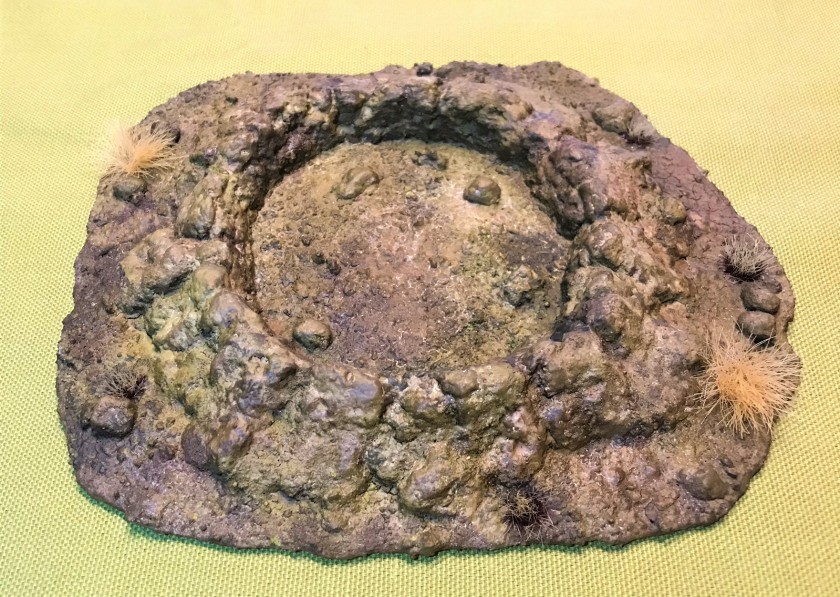
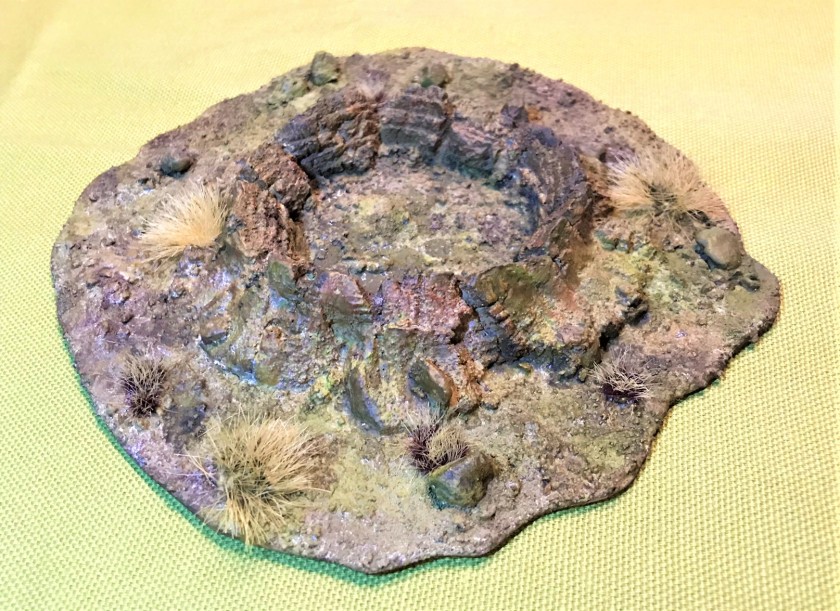
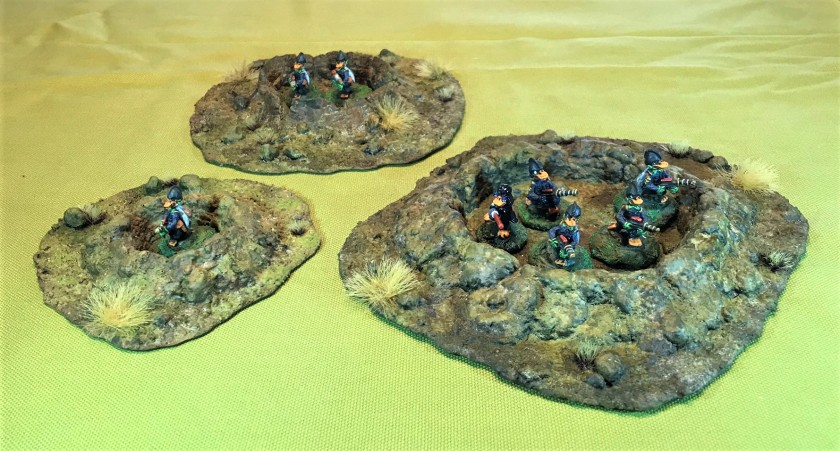
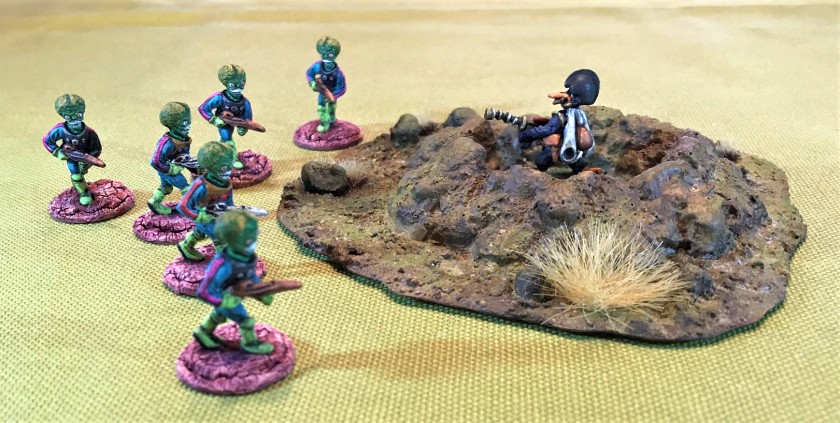
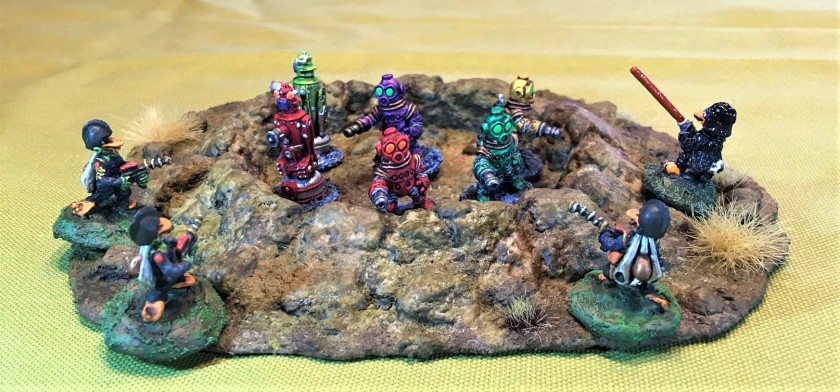
The three craters on the tabletop. The thin bases made them quite flush with the tabletop.The bottom of the craters showing the use of the Wargames Accessories steel bases.Close up of the large crater as finished. Close up of the middle-sized crater. I liked this sculpt the best of the three.The smallest crater. I like the way the pigments made the bottom look realistically muddy.Some Star Ducks defend the craters. I decided that the craters would be more useful looking as if they were from an older battle. I was thinking of those I have seen at Verdun, though there are no historical records of ray gun armed ducks at Verdun……or Martians…SFC Mallard defends the small crater against a Martian assault.The Martians assault the middle-sized crater defended by Duck Wader and SFC Mallard.The Space Dwarves’ large crater is assaulted by the Star Ducks.
My lessons and thoughts from the project:
The cleaning and scrubbing of the resin helped with the priming. The Scotch-Brite pads work well for this use.
For terrain pieces that will be totally covered in pigments, dry brushing with paint is not needed. When I get to doing vehicles, such as tanks, it will be interesting to see how that works.
Fixing pigments with airbrush thinner is easier than with pigment binder. However, add any additional large features, such as extra rocks later, or use pigment binder on the rocks.
Having trays and palette wells (such as the one I put my palette in) while working with pigments cuts down on the mess considerably. Be ready to use multiple brushes, both wet and dry. The mess vacuumed up or washed off easily from my palettes and trays.
Always ensure your pigment bottles are shut tight. I see how they could spill over easily (and I was lucky enough not to have this problem).
PVA glue and play sand are an inexpensive winner.
The combination of thin steel and thin polystyrene yields a model base with little to any “rise” from the tabletop at its edge, and is strong.
Thin your varnish to prevent the crazing! (Speaking with Buck today, he uses varnish to fix his pigments, so that needs to be considered). I also want to see how well airbrushing the thinner fixes pigments in future projects, like my ruined buildings.
Washes help in the end for touch ups.
Shadow’s Edge Miniatures tufts are fantastic – need no extra glue and dry clearly.
Now the three craters are now ready to join my other terrain. Hopefully I can get more done this month.
Thanks for reading and if you have feedback, especially on my results or suggestions from your experiences, please, share them in the comments section. I do so much appreciate them!
PAINTS, PIGMENTS, INKS, GLUES, GLAZES, WASHES, AND FLOCKING USED:
Vallejo “Surface Primer – Gray”
Generic play sand
Elmer’s “Glue-All”
SceneARama “Rocks”
Evergreen Scale Models #9020 0.5 mm plain polystyrene sheets
Gorilla Glue
Wargames Accessories steel bases (various)
Americana “Raw Umber”
Citadel “XV-88”
American “Burnt Sienna”
Citadel “Skrag Brown”
Citadel “Balor Brown”
Vallejo “Natural Umber” (pigment)
Vallejo “Light Yellow Ochre” (pigment)
Vallejo “Light Slate Grey” (pigment)
Vallejo “Light Sienna” (pigment)
Vallejo “Faded Olive Green” (pigment)
Vallejo “Airbrush Thinner”
Vallejo “Pigment Binder”
Vallejo “Airbrush Flow Improver”
Secret Weapons Washes “Sewer Water” (wash/shade)
Citadel “Agrax Earthshade”
Citadel “Athonian Camoshade”
Testors “Universal Acrylic Thinner”
Vallejo Mecha Varnish “Matt Varnish”
Army Painter “Wasteland Tufts”
Shadow’s Edge Miniatures “12 mm tufts”
Thanks again – I hope this helps you or please feel free to add your own suggestions in the comments section. After all, I am no expert in these – and I am just sharing my lessons learned – and I KNOW there are many other ways to accomplish what I did (I just don’t know them all!!).
I am always searching for cool old school figures that are out of production that I could use in my Combat Patrol™ retro sci-fi games. This is firstly because I like to find neat stuff that time has passed by – and expose the figures to a brand new audience. Secondly, it allows me to run really fun games – as the rules are so easy to play and learn even for true newbies – while older gamers are simultaneously having a good time.
Fortunately, I came across Michael Thomas’ site, classicminiatures.net. There I found many Archive Star Rovers figures that he could cast (as he has a spin caster and now owns many original molds). I acquired my Space Dwarves (Archive’s Long Gone Jones) from him, and he suggested two others that I might like.
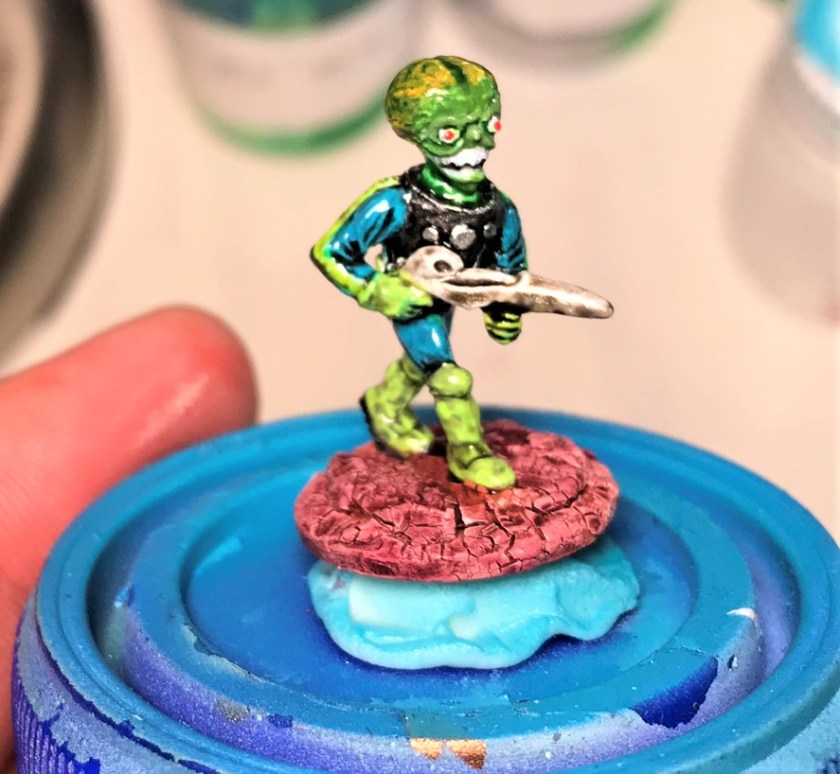
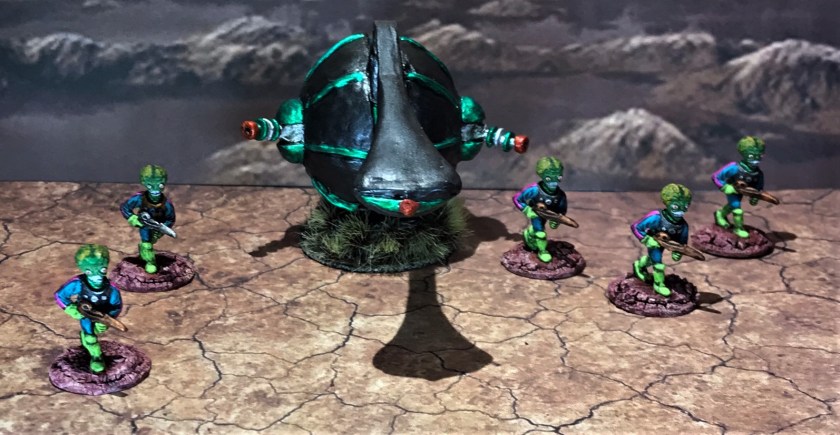
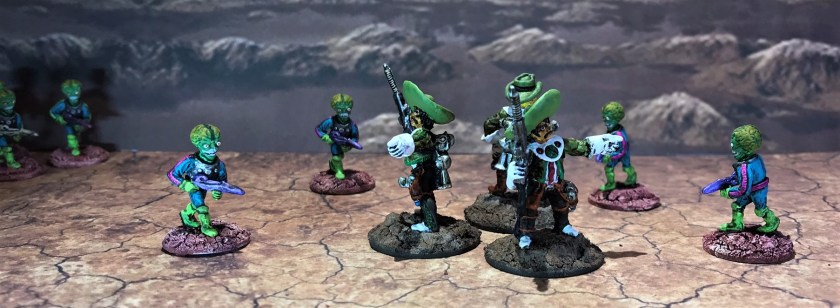
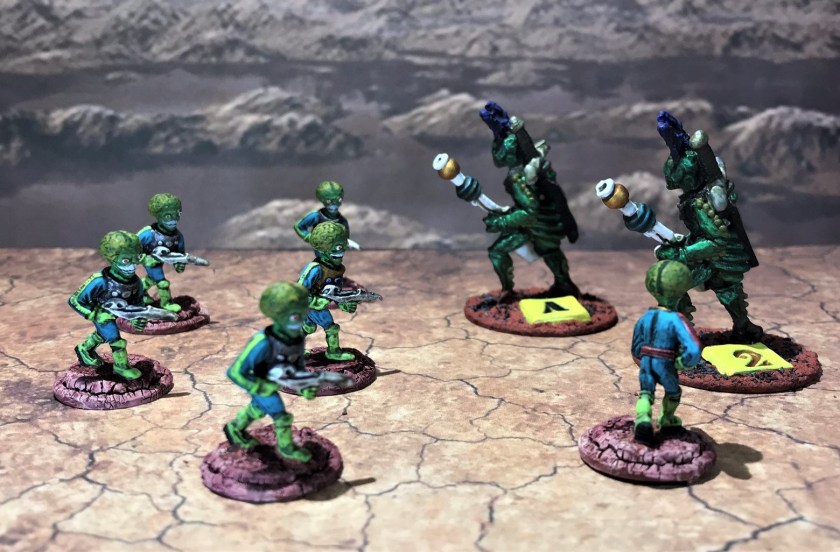
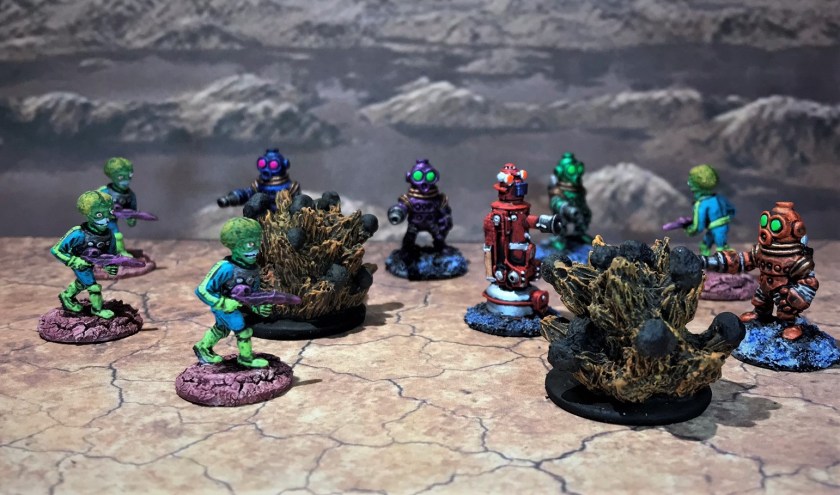
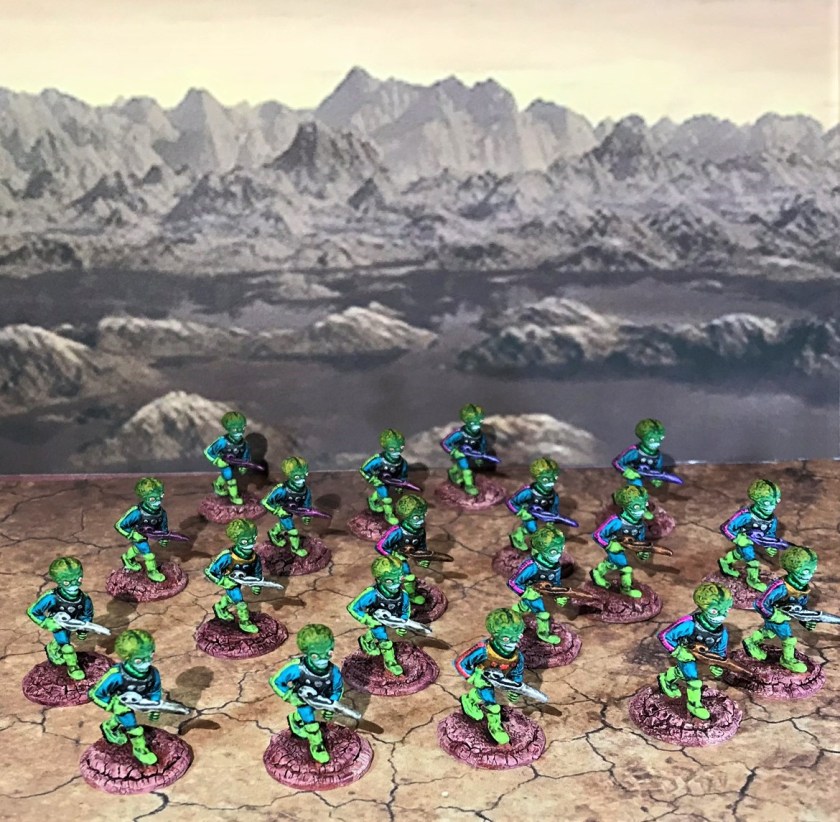
One was also previously described in this blog – that being Mega Miniatures Robot Peacekeepers. These were my first figures from that now-defunct company. Michael piqued my interest with a second figure, which was Mega Miniatures “Mars Alien” (#71501 seen here in the Lost Minis wiki) from their Sci Fi Future range Aliens subset. It looks like the figure is the only one in that group, and was OOP in 2003. It was sculpted by Hermann Grassnick, and the rights were sold by Mega Miniatures in 2011 (I am assuming to Michael Thomas). I got 19 of the figures for a two-squad Martian platoon.
Interestingly, I wonder if there was a copyright issue that caused a cessation of production? I was also completely unaware that a UK company called Mantic Games put out a Mars Attacks game complete with figures and terrain. I looked through the Mantic website, but it looks like the game is not really available or at least not supported much, or that Mantic is just selling whatever inventory it has of its components. (Side note – I did also see the Kings of War game there which I have seen referred to often in the blogosphere. If I ever get back to fantasy armies, perhaps this will be a resource!).
Back to my Martians…
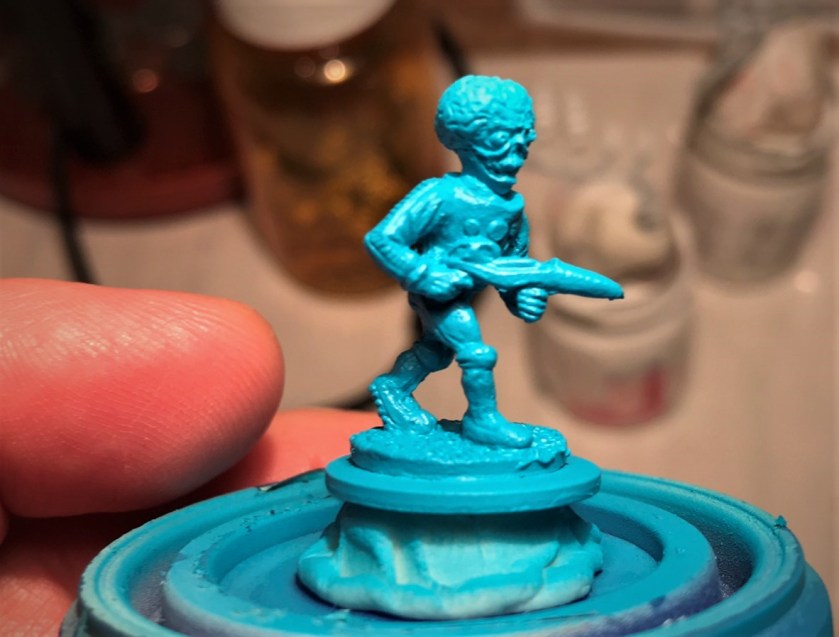
I did see that the figures from Mantic were colored like the movie, so I adopted that scheme for my Mega Miniature figures, which is a turquoise and lime green combination. Of course, I thought I could finish these in time for a painting challenge by Azazel called “Jewel of July” – after all turquoise is a jewel right? But it was not to be, so these Martians got completed in early August. There were no helmet bubbles or air tanks, but otherwise the figures were comparable.
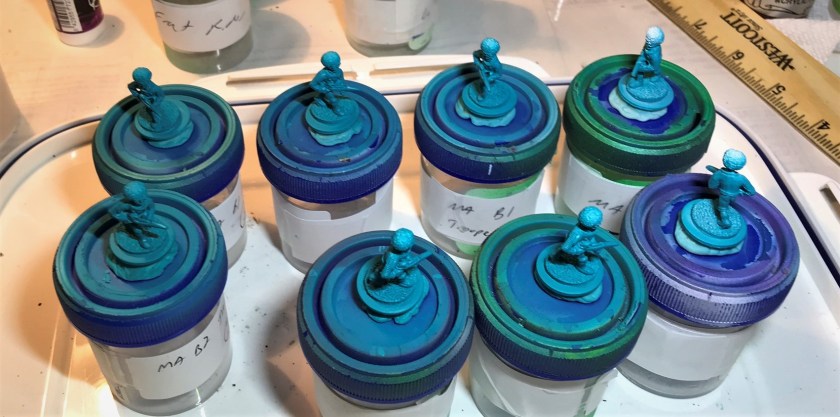
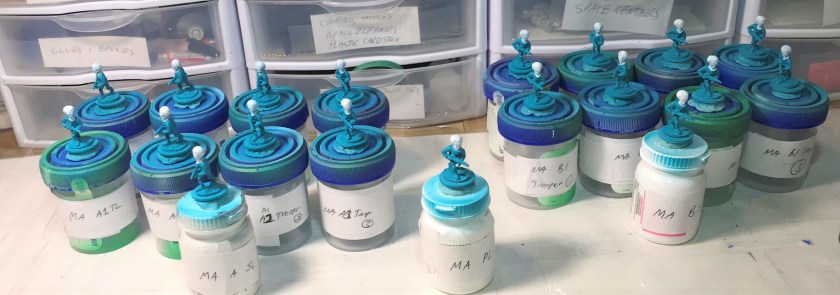
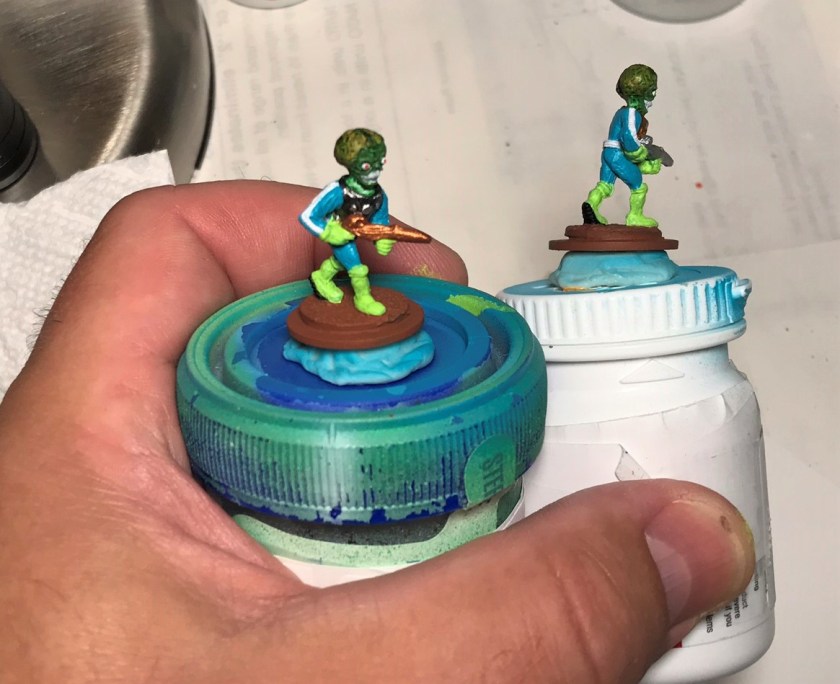
I cleaned off any unwanted sprue residue, filed, and washed the figures. They cleaned up easily, and the casting quality was good. They are probably 25mm in scale (Star Duck size). I mounted the figures to ¾” steel washers with Gorilla Glue, and then used poster tack to affix them to my painting jars.
The Martians as received
I wanted there to be an easy way for the platoon to be used on the tabletop. I decided that I needed a painting plan. So I made one, using different colors for the weapons, armored vests, belts, and accouterments – it was 11 PowerPoint pages – and you can see one such example below. This helped me to keep it all straight. I list all the paints that I used at the end of this blog post for those interested – there were a number used!
I usually use some details to denote who is who. Usually red for officers, blue for higher NCO’s, and green for lower NCO’s. I used two different colors on the trim to denote each squad.
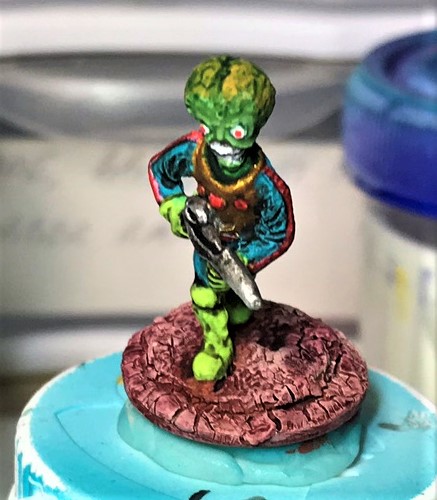
As for the figures’ details, I did have an issue with the teeth and the brain folds (who doesn’t), as they tended to fill up quickly even with light airbrushing. Eventually, I figured out how to present them in a game-worthy way.
After priming and base coating with turquoiseThe B squad after priming
I ended up using multiple very thinned applications of Citadel “Ceramite White” on the Vallejo Mecha Color “Turquoise” so that I could get the other colors to be more vivid.
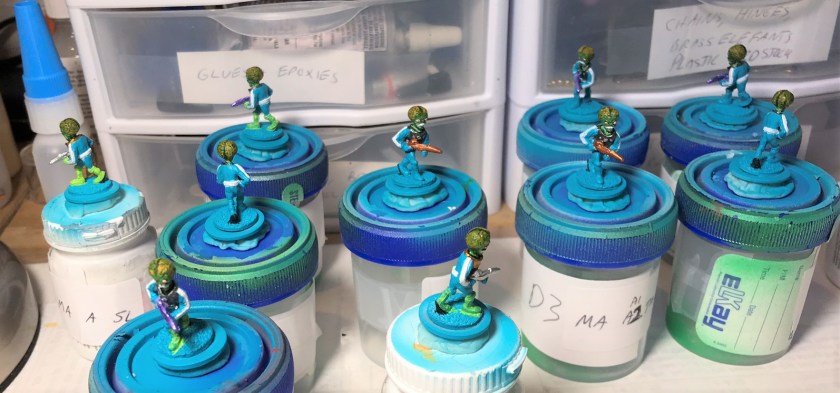
White heads – trim and belts next!
I tried to match the colors from the movie on the skulls and brains. It was tough, but I found that using multiple inks, dry brushing, and washing here was a winning approach. My initial tries were too dark or too light as shown below.
Need a middle ground!Eventually, using patience, dry brushing, inks, and washes, I got my Martians’ brains to be close to the desired result.I worked on the heads first, then inside to out on the torsos and legs.
After the painting was at a stage that I was happy with and what I wanted, I gave the torsos downward a good wash with Citadel “Nuln Oil Gloss”. I like the results it gives with metallics. Still, the damn teeth were bedeviling me, Washes were not working, and dry brushing them was not either. They were fairly snaggle-toothed dudes.
The platoon leader after an application of wash on his torso. But the teeth were unacceptable!
My dental solution was to use a very thin and slightly jagged line of Vallejo Game Air “Black” just under the upper teeth – and I settled on that.
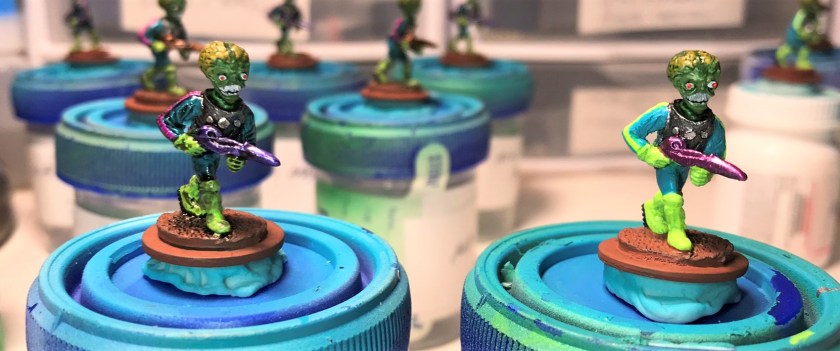
A member of A squad (fluorescent magenta highlights) on the left and a B squad member (fluorescent yellow highlights) on the right. The B Martian has not yet gotten a wash with the Nuln Oil Gloss. Here, the teeth are improved.B squad after the Nuln Oil Gloss wash on their torsos and legs.
I then used Vallejo “Gloss Varnish” for my first varnishing application. I planned on adding a matte coat after I finished the bases.
Shiny happy people…err Martians…after the gloss varnish (apologies to REM)
I then worked on the bases. I decided to use Citadel “Martian Ironearth” on them. I really like to get the crackling effect from that paint when you use a hand-held hair dryer on it as it dries. So yes, I used a blow dryer on dudes that not only had no hair, but no scalps…in any case the bases came out fine. Instead of using a wash on them, I dry brushed the bases sequentially with Armory “Brick Red” (from 1996) and P3 “Ryn Flesh”. I liked the effect better than my previous uses.
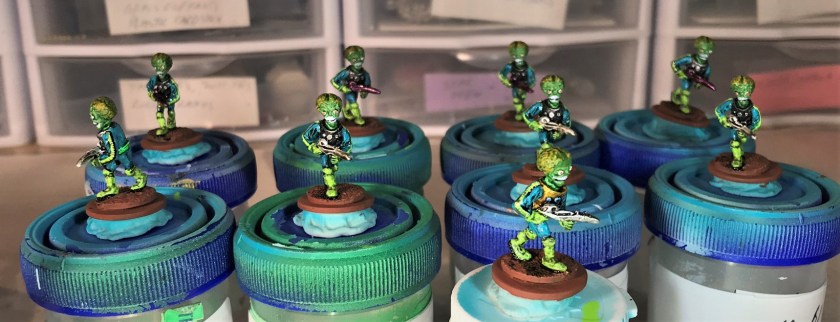
B squad figure after base completion but before the matte varnishThe platoon all done and waiting for the matte varnish to dryCloseup of the platoon leaderAn A squad trooper from Team 1 (denoted by the copper colored weapon)
Overall, I am happy to have some more “bad guys” to add to my retro sci-fi forces. I do not think that they are my best work, but they are good enough, and should be fine for gaming. And now, some action shots!
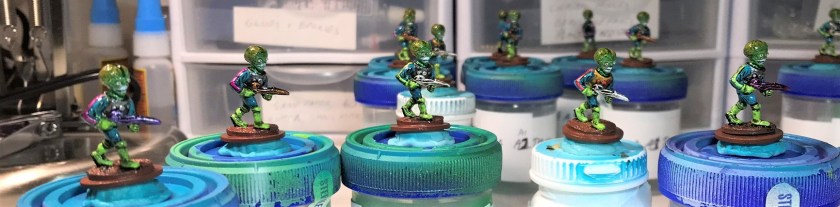
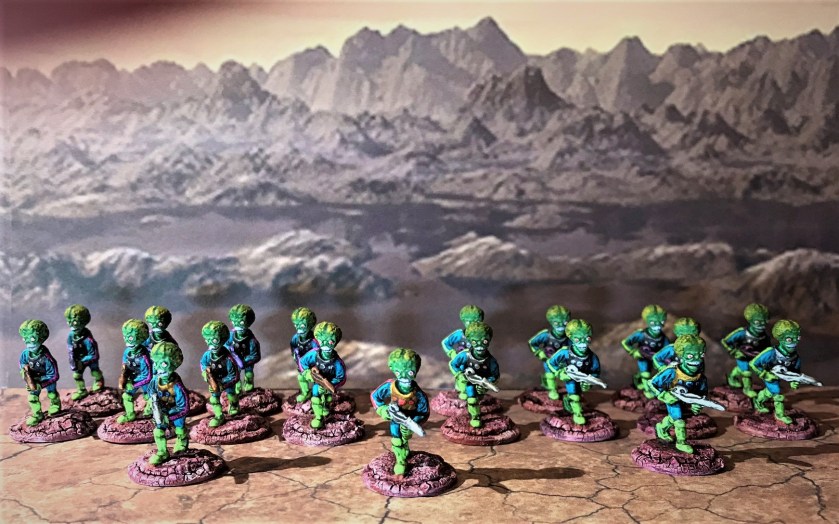
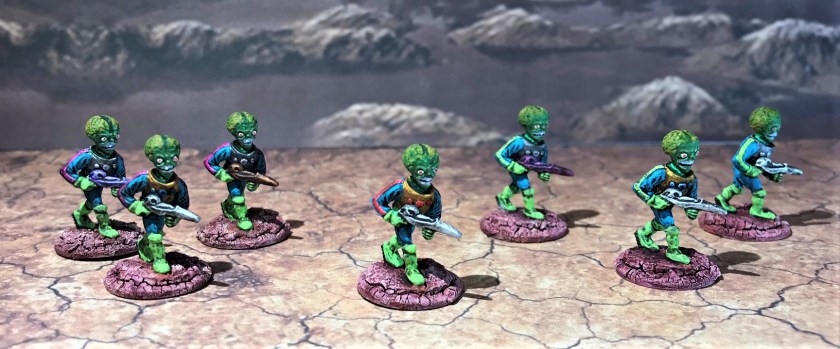
The Martian platoonMartian Platoon leadership – platoon leader is in the center, with the A squad leader and his two team leaders on the left of the photo, and the B squad leader and his two team leaders on the right.An example of how I painted the belts differentially. From left to right, the platoon leader (red), the A squad leader (blue), a B squad team leader (green), an A squad trooper (magenta), and a B squad trooper (yellow)The A squad moves out around some Armorcast terrain.The B squad checks out the cooling units and power generatorThe A squad’s Team 1 moves up alongside a Mark 1 Sphere tankThe A squad’s Team 2 surrounds some Texican Space RangersSize does not matter as the platoon leader and the B squad’s Team 1 move in to kill the Hurraku Space Phraints…or at least try to do so!The Space Dwarves throw grenades at the advancing Martians – the Team 2 from B squadACK ACK ACK!
I hope you enjoyed this post – please let me know your thoughts and suggestions in the comments section. And no, I will not have a Slim Whitman weapon that will kill these guys!