On Veteran’s Day 2018, I decided that I must see the American Heritage Museum in Hudson, MA. It has been known for aircraft, but recently acquired the Jacques M. Littlefield collection from California. They had a “soft opening” on their new tank and AFV collection, and it looked good on FaceBook. They also offered vets a free admission, so I thought it would be a good experience.
I had no idea I was about to see the most unbelievable collection of functioning military vehicles in the US.
Museum Entrance
A small cannon at the entrance
There was a short but very good video on Massachusetts and its role in the Revolutionary War. Then, a door opens and you find yourself in a WWI trench and a multi-visual presentation ensues.
WWI Nurse attending wounded
Trench warfare presentation
The trench
An FT 17 appears
After, you get to see the FT-17 (American made version) close up
Crank for the FT-17 and its data plate
Next, a door opens, and it is early WWII. A British Vickers Mark V is on display, along with a Mercedes staff car. There will soon be a Panzer I as well.
Vickers Mark V
Data sheet
Vickers Mark V (the chairs detract a bit!)
Another door opened to a walkway around a giant hall – and my jaw dropped multiple times.
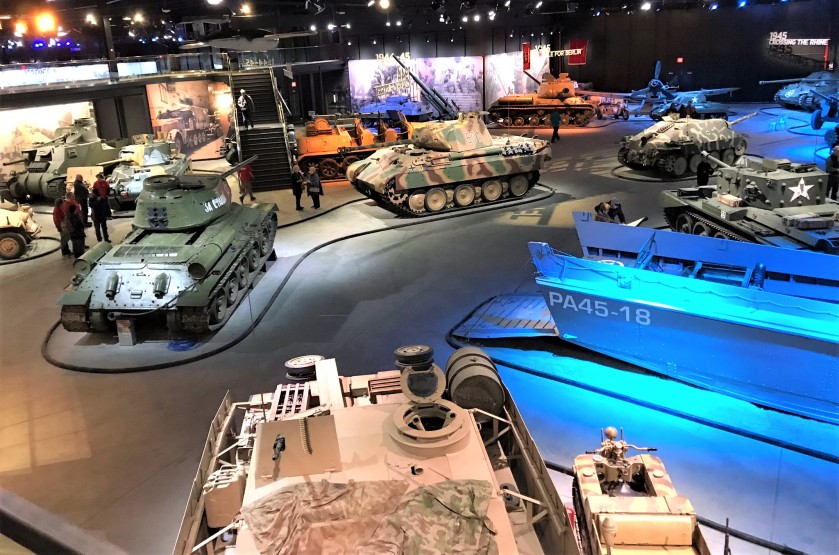
One side of the massive exhibit hall is all WWIIThe other side goes from Korea to the present
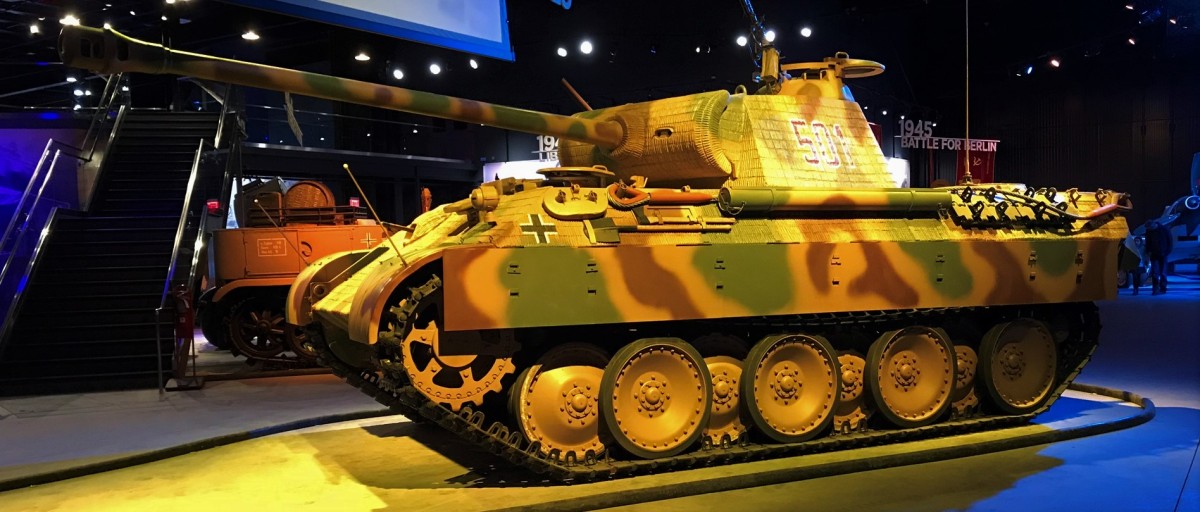
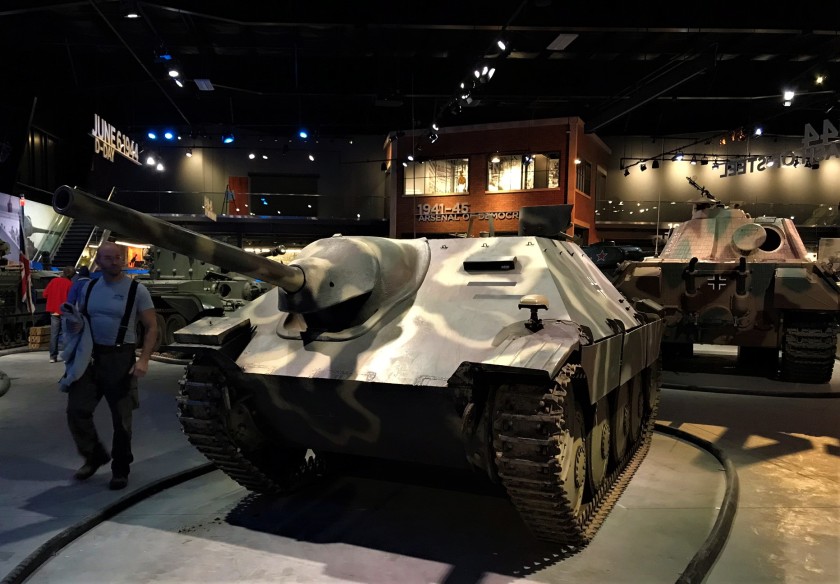
So I was not expecting that many rare tanks, to include a functional Panzer V Panther. It had been recovered from a lake on the Eastern Front and fully restored. I will share some more pictures below, but these do not do this collection justice. It was amazing to see these so close up. There were very few placards on the vehicles, but luckily I know a lot of them because of my historical and war gaming interests as well as my background in the Army. If I misidentify any here, it’s on me.
Nebelwerfer and Halftrack
Sturmgeschutz III
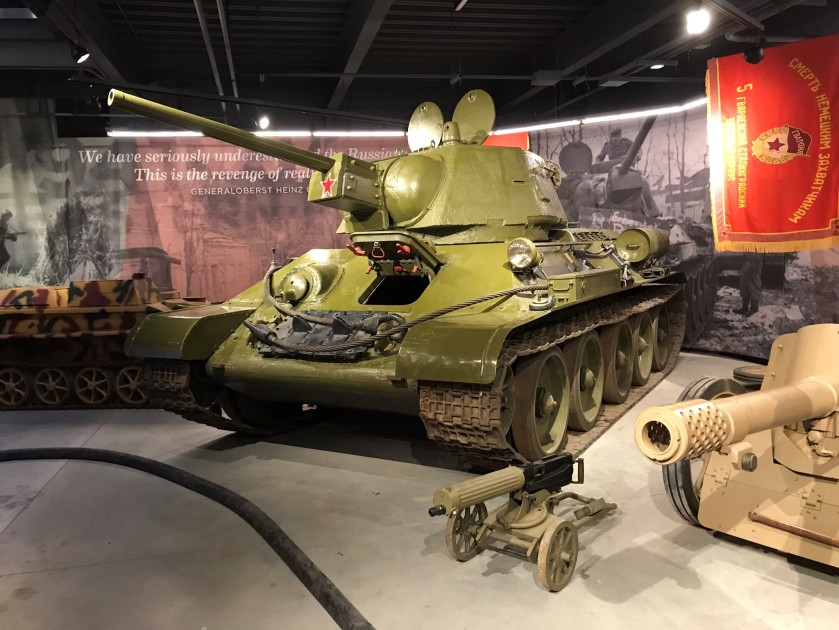
A centerpiece of the collection is the Panther versus a Soviet T-34/85. There is a screen that has a multi-visual presentation of the two opposing tank commanders, with sounds, effects, and more. It concludes with the story of the recovered Panther.
The T-34/85 facing the Panther
Beautiful restoration of this Panther
Nice view of the T-34/85
Stunning to see this legend
The presentation screen with the opposing tank commanders
Here you see the Panther’s unrestored state as found
All major European and North African campaigns were represented. First, North Africa:
View from the walkway
Top of an M5 Stuart
An M3 Lee or a Grant
A Matilda II in British Desert markings
Close up of the M3
German Scout car
Then Italy:
M4 Sherman
M5 Stuart
German Kugelwagon
Not sure what this is, but the staff said there are only two remaining in the world
There was yet another T-34 – an older one:
T-34
There was a nice collection of UK tanks that I had never seen before:
Cromwell tank
Churchill tank
Interior view of the Churchill
Bren Gun carrier
A Locust! This is an American-made glider-transported tank that only saw service in the Rhine River crossings with the British Army. Very rare!
Daimler armored car
There were of course many WWII American tanks and tank destroyers:
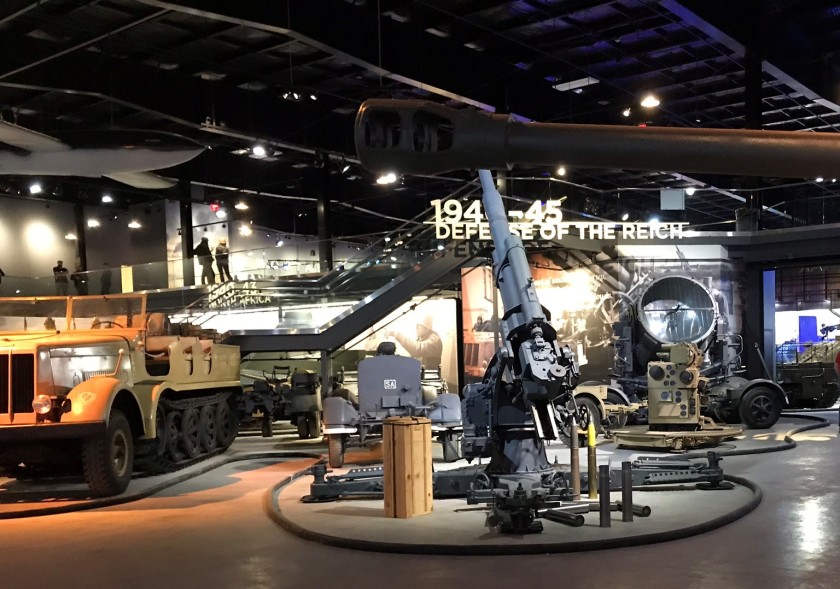
An impressive display of Flak 88 AA gun and accompanying equipment was nicely. This could have been the gun that wounded my late Uncle Joseph Delaney in his B-17 in 1943.
88 Flak Display
There were a couple of Russian vehicles – an ISU-122 and an SU-100 displayed.
SU-100
ISU-122
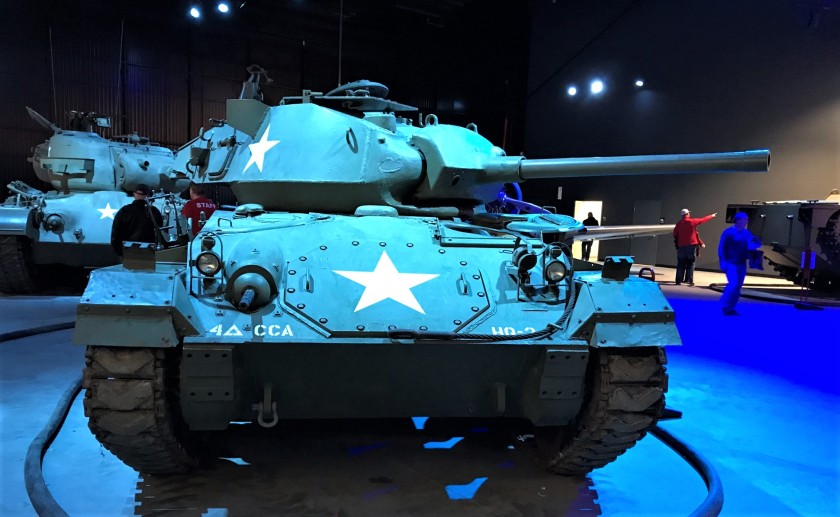
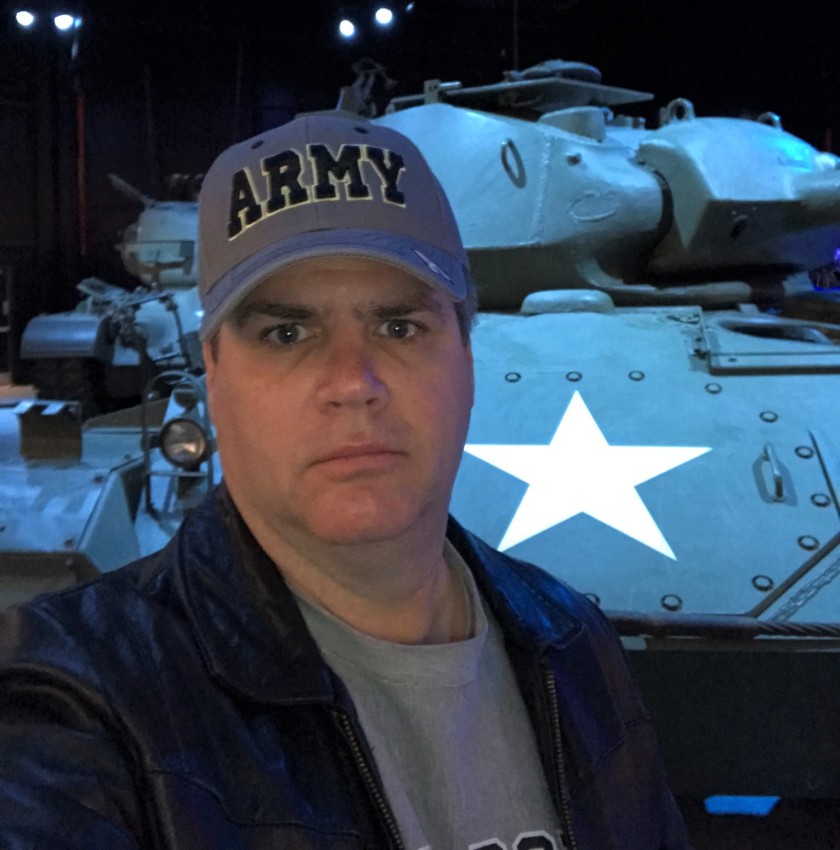
My grandfather, Marcus C. Delaney, drove an M-24 Chaffee light tank in WWII. The museum put their Chaffee in the Korean War section, as it did serve there as well. I was feeling somber seeing my grandfather’s tank on Veteran’s Day, and I miss him. He was a hero to me, and a big reason I went into West Point and the US Army.
The Korean War displayM24 Chaffee, my grandfather drove this model in WWIITrying to take a selfie while feeling somber is a tough thing. I do miss my Papa (Marcus Delaney).
The next section was dedicated to the Vietnam War.
M41 Walker Bulldog light tank
M47 or M48 Patton
Vietnamese PT-76 amphibious tank
For the Cold War, there was an East German T-72.
T-72 side shot
T-72 turret
Next, the “hot” war that occurred during my service, the Gulf War. I did not go to the theater, and performed my duties stateside. I often say that they had a war and did not invite me.
SCUD launcher
M60A3 tank
M551 Sheridan – the last conflict for this airborne tank
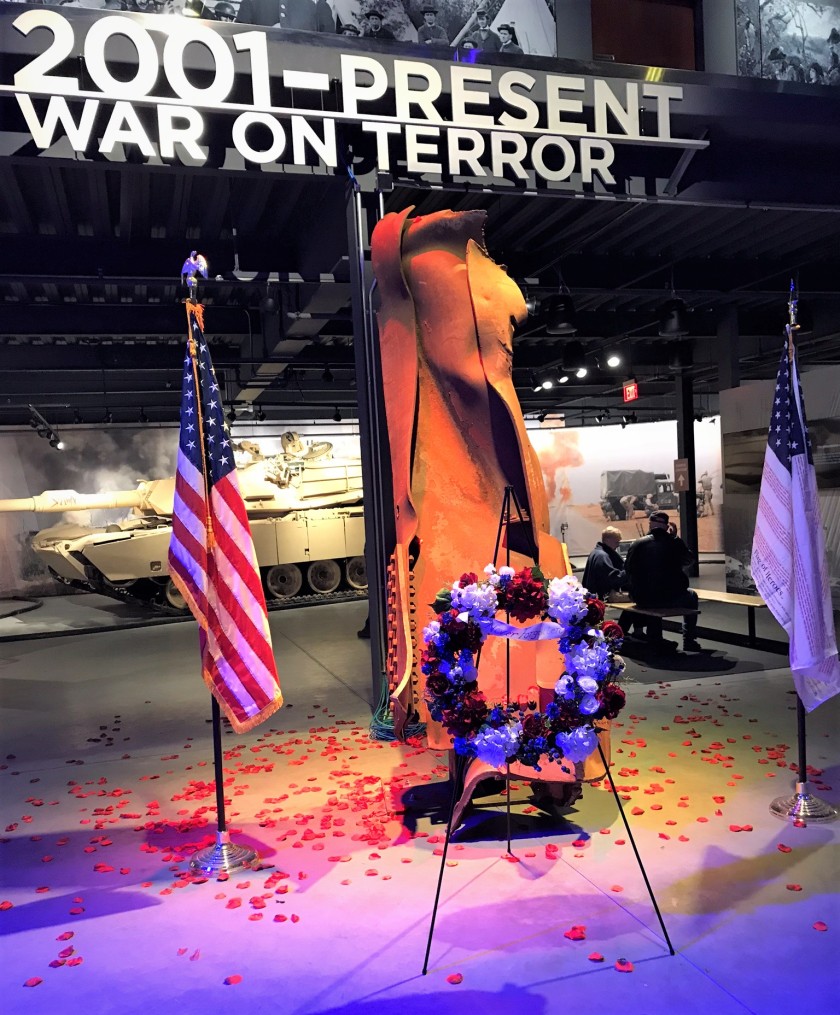
Finally, the War on Terror, which had a USMC M1A2 Abrams tank (though I am not exactly sure which variant it was). It was hit by an IED in Fallujah in 2006. There is a touching video presentation of the event and its impact on the crew and the tank commander’s widow. RIP.
A girder from the Twin TowersThe USMC Abrams M1A2
The museum truly honors veterans, and I was humbled to walk through the many, many displays. To have one in Massachusetts like this is a really special thing. The museum will close from November 25th to April 15th, so there are a couple of weekends left to try to go before spring.
I will be coming back here for sure. Thanks to the American Heritage Museum for such a great homage to our history and our veterans.
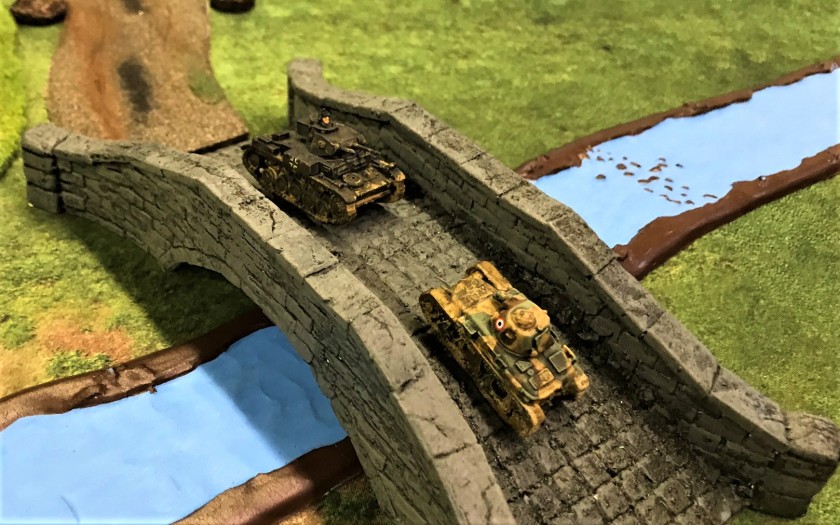
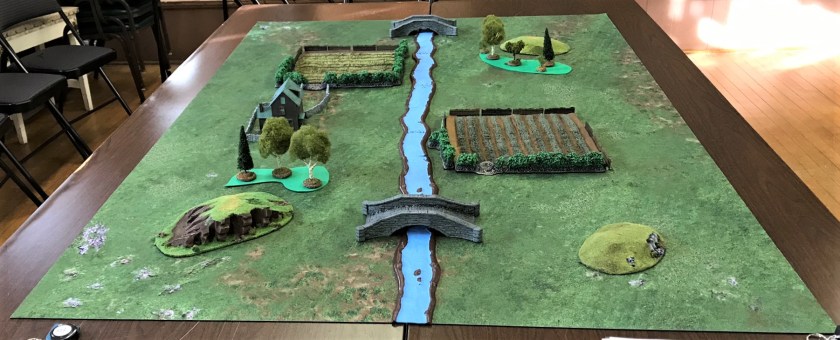
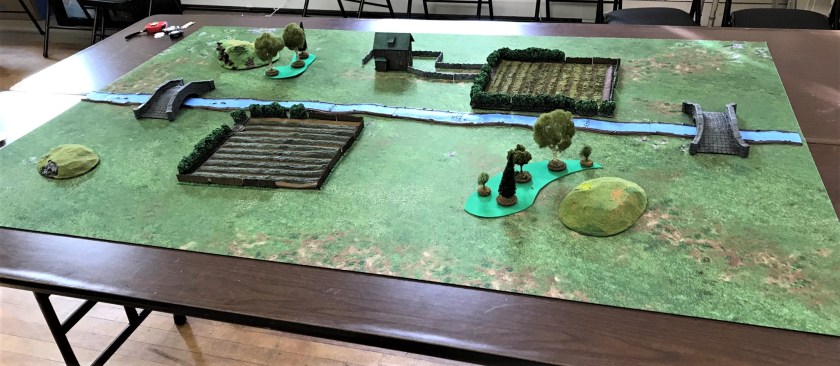
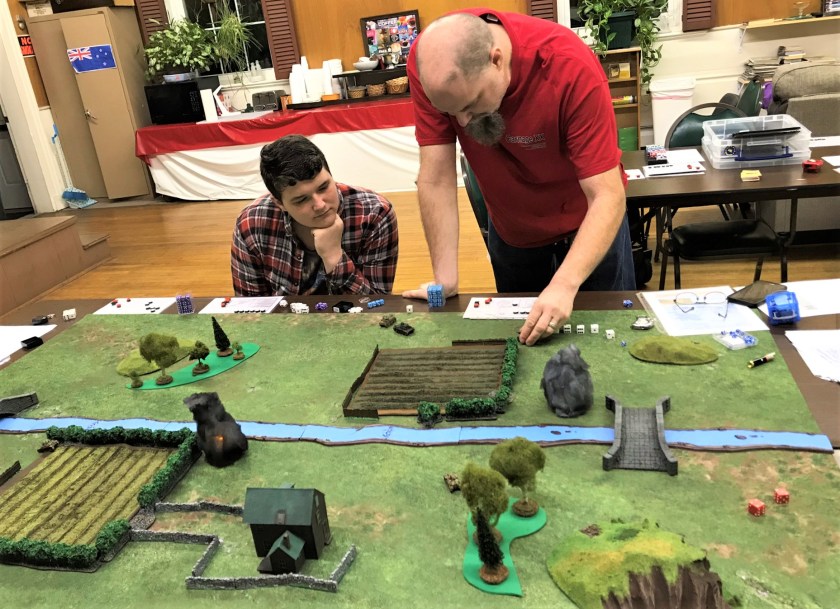
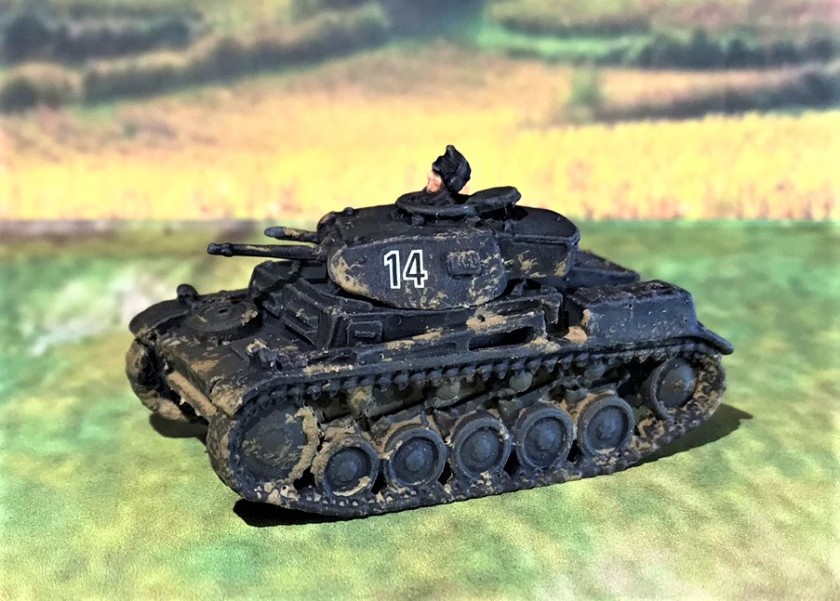
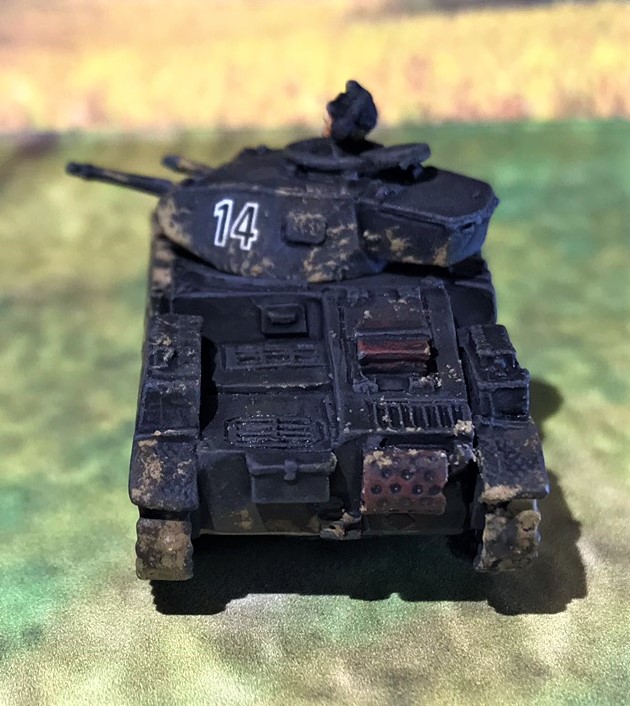
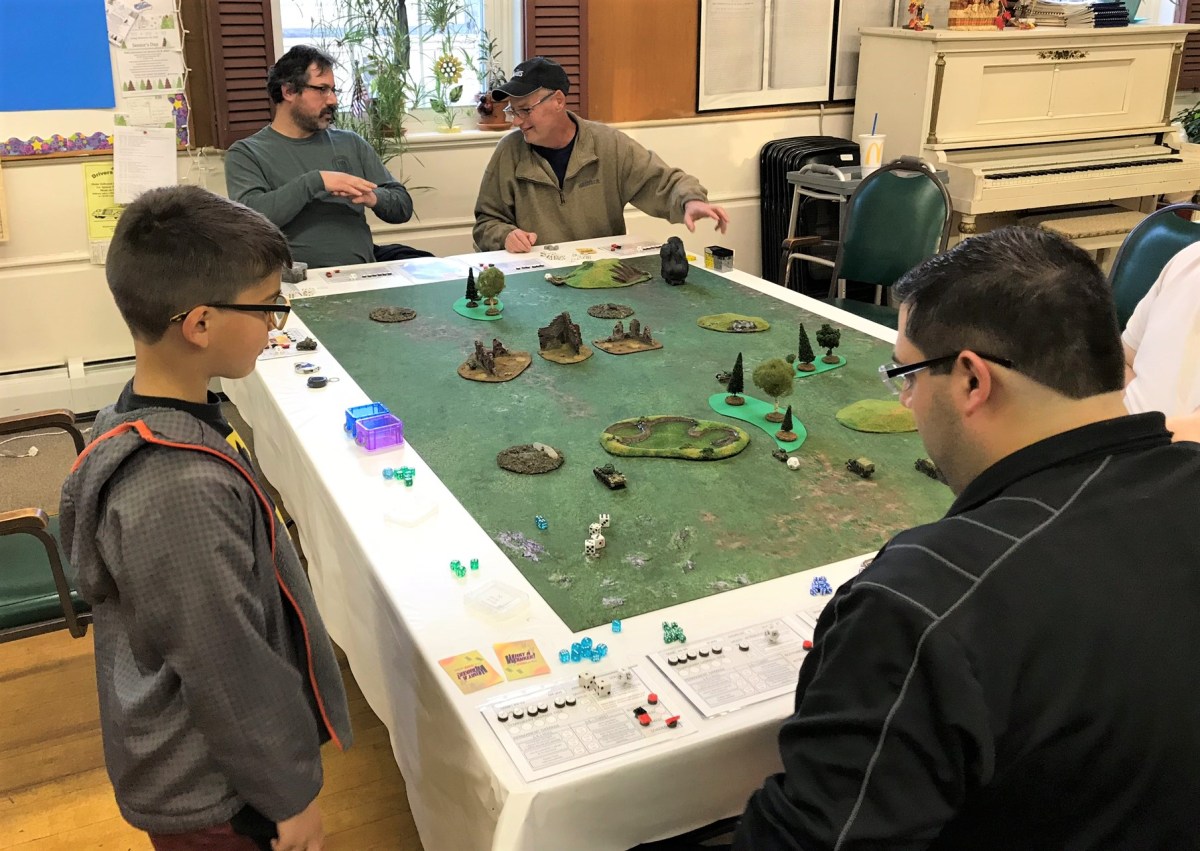
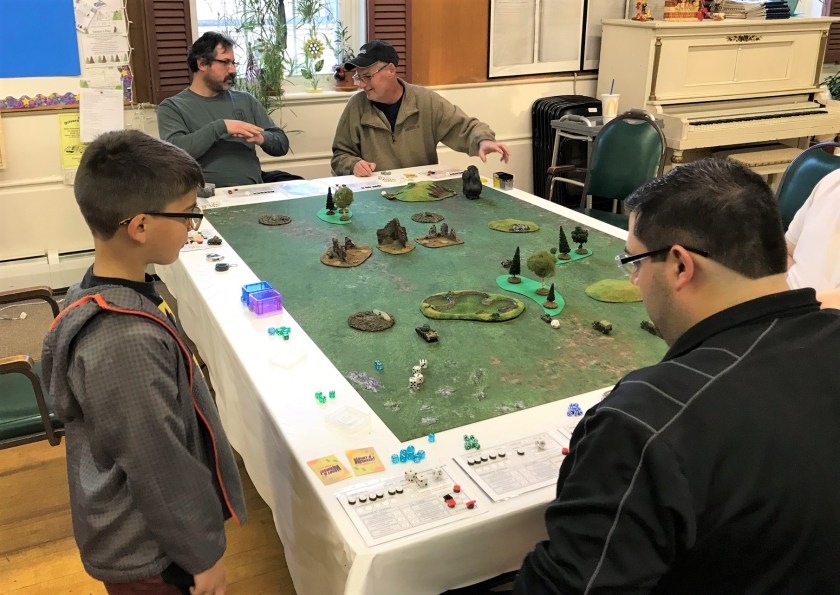
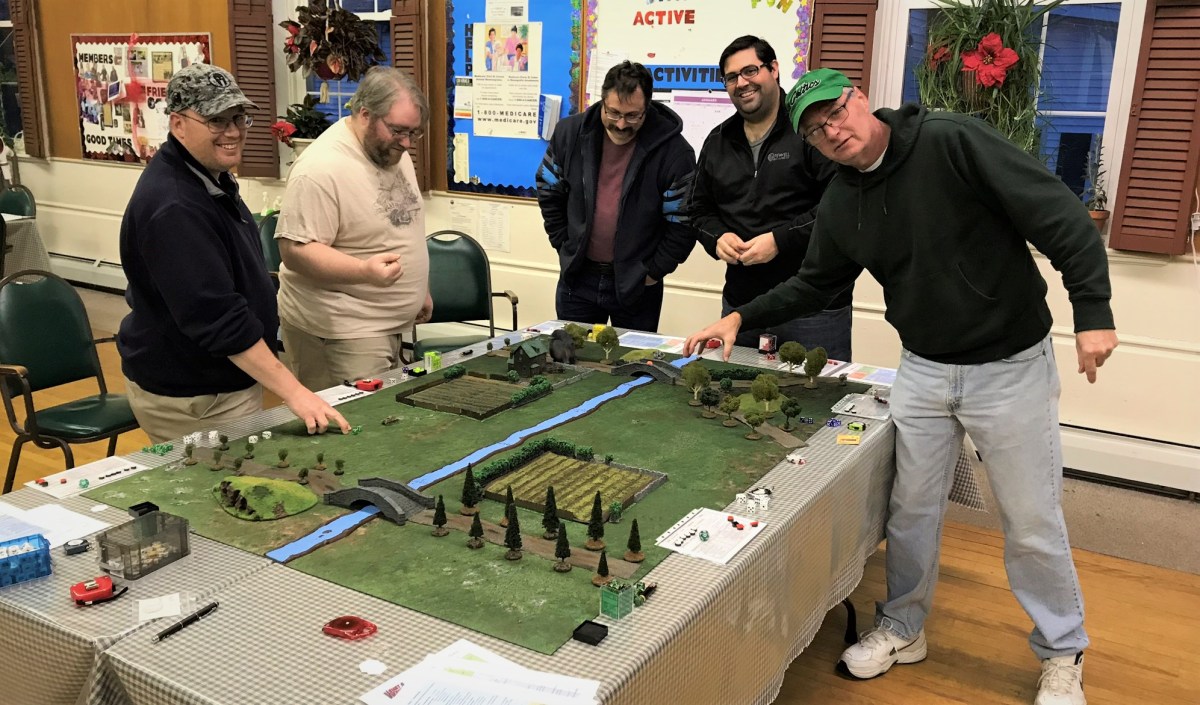
On November 10, 2018, the Mass Pikemen held their monthly gaming session with a game of What a Tanker set on the Eastern Front in 1942. The scenario was a 1942/1943 one where a Soviet force consisting of 1 KV-1a heavy tank, 2 T-26 M1939 light tanks, 2 BA-64 armored cars, and a couple of Gaz trucks was surrounded and needed to break out through the Axis lines. It was my first chance to get all of my recently painted tanks on the tabletop.
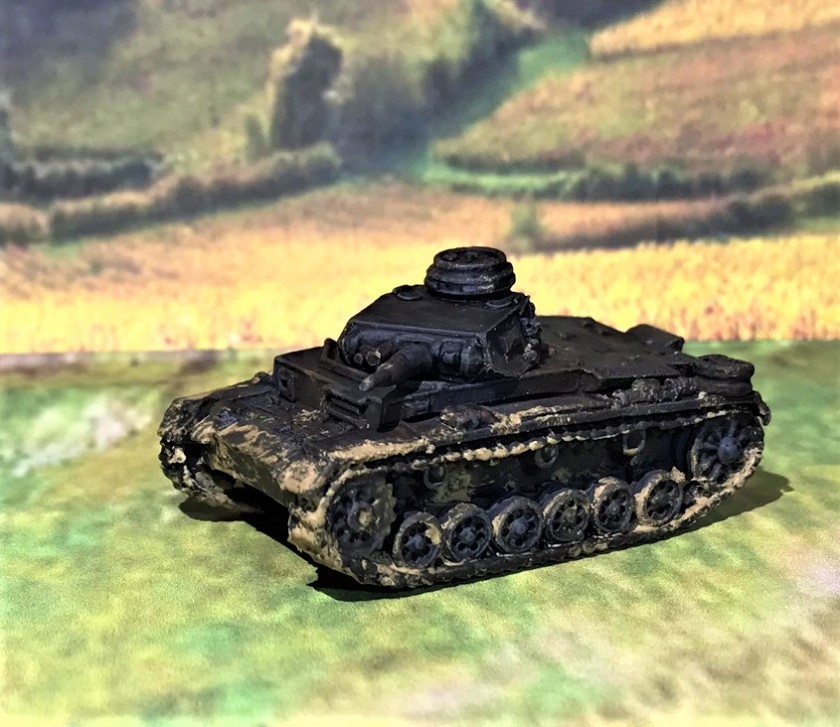
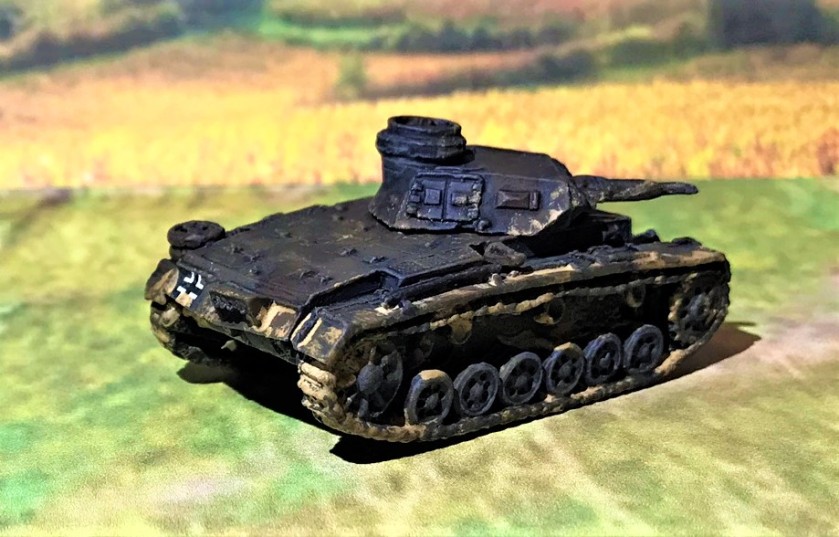
Initially opposing the Soviets was a German force consisting of 2 Panzer IVd tanks and a 1 Panzer 38(t) tank. Reinforcements were staggered for the Axis, and they consisted of a 1 Panzer IIIN tank, a Hetzer tank destroyer (Jagdpanzer 38), and an Italian M13/41. It was imperative for the Soviets to exit the other side of the board with the KV-1 and the two trucks as quickly as possible.
The Germans moved on first – and one of the T-26’s was able to early on get a couple of shots in on one of the Panzer IVd’s, with the second one knocking it out. This was a fun event for 7-year old Jack Burns who was playing in his first war game ever. He was so excited to knock out the German tank.
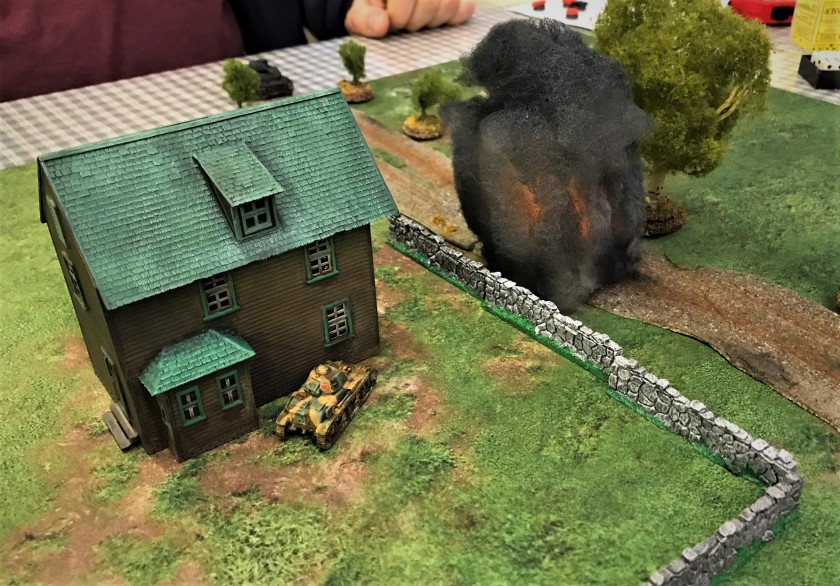
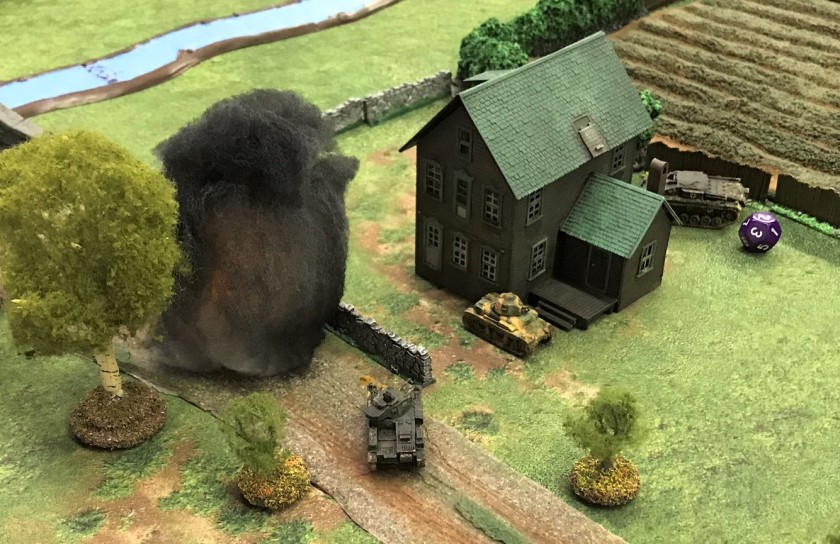
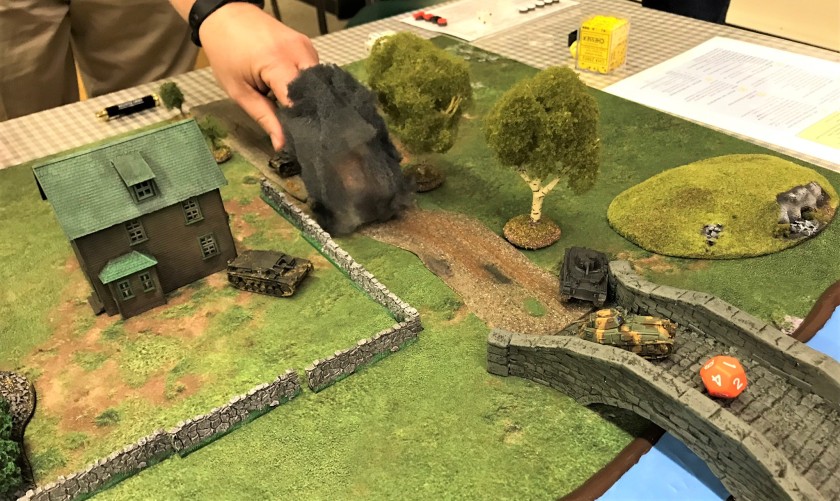
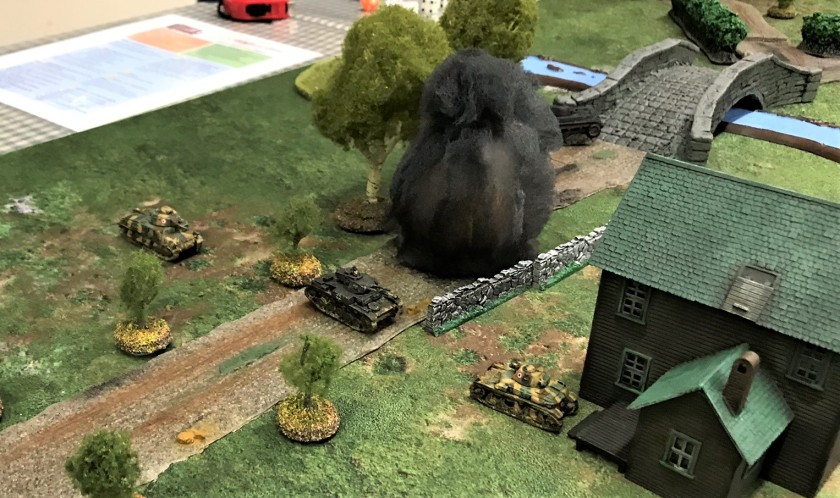
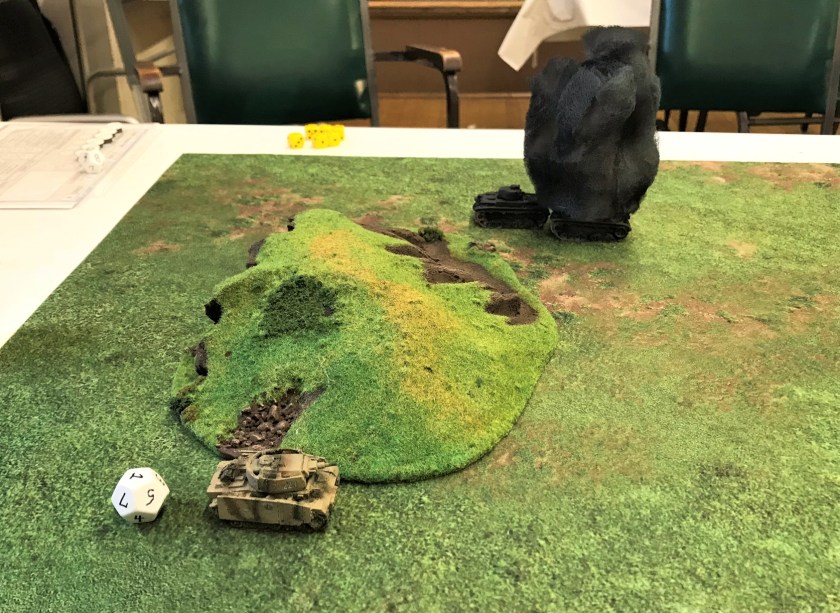
The Panzer IIIN moves on the board as a reinforcement. The second Panzer IVd takes advantage of its burning comrade’s smoky wreck.
The Soviets KV-1a was slow to move forward, and the T-26’s outran it. The Panzer 38(t) moved up to the ruined factory and took aim at one of the T-26’s in the open. It fired, and missed the Soviet. Returning fire, the T-26 hit and knocked out the Panzer 38 (t). Two down for the Axis! Shortly after this, the other Panzer IVd peeked out from behind its brother, only to suffer the same fate from the plucky T-26. Three down now!
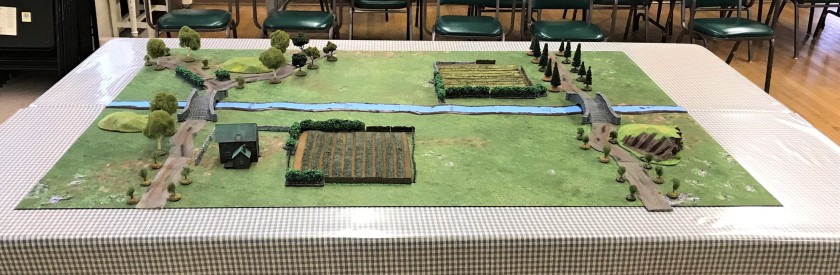
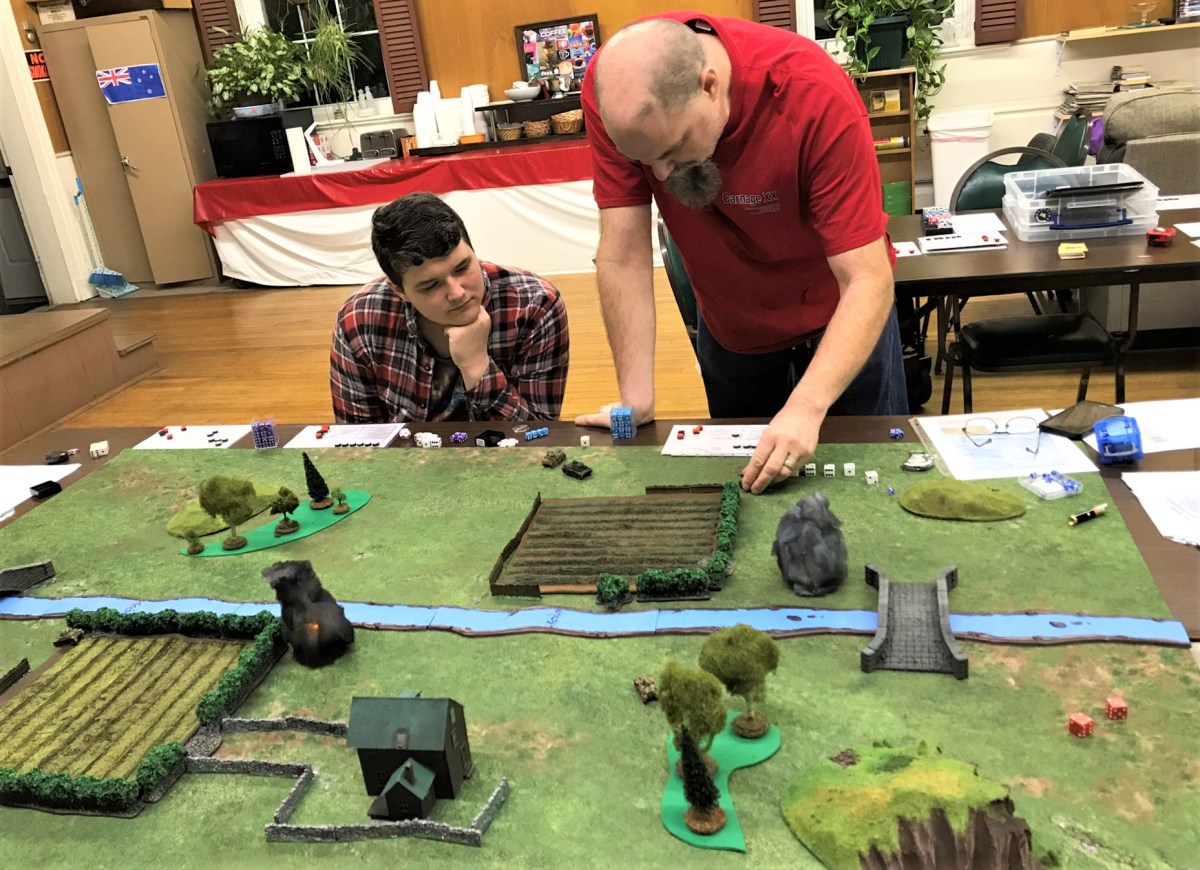
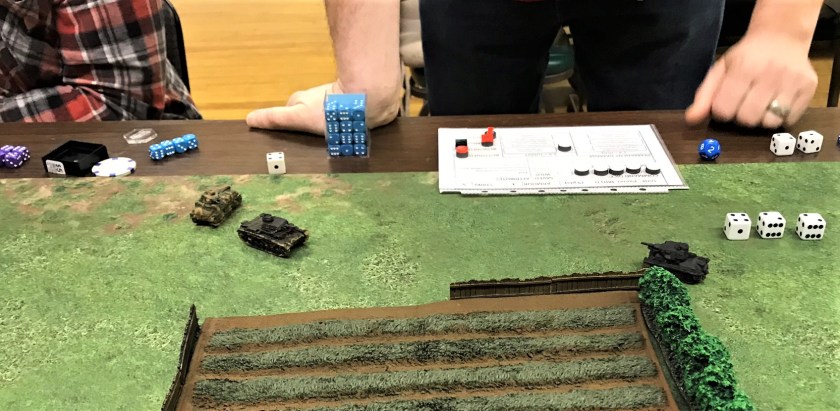
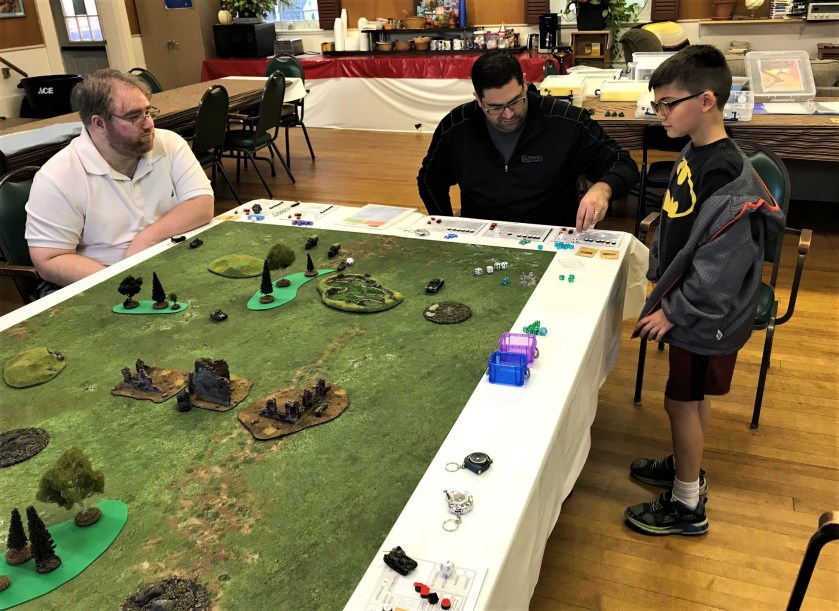
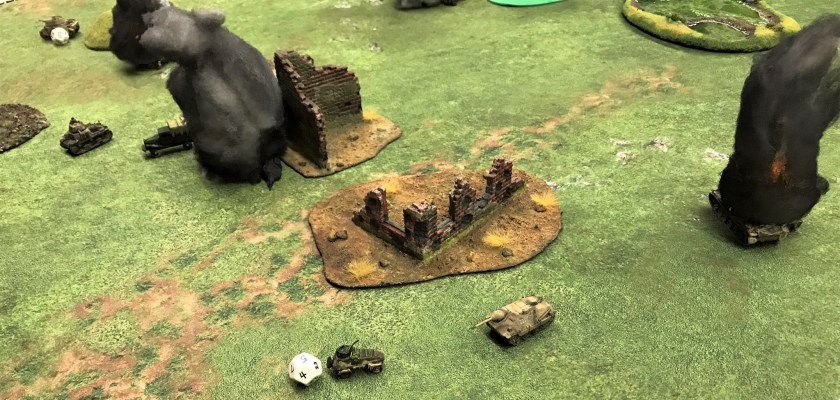
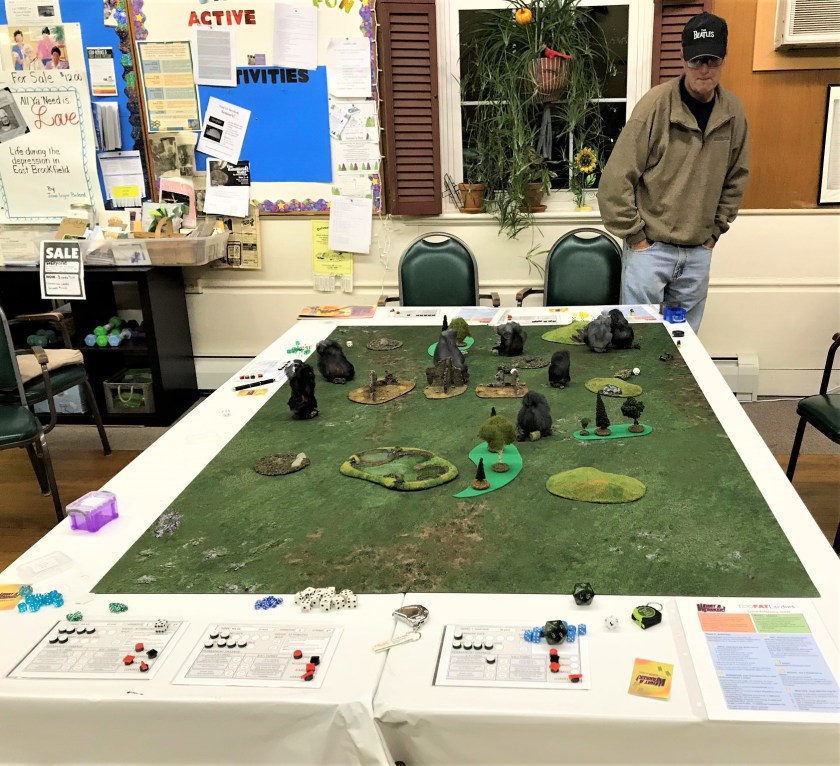
Chris Smedile, Jared Burns, and Jack Burns advance their vehicles. The Panzer 38 (t) is behind the wall in the center in a good defensive position, facing the T-26 that was to knock it out.Chris Comeau and Mike Morgan (and later myself) played the Axis. This view shows the length of the board the Soviets needed to cross. Each fighting vehicle had a magnetic dashboard, and its own colored dice. Command Dice were always white though.
Let me add a side note here on my rules modifications for this scenario. What a Tanker does not have rules for either armored cars or trucks. I modified them here for the armored cars, which I made Fast (easier to always move), and Small (tougher to hit). For their Armor, I only gave them a 1, which meant that any hit from a tank gun would very likely be enough to kill the BA-64. As the BA-64 only had a machine gun, I gave them 2 modified Strike dice. The modifications were twofold. First, their range was 24″ (half that of the tanks). Secondly, the BA-64’s would hit on a 6, but the only likely result of such a hit would be to force the target to button up if it was not already. If the BA-64 player rolled double-6’s, I would allow 2 strike dice. So the BA-64’s were harassers at best. I had the Gaz trucks move last, with 2 D6 of movement (no command dice). If they were hit, they were destroyed.
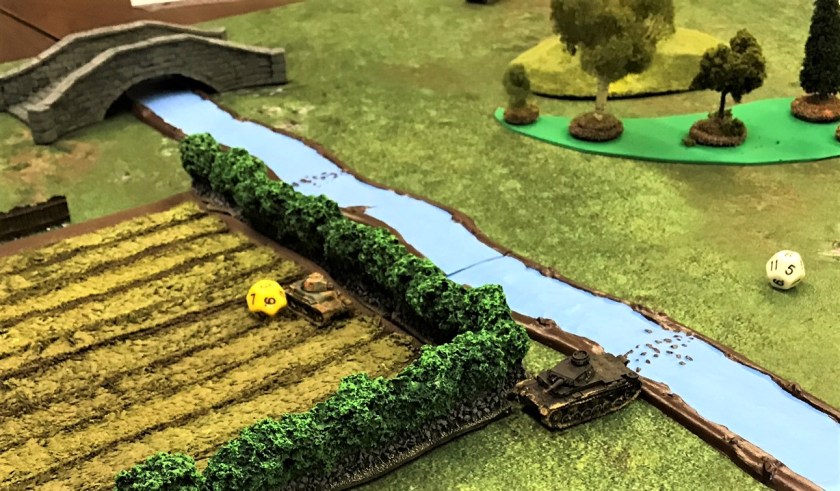
Chris celebrates his second kill, while the Panzer 38 (t) burns. You can see here behind the BA-64’s a D12, which I used for initiative rolls instead of D6’s and re-rolling for ties. It worked much easier and was much less confusing.
Back to the battle!
At this low point, they got reinforcements in consecutive turns. First, the Panzer IIIN came on in turn 2. In turn 4, the Axis got the Hetzer and the M13/41. The tide of battle was turning.
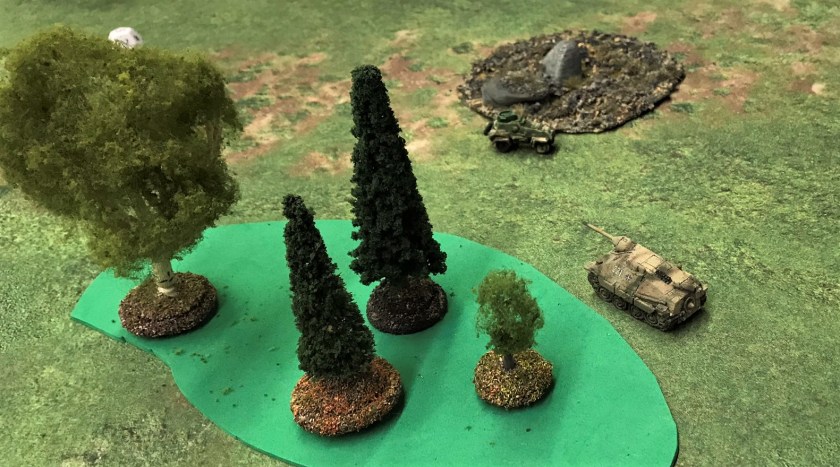
The Hetzer ignores the BA-64 and sets out to hunt the KV-1a.
The Panzer IIIN moved up to the hill, awaiting the T-26 and a truck. The German successively took both out, leaving the Soviets only with one T-26, one truck, the KV-1a, and the BA-64’s. The M13/41 rolled badly, and hid behind the Panzer IVd wrecks for better dice rolls, even taking humiliating fire from the BA-64’s that caused it to have to button up.
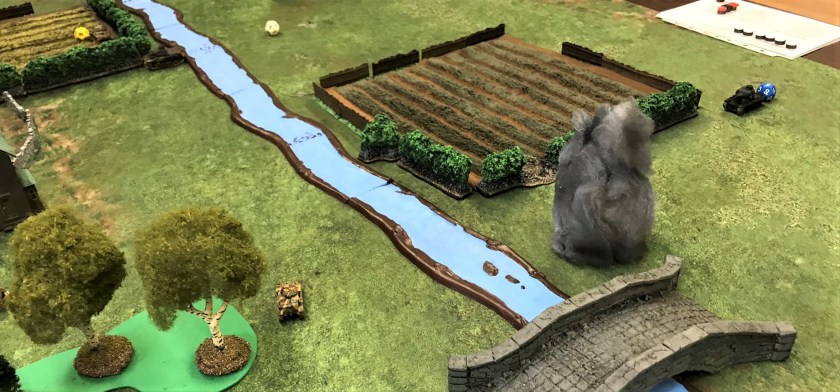
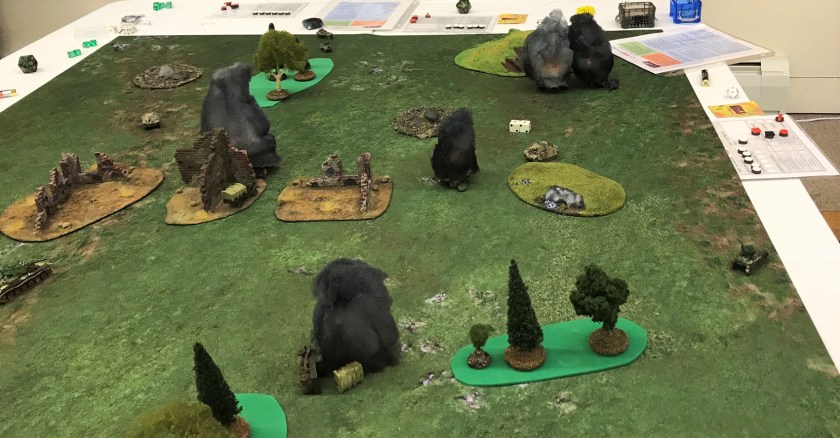
In the foreground, a Gaz truck burns. The crew of the Panzer IIIN behind the hill looks at the burning T-26 in front of it. In the left center, the Panzer 38 (t) burns, as do 2 Panzer IVd’s in the right rear. On the left, the showdown between the lumbering KV-1a and the Hetzer is about to begin.
The Hetzer moves fast, and tried to move around to the rear of the KV-1a. It succeeded, and missed with its initial rear shot. The KV-1a immediately turned the tables, turning 180°, and rotating its massive turret towards the diminutive tank destroyer. The Soviet again got initiative, firing not once, not twice, but three times – and unbelievably missing on all three attempts! The saving grace for the Hetzer was its Small characteristic, which meant the KV-1a needed a “7” instead of a “6” to hit.
The Hetzer then got initiative and rolled its Command Dice well enough to fire but not to maneuver towards the Soviet behemoth’s vulnerable rear. It decided to take a chancy shot at the frontal armor of the KV-1a. It got 5 hits on 7 dice (needed a “5” or “6” to hit). The Soviet player got zero saves, and the KV-1a was knocked out.
The KV-1a burns on the right, while the Hetzer and the M13/41 hunt the last truck (on the left). The BA-64 attempted a ramming attack on the Hetzer to give the truck a chance to escape.
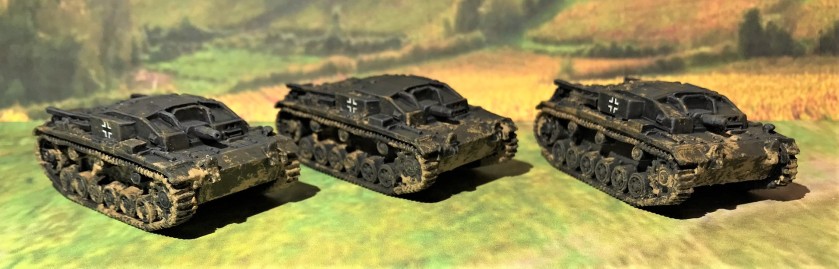
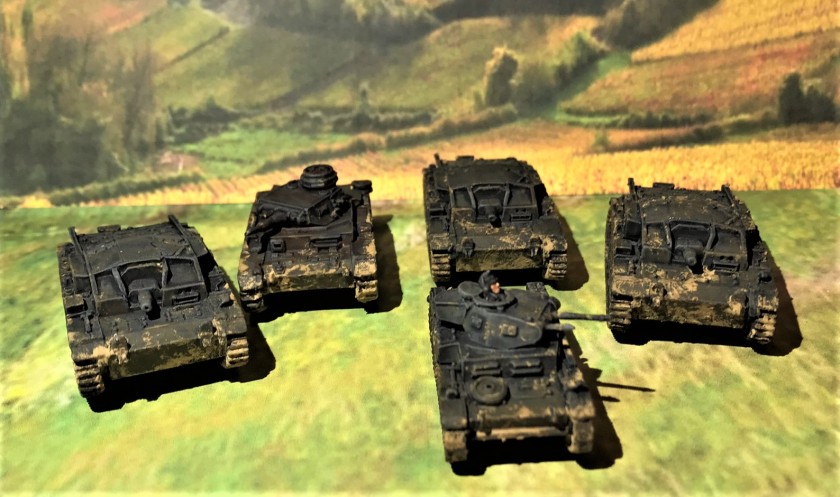
The BA-64 ramming attack did nothing to the Hetzer, which dispatched the armored car with one shot. Meanwhile, the Italian M13/41 took out the last truck. The surviving BA-64 was destroyed by the Italian, leaving the Panzer IIIN and a damaged T-26 in a showdown. With the loss of the trucks and the KV-1a, the game was called an Axis victory.
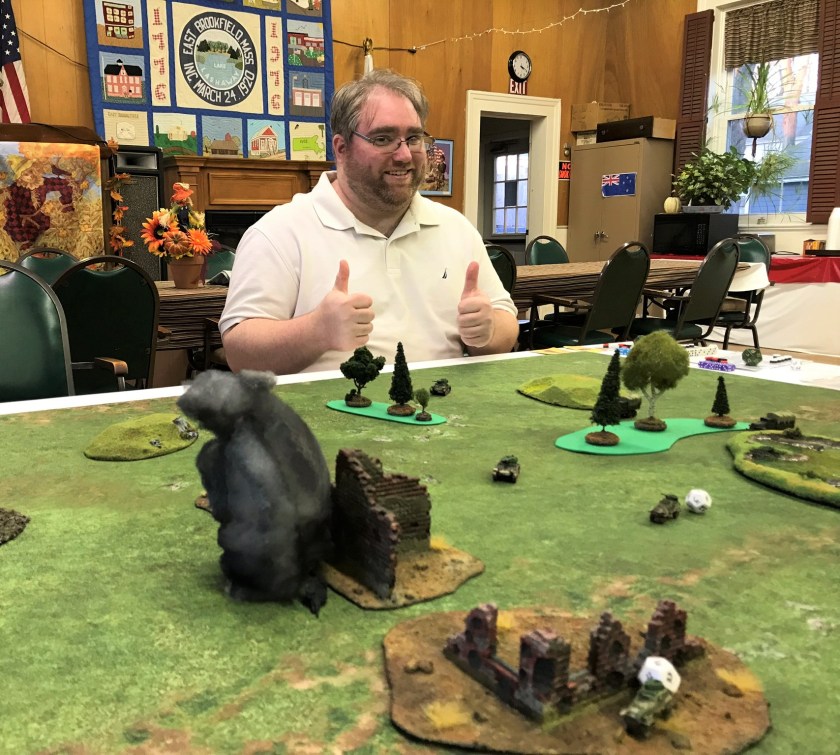
Mike Morgan victoriously surveys the smoky battlefield.
The game was a fun one for winners and losers, with highs and lows for both. Next time, I will probably give the Soviets a second KV-1a.
The next Mass Pikemen’s gaming session will be on Saturday, December 1st from 2-8 PM, at 110 Pleasant Street in East Brookfield, MA. This is a change from our previous 3-9 PM time slot. We will be playing What a Tanker again!
Please join us, and share your thoughts and feedback in the comments section below!
I have been working on getting a fleet of tanks for the What a Tankergame from the Too Fat Lardies company. It’s a great game and has been a true hit with my gaming club, the Mass Pikemen. I have been working on building up a flexible group of tanks, and so far I am up to 71 tanks in 15mm/1:100 scale – not including ones needing assembly and painting.
My sources have been eBay, hobby stores, and Facebook. If I waited to paint them all, I would never do another project, so finding some mostly painted resin (and reasonably priced) models from Wargame Models in Ohio has helped shorten the process. Mostly I just washed and varnished the ones I have gotten from WMIO.
One group acquisition was from another source on eBay – it was a resin Soviet KV-1 platoon consisting of 5 KV-1’s heavy tanks, 2 T-26 light tanks, 2 BA-64 armored cars, and 2 trucks. I do not know the manufacturer. They had been given some sort of dark brown coating with splashes of lighter brown. They color-wise did not look particularly like Soviet tanks from 1941. This platoon is the main subject of this blog post.
My tank fleet grows – the KV-1 platoon is in the upper left.The platoon as I got it in the brown colors. I decided to make the heavy tanks as the KV-1a version. All of the turrets were not magnetized, which I did do as well as part of this project.I removed the resin post on the turret and drilled out 1/8″ holes in it and widened the preexisting hole in the hull. I got some nice neodymium 1/8″ x 1/16″ magnets for magnetizing from totalElement.com.
It was necessary to use a Sharpie to mark one end of the 1/8″ magnets such that I inserted them in the correct alignment (I did not want the turrets “blowing off” prematurely!). I glued the magnets into the holes with Gorilla Glue.
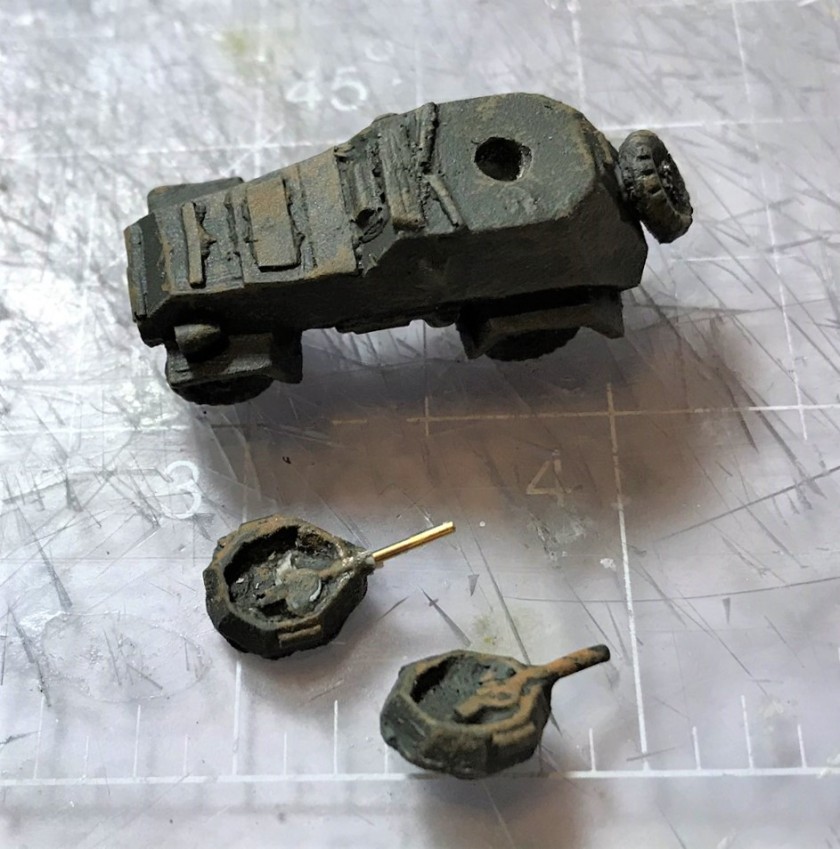
Each turret originally had this post that I removed and drilled underneath.Magnetized K-V1a turretBA-64 turret showing my repair of the gun. It was thin resin. The other resin gun broke later as well so these are not sturdy.
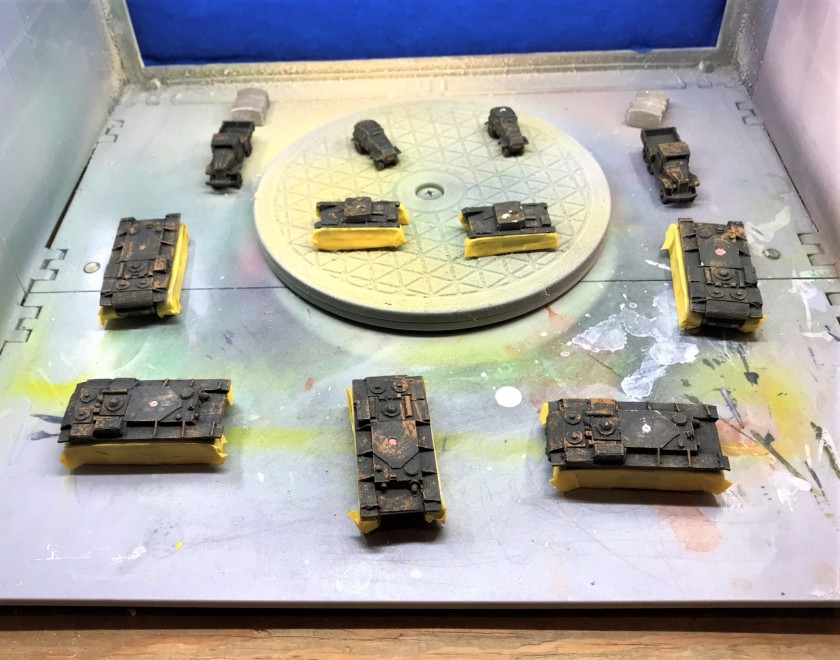
I needed to find a way to paint the figures without damaging the paint, and tanks were new to me. I decided to take advantage of the magnets on the turrets here. I used small nails inserted into styrofoam blocks (the kind used for flower crafts). For the hulls, I masked the tracks for secondary painting, and such that I could hold them safely.
How many turrets can fit on the head of a nail?The hulls masked for priming.
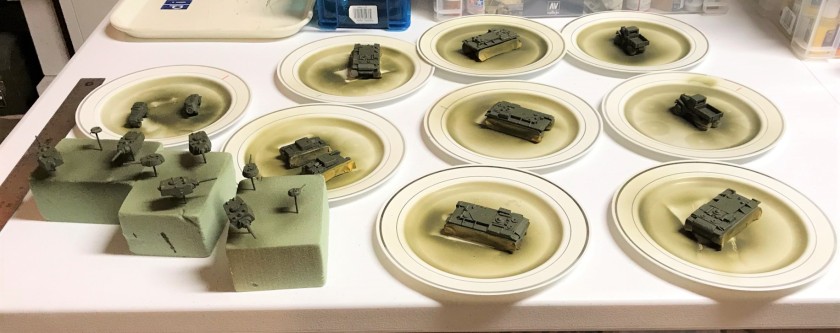
I airbrushed/primed the figures with Vallejo “Surface Primer – Russian Green”.
The platoon primed.
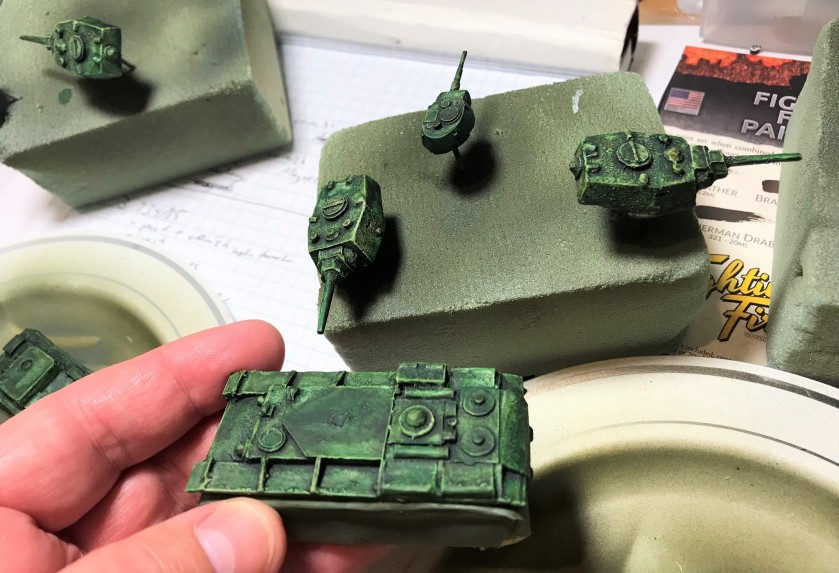
I then gave the figures an airbrushed base coat with a thinned coat of Vallejo Panzer Series “Camouflage Olive Green”.
The platoon base coated.Close up shot of one of the KV-1a hills after base coating.
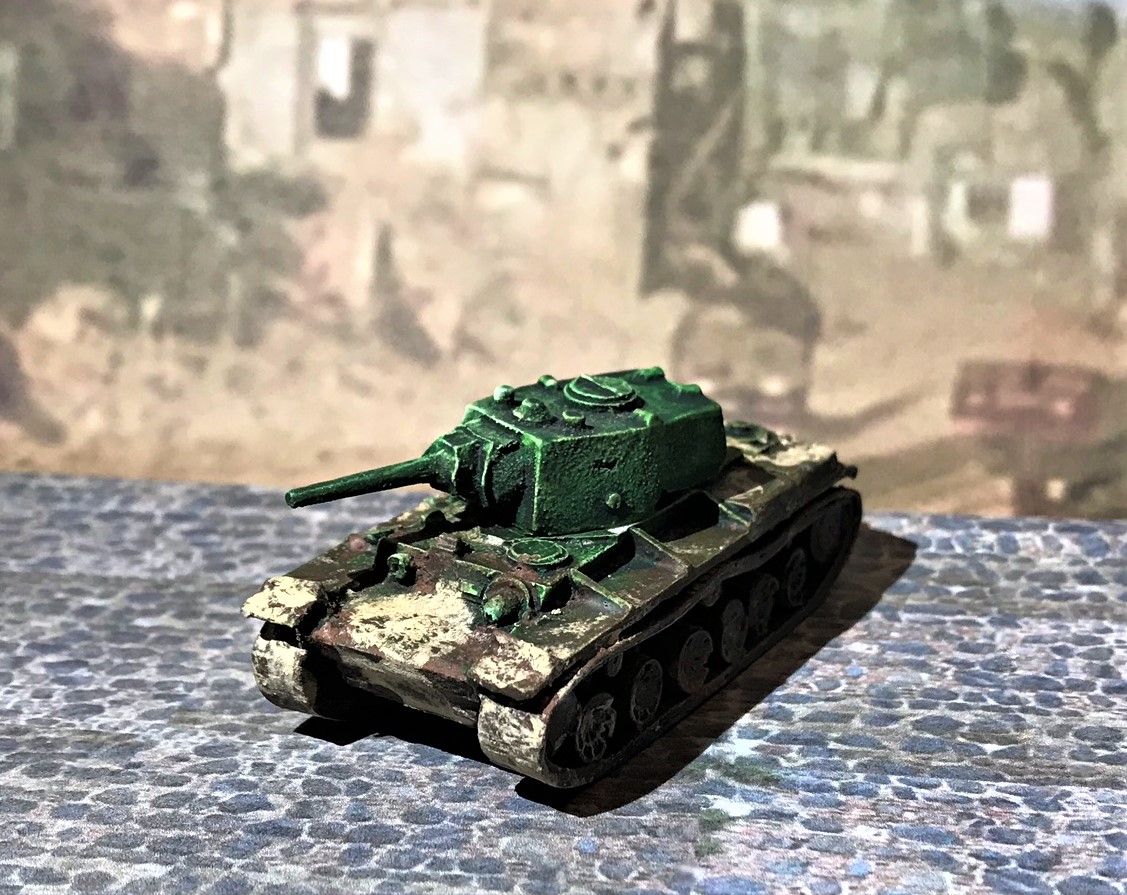
These looked too drab, and not very Soviet green looking. I moved on to adding Vallejo Mecha Color “Green” with a light airbrushing. Next, I used a brush to dry brush Vallejo Mecha Color “Light Green” on the figures. I was able to then give the figures an appropriate light green by using Citadel “Biel-Tan Green” as a shade. It worked!
Contrast the before shading (turret on left) and after (turret on right). The light green helped give depth to the shaded turrets and hulls. I darkened everything with an additional shade – Citadel “Athonian Camoshade”.Before the “Athonian Camoshade”……and after adding the darker shade.
At this point, I removed the masking and painted the tracks. I then wanted to add some mud, dirt, and dust with pigments. I used several Vallejo pigments and binders (all listed at the end of this post). These models are small, (about 3″ long by 1½” wide by 1¾” high so I wanted to give enough weathering without overwhelming them.
An in-progress pic of weathering one of the hulls.All of the weathering done and the vehicles ready for varnish.KV-1a hull varnished.T-26 hull varnished.The platoon nice and dirty with the mud of Mother Russia.
This was my first attempt at painting any WWII tank models. I think I can do better, but early war Soviet tanks are pretty simple, as they had not usually added any markings. It will not be my last, and I am hoping that I get better with more tries. This project also is my first submission for Azazel’s November Community painting challenge – Mechanical November ’18. If you have not checked out his blog, it’s worth a look. Also, my next few posts will showcase tanks, so I hope you enjoy.
Now for some eye candy!
All five KV-1a’s with different angles to view. Ignore the giant tetrahedrons please!Front viewRear view. I “mudded” them up a bit here.The combat vehicles move out.One of each AFV I painted plus 2 trucks.KV-1a in an urban setting.T-26 in town (what’s left of it anyway).BA-64.
I hope that you enjoyed this post. Please let me know your thoughts and feedback below in the comments section.
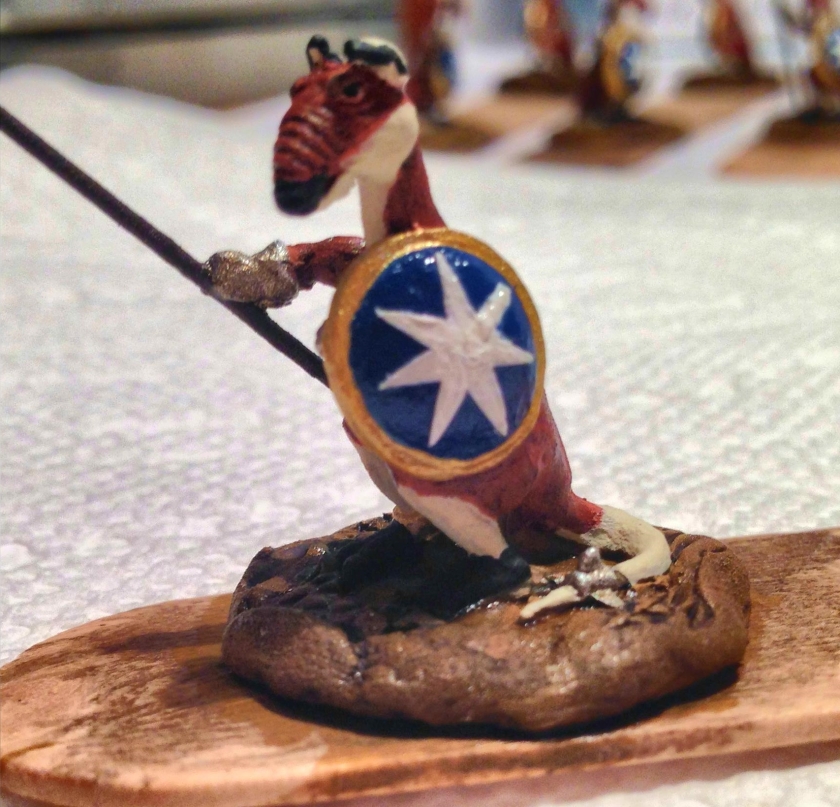
Back in 2016, I had finally completed an original Ral Partha “Rooman War Party” (#01-044) from 1977. This effort culminated in my building a 21-figure phalanx of pike-armed anthropomorphic kangaroos, replete with Australian 7-pointed stars on their shields.
At that time, I also began to see that others, like the wonderfully named Imperial Rebel Ork (IRO for short) were doing amazing “kit-bashes” and conversions with different models. Of course, IRO uses plastic, and I’m more of an old school metal guy. I also was getting more into retro sci-fi figures and using them for skirmish games. I was inspired by IRO and Azazel (both Aussies) to push myself to do my own conversion. So, I combined two figures – a Ral Partha Rooman (25 mm scale) and a Reaper #80010, “Nova Corp Sergeant” (28 mm scale), made a mold, and cast a bunch of “Space Roomans” (in metal of course). You can read about that somewhat massive project here. Getting around to painting these took a bit longer, and even my good friend Buck Surdu painted some that I gave him much quicker than I did.
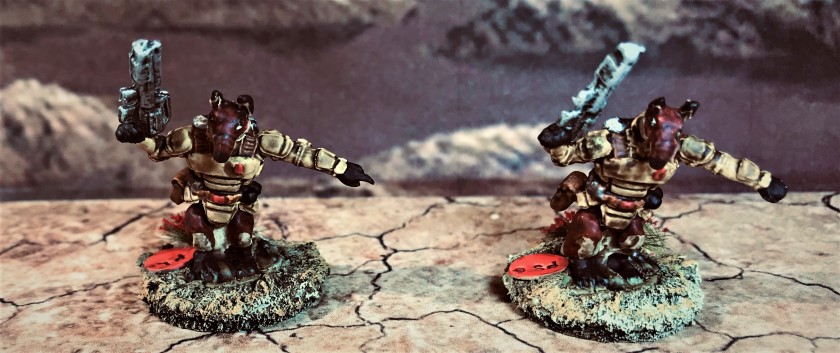
Ral Partha RoomanThe Reaper figure (circled) that I used was in a bunch of figures I got on eBay
Azazel is kind enough to run a monthly community painting challenge – and October’s was “Unit-ed October”, and focused on units. So, I took this opportunity to get these done. Of course, this effort was slightly affected by some gaming and the Red Sox winning the 2018 World Series (YES!), but I got them (the Space Roos that is) done by October 31st, 2018. I will use them in Combat Patrol™ games.
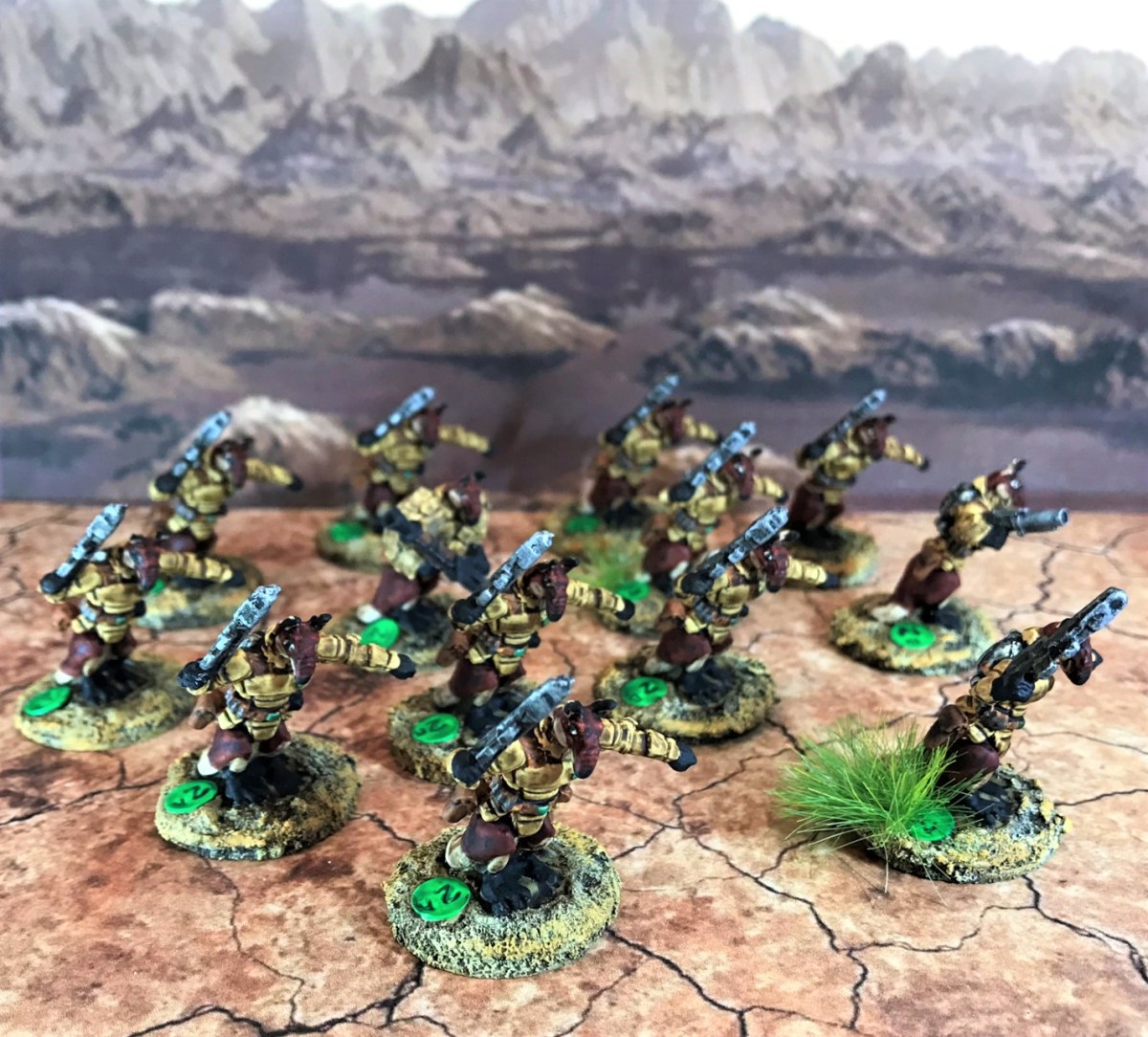
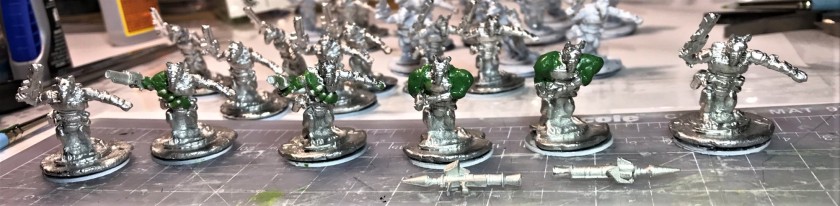
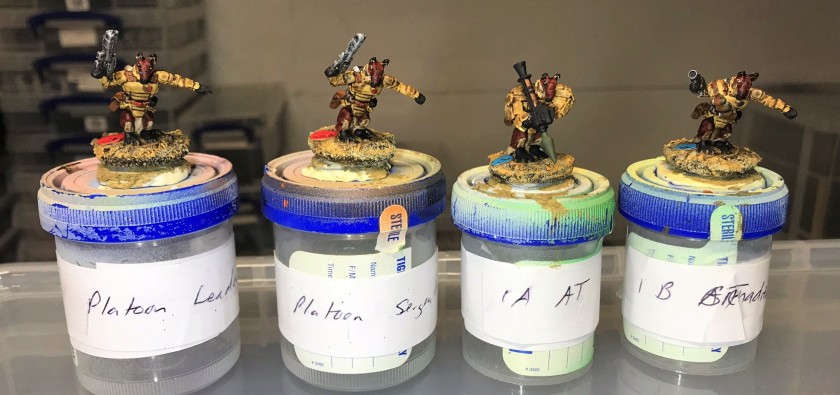
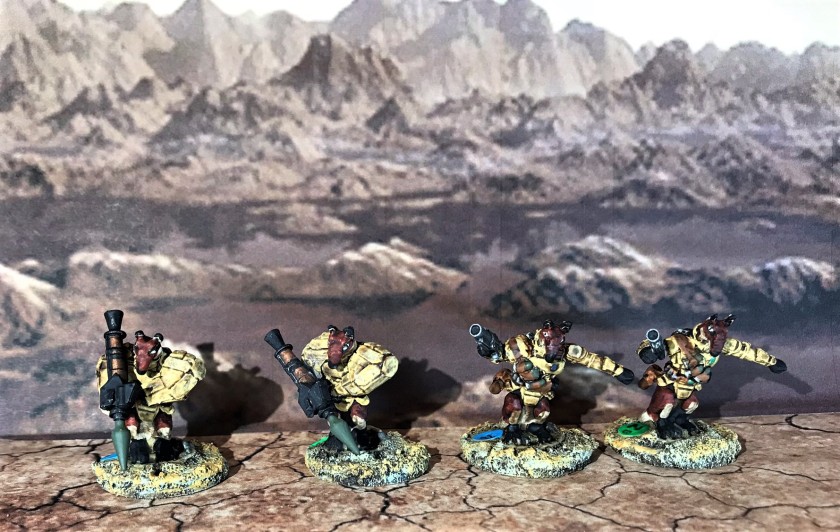
I decided to paint the Roos similar to the way I did the Roomans, except that I wanted a more dusty and dirty look to them, as they are intrepid infantrymen (infantryroos?). I also wanted to convert a couple of figures per squad (yes, a conversion of a conversion) to carry different weapons. In this case, I used a grenade launcher sprue from RBJ miniatures to make two Roos into grenadiers, and a different RPG sprue from RBJ to make two other Roos into anti-tank troopers. So my 28-figure platoon would consist of:
Platoon Leader
Platoon Sergeant
2 Space Roo Squads consisting of:
1 Squad Leader in each squad
2 teams of:
1 TL per team
4 Space Roos with assault rifles/blasters per team
1 Space Roo per team with either a grenade launcher or anti-tank weapon
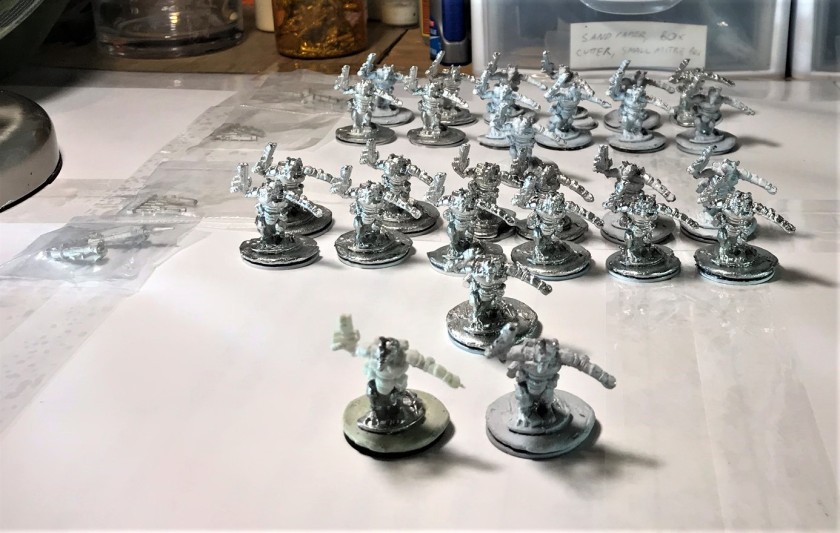
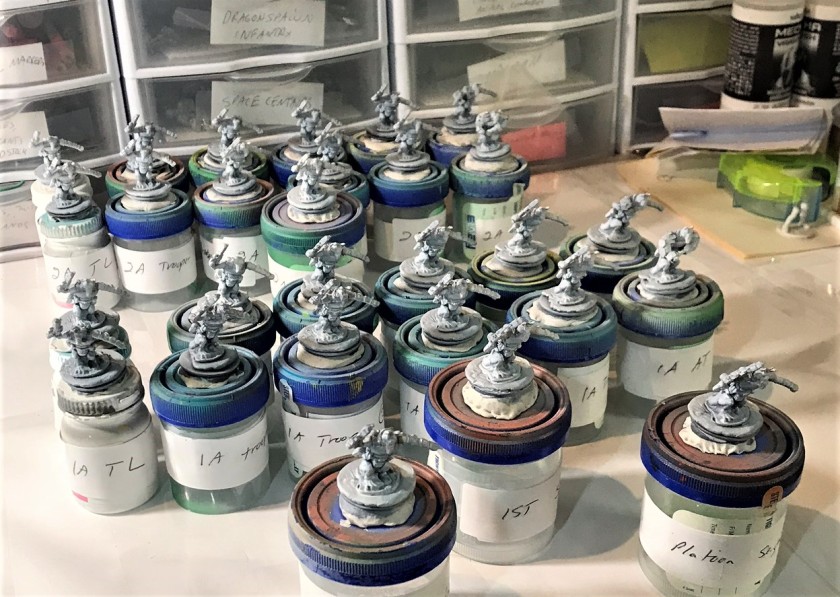
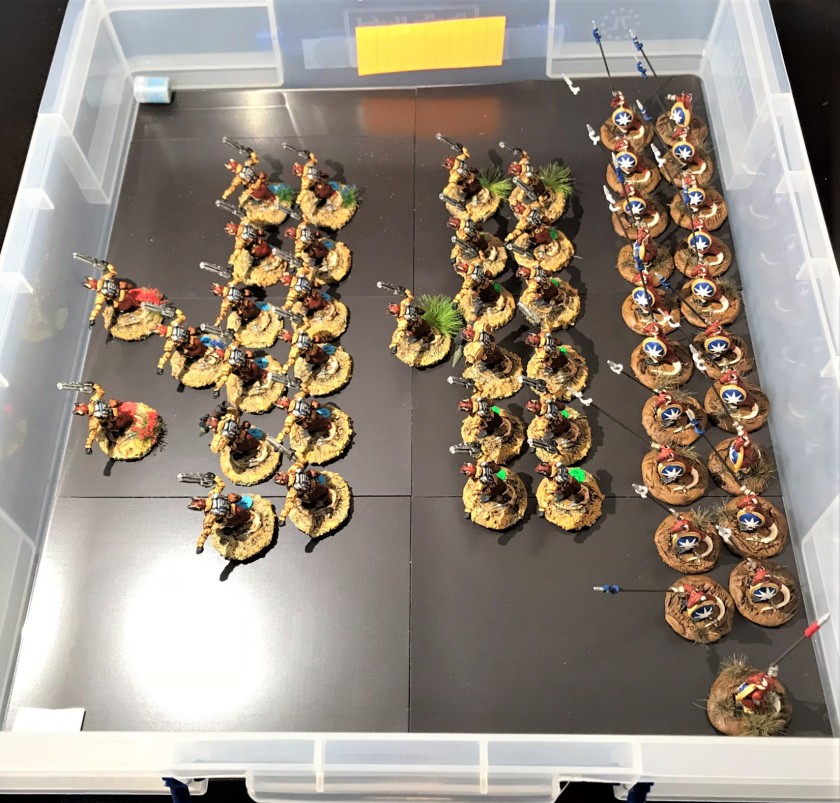
Two squads make a light platoon, but I think that they will be a potent elite fighting force on the tabletop. Also, these Roos are equipped with body armor on their torsos, and importantly, jet packs! I will also give them a higher rate of movement similar to what I did for the Space Phraints (1½ cards of movement). I cleaned and filed the models, and prepared them for conversion and priming by mounting them on 1″ steel washers.
The two squads behind their platoon leader and platoon sergeant. The weapons for conversion are on the left.
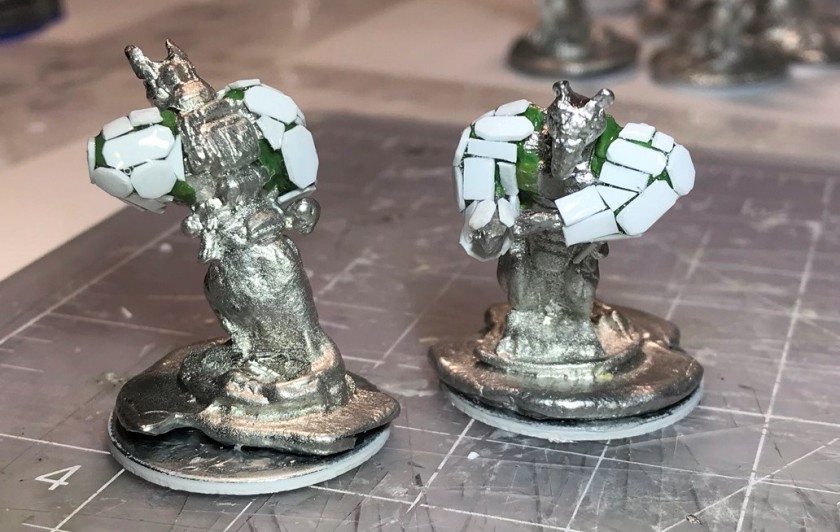
I had a tough time reorienting the arms of the RPG-armed Roos, and I needed to break them and use green stuff to create a proper pose. Pinning was not feasible unfortunately. I also used green stuff to mount the grenadiers’ launchers and to give them bandoleers of grenades. The grenadiers looked fine enough for the tabletop, but I was unhappy with the RPG Roos, as they looked “Popeye” like in their arms. As the Space Roos body armor gives them an angular body look, I decided to use a series of very small 2 mm polystyrene chips to create an “armored look” over the arms by affixing them with Gorilla glue.
The green stuff conversions – note the bulbous arms that needed attention on the AT Roos.My fix for the arms. You can see that my casts varied in terms of “crispness”. Clearly, I was going to need the brushwork to make these work.
I ended up double priming these figures, as I knew that I would need to fix much with brushwork and painting. For example, there was a large indentation on the Roos’ left feet (paws?) that I needed to paint over. I thought that a thinned brush priming followed by a thinned airbrush priming would help. I think it did.
The platoon primed
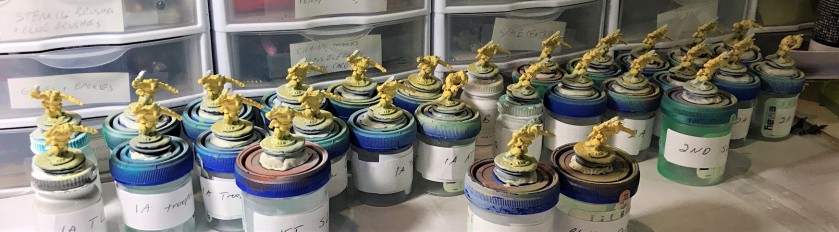
For their base colors, I went with a yellowy/sandy look for their armor, which I thought would reflect a desert or dusty deployment.
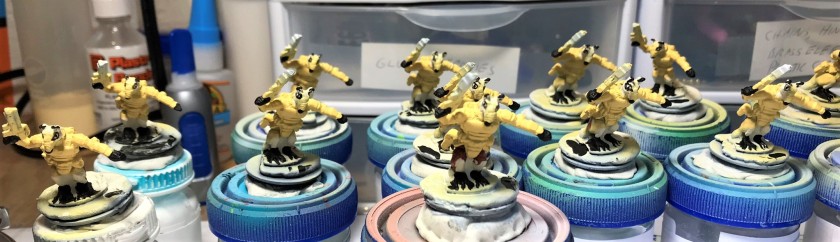
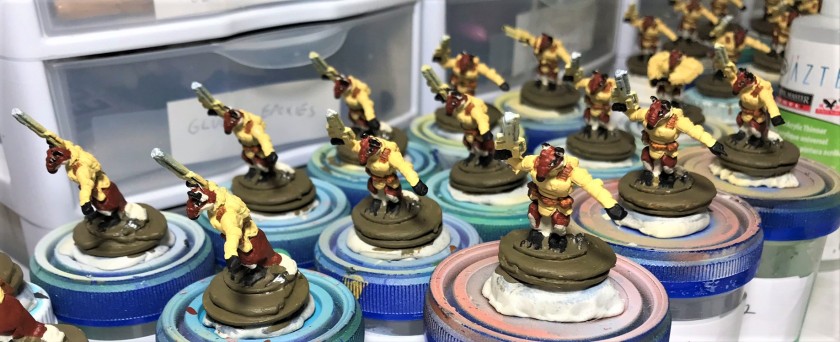
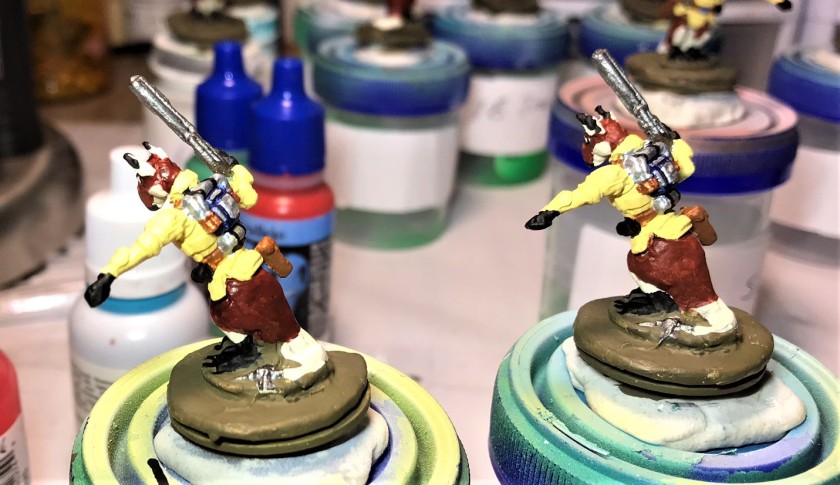
I airbrushed the armor with a yellowish/sand color. The idea was to use washes to bring out details (and allow me to obscure casting abnormalities). This would give me a nice camouflaged look at the end.Outlining the eyes, ears, feet, and gloves in black. I went with a red kangaroo coloring for the Roo parts .Moving on to fur painting. Inks and washes gave more depth to this later on.Jet packs!The bottom torso on the left has been painted with additional inks for depth.Comparison of the weapons – before (left) and after (right) dry brushing. The blue is indicative of the 1st Squad.
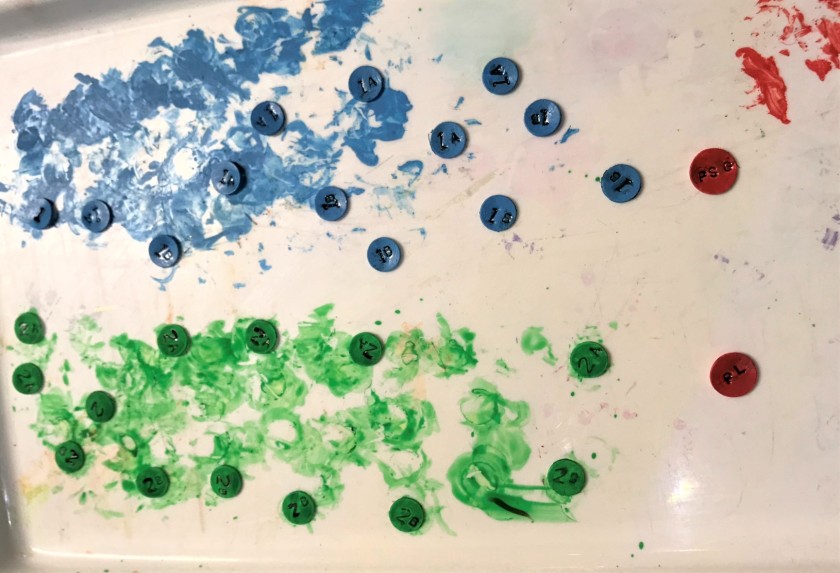
One of the issues I really want to focus on when I build a platoon is to make it easy for the players (some of us with “experienced” eyes) to see and identify a figure’s squad and team. I got some steel punches, and some jewelry stamps to make 1/4″ and 5/16″ placards that I could mount on the figures’ bases.
My 1/4″ punch and the two jewelry stamps next to the polystyrene placards. I did use 5/16″ placards for the platoon leader and platoon sergeant.The placards, stamped and painted. I used a wash to fill out the letters and numbers.Placard close up shot
Next, I washed the figures twice with Citadel “Agrax Earthshade”. I then mounted the RPG’s with Gorilla glue.
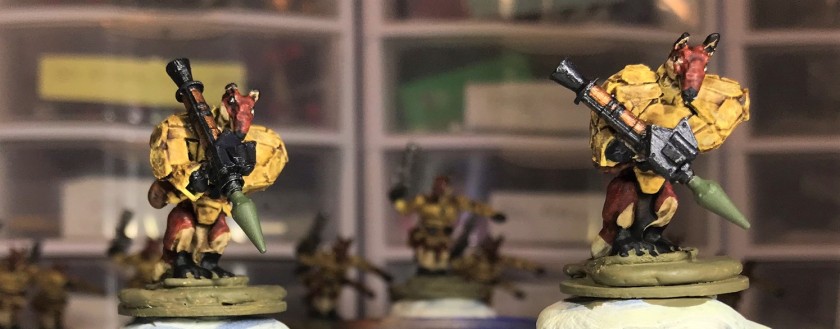
RPG Roos!
Lastly, I used a whole bottle of Citadel “Armageddon Dunes” to fill and shape around the bases and let them dry and harden. The placards were mounted into this paint. Then I gave the bases a wash with “Agrax Earthshade” and two different dry brush applications (Polly Scale “WWII German Armor Light Tan” and Vallejo “Light Brown”). Then I gave everything two coats of matte varnish.
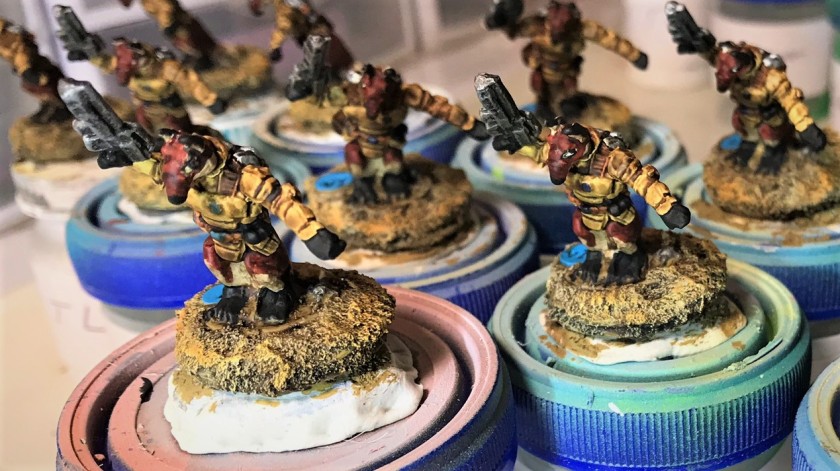
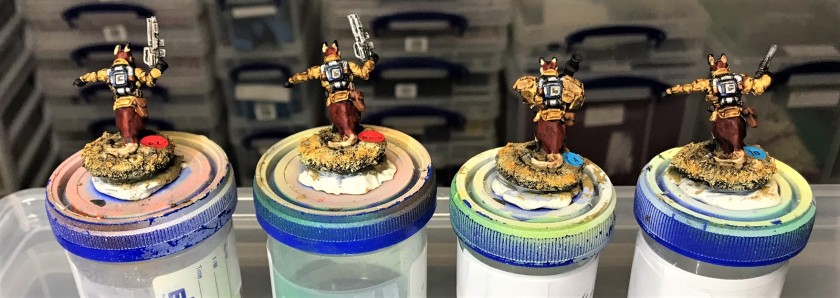
After filling the bases The platoon leader and platoon sergeant almost ready!Nice close up of the bases. The shading gave the body armor the dirty effect that I wanted.The four conversions of conversions, front……and back
After adding some tufts from Shadows Edge Miniatures for even better identification, the platoon was finally done (I LOVE their tufts). I am happy with it, given the work and effort it took to bring it to life. So, now, appropriately, I will share with you some eye candy!
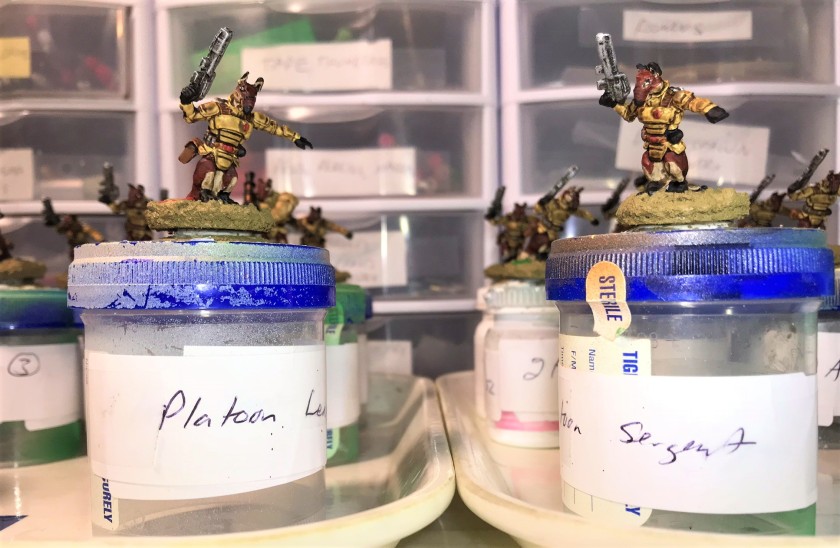
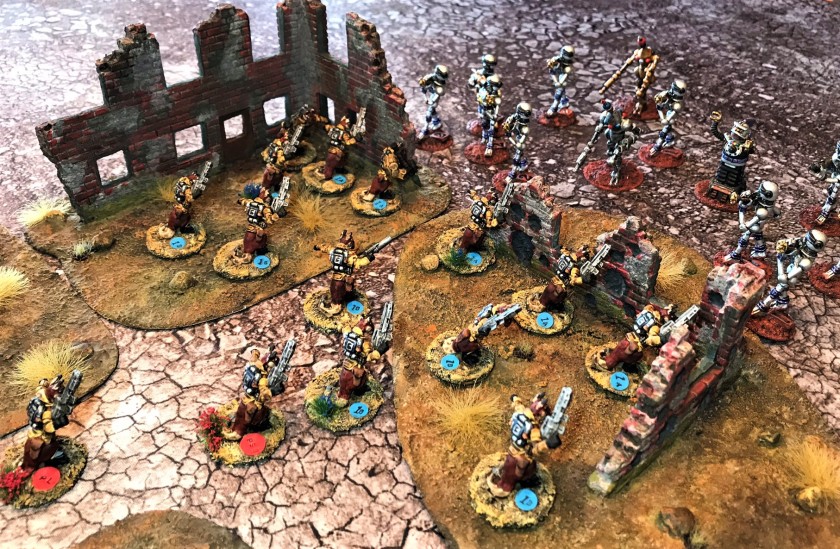
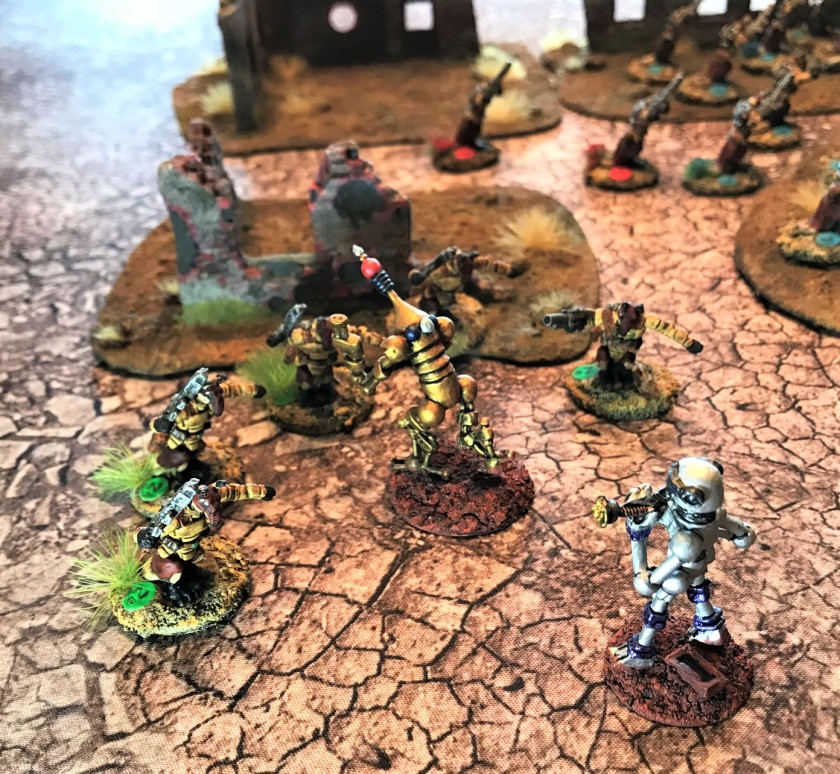
The platoon HQ, frontal view…and rear view, with a good view of the jet packs, red placards, and tufts. 1st Squad with blue placards2nd Squad with green placards and green tufts on the leaders.The AT and grenadier RoosThe Space Roos meet their ancestors, the Roomans!My box of Roos and RoomenThe Space Roos’ 1st Squad holds off the WarbotsThe 2nd Squad close Assaults Juggerbot
I am looking forward to seeing these guys in action soon. I appreciate your looking and hope that you enjoyed this post. I always read your feedback, so please let me know what you think in the comments section at the bottom of this post.
I dedicate this post to all my Aussie friends!
PAINTS, INKS, GLAZES, WASHES, AND FLOCKING USED:
Citadel “Imperium Primer”
Vallejo “Surface Primer – White”
Vallejo “Flow Improver”
Vallejo “Airbrush Thinner”
Testors “Universal Acrylic Thinner”
Vallejo Mecha Color “Sand Yellow”
Vallejo Game Air “Red Terracotta”
Citadel “Flayed One Flesh”
Americana “Bleached Sand”
Americana “Black Tie – Satin”
Vallejo “Black”
Vallejo “US Dark Green”
Tamiya “Copper XF-6”
Tamiya “X-20A Thinner”
Tamiya “XF-49 Khaki”
Vallejo Game Air “Weiss”
Tamiya “Gun Metal X-10”
Vallejo Game Air “Steel”
Vallejo Game Air “Beasty Brown”
Vallejo Mecha Color “Light Steel”
Vallejo Mecha Color “Dark Steel”
Vallejo Mecha Color “Metallic Blue”
Vallejo Game Air “Electric Blue”
Vallejo Mecha Color “Metallic Green”
Citadel “Hexwraith Flame”
Vallejo Mecha Color “SZ Red”
Secret Weapons Washes “Just Red” (ink)
P3 “Brown” (ink)
Secret Weapons Washes “Armor Wash” (wash)
Citadel “Nuln Oil Gloss” (wash)
Citadel “Agrax Earthshade” (wash)
Gorilla Glue
Citadel “Armageddon Dunes”
Polly Scale WWII “German Armor Light Tan”
Vallejo “Light Brown”
Vallejo Mecha Varnish “Matt Varnish”
Shadows Edge Miniatures 6 mm “Dark Forest Red” (tufts)
Shadows Edge Miniatures 6 mm “Dark Blue” (tufts)
Shadows Edge Miniatures 12 mm “Wild Tufts” (tufts)
Thanks again for looking and for your feedback! ESPECIALLY AUSSIES!
On October 20th, there was a Devens game day at the former Ft. Devens in Massachusetts. I was interested in attending for a couple of reasons. First, I am trying to get to more gaming events in the area. Second, I was stationed at Fort Devens while I was a member of the 39th Engineer Battalion (Combat) from 1989-1992, so I was intrigued to see the post again in its new configuration. Fort Devens was closed as an active duty US Army post in the 1990’s, and Massachusetts has redeveloped the post by bringing in a lot of industry. Still, some of the post is used by the reserves. In fact my old battalion area seems to have been saved and redeveloped for the reserves. That area is all fenced off now and I did not want to photograph the area and draw unwanted attention to doing so! Other buildings and barracks areas are untouched since closure, with actual trees growing out of the edifices yielding an apocalyptic/Walking Dead look. This blog post is a bit late, but I did get wrapped up in the baseball ALCS and the World Series, which were both won by the great Boston Red Sox!
The actual game sessions were held at the Fort Devens Museum. There were three games there – a WWI game, a naval game, and a pulp game. I did not get any pictures of the naval game but you can read about in an excellent post here. I focused on playing a WWI game (given that it is close to the centenary of the end of that conflict). The board is entirely scratch built, and I believe the rules were “Trench Warfare”, but I am not sure. The game master, Bill, did an excellent job, and I wanted to share his board as it was excellent. The event clearly tried to recruit younger gamers, which was admirable for growing our hobby.
Starting side for the Allies. From far to near, the attackers were US Marines, British, and French. It was a bit ahistorical but a fun game. While I commanded the French, I had two British tanks – a Mark IV and a Whippet.Another view of the Allies starting positions.A truly beautiful scratch built table. Bill (the game master) is pictured here standing. He did a nice job creating a trench works system with 2′ x 2′ modular sections.Some of the German forces – they were to engage the USMC is a series of bloody hand-to-hand battles.Advancing my poilus and tanksAn engaged group. Bill kept the game moving (unlike the actual WWI)!The Germans move up, and get hit by very lucky hits by my French 75mm artillery.The hand-to-hand battleTaking out the forward observation posts and then getting torched by a German flamethrowerGerman artillery disables my Mark IV
The game ended in a draw, but I enjoyed it a lot.
There was also a pulp game that I did not play in, but that looked interesting.
Pulp Alley GameDruids and Nazis? And Stonehenge?
Lastly, I looked around the museum and looked for anything related to my old unit. The only thing I saw was a donation from a former lieutenant from the 1977 time frame. I do think I could find a few things myself. Interestingly, I am a local, and the 39th had members who for the most part live in other parts of the country. I do commend the museum for trying to resurrect the posts history from WWI until closure.
The only mention of the 39th
My thanks to the folks who set up this event and to the folks at the museum!
Many of you who follow my blog have read about Buck Surdu, my good friend and author of multiple wargaming rules systems. Of course, he is a fellow West Pointer so that’s in his favor! He is a major shaker and mover in the H.A.W.K.’s (Harford County Weekly Kriegspielers) in Maryland, and has been involved with BARRAGE for years.
Little Wars TV interviewed Buck, and I thought some of you would find this interesting.
I fell in love with the Ral Partha fantasy offerings many years ago. Iron Wind Metals has a 3rd Kickstarter going and it’s worth looking at, especially if you are into Dryads/Ents or Fae.
This will be a very short blog post – but for those of you who love the old Archive Star Rovers figures, this will touch your heart! As many of you know, I have been collecting and painting Duck Wader, Star Ducks, Power-Armored Frinx, and a number of other Archive gems. I use them in Combat Patrol™ retro-sci-fi games – many of which my daughter Ellen Morin and her fiance Chris Smedile have played in and enjoyed.
Ellen’s birthday is in September, as is mine, but we did not get around to celebrating until the first Saturday in October. She got me a couple of very cool gifts. One was an awesome Boston Bruins sweater (cannot have too much Bruins gear by the way). The other was a painting of Duck Wader and some Frinx breaching a wall, with Star Ducks jet-packing through the air above! She used photos from my blog to sketch and ultimately paint the scene. I think it was an awesome gift! Here is the painting below:
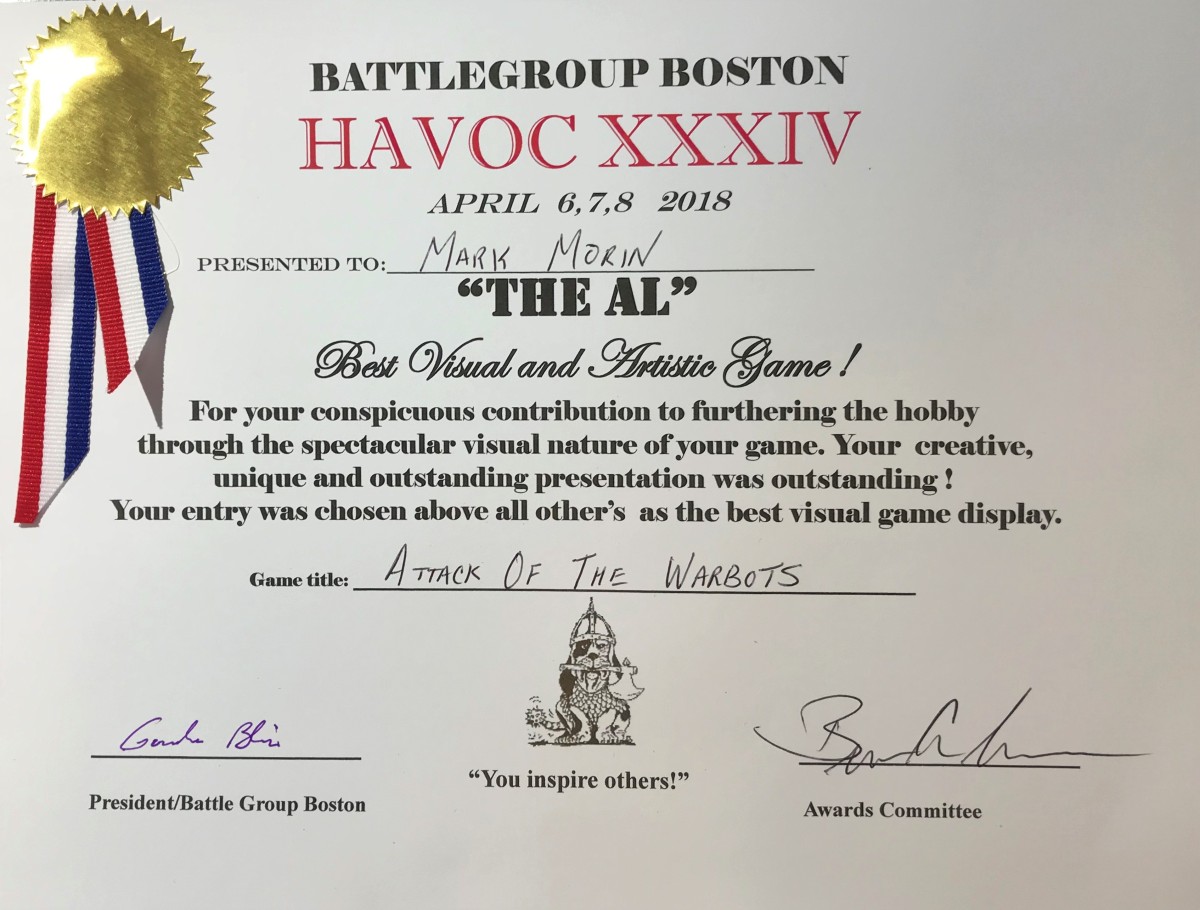
The H.A.W.K.’s held their BARRAGE convention in Havre de Grace, Maryland at the end of September 2018. They had over 70 gaming events, and it had been on my “hoping to attend” list for most of 2018. Also on my wish list was to be able to run my “Attack of the Warbots” game using the Combat Patrol™ card-based system. I was hoping to attend but was unsure (for several reasons) up to a week beforehand as to whether I was going to be able to go or not. In the end, the stars aligned, and I also got to run my game! Box checked!
There was a lot going on here – and I saw a lot of great games. The following is just a snippet, through my eyes, of the experiences that I had. The games and the game masters that I saw did an incredible job. Truly impressive. Certainly, the H.A.W.K.’s put on a great gaming convention and my kudos to all of them and the other game masters.
I started on Friday with running my latest iteration of “Attack of the Warbots” with my Archive, Mega Miniatures, and Wargames Supply Dump figures, all of which are OOP. I had seven players, with three on the Warbot side, and four on the defending side. Of note, I was lucky to have had as players both Buck Surdu (my old West Point buddy and the author of the Combat Patrol™ rules) and Dave Wood (my old West Point roommate who introduced me to tabletop gaming in 1982). I also had the good fortune to have Greg Priebe playing alongside Buck – and Greg wrote the Star Wars supplement for Combat Patrol™. Buck is very fond of ducks (in a good way of course), and was in command of Duck Wader and some Star Ducks, while Dave was on the Warbot side with a couple of Mark 1 Sphere tanks. Greg commanded the Aphids and the Frinx. A few other players were there but I did not get their names (sorry). The Warbots needed to recapture a lost Mark 1 before the defenders could repair it and get it off the board.
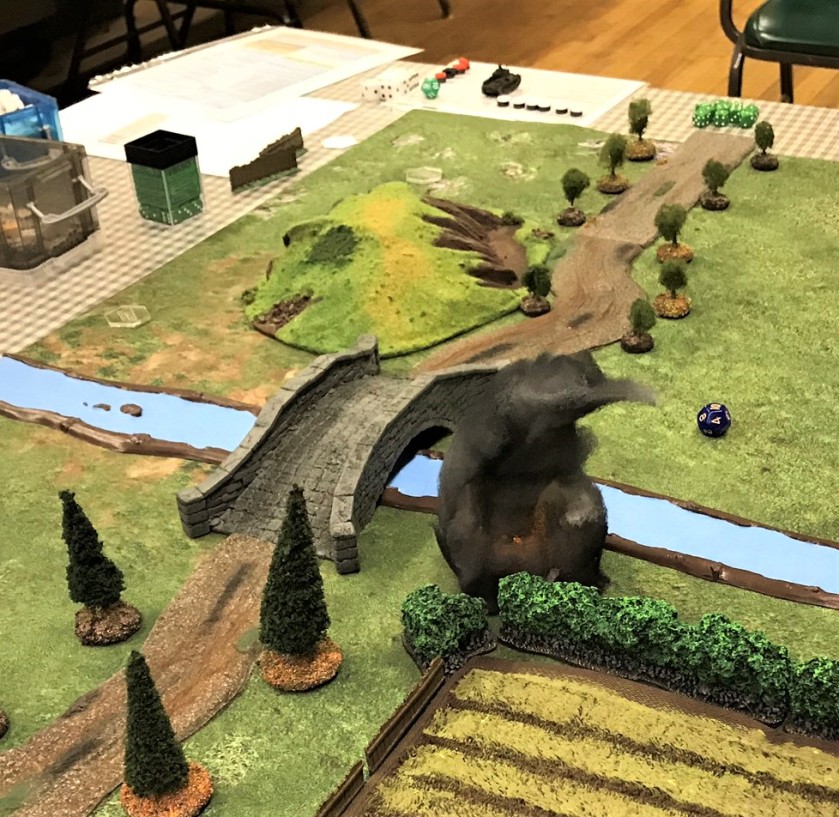
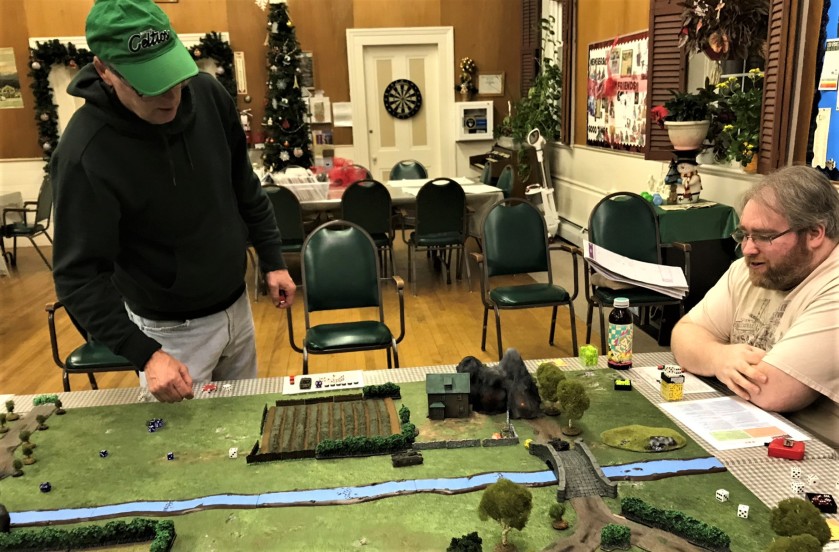
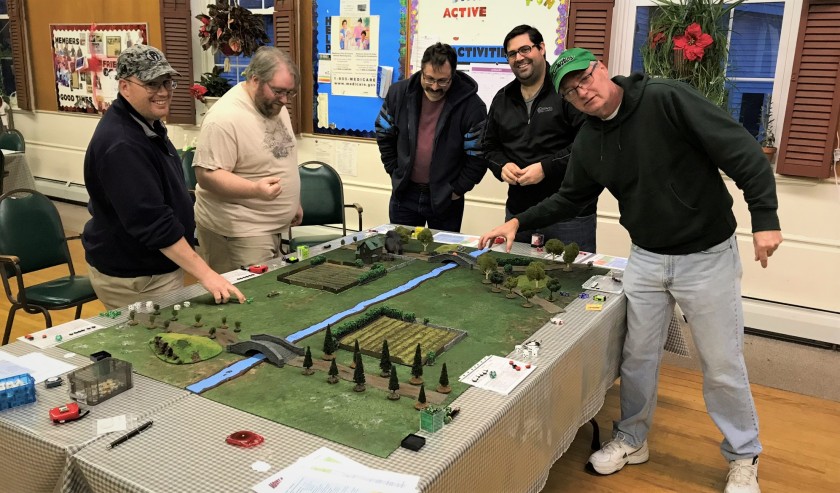
My flyer for the “Attack of the Warbots”Game set up from the attacking Warbot side. I got set up early, which is why there seems to be an empty hall, but it filled up quickly.Early action – the defenders gained the initiative and the Red Warbot squad on the left of the photo took casualties from effective Star Duck and Aphid fire. The Warbots smartly maneuvered a Mark 1 tank to attempt to breach the rusty steel wall defenses.Closer view of previous action showing Aphids in a bad place.Aphids strike back! They get a critical hit on a Red Warbot’s power plant, triggering a catastrophic explosion (smoke plume), which damaged several of its nearby comrades. This made this fire team have to make multiple morale checks (as shown by the red beads). One of these pinned the team in place for the remainder of the game. As the critical hit catastrophically destroyed the smoky Warbot, that plume would restrict line of sight for that pinned team as well!Dave Wood prepares to destroy the wall with his Mark 1’s Death Ray, and……the wall is breached, frying a few defending Star Ducks.Roberker moves towards the breach.Meanwhile, on the other flank, Duck Wader used a Force Leap to engage the Green Warbots in melee. He was able to give the Aphids on that side a brief respite. Wader got initiative again before the Warbots, and was able to Force Leap back to safety after damaging several Warbots with his light saber.Back on the right, the Warbots get one of their two Mark 1’s within a few inches of the building where the captured tank was being repaired. SSG Canvasback (yes, he has a name!), the 2nd Squad Leader, fires his Quackers Repeating Blaster and got a lucky hit, knocking out the tank’s left auto cannon sponson. This allowed enough suppressive fire cover for the Star Duck Squad led by SSG Gadwall to close assault the tank with satchel charges……and successfully knock out the Mark 1!! Roberker, a giant flame-throwing robot was following closely behind, but another critical hit from Greg Priebe’s Frinx immobilized the giant robot, stalling the attack.At the same time on the left flank, Duck Wader again Force-leaped over the wall into the midst of the Green Warbots, and launched a Force-Blast attack. This sent waves of destructive energy through the closely-crowded Warbots. Many were damaged, and one even had a power plant explosion, which caused even further damage to that team and multiple morale checks due to a second explosion. These morale checks eventually disrupted the attack as the Green Warbots either ran off the table, or got into a massive traffic jam at the breach. Here, you see Duck Wader after he had dispatched the Warbots. He was wounded, but had wreaked havoc on the Warbots.At this point, the other Warbot tank was immobilized, and the game was called as a defenders’ victory. It was a near-run thing as the defenders were unlucky in rapidly repairing their captured Mark 1, but they would have been able to complete the repairs. Here are some of the happy defenders – Rob Dean, Buck Surdu, Jim Stutzman, and Greg Priebe.
I then turned into a player, and decided to try a Lion Rampant game ably run by Philip Jones. We were the Vikings who had seized prelates, monks, and treasure in a raid, and were trying to escape to their longship, while being pursued and blocked by Welsh troops.
“Llandaff is in flames, the bishop and his monks carried off- but the men of Glywysing have the Vikings trapped between two forces as they try to get back to their ships. Will they break through or will Bishop Cyfeilliog be rescued?”My forcesOur initial deployment – Welsh would block us and harry us from the rear.The Welsh harry from the rear and Dave Wood prepares for battle.Vikings moving out.Crossing the river and all looks good……until Welsh forces combine to slow and stop us.A monk escapes!
Our casualties mounted! The game points were tallied, and rightly called for the Welsh. I did find the system fun, and Philip ran the game in a very fun way.
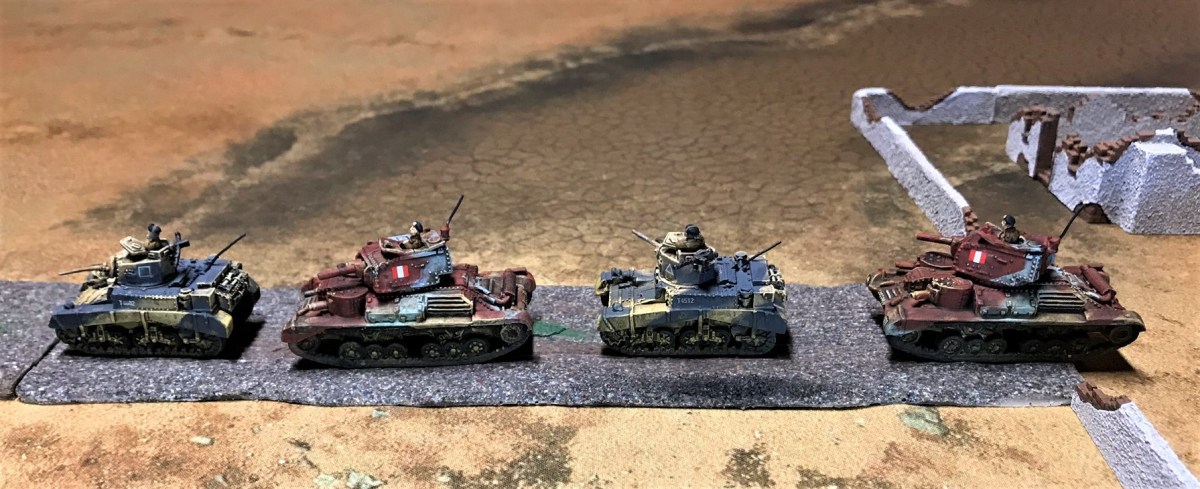
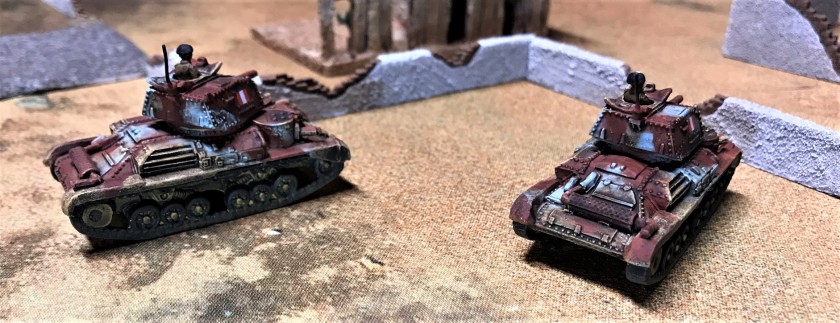
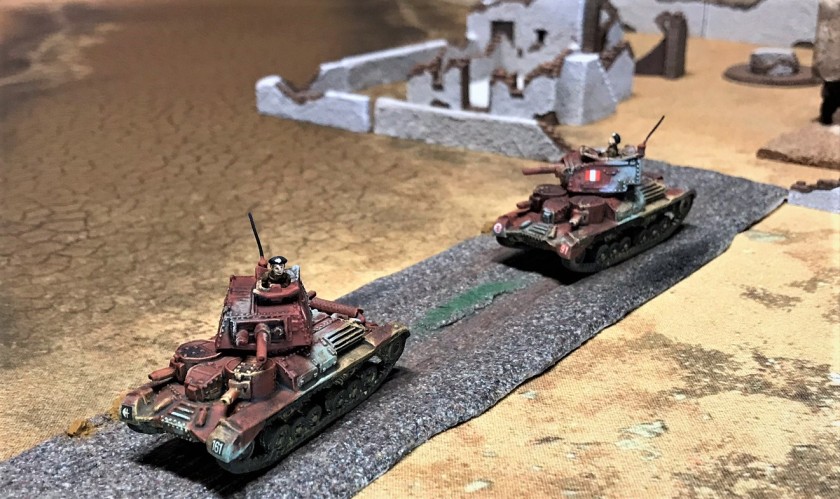
After this, I was walking around, and was recruited for a “What a Tanker” game run by Brian Lipscomb. It was set in North Africa, 15mm scale, with the British set against the Germans and Italians. Brian asked if I wanted to have a German or Italian tank. Being a sucker for a challenge, I of course said Italian. I was given a Fiat M13/40 tank.
My M13/40 tank sheet. Brian did a nice job with using magnets for managing data on the sheets.I am pursuing a rear shot on a British Stuart “Honey”. He slipped away, for the moment…Don Hogge pursued me in his Crusader II to take the pressure off the Honey. Don shot at me and missed. I rotated, fired, and smoked his tank.This allowed me to renew my approach on the Honey. I got hit with minor damage to my running gear. I returned fire, and got the Honey with my first shot. That’s two tanks! Later, I finished off a Matilda II for my third kill (on the deep left) – and all this with an Italian M13/40!
Needless to say, I really enjoyed this game and the mechanics. Brian is a superb GM. More on that in a bit…but this was a fun way to end Friday!
On Saturday, I had really looked forward to playing Buck’s Sea Lion game. There weren’t enough players, so it was called, BUT I wanted to share the unbelievably beautiful game set up. Buck will run this game at Fall In and you can read about a play test of the game here.
Rear of the tableSome Women’s Land Army troopsGreat scenery – these are the Germans assaulting the beach.Another view of the beach and wharves. Landing craft in front held two 35(t) tanks, and a Panzer III.Nice bars with British sailors and folks hanging out…or are they?
So again, I wandered around, and saw another Brian Lipscomb “What a Tanker” game, this time set on the Eastern Front. After Friday, I was happy to give it another go. I was teamed with two others who had not previously played the game. We had a certain number of points, so I volunteered to take a lesser tank (a T-70 light tank) so that they could have better ones – in this case a T-34 and an SU-76.
Love what he did with these data sheets and the magnets! This is for the T-70.I maneuvered alongside the T-34 and put the killing round into a Panzer IV. Kill #4 for the weekend.
At this point, Don Hogge and Buck Surdu visited the table put up a dollar each for anyone to kill me! Talk about motivation! We were being outmaneuvered by the Germans at this point, so I moved back and used my kill points to upgrade my T-70 to an SU-85.
My upgrade to an SU-85.
The scenario that Brian devised also had infantry (controlled by him as the GM and using a random events chart) – with the town as an objective. I used the SU-85 to hammer the German infantry as Soviet infantry was arriving. I killed four stands and got a bunch of kill points. I reminded my teammates that I had started off as a T-70, and they gave me one extra kill point, which allowed me to get a monster ISU-152. At the same time, the Germans were reinforced with a Jagdpanther and a Sturmgeschutz III.
My last upgrade – the ISU-152.
Immediately I maneuvered the ISU-152 to hit more infantry. The Germans decided to try to get me with their Jagdpanther and the Sturmgeschutz III. I moved my tank destroyer next to a building to face the Jagdpanther down the main street. He fired.
He missed!
I returned fire and destroyed the German tank destroyer.
My ISU-152 nails the Jagdpanther. Kill #5 for the weekend.Jagdpanther burns.
At this point, the Sturmgeschutz III was maneuvering to get a flank or rear shot on me. As the ISU-152 is very heavy and slow, I was only able to spin to face the Sturmgeschutz III. It was a question of initiative – and I got it, hit the German assault gun, and got kill #6 for the weekend (and the $2 bounty on me!).
I then participated in a play test for a near future warfare scenario using cyber warfare with the Look Sarge No Charts system. It was run by Dave Wood and was interesting to do.
Dave explaining the system.Assault on the hill.
Every BARRAGE there is a pickup WWI air combat game that is a hoot. I’ve never managed to get a kill in the game before, but I did this year as a German. Eventually, I got shot up and had to glide home.
WWI fighter game – I had the red plane in the center.
The last tabletop game that I played in was a First Boer WarCombat Patrol™ game. I was on the Boer side and we had to defend our wagon from being seized by the British. The game was fun, but there was a low point. We had a couple of players from New Jersey who vanished mid-game without so much as a notice that they were leaving. I think they hated defending. Anyways, we struggled on and ended up winning the game. The other players were great sports, and were great company.
Boer War game
After this game at the end of the con, I got to play in the traditional LARP pirate game. I had a nerf crossbow (treated by the GM as a musket) that took out Buck with a shot to the glutes. My weapon later misfired, and the resultant damage took me out. That LARP is always a fun game though!
The flea market presented many vendors and items for sale. I grabbed a Verdun game that I had last played with a gaming club in Monterey, CA in 1985! I’m not sure when I will get to play it, or with whom, but it was OOP in 1985, so a nice find! Buck and I visited the Verdun battlefield in 1987 or so, so it was nice to get this game here.
I must congratulate again the H.A.W.K.’s on a well-run con. Little Wars TV attended and filmed so you can see more of the convention here.
Thanks for looking and as always, I love any feedback!
We had a good showing on Saturday at the September Mass Pikemen Gaming Club session. We played an “Attack of the Warbots” scenario using the Combat Patrol™ system.
The biological Alliance (Star Ducks, Space Dwarves, Frinx, and Aphids) have captured a Warbot Mark 1 Sphere tank and are attempting to repair and convert it to their use. The Warbots have landed a large force and aim to deny their enemy this loss of technology. Can the Warbots be stopped?
This one, like all of the games that I run, was modified for playability based on experience and the number of available players. This time I also got to add some new terrain and my new Wastelands gaming mat (which I described here and here). I did not take as many pictures as I had wanted to – but what I have is below.
The Aphids held up the Warbot attack and were almost wiped out by the Warbots. However, they did delay them enough to achieve a victory, however, the tide of battle was about to turn so it could have ended differently. Time just ran out on the Warbots.
The photos below are the set up and a bit of initial play.
The set up from the defenders’ side.
Set up from the attackers side. Reinforcements await deployment on the table’s edge.
Aphid casualties pile up as the Warbots move forward. The Aphids, defending the middle crater, were able to get a very lucky critical hit on the Warbots’ platoon sergeant, causing a catastrophic explosion of its power plant (the smoke plume in the center above). This explosion also killed and wounded several Aphids, and dented a couple of nearby Warbots.The Warbots move into the smoky crater that once held a squad of Aphids. The Warbots used a plasma ball breacher to fry the bugs, hence the smoke plume.Aphid and Star Duck mortars add to the chaos of the battlefield as the Warbots breach the initial wall defense and roast an unlucky Star Duck alive. Biological Alliance reinforcements move up on the right.
This fun scenario, with some minor tweaks, will be coming to BARRAGE on 9/28/2018!