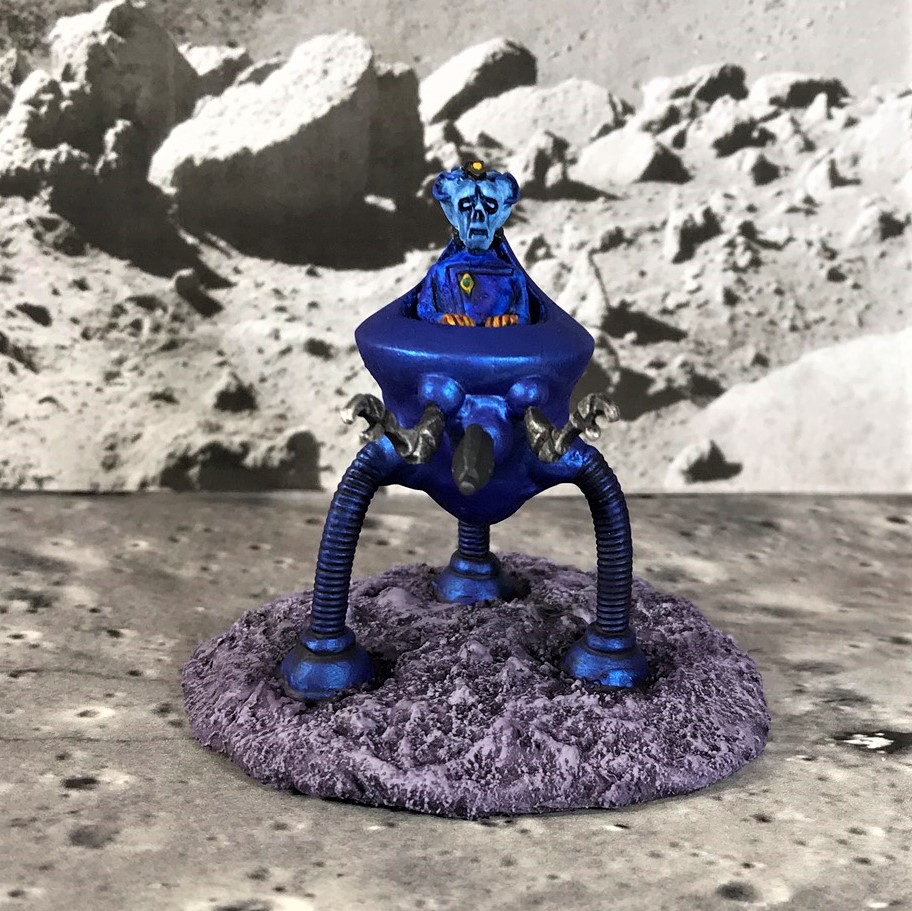
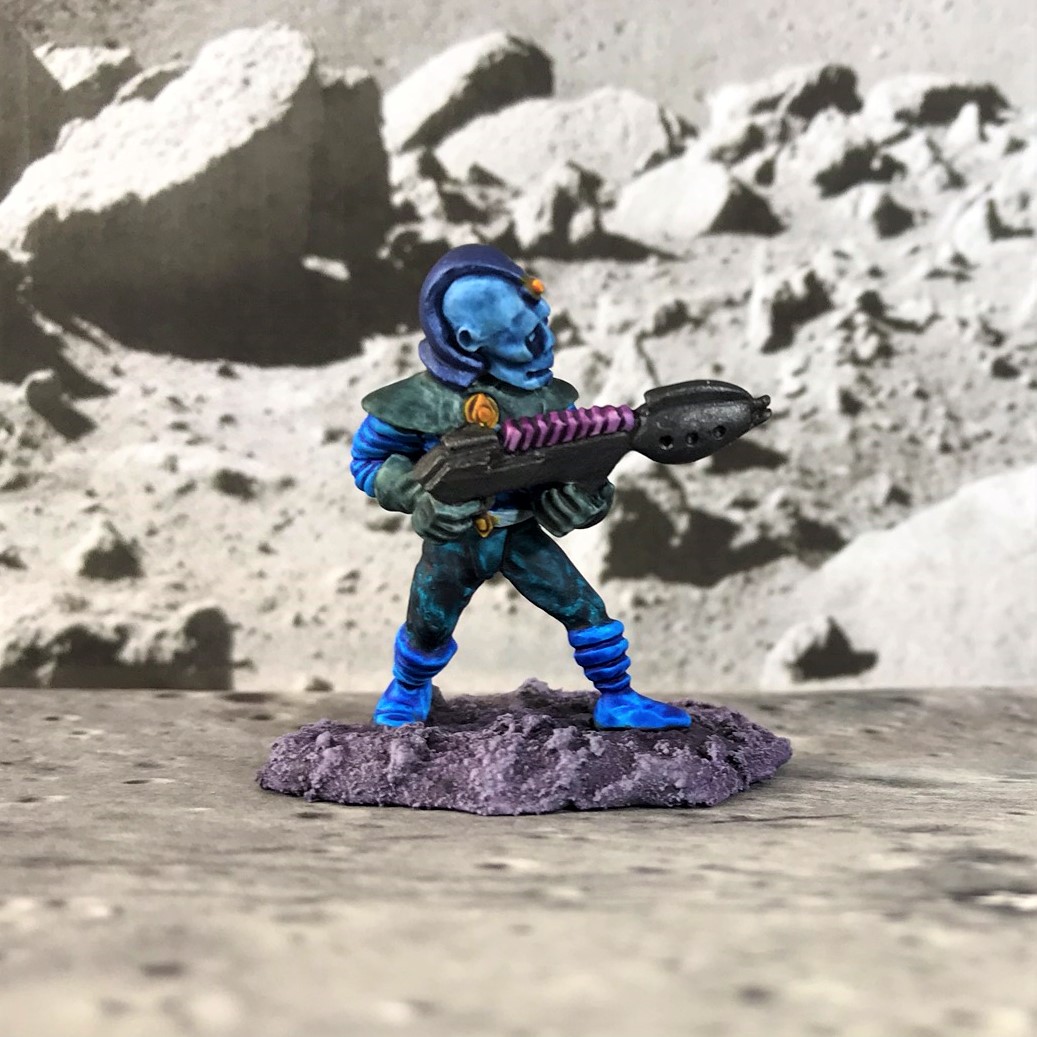
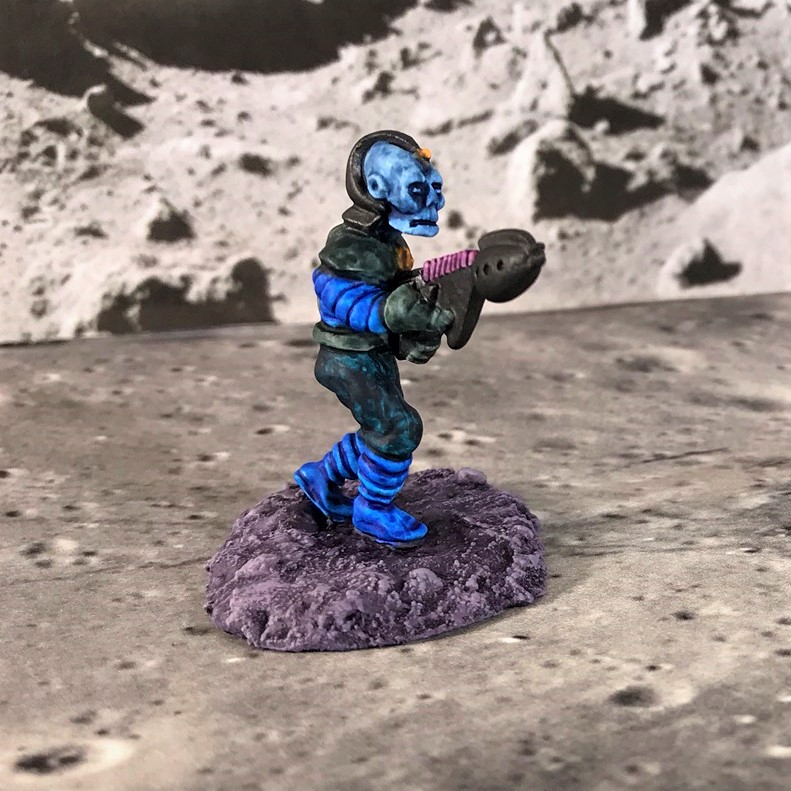
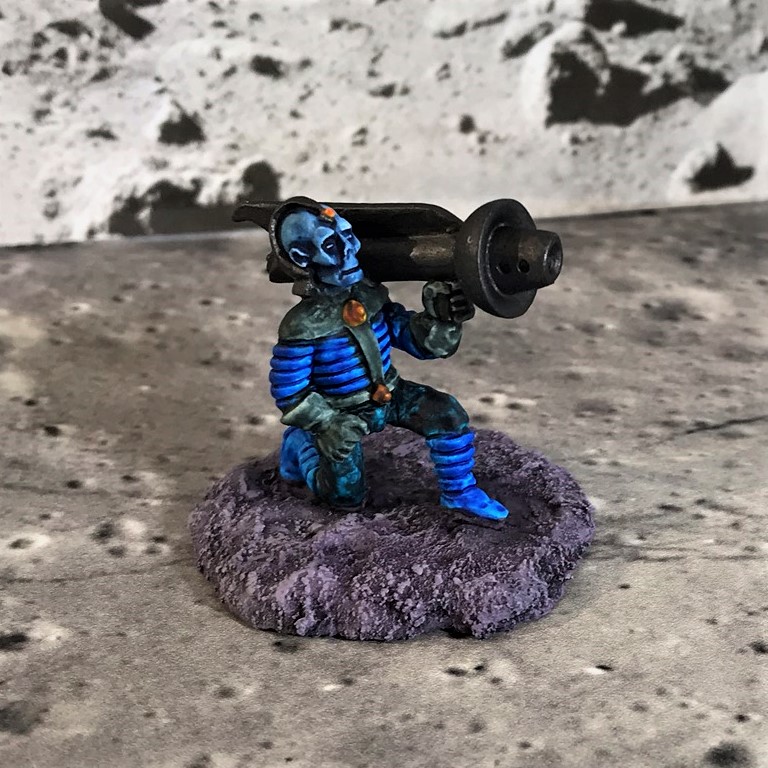
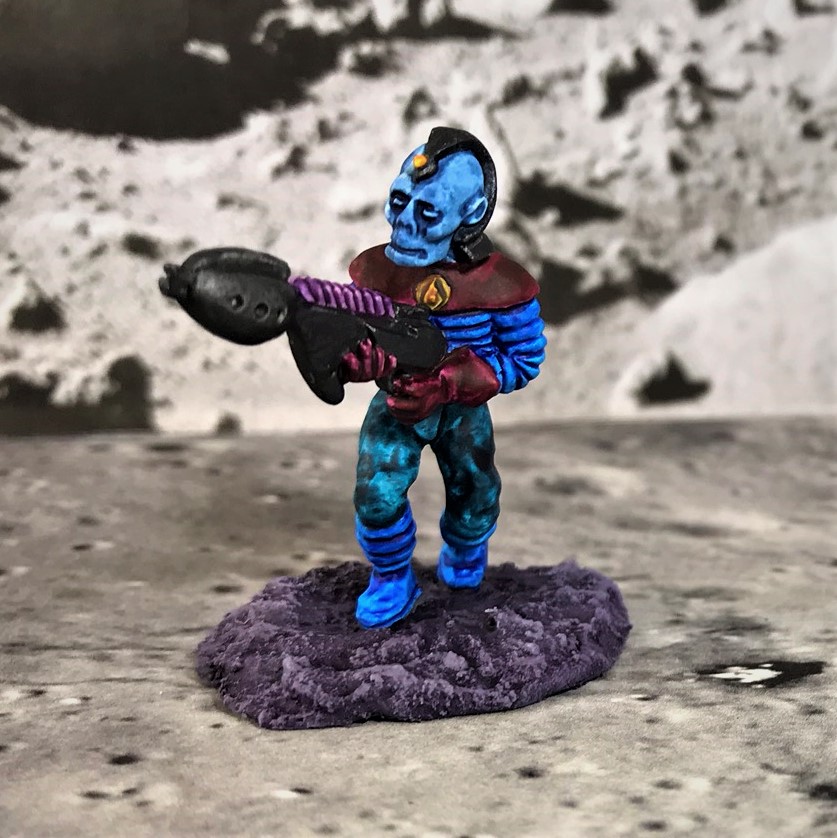
RETROVIANS!

Back in March of 2017, I learned that the UK-based War Games Supply Dump Miniatures was closing after thirteen years of business.  My problem at that time was that I had wanted to get more of their fun-looking retro-sci-fi figures.  I had already very much enjoyed painting the Khang Robots I got from WSD for my Warbot platoon that serve as squad leaders in that unit.  I had also seen many of WSD’s Dirk Garrison sci-fi line figures on Buck Surdu’s blog.  I needed to get some while it was still possible to add to my forces for Combat Patrol™ retro-sci-fi games.

As time was limited (as was Roger’s remaining inventory) I placed a sizable order with Roger for several groups of 28mm scale figures that would be suitable for building platoons – including Khanopians, Valkyrie Space Pirates, and miscellaneous items such as Space Munchkins and my Robo-servo Guns that I posted about here previously.  After finishing my Macron unit, I decided that it was time to get some of these languishing WSD projects painted, starting with the Retrovians.

By the way, many of you who follow this blog may recognize Roger as the author of the blog “Rantings from Under the Wargames Table” – a fun blog that unfortunately Roger ended in April of this year (you are indeed missed Roger!).

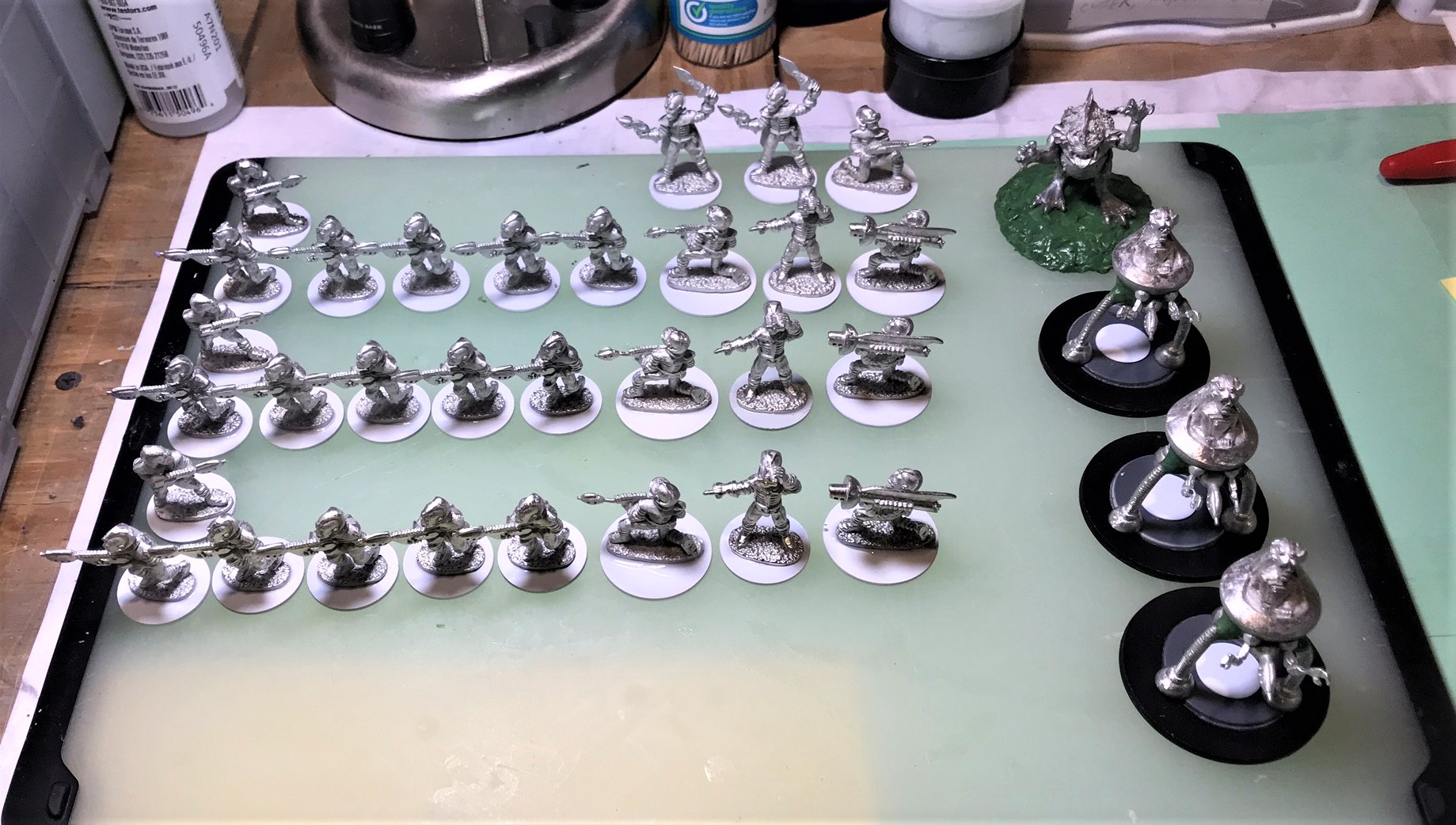
I was not able to order all of the Retrovian models, but a decent assortment of ones of different poses.  I got the following 34 from Roger to build a Retrovian platoon:

  • 3 DG-07 “The Bra’sheer” figures/three-legged vehicles
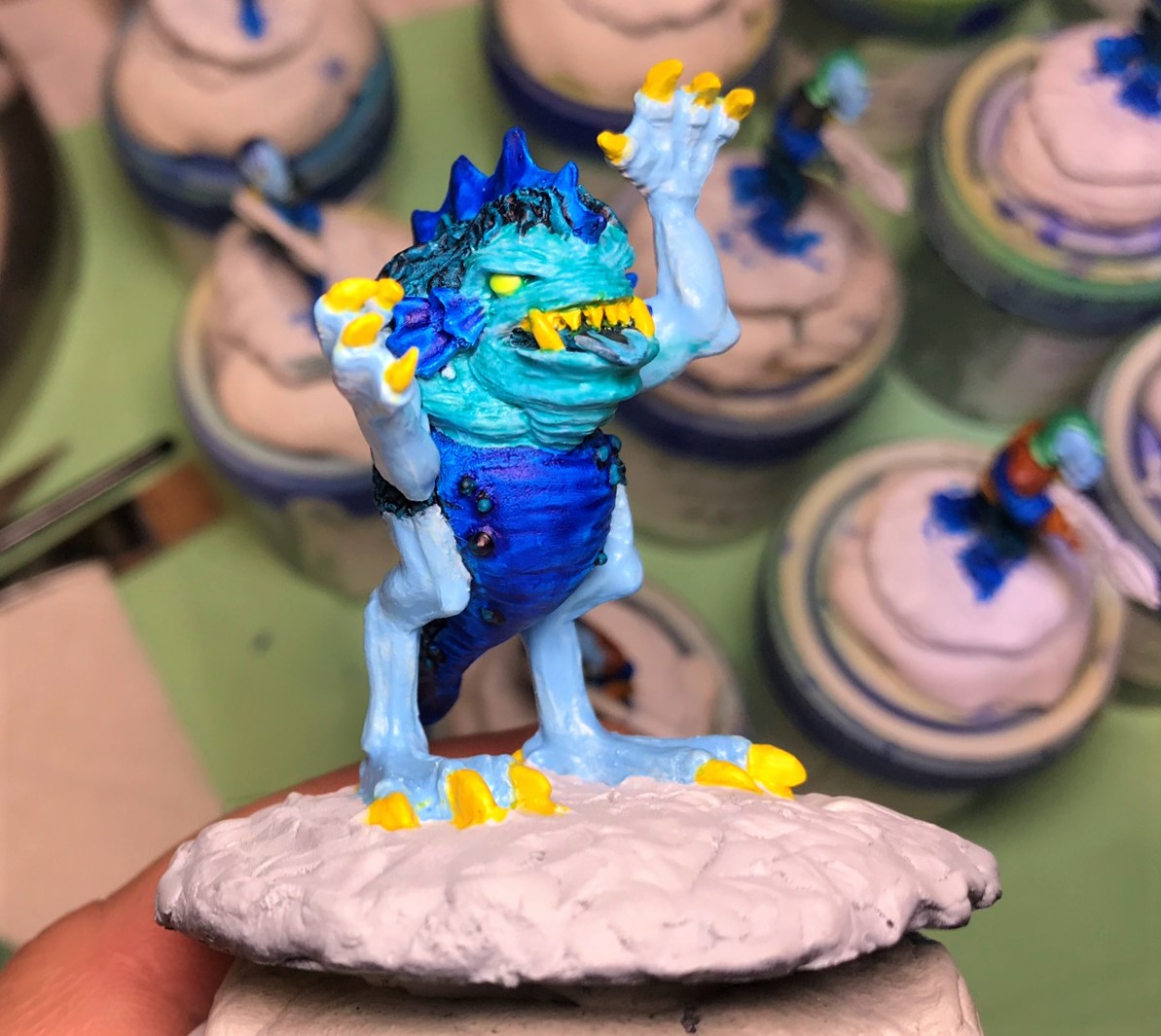
  • 1 DG-11 “Garkkon” figure (Retrovian Monster)
  • 2 DG-50 “Retrovian Captain w. Sword & Pistol” figures
  • 3 DG-54 “Retrovian Trooper Aiming Blaster” figures
  • 15 DG-55 “Retrovian Trooper Advancing w. Blaster” figures
  • 4 DG-56 “Retrovian Sniper w. Vision Enhancer & Needle Blaster” figures
  • 6 DG-56 “Retrovian Two Man Sonic Cannon Team” crew figures (one had a sonic cannon, one had a pair of sci-fi binoculars – 3 of each)

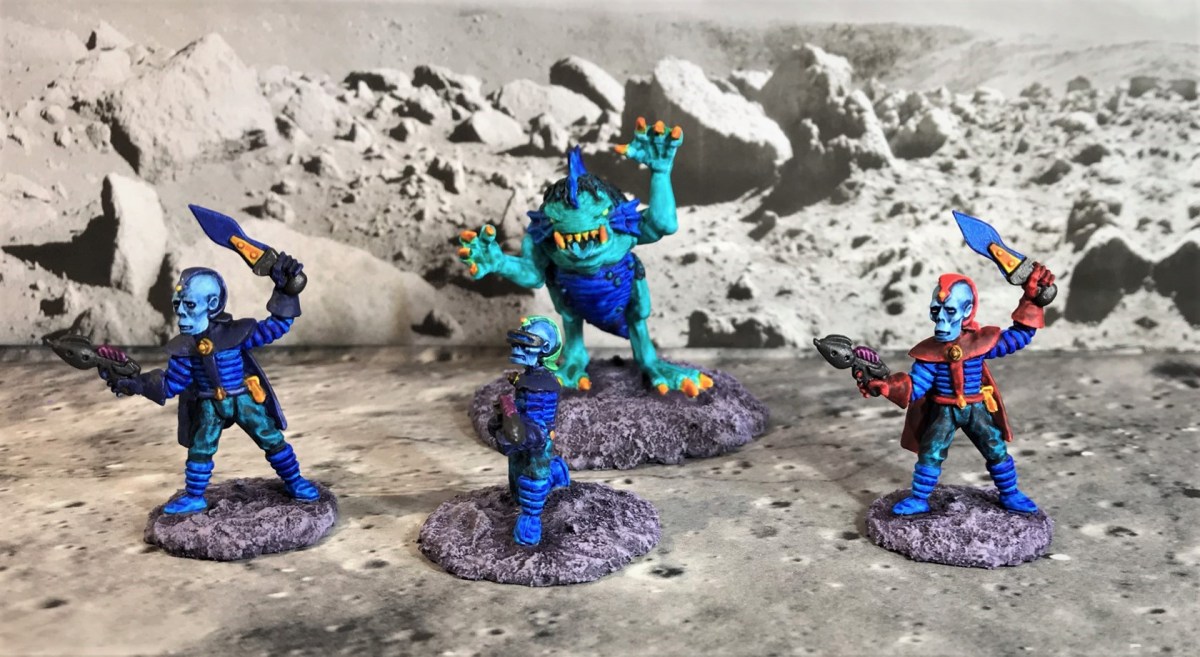
In deciding how to construct the platoon, I needed to consider how to build something that would be useful as a unit – and that would have some sense as to its build.  I also have been watching a number of early 2000’s Star Trek “Enterprise” episodes (that I never saw when the series ran).  I have become very fond of the Andorians – and Jeffrey Comb’s portrayal of Commander Shran.  The Andorians had not been much seen in the Trek universe since the original 1960’s Star Trek.  I decided that in homage the Retrovian platoon would be completed as blue skins and with some Andorian names.

Andorrians (2)
I had these dudes – less antennae – as color inspiration.

As far as structure, I had enough to create three line squads of two teams.  There would be 10 figures in a squad: a squad leader, an A team of a team leader and four troopers, a B team of a team leader (the binocular half of the Sonic Cannon team), a Sonic Cannon gunner, a marksman/sniper, and a Bra’sheer Assault Pod.  The Bra’sheer I envisioned as having an automatic weapon and mechanical claws that could tear apart obstacles, walls, or enemies’ heads and limbs.

That left me with enough figures to make two other sections.  The first is an HQ section (composed of a platoon leader and a platoon sergeant).  The second is a Garkkon section (reporting to the platoon sergeant or platoon leader) with a marksman in control of a giant Garkkon monster suitable for melee.  The Garkkon is a hybrid of a fish, a lizard, and a giant chicken – it’s quite amusing to look at.

Retrovian Unit Organization
The Retrovian Platoon organization.  Each die represents an element that can be activated in a Combat Patrol game.  The platoon therefore has 9 possible elements that could be activated.

I will share how I assembled and painted the Bra’sheer pods and the Garkkon, then go into the infantry.  Then I’ll share some eye candy that I hope you will like, as well as a glimpse into some of the play aids I made (with help from Buck Surdu) for these in club or convention game play.  Lastly, I will share a list of the paints and materials used in the making of this platoon for those interested.

The Bra’sheer

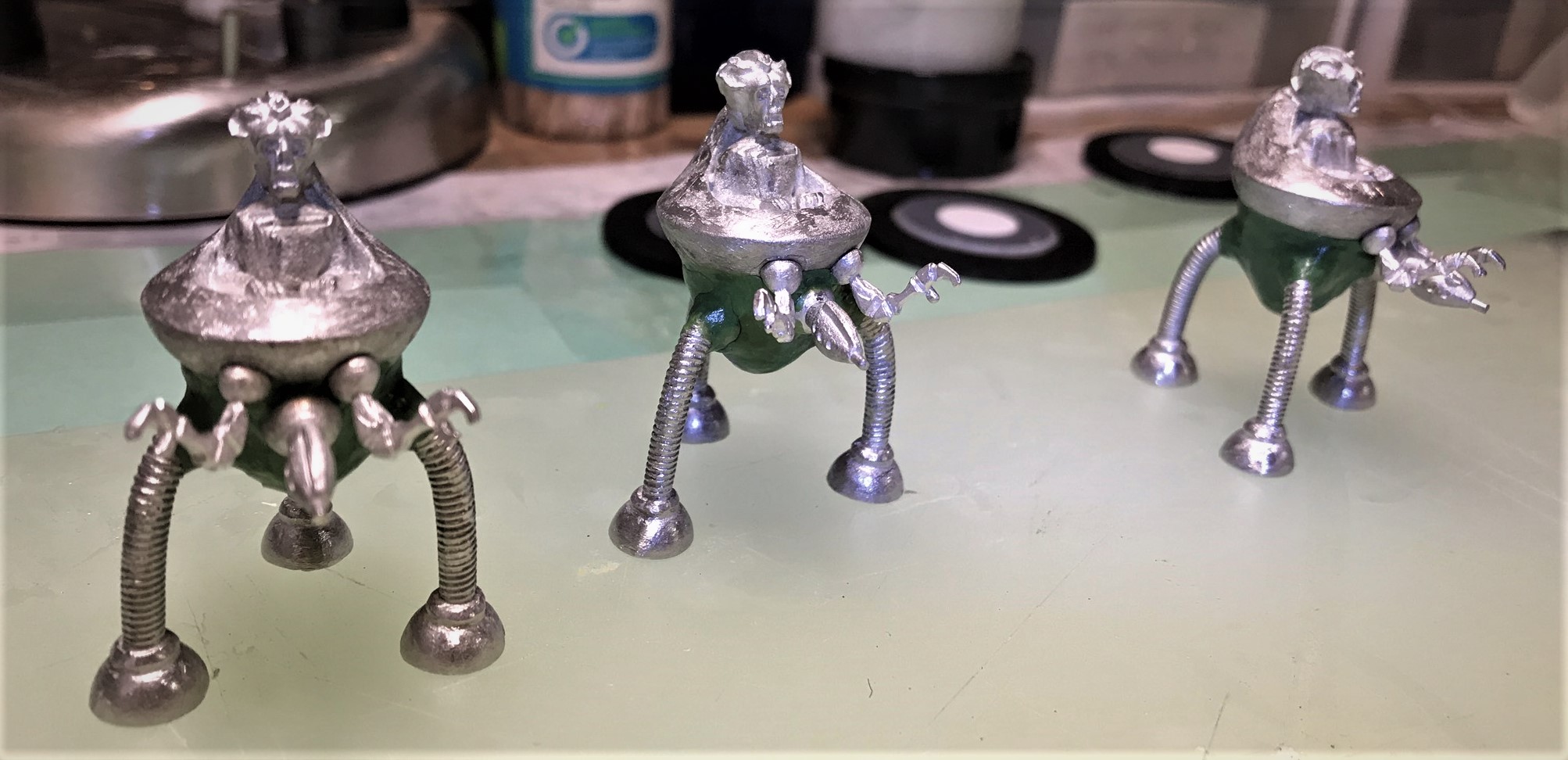
I believe the Bra’sheer were sculpted by Brad Shier – given their names.  The three Bra’sheer figures were, like all of these, great sculpts.  As I had three, it made sense to assign one per each squad on the B teams.  Assembly-wise, I did have a good amount of filing and filling with green stuff to do on these.  Also, the process of assembly was a bit difficult as I wanted to get the legs in position such that the chassis were level.  I ended up needing to affix one leg at a time and check if they were level.

1 Assembled Bra'sheer
The Bra’sheers in front of the 2″ steel fender washer bases – that also had 1.25″ steel fender washers, .5″ stainless steel fender washers, and polystyrene card as part of the base.  The Garkkon is on the right (more on it later).
2 Assembled Bra'sheer with green stuff
Close up of the assembled Bra’sheer
3 Assembled Bra'sheer with basing
I took the multi-washer bases and scribed the leg positions on them in pencil.  Then I added Apoxie Sculpt, and some Army Painter flocking (see materials list at end of this post).  Once this had hardened overnight, I affixed the Bra’sheer with E6000 to the bases.  Here, these look like bad cookies…
4 Bra'sheer with poster tack
Here you see a primed Bra’sheer with green stuff additions to the chassis and some poster tack on the crewman.  I needed to add green stuff to fill in gaps and make the legs structurally strong.  There were mold lines on the legs that short of obliterating the detail I could not get rid of – so I dealt with these later with painting.  The poster tack was to protect the crewman from being painted with the pearlized blue paint I used on the chassis.
5 Bra'sheer after base coat
After painting the legs and the chassis.  The legs were heavily shaded after the pearlized paint was applied to mitigate the mold lines.
5 Bra'sheer after washes and painting bases
The model is in the final stages here – I used multiple paints and products on the bases alone.  The Bra’sheer were the only Retrovians with “veiny” heads

The Garkkon

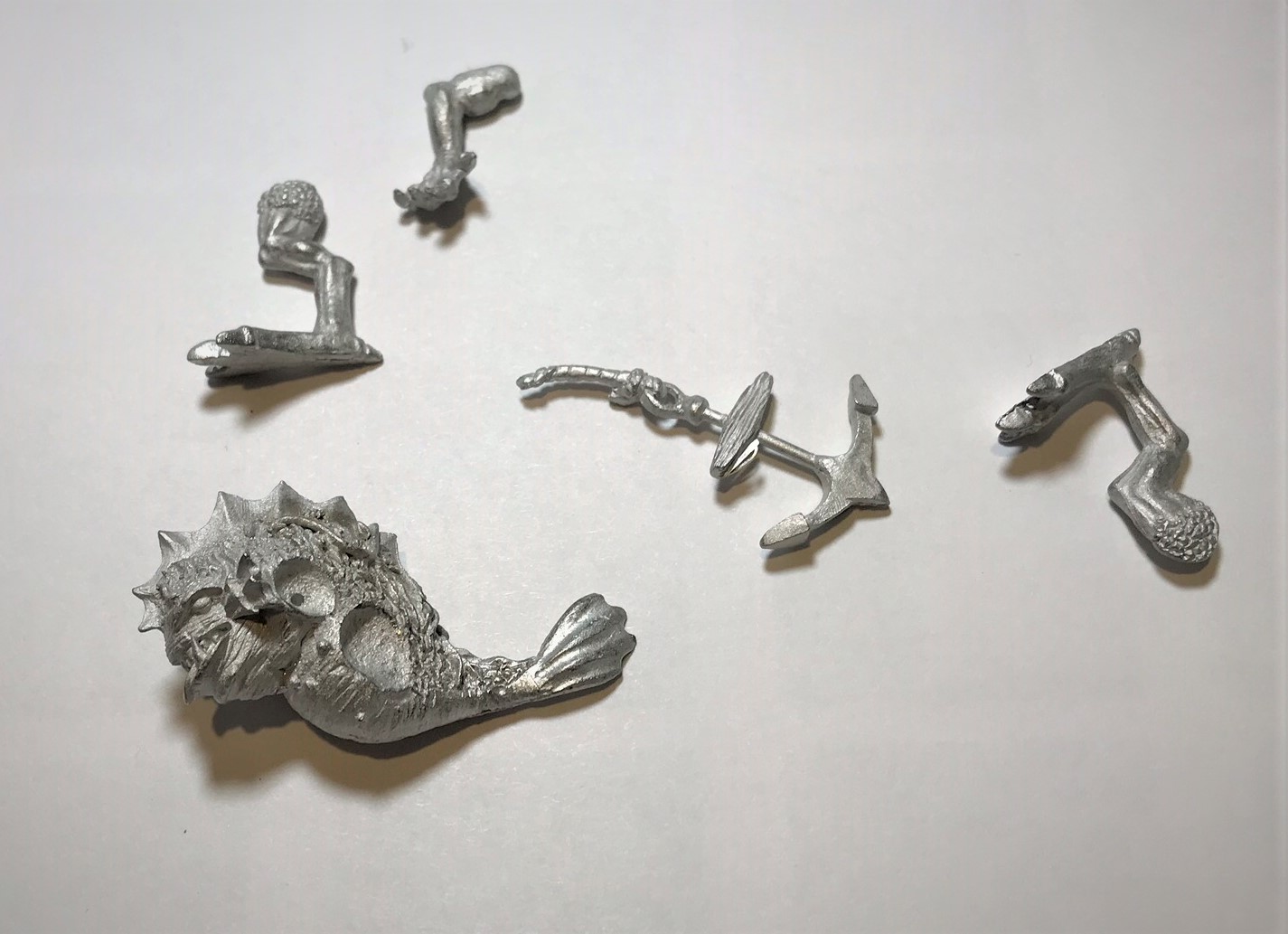
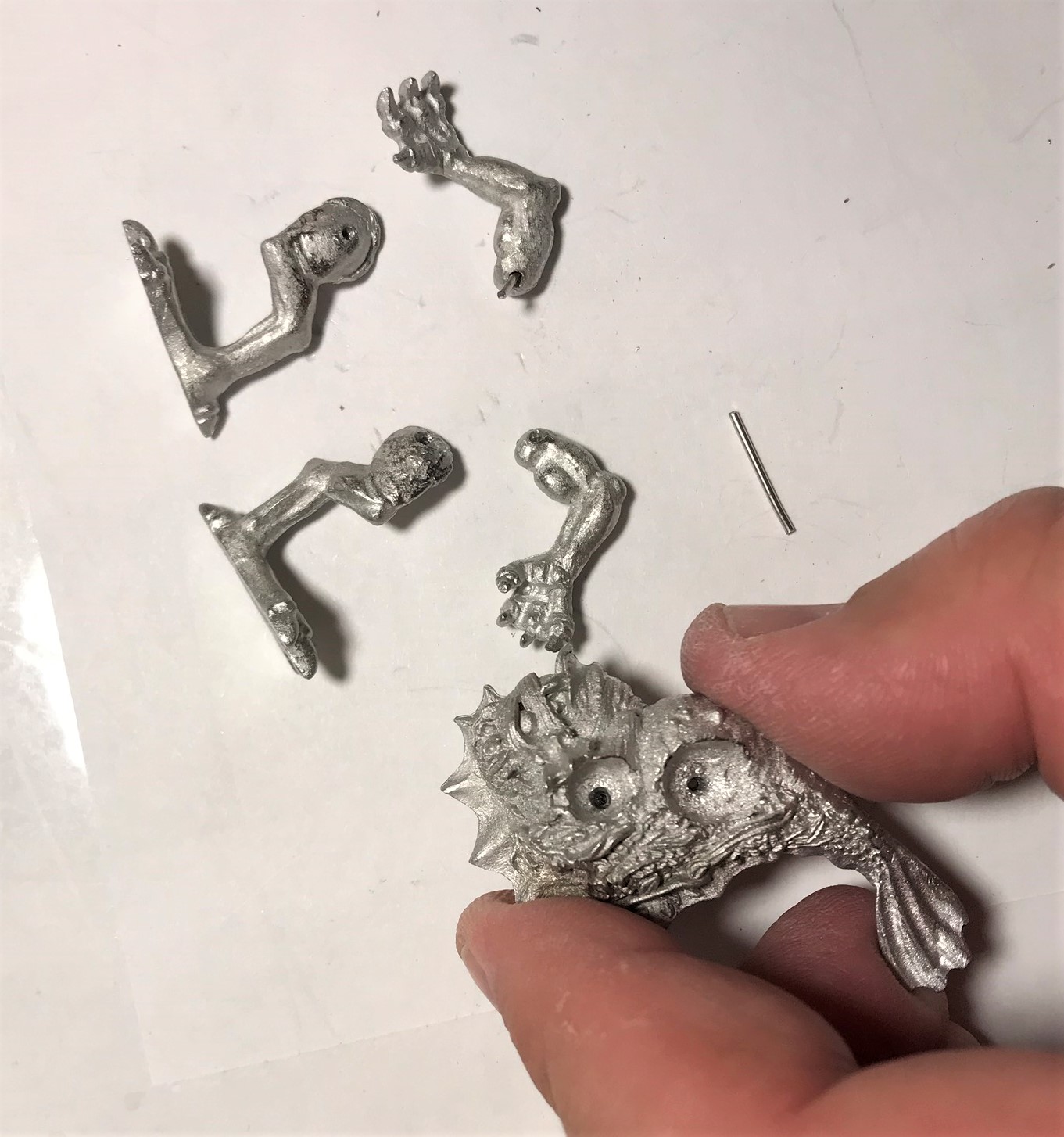
1 Garkkon unassembled
The Garkkon as received.  I do not know why it came with an anchor, but I decided not to use it on the model.  It, like the Bra’sheer, had similar assembly challenges.
2 Garkkon unassembled with washer
Here’s a better view of the base I used – it’s pretty heavy!
3 Garkkon unassembled with pins
Multiple drill holes and pinning were needed, plus green stuff to stiffen the structure.
4 Garkkon assembly set up
As the E6000 hardened overnight, I had this Rube Goldberg way of stabilizing the model.
5 Garkkon assembled
Garkkon assembled.
6 Garkkon with base
I used green stuff here on the limbs and on the base.  I chose to do the other bases with Apoxie Sculpt.
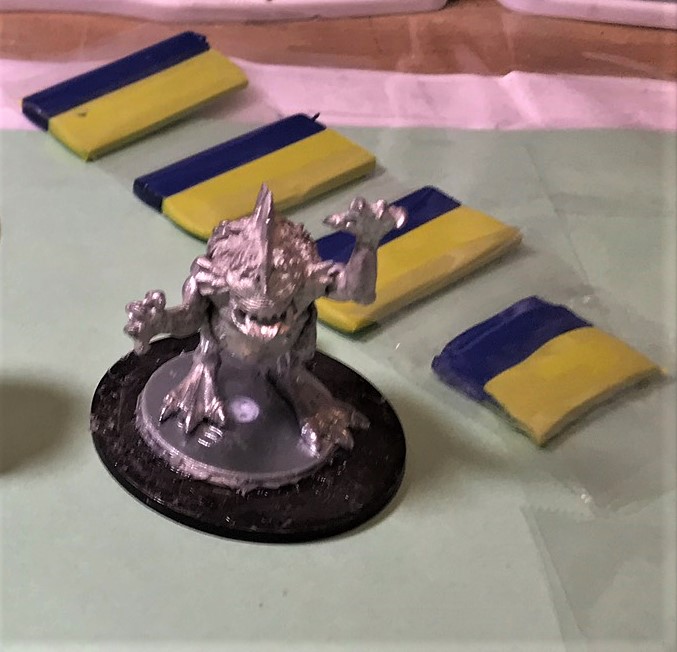
7 Garkkon base coated
This is early and fairly gaudy in the painting process – on purpose.  My hope was to use contrast paints and let the light blue here to be the same color as the infantry flesh.  As you will see, I needed to adjust my plans.  I also wanted to adjust the yellows here.
7a Garkkon base coated
Side view of the previous stage picture.
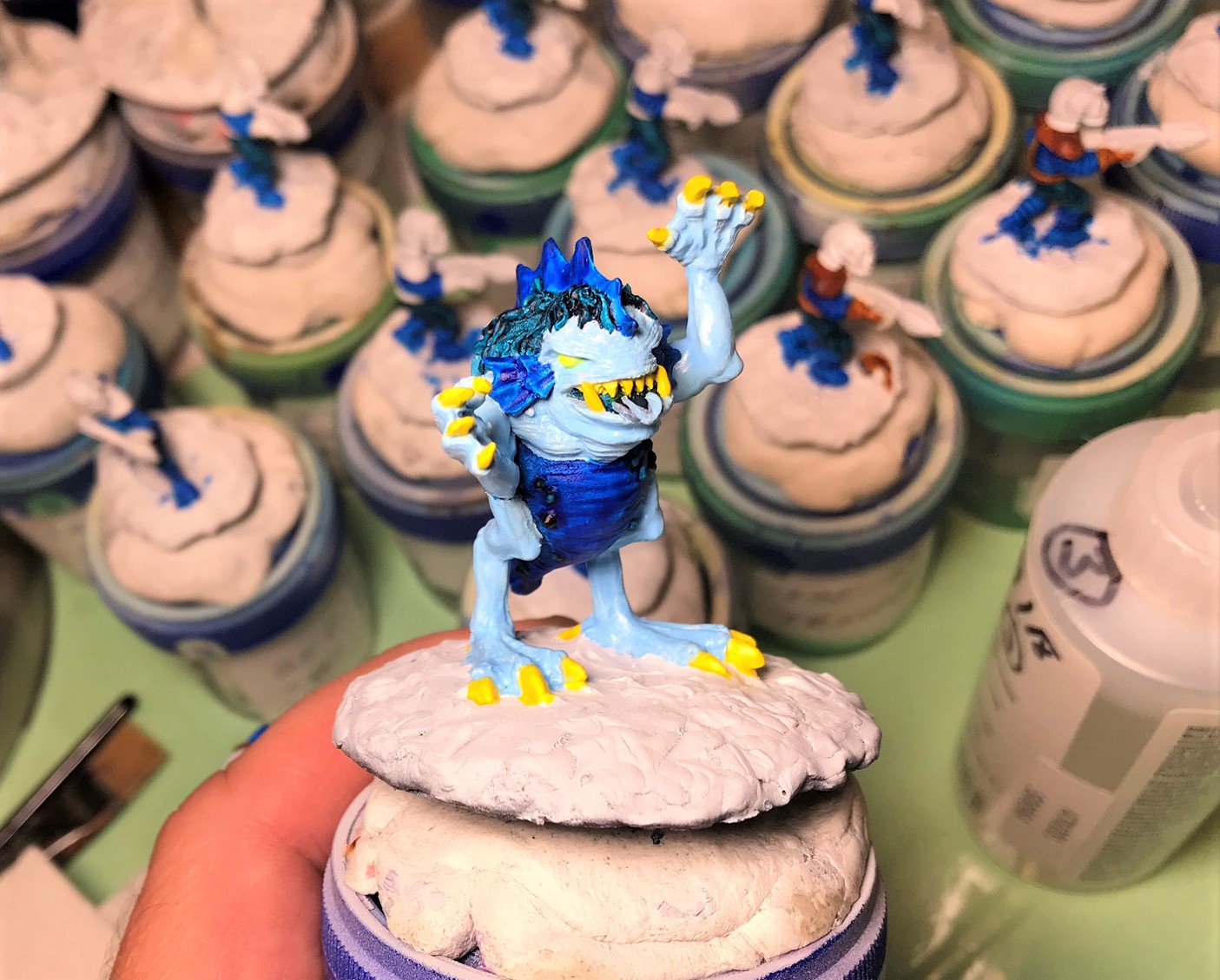
8 Garkkon applying Aethermatic Blue
I added Aethermatic Blue Contrast Paint to the blue – and ended up with a look that was more green than blue.  This is mid-painting to show the difference (the head has the contrast paint at this point).  I ended up finishing the Garkkon blue with the contrast paint, and finding another path for the Retrovian infantry’s flesh color.
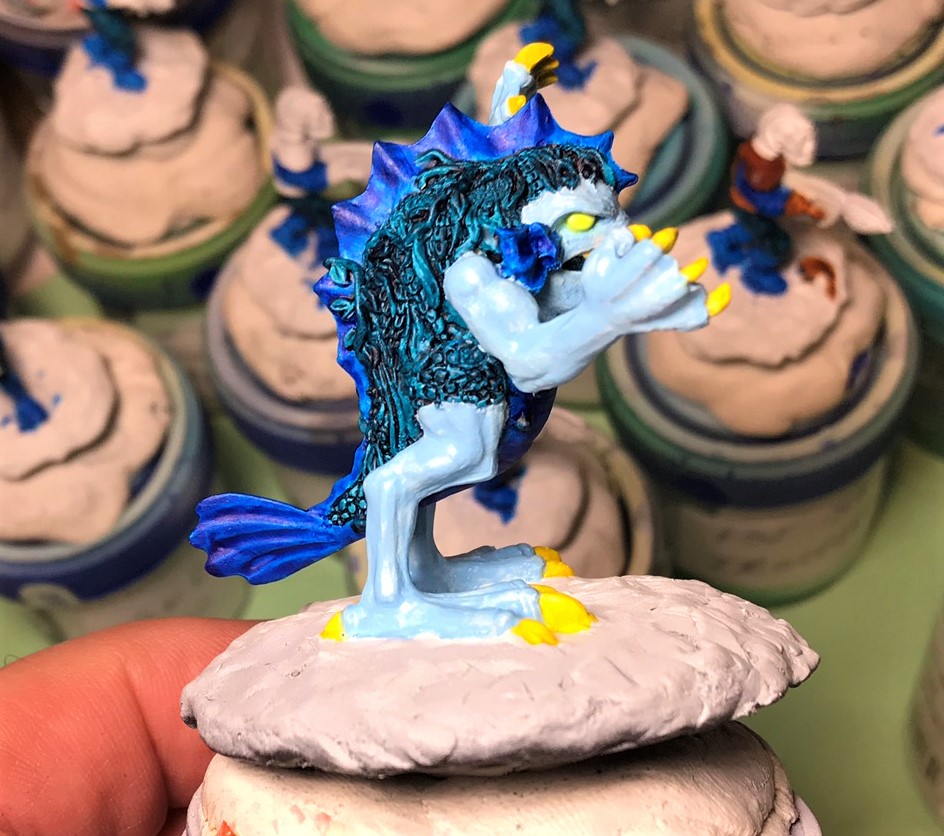
8a Garkkon applying Aethermatic Blue
This is after I finished the Garkkon’s initial flesh color.
9 Garkkon after painting base
After some more shading, some highlighting, and some glazes, I moved on to the Garkkon base.

Retrovian Infantry

1 Retrovian Platoon start
Getting organized…
2 Retrovian Platoon ready for painting
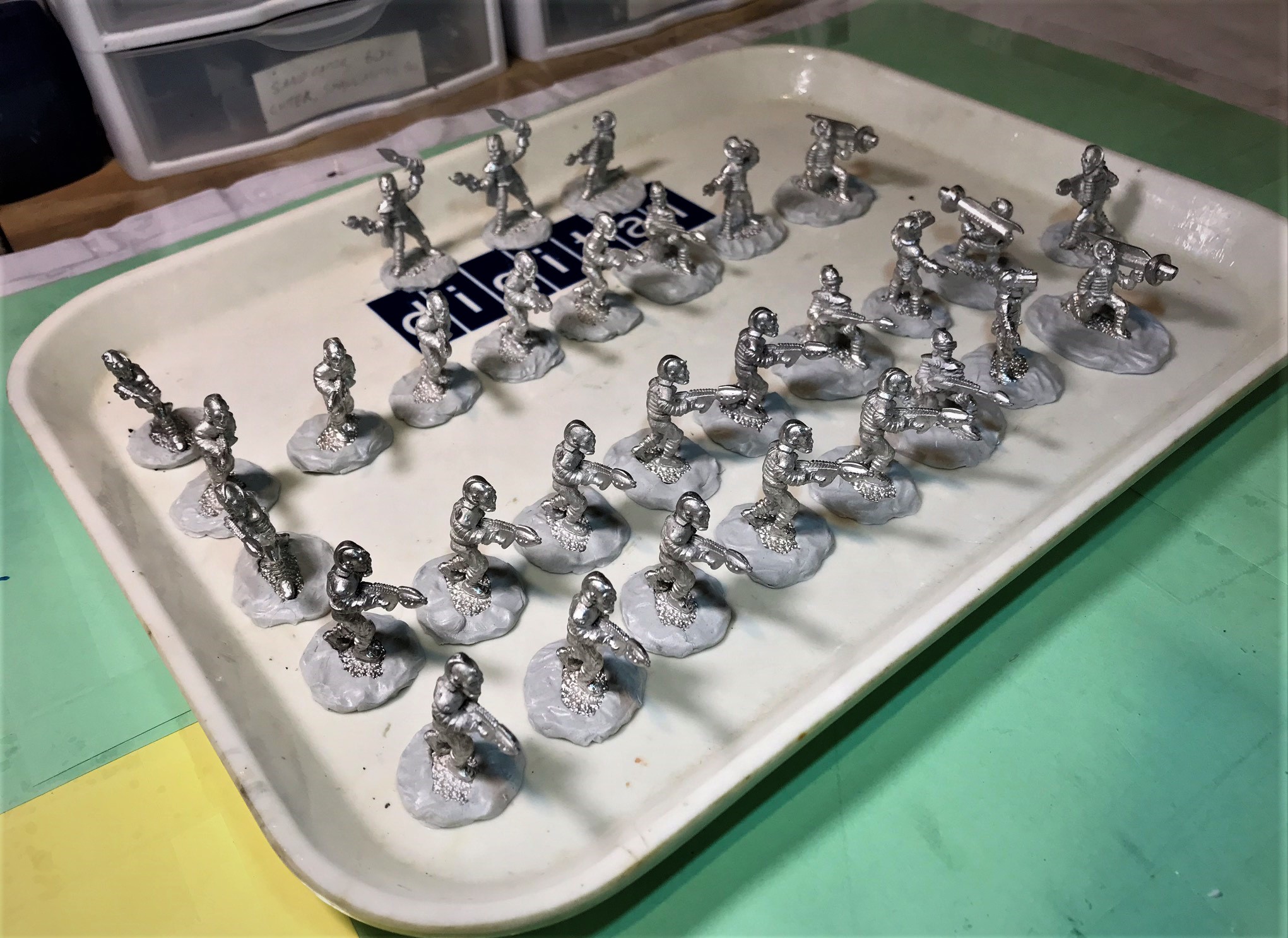
Initial mounting on fender washers after filing and cleaning.  I used slightly larger bases for the Sonic Cannon Gunners and the Marksmen out of necessity.
3 Retrovian Platoon after basing with Apoxie Sculpt
After I added Apoxie Sculpt on the bases and let it harden for a day.
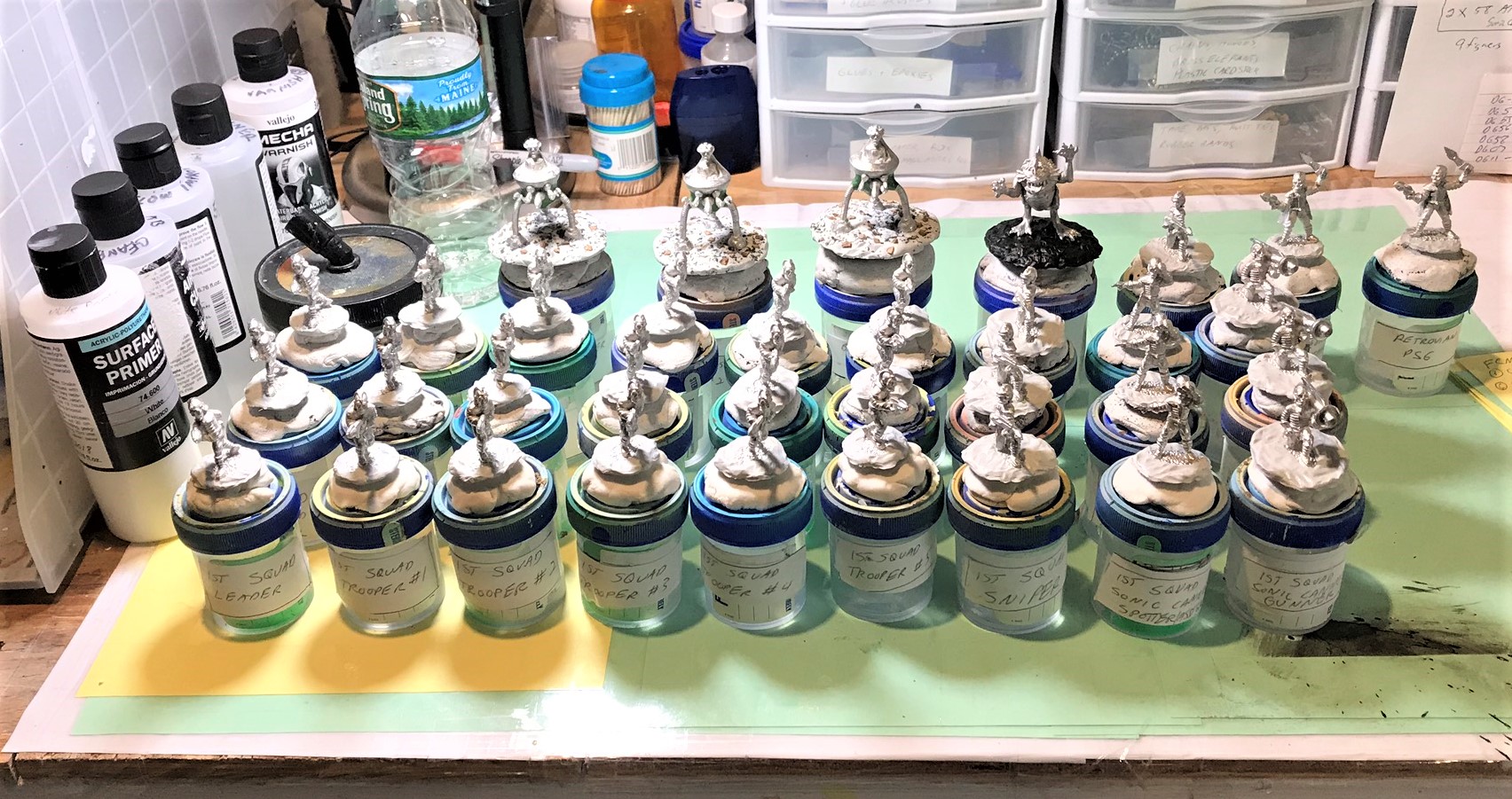
4 Retrovian Platoon aftermounting for painting
Here you see the platoon ready for priming and painted as mounted on the specimen jars with poster tack.
5 Retrovian Platoon after Talassar Blue
I used Talassar Blue on the boots and the tunics.
6 Retrovian Platoon after Akhelian Green
Then I used Akhelian green on the pants – and each squad got a different contrast paint color on the shoulder pads.  Here, first squad had Nazdreg Yellow  – which ended up looking leather-like.
7 Retrovian Platoon further progress
Similarly, 2nd squad and third squad got Gryph-Charger Grey and Volupus Pink respectively.  The platoon leader (Commander Schran) got Blood Angels Red, while the platoon sergeant and the Garkkon controller got Ultramarines Blue.  I found that these contrast paints needed a few thin coats to be useful.
8 Retrovian Captain progress
Commander Schran mid-stage.
9 Retrovian Sonic Cannon Gunner progress
The Sonic Gunner from 3rd Squad’s B team mid-stage.
10 Retrovian Platoon before washes
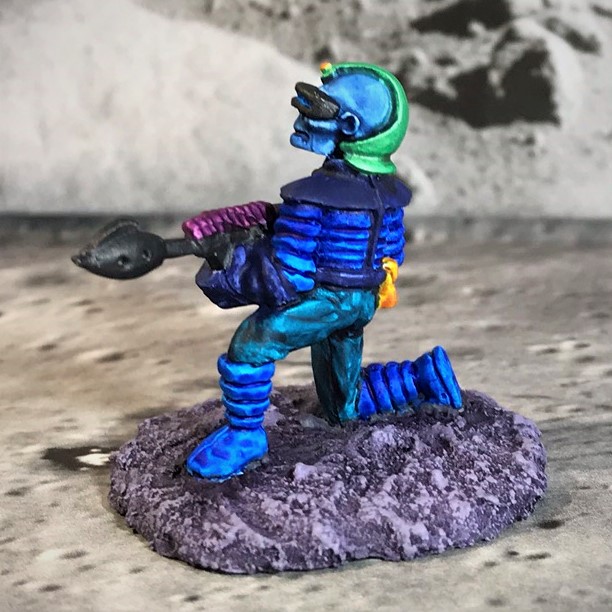
For ease of play on the tabletop, in addition to the different shoulder pad colors, the leaders had different colors on their helmets.  Red indicates the platoon leader, blue indicates the platoon sergeant and squad leaders, and green indicated the team leaders.  Others just got a metallic black helmet.
11 Retrovian Captain progress
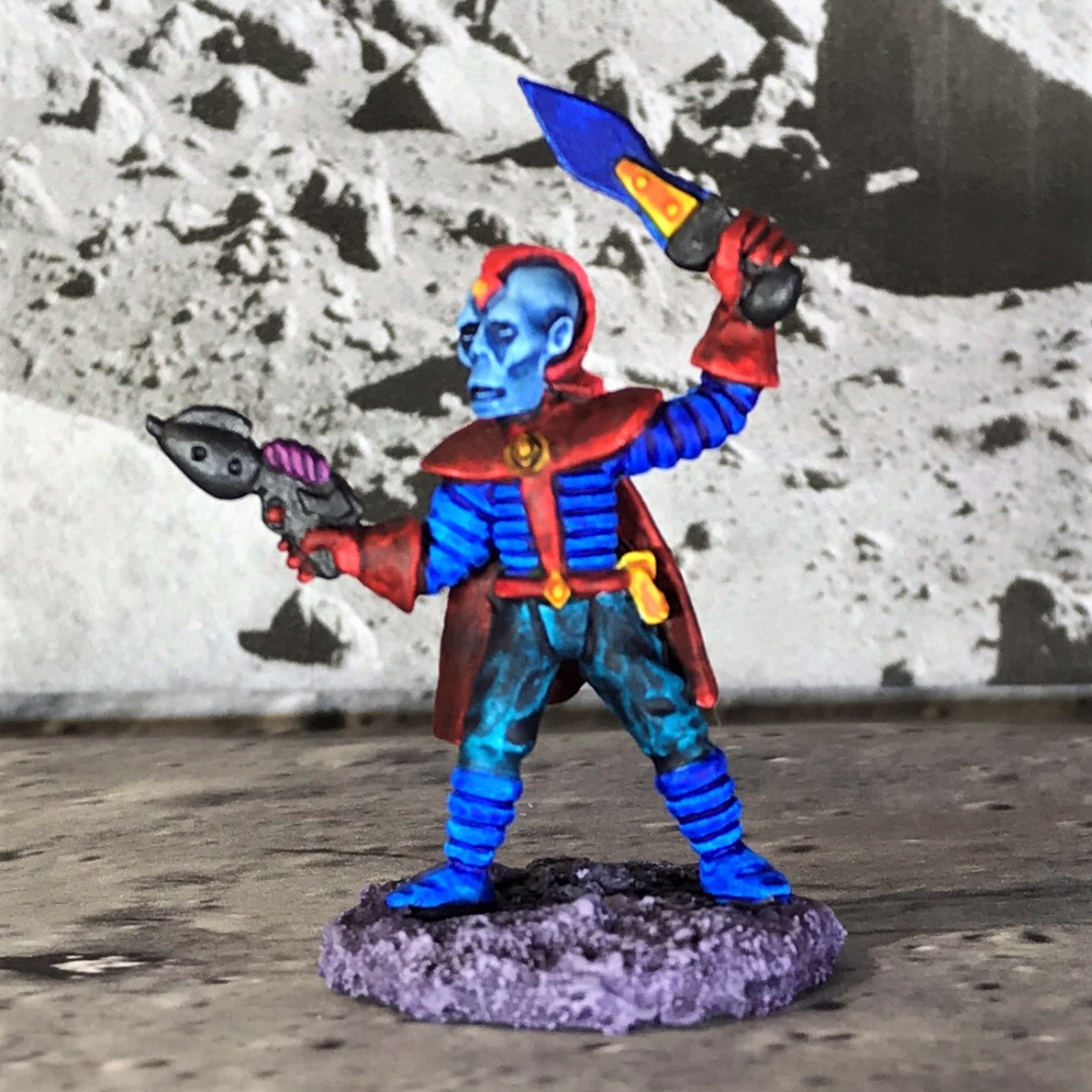
As discussed above, the flesh color on the Garkkon was not what I wanted on these guys.  The faces are very cool, and I ended up using Army Painter Quickshade Blue Tone over the light blue – and I was very pleased with the result.  This is Commander Schran again, and I also wanted to make these swords special – so I brush painted them with the same metallic blue as the Bra’sheer chassis – and called them “Frostblades” – giving them a minor anti-armor capability.
12 Retrovian Platoon further progress
Close to the finish with the bases remaining to be done.
13 Retrovian Platoon before base drybrushing
Ready to dry brush the bases!
15 Retrovian Platoon Team Leader after layer 1 base drybrushing
A 3rd Squad trooper with base complete and ready for varnish .
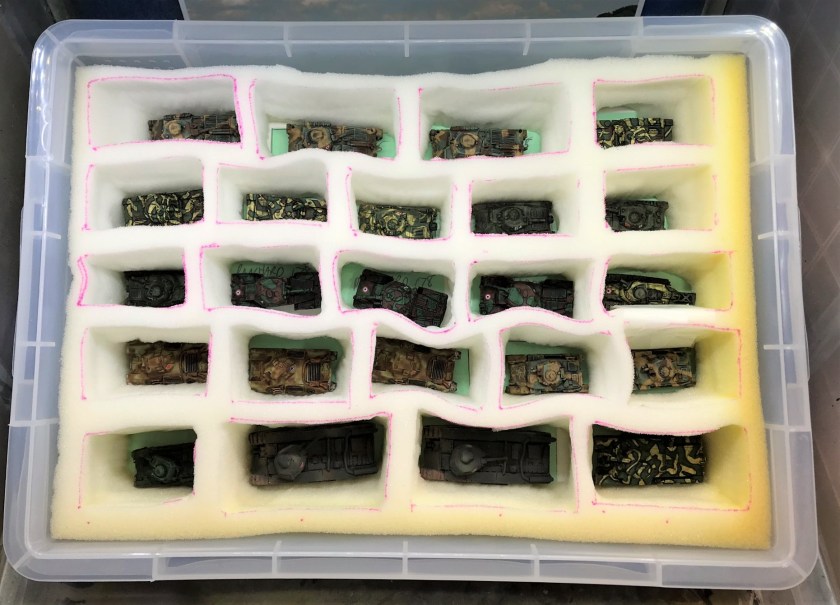
16 Retrovian Platoon complete in box
Completed platoon in the transport box!

Eye Candy of painted Retrovian Platoon and Combat Patrol™ Game Aids

Platoon HQ:

1 Commander Shran
Commander Shran, front view
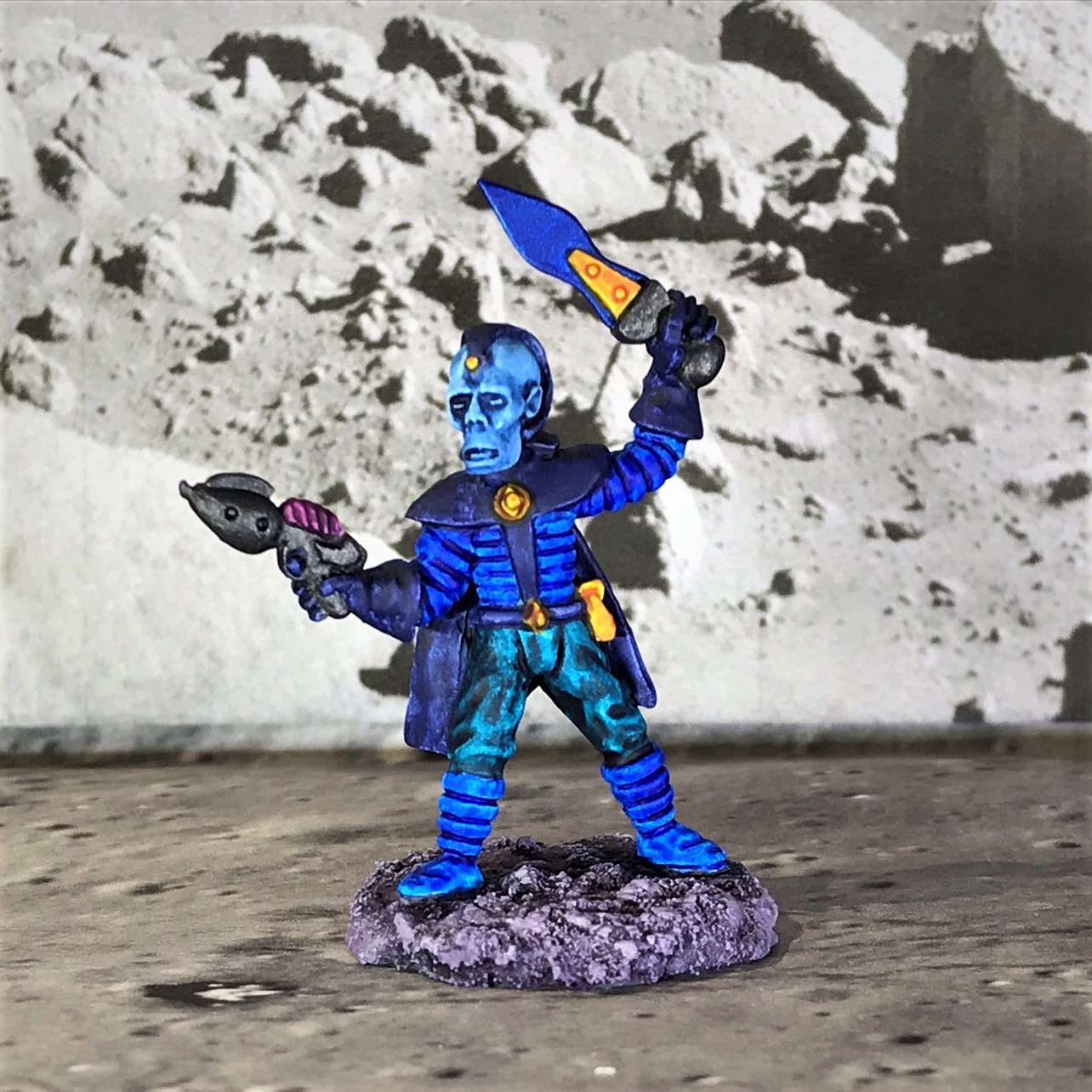
1a Commander Shran
Commander Shran, rear view

2 SFC Thelev

Platoon Sergeant, SFC Thelev

Garkkon Section:

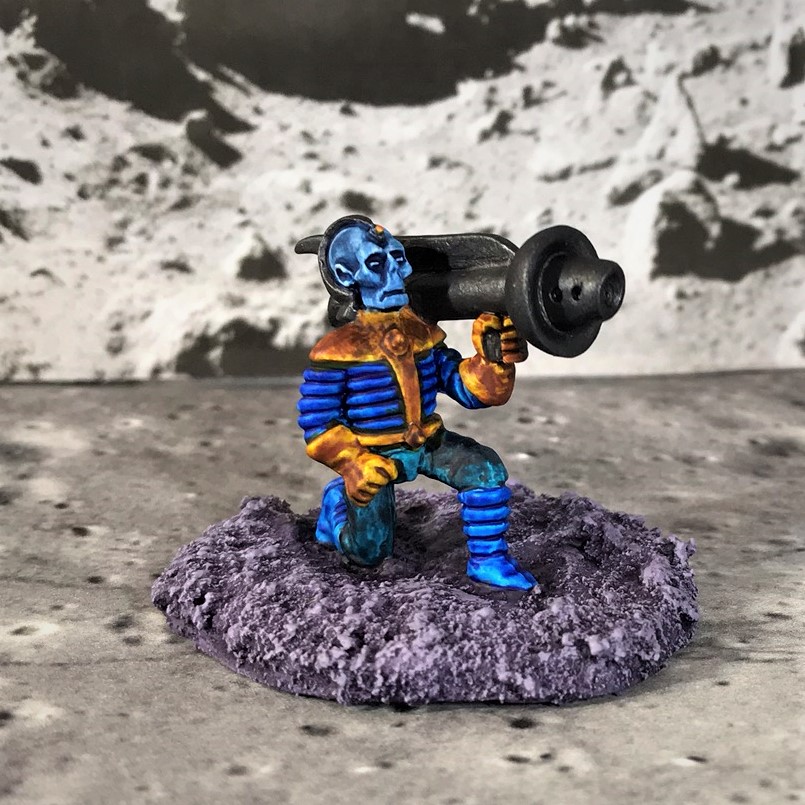
4 SSG Ushaan-Tor
SSG Ushaan-Tor, Garkkon Controller
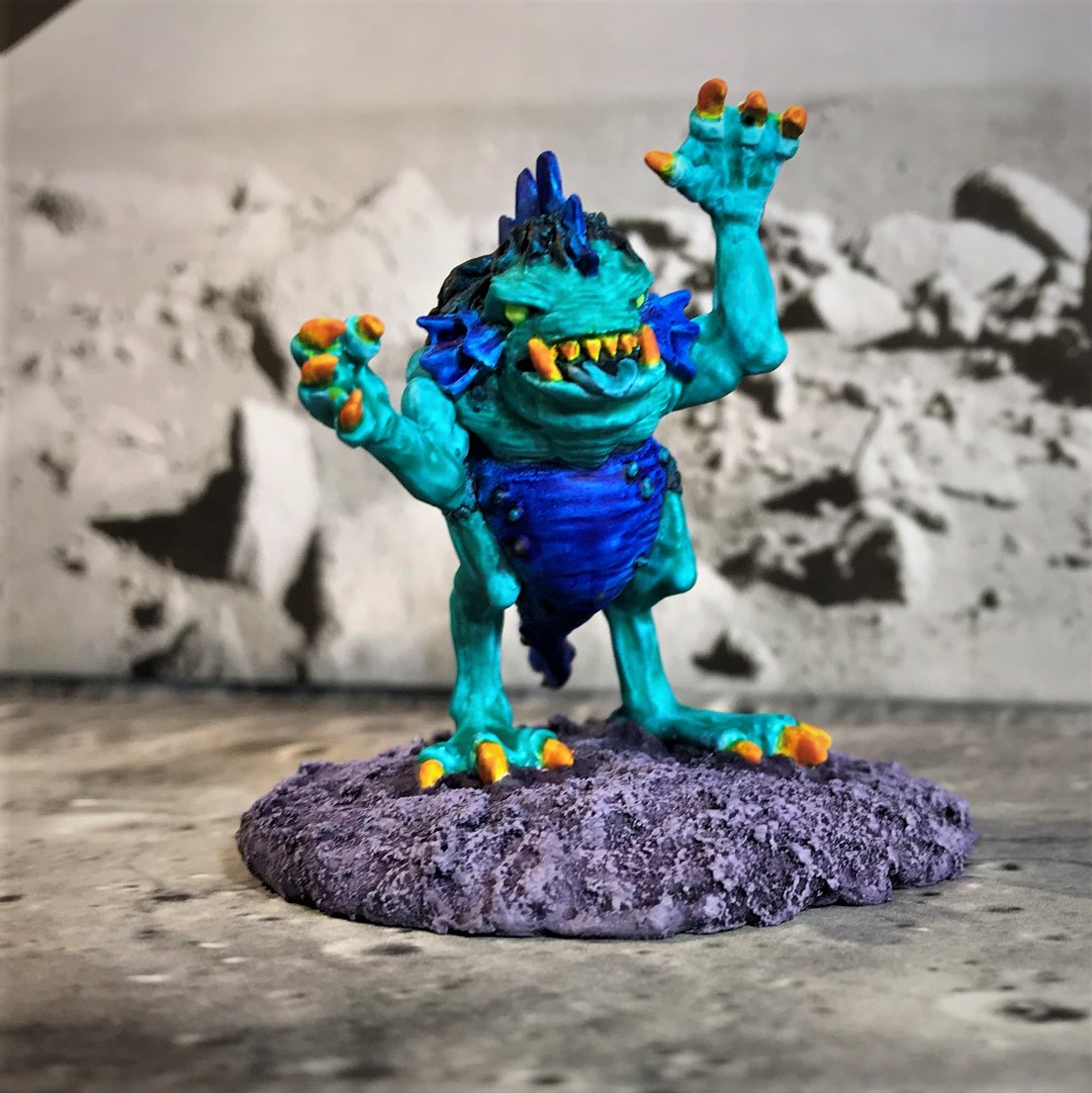
5 Garkkon
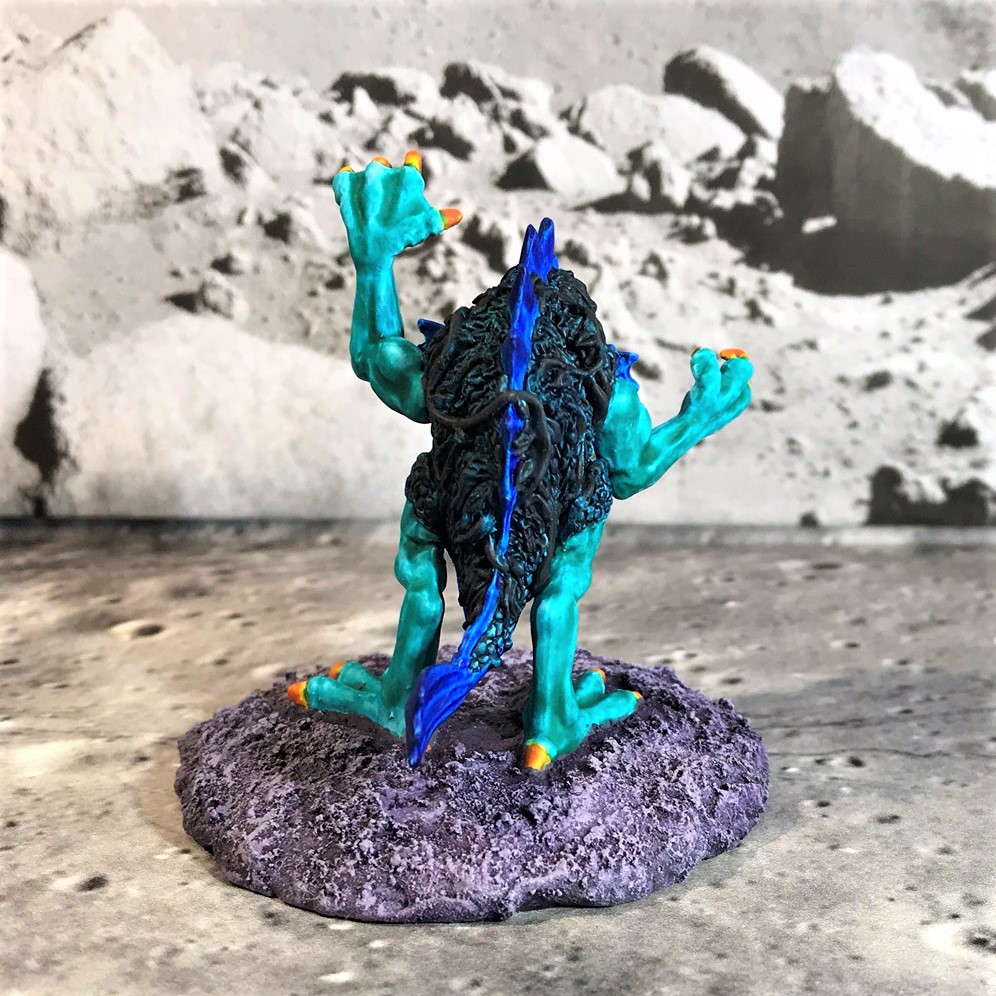
Garkkon front
4a Garkkon Back
Garkkon back view
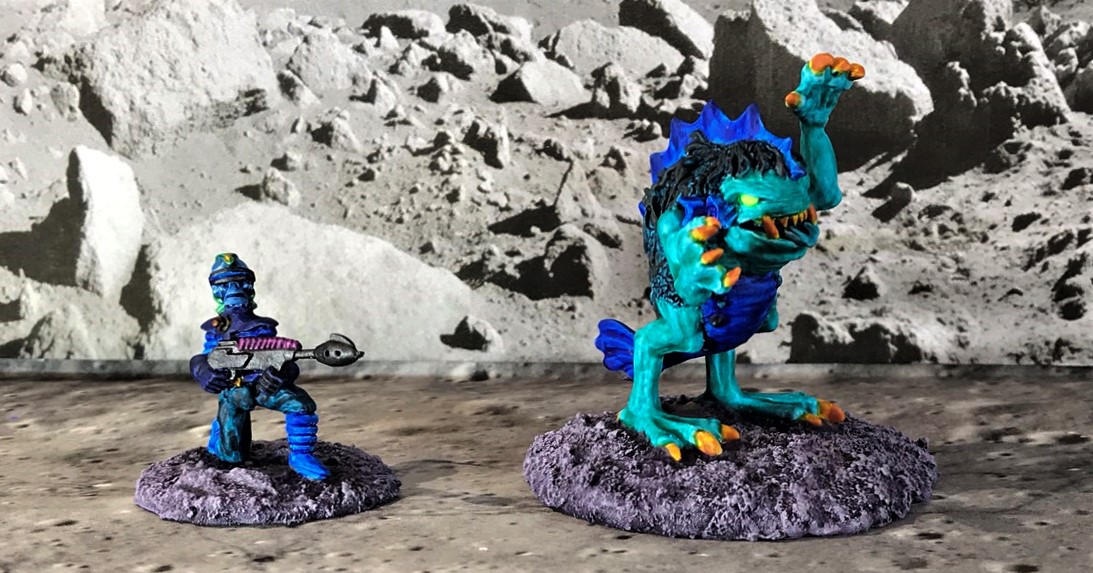
3 SSG Ushaan-Tor and Garkkon
Garkkon Section
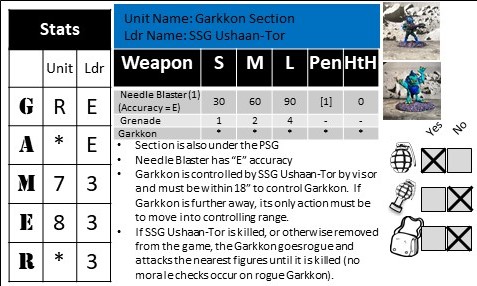
Retrovian Unit data Cards (2)
Unit Data Card for the Garkkon Section

1st Squad:

6 1st squad leader SSG Kumari
1st Squad Leader, SSG Kumari
11 1st squad A team trooper #4
1st Squad Trooper (A Team)
13 1st Squad B Team Sonic Cannon Gunner
1st Squad Sonic Cannon Gunner (B Team)
14 1st Squad B Team Marksman
1st Squad Marksman/Sniper (B Team)
15 1st Squad B Team Bra'sheer
1st Squad Bra’sheer
Bra'sheer vehicle data cards (2)
Bra’sheer Vehicle Data Card.  The numbers in red circles refer to armor factors.  These would be the same for each pod.
7 1st Squad
1st Squad

2nd Squad:

16 2nd squad leader SSG Talas
2nd Squad Leader, SSG Talas

19 2nd squad A team trooper #2

2nd Squad Trooper (A Team)

23 2nd Squad B Team Sonic Cannon Gunner
2nd Squad Sonic Gunner (B Team)
24 2nd Squad B Team Marksman
2nd Squad Marksman/Sniper (B Team)
25 2nd Squad B Team Bra'sheer
2nd Squad Bra’sheer (B Team)
8 2nd Squad
2nd Squad

3rd Squad:

26 3rd squad leader SSG Aenar
3rd Squad Leader, SSG Aenar
28 3rd squad A team trooper #1
3rd Squad Trooper (Team A)
33 3rd Squad B Team Sonic Cannon Gunner
3rd Squad Sonic Gunner (Team B)
34 3rd Squad B Team Marksman
3rd Squad Marksman/Sniper (Team B)
Retrovian Unit data Cards (4)
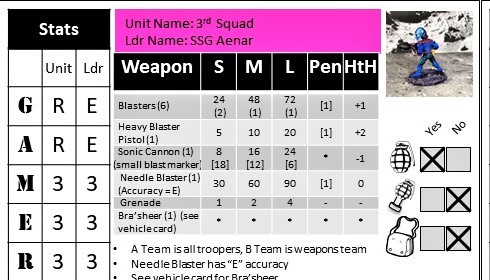
Unit data card example – 3rd Squad
35 3rd Squad B Team Bra'sheer
3rd Squad Bra’sheer (Team B)
9 3rd Squad
3rd Squad

Retrovian Platoon (group shots):

5 Command Group
Command and Garkkon Section
6 Bra'sheer group
All three Bra’sheers
10 Retrovian Pano 1
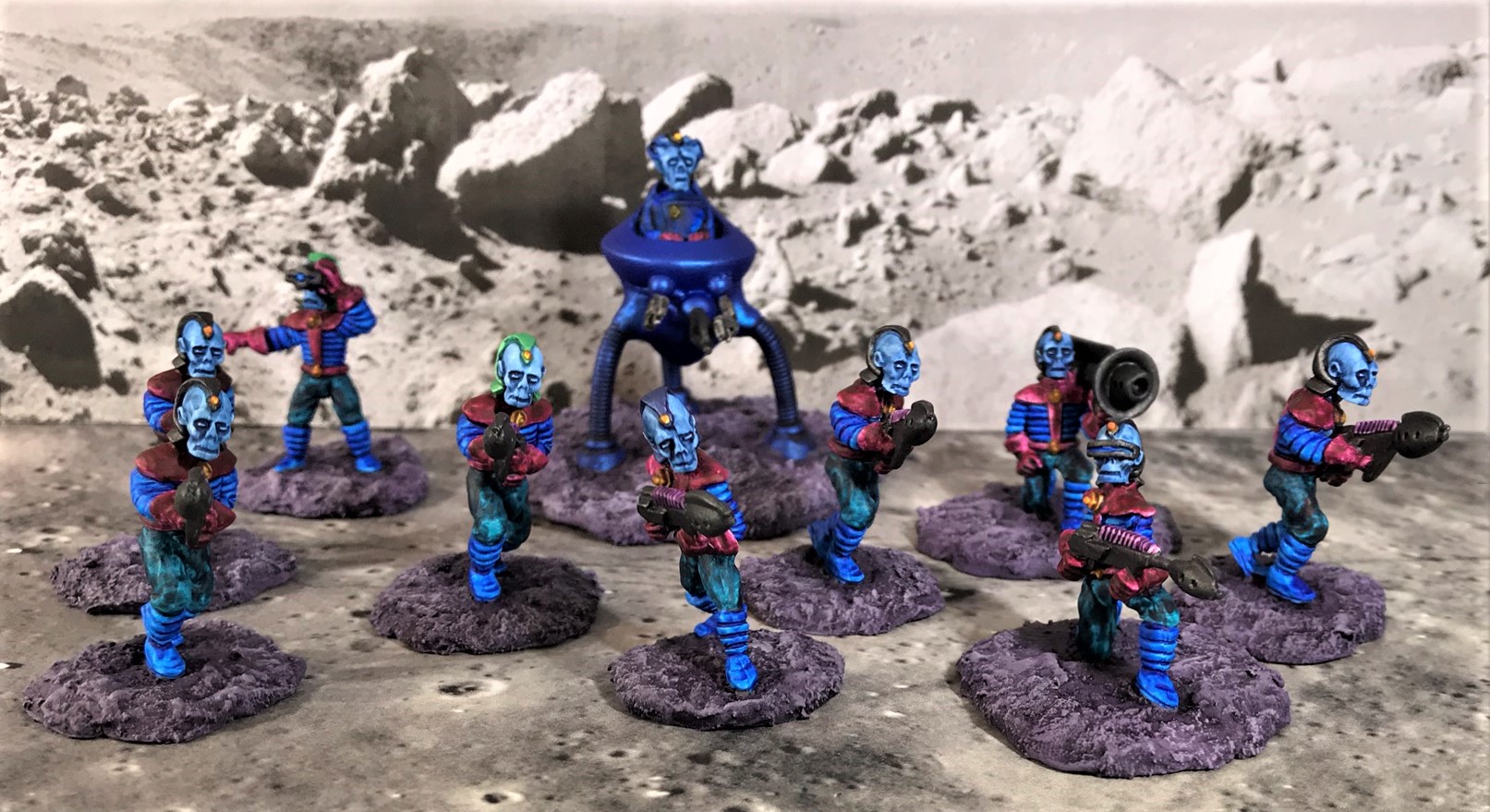
Retrovian Platoon!
11 Retrovian Pano 2
Retrovian Platoon (top view)

This project took a bit longer than I expected it to – about 3-4 weeks – but it was rewarding.  I do hope that you found it interesting and fun to look at – so let me know in the comments section – good or bad.  Did you pick up on any Andorian references here? 

On to the next challenge!

As an FYI, I have updated the Lost Minis Wiki with shots of these figures.  And, to boot, I am entering this platoon in Azazel’s Destino December ’19 Community Painting Challenge – it meets the criteria!

Thanks again for looking – and until next time, all the best to you and yours!

PAINTS, INKS, GLAZES, SHADES, WASHES, PIGMENTS, FLOCKING, GLUES AND MORE USED ON THESE FIGURES:

  1. Gorilla Glue
  2. E6000 epoxy
  3. Small paper clip wire
  4. 2″ Everbilt steel fender washers ( bases for Garkkon and Bra’sheers)
  5. 1¼” Everbilt steel fender washers (added to Garkkon and Bra’sheers on 2″ steel fender washers; used as bases for Retrovian Marksmen/Snipers and Sonic Cannon Gunners)
  6. ½” stainless steel fender washers as fillers in bottom of 2″ steel fender washer holes (Garkkon and Bra’sheers)
  7. Evergreen polystyrene #9020 card (0.020″ thick) on top of 2″ steel washer holes (Garkkon and Bra’sheers)
  8. Green stuff (kneadatite)
  9. 1″ steel fender washers (used as bases for remaining Retrovian infantry figures)
  10. Apoxie Sculpt
  11. Army Painter “Battlefield Rocks” flocking (put into Apoxie Sculpt on Bra’sheer bases)
  12. Army Painter “Black Battlefields” flocking (put into Apoxie Sculpt on Bra’sheer bases)
  13. Poster tack to mount figures to specimen jars for painting
  14. Vallejo “Surface Primer – Black” (on exposed steel and polystyrene on bases)
  15. Vallejo “Surface Primer – White”
  16. Vallejo “Flow Improver”
  17. Vallejo “Airbrush Thinner”
  18. Citadel “Contrast Paint – Talassar Blue”
  19. Citadel “Contrast Paint – Akhelian Green” (except for Bra’sheers)
  20. Vallejo Game Air “White Grey”
  21. Vallejo Mecha Color “Fluorescent Yellow” (Garkkon eyes)
  22. Vallejo Game Air “Moon Yellow” (Garkkon claws and teeth)
  23. Citadel “Contrast Paint – Blood Angels Red” (Platoon Commander)
  24. Citadel “Contrast Paint – Ultramarines Blue” (Platoon Sergeant and Garkkon Controller)
  25. Citadel “Contrast Paint – Iyanden Yellow” (1st Squad)
  26. Citadel “Contrast Paint – Gryph-Charger Grey” (2nd Squad)
  27. Citadel “Contrast Paint – Volupus Pink” (3rd Squad)
  28. Citadel “Lamenters Yellow” (glaze)
  29. Vallejo Mecha Color “Sky Blue”
  30. Citadel “Contrast Paint – Aethermatic Blue” (Garkkon only)
  31. DecoArt “Festive Red” (Platoon Leader’s helmet)
  32. Vallejo Mecha Color “Metallic Blue” (Squad Leaders’ helmets)
  33. Vallejo Mecha Color “Metallic Green” (Team Leaders’ helmets)
  34. Vallejo Model Air “Black (metallic)” (all others’ helmets and weapons)
  35. Createx Airbrush Colors “Pearl Blue (0304)” (Bra’sheers’ chassis, legs, and Frostblades)
  36. Citadel “Drakenhof Nightshade” (shade on Bra’sheers’ legs)
  37. Citadel “Contrast Paint – Iyanden Yellow”
  38. Polly Scale “WWII German Armor Green” (2nd Squad)
  39. P3 “Cygnar Blue Highlight” (Bra’sheer crewmen)
  40. Citadel “Contrast Paint – Magos Purple” (infantry weapons)
  41. Army Painter “ Quickshade Blue Tone” (wash on all Retrovian flesh)
  42. Army Painter “Quickshade Purple Tone” (wash on infantry weapons)
  43. Tamiya “Flat Aluminum XF-16” (dry brush on Bra’sheer claws)
  44. Citadel “Nuln Oil” (shade)
  45. Citadel “Astrogranite” (on bases)
  46. Citadel “Astrogranite Debris” (on bases)
  47. Citadel “Druchi Violet” (wash on bases)
  48. Citadel “Daemonette Hide” (dry brush on bases)
  49. Citadel “Warpfiend Grey” (dry brush on bases)
  50. Citadel “Slaneesh Grey” (dry brush on bases)
  51. Vallejo Mecha Varnish “Matt Varnish”

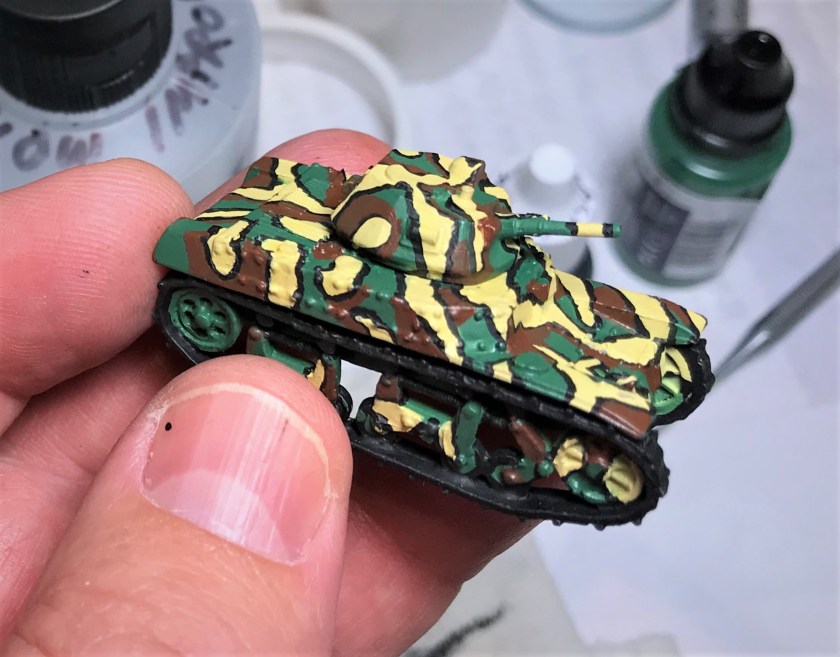
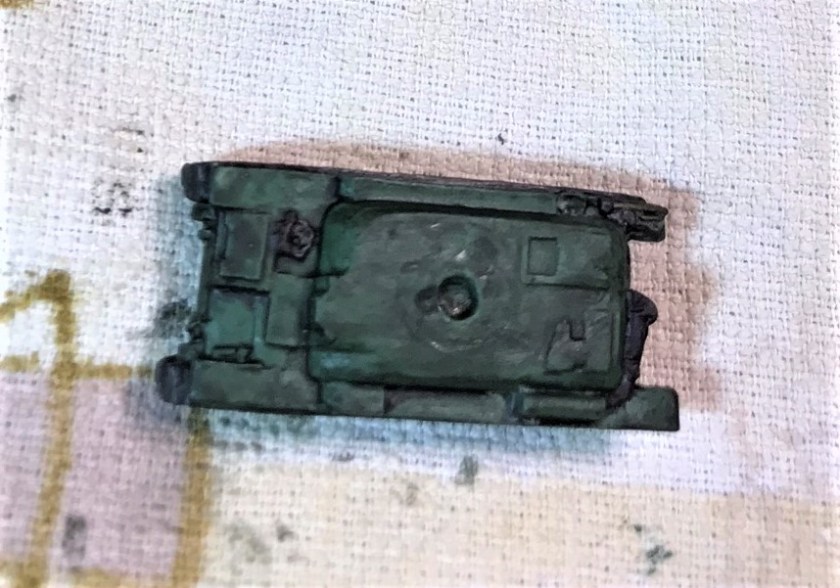
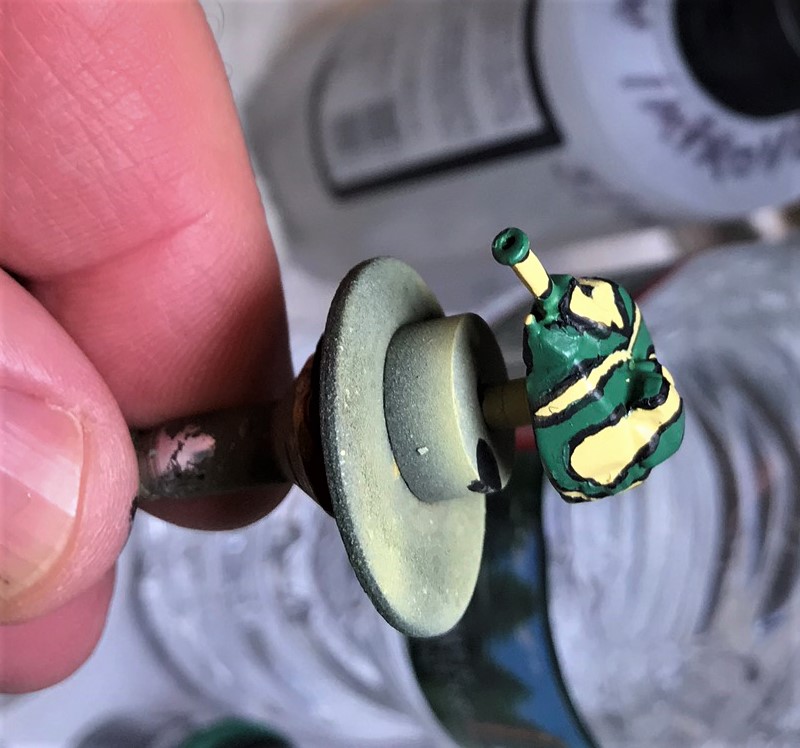
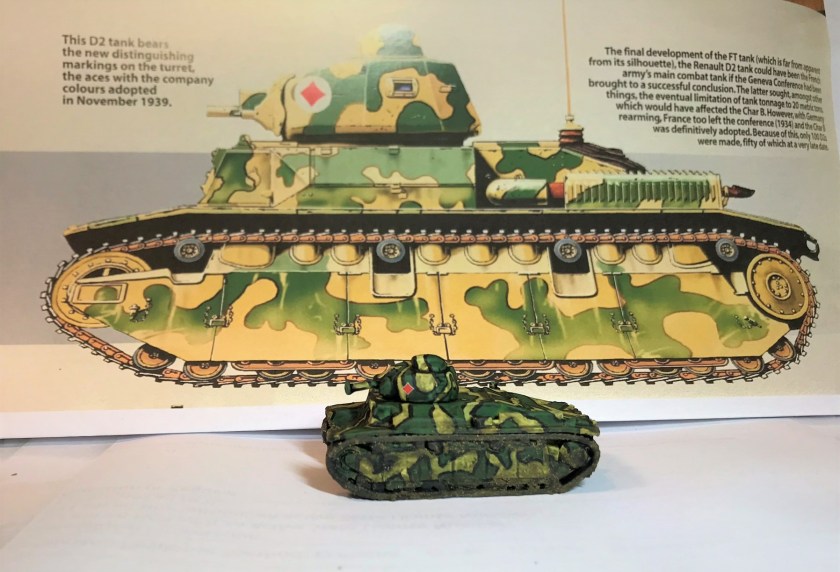
French FCM 36 tanks

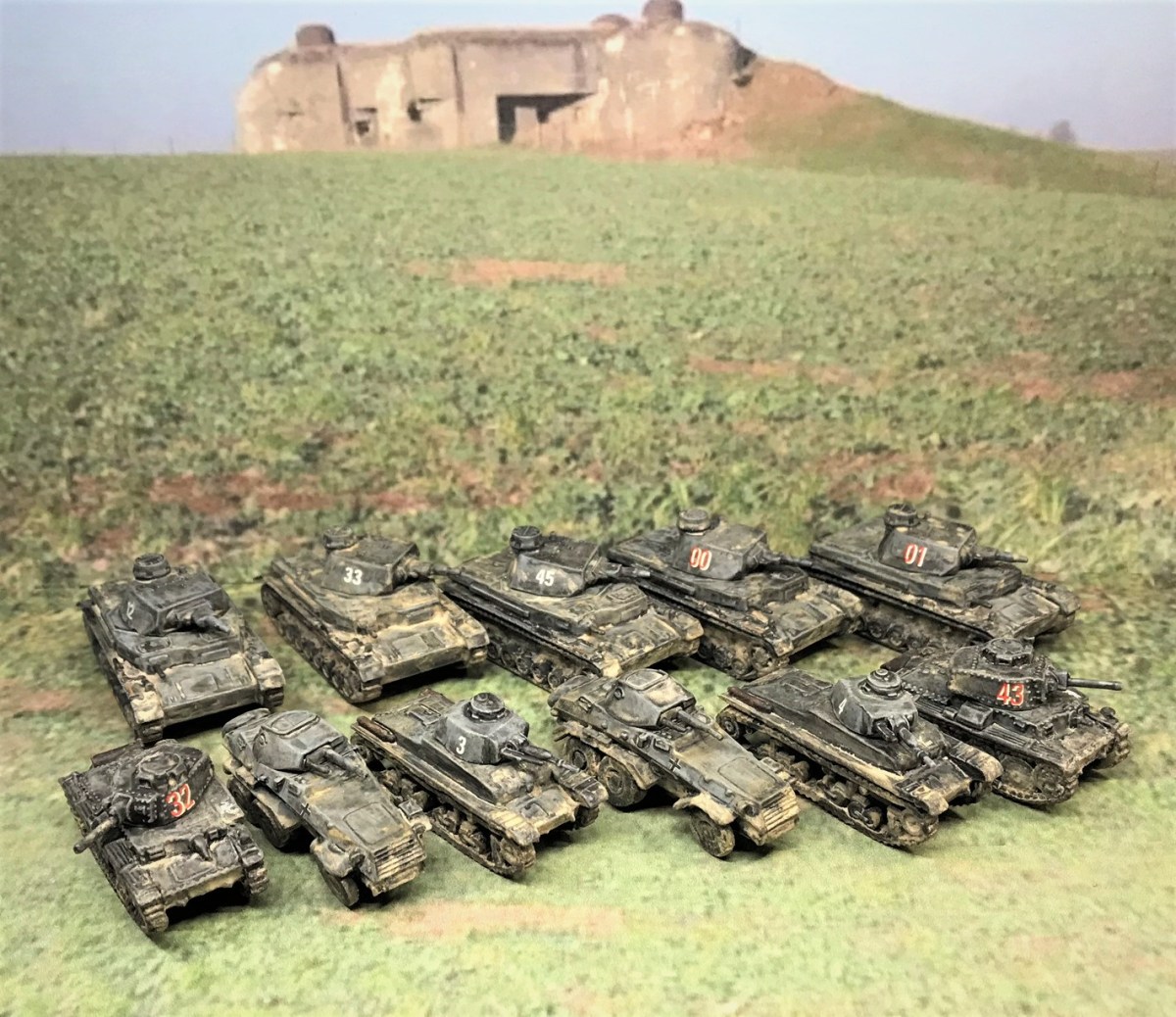
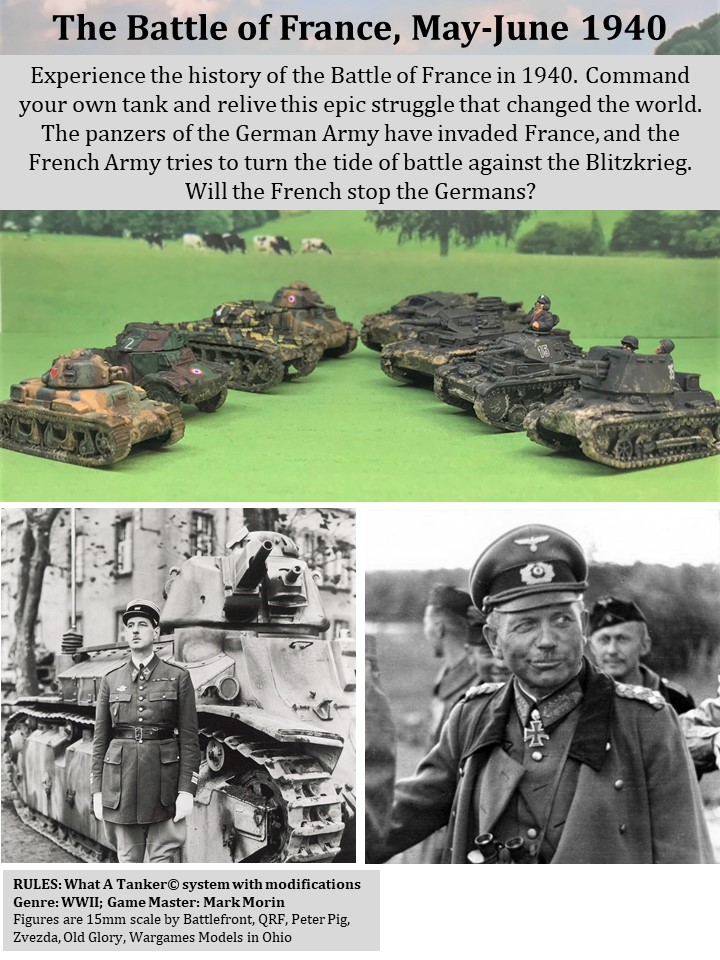
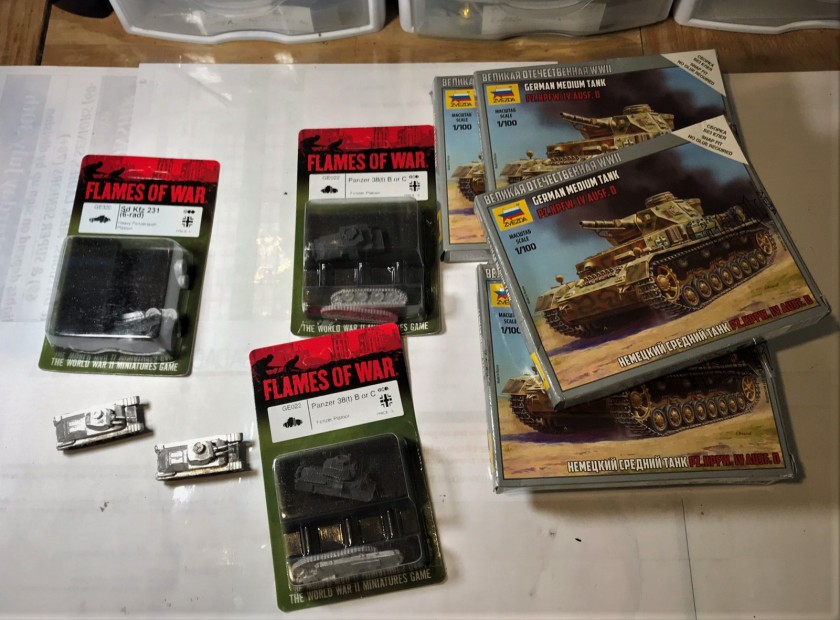
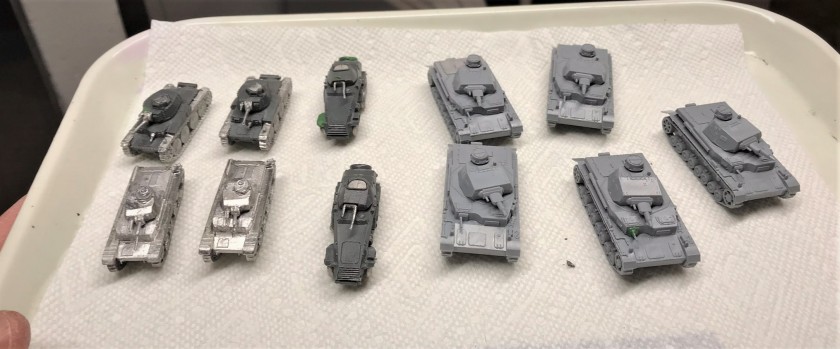
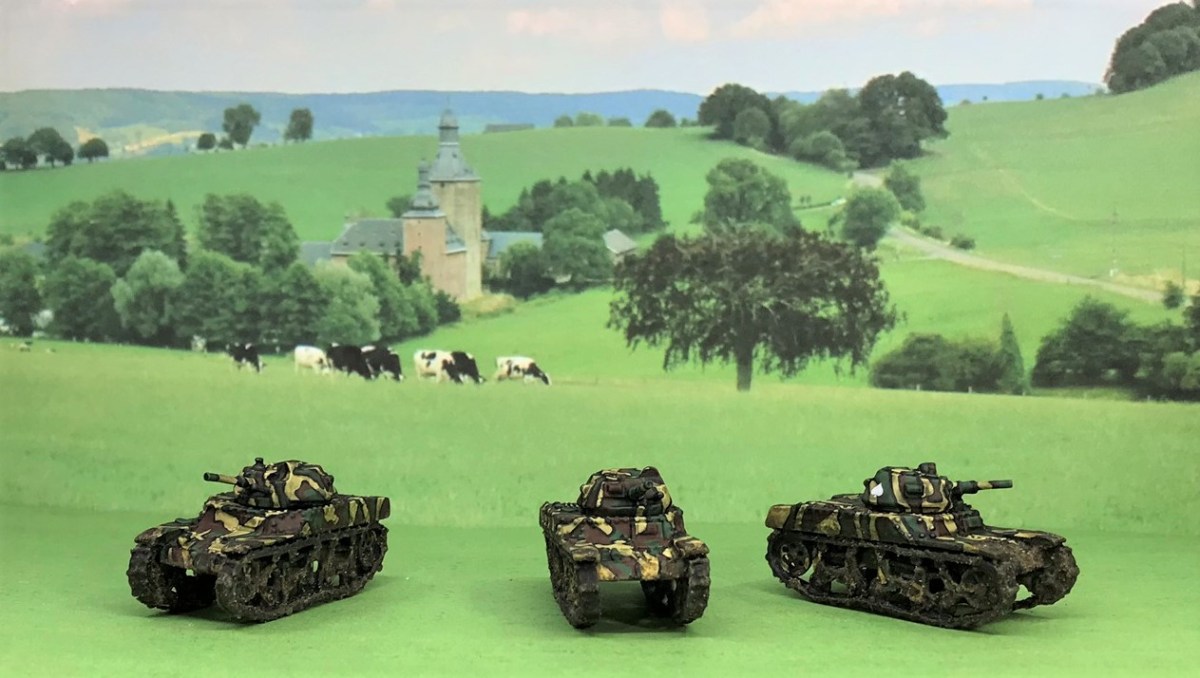
During the Battle of France (May-June 1940), there was an amazing variety of vehicles on both the German and the French sides.  At this same time last year, I began putting together a collection of period 15mm/1:100 scale vehicles for this period.  These were discussed here.  I have previously posted about a couple of games (December 2018 and January 2019) that I ran using the What a Tanker™ rules from the UK’s Too Fat Lardies.  I have been hoping to return to this period and add more vehicles to both armies.  I am starting this augmentation by adding 3 FCM 36 light tanks to my fleet.

The FCM stands for Société Nouvelle des Forges et Chantiers de la Méditerranée, a shipbuilder in Toulon who manufactured this 1936 design – and delivered about 100 to the French Army up through 1938.  Cost and industrial manufacturing concerns limited further purchases.  They were a little more than 12 tons, with a crew of two.  The armor was fairly good – welded, and very sloped for tanks of the day.  It also had a diesel engine and reasonable range unlike many other contemporary French tanks.  However, like many other French tanks, it was armed with the weak Puteaux SA 18 37mm gun which definitely had challenges fighting German armor.  Notably, two battalions of FCM 36’s tried to repel the bridgehead that the Heinz Guderian had established across the Meuse, but they were too little and too late.  After the surrender of France, some of the FCM 36 chassis were converted to Marder I’s or self-propelled artillery.  Some of these conversions were involved in the Normandy Campaign of 1944.  Today, only one FCM 36 survives at Saumur.

I thought these would be a good addition to my French early-war tank collection.  In What a Tanker™, these are the cheapest tanks to buy point-wise.  The only source I found for these models was Old Glory.  They are metal, and quite small of course.

1 FCM 36 in package
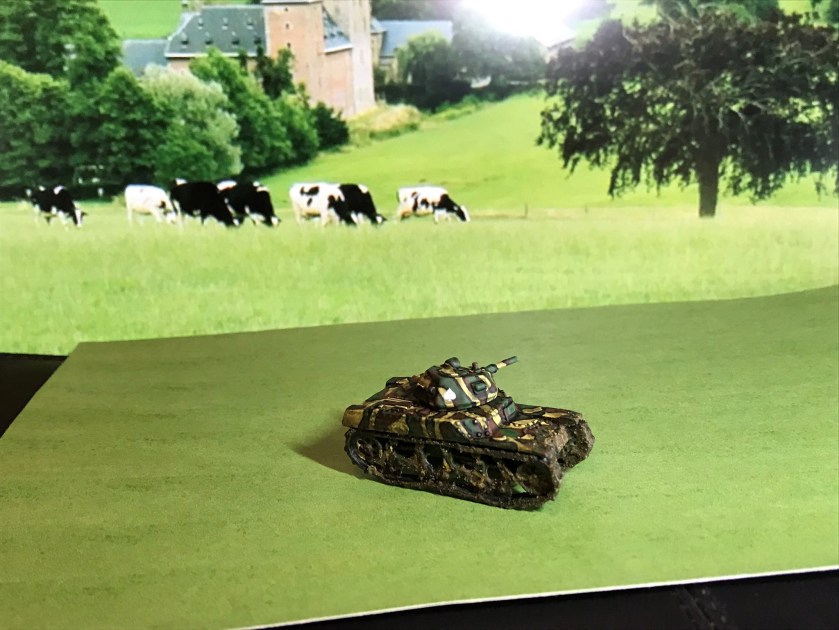
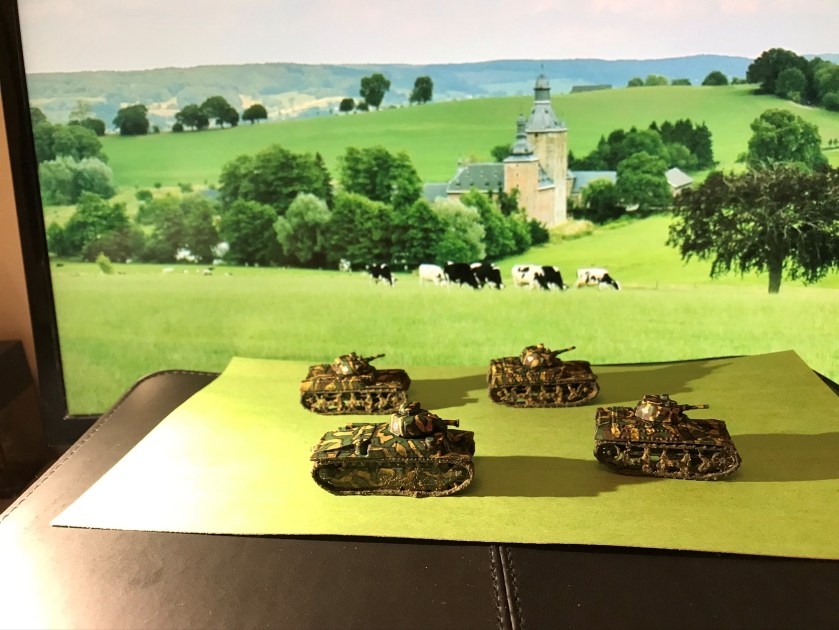
The 3 FCM 36’s in the baggie.
2 FCM 36 before filing
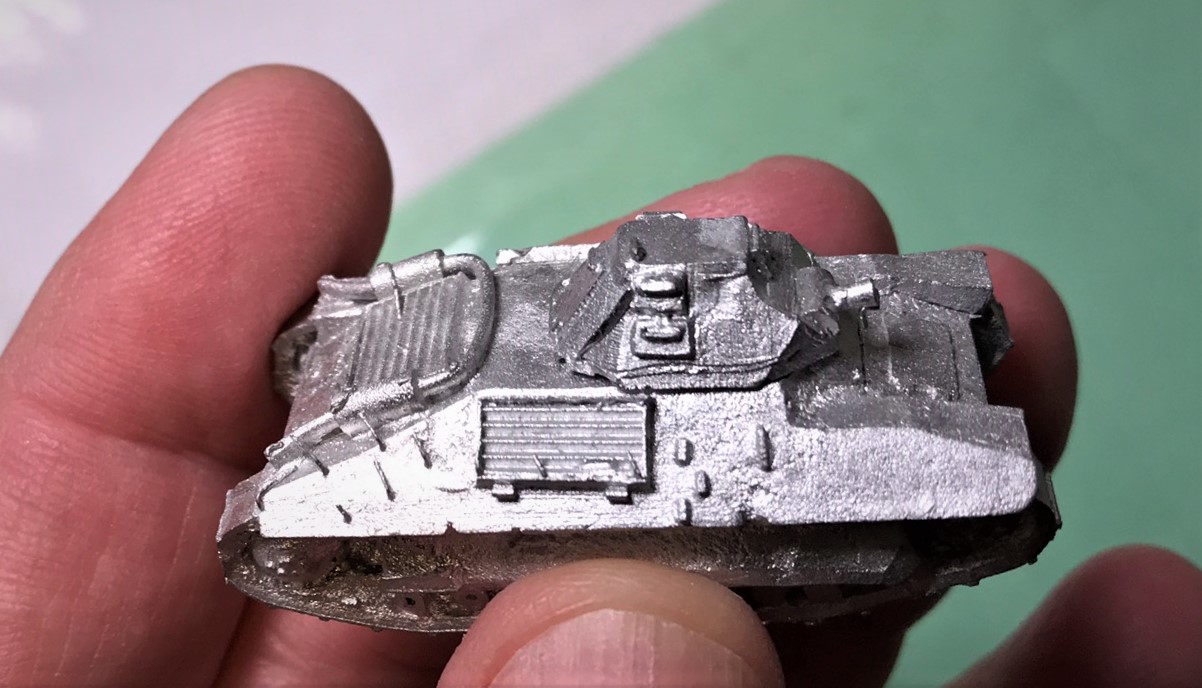
I did need to do a bit of filing and cleanup of extraneous molding material and molding lines as you see here.  Yes, these are small!
3 FCM 36 before filing showing turrets pins
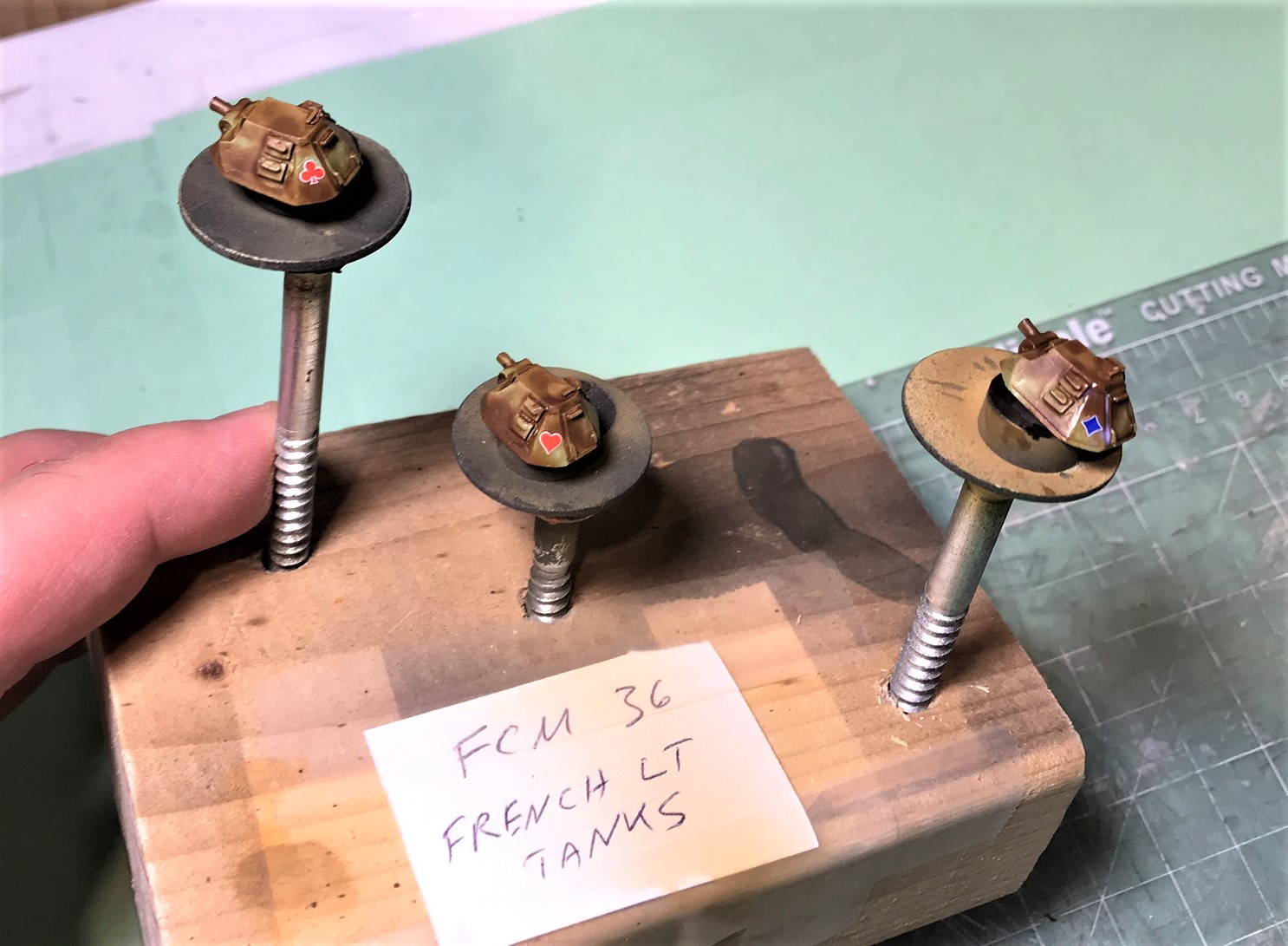
The turrets had a small molded pin for mounting on the molded hole on the chassis.  I needed to slightly elevate the turret or the underlying paint on the chassis would be worn off, even with a good varnishing.  I decided to drill out the pins and the holes with a 1/8″ drill bit.  I then used green stuff to fill in underneath the hollow chassis between the tracks and provide a “floor” for the magnets.  The magnets were put in place with Gorilla Glue in the chassis and the turrets.
4 FCM 36 after priming and base coat
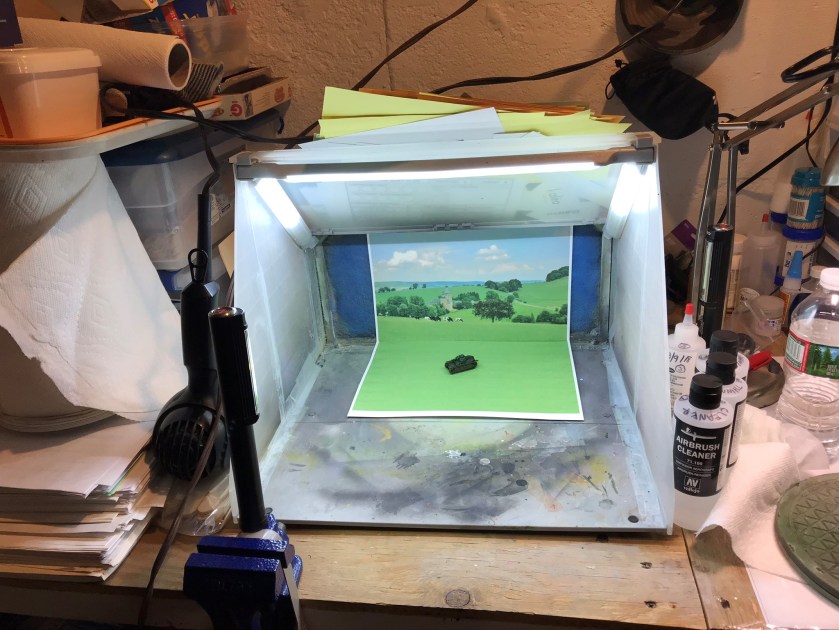
You can see here my hodge-podge mounting scheme of the FCM 36’s for painting.  I used a 1/4″ square dowel and poster tack to mount the chassis for painting.  I primed these, and the used a German green-brown as a base coat.  This shot here is after the first camouflage color (blue green) was applied with my Iwata Micron airbrush.  Also, I only put the turrets on a tank when I am painting camouflage patterns.
5 FCM 36 after priming and base coat and more camo
Next, I applied the third color (brown) to the camouflage pattern.
6 Turrets after decal but before varnish
When I paint turrets, I find this helpful (as the magnets in the turrets hold the turrets to the magnets on the washers).  Also, I can easily apply the decals this way, and airbrush on the final two coats of matte varnish.

Lastly, I thought I’d share some group and individual shots and a bit about their debut on the tabletop the day after they were completed.


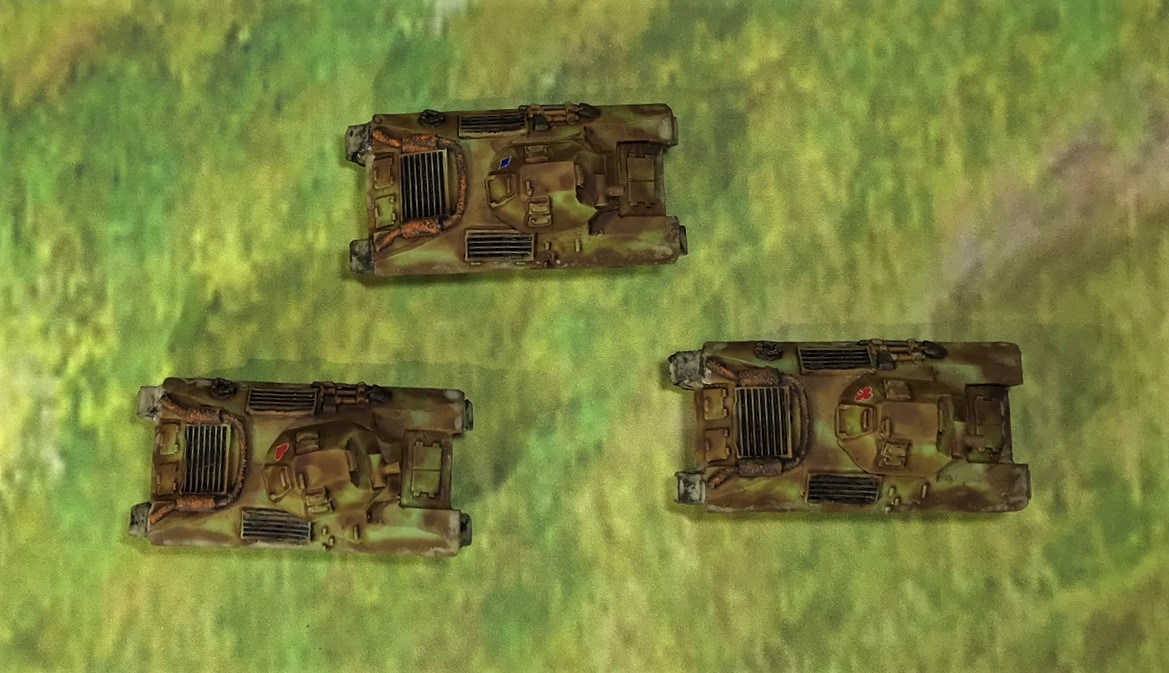
12 FCM top view
Top view showing the sloped octagonal turrets.


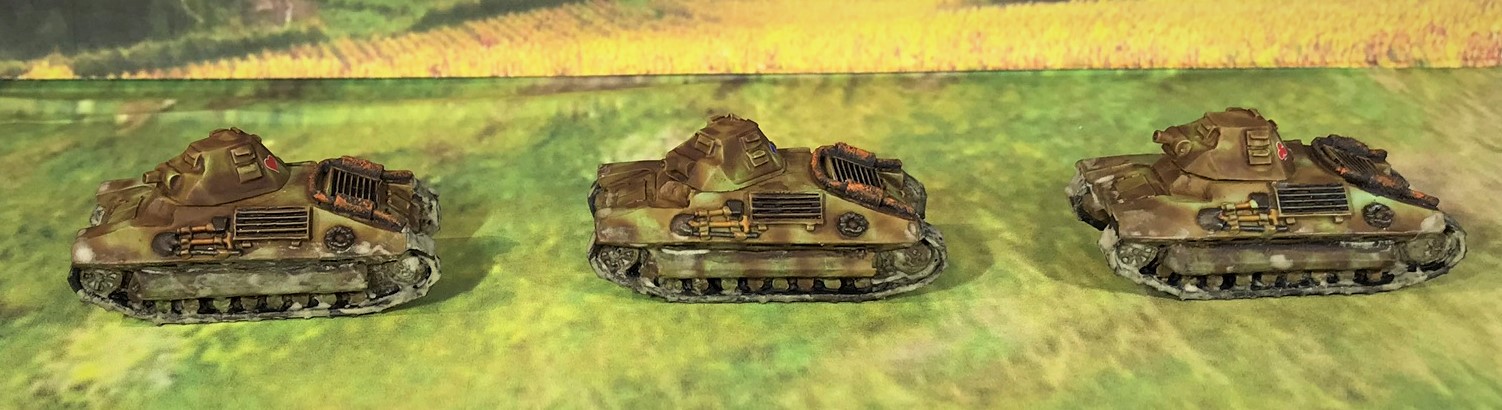
7 FCM 36 left sides
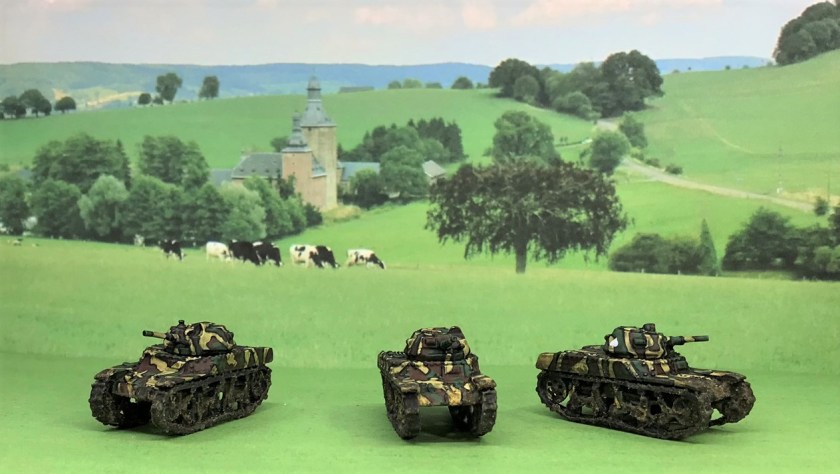
Left side of the FCM 36’s.
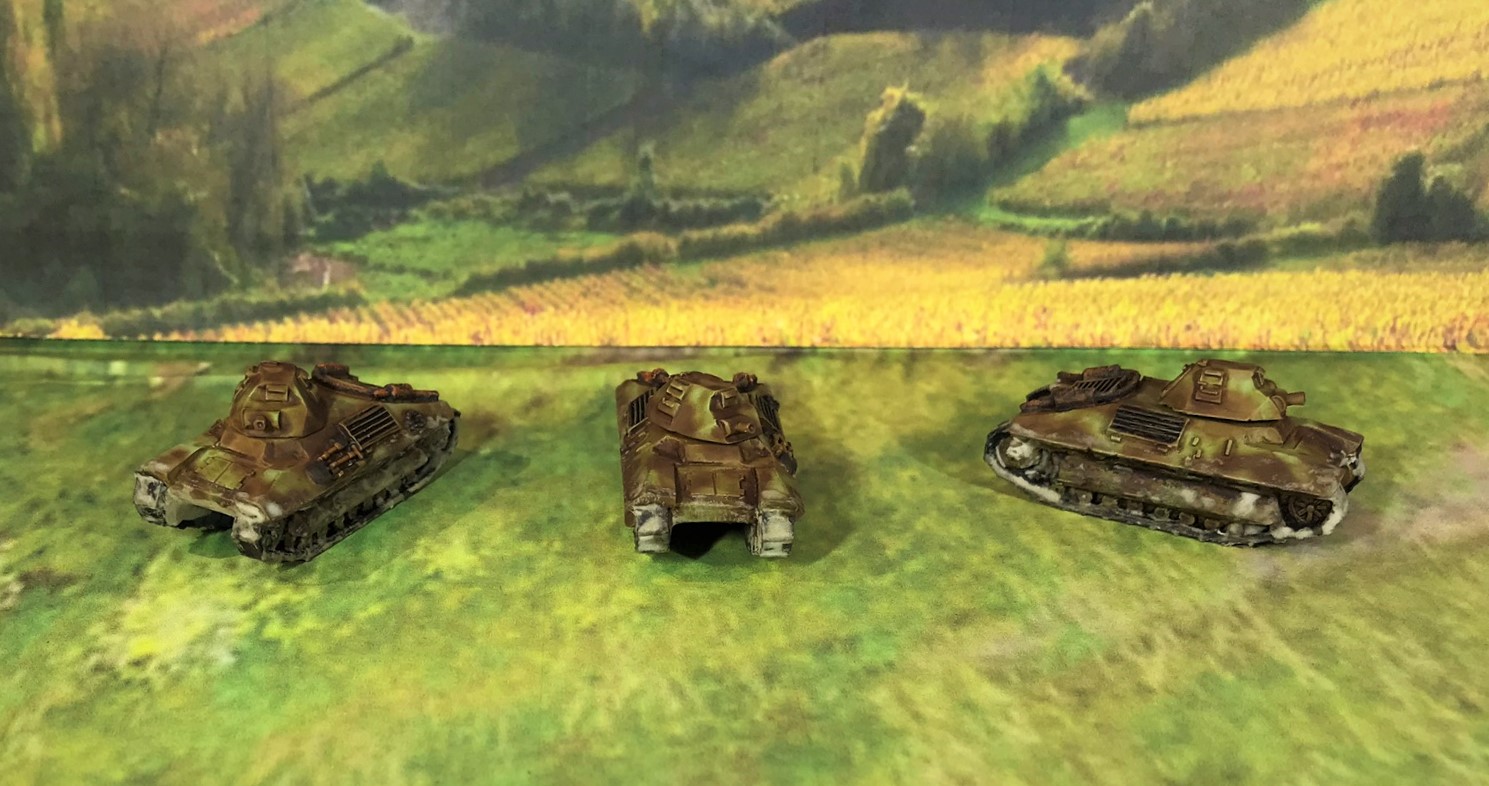
8 FCM 36 frontal armor view
Frontal view.


I used a blue diamond, a red heart, and a red club as decals which would also help identify these as different individual tanks on the tabletop.  From my research, FCM’s did not seem to have as many markings historically as other French tanks.

As stated above, these made their game debut this weekend at the December session of the Mass Pikemen Gaming Club.

13 First FCM 36 roll
My buddy Mike Morgan was on the French side, and chose the blue diamond FCM 36 as his tank.  He then rolled a perfect roll of 6 sixes!  The odds on that were 0.01286%!
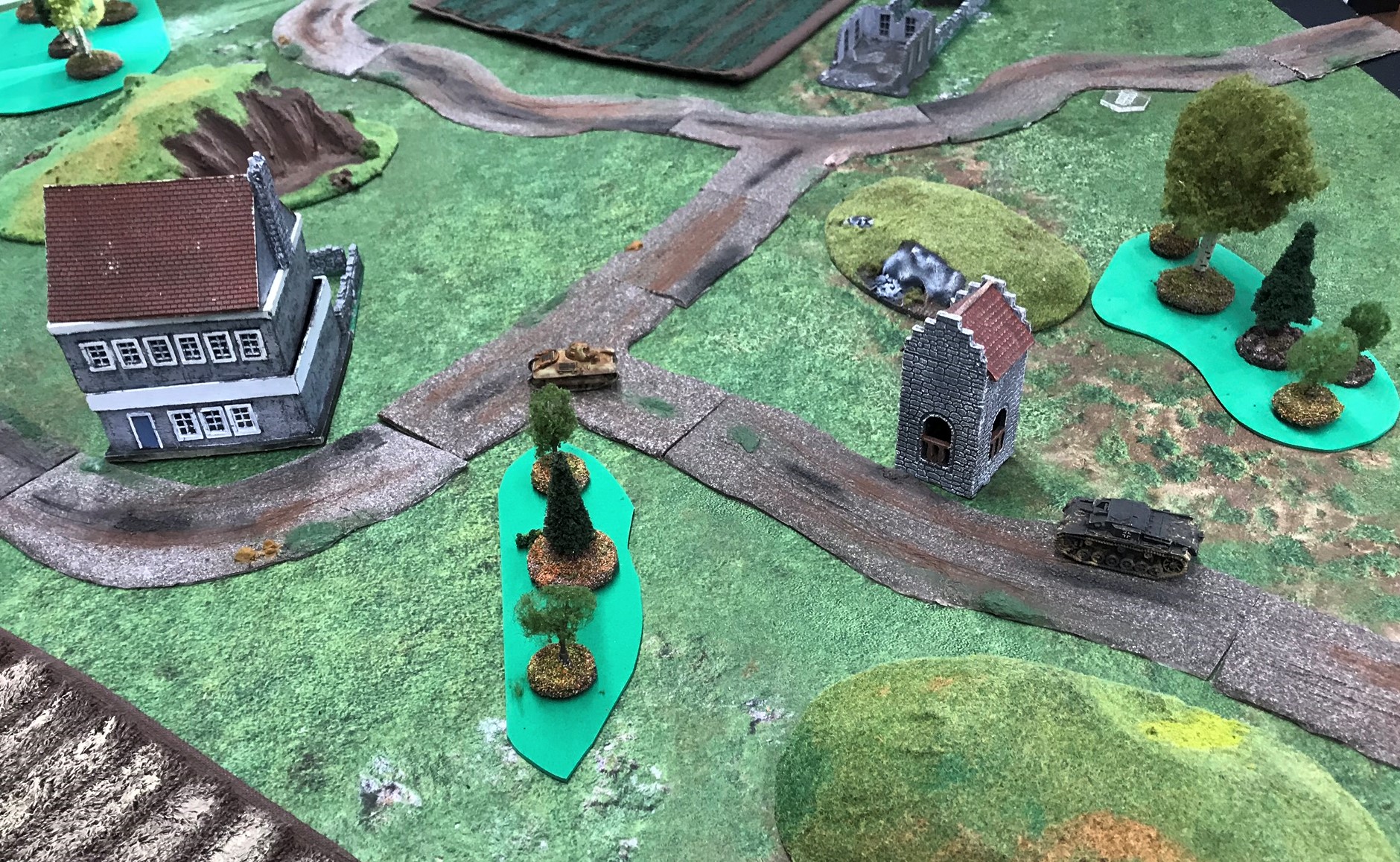
14 FCM 36 Blue Diamond moves onto the board
Mike’s FCM 36 moves on the road.
15 FCM 36 Blue Diamond duels with a StuGA
His FCM 36 was stalked by a StuG A (player Chris), which kept missing it.
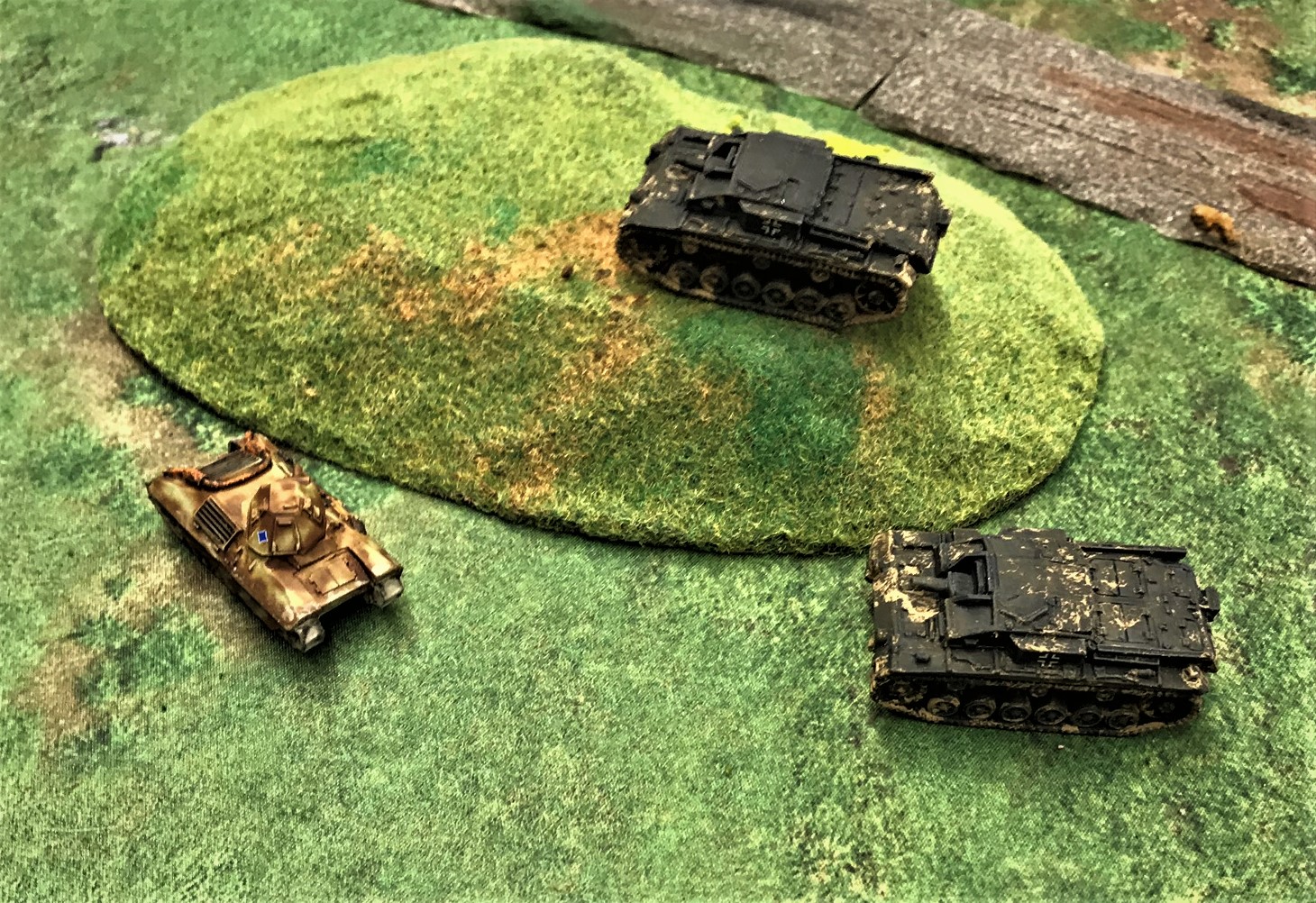
16 FCM 36 Blue Diamond duels with a StuGA, misses
Mike successfully maneuvered his tank to the German’s side, and shot point blank.  The dice deserted him as the StuG A took only minor damage.
17 FCM 36 Blue Diamond duels with two StuGA, who miss it
Smelling an easy kill, the Germans (Chris’s teammate Christine) brought up a second StuG A in the hunt.  It also missed the FCM 36.  Note – as there were only 15 StuG A’s in the German invasion force across France, this would have been highly unlikely!
18 Now the Panzer IIIE joins the fight
Then the Germans brought up even more to the hunt with a Panzer IIIE…
19 Panzer IIIE brews up FCM 36
And Mike’s plucky FCM 36’s luck finally wore out with the Panzer IIIE (Christine) knocking it out.

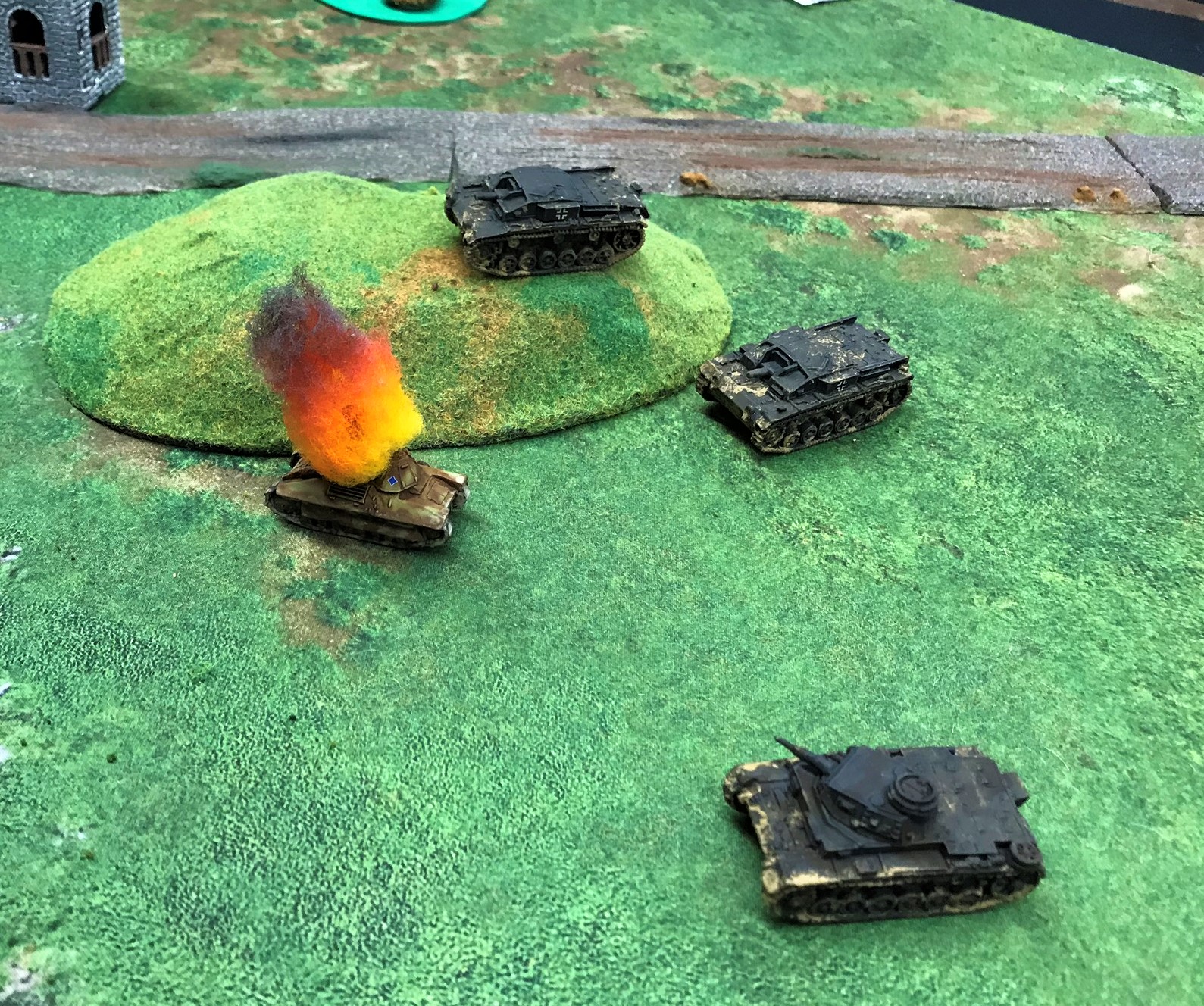
On the other side of the table, Mike’s teammate Tom managed to kill Christine’s Panzer 38(t) with a SOMUA S-35.  Mike got another FCM 36, and that was killed by Christine’s teammate Chris’s StuG A (in the shot below on the left).  Mike replaced his lost tank with an R35.  Tom drove his SOMUA around the building but frustratingly could not take a point-blank shot at the Panzer IIIE (as his dice roll failed him).  Mike had to leave, and my wife Lynn (no gamer just watching) took over the R35.  Lynn drove the tank to the side of Christine’s Panzer IIIE, and rolled three critical hits – and Christine failed to block any.  This knocked out the Panzer IIIE!

20 R35 avenges the FCM 36 after SOMUA misses
Lynn’s R35 avenges the burning FCM 36 (on right) by knocking out the Panzer IIIE.
21 Lynn is happy
Happy wife, happy life!  Tom and Lynn are all smiles here.
22 SOMUA is hit in rear by StuG A
In a final act, Christine maneuvered her remaining StuG A for a rear shot on Tom’s SOMUA S-35.  She successfully knocked out the SOMUA.

That ended the game, with the French winning a very narrow victory 32-31.  If Lynn had not rolled so well in killing the Panzer IIIE, the Germans would have won.  Thanks to the players for a great and fun game!

I have plans for more French and German tanks for this scenario.  I hope that you enjoyed this post, and feel free to share your thoughts and feedback with me in the comments section!  I have been behind on my blogging efforts and hope that I can share more with you soon!  Thanks for taking a look!

Also, as these were mostly done in November, I would add them as my contribution to Azazel’s MechaNovember painting challenge!

PAINTS, INKS, GLAZES, SHADES, WASHES, PIGMENTS, FLOCKING, GLUES AND MORE USED ON THESE VEHICLES:

  1. 1/8″ neodymium magnets
  2. Green stuff (kneadatite)
  3. Gorilla Glue
  4. Poster tack and ¼” square wooden dowels on plastic plates
  5. Vallejo “Surface Primer – Black”
  6. Vallejo “Flow Improver”
  7. Vallejo “Airbrush Thinner”
  8. Vallejo Model Air “German Green Brown”
  9. Vallejo Mecha Color “Green Blue”
  10. Vallejo Mecha Color “Brown”
  11. Battlefront “Black”
  12. Battlefront “Dark Gunmetal”
  13. Vallejo Model Air “Wood”
  14. Vallejo Mecha Weathering “Dark Rust” (wash)
  15. Army Painter “Light Tone” (shade)
  16. Vallejo Model Air “Satin” (varnish)
  17. Microscale Micro-Set
  18. Microscale Micro-Sol
  19. Microscale Liquid Decal Film
  20. Appropriate decals from Battlefront
  21. Citadel “Typhus Corrosion”
  22. Citadel “Ryza Rust”
  23. Army Painter “Strong Tone” (shade)
  24. Vallejo “Light Sienna” (pigment)
  25. Vallejo “Light Slate Grey” (pigment)
  26. Vallejo “Pigment Binder” (pigment)
  27. Vallejo Weathering Effects “European Splash Mud”
  28. Vallejo Mecha Varnish “Matt Varnish”


Allies Defeat Germans at Fort Devens Game Day

On October 19th, 2019, the Fort Devens Gaming Day was held at the Fort Devens Museum.  This was our monthly gaming day as an “away” game day for the Mass Pikemen Gaming Club.  Our club sponsored two games as Scott Howland ran a pulp game in another room which was very well-received. I believe it was similar to this one.

This was my second time attending this small convention and my first time as a game master there.  For nostalgia alone, I really looked forward to the event as I was stationed at the old Fort Devens before it was closed in the 1990’s.   It has since been converted to commercial uses and some US Army Reserve functions.  Running a game here was fun.

10192019 Normandy Breakout with contact info

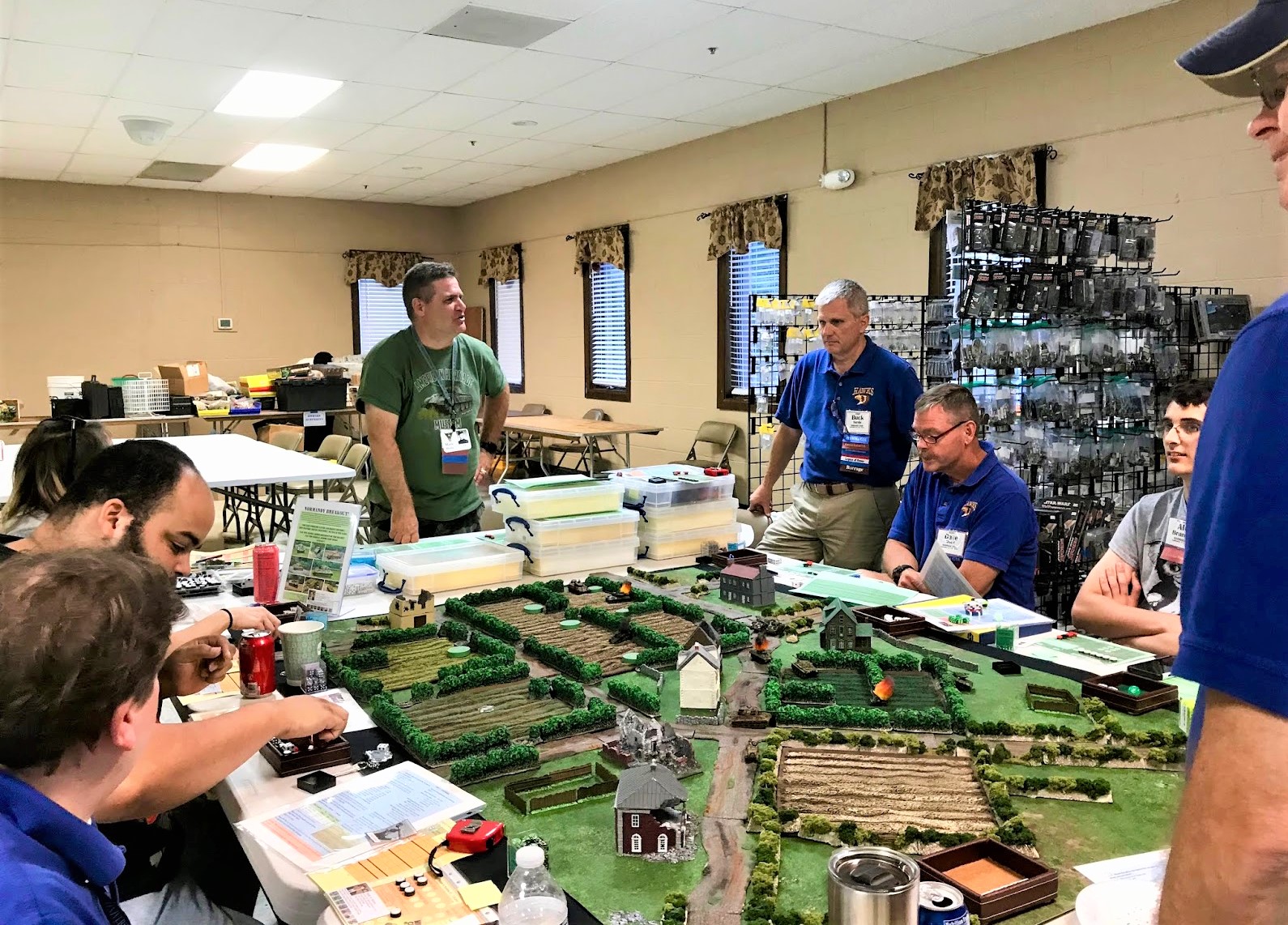
Mike Morgan graciously helped me set up my game in the museum among the exhibits (as you will see below)).  Thanks so much Mike!  Mike also supported Scott as a player in his game, and that was very cool.  I ran my Normandy Breakout game for What a Tanker©.  We had seven players – including several from the Mass Pikemen.  On the German side were Chris, Peter, and Steve.  On the Allied side were Leif and Walter (US), and Evan and Alex (UK).

Both sides started with 150 points/chips to use during the game.  The Allies started with a 40 points worth of vehicles.  For the UK, they bought a Dingo scout car and a Churchill “TIM” (nicknamed for theimperfectmodeler aka TIM), along with an M5 Stuart, and an M8 Greyhound for the US.  The Germans spent slightly less, choosing to buy an SdKfz 231 scout car, a StuG IIIG, and a Panzer IVH for 36 points.

1 Set up
The players prepare for battle among the museum exhibits.

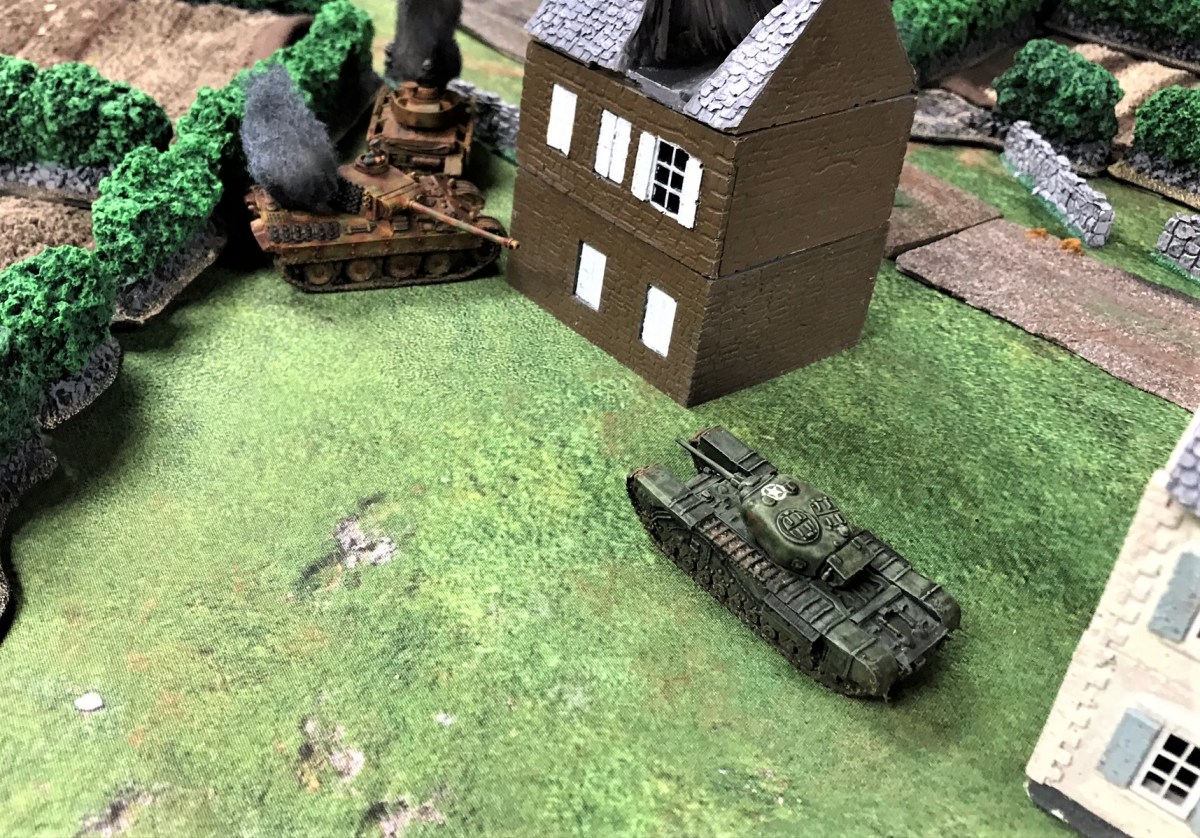
The Germans took up very good ambush positions – especially the Panzer IVH, which was hull-down behind a stone wall.  The M5 Stuart successfully reconned it, and the German fired point-blank at the light tank, missing it.  The Stuart then prudently backed up behind the hedgerow.  The Churchill “TIM” then moved up the road, to be also shot at, and again missed by the Panzer IVH.  Amazingly, the Churchill immediately reversed the bad German die rolls, and miraculously hit and knocked out the Panzer IVH for its first kill ring of the day.

2 Churchill takes out Pzkw IVH
The first exchange goes badly for the Germans as the Panzer IVH missed its first two targets (the M5 Stuart and the Churchill).  The retreating M5 is at top behind the hedgerow.  The Churchill “TIM” drives past the knocked out (with crew surviving) Panzer IVH.

The Allies then successfully reconned nine possible German positions at 2 points apiece, adding to their score.  They also successfully crossed the tabletop with an M8 Greyhound, gained the points, and respawned as another M8.  The Germans spent some points and respawned the destroyed Panzer IVH crew into a Panther D which drove up next to the burning Panzer IVH.  The Churchill “TIM” went Panther hunting.

Meanwhile, the Germans tried to put an end to the Allied reconnaissance successes.  The StuG IIIG ambushed both the M5 and the Dingo gaining them crucial points, which they used to buy a Marder III.  The Allies respawned both losses with similar models.

3 StuG IIIG takes out M5, while Churchill moves around Panther
The Churchill “TIM” at top maneuvers to attack a Panther in the rear.  In the foreground, The StuG IIIG takes out the M5…  

The Allies spent some chips to respawn the Dingo as a Cromwell IV nicknamed “IRO” aka imperialrebelork.  The Germans dropped some obscuring smoke in front of the Cromwell.

4 StuG IIIG takes out Dingo, while Churchill moves around Panther
…and then the Dingo.  The Germans dropped smoke to protect the StuG from the Cromwell IV “IRO”.  The Churchill “TIM” at top hunts the Panther D.

“TIM” continued its winning ways and managed a flank shot on the Panther D.  Its good dice rolling (and the German bad dice rolling) yielded a second kill ring for “TIM”.

5 Churchill gets second kill ring against Panther
The Churchill “TIM” takes out the Panther D.

The Germans were aghast at this expensive loss and vowed revenge.  The SdKfz 231 managed to call in a rare Luftwaffe air strike on the Churchill, which destroyed “TIM” after it had been so effective.

The British mourned this loss, and respawned it as an Achilles 17-pounder nicknamed “Per”.  The British also bought another Dingo and a Cromwell IV nicknamed “JNV” or justneedsvarnish.  The US bought an M10 Wolverine.  The Germans went for broke and bought a Jagdpanther and an SdKfz 233.

The StuG IIIG went head-to-head with the Cromwell “IRO”, and took it out.  The Jagdpanther caught the Achilles “Per” in the open and made short work of it.  In the meantime, the Allies successfully crossed a Dingo and an M8 Greyhound.  This resulted in denying the Germans any end of game bonus points for preventing more than two Allied vehicles crossing the table.

To make matters worse for the Germans, the respawned M5 Stuart knocked out a well-hidden Marder III with some help from a supporting infantry assault (see how I use bonus attack cards here) and well-placed 37mm rounds.  As the game was winding down, and it was clear the Allies had a commanding edge in the score, The Germans bought a Tiger I and converged all vehicles on the plucky M5.

6 Marder III taken out and other Germans seek vengeance
The Marder III burns, and the Tiger I and SdKfz 233 hunt the M5 Stuart… 
7 Stuart will not die
…and are joined by the Jagdpanther!
8 Traffic jam
This traffic jam at game’s end yielded no damage on the M5 Stuart – the dice had completely deserted the Germans.

At games end, the final score was Allies 193, Germans 142.  This game yet again delivered a different result.  Player choices, and player luck all made this game fun and unique.

This is my 12th post about my development and running of this scenario and the models that went into making it.  I started back in May 2019, so it’s been a lot of work, but one project that I really am proud of now.

I wanted to honor the history and the struggle of the Allies in the days after the D-Day landing 75 years ago.  I will continue to run the game, and at this point I really only need to add a StuG IV to be really complete vehicle-wise (and I have one to build!).  To read about previous games and related posts, see the following:

Thanks to the Fort Devens Museum, Peter Lowitt. and the guys at Fencing Frog Gaming Adventures for running the event.  I hope to see you next year, if not sooner.  I also hope that some of the players join us at The Mass Pikemen Gaming Club.

I hope you enjoyed this post and would love to read your feedback!


My Barrage 2019 Recap

The wonderful Barrage wargaming convention was held back on September 27-28 in Havre de Grace, Maryland.  It is run by the Harford Area Weekly Kriegspielers (HAWKS), and I have attended the last few years and run a few games there as well as a GM.  This year marked the 25th Anniversary of the convention.

The trip was enjoyable – and even though it’s been over a month since the event – I wanted to share some of the pics and details of the event from my perspective.  It’s not an all-encompassing review – but hopefully it will give you a flavor of the event and some nice views of some worthwhile and visually interesting tabletop games.

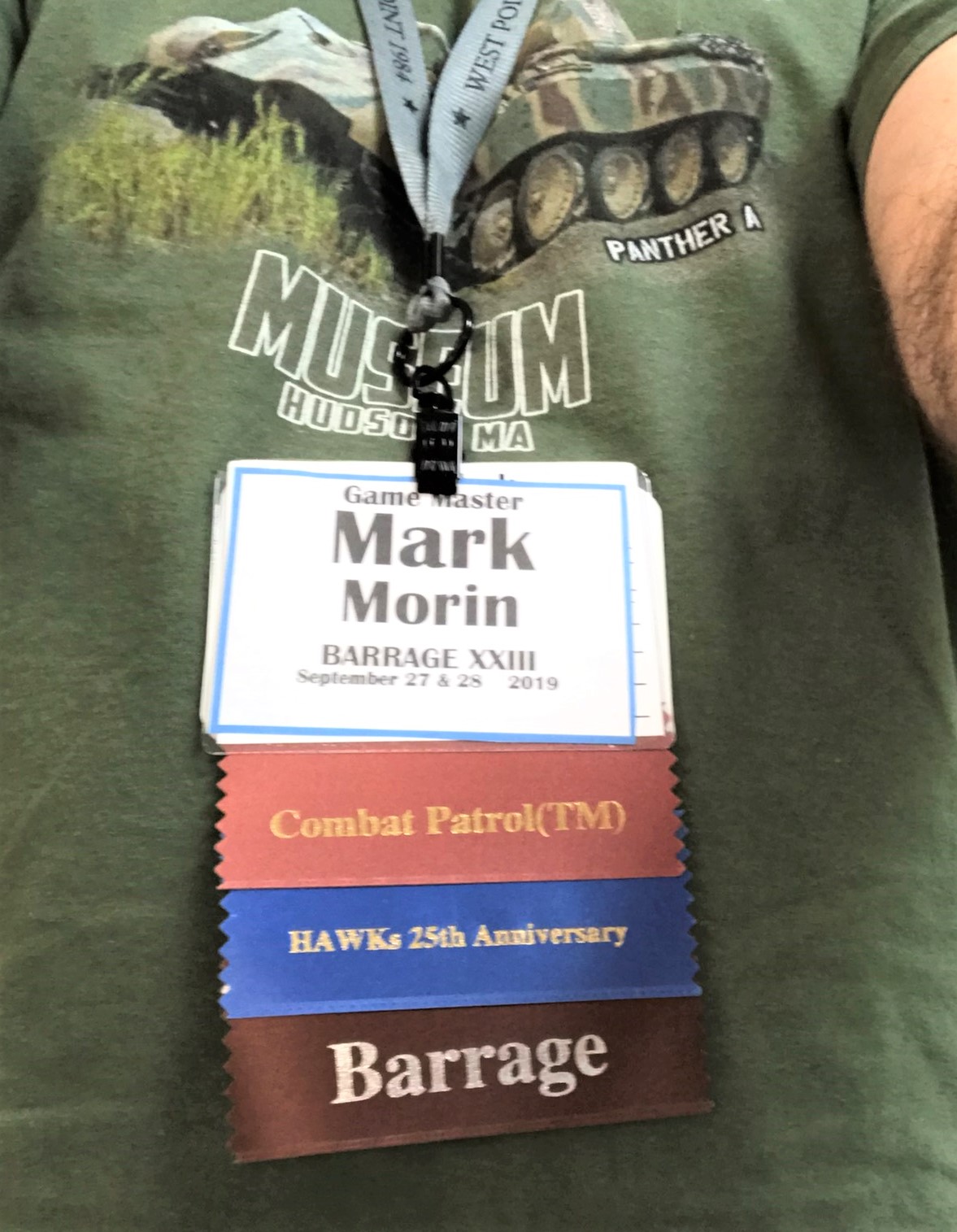
29 My badges

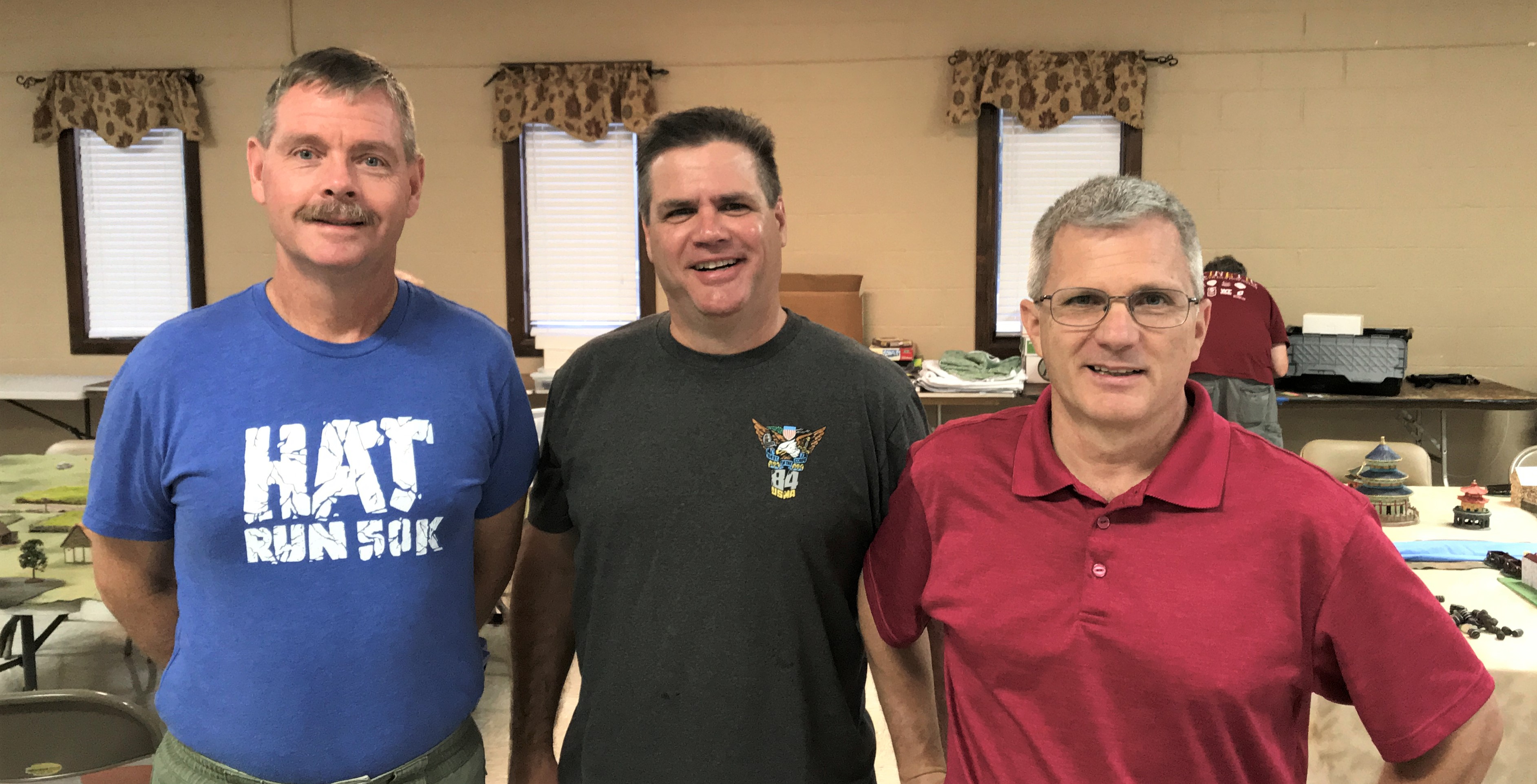
1 Old Grads
Three only slightly aging West Pointers – Dave Wood (’84), me (’84), and Buck Surdu (’85).  Dave and Buck are in the HAWKS and going to the convention doubles as a mini-reunion for us.  Plus I get to see how much better in shape they are than I am.

I drove down from Massachusetts and arrived Thursday night (the night before the convention) to help the HAWKS set up.  As a bonus, we got to play a few turns of Eric Schlegel’s Antietam: The Cornfield game using the A Union So Tested rules set.  It was a fun start.

The convention started in earnest on Friday – and I got a chance to check out some amazing tabletops.  Bill Molyneaux had a brilliant Boxer Rebellion game that had incredible terrain.  I did not get to play this game, but would have loved to try it.

I walked around Friday’s game and took some pics of a few games I loved seeing (but did not get to play) before I got into playing a Feudal Patrol™ game.  Here you can see a Napoleonic game (run by Dave Wood), a Gundam game, and a really neat G.A.S.L.I.G.H.T.  Sherlock Holmes themed game (run by Sam Fuson).   There was a Flames of War Tournament.  I have not played that game despite having (as regular readers know) a TON of FoW models.  The games looked a bit crowded figure-wise – and maybe that’s normal for that game.  Note the US TIE fighter (the gamer said he did not have a proper US plane so he painted this model)…not sure about that particular add personally.

I really wanted to try another game of Feudal Patrol™.  I had played one at HUZZAH! run by Duncan Adams earlier this year.  Feudal Patrol™ is a novel skirmish game (yet unpublished) and is similar to Combat Patrol™ – except it is for pike and shot periods and earlier.  I am hoping to write an Aztec supplement for it for Buck.

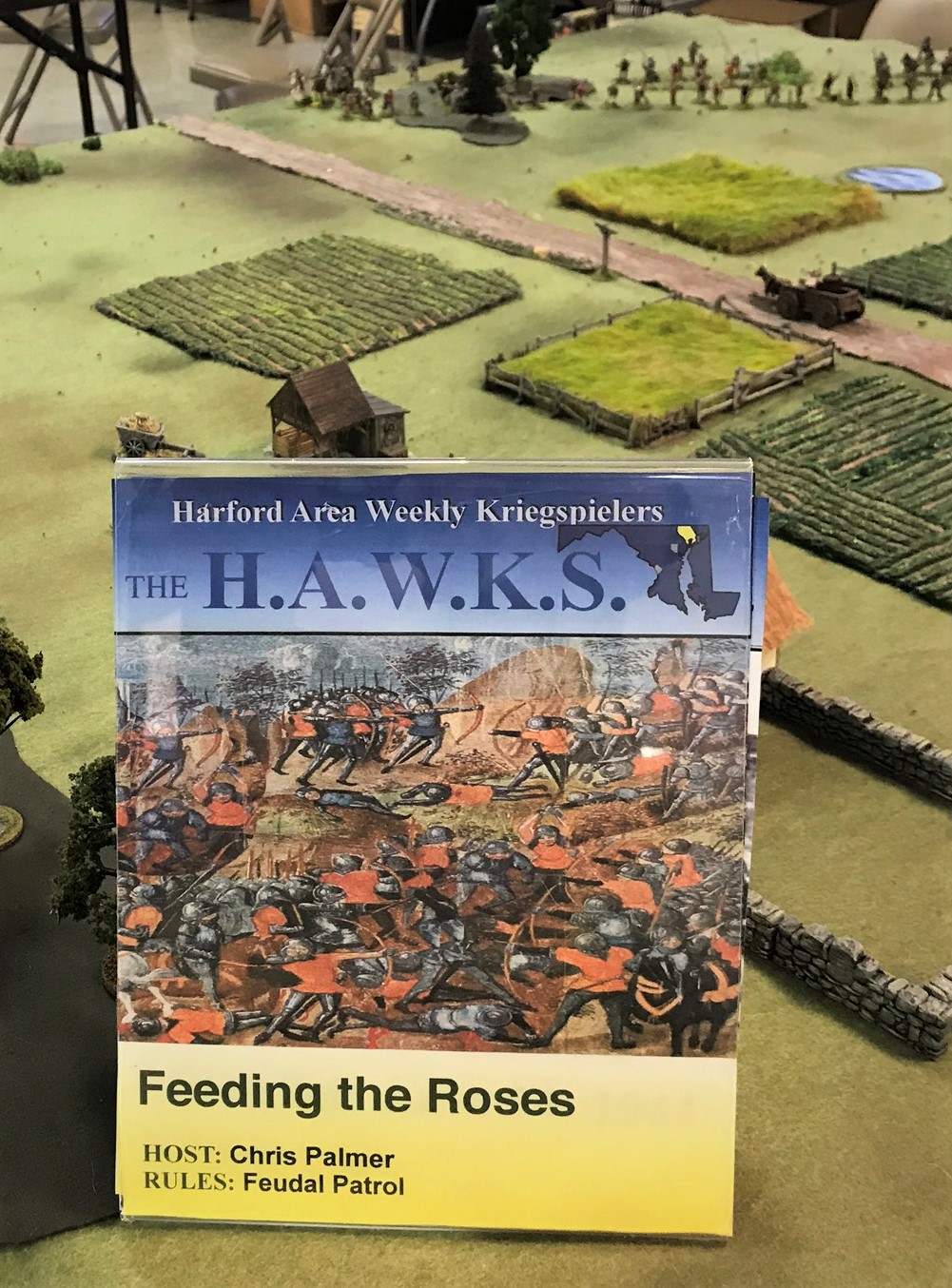
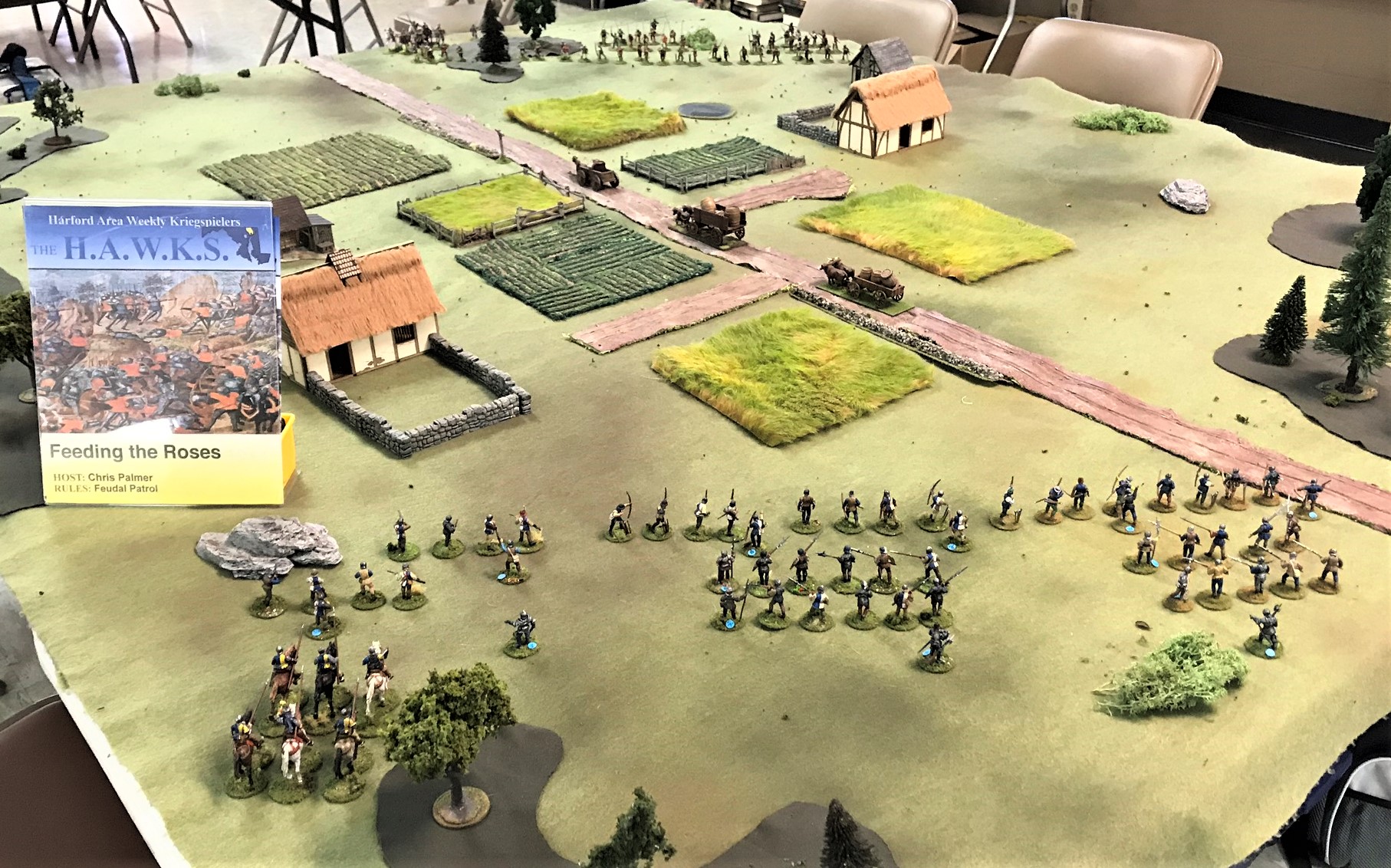
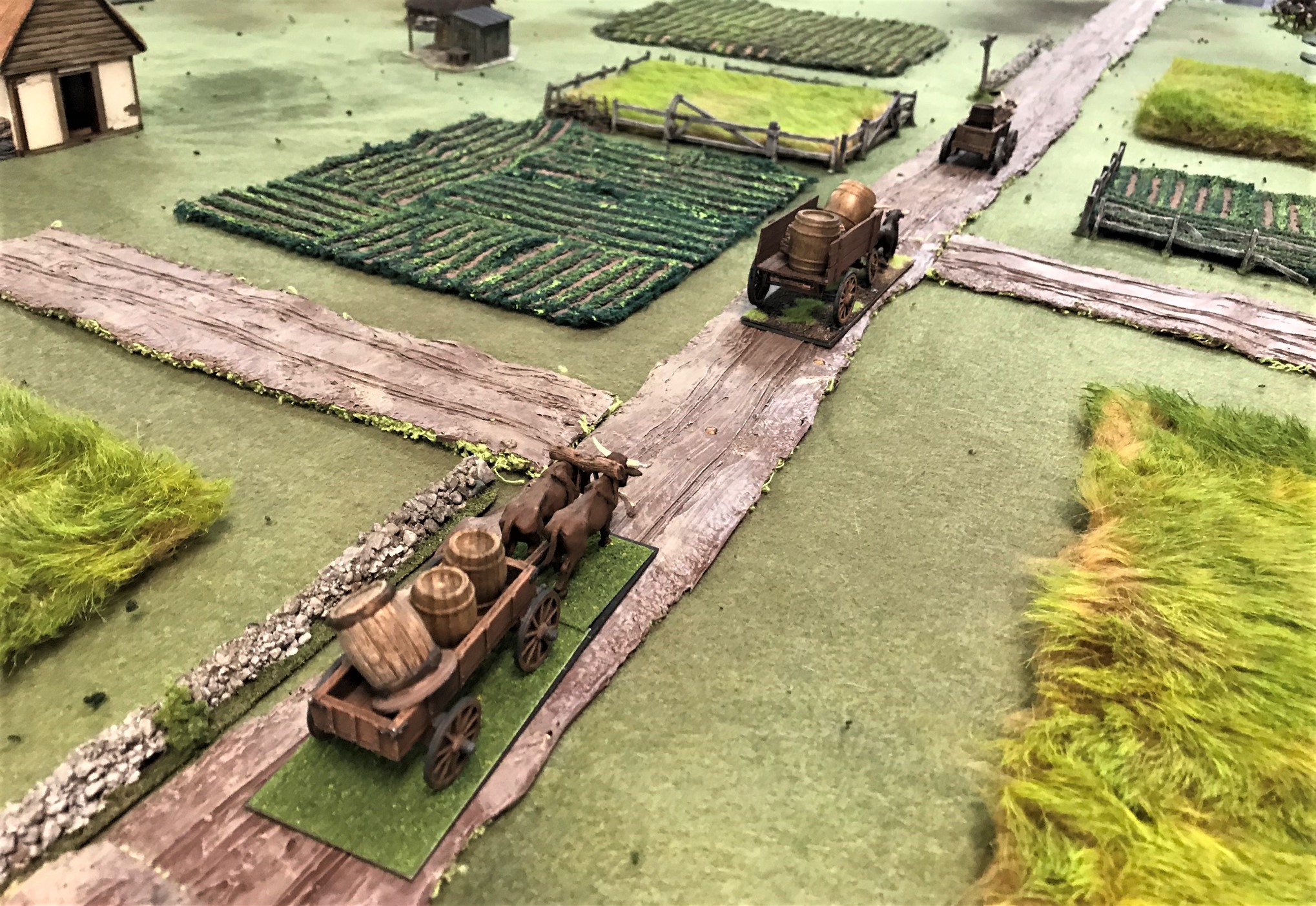
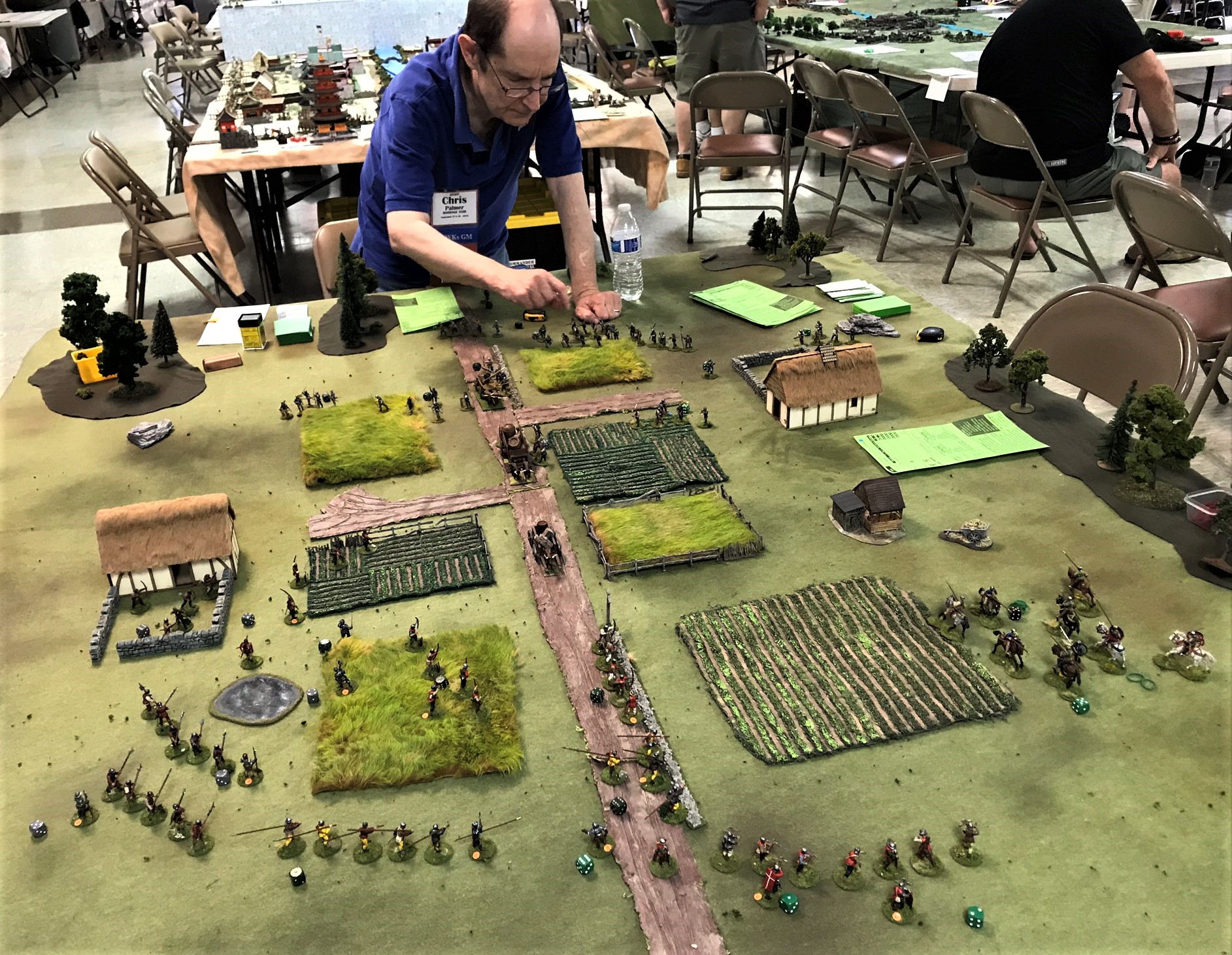
Chris Palmer ran a War of the Roses scenario involving securing an abandoned supply train of three wagons.   It was just the two of us, but as Buck came available, he joined in on Chris’ side.  I started off well, but in due course I got my ass handed to me by Buck and Chris!  Still, I was glad to try it and I feel confident that this will be another great system by Buck.

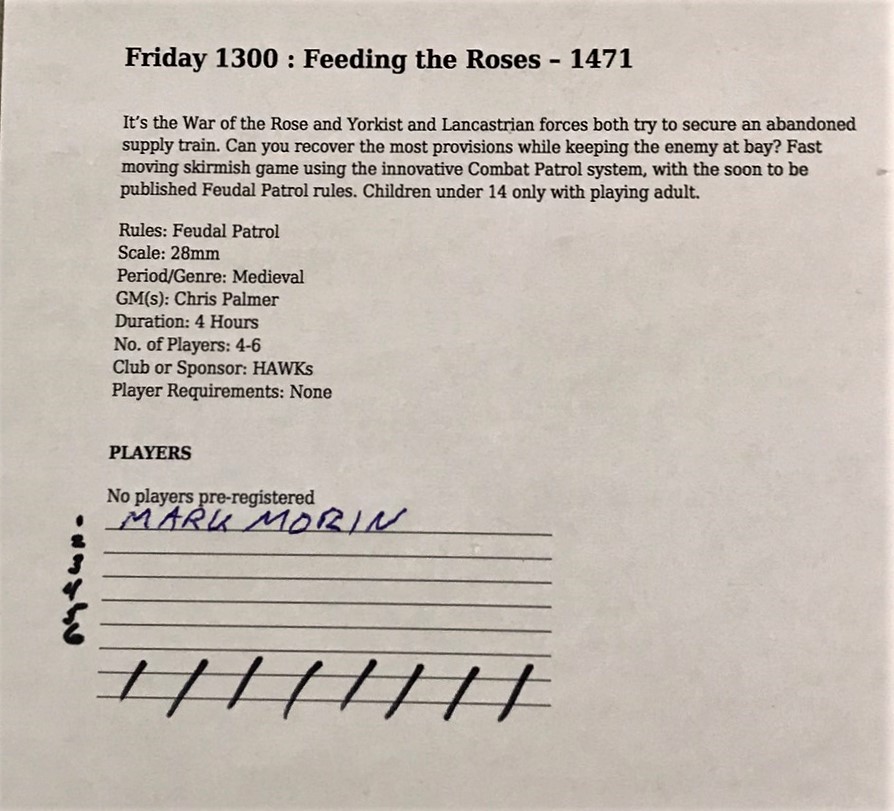
16 Feudal Patrol
Not the greatest sign up!  Too bad as it was fun.

17 Feudal Patrol

18 Feudal Patrol
My forces, with the enemy Yorkists across the table.  The abandoned wagon train (the objective) is in the center.
19 Feudal Patrol
The Lancastrians.
20 Feudal Patrol
Wagon train objective.
20a Feudal Patrol
Buck confers with Chris (off-camera) as the two forces cavalry converge.
20b Feudal Patrol
Chris moves his Yorkists up and takes two wagons.
20c Feudal Patrol
I moved a leader on top of the remaining wagon to seize it.  Unfortunately, the Yorkist crossbowmen ended that effort by turning him into a pin cushion, and pinning his subordinates in the process.

20d Feudal Patrol

After this game, I walked around and took some more shots of some cool tables.  There was a 54mm scale ACW game, and a 54mm medieval mayhem game.  Greg Priebe had a Poland 1940 Combat Patrol™  game for replete with an armored train.  Lastly, there was an Aliens-inspired scratch built table that was impressive.  These shots are below.

28 ACW2
Another ACW game, in larger scale.

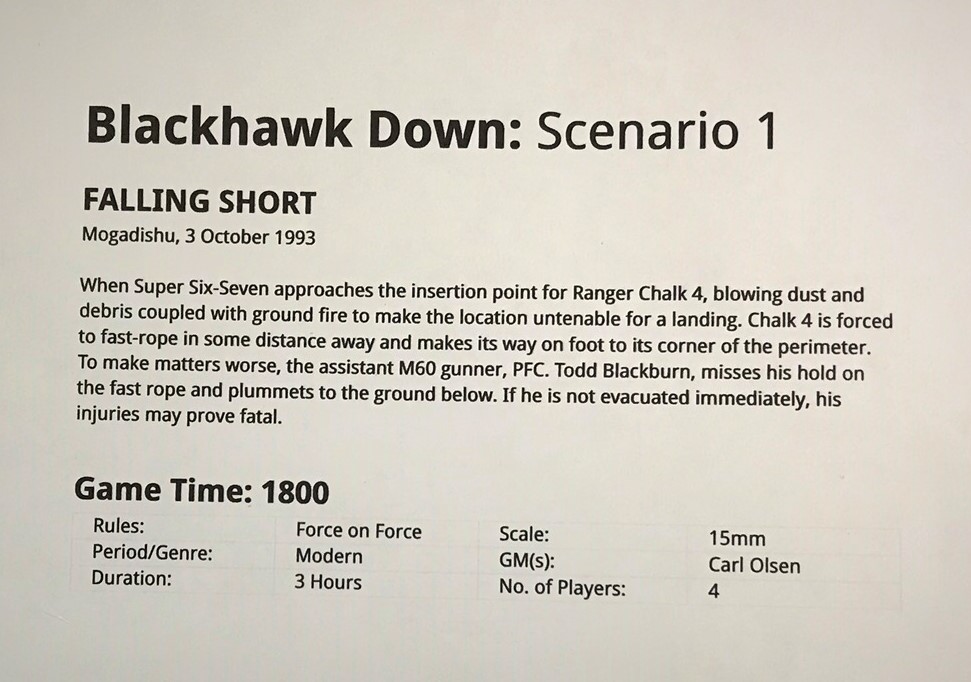
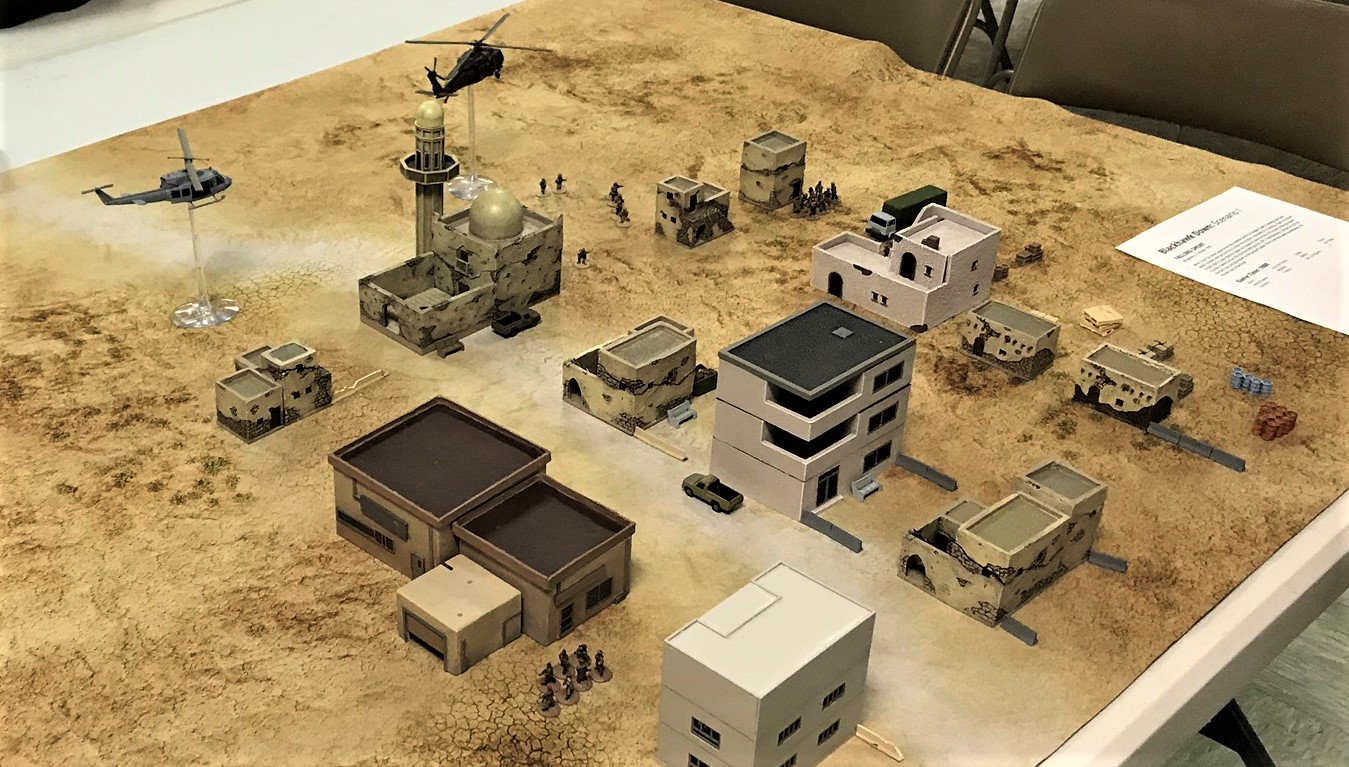
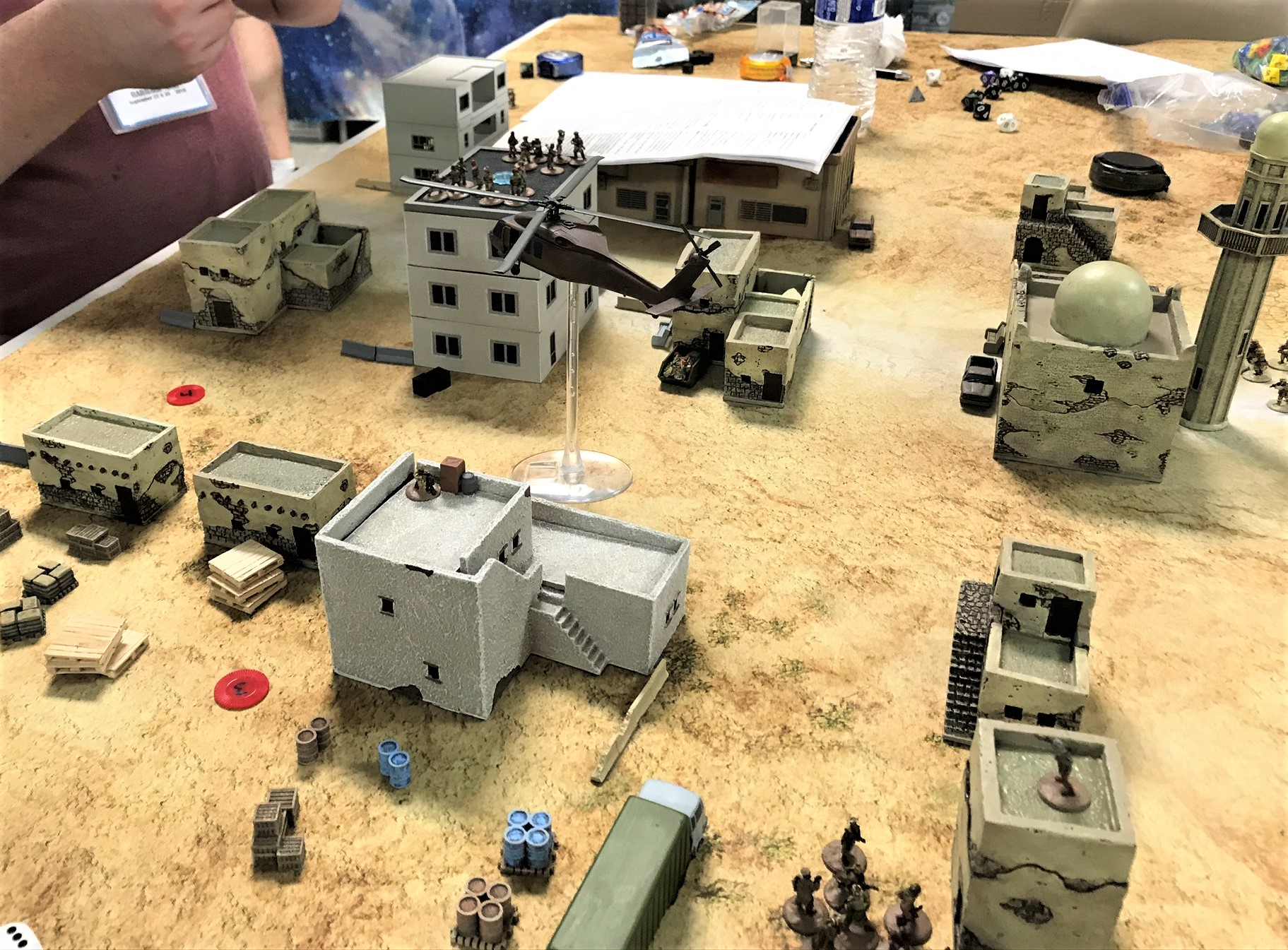
The last game that I played on Friday was with Dave Wood and another player.  It recreated the scenario made famous by the events portrayed in the movie Black Hawk Down.  The rules were Force on Force, which had an interesting set of mechanics, but very complicated for a short game.  We actually ran the game twice, with Dave and I as the Americans.  All agreed that the scenario was impossible to win for the US.  Still, the GM Carl Olsen made the experience enjoyable.

26aa Blackhawk down

26 Blackhawk down
The tabletop for the scenario.
27 Blackhawk down
Even with air support, the mission was too difficult for the US.

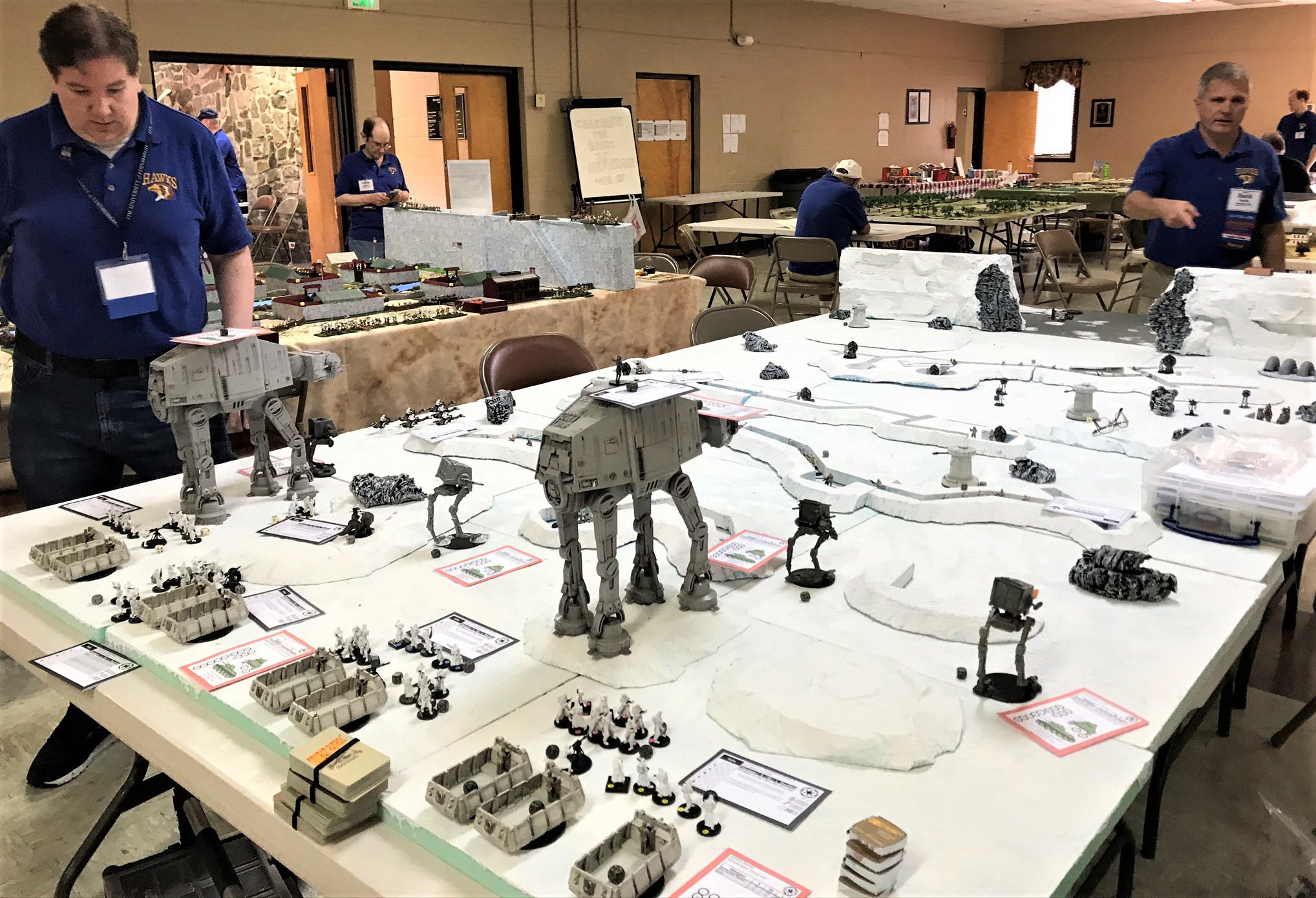
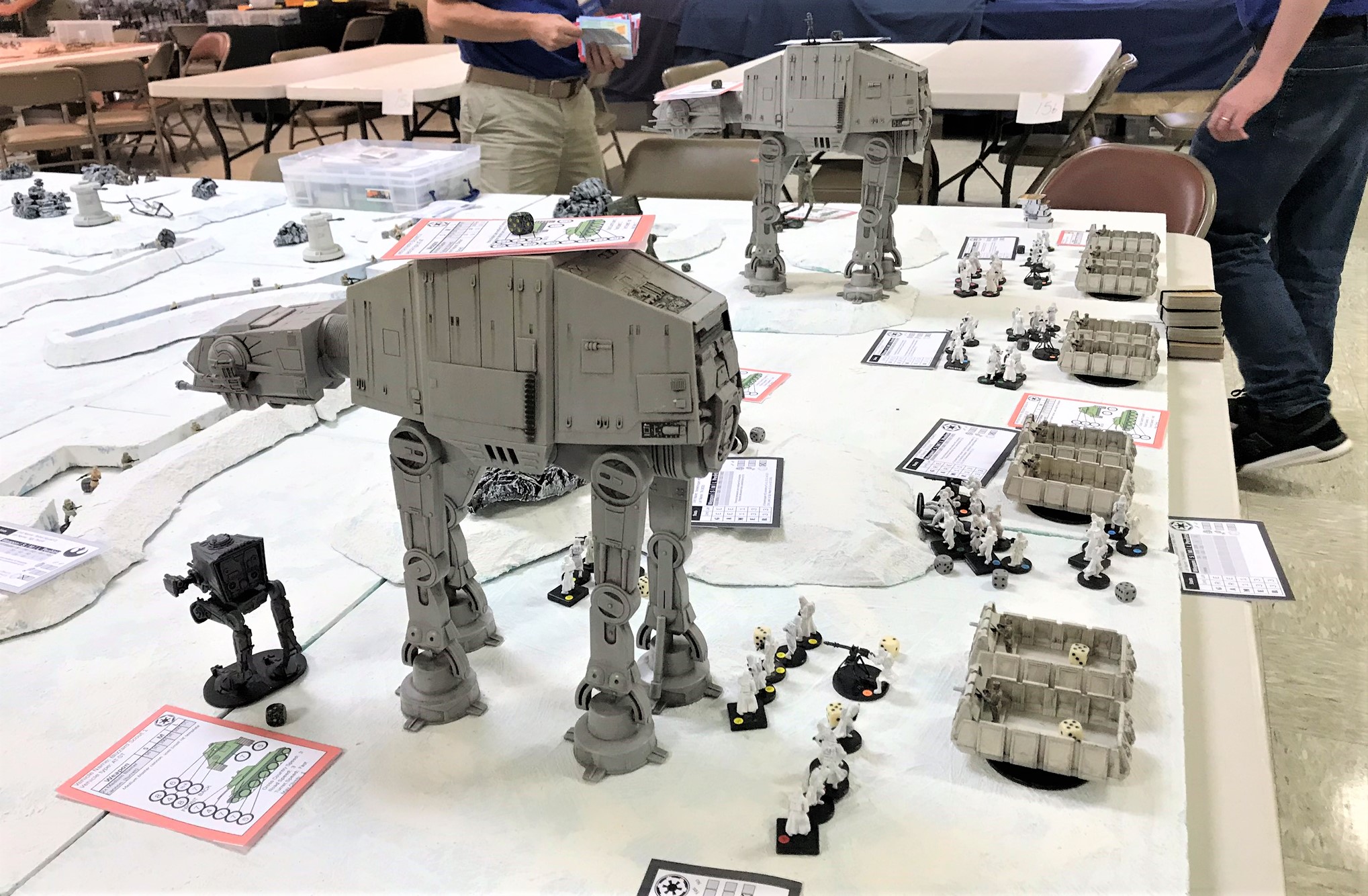
That finished off Friday.  Saturday presented an opportunity to play the massive Combat Patrol™ Star Wars Battle of Hoth scenario (from The Empire Strikes Back) of the Battle of Hoth that Buck and Greg Priebe ran at Historicon.  It was pure eye-candy (as you’ll see below), and a blast to play.  We had a full table of 10-12 players.  The Combat Patrol™ Star Wars supplement was used – and was easily picked up by the players who were new.  Buck and Greg did an outstanding job of running this massive game.

I played with several other players on the Imperial side with the goal of destroying the Millennium Falcon before it could fly out of the cave it was hiding in with the other rebel ships.  We succeeded in eventually knocking out the shield generator with an AT-AT.  Subsequently the Millennium Falcon was destroyed when our forces could get a clear shot.  A strategic victory was had for the Empire!

32 Buck Surdu and Greg Priebe Battle of Hoth
Scenario designers and GM’s Buck Surdu and Greg Priebe
30 Battle of Hoth
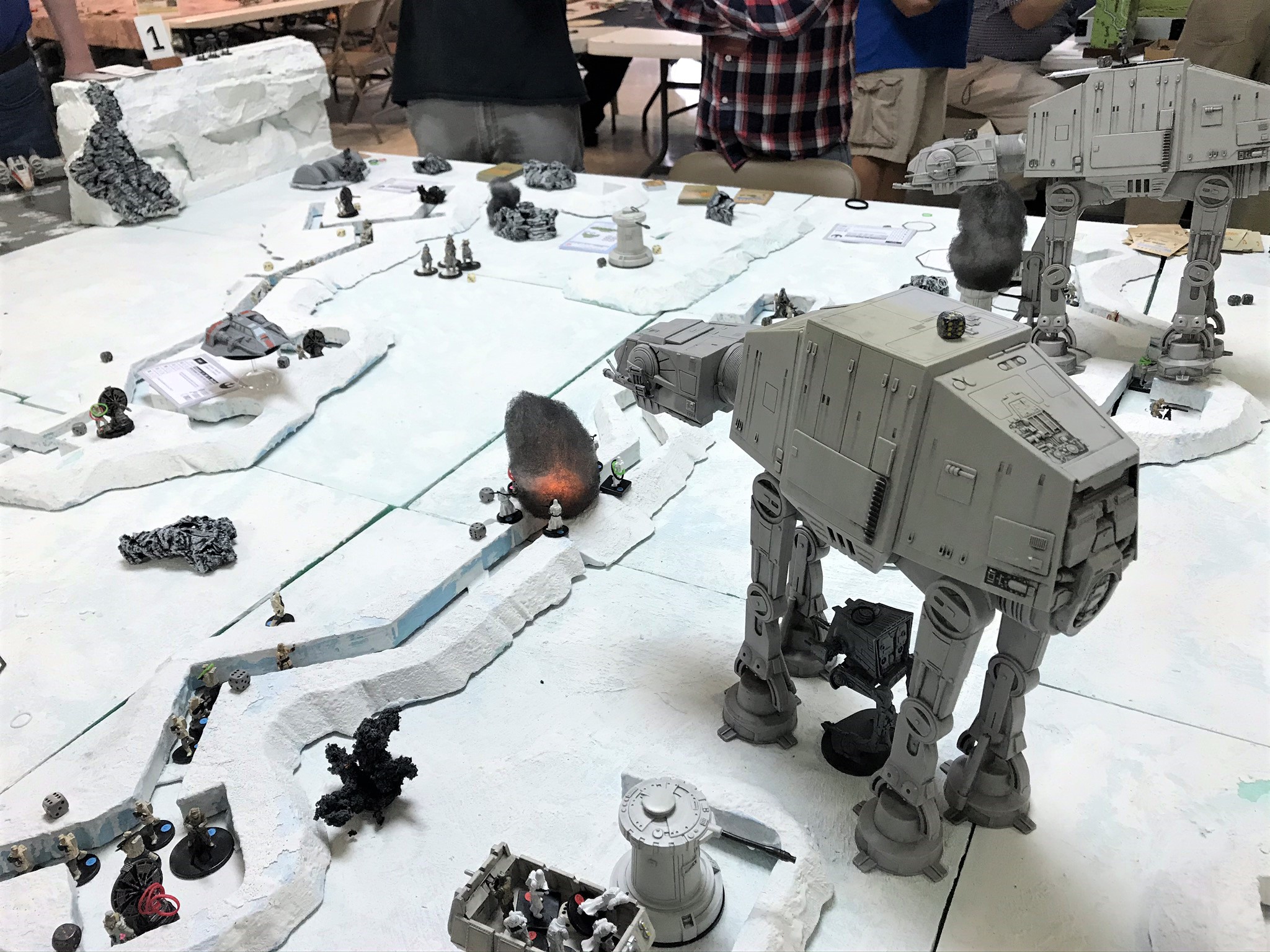
A view from the attacking Imperial forces side – the rebels and their spacecraft were in the cave on the far side.  The shield generator is on the far right.  The rebel trenches and positions were beautiful.  All the models were so fun.
31 Battle of Hoth
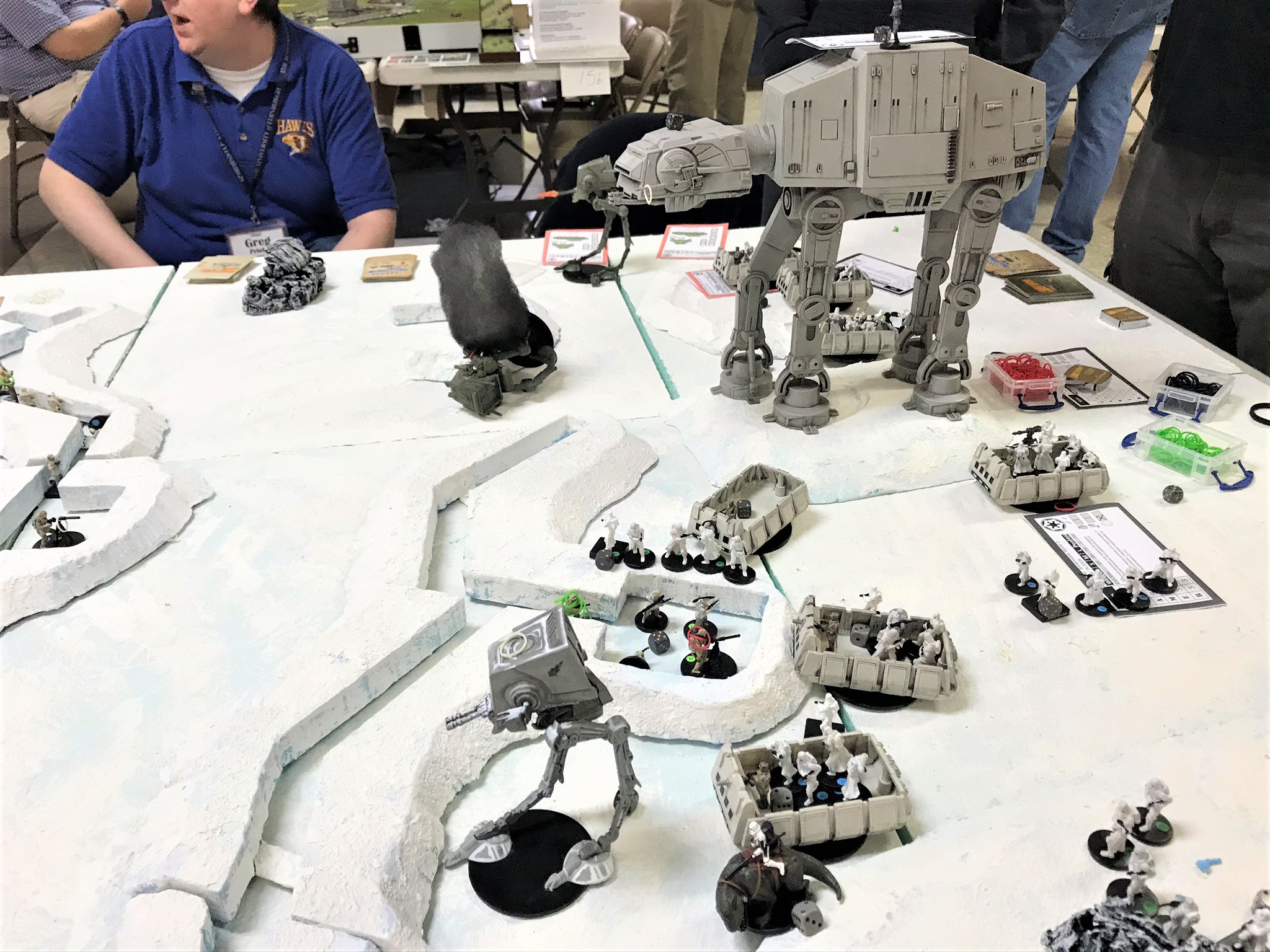
Imperial set up before the game.
32 Battle of Hoth
Rebel spaceships getting positioned in cave.  The Millennium Falcon was not yet set up on the top corner.
33 Battle of Hoth Speeders
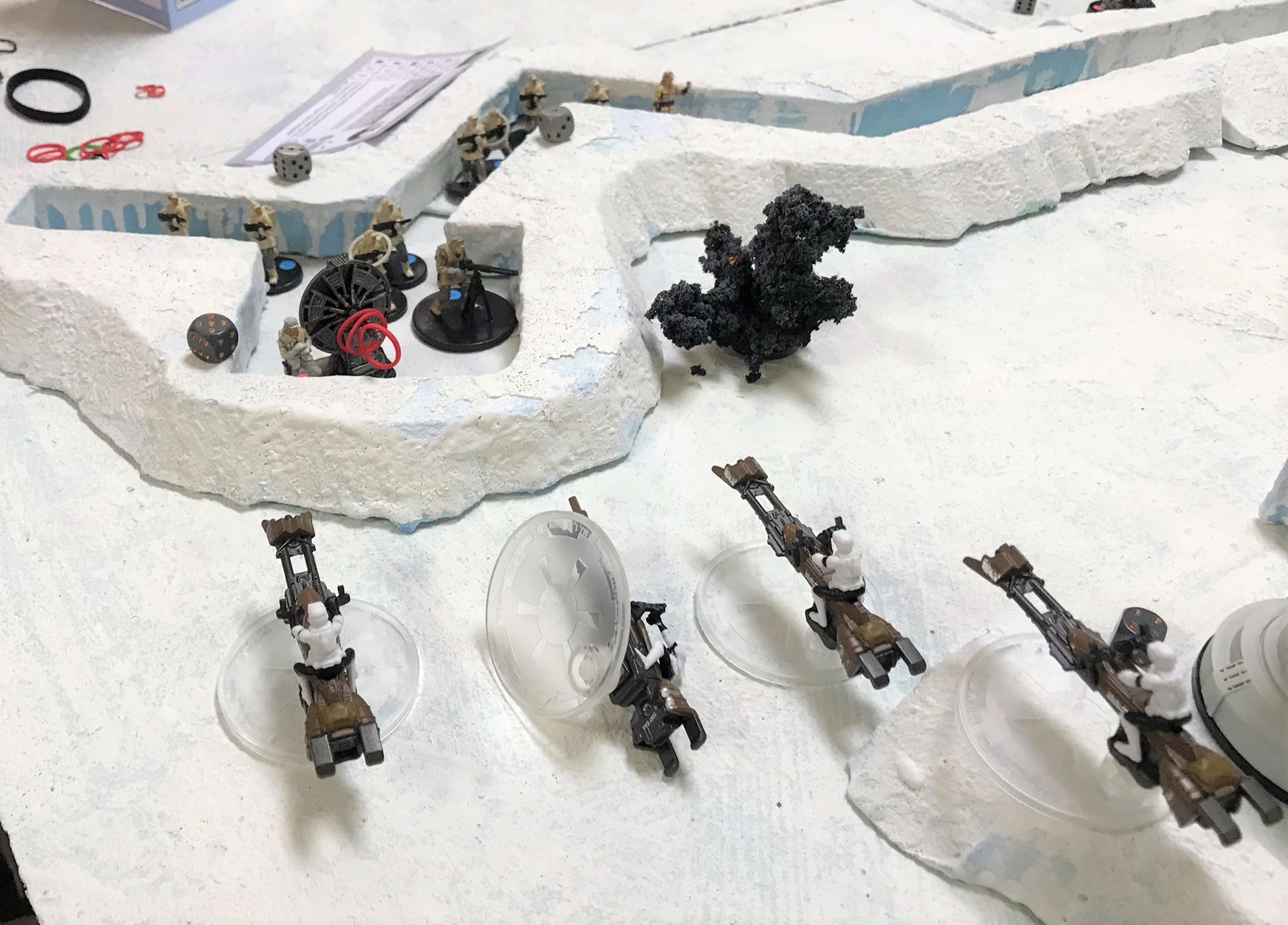
Imperial speeders storm anti-vehicle weapons positions.
34 Battle of Hoth Inf carriers
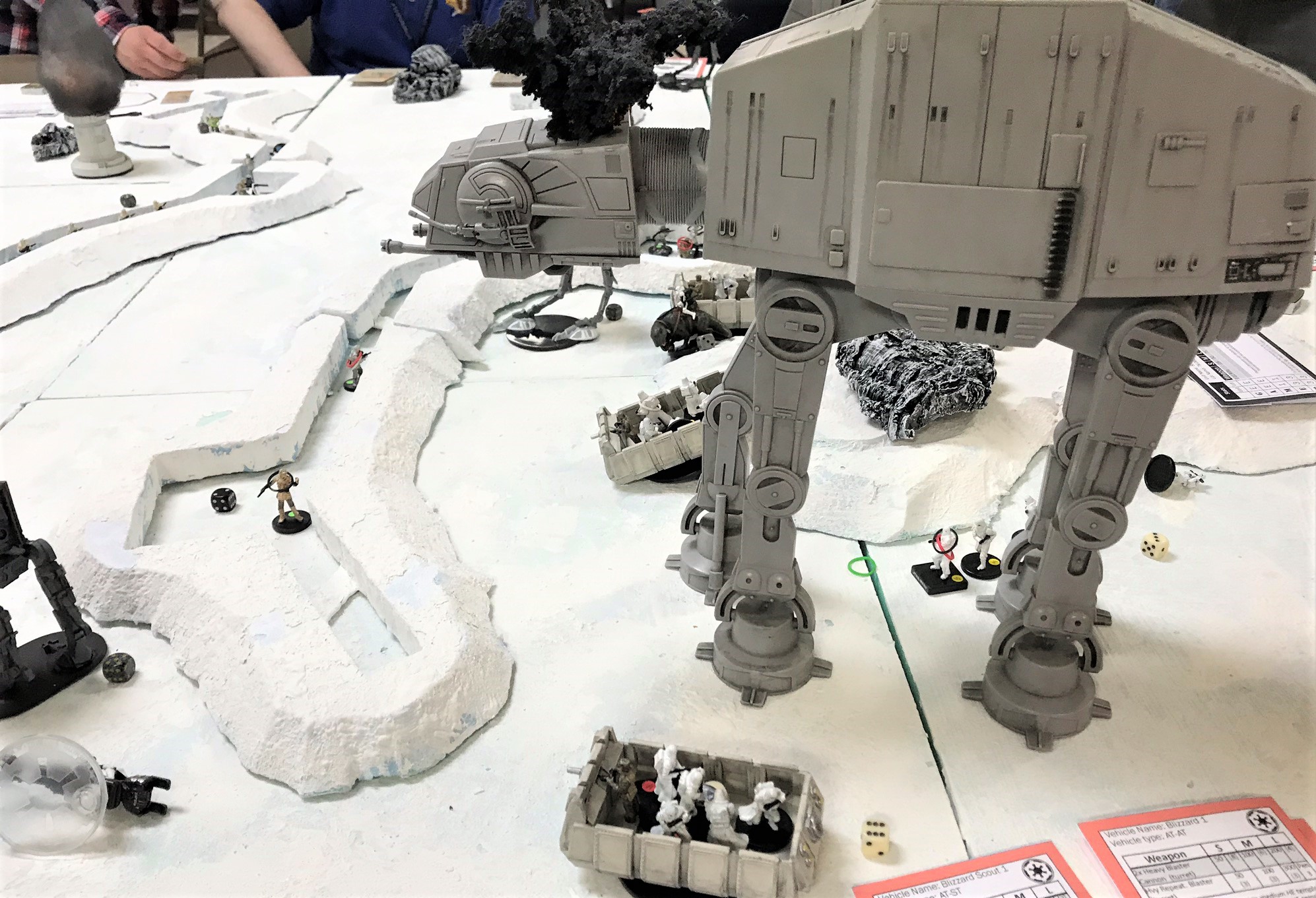
A bloody affair.
35 Battle of Hoth
The advance continues.
36 Battle of Hoth
A very unique set of walker positions.
37 Battle of Hoth Shield Generator blows
Bye bye shield generator!

After the victory, I had some time before I needed to set up and run my Normandy Breakout scenario for What a Tanker© that I have previously run a few times.  I took a few more shots of some interesting games.  One of these was a Dungeon Crawl run by a gentleman (sorry as I forgot his name) who makes his own miniatures out of small bits of wood and paints them really well – check them out below.

After this, it was on to setting up and running my Normandy Breakout game.  I have really gotten this game to be a great gaming experience – based on both my opinion and consistent feedback from the players.  This time, I had between 9 and 11 different players as some came and went.

The Germans made some very good decisions on terrain use and vehicle selection.  The Allies did not choose enough reconnaissance vehicles, and were less effective using terrain as a whole.  The Allies did not do a good job at crossing the table – with only a M10 Wolverine (by Dave Wood) and an M5 Stuart (by Buck Surdu) crossing the board.  To be fair, the dice abandoned the Allies at a few critical junctures.

The Germans chose expensive vehicles, such as the Panther D (Greg Priebe), Jadgpanther (Andrew) and Tiger II (run by a woman known as April or “Queen Tiger” in the game), but used them effectively to stop the Allies.   This put them in a points disadvantage, that they made up with their kills.  Don Hogge’s used his SdKfz 233 very well to delay and harass the Allies.  The Germans lost no vehicles, and the Allies lost a total of 5: a Dingo scout car, an M3A1 Stuart, an M10 Wolverine, and two 17-pounder Achilles.  The Allies vehicle choices hurt them (not enough tanks and reconnaissance versus tank destroyers). This had not happened in previous runs, and is a testament to the German players having a good plan.  The final score was 160-123 in favor of the Germans.  I will continue to run this game – it has never been the same twice.

00 Chris Palmer pic of my game
I GM the mid game action (photo by Chris Palmer)
41 Normandy Breakout What a Tanker
Players on the Allied side get ready to play.
42 Normandy Breakout What a Tanker
Here the Americans smashed an M3A1 Stuart through a hedgerow – where it discovered a Panther D.  It took the flank shot and managed to do some temporary and permanent damage.
43 Normandy Breakout What a Tanker
The Panther then turned and knocked the Stuart out – the black smoke indicates that the crew lived and bailed out, but the tank was destroyed.
44 Normandy Breakout What a Tanker
With a burning Dingo behind him, a Jagdpanther confronts the Achilles “Tabitha” (named after my granddaughter).  German artillery-delivered smoke dissipates in the top of this photo.
46 Normandy Breakout What a Tanker
The poor Achilles “Tabitha” is no match for the Jagdpanther, and is brewed up on the next activation.
45 Normandy Breakout What a Tanker
An American M10 Wolverine gets a rear shot on the Greg Priebe’s damaged Panther, but not enough damage is inflicted… 
47 Normandy Breakout What a Tanker
…and on the next activation, the Panther turned and knocked out the Wolverine.

After picking up, the last game I played in was a Roman Circus Chariot game with rules by DeWitt.  My chariot flipped and I lost – but it was fun!

And the flea market was outstanding!

Thanks to the HAWKS for a great weekend!

And thanks to you, dear reader, for looking – feel free to share your thoughts in the comments section!


Halloween Diorama with Classic Movie Monsters from 1970’s Ral Partha

When I was young boy, the local TV station would show an old monster or horror movie on Saturday afternoon.  Sometimes these were the of the 1960’s Japanese Godzilla et. al. genre, other times they were the B-movie sci-fi stuff from the 1950’s.  Even the British Hammer remakes would be shown.  Those were all cool, but the best ones were the classic 1930’s and 1940’s films like “Dracula” (1931), “Frankenstein” (1931), “The Mummy” (1932), and “The Wolf Man” (1941).

My dad would enthusiastically watch these films with us and I have really special memories of those occasions.  Now of course every movie ever made can be had immediately, but back then you had to wait and hope that they would be coming on – and that made their rare showings quite eventful.  The subjects of those movies have seen numerous remakes, but the originals remain classics and have had a huge impact on popular culture.

One of those influences was in the creation of games with monsters, such as Dungeons and Dragons (and others) – and the miniatures that were used with them – such as 25mm scale figures from Ral Partha.  For US folks unfamiliar with 25mm scale – this is the common Ral Partha scale in the 1970’s and 1980’s and it means that each figure is only about 1″ tall.

I first was exposed to Ral Partha miniatures in 1982 – and have loved them ever since.  Sculptors such as Tom Meier, Julie Guthrie, and Dennis Mize made fantastic creations that were true scale, not “hero scale” as many of today’s miniatures are.  Ral Partha figures are still made today in Cincinnati by Iron Winds Metals.  When I returned to the hobby in 2014, I acquired many of the old figures in various lots of figures on eBay.  Among these of which I came into possession were several of the old classic movie monsters.  They often were encrusted with the types of thick enamel hobby paint that was commonly used back then.  I stripped many (with some damage), and put them away for future consideration.

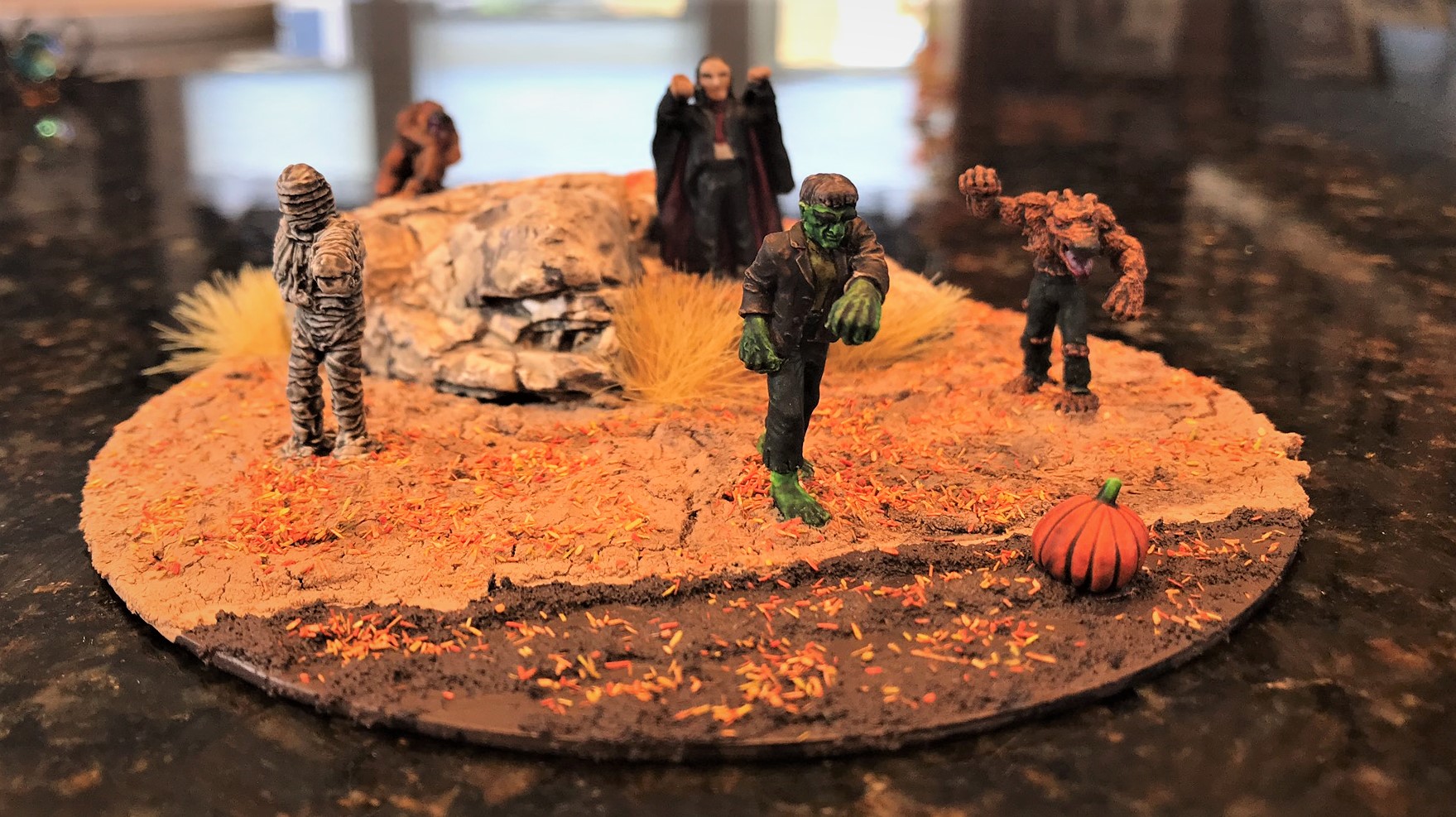
That future consideration arrived this month.  A local hobby store, Great Stories in Uxbridge, MA, has gaming and other hobby events that you can read about here.   One of these events was “The Great Pumpkin Halloween Hobby Challenge”.  The store had a pumpkin patch for figures to be displayed – and the only rules were that there needed to be a pumpkin (provided for $5 as entry) as part of the figure – and that it needed to be submitted by October 28th.  I decided that my filed-somewhere Ral Partha monsters would make a nice diorama for the challenge.  I dug into my stash, and found that I had 5 suitable figures, two werewolves, one mummy, one Dracula, and one Frankenstein’s Monster.  I wanted to push myself with the mini-diorama – as I have been admiring many of those by theimperfectmodeler for years (check one of his recent dioramas here).  I am nowhere near his creative league (he is award-winning) – but his work is inspiring and I wanted to see if I could accomplish something of which I could be proud.  I decided to use an old DVD and card as a base and a Woodlands Scenics rock as elevation.  The edge of the pumpkin patch would be on the DVD so I could line it up on the display at the store.

The effect that I wanted was that of having these classic monsters coming from off the pumpkin patch and moving to prey upon the unwary townsfolk beyond.

1 4 bases
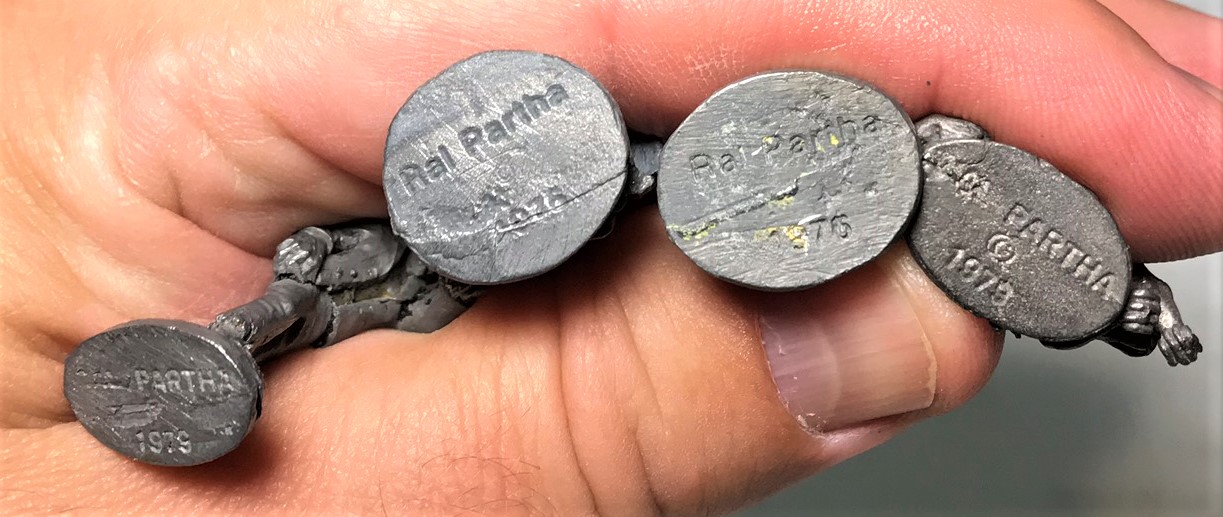
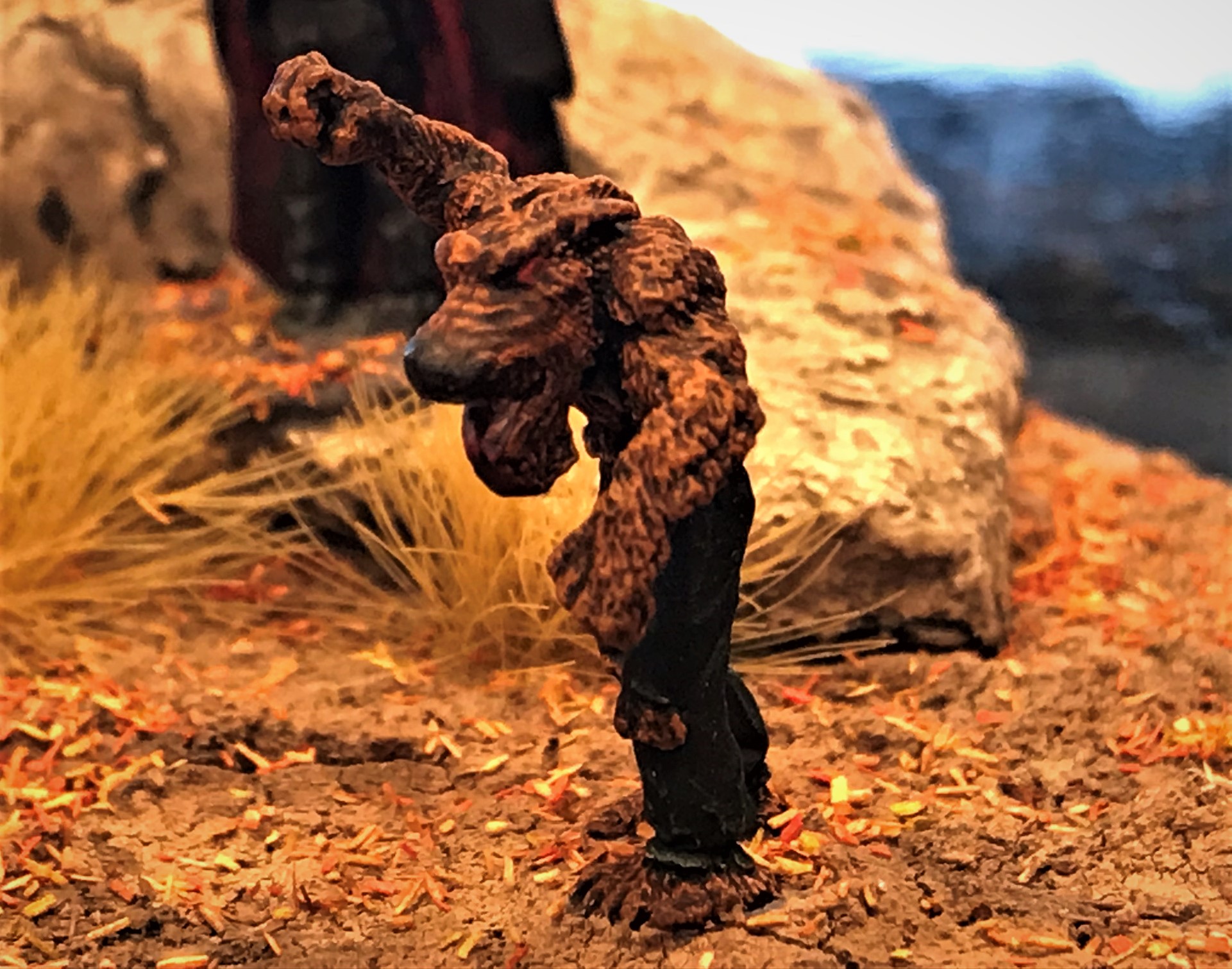
1976 and 1979 figures’ bases.  From left to right is Frankenstein’s Monster (1979), Dracula (1976), The Mummy (1976), and one of the two werewolves (both were 1979).
2 cd and stone and card
The base was an old DVD sanded down – and a Woodland Scenics resin stone.
3 cd and stone and card painted
I decided to brush paint the base with primer to keep the stone pristine (and away from any airbrush mistakes).  I also wanted to have a great bond between the stone and the DVD so I affixed it prior to painting along with a piece of polystyrene card to cover the hole.

Again, these are 25mm figures so they don’t stand out like larger models.  This is what we had back in the day!  I will share details of each of the five models, and then the completed piece.  As is my custom, I will list the paints and materials I used at the end of this post for those interested.  I did use many Citadel Contrast paints as base paints.

Dracula

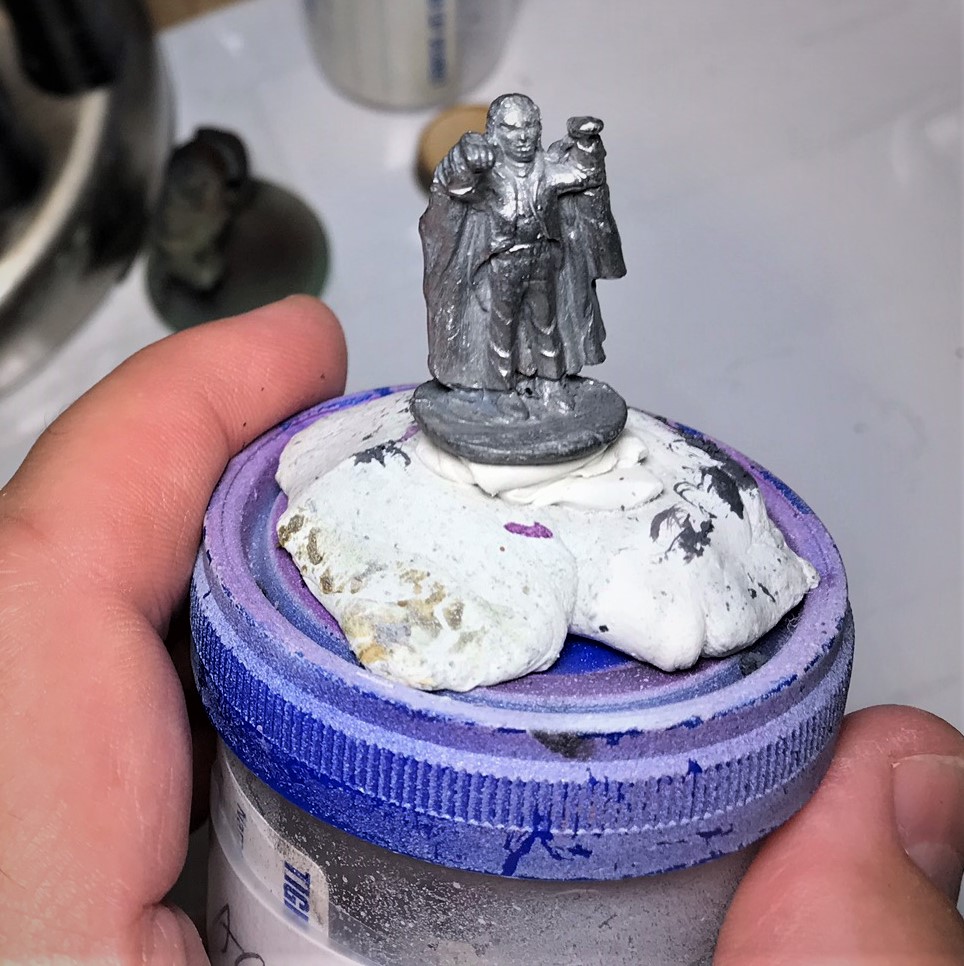
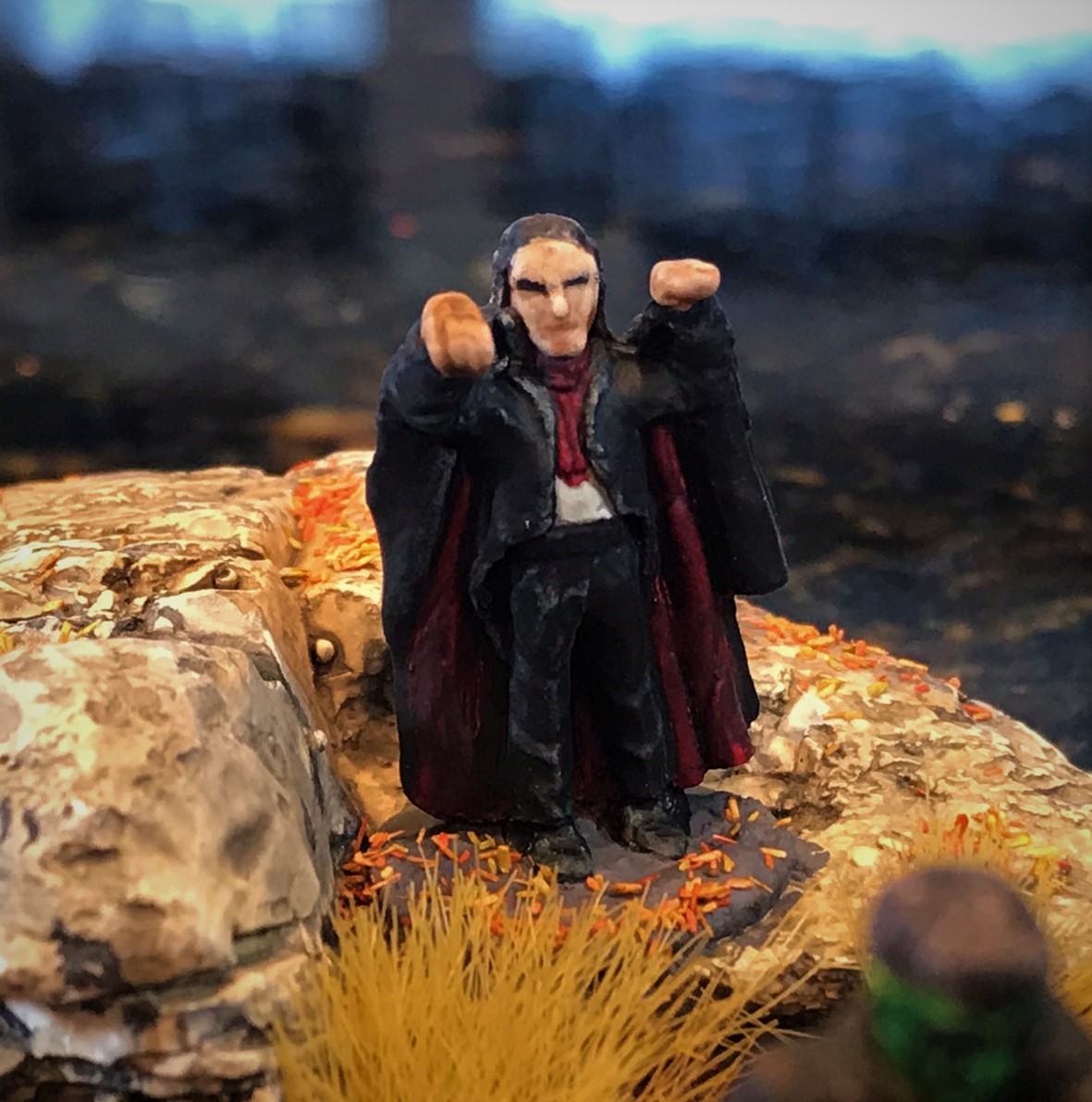
The Dracula/vampire model was #01-014, a Tom Meier sculpt from the Personalities and Things that Go Bump In The Night line.  The base had “Ral Partha 1976” on it.  I probably over-cleaned it – but the details on it – especially the face – were not great.  Trying to get the right skin tone for Dracula was a challenge – and the lack of detail did not help.  I wanted Dracula to be the highest model on the diorama – like he was sending his evil minions forth.  The rock had a nice place for me to place Dracula’s base as its size and shape were considerations as well (it was not a removable base).

1 Dracula unpainted
Dracula after cleaning – I probably got aggressive trying to remove the old enamel (note the scratches).
2 Dracula mounted for painting
Dracula mounted and ready for airbrush priming and traditional brush painting thereafter.  I did use many of the new GW Contrast Paints on all of these models, but ended up needing other paints and products as well.
3 Dracula painted
Dracula painted and varnished.
4 Dracula mounted
Dracula mounted on the diorama.

The Mummy

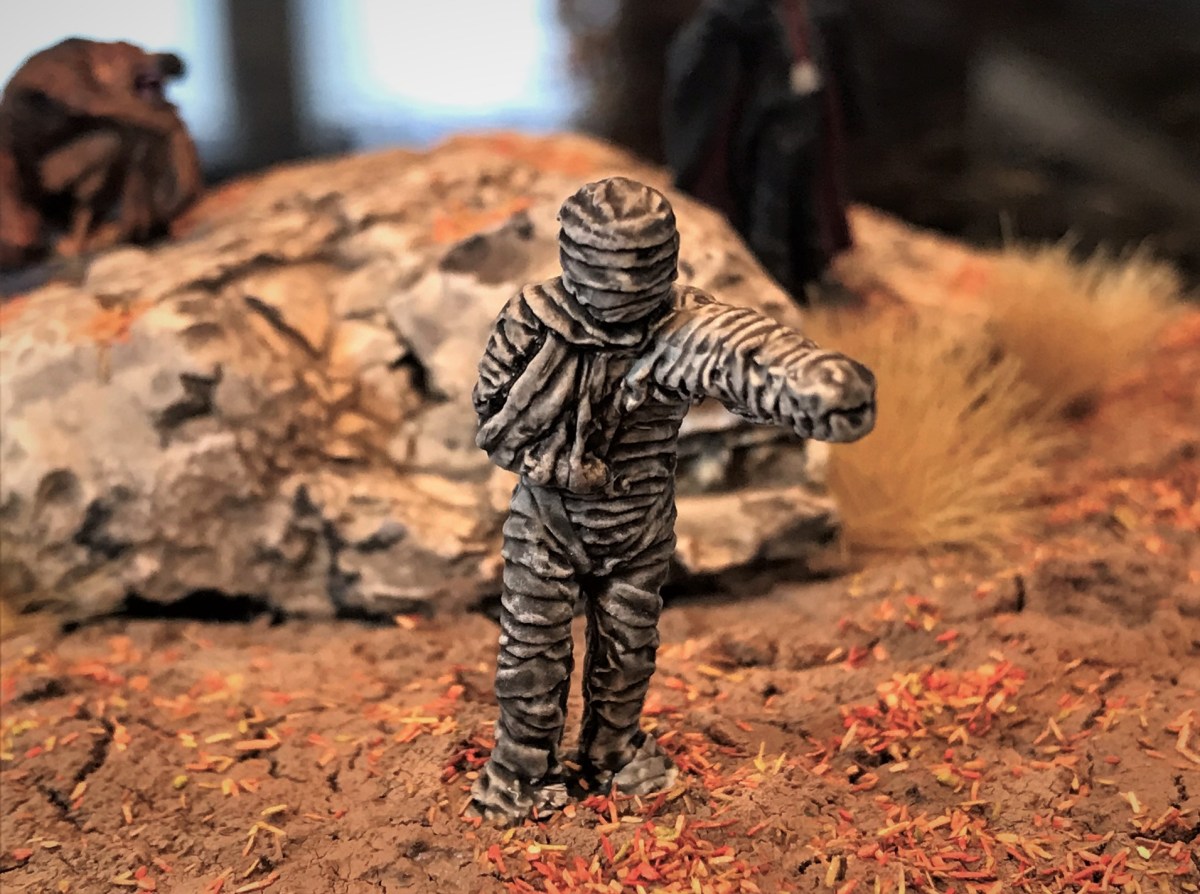
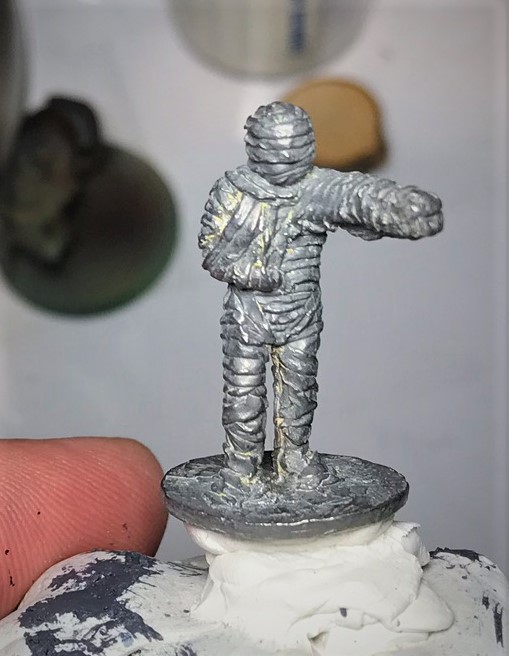
The Mummy model was #01-020, another Tom Meier sculpt from the Personalities and Things that Go Bump In The Night line.  It was also from 1976.  This was the easiest to paint and I thought it came out as desired.

1 Mummy unpainted
After cleaning and stripping, there were still remnants of the old paint job, but these were not an issue.
2 Mummy prepped for painting
The Mummy, mounted for painting.
3 Mummy painted
After painting and varnish – looking very old school Egyptian.
4 Mummy mounted
The Mummy mounted on the diorama.

The Were Wolf (crouching model)

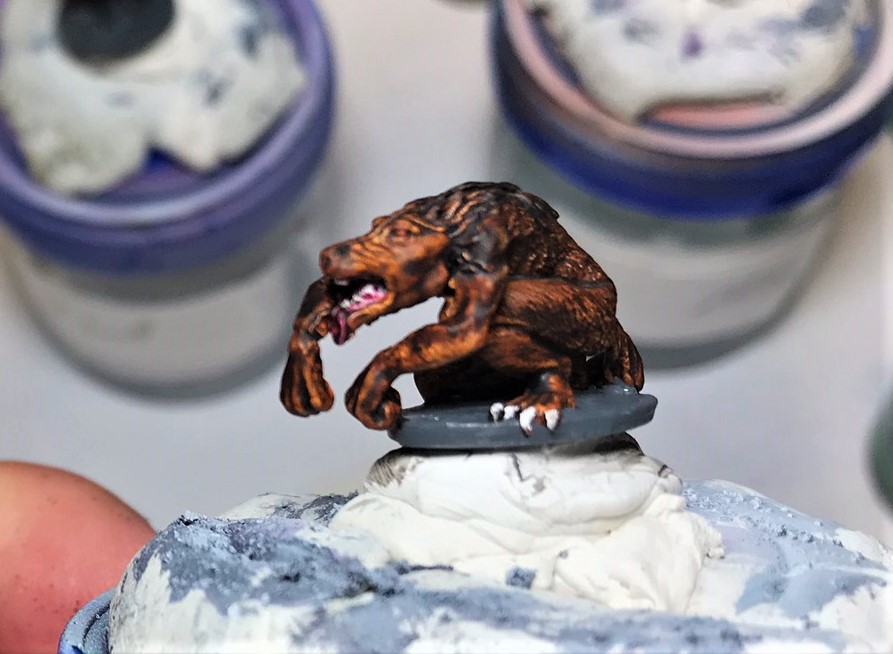
The were two werewolf models that I used.  The first werewolf was in a crouch.  This model was “Were Wolf” #01-061, (two words) – yet another Tom Meier sculpt from the Personalities and Things that Go Bump In The Night line.  However this one was from 1979.  I wanted to have this one climbing up the back slope of the rock, giving a little more depth to the piece.

1 Werewolf crouching unpainted
Some of the original paint can still be seen.
2 Werewolf crouching prepped for painting
The Were Wolf mounted for painting.  The detail on this model was still in good shape.
3 Werewolf crouching painted
A close-up shot of the model after I painted and varnished it.
4 Werewolf crouching mounted
The mounted monster climbs the back of the rock.  Here again, I needed to deal with the base.

The Werewolf (standing model)

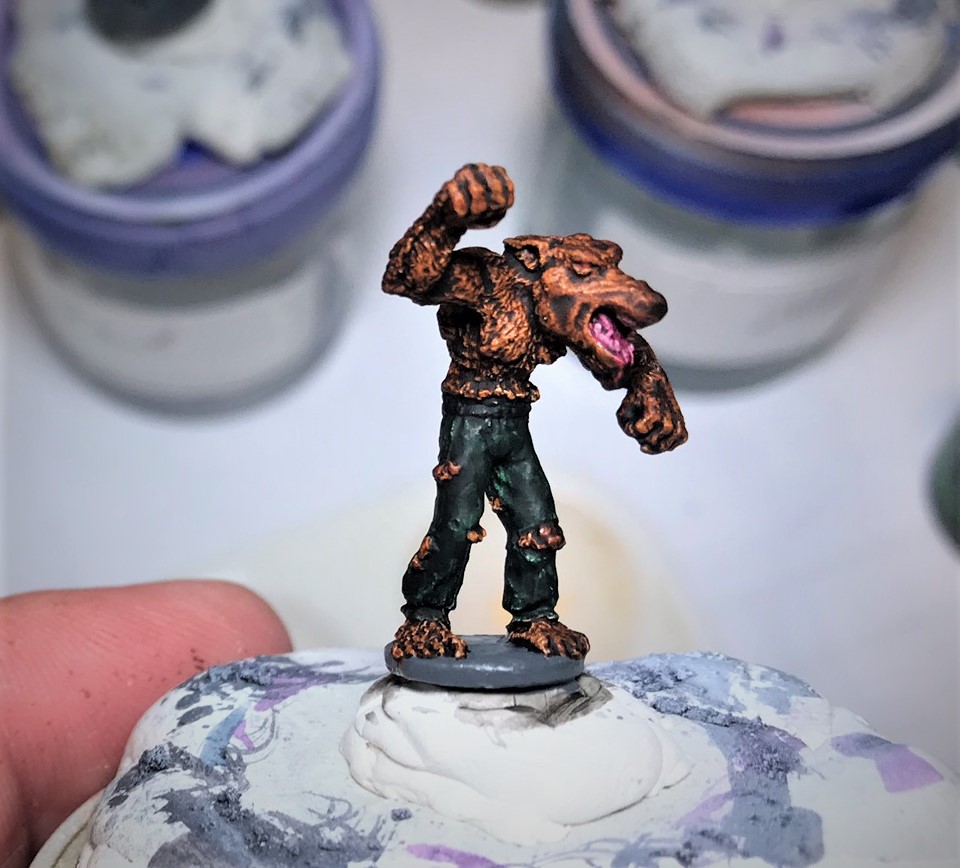
This is the second of the two werewolf models that I used.  This model is standing (and this one is wearing pants).  It is “Werewolf” #98-003, (one word).  This could have been sculpted by Tom Meier, Julie Guthrie, or Dennis Mize, as the Lost Minis Wiki is not clear on that.  The sculpt is from the The Adventurers line and has 1979 on the base.  I wanted this beast standing in the front of the diorama.

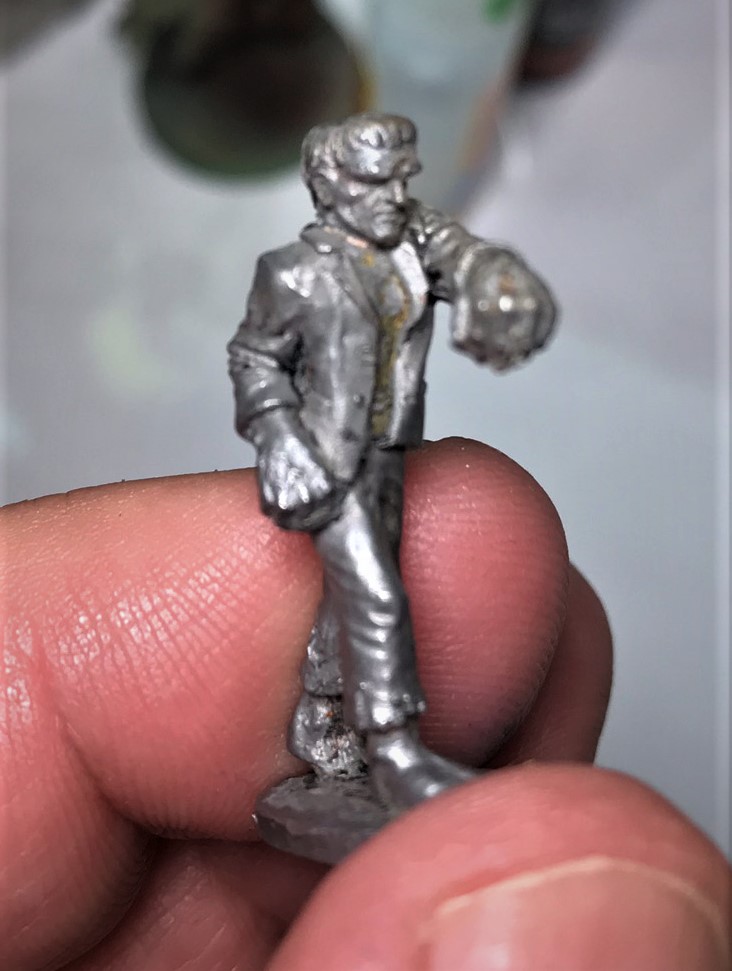
1 Werewolf standing unpainted
The Werewolf cleanup up – I do not think this model was previously painted.
2 Werewolf standing prepped for painting
The Werewolf mounted for painting.  The size of the small base was helpful in mounting to the diorama.
3 Werewolf standing painted
The figure after completion.
4 Werewolf standing mounted
The Werewolf moves forward on the diorama.

Frankenstein’s Monster

Often called “Frankenstein”, this is actually Frankenstein’s Monster (created of course by Dr. Victor Frankenstein.  The model is another one from The Adventurers line and has the designation #98-003.  The detail on this was also fairly good for a model from 1979.

1 Frankenstein's Monster unpainted
The model after I cleaned it as best as I could – some old paint remnants remain.
2 Frankenstein's Monster mounted for painting
The Monster mounted for painting – I did not want to take away any detail here as I thought it was pretty good.
3 Frankenstein's Monster painted
The painted Monster.  I went with heavy eyebrows as before I did the effect of the brow was not what I wanted.  Close up it has a little Groucho Marx look – but at a distance it worked – at least for me.
4 Frankenstein's Monster mounted
Moving to the attack!

The Pumpkin

The pumpkin was a from a Reaper sprue -and had to be part of the contest submission.

Basing the models after painting them required a bit of landscaping.  To fit better on the hobby challenge table, I made a field edge with Citadel “Stirland Battlefield” on the field and “Agrellan Badlands” on the rest of the ground.  I added autumn leaves from 4Ground (now available from Warlord Games here) to the still-wet texture paints and some matte varnish droplets on the rock.  These were placed as how I thought they would naturally collect – as well as to break up the form of the flat mini bases that were mounted on the rock.  Then, I used a handheld hair dryer to dry the terrain (and crack the Agrellan Badlands a bit).    I added some grasses from Shadow’s Edge Miniatures.  These also helped to hide Dracula’s base a bit.

6 Dracula and crouching Werewolf mounted
The Dracula figure and the crouching Were Wolf are mounted on the rock here with Gorilla Glue.  For better adhesion, I scraped away the black primer where I was going to mount the other three figures.  This also allowed me to mount them sequentially.  Doing this made it easier to paint and hide the figures’ bases with the texture paint products.
7 figures mounted, front side
The texture paints are still wet here.  I created the pumpkin patch edge with “Stirland Battlefield”, the rest with “Agrellan Badlands”.  I put a few dots of matte varnish on the low spots on top of the rock for the leaves.  While the paints were still wet, I sprinkled the autumn leaves about as you see here, then used a hair dryer to dry and crack the ground.
8 figures mounted, left side
A right side view of the same as previous.
9 figures mounted, rear side
A rear view of the previous.
10 figures mounted, right side
A left side view of the previous.

Once it all had dried, I removed the piece from the poster tack.

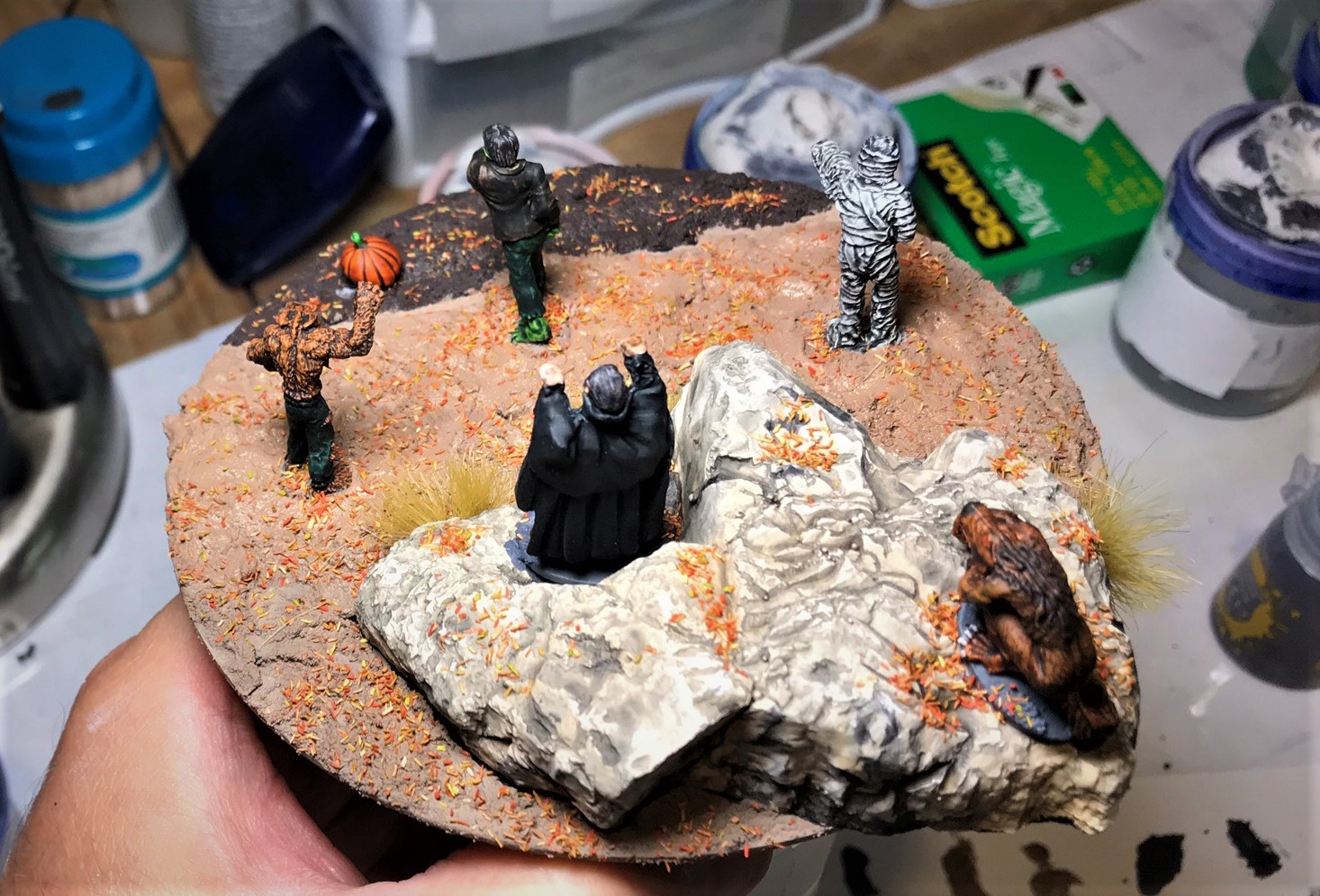
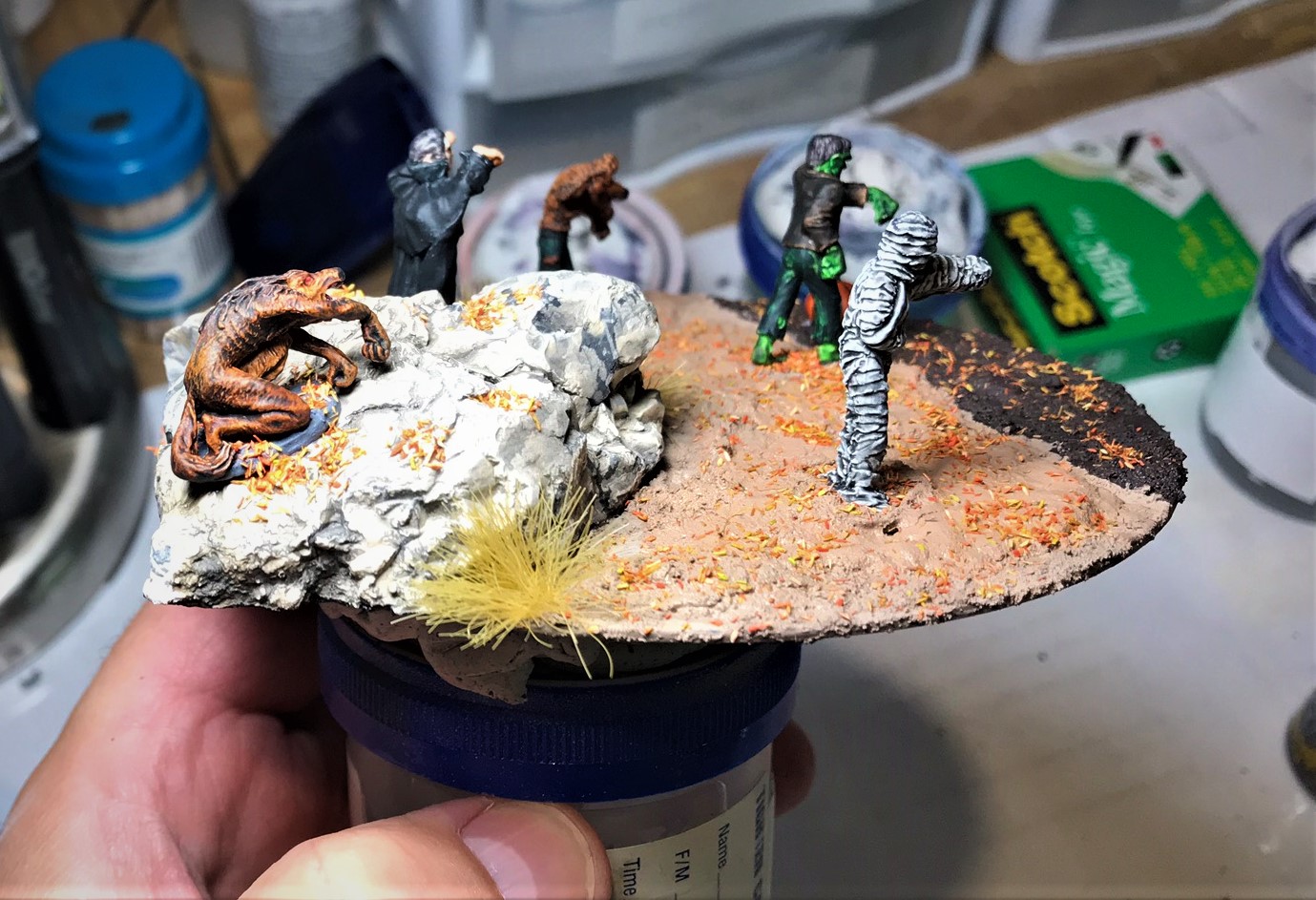
11 finished
Finished piece.

I then drove down to Great Stories to get it entered.  There are a lot of nice pieces there, so we’ll see how it does – and of course most folks who will vote are not used to wee 25mm scale!  It did mesh well with the edge of the pumpkin patch.  At the least, I’ll have a Halloween decoration for many years!

12 on Hobby Challenge table
The Pumpkin Patch is alive with creatures!
12a on Hobby Challenge table
Side view of the previous shot.

Thanks for looking – and I always love getting feedback and any opinions in the comments section, so feel free to post there.

PAINTS, INKS, GLAZES, SHADES, WASHES, PIGMENTS, FLOCKING, GLUES AND MORE USED ON THESE FIGURES:

On the base:

  1. Gorilla Glue gel
  2. Poster tack
  3. Used DVD
  4. Polystyrene card
  5. Woodland Scenics resin rock
  6. Vallejo “Surface Primer – Black”
  7. Citadel “Stirland Battlemire” (texture)
  8. Citadel “Agrellan Badlands” (texture)
  9. 4Ground Loose Copper Foliage
  10. Shadow’s Edge Static Grass Tufts
  11. Vallejo Mecha Varnish “Matt Varnish”

Commonly used on all figures for mounting, priming, and varnishing:

  1. Poster tack
  2. Vallejo “Flow Improver”
  3. Vallejo “Airbrush Thinner”
  4. Vallejo “Surface Primer – White”
  5. Vallejo Mecha Varnish “Matt Varnish”

On the Dracula figure:

  1. Citadel “Contrast Paint – Gulliman Flesh”
  2. Citadel “Contrast Medium”
  3. Vallejo “Light Flesh”
  4. Army Painter “Flesh Wash”
  5. Citadel “Contrast Paint – Black Templar”
  6. Citadel “Contrast Paint – Basilicanum Grey”
  7. Vallejo “Black”
  8. Citadel “Nuln Oil” (shade)
  9. Vallejo Model Air “Base Grey”
  10. Citadel “Astrogranite” (texture)

On The Mummy figure:

  1. Citadel “Contrast Paint – “Apothecary White”
  2. Citadel “Nuln Oil” (shade)
  3. Citadel “Longbeard Grey” (dry)
  4. Vallejo Model Air “Base Grey”

On the Were Wolf figure (crouching):

  1. Citadel “Contrast Paint – Gore-Grunta Fur”
  2. Citadel “Contrast Paint – Volupus Pink”
  3. Citadel “Contrast Medium”
  4. Vallejo Mecha Color “SZ Red”
  5. Citadel “Prayeti White” (dry)
  6. Citadel “Contrast Paint – Space Wolves Grey”
  7. Citadel “Skrag Brown”
  8. Citadel “Contrast Paint – Black Templar”
  9. Citadel “Nuln Oil” (shade)
  10. Citadel “Contrast Paint – “Apothecary White”
  11. Vallejo Model Air “Base Grey”
  12. Citadel “Astrogranite” (texture)

On the Werewolf figure (standing)

  1. Citadel “Contrast Paint – Gore-Grunta Fur”
  2. Citadel “Contrast Paint – Volupus Pink”
  3. Citadel “Contrast Medium”
  4. Citadel “Contrast Paint – Dark Angels Green”
  5. Vallejo Mecha Color “SZ Red”
  6. Citadel “Prayeti White” (dry)
  7. Citadel “Contrast Paint – Space Wolves Grey”
  8. Citadel “Skrag Brown”
  9. Citadel “Contrast Paint – Black Templar”
  10. Citadel “Nuln Oil” (shade)
  11. Citadel “Contrast Paint – “Apothecary White”
  12. Vallejo Model Air “Base Grey”

On Frankenstein’s Monster figure:

  1. Citadel “Contrast Paint – “Plaguebearer Flesh”
  2. Citadel “Contrast Paint – “Ork Flesh”
  3. Citadel “Contrast Paint – Basilicanum Grey”
  4. Citadel “Contrast Paint – Militarum Green”
  5. Citadel “Contrast Paint – Wyldwood”
  6. Citadel “Contrast Paint – Dark Angels Green”
  7. Citadel “Nuln Oil” (shade)
  8. Vallejo “Black”

On the pumpkin:

  1. Citadel “Contrast Paint – Gryph-Hound Orange”
  2. Citadel “Astrogranite” (texture)
  3. Citadel “Contrast Paint – “Ork Flesh”
  4. Citadel “Nuln Oil” (shade)

Thanks for looking!


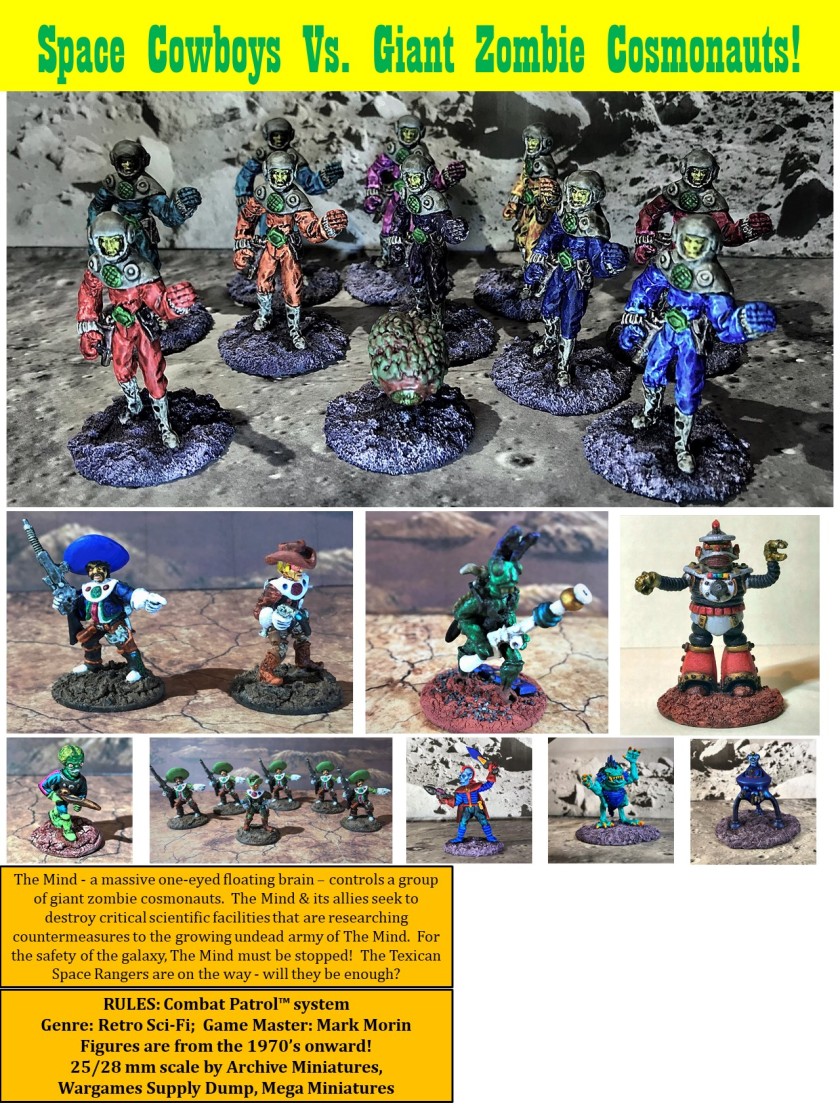
The Mind and The Macron, Archive Miniatures from 1978/1979 for the Board Game Cosmic Encounter

Back in 1978 and 1979, Archive Miniatures produced a line of figures for the board game Cosmic EncountersAccording to the Lost Minis Wiki, at some point Archive Miniatures produced a line of figures for the board game.    These included four catalog items: “Wrack” (#2101), “Oracle” (#2102), “The Mind and the Macron” (two figures for #2103) and “The Healer, Zombie, and Sorcerer” (three figures for #2104).  I am not sure if that was a limited release as the research I could find on the 1977 version of Cosmic Encounter seemed to suggest that there were many alien races available for the game – many more than this page from the Lost Minis Wiki suggests were made.  Cosmic Encounter continues to be sold and is available in its current configuration here.

In any case, I stumbled on the Macron three years ago, and managed at some point since to acquire a complete set including The Mind since then.  My goal back then in acquiring the Macron figures was to have basically a squad of giant cosmonaut zombies for retro sci-fi games of Buck Surdu’s Combat Patrol™.  Having The Mind as the unit leader controlling the giant zombie cosmonauts seemed to be a nice concept for a unit.  I wanted a unit of ten, and I previously posted here how I made a mold and recast many more.  I had since shared these with Buck and IRO as shown here and here respectively.   I also wanted to complete these in September as part of Azazel’s “Scenic and Squaddie September ’19 Community Painting Challenge” that I try to share in when I can. Amazingly, it has been three+ years since I recast these figures, and I thought I’d better do something other than tanks for a bit!  As an aside, this last month has been a bit crazy, as I had my 35th West Point reunion, job interviews, BARRAGE in Maryland, etc.  I am hoping to catch up on reading others’ blogs and posting on the events of September soon!  It’s been a while since I managed to complete a blog entry too.

Ironically, the Macron figures were sculpted by Nevile Stocken in 1979 – and the current president of France, Emmanuel Macron was born in 1977!  So of any of you thought I was making that up, I have provided the links.

Back to the project – I found my recasts to be satisfactory, but I needed to do a good amount of filing and green stuff repairs to bring the recasts up to a good standard.  The figures are large – about 2¼” (about 57mm for you metric types).  The Mind is about half as high, but bulky.  However, as these will be used as aliens, I can get away with them as giant cosmonaut zombies!  I also have been looking at many posts from folks trying the new Contrast paints from Games Workshop.  I thought this project would afford a nice opportunity to try them and learn about how best to employ them in the future.

1 Cleaned and ready for filing
The original figures (the darker ones) and the original package – along with my recasts before any filing or washing.  I decided not to change their poses as that would have been more work than I wanted to take on for this project – besides, the contrast paints would make them different enough in my opinion.
2 2103 or 2107
The bottoms of all of the original Macrons say Archive, #2107, and date from 1979.
3 2103 or 2107
Interestingly, The Mind says it was #2103, the same number as the package.  It also says Archive Miniatures, NS (Nevile Stocken), and dates to 1978.
4 The Mind with green stuff repairs
The front of The Mind.  The figure is supposed to be a floating brain with a hideous single eye in front.  I needed to repair the old figure as you see here.
5 mounted for painting
Now I have a squad!  The figures are all mounted on 1.25″ steel washers for painting – and the bases are mounted to the specimen jars with poster tack.  One new feature was that I added water to my specimen jars to prevent unwanted tumbling during the project – and that worked well.

6 Contrast Paint Palette

I made this color palette for my Contrast Paints – and it was helpful.

7 Brain in Volupus pink
My first try with the contrast paints was “Apothecary White” on the Macron figures.  That worked but “Volupus Pink” on The Mind was an instant reject (I kept hearing the dad in “A Christmas Story” saying it looked like a pink nightmare)  I redid it as you will see below.
8 The Mind painted
Redone – and all the paints I used are listed at the end of the post.  There were a LOT of paints used here – nearly 50.
8a The Mind painted
Definitely styled in the ’70’s!  I wanted the eye and the brain to be menacing and bloody – and the final product (not this shot) was acceptable.
9 Macron with Apothecary White
Early on I decided to give each Macron its own contrast paint color.  I wanted to see how that worked, and I wanted to make it easier for game play identification.
10 Macron with Blood Angels Red
The contrast paint “Plaguebearer Flesh” was effective as a base coat on the faces.  Clearly, there was need for more washes and highlights.
11 With respective contrast paints
Each of the Macron with the contrast paint used on their space suits.  My thought was they might have worn different colors in life to denote their roles before they died and The Mind seized and reanimated their bodies.

11a With respective contrast paints

12 Macron in Shyish Purple
This is “Shyish Purple” after a wash – I ended up washing and highlighting these a lot.
13 Macron in Aethermatic Blue
Mid-project – “Aethermatic Blue”.
13 Macron in Iyanden Yellow
Later after using “Nuln Oil” and other washes – this one was “Iyanden Yellow”.
14 Macron in Volupus pink
Later after using “Nuln Oil” and other washes – this guy was done with “Volupus Pink”.
15 group painted first base step
After highlighting, I used “Astrogranite Debris” on the bases and washed them with “Druchi Violet”.
16 Close up of Macron in BA Red
This one was done in “Blood Angels Red”.  You can see that I dry brushed the bases.  I used 4 different paints in that process.  This is before varnishing.
17 Close up of Mind
The Mind before varnishing.

So after varnishing – The Mind and The Macron – and their base colors – for your enjoyment:

And a couple of group shots:

18 Group shot front19 Group shot front

My take on the contrast paints is quite similar to that of Azazel on his blog – he has a lot of experiments (he’s up to 12 at last look) and I did lean somewhat on his experiences a bit.  I will use them as base coats when the figures need some pop – but I really think they are not a be all and end all line of products.  Like every other paint/wash/glaze/ink etc., the user can find a niche – or a broad use – depending on the desire you have for the final product.  I like what the contrast paints did here – but I don’t want to use them on a Tiger II!  So, another tool in the kit bag – but I really think I’d want to continue to wash, shade, highlight, etc. on future projects.

Thanks for looking and hopefully you enjoyed reading about and seeing these.  Let me know your thoughts, faves, (or least faves if you want!).   I appreciate the feedback as always, and will be catching up on my blogging this week (I hope)!


PAINTS, INKS, GLAZES, SHADES, WASHES, PIGMENTS, FLOCKING, GLUES AND MORE USED ON THESE FIGURES:

  1. Gorilla Glue gel
  2. Green stuff (kneadatite)
  3. 1¼” Everbilt steel fender washers
  4. Poster tack
  5. Vallejo “Flow Improver”
  6. Vallejo “Airbrush Thinner”
  7. Vallejo “Surface Primer – White”
  8. Citadel “Contrast Paint – “Apothecary White”
  9. Citadel “Contrast Paint – “Plaguebearer Flesh”
  10. Vallejo Model Air “Steel”
  11. Polly Scale “WWII Luftwaffe Uniform Gray”
  12. Battlefront “Black”
  13. Citadel “Contrast Paint – Basilicanum Grey”
  14. Citadel “Contrast Paint – Black Templar”
  15. Battlefront “Dark Gunmetal”
  16. Vallejo Mecha Weathering “Dark Rust Wash”
  17. Vallejo Game Air “Dead White”
  18. Citadel “Bloodletter” (glaze)
  19. Citadel “Contrast Paint – Warp Lightning”
  20. Citadel “Contrast Paint – Flesh Tearers Red”
  21. P3 “Red” (ink)
  22. Citadel “Contrast Paint – Blood Angels Red”
  23. Citadel “Contrast Paint – Gryph-Hound Orange”
  24. Citadel “Contrast Paint – Shyish Purple”
  25. Citadel “Contrast Paint – Ultramarines Blue”
  26. Citadel “Contrast Paint – Talassar Blue”
  27. Citadel “Contrast Paint – Terradon Turquoise”
  28. Citadel “Contrast Paint – Aethermatic Blue”
  29. Citadel “Contrast Paint – Magos Purple”
  30. Citadel “Contrast Paint – Iyanden Yellow”
  31. Citadel “Contrast Paint – Volupus Pink”
  32. Citadel “Nuln Oil” (shade)
  33. Army Painter “Quickshade Red Tone” (wash)
  34. Army Painter “Quickshade Dark Tone” (wash)
  35. Army Painter “Quickshade Purple Tone” (wash)
  36. Army Painter “Quickshade Blue Tone” (wash)
  37. Citadel “Coelia Greenshade” (shade)
  38. Citadel “Druchi Violet” (wash)
  39. Vallejo Mecha Color “Green Fluorescent”
  40. Vallejo “Vermilion”
  41. Vallejo “Clear Orange”
  42. Vallejo Mecha Color “Purple”
  43. Vallejo “Dark Blue”
  44. Citadel “Contrast Medium”
  45. Vallejo Mecha Color “Turquoise”
  46. Vallejo Mecha Color “Magenta Fluorescent”
  47. Citadel “Astrogranite Debris”
  48. Citadel “Mechanicus Standard Grey”
  49. Citadel “Daemonette Hide”
  50. Citadel “Warpfiend Grey”
  51. Citadel “Slaneesh Grey”
  52. Vallejo Mecha Varnish “Matt Varnish

GASLANDS brings Maximum Carnage at Mass Pikemen’s Johnny Cab Invitational

Last Saturday, September 7th, Scott Howland ran a very fun game of GASLANDS at our September gaming session.  We had several new players and some young players with their dads (which was cool in and of itself).  We had played this game a few times before, and Scott had some really cool new terrain for the race.  His scenario was the “Johnny Cab Invitational” as a nod to the Johnny Cab in the 1990 film Total Recall.  Scott plans to run this game at CARNAGE in Killington, Vermont in November.

As I got to play I got to take a few more pictures – the race was a real thrill ride (pun intended).

09072019 GASLANDS at Mass Pikemen
The flyer for the game
1 Scott briefs the gamers
Getting ready to play.  Each of us got a different cab-type vehicle for the race.  On the right, new player Steven (sitting) and his dad Steven (in orange hat) joined us for the first time with his daughter in tow. 
2 Scott briefs the gamers
Here you can see the tabletop – we had to cross 5 gates in the race.  The cabs had weapons that were not active until you fully crossed gate .
3 and the race begins
The start of the race – you can see the starting gate on the right.  Vehicles were assigned at random – I had the little Johnny Cab in the foreground.  Above me in this photo respectively  were Mike and Leif’s yellow cabs on the edge of the tabletop.  In the starting gate from top to bottom were Christine in a VW truck/cab, Jack/Jared in a tracked cab, and Steven/Steven in a motorized rickshaw.
3 Johnny Cab Open
Johnny Cab!
4 Mike careens into Leif
The wrecked tractor trailer was part of the game terrain.  I’m on the right about to take my first (of many) flip outs.  On the right, Mike attempts to crash into Leif.  This would go (at first glance) badly for Mike as he rolled badly and got turned around back towards the starting gate.  He would end up crashing into the wall behind it and surviving to turn around…eventually.  Note that Scott has two welded dice to denote turn and gear segments – very cool.
5 Trying to cross gate 1
I try to get through the gate after both Christine and Jack crash into me.  I ended up flipped over by the right barrier – safe but damaged.
6 Scott GM's
Scott effectively GM’s!
7 Leif's Car is torched
As I was already through the gate I had to back up to get aligned.  I used a Molotov Cocktail on Leif’s cab and caught it on fire.  It soon exploded and I avenged a past Bolt Action whupping that Leif had put on me earlier!  Jack’s tracked cab was run into a wall at the top, while Steven’s rickshaw was closing for a kill.  Christine’s blue VW also shot at Leif with a machine gun.  Mike was busy out of the picture hitting a wall in 4th gear!
8 Steven's Rickshaw dies
Steven’s attack on Jack’s tracked cab fails.  Jack’s tracked cab returns fire, and destroys the rickshaw.  Christine’s VW tries to go around away from Jack.  I’m just surveying the carnage from the safe rear.  Mike is still back along the wall in the rear of the starting gate. 
9 Jared and Jack plot next moves
Jared and Jack discuss choices with the dice, while Leif looks at his burning cab.
10 Jack wipes out and explodes
Christine turns the corner and shoots up Jack’s cab – knocking it out of the game.  She then dropped caltrops behind her.  This left the VW, my Johnny Cab, and Mike still in the game.
11 I set Chris on fire and move in
Johnny Cab turned on the gas, and attempted to shoot at Christine’s blue VW with a machine gun, missing.  I threw another Molotov cocktail and hit, catching the VW on fire.

At this point, I closed for the kill.  Nothing remained between Johnny Cab and the race course but Christine’s damaged and burning vehicle.  Mike’s cab was far behind.  My machine gun missed again – but my third Molotov cocktail hit and unfortunately caused a chain reaction with Christine’s own unused Molotov cocktails.  The explosion damaged my Johnny Cab and destroyed it and the VW.  At this point, Mike was just getting back to Gate after getting off the wall.  As the sole survivor, he won!  Amazingly, he won our last GASLANDS game as a survivor as well – enjoy your prize Mike – a free trip to Mars!  Your second trip!

12 Mike wins again!
The game ends.  Both cars in the foreground are destroyed – in the right rear one survives – Mike wins!

The game went very quickly even with many new players.  Scott’s vehicles and board were fantastically fun!  I lent my new blast markers to the game and I think they worked well (and were very popular with the younger players to be sure).  Thanks VERY MUCH to Scott for a well-run and fun game.

Our next session is a road trip to the Fort Devens Game Day on October 19th.  Scott will be running a pulp game there, and I will be running my Normandy Breakout game.  The November session for the Mass Pikemen will be on either November 2nd or November 9th from 2-7 PM, games TBD.

If you are interested in joining the Mass Pikemen, our Facebook group link is here.  Join us!


Normandy Breakout Game at Mass Pikemen

Last Saturday (August 24th) we had a very action-packed game of What a Tanker© using my Normandy Breakout scenario at the Mass Pikemen Gaming Club.  I have been tweaking the scenario, some rules, and improving the terrain and markers – and I believe the gamers who played really noticed all of the upgrades and changes.  I have been fortunate to get valuable feedback from the gamers which has been invaluable, and this game was no exception.  I have acted as a Game Master for this game a couple of times (discussed here), and this, the third iteration, was another great game that had the players highly engaged.

For this post, I will show some of the photos that tell the story – though simultaneously being a photographer and a GM are not always easy.  I appreciate the generosity of both Chris Rett and Ted Salonich helping with some photos – as well as playing of course!

The game scenario is:

After a successful D-Day landing and consolidation, the tanks of the Americans and the British are stymied in the hedgerows of Normandy. German armor has set up effective defensive positions in favorable terrain. However, the Allies do not know the exact locations of the German tanks, and the Germans have limited knowledge of where the Allied armor will be coming from and the direction to which they will try to break out. New rules that allow reconnaissance and the effects of other combat forces will challenge both sides in this action-packed game.

The Germans are in secret positions (basically ambush positions) that they choose in advance of the Allies arrival – which is also secret in terms of the exact vehicles that the Allies choose.  Both sides get to secretly select their vehicles (with some restrictions), and poker chips are used for the scoring.  The Germans here did stop the Allies from breaking out – though the Allies were able to gain more points by both effectively recon of enough blind positions and knocking out enough valuable German vehicles.  The final score was 117-109 in favor of the Allies – with the game score turning on the Allies knocking out a Jagdpanther on the last turn.  The casualties were:

  • Allies – 5 vehicles:
    • UK – 3 vehicles:
      • 2 Daimler Dingoes
      • 1 Firefly
      • 1 M10 Achilles
    • US – 2 vehicles:
      • 1 M3A1 Stuart
      • 1 M10 Wolverine
  • Germany – 3 vehicles:
    • 1 Sdkfz 233
    • 1 Panther D
    • 1 Jagdpanther

Let’s see what the day looked like!

4 map at session
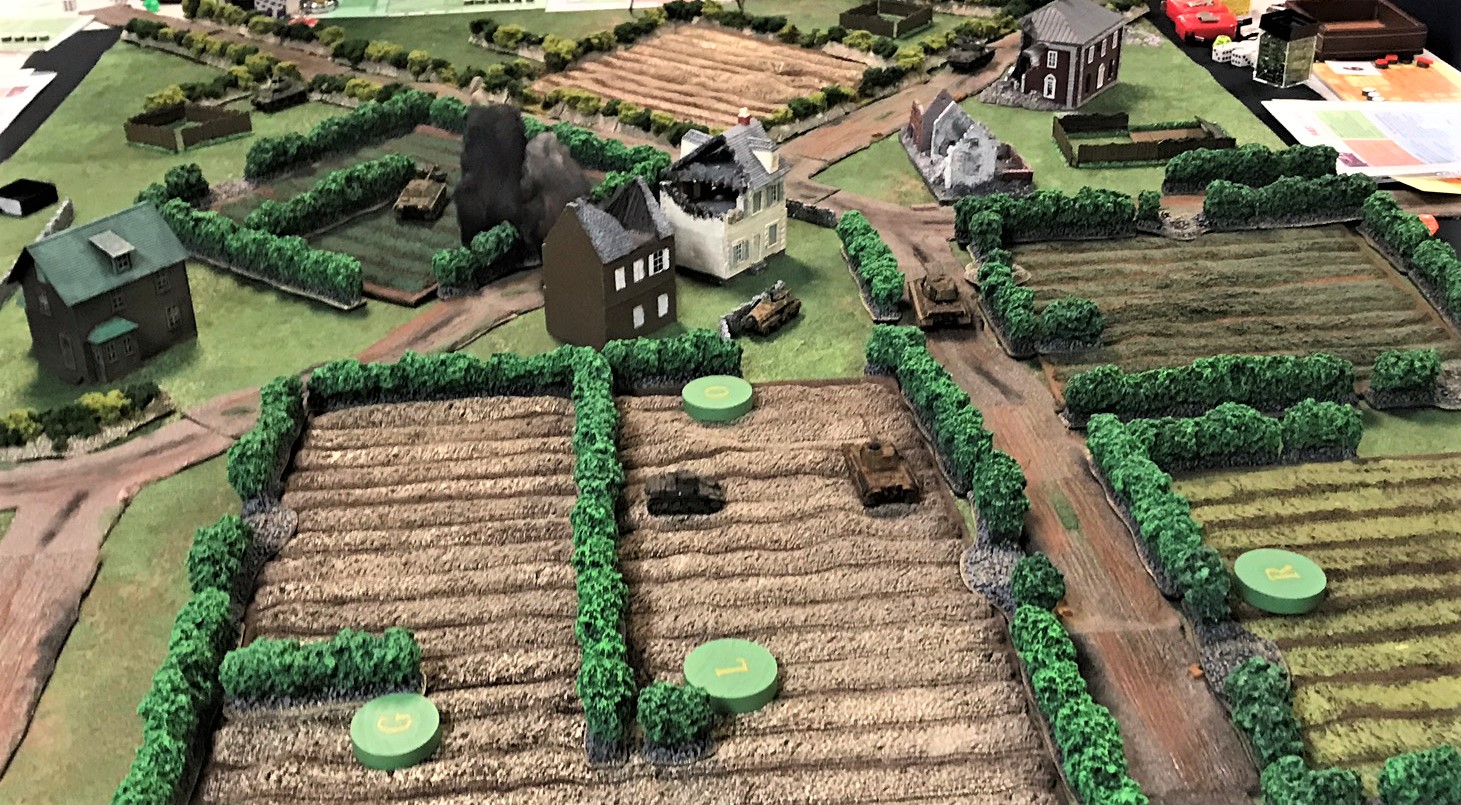
The Allies moved on from here.  The British had the far left road, and the Americans had the far right road.  The middle road could be used by both Allies.  The wooden discs are possible German positions to be reconned.
5 map at session
A side view of the tabletop that better shows some of the (blind) possible German positions.
6 map at session
The view from the German side of the board that the Allies needed to cross.
1 Me as GM
Your properly attired GM.  (Photo by Chris Rett)

The Germans effectively used a Bonus Attack card to draw first blood – calling in a rare Luftwaffe attack on a Daimler Dingo.

7 Dingo hit by Luftwaffe
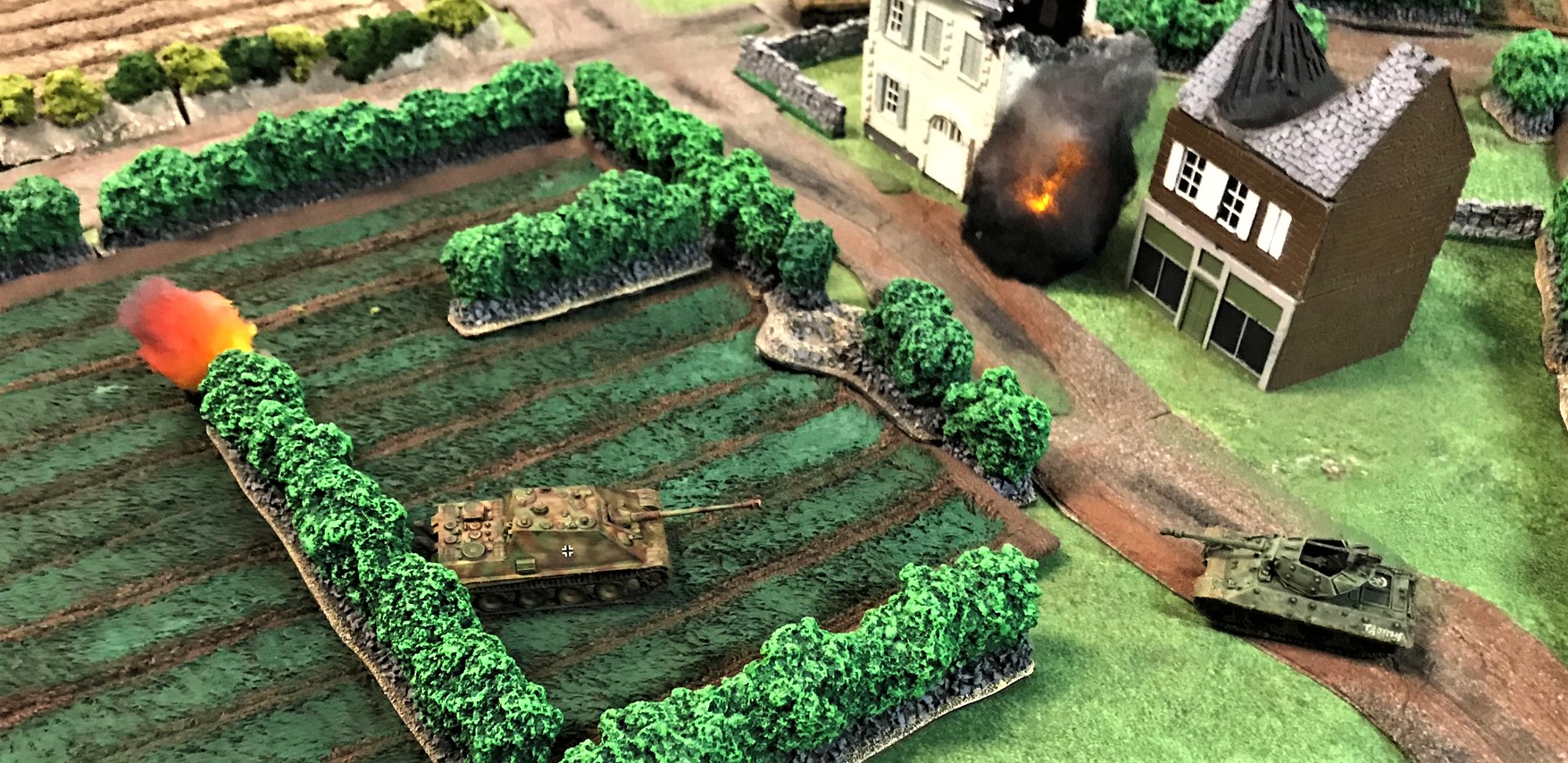
The Daimler Dingo hit by the Luftwaffe – my new blast/knocked out tank markers looked pretty amazing (and I am biased of course).
4 Jagdpanther hunts Stuart
A Jagdpanther prepares to engage an M3A1 Stuart from an excellent ambush position.  The Stuart decided to run around the corner and recon the disc on the left…(Photo by Chris Rett)
5 Surprise!
… and the Stuart “successfully” reconned the position – it went around the bocage to find the Elefant in the room. (Photo by Ted Salonich)
5a Surrprise
The Stuart fired its 37mm at the frontal armor of the Elefant.  No effect.  The Elefant returned fire, and blew away the Stuart.
9 Firefly knocked out by StuG G
A Panther D and a StuG G combine forces to knock out a Firefly near the burning Dingo.
10 Panther D knocked out by Achilles
An M10 Achilles fires at and knocks the Panther D into a ruined building, damaging it.  It gets a second shot, and rolls well enough to torch the Panther.
11 M18 Hellcat moves up to help British
The Americans move up an M18 Hellcat to help the Brits – it ended up moving behind the Jagdpanther and was able to destroy it.
8 Gamers
The gamers ponder their moves.
13 Last shot
The Allies called in a lot of artillery-delivered smoke to protect their vehicles.  It was effective.
6 Panther burns and Tiger I arrives
Here comes the Tiger!  Note the StuG G that ambushed the M10 Wolverine.  The crew of the M10 survived – as denoted by the black smoke versus the fiery smoke.  Also shows the Allied smoke screen in front of the Jagdpanther.

As the German vehicles are worth, in general, much more points, the loss of their expensive vehicles made a big difference.  Both sides played well, but I have to say the Germans were not very lucky with their dice at times.  

I will be tweaking the game scenario in a couple of ways:

  • Adding stopping bonuses for the Germans:
    • A 20-point bonus for the Germans if no Allied vehicles are able to breakout across the tabletop.
    • A 10-point bonus for the Germans if only one Allied vehicle is able to breakout across the tabletop.  If 2 or more cross, no German bonus.
    • Award the Germans 2 points for each unreconned point.  This will incentivize recon, but force the Allies to choose what is most important.  (The Allies already get 2 points for each reconned point.)
  • Allow a “banked 6” to be used for either an advantage on the next activation (per the rules) or as an automatic “6” on the next activation roll (determined by the player on the turn he banks it). Thanks Ted Salonich!

Thanks again to the all of the players.  And for those who follow this blog who wondered if their named vehicle got fried, only one Cromwell (“IRO”) deployed and did not get into action.  However, the M10 Achilles “Per” (named for Per from Roll a One) did get knocked out by one of the StuG G’s.   Sorry my Swedish friend!

Hope that you enjoyed this – and I will be running this game on Saturday at BARRAGE in Maryland (September 28th) and at the Fort Devens Game Day on October 19th.  I may also run it at other upcoming gaming cons if possible.  Thanks for looking!


Knocked-Out Tank Markers for What a Tanker

With my having committed to multiple upcoming games of my What a Tanker© Normandy Breakout scenario, I wanted to have everything as good as possible.  I made smoke/blast markers with tea lights in the past that I have used in multiple games.  They are great as mortar and artillery, especially with 28mm scale stuff, but not suitably-sized for use on 15mm scale tanks as markers.  In the game, I wanted to be able to designate a knocked out tank better – and if possible – differentiate between a tank that was just knocked out (where the crew survives) and one that was both knocked out and brewed up (where the crew does not live).  These are important distinctions in the game, as I allow crews that survive to get another tank and keep their training and experience (and bonuses) as they reenter the game.

I also wanted to have a better looking tabletop where the tank wrecks are more visible and frankly more realistic smoke-wise.  My older smoke markers are good for artillery-delivered smoke screens, but as you see below, I needed an improvement.

4 painted smoke markers lit up in dark
My tea light blast markers look great here…
1 current smoke markers
…but are way too big here – especially on even smaller vehicles.  Additionally, they do not stay easily on the vehicles due to their size.

I set out to create a new set of markers that would look better, stay on the vehicles, and differentiate between brewed up and just knocked out tanks.  As I use neodymium magnets in most of my tanks’ turrets and they are all similarly oriented in polarity, it was easy to devise a marker using a ceramic magnet as a base.  The magnets I used were small enough and heavy enough to stay on the tanks – even those without magnetic properties.  I used ½” ceramic magnets, #10-24 steel machine screw nuts, and more used ¼” (approximately) steel ball bearings from Jeff Smith’s broken fairway mower to build the core of the marker.  Making sure that the polarity was correct (markers that would be pushed off the vehicles would serve little purpose!), I used Gorilla Glue to fuse the magnet to the nut, and the nut to the bearing.    Then, I mounted the cores on screws and primed them.  I planned for 20 to be black and grey smoke for disabled tanks, and for 20 to be full-on flames.

After the primer had dried, I painted the flaming cores red, orange, and yellow with cheap craft paints to simulate a ball of fire.  Lastly, I applied gloss varnish to the cores to give more reflection.  The smoke ones just got painted black.  If interested, you can see a list of the materials I used at the end of this post.

2 materials
The ball bearings, nuts, and ceramic magnets I used.
3 magnet, nut, and ball bearing
The core.
5 mounted cores for painting
The flaming cores mounted here after red paint was applied.  Later coats would be yellow and orange to simulate a fireball.

For surface smoke, I went with pillow batting cut off in thin strips of 1-1½”.  As each core needed 4-6 strips, I cut nearly 240 strips.  I hot glued the strips in a flower pattern on the cores.

2a materials (batting)
“Limited only by your imagination” indeed!
4 cut up batting
Batting strips cut before hot gluing to the cores.
6 after batting glued
Here are the cores after hot gluing the batting.

Now, I used a different product to connect the batting in a smoky shape.  As I have built tanks, I have used decals.  The best way to revitalize decals is to coat them with Microscale’s Liquid Decal Film.  However, using this product on the decals as they are on your tanks themselves can ruin the underlying paint (unless used over varnish).  But, this stuff makes a solid protective and nicely tacky coat – as I learned making placards for my Attack of the Warbots game.  I applied the Liquid Decal Film to the strips, forming the small smoke shapes around the cores.  I let these set up and dry.  The stuff worked well, and I got the effect I wanted where you can see the cores on the flaming ones.

7 after batting assembled with liquid decal film
After the Liquid Decal film formed the smoky shapes.
8 close up of ready to paint marker
Close up of the core after the smoky shape was formed.

When I paint fire, I like to go from bottom to top with yellow, orange and red.  Here, I decided to use glazes and inks for these colors with my Iwata Micron airbrush at 28 psi.  This allowed me to really blend the colors –  which were Citadel “Lamenters Yellow” (a glaze), P3 “Blazing Ink”, and P3 “Red Ink”.  I then used two Vallejo Game Air paints –  “Black” and “Wolf Grey” – to create a smoky effect.  I also used these latter two on the smoky black/grey cores.

9 completed markers
A view of the flaming markers and 3/4 of the smoky ones as they dried.  
10 using magnetic tacky sheets for transport
The new markers with one of the older (previously made) larger ones in back that I will only use as smoke now.
10a using magnetic tacky sheets for transport
These fit nice and snug on 4 Aleene’s tacky sheets in a 4-liter Really Useful Box.
11 Sherman comparisons
For comparison, these three Shermans have (l-r) a new smoky marker, a flaming marker, and the old large blast marker.  What you cannot see is how well the magnetic ones stay on the vehicles – and these are plastic.  The neodymium turret-mounted magnets and ceramic magnets attract well and effectively, which the larger one does not.
12 M10 comparisons
The M10 (Battlefront) on the left has a turret magnet, while the Old Glory type on the right is lead/tin.  The weight of the magnet keeps the marker on the Old Glory M10 very effectively.
13 light US vehicles
Even on smaller vehicles, these work well.  Here an M3A1 Stuart, an M8 Greyhound, and an M24 Chaffee are all well-marked.  The M8 has no magnetic turret, yet this works well here as well.
14 StuG G and Panzer IVH with knocked out markers
Some vehicles have no turrets like these plastic StuG G’s  – but the markers work great on the deck or the top.  The plastic Panzer IV H magnetic turret holds the smoke marker well. 
15 Tiger II burning
Last but not least, a Tiger II is brewing up.

I also participate in my Australian blogging buddy Azazel’s mothly painting challenges.  This month is “Awesome August” – and submissions were to be HUGE…or… as he wrote:

“If you really prefer to skip the biggies – that normal sized model that you’ve (ideally) done a job that you’re proud of converting or kitbashing, painted to the best of your ability. Remember, it’s not a competition – it’s a showcase – so your only competitor is yourself.  So, the TL:DR is that August’s challenge is to complete something big. Ideally, really big. Or something small that’s ideally converted – and painted really well by your own standards.”

I think that converting ceramic magnets, nuts, used ball bearings, and pillow batting counts as a conversion!  And not for nothing, I really like the paint jobs on these markers.  So, this is my entry for Azazel’s Awesome August ’19 Community Painting Challenge .

I hope that you enjoyed this and maybe got some ideas – please share your thoughts in the comments section, and look you can forward to seeing these used in my after-action battle reports!

PAINTS, INKS, GLAZES, SHADES, WASHES, PIGMENTS, FLOCKING, GLUES AND MORE USED ON THESE MARKERS:

  1. Magnet Source ½” “Ceramic Disc Magnets”
  2. Everbilt #10-24 Steel nuts
  3. Used ~¼” steel ball bearings from Jeff Smith’s fairway mower
  4. Gorilla Glue
  5. Testors “Universal Acrylic Thinner”
  6. Reaper MSP “Black Primer”
  7. Americana “Primary Red”
  8. Craftsmart “Orange” (satin)
  9. Martha Stewart Crafts “Duckling Pearl”
  10. Vallejo “Gloss Varnish”
  11. Vallejo Mecha Varnish “Matt Varnish
  12. Loops & Threads “Classic Loft Batting”
  13. Microscale Liquid Decal Film
  14. Citadel “Lamenters Yellow” (glaze)
  15. P3 “Blazing Ink”
  16. P3 “Red Ink”
  17. Vallejo “Airbrush Thinner”
  18. Vallejo Game Air “Black”
  19. Vallejo Game Air “Wolf Grey”

Always love to get your feedback and read your thoughts?  See you next time!

US Tanks and Tank Destroyers for Normandy Breakout Scenario

Welcome back dear reader for the latest installment on my US armored forces!  I needed to add more US vehicles for my Normandy Breakout scenario which uses the What a Tanker© rules by the UK-based company Too Fat Lardies.  I do modify these rules for the scenario.  For those who missed them (like some of the HAWKS did because I used the wrong hashtag!), the posts about the other vehicles and playtests for this scenario can be found at these links:

Vehicle Posts:

Playtest and related gaming posts:

I am planning on running this scenario at three upcoming events:

  • August 24th at the Mass Pikemen Gaming Club in East Brookfield, MA
  • September 28th at BARRAGE in Havre de Grace Maryland
  • October 19th at the Fort Devens Game Day at the former Fort Devens, MA

This project, with the possible exception of an additional stray German vehicle or two, completes the list of vehicles I need for the scenario.  In looking for vehicles, I wanted to add some Shermans, another M10 Wolverine, and an M18 Hellcat.  I found a deal on a box of 5 plastic British Shermans M4A1’s with cast hulls that would work.  I would have preferred getting models like my M4A2 – but that one is OOP and even the American Shermans that Battlefront is selling now are basically M4A1’s.  So these British ones, properly assembled, at 15mm scale, is just fine.

For an M10, I converted an Old Glory M10 Achilles by using a leftover gun to make it look like an original version.  Technically, is that a conversion of a conversion?  After seeing how John at Just Needs Varnish! added a plastic card underneath his models to make them easier to paint, I was inspired to add a small steel base under my M10 chassis.

The M18 Hellcat I found was really nice – and I wish I had another as well.  This one had a slightly broken front fender, but its hardly noticeable.  In any case, I used enough mud and dirt to obscure that problem.

I also decided to use the Battlefront naming decals on all of these to help differentiate them on the tabletop – as well as by adding spare road wheels, spare tracks, and other accouterments to all of the vehicles.  Thanks to my good friend Jeff Smith, the Shermans got some real steel in them by means of ball bearings in the chassis.

I decided to weather these slightly differently by adding pigments – inspired by Pete’s blog and a Merkava he built.

After a few in-progress shots, I will describe the vehicles alphabetically by name and type.

M4A1 “Betty”

1 M4 Betty, left side, crosses a field
“Betty” crossing a field.  

2 M4 Betty, right side, in a field

M4A1 “Blood ‘N Guts”

1 Blood N Guts completed, left side
“Blood ‘N Guts” crossing an opening in the bocage.

2 Blood N Guts completed, left side, crossing the opening in the bocage

M4A1 “Destruction”

1 Destruction after decals
“Destruction” early in the weathering process right after decal application.
2 Destruction after pigments
“Destruction’s” chassis after weathering
3 Destruction in the hedgerows
“Destruction” moving down the road between the hedgerows.
4 Destruction completed, left side
“Destruction” left side – as an experiment I used Citadel contrast paint on the tarp.

M4A1 “Let ‘Er Buck”

1 Let 'Er Buck after decals and some weathering
“Let ‘Er Buck” chassis early in weathering.  I chose this name/decal in honor of Buck Surdu, though as an infantryman he may object…

2 Let 'Er Buck finished, left side3 Let 'Er Buck finished, front side

4 Let 'Er Buck finished, right side
Note on all these that I used different gear in different stowage to differentiate the tanks.

M4A1 “Polly”

1 Polly completed, left side
“Polly” by some ruins.  As I have a pet cockatiel named Caesar, this is as close as he gets to an avatar tank.

2 Polly completed, right side3 Polly completed, right side, at crossroads

M10 Wolverine “Demon”

1 M10 Demon after weathering
“Demon” getting dirtied up.
2 M10 Demon crosses field, left side
“Demon” crossing a field.  I did not buy crew for this one.

3 M10 Demon crosses field, right side

4 M10 Demon crosses field, front side
Nice view of “Demon’s” front showing the replacement gun.
5 M10 Demon and other Battlefront M10
On the left, “Demon” from Old Glory, on the right, my previously built M10 from Battlefront for comparison.  I used more mud and dirt on “Demon” as it was a much less detailed casting.

M18 Hellcat “Lucky Tiger”

1 M18 Hellcat Lucky Tiger after some weathering
M18 Hellcat “Lucky Tiger” chassis all dirtied up.  I chose the name/decal as I am sure sometime it will face a Tiger I or Tiger II, and it will need to be lucky!
2 M18 Hellcat Lucky Tiger right side on road
“Lucky Tiger” completed and moving down the road.

3 M18 Hellcat Lucky Tiger right side on road4 M18 Hellcat Lucky Tiger left side on road

5 M18 Hellcat Lucky Tiger aerial view on road
Aerial view of “Lucky Tiger” showing the ID decal to keep away friendly air attacks.

6 M18 Hellcat Lucky Tiger front view on road

Group Shots

1 Shermans aerial view
Shermans in convoy on road.

2 Shermans aerial and side view

3 Shermans front shot
Frontal view of the five Shermans.
4 All US front shot
My complete American armored troops (currently) for the ETO.  Front row left to right: two M4’s (Wargame Models in Ohio); the five Sherman M4A1’s of this blog post (Battlefront); one M4A2 (Battlefront).  Second row l-r: M10 Wolverine of this post (Old Glory); M10 Wolverine (Battlefront); M18 Hellcat of this post (Battlefront); three M8 Greyhounds (Old Glory).  Third row l-r: two M5 Shermans (Wargame Models in Ohio); one M3A1 Stuart (Battlefront); two M24 Chaffee’s (eBay 3D printed acquisition).  I built and painted all but the Wargame Models in Ohio models.

5 All US side shot

The US vehicle menu for the scenario looks like this now.

US Army Menu

I hope that you enjoyed this post – and thanks in advance for your feedback in the comments section!

PAINTS, INKS, GLAZES, SHADES, WASHES, PIGMENTS, FLOCKING, GLUES AND MORE USED ON THESE VEHICLES:

  1. Gorilla Glue
  2. E6000 epoxy
  3. Vallejo “Flow Improver”
  4. Vallejo “Airbrush Thinner”
  5. Vallejo “Surface Primer – Black”
  6. Vallejo Model Air “US Olive Drab”
  7. Extra .50 cal machine guns from Battlefront kits for the M10 and the M18
  8. Extra 3″ gun from Battlefront kit for the M10
  9. ½” steel base from Wargame accessories for the M10
  10. Steel ball bearings from Jeff Smith’s fairway mower
  11. Daisy Air Rifle BB’s
  12. Reaper MSP “Black Primer”
  13. Vallejo Model Air “Dark Brown”
  14. Battlefront “Dark Gunmetal”
  15. Army Painter “Military Shader” (wash)
  16. Battlefront “European Skin”
  17. Battlefront “Skin Shade” (wash)
  18. Testors “Universal Acrylic Thinner”
  19. Citadel “Contrast Paint – Militarum Green”
  20. Battlefront “Oxide Red”
  21. Secret Weapons Washes “Armor Wash”
  22. Microscale Micro-Set
  23. Microscale Micro-Sol
  24. Microscale Micro-Satin
  25. Microscale Liquid Decal Film
  26. Vallejo Game Air “Satin” (varnish)
  27. Vallejo “Gloss Varnish”
  28. Appropriate decals from Armorcast
  29. Appropriate decals from Battlefront
  30. Vallejo “White”
  31. Vallejo “European Mud” (Thick Mud)
  32. Vallejo “European Slash Mud” (Splash Mud)
  33. Vallejo Weathering Effects “Crushed Grass”
  34. Vallejo “Light Slate Grey” (pigment)
  35. Vallejo “Light Yellow Ochre” (pigment)
  36. Vallejo Mecha Varnish “Matt Varnish
Man of TIN blog two

Toy Soldiers, Gaming, ImagiNations

Gisby's Gaming Blog

Miniatures gaming projects, products, and reviews

Carrion Crow's Buffet

Narrative Wargaming, Fiction and General Musings on the Universe

Despatches from Fort Syllabub

An account of fictional adventures on the North West Frontier - and other times and places, real or imagined

Man of Tin blog

Toy soldiers, gaming, Imagi-Nations

Zauberwurfs Blog

Ein Blog über Tabletop und Miniature Wargames.

Frank Tank Rants

musings of a fat old bloke on tanks and wargames

Dragons of Lancasm

Games, miniatures, painting, books and more games

Tiny Painted Heroes

The Adventures of a lifelong Tabletop Gamer, Game Design hobbyist, and full-time Software Engineer

Steve's Paint Brush

Grimdark model making and mini painting

Wargamesculptors Blog

Life, Golf, Miniatures, & Other Distractions

Dead Dick's Tavern and Temporary Lodging

Life, Golf, Miniatures, & Other Distractions

Guru Pig - the gaming Guru

Guru's thoughts on wargaming, life, and the universe!

Wisely lead... without a head!

History, Miniatures and Wargaming

Kuribo's Painting

Fallout Wasteland Warfare, Warhammer, and Hellboy Painting, Terrain, Dioramas, and Battle Reports

Don't Give Greg Ideas

Seriously, just don't

War Across the Ages, and other dark horrors

A discussion of miniatures collecting, painting and gaming.

Classic Warhammer 40K

Painting diary focused on Warhammer 40K 2nd ed., 5th ed. WHFB, related GW games, and miscellaneous whimsy

Colonel Mustard

WW2 Modelling in 1/72 Scale

Bogenwald

Random painting and terrain making.

Pat's 1:72 Military Diorama's

Scale diorama tips and ideas

Arcade Dreams

Building the Arcade Dream

P.B.Eye-Candy

Phil's 20th century wargame pages

SP's Projects Blog

A futile fight against entropy or 'Every man should have a hobby'? Either way it is a blog on tabletop wargames, board games and megagames

30mmdave

Wargaming Plausible reality?

The Imperfect Modeller

Miniature Figure Painting and Diorama Modelling

Double Down Dice

Painting miniatures and rolling dice!

Just Needs Varnish!

My ongoing wargames projects!

miniaturepopcorns

Sculpting some worlds

Despertaferres

Wargaming with the ability of a dull nine year old

Dawn of the Lead

Miniature wargaming and the occasional zombie

Rantings from under the Wargames table

Wargames, Figures, Sculpting and Converting Miniatures

Simple as War

Miniatures & Terrains

Buck's Blog

Life, Golf, Miniatures, & Other Distractions

IRO aka Imperial Rebel Ork

- I model - therefore I am -