This blog is titled “Life, Golf, Miniatures, and Other Distractions” – and it’s not often that it’s about anything but miniatures. This post will definitely concern miniatures – but as the title suggests, a few other things are going to get added in after the miniature stuff.
Why you ask? Well, the long and short of my current predicament is that a member of my household is near the end, and I need to deal with the ramifications of that. It’s sad, but it’s time.
Oh, sorry, not a person, it’s my PC that is on its last legs – and it is already quite legless.
My PC has had multiple thermal shutdowns over the last few weeks – while in sleep mode! Argh! I decided that I would need to get a new desktop before I lose all my hobby work (plus everything else that is on the thing). I prefer a PC over a laptop, though I still look at WordPress on my iPhone and my iPad. I just compose on a PC. Anyways, I will be without a computer shortly – so I needed to get a post in. Therefore this post will cover some miniature stuff first and some fun (I think) extras – I hope that they will be somewhat interesting for you.
Plus, this is my largest list of hashtags ever (I think so anyways).
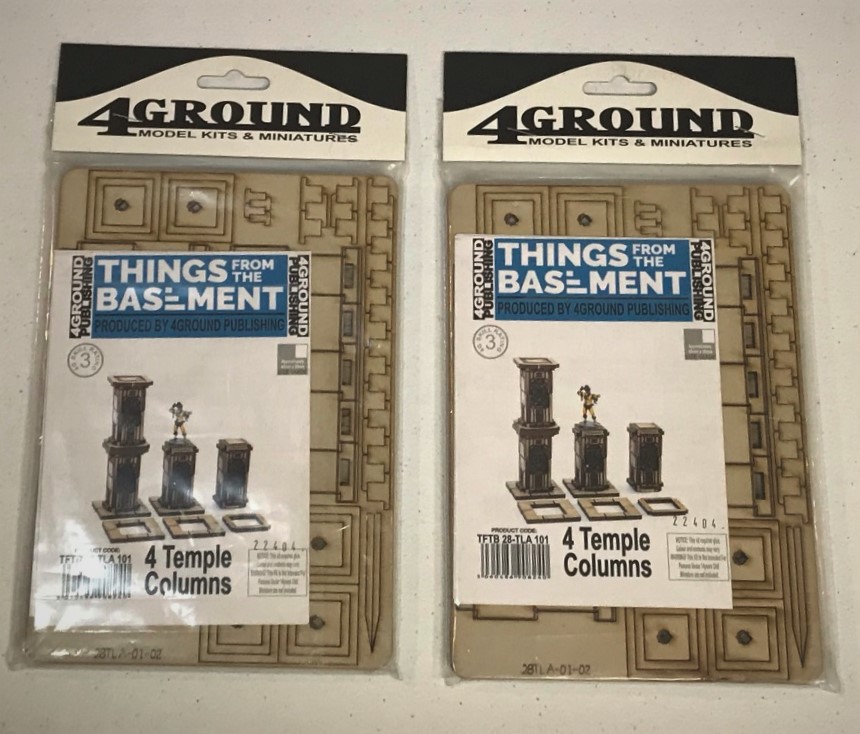
In my last post, as part of “Mark’s Aztec Building Challenge Contest” (which you should enter soon by the way!) I discussed how I assembled and painted 8 Temple Columns for my Aztec games of Feudal Patrol™ using my Civilizations Collide supplement. I had moved onto the MDF kits over my resin stuff as temperatures had been too cold here in Massachusetts to use rattlecans to prime outside. I truly enjoyed building and painting the MDF of my last post, and I certainly still have a love for using chinchilla dust.
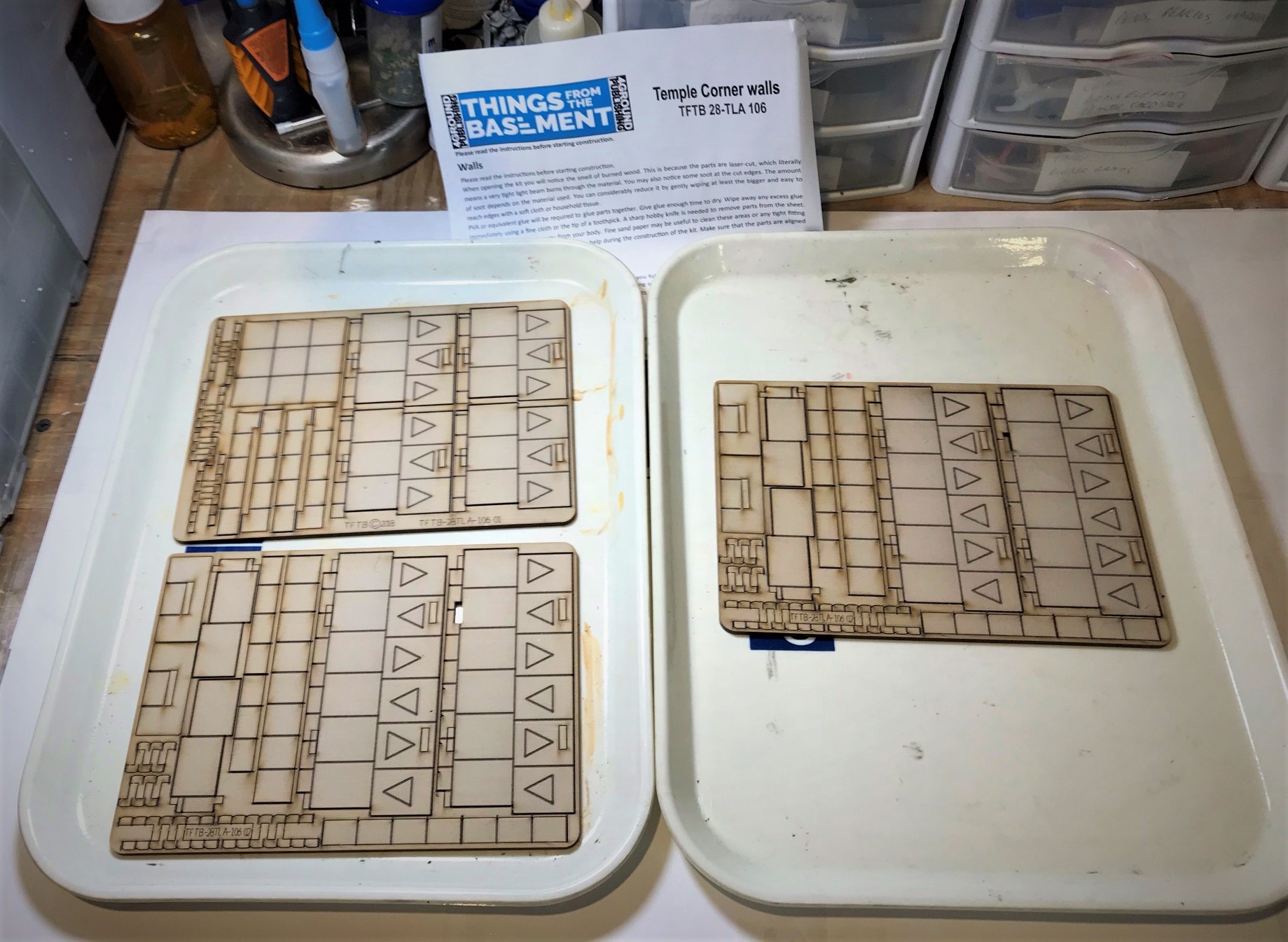
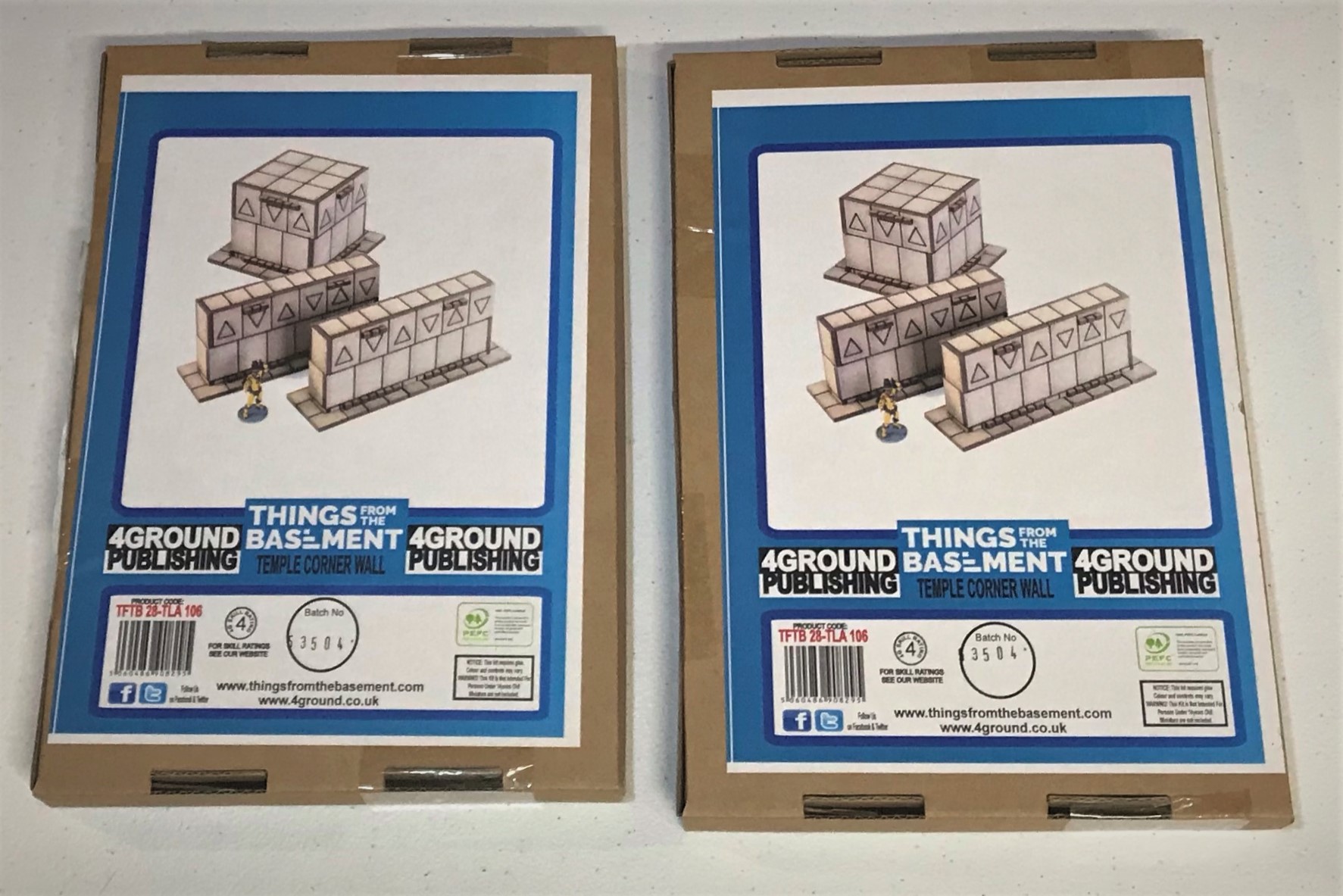
My next MDF effort would be two kits of the “Temple Corner Walls” – from Things From the Basement via 4Ground via Badger Games (see it here). Each kit had one square pillar-like structure and two walls – six in total. The kits are very nice and pretty easy to work with in my opinion. I basically used the second approach from last time – assemble first, then dust up with the chinchilla dust and paint them.
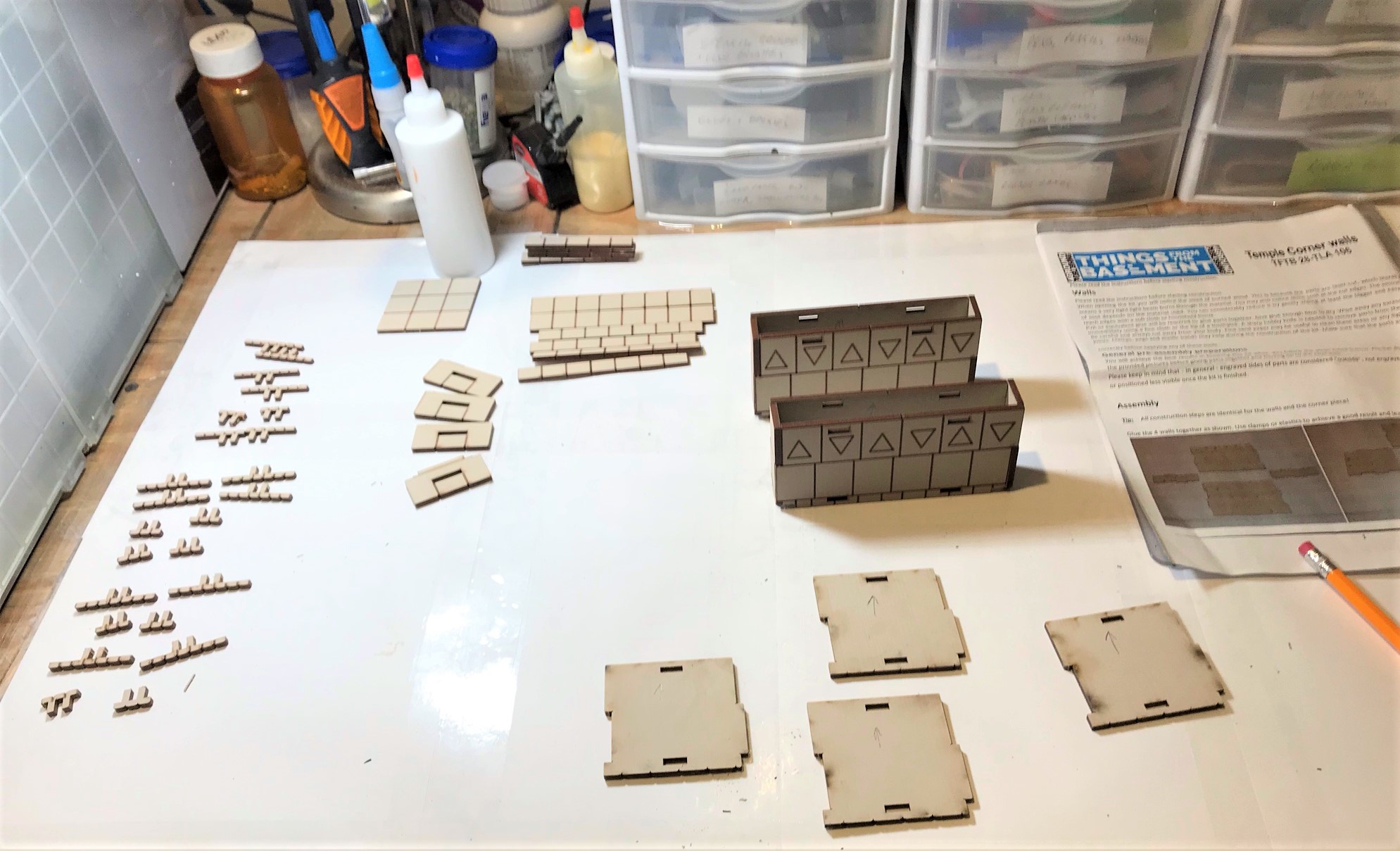
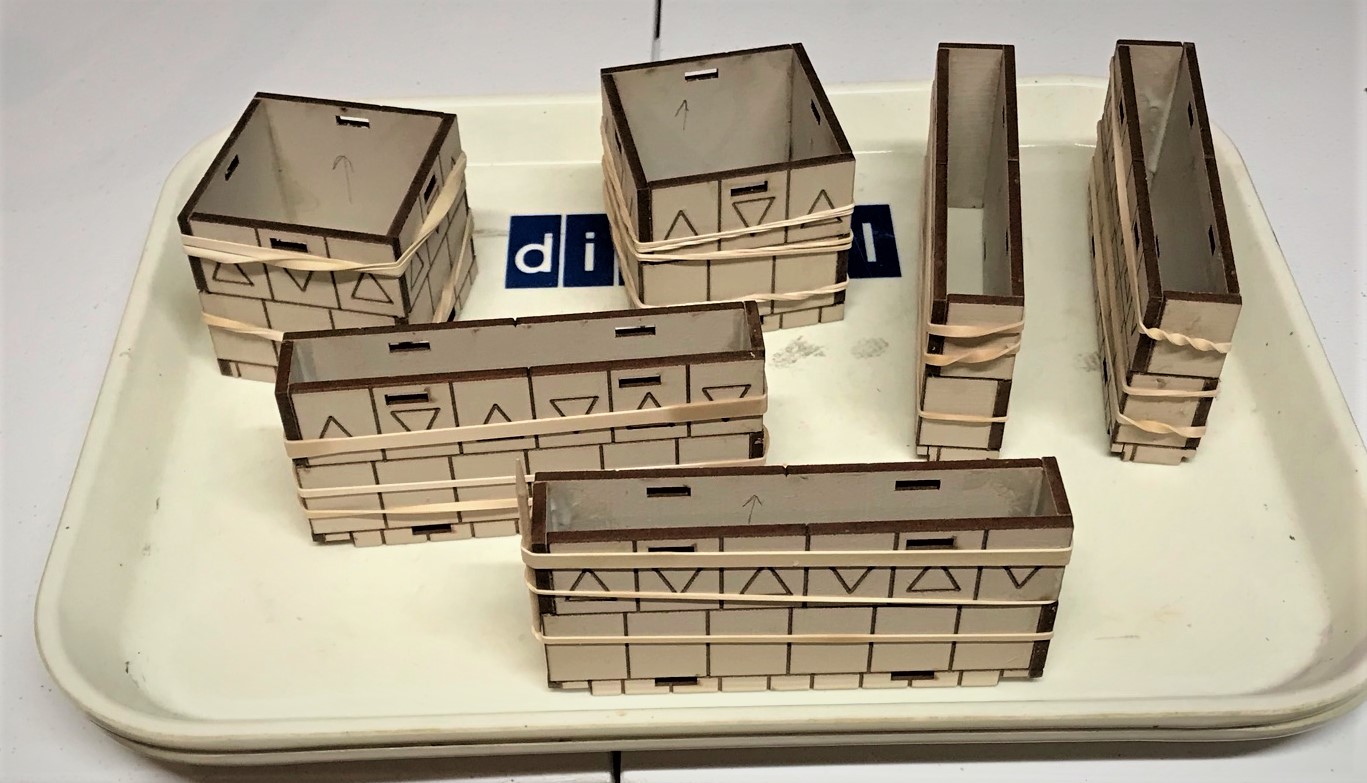
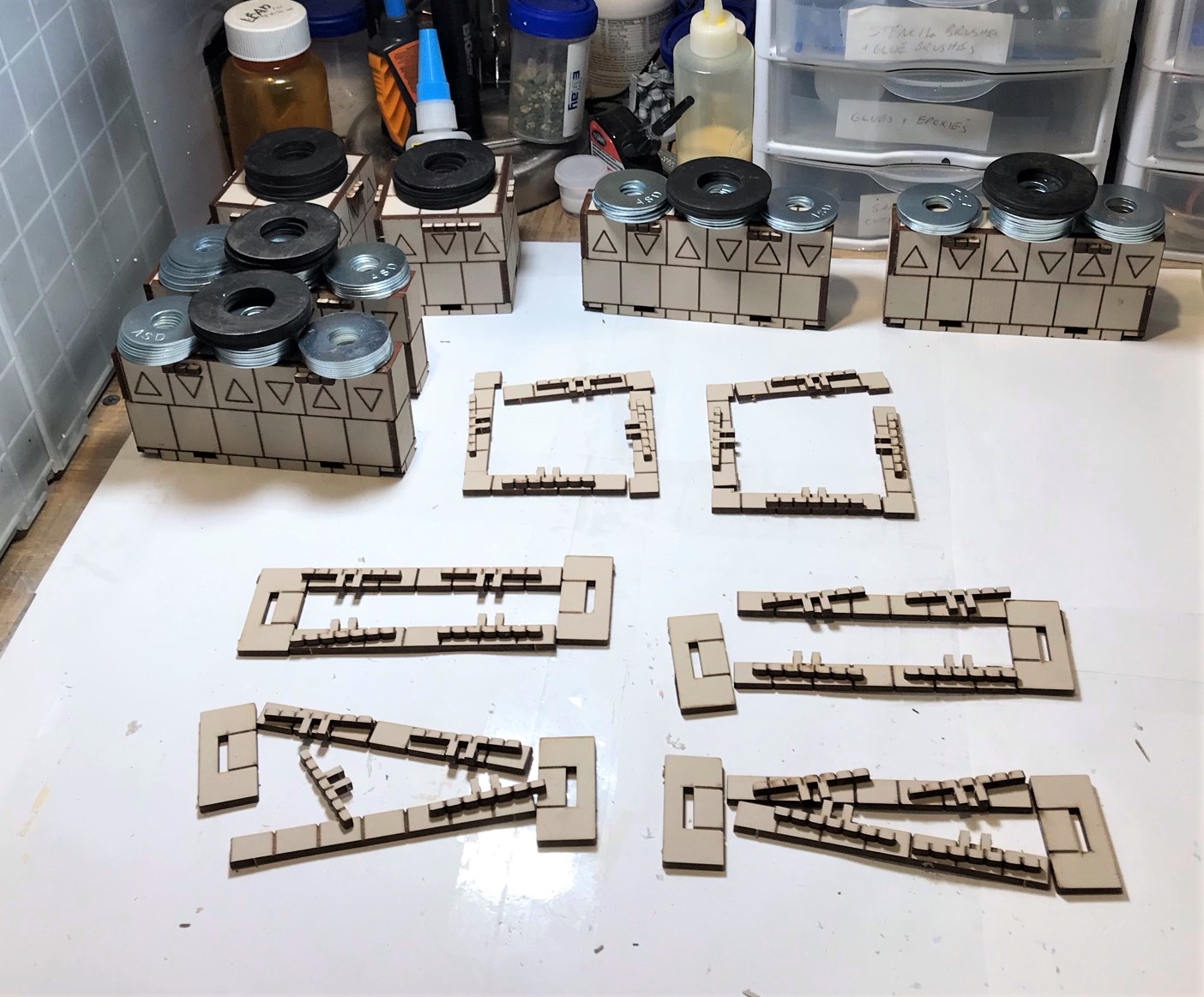
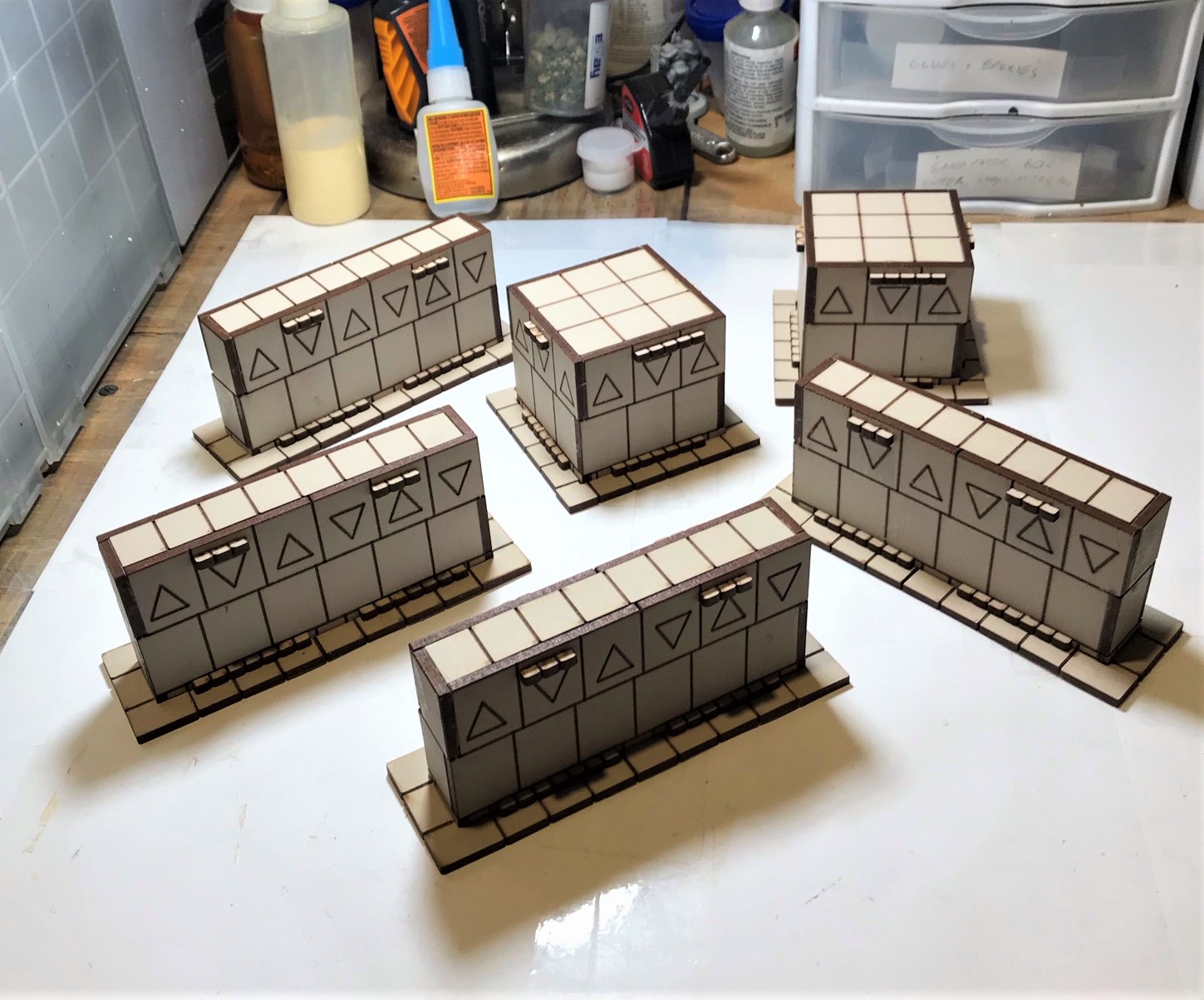
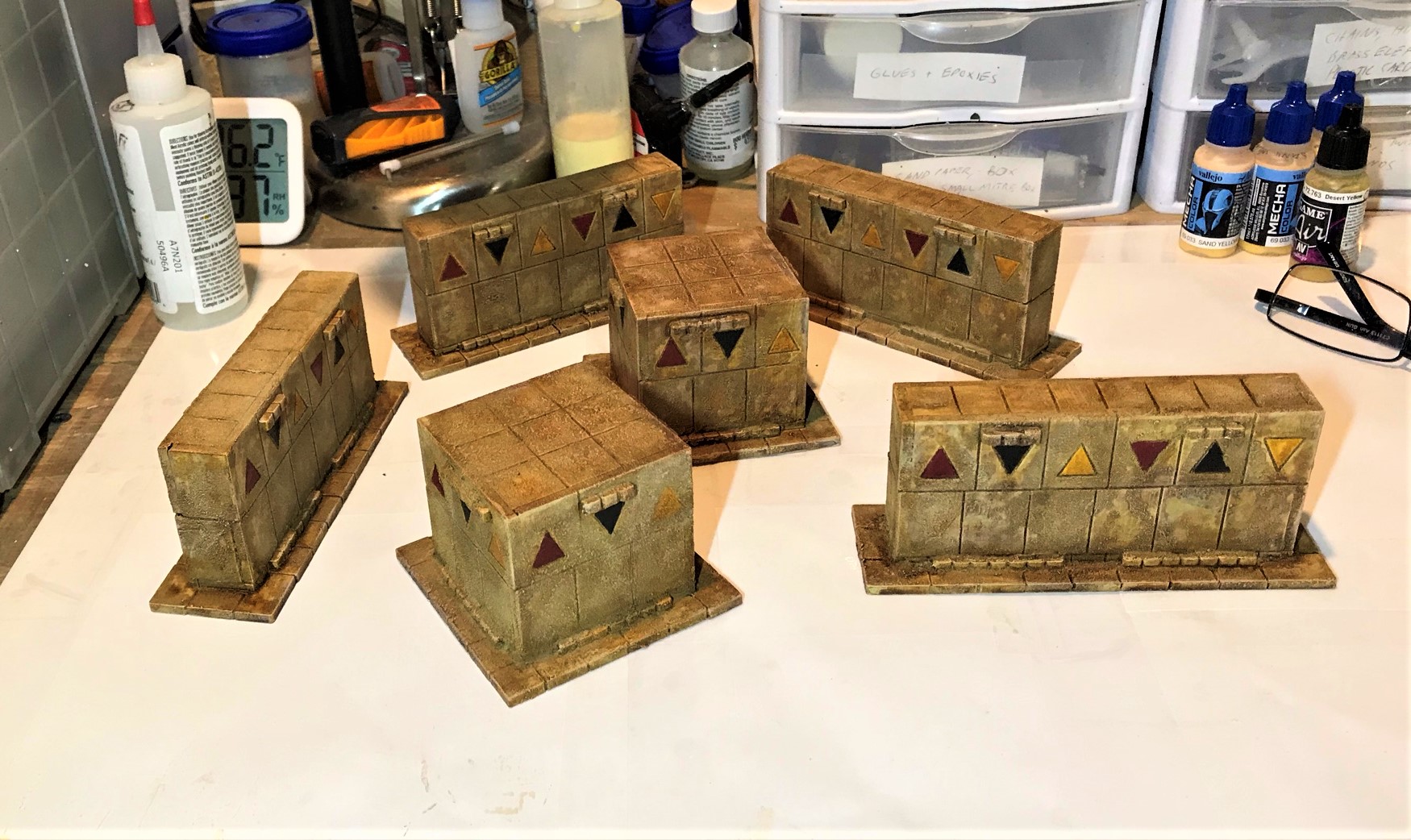
An example of one kit out of the bag after cleaning it off with a moist microfiber cloth.I have found with these MDF kits that it helps to dry fit first and organize the parts. Here you also see that I put an “up” arrow on the inside of the walls to help make sure that I did not assemble anything upside down.I assembled the wall sections first and let the PVA dry overnight.The next day, I added steel washers as weight to get the wall tops to glue flush to the previous step’s work. Then I glued to the bases (with the weights again).All of the “Temple Corner Walls” assembled and ready to get dusted up and painted.Here you see my early dry brushing after dusting – I use three colors to dry brush. I decided to paint the triangles in a red, black, and yellow pattern. You can see the paints that I used at the very end of this post.After I dry brushed the structures, I toned down the dry brushing with Army Painter “Light Tone”. Between the “thirst” of both the MDF and the chinchilla dust, I ended up using the better part of two bottles of the AP tone. Here, these are all complete.
I tried to use my spray booth again for some shots here but I did get some weird shadows and alternatively unwanted shine that I did not like. So I went with what you see below. I’ll need to investigate a light box (maybe).
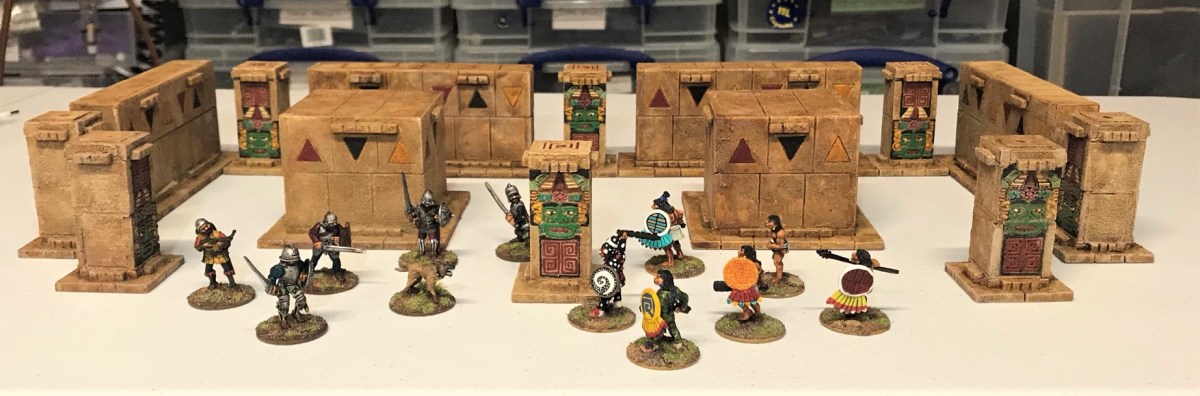
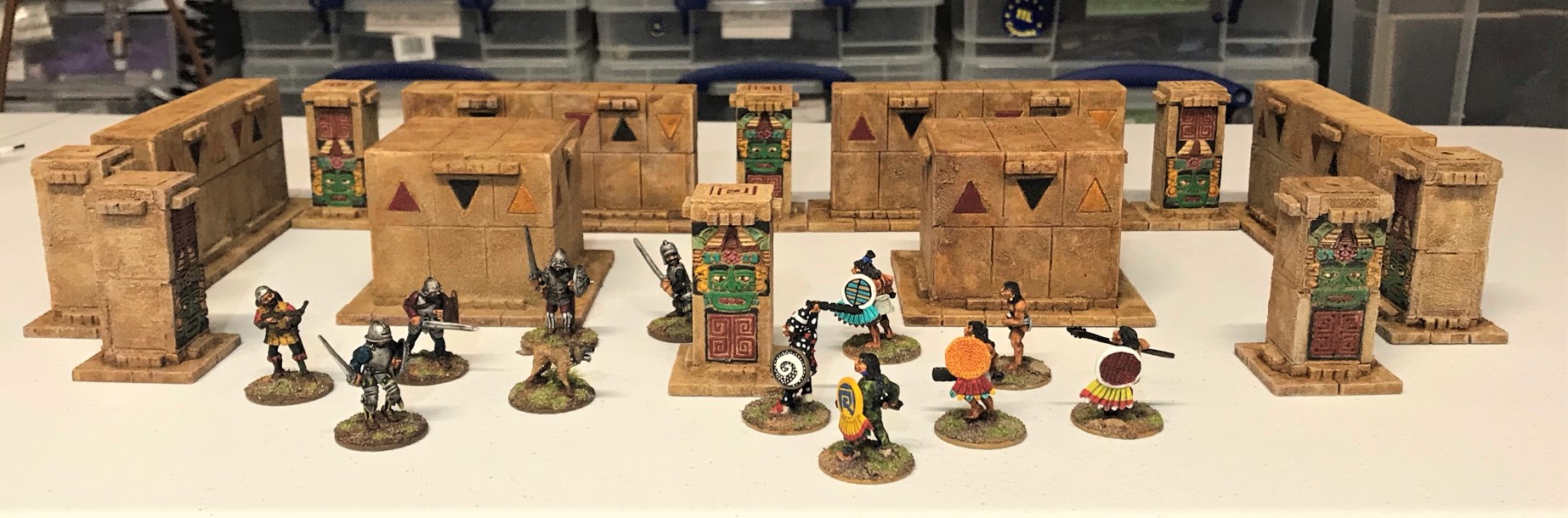
Here you see a fight among the “Temple Column Walls” (this post) and the “Temple Columns” (from my last post) between a squad of Conquistadores (and a wardog) against an Aztec squad and a supporting warrior priest. I think that I was successful at getting all to blend in well.
So, the Temple Corner Wall structures of this post are part of two “challenges”. The first is mine as mentioned earlier – “Mark’s Aztec Building Challenge Contest” – in which I will give away free prizes to blog followers for being the closest to guess how long it will take me to finish all these buildings. The second is from Ann’s Immaterium, and is called Ann’s “Paint the Crap You Already Own” challenge. These definitely count there – and I hope there will be more for this April challenge.
I have ordered some more “Light Tone” – and with my remaining MDF I’ll need it. In the meantime, as an update – it warmed up here this week so I was also able to get my outside priming done – see below!
I was able to prime this week! I can now vary what I decide to complete.
I also am planning an update to my Civilizations Collide supplement, which will have rules for the falconet and some new scenarios (in addition to an overall update). So that might slow up my progress, as also golf might (haven’t played yet this year though). I also have been – wait for it – GAMING!
Well, remotely anyways. I was lucky enough to play in a Combat PatrolTM game last Saturday via Zoom with Sally4th’s Chris Abbey. Chris (in the UK) set up a James Bond game based on the 1977 film The Spy Who Loved Me that he called “Nobody Does it Better” (Carly Simon song of the movie). It featured the scene in the bad guy’s (Stromberg) supertanker interior hold (that held a captured US sub). The action focused on the scene where escaping British, Russian, and American crews fight the Stromberg goons to stop a nuclear launch. We had US and UK players – and I had James Bond. Our objective was to advance up the gantry and throw a satchel charge at the control room doors and blow it open. We had a lot of twists and turns in the game – James Bond’s satchel charge misfired, and so did a Stromberg flamethrower that would have fried him. A last second satchel charge throw from the Americans missed, but the explosive charge slid up to the door and blew it! Success! Notably, I had invited our blogger buddy TIM who got to watch the game – and it was fun to share the experience with him.
Take a look at the tabletop below – amazing!
The tabletop before the game.Chris Abbey GM’s the game exceptionally well. We were moving up the gantry on the left – the control room was in the center of the far end.
I also had two other nice surprises. The first was in the mail from Buck Surdu – who sent me a couple of Wars of Ozz shirts. I did get in the Kickstarter for it (and the figures are available from Sally 4th and Old Glory in the US) -and the next project I plan to do is paint these figures.
Love these shirts and I will be happy to be wearing them at future gaming events! I won’t be bringing Caesar (our nearly 27 year old cockatiel) – he hates dice.
The second surprise came in our local weekly newspaper (see below). I’ll let Andy Newton’s words speak for themselves, but given the last few months, this was a heartwarming bonus for us.
From The Spencer New Leader
And though my computer is a problem, I did get the email from the Commonwealth of Massachusetts that has allowed me and my wife to get our first “jabs” this weekend! Take that COVID-19!
So, until my computer situation is better – I’ll be painting and following up on my iPad. Maybe I’ll be back this weekend – in any case, let’s discuss this post! So feel free to let me know your thoughts and comment – and to enter the contest. Take care all and thanks for looking!
Miscellaneous details and references for those interested in that sort of thing:
Previous posts on games, units, and other projects for my 16th Century Spanish Conquest supplement for Feudal Patrol™ – “Civilizations Collide”
Aztec Temple Corner Walls (Plus Some Life & Other Distractions Stuff Added In) (this post)
Perro de Guerra (Conquistador War Dogs). 13 figures total: Outpost Wargames Services #CONS6 “War Dogs” (8 war dogs); Eureka #100CON13 “Dog Handler and Dogs” (1 dog handler/pikeman and 4 war dogs)
Conquistador Foot Command, Crossbowmen, and a Couple of Officers. 11 figures total: Outpost Wargames Services #CONC1 “Conquistador Foot Command” (a leader, a banner bearer, a drummer, and a bugler); Eureka #100CON04 “Crossbowmen” (5 crossbowmen); and Eureka CONC1 “Conquistador Officer” and an unknown SKU officer (2 officers)
Welcome to Mark’s Building Challenge Contest – a FREE chance for you (with no work at all except to follow my blog and guess correctly) to join me on the next leg of my Spanish Conquest journey for my 16th Century game supplement forFeudal Patrol™ – “Civilizations Collide” . Actually, as my supplement covers pre-Spanish contact, it really is a focus on Mesoamerica and South America.
The upside for you? Well, besides getting to be a follower of my blog – which I (somewhat humbly) hope is a bonus in and of itself – you will have a chance to win – yes WIN – some free stuff (miniatures or a game – see below)! This is my second giveaway contest – the first was well-received and you can see the winners here. As before, followers of this blog (either email OR WordPress) are eligible).
The upside for me is that I will get a bit more motivation to get these buildings done – and hopefully done well for the tabletop and to pass your scrutiny. Plus it will be fun. I’m hoping that I will (and many others) be able to soon get what the Brits are calling “the jab” and return to more gaming. Having these buildings done would be the icing on the cake. I also would be able to find new homes for the prizes, which are indeed nice (ask last contests’ winners Pete, Mike, and Leif).
As for this contest – read on!
Just like before, I thought this would be another way to get you involved on this project other than just reading this blog. You get to compete and guess the date that I’ll actually finish the buildings!
I am writing this on March 23rd, 2021. I have not done ANYTHING with this stuff except to take the photos of them. I’ll need to wash and assemble and paint and base and anything else I feel is needed for this stuff. My experience working with resin is ok – see here, here, and here. My experience with MDF is much less – see here. I expect to start work TODAY, March 23rd, 2021 .
How long will this take – YOU get to guess.
My goal is to have some fun, and reward my followers and share some stuff that I enjoy. Secondly, it’s to get more followers and to grow the community. Thirdly, it’s to have fun (yes that’s fun twice). I do not currently monetize my blog, and I’m not looking to anytime soon by the way. Here are the rules – please note the underlined parts:
Rules of Mark’s Aztec Building Challenge Contest:
HOW TO ENTER AND TO WIN:
You must be an email or WordPress follower of my blog.
You must pick a date (day, month, and year) that I will finish all of the Aztec Buildings shown here in this post. Finishing means, to me, that I am ready for the figures to be shown on my blog and used in a game. That is my call!
You must let me know that you want in on the contest by midnight EDT (US East Coast time) on April 10th, 2021. You do this by posting a comment that “you are in” here on this blog post in the comments section with the date information requested above in (2).
Only one entry allowed per follower except as described in (5) below.
If you get another person to follow my blog, you can earn another entry! For each new follower that credits you as a referrer, you can get another entry. All that person needs to do is comment on this post as in (3) above stating that he or she is “in” and who the referrer is. The referrer can then reply to that comment with an additional entry date.
Winners will be whoever is closest to the date I announce as the “completion date”. That can be earlier or later – for example picking a date that is one day before is as good as if it’s one day after. As there are multiple prizes, 1st place gets first choice, then 2nd, then third – and this time there is a 4th place! (Yes, I’m generous, eh?) If two people pick the same date, which is possible and allowed, ties will be broken by who submitted the date first. I reserve the right to add more prizes!
I also reserve the right to be the final judge on the contest – somebody’s gotta do that. When I finish, I will announce the winners.
So as for prizes, they will include metal miniatures, plus a brand-new shrink-wrapped unopened game is available that I will never get my wife to play – so it needs a new home. The minis are all vintage lead – and in original packaging. Great stuff I love but may not be able to paint soon – and they also deserve a home. First place gets first choice, and so on. And I will pay to ship them to the winners (including the US, UK, Australia – as long as I don’t need to hit the lottery for shipping)! So here are the current four prizes (and I may add more):
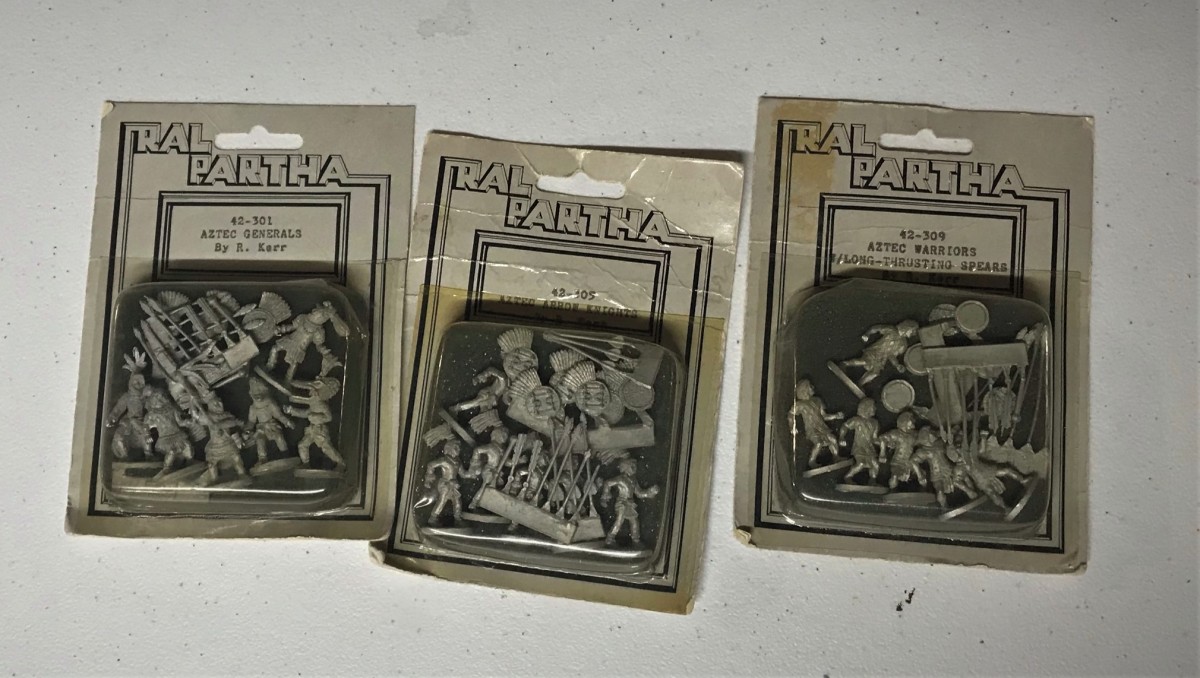
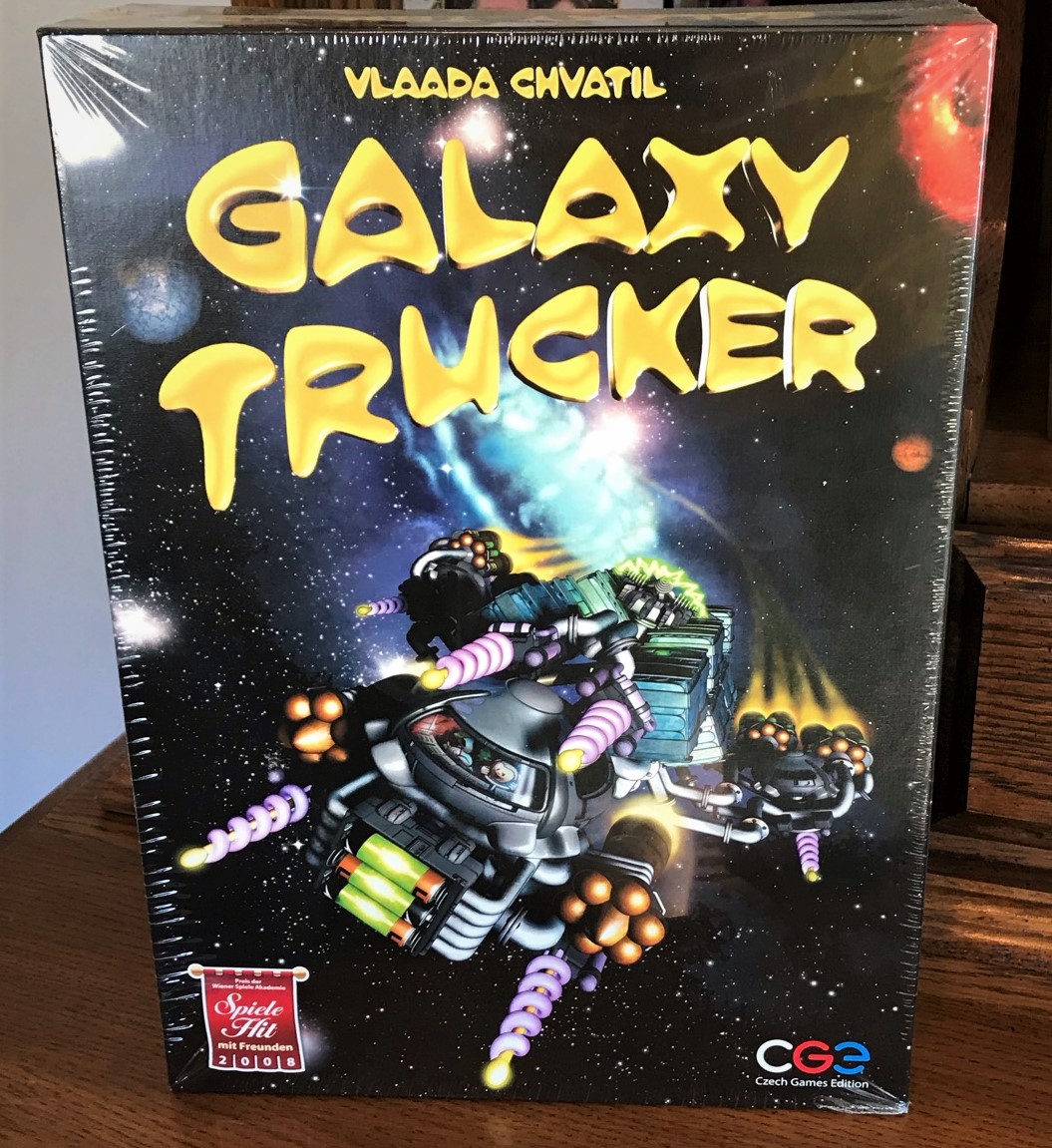
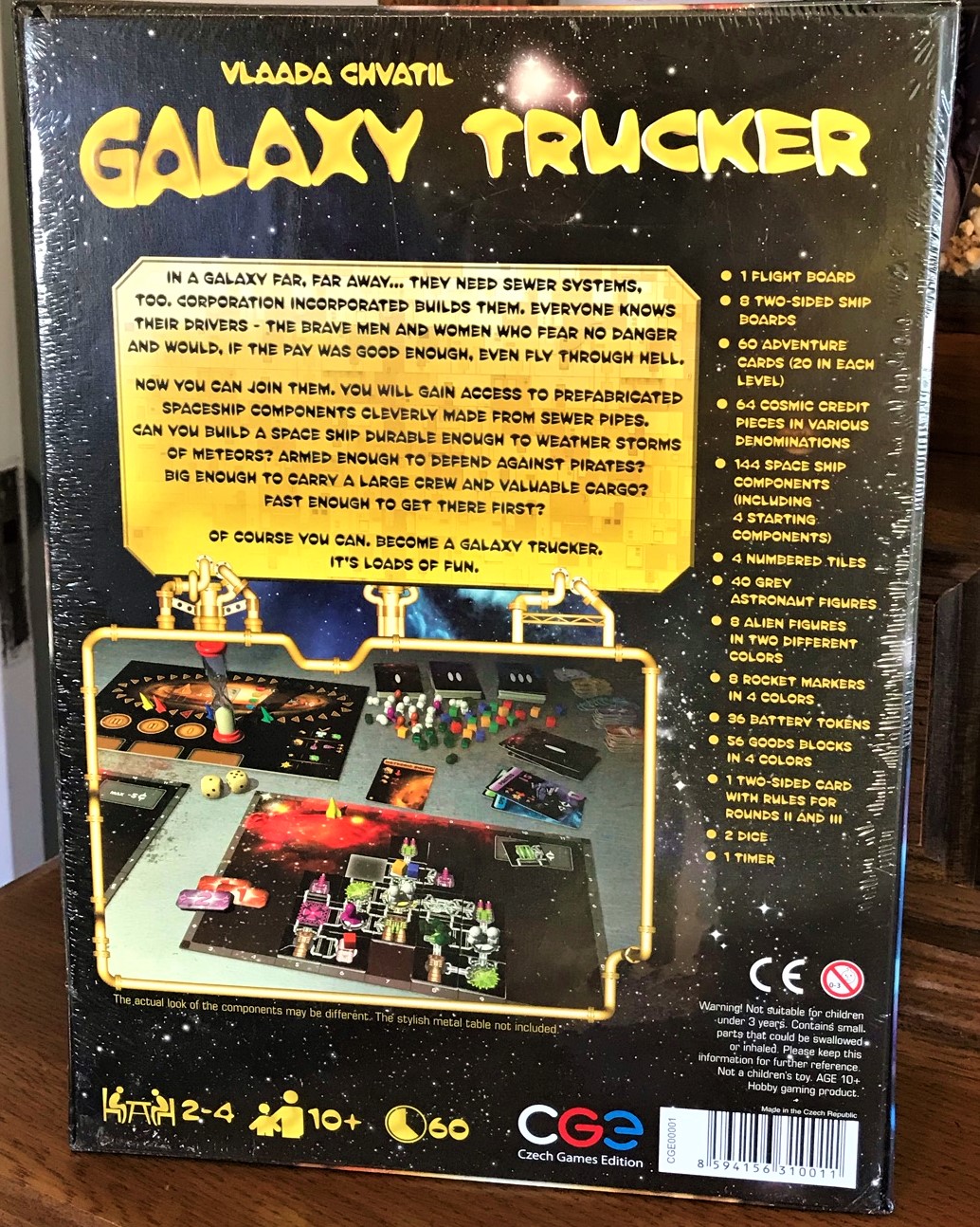
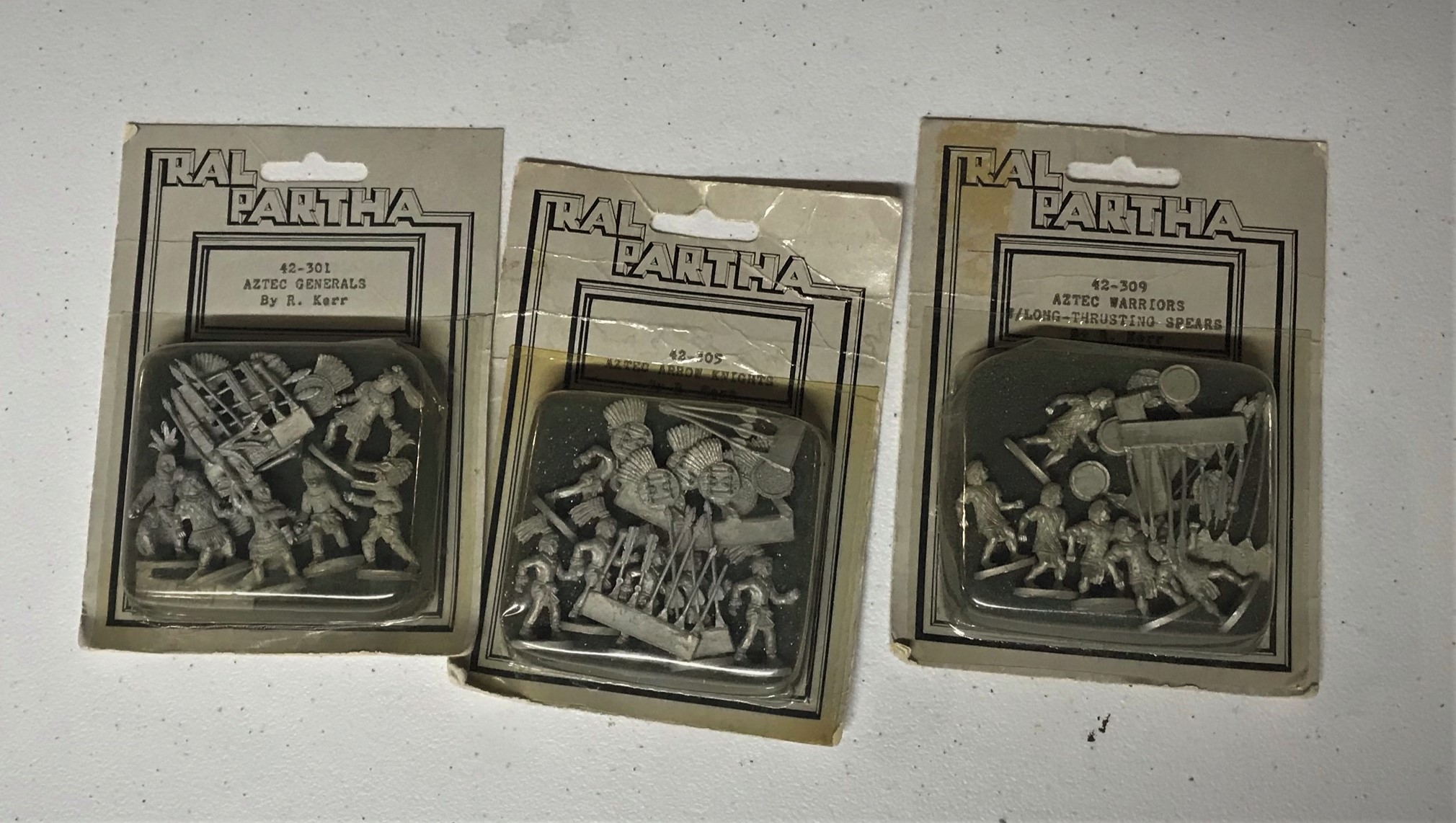
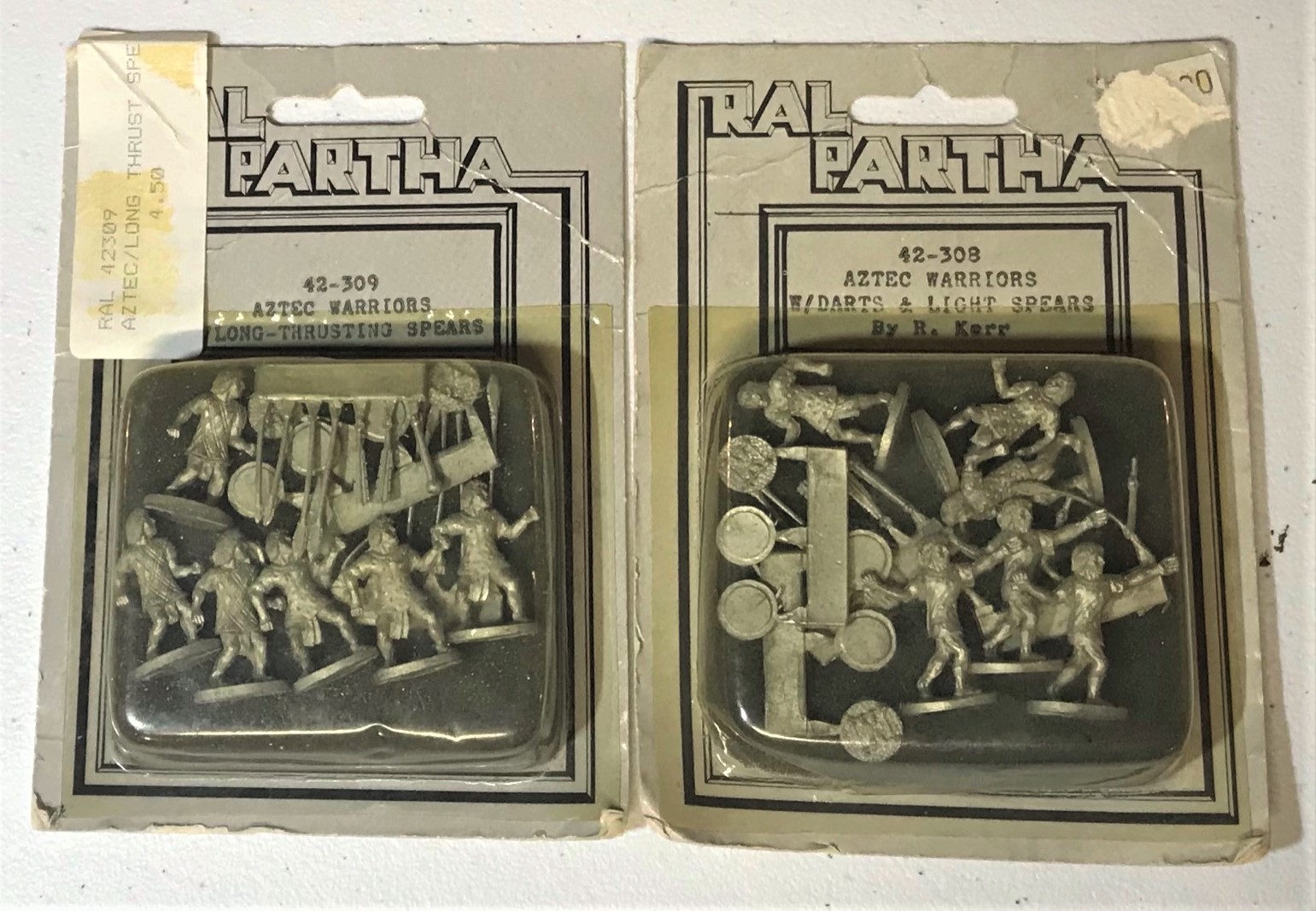
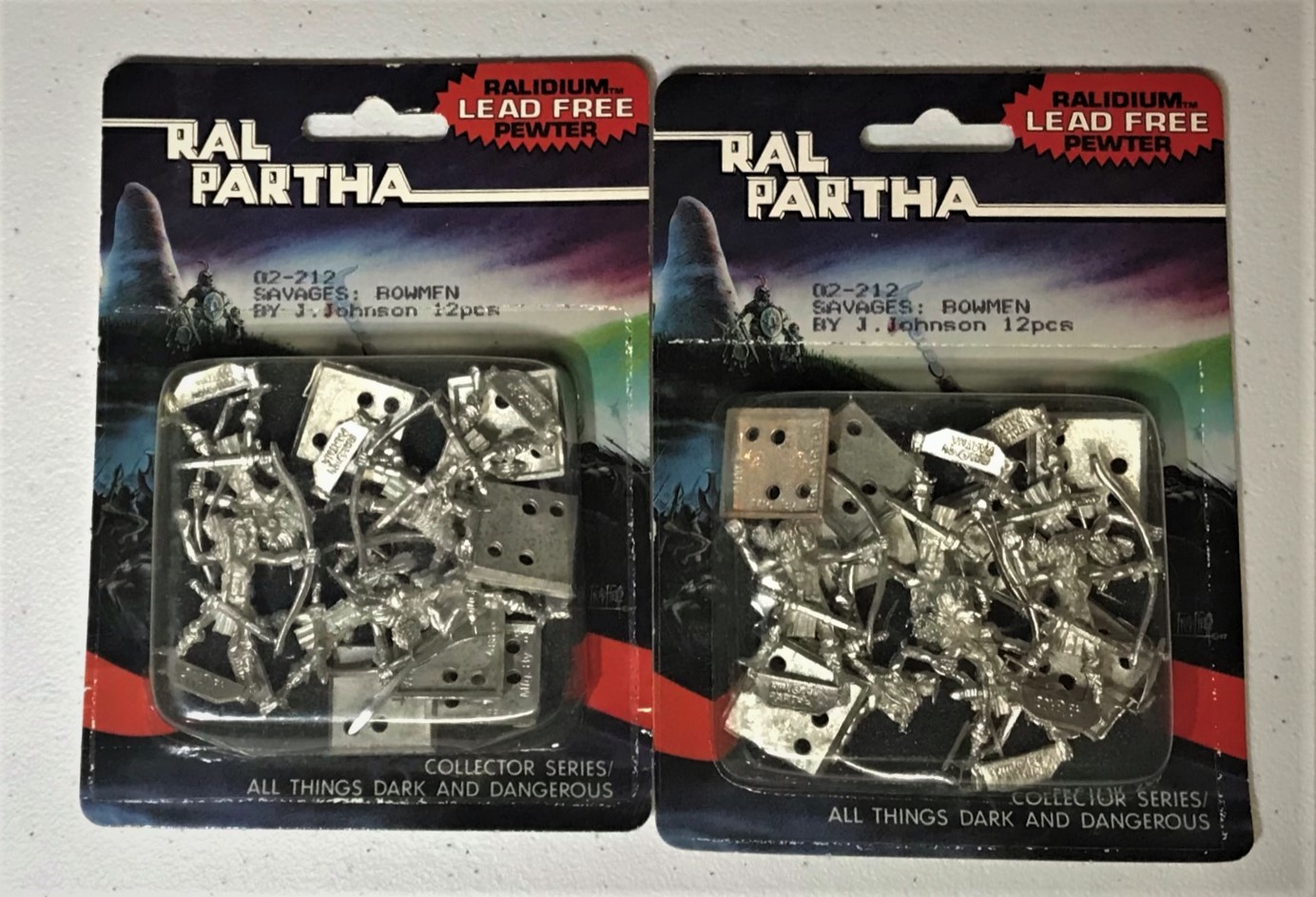
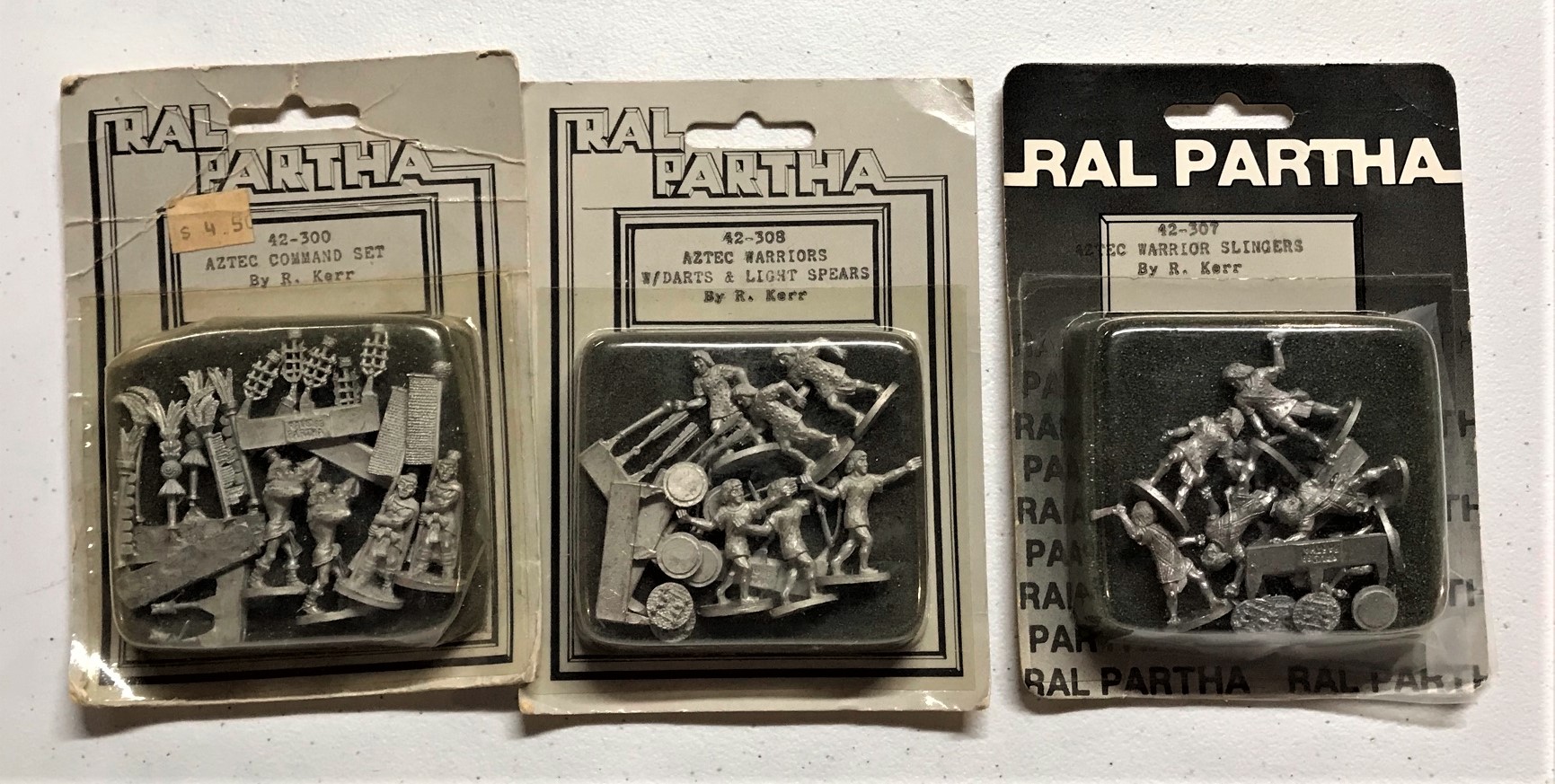
I won this Galaxy Trucker game at TotalCon last year – the wife won’t play! So maybe you would if you win? Never been opened and still in the shrink wrap. A three blister prize! Ral Partha 42-301 Aztec Generals, 42-305 Aztec Arrow Knights, and 42-309 Aztec Warriors w/Long Thrusting Spears (really tepoztopilli). 18 figures in total. All are unopened from the 1980’s. Works for 25mm or 28mm scale games. A two blister prize! Ral Partha 42-309 Aztec Warriors w/Long Thrusting Spears (really tepoztopilli) and 42-308 Aztec Warriors w/Darts & Light Spears (really atlatl) . 12 figures total. Both are unopened from the 1980’s. Works for 25mm or 28mm scale games. A two blister prize! Ral Partha 02-212 Savages: Bowmen (2 blisters – 12 figures total). Both are unopened from the 1990’s or early 2000’s. Works for 25mm or 28mm scale games.
Again, depending on participation and interest – I may add more. Hell, even if you win and don’t have a plan for them, these could be used as trade, or you could just tell me that “victory is enough” for you and to reward the next player or whatever you desire.
Your next questions should be – “what exactly is Mark trying to build and paint here?” and “how fast is he?”. For the second question, just check out my pages that show my previous projects. For example, 2021 is here, 2020 is here, and 2019 is here, but I list all my projects from 2016 onward under the “Miniatures and Projects” dropdown. This menu lets me track all I have done – and how, and can give you an idea.
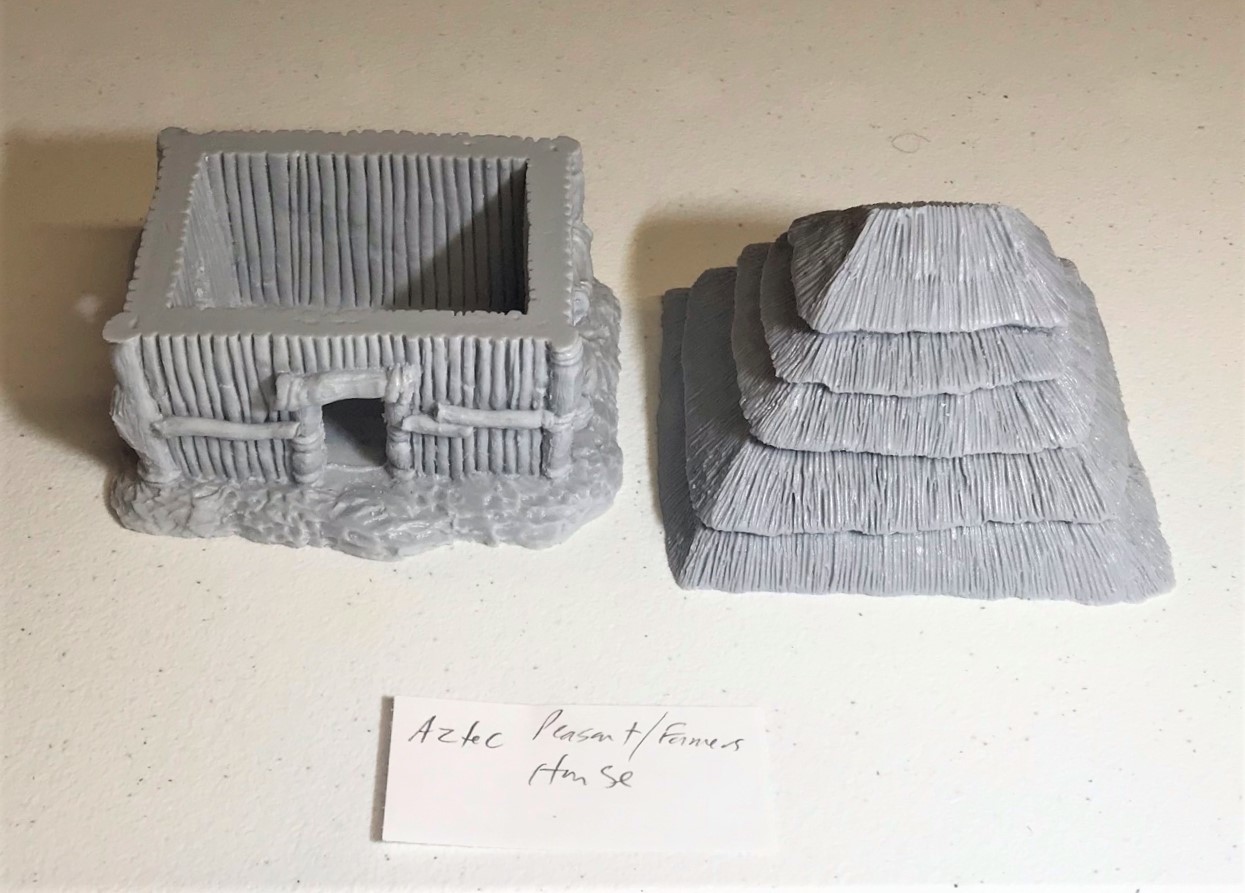
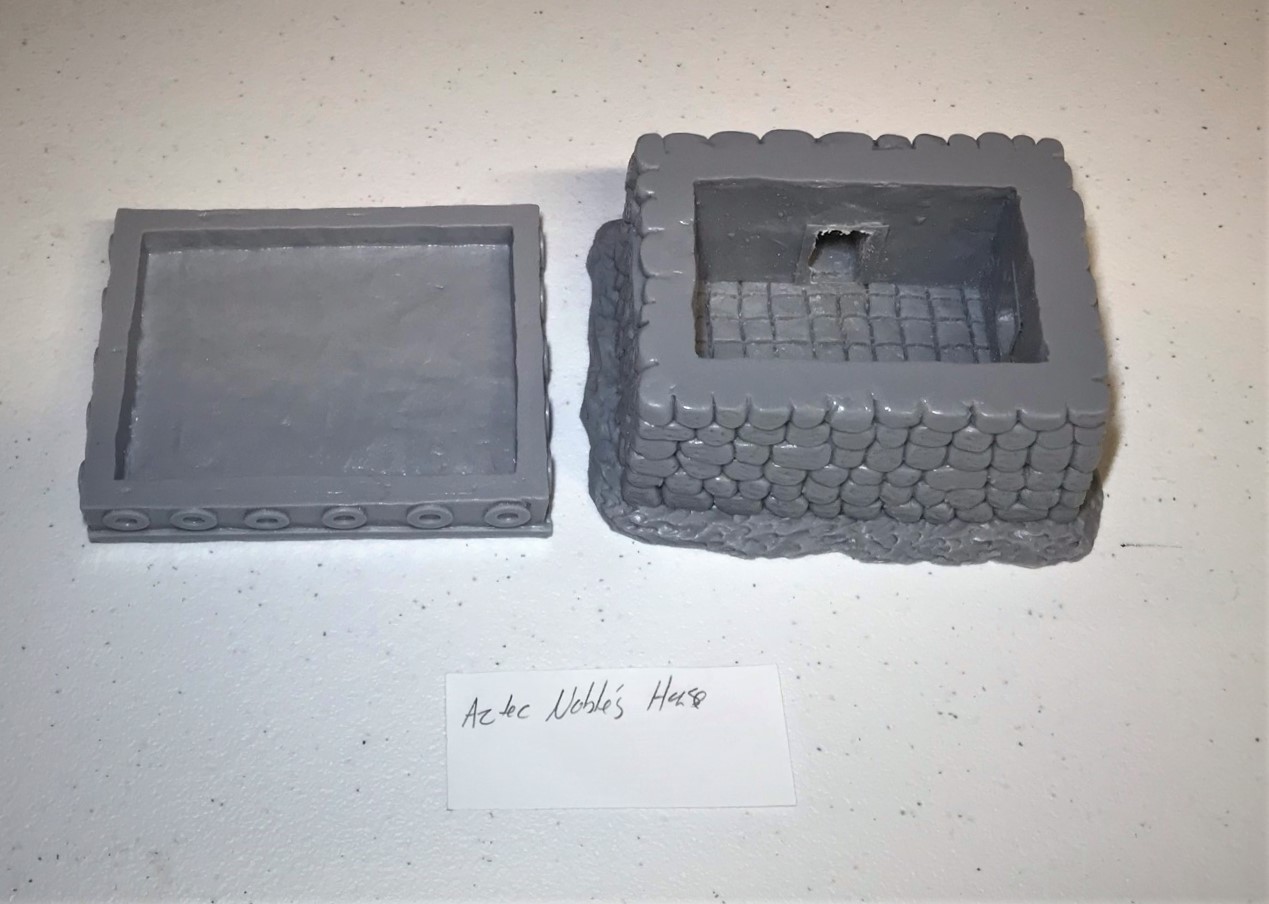
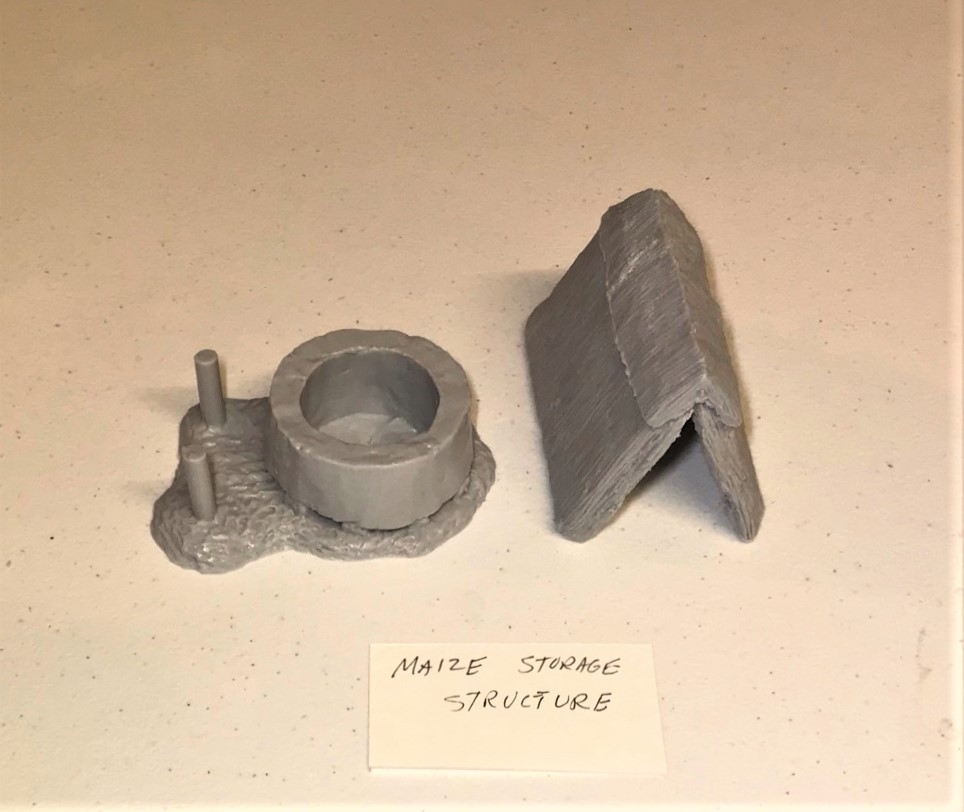
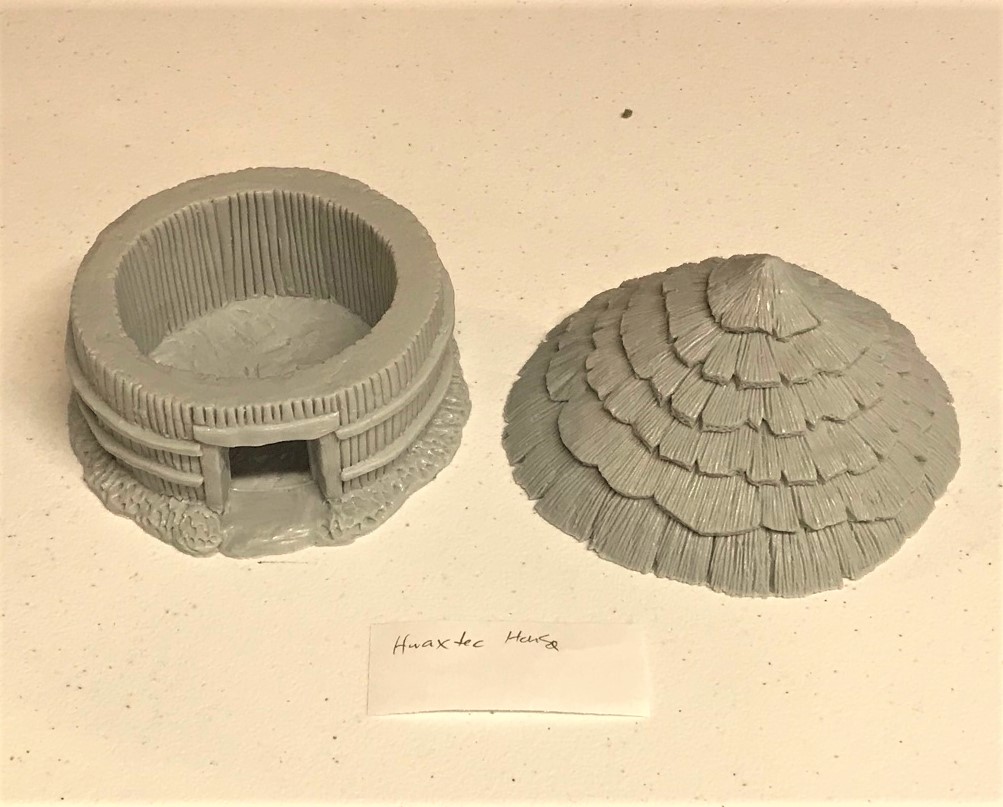
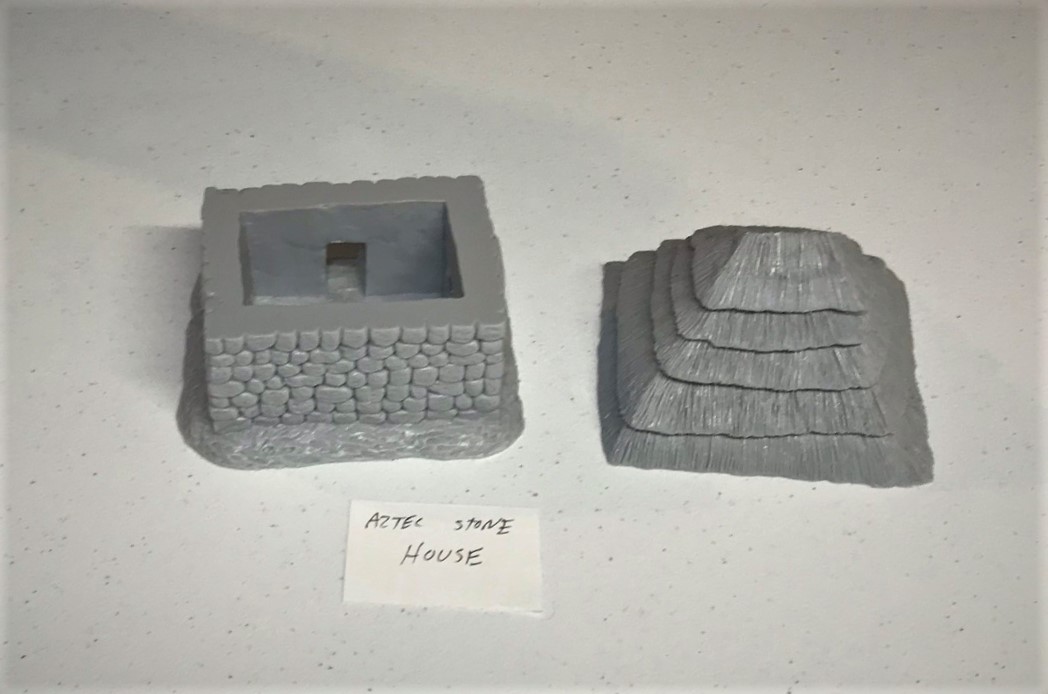
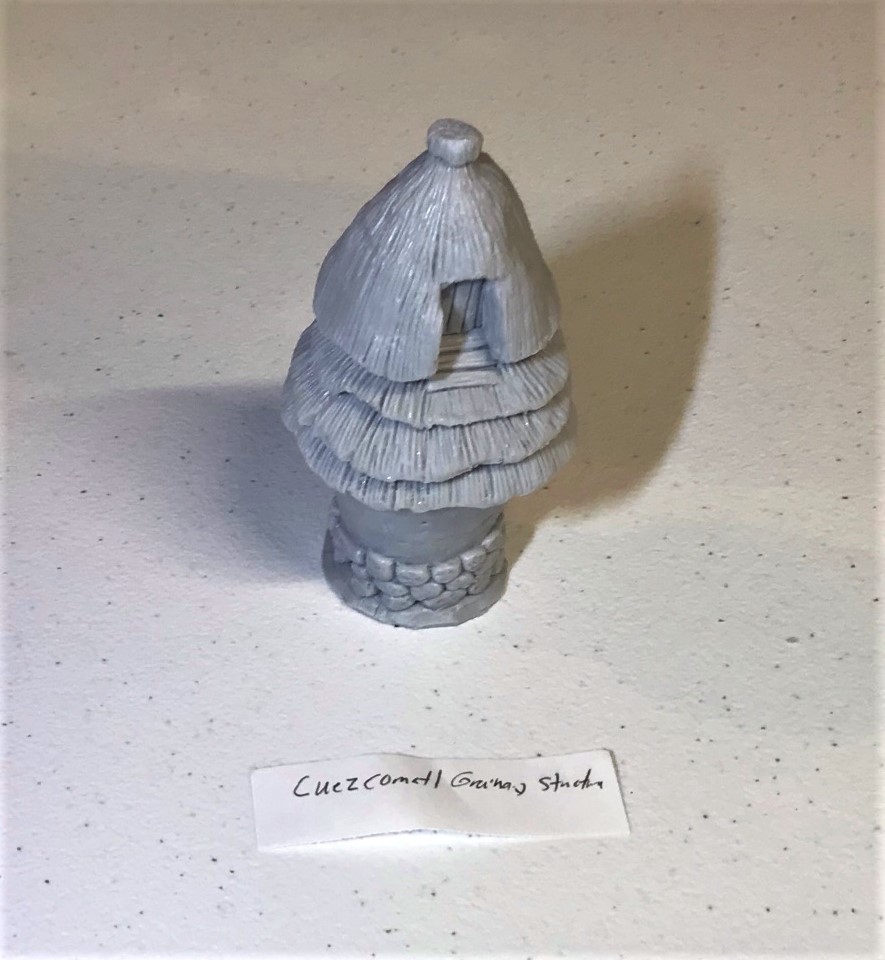
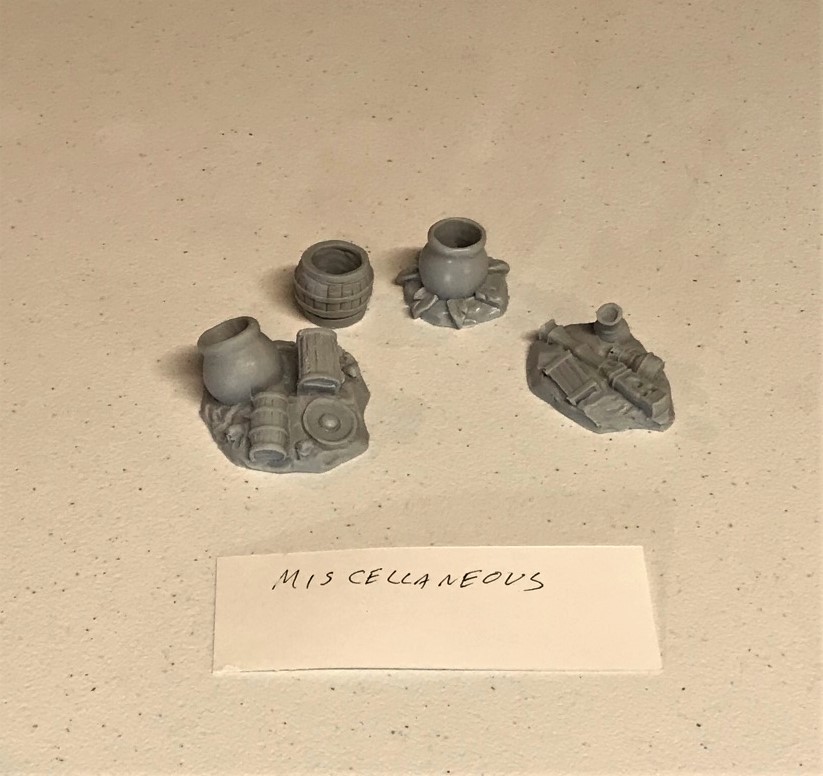
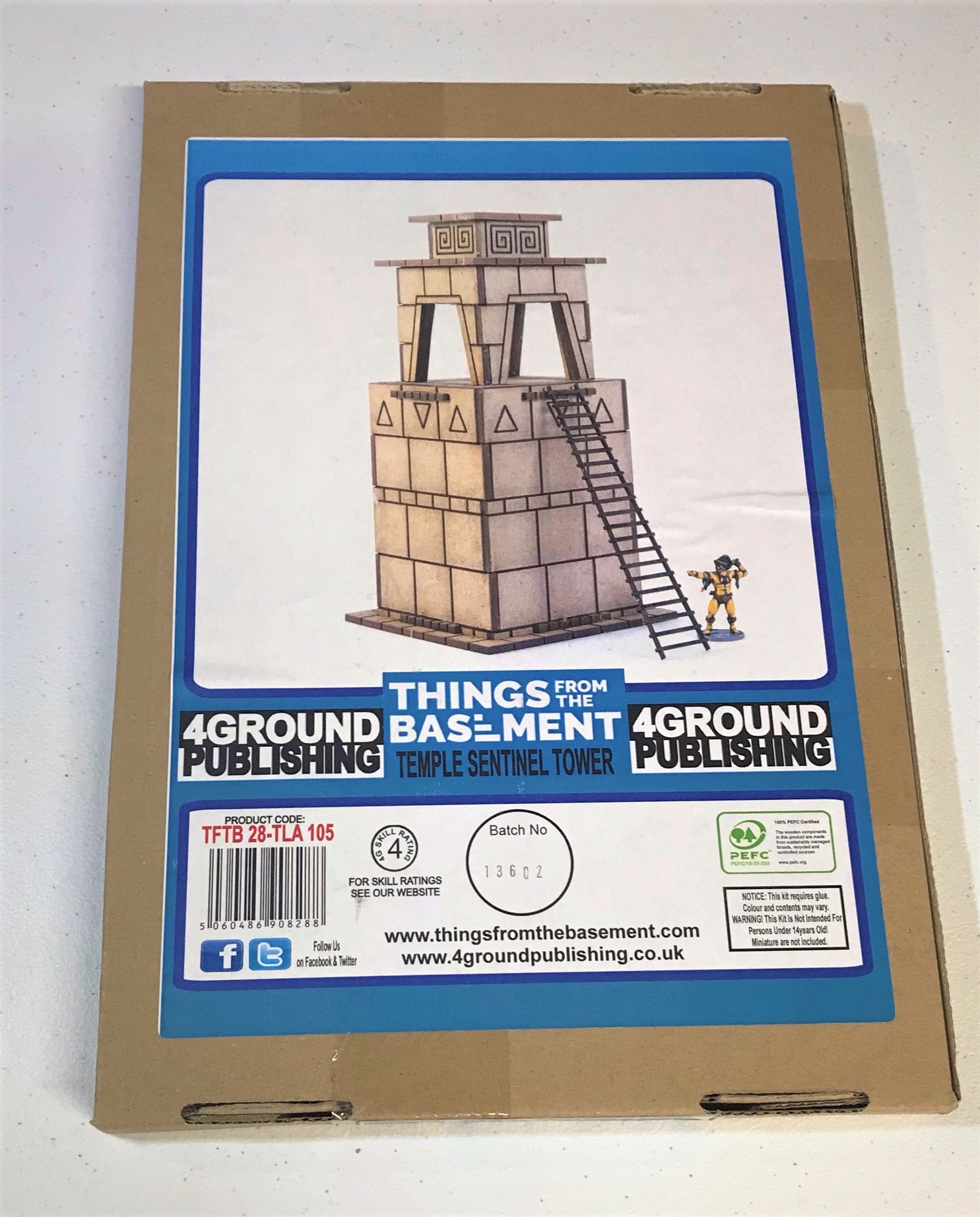
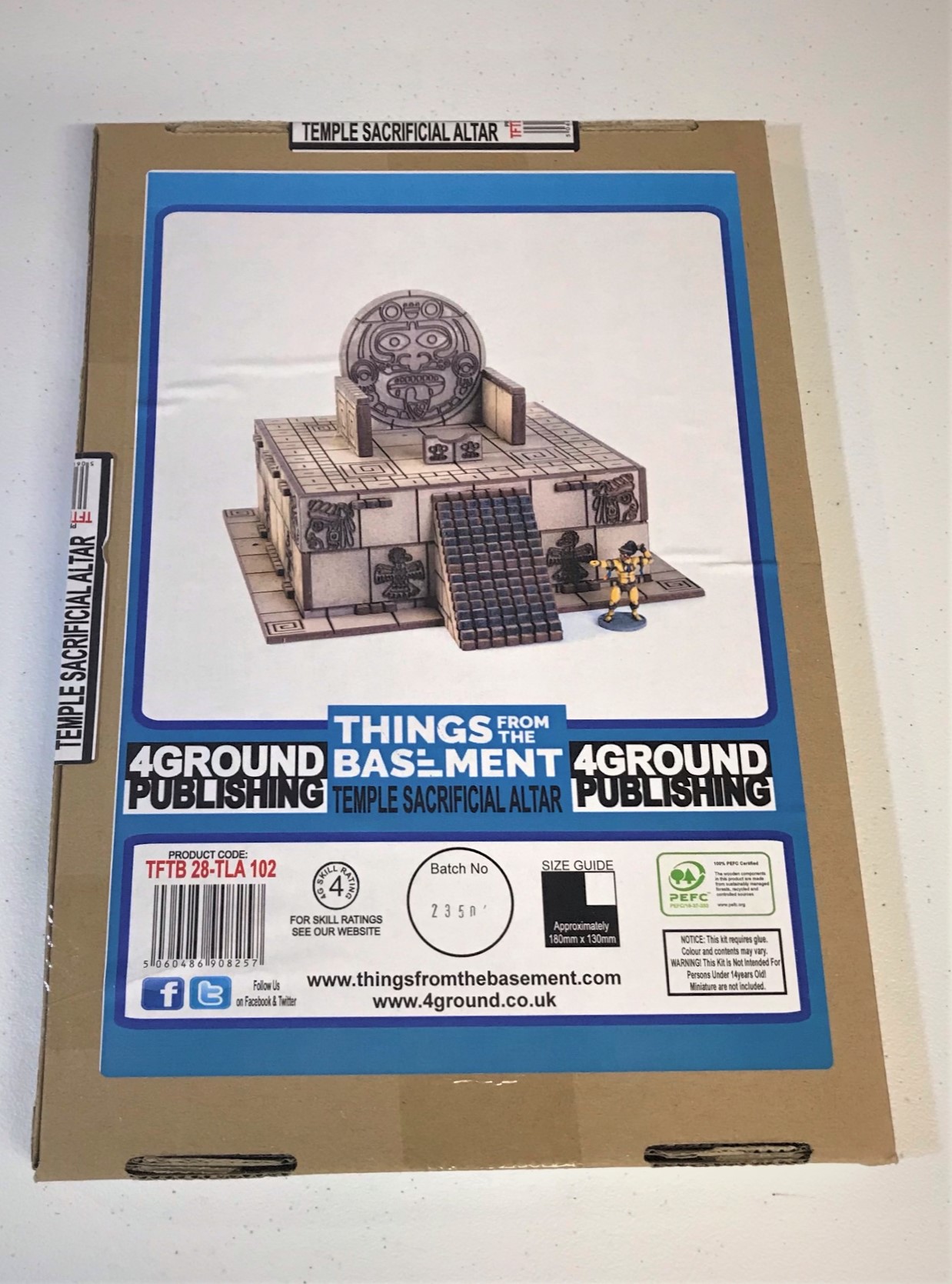
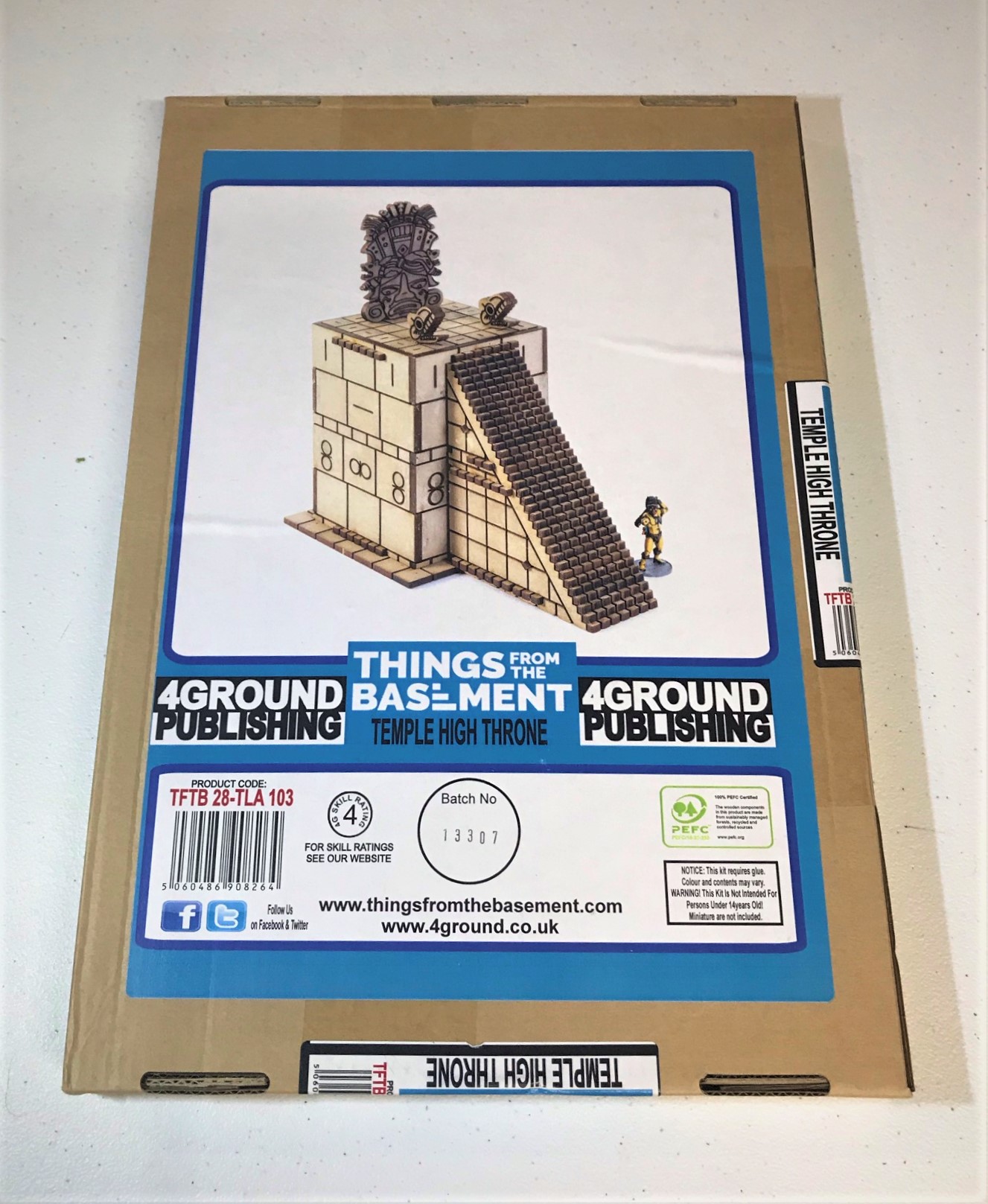
Back to the contest. Here are the Aztec buildings (with links in the captions) of this next quest and this contest below. They are all scaled for 28mm. The resin buildings are from Acheson Creations, and there are 6 of them plus a group of scatter terrain that Acheson nicely threw in with my order. The MDF structures are creations from Things from the Basement creations via 4Ground via Badger Games. There are 7 kits of MDF.
So, for now that’s the contest. I hope that you will enter and wish you the best of luck! Referrers are always welcome – just need to follow the rules and importantly be one of my blog followers – like the rules said!
For full disclosure, I have conferred with TIM on the resin and the MDF – and he gave me a few helpful pointers. He also pointed me in the direction of a nice Sarissa book on MDF that is very helpful. I’m sure he will join in the contest but that might change the dates you pick – or not -it’s up to you!
Stay tuned for updates as I finish pieces of this project – and I really hope that you find this fun. As I have been doing, I’ll leave a synopsis as usual like below. Stay safe and enter in the comments section!!
Miscellaneous details and references for those interested in that sort of thing:
Previous posts on games, units, and other projects for my 16th Century Spanish Conquest supplement for Feudal Patrol™ – “Civilizations Collide”
Mark’s Aztec Building Challenge Contest (this post)
Perro de Guerra (Conquistador War Dogs). 13 figures total: Outpost Wargames Services #CONS6 “War Dogs” (8 war dogs); Eureka #100CON13 “Dog Handler and Dogs” (1 dog handler/pikeman and 4 war dogs)
Conquistador Foot Command, Crossbowmen, and a Couple of Officers. 11 figures total: Outpost Wargames Services #CONC1 “Conquistador Foot Command” (a leader, a banner bearer, a drummer, and a bugler); Eureka #100CON04 “Crossbowmen” (5 crossbowmen); and Eureka CONC1 “Conquistador Officer” and an unknown SKU officer (2 officers)
And for my blog buddy IRO, as it’s still March, here’s another t-shirt shot – well it’s still cold, so he gets a sweatshirt shot. It’s a Massachusetts outline with a Boston Bruins logo in different colors. Normally the Bruins (my favorite hockey team) colors are Black and Gold, but my lovely wife wanted me to have something other than those colors – so Red White and Blue are ok too!!
It’s my blogaversary! I started this blog 6 years ago today on March 19th, 2015!! It all started with this post – The Story of the Nightmare Legion. It’s been a fun journey.
I started this blog to share my minis and to share stuff that I learned after an extended absence from the hobby. I wanted to help with lessons learned and the like. Since then it’s been a blast, and I really appreciate all of you who read and follow this little blog of mine! I certainly have been inspired by yours.
This current post was one with which I struggled as far as deciding on whether or not to do write it as it involves making stuff to make my games easier for the players and for me as a GM. In the end, I was encouraged to give it a go (thanks IRO and TIM!). So, this post will be more of a how to (and a throwback to some of my earlier projects) in terms of stuff I have conceived of, designed, and built for my Feudal Patrol™ games using my supplement Civilizations Collide. After reading this, you might have some new ideas, you might know about some new materials, or you might just think that I am nuts. After all, the stuff I will show took 3+weeks to make.
Now, before I go any further, I want to emphasize that I did not need to do any of these projects to play Feudal Patrol™. Period. I did because they suited my personal needs and – well – I get thoughts of stuff in my head that need realization.
Buck’s Feudal Patrol rules have more than adequate tools and game aids. They are fantastic. My goals here were for myself so that I can make my games easier for me mainly. Also, with 216 available figures for a game of Civilizations Collide, I needed some tools if I am going to provide CHOICE and AGENCY to my players.
To accomplish this, I have broken down my efforts into “challenges” with some supporting pics and links for the materials and tools. I hope that you find them interesting as they are really how I built “stuff” for my games.
The Under-Base Label Challenge
Challenge: The Conquistadores arrived in Mesoamerica in the early 16th Century and there had been many different Mesoamerican civilizations for centuries prior to that. “Uniforms” in this era were anything but uniform. In the game, Warbands and Elements within Warbands are composed of figures that are attired, armored, and armed differently. In terms of both figure identification and using the points system to build Elements and Warbands, this poses a challenge, especially with my 216 available figures. Having thought of this from the beginning of this project, I had kept an identification Excel spreadsheet for all 216 figures throughout the project – which helped immeasurably with having identification data for each figure. I did take many pictures and also wrote (somewhat illegibly as is my curse) on the bottoms of the figures’ bases with a Sharpie. However, I needed a clear and legible solution for the tabletop.
Goal: Make all figures easily and individually identifiable. Ideally, have a system that identifies each figure and the points cost for each under the 1” and 1.25″ steel washer bases.
Solution: Create custom labels for use under the 1” and 1.25″ steel washer bases.
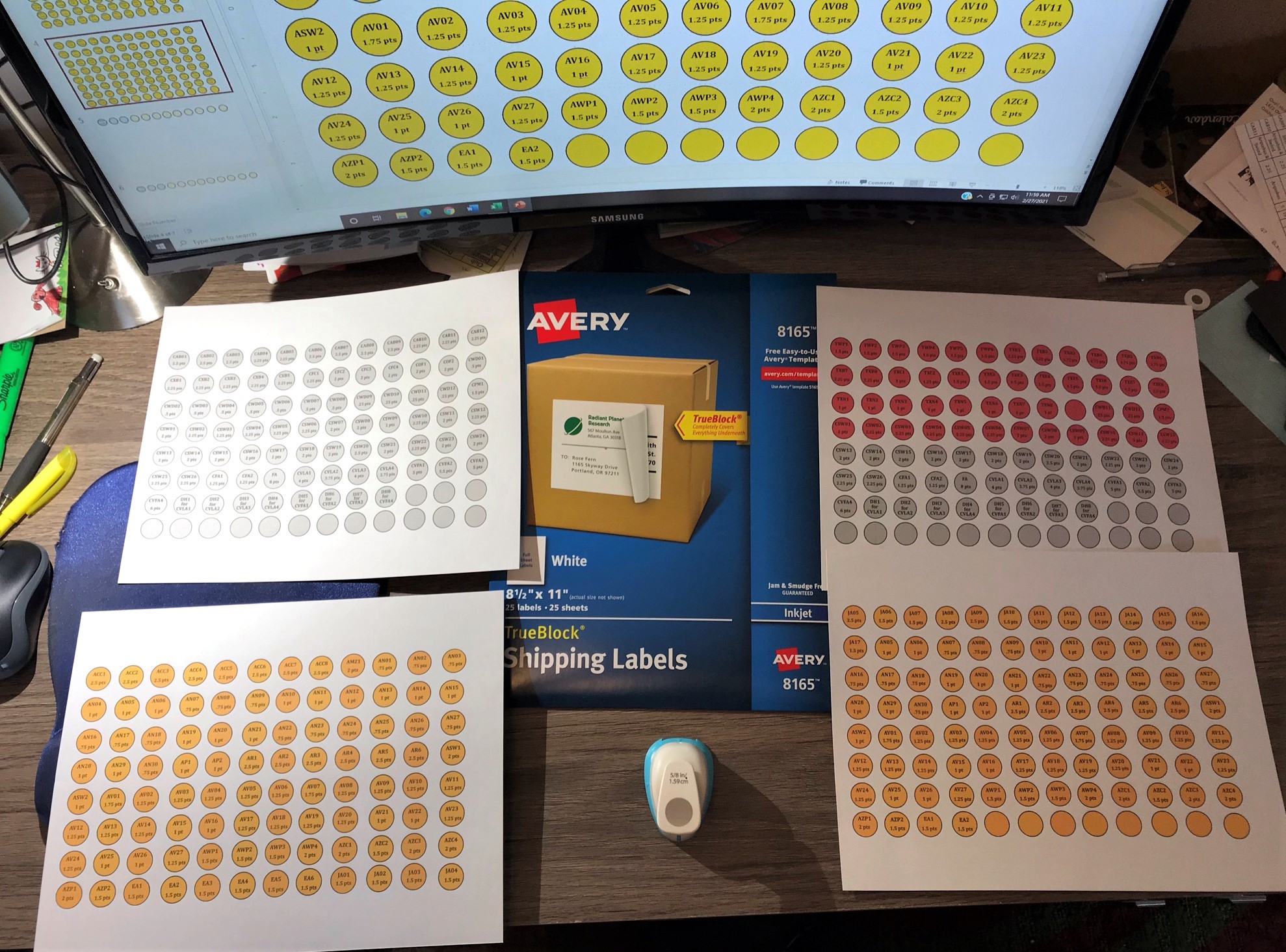
Process: Using PowerPoint, I designed a ¾” round label that has both the figure identification number and the figure point value on it. I cut and pasted additional circles and aligned them on the sheet for future removal. Alignment of the circles and editing them was easy with PowerPoint – and was very helpful in later steps with the paper trimmer. I filled one sheet or slide in PowerPoint full of the circles. At that point all I needed to do was to copy that entire sheet and make a second sheet, and so on. This enabled me to edit each circle on the subsequent sheets for all 216 figures. I inputted the figure numbers and the point values from my master spreadsheet onto the circles. I used a color code for the round labels by type – grey for the Conquistadores, gold for the Aztecs, and red for the Tlaxcalans. I also used a thick point circle on the border of the circles – I used 1.5 but I could have gone thicker. The thicker borders help with aligning them for punching out later. I then printed off the sheets of labels on Avery™ #8165 8.5” x 11” Trueblock® shipping labels that I bought at Staples. I took each sheet and used my Fiskars® SureCut™ Deluxe Paper Trimmer (from Michaels) to cut thin strips holding multiple labels. This made punching out the labels easier. I used my 5/8” punch from Michaels (Lever Punch, Circle by Recollections™), punch out the labels. Even though the punch was 5/8” versus the 3/4” circle – they aligned better – as the thick point border helped me to position the strip. The punch has a clear underside so you can see if you are aligned or not. I affixed the labels to the underside of each base of each of the 216 figures. I store and transport my figures in 11-liter Really Useful Boxes (which I bought from Staples but this UK company has their own website too in the US) lined with Aleene’s® Magnetic Tacky Sheets™ (which Michaels sometimes carries too). The labels did not impede the magnetic attraction that I needed because they were smaller in diameter than the 1” bases – and were centered on the washers – leaving enough steel available to get a “bite”.
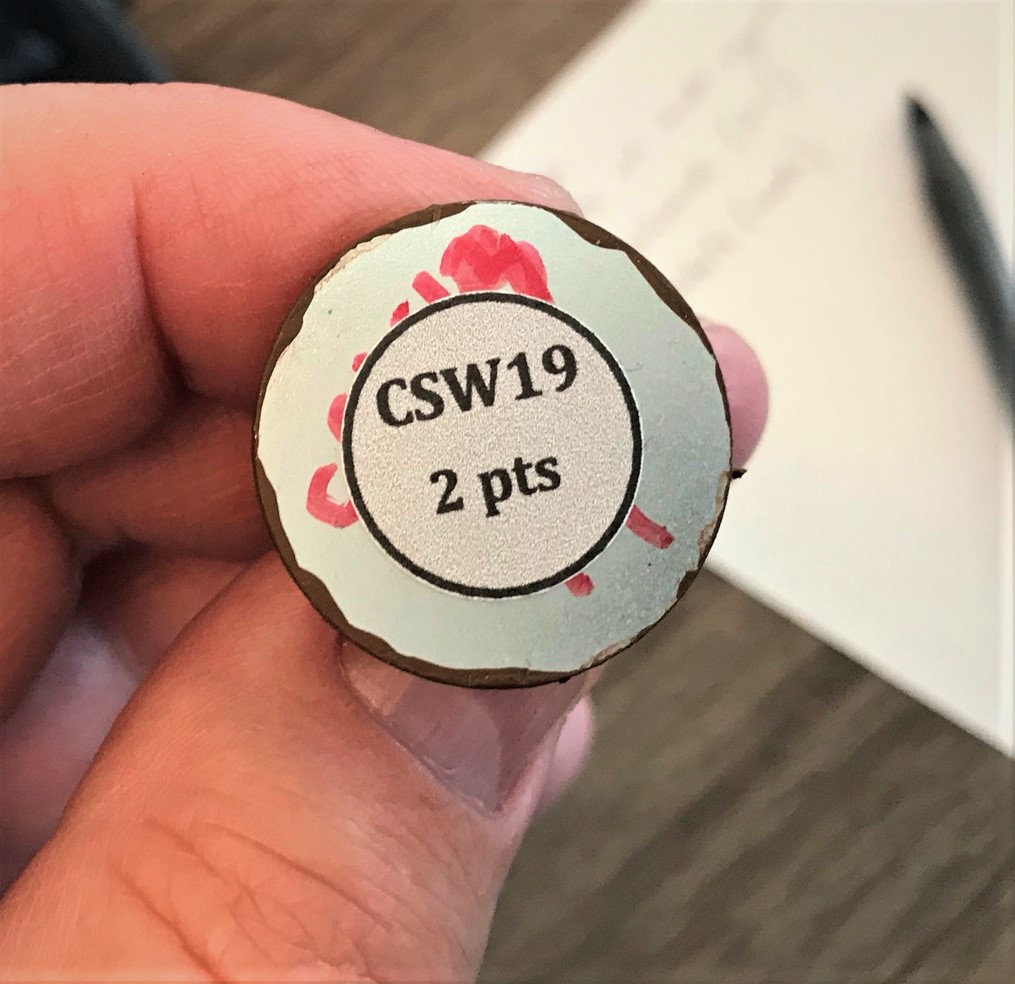
End result: Every figure now has a printed label with its ID number and point value printed on it underneath as you see below.
Printed off labels shown here in front of my PowerPoint design. Note the hole punch – trimming these with the Fiskars trimmer made punching them a breeze. (As if punching 216 labels could ever be considered a breeze!)Example of the under-label of a Conquistador Sword & Buckler Man figure.
The Really Useful Box Organization Challenge
Challenge: I can store and transport each of the figures in my Really Useful Boxes, but setting up a game and gathering figures from 216 figures for a warband can be too time-consuming if one has to look at each figure’s undersides! I needed to make my Really Useful Boxes even more useful.
Goal: Make my Really Useful Boxes more organized and more functional such that each figure has an easily identifiable slot for selection and also to speed pick up after a game.
Solution: Design and build a system within each Really Useful Box that facilitates easy figure identification for both gathering figures for a game and picking them up after a game while preserving any benefits for storage and transport.
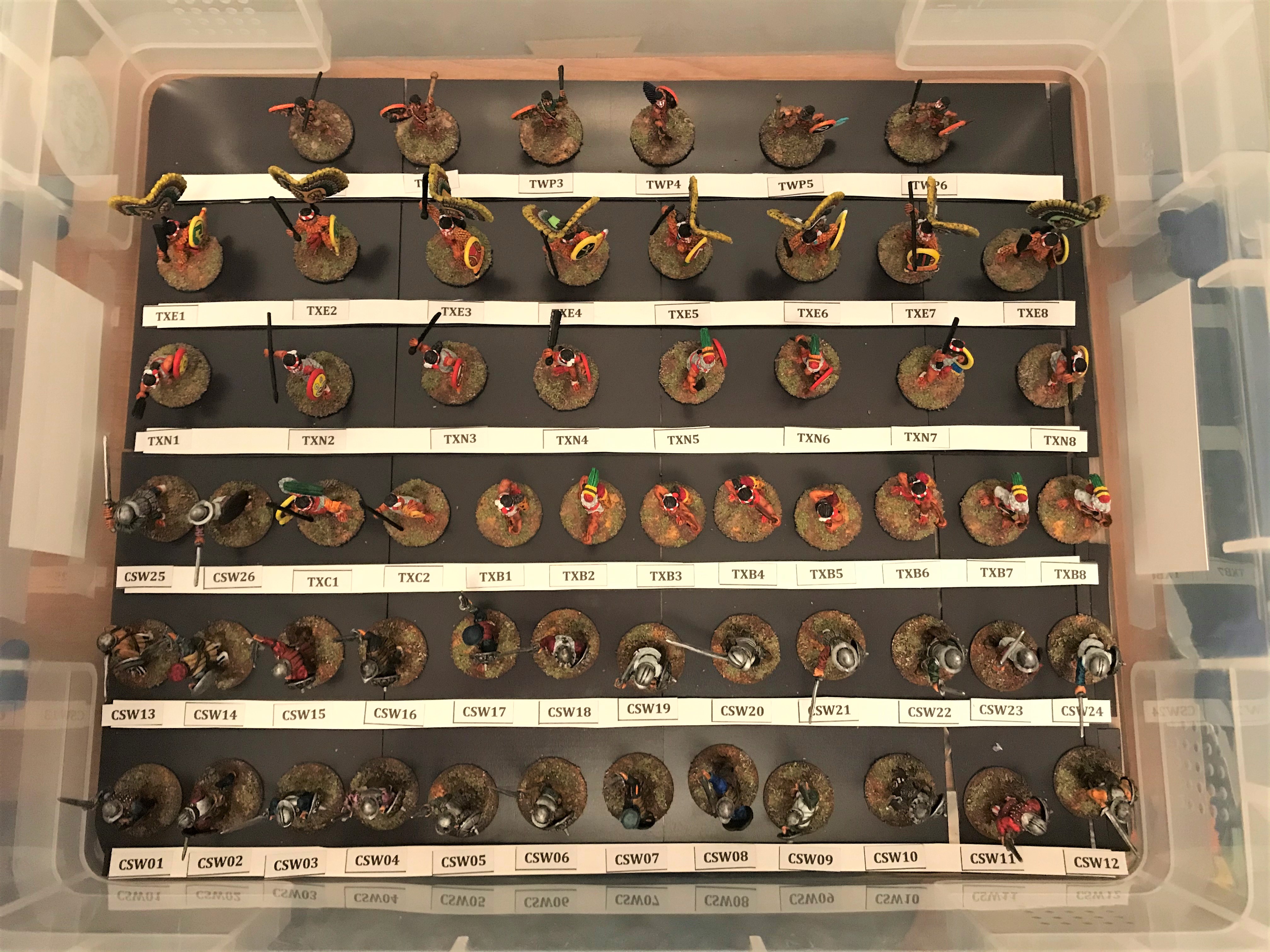
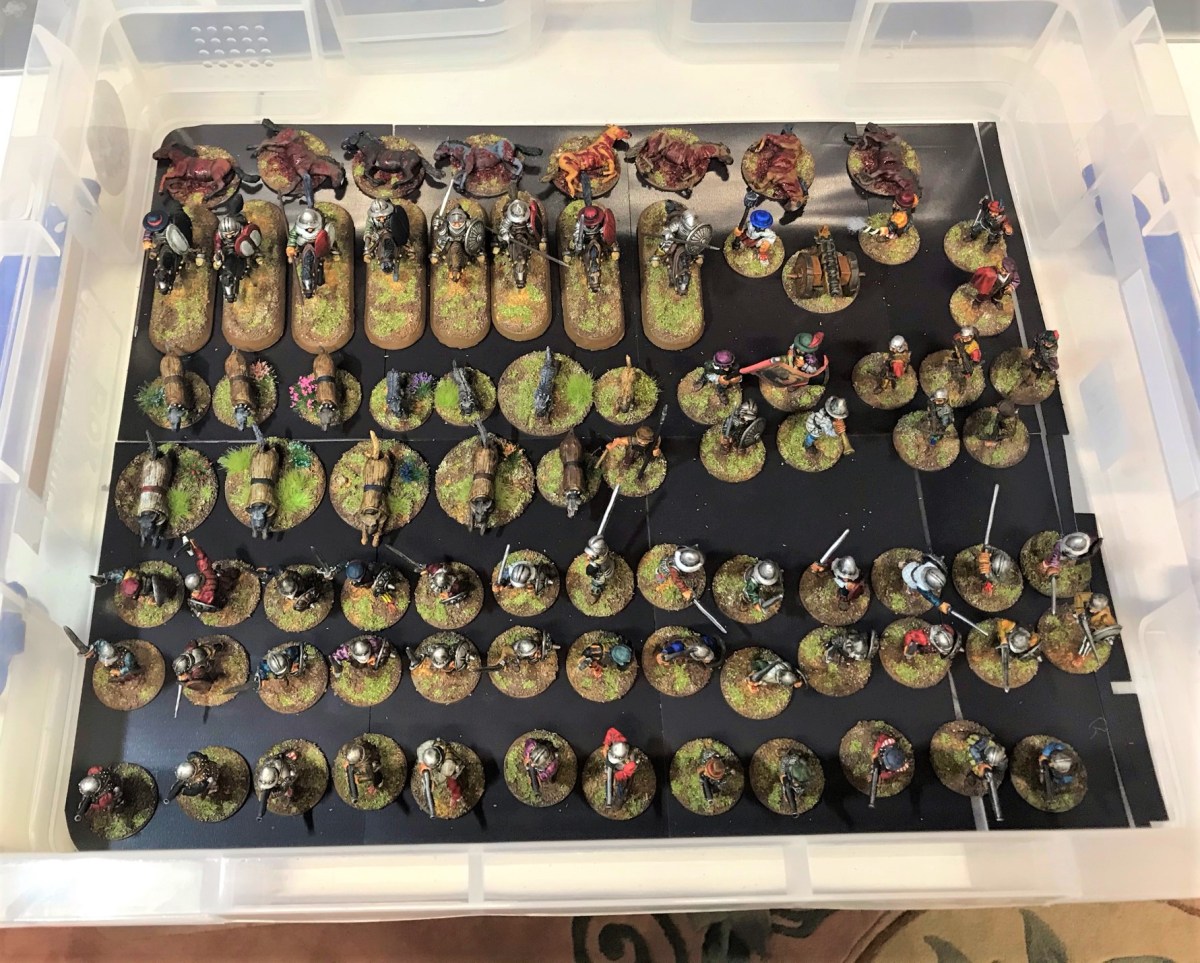
Process: Each 11-liter Really Useful Box is about 12” x 14.5”. I could have gone through endless iterations of how to organize the figures so that they would fit, and never be 100% sure my set up would work in reality. I came up with an idea that I think worked. Here again I went to PowerPoint. Most of my figures are on 1” bases, but a few are on 1.25” bases. I decided that I would make 3/8” labeling strips in layers upon which I could affix the figure identification numbers. I wanted each figure to have 1/8” clearance on both sides, so each row would be 1.5”. To verify how this would work, I made shapes in PowerPoint at 50% scale such that they fit on the screen. The shapes included how much space I would need for each type of figure. This really worked – and is a process that I will use again. You can see below my rough plan. Once I had my rough design, employing my Fiskars® SureCut™ Deluxe Paper Trimmer I cut strips of card stock and affixed them to the magnetically-lines Really Useful Boxes with small balls of poster tack. Then I made a second set of card stock strips to go on top of the first sets, affixing them with poster tack. Lastly, I just printed off my Excel spreadsheet pages onto card stock with the figure identification numbers on them, trimmed them up, and affixing them to the now-raised card stock “line” with poster tack. For the Conquistador cavalry, I made little corrals as they were in need of a bit more support. I then put all of the figures into the boxes as you see below – I ended up needing 4 boxes.
End result: Every figure has a labeled slot as you see below.
Really Useful Boxes before modifying them.Using PowerPoint as a CAD program, I designed the reorganization. Before any cutting!Aztec Box 1 finishedAztec Box 2 finishedConquistador Box 1 finished – note the cavalry corral.Conquistador/Tlaxcalan Box 2 finished
The Movement Tray Challenge
Challenge: I needed a safer way to transport figures to and from the tabletop.
Goal: Design and make a couple of magnetically-lined movement trays.
Process: This was pretty simple. I just used some old 1/8” thick balsa wood under two Aleene’s® Magnetic Tacky Sheets™ and reinforced the glue with wood glue. After being weighted down, the sheets were firmly attached.
End result: Success – I have two movement boards!
Magnetic Movement tray with some Conquistador Sword & Buckler MenMagnetic Movement Tray with some Aztec Cuachicqueh
The “Menu” Challenge
Challenge: Many of my games will be virtual, and some will be at convention games. I needed a simple way to convey two key concepts. First, I needed to present to the players the options that they had available with regards to figures’ stats and cost. Secondly, I needed to help them organize their troops – especially as Aztecs and Tlaxcalans have special organizations. In my games they are bigger and can have novice warriors attached. Normally, an Element in Feudal Patrol™ is 4-5 figures plus a leader figure. A Warband consists of 2-4 Elements plus a Warband Leader. To reflect how the Aztecs waged war, their Elements are bigger – adding up to 5 novice warriors to each Element (if they pay the point costs of course). This is useful as the novices can be assigned to drag away any incapacitated enemy for either sacrifice or slavery – which is historically in line with what they actually did do. Killing an enemy was regarded as “clumsy”. Additionally, each Mesoamerican Warband can have a Warrior Priest, who can both fight and help with Aztec or Tlaxcalan Morale results during a battle. At this point, my players could look at the figures in the boxes, but not have any information save the figure number, what he’s carrying and wearing, and the point value (if you pick one up to see the label). Certainly, this would not be efficient.
Goal: Design and make a simple way (a “menu” system) for players to make informed choices for both virtual and in-person games.
Process: What I did here was to go back to my Excel spreadsheet and size up the data to fit on a dashboard (more on that in a bit). Then I adapted Buck Surdu’s excellent data cards to fit on a single strip in Excel that would fit approximately 8” wide and 3/8” high. These I would make for each of my 216 figures – plus 4 additional to represent having the Army leader (Cortes or Pizarro) as a mounted versus dismounted choice for the Conquistadores. Each section of the Word document (basically a “menu” of figure choices) was organized as you see below. I then cut and pasted the strips from Excel into Word as pictures (paste special). I then added some brief information about the figures, as well as a picture of each of the 216 to help further identify the players’ options. Lastly, I created worksheets at the end of each “menu” to help the players build their forces. To do this, I went back to PowerPoint, and created the shapes that I wanted for the worksheets. I saved each individual slide as a JPEG (make sure you choose “Just This One” when it asks, and then edited the JPEG size. If it did not work, I just went back to the PowerPoint, resized, resaved as a JPEG, and repasted in Word. You can see the results below.
End result: I have three good menus that I can email or hand out to players at the beginning of a game and they will speed up the time for players to make their troop choices. As a side note, I prefer that players get to make choices in games!
Screen shot from Aztec MenuScreen shot from Conquistador Menu Screen shot from Tlaxcalan Menu Screen shot from Aztec Menu showing worksheets
The Dashboard and Stat Strip Challenge
Challenge: The players need a quick and easy reference system that designates their troops’ stats, and one that does not take up a lot of space.
Goal: Design and build a system of sufficient dashboards and supporting elements of appropriate ease and flexibility such that the players can play easier and faster and have more fun.
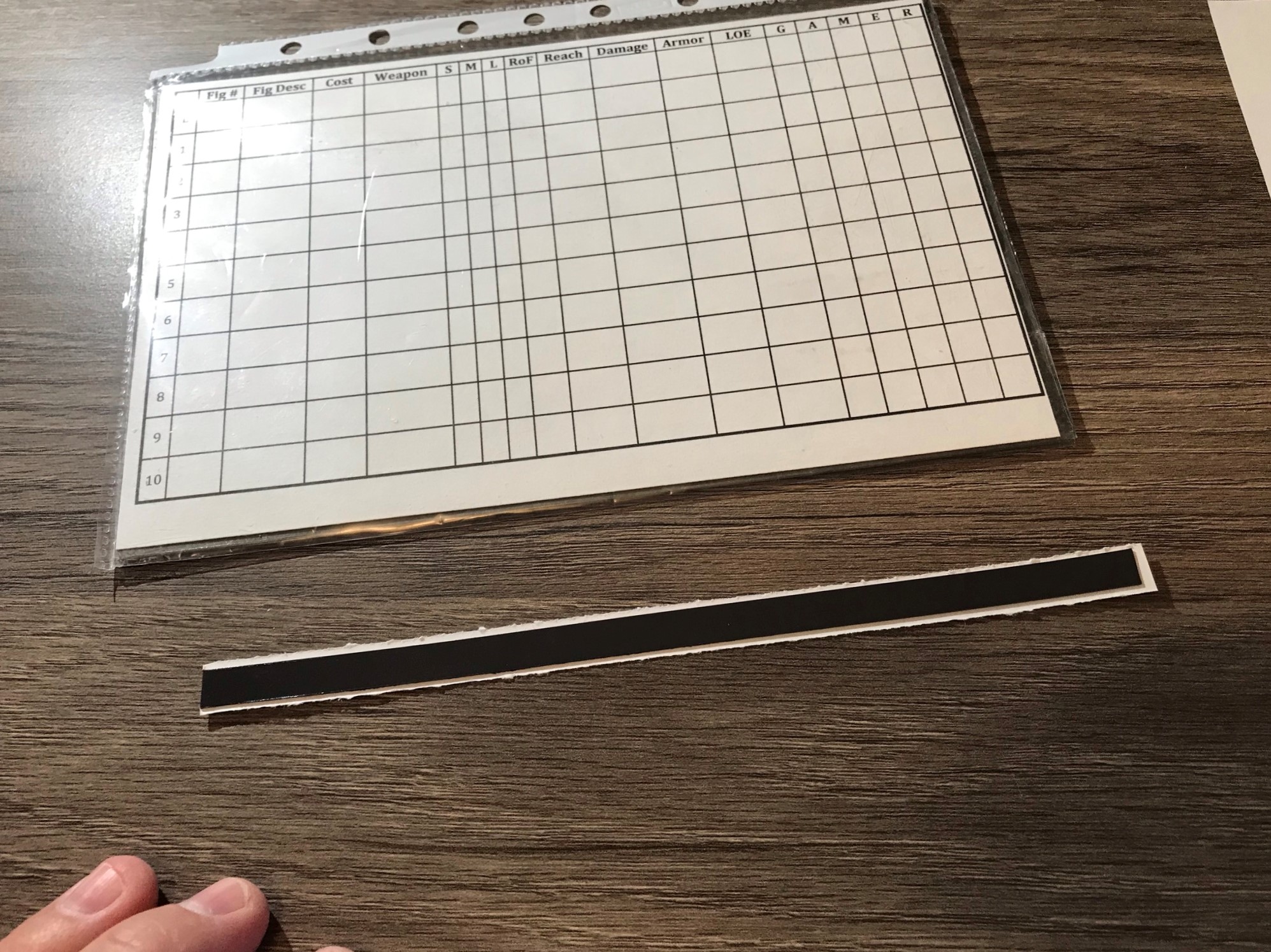
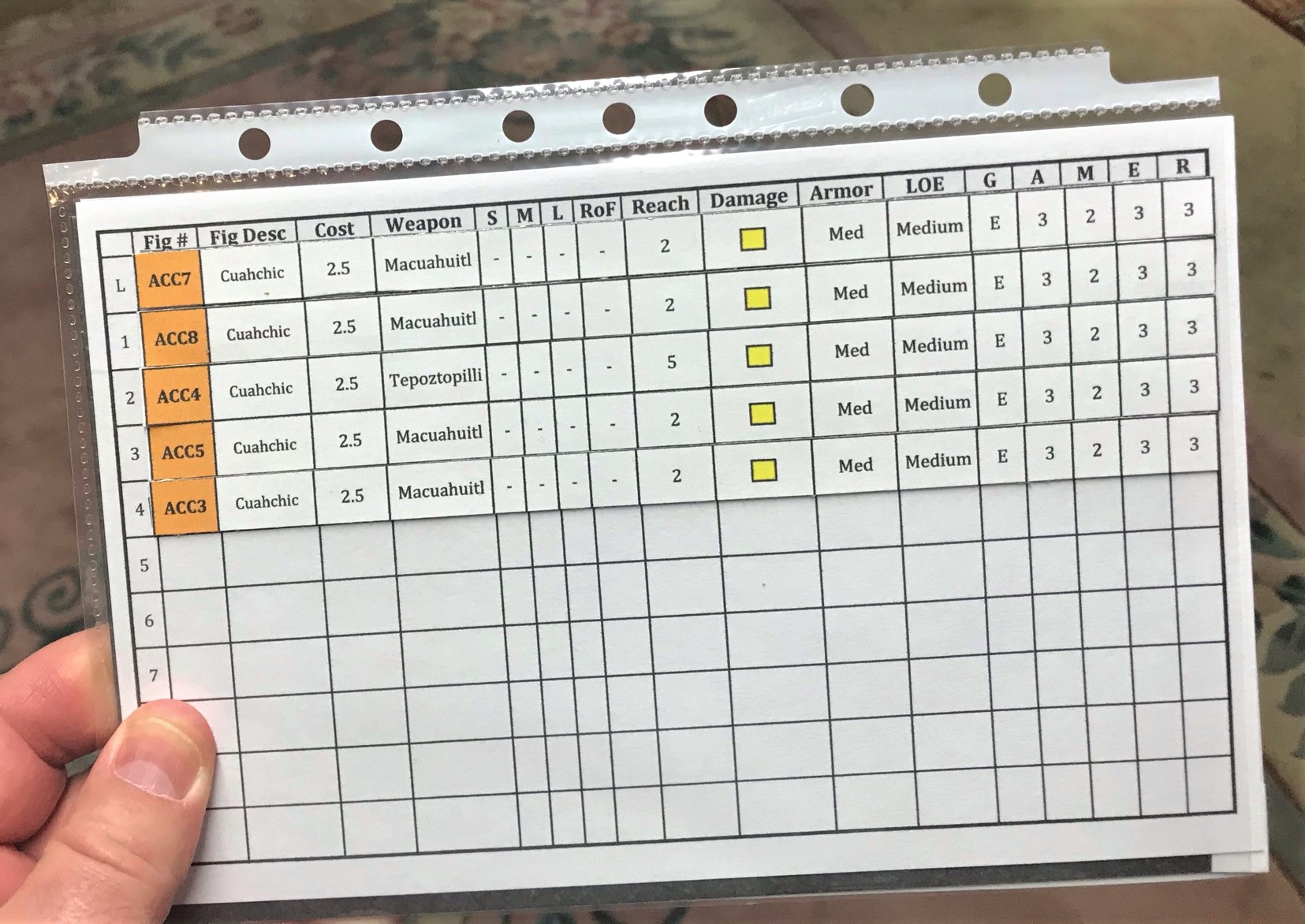
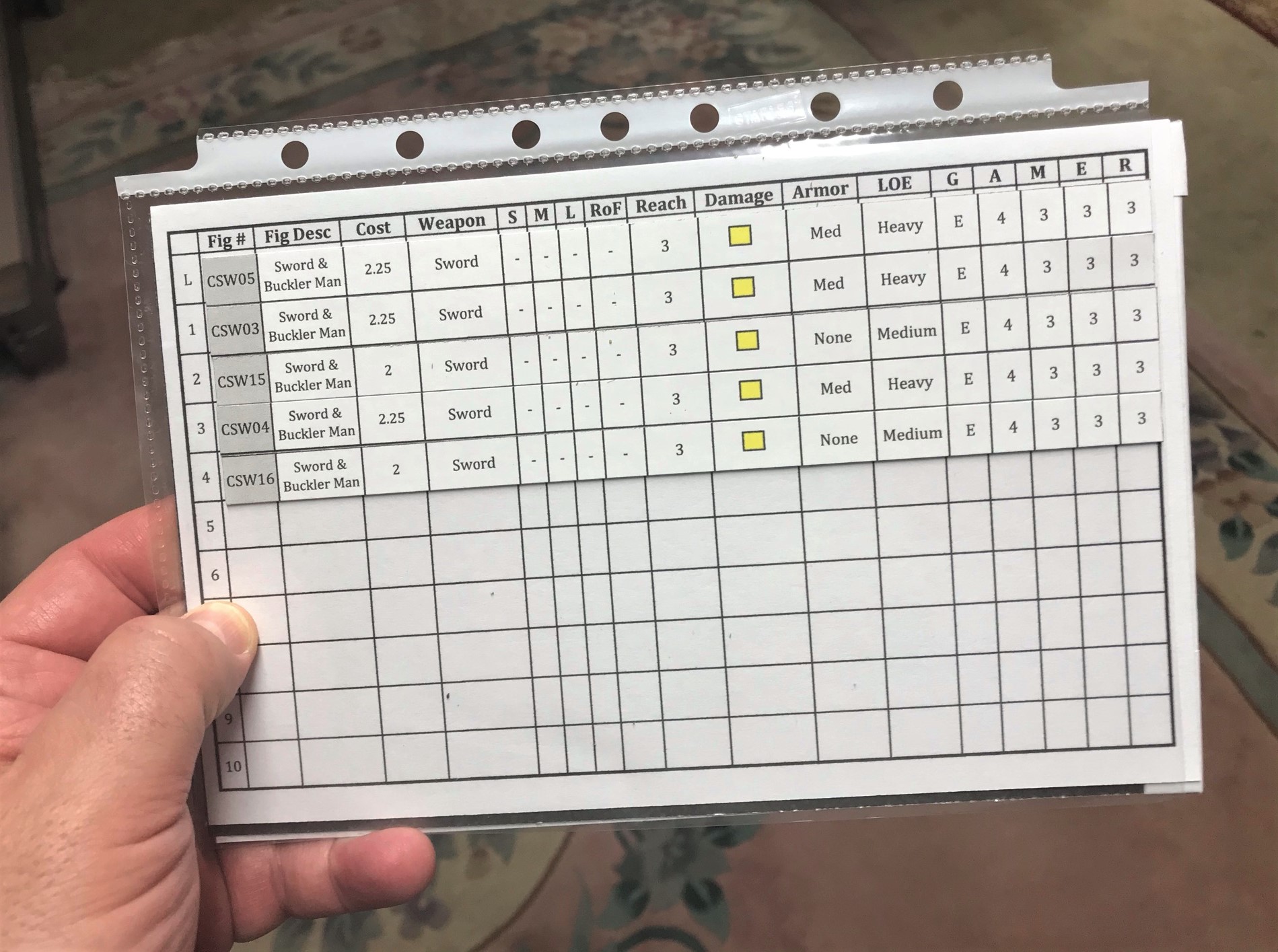
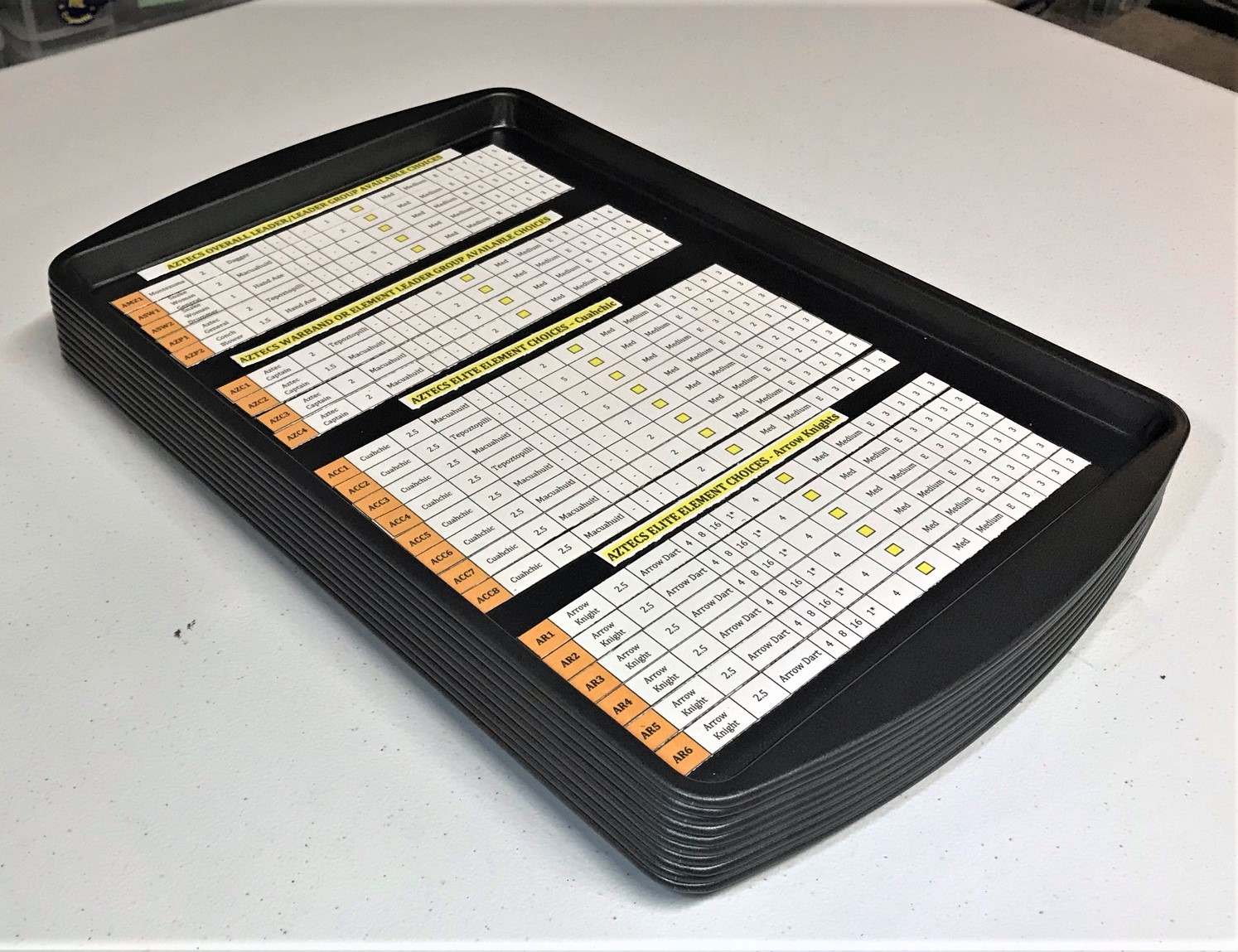
Process: I do like gaming systems and setups that are flexible – that is giving players adequate AGENCY. As you have read, the menus allow the players to make their choices, but to have them write down all data at the game’s beginning could be a bit of a pain. Plus, there can be a variety of differnt types of figures in some Elements. My solution was to build on what I already had been developing. I designed a dashboard in Excel that would accommodate being printed off on card stock and placed in a 5.5” x 8.5” sheet protector such as this one from Staples. And remember the stat lines from the menus? I used them to fit on the dashboards. How you say? Well first, I special-ordered steel base material in sizes of 5.5” x 8.5” from Wargames Accessories. The steel sheets do have some rough edges – which I covered with scrap pieces from the Avery shipping labels with no problems. These steel sheets fit inside the sheet protectors and under the dashboards – and I made 31 of these. Then I cut and pasted each individual stat lines into Word as pictures. Then I printed off each of these 216 + 4 stat lines (220 in total) onto strips of card stock and trimmed them with the paper trimmer to fit on the dashboards. To affix them to the dashboards, I needed magnetic strips – 220 of them. I found a really nice source on Amazon of 8.5” x 11” sheets made by Craftopia called Adhesive Magnetic Sheets that are the best that I have found. Again, my paper trimmer helped here to trim the magnetic strips to ¼” size width (fitting nicely under the 3/8” wide stat strips). I did need to replace my Fiskars blade once and augment that effort with scissors. Each of the 220 strips could be now be added to the dashboards, but how to organize and store these! My answer would come from Wal-Mart. Cookie sheets! I found inexpensive cookie sheets (see photo below) for $1.50 each that stack together. I organized the strips as you see below and added troop categories – basically mirroring the menus.
End result: I have a pretty decent system now for organizing a game. I have every figure’s stat line on a removable magnetically-backed card on 10 stackable cookie sheets. These stat lines fit perfectly on sheet protector-encased steel dashboards.
Cutting magnets and stat stripsA dashboard with a stat strip flipped over to show the magnet underneathExample of an Elite Cuahchic Dashboard – as Elites they would not have novices attached but if this was a Veteran Dashboard there would be sufficient room for the novices’ stat stripsAn example of a Conquistador DashboardMy solution for organizing my stat strips!My 10 cookie sheets with stat strips, as well as the dashboards and other aids discussed here.Closer shot of the cookie sheets with the labels on them mirroring the menusThe cookie sheets stack nicely for transport
The Tabletop ID Challenge
Challenge: Using the dashboards is useful, but telling which figure is which on the tabletop can be a challenge, especially virtually. As with the previous challenges, the figure’s lack of uniformity poses a gaming identification challenge.
Goal: Design and create a system that would allow for easy identification of the figures but would not overly detract from the aesthetic of the game.
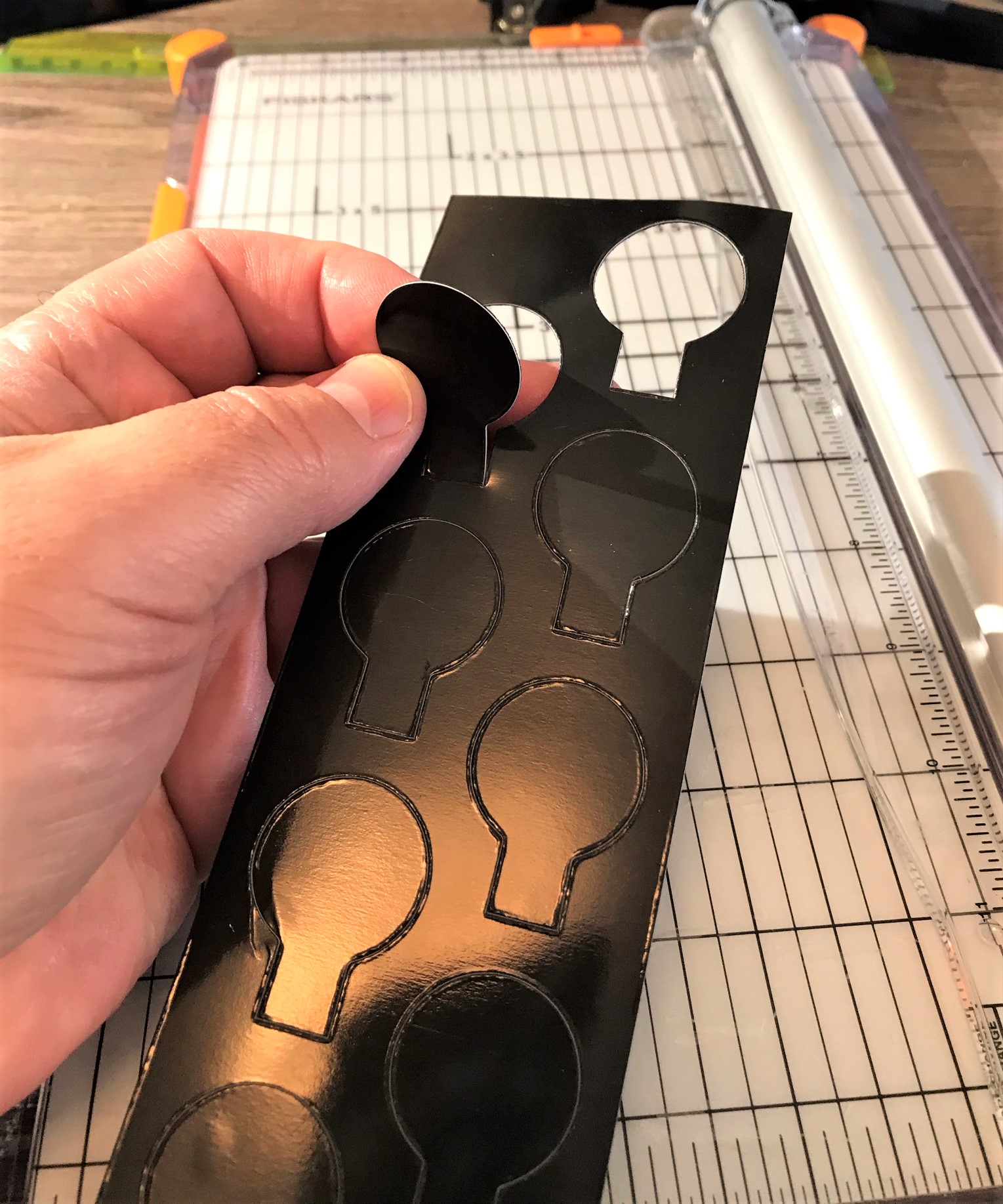
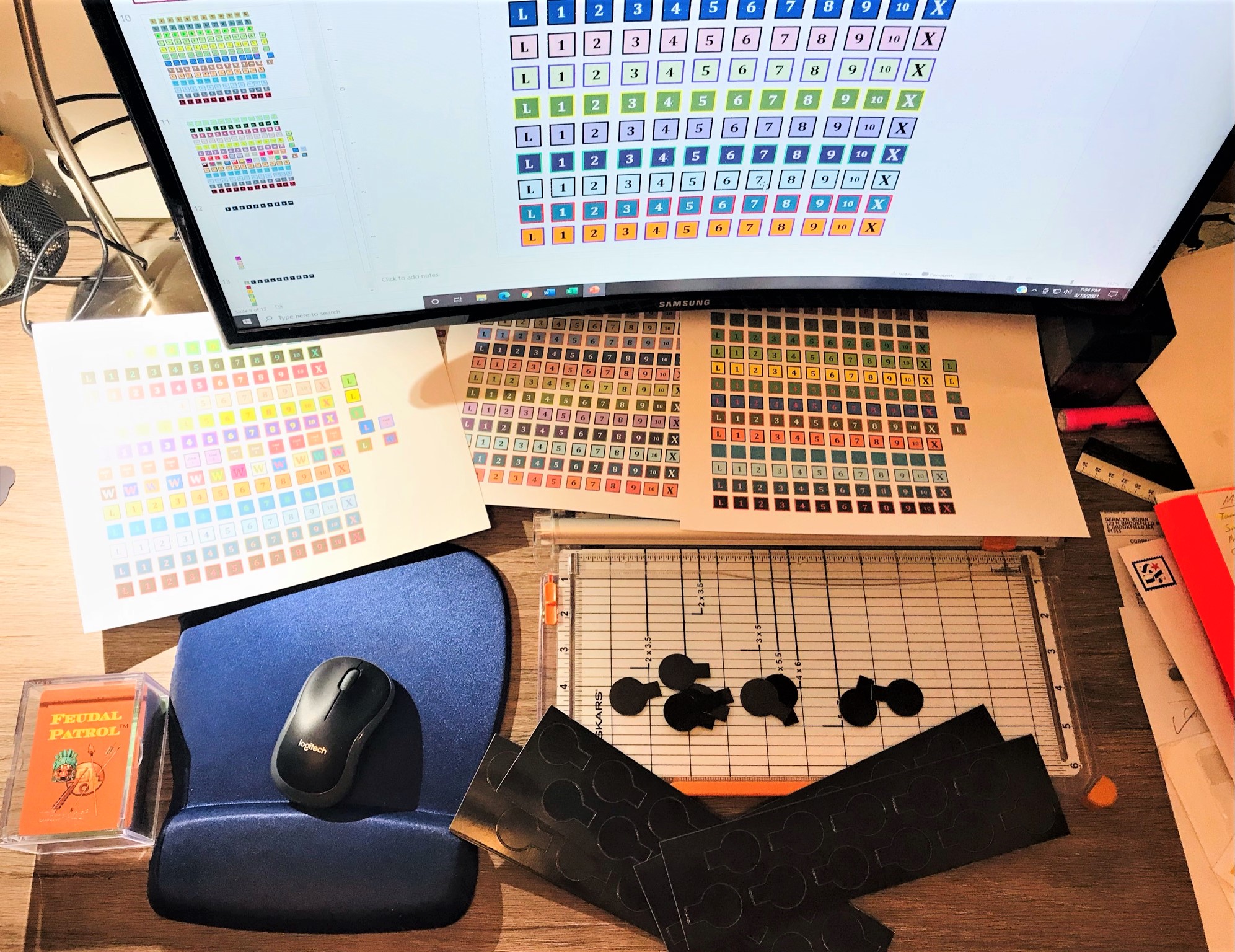
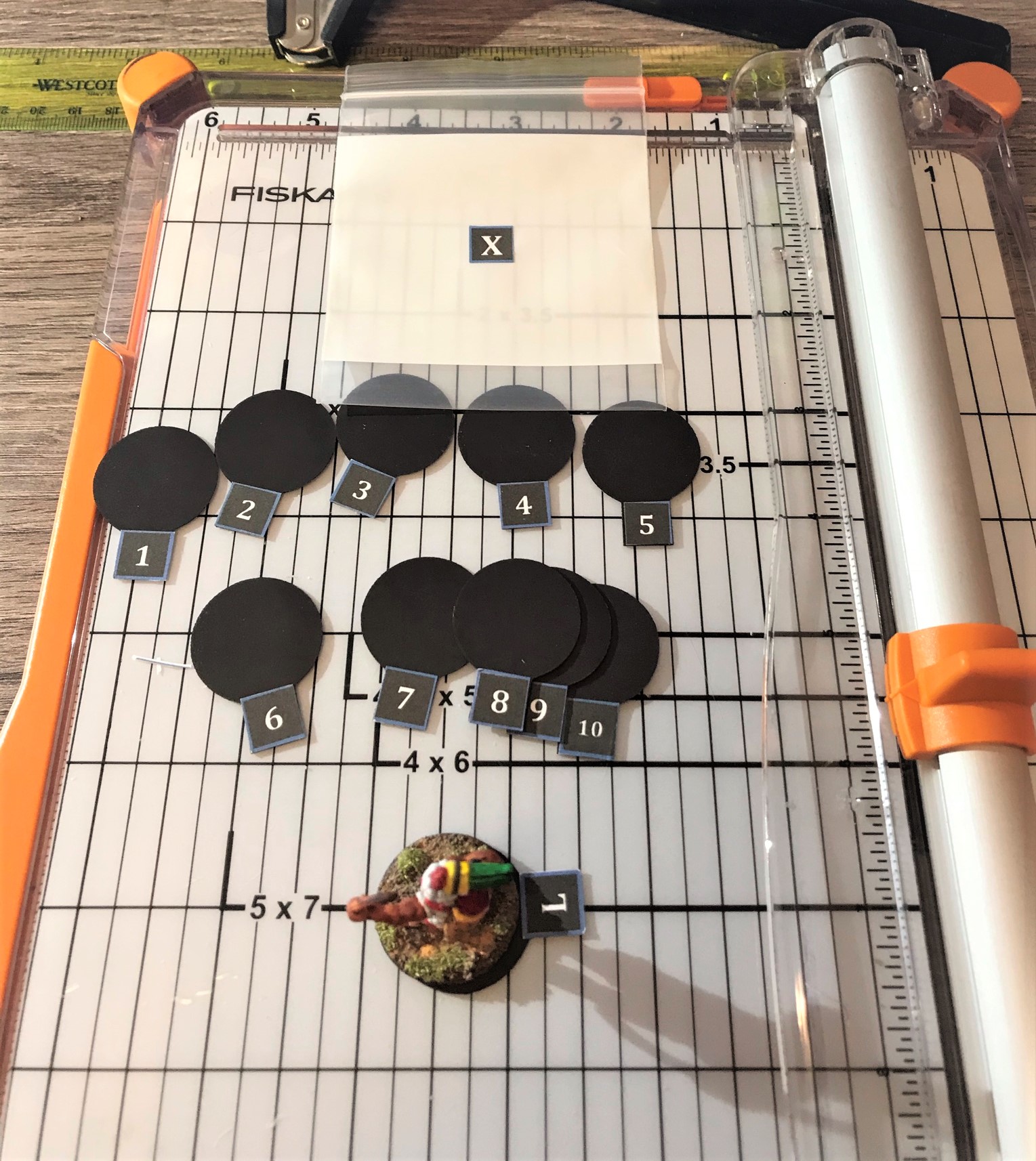
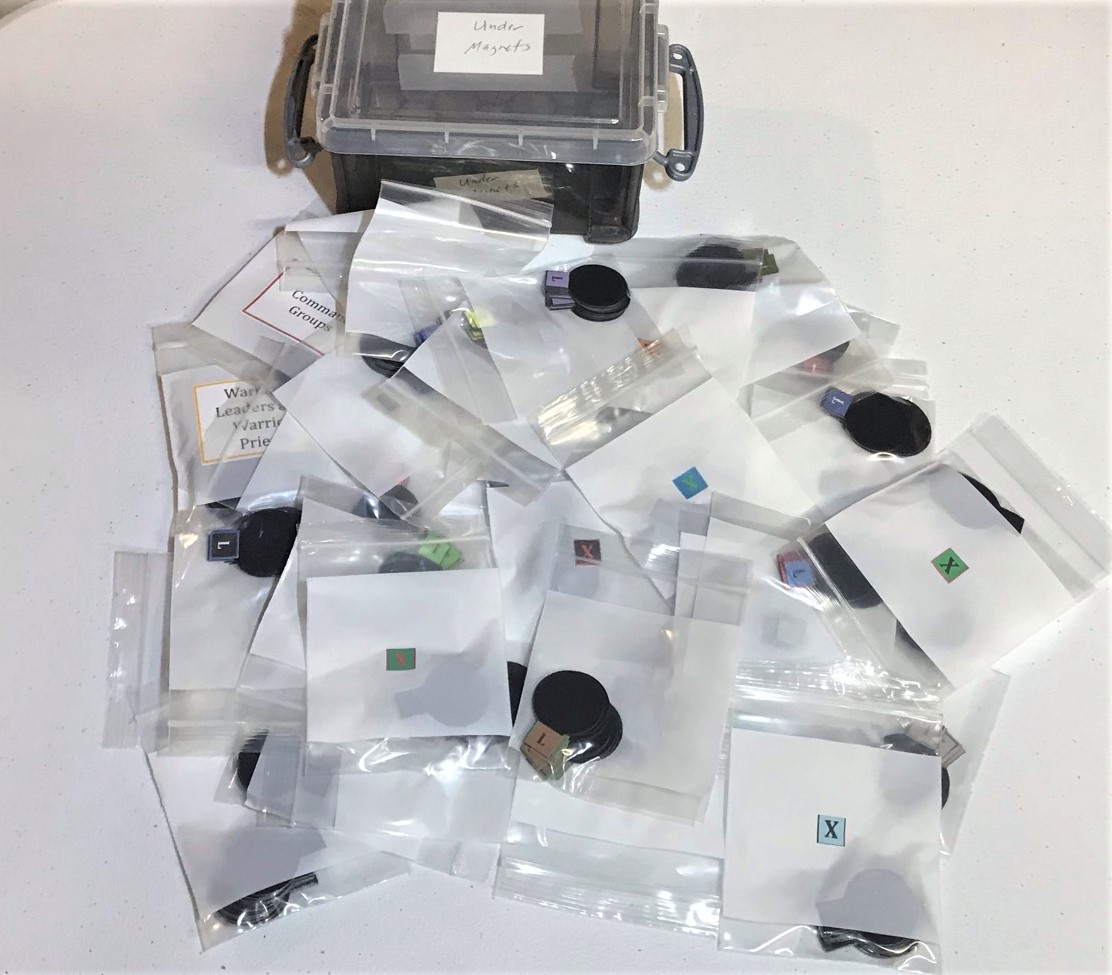
Process: I thought that as I used steel washers under my figures, my best option was to try something else in the realm of magnets. But what? I used some refrigerator magnets as prototypes of “under-magnets”, developed the concept, and then used PowerPoint to refine it. However, the concept of cutting out a few hundred magnets by hand was not appealing to me – plus I saw that they would look rough on the edges. I contacted Fridgedoor in Quincy, MA and worked with them to make me the magnets. There did not need to be any fancy printing on the bottom (non-magnetic) side as I knew that would be too tough and expensive. I had them make 20 mil thick sheets with each sheet having 11 of the under-magnets that could be easily popped out. One side (facing the figure) would be magnetic and the other printed black. The square jutting out on the magnetic side would be where I would affix labels for the figures. I used PowerPoint to make sets of differently colored and designed labels for the figures’ little jutting square. For the Elements, I made L, 1-10, and X (L for the Leader, 1-10 for the figure in the Element, and X for the baggie I would store them in). Then I printed them off, trimmed them, and affixed them. I ended up with 34 sets bags of under-magnets in individual little zip lock with ID numbers. This was made up of 33 sets of 11 and 1 set of 24 (different for Warband Leaders, Army Leaders, and Warrior Priests) for a grand total of 387 total under-magnets. I stored these in a small Really Useful Box, which in turn goes into another Really Useful Box for the game (see below).
End result: I have now a soup-to-nuts system for setting up and running my game more efficiently for both virtual and in-person games that is useful and easily transported.
My under-magnet design. Not rocket science!Popping out manufactured under-magnetsWorking on the under-magnets labelsHow the under-magnets will be used. Here, a Tlaxcalan figure has a Leader under-magnet. The rest of the set is above him, including the “X” marked baggie. Multiple color schemes were used.Lots of sets of under-magnetsHere you can see a group of Conquistadores and some Aztec Cuachicqueh engaging in battle – the under-magnets show who is who easily.
I hope that you enjoyed this blog (and all the other ones for the last 6 years!). Just for kicks, please take a look at my very first post, The Story of the Nightmare Legion. Here’s hoping I keep doing more and reading and more of yours as well – and let me know if any of my somewhat insane stuff inspires you or if I need to be medicated – just asking!
And here’s a pic for IRO who asked for a T-shirt shot in March. Not ready for selfies I guess.
GO ARMY! BEAT NAVY!
I’ll be announcing my next free giveaway contest soon – this time I’ve got some terrain to do and if you guess closest you can win stuff FREE from me. Just like in the last contest!
Don’t forget to let share your thoughts in the comments section!
Miscellaneous details and references for those interested in that sort of thing:
Previous posts on games, units, and other projects for my 16th Century Spanish Conquest supplement for Feudal Patrol™ – “Civilizations Collide”
Game Aids and Tools for Feudal Patrol games using the Civilizations Collide Supplement (this post)
Perro de Guerra (Conquistador War Dogs). 13 figures total: Outpost Wargames Services #CONS6 “War Dogs” (8 war dogs); Eureka #100CON13 “Dog Handler and Dogs” (1 dog handler/pikeman and 4 war dogs)
Conquistador Foot Command, Crossbowmen, and a Couple of Officers. 11 figures total: Outpost Wargames Services #CONC1 “Conquistador Foot Command” (a leader, a banner bearer, a drummer, and a bugler); Eureka #100CON04 “Crossbowmen” (5 crossbowmen); and Eureka CONC1 “Conquistador Officer” and an unknown SKU officer (2 officers)
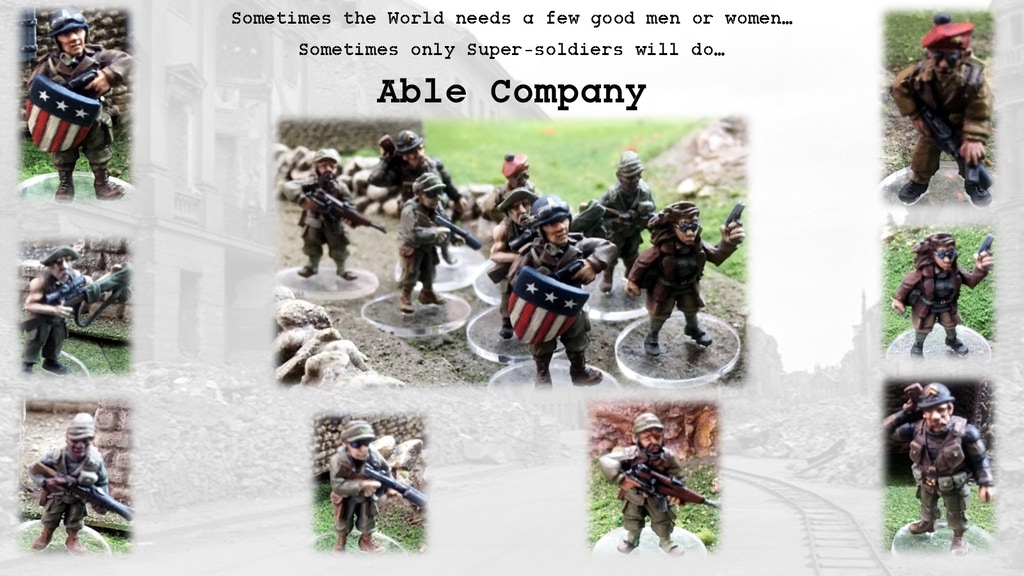
Hello dear readers – a very quick post. I have been knee-deep in making game aids (dashboard, magnetic figure data strips, and more). I’ll be sharing those and catching up on your blog posts (as I always do eventually). BUT, I just saw this new Kickstarter from Sally 4th in the UK that just caught my fancy, and I thought I’d share it.
As a kid in the 1970’s I read a lot of comic books, and this homage really struck a chord, and I thought it might with you folks as well, as well as any fans of classic movies. Here is the link.
I am not financially involved with this – just sharing with you cool kids!
Don’t you love suspense? Well, I have just a tiny bit here for you all!
I started “Mark’s Conquistador Contest” – for my loyal blog followers back on December 15, 2020. It’s purpose was threefold: one, to give myself a challenge to finish off my last 89 figures (all Conquistadores) for my for Civilizations Collide scenarios for games of Feudal PatrolTM ; two, to offer a prize of miniatures to worthy homes that could use them; and three, to have a fun journey along the way with my followers.
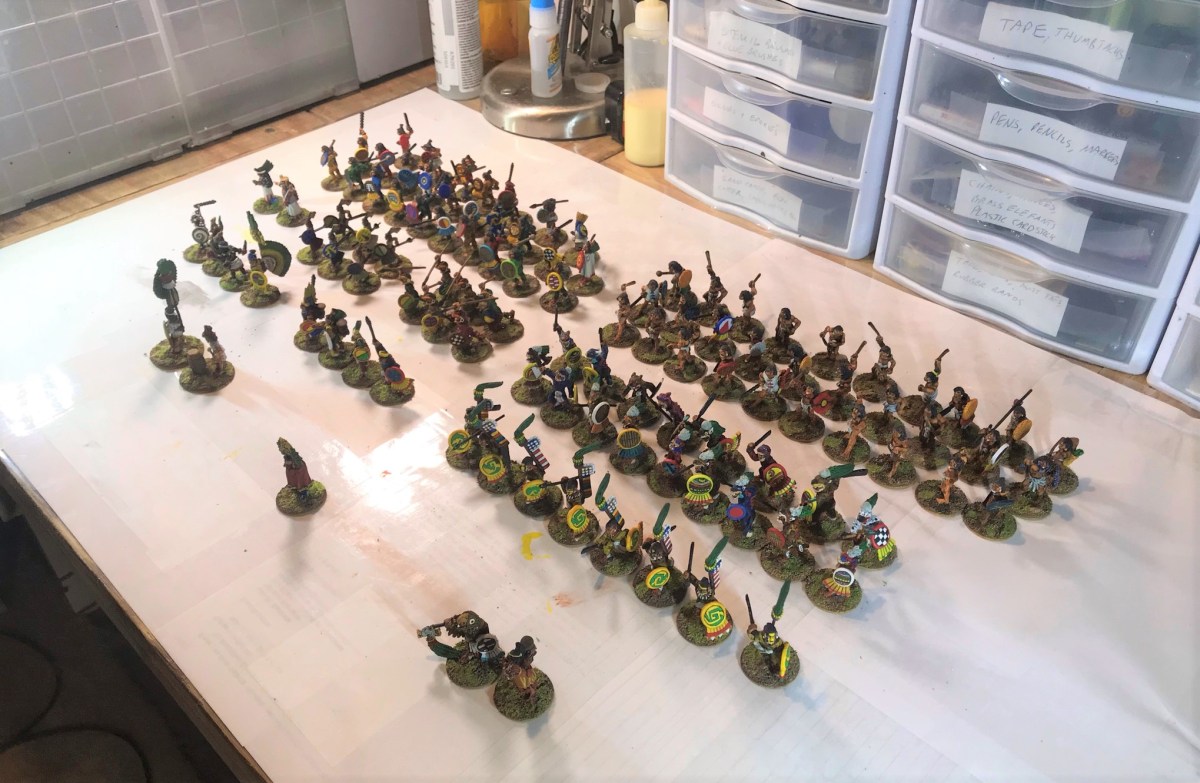
The entire project began nearly a year ago in April of 2020. I had spent the month of March 2020 and part of April 2020 doing my research, for the supplement and looking at sources for appropriate miniatures for the Aztecs, the Tlaxcalans, and the Conquistadores. I finished off 230 miniatures in total for the project.
I need more boxes!
I managed, with YOUR inspiration, to finish everything on Valentine’s Day, February 14th, 2021. This meant that I got the 89 done in 61 days – including all those holidays! That’s an average of 1.459 per day (according to my spreadsheet that all of you are completely unsurprised that I used).
At the beginning on 12/15/2020Now finished – all of the Conquistadores together.
As for the contest – the three prizes were as follows (in no particular order):
You must be an email or WordPress follower of my blog.
You must pick a date (day, month, and year) that I will finish the Conquistador miniatures shown here in this post. Finishing means, to me, that I am ready for the figures to be shown on my blog and used in a game. That is my call!
You must let me know that you want in on the contest by midnight EST (US East Coast time) on January 2nd, 2021. You do this by posting a comment that “you are in” here on this blog post in the comments section with the date information requested above in (2).
Only one entry allowed per follower except as described in (5) below.
If you get another person to follow my blog, you can earn another entry! For each new follower that credits you as a referrer, you can get another entry. All that person needs to do is comment on this post as in (3) above stating that he or she is “in” and who the referrer is. The referrer can then reply to that comment with an additional entry date.
Winners will be whoever is closest to the date I announce as the “completion date”. That can be earlier or later – for example picking a date that is one day before is as good as if it’s one day after. As there are multiple prizes, 1st place gets first choice, then 2nd, then third. If two people pick the same date, ties will be broken by who submitted the date first. I reserve the right to add more prizes!
I also reserve the right to be the final judge on the contest – somebody’s gotta do that. When I finish, I will announce the winners.
It’s been fun along the way – as people (Buck and Roger mostly) were telling me to SLOW DOWN. But, I kept on, hoping to get them done as well and as quickly as I could (sorry Buck and Roger!).
So here are the results – please join me in congratulating:
1st Place: Pete from SP’s Project Blog – nailed the date on the nose!
2nd Place: Mike from despartaferres/redcaer1690 – got second by the tiebreaker rule as he picked 6 days early but picked earlier than the third place winner who is.
3rd place: Leif (an email follower and fellow member of the my club The Mass Pikemen) who also picked 6 days away from 2/14 (but picked 9 days later than Mike did.
Overall and final standings
Congrats to the winners! Pete gets first choice, then Mike, and Leif gets what’s left. Just confirm in the comments section which one you want, and then email me your shipping information to MarkAMorin@aol.com (I’m sure that will work fine).
I will, as I intimated earlier, be doing this again (if there is interest) for all the terrain I have to do for the project. I’m hoping to have more prizes to give away (and maybe even better ones) but I need to get some game-specific stuff done in terms of game aids and the like first. I will NOT begin painting terrain before the next contest – which will begin, as this one did, with a blog post.
Thanks to ALL of you (even Roger😆) for playing and to ALL of you, more importantly, thank you for your encouragement and support!!! It really helped me and inspired me.
Miscellaneous details and references for those interested in that sort of thing:
Previous posts on games, units, and other projects for my 16th Century Spanish Conquest supplement for Feudal Patrol™ – “Civilizations Collide”
And the Winners of “Mark’s Conquistador Contest” are…(this post).
Conquistador Cavalry. 24 figures total: Outpost Wargame Services #CON5 “Conquistador Cavalry in light armour 1” (4 horses & 4 riders); Outpost Wargame Services #CON6 “Conquistador Cavalry in full armour” (4 horses & 4 riders); Eureka Miniatures “Moving Horses” #100ANM05 (8 horses used as casualty markers).
Perro de Guerra (Conquistador War Dogs). 13 figures total: Outpost Wargames Services #CONS6 “War Dogs” (8 war dogs); Eureka #100CON13 “Dog Handler and Dogs” (1 dog handler/pikeman and 4 war dogs)
Conquistador Foot Command, Crossbowmen, and a Couple of Officers. 11 figures total: Outpost Wargames Services #CONC1 “Conquistador Foot Command” (a leader, a banner bearer, a drummer, and a bugler); Eureka #100CON04 “Crossbowmen” (5 crossbowmen); and Eureka CONC1 “Conquistador Officer” and an unknown SKU officer (2 officers)
Total figures completed to date for this project: 230 figures: 109 Aztecs, 32 Tlaxcalans, 89 Spanish Conquistadores (ZERO more to go in Mark’s Conquistador Contest!)
This is a New Year’s Eve post from my Aussie buddy, IRO who can be found at https://imperialrebelork.wordpress.com/2020/12/31/sci-fi-pulp-retro-diorama/ and thought I’d share it. He incorporated one of my creations (my Mark 1 Sphere Tank) into a wonderful retro sci-fi diorama. Very cool, and thank you so much IRO!
Hello all, Well it’s 11:09pm on New Years Eve and I’m typing out a blog haha, I know how to party! I have a nicely aged Scotch beside with some Bob …
In any auto race, the signal to start is the waving of a flag. The one you see here is my making of Hernan Cortes’ banner of the Virgin Mary that the Conquistadores carried in Mesoamerica. It indeed will be carried by one of the soon-to-be-finished figures in the contest, so I thought it would be appropriate. Well, midnight passed last night and the Mark’s Conquistador Contest has officially started, and the flag is waved.
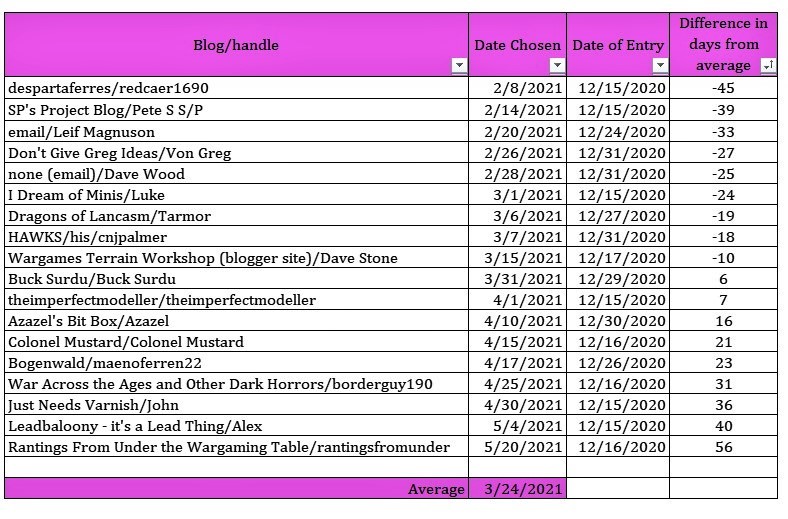
I have tabulated the list of entrants that you will see in the Excel chart below – sorted from earliest pick to the latest one.
You guys knew I’d have to have a spreadsheet!
I have listed the blog handles and the blogs of those who entered if you’d like to check them out. And you should if you do not know them. Click on their comments avatar to see them as they can be found in the comments section on the original contest post here. You can find most everyone on WordPress. However, a couple of entrants haven’t a blog to my knowledge (Leif Magnuson and Dave Wood), while Dave Stone is on blogger, and Buck has his own website. Buck is also on the HAWKS site with his fellow HAWKS Greg and Chris (cjpalmer), though Greg also has a WordPress site.
The contest is on!
We have 18 entrants. The average of the dates chosen was March 24th, 2021. The dates have a 101 day range, with Mike at despartaferres picking the earliest (February 8th) and Roger at Rantings From the Wargame Table playing the long game at May 2oth. The good news is that there will be no ties – as all dates are different and none are equidistant from the average.
I am making good progress and will be posting about that shortly. I know that many of the miniatures will take me longer to paint, and some much less. And I do have an airbrush…at this point, it’s anyone’s game. So stay tuned! Thanks to all who entered and good luck!
As a reminder for what the prize choices are for the three top winners:
2020 was – HOPEFULLY – a once-in-a-lifetime experience. As we all did, I had highs and lows on the personal side of life, the hobby side of life, and the golf side and others.
First, my deep thanks for all of you who regularly follow this blog and share your feedback with me. My thanks also to those whose blogs I follow. Your work inspires me.
As readers of this blog know, I am currently knee-deep in finishing up my forces for Feudal PatrolTM games. But I did set some goals back in January 2020 – so here I’d like to examine and share how I did – or did not do – versus those benchmarks, how my production was in 2020, how the blog did, and my personal highs and lows. I’ll also set some 2021 goals for myself. This is really to hold myself accountable here – and please know I’m open to any and all feedback.
How did I do versus my 2020 goals?
These are the goals I set for myself and how I did:
Games:
Run convention games at TotalCon, HAVOC, HUZZAH, BARRAGE, and the Fort Devens Game Day (and a few more maybe) –
Complete a supplement for Feudal PatrolTM for Mesoamerican warfare (Aztecs, etc).
Yes – this was a big part of my February and March. Civilizations Collide was published on the Sally 4th website and Buck Surdu’s website as free downloads. This is the accomplishment in 2020 of which I am most proud.
2. Be productive, but never sacrifice quality
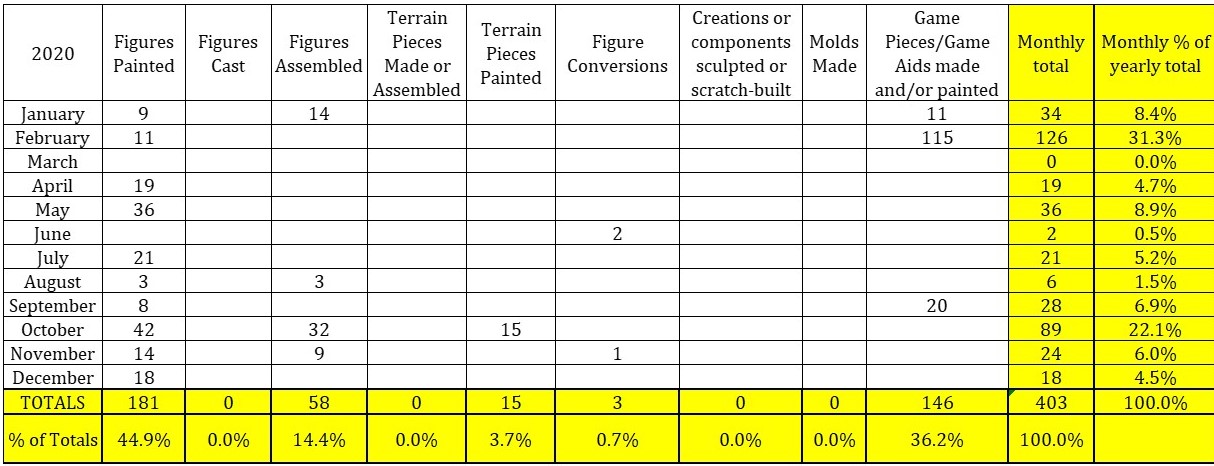
Well, you dear reader can be the judge of that. I did paint 181 figures this year versus 153 in 2019. My project total was only 403 versus 775 in 2019, but I did a lot of scratch-building numerous game aids (410 to be exact while I only did 146 in 2020), so my production was different. Still, almost 181 figures is a lot!
My 2020 production summary.
3. Grow the blog and find new ones to follow!
I definitely did both of these. As for the blog, it grew by about 12% in terms of views and visitors, and my followers are up too. My posts were fewer by five – so that is something I need to work on.
4. Entertain my audience!
I think so – again – you are the judge of this, not me!
Golf
Get my handicap below 14 (if I have enough non-gaming time!)
I did a lot of research in March and wrote Civilizations Collide, a supplement for the upcoming Feudal Patrol™ card-based wargaming system from Buck Surdu. The supplement covers the Spanish Conquest, to include the Conquistadores, the Aztecs of the Triple Alliance, Aztecs of the Aztec-Chichimec Alliance, the Maya, and the Inca. I cannot quantitate this as a hobby project, but it certainly was one!
April: 19 projects
Figures painted (19):
12 Aztec Novice Warrior figures painted for Feudal Patrol™ (28mm scale), from Wargames Foundry (#WF AZ018 Novice Warriors II)
7 Power-Armored Frinx figures painted/repainted for Combat Patrol™ retro sci-fi games (25mm/28mm scale) from Archive (#2040)
18 Aztec Novice Warriors painted for Feudal Patrol™ (28mm scale), from Wargames Foundry Aztecs line (12 from 2 blisters of #AZ016 Novice Aztec Warriors I, 6 from 1 blister of #AZ028 Novice Aztec Warriors III).
Figures assembled (32):
8 Tlaxcalan Novice Warriors assembled for Feudal Patrol™ (28mm scale), from Outpost Wargames Services (#TX2 Tlaxcalan Novices in Padded Vests)
8 Tlaxcalan Elite Warriors assembled for Feudal Patrol™ (28mm scale), from Outpost Wargames Services (#TX3b Elite Warriors in Feather Costume)
1 Tlaxcalan Captain assembled for Feudal Patrol™ (28mm scale), from Outpost Wargames Services (#TXC01 Tlaxcalan Captain with Conch Blower)
1 Tlaxcalan Conch Blower assembled for Feudal Patrol™ (28mm scale), from Outpost Wargames Services (#TXC01 Tlaxcalan Captain with Conch Blower)
6 Aztec Warrior Priests assembled as Tlaxcalans for Feudal Patrol™ (25mm scale), from Ral Partha’s 1200 A.D. line, circa 1988 (#42-302 Aztec Warrior Priests)
8 Aztec Novice Warriors assembled for Feudal Patrol™ (28mm scale), from Wargames Foundry Aztecs line (6 from 2 blisters of #AZ016 Novice Aztec Warriors I, 2 from 1 blister of #AZ028 Novice Aztec Warriors III).
8 Aztec Cuachicqueh (the “Shorn Ones” shock troops) figures assembled for Feudal Patrol™ (28mm scale), from Outpost Wargames Services (#AZ006 Cuachic Warriors- body suit and back banner)
1 Aztec Warrior Priest figure assembled for Feudal Patrol™ (28mm scale), from Wargames Foundry (#AZ011 Montezuma and Chieftains)
Figures converted (1):
1 Aztec Chieftain converted to one with a signaling drum from #AZ011 Montezuma and Chieftains
Welcome to Mark’s Conquistador Contest – a FREE chance for you to join me on my next part of my journey to field troops for my 16th Century Spanish Conquest game supplement forFeudal Patrol™ – “Civilizations Collide” – AND to have a chance to win – yes WIN – some free miniatures! Read on!
I have participated in a few painting challenges from others over the years – and those are great fun. But I am currently so desirous of seeing my Conquistadores painted up and ready for gaming that I will not stop until they are done and game-ready to my standards (such as those are). So I won’t be joining any challenges (unless they dovetail with me finishing my Conquistadores). However, I thought of another way to get you involved on this project other than just reading this blog. What about having my readers compete and guess the date that I’ll actually finish the Conquistadores? And what about offering actual prizes just to make it interesting? That’s exactly the genesis of Mark’s Conquistador Contest.
I have filed, washed, and partially based the force. I have not yet primed anything, and expect to start that on December 15th. I decided that I wanted to get all my filing of mold lines and washing (yes I wash all my figures before painting no matter what they are made of) done, do a massive priming session, and paint away. How long will this take – YOU get to guess.
My goal is to have some fun, and reward my followers and share some stuff that I enjoy. Secondly, it’s to get more followers and to grow the community. Thirdly, it’s to have fun (yes that’s fun twice). I do not currently monetize my blog, and I’m not looking to anytime soon by the way. Here are the rules:
Rules of Mark’s Conquistador Contest:
To enter and to win:
You must be an email or WordPress follower of my blog.
You must pick a date (day, month, and year) that I will finish the Conquistador miniatures shown here in this post. Finishing means, to me, that I am ready for the figures to be shown on my blog and used in a game. That is my call!
You must let me know that you want in on the contest by midnight EST (US East Coast time) on January 2nd, 2021. You do this by posting a comment that “you are in” here on this blog post in the comments section with the date information requested above in (2).
Only one entry allowed per follower except as described in (5) below.
If you get another person to follow my blog, you can earn another entry! For each new follower that credits you as a referrer, you can get another entry. All that person needs to do is comment on this post as in (3) above stating that he or she is “in” and who the referrer is. The referrer can then reply to that comment with an additional entry date.
Winners will be whoever is closest to the date I announce as the “completion date”. That can be earlier or later – for example picking a date that is one day before is as good as if it’s one day after. As there are multiple prizes, 1st place gets first choice, then 2nd, then third. If two people pick the same date, ties will be broken by who submitted the date first. I reserve the right to add more prizes!
I also reserve the right to be the final judge on the contest – somebody’s gotta do that. When I finish, I will announce the winners.
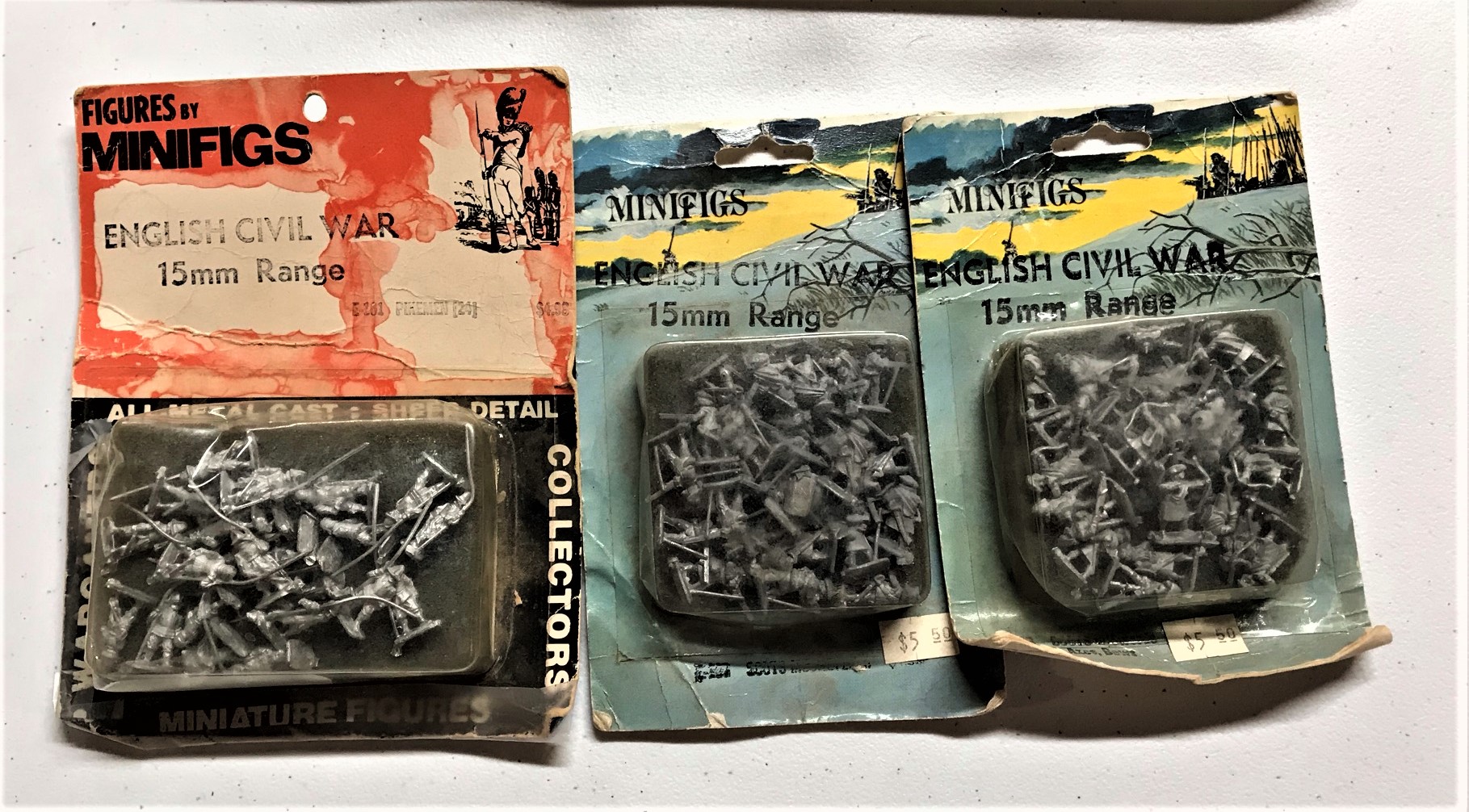
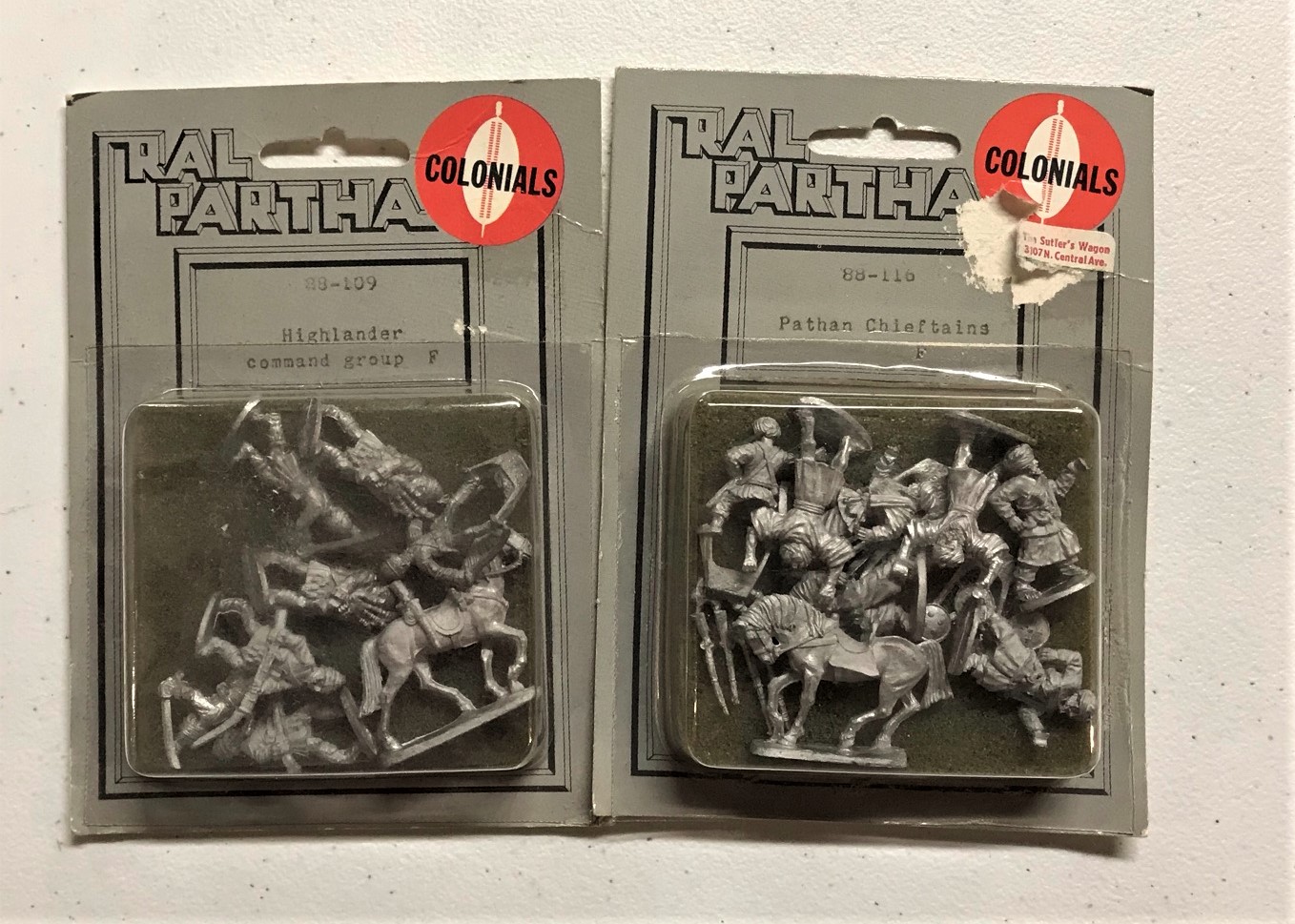
So as for prizes, they will be metal miniatures – mostly old and vintage lead – and in original packaging. Great stuff I love but may not be able to paint soon – and which deserve a home. And I will pay to ship them to the winners (including the US, UK, Australia – as long as I don’t need to hit the lottery for shipping)! So here are the current three prizes (and I may add more):
Three vintage Ral Partha Aztec Blisters (25mm)Three Minifig blisters for the English Civil War (15mm)Two Vintage Ral Partha blisters from their colonials collection (25mm)
Again, depending on participation and interest – I may add more. Hell, even if you win and don’t have a plan for them, these could be used as trade, or you could just tell me to reward the next player as victory is enough for you?
Your next questions should be – “what exactly is Mark trying to paint?” and “how fast is he?”. For the second question, just check out my pages that show my previous projects. For example, 2020 is here, and 2019 is here, but I list all my projects from 2016 onward under the “Miniatures and Projects” dropdown. This menu lets me track all I have done – and how, and can give you an idea. There is a bit more I have to do here than just painting – there is some assembly too. Here are the Conquistador subjects of my quest and this contest below:
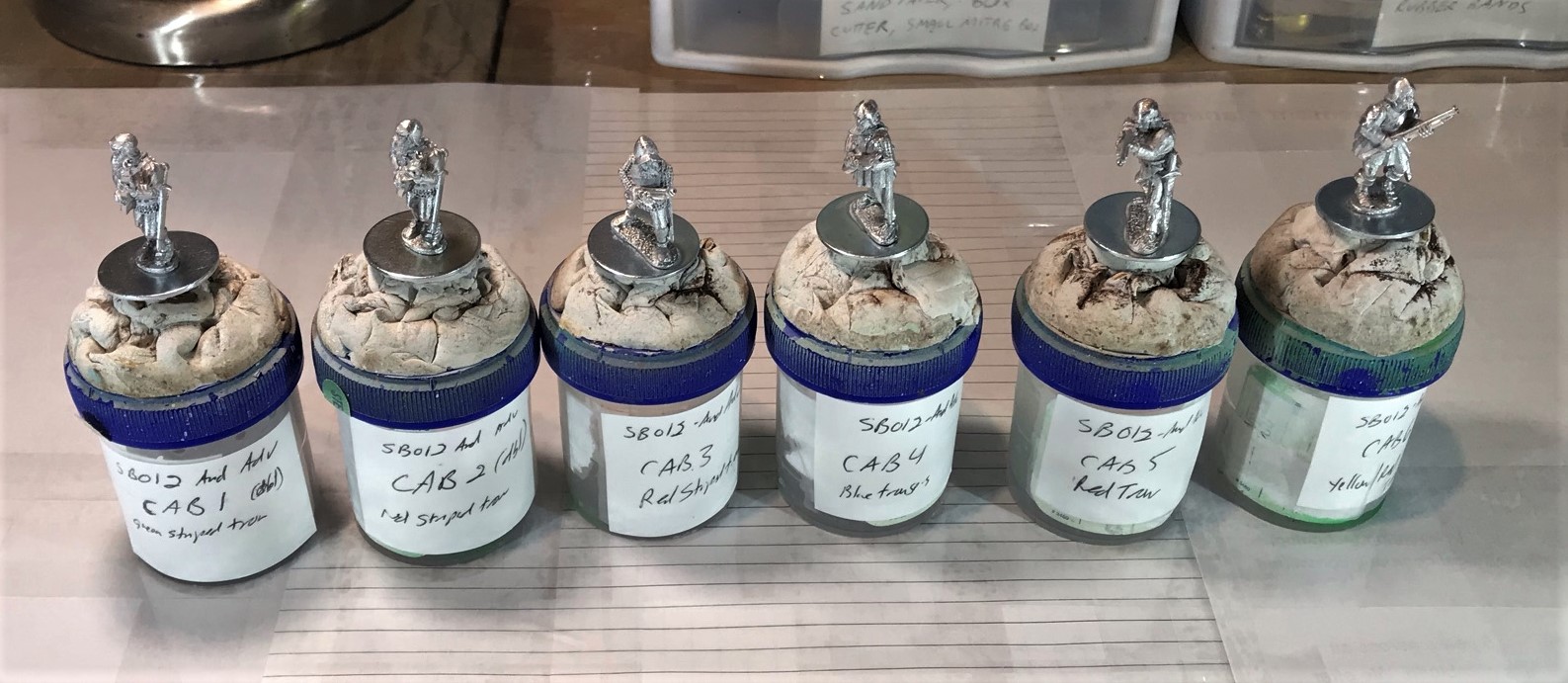
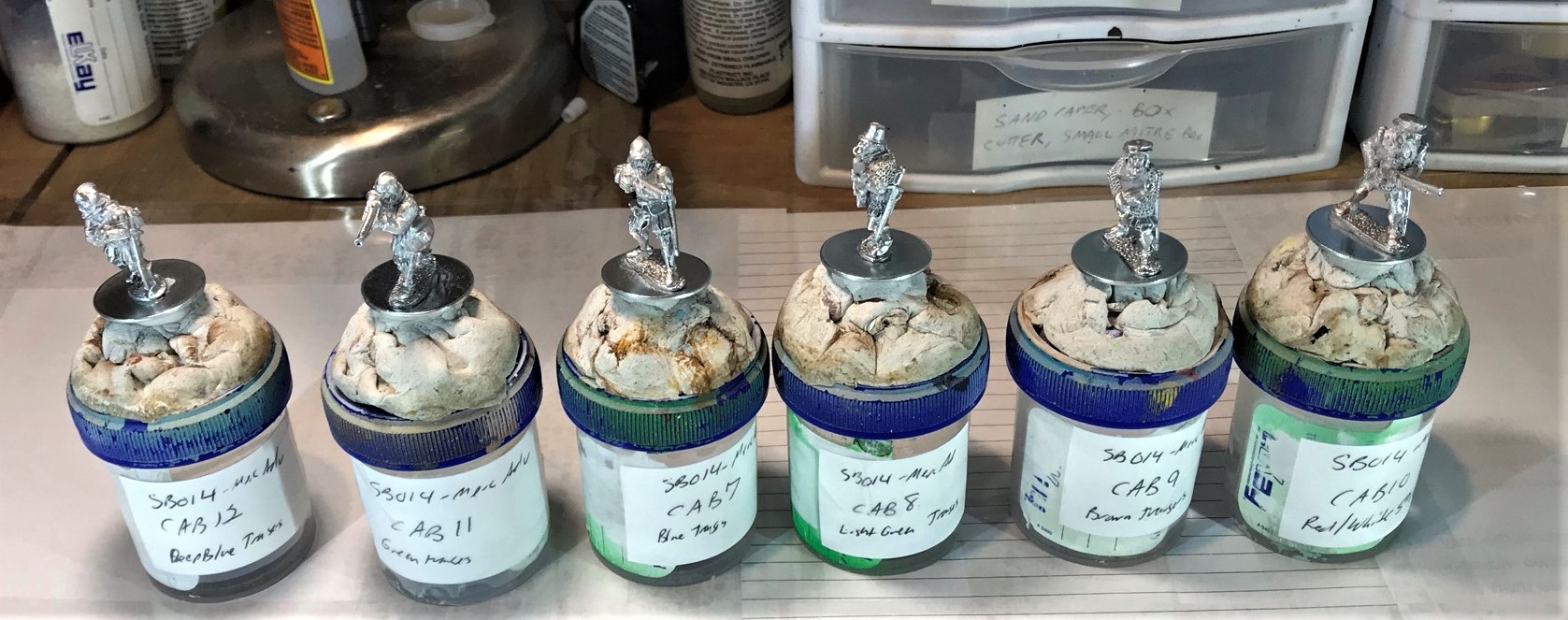
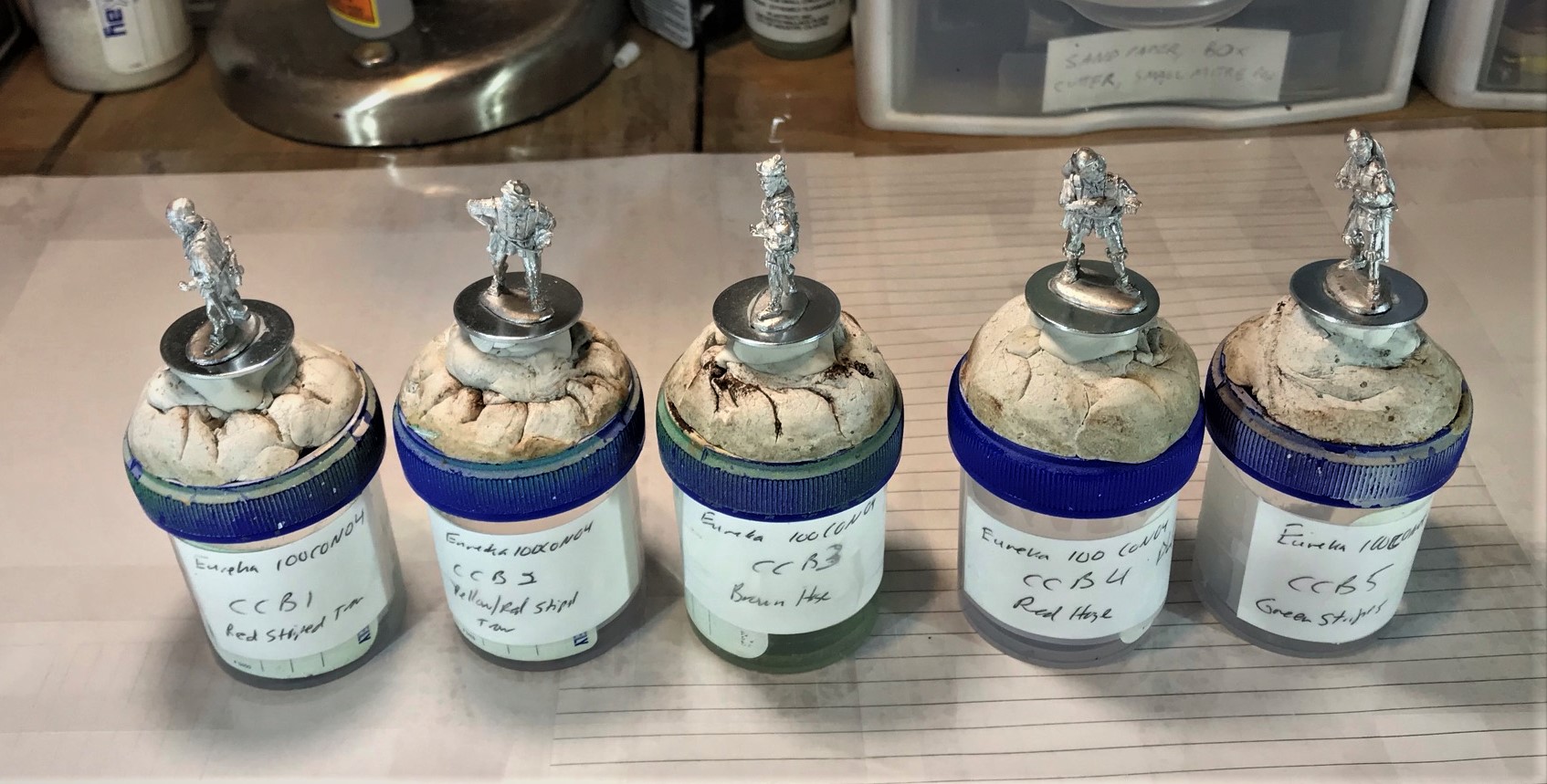
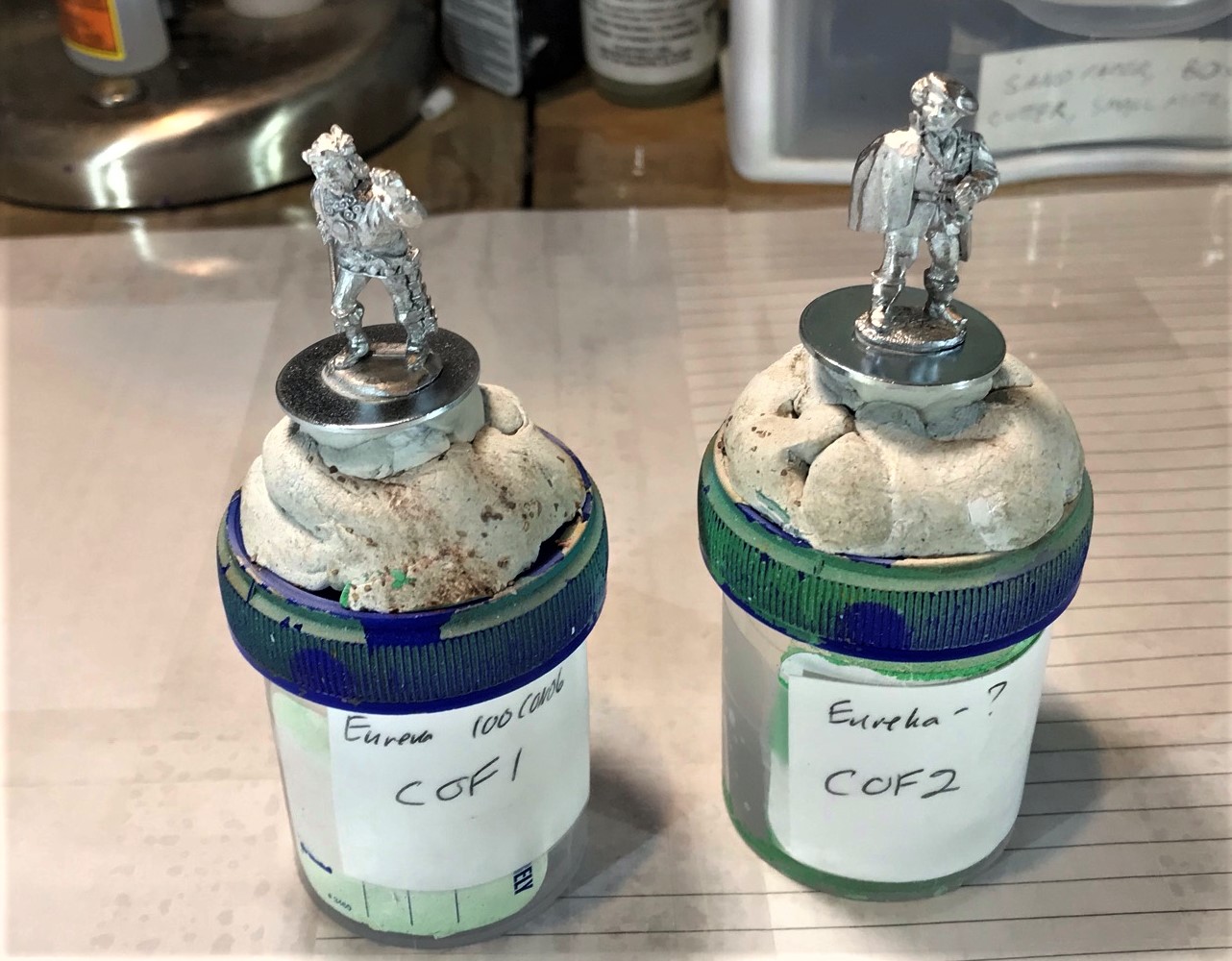
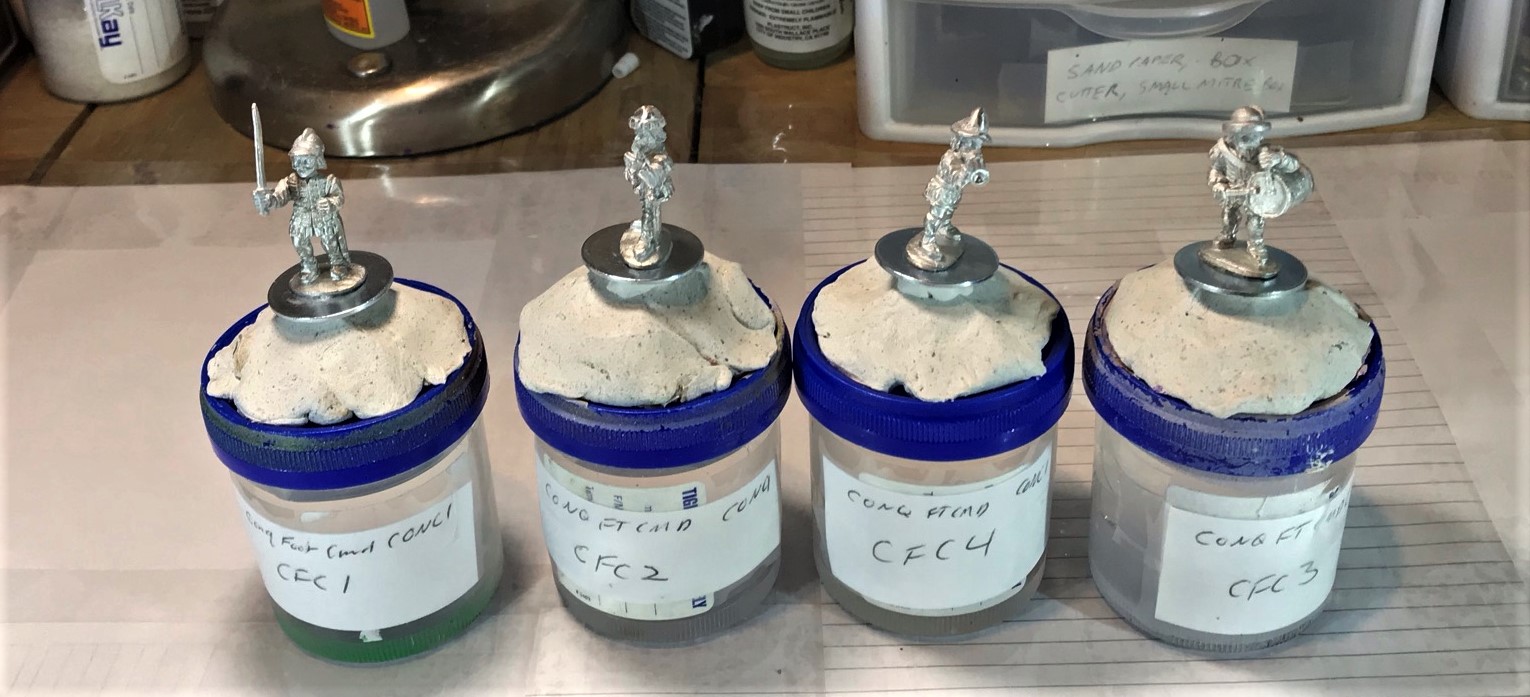
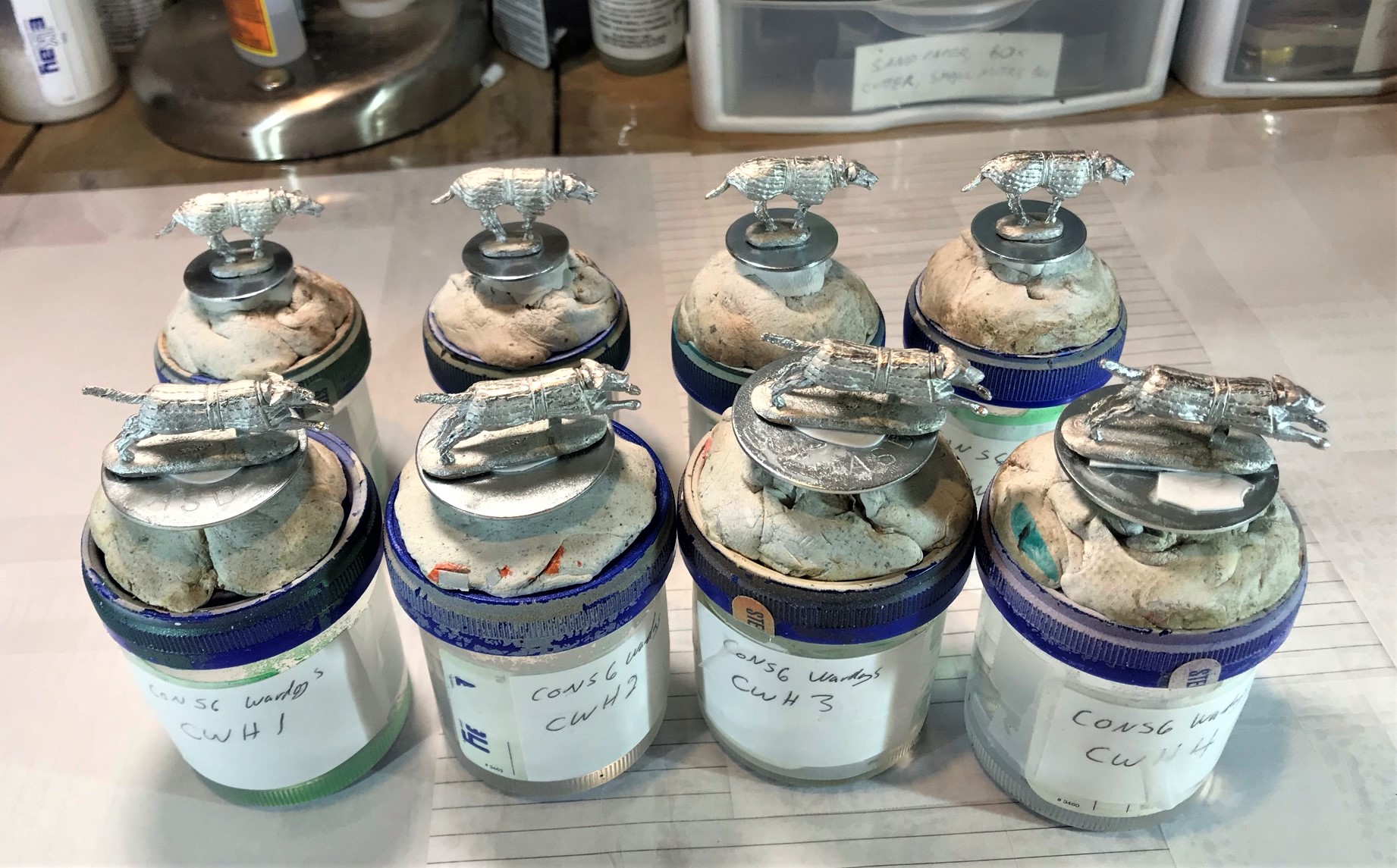
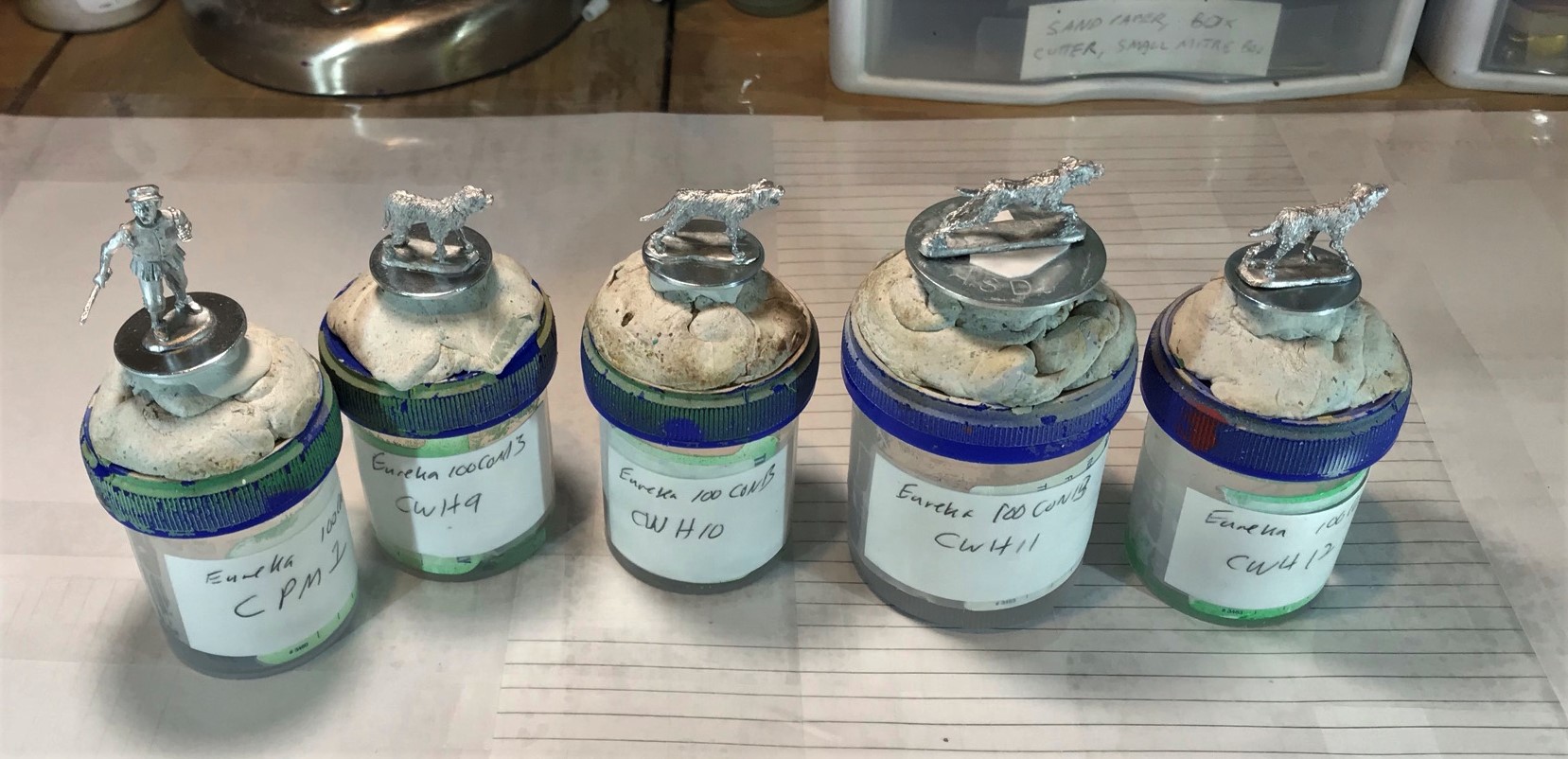
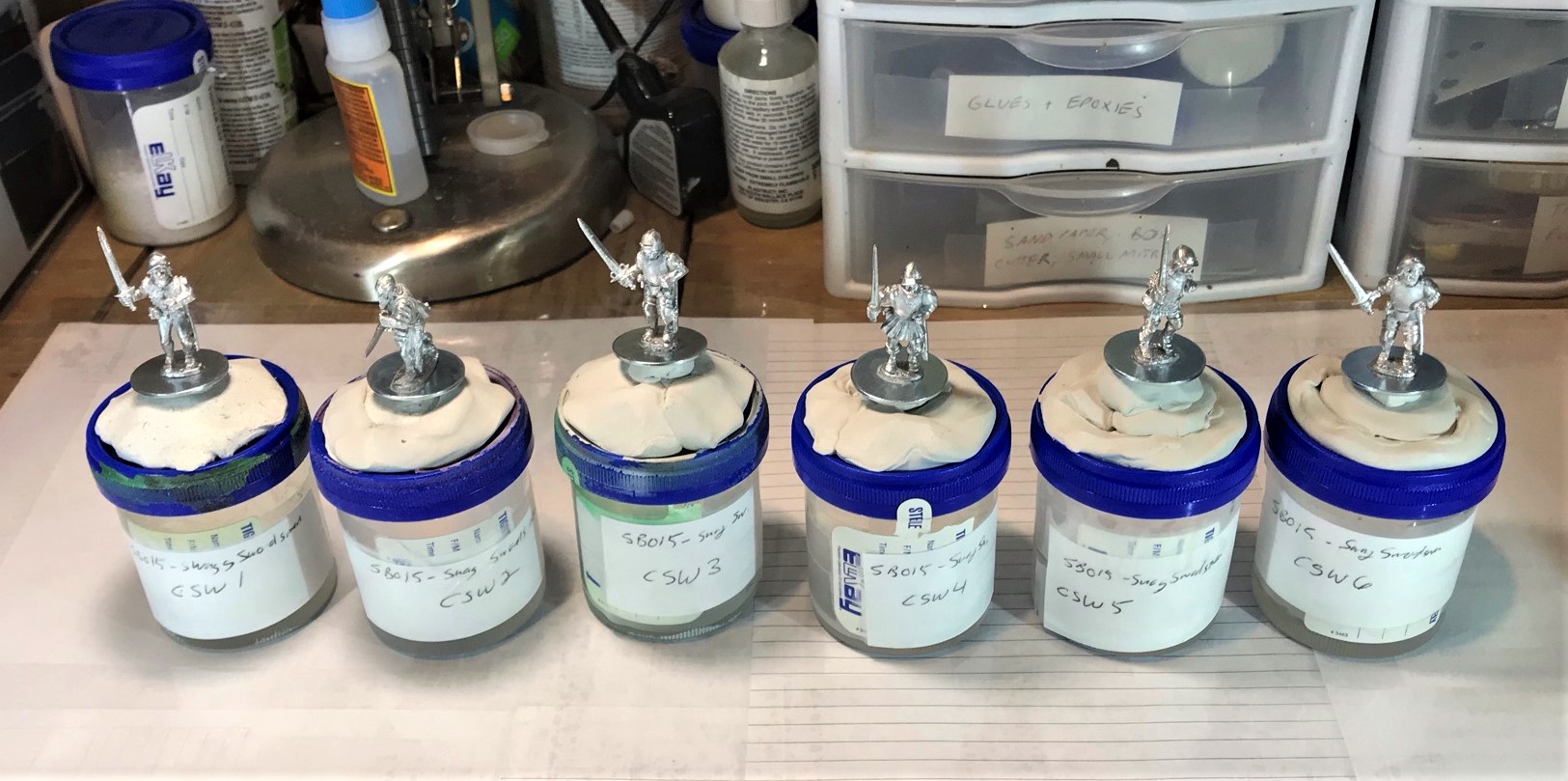
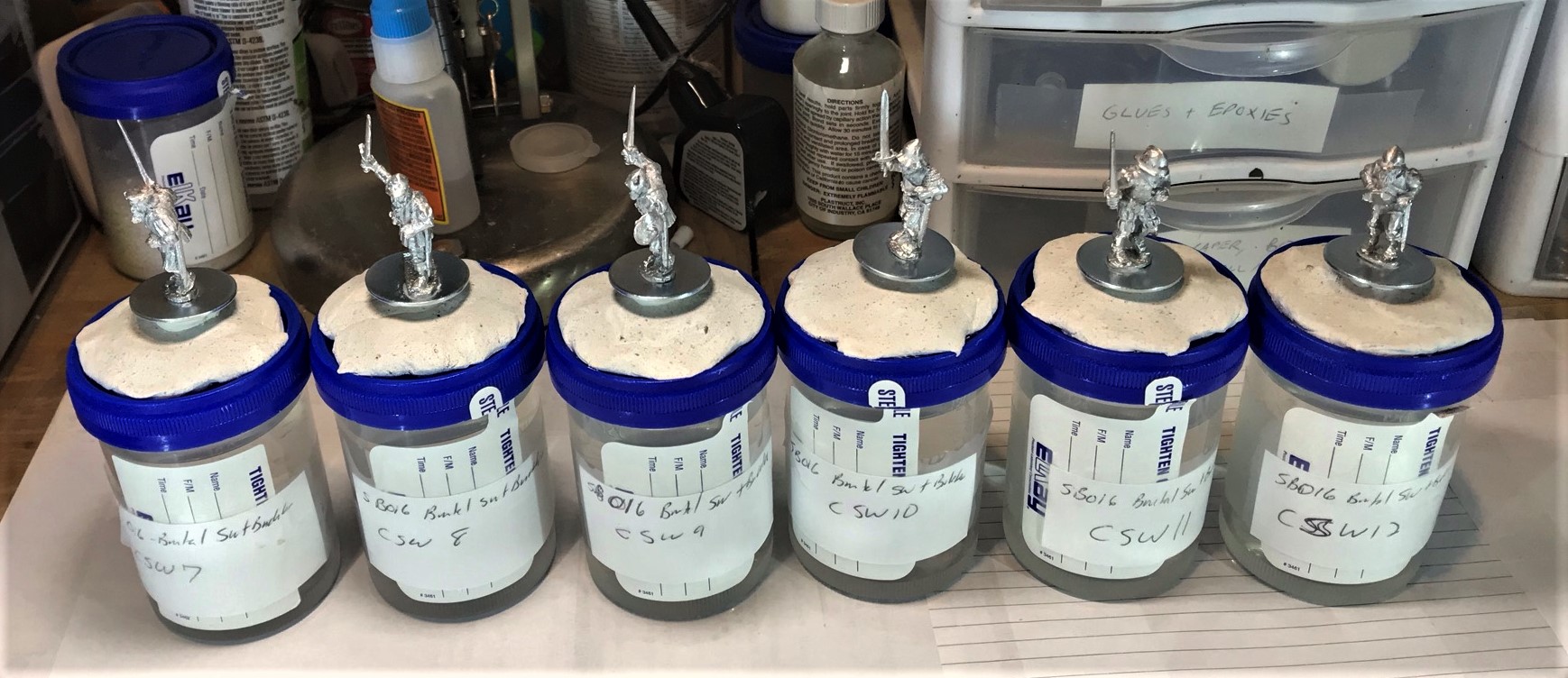
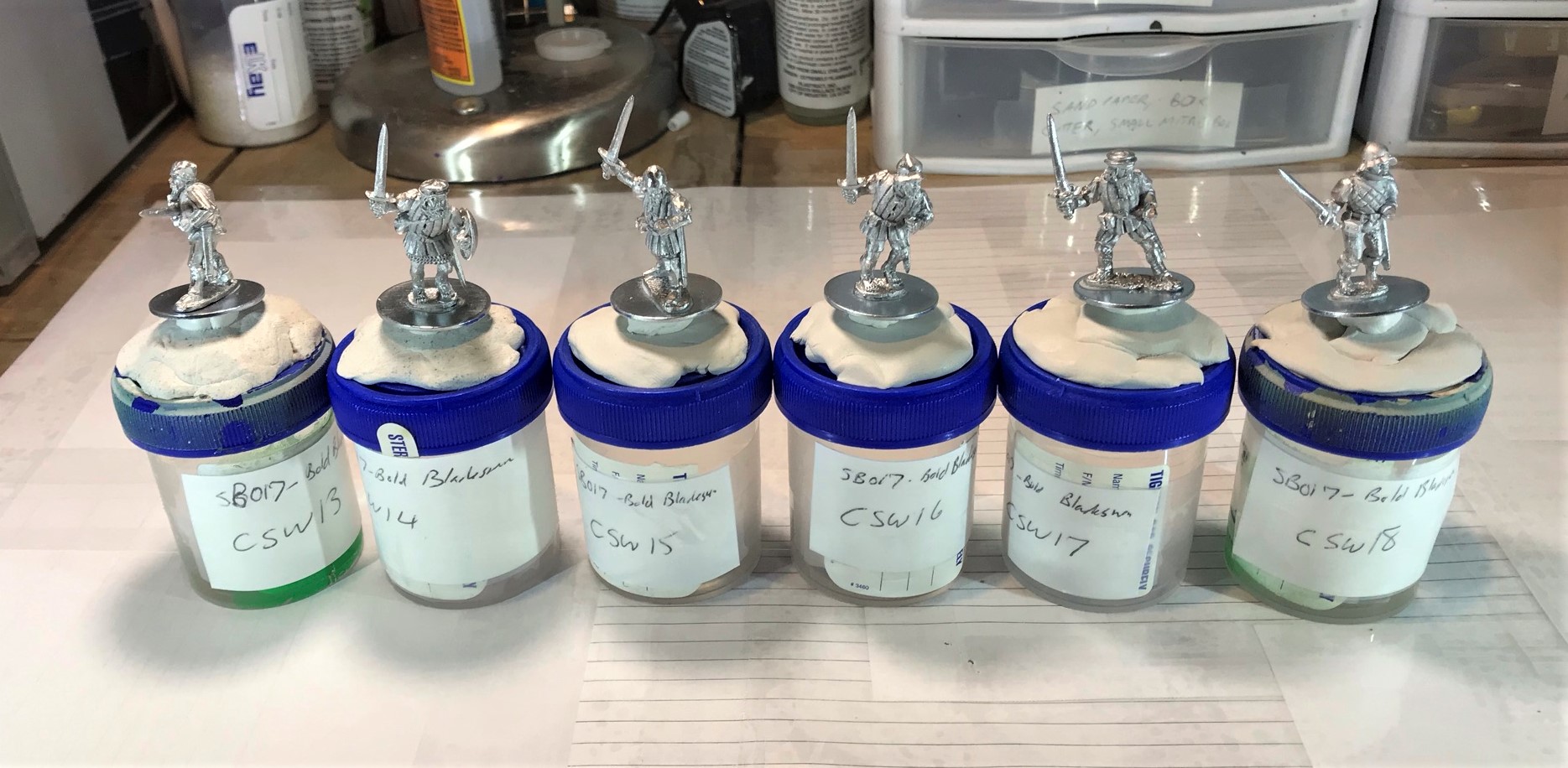
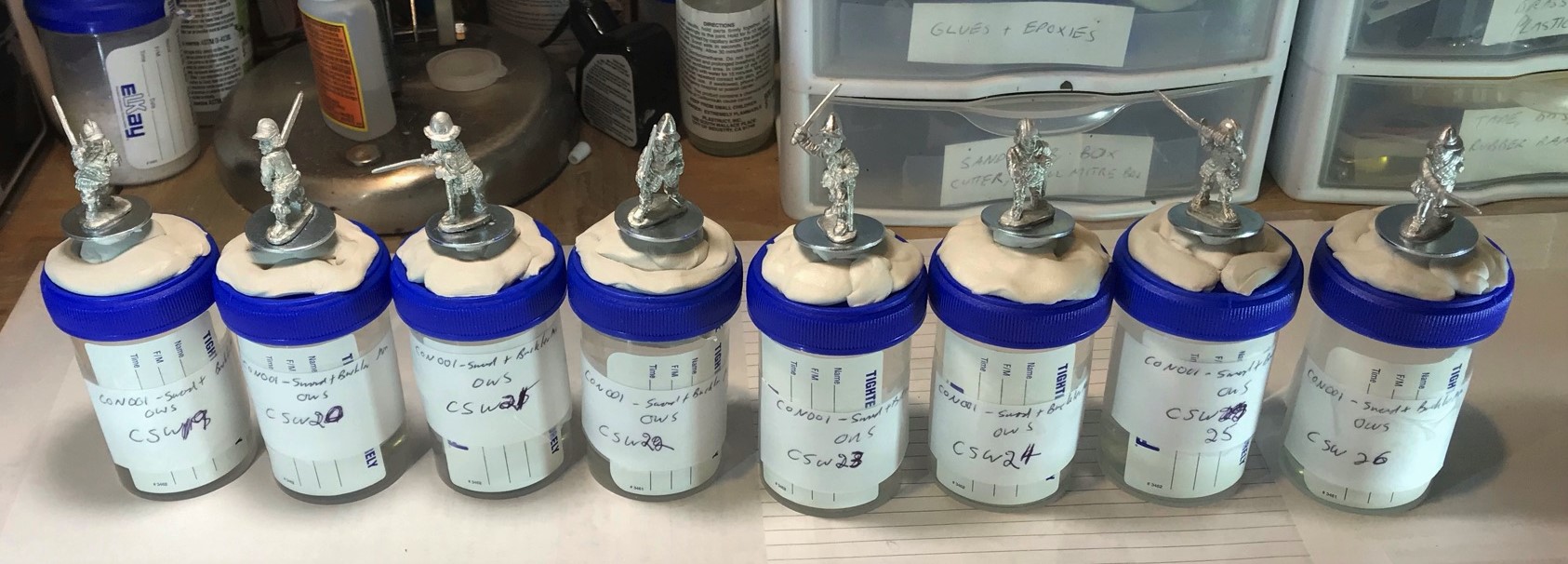
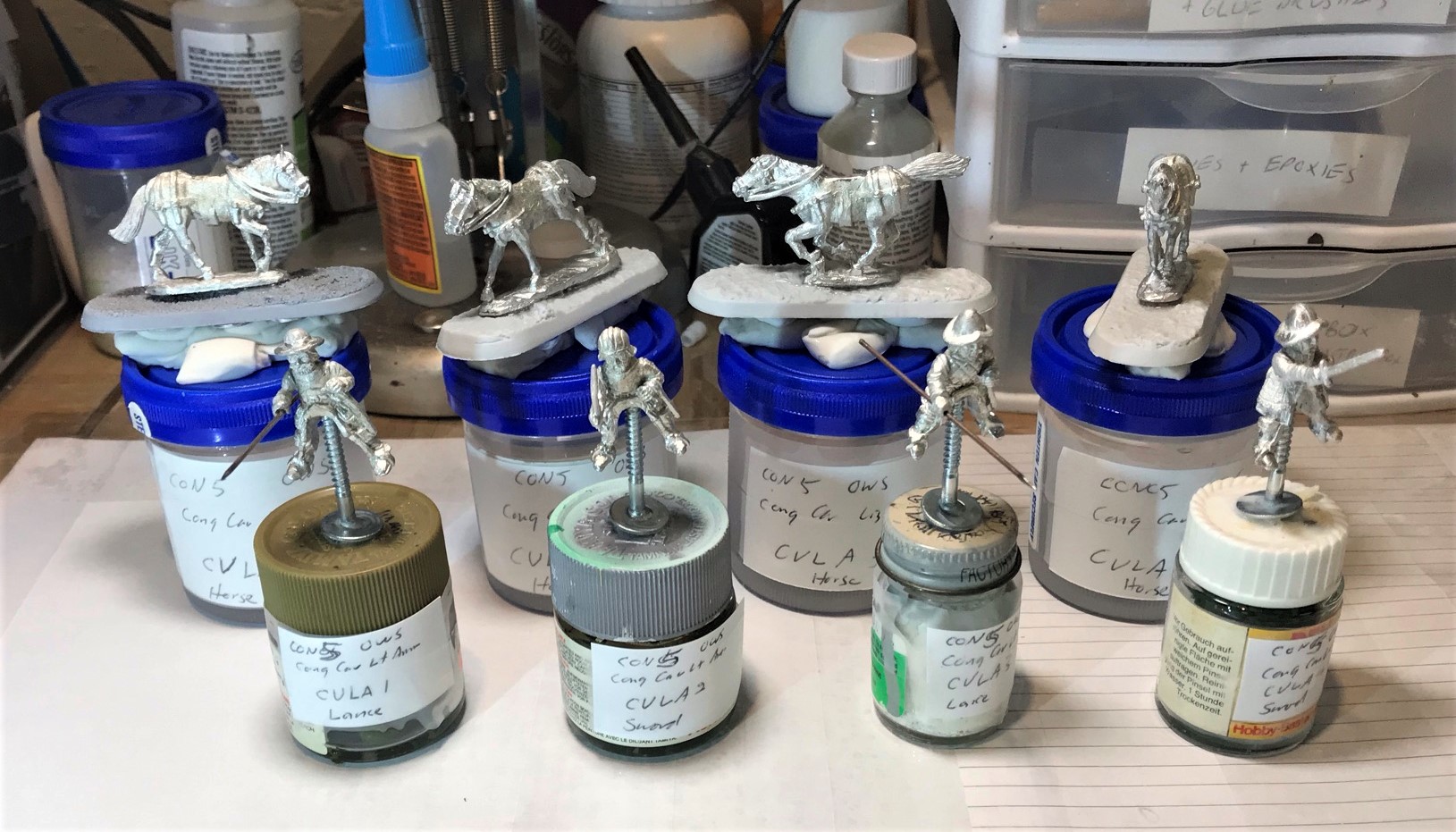
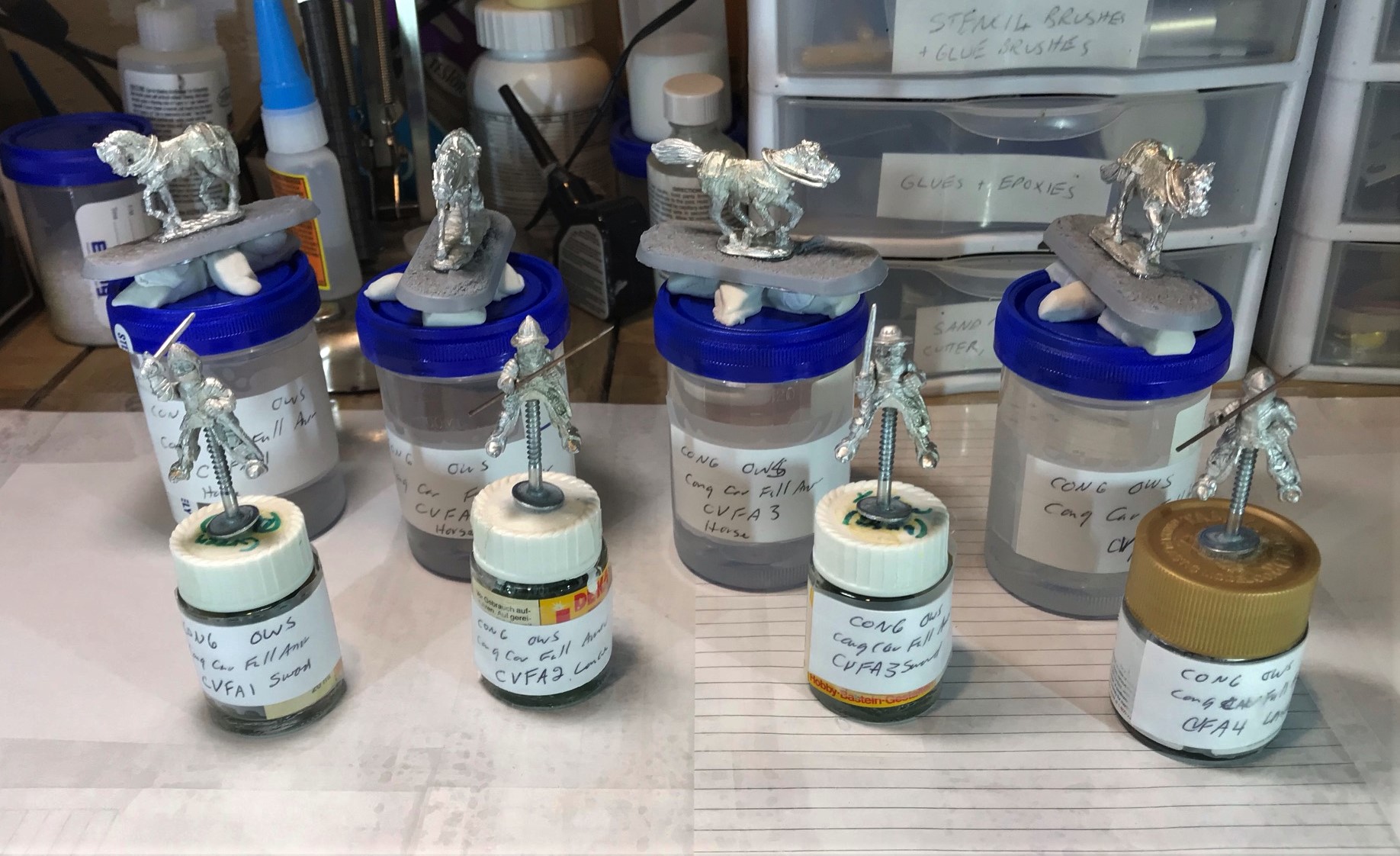
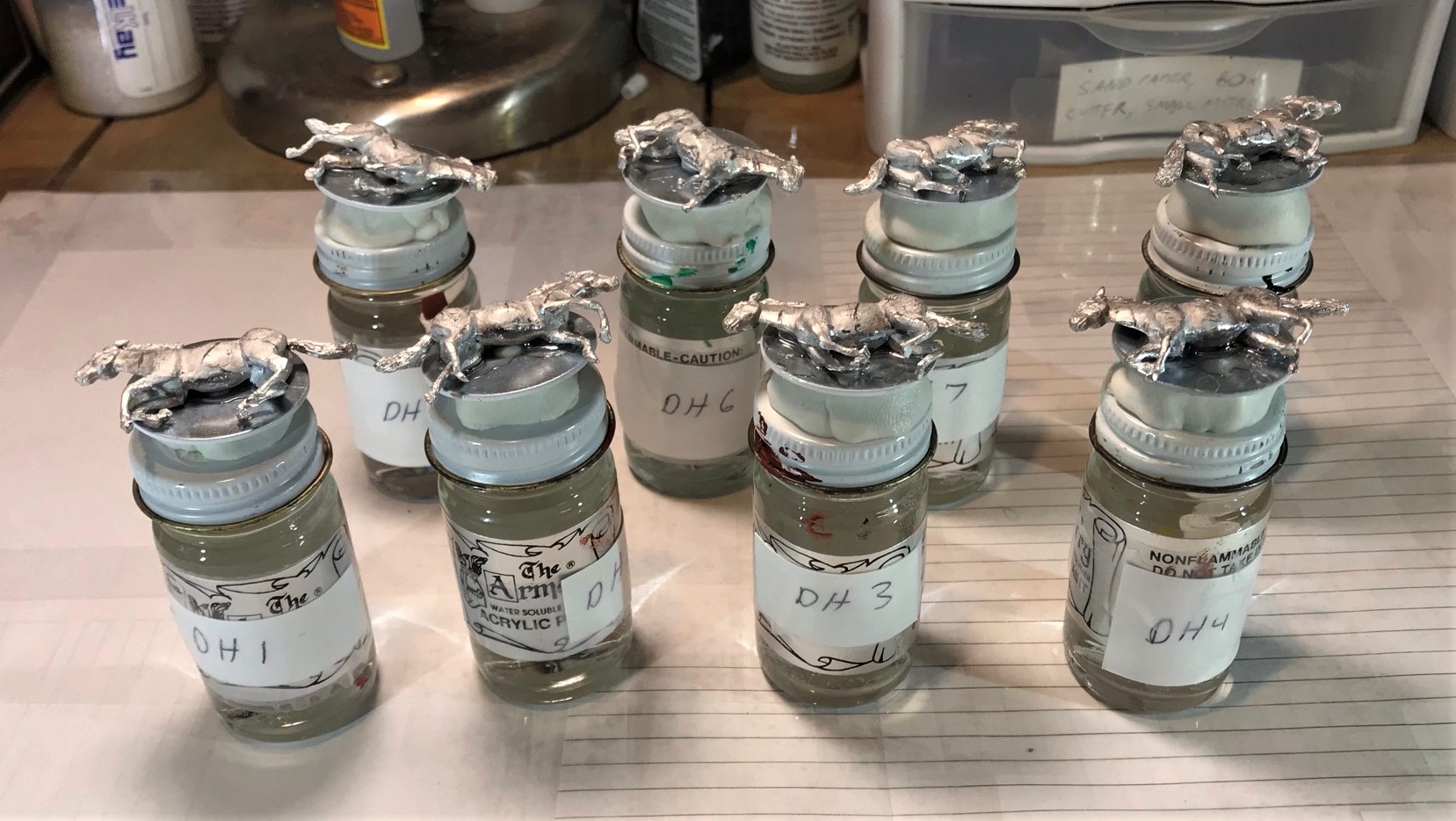
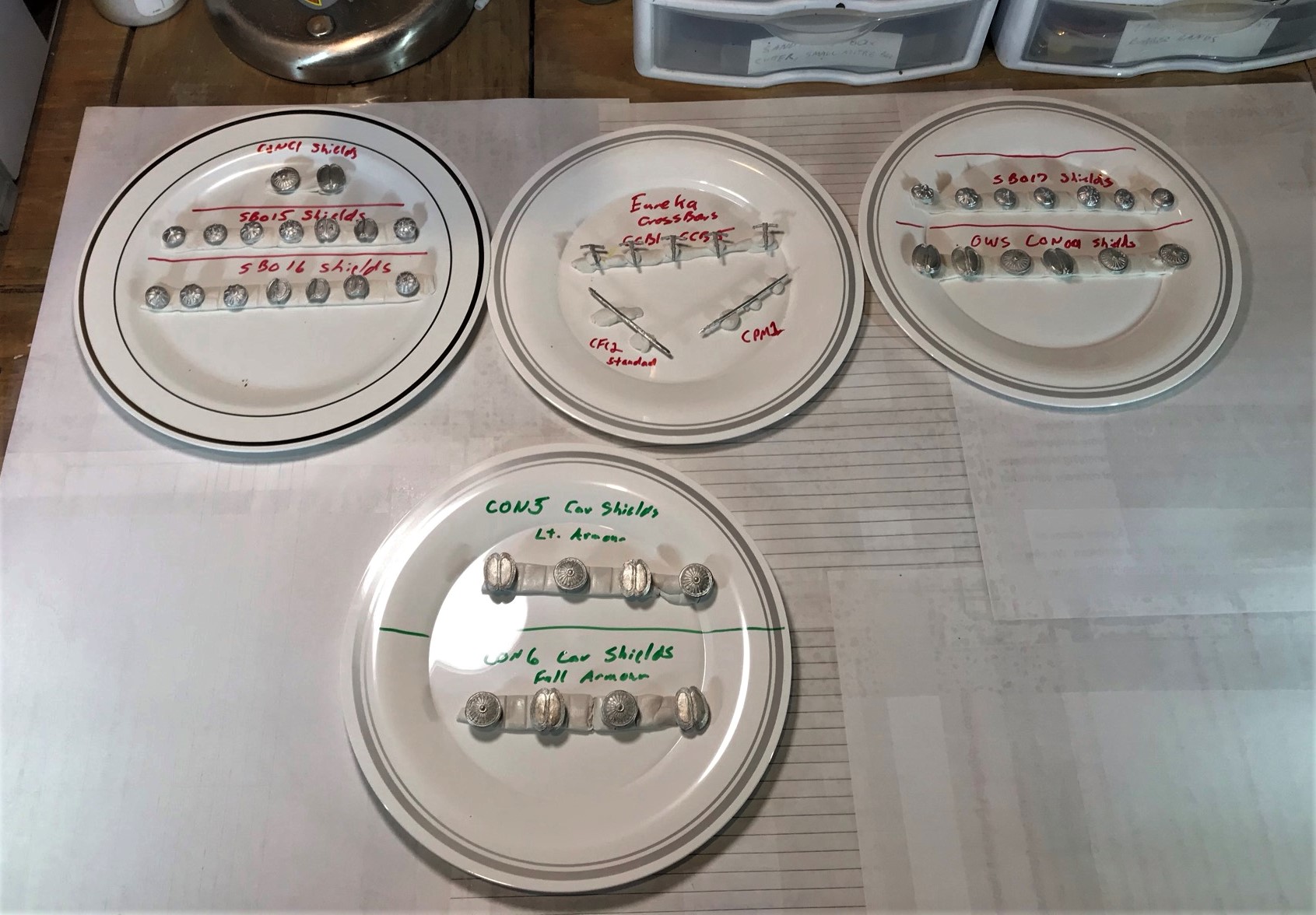
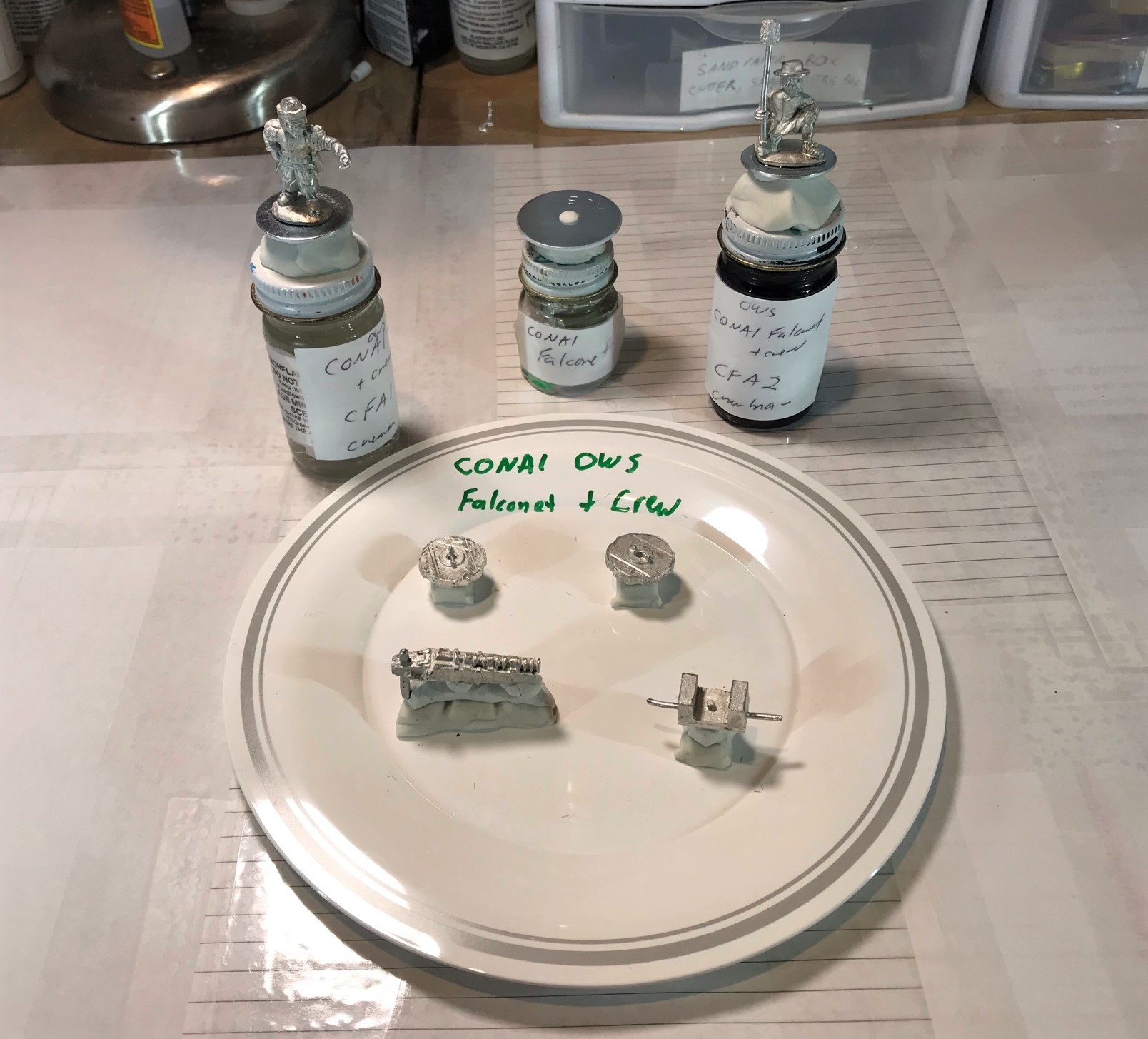
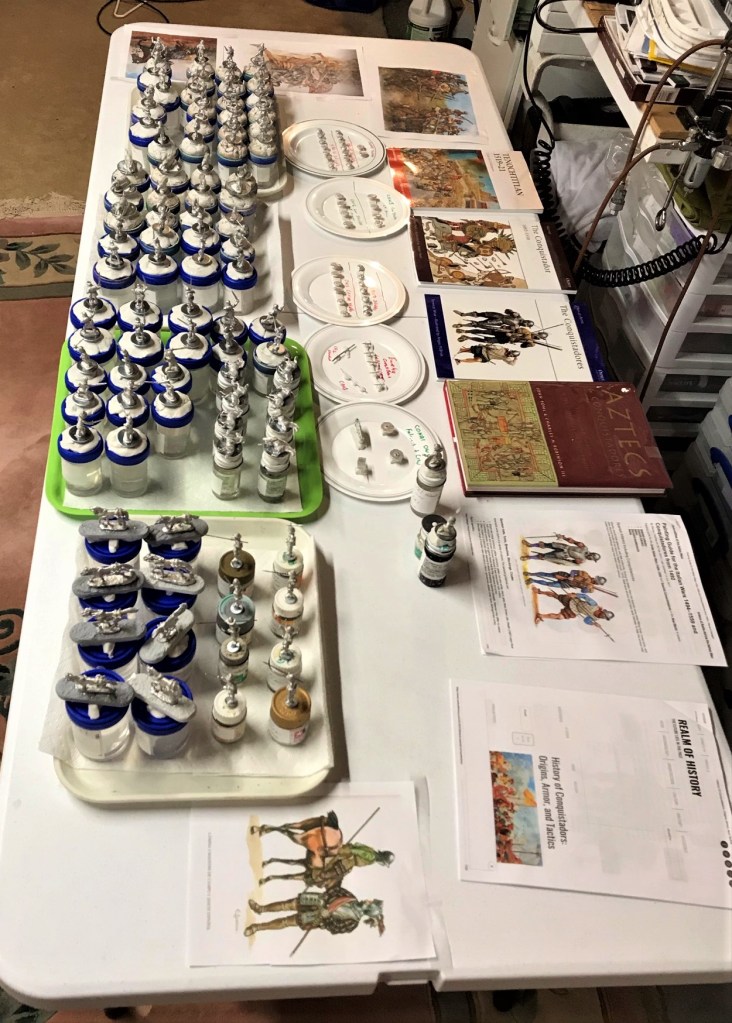
Wargames Foundry SB012 “Audacious Arquebusiers” – 6 figuresWargames Foundry SB014 “Merciless Adventurers” – 6 figures – all with arquebuses.Eureka Miniatures 100CON04 “Crossbowmen” – 5 figures. Crossbows are separate and shown below.Eureka Miniatures 100CON06 “Officer” and an unknown bonus officer that they gave me – 2 figuresOutpost Wargames Services CONC1 “Conquistador Foot Command” – 4 figures. There is a bannerman with no banner that I will make a standard for, and a few shields you’ll see below.Outpost Wargames Services CONS06 “Wardogs” – 8 figures. This is the first group of war hounds I have.Eureka Miniatures 100CON13 “Dog Handler and Dogs” – 8 figures. This is the second group of war hounds I have. I’m going to make the handler a pikeman as in my game the dogs can be added to any figure for points – I have no need for a handler alone.Wargames Foundry SB015 “Swaggering Swordsmen” – 6 figures – all with shields shown separately.Wargames Foundry SB016 “Brutal Sword and Buckler Men” – 6 figures – all with shields shown separately.Wargames Foundry SB017 “Bold Bladesmen” – 6 figures – all with shields shown separately.Outpost Wargames Services CON001 “Sword and Buckler Men” – 8 figures. There are at least 6 shields I’ll do here – maybe 8 – not sure yet as two of the figures have two-handed broadswords.Outpost Wargames Services CON5 “Conquistador Cavalry in light armour 1” – 8 figures (4 riders and 4 horses). There are also shields. I made two armed with lancers and two with swords. Note my rigging for painting riders – and yes those are screws with washers on old paint bottles.Outpost Wargames Services CON6 “Conquistador Cavalry in full armour” – 8 figures (4 riders and 4 horses). There are also shields. I made two armed with lancers and two with swords. Note my rigging for painting riders – and yes those are screws on bottles again.Eureka Miniatures 100ANMo5 “Moving Horses” – 8 figures. Obviously not moving, but de-based and mounted to be used as hacked up and downed horses that could be used as cover or block movement.All the previously alluded-to shields for the cavalry and infantry, as well as crossbows, a banner pole, and a pike.Outpost Wargames Services CONA1 “Falconet and Crew” – 3 figures (2 crew and 1 falconet (small cannon)). I’ll paint parts here before assembling the falconet.
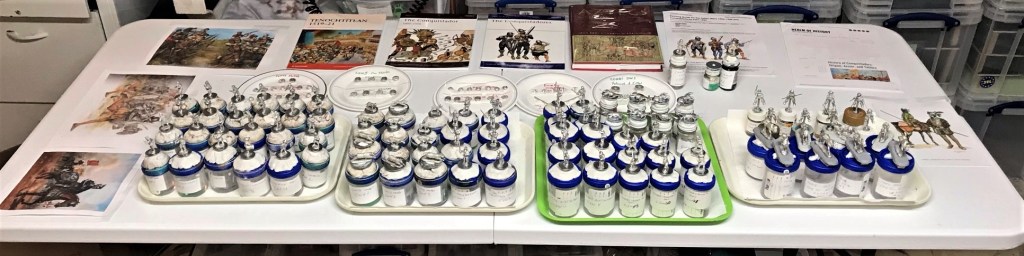
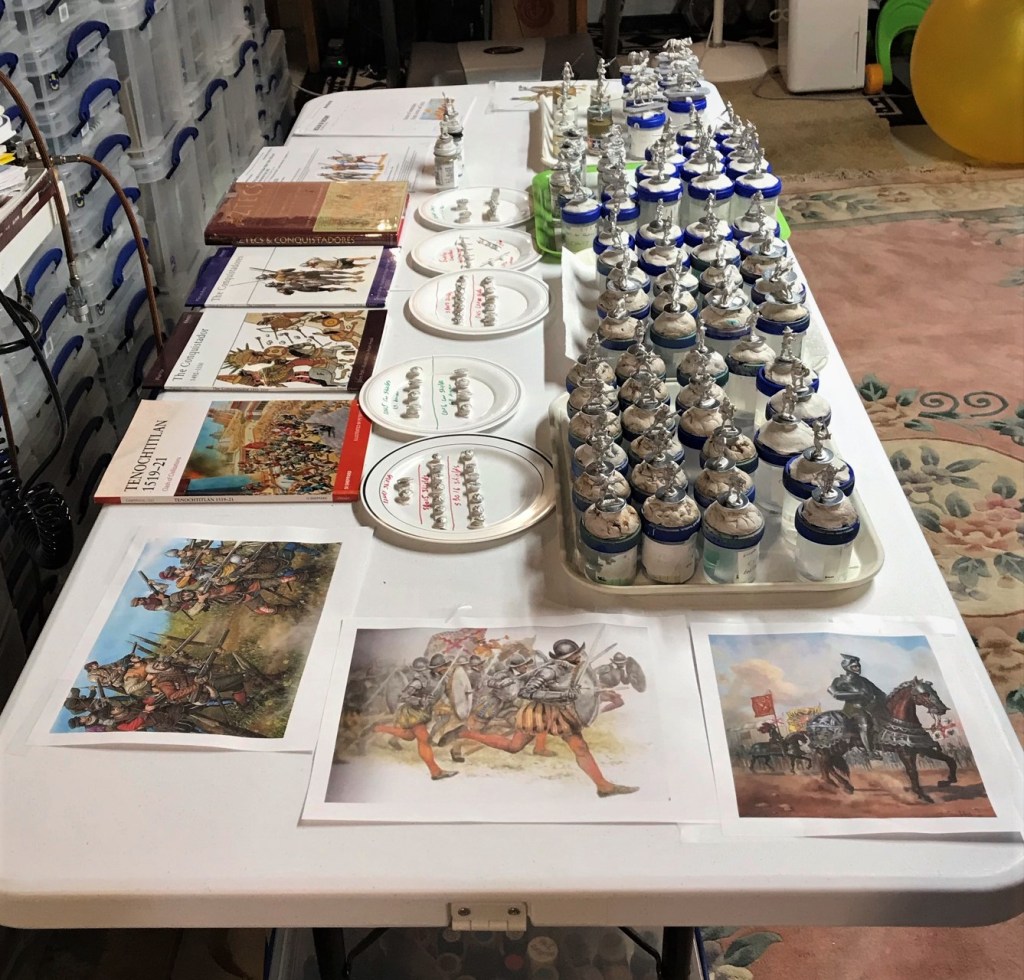
If you’re counting (and that helps) that’s 89 figures – if you count each cavalry as two figures (horse and rider). I used a lot of poster tack and bottles as you see all of them collected here with some of my painting guide resources.
I hope that you enter and wish you the best of luck! Referrers always welcome – just need to follow the rules and importantly be one of my blog followers. Hell, I need the luck too – this is a lot of lead!
Stay tuned for updates as I finish pieces of this project – and I really hope that you find this fun. I’ll leave a synopsis as usual like below. Stay safe!
Miscellaneous details and references for those interested in that sort of thing:
Posts on games, units, and other projects for my 16th Century Spanish Conquest supplement for Feudal Patrol™ – “Civilizations Collide”
Mark’s Conquistador Contest – for my loyal blog followers! (this post)
Montezuma and Chieftains – Wargames Foundry #AZ011 for Feudal Patrol – 6 Aztec figures (Montezuma, 4 Chieftains, 1 Warrior Priest)
I have always wanted to be part of a putting together rules for a tabletop wargame. Now, I can officially say that I can check off that box on my life’s “To-Do” list – at least in a smallish way.
Feudal Patrol™– Buck Surdu’s rules for “Skirmish Miniature Gaming in the Ancient, Medieval, and Fantasy Periods” is now available commercially. In the US, it can be bought from On Military Matters website here. It is also being sold in the US by Noble Knight Games website here. In the UK, it is being sold by Sally 4th on their website here.
It is a fantastic skirmish system, similar to his Combat Patrol -WWII™and Albedo Combat Patrol™ systems. Unlike many other games, the Combat Patrol family has eliminated the clutter of multiple charts and markers with the use of specialized playing card decks. The decks in each game enable players to resolve movement, melee, missile fire, morale, cover protection, and more all from a single 50 card deck. Feudal Patrol™ is appropriate for periods when melee dominated warfare instead of firepower – so the 16th Century and earlier, as well as being adaptable for fantasy gaming. To be clear, I am not totally unbiased. I have been friends with Buck for nearly 40 years since our cadet days at West Point, and I did participate in several playtests of these rules and helped as I could.
As for a good review of Feudal Patrol™ by a more neutral party, there is a fine one on the BoardGameGeek website by Scouter (Brian Ivers) that you can see here. You can see that this is a game worth checking out. Here’s a snippet from the review:
Overall an Excellent effort by Buck and his band of Tabletop warriors. The cards and rules were purchased by me under a pre order program through On Military Matters. The rules were produced by Sally4th, a wonderful company out of the UK. Noble Knight games are also a US conduit. The amount of support available for this product is excellent, this can be found on both Buck Surdus web site as well as Sally4th. And Google Groups IO page. Buck has produced an excellent You Tube video introduction to Feudal Patrol. https://youtu.be/SlpLbMdgVv8
My official copy of the rules arrived in early November! The book looks great, and the layout inside is equally nice.The inside cover. Thanks for the shout out Buck! BTW, the “Ma’k” is a nod by Buck to my Massachusetts accent that I will never lose.
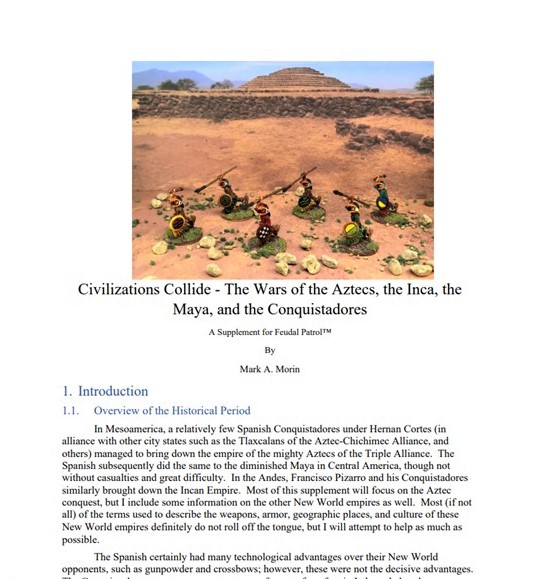
Buck asked me if I was interested in writing a supplement for the rules. I was very interested and thought it would be a fine opportunity to check the box I wrote of above. I also wanted to develop a skirmish game for the Spanish Conquest as the period and the garb of the period was fascinating to me. So I agreed, and did a lot of research on the period, and developed my supplement to Feudal Patrol™ that I called “Civilizations Collide”. That supplement is a FREE download – and I hope all who read this will download it and please take a look (after all it’s free! – did I mention that?). Plus it has a lot of pics of the miniatures that I have painted up (and more will come in this blog of course!
As readers of this blog know, I have been also actively painting figures for the period from many companies. You may want to get started – so as a help, here is my list of what I have found available:
Naismith and Roundway sells some (I have not bought any yet) here – 25mm
Even the old Ral Partha (which I have), now sold by Iron Winds Metals, has some here – 25mm
All of these are still commercially available. I do prefer the 28mm over the 25mm, but I do use both
Thanks for checking this out and a real big thank you if you downloaded the supplement! More to come!
Miscellaneous details and references for those interested in that sort of thing:
Posts on games, units, and other projects for my 16th Century Spanish Conquest supplement for Feudal Patrol™ – “Civilizations Collide”
Civilizations Collide – The Wars of the Aztecs, the Inca, the Maya, and the Conquistadores is now available as a FREE Download for Feudal Patrol™ – plus a Feudal Patrol™ review! (this post)