As I mentioned on our Facebook page, we have a few changes that we hope will make people excited to play in more of the TOB events.
While the minimum number of events to qualify to play in the finals is still three out of the six, by playing in more you will have a chance at winning a big prize!
We will have a drawing for two winners at the draft night for the FINALS in September. What will be the prizes?
One player will be drawn and win $100 out of tickets for those who played in four events.
Another player will be drawn from those who played in 5 or 6 events and get a FREE ENTRY INTO THE FINALS!
So how do you qualify?
If you play in four events you will qualify for the $100 drawing with one entry!
If you play in five events, you will have two entries into the raffle for both of the prizes. If you play in all six events, you’ll get three tickets into the raffle for both of the prizes.
So there’s no reason to stop at three events!
If for some reason, we have to cancel an event and we end up with fewer than six events we will adjust those numbers accordingly.
The sign-up sheets for the next event which is Saturday April 25 are up at Still Harts in North Brookfield and on the Facebook page for The Tour of the Brookfields. A sign-up sheet will be at Quail Hollow when they open.
Sign up for the first event by April 19! See you all soon!
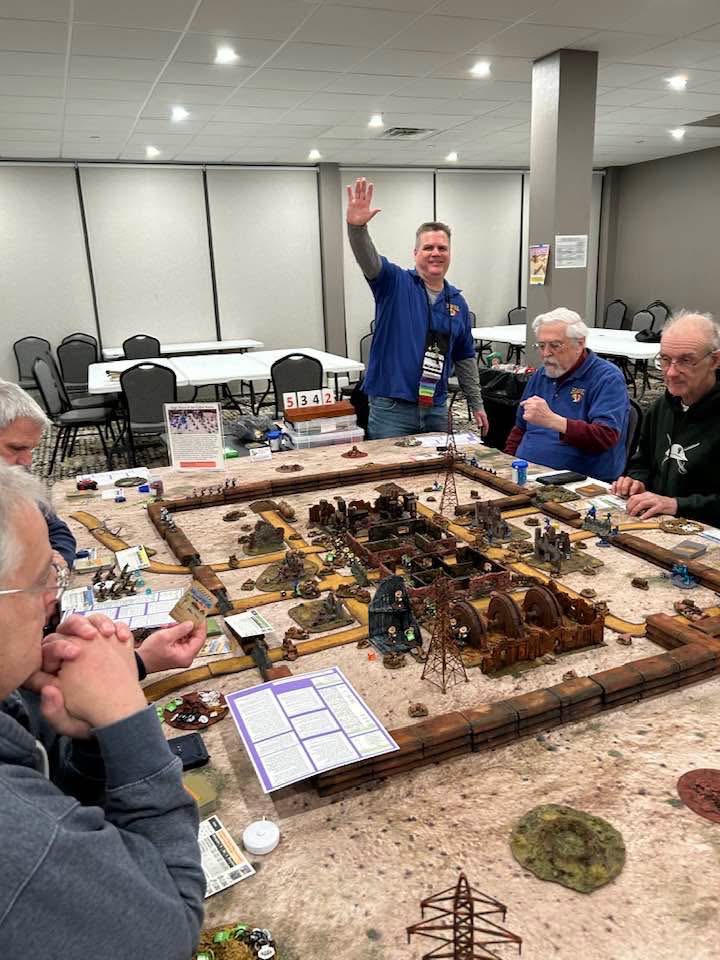
TotalCon 40 is an annual gaming convention that is held in Marlborough, MA at the Best Western Conference Center. There are events for miniature games, board games, RPG’s, and much more. Attendance is well over 1,000.
This year it was held between February 19th and 22nd of 2026. I usually run several tabletop miniatures games there. This year was no exception. I ran eight 4-hour games across the 4 days.
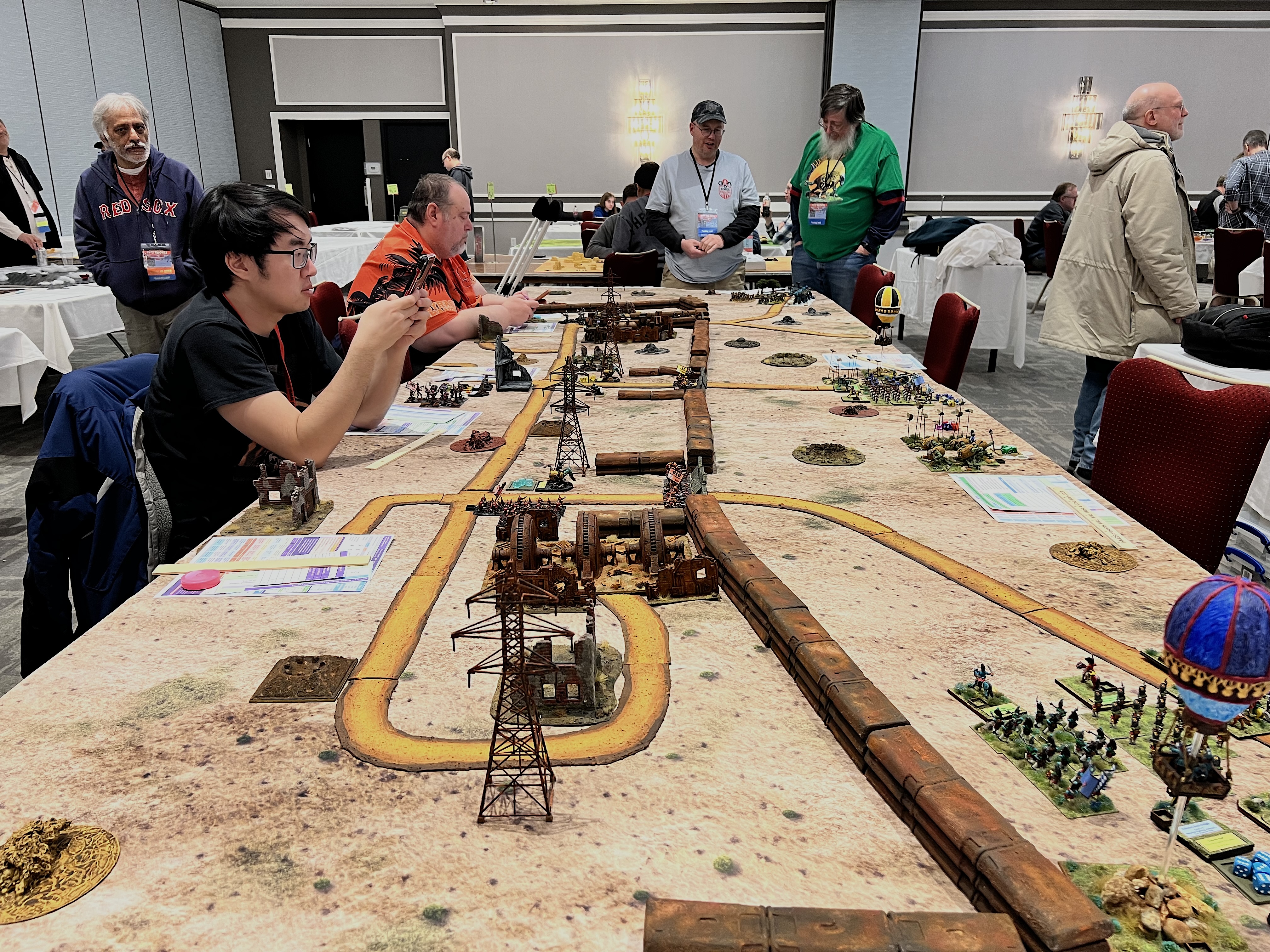
Several players who participated in my games are eager to see some game shots. Not to disappoint, his post will be picture heavy and text light!
On Thursday of every TotalCon, there is a large flea market in an adjoining room to the main hall. From Friday to Sunday, I get a very big table in that room. Because of the flea market’s need for space, I settle for a smaller footprint on Thursday. That smaller table was fine for two games (afternoon and evening).
Battle for the Pond
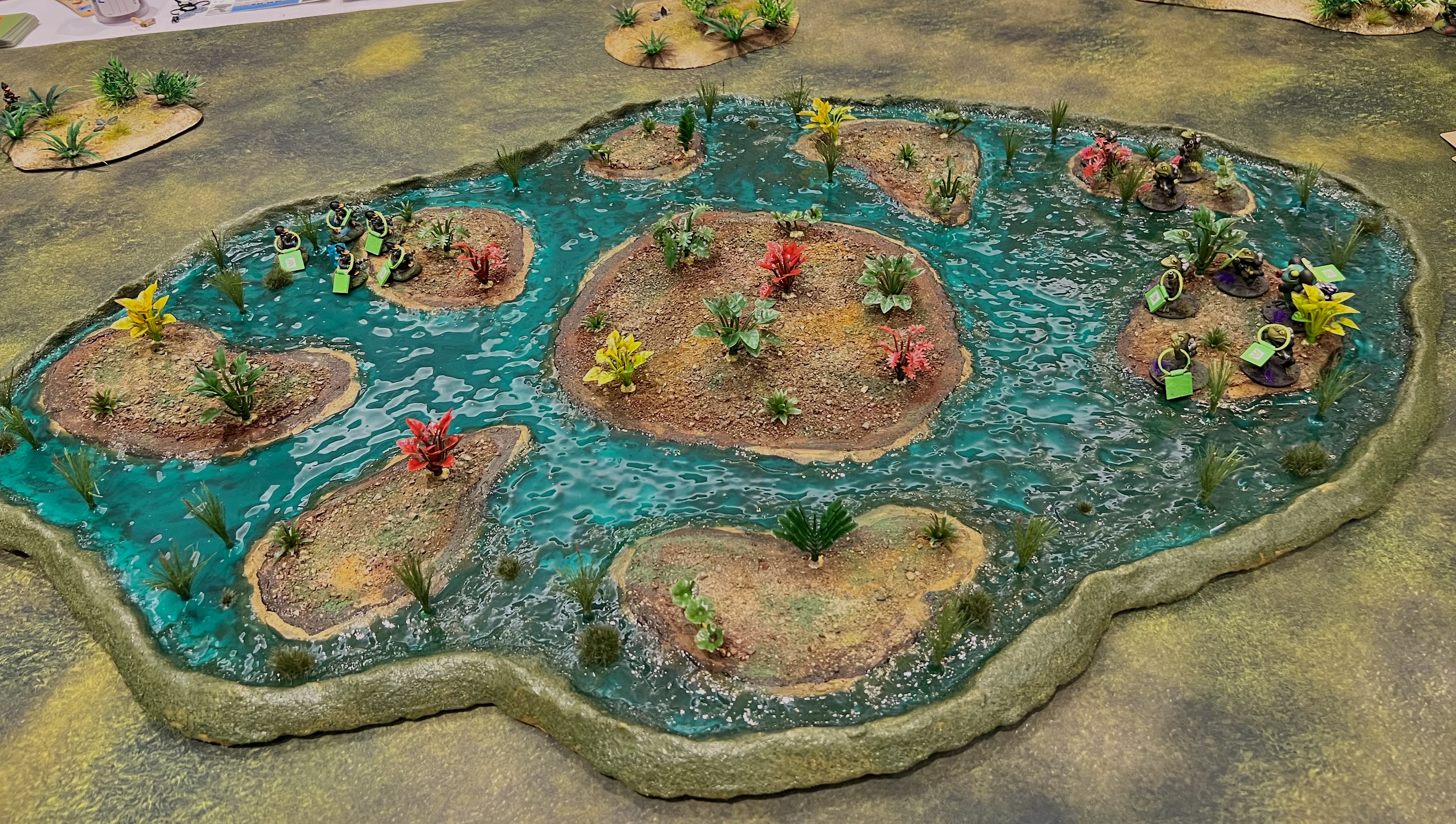
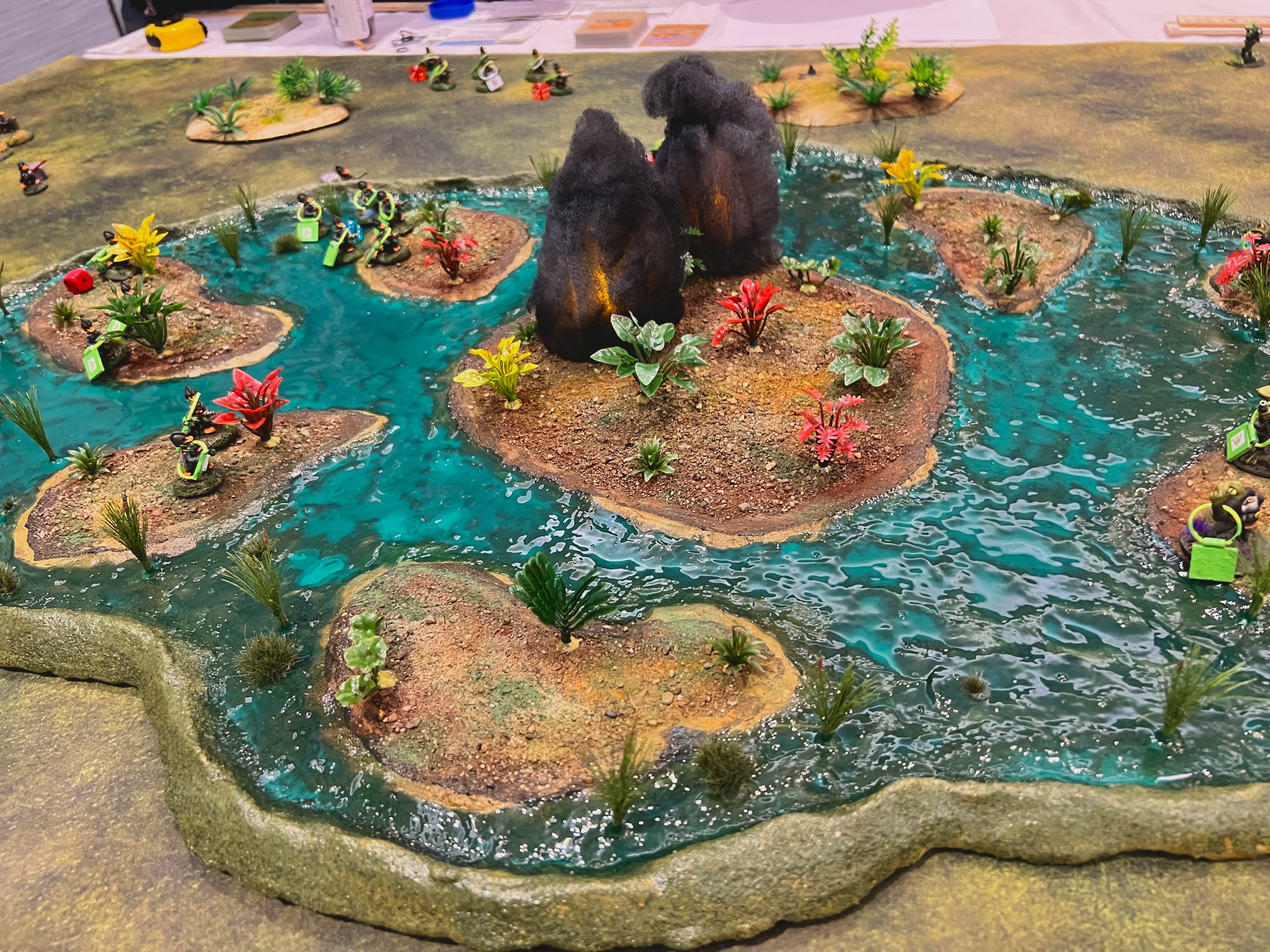
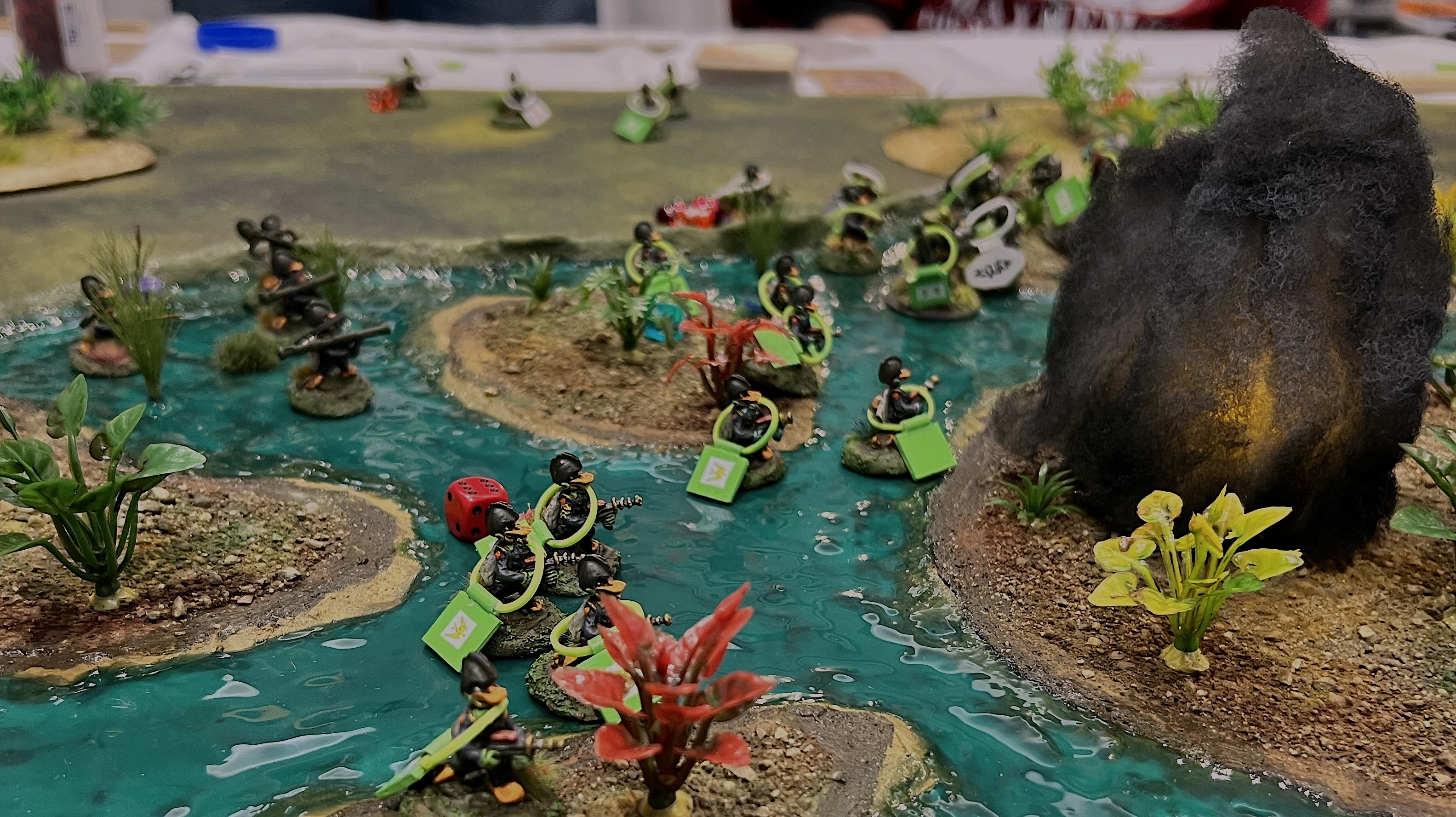
This was a Combat Patrol:WWII retro sci-fi game using the pond that I described in my last post.
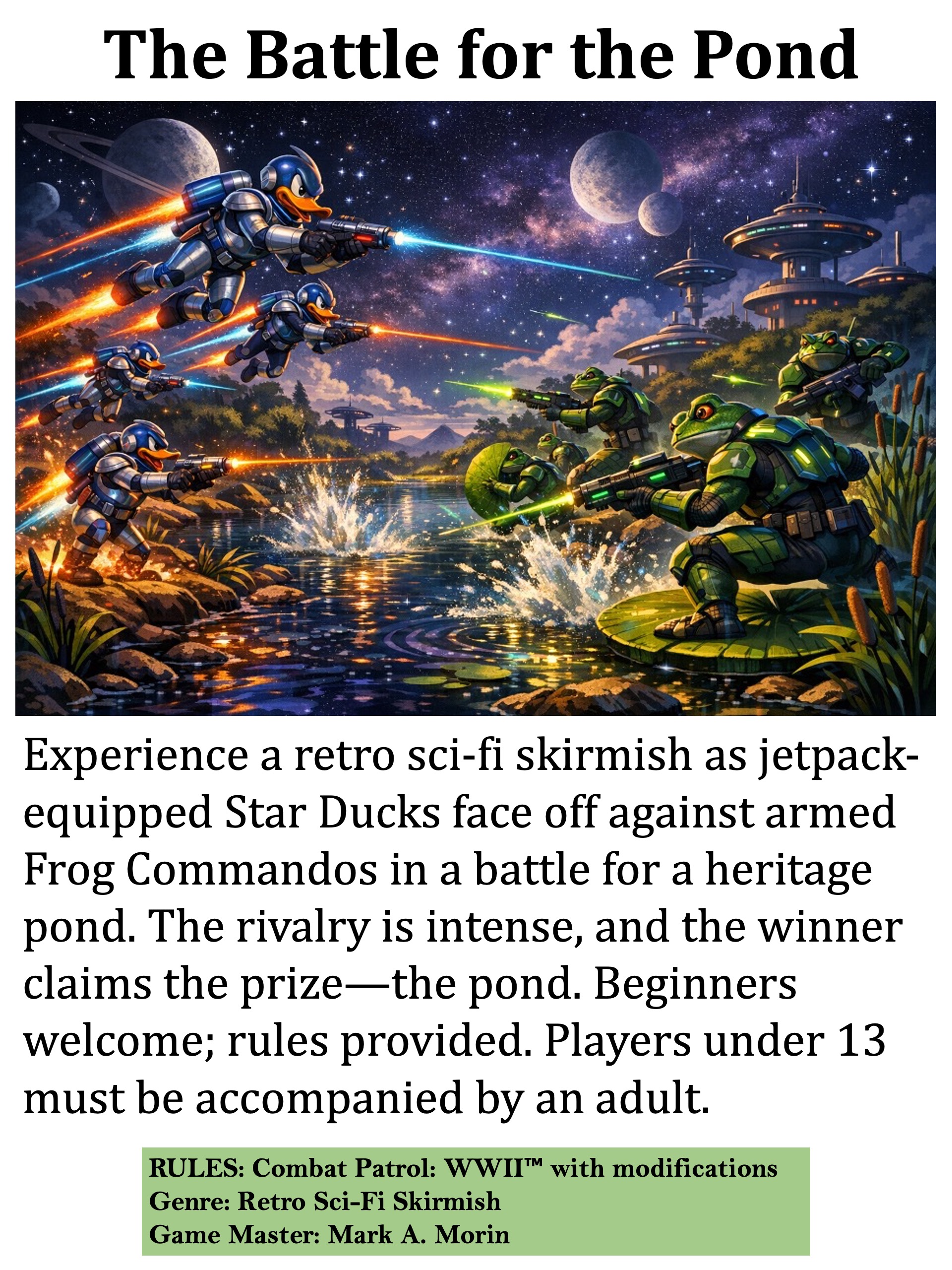
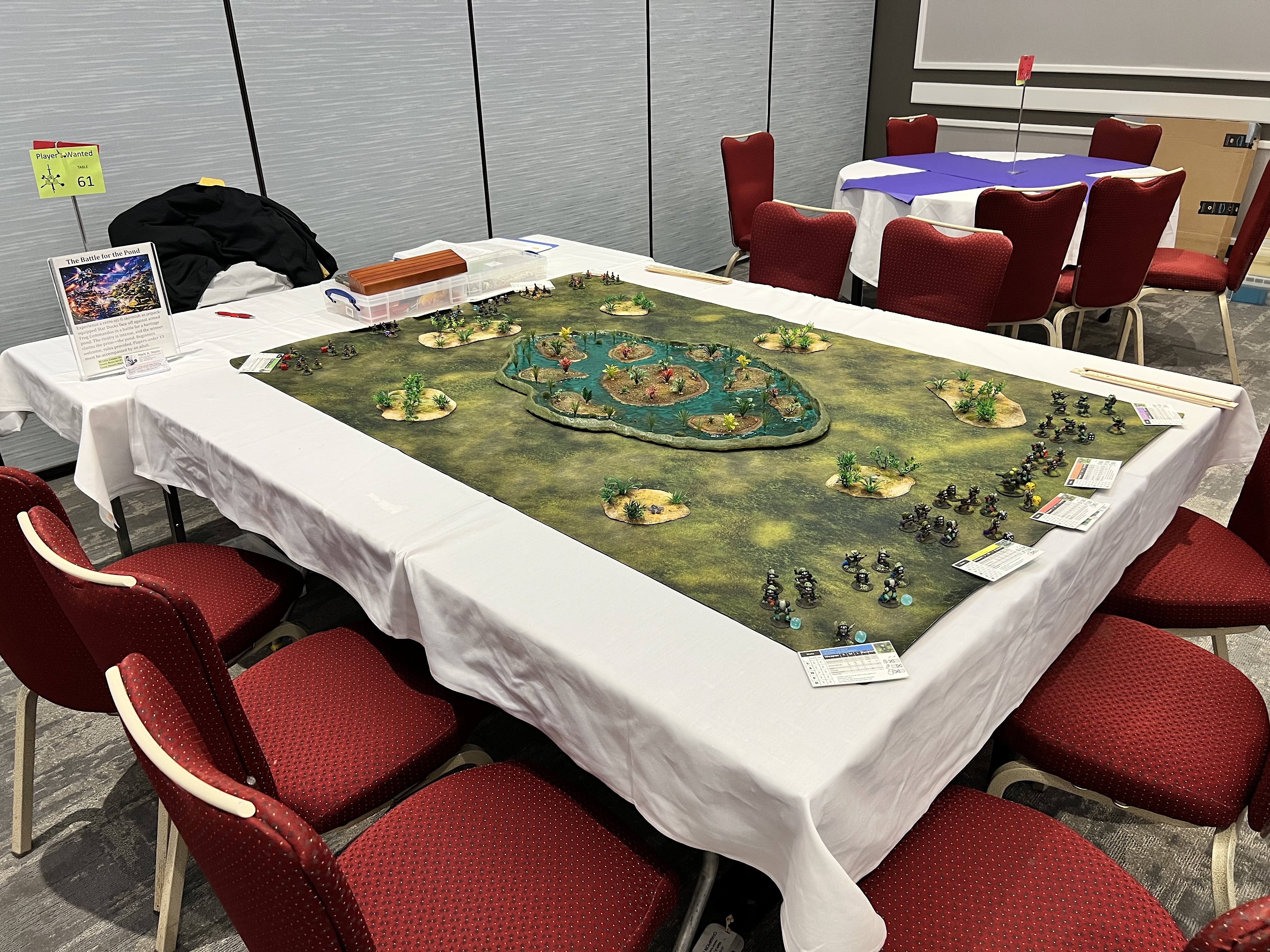
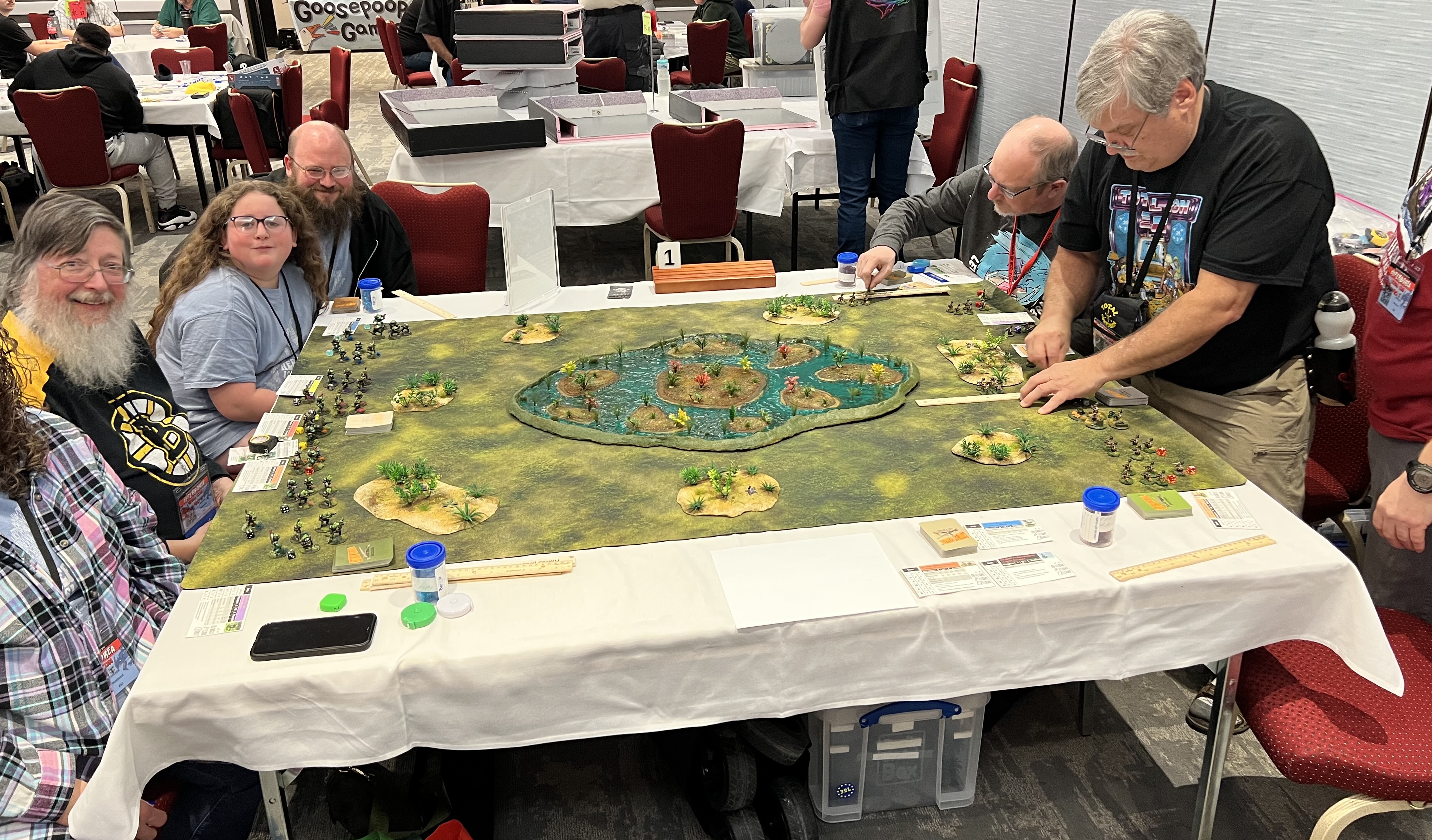
My game flyer.The tabletop set up for action. The F.R.O.G. Commandos are on the near side, with the Star Ducks on the far end. The Star Ducks are Archive Miniatures Star Rovers figures from the late ’70’s/early 80’s. The Frogs are Critter Commandos figures from the early 1990’s.The Star Duck players move up.The Star Ducks use one of their two jet pack moves to occupy islands. In the game, control of the smaller islands was worth 5 points. Controlling the largest island earned players 10 points.The Frogs were also jet packing. The Star Ducks used mortars to lay down a protective smoke screen against their automatic weapons fire.In the end, the luck of the cards deserted the Frogs, with almost every island in Star Duck control.
High Noon at the Cyber Ruins
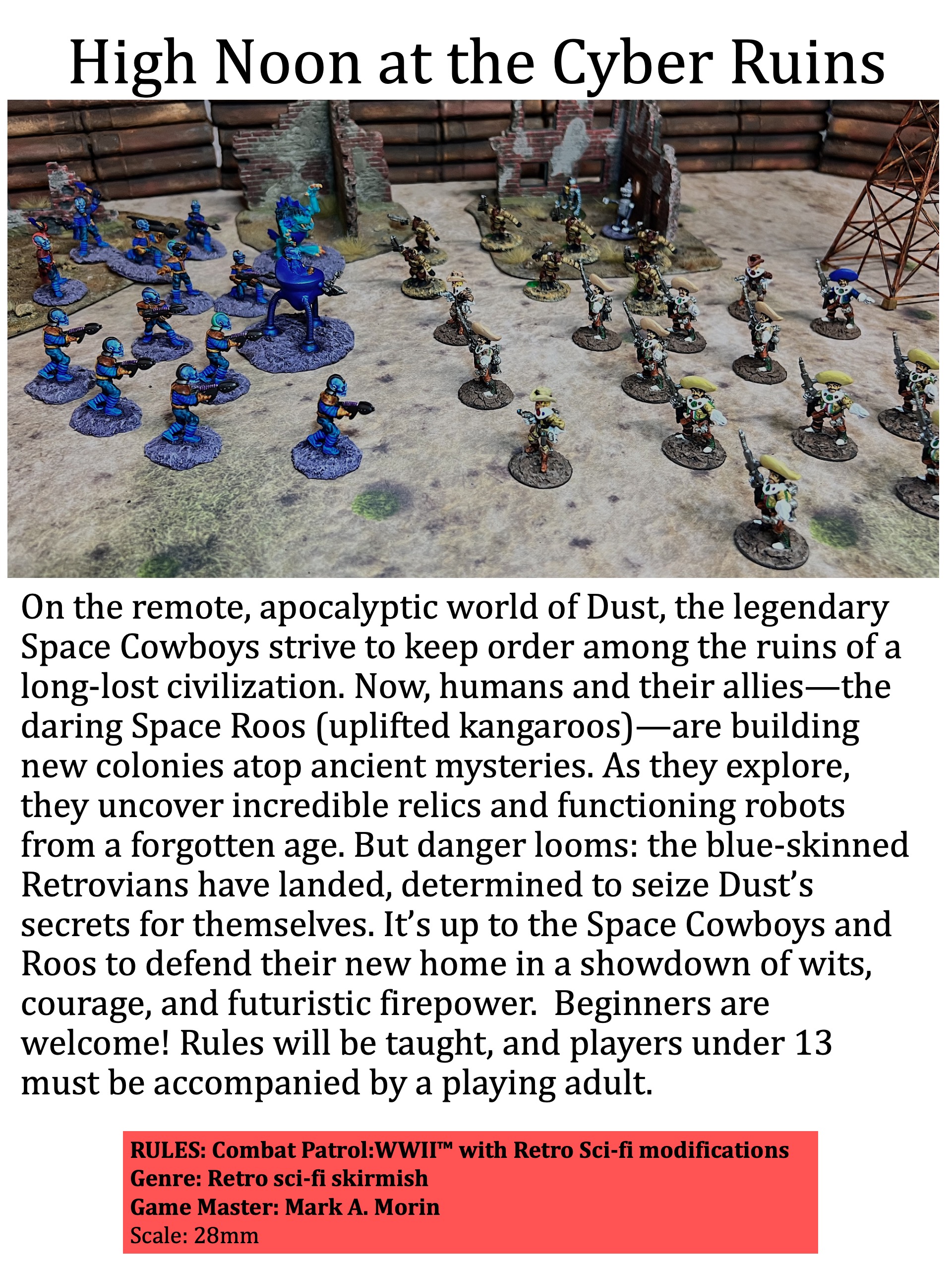
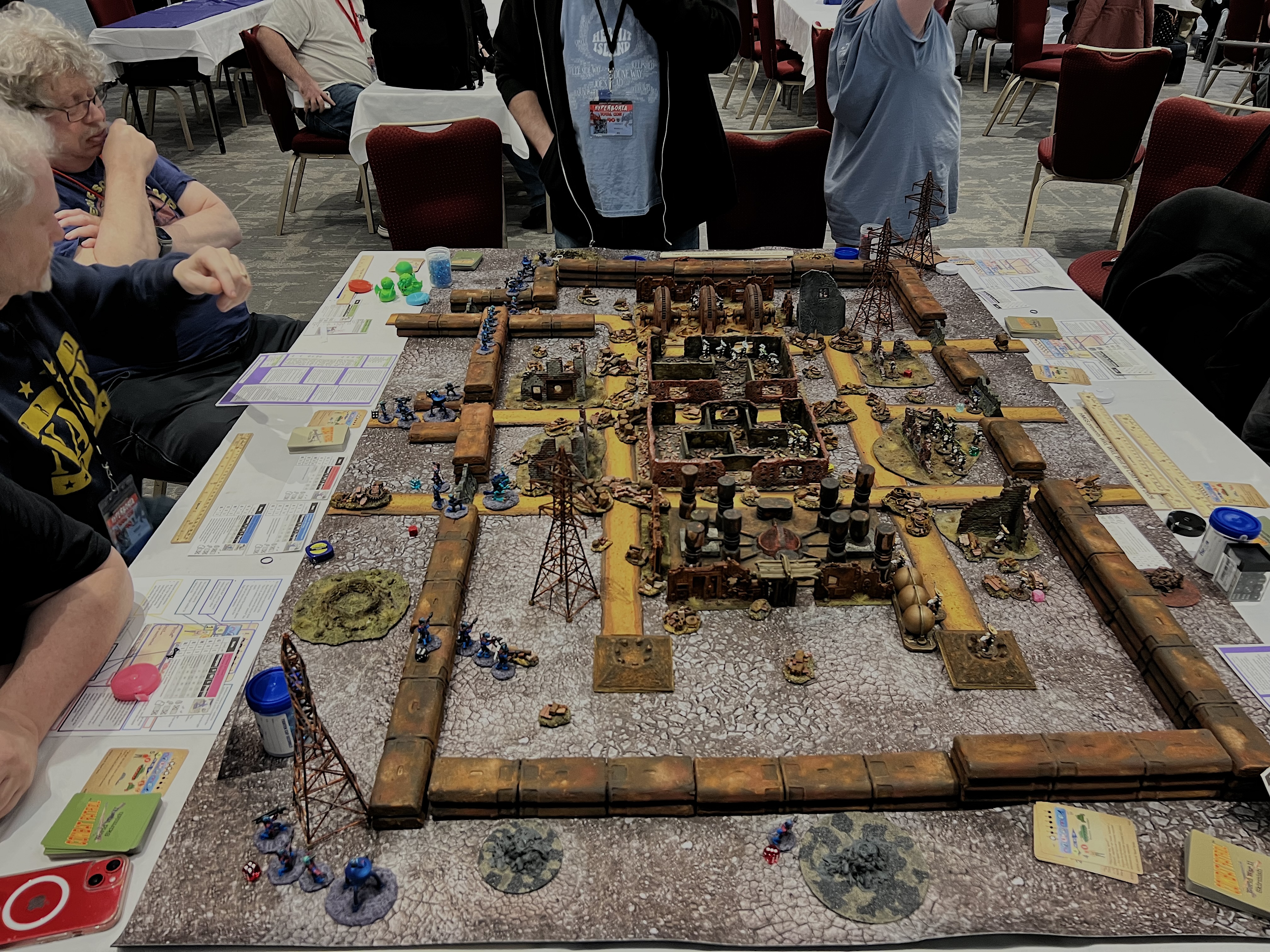
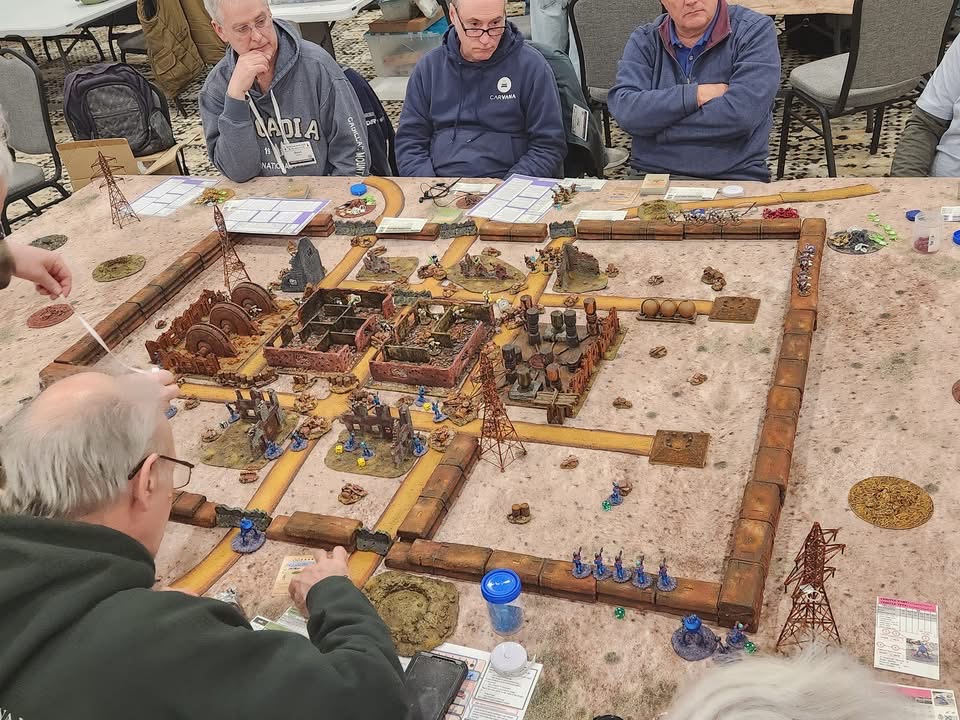
I ran this Combat Patrol retro sci-fi game at Cold Wars, but on a bigger table. I used a different mat and adapted the game to a smaller footprint.
Game flyer.
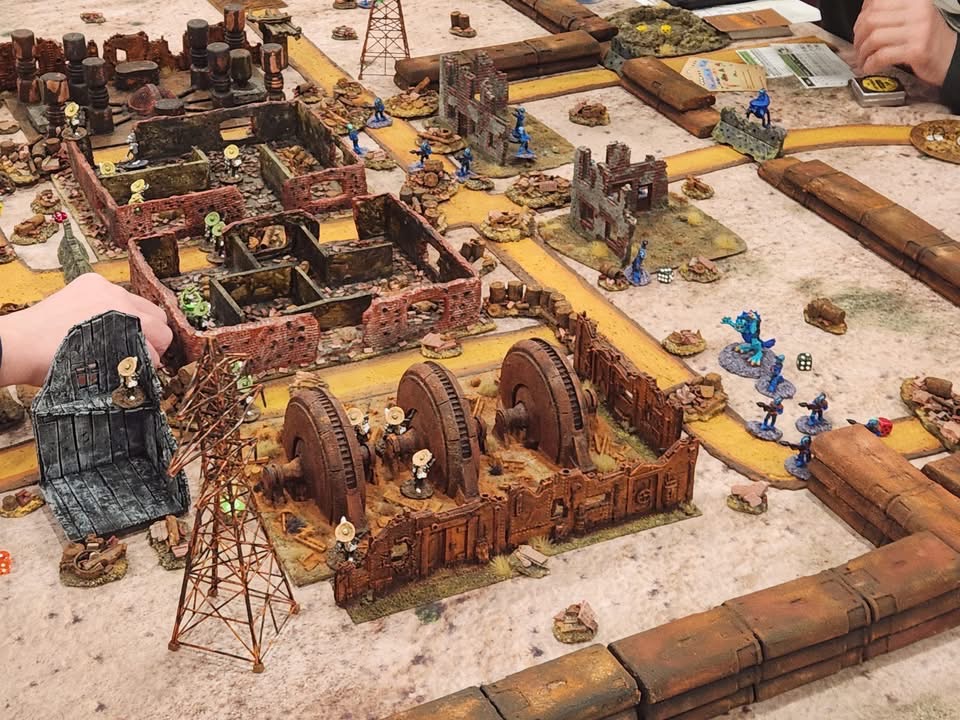
To win the game, both sides get credit (victory points) for inflicting enemy casualties and finding hidden ancient robots.
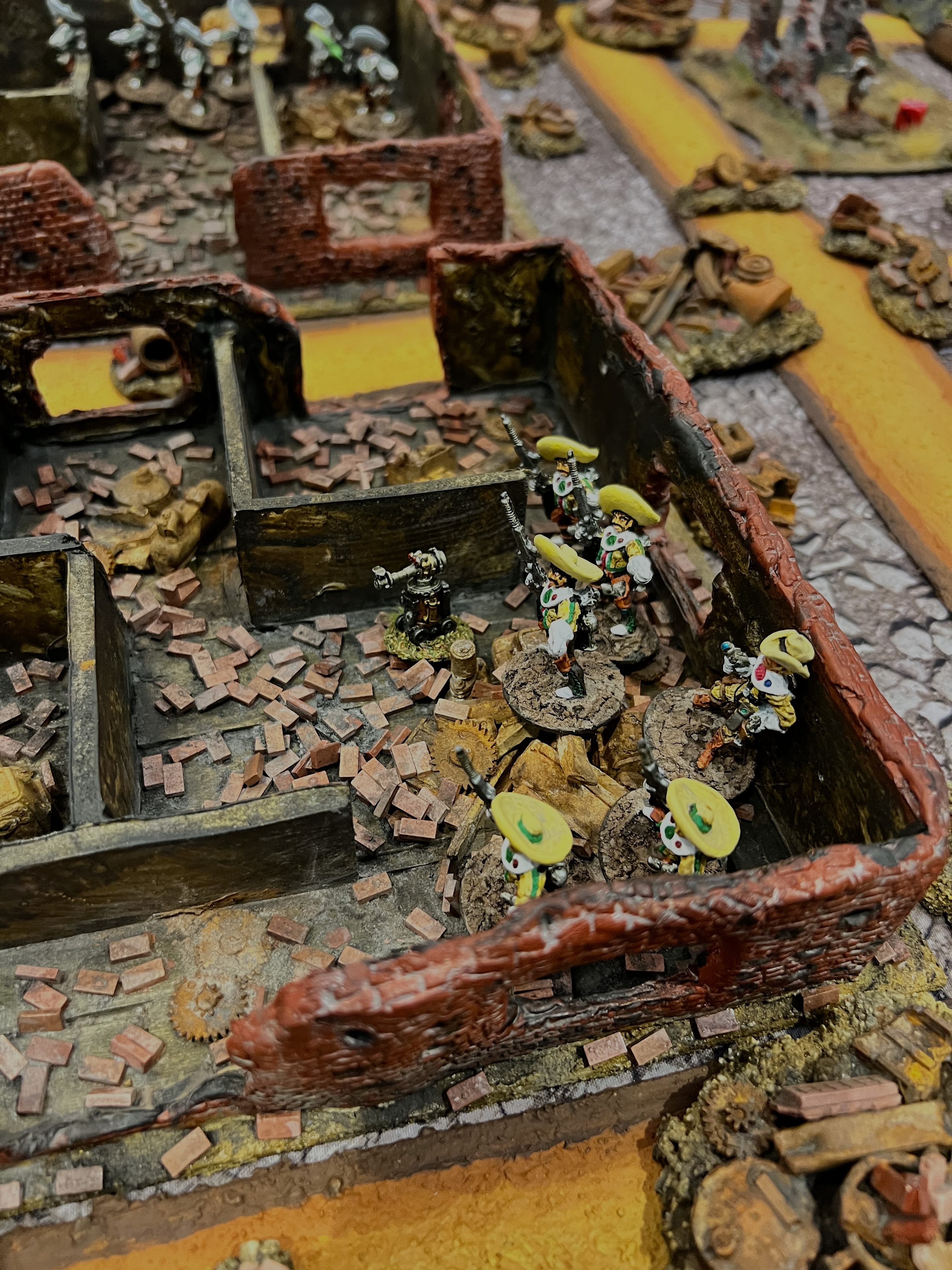
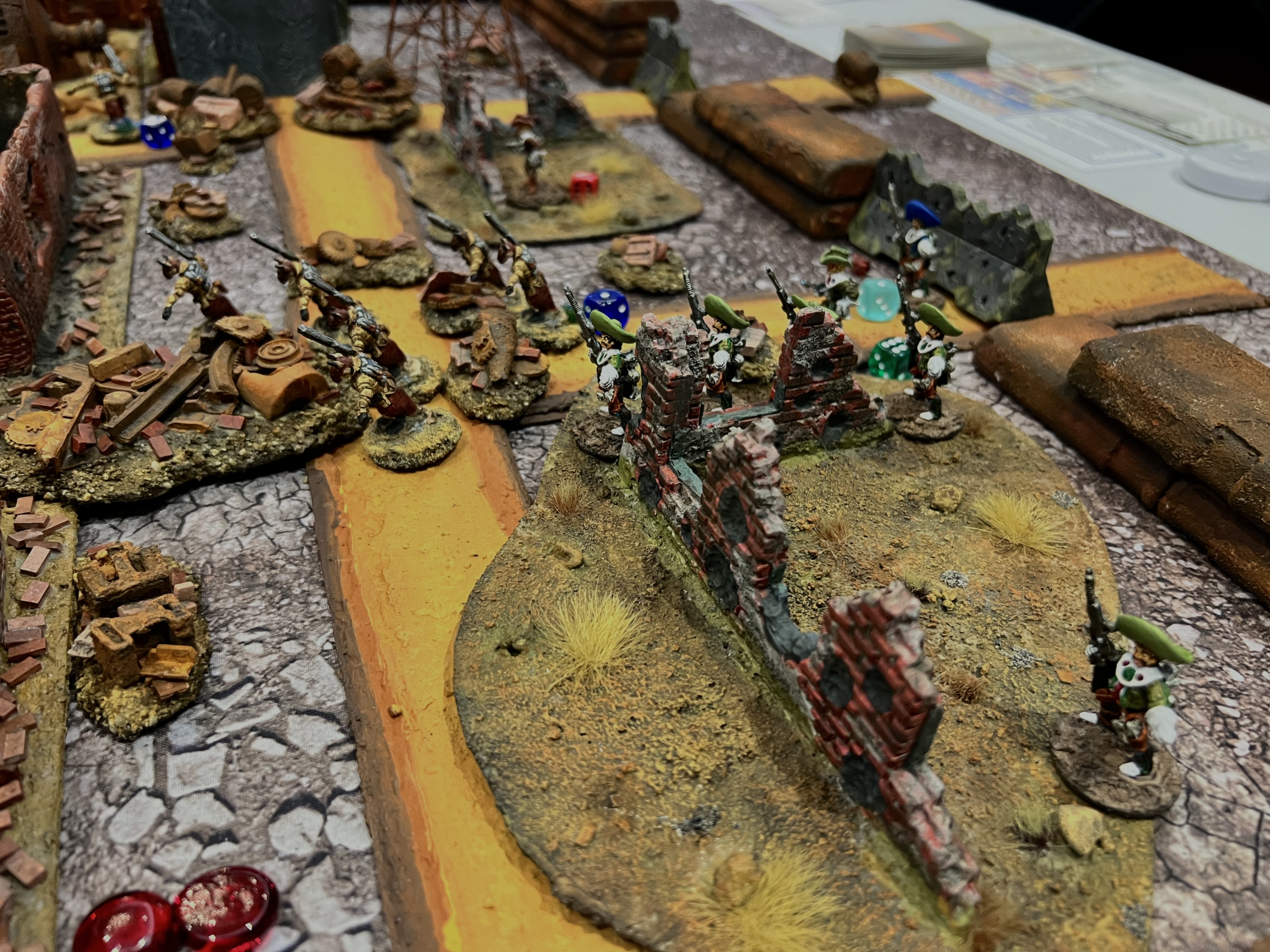
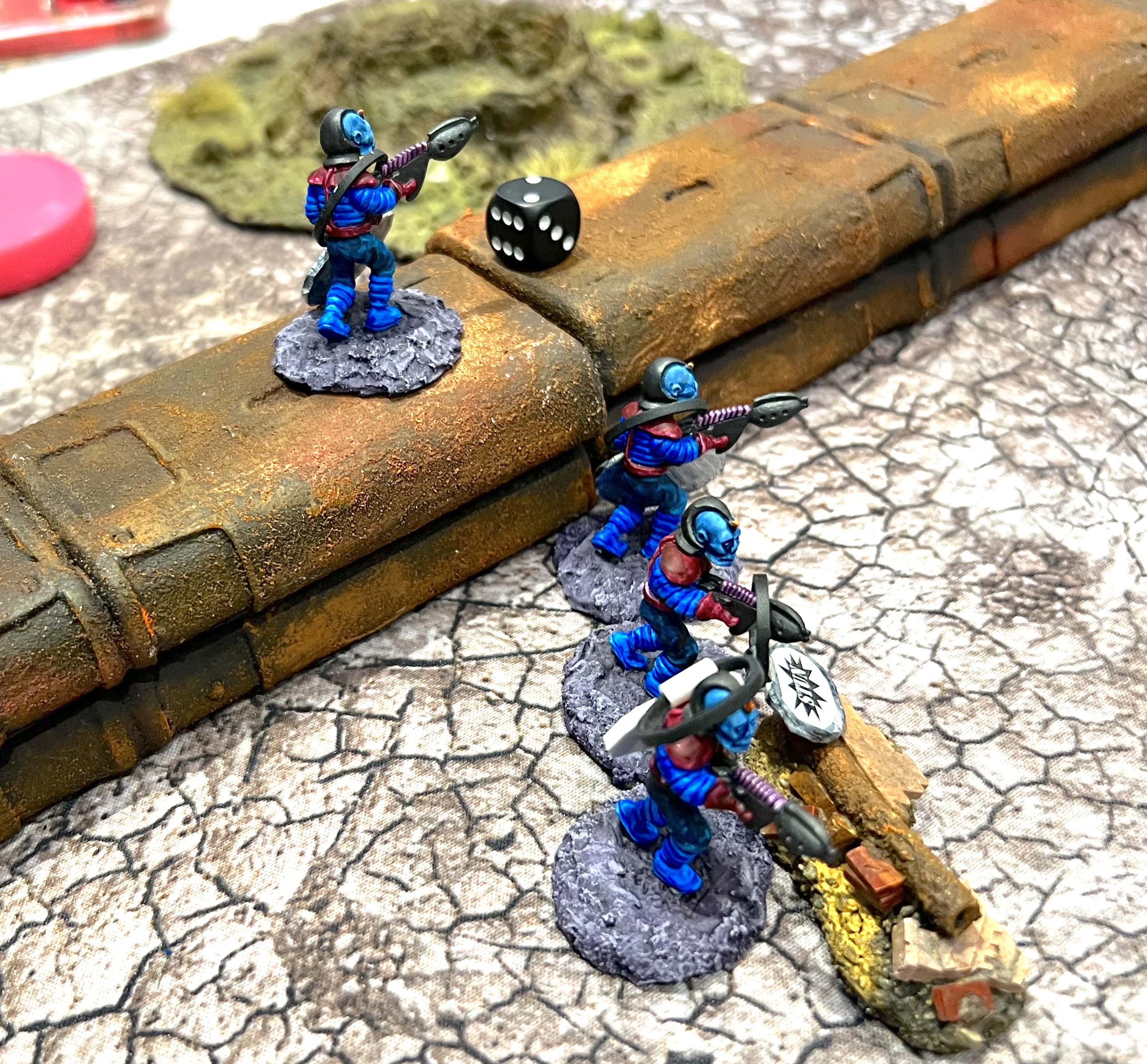
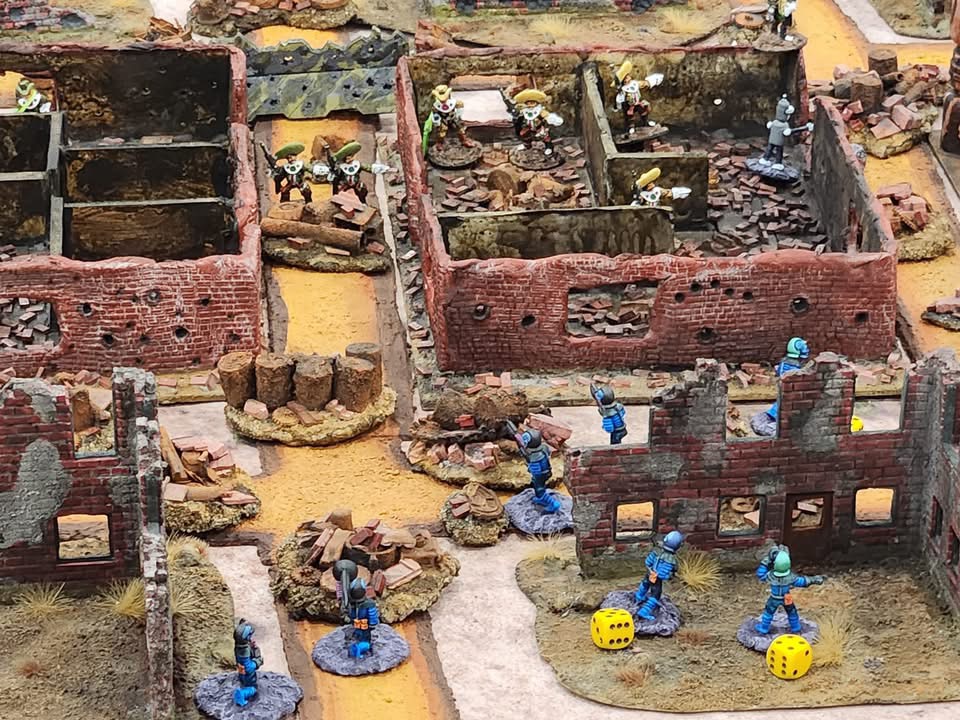
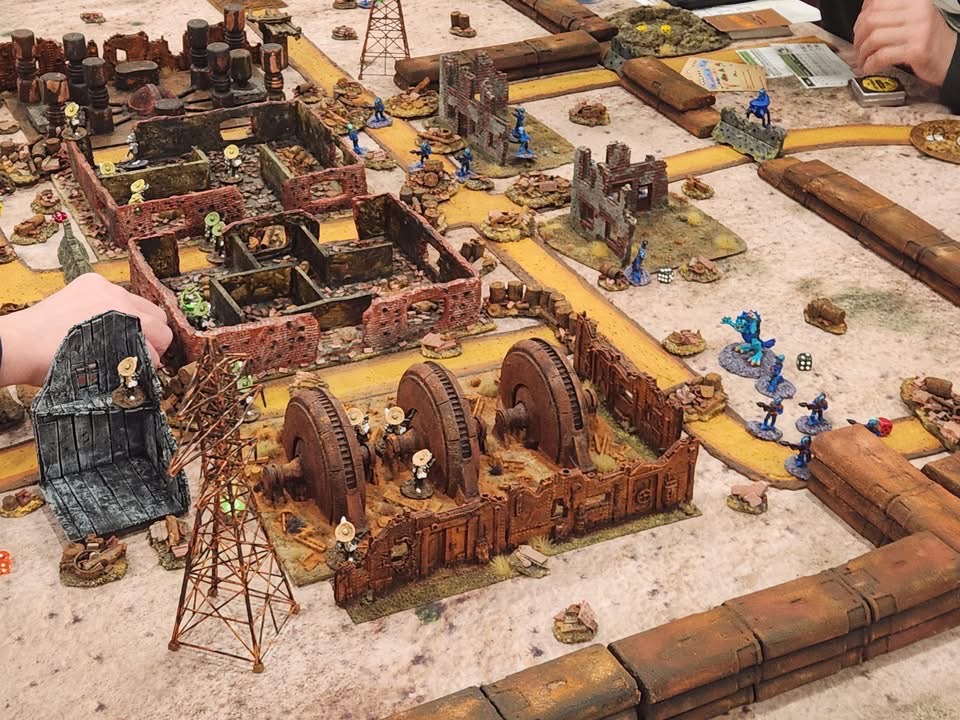
The game was definitely full!Retrovians and Space Cowboys move into the ruined city.The Space Cowboys find a robot (an Archive Robot Cook) and get it to join their side.Reinforcements arrive! Here come the Space Roos.Retrovians take cover under fire while trying to clear the walls.Retrovian infantry move into the city.
In the end, the casualties on both sides were high. But, the Space Cowboys possession of robots allowed them a narrow 15-10 victory. That wrapped up Thursday’s games.
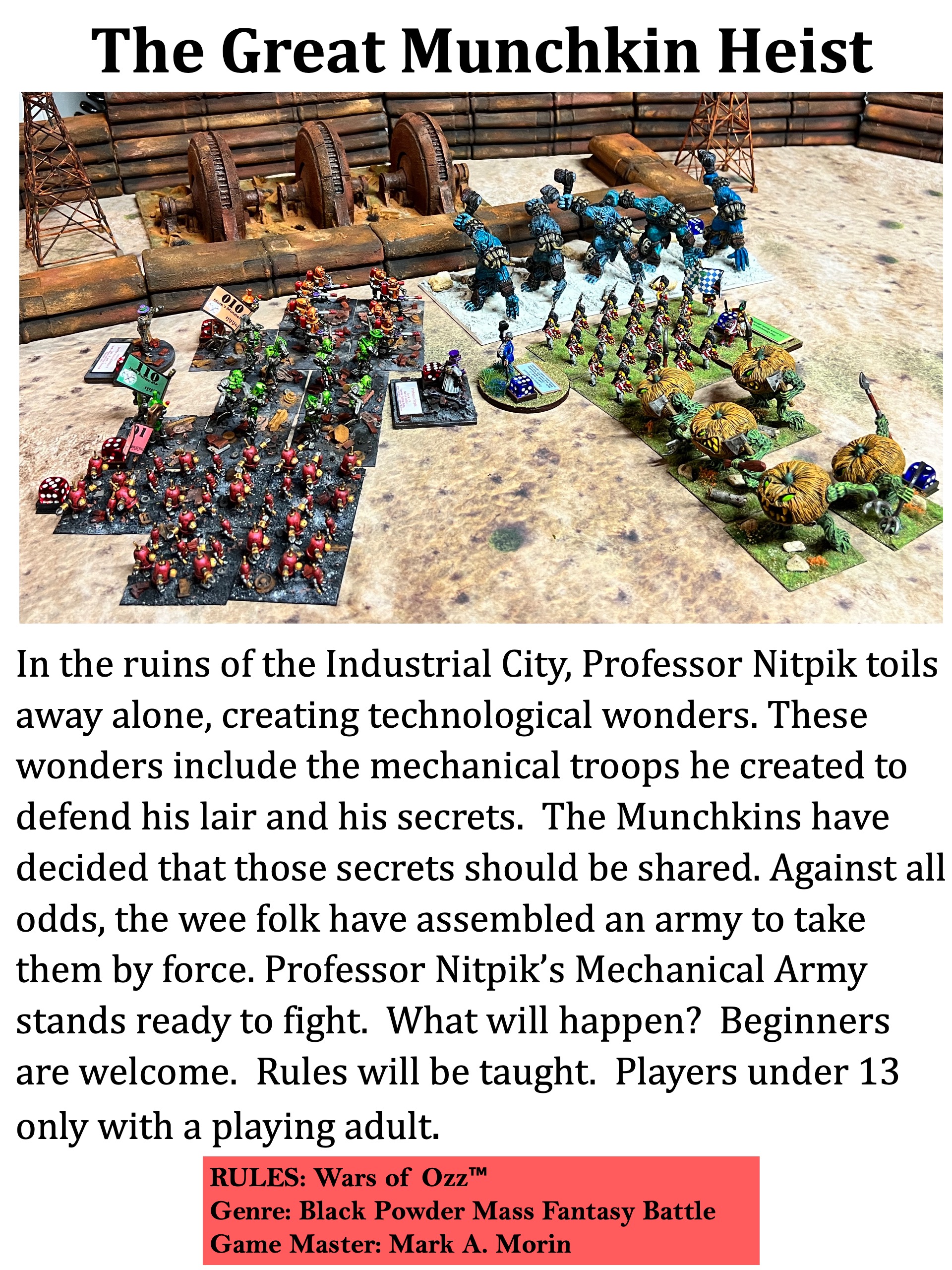
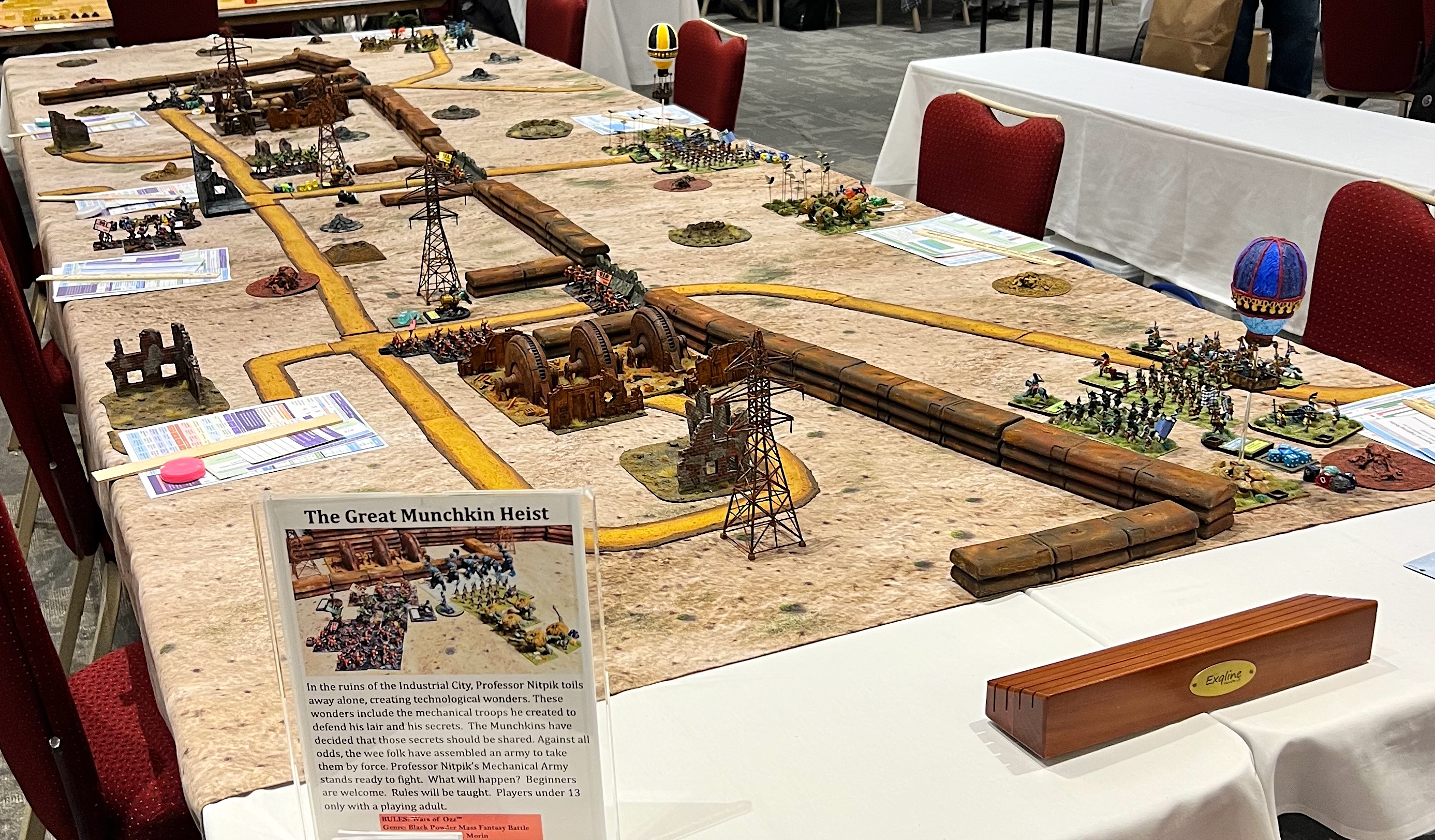
I decided not to run a Friday morning game this year. Last year, resetting the flea market room took too much time. It interfered with my morning game setup. Instead, I had plenty of time to move everything into the “big room” and set up on the “big table”. My first game was a Wars of Ozz game. It was titled “The Great Munchkin Heist”. I had also run it at Cold Wars. This time I had an even bigger table than I had there!
The Great Munchkin Heist
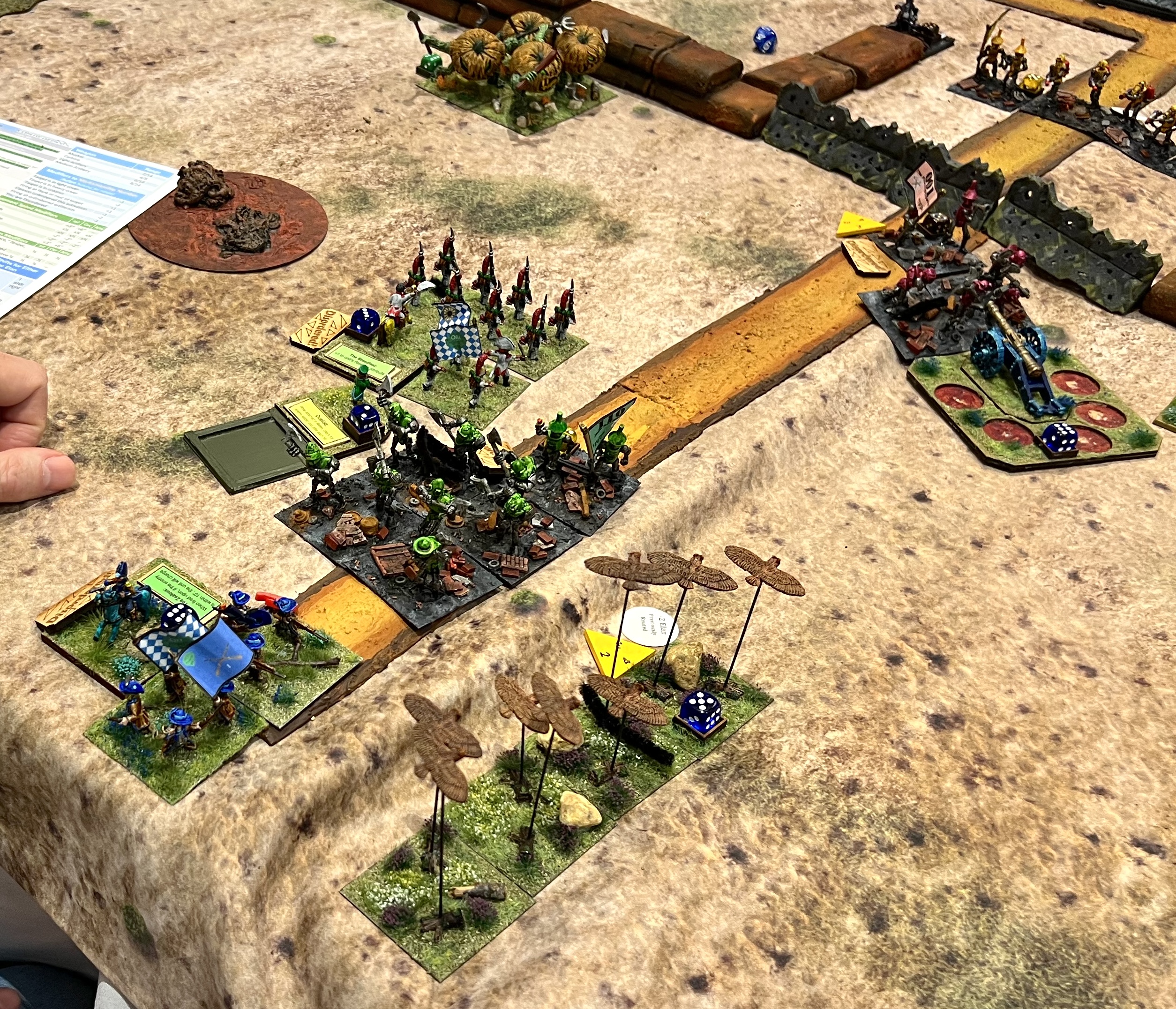
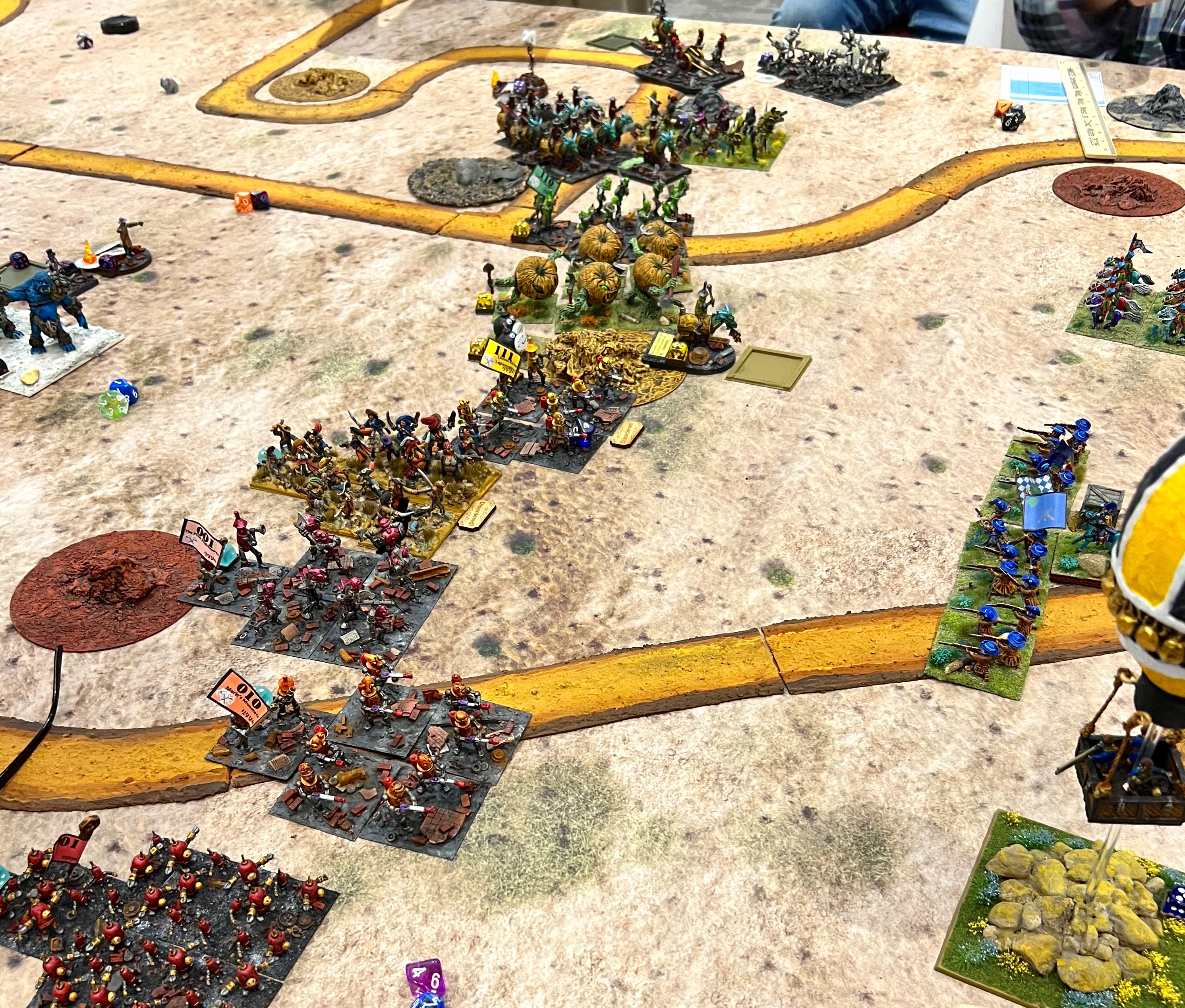
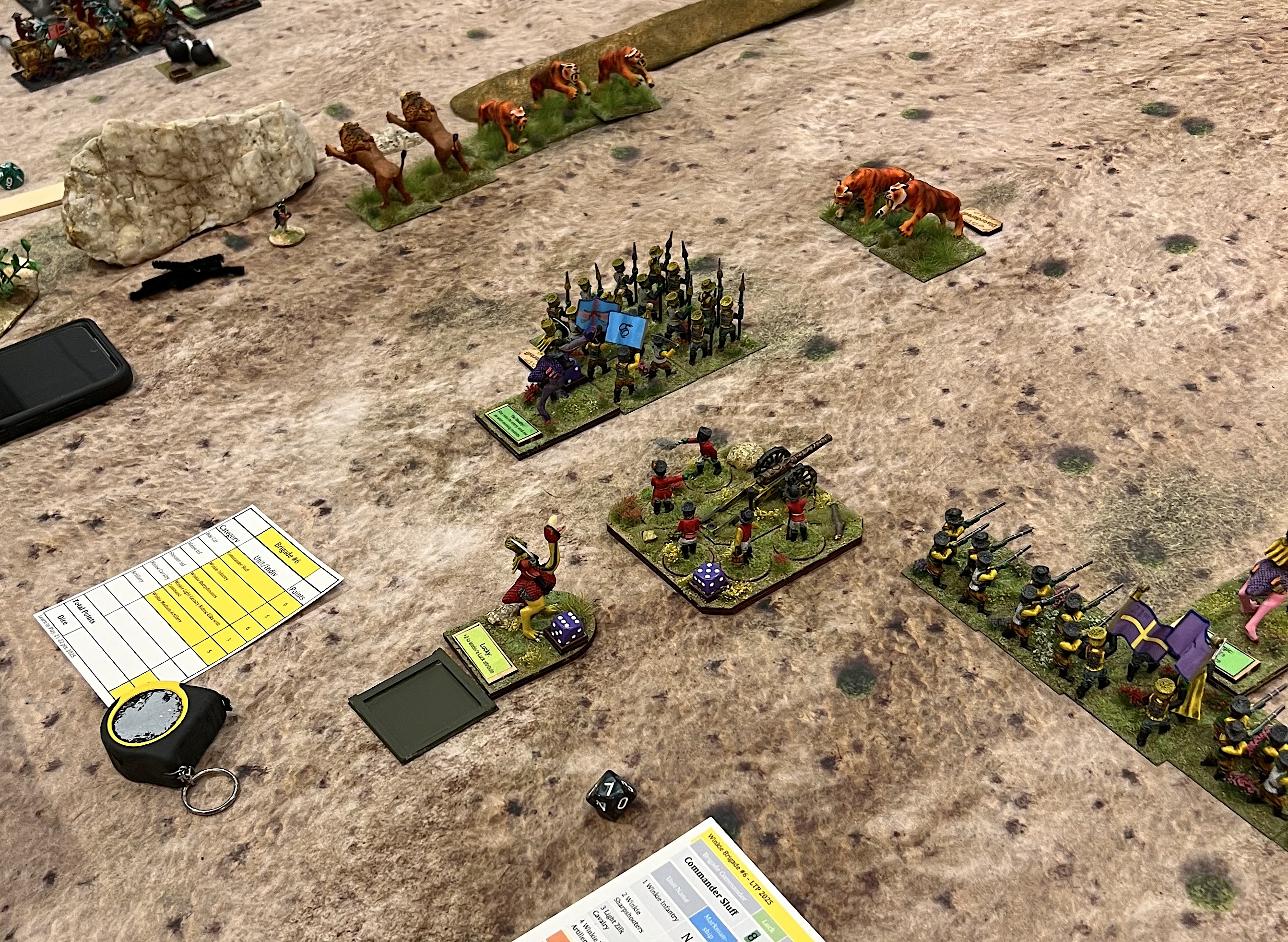
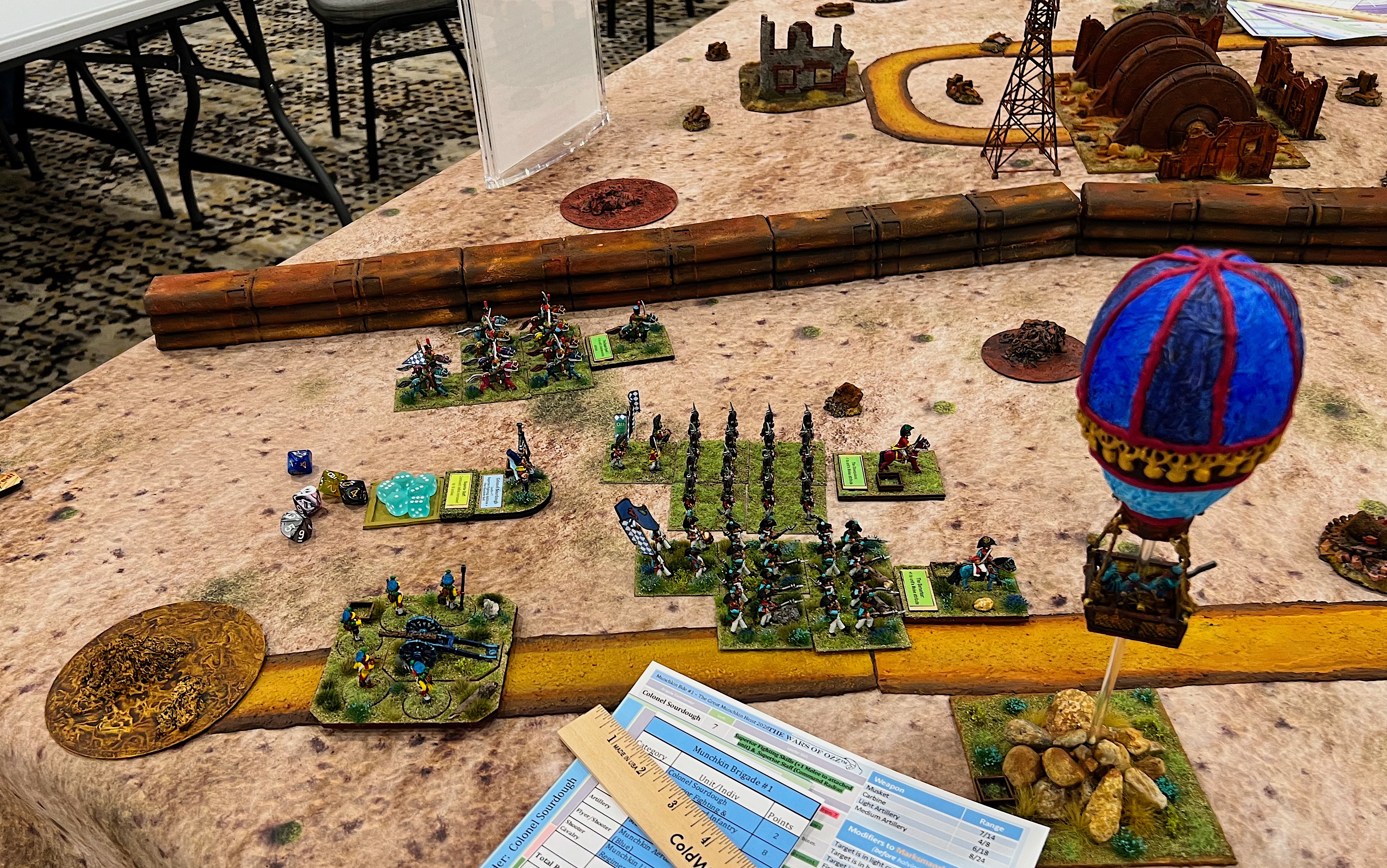
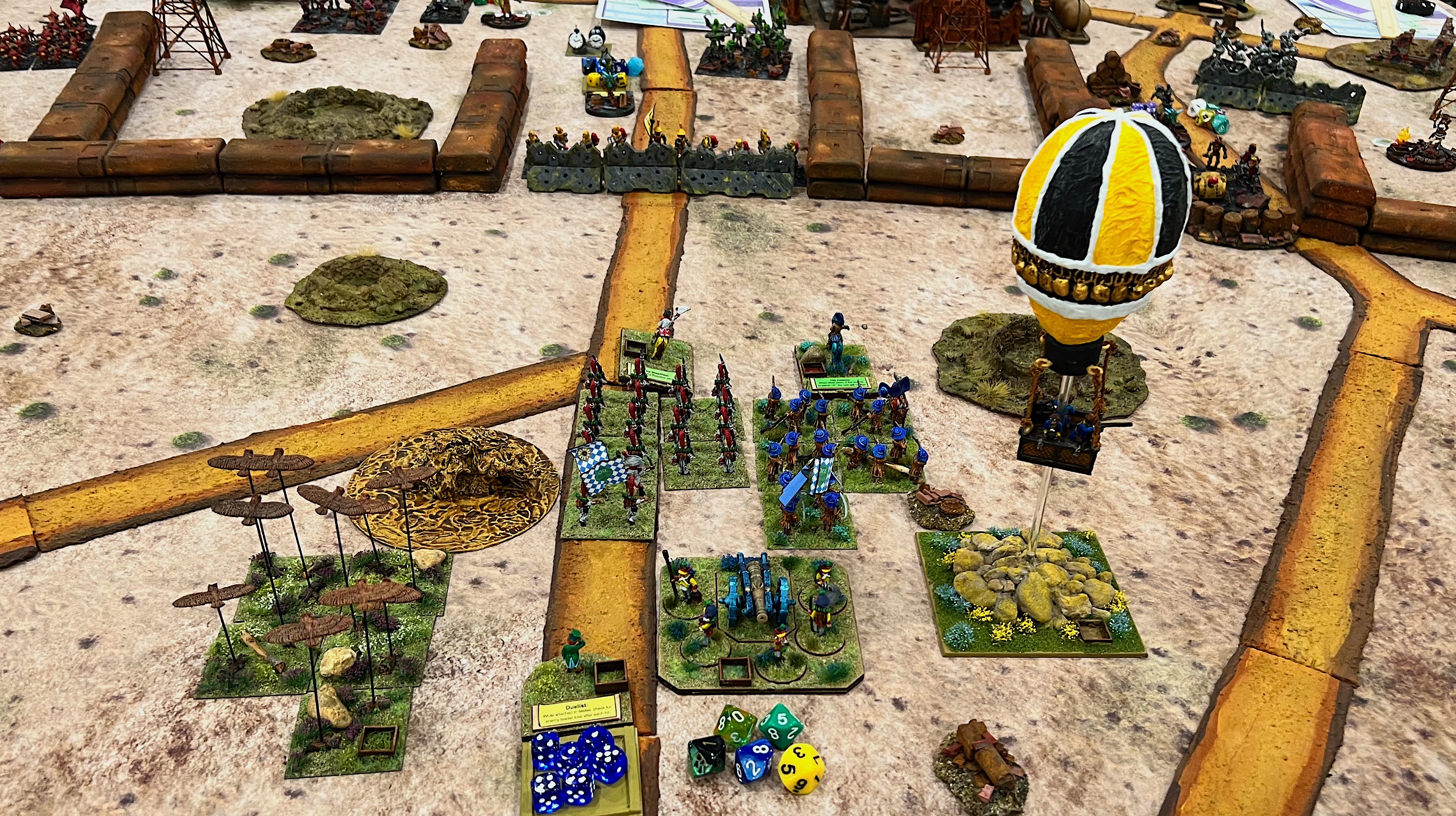
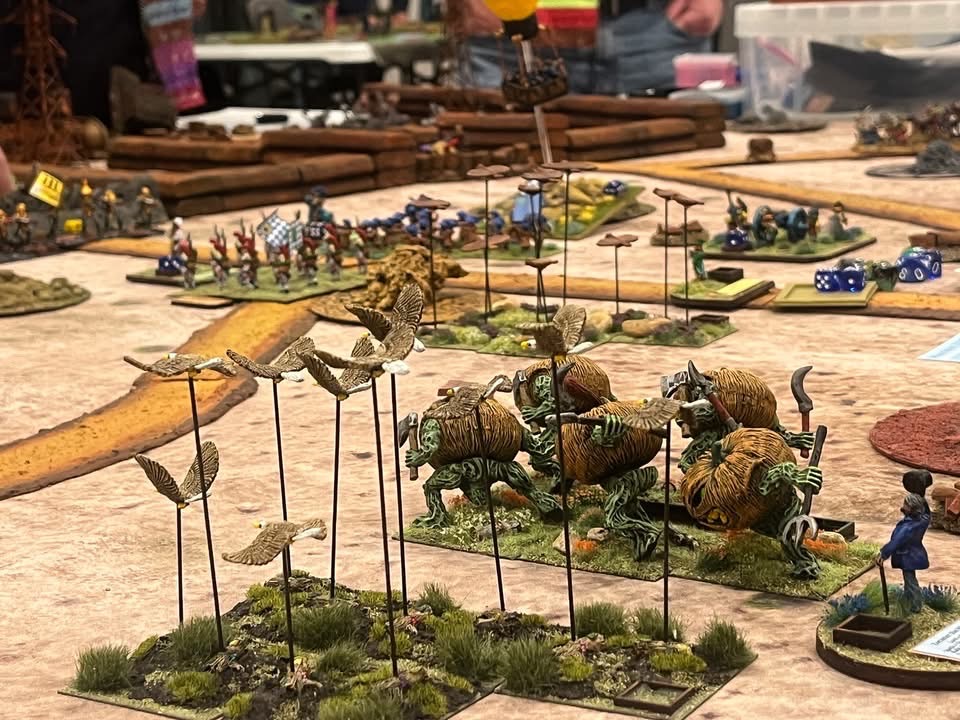
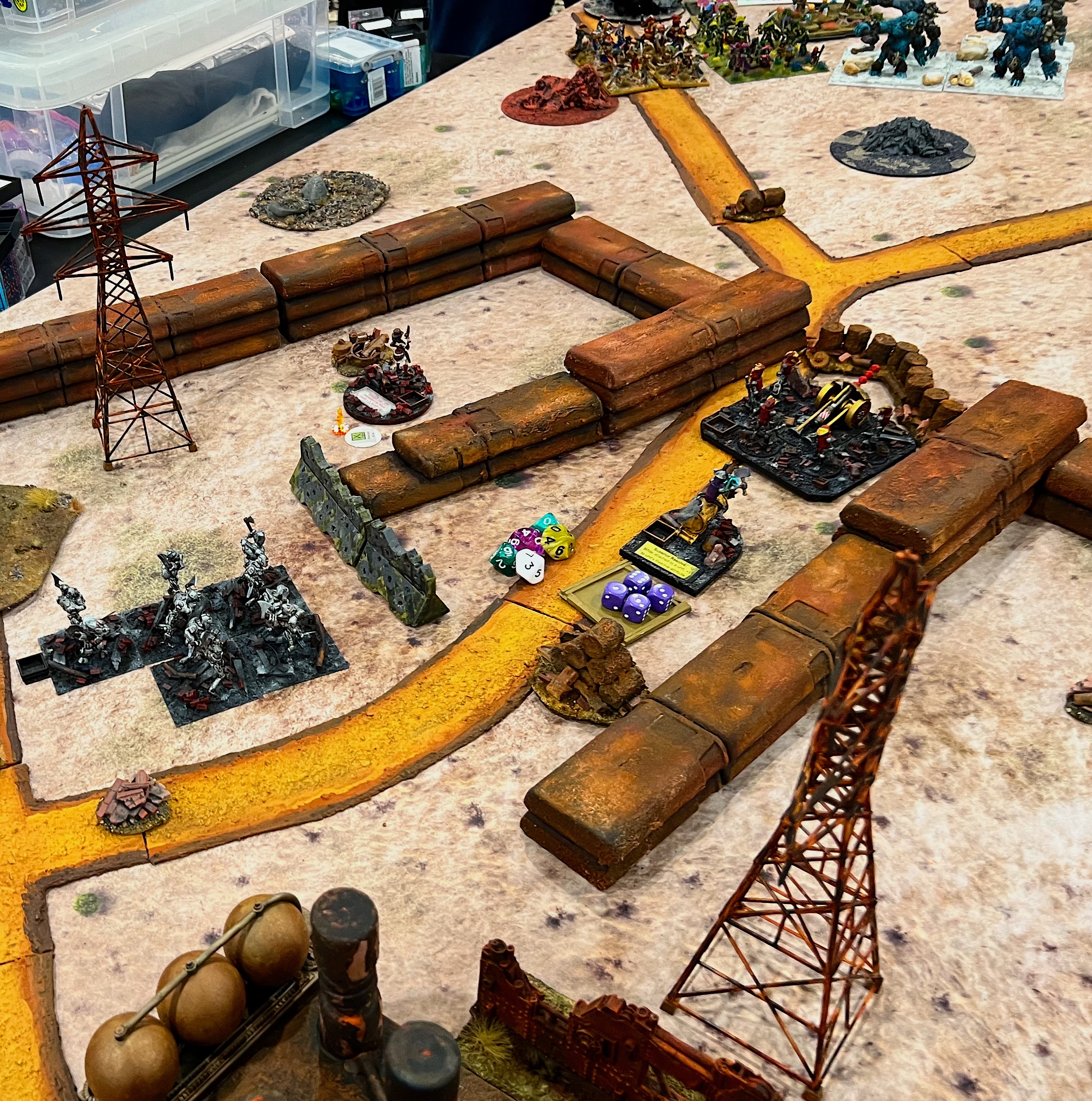
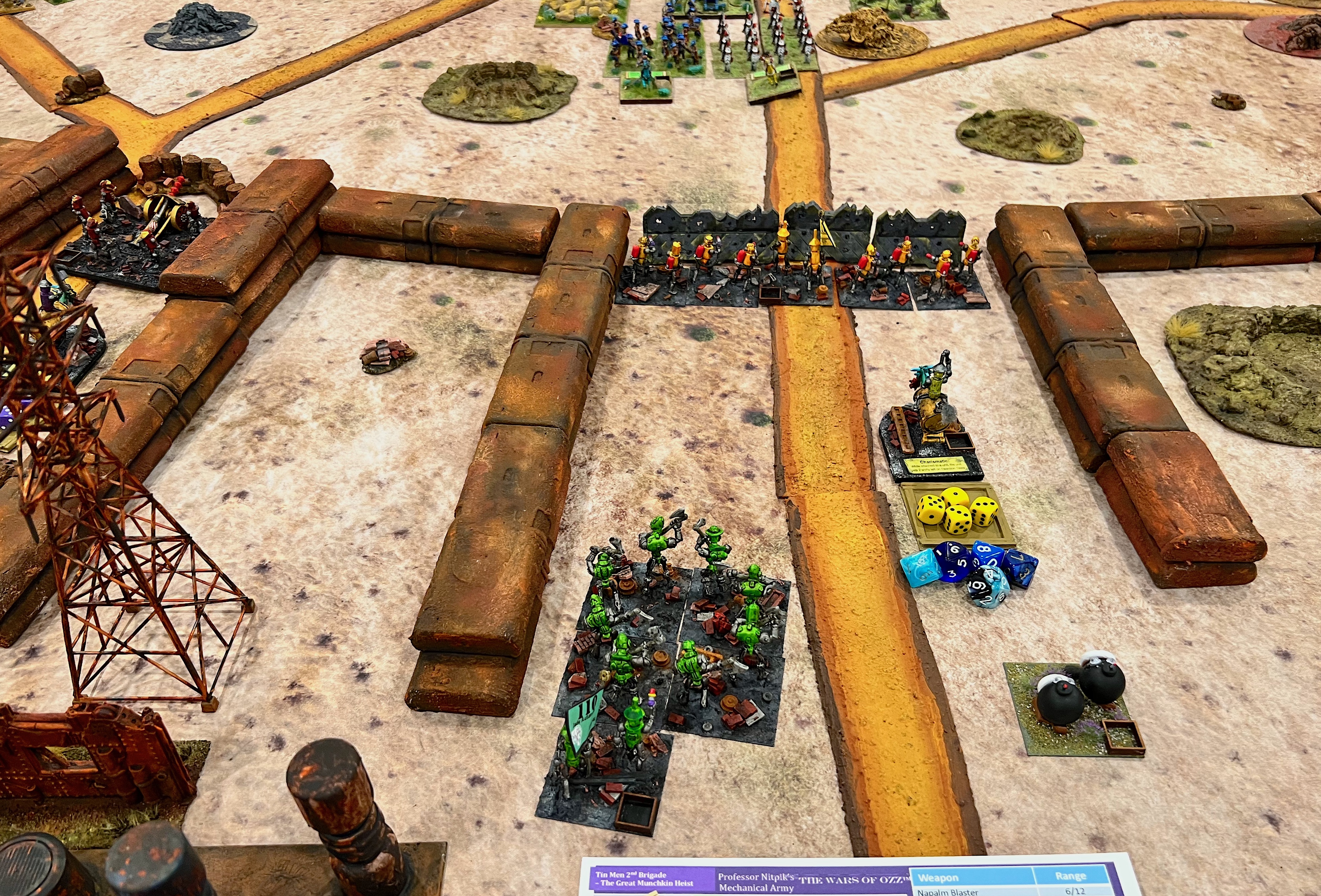
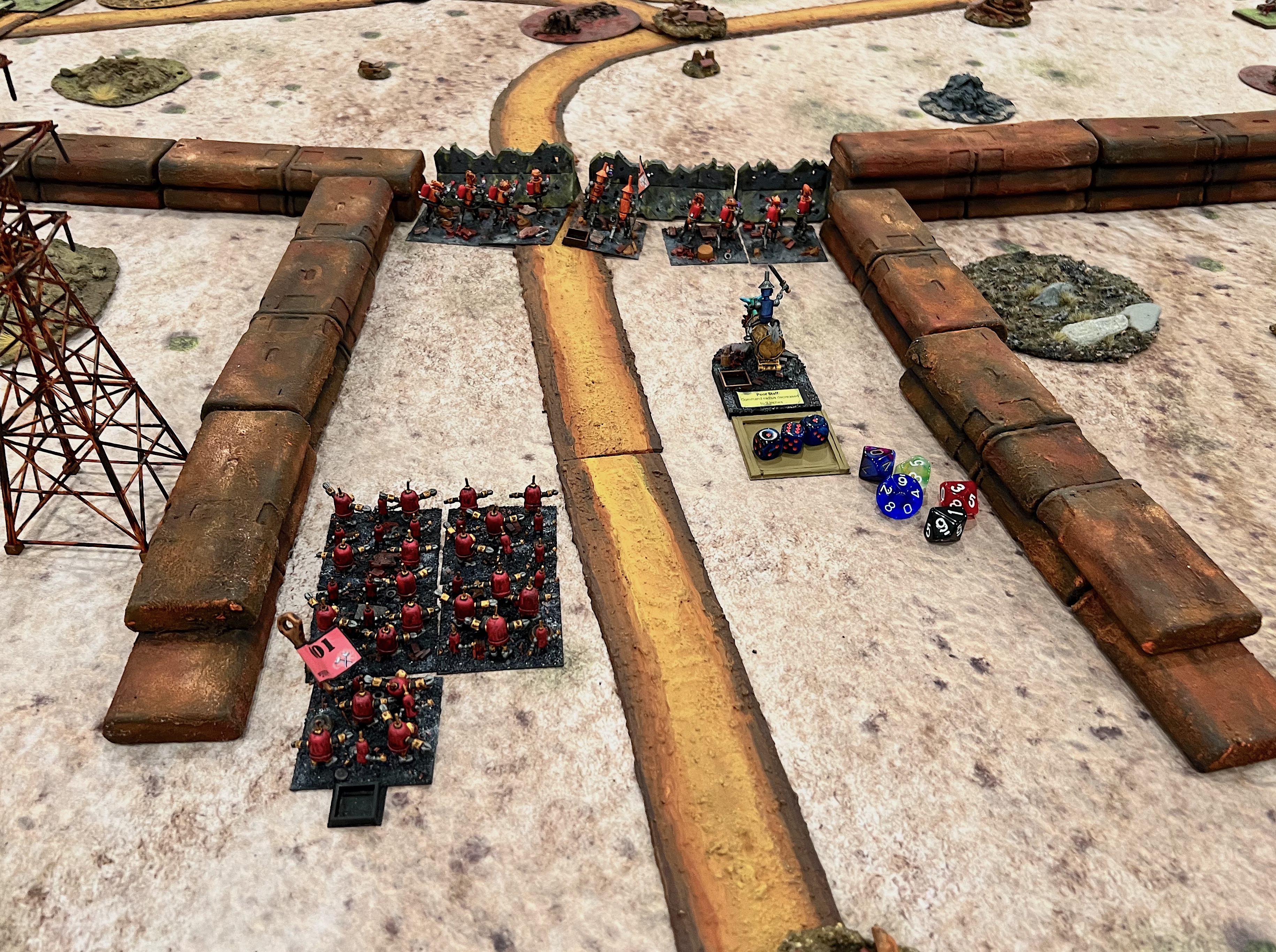
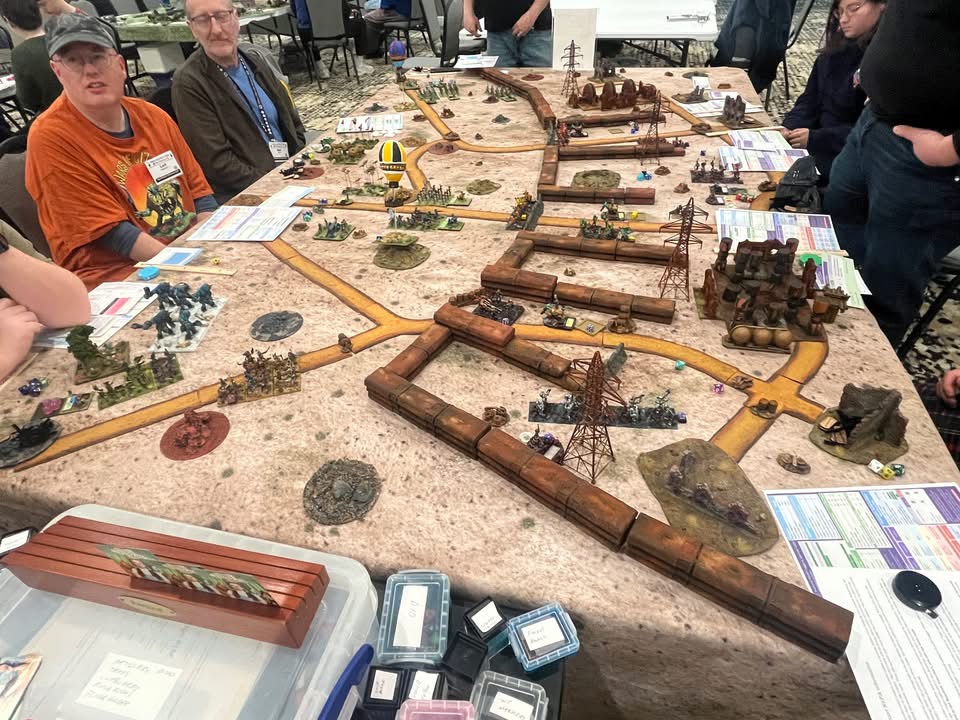
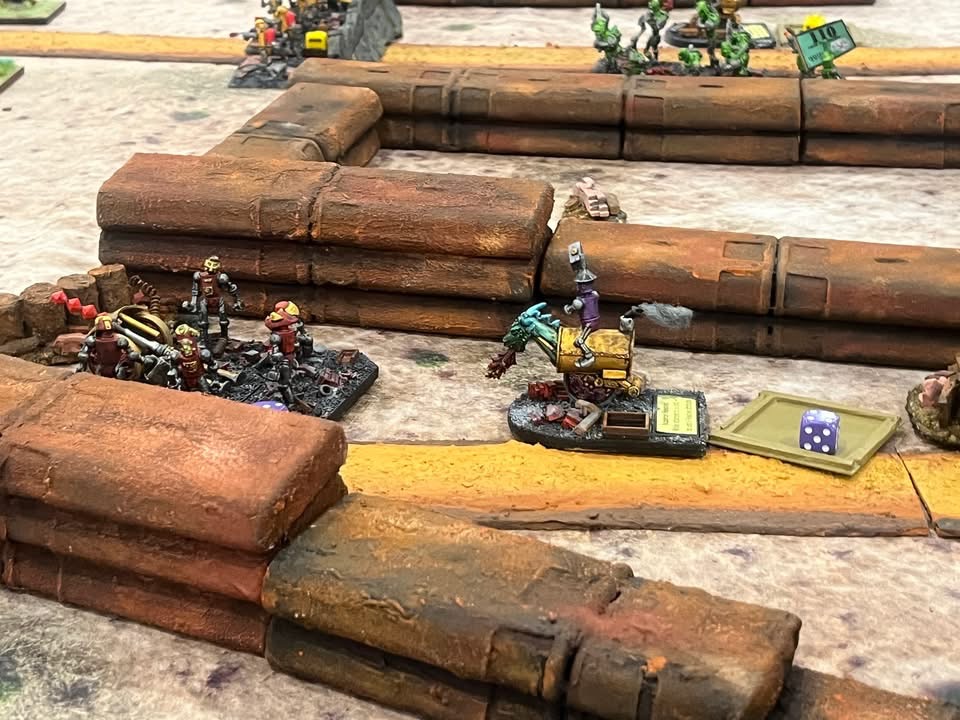
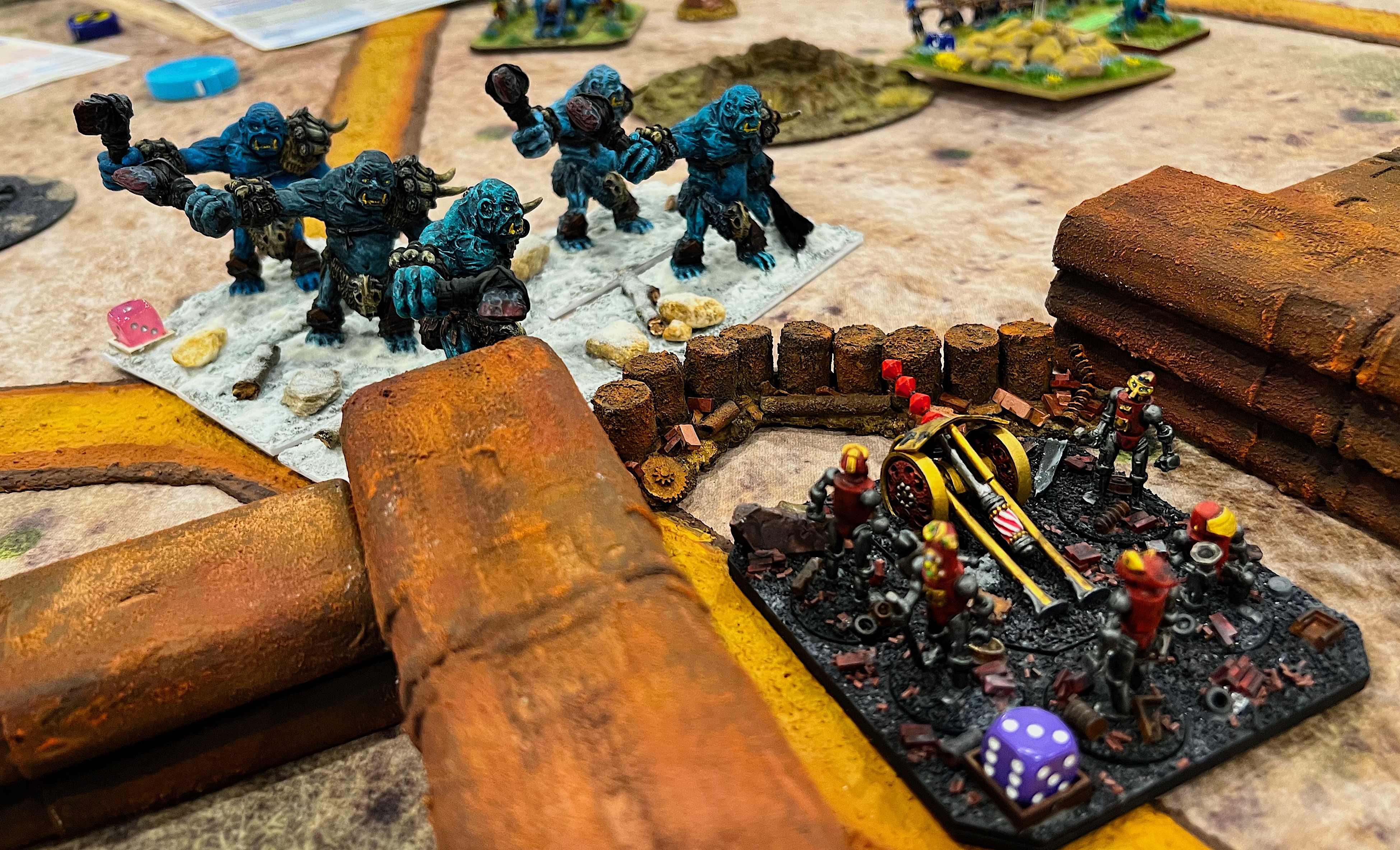
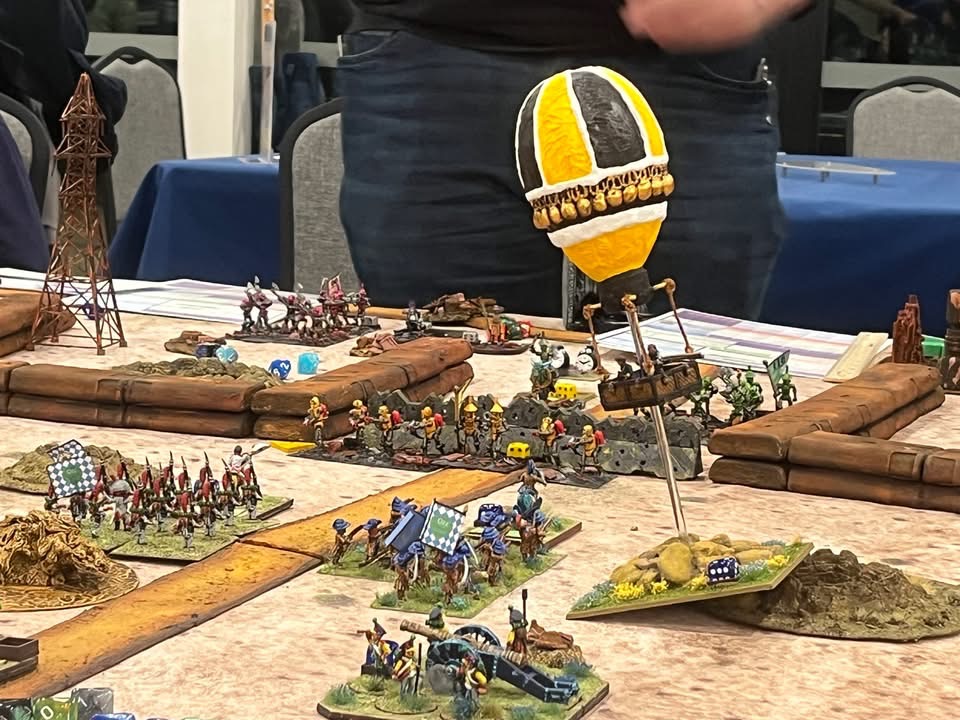
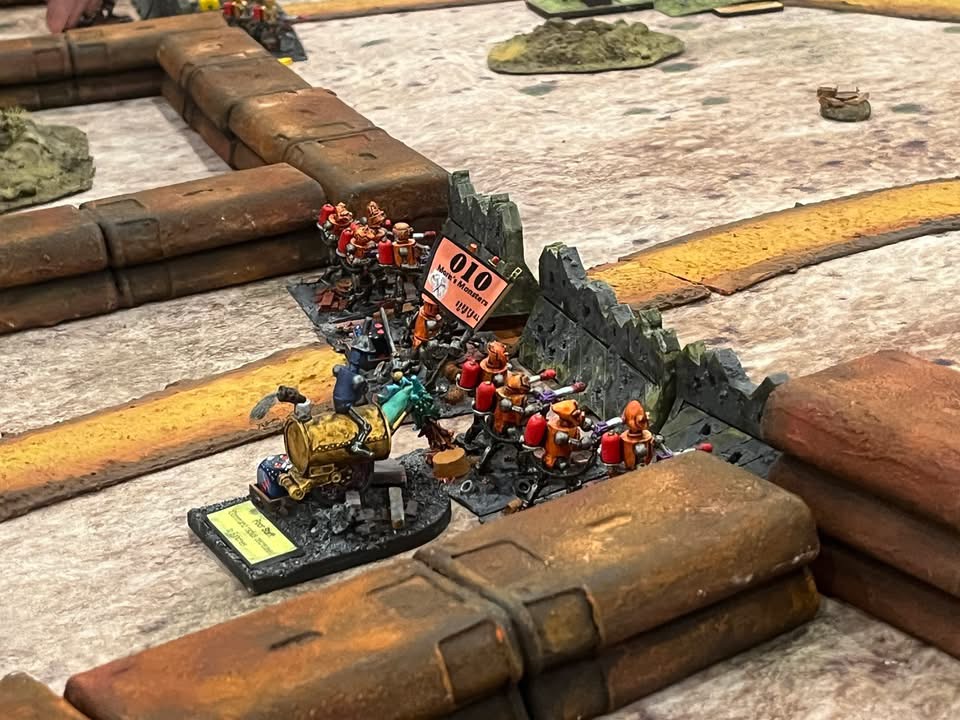
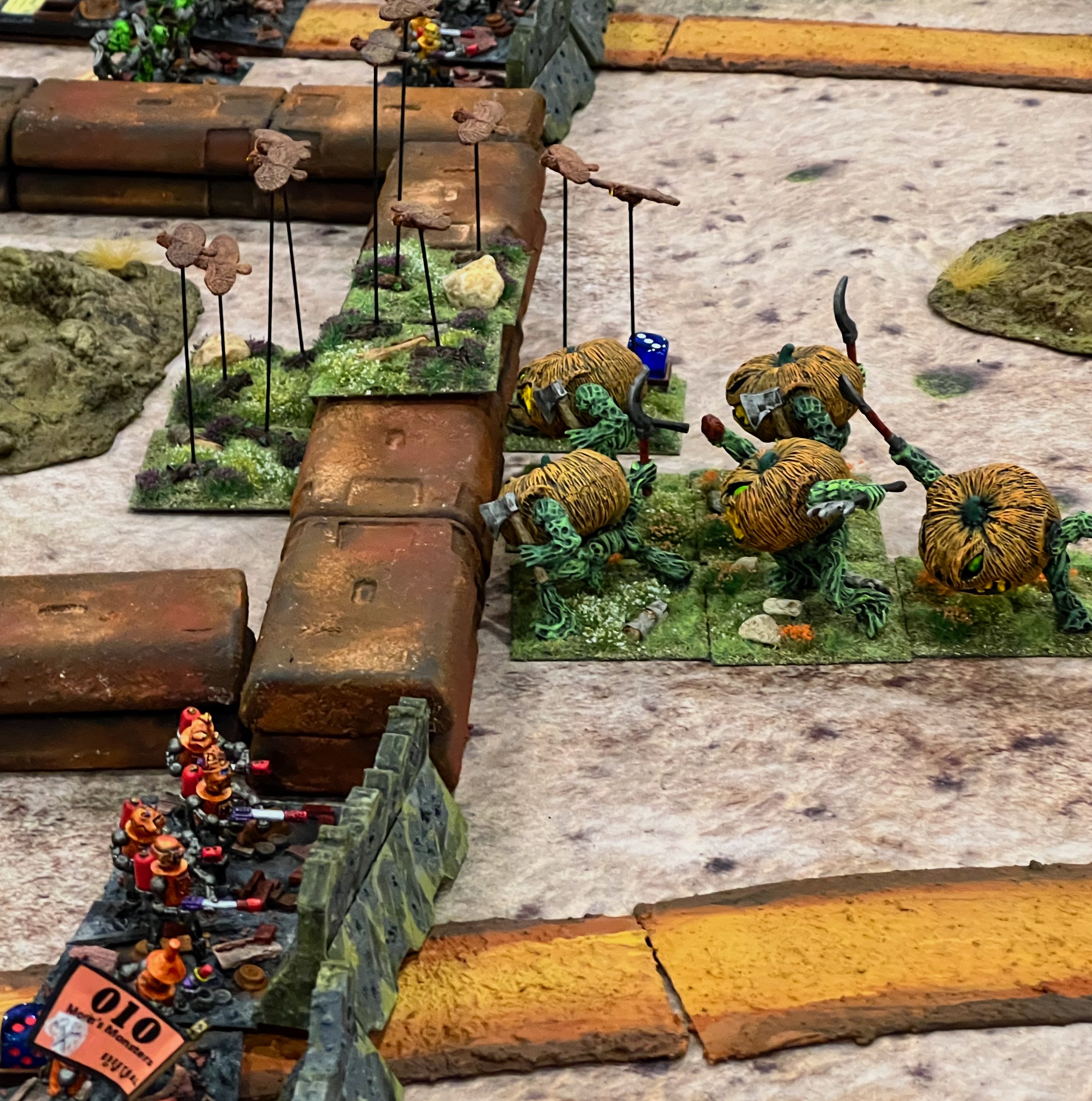
The game set up – I loved creating this panoramic expanse!Players arrive – once again demand to play was high!1st Munchkin Brigade set upThat’s a full game!Nitpik’s “Morin’s Monsters” armed with napalm blasters hope to cook up some Great Pumpkinheads.A regiment of Great Owls (Munchkin allies) overflies the Lemon Drop Legionnaires and hits them in the rear!Jinjur regiments (female pirates and Munchkin allies) breach the wall.The Munchkins breach the western gate and their light cavalry pours through to look for technological treasures.In the center, two axe-wielding Nitpik regiments have had enough of the Munchkins. The Jade Automata and the Pink Nightmare regiments charge over their defensive wall. Their counterattack wipes out the Munchkin artillery and drives two Munchkin infantry regiments from the game.Another view of that mechanical counterattack.Meanwhile, the cleaver Jinjur pirates locate some of Nitpik’s technological wonders in a wrecked building.
The game ended – in a dead tie 23-23! A real nail-biter to be sure!
The next game builds on this one. The Munchkins have found technology, but welshed on their agreement to share! Thus, they betrayed their allies. As a result, their former allies have jumped over to the Nitpik side. The Munchkins are fleeing to safety, with Nitpik in hot pursuit.
Revenge of the Tin Men
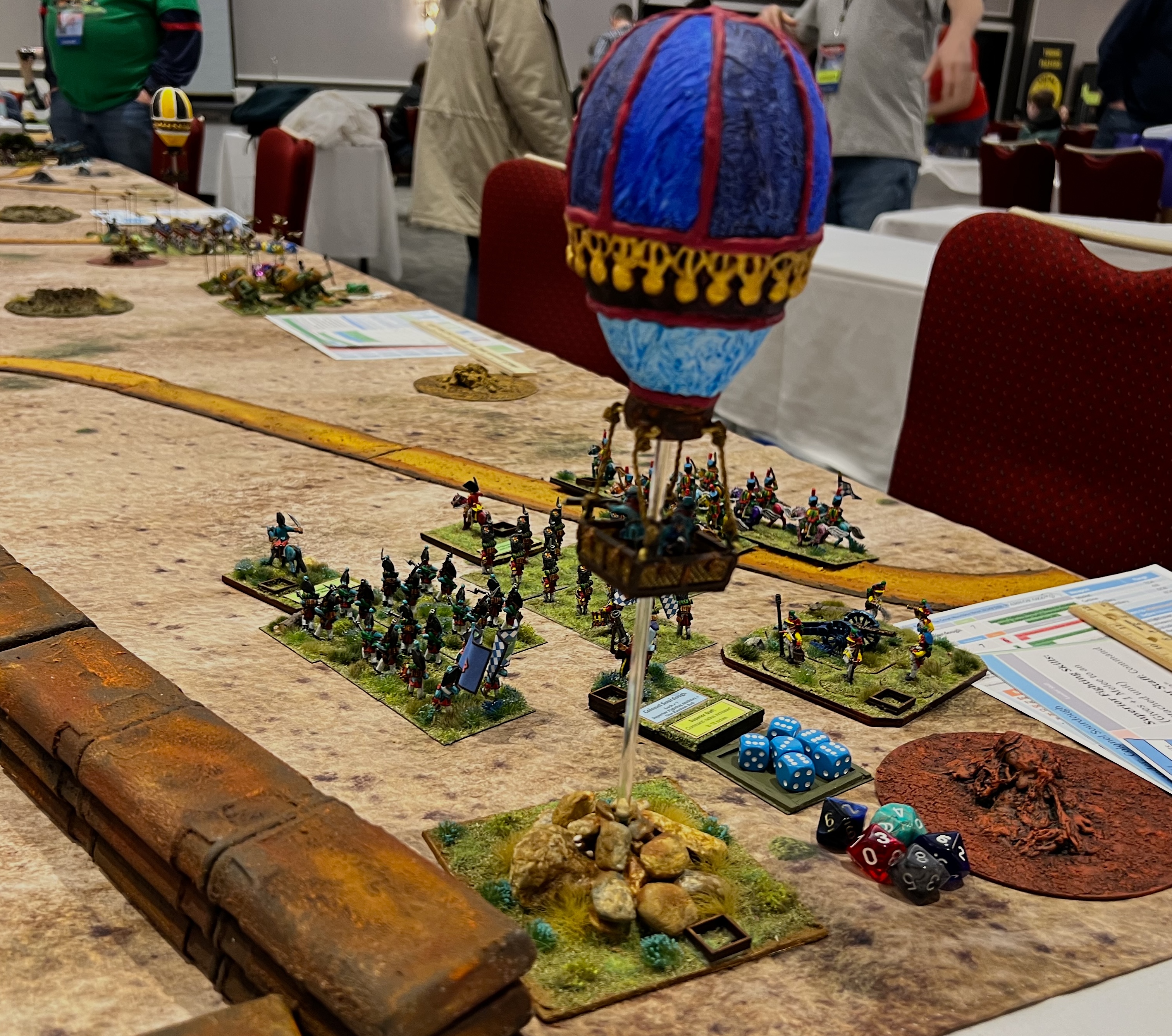
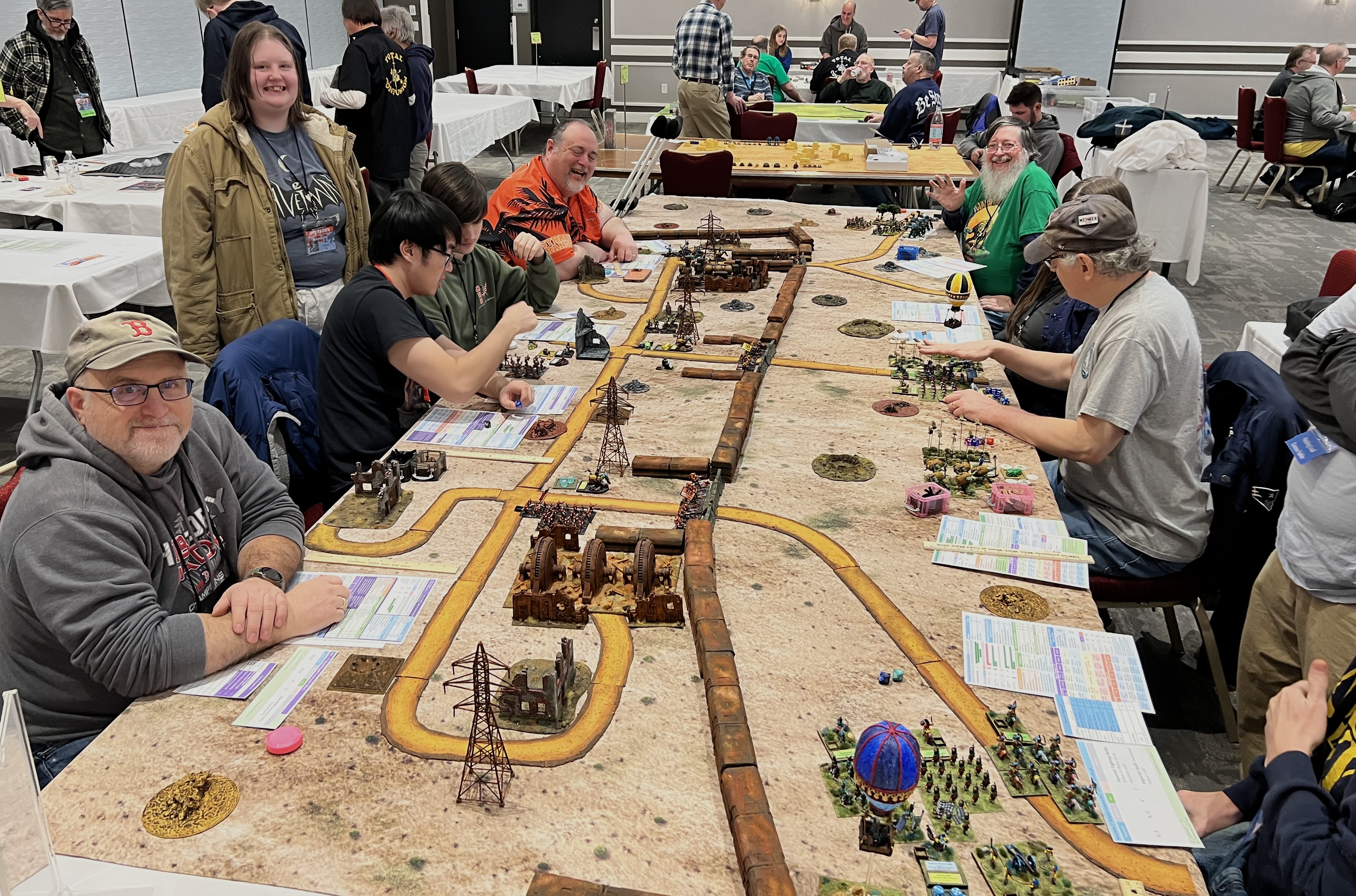
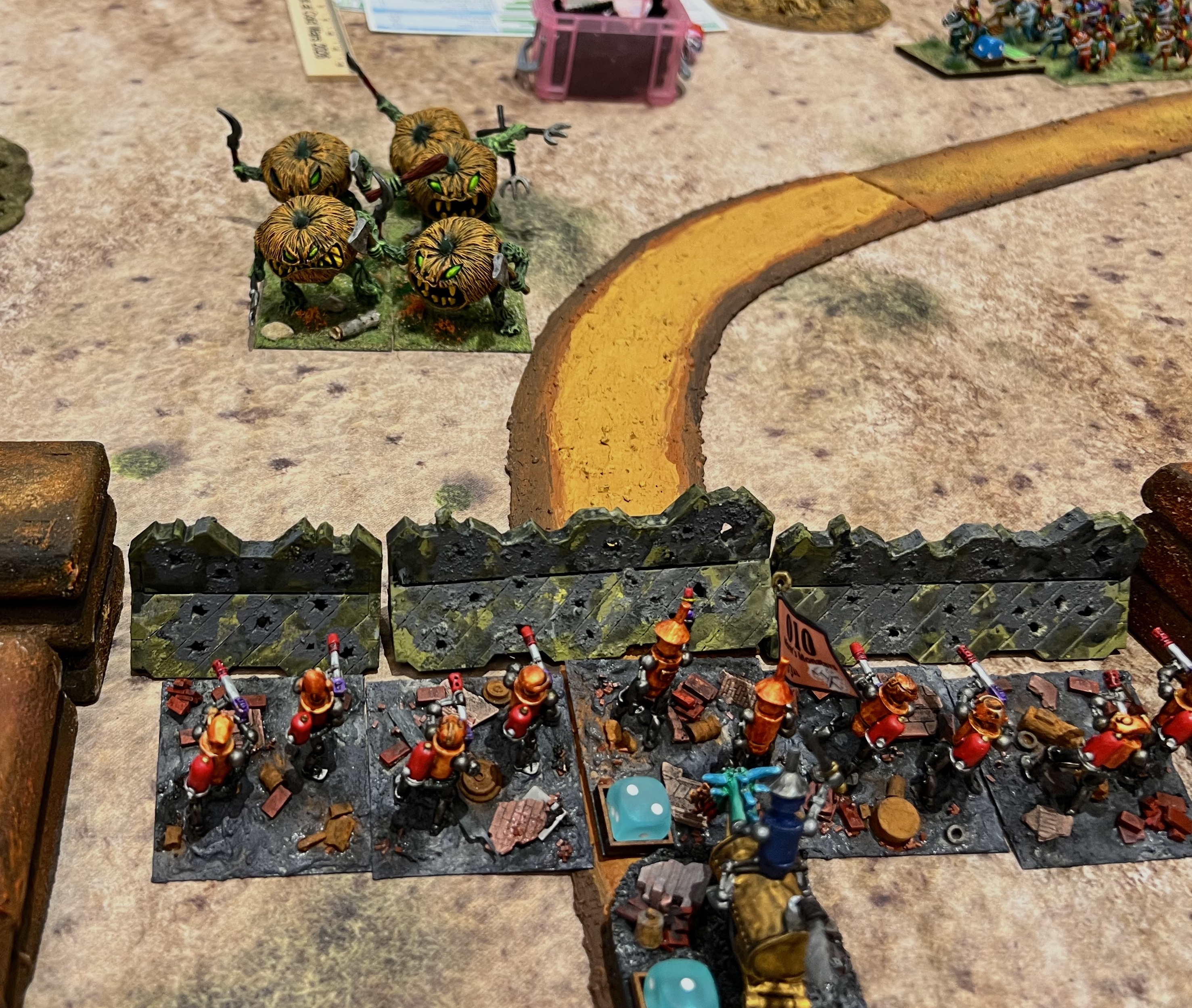
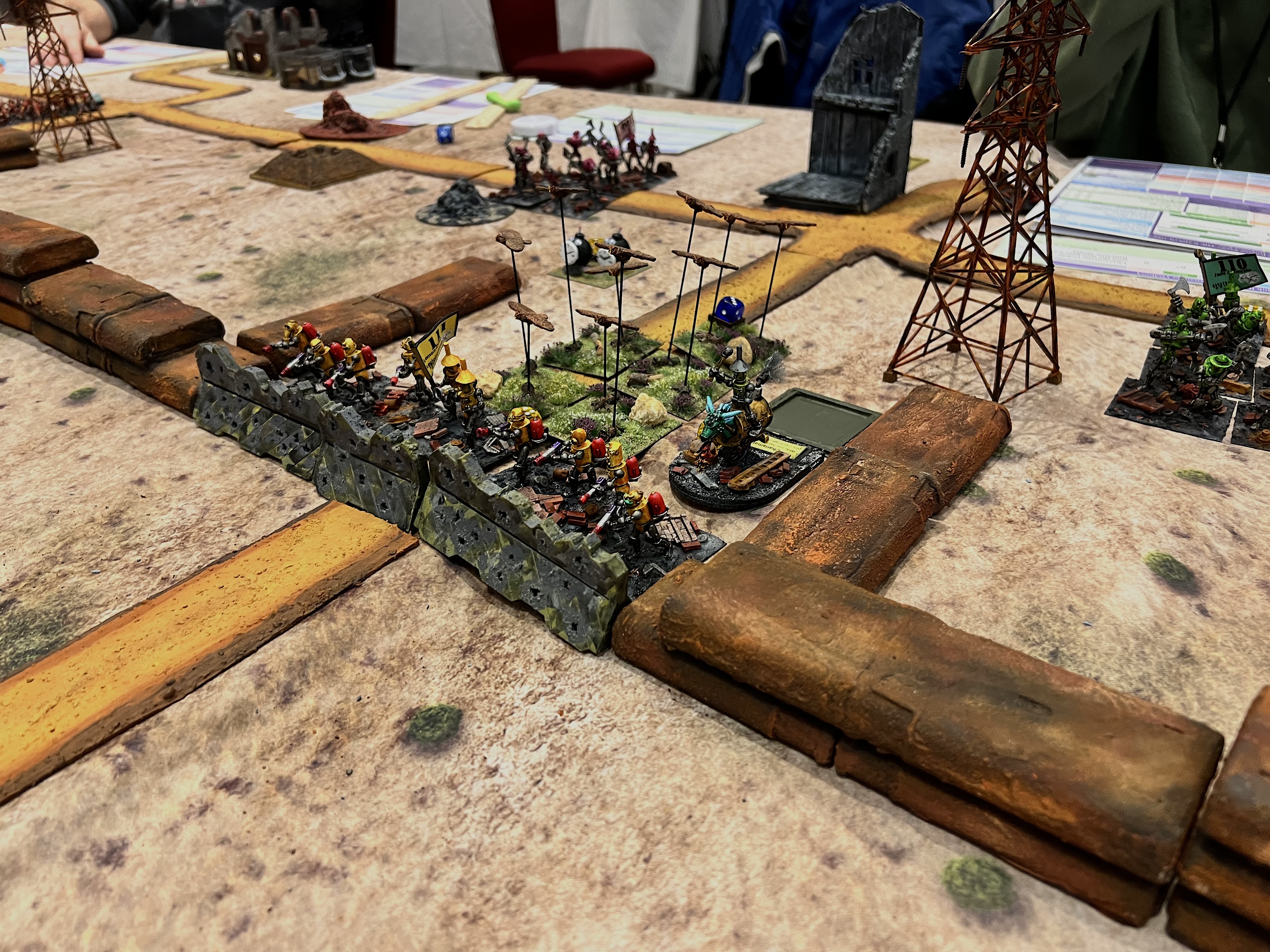
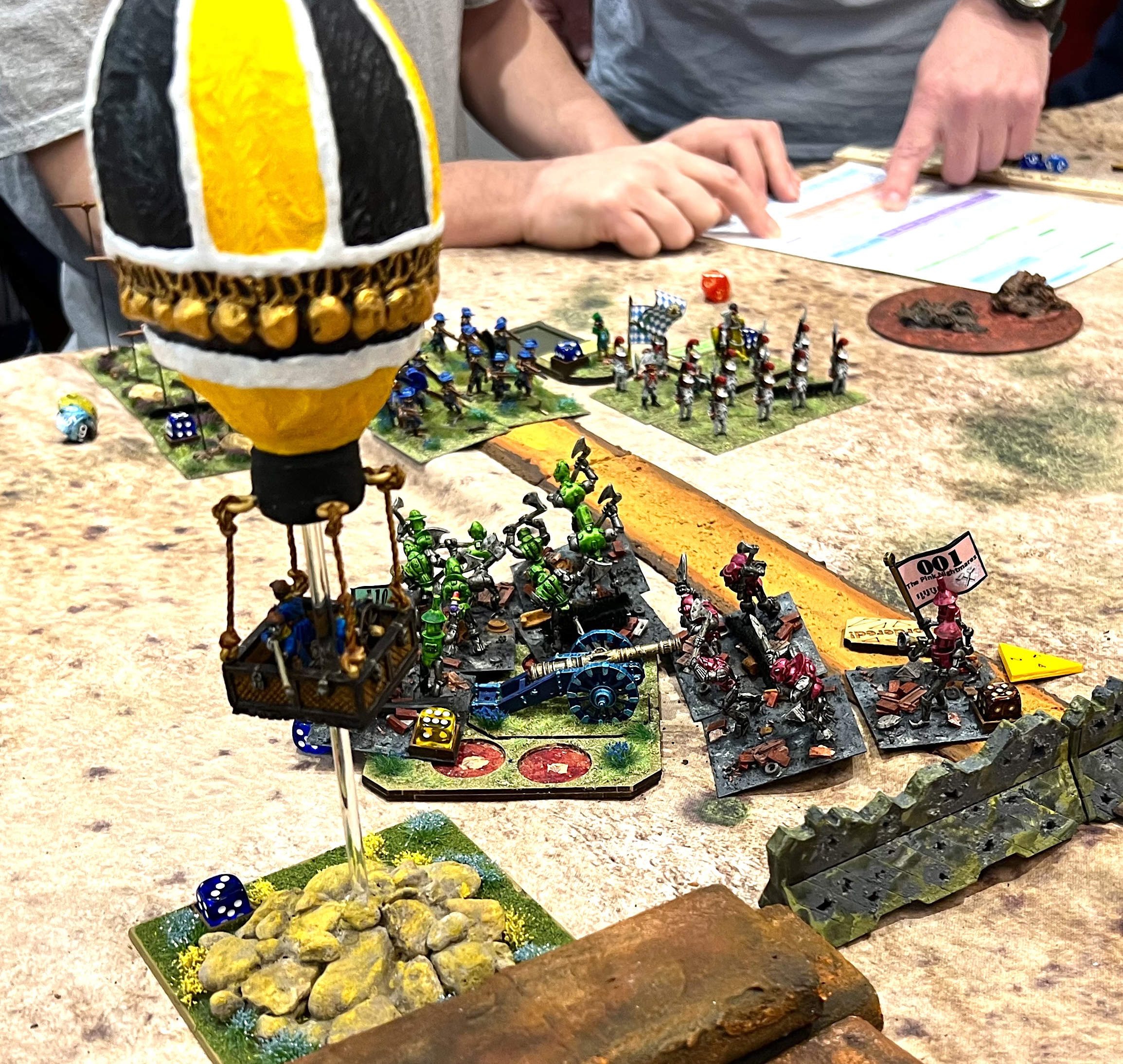
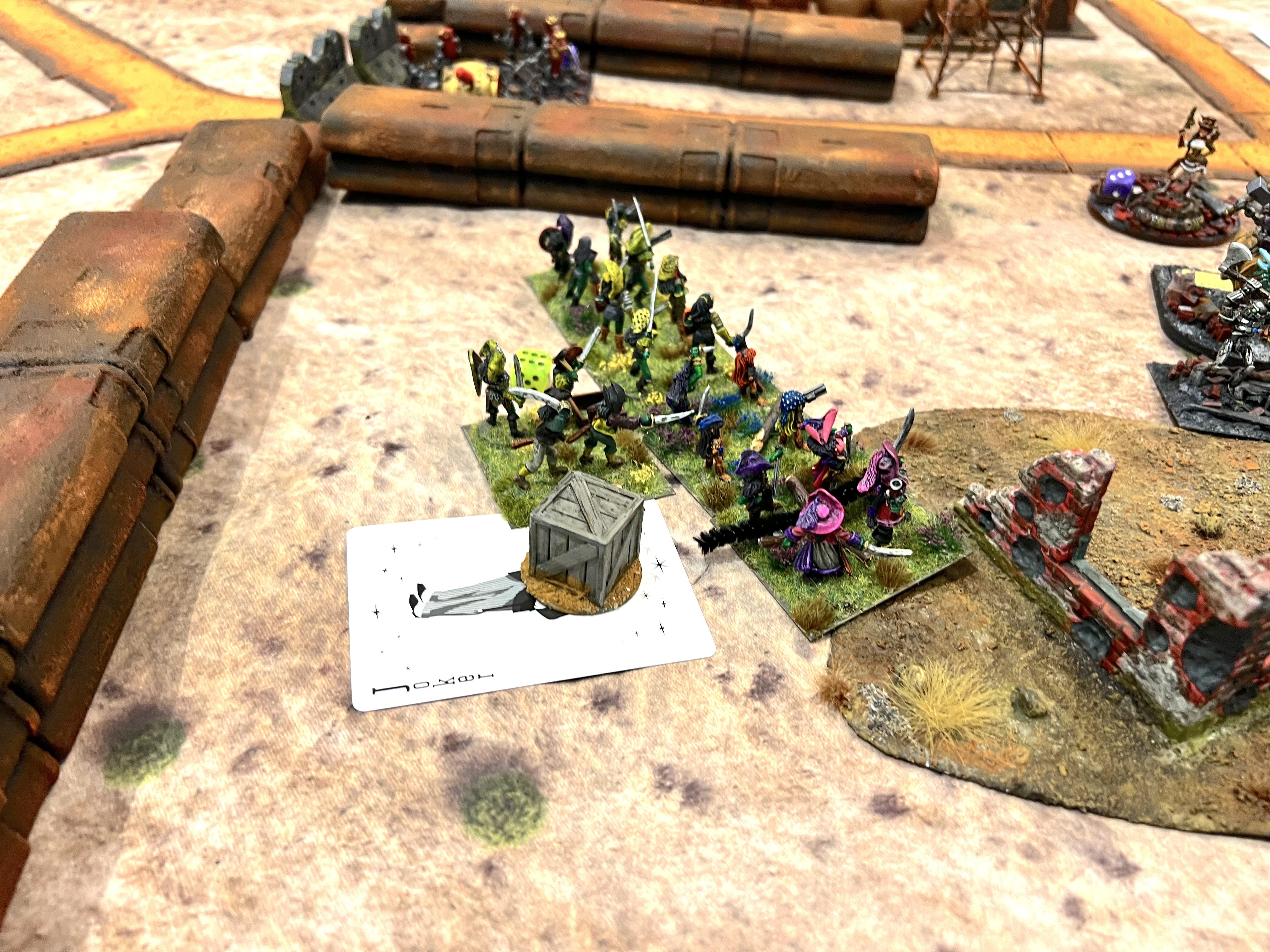
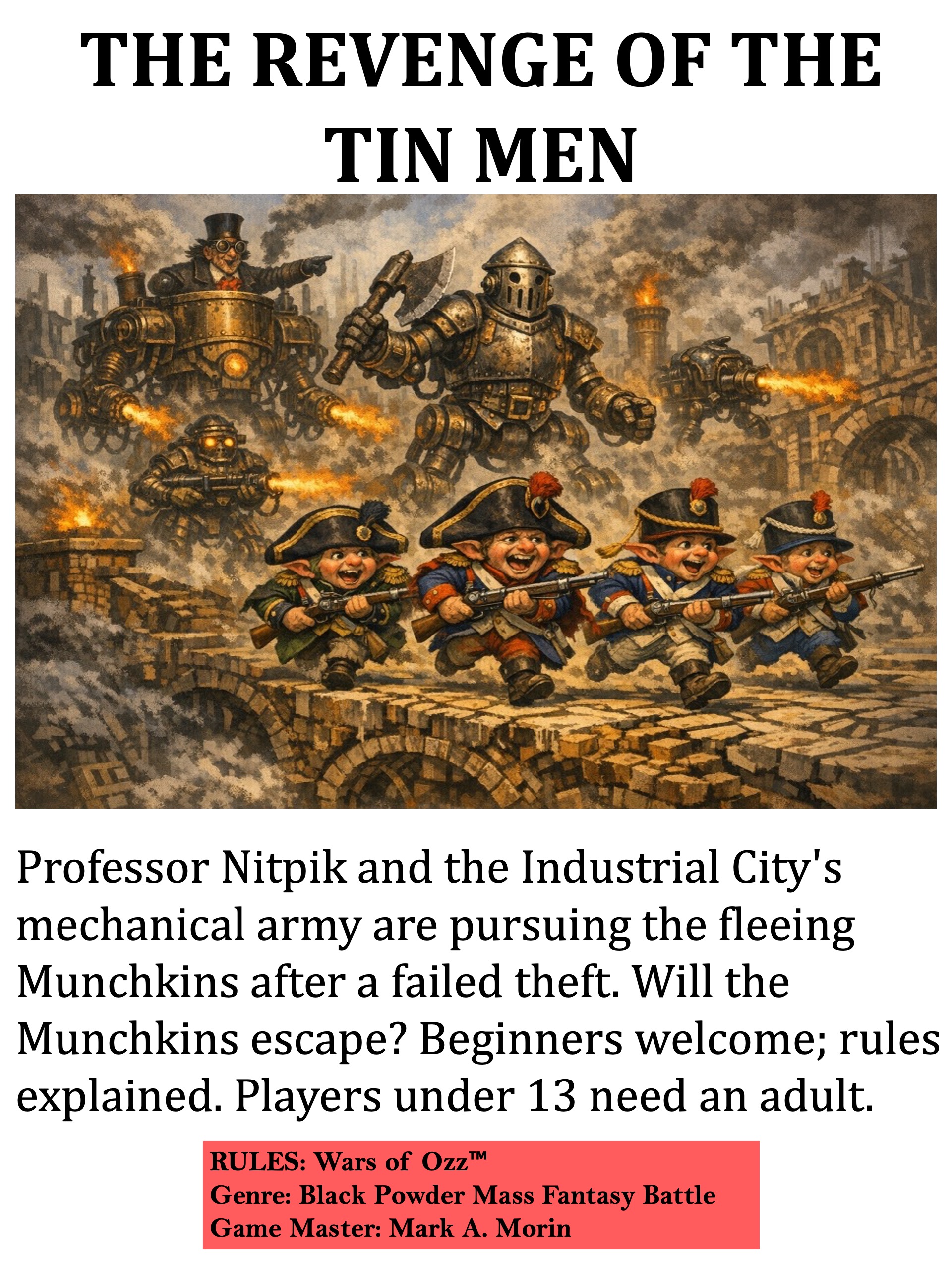
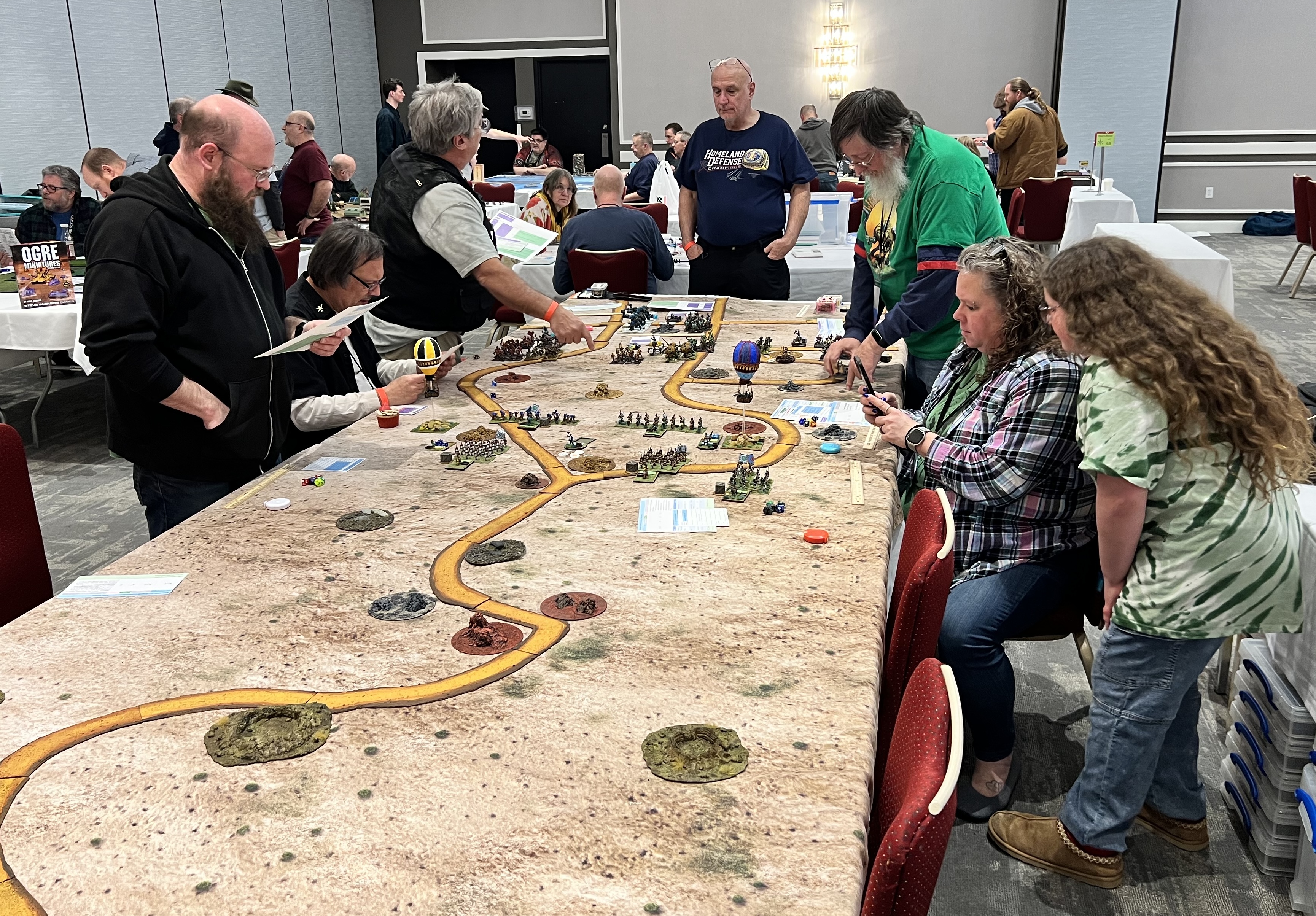
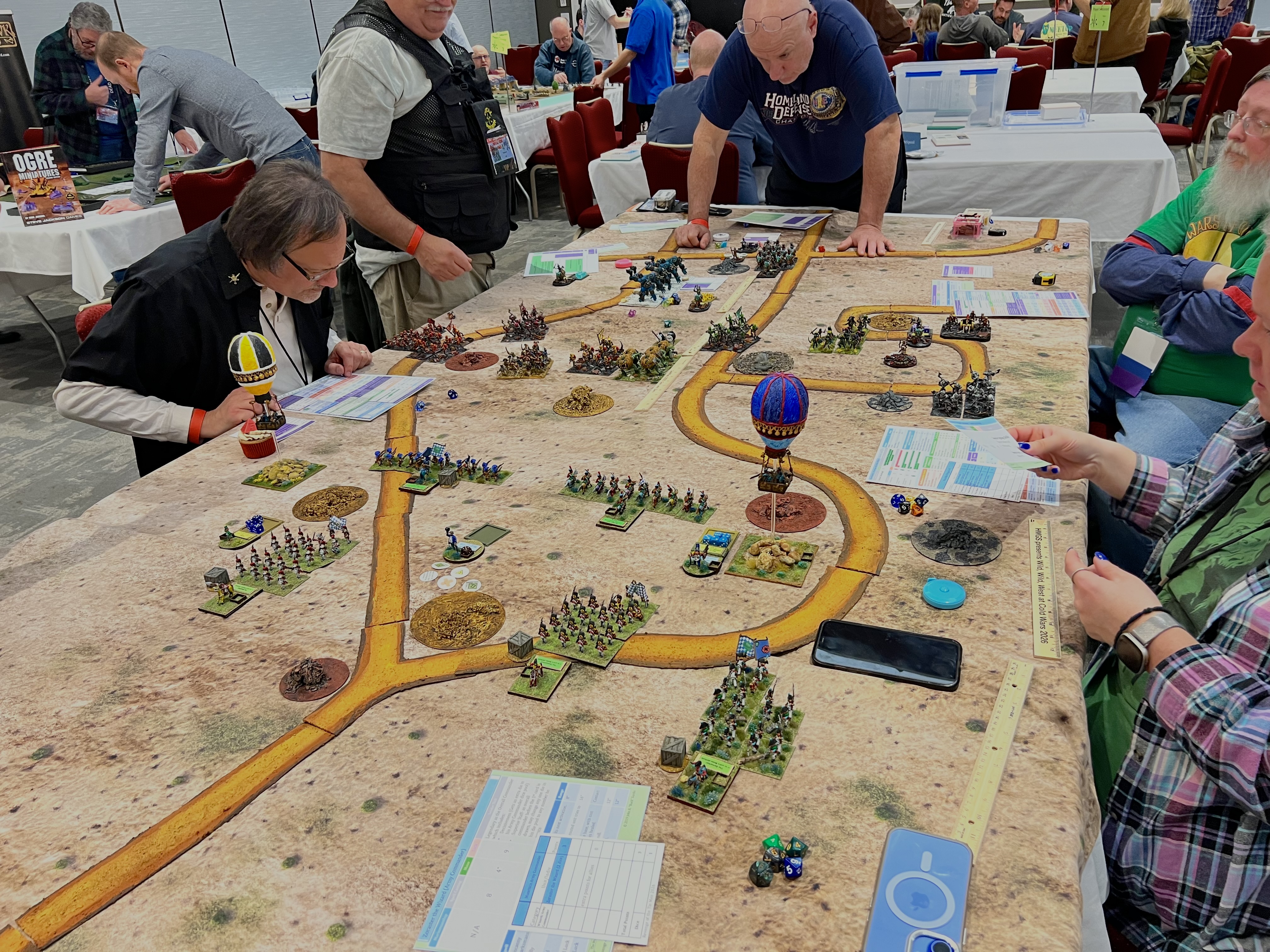
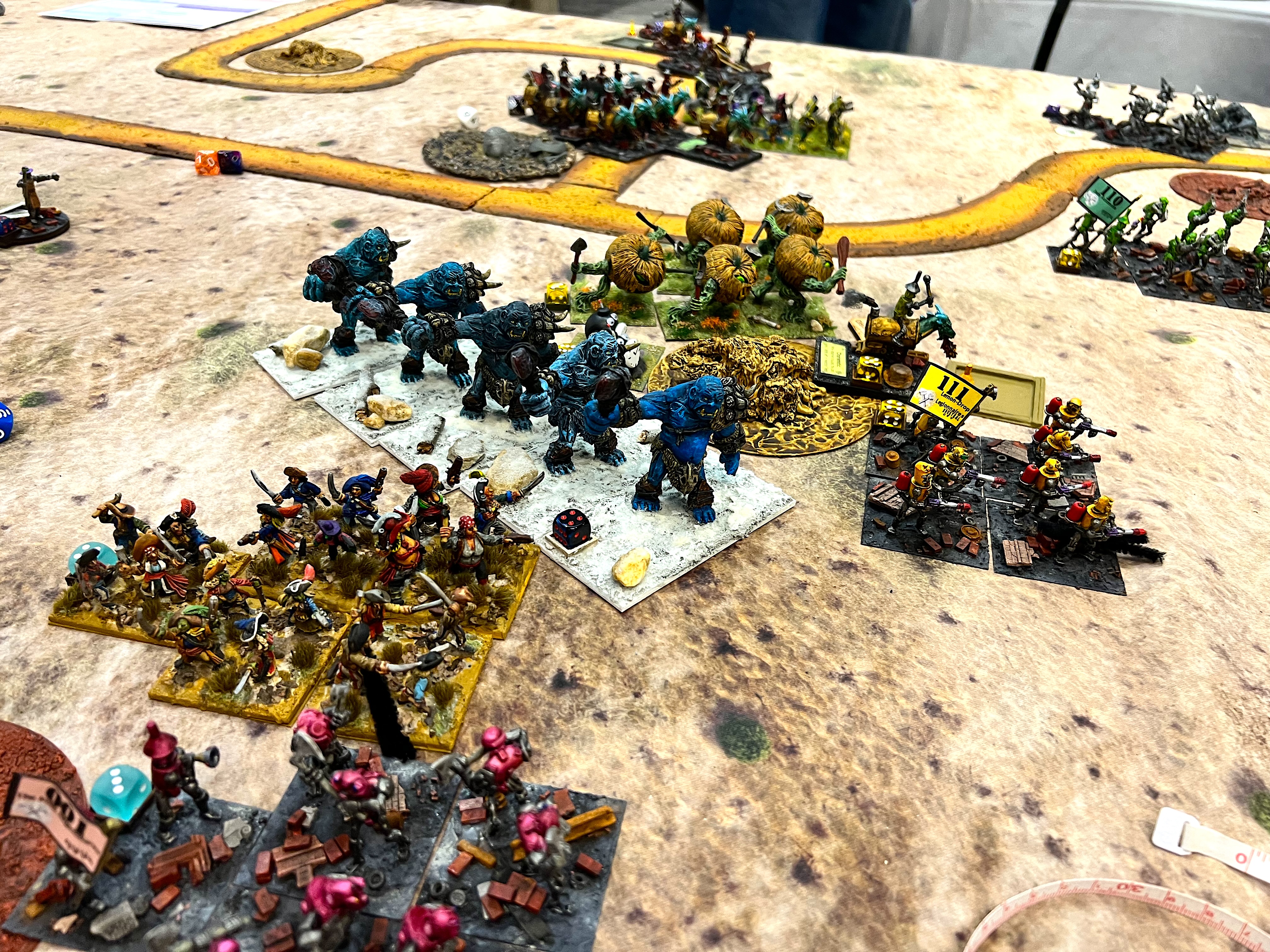
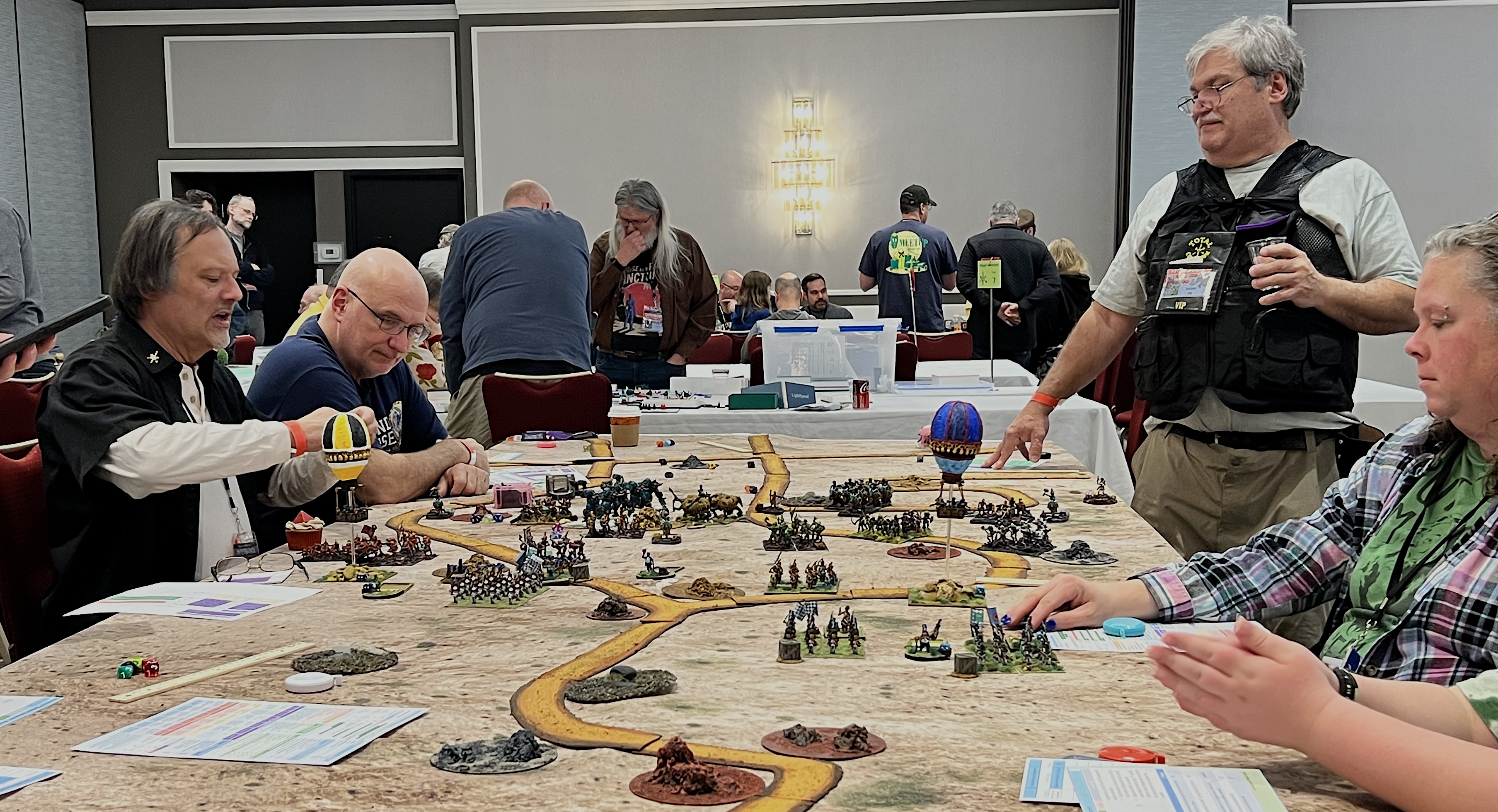
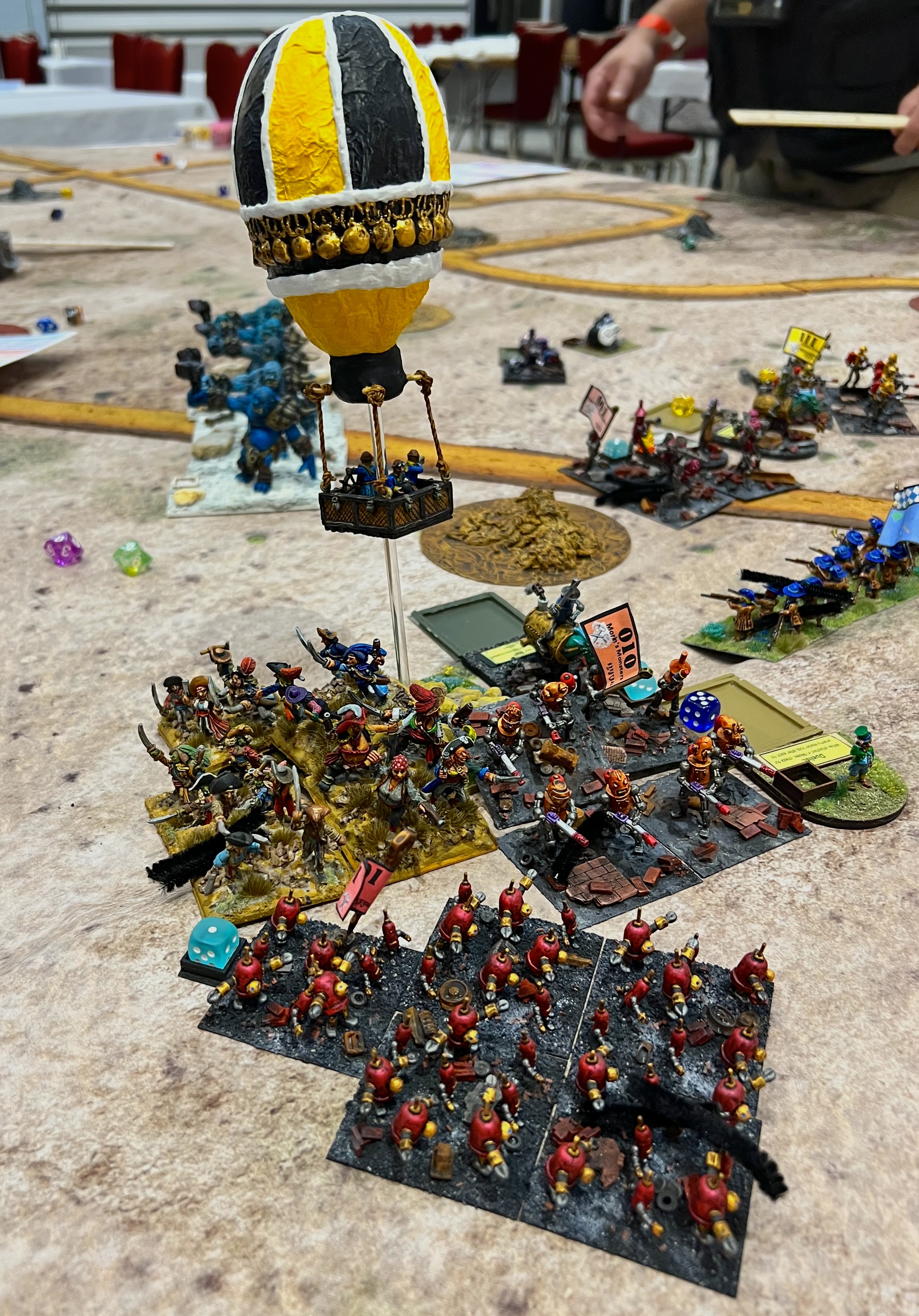
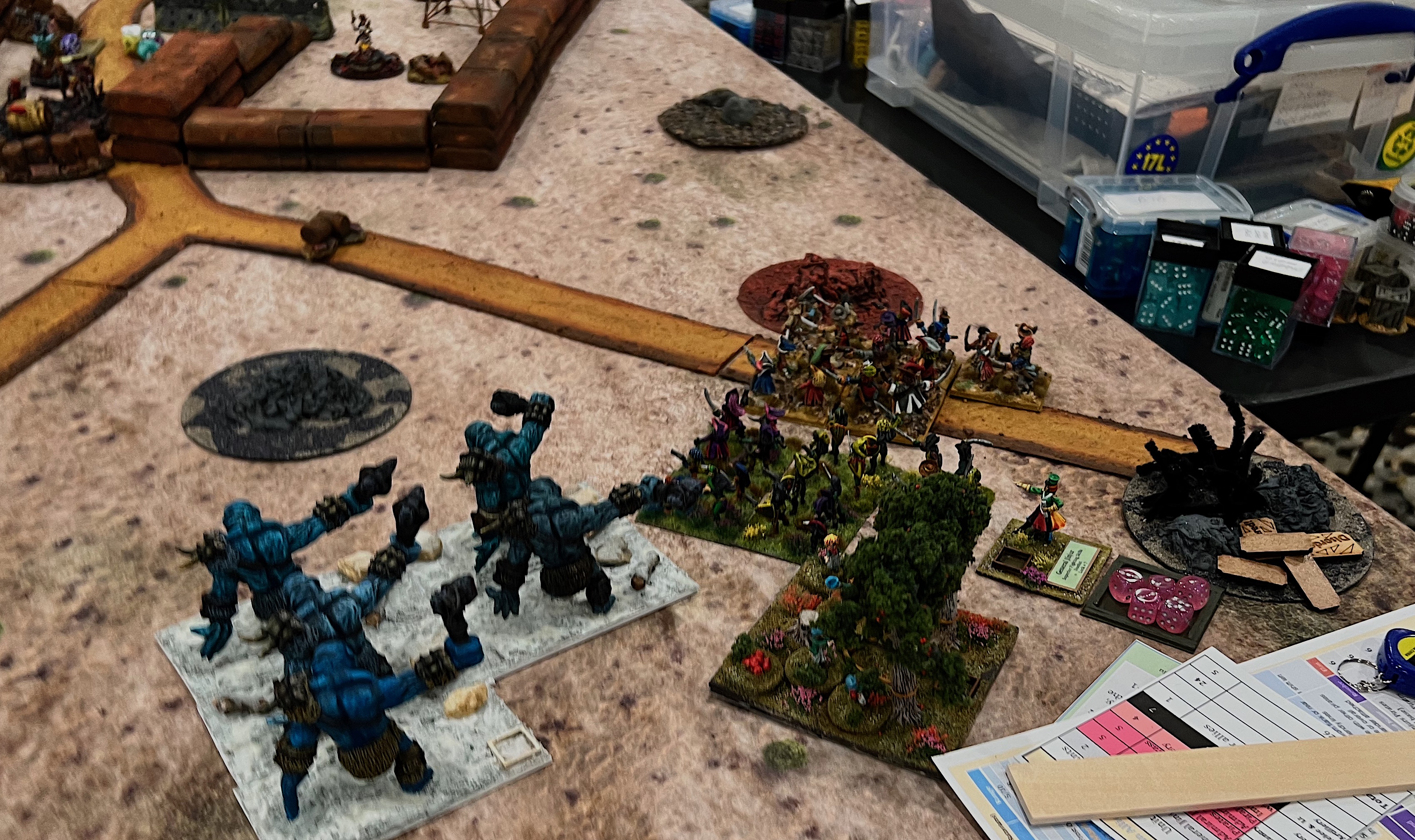
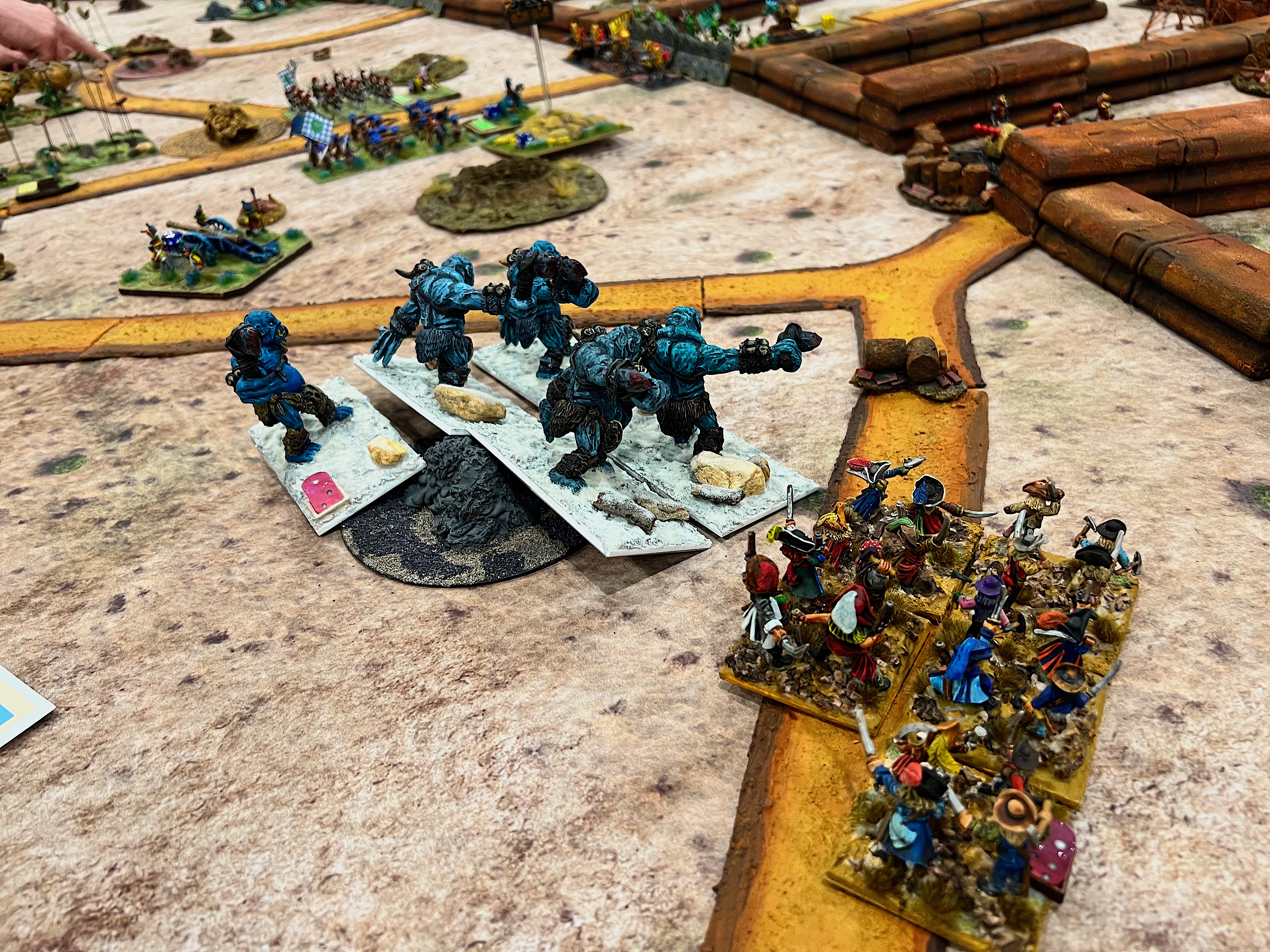
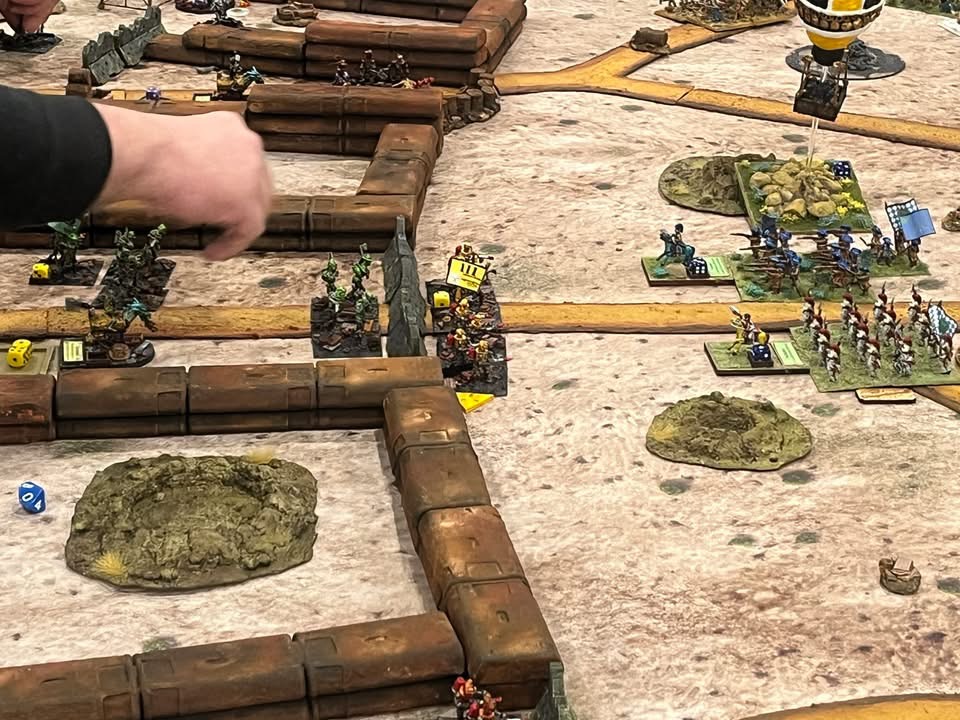
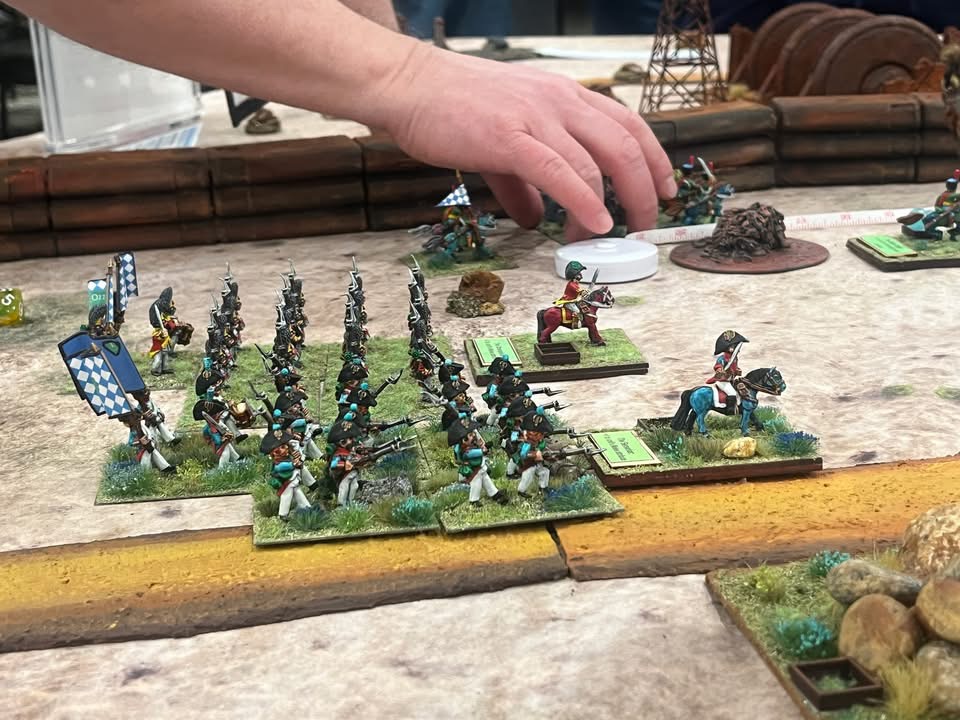
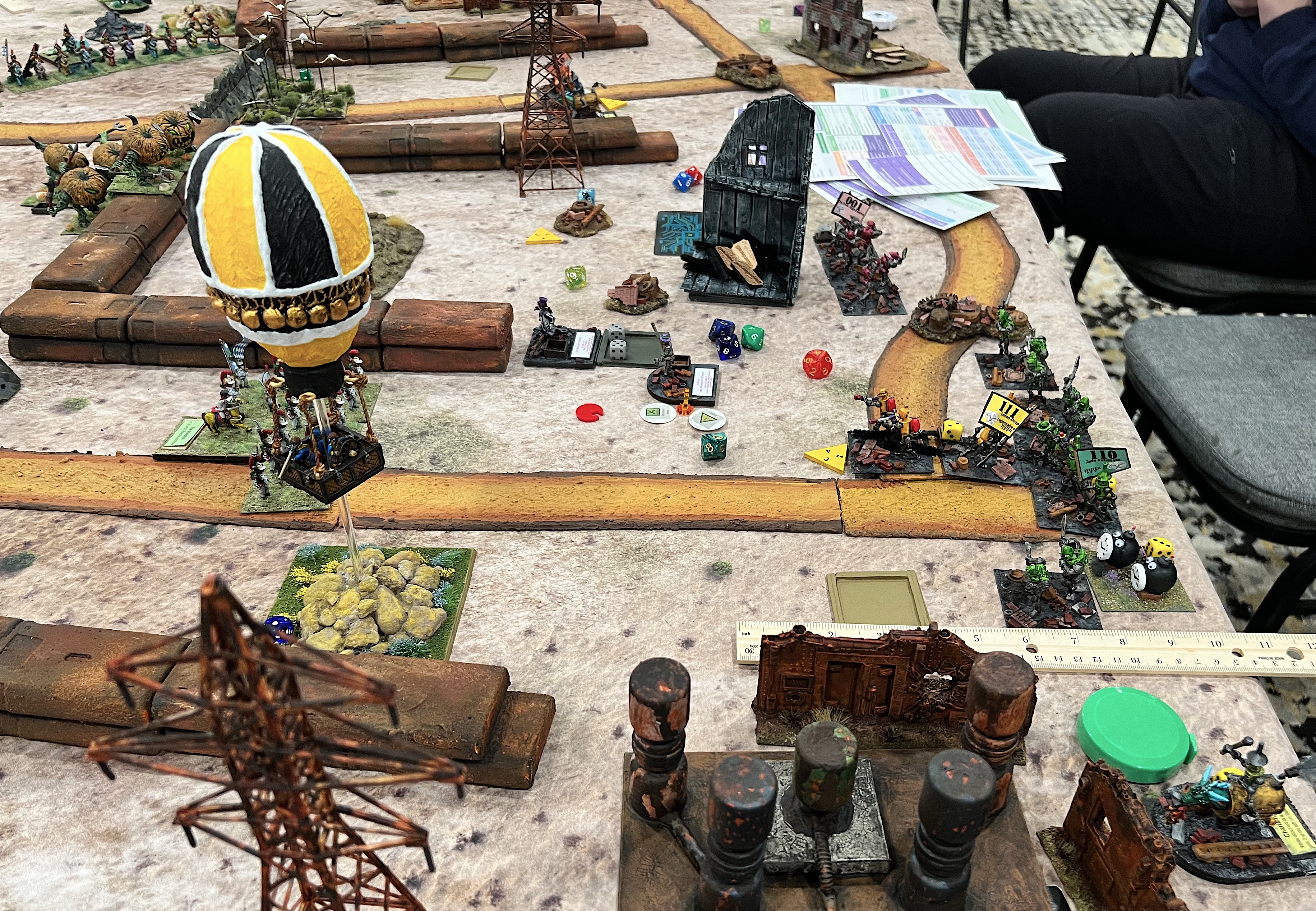
Another big game! The players plan.The Munchkins have 4 heavy crates of technology carried by 4 regiments. The crates slow down the Munchkins. The little folk need to cross a line with the crates safely to gain victory points. Additionally, each Munchkin base that escapes the Nitpik pursuers gets a point. Nitpik gets points for recovering crates and for eliminating Munchkin bases. The Munchkins have set up a delaying picket line of light cavalry and sharpshooters between the two balloons. This is to give those fleeing a chance to escape the Nitpik and allied horde.On the right, the Munchkin picket line. On the left, the pursuers!There were many Nitpik pursuers. This included those who switched alliances, like Frost Ogres, Great Pumpkinheads, and Jinjur pirates. Traffic control became a challenge as they tried to catch the Munchkins.The pursuers coordinate their movements.The Munchkin Aerostat frustrated several Nitpik regiments. As they tried to advance, the Aerostat laid down effective disruptive musketry on the mechanical men. Nitpik cavalry broke through and tried to run the Munchkins down. Several crates were lost as the Munchkins routed in disarray.The game ended with this scene showing Sam disappointed. The Munchkins nearly won the game. Her unit only needed 1 more inch to cross the line of the crater with the crate. So close! (well played though Sam!!) In the end, Nitpik won a VERY narrow 12-10 victory.
That wrapped up Friday night. The next game would happen Saturday morning set in North Africa.
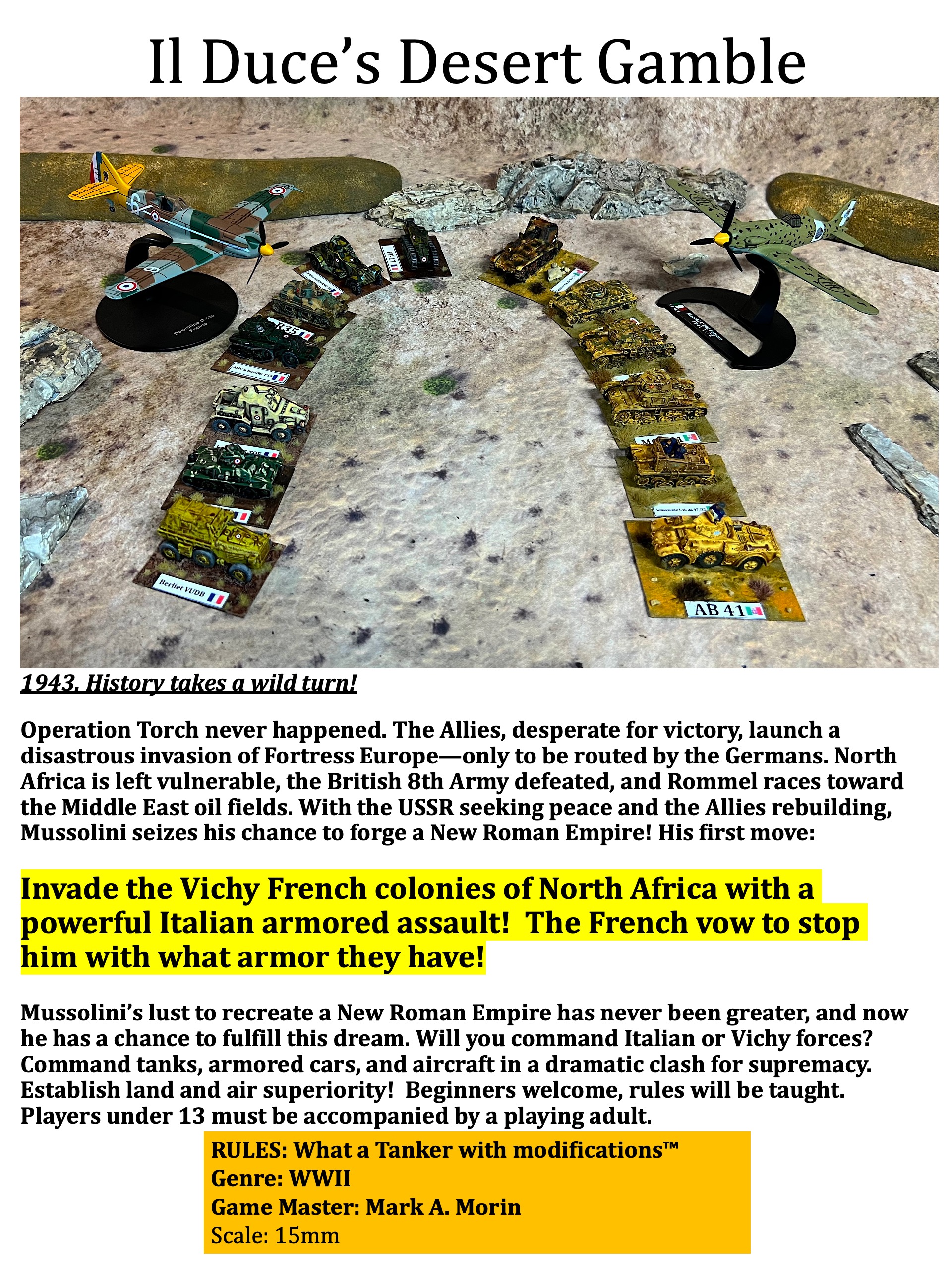
Il Duce’s Desert Gamble
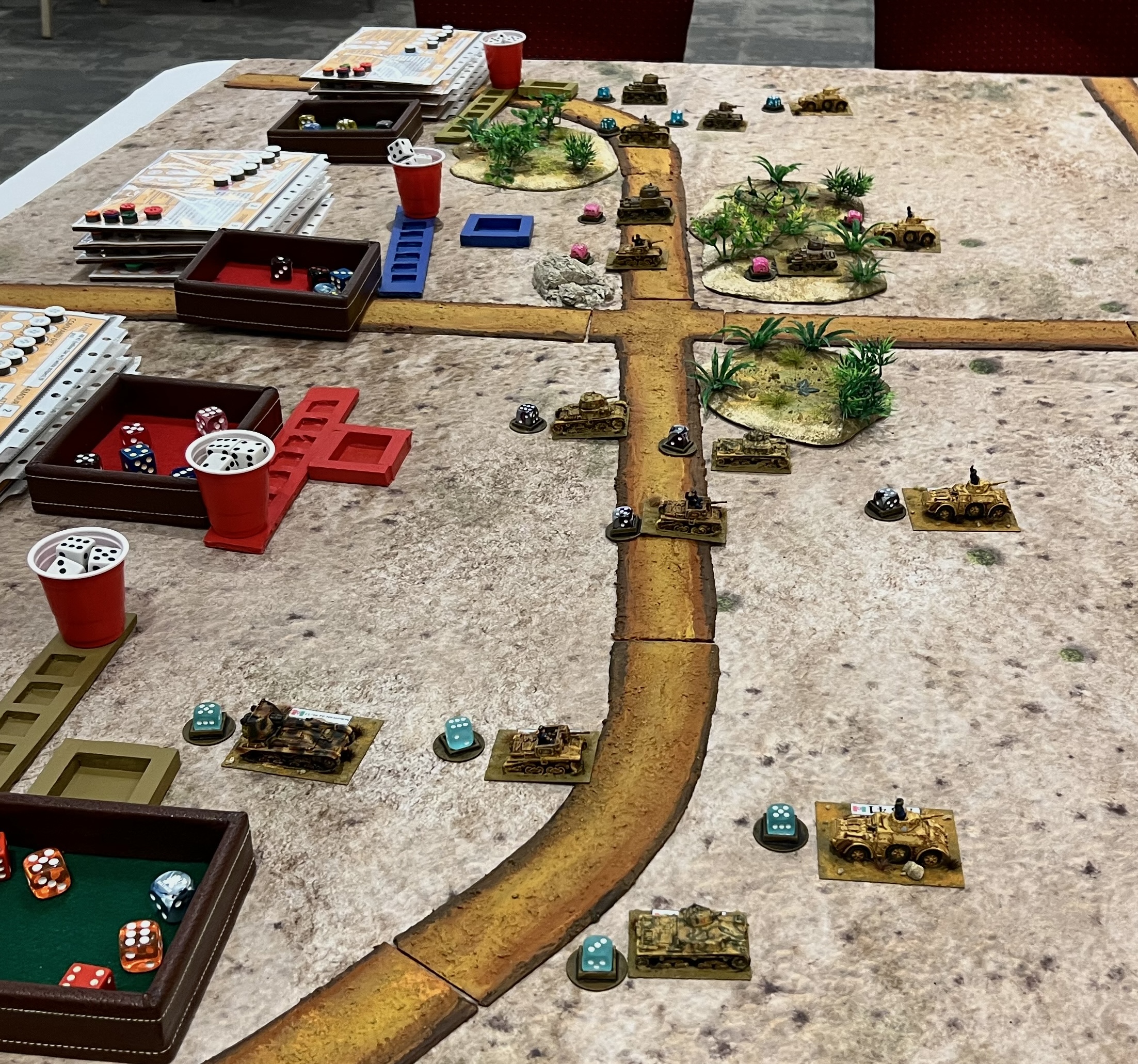
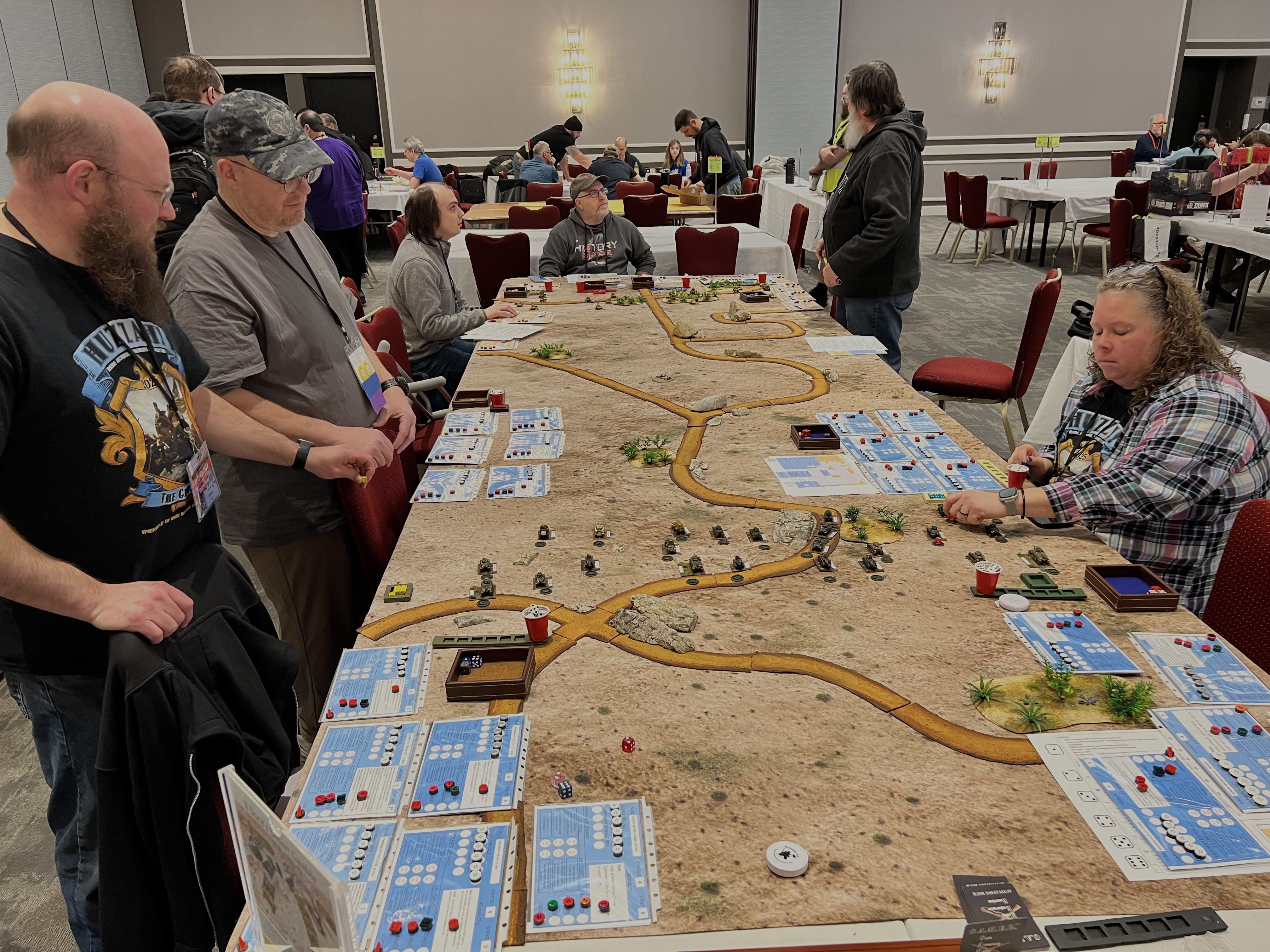
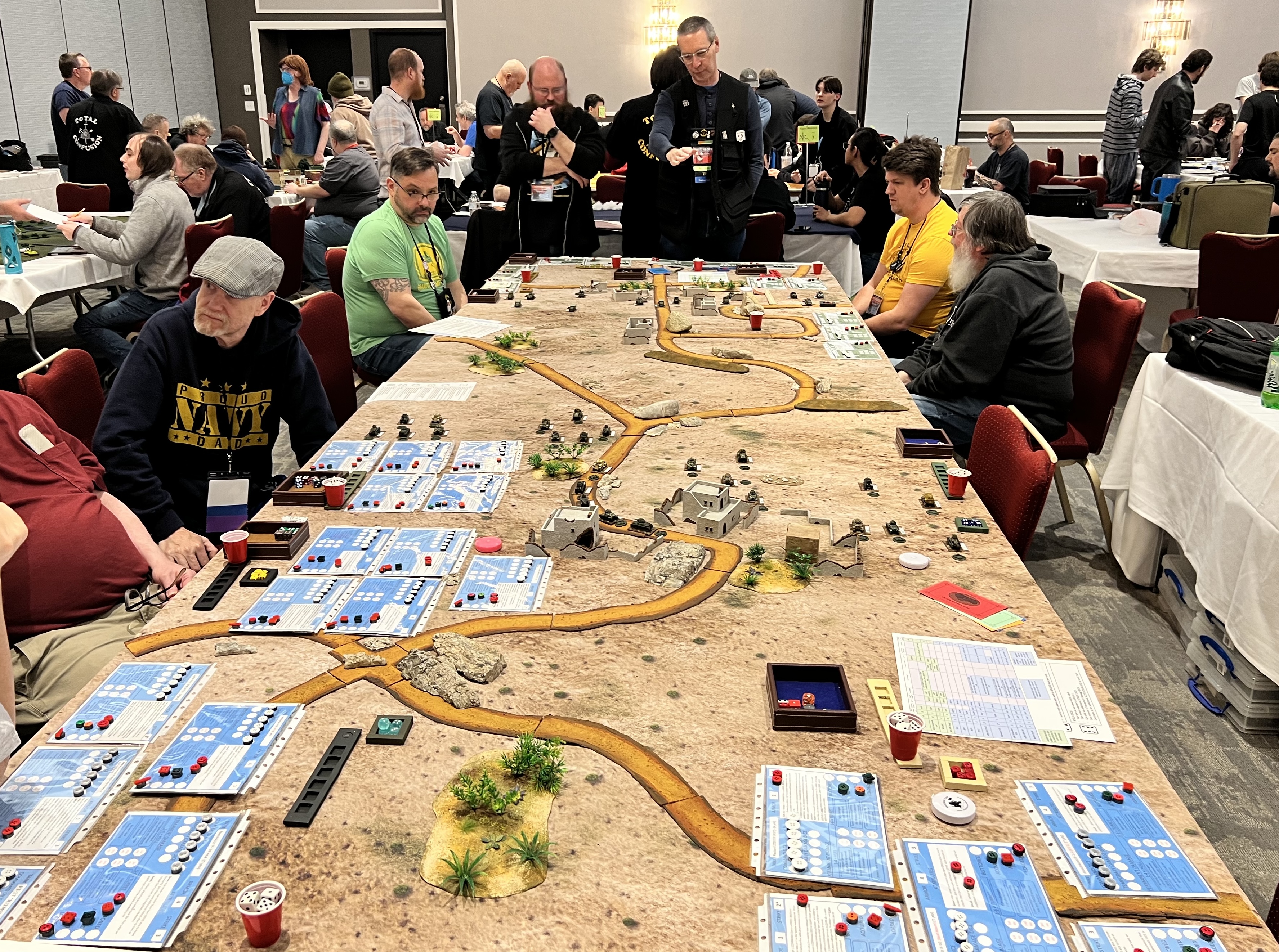
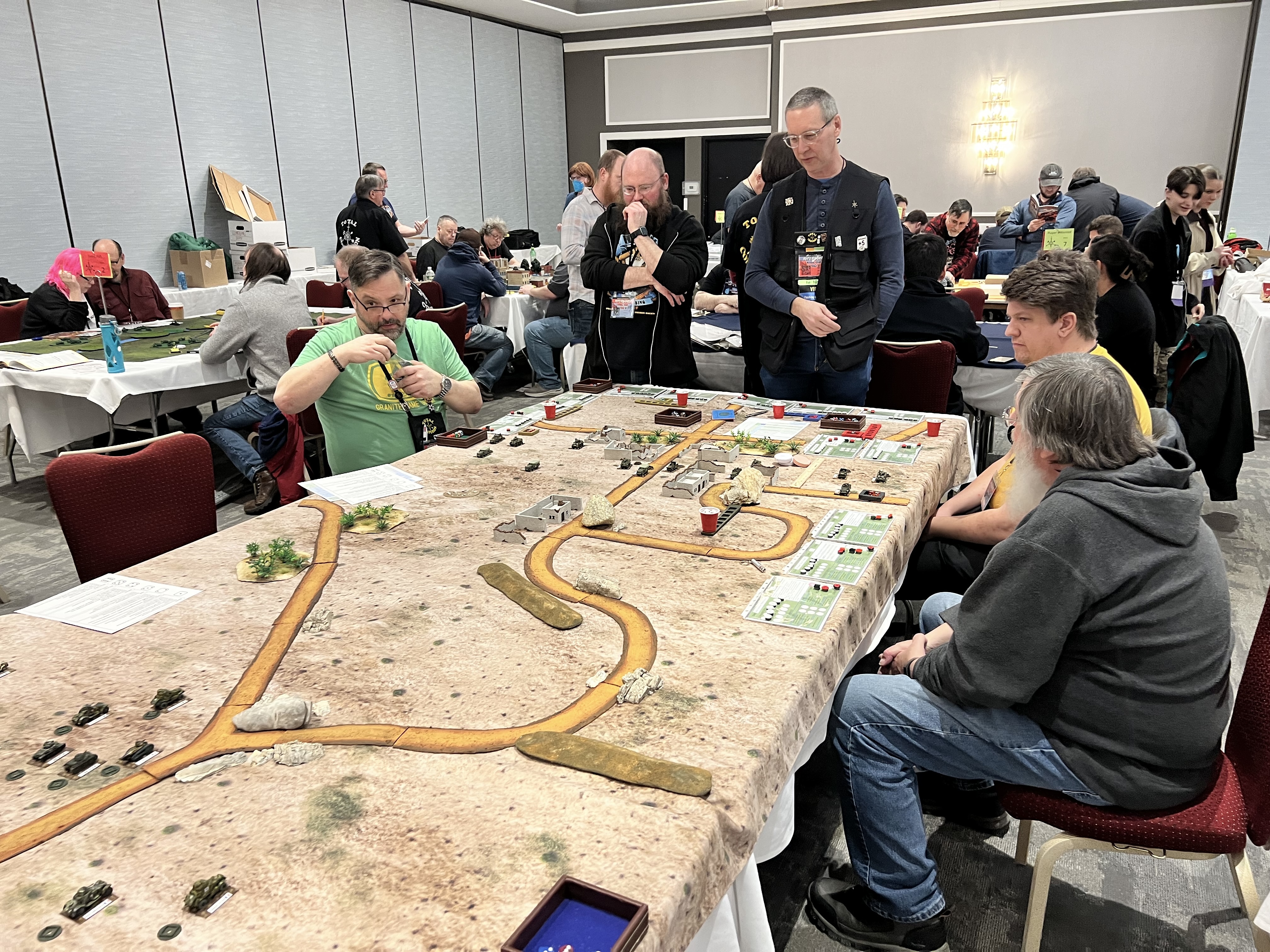
This what-if modified What a Tanker scenario also filled up quickly as well.
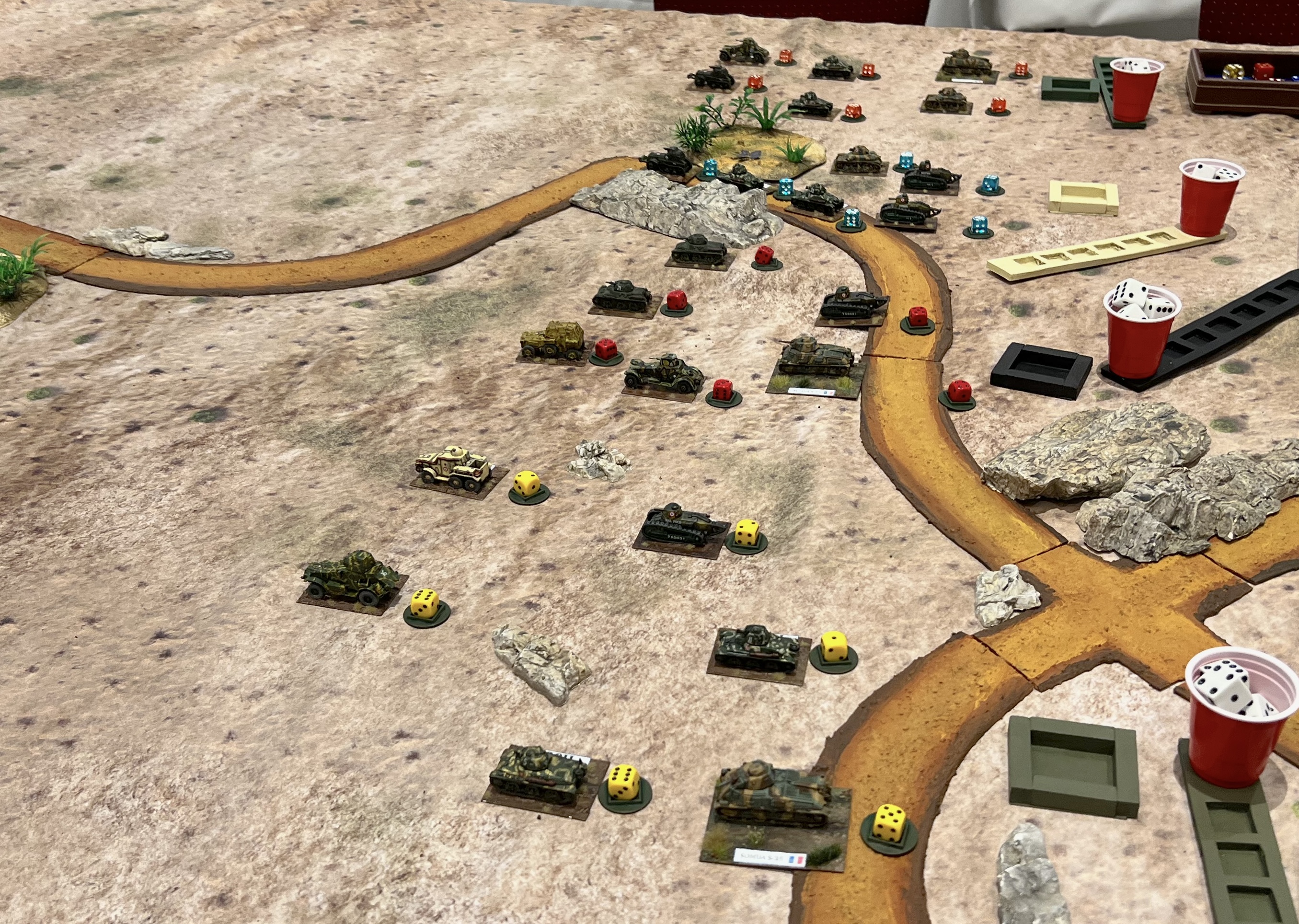
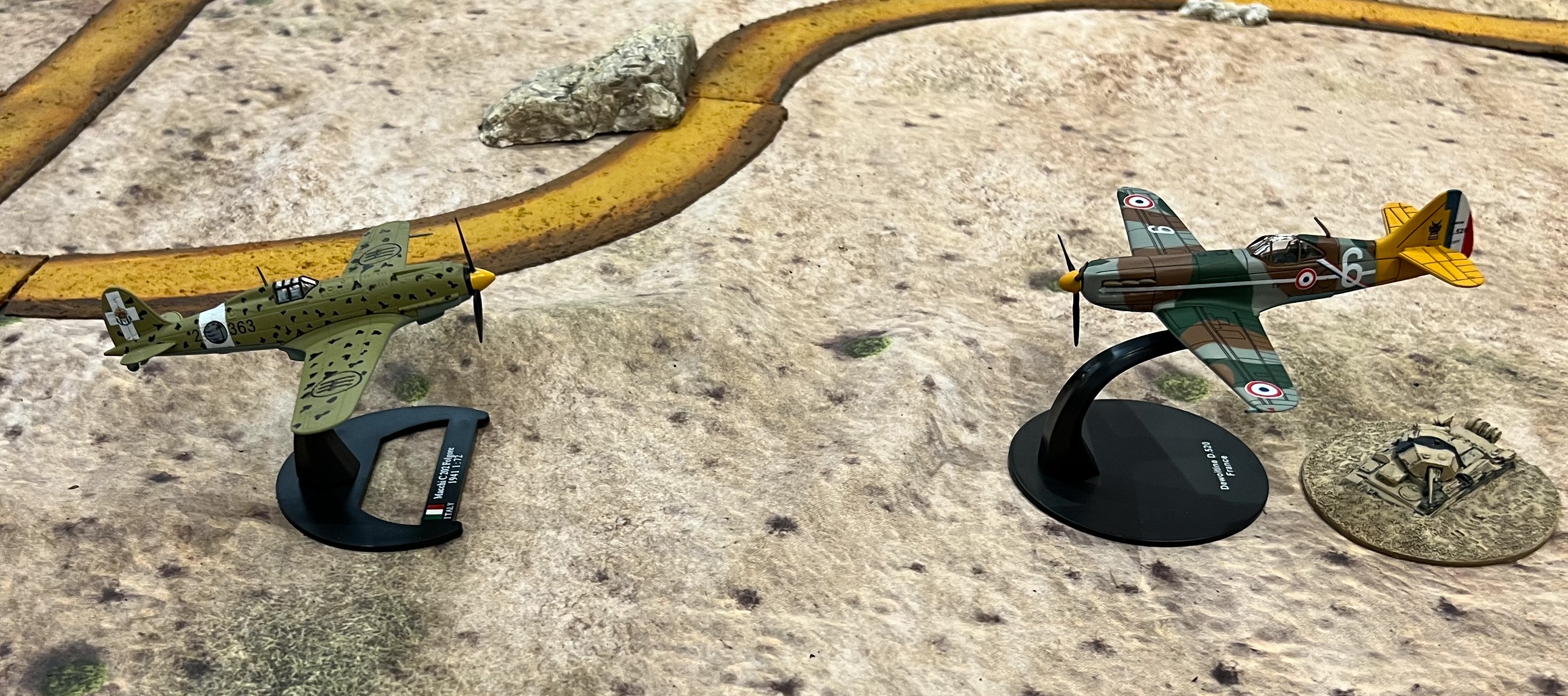
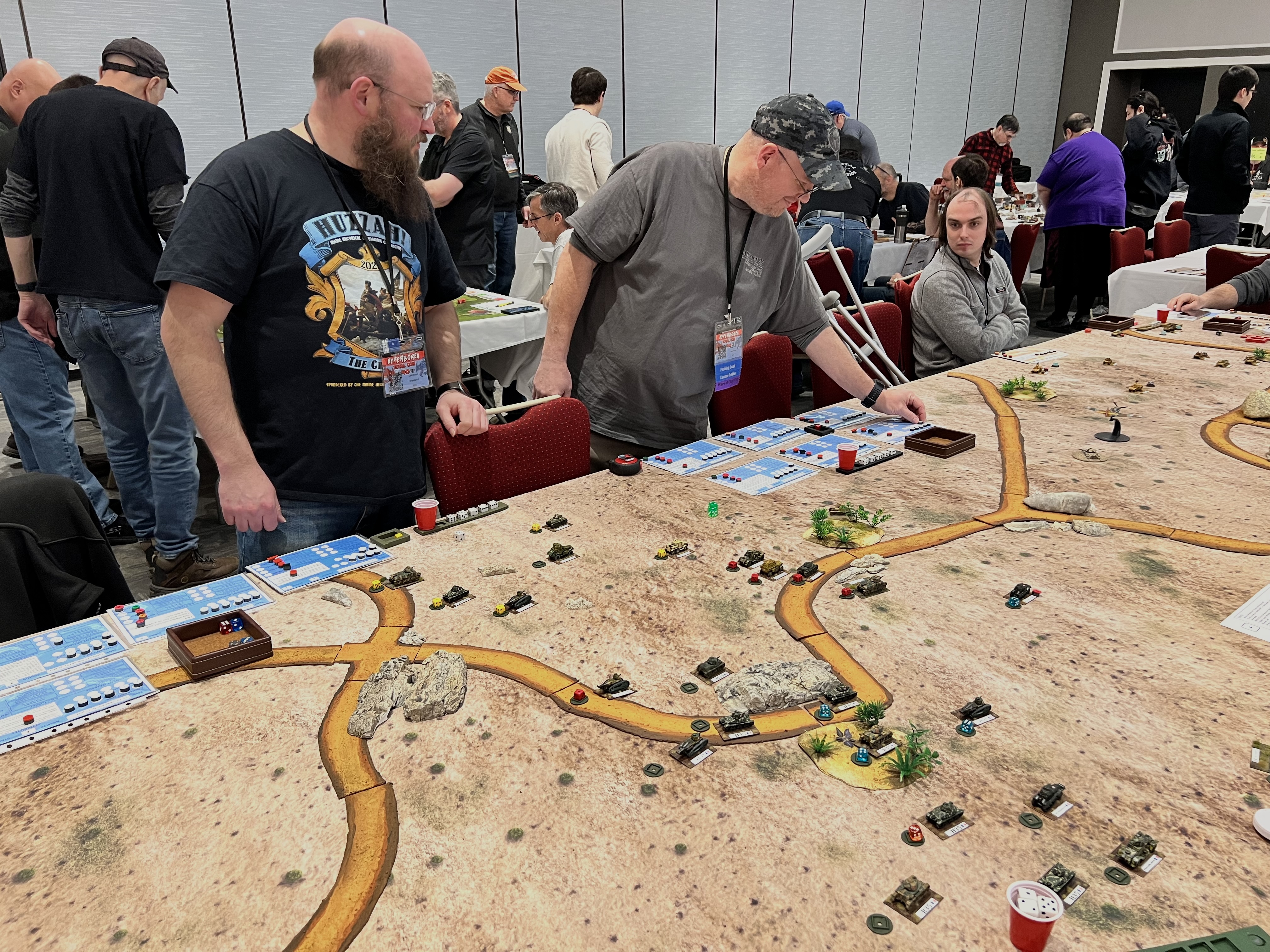
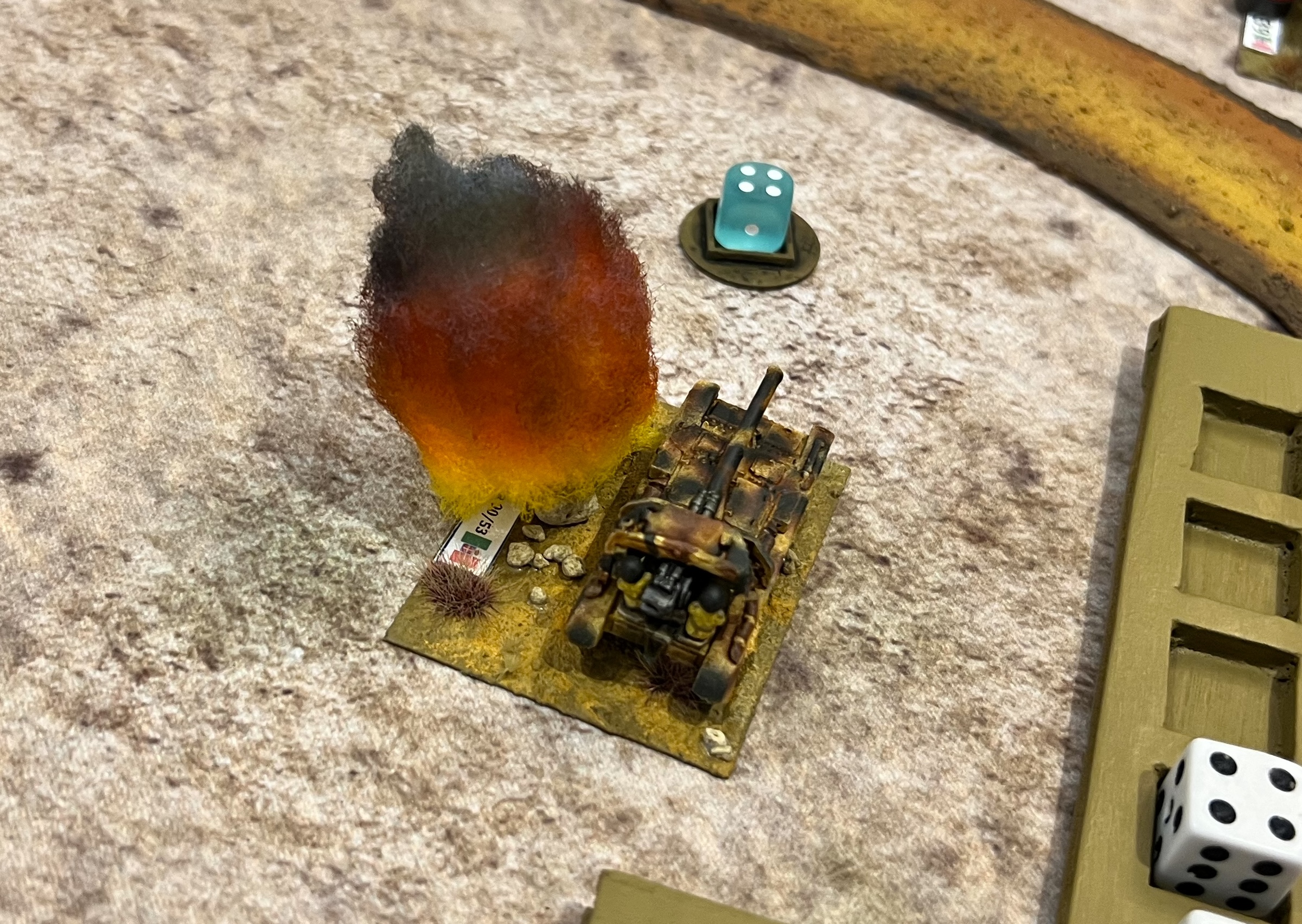
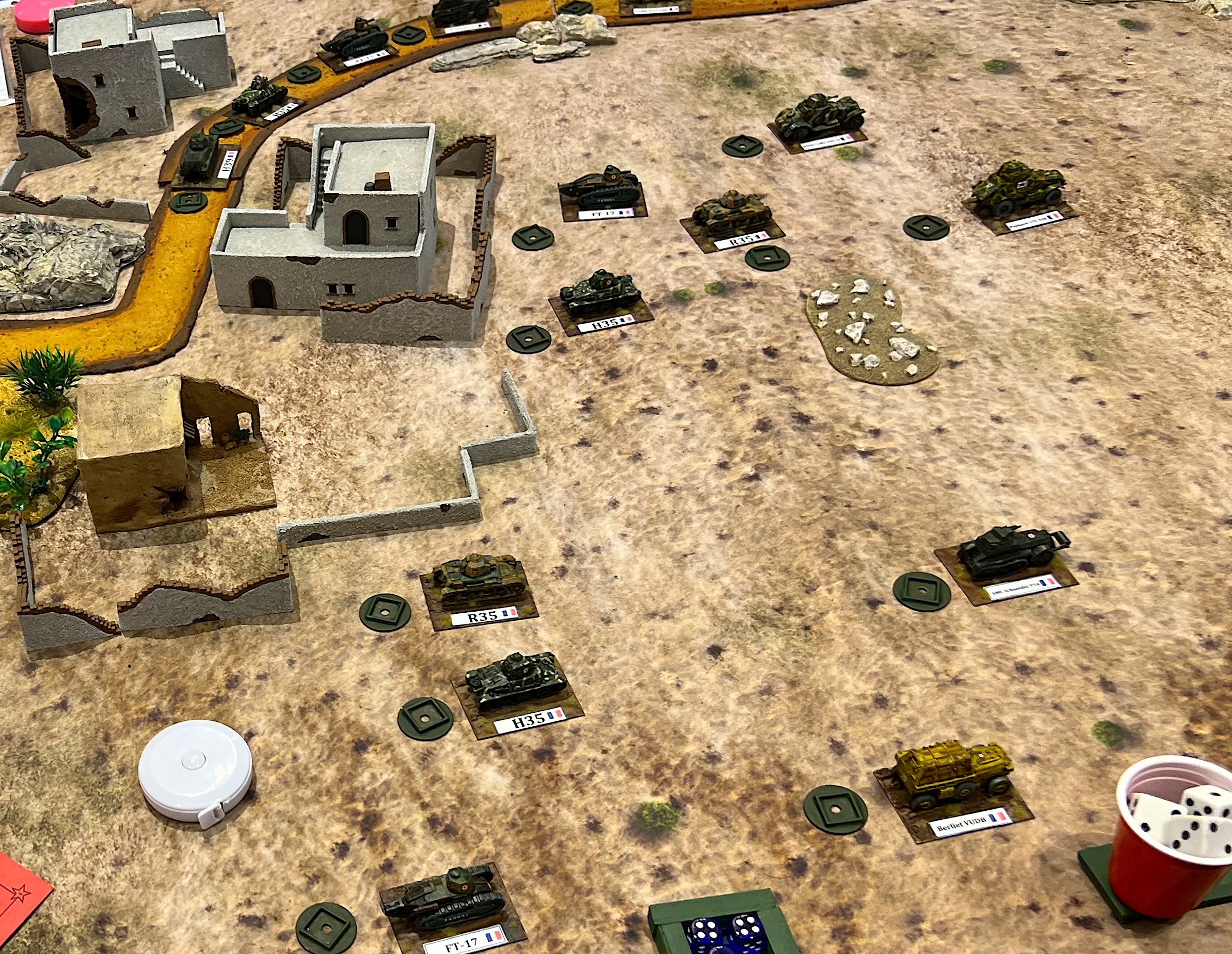
Vichy French armor facing the Italians.Royal Italian Army armor facing the French.The players plot their moves.An Italian Macchi C.202 Folgore (Italian “thunderbolt”) dogfights a Vichy Dewoitine D.520.Leif smiles as he records temporary damage on his tank. The damage was caused by Leif’s very bad dice rolling for a very old and worn out French FT-17!A Vichy SOMUA S35 knocks out an Italian Semovente 90/53.French forces advance.
The game ended with Vichy winning 540-440.
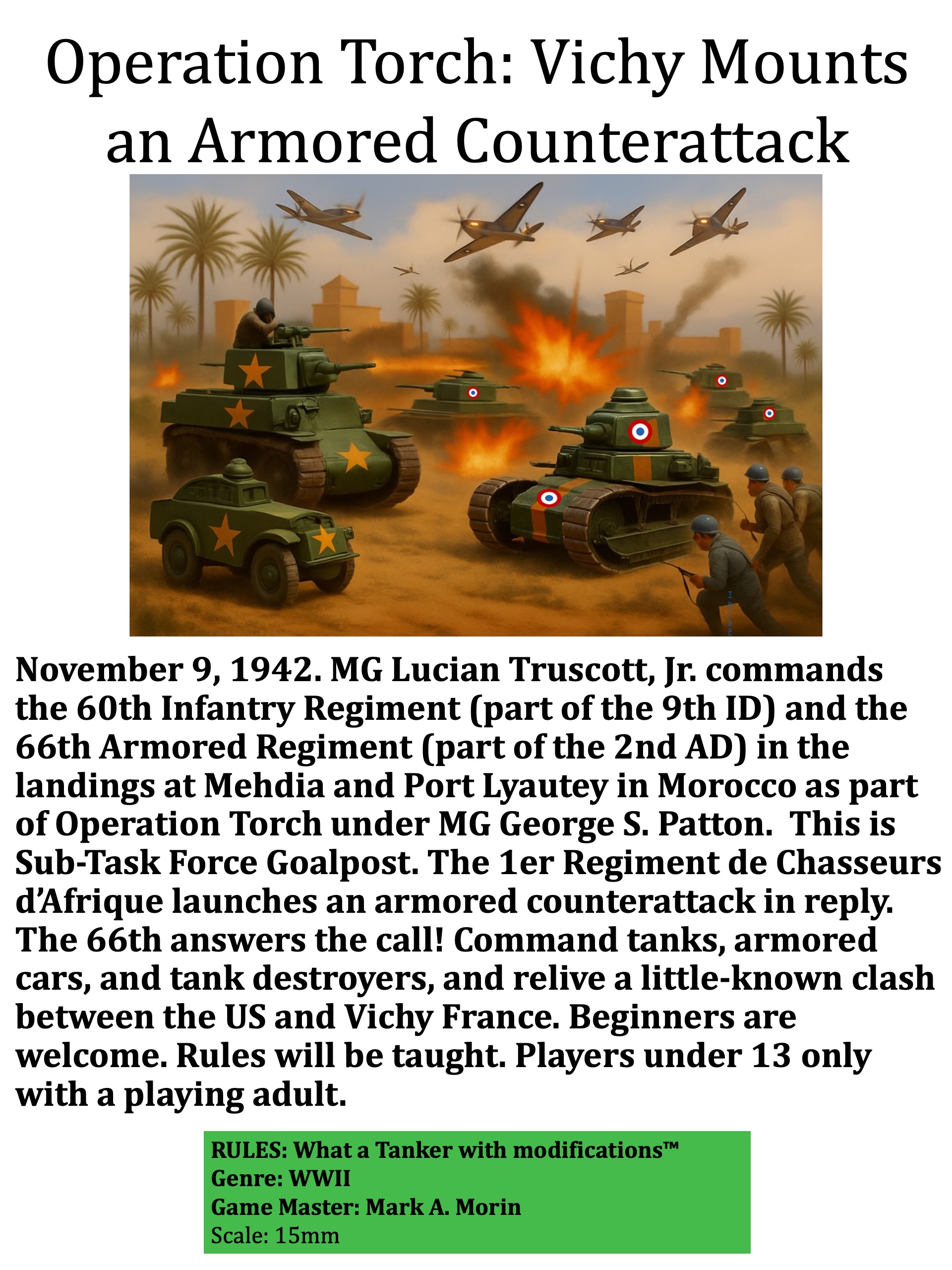
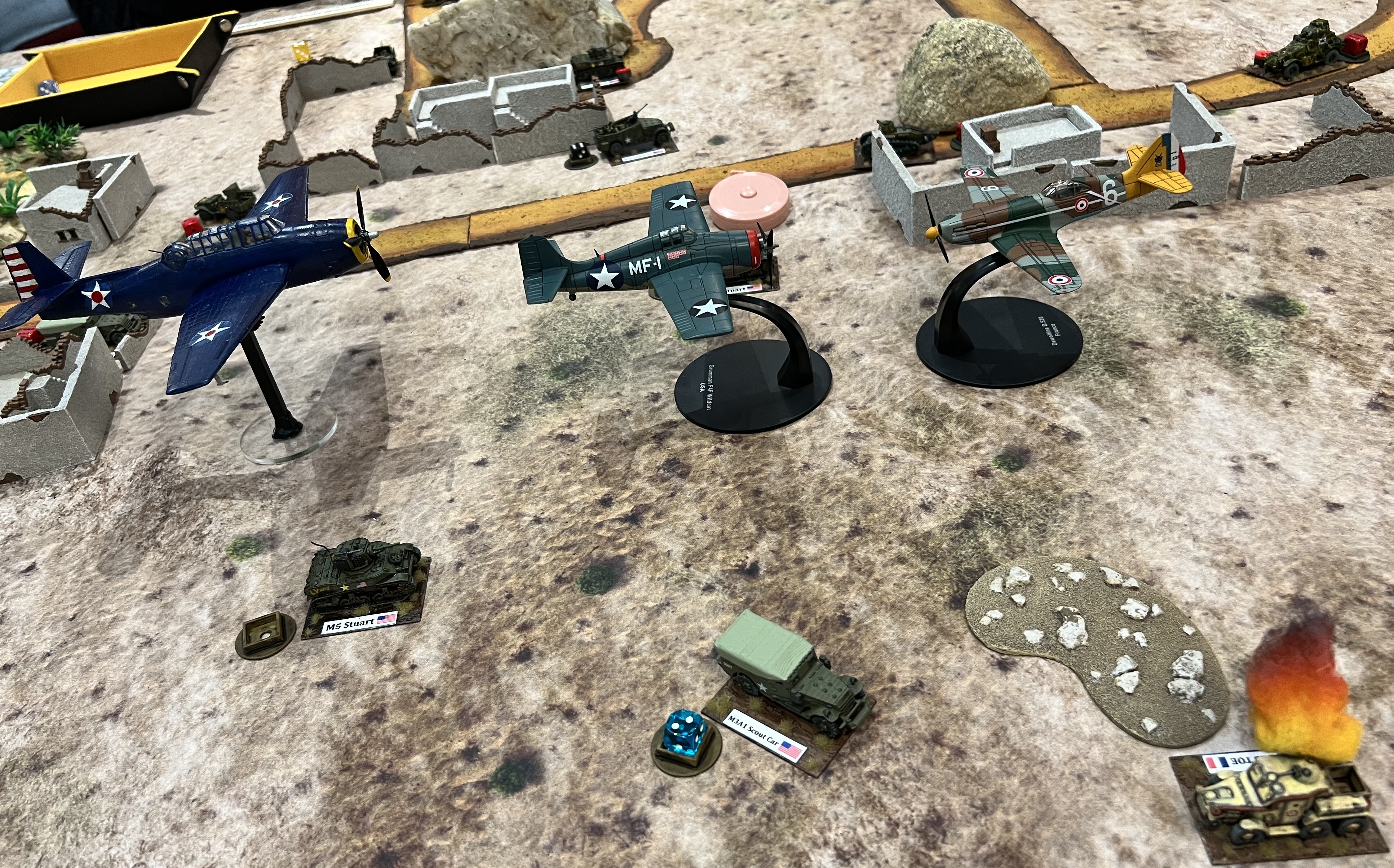
For Saturday afternoon, I ran Operation Torch: Vichy Mounts an Armored Counterattack. This was also a modified What a Tanker game.
Operation Torch: Vichy Mounts an Armored Counterattack
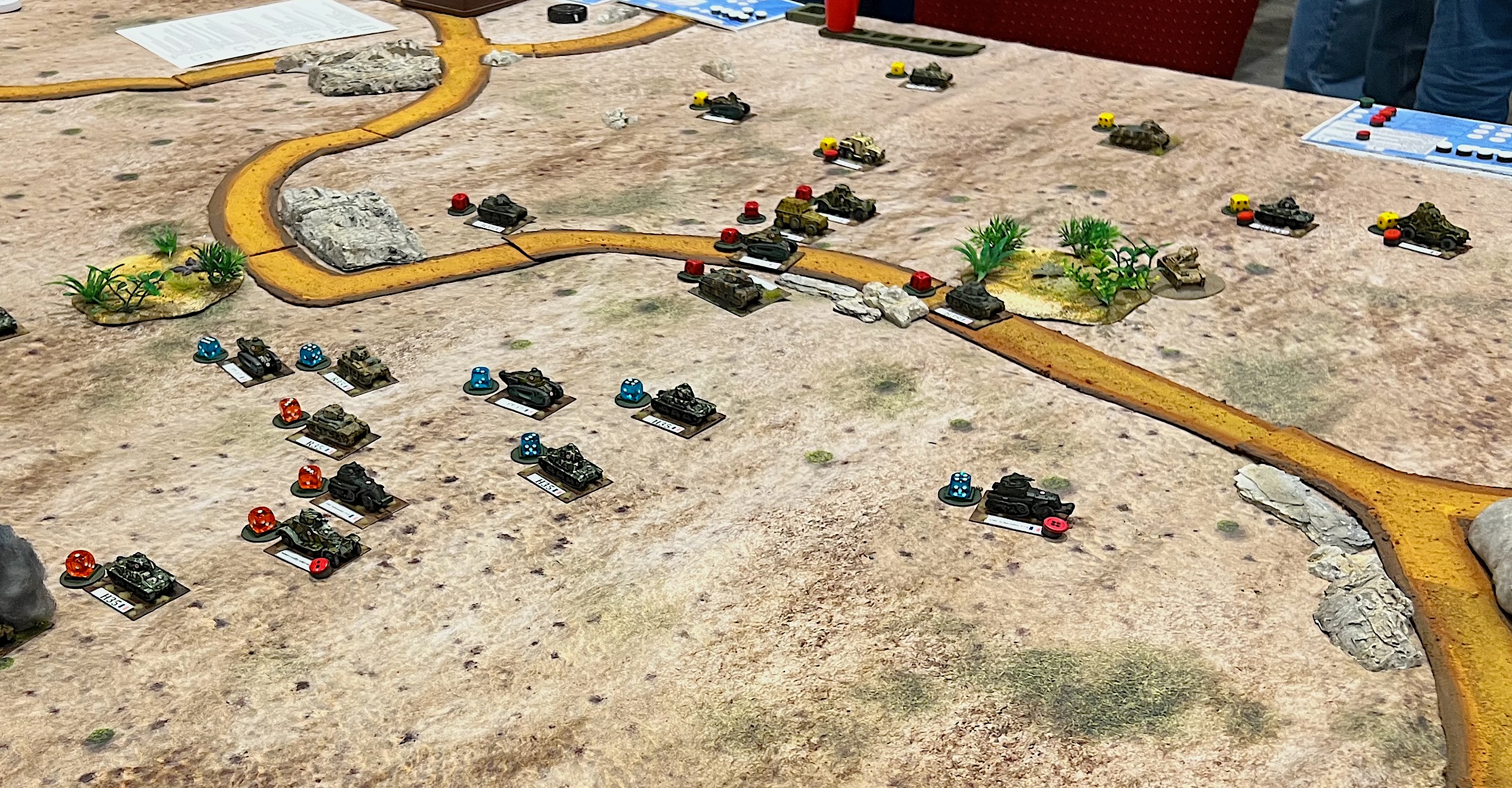
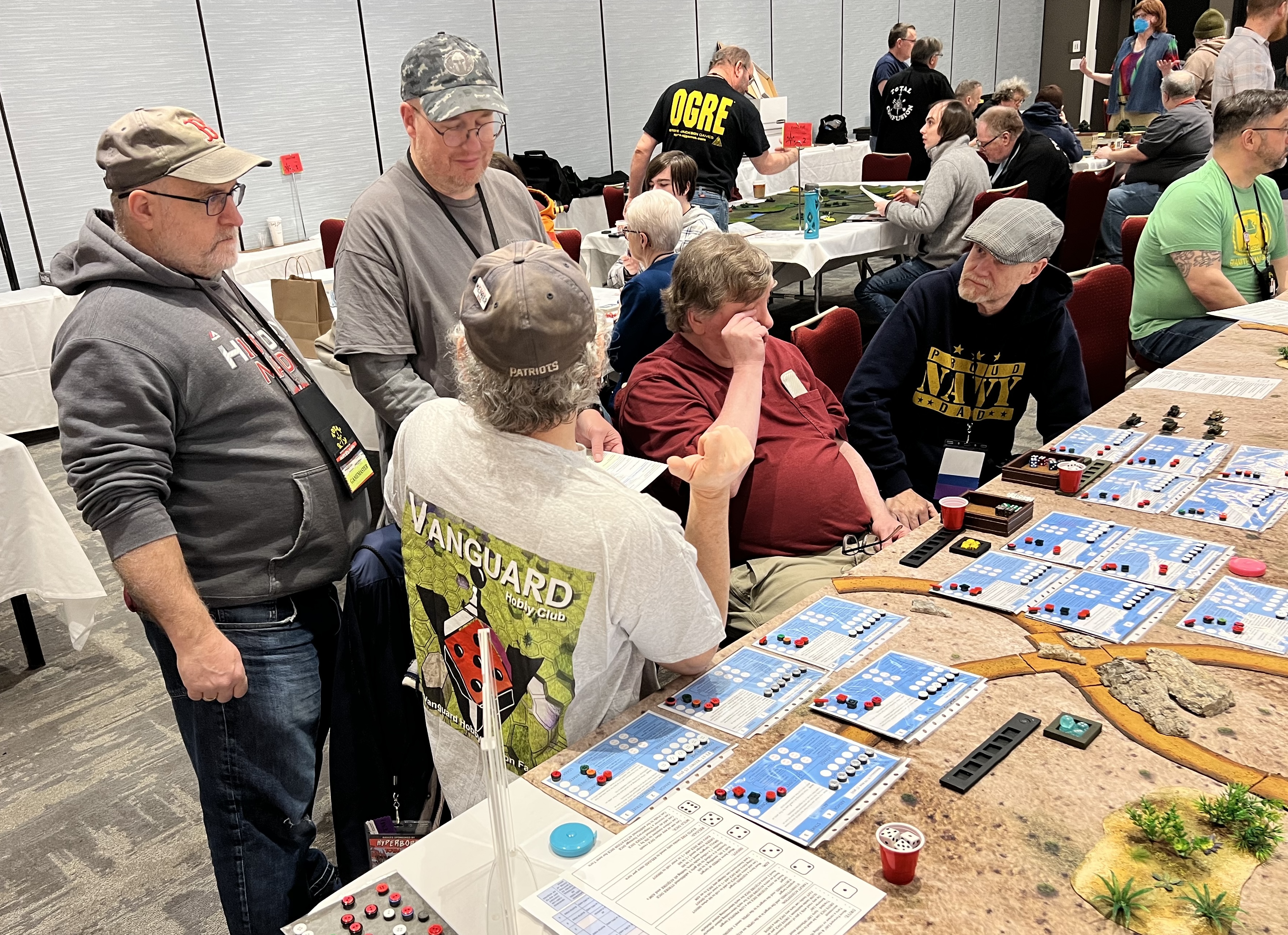
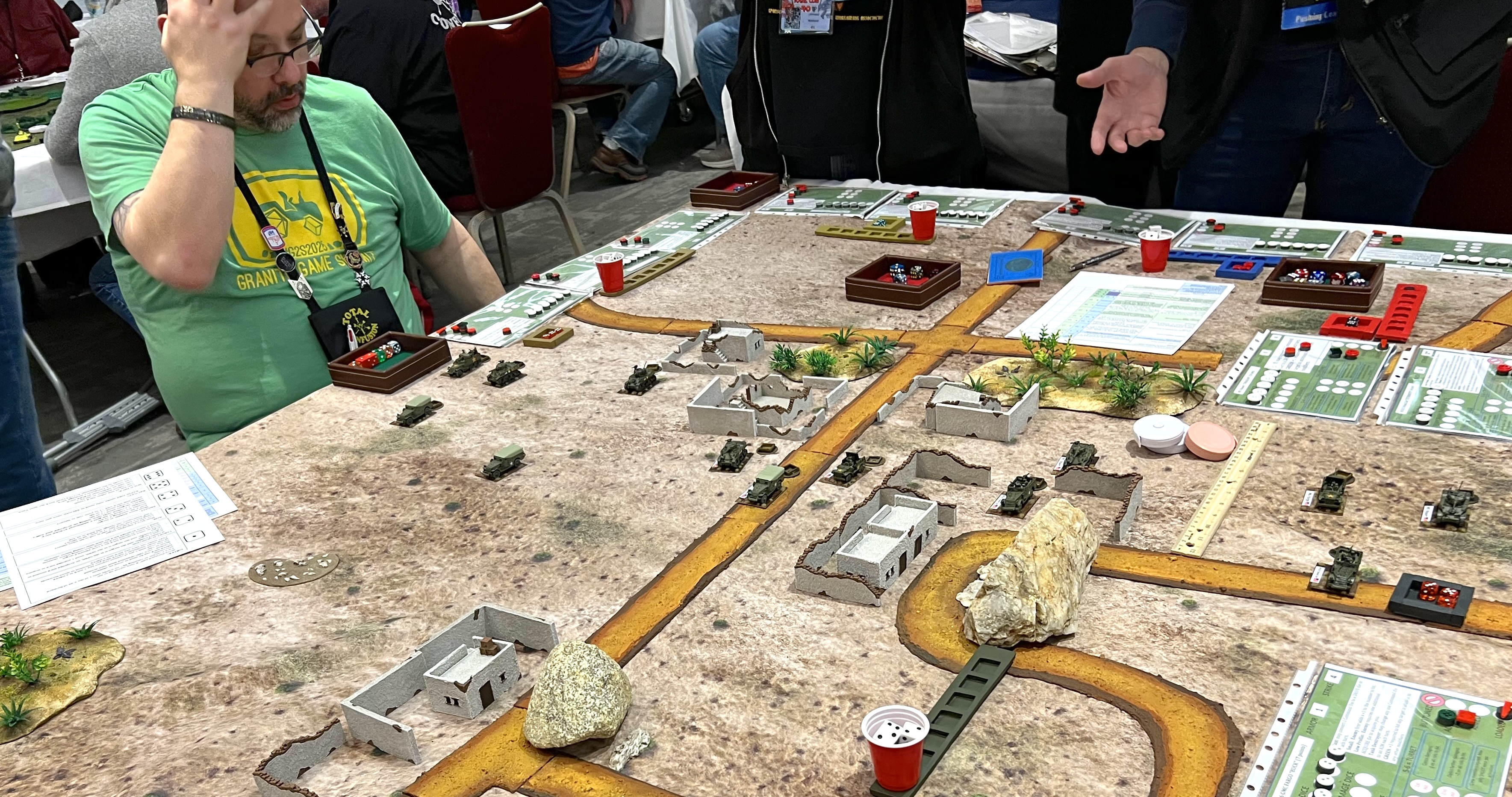
The Vichy players plan their assault.The American players are ready!The Americans watch as the Vichy French get closer. They have plans of getting air cover and naval gunfire on the French!Knowing this, the French spread out to avoid massing a big target.Mal considers his next move.Aircraft are deployed, but the US Navy rules the skies. This allows for the Avenger to call in naval gunfire from the USS Savannah. This destroys multiple Vichy vehicles.
The US air superiority and naval gunfire carried the day – with the US winning a significant victory.
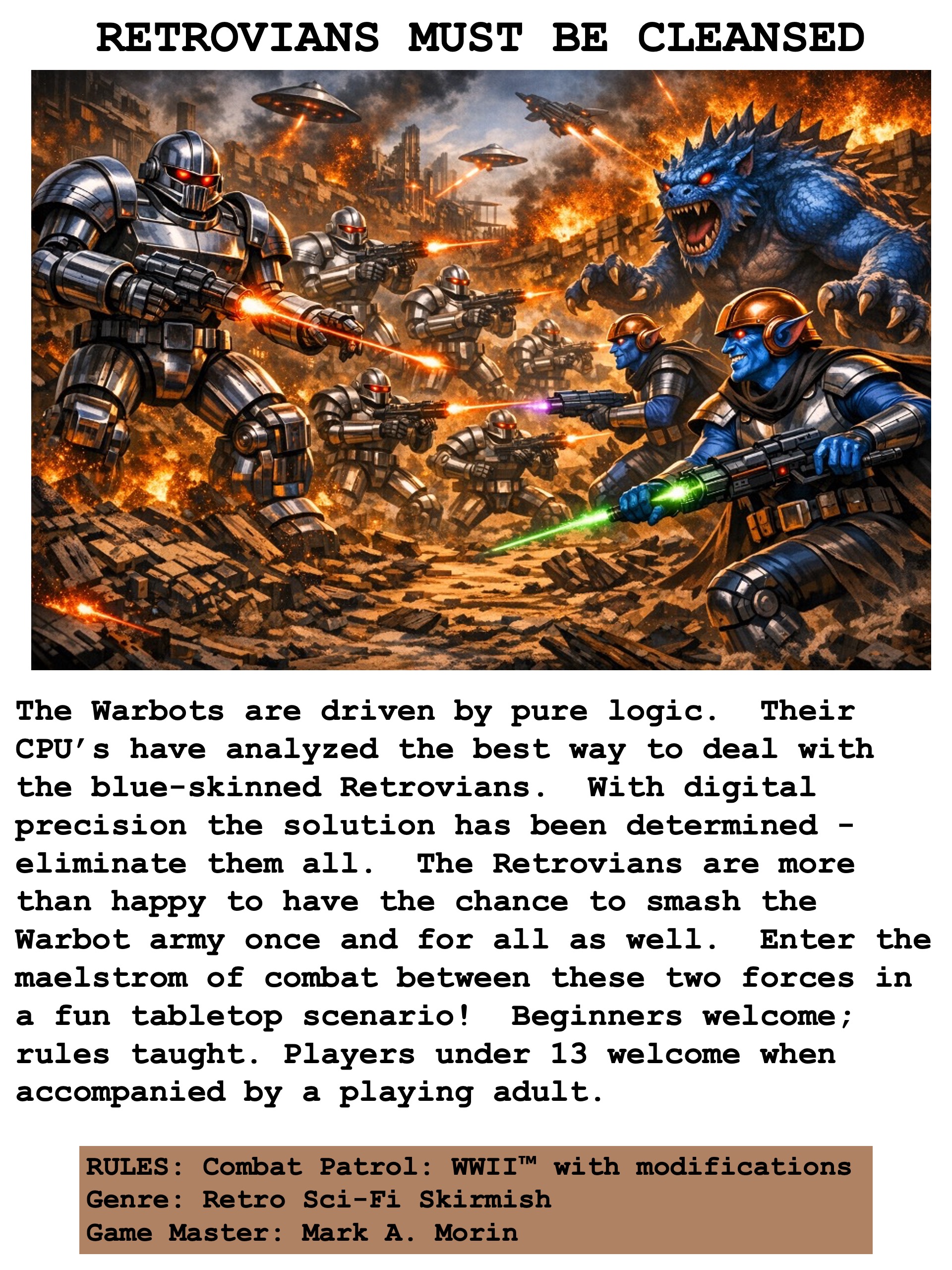
RETROVIANS MUST BE CLEANSED
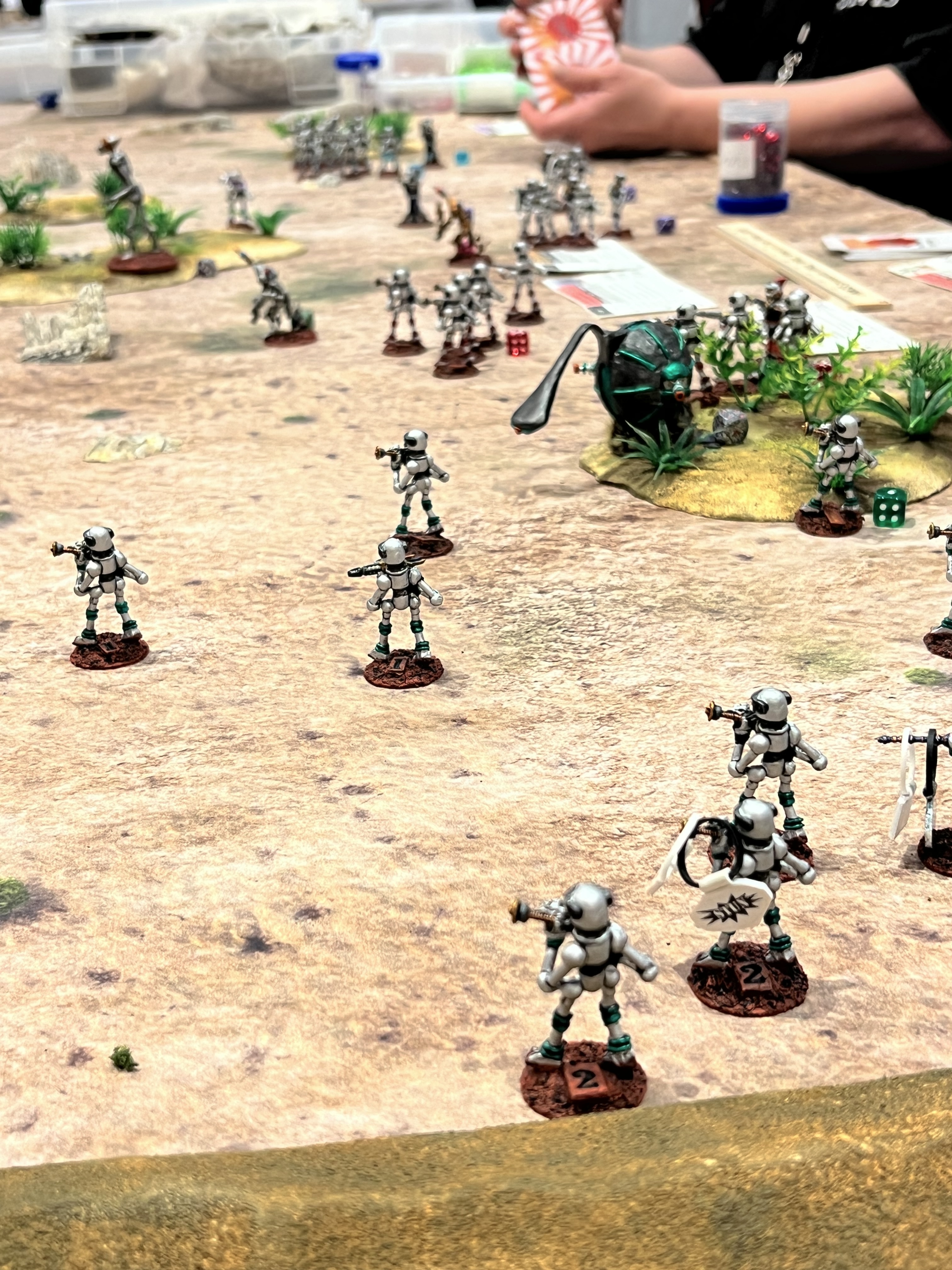
Saturday night’s game was upon me, and I had decided to run another Combat Patrol retro sci-fi game. This time, the Retrovians would face the Archive Star Rovers Warbots. They would also confront my own creation – the Mark 1 Sphere tank.
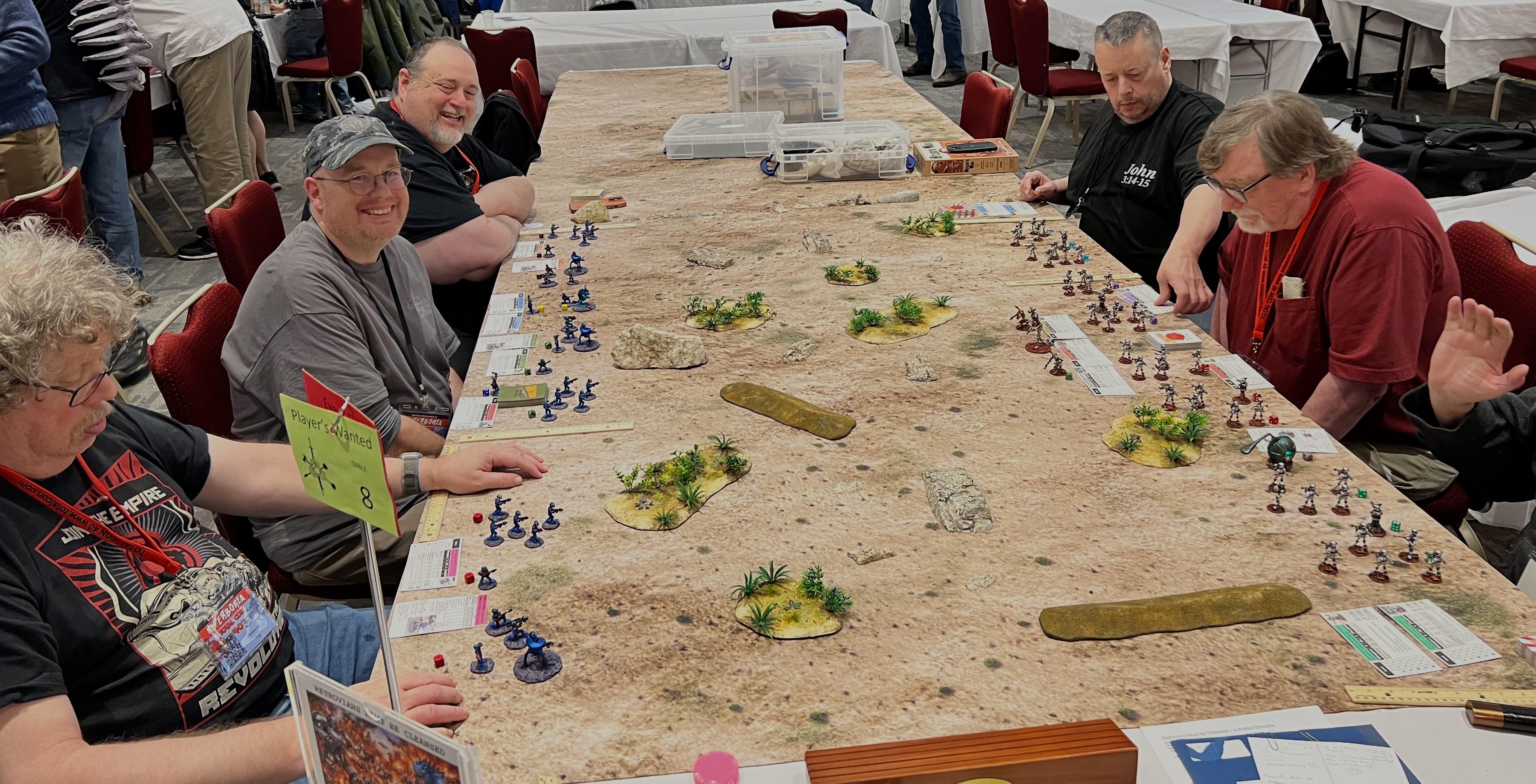
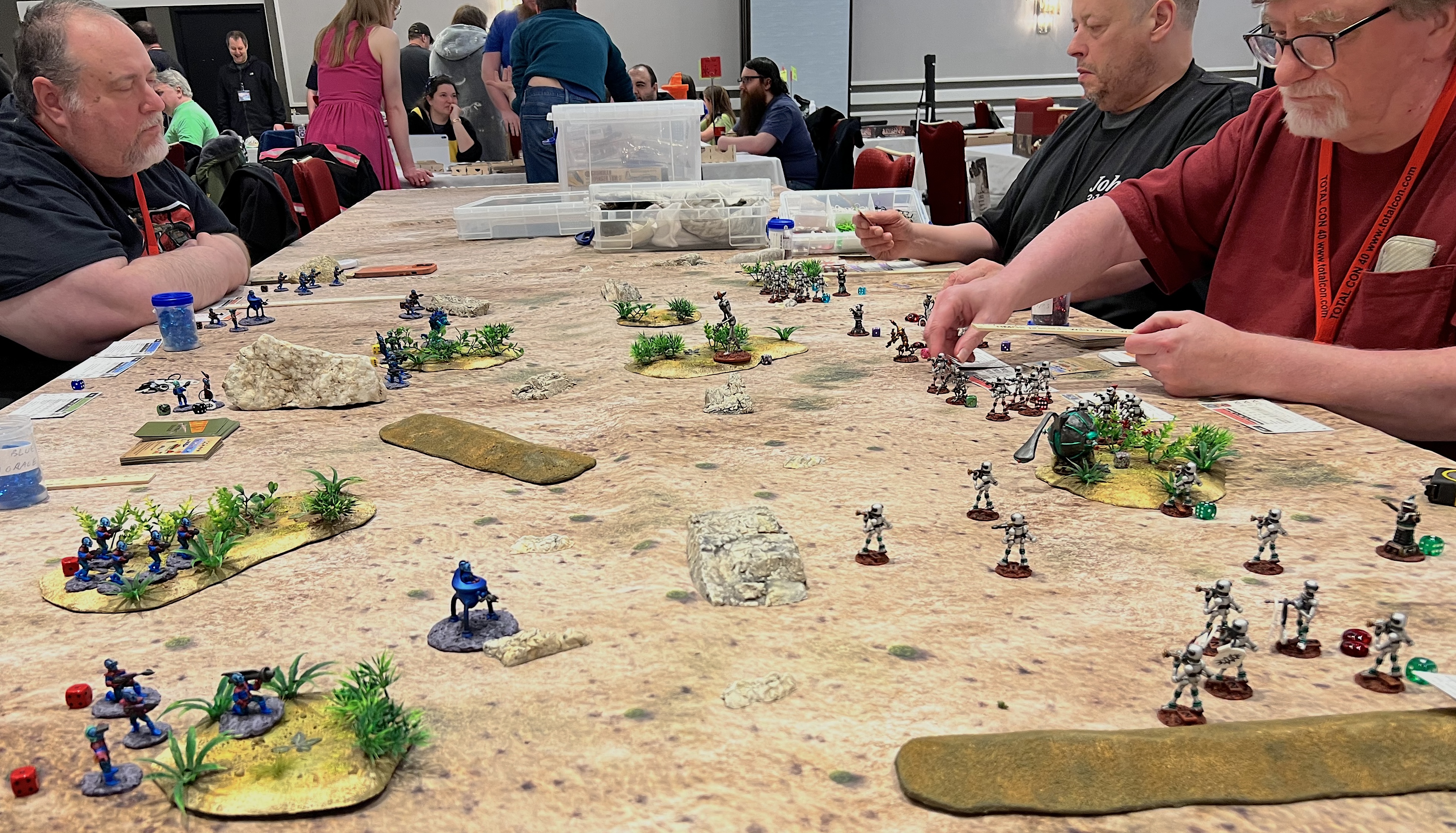
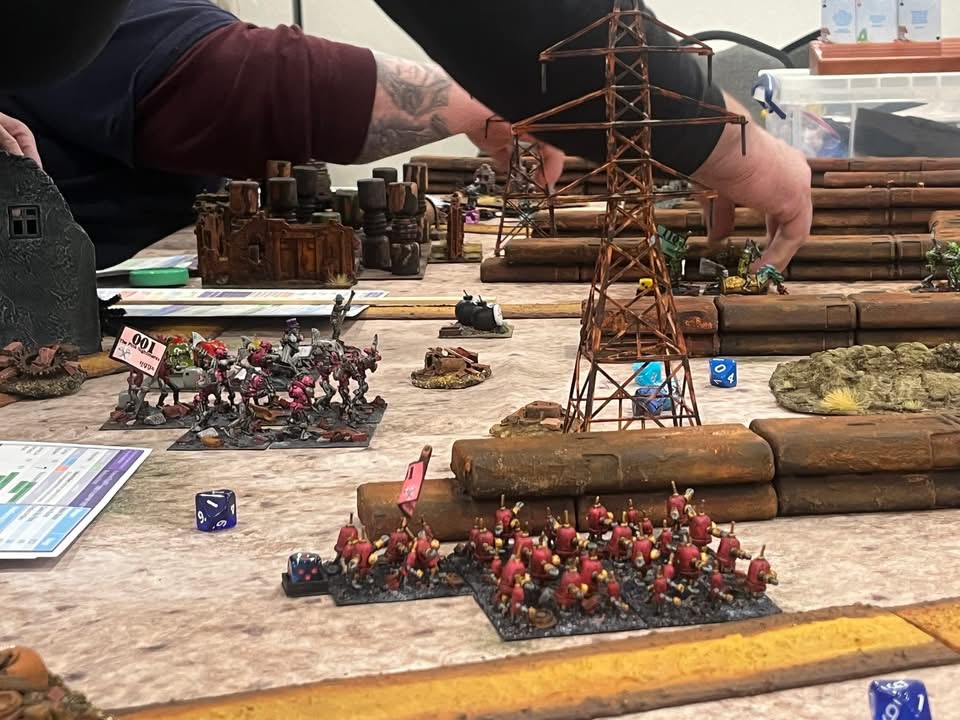
Happy Gamers at the start! Retrovians are on the left, Warbots on the right.A Retrovian Bra’sheer tripod moves out front of its infantry. The Mark 1 takes up a supporting position as the Warbots march forward to glory.The Mark 1 safely delivers machine gun fire from its sponsons. Meanwhile, the Warbots also take fire and are stunned.
I did not take many pictures of this game. I do believe that the Warbots wore down the Retrovians. Yes, they were “cleansed”. It was nice to see these figures back on the tabletop.
This was the penultimate game for me of TotalCon 2026. I headed off to my room. I was ready for the 2026 TotalCon “Tournament of Ozz” on Sunday morning.
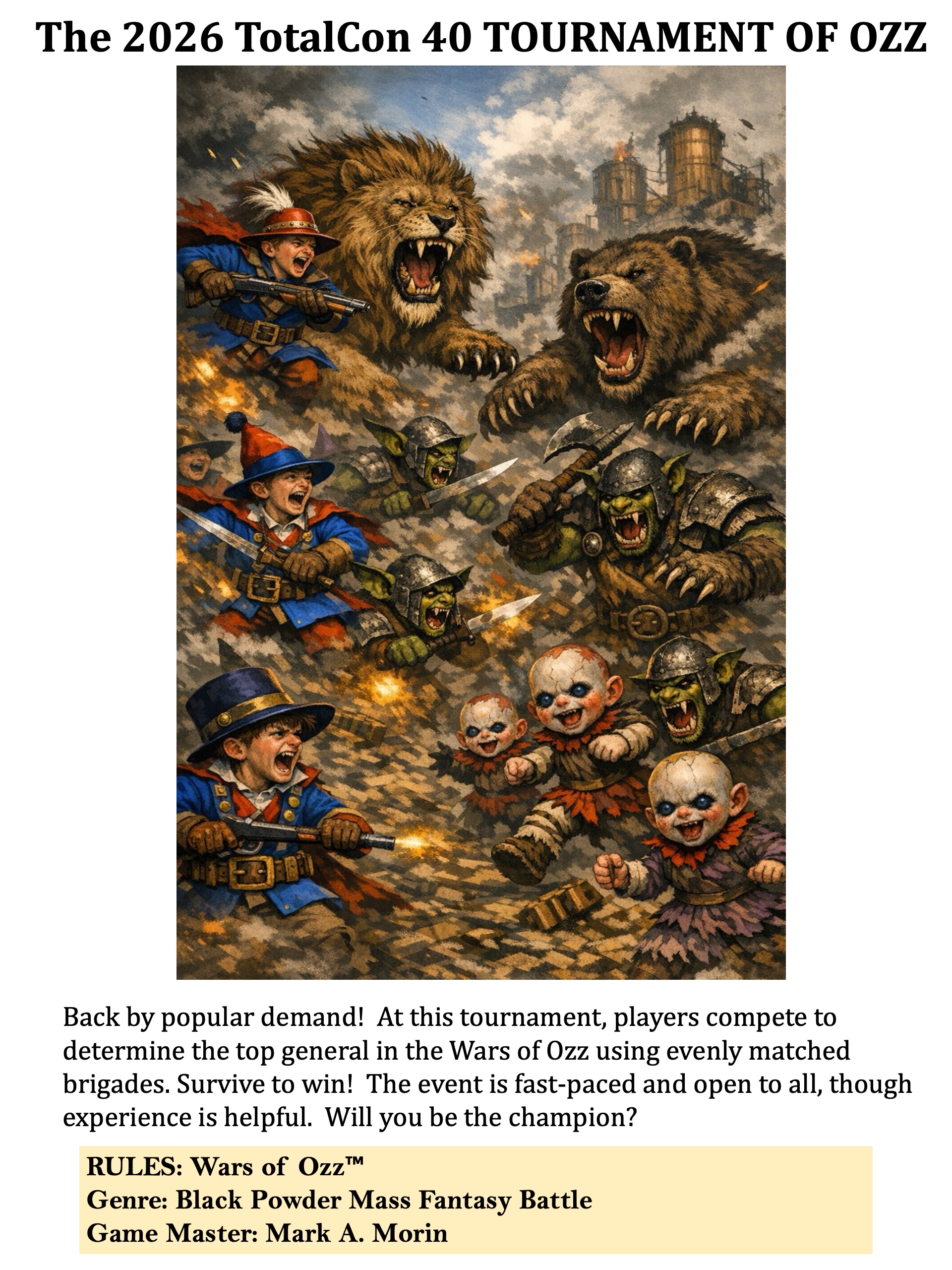
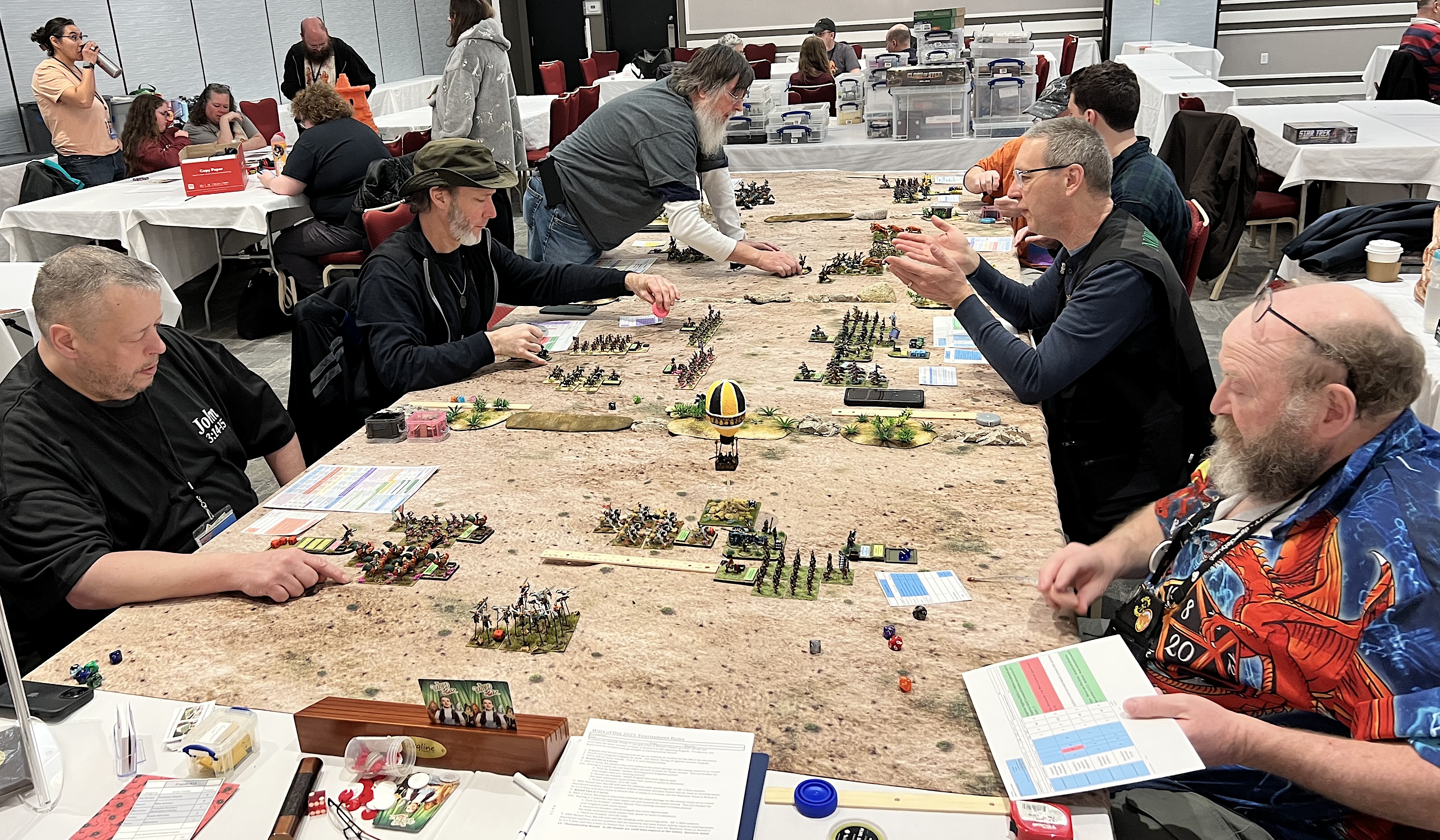
I had 7 out of a possible 8 players. At random, one player got a “bye” in round one. The match-ups were done at random and 7 different 21-point brigades were assigned at random. Inflicting the most damage on the enemy was the victory condition to move forward in the tournament. Tie breakers were also in play if that was needed.
Glory on the Line!
In Round 1 – the match ups were:
Impkins (Ken) versus Munchkins (Eric)
Munchkins (Bob) versus Gillikins (Dave)
Winkies (Brad) versus Gillikins (Jacob)
Winkies (Leif) got the round 1 bye
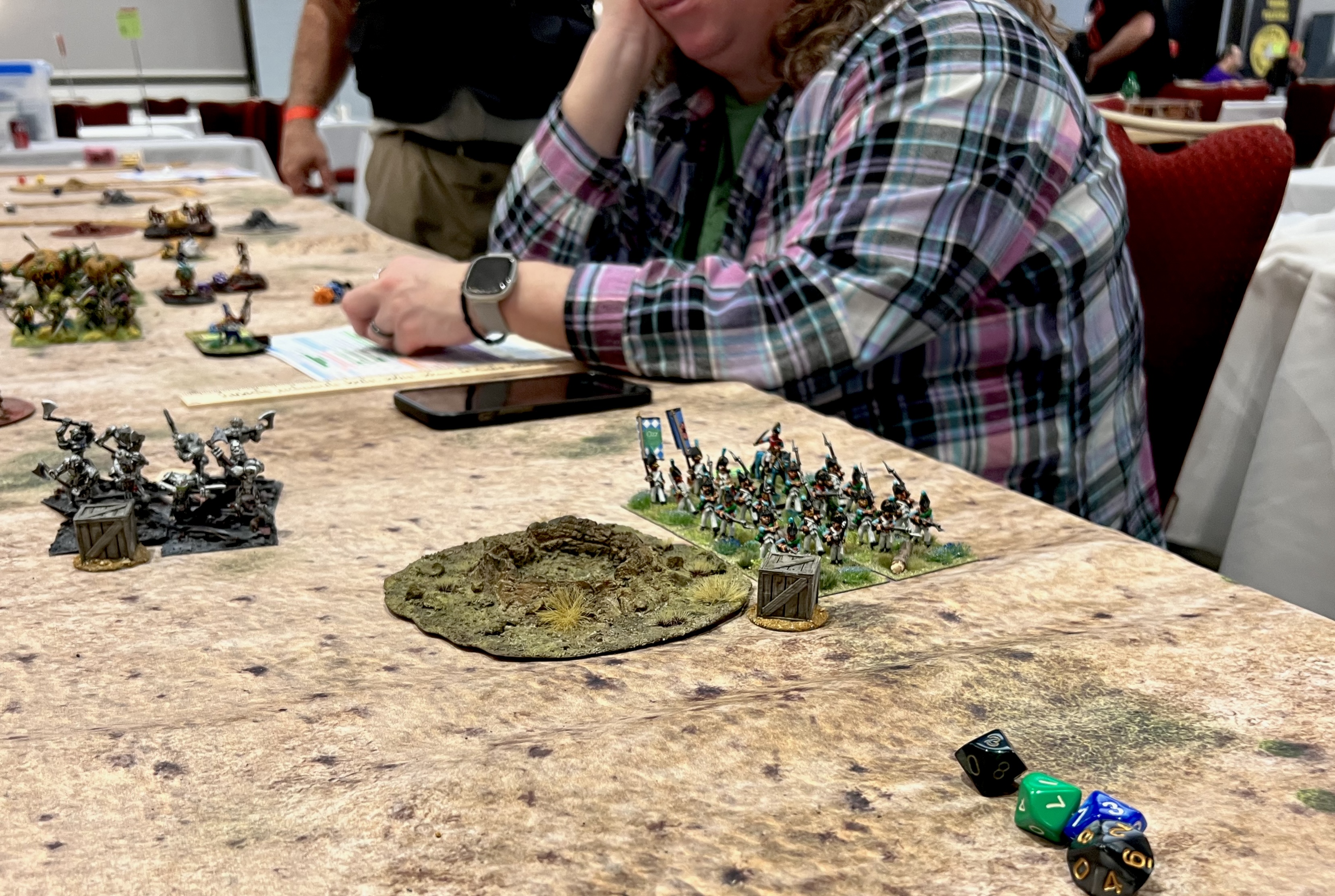
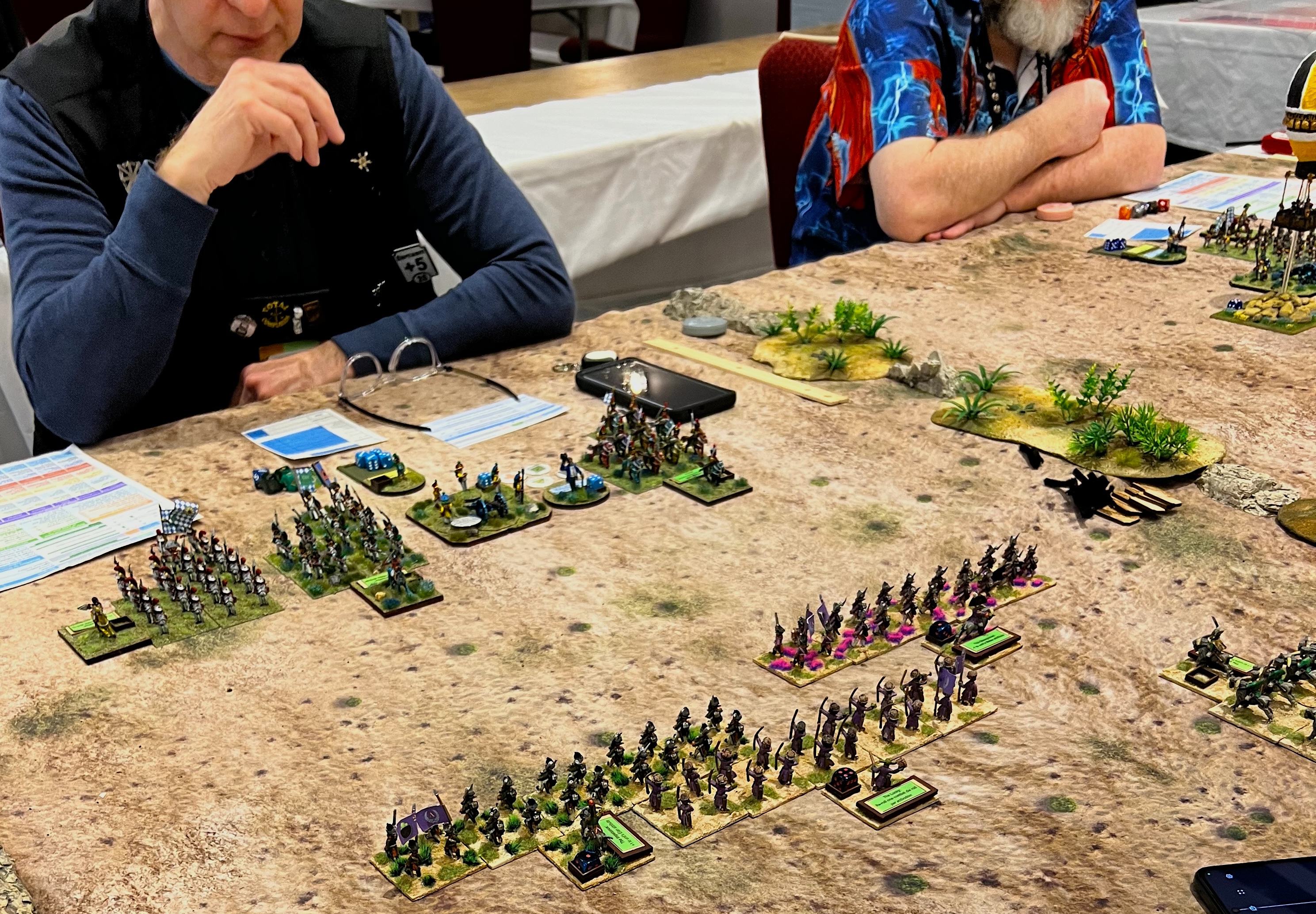
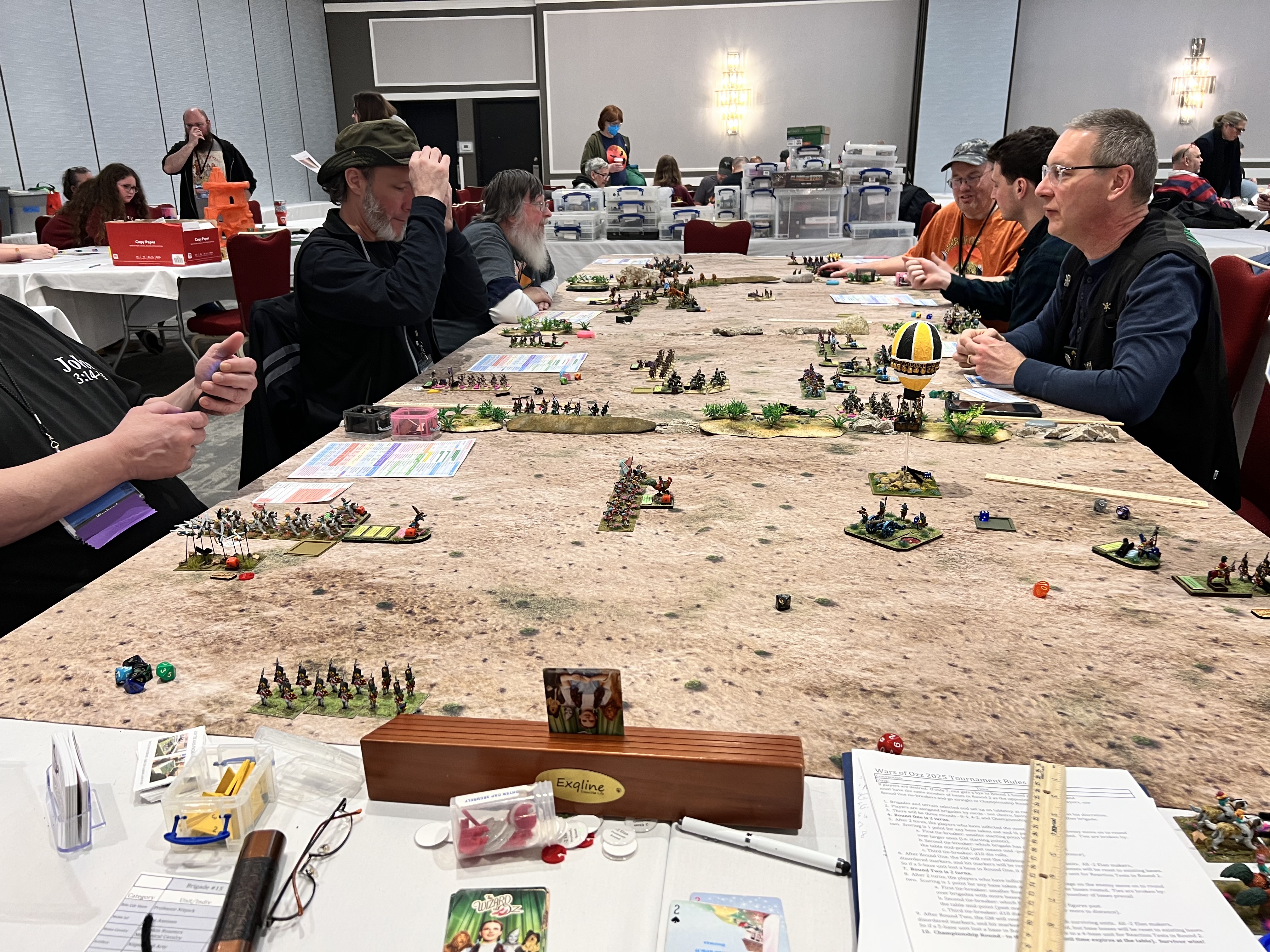
Round 1 begins!Brad’s Winkies devastate Jacob’s GillikinsBob’s Munchkins get into a shooting match with Dave’s Gillikins.Round 1 winds down.
The Round 1 results were:
Impkins (Ken) defeated Munchkins (Eric)
Munchkins (Bob) defeated Gillikins (Dave)
Winkies (Brad) defeated Gillikins (Jacob)
Winkies (Leif) got the round 1 bye
Yielding the semifinals as:
Impkins (Ken) versus Winkies (Brad)
Munchkins (Bob) versus Winkies (Leif)
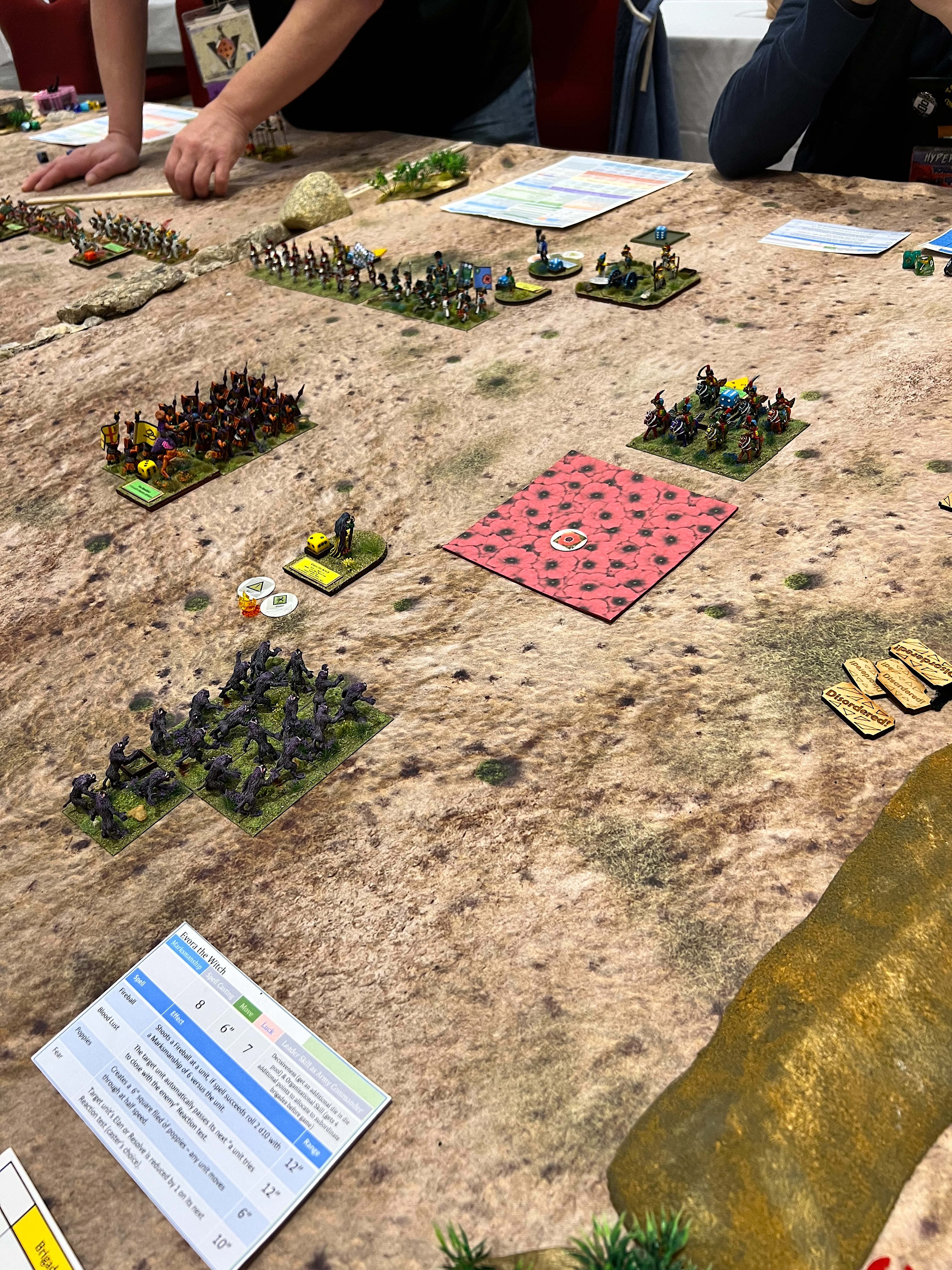
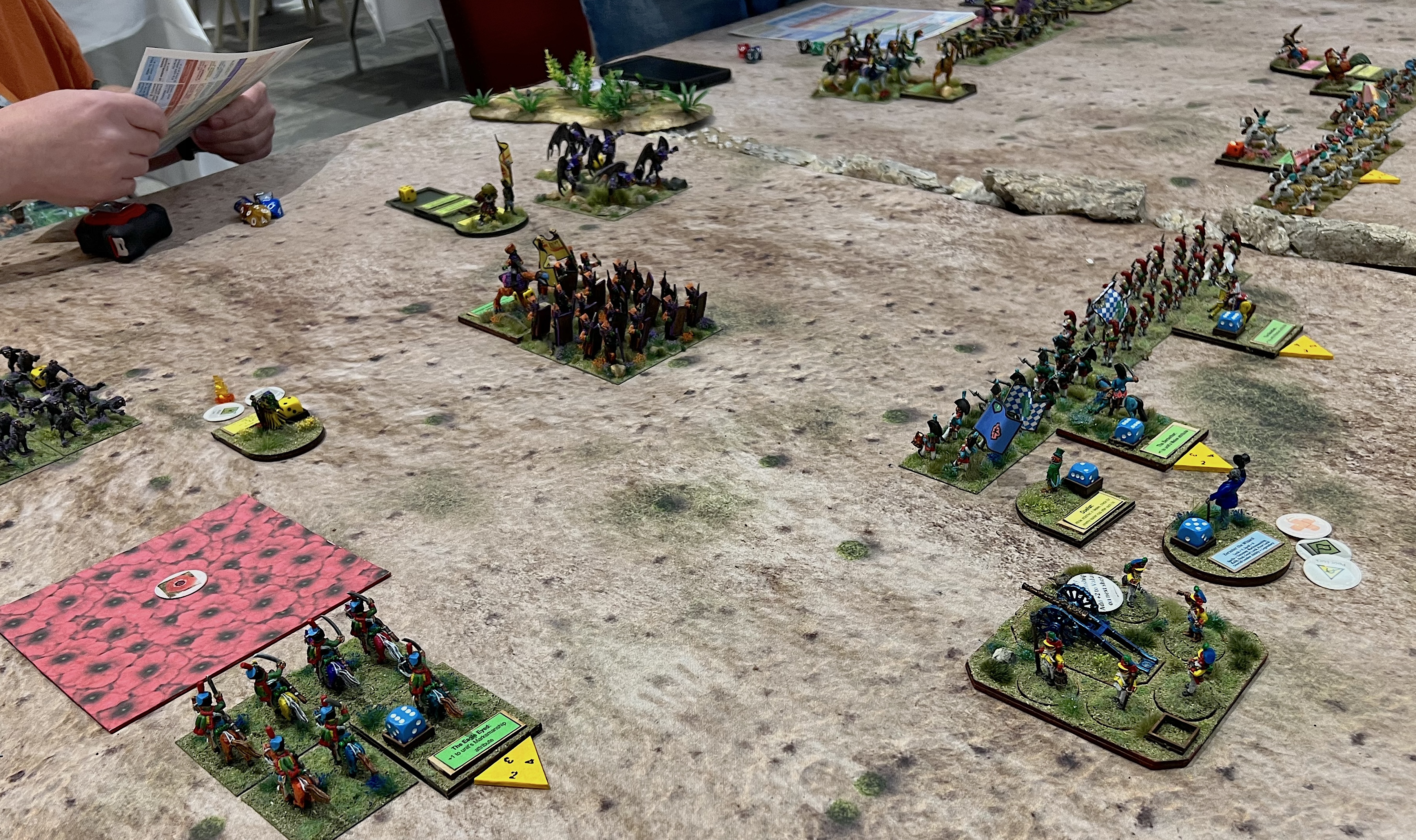
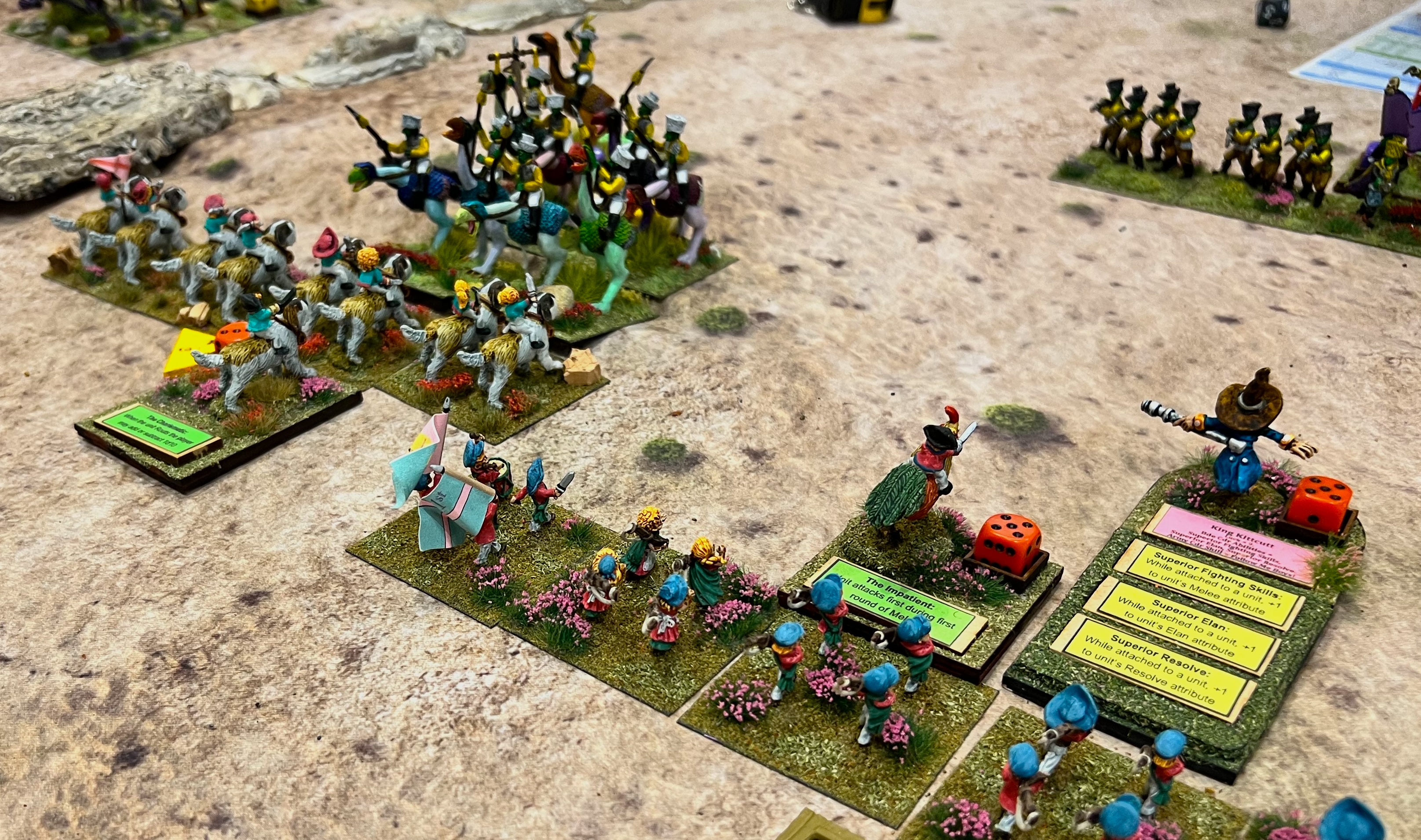
The semi-finalists!Leif casts a poppies spell to thwart Bob’s cavalry,Bob’s Munchkins prepare to unleash musketry on Leif’s Winkie Guard. They would rout!Meanwhile, Ken’s Impkins got hit hard by Brad’s Winkies.
The Round 2 (semifinals) results were:
Winkies (Brad) defeats Impkins (Ken)
Munchkins (Bob) defeats Winkies (Leif)
Yielding the FINALS as:
Munchkins (Bob) versus Winkies (Brad)
Brad and Bob get ready to rumble!
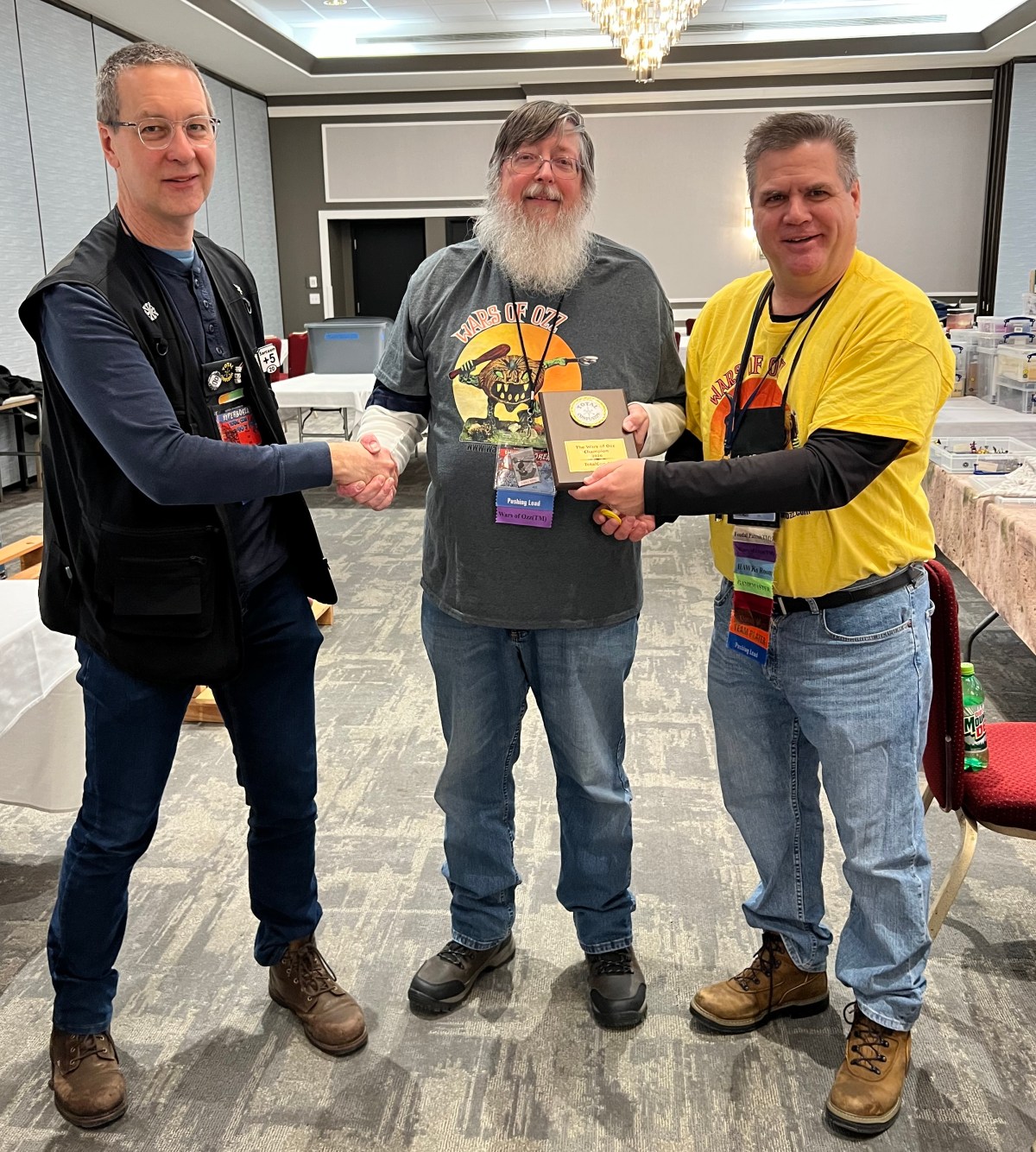
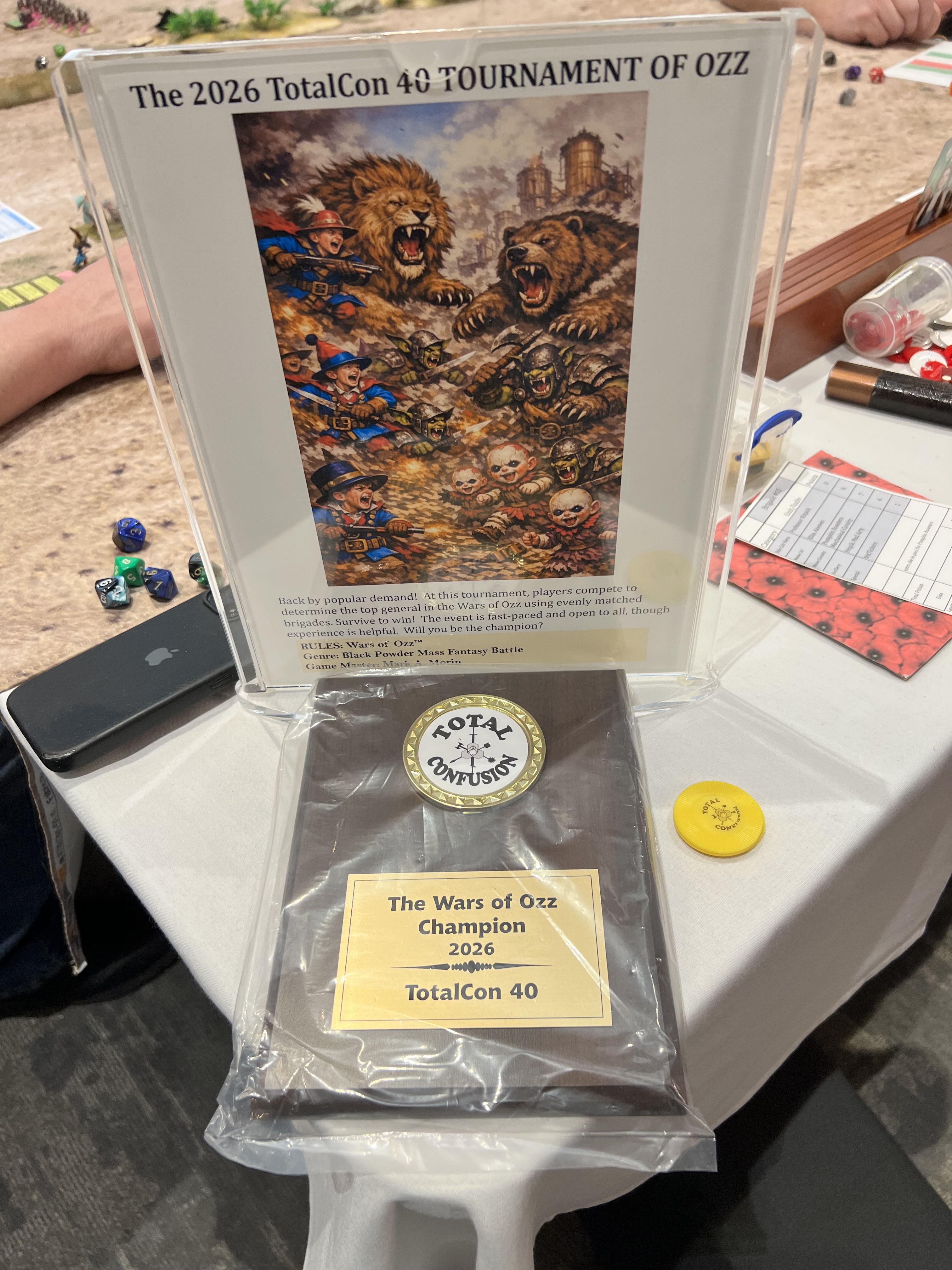
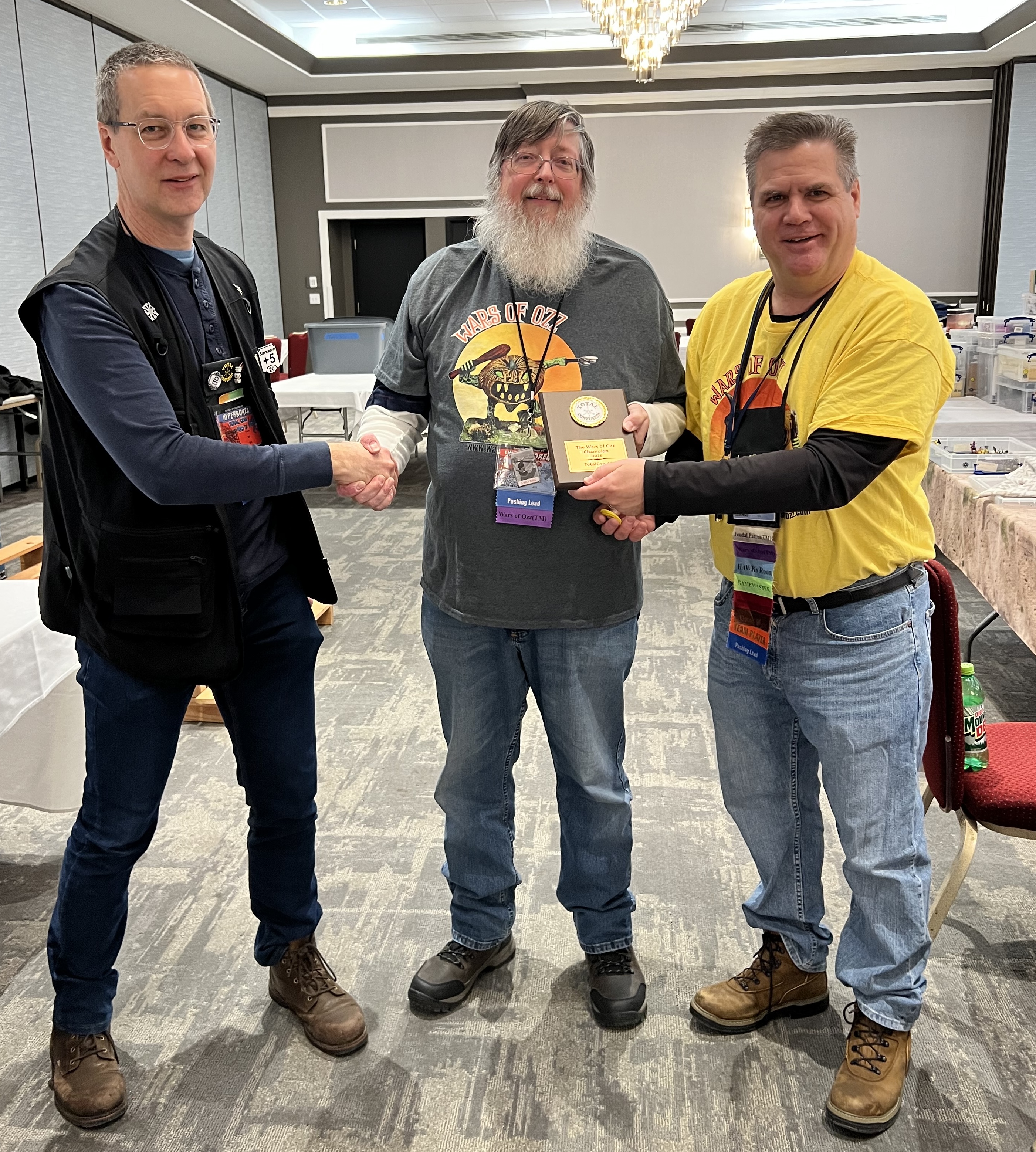
In the end, Brad outlasted Bob – though it was close! Congratulations to Brad as the 2026 TotalCon Wars of Ozz Champion! Congrats to Brad!
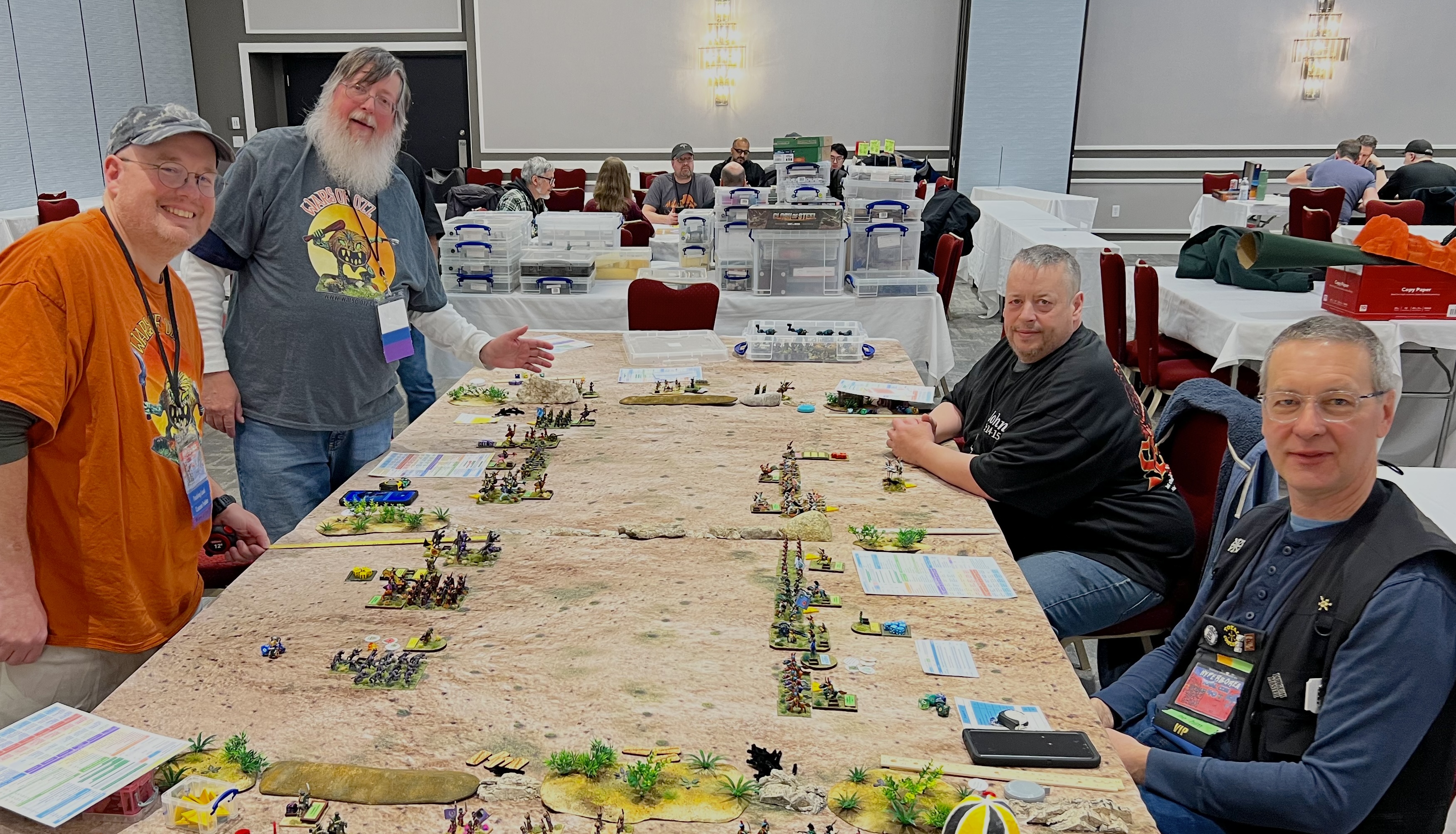
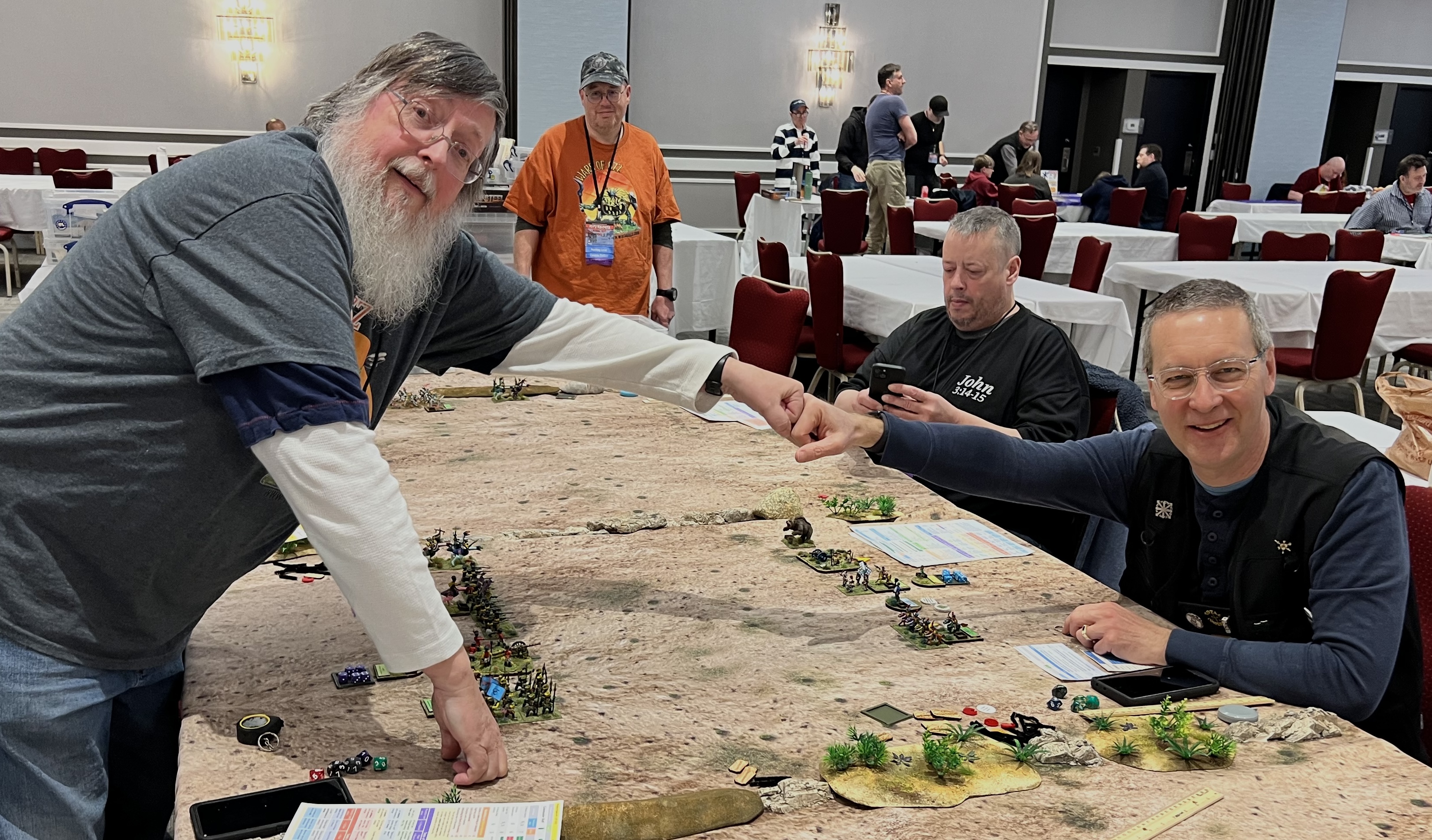
The 2026 runner up Bob, the 2026 champion Brad, and your happy GM.
Thank you to all who helped me at the convention. Special thanks to Leif and Brad.
I also want to extend a very special thanks to Bryan Clauss, Steve Parenteau, Kevin Baumann, and the entire TotalCon staff. They do a magnificent job running a great convention! BIG THANKS!!
Lastly, a few areas that you can check out if you dare:
Not just any pond, but one they both claimed as part of their cultural and historical heritage. I would run the game with Buck Surdu’s Combat Patrol: WWII rules modified for retro sci-fi skirmish.
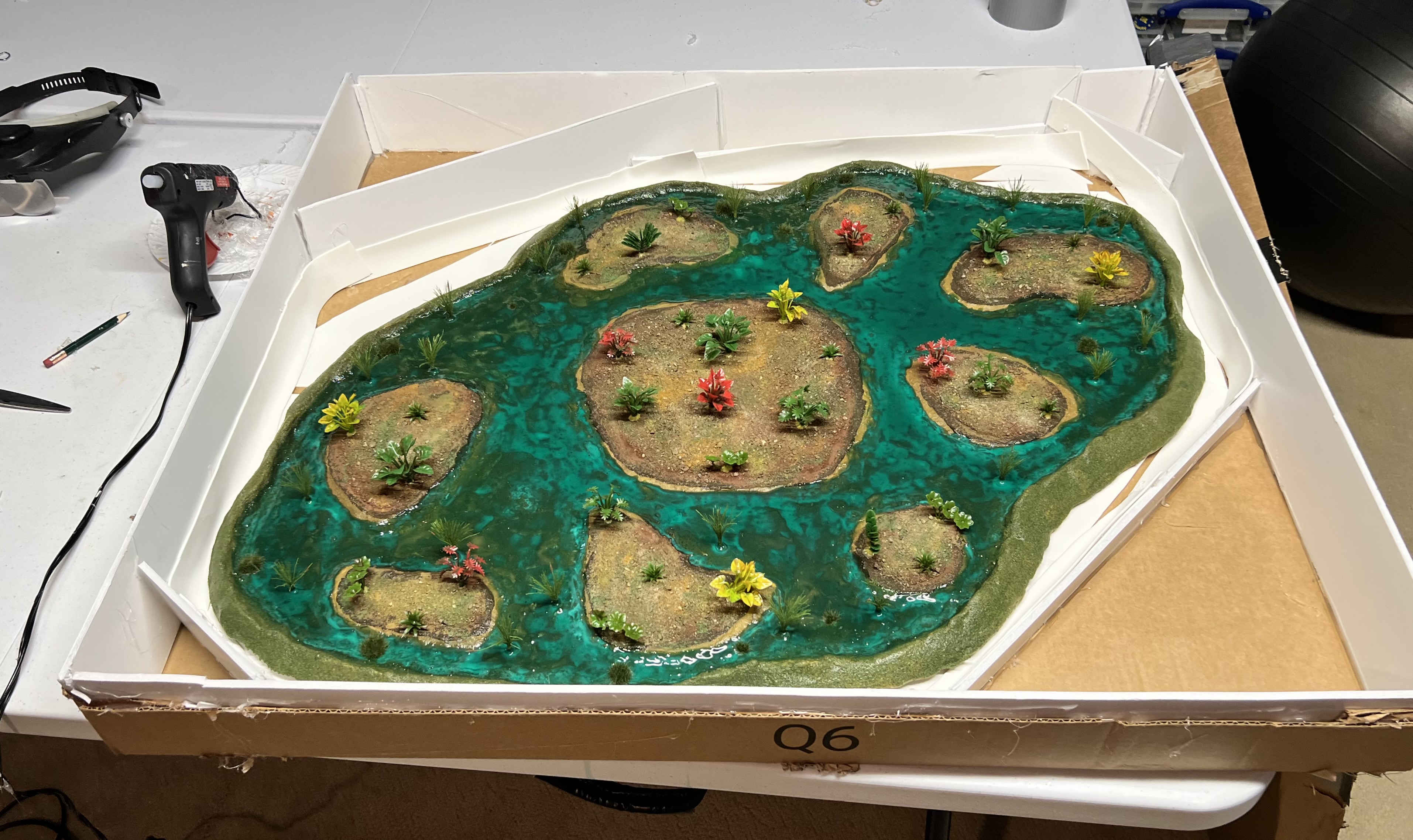
With that said, I needed a suitable pond for the tabletop. I did not have a lot of time to build it. The period from the end of Cold Wars on February 8th to the start of TotalCon on February 19th was short. It did not allow for much preparation.
This is the story of that pond build! There are a lot of WIP shots. Additionally, you will find a few videos. They will give you a better flavor of the project.
My flyer for the game – now I needed a pond!
Like most of my projects, I think a good deal about it, design it and plan it, then get it done. I wanted the pond to be big enough to really be a spectacle on the tabletop – and to be very functional for a game.
I sketched out a concept on February 9th – the pond would have several islands for the players to fight to control. Additionally, I needed to have a plan to use Vallejo “Still Water” on the pond. Those initial design concerns that I had were:
Dealing with the effective application depth of “Still Water”. The depth is supposed to be less than 3mm per application. How would I make that work?
What type of pond “structure” would hold the “Still Water”?
I read online that “Still Water” could be acidic and/or destructive to acrylic paint, even a primer. I did not want to get to a stage in the project where I needed to restart or acquire more supplies. How could I deal with this issue?
How could I build island structures onto the pond and how could I integrate them into it?
As is my habit, I got out the graph paper and drew an initial concept with 6 islands. I did end up building 8 islands in the end. The size I wanted was approximately 36″ x 24″.
Initial design drawing of the pond as it would sit on a 6′ x 10′ tabletop on February 9th.
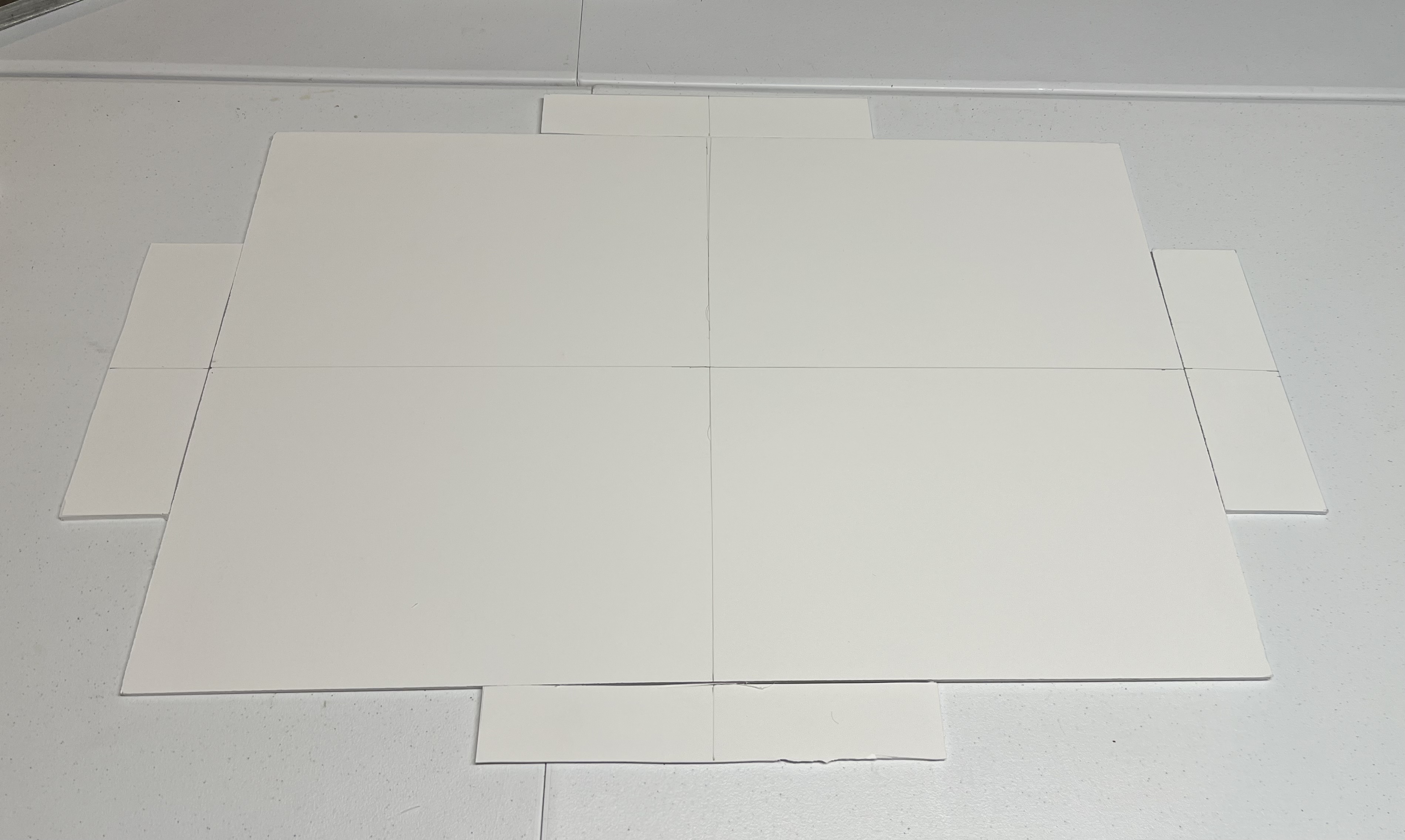
I chose to use foam board as the base. However, the foam board from Michael’s is 30″ x 20″. I added extra pieces of foam board to augment the base. I hot-glued them to the main board as you see below.
The foam board with the extra pieces before gluing.
Once the glue had cooled, I shaped the base irregularly with an Exacto knife.
At this point, the base would not have a lot of strength in resisting any shearing forces. To solve that, I hot-glued thin polystyrene sheets to the base to conform to its shape. These sheets would be on the bottom of the terrain piece.
The base showing the polystyrene sheets hot-glued to the bottom.
Once that cooled, I flipped it over. I cut out pieces of foam board and made 8 islands of different sizes. As the foam board thickness is .47 cm, I believed that they would not get inundated by any of the “Still Water” later on. They did act usefully as guides to depth application, helping to deal with concern #1. These were hot glued to the base.
Islands affixed to the base.
Regarding concern #2, I decided to go with Apoxie Sculpt to build around the islands and to make the pond’s edge. Once cured, I had my basic structure to hold the pond.
Early edging around the pond.After all the Apoxie Sculpt was applied by February 10th. Note the entire base is covered except for the islands.
I did not want any white edges to show underneath the terrain piece. So, I flipped it over and primed the bottom edges brown.
Priming the bottom.
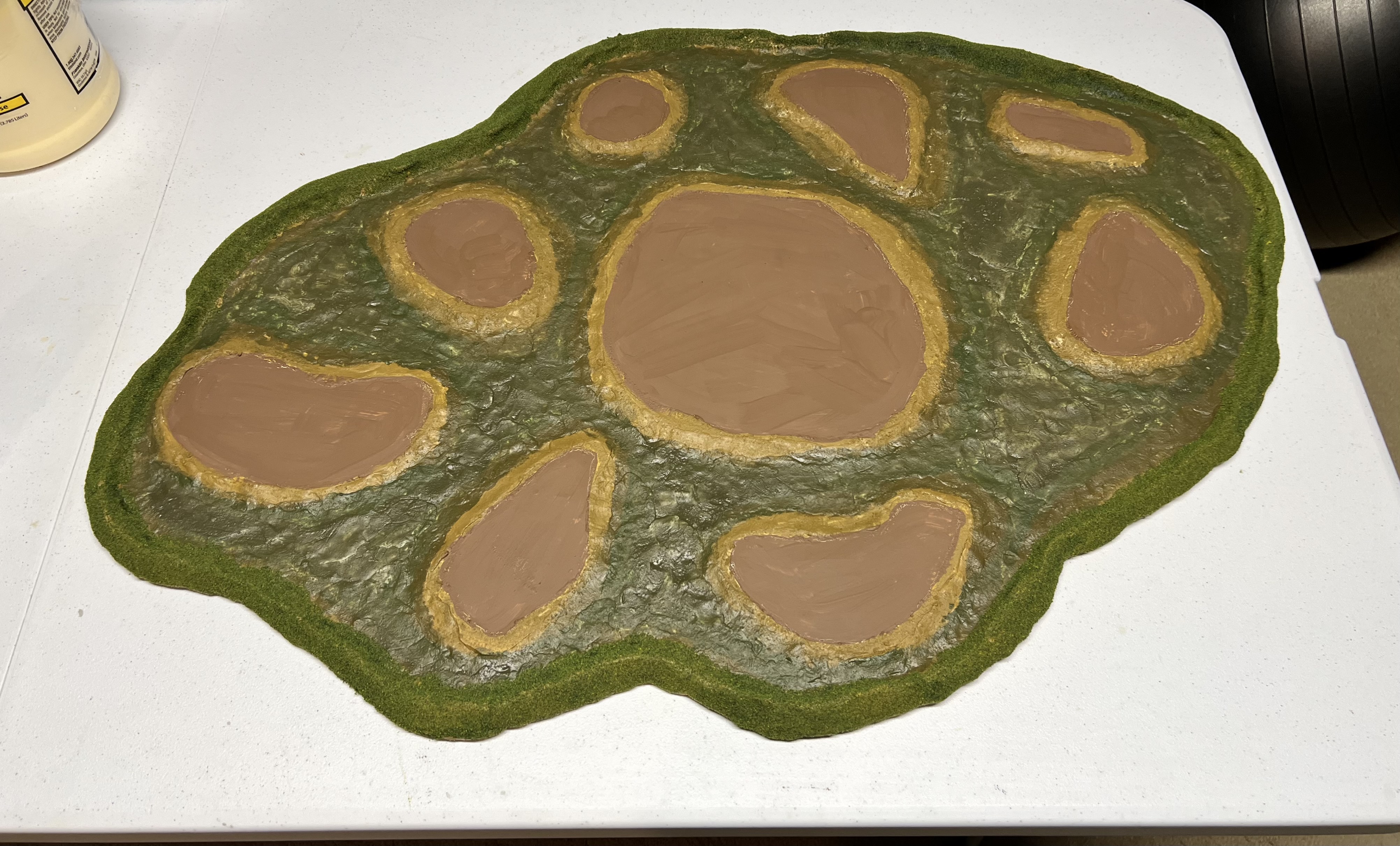
I flipped it over again so that it rested normally on its bottom. Concern #3 still loomed. My solution was to mix equal parts of wood glue and primer and paint the piece with that slurry. I used four different primers and the glue to paint the pond bottom and island edges. This helped to create a shoreline to depth look. Then I flocked the pond’s edge with Woodland Scenics blended turf and the wood glue.
My mixing supplies to seal the pond base.
The primed structure is shown below. I hoped that this would work and protect against the “Still Water”.
Apoxie sculpt painted with the primers and wood glue mix – on February 11th.
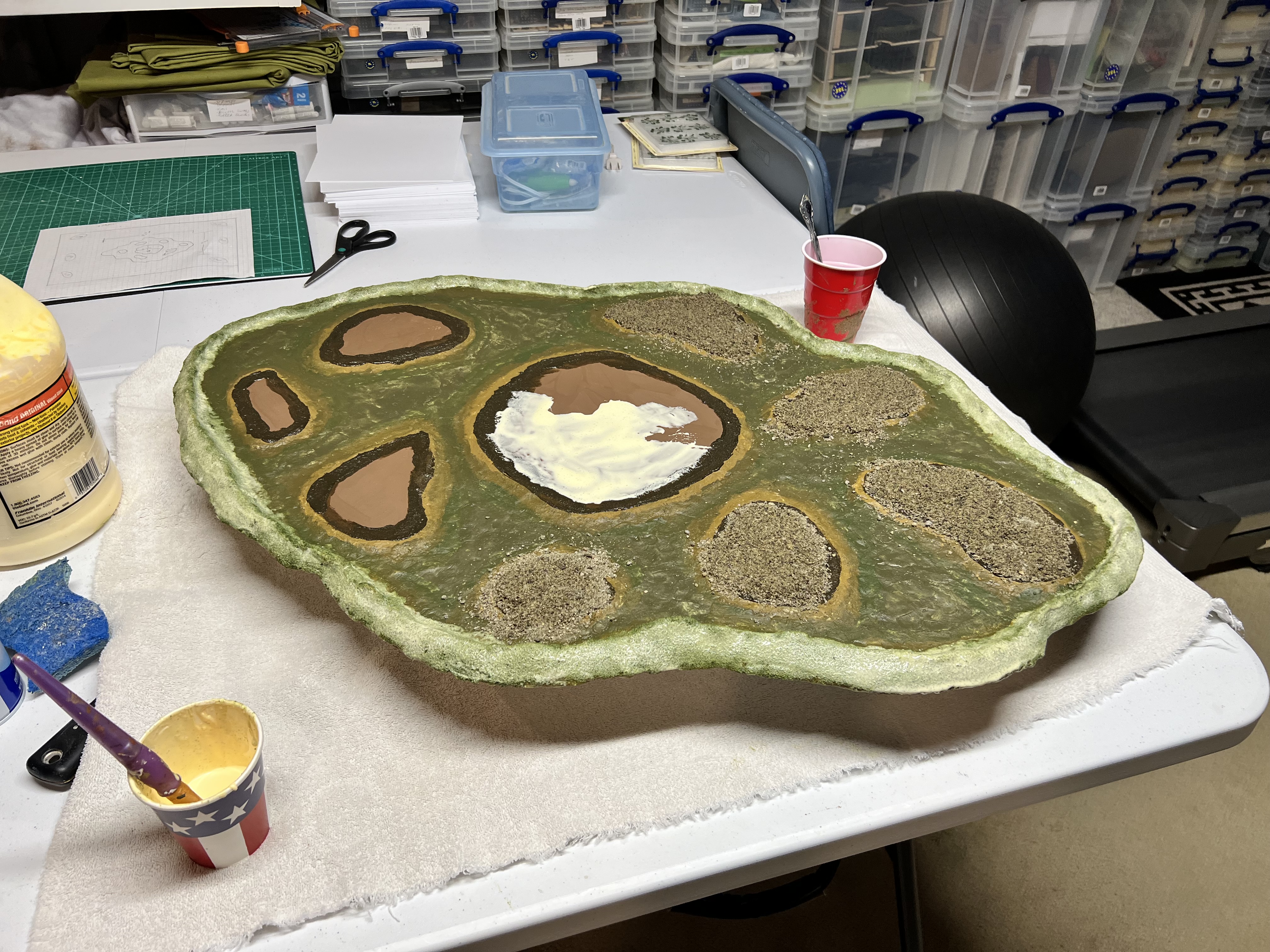
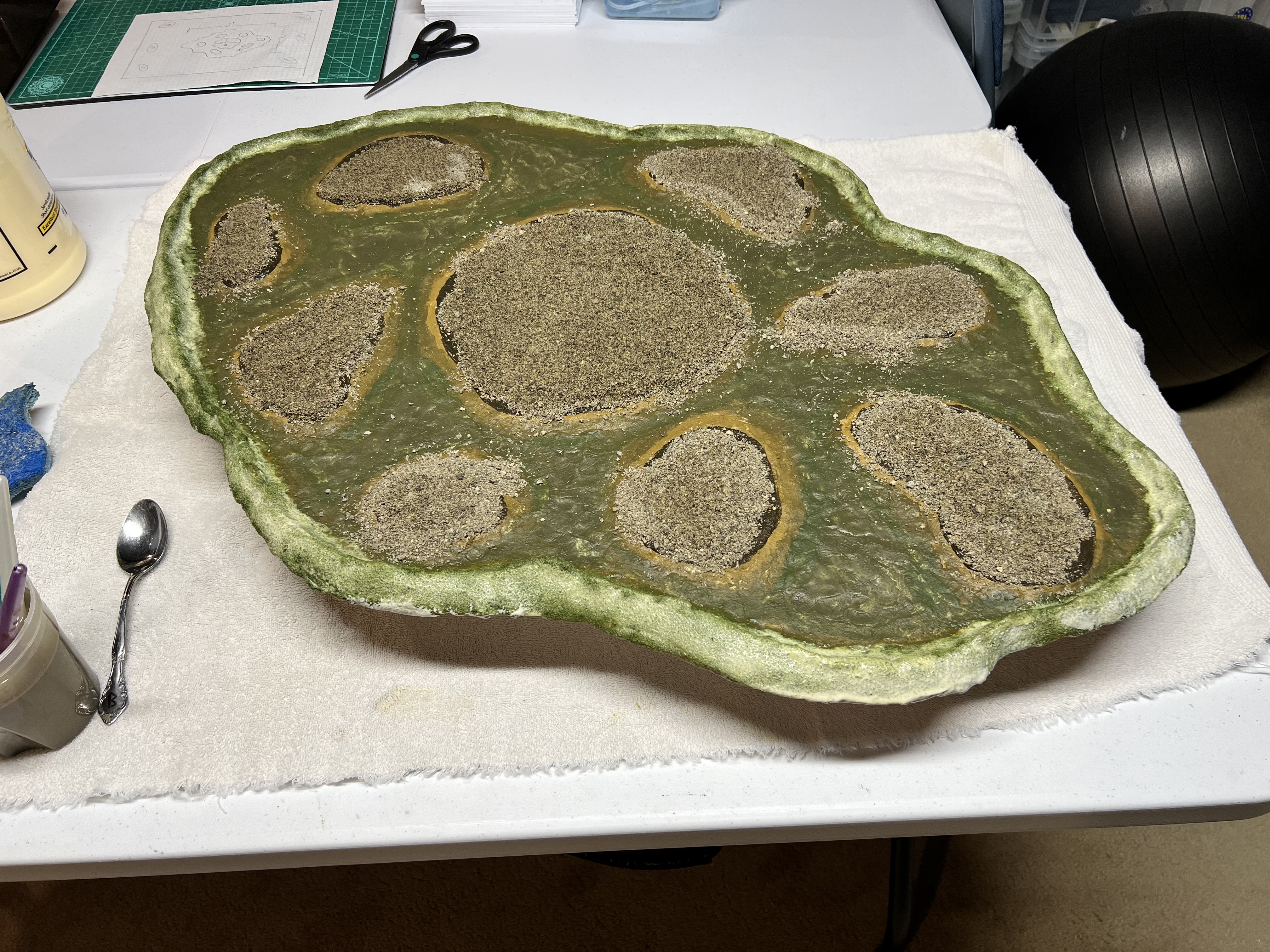
Once it all dried, I reapplied a coating of wood glue over the pond’s edge flocking. This helped to harden it up. It also kept loose flocking from contaminating the future water surface. I then added all-purpose sand to the islands with the wood glue. I let that dry before I extensively vacuumed the surface and edges of the pond. This was to remove all loose materials, again to protect the water.
Applying the sand and extra wood glue.And more drying time!The islands sand is dry here on February 14th – and the edges would continue to darken (thankfully).
It was time to apply the cattails into the base. Luckily, it was easy to use an awl to punch holes through the Apoxie Sculpt and into the foam core board underneath. I did that, and used more wood glue to secure the cattails. Then I had more drying time to wait out…
Cattails inserted.Close up of the cattails in the base.
The sand on the islands dried and was ready for adding pigments, so I did that. Meanwhile, I washed my plastic foliage for the islands. This removes any residual oils. This step allows me to throw some brown ink on them as a wash to add realism and some depth.
Washing plastic foliageDrying plastic foliage before adding inkPigments added and drying on February 14th..
Here is a short video showing my progress at this stage on Valentine’s Day:
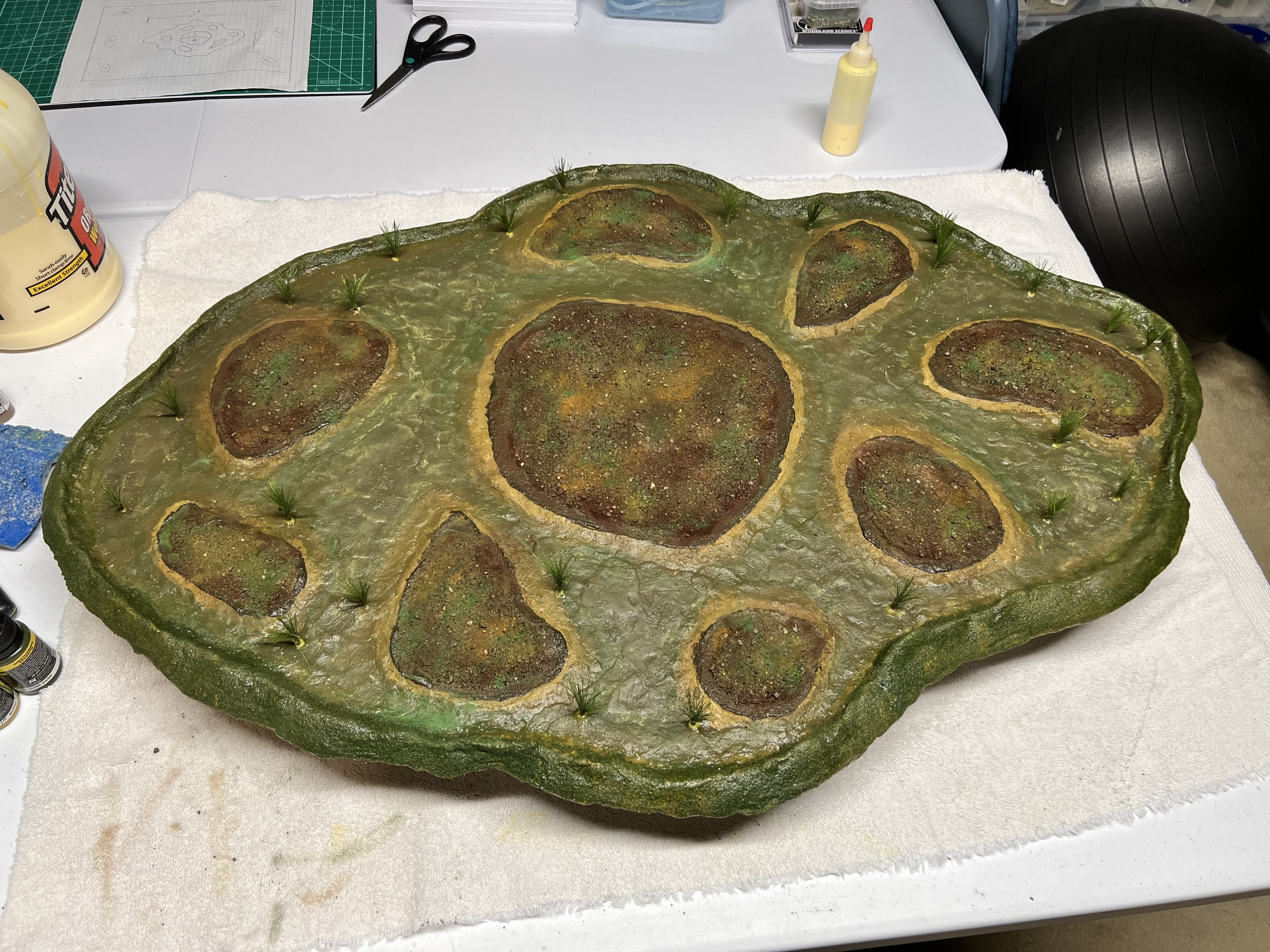
It was time to add the foliage to the pond – as I wanted the water to be added close to the end. The process of adding the foliage was the same as adding the cattails, except that I needed to also go through the sand.
February 15th – foliage added, short view angle……and long angle.
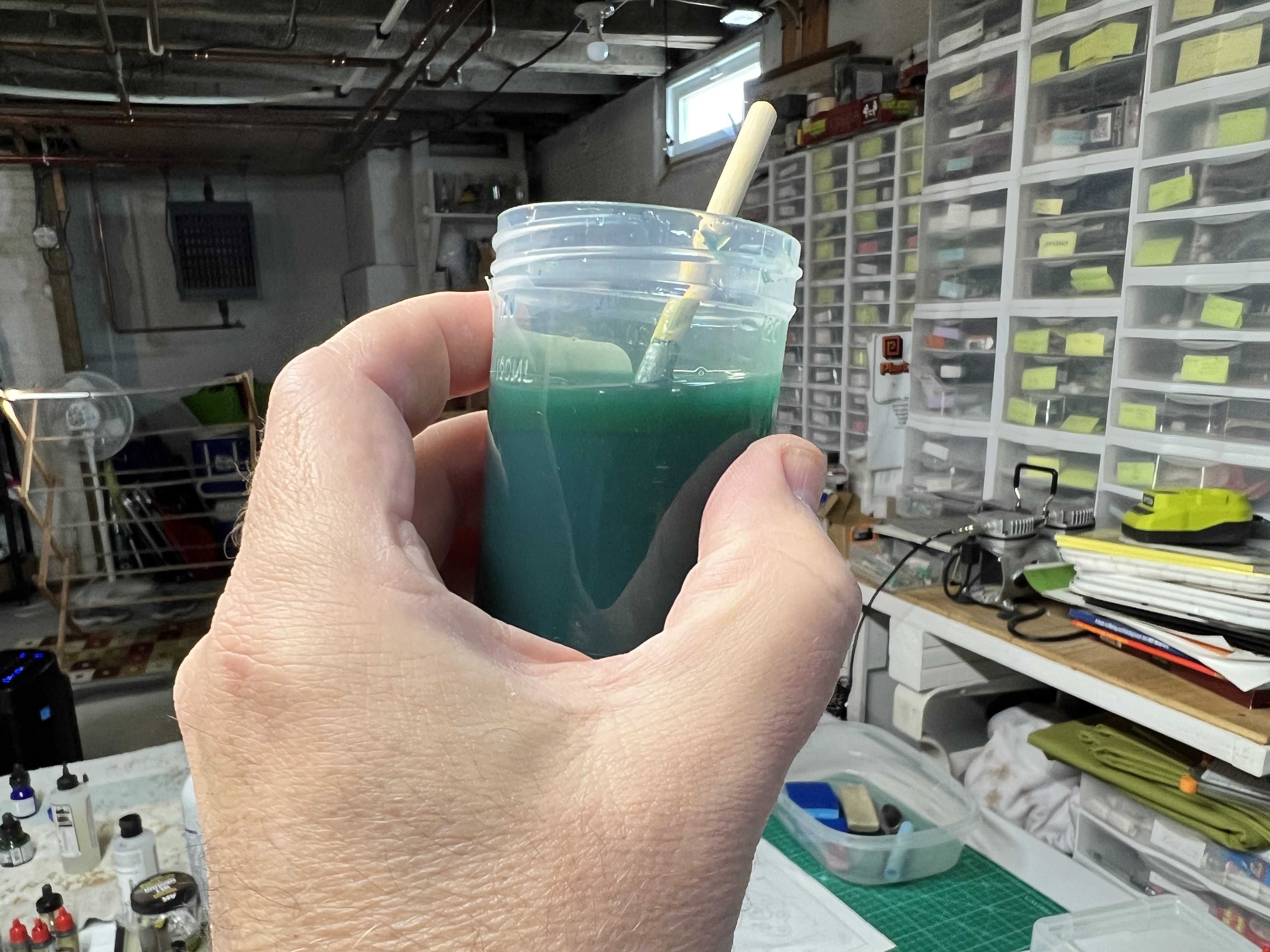
Finally, it was time for the “Still Water”! I mixed it with two different inks. I continued mixing until I got the color that I wanted for a somewhat swampy pond (shown on list at the end of the post). The pond took two full 200 ml bottles of “Still Water” (not including ink). To maneuver it evenly around the pond without swamping the islands was like the ball maze game where you try to get a ball to fall in a hole on a table. Until it dried I was a bit anxious.
Color mix achieved!I used two of these!
Setting up on February 15th!
Concerns #3 and #4 dealt with!
The slow set up of the “Still Water”.
You can see in the next video from February 16th that I needed to ball-maze-move the “Still Water” around. I did this for a while before it finally set. I did look out for bubbles as well and popped the ones I saw.
I did not use the lily pads that you saw in the video. When I tried to drill out to place them, the water surface gripped the bit. It started to torque a bit, so that was a no-go. Besides, these lily pads are basically wound wire and come apart when you try to clip them shorter. Instead, I went with adding some other swampy tufts from Green Stuff World.
Once this set up on February 17th, I was very happy with the result.
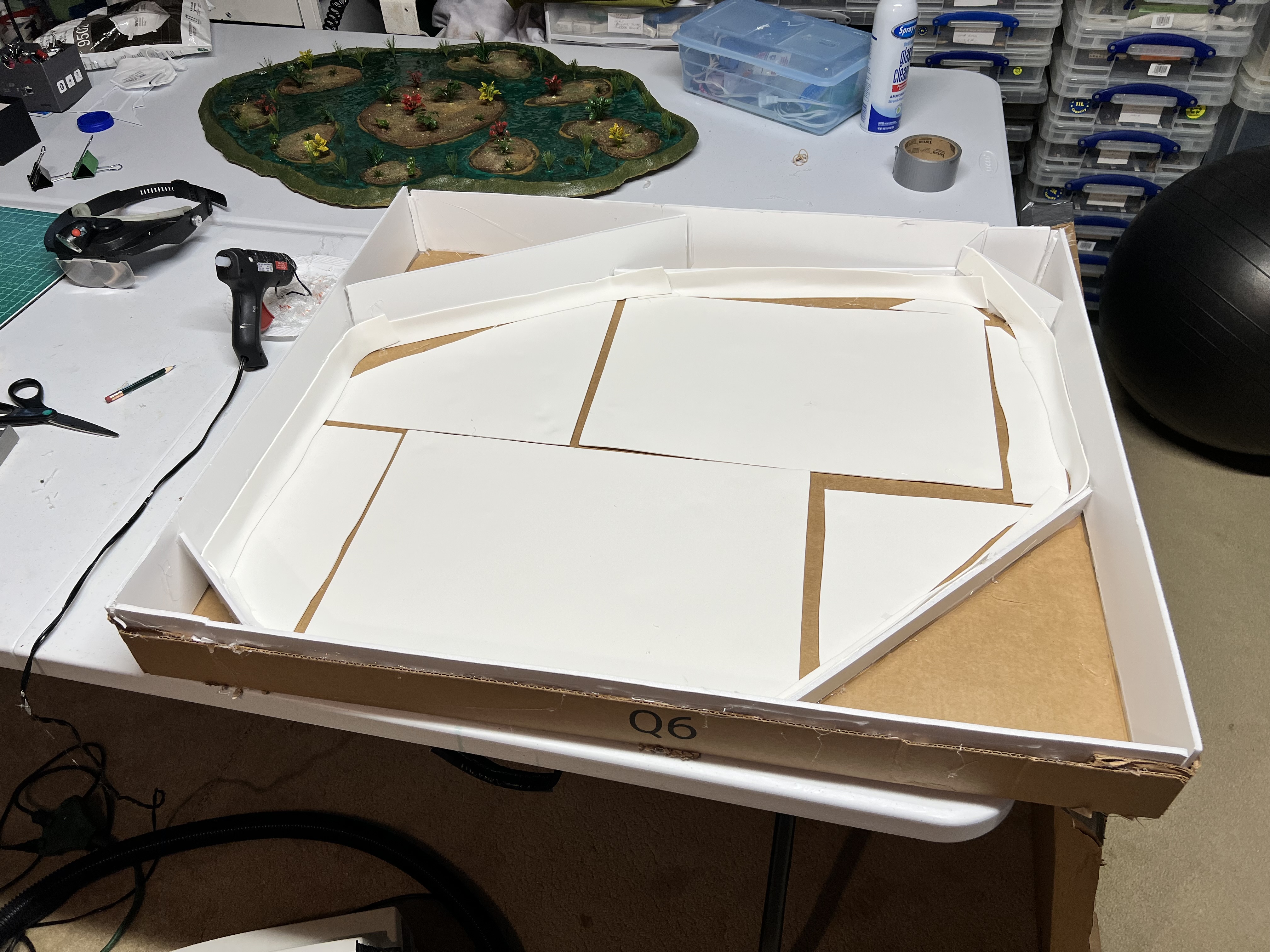
I now needed a box to transport this big piece! Luckily, I had earlier ordered a large rotating cutting mat from Amazon and saved the box that it came in. I used some foam board and hot glue to make a decent travel box that would protect the pond on the way to conventions.
February 17th – got a box!And it fits!
I will be posting about TotalCon soon. Before doing that, I wanted to write this WIP post about the pond. From concept to travel box it took 8 days!
Hopefully, the lessons I shared here will help you if you are considering a similar project. My main takeaways are clear (I hope!).
Below I will list the materials I used in the project as well as some links that you might want to explore, but first a sneak preview of what the pond looked like on the tabletop on a 6′ x 4′ mat:
Next up, hopefully, will be a TotalCon 2026 recap.
Back in early February, I attended the 2026 HMGS Cold Wars convention in Lancaster, PA. The theme was “Wild, Wild, West”. this is not one of my usual game themes, but as you’ll see shortly I adapted for one game anyways. As I write this now it is already mid-March, so I thought it was about time to finally got around to sharing some of the games I played in and ran in the H.A.W.K.’s room.
The H.A.W.K.’s are a great club from Harford County, Maryland. Two of my good West Point buddies (Buck Surdu USMA ’85 and Dave Wood fellow USMA ’84) have been members for years, and I have been fortunate enough to be their New England carpetbagging GM for a few years now.
Buck, yours truly, and Dave
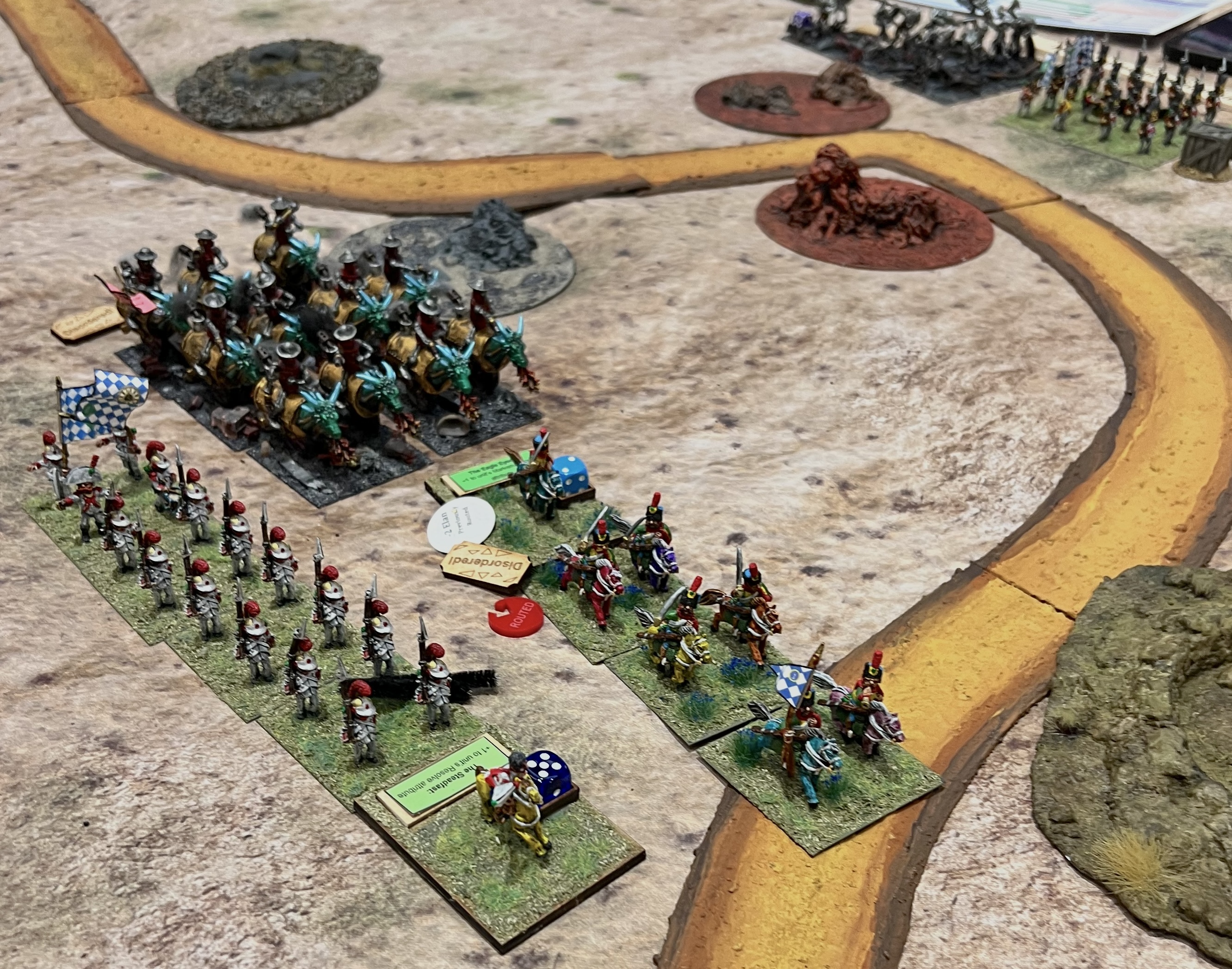
Prelude to Austerlitz (Wars of Eagles and Empires)
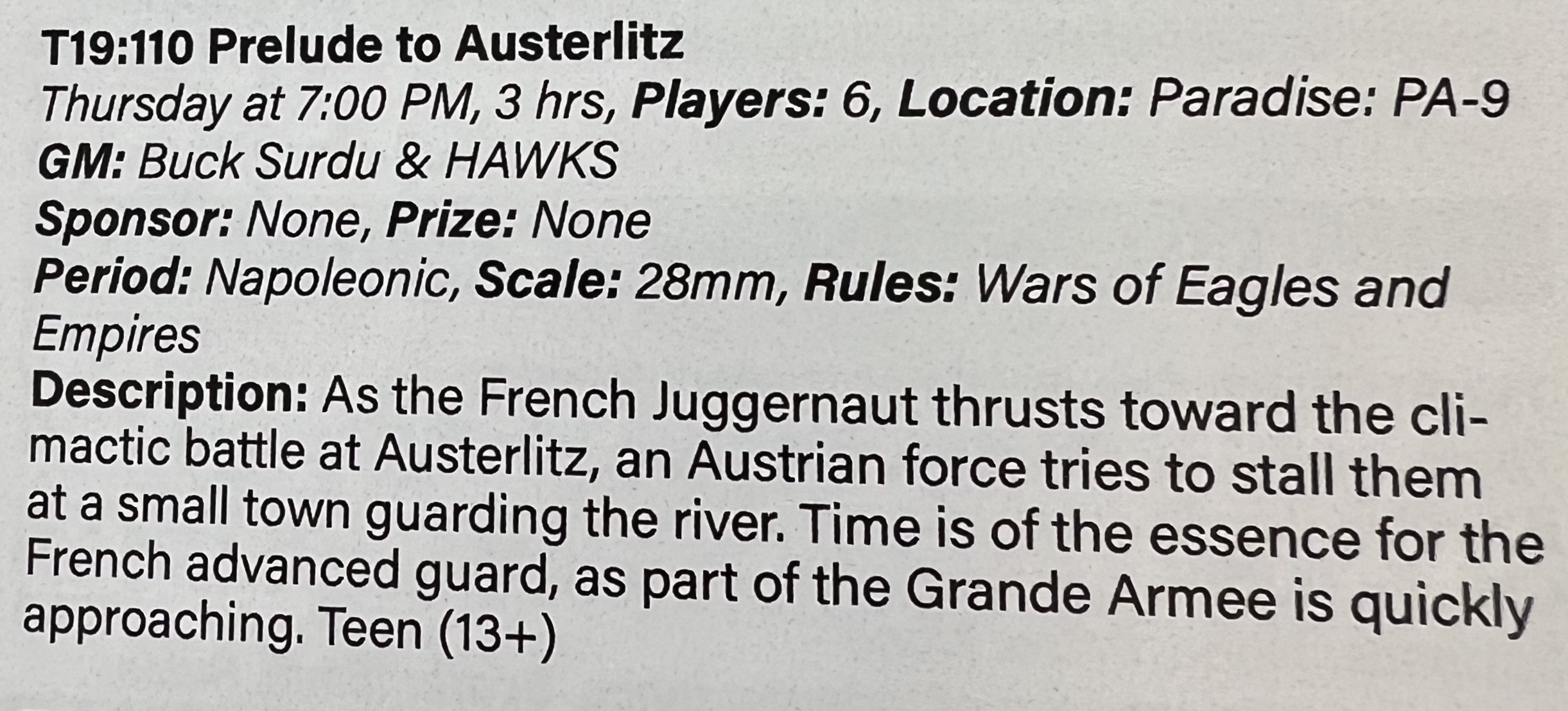
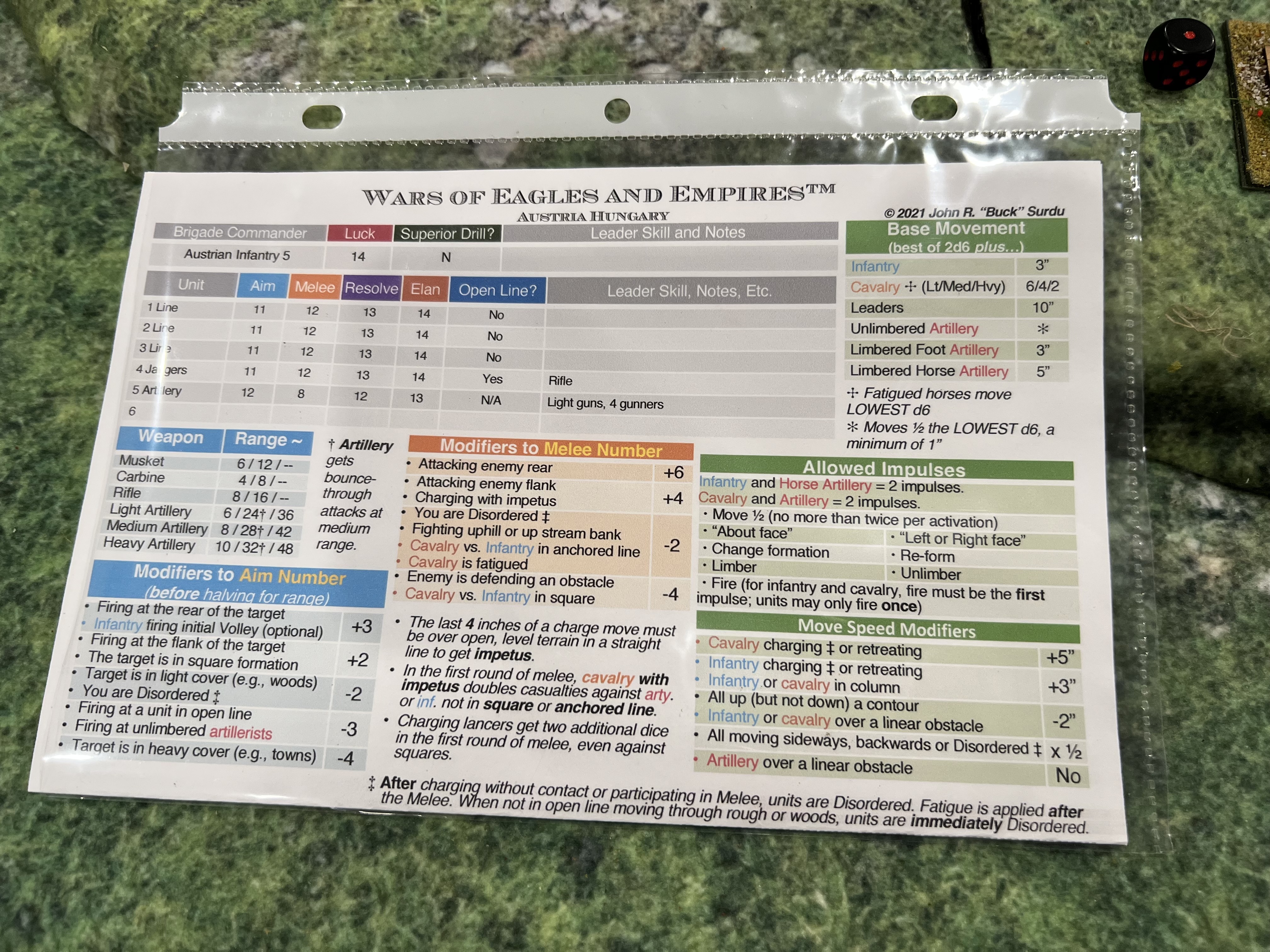
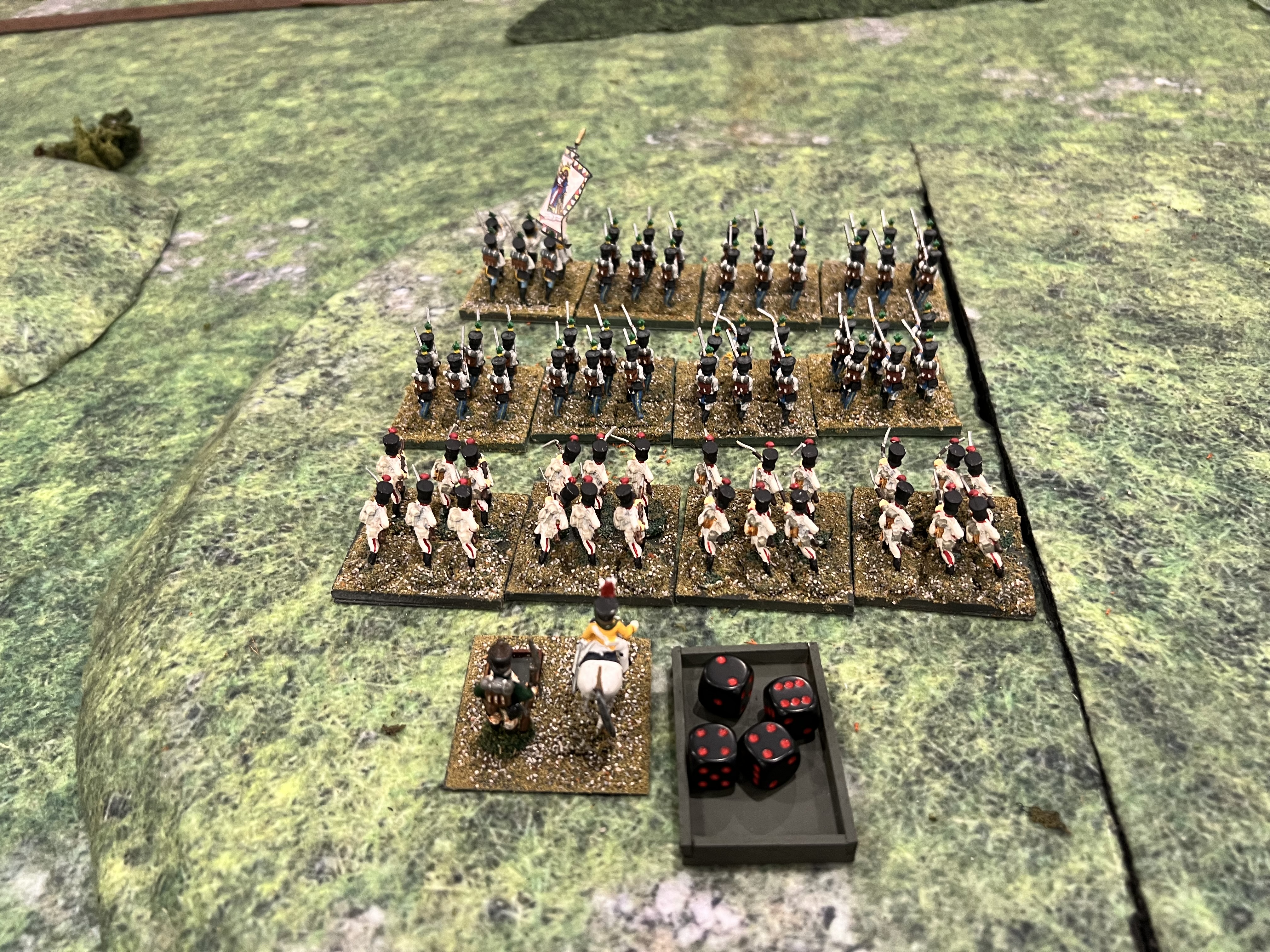
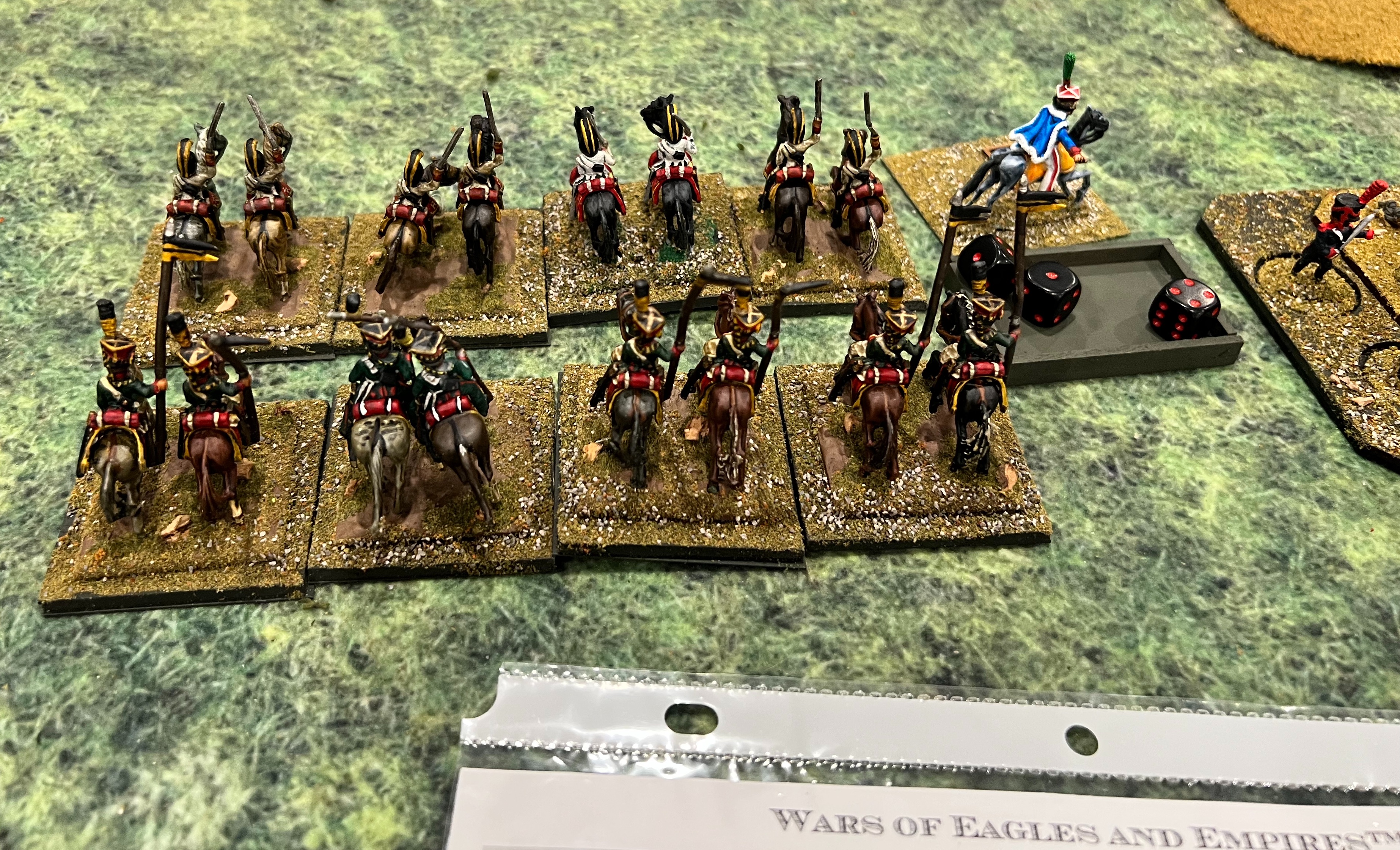
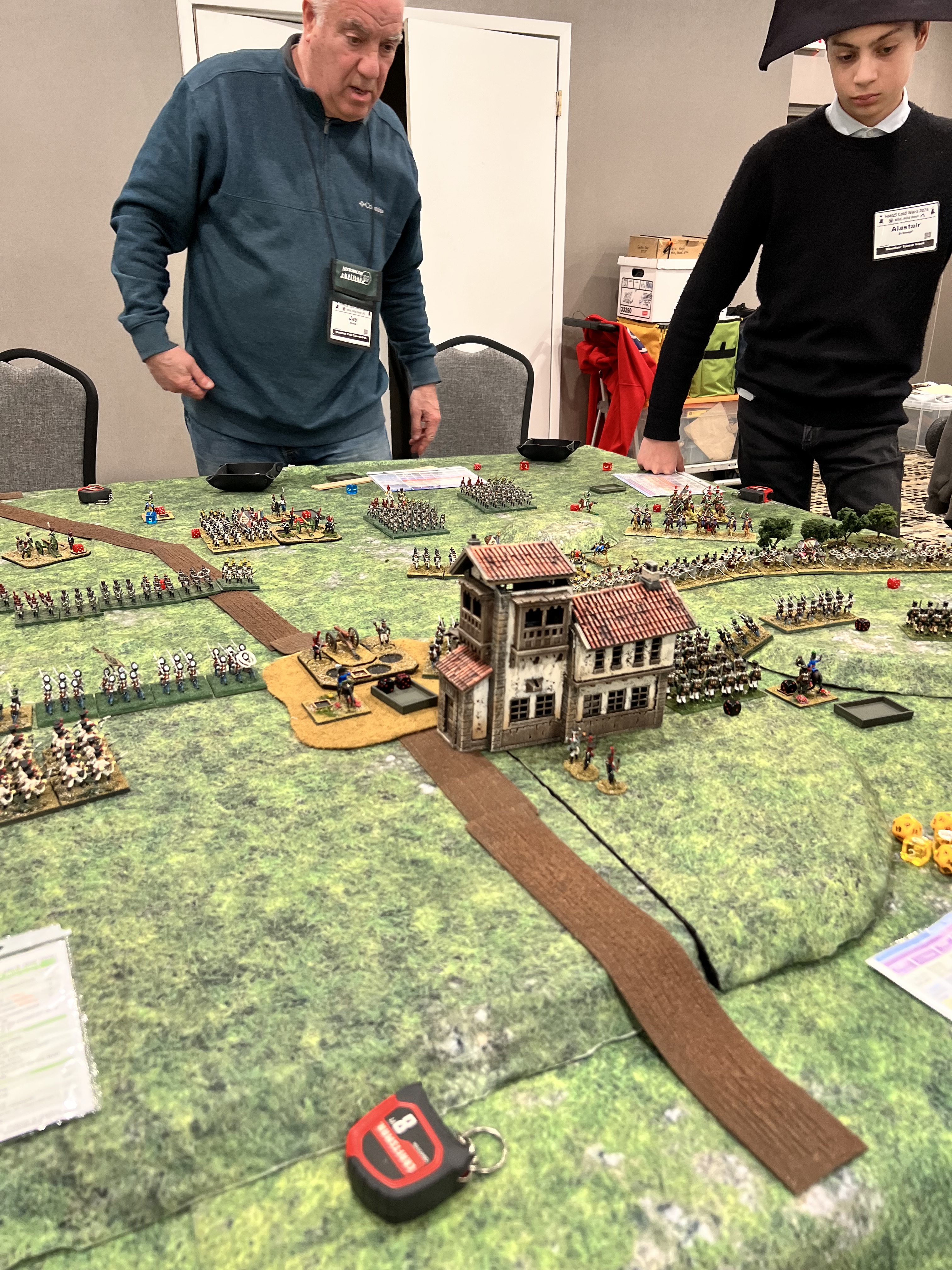
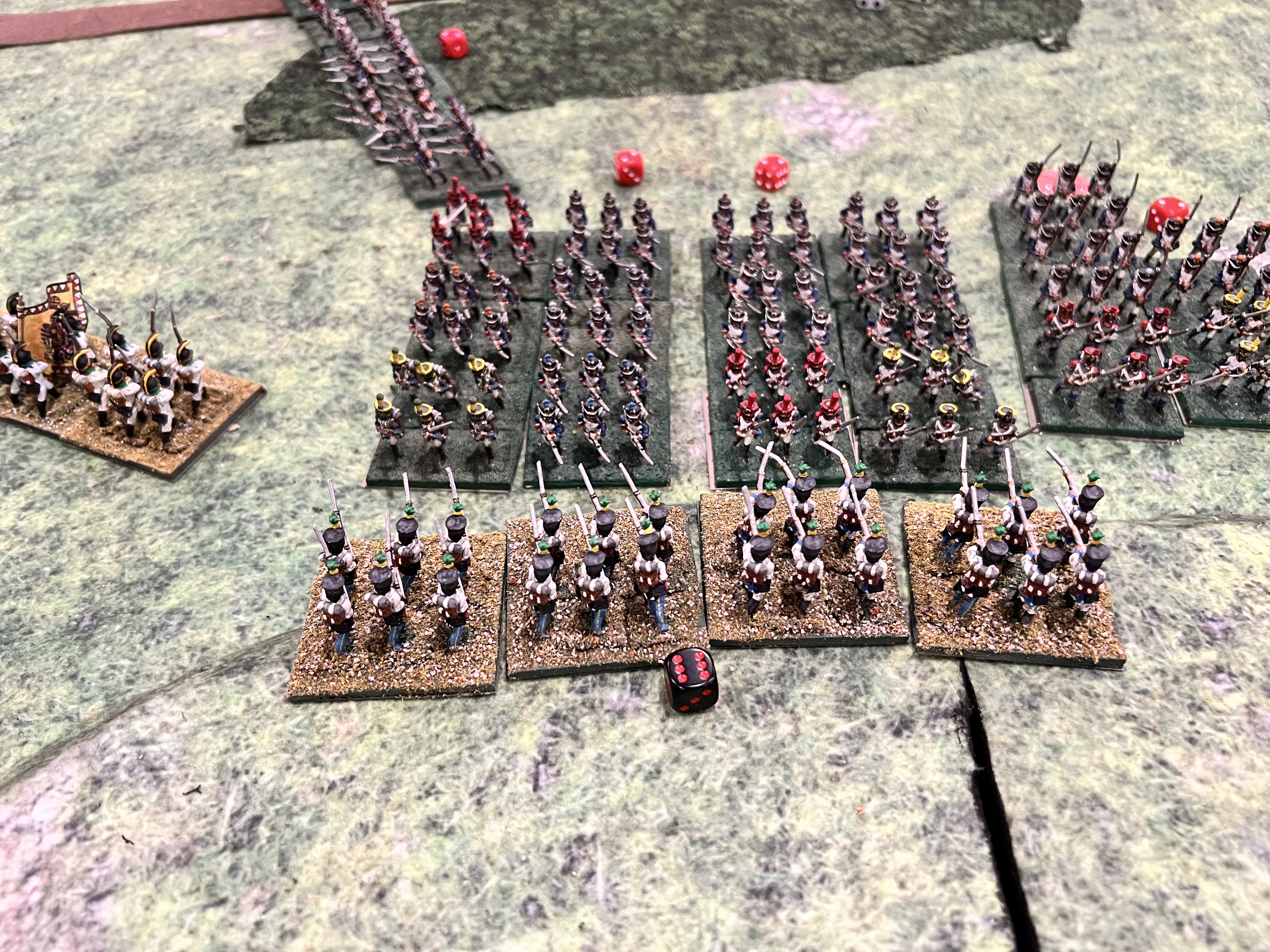
Thursday night I jumped into a Napoleonic 28mm game run by Buck, “Prelude to Austerlitz”. It used his Wars of Eagles and Empires rules.
It was a fun game and I was on the Austrian side with two other young players (they were young anyways). The French players were not as aggressive as they probably had wanted to be, which allowed us to successfully defend the town.
The Wicked Witch is Still Trying to Get Dorothy’s Slippers (Feudal Patrol using Wars of Ozz figures)
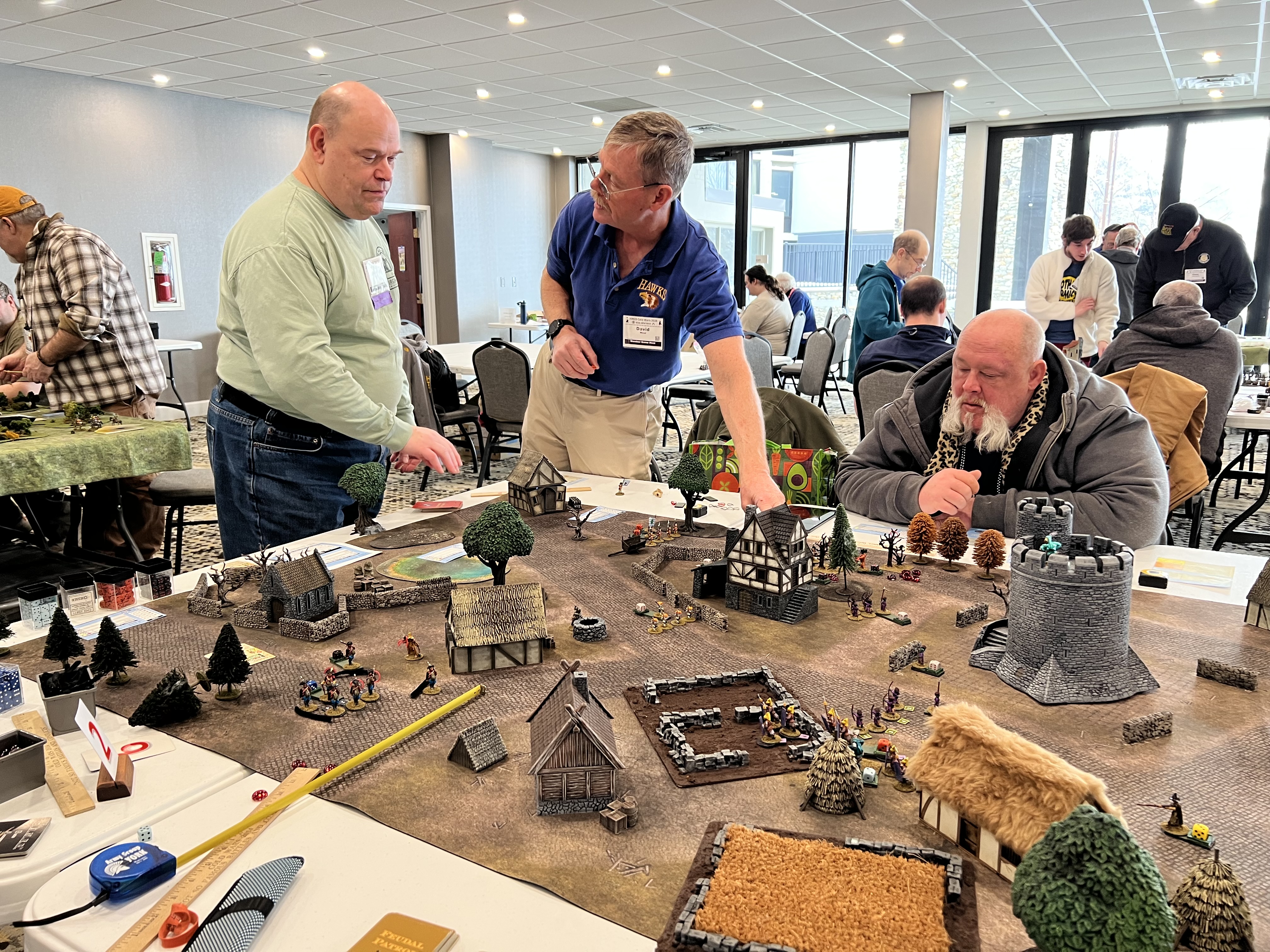
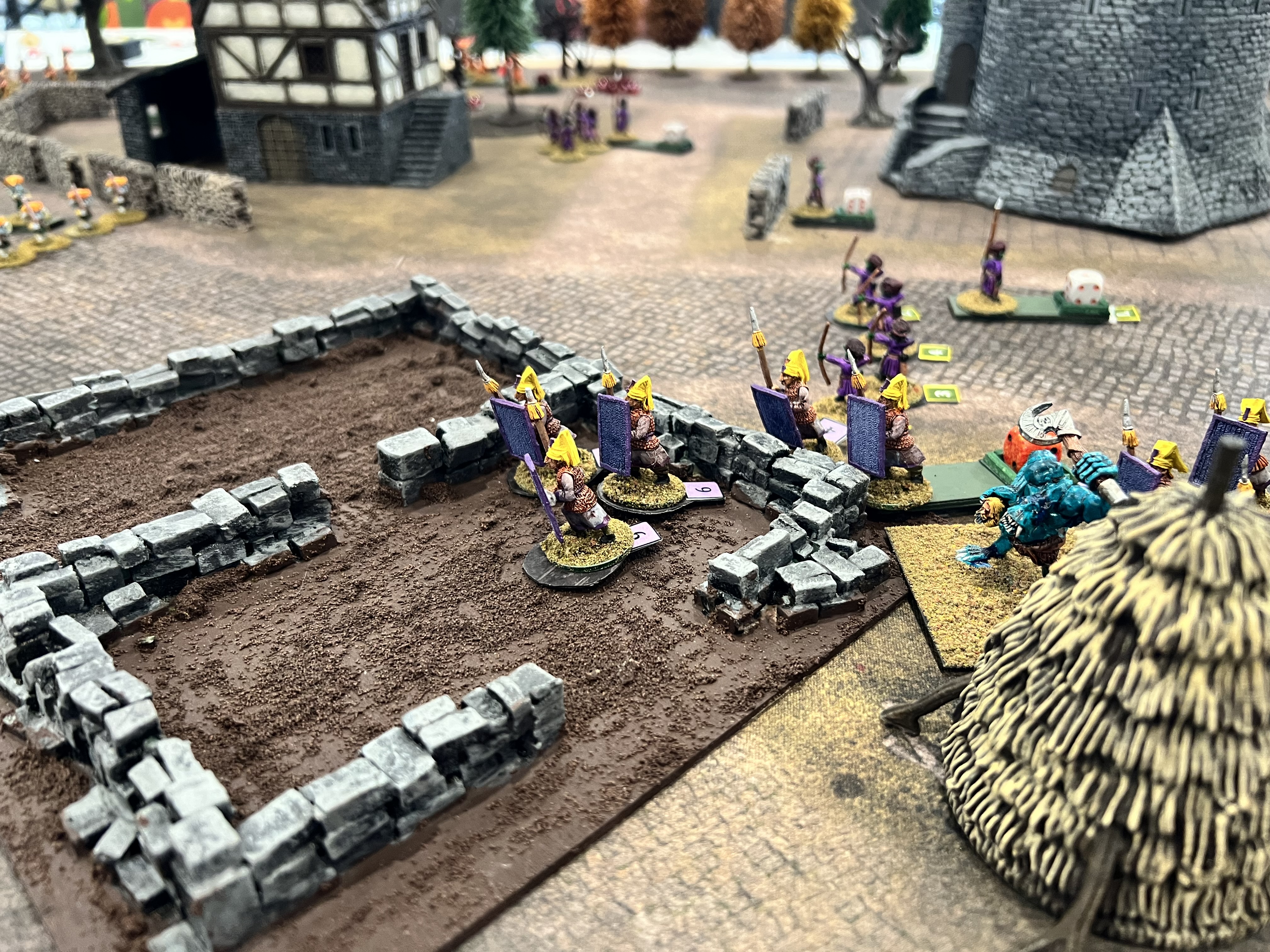
This was a fun opportunity to jump in a Feudal Patrol game with my old USMA roommate Dave. Dave does a great job as a GM and even won a PELA award at Cold Wars for his Zulu game. Dave uses 28mm Wars of Ozzfigures in a skirmish game using Feudal Patrol rules. I played on the Winkie side and we were able to take Dorothy down and get those valuable slippers!
Dave as GMMy Winkies advance
After this game, I hit the vendors hall and got some lunch. Then I took the rest of the afternoon time to set up my Friday evening Wars of Ozz game. – “The Great Munchkin Heist“.
The Great Munchkin Heist (Wars of Ozz)
This was an epic back and forth Wars of Ozz battle, which really was great to see! Three brigades were on the attack (two Munchkin, one allied brigade, and an army reserve). The allied brigade was composed of two regiments of Jinjur female pirates, an Impkin slingshot battery, and a regiment of Frost Ogres (that Dave Stone will recognize!). The reserve came from the Land of Harvest – Great Pumpkinheads and regiments of eagles and owls. these allies hoped to share the loot with the Munchkins. Technological “secrets” were hidden in buildings throughout.
Three small but potent Nitpik mechanical men brigades and a small reserve force defended the formidable rusty steel walls of the Robotic Sanctum – a.k.a. the Industrial City. A small infantry reserve remained in the city, and there were rumors of a Nitpik relief force coming…
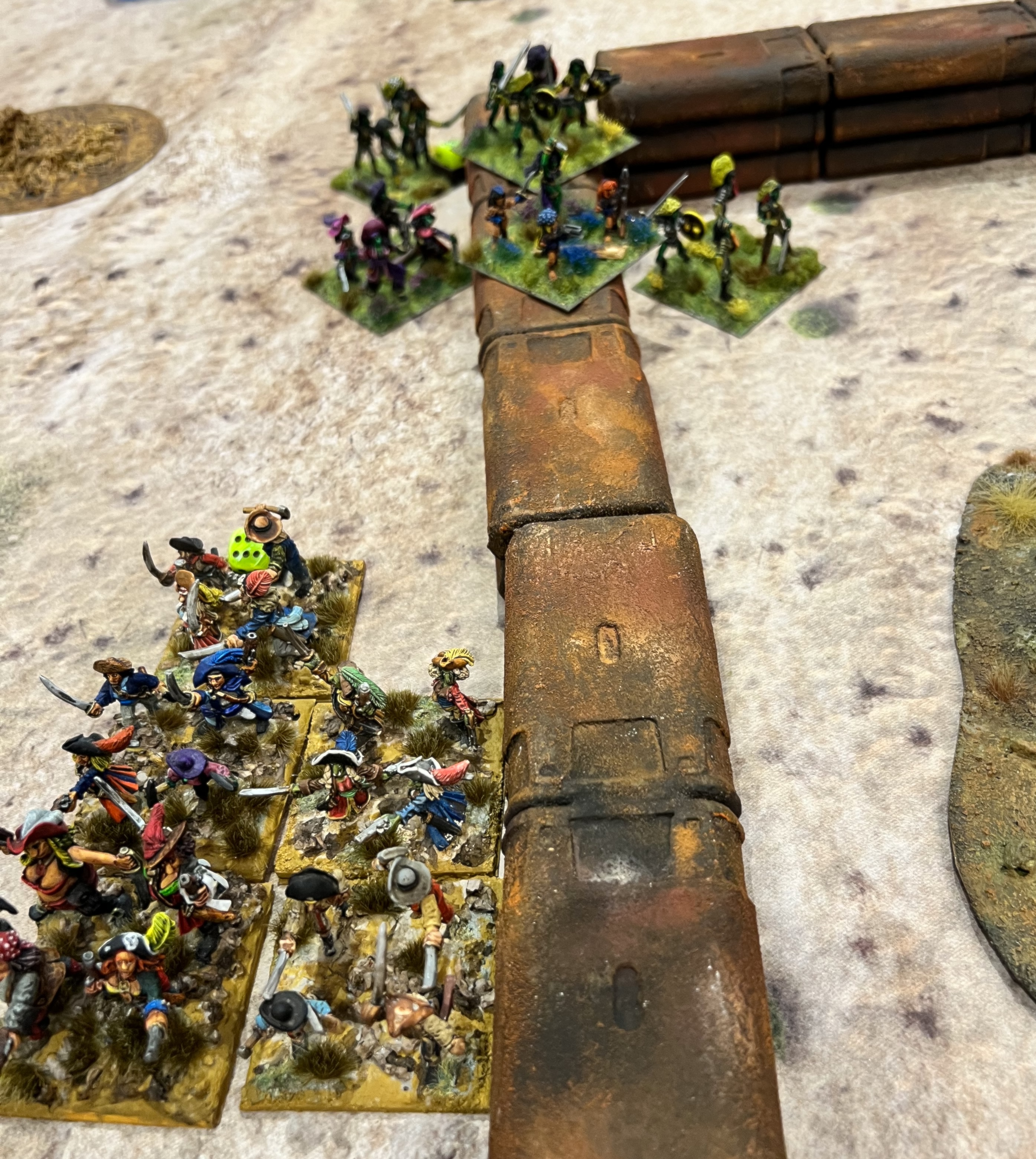
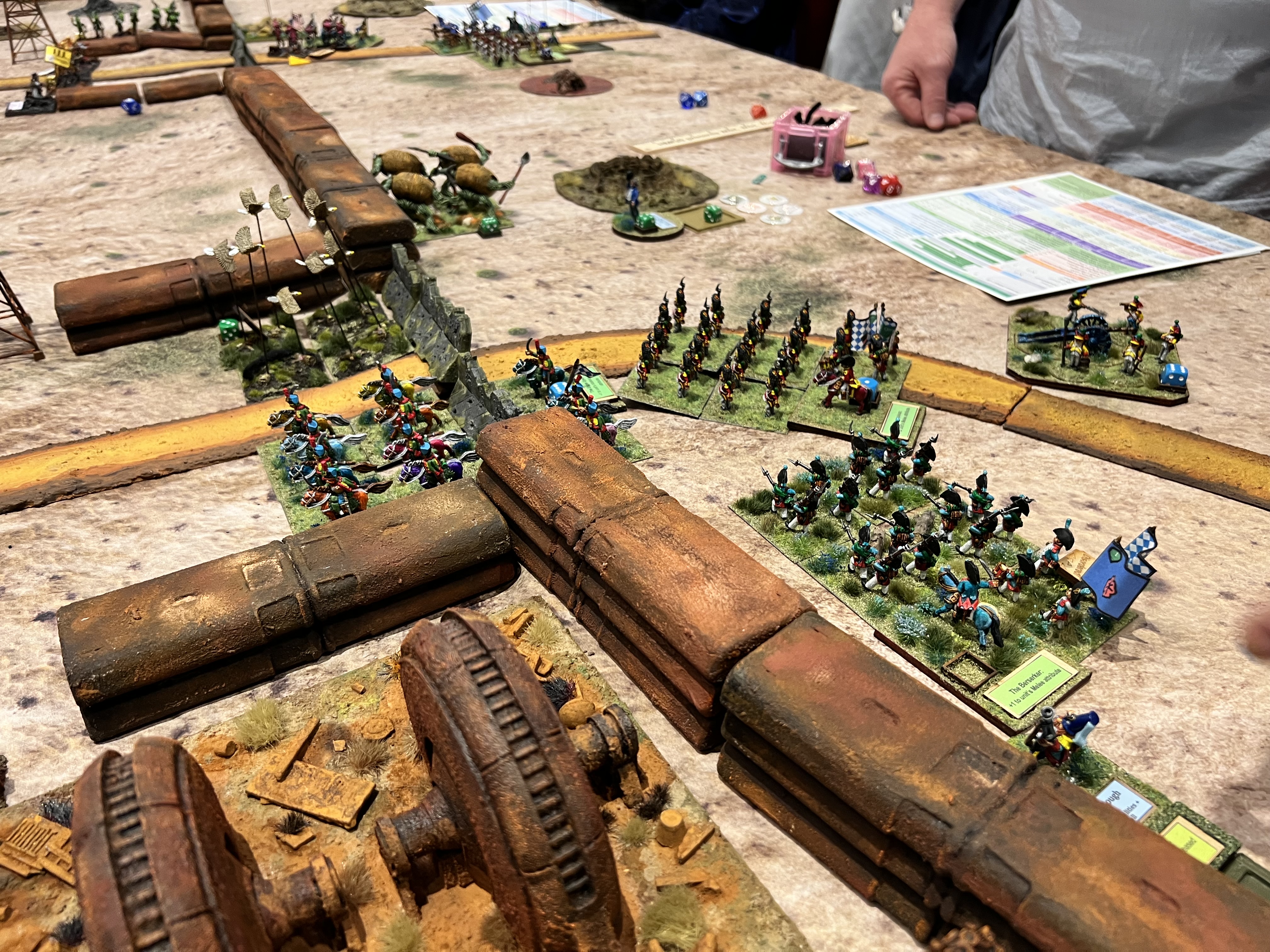
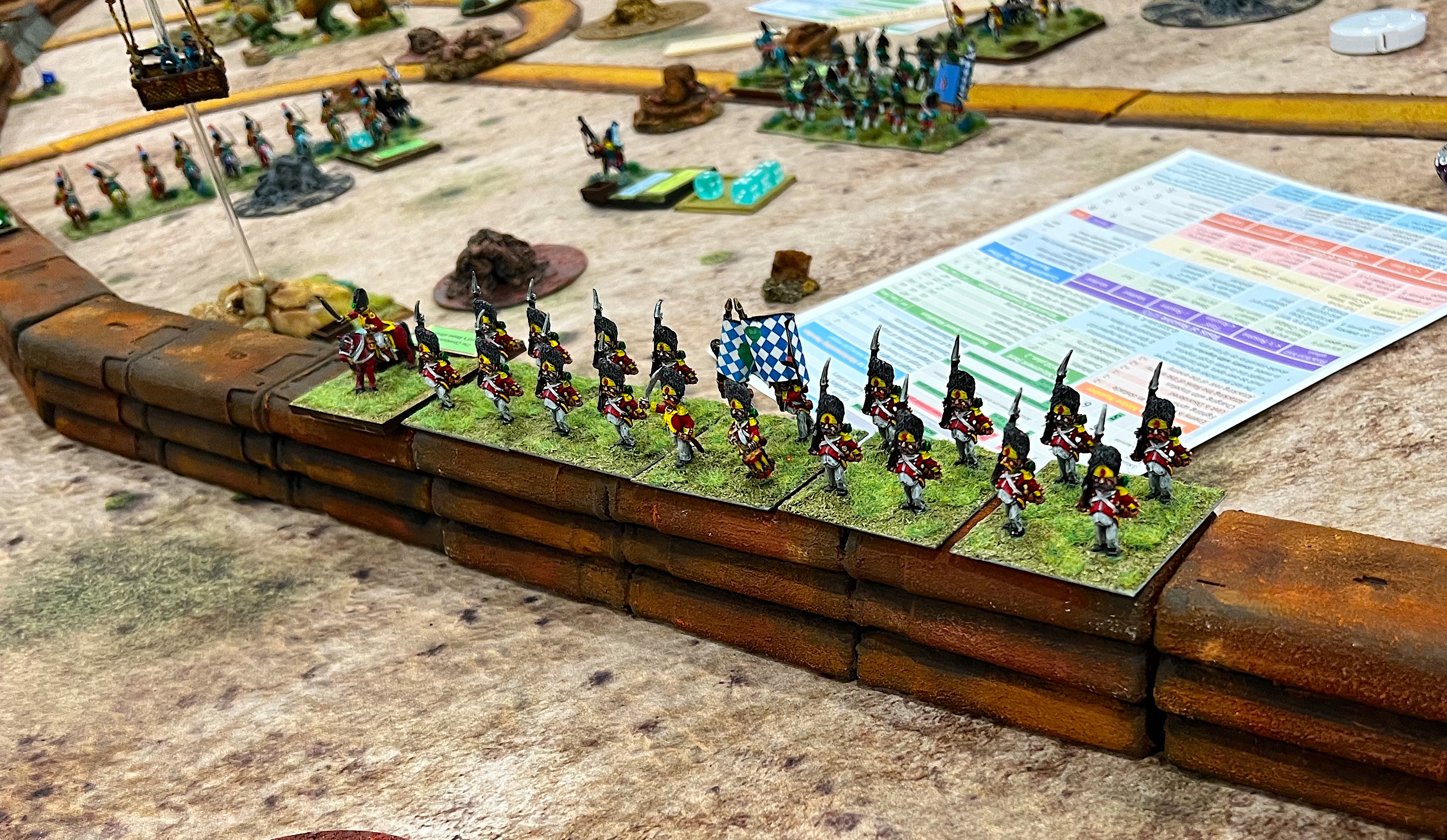
The Munchkin 1st Brigade advances on the left.The Munchkin 2nd Brigade advances in the center.The Allied Brigade ready for battle.In the center was the Munchkin Army Reserve of Harvest troops under the command of Zoraster the Wizard.The Nitpik Medium Artillery defends the left flank, with Elite Axemen behind ready to deal with any penetrations of the walls by the allied brigade.Defending the Nitpik center against the Munchkin 2nd Brigade was the Lemon Drop Legionnaires at the wall (also with napalm blasters) and the axe-wielding Jade Automata.Defending the Nitpik right was the 3rd Nitpik Brigade. They had Morin’s Monsters with napalm blasters and a mechanical mini-swarm.A side view of the start of the battle behind the Nitpik lines. The Mechanical mini-swarm is in the foreground, while the sole regiment in the Nitpik reserve – the Pink Nightmares – is in the back left.The battle begins. The Allied Brigade moves up on the right.The Nitpik Artillery prepares to fire at the Frost Ogres…….who take casualties and rout in the face of withering fire.Overzealous Lemon Drop Legionnaires take fire from the balloon and an unlucky reaction test causes them to jump over their protective walls towards the enemy!This unlucky reaction subjected the Lemon Drop Legionnaires to Munchkin musketry at short range.Morin’s Monsters hold the line.Munchkin Light Cavalry and Landwehr move up on the left flank..The Munchkin 1st Brigade moves towards the gate – somewhat stymied by the ominous rusty steel walls – their solution……climb the wall !! Assault Munchkins! (or Ranger Munchkins?)…they were soon in the town searching for technological secrets.The Munchkins commit the Great Pumpkinheads and Great Owls and bypass Morin’s Monsters.A female pirate regiment breaches the right wall and faces the Elite Axemen. The Munchkin Center is breached as well.
The Munchkins searched in vain for any technological secrets. They did manage to inflict slightly more casualties on Professor Nitpik’s forces, resulting in a narrow 18-15 point victory.
Little Wars TV actually showed a snippet this game on their Cold Wars video – you can see it at minute mark 12:31. My players look happy!
That wrapped up Friday – and Saturday I had two games scheduled. The first was a What a Tanker “what if” scenario between Vichy French and Italian armor. I had to cancel it due to lack of players. That allowed me more time to set up my evening game and to play in another Feudal Patrol game run by Buck. It was a scenario based on a William Tell TV show from the ’60’s that I have no memory of! It was fun, we freed the good guys from the Austrians, and had a good time.
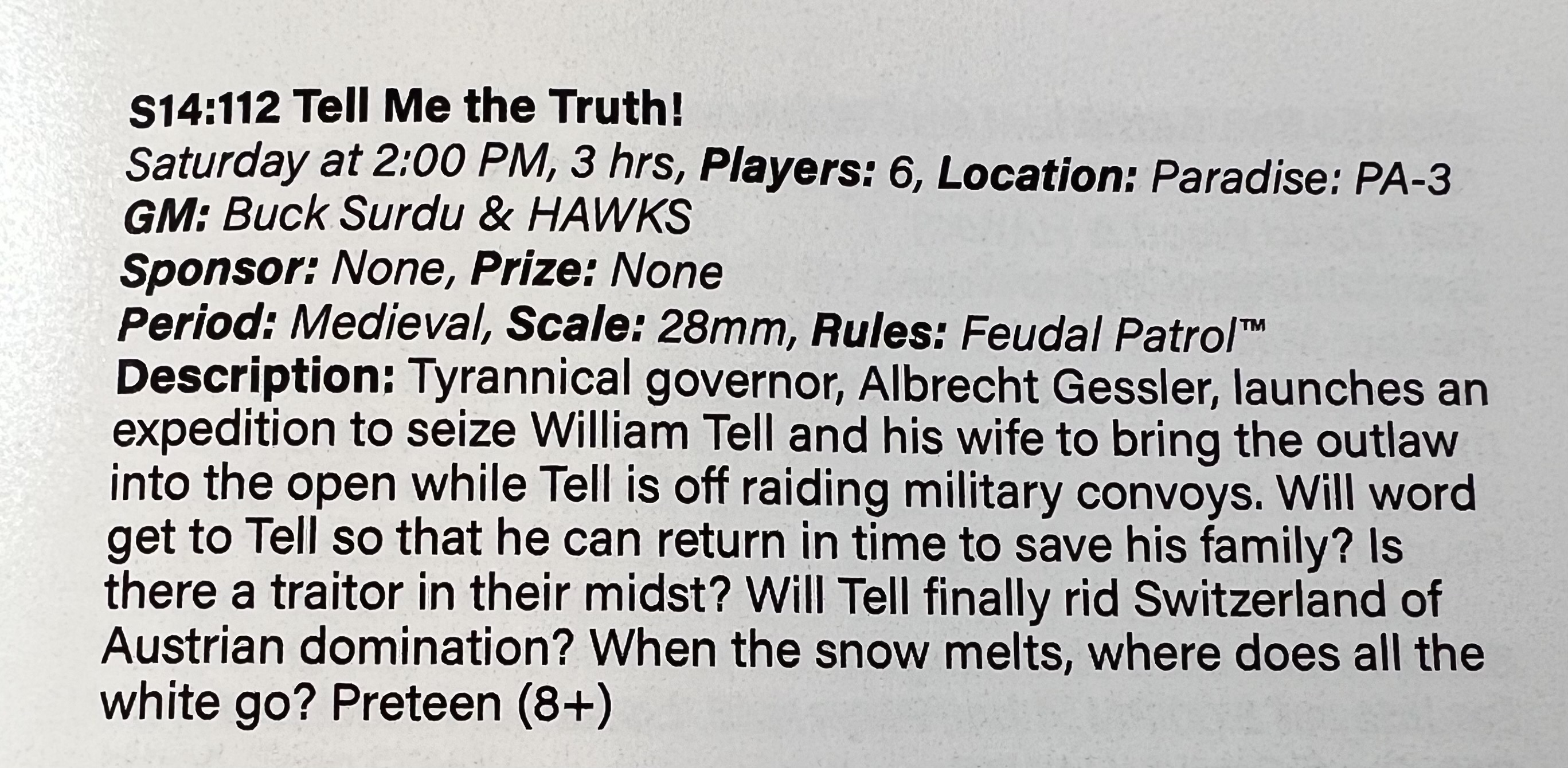
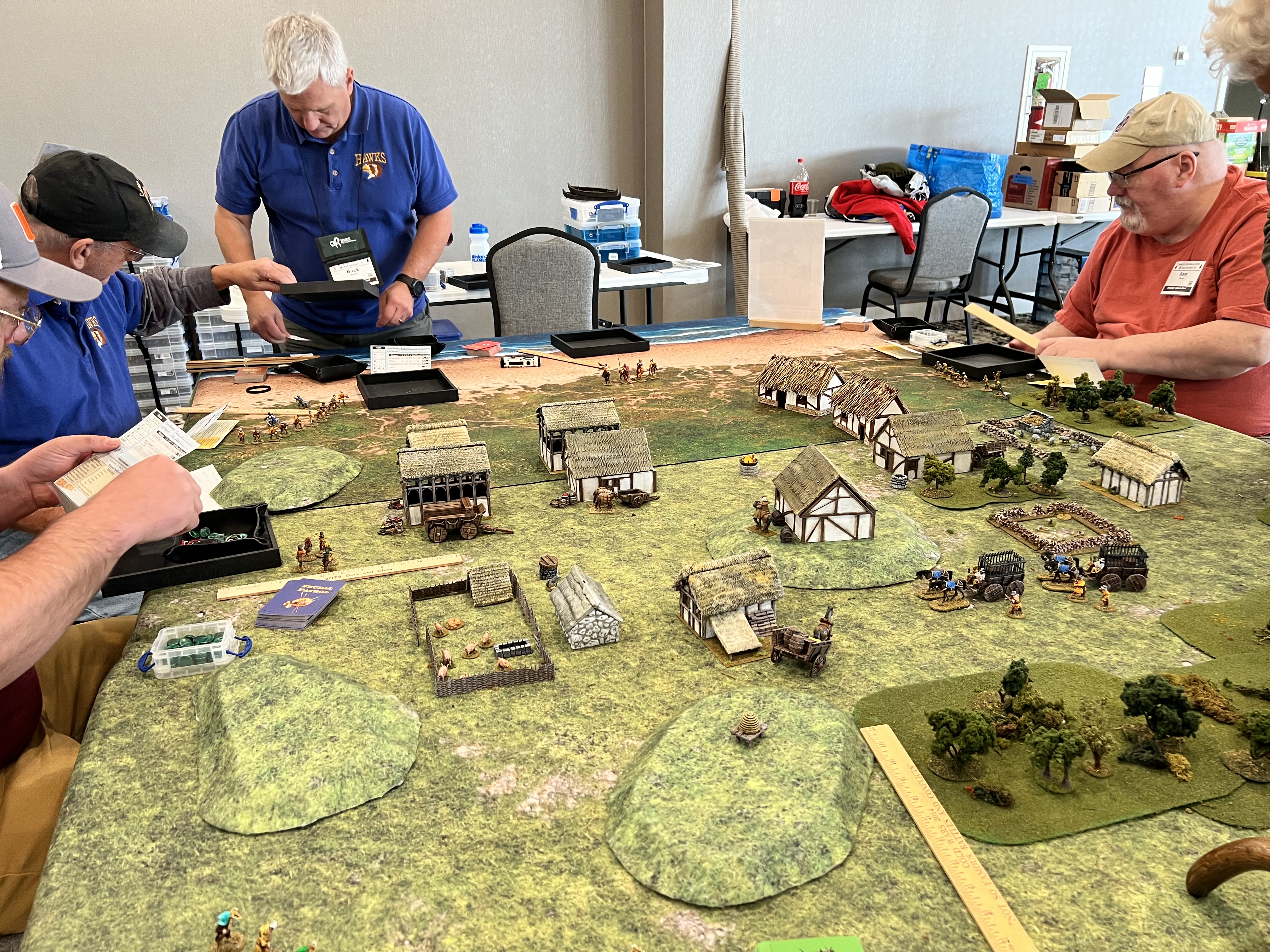
Tell Me the Truth! (Feudal Patrol/William Tell)
Buck prepping at the game start. I spent a lot of time in the game moving that bee hive on the hill!
At last it was time for Saturday night’s game.
High Noon at the Cyber Ruins (Combat Patrol:WWII – modified for retro Sci-fi)
This was my “western-themed” game.
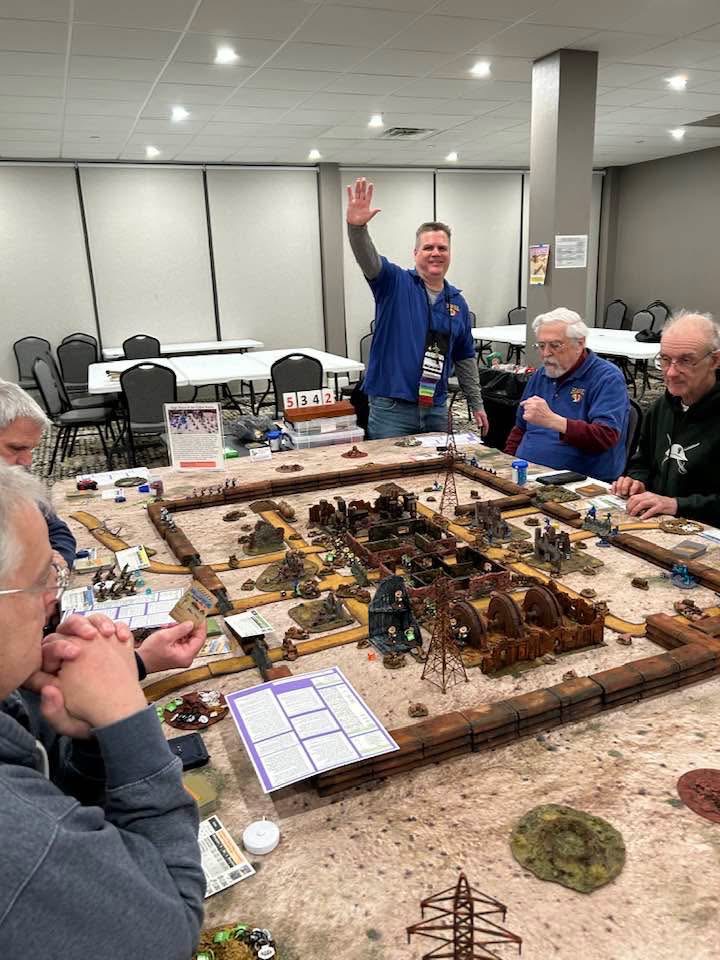
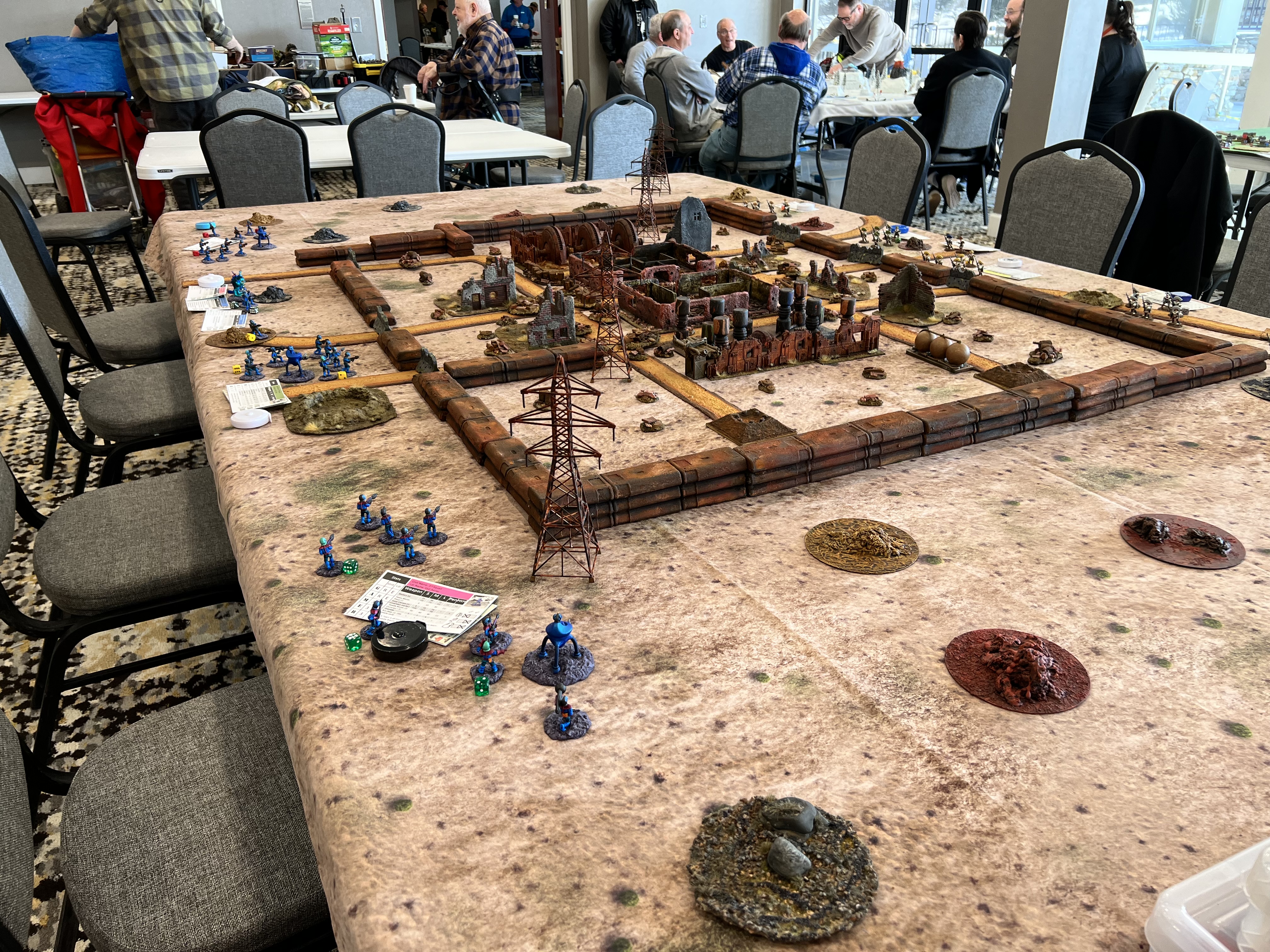
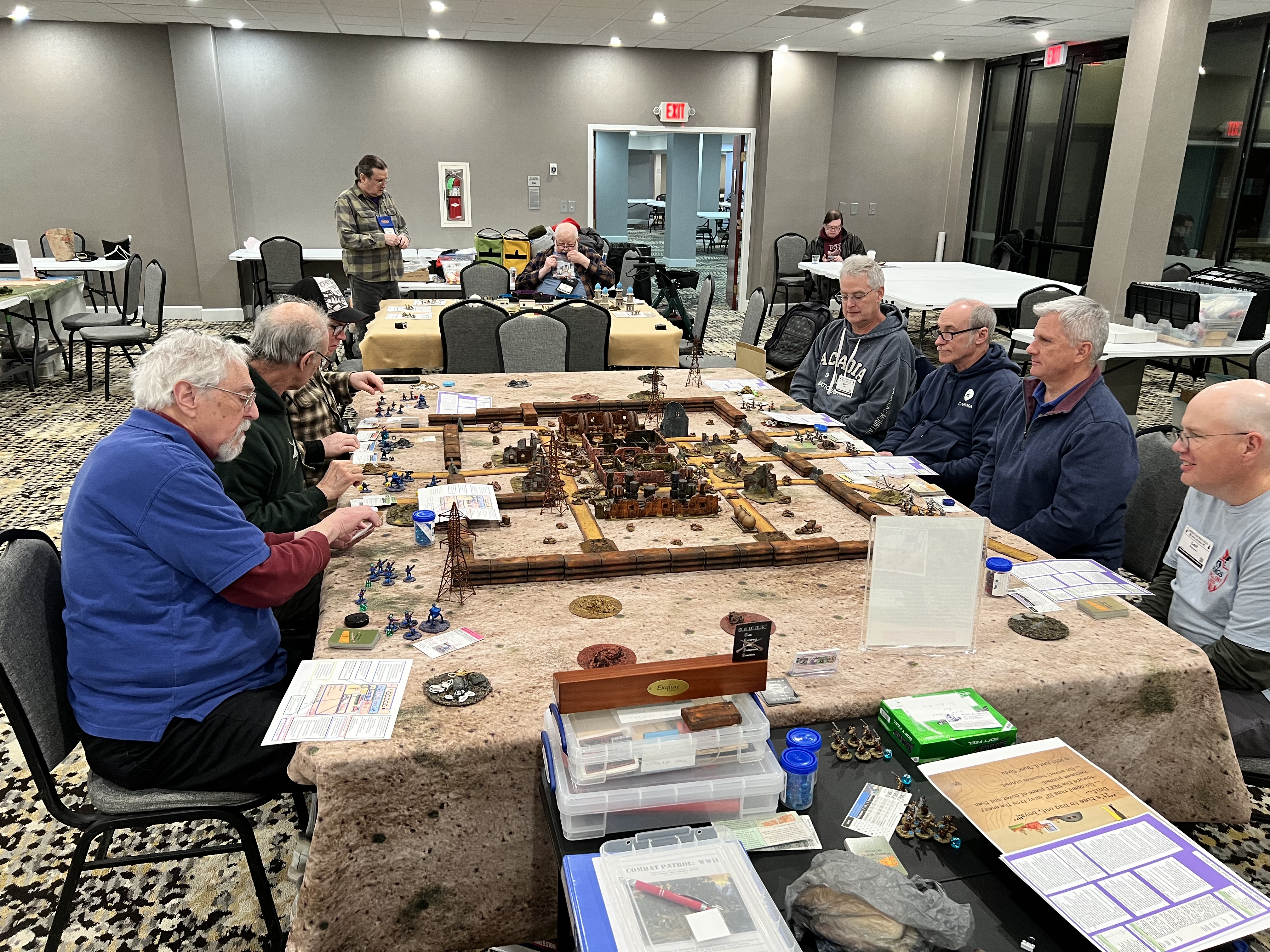
I was really looking forward to this one as I got to use all of my rusty wreckage and ruined buildings that I have posted about here in this blog. It did not disappoint. The battle was full of action, with jet-packing cowboys (Texican Space Rangers) and Space ‘Roos engaging the Retrovians (Roger’s own). (More about Roger here.) Ancient robots were found and lost, some even getting violent when found. Buck got to play and channeled his inner paratrooper in the attack.
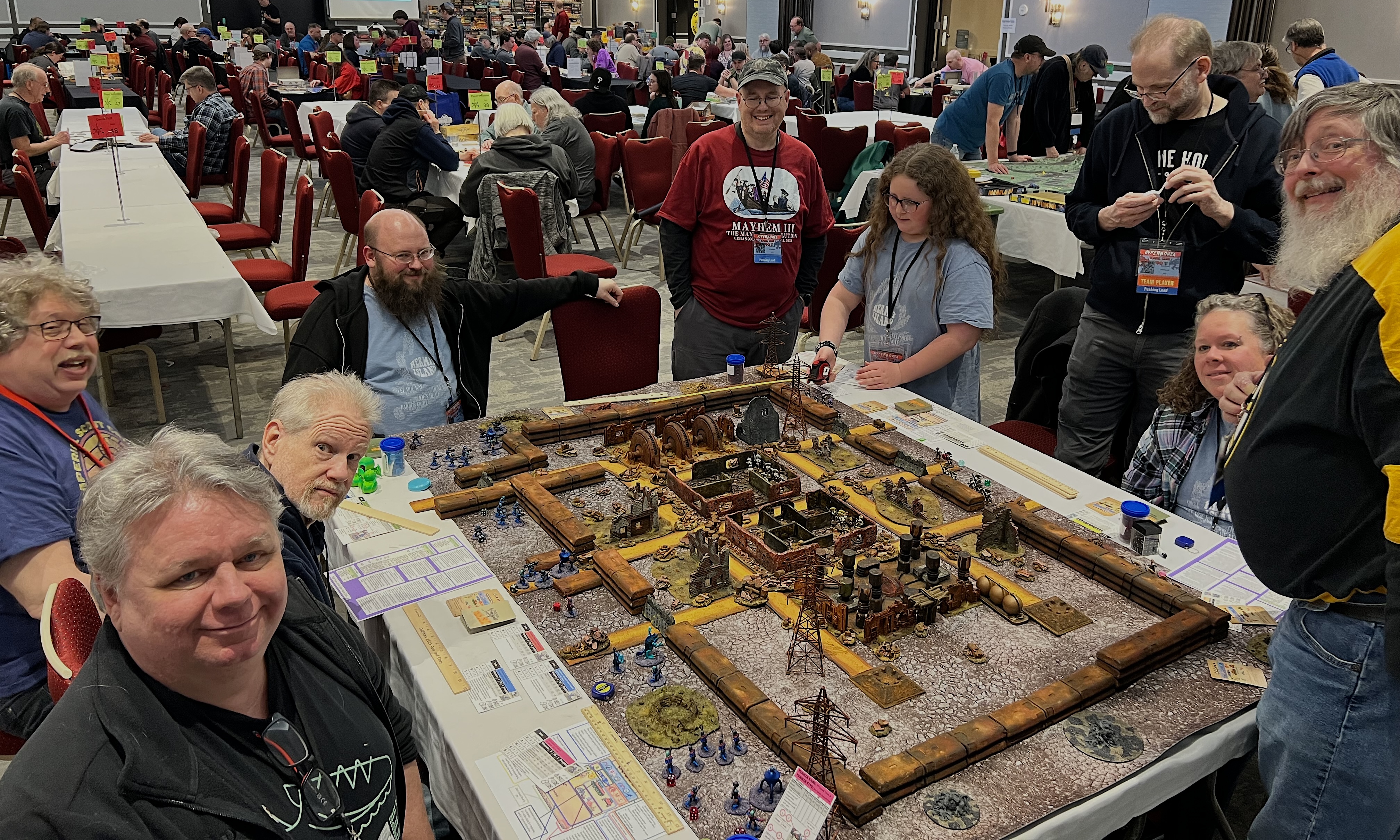
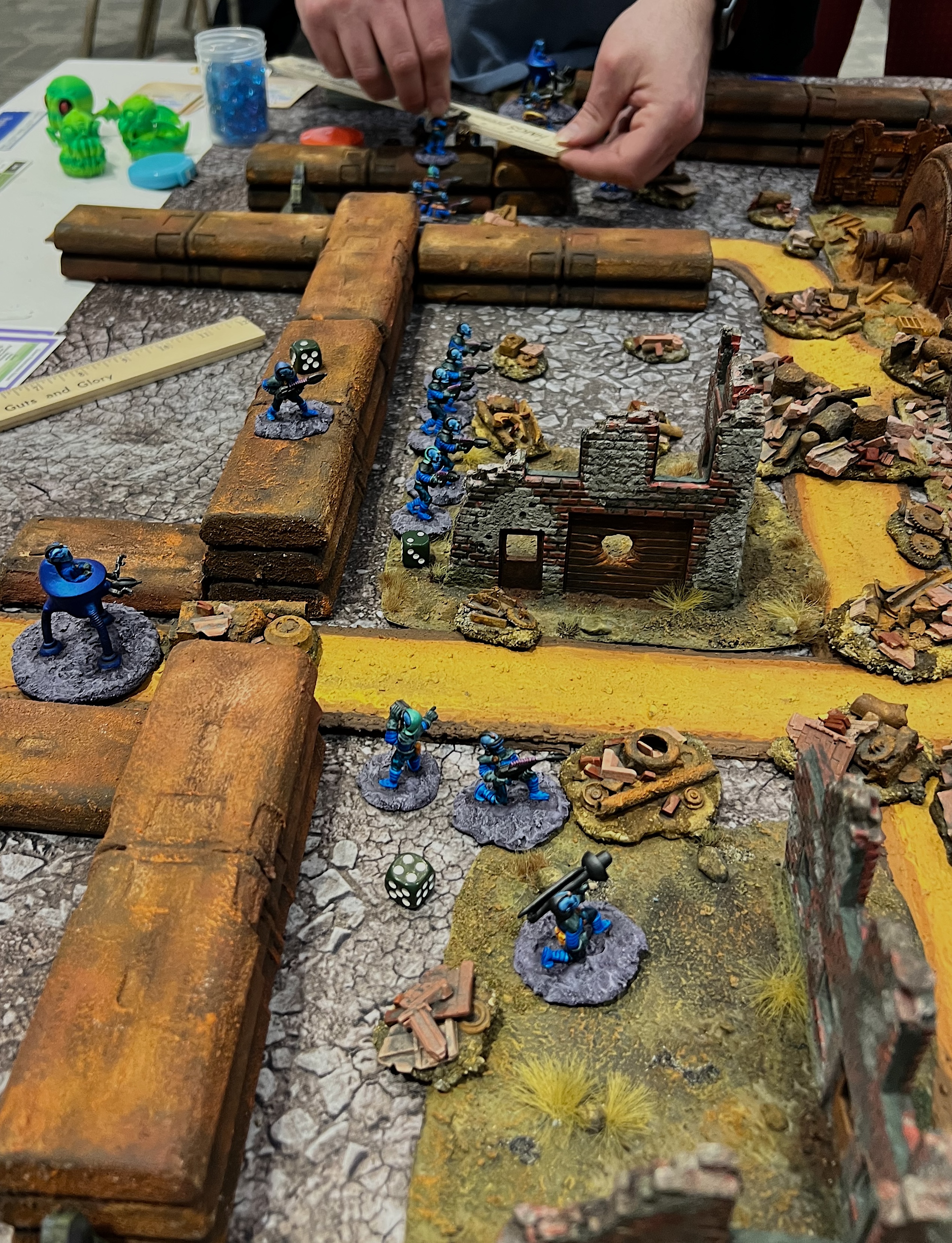
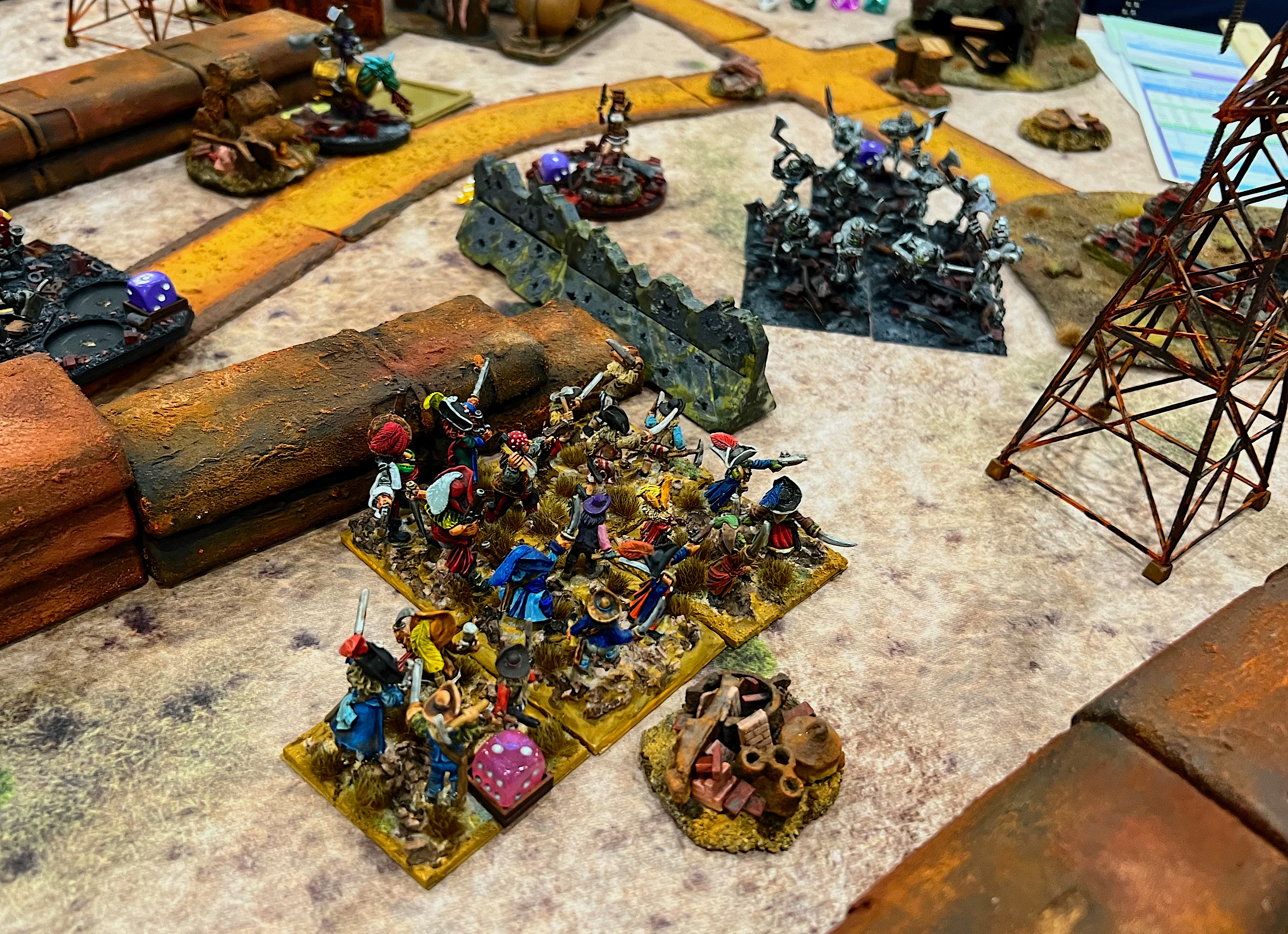
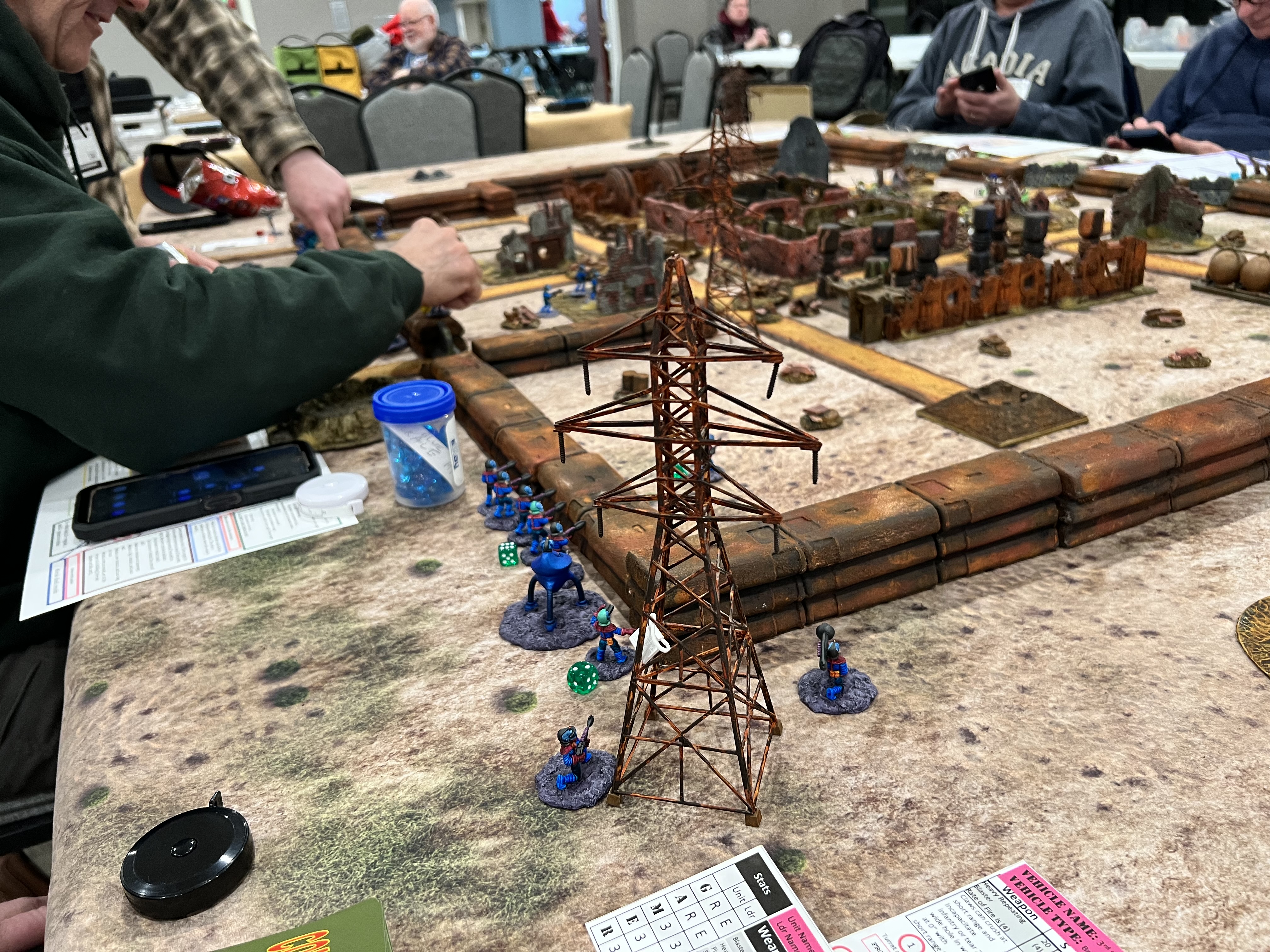
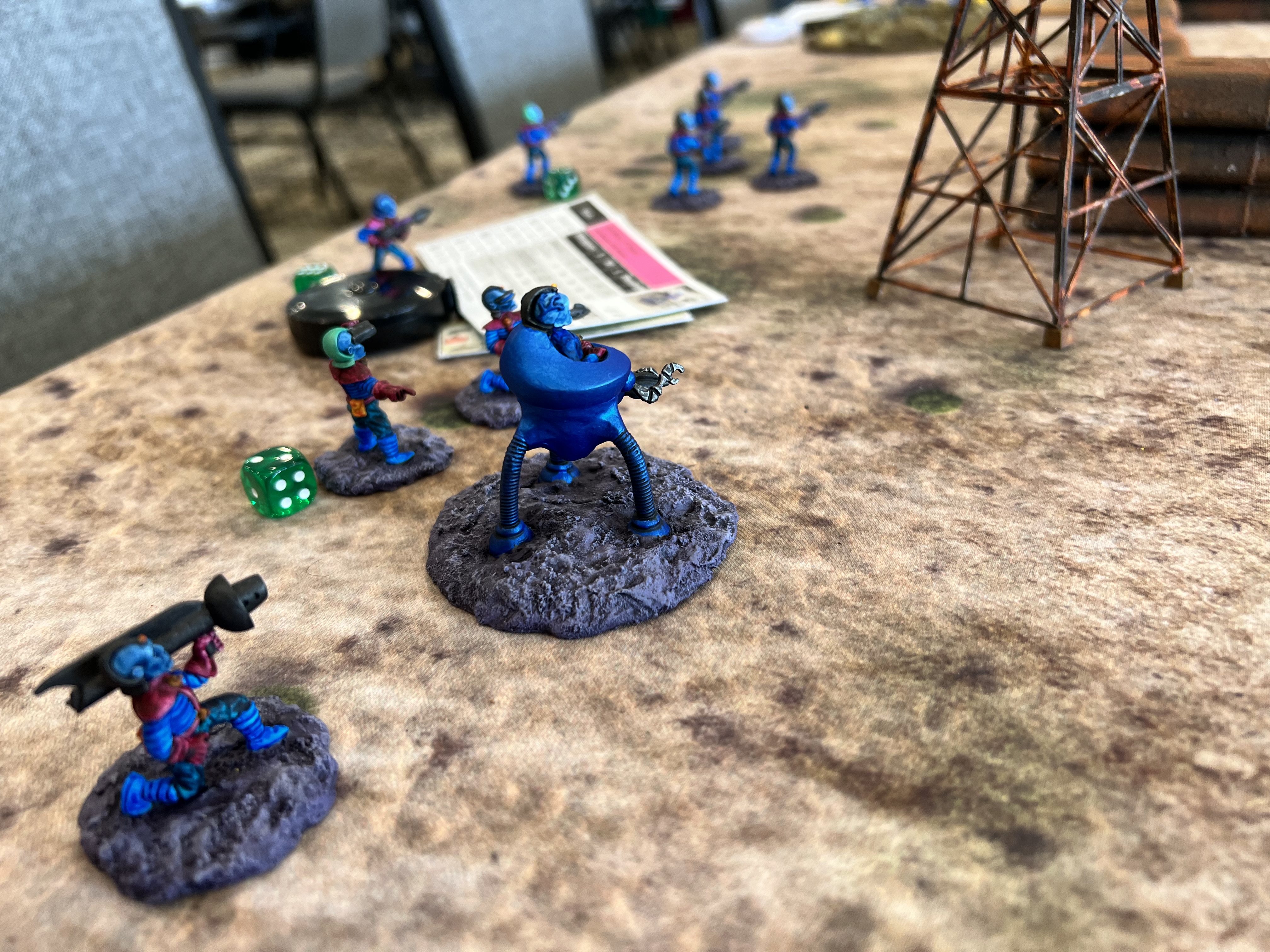
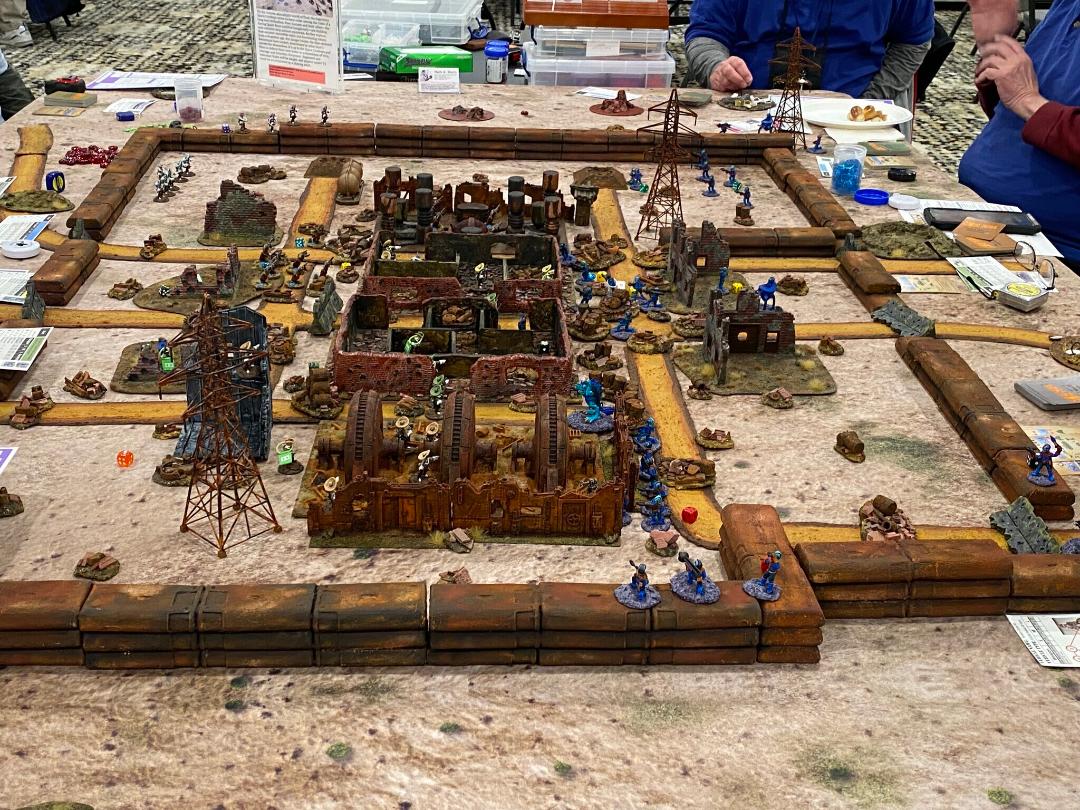
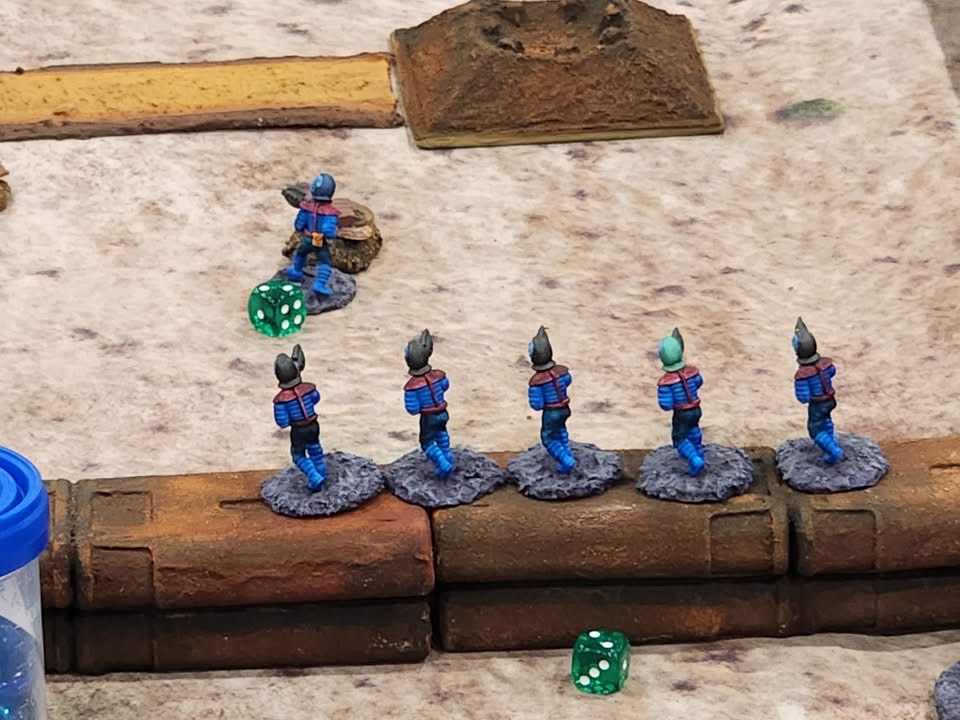
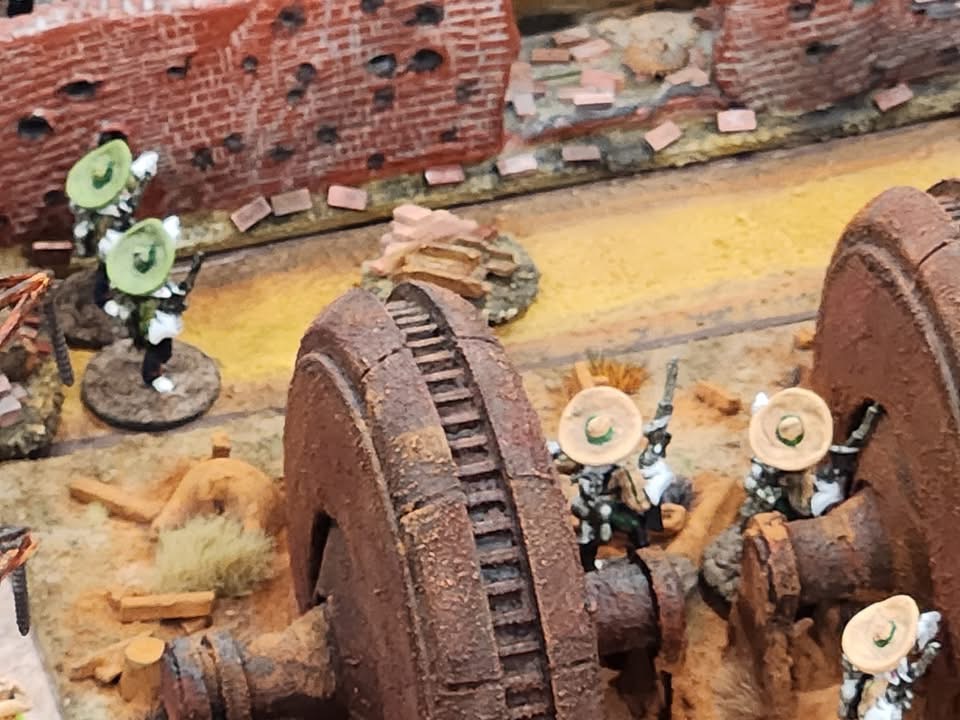
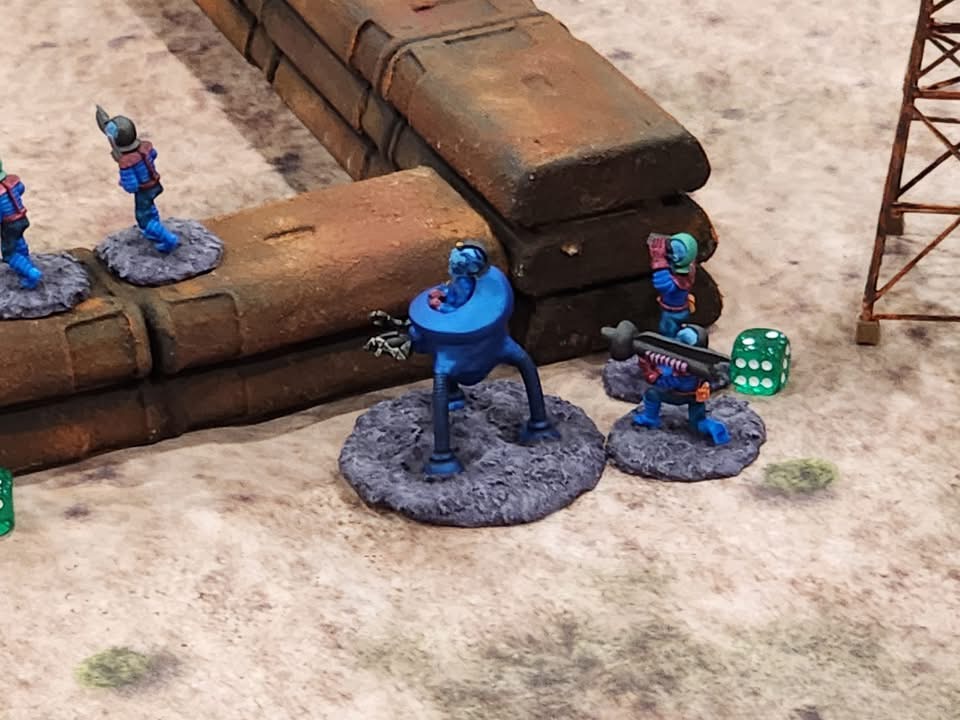
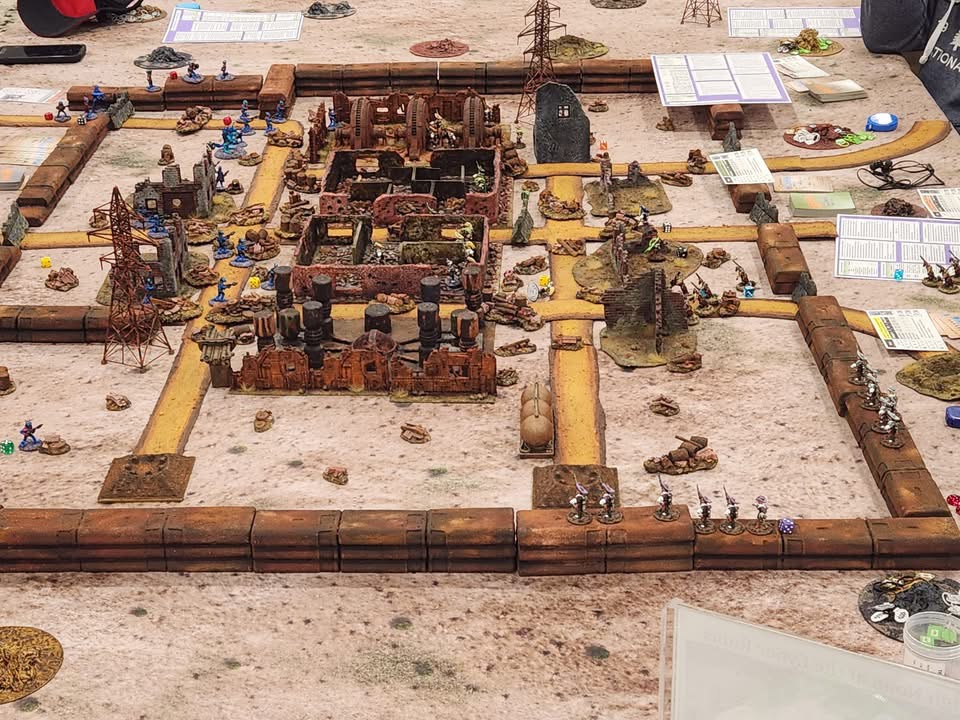
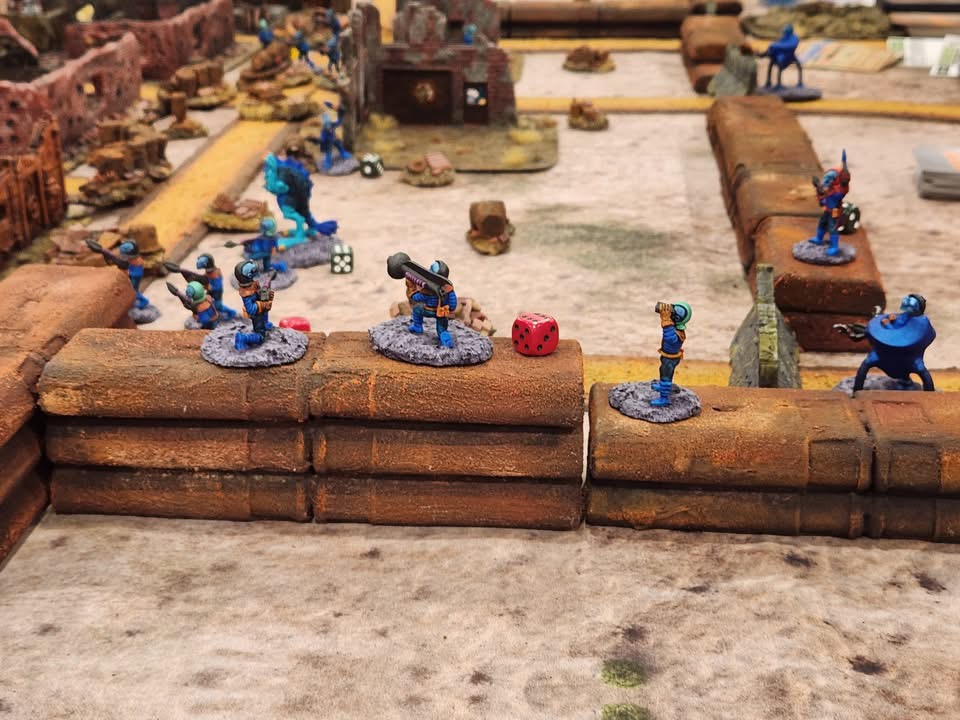
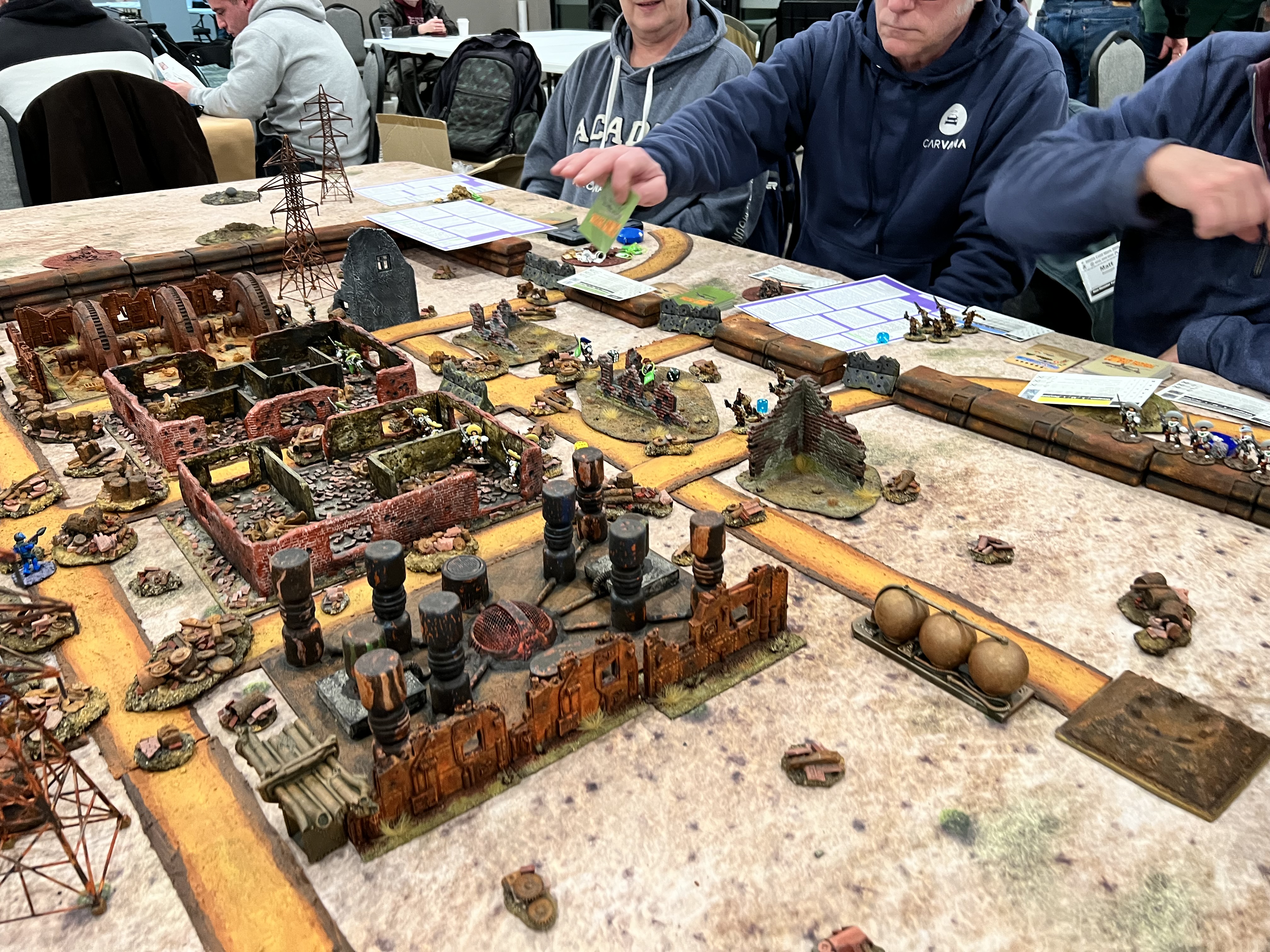
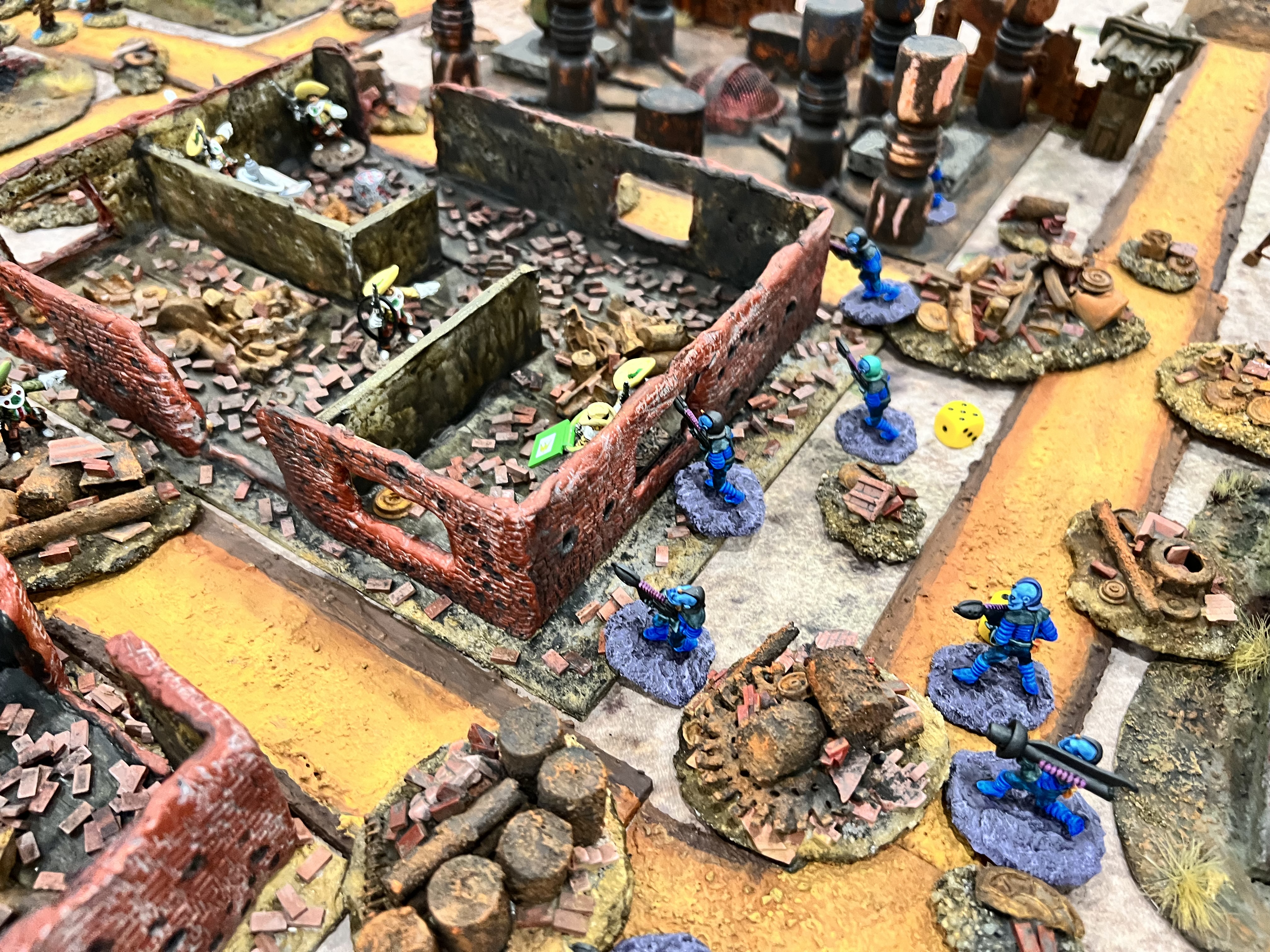
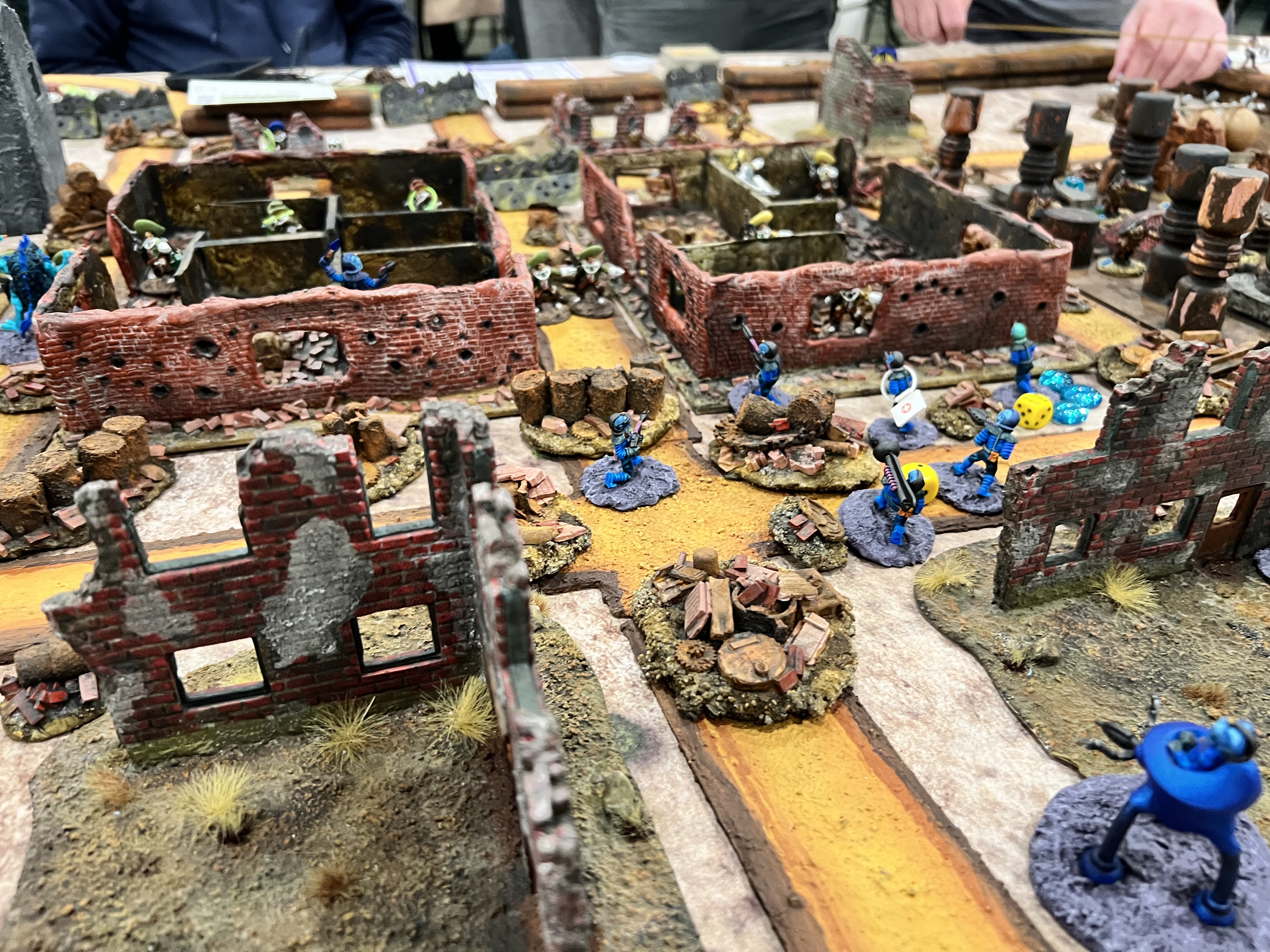
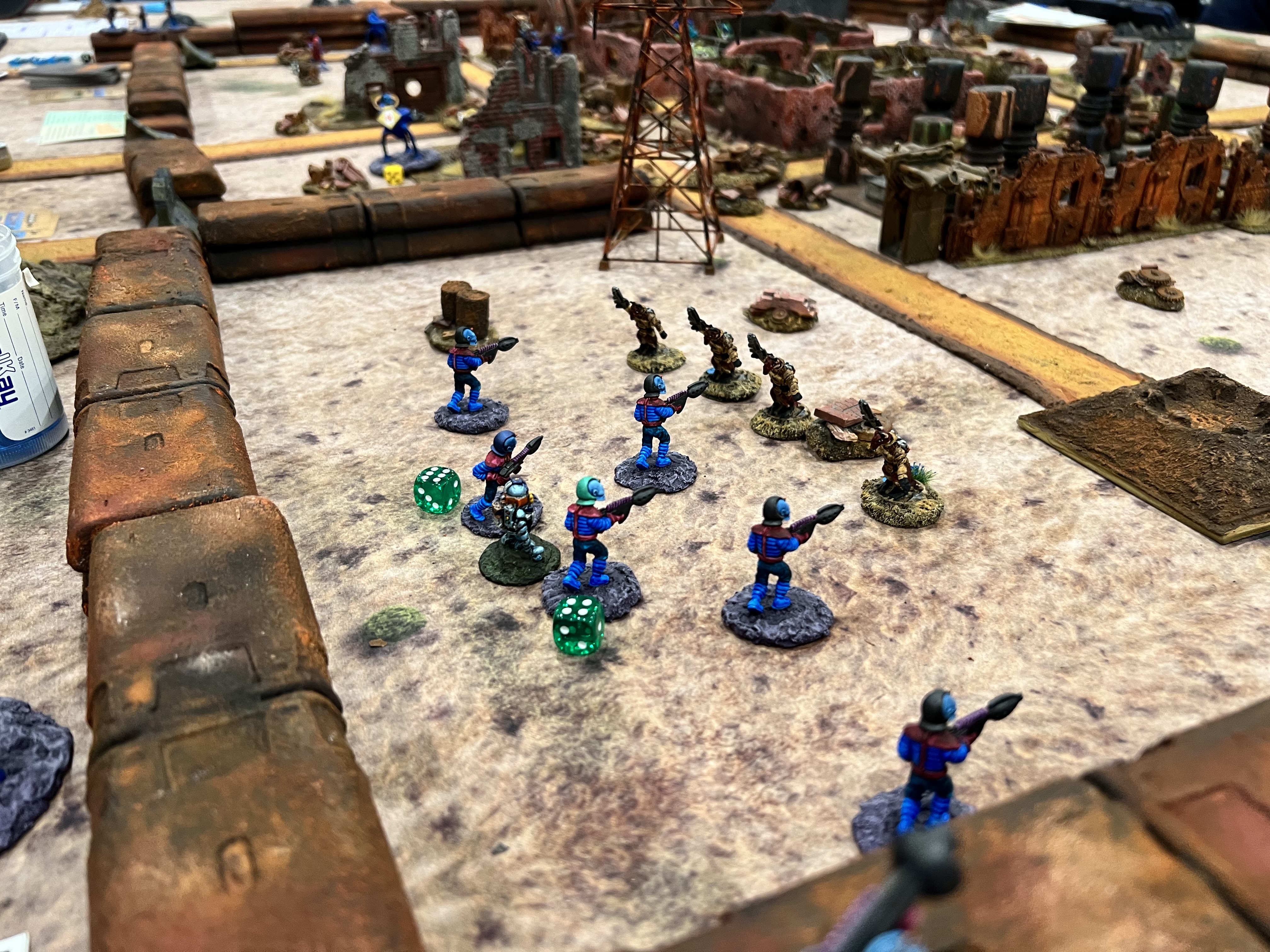
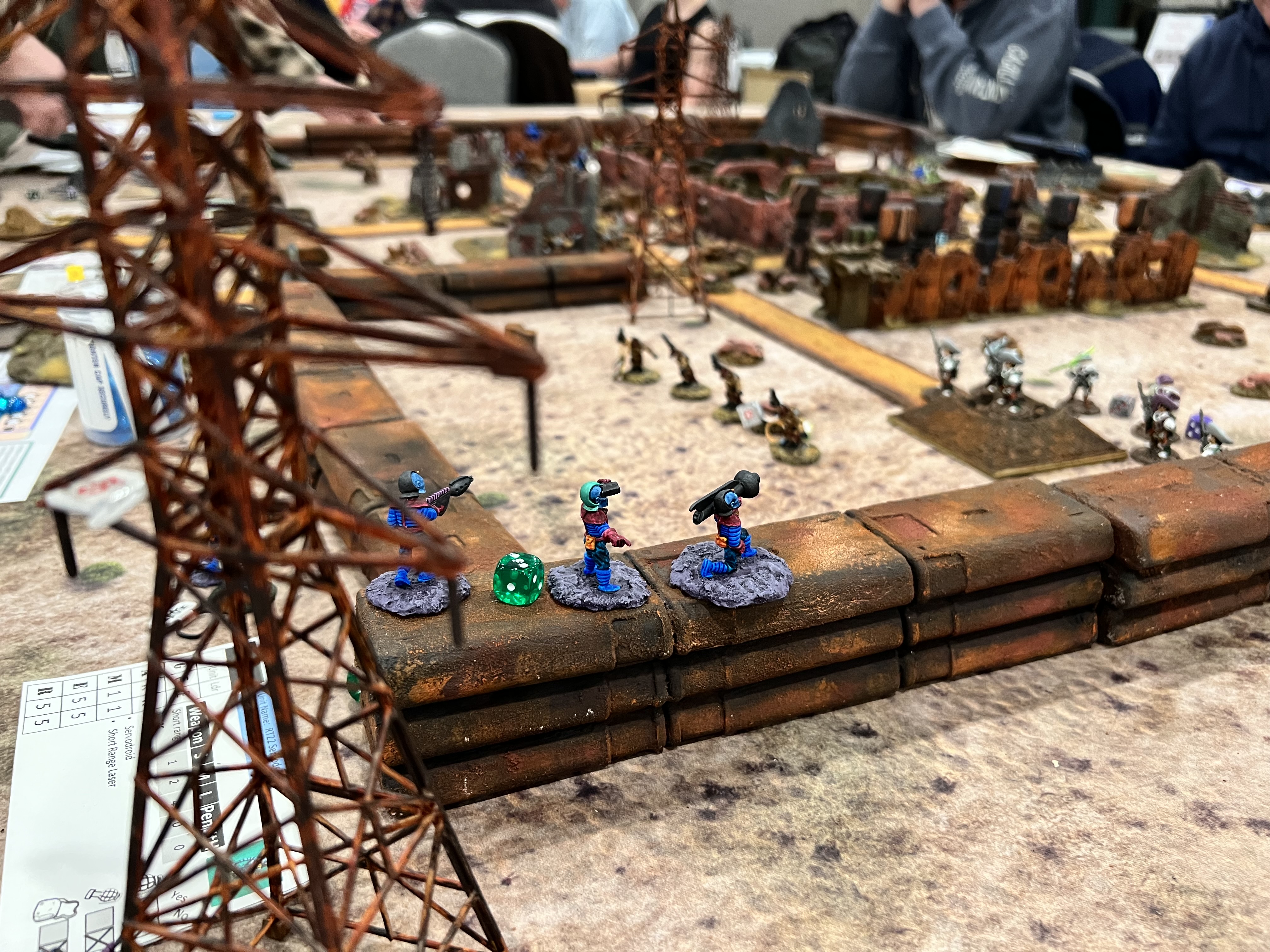
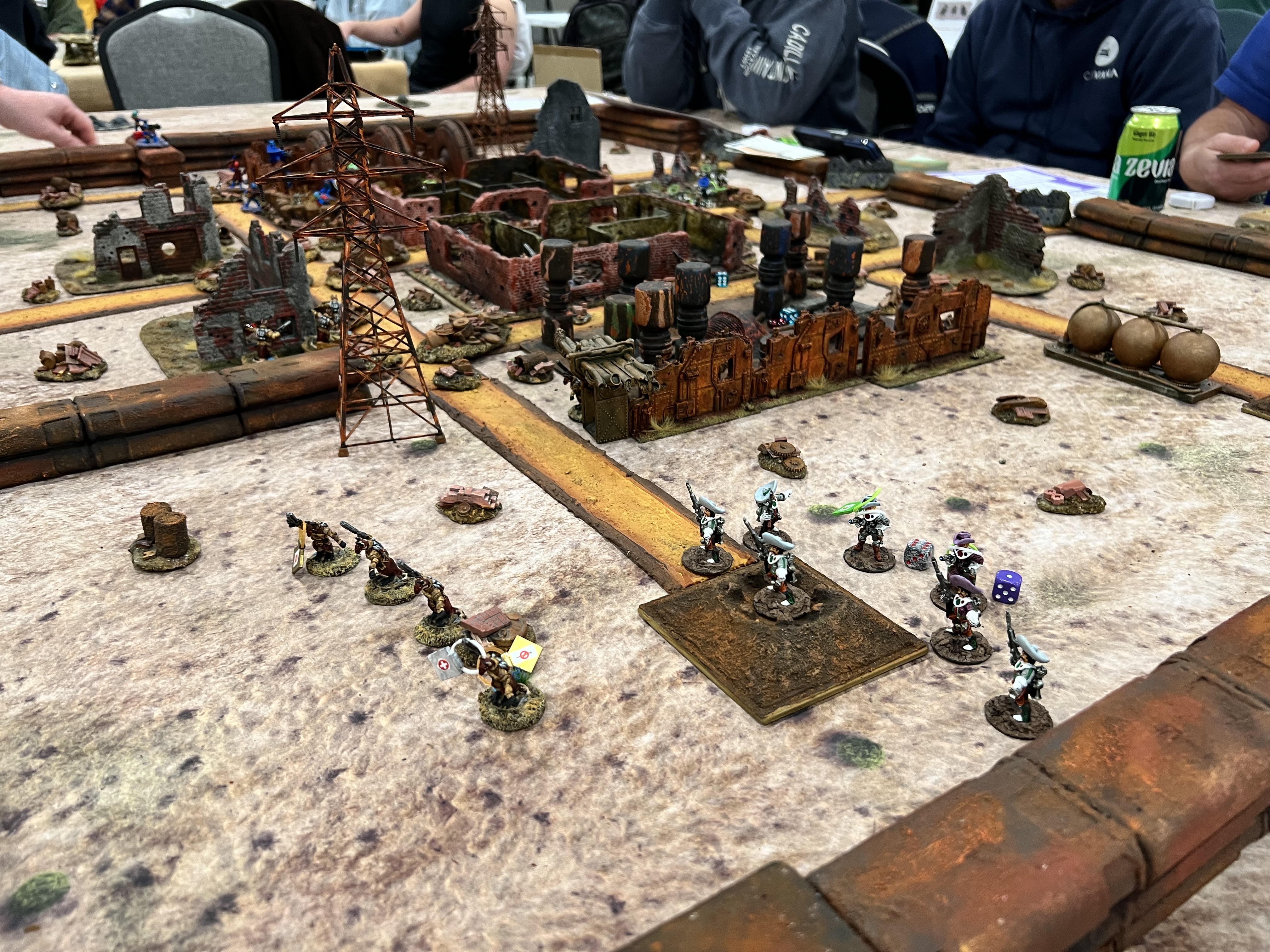
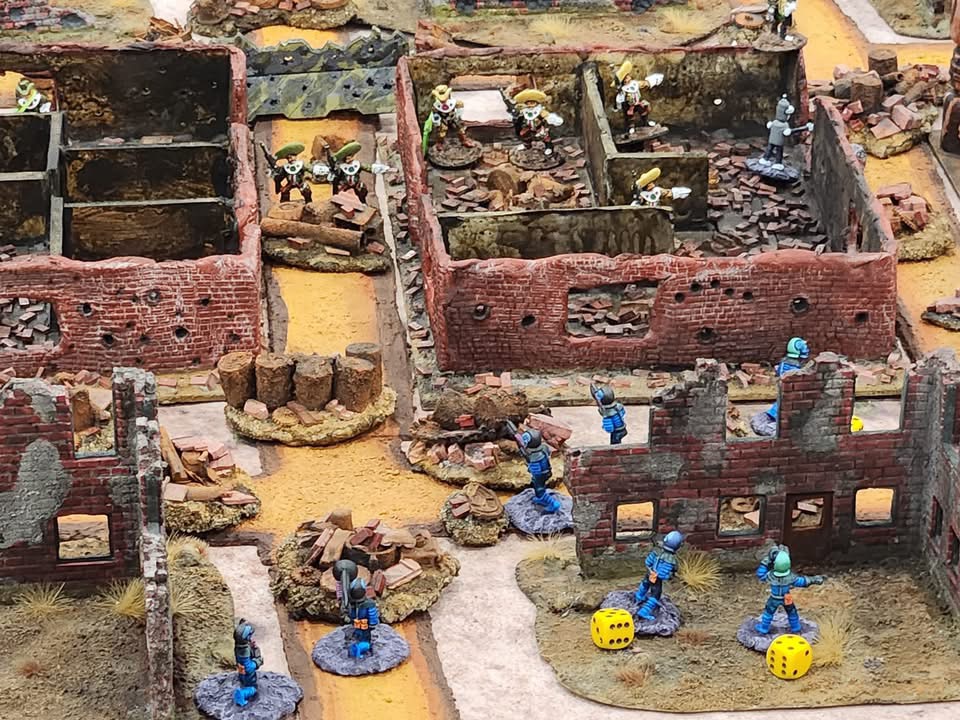
The game set up for action. Retrovians are moving into the ruined city from the left, and Space Cowboys from the opposite side. Space ‘Roos come in as reinforcements.Players ready for action.Skip maneuvers his troops in the background while Bruce deftly had his sniper climb the transmission tower. Obviously the figure would not stay, so we used a rubber band.Retrovian Heavy Weapons Squad.Movement into the city.My friend Ken Howe snapped this shot!Retrovian “Garkon” section.Moving into the city – what to do?Space Cowboys and Retrovians search for ancient robots.Retrovian fire team mounts the wall.Space Cowboys huddle in the wreckage from Retrovian fire.The tripod “Bra’sheers” had a difficult tome getting over the walls. They did at points and instantly decapitated a few Space Cowboys with their claws.A “Bender” robot was found – but was hostile and killed a cowboy and needed to be subdued. Some of Leif’s Space Cowboys got on the wall in a conga line only to take Bra’sheer machine gun fire.The conga line of death before machine gun fire…Retrovians getting into the city in any way they could.The battle rages.Urban fighting!Lots of combat in the city.Buck jet-packs his Space ‘Roos and ambushes Bruce’s Retrovians, wiping them out. He was practically giddy in this game with how successful his tactics were.Retrovians seek revenge with sonic cannon and sniper fire.Space Cowboys and Space ‘Roos continue the search.
In the end, the Space Cowboys and Space ‘Roos alliance found 3/4 robots and successfully held on to them. All casualties mounted. But the victory was clearly in the hands of the Space Cowboys and Space ‘Roos!
After the game, with help, I was able to pack the car for a Sunday morning drive home. The temperature was well below zero Fahrenheit! With the wind chill it was -13 degrees Fahrenheit (or -25 Celsius for you metric types!).
Thank you to all at HMGS who made Cold Wars possible!
That wraps up this post – I still have a few that are in the queue , and I hope they are of interest.
I will be running these games again so see you at the next convention!
Followers of this blog have seen several posts showing my “rusty” preparations. I have been getting ready for my numerous games at 2026 tabletop wargaming conventions. That preparation involves painting up figures and terrain for scenarios that involve a good amount of ruins and wreckage.
In a previous post, I shared how I built transmission towers and rusty walls for a Wars of OzzTM game involving Professor Nitpik’s Industrial City (the Robotic Sanctum). I ran that game at Cold Wars and will share more about that convention shortly. The theme for Cold Wars this year was “The Wild West”, so I also had planned to run a game involving Space Cowboys (technically Archive Texican Space Rangers” from Star Rovers).
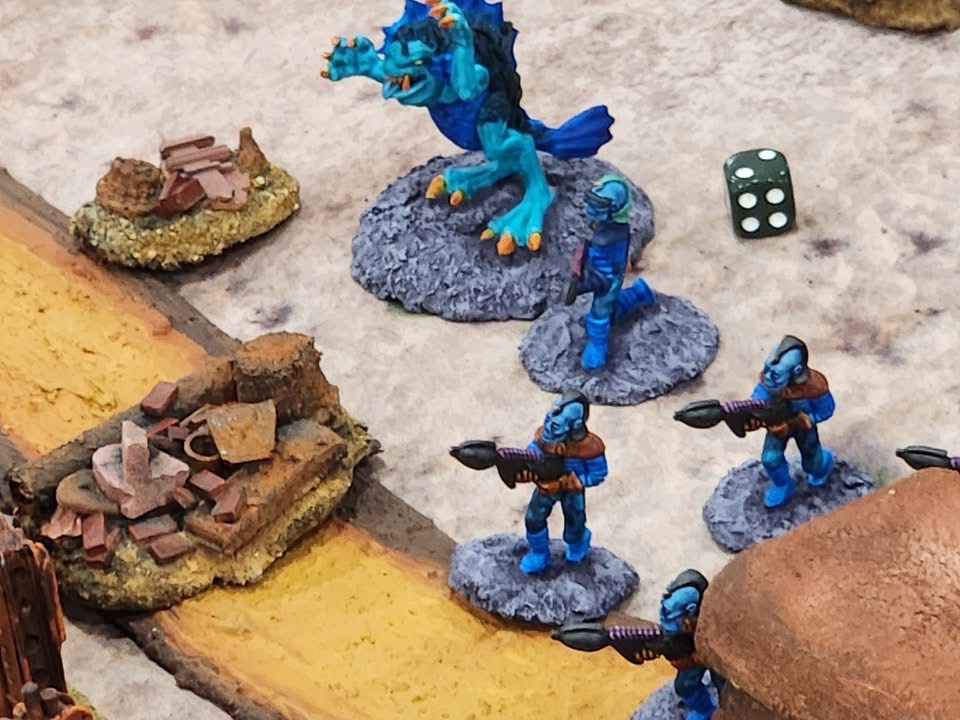
I don’t run western games, but I could cobble together a retro sci-fi game using Buck Surdu’s Combat Patrol:WWIITM gaming system (with my modifications). In my game Archive “Space Cowboys”, and uplifted kangaroos (“Space ‘Roos” ) combat blue-skinned “Retrovians” (from War Games Supply Dump). Both armies are searching for hidden ancient robots in the apocalyptic ruins of a long-dead civilization on a newly-colonized world called Dust.
To really make the ancient ruined industrial panorama that I wanted, I needed more buildings and structures than just my transmission towers, rusty walls, rusty generators and ruined chemical plant. I also wanted a lot of wreckage strewn about as terrain.
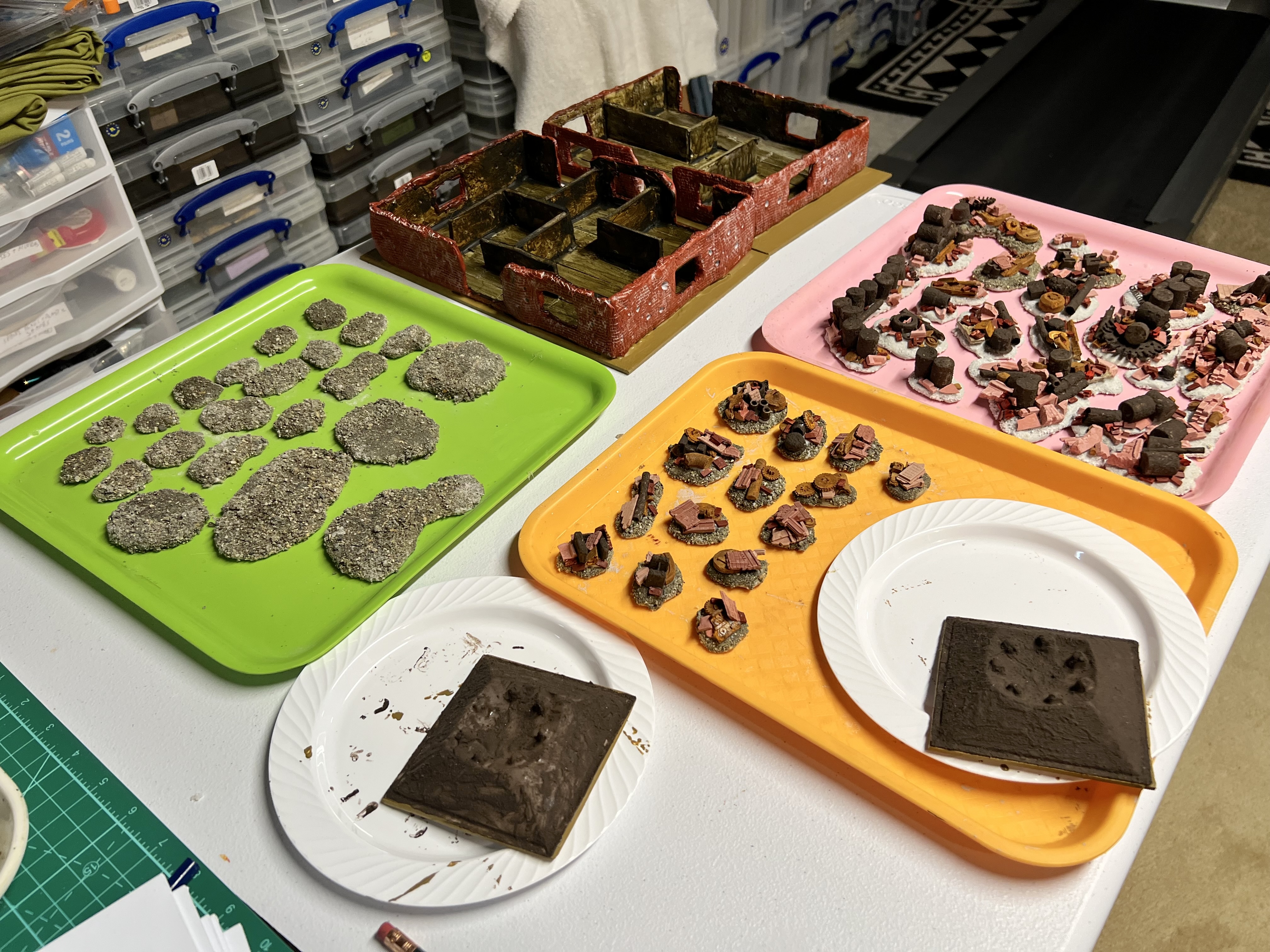
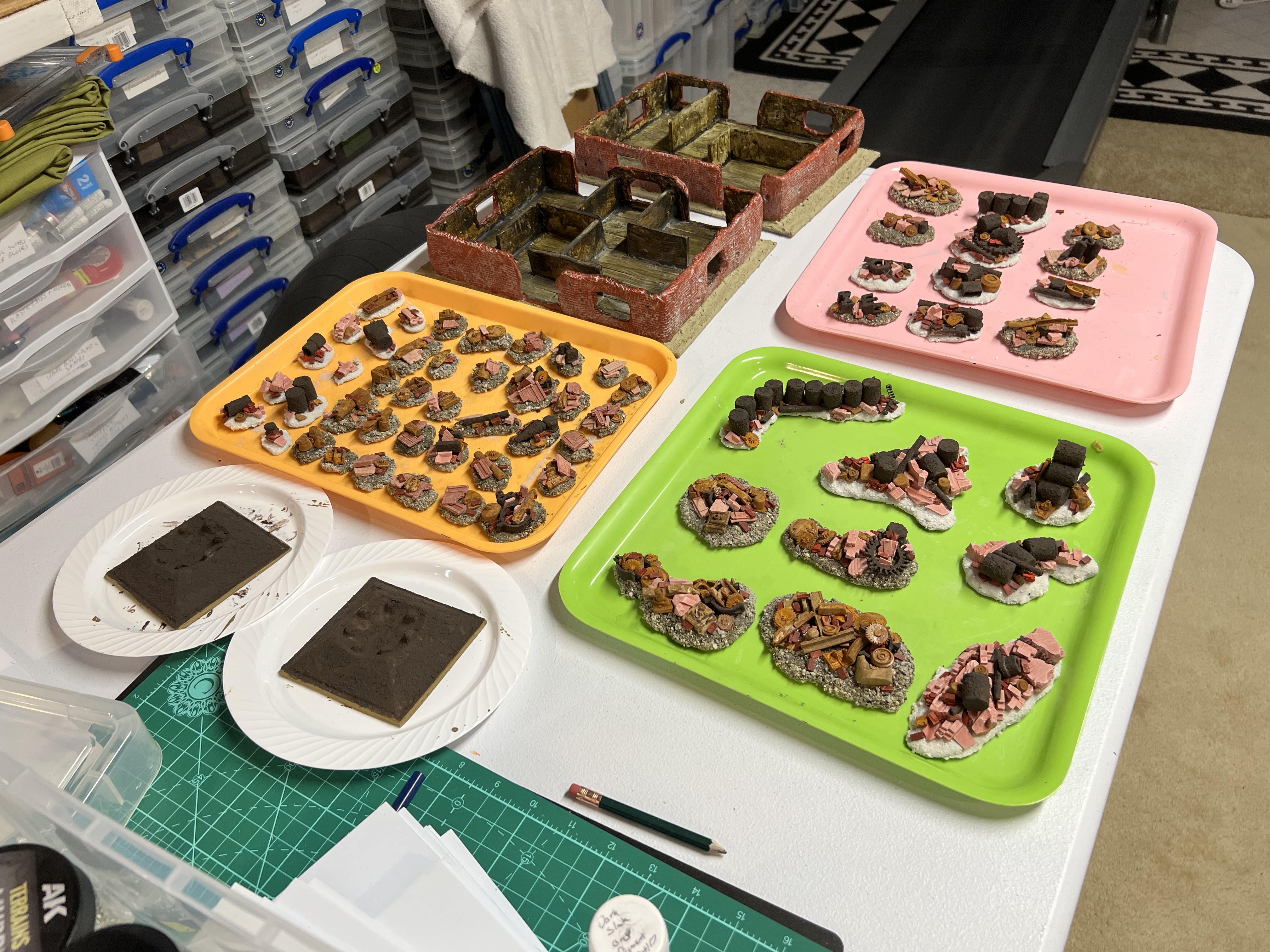
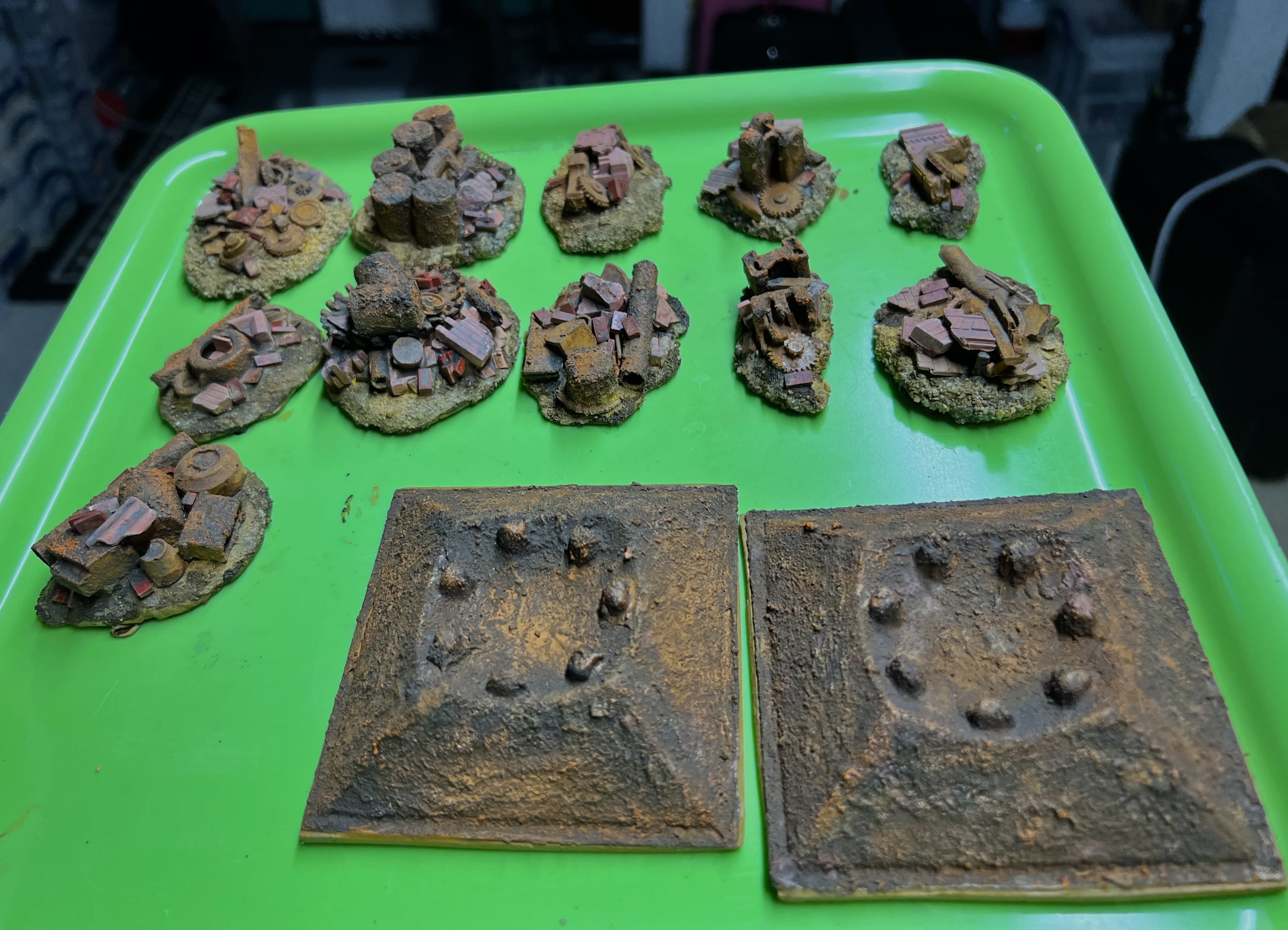
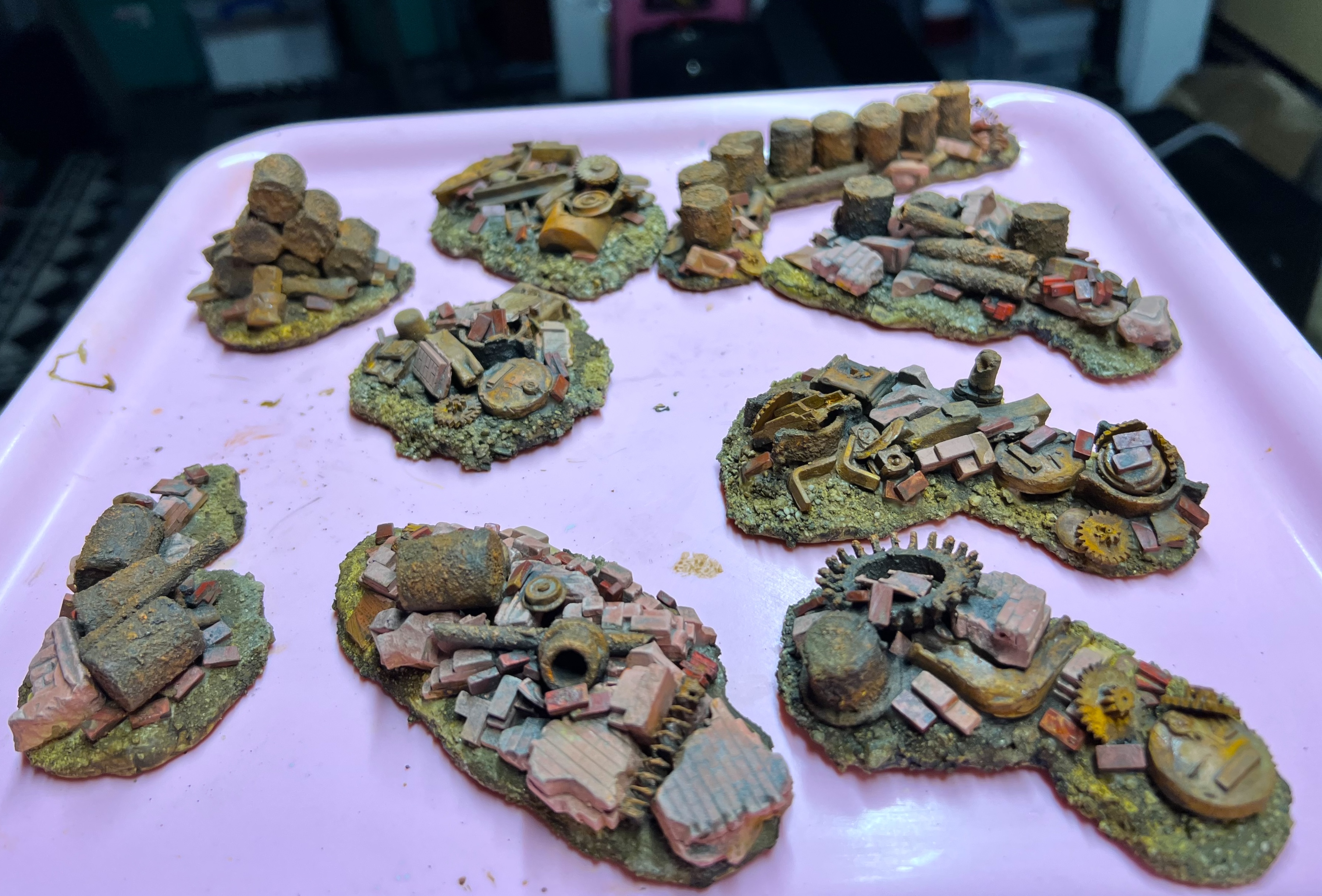
To those ends, I ended up making two ruined factory buildings, two industrial structures, and 61 scatter bases of industrial wreckage. These were all built at the same time. This enabled me to work around issues like drying and curing times as time was short. Oh yeah, and we had a few snow storms here in Massachusetts along the way that ate up some hobby time (not helpful at all).
I wanted to share my project and all its components here with you. As these were simultaneous efforts, you will see multiple project stages here. You may notice that I used a lot of repurposed bits of metal and plastic and Juweela products. The lists will be at the end of this post as is my habit. My concept was to achieve a Stalingrad-like look.
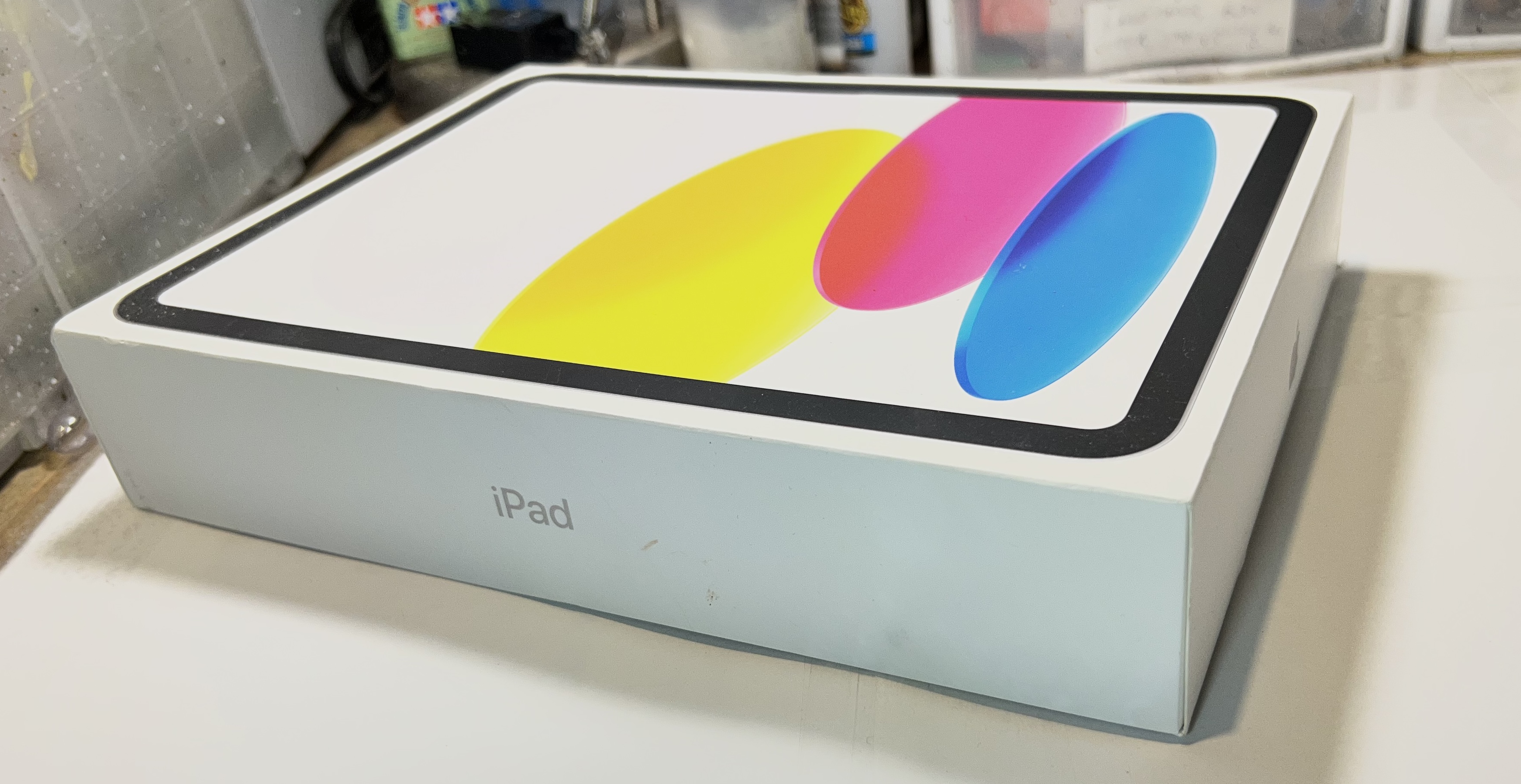
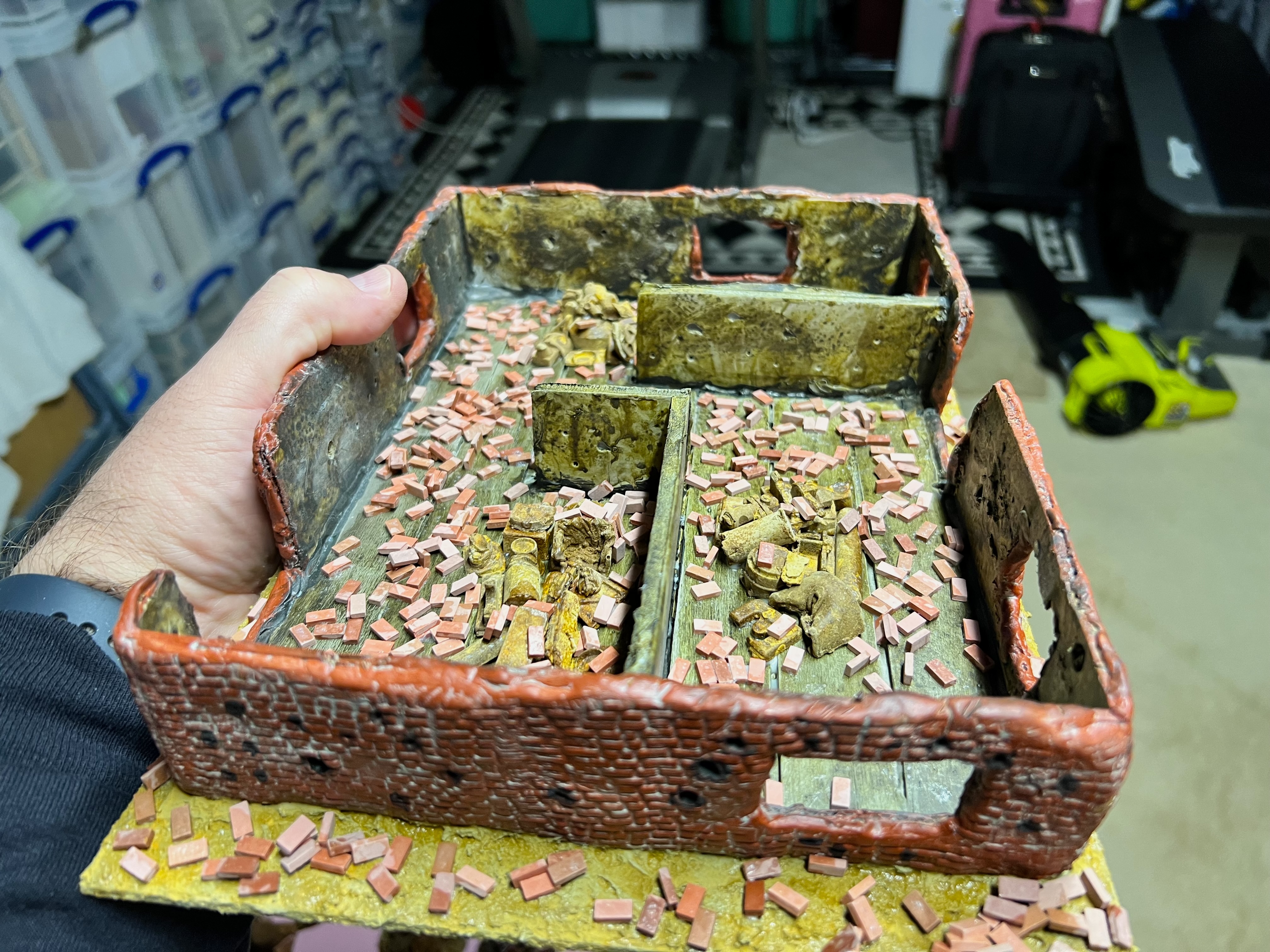
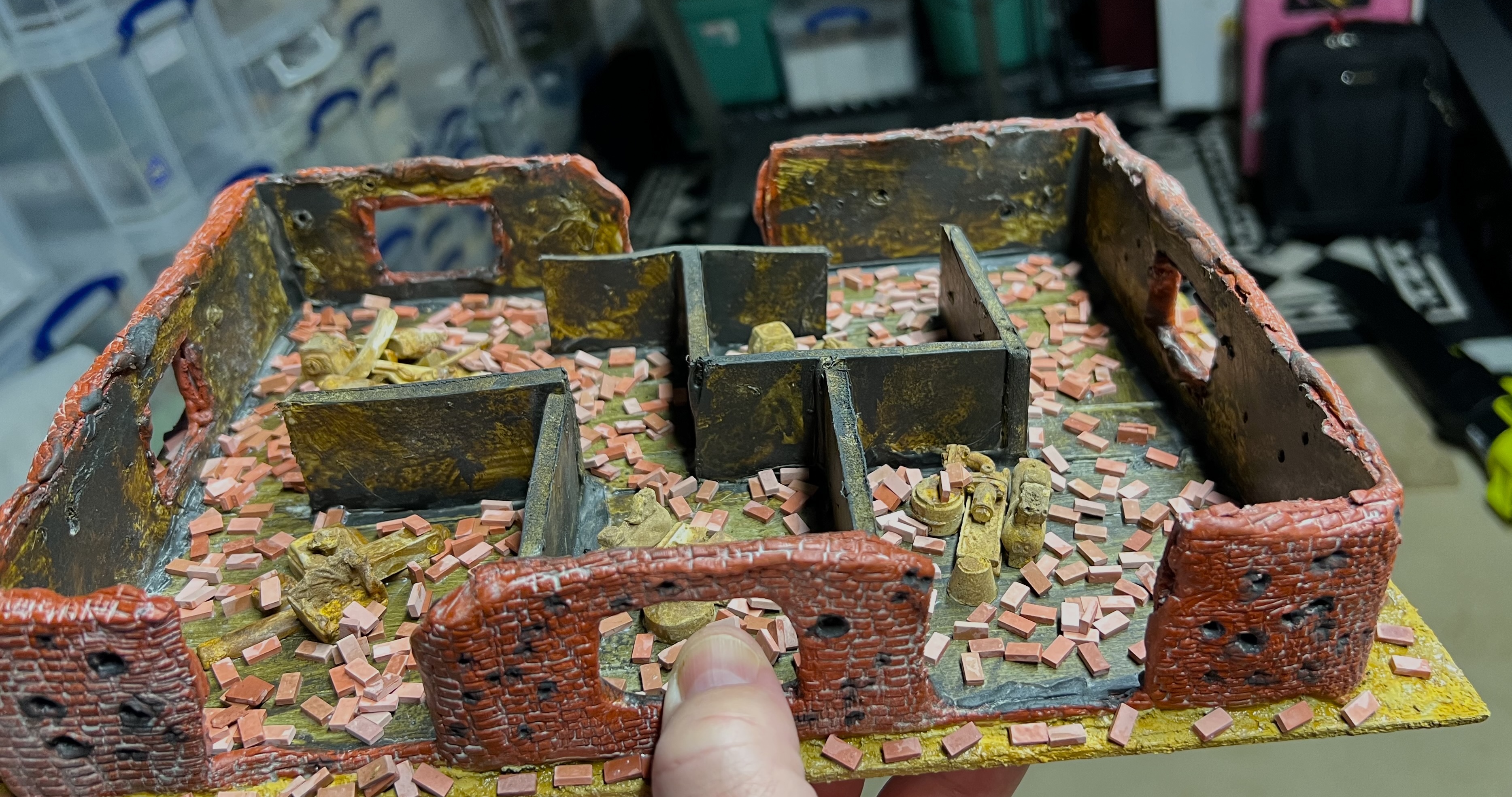
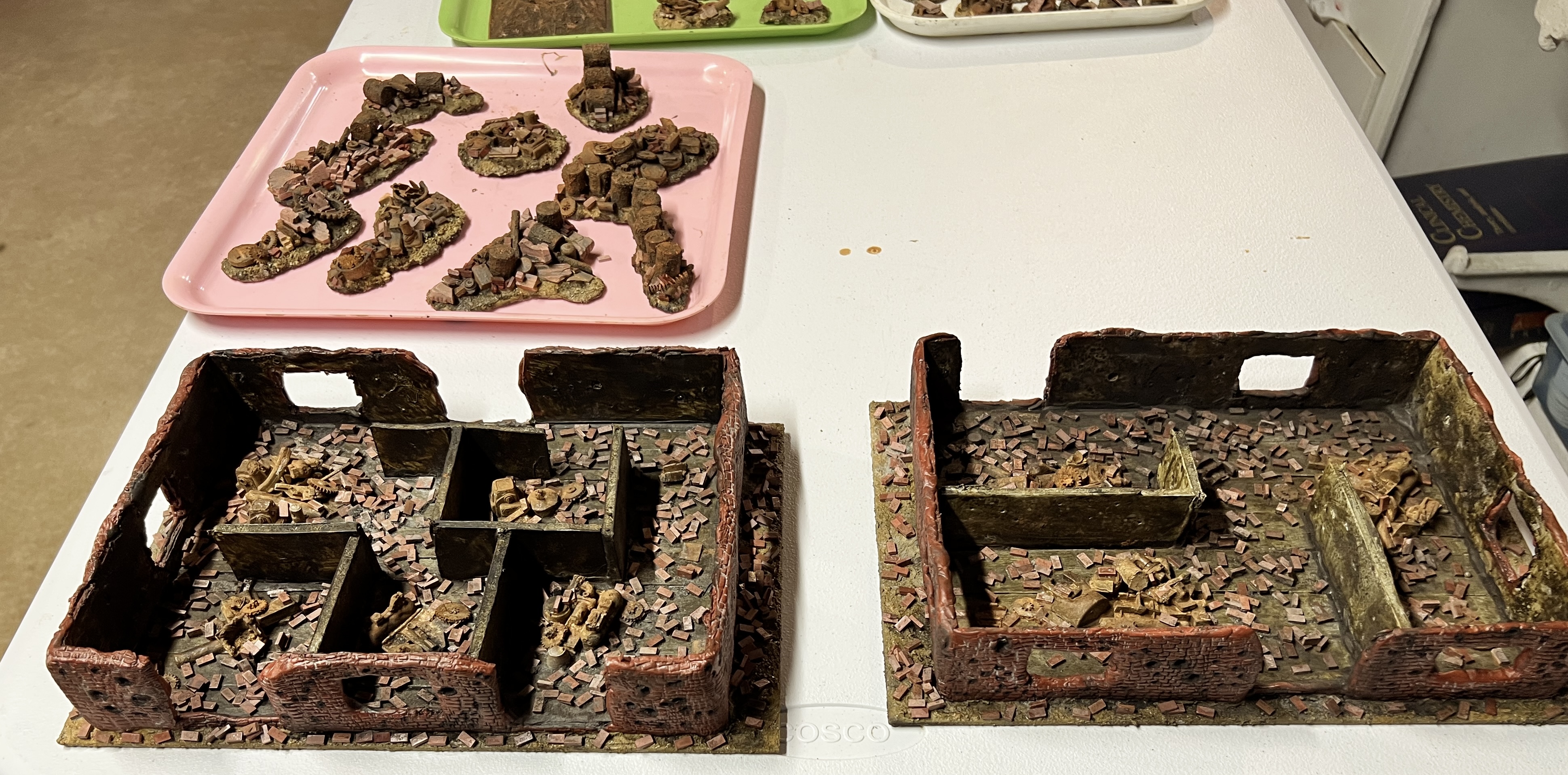
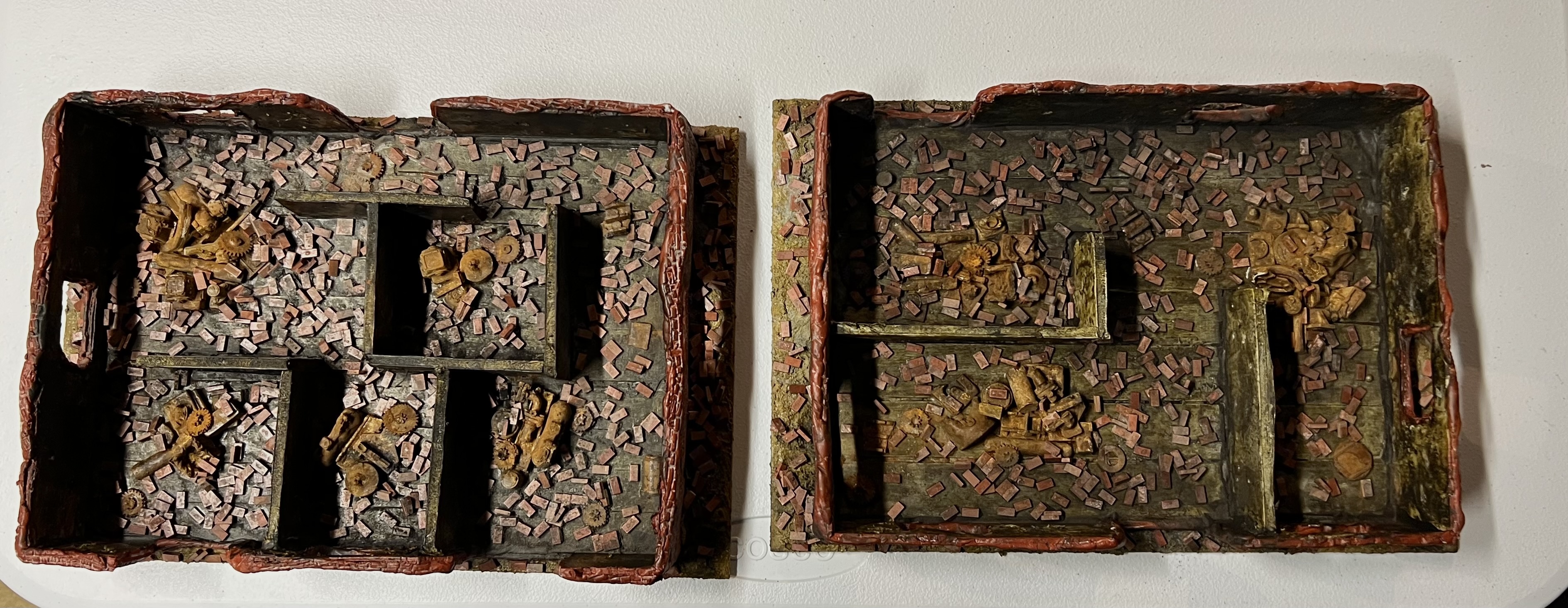
For the two buildings, I converted an iPad 16 box top and bottom. I used Apoxie Sculpt, steel washers, sand, multiple pieces of plastic, desiccant cylinders, and a lot of Juweela items to make the 61 scatter bases. And for two flat industrial structures, I reused two pieces of packing materials to repurpose them as flat rusted structures.
I started out with this iPad 16 box. I would use the top and bottom of this. It is plastic and cardboard.
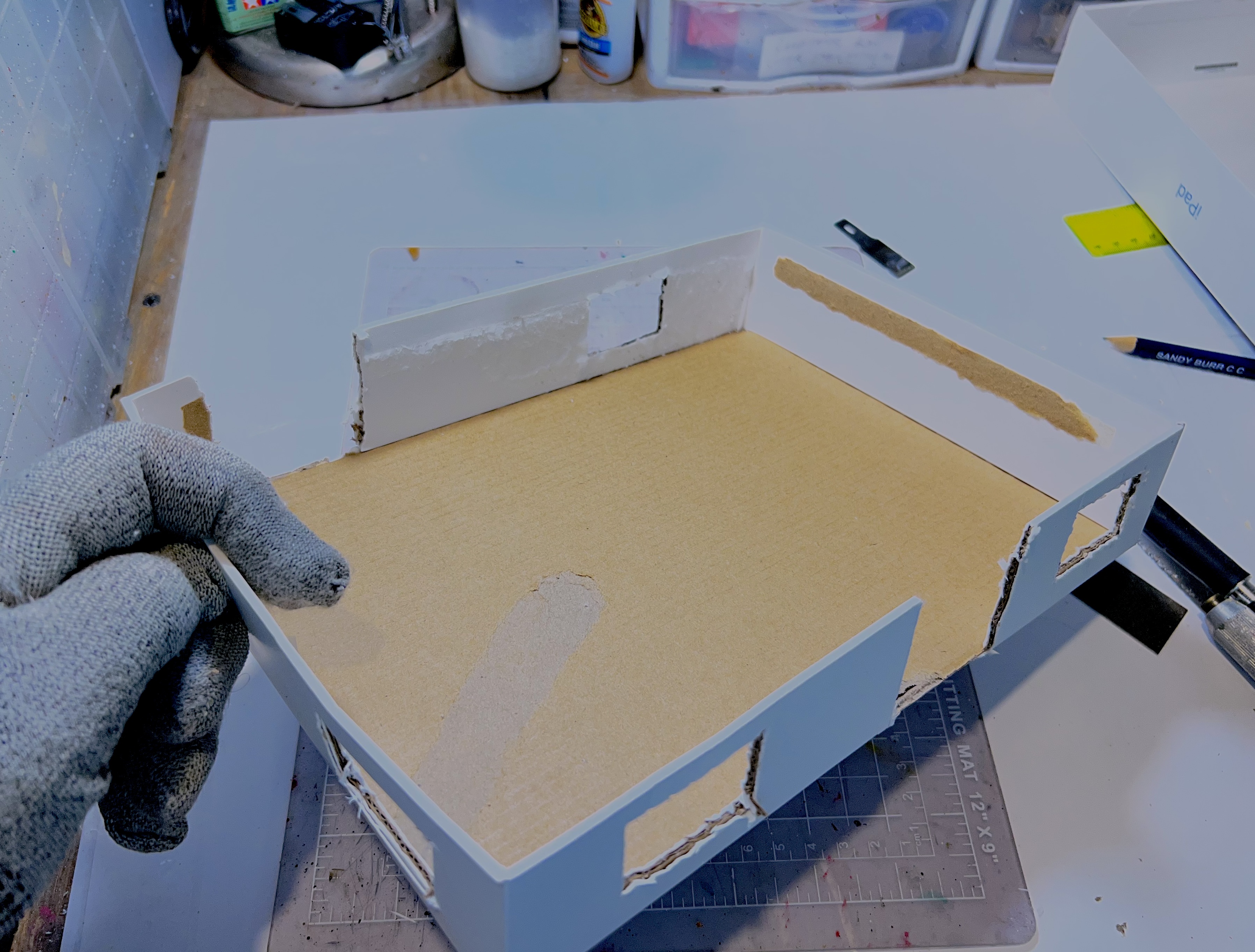
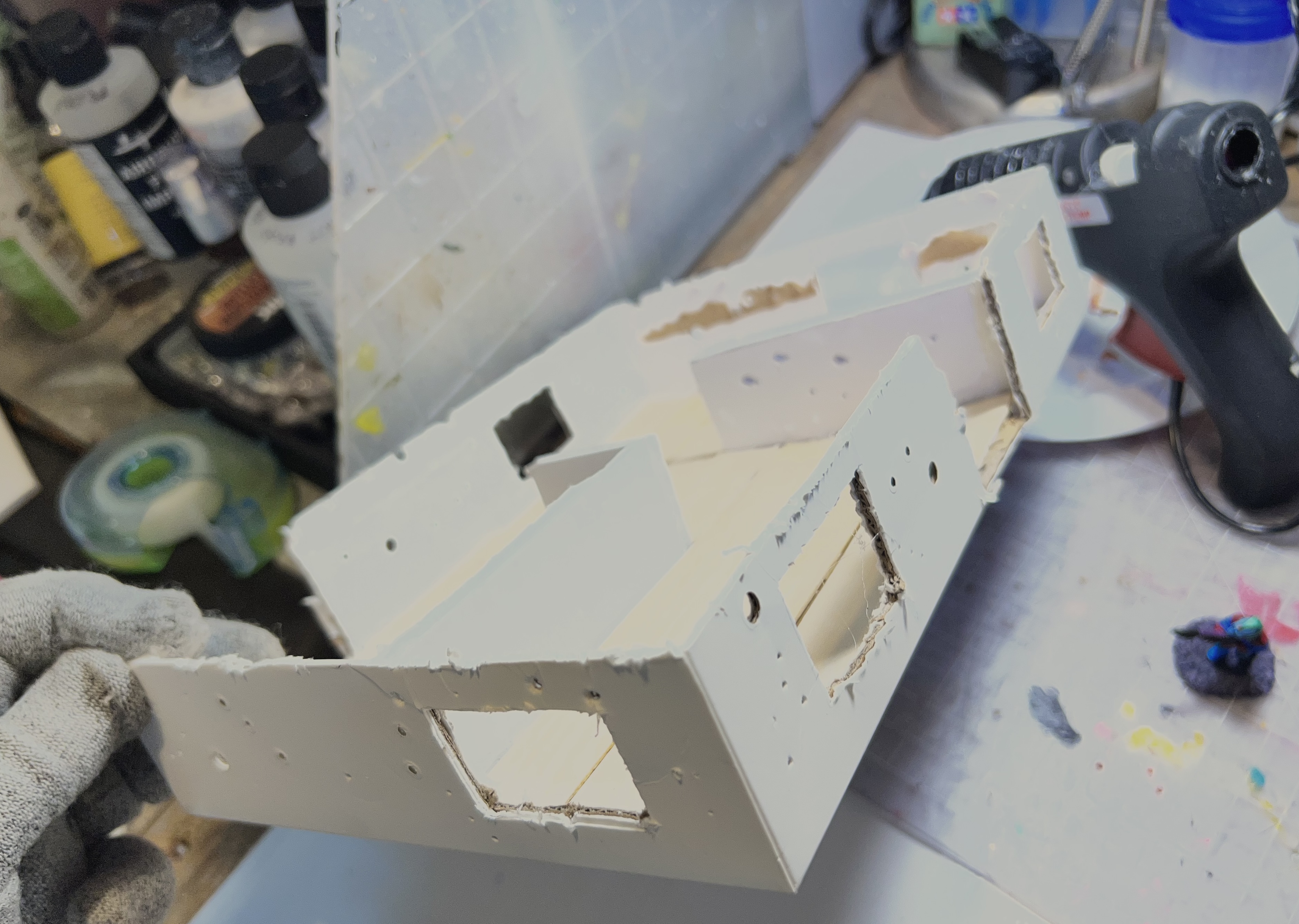
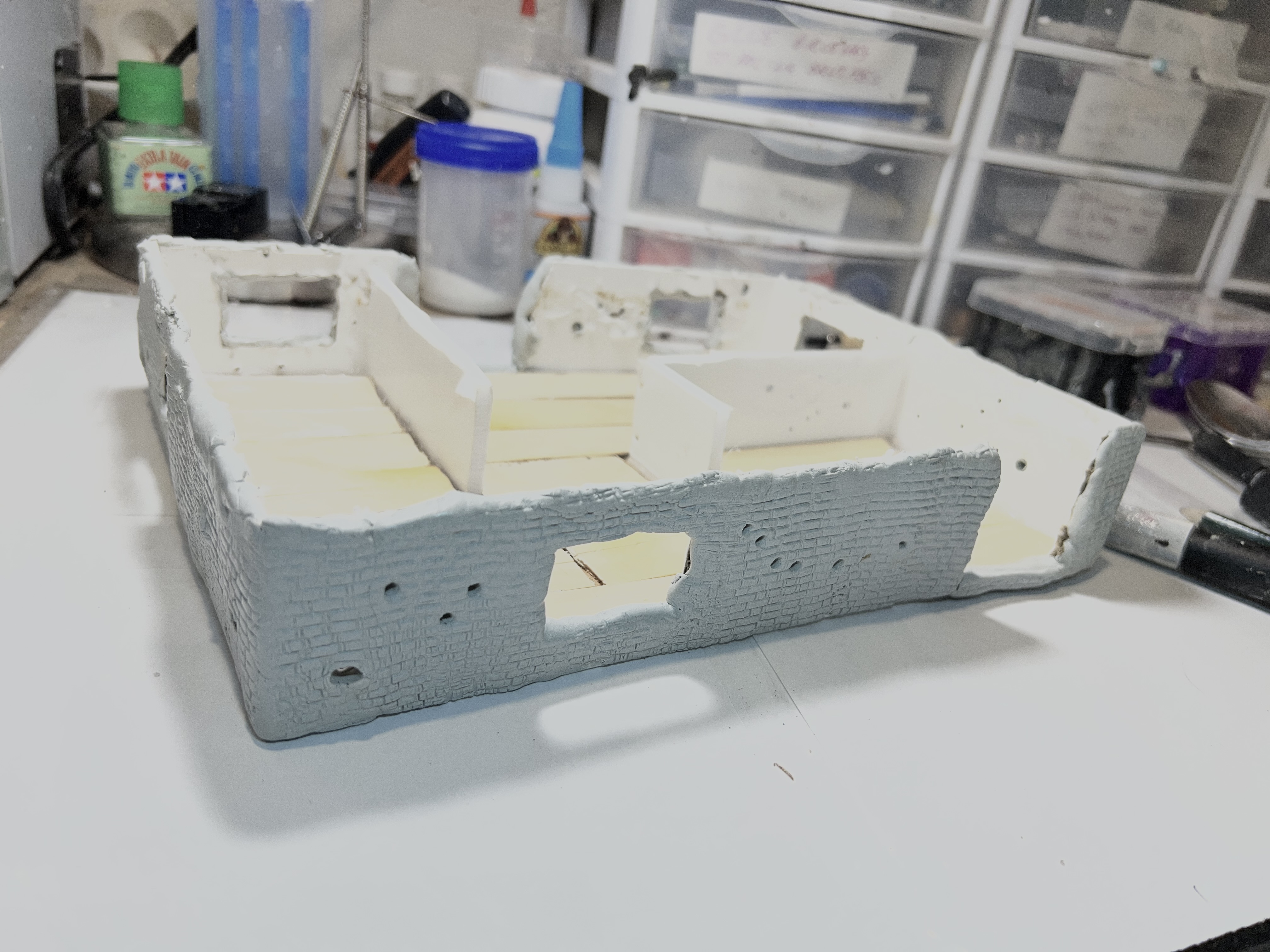
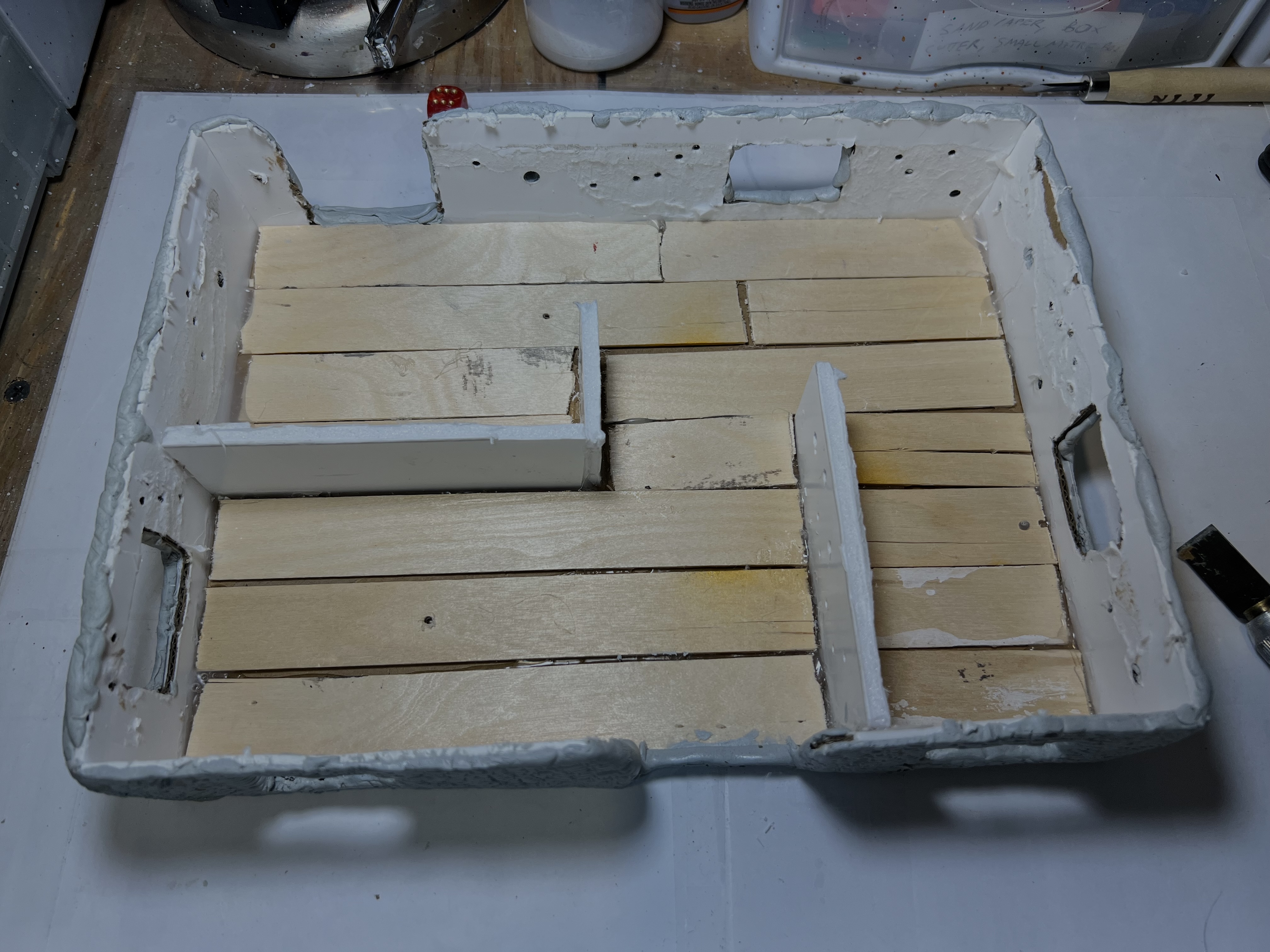
I sawed out windows and doors on both box pieces and made each a bit differently in terms of architectural arrangement. I then hot-glued foam board to make rooms. For flooring, I broke up old popsicle sticks. These I had used previously to mount figures for painting on other projects. Lastly, I drilled out holes in the walls to simulate old bullet holes.
Cutting out the windows and doors on the first building.Adding the walls, bullet holes, and flooring.
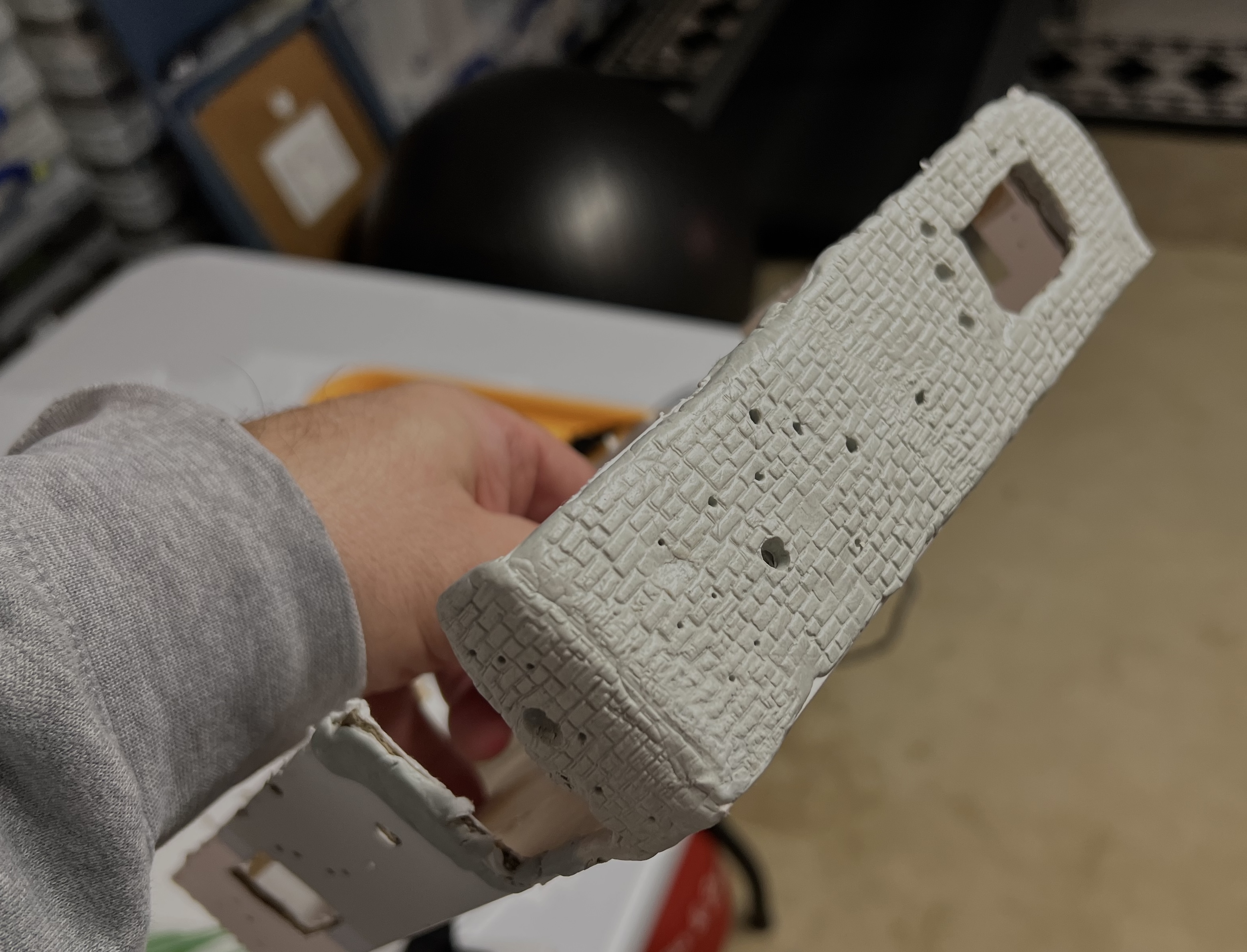
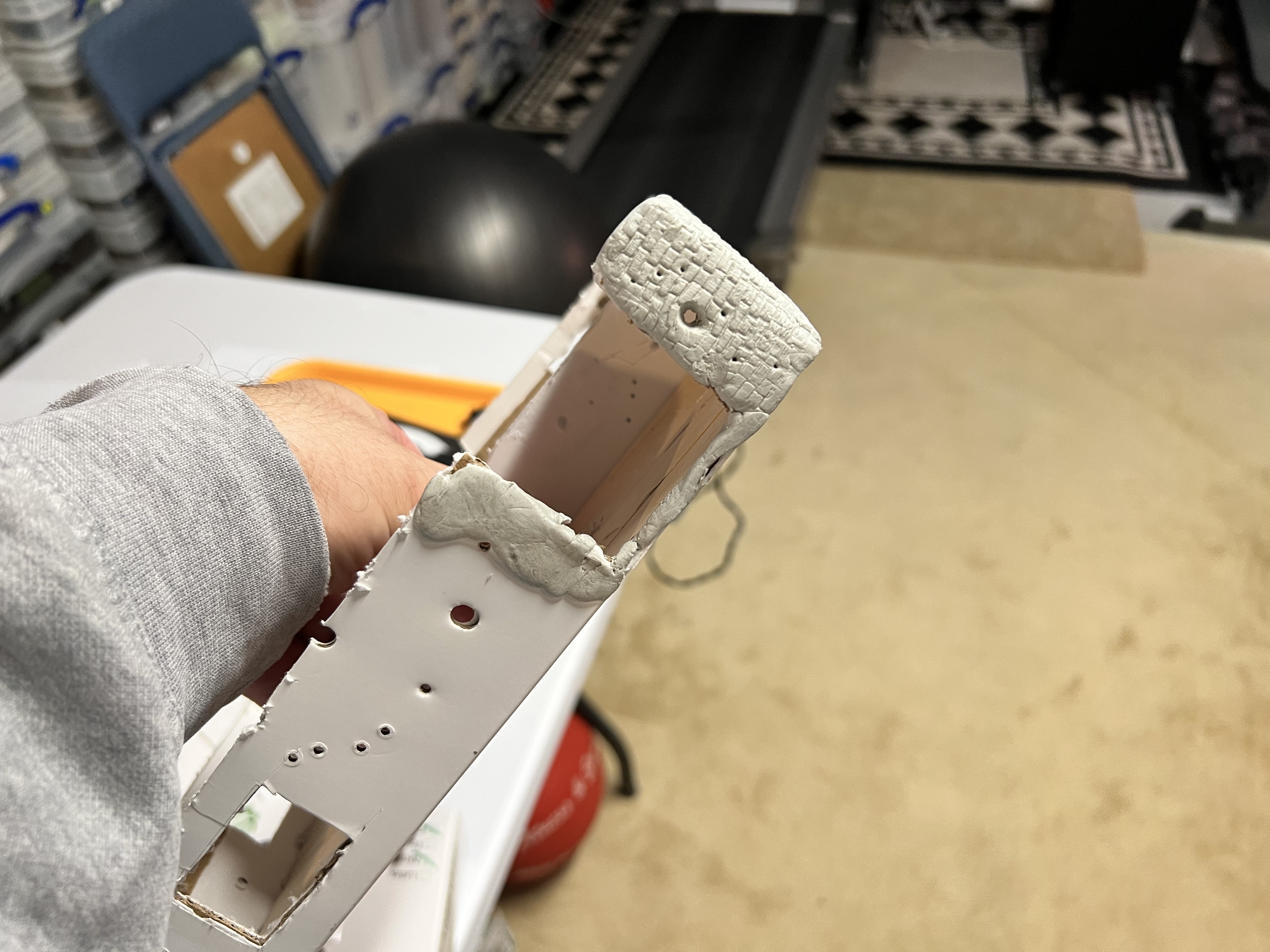
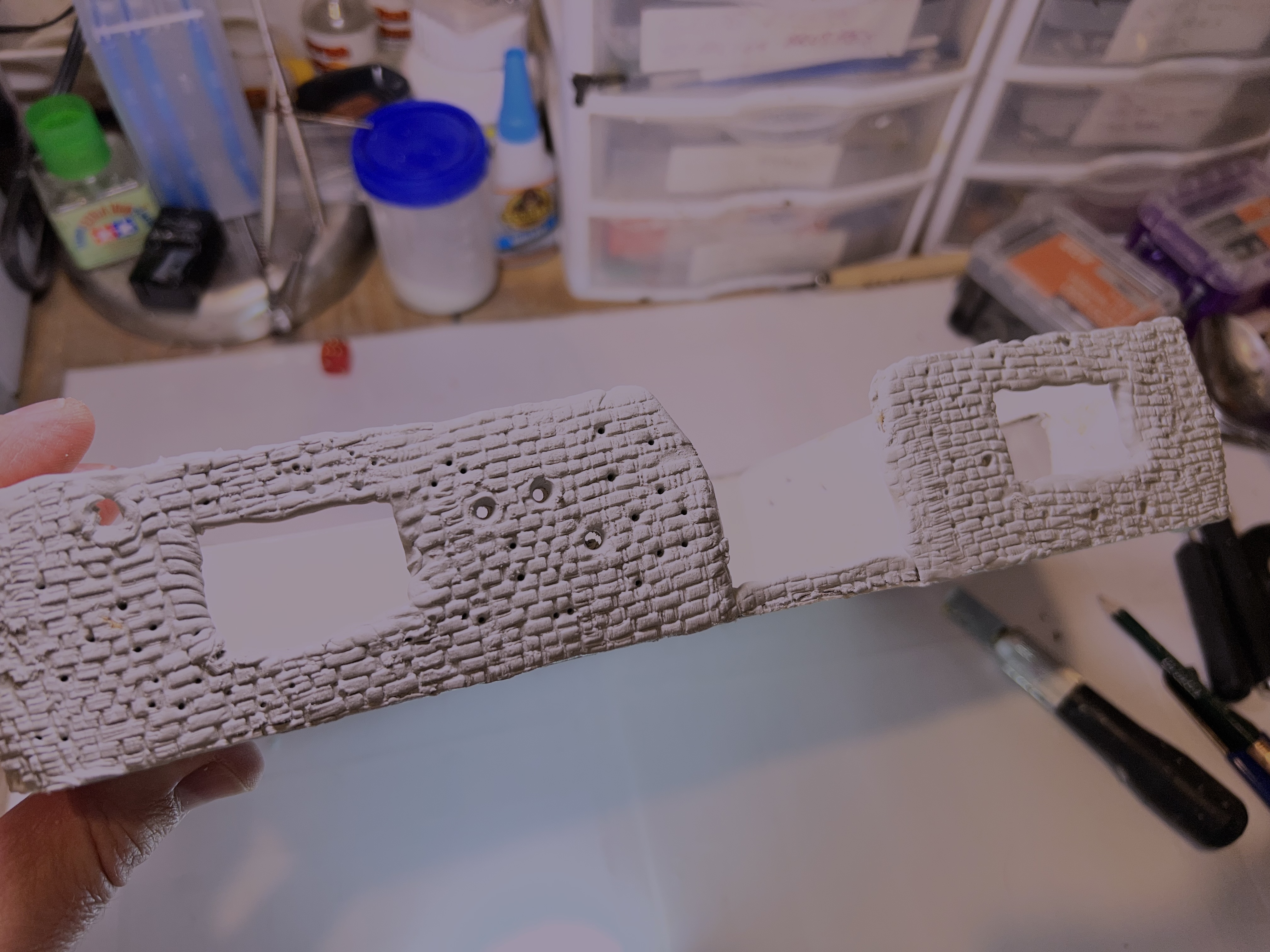
Then it was on to sculpting the outside walls. I did each building separately from here on so as to handle both curing times and to learn as I went as to best practices. Apoxie Sculpt and a Green Stuff World brick roller worked well.
Sculpting the walls. I used an awl to create and shape shell and bullet impacts on the outside.Using the windows as gripping spots made the sculpting easier. I did need to then wait for curing.
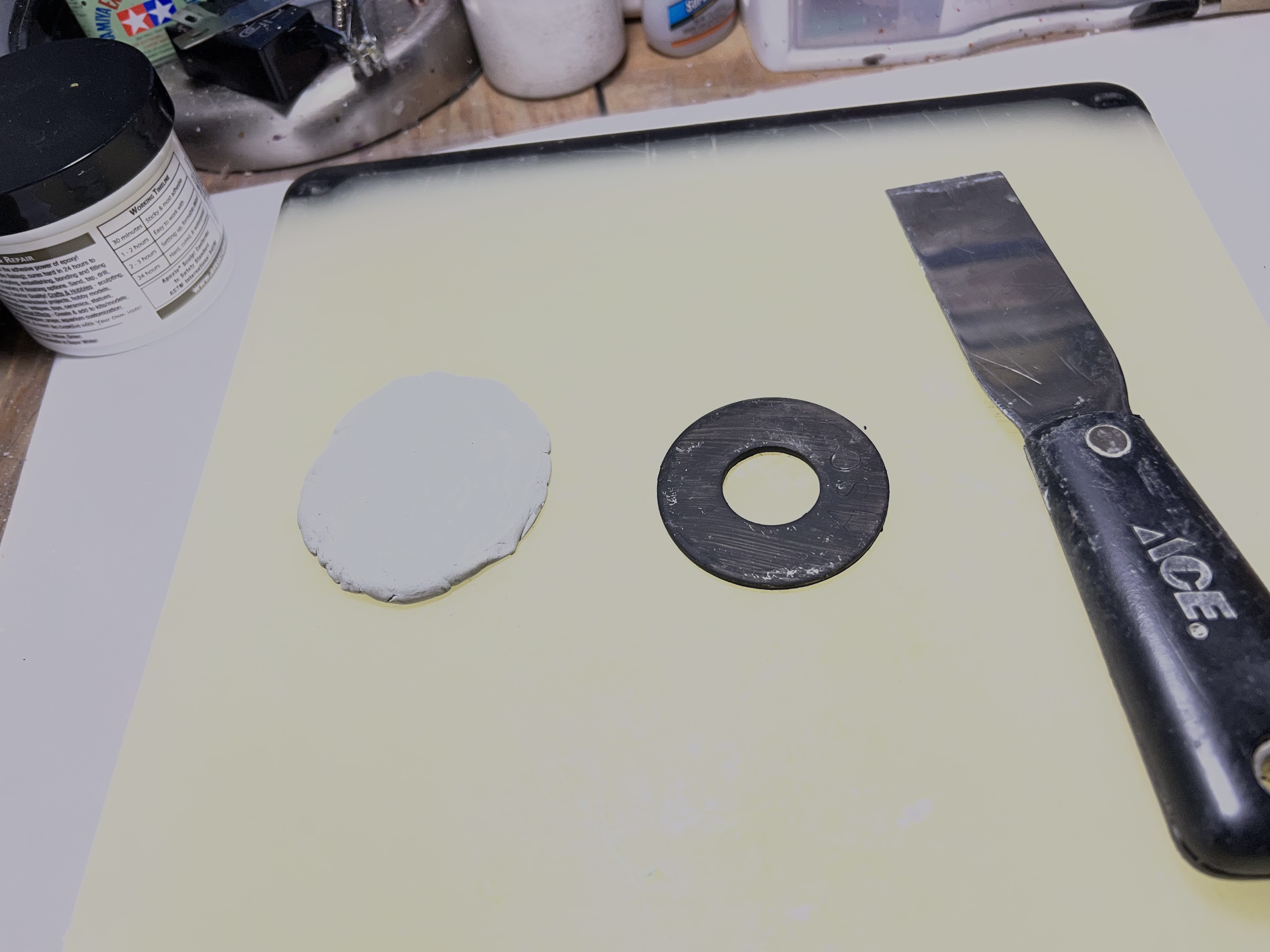
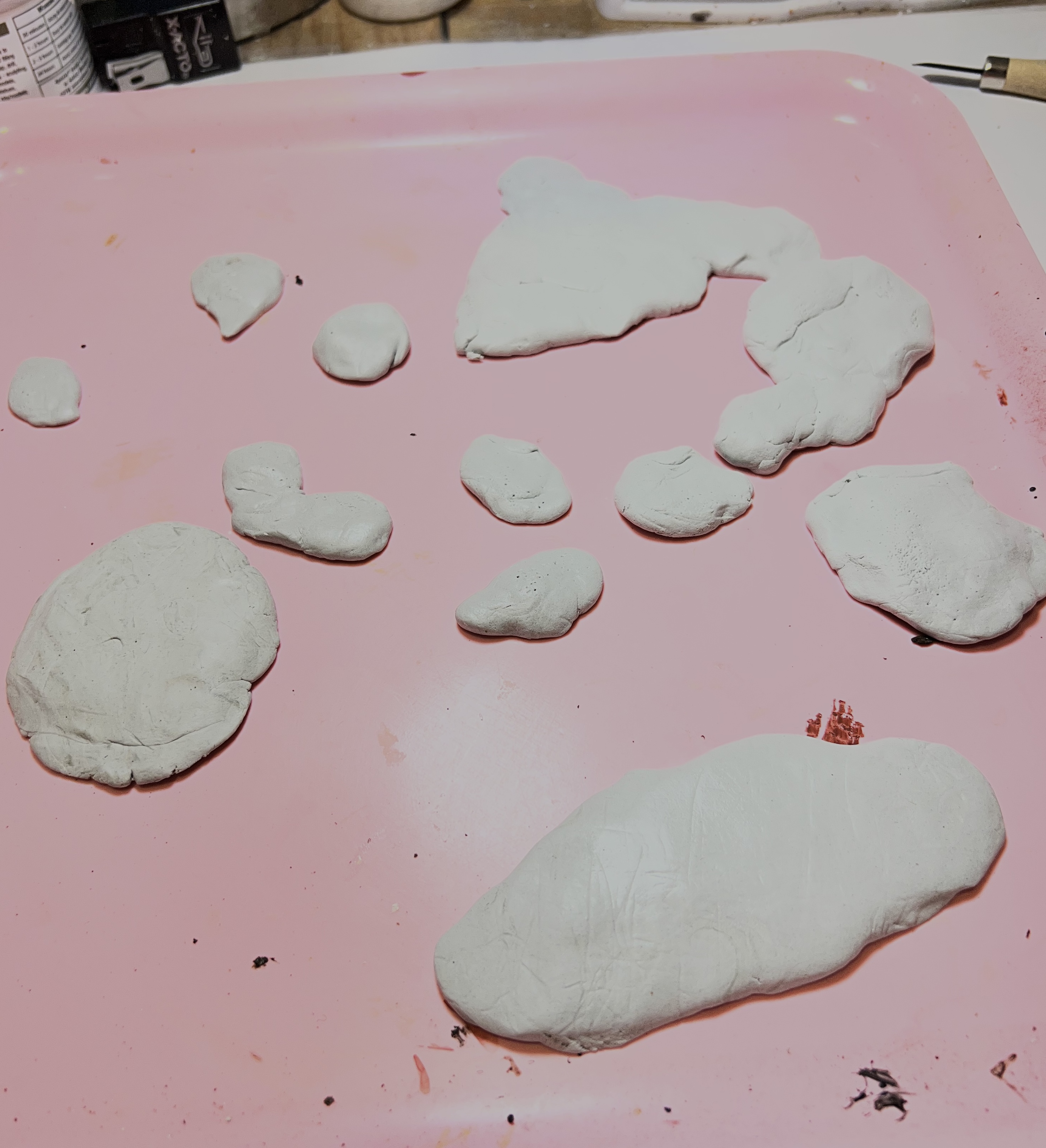
While the walls cured, I worked on the wreckage bases – also using Apoxie Sculpt. I made the bases differently in terms of both size and shape. It helped to use one or more steel washers underneath the base sculpts. Using different sizes helped to make the shapes varied.
The biggest washer that I used and a base covered with Apoxie Sculpt.Examples of the other sizes and shapes – all with steel washers underneath.
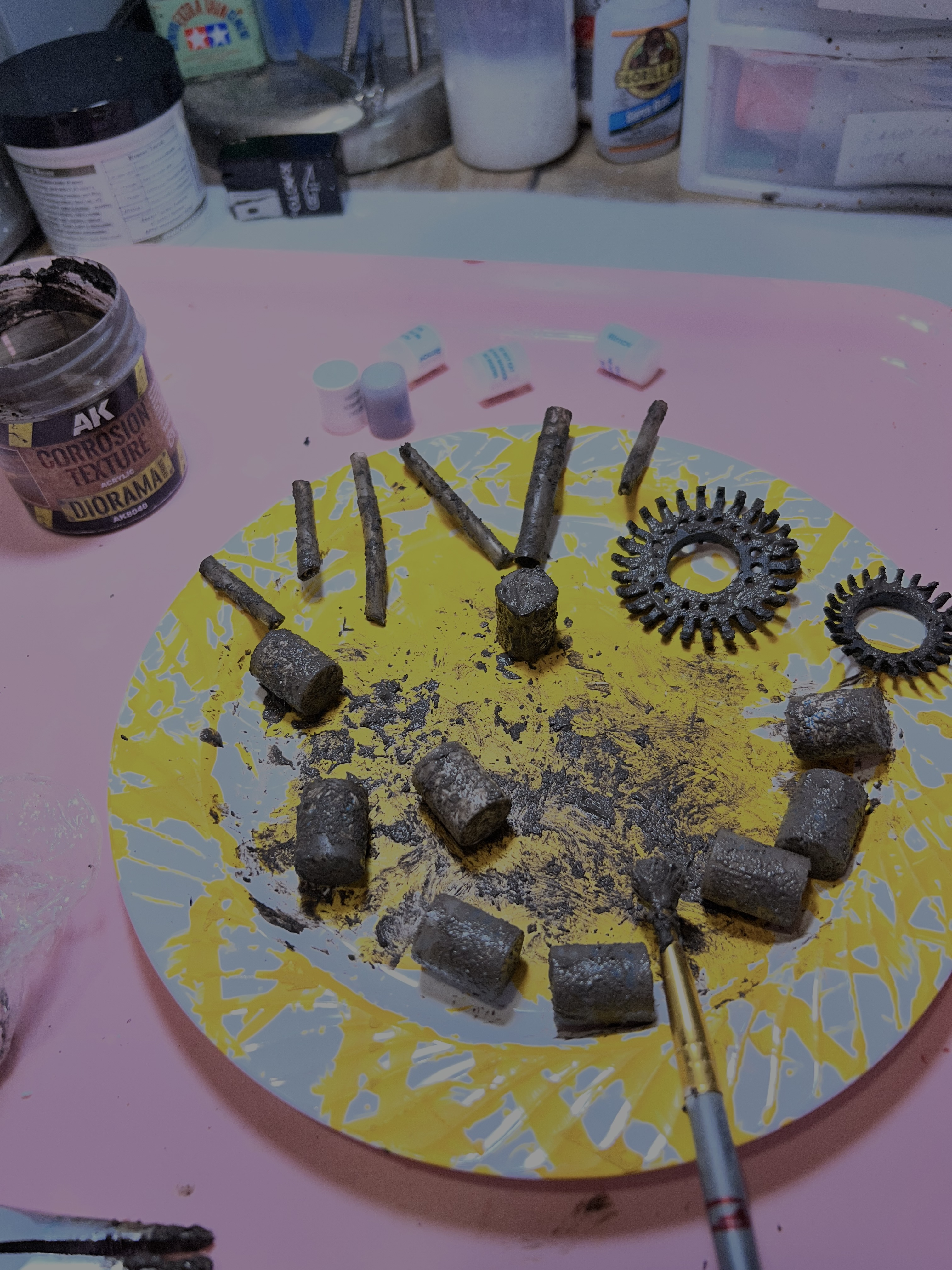
As the corrosion texture paint takes time to dry as well, I started adding that to various pieces of debris that I had saved up. I like to use a cheap old brush that could serve no other purpose – especially as it usually destroys it. The corrosion paint needed to dry and then got a second application.
Using the AK Corrosion Texture paint. Here I am using it on desiccant cylinders (from pill bottles), crushed plastic straw sections, and rubber inserts from a drain plug replacement.
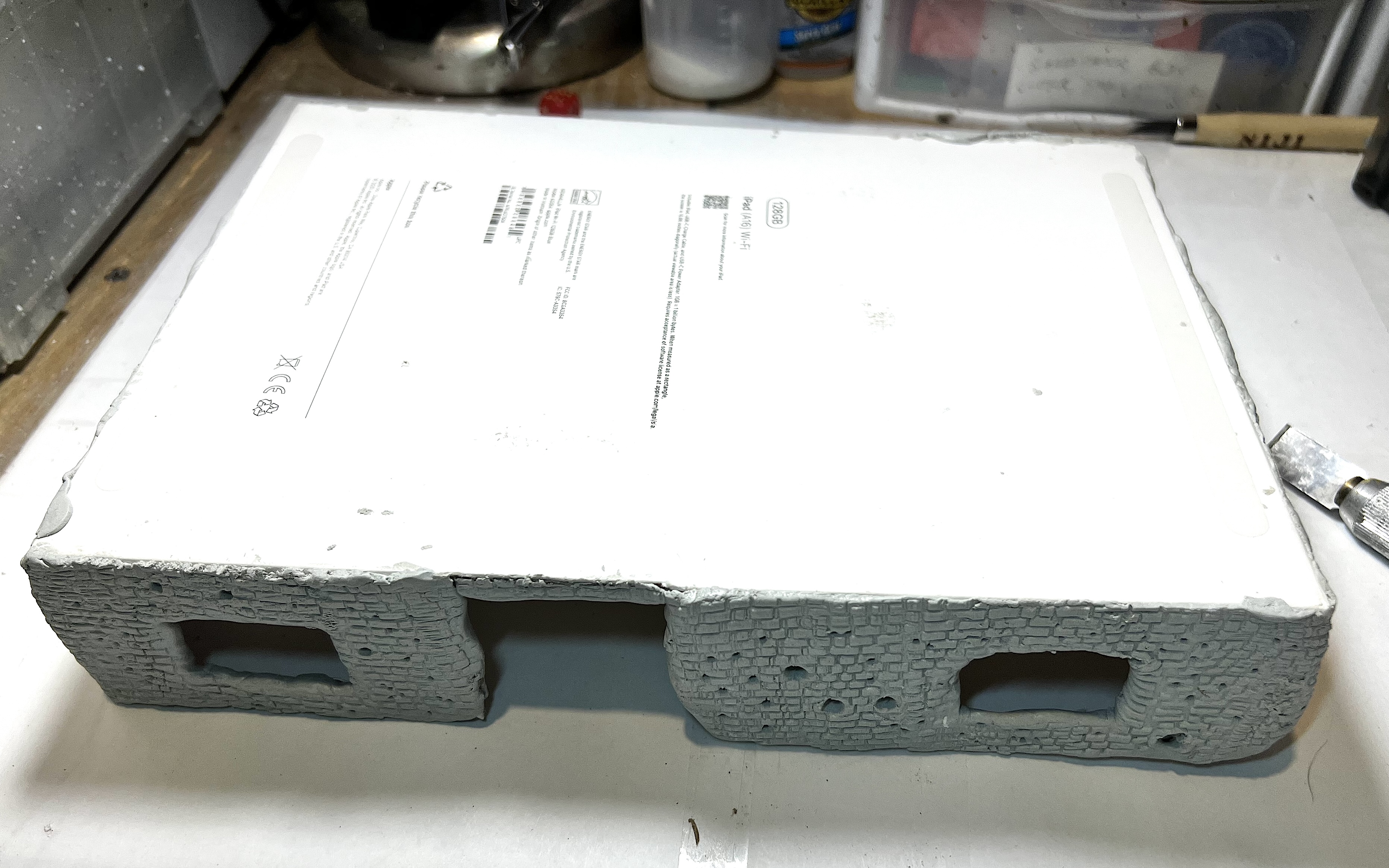
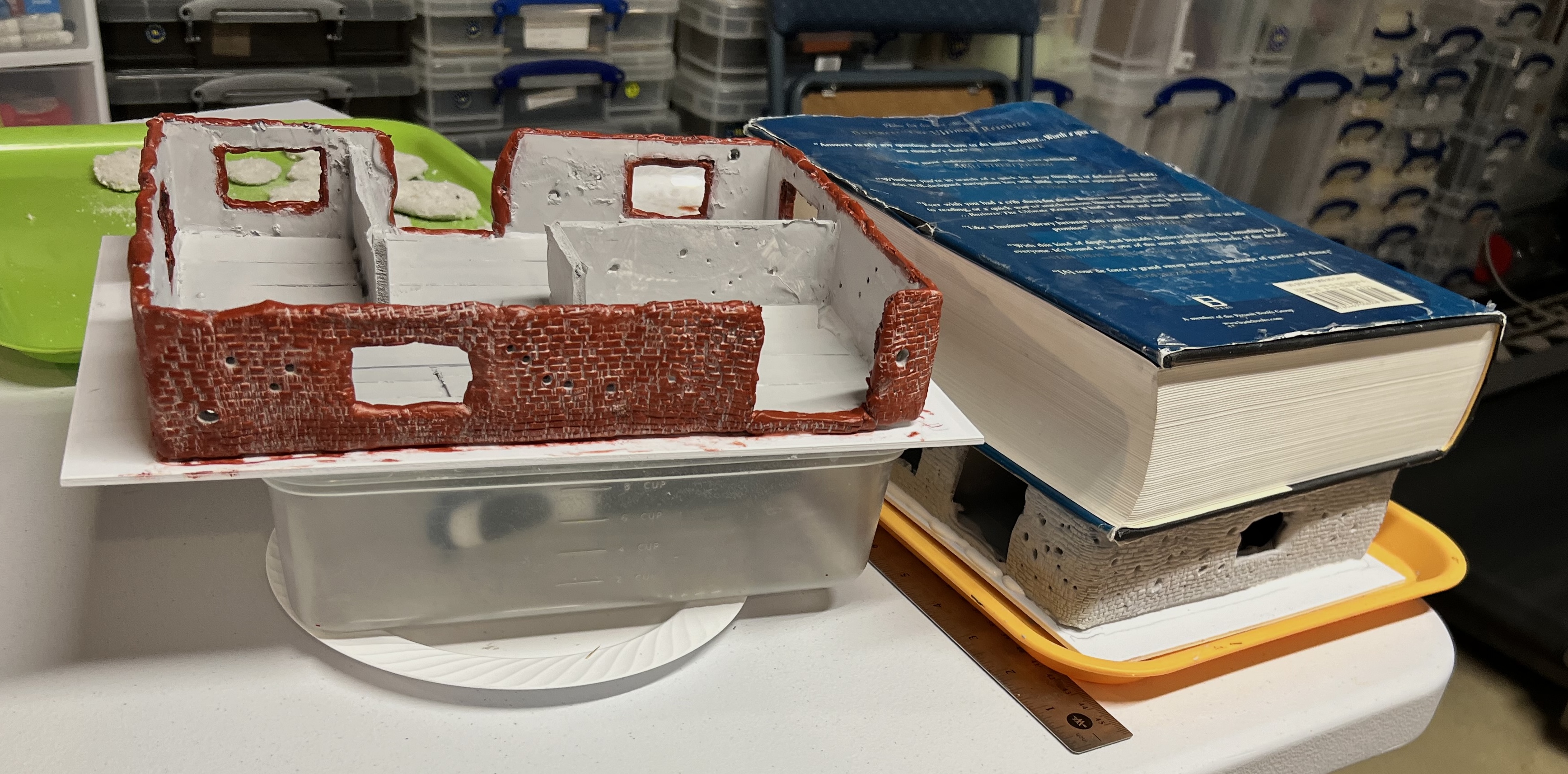
After a day, the Apoxie Sculpt on the first building had cured. But I wanted there to be a small outside rim to it that could hold wreckage and brick debris. While a sheet of polystyrene was gluing to its bottom, I worked on the second building.
First building cured.Bottom view – I needed more here underneath…but before that I finished the second building’s outside.Second building outside sculpting…….and second building flooring installation.
As the first building had cured, I started to paint it. Then I was able to glue a polystyrene base to building number 2.
Building number one with early paint work, and building number two being glued to the PS sheet under a heavy textbook.
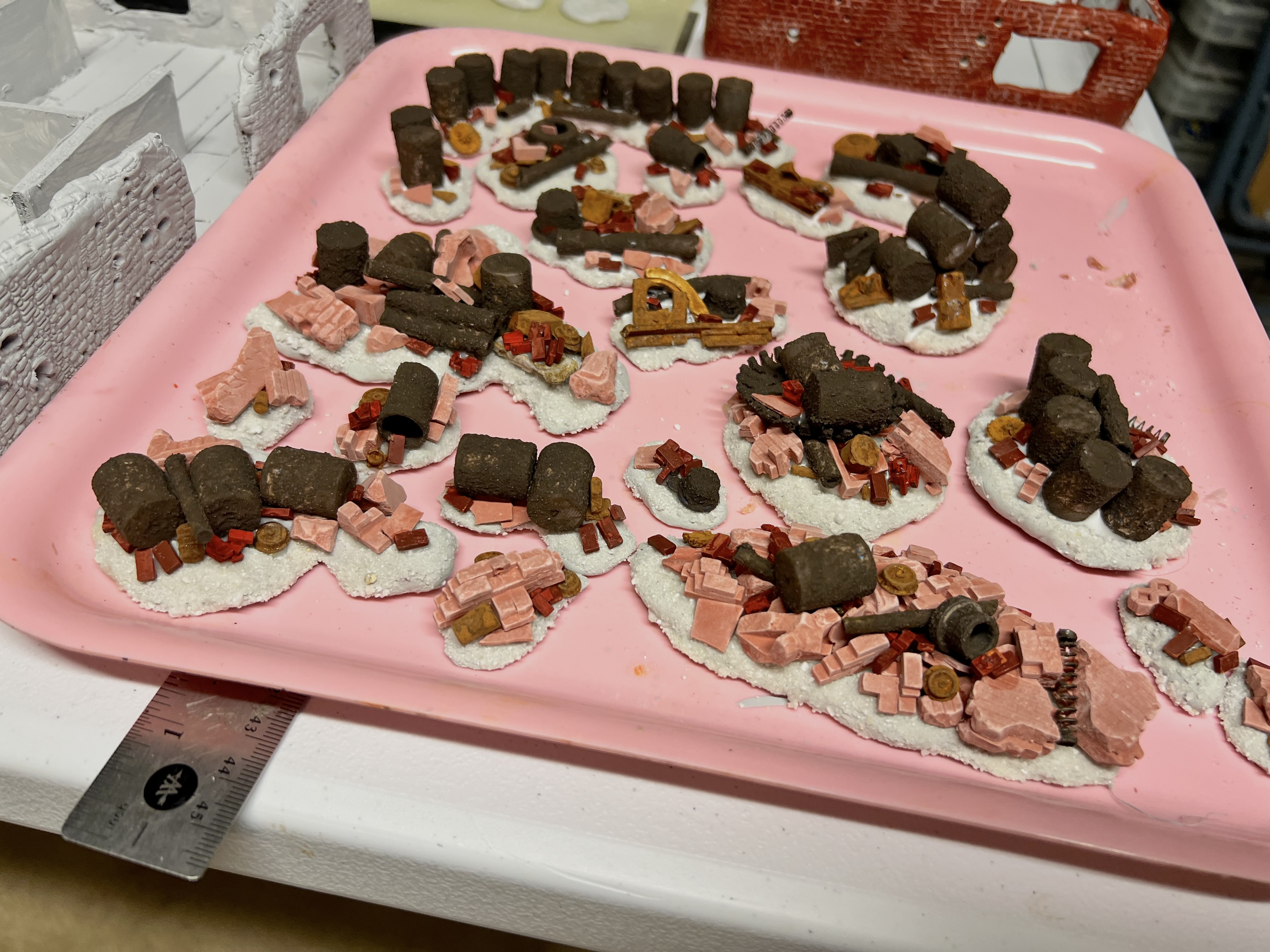
As I was again dealing with drying and curing times, I went back to work on the wreckage bases. I used up some white sand on the Apoxie Sculpt bases and applied with PVA. Once that had dried, I added as much wreckage as I could to each.
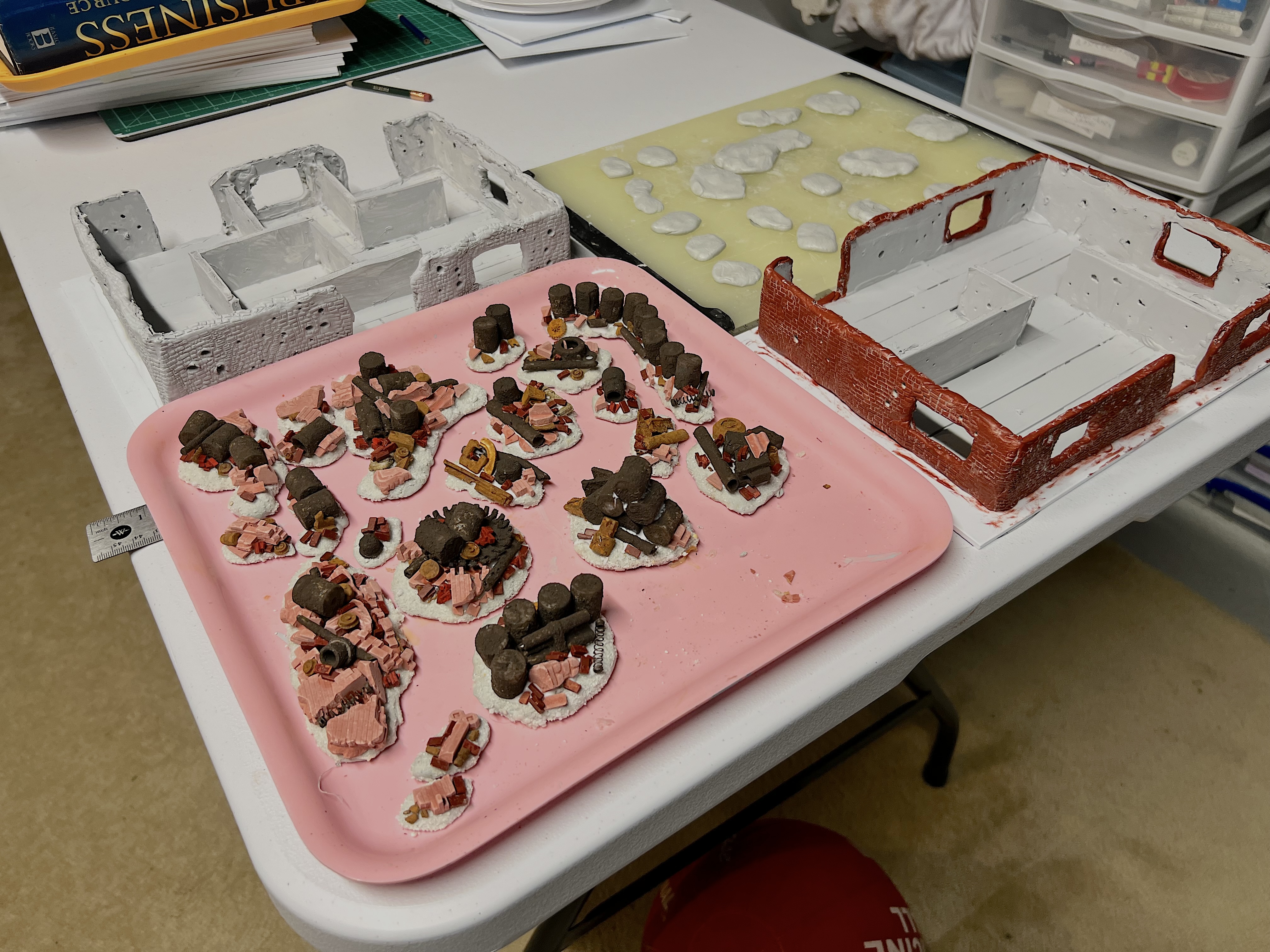
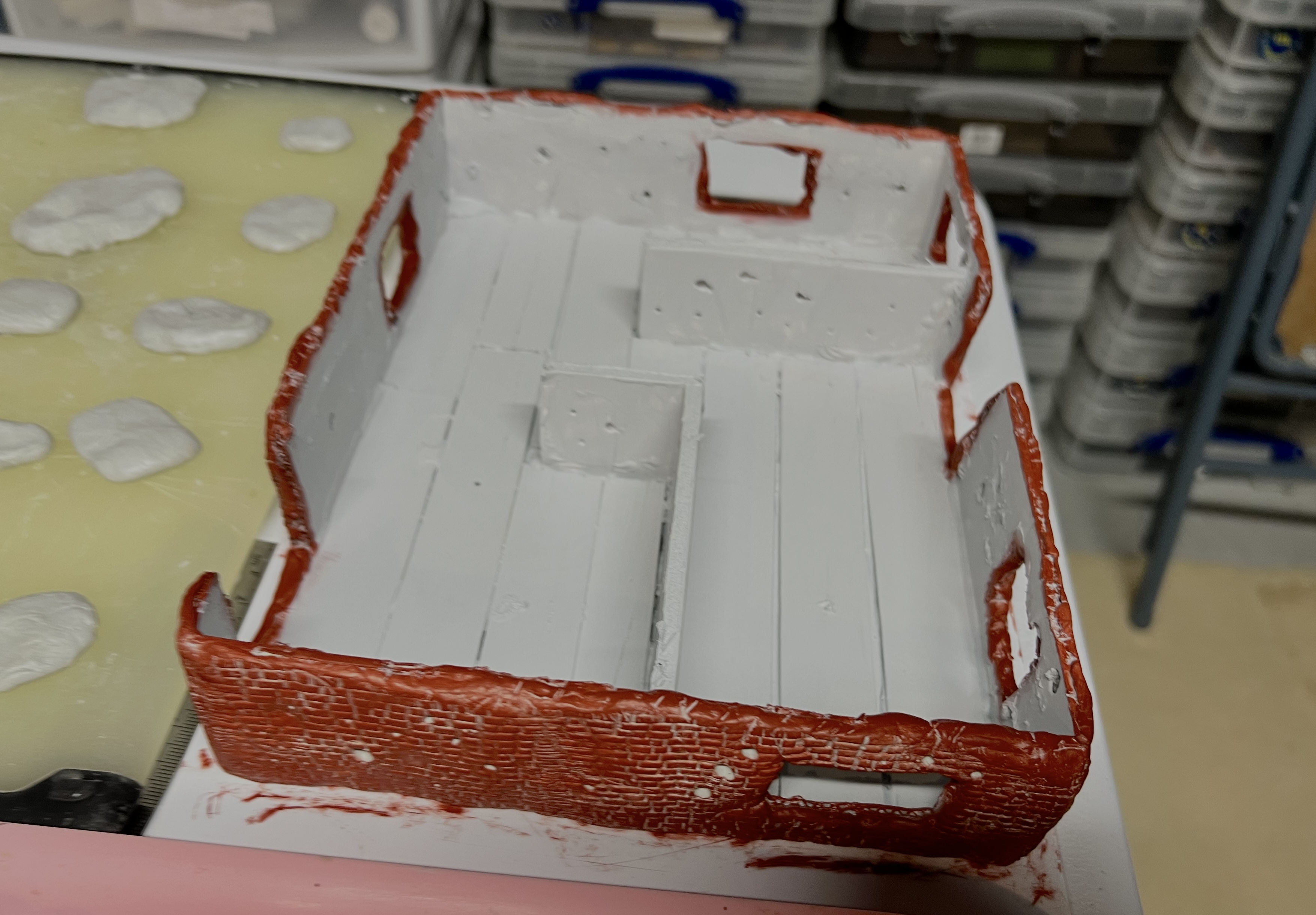
Wreckage bases – I started with the largest. The two buildings are shown in progress as are the next batch of sculpted bases curing.Close up shot of the larger wreckage bases in progress. Glue must dry…Close up of building one with insides primed.
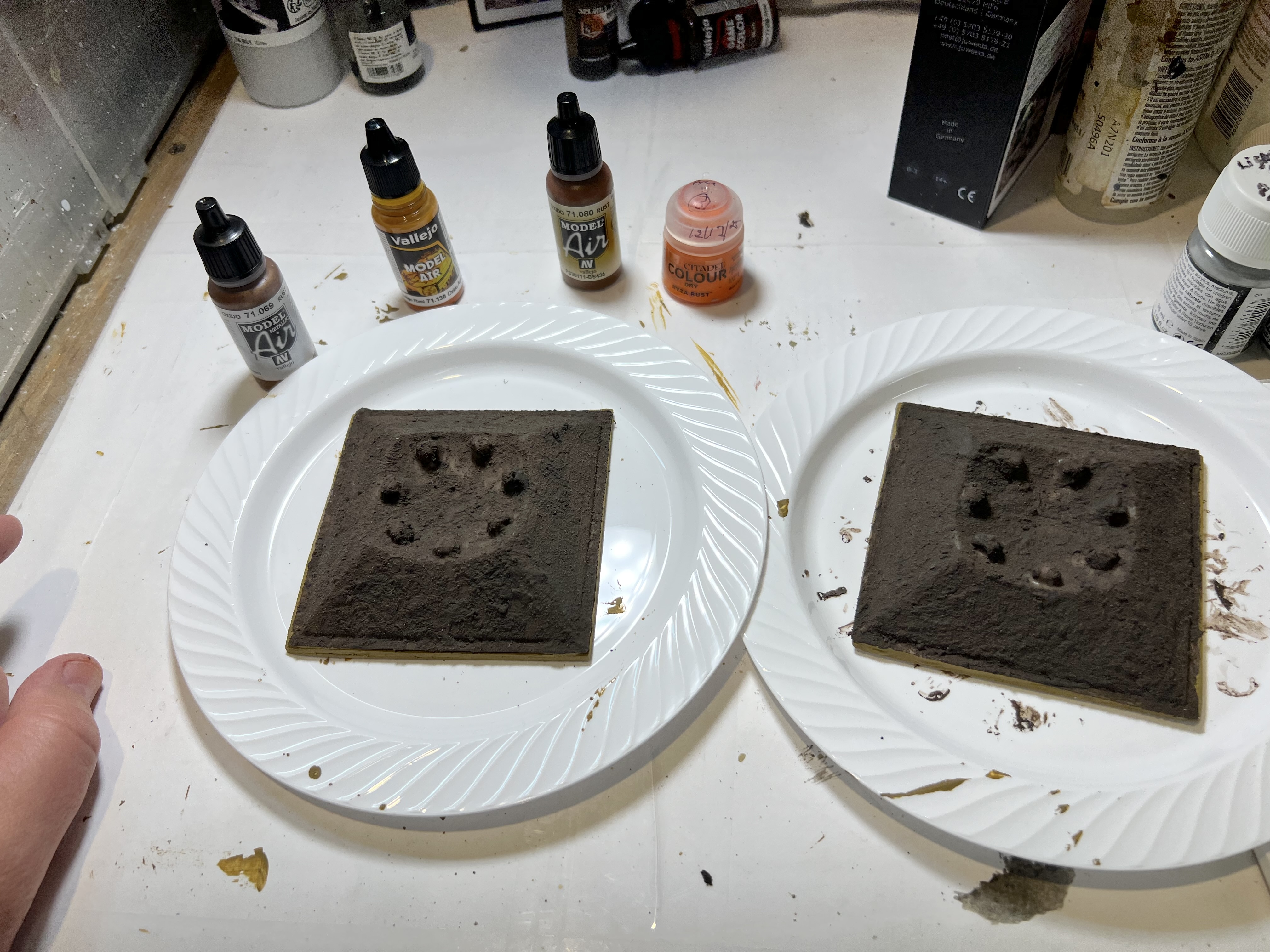
At this point, I added the flat clear plastic packing material to two square pieces of polystyrene by clamping and gluing them in preparation for corrosion texture. Then it was back to the wreckage bases. I had run out of white sand, so the next batch of wreckage bases got a PVA/grey sand application. As I used a lot pigments later, this made zero difference. At the same time, I also dirtied up the interior building walls and flooring using a sponge and various dark washes. The rim outside the buildings got a sandy texture paint covering.
The dark sand drying on the next wreckage bases, the flat structures with first application of corrosion texture, other bases in progress, and the buildings in the back.A second coat of corrosion paint has been applied to the flat structures here. I also sorted the wreckage bases by size before adding pigments.The flat structures and some other rusty paints I would add before augmenting with pigments.
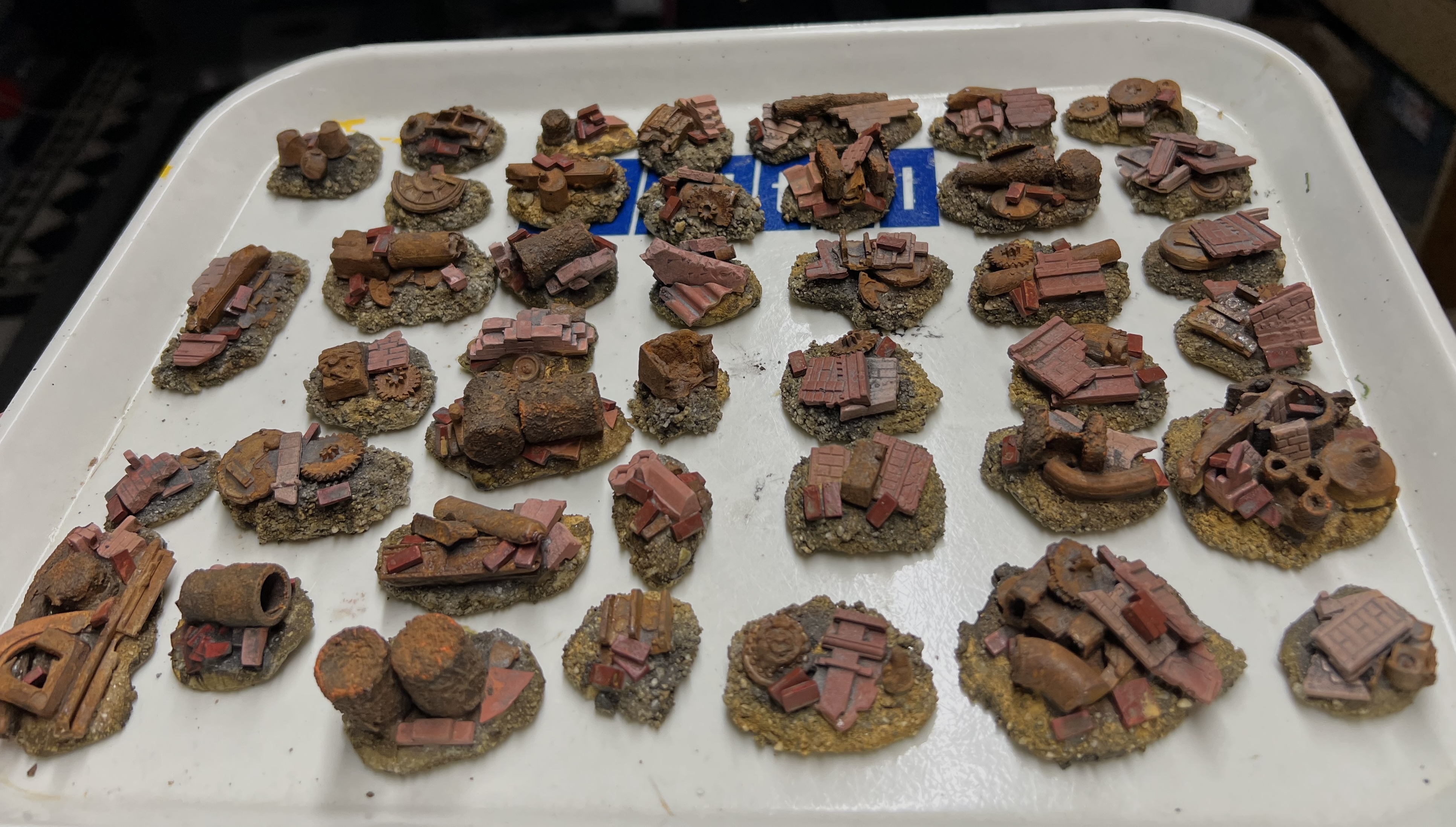
Below you can see the wreckage bases after I added pigments to them. I fixed the pigments with Vallejo Thinner applied with a spray from a lens cleaning bottle.
Next, I added rusty industrial wreckage and scattered bricks to the buildings’ interiors.
After adding industrial wreckage and bricks to building 1……and building 2.
Clearly, pigments were needed at this point to make the bricks and wreckage look older and dirtier. More pigments and dark washes to the rescue!
The buildings after adding the pigments and washes to dirty and rust up everything.Top view of both buildings as completed.
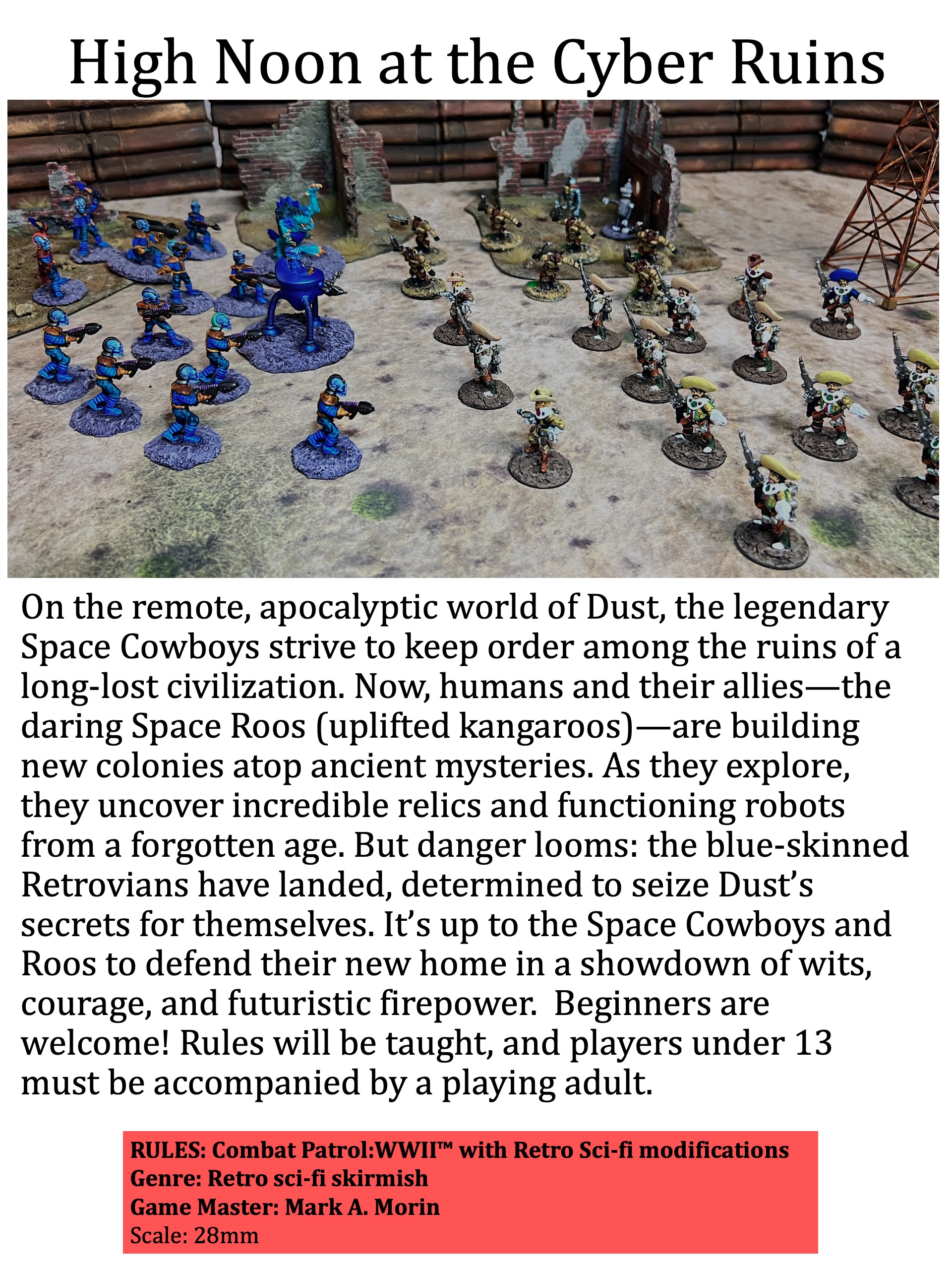
I was now ready to mock up the tabletop with everything! But first, the flyer for the game – which I finished before this project:
Game flyer.
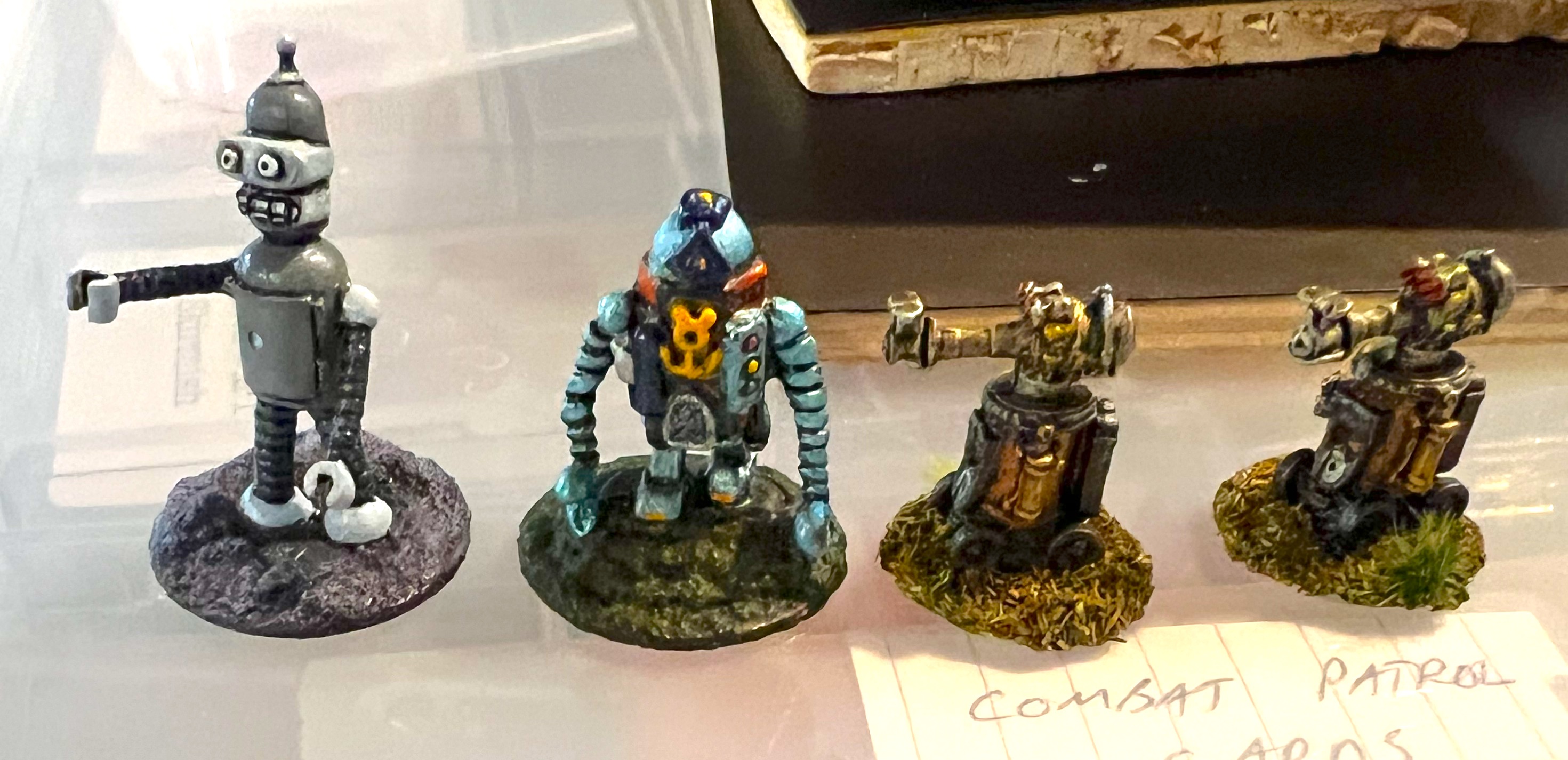
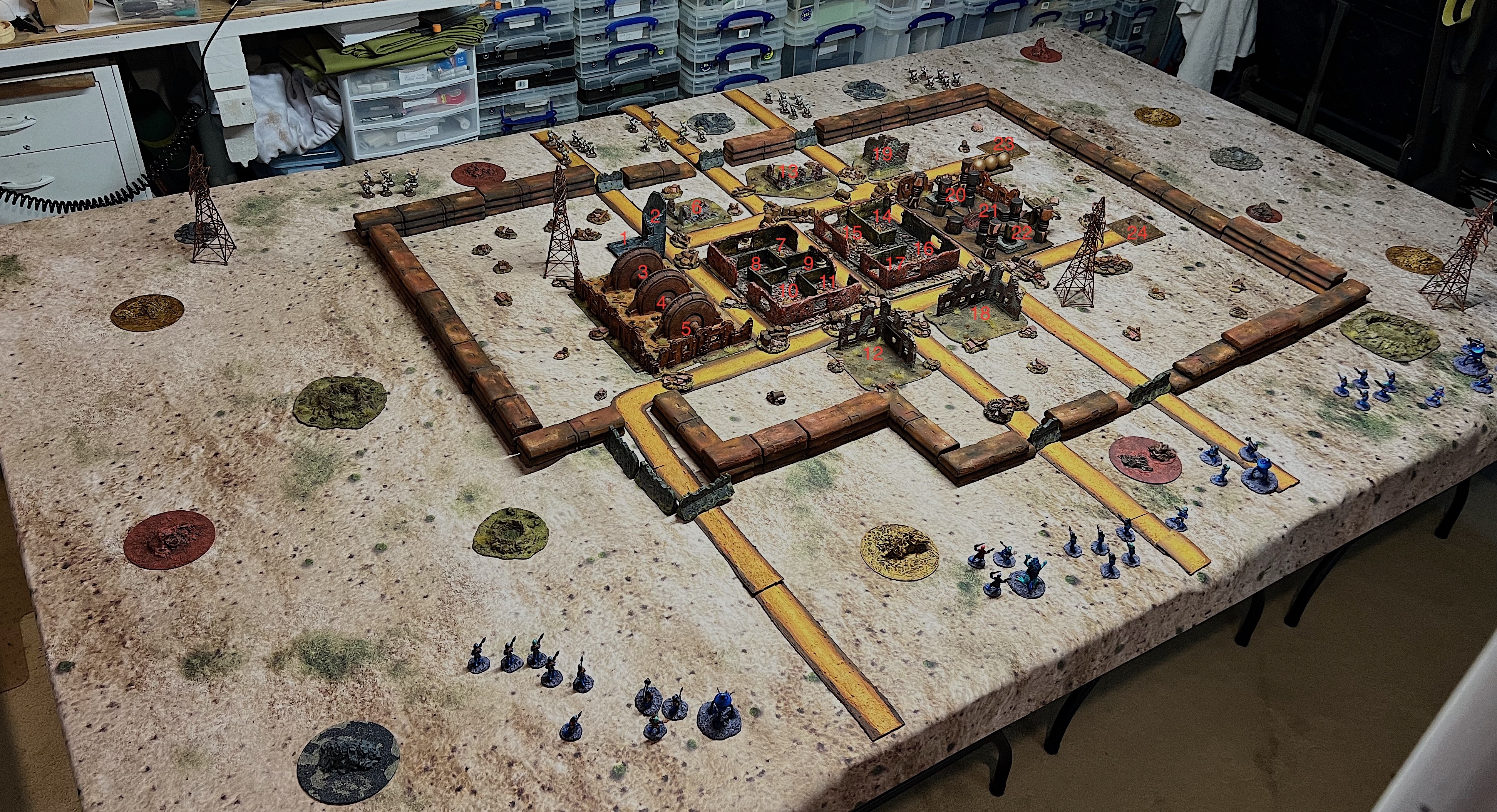
The wreckage (all 61 pieces and the buildings really helped complete my vision. There are 24 possible search locations for the 4 ancient robots, known only to the GM. The four ancient robots I used were: “Folder Bot 3000” (aka Bender) from Armorcast Terraform Terrain Ltd.’s “Robot Townies” collection; and “RT22” from old Archive miniatures Star Rovers line circa 1977; and two Archive Miniatures Robot Cooks also circa 1977 (also Star Rovers).
The four ancient robots! Folder Bot 3000, RT22, and the two Robot Cooks.
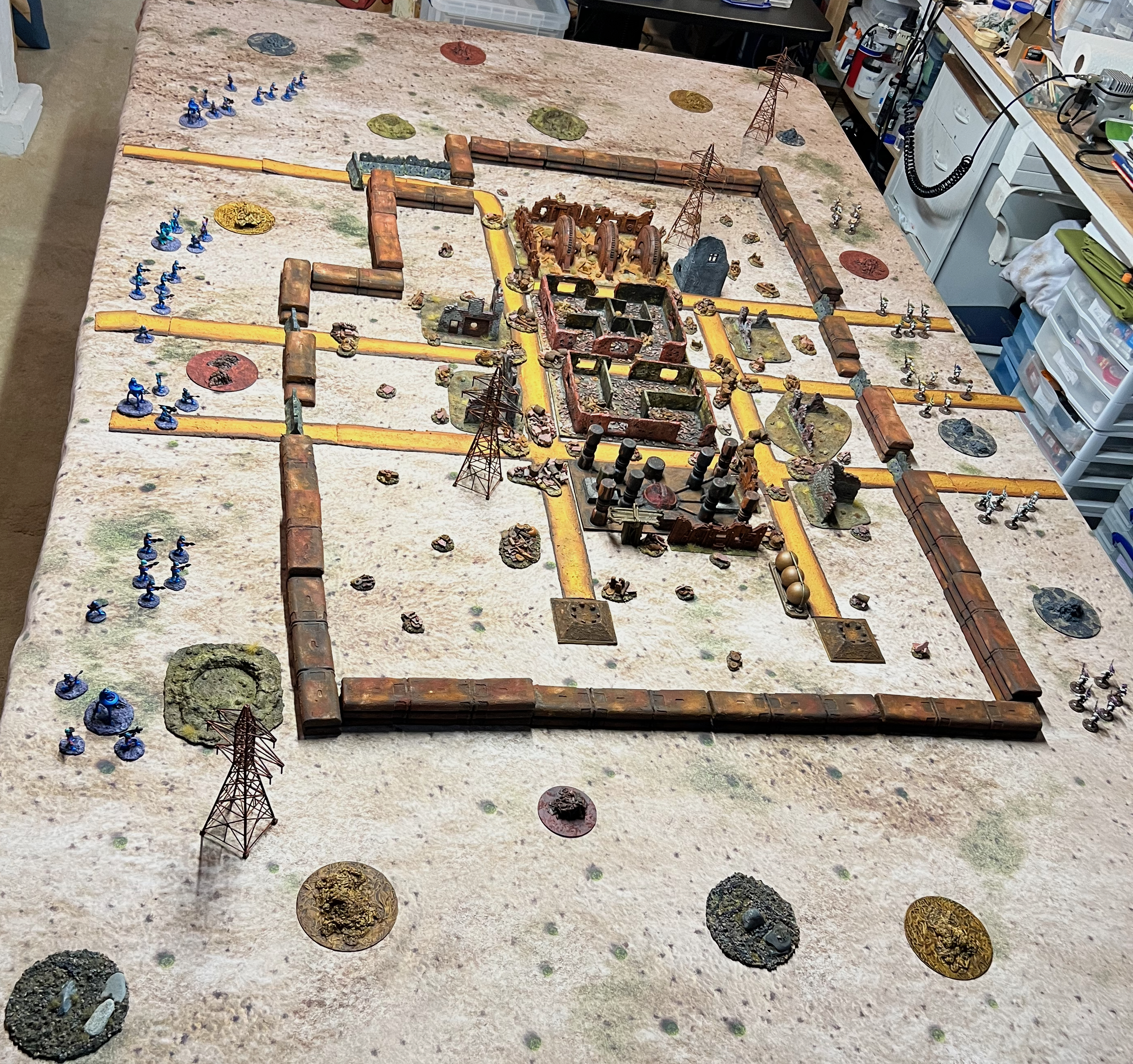
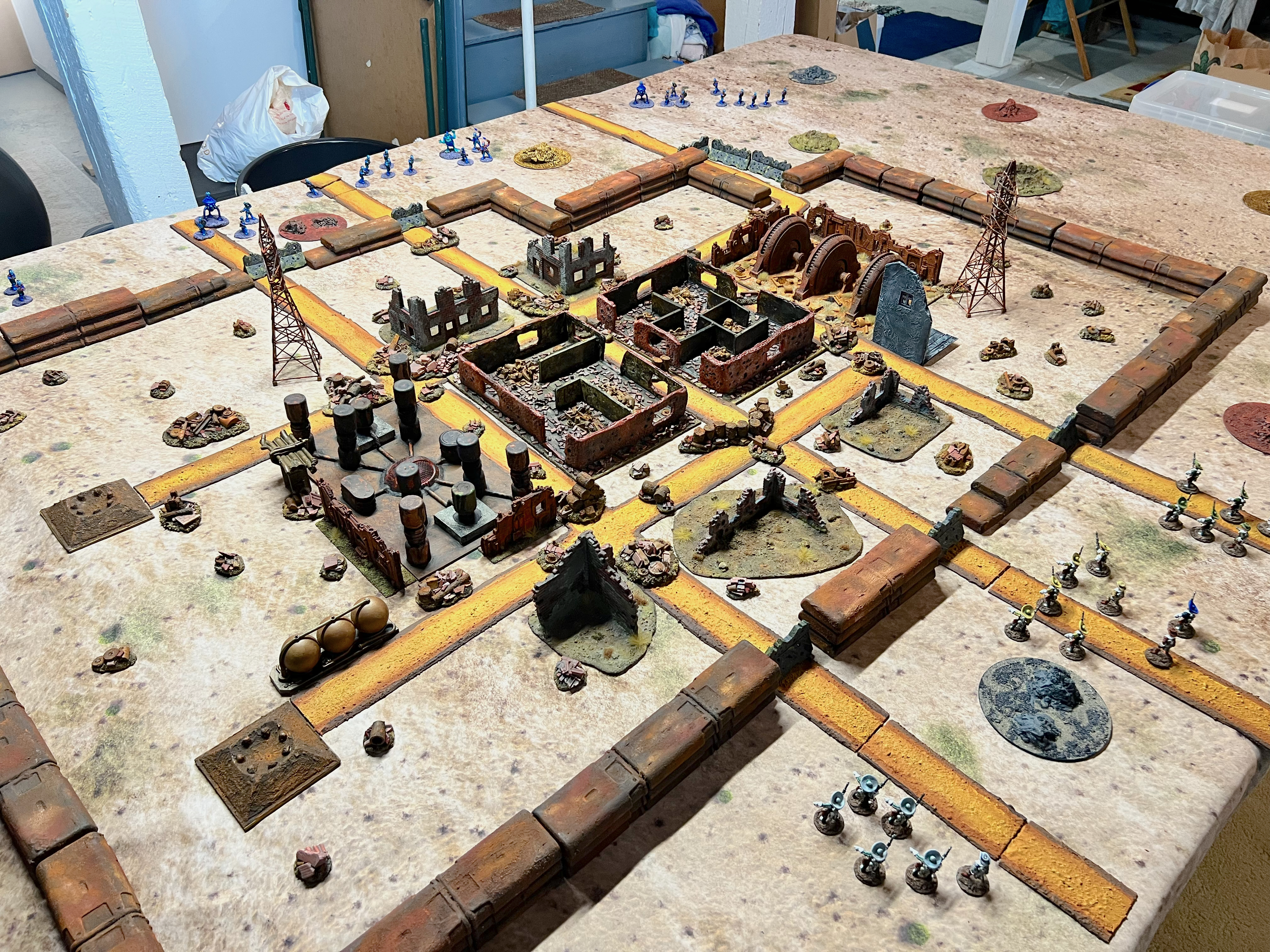
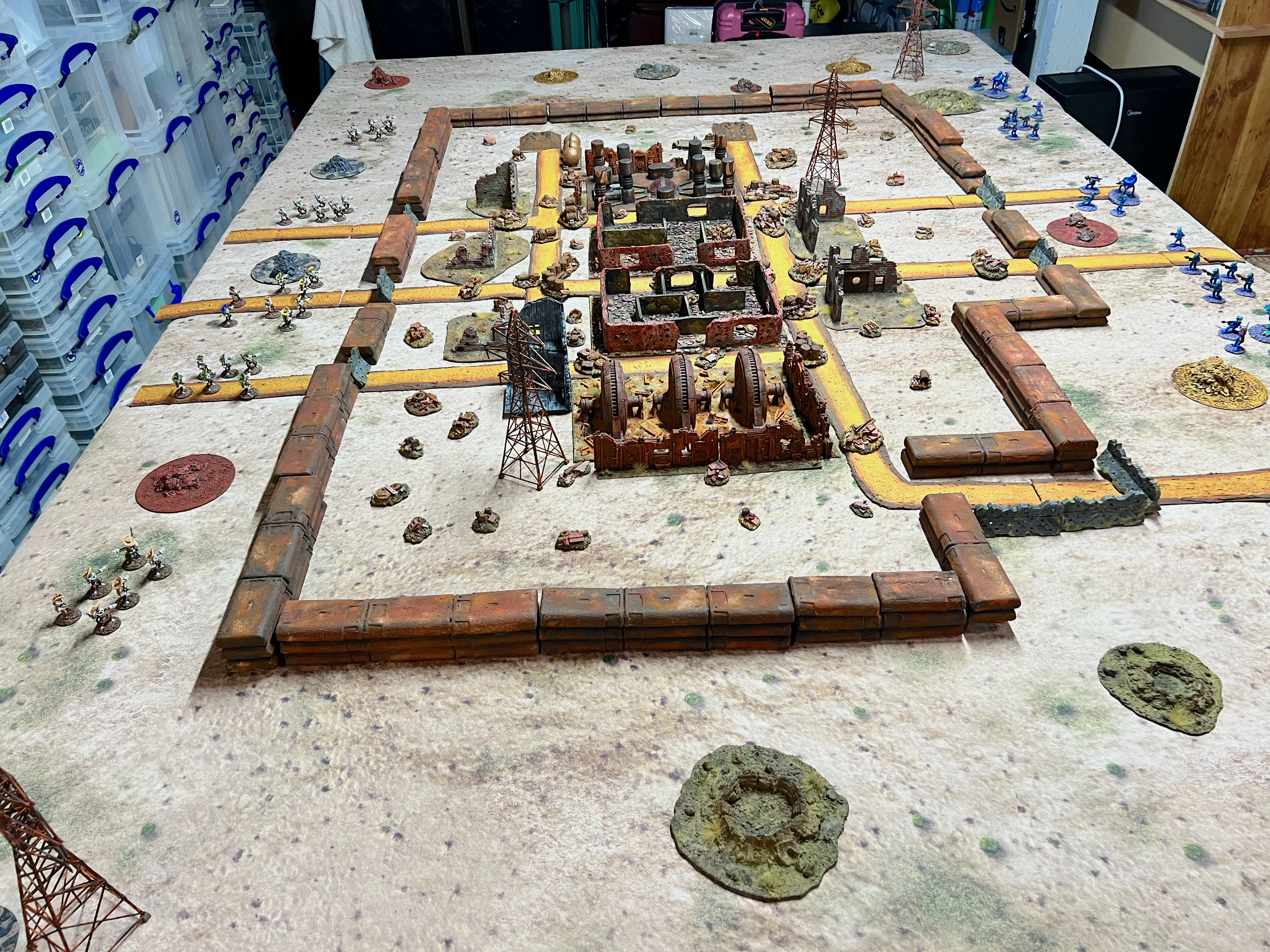
I randomly select the locations for the four robots (see numbers on the map below). My playtest worked well, and here are some shots of the mock-up tabletop.
The mock up of the tabletop for the game. The Retrovians three squads and command group are in the forefront. The Space Cowboys are at the opposite side.A side view.View from the Space Cowboy’s side.Generator side view.
I did not use all of the wreckage in the mock-up. I will share a Cold Wars post soon. However, as a preview here are a couple of shots of the game set up at Cold Wars in all its glory:
Photo of the game in progress at Cold Wars with me as the GM. (photo courtesy of Ken Howe).Space Cowboys and Retrovians start searching for the robots.The shoot out starts – while one robot has been found in the upper right. This was Bender, and he was not happy to be found and attacked and killed a Space Cowboy.
More about Cold Wars soon in a future post.
I hope you enjoyed reading this and seeing my rusty panorama come to life – on the tabletop anyways. If this WIP post helps you in any way, that is great! I am including these terrain pieces in Dave Stone’s PAINT WHAT YOU GOT 2025/2026 Challenge as these were completed in early February. For now, that’s it, until next time!
329 miles to Lancaster, PA and Cold Wars!
The materials are listed below as a reference for me (and you maybe).
For all of my previous posts on terrain projects, please see this page. For all of my previous posts on sci-fi projects, please see this page…for any of my previous posts on scratch-building, see this page.
PAINTS, INKS, GLAZES, SHADES, WASHES, PIGMENTS, FLOCKING, GLUES AND MORE THAT I USED ON THE TWO RUINED BUILDINGS:
iPad 16 Box (top and bottom)
Hot glue
Foam Board
Toothpicks
Popsicle sticks
Apoxie sculpt
Vallejo Surface Primer “Grey”
SIBE AUTOMATION “White Polystyrene 8″ X 12″ X 1/8″ Plastic Sheet”
PVA
Huge Miniatures “Brick Red”
MSP “Brown Liner”
Vallejo Game Color “Sepia” (wash/shade)
Vallejo Wash FX “Dark Grey” (wash/shade)
Liquitex “Burnt Umber” (ink)
Secret Weapon Washes “Sewer Water”
Vallejo Thinner
Vallejo Surface Primer “German Green Brown”
Vallejo “Light Slate Grey” (pigment)
AK “Dry Ground” (texture)
Vallejo “Carbon Black” (pigment)
Juweela Metal Scrap Rusty Industry (23336)
Juweela Debris Assortment (23316)
Juweela Debris Brick Red (23315)
Juweela Debris Assortment (23315)
Juweela Bricks (23034)
Juweela Metal Scrap Rusty Gear Wheels (23317)
Army Painter “Red Tone” (wash)
Secret Weapon Washes “Red Black” (wash)
Secret Weapon Washes “Ruby” (wash)
P3 “Red Ink” (ink)
Vallejo Game Air “Red Terracotta”
PAINTS, INKS, GLAZES, SHADES, WASHES, PIGMENTS, FLOCKING, GLUES AND MORE THAT I USED ON THE 61 WRECKAGE BASES/PILES:
Play sand
Apoxie sculpt
PVA
Various scrap plastic pieces
Cylindrical desiccant holders
Rubber sink stopper rim
Juweela Metal Scrap Rusty Industry (23336)
Juweela Debris Assortment (23316)
Juweela Debris Brick Red (23315)
Juweela Debris Assortment (23315)
Juweela Bricks (23034)
Juweela Metal Scrap Rusty Gear Wheels (23317)
AK “Corrosion Texture” (texture)
Vallejo Model Air “Rust” (71.080)
Vallejo Model Air “Rust” (71.080)
Vallejo Model Air “Rust” (71.069)
Vallejo Model Air “Orange Rust”
Citadel “Ryza Rust” (dry)
Vallejo “Old Rust” (pigment)
Vallejo “Pigment Binder”
Vallejo Thinner
Vallejo “Dark Slate Grey” (pigment)
Vallejo “Dark Yellow Ochre” (pigment)
Vallejo Game Color “Sepia” (wash/shade)
Secret Weapon Washes “Sewer Water”
Army Painter “Red Tone” (wash)
Secret Weapon Washes “Red Black” (wash)
Secret Weapon Washes “Ruby” (wash)
P3 “Red Ink” (ink)
Vallejo Game Air “Red Terracotta”
PAINTS, INKS, GLAZES, SHADES, WASHES, PIGMENTS, FLOCKING, GLUES AND MORE THAT I USED ON THE 2 FLAT INDUSTRIAL STRUCTURES:
SIBE AUTOMATION “White Polystyrene 8″ X 12″ X 1/8″ Plastic Sheet”
Convention season has arrived! So, I needed to finish off a few regiments in anticipation of several games between now and June. This time, I needed to augment my forces of Professor Nitpik and his Mechanical Men. Click the link to learn his back story.
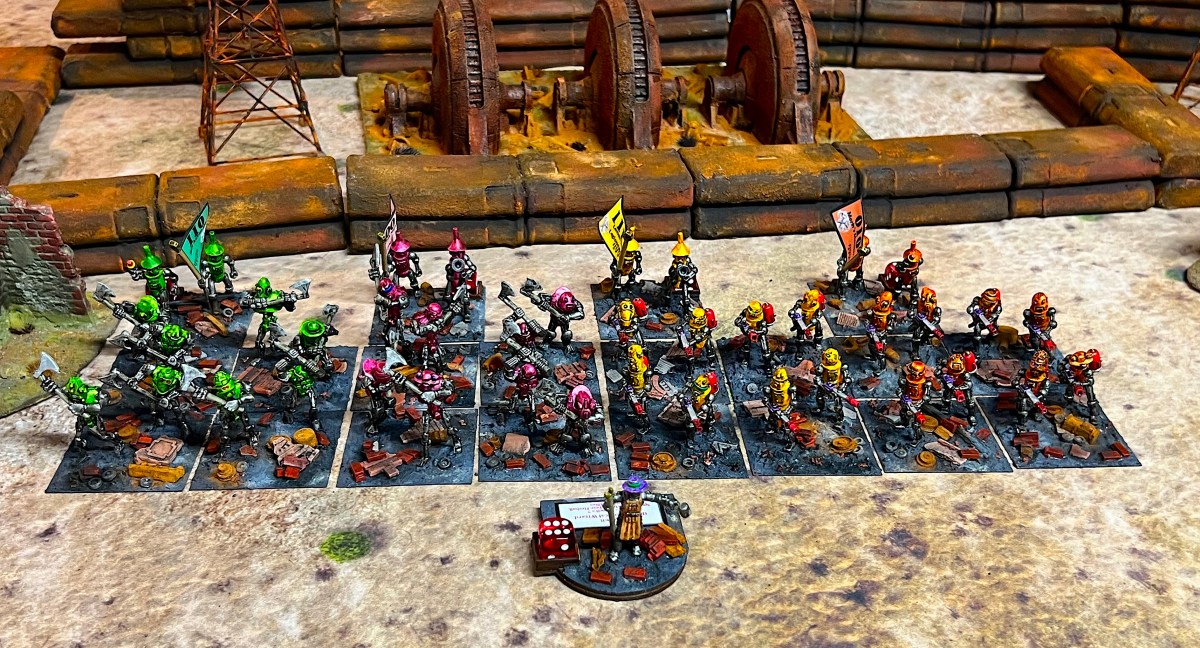
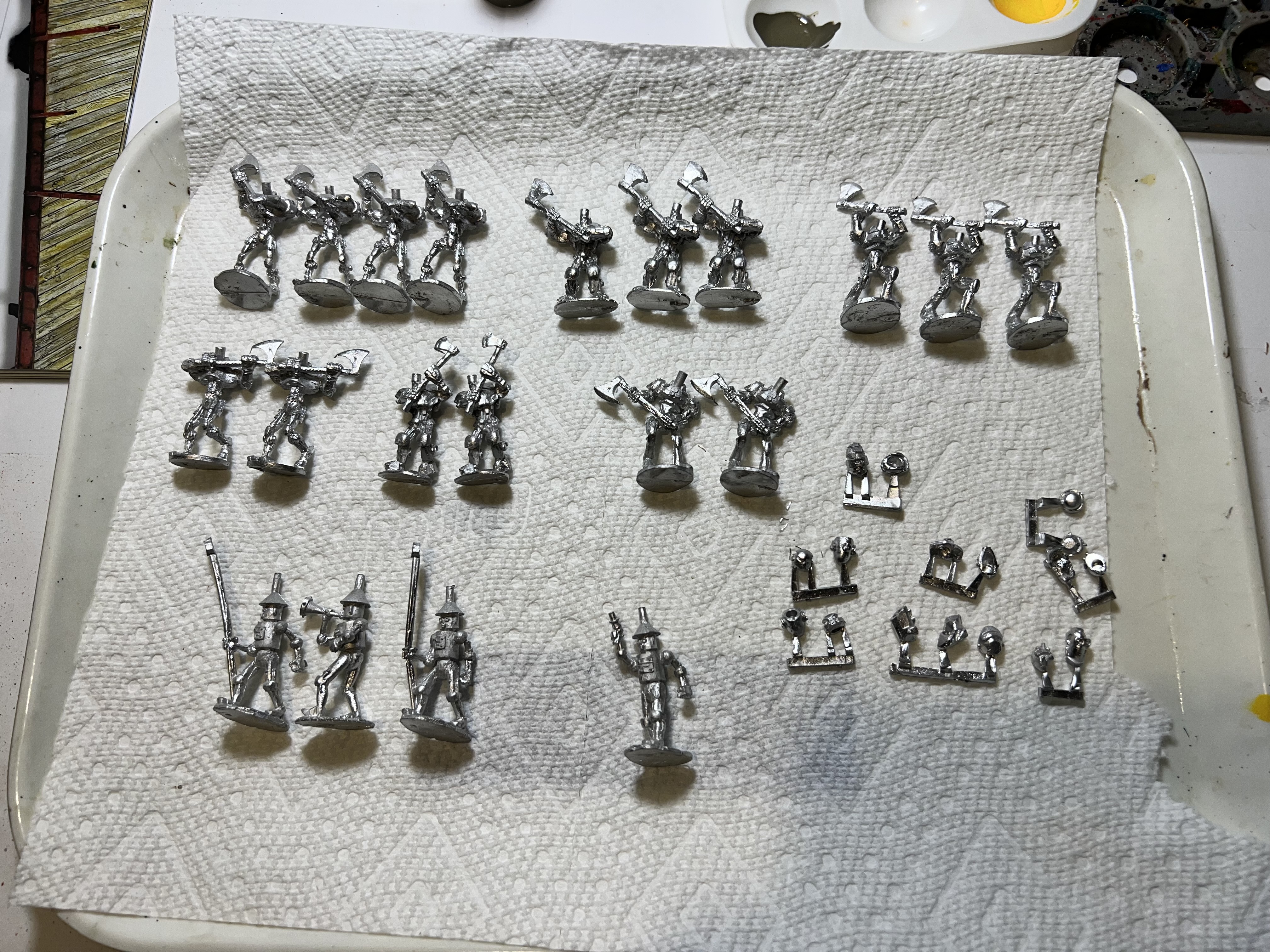
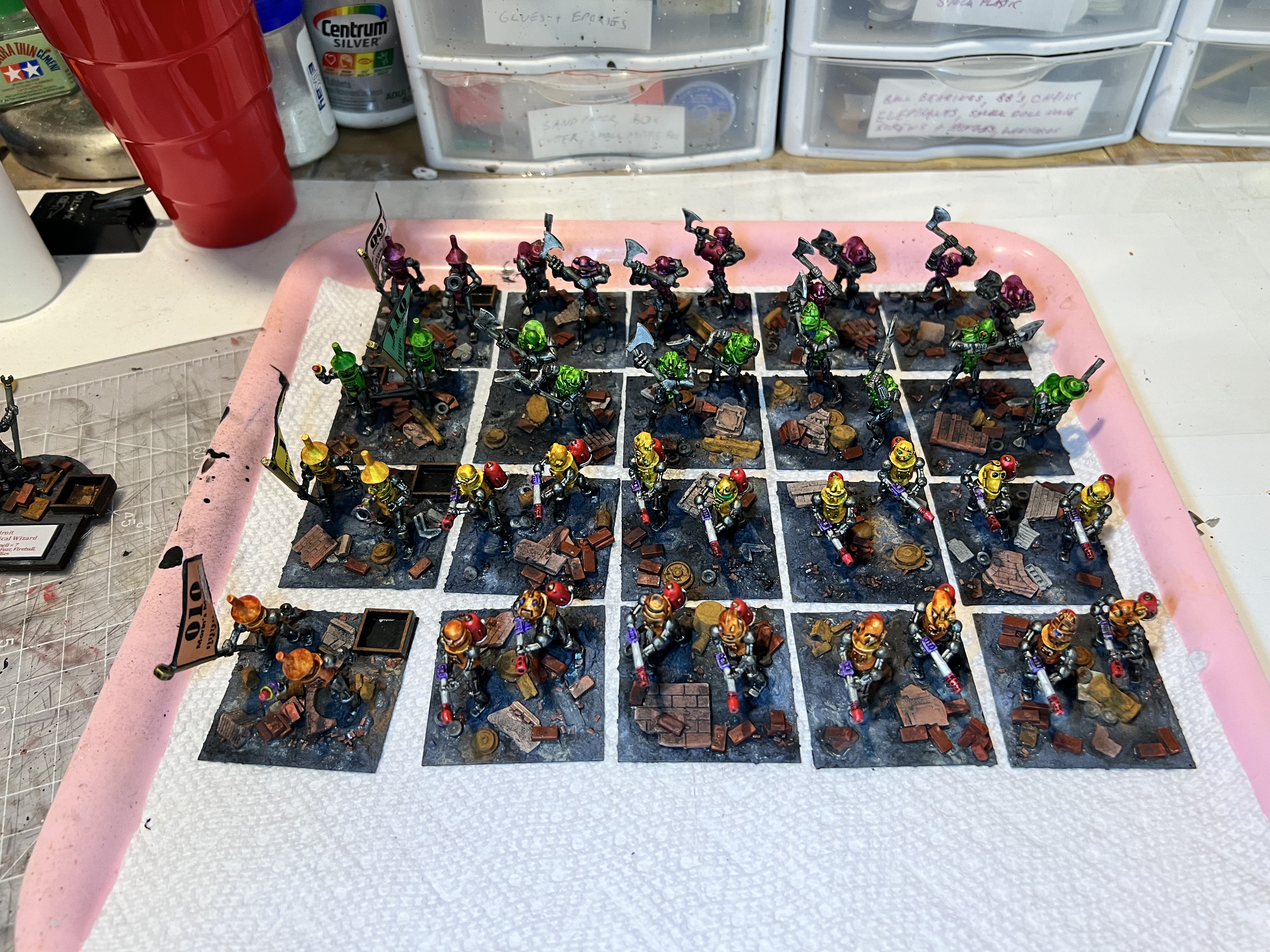
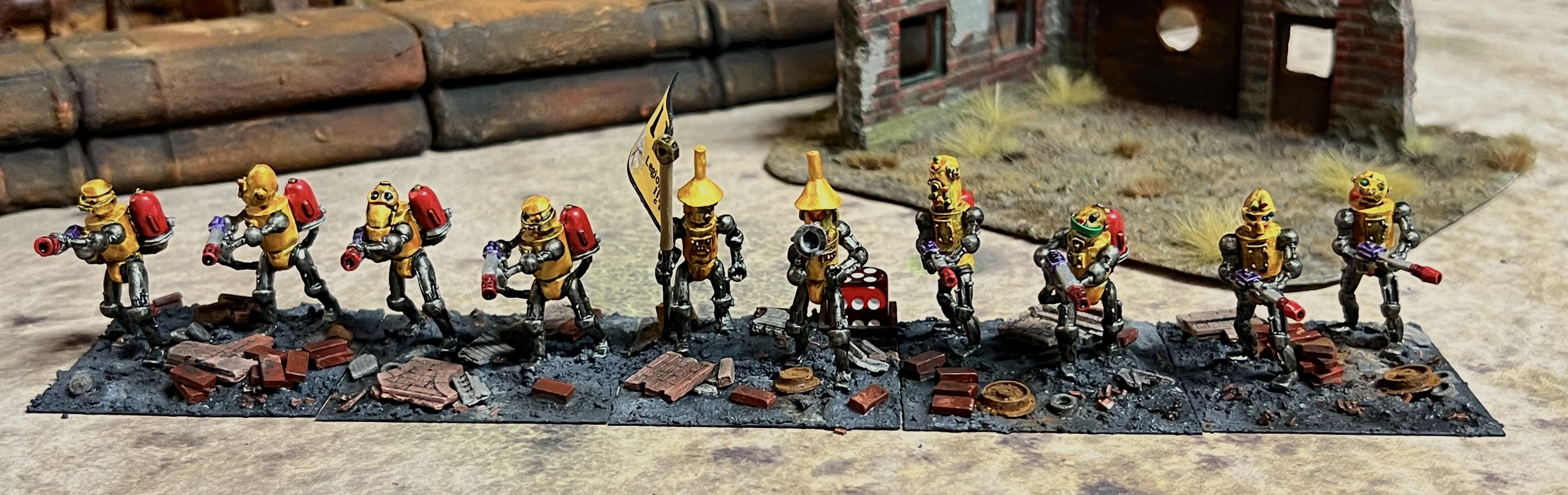
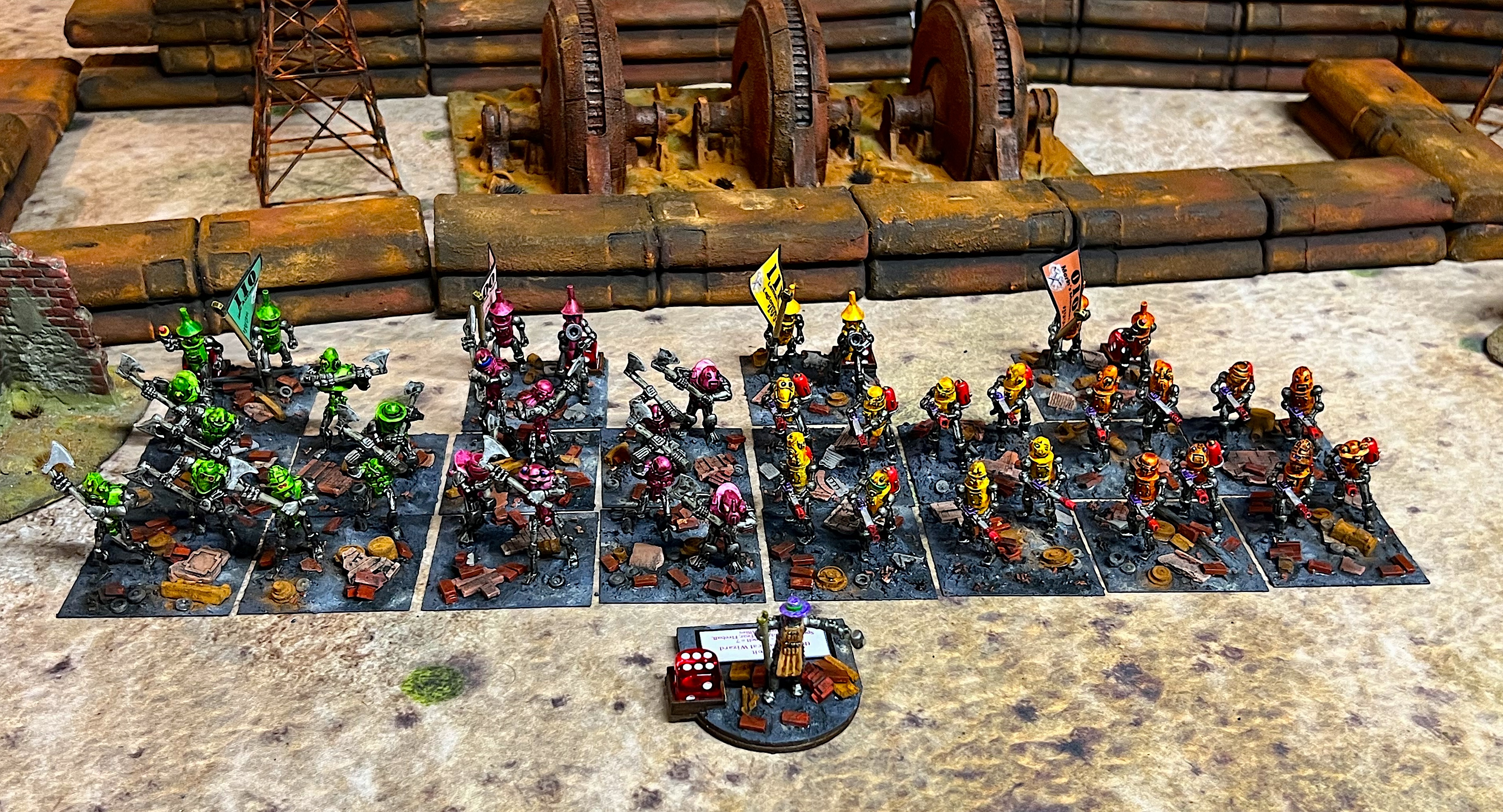
Luckily, my first group of mechanical men miniatures for 2026 is now done. By group, I mean 41 figures for my Wars of Ozz games.
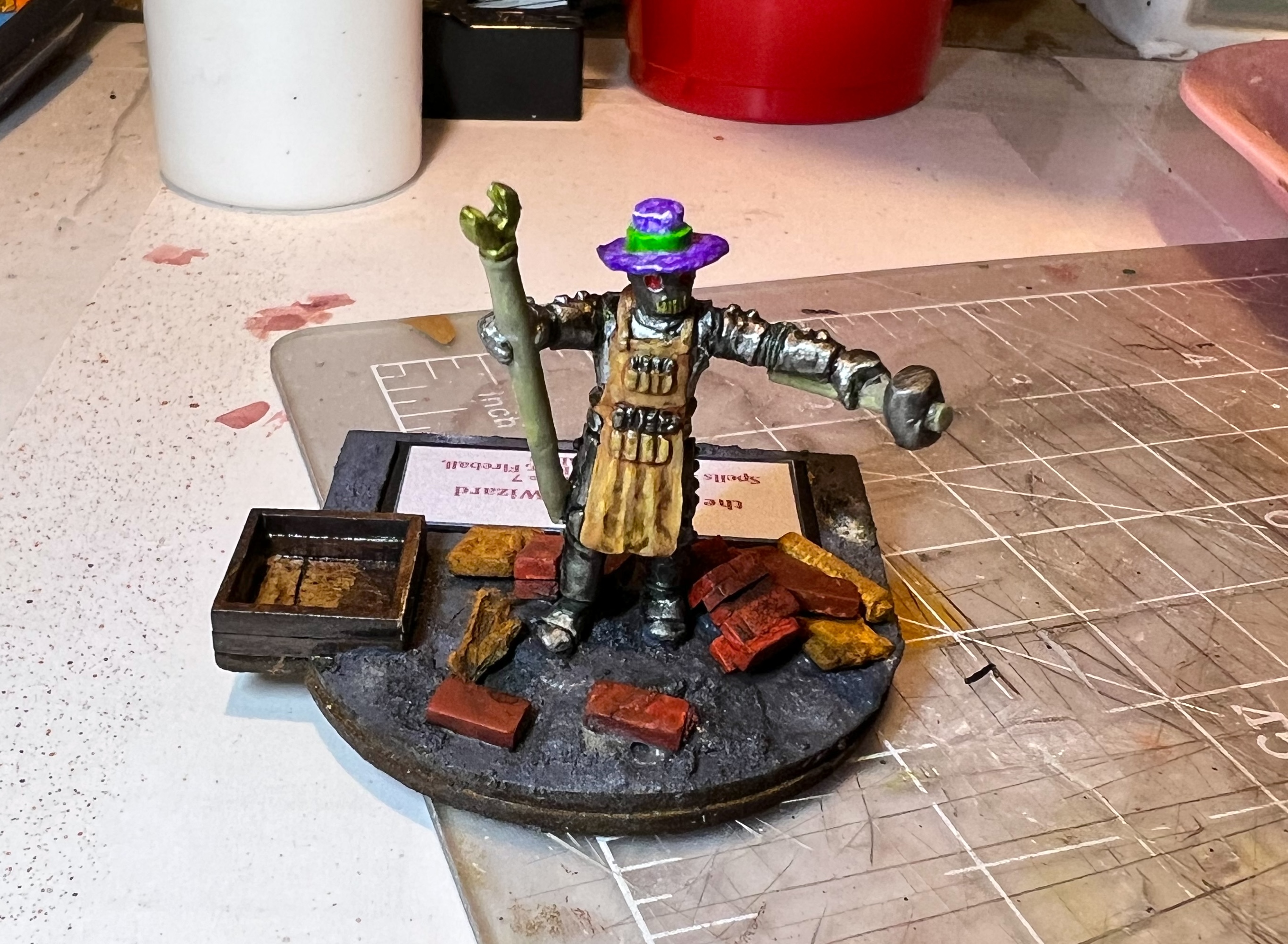
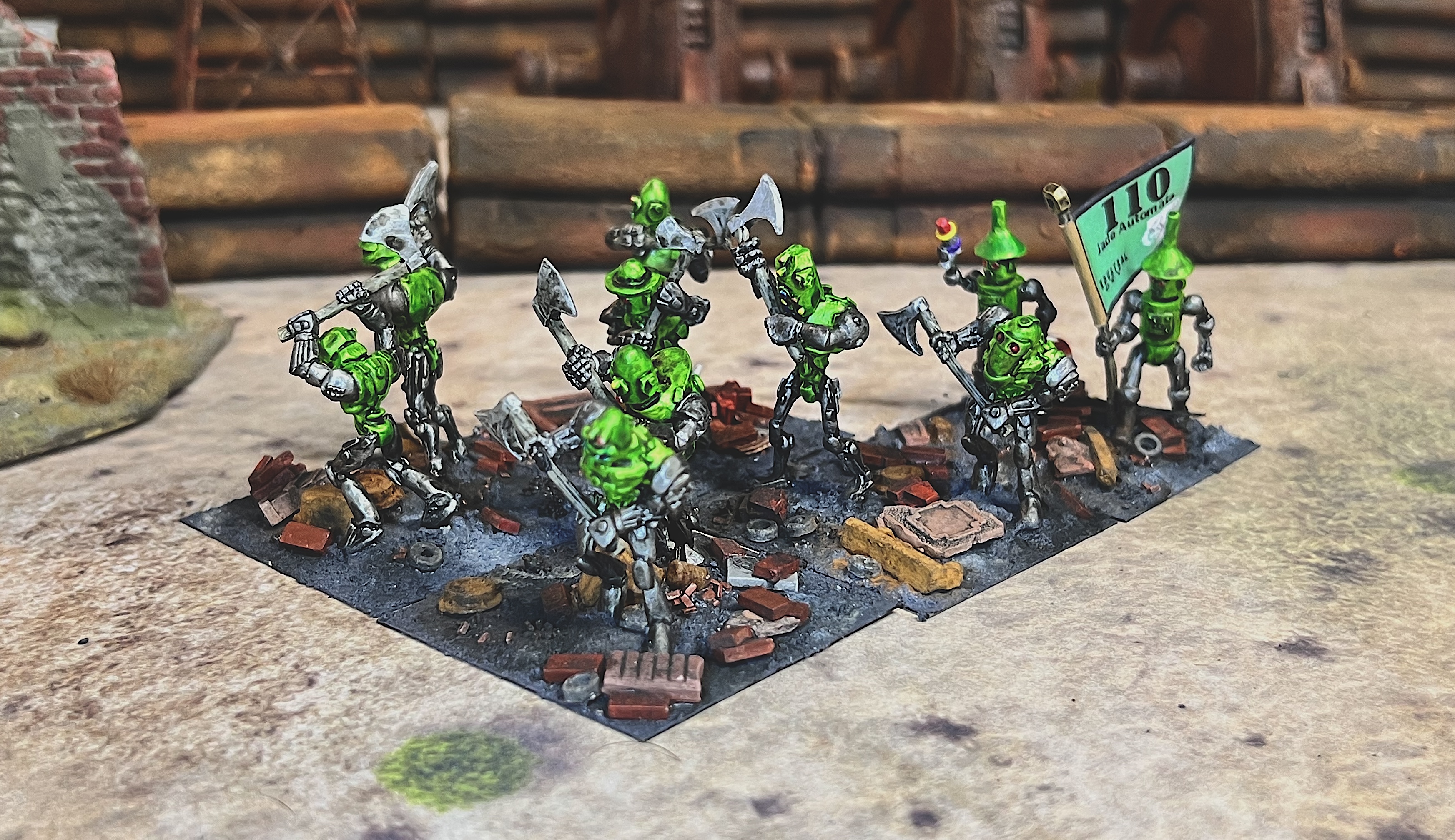
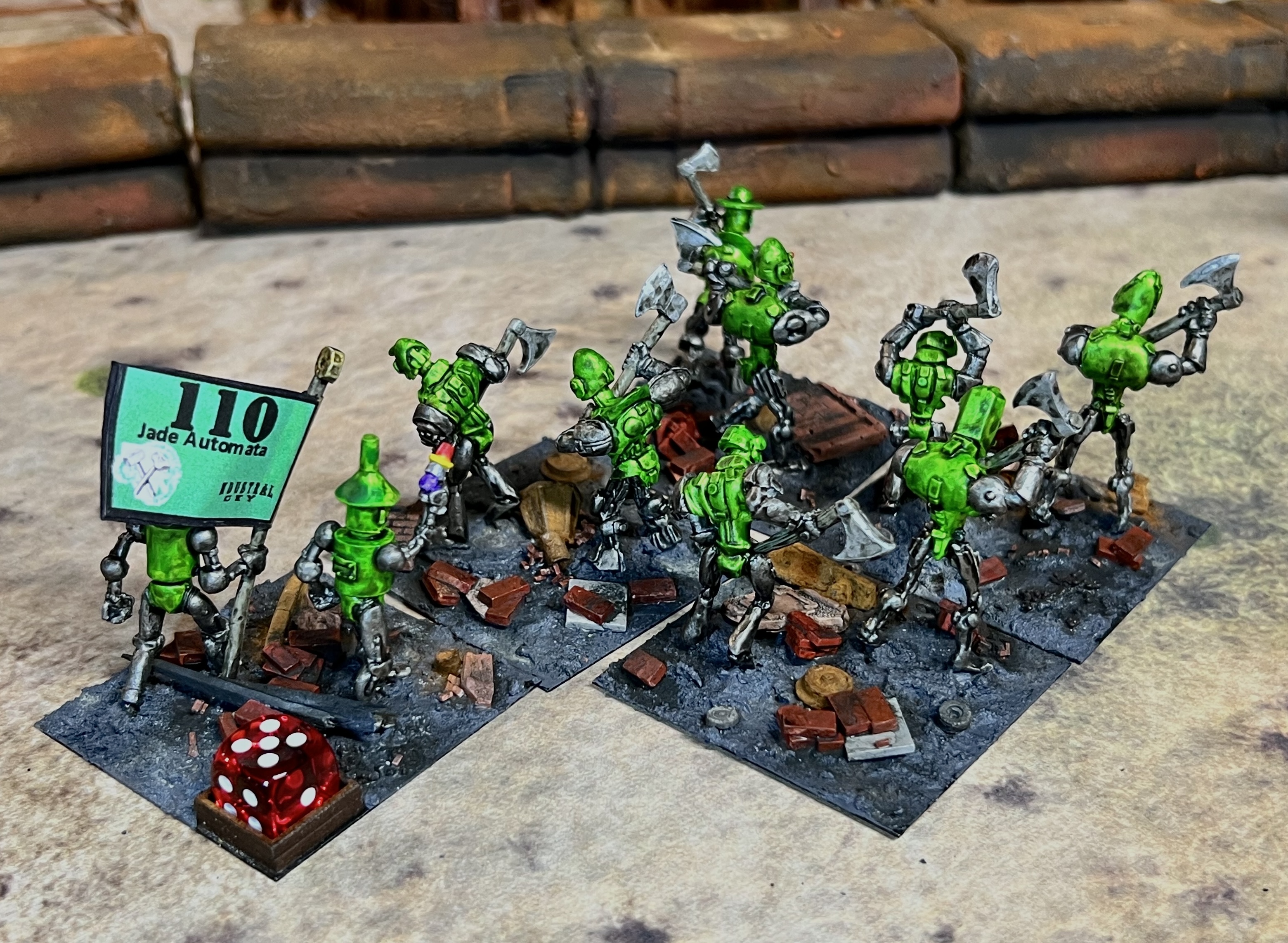
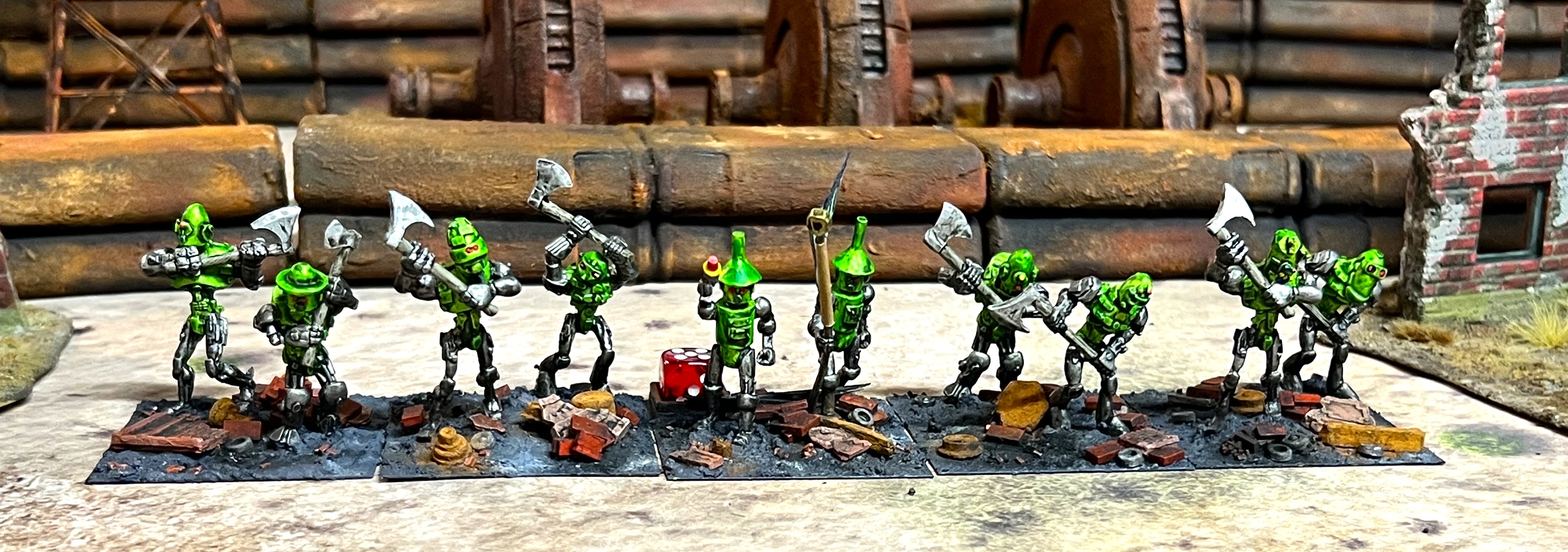
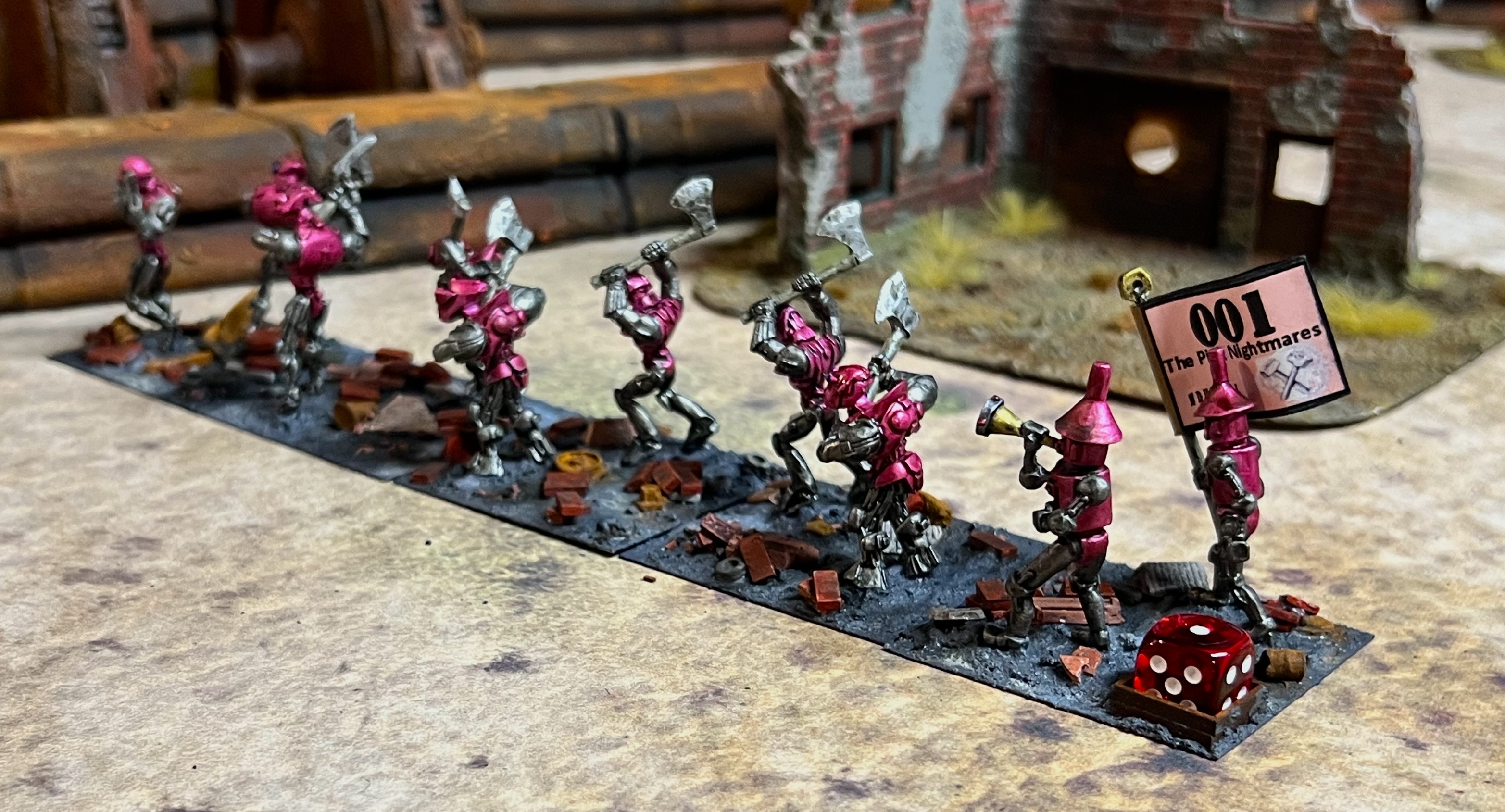
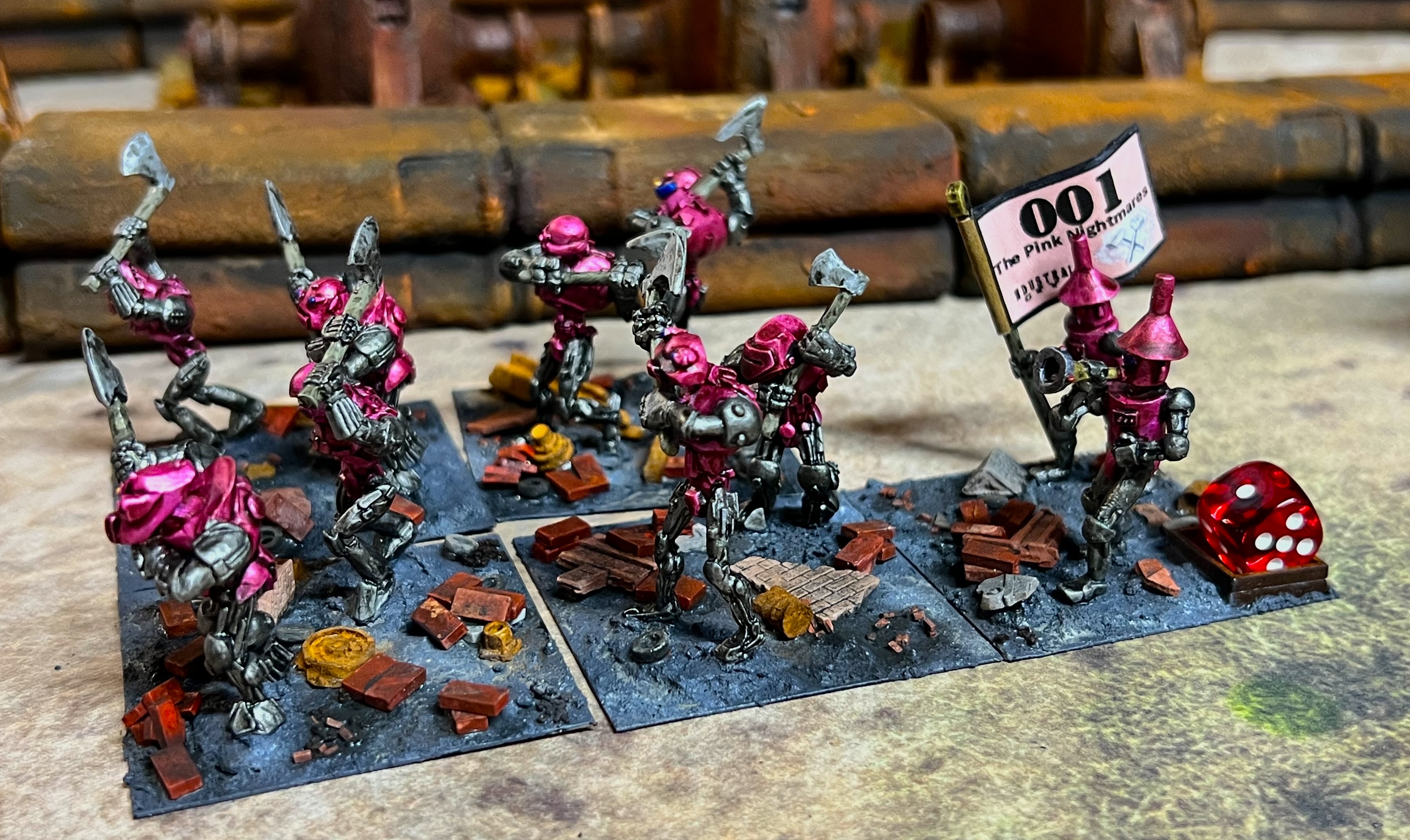
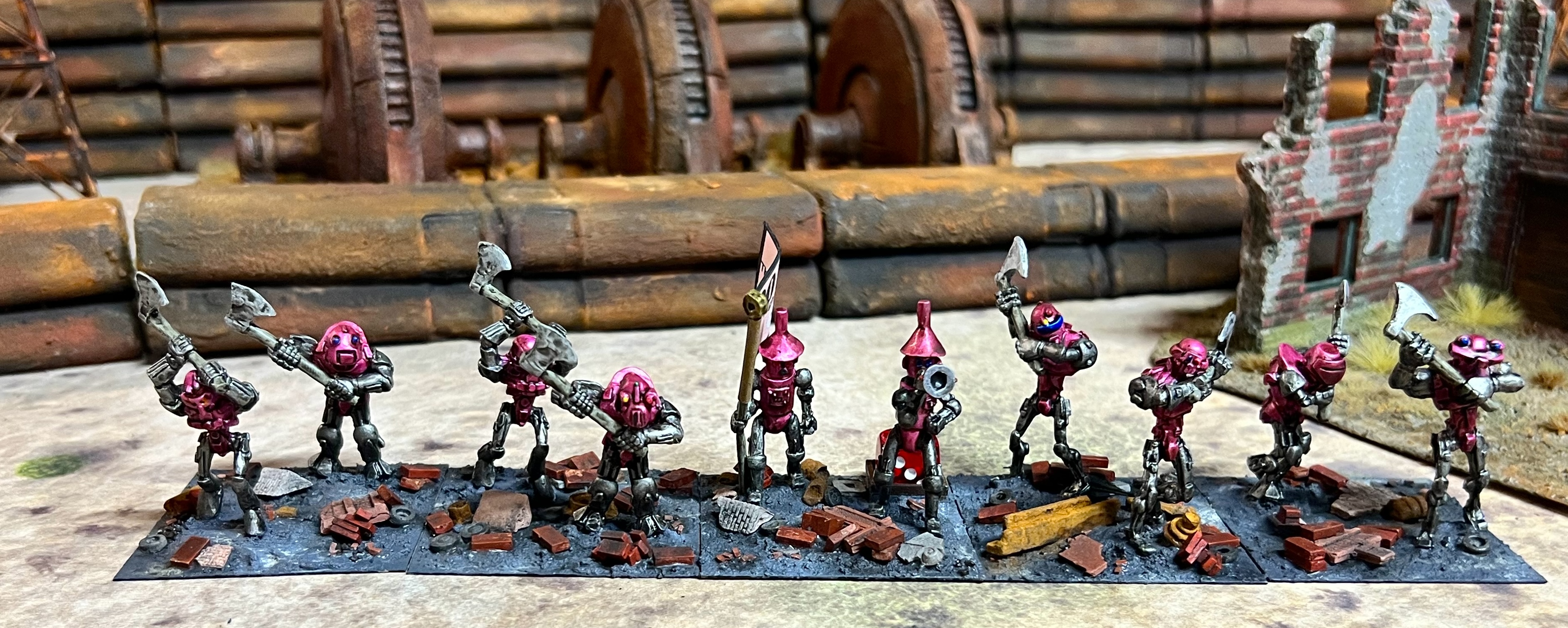
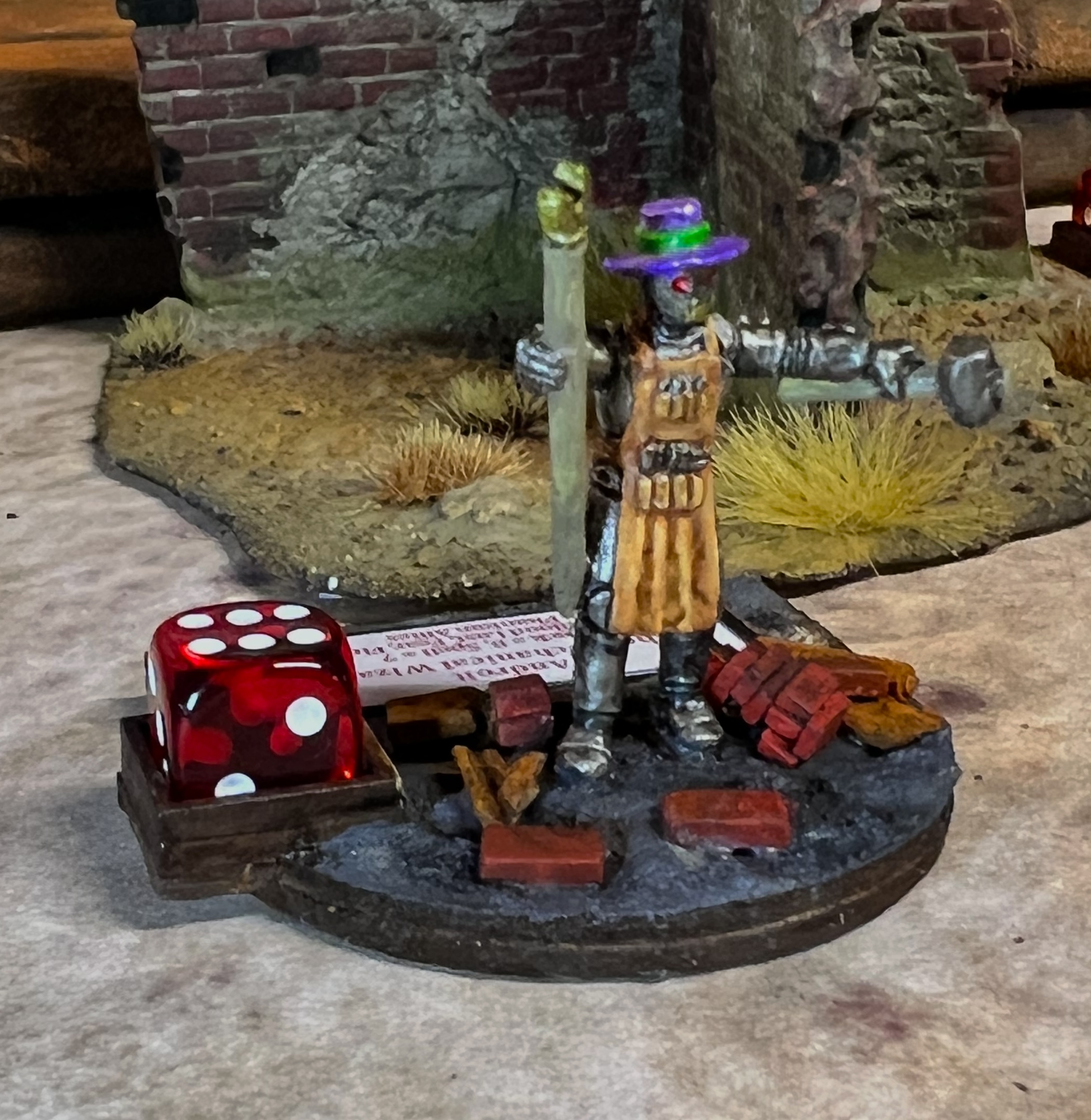
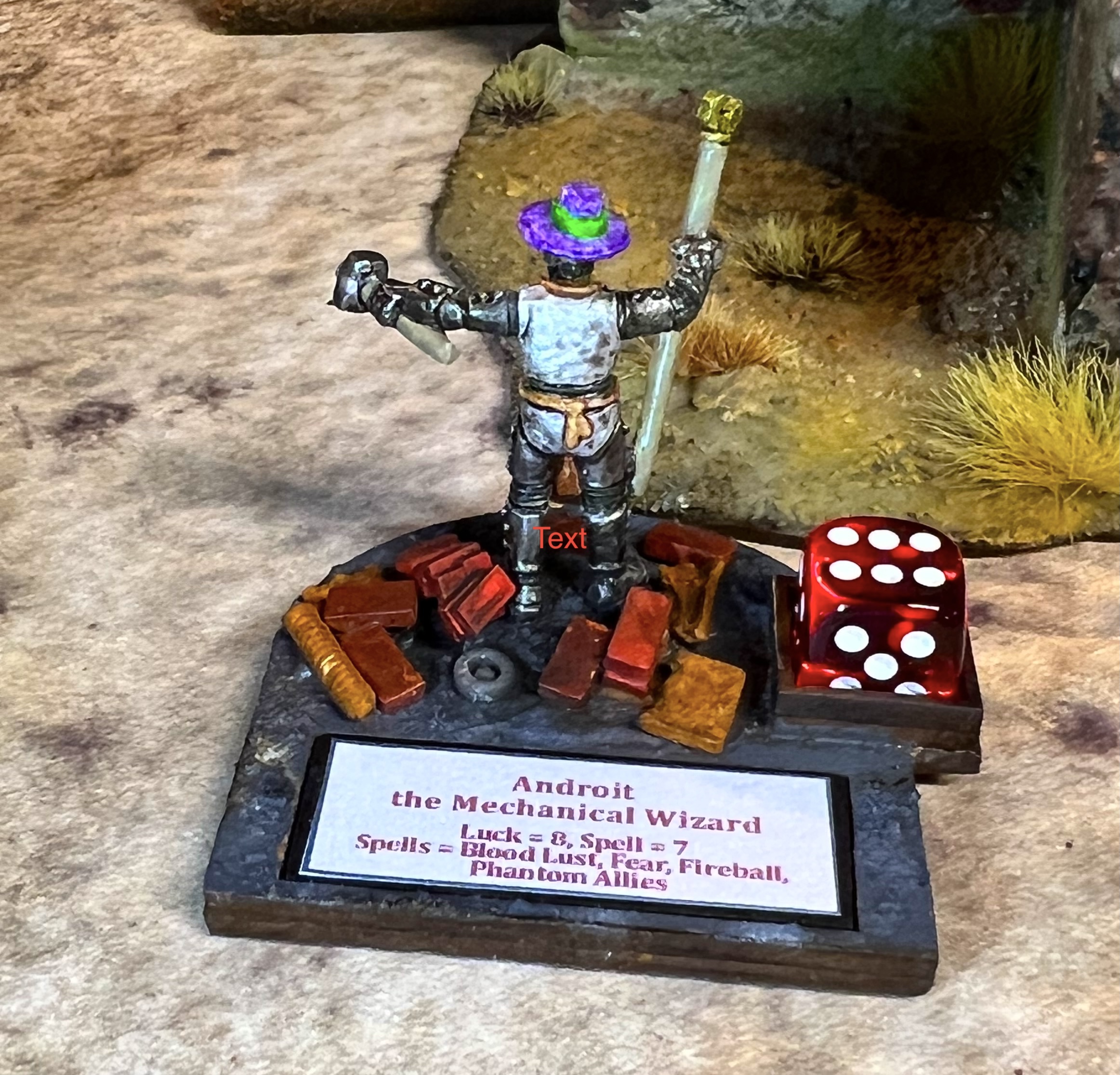
The Mechanical Men would need help in 2026 defending against marauding Munchkins. They would also need help chasing them down as they attempt to steal technological secrets. I chose to build and paint up two regiments of axemen (OZZ-511). Additionally, I chose two regiments armed with napalm blasters (OZZ-539 – not sharing a link as the picture is incorrect on the website). I also had a mechanical wizard, Androit (OZZ-543).
Luckily Buck Surdu has changed the basing rules for these such that a regiment has 10 figures, not 20. They still do come in 20 figures though! This is why I was able to turn each SKU into two regiments of each!
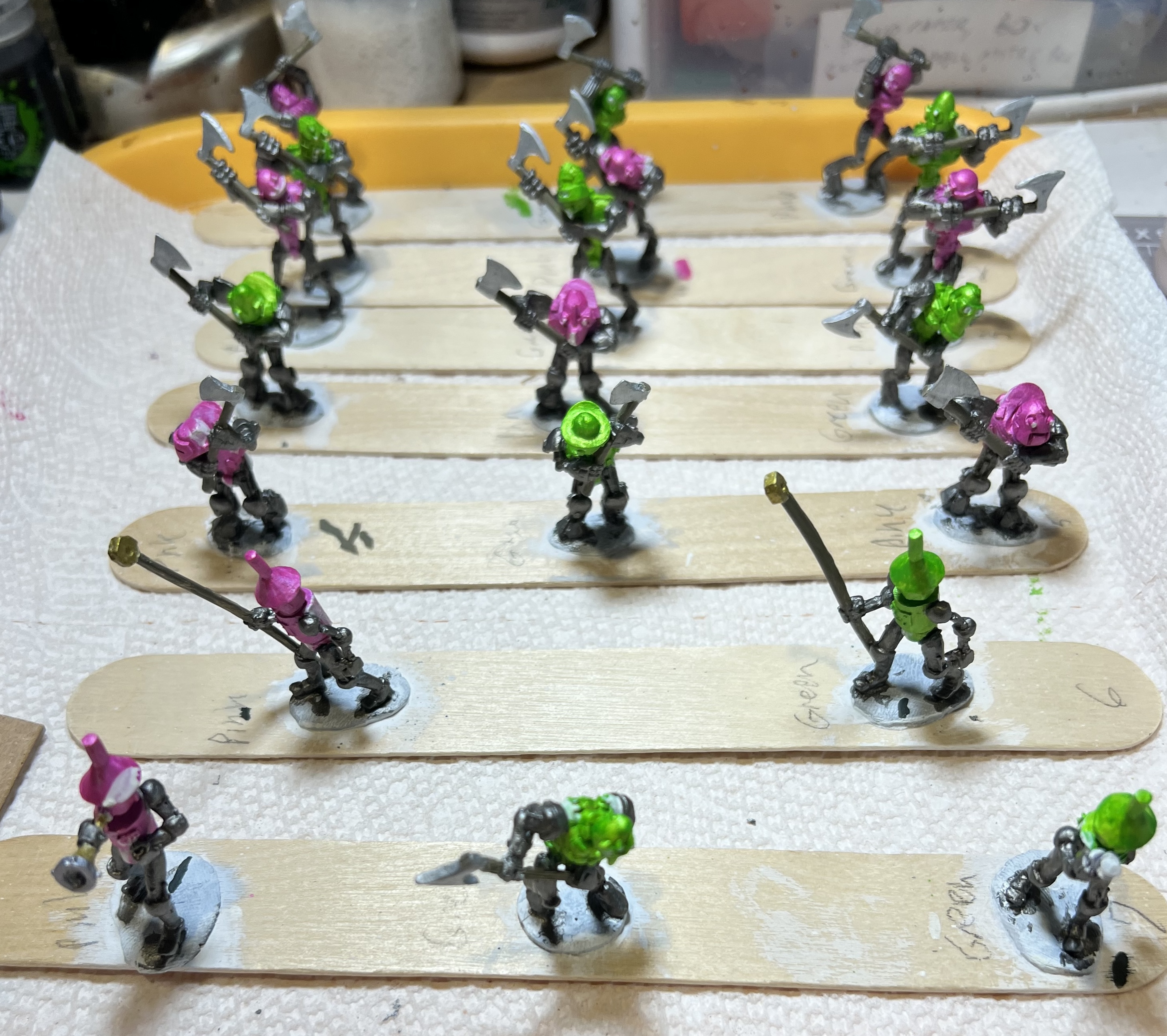
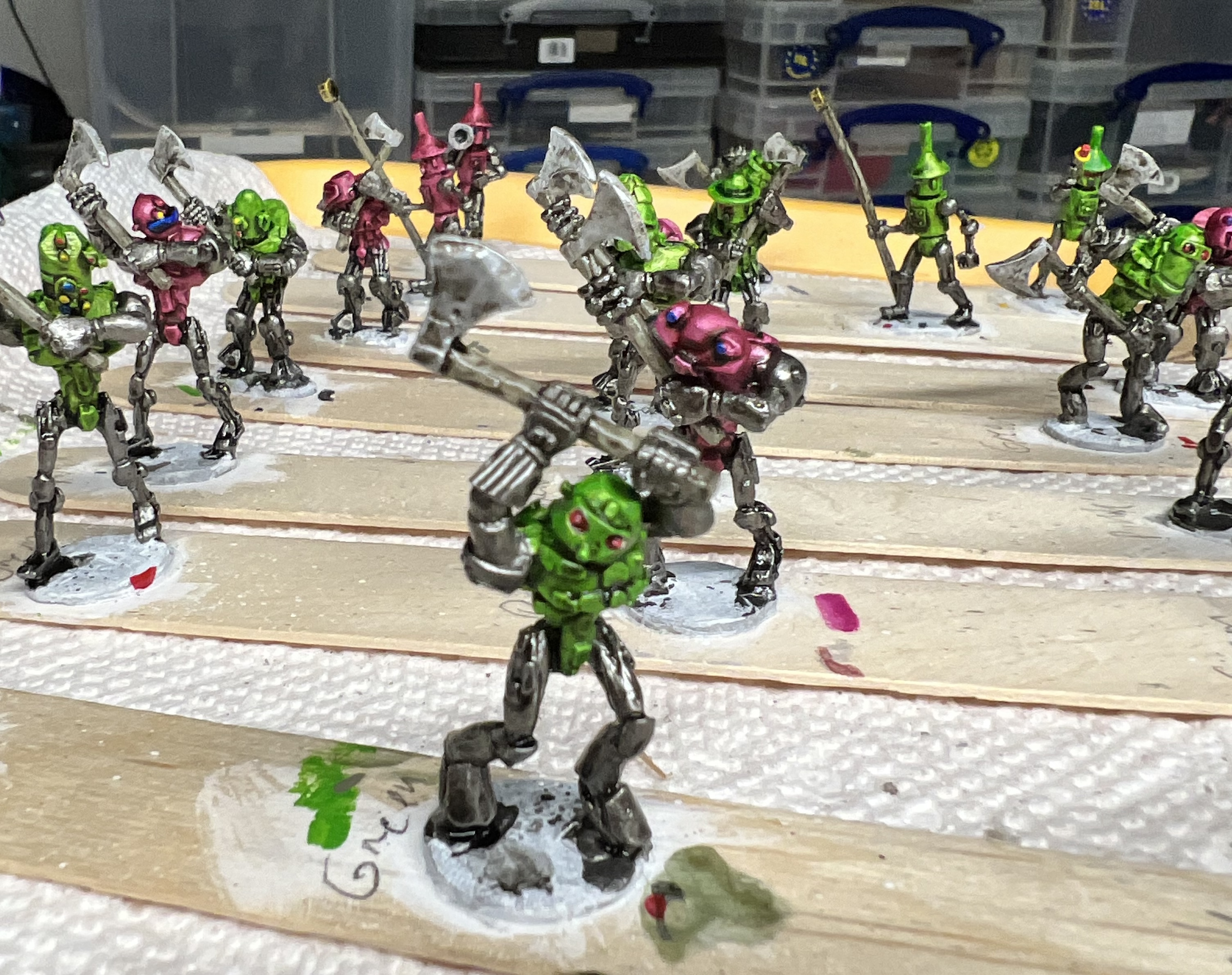
I wanted to give these bad bots a colorful metallic shine. To that end, I experimented by mixing Vallejo “Metallic Medium” with Army Painter Speed and Citadel Contrast Paints. I even tried this with a few of the 1.0 versions that have a reputation for “bleeding”. I am happy to report that no bleeding occurred with this combination.
The group all cleaned up and ready for assembly and priming.Here you see the two regiments of axemen in progress. These regiments would be “The Jade Automata” and “The Pink Nightmares”
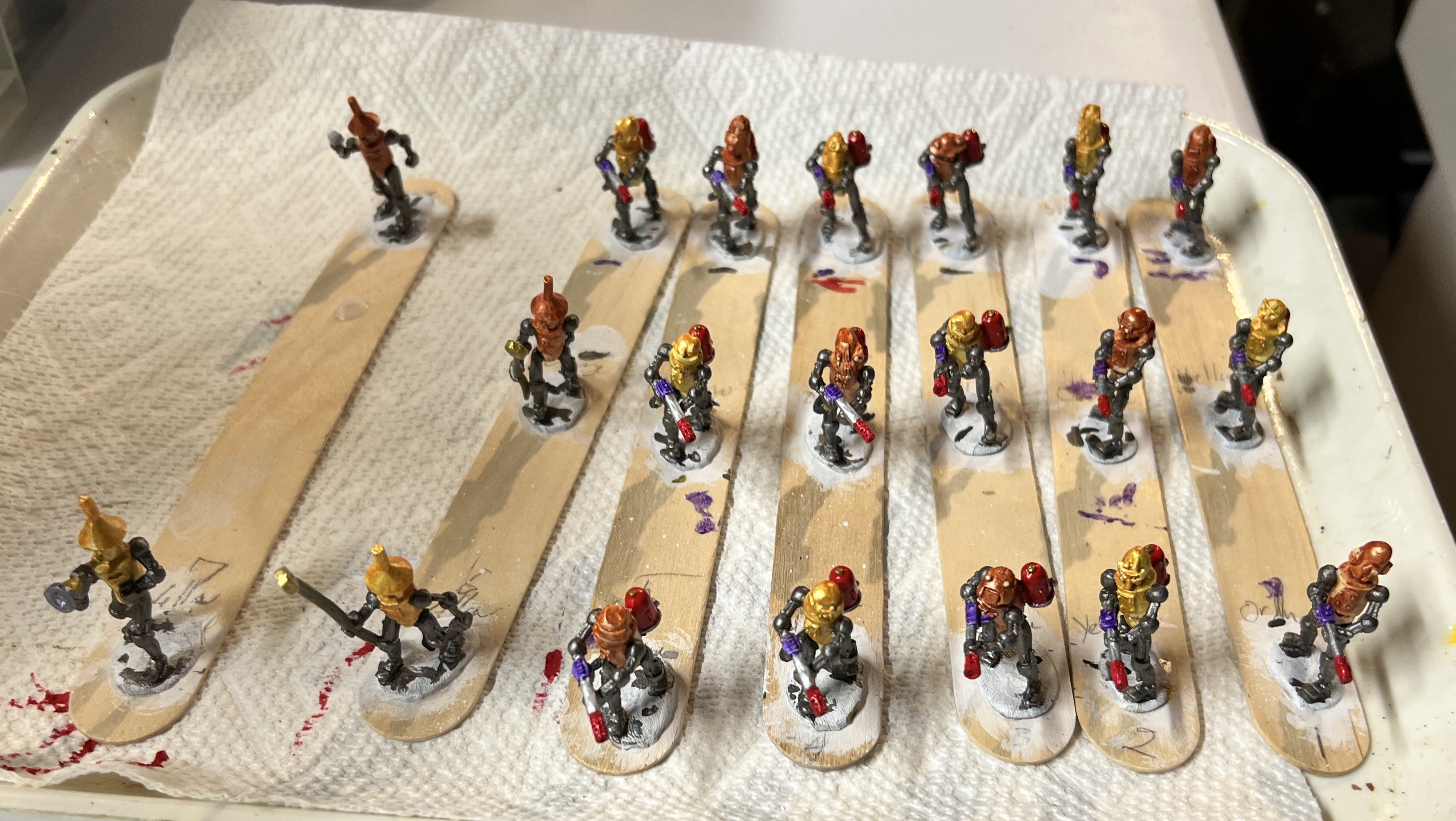
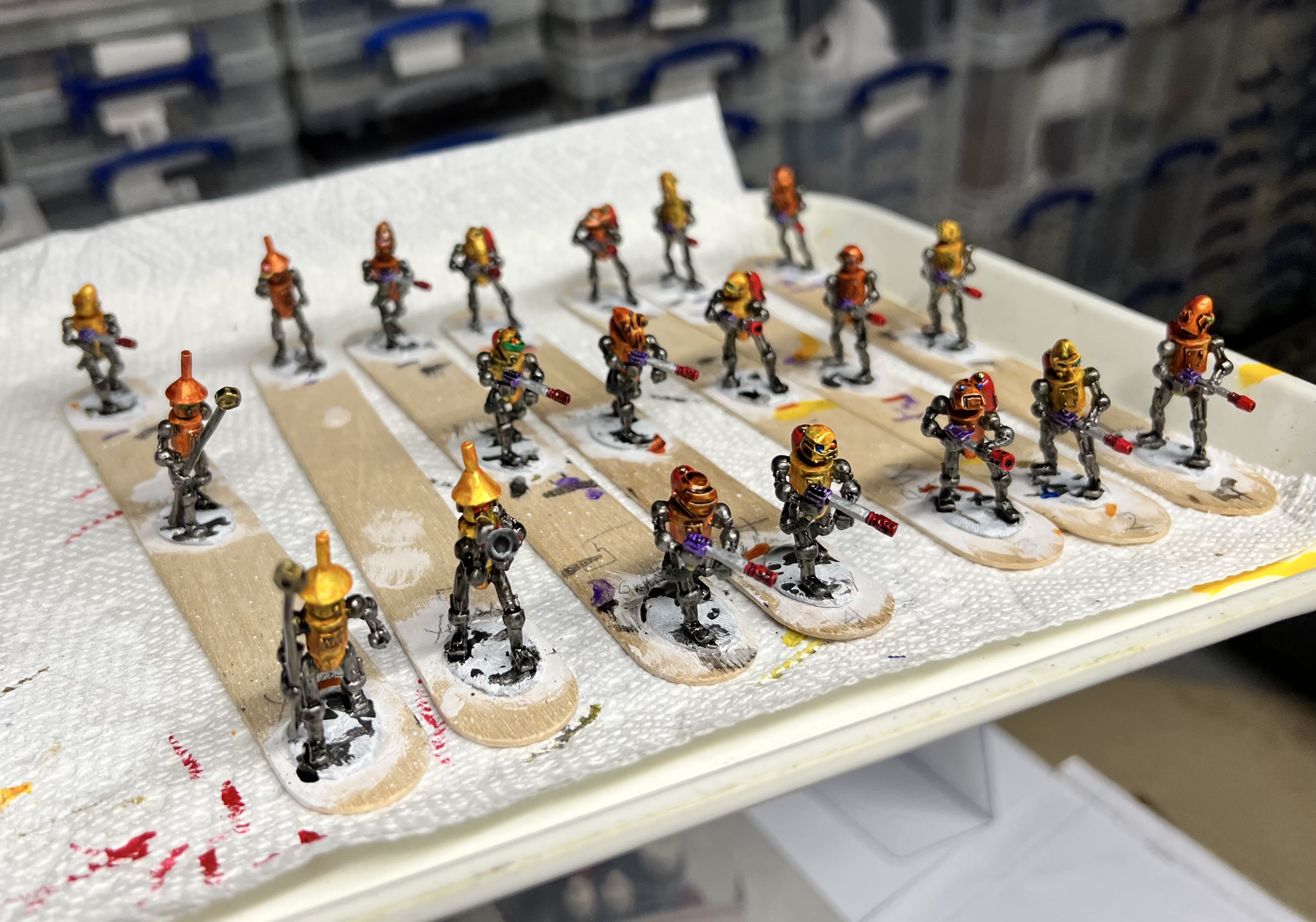
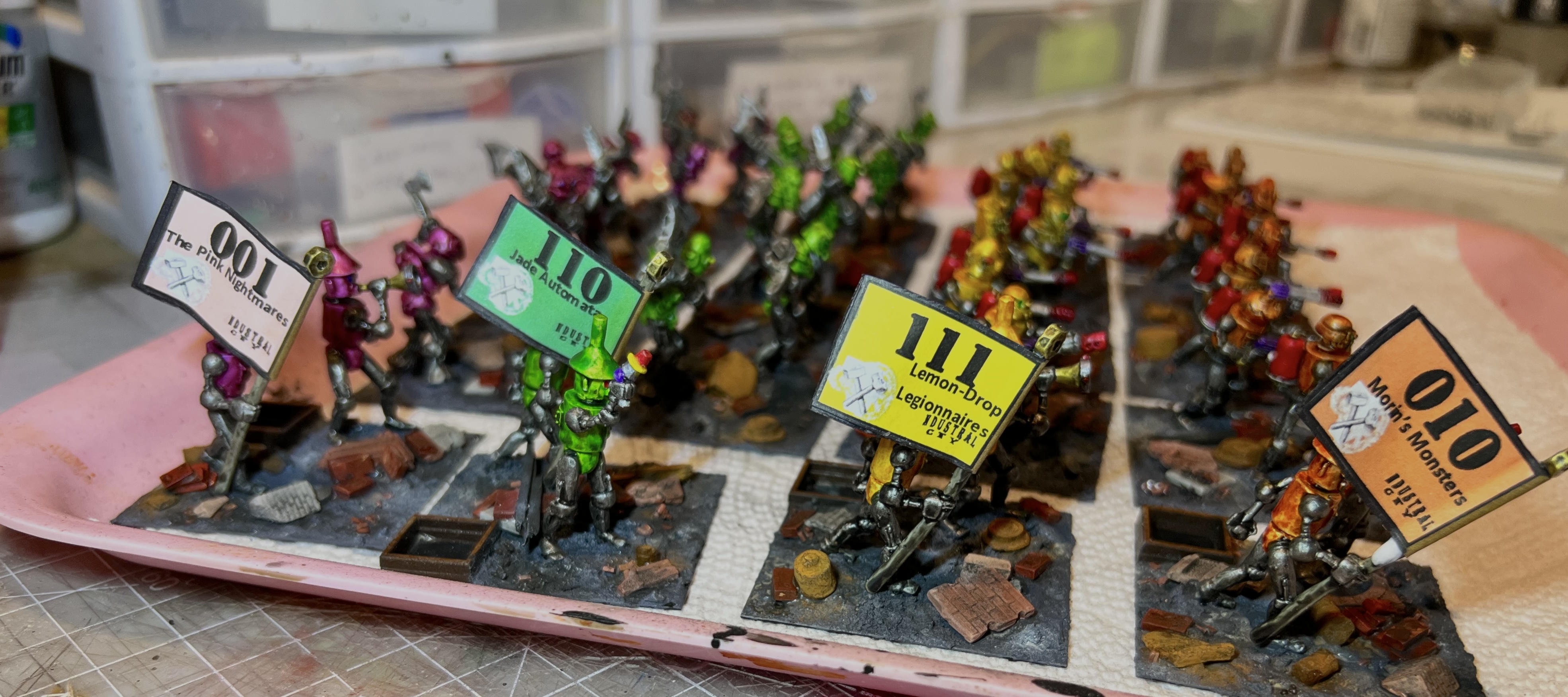
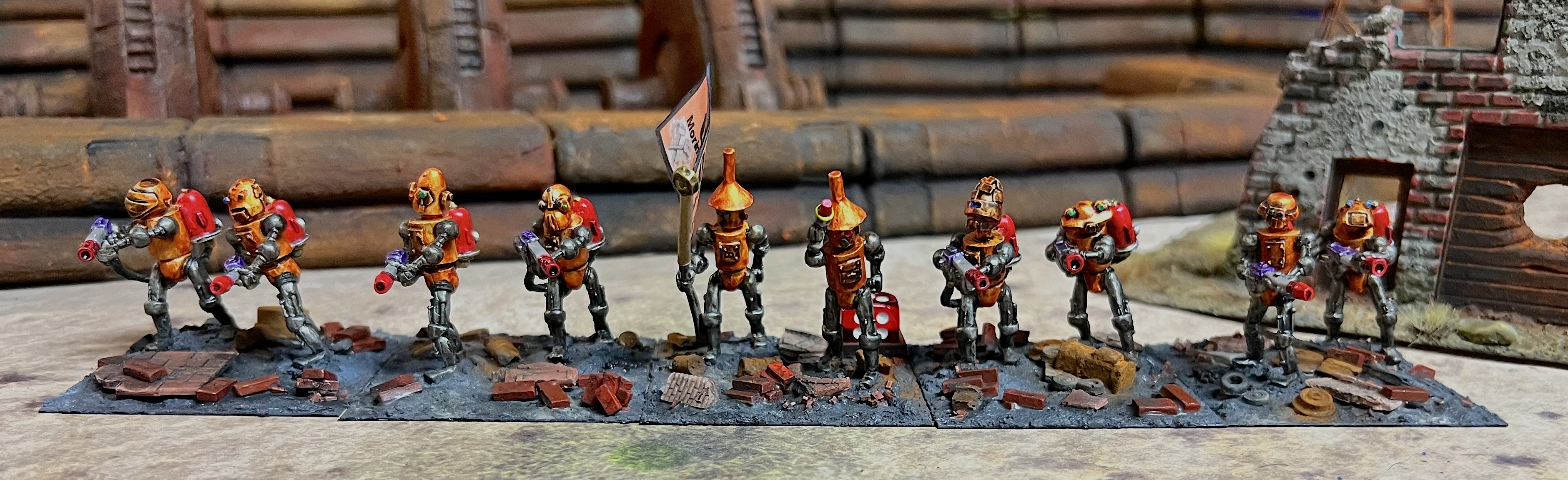
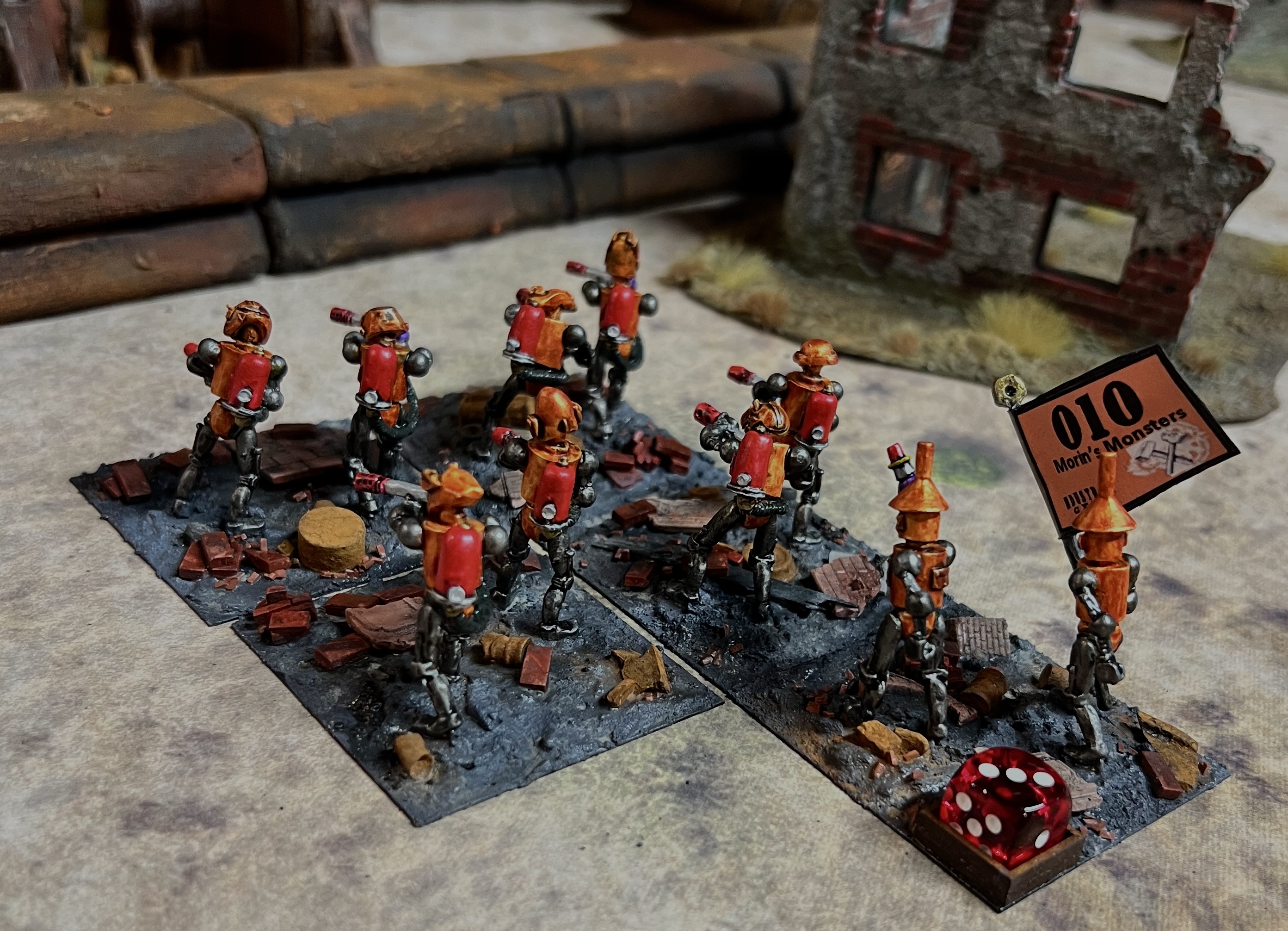
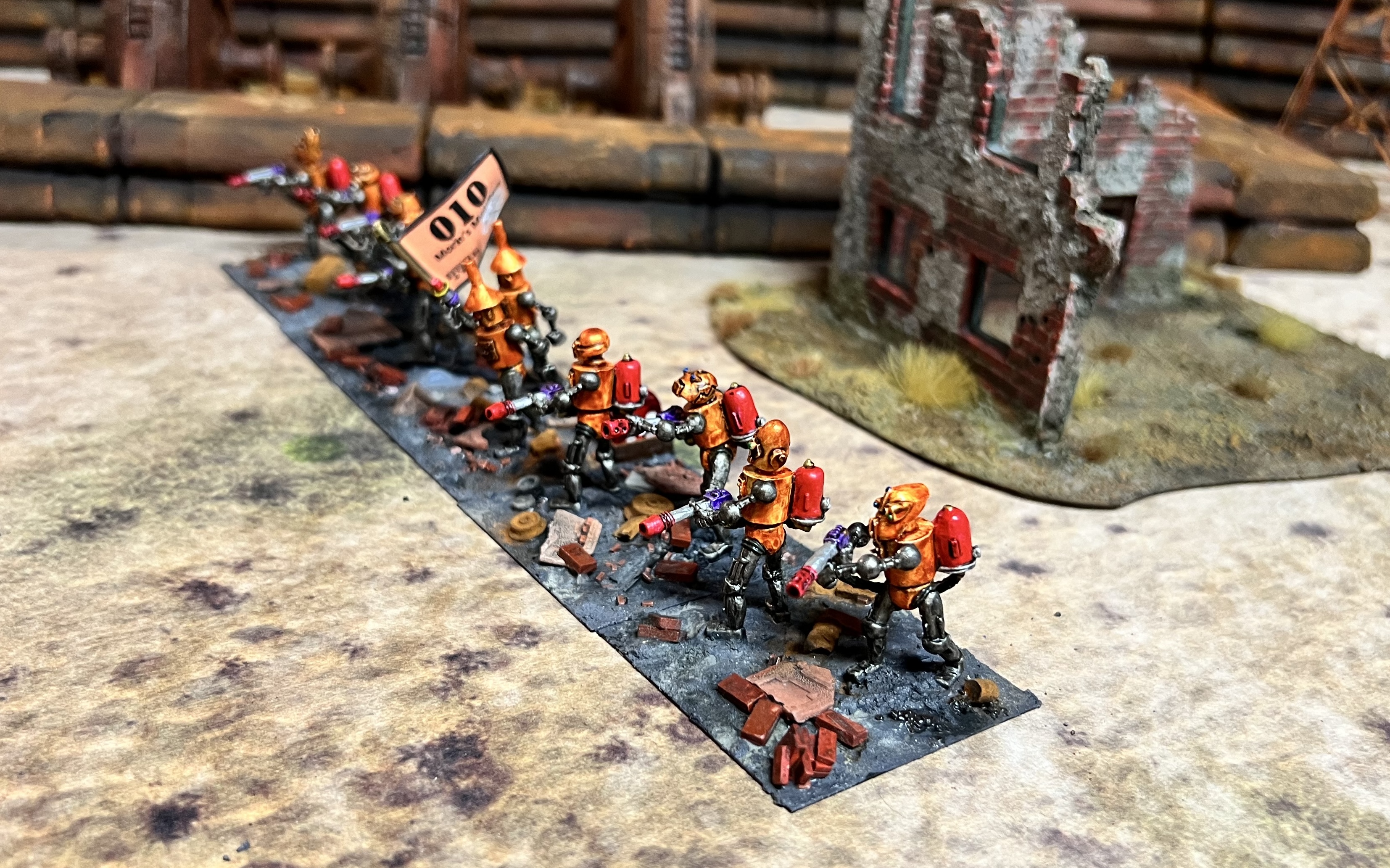
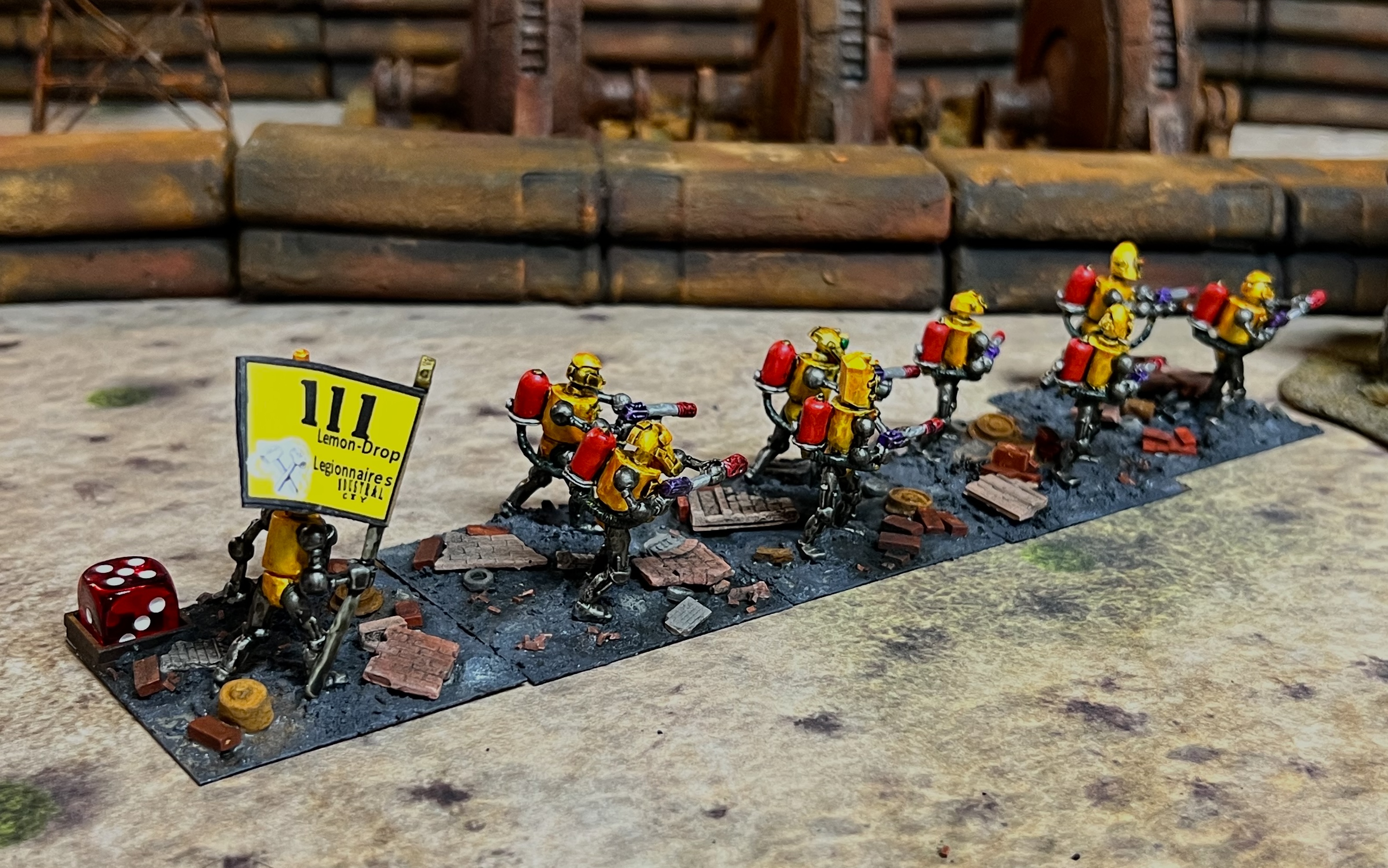
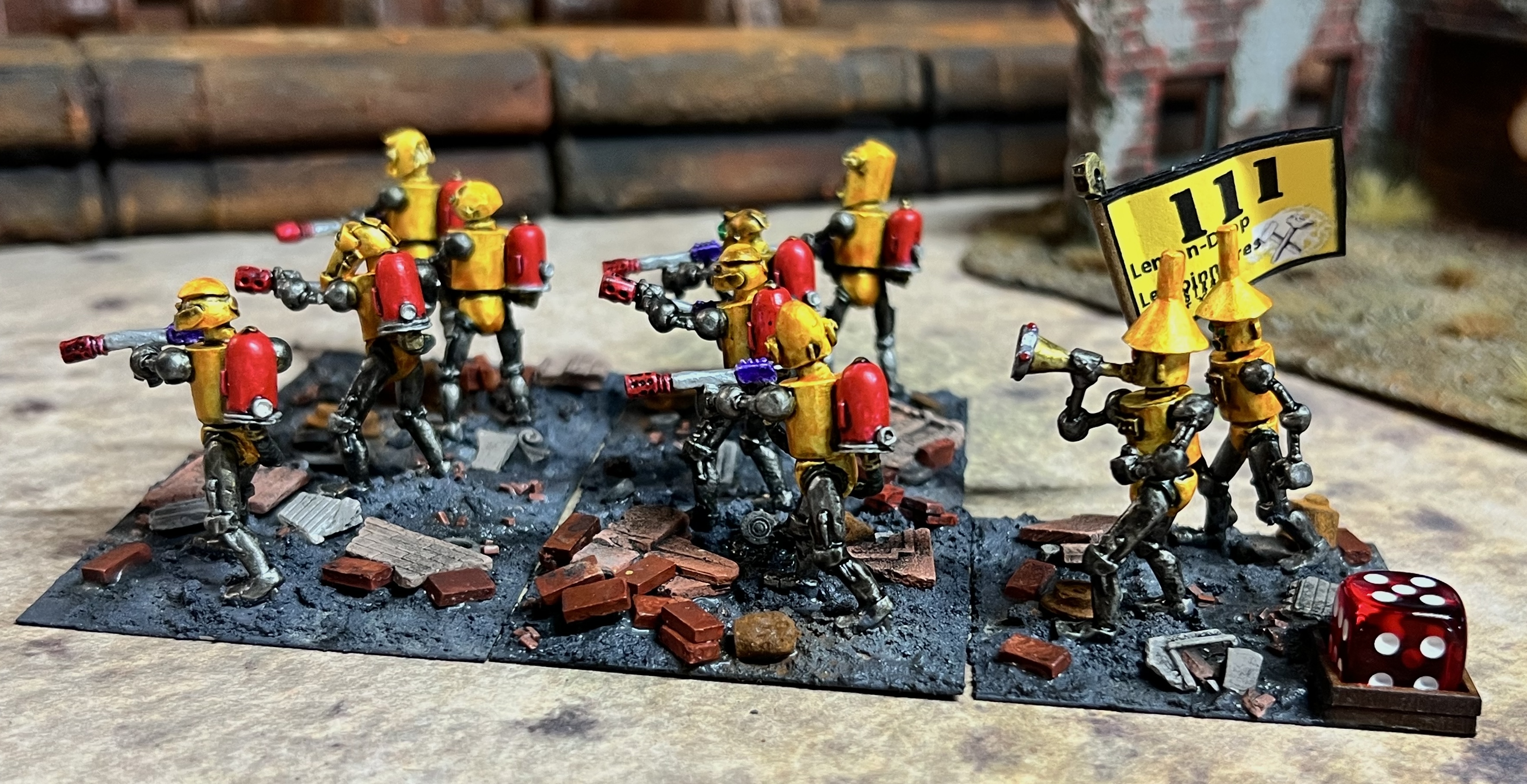
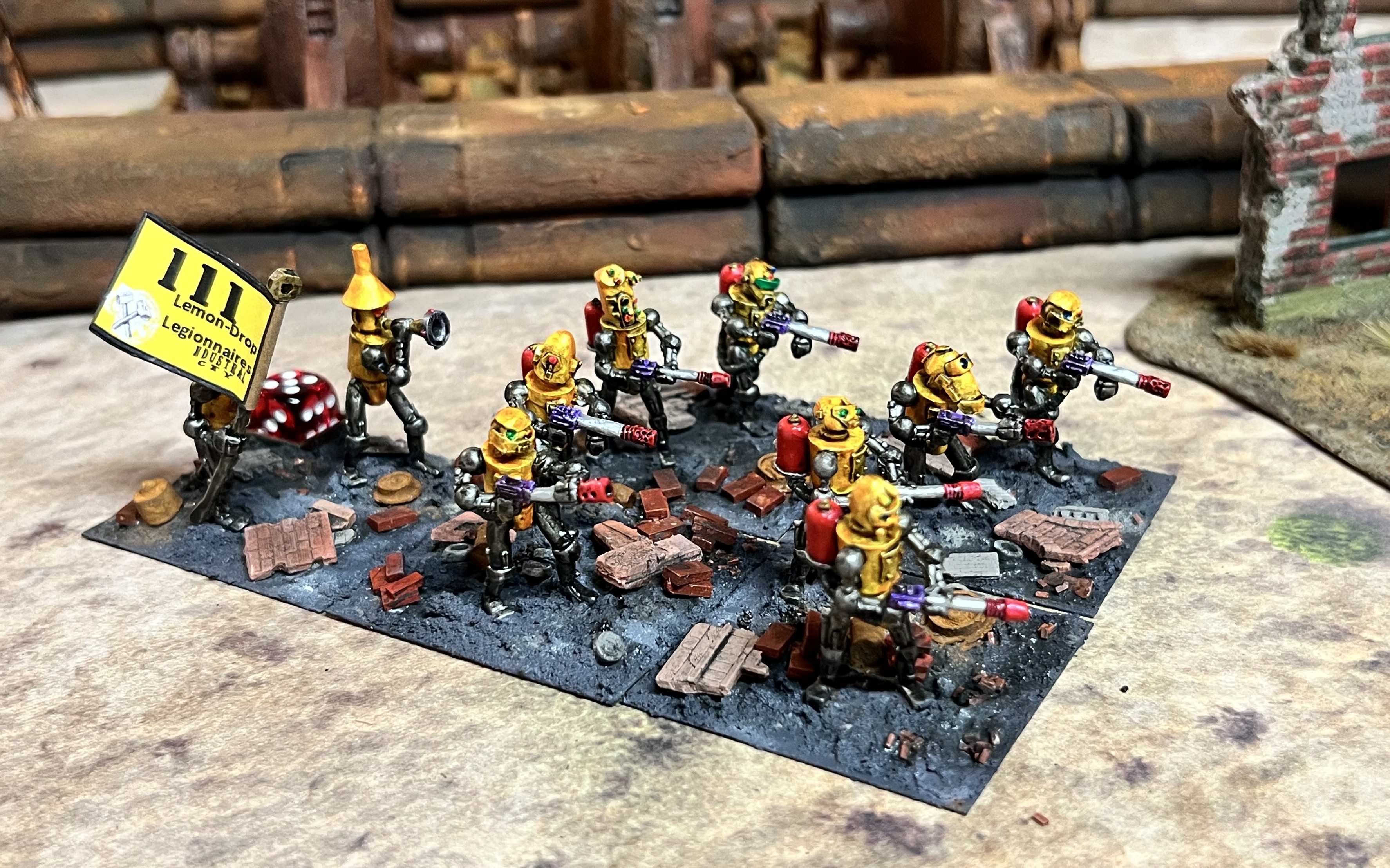
The two napalm blaster regiments would be yellow-themed (“The Lemon Drop Legionnaires”) and orange-themed (Morin’s Monsters). Buck edited his flags for me and named that last one so I just had to give that moniker!
Napalm blasters painted, before washes added……after washes..
Below the axemen in progress:
They have gun metal arms and legs, but colorful torsos for Ozz! The Metal Medium and contrast/speed paint combination worked well.The command bases of the 4 regiments with their nice new battle standards.Top view.
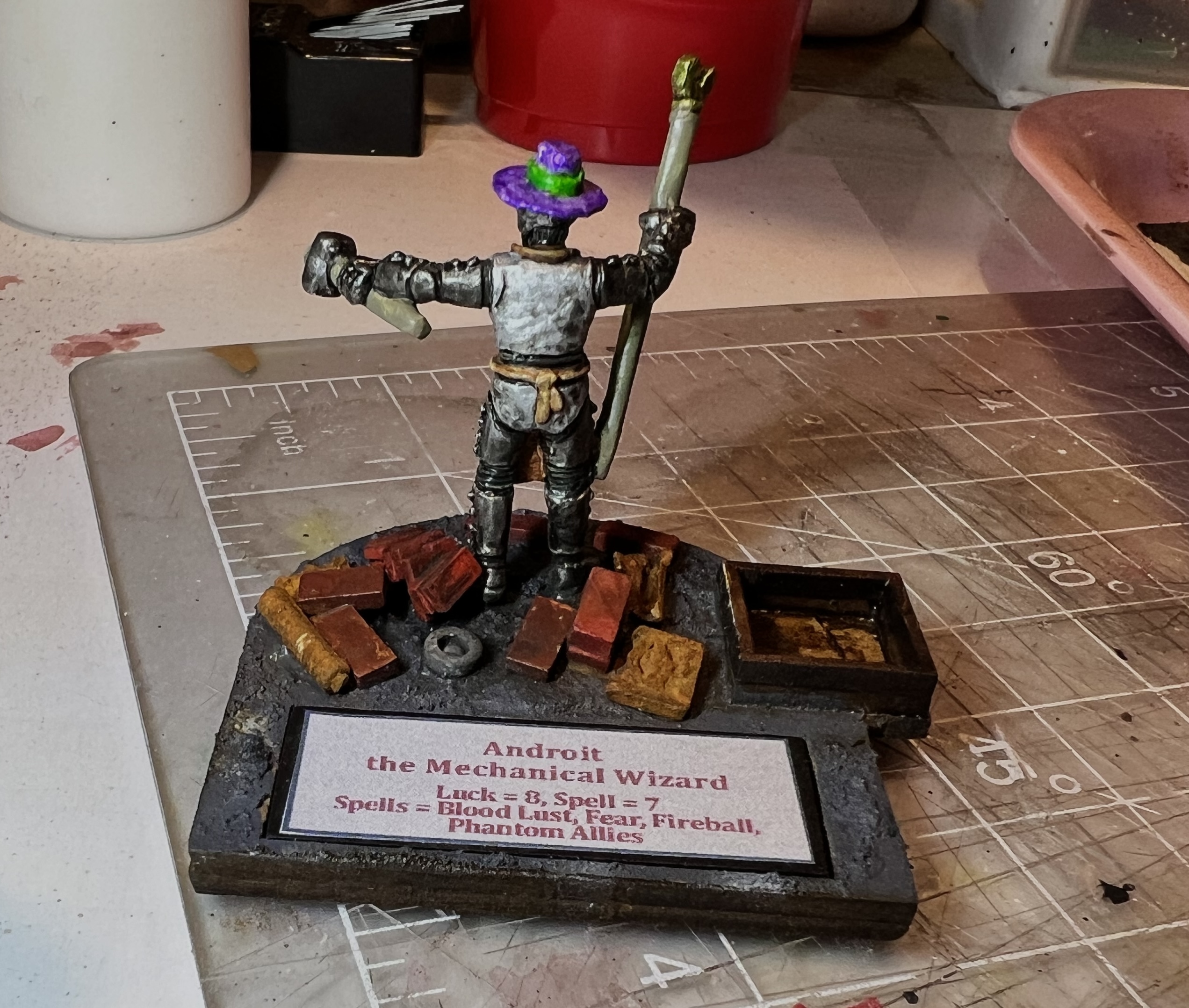
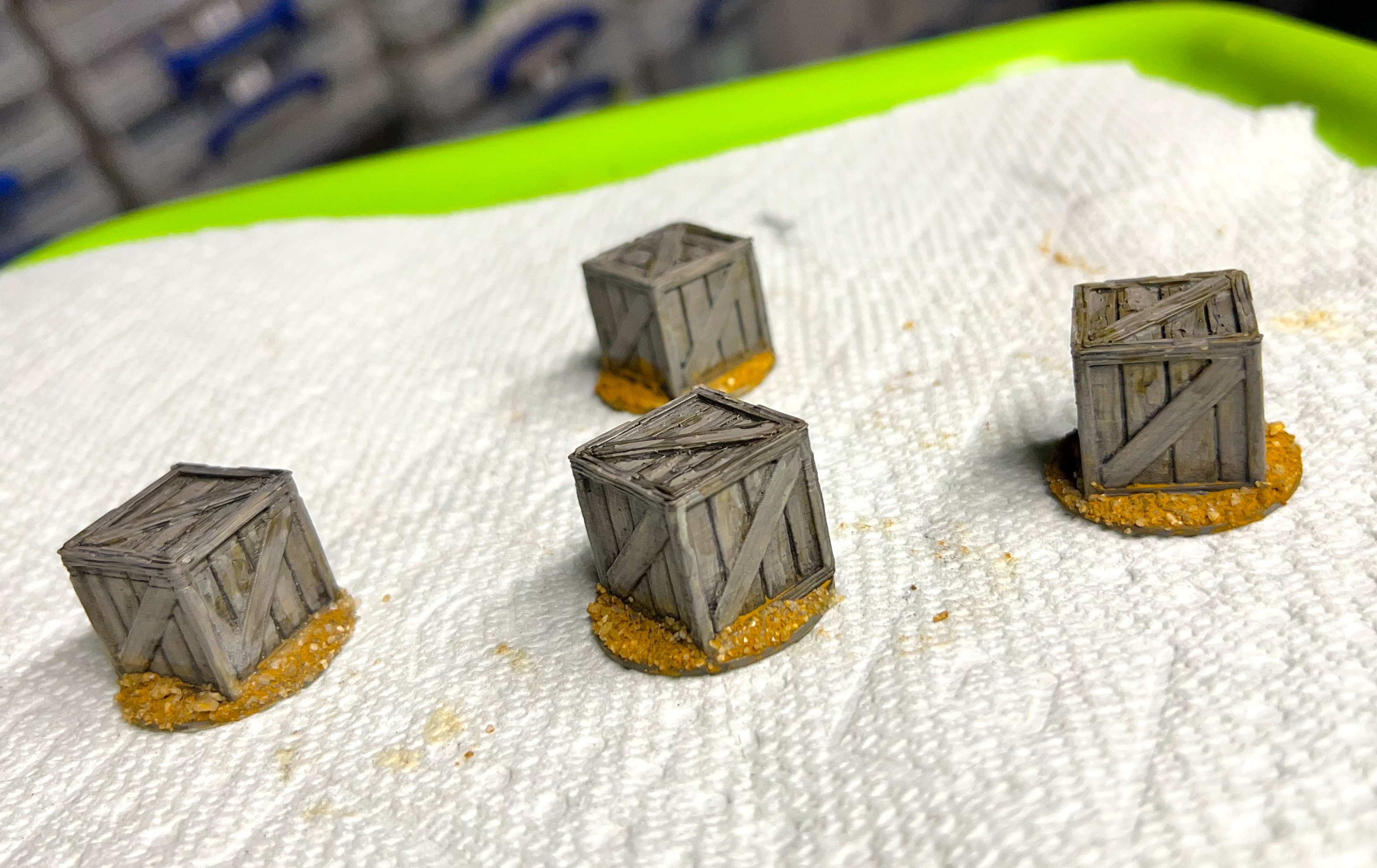
I also painted up Androit, plus 4 crates as game markers for the games to come. These represent stores of Professor Nitpik’s technological secrets.
First Androit:
Androit frontAndroit back with placard
And the crates – I think I got these from Armorcast years ago.
Crates of unknown technological secrets from before the Last Great War…
How about some eye candy (they do already look quite sugary, no?)
Completed Eye Candy
Morin’s Monsters
The Lemon Drop Legionnaires
The Jade Automata
The Pink Nightmares
(Apologies to Ralphie.)
Androit The Mechanical Wizard
Group Shot
I also posted a short video on Instagram showing these mechanical men up close:
As I write this I have just returned from Cold Wars in Lancaster, PA. These miniatures debuted in their first game, “The Great Munchkin Heist”. In upcoming posts, I will share that game and some photos from Cold Wars.
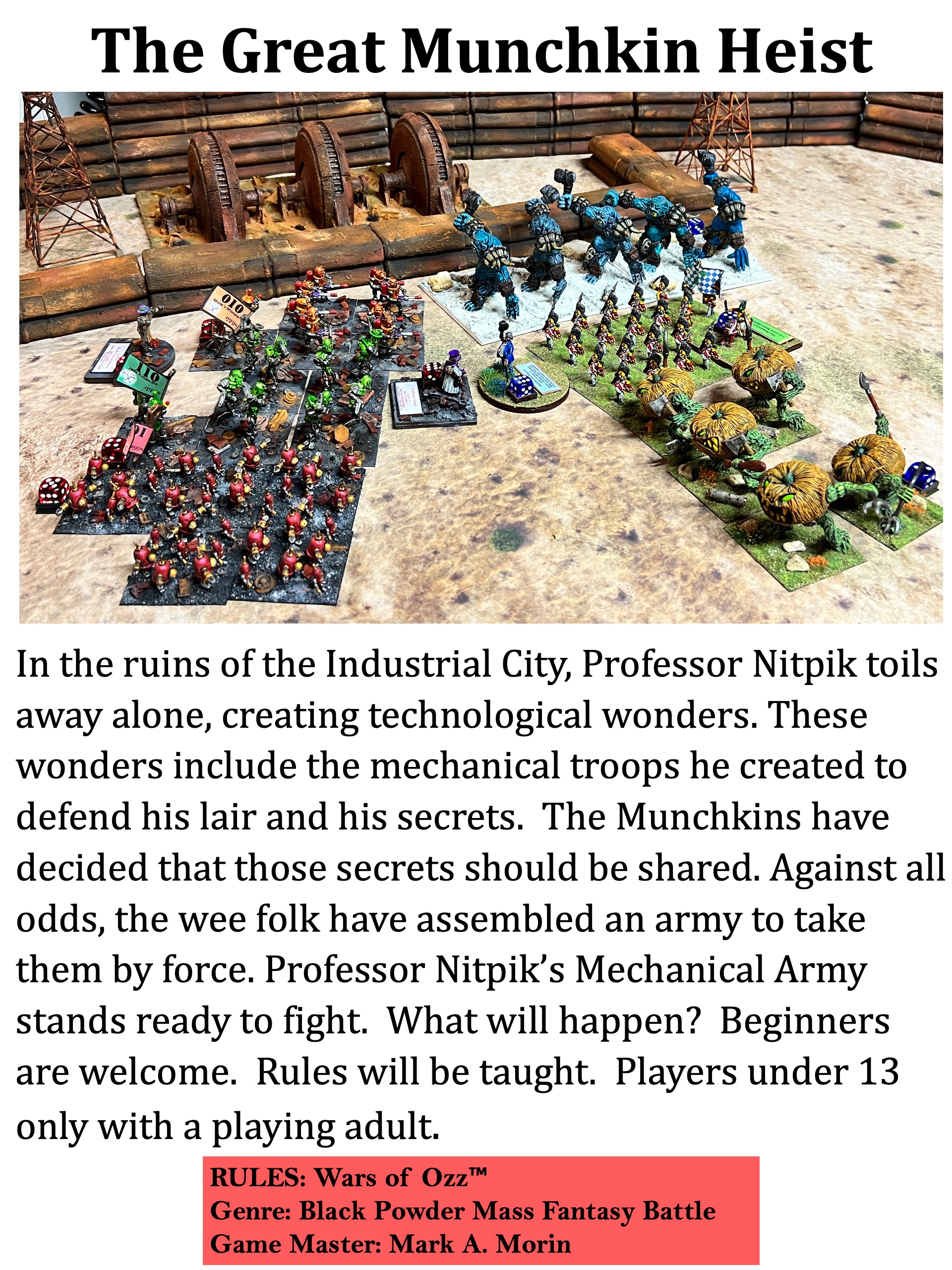
Below is the flyer for that game.
The game went exceptionally well and I look forward to sharing it in a post in the near future. I also intend to share more apocalyptic terrain that I made it for this and another scenario. I also hope to do a 2025 roundup post as well…again, I said hope!
AND I hope to see some of you soon at conventions!
Final Notes and Links
Want to learn more about Ozz and its world? If you want to check out the excellent Wars of Ozz figures’ range, there are two places to get them. You can also get the rules there. (I make no money from this.) The game rules and the figures are available from the next two places:
As for the paints I used here – the list is extensive. But my memories are not always – so they are as much a resource to me as to you. Given that I have so much wreckage on the mechanical men’s bases, it does add to the variety.
If interested, here you go. If not, thanks for looking at these bots. Until next time…
Miscellaneous details and references for those interested in that sort of thing:
For my earlier posts on Wars of Ozz games, view this page. It includes figures, units, and other related projects.
PAINTS, INKS, GLAZES, SHADES, WASHES, PIGMENTS, FLOCKING, GLUES AND MORE THAT I USED ON THE TWO REGIMENTS OF NITPIK AXEMEN:
Polystyrene sheet
Gorilla Glue
PVA Glue
Popsicle sticks
2″ Square War Games Accessories Steel Bases (21)
Vallejo Surface Primer “Black”
Vallejo Mecha Primer “White”
Vallejo Thinner
Army Painter Speed Paint 2.0 “Familiar Pink”
Vallejo “Metal Medium”
Citadel Contrast Paint “Striking Scorpion Green”
Popsicle sticks
PVA Glue
Vallejo Model Air “Concrete”
Vallejo Model Air “Tire Black”
Vallejo Model Air “Bright Brass”
Army Painter Warpaints Metallics “Gun Metal”
Vallejo Mecha Color “Light Steel”
Vallejo Mecha Color “Off White”
Army Painter Speed Paint 2.0 “Polished Silver”
Createx Wicked Colors “Pearl Red”
Citadel Contrast Paint “Moon Yellow”
Createx Wicked Colors “Pearl Blue”
Createx Wicked Colors “Pearl Green”
Vallejo Model Air “IDF Sand Grey”
Reaper MSP Core Colors “Pure Black”
Army Painter “Red Tone” (wash)
Secret Weapon Washes “Red Black” (wash)
Secret Weapon Washes “Ruby” (wash)
P3 “Red Ink” (ink)
Vallejo Game Air “Red Terracotta”
Army Painter “Green Tone” (wash)
Citadel “Nuln Oil GLOSS” (wash/shade)
Citadel “Astrogranite” (texture)
Citadel “Astrogranite Debris” (texture)
Vallejo “Gloss Acrylic Varnish”
Vallejo Flow Improver
Vallejo “Satin Varnish”
Juweela 1:35 Debris
Juweela Metal Scrap Rusty
Juweela 1:35 Bricks
Wood shards
Vallejo “Old Rust” (pigment)
Vallejo “Carbon Black” (pigment)
Vallejo “Light Slate Grey” (pigment)
Vallejo “Titanium White” (pigment)
Pendraken 12mm dice frames
Nitpik flag design from Wars of Ozz Facebook page (printed on card stock)
PAINTS, INKS, GLAZES, SHADES, WASHES, PIGMENTS, FLOCKING, GLUES AND MORE THAT I USED ON THE TWO REGIMENTS OF NITPIK MECHANICAL MEN ARMED WITH NAPALM BLASTERS:
2″ Square War Games Accessories Steel Bases (21)
PVA Glue
Popsicle sticks
2″ Square War Games Accessories Steel Bases (21)
Vallejo Mecha Primer “White”
Vallejo Thinner
Army Painter Speed Paint 1.0 “Zealot Yellow”
Vallejo “Metal Medium”
Army Painter Speed Paint 1.0 “Fire Giant Orange”
Createx Wicked Colors “Pearl Red”
Createx “4011 Reducer”
Vallejo Model Air “Tire Black”
Vallejo Mecha Color “Light Steel”
Vallejo Model Air “Bright Brass”
Turbo Dork “People Eater”
Army Painter Warpaints Metallics “Gun Metal”
Vallejo “Thinner Medium”
Vallejo Model Air “Black Metallic”
Vallejo Mecha Color “Off White”
Army Painter Speed Paint 2.0 “Polished Silver”
Citadel Contrast Paint “Moon Yellow”
Createx Wicked Colors “Pearl Blue”
Createx Wicked Colors “Pearl Green”
Vallejo Model Air “IDF Sand Grey”
Secret Weapon Washes “Yellow Snow” (wash)
Secret Weapon Washes “Sunshine” (wash)
Army Painter “Red Tone” (wash)
Secret Weapon Washes “Red Black” (wash)
Secret Weapon Washes “Ruby” (wash)
P3 “Red Ink” (ink)
Vallejo Game Air “Red Terracotta”
Citadel “Nuln Oil GLOSS” (wash/shade)
Citadel “Astrogranite” (texture)
Citadel “Astrogranite Debris” (texture)
Vallejo “Gloss Acrylic Varnish”
Vallejo Flow Improver
Vallejo “Satin Varnish”
Juweela 1:35 Debris
Juweela Metal Scrap Rusty
Juweela 1:35 Bricks
Wood shards
Vallejo “Old Rust” (pigment)
Vallejo “Carbon Black” (pigment)
Vallejo “Light Slate Grey” (pigment)
Vallejo “Titanium White” (pigment)
Pendraken 12mm dice frames
Nitpik flag design from Wars of Ozz Facebook page (printed on card stock)
PAINTS, INKS, GLAZES, SHADES, WASHES, PIGMENTS, FLOCKING, GLUES AND MORE THAT I USED ON ANDROIT THE MECHANICAL WIZARD:
Imagine an industrial cityscape – an apocalyptic one. One that shows that “something really terrible happened here”. Now add 300 years to it and an arid desolate climate with a lot of rust. Lastly, add mystery – “what am I looking at?”, and you are here.
These were the thoughts that I had last month as I prepared to create and build components for such a wasteland ruin. As my 2026 “convention season” was nearing, I needed to build terrain for my tabletop games. For games of Wars of OzzTM, my goal was to build terrain pieces for Professor Nitpik’s Industrial City (aka the Robotic Sanctum). I also wanted to get back into some retro sci-fi games using Buck Surdu’s Combat Patrol:WWIITM gaming system (with my modifications). One of the games I envisioned for that would be using Archive “Space Cowboys”, my converted “Space ‘Roos” defending against an invasion of blue-skinned “Retrovians”. Click those links to learn more about those forces – and more about them in a future post. For now, I needed more rust than just my rusty generators and my ruined chemical plant.
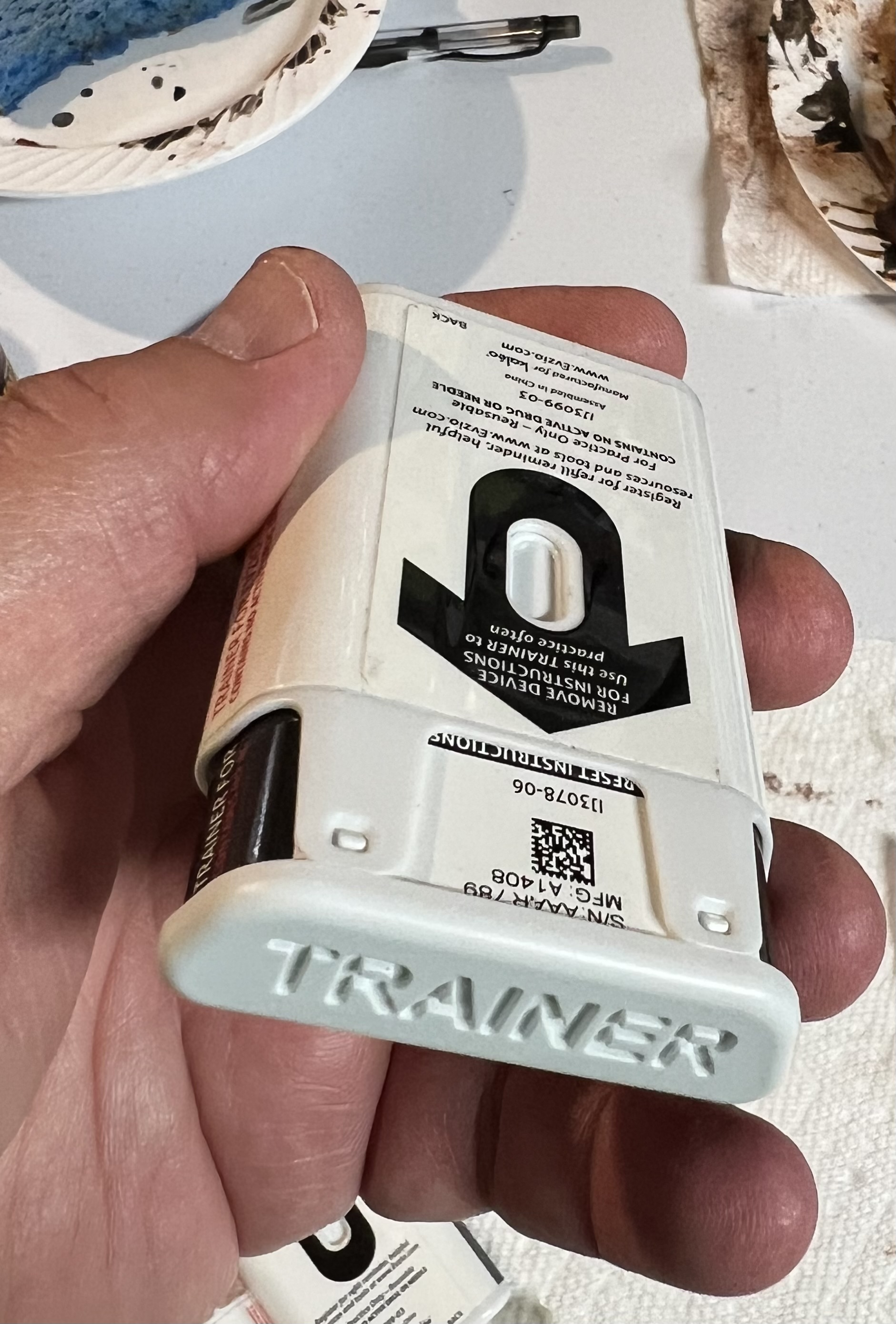
I’ve been retired now since 2019. I got laid off of my last job when the company I was working for pulled the product line off the market. Never found a replacement gig. Back to the product I was selling – it was a pharmaceutical autoinjector device. We had dozens of electronic trainer devices we handed out to potential customers. These trainers acted like the real thing except without any needles or drug inside. After the layoff happened, I had a bunch of them, and was told by my former employer to just throw them away. They had a unique shape, like a cross between a card deck and a tapered brick. The outer layer was plastic, with a label glued on to it. I was running retro sci-fi games, and thought these would be good for making walls. I saved them, and they waited to fulfill their destiny until December 2025!
An example of the trainer.
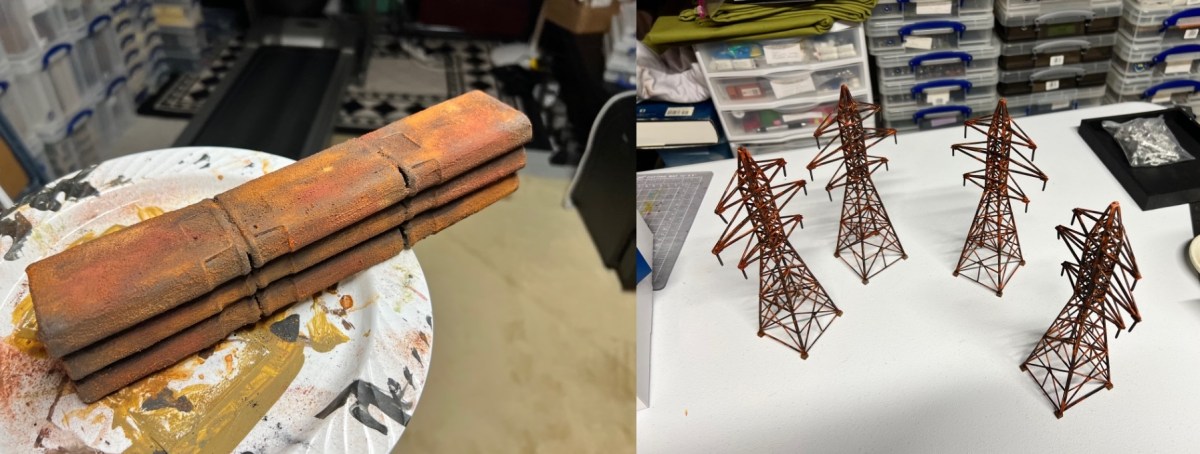
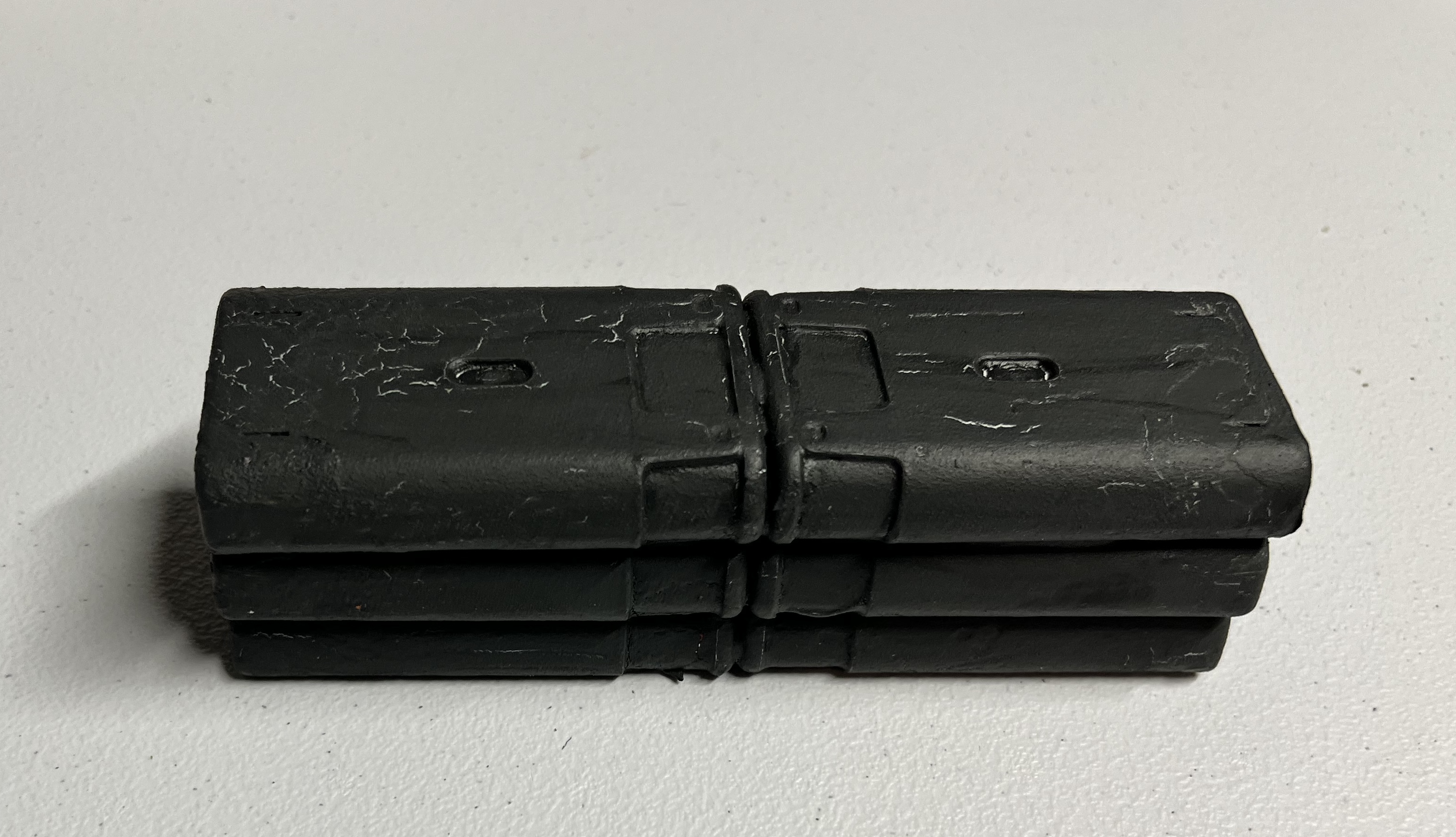
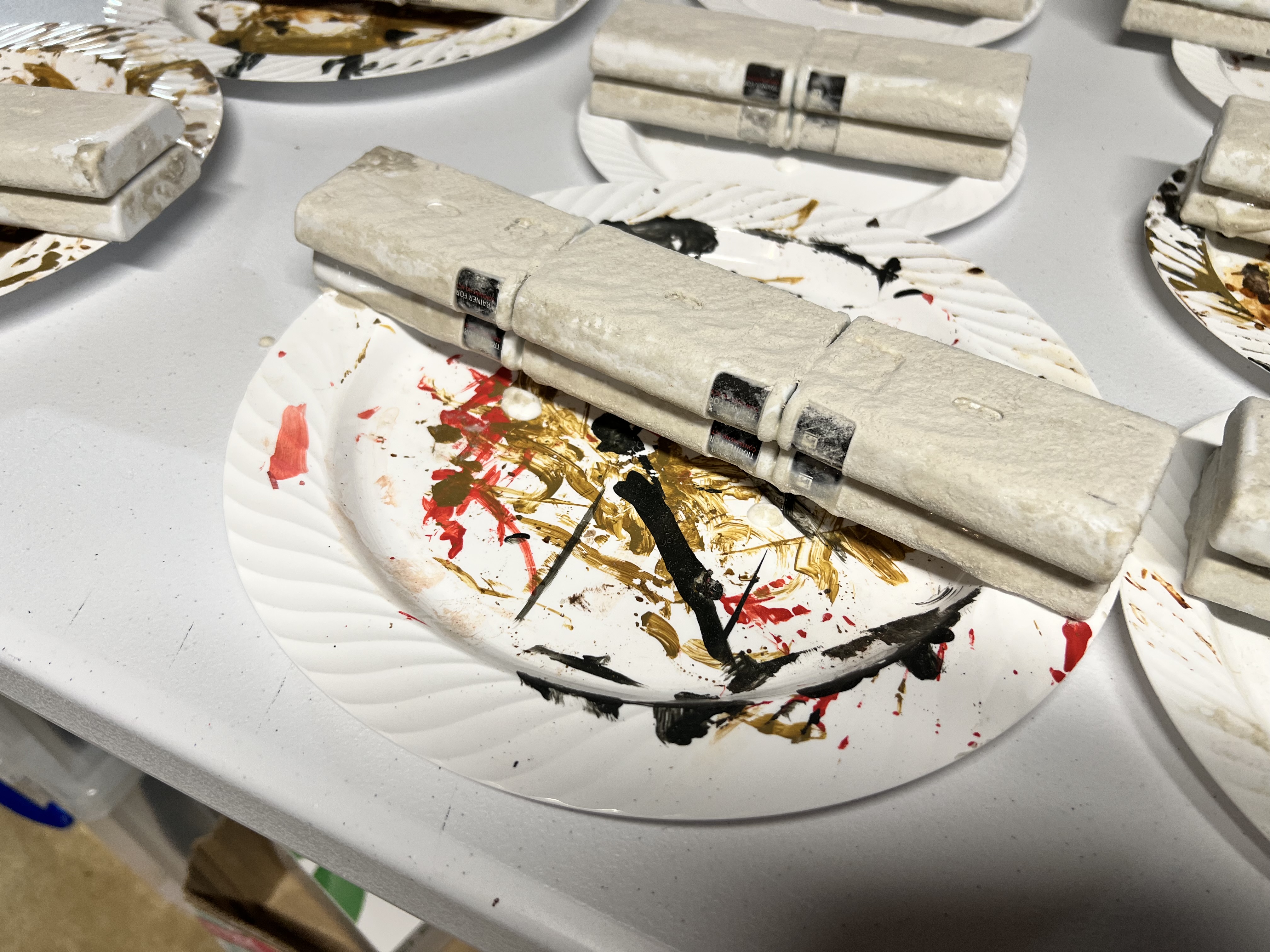
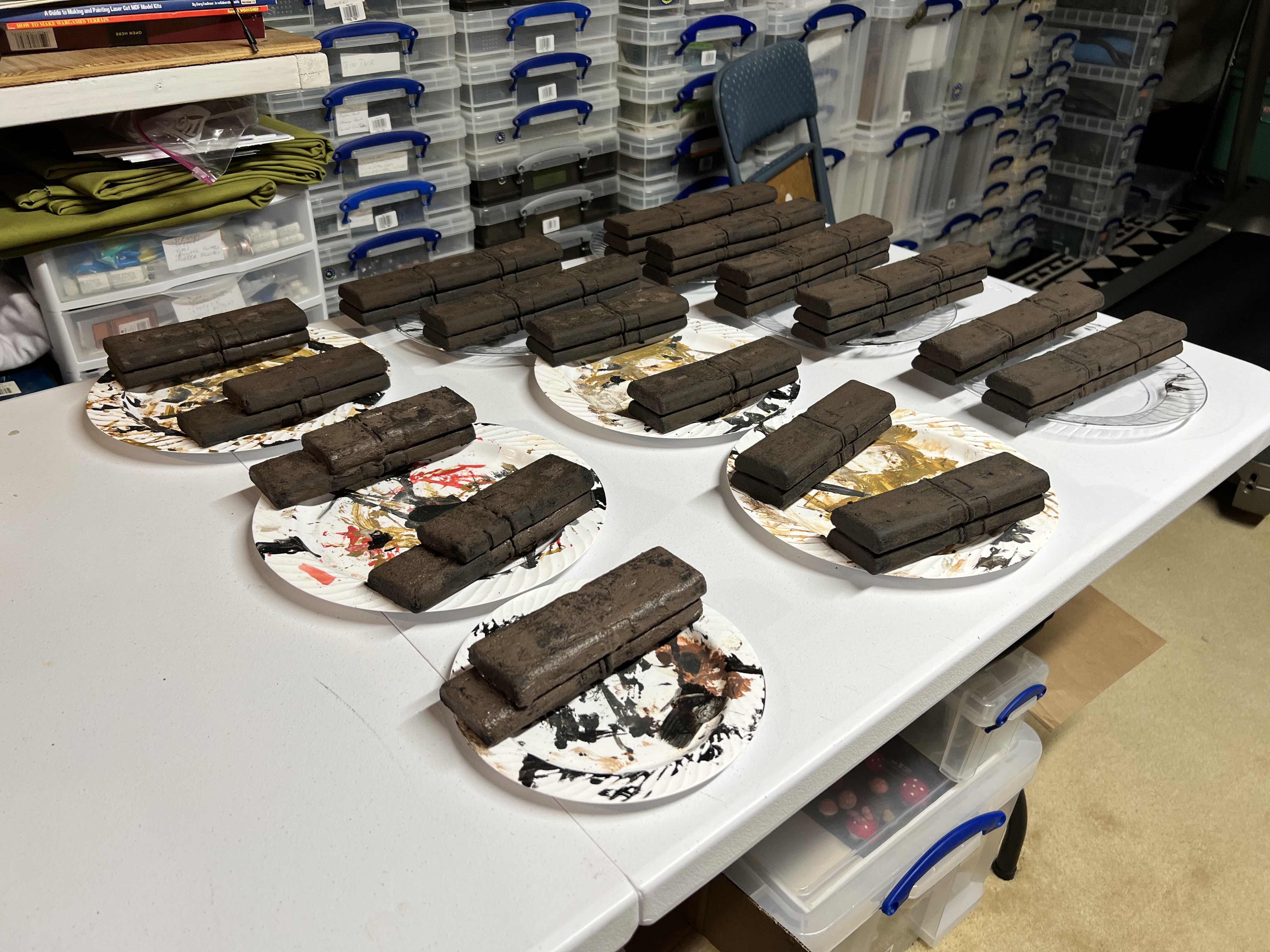
To make sure what I wanted to do would work (and to learn from any errors), I went with a prototype. I used an Exacto blade to remove the outer label. Then, I sanded the exterior to make it rough. To attach multiple units together, green stuff was the solution. After that hardened, I coated the outside of the attached trainers with PVA – followed by a dusting of chinchilla dust on the glue. When that combination had hardened, I primed the combinations with black primer.
First prototype primed.
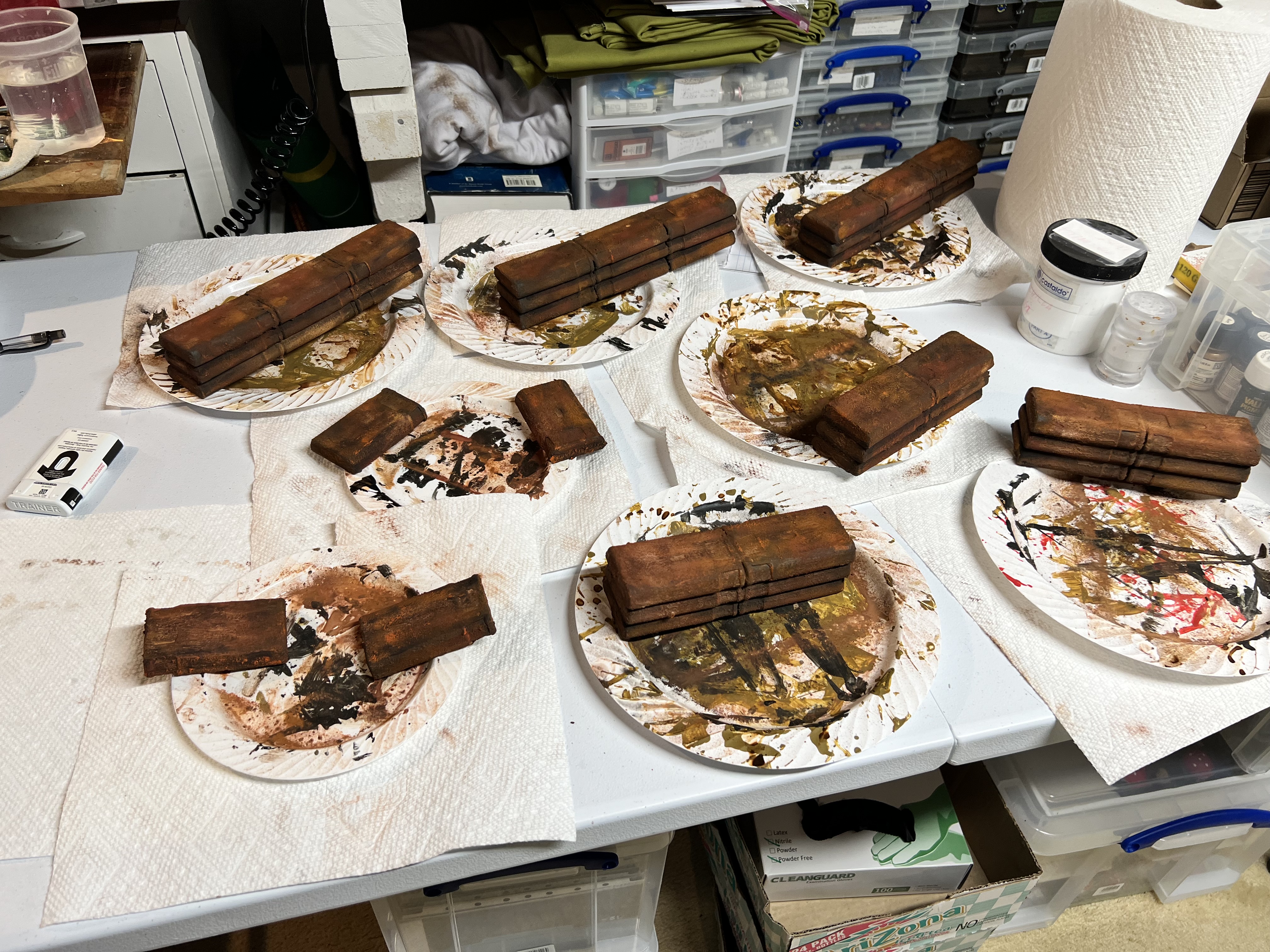
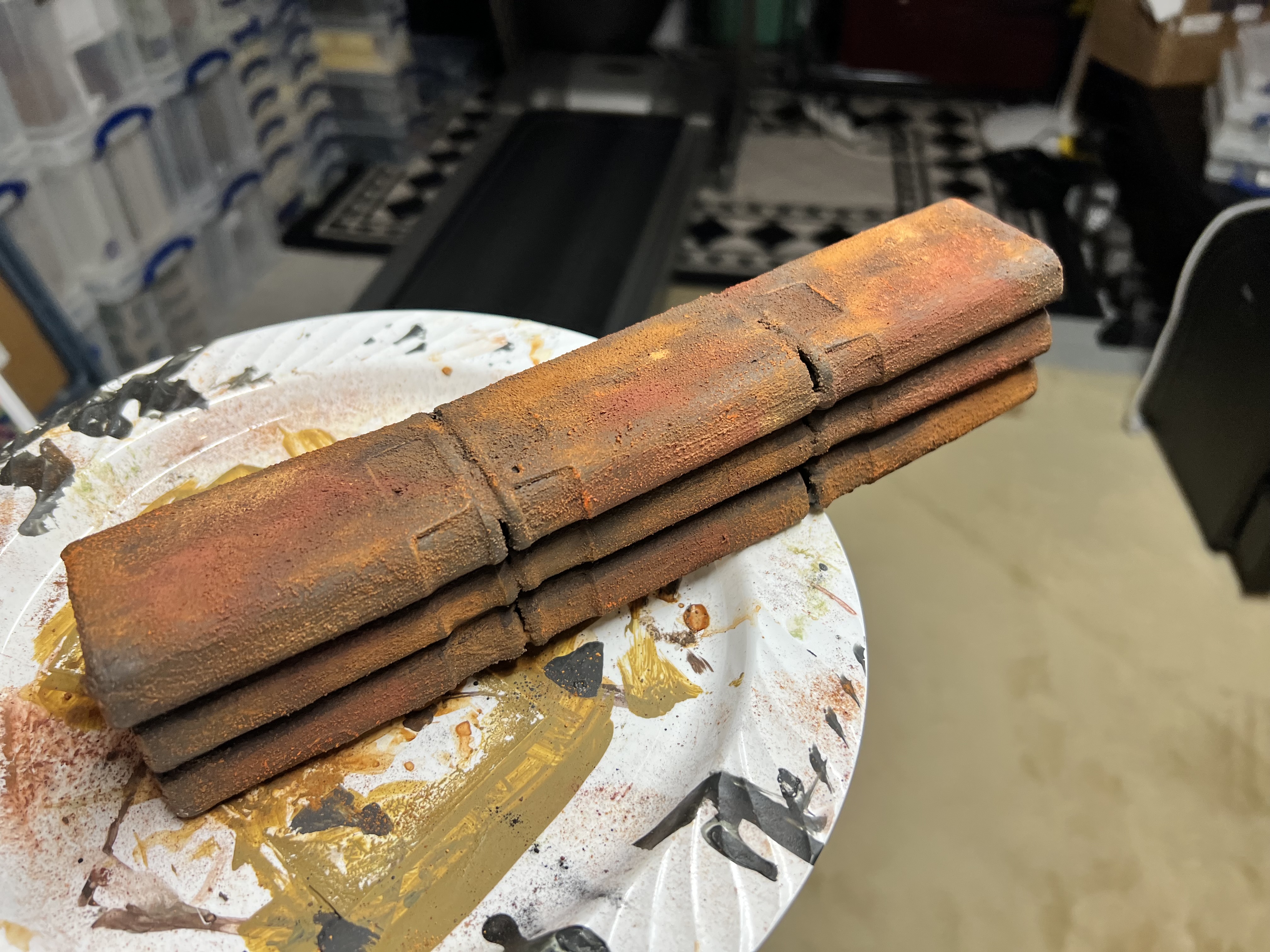
From this point, I used corrosion texture paint(let that harden), then used a number of rusting paints and pigments. I really liked the results and moved on to making two large batches of different combinations.
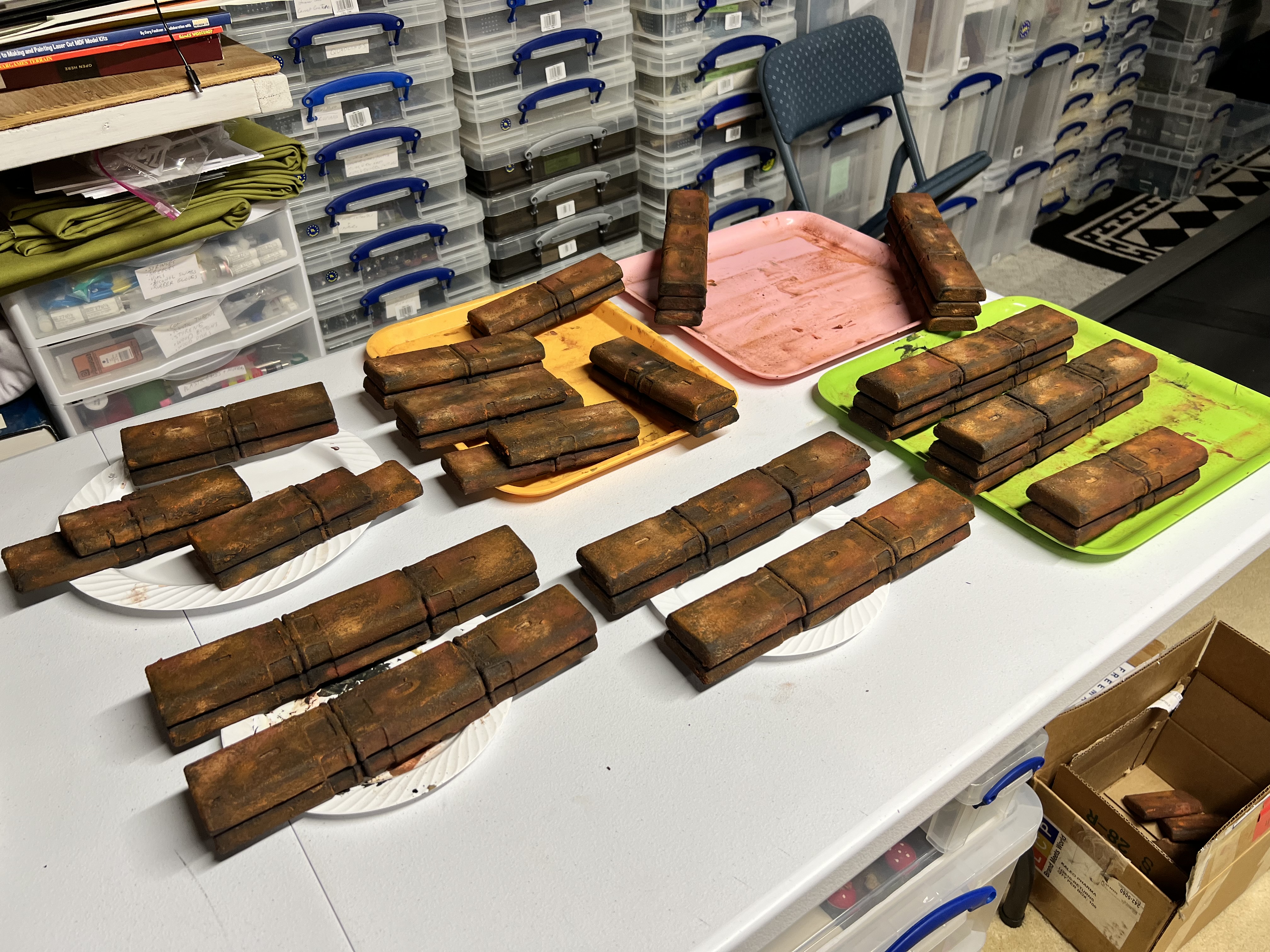
Walls after labels removed and sanded.PVA and chinchilla dust application.Corrosion texture paint applied and drying.First half-batch of walls after being rusted up.Close up shot of a 3×3 combination.Second half batch done.
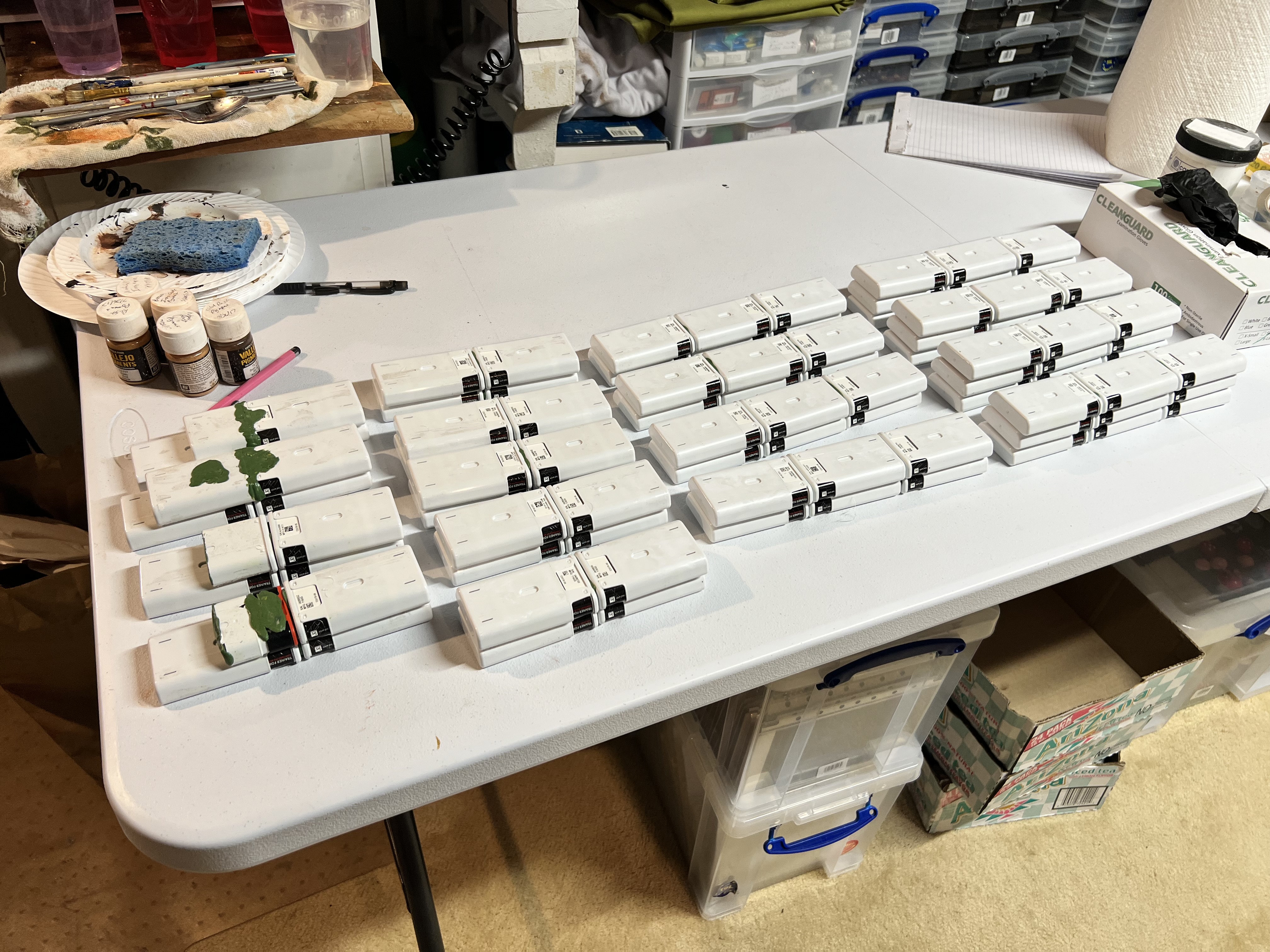
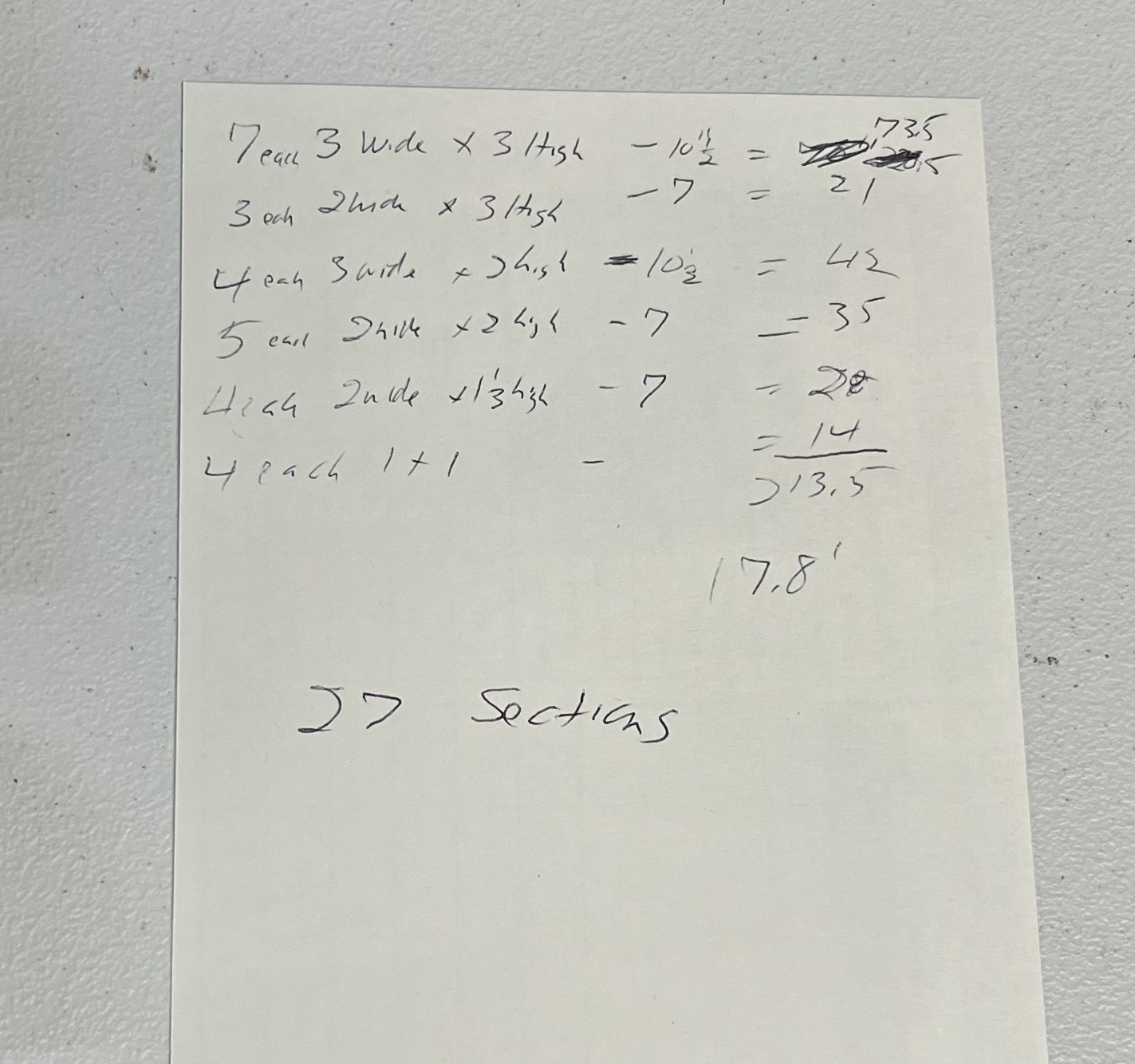
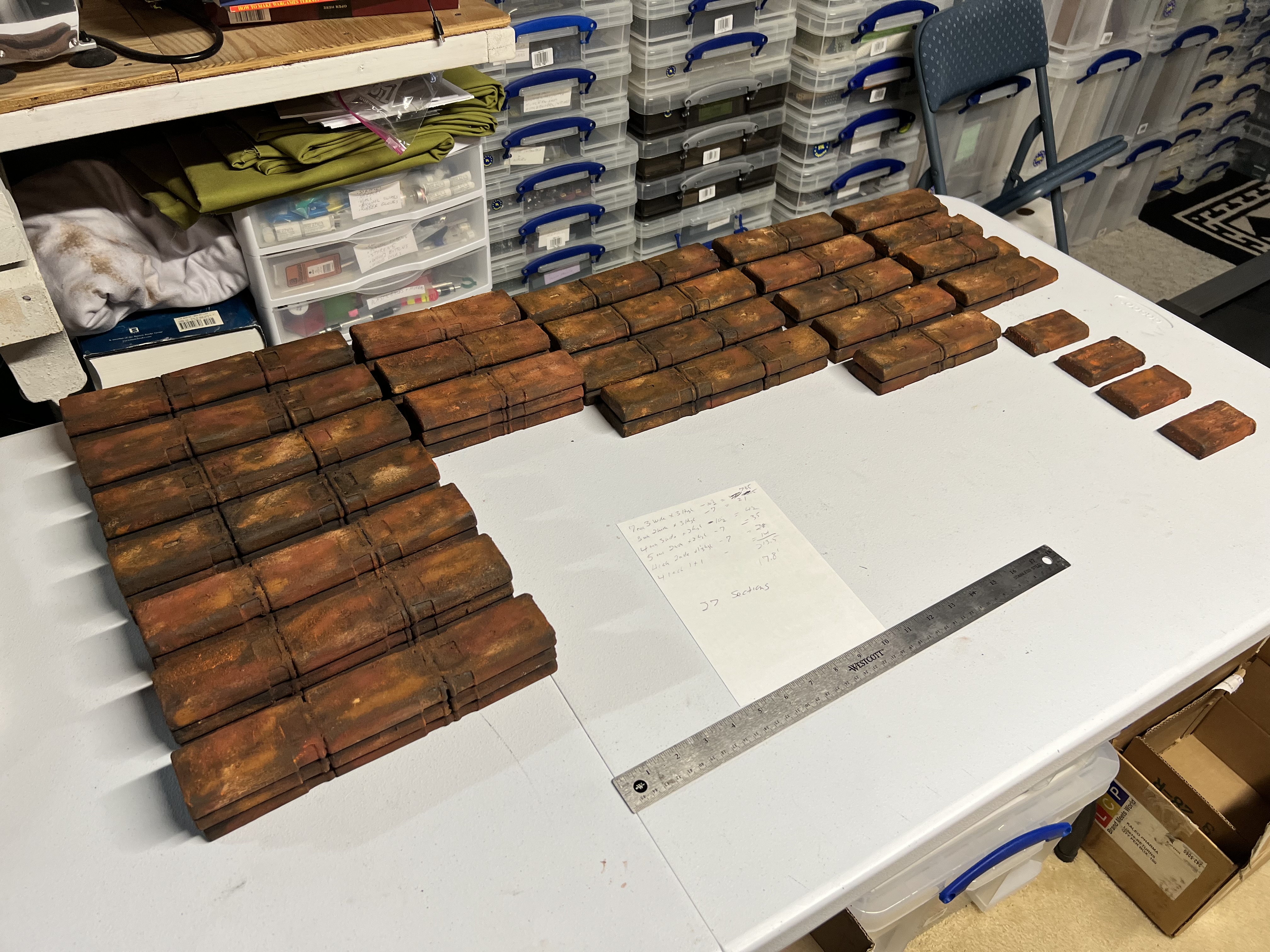
I ended up with 27 sections = a total of 17.8′ worth of rusty wall.
And here they are in total finished up mid-December.:
27 sections of rusty walls!
With the walls done, it was time to get some verticality for the tabletop. And get them done BEFORE Christmas.
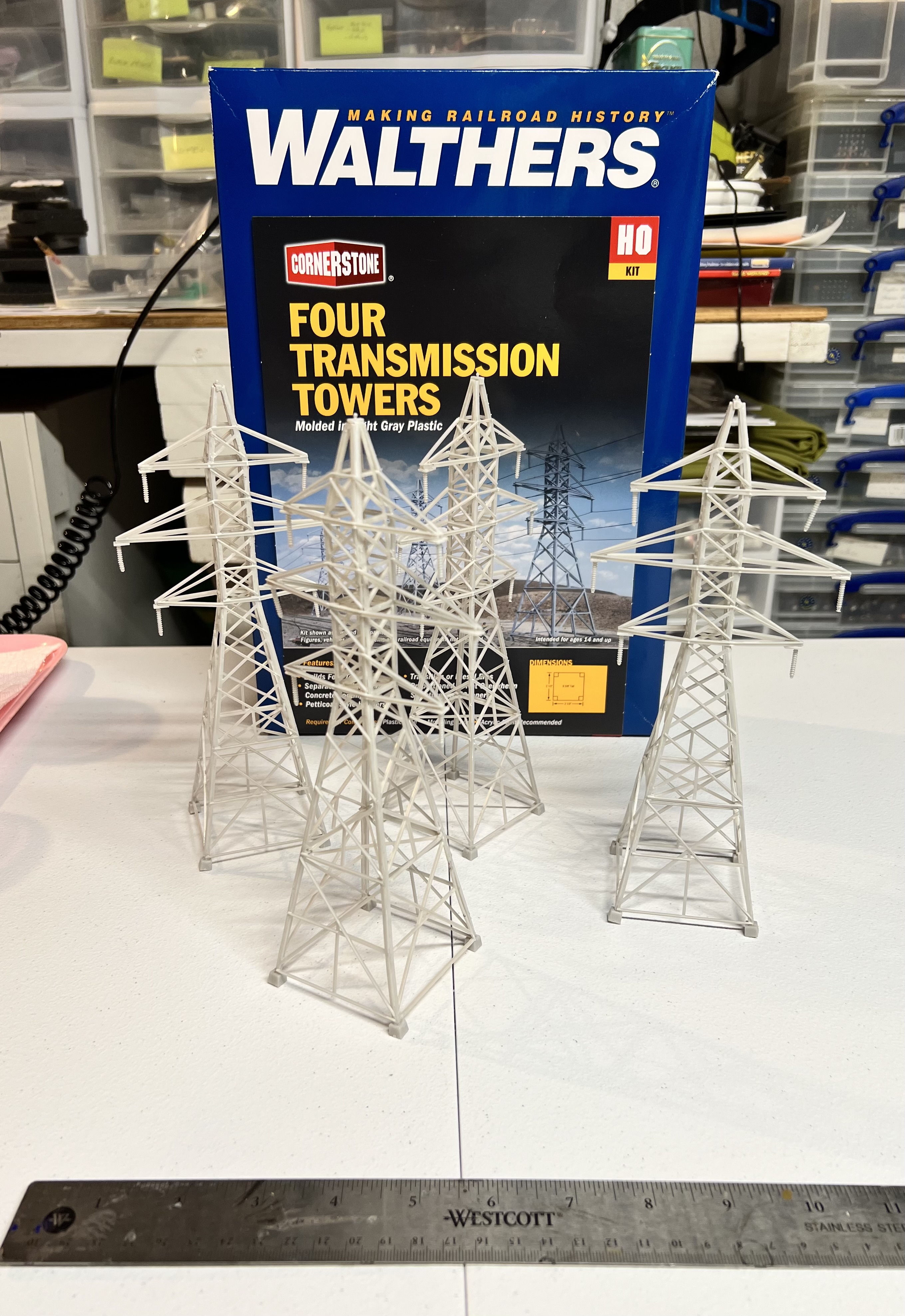
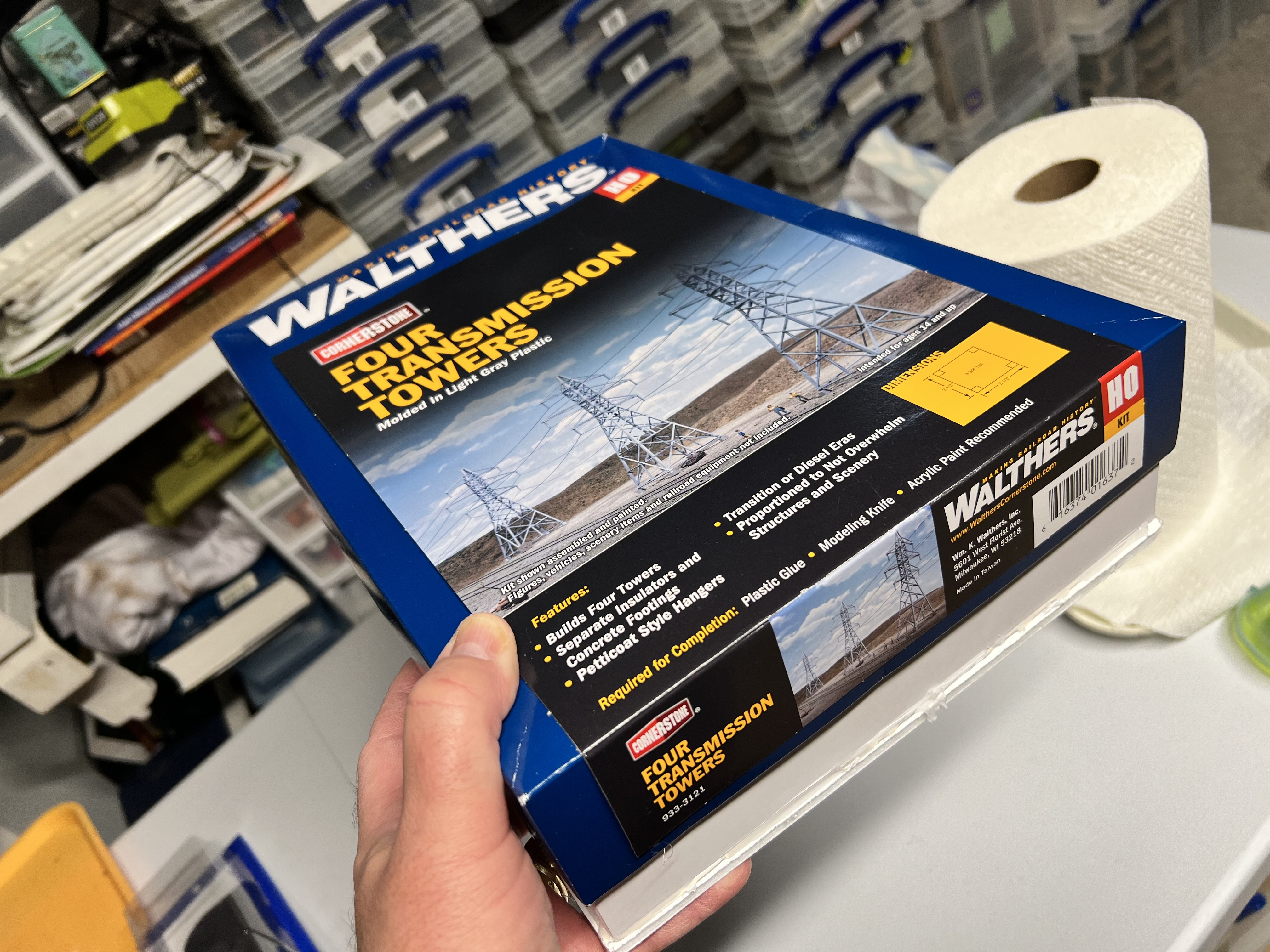
I thought transmission towers – rusty ones – would be great in that role. I found a railroad terrain kit on eBay. It was HO scale. It would go well with the other pieces of rusty fun. These were “Walther’s Cornerstone Four Transmission Towers”.
The transmission towers kit.
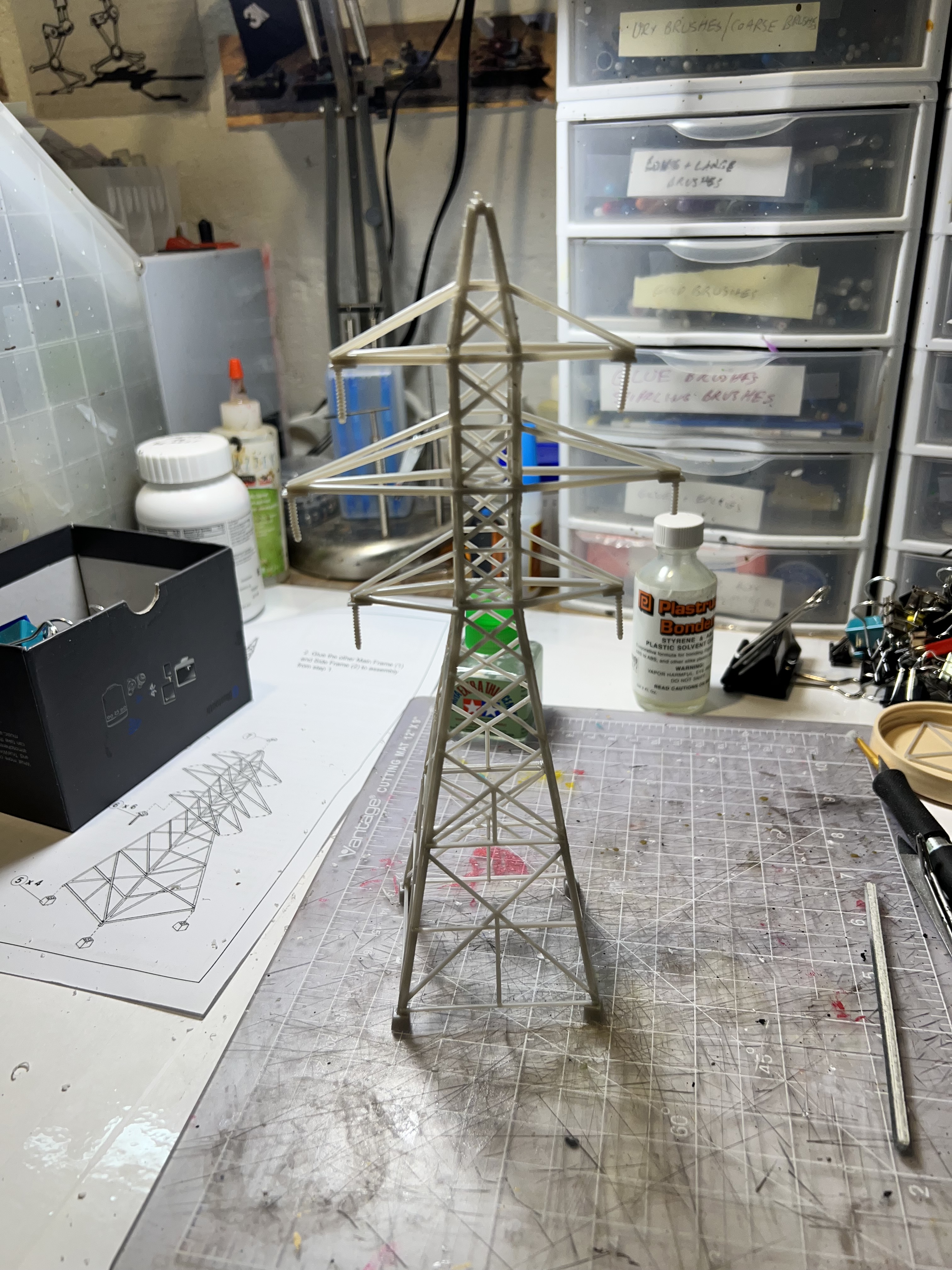
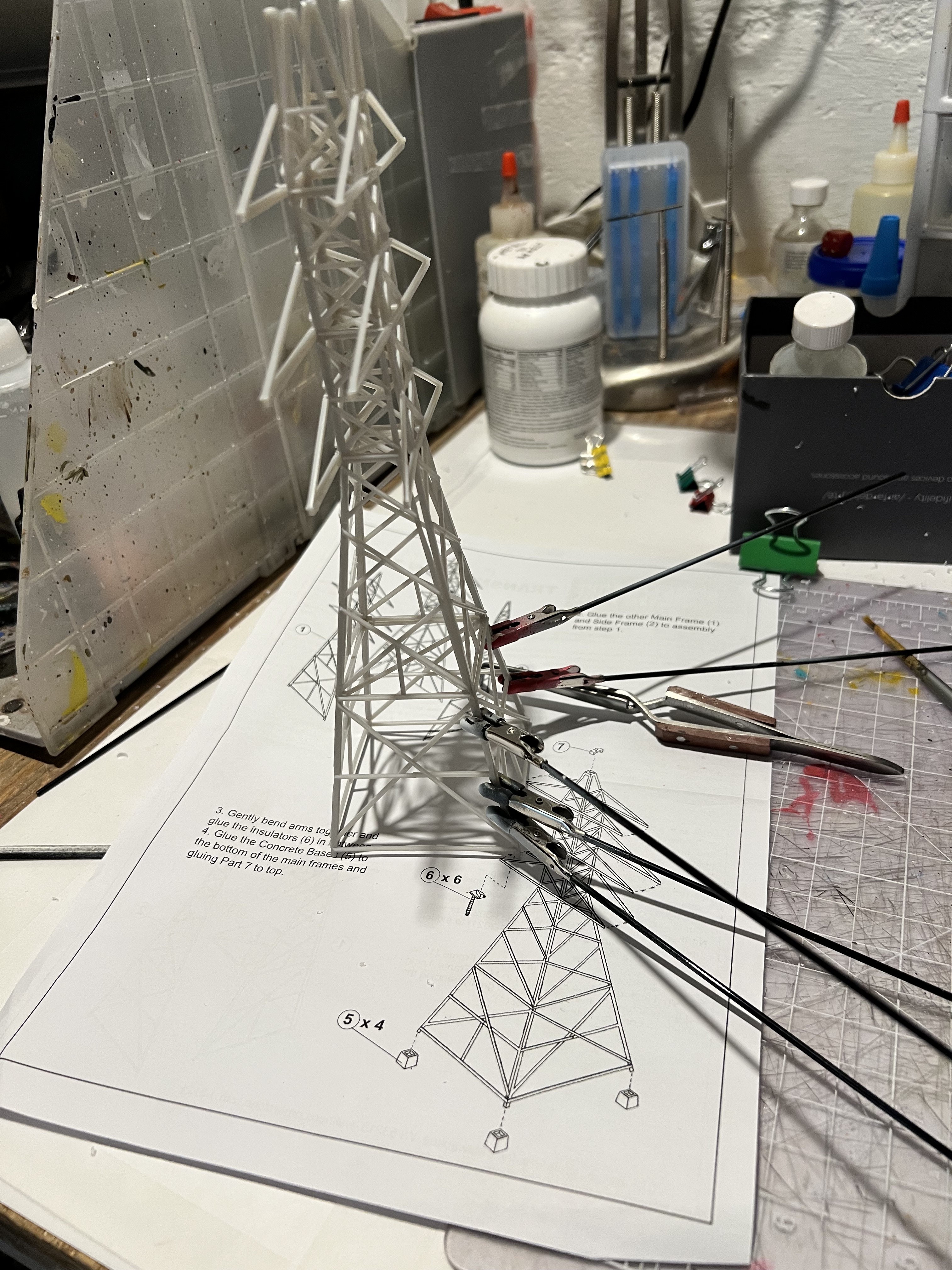
Assembly was a bit fiddly but manageable. It was not immediately clear to me which sides were front or back – but by the fourth iteration I got it down. Luckily, plastic cement covers any mistakes in assemble. I did find using rubber-shoed alligator clips to hold sections together while the cement set to be VERY helpful.
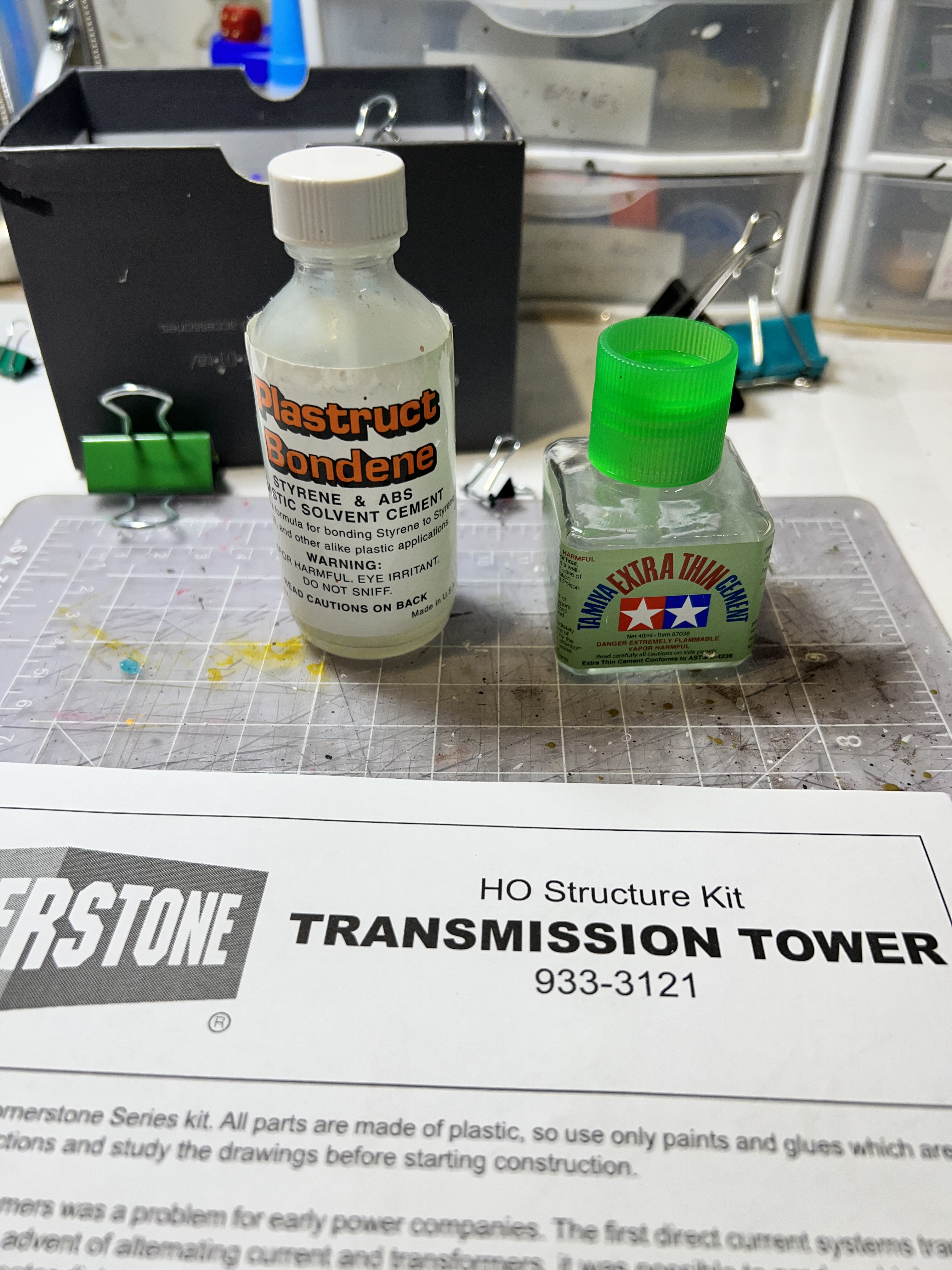
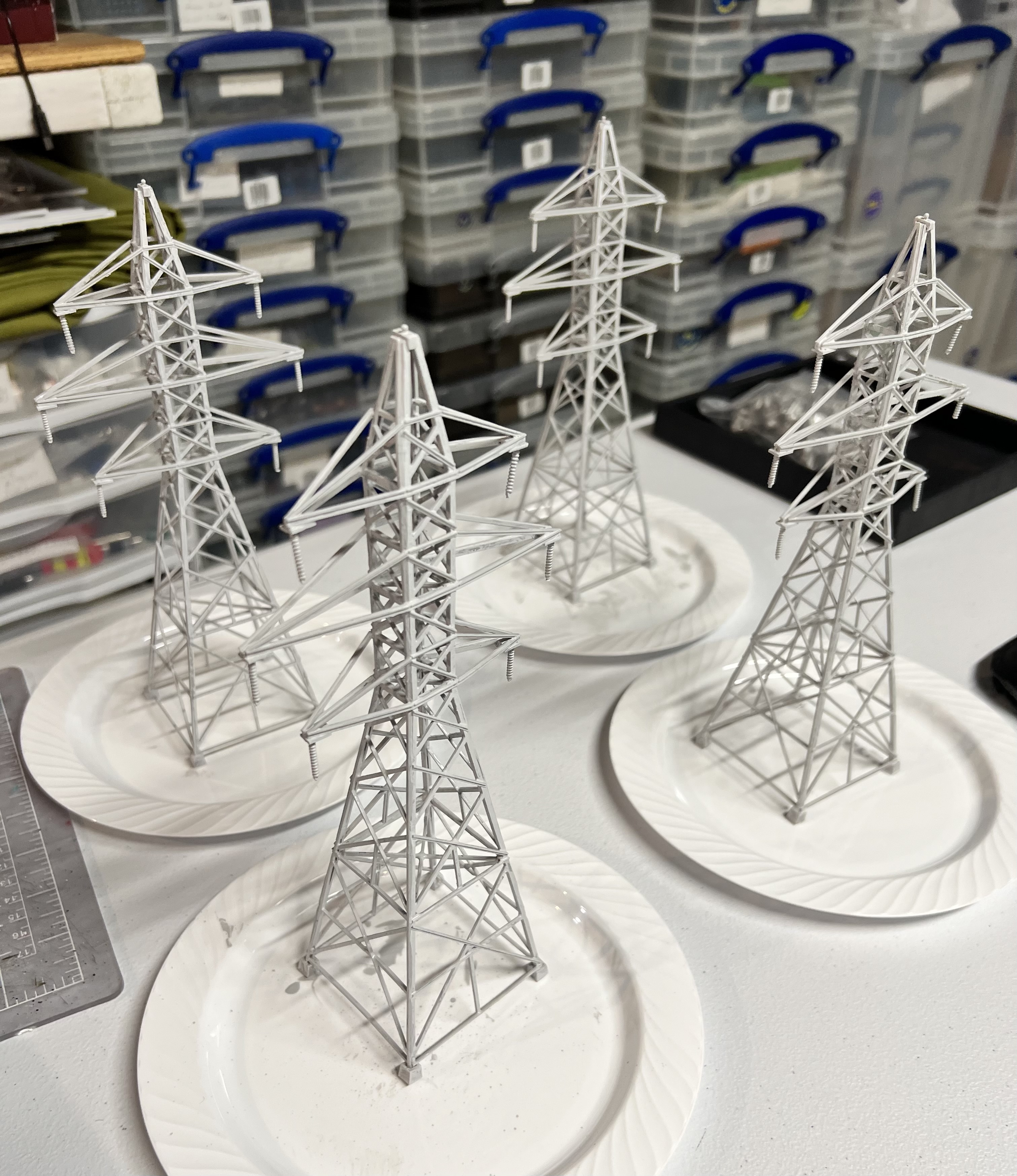
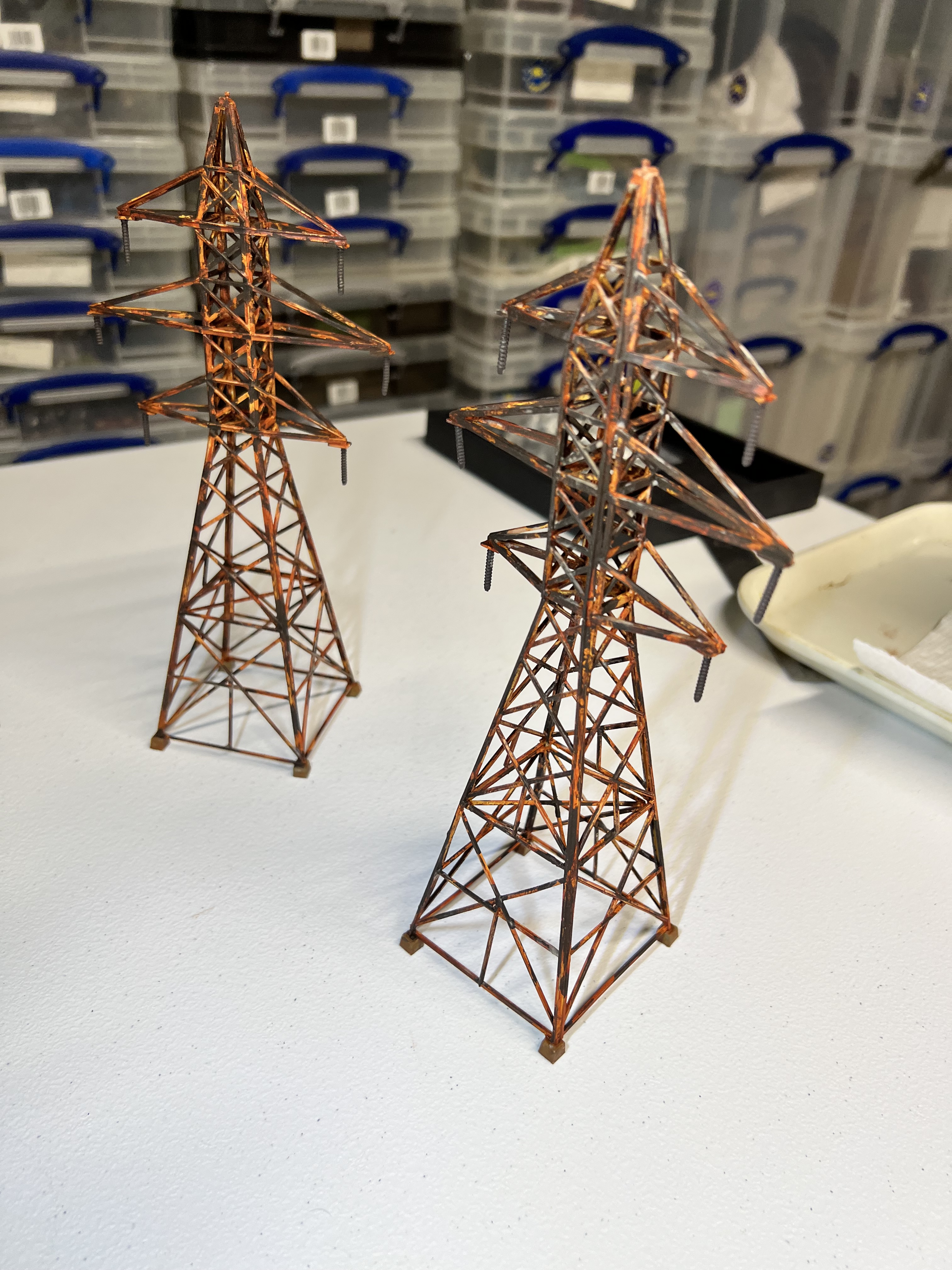
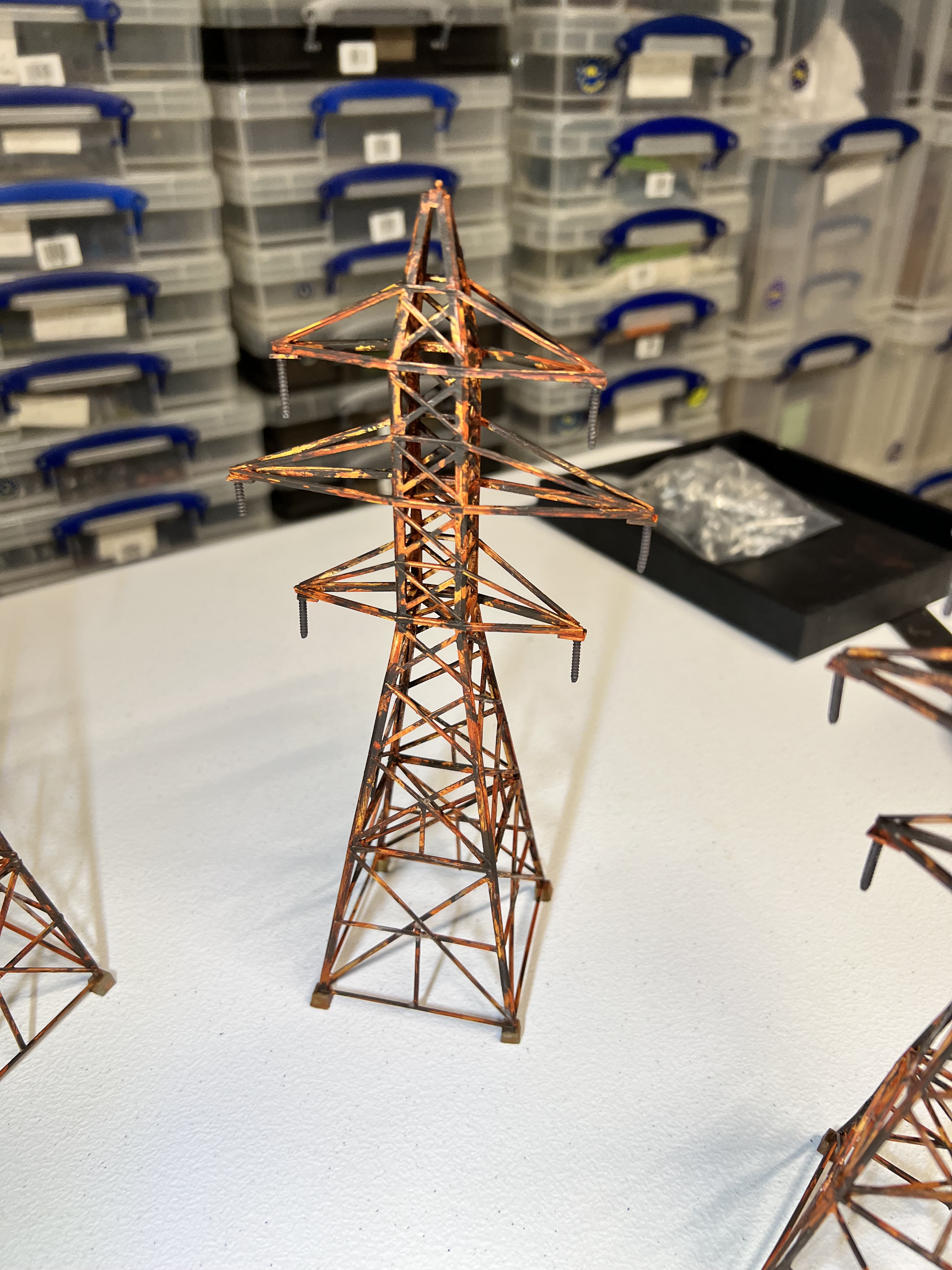
The first assembly went smoothly……the second was off (again figuring out which side went where was a bit confusing). Alligator clips to the rescue!All four assembled.The cements I used.The towers primed in grey.
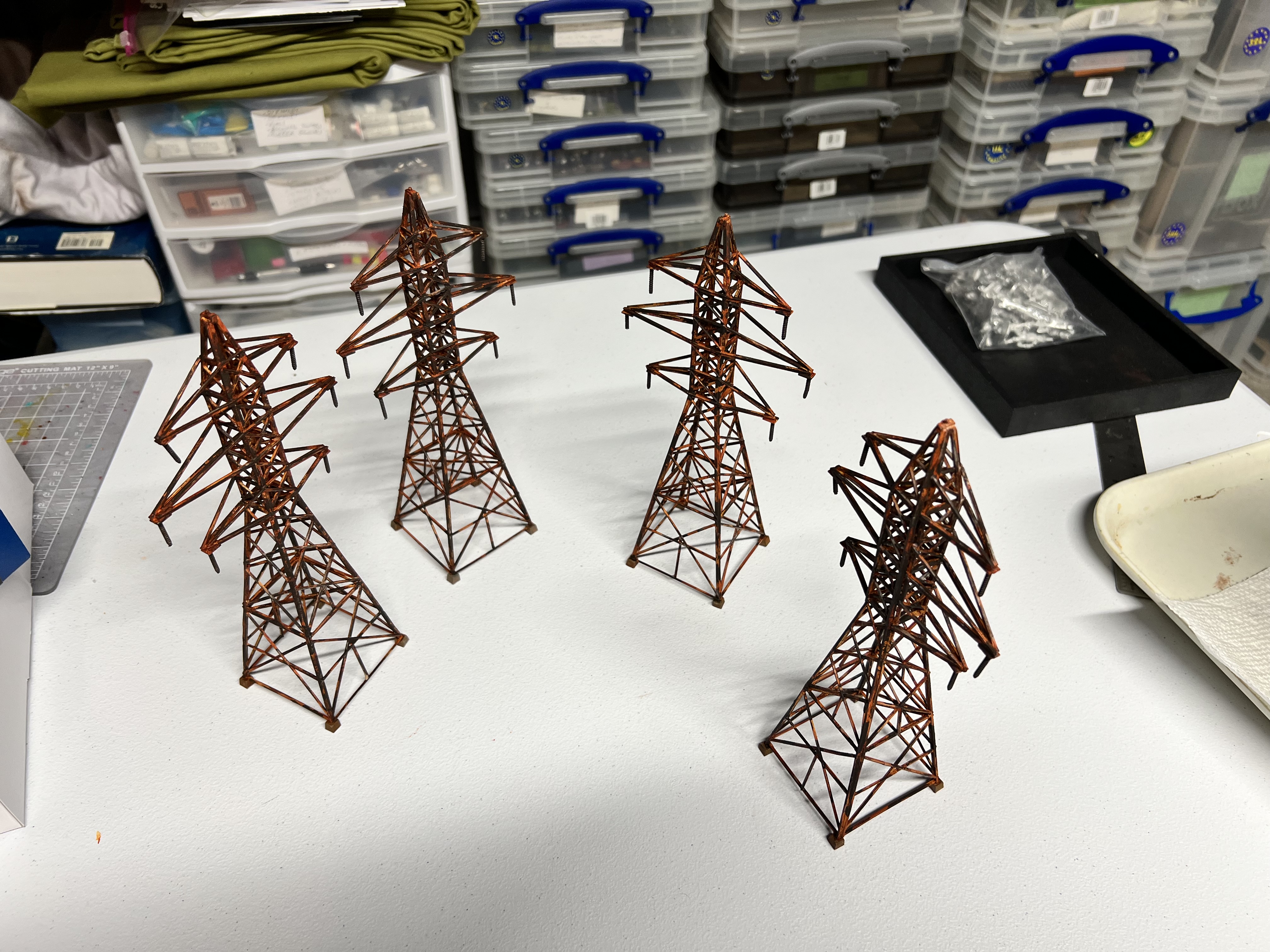
Rusting them up was similar to the walls – basically minus the use of the corrosion texture paint. The lists of what I used for these and the walls will be listed at the end of this post.
Rusted up!Close up shot of two.View of one from a slightly different angle.
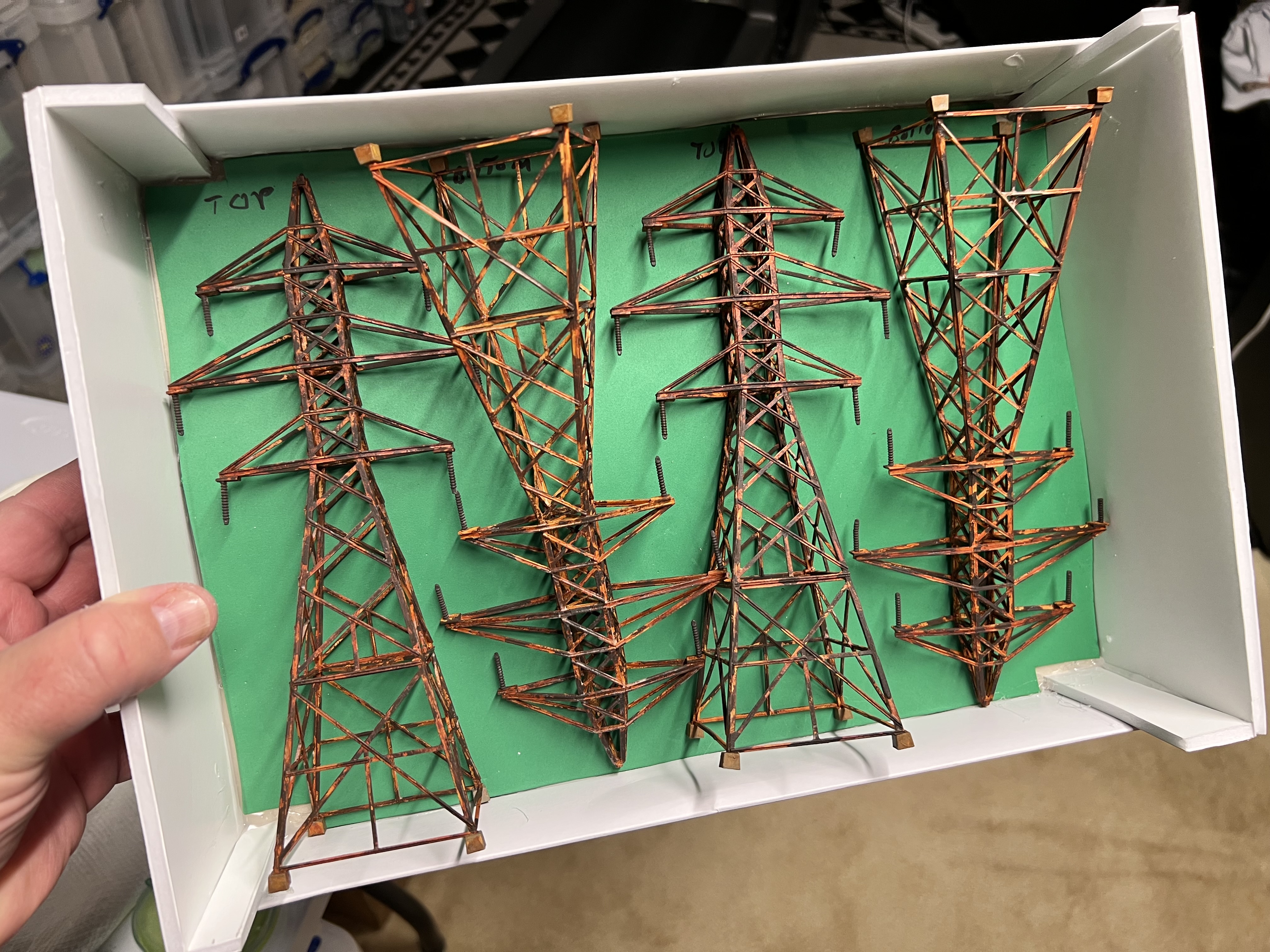
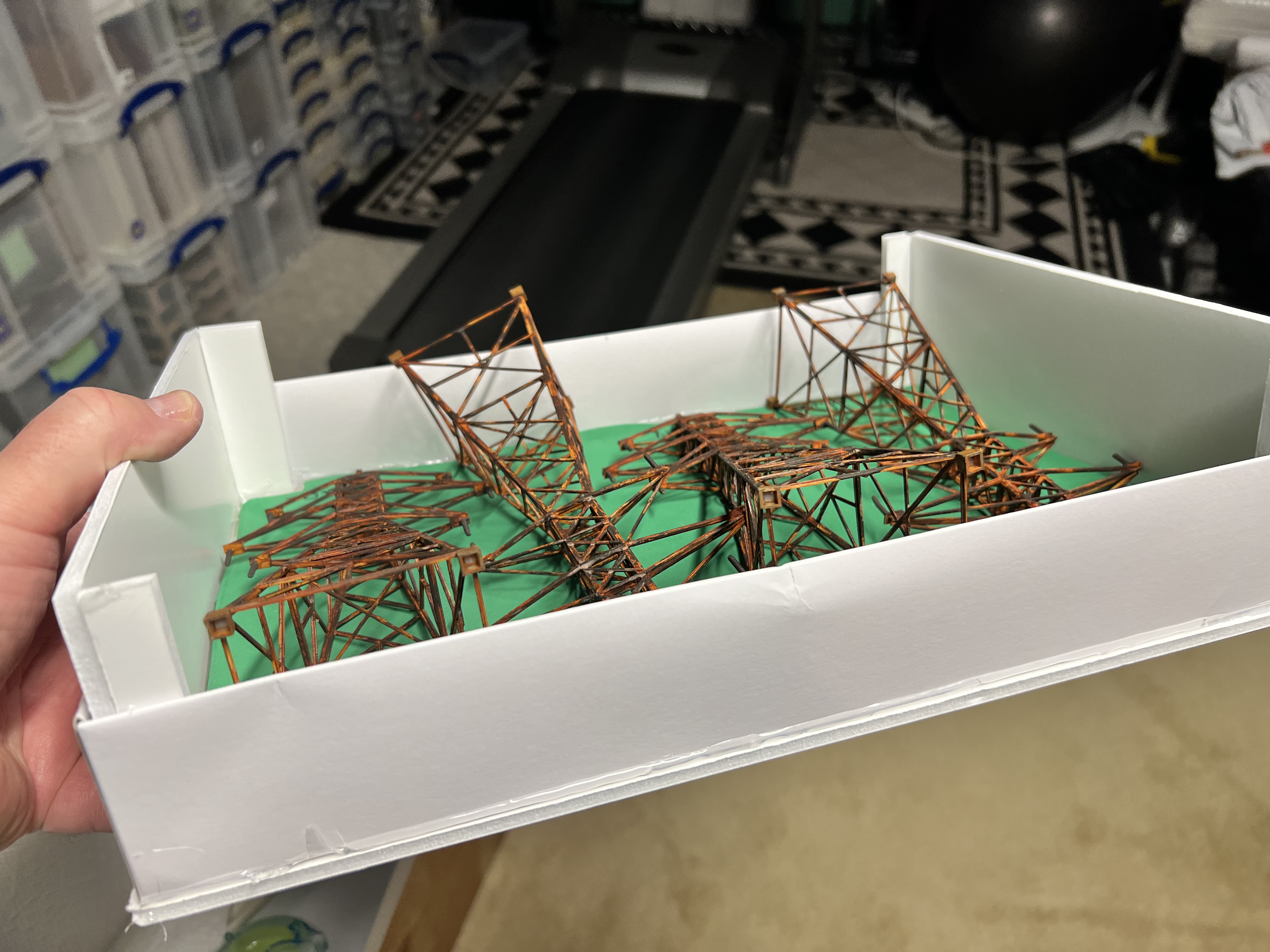
As you can see these are just plastic models and vulnerable to damage in transport! Unlike the walls, which went into a cardboard wine bottle box with some foam padding between levels, these needed a sturdy solution. They required something strong. I decided to modify the original box to accommodate the greater height needed when the models were lying down. I used more foam padding on the box bottom, and foam board to extend and strengthen the box as you see below:
Top view of the original box modifications with a sheet of green foam padding on the bottom. The sides and corners were reinforced by adding foam board set with hot glue on the insides.Side view – here you see the added height with the foam board.The original box top fit like a glove – and is significantly stronger than its original configuration.
That’s about it for this rusty old post. I hope it inspired you to rust up some stuff yourself!
As I teased, I will be sharing how these fit into both of the tabletop set ups for 2026. I’ll also be sharing some of the new 2026 units of mechanical tin men that will find these structures as part of their apocalyptic homes. Until next time.
For all of my previous posts on terrain projects, please see this page. For all of my previous posts on sci-fi projects, please see this page…for any of my previous posts on Wars of Ozz, see this page.
PAINTS, INKS, GLAZES, SHADES, WASHES, PIGMENTS, FLOCKING, GLUES AND MORE THAT I USED ON THE RUSTY WALLS PIECES:
Old autoinjector trainers
Green stuff
Chinchilla dust
PVA Glue
Vallejo Surface Primer “Grey”
AK “Corrosion Texture”
Citadel “Typhus Corrosion” (Technical)
Citadel “Ryza Rust” (Dry)
Vallejo “Old Rust” (pigment)
Vallejo “Brown Iron Oxide” (pigment)
Vallejo “Natural Iron Oxide” (pigment)
Vallejo Model Air “Rust 73.117” (pigment)
Vallejo Model Air “New Rust 73.118” (pigment)
Vallejo Thinner
Vallejo Model Color “Dark Rust”
Vallejo “Natural Umber” (pigment)
PAINTS, INKS, GLAZES, SHADES, WASHES, PIGMENTS, FLOCKING, GLUES AND MORE THAT I USED ON THE RUSTY TRANSMISSION TOWER MODELS:
Walther’s Cornerstone Four Transmission Towers (HO Scale)
Way back in July of 2023, I built and painted a “Munchkin Aerostat” for my Wars of Ozz games. It is a special unit that only the Munchkins have. I know that when I have had it on my tabletop it has always grabbed the attention of any passerby. You can see my post on that blue beauty here.
Since golf season ended, I have been preparing for many convention wargames. I will be running WWII (modified What a Tanker games), retro sci-fi skirmish games (using modified Combat Patrol TM WWII rules), and of course games of Wars of Ozz.
For Ozz, this year, I am focusing on the ruined “Robotic Sanctum – a.k.a. The Industrial City” of Professor Nitpik for my scenarios. There Nitpik toils away making armed automatons of tin – (Tin Men) to defend his city from outside raiders. Supposedly he is over 300 years old and the last survivor of “The Last Great War” that brought the post-apocalyptic world of Ozz to be. He guards his secrets jealously from all those who would raid his technological secrets.
With this in mind, my two scenarios involve the Munchkins and some allied troops perpetrating such a raid. One game will have the Munchkins attacking the city. The other will have the Munchkins trying to escape the wrath of Nitpik and escape to home. Oh yeah, the robots are in hot pursuit in game number 2.
These two games will necessitate my building and painting more units and more terrain. I will be sharing those efforts here in the next weeks.
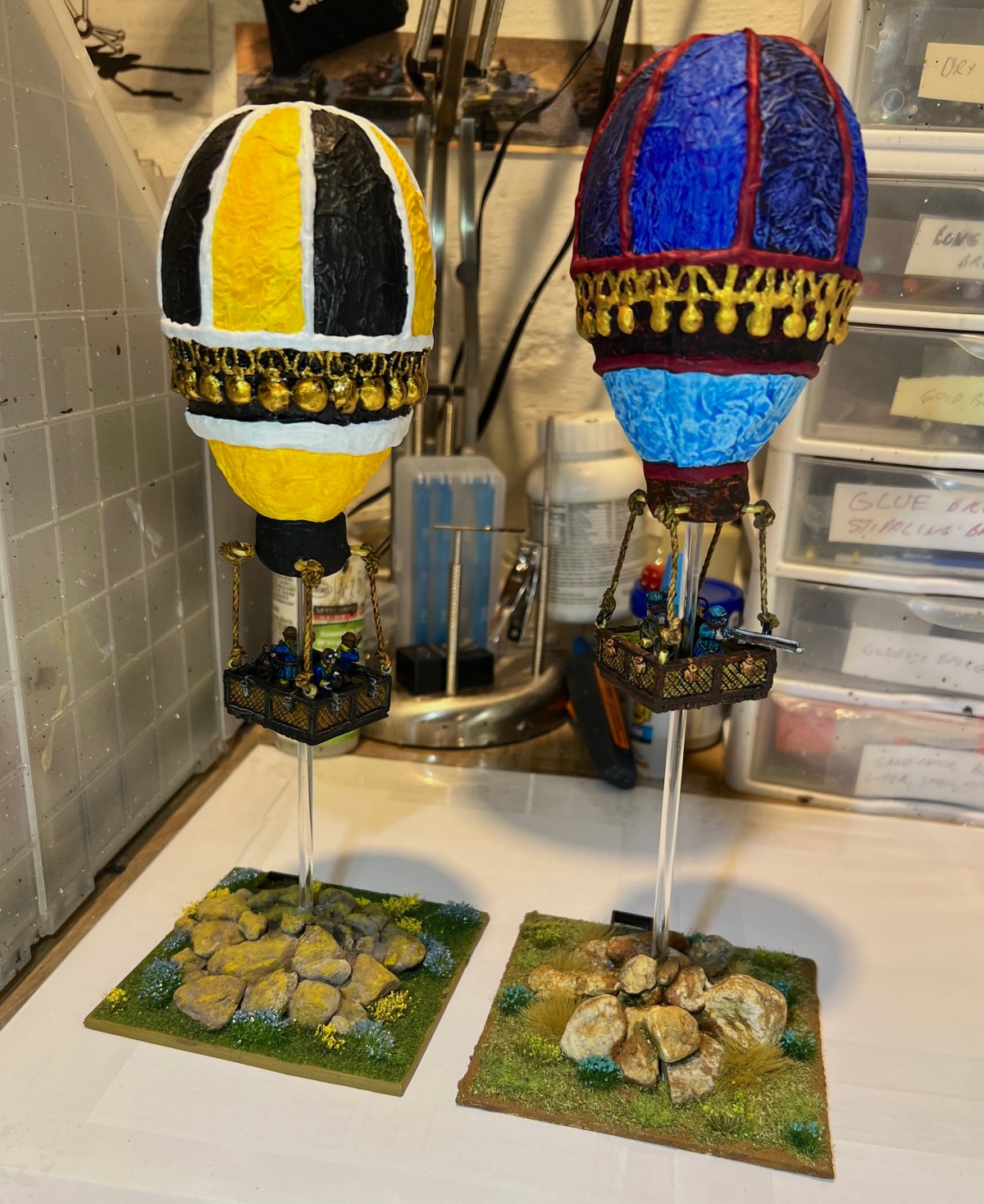
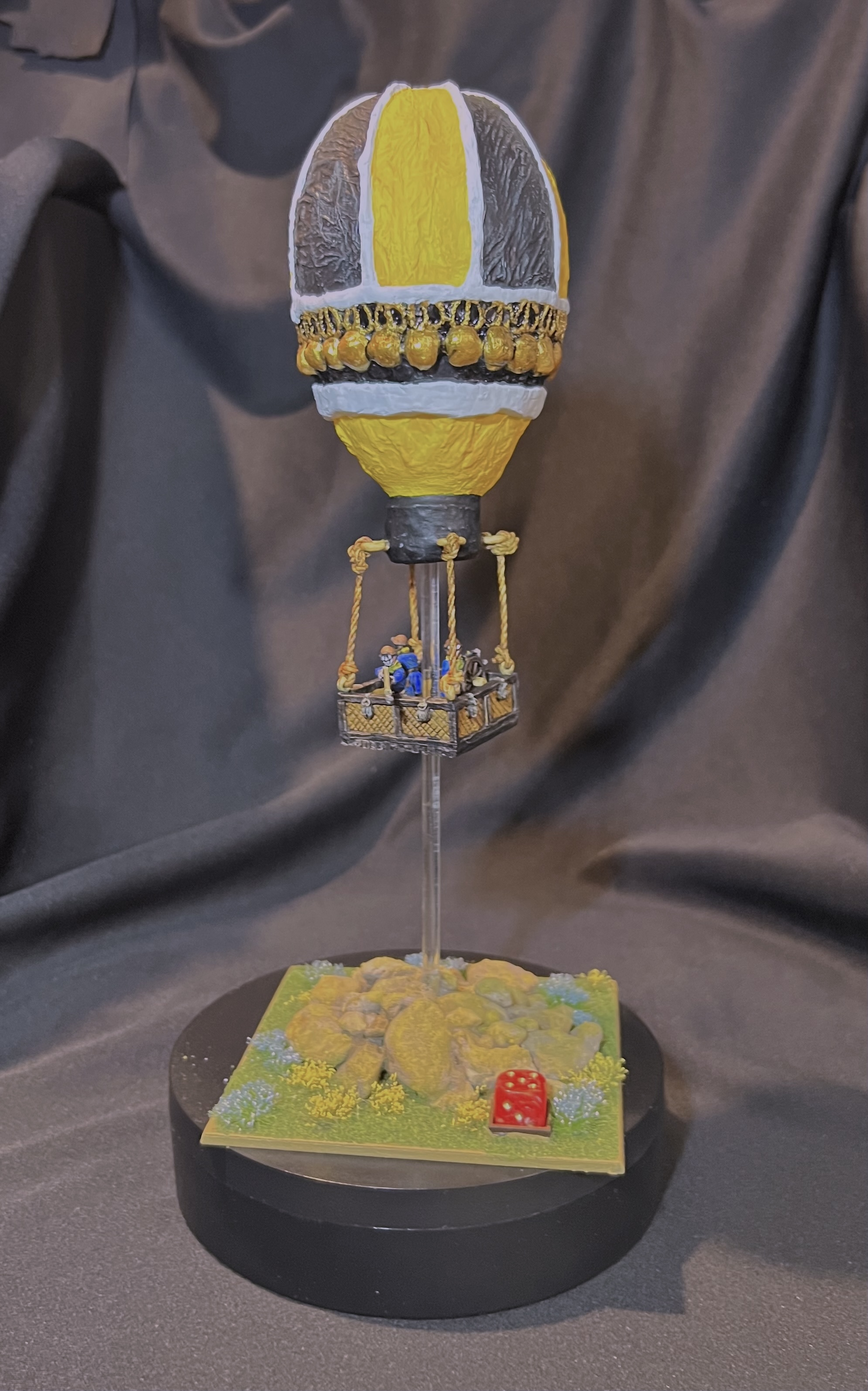
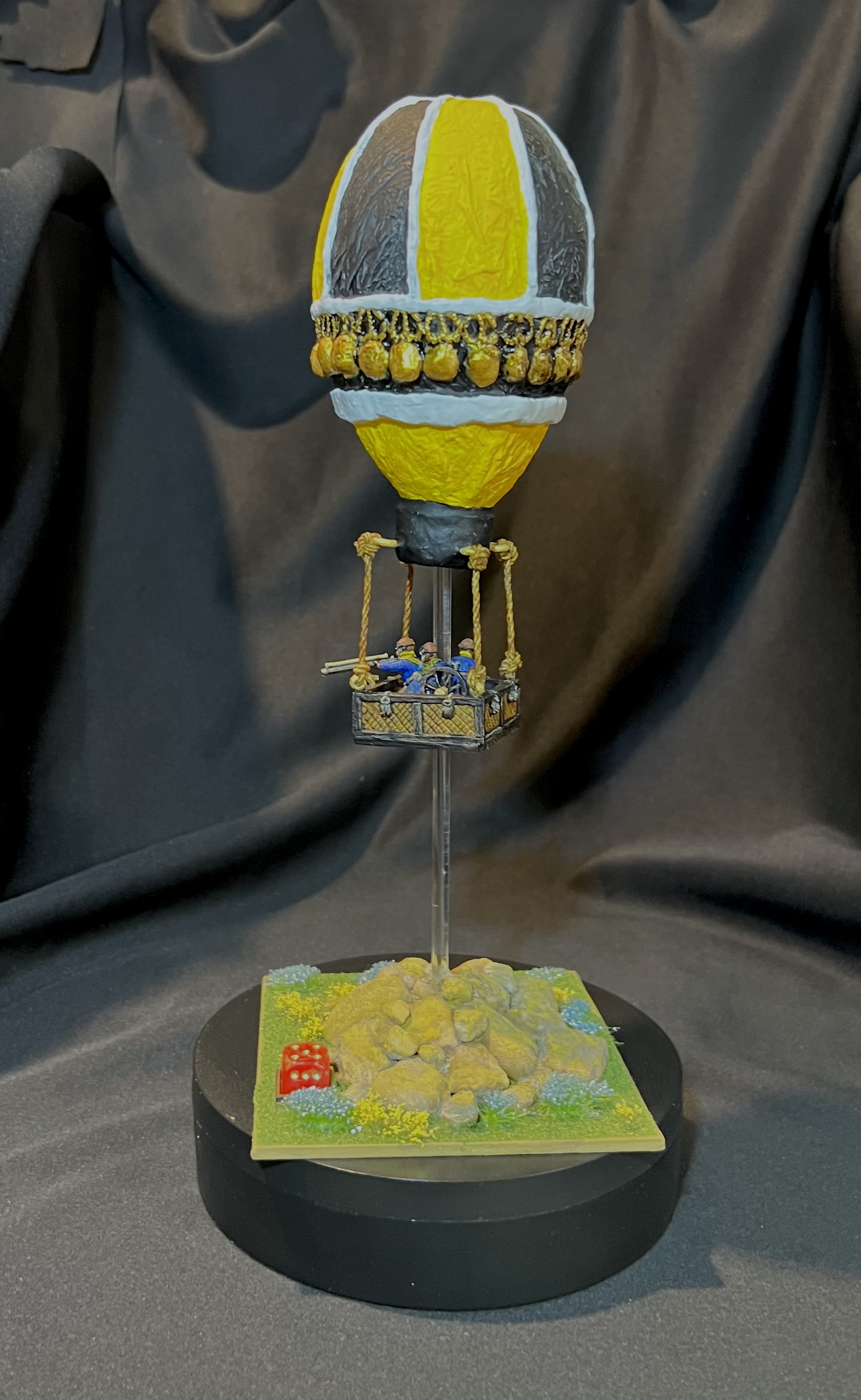
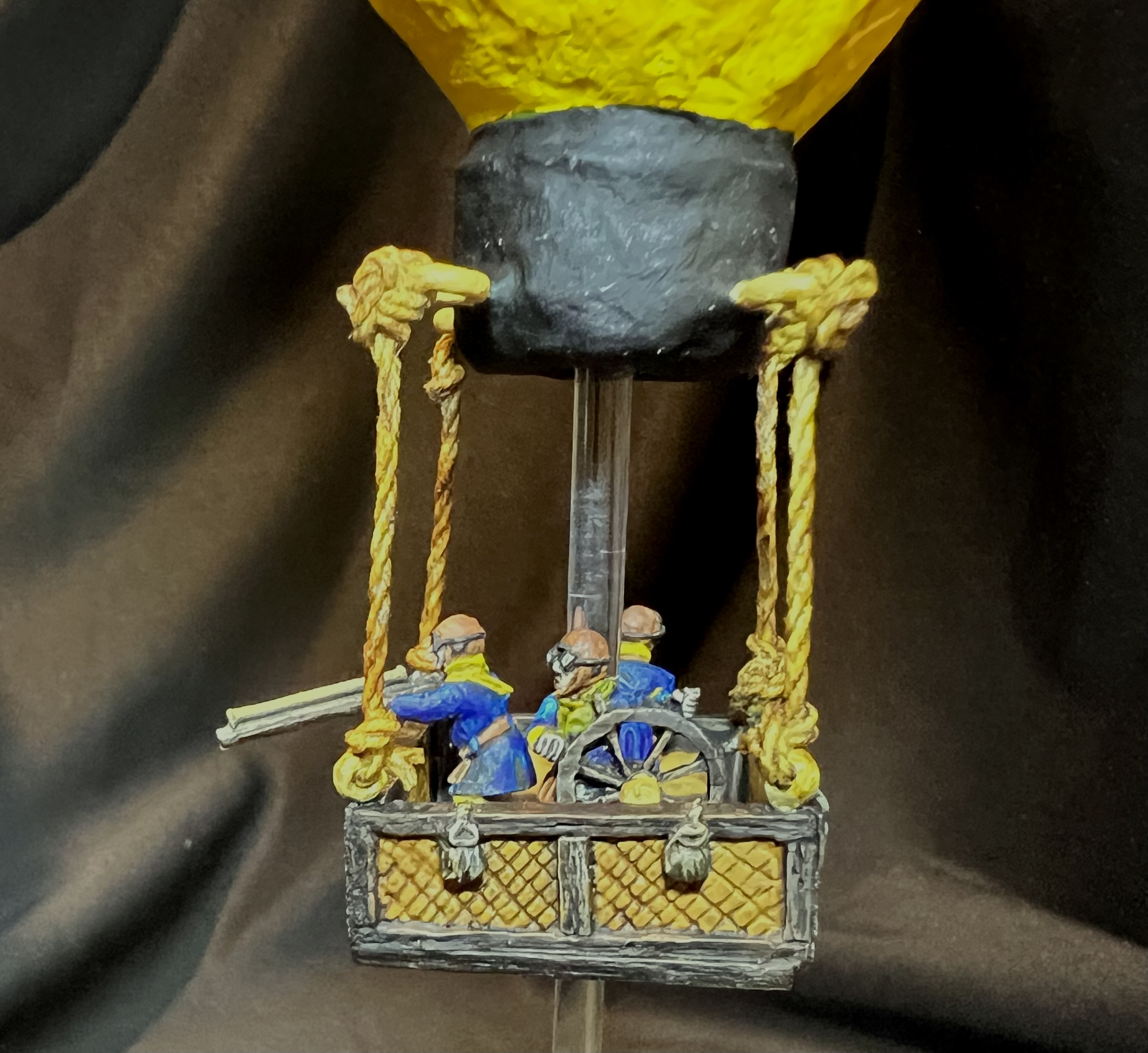
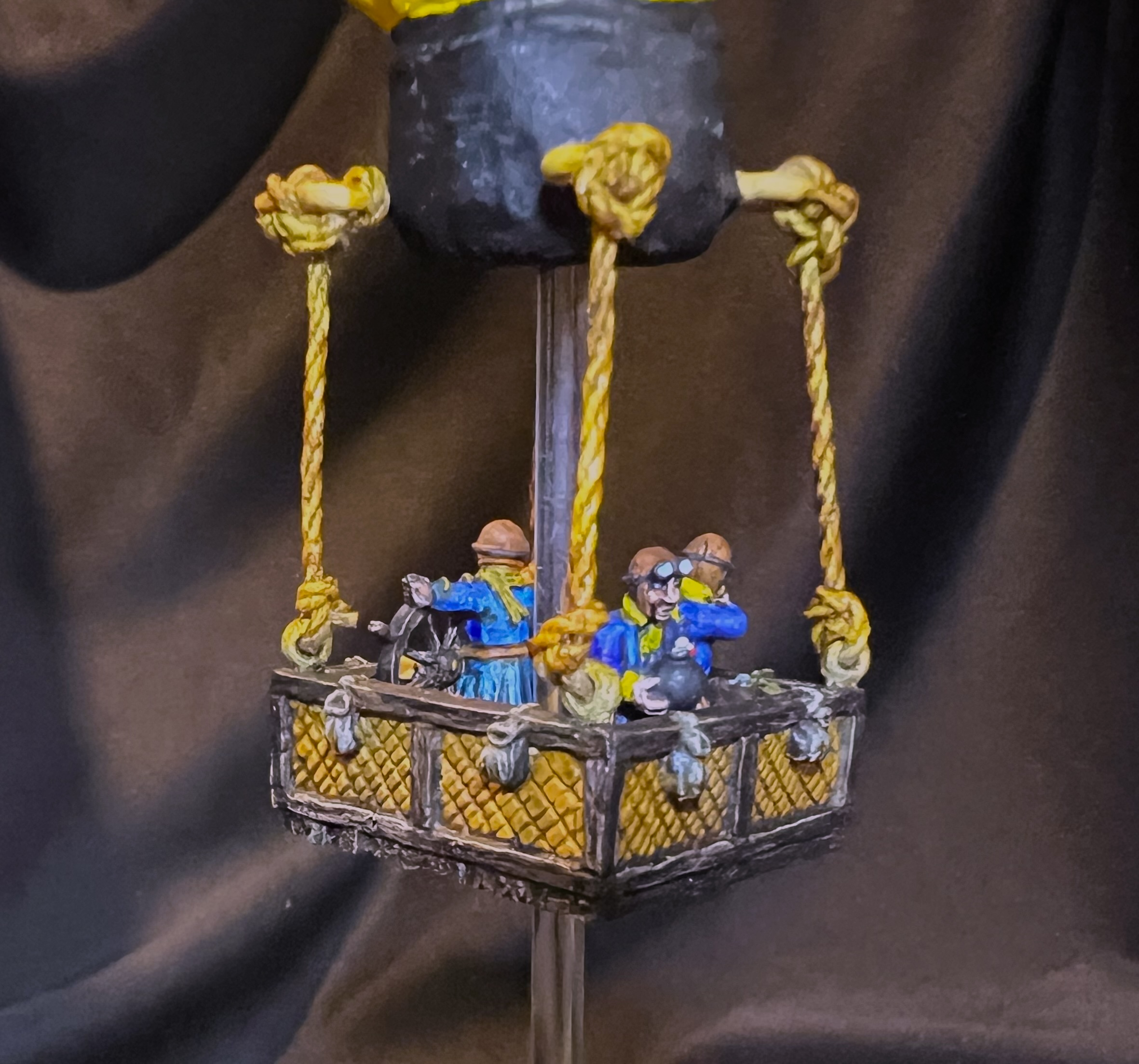
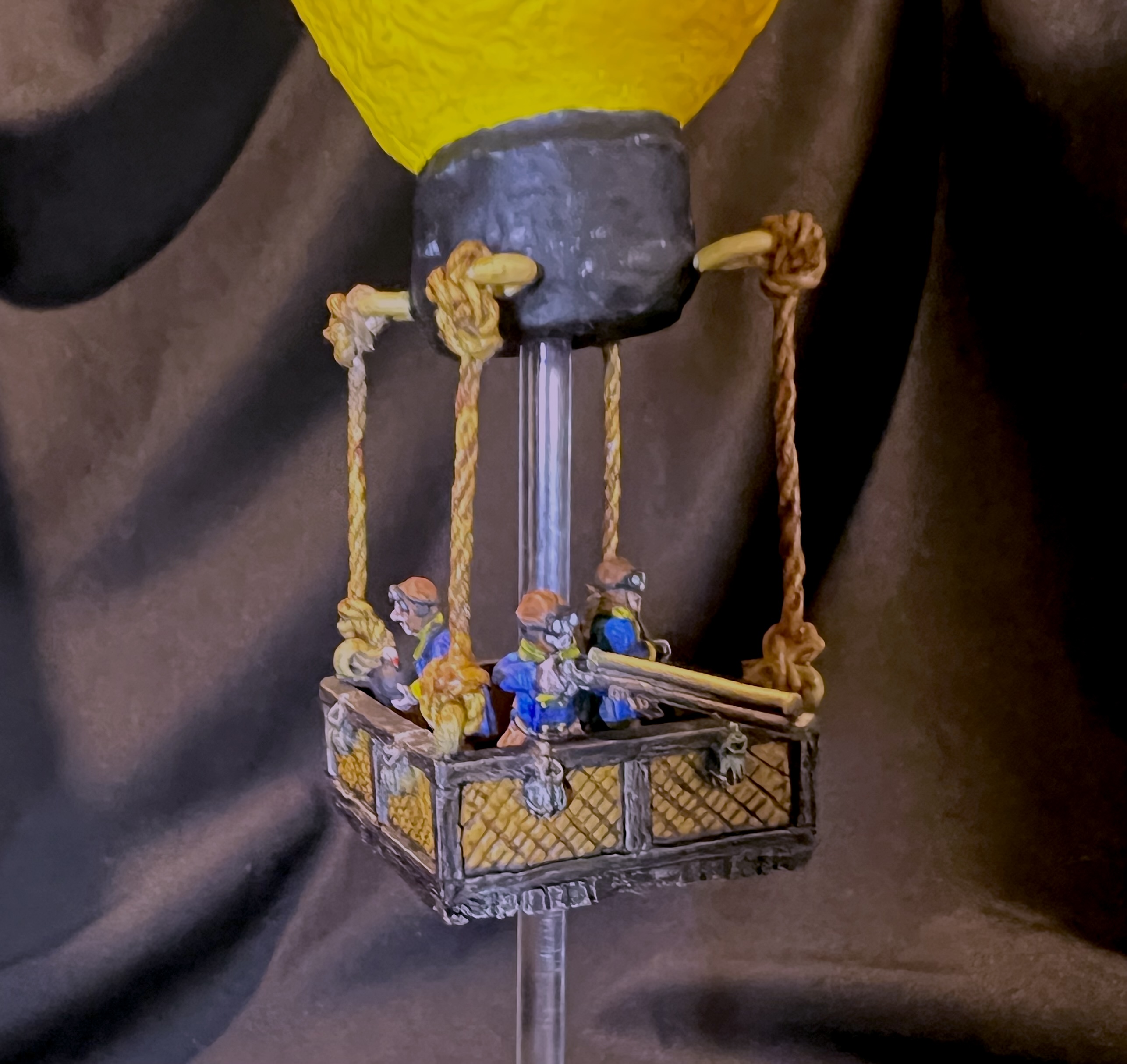
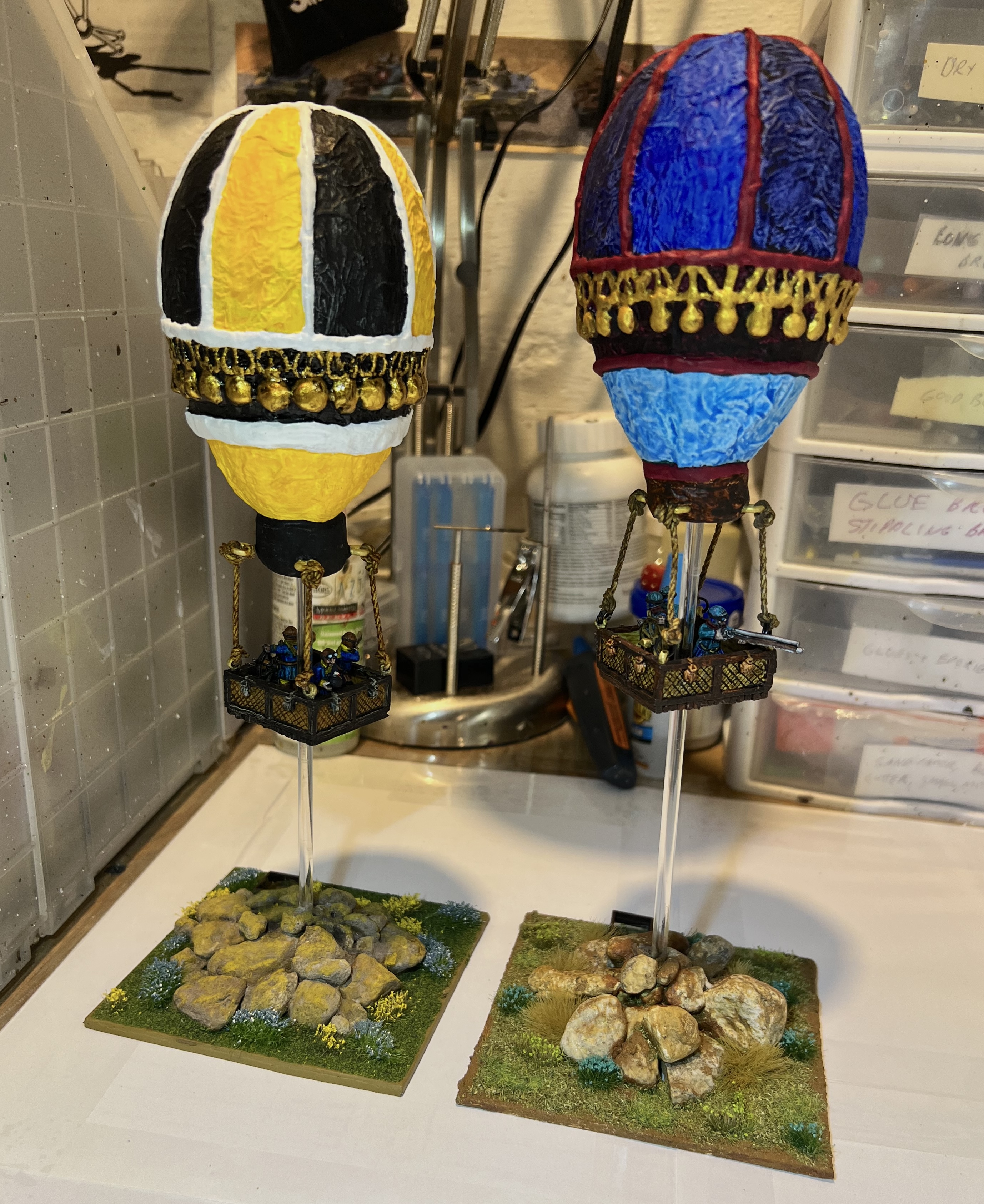
To augment the Munchkins’ forces, I decided to add a second Aerostat – and form a true Munchkin Air Force. As I wanted some color differentiation from my previous model – I went with Boston Bruins colors of Black, Gold, and White for the balloon, whole keeping the Munchkin crew in traditional blues. The model is 28mm in scale.
Go Bruins!
Assembly and Painting the Aerostat
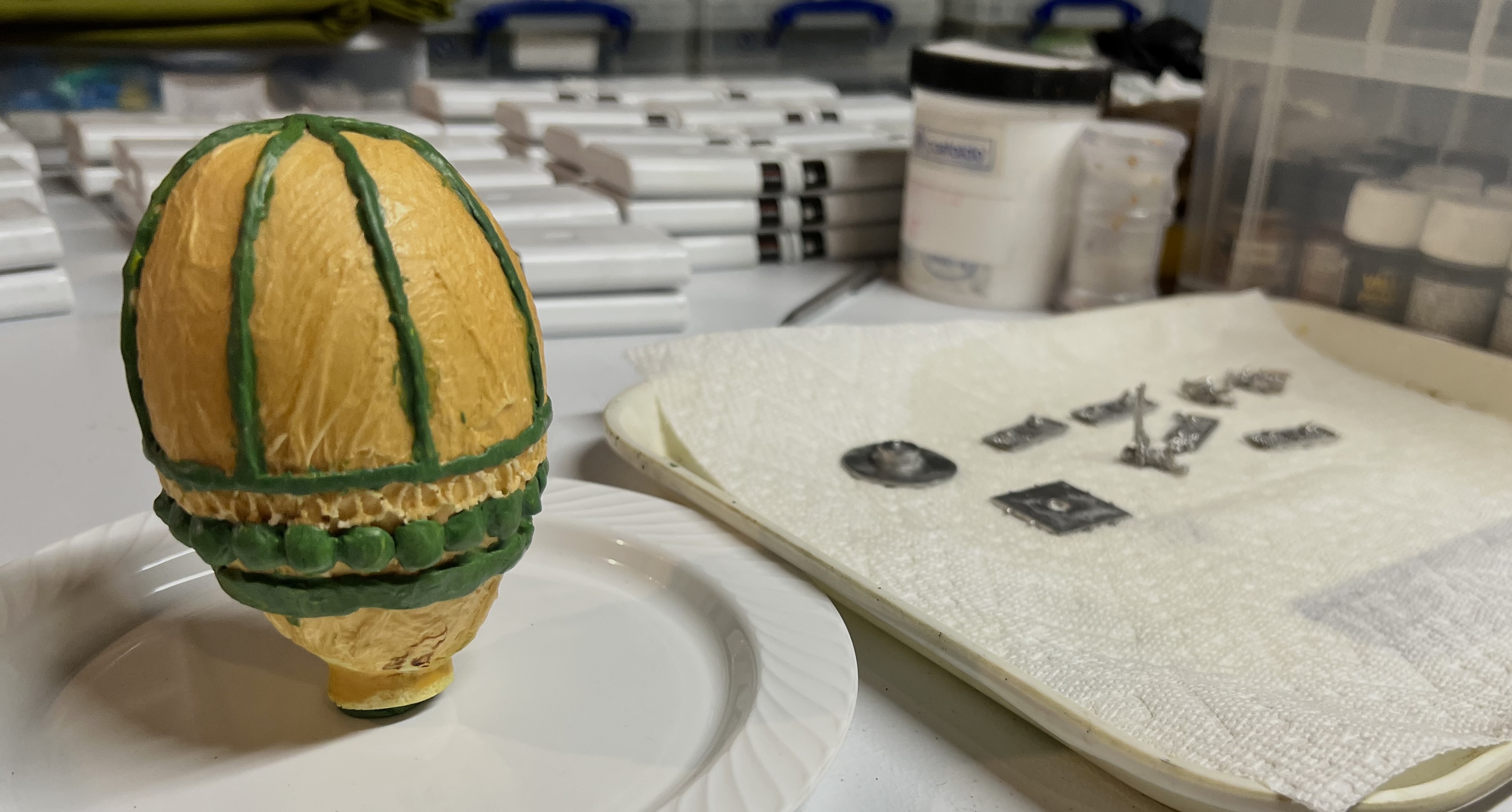
I basically followed the same process as I used on the last model. Having a blog post to review certainly proved useful in that endeavor! First step was not short as the balloon is made of foam. There were some (more than I’d like but fixable) cavitations similar to what you see in resin. I covered all the balloon lines and cavitations with green stuff – and reinforced the structure as you see below.
Lots of sculpting with green stuff. The metal parts of the model are in the background.
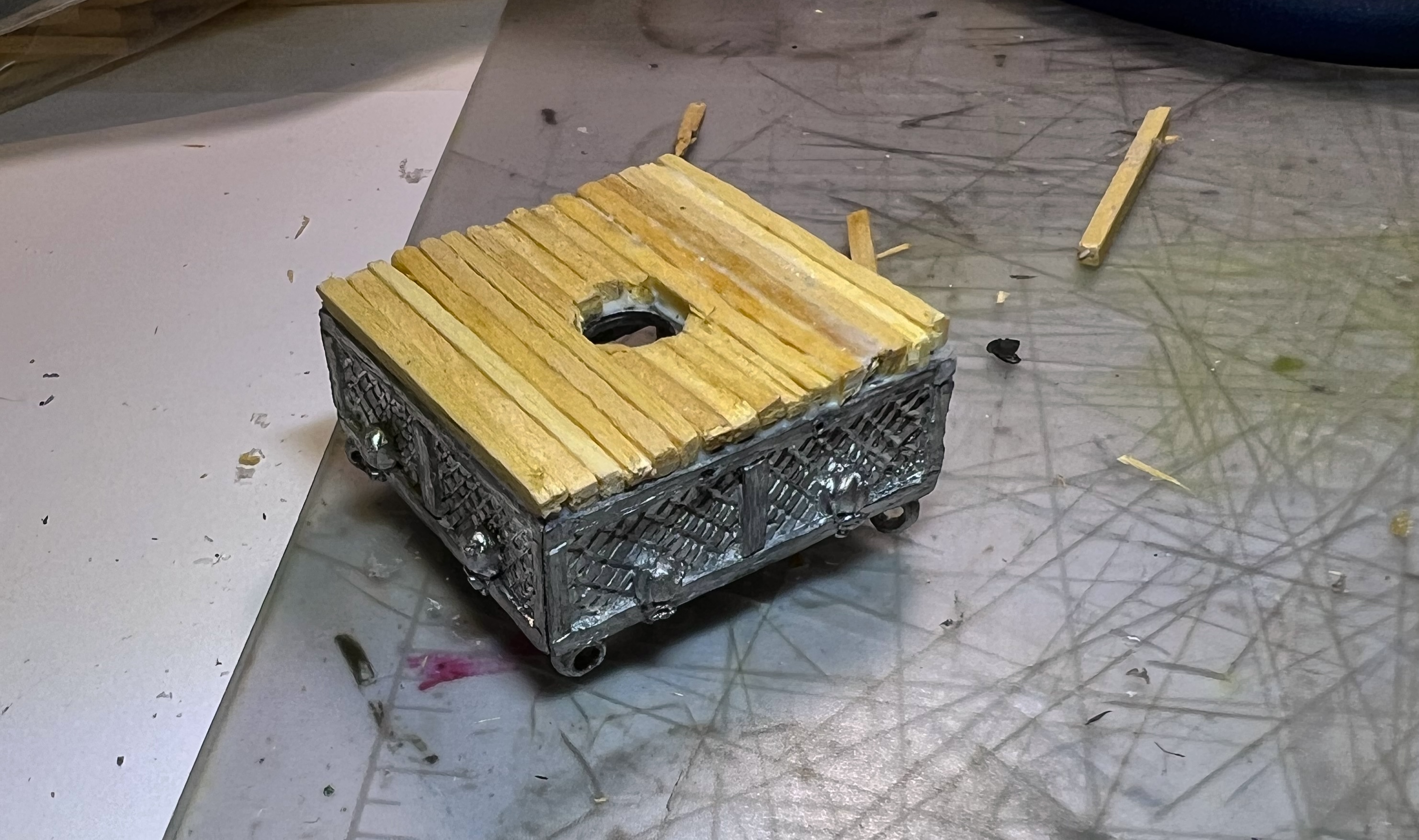
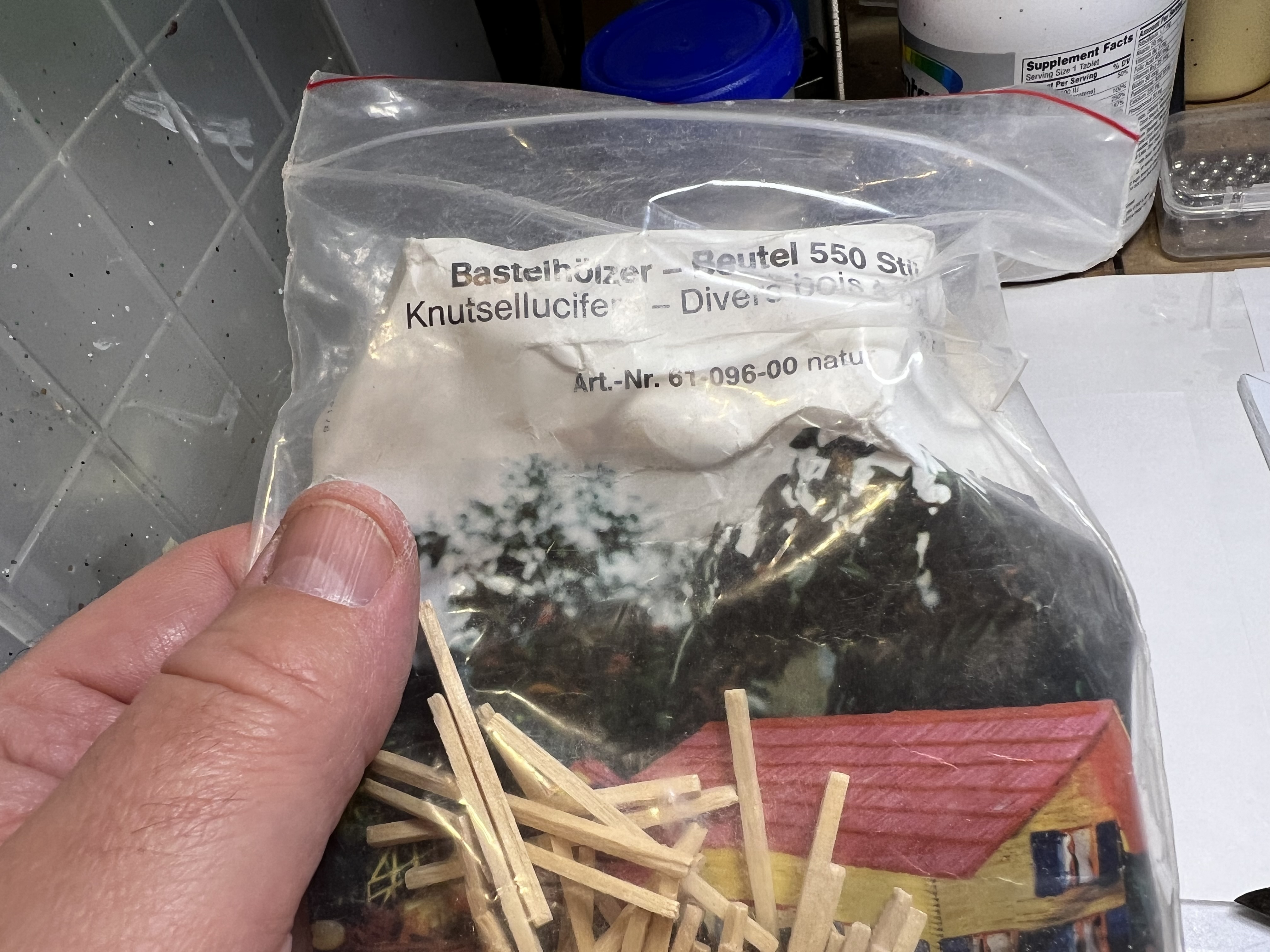
The basket is metal, and easily glued together. Once again, I used my 1987 matchsticks (that I purchased while stationed in West Germany) to give a more realistic look to the bare metal basket’s underside.
The basket’s underside with added matchsticks.Still in my hobby supplies – now for nearly 40 years!
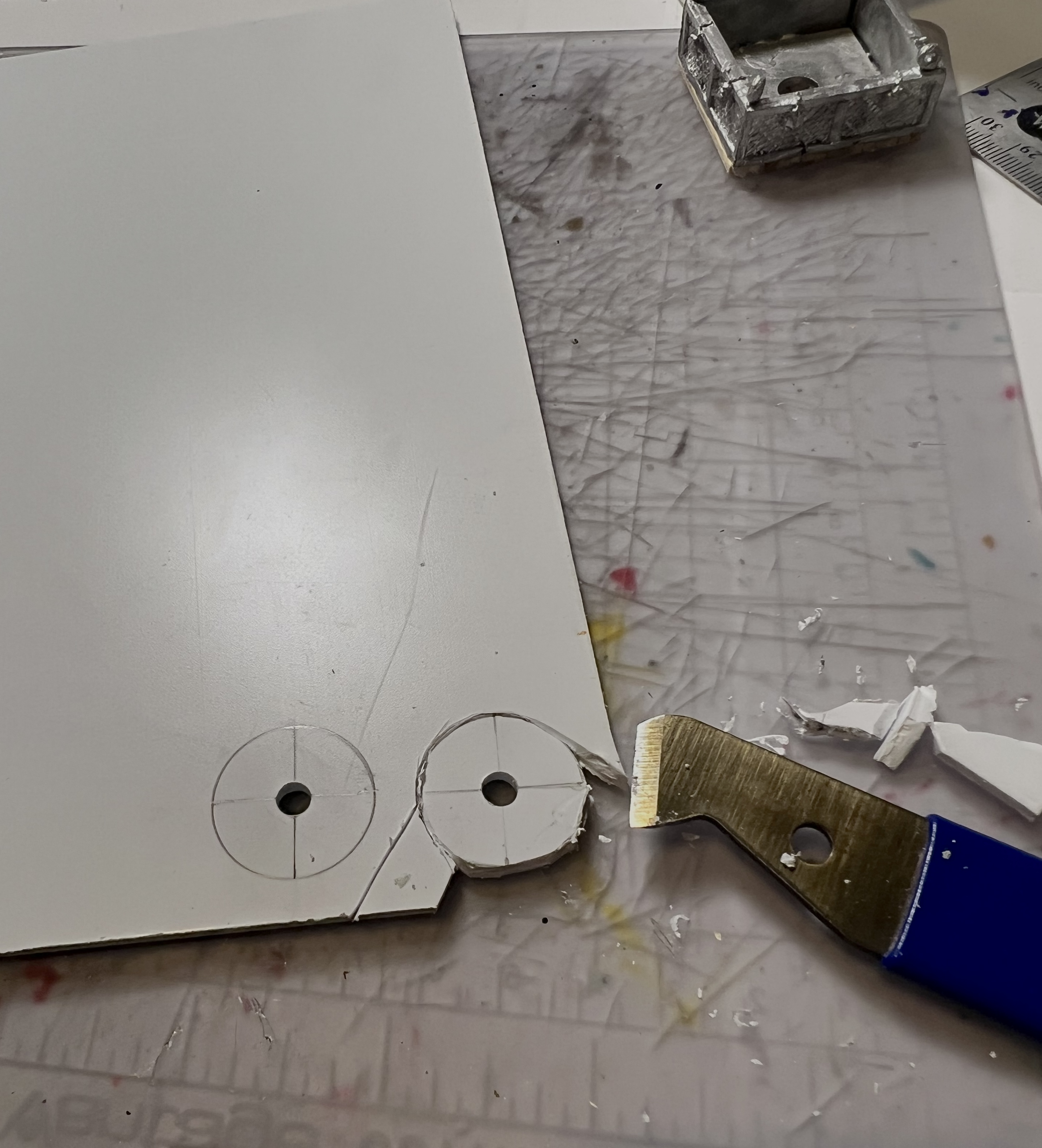
The model comes with wire to attach the basket to the balloon. Once again, I decided to employ a better mounting. A polystyrene and green stuff sandwich with inserted screw eyes worked well before – so I used that again.
Cutting out the disks from the drilled-out polystyrene. I sanded off any rough edges, then added the green stuff and the screw eyes to make the “sandwich”.
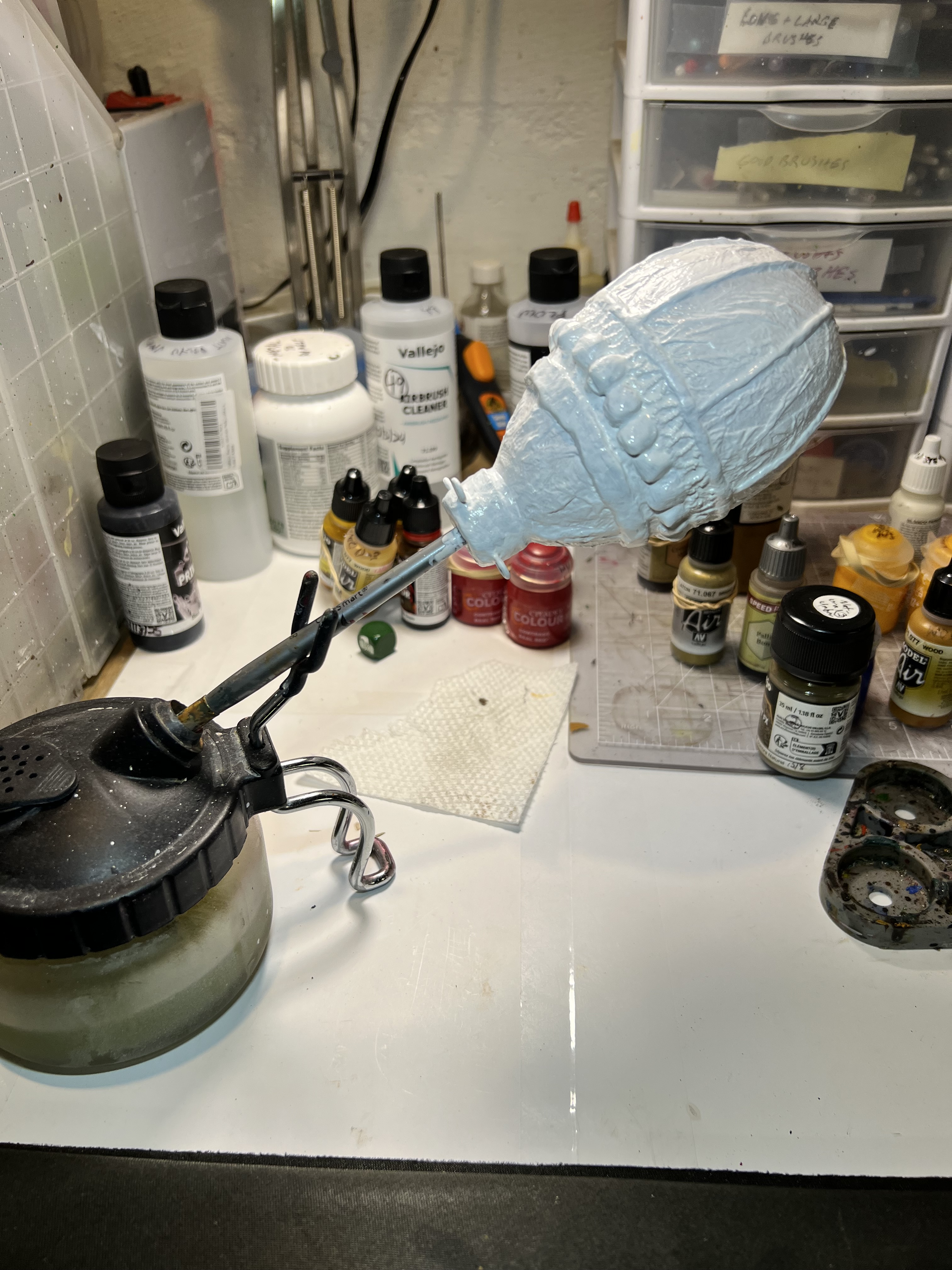
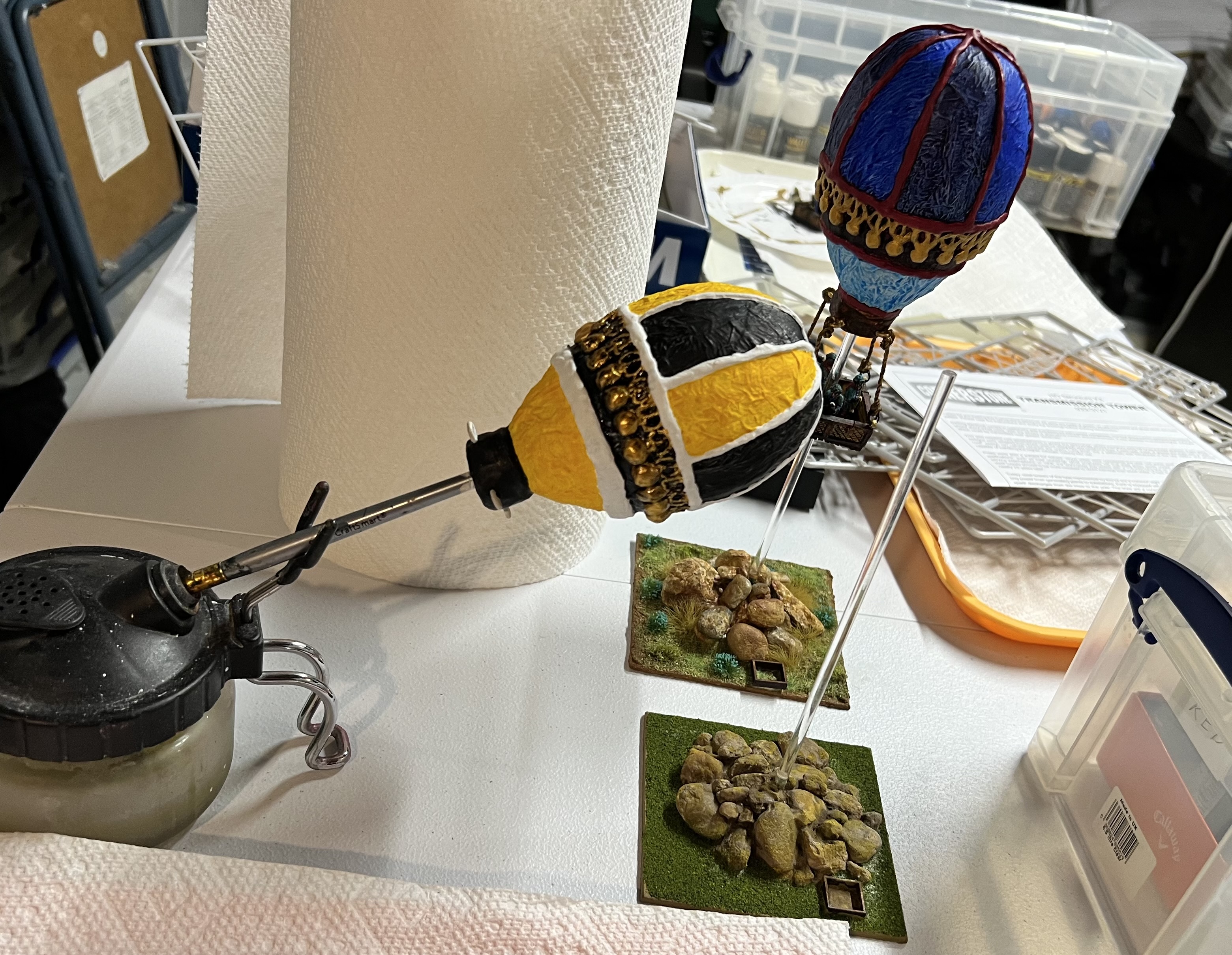
I affixed the sandwich to the balloon’s bottom with PVA – letting that dry overnight. I then drilled out though the sandwich (as perpendicularly as possible!) to make a path for the acrylic rod base support. This allowed me to prime and paint easily by using an old paint brush inserted into the balloon on one end and my airbrush cleaning bottle on the other.
Set up for painting – here primed.
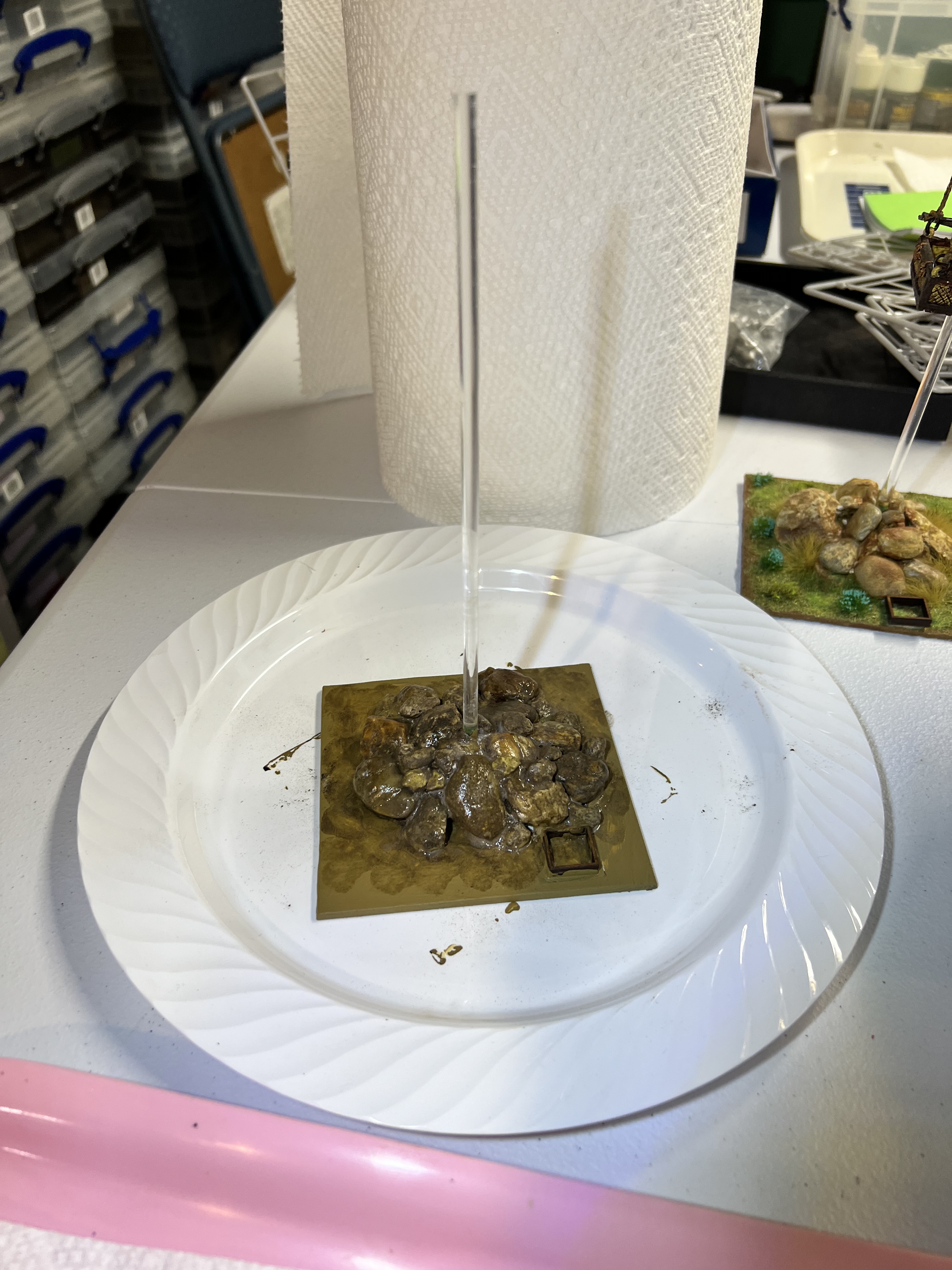
As for the base, I used metal support braces, small rocks, and green stuff to secure the acrylic support rod as vertically as possible to a piece of 4″ square polystyrene. Once the green stuff cured, I added pigments and pigment binder to the base.
Early base work
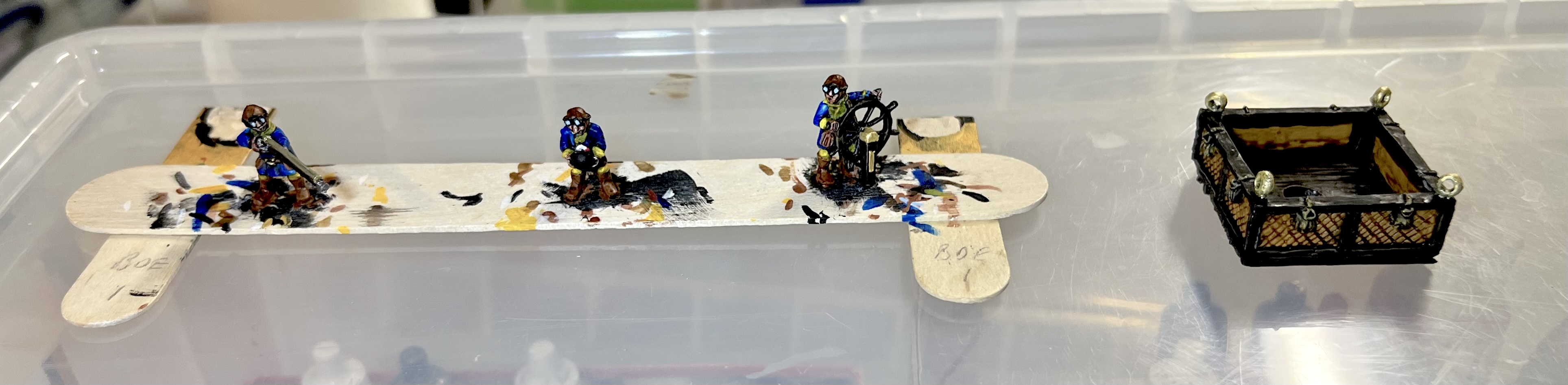
Then I painted the crew and the basket.
Painted crew and basket
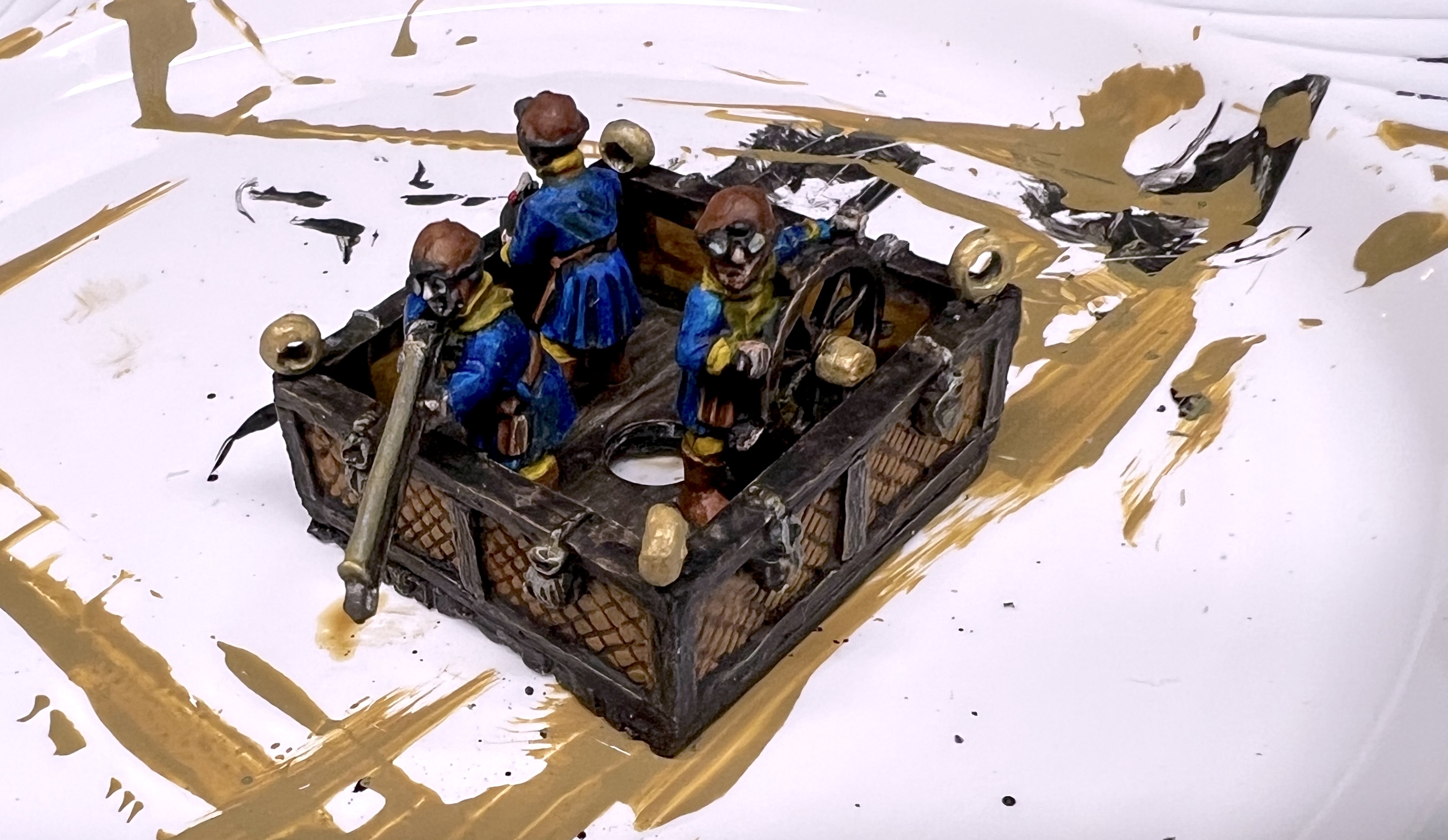
The crew have small tabs under their feet that correspond to little pre-drilled holes in the basket floor. Unfortunately, some of those did not make it off the popsicle sticks – but I was still able to use Gorilla Glue to securely mount them in the basket.
Crew in the balloon basket. Note the hole in the center for the support rod.
Painting of the balloon itself went fairly easily. I also flocked the base as you see below so that it would be completed before my rigging.
New balloon and base next to previous model for comparison.
It was then on to rigging with twine – which is my least favorite thing to do with models. I made it work such that the basket was more or less level. Then I coated the twine with PVA, let that dry, then painted over that to make the twine look like rope.
I was done!
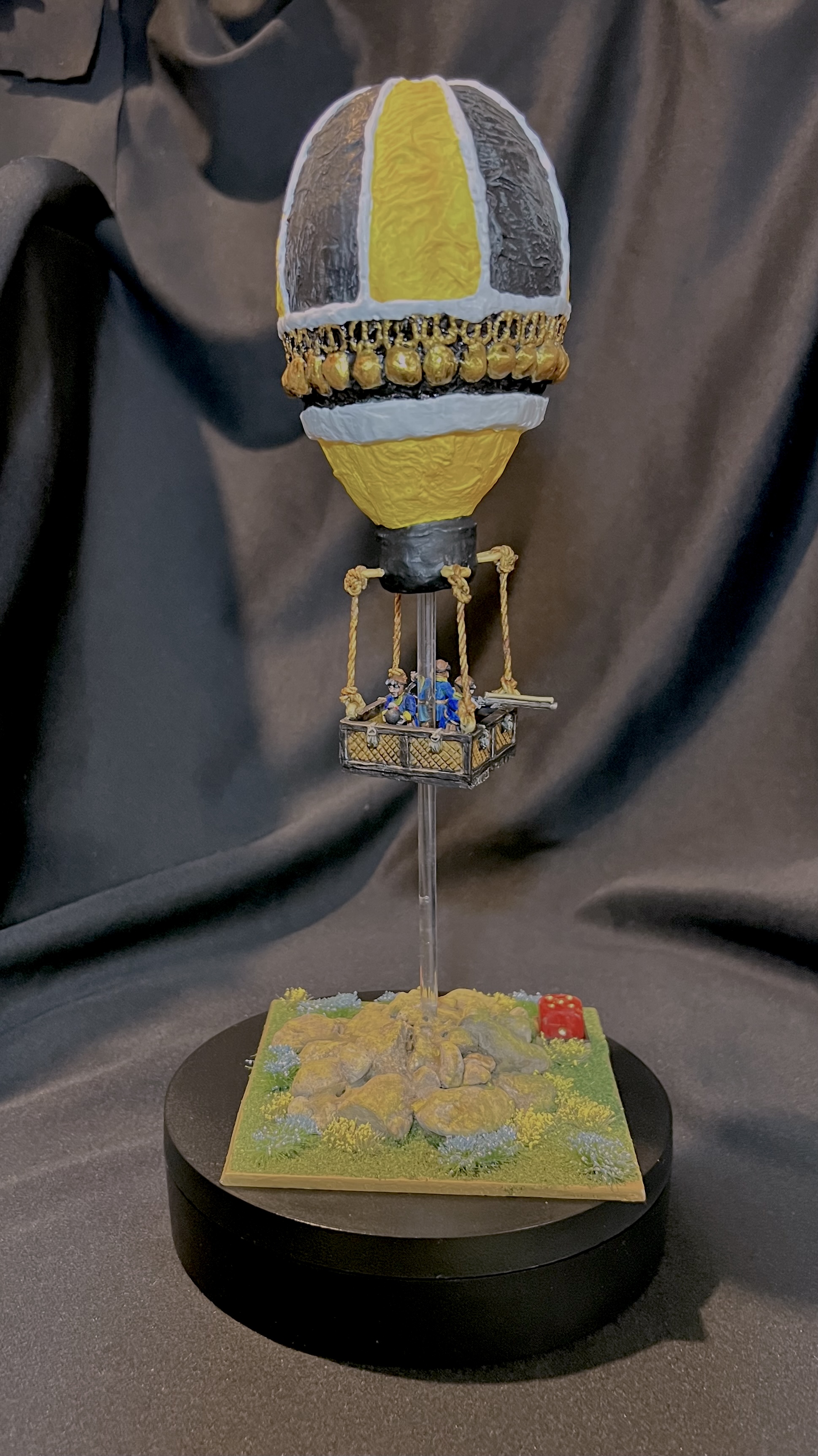
Here are some eye candy shots – as it is a model with no front or back – you’ll see a few shots of the total model as well as some crew shots. I did post a video on Instagram as well (a bit bright on the lighting):
Here now – the Munchkin Air Force assembled and ready to go after Professor Nitpik’s secrets!
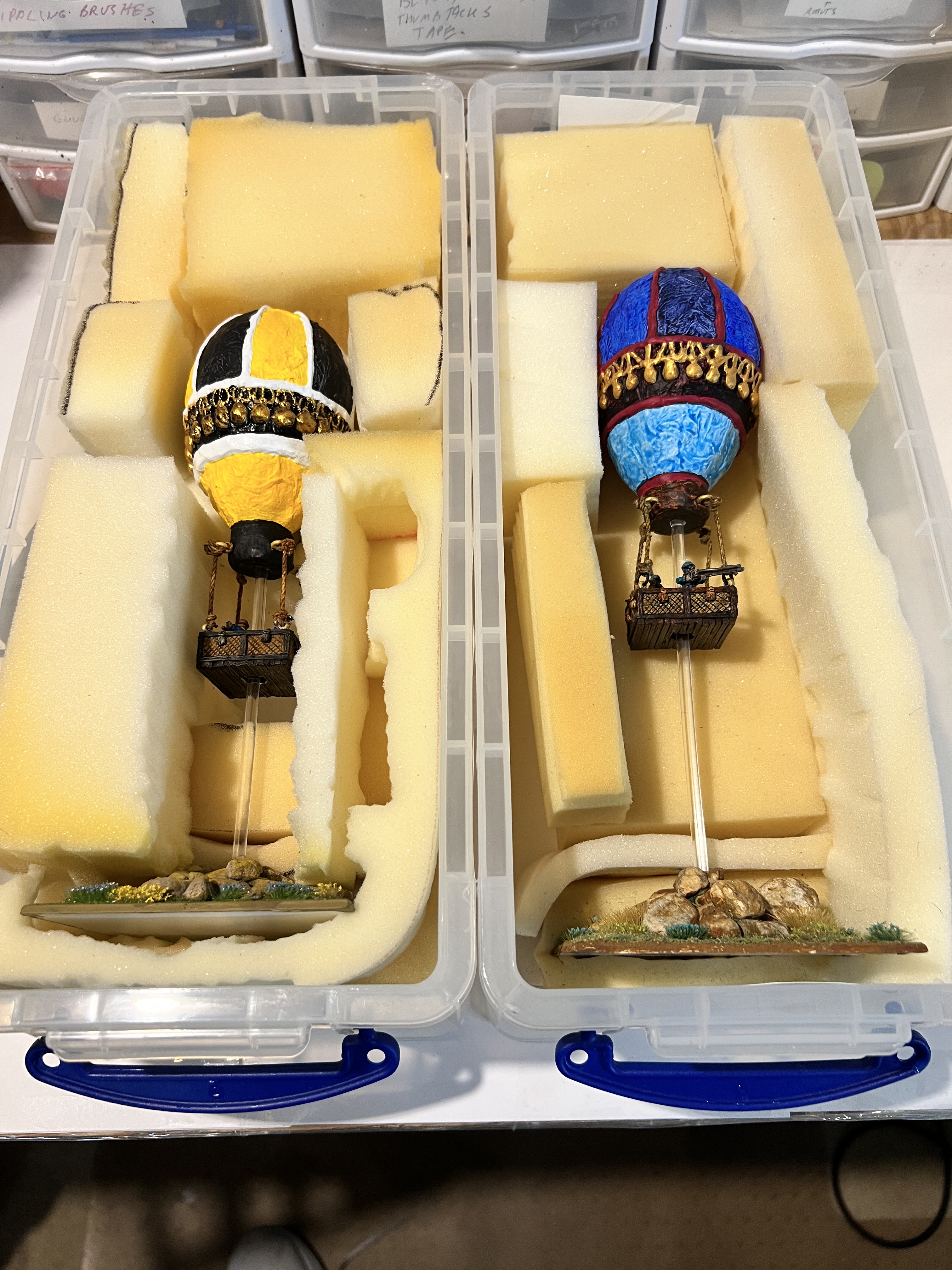
And as they will need to travel -to these conventions- matching Really Useful Boxes…
I finished this model right before Christmas. This is my first Wars of Ozz modeling post since April! Wow! More will be coming. I also will have Nitpik forces AND terrain for his apocalyptic world. Come see this and join the fun at COLD WARS, TotalCon 2026, Cold Barrage 2026, HAVOC XL 2026, and Huzzah 2026 “The Revolution”.
I hope you found this interesting – if so (or if not), let me know in the comments section! And join me at a convention or two!
Final Notes and Links
Want to learn more about Ozz and its world? If you want to check out the excellent Wars of Ozz figures’ range, there are two places to get them. You can also get the rules there. (I make no money from this.) The game rules and the figures are available from the next two places:
Below you’ll see the list of paints and the like that I used on this Aerostat project. As I mentioned, I often use my old blog posts to help me remember what I did – and sometimes even what I should NOT do. Anyways, they are not likely as useful for you as they are for me, but that’s why I post the lists.
Miscellaneous details and references for those interested in that sort of thing:
For my earlier posts on Wars of Ozz games, view this page. It includes figures, units, and other related projects.
PAINTS, INKS, GLAZES, SHADES, WASHES, PIGMENTS, FLOCKING, GLUES AND MORE THAT I USED ON THE BOSTON BRUINS-COLOR THEMED MUNCHKIN AEROSTAT:
In short, (if you don’t want to click above) he has a list of folks who blog that he follows (most of them are the same ones that I also follow).
To quote Roger:
Well, What I’m asking you to do is, if you look below you’ll see a list of blogs that I follow (or should follow!), some are great painters (actually all of them are) 3D printers, game writers, DM’s, Sculptors, Convertors etc.. The one thing they all have in common is they are all entertaining writers! So if you can I’d like you to follow each of the links and take a look around, now some of these have not had new posts added for a while, but don’t let that put you off, have a look around check out some older posts, you never know there might be something you like or find useful, if so make a comment, follow (or if you have too “like”), let’s give these people some love and hopefully get them posting again!
So, take a look. I know some might not be up your alley, but if you’re into hobbying or modeling etc, most will. Of course my blog does also have some golf in there, but that’s just another addiction you know…
In WWII, the Royal Italian Army was heavily engaged in the North African Campaign starting in June 1940. They fought first alone against the British and then in concert with Nazi Germany’s Afrika Korps after February 1941. The tide of battle ebbed and flowed across North Africa. The Italians and the Germans formed the Panzerarmee Afrika. They battled the British 8th Army in Egypt, Libya, and eventually Tunisia. There, along with US and UK troops from Operation Torch, Axis forces were driven from North Africa in May 1943. Shortly afterwards, in early July of 1943, Operation Husky – the invasion of Sicily – occurred. By the end of that month, Mussolini was ousted. Italy then requested a separate armistice and was out of the war. German forces seized any available Italian war materiel and continued to fight in Italy. Italy then was really in a state of civil war. Some Italian forces fought with the Allies. Others sided with the Germans. Partisan attacks were common – and continued even after the German surrender in April 1945.
I have found the Royal Italian Army and its equipment interesting. At HAVOC I had run a big North Africa What a Tanker game back in 2019. At this year’s HISTORICON, discussions with one of the players intrigued me. We talked about a “what if” scenario for a “What a Tanker” game where I could have the French defending against the Italians. Mulling that over the summer, I decided to do it! I call it “Il Duce’s Desert Gamble“.
It’s 1942 or 1943. Here, the Allies do not launch Operation Torch. Instead, with the USSR on the verge of collapse, they make the disastrous decision to launch Operation Sledgehammer . It fails miserably. The USSR seeks a separate peace with Germany. The British 8th Army is routed and German forces advance towards the Middle East and its oil fields. The US and UK are in no position militarily or logistically to try any invasion anywhere in Europe for years. The US refocuses on Japan and the Pacific.
Meanwhile, Mussolini sees an opportunity to further his vision of a new Roman Empire that would dominate the Mediterranean. He sees France’s colonies as ripe for the taking, and gains Hitler’s assent to take them. This sets up my desert battle scenario between Vichy French armor and the Italians.
In preparation for the game – I have enough French from my Operation Torch game. I did however need to augment the Italians.
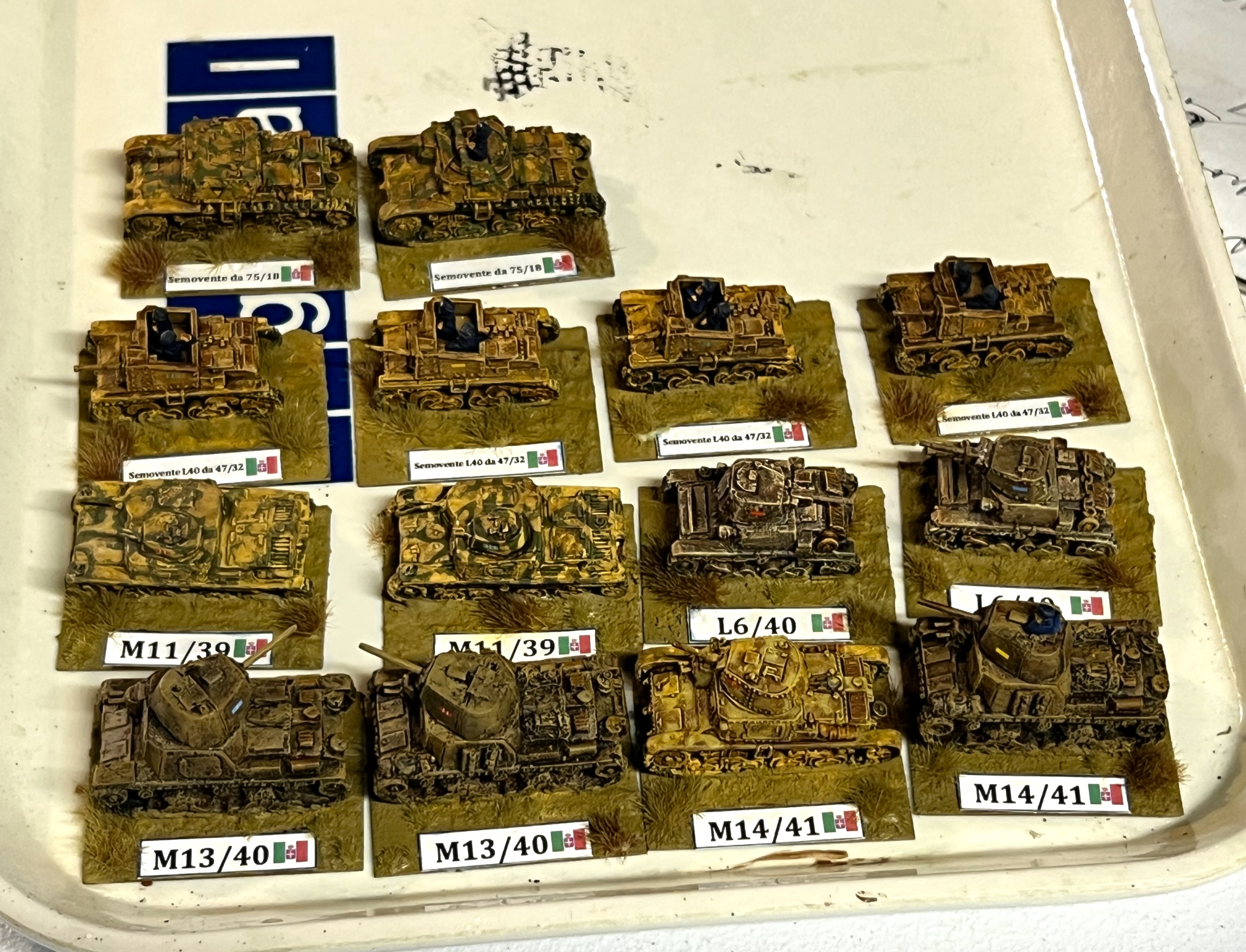
My Italian armor before this project.
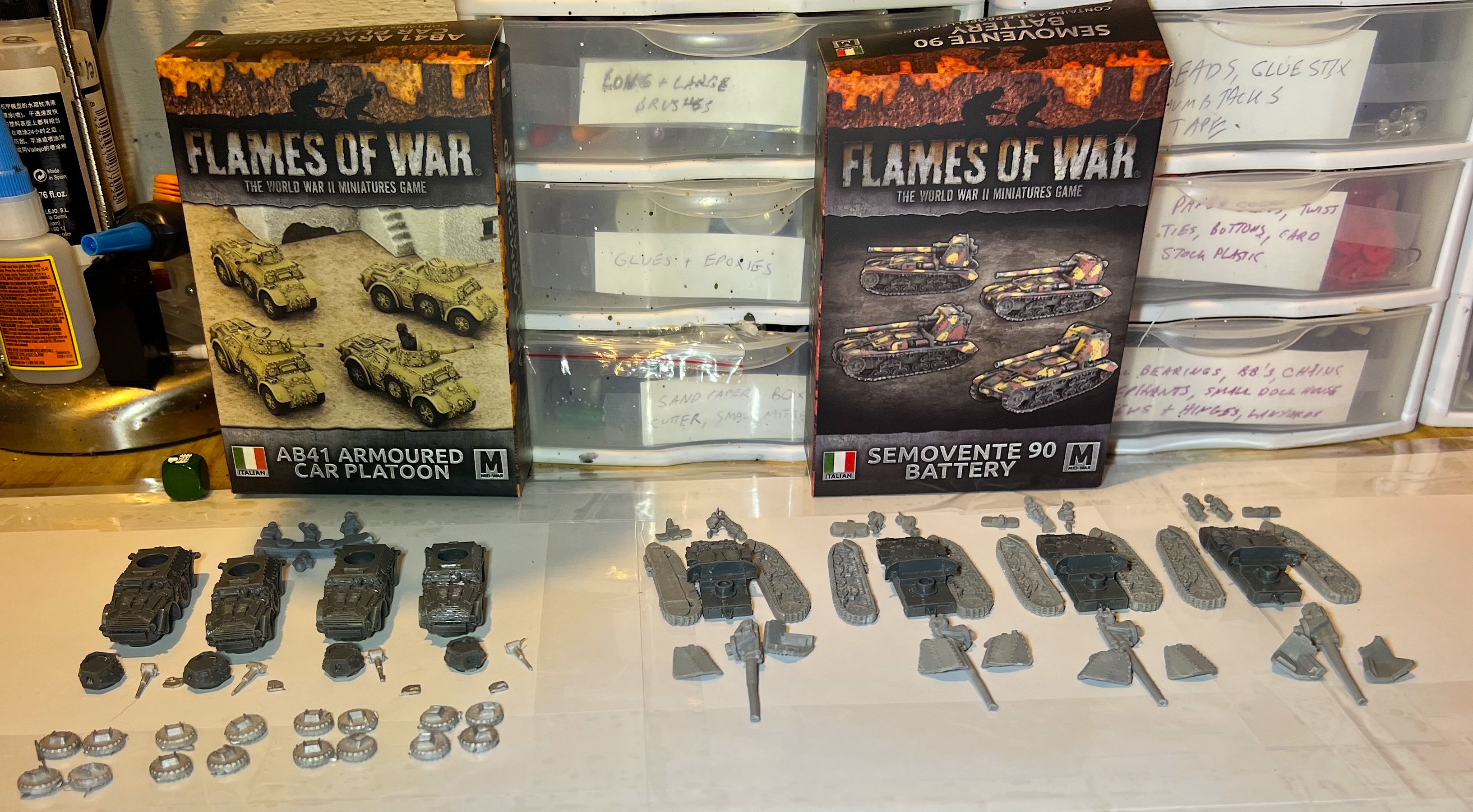
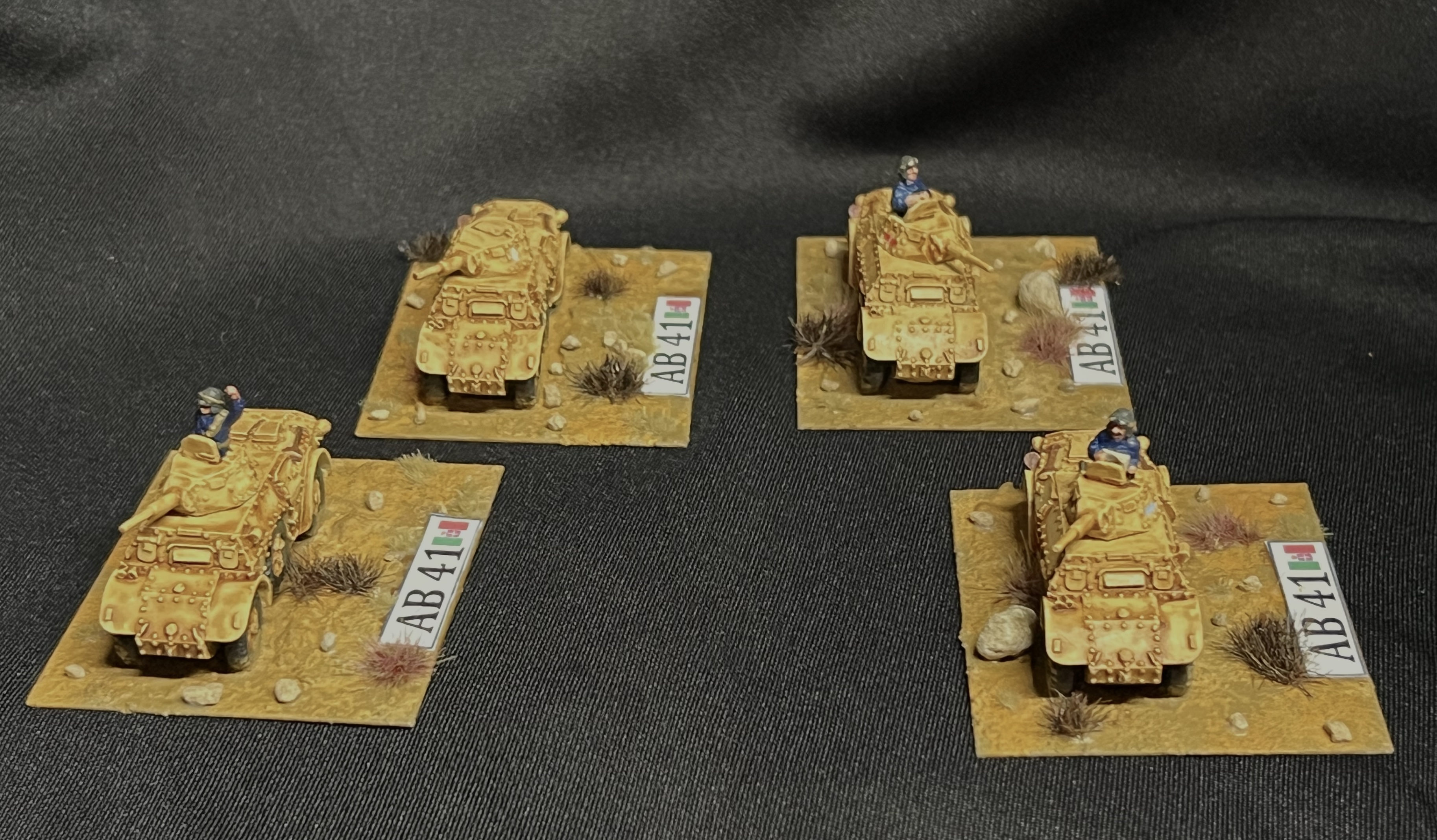
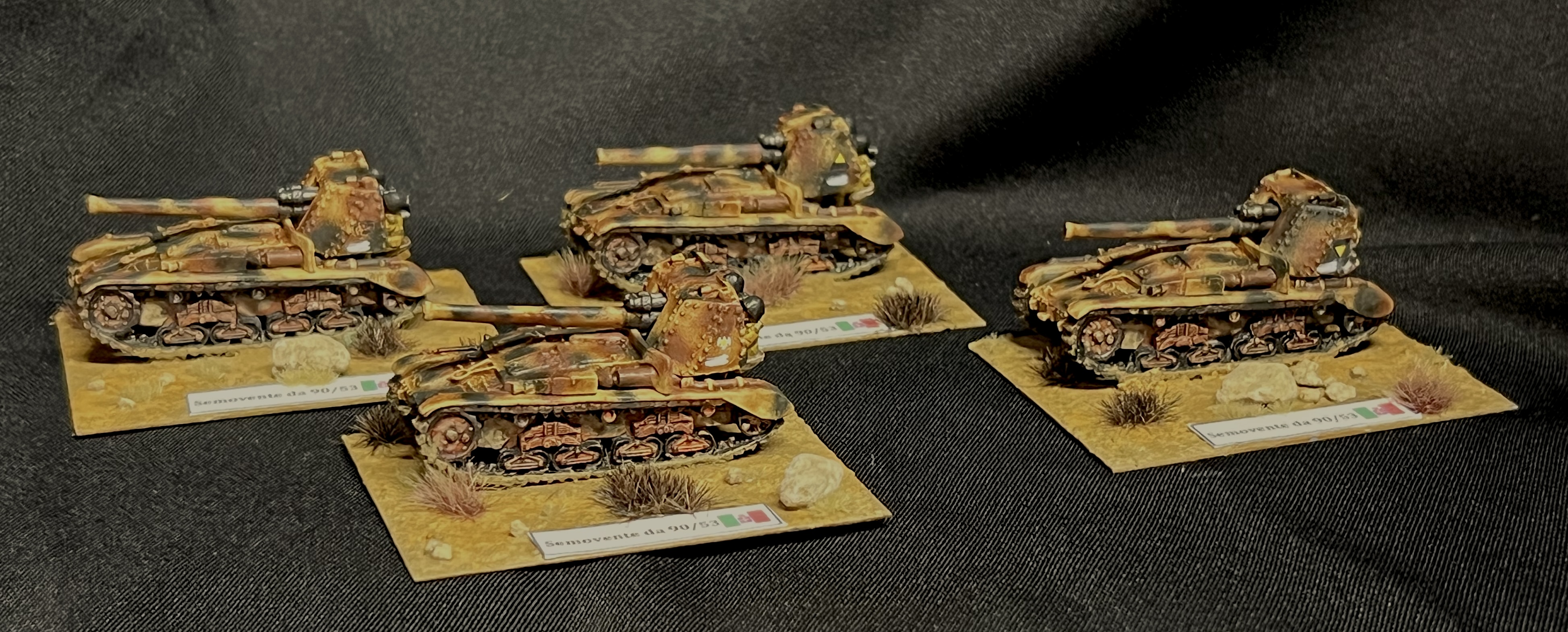
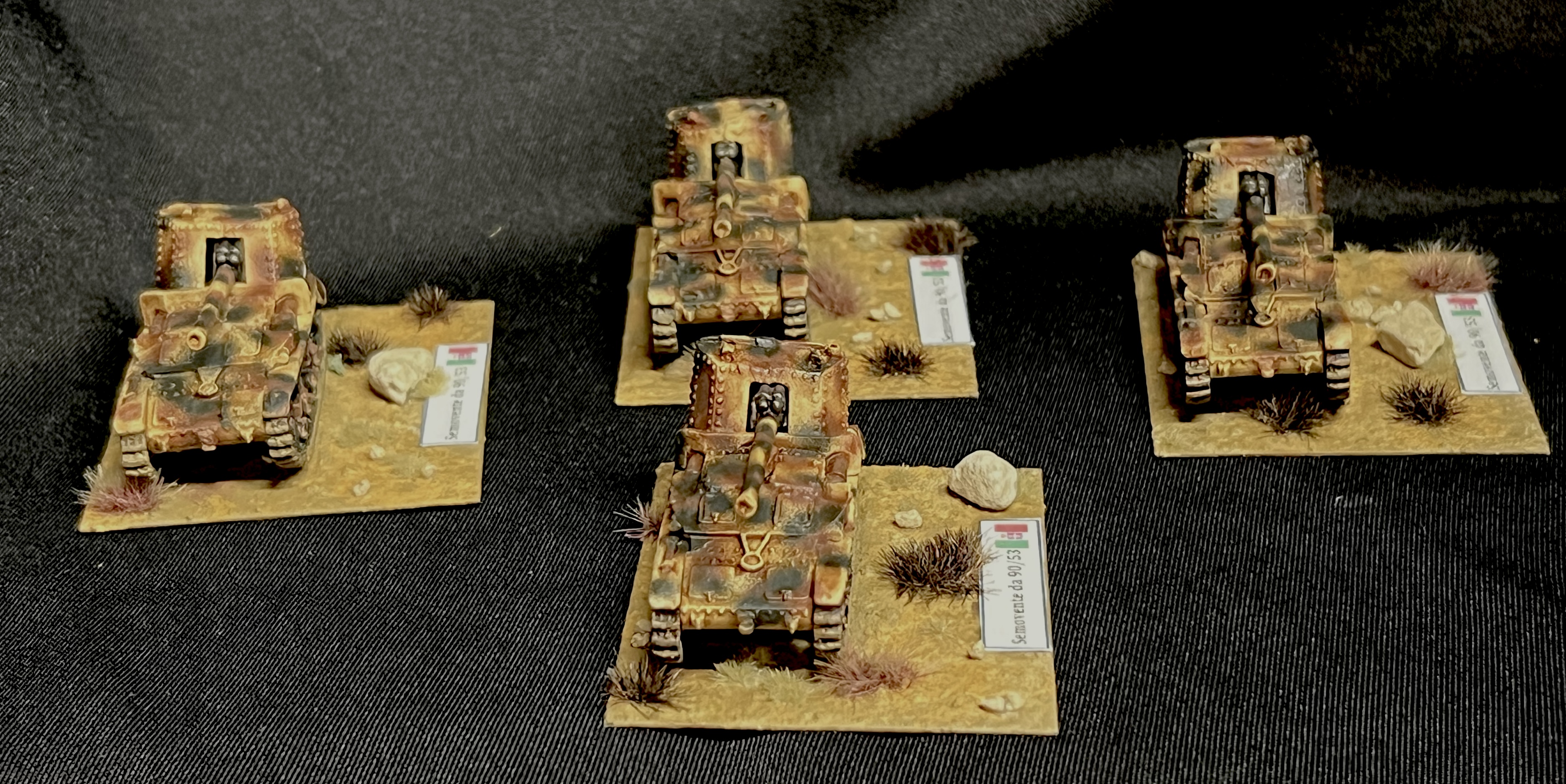
Specifically, I wanted to give them some armored cars. These include the Autoblinda Fiat-Ansaldo 41, also known as AB 41. I also wanted to provide another newer and more powerful tank destroyer, the Semovente 90/53. I use 15mm/1:100 scale models for these games. I acquired a 4-vehicle platoon of the AB 41’s. Simultaneously, I bought a 4-vehicle battery of the Semovente 90/53’s. Both kits are from Battlefront (Flames of War).
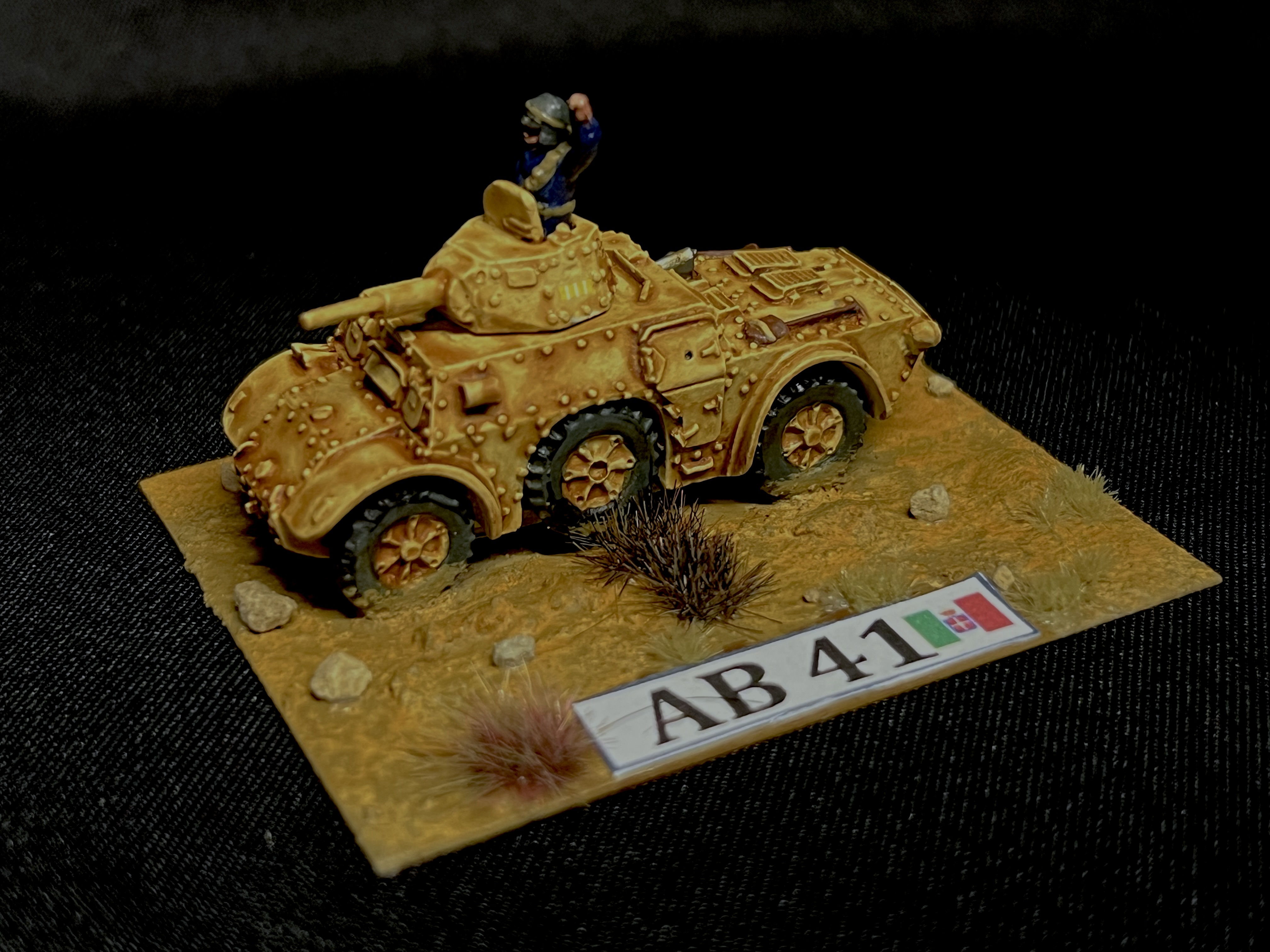
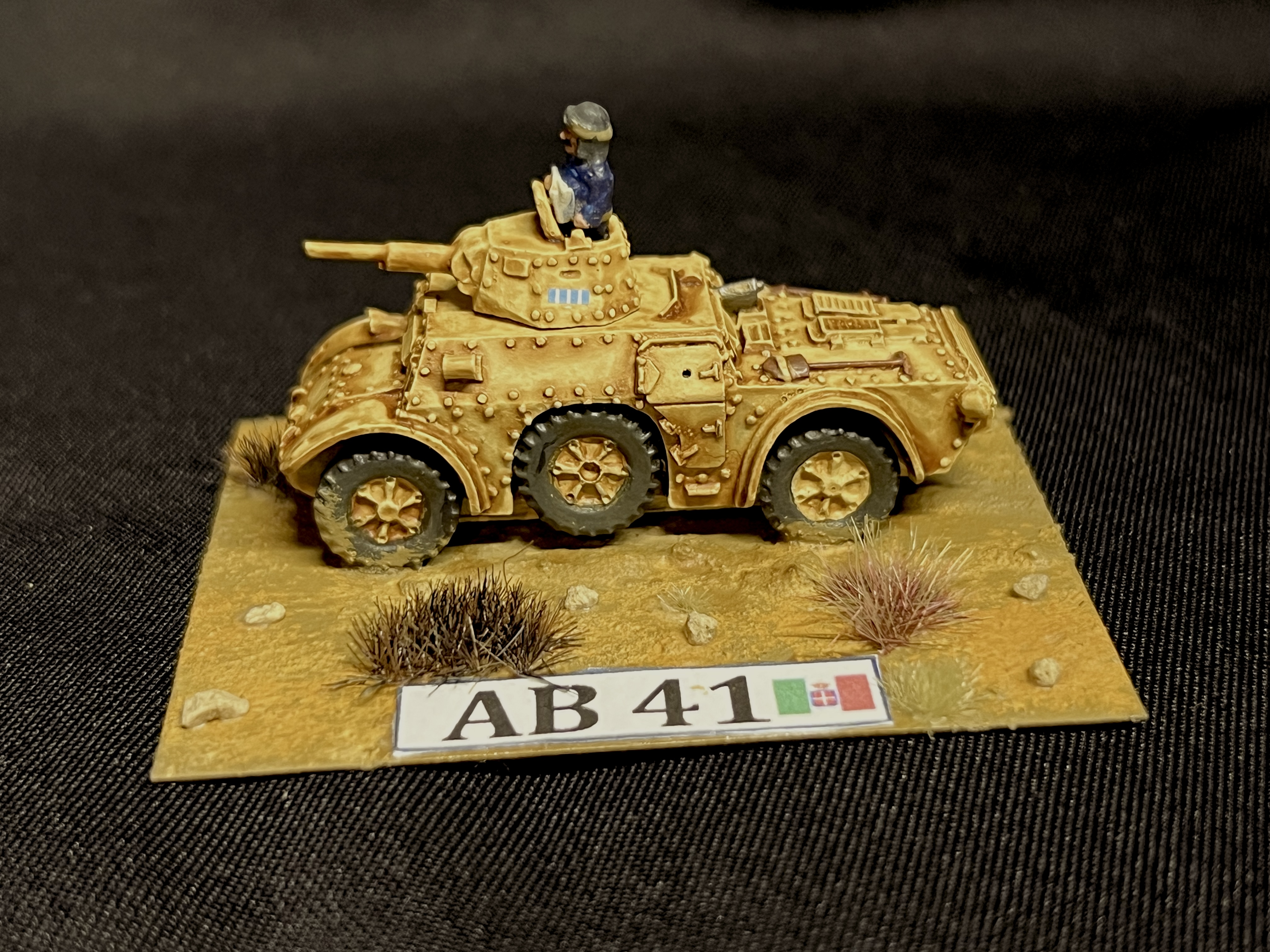
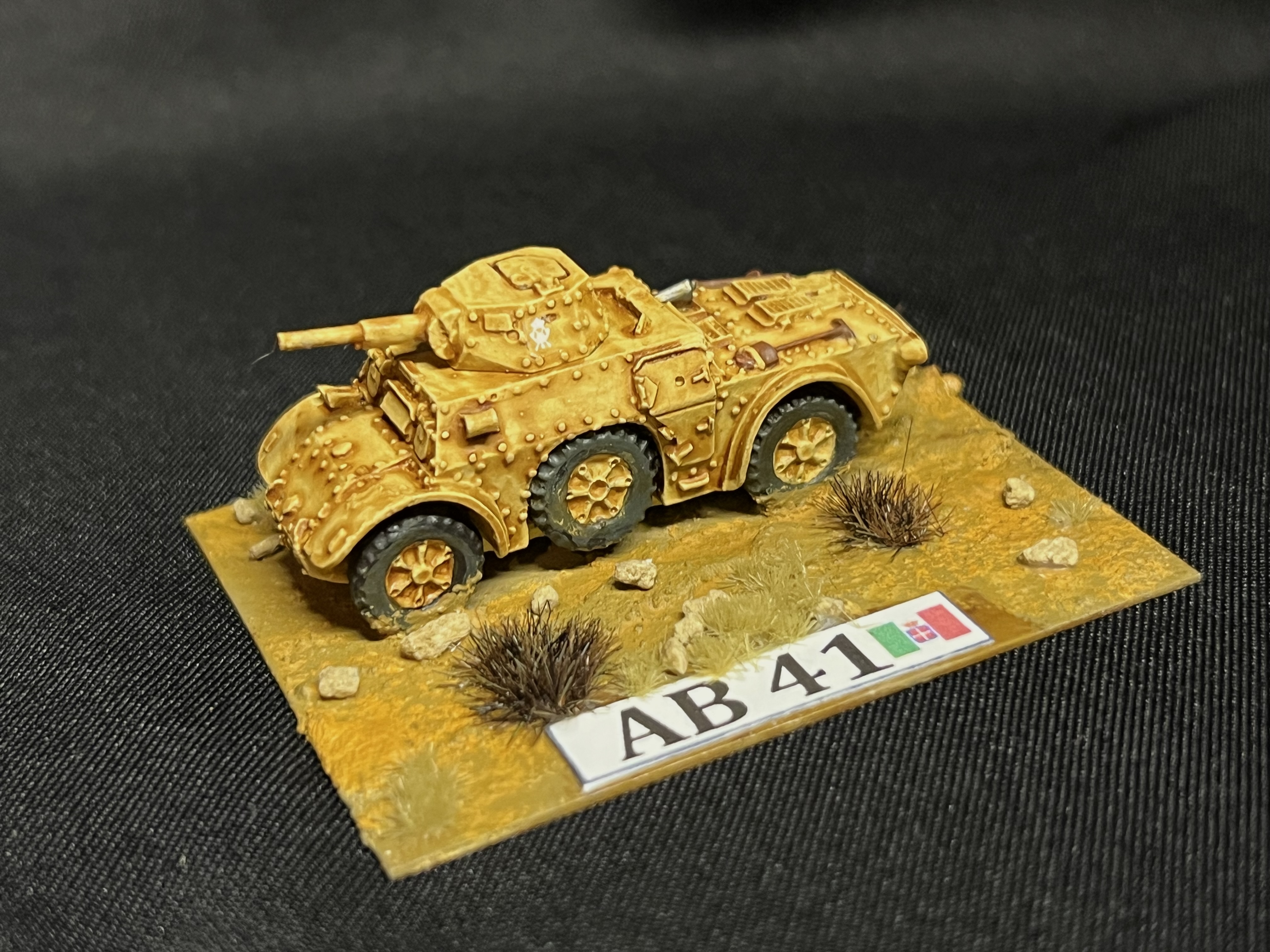
The AB 41 had a 20mm Breda autocannon – similar to the Panzer II- with decent anti-armor penetration capabilities. Its armor was effective against infantry small arms. 667 were built, and served everywhere the Royal Italian Army fought. It served also post-war until the mid-1950’s.
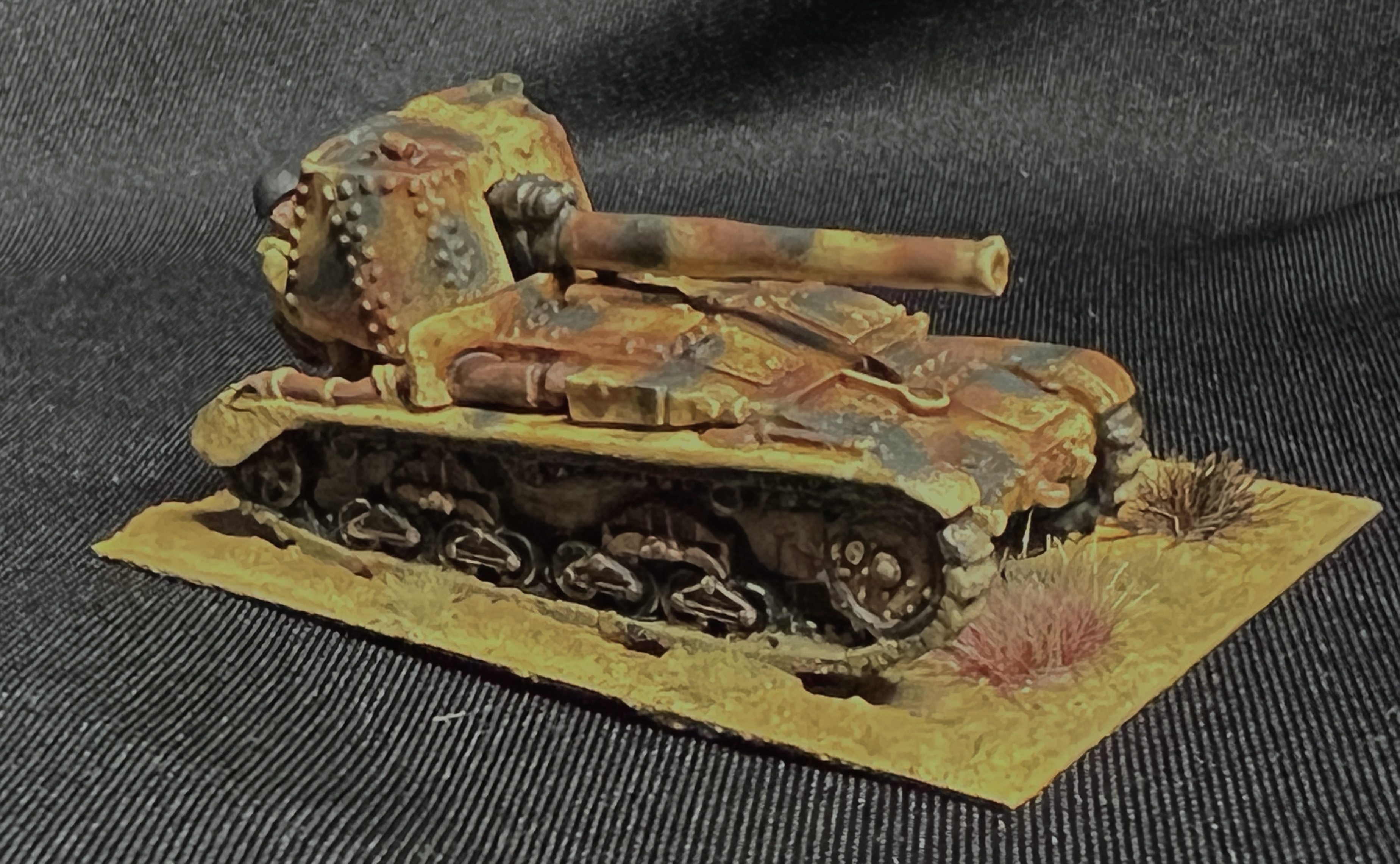
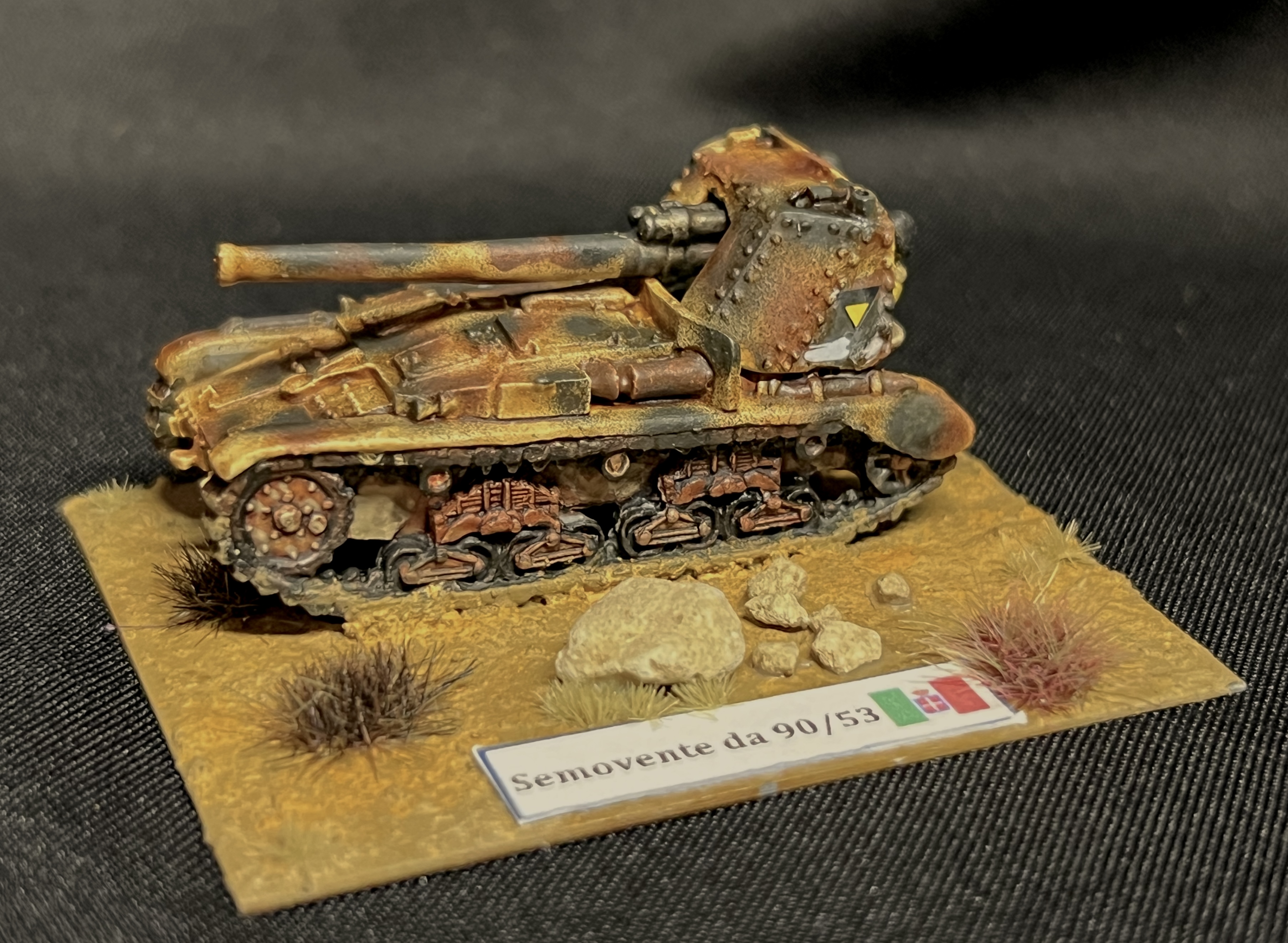
The Semovente 90/53 was built too late and in too few a quantity (only 30 were ever built) to see much WWII action. It had some (not much) experience in North Africa and Sicily under Italian control. The Germans also used seized examples. It’s design was inspired by the Italian experience on the Eastern front. The Italians there found that they had no way of stopping T-34’s or other more modern armor. It took a 90mm cannonne da 90/53 anti-aircraft gun and put it on an M14/41 tank chassis. The gunners would be exposed as they were behind a mantlet. It also needed an L6 tank modified to carry its ammunition. It’s armor penetration was impressive and any Allied tank it faced was vulnerable even at long range. I have decided to forego using any L6 tanks as ammo carriers for the game. I’ll just assume they are there. I’m also assuming that these would have been available in sufficient numbers for my game scenario in the absence of the Italian Armistice. Just one survives to this day at Fort Sill here.
An interesting aside note – 12 of the same type of anti-aircraft gun were taken from the Italian battleship Vittorio Veneto. These guns were awarded to Yugoslavia as war reparations. I remember playing with that ship’s token in Avalon Hill’s War at Sea game as a kid. That they ended up firing in 1991 is somewhat odd!
According to Wikipedia:
After the war, the twelve 90/53 guns from the Italian battleship Vittorio Veneto were assigned to Yugoslavia as a part of war reparations. They were mounted on a coastal artillery battery on island Žirje off Šibenik as a part of the Cold War defense strategy. These guns saw action in September 1991 during the Croatian War of Independence, deterring the Yugoslav People’s Army assault on Šibenik and blocking 34 Yugoslav Navy’s patrol boats and minesweepers which were later captured by Croatian forces in the inner harbor.
Reminiscing ended – back to the vehicles!
WIP Shots
The two kits as received.
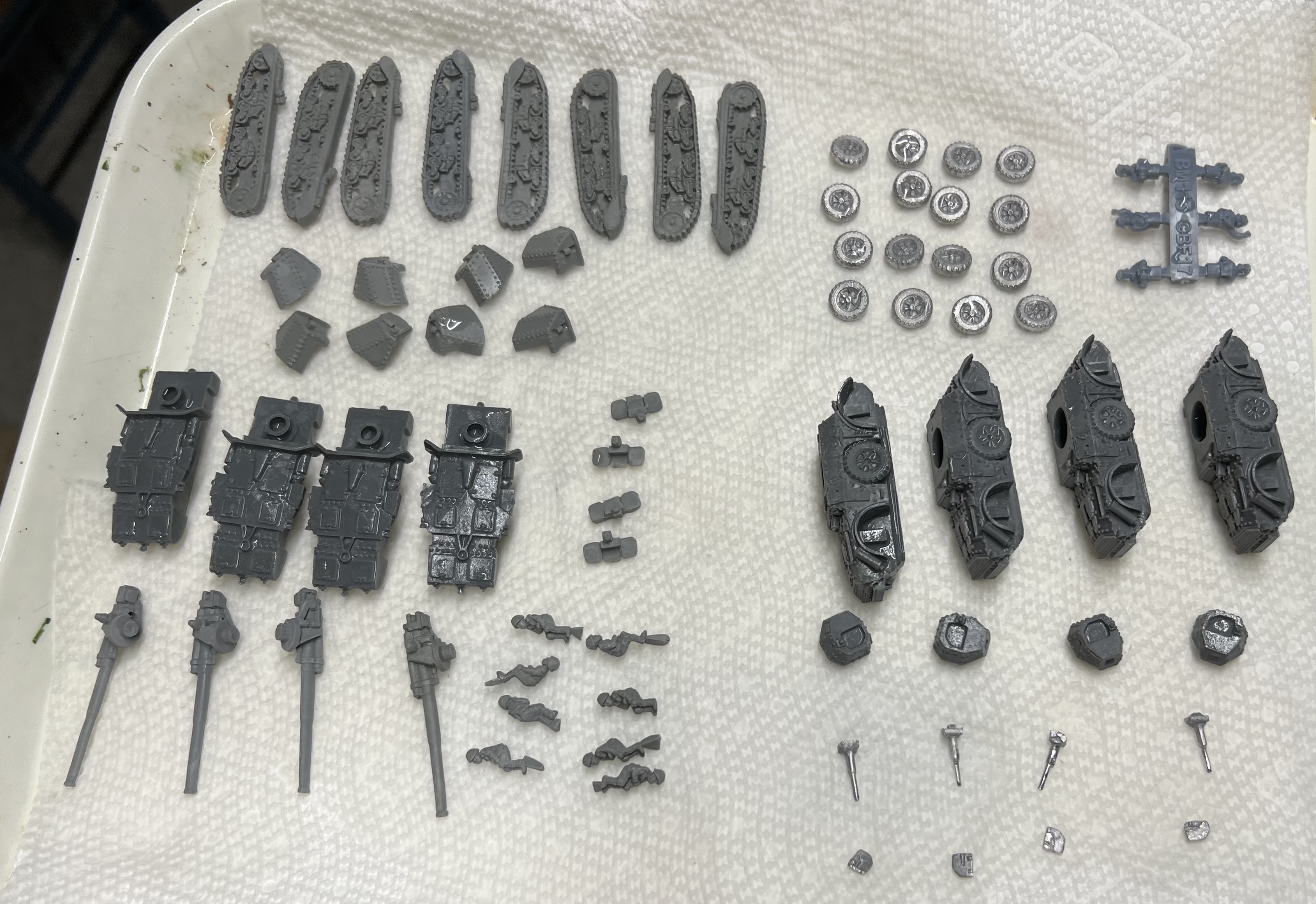
As is my usual practice, I washed and scrubbed the components.
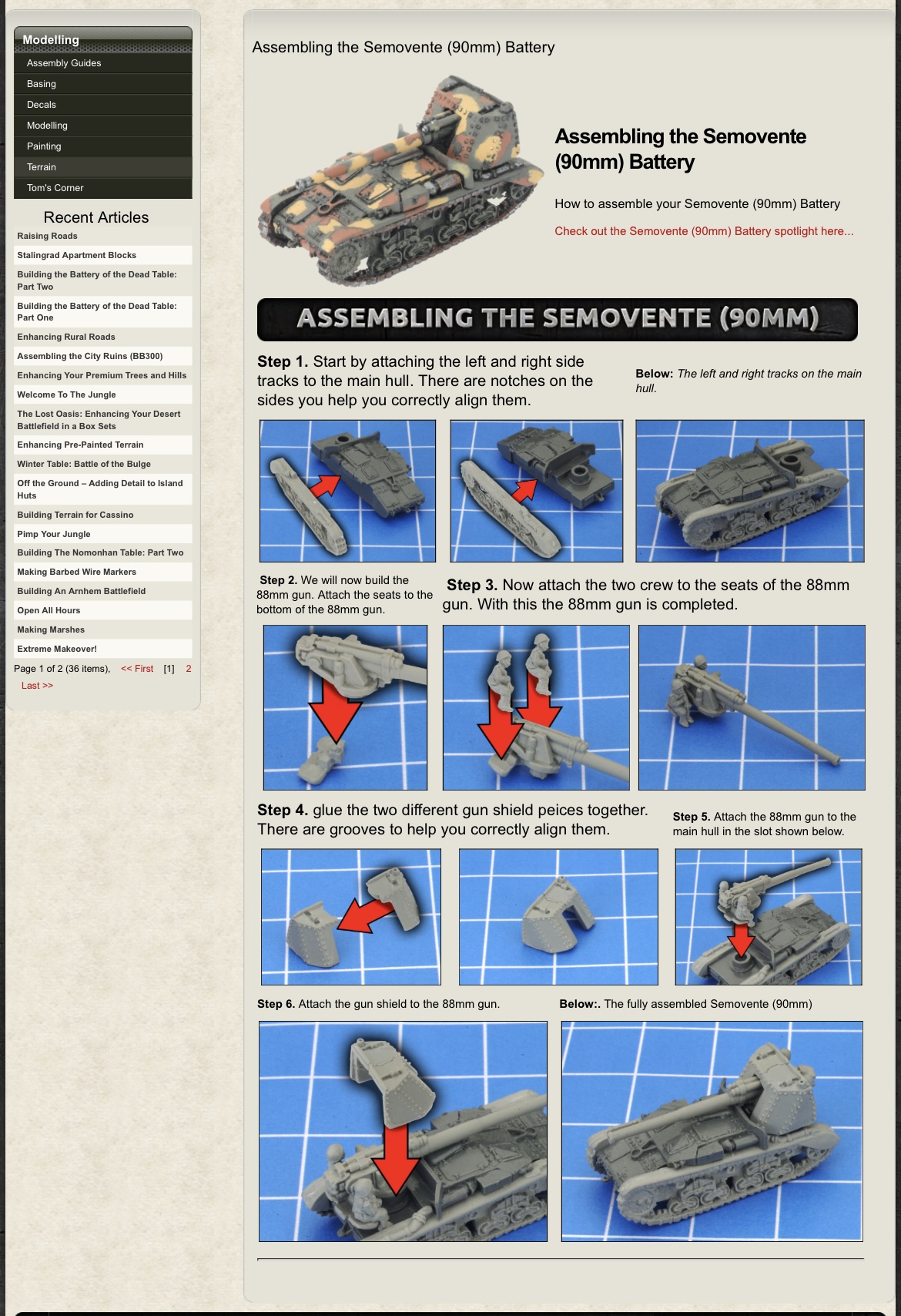
That model was not so easy to work on – mainly the crew and weapon mounting. I ended up using green stuff on the fiddly mantlets. I did paint the crew of the Semovente’s – though no one will ever see their faces! As for the commanders of the AB 41’s – I used three different poses plus one with the hatch shut.
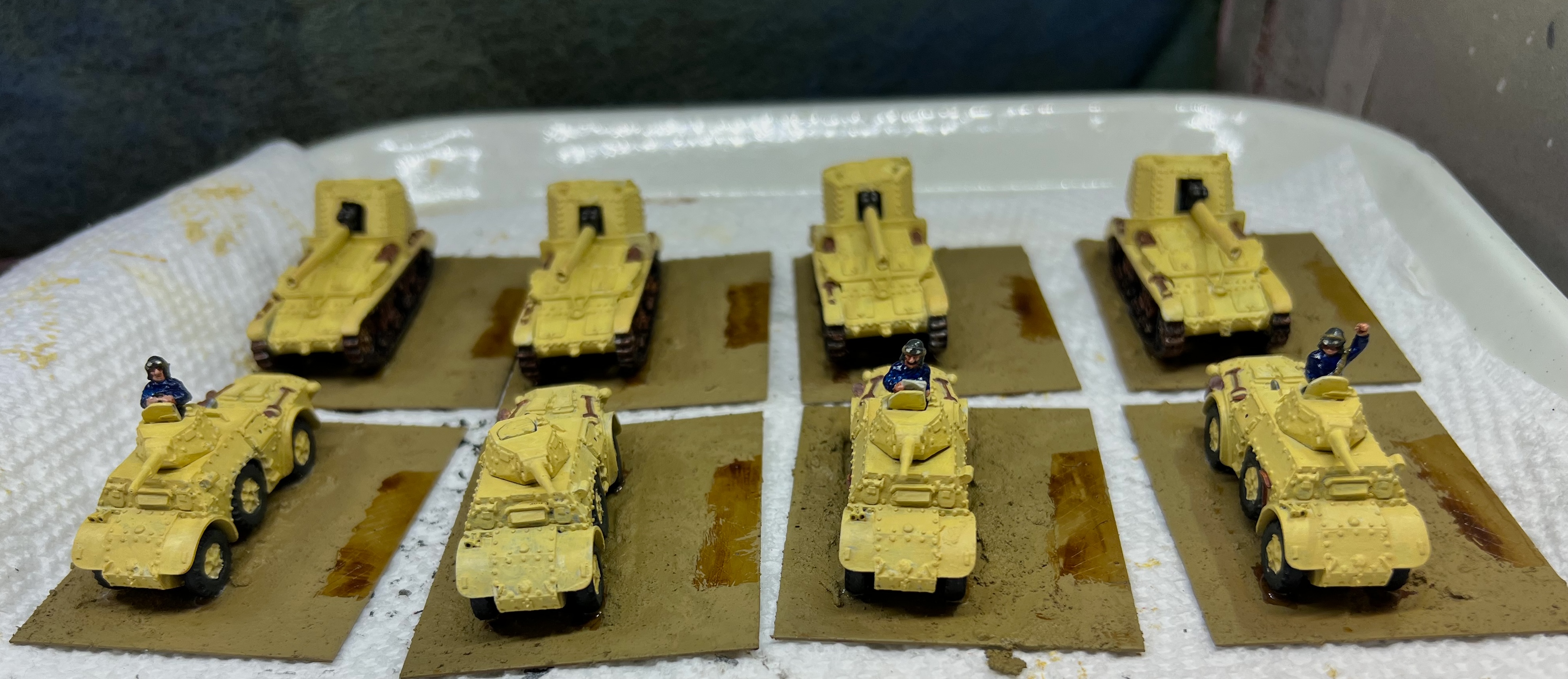
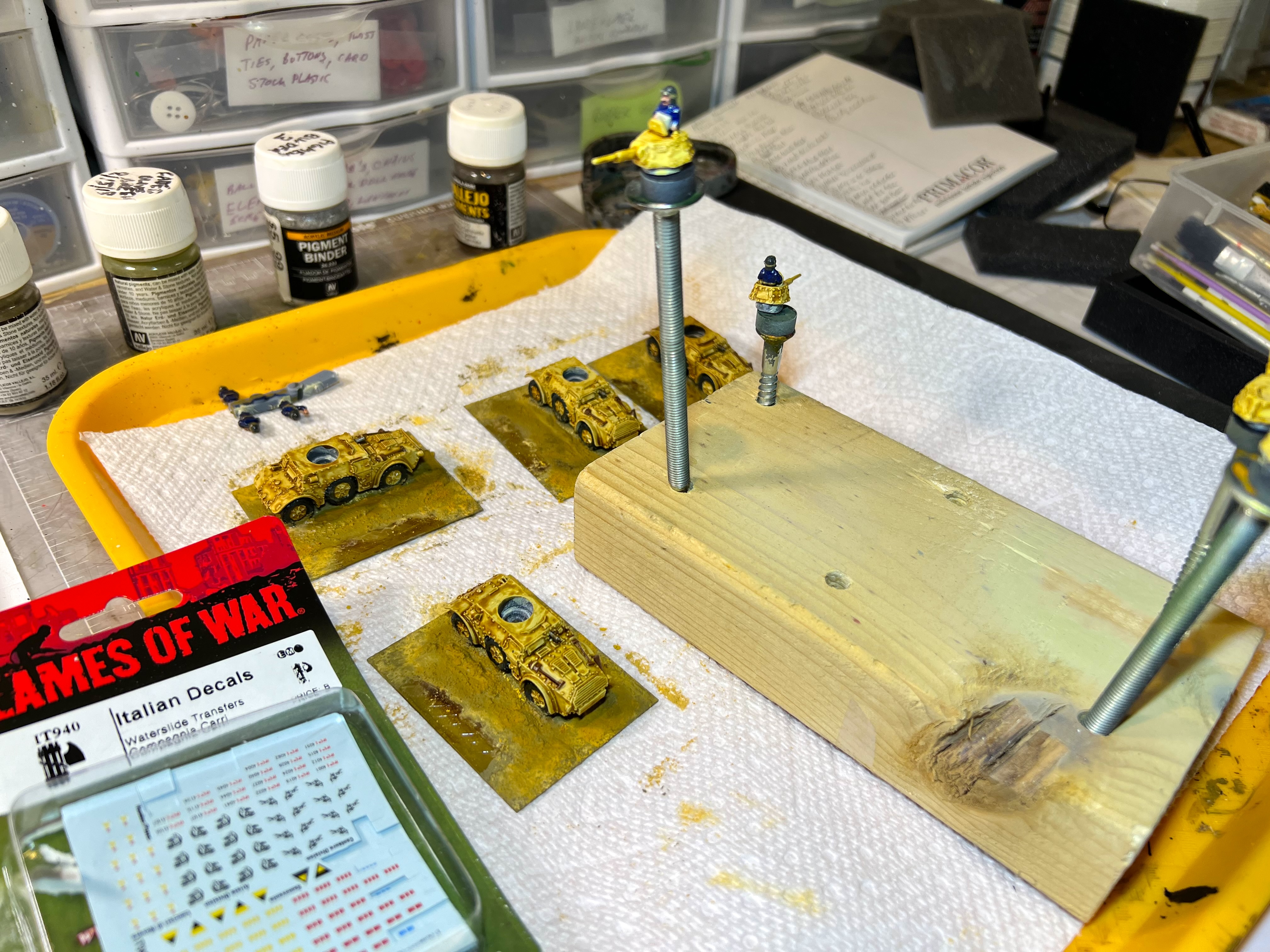
I mounted the vehicles on their bases as shown below. Once painted, I applied decals for better tabletop recognition (for the players).
Side view on basesFront view on basesRear of Semovente 90/53 showing the crew.
I shaded the AB 41’s. I applied decals on the vehicles and pigments to some texture paints on the bases. All paints and more that I used are listed at the end of this post.
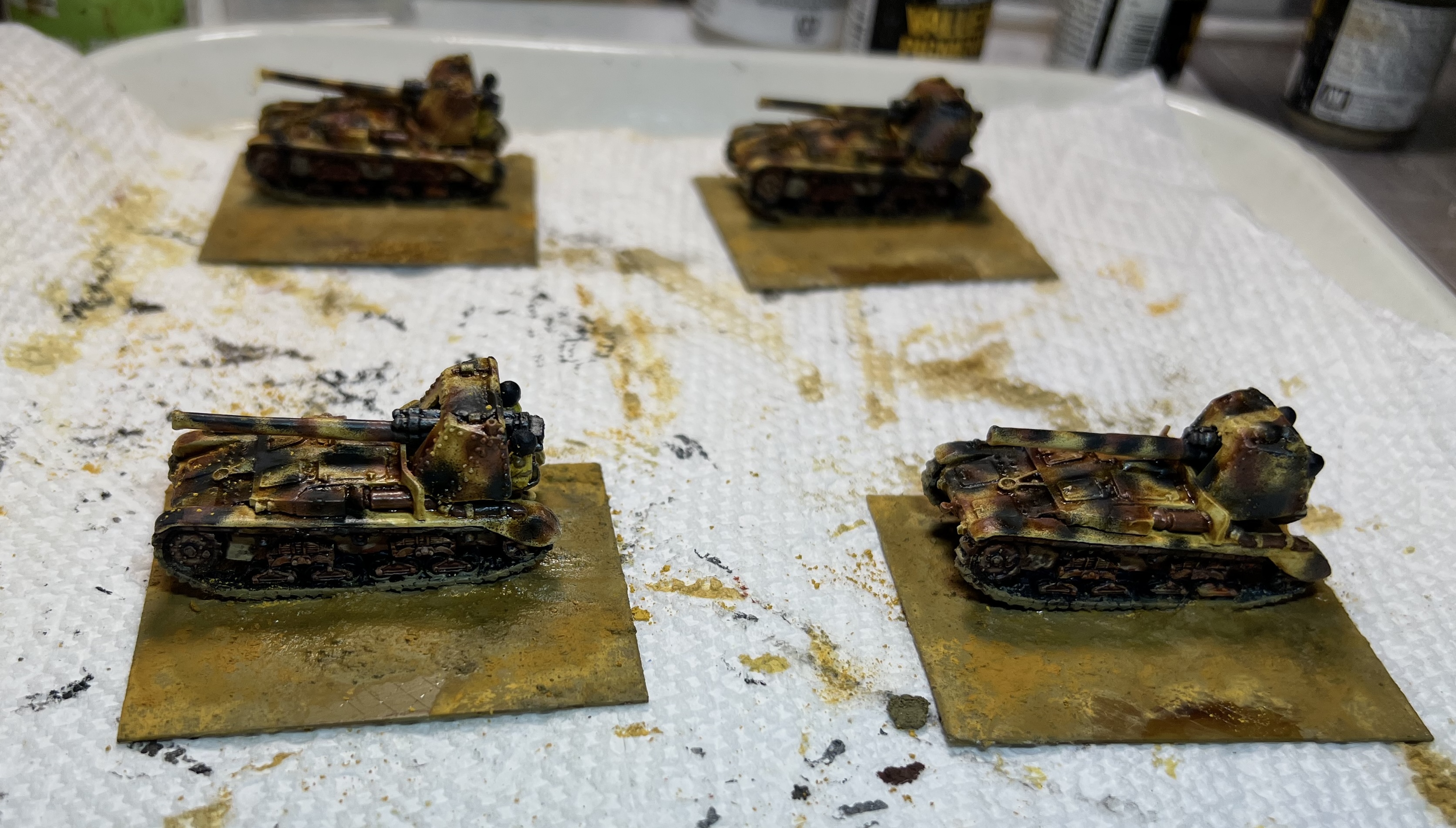
I airbrushed the camouflage pattern on the Semovente’s.
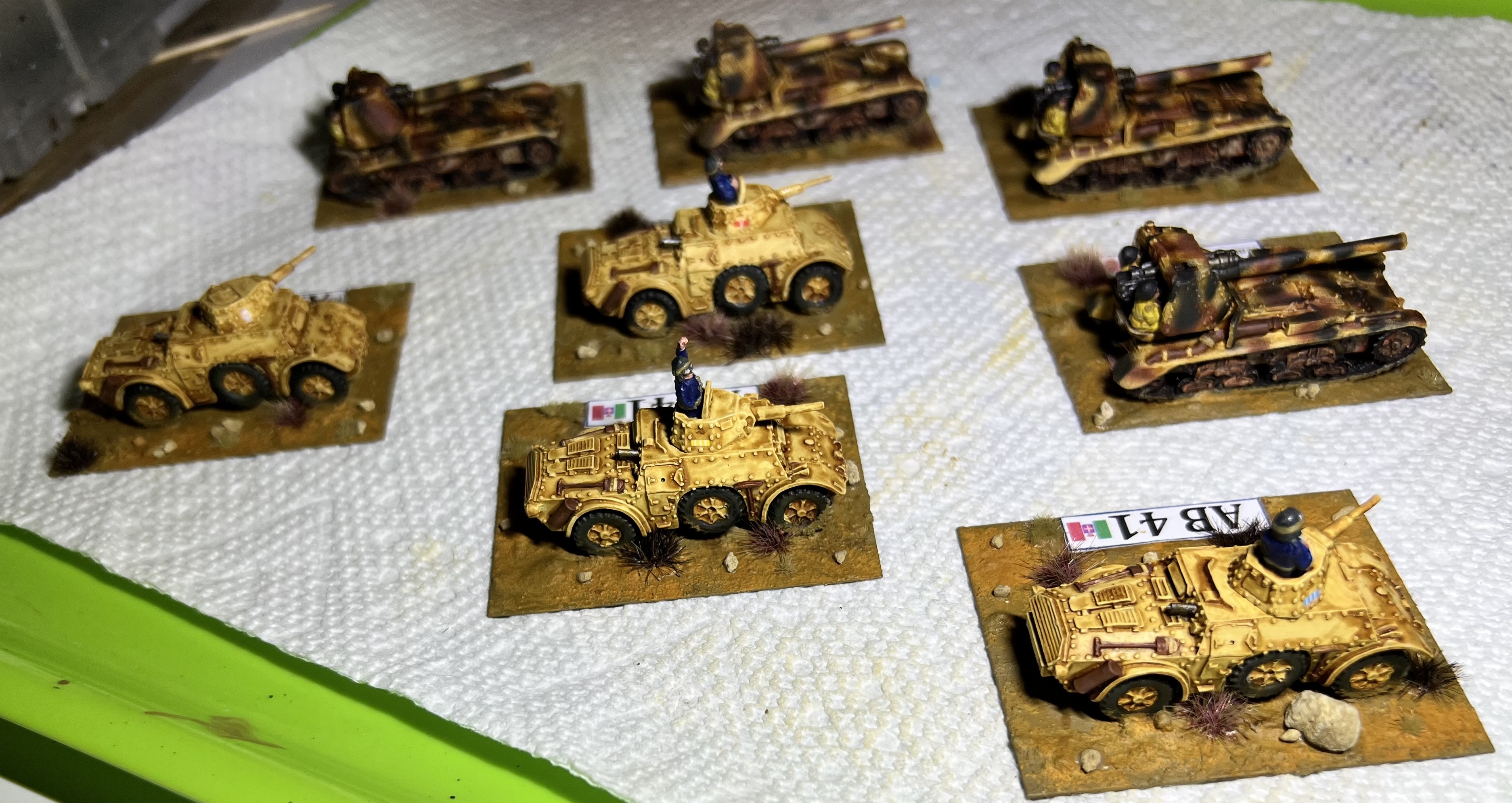
At this point, the models were finished!
Left sideRear viewRight side
Let’s now see some eye candy of the models.
AB 41
AB 41 frontal viewAB 41 right sideAB 41 rear view
Lastly, close up shots of the 4. Note that they all have different decals on their turrets.
Commander with binocularsCommander with raised fistCommander with mapAB 41 with closed hatch
Semovente da 90/53
Semovente da 90/53 left viewSemovente da 90/53 frontal viewSemovente da 90/53 right side viewSemovente da 90/53 rear view showing gunners
Lastly, close up shots of the 4. Note that they all have different decals on their mantlets.
These will be on the tabletop at Cold Wars, TotalCon, and other upcoming conventions. Please let me know your thoughts and feedback in the comments section. Thanks in advance for your input. As always, thanks for reading.
For all of my posts on WWII games and projects, there is a consolidated list. You can find the posts and their links located here.
MATERIALS USED
PAINTS, INKS, GLAZES, SHADES, WASHES, PIGMENTS AND FLOCKING USED ON THE FOUR BATTLEFRONT/FLAMES OF WAR AB 41 ARMORED CAR MODELS
Green Stuff
Gorilla Glue
War Games Accessories Steel Bases Number FOW 3 (2″ x 2½”)

























 Mark A. Morin