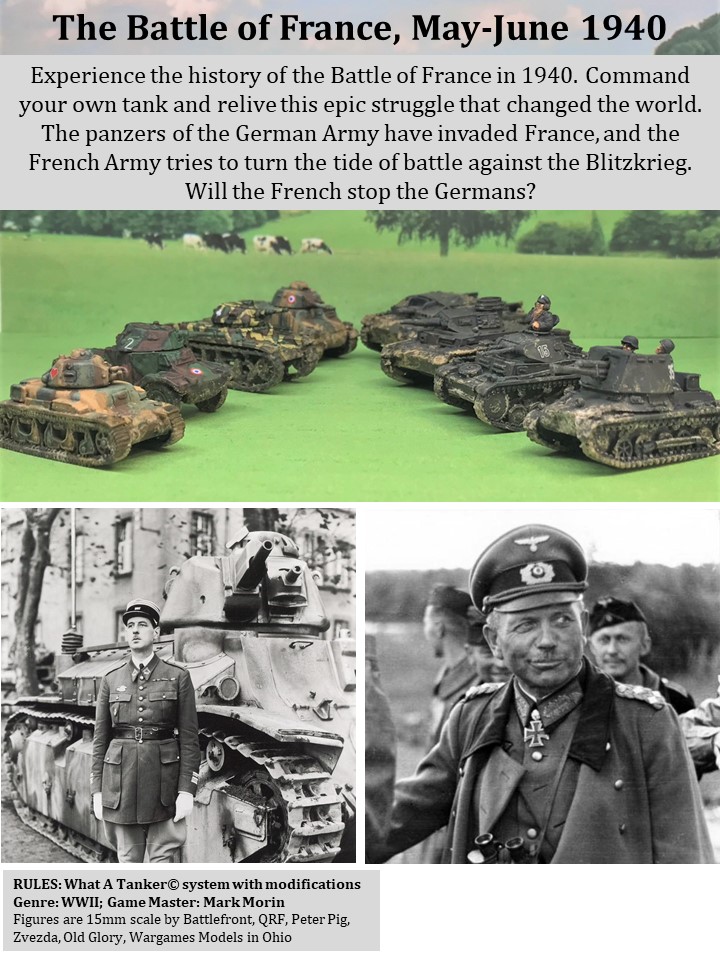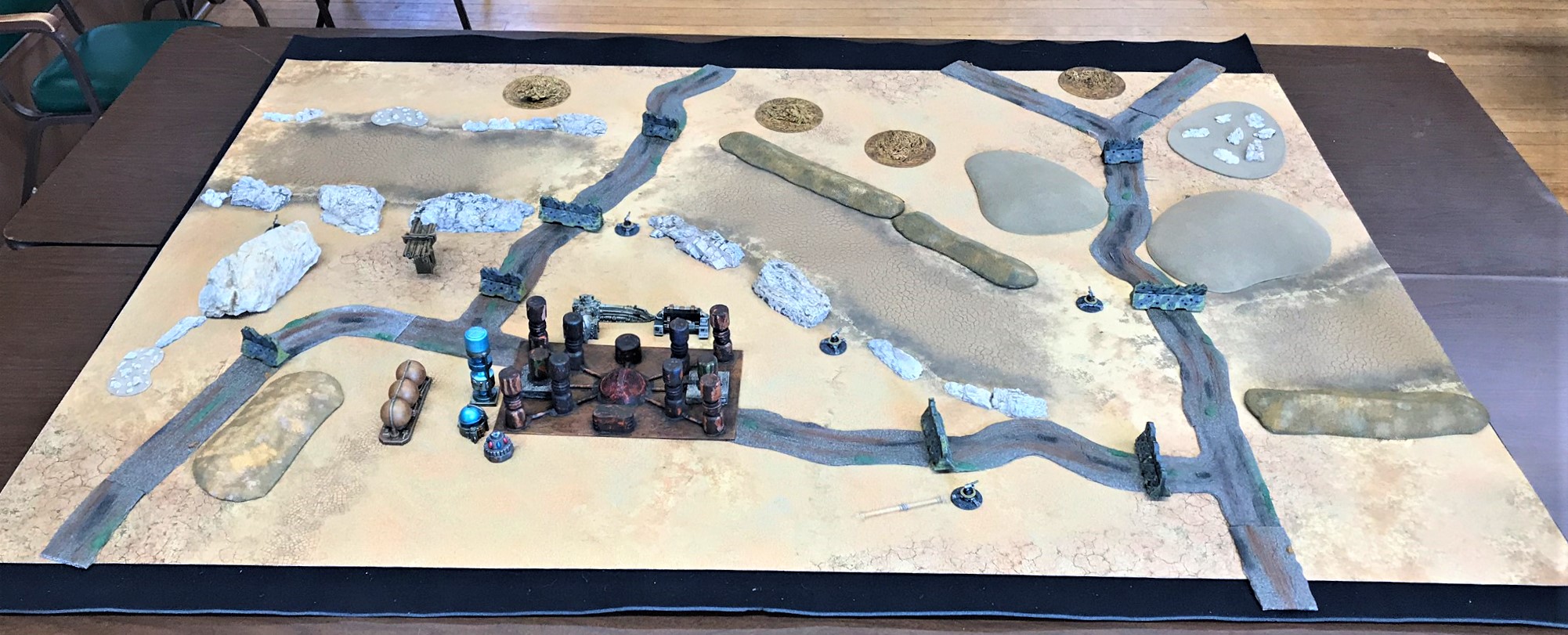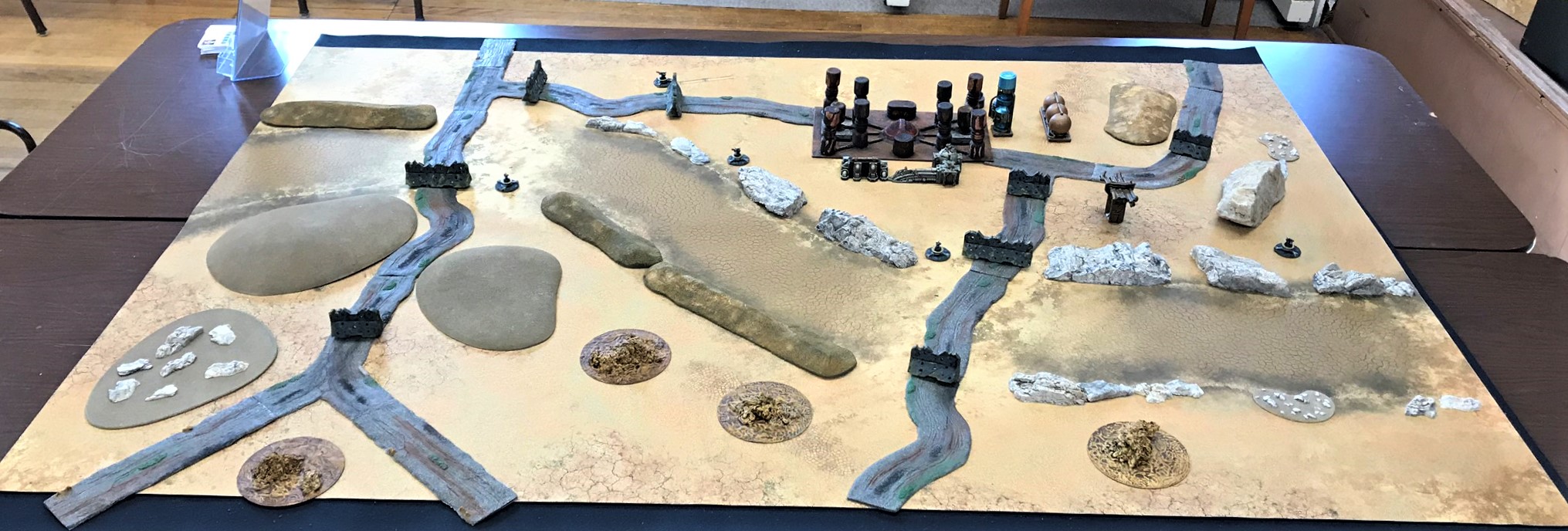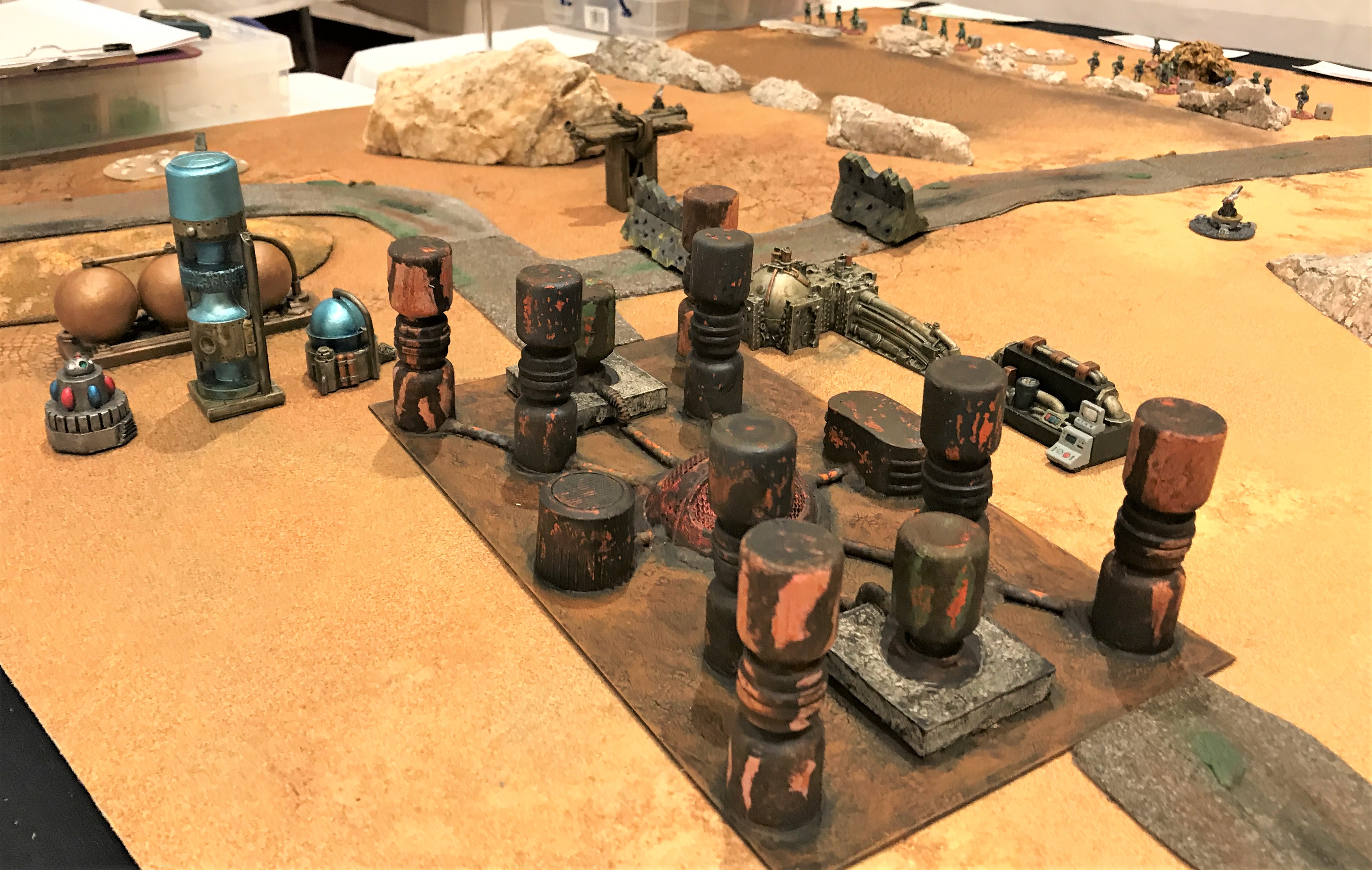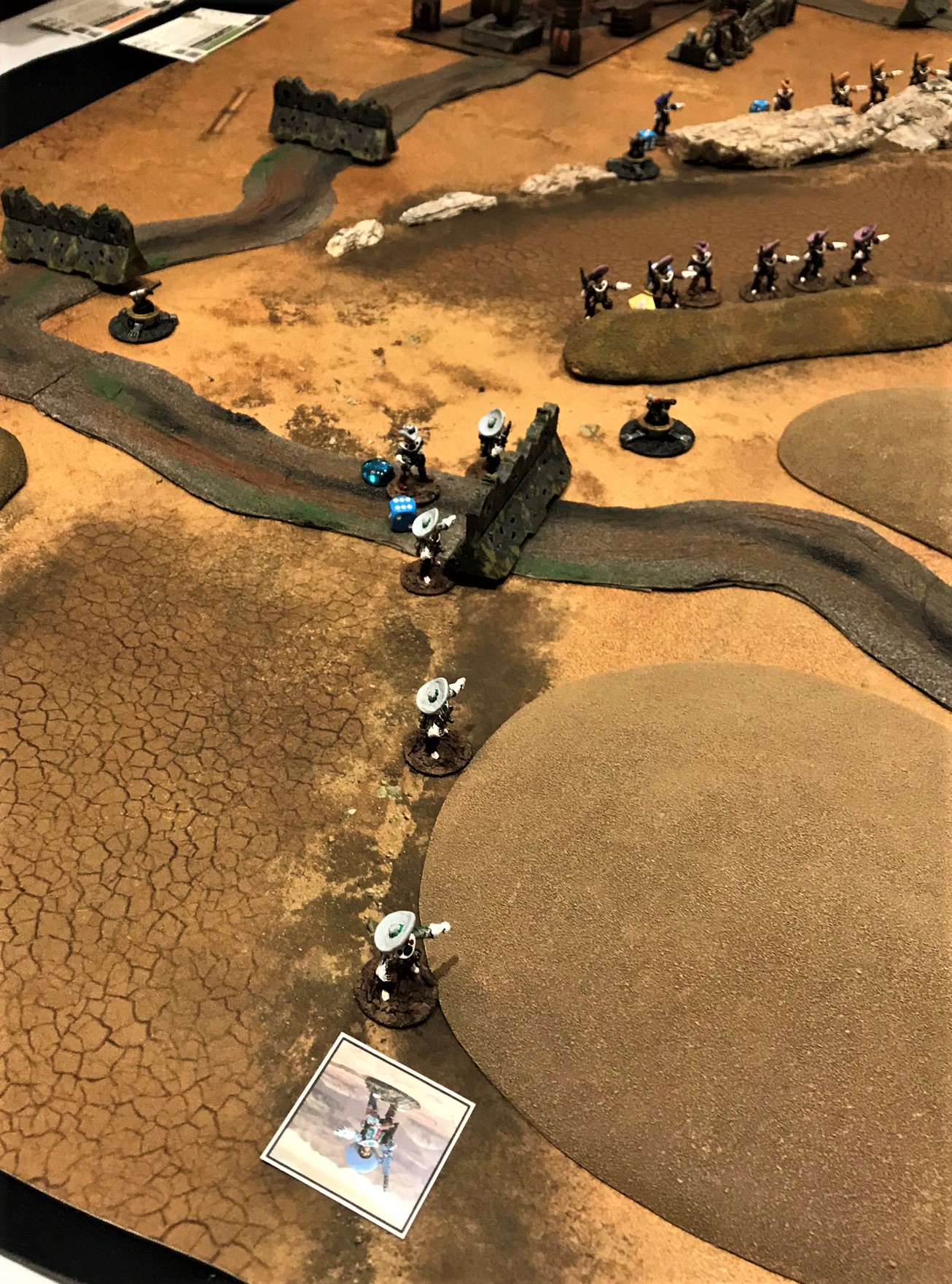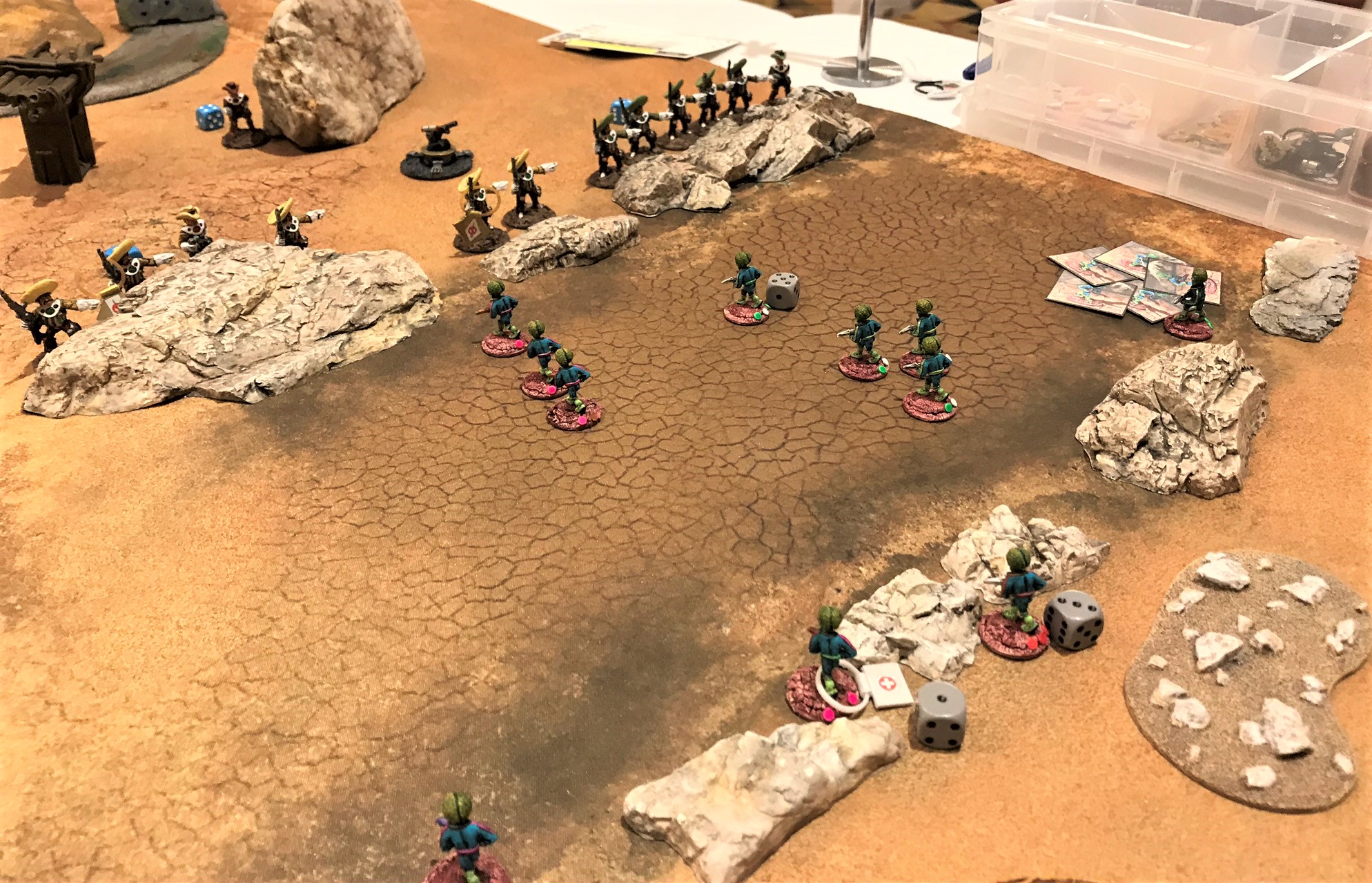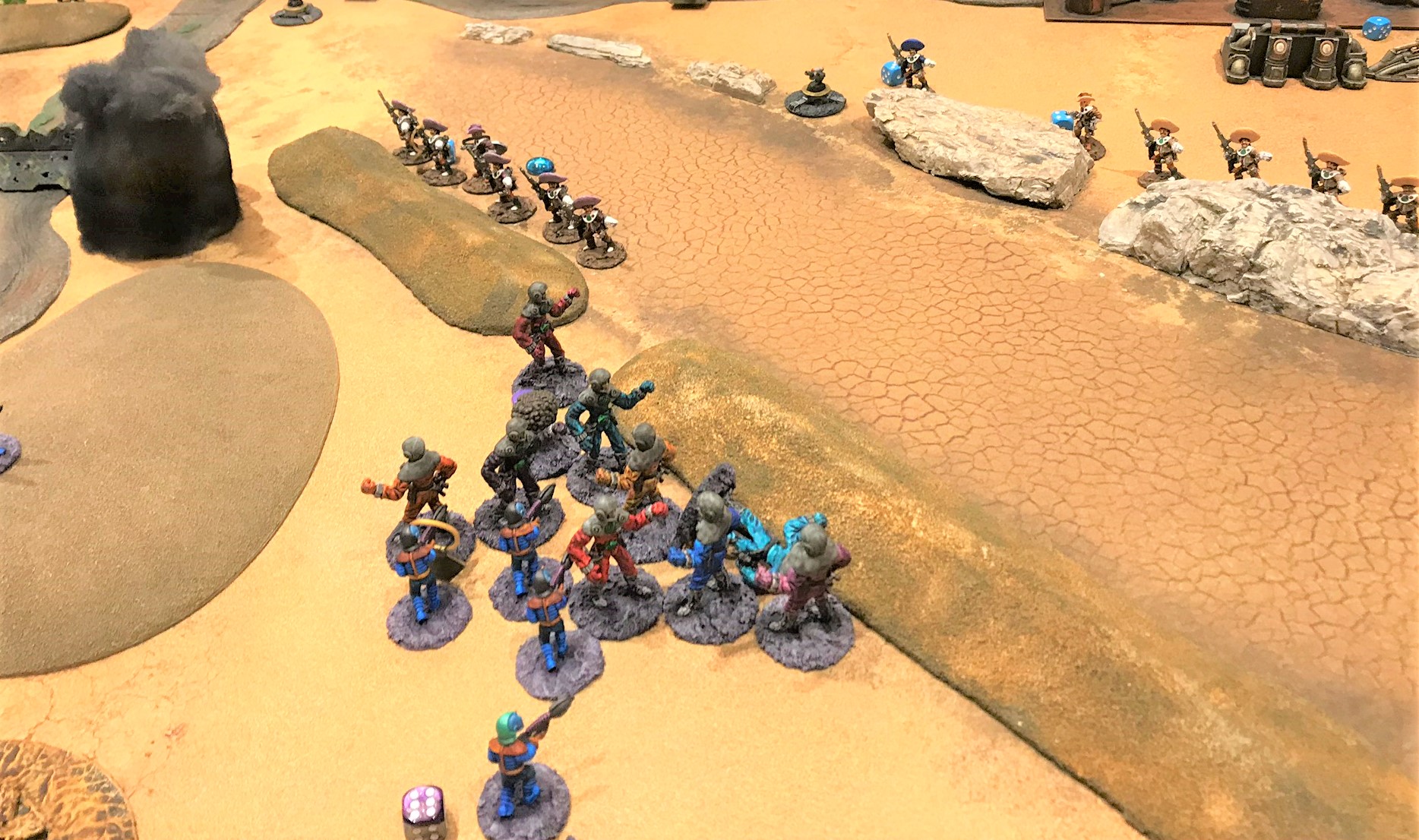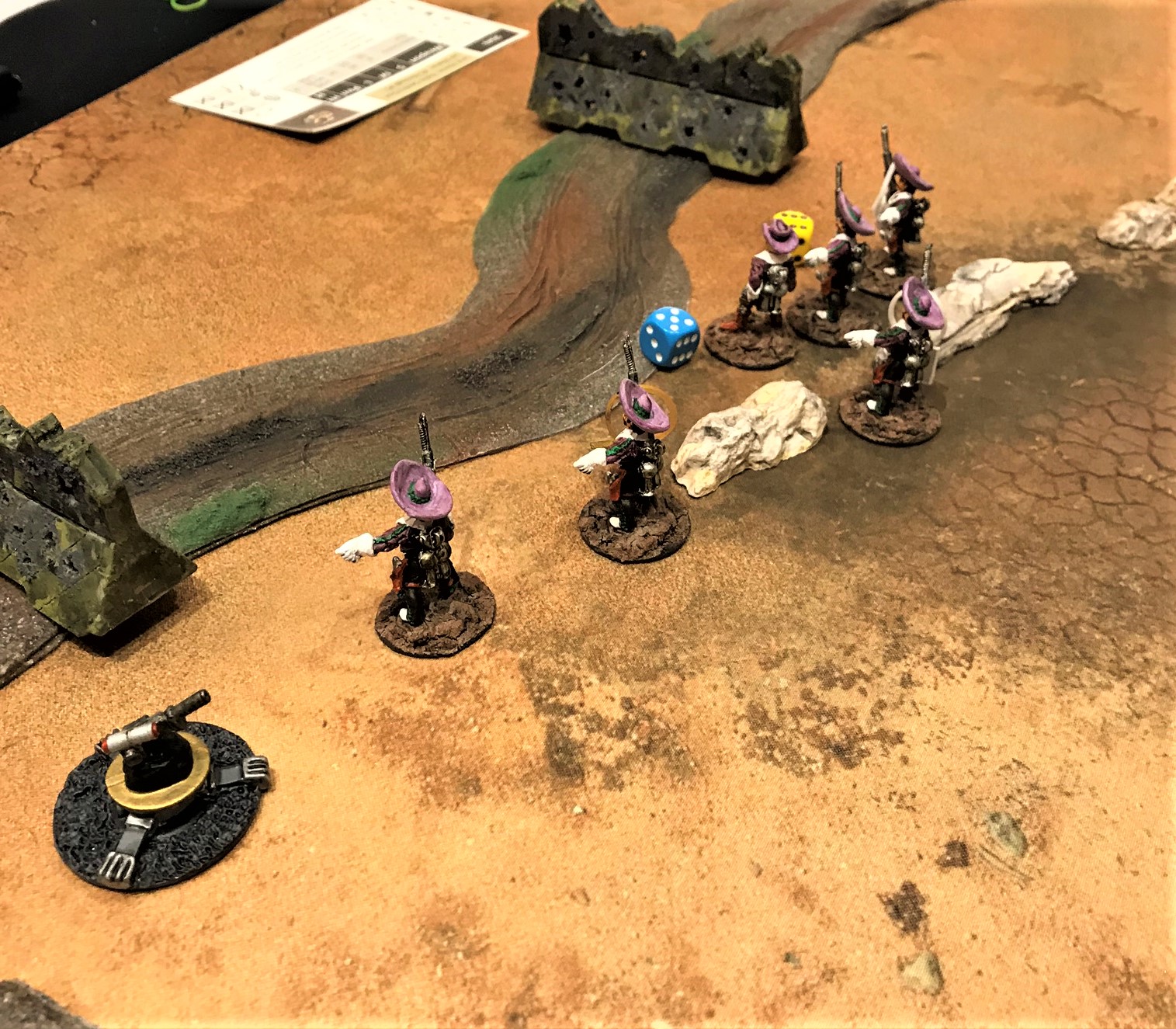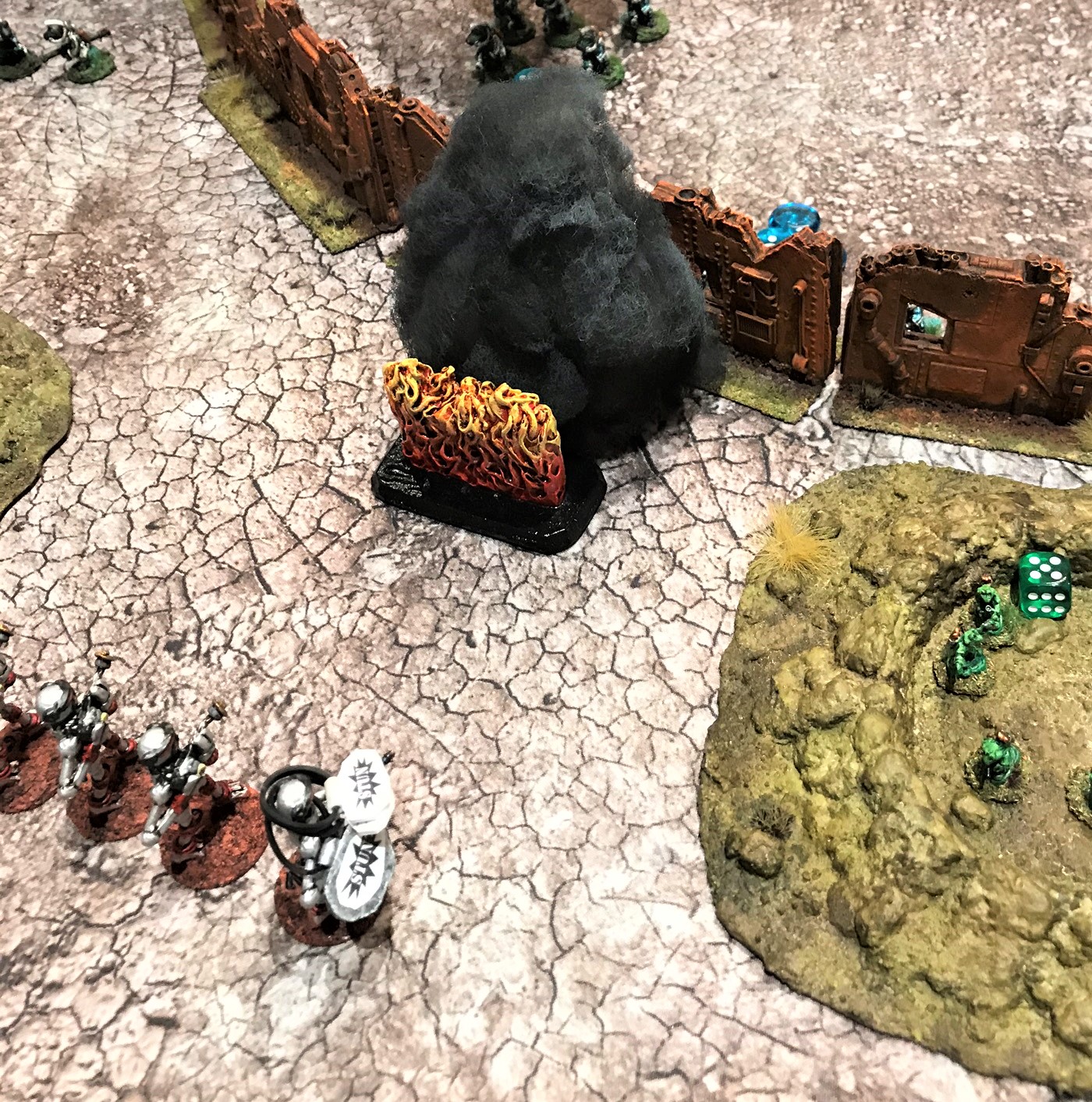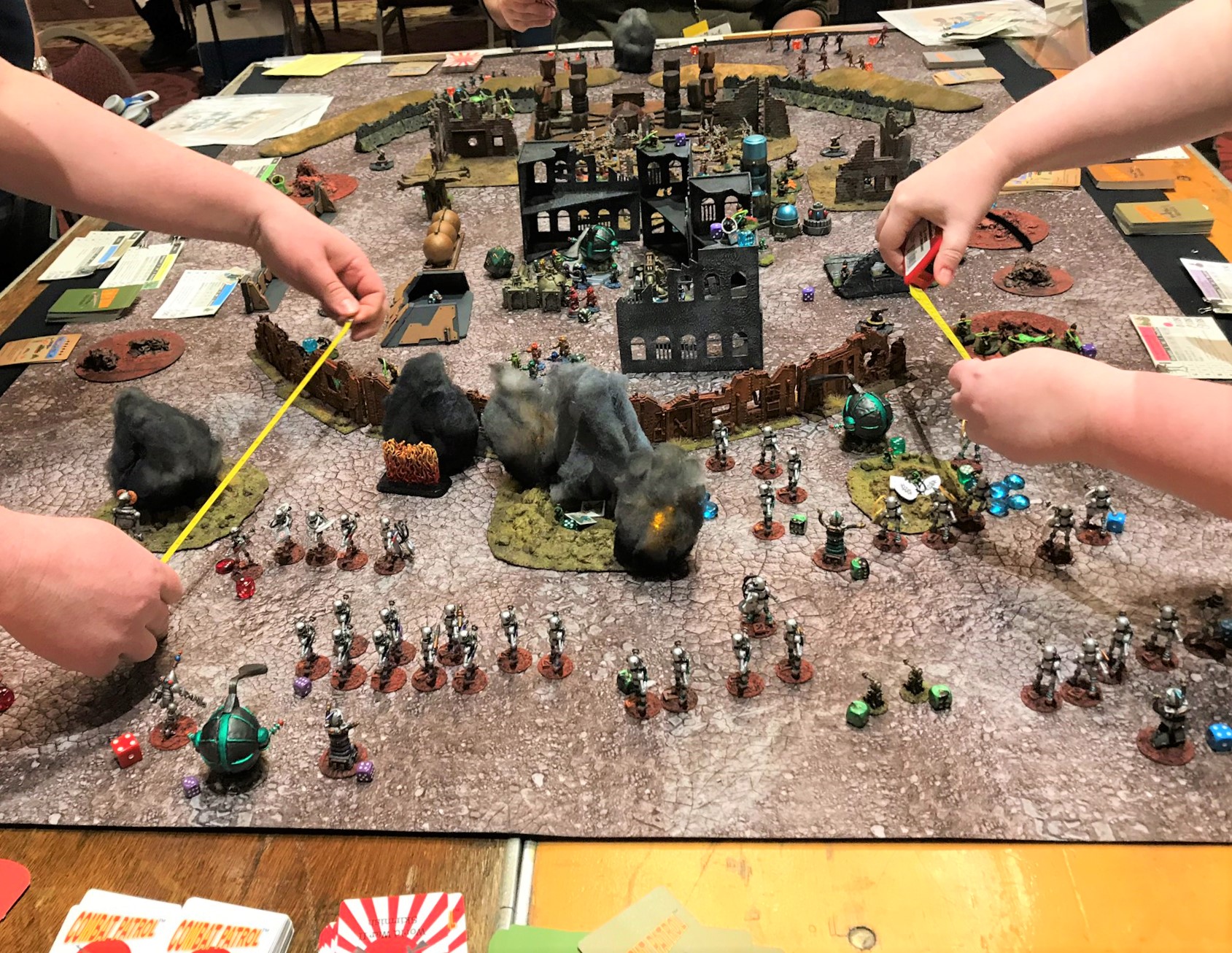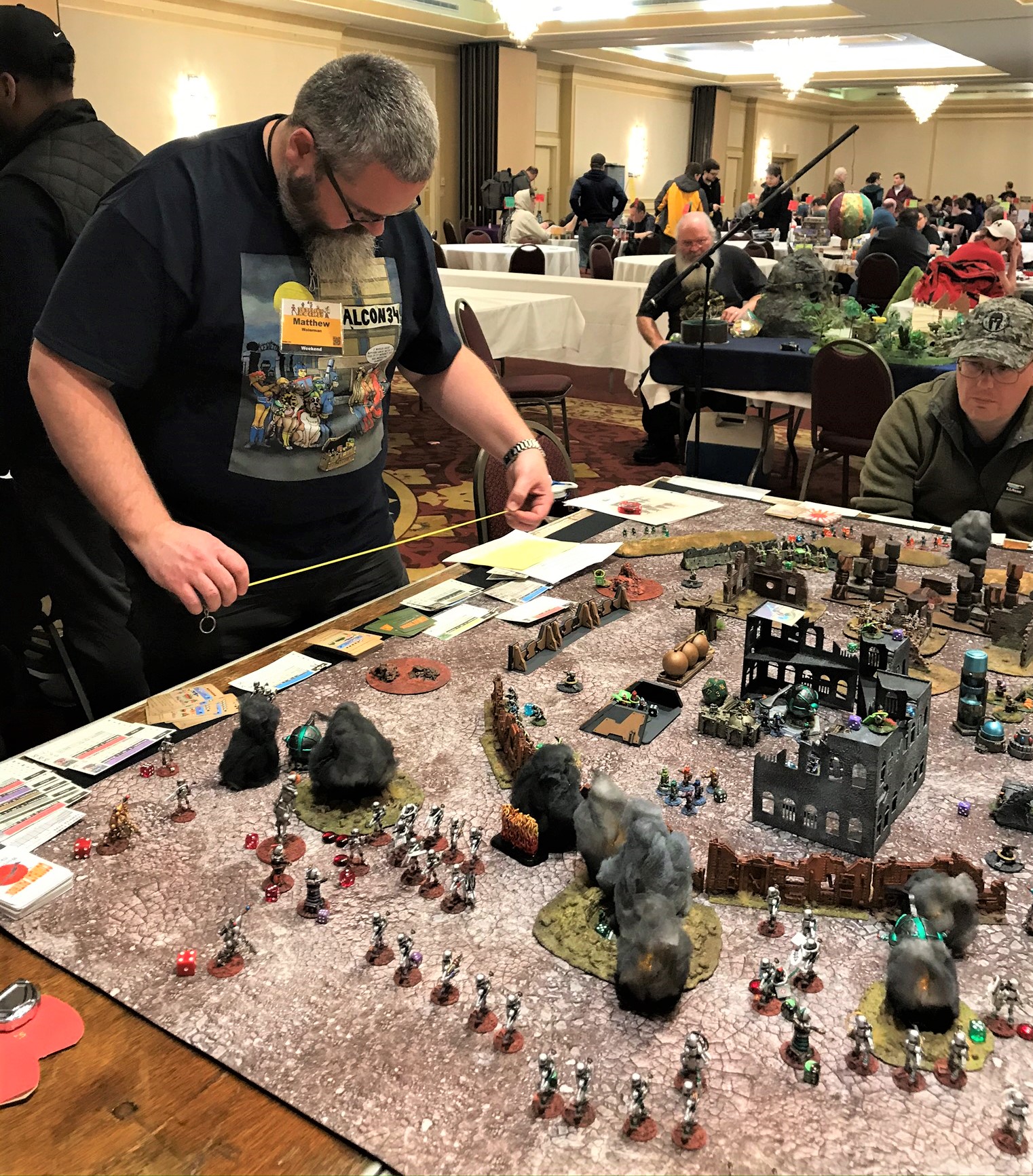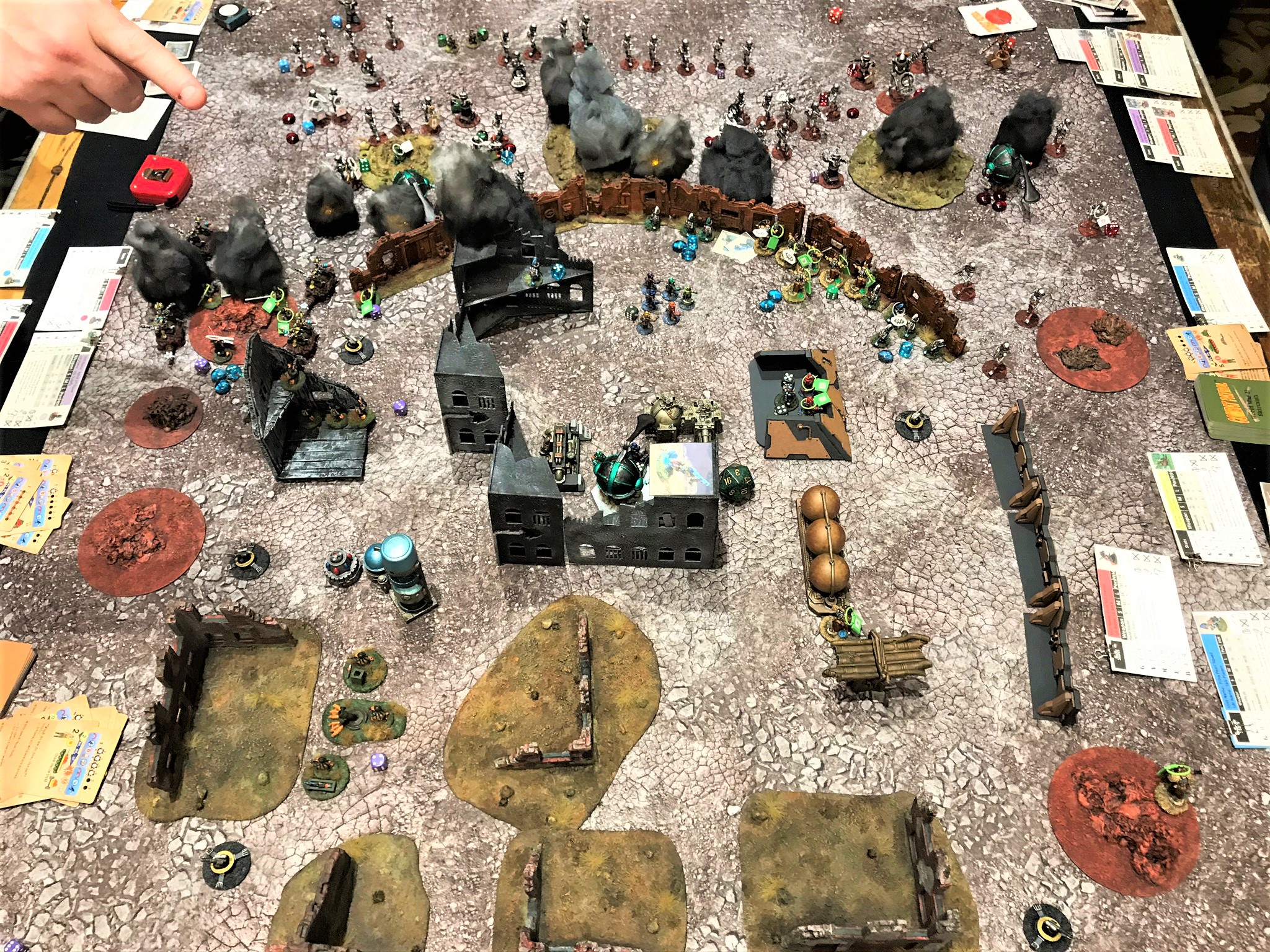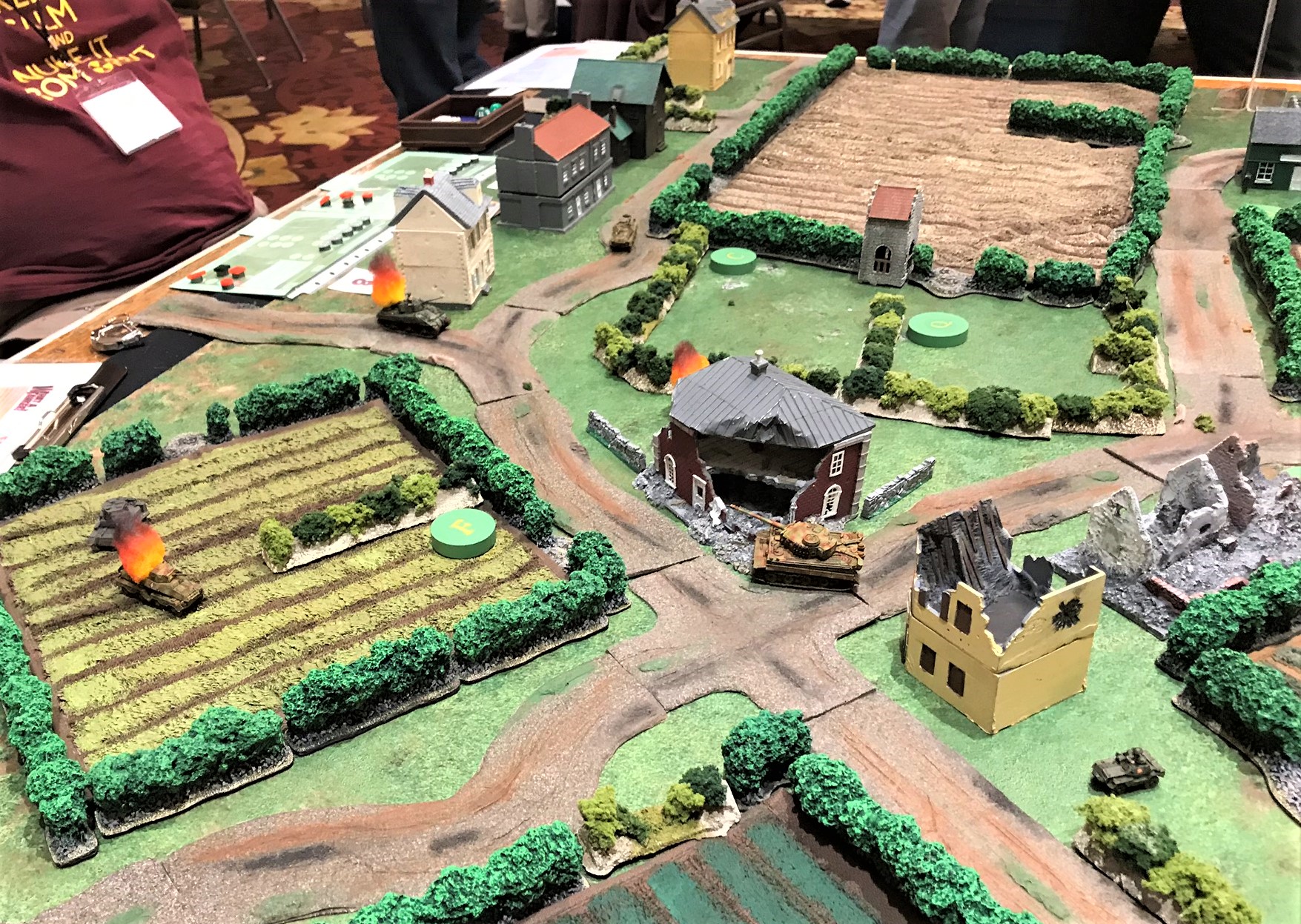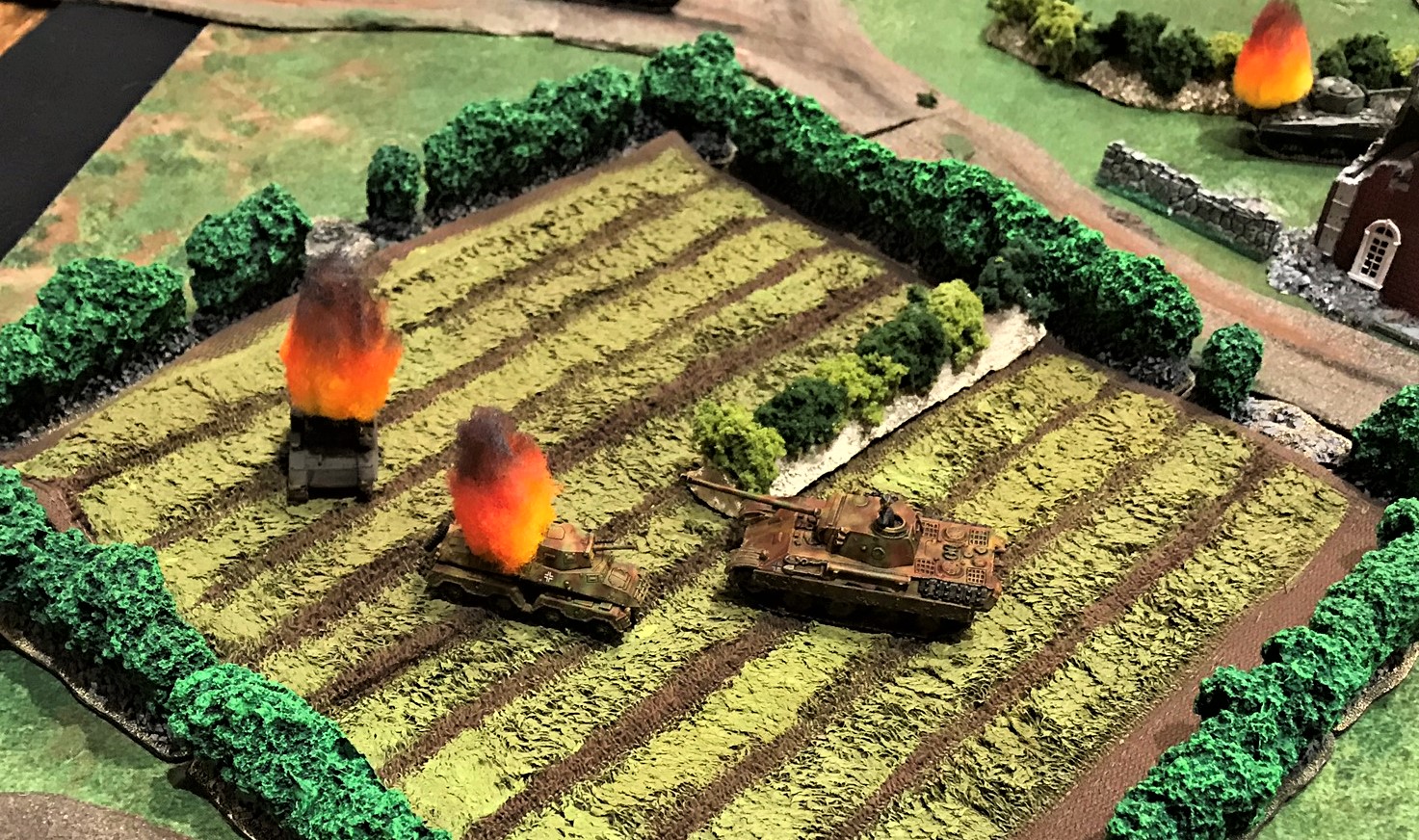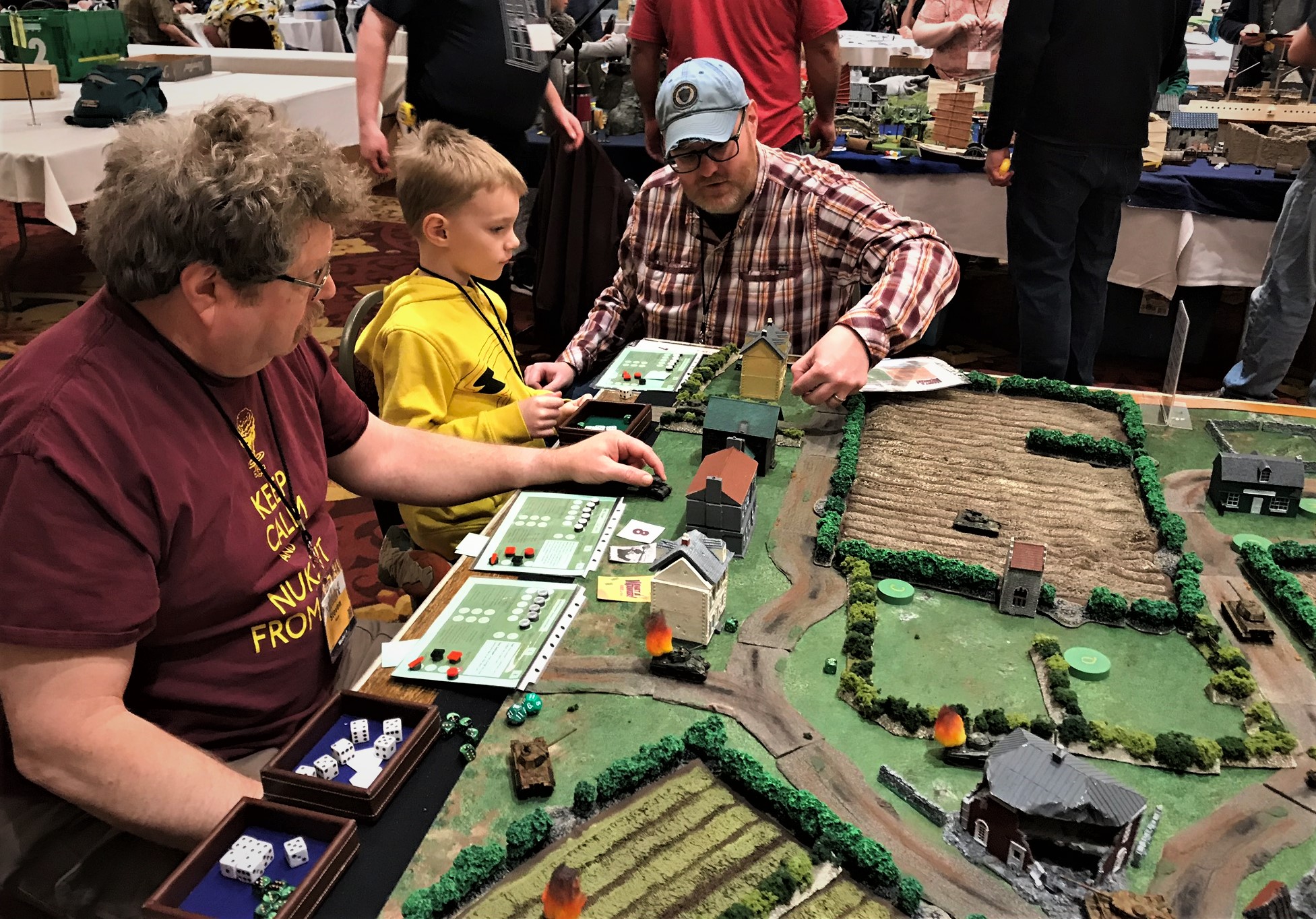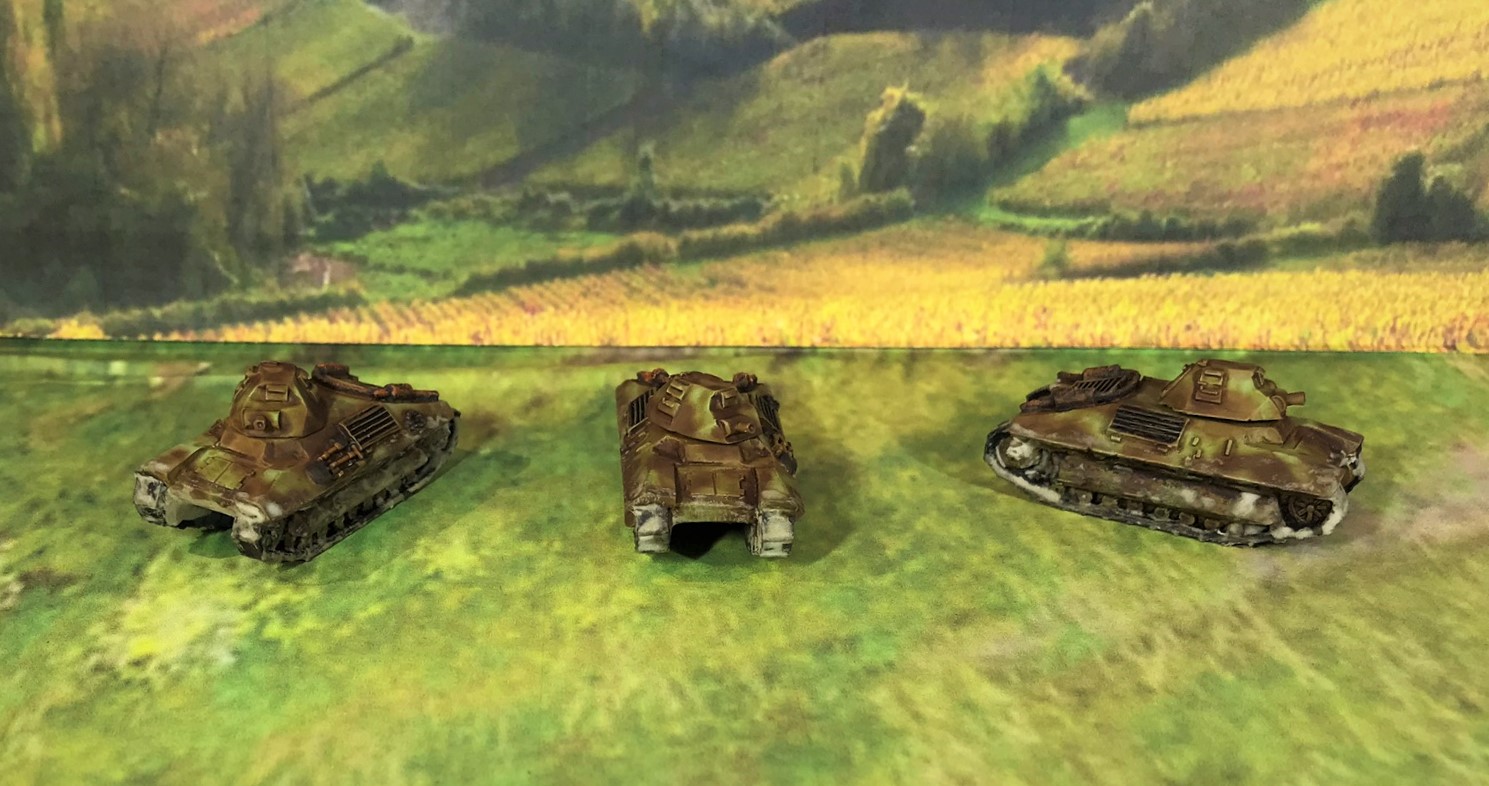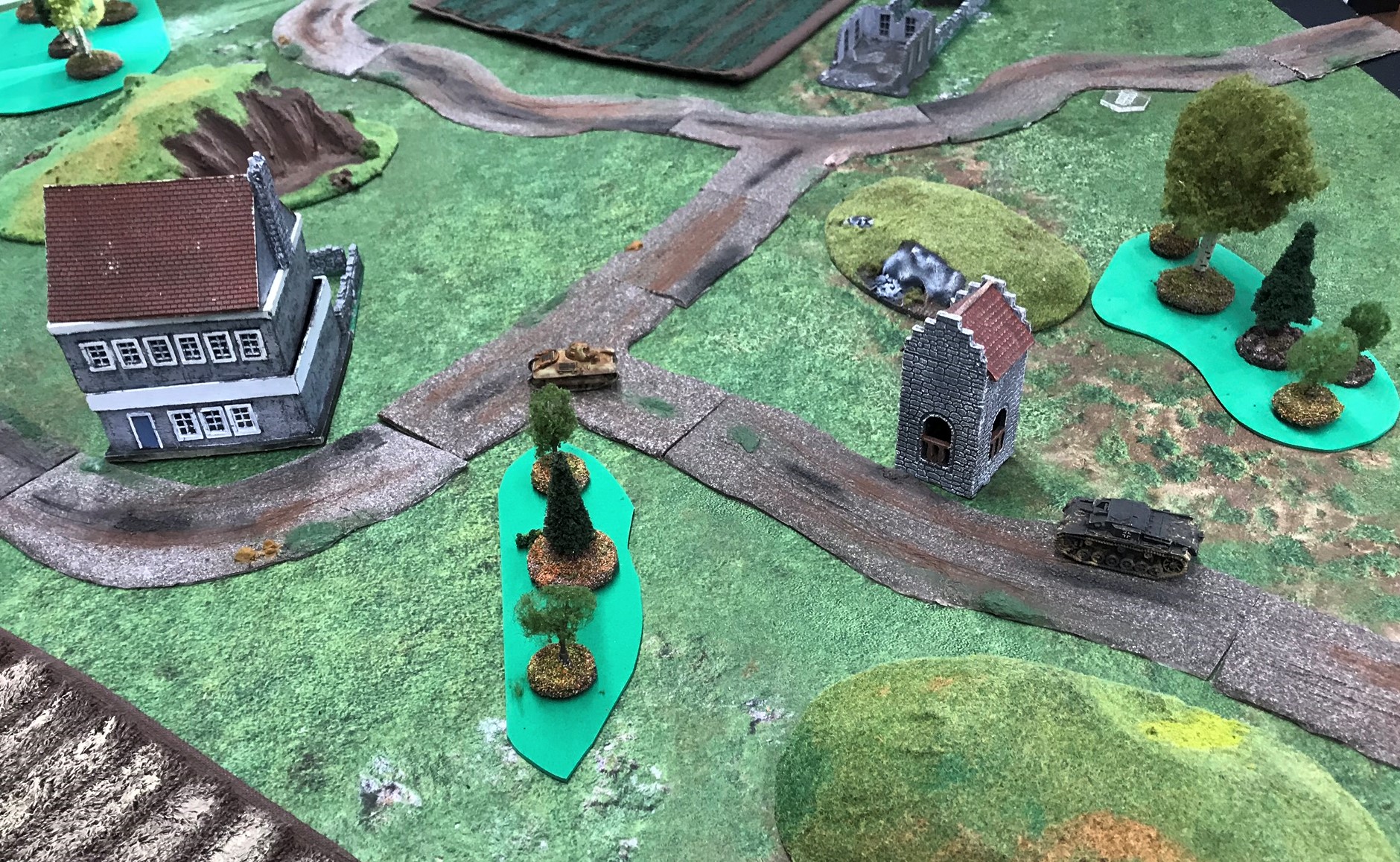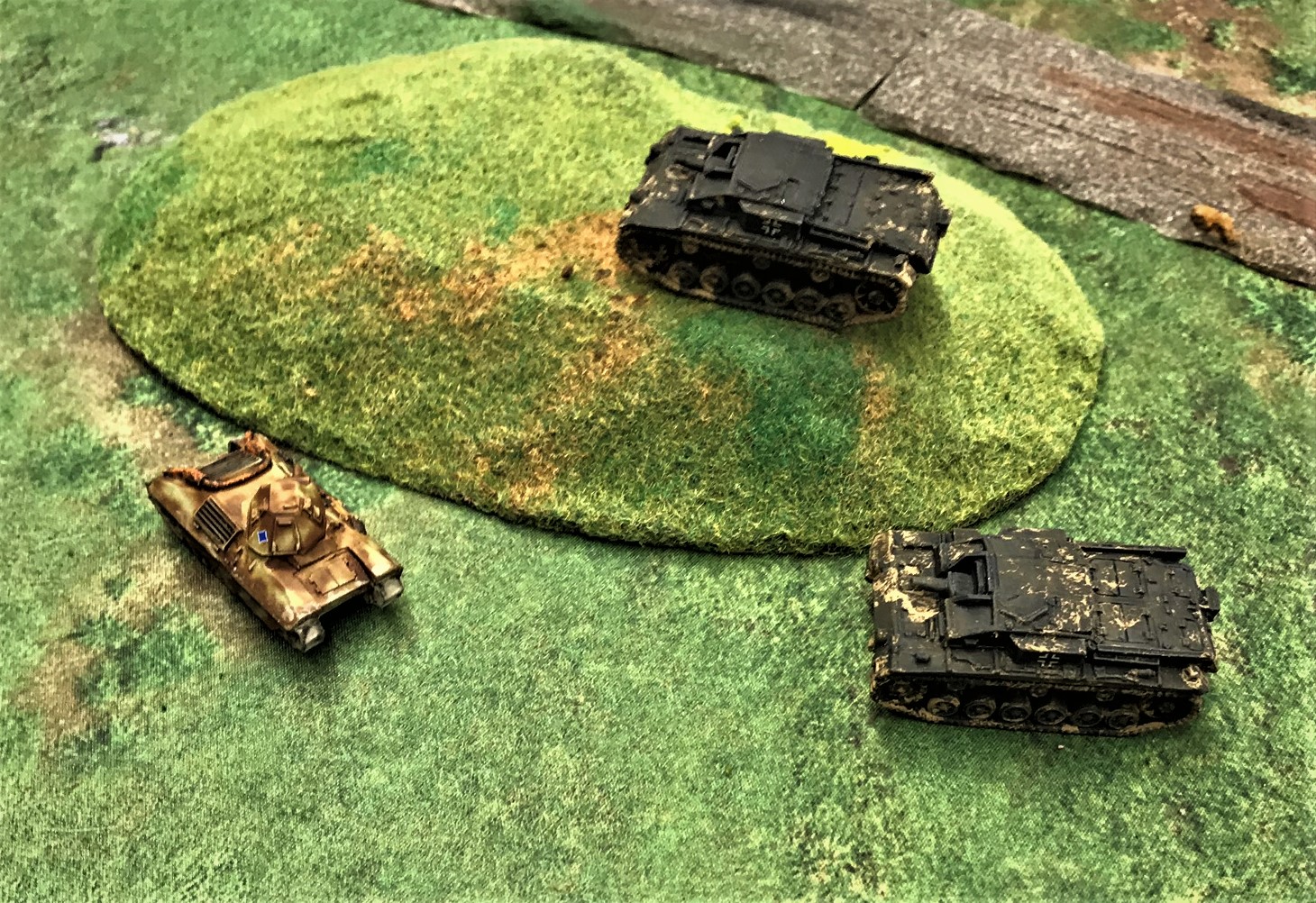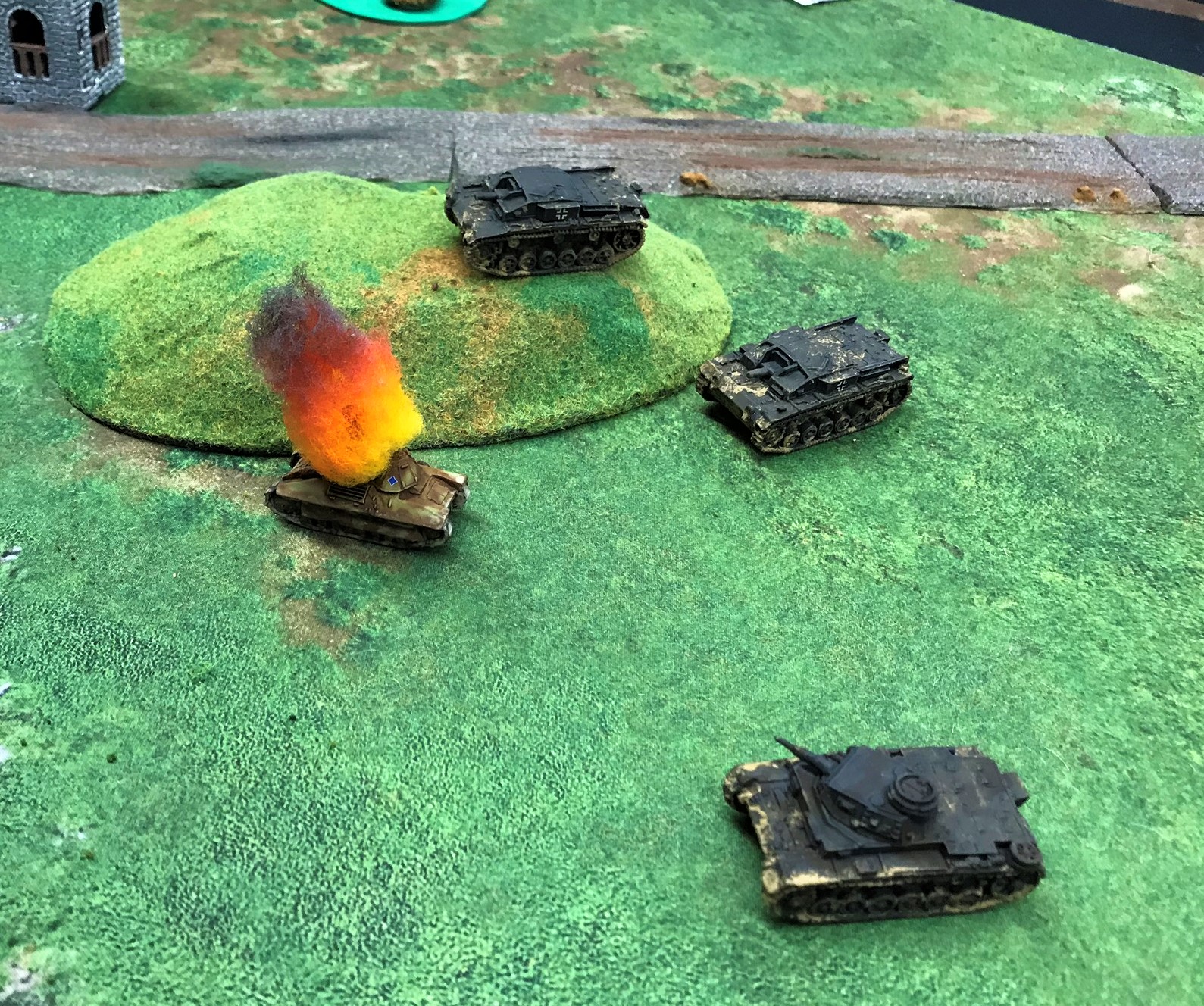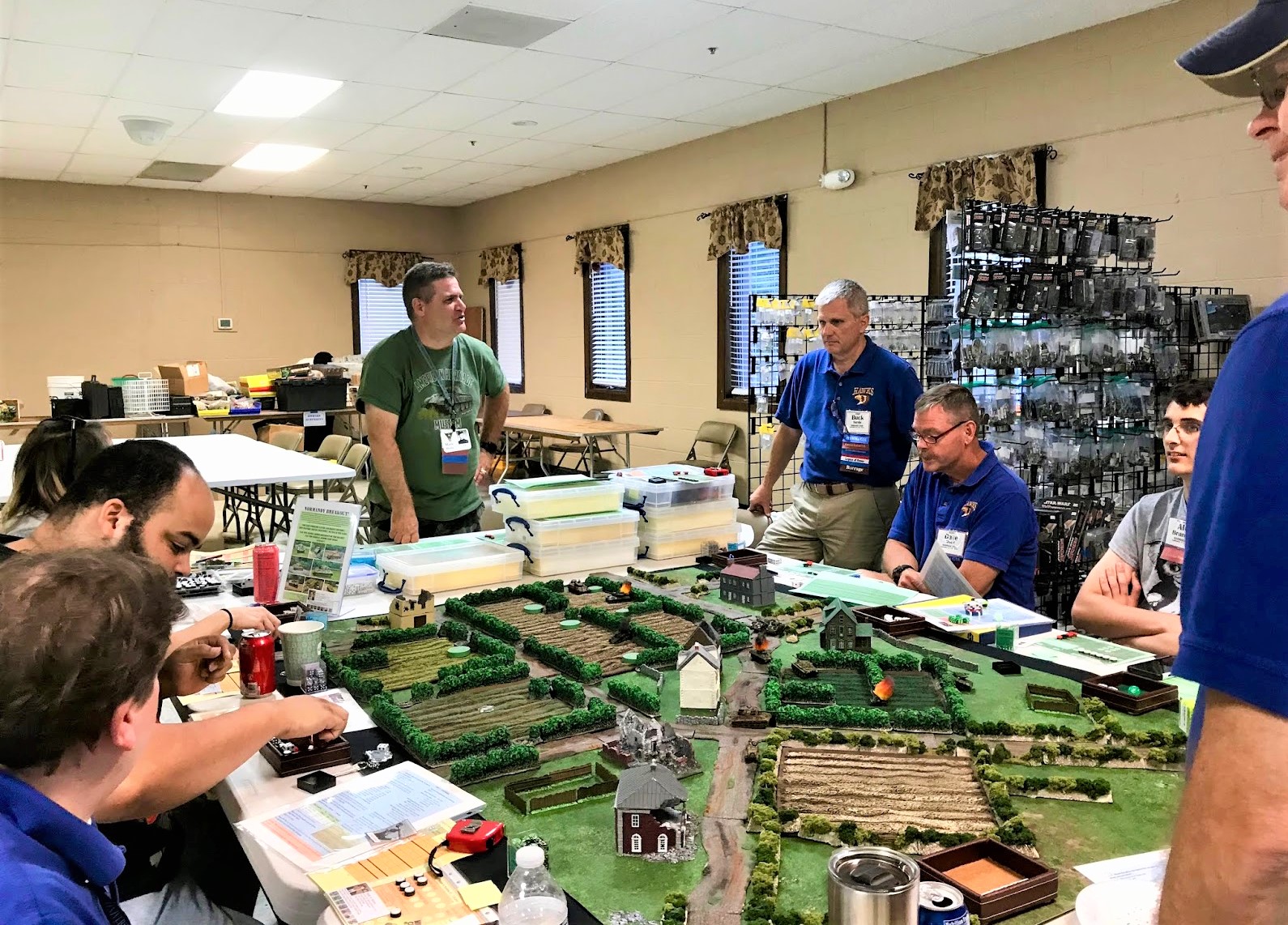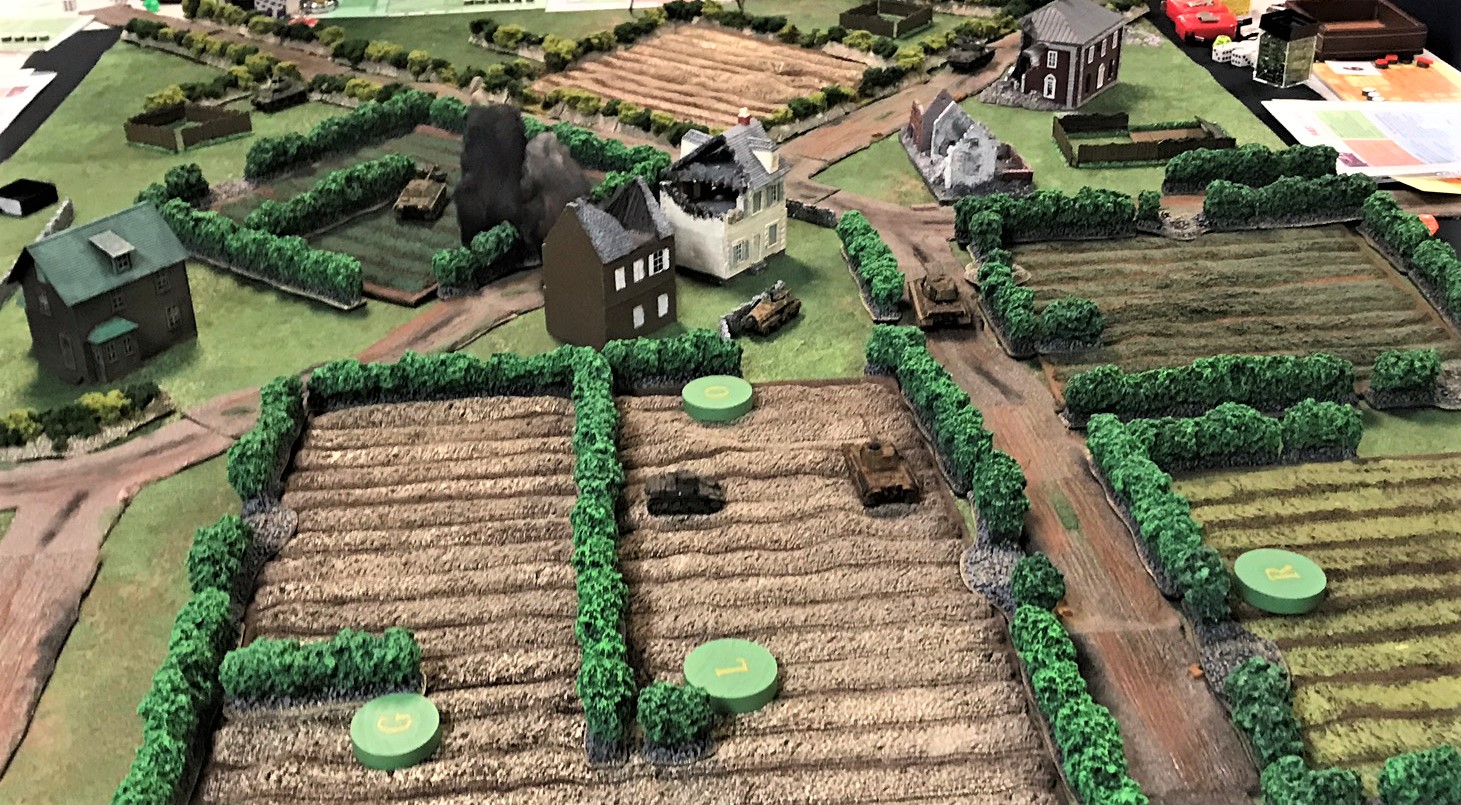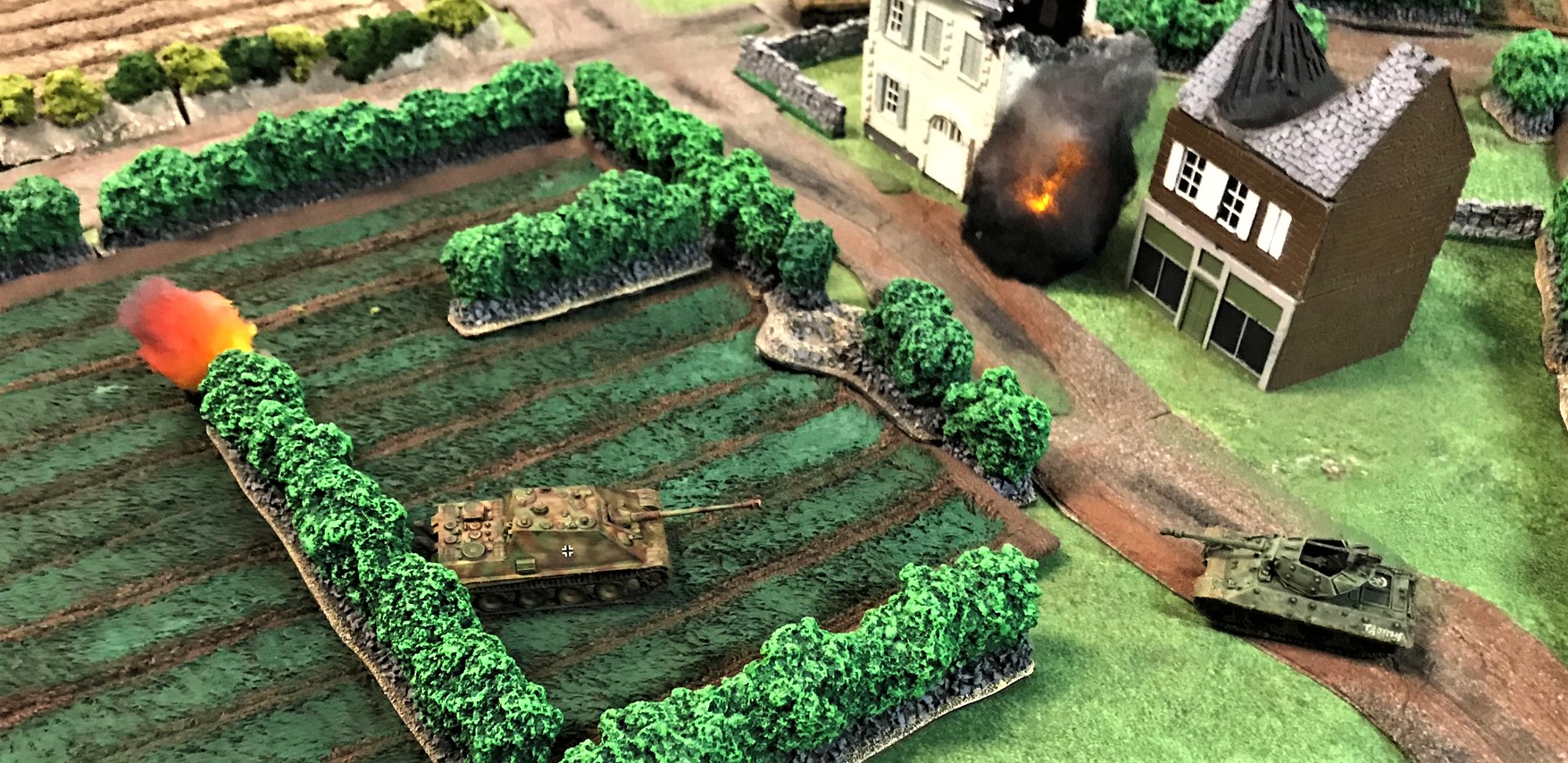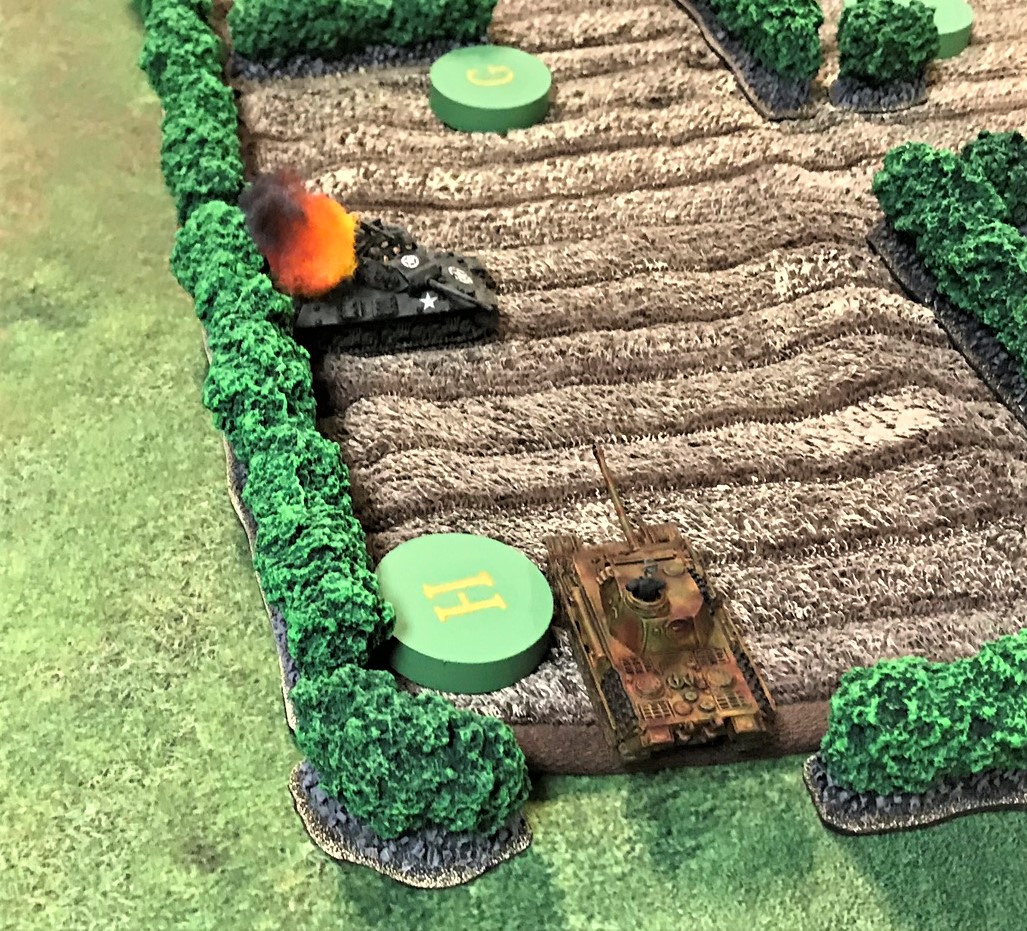
At the start of the game, each side gets 200 points to buy tanks and armored cars as well as Bonus Attack cards if the vehicle has a radio (all the Germans have radios, many French vehicles do not). The French are defending and have the ability to deploy at secret positions known only to their side and the GM. The French forces are divided – with half of the battlefield being under the responsibility of cavalry tanks, and half under infantry tanks.
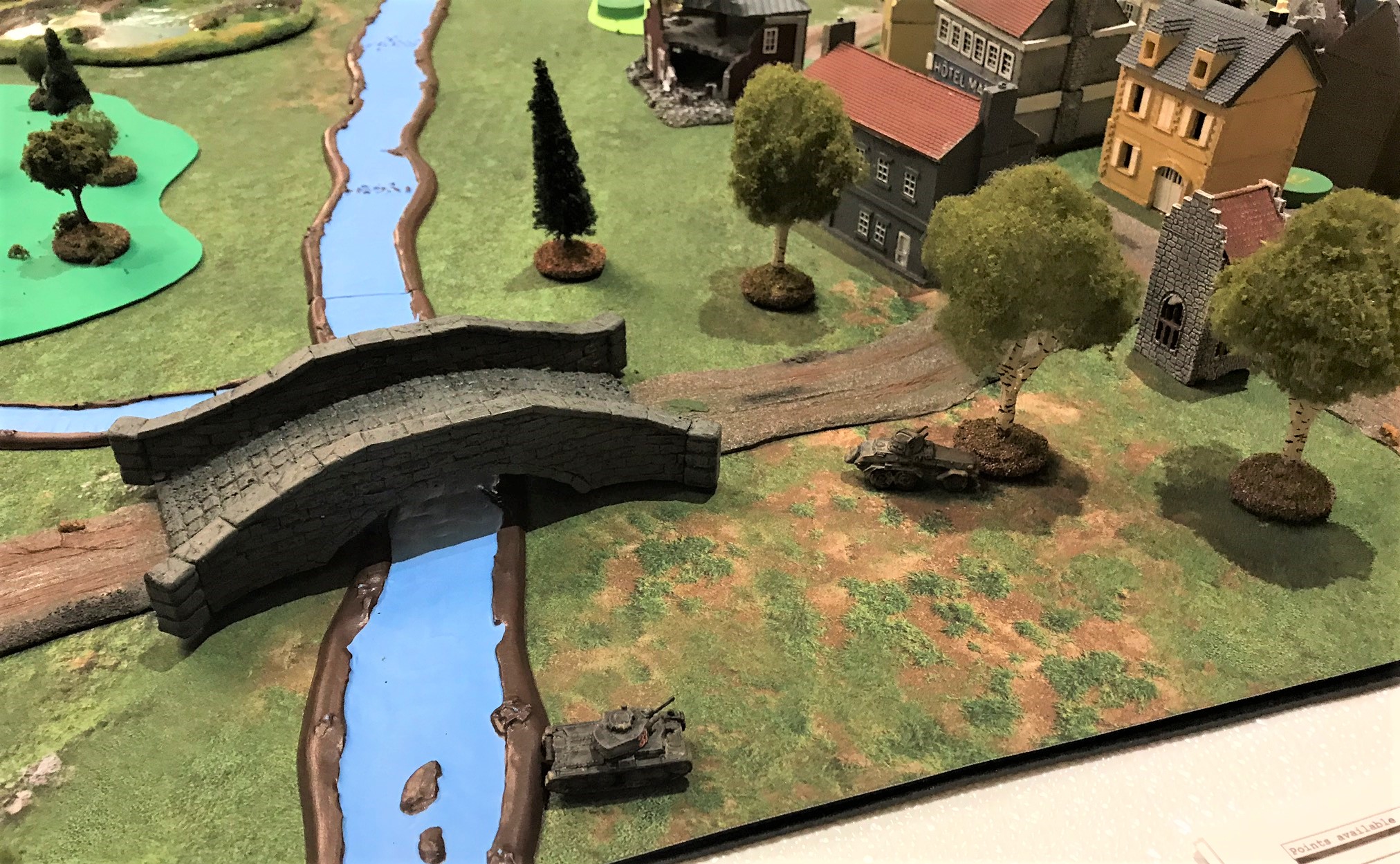
The Germans are exiting wooded areas on two congested roads heading to two bridges over a river. The German mission is to cross the board and exit the other side (and head to the English Channel) – and gain points for doing so. There are also several possible fords over the river that are minor obstacles.
The French player may also spend points to wire either one or both bridges (or none) for demolition. This status is also known only to the French side and the GM. The French side may attempt to blow a bridge at any time, but failing to blow the bridge or allowing any Germans to cross makes subsequent demolition attempts more difficult. If a bridge is blown while a vehicle is on it, that vehicle is destroyed. Any side that destroys a vehicle gets points for that action as well. As GM, I only announce who is ahead at the beginning of the turn, and I do not share the score so as to maintain a fog of war for the players and try to maintain a crew-focused battle.
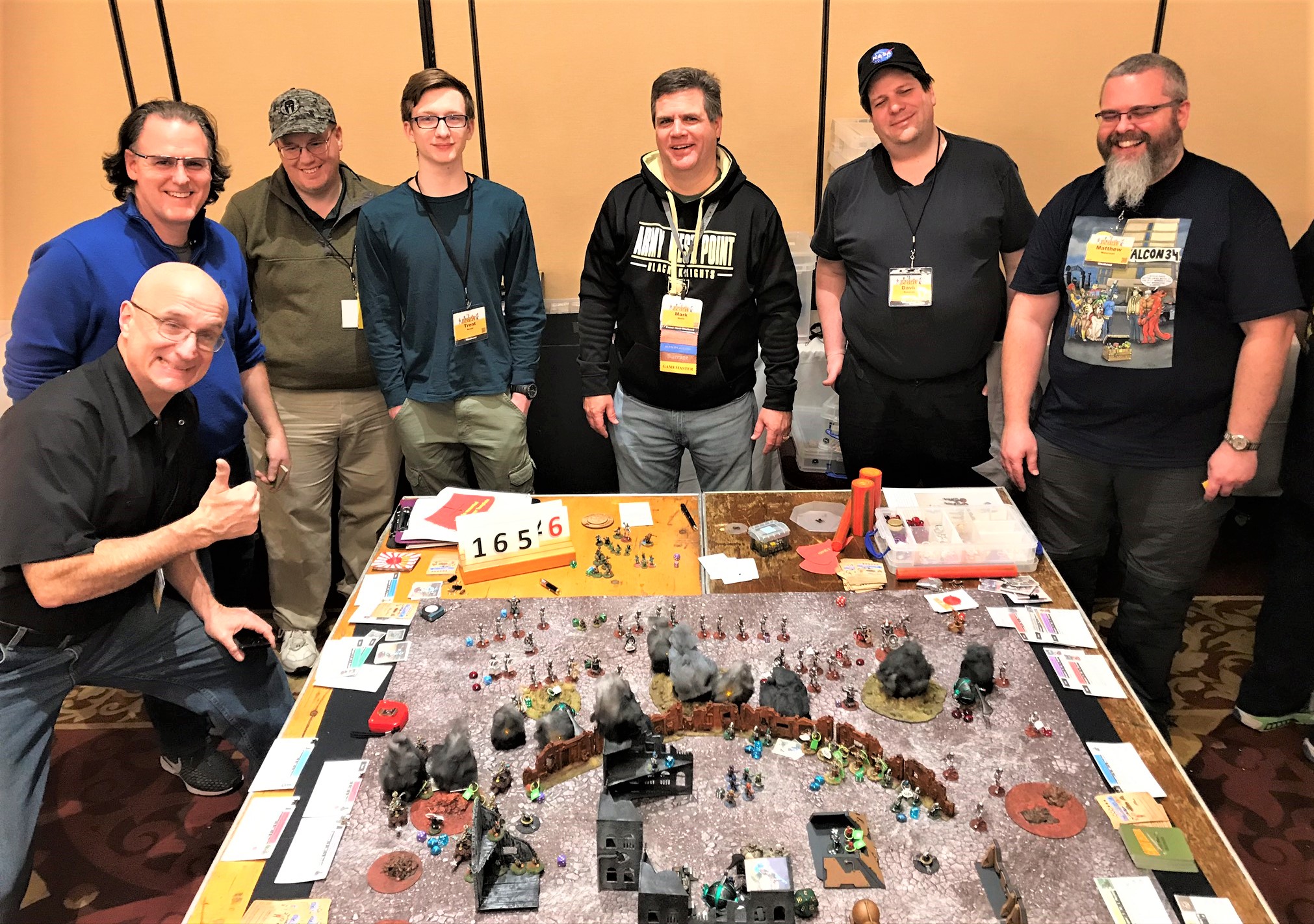
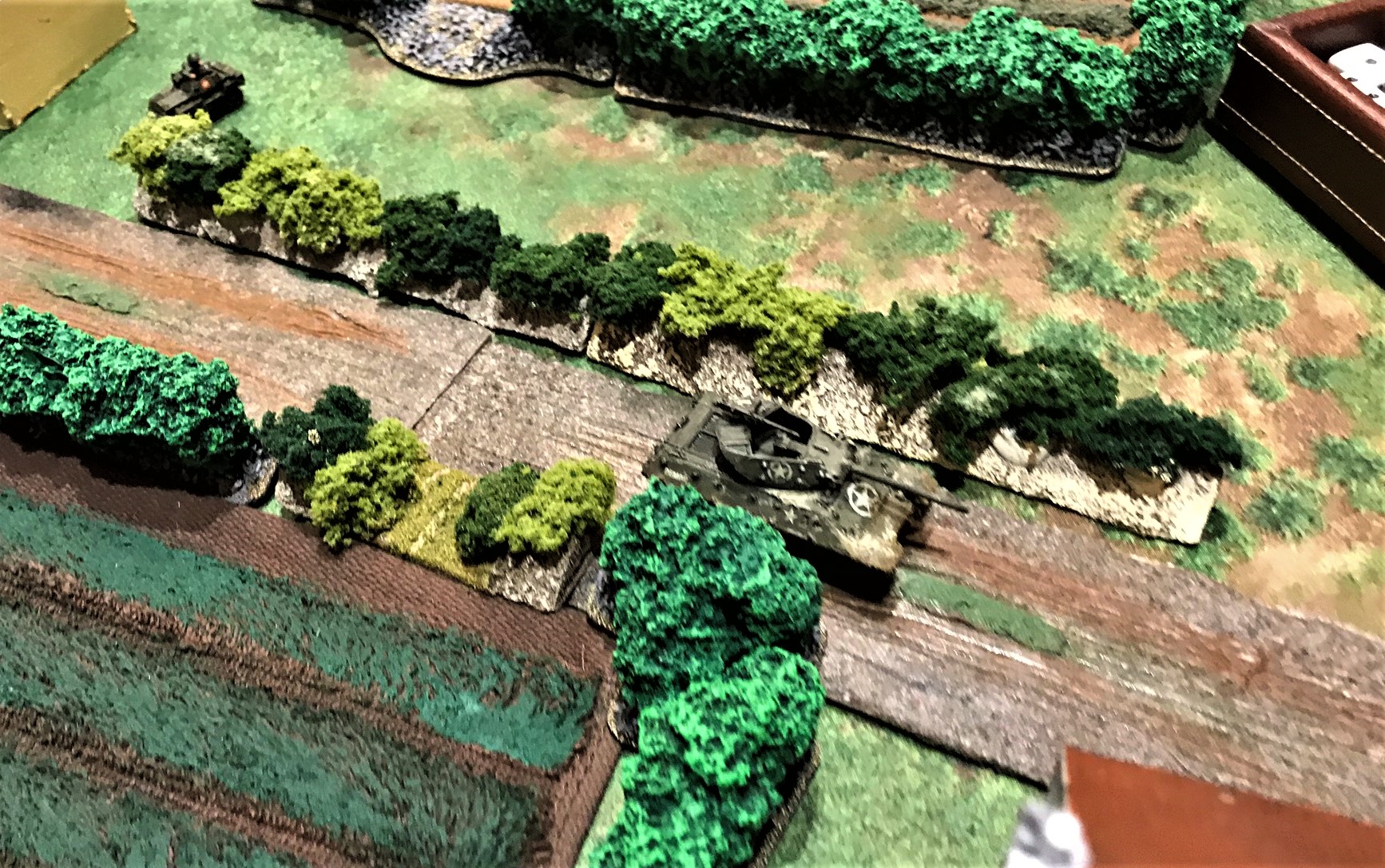
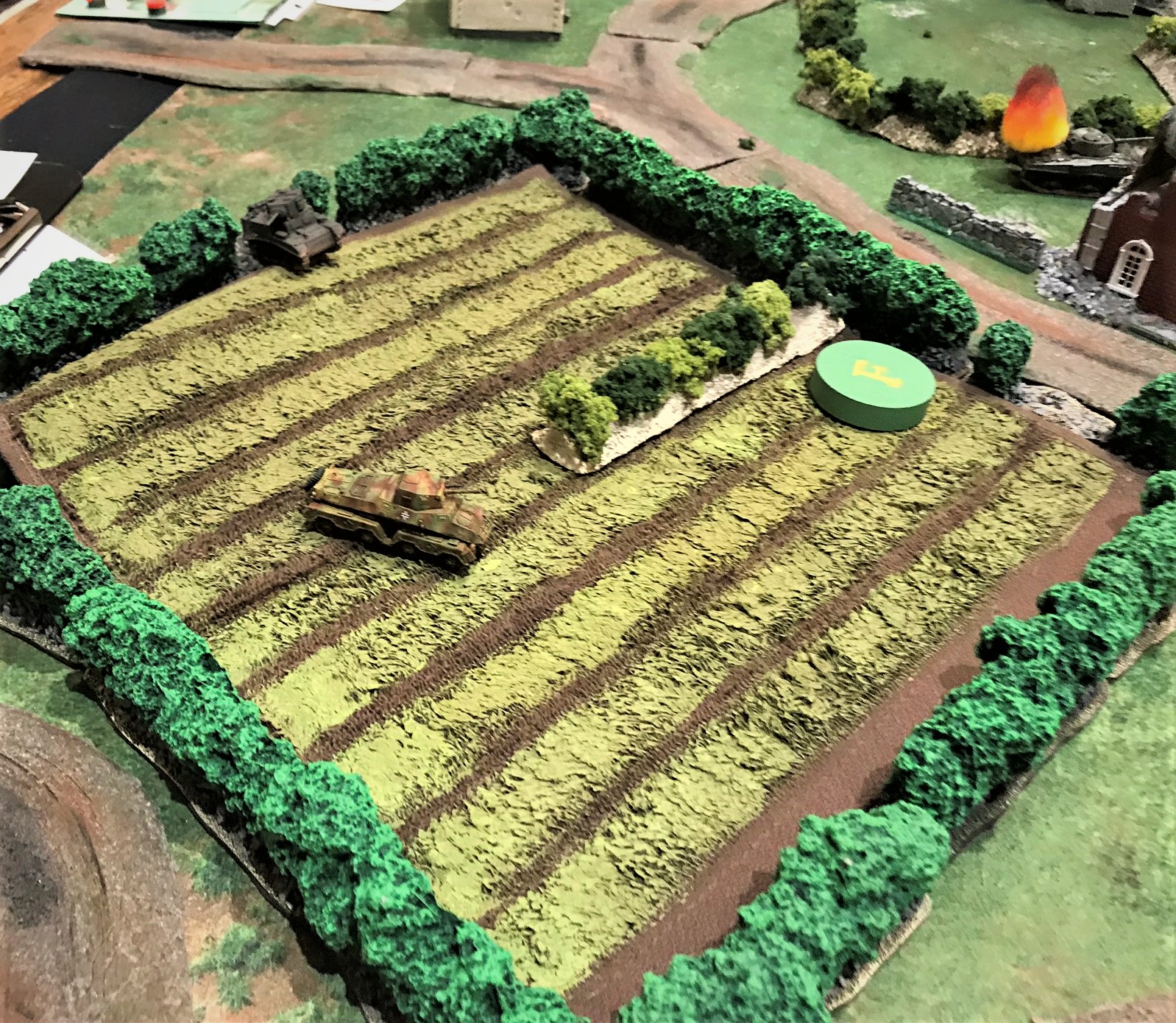
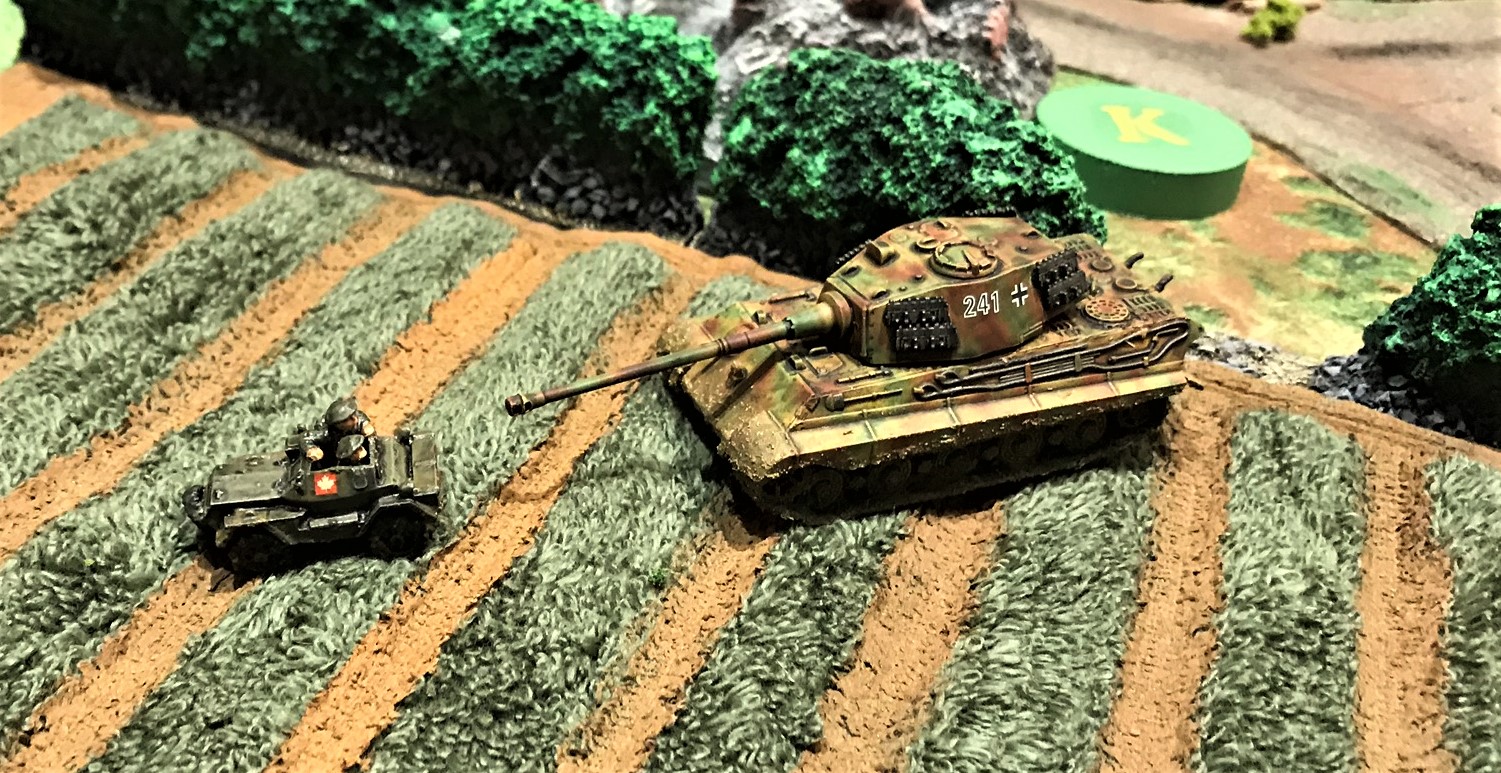
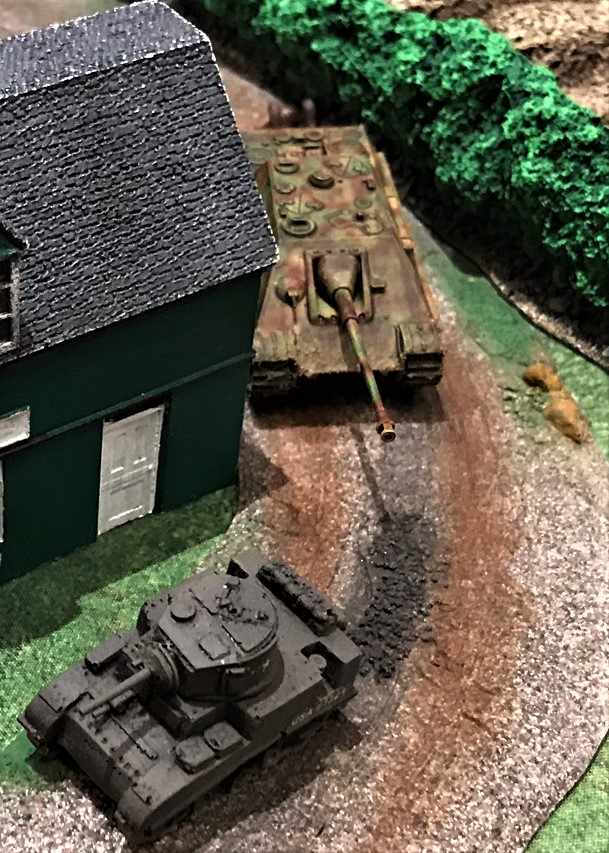
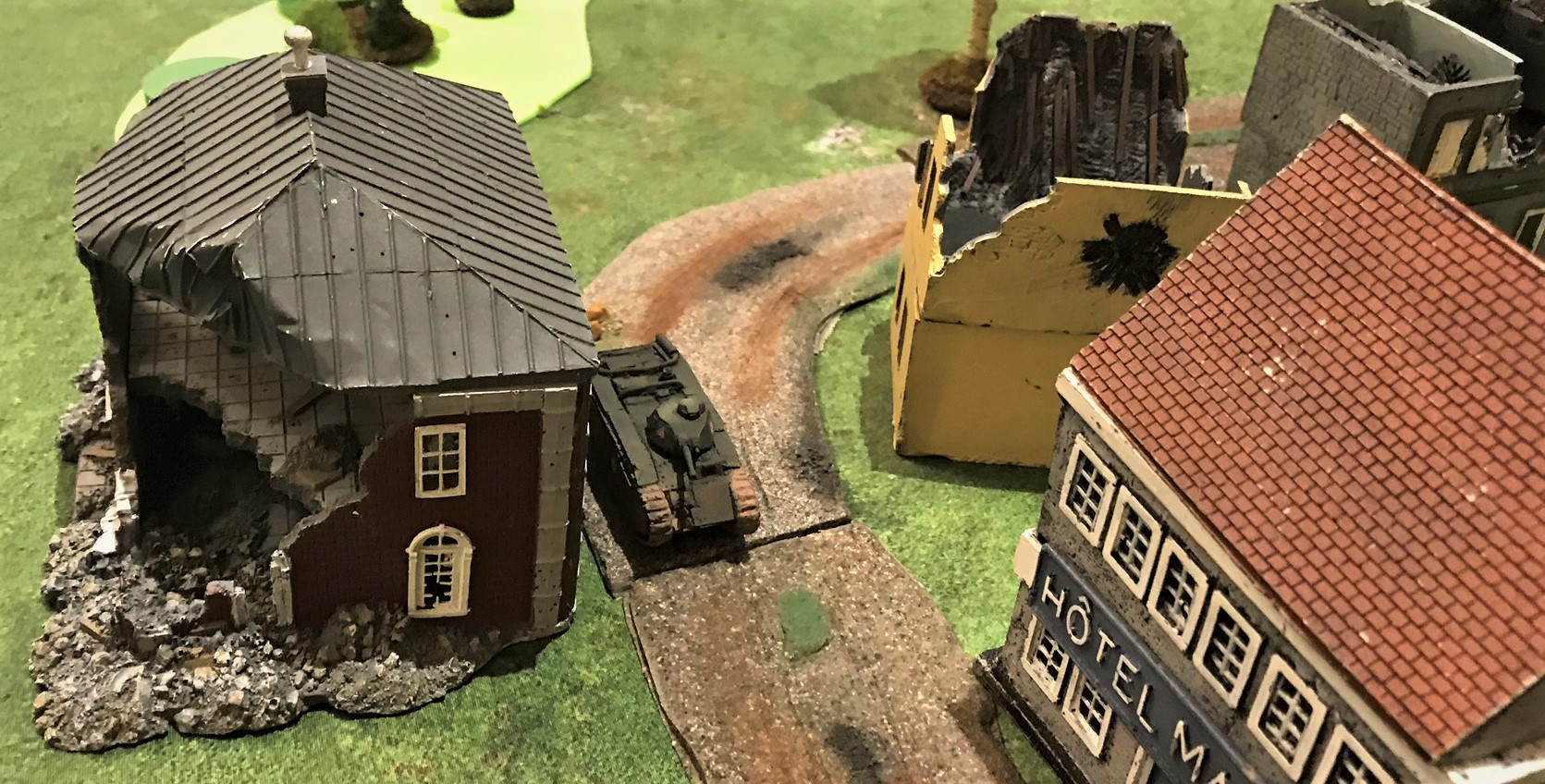
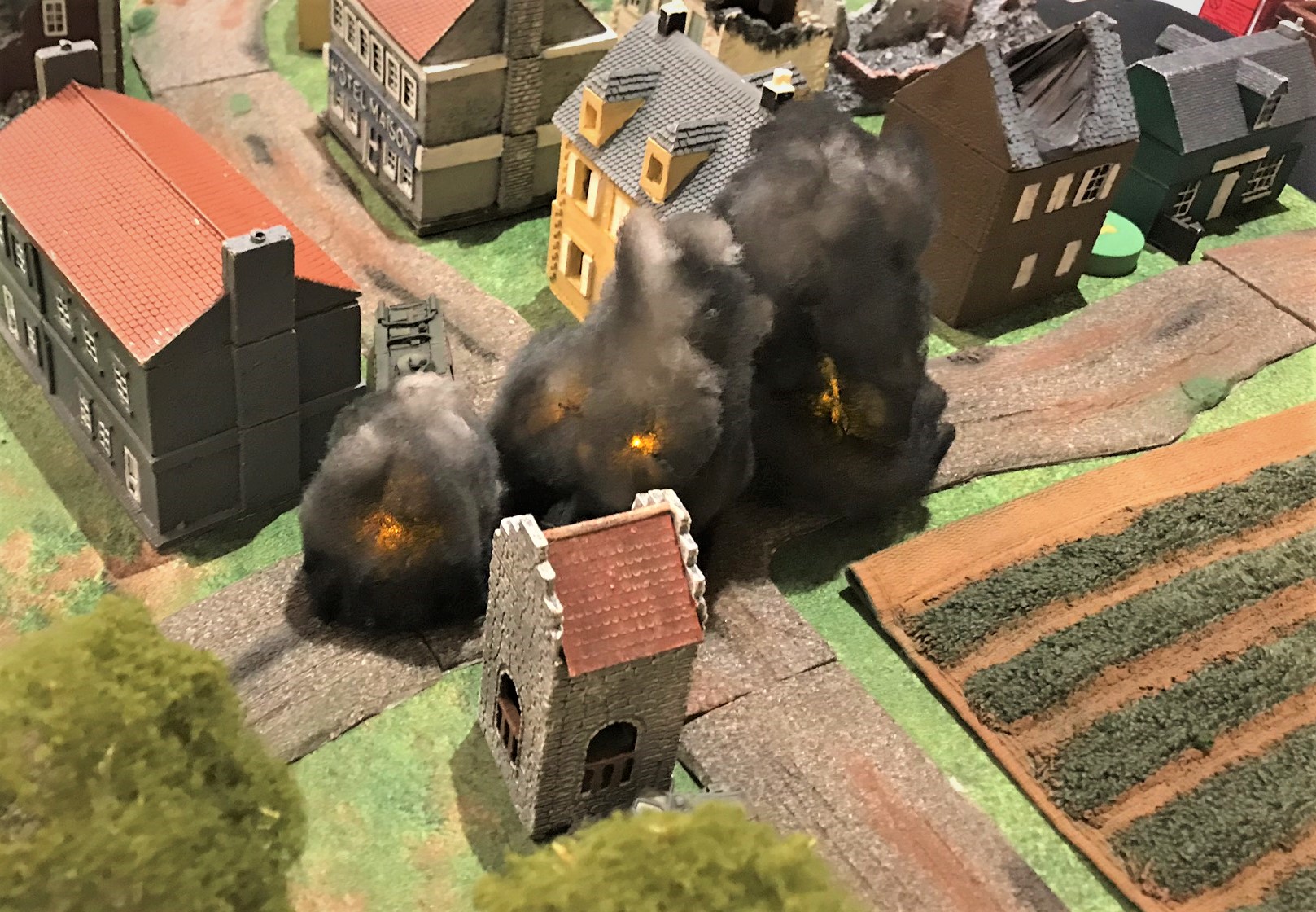
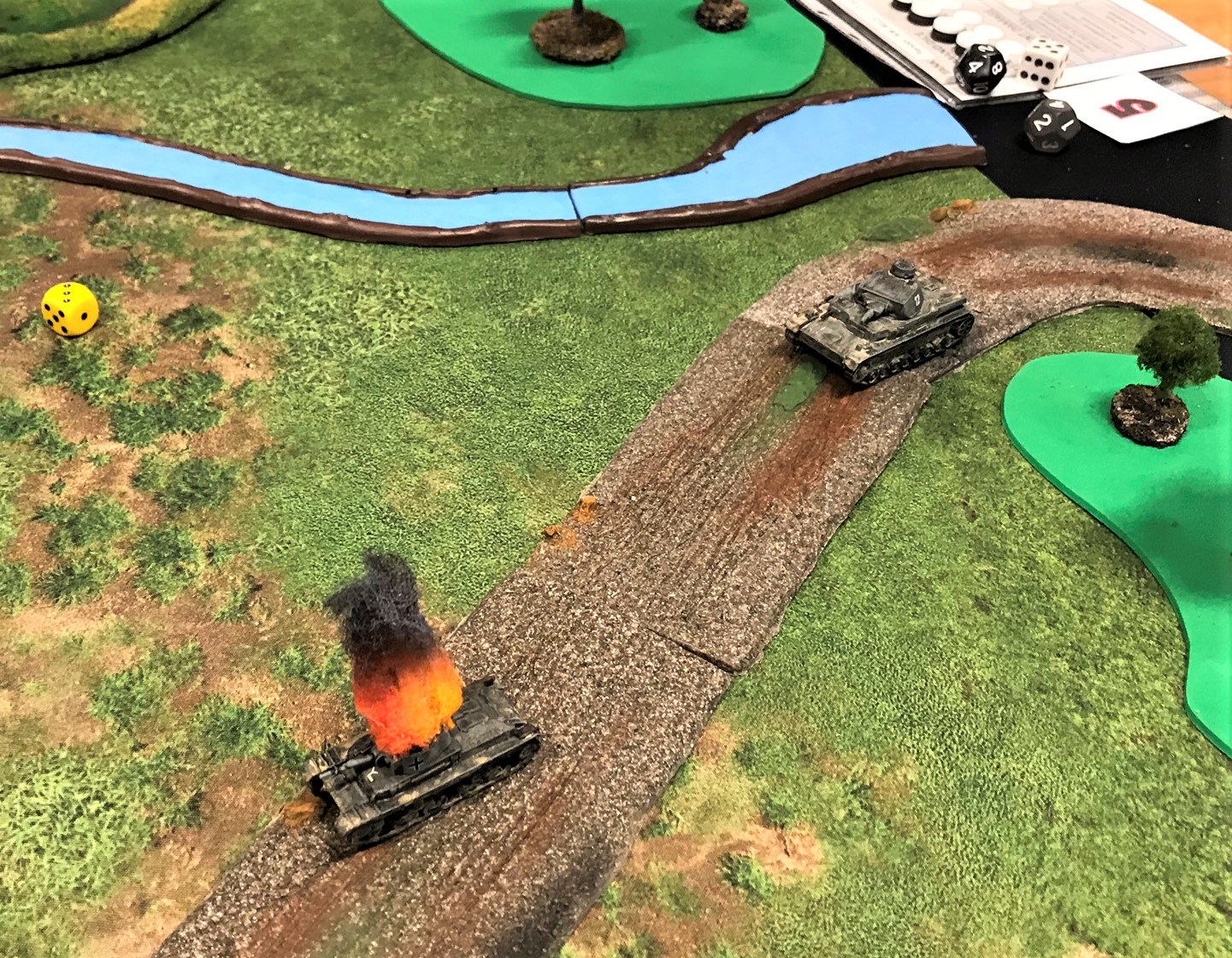
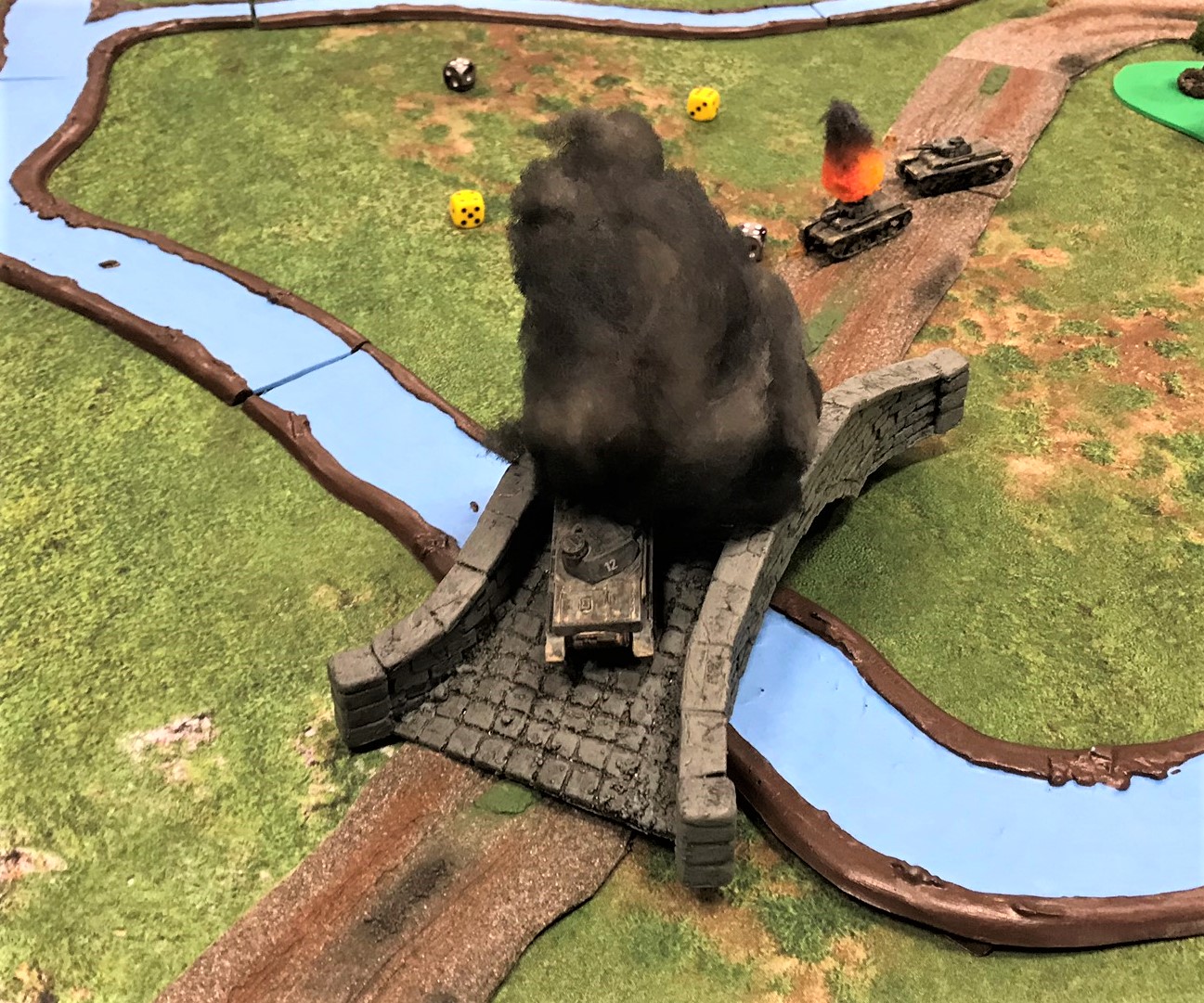
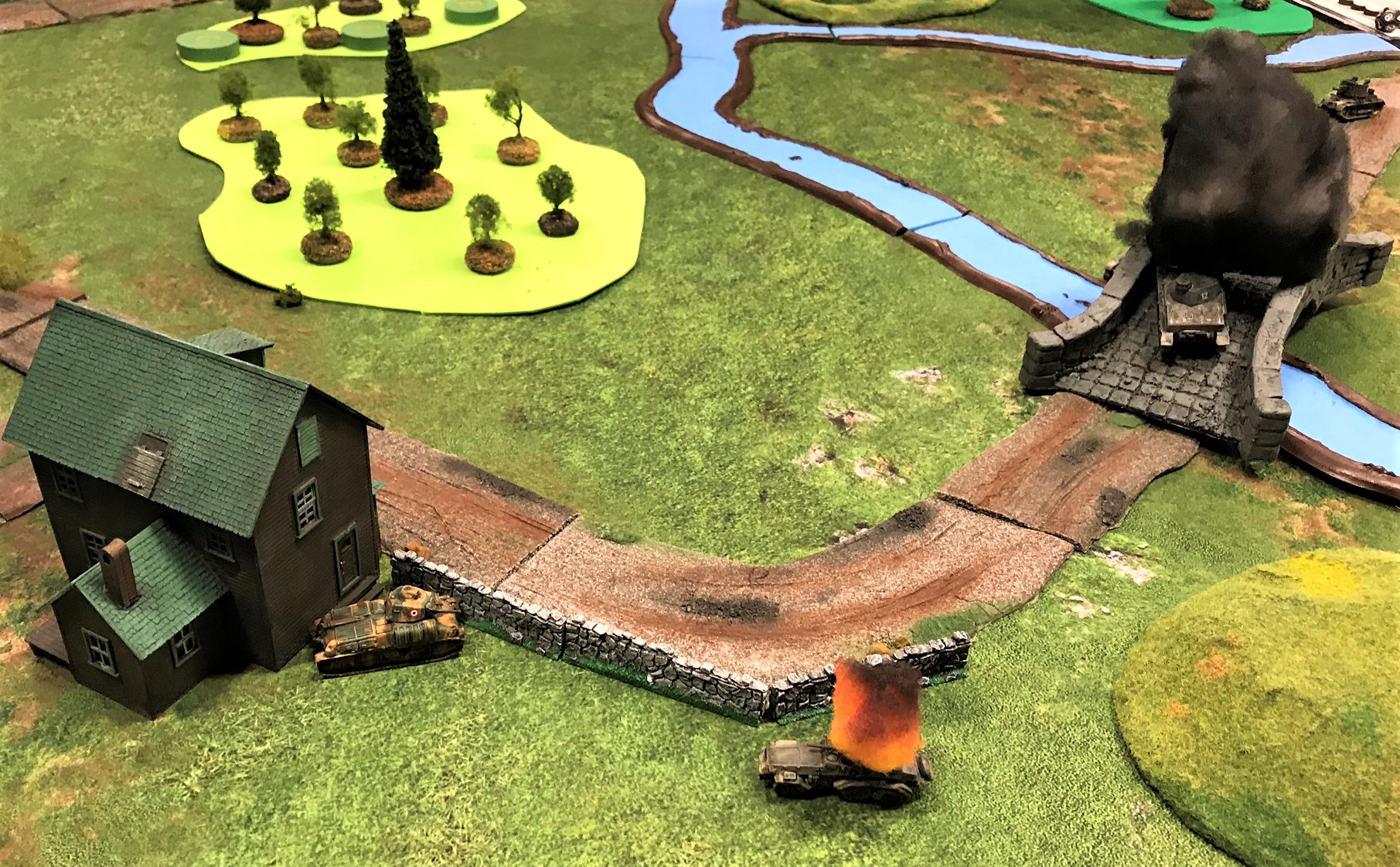
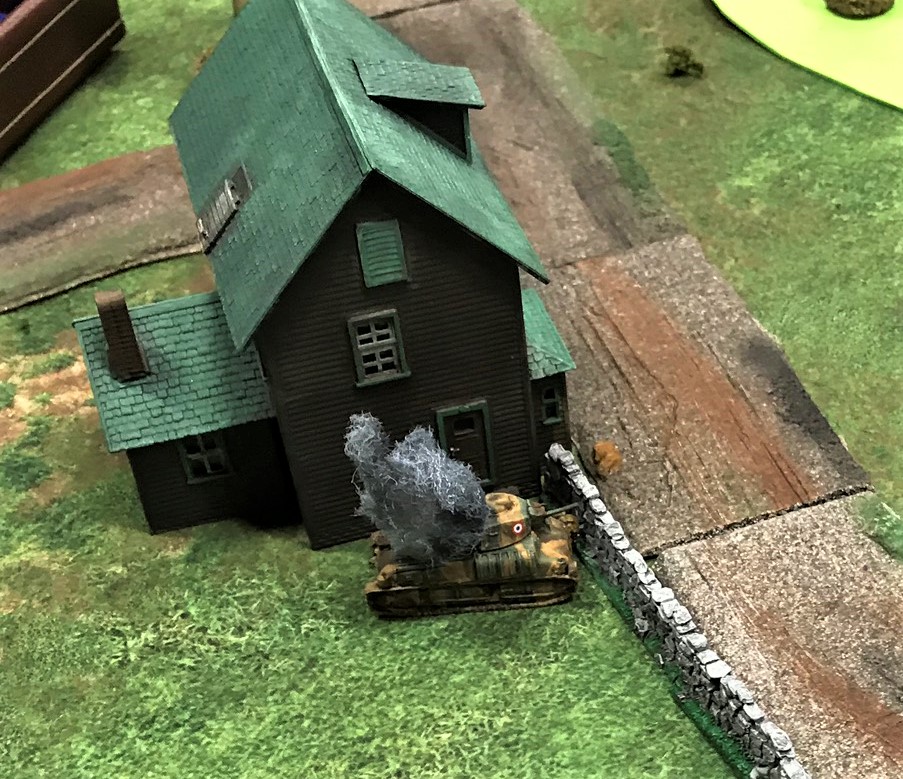
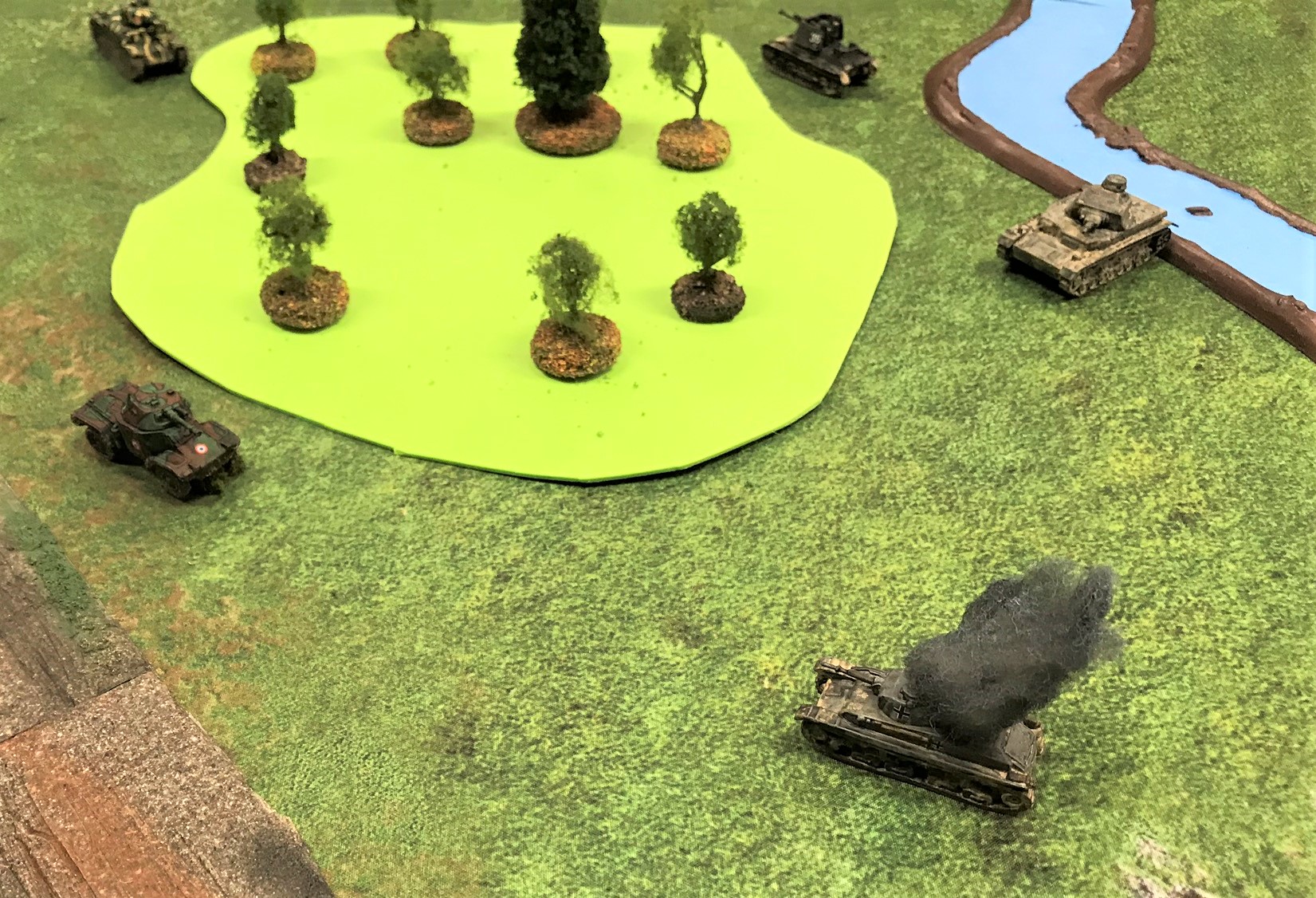
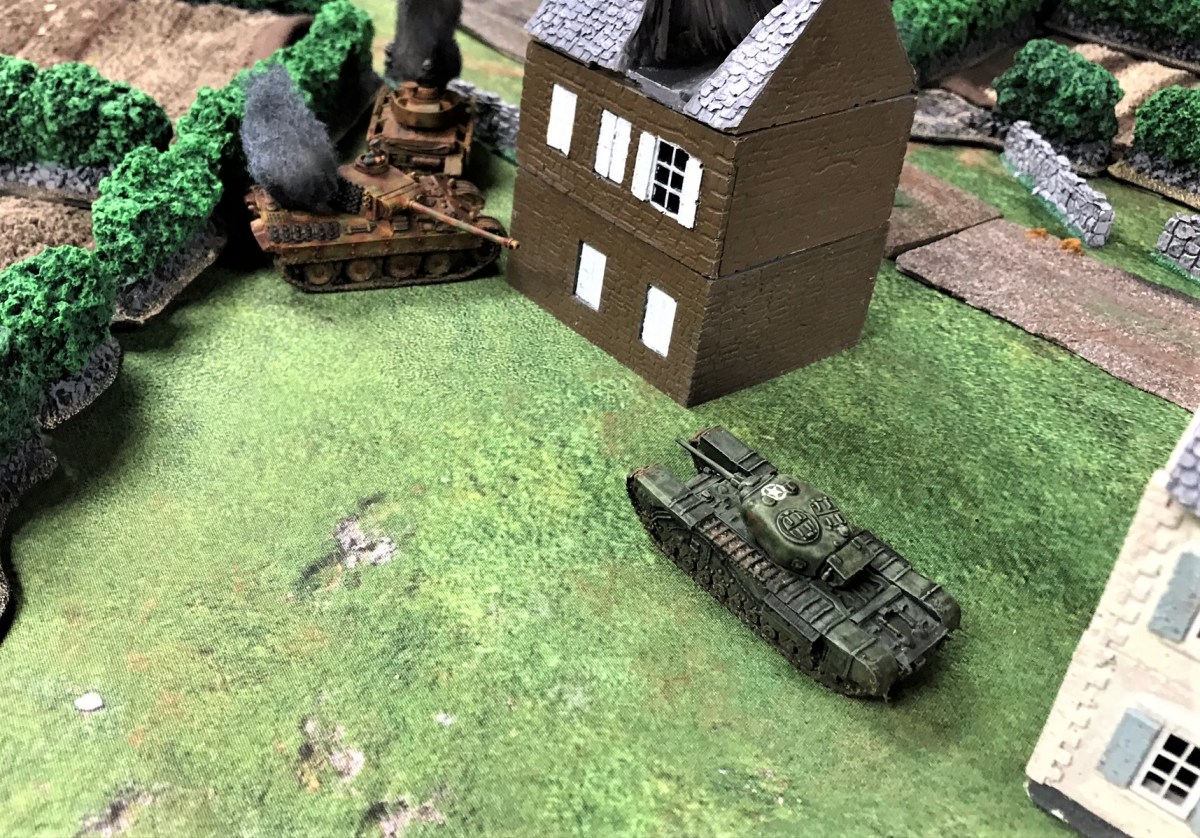
Overview of the battlefield from the French side. The French deploy infantry tanks left of the second road on the left, and cavalry tanks on the right of that road. Detail of the town where most of the hidden positions are for the infantry tanks. Both infantry and cavalry had access to Panhard 178’s and H35’s.The right (French cavalry) side showing the river and the bridges. The rocks in the river were designated as fords.The German players deploy.From a hidden position, a Panhard 178 calls for anti-tank support. Using a 47 mm anti-tank support card from the Bonus Attack cards, a Panzer 35(t) is torched before getting to a bridge, while a wary Panzer IVB watches.A German Sd.Kfz. (6-rad) recon car crosses the bridge without incident. Feeling safe, the Panzer IVB tries to cross. The French had waited for a bigger target, and successfully blew the bridge with the Panzer IVB on it – destroying the Panzer IVB. In the rear, another Panzer 35(t) observes multiple burning comrades.The Sd.Kfz. 231 (6-rad) recons around a building and finds a SOMUA S35. The SOMUA easily kills the German scout car, but not before taking some damage from Bonus Attack card artillery.The battle heats up. The surviving Panzer 35(t) fords the river as does a Panzerjager I with another Panzer IVB behind them. The French activate the hidden Panhard, and the SOMUA S35 takes some more minor damage.The SOMUA S35 is hit by 88 fire and finally taken down by accumulated damage. The black smoke indicates that the tank is knocked out, but the crew survived. I use orange smoke to indicate that both crew and tank are destroyed. Having taken damage from the SOMUA, the last Panzer 35(t) is knocked out by a daring attack by the charging Panhard 178.
At this point the game ended, and the French had a solid victory with the score being 158-112. The French also got bonus points for no German being able to traverse the board. The Germans made a couple of unsuccessful Luftwaffe attacks which hindered them as well as the early casualties.The scenario is pretty solid and the gamers made key decisions that affected the game. I did run this scenario and three other games at TotalCon 34. I will share the results of what happened at TotalCon 34 on a future post and things went differently!.
This post marks the last of my vehicle additions for the 80th Anniversary of the Battle of France in May-June 1940. These German vehicles were completed in late January, but with my personal situation, naturally my posting and hobby activities were put on hold. Time has passed now and I want to return to a certain degree of normalcy – of course that’s not the easiest thing to do. But I’ll try – and now let’s catch up and get back to good old hobby stuff.
Basically, prior to this project I had only 11 German vehicles for the scenario, and the mix was a bit unbalanced to say the least. I had 4 Panzer IIC’s, 1 Panzer IIIE, 1 Panzerjäger I, 2 Panzer IVD’s, and 3 Sturmgeschutz A’s. Now that I have 23 French vehicles, I needed to increase the size of the available German vehicles for the scenario.
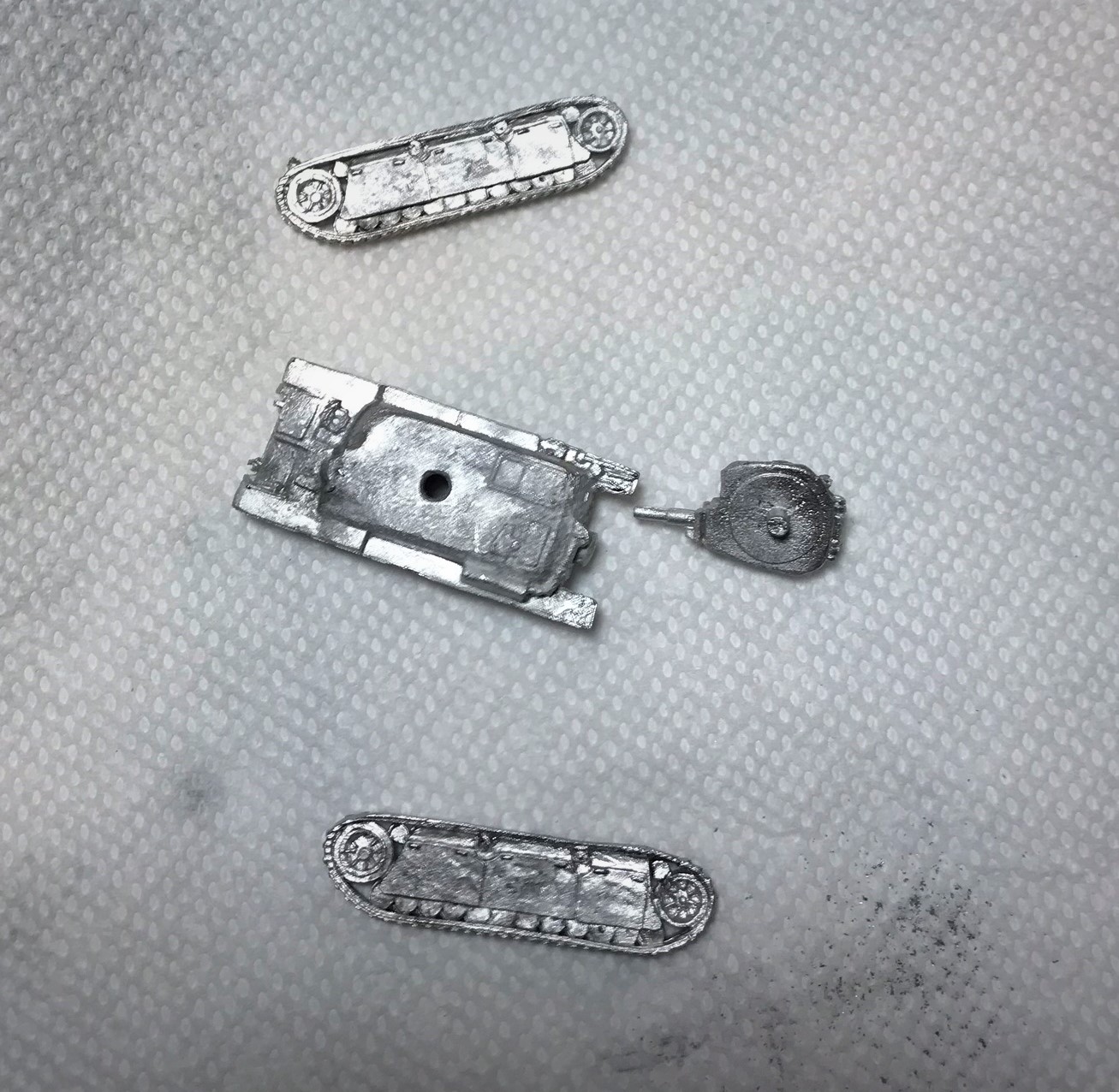
Back in May-June 1940, Panzer I’s and Panzer II’s did form a large proportion of the German armored forces in May-June 1940. As Panzer I’s have only machine guns, which are somewhat useless in a tank-on-tank game). As I have 4 Panzer IIC’s in the inventory, I decided to augment the light tanks with Panzer 35(t)’s and Panzer 38(t)’s. These were originally built for the Czechoslovakian Army, and the Wehrmacht happily incorporated these vehicles into their units – and continued building the both after the annexation. I got two metal Panzer 35(t) models (#GFV28) from QRF in the UK, and two metal and resin Panzer 38(t) models (#GE022) from Battlefront. Perhaps later on I might add a Panzer I, we’ll see.
For the medium tanks, I “assigned” (for game purposes) my two currently-painted Wargame Models in Ohio Panzer IVD’s into ausf A versions – and added B and D variants of the venerable Panzer IV with Zvezda models (SKU #ZD35 or #6151 for each box) from The Plastic Soldier Company. PSC has a reasonable deal for a platoon of 5 so I grabbed those. I already have one Panzer IIIE model for France 1940, and decided that was enough of those (for now anyways).
Lastly, similar to what I did with the French Panhard 178’s , I added 2 Sd.Kfz. 231 (6-rad) armored cars (#GE320) from Battlefront. I know that the 8-wheeled versions were available and used in May 1940. However, at the time the 6-wheel 231’s were being phased out in favor of the 8-wheeled versions – and I thought having the older ones would give a better feel to the scenario. By building these models and converting the ones mentioned, I now have 23 vehicles available for both sides to choose. I will go through a bit of a WIP with each type – as I did experiment a bit with contrast paints on them – to a bit of frustration which I will share. I’ll also show the Bonus Attack Cards, some eye-candy shots, references, and list of paints for those interested.
General Assembly
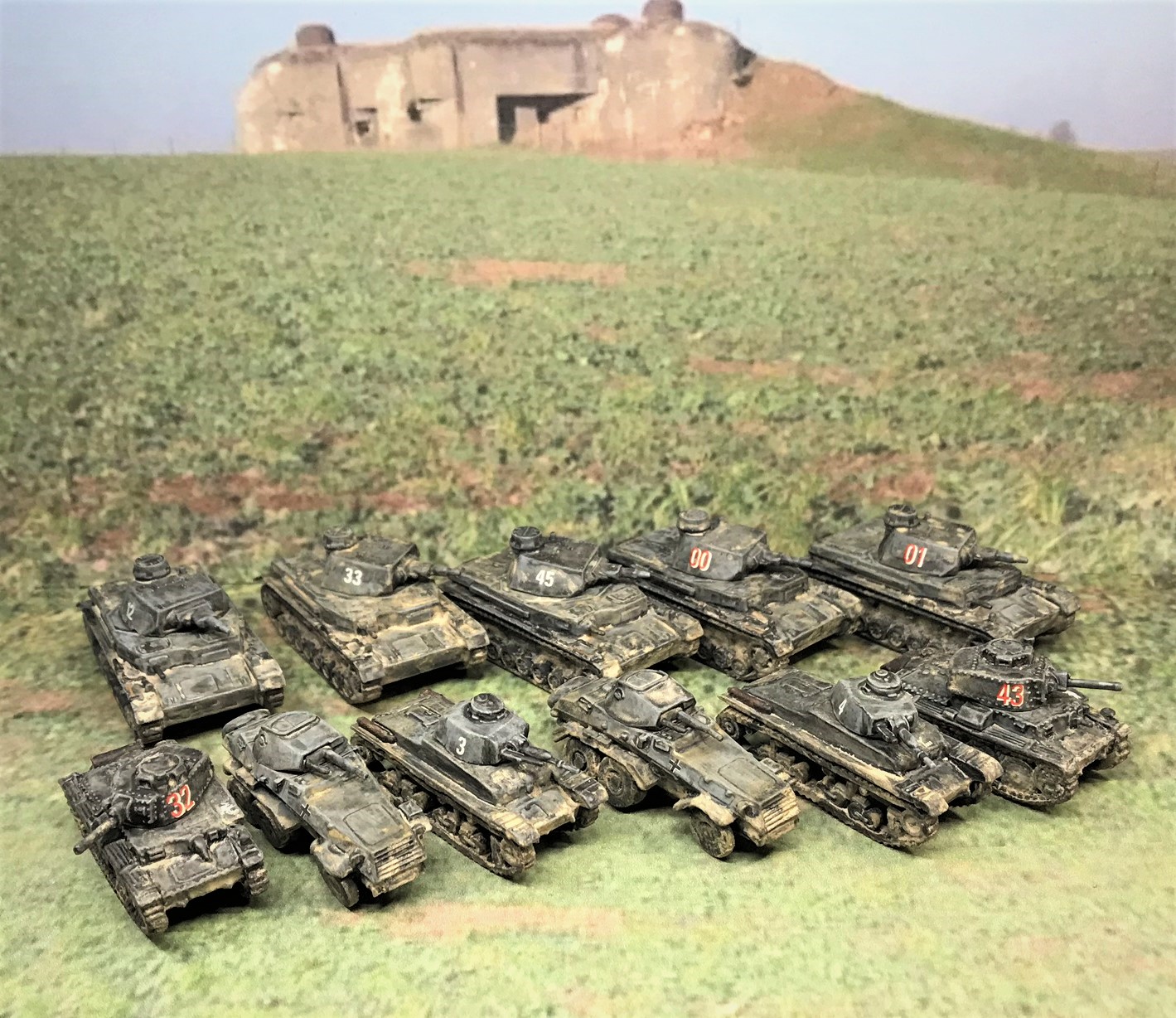
The QRF Panzer 35(t) models were all metal, the Battlefront Panzer 38(t) and Sd.Kfz. 231 (6-rad) models were metal and resin, and the Zvezda Panzer IV’s were plastic. I cleaned and prepped them all prior to assembly and painting, to include magnetizing the turrets. Some green stuff reinforcement and repair was needed. My overall goal was to have vehicles that were more grey and less dark than my previous German vehicles for 1940. The dark colors were also historically correct – I just wanted a bit more variety in the collection that was also historically correct.
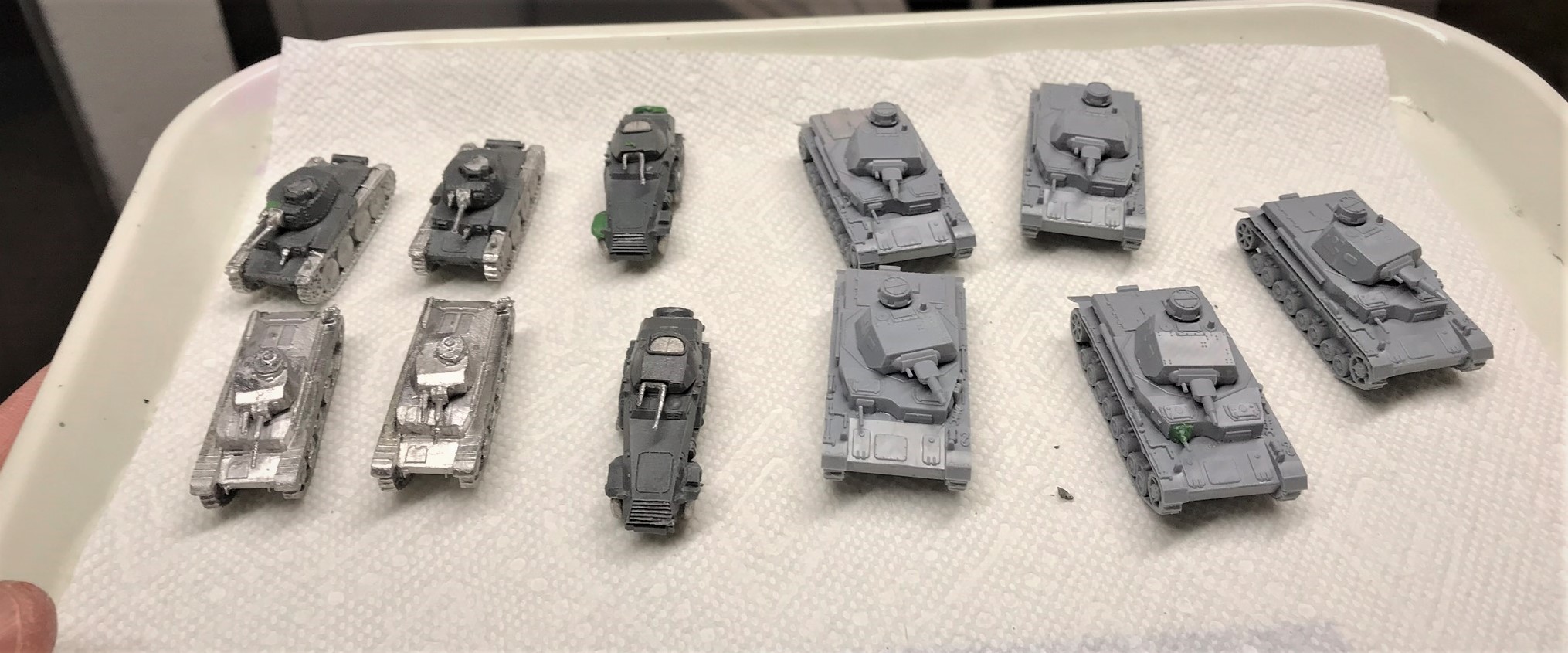
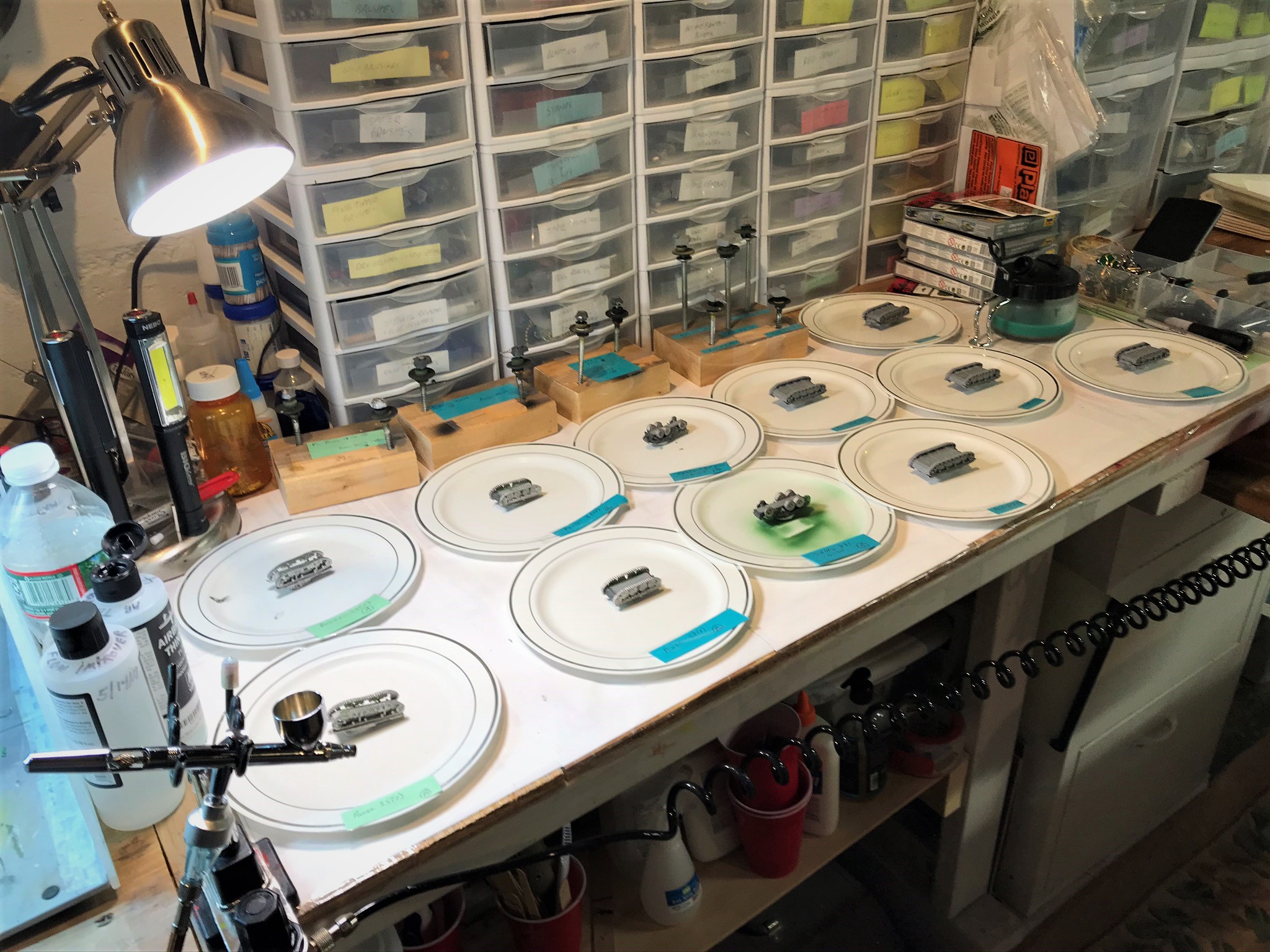
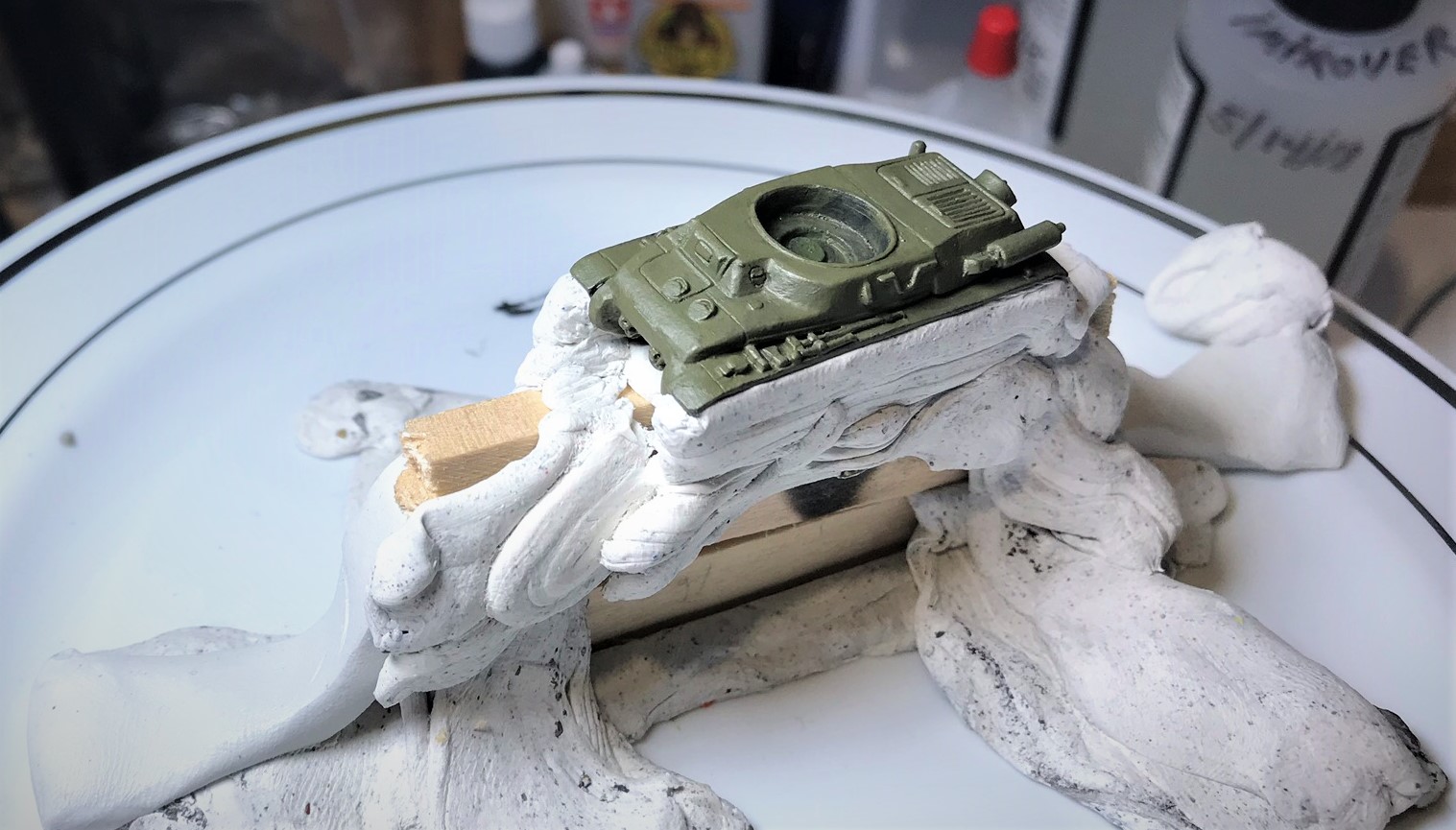
The 11 models for this project in their packaging.The Panzer 38(t) models and the Panzer 35(t) models assembled.All of the 11 models are here assembled.I always prime and base coat the tank bottoms first – they are affixed to small plastic plates with poster tack.
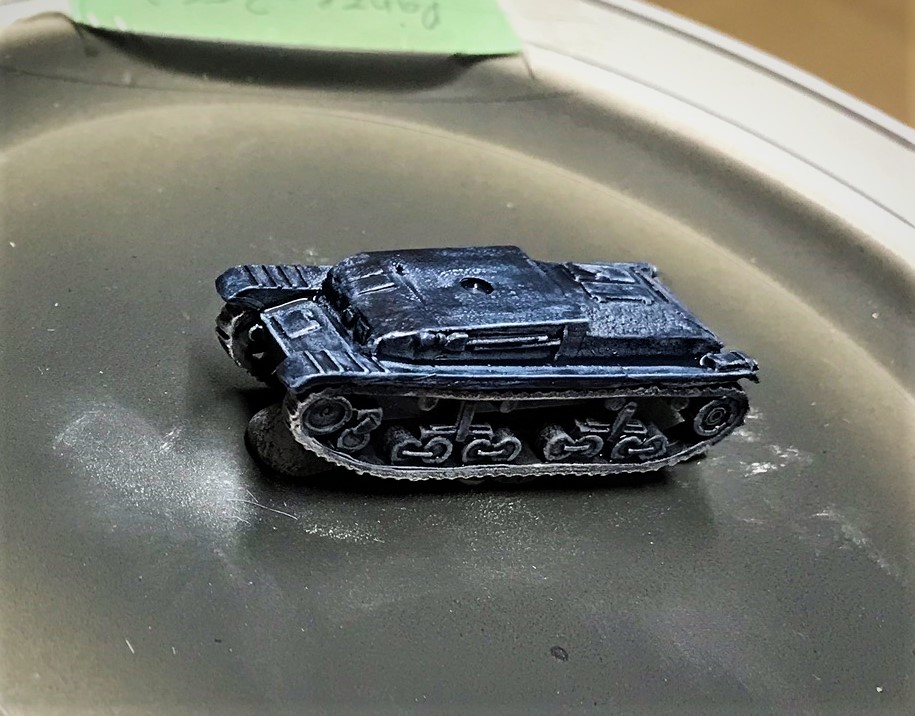
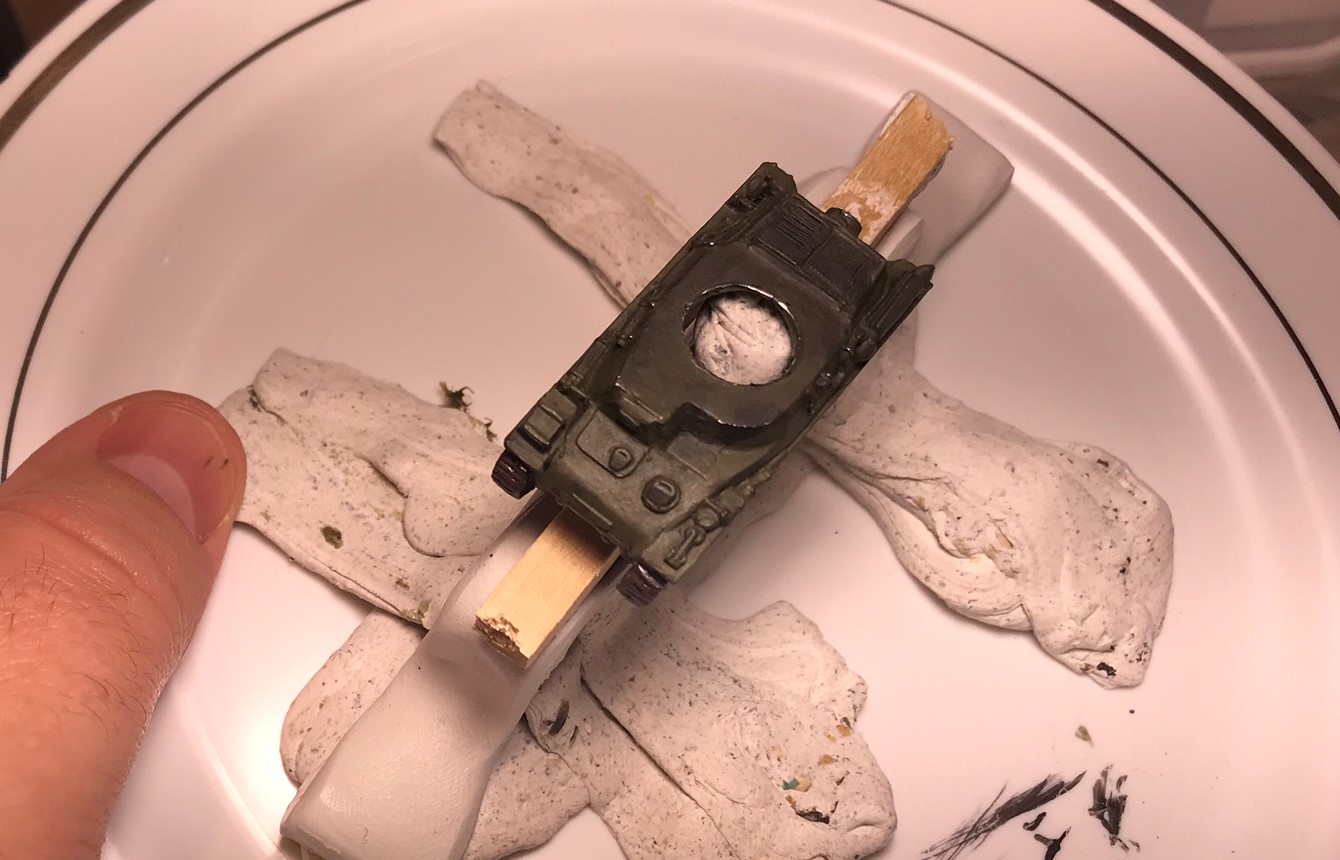
The painting process was a bit different for me this time. I basically did this sequence with all 11 vehicles. I wanted to test out the contrast paints, so I decided to try the “Space Wolves Grey” contrast paint over Vallejo “German Panzer Grey” primer – and the chassis were nearly purple.
My Panzer 35(t) model looking a bit too purple for my tastes.
I then went back and dry brushed them with Vallejo “White” primer, then used “Apothecary White” contrast paint and dry brushed with a few more grays and added some shading (see the list at the end of this post).
After redoing with a dry brush of white, added “Apothecary White” as seen with these turrets.ionI shaded these, and more dry brushing, followed by decals. Here are some turrets looking better!Here is a Panzer IV chassis before weathering.
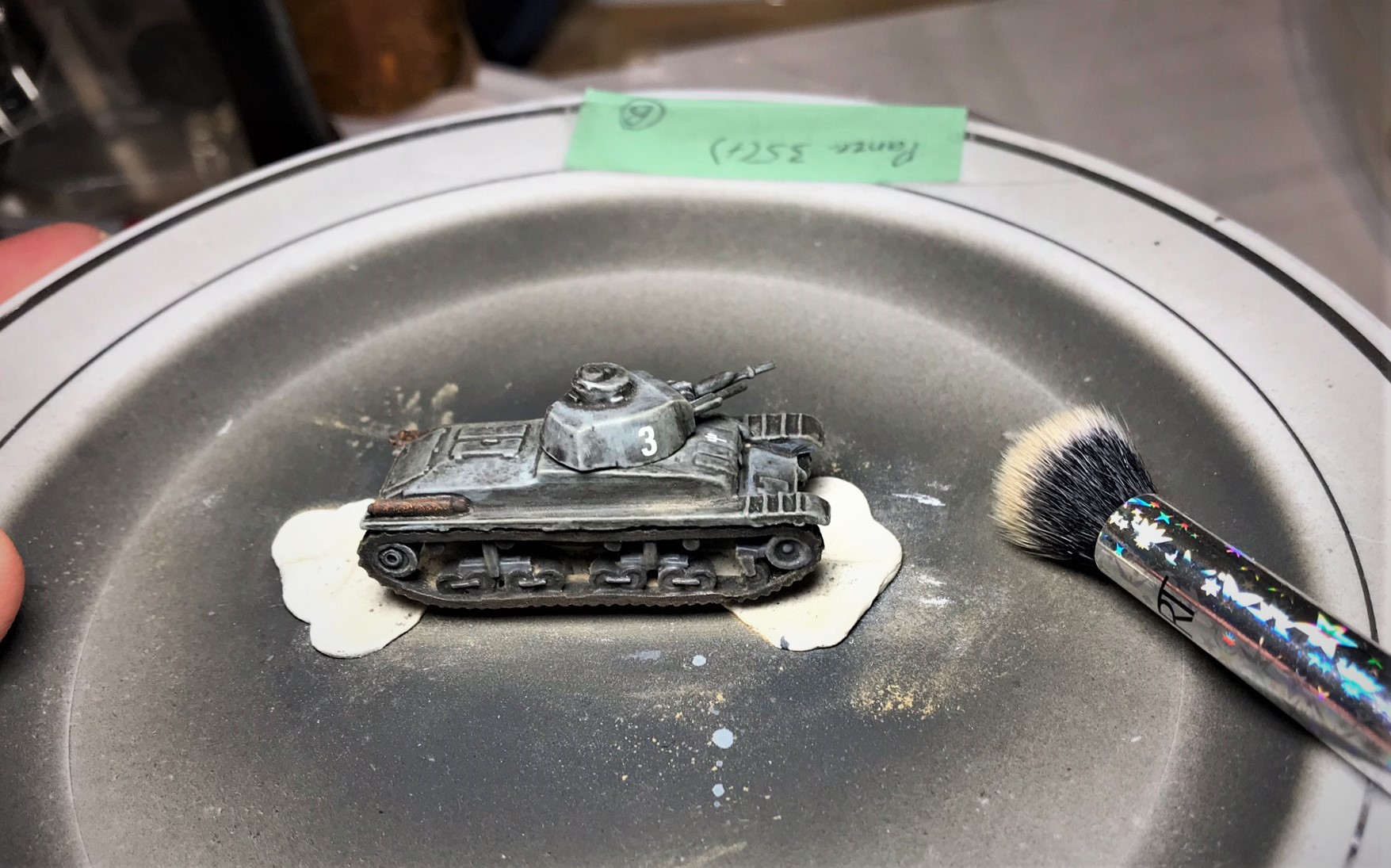
For weathering, I used Vallejo pigments – a combination/blend of two pigments on these with a makeup brush for dusting effect.
Weathering this Panzer 35(t)
Then I varnished the tanks with Vallejo Mecha Color “Matt Varnish”. Now, let’s look at each type in brief.
Panzer 35(t)
These were originally built by Skoda. The (t) stands for the German word for Czech, which is tschechisch. The Germans had 244 of these after the annexation, and used them in both the invasion of Poland and of France. Around 132 were involved in the Battle of France, and they served in the Wehrmacht through the invasion of the USSR until the summer of 1941. By that time, there were no more spare parts being made, was performing badly in the cold, and it was badly obsolete. Some were then converted to other uses, and some sold to Romania.
The Panzer 35(t) had a reasonably good (for 1940) 37 mm gun capable of penetrating 30 mm of armor. It was a light tank, and had maximum frontal armor of 25 mm, with 15-16 mm on the side, 15-19 mm on the rear, and 8 mm on the top. This allowed better speed and greater range than most French contemporaries, with a top speed of 21 mph and a range of 120 miles from its 120 hp 4-cylinder engine. The chassis armor was riveted together. It did have a radio.
Front of Panzer 35(t).
Panzer 35(t) right side.
Panzer 35(t) rear view.
Both Panzer 35(t) models.
Panzer 35(t) models (left side).
Both Panzer 35(t) models (rear view).
Panzer 38(t)
The Panzer 38(t) was another Czech “acquisition” as it were. It was designed and built by CKD. Over the course of the war, the Germans had over 1,400 – of which only about a hundred were used in France.
The Panzer 38(t) had a better 37 mm gun than the Panzer 35(t). That gun was capable of penetrating 36-59 mm of armor. It also was a light tank, with a (in 1940) maximum frontal armor of 30 mm. It also had much better speed and greater range than most French (and some German) contemporaries, with a top speed of 26 mph and a range of 160 miles from its 123.3 hp 6-cylinder engine. The chassis armor was riveted together, and the tank had a radio. The tank itself was used by the Germans until 1942, and the chassis was reused for many other vehicles, notably the Grille and the Hetzer, as well as being exported to Sweden (who also built them under license), Slovakia, Romania, and even Peru. Peru also had acquired some from Czechoslovakia and used them in combat in South America versus Ecuador in 1941 in the Ecuadorian-Peruvian War as well as 50 years later against the Shining Path insurgents.
Panzer 38(t) turrets late in project
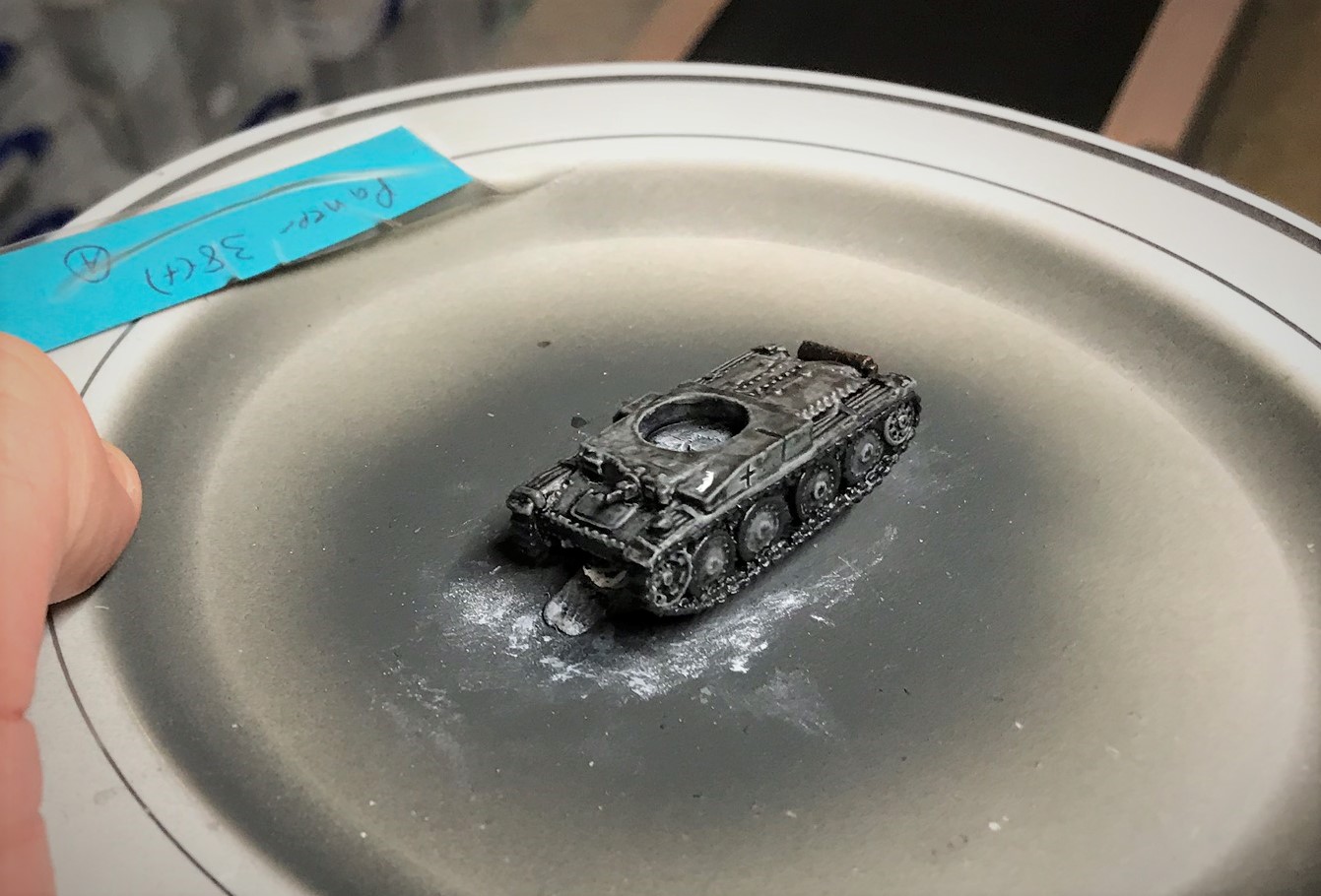
Panzer 38(t) chassis – I was happy with this shade of grey.
Both Panzer 38(t) models, front.
Both Panzer 38(t) models, rear view.
Both Panzer 38(t) models, front left side.
Sd.Kfz. 231 (6-rad)
Most modelers and WWII gamers know the Sd.Kfz. 231 8-wheeled version but the 6-wheeled (“6-rad”) version preceded it. Over 900 were built from 1932-1937. The Sd.Kfz. 231 (6-rad) and the 8-wheeled versions were both known as Schwerer Panzerspähwagen (heavy armored reconnaissance vehicle). The acronym Sd.Kfz. stood for Sonderkraftfahrzeug (special purpose vehicle). The Sd.Kfz. 231 had the same automatic 20 mm gun as the Panzer II, so it had some anti-tank capability (able to penetrate 40 mm at 100 meters and 23 mm at 500 meters). Like the Panhard 178, it could be driven either forwards or backwards with redundant driver positions. Armor was thin (8-15 mm) but it could get up to 53 mph. They served in the Wehrmacht up until the early stages of the invasion of the USSR.
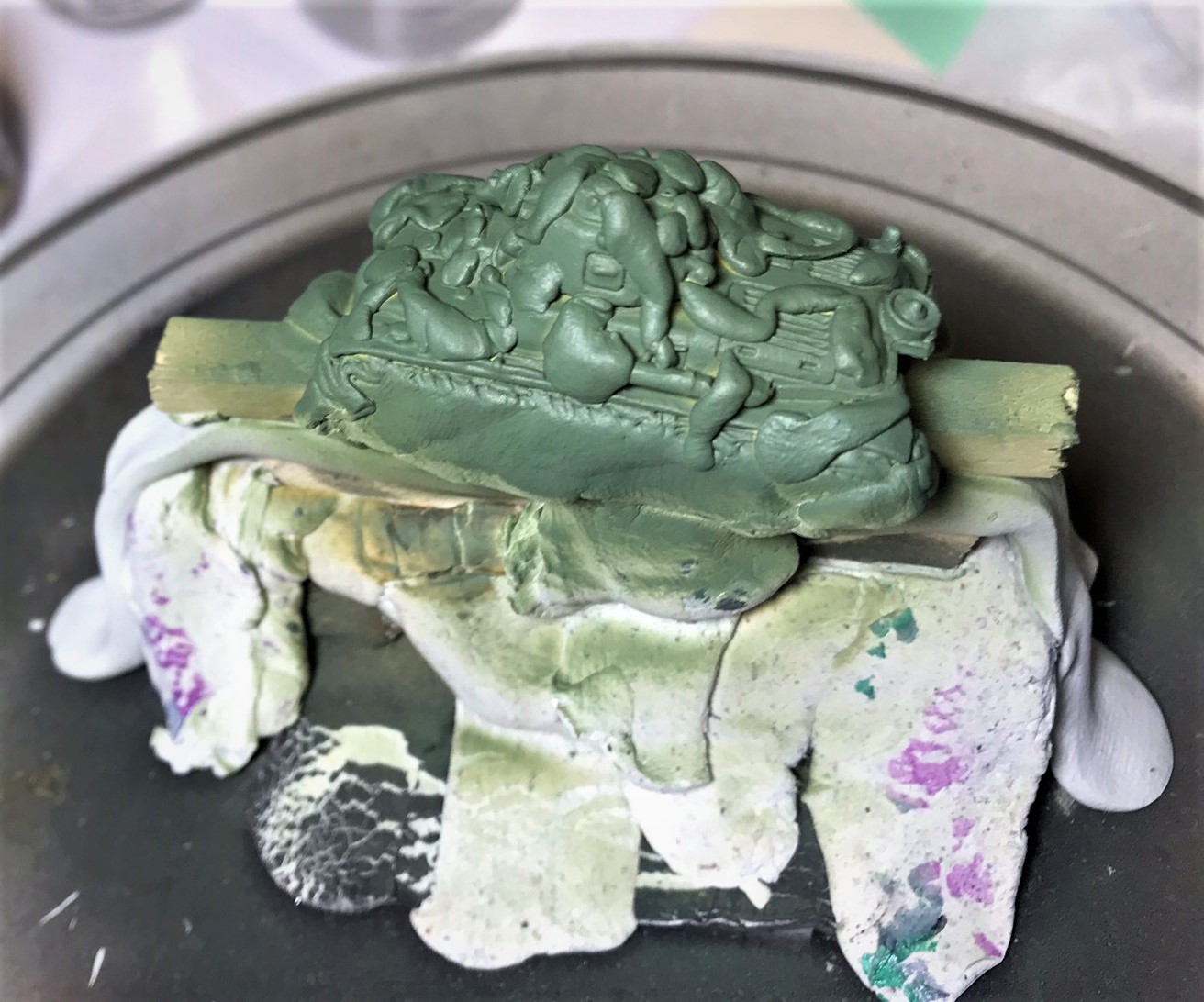
The models did have some QC issues – notably big pieces of resin were missing on fenders and on the rear spare tire. I fixed these with green stuff. These will serve the Germans as (of course) reconnaissance vehicles for my 1940 scenario.
Poor molding on rear of cars
My repairs with green stuff
Repairs of car close up
Rear shot of Sd.Kfz. 231 (6-rad).
Frontal shot of Sd.Kfz. 231 (6-rad).
Sd.Kfz. 231 (6-rad) right sides.
Panzer IVB and Panzer IVD
The Panzer IV is iconic and was ubiquitous in WWII in Europe and North Africa. My goal for the game scenario was to have A, B, and D models, all of which participated in the Battle of France. The Germans made only 35 A’s, which had less armor (only 14.5 mm on the front!) than the B’s and D’s (30 mm on the front) and a less powerful engine (247 hp) making it only capable of 19 mph. The B’s and D’s had a 296 hp engine, and more armor, and were faster (26 mph). The Germans made 42 B models and 248 D models. There was a C model, but that did not have a hull-mounted machine gun like the B’s and D’s, so I opted not to build these as C’s (140 C’s were made). All had the short 75 mm gun.
I designated 3 of the Zvezda models as B’s and 2 as D’s. In the game, they have the same stats – and are almost identical anyways. I did use white numbers for the B’s and red numbers for the D’s.
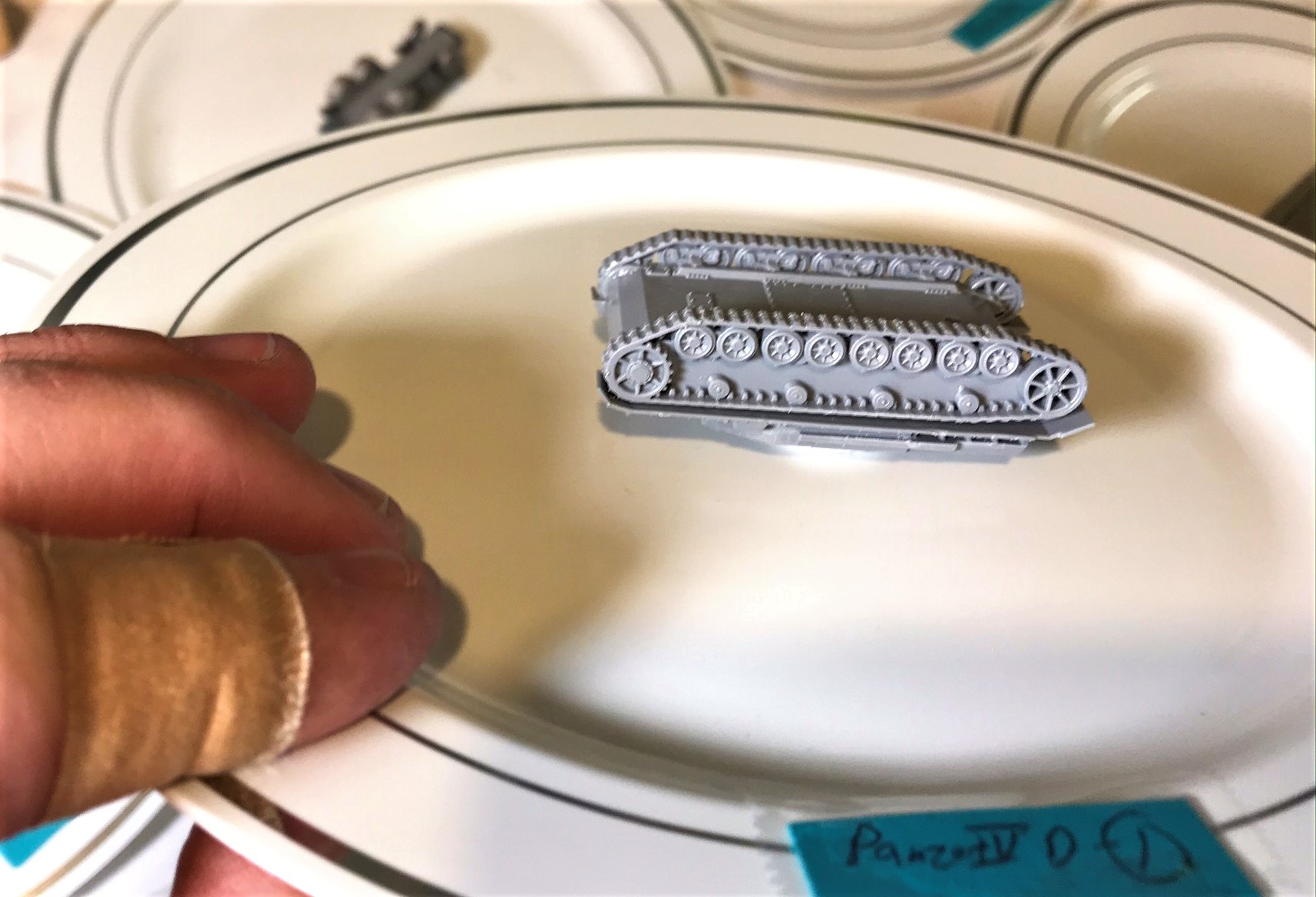
Panzer IVD assembled and mounted for priming.
Panzer IV B chassis later on before weathering added.Panzer IVD completed.
Rear view of the Panzer IVB’s.
Frontal View of the Panzer IVB’s.
Panzer IVB’s moving out.
Panzer IVD’s, rear view.
Side view of D models.
Frontal view, Panzer IVD’s.
Bonus Attack Cards
In my scenario, each side starts at 200 points and must use points to buy vehicles and other combat items. I added Bonus Attack cards, which were optional 5-point purchases apiece for each side. I allow reconnaissance vehicles to buy and have up to two at a time, and others one. The caveat is that your vehicle must have a radio! So the French FT-17, FCM 36, R35, and H35 tanks cannot get these cards. Additionally, there are two bridges that the French player can choose to wire for demolition – at a cost of 20 points each. The river does have fords, but obviously that slows the Germans down. The French player can wire two, one, or no bridges for demolition. Only the French players and the GM know what has been done, and I allow them to try to blow the bridges at any time. The attempts may fail, or they may drop a German tank into the river. Each crossing German vehicle and each failed attempt makes the demolition more difficult. I also added “dummy explosion cards” (with an exploding dummy on it) so that the French player can keep the Germans unsure whether the bridges were wired for demolition or not. The Germans get the Luftwaffe here – and the French Air Force does not show up.
You can see the cards below – the players buy these and get random results:
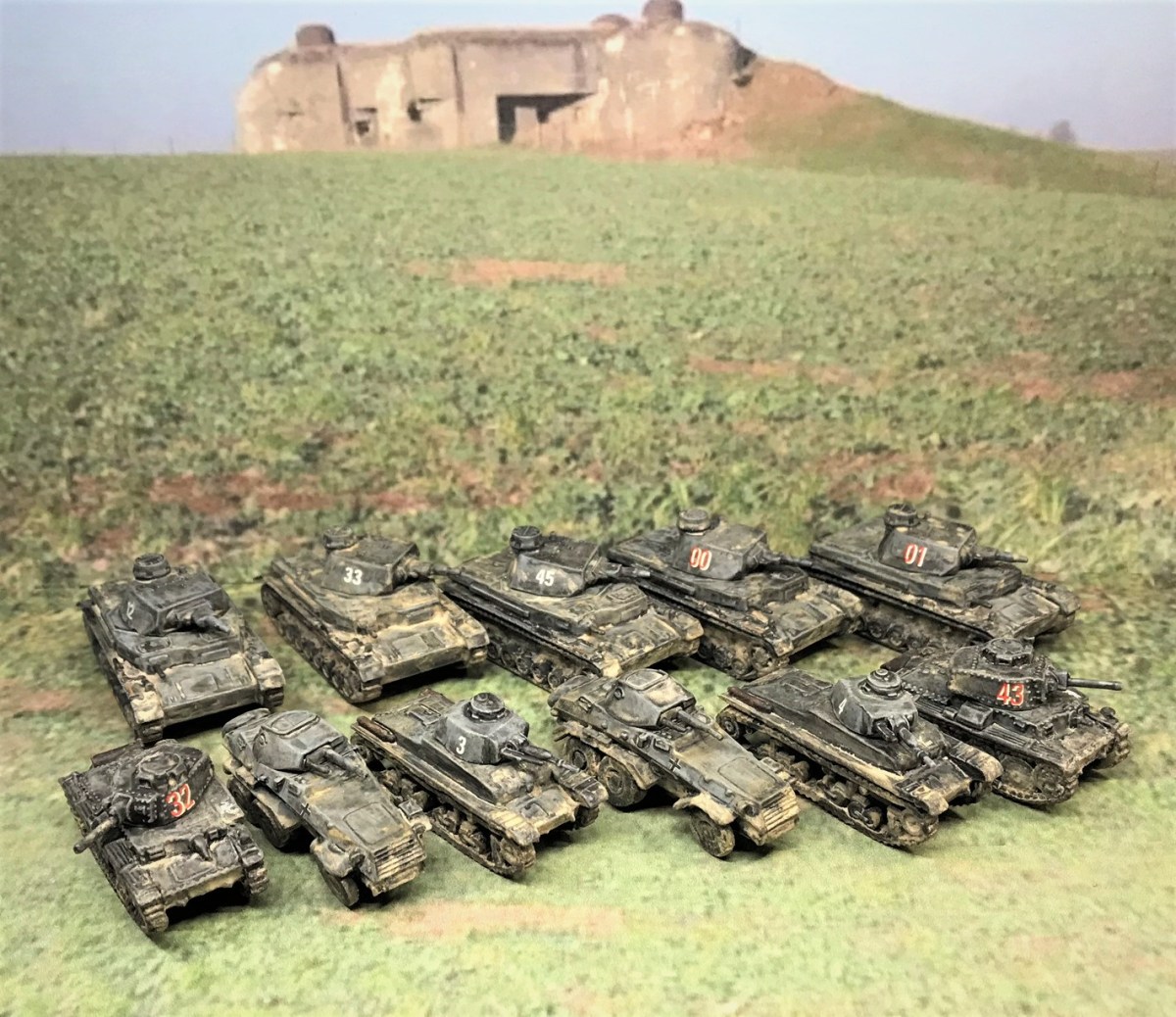
And finally, a couple of group shots in front of an old Maginot Line fort:
I am repeating my reference section below for those interested.
References
Throughout this project I have used many of the books that I have as references – here are some I have used and strongly recommend. I do not get paid by anyone to recommend these, but I am sharing the links if you want to get them. I did study with BG Robert Doughty at West Point over 35 years ago – and he did give me my copy of the B.T. White book in 1984 – that I still have and used many times. There are certainly other books, but these I recommend. I will be using these in my next phase with my German tank additions.
For history of the conflict I recommend buying:
Doughty, Robert A. (1985). The Seeds of Disaster: the development of French Army Doctrine 1919-1939. Mechanicsburg, PA: Stackpole books. (available at Amazon here)
Doughty, Robert A. (1990). The Breaking Point: Sedan and the Fall of France, 1940. Mechanicsburg, PA: Stackpole books. (available at Amazon here)
Horne, Alistair. (1969, 1990). To Lose a Battle: France 1940. London: Penguin books. (available at Amazon here)
For modelers and gamers interested in the vehicles’ look and history:
Forty, G. and Livesey, J. (2017). The World Encyclopedia of Tanks & Armoured Fighting Vehicles. London: Lorenz Books. (available at Amazon here)
Jackson, R. (2009). Tanks and Armored Fighting Vehicles Visual Encyclopedia in color. London: Amber Books. (available at Amazon here)
Restayn, Jean. (2007). World War II Tank Encyclopedia in color 1939-1945. Paris: HISTOIRE & COLLECTIONS. (available at Amazon here)
Smithsonian Enterprises. (2017). Tank: the Definitive Visual History of Armored Vehicles. New York, NY: Penguin Random House. (available at Amazon here)
White, B.T. (1972). Tanks and other A.F.V.s of the Blitzkrieg Era 1939 to 1941. Dorset: Blandford Press. (available at Amazon here)
Zaloga, S. (2014). French Tanks of World War II (1): Infantry and Battle Tanks. New York, NY: Osprey. (available at Amazon here)
Zaloga, S. (2014). French Tanks of World War II (2): Cavalry Tanks and AFVs. New York, NY: Osprey. (available at Amazon here)
PAINTS, INKS, GLAZES, SHADES, WASHES, PIGMENTS, FLOCKING, GLUES AND MORE USED ON THESE VEHICLES:
Microscale Liquid Decal Film
1/8″ neodymium magnets
Green stuff (kneadatite)
Gorilla Glue
Poster tack and plastic plates
Vallejo “Surface Primer – German Panzer Grey”
Vallejo “Flow Improver”
Vallejo “Airbrush Thinner”
Citadel “Contrast Paint – Space Wolves Grey”
Vallejo “Surface Primer – White Primer”
Citadel “Contrast Paint – Apothecary White”
Vallejo “German Grey”
Vallejo “Neutral Grey”
Battlefront “Dark Gunmetal”
Battlefront “Oxide Red”
Citadel “Typhus Corrosion”
Citadel “Ryza Rust”
Army Painter “Dark Tone” (shade)
Vallejo Model Weathering “Dark Rust Wash”
Vallejo Model Air “Gloss Varnish”
Microscale Micro-Set
Microscale Micro-Sol
Appropriate decals from Battlefront
Vallejo “Light Sienna” (pigment)
Vallejo “Light Slate Grey” (pigment)
Vallejo Mecha Varnish “Matt Varnish”
Thanks for looking – please let me know your thoughts and feedback!
This upcoming May-June will mark the 80th Anniversary of the Battle of France. The world was never the same afterwards. It was a cataclysmic defeat of the French Army – and there were many causes of it. Some key ones were that the leadership of the French Army believed that the lessons of WWI taught them that the key to victory was to fight a “methodical battle” with every aspect of the fighting and deployment of firepower tightly controlled from higher headquarters. By contrast, the German Army leadership preached the need of subordinates to act in accordance with the “commander’s intent”, and to take initiative down to the platoon level. French officers were taught to stay at their command posts and manage the battlefield at the highest level. German officers lead from the front, and made battlefield decisions in real time and exploited opportunities. Importantly, French losses in WWI curtailed the birthing and hence the availability of men of military age in 1940. German demographics managed to overcome their Great War losses and had plenty of available young men. The Germans also taught the world the value and use of the tank, armored forces, and especially combined arms – and were the first to do so. Thankfully, Great Britain is an island and that fact, plus the RAF, preserved the chance to defeat Hitler and save civilization.
Certainly, there are many, many other contributing causes to the crushing French defeat – far too many to review here – and I list several books later in this post that are what I consider must-reads for those wanting to understand this complex history. I also list good resources on the tanks and armored cars as well of course for the gamer and modeler that I have found useful. Understanding the Battle of France is not a simple case of one thinking that the Germans were destined to defeat the inferior French, or that the French were worthy of disdain on multiple levels.
Too often, I have found many of my countrymen (and others) dismissive of the French and the French Army based on the defeat of 1940. To understand the whole picture, one must go much deeper. My thoughts go to those killed in 1940 defending their country. Also, I consider the 1.8 million soldiers of the French Army of 1940 who survived this humiliating defeat, and were sent as POW’s to Germany after the Armistice until 1945 as unwilling laborers. Because of the Armistice agreement with Germany, their POW status would not change until the war was over. They returned to a France that not only was devastated physically, but one who lionized the Resistance (rightly) and blamed France’s initial loss on them. Hence, I doubt there will be much commemoration of this seminal battle by either the French or the Germans.
The true blame for the French defeat should be on the generals and the politicians of the Third Republic. The French Army leadership failed to develop a proper fighting doctrine and failed to train the French Army in the 1930’s to win a war in 1940. The politicians failed to ensure that France equipped and fielded a professional army to win a war in 1940. Did some individual French soldiers perform miserably? Absolutely – but that is true of every army in every conflict. As the French politicians supported a policy of national mobilization (levée en masse) instead of a professional army as espoused by some (like Charles de Gaulle did in his book Vers l’armée de métier). In essence, what occurred was that a well-trained and largely professional German army trounced a poorly-trained French one. Ironically, the French had more tanks than the Germans, and some were better, but they were employed ineffectively.
Speaking of equipment, and of course tanks, this post concerns mostly just that. This wraps up my build of French armor for the 80th Anniversary of the Battle of France. I started building my French armor in November 2018 (SOMUA S35’s and Renault R35’s here), then adding to it last month with some FCM 36’s (here), and some Hotchkiss H35 and H39’s (here). I already had two pre-painted Char B1 bis tanks, so I needed to add some more variety – as I will be doing next for the Germans as well.
I’ll also share some eye-candy on the completed models, and the materials that I used to paint them. As a quick aside, I had run low on my Battlefront paints. As a replacement a paint set I found (on eBay) was a Hataka French Early War Armor set. It looks to be out of production, hence my eBay acquisition. Hataka sounds like it might be a Japanese company, but it’s actually a Polish one. I had wanted proper colors, and while I did like the colors I used here, this was a difficult paint set to thin, especially in my airbrush. There was definitely a learning curve.
I ended up using a 0.5 mm needle – and close to 30 psi in my airbrush. Each bottle was 17 ml, and had an internal mixer of some type in them that you could hear when shaking them. The colors were great for French vehicles of 1940, but they took some getting used with both the airbrush and the standard brush.
Front of Hataka set box
Back of Hataka set box
Now, let’s discuss the vehicles!
AMC 35
The AMC 35 was a medium cavalry tank. It was also known as the Renault ACG-1. It had a good 47 mm gun, and was the first French tank with a two-man turret. It’s maximum speed approached 26 mph, due in part to a 180 hp engine, but also due its having less weight due to less than great armor at 25 mm thick. Only 100 of these were built. Thirteen were sold to the Belgians, and none were in any French units until after the crucial German breakthrough at Sedan on May 15, 1940. After that point, all reserve materiel was sent to fight. Therefore the crews would have had virtually no training on these tanks prior to combat, and training is indispensable. Compounding the issue of training, mechanically, the tanks were not overly reliable (though that is a common issue with French tanks of that era). Captured vehicles were only used by the Germans for driver training. One vehicle survives today that was recovered from a ravine and restored.
The models came from Old Glory, (come in packets of three) and were in pretty good shape. Some minor filing was needed to prep the models.
Three AMC 35 models from Old Glory
Assembled AMC 35 models
First, I base-coated the models
I used poster-tack for masking
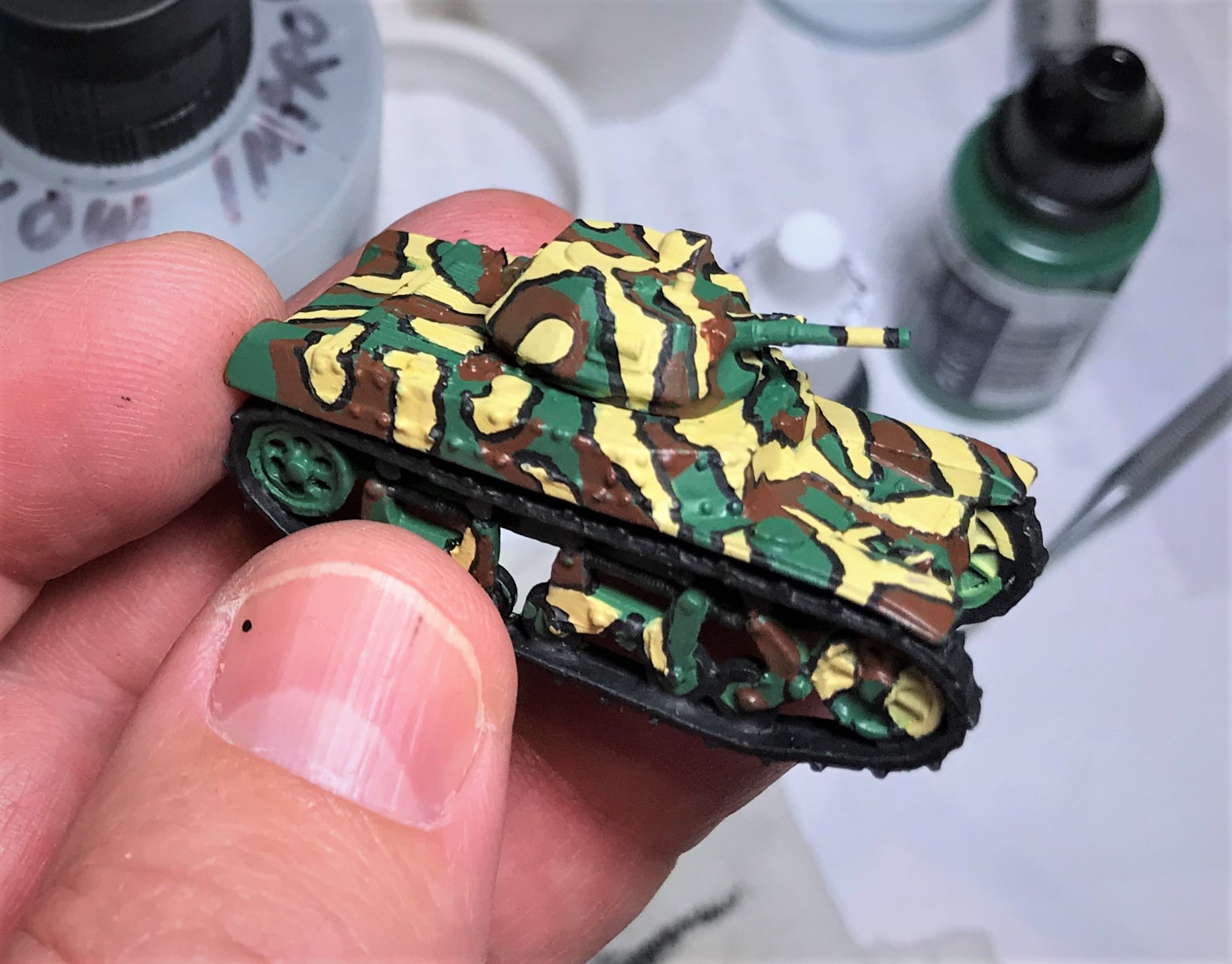
The Hataka paint was a bit thick, leaving a visible (almost raised) border next to my masking with poster tack. For the first time, I decided to line the paint borders by hand. I was a bit apprehensive, but I think it worked fine for the tabletop.
My first try at hand-lining the camouflage colors.I then added browns and tried to smooth out overly thick lines by filling in with the green and yellow next to the black lines.The AMC 35’s on my workbench with the image that I blew up and used as a guide (from B.T. White’s 1972 book with illustrations by John Wood – see citation in references below).
R40
The Renault R40 was an infantry tank, an improved version of the R35. Officially, it was just a variant of the R35 called Char léger modèle 1935 R modifié 1939. It had a longer 37mm gun with the ability to penetrate up to 40 mm of armor. The suspension was improved over the R35, and it looked very different than the original. Delays caused it to not be fielded except to the last two French Army tank battalions and to the Polish 10th Armoured Cavalry Brigade (which fought in France after the defeat of Poland). One major improvement was the inclusion of radios. Captured R35 and R40 vehicles were extensively used and converted to other uses by the Germans. None survive today.
The model came from QRF and was in reasonably good shape and needed little filing. It was also very reasonably priced. As this was a rare vehicle, having to buy only 1 was a plus. Painting was easy as there were neither any decals nor camouflage painting needed due to their being hurried to the front in 1940.
Nice easy 4 piecesThe chassis – I magnetized the hull and the turret for ease of play.Completed R40.
Char D2
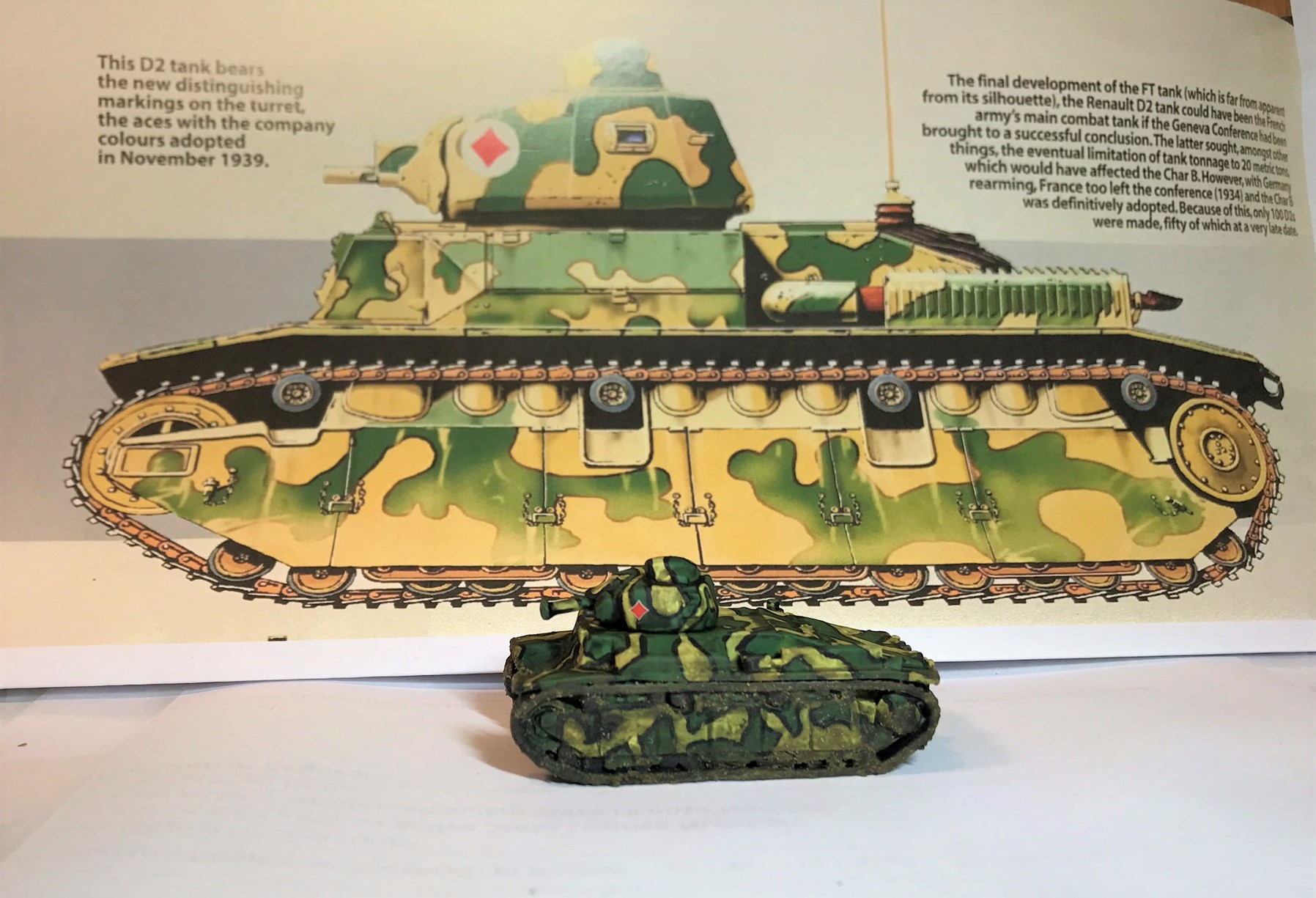
The Char D2 was a medium infantry tank, also built by Renault. It was an interim design, a heavier and improved version of the Char D1, and it was supposed to bridge the gap until the Char B series could be built in sufficient numbers. However, the production of the Char B1 bis never attained the needed levels. Thus it served on the front lines – notably under Charles de Gaulle – and in some of the best tank battalions in the French Army. It had a 47 mm gun, and 40 mm of armor, and like the AMC 35, radios. After the fall of France, the Germans took off some D2 turrets and mounted them on armored trains in the Balkans. Only 100 were built, and none survived the war.
The model came from QRF as well. It was a bulky one, and needed a good bit of filing as there were a few dings and heavy mold lines. Still, at the price and needing to only buy one, it worked for me.
Turret mold lines were heavy…
The Char D2 as received
…as were some dings like this
Getting the Char D2 base coated – you can see some dings on the side and top that were not amenable to filing.Early work on the camouflage scheme on the chassis.Early work on the camouflage scheme on the turret. I did similar painting work to what I did with the AMC 35’s.With the picture from Jean Restayn’s great book that I used as a guide. I considered painting the white circles under the diamond but decided not to as I thought this worked as is.
FT17
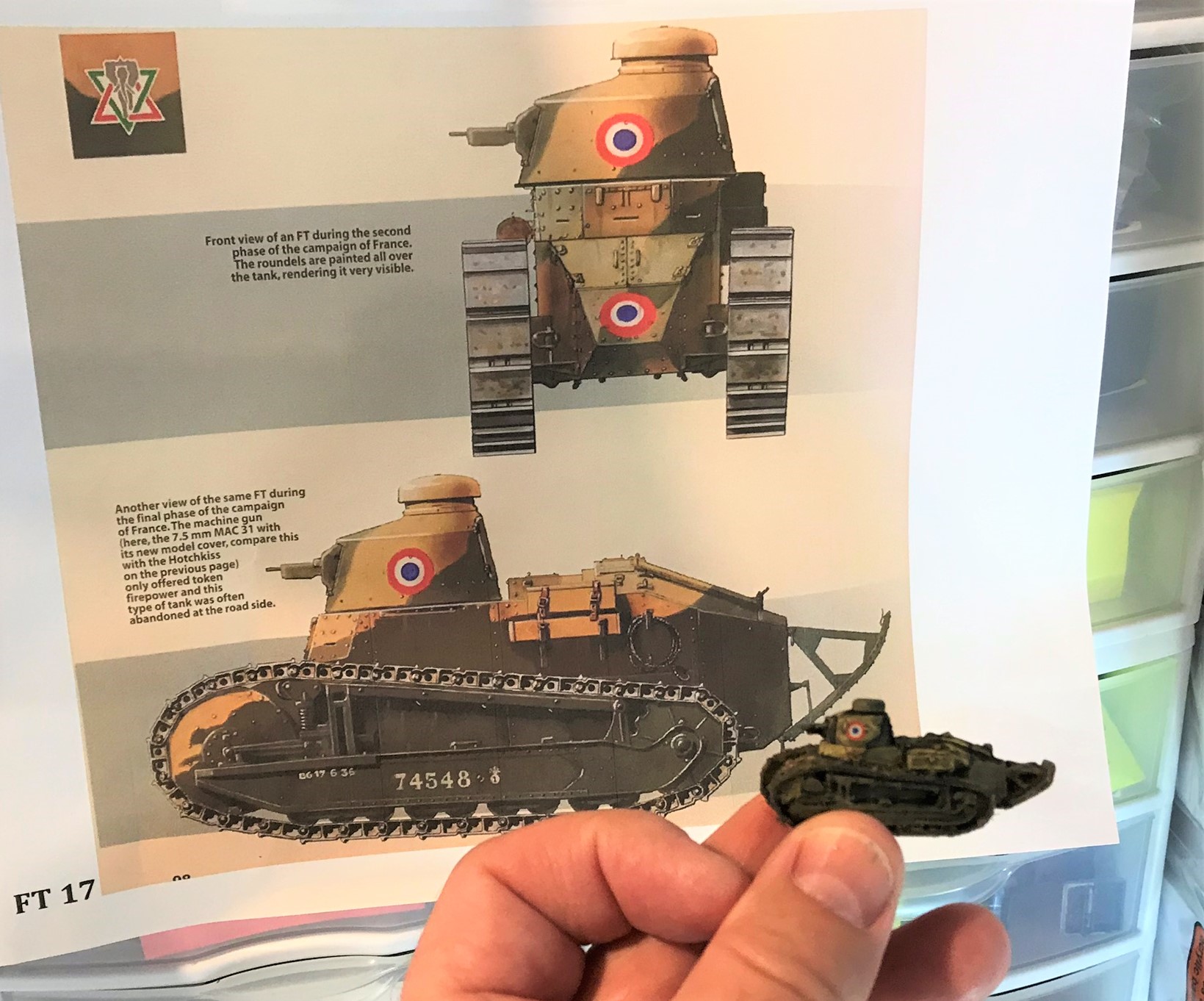
This WWI survivor was one I added to my force just because there were 504 FT17’s still serving in seven front-line tank battalions in 1939 – not counting over a hundred vehicles in French colonies. The FT17 infantry tank had the same 37 mm gun as many other French contemporaries like the R35, H35, and FCM 36. Armor was enough to stop small arms at best (maximum was 22 mm). Against the Wehrmacht, they were pretty ineffective. Many survive as over 3,000 were made by the French, and almost 1,000 under licence in the US (see below for one of those 35 miles from my house).
The model came from Peter Pig and was sold as a single. That worked for me, as I did not want a lot of these in the game. It was in good shape.
My FT 17 chassis after adding a roundel decal but before applying weathering effects.My FT17 model with the Restayn page I used as a painting guide.
Panhard 178
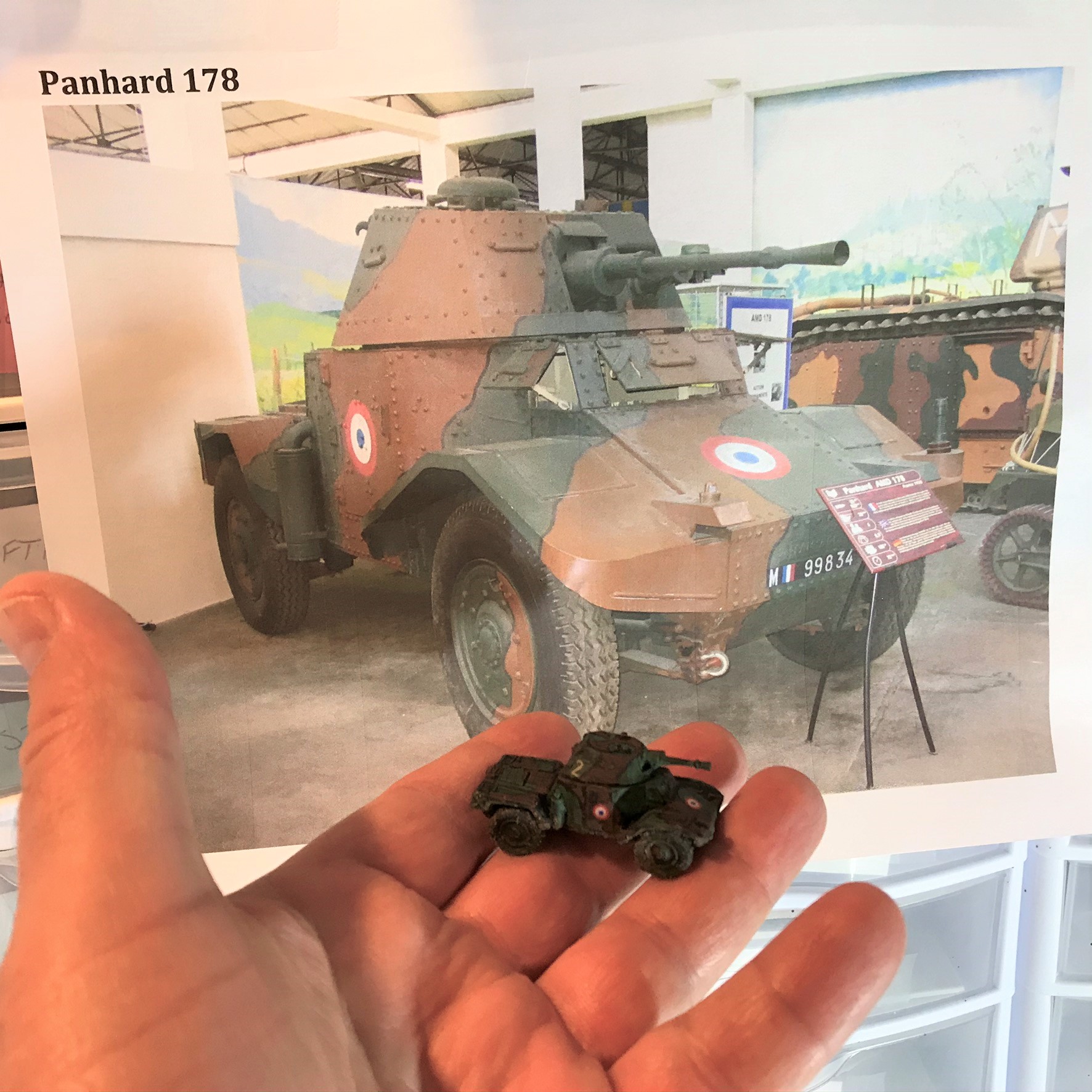
The Panhard 178 (nicknamed the “Pan-Pan) was a superb 4×4 armored car for its day. It equipped French cavalry and infantry division reconnaissance units in 1940. It ended up being used by the Germans extensively after the Fall of France, and indeed was used after the war by the French until the 1960’s. It also equipped other forces, especially former French colonies. It had a good two-man turret, and its 25 mm gun could penetrate up to 50 mm of armor. It also was reasonably fast, and could do 26 mph off-road and almost 45 mph on the road. An assistant driver had controls in the vehicle’s rear allowing for fast reverse if needed. Protection was good for an armored car (20 mm armor in places), but as a recon vehicle its job was not taking on enemy tanks. Over 1,100 were built, and many survive today..
I plan to use them in my games as recon vehicles similar to what I did with my Normandy Breakout! scenario. They will be able to hide better than a tank, and I will be assigning them extra bonus attack cards from a French-specific deck. Likely I will make cards for French artillery, infantry, and anti-tank support, but no air support (the Germans’ recon will appropriately get that!).
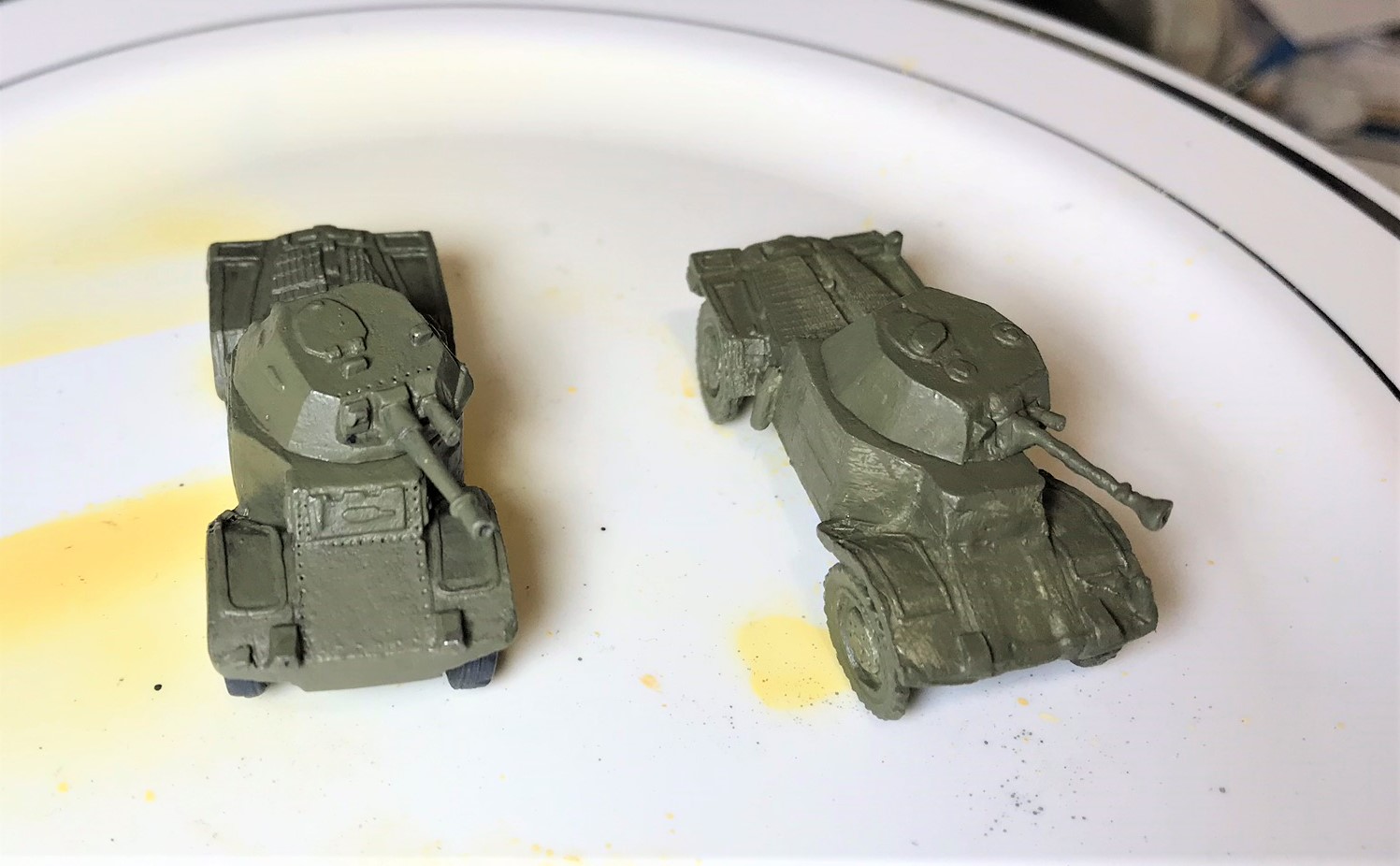
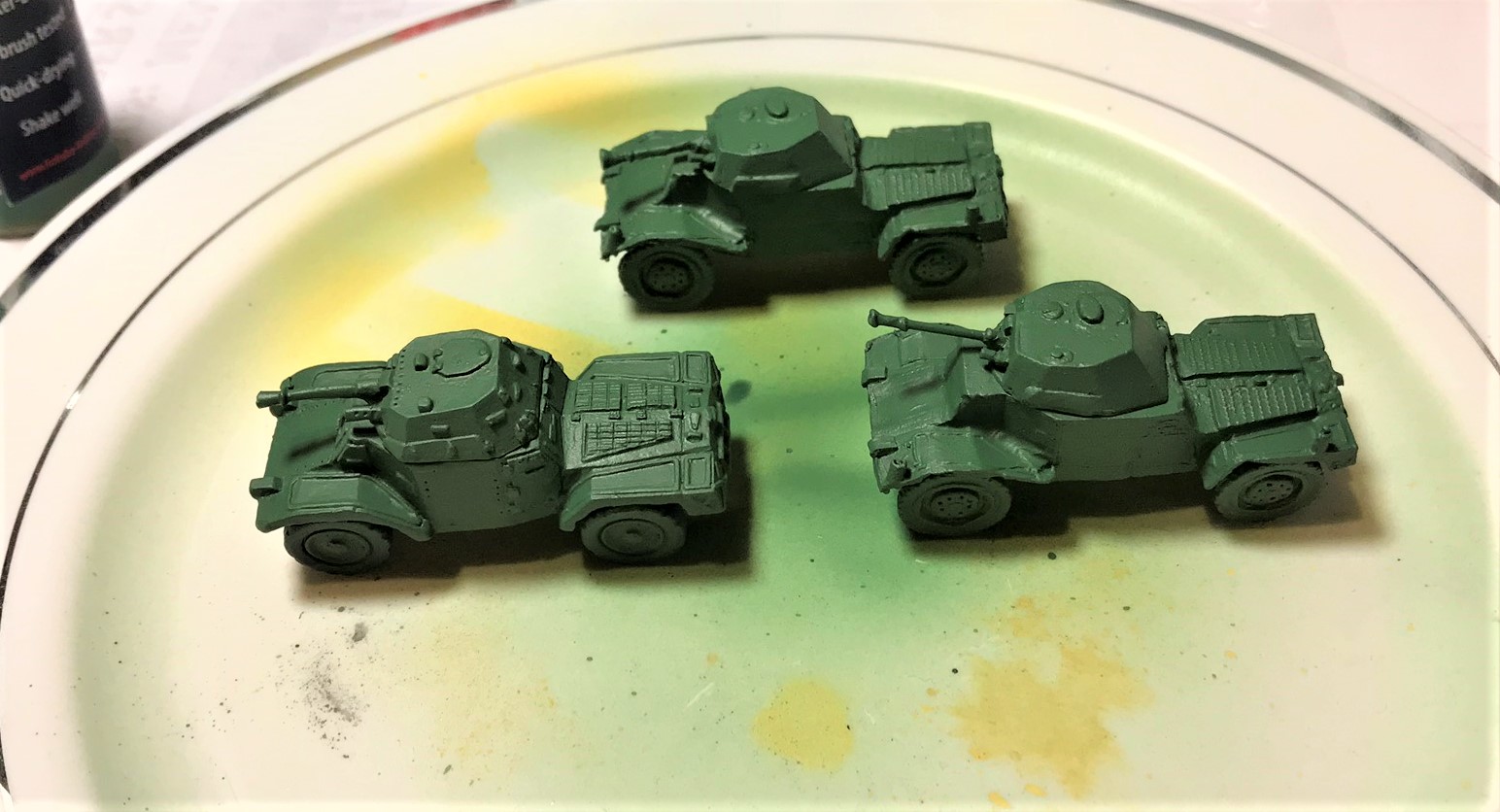
Here I got one Panhard 178 model from Peter Pig and two models from QRF. The Peter Pig model had a sleeve for the turret to fit into the chassis. I just added a magnet in the inside top to attract one of my blast markers if needed. The QRF models I magnetized as I usually do. The Peter Pig model is much more detailed. The QRF models were pretty disappointing and I needed to sculpt gun replacements for both (see below). The QRF models needed a lot of filing too. In the end, I think I made all three effectively for tabletop play – you of course can be the judge!
Peter Pig Panhard 178 Model
QRF Panhard 178 Models
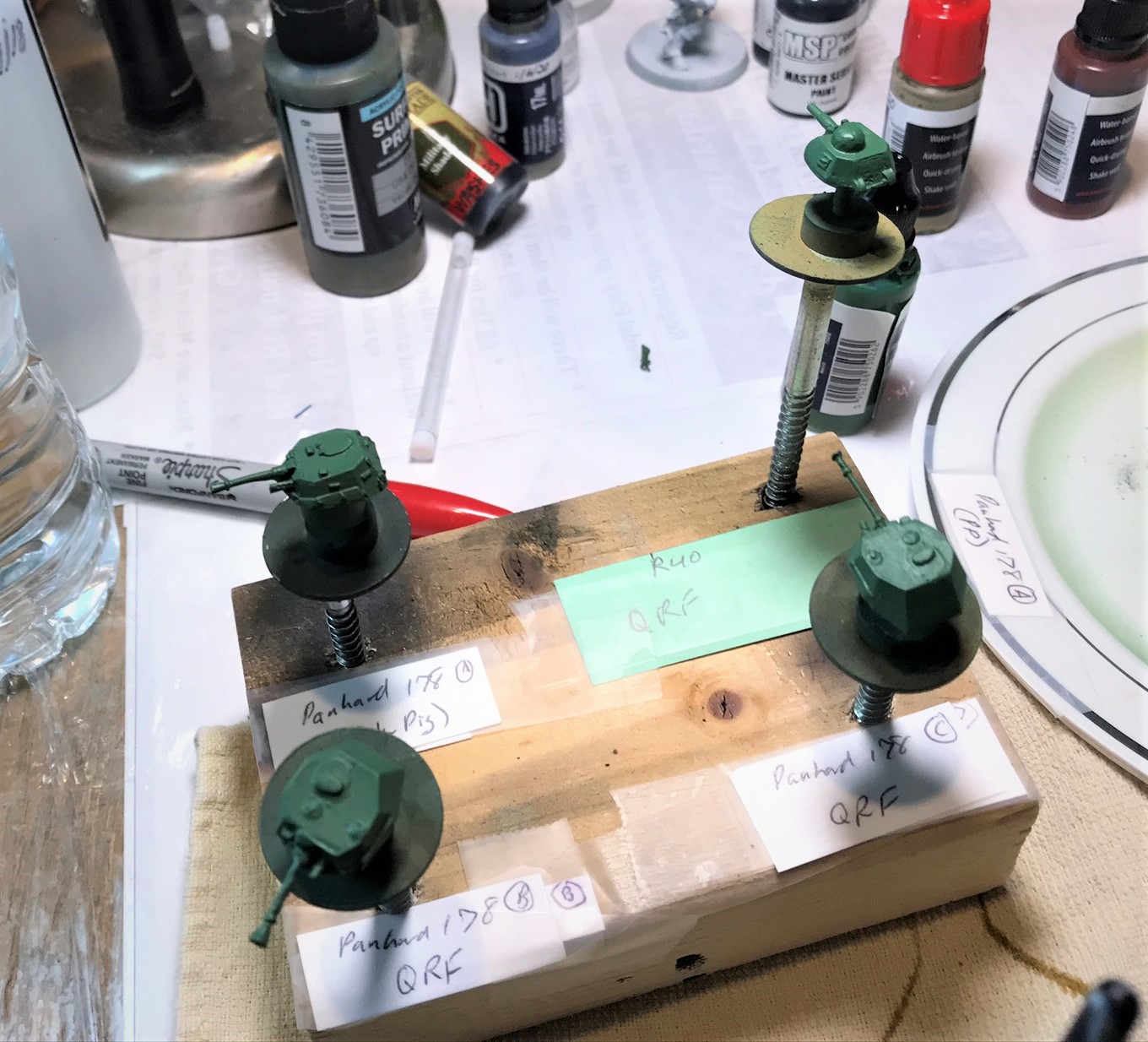
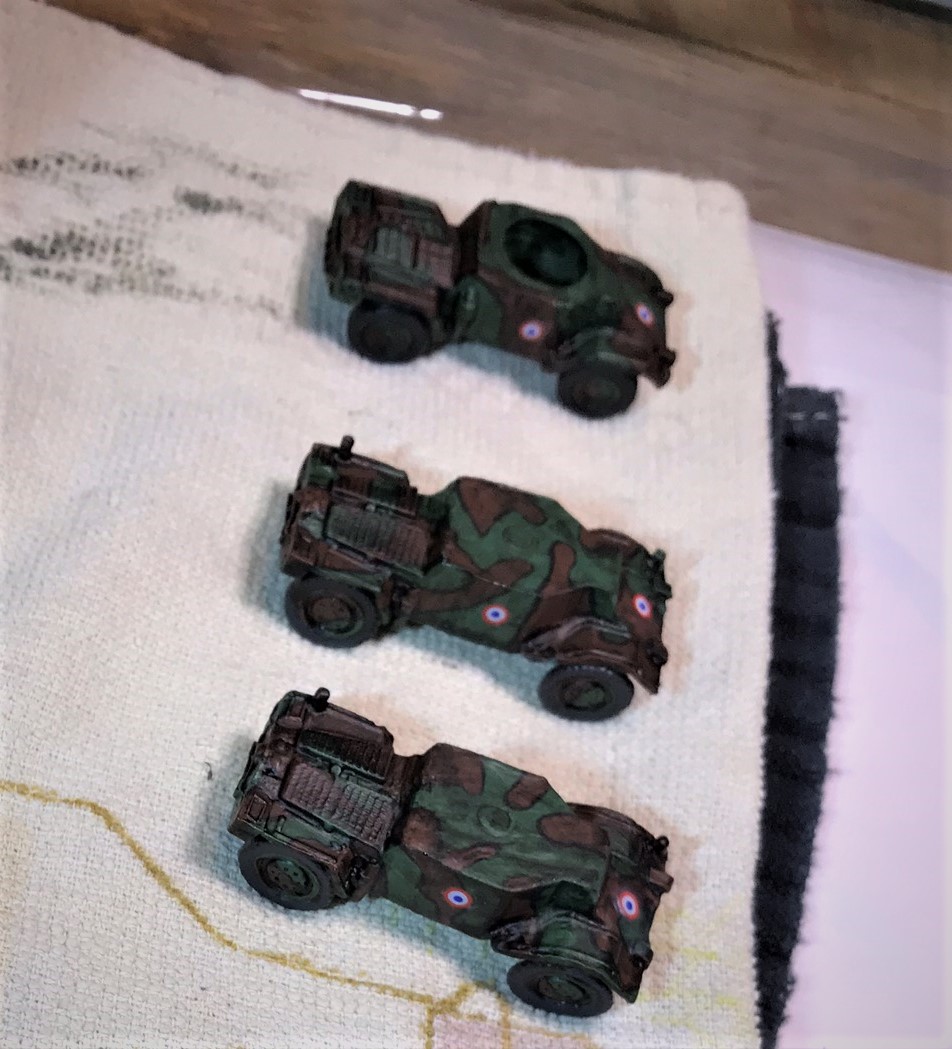
The guns on the Panhard 178 models from QRF were in need of “stiffening”. You can also see the mold lines here too.Here, the guns on the two left Panhard 178 (QRF) turrets have been replaced with paper clip wire placed into drill holes. I added green stuff to recreate the shape of the main gun that you see on the Peter Pig turret on the right.The three Panhard 178’s after assembly with the new guns on the outer models.After priming – a comparison of the detail on the Peter Pig model on the left and the QRF model on the right.Panhard 178 turrets after base coating with the Hataka paint.The Peter Pig model chassis showing the sleeve well for the turret.All three models base coated.Masking for camouflage paint application.The three after decals and varnish. Each turret got a different number for ease of play.My Peter Pig Panhard 178 in front of an image of the one at the Musée des Blindés in France that I used as a painting guide.
Eye Candy
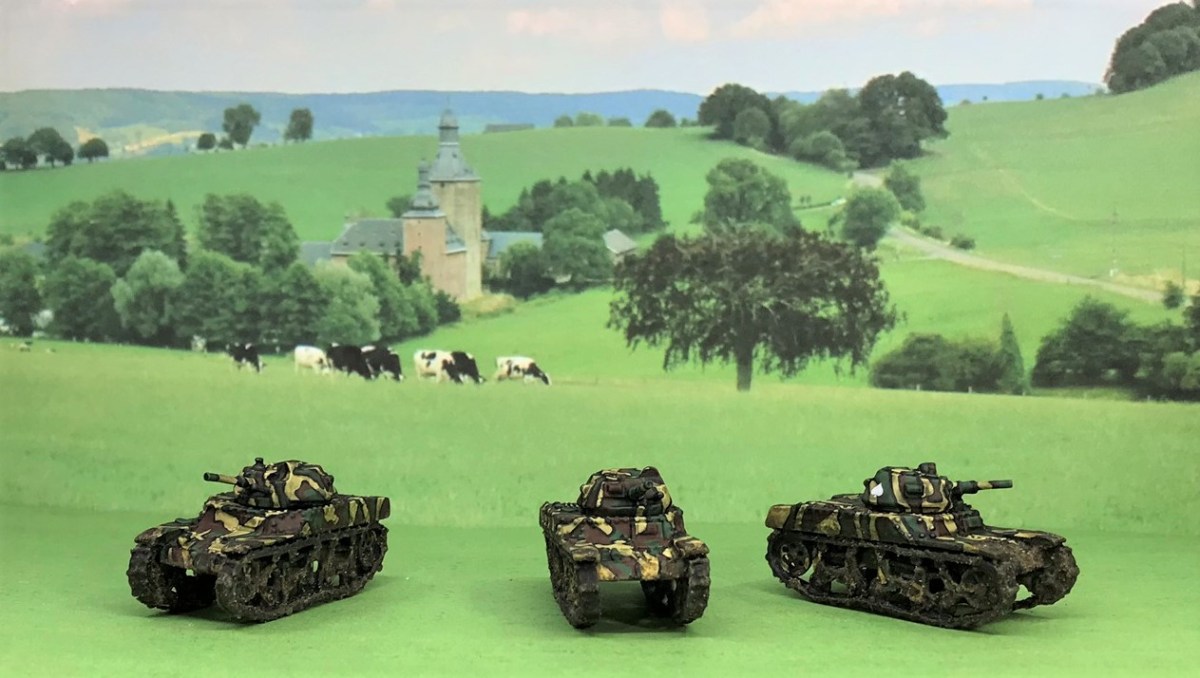
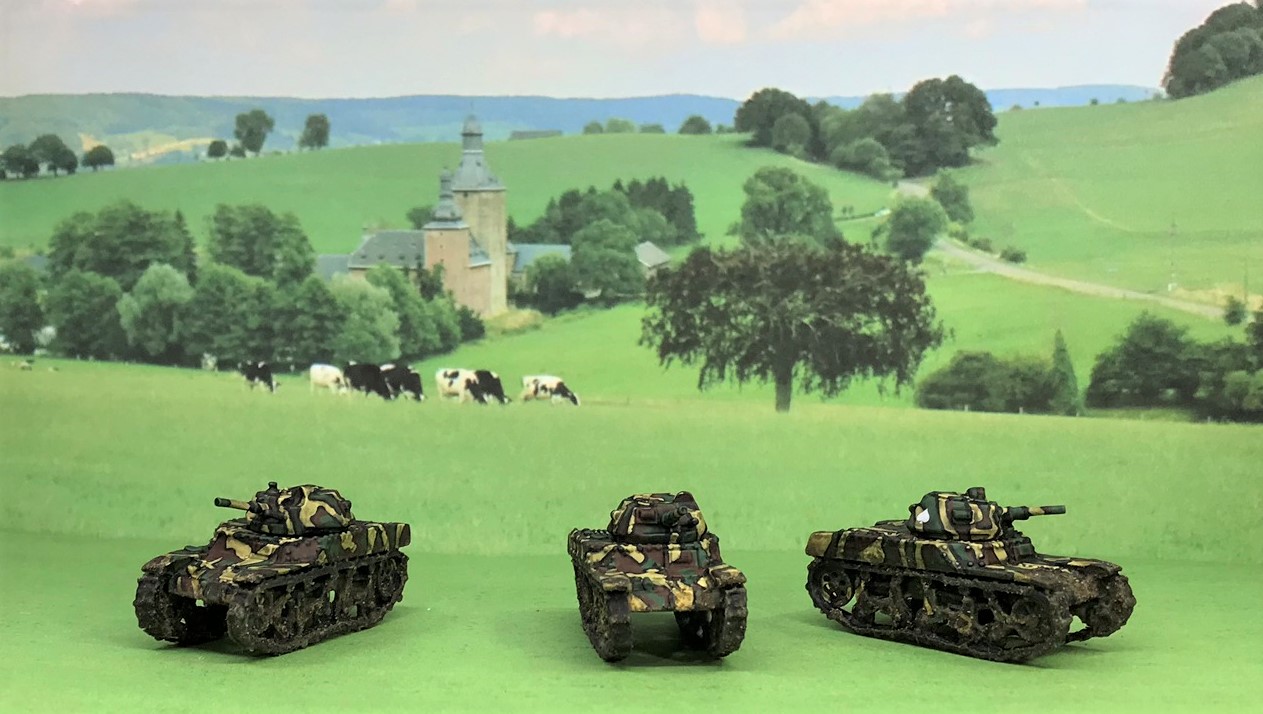
Now, please enjoy some close ups of the completed vehicle models against a backdrop of the French countryside!
AMC 35:
R40:
Char D2:
FT17:
Panhard 178:
Lastly, as these French models are far less known than say a later-war Sherman or a Tiger I – here are some size comparisons with a Char D2 and an AMC 35:
A Side Note on Photography
I try to make my posts visually appealing. My camera is an iPhone 7. I tried to use a technique offered by Per on his excellent blog Roll a One and use my computer monitor screen as a backdrop. While I really appreciated the suggestion, the lighting for me did not work and I got shine on the screen as shown below. Also, my cows were monster-size (though adequately-sized targets for my French tanks!)!
After seeing a post by Ted Salonich showing a photo booth for miniatures on a local hobby store’s (Great Stories) Facebook page, I was inspired to try my spray booth as a photo booth – and it worked quite well. I printed off the backdrop shot onto a piece of card stock, and using PowerPoint made a ground piece to match the connecting ground. I did this by making a new slide and cutting and pasting matching the grass background from the original backdrop slide. I started the fan and the backdrop image was sucked against the filter – and I was able to mount the booth floor with poster tack.
Too much shine, not level, and man, look at the size of those cows!Sometimes I got the “crazing” of the screen with the monitor.Shadows and scale posed problems for me.
This (above) was my last solution – and I used this for my eye-candy shots you saw above. I like it a lot – your thoughts?
Below is a shot taken in the spray booth.
Storage and Transport
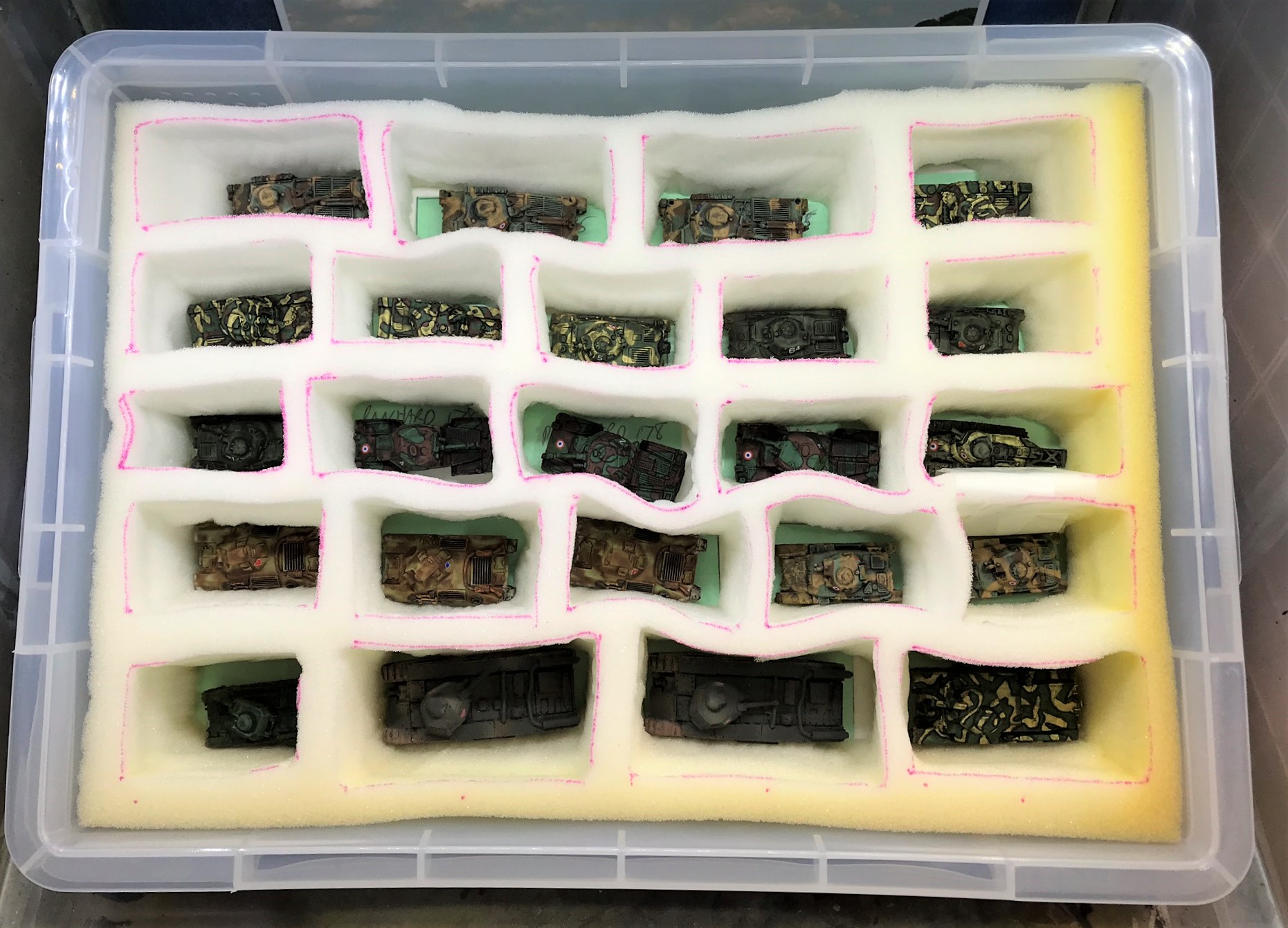
The storage and transport of miniatures to games is an issue. I have zero intention of having my models damaged or destroyed in transit. I use a 4-liter Really Useful Box, and cut a 2″ foam piece from Home Depot to fit snugly in the box. I cut up and lined the bottom with a similarly-sized piece of thin foam from Michael’s. Then I mock up sizes of the tanks with card stock and trace them onto the foam. I also take a photo to remember what tank goes where. Using a new and very sharp Exacto knife, I carefully remove the openings by cutting as vertically as possible. I start by patiently removing pieces from the middle and continue moving outward in a circle. I then affix the card stock pieces to the bottom of the hole openings with tape to mark the locations of the tanks. I thought I’d share this as it may help others.
The mock up.My French Armor force in its new home.
References
Throughout this project I have used many of the books that I have as references – here are some I have used and strongly recommend. I do not get paid by anyone to recommend these, but I am sharing the links if you want to get them. I did study with BG Robert Doughty at West Point over 35 years ago – and he did give me my copy of the B.T. White book in 1984 – that I still have and used many times. There are certainly other books, but these I recommend. I will be using these in my next phase with my German tank additions.
For history of the conflict I recommend buying:
Doughty, Robert A. (1985). The Seeds of Disaster: the development of French Army Doctrine 1919-1939. Mechanicsburg, PA: Stackpole books. (available at Amazon here)
Doughty, Robert A. (1990). The Breaking Point: Sedan and the Fall of France, 1940. Mechanicsburg, PA: Stackpole books. (available at Amazon here)
Horne, Alistair. (1969, 1990). To Lose a Battle: France 1940. London: Penguin books. (available at Amazon here)
For modelers and gamers interested in the vehicles’ look and history:
Forty, G. and Livesey, J. (2017). The World Encyclopedia of Tanks & Armoured Fighting Vehicles. London: Lorenz Books. (available at Amazon here)
Jackson, R. (2009). Tanks and Armored Fighting Vehicles Visual Encyclopedia in color. London: Amber Books. (available at Amazon here)
Restayn, Jean. (2007). World War II Tank Encyclopedia in color 1939-1945. Paris: HISTOIRE & COLLECTIONS. (available at Amazon here)
Smithsonian Enterprises. (2017). Tank: the Definitive Visual History of Armored Vehicles. New York, NY: Penguin Random House. (available at Amazon here)
White, B.T. (1972). Tanks and other A.F.V.s of the Blitzkrieg Era 1939 to 1941. Dorset: Blandford Press. (available at Amazon here)
Zaloga, S. (2014). French Tanks of World War II (1): Infantry and Battle Tanks. New York, NY: Osprey. (available at Amazon here)
Zaloga, S. (2014). French Tanks of World War II (2): Cavalry Tanks and AFVs. New York, NY: Osprey. (available at Amazon here)
PAINTS, INKS, GLAZES, SHADES, WASHES, PIGMENTS, FLOCKING, GLUES AND MORE USED ON THESE VEHICLES:
Microscale Liquid Decal Film (except R40)
1/8″ neodymium magnets
Green stuff (kneadatite)
Gorilla Glue
Poster tack and ¼” square wooden dowels on plastic plates
Reaper MSP “Black Primer”
Vallejo “Flow Improver”
Vallejo “Airbrush Thinner”
Vallejo “Surface Primer – USA Olive Drab”
Vallejo “Black Grey”
Hataka “Jaune d’ochre” (only on AMC 35’s, Char D2, and FT17)
Hataka “Vert foncé”
Hataka “Terre d’ombre” (only on AMC 35’s and Panhard 178’s)
Hataka “Gris vert” (only on FT17)
Battlefront “Oxide Red” (only on R40 and FT17)
Citadel “Typhus Corrosion” (only on R40 and FT17)
Army Painter “Military Shader” (shade)
Battlefront “Dark Gunmetal”
Vallejo Model Air “Gloss Varnish” (except R40)
Vallejo Model Air “Satin Varnish” (except R40)
Microscale Micro-Set (except R40)
Microscale Micro-Sol (except R40)
Appropriate decals from Battlefront (except R40)
Vallejo Weathering Effects “European Thick Mud”
Vallejo Weathering Effects “European Splash Mud”
Vallejo Weathering Effects “Crushed Grass”
Vallejo Mecha Varnish “Matt Varnish”
Thanks for looking – please let me know your thoughts and feedback!
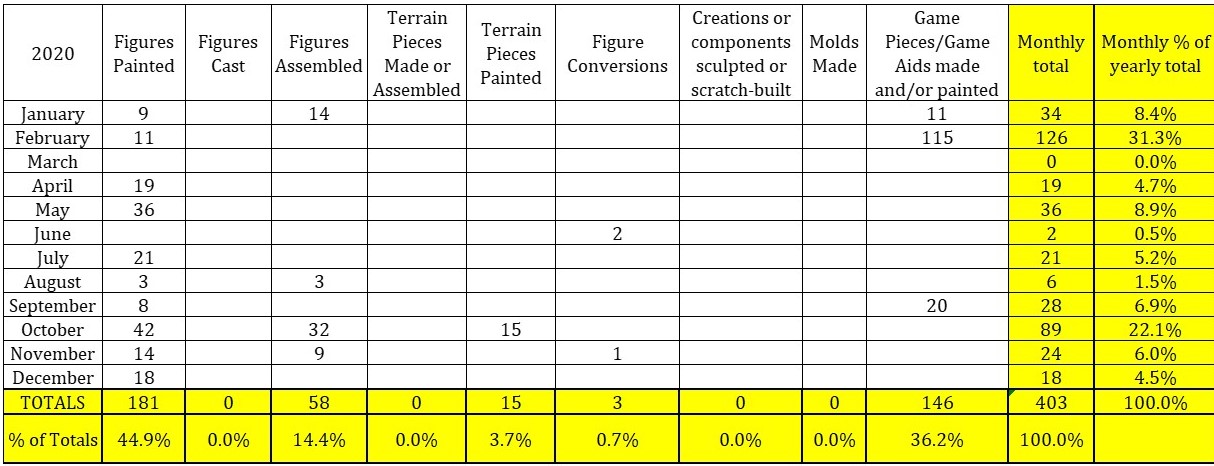
In support of all these activities, of course I had a number of projects in terms of assembling, painting, and creating. I documented these here. Being an analytical type of guy I kept a spreadsheet of my hobby activities (below) and listed them on a page of this blog with links (also below).
My hobby activities tracker
The entire list and links are at the end of this blog which will refer to each project. These links are very useful to me in reviewing previous projects as to what paints I used, what techniques, etc.
The building and painting of tanks and support materials made up the largest part of my 775 project activities in 2019 (106 tanks I believe – 43 German, 23 UK, 18 US, 15 Italian, and 7 French), and the remainder were models for retro sci-fi games (around 50 or so).
The blog itself grew by a lot, and I was very pleased about that. In 2019, there were 20,965 views (versus 13,743 in 2018) by 13,819 visitors (versus 8,295 in 2018). I managed to get in 36 posts, 3 more than in 2018. I must say a huge thanks to all of my readers and followers of my blog! I especially appreciate all of you (and you know who you are) – who took the time to give me feedback – it was great to hear all of your perspectives. THANK YOU!
So what’s next for 2020? My goals are always changeable (hell, its a hobby right), but here is my current list:
Games:
Run convention games at TotalCon, HAVOC, HUZZAH, BARRAGE, and the Fort Devens Game Day (and a few more maybe)
Grow the Mass Pikemen Gaming Club with new members and new GM’s
Support the Historical Gaming Club of Uxbridge
Models:
Build a suitable force of French and German tanks for the Battle of France scenario for 80th anniversary of this event
Build 2 or more new platoons for retro sci-fi games of Combat Patrol
Start the Nomonhan project
Other:
Complete a supplement for Feudal Patrol for Mesoamerican warfare (Aztecs, etc)
Be productive, but never sacrifice quality
Grow the blog and find new ones to follow!
Entertain my audience!
Golf:
Get my handicap below 14 (if I have enough non-gaming time!)
Thanks again for reading this and making my little hobby blog a part of your day! Here are the massive details of 2019 below:
Amazingly, this upcoming May-June 2020 will mark the 80th anniversary of the Battle of France. I am curious as to how it will be remembered – if at all. Certainly I would think that both the French and the Germans will likely shy away from commemorating the event for diametrically opposed reasons. Yet, it is definitely worth remembering it as a seminal event that without question fashioned all of the world’s history since.
I have studied this battle since my days at West Point. I was fortunate there to study with the then-USMA Department of History Chair COL Robert A. Doughty (now a retired Brigadier General). I was able to participate in a class (HI498 – a colloquium) with him and just one other cadet during my second semester senior year as part of my concentration of studies in French. A side note – my class – 1984 – was the last class not to have majors – we had concentrations. This meant we could choose 8 classes outside of the 44 classes in the core curriculum. As I love military history, especially French military history, this colloquium was a great opportunity. We studied Alistair Horne’s works among others.
BG Doughty has authored many books (just check out this list on Amazon), many that focus on France from WWI to WWII. I recently got two excellent books on the subject that he published after I graduated that I have not read: The Seeds of Disaster: The Development of French Army Doctrine, 1919-39, (which discusses how the French Army came to set themselves up for disaster) and The Breaking Point (dealing with the pivotal Sedan breakthrough in 1940). I also plan on rereading Alistair Horne’s To Lose a Battle: France 1940 as well.
Previously, I have built French and German tanks and run several France 1940 games described in this blog – but my 15mm/1:100 scale tank inventory was quite lacking in terms of the wide variety of vehicles used. I aim to remedy that. I am currently planning on running a game at TotalCon in February, and at HAVOC in April. I may do others as well, plus club gaming sessions. This blog post describes the first chapter of my preparation and force building upgrades for those events – four Hotchkiss light cavalry tanks (one H35 and three H39’s).
I will go over a bit of history of the Hotchkiss tanks and then show some WIP shots of the models. I will then share some eye-candy shots of the finished models. Lastly, as per usual, I will share the paints and materials used in this project.
The H35 tank was originally rejected by the infantry, who chose the R35 instead. It was intended to be a light cavalry tank, though it did equip some infantry tank units as well. Hotchkiss built around 1200 H35’s and H39’s, with the majority being H35’s. The Hotchkiss company was actually founded by an American from Connecticut, Benjamin Hotchkiss. He was a Union ordnance engineer at Colt and a munitions builder during the American Civil War. Finding no US business after that conflict, he moved to France and set up his own company.
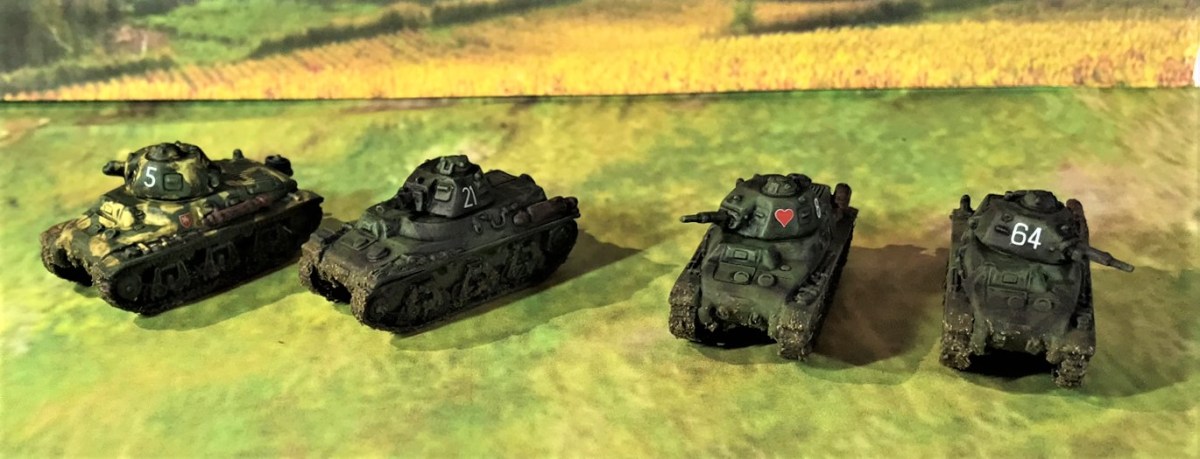
The H35 and H39 both had the same 37mm SA18 gun that many French tanks had though the H39 had a longer barrel with better armor penetration (30mm vs 23mm of armor with the shorter barrel). Given that a Panzer IIIE of the time had 30mm of armor all around, this was not adequate to be sure. It had a crew of just two, which made it challenging to operate effectively in battle. Three out of four of the armored divisions’ tank regiments had Hotchkiss tanks (the other one had SOMUA S35’s). The armor was adequate, but with a range of only 80 miles and a top speed of 17 mph, it was not very cavalry-like. On top of it all, it was tough to drive and mechanically unreliable.
After France capitulated, both Germany and Italy got Hotchkiss tanks. Some of these Italian vehicles faced US Army Rangers in Sicily. After the war, some Hotchkiss tanks served on with the Israeli Defense Force until 1952.
I acquired a 3-vehicle packet from Battlefront Miniatures (#FR020) and one single H39 vehicle from Peter Pig (#PP33). The Battlefront ones could be either H35’s or H39’s. In the end, one of the H35 guns was unsatisfactory, so I ended up with one H35 and three H39’s. In the game, there are no differences statistically between the two types.
Here are the models – the Peter Pig one was all metal. The Battlefront ones had two different engine hatches depending on what version was to be built. These were relatively easy to assemble and prep for painting.
Assembled and magnetized Hotchkiss tanks. From left to right, Peter Pig H39, Battlefront H35, and two Battlefront H39’s.
The Battlefront H35 gun was drilled in and affixed with Gorilla Glue. Later, the drill holes were filled with kneadatite (green stuff).
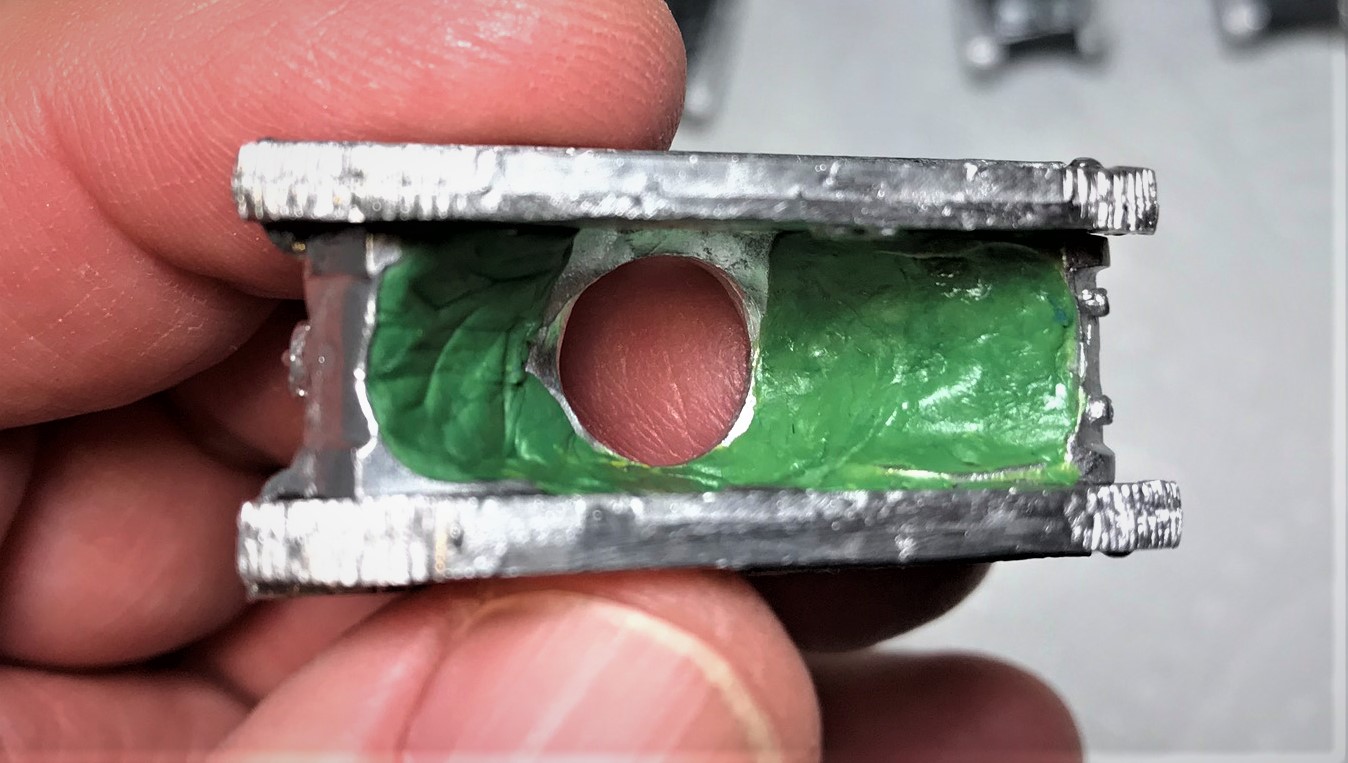
The bottom of the Peter Pig H39 model. For reinforcement of the tracks, I added green stuff under the chassis. I also added a magnet to the inside of the turret so my knocked out tank blast markers would stick to an otherwise non-magnetic model.
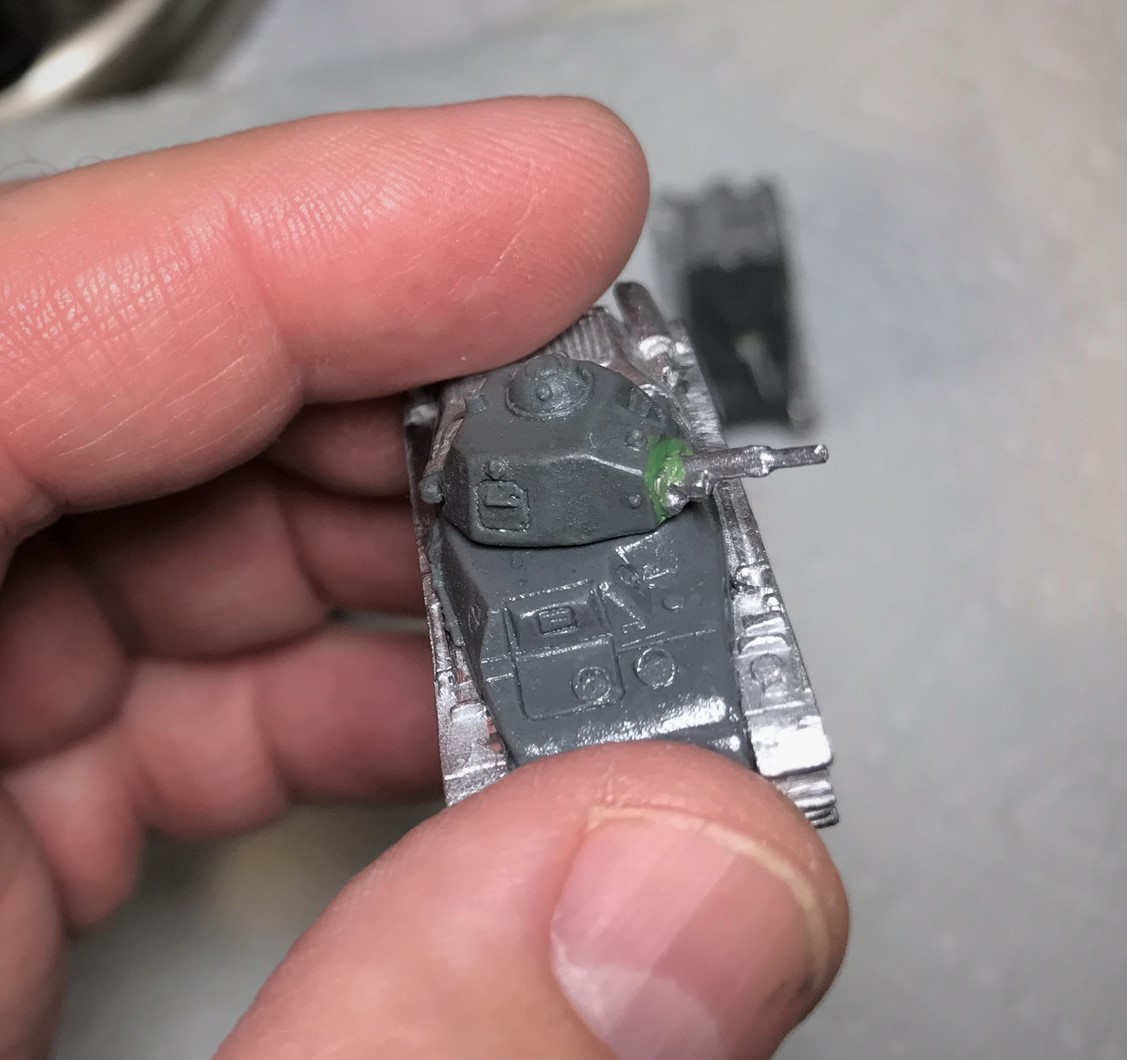
H39 showing green stuff around the longer gun.
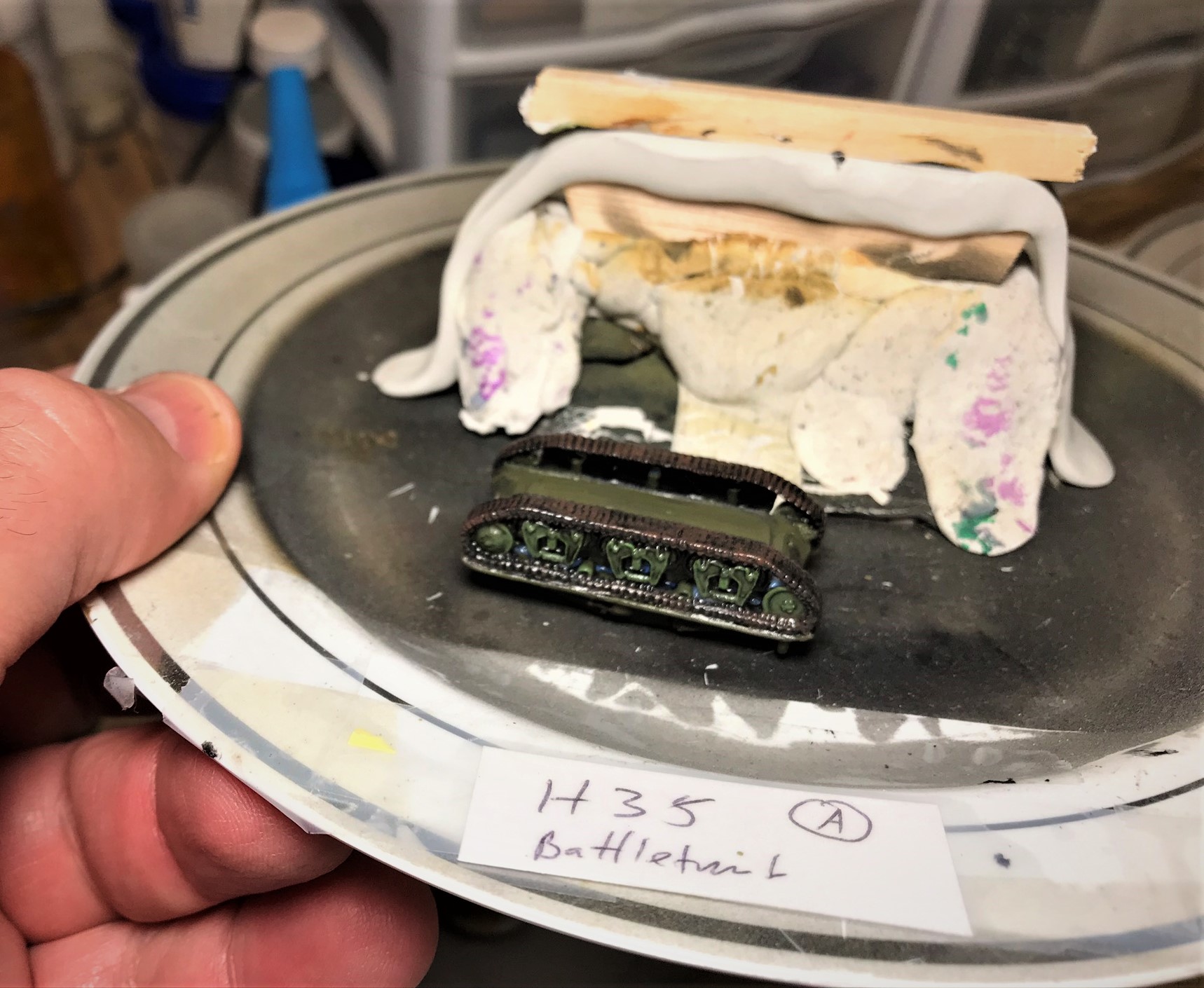
My mounting arrangement for the tanks. I did paint and varnish the tracks first.
Turrets ready to paint.
This shows the H35 after the tracks were painted, washed, and lightly varnished.
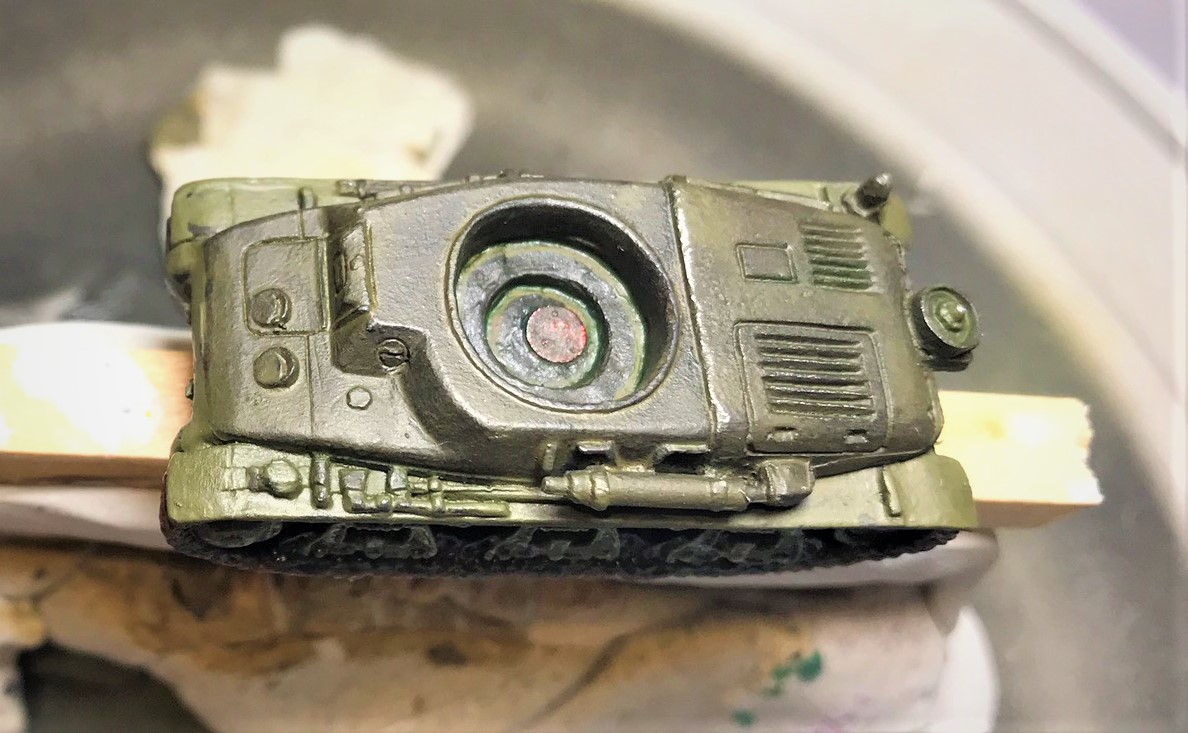
Then the models were mounted and primed. I had a challenge priming the exposed metal parts as you see here – I needed a few thin coats.
The priming issue (exposed metal) was more difficult for the Peter Pig model as it was all metal.
After priming, the H35 awaits set up for base coat painting. Protecting the already painted tracks with poster tack was the first step.
I was not thrilled with the yellow, but I darkened it. Here, I applied more poster tack to apply a camouflage pattern.
The H39’s got their base coats, and then I used an Iwata Micron airbrush to blend in some browns on the green. As I researched tanks of this era on the French side, I found that there was no standardization of tank painting schemes.
The H35 under the poster tack for a camouflage scheme.
The Peter Pig H39 model showing the added brown color airbrushed across the tank.
After removing the poster tack from the H35, this was the result.
I then washed the vehicles with Army Painter Military Shader. All that was left was adding decals, weathering, and final varnishing.
Battlefront decals – so tiny. I still do not understand why the roundels are two piece decals.
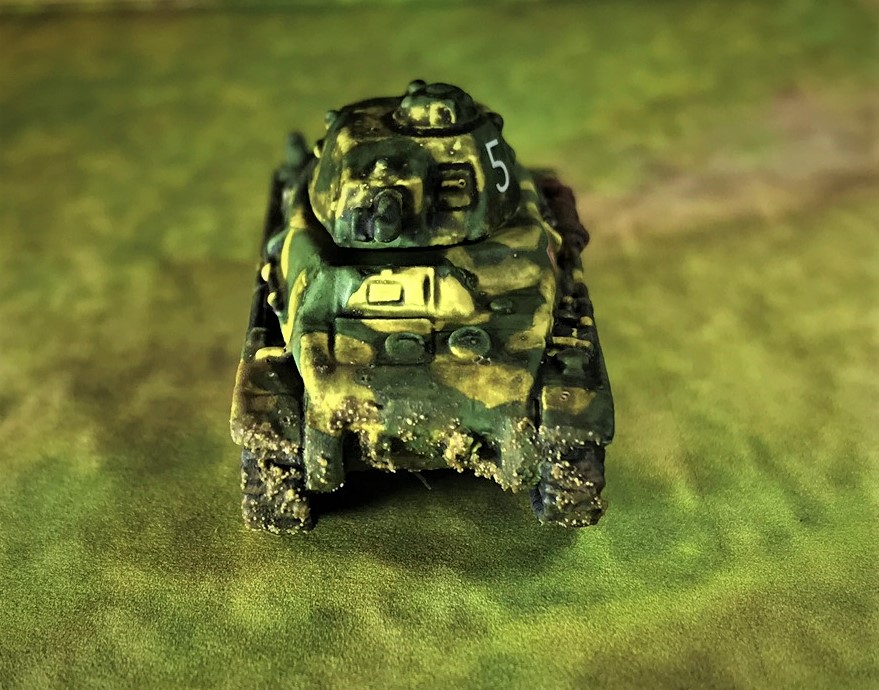
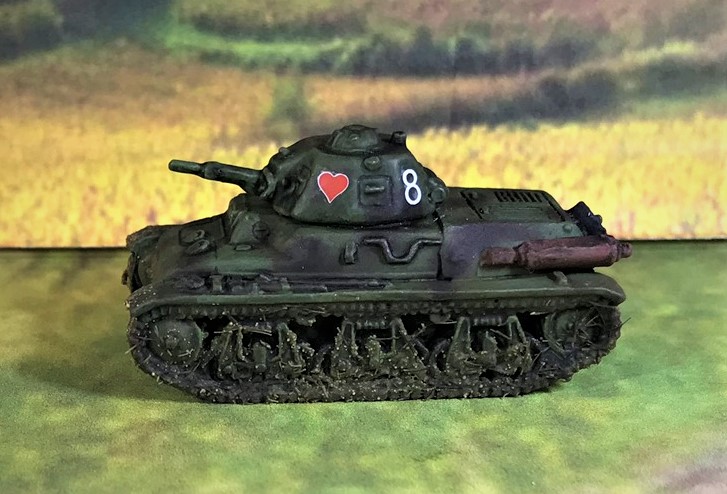
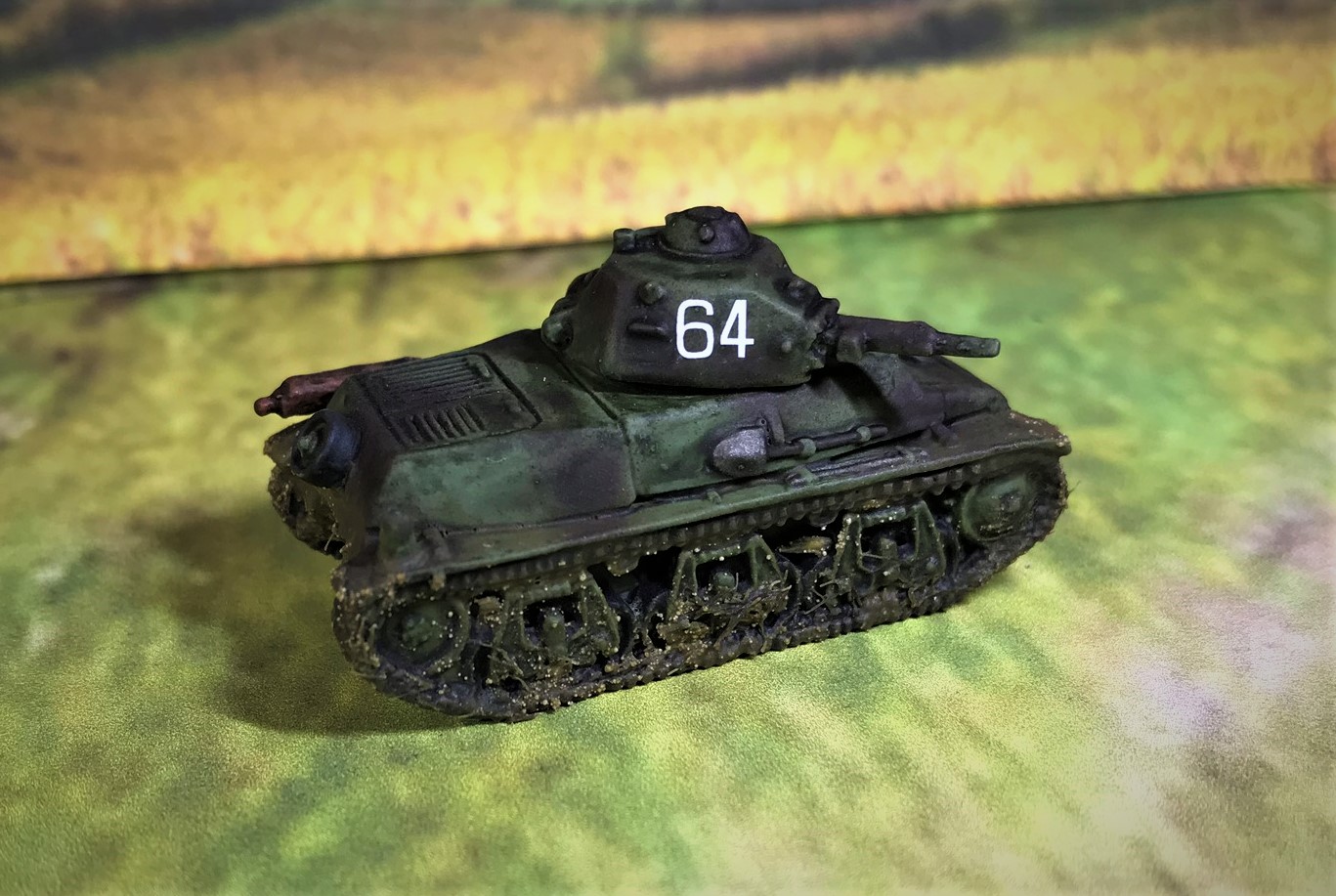
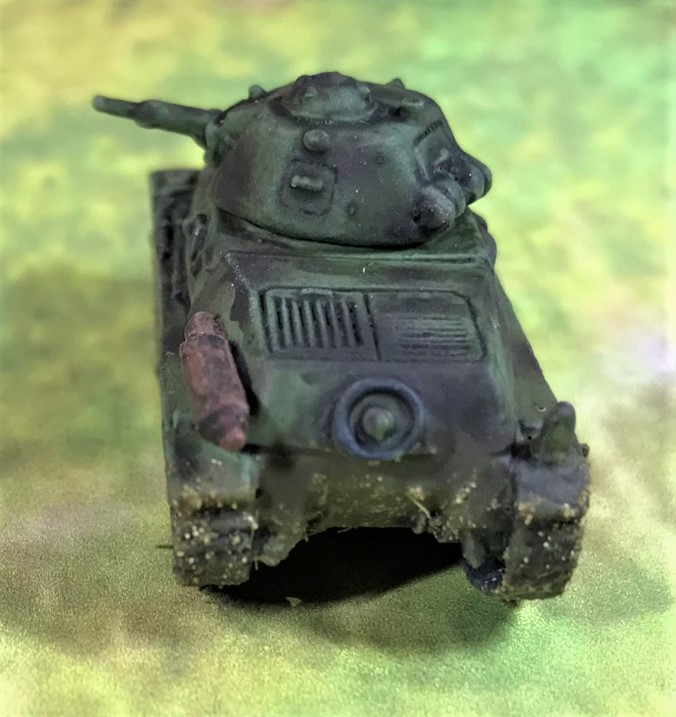
Now, I would like to share the finished vehicles – eye candy (at least I hope you find them nice to look at).
How I planned the paint job – I am hoping to get better tan/yellow tan paint for future French use, but after washing/shading, I think this is fine. Do you?
Battlefront H39’s (two)
Battlefront H39 “#8” left side.
Battlefront H39 “#8” left front side.
Battlefront H39 “#8” rear view.
Battlefront H39 “#8” right side.
My plan for the “#8”.
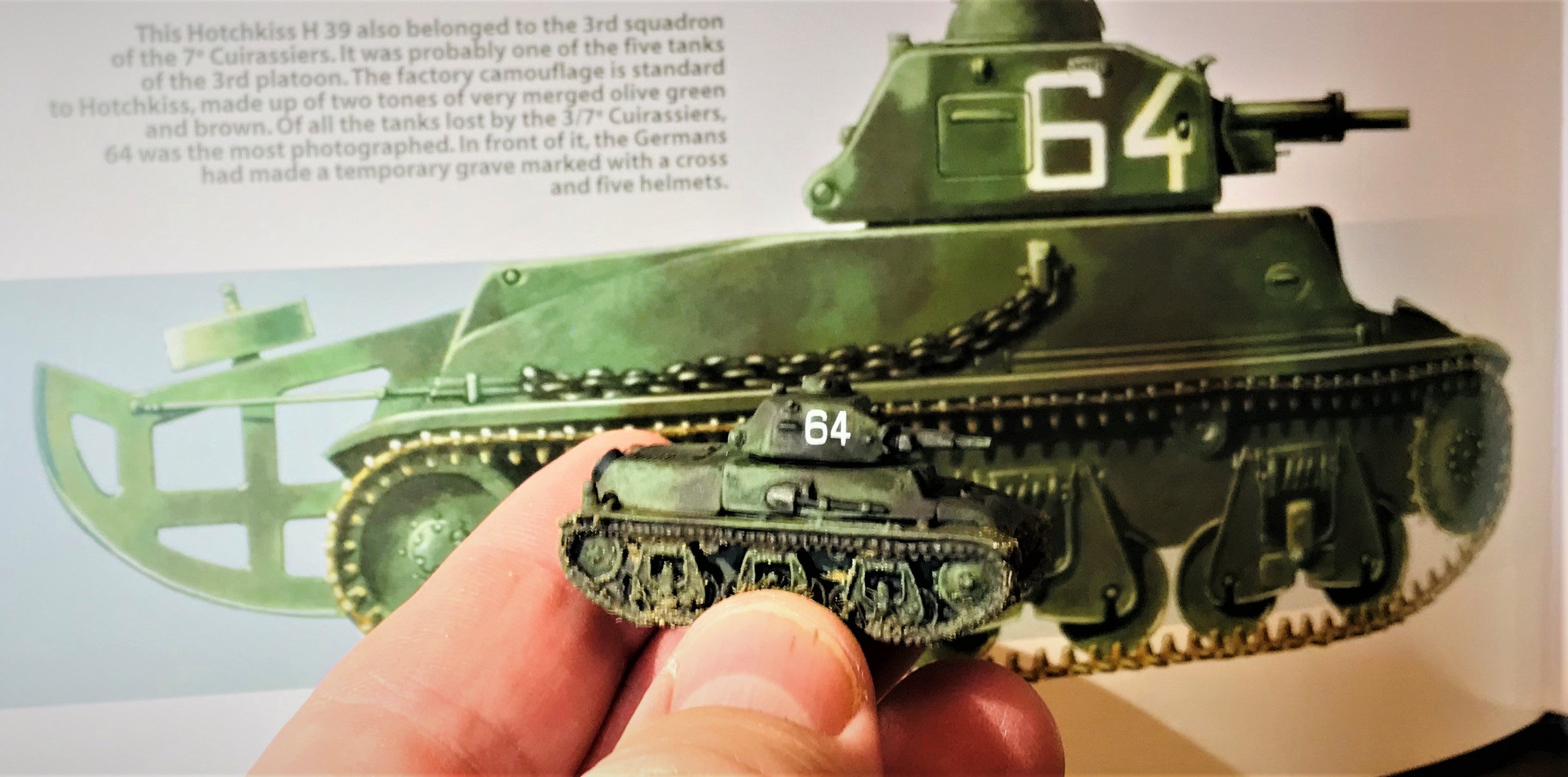
Battlefront H39 “#64” left side. This was the only Hotchkiss tank I built with a number on the right side of the turret. Again, markings were definitely not standardized.
Battlefront H39 “#64” right front side.
Battlefront H39 “#64” right side.
Battlefront H39 “#64” rear view.
How I modeled the vehicle.
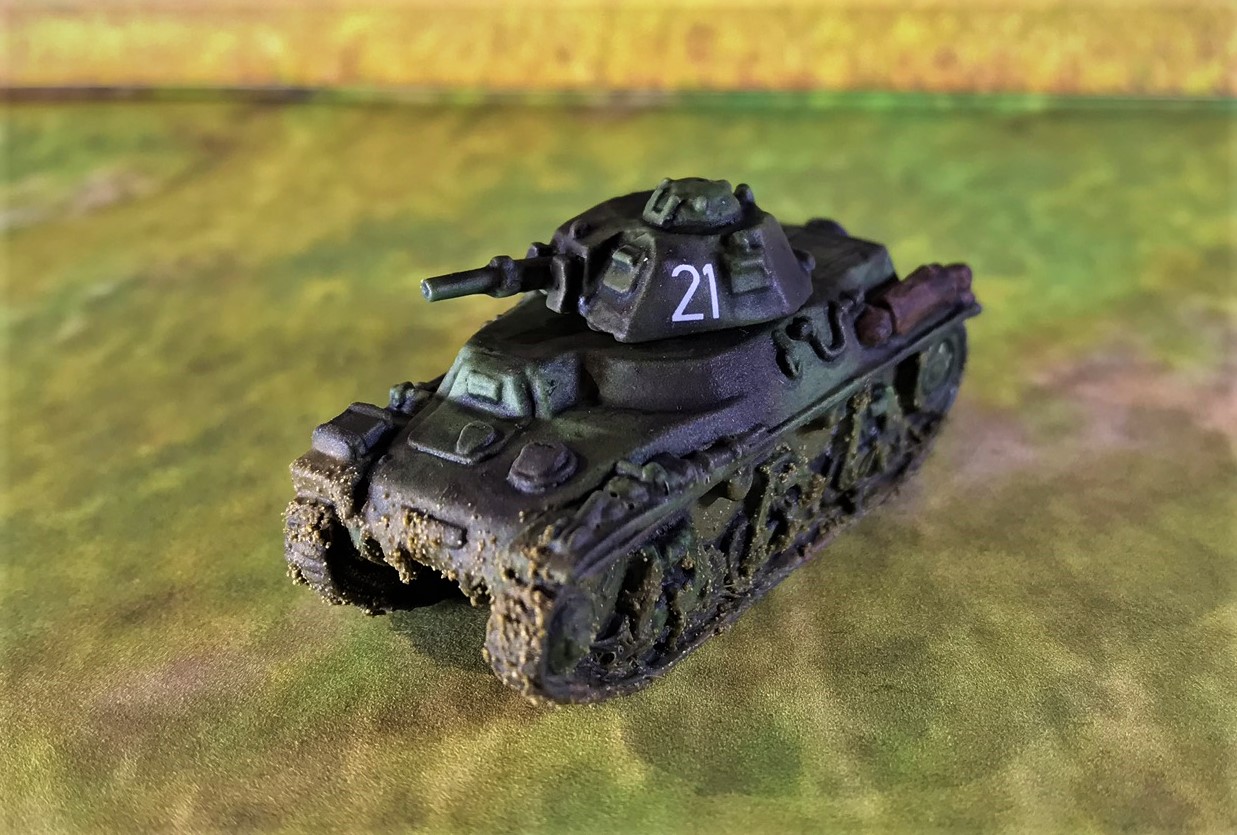
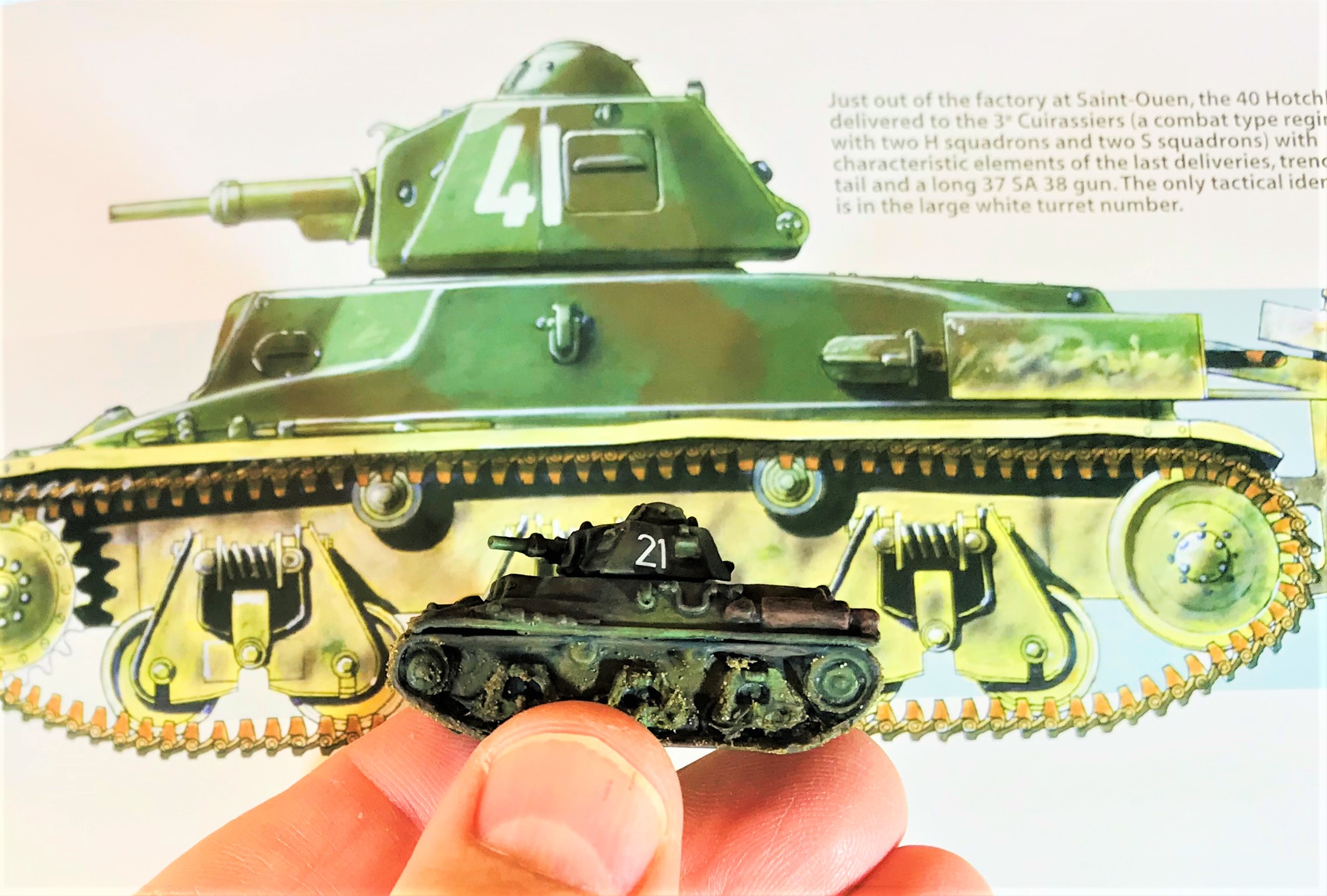
Peter Pig H39
Peter Pig H39 “#21” front left view.
Peter Pig H39 “#21” right side view. After weathering was added, the side looked similar to the Battlefront models.
I did not have a #41!
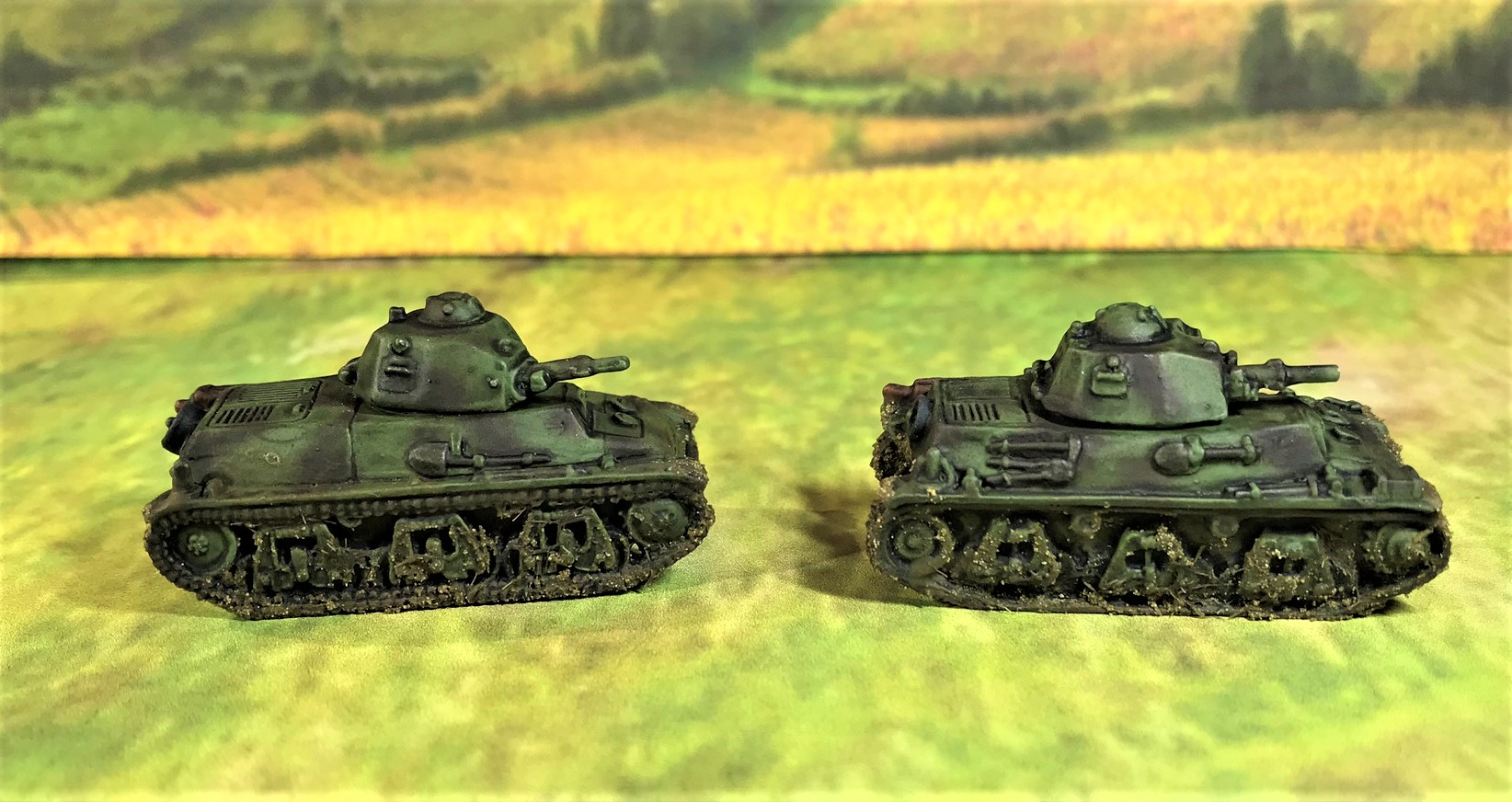
This is a side-by-side comparison of the Battlefront (left) and Peter Pig (right) H39’s. I like both – though my preference is for the Battlefront models – which are resin and metal. However, many of the models I need for this project are hard to find and not made by Battlefront, and sometimes with some manufacturers you need to buy up to five vehicles. With Peter Pig, I can just get one vehicle (QRF with metal models sells one at a time as well – and you’ll see some of their vehicles soon too). Old Glory usually sells 3 vehicles (all metal) in a pack.
Group Shots
This concludes my very last post of 2020 – and the beginning of this project. (I will be doing a 2019 round up of course – but that will be coming later this week).
More Battle of France vehicles (French and German) will be coming and I hope that you will find them interesting. If you have any feedback, good, bad or otherwise, let me know in the comments section – I do appreciate knowing what you think.
Thanks for looking and Happy 2020!
PAINTS, INKS, GLAZES, SHADES, WASHES, PIGMENTS, FLOCKING, GLUES AND MORE USED ON THESE VEHICLES:
Isopropyl Rubbing Alcohol 91%
Microscale Liquid Decal Film
1/8″ neodymium magnets
Green stuff (kneadatite)
Gorilla Glue
Poster tack and ¼” square wooden dowels on plastic plates
During the Battle of France (May-June 1940), there was an amazing variety of vehicles on both the German and the French sides. At this same time last year, I began putting together a collection of period 15mm/1:100 scale vehicles for this period. These were discussed here. I have previously posted about a couple of games (December 2018 and January 2019) that I ran using the What a Tanker™ rules from the UK’s Too Fat Lardies. I have been hoping to return to this period and add more vehicles to both armies. I am starting this augmentation by adding 3 FCM 36 light tanks to my fleet.
The FCM stands for Société Nouvelle des Forges et Chantiers de la Méditerranée, a shipbuilder in Toulon who manufactured this 1936 design – and delivered about 100 to the French Army up through 1938. Cost and industrial manufacturing concerns limited further purchases. They were a little more than 12 tons, with a crew of two. The armor was fairly good – welded, and very sloped for tanks of the day. It also had a diesel engine and reasonable range unlike many other contemporary French tanks. However, like many other French tanks, it was armed with the weak Puteaux SA 18 37mm gun which definitely had challenges fighting German armor. Notably, two battalions of FCM 36’s tried to repel the bridgehead that the Heinz Guderian had established across the Meuse, but they were too little and too late. After the surrender of France, some of the FCM 36 chassis were converted to Marder I’s or self-propelled artillery. Some of these conversions were involved in the Normandy Campaign of 1944. Today, only one FCM 36 survives at Saumur.
I thought these would be a good addition to my French early-war tank collection. In What a Tanker™, these are the cheapest tanks to buy point-wise. The only source I found for these models was Old Glory. They are metal, and quite small of course.
The 3 FCM 36’s in the baggie.
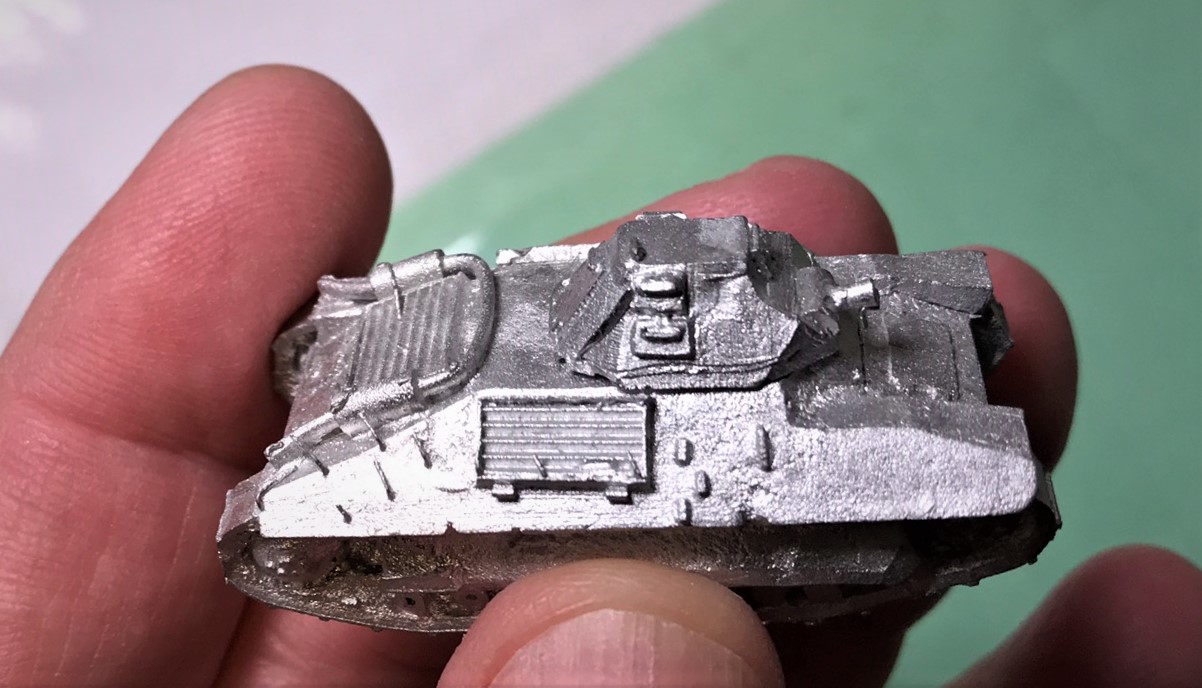
I did need to do a bit of filing and cleanup of extraneous molding material and molding lines as you see here. Yes, these are small!
The turrets had a small molded pin for mounting on the molded hole on the chassis. I needed to slightly elevate the turret or the underlying paint on the chassis would be worn off, even with a good varnishing. I decided to drill out the pins and the holes with a 1/8″ drill bit. I then used green stuff to fill in underneath the hollow chassis between the tracks and provide a “floor” for the magnets. The magnets were put in place with Gorilla Glue in the chassis and the turrets.
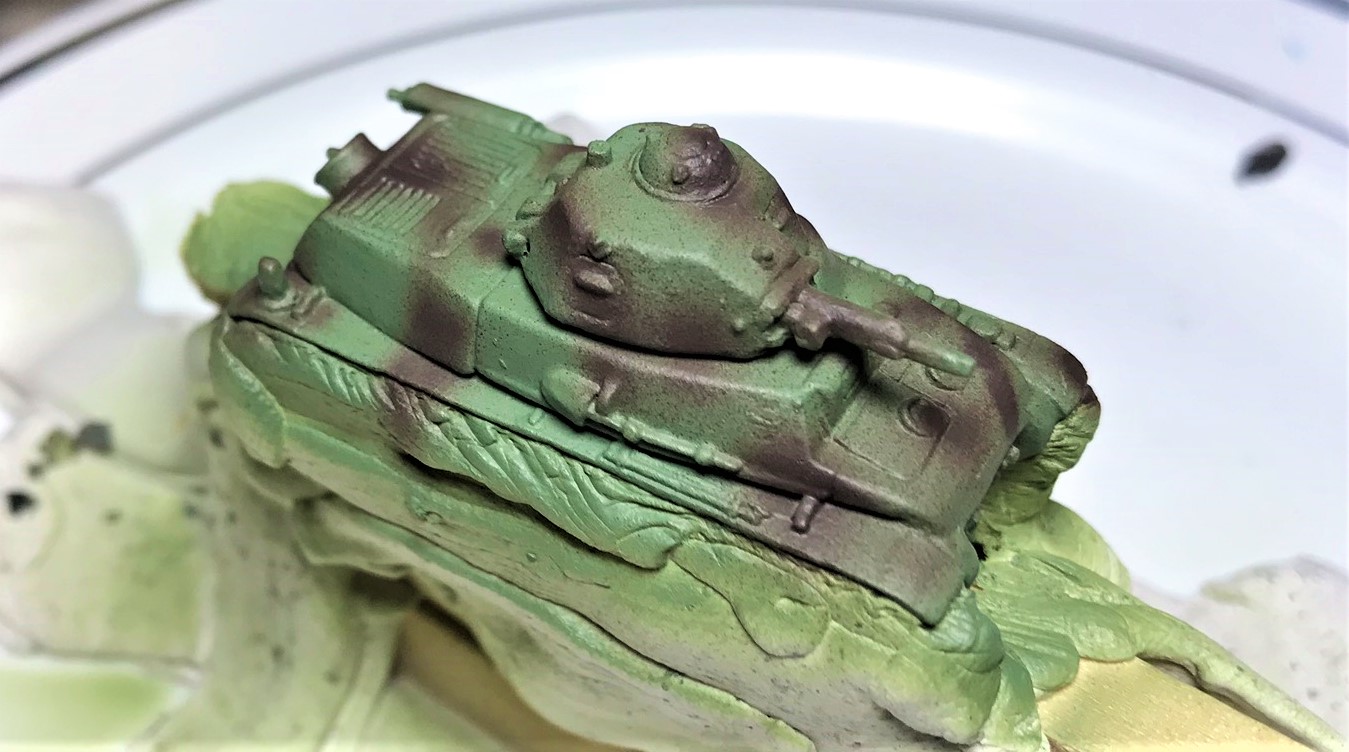
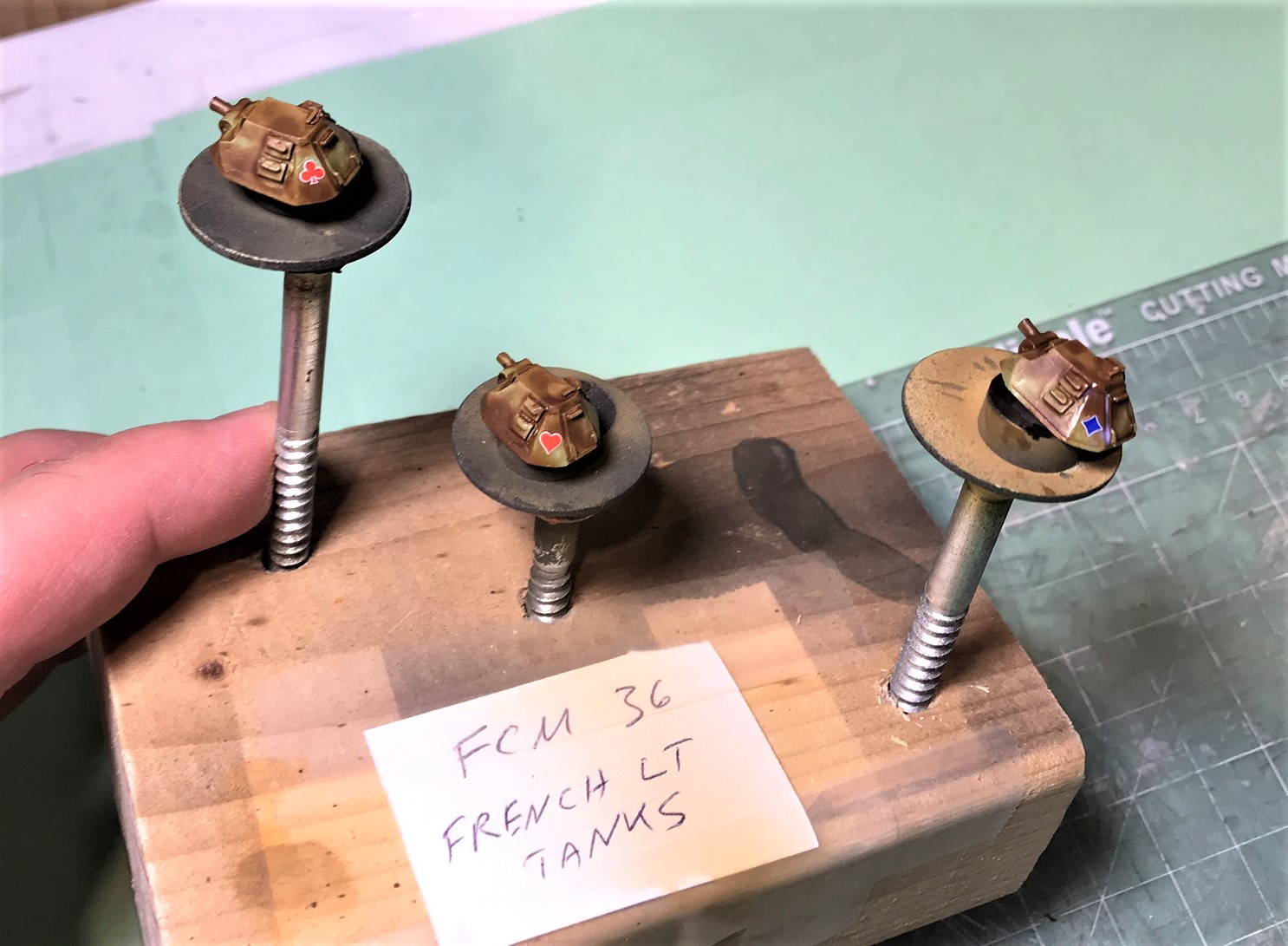
You can see here my hodge-podge mounting scheme of the FCM 36’s for painting. I used a 1/4″ square dowel and poster tack to mount the chassis for painting. I primed these, and the used a German green-brown as a base coat. This shot here is after the first camouflage color (blue green) was applied with my Iwata Micron airbrush. Also, I only put the turrets on a tank when I am painting camouflage patterns.
Next, I applied the third color (brown) to the camouflage pattern.
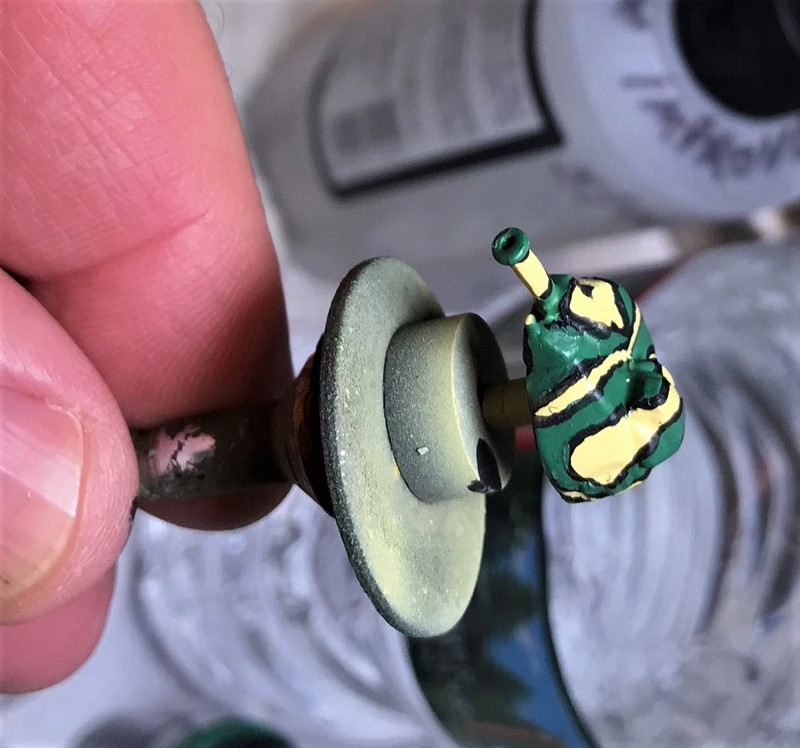
When I paint turrets, I find this helpful (as the magnets in the turrets hold the turrets to the magnets on the washers). Also, I can easily apply the decals this way, and airbrush on the final two coats of matte varnish.
Lastly, I thought I’d share some group and individual shots and a bit about their debut on the tabletop the day after they were completed.
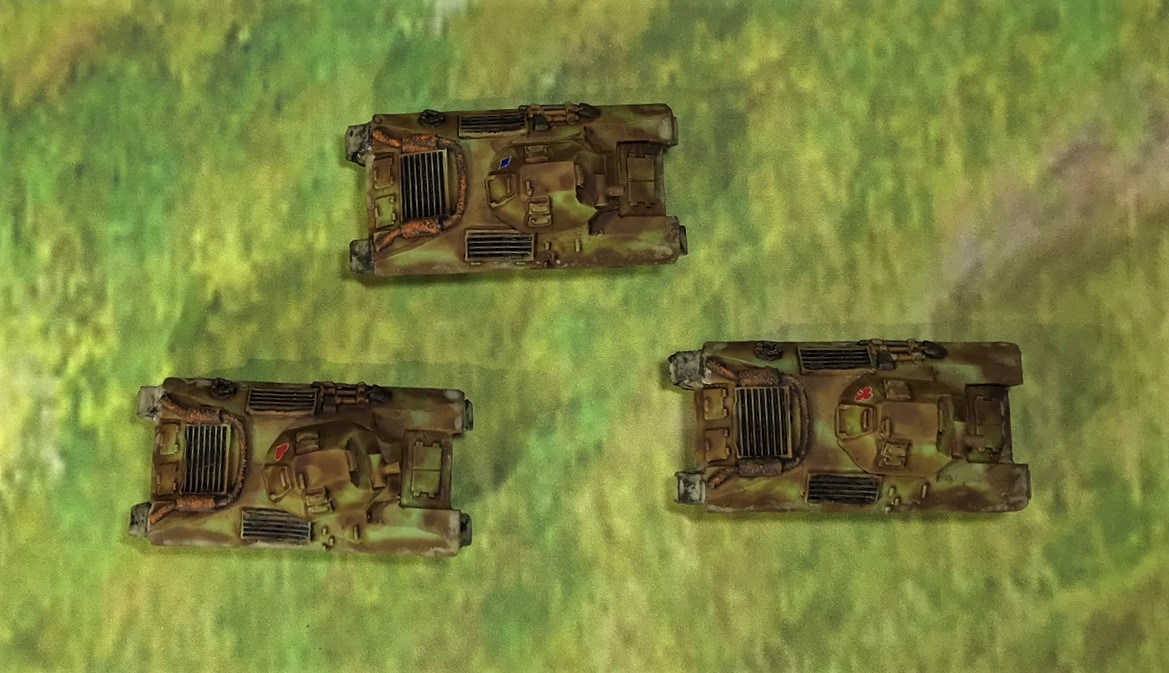
Top view showing the sloped octagonal turrets.
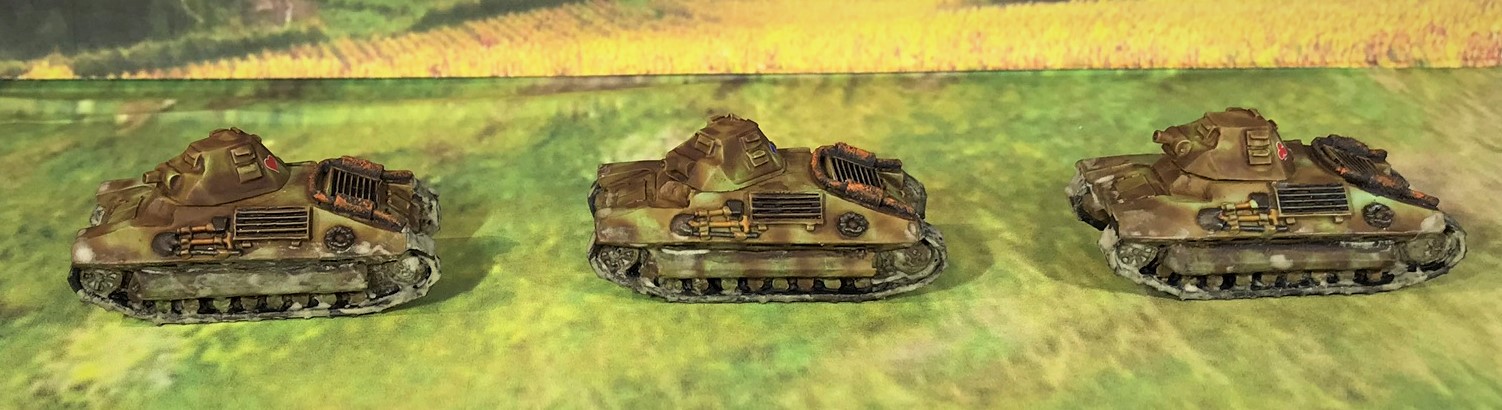
Left side of the FCM 36’s.
Frontal view.
I used a blue diamond, a red heart, and a red club as decals which would also help identify these as different individual tanks on the tabletop. From my research, FCM’s did not seem to have as many markings historically as other French tanks.
As stated above, these made their game debut this weekend at the December session of the Mass Pikemen Gaming Club.
My buddy Mike Morgan was on the French side, and chose the blue diamond FCM 36 as his tank. He then rolled a perfect roll of 6 sixes! The odds on that were 0.01286%!
Mike’s FCM 36 moves on the road.
His FCM 36 was stalked by a StuG A (player Chris), which kept missing it.
Mike successfully maneuvered his tank to the German’s side, and shot point blank. The dice deserted him as the StuG A took only minor damage.
Smelling an easy kill, the Germans (Chris’s teammate Christine) brought up a second StuG A in the hunt. It also missed the FCM 36. Note – as there were only 15 StuG A’s in the German invasion force across France, this would have been highly unlikely!
Then the Germans brought up even more to the hunt with a Panzer IIIE…
And Mike’s plucky FCM 36’s luck finally wore out with the Panzer IIIE (Christine) knocking it out.
On the other side of the table, Mike’s teammate Tom managed to kill Christine’s Panzer 38(t) with a SOMUA S-35. Mike got another FCM 36, and that was killed by Christine’s teammate Chris’s StuG A (in the shot below on the left). Mike replaced his lost tank with an R35. Tom drove his SOMUA around the building but frustratingly could not take a point-blank shot at the Panzer IIIE (as his dice roll failed him). Mike had to leave, and my wife Lynn (no gamer just watching) took over the R35. Lynn drove the tank to the side of Christine’s Panzer IIIE, and rolled three critical hits – and Christine failed to block any. This knocked out the Panzer IIIE!
Lynn’s R35 avenges the burning FCM 36 (on right) by knocking out the Panzer IIIE.
Happy wife, happy life! Tom and Lynn are all smiles here.
In a final act, Christine maneuvered her remaining StuG A for a rear shot on Tom’s SOMUA S-35. She successfully knocked out the SOMUA.
That ended the game, with the French winning a very narrow victory 32-31. If Lynn had not rolled so well in killing the Panzer IIIE, the Germans would have won. Thanks to the players for a great and fun game!
I have plans for more French and German tanks for this scenario. I hope that you enjoyed this post, and feel free to share your thoughts and feedback with me in the comments section! I have been behind on my blogging efforts and hope that I can share more with you soon! Thanks for taking a look!
On October 19th, 2019, the Fort Devens Gaming Day was held at the Fort Devens Museum. This was our monthly gaming day as an “away” game day for the Mass Pikemen Gaming Club. Our club sponsored two games as Scott Howland ran a pulp game in another room which was very well-received. I believe it was similar to this one.
This was my second time attending this small convention and my first time as a game master there. For nostalgia alone, I really looked forward to the event as I was stationed at the old Fort Devens before it was closed in the 1990’s. It has since been converted to commercial uses and some US Army Reserve functions. Running a game here was fun.
Both sides started with 150 points/chips to use during the game. The Allies started with a 40 points worth of vehicles. For the UK, they bought a Dingo scout car and a Churchill “TIM” (nicknamed for theimperfectmodeler aka TIM), along with an M5 Stuart, and an M8 Greyhound for the US. The Germans spent slightly less, choosing to buy an SdKfz 231 scout car, a StuG IIIG, and a Panzer IVH for 36 points.
The players prepare for battle among the museum exhibits.
The Germans took up very good ambush positions – especially the Panzer IVH, which was hull-down behind a stone wall. The M5 Stuart successfully reconned it, and the German fired point-blank at the light tank, missing it. The Stuart then prudently backed up behind the hedgerow. The Churchill “TIM” then moved up the road, to be also shot at, and again missed by the Panzer IVH. Amazingly, the Churchill immediately reversed the bad German die rolls, and miraculously hit and knocked out the Panzer IVH for its first kill ring of the day.
The first exchange goes badly for the Germans as the Panzer IVH missed its first two targets (the M5 Stuart and the Churchill). The retreating M5 is at top behind the hedgerow. The Churchill “TIM” drives past the knocked out (with crew surviving) Panzer IVH.
The Allies then successfully reconned nine possible German positions at 2 points apiece, adding to their score. They also successfully crossed the tabletop with an M8 Greyhound, gained the points, and respawned as another M8. The Germans spent some points and respawned the destroyed Panzer IVH crew into a Panther D which drove up next to the burning Panzer IVH. The Churchill “TIM” went Panther hunting.
Meanwhile, the Germans tried to put an end to the Allied reconnaissance successes. The StuG IIIG ambushed both the M5 and the Dingo gaining them crucial points, which they used to buy a Marder III. The Allies respawned both losses with similar models.
The Churchill “TIM” at top maneuvers to attack a Panther in the rear. In the foreground, The StuG IIIG takes out the M5…
The Allies spent some chips to respawn the Dingo as a Cromwell IV nicknamed “IRO” aka imperialrebelork. The Germans dropped some obscuring smoke in front of the Cromwell.
…and then the Dingo. The Germans dropped smoke to protect the StuG from the Cromwell IV “IRO”. The Churchill “TIM” at top hunts the Panther D.
“TIM” continued its winning ways and managed a flank shot on the Panther D. Its good dice rolling (and the German bad dice rolling) yielded a second kill ring for “TIM”.
The Churchill “TIM” takes out the Panther D.
The Germans were aghast at this expensive loss and vowed revenge. The SdKfz 231 managed to call in a rare Luftwaffe air strike on the Churchill, which destroyed “TIM” after it had been so effective.
The British mourned this loss, and respawned it as an Achilles 17-pounder nicknamed “Per”. The British also bought another Dingo and a Cromwell IV nicknamed “JNV” or justneedsvarnish. The US bought an M10 Wolverine. The Germans went for broke and bought a Jagdpanther and an SdKfz 233.
The StuG IIIG went head-to-head with the Cromwell “IRO”, and took it out. The Jagdpanther caught the Achilles “Per” in the open and made short work of it. In the meantime, the Allies successfully crossed a Dingo and an M8 Greyhound. This resulted in denying the Germans any end of game bonus points for preventing more than two Allied vehicles crossing the table.
To make matters worse for the Germans, the respawned M5 Stuart knocked out a well-hidden Marder III with some help from a supporting infantry assault (see how I use bonus attack cards here) and well-placed 37mm rounds. As the game was winding down, and it was clear the Allies had a commanding edge in the score, The Germans bought a Tiger I and converged all vehicles on the plucky M5.
The Marder III burns, and the Tiger I and SdKfz 233 hunt the M5 Stuart…
…and are joined by the Jagdpanther!
This traffic jam at game’s end yielded no damage on the M5 Stuart – the dice had completely deserted the Germans.
At games end, the final score was Allies 193, Germans 142. This game yet again delivered a different result. Player choices, and player luck all made this game fun and unique.
This is my 12th post about my development and running of this scenario and the models that went into making it. I started back in May 2019, so it’s been a lot of work, but one project that I really am proud of now.
I wanted to honor the history and the struggle of the Allies in the days after the D-Day landing 75 years ago. I will continue to run the game, and at this point I really only need to add a StuG IV to be really complete vehicle-wise (and I have one to build!). To read about previous games and related posts, see the following:
The wonderful Barrage wargaming convention was held back on September 27-28 in Havre de Grace, Maryland. It is run by the Harford Area Weekly Kriegspielers (HAWKS), and I have attended the last few years and run a few games there as well as a GM. This year marked the 25th Anniversary of the convention.
The trip was enjoyable – and even though it’s been over a month since the event – I wanted to share some of the pics and details of the event from my perspective. It’s not an all-encompassing review – but hopefully it will give you a flavor of the event and some nice views of some worthwhile and visually interesting tabletop games.
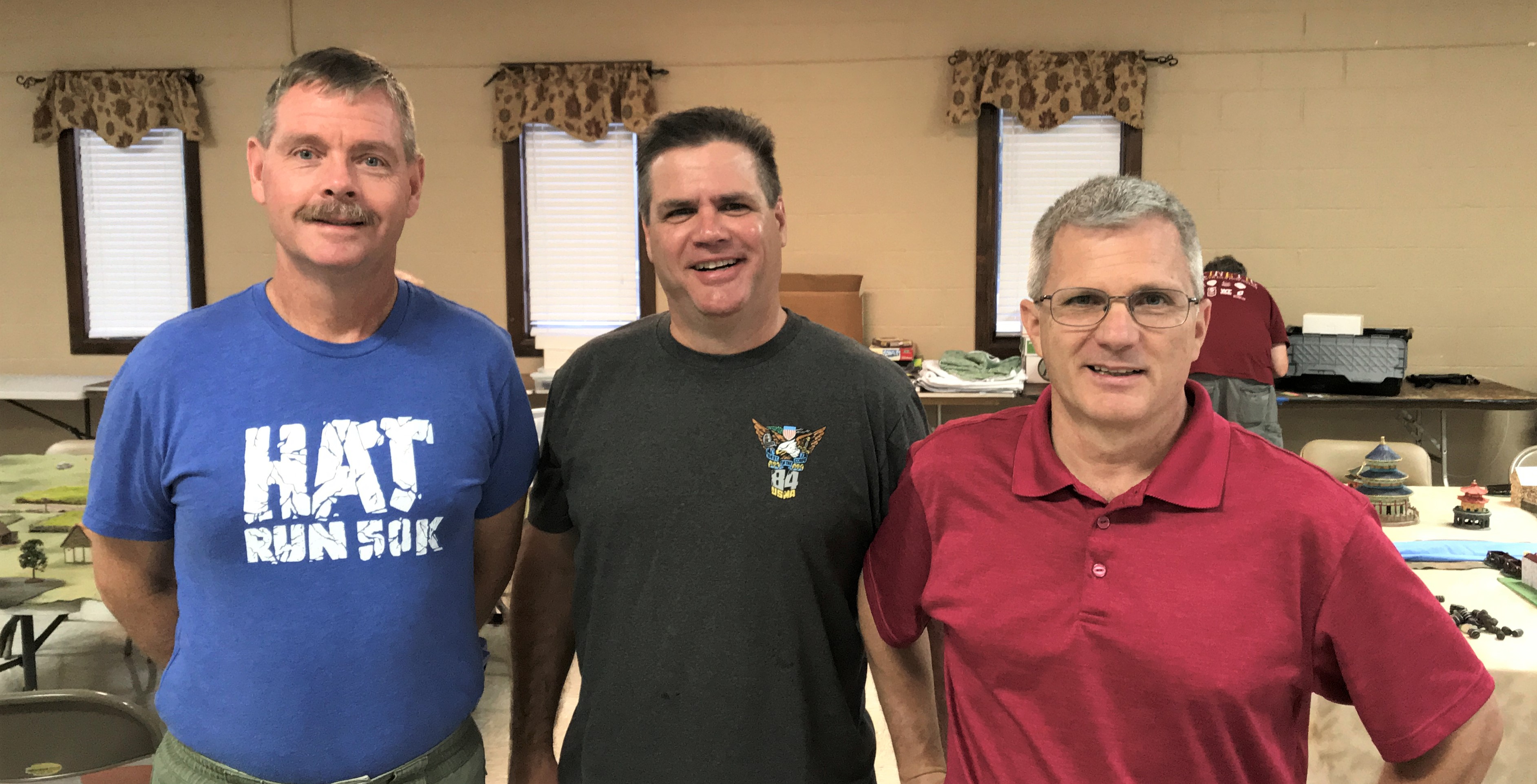
Three only slightly aging West Pointers – Dave Wood (’84), me (’84), and Buck Surdu (’85). Dave and Buck are in the HAWKS and going to the convention doubles as a mini-reunion for us. Plus I get to see how much better in shape they are than I am.
I drove down from Massachusetts and arrived Thursday night (the night before the convention) to help the HAWKS set up. As a bonus, we got to play a few turns of Eric Schlegel’s Antietam: The Cornfield game using the A Union So Tested rules set. It was a fun start.
Eric Schlegel’s ACW game
The Schlegel brothers look at the cornfield.
The convention started in earnest on Friday – and I got a chance to check out some amazing tabletops. Bill Molyneaux had a brilliant Boxer Rebellion game that had incredible terrain. I did not get to play this game, but would have loved to try it.
I walked around Friday’s game and took some pics of a few games I loved seeing (but did not get to play) before I got into playing a Feudal Patrol™ game. Here you can see a Napoleonic game (run by Dave Wood), a Gundam game, and a really neat G.A.S.L.I.G.H.T. Sherlock Holmes themed game (run by Sam Fuson). There was a Flames of War Tournament. I have not played that game despite having (as regular readers know) a TON of FoW models. The games looked a bit crowded figure-wise – and maybe that’s normal for that game. Note the US TIE fighter (the gamer said he did not have a proper US plane so he painted this model)…not sure about that particular add personally.
I really wanted to try another game of Feudal Patrol™. I had played one at HUZZAH! run by Duncan Adams earlier this year. Feudal Patrol™ is a novel skirmish game (yet unpublished) and is similar to Combat Patrol™ – except it is for pike and shot periods and earlier. I am hoping to write an Aztec supplement for it for Buck.
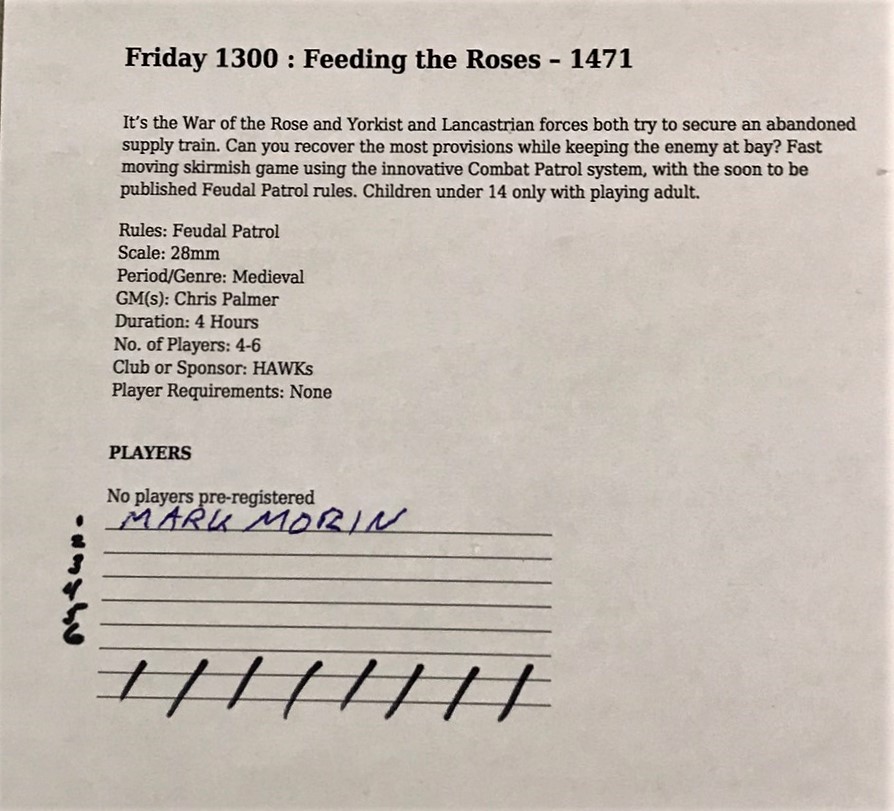
Chris Palmer ran a War of the Roses scenario involving securing an abandoned supply train of three wagons. It was just the two of us, but as Buck came available, he joined in on Chris’ side. I started off well, but in due course I got my ass handed to me by Buck and Chris! Still, I was glad to try it and I feel confident that this will be another great system by Buck.
Not the greatest sign up! Too bad as it was fun.
My forces, with the enemy Yorkists across the table. The abandoned wagon train (the objective) is in the center.
The Lancastrians.
Wagon train objective.
Buck confers with Chris (off-camera) as the two forces cavalry converge.
Chris moves his Yorkists up and takes two wagons.
I moved a leader on top of the remaining wagon to seize it. Unfortunately, the Yorkist crossbowmen ended that effort by turning him into a pin cushion, and pinning his subordinates in the process.
After this game, I walked around and took some more shots of some cool tables. There was a 54mm scale ACW game, and a 54mm medieval mayhem game. Greg Priebe had a Poland 1940 Combat Patrol™ game for replete with an armored train. Lastly, there was an Aliens-inspired scratch built table that was impressive. These shots are below.
Another ACW game, in larger scale.
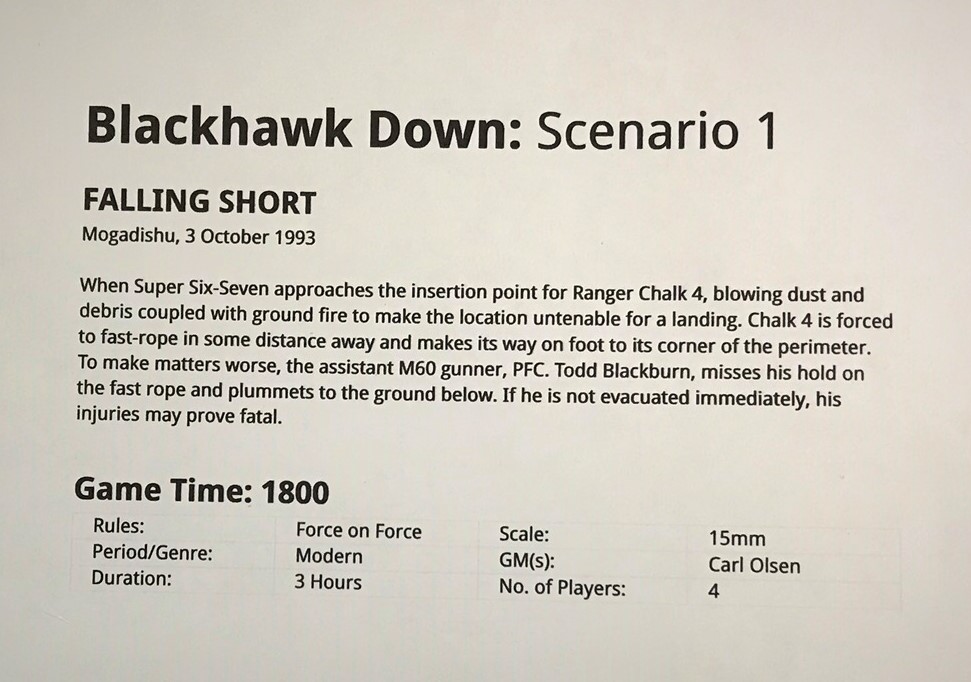
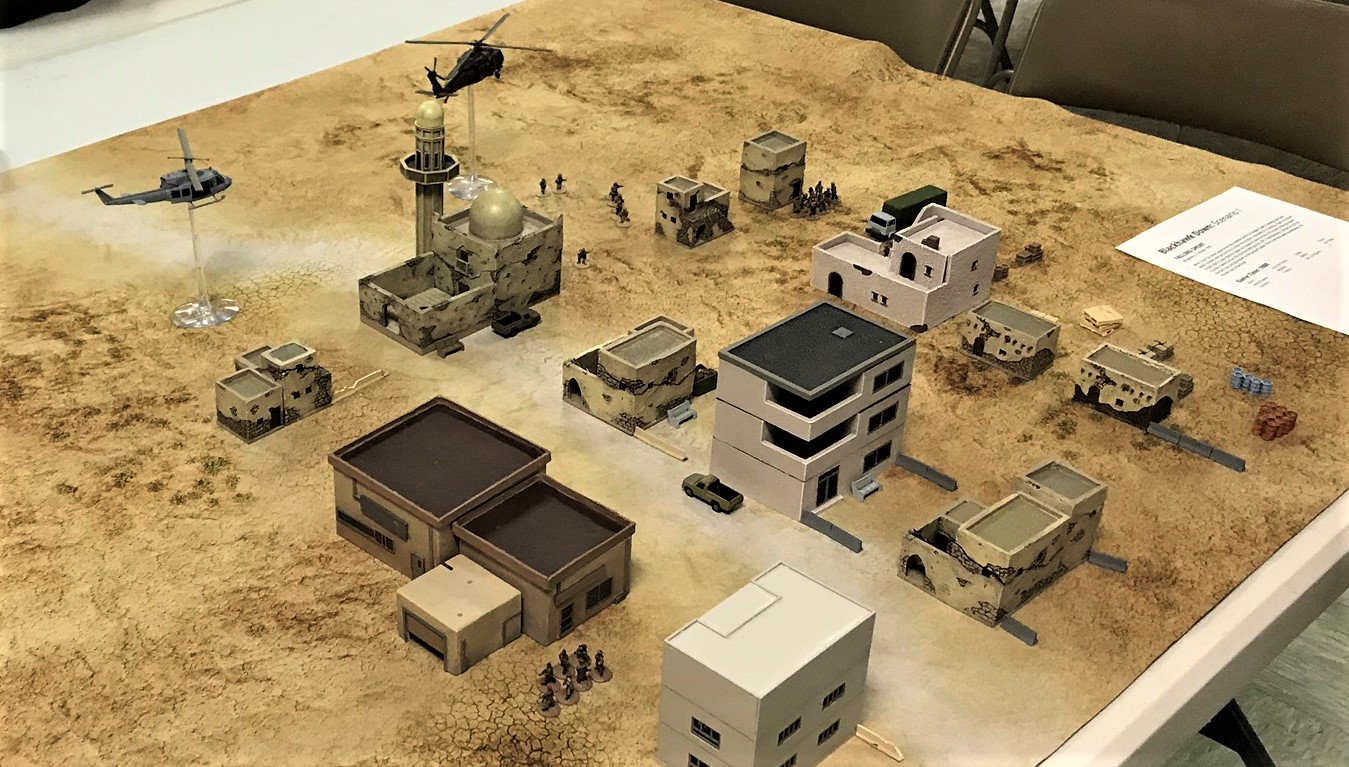
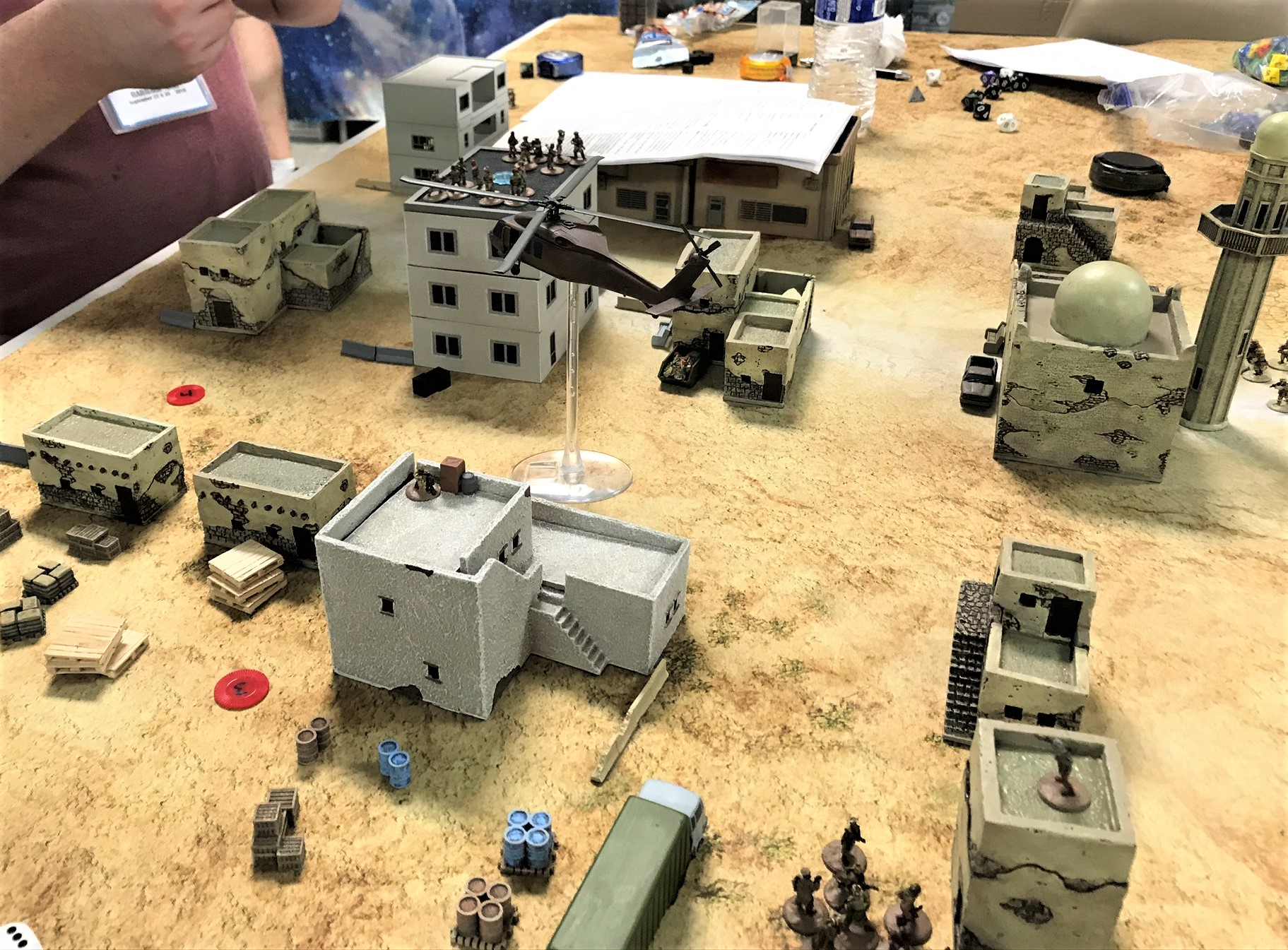
The last game that I played on Friday was with Dave Wood and another player. It recreated the scenario made famous by the events portrayed in the movie Black Hawk Down. The rules were Force on Force, which had an interesting set of mechanics, but very complicated for a short game. We actually ran the game twice, with Dave and I as the Americans. All agreed that the scenario was impossible to win for the US. Still, the GM Carl Olsen made the experience enjoyable.
The tabletop for the scenario.
Even with air support, the mission was too difficult for the US.
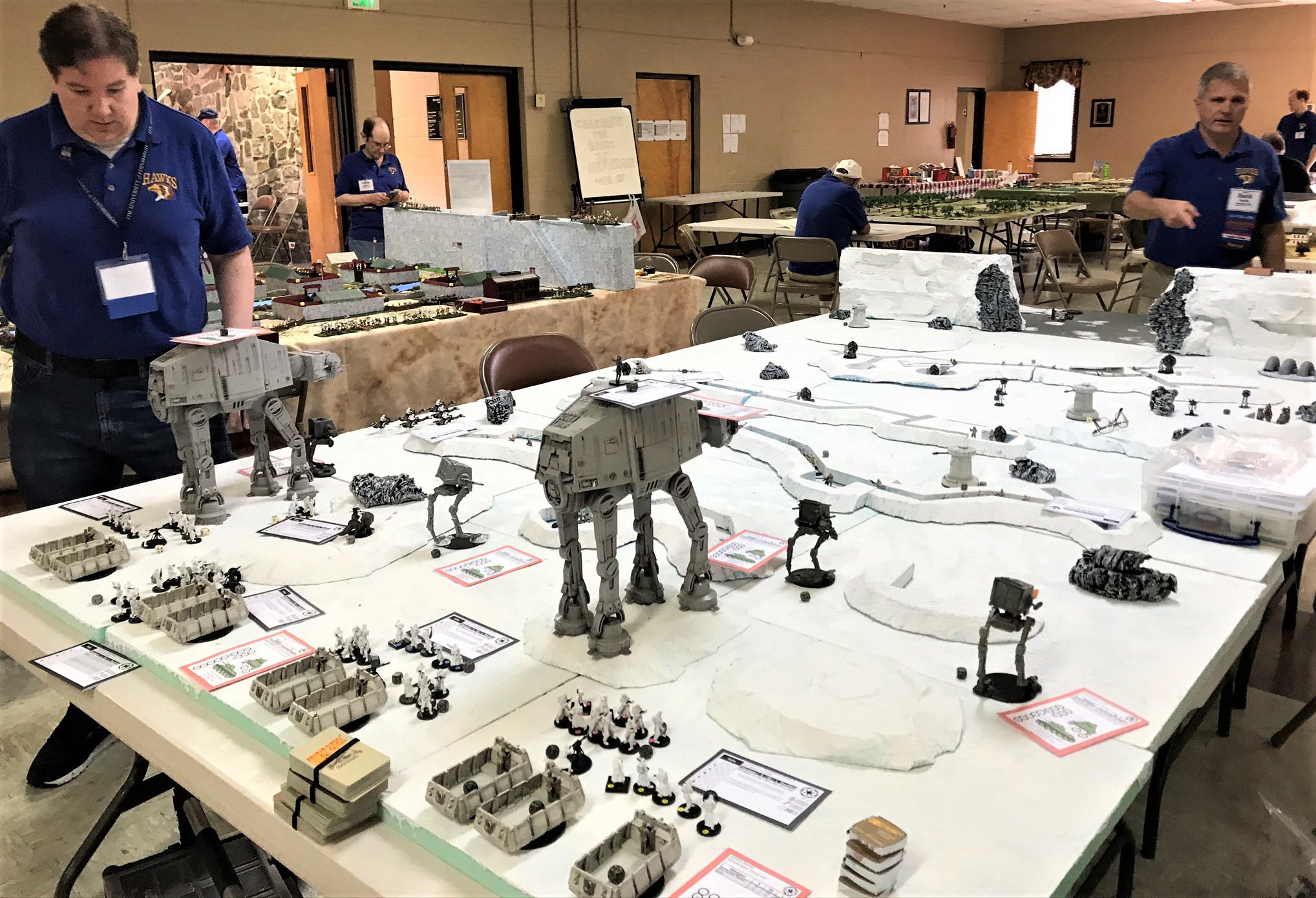
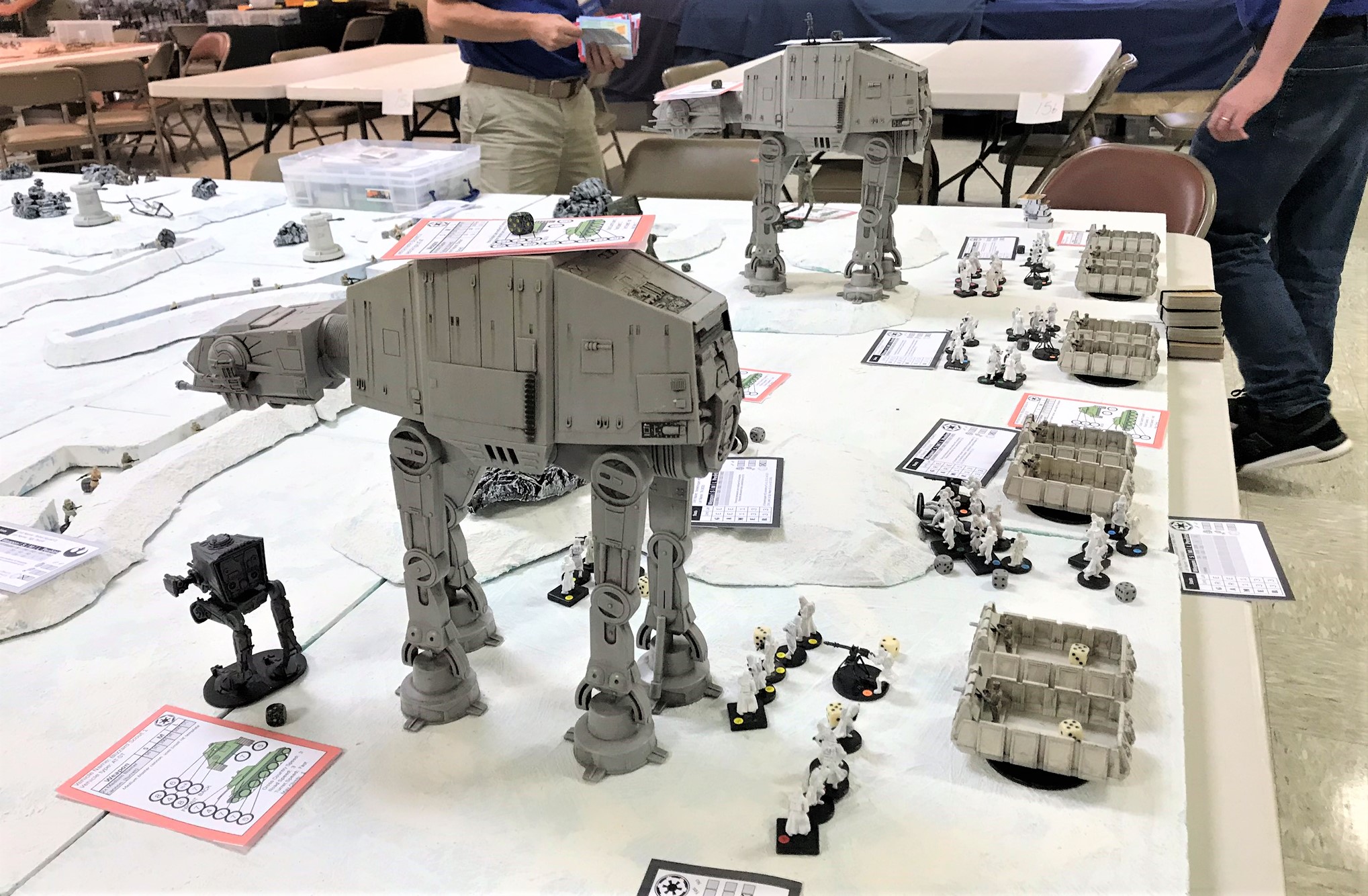
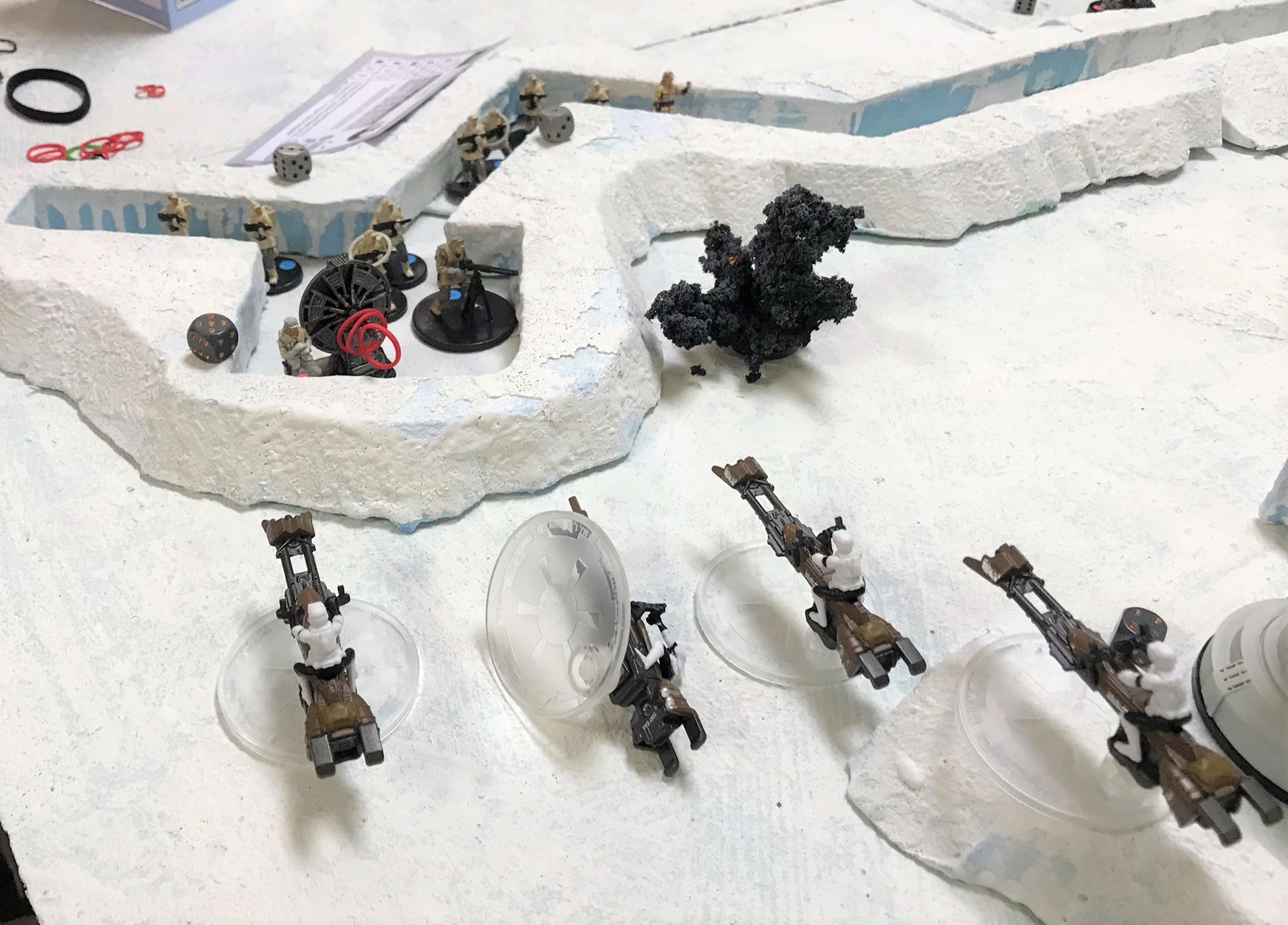
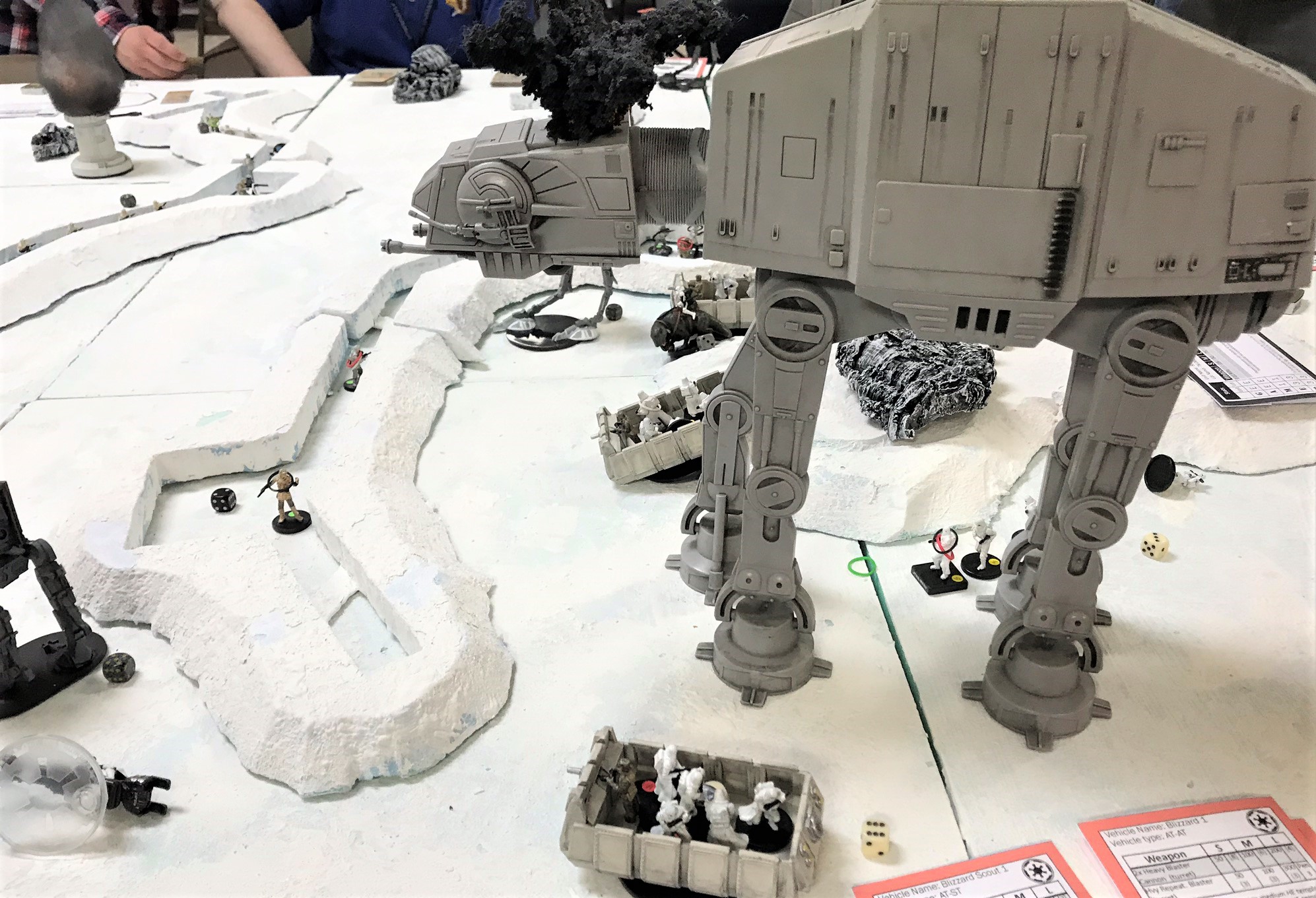
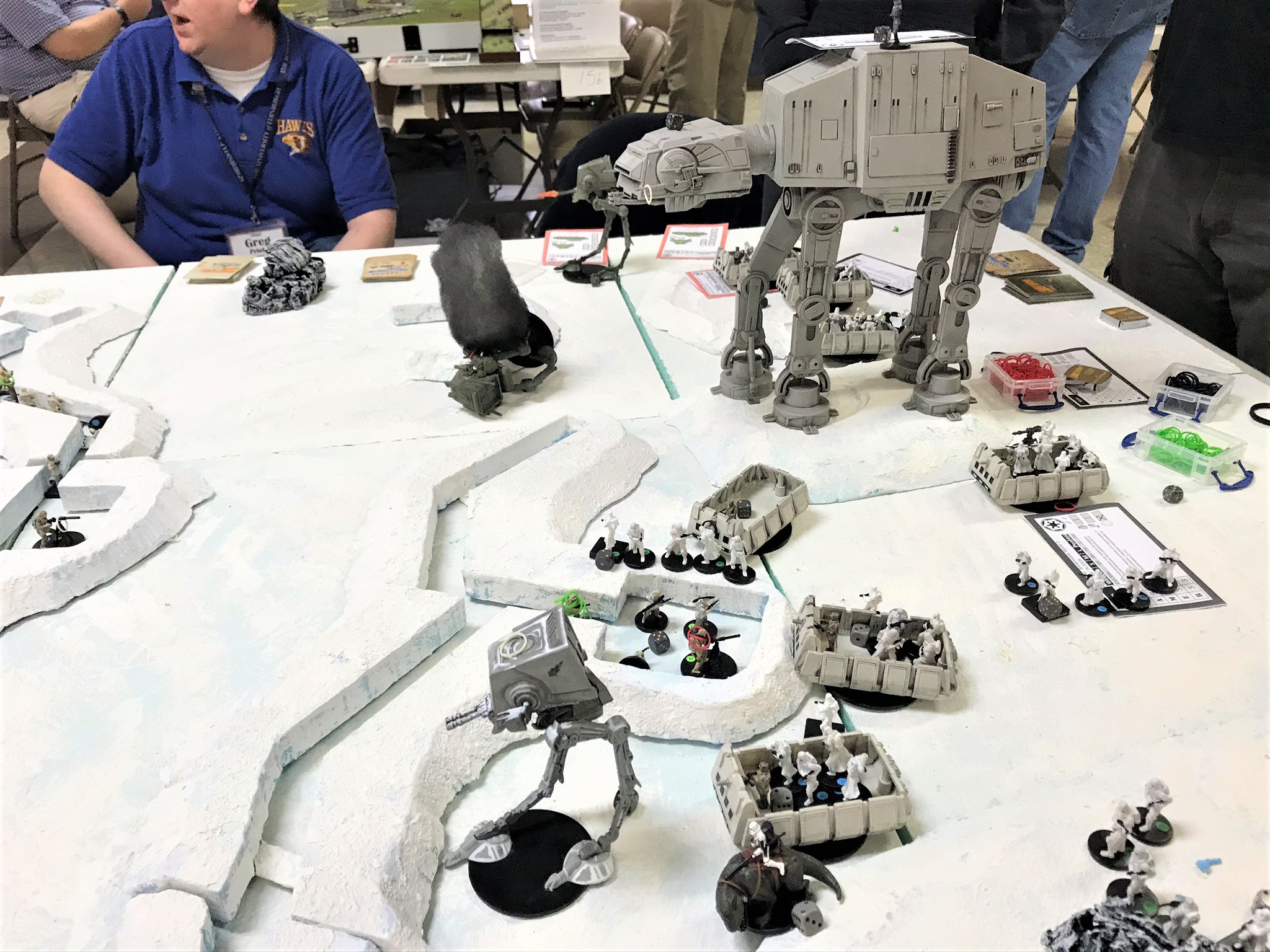
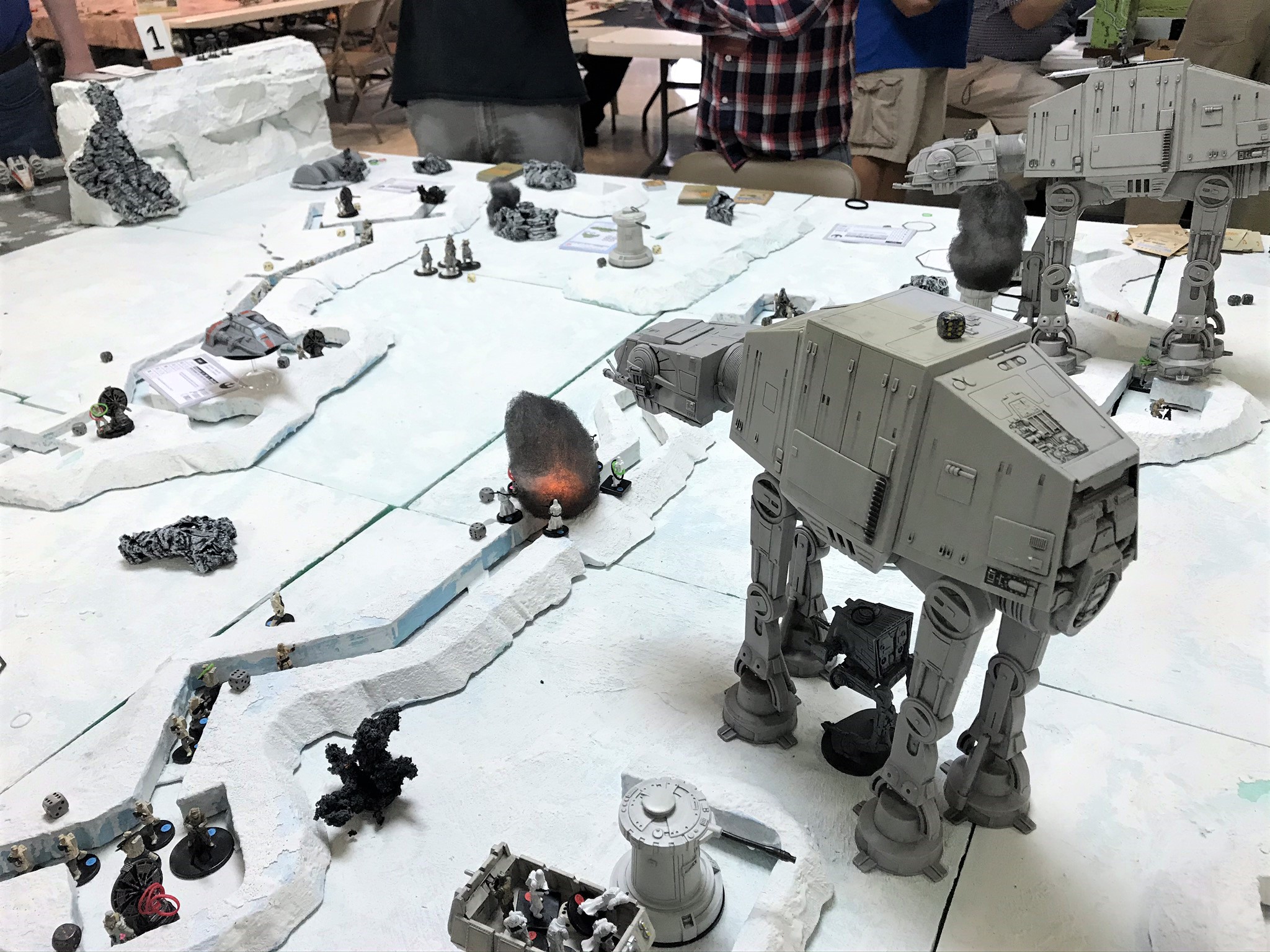
That finished off Friday. Saturday presented an opportunity to play the massive Combat Patrol™Star Wars Battle of Hoth scenario (from The Empire Strikes Back) of the Battle of Hoth that Buck and Greg Priebe ran at Historicon. It was pure eye-candy (as you’ll see below), and a blast to play. We had a full table of 10-12 players. The Combat Patrol™Star Wars supplement was used – and was easily picked up by the players who were new. Buck and Greg did an outstanding job of running this massive game.
I played with several other players on the Imperial side with the goal of destroying the Millennium Falcon before it could fly out of the cave it was hiding in with the other rebel ships. We succeeded in eventually knocking out the shield generator with an AT-AT. Subsequently the Millennium Falcon was destroyed when our forces could get a clear shot. A strategic victory was had for the Empire!
Scenario designers and GM’s Buck Surdu and Greg Priebe
A view from the attacking Imperial forces side – the rebels and their spacecraft were in the cave on the far side. The shield generator is on the far right. The rebel trenches and positions were beautiful. All the models were so fun.
Imperial set up before the game.
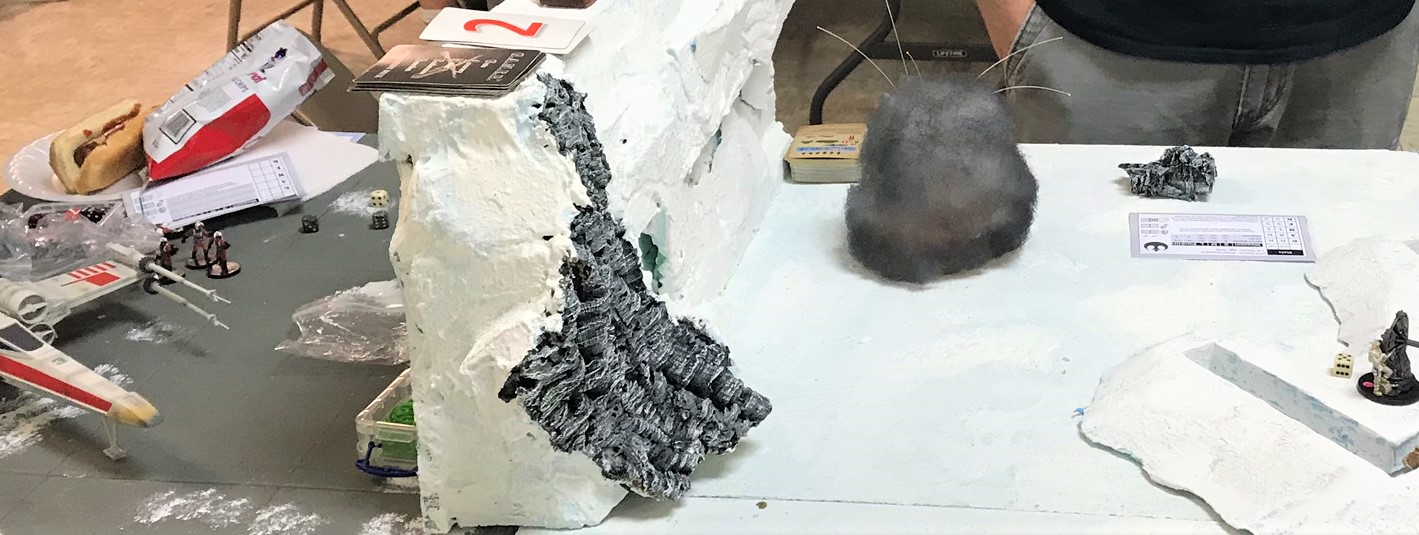
Rebel spaceships getting positioned in cave. The Millennium Falcon was not yet set up on the top corner.
After this, it was on to setting up and running my Normandy Breakout game. I have really gotten this game to be a great gaming experience – based on both my opinion and consistent feedback from the players. This time, I had between 9 and 11 different players as some came and went.
The Germans made some very good decisions on terrain use and vehicle selection. The Allies did not choose enough reconnaissance vehicles, and were less effective using terrain as a whole. The Allies did not do a good job at crossing the table – with only a M10 Wolverine (by Dave Wood) and an M5 Stuart (by Buck Surdu) crossing the board. To be fair, the dice abandoned the Allies at a few critical junctures.
The Germans chose expensive vehicles, such as the Panther D (Greg Priebe), Jadgpanther (Andrew) and Tiger II (run by a woman known as April or “Queen Tiger” in the game), but used them effectively to stop the Allies. This put them in a points disadvantage, that they made up with their kills. Don Hogge’s used his SdKfz 233 very well to delay and harass the Allies. The Germans lost no vehicles, and the Allies lost a total of 5: a Dingo scout car, an M3A1 Stuart, an M10 Wolverine, and two 17-pounder Achilles. The Allies vehicle choices hurt them (not enough tanks and reconnaissance versus tank destroyers). This had not happened in previous runs, and is a testament to the German players having a good plan. The final score was 160-123 in favor of the Germans. I will continue to run this game – it has never been the same twice.
I GM the mid game action (photo by Chris Palmer)
Players on the Allied side get ready to play.
Here the Americans smashed an M3A1 Stuart through a hedgerow – where it discovered a Panther D. It took the flank shot and managed to do some temporary and permanent damage.
The Panther then turned and knocked the Stuart out – the black smoke indicates that the crew lived and bailed out, but the tank was destroyed.
With a burning Dingo behind him, a Jagdpanther confronts the Achilles “Tabitha” (named after my granddaughter). German artillery-delivered smoke dissipates in the top of this photo.
The poor Achilles “Tabitha” is no match for the Jagdpanther, and is brewed up on the next activation.
An American M10 Wolverine gets a rear shot on the Greg Priebe’s damaged Panther, but not enough damage is inflicted…
…and on the next activation, the Panther turned and knocked out the Wolverine.
After picking up, the last game I played in was a Roman Circus Chariot game with rules by DeWitt. My chariot flipped and I lost – but it was fun!
And the flea market was outstanding!
Thanks to the HAWKS for a great weekend!
And thanks to you, dear reader, for looking – feel free to share your thoughts in the comments section!
For this post, I will show some of the photos that tell the story – though simultaneously being a photographer and a GM are not always easy. I appreciate the generosity of both Chris Rett and Ted Salonich helping with some photos – as well as playing of course!
The game scenario is:
After a successful D-Day landing and consolidation, the tanks of the Americans and the British are stymied in the hedgerows of Normandy. German armor has set up effective defensive positions in favorable terrain. However, the Allies do not know the exact locations of the German tanks, and the Germans have limited knowledge of where the Allied armor will be coming from and the direction to which they will try to break out. New rules that allow reconnaissance and the effects of other combat forces will challenge both sides in this action-packed game.
The Germans are in secret positions (basically ambush positions) that they choose in advance of the Allies arrival – which is also secret in terms of the exact vehicles that the Allies choose. Both sides get to secretly select their vehicles (with some restrictions), and poker chips are used for the scoring. The Germans here did stop the Allies from breaking out – though the Allies were able to gain more points by both effectively recon of enough blind positions and knocking out enough valuable German vehicles. The final score was 117-109 in favor of the Allies – with the game score turning on the Allies knocking out a Jagdpanther on the last turn. The casualties were:
Allies – 5 vehicles:
UK – 3 vehicles:
2 Daimler Dingoes
1 Firefly
1 M10 Achilles
US – 2 vehicles:
1 M3A1 Stuart
1 M10 Wolverine
Germany – 3 vehicles:
1 Sdkfz 233
1 Panther D
1 Jagdpanther
Let’s see what the day looked like!
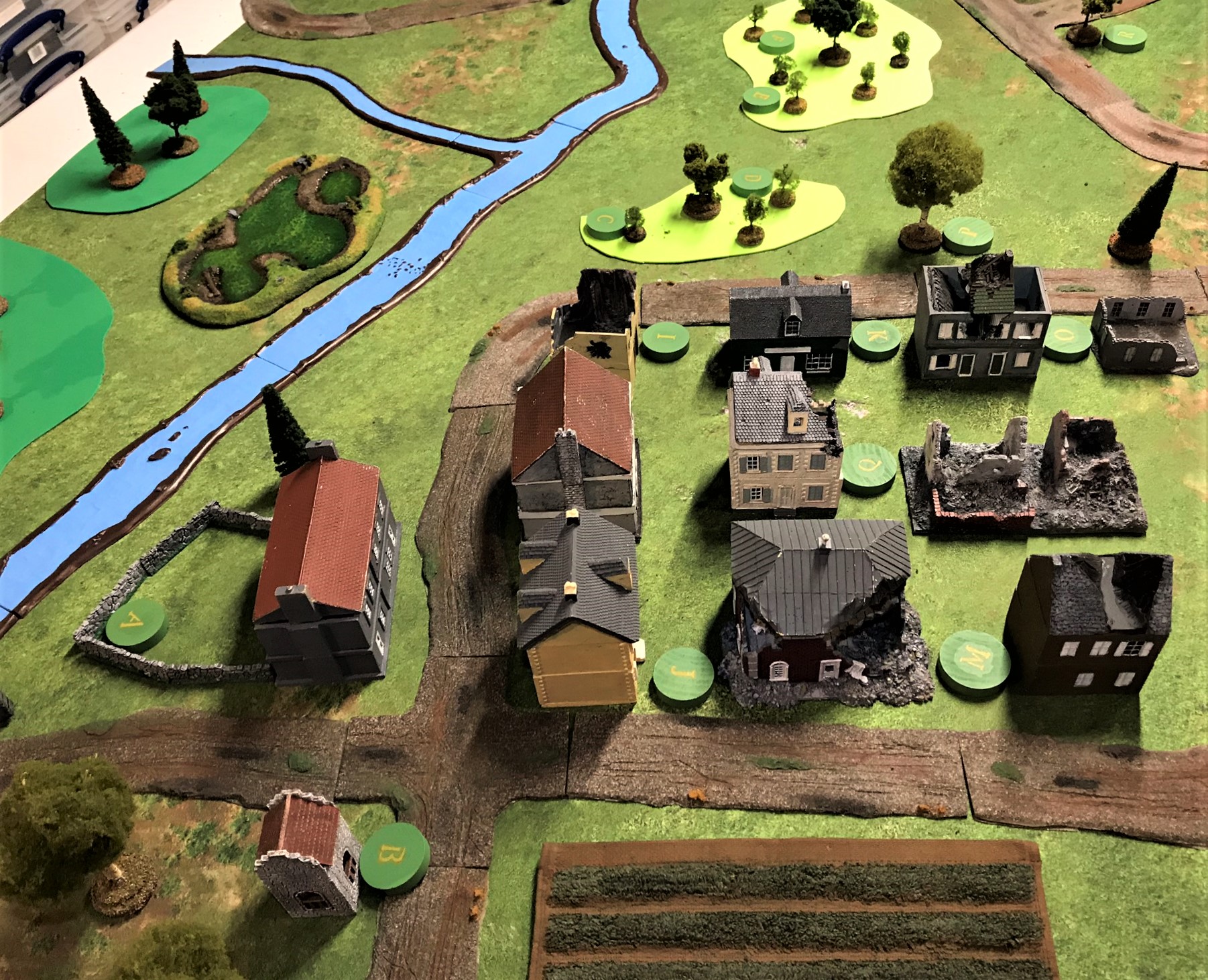
The Allies moved on from here. The British had the far left road, and the Americans had the far right road. The middle road could be used by both Allies. The wooden discs are possible German positions to be reconned.
A side view of the tabletop that better shows some of the (blind) possible German positions.
The view from the German side of the board that the Allies needed to cross.
Your properly attired GM. (Photo by Chris Rett)
The Germans effectively used a Bonus Attack card to draw first blood – calling in a rare Luftwaffe attack on a Daimler Dingo.
The Daimler Dingo hit by the Luftwaffe – my new blast/knocked out tank markers looked pretty amazing (and I am biased of course).
A Jagdpanther prepares to engage an M3A1 Stuart from an excellent ambush position. The Stuart decided to run around the corner and recon the disc on the left…(Photo by Chris Rett)
… and the Stuart “successfully” reconned the position – it went around the bocage to find the Elefant in the room. (Photo by Ted Salonich)
The Stuart fired its 37mm at the frontal armor of the Elefant. No effect. The Elefant returned fire, and blew away the Stuart.
A Panther D and a StuG G combine forces to knock out a Firefly near the burning Dingo.
An M10 Achilles fires at and knocks the Panther D into a ruined building, damaging it. It gets a second shot, and rolls well enough to torch the Panther.
The Americans move up an M18 Hellcat to help the Brits – it ended up moving behind the Jagdpanther and was able to destroy it.
The gamers ponder their moves.
The Allies called in a lot of artillery-delivered smoke to protect their vehicles. It was effective.
Here comes the Tiger! Note the StuG G that ambushed the M10 Wolverine. The crew of the M10 survived – as denoted by the black smoke versus the fiery smoke. Also shows the Allied smoke screen in front of the Jagdpanther.
As the German vehicles are worth, in general, much more points, the loss of their expensive vehicles made a big difference. Both sides played well, but I have to say the Germans were not very lucky with their dice at times.
I will be tweaking the game scenario in a couple of ways:
Adding stopping bonuses for the Germans:
A 20-point bonus for the Germans if no Allied vehicles are able to breakout across the tabletop.
A 10-point bonus for the Germans if only one Allied vehicle is able to breakout across the tabletop. If 2 or more cross, no German bonus.
Award the Germans 2 points for each unreconned point. This will incentivize recon, but force the Allies to choose what is most important. (The Allies already get 2 points for each reconned point.)
Allow a “banked 6” to be used for either an advantage on the next activation (per the rules) or as an automatic “6” on the next activation roll (determined by the player on the turn he banks it). Thanks Ted Salonich!
Thanks again to the all of the players. And for those who follow this blog who wondered if their named vehicle got fried, only one Cromwell (“IRO”) deployed and did not get into action. However, the M10 Achilles “Per” (named for Per from Roll a One) did get knocked out by one of the StuG G’s. Sorry my Swedish friend!
Hope that you enjoyed this – and I will be running this game on Saturday at BARRAGE in Maryland (September 28th) and at the Fort Devens Game Day on October 19th. I may also run it at other upcoming gaming cons if possible. Thanks for looking!
I also wanted to have a better looking tabletop where the tank wrecks are more visible and frankly more realistic smoke-wise. My older smoke markers are good for artillery-delivered smoke screens, but as you see below, I needed an improvement.
My tea light blast markers look great here…
…but are way too big here – especially on even smaller vehicles. Additionally, they do not stay easily on the vehicles due to their size.
I set out to create a new set of markers that would look better, stay on the vehicles, and differentiate between brewed up and just knocked out tanks. As I use neodymium magnets in most of my tanks’ turrets and they are all similarly oriented in polarity, it was easy to devise a marker using a ceramic magnet as a base. The magnets I used were small enough and heavy enough to stay on the tanks – even those without magnetic properties. I used ½” ceramic magnets, #10-24 steel machine screw nuts, and more used ¼” (approximately) steel ball bearings from Jeff Smith’s broken fairway mower to build the core of the marker. Making sure that the polarity was correct (markers that would be pushed off the vehicles would serve little purpose!), I used Gorilla Glue to fuse the magnet to the nut, and the nut to the bearing. Then, I mounted the cores on screws and primed them. I planned for 20 to be black and grey smoke for disabled tanks, and for 20 to be full-on flames.
After the primer had dried, I painted the flaming cores red, orange, and yellow with cheap craft paints to simulate a ball of fire. Lastly, I applied gloss varnish to the cores to give more reflection. The smoke ones just got painted black. If interested, you can see a list of the materials I used at the end of this post.
The ball bearings, nuts, and ceramic magnets I used.
The core.
The flaming cores mounted here after red paint was applied. Later coats would be yellow and orange to simulate a fireball.
For surface smoke, I went with pillow batting cut off in thin strips of 1-1½”. As each core needed 4-6 strips, I cut nearly 240 strips. I hot glued the strips in a flower pattern on the cores.
“Limited only by your imagination” indeed!
Batting strips cut before hot gluing to the cores.
Here are the cores after hot gluing the batting.
Now, I used a different product to connect the batting in a smoky shape. As I have built tanks, I have used decals. The best way to revitalize decals is to coat them with Microscale’s Liquid Decal Film. However, using this product on the decals as they are on your tanks themselves can ruin the underlying paint (unless used over varnish). But, this stuff makes a solid protective and nicely tacky coat – as I learned making placards for my Attack of the Warbots game. I applied the Liquid Decal Film to the strips, forming the small smoke shapes around the cores. I let these set up and dry. The stuff worked well, and I got the effect I wanted where you can see the cores on the flaming ones.
After the Liquid Decal film formed the smoky shapes.
Close up of the core after the smoky shape was formed.
When I paint fire, I like to go from bottom to top with yellow, orange and red. Here, I decided to use glazes and inks for these colors with my Iwata Micron airbrush at 28 psi. This allowed me to really blend the colors – which were Citadel “Lamenters Yellow” (a glaze), P3 “Blazing Ink”, and P3 “Red Ink”. I then used two Vallejo Game Air paints – “Black” and “Wolf Grey” – to create a smoky effect. I also used these latter two on the smoky black/grey cores.
A view of the flaming markers and 3/4 of the smoky ones as they dried.
The new markers with one of the older (previously made) larger ones in back that I will only use as smoke now.
These fit nice and snug on 4 Aleene’s tacky sheets in a 4-liter Really Useful Box.
For comparison, these three Shermans have (l-r) a new smoky marker, a flaming marker, and the old large blast marker. What you cannot see is how well the magnetic ones stay on the vehicles – and these are plastic. The neodymium turret-mounted magnets and ceramic magnets attract well and effectively, which the larger one does not.
The M10 (Battlefront) on the left has a turret magnet, while the Old Glory type on the right is lead/tin. The weight of the magnet keeps the marker on the Old Glory M10 very effectively.
Even on smaller vehicles, these work well. Here an M3A1 Stuart, an M8 Greyhound, and an M24 Chaffee are all well-marked. The M8 has no magnetic turret, yet this works well here as well.
Some vehicles have no turrets like these plastic StuG G’s – but the markers work great on the deck or the top. The plastic Panzer IV H magnetic turret holds the smoke marker well.
Last but not least, a Tiger II is brewing up.
I also participate in my Australian blogging buddy Azazel’s mothly painting challenges. This month is “Awesome August” – and submissions were to be HUGE…or… as he wrote:
“If you really prefer to skip the biggies – that normal sized model that you’ve (ideally) done a job that you’re proud of converting or kitbashing, painted to the best of your ability. Remember, it’s not a competition – it’s a showcase – so your only competitor is yourself. So, the TL:DR is that August’s challenge is to complete something big. Ideally, really big. Or something small that’s ideally converted – and painted really well by your own standards.”
I think that converting ceramic magnets, nuts, used ball bearings, and pillow batting counts as a conversion! And not for nothing, I really like the paint jobs on these markers. So, this is my entry for Azazel’s Awesome August ’19 Community Painting Challenge .
I hope that you enjoyed this and maybe got some ideas – please share your thoughts in the comments section, and look you can forward to seeing these used in my after-action battle reports!
PAINTS, INKS, GLAZES, SHADES, WASHES, PIGMENTS, FLOCKING, GLUES AND MORE USED ON THESE MARKERS:
Magnet Source ½” “Ceramic Disc Magnets”
Everbilt #10-24 Steel nuts
Used ~¼” steel ball bearings from Jeff Smith’s fairway mower
Gorilla Glue
Testors “Universal Acrylic Thinner”
Reaper MSP “Black Primer”
Americana “Primary Red”
Craftsmart “Orange” (satin)
Martha Stewart Crafts “Duckling Pearl”
Vallejo “Gloss Varnish”
Vallejo Mecha Varnish “Matt Varnish
Loops & Threads “Classic Loft Batting”
Microscale Liquid Decal Film
Citadel “Lamenters Yellow” (glaze)
P3 “Blazing Ink”
P3 “Red Ink”
Vallejo “Airbrush Thinner”
Vallejo Game Air “Black”
Vallejo Game Air “Wolf Grey”
Always love to get your feedback and read your thoughts? See you next time!