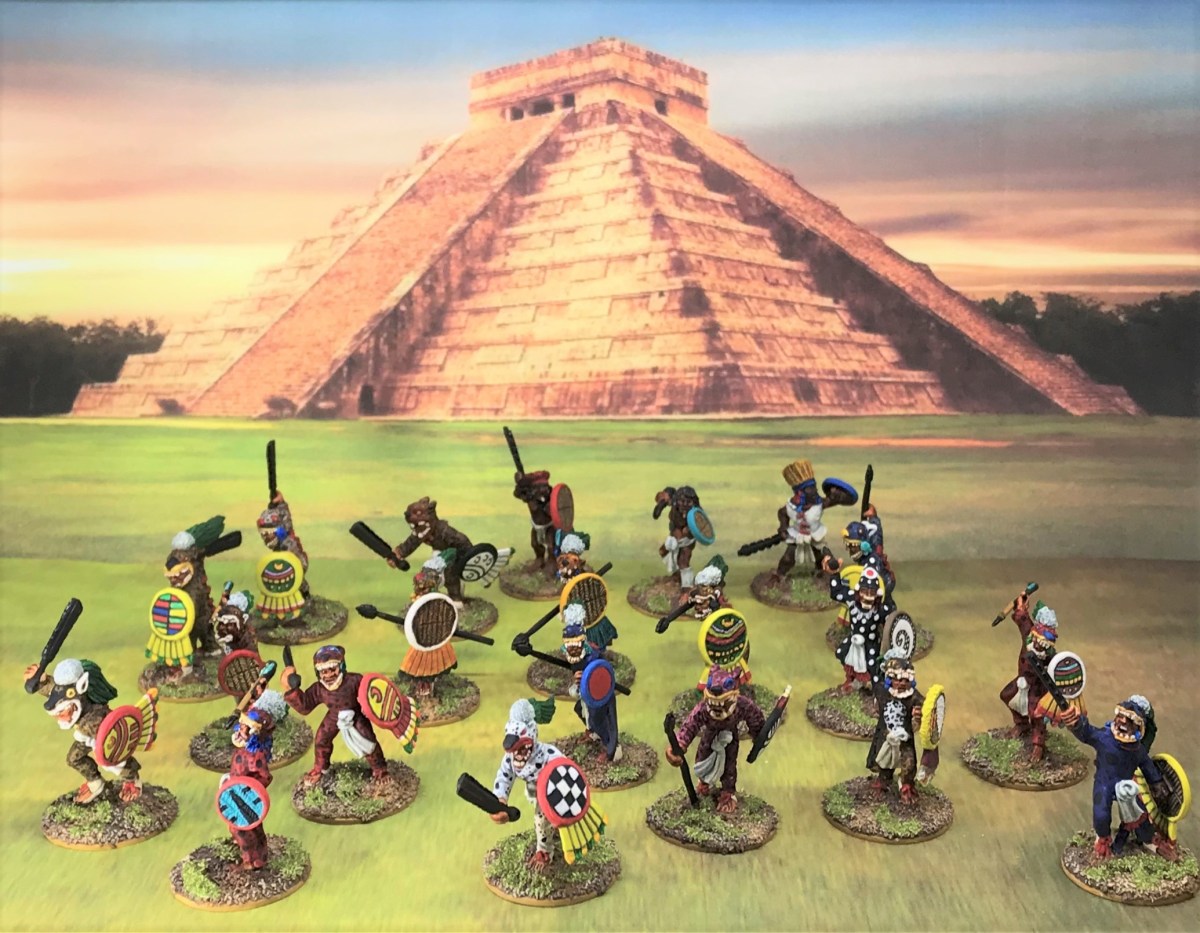
Doubling Down – Aztec Veteran Warriors from Wargames Foundry

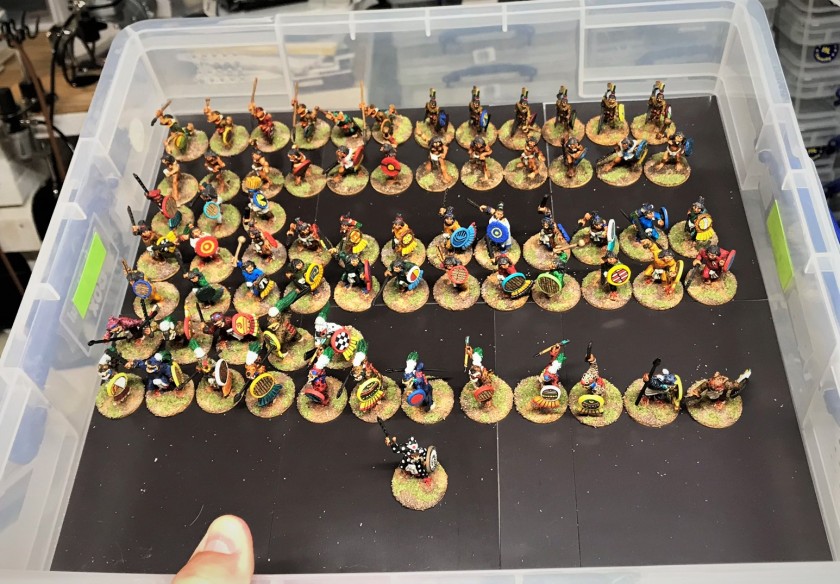
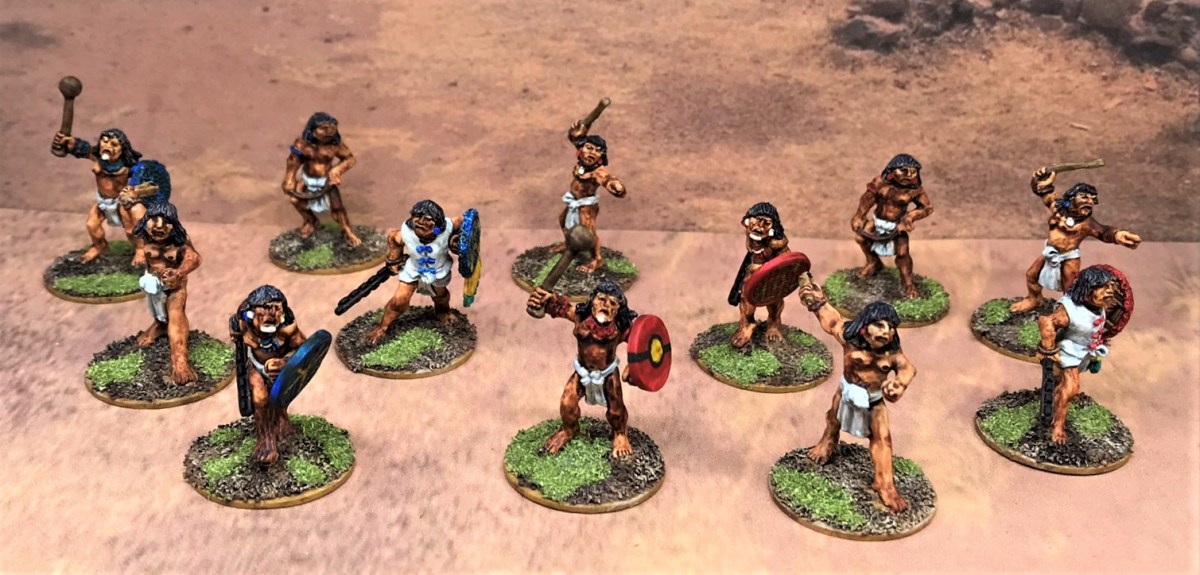
Readers of this blog have seen that I have been building a large force (Aztecs, Conquistadores, and others) for the 16th Century Spanish Conquest of Mesoamerica for the upcoming game of Buck Surdu’s Feudal Patrol™.  This game is exciting for me as I got to write the supplement for this period (“Civilizations Collide”).  I invested in a number of figures, and I have a need to push myself production-wise, without sacrificing quality.  I had two blisters each (AZ017 “Ixtlilxochitl’s Veteran Warriors” and AZ023 “Cuauhtli’s Veteran Warriors”) from Wargames Foundry.

Those Aztec names just roll off of your tongue so easily don’t they!  There were two Ixtlilxochitl’s – Ixtlilxochitl I was a Chichimec leader who fought against the Aztecs of the Triple Alliance, and Ixtlilxochitl II was his grandson who fought against Montezuma II.  So they were Aztecs – just not the ones that fought Cortes and the Conquistadores.  Cuauhtli means “Eagle”, but these so designated are not Eagle Warriors.  So, the names chosen by Wargames Foundry for the blisters sound Aztec, but are a bit off historically.  Still, the sculpts are great.

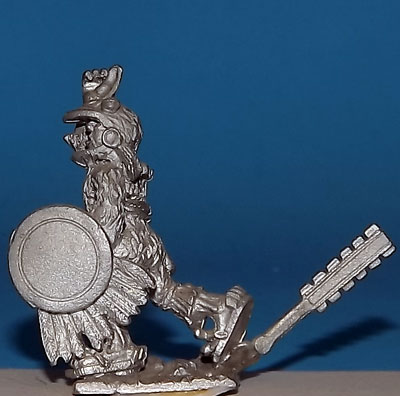
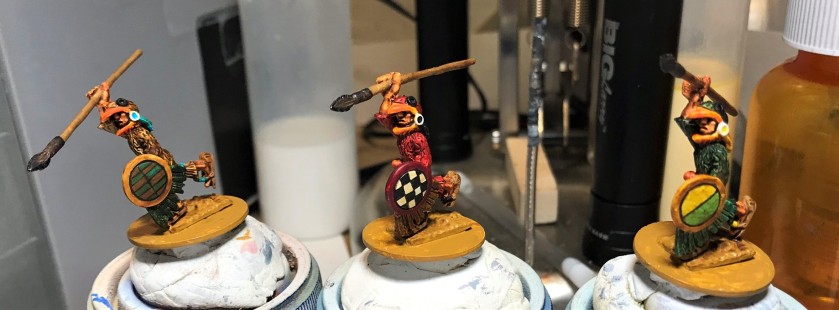
These metal figures were sculpted by Josef Ochmann and are 28mm in scale.  They are available in the US from Badger Games and from Wargames Foundry internationally.  Each of the two blister packs had 6 figures leaving me with 24 figures – with 12 of them being duplicates.  Similar to what I did with the Novice Warriors, I decided to differentiate them by both a color theme and by their shield designs.

As I had finished 24 figures previously, this project would effectively double my Aztecs – hence I am doubling down.

I also had a few technical goals here for this project.  One was to improve upon my painting of flesh tones on the models.  The second goal was to attempt to improve my shields by freehand painting historically accurate and authentic shield designs.  The last goal was to try better to use contrast medium to thin contrast paints on these figures.  As always, dear reader, you may be the judge and jury on that – and I am open to how well or how poorly you think I did here.  I find that sometimes when I am doing a platoon-sized project, I can easily overlook mistakes that would not be overlooked when doing a smaller group or even an individual figure.  Hopefully, I was able to catch any errors.

This will be a photo-heavy post.  I’ll share some WIP and some eye candy of the finished figures, along with the list of paints used here.  To do 24 figures at a time can make quite a list as you will see at the end of this blog post.

Figure Prep and Priming

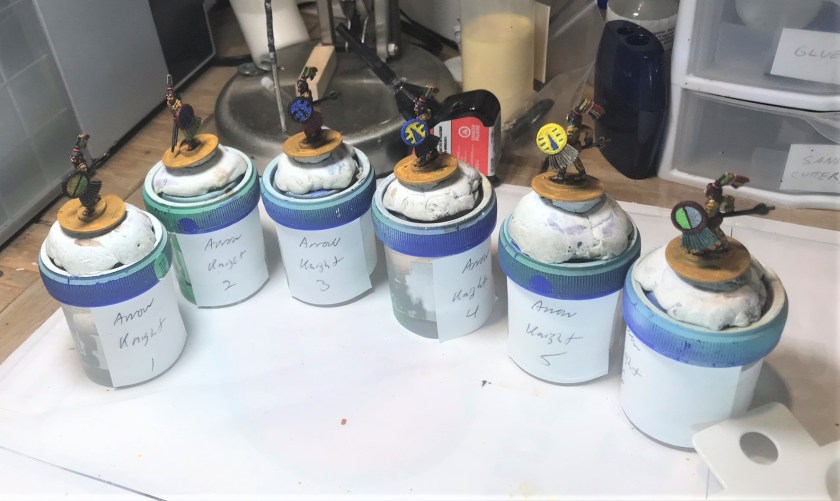
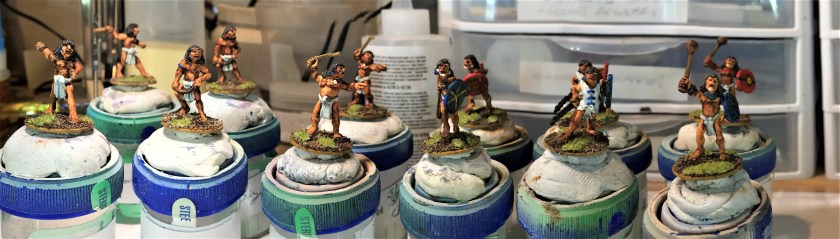
1 mounted group for painting
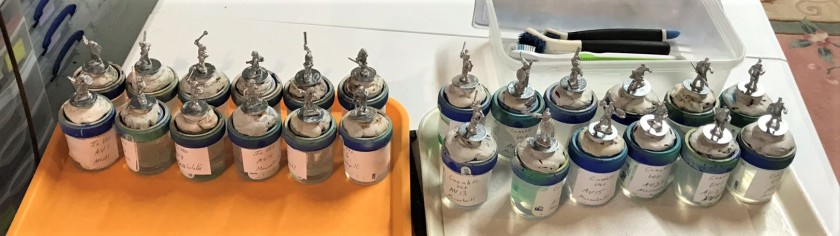
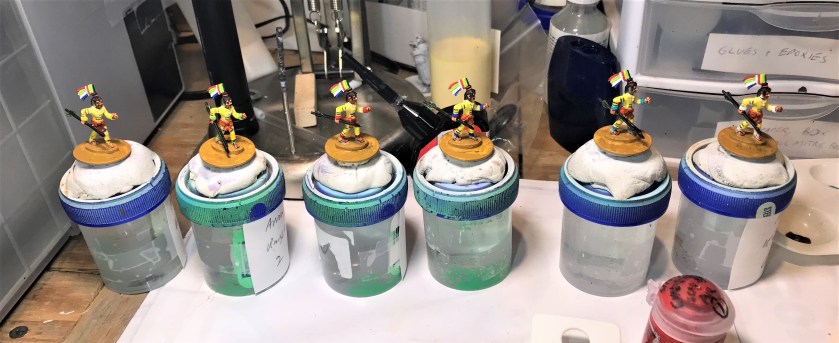
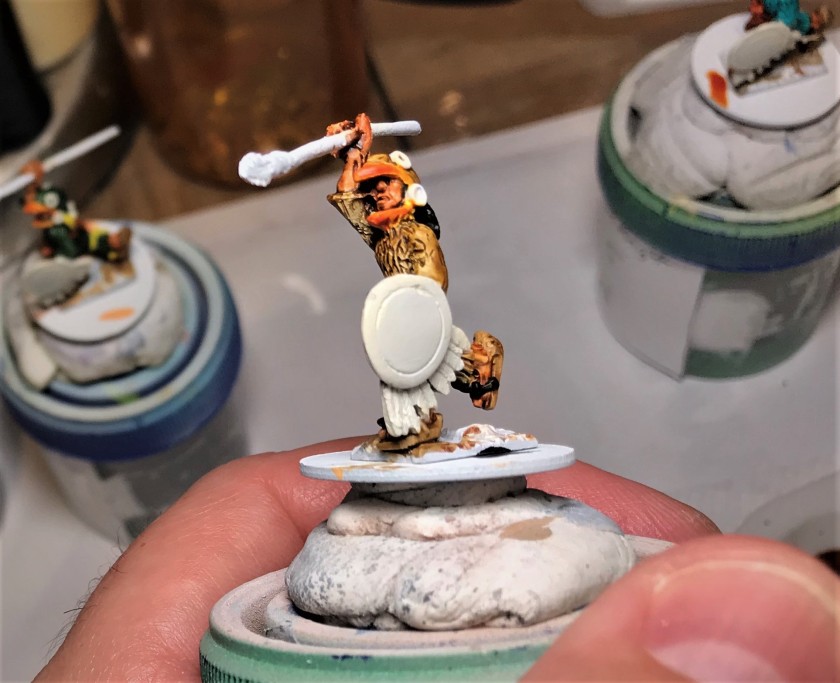
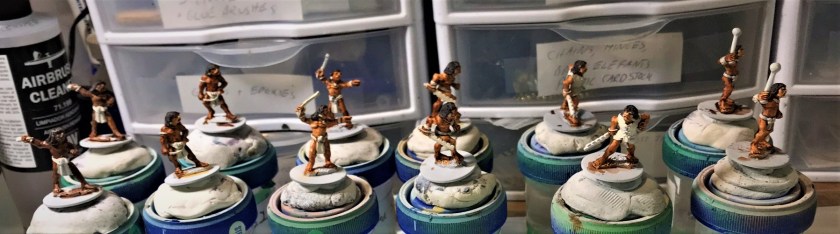
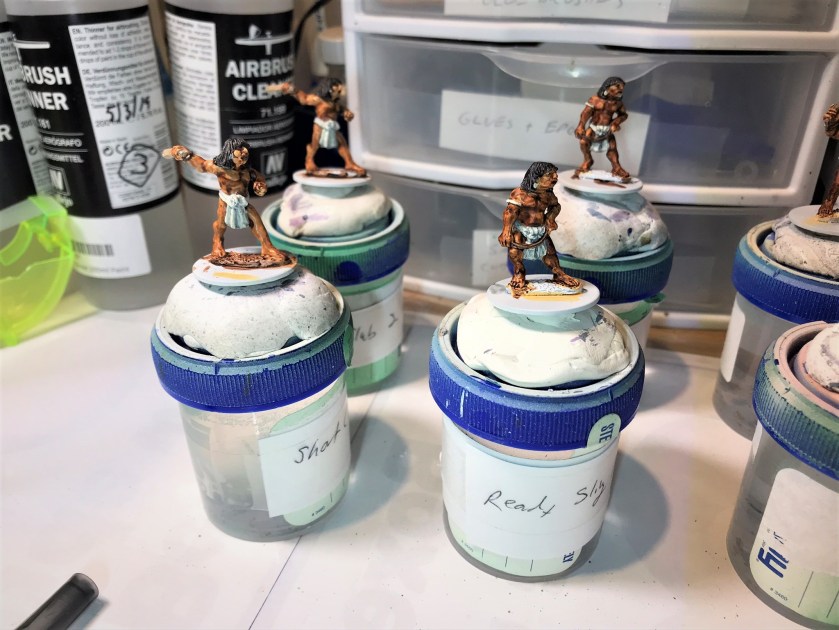
The group here is mounted for painting.  I label the vials and the base bottoms, and I had a matrix for keeping the colors straight on all of these so as to make them realistic enough and to help with tabletop identification.  I needed this as historically each Aztec warrior’s uniform was unique to the status of that warrior, and based upon his individual accomplishments in battle, as opposed to the unit to which he belonged.  The elite units were the exception to this – these are of course veterans warriors, not elites.
2 Contrast painting blending
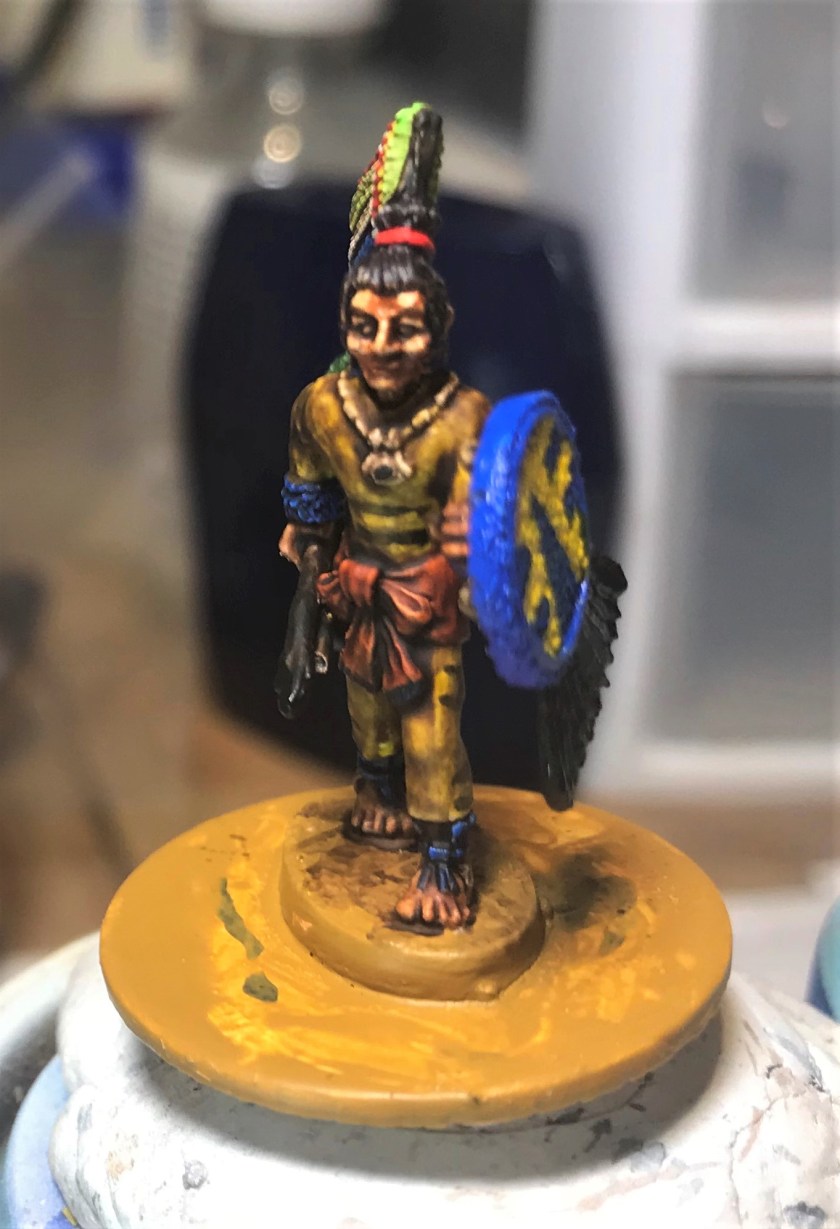
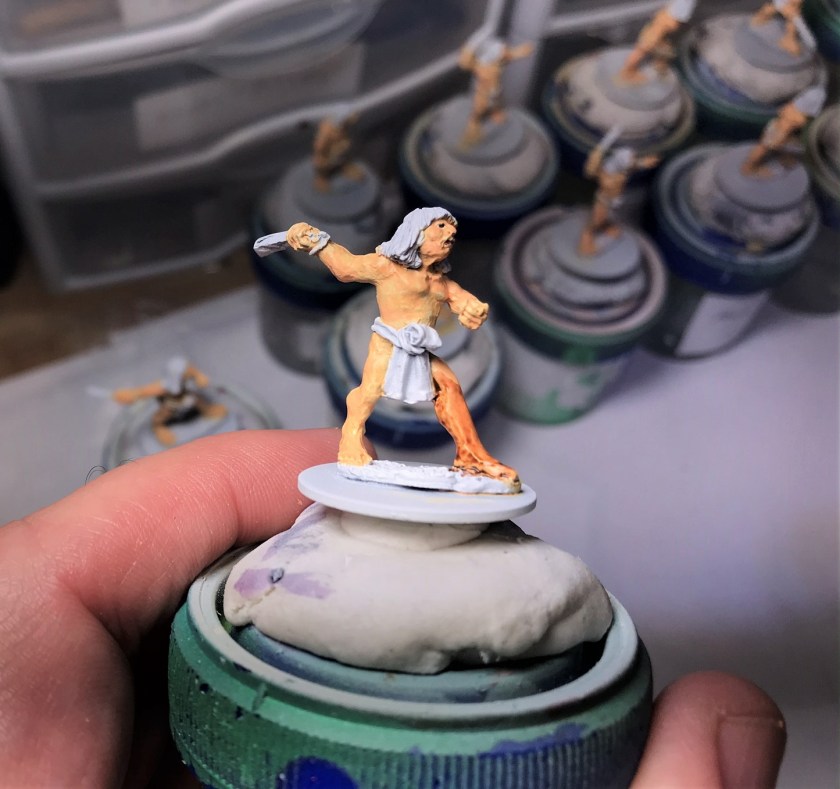
I must give a nod and thanks to my blog buddy Azazel’s suggestion as to how to use contrast medium, I did the above.  Basically I placed a drop of the contrast medium next to some of the contrast paint on the palette, and drew them together to get the shade I wanted.  I did this with flesh here (also used Gulliman here as the main flesh contrast paint instead of Fyrestarter) as well) – and it really was helpful.  Check out Azazel’s blog too – his stuff is really good!

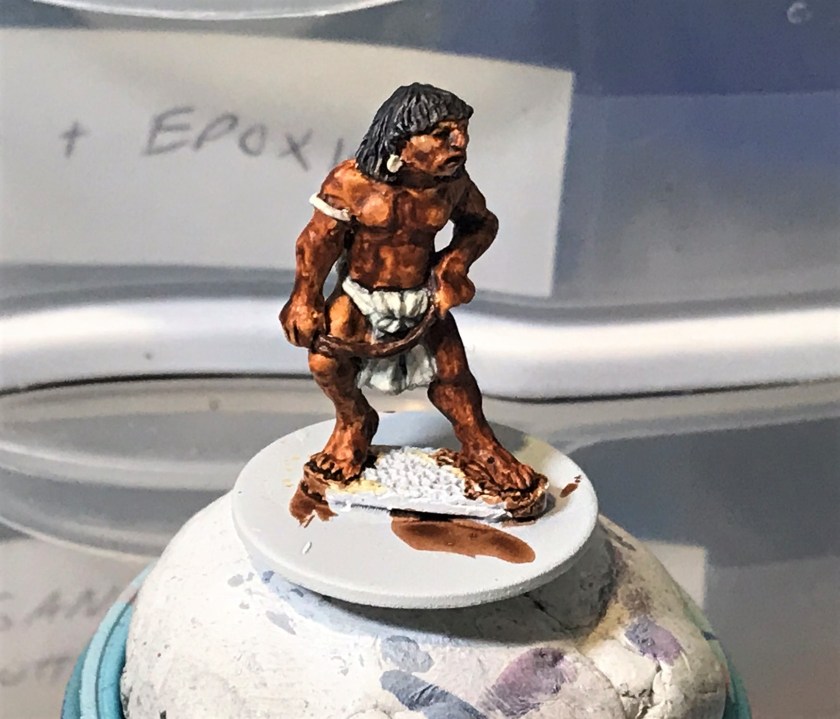
There were a few problematic mold lines – most I caught and filed/fixed but some were on the figure’s faces like below.  To eradicate some mold lines, I would have had to nuke the face, which I did not want to do.  In the end, I think I minimized most of the more egregious mold lines.

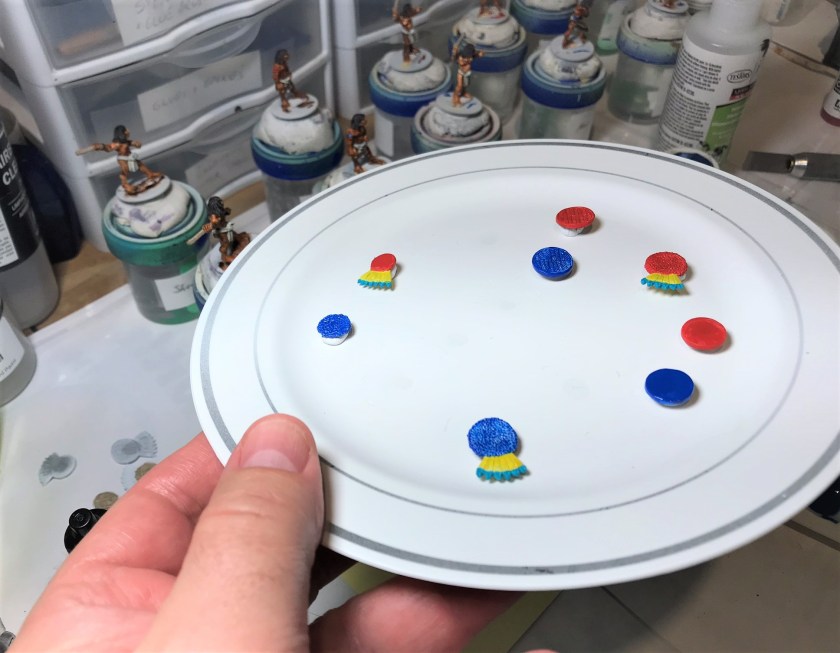
The shields that came with the blisters was more than sufficient.  For the 24 figures, I needed an additional 18 shields for figures that did not have one.  I also had leftover shields from the Novice Warrior project that I saved – so I ended up painting 29 shields.  It was a good chance to try some new techniques and practice with some different Aztec designs (of which there are many luckily).  The most difficult type to paint were the type that were cloth-covered types with “crenelated” surfaces (as on those the paint flows into the shields’ low areas).  I also had to be careful when painting both sides so as to protect the previous coats of paint.  Using diluted satin varnish between side swapping helped to protect the work, but I still did need to go back over the shields and touch them up.  In the end, I was happy with the results and will save the extras for future use.

3 finished shields
My shields completed and ready to mount.  Thankfully, I got a shipment of Windsor & Newton brushes (0000) which was a must for my freehand work here!
6 finished!
The group shown here freshly off of their specimen jars.  They have been flocked and are ready for some eye candy shots.

Eye Candy

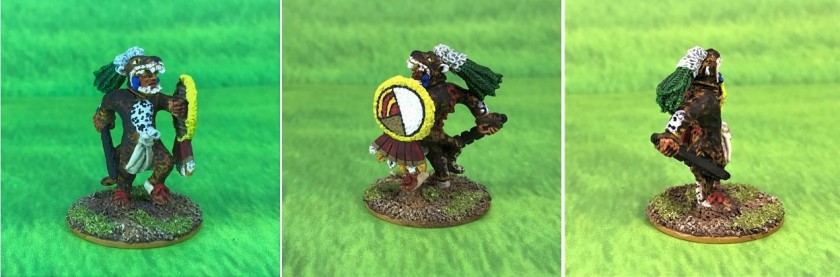
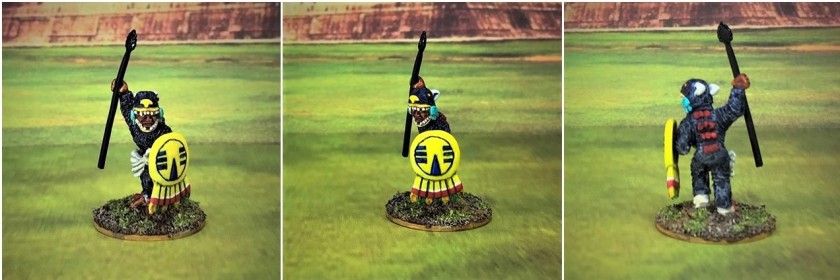
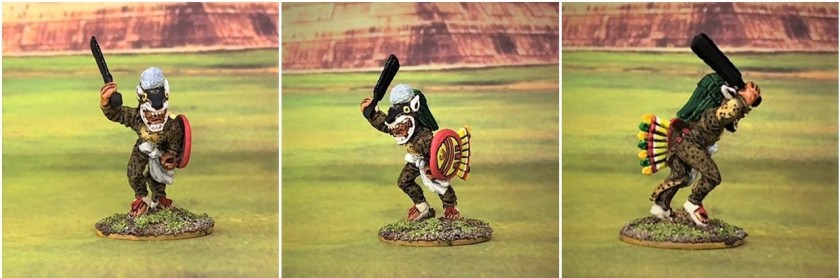
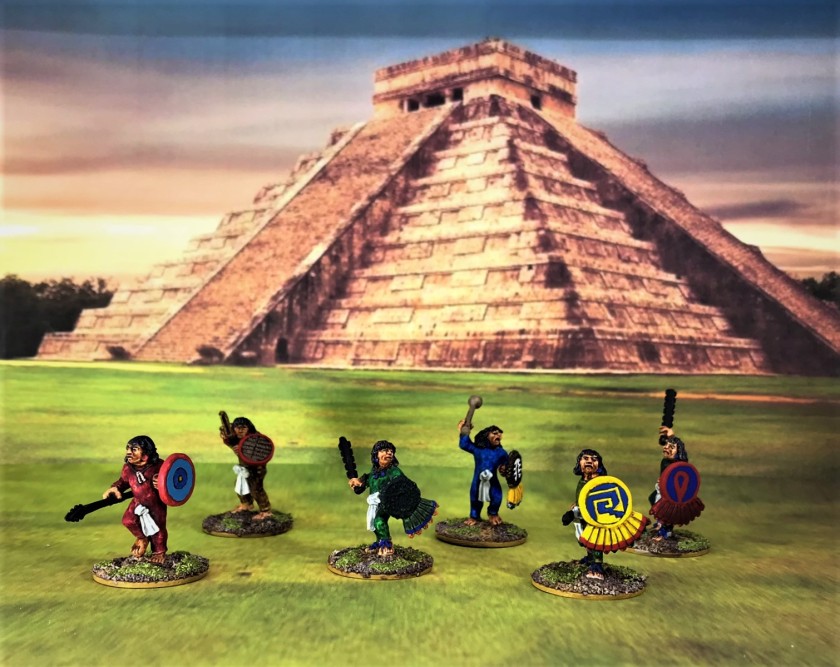
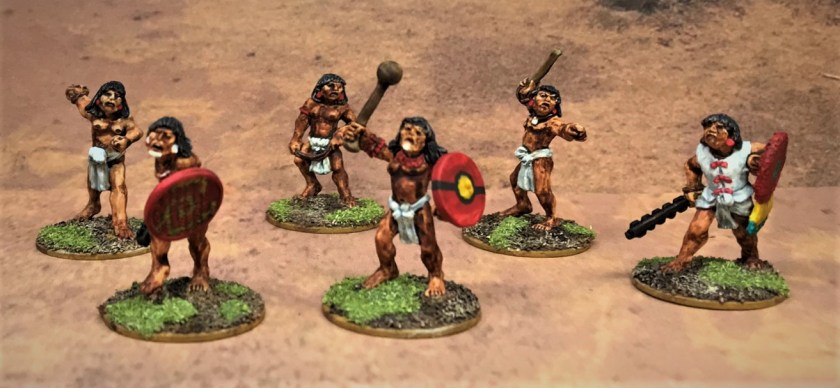
First, here are Ixtlilxochitl’s Veteran Warriors – there are 6 poses with two of each painted.  One was “blue-themed” and one was “red themed”, mainly to add to tabletop differentiation in addition to the shields.

Ixtlilxochitl’s Veteran Warrior 1 – armed with an atlatl

Ixtlilxochitl’s Veteran Warrior 2 – armed with a macuahuitl

Ixtlilxochitl’s Veteran Warrior 3 – armed with a cuauhololli

Ixtlilxochitl’s Veteran Warrior 4 – armed with a macuahuitl

Ixtlilxochitl’s Veteran Warrior 5 – armed with a macuahuitl

Ixtlilxochitl’s Veteran Warrior 6 – armed with a tepoztopilli


8 AZ017 Group shot - red themed
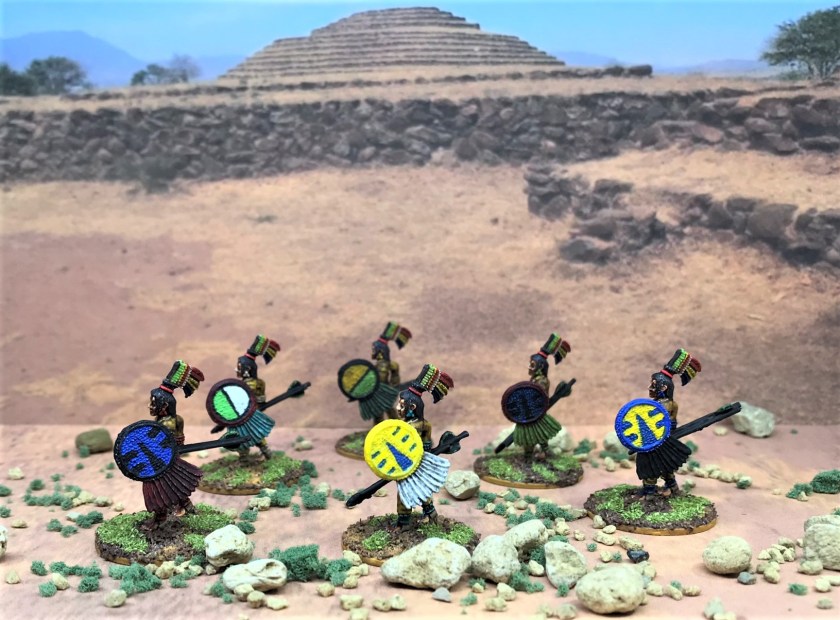
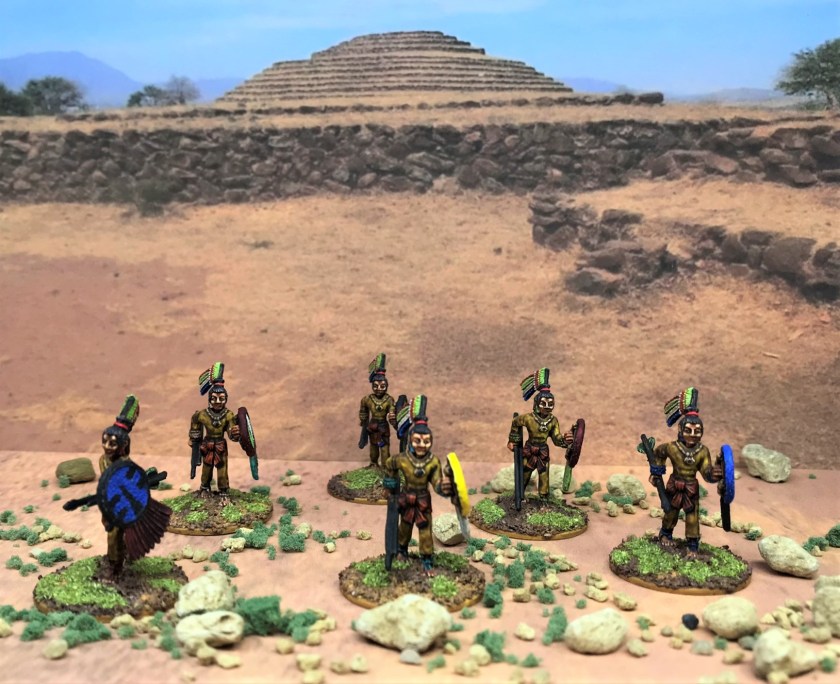
Here are the warriors from the “blue-themed” blister pack of Ixtlilxochitl’s Veteran Warriors assembled for battle.
7 AZ017 Group shot - blue themed
The “red-themed” blister pack  of Ixtlilxochitl’s Veteran Warriors defending the temple.
9 all AZ017 group
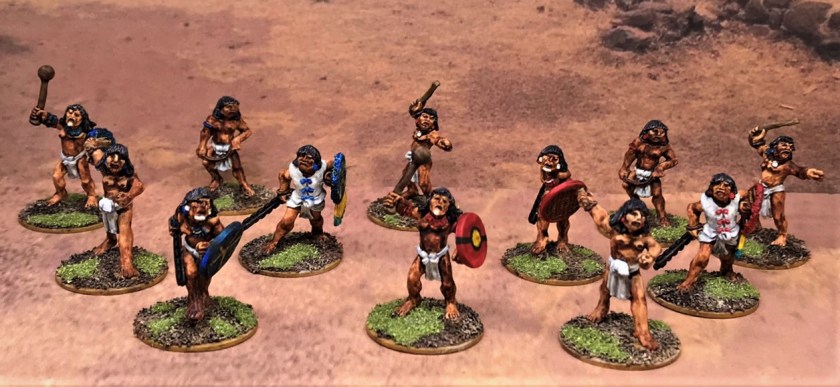
Ixtlilxochitl’s Veteran Warriors (all 12).

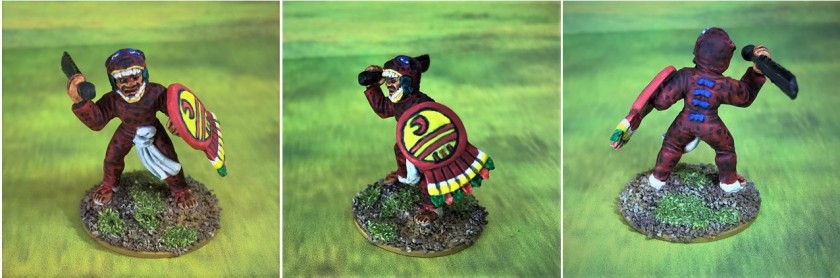
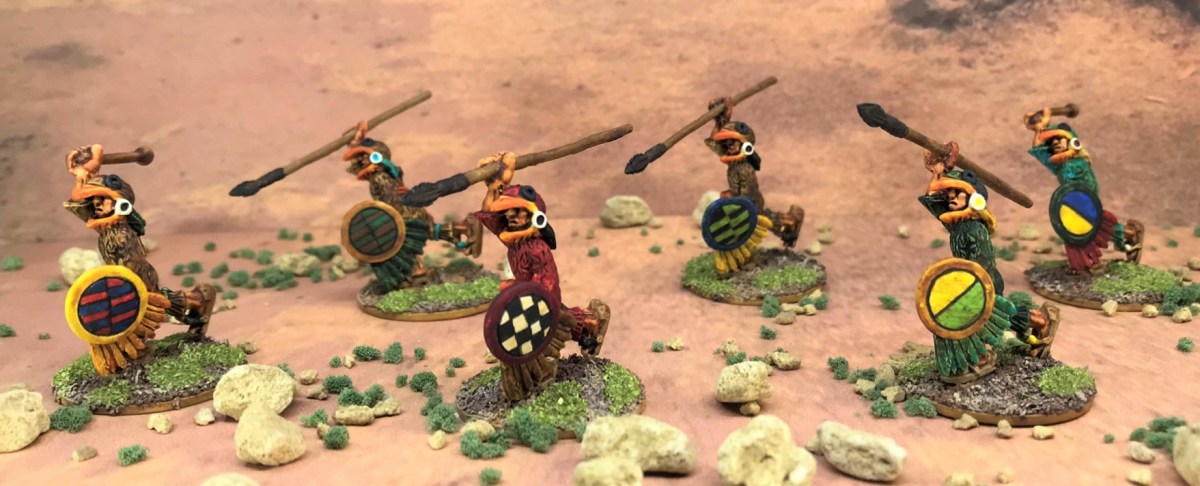
Secondly, here are Cuauhtli’s Veteran Warriors – there are also 6 poses with two of each painted.  Once again, I painted 6 as “blue-themed” and 6 as “red themed” in addition to the shields.

Cuauhtli’s Veteran Warrior 1 – armed with a macuahuitl

Cuauhtli’s Veteran Warrior 2 – armed with a macuahuitl

Cuauhtli’s Veteran Warrior 3 – armed with a macuahuitl

Cuauhtli’s Veteran Warrior 4 – armed with a macuahuitl

Cuauhtli’s Veteran Warrior 5 – armed with a tepoztopilli

Cuauhtli’s Veteran Warrior 6 – armed with a macuahuitl

7 AZ023 Group shot - blue themed
Cuauhtli’s Veteran Warriors in the “blue theme” moving out.


8 AZ023 Group shot - red themed
Cuauhtli’s Veteran Warriors in the “red theme” form up for battle.
9 AZ023 Group shot - all AZ023
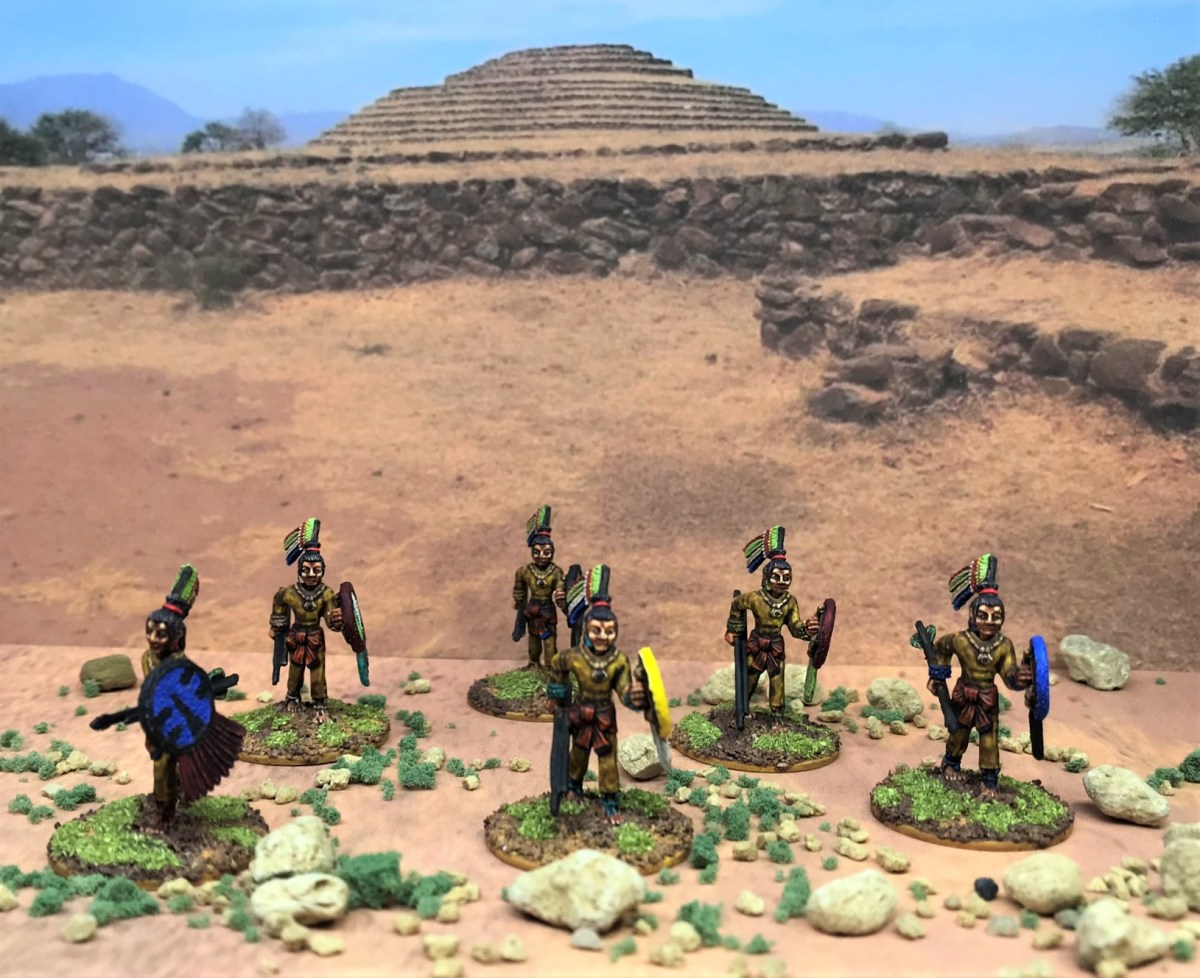
All 12 Cuauhtli’s Veteran Warriors in the desert.

I enjoyed painting these – though I do not think that I will be doubling down with a project of 48 at a time – “a man’s gotta know his limitations” as Dirty Harry so eloquently said.

Here’s the 24 all together:

All AZ017 and AZ023

Oh yeah, I also just got a set of Feudal Patrol™ cards from Buck as a gift – try and guess which deck backings are my current favorites?

0 Feudal Patrol Decks

Hope that you enjoyed the post and the minis – if not, let me know – if yes, the same.

Until next time – take care and stay safe all!
Posts on Units for my 16th Century Spanish Conquest Supplement for Feudal Patrol™ – “Civilizations Collide”

  1. Doubling Down – Aztec Veteran Warriors (this post) – 24 Aztec Veteran Warriors
  2. Aztec Arrow Knights, Ral Partha circa 1988 – 6 Aztec Arrow Knights
  3. Aztec Eagle Warriors from Tin Soldier UK – 6 Aztec Eagle Knights
  4. Aztec Novice Warriors and a few Frinx – 12 Novice Warriors

Total figures to date for this project:  48 Aztecs

All Aztecs as of May 31, 2020

PAINTS, INKS, GLAZES, SHADES, WASHES, PIGMENTS, FLOCKING, GLUES AND MORE USED ON THESE AZTEC VETERAN WARRIORS:

  1. Gorilla Glue
  2. 1/8″ x 1″ Everbilt Fender Washers
  3. E6000 Epoxy
  4. Poster tack and plastic plates
  5. Vallejo “Surface Primer – White Primer”
  6. Vallejo “Flow Improver”
  7. Vallejo “Airbrush Thinner”
  8. Testors “Universal Acrylic Thinner”
  9. Vallejo Model Air “Weiss” (off-white)
  10. Citadel “Agrax Earthshade” (shade)
  11. Vallejo Model Color “Sunny Skin Tone”
  12. Vallejo Model Air “Weiss” (off-white)
  13. Vallejo Game Air “Black”
  14. Citadel “Contrast Paint – Volupus Pink”
  15. Vallejo Model Color “Dark Blue”
  16. Citadel Air “Evil Sunz Scarlet”
  17. Citadel “Contrast Paint – Warp Lightning”
  18. Citadel “Contrast Paint – Contrast Medium”
  19. Vallejo Game Air “Moon Yellow”
  20. Citadel “Contrast Paint – Basilicanum Grey”
  21. Citadel “Contrast Paint – Nazdreg Yellow”
  22. Citadel “Contrast Paint – Aggaros Dunes”
  23. Battlefront “Dark Leather”
  24. Battlefront “Wool Brown”
  25. Citadel “Contrast Paint – Wyldwood”
  26. Citadel “Contrast Paint – Aethermatic Blue”
  27. Citadel “Contrast Paint – Flesh Tearers Red”
  28. Battlefront “Sicily Yellow”
  29. Vallejo Mecha Color “Turquoise”
  30. Vallejo Game Air “Dead White”
  31. Vallejo Game Air “Escorpena Green”
  32. Citadel “Contrast Paint – Blood Angels Red”
  33. Citadel “Contrast Paint – Iyanden Yellow”
  34. Citadel “Yriel Yellow”
  35. Citadel “Contrast Paint – Apothecary White”
  36. Citadel “Contrast Paint – Ork Flesh”
  37. Citadel “Contrast Paint – Talassar Blue”
  38. Citadel “Contrast Paint – Militarum Green”
  39. Citadel “Contrast Paint – Creed Camo”
  40. Vallejo Model Color “Glossy Black”
  41. Vallejo Model Color “Light Flesh”
  42. Citadel “Contrast Paint – Gulliman Flesh”
  43. Army Painter “Flesh Wash” (wash)
  44. Citadel “Contrast Paint – Fyreslayer Flesh”
  45. Citadel “Balor Brown”
  46. Citadel “Contrast Paint – Skeleton Hordes”
  47. Citadel “Contrast Paint – Terradon Turquoise”
  48. Vallejo Game Air “Sun Yellow”
  49. P3 “Cygnar Blue Highlight”
  50. Vallejo Game Air “Electric Blue”
  51. Americana “Desert Sand”
  52. Vallejo Model Air “Matt Varnish”
  53. Elmer’s PVA Glue
  54. Army Painter “Brown Battlefields” (flocking)
  55. Vallejo “Dark Yellow Ochre” (pigment)
  56. Vallejo “Burnt Umber” (pigment)
  57. Vallejo Mecha Varnish “Matt Varnish”
  58. Army Painter “Grass Green” (flocking)

Thanks for looking!!

Aztec Arrow Knights, Ral Partha circa 1988

In building a set of troops for the Spanish Conquest, I came across a couple of blisters of 25mm Ral Partha figures called “Aztec Arrow Knights”.  These were in my lot of unpainted lead for the period, sculpted by R. Kerr, and dated from 1988.  The blisters held 6 figures armed with huge feathered arrows – think javelins with fletching.  As I thought that they were interesting potential elite troops with unique weapons, I decided to add one of the two blisters to my Aztec forces, keeping the other in reserve for future painting.

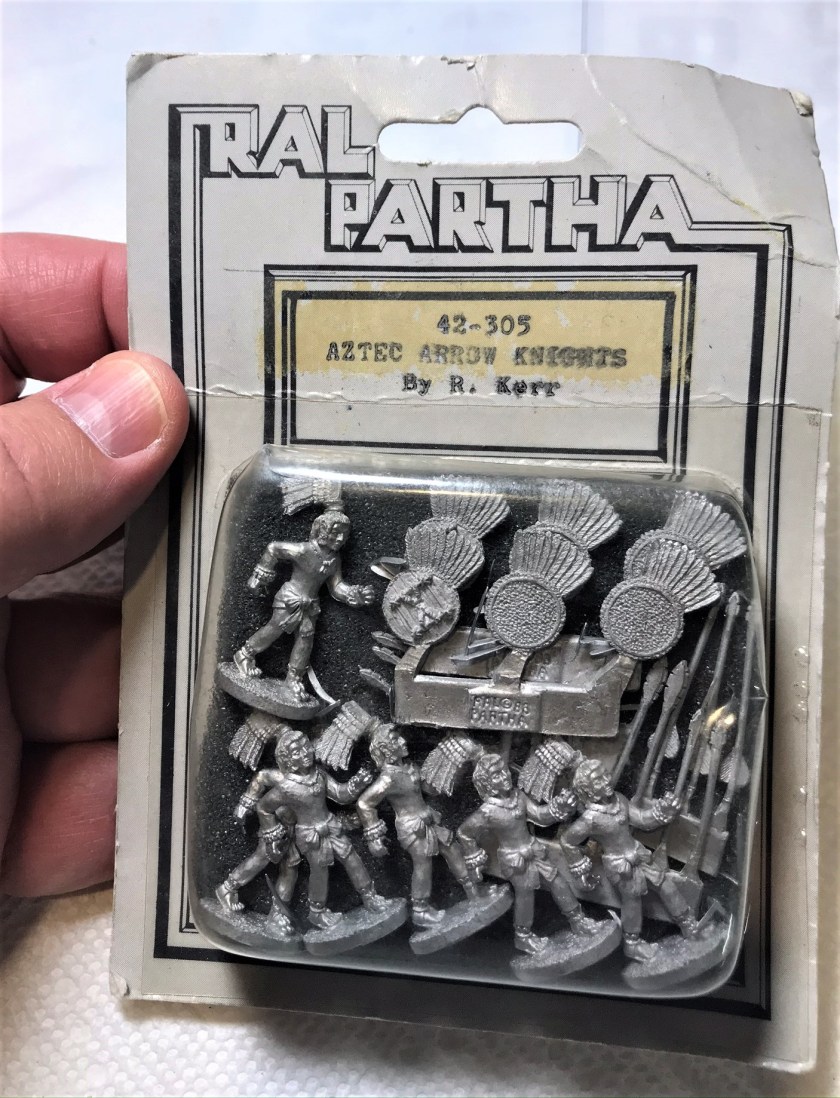
1 Ral Partha Arrow Knights 42-305 in blister
The blister pack – waited 32 years to be opened.

As I discussed previously, I had been doing research on the Aztecs.  I looked for suitable color plates or guides to paint up this unit.  To my surprise, there is a bit of mystery and possibly even controversy about Arrow Knights.  History provides little evidence in the codices as to their existence – though there are clues here and there.

I suppose it’s not out of the question that an elite unit of Aztec warriors specializing in launching massively huge javelin-like arrows could have existed.  Perhaps there was some confusion with the atlatl (ot-la-t) a spear-throwing device?  Just because old Ral Partha made these does not mean that they did exist – but for the purposes of my games and my Aztec Army – they do now.

atlatl
Atlatl use.

Of course, painting them would be up to me for choosing the colors.  The only picture that I found was from a computer gaming site – and it did not match any of the plates.  I did like the markings known as “hawk scratches”.  I decided that I would give the unit a coloration similar to the cuahchic elites – that being a yellowish suit of tanned hide that would have been worn over their quilted-cotton armor ichcahuipilli (each-ca-we-pee-lee).

Aztec_Arrow_Warriors_old.JPG
From the internet – not likely historically correct but a start.

It was fun to break into this old blister from Ral Partha’s 1200 A.D.” line.  The figures were all in the same pose, but I figured that I could orient their arrows in slightly different positions, use slightly different colors on each , and give different shields to each for aesthetics and ease of tabletop identification and playability.  A familiar challenge was that the arrows were all lead – and vulnerable to bending and breaking.  I also wanted them to have two big arrows – one to throw and one to use in melee.

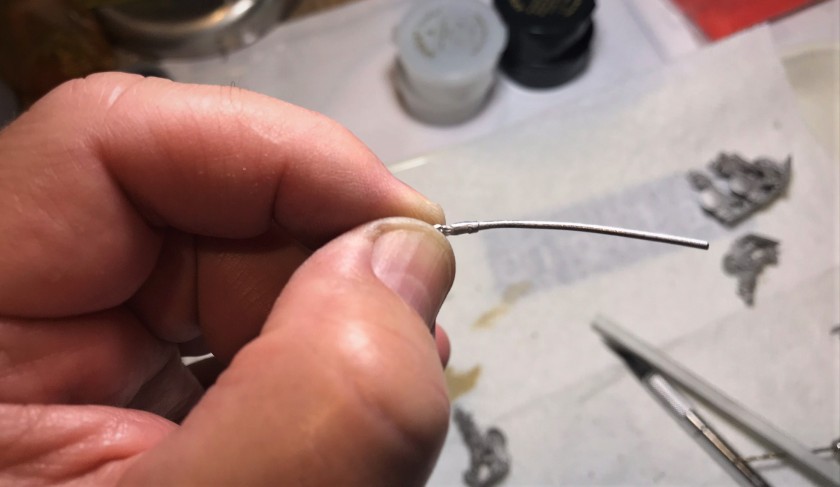
The problem with doing this were twofold.  First, I did not want to sculpt 6 little extra arrows – and second the little 25mm hands were too small to accommodate even the arrows provided.  My solution was to use some steel wire pikes I had gotten from Iron Winds Metals during my Rooman War Party project.  I cut the pikes to size and used super glue to affix them to the arrows.  They would be the “second” arrow, albeit without fletching or another obsidian head.  I think it worked – and you can be the judge.

4 Ral Partha Arrow Knights 42-305 shields and arrow sprues
One of the shield and weapon sprues with the “RAL PARTHA 1988” on it.
5 Ral Partha Arrow Knights 42-305 arrow fix
The arrows shown here reinforced by the steel wire.
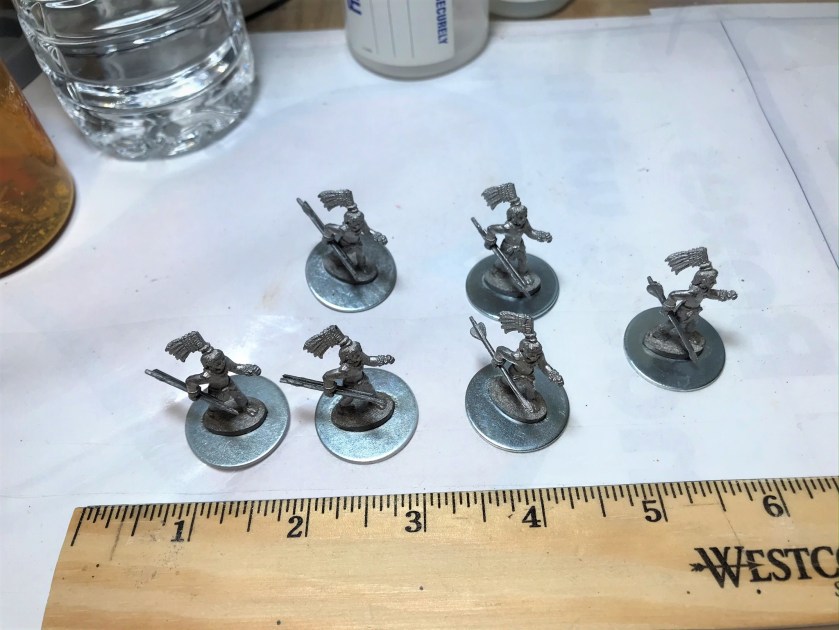
6 Ral Partha Arrow Knights 42-305 mounted on washers
The Arrow Knights after affixing their “double arrows” to their hands and the figures themselves to the 1″ steel washers.  I would paint the shields separately.
7 Ral Partha Arrow Knights 42-305 mounted on washer, close up
Close up shot before painting.
10 Ral Partha Arrow Knights 42-305 tunic and hawk scratches May 4th
I used a series of yellow and tan inks, washes, and glazes over the hard-lined “hawk scratches” to get a good color that would darken appropriately but still show the markings.
11 Ral Partha Arrow Knights 42-305 tunic and hawk scratches May 4th close up
Close up shot mid-stage before darkening.
12 Ral Partha Arrow Knights 42-305 after shields added May 5th
After shields affixed and washes applied.
13 Ral Partha Arrow Knights 42-305 after shields added May 5th close up
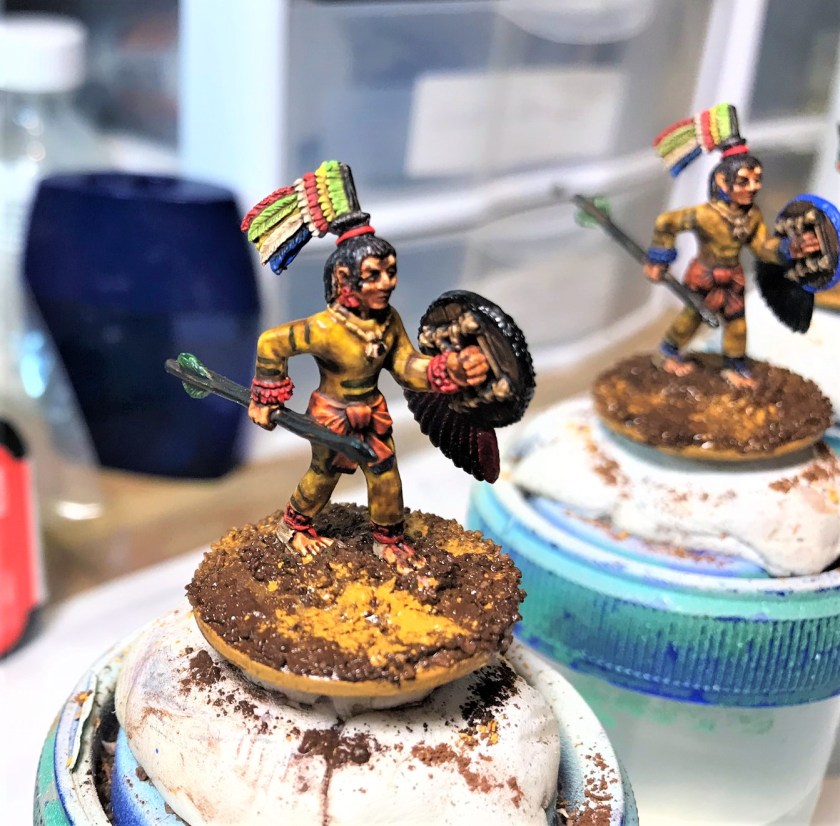
Close up of  Arrow Knight prior to flocking.  I did like how the faces came out, and the uniforms as well.
14 Ral Partha Arrow Knights 42-305 after adding pigments to flocking May 6th close up
I flock the bases with Army Painter “Brown Battlefields”, then add pigments before varnishing.  After varnishing, I add static grass.  Here you see the pigments wet with Vallejo “Airbrush Thinner” which hardens up nicely.  Sometimes I drybrush the bases as well, but I opted this time not to and to instead use more pigments.
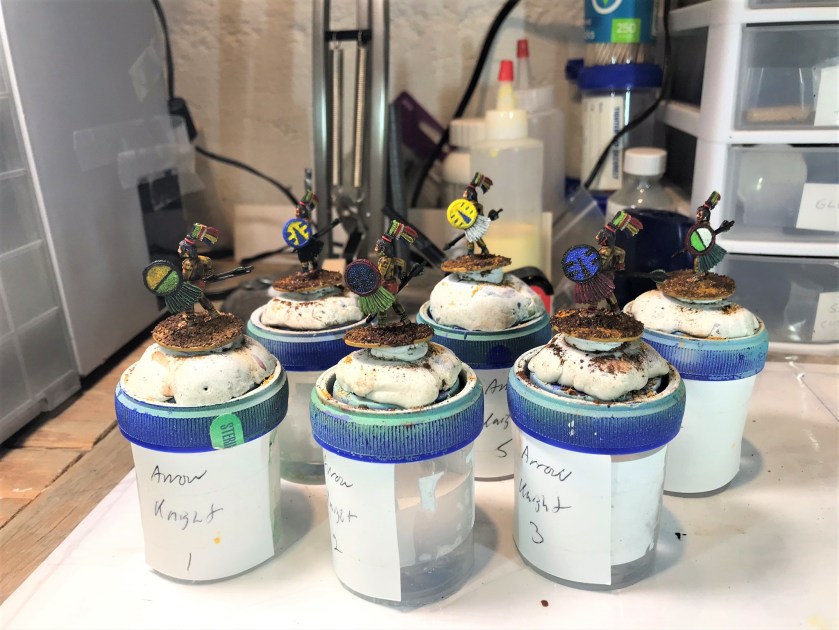
15 Ral Partha Arrow Knights 42-305 after adding pigments to flocking May 6th group
Dried and ready for varnishing in the spray booth.

Next, I’ll share some close up eye candy shots of each, a scale comparison, and some group shots.

Arrow Knight

Arrow Knight

Arrow Knight #3

Arrow Knight

Arrow Knight

Arrow Knight

Scale Comparison

17 scale comparison
Just for scale comparison – the Arrow Knight is on the left, a 28mm Wargames Foundry Novice Warrior is in the center, and a 25mm Tin Soldier UK Eagle Knight is on the right. I think they will work fine on the tabletop together.

Group Shots

18 group shot shield side
Good view of the six different shields together.

19 group shot shield front

I am also adding a new feature here.  I want to be able to share related posts on the larger Aztec project with folks who have not seen all of the previous posts.  Additionally, I need a way to help me keep track of my progress!  Therefore, the list of links below will accomplish both for me.

Posts on Units for my 16th Century Spanish Conquest Supplement for  Feudal Patrol™“Civilizations Collide”

  1. Aztec Arrow Knights, Ral Partha circa 1988 (this post) – 6 Aztec Arrow Knights
  2. Aztec Eagle Warriors from Tin Soldier UK – 6 Aztec Eagle Knights
  3. Aztec Novice Warriors and a few Frinx – 12 Novice Warriors

Total figures to date for this project:  24 Aztecs

20 army progress
Progress so far!

Thanks for looking and let me know what you think – I love the chance to learn your thoughts and to have a discussion!

Lastly, here are the paints and supplies I used on this project.

PAINTS, INKS, GLAZES, SHADES, WASHES, PIGMENTS, FLOCKING, GLUES AND MORE USED ON THESE AZTEC ARROW KNIGHTS:

  1. Gorilla Glue
  2. 1/8″ x 1″ Everbilt Fender Washers
  3. Steel wire lances from Iron Winds Metals
  4. Poster tack and plastic plates
  5. Vallejo “Surface Primer – White Primer”
  6. Vallejo “Flow Improver”
  7. Vallejo “Airbrush Thinner”
  8. Testors “Universal Acrylic Thinner”
  9. Vallejo Model Air “Weiss” (off-white)
  10. Vallejo Game Air “Black”
  11. Vallejo Model Color “Sunny Skin Tone”
  12. Vallejo Model Color “Light Flesh”
  13. Citadel “Contrast Paint – Fyreslayer Flesh”
  14. Vallejo Model Air “Moon Yellow”
  15. Vallejo Game Air “Escorpena Green”
  16. Citadel Air “Evil Sunz Scarlet”
  17. Vallejo Model Color “Dark Blue”
  18. Vallejo Mecha Color “Turquoise”
  19. Vallejo Game Air “Dead White”
  20. Citadel “Contrast Paint – Wyldwood”
  21. Army Painter “Flesh Wash” (wash)
  22. Citadel “Contrast Paint – Gryph-Hound Orange”
  23. Citadel “Contrast Paint – Basilicanum Grey”
  24. Battlefront “Wool Brown”
  25. Secret Weapons Washes “Parchment” (wash)
  26. Secret Weapons Washes “Sunshine” (wash)
  27. Citadel “Contrast Paint – Creed Camo”
  28. Citadel “Balor Brown”
  29. Citadel “Agrax Earthshade” (shade)
  30. Citadel “Lamenters Yellow” (glaze)
  31. Army Painter “Soft Tone” (shade)
  32. Vallejo Model Air “Armour Brown”
  33. Citadel “Praxeti White” (dry)
  34. Citadel “Contrast Paint – Aethermatic Blue”
  35. Citadel “Contrast Paint – Flesh Tearers Red”
  36. Citadel “Contrast Paint – Apothecary White”
  37. Vallejo Model Color “White”
  38. Vallejo Model Color “Glossy Black”
  39. Elmer’s PVA Glue
  40. Army Painter “Brown Battlefields” (flocking)
  41. Vallejo “Dark Yellow Ochre” (pigment)
  42. Vallejo “Burnt Umber” (pigment)
  43. Vallejo Mecha Varnish “Matt Varnish”
  44. Army Painter “Grass Green” (flocking)

Thanks for looking – please let me know your thoughts and feedback!


Aztec Eagle Warriors from Tin Soldier UK

As shown in my last post, I have started building forces of appropriate figures for tabletop wargames using the soon-to-be published Feudal Patrol™.  These are Aztecs and other troops from the era of the Spanish Conquest in the 16th Century.  This is a major project for which I eventually hope to have over 150 painted figures.  I have a ways to go, as this project brings that total to a mere 18.  Still, the journey of 1,000 miles begins with a single step…

I acquired a large lot of Aztec figures on eBay probably 4 or 5 years ago.  Most of them 25mm scale, and from Ral Partha dating from around 1988.  In the lot were also two baggies of 3 Aztec Eagle Warriors (#25 AZ4) – ostensibly 25mm as shown on the Tin Soldier UK website.    I was not familiar with Tin Soldier UK, but they have a pretty nice range of figures worth checking out.  Of course, 28mm is the scale that I am going for – and sometimes 25mm can work for 28mm.  While I was waiting for my order of new 28mm stuff to arrive (which I received this week), I decided to paint up some of the older figures and see if they could work with my 28mm figures visually.  To my eyes, the Tin Soldier UK Eagle Warriors looked close enough to 28mm to work.

1 Tin Soldier 25AZ in bags
The Tin Soldier UK baggies of Eagle Warriors.  Note the noodle-like tepoztopilli (obsidian-bladed thrusting spears) – more on that in a bit.

The Aztecs had two main elite unit types – the Jaguar Warriors,  and the Eagle Warriors (sometimes referred to as the Eagle Knights).  There were also the lesser-known Arrow Knights, which I will post about next time.  To be an Eagle Warrior, one had to have captured up to 20 enemy for sacrifice or equivalent deeds of valor (well, in the eyes of Aztec society anyways).  They were full-time professional warriors and along with the other elites were equivalent to nobility among the Aztecs.

Normally, Aztec Eagle Warriors would be armed with melee weapons, in particular the macuahuitl obsidian-edged club/sword.  All of these 6 had the same pose and were armed with tepoztopilli (obsidian-bladed thrusting spears).  They also had the weapons in a throwing versus a thrusting pose.  Therefore, I decided to go through the 25mm Ral Partha Aztecs that I had and see if I could get any macuahuitl or cuauhololli (round-headed club) as extra weapons.  The extra Ral Partha macuahuitl were way too small and bendable, but there were some cuauhololli that would work.  I ended up using two of the cuauhololli and four of the tepoztopilli as weapons for the six.  My plan was to orient each of  their weapons slightly differently and also to have different shield patterns and different colors for authenticity and ease of tabletop play.

Now, as for the spaghetti-like tepoztopilli, they needed a solution as they were made from lead and were as floppy and vulnerable to bending as most leaden miniature spears are unfortunately, especially those from the 1980’s and earlier.  The odd thing is that the model shown on the website indeed does have a macuahuitl instead of a tepoztopilli!  My guess is that they redid the mold at some point as these model thrusting spears were too weak for use in gaming.  In any case, I decided to try using a thin layer of Apoxie Sculpt on the shafts.  Apoxie sculpt is easy to use and can be made more workable when used with wet fingers – and it gets hard as a rock when it cures in 24 hours.  This process gave me much improved tepoztopilli, but still the underlying lead made them somewhat (though less) vulnerable to bend.

2 Tin Soldier 25AZ limp tepoztopilli
This bendy tepoztopilli will not do!
5 AZ4
From the Tin Soldier UK website – I definitely would have preferred this macuahuitl as a weapon for the models – but it is available now.
3 Tin Soldier 25AZ limp tepoztopilli Apoxie Sculpt
My set up for firming the tepoztopilli shafts – first I straightened them with a pair of needle-nosed pliers then rolled on wet Apoxie Sculpt.  Insert crass joke here…
5 Tin Soldier 25AZ Apoxie Sculpt limp tepoztopilli fix
New shafts reinforced with the Apoxie Sculpt after a 24 hour cure.

The models themselves were not too difficult to assemble.  I did need to clean up the mold lines and the hands needed to be drilled out carefully to hold the weapons.  I did pull out some of the molding rubber out of one model’s eyes, but overall I was happy with the quality of the castings.  I definitely liked that the shields were not separate.

I made a unit plan as there were many ways to do the unit – and I wanted to have something to refer to along the way.  In particular, one of my goals for this project was to give each Eagle Warrior a different shield design – and for that design to be historically correct.  Over at Steve’s Balagan, I found his blog to be a wonderful resource for Aztec and other shields.

6 Tin Soldier 25AZ the plan
Eagle Warriors primed and the painting plan – I did end up deviating a bit as I observed the colors of the models.

Most pictures that I have found on Eagle Warriors showed them in golden brown outfits – but some mention that there were possibly red, green, and blue ones as well.  I decided to make three in golden brown, and then make the others in red, green, and blue.  The accouterments and shields would also add to the differentiation on the tabletop.  Unlike the novices, the pics that I saw of Eagle Warriors all had orange loincloths, so that feature was common here.

7 Tin Soldier 25AZ April 29 progress
By April 29th, I had the basic colors down.  Citadel contrast paints were useful with these models, as their details for the most part were not really suited for dry brushing as opposed to shading.
8 Tin Soldier 25AZ April 30 progress
Progress by April 30 – still needed to paint the shields and weapons.
9 Tin Soldier 25AZ April 30 progress close up
Close up of April 30 progress.

My next big challenge was painting designs on the shields.  My handwriting is awful, and hand-drawing designs on shields has not been a strength for me – and these are tiny.  I decided to let the engineer in me break out.  I used an art template to trace a 9/32″ circle on a piece of paper, and then I cut that out.  It proved useful in helping me to lightly sketch the designs on the shields in pencil – as guides for painting.  I tried several designs that I saw on Steve’s Balagan blog.

10 Tin Soldier 25AZ May 1st shield template
Putting the template on the shield for marking up designs.

I wanted to get these done for the weekend, and my wife helped fuel my push with a home-made pizza (that tasted even better than it looked!).

11 Fuel to finish
Fuel for the finish!

Below are a couple of WIP shots after I finished painting the shields – for me, this was a result that I was surprised to see.

12 Tin Soldier 25AZ May 1st shields painted 1 to 3
Close up of Eagle Warriors 1, 2, and 3 showing shield details.
13 Tin Soldier 25AZ May 1st shields painted 4 to 6
Close up of Eagle Warriors 4, 5, and 6 showing shield details.

On May 1, I finished them with flocking and varnishing, ending with some static grass (all the materials I used are listed at the end for those interested).  This counts hopefully as my second entry into Ann’s Immaterium Painting Challenge “Paint the Crap you Already Own”.

14 Tin Soldier 25AZ May 2nd ready to go
The Aztec Eagle Warriors ready to come off their painting posts.

Here are some close up and group shots of the project:

Eagle Warrior 1, with tepoztopilli:

Eagle Warrior 2, with tepoztopilli:

Eagle Warrior 3, with tepoztopilli:

Eagle Warrior 4, with tepoztopilli:

Eagle Warrior 5, with cuauhololli:

Eagle Warrior 6, with cuauhololli:

Lastly, a couple of group shots:

22 group shot 1
Eagle Warriors attacking!
23 group shot 2
Close up shot – do you have a fave?

As for scale – here is a comparison between a 25mm Eagle Warrior and a 28mm novice warrior  – I think they will be OK.  Do you?

24 scale shot

What do you think?  Always wondering that – so let me know below in the comments section.  Now it’s back to painting more figures during the lockdown and beyond…

PAINTS, INKS, GLAZES, SHADES, WASHES, PIGMENTS, FLOCKING, GLUES AND MORE USED ON THESE AZTEC EAGLE WARRIORS:

  1. Apoxie Sculpt (White)
  2. Gorilla Glue
  3. 1/8″ x 1″ Everbilt Fender Washers
  4. E6000 Epoxy
  5. Poster tack and plastic plates
  6. Vallejo “Surface Primer – White Primer”
  7. Vallejo “Flow Improver”
  8. Vallejo “Airbrush Thinner”
  9. Testors “Universal Acrylic Thinner”
  10. Vallejo Model Air “Weiss” (off-white)
  11. Battlefront “Wool Brown”
  12. Battlefront “Dark Leather”
  13. Citadel “Contrast Paint – Gryph-Hound Orange”
  14. Vallejo Model Color “Sunny Skin Tone”
  15. Citadel “Contrast Paint – Skeleton Horde”
  16. Citadel “Contrast Paint – Blood Angels Red”
  17. Citadel “Contrast Paint – Creed Camo”
  18. Citadel “Contrast Paint – Aethermatic Blue”
  19. Vallejo Model Color “Basic Skin Tone”
  20. Citadel “Contrast Paint – Fyreslayer Flesh”
  21. Citadel “Contrast Paint – Iyanden Yellow”
  22. Army Painter “Light Tone” (shade)
  23. Vallejo Mecha Color “Turquoise”
  24. Vallejo Game Air “Black”
  25. Vallejo Model Air “Moon Yellow”
  26. Vallejo Model Air “Armour Brown”
  27. P3 “Sunshine Yellow” (ink)
  28. Vallejo Model Color “Red”
  29. Vallejo Model Color “Black Grey”
  30. Vallejo Model Color “Sunny Skin Tone”
  31. Battlefront “Chocolate Brown”
  32. Vallejo Mecha Color “Brown”
  33. Citadel “Contrast Paint – Flesh Tearers Red”
  34. Vallejo Game Air “Escorpena Green”
  35. Vallejo Model Color “Dark Blue”
  36. Citadel Air “Evil Sunz Scarlet”
  37. Citadel “Contrast Paint – Wyldwood”
  38. Citadel “Balor Brown”
  39. Vallejo Model Color “Glossy Black”
  40. Citadel “Seraphim Sepia” (shade)
  41. Elmer’s PVA Glue
  42. Army Painter “Brown Battlefields” (flocking)
  43. Vallejo “Dark Yellow Ochre” (pigment)
  44. Vallejo “Burnt Umber” (pigment)
  45. Americana “Desert Sand”
  46. Vallejo Mecha Varnish “Matt Varnish”
  47. Army Painter “Grass Green” (flocking)

Thanks for looking – please let me know your thoughts and feedback!

Aztec Novice Warriors and a few Frinx

Last month (March) was the first month in several years that I had not painted any miniatures at all.  This happened because I was busy early in the month looking for a job, and then the pandemic hit with all that that entailed.  I decided that I would take the time to honor a commitment made to my good buddy Buck Surdu (who attended West Point with me).

Buck has published many games, and as readers of this blog know, I am very fond of his Combat Patrol™ – WWII Skirmish card based system.  If you take a look at his website, you will see many different (and very well done) free supplements that have been written for other periods and conflicts – check them out here.  One limitation of Combat Patrol™ is that it does not adapt well to the periods before firepower became predominant in warfare – such as before the 17th Century.  Buck has developed a new set of card-based rules for these earlier skirmish battles called Feudal Patrol™ – and they should be published this year I believe.

So back to my commitment – I agreed to help Buck by researching and writing one of the free supplements for the upcoming Feudal Patrol™.  But which era?

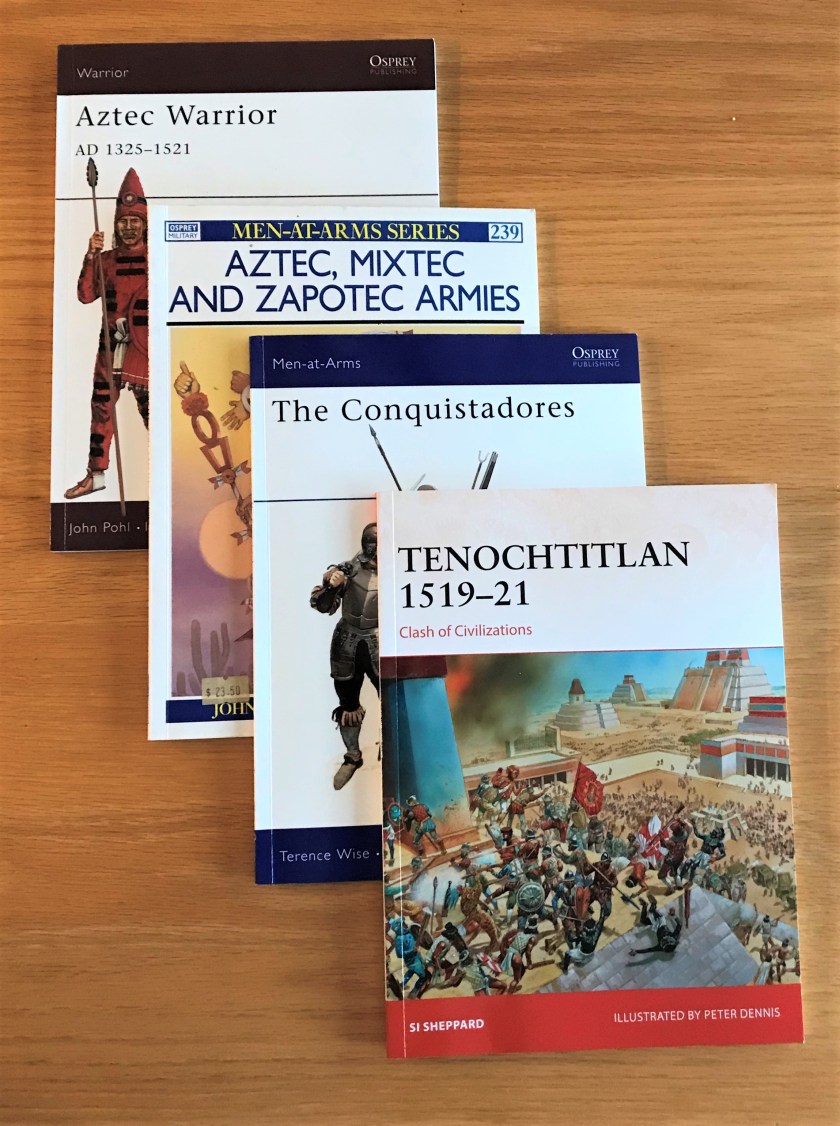
When I returned to the hobby (back six years or so ago), I bought many miniatures that I found on eBay that were from the 1970’s to 1990’s.  It was my way of catching up.  One of the groupings I bought were Aztecs, so (without a fully developed concept – or an in-depth understanding of the history of the Conquest) I volunteered to write a supplement covering the Spanish Conquest of the Americas in the 16th Century – covering the Aztecs, the Maya, the Tlaxcalans, the Mixtecs/Zapotecs, the Inca, and of course the Conquistadores.  The research (reading 4 books and other internet material) for this took me the better half of March, and writing the supplement (about 30 pages) took up the rest – so no painting in March for me.  I have finished the draft and we’ll see where that goes – but so far it looks (to my biased eyes) pretty good.

1 books
Research, research.

The resources that I found were adequate I believe – as the authors are all subject matter experts.  Besides, I just needed enough to design a gaming supplement – not pursue a doctorate.  In any case, I now can start painting forces to use with the supplement and hopefully bring to club meetings and conventions.

I started with Aztec novice warriors.  A major aspect of warfare in this period was the overriding need to take captives.  The Aztecs would place the taking of captives at a higher premium than actually killing the enemy.  Rank and prestige in the Aztec army (and Aztec society) were dependent on two things – the number and the quality of the enemy warriors one had captured.  These captured were used for ritualized sacrifice or for making into slaves.  The value of all captives was not equal – capturing a high-ranking member of a strong warrior tribe was better than a weaker one from a less-respected foe.  Aztec troops were typically composed of a group of veteran warriors and an attached group of novices.  The novices were usually (but not always) in a second rank, following the veterans.  The veterans were supposed to be responsible for the novice’s training.  In the game, I match up a group of novices to an equally-sized group of veterans (not elite units).

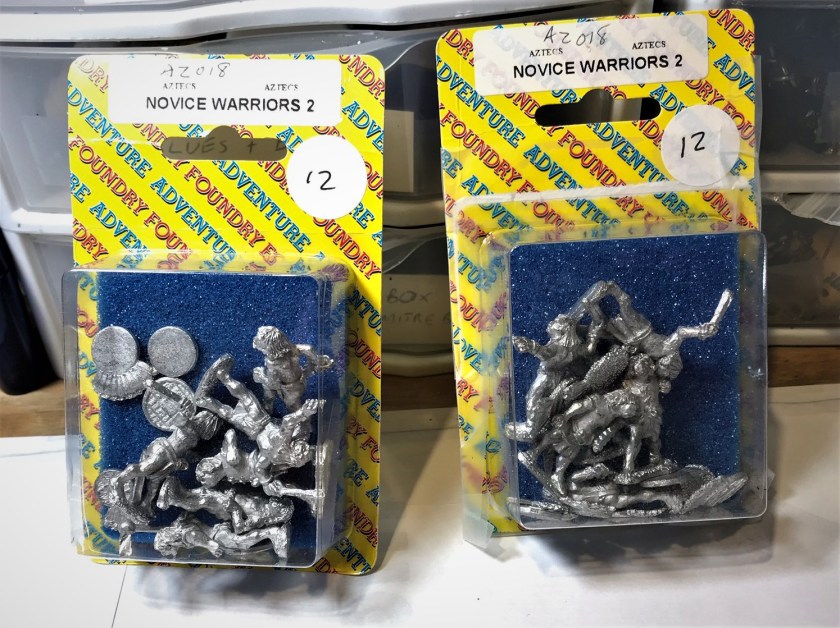
Novice warriors advance by capturing enemy warriors under the tutelage of the veterans.  The first two blisters that I had were “Aztec Novice Warriors II”  and came from Wargames Foundry.  These are available in the US from Badger Games – here is a link to them.

2 In blisters
My first two blister packs of Aztec troops.

The metal models cleaned up easily enough – but I discovered that there were a few lingering mold lines that I missed.  Still, these would be a nice way to challenge my painting skills (and add to them) as I had not painted human flesh of any type in 28mm for several years – maybe these old 1970’s era Minifig neanderthals were the last similar types that I did.  As these novices are mostly wearing only loincloths, it would be a lot of skin to paint.

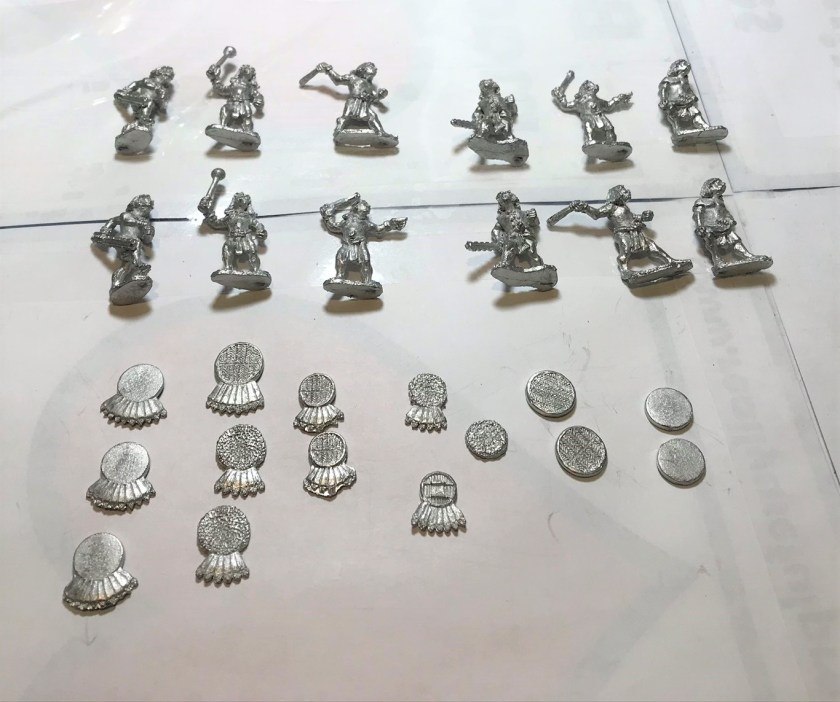
The packs also came with many shields.  Each blister pack of six contained 3 novices armed with slings, two armed with an obsidian-bladed wooden sword club called a macuahuitl (ma-kwa-wheat), and one with a a roundhead club called a cuauhololli (kwa-ho-lolly).  One of the macuahuitl figures had a quilted cotton armor tunic called an ichcahuipilli (each-ca-we-pee-lee).

As a side note – part of the research into this era was the major challenge of pronunciation and spelling for Aztec terms!

I filed and cleaned the models, and mounted them on 1″ steel fender washers for painting.  These were then mounted on specimen jars with poster tack for ease of painting.

3 each blister had these
The blister contents  – there were many more shields than I needed – as I did not think slingers should have shields.
4 prepped amd mounted for painting
Mounted for priming and painting.  I used a plastic plate to mount the shields for separate painting and later attachment to the models.
6 after base flesh
Early base coat of the flesh with Vallejo Model Color “Sunny Skin Tone”.
5 slinger with contrast paint on leg
I decided that I would try to paint a lighter flesh base coat and then use Citadel Contrast paint (in this case Citadel “Contrast Paint – Fyreslayer Flesh”) on that.  Here, I have only done one leg to show the effect.
7 after adding contrast paints
The Citadel “Contrast Paint – Fyreslayer Flesh” proved to be in need of thinning.  I painted these in order from left to right, and the ones on the far right came out way too dark and needed a redo.  By using Testors Universal Thinner with the Citadel “Contrast Paint – Fyreslayer Flesh”, I was able to get a better Aztec skin tone.
8 lightened slingers
The two slingers on the far left after the redo.
10 close up progress April 18
I tried to highlight and shade the flesh here such that from a distance the figures would look right.  I also gave each type of model a slightly different color theme on their accouterments for easier identification and better play on the tabletop.
11 start on shields
Moving on here to start painting the shields.  I had very little experience in panting tiny designs on tiny shields (as you will see).

By April 19th and 20th, I had gotten the models to where I could begin to choose which shields to use and affix.  I did this with first Gorilla glue, and then with E6000 epoxy – allowing to harden overnight.  At that point, I was able to use shading on the models and the shields – and flock the bases.

For flocking, I used Army Painter “Brown Battlefields”, followed by some pigments (see painting list below).  I then airbrushed the models with varnish, and after that dried overnight, I applied random grass patches to the bases.

17 after varnish
Finished models.

For better viewing, I will now share close up groupings of photos of each type of figure and some group shots as eye candy.

First, the slingers with cocked arms:

Next, the slingers loading their slings:

Next, the novice figures with shields and macuahuitl advancing.

Next, here are the two cuauhololli-armed novices.

The one type of figure with a macuahuitl , and a quilted cotton armor tunic called an ichcahuipilli.

The sixth type, a slinger with sling above his head:

And some group shots:

20 Blue themed warriors
The blue-themed novices
21 Red themed warriors
The red-themed novices.
22 Group shot
The twelve novices assembled.

I hope that you enjoyed seeing these figures and my processes.  I do believe that I can improve upon them and I hope to do so with subsequent projects for the Spanish Conquest – there will be several going forward.  I did want these to count for the Ann’s April 2020 “Paint the Crap You Already Own!” Painting and Hobby Challenge over at Ann’s Immaterium blog.

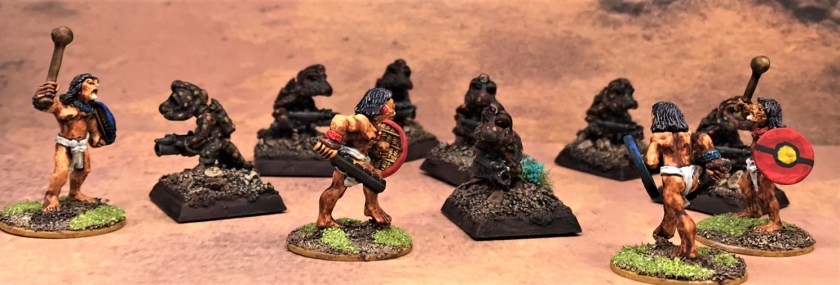
Lastly, as an add-on bonus , I also redid seven Archive Power-Armored Archive Frinx infantry that I found on eBay a while back.  I have a good number of Frinx and game with them often as shown in this blog – just search for “Frinx” on my blog and see what I mean!

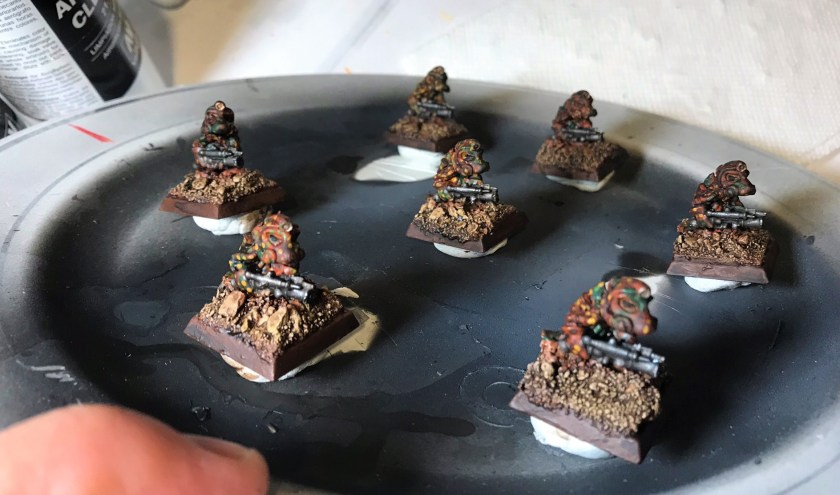
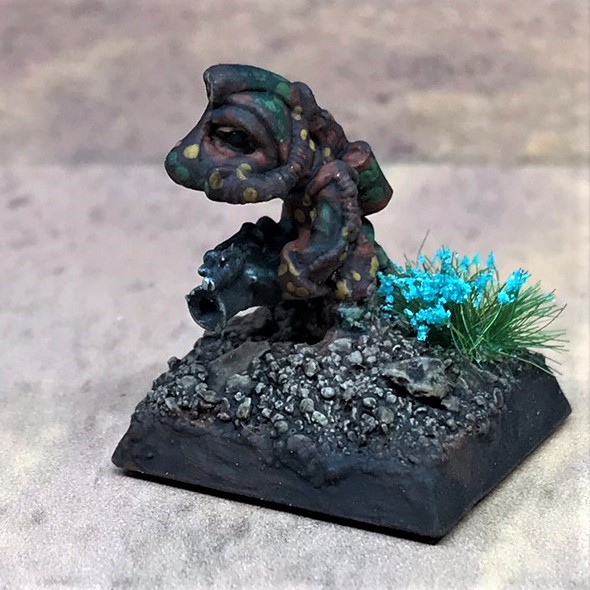
I did not paint their original colors, but they were done well-enough with a dotted camouflage scheme, very different from my other brightly-painted Frinx.  But as they were based such that I’d never get them off of the bases that they were on, I just touched up the worn-away paint, used some shading, varnished them, and improved the worn bases.  I’ll use them as commando Frinx.  For fun, here they are:

1 after wash
After varnishing.
3 Done
In the desert.
5 Frinx Leader casualty card
Close up of the leader.
4 not a fair fight
How did this happen?

That’s it for now!


PAINTS, INKS, GLAZES, SHADES, WASHES, PIGMENTS, FLOCKING, GLUES AND MORE USED ON THE AZTECS:

  1. Gorilla Glue
  2. 1/8″ x 1″ Everbilt Fender Washers
  3. Poster tack and plastic plates
  4. Vallejo “Surface Primer – White Primer”
  5. Vallejo “Flow Improver”
  6. Vallejo “Airbrush Thinner”
  7. Vallejo Model Air “Weiss” (off-white)
  8. Vallejo Model Color “Red”
  9. Vallejo Model Color “Black Grey”
  10. Vallejo Model Color “Sunny Skin Tone”
  11. Citadel “Contrast Paint – Fyreslayer Flesh”
  12. Testors “Universal Acrylic Thinner”
  13. Citadel “Contrast Paint – Basilicanum Grey”
  14. Citadel “Contrast Paint – Apothecary White”
  15. Battlefront “Dark Leather”
  16. Battlefront “Wool Brown”
  17. Citadel “Dryad Bark”
  18. Tamiya “Copper (XF-6)”
  19. Tamiya “X20A Thinner”
  20. Citadel Air “Evil Sunz Scarlet”
  21. Deka Lack “Blau” (a survivor from 1987!)
  22. Vallejo Mecha Color “Turquoise”
  23. Vallejo Model Color “Glossy Black”
  24. Citadel “Balor Brown”
  25. Elmer’s PVA Glue
  26. E6000 Epoxy
  27. Army Painter “Brown Battlefields” (flocking)
  28. Vallejo Model Air “Moon Yellow”
  29. Citadel “Seraphim Sepia” (shade)
  30. Vallejo “Dark Yellow Ochre” (pigment)
  31. Vallejo “Burnt Umber” (pigment)
  32. Americana “Desert Sand”
  33. Citadel “Agrax Earthshade” (shade)
  34. Vallejo Mecha Varnish “Matt Varnish”
  35. Army Painter “Grass Green” (flocking)

Thanks for looking – please let me know your thoughts and feedback!

Views From My Windows – Sort of…

Greetings from the Massachusetts lock down!  I hope all of you are safe and that soon life will be returning back to normal for us all.  If you have lost a loved one, a friend, or a job, or just been stressed out, my thoughts and prayers with all of you.  This will eventually pass.

I have not been doing much on the blogging front except trying to keep up with others’ posts.  At the beginning of April, the projections for death in the US were for 100,000 to 200,000 if we were lucky and did everything correctly in terms of mitigation.  Frankly, that floored me and I went into a bit of a focus on the news, keeping up with my family (Mom and daughter/granddaughter).  My Mom is on her own, and I worry about her.  My daughter lives nearby and has taken walks with our 3 year-old granddaughter so we have gotten at least to see them.  It kills us not to hug them both, but as my daughter works in a cancer radiation treatment clinic at a hospital in Worcester, we have painfully practiced “social distancing” during these brief but welcome visits.  Of course there is communication via phone and Facetime, but it’s not the same.

The death toll has been mercifully less, but still very bad.  Here in the US, as of this writing there have been over 48,000 US deaths, and approaching a million cases.  In Massachusetts the surge/peak is coming up – and we have had 42,000 cases and nearly 2,000 deaths.  I know that all of you are dealing with this and it’s horrible.  I have some strong opinions on this, but I don’t want to get too political on my blog.  My thoughts could be summarized by the article here.

My wife has been home on paid leave, but who know what will happen on this front.  I have still been looking for a job, but with millions of Americans out of work and the understandable difficulties with interviewing – I have been staying home.  I did fly to Virginia on March 9-10 for a face-to-face interview – which was an eerie experience.  By the end of the week, everything was shutting down and we were in lockdown.  And then the job did not come through.

Needless to say, tabletop wargaming is at a halt – and golf is impossible as all the courses are closed as nonessential.

I kept busy researching and working on a supplement for Buck Surdu’s upcoming game of Feudal Patrol™ – basically a new game similar to his Combat Patrol™ WWII card-based gaming system.  It will cover the pike and shot era and earlier.  My project was based on the Spanish Conquest of the 15th Century – so Aztecs, Maya, Inca, Tlaxcalans, Mixtec/Zapotecs, and of course Conquistadores.  This has been on my “bucket list” – and I will share some more of that in future posts – but it did consume a lot of time (which I had to spare).  I started painting Aztecs as well – but more on that later as well.

By the way, Buck redesigned his website – and it is an incredible free resource for unit organization and equipment for WWII.  Here is an example.

Also, besides watching the news and the business channel, I watched TV, played cards (a rummy type game) with my wife, and did the grocery and pharmacy shopping.  Thankfully I have a respirator that I use when I airbrush – so I wore that on these infrequent trips out of the house.  It reminded me of my Army days with the old M17 gas mask.

I have a treadmill, and that helps with exercise too.

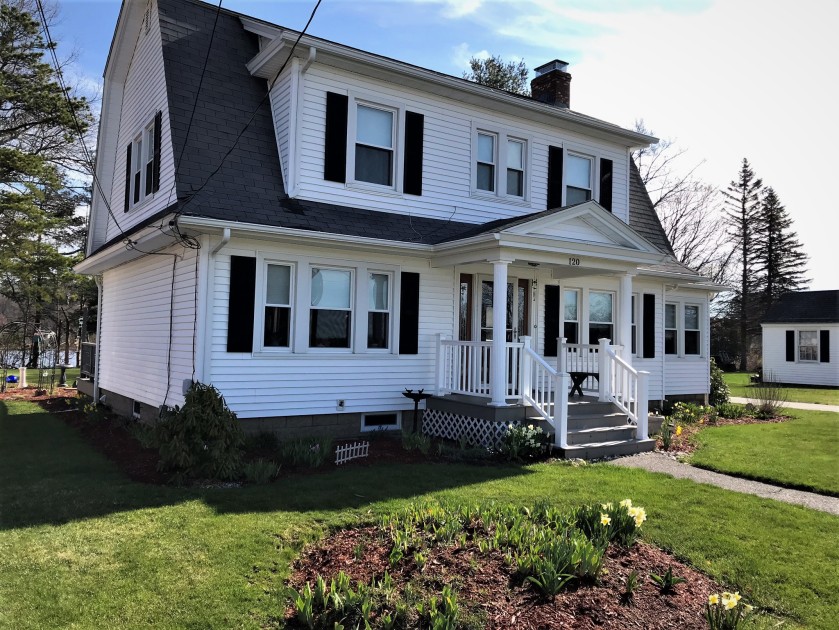
Earlier this month maenoferren22 at Bogenwald posted a challenge to share the view out the front window.  I’ve enjoyed looking at others – so I thought I’d join in.  It took a bit longer for me to get involved – as we are in early spring and it’s been cold and rainy.  So. here’s some shots of my East Brookfield, MA home from inside and outside.

View 1 looking at porch
The front of our home – daffodils are out and grass is just turning green.
View 1 porch
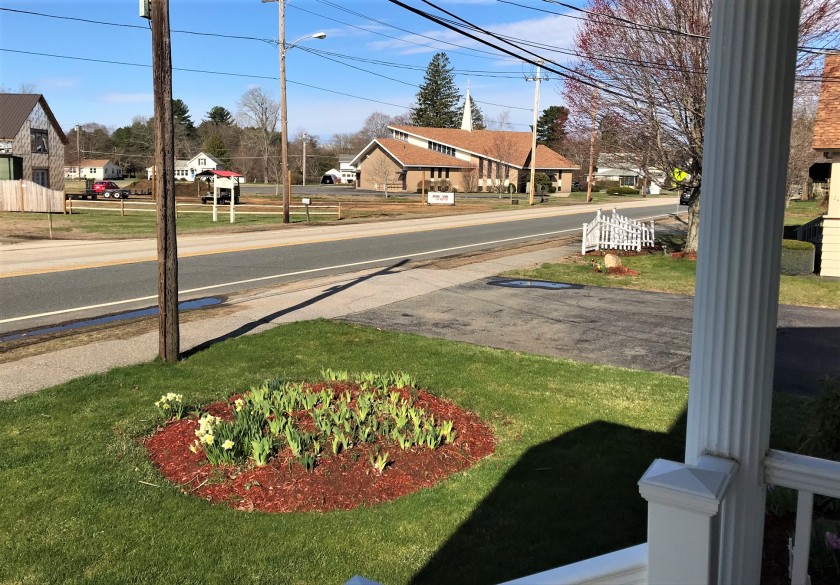
A look from the front porch towards our church across the street (St. John the Baptist).  We last were able to attend on March 15th – and since then (including Easter) – we have watched the Bishop of Worcester’s Masses on TV.
View 2 house
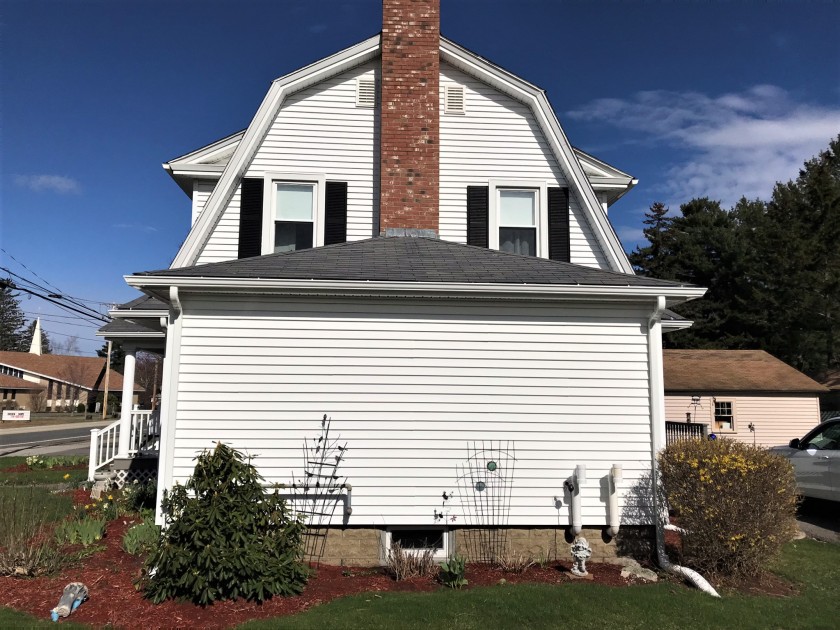
The other side of the house.  It’s a “Dutch Colonial” and probably dates to the 1930’s or 1940’s.
View 3 house
Right side of the house.
View 4 house pond
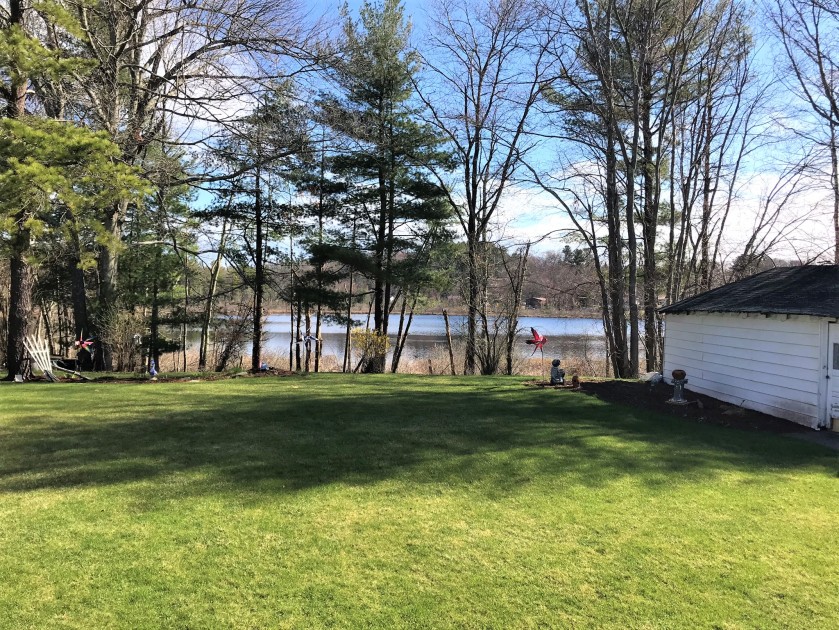
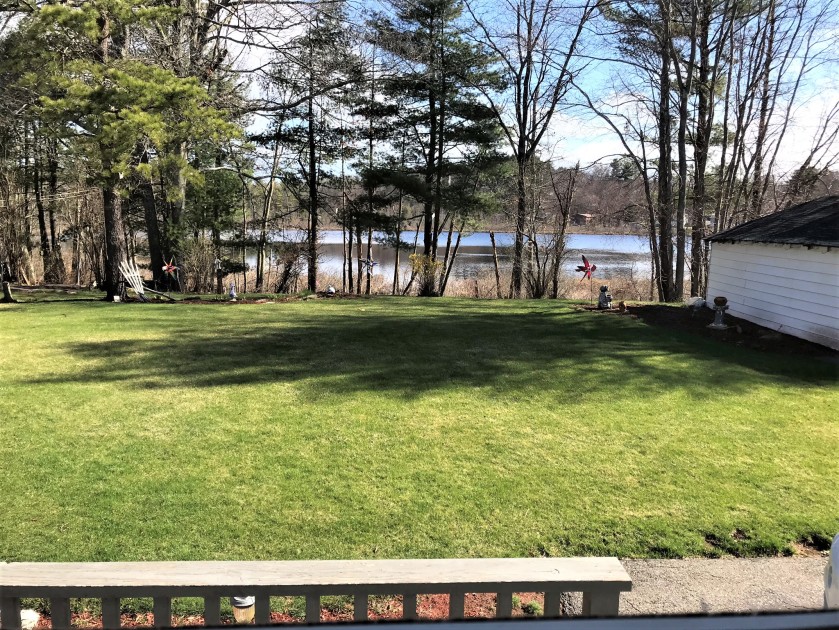
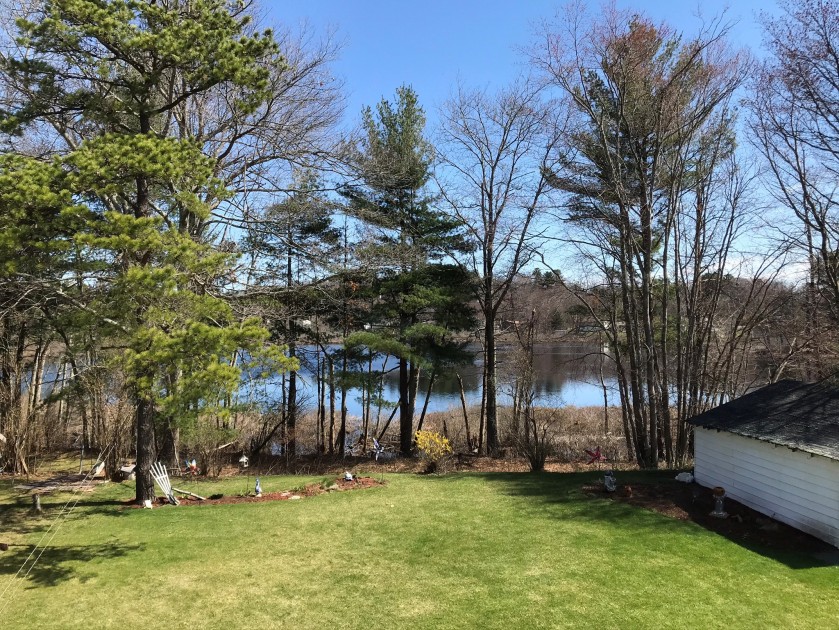
The backyard – my garage (which is not great) on the right.  The pond in the back has a nice view – and a lousy name “Mud Pond”.  There is a beaver lodge in it – and I have seen many Great Blue Herons hunting here.  I have seen a bald eagle as well, and many hawks and falcons.  There are raccoons, bobcats, snakes, turtles, and bears as well.
View 5 pond
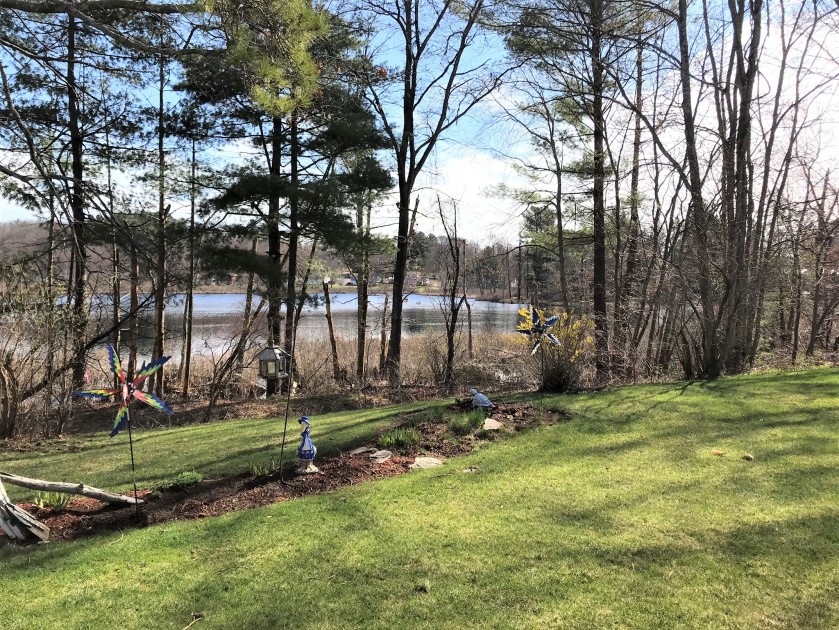
A little closer view of the yard and pond.
View 6 house
A reverse view from the pond towards the house.
View 7 porch
View from the back porch.
View 8 upstairs window
The view from the upstairs bathroom window.

That’s it.  Oh yeah, I do also listen to a couple of podcasts.  Many of you know IRO (imperialrebelork).  Along with his buddy Big Waz in Australia – he has The Fly on The Wall Podcast.  He also just started a nice hobby podcast named, Imperial Rebel Ork podcast.  I enjoy both – and TFOTW has been around a year now.  Helps to get over the pandemic a little bit.

Here is my little promotion pic, with my Australian-descended friend, Caesar (who is 26 years old now).

FOTW me and Caesar

Stay safe and more to come, I’m back!

Combat Patrol and What a Tanker games – My TotalCon 34 Recap

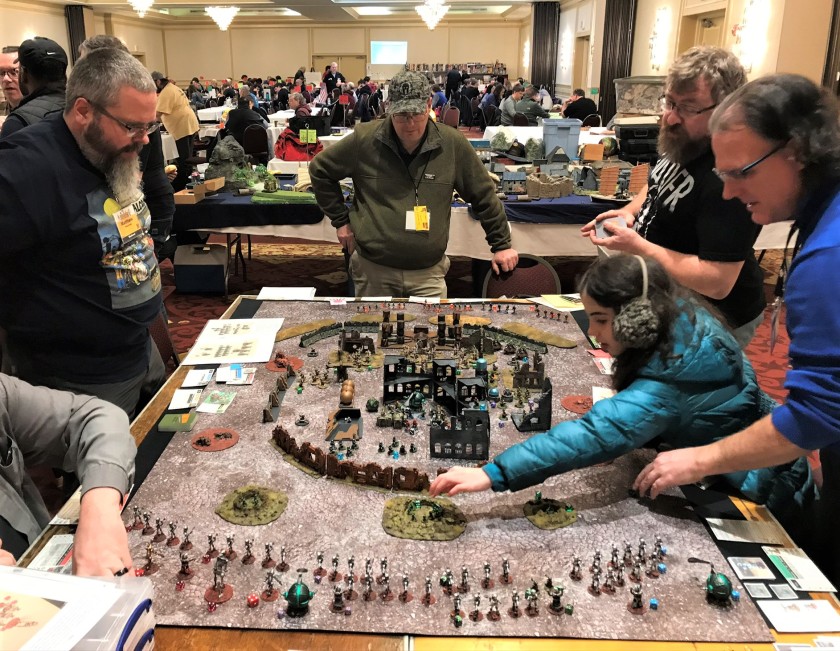
It’s been about a month since the last gaming convention I attended, and my how the world has changed.  I cannot see how a large convention could be held right now (though Cold Wars indeed happened in Pennsylvania this weekend).  There are a few upcoming gaming cons in obvious risk – and for now I think it useful to blog and paint and reflect back until this COVID-19 crisis passes (and that it will).  Best wishes for health and happiness to all my readers all over the world, from the US to Australia to the UK, All across Europe, and Africa and Asia. Now with everything at a lock down or a standstill due to the coronavirus crisis, I thought it was a good time to write a post about the games at my last convention as a distraction.

I had promised you great readers a few battle reports from TotalCon 34.  It was a very large convention with around 600 attendees.  Miniature games were a smaller offering there compared to RPG, LARP, board games – and a number of other offerings with which I was unfamiliar!

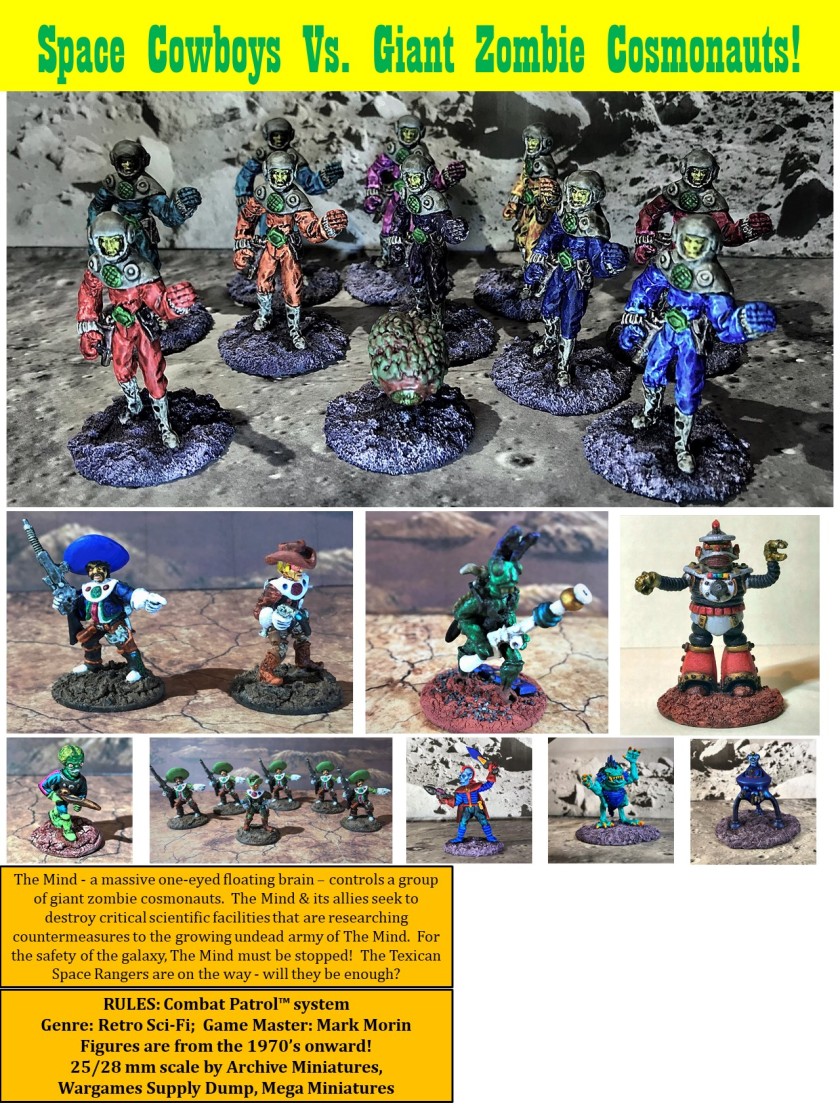
The convention was held from February 20-23, 2020 at the Best Western Conference Center in Marlborough, MA.  I had signed up to run four games – two on Friday and two on Saturday.  Two were Combat Patrol™ retro sci-fi games – “Space Cowboys versus Giant Zombie Cosmonauts” and “Attack of the Warbots” with my mostly OOP collections from Archive Miniatures, Mega Miniatures, War Games Supply Dump (and my own creations).  The other two were scenarios for What a Tanker© that I have created and discussed previously in this blog: “Battle of France May-June 1940” and “Normandy Breakout!“.

Running four different games in two days was a challenge (my vehicle was full of mats, terrain, and miniatures) but I pulled it off well enough I believe.  I’ll share some photos and some descriptions of the action.  I think the players had a good time.  This post will be pretty photo-heavy.

The first game I ran was on Friday was “Space Cowboys versus Giant Zombie Cosmonauts“.  I had four players (though I could have accommodated 9).  It turned out that I had two seasoned gamers on the defending Space Cowboys side and two younger players on the attacking Giant Zombie Cosmonaut/Martian/Retrovian side.

02212020 TOTALCON Space Cowboys versus Giant Zombie Cosmonauts
My flyer for this game – the space on the right is for business cards to share information about my gaming club –  the Mass Pikemen Gaming Club.
1 set up from defenders side
View from the defenders’ side.  They must save the chemical plant from destruction or kill The Mind.
2 set up from attackers side
View from the attackers’ side.  They must destroy the chemical plant in 10 turns or less.
1 SC vs GZC setup
The game set up at TotalCon 34.
2 SC vs GZC setup
Retrovians prepare to attack.
3 SC vs GZC setup
Close up of the chemical plant before the defenders deployed.  I allow the defenders to deploy by any barrier or the chemical plant.
4 Retrovians attack
The attackers ponder their next move.  The defenders moved and took up good defensive positions in and overlooking the wadi.
5 SC take casualties
On the attackers’ left flank, Retrovian fire begins to take its toll on the defending Space Cowboys (aka Texican Space Rangers).
6 Martians take casualties in wadi
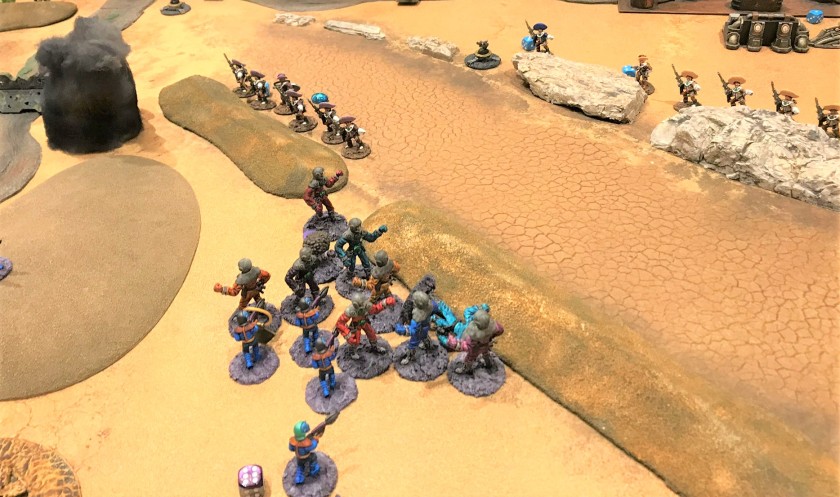
On the other side of the table, Martian infantry attempt to charge across the wadi.  Effective rifle fire decimates the Martians in the open.  The stack of cards on the right indicates a pile of Martian KIA that ran into a hail of cowboy lead.
7 GCZ take casualties and move towards wadi
The Mind and its Giant Zombie Cosmonauts get close to the wadi, while Retrovians provide supporting fire.
8 SC squad runs away
The Retrovian fire is too much for one squad of Space Cowboys, which fails a morale check and skedaddles for cover.
9 Robo servo gun and Brasheer knocked out
Carnage ensues.  A Robo-Servo gun is destroyed (black smoke), while another gun destroys a Retrovian three-legged assault pod.  The fleeing Space Cowboy squad from the previous shot is in the upper left.  The Mind is breaking through in the top center, but many of its zombies have taken hits to legs and are falling away from the advance.
10 Brain is killed
As the protecting zombies fall away, the platoon sergeant, Armando Garcia, jet packs next to The Mind in a desperate attack.  The Mind had a 60% chance to react to the move and preemptively fry the Space Cowboy, but failed in the attempt.  SFC Garcia fired his assault rifle and killed The Mind, ending the game.

The game was a blast.  The defenders took up good positions but the attackers’ pressure was building to a decisive point.  Unfortunately, The Mind became vulnerable and the defenders’ gambit worked this time.  The players quickly got used to the Combat Patrol™ system.

The next game was later that night, when I ran “Attack of the Warbots”.  I have run this game several times, and it always is a crowd pleaser.

02212020 TOTALCON Attack of the Warbots
My flyer for the game.

I had about 8 players for the game.  The attacking Warbots made good progress initially in breaching the wall.  However, the defenders jet-packed their bazooka-armed Star Ducks onto unprotected rooftops – and got pretty shot up.

1 Attack of the Warbots set up
The Biological Alliance is in an “Alamo” type of a defense, with a massive force of Warbots attacking from this side, and an allied Martian force (yup they showed up in this game too) from the opposite side.
2 wall is pierced
The Warbot on the far right uses a plasma beam breacher (basically a long disintegrator ray) to piece the defenders rusty wall.  This kicks up a lot of smoke from the vaporized material.  The Warbot that did this uses a lot of energy in the effort and is stunned for three turns while recharging (hence the multiple “stun” placards).
3 targets on the roof
More Warbot destruction ensues as they fire another plasma beam breacher through the Aphid position in the center.
4 Mark 1 Sphere tank stunned by attacking Frinx
Frinx cavalry (on glyptodons) armed with anti-robot arc weapons and blasters charge!  They manage to stop a Mark 1 Sphere tank with a non-penetrating hit that stuns it at the walls edge.
5 The other Mark 1 Sphere tank attempts to flank
On the left Warbot flank, a defending Space Roo player checks to see if his RPG-armed Space Roo can engage the other Warbot Mark 1 Sphere tank.  It could, and at extreme range knocked out the other Warbot tank.
5a end of game
The end of the game found the captured Warbot tank repaired and capable of driving off of the board.  Therefore, a Biological Alliance victory!
6 After Battle
Happy gamers (and me) after the game are all smiles!

After this game, (which was around 11:00 PM+), I and some of the players cleaned this all up.  As my next game was in the morning at 8 AM, I set up my Normandy Breakout! scenario for What a Tanker©!  I have a lot of  bocage (hedgerows) for this game as you will see.  I got set up, and ambled off to my hotel room for a few hours of shut-eye.

02222020 TOTALCON Normandy Breakout!
My flyer for the game.

This scenario is as described on the flyer above, but to be clear, the Germans are in hidden positions across the board known only to them and the GM (me).  Additionally, the exact force composition selections on both sides are done secretly, as each side buys vehicles and Bonus Attack cards with points.  Each side starts with 200 points.

Points are earned by the Allies (US and UK) for successfully reconnoitering hidden positions (which could have either possible or actual Germans there), for knocking out Germans, and for crossing the board and breaking out.  Germans earn points for unreconnoitered positions, knocking out Allied vehicles, and can get a game bonus for limiting Allied crossings to zero or no more than 1 vehicle.  The Germans vehicles are more expensive, so their defensive benefits need to be offset by successful ambushes and an overall defense against any Allied breakout.  I announce only who is winning at the beginning of each turn, but not the exact score – so as to keep the game feeling crew-focused.

I had between 4 and 6 players (some joined mid-game).  The Germans went initially with two 8-wheeled scout cars (an Sd.Kfz. 231 and an Sd.Kfz. 233, a Panther D, and a Tiger I, all of which deployed secretly.  They loaded up on Bonus Attack cards as well.

The US deployed on the left half of the board, and the UK/commonwealth on the right half.  The US chose an M5 Stuart light tank (with recon abilities) and an M10 Wolverine tank destroyer to start, while the Brits took a Daimler Dingo scout car and an M4 Sherman.  The Allies also maxed out their Bonus Attack cards possibilities.

1 Dingo and Achilles move out
The Americans move up their M10 Wolverine “Demon”, while behind a British Daimler Dingo recons a field.

On turn 1, the Allies spent 71 points on vehicles and cards.  They successfully reconned 5 positions at 2 points each for 10 points, leaving them with 139 points at the end of the turn.  The Germans spent 88 points on vehicles and cards.  The German Tiger I ambushed and knocked out the British M4 Sherman for 14 points.  At the end of turn 1, it was close – 139 to 126 in favor of the Allies.

On turn 2, the Allies respawned another British M4 Sherman for the destroyed one, and bought 1 more Bonus Attack card.  This new vehicle was at no cost as the replacement cost as much as the previous loss (the Germans did get more points for killing that previous Sherman on turn 1).  The M10 Wolverine rolled a great movement, and was able to breakout successfully, gaining the Allies 16 points and taking away half of any potential German end-of-game bonus for preventing Allied vehicle crossings.  On turn 1, the US M5 Stuart had been able to move into a field and successfully recon a position where an Sd.Kfz. 231 was hiding.  On turn 2, the Stuart activated first, and destroyed the German scout car, gaining 11 more points for the kill. The Germans for their part bought two more Bonus Attack cards for 10 points.  Overall, the Germans had a weak turn, and only recovered 2 points by activating their Sd.Kfz. 233 before the US could find it.  The successful M10 “Demon” crossing widened the score at the end of turn 2 to 161-118 in favor of the Allies.

2 Sd.Kfz. 231 is pursued by M5 Stuart with Brit M4 Sherman burning
At the end of turn 1, the M5 Stuart chased down a German Sd.Kfz. 231 in a field.  The M5 activated first in turn 2, and destroyed the German scout car.

On turn 3, the Germans knew that they were losing, but not by how much.  They made a bold move and chose an expensive new tank for a respawn of their lost Sd.Kfz. 231 – a Tiger II.  The net cost was 18 points after “credit” for the “trade-in” in lieu of a free respawn of another Sd.Kfz. 231.  Adding another Bonus Attack card brought the German spend for turn 3 to 23 points.  The US player got a free respawning replacement M10 for the one that crossed on turn 2, so the Allies spent no points at all on turn 3.  They did earn 6 points for reconning German positions.  The Germans got a bit of revenge as a Panther activated and took out the M5 that killed the Stuart for 12 points, and the Tiger I moved to a crossroads and took out a second British Sherman for 14 points.  The score at the end of turn 3 was 167-123 in favor of the Allies.

3 early game action with Tiger etc.

Turn 3 action – the destroyed the German scout car is the left.  The Tiger I has moved to an excellent position at the crossroads and has knocked out the second Brit Sherman.  The Panther (not seen ) was hiding at position “F”, and activated.

4 Panther avenges Sd.Kfz.231 by taking out Stuart
The M5 Stuart was no match for the activated Panther.

On turn 4, the Allies decided to get three more vehicles.  Two were respawning ones for turn 3 losses – the US got a “free” M5 to replace the one killed in turn 3, and the Brits “upgraded” its second lost M4 Sherman to an M10 Achilles tank destroyer “Tabitha”.  They also bought another M4 Sherman for a new very young player that joined the game, and a couple of Bonus Attack cards.  The Allied spend was 24 points.  The Germans only bought 1 card, for 5 points.

During turn 4, the Daimler Dingo had a fun time.  It successfully reconned the hidden position of the Tiger II!  Then, scared for its survival, it and its crew sped off down the road to cross the other side  – gaining 7 points for crossing and thereby nullifying any potential German end-of-game bonus.

The Brit side then flanked the Tiger I at the crossroads with the M10 Achilles “Tabitha”.  It took a quick flank shot on the German, and did some damage.  It then called in the RAF (with a Bonus Attack card) which destroyed the Tiger I for a big 25 points.  The Allies successes widened the score at the end of turn 3 to 177-118 in their favor.

5 Dingo finds Tiger II
Surprise!  Daimler Dingo finds a Tiger II and takes off before it can be destroyed.
6 Young player and his Dad use a SHerman
A young player takes command of a Sherman for the US.
7 lots of action and Tiger I hit by USAAF
The Tiger I is destroyed in the crossroads by the RAF.

Turn 5 would be the last turn of the game.  The Allies respawned another Daimler Dingo for the one that crossed in turn 4, and bought a couple more Bonus attack cards, spending only 10 points.  The Germans were despondent, and decided to buy a Jagdpanther and a Bonus Attack card for 29 points.

The M10 Achilles “Tabitha” fresh off the combined arms kill of the Tiger I maneuvered for a rear shot on the Panther – and killed it for 22 points.  The Germans tried to hunt down a fleeing M5 Stuart.  It lined up a deadly point-blank rear shot on the Stuart – only to miss the shot.  It was emblematic of the German sides day.  After another position was reconned, the day belonged to the Allies.  The final score was a lopsided 191-89 in favor of the Allies.

This was the biggest disparity in this game ever (and I have run it many times).  In my opinion, the Germans did not keep their eyes on the objectives.  They also did not effectively take advantage of their ambush positions, and left too many openings for the Allies, who maneuvered their lesser vehicles much better than their foes.  With that said, all had a fun game.

8 Jagdpanther hunts M5 Stuart
Turn 5 – the M5 Stuart is missed by the Jadgpanther.

With some help from players, the tabletop was cleaned and it was time to take a break.  I could have played a game but I decided to spend the next game slot relaxing as I felt a but tired.

My next game was on Saturday night – “The Battle of France, May-June 1940” for What a Tanker©.  The scenario reverses the previous game a bit, with the Germans attempting to break through the French defenses and head to the channel and cut off the Allied forces in Belgium.  There are also two different Bonus Attack card decks that I made for this scenario.  I described this scenario in my blog previously here.

02222020 TOTALCON Battle of France 1940
My flyer for the game.

I had originally 10 players signed up for this game, with 2 on a waiting list.  I was disappointed that I only had 5 players show up – but it was fine.  I had two German players and three French players.

Each side had 200 points at the start.  Here again, the exact force composition selections on both sides are done secretly, as each side buys vehicles and Bonus Attack cards with points.  Points here are earned by the Germans for successfully reconnoitering hidden positions (which could have either possible or actual French located there), for knocking out French vehicles, and for crossing the board and breaking out.  The French earn points for unreconnoitered positions, knocking out German vehicles, and can get a point bonus for limiting German crossings to zero or no more than 1 vehicle.  Similar to the Normandy Breakout! game, I announce only who is winning at the beginning of each turn, but not the exact score.  This definitely keeps the game feeling crew-focused.

There are a couple more key additional nuances to this scenario.  There are two bridges, and the French player can spend points to wire one, both or neither bridge for demolition.  Any French attempts at demolition may be tried at any time, but are not guaranteed.  They also get a “free” small minefield (that is not very effective) that is also secretly set at the beginning of the game.  The French decided to wire the bridge on their right flank for demolition prior to the game, leaving the one on their left with the small minefield next to it.  During the game (which I will discuss), the French did blow the bridge on the right, and were able to fool the Germans into believing that the other was wired as well.  This rendered the minefield a non-factor in the game, but made the Germans attempt to ford the river.

The Germans decided to buy 2 6-wheeled Sd.Kfz. 231’s and a Panzer 38(t) on turn 1.  They also maxed out on Bonus Attack cards for a total of 50 points spent.  The French deployed in hidden positions (half the tabletop is designated as under the control of French cavalry tanks, and the other half (mainly the town area) is under the control of French infantry tanks.  The French bought a Panhard 178 armored car, a Char B1 bis, and a SOMUA S35.  Their initial purchases all had radios (some French tanks do not), so they were able to max out their Bonus Attack cards.  The total initial French spend was 71 points, including the wiring of the right flank bridge.

During turn 1, the Germans drove one of their scout cars onto the right flank bridge, and the French successfully destroyed the bridge with the German on it, gaining 11 points.  This also spooked the Germans to avoid the bridge as they feared it was also wired (and it was not!).  After this the Germans were forced to use fords to attempt crossing the river.  The Germans did successfully recon one possible hidden position for 2 points.  The score at the end of turn 1 was 152-140 in favor of the Germans.

On turn 2, the Germans respawned a Panzer IVD for the lost Sd.Kfz. 231 at no net point cost.  They also reconned a couple of French potential positions for 4 more points.  The French bought an additional SOMUA S35 for the cavalry for 10 points, and uncovered three of their own positions in order to meet a table-crossing threat from the surviving Sd.Kfz. 231 and a Panzer 38(t).  This gained them 6 points.  The Panzer 38(t) is a fast light tank, and was able to ford the river, along with the other scout car.  The French recognized this threat, and attempted to deal with it by activating its vehicles in the town.   The Germans used a Bonus Attack card to bring down smoke and obscure their movements.  The score at the end of turn 2 was 156-136 in favor of the Germans.

1 Sd.Kfz. 231 and Panzer 38(t) skirt the town
The Panzer 38(t) on the left and the Sd.Kfz. 231 (6-rad) on the right successfully ford the river, fearing that the bridge was wired for demolition (it wasn’t).  They get ready to dash off the table into the vulnerable French rear.
2 Germans plan their assaults and roll dice
The Germans get some excellent movement rolls.
3 Char B1bis moves out in town
The French react and send tanks such as their Char B1 bis to stop the penetration by the Germans.
4 German smoke screen blocks Char B1
The Germans foil the Char B1 with a smoke screen.

On turn 3, the French hurriedly bought a Renault R40 for 8 points and tried to use it to stop the crossings.  The French also bought more Bonus Attack cards for 15 points.  The Germans bought nothing.  During the turn, the Germans successfully crossed the Panzer 38(t).  This despite the fact that at first the Char B1 crossed the smoke and missed it, and then the R40 shot at and missed it.  This crossing earned the Germans 8 points, and limited the French end-of-game bonus chances.

On the cavalry side of the table, the Germans tried another smoke screen to protect a Panzer IVD as it crossed a ford.  one of the smoke rounds hit the river mud and did not ignite – leaving a hole in the smoke screen.  The French cavalry S35 did manage to shoot and damage the Panzer IVD on the other side, just after it forded the river.  This pushed it back into the river.  The French SOMUA then called in and then destroyed it with an artillery barrage using a Bonus Attack card, earning 8 points as well (and blocking that ford).  The Germans also reconned another of the hidden positions for 2 points.  However, the Sd.Kfz. 231 made it to within 1″ of the other side of the table – and the R40 had a rear shot aimed at it at turn’s end.  The score at the end of turn 3 was 166-124 in favor of the Germans.

5 Sd.Kfz. 231 escapes R40 and Panzer 38(t) sees Char B1
The Char B1 crosses the smoke and takes aim at the Panzer 38(t) – and misses.  An R40 activated and missed the Panzer 38(t) as well.  The Panzer 38(t) then rolled well and was able to cross the table.  The German Sd.Kfz. 231 almost made it off of the table and was in the R40’s sights as turn 3 ended.
6 On other flank, bridge blows and fords attempted
The German smoke screen imperfectly covers the Panzer IVD after it fords the river…
7 Panzer IV knocked into ford and knocked out
The Panzer IVD is pushed back into the ford and destroyed by artillery and SOMUA fire.  This blocks the ford (to the consternation of the following Panzer 38(t)!).

On turn 4, the Germans respawned the crossing Panzer 38(t) and the destroyed Panzer IVD for identical models, and added a Bonus Attack card for a total spend of only 5 points.  The French bought 3 Bonus Attack cards in the hope of stopping the German scout car from crossing.  The R40 activated first, and then missed the Sd.Kfz. 231.  The German scout then crossed, ending any chance of a game bonus for the French and earning 11 points for the Germans.  The score at the end of turn 4 was 172-109 in favor of the Germans.

I failed to get any more photos after turn 4 (I think I was getting tired!)

On turns 5 and 6, the French were getting desperate as they knew they had lost the game bonus.  They bought an Hotchkiss H35, and a SOMUA S35 took out another Panzer IVD.  The Germans bought a StuG III ausf. A.  Both bought more Bonus Attack cards.  The Luftwaffe was called in on the Char B1 bis and successfully destroyed it.  That loss ended the game.  The score at the end of the game was 159-89 in favor of the Germans.

Both sides played well, bu I have to say the dice abandoned the French at critical times.  The Germans crossings sealed the fate of the game.  It’s nice to see that both games results have differed each time and that no side has an advantage.

After this, I packed up with help (especially from Leif Magnuson – who was a BIG HELP THANK YOU!), and went home to sleep.

I hope you enjoyed these battle reports.  Now that the COVID-19 is endangering lives, we’ll have to see if and when I get to run these games again soon.  Let’s all hope for the best, and prepare accordingly.

Wishing all of you and your families safety and health!


Battle of France 1940 at Mass Pikemen

The Mass Pikemen played an action-packed game at our February gaming session.  The game was a What a Tanker© game for my Battle of France, May-June 1940 scenario.  This also served as a final play test of the scenario before using it at upcoming gaming conventions (TotalCon 34, HAVOC, and HUZZAH!).

At the start of the game, each side gets 200 points to buy tanks and armored cars as well as Bonus Attack cards if the vehicle has a radio (all the Germans have radios, many French vehicles do not).  The French are defending and have the ability to deploy at secret positions known only to their side and the GM.  The French forces are divided – with half of the battlefield being under the responsibility of cavalry tanks, and half under infantry tanks.

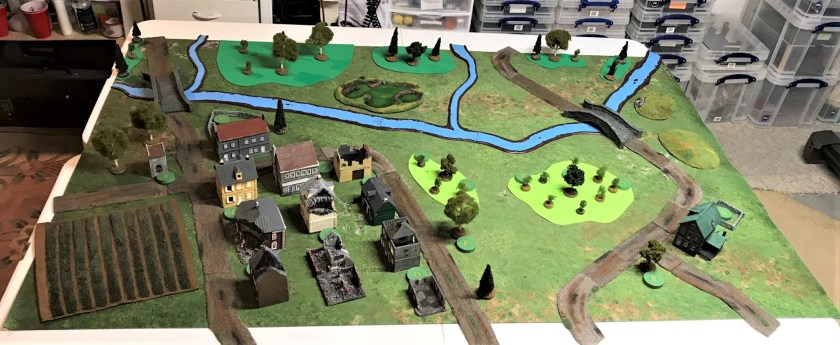
The Germans are exiting wooded areas on two congested roads heading to two bridges over a river.  The German mission is to cross the board and exit the other side (and head to the English Channel) – and gain points for doing so.  There are also several possible fords over the river that are minor obstacles.

The French player may also spend points to wire either one or both bridges (or none) for demolition.  This status is also known only to the French side and the GM.  The French side may attempt to blow a bridge at any time, but failing to blow the bridge or allowing any Germans to cross makes subsequent demolition attempts more difficult.  If a bridge is blown while a vehicle is on it, that vehicle is destroyed.  Any side that destroys a vehicle gets points for that action as well.  As GM, I only announce who is ahead at the beginning of the turn, and I do not share the score so as to maintain a fog of war for the players and try to maintain a crew-focused battle.

1 Battle of France set up
Overview of the battlefield from the French side.  The French deploy infantry tanks left of the second road on the left, and cavalry tanks on the right of that road. 
2 Battle of France set up town
Detail of the town where most of the hidden positions are for the infantry tanks.  Both infantry and cavalry had access to Panhard 178’s and H35’s.
3 Battle of France French cav side
The right (French cavalry) side showing the river and the bridges.  The rocks in the river were designated as fords.
4 Battle of France Mike rolls dice
The German players deploy.
5 Battle of France Panzer 35(t) knocked out
From a hidden position, a Panhard 178 calls for anti-tank support.  Using a 47 mm anti-tank support card from the Bonus Attack cards, a Panzer 35(t) is torched before getting to a bridge, while a wary Panzer IVB watches.
6 Battle of France Panzer IVB on blown bridge knocked out
A German Sd.Kfz. (6-rad) recon car crosses the bridge without incident.  Feeling safe, the Panzer IVB tries to cross.  The French had waited for a bigger target, and successfully blew the bridge with the Panzer IVB on it – destroying the Panzer IVB.  In the rear, another Panzer 35(t) observes multiple burning comrades.
7 Battle of France Sd.Kfz. 231 knocked out by SOMUA
The Sd.Kfz. 231 (6-rad) recons around a building and finds a SOMUA S35.  The SOMUA easily kills the German scout car, but not before taking some damage from Bonus Attack card artillery.
8 Battle of France river forded by Pzjager I and 38(t)
The battle heats up.  The surviving Panzer 35(t) fords the river as does a Panzerjager I with another Panzer IVB behind them.  The French activate the hidden Panhard, and the SOMUA S35 takes some more minor damage.
9 Battle of France SOMUA finally taken out by 88
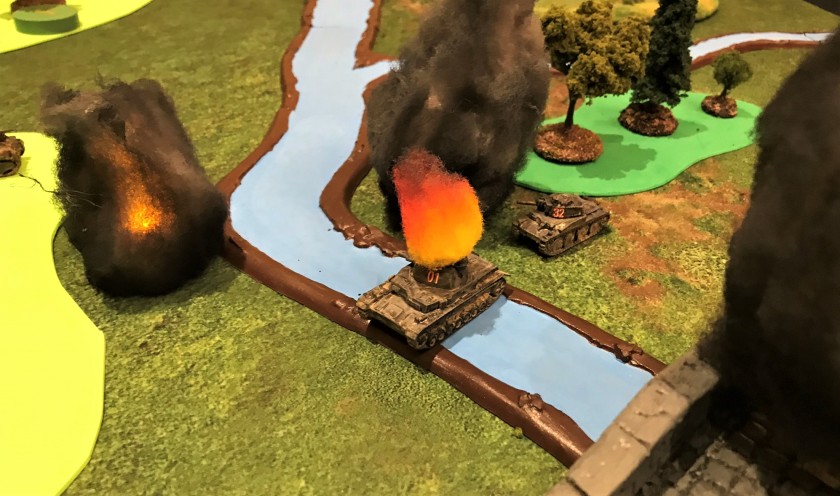
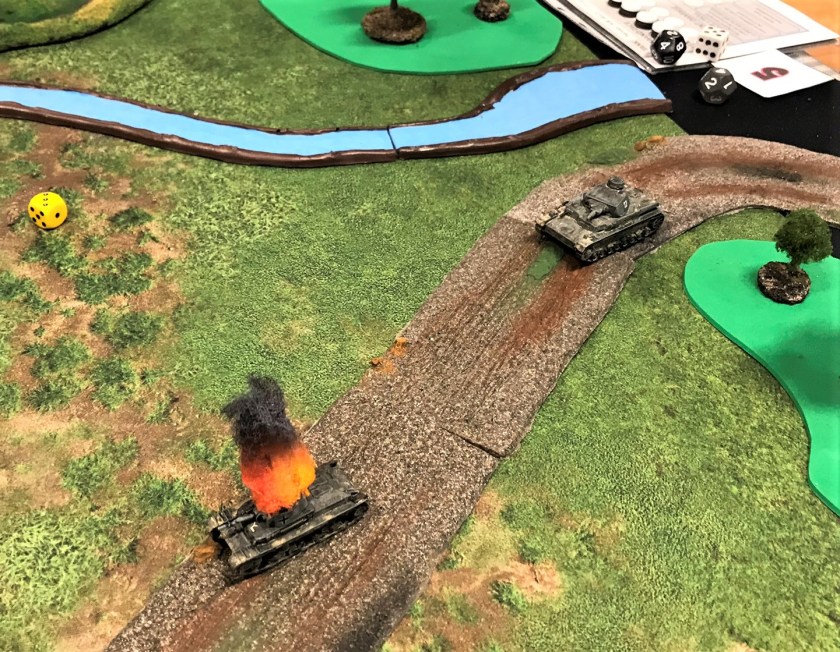
The SOMUA S35 is hit by 88 fire and finally taken down by accumulated damage.  The black smoke indicates that the tank is knocked out, but the crew survived.  I use orange smoke to indicate that both crew and tank are destroyed.  
10 Battle of France Panhard dispatches 38(t)
Having taken damage from the SOMUA, the last Panzer 35(t) is knocked out by a daring attack by the charging Panhard 178.

At this point the game ended, and the French had a solid victory with the score being 158-112.  The French also got bonus points for no German being able to traverse the board.  The Germans made a couple of unsuccessful Luftwaffe attacks which hindered them as well as the early casualties.The scenario is pretty solid and the gamers made key decisions that affected the game.  I did run this scenario and three other games at TotalCon 34.  I will share the results of what happened at TotalCon 34 on a future post and things went differently!.

Thanks for looking!

German Armor for the 80th Anniversary of the Battle of France: Panzer 35(t), Panzer 38(t), Panzer IVB, and Panzer IVD Tanks; and Sd.Kfz. 231 (6-rad) Armored Cars

This post marks the last of my vehicle additions for the 80th Anniversary of the Battle of France in May-June 1940.  These German vehicles were completed in late January, but with my personal situation, naturally my posting and hobby activities were put on hold.  Time has passed now and I want to return to a certain degree of normalcy – of course that’s not the easiest thing to do.  But I’ll try – and now let’s catch up and get back to good old hobby stuff.

As readers of this blog know, I had needed to augment the depth and breadth of my 15 mm/1:100 scale armor (both sides) for my What a Tanker© Battle of France 1940 scenario.  I also wanted to develop some Bonus Attack cards for it as well (similar to what I did with my Normandy Breakout! scenario).  I had promised to get these projects covered on the blog and share some about games that I have run for them (at club days and the TotalCon convention).  Here, I will focus here uniquely on these German vehicles and the Bonus Attack Cards and post about the gaming events separately.

Below is my poster for the game that I use at convention-style events.

02222020 TOTALCON Battle of France 1940

Previously, I had posted and described several projects in support of building this scenario – here they are for reference:

Basically, prior to this project I had only 11 German vehicles for the scenario, and the mix was a bit unbalanced to say the least.  I had 4 Panzer IIC’s, 1 Panzer IIIE, 1 Panzerjäger I, 2 Panzer IVD’s, and 3 Sturmgeschutz A’s.  Now that I have 23 French vehicles, I needed to increase the size of the available German vehicles for the scenario.

Back in May-June 1940, Panzer I’s and Panzer II’s did form a large proportion of the German armored forces in May-June 1940.  As Panzer I’s have only machine guns, which are somewhat useless in a tank-on-tank game).  As I have 4 Panzer IIC’s in the inventory, I decided to augment the light tanks with Panzer 35(t)’s and Panzer 38(t)’s.  These were originally built for the Czechoslovakian Army, and the Wehrmacht happily incorporated these vehicles into their units – and continued building the both after the annexation.  I got two metal Panzer 35(t) models (#GFV28) from QRF in the UK, and two metal and resin Panzer 38(t) models (#GE022) from Battlefront.  Perhaps later on I might add a Panzer I, we’ll see.

For the medium tanks, I “assigned” (for game purposes) my two currently-painted Wargame Models in Ohio Panzer IVD’s into ausf A versions – and added B and D variants of the venerable Panzer IV with Zvezda models (SKU #ZD35 or #6151 for each box) from The Plastic Soldier Company.  PSC has a reasonable deal for a platoon of 5 so I grabbed those.  I already have one Panzer IIIE model for France 1940, and decided that was enough of those (for now anyways).

Lastly, similar to what I did with the French Panhard 178’s , I added 2 Sd.Kfz. 231 (6-rad) armored cars (#GE320) from Battlefront.  I know that the 8-wheeled versions were available and used in May 1940.  However, at the time the 6-wheel 231’s were being phased out in favor of the 8-wheeled versions – and I thought having the older ones would give a better feel to the scenario.  By building these models and converting the ones mentioned, I now have 23 vehicles available for both sides to choose.  I will go through a bit of a WIP with each type – as I did experiment a bit with contrast paints on them – to a bit of frustration which I will share.  I’ll also show the Bonus Attack Cards, some eye-candy shots, references, and list of paints for those interested.

General Assembly

The QRF Panzer 35(t) models were all metal, the Battlefront Panzer 38(t) and Sd.Kfz. 231 (6-rad) models were metal and resin, and the Zvezda Panzer IV’s were plastic.  I cleaned and prepped them all prior to assembly and painting, to include magnetizing the turrets.  Some green stuff reinforcement and repair was needed.  My overall goal was to have vehicles that were more grey and less dark than my previous German vehicles for 1940.  The dark colors were also historically correct – I just wanted a bit more variety in the collection that was also historically correct.

1 German armor for 1940 part two
The 11 models for this project in their packaging.
3 Czech armor assembled
The Panzer 38(t) models and the Panzer 35(t) models assembled.
7 All assembled for painting
All of the 11 models are here assembled.
8 All mounted for painting
I always prime and base coat the tank bottoms first – they are affixed to small plastic plates with poster tack.

The painting process was a bit different for me this time.  I basically did this sequence with all 11 vehicles.  I wanted to test out the contrast paints, so I decided to try the “Space Wolves Grey” contrast paint over Vallejo “German Panzer Grey” primer – and the chassis were nearly purple.

2 Panzer 35(t) with Space Wolves Grey contrast paint
My Panzer 35(t)  model looking a bit too purple for my tastes.

I then went back and dry brushed them with Vallejo “White” primer, then used “Apothecary White” contrast paint and dry brushed with a few more grays and added some shading (see the list at the end of this post).

3 Panzer 35(t) turrets after Apothecary White contrast paint
After redoing with a dry brush of white, added “Apothecary White” as seen with these turrets.ion
4 Panzer 35(t) completed turrets
I shaded these, and more dry brushing, followed by decals.  Here are some turrets looking better!
2 Panzer IVD needs weathering
Here is a Panzer IV chassis before weathering.

For weathering, I used Vallejo pigments – a combination/blend of two pigments on these with a makeup brush for dusting effect.

5 Panzer 35(t) in progress weathering
Weathering this Panzer 35(t)

Then I varnished the tanks with Vallejo Mecha Color “Matt Varnish”.  Now, let’s look at each type in brief.

Panzer 35(t)

These were originally built by Skoda.  The (t) stands for the German word for Czech, which is tschechisch.  The Germans had 244 of these after the annexation, and used them in both the invasion of Poland and of France.   Around 132 were involved in the Battle of France, and they served in the Wehrmacht through the invasion of the USSR until the summer of 1941.  By that time, there were no more spare parts being made, was performing badly in the cold, and it was badly obsolete.  Some were then converted to other uses, and some sold to Romania.

The Panzer 35(t) had a reasonably good (for 1940) 37 mm gun capable of penetrating 30 mm of armor.  It was a light tank, and had maximum frontal armor of 25 mm, with 15-16 mm on the side, 15-19 mm on the rear, and 8 mm on the top.  This allowed better speed and greater range than most French contemporaries, with a top speed of 21 mph and a range of 120 miles from its 120 hp 4-cylinder engine.  The chassis armor was riveted together.  It did have a radio.

Panzer 38(t)

The Panzer 38(t) was another Czech “acquisition” as it were.  It was designed and built by CKD.  Over the course of the war, the Germans had over 1,400 – of which only about a hundred were used in France.

The Panzer 38(t) had a better 37 mm gun than the Panzer 35(t).  That gun was capable of penetrating 36-59 mm of armor.  It also was a light tank, with a (in 1940) maximum frontal armor of 30 mm.  It also had much better speed and greater range than most French (and some German) contemporaries, with a top speed of 26 mph and a range of 160 miles from its 123.3 hp 6-cylinder engine.  The chassis armor was riveted together, and the tank had a radio.  The tank itself was used by the Germans until 1942, and the chassis was reused for many other vehicles, notably the Grille and the Hetzer, as well as being exported to Sweden (who also built them under license), Slovakia, Romania, and even Peru.  Peru also had acquired some from Czechoslovakia and used them in combat in South America versus Ecuador in 1941 in the Ecuadorian-Peruvian War as well as 50 years later against the Shining Path insurgents.

1 Panzer 38(t) turrets with decals

Panzer 38(t) turrets late in project

2 Panzer 38(t) chassis with decals
Panzer 38(t) chassis – I was happy with this shade of grey.

Sd.Kfz. 231 (6-rad)

Most modelers and WWII gamers know the Sd.Kfz. 231 8-wheeled version but the 6-wheeled (“6-rad”) version preceded it.  Over 900 were built from 1932-1937.  The Sd.Kfz. 231 (6-rad)  and the 8-wheeled versions were both known as Schwerer Panzerspähwagen (heavy armored reconnaissance vehicle).  The acronym Sd.Kfz. stood for Sonderkraftfahrzeug (special purpose vehicle)The Sd.Kfz. 231 had the same automatic 20 mm gun as the Panzer II, so it had some anti-tank capability (able to penetrate 40 mm at 100 meters and 23 mm at 500 meters).  Like the Panhard 178, it could be driven either forwards or backwards with redundant driver positions.  Armor was thin (8-15 mm) but it could get up to 53 mph.  They served in the Wehrmacht up until the early stages of the invasion of the USSR.

The models did have some QC issues – notably big pieces of resin were missing on fenders and on the rear spare tire.  I fixed these with green stuff.  These will serve the Germans as (of course) reconnaissance vehicles for my 1940 scenario.

Panzer IVB and Panzer IVD

The Panzer IV is iconic and was ubiquitous in WWII in Europe and North Africa.  My goal for the game scenario was to have A, B, and D models, all of which participated in the Battle of France.  The Germans made only 35 A’s, which had less armor (only 14.5 mm on the front!) than the B’s and D’s (30 mm on the front) and a less powerful engine (247 hp) making it only capable of 19 mph.  The B’s and D’s had a 296 hp engine, and more armor, and were faster (26 mph).  The Germans made 42 B models and 248 D models.  There was a C model, but that did not have a hull-mounted machine gun like the B’s and D’s, so I opted not to build these as C’s (140 C’s were made).  All had the short 75 mm gun.

I designated 3 of the Zvezda models as B’s and 2 as D’s.  In the game, they have the same stats – and are almost identical anyways.  I did use white numbers for the B’s and red numbers for the D’s.

1 Panzer IVD mounted for painting
Panzer IVD assembled and mounted for priming.


1 Panzer IVB after wash and decals
Panzer IV B chassis later on before weathering added.
3 Panzer IVD Done!
Panzer IVD completed.

Bonus Attack Cards

In my scenario, each side starts at 200 points and must use points to buy vehicles and other combat items.  I added Bonus Attack cards, which were optional 5-point purchases apiece for each side.  I allow reconnaissance vehicles to buy and have up to two at a time, and others one.  The caveat is that your vehicle must have a radio!  So the French FT-17, FCM 36, R35, and H35 tanks cannot get these cards.  Additionally, there are two bridges that the French player can choose to wire for demolition – at a cost of 20 points each.  The river does have fords, but obviously that slows the Germans down.  The French player can wire two, one, or no bridges for demolition.  Only the French players and the GM know what has been done, and I allow them to try to blow the bridges at any time.  The attempts may fail, or they may drop a German tank into the river.  Each crossing German vehicle and each failed attempt makes the demolition more difficult.  I also added “dummy explosion cards” (with an exploding dummy on it) so that the French player can keep the Germans unsure whether the bridges were wired for demolition or not.  The Germans get the Luftwaffe here – and the French Air Force does not show up.

You can see the cards below – the players buy these and get random results:

  • 104 “Bonus Attack Cards” built for What a Tanker© games
    • 50 German cards
      • 16 Infantry Assault cards
      • 6 37 mm anti-tank gun cards
      • 3 88 mm anti-tank gun cards
      • 7 Artillery HE Support cards
      • 10 Air Support cards
      • 3 Artillery Smoke Support Cards
      • 2 Radio problem cards
      • 2 Quick Repair cards
      • 1 Heinz Guderian Arrives! card
    • 54 French cards
      • 20 Infantry Assault cards
      • 7 25 mm anti-tank gun cards
      • 4 47 mm anti-tank gun cards
      • 10 Artillery HE Support cards
      • 4 Artillery Smoke Support Cards
      • 2 Radio problem cards
      • 2 Quick Repair cards
      • 1 Charles de Gaulle Arrives! card
French Deck, 1940
French Deck
German Deck, 1940
German Deck

And finally, a couple of group shots in front of an old Maginot Line fort:

1 German armor group shot frontal2 German armor group shot frontal top

I am repeating my reference section below for those interested.

References

Throughout this project I have used many of the books that I have as references – here are some I have used and strongly recommend.  I do not get paid by anyone to recommend these, but I am sharing the links if you want to get them.  I did study with BG Robert Doughty at West Point over 35 years ago – and he did give me my copy of the B.T. White book in 1984 – that I still have and used many times.  There are certainly other books, but these I recommend.  I will be using these in my next phase with my German tank additions.

For history of the conflict I recommend buying:

Doughty, Robert A. (1985). The Seeds of Disaster: the development of French Army Doctrine 1919-1939. Mechanicsburg, PA: Stackpole books. (available at Amazon here)

Doughty, Robert A. (1990). The Breaking Point: Sedan and the Fall of France, 1940. Mechanicsburg, PA: Stackpole books.  (available at Amazon here)

Horne, Alistair. (1969, 1990). To Lose a Battle: France 1940. London: Penguin books. (available at Amazon here)

For modelers and gamers interested in the vehicles’ look and history:

Forty, G. and Livesey, J. (2017). The World Encyclopedia of Tanks & Armoured Fighting Vehicles.  London: Lorenz Books. (available at Amazon here)

Jackson, R. (2009). Tanks and  Armored Fighting Vehicles Visual Encyclopedia in color.  London: Amber Books. (available at Amazon here)

Restayn, Jean. (2007). World War II Tank Encyclopedia in color 1939-1945.  Paris: HISTOIRE & COLLECTIONS. (available at Amazon here)

Smithsonian Enterprises. (2017). Tank: the Definitive Visual History of Armored Vehicles.  New York, NY: Penguin Random House. (available at Amazon here)

White, B.T. (1972). Tanks and other A.F.V.s of the Blitzkrieg Era 1939 to 1941.  Dorset: Blandford Press. (available at Amazon here)

Zaloga, S. (2014). French Tanks of World War II (1): Infantry and Battle Tanks. New York, NY: Osprey.  (available at Amazon here)

Zaloga, S. (2014). French Tanks of World War II (2): Cavalry Tanks and AFVs. New York, NY: Osprey.  (available at Amazon here)

PAINTS, INKS, GLAZES, SHADES, WASHES, PIGMENTS, FLOCKING, GLUES AND MORE USED ON THESE VEHICLES:

  1. Microscale Liquid Decal Film
  2. 1/8″ neodymium magnets
  3. Green stuff (kneadatite)
  4. Gorilla Glue
  5. Poster tack and plastic plates
  6. Vallejo “Surface Primer – German Panzer Grey”
  7. Vallejo “Flow Improver”
  8. Vallejo “Airbrush Thinner”
  9. Citadel “Contrast Paint – Space Wolves Grey”
  10. Vallejo “Surface Primer – White Primer”
  11. Citadel “Contrast Paint – Apothecary White”
  12. Vallejo “German Grey”
  13. Vallejo “Neutral Grey”
  14. Battlefront “Dark Gunmetal”
  15. Battlefront “Oxide Red”
  16. Citadel “Typhus Corrosion”
  17. Citadel “Ryza Rust”
  18. Army Painter “Dark Tone” (shade)
  19. Vallejo Model Weathering “Dark Rust Wash”
  20. Vallejo Model Air “Gloss Varnish”
  21. Microscale Micro-Set
  22. Microscale Micro-Sol
  23. Appropriate decals from Battlefront
  24. Vallejo “Light Sienna” (pigment)
  25. Vallejo “Light Slate Grey” (pigment)
  26. Vallejo Mecha Varnish “Matt Varnish”

Thanks for looking – please let me know your thoughts and feedback!


French Armor for the 80th Anniversary of the Battle of France: AMC 35 Cavalry Tanks; Char D2, R40, FT17 Infantry Tanks; and Panhard 178 Armored Cars

This upcoming May-June will mark the 80th Anniversary of the Battle of France.  The world was never the same afterwards.  It was a cataclysmic defeat of the French Army – and there were many causes of it.  Some key ones were that the leadership of the French Army believed that the lessons of WWI taught them that the key to victory was to fight a “methodical battle” with every aspect of the fighting and deployment of firepower tightly controlled from higher headquarters.  By contrast, the German Army leadership preached the need of subordinates to act in accordance with the “commander’s intent”, and to take initiative down to the platoon level.  French officers were taught to stay at their command posts and manage the battlefield at the highest level.  German officers lead from the front, and made battlefield decisions in real time and exploited opportunities.  Importantly, French losses in WWI curtailed the birthing and hence the availability of men of military age in 1940.  German demographics managed to overcome their Great War losses and had plenty of available young men.  The Germans also taught the world the value and use of the tank, armored forces, and especially combined arms – and were the first to do so.  Thankfully, Great Britain is an island and that fact, plus the RAF, preserved the chance to defeat Hitler and save civilization.

Certainly, there are many, many other contributing causes to the crushing French defeat – far too many to review here – and I list several books later in this post that are what I consider must-reads for those wanting to understand this complex history.  I also list good resources on the tanks and armored cars as well of course for the gamer and modeler that I have found useful.  Understanding the Battle of France is not a simple case of one thinking that the Germans were destined to defeat the inferior French, or that the French were worthy of disdain on multiple levels.

Too often, I have found many of my countrymen (and others) dismissive of the French and the French Army based on the defeat of 1940.  To understand the whole picture, one must go much deeper.  My thoughts go to those killed in 1940 defending their country.  Also, I consider the 1.8 million soldiers of the French Army of 1940 who survived this humiliating defeat, and were sent as POW’s to Germany after the Armistice until 1945 as unwilling laborers.  Because of the Armistice agreement with Germany, their POW status would not change until the war was over.  They returned to a France that not only was devastated physically, but one who lionized the Resistance (rightly) and blamed France’s initial loss on them.  Hence, I doubt there will be much commemoration of this seminal battle by either the French or the Germans.

The true blame for the French defeat should be on the generals and the politicians of the Third Republic.  The French Army leadership failed to develop a proper fighting doctrine and failed to train the French Army in the 1930’s to win a war in 1940.  The politicians failed to ensure that France equipped and fielded a professional army to win a war in 1940.  Did some individual French soldiers perform miserably?  Absolutely – but that is true of every army in every conflict.  As the French politicians supported a policy of national mobilization (levée en masse) instead of a professional army as espoused by some (like Charles de Gaulle did in his book Vers l’armée de métier).  In essence, what occurred was that a well-trained and largely professional German army trounced a poorly-trained French one.  Ironically, the French had more tanks than the Germans, and some were better, but they were employed ineffectively.

Speaking of equipment, and of course tanks, this post concerns mostly just that.  This wraps up my build of French armor for the 80th Anniversary of the Battle of France.  I started building my French armor in November 2018 (SOMUA S35’s and Renault R35’s here), then adding to it last month with some FCM 36’s (here), and some Hotchkiss H35 and H39’s (here).  I already had two pre-painted Char B1 bis tanks, so I needed to add some more variety – as I will be doing next for the Germans as well.

My goal is to have a proper variety of historically available vehicles that saw combat in 1940 for my What a Tanker© games that I run at conventions and club meetings.  To round out my forces I added 9 vehicles: 3 cavalry tanks (3 AMC 35’s); 3 infantry tanks (1 Renault R40, 1 Renault Char D2, and 1 FT17); and 3 armored cars (3 Panhard 178’s).  These models here are all 100% metal.  I’ll discuss each type briefly, and share how I built and painted the models.

I’ll also share some eye-candy on the completed models, and the materials that I used to paint them.  As a quick aside, I had run low on my Battlefront paints.  As a replacement a paint set I found (on eBay) was a Hataka French Early War Armor set.  It looks to be out of production, hence my eBay acquisition.  Hataka sounds like it might be a Japanese company, but it’s actually a Polish one.  I had wanted proper colors, and while I did like the colors I used here, this was a difficult paint set to thin, especially in my airbrush.  There was definitely a learning curve.

I ended up using a 0.5 mm needle – and close to 30 psi in my airbrush.  Each bottle was 17 ml, and had an internal mixer of some type in them that you could hear when shaking them.  The colors were great for French vehicles of 1940, but they took some getting used with both the airbrush and the standard brush.

Now, let’s discuss the vehicles!

AMC 35

The AMC 35 was a medium cavalry tank.  It was also known as the Renault ACG-1.  It had a good 47 mm gun, and was the first French tank with a two-man turret.  It’s maximum speed approached 26 mph, due in part to a 180 hp engine, but also due its having less weight due to less than great armor at 25 mm thick.  Only 100 of these were built.  Thirteen were sold to the Belgians, and none were in any French units until after the crucial German breakthrough at Sedan on May 15, 1940.  After that point, all reserve materiel was sent to fight.  Therefore the crews would have had virtually no training on these tanks prior to combat, and training is indispensable.  Compounding the issue of training, mechanically, the tanks were not overly reliable (though that is a common issue with French tanks of that era).  Captured vehicles were only used by the Germans for driver training.  One vehicle survives today that was recovered from a ravine and restored.

The models came from Old Glory, (come in packets of three) and were in pretty good shape.  Some minor filing was needed to prep the models.

The Hataka paint was a bit thick, leaving a visible (almost raised) border next to my masking with poster tack.  For the first time, I decided to line the paint borders by hand.  I was a bit apprehensive, but I think it worked fine for the tabletop.

6 AMC 35 camo lining
My first try at hand-lining the camouflage colors.
7 AMC 35 camo after brown
I then added browns and tried to smooth out overly thick lines by filling in with the green and yellow next to the black lines.
8 AMC 35's completed
The AMC 35’s on my workbench with the image that I blew up and used as a guide (from B.T. White’s 1972 book with illustrations by John Wood – see citation in references below).

R40

The Renault R40 was an infantry tank, an improved version of the R35.  Officially, it was just a variant of the R35 called Char léger modèle 1935 R modifié 1939.  It had a longer 37mm gun with the ability to penetrate up to 40 mm of armor.  The suspension was improved over the R35, and it looked very different than the original.    Delays caused it to not be fielded except to the last two French Army tank battalions and to the Polish 10th Armoured Cavalry Brigade (which fought in France after the defeat of Poland).  One major improvement was the inclusion of radios.  Captured R35 and R40 vehicles were extensively used and converted to other uses by the Germans.  None survive today.

The model came from QRF and was in reasonably good shape and needed little filing.  It was also very reasonably priced.  As this was a rare vehicle, having to buy only 1 was a plus.  Painting was easy as there were neither any decals nor camouflage painting needed due to their being hurried to the front in 1940.

1 R40 unassembled
Nice easy 4 pieces
2 R40 chassis awaiting weathering
The chassis – I magnetized the hull and the turret for ease of play.
3 completed with guide
Completed R40.

Char D2

The Char D2 was a medium infantry tank, also built by Renault.  It was an interim design, a heavier and improved version of the Char D1, and it was supposed to bridge the gap until the Char B series could be built in sufficient numbers.  However, the production of the Char B1 bis never attained the needed levels.  Thus it served on the front lines – notably under Charles de Gaulle – and in some of the best tank battalions in the French Army.  It had a 47 mm gun, and 40 mm of armor, and like the AMC 35, radios.  After the fall of France, the Germans took off some D2 turrets and mounted them on armored trains in the Balkans.  Only 100 were built, and none survived the war.

The model came from QRF as well.  It was a bulky one, and needed a good bit of filing as there were a few dings and heavy mold lines.  Still, at the price and needing to only buy one, it worked for me.

4 QRF Char D2 base coat
Getting the Char D2 base coated – you can see some dings on the side and top that were not amenable to filing.
5 QRF Char D2 early camo
Early work on the camouflage scheme on the chassis.
6 QRF Char D2 early camo turret
Early work on the camouflage scheme on the turret.  I did similar painting work to what I did with the AMC 35’s.
7 Completed Char D2
With the picture from Jean Restayn’s great book that I used as a guide.  I considered painting the white circles under the diamond but decided not to as I thought this worked as is.

FT17

This WWI survivor was one I added to my force just because there were 504 FT17’s still serving in seven front-line tank battalions in 1939 – not counting over a hundred vehicles in French colonies.  The FT17 infantry tank had the same 37 mm gun as many other French contemporaries like the R35, H35, and FCM 36.  Armor was enough to stop small arms at best (maximum was 22 mm).  Against the Wehrmacht, they were pretty ineffective.  Many survive as over 3,000 were made by the French, and almost 1,000 under licence in the US (see below for one of those 35 miles from my house).

The model came from Peter Pig and was sold as a single.  That worked for me, as I did not want a lot of these in the game.  It was in good shape.

7 WWI FT17
The FT-17 (American-made version) at the American Heritage Museum.
6 FT-17 getting decals
My FT 17 chassis after adding a roundel decal but before applying weathering effects.
7 completed with guide
My FT17 model with the Restayn page I used as a painting guide.

Panhard 178

The Panhard 178  (nicknamed the “Pan-Pan) was a superb 4×4 armored car for its day.  It equipped French cavalry and infantry division reconnaissance units in 1940.  It ended up being used by the Germans extensively after the Fall of France, and indeed was used after the war by the French until the 1960’s.  It also equipped other forces, especially former French colonies.  It had a good two-man turret, and its 25 mm gun could penetrate up to 50 mm of armor.  It also was reasonably fast, and could do 26 mph off-road and almost 45 mph on the road.  An assistant driver had controls in the vehicle’s rear allowing for fast reverse if needed.  Protection was good for an armored car (20 mm armor in places), but as a recon vehicle its job was not taking on enemy tanks.  Over 1,100 were built, and many survive today..

I plan to use them in my games as recon vehicles similar to what I did with my Normandy Breakout! scenario.  They will be able to hide better than a tank, and I will be assigning them extra bonus attack cards from a French-specific deck.  Likely I will make cards for French artillery, infantry, and anti-tank support, but no air support (the Germans’ recon will appropriately get that!).

Here I got one Panhard 178 model from Peter Pig and two models from QRF.  The Peter Pig model had a sleeve for the turret to fit into the chassis.  I just added a magnet in the inside top to attract one of my blast markers if needed.  The QRF models I magnetized as I usually do.  The Peter Pig model is much more detailed.  The QRF models were pretty disappointing and I needed to sculpt gun replacements for both (see below).  The QRF models needed a lot of filing too.  In the end, I think I made all three effectively for tabletop play – you of course can be the judge!

2 QRF Panhards need new guns
The guns on the Panhard 178 models from QRF were in need of “stiffening”.  You can also see the mold lines here too.
5 QRF gun repairs
Here, the guns on the two left Panhard 178 (QRF) turrets have been replaced with paper clip wire placed into drill holes.  I added green stuff to recreate the shape of the main gun that you see on the Peter Pig turret on the right.
6 all three Panhard 178's assembled
The three Panhard 178’s after assembly with the new guns on the outer models.
7 primed comparison of Panhard detail
After priming – a comparison of the detail on the Peter Pig model on the left and the QRF model on the right.
8 Panhard turrets base coated
Panhard 178 turrets after base coating with the Hataka paint.
8 PP Panhard chassis base coated
The Peter Pig model chassis showing the sleeve well for the turret.
9 all three base coated
All three models base coated.
10 Panhards masked for camo
Masking for camouflage paint application.
11 Panhards getting decals
The three after decals and varnish.  Each turret got a different number for ease of play.
12 completed with guide
My Peter Pig Panhard 178 in front of an image of the one at the Musée des Blindés in France that I used as a painting guide.

Eye Candy

Now, please enjoy some close ups of the completed vehicle models against a backdrop of the French countryside!

AMC 35:

R40:

Char D2:

FT17:

Panhard 178:

Lastly, as these French models are far less known than say a later-war Sherman or a Tiger I  – here are some size comparisons with a Char D2 and an AMC 35:

A Side Note on Photography

I try to make my posts visually appealing.  My camera is an iPhone 7.  I tried to use a technique offered by Per on his excellent blog Roll a One and use my computer monitor screen as a backdrop.  While I really appreciated the suggestion, the lighting for me did not work and I got shine on the screen as shown below.  Also, my cows were monster-size (though adequately-sized targets for my French tanks!)!

After seeing a post by Ted Salonich showing a photo booth for miniatures on a local hobby store’s (Great Stories) Facebook page, I was inspired to try my spray booth as a photo booth – and it worked quite well.  I printed off the backdrop shot onto a piece of card stock, and using PowerPoint made a ground piece to match the connecting ground.  I did this by making a new slide and cutting and pasting matching the grass background from the original backdrop slide. I started the fan and the backdrop image was sucked against the filter –  and I was able to mount the booth floor with poster tack.

1 AMC with computer screen
Too much shine, not level, and man, look at the size of those cows!
2 Crazed D2 pic
Sometimes I got the “crazing” of the screen with the monitor.
3 shadows
Shadows and scale posed problems for me.
4 New photo set up!

This (above) was my last solution – and I used this for my eye-candy shots you saw above.  I like it a lot – your thoughts?

Below is a shot taken in the spray booth.

10 All AMC 35's

Storage and Transport

The storage and transport of miniatures to games is an issue.  I have zero intention of having my models damaged or destroyed in transit.  I use a 4-liter Really Useful Box, and cut a 2″ foam piece from Home Depot to fit snugly in the box.  I cut up and lined the bottom with a similarly-sized piece of thin foam from Michael’s.  Then I mock up sizes of the tanks with card stock and trace them onto the foam.  I also take a photo to remember what tank goes where.  Using a new and very sharp Exacto knife, I carefully remove the openings by cutting as vertically as possible.  I start by patiently removing pieces from the middle and continue moving outward in a circle.  I then affix the card stock pieces to the bottom of the hole openings with tape to mark the locations of the tanks.  I thought I’d share this as it may help others.   

1 Box plan
The mock up.
2 Box executed
My French Armor force in its new home.

References

Throughout this project I have used many of the books that I have as references – here are some I have used and strongly recommend.  I do not get paid by anyone to recommend these, but I am sharing the links if you want to get them.  I did study with BG Robert Doughty at West Point over 35 years ago – and he did give me my copy of the B.T. White book in 1984 – that I still have and used many times.  There are certainly other books, but these I recommend.  I will be using these in my next phase with my German tank additions.

For history of the conflict I recommend buying:

Doughty, Robert A. (1985). The Seeds of Disaster: the development of French Army Doctrine 1919-1939. Mechanicsburg, PA: Stackpole books. (available at Amazon here)

Doughty, Robert A. (1990). The Breaking Point: Sedan and the Fall of France, 1940. Mechanicsburg, PA: Stackpole books.  (available at Amazon here)

Horne, Alistair. (1969, 1990). To Lose a Battle: France 1940. London: Penguin books. (available at Amazon here)

For modelers and gamers interested in the vehicles’ look and history:

Forty, G. and Livesey, J. (2017). The World Encyclopedia of Tanks & Armoured Fighting Vehicles.  London: Lorenz Books. (available at Amazon here)

Jackson, R. (2009). Tanks and  Armored Fighting Vehicles Visual Encyclopedia in color.  London: Amber Books. (available at Amazon here)

Restayn, Jean. (2007). World War II Tank Encyclopedia in color 1939-1945.  Paris: HISTOIRE & COLLECTIONS. (available at Amazon here)

Smithsonian Enterprises. (2017). Tank: the Definitive Visual History of Armored Vehicles.  New York, NY: Penguin Random House. (available at Amazon here)

White, B.T. (1972). Tanks and other A.F.V.s of the Blitzkrieg Era 1939 to 1941.  Dorset: Blandford Press. (available at Amazon here)

Zaloga, S. (2014). French Tanks of World War II (1): Infantry and Battle Tanks. New York, NY: Osprey.  (available at Amazon here)

Zaloga, S. (2014). French Tanks of World War II (2): Cavalry Tanks and AFVs. New York, NY: Osprey.  (available at Amazon here)

PAINTS, INKS, GLAZES, SHADES, WASHES, PIGMENTS, FLOCKING, GLUES AND MORE USED ON THESE VEHICLES:

  1. Microscale Liquid Decal Film (except R40)
  2. 1/8″ neodymium magnets
  3. Green stuff (kneadatite)
  4. Gorilla Glue
  5. Poster tack and ¼” square wooden dowels on plastic plates
  6. Reaper MSP “Black Primer”
  7. Vallejo “Flow Improver”
  8. Vallejo “Airbrush Thinner”
  9. Vallejo “Surface Primer – USA Olive Drab”
  10. Vallejo “Black Grey”
  11. Hataka “Jaune d’ochre” (only on AMC 35’s, Char D2, and FT17)
  12. Hataka “Vert foncé”
  13. Hataka “Terre d’ombre” (only on AMC 35’s and Panhard 178’s)
  14. Hataka “Gris vert” (only on FT17)
  15. Battlefront “Oxide Red” (only on R40 and FT17)
  16. Citadel “Typhus Corrosion” (only on R40 and FT17)
  17. Army Painter “Military Shader” (shade)
  18. Battlefront “Dark Gunmetal”
  19. Vallejo Model Air “Gloss Varnish” (except R40)
  20. Vallejo Model Air “Satin Varnish” (except R40)
  21. Microscale Micro-Set (except R40)
  22. Microscale Micro-Sol (except R40)
  23. Appropriate decals from Battlefront (except R40)
  24. Vallejo Weathering Effects “European Thick Mud”
  25. Vallejo Weathering Effects “European Splash Mud”
  26. Vallejo Weathering Effects “Crushed Grass”
  27. Vallejo Mecha Varnish “Matt Varnish”

Thanks for looking – please let me know your thoughts and feedback!


2019 Hobby, Gaming, and Blogging Roundup

2019 was a bigger year for this blog and my gaming and hobby activities.  I was able to run several games of Combat Patrol™  and What a Tanker© at HAVOC, BARRAGE, the Fort Devens Games Day, The Historical Gaming Club of Uxbridge, and monthly sessions of the Mass Pikemen Gaming Club.  I managed to get an award at HAVOC – and attend HUZZAH for the first time in Maine.  It was a busy gaming year.  

Always happy to get this type of recognition!

In support of all these activities, of course I had a number of projects in terms of assembling, painting, and creating. I documented these here. Being an analytical type of guy I kept a spreadsheet of my hobby activities (below) and listed them on a page of this blog with links (also below).

My hobby activities tracker

The entire list and links are at the end of this blog which will refer to each project. These links are very useful to me in reviewing previous projects as to what paints I used, what techniques, etc.

The building and painting of tanks and support materials made up the largest part of my 775 project activities in 2019 (106 tanks I believe – 43 German, 23 UK, 18 US, 15 Italian, and 7 French), and the remainder were models for retro sci-fi games (around 50 or so).

The blog itself grew by a lot, and I was very pleased about that. In 2019, there were 20,965 views (versus 13,743 in 2018) by 13,819 visitors (versus 8,295 in 2018). I managed to get in 36 posts, 3 more than in 2018. I must say a huge thanks to all of my readers and followers of my blog!  I especially appreciate all of you (and you know who you are) – who took the time to give me feedback – it was great to hear all of your perspectives. THANK YOU!

So what’s next for 2020? My goals are always changeable (hell, its a hobby right), but here is my current list:

  • Games:
    • Run convention games at TotalCon, HAVOC, HUZZAH, BARRAGE, and the Fort Devens Game Day (and a few more maybe)
    • Grow the Mass Pikemen Gaming Club with new members and new GM’s
    • Support the Historical Gaming Club of Uxbridge 
  • Models:
    • Build a suitable force of French and German tanks for the Battle of France scenario for 80th anniversary of this event
    • Build 2 or more new platoons for retro sci-fi games of Combat Patrol
    • Start the Nomonhan project
  • Other:
    • Complete a supplement for Feudal Patrol for Mesoamerican warfare (Aztecs, etc)
    • Be productive, but never sacrifice quality
    • Grow the blog and find new ones to follow!
    • Entertain my audience!
  • Golf:
    • Get my handicap below 14 (if I have enough non-gaming time!)

Thanks again for reading this and making my little hobby blog a part of your day!  Here are the massive details of 2019 below:

2019 Total Miniatures & Projects to Date: 775

  • 153 figures painted
  • 57 figures cast
  • 86 figures assembled
  • 28 terrain pieces made or assembled
  • 36 terrain pieces painted
  • 1 figure conversion
  • 2 creation or component sculpted or scratch-built
  • 2 molds made
  • 410 game pieces/game aids made and/or painted

January: 52 projects

  • Figures painted (26):
    • 9 British tanks painted for What a Tanker© in North Africa:
      • 2 A10 Cruiser Mark IIA (Desert) tanks (15mm/1:100 scale), from Battlefront Miniatures (#BR023)
      • 1 A13 Cruiser Mark IVA (Desert) tank (15mm/1:100 scale), from Battlefront Miniatures (#BR026)
      • 1 Valentine II tank (15mm/1:100 scale), from Battlefront Miniatures (#BR060)
      • 1 Valentine III tank (15mm/1:100 scale), from Battlefront Miniatures (#BR061)
      • 1 Crusader II tank (15mm/1:100 scale), from Battlefront Miniatures (#BR032)
      • 1 Crusader III tank (15mm/1:100 scale), from Battlefront Miniatures (#BR034)
      • 1 M3 Grant tank (15mm/1:100 scale), from Battlefront Miniatures (#BR100)
      • 1 Churchill II tank (15mm/1:100 scale), from Battlefront Miniatures (#BR070)
    • 17 German tanks/tank destroyers painted for What a Tanker© in North Africa and France 1940:
      • 2 Panzerjager I’s (one for France 1940 and one for North Africa)(15mm/1:100 scale), from Battlefront Miniatures (#GE100)
      • 3 Panzer IIC’s (15mm/1:100 scale), from Battlefront Miniatures (#GBX108) for France 1940
      • 6 Panzer IIF’s (15mm/1:100 scale), from Battlefront Miniatures (#GBX108) for North Africa
      • 2 Panzer IIIE’s (15mm/1:100 scale), from Battlefront Miniatures (#GE030) for North Africa
      • 1 Panzer IIIH (15mm/1:100 scale), from Battlefront Miniatures (#GE031) for North Africa
      • 1 Panzer IVF2 (15mm/1:100 scale), from Battlefront Miniatures (#GE042) for North Africa
      • 1 M3 Stuart “Honey” tanks (15mm/1:100 scale), from Battlefront Miniatures (#BR006) –  one captured by the Germans for use in North Africa 
      • 1 Tiger I (15mm/1:100 scale), from Battlefront Miniatures (#GE070) for North Africa
  • Figures assembled (10):
    • 10 German tanks/tank destroyers assembled:
      • 2 Panzerjager I’s (one for France 1940 and one for North Africa)(15mm/1:100 scale), from Battlefront Miniatures (#GE100)
      • 5 Panzer IIC’s and F’s (15mm/1:100 scale), from Battlefront Miniatures (#GBX108) for North Africa
      • 1 Panzer IIIH (15mm/1:100 scale), from Battlefront Miniatures (#GE031) for North Africa
      • 1 Panzer IVF2 (15mm/1:100 scale), from Battlefront Miniatures (#GE042) for North Africa
      • 1 Tiger I (15mm/1:100 scale), from Battlefront Miniatures (#GE070) for North Africa
  • Game pieces/game aids made or painted (16):
    • 16 dashboards built for What a Tanker© games

February: 71 projects

  • Figures painted (13):
    • 12 Italian tanks/tank destroyers painted for What a Tanker© in North Africa
      • 1 M14/41 tank (15mm/1:100 scale), from Battlefront Miniatures (#IT040) for North Africa
      • 4 Semovente 47/32 tank destroyers (15mm/1:100 scale), from Battlefront Miniatures (#IT101) for North Africa
      • 1 Semovente Carro Comando M41 75/18 tank destroyer (15mm/1:100 scale), from Battlefront Miniatures (#IT110) for North Africa
      • 1 Semovente 5/18 tank destroyer (15mm/1:100 scale), from Battlefront Miniatures (#IT111) for North Africa
      • 3 M13/40 tanks (15mm/1:100 scale), from Wargame Models in Ohio for North Africa (repainted)
      • 2 L6/40 tanks (15mm/1:100 scale), from Wargame Models in Ohio for North Africa (repainted)
    • 1 German tank painted for What a Tanker© in North Africa
      • 1 Panzer IVD (15mm/1:100 scale), from Battlefront Miniatures (#GE040) for North Africa
  • Figures assembled (8):
  • Terrain pieces made or assembled (5):
    • 1 German Panzer IVD tank wreck made for North Africa as a terrain piece using a defective tank (15mm/1:100 scale) from Battlefront Miniatures (#GE040) 
    • 4 smoke/blast markers made
  • Terrain pieces painted (5):
    • 4 smoke/blast markers painted
    • 1 German Panzer IVD tank wreck made for North Africa as a terrain piece using a defective tank (15mm/1:100 scale) from Battlefront Miniatures (#GE040) 
  • Game pieces/game aids made or painted (40):

March: 138 projects

  • Figures painted (5):
  • Figures assembled (5):
    •  3 Italian tanks/tank destroyers assembled for What a Tanker© in North Africa
      • 3 M11/39
  • Terrain pieces made or assembled (19):
      • 8 ITC Terrain Series Damaged Urban Barricades assembled
      • 11 smoke/blast markers made
  • Terrain pieces painted (23):
    • 4 berms painted for use with my Wasteland mat
    • 8 ITC Terrain Series Damaged Urban Barricades painted
    • 11 smoke/blast markers painted
  • Game pieces/game aids made or painted (86):
    • 22 dashboards built for What a Tanker© games
    • 64 “Bonus Attack Cards” built for What a Tanker© games
      • 18 Infantry Assault Cards
      • 12 Combat Engineer Cards
      • 12 Artillery Support Cards
      • 12 Anti-Tank Gun Support Cards
      • 12 Air Support Cards

April: 16 projects

  • Figures assembled (16):
    •  11 German tanks/tank destroyers assembled for What a Tanker© in Normandy and the Eastern Front
      • 1 Marder III tank destroyer (15mm/1:100 scale), from Battlefront Miniatures (#GE104) for Normandy
      • 1 Panzer IVE tank (15mm/1:100 scale), from Battlefront Miniatures (#GE041) for Normandy
      • 5 Panzer IVH tanks (15mm/1:100 scale), from Battlefront Miniatures (#GBX121)  (2 for Normandy, 3 for the Eastern Front)
      • 1 Panzer IVF2 tank (15mm/1:100 scale), from Battlefront Miniatures (#GE042)  for the Eastern Front
      • 1 Panther tank (15mm/1:100 scale), from Battlefront Miniatures (#GE060) for Normandy
      • 2 Tiger I tanks (15mm/1:100 scale), from Battlefront Miniatures (#GBX107)  (1 for Normandy, 1 for the Eastern Front)
    • 3 American tanks/tank destroyers assembled for What a Tanker© in Normandy 
      • 1 M3A1 Stuart tank (15mm/1:100 scale), from Battlefront Miniatures (#US003) for Normandy
      • 1 M4A2 Sherman tank (15mm/1:100 scale), from Battlefront Miniatures (#US045) for Normandy
      • 1 M10 Wolverine tank destroyer (15mm/1:100 scale), from Battlefront Miniatures (#US102) for Normandy
    • 2 American tanks/tank destroyers assembled for What a Tanker© in the ETO
      • 2 M24 Chaffee light tanks (15mm/1:100 scale), from some guy on eBay (magnetized turrets and cleaned up model)

May: 25 projects

  • Figures painted (22):
    • 3 American tanks/tank destroyers painted for What a Tanker© in Normandy 
      • 1 M3A1 Stuart tank (15mm/1:100 scale), from Battlefront Miniatures (#US003) for Normandy
      • 1 M4A2 Sherman tank (15mm/1:100 scale), from Battlefront Miniatures (#US045) for Normandy
      • 1 M10 Wolverine tank destroyer (15mm/1:100 scale), from Battlefront Miniatures (#US102) for Normandy
    • 2 American tanks/tank destroyers painted for What a Tanker© in the ETO
      • 2 M24 Chaffee light tanks (15mm/1:100 scale), from some guy on eBay
    • 17 German tanks/tank destroyers painted for What a Tanker© in Normandy and the Eastern Front
      • 1 Marder III tank destroyer (15mm/1:100 scale), from Battlefront Miniatures (#GE104) for Normandy
      • 1 Panzer IVE tank (15mm/1:100 scale), from Battlefront Miniatures (#GE041) for Normandy
      • 5 Panzer IVH tanks (15mm/1:100 scale), from Battlefront Miniatures (#GBX121)  (2 for Normandy, 3 for the Eastern Front)
      • 1 Panzer IVF2 tank (15mm/1:100 scale), from Battlefront Miniatures (#GE042)  for the Eastern Front
      • 1 Panther tank (15mm/1:100 scale), from Battlefront Miniatures (#GE060) for Normandy
      • 2 Tiger I tanks (15mm/1:100 scale), from Battlefront Miniatures (#GBX107)  (1 for Normandy, 1 for the Eastern Front)
      • 1 Elefant/Ferdinand tank destroyer (15mm/1:100 scale), from Battlefront Miniatures (#GE132) for Normandy
  • Terrain pieces painted (3):
    • 3 fields painted

June: 190 projects

  • Figures painted (14):
    • 8 German tanks/tank destroyers/armored cars painted for What a Tanker© in Europe and North Africa 
      • 5 German armored cars painted for What a Tanker© in Europe and North Africa
        • 3 SdKfz 231 (15mm/1:100 scale), from The Plastic Soldier Company (#WW2V15031), 2 for North Africa, 1 for Normandy
        • 2 SdKfz 233 (15mm/1:100 scale), from The Plastic Soldier Company (#WW2V15031), both for Normandy
      • 1 Jagdpanther tank destroyer (15mm/1:100 scale), Zveda model – (#Z106) bought from The Plastic Soldier Company
      • 1 Jagdtiger tank destroyer (15mm/1:100 scale), Zveda model – (#Z105) bought from The Plastic Soldier Company
      • 1 Tiger II (King Tiger) tank (15mm/1:100 scale), Zveda model – (#Z101) bought from The Plastic Soldier Company
    • 3 American armored cars painted for What a Tanker© in Europe
    • 3 British armored cars painted for What a Tanker© in Europe
  • Figures assembled (14):
    • 5 German armored cars assembled for What a Tanker©
      • 2 SdKfz 231 (15mm/1:100 scale), from The Plastic Soldier Company (#WW2V15031)
      • 3 SdKfz 233 (15mm/1:100 scale), from The Plastic Soldier Company (#WW2V15031)
    • 3 German tanks/tank destroyers assembled for What a Tanker©
      • 1 Jagdpanther tank destroyer (15mm/1:100 scale), Zveda model – (#Z106) bought from The Plastic Soldier Company
      • 1 Jagdtiger tank destroyer (15mm/1:100 scale), Zveda model – (#Z105) bought from The Plastic Soldier Company
      • 1 Tiger II (King Tiger) tank (15mm/1:100 scale), Zveda model – (#Z101) bought from The Plastic Soldier Company
    • 3 American armored cars painted for What a Tanker© in Europe
      • 3 M8 Greyhound armored cars (15mm/1:100 scale), Old Glory/Command Decision (#CD207) bought from Old Glory Miniatures
    • 3 British armored cars painted for What a Tanker© in Europe
      • 3 Daimler Dingo (15mm/1:100 scale), from Battlefront Miniatures (#BR310)
  • Game pieces/game aids made or painted (162):

July: 28 projects

  • Figures painted (9):
    • 9 British tanks/tank destroyers painted for What a Tanker© in Normandy campaign/ETO
      • 1 Cromwell Mark IV Cruiser tank (15mm/1:100 scale), from Battlefront Miniatures (#BR041)
      • 5 Cromwell Mark IV Cruiser tanks (15mm/1:100 scale), from Battlefront Miniatures (#BBX31)
      • 2 M10 Achilles tank destroyers (15mm/1:100 scale), from Old Glory Miniatures (#CD-111)
      • 1 Churchill IV heavy infantry tank (15mm/1:100 scale), from Battlefront Miniatures (#BR074)
  • Figures assembled (16):
    • 9 British tanks/tank destroyers assembled for What a Tanker© in Normandy campaign/ETO
      • 1 Cromwell Mark IV Cruiser tank (15mm/1:100 scale), from Battlefront Miniatures (#BR041)
      • 5 Cromwell Mark IV Cruiser tanks (15mm/1:100 scale), from Battlefront Miniatures (#BBX31)
      • 2 M10 Achilles tank destroyers (15mm/1:100 scale), from Old Glory Miniatures (#CD-111)
      • 1 Churchill IV heavy infantry tank (15mm/1:100 scale), from Battlefront Miniatures (#BR074)
    • 7 American tanks/tank destroyers assembled for What a Tanker© in Normandy campaign/ETO
      • 5 M4A1 Sherman tanks (15mm/1:100 scale), from Battlefront Miniatures (#BBX42) – British Shermans to be used as Americans
      • 1 M10 Wolverine tank destroyer (15mm/1:100 scale), from Old Glory Miniatures (#CD-111) – Achilles with US gun to be used as an M10 Wolverine
      • 1 M36 Hellcat tank destroyer (15mm/1:100 scale), from Battlefront Miniatures (#US106)
  • 1 terrain piece painted
  • 1 figure converted
    • 1 M10 Wolverine tank destroyer (15mm/1:100 scale), from Old Glory Miniatures (#CD-111) – Achilles with US gun converted as an M10 Wolverine
  • 1 creations or components sculpted or scratch-built

August: 49 projects

  • Figures painted (7):
    • 7 American tanks/tank destroyers painted for What a Tanker© in Normandy campaign/ETO
      • 5 M4A1 Sherman tanks (15mm/1:100 scale), from Battlefront Miniatures (#BBX42) – British Shermans to be used as Americans
      • 1 M10 Wolverine tank destroyer (15mm/1:100 scale), from Old Glory Miniatures (#CD-111) – Achilles with US gun to be used as an M10 Wolverine
      • 1 M36 Hellcat tank destroyer (15mm/1:100 scale), from Battlefront Miniatures (#US106)
  • Game pieces/game aids made or painted (40):
    • 40 tank destroyed/blast markers made for What a Tanker© games
      • 20 brewed up tank burning markers
      • 20 knocked out/disabled tank smoke markers
  • Molds made (2)

September: 72 projects

October: 23 projects

  • Figures painted (5):
    • 5 classic movie monsters painted for Halloween diorama piece
      • 1 Ral Partha 25mm “Dracula” (#01-014) from the “Personalities and Things that Go Bump in the Night” line, circa 1976.
      • 1 Ral Partha 25mm “The Mummy” (#01-020) from the “Personalities and Things that Go Bump in the Night” line, circa 1976.
      • 1 Ral Partha 25mm “Were Wolf” (#01-061) from the “Personalities and Things that Go Bump in the Night” line, circa 1979.
      • 1 Ral Partha 25mm “Werewolf” (#98-003) from the “The Adventurers” line, circa 1979.
      • 1 Ral Partha 25mm “Frankenstein’s Monster” (#98-003) from the “The Adventurers” line, circa 1979.
  • Terrain pieces painted (4):
    • 4 slag mounds on old CD’s.
  • Creations or components sculpted or scratch-built (1):
    • 1 Halloween Diorama
  • Game pieces/game aids made or painted (13):
    • 11 casualty cards made for “THE MIND AND THE MACRON”
    • 2 unit data cards made for Combat Patrol

November: 7 projects

  • Figures assembled (7):
    • 3 French tanks assembled for What a Tanker© in France 1940
      • 3 FCM 36 tanks (15mm/1:100 scale), from Old Glory Miniatures (#CD-608)
    • 4 figures for my Retrovian Platoon
      • 3 “The Bra’sheer” three-legged Retrovian vehicles, 28mm scale, from Wargames Supply Dump Miniatures Dirk Garrison line (#DG-07)
      • 1 “Garkkon” monster, 28mm scale, from Wargames Supply Dump Miniatures Dirk Garrison line (#DG-11)

December: 104 projects

  • Figures painted (41):
    • 7 French tanks painted for What a Tanker© for France 1940
    • 34 figures for my Retrovian Platoon
      • 3 “The Bra’sheer” three-legged Retrovian vehicles, 28mm scale, from Wargames Supply Dump Miniatures Dirk Garrison line (#DG-07)
      • 1 “Garkkon” monster, 28mm scale, from Wargames Supply Dump Miniatures Dirk Garrison line (#DG-11)
      • 2 “Retrovian Captain” figures, 28mm scale, from Wargames Supply Dump Miniatures Dirk Garrison line (#DG-50)
      • 3 “Retrovian Trooper Aiming Blaster” figures, 28mm scale, from Wargames Supply Dump Miniatures Dirk Garrison line (#DG-54)
      • 15 “Retrovian Trooper Advancing with Blaster” figures, 28mm scale, from Wargames Supply Dump Miniatures Dirk Garrison line (#DG-55)
      • 4 “Retrovian Sniper with Vision Enhancer & Needle Blaster” figures, 28mm scale, from Wargames Supply Dump Miniatures Dirk Garrison line (#DG-56)
      • 6 “Retrovian Two Man Sonic Cannon Team” figures (6 figures total), 28mm scale, from Wargames Supply Dump Miniatures Dirk Garrison line (#DG-58)
  • Figures assembled (10):
    • 10 French tanks/armored cars assembled for What a Tanker© in France 1940
      • 1 Hotchkiss H35 tank (15mm/1:100 scale), from Battlefront (#FR020)
      • 2 Hotchkiss H39 tanks (15mm/1:100 scale), from Battlefront (#FR020)
      • 1 Hotchkiss H39 tank (15mm/1:100 scale), from Peter Pig (#PP33)
      • 3 AMC 35 tanks (15mm/1:100 scale), from Old Glory (#CD606)
      • 1 Char D1/D2 tank (15mm/1:100 scale), from QRF (#FFV10)
      • 1 FT-17 tank (15mm/1:100 scale), from Peter Pig (#PP252)
      • 1 Panhard 178 armored car (15mm/1:100 scale), from Peter Pig (#PP25)
  • Game pieces/game aids made or painted (53):
    • 7 dashboards built for French 1940 tanks in What a Tanker© games
      • 3 FCM 36 dashboards
      • 1 H35 dashboard
      • 3 H39 dashboards
    • 6 unit data cards made for my Retrovians use in Combat Patrol™ retro sci-fi games
    • 3 vehicle data cards made for my Retrovians use in Combat Patrol™ retro sci-fi games
    • 3 vehicle data cards updated for my Mark 1 Sphere tanks use in Combat Patrol™ retro sci-fi games
    • 34 casualty cards made for my Retrovians use in Combat Patrol™ retro sci-fi games


Man of TIN blog two

Toy Soldiers, Gaming, ImagiNations

Gisby's Gaming Blog

Miniatures gaming projects, products, and reviews

Carrion Crow's Buffet

Narrative Wargaming, Fiction and General Musings on the Universe

Despatches from Fort Syllabub

An account of fictional adventures on the North West Frontier - and other times and places, real or imagined

Man of Tin blog

Toy soldiers, gaming, Imagi-Nations

Zauberwurfs Blog

Ein Blog über Tabletop und Miniature Wargames.

Frank Tank Rants

musings of a fat old bloke on tanks and wargames

Dragons of Lancasm

Games, miniatures, painting, books and more games

Tiny Painted Heroes

The Adventures of a lifelong Tabletop Gamer, Game Design hobbyist, and full-time Software Engineer

Steve's Paint Brush

Grimdark model making and mini painting

Wargamesculptors Blog

Life, Golf, Miniatures, & Other Distractions

Dead Dick's Tavern and Temporary Lodging

Life, Golf, Miniatures, & Other Distractions

Guru Pig - the gaming Guru

Guru's thoughts on wargaming, life, and the universe!

Wisely lead... without a head!

History, Miniatures and Wargaming

Kuribo's Painting

Fallout Wasteland Warfare, Warhammer, and Hellboy Painting, Terrain, Dioramas, and Battle Reports

Don't Give Greg Ideas

Seriously, just don't

War Across the Ages, and other dark horrors

A discussion of miniatures collecting, painting and gaming.

Classic Warhammer 40K

Painting diary focused on Warhammer 40K 2nd ed., 5th ed. WHFB, related GW games, and miscellaneous whimsy

Colonel Mustard

WW2 Modelling in 1/72 Scale

Bogenwald

Random painting and terrain making.

Pat's 1:72 Military Diorama's

Scale diorama tips and ideas

Arcade Dreams

Building the Arcade Dream

P.B.Eye-Candy

Phil's 20th century wargame pages

SP's Projects Blog

A futile fight against entropy or 'Every man should have a hobby'? Either way it is a blog on tabletop wargames, board games and megagames

30mmdave

Wargaming Plausible reality?

The Imperfect Modeller

Miniature Figure Painting and Diorama Modelling

Double Down Dice

Painting miniatures and rolling dice!

Just Needs Varnish!

My ongoing wargames projects!

miniaturepopcorns

Sculpting some worlds

Despertaferres

Wargaming with the ability of a dull nine year old

Dawn of the Lead

Miniature wargaming and the occasional zombie

Rantings from under the Wargames table

Wargames, Figures, Sculpting and Converting Miniatures

Simple as War

Miniatures & Terrains

Buck's Blog

Life, Golf, Miniatures, & Other Distractions

IRO aka Imperial Rebel Ork

- I model - therefore I am -