Well, yes – a golf post for a change (this blog is titled Life, Golf, Miniatures & Other Distractions after all)!
Please note that normally I would not just post a mundane golf story about myself. So, apologies in advance if I seem to be a bit self-focused here. I would not want to be too narcissistic, but some background for the reader may help.
I have been playing golf, mostly as a hacker, since I was 12. My late grandfather (who drove an M24 tank in WWII and was a hero of mine) got me started. He was absolutely terrible – he would be lucky to break 110 or even 120 for 18 holes. He did imbue me with a love of the greatest game – and I carry that with me to this day. I still have golf balls of his that I carry in my bag to honor his gift to me.
In the Army, I played when I could, and even joined clubs at Ft. Rucker, Alabama, at Ft. Belvoir, VA, and even the Canadian Forces course at Lahr in Germany. That Canadian course was fun as for one you had CF-18 fighters zooming overhead (quite low) and secondly it was the only place to be able to get Canadian beer like Labatts (the Germans would not allow it to be sold and the US had only American and German beer for sale at the Class VI store). I left the Army in 1992, and I did not play very often until 1998.
At that point I had moved to East Brookfield, MA, and was happy to discover that there was a golf course 0.3 miles away! The first tee was closer to my house than it was to the first green! That was Bay Path Golf Course – and I was a member there for 21 years. I was playing nearly 70 rounds a year (mostly at Bay Path), which is a lot when you consider that our Massachusetts weather is only good for golf from April to October for the most part. I kept a spreadsheet of all my scores, just to track progress and focus on improving. One goal eluded me, that being getting an eagle.
For those of you non-golfers, an eagle (not to be confused with my Eagle Warriors) is a score that is two shots under par. On a par three, it would be a hole-in-one. On a par 4, it would be a 2, etc. At Bay Path, it became a running joke that I had not gotten an eagle, even just from luck. I came close several times, only to be denied. I even hosted a pool for charity where members could bet whether I would get an eagle that year or not. Most all bet “not” by the way. Last year, Bay Path closed (sadly), forcing me to join a new club, Quail Hollow in Oakham, MA. It’s about a 15 minute drive from home. It’s a nice club, but a much more difficult course than Bay Path.
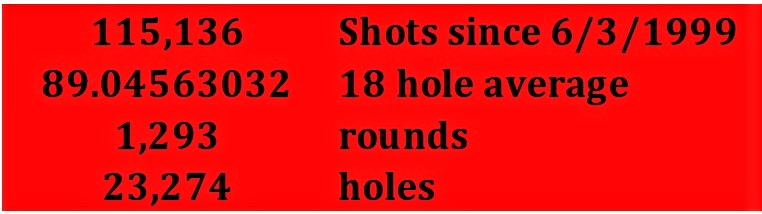
According to my spreadsheet, by last Tuesday, June 9th, 2020, I had taken 115,136 plus strokes since 1999 with never an eagle. That equates to 1,293 rounds – not including any scrambles by the way, So effectively, that’s about 5,172 hours of golf – or 215.5 days of golf! Many birdies, but no eagles!
Data as of the morning of 6/9/2020
Even more sadly, play was delayed here because of COVID-19. So while normally I would try to play in March or April, I did not get to play or even practice until late May. My game does not rely on any real talent – it’s based on hard work and practice. I also track my golf progress here for myself on the blog (see the main menu as well). So I had little expectations about early play and knocking off any rust.
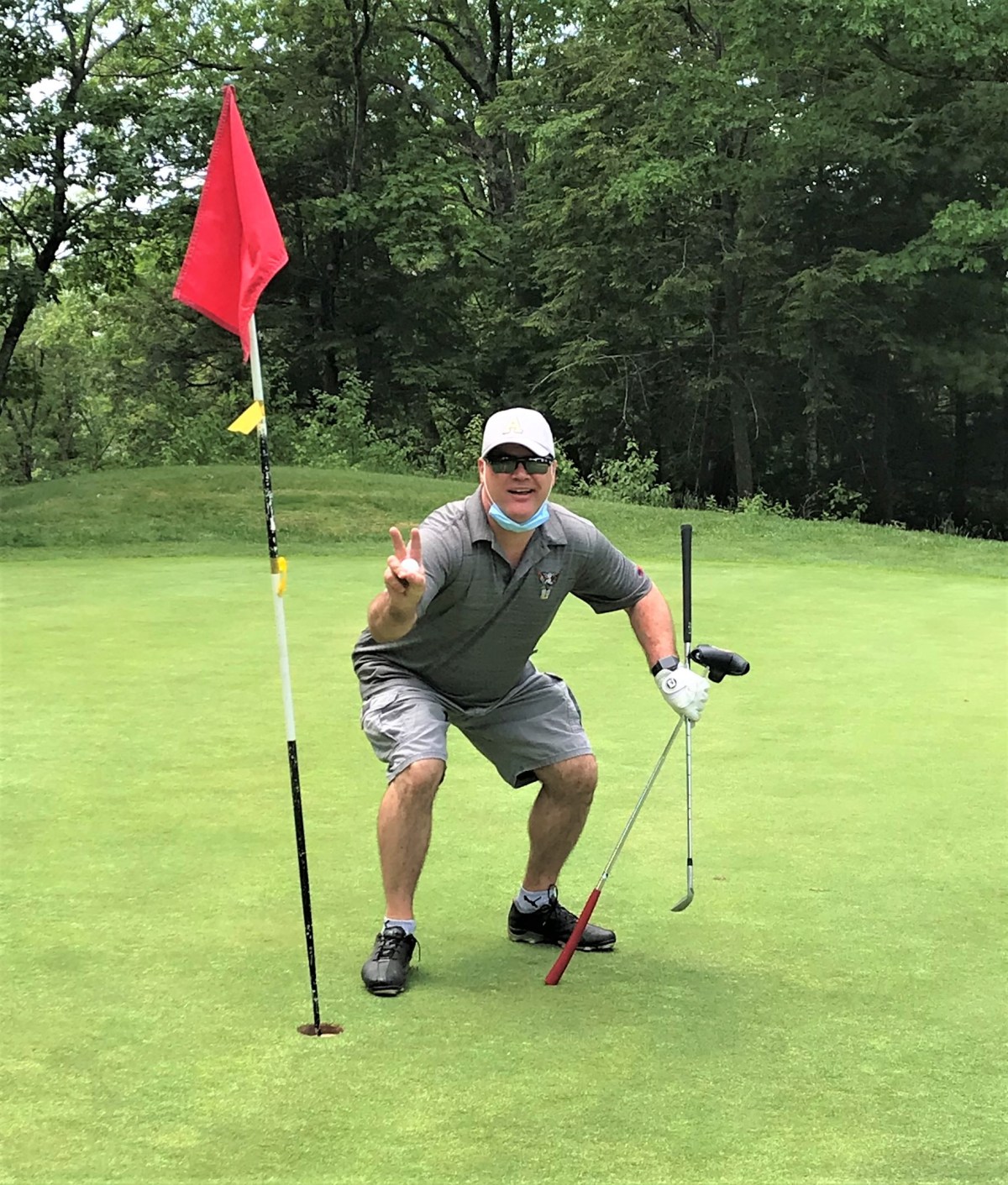
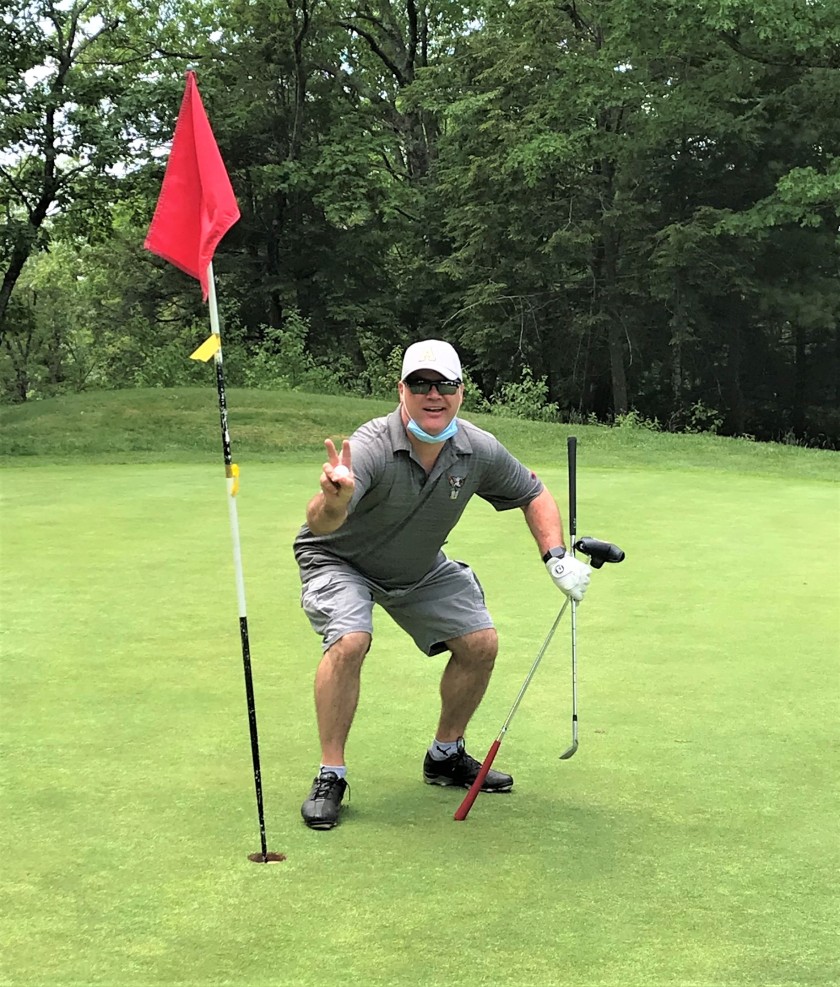
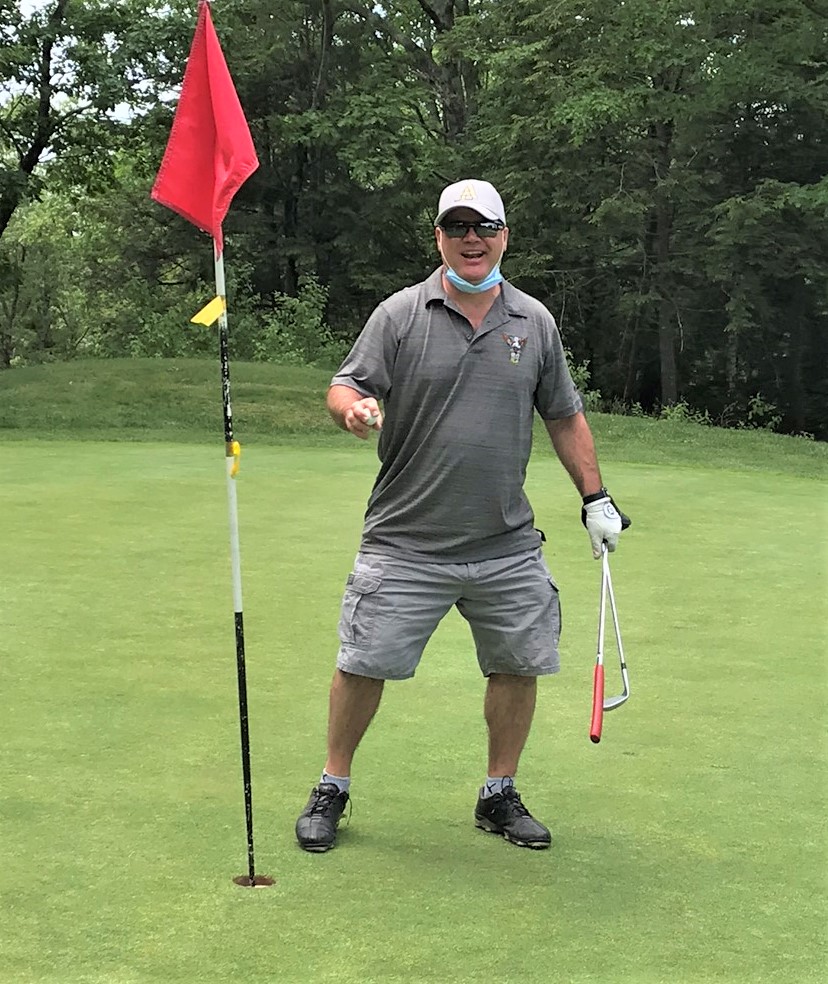
There is a group that plays on Tuesdays at Quail that I joined up with called “Pit’s Crew” after the guy that runs it, Pit Caron. We play a 4-man scramble. On June 9th, we approached the 3rd hole, a par-4, 249 yard hole. I was the “B” player, and drove my ball right next to the green on the left fringe – maybe three feet off of it. For me this was a very good result as the fairway is quite narrow and the green is guarded by a deep bunker in the front. I then used my 56 degree wedge and chipped my second shot – it went up, up – it rolled – and plunk, it dropped in nicely!
EAGLE!!!!!
I was happy that one of my teammates was a fellow former Bay Path golfer, Jim Kularski, who was our “A” man. It was gratifying that he got to see me accomplish something that he knew well that I had been trying to get for so very long. I also had on lucky golf gear from my West Point reunion last year. While it was a scramble, I played the same ball (a found Titleist Pro-V1 that I was using so as not to lose one of my preferred Titleist ProV1X’s), from the same position, so I am counting the eagle as having been my first. After all, at this pace, my next one will be in 2060 when I am 98…
Oh yeah, we also came in first place out of 18 teams.
So here’s some pics (thanks to Jim Kularski for the pictures – again, more to commemorate than to brag – but like I always say – it ain’t braggin’ if ya do it!
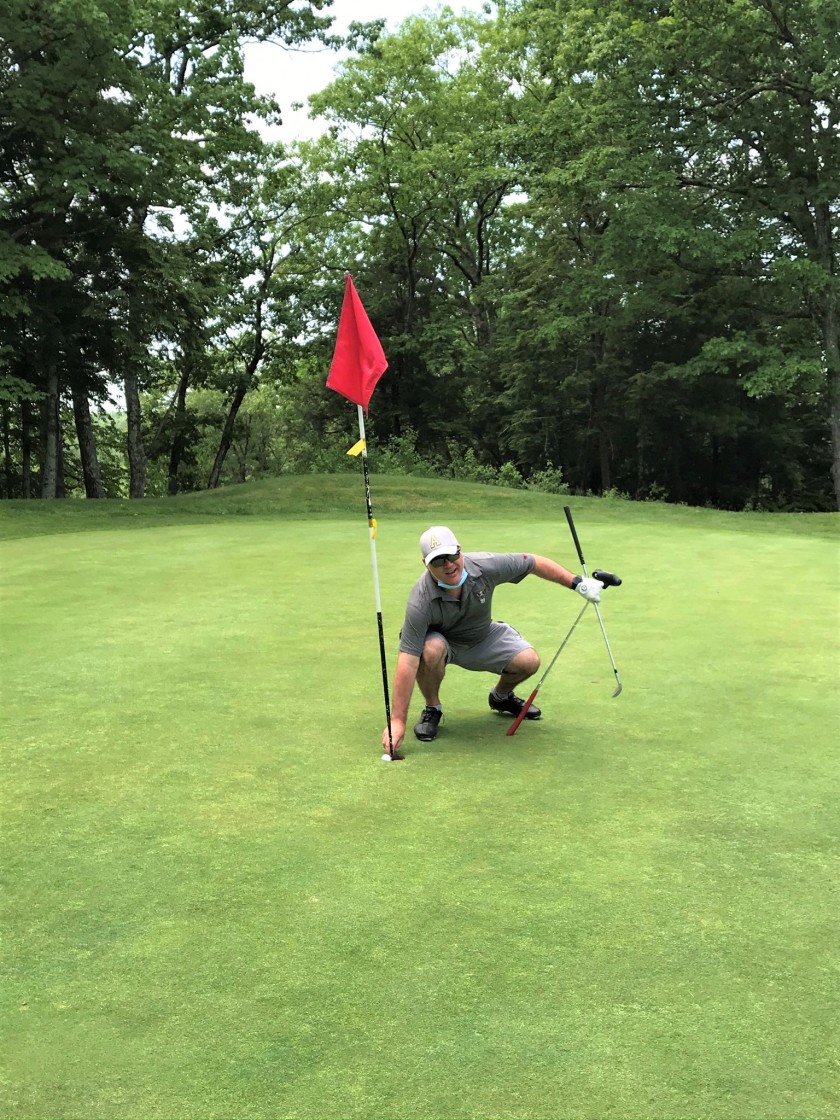
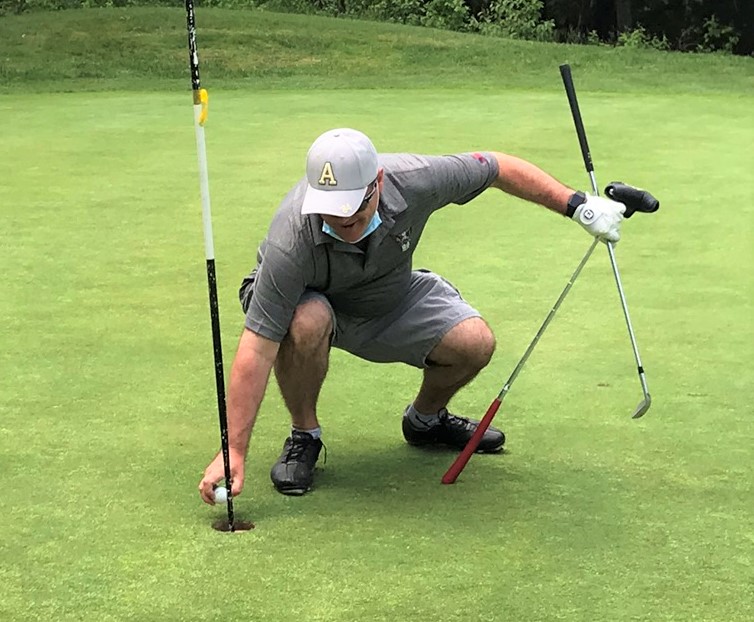
IT’S IN THE HOLE FOR AN EAGLE 2! (note the mask too!) I am holding my putter along with my wedge – no need for the putter on that hole that day!Get that ball for safekeeping!I was sooooo happy to pull this ball from the hole! And nice Army hat huh?It’s a two!Unfortunately I could NOT stop smiling for days!
Greetings from the Massachusetts lock down! I hope all of you are safe and that soon life will be returning back to normal for us all. If you have lost a loved one, a friend, or a job, or just been stressed out, my thoughts and prayers with all of you. This will eventually pass.
I have not been doing much on the blogging front except trying to keep up with others’ posts. At the beginning of April, the projections for death in the US were for 100,000 to 200,000 if we were lucky and did everything correctly in terms of mitigation. Frankly, that floored me and I went into a bit of a focus on the news, keeping up with my family (Mom and daughter/granddaughter). My Mom is on her own, and I worry about her. My daughter lives nearby and has taken walks with our 3 year-old granddaughter so we have gotten at least to see them. It kills us not to hug them both, but as my daughter works in a cancer radiation treatment clinic at a hospital in Worcester, we have painfully practiced “social distancing” during these brief but welcome visits. Of course there is communication via phone and Facetime, but it’s not the same.
The death toll has been mercifully less, but still very bad. Here in the US, as of this writing there have been over 48,000 US deaths, and approaching a million cases. In Massachusetts the surge/peak is coming up – and we have had 42,000 cases and nearly 2,000 deaths. I know that all of you are dealing with this and it’s horrible. I have some strong opinions on this, but I don’t want to get too political on my blog. My thoughts could be summarized by the article here.
My wife has been home on paid leave, but who know what will happen on this front. I have still been looking for a job, but with millions of Americans out of work and the understandable difficulties with interviewing – I have been staying home. I did fly to Virginia on March 9-10 for a face-to-face interview – which was an eerie experience. By the end of the week, everything was shutting down and we were in lockdown. And then the job did not come through.
Needless to say, tabletop wargaming is at a halt – and golf is impossible as all the courses are closed as nonessential.
I kept busy researching and working on a supplement for Buck Surdu’s upcoming game of Feudal Patrol™ – basically a new game similar to his Combat Patrol™ WWII card-based gaming system. It will cover the pike and shot era and earlier. My project was based on the Spanish Conquest of the 15th Century – so Aztecs, Maya, Inca, Tlaxcalans, Mixtec/Zapotecs, and of course Conquistadores. This has been on my “bucket list” – and I will share some more of that in future posts – but it did consume a lot of time (which I had to spare). I started painting Aztecs as well – but more on that later as well.
By the way, Buck redesigned his website – and it is an incredible free resource for unit organization and equipment for WWII. Here is an example.
Also, besides watching the news and the business channel, I watched TV, played cards (a rummy type game) with my wife, and did the grocery and pharmacy shopping. Thankfully I have a respirator that I use when I airbrush – so I wore that on these infrequent trips out of the house. It reminded me of my Army days with the old M17 gas mask.
I have a treadmill, and that helps with exercise too.
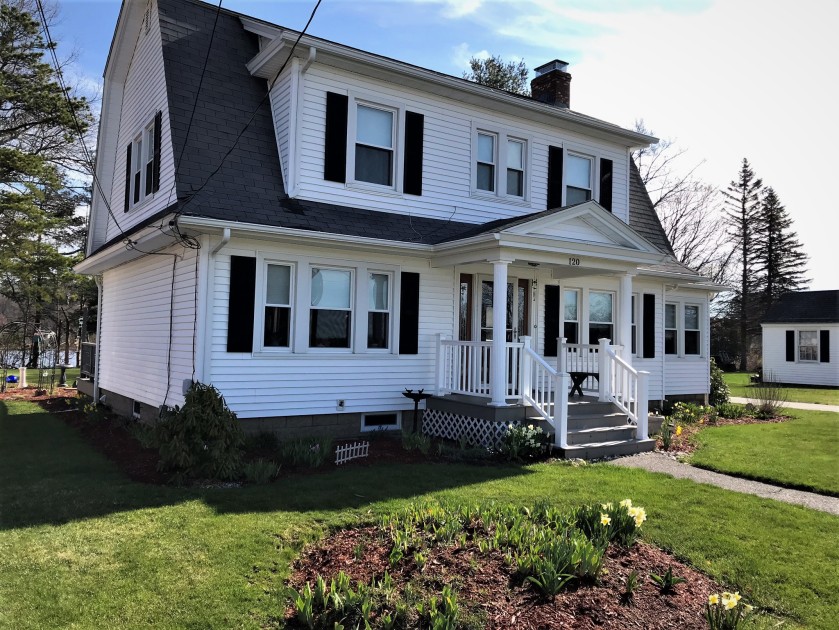
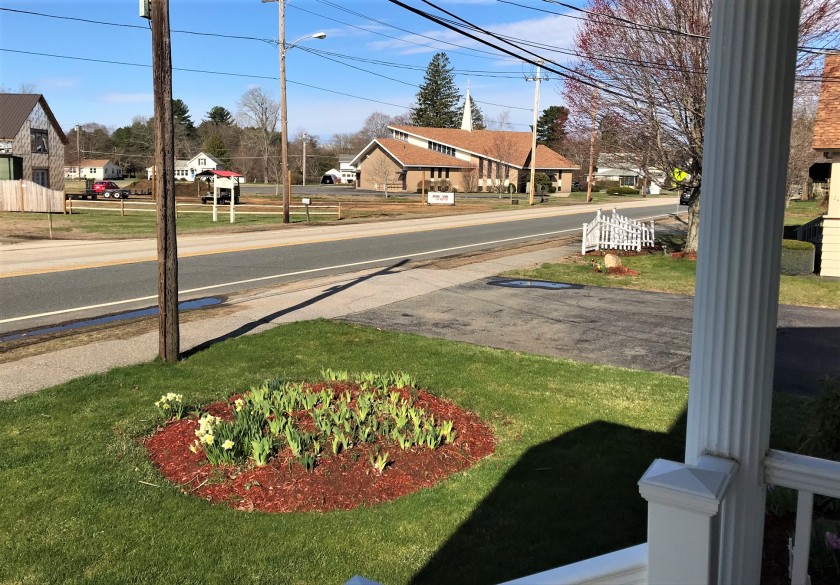
Earlier this month maenoferren22 at Bogenwald posted a challenge to share the view out the front window. I’ve enjoyed looking at others – so I thought I’d join in. It took a bit longer for me to get involved – as we are in early spring and it’s been cold and rainy. So. here’s some shots of my East Brookfield, MA home from inside and outside.
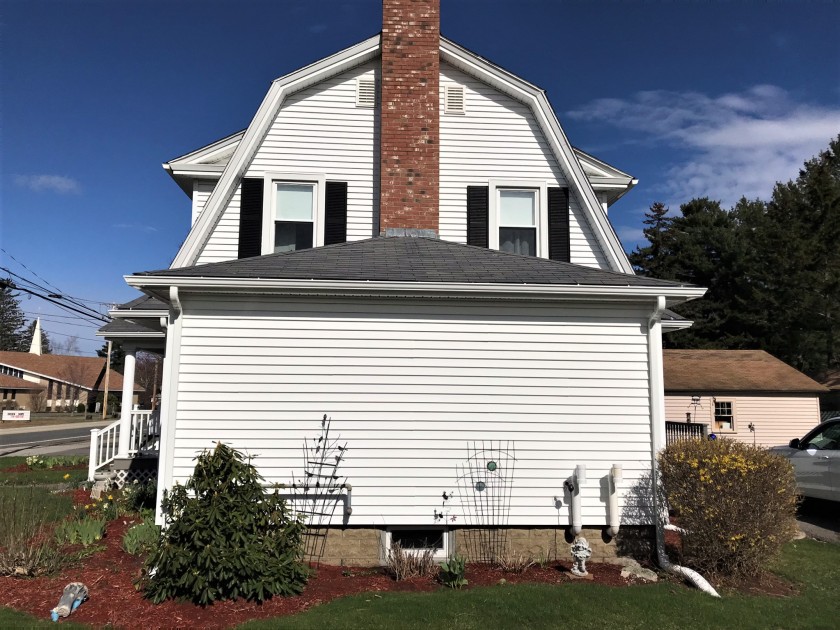
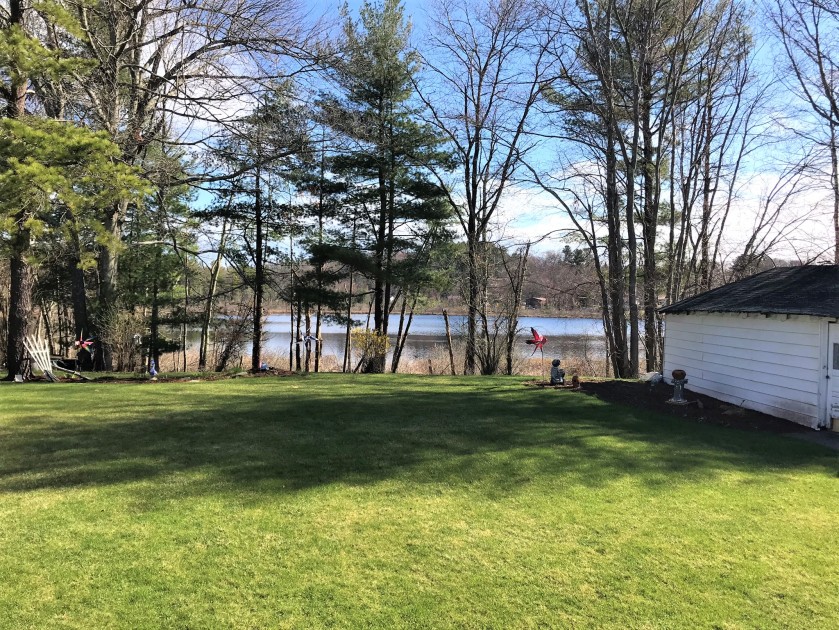
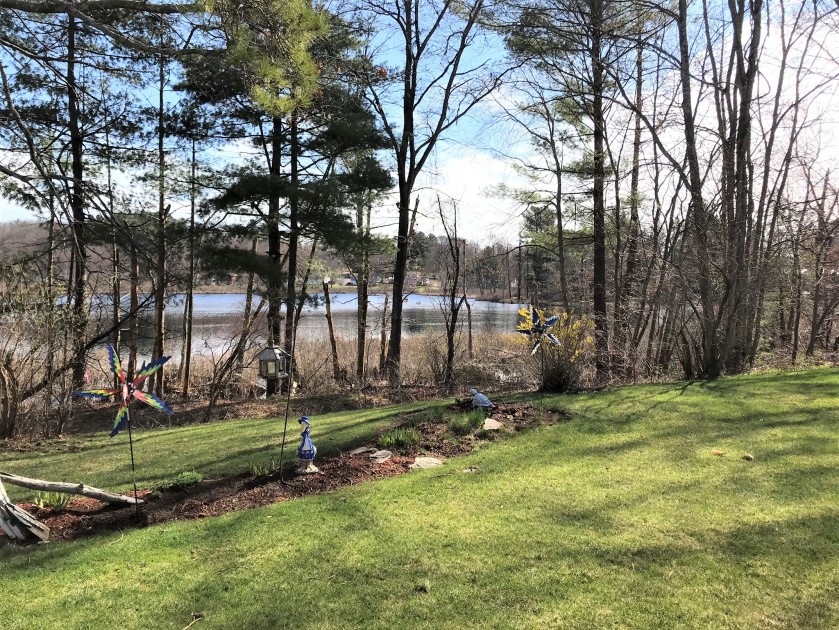
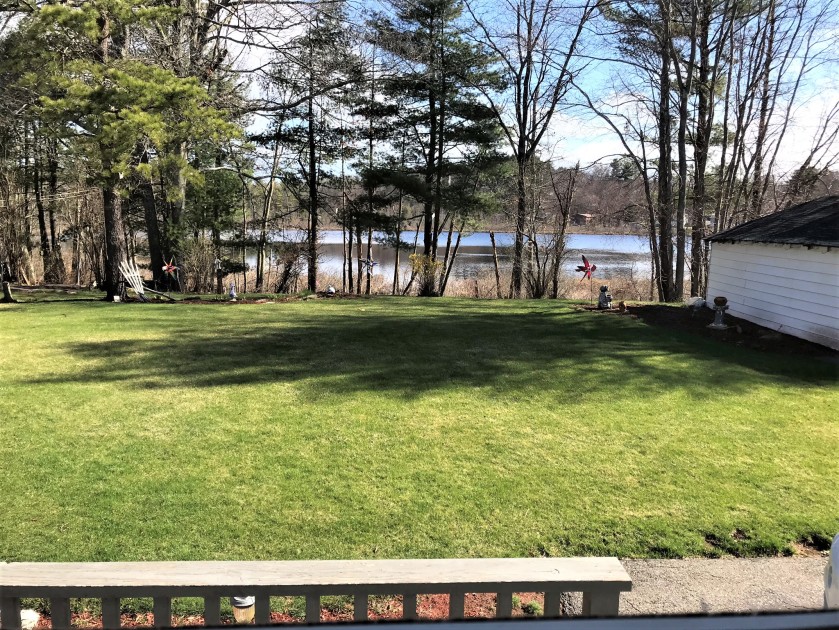
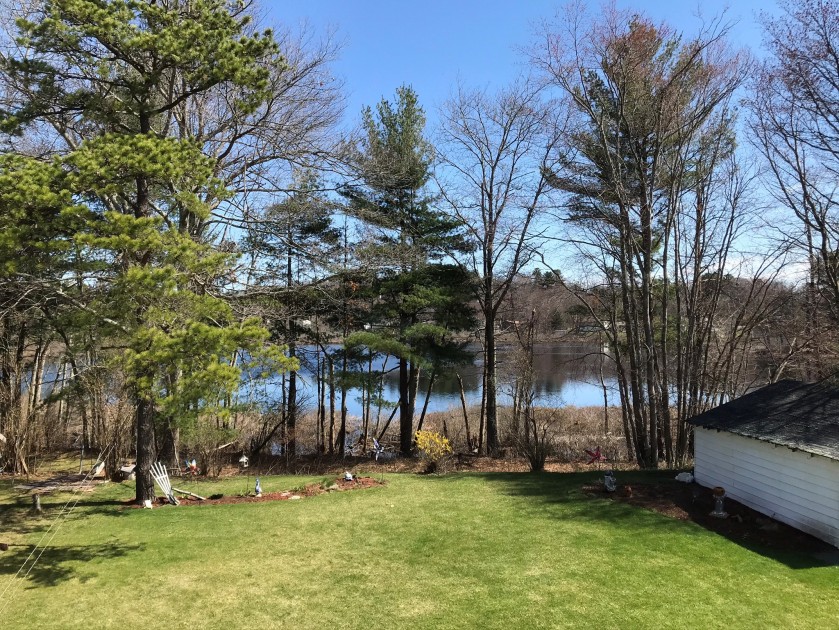
The front of our home – daffodils are out and grass is just turning green.A look from the front porch towards our church across the street (St. John the Baptist). We last were able to attend on March 15th – and since then (including Easter) – we have watched the Bishop of Worcester’s Masses on TV.The other side of the house. It’s a “Dutch Colonial” and probably dates to the 1930’s or 1940’s.Right side of the house.The backyard – my garage (which is not great) on the right. The pond in the back has a nice view – and a lousy name “Mud Pond”. There is a beaver lodge in it – and I have seen many Great Blue Herons hunting here. I have seen a bald eagle as well, and many hawks and falcons. There are raccoons, bobcats, snakes, turtles, and bears as well.A little closer view of the yard and pond.A reverse view from the pond towards the house.View from the back porch.The view from the upstairs bathroom window.
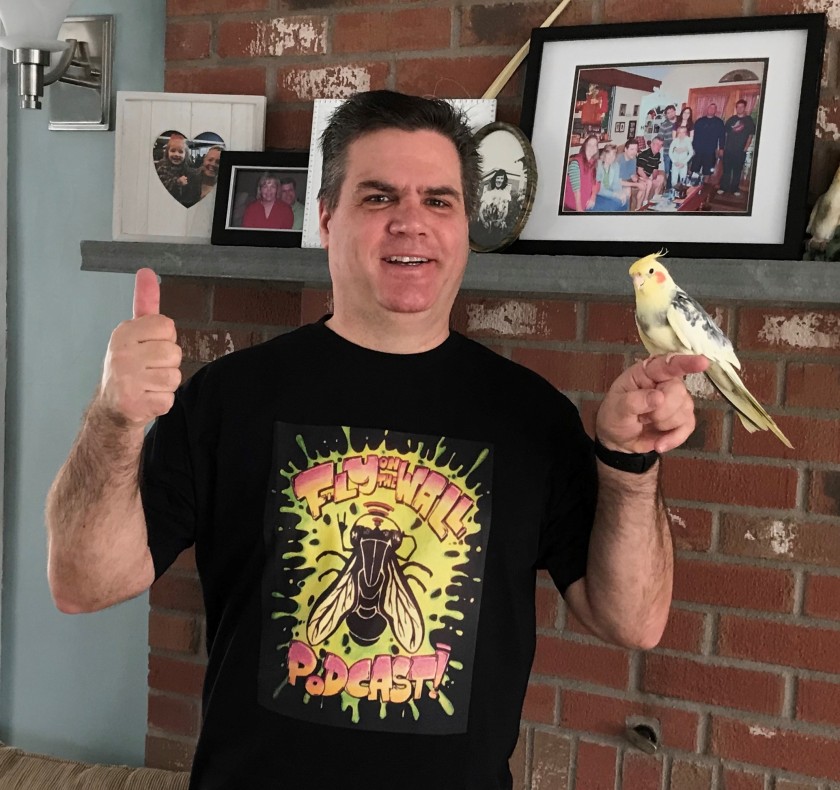
That’s it. Oh yeah, I do also listen to a couple of podcasts. Many of you know IRO (imperialrebelork). Along with his buddy Big Waz in Australia – he has The Fly on The Wall Podcast. He also just started a nice hobby podcast named, Imperial Rebel Ork podcast. I enjoy both – and TFOTW has been around a year now. Helps to get over the pandemic a little bit.
Here is my little promotion pic, with my Australian-descended friend, Caesar (who is 26 years old now).
As you can tell, I lost my Dad, Anton (Tony) Patrick Morin, on February 7th at the age of 81 years, 6 months, and a day. His obituary can be seen here.
I am Mark A. Morin. The A is for Anton. I have his name. Dad was a proud Air Force veteran. His obituary has a lot of that information. I guess this post is my way of breathing – and finding peace.
Dad declined quickly. He was sent by ambulance to the hospital on Thursday, January 30th after he fell and had a mental break during which he was confused and yelling and just out of it. He had resumed a degree of normalcy (such as it was) by the time I saw him that morning/afternoon in the hospital. It appeared that he might have had a mass on his lung, but no explanation for the cognitive issues. We did not know what was going on medically, and still do not (he had a lot of health issues). My Mom was exhausted physically and emotionally, so I sent her home and I stayed with Dad. He was in pain, but we did get to have some conversations. He prayed aloud in pain and was worried about his soul and Heaven. His own Dad abandoned him in the 40’s – and was absent in his life. I got to tell my Dad that I wished that he had had a great Dad like I had. And despite his pain, he smiled.
I knew he was dying, but one never knows how soon. Ten years ago, he nearly died (he was hospitalized for months). Thank God he lived another ten years. This time, I waited until my Mom left and asked the nurses to get him a priest. Father Jose came later around 7 PM and Dad was finally asleep. He began to pray over him and Dad gently woke up. Dad spoke with Fr. Jose and even in Spanish a bit (Dad was a multi-lingual guy). He gave him The Last Rites and I got to pray The Our Father with my Dad. He then went to sleep, and I left.
The next day (Friday February 1st) he was scheduled for a lot of tests so I did not go to see him. I went Saturday morning and by then pretty much his mind was gone. He could not communicate in any effective way and was totally confused. His mental state never got any better from then on, and the cause of his condition remained a mystery.
Six days later, at 2:15 AM on Friday, February 7th, my Mom called to tell me that the hospital had called her to tell her that it would not be long. We got to the hospital, and he was unconscious, on oxygen, but struggling to breathe. His family was with him. He was given some morphine for comfort, the oxygen mask was removed, and I held his hand as he took his last breath.
His funeral was at St. Camillus, our old family parish in Fitchburg, MA, on February 15th. I got to speak and give a remembrance of Dad. I was honored to do so and share what my Dad meant to me – about his Work Ethic, his love for his family, and his Faith. It’s tough now, for sure.
However, I have Faith, the greatest gift he and my Mom ever gave to me. I feel especially blessed that I got to pray with him the last time he could with me.
I will go on to blogging about the significantly less important aspects of life, but I felt that I needed to have a blog entry about Dad before I moved on. I also held back posting from late January onward as all this was going on. Dad loved history and loved seeing my miniatures, especially the tanks. We all lose our Dads someday, and our worlds get smaller as a result. But I believe Dad has earned his Eternal Reward and we will be together again someday.
I am not looking for pity – just needed to put this down in a brief way. Thanks to all who reached out to me and my family – I will never forget your love and your compassion, and your friendship.
Love ya Dad, thanks for everything. I’ll do my best to honor your memory and what you meant to me.
My Dad and my daughter Ellen 20 years or so ago
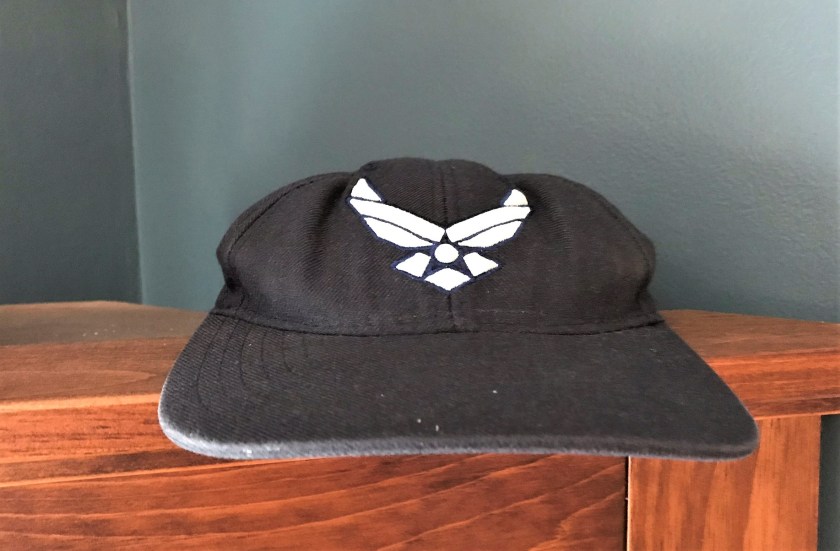
The US Air Force hat I bought Dad that you see in the pictures. I now display it proudly.
In support of all these activities, of course I had a number of projects in terms of assembling, painting, and creating. I documented these here. Being an analytical type of guy I kept a spreadsheet of my hobby activities (below) and listed them on a page of this blog with links (also below).
My hobby activities tracker
The entire list and links are at the end of this blog which will refer to each project. These links are very useful to me in reviewing previous projects as to what paints I used, what techniques, etc.
The building and painting of tanks and support materials made up the largest part of my 775 project activities in 2019 (106 tanks I believe – 43 German, 23 UK, 18 US, 15 Italian, and 7 French), and the remainder were models for retro sci-fi games (around 50 or so).
The blog itself grew by a lot, and I was very pleased about that. In 2019, there were 20,965 views (versus 13,743 in 2018) by 13,819 visitors (versus 8,295 in 2018). I managed to get in 36 posts, 3 more than in 2018. I must say a huge thanks to all of my readers and followers of my blog! I especially appreciate all of you (and you know who you are) – who took the time to give me feedback – it was great to hear all of your perspectives. THANK YOU!
So what’s next for 2020? My goals are always changeable (hell, its a hobby right), but here is my current list:
Games:
Run convention games at TotalCon, HAVOC, HUZZAH, BARRAGE, and the Fort Devens Game Day (and a few more maybe)
Grow the Mass Pikemen Gaming Club with new members and new GM’s
Support the Historical Gaming Club of Uxbridge
Models:
Build a suitable force of French and German tanks for the Battle of France scenario for 80th anniversary of this event
Build 2 or more new platoons for retro sci-fi games of Combat Patrol
Start the Nomonhan project
Other:
Complete a supplement for Feudal Patrol for Mesoamerican warfare (Aztecs, etc)
Be productive, but never sacrifice quality
Grow the blog and find new ones to follow!
Entertain my audience!
Golf:
Get my handicap below 14 (if I have enough non-gaming time!)
Thanks again for reading this and making my little hobby blog a part of your day! Here are the massive details of 2019 below:
Amazingly, this upcoming May-June 2020 will mark the 80th anniversary of the Battle of France. I am curious as to how it will be remembered – if at all. Certainly I would think that both the French and the Germans will likely shy away from commemorating the event for diametrically opposed reasons. Yet, it is definitely worth remembering it as a seminal event that without question fashioned all of the world’s history since.
I have studied this battle since my days at West Point. I was fortunate there to study with the then-USMA Department of History Chair COL Robert A. Doughty (now a retired Brigadier General). I was able to participate in a class (HI498 – a colloquium) with him and just one other cadet during my second semester senior year as part of my concentration of studies in French. A side note – my class – 1984 – was the last class not to have majors – we had concentrations. This meant we could choose 8 classes outside of the 44 classes in the core curriculum. As I love military history, especially French military history, this colloquium was a great opportunity. We studied Alistair Horne’s works among others.
BG Doughty has authored many books (just check out this list on Amazon), many that focus on France from WWI to WWII. I recently got two excellent books on the subject that he published after I graduated that I have not read: The Seeds of Disaster: The Development of French Army Doctrine, 1919-39, (which discusses how the French Army came to set themselves up for disaster) and The Breaking Point (dealing with the pivotal Sedan breakthrough in 1940). I also plan on rereading Alistair Horne’s To Lose a Battle: France 1940 as well.
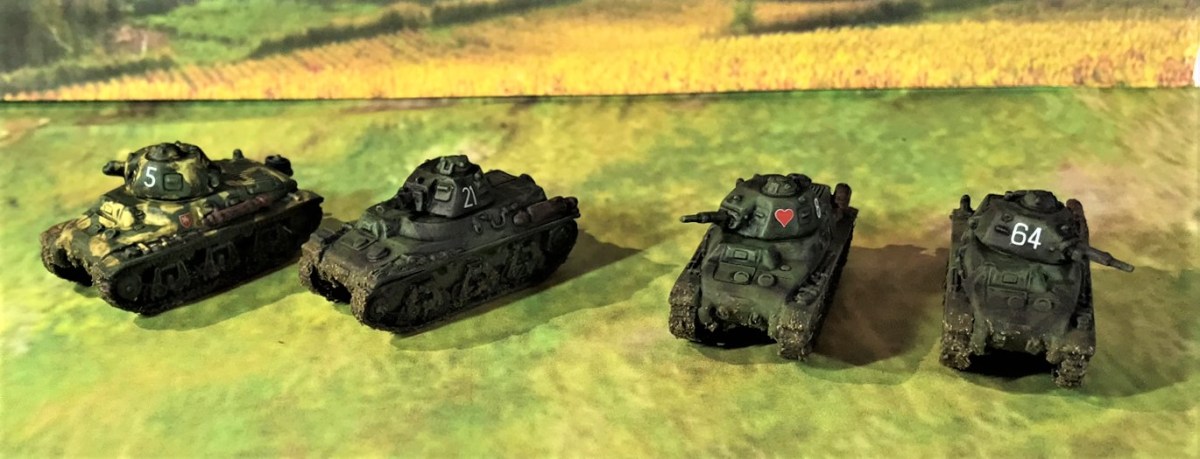
Previously, I have built French and German tanks and run several France 1940 games described in this blog – but my 15mm/1:100 scale tank inventory was quite lacking in terms of the wide variety of vehicles used. I aim to remedy that. I am currently planning on running a game at TotalCon in February, and at HAVOC in April. I may do others as well, plus club gaming sessions. This blog post describes the first chapter of my preparation and force building upgrades for those events – four Hotchkiss light cavalry tanks (one H35 and three H39’s).
I will go over a bit of history of the Hotchkiss tanks and then show some WIP shots of the models. I will then share some eye-candy shots of the finished models. Lastly, as per usual, I will share the paints and materials used in this project.
The H35 tank was originally rejected by the infantry, who chose the R35 instead. It was intended to be a light cavalry tank, though it did equip some infantry tank units as well. Hotchkiss built around 1200 H35’s and H39’s, with the majority being H35’s. The Hotchkiss company was actually founded by an American from Connecticut, Benjamin Hotchkiss. He was a Union ordnance engineer at Colt and a munitions builder during the American Civil War. Finding no US business after that conflict, he moved to France and set up his own company.
The H35 and H39 both had the same 37mm SA18 gun that many French tanks had though the H39 had a longer barrel with better armor penetration (30mm vs 23mm of armor with the shorter barrel). Given that a Panzer IIIE of the time had 30mm of armor all around, this was not adequate to be sure. It had a crew of just two, which made it challenging to operate effectively in battle. Three out of four of the armored divisions’ tank regiments had Hotchkiss tanks (the other one had SOMUA S35’s). The armor was adequate, but with a range of only 80 miles and a top speed of 17 mph, it was not very cavalry-like. On top of it all, it was tough to drive and mechanically unreliable.
After France capitulated, both Germany and Italy got Hotchkiss tanks. Some of these Italian vehicles faced US Army Rangers in Sicily. After the war, some Hotchkiss tanks served on with the Israeli Defense Force until 1952.
I acquired a 3-vehicle packet from Battlefront Miniatures (#FR020) and one single H39 vehicle from Peter Pig (#PP33). The Battlefront ones could be either H35’s or H39’s. In the end, one of the H35 guns was unsatisfactory, so I ended up with one H35 and three H39’s. In the game, there are no differences statistically between the two types.
Here are the models – the Peter Pig one was all metal. The Battlefront ones had two different engine hatches depending on what version was to be built. These were relatively easy to assemble and prep for painting.
Assembled and magnetized Hotchkiss tanks. From left to right, Peter Pig H39, Battlefront H35, and two Battlefront H39’s.
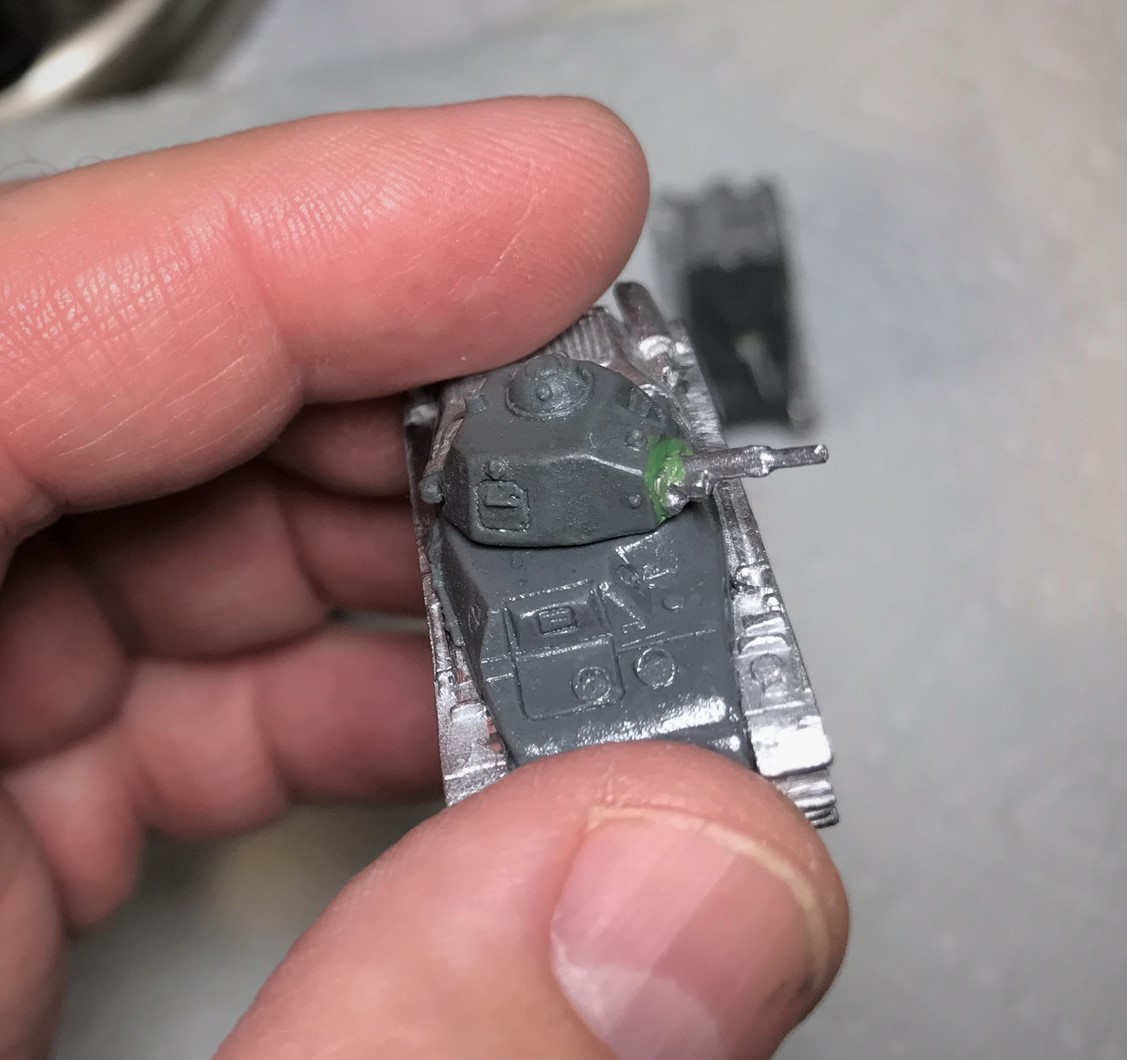
The Battlefront H35 gun was drilled in and affixed with Gorilla Glue. Later, the drill holes were filled with kneadatite (green stuff).
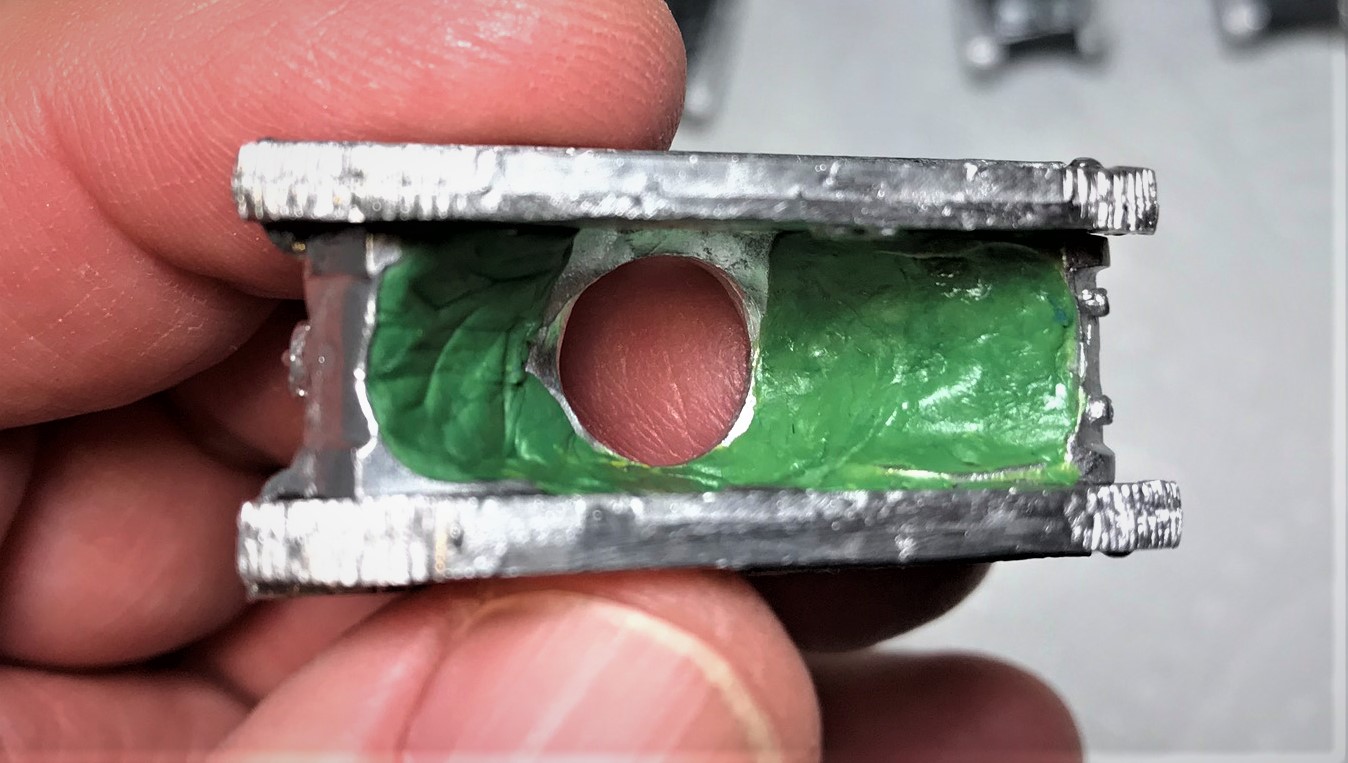
The bottom of the Peter Pig H39 model. For reinforcement of the tracks, I added green stuff under the chassis. I also added a magnet to the inside of the turret so my knocked out tank blast markers would stick to an otherwise non-magnetic model.
H39 showing green stuff around the longer gun.
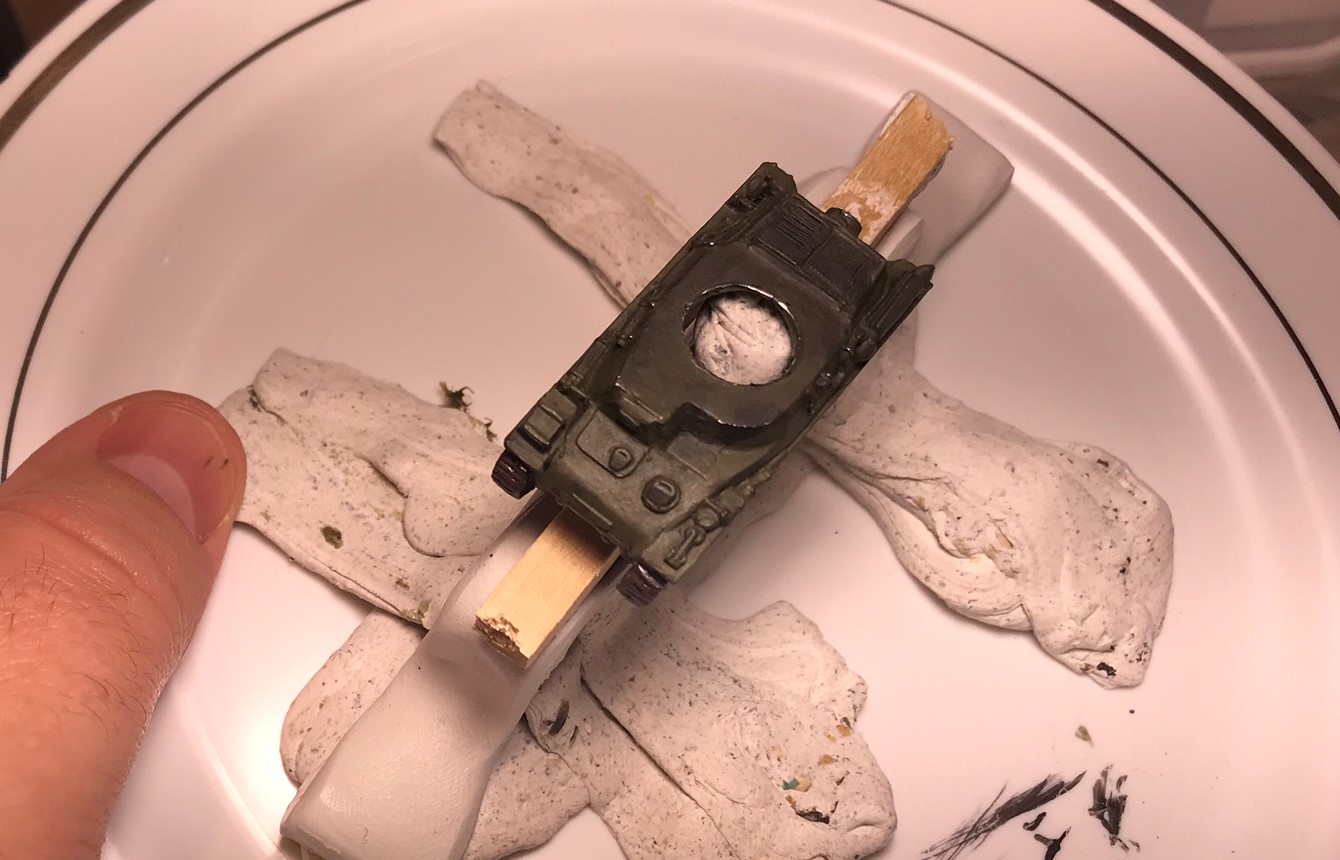
My mounting arrangement for the tanks. I did paint and varnish the tracks first.
Turrets ready to paint.
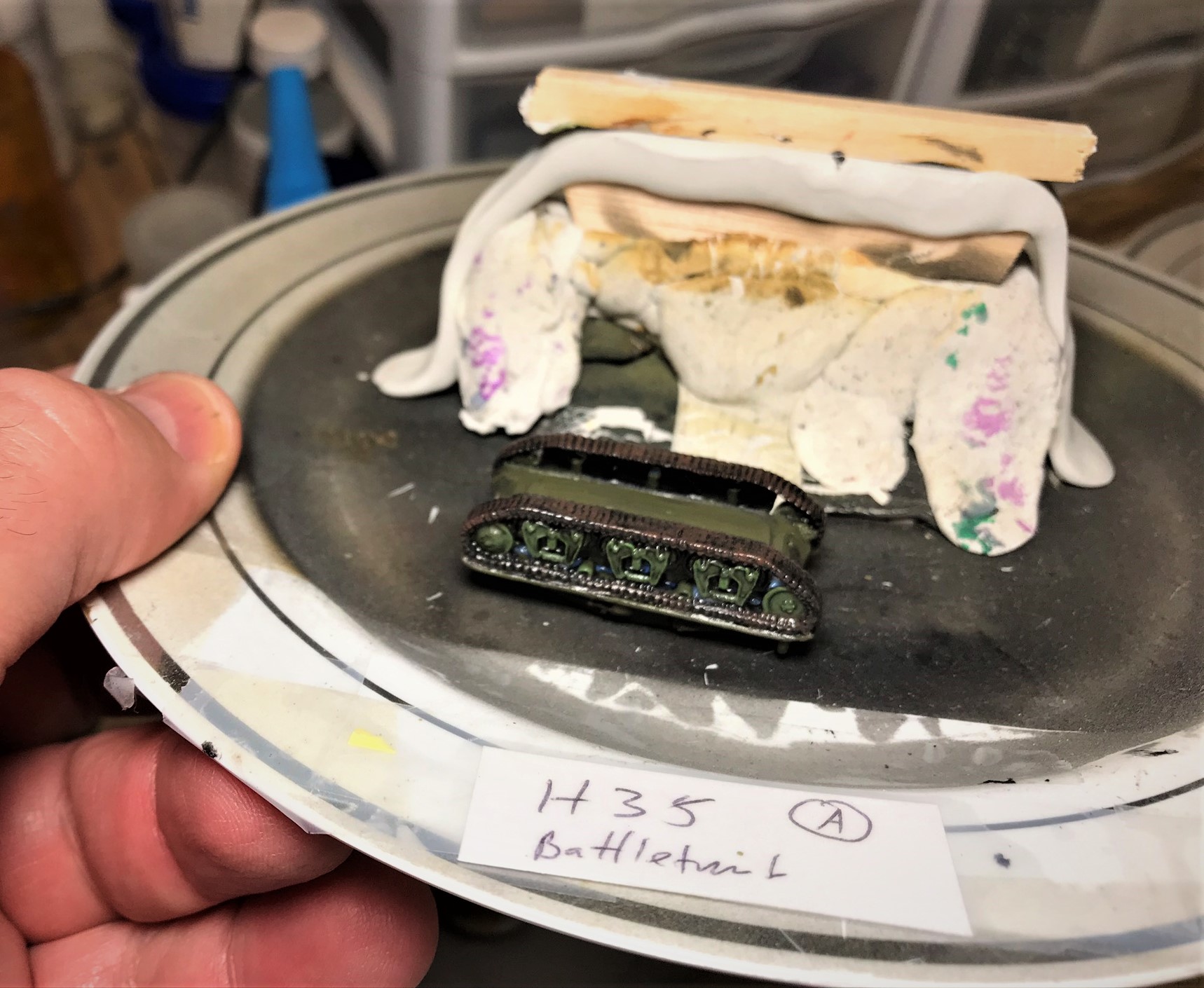
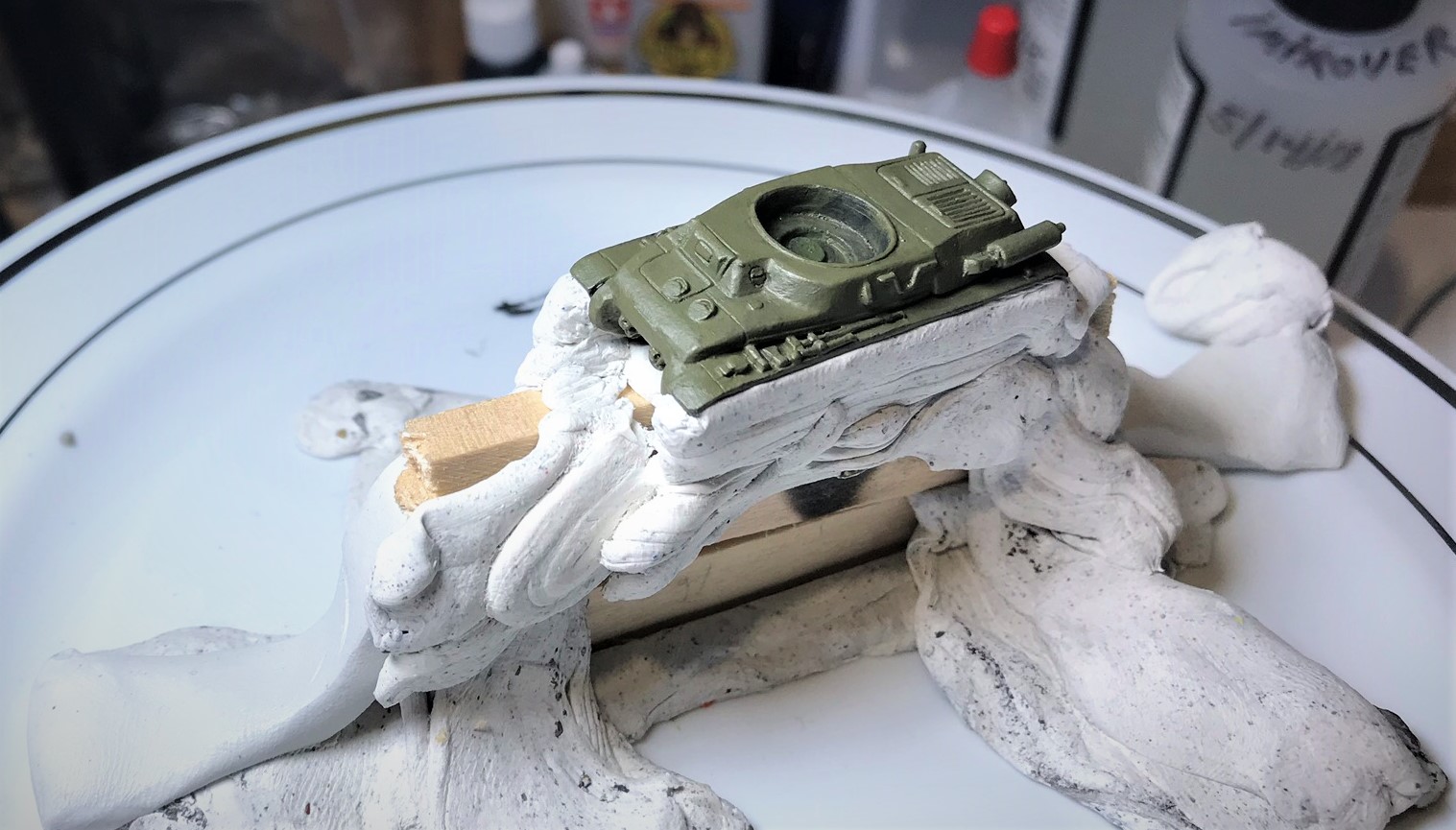
This shows the H35 after the tracks were painted, washed, and lightly varnished.
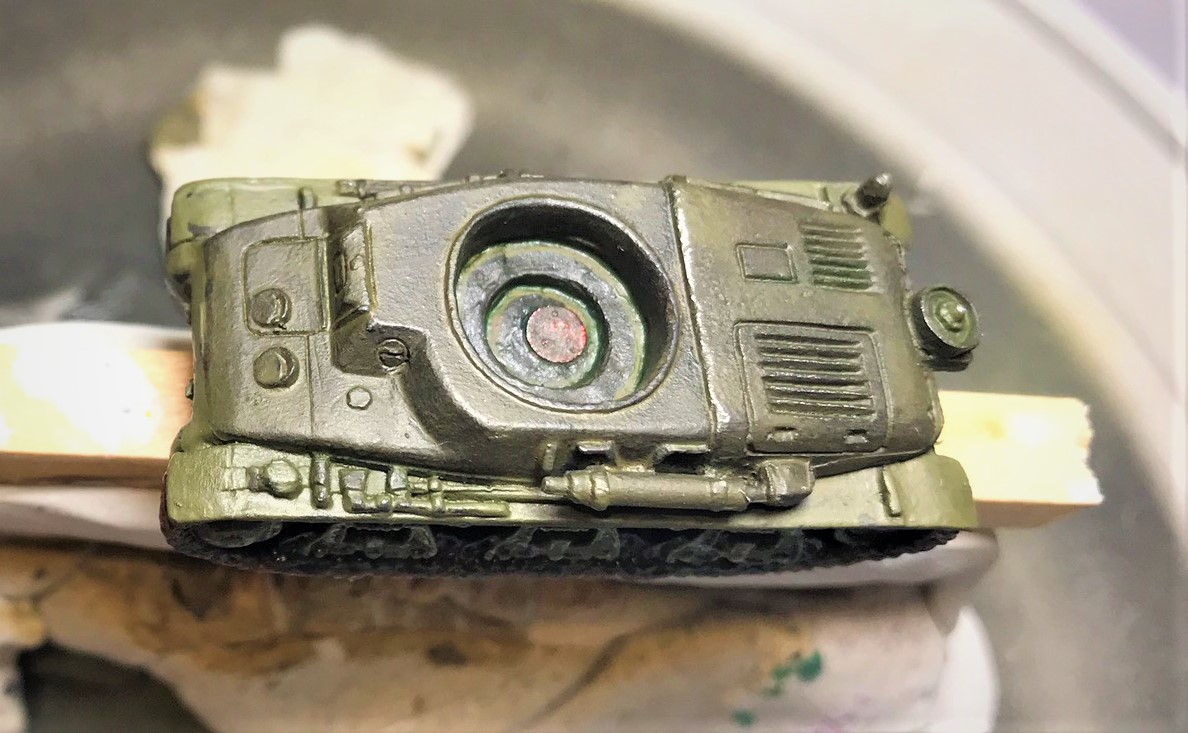
Then the models were mounted and primed. I had a challenge priming the exposed metal parts as you see here – I needed a few thin coats.
The priming issue (exposed metal) was more difficult for the Peter Pig model as it was all metal.
After priming, the H35 awaits set up for base coat painting. Protecting the already painted tracks with poster tack was the first step.
I was not thrilled with the yellow, but I darkened it. Here, I applied more poster tack to apply a camouflage pattern.
The H39’s got their base coats, and then I used an Iwata Micron airbrush to blend in some browns on the green. As I researched tanks of this era on the French side, I found that there was no standardization of tank painting schemes.
The H35 under the poster tack for a camouflage scheme.
The Peter Pig H39 model showing the added brown color airbrushed across the tank.
After removing the poster tack from the H35, this was the result.
I then washed the vehicles with Army Painter Military Shader. All that was left was adding decals, weathering, and final varnishing.
Battlefront decals – so tiny. I still do not understand why the roundels are two piece decals.
Now, I would like to share the finished vehicles – eye candy (at least I hope you find them nice to look at).
How I planned the paint job – I am hoping to get better tan/yellow tan paint for future French use, but after washing/shading, I think this is fine. Do you?
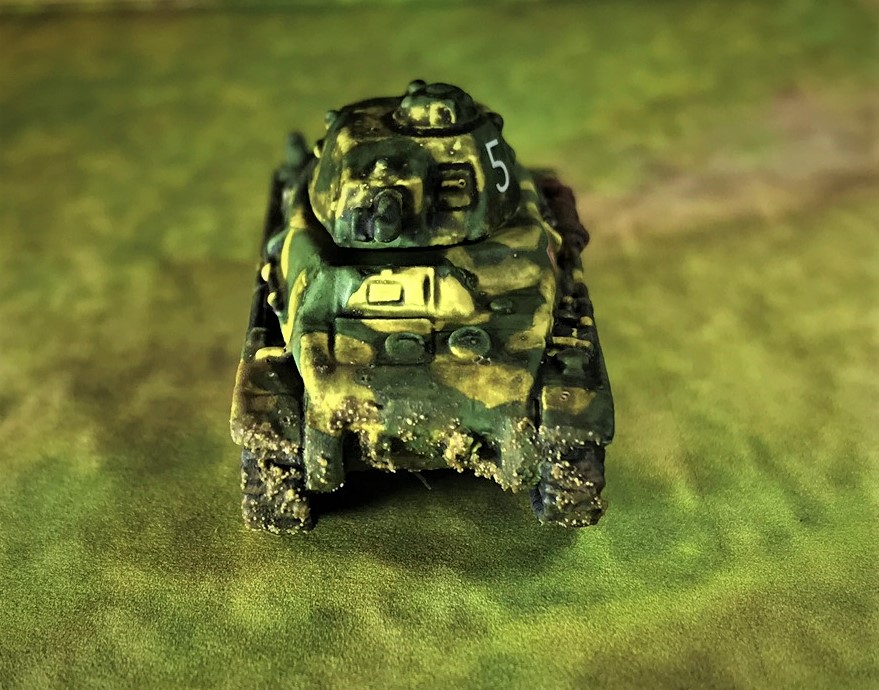
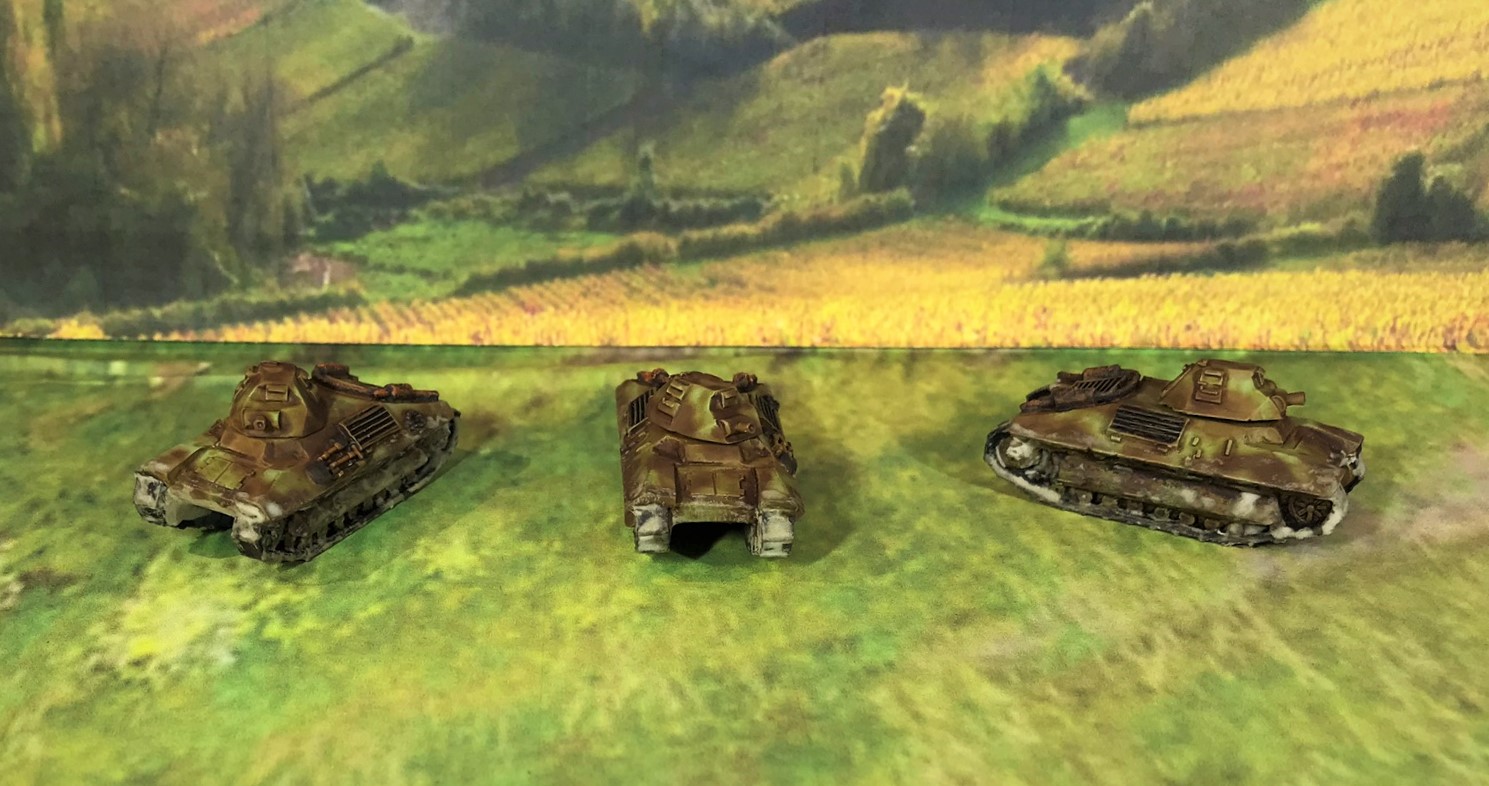
Battlefront H39’s (two)
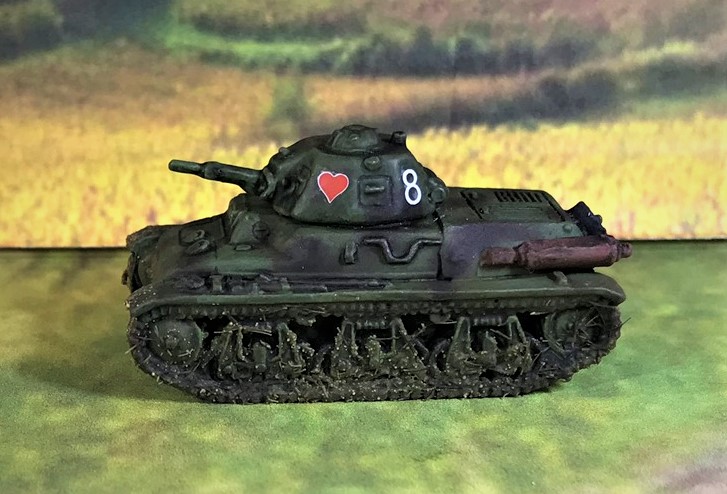
Battlefront H39 “#8” left side.
Battlefront H39 “#8” left front side.
Battlefront H39 “#8” rear view.
Battlefront H39 “#8” right side.
My plan for the “#8”.
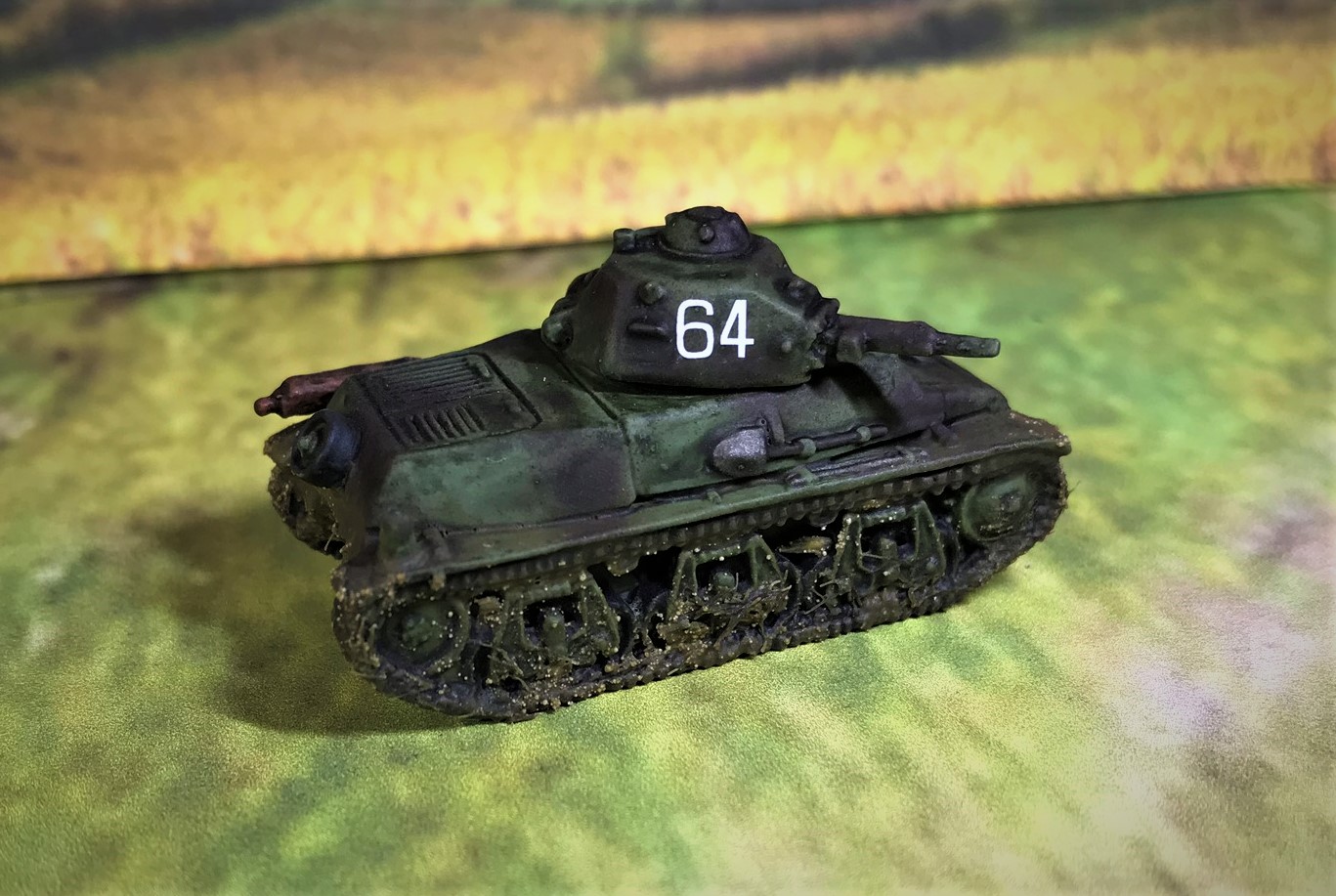
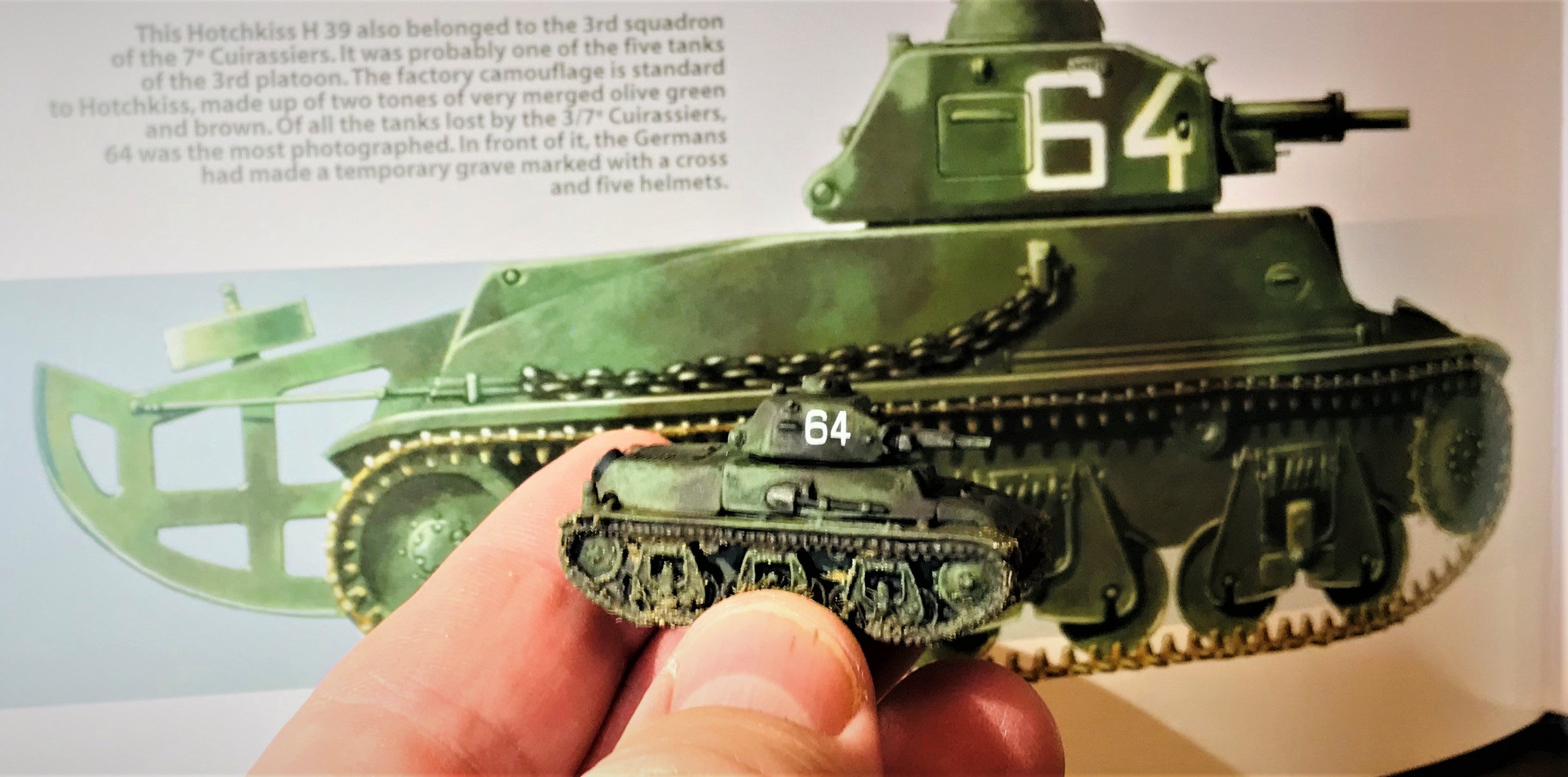
Battlefront H39 “#64” left side. This was the only Hotchkiss tank I built with a number on the right side of the turret. Again, markings were definitely not standardized.
Battlefront H39 “#64” right front side.
Battlefront H39 “#64” right side.
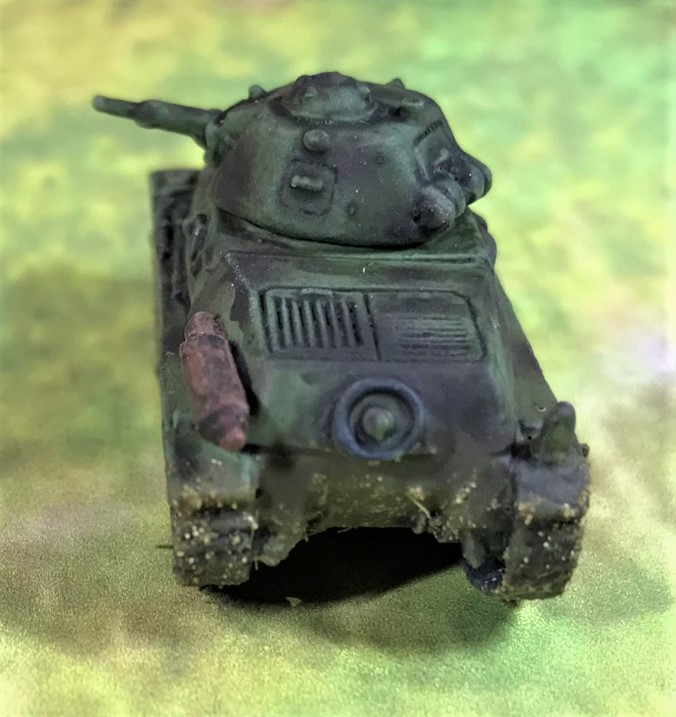
Battlefront H39 “#64” rear view.
How I modeled the vehicle.
Peter Pig H39
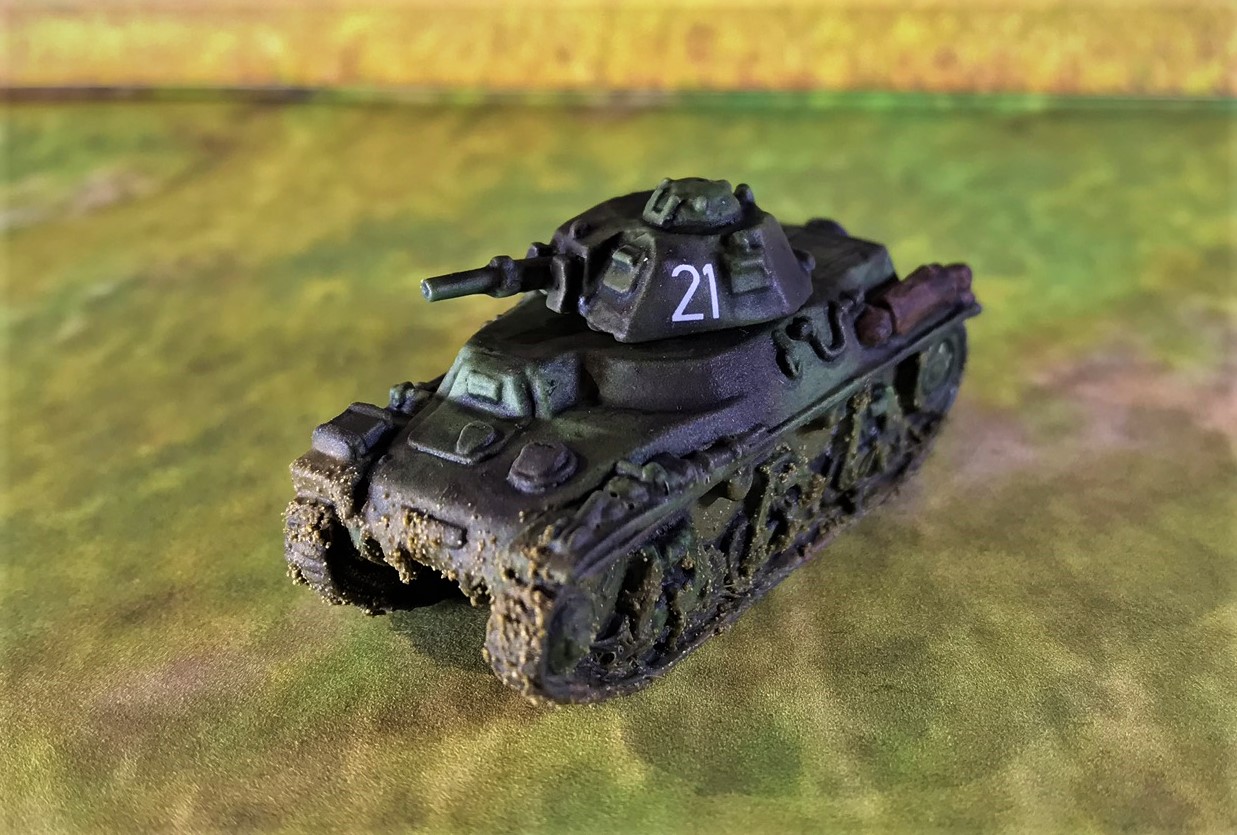
Peter Pig H39 “#21” front left view.
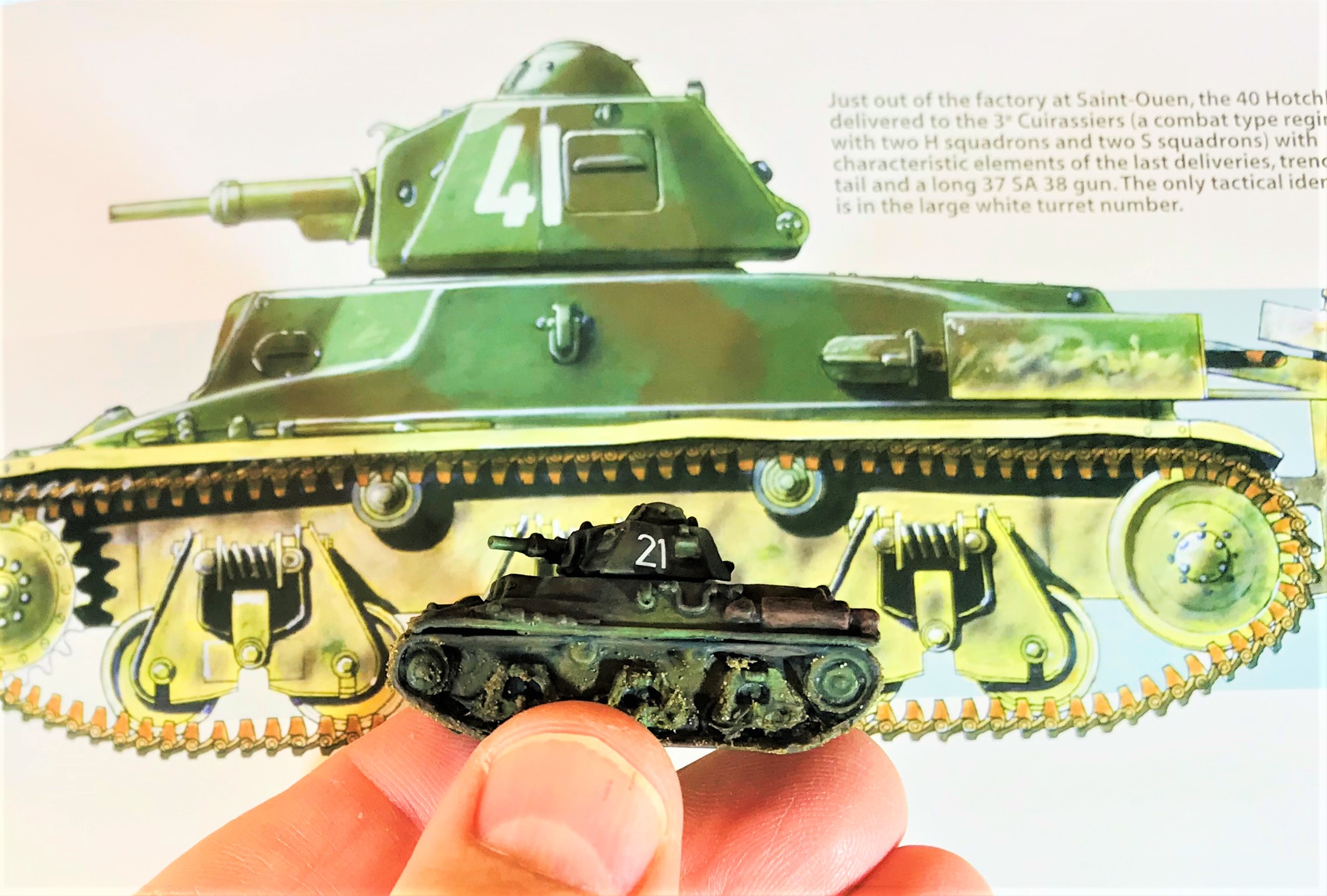
Peter Pig H39 “#21” right side view. After weathering was added, the side looked similar to the Battlefront models.
I did not have a #41!
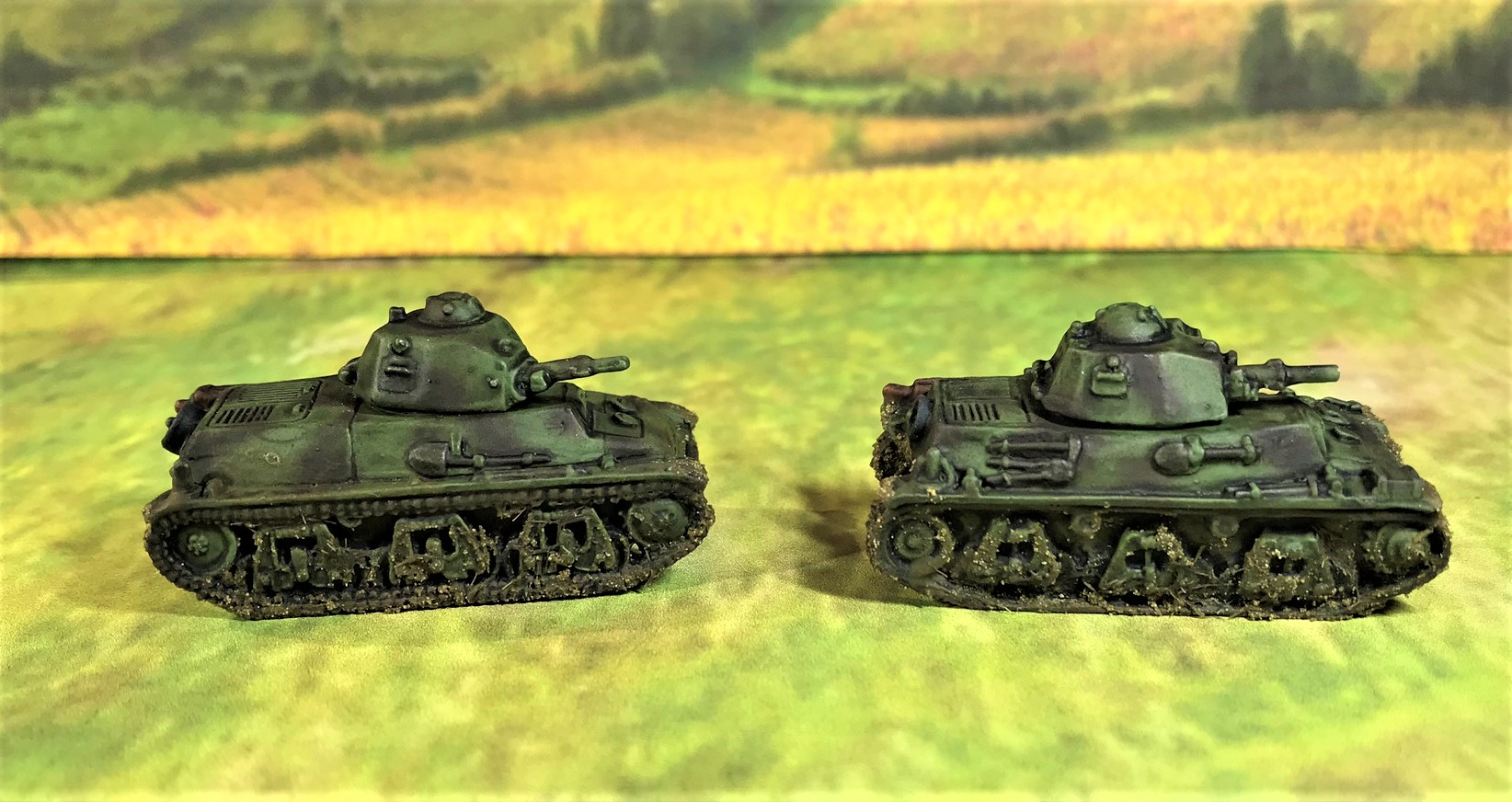
This is a side-by-side comparison of the Battlefront (left) and Peter Pig (right) H39’s. I like both – though my preference is for the Battlefront models – which are resin and metal. However, many of the models I need for this project are hard to find and not made by Battlefront, and sometimes with some manufacturers you need to buy up to five vehicles. With Peter Pig, I can just get one vehicle (QRF with metal models sells one at a time as well – and you’ll see some of their vehicles soon too). Old Glory usually sells 3 vehicles (all metal) in a pack.
Group Shots
This concludes my very last post of 2020 – and the beginning of this project. (I will be doing a 2019 round up of course – but that will be coming later this week).
More Battle of France vehicles (French and German) will be coming and I hope that you will find them interesting. If you have any feedback, good, bad or otherwise, let me know in the comments section – I do appreciate knowing what you think.
Thanks for looking and Happy 2020!
PAINTS, INKS, GLAZES, SHADES, WASHES, PIGMENTS, FLOCKING, GLUES AND MORE USED ON THESE VEHICLES:
Isopropyl Rubbing Alcohol 91%
Microscale Liquid Decal Film
1/8″ neodymium magnets
Green stuff (kneadatite)
Gorilla Glue
Poster tack and ¼” square wooden dowels on plastic plates
During the Battle of France (May-June 1940), there was an amazing variety of vehicles on both the German and the French sides. At this same time last year, I began putting together a collection of period 15mm/1:100 scale vehicles for this period. These were discussed here. I have previously posted about a couple of games (December 2018 and January 2019) that I ran using the What a Tanker™ rules from the UK’s Too Fat Lardies. I have been hoping to return to this period and add more vehicles to both armies. I am starting this augmentation by adding 3 FCM 36 light tanks to my fleet.
The FCM stands for Société Nouvelle des Forges et Chantiers de la Méditerranée, a shipbuilder in Toulon who manufactured this 1936 design – and delivered about 100 to the French Army up through 1938. Cost and industrial manufacturing concerns limited further purchases. They were a little more than 12 tons, with a crew of two. The armor was fairly good – welded, and very sloped for tanks of the day. It also had a diesel engine and reasonable range unlike many other contemporary French tanks. However, like many other French tanks, it was armed with the weak Puteaux SA 18 37mm gun which definitely had challenges fighting German armor. Notably, two battalions of FCM 36’s tried to repel the bridgehead that the Heinz Guderian had established across the Meuse, but they were too little and too late. After the surrender of France, some of the FCM 36 chassis were converted to Marder I’s or self-propelled artillery. Some of these conversions were involved in the Normandy Campaign of 1944. Today, only one FCM 36 survives at Saumur.
I thought these would be a good addition to my French early-war tank collection. In What a Tanker™, these are the cheapest tanks to buy point-wise. The only source I found for these models was Old Glory. They are metal, and quite small of course.
The 3 FCM 36’s in the baggie.
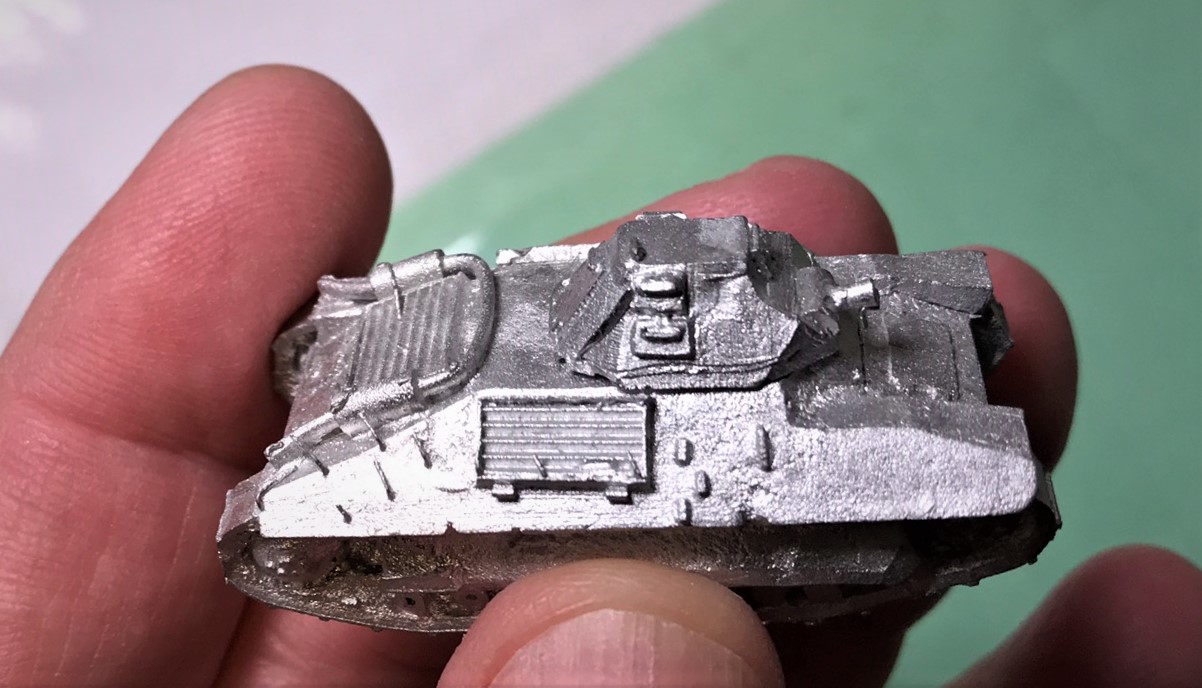
I did need to do a bit of filing and cleanup of extraneous molding material and molding lines as you see here. Yes, these are small!
The turrets had a small molded pin for mounting on the molded hole on the chassis. I needed to slightly elevate the turret or the underlying paint on the chassis would be worn off, even with a good varnishing. I decided to drill out the pins and the holes with a 1/8″ drill bit. I then used green stuff to fill in underneath the hollow chassis between the tracks and provide a “floor” for the magnets. The magnets were put in place with Gorilla Glue in the chassis and the turrets.
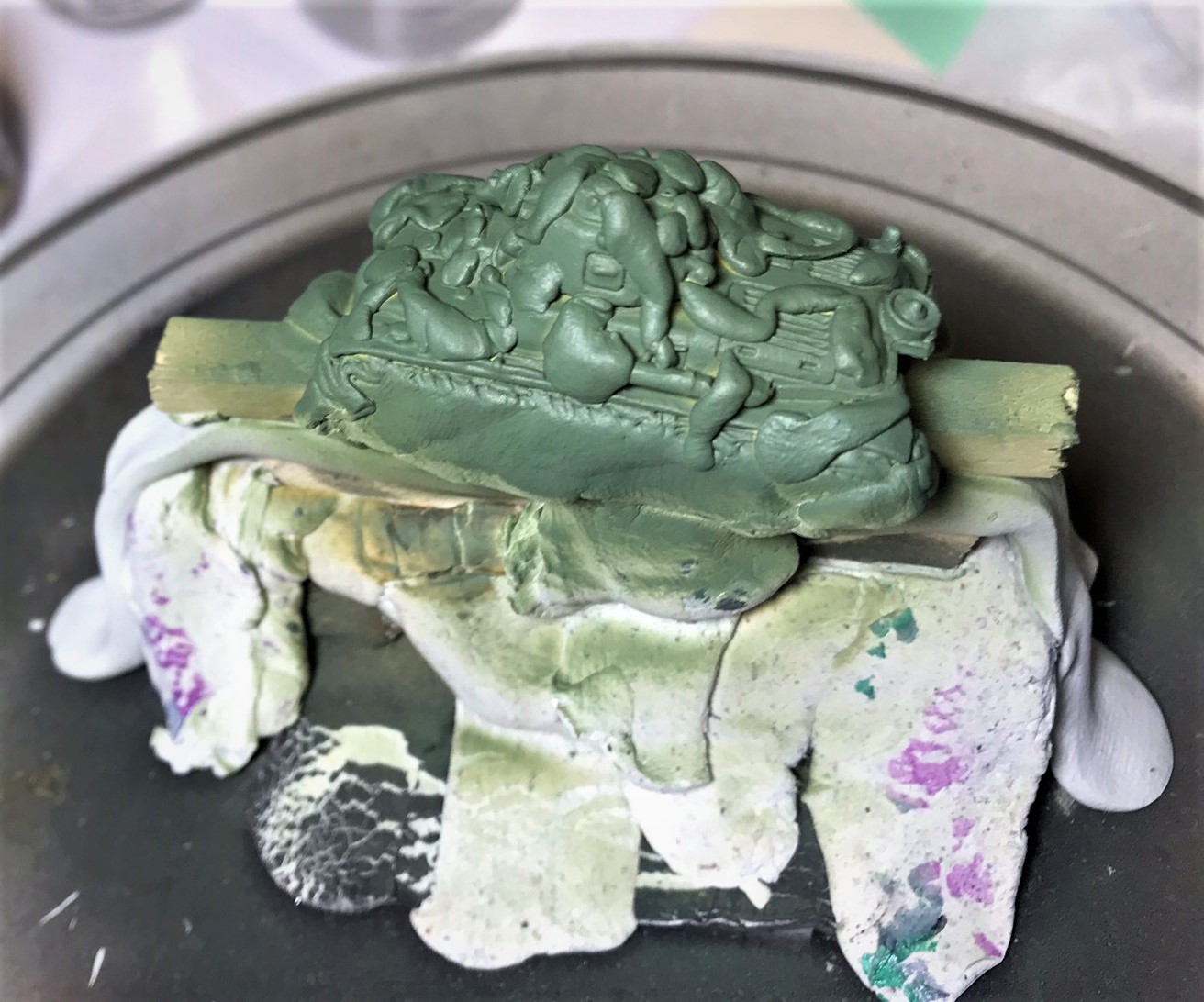
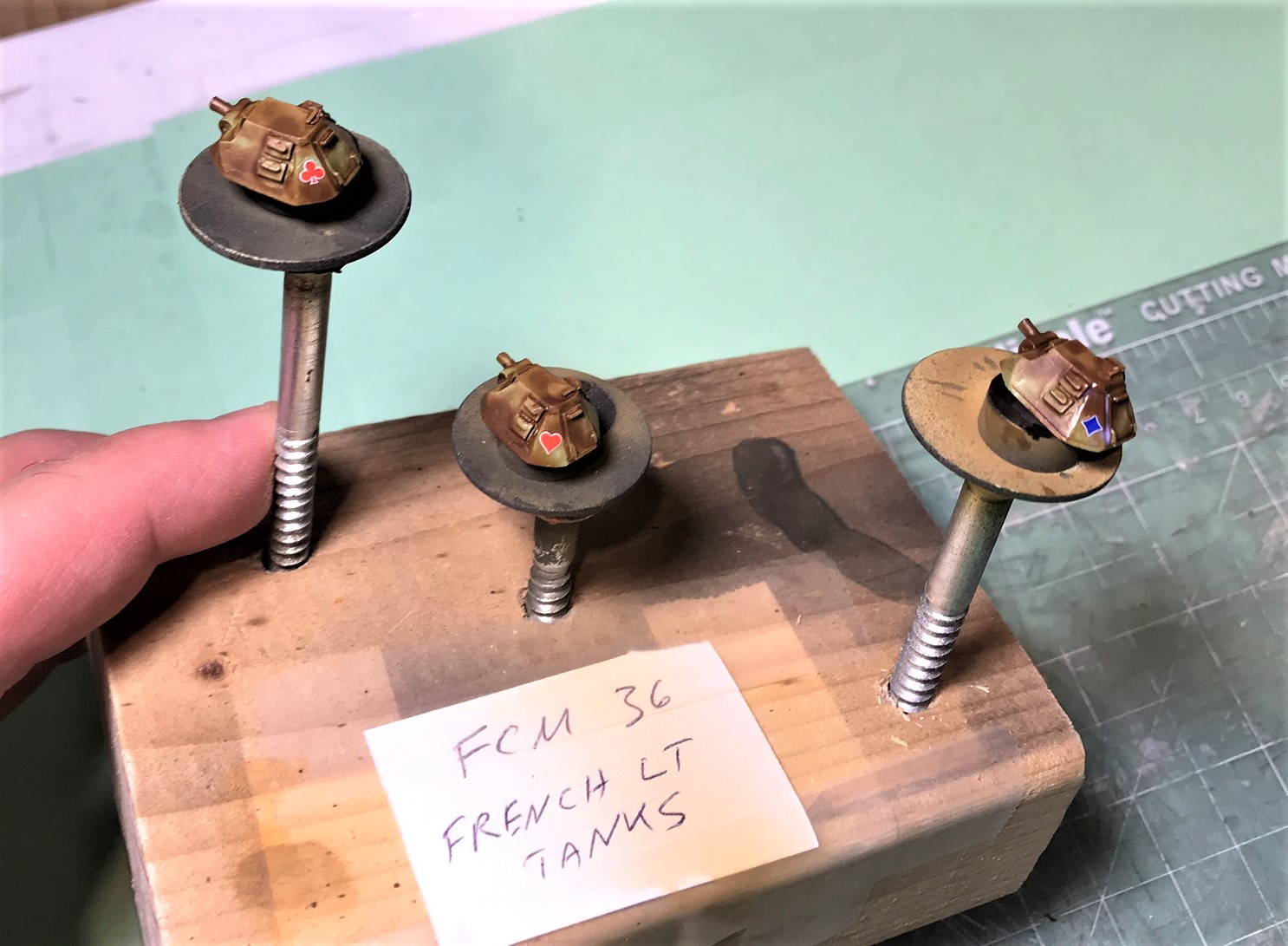
You can see here my hodge-podge mounting scheme of the FCM 36’s for painting. I used a 1/4″ square dowel and poster tack to mount the chassis for painting. I primed these, and the used a German green-brown as a base coat. This shot here is after the first camouflage color (blue green) was applied with my Iwata Micron airbrush. Also, I only put the turrets on a tank when I am painting camouflage patterns.
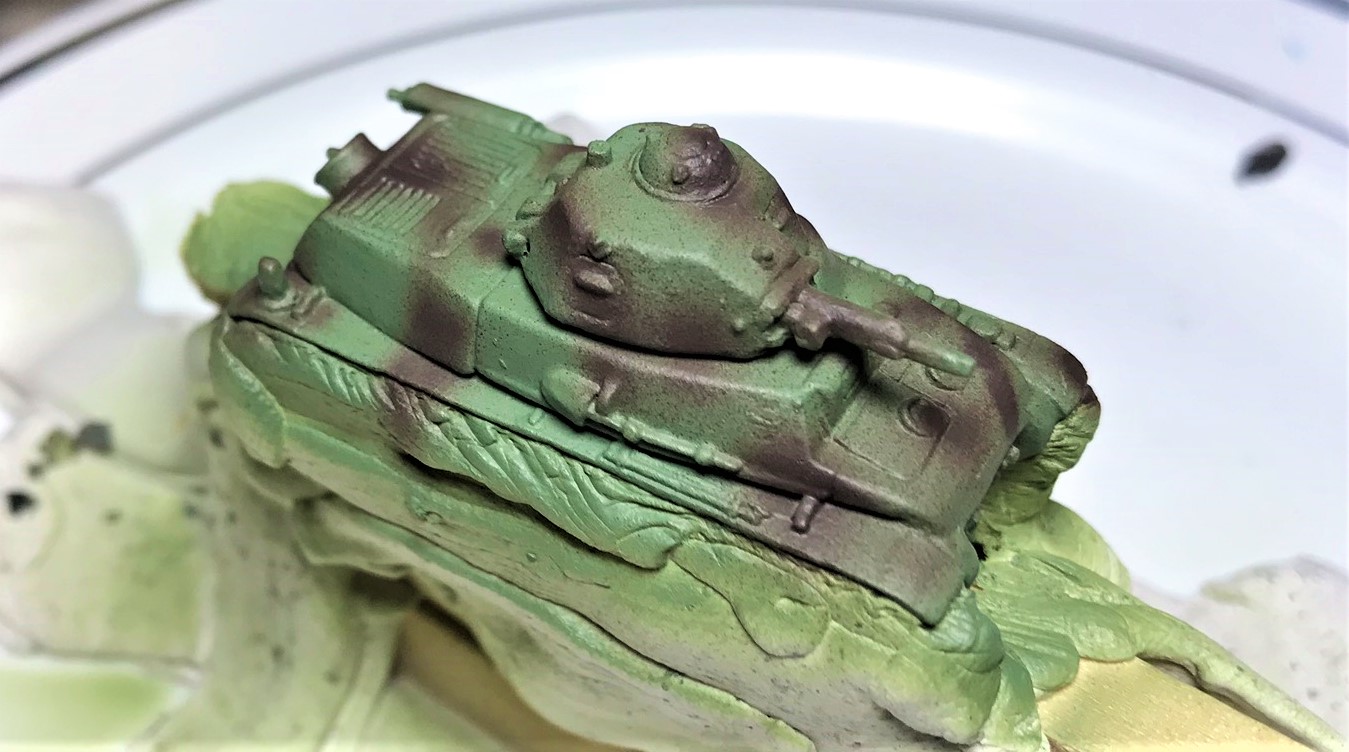
Next, I applied the third color (brown) to the camouflage pattern.
When I paint turrets, I find this helpful (as the magnets in the turrets hold the turrets to the magnets on the washers). Also, I can easily apply the decals this way, and airbrush on the final two coats of matte varnish.
Lastly, I thought I’d share some group and individual shots and a bit about their debut on the tabletop the day after they were completed.
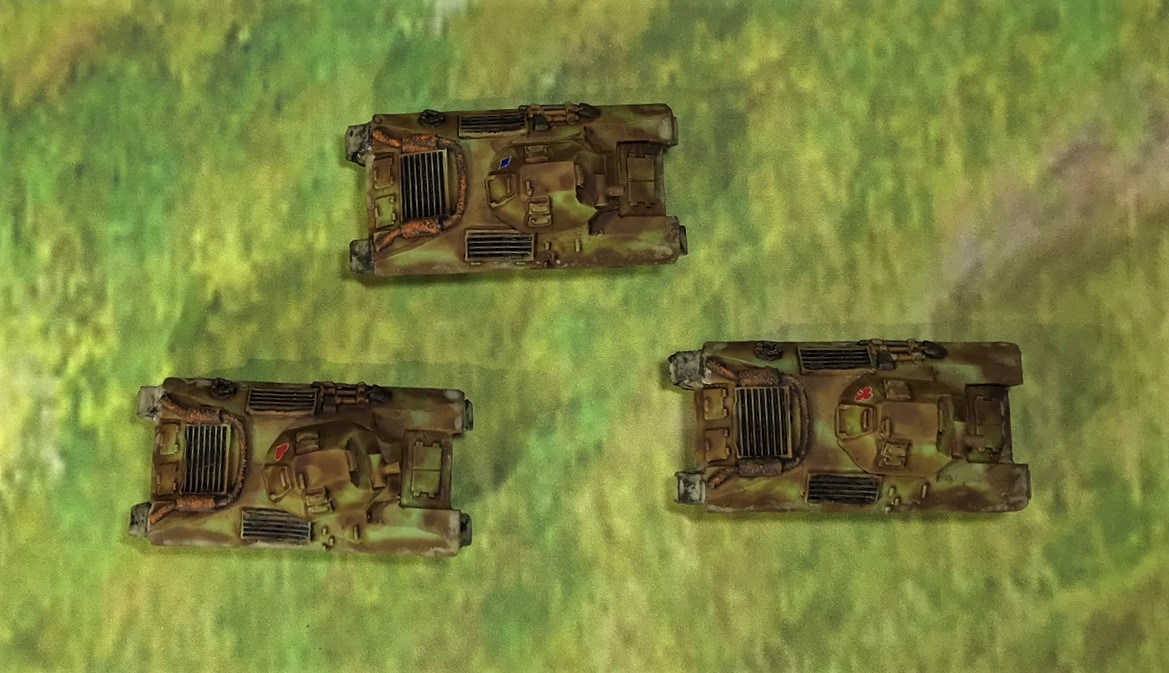
Top view showing the sloped octagonal turrets.
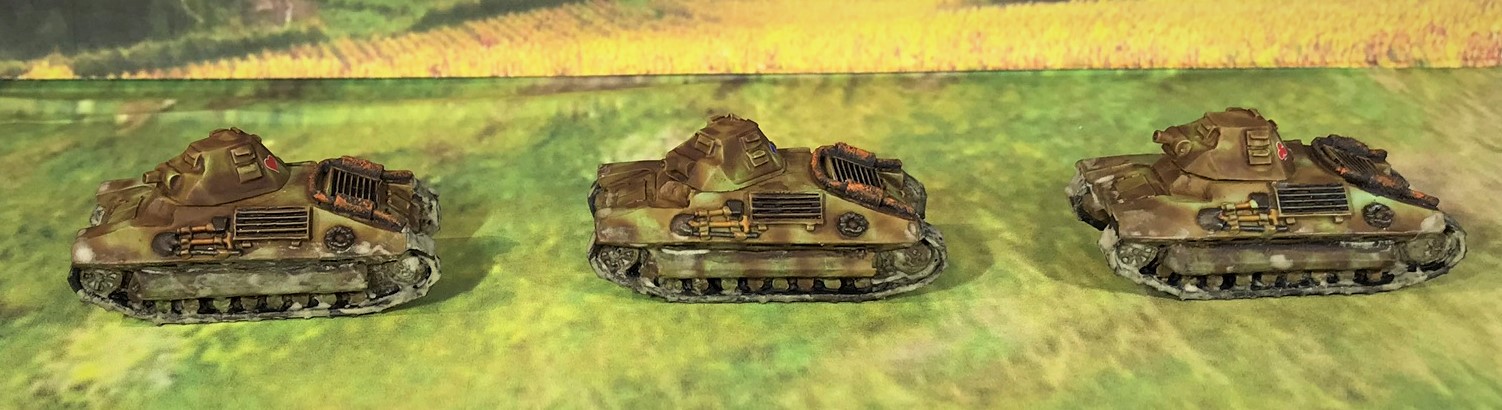
Left side of the FCM 36’s.
Frontal view.
I used a blue diamond, a red heart, and a red club as decals which would also help identify these as different individual tanks on the tabletop. From my research, FCM’s did not seem to have as many markings historically as other French tanks.
As stated above, these made their game debut this weekend at the December session of the Mass Pikemen Gaming Club.
My buddy Mike Morgan was on the French side, and chose the blue diamond FCM 36 as his tank. He then rolled a perfect roll of 6 sixes! The odds on that were 0.01286%!
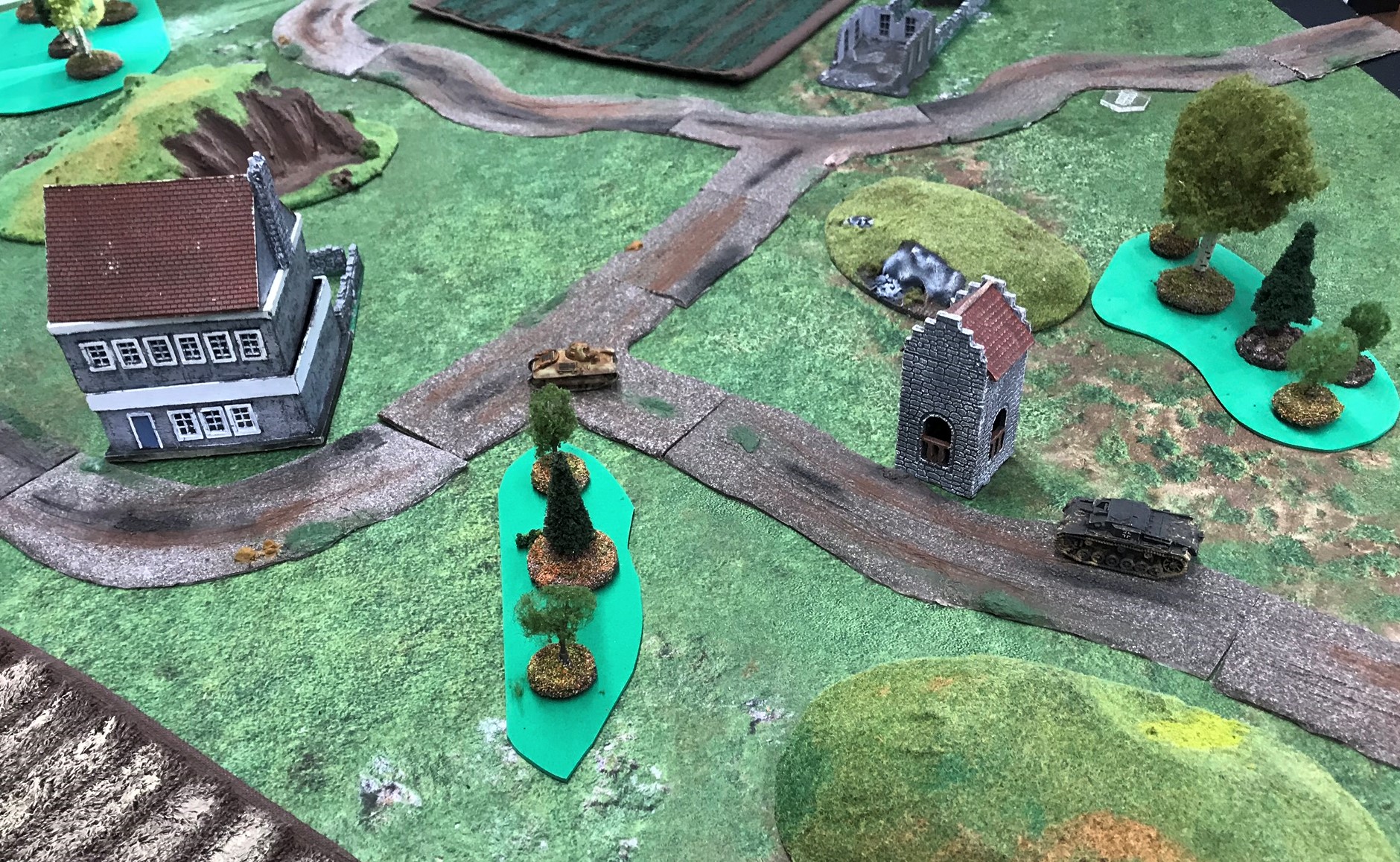
Mike’s FCM 36 moves on the road.
His FCM 36 was stalked by a StuG A (player Chris), which kept missing it.
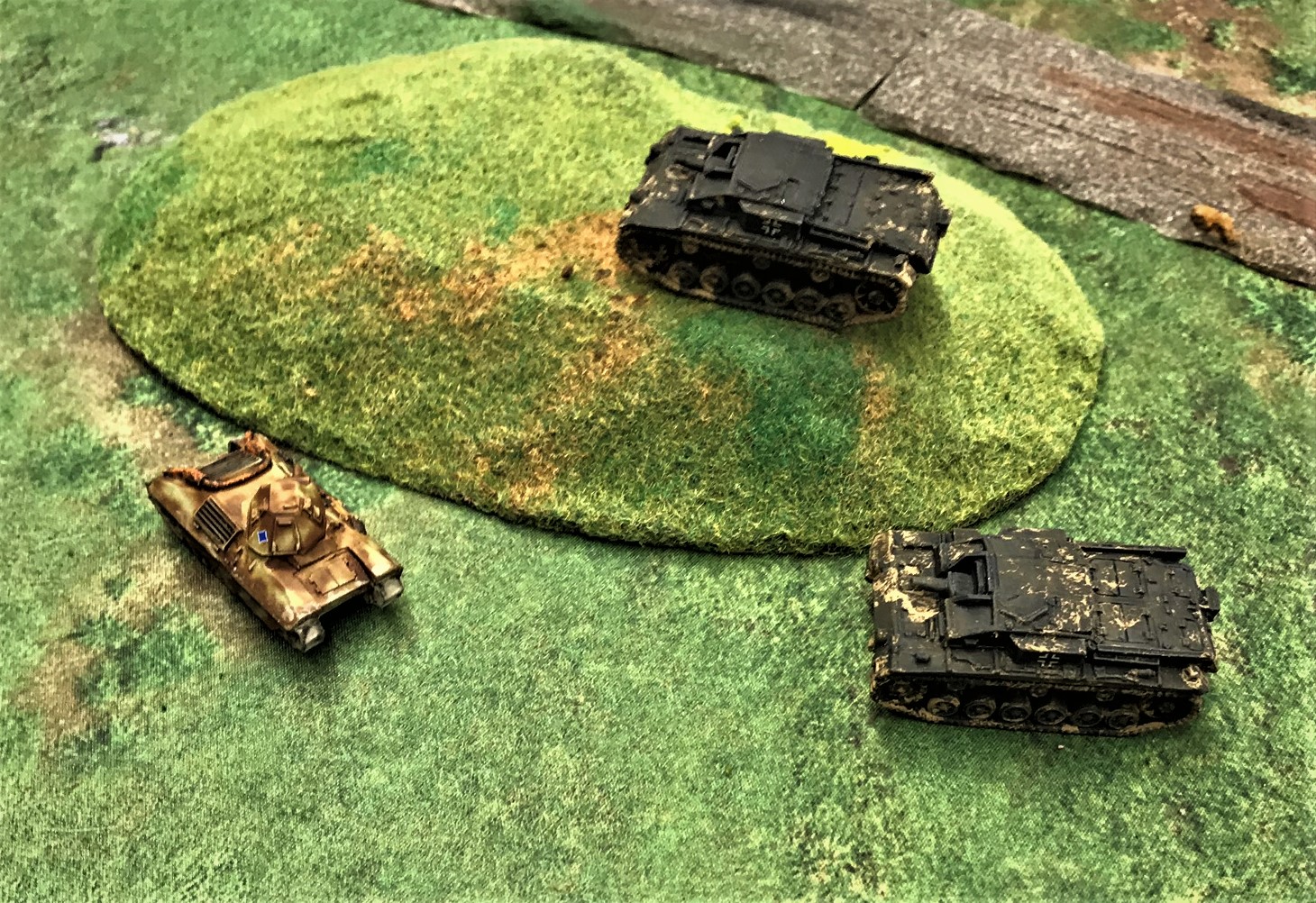
Mike successfully maneuvered his tank to the German’s side, and shot point blank. The dice deserted him as the StuG A took only minor damage.
Smelling an easy kill, the Germans (Chris’s teammate Christine) brought up a second StuG A in the hunt. It also missed the FCM 36. Note – as there were only 15 StuG A’s in the German invasion force across France, this would have been highly unlikely!
Then the Germans brought up even more to the hunt with a Panzer IIIE…
And Mike’s plucky FCM 36’s luck finally wore out with the Panzer IIIE (Christine) knocking it out.
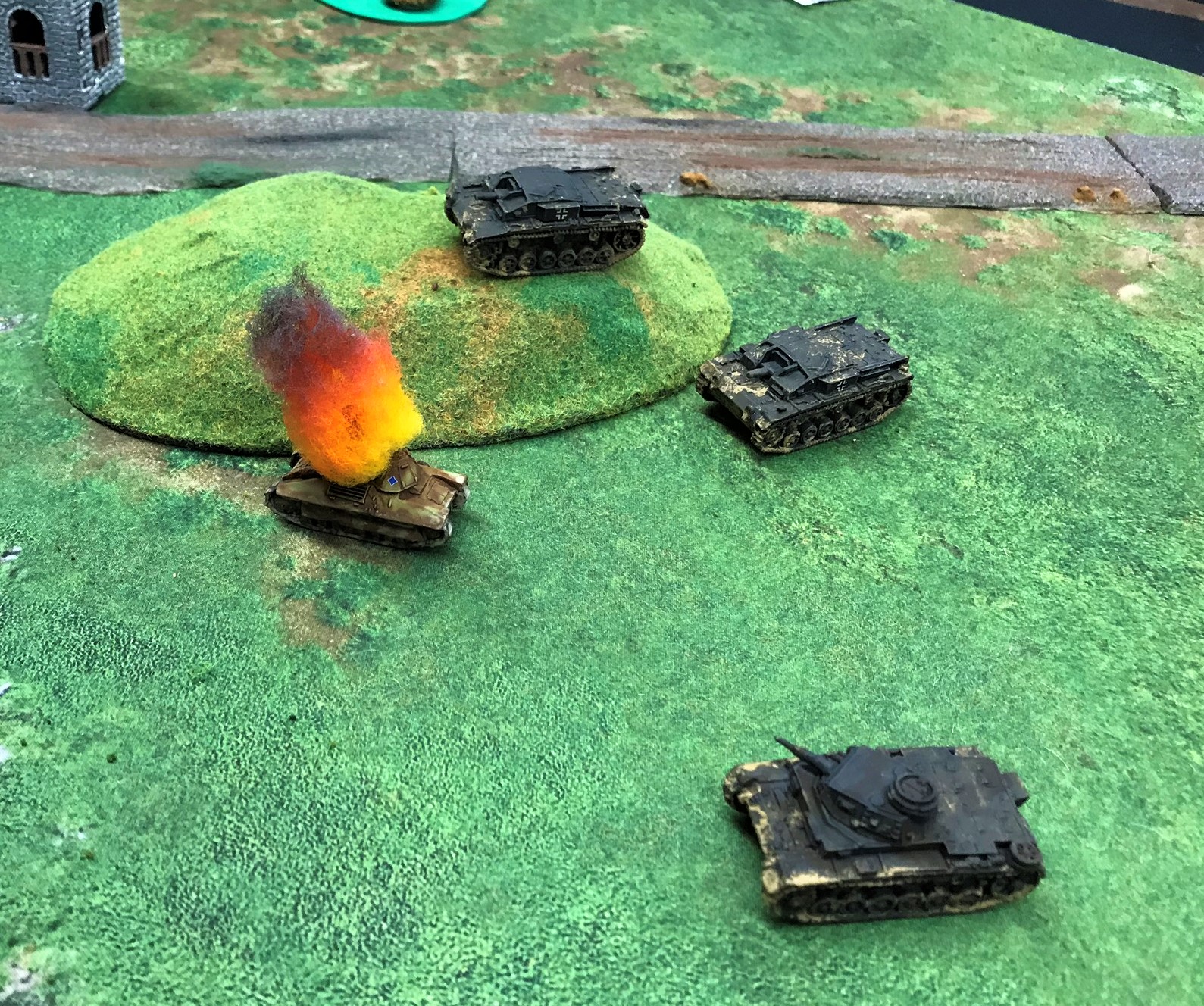
On the other side of the table, Mike’s teammate Tom managed to kill Christine’s Panzer 38(t) with a SOMUA S-35. Mike got another FCM 36, and that was killed by Christine’s teammate Chris’s StuG A (in the shot below on the left). Mike replaced his lost tank with an R35. Tom drove his SOMUA around the building but frustratingly could not take a point-blank shot at the Panzer IIIE (as his dice roll failed him). Mike had to leave, and my wife Lynn (no gamer just watching) took over the R35. Lynn drove the tank to the side of Christine’s Panzer IIIE, and rolled three critical hits – and Christine failed to block any. This knocked out the Panzer IIIE!
Lynn’s R35 avenges the burning FCM 36 (on right) by knocking out the Panzer IIIE.
Happy wife, happy life! Tom and Lynn are all smiles here.
In a final act, Christine maneuvered her remaining StuG A for a rear shot on Tom’s SOMUA S-35. She successfully knocked out the SOMUA.
That ended the game, with the French winning a very narrow victory 32-31. If Lynn had not rolled so well in killing the Panzer IIIE, the Germans would have won. Thanks to the players for a great and fun game!
I have plans for more French and German tanks for this scenario. I hope that you enjoyed this post, and feel free to share your thoughts and feedback with me in the comments section! I have been behind on my blogging efforts and hope that I can share more with you soon! Thanks for taking a look!
On October 19th, 2019, the Fort Devens Gaming Day was held at the Fort Devens Museum. This was our monthly gaming day as an “away” game day for the Mass Pikemen Gaming Club. Our club sponsored two games as Scott Howland ran a pulp game in another room which was very well-received. I believe it was similar to this one.
This was my second time attending this small convention and my first time as a game master there. For nostalgia alone, I really looked forward to the event as I was stationed at the old Fort Devens before it was closed in the 1990’s. It has since been converted to commercial uses and some US Army Reserve functions. Running a game here was fun.
Both sides started with 150 points/chips to use during the game. The Allies started with a 40 points worth of vehicles. For the UK, they bought a Dingo scout car and a Churchill “TIM” (nicknamed for theimperfectmodeler aka TIM), along with an M5 Stuart, and an M8 Greyhound for the US. The Germans spent slightly less, choosing to buy an SdKfz 231 scout car, a StuG IIIG, and a Panzer IVH for 36 points.
The players prepare for battle among the museum exhibits.
The Germans took up very good ambush positions – especially the Panzer IVH, which was hull-down behind a stone wall. The M5 Stuart successfully reconned it, and the German fired point-blank at the light tank, missing it. The Stuart then prudently backed up behind the hedgerow. The Churchill “TIM” then moved up the road, to be also shot at, and again missed by the Panzer IVH. Amazingly, the Churchill immediately reversed the bad German die rolls, and miraculously hit and knocked out the Panzer IVH for its first kill ring of the day.
The first exchange goes badly for the Germans as the Panzer IVH missed its first two targets (the M5 Stuart and the Churchill). The retreating M5 is at top behind the hedgerow. The Churchill “TIM” drives past the knocked out (with crew surviving) Panzer IVH.
The Allies then successfully reconned nine possible German positions at 2 points apiece, adding to their score. They also successfully crossed the tabletop with an M8 Greyhound, gained the points, and respawned as another M8. The Germans spent some points and respawned the destroyed Panzer IVH crew into a Panther D which drove up next to the burning Panzer IVH. The Churchill “TIM” went Panther hunting.
Meanwhile, the Germans tried to put an end to the Allied reconnaissance successes. The StuG IIIG ambushed both the M5 and the Dingo gaining them crucial points, which they used to buy a Marder III. The Allies respawned both losses with similar models.
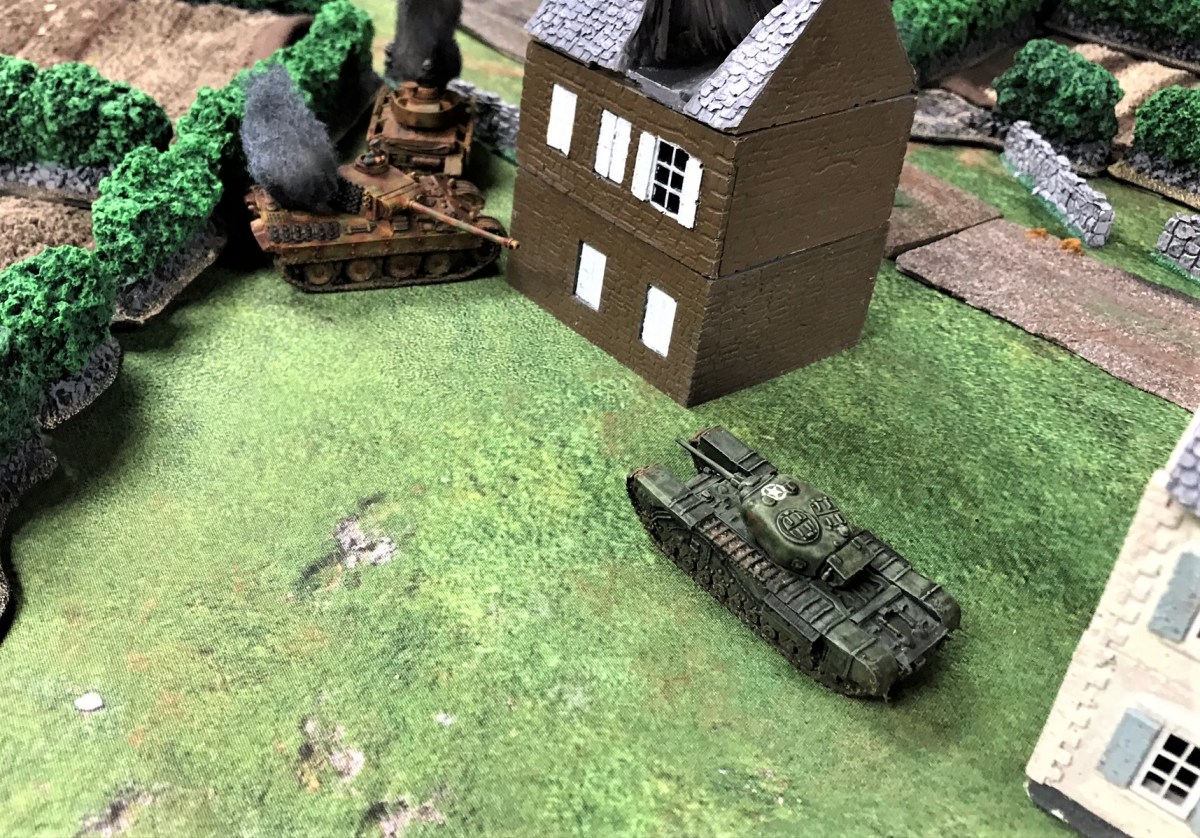
The Churchill “TIM” at top maneuvers to attack a Panther in the rear. In the foreground, The StuG IIIG takes out the M5…
The Allies spent some chips to respawn the Dingo as a Cromwell IV nicknamed “IRO” aka imperialrebelork. The Germans dropped some obscuring smoke in front of the Cromwell.
…and then the Dingo. The Germans dropped smoke to protect the StuG from the Cromwell IV “IRO”. The Churchill “TIM” at top hunts the Panther D.
“TIM” continued its winning ways and managed a flank shot on the Panther D. Its good dice rolling (and the German bad dice rolling) yielded a second kill ring for “TIM”.
The Churchill “TIM” takes out the Panther D.
The Germans were aghast at this expensive loss and vowed revenge. The SdKfz 231 managed to call in a rare Luftwaffe air strike on the Churchill, which destroyed “TIM” after it had been so effective.
The British mourned this loss, and respawned it as an Achilles 17-pounder nicknamed “Per”. The British also bought another Dingo and a Cromwell IV nicknamed “JNV” or justneedsvarnish. The US bought an M10 Wolverine. The Germans went for broke and bought a Jagdpanther and an SdKfz 233.
The StuG IIIG went head-to-head with the Cromwell “IRO”, and took it out. The Jagdpanther caught the Achilles “Per” in the open and made short work of it. In the meantime, the Allies successfully crossed a Dingo and an M8 Greyhound. This resulted in denying the Germans any end of game bonus points for preventing more than two Allied vehicles crossing the table.
To make matters worse for the Germans, the respawned M5 Stuart knocked out a well-hidden Marder III with some help from a supporting infantry assault (see how I use bonus attack cards here) and well-placed 37mm rounds. As the game was winding down, and it was clear the Allies had a commanding edge in the score, The Germans bought a Tiger I and converged all vehicles on the plucky M5.
The Marder III burns, and the Tiger I and SdKfz 233 hunt the M5 Stuart…
…and are joined by the Jagdpanther!
This traffic jam at game’s end yielded no damage on the M5 Stuart – the dice had completely deserted the Germans.
At games end, the final score was Allies 193, Germans 142. This game yet again delivered a different result. Player choices, and player luck all made this game fun and unique.
This is my 12th post about my development and running of this scenario and the models that went into making it. I started back in May 2019, so it’s been a lot of work, but one project that I really am proud of now.
I wanted to honor the history and the struggle of the Allies in the days after the D-Day landing 75 years ago. I will continue to run the game, and at this point I really only need to add a StuG IV to be really complete vehicle-wise (and I have one to build!). To read about previous games and related posts, see the following:
When I was young boy, the local TV station would show an old monster or horror movie on Saturday afternoon. Sometimes these were the of the 1960’s Japanese Godzilla et. al. genre, other times they were the B-movie sci-fi stuff from the 1950’s. Even the British Hammer remakes would be shown. Those were all cool, but the best ones were the classic 1930’s and 1940’s films like “Dracula” (1931), “Frankenstein” (1931), “The Mummy” (1932), and “The Wolf Man” (1941).
My dad would enthusiastically watch these films with us and I have really special memories of those occasions. Now of course every movie ever made can be had immediately, but back then you had to wait and hope that they would be coming on – and that made their rare showings quite eventful. The subjects of those movies have seen numerous remakes, but the originals remain classics and have had a huge impact on popular culture.
One of those influences was in the creation of games with monsters, such as Dungeons and Dragons (and others) – and the miniatures that were used with them – such as 25mm scale figures from Ral Partha. For US folks unfamiliar with 25mm scale – this is the common Ral Partha scale in the 1970’s and 1980’s and it means that each figure is only about 1″ tall.
I first was exposed to Ral Partha miniatures in 1982 – and have loved them ever since. Sculptors such as Tom Meier, Julie Guthrie, and Dennis Mize made fantastic creations that were true scale, not “hero scale” as many of today’s miniatures are. Ral Partha figures are still made today in Cincinnati by Iron Winds Metals. When I returned to the hobby in 2014, I acquired many of the old figures in various lots of figures on eBay. Among these of which I came into possession were several of the old classic movie monsters. They often were encrusted with the types of thick enamel hobby paint that was commonly used back then. I stripped many (with some damage), and put them away for future consideration.
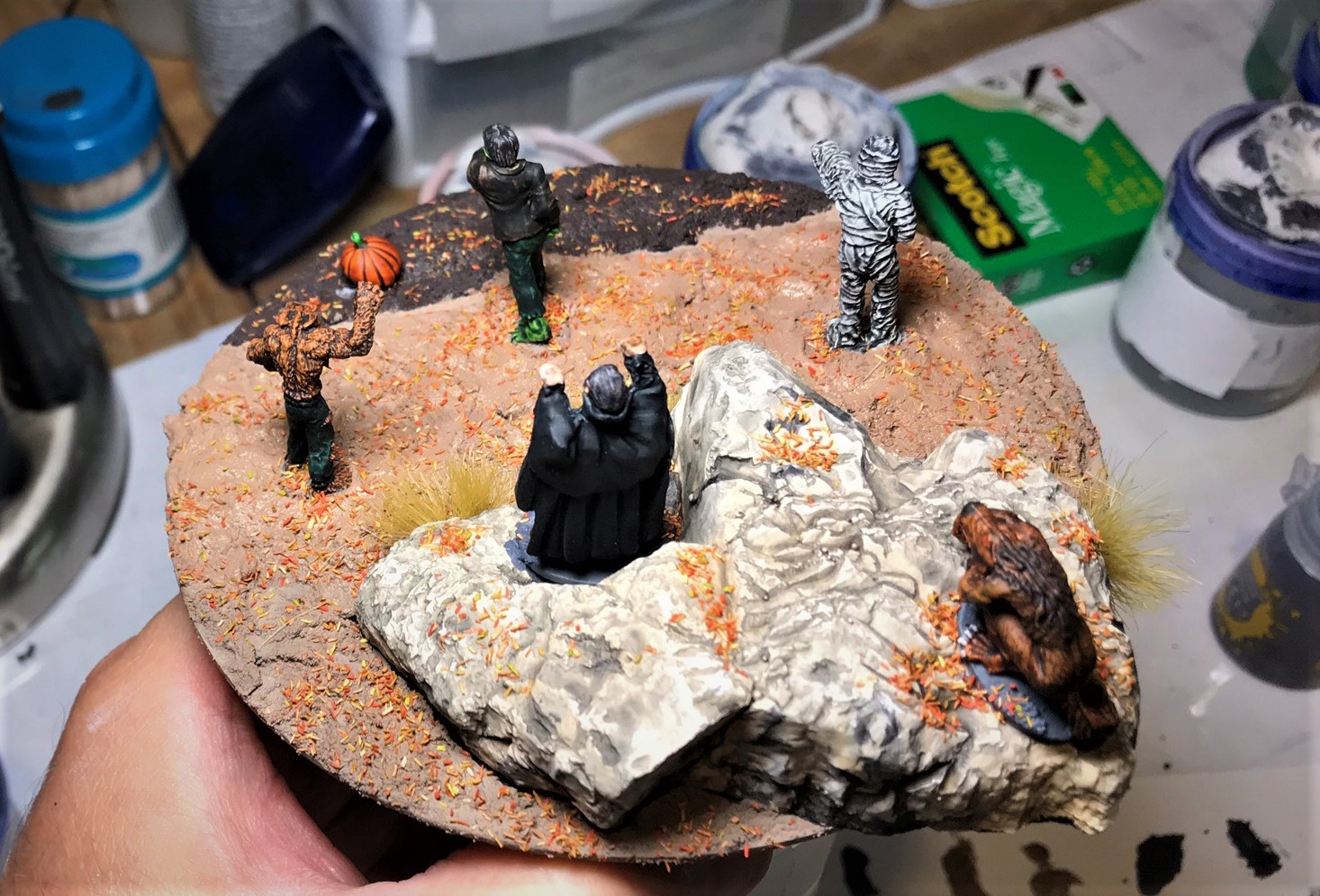
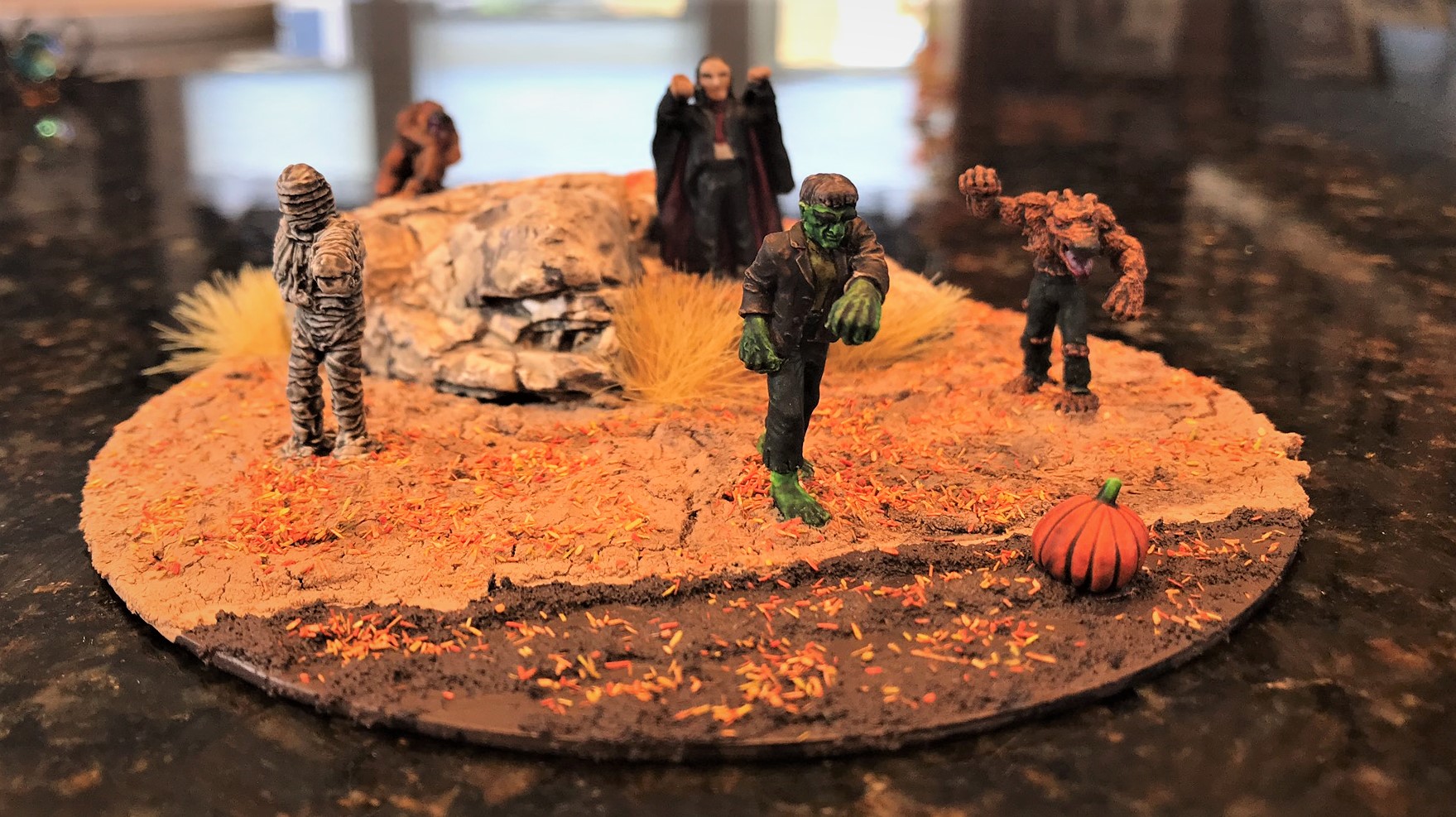
That future consideration arrived this month. A local hobby store, Great Stories in Uxbridge, MA, has gaming and other hobby events that you can read about here. One of these events was “The Great Pumpkin Halloween Hobby Challenge”. The store had a pumpkin patch for figures to be displayed – and the only rules were that there needed to be a pumpkin (provided for $5 as entry) as part of the figure – and that it needed to be submitted by October 28th. I decided that my filed-somewhere Ral Partha monsters would make a nice diorama for the challenge. I dug into my stash, and found that I had 5 suitable figures, two werewolves, one mummy, one Dracula, and one Frankenstein’s Monster. I wanted to push myself with the mini-diorama – as I have been admiring many of those by theimperfectmodeler for years (check one of his recent dioramas here). I am nowhere near his creative league (he is award-winning) – but his work is inspiring and I wanted to see if I could accomplish something of which I could be proud. I decided to use an old DVD and card as a base and a Woodlands Scenics rock as elevation. The edge of the pumpkin patch would be on the DVD so I could line it up on the display at the store.
The effect that I wanted was that of having these classic monsters coming from off the pumpkin patch and moving to prey upon the unwary townsfolk beyond.
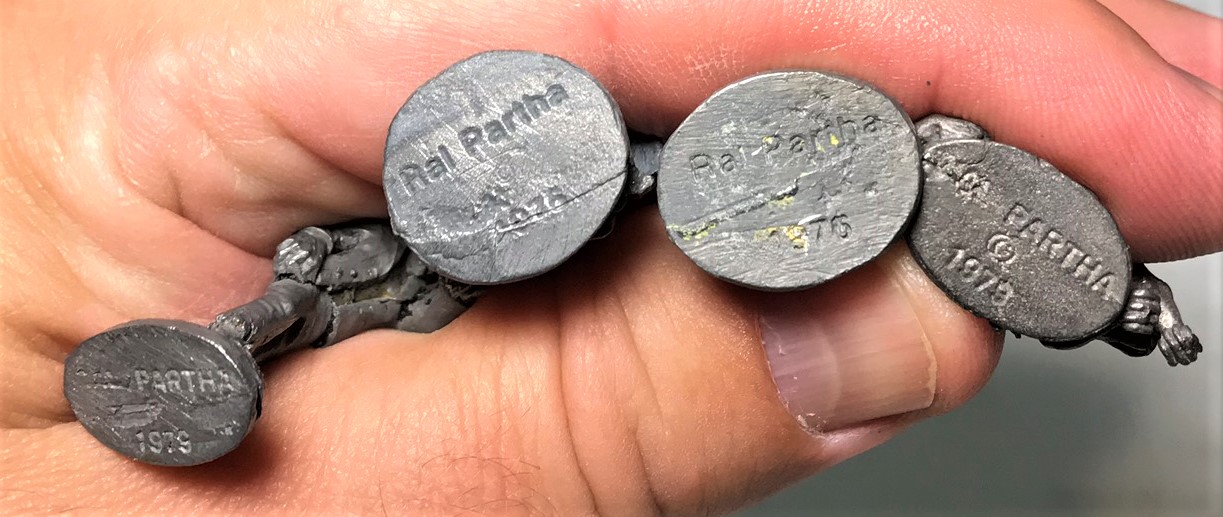
1976 and 1979 figures’ bases. From left to right is Frankenstein’s Monster (1979), Dracula (1976), The Mummy (1976), and one of the two werewolves (both were 1979).
The base was an old DVD sanded down – and a Woodland Scenics resin stone.
I decided to brush paint the base with primer to keep the stone pristine (and away from any airbrush mistakes). I also wanted to have a great bond between the stone and the DVD so I affixed it prior to painting along with a piece of polystyrene card to cover the hole.
Again, these are 25mm figures so they don’t stand out like larger models. This is what we had back in the day! I will share details of each of the five models, and then the completed piece. As is my custom, I will list the paints and materials I used at the end of this post for those interested. I did use many Citadel Contrast paints as base paints.
Dracula
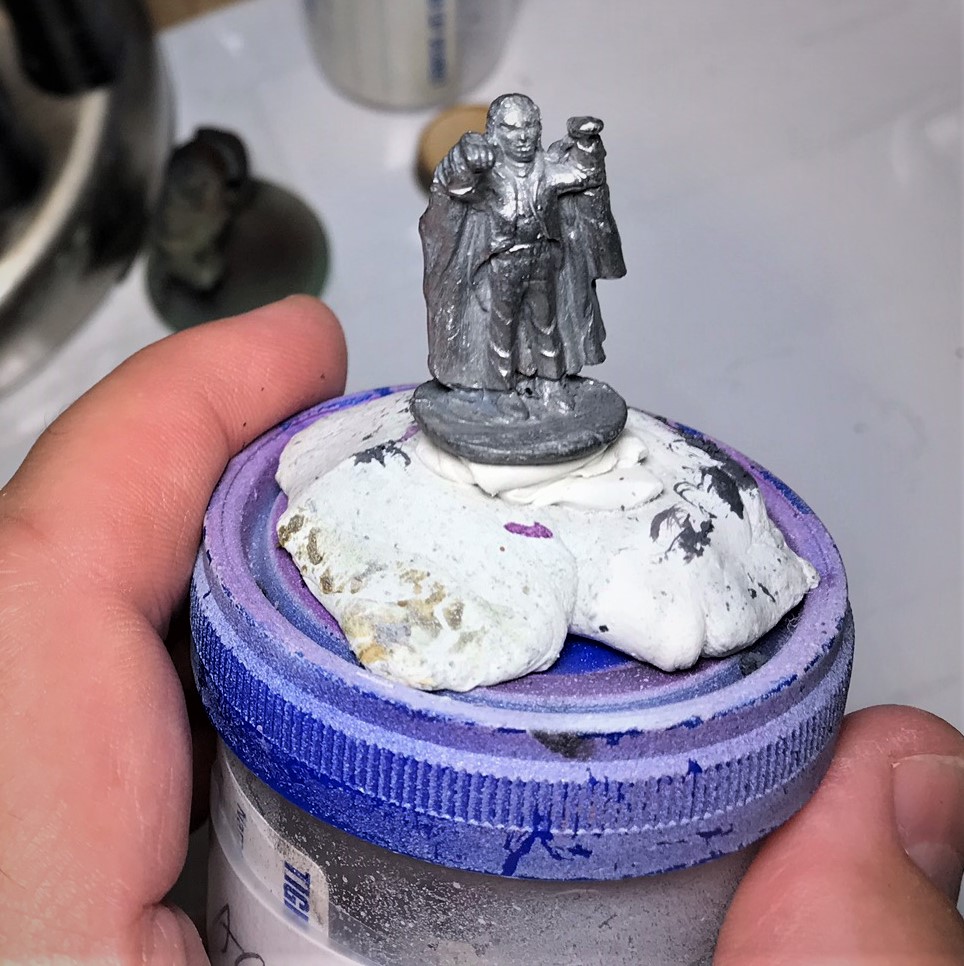
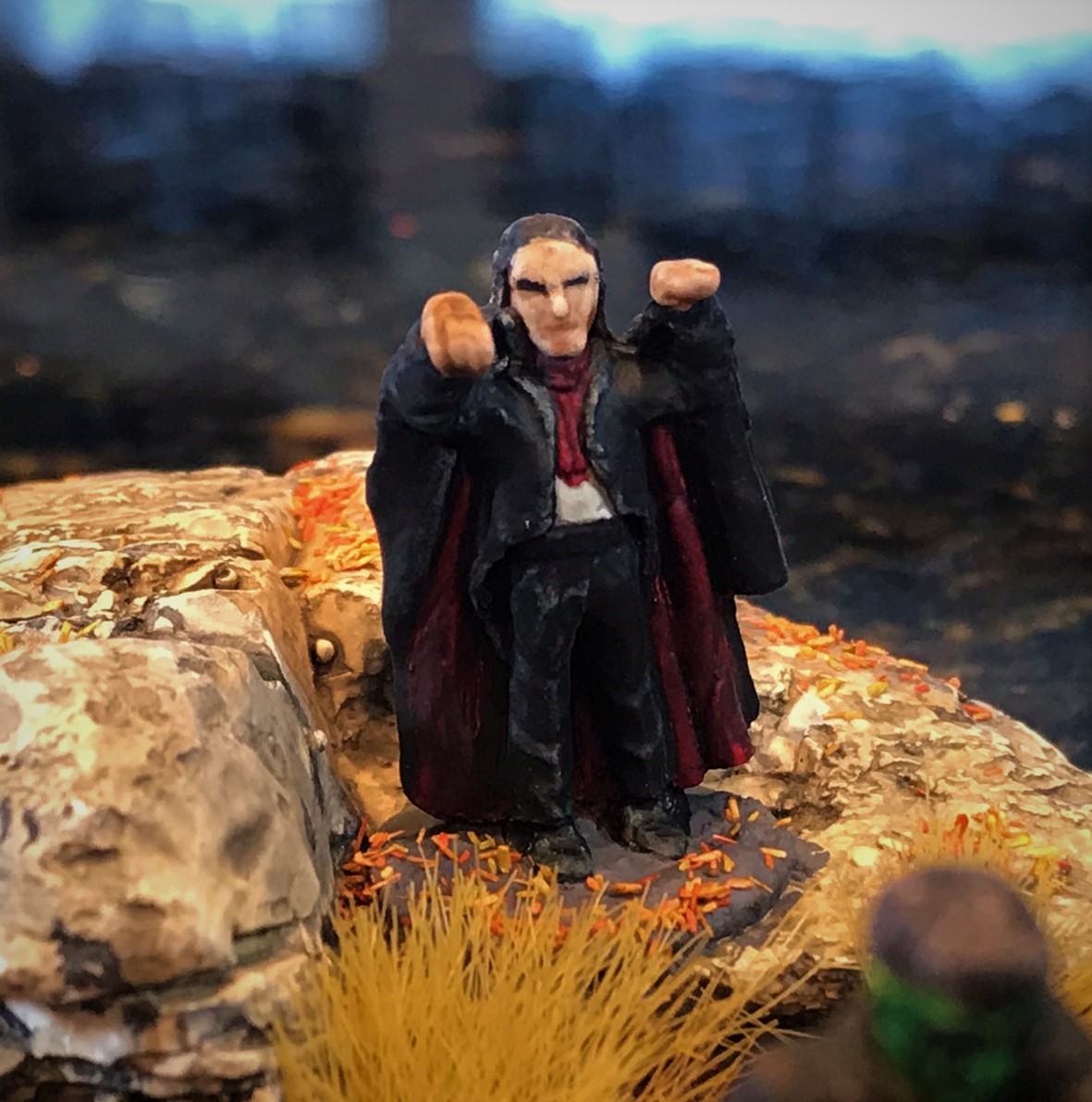
The Dracula/vampire model was #01-014, a Tom Meier sculpt from the Personalities and Things that Go Bump In The Night line. The base had “Ral Partha 1976” on it. I probably over-cleaned it – but the details on it – especially the face – were not great. Trying to get the right skin tone for Dracula was a challenge – and the lack of detail did not help. I wanted Dracula to be the highest model on the diorama – like he was sending his evil minions forth. The rock had a nice place for me to place Dracula’s base as its size and shape were considerations as well (it was not a removable base).
Dracula after cleaning – I probably got aggressive trying to remove the old enamel (note the scratches).
Dracula mounted and ready for airbrush priming and traditional brush painting thereafter. I did use many of the new GW Contrast Paints on all of these models, but ended up needing other paints and products as well.
Dracula painted and varnished.
Dracula mounted on the diorama.
The Mummy
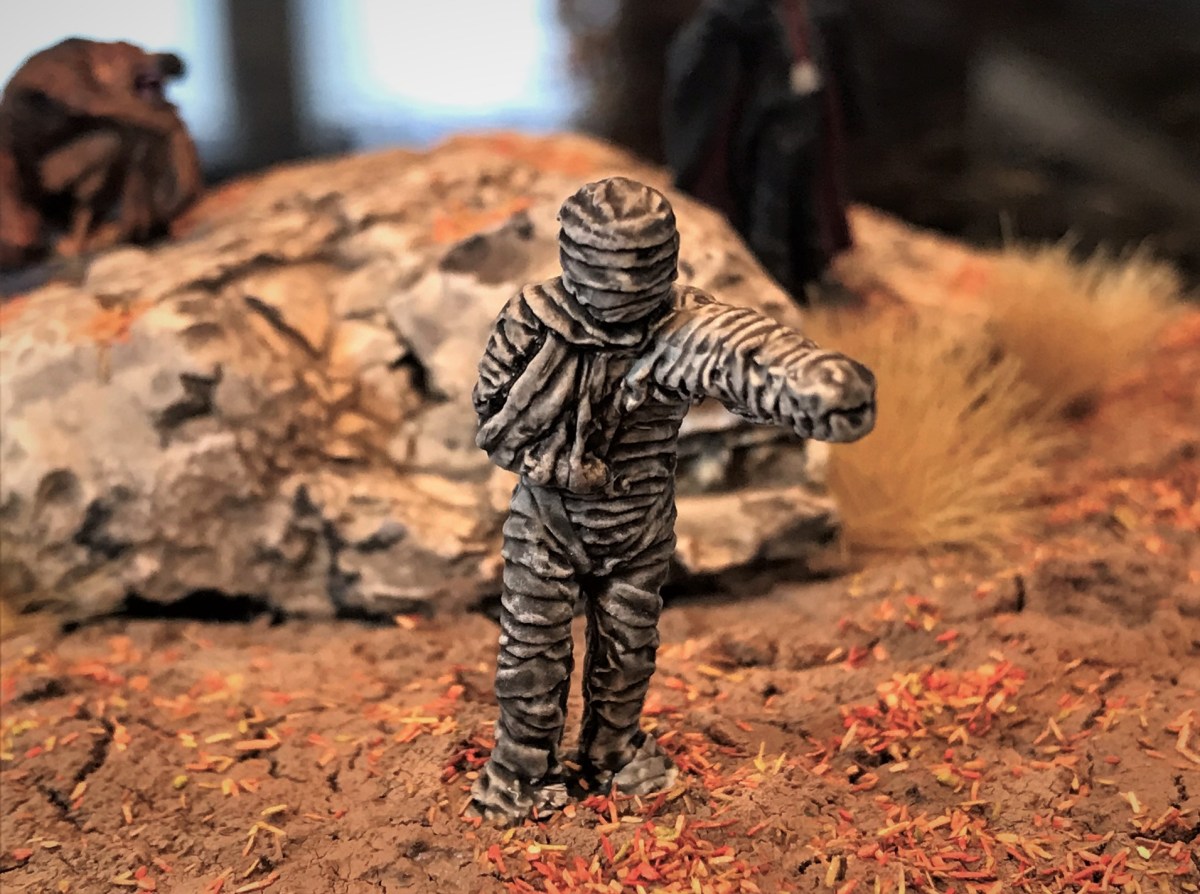
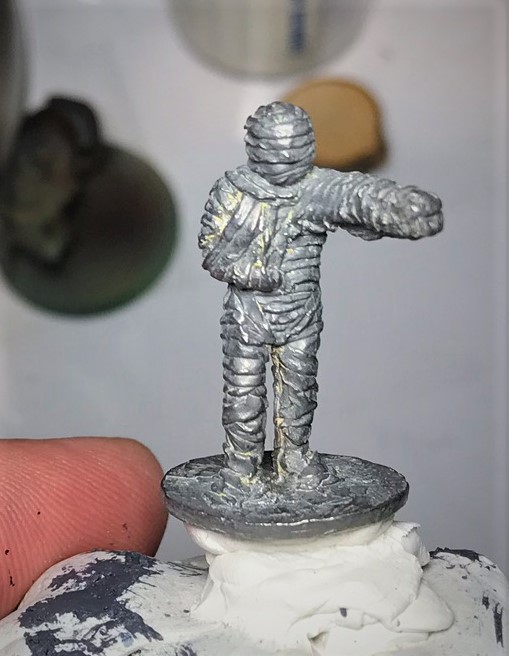
The Mummy model was #01-020, another Tom Meier sculpt from the Personalities and Things that Go Bump In The Night line. It was also from 1976. This was the easiest to paint and I thought it came out as desired.
After cleaning and stripping, there were still remnants of the old paint job, but these were not an issue.
The Mummy, mounted for painting.
After painting and varnish – looking very old school Egyptian.
The Mummy mounted on the diorama.
The Were Wolf (crouching model)
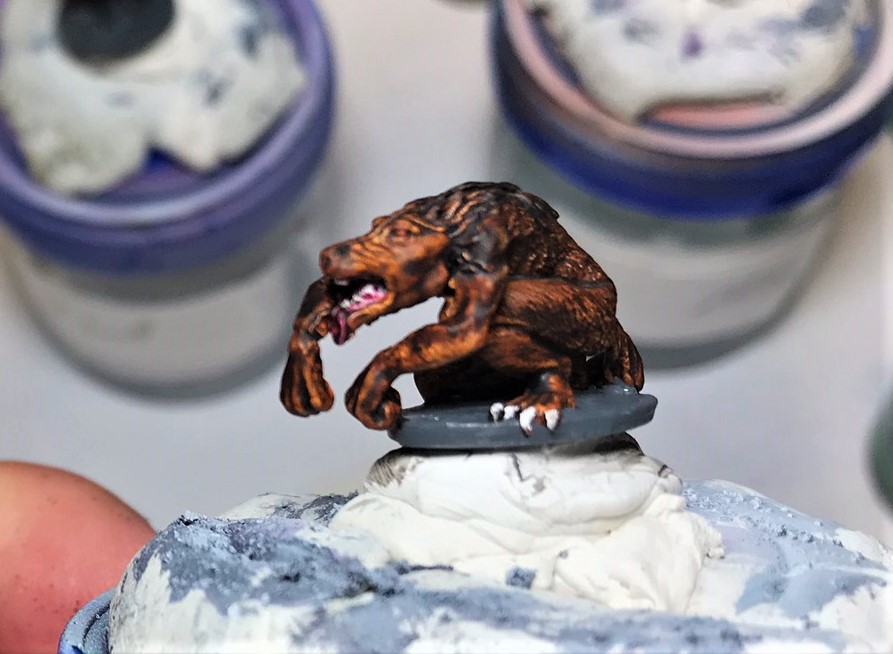
The were two werewolf models that I used. The first werewolf was in a crouch. This model was “Were Wolf” #01-061, (two words) – yet another Tom Meier sculpt from the Personalities and Things that Go Bump In The Night line. However this one was from 1979. I wanted to have this one climbing up the back slope of the rock, giving a little more depth to the piece.
Some of the original paint can still be seen.
The Were Wolf mounted for painting. The detail on this model was still in good shape.
A close-up shot of the model after I painted and varnished it.
The mounted monster climbs the back of the rock. Here again, I needed to deal with the base.
The Werewolf (standing model)
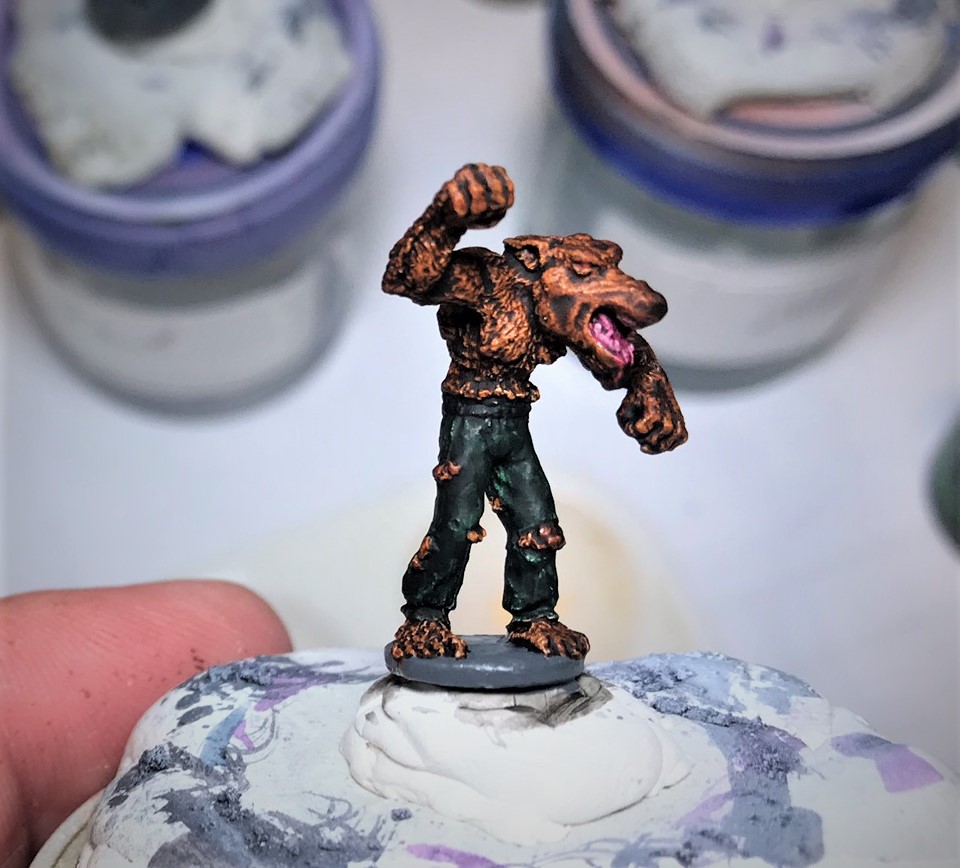
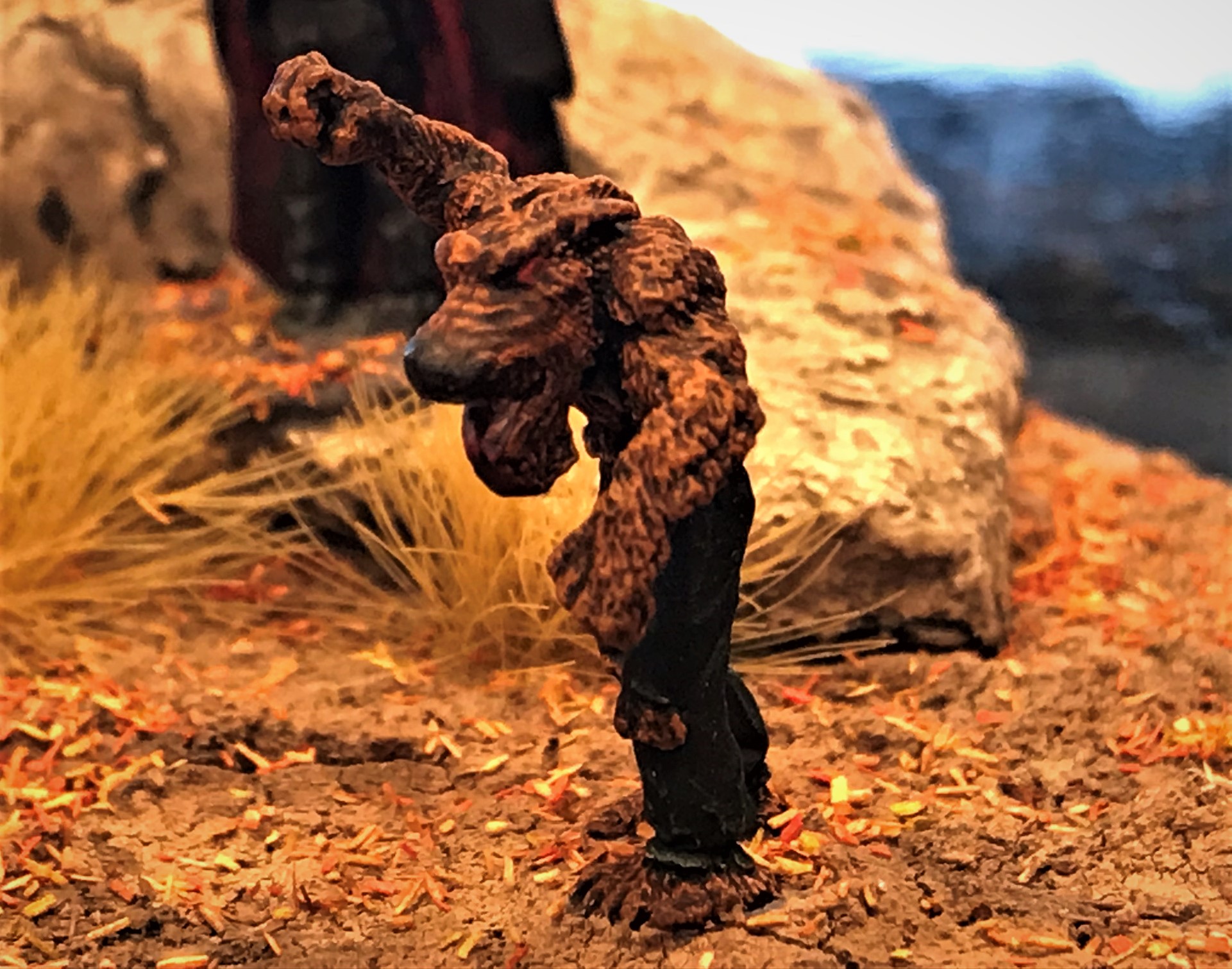
This is the second of the two werewolf models that I used. This model is standing (and this one is wearing pants). It is “Werewolf” #98-003, (one word). This could have been sculpted by Tom Meier, Julie Guthrie, or Dennis Mize, as the Lost Minis Wiki is not clear on that. The sculpt is from the The Adventurers line and has 1979 on the base. I wanted this beast standing in the front of the diorama.
The Werewolf cleanup up – I do not think this model was previously painted.
The Werewolf mounted for painting. The size of the small base was helpful in mounting to the diorama.
The figure after completion.
The Werewolf moves forward on the diorama.
Frankenstein’s Monster
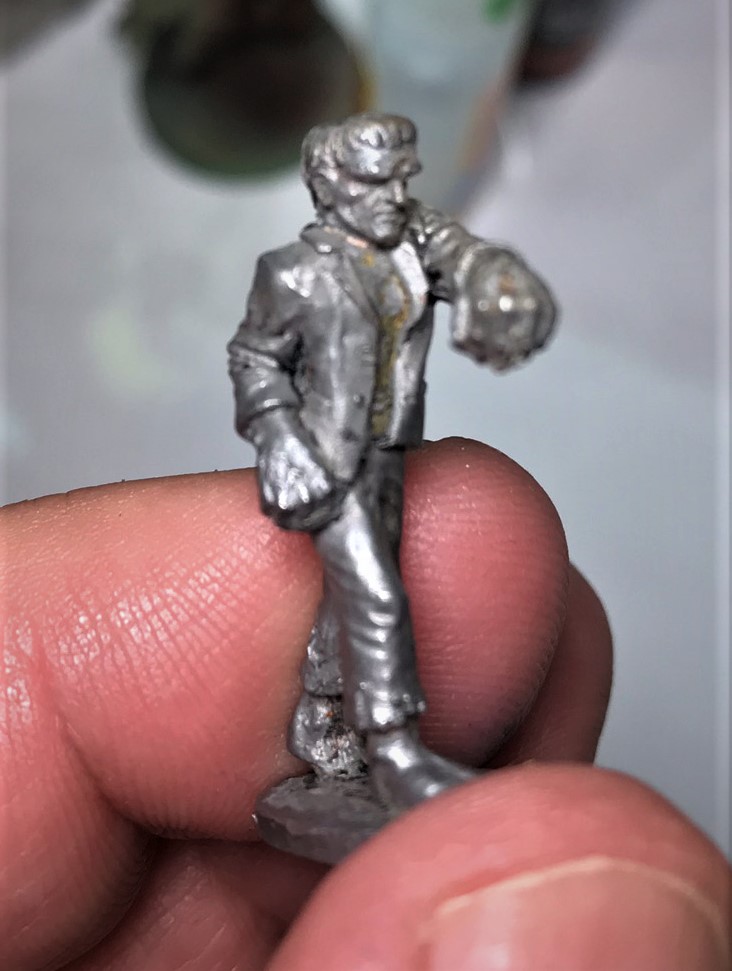
Often called “Frankenstein”, this is actually Frankenstein’s Monster (created of course by Dr. Victor Frankenstein. The model is another one from The Adventurers line and has the designation #98-003. The detail on this was also fairly good for a model from 1979.
The model after I cleaned it as best as I could – some old paint remnants remain.
The Monster mounted for painting – I did not want to take away any detail here as I thought it was pretty good.
The painted Monster. I went with heavy eyebrows as before I did the effect of the brow was not what I wanted. Close up it has a little Groucho Marx look – but at a distance it worked – at least for me.
Moving to the attack!
The Pumpkin
The pumpkin was a from a Reaper sprue -and had to be part of the contest submission.
Before…
…and after!
Basing the models after painting them required a bit of landscaping. To fit better on the hobby challenge table, I made a field edge with Citadel “Stirland Battlefield” on the field and “Agrellan Badlands” on the rest of the ground. I added autumn leaves from 4Ground (now available from Warlord Games here) to the still-wet texture paints and some matte varnish droplets on the rock. These were placed as how I thought they would naturally collect – as well as to break up the form of the flat mini bases that were mounted on the rock. Then, I used a handheld hair dryer to dry the terrain (and crack the Agrellan Badlands a bit). I added some grasses from Shadow’s Edge Miniatures. These also helped to hide Dracula’s base a bit.
The Dracula figure and the crouching Were Wolf are mounted on the rock here with Gorilla Glue. For better adhesion, I scraped away the black primer where I was going to mount the other three figures. This also allowed me to mount them sequentially. Doing this made it easier to paint and hide the figures’ bases with the texture paint products.
The texture paints are still wet here. I created the pumpkin patch edge with “Stirland Battlefield”, the rest with “Agrellan Badlands”. I put a few dots of matte varnish on the low spots on top of the rock for the leaves. While the paints were still wet, I sprinkled the autumn leaves about as you see here, then used a hair dryer to dry and crack the ground.
A right side view of the same as previous.
A rear view of the previous.
A left side view of the previous.
Once it all had dried, I removed the piece from the poster tack.
Finished piece.
I then drove down to Great Stories to get it entered. There are a lot of nice pieces there, so we’ll see how it does – and of course most folks who will vote are not used to wee 25mm scale! It did mesh well with the edge of the pumpkin patch. At the least, I’ll have a Halloween decoration for many years!
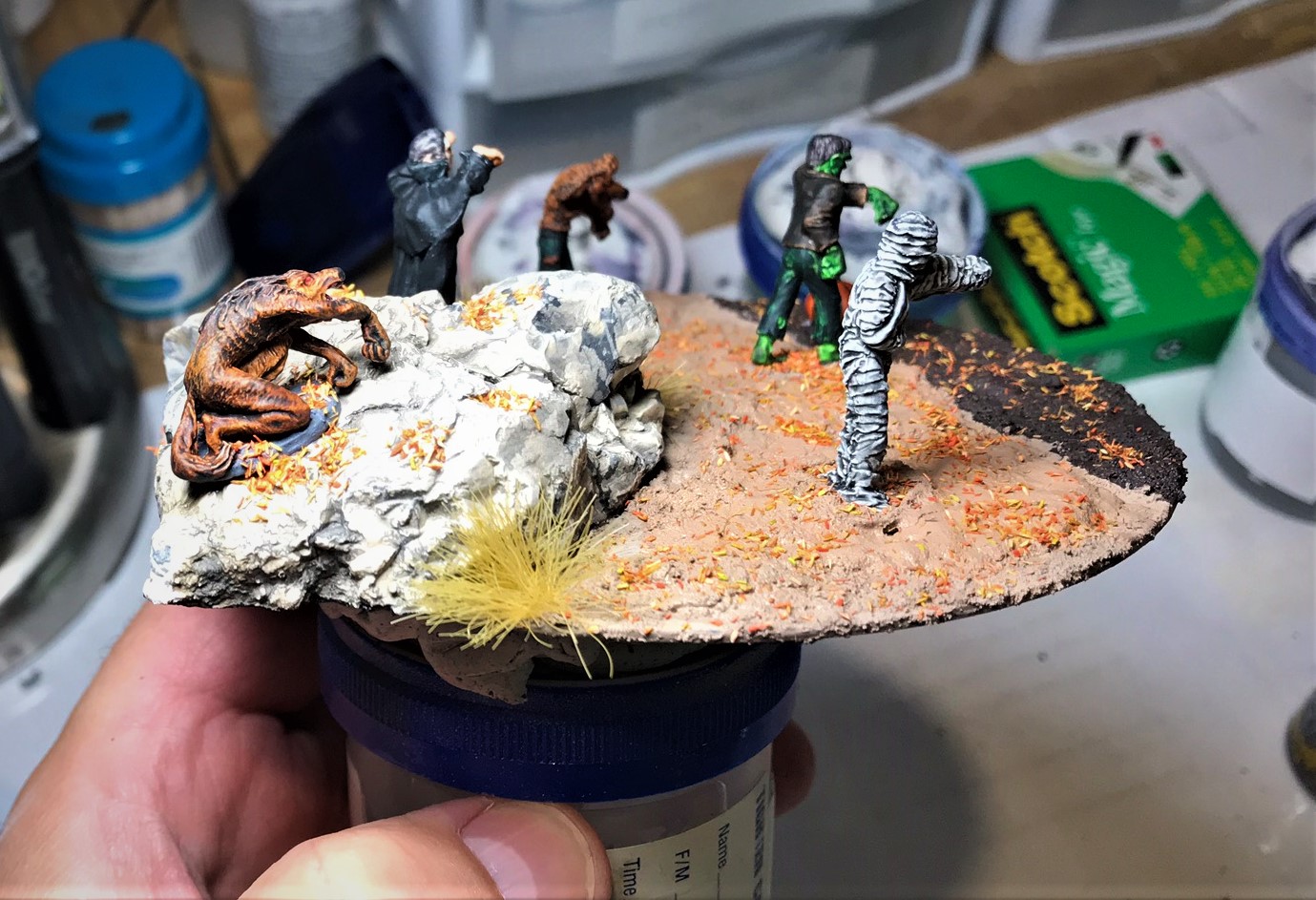
The Pumpkin Patch is alive with creatures!
Side view of the previous shot.
Thanks for looking – and I always love getting feedback and any opinions in the comments section, so feel free to post there.
PAINTS, INKS, GLAZES, SHADES, WASHES, PIGMENTS, FLOCKING, GLUES AND MORE USED ON THESE FIGURES:
On the base:
Gorilla Glue gel
Poster tack
Used DVD
Polystyrene card
Woodland Scenics resin rock
Vallejo “Surface Primer – Black”
Citadel “Stirland Battlemire” (texture)
Citadel “Agrellan Badlands” (texture)
4Ground Loose Copper Foliage
Shadow’s Edge Static Grass Tufts
Vallejo Mecha Varnish “Matt Varnish”
Commonly used on all figures for mounting, priming, and varnishing:
This blog has the subtitle Life, Golf, Miniatures, & Other Distractions. Mostly it has been focused on hobby stuff- notably miniatures and gaming – and less on the other – and often more important – aspects of Life. This post will be a bit different for some of you regular readers and I hope that you find it interesting. As of this writing I am happy to say that this blog has had nearly 25,000 visitors and over 100 followers from dozens of countries. It’s an enjoyable aspect of my blogging, and I have been able to connect with many like-minded people all over the planet. Here, I aim to give a limited view into my alma mater and a bit into my own related history. It’s a personal glimpse to a large extent, and by no means complete, but one I decided to share some thoughts and photos. Hopefully it’s not overly self-indulgent, but I wanted to write this up. If you are my classmate, or fellow USMA grad, and reading this, I hope that you get that, and of course GO ARMY! BEAT NAVY!
Last month I had the privilege of attending my 35th college reunion.
Thirty-five years – wow.
I am a proud member of the United States Military Academy Class of 1984. Our class motto is “Best of the Corps” – which we chose while just fledgling members of the USMA Corps of Cadets. That motto certainly did not endear us to the upper classmen from the classes of 1981, 1982, and 1983 at the time. Some of you may be more familiar with USMA’s more common name – West Point. We were all commissioned into the US Army in May 1984 as second lieutenants. Only a handful are still wearing the uniform on active duty.
Regrettably, I had not attended any previous class reunions – something “always came up” with family or work. Our class of 985 people has now lost 32 brothers and sisters. Four of the lost are even former roommates of mine, and many more were friends I knew well. Some of course I only knew from seeing their faces in obituaries. No matter what, I was never going to see these fallen comrades again, and that really stuck in my craw. This time, I was determined to attend, honor the fallen, and share some camaraderie with my classmates while it was still possible. I fervently hope to attend more class events in the future, and hope that we all grow old well. As for the lost – I also wanted to honor my late classmates by attending the Memorial Service for them. Below is the program booklet from that service.
The service was very classy and moving – and those who participated as lectors and speakers (noted above) all did an outstanding job. I’ll always remember how Craig Bohn sat next to me in the pew and sang “The Corps” and “The Alma Mater” like an angel (really impressive). On the list of the lost above, many I called friends. I knew most, and roomed with four – Craig Hogan, Bill Fallon, Troy Overton, and Mike Wooley. Too soon for all of them, and honoring them was a major motivation for my attendance this year. God rest their souls.
After the service, which happened on Thursday, we had several activities through the weekend which I will share some shots of as well.
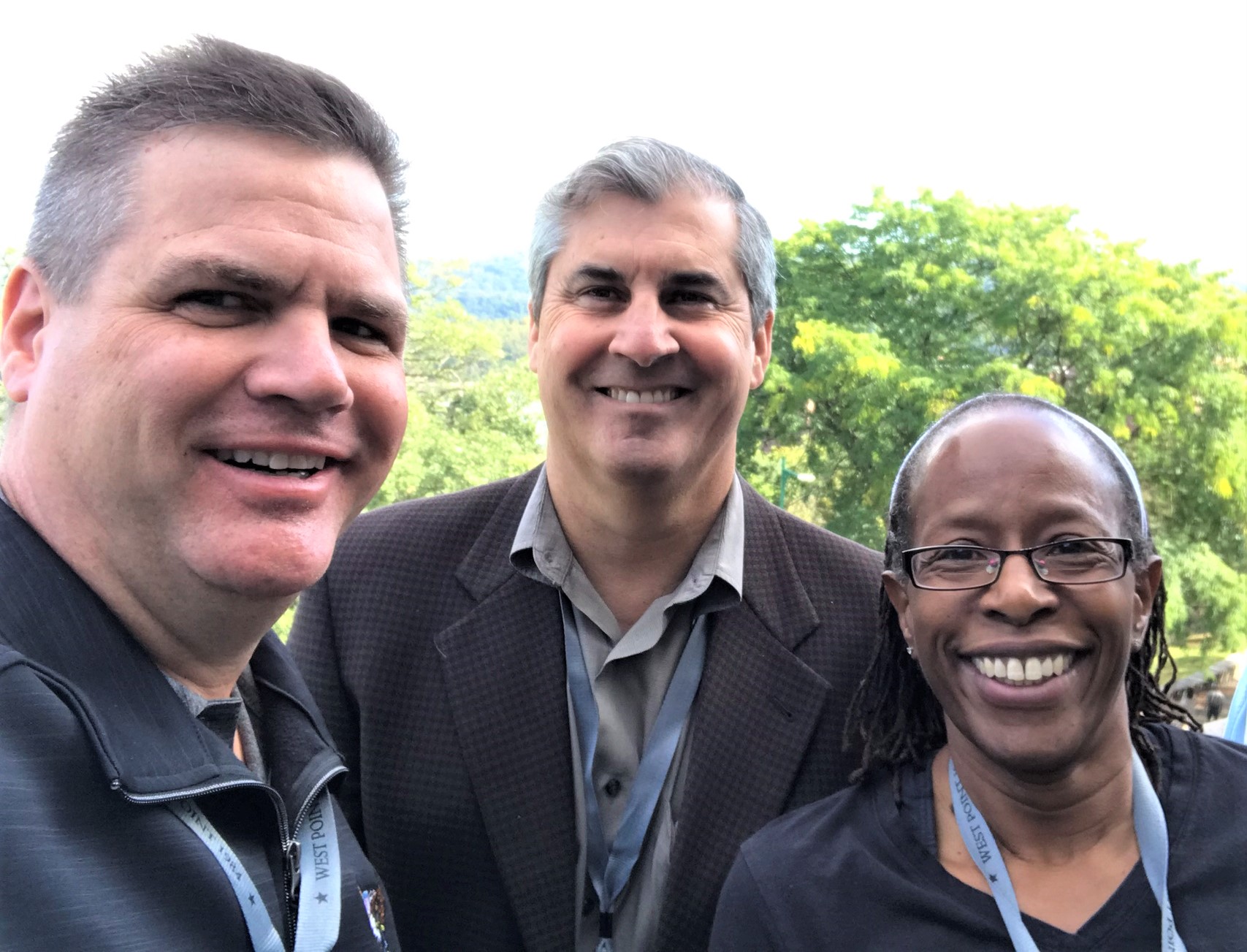
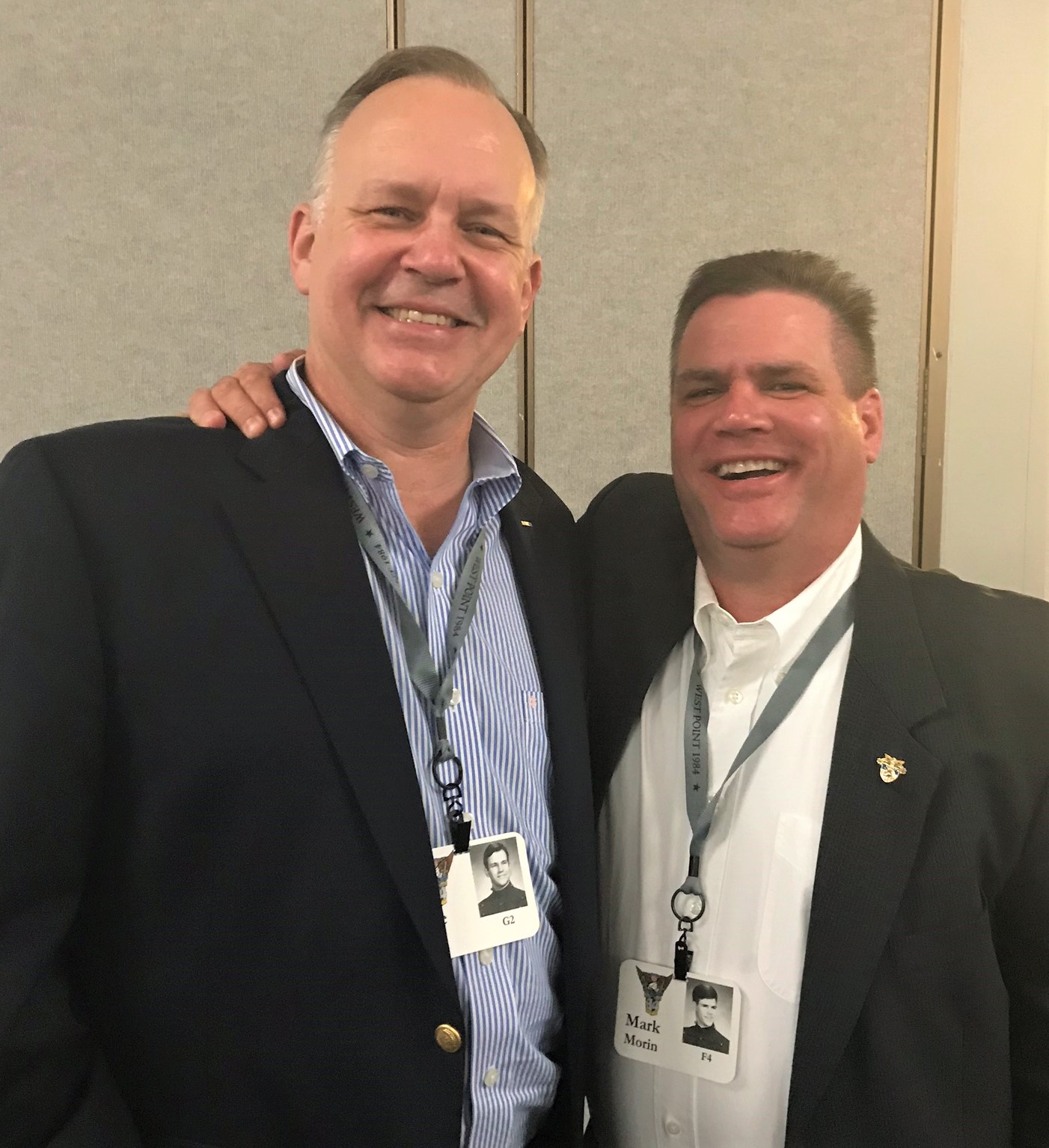
Mark Morin, Bruce Bruno, and Angie Gaston – all company F-4 Frogs – after the Memorial service.
The first reunion event was actually a class golf outing at the West Point Golf Course on Wednesday (the day before the Memorial Service). I did not want to start with describing it here, as the Memorial Service, in my view, was more important. I played with Glenn Goldman and Matt Johnson and we had a blast. I did not play up to my desired level, but hey, we had fun. I only wish that I had some shots of us playing. I had not played the course since the early 2000’s – and the hole markers were awesome. Each described a war/campaign/battle in a lot of detail (especially for a hole marker) and referred to the West Pointers involved. They covered the Revolutionary War to the current conflicts. I really liked them and thought I’d share them below.
The Thursday golf was a nice start to the weekend. Much catching up occurred that night back at the Park Ridge, NJ Marriott – to continue all weekend. Things started well with a few beers with Tom Eisiminger. There was certainly a lot of socializing over the weekend – ending up with a class dinner on Friday night, a parade on Saturday, revisiting West Point, and of course an Army football game against Morgan State. It was great to be among fellow classmates and graduates.
For those who are not USMA grads or classmates, some background. As a start, I was in company F-4 (company F, 4th Regiment) for my last three years. I was in C-1 during my plebe (freshman) year. My yearbook photo was fine – well sort of. Fellow F-4 Frog Bruce Bruno (from photo above) wrote my blurb underneath. Only by the time it went to press the girl I was involved with (and had at the time planned to marry) had broken it off! I also had Aviation branch listed (the wings). I started after graduation as a helicopter pilot, but decided to leave flight school. As I had failed a simulator check-ride in instruments, I was told that I’d have no chance to get into Apaches or Blackhawks as a result, only Hueys. So, I changed branches, became a combat engineer officer, and enjoyed that greatly until I left the Army in 1992.
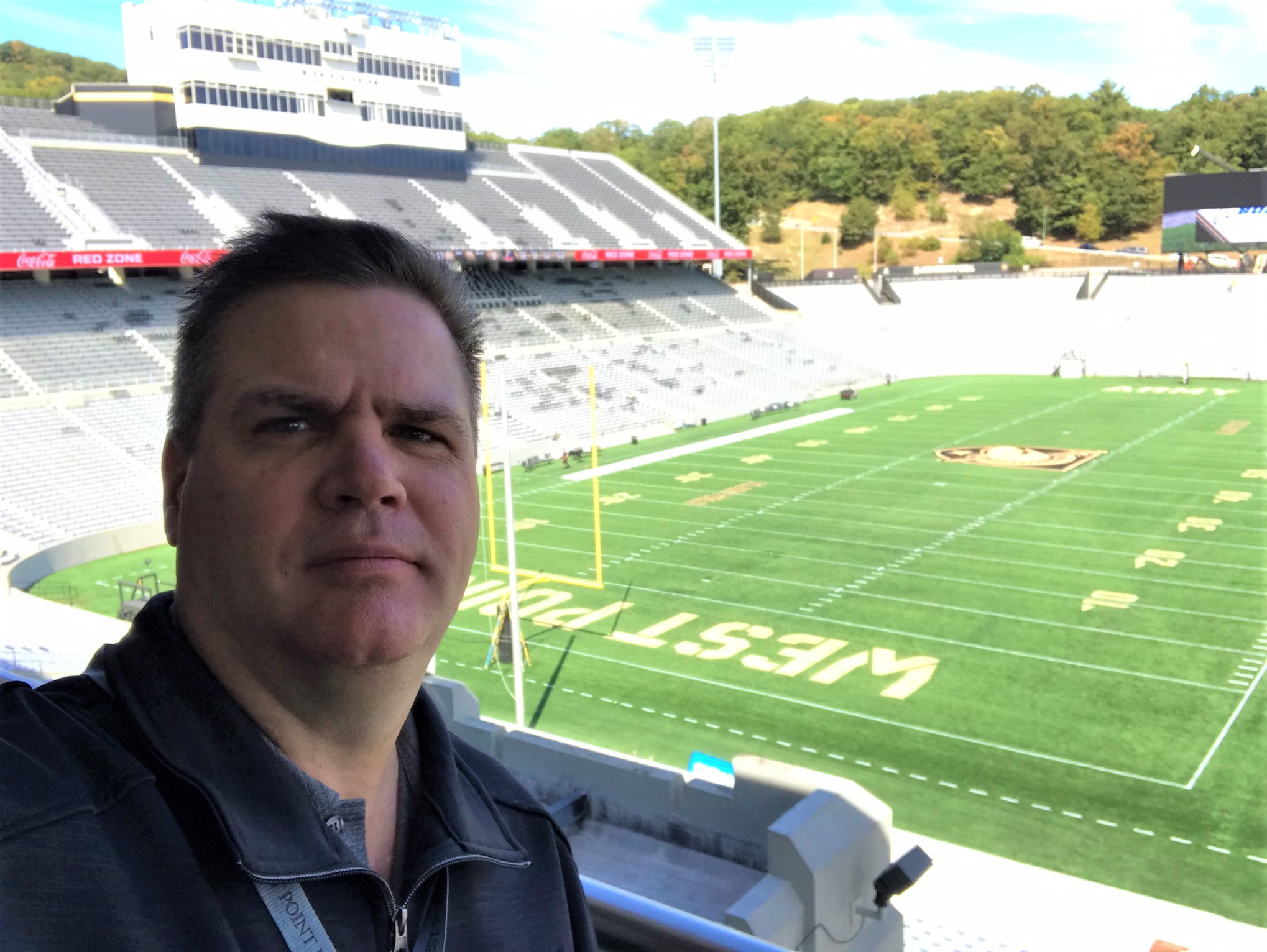
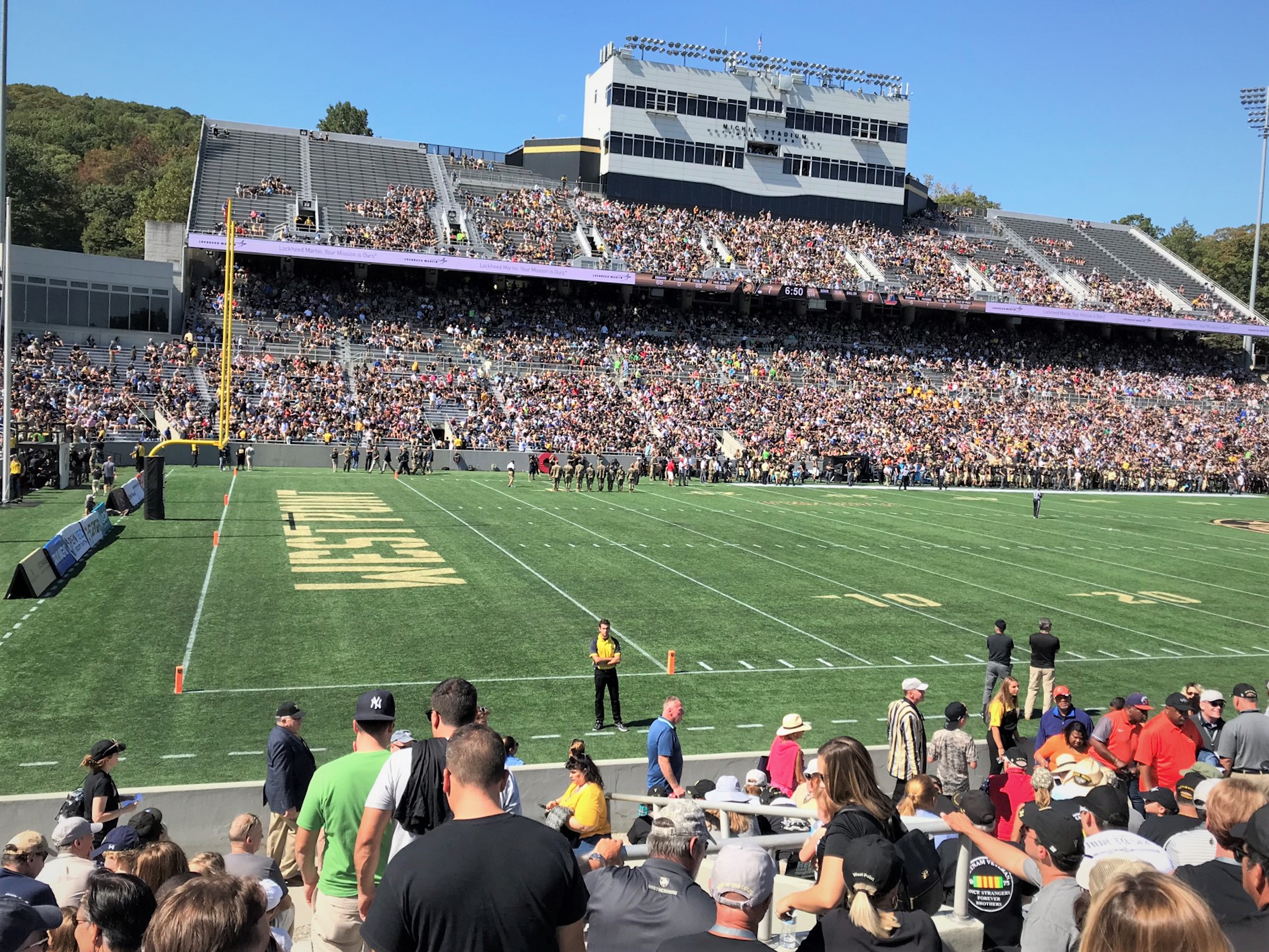
At Michie Stadium on Friday after the Memorial Service. I reported here on July 1st, 1980 and my parents left me in the loving arms of the US Army. On May 23, 1984, we graduated at on this very field.
My “Beast” (Cadet Basic Training) Squad shot, summer 1980. We got a ride in a UH-1 Huey which was awesome. I am in the middle row on the far right. Standing behind me is Pat Scanlan from Chicago – and we got to catch up a lot at the reunion which was nice.
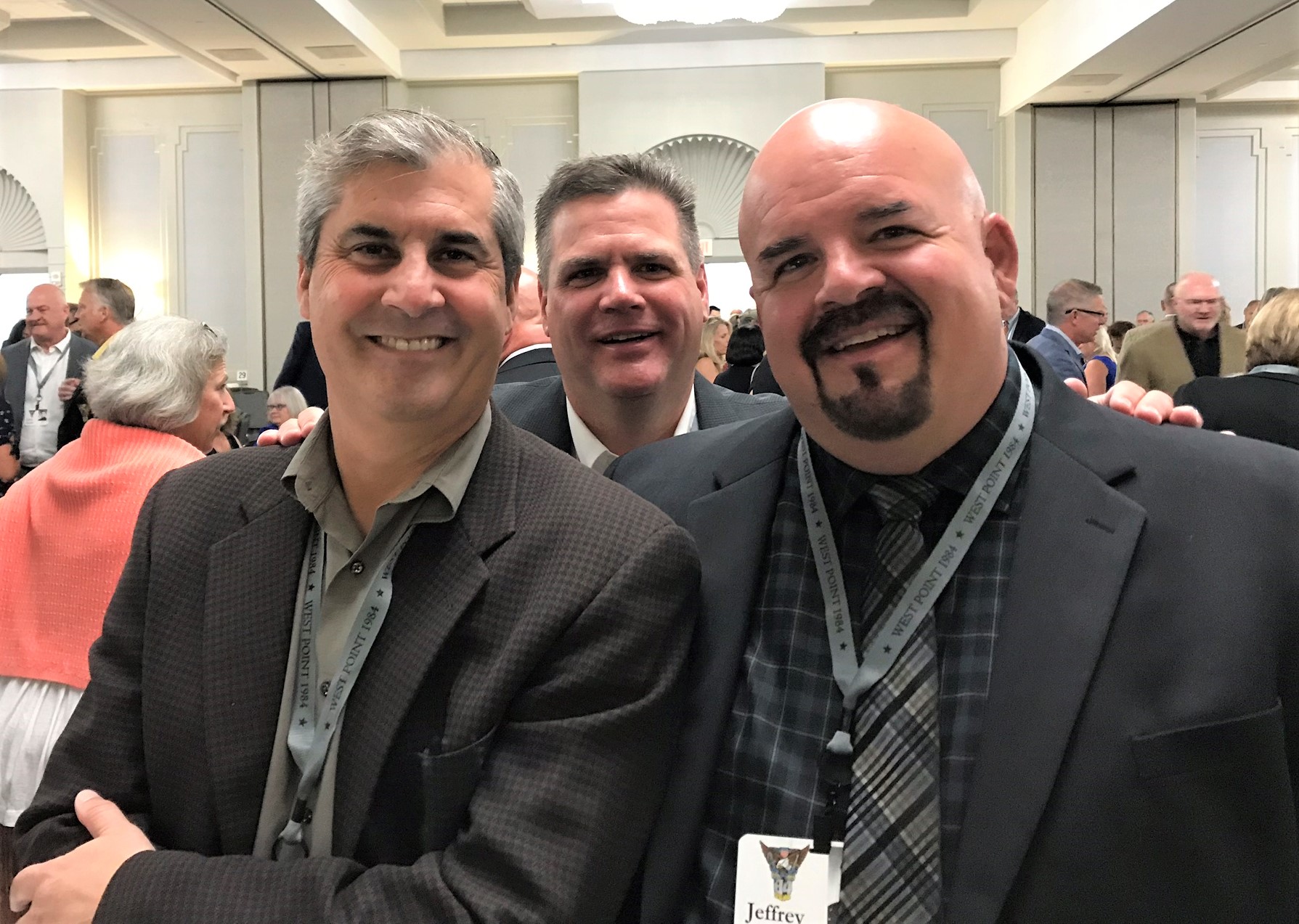
Fellow Frogs Bruce Bruno, me, and Jeff Sgro.
One of the most fun classmates I ever hung out with – Kyle Ray. Great dude!
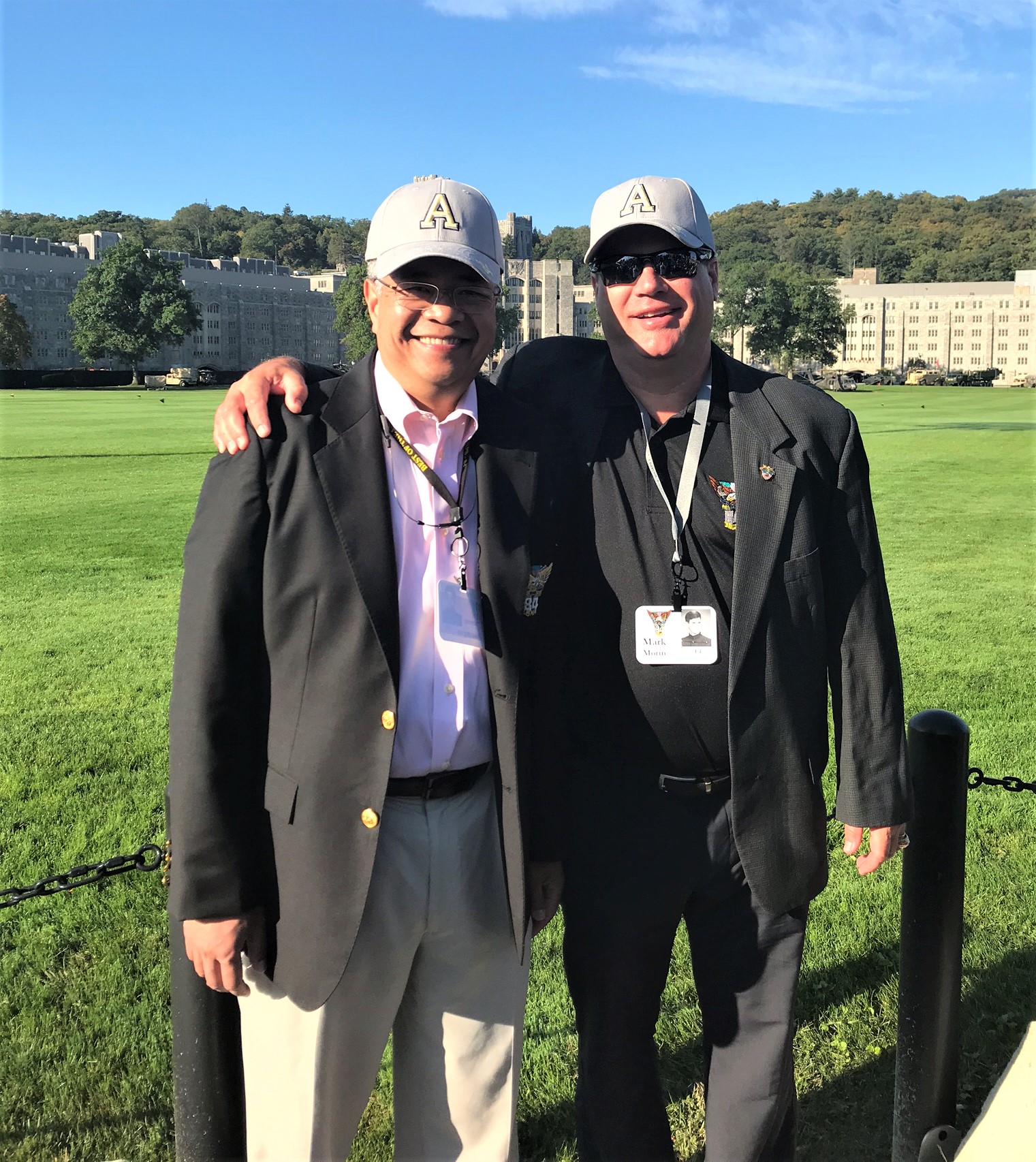
Fellow Frog Gil Cabacungan and me at the parade.
Gil’s son Alec has raised millions for Shriner’s Hospital for Children – and it was an honor to meet the fine young man. He has been on TV nationwide for them, and is very inpiring.
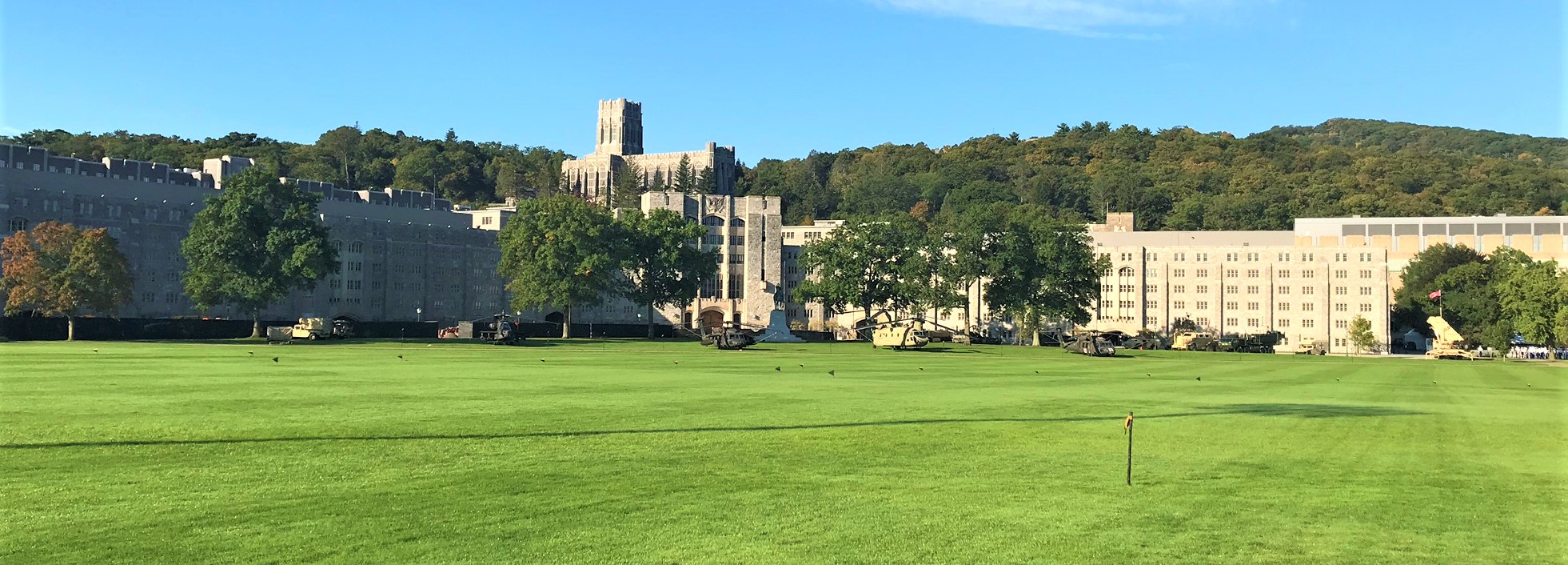
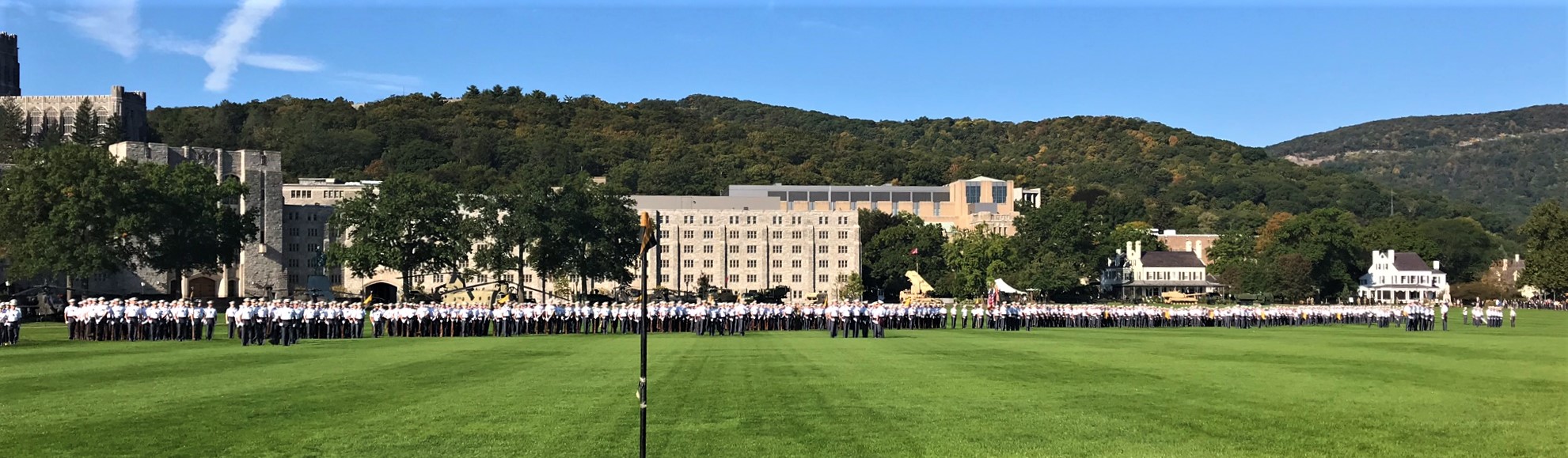
The view of The Plain from our place on the parade field. Third and Fourth Regiments would march by our reviewing position. The Plain is where we in our class all took our first oath to the Constitution.
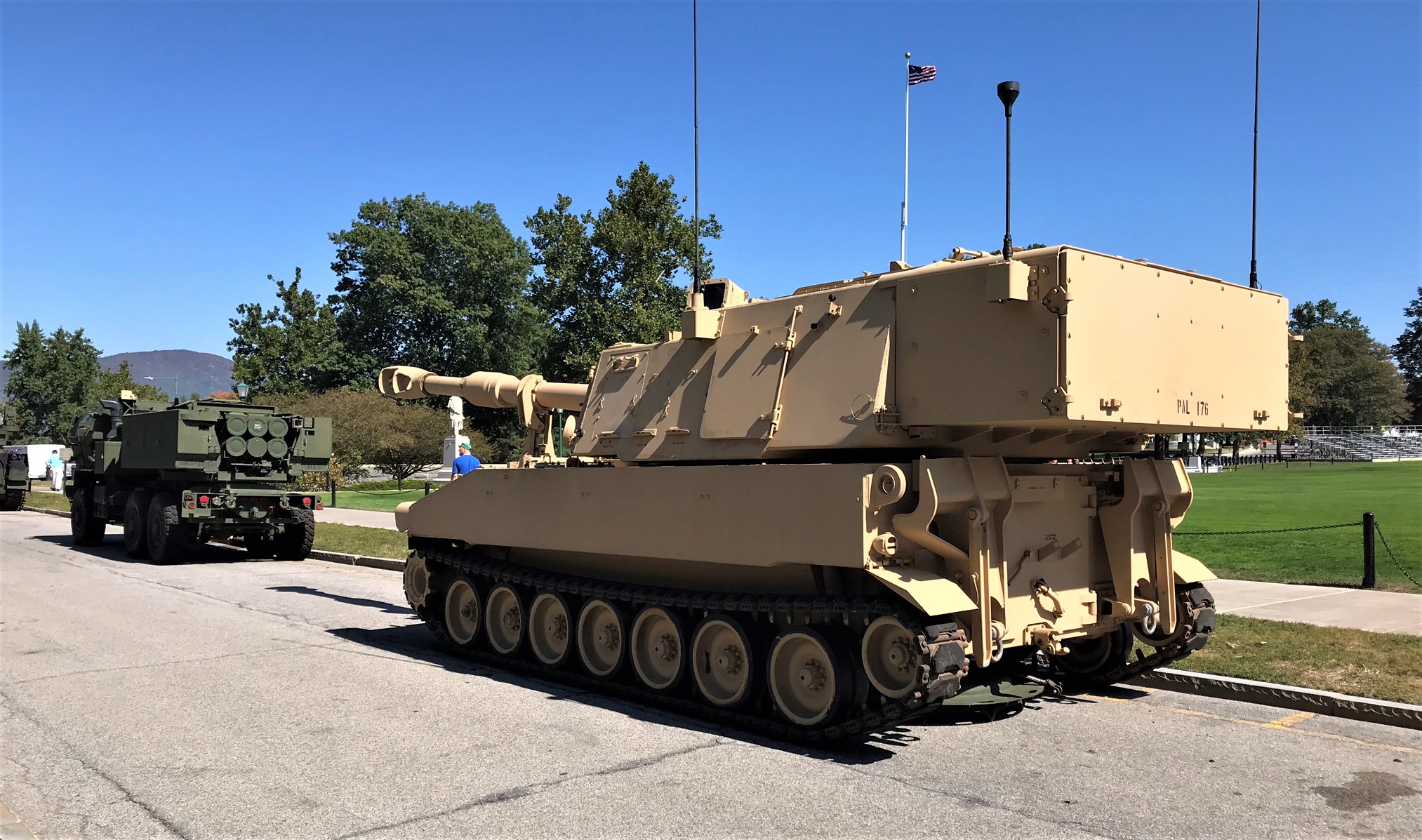
You can see multiple pieces of equipment in some of these shots – helicopters, tanks, artillery, and more. They were there to show the First Class as they decided which branch of the Army they might want to choose to enter after graduation next May.
Third and Fourth Regiments in formation.
A view down our reviewing line.
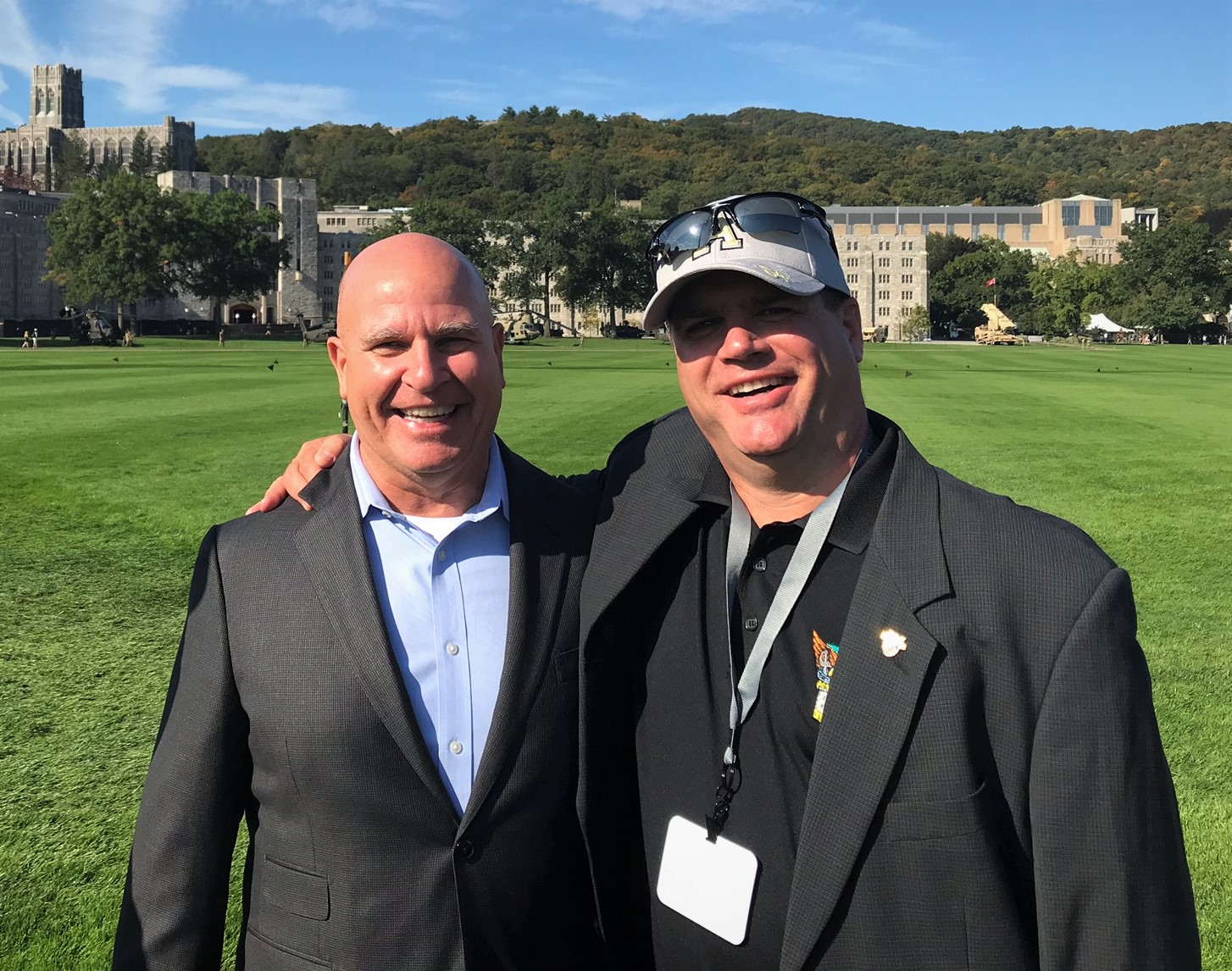
One of my classmates who has really served the nation well (and there are many who have) is one hell of an impressive dude. H.R. McMaster is a retired three-star general, the author of Dereliction of Duty, and formerly President Trump’s National Security Advisor. We got a chance for a photo together on the Plain after the parade. Today he’s at Stanford University.
H.R. McMaster with me…
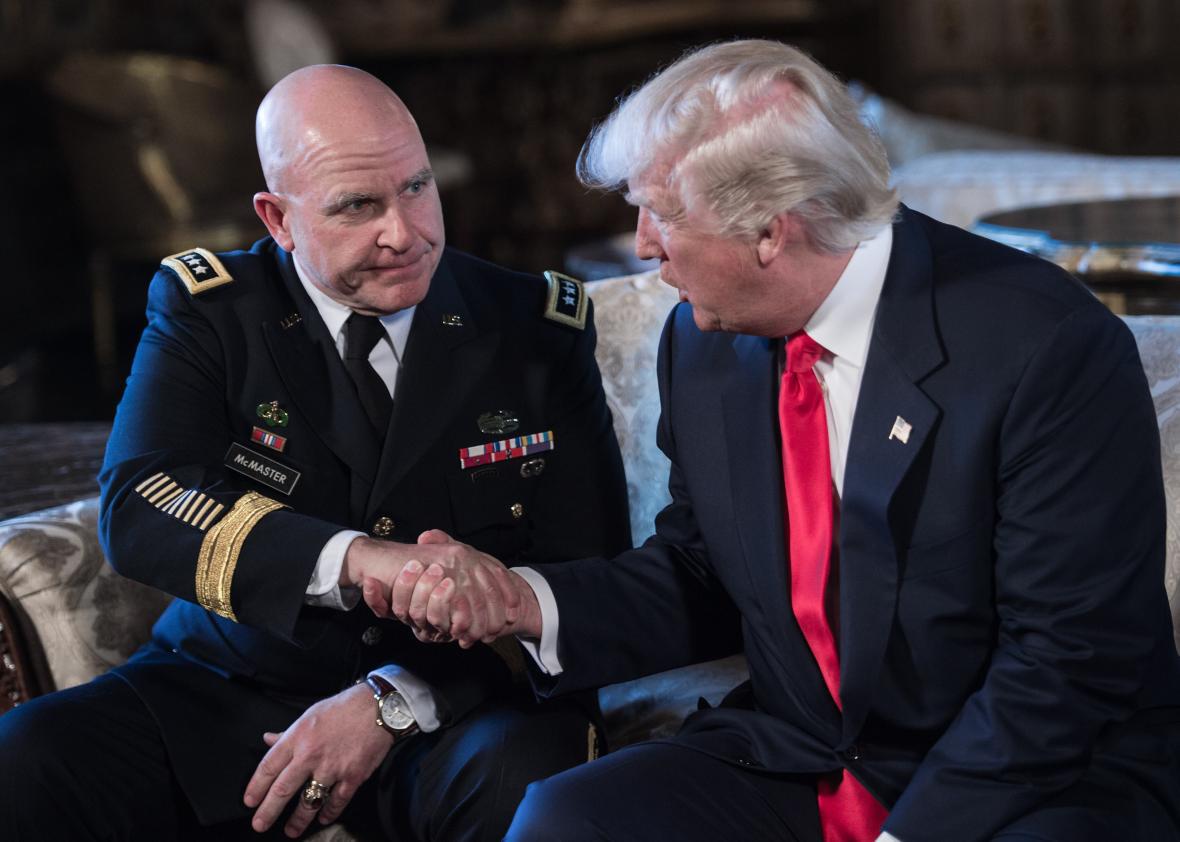
…and H.R. McMaster with his previous boss…
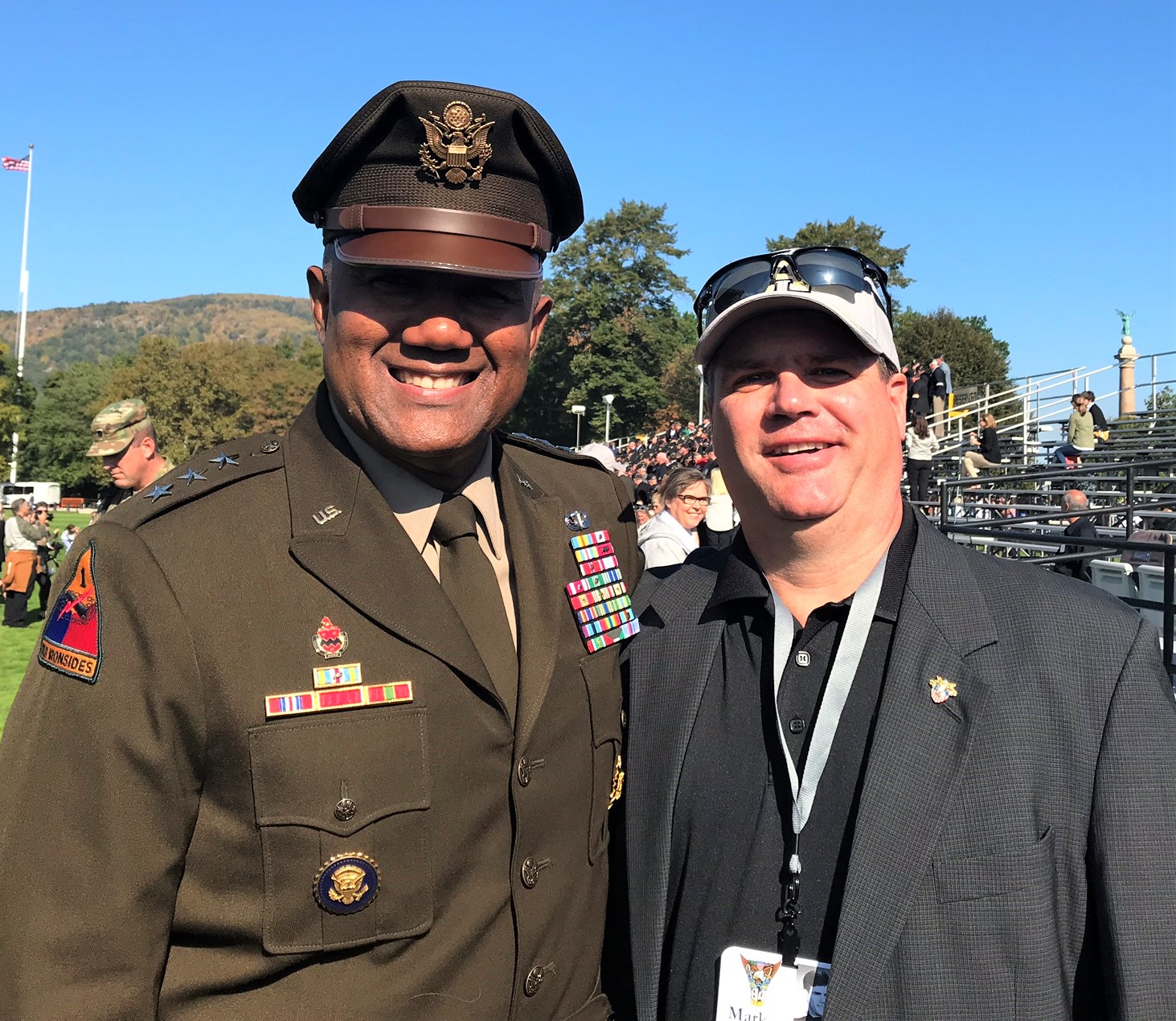
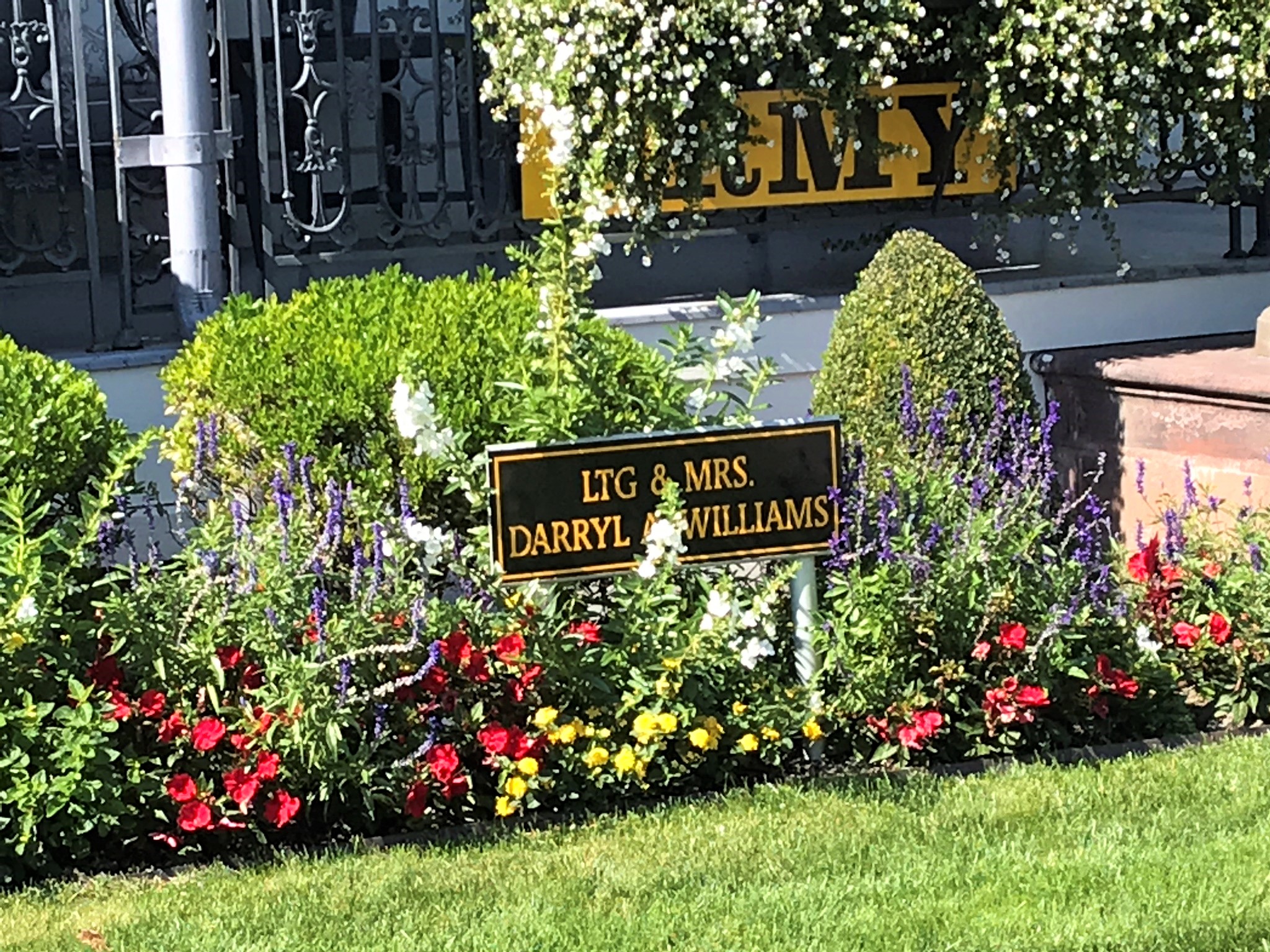
At the parade in the reviewing stand was also the US Secretary of State Mike Pompeo, USMA Class of 1986. With him was the current and Superintendent of the United States Military Academy, LTG Darryl A. Williams. He is a member of the USMA Class of 1983, and was in my company F-4. He was also a very tough football player. More importantly, he was smart, decent, a true leader, and funny as hell. He has had a stellar career. My first semester Firstie (senior) year (1983), he was assigned to my platoon as he was a December grad – so I was his last platoon leader – and the late Mike Wooley (from above) was with me as roommate and platoon sergeant. It is very gratifying to see him as Superintendent developing new leaders for the US Army. He was swamped with people after the parade, but we F-4 folks snuck in for a photo and that was great!
Gil Cabacungan, Bruce Bruno, LTG Darryl Williams, Angie Gaston, and me
A very impressive soldier and me
After the parade, we hit the old officers club for a pre-game tailgate and to change into more suitable game for an Army football game. Angie Gaston and I took a stroll along the Plain to our old barracks, checked out the equipment, and watched the helicopters take off.
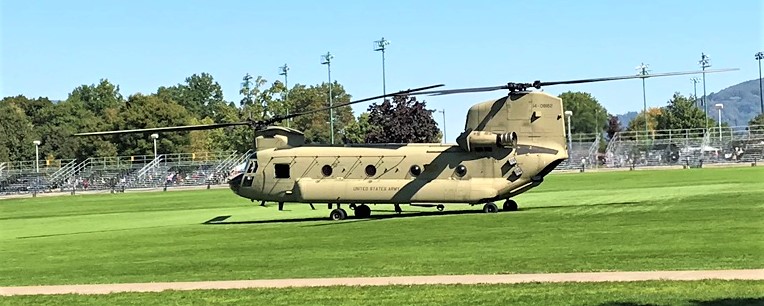
CH-47
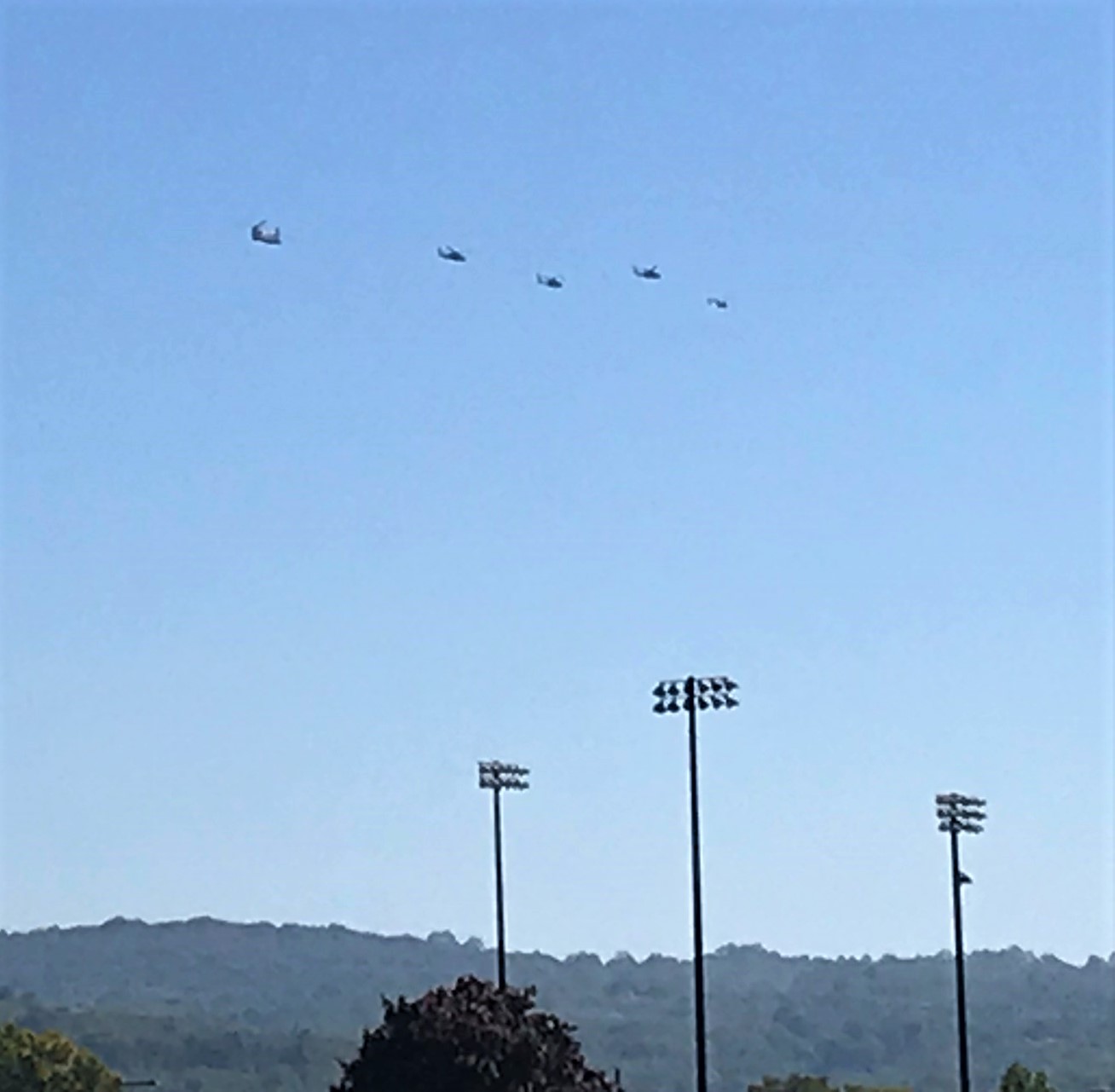
Apache’s and Blackhawks – still serving!
You can see the aircraft moving away over the barracks and the other equipment on display.
Angie Gaston and I then made a visit to our old home – that being the 43rd, 44th, and 45th Divisions – our old barracks, Scott Barracks, which dates from 1938. The Divisions are very different from the other barracks. Think of them as stacked milk cartons put side-by-side with no connections horizontally (except occasionally on the first floors). Divisions are thus arranged vertically – with four cadet rooms and a restroom per stacked floor (with 5 or 6 floors per Division) – if fading memory serves. Again, as opposed to long dormitory hallways there are no horizontal connections between the Divisions. It was a fun environment, though if you were on the top floor you got a workout going back and forth to class. A current G-4 cadet was nice enough to take our pictures – and now this is part of G-4 as F-4’s current barracks is located elsewhere.
Angie Gaston and I on the 43rd Division landing…
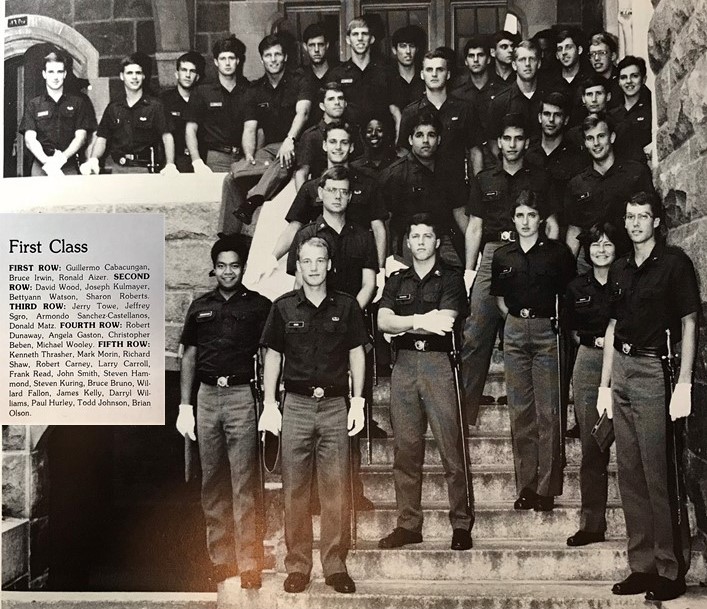
…and our F-4 class 35 years ago. GO FROGS! I’m on the the top row second from the left. Angie Gaston, Bruce Bruno, Gil Cabacungan, and even Darryl Williams are in this shot. Jim Kelly and Larry Carroll attended the reunion but I did not get pictures of them for this post. Of note, the late Bill Fallon and Mike Wooley can be seen here too.
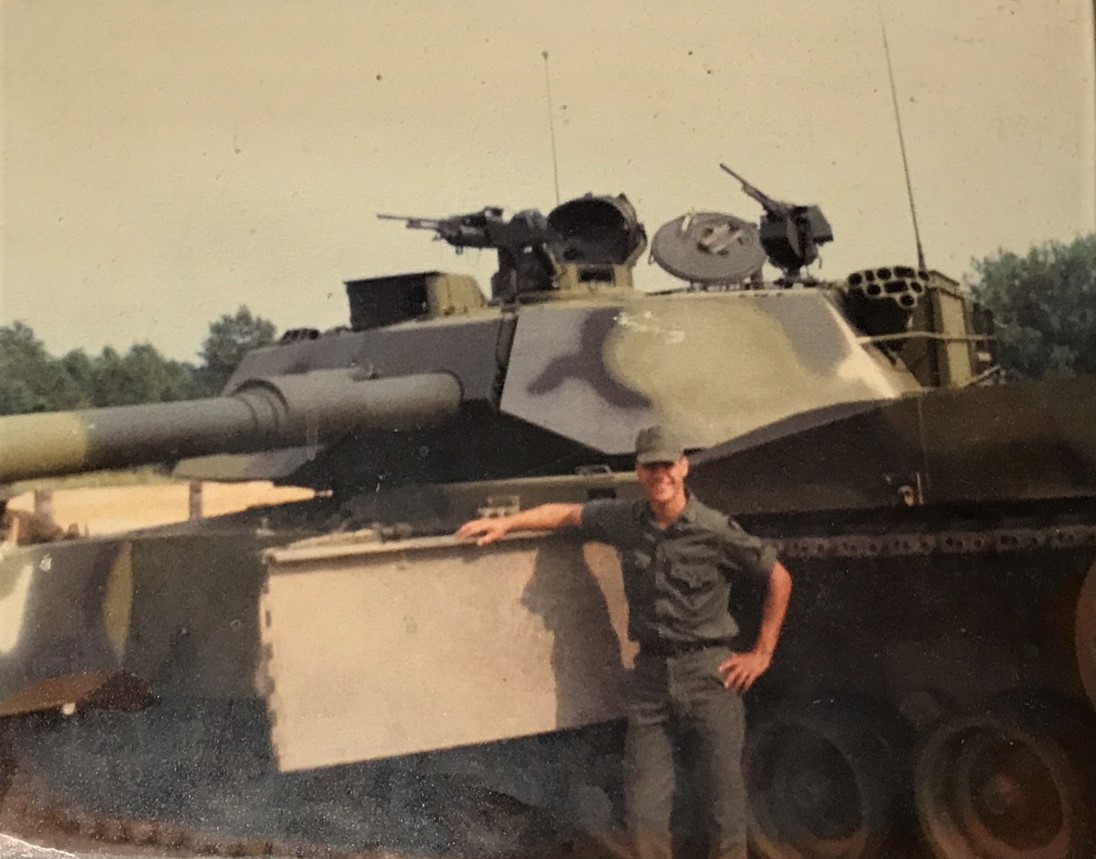
Those who follow this blog know I love tanks – so here’s a shot of me and an M1A2 in 2019…
…and one of me and an M1 in 1981 in Fort Knox, KY. I’m happy I went Engineer, but part of me always wishes I’d gone Armor (and that I weighed the same now as here).
Artillery and movers
Self-propelled howitzer (155mm)
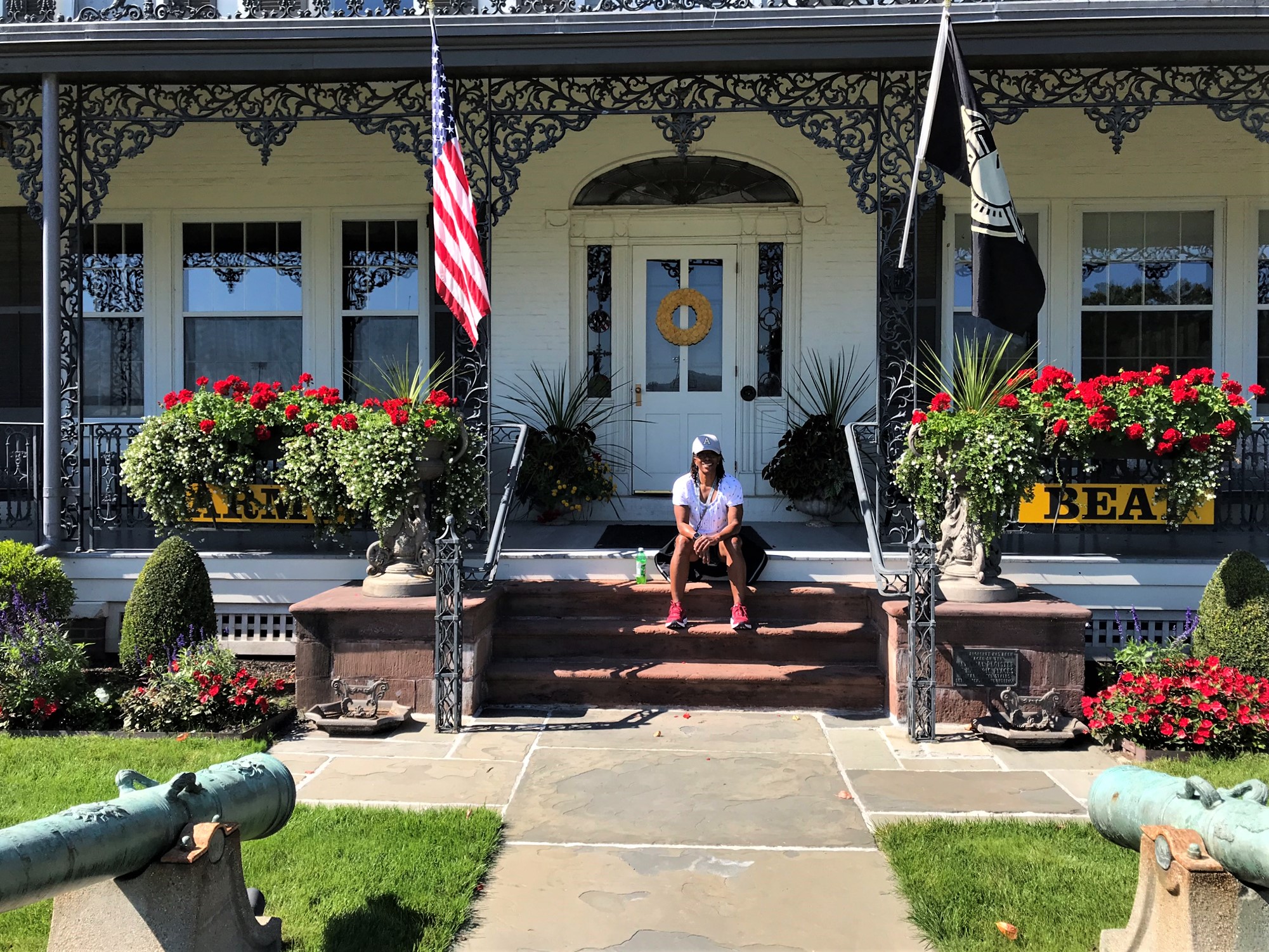
Then on the way to Michie Stadium, we got some shots of LTG Williams current home!
Angie Gaston on the front porch avoiding detection.
She wanted this shot for our friend Darryl!
The game was a blast – and it was a very warm and sunny day. Hung out with Pat Scanlan and Kyle Ray – and even got some Steve Kreipe and Shamus Hanlon time in!
And on to Michie Stadium for the game!
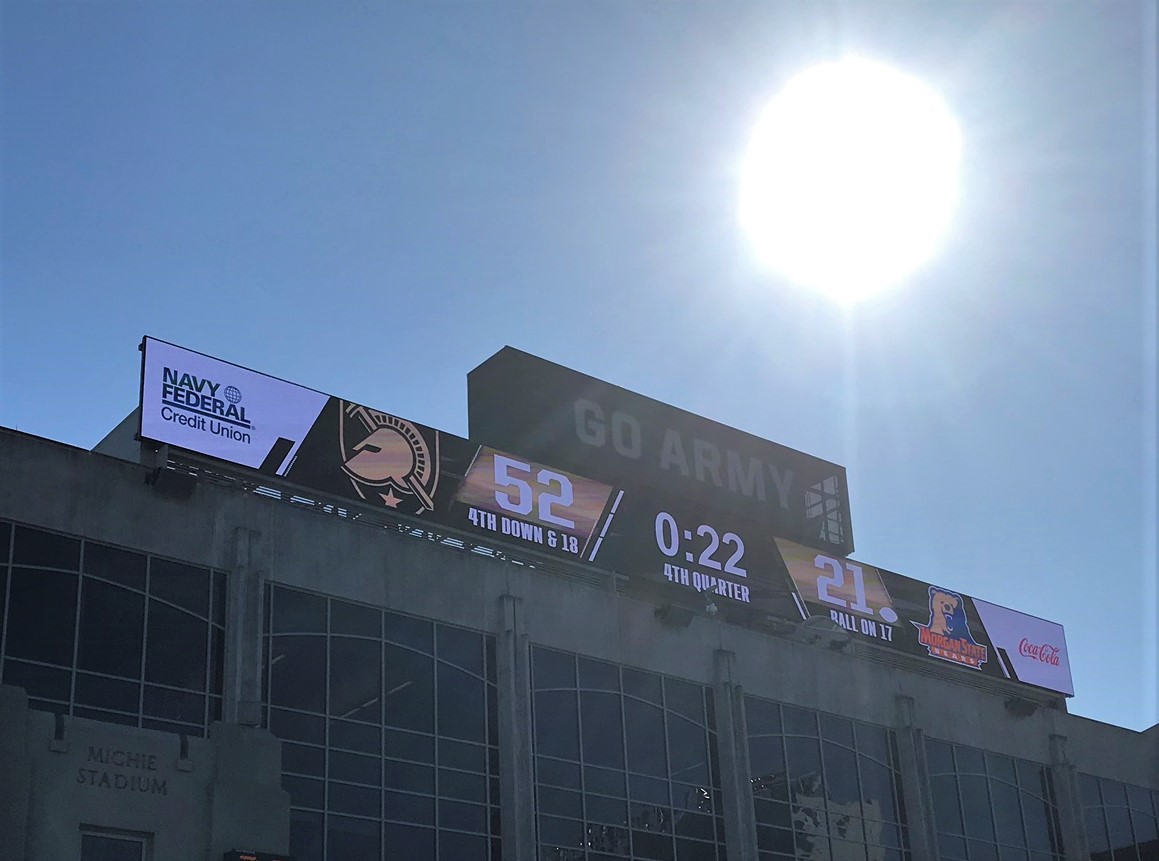
Army defeats Morgan State 52-21!
It was a great weekend, and one that I will cherish the memories of for a long time. We are all getting older and a 35-year gap is frankly way too long between catching up. That’s on me – I will do better.
Classmates Jack Picciuto and Curt Cozart did an outstanding job in organizing the reunion – and great thanks to them. Also, a shout out to Steve Epling, Randy Lee, and Meg Gordon who keep us all connected on the world wide web. Lastly, I want to thank all of my fellow classmates who I got to catch up with and who thankfully retained a memory (mostly good) of me. I definitely was thrilled to relive memories with you.
As always, I appreciate any feedback you may have in the comments section – thanks for looking!
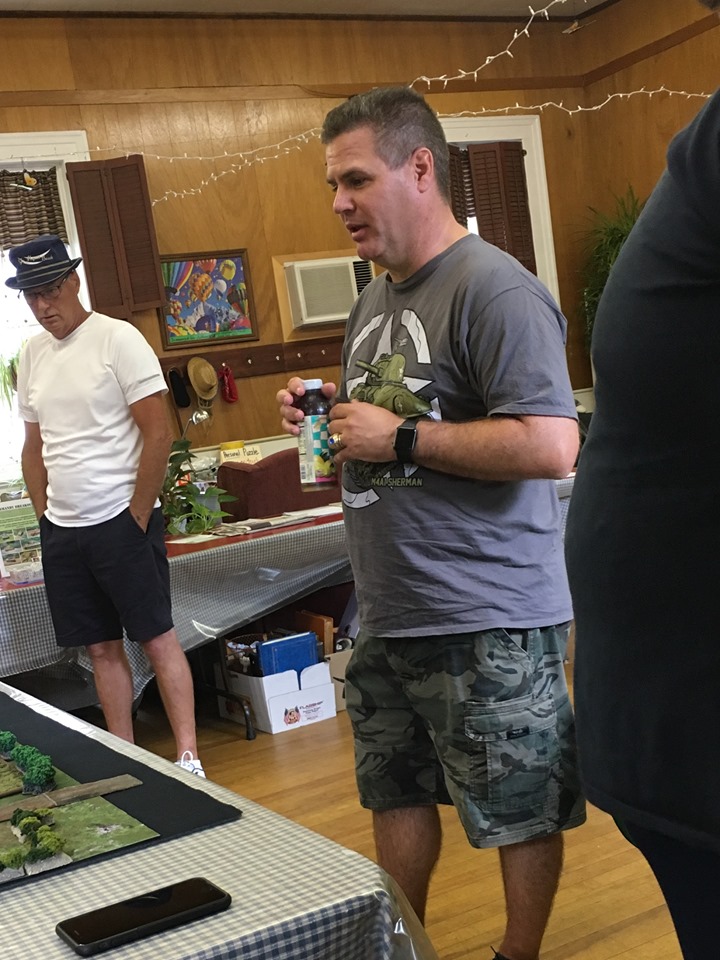
For this post, I will show some of the photos that tell the story – though simultaneously being a photographer and a GM are not always easy. I appreciate the generosity of both Chris Rett and Ted Salonich helping with some photos – as well as playing of course!
The game scenario is:
After a successful D-Day landing and consolidation, the tanks of the Americans and the British are stymied in the hedgerows of Normandy. German armor has set up effective defensive positions in favorable terrain. However, the Allies do not know the exact locations of the German tanks, and the Germans have limited knowledge of where the Allied armor will be coming from and the direction to which they will try to break out. New rules that allow reconnaissance and the effects of other combat forces will challenge both sides in this action-packed game.
The Germans are in secret positions (basically ambush positions) that they choose in advance of the Allies arrival – which is also secret in terms of the exact vehicles that the Allies choose. Both sides get to secretly select their vehicles (with some restrictions), and poker chips are used for the scoring. The Germans here did stop the Allies from breaking out – though the Allies were able to gain more points by both effectively recon of enough blind positions and knocking out enough valuable German vehicles. The final score was 117-109 in favor of the Allies – with the game score turning on the Allies knocking out a Jagdpanther on the last turn. The casualties were:
Allies – 5 vehicles:
UK – 3 vehicles:
2 Daimler Dingoes
1 Firefly
1 M10 Achilles
US – 2 vehicles:
1 M3A1 Stuart
1 M10 Wolverine
Germany – 3 vehicles:
1 Sdkfz 233
1 Panther D
1 Jagdpanther
Let’s see what the day looked like!
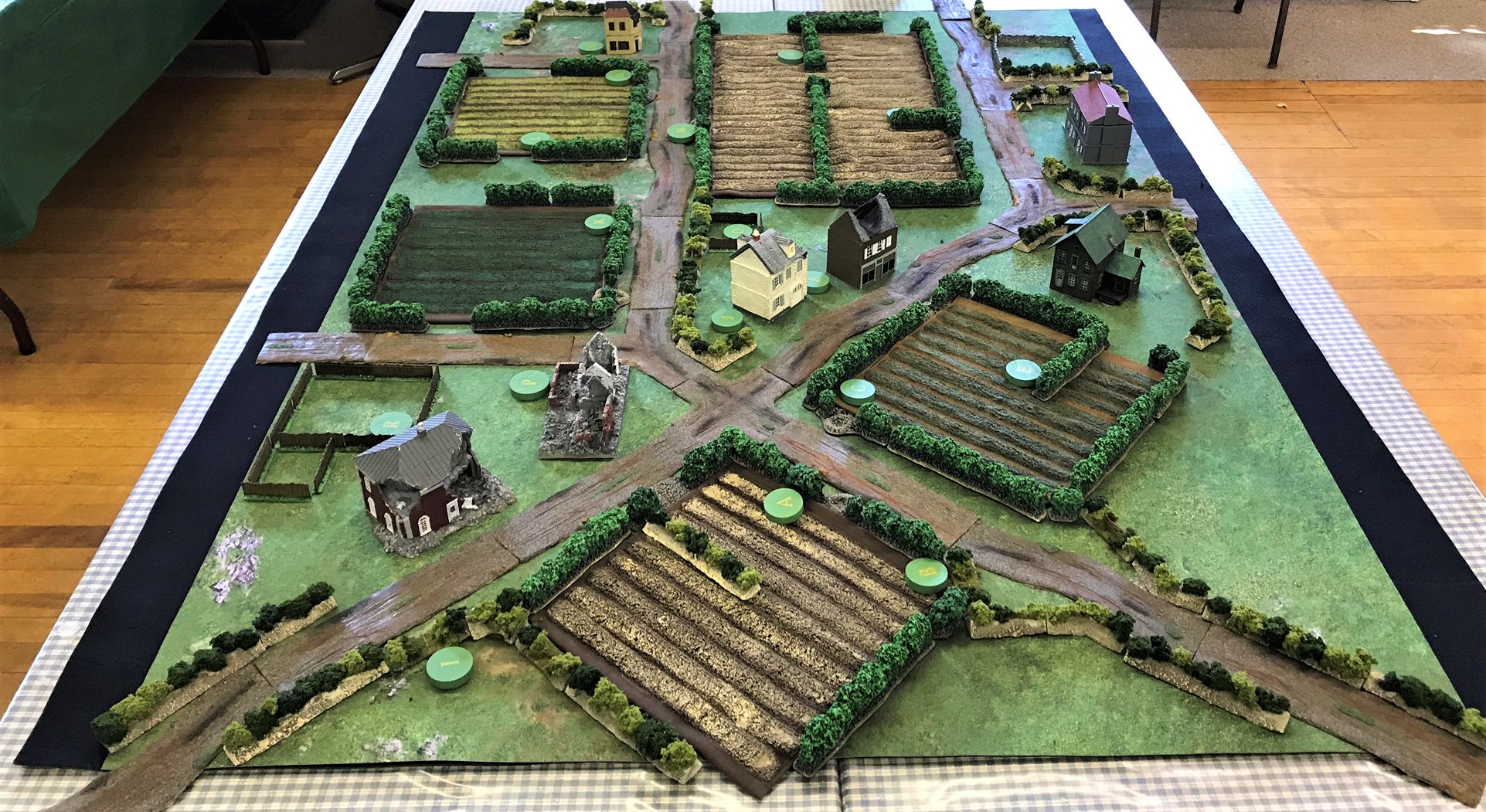
The Allies moved on from here. The British had the far left road, and the Americans had the far right road. The middle road could be used by both Allies. The wooden discs are possible German positions to be reconned.
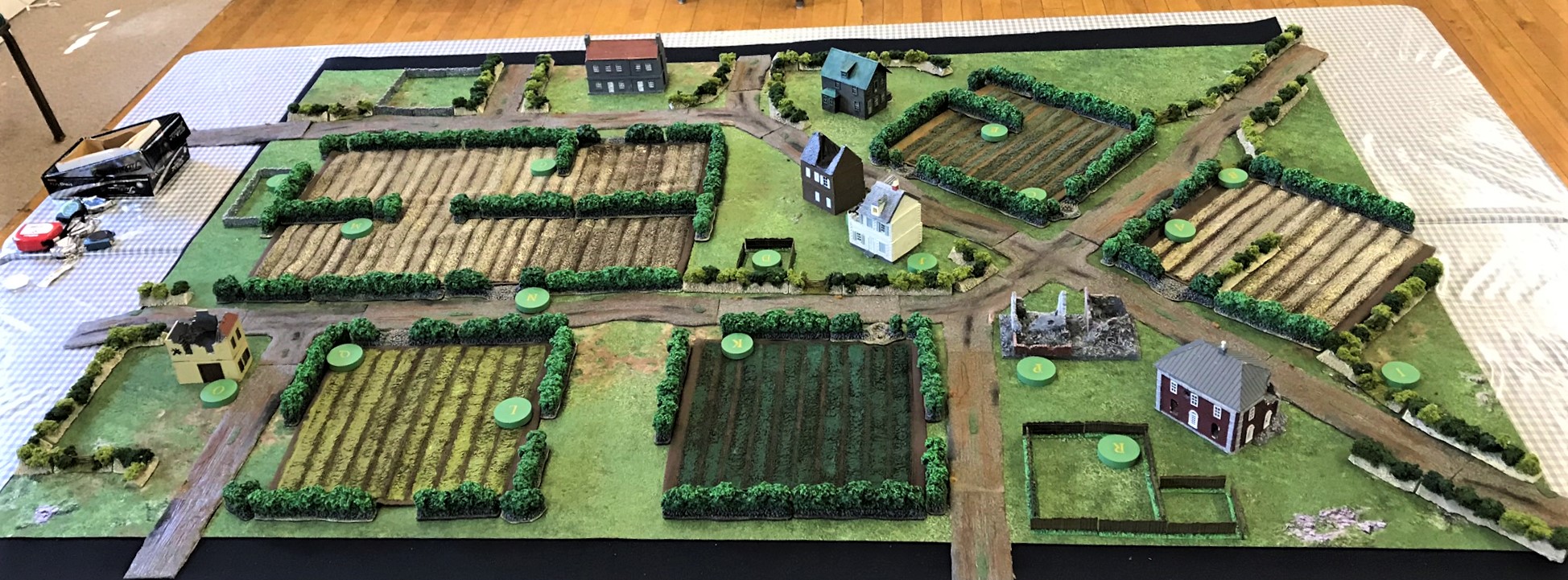
A side view of the tabletop that better shows some of the (blind) possible German positions.
The view from the German side of the board that the Allies needed to cross.
Your properly attired GM. (Photo by Chris Rett)
The Germans effectively used a Bonus Attack card to draw first blood – calling in a rare Luftwaffe attack on a Daimler Dingo.
The Daimler Dingo hit by the Luftwaffe – my new blast/knocked out tank markers looked pretty amazing (and I am biased of course).
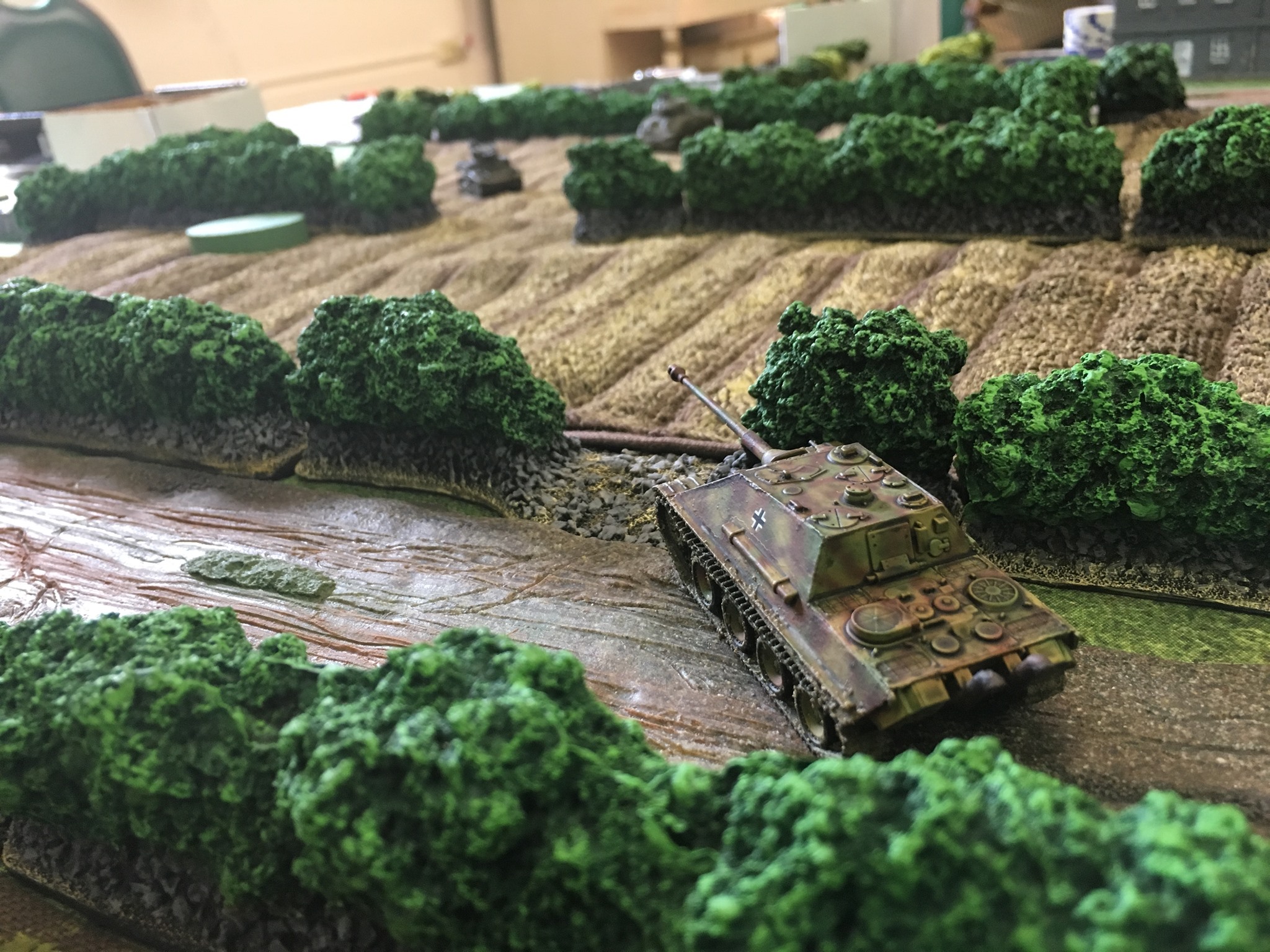
A Jagdpanther prepares to engage an M3A1 Stuart from an excellent ambush position. The Stuart decided to run around the corner and recon the disc on the left…(Photo by Chris Rett)
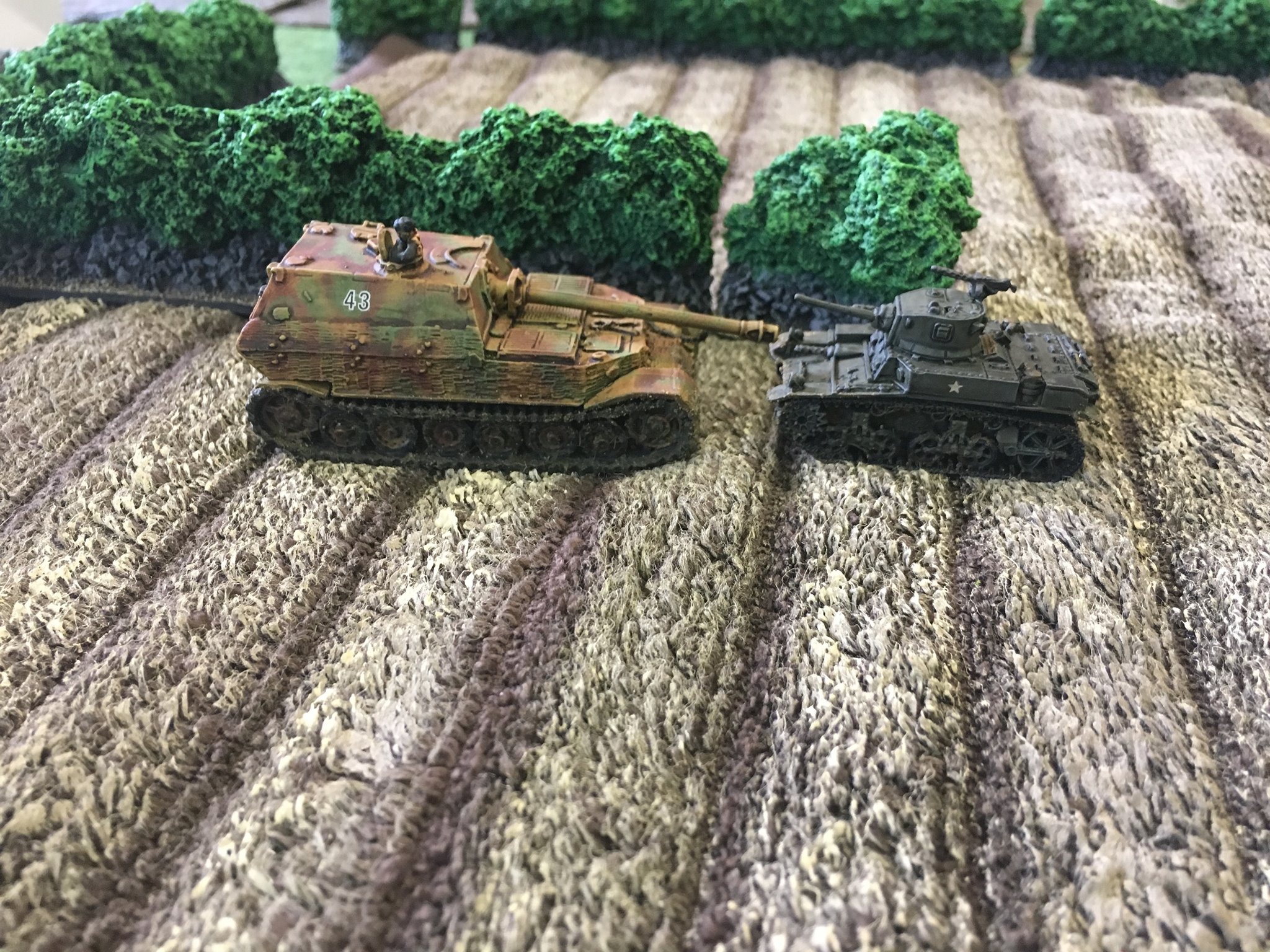
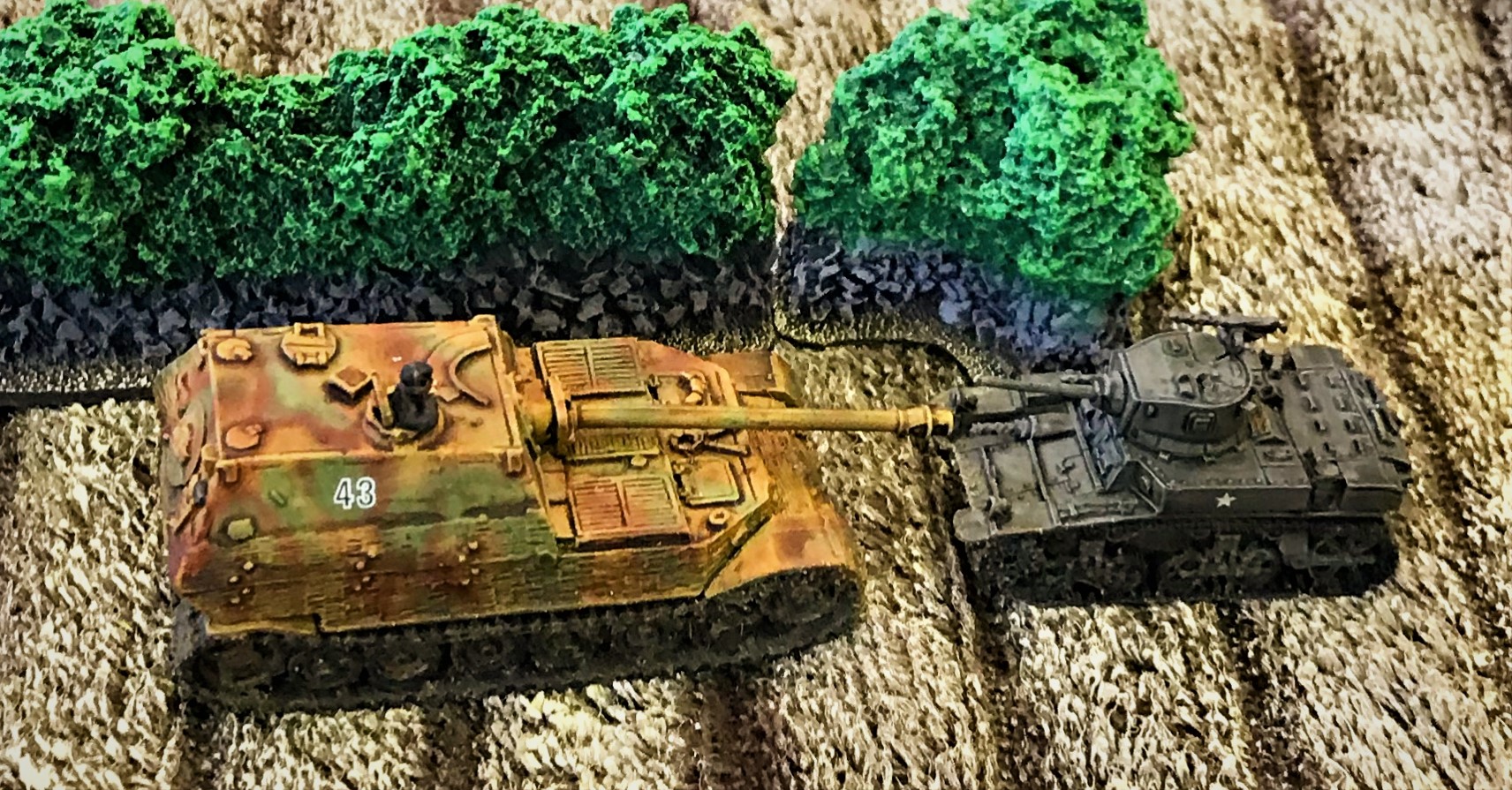
… and the Stuart “successfully” reconned the position – it went around the bocage to find the Elefant in the room. (Photo by Ted Salonich)
The Stuart fired its 37mm at the frontal armor of the Elefant. No effect. The Elefant returned fire, and blew away the Stuart.
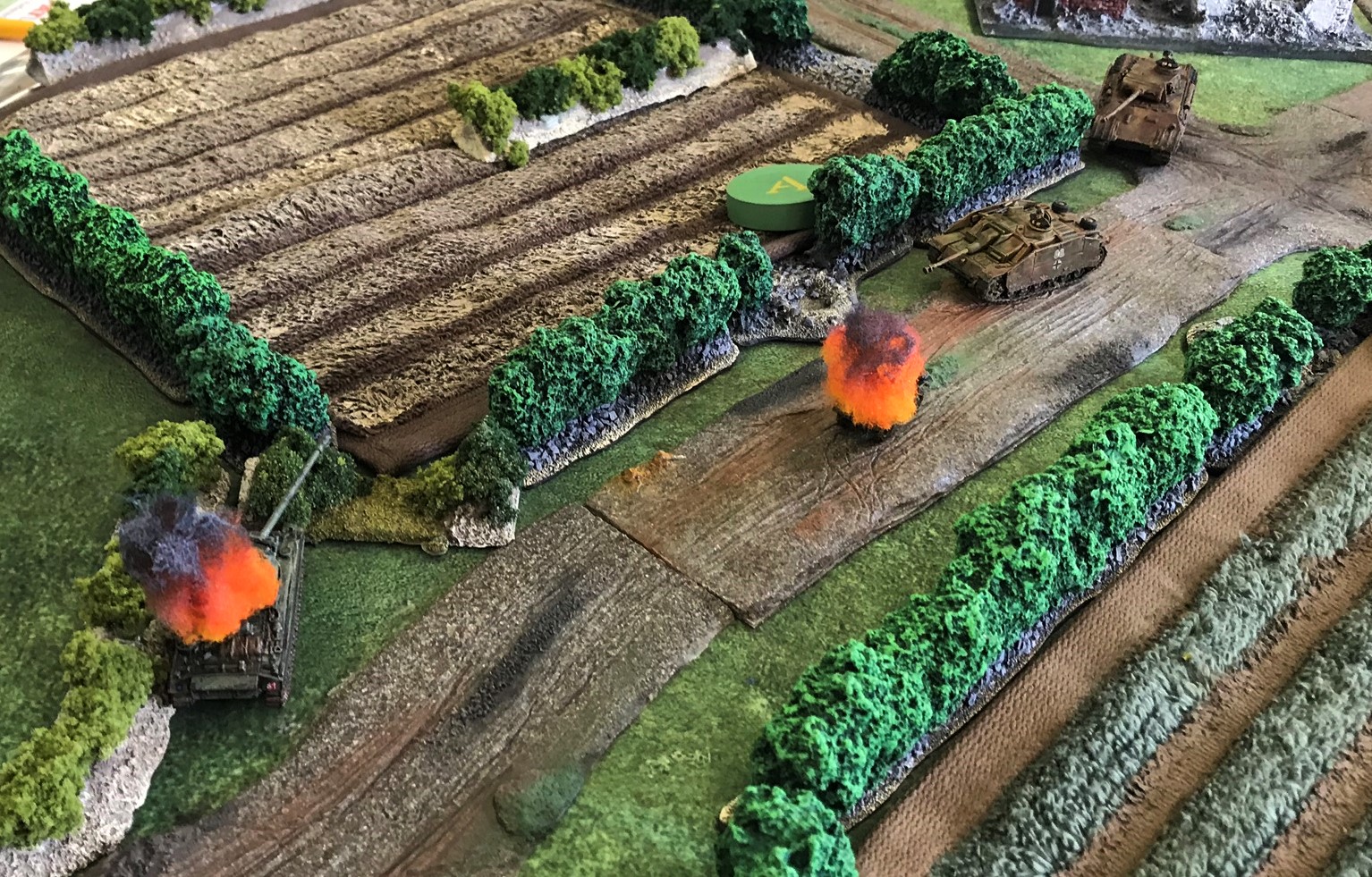
A Panther D and a StuG G combine forces to knock out a Firefly near the burning Dingo.
An M10 Achilles fires at and knocks the Panther D into a ruined building, damaging it. It gets a second shot, and rolls well enough to torch the Panther.
The Americans move up an M18 Hellcat to help the Brits – it ended up moving behind the Jagdpanther and was able to destroy it.
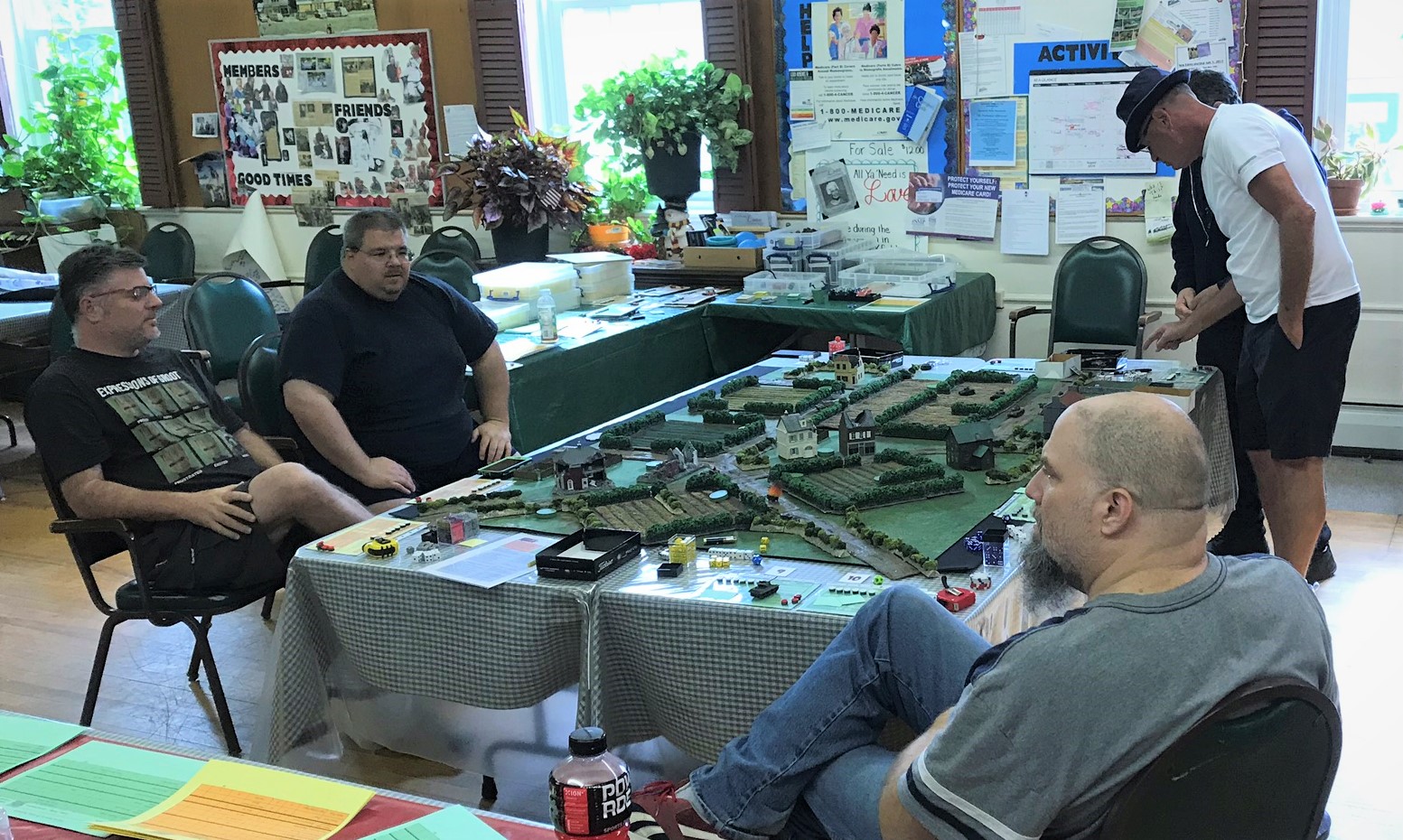
The gamers ponder their moves.
The Allies called in a lot of artillery-delivered smoke to protect their vehicles. It was effective.
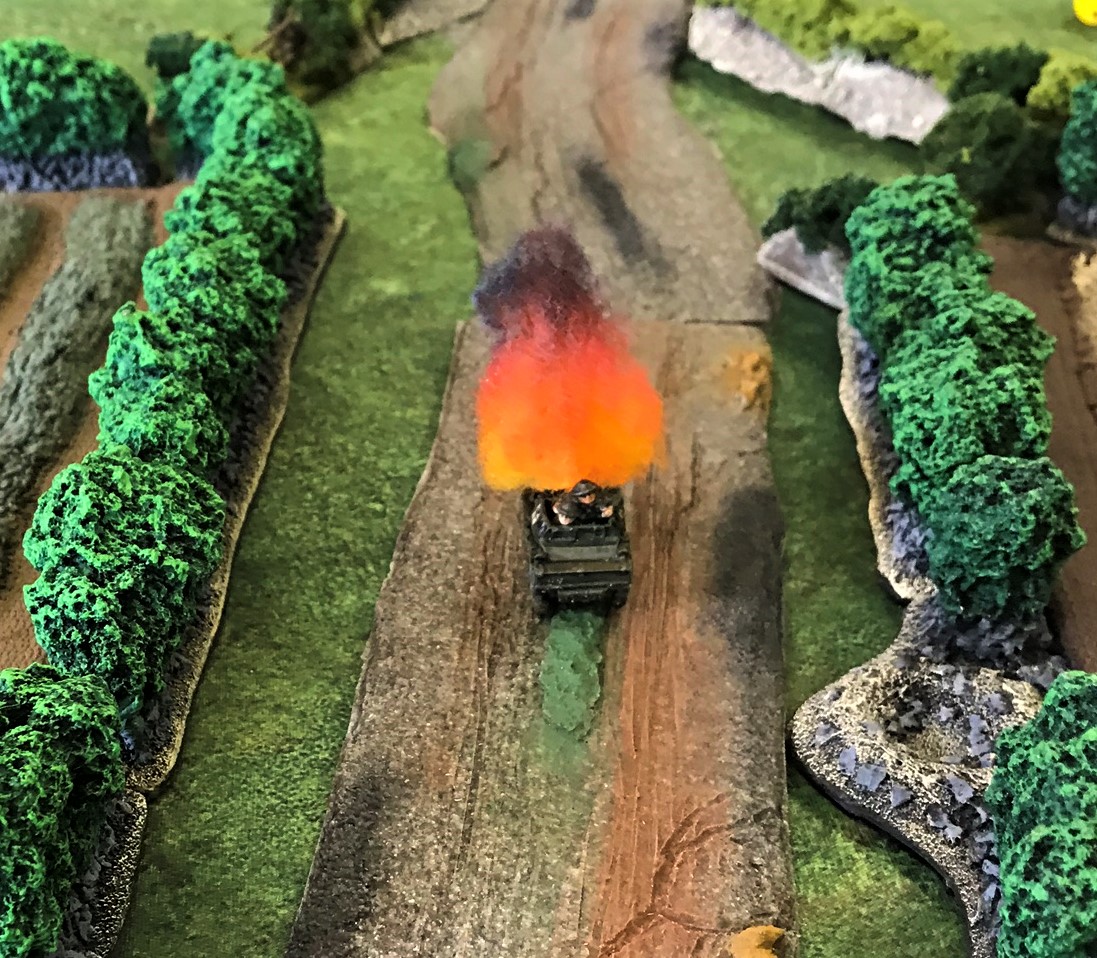
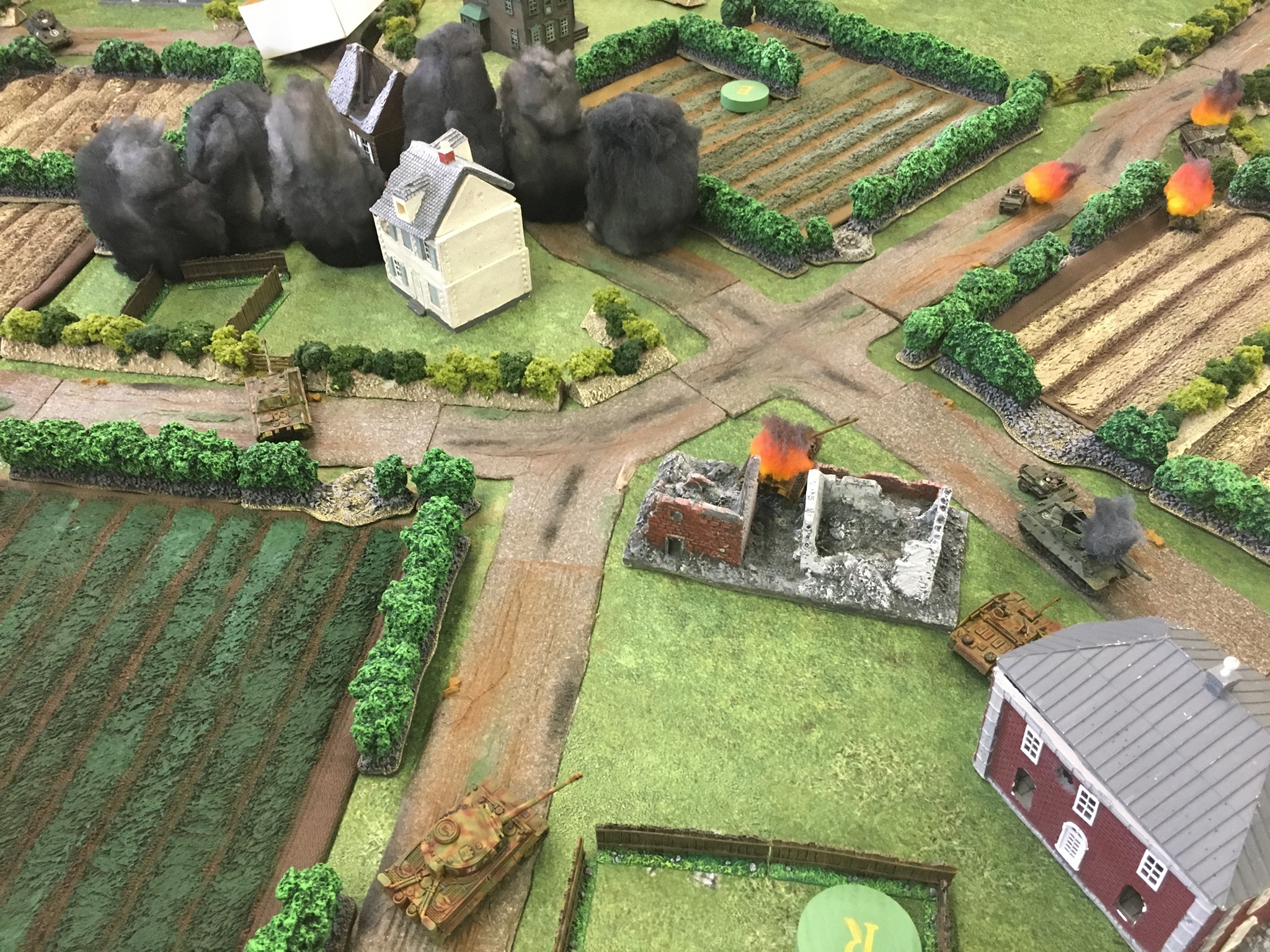
Here comes the Tiger! Note the StuG G that ambushed the M10 Wolverine. The crew of the M10 survived – as denoted by the black smoke versus the fiery smoke. Also shows the Allied smoke screen in front of the Jagdpanther.
As the German vehicles are worth, in general, much more points, the loss of their expensive vehicles made a big difference. Both sides played well, but I have to say the Germans were not very lucky with their dice at times.
I will be tweaking the game scenario in a couple of ways:
Adding stopping bonuses for the Germans:
A 20-point bonus for the Germans if no Allied vehicles are able to breakout across the tabletop.
A 10-point bonus for the Germans if only one Allied vehicle is able to breakout across the tabletop. If 2 or more cross, no German bonus.
Award the Germans 2 points for each unreconned point. This will incentivize recon, but force the Allies to choose what is most important. (The Allies already get 2 points for each reconned point.)
Allow a “banked 6” to be used for either an advantage on the next activation (per the rules) or as an automatic “6” on the next activation roll (determined by the player on the turn he banks it). Thanks Ted Salonich!
Thanks again to the all of the players. And for those who follow this blog who wondered if their named vehicle got fried, only one Cromwell (“IRO”) deployed and did not get into action. However, the M10 Achilles “Per” (named for Per from Roll a One) did get knocked out by one of the StuG G’s. Sorry my Swedish friend!
Hope that you enjoyed this – and I will be running this game on Saturday at BARRAGE in Maryland (September 28th) and at the Fort Devens Game Day on October 19th. I may also run it at other upcoming gaming cons if possible. Thanks for looking!
























































 Angie Gaston and I then made a visit to our old home – that being the 43rd, 44th, and 45th Divisions – our old barracks, Scott Barracks, which dates from 1938. The Divisions are very different from the other barracks. Think of them as stacked milk cartons put side-by-side with no connections horizontally (except occasionally on the first floors). Divisions are thus arranged vertically – with four cadet rooms and a restroom per stacked floor (with 5 or 6 floors per Division) – if fading memory serves. Again, as opposed to long dormitory hallways there are no horizontal connections between the Divisions. It was a fun environment, though if you were on the top floor you got a workout going back and forth to class. A current G-4 cadet was nice enough to take our pictures – and now this is part of G-4 as F-4’s current barracks is located elsewhere.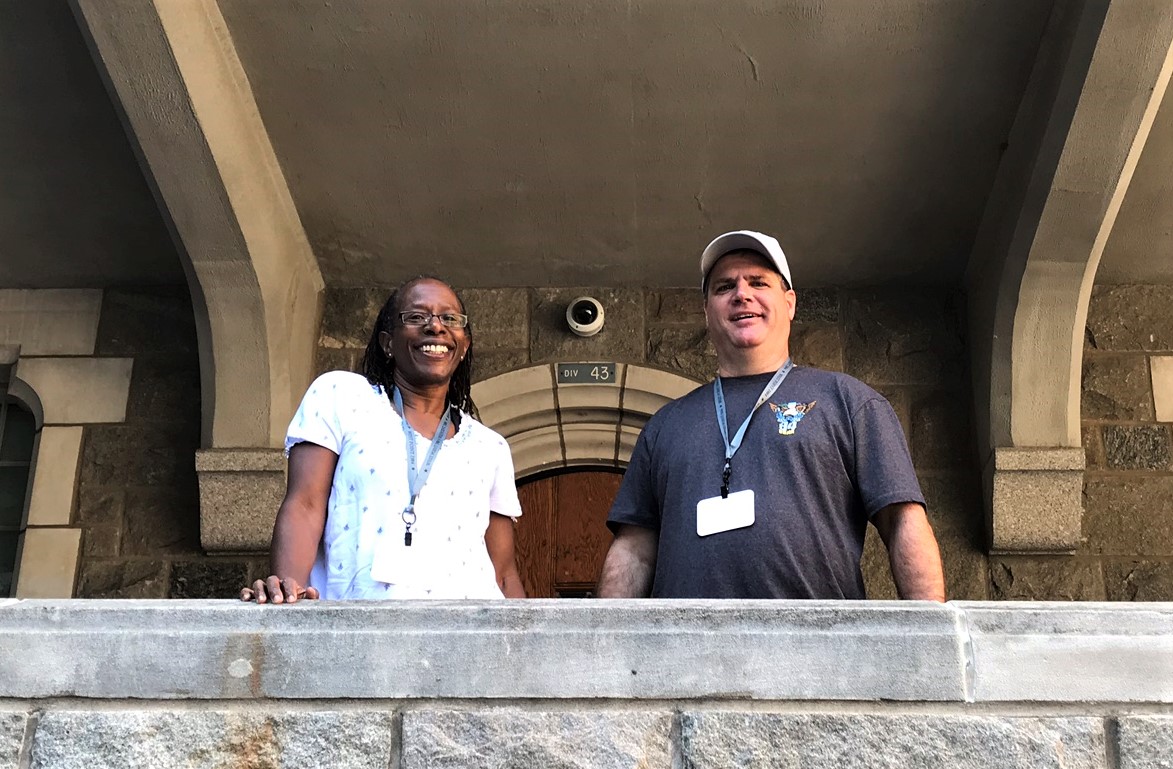









 Mark A. Morin


