2021 was another one that we all want to forget in many ways, but not all.
I set out some goals for myself back last December for 2022. Some were around gaming, some around hobby production, some were around golf, and more. Back when I was working in “the dreaded private sector”, I had sales goals to hit every period – be it yearly, quarterly, thrice annually, or whatever. Every manager would ask you for “stretch goals” – which was pretty unnecessary as the sales quotas you were given from corporate were never layups anyways. Still, it’s always good to have a plan and try your best. It’s also good to be honest with yourself and be accountable to yourself. Hopefully, that’s what I did with regards to my goals in 2021.
How did I do versus my 2020 goals?
Paint 250 figures or more
That did not happen, though my production was pretty good at 104. For three months I did not do any painting (August-October) as I was pretty involved with the new garage+ project.
Not even all of them now…
Complete the figures and terrain for Civilizations Collide
I have to give myself full credit here – the building of the Aztec cityscape was an epic project. However, I still am finding that I have more to do as I develop scenarios for my Spanish Conquest scenarios booklet – so yes I built what I planned – I just have more to do to flesh out the other scenarios with terrain and figures.
No retro sci-fi games or WaT games this year – but I did run multiple games of for Feudal PatrolTM using my “Civilizations Collide” supplement, to include at Historicon.
HA! I have hovered around 20-21 all year. I did get new clubs this year, and I won my flight in the Club Championship (and as a caveat it was the D Flight, but I am proud of that).
I did get a trophy…
Play golf (in season) at least twice a week
I did do this!
The new G425 toys! I also got G710 irons.
Make between 30 and 36 blog posts of value and quality
As far as quality, I would judge them as up to standard (but that is the reader’s judgement, no?). Quantity-wise, I did 54, so that’s a “check”.
Get back on the Imperial Rebel Ork podcast
Well IRO euthanized his podcast earlier this year, so that wasn’t possible. Understandably, the man had a cabin to build!
Build a new garage
As most of you know, that is on-going, so not yet done.
Through early December
Personal Highs for 2021
Continuing to serve my Town (East Brookfield, MA) as the elected Board of Health Chairman during the pandemic. Specifically, getting over 500 seniors vaccinated (1/3 from neighboring towns even), and getting nearly 100% of the 56+ residents vaccinations.
Getting together with Dave Wood, Buck Surdu, Greg Priebe, Chris Palmer, and Duncan Adams in person and on Zoom games. Even had The Imperfect Modeller on one game as an observer (which was cool).
Winning my flight in the club championship at Quail Hollow Golf and Country Club in Oakham, MA.
Complete the remaining conquistador figures for Civilizations Collide.
Complete the remaining terrain for Civilizations Collide, to include the brigantines.
Complete the remaining Maya figures for Civilizations Collide.
Complete the scenario booklet for Civilizations Collide.
Complete my figures for Wars of Ozz, ok at least 40 of them.
Paint up a platoon from Wargames Supply Dump for Combat Patrol™ .
Try to get my Nomonhan WaT project off the ground.
Attend and run games at conventions or club nights or both, if possible. This would include TotalCon34, HMGS South Recon, HAVOC, HUZZAH!, Historicon, and BARRAGE .
Get the Mass Pikemen more active once the pandemic diminishes.
Celebrate my wife’s retirement (and mine belatedly) with a nice trip.
Finish the garage+ and launch that baby successfully.
Post on the blog 48 times or more – and in good quality.
Be a good blog follower.
Have multiple Zoom chats with fellow hobbyists.
Go to a golf school and get my golf handicap down below 18.
Play golf (in season) at least twice a week.
Win my flight in the Championship.
Be a competitive golfer.
Again, thanks to all who make the time to read this blog – Happy New Year!
Lastly, here follows a detailed list of the 2021 production. You can access more details here.
I was originally enticed into the hobby by way of 25mm metal figures from Ral Partha, Grenadier, and Minifigs back in the 1980’s. Some of you of course are remarking to yourselves at this point that you have no idea of those days!
Well, no internet existed such that one could go out and find whatever one wanted with a click. You either ordered from a catalog or got lucky at a hobby store with whatever existed in the shop (insert bad joke here).
Some of the figures were pretty simplistic, others were (and are still) marvels of art. Most readers of this blog will recognize that until recently, I have been very much involved with painting and building figures and terrain for my Civilizations Collide project (Aztecs, Conquistadores, etc. for Feudal Patrol. So, you ask, Mark, what the f**k you doing with old school Vikings?
Well, this is related to my recent trip to Historicon (which I wrote about here). Several of the scenarios that I am developing for the Spanish Conquest require Aztec (and Tlaxcalan) war canoes, which were involved in many of the battles, both along the causeways out of Tenochtitlan and in naval combat with Spanish brigantines on Lake Texcoco. At Historicon, I searched high and low in the vendors area and in the flea market for reasonably priced war canoes. All I found were a Blood and Plunder model for $20 (not reasonable) from a vendor’s booth and a single $3 scratch-built balsa-wood version from the flea market.
I got both as options for considering how to design and scratch-build my own. As I estimate that I need 4-6 war canoes for each of the 4 brigantines that I have in queue. That’s 16-24 canoes – and I am not going to pay $20 per canoe! Shortly after the convention, Greg Priebe (who was with me at Historicon) suggested that he could 3D print canoes for me! I was elated, and I asked him what I could offer in trade. Greg kindly said don’t worry about it. But, I thought that’s unfair, and I could paint some figures for him as a fair exchange.
Greg is the author of the Vikings Feudal Patrol supplement (which you can download for free here), so I offered him Vikings. He agreed, and when I got home I went into my unpainted stash to see what I had available.
My supply of unpainted lead includes many figures from the ’80’s. I got a lot of them when I returned to the hobby but have not painted a lot of the 25mm ancient stuff. We conferred, and Greg agreed that he would like ones from three blister’s of 25mm figures and a single 28mm berserker. They all work for skirmish games.
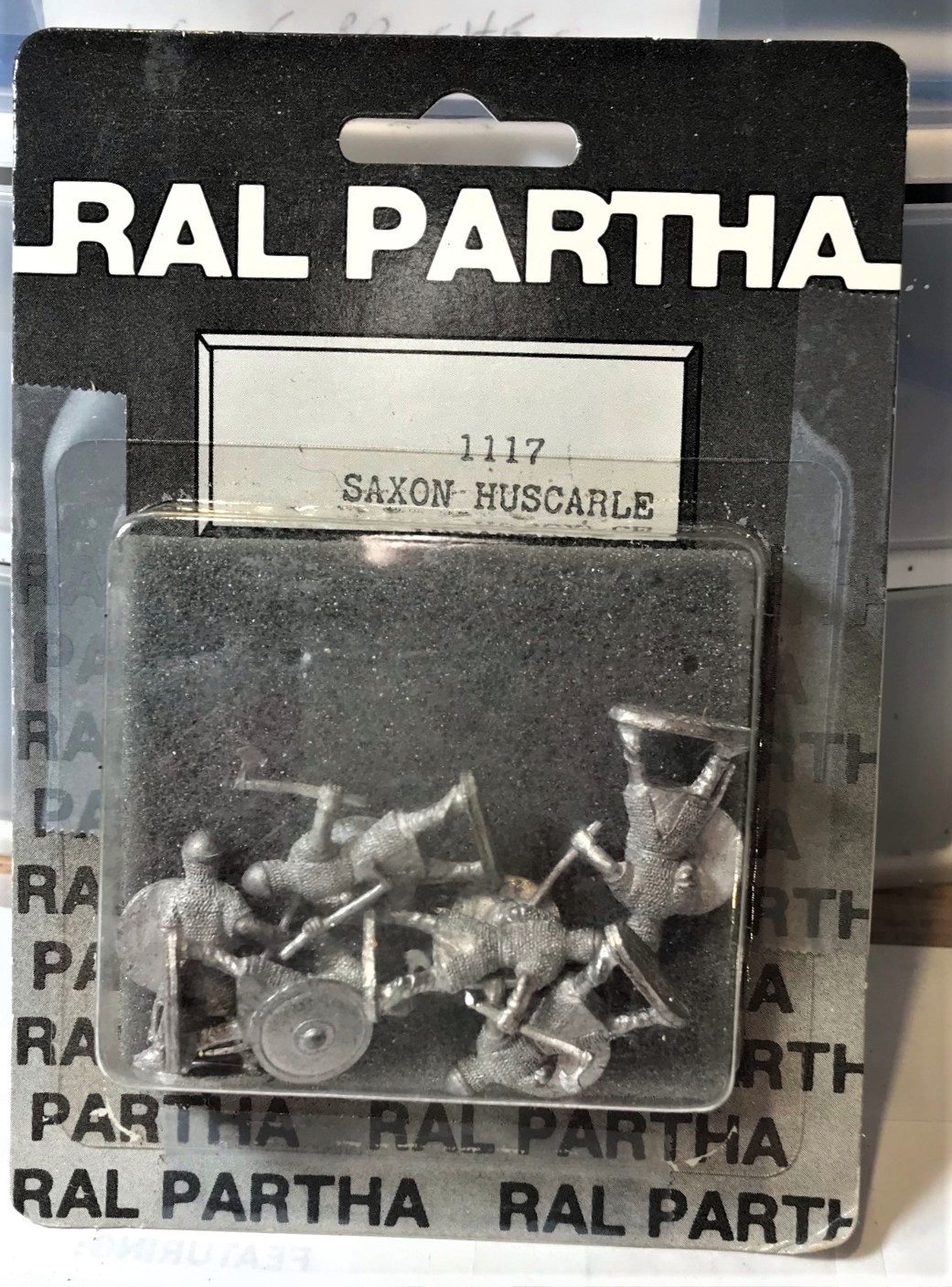
One was a six-figure blister of Ral Partha Imports “Viking Berserkers with Axes” (#DA45) – circa 1982. The second was a six-figure Minifigs “Viking Command” blister pack probably from around 1980-1982. The third was a six-figure pack of Ral Partha “Saxon Huscarle” (#1117) from their “1200 A.D.” line – circa 1982. The last was a single figure from RAFM, “Berserker” from their “Adventurers” line circa 1989. This adds up to 19 figures, and Greg is making me 20 or so canoes. So, the following will describe how I proceeded to paint all of these up.
Ral Partha Imports “Viking Berserkers with Axes“
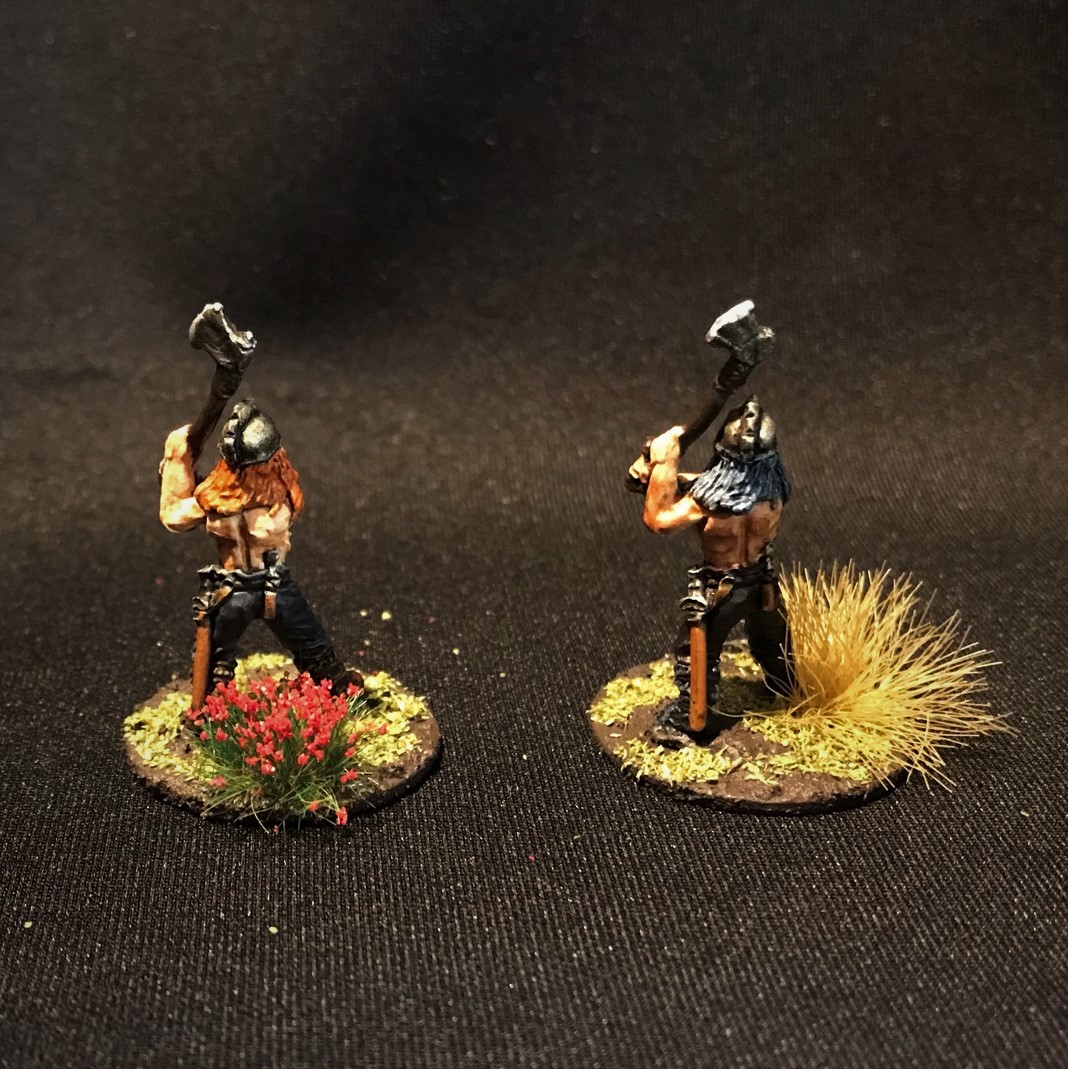
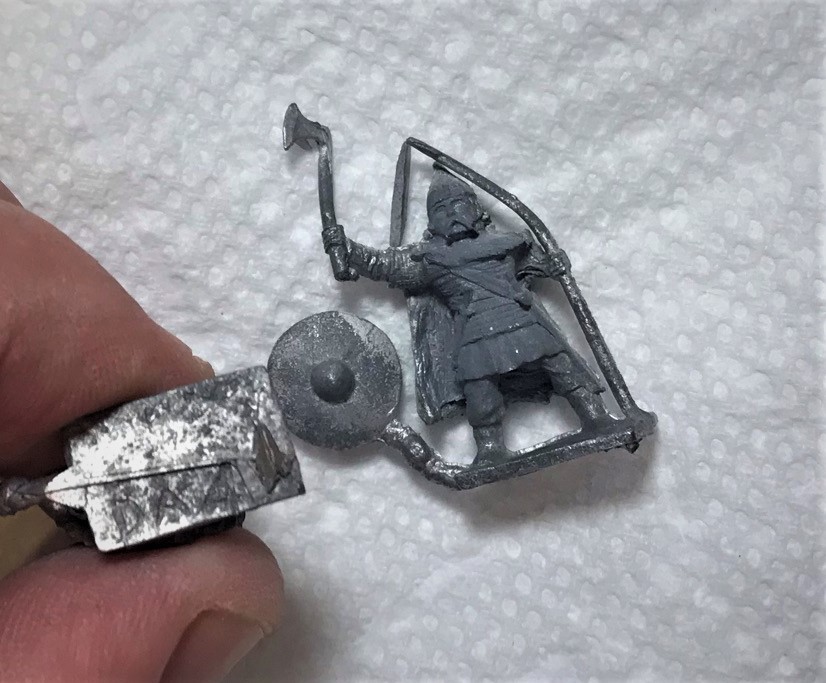
These were likely made by Citadel and marketed by Ral Partha – a common commercial practice back then. The bases had “1982” and DA45 on them. As my process was modified batch-painting, I’ll include some of the steps I took on all of the models here and spare you a repeat later. There were three poses among the six figures, which was a lot back then (most packs of six had just one pose). But, I needed on all of these to make them different enough for easy identification and for fun on the tabletop.
The blister pack of DA45. Opened after 40+ years,
The figures had substantial mold lines, which was common back then. That issue was easily remedied. Their axe shafts were also a bit bendy (common as well) – and I gave them all a light coat of Gorilla Glue – to stiffen up the shafts (insert bad joke here).
Mold lines seen here. Also bendy axes.
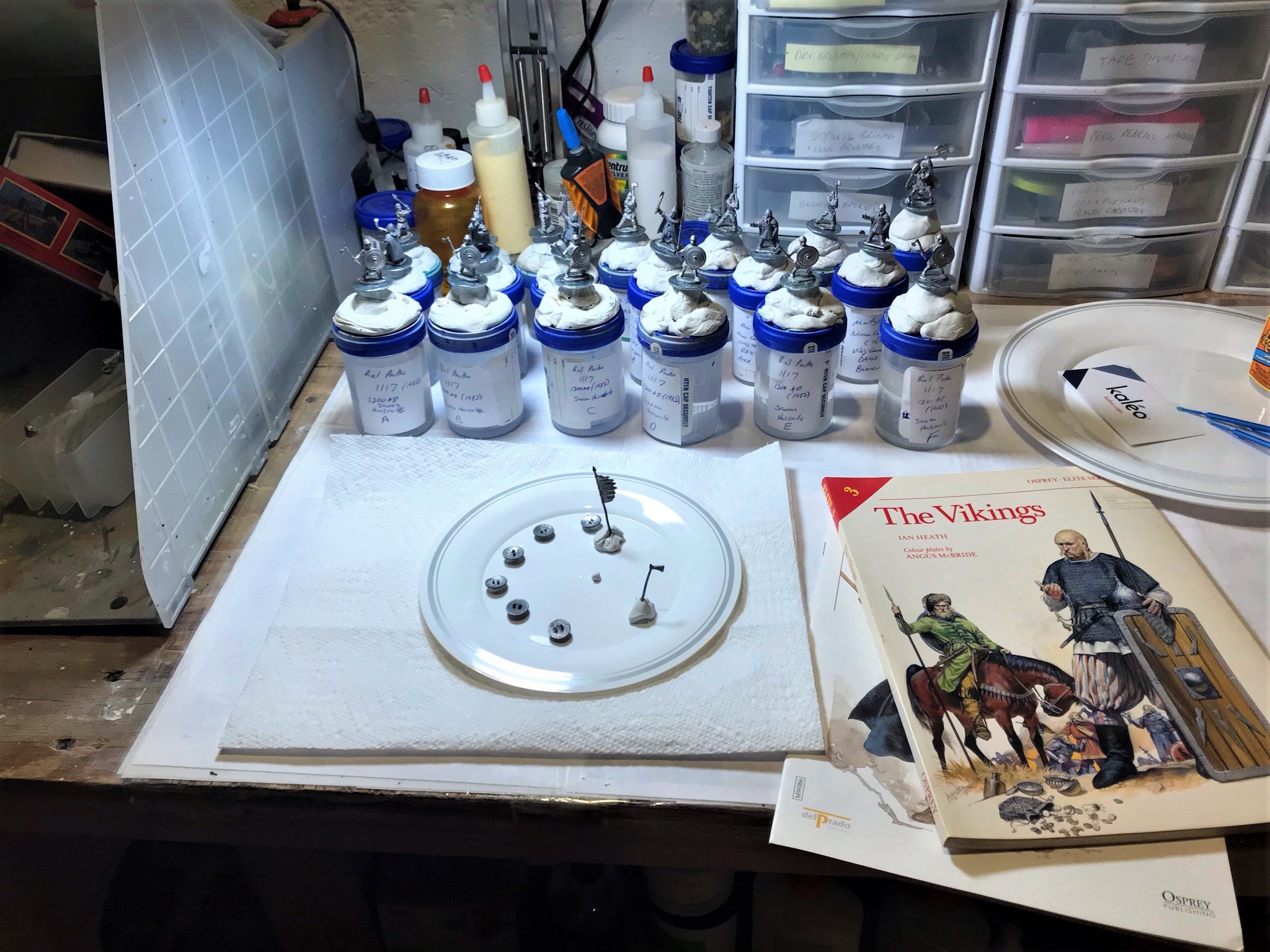
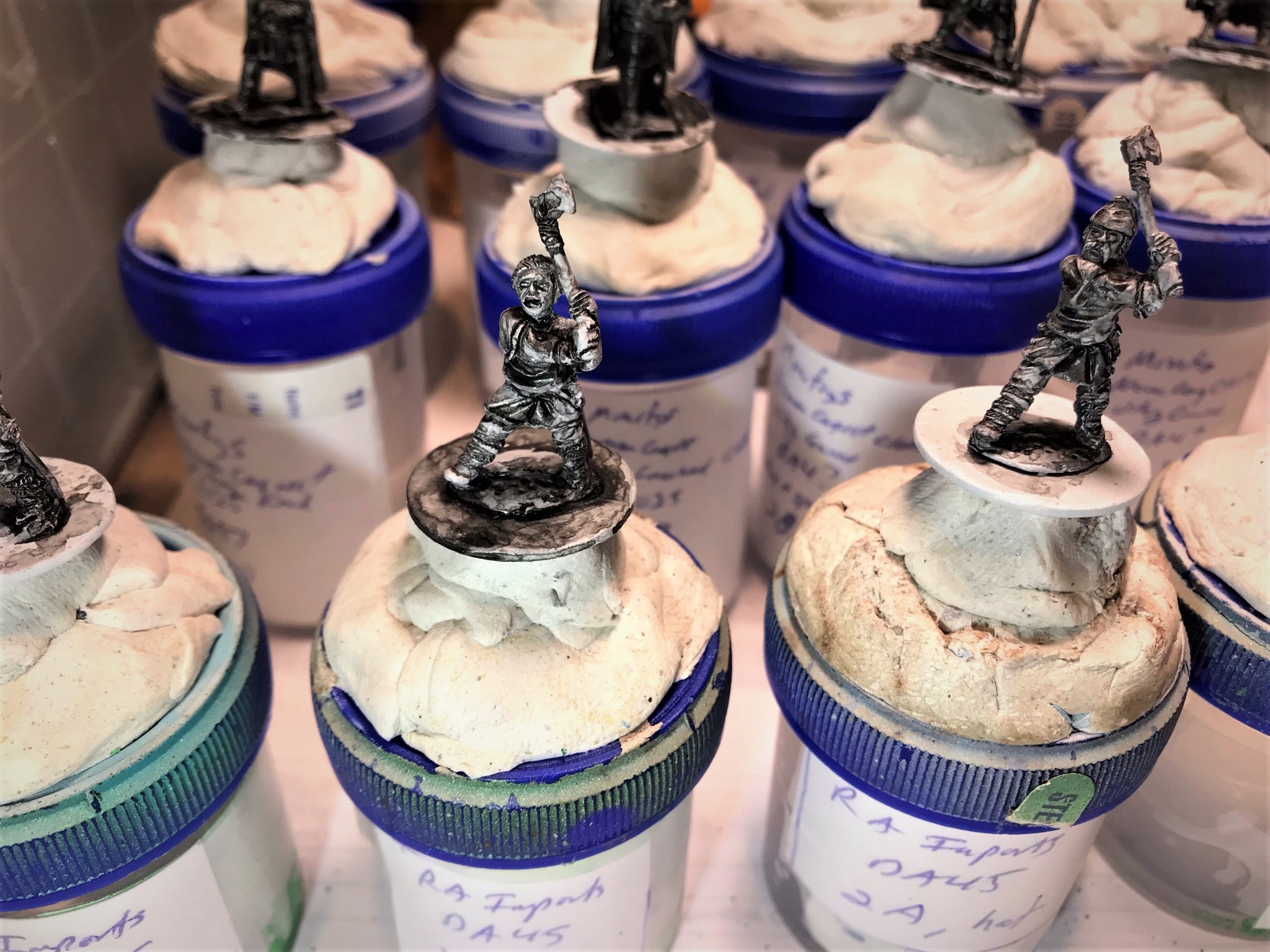
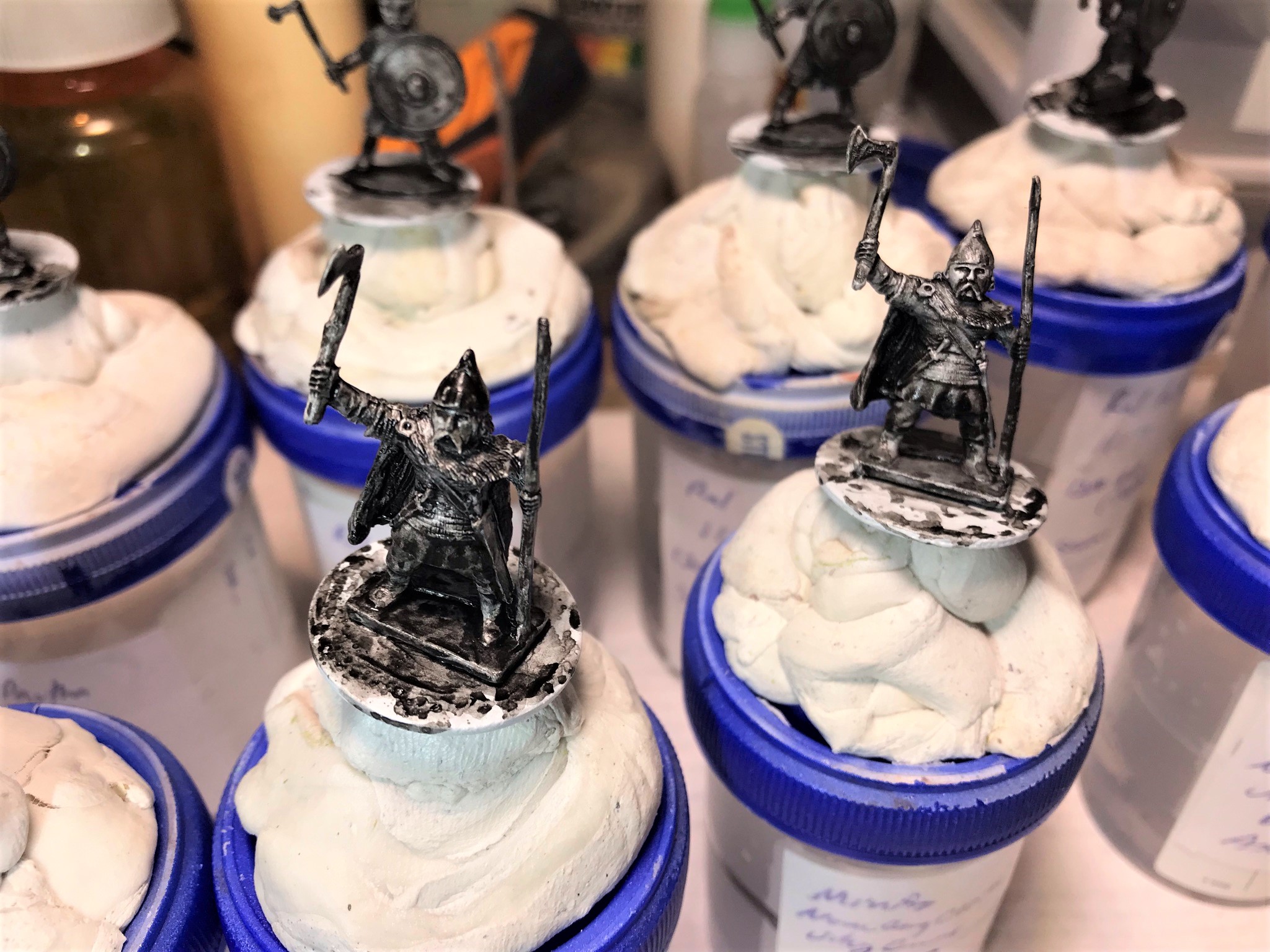
I then mounted all the figures on 1″ steel washers, and put them on poster tack on specimen containers for ease of painting. I primed them all white with my airbrush and after they dried, I washed with “Heavy Body Black” from Secret Weapon Washes (all of the paints that I used will be listed at the end of this post for those interested).
Mounted for paintingAfter prime and HBB washEarlybase coat
Close up of the HBB wash on the Berserkers. It helps me to see details and preshades the models – both very helpful steps with 25mm.
I numbered the six figures by the three poses (1A, 1B, 2A, 2B, 3A, and 3B) so that I could plan differences in painting. At least these had no shields…for the rest that did I needed a plan as well. Yes, I used Excel!
Pose 1Pose 2Pose 3Here all of the 19 figures are ready for varnish, but I did need to work on the shields. More on that in a bit.
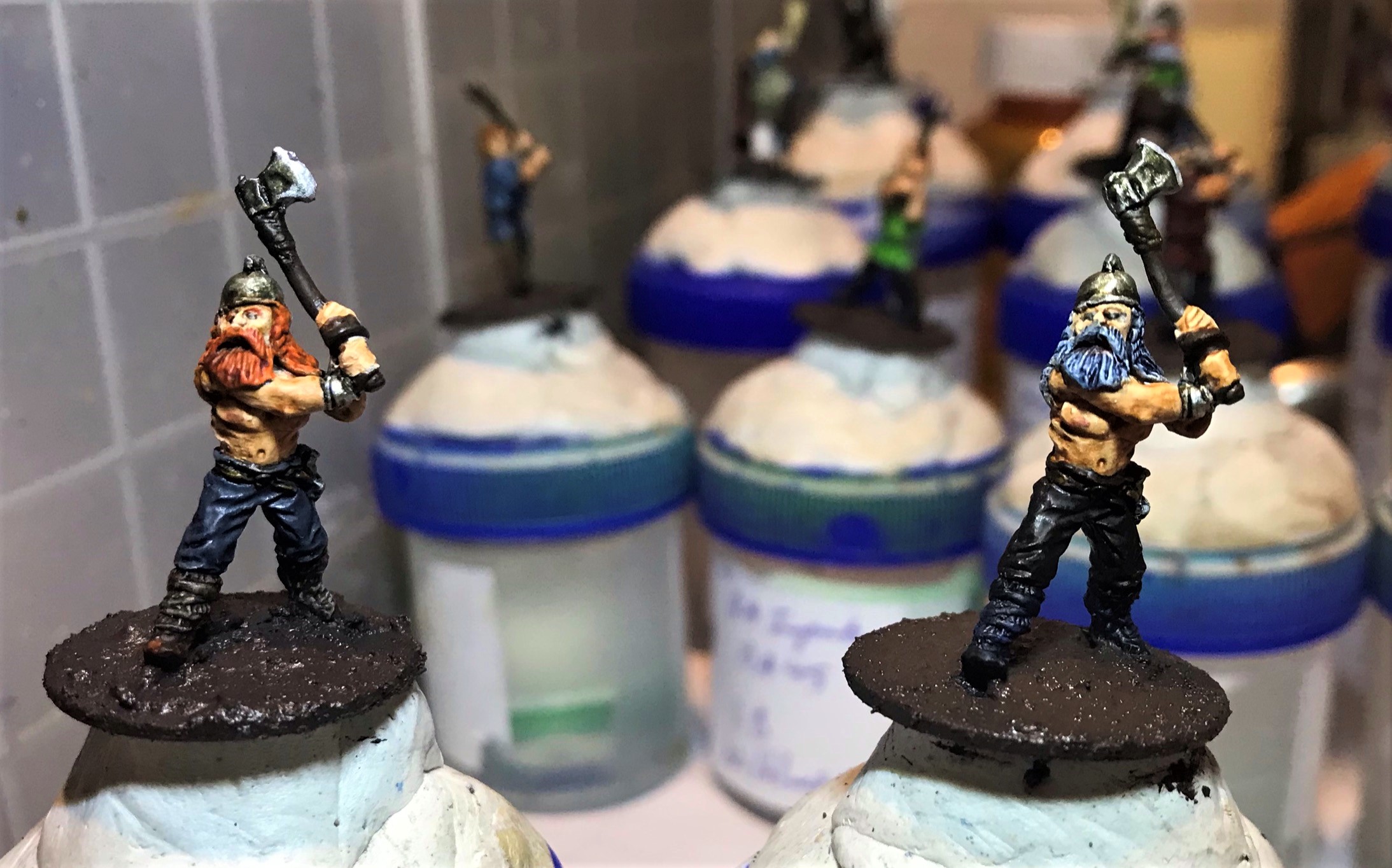
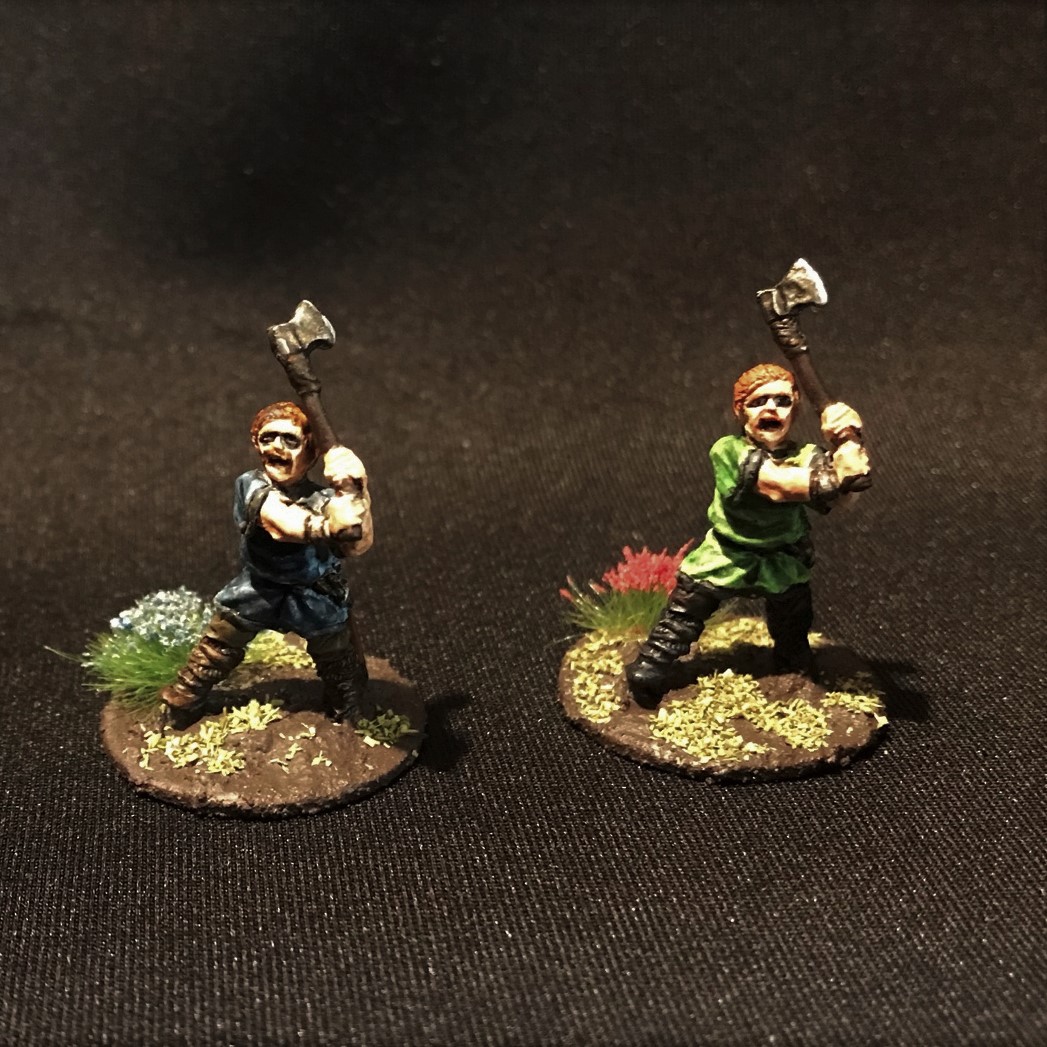
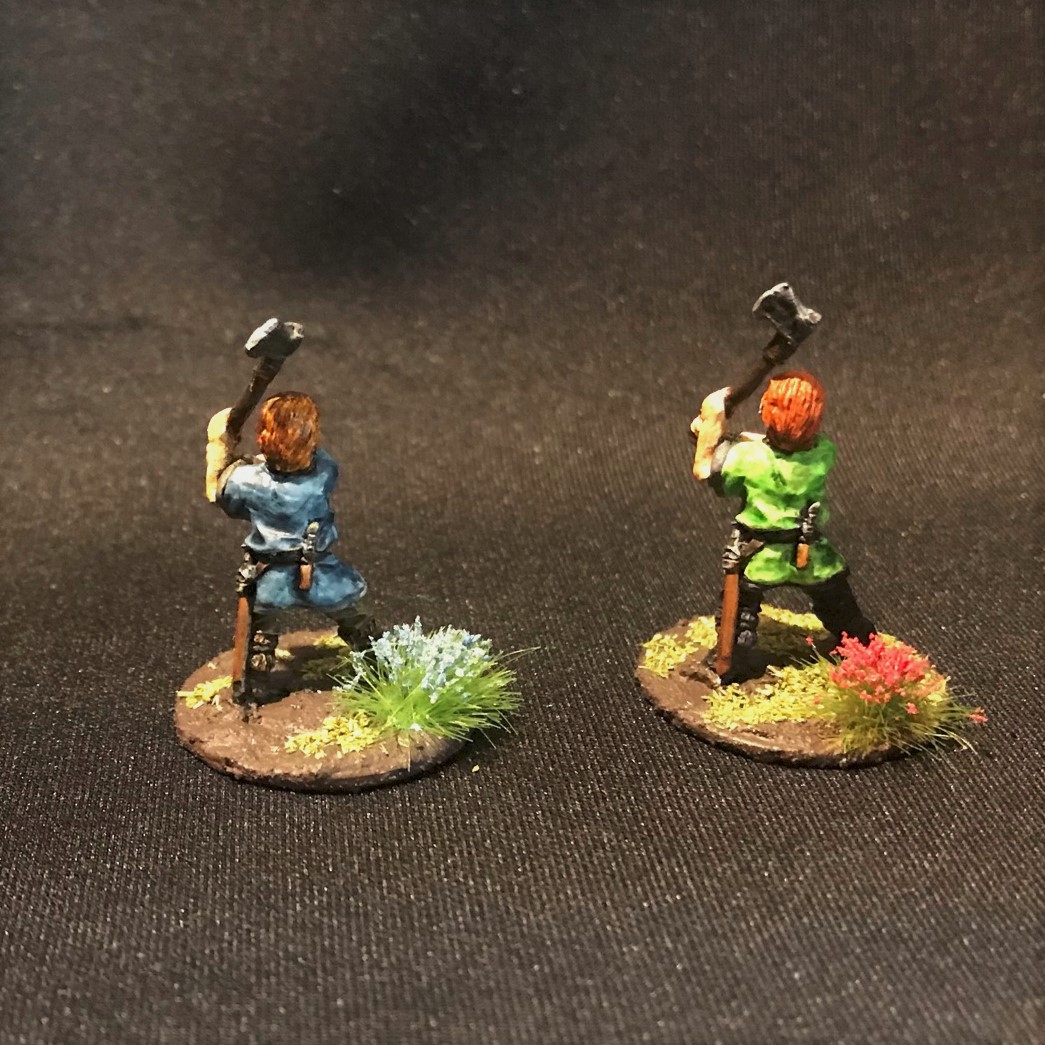
On all of these, in terms of painting, I aimed for a good tabletop standard. While I do not think these are badly painted at all, I have done better work – but these reminded me of how much easier painting modern figures is now, especially 28mm. Another challenge was effectively painting blonde hair. I don’t think I’ve done that in 40 years. Anyways, I toned down yellow (very Sailor Moon) with “Snakebite Leather” contrast paint and Seraphim Sepia” wash and worked ok. The ginger hair was easier. I also added differently colored tufts to the bases for ease of identification as well.
Now, let’s see the models from this blister all completed.
The first pose had no helmets.The second pose had caps.The third pose was more of a classic Viking berserker one with no shirts and helmets.The group. I tried to give the eyes a “mascara” look like the show “Vikings” did. At 25mm, this was hard to do, but you can let me know if it worked or not to your eye (pun intended).
Minifigs Viking Command
I remember painting a number of fantasy Minifig miniatures back in the day. They had square bases and the details were rather plain. These were the same as those. My guess is dating from the early ’80’s or possibly even the late ’70’s.
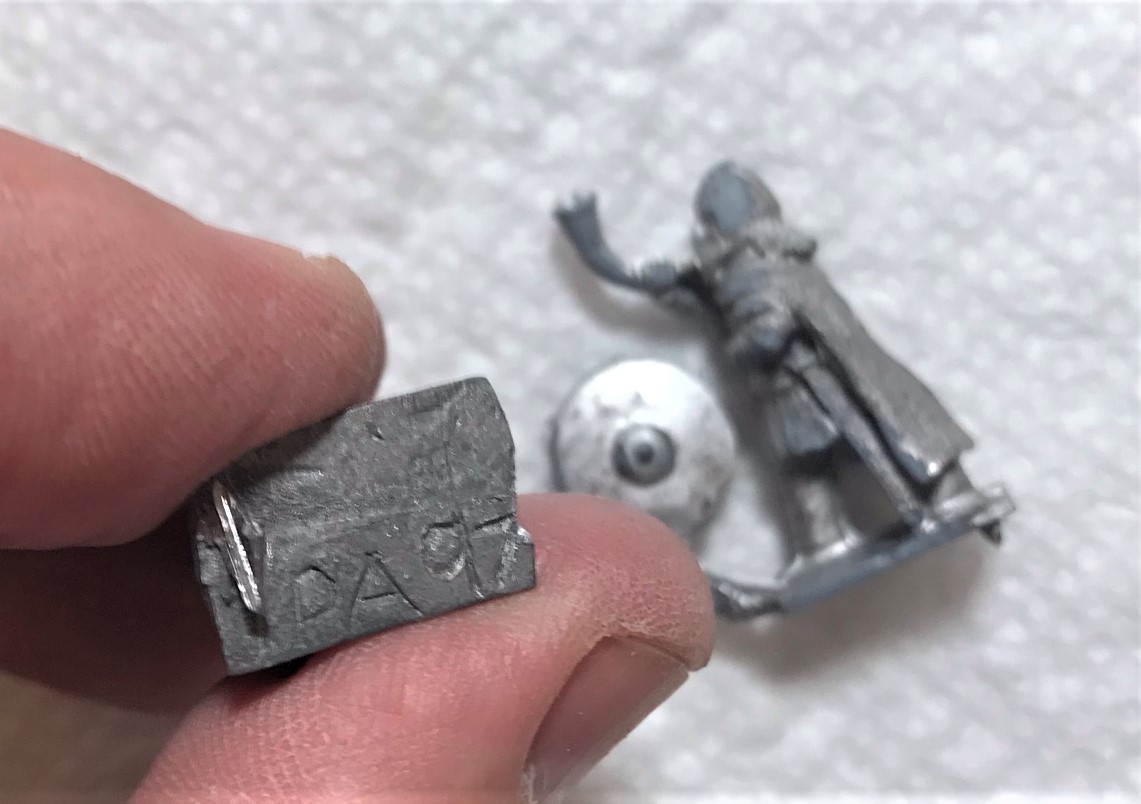
Unfortunately, these had a severe coating of oxide or something black and crusty on them. I don’t think it was lead rot, but I did clean them up with baking soda just in case. Their spears and banner shafts were even more bendy than the others – which was very much a common issue for this manufacturer back then. I added a second stiffening coat of Gorilla Glue to these bendy shafts, and then proceeded as discussed previously.
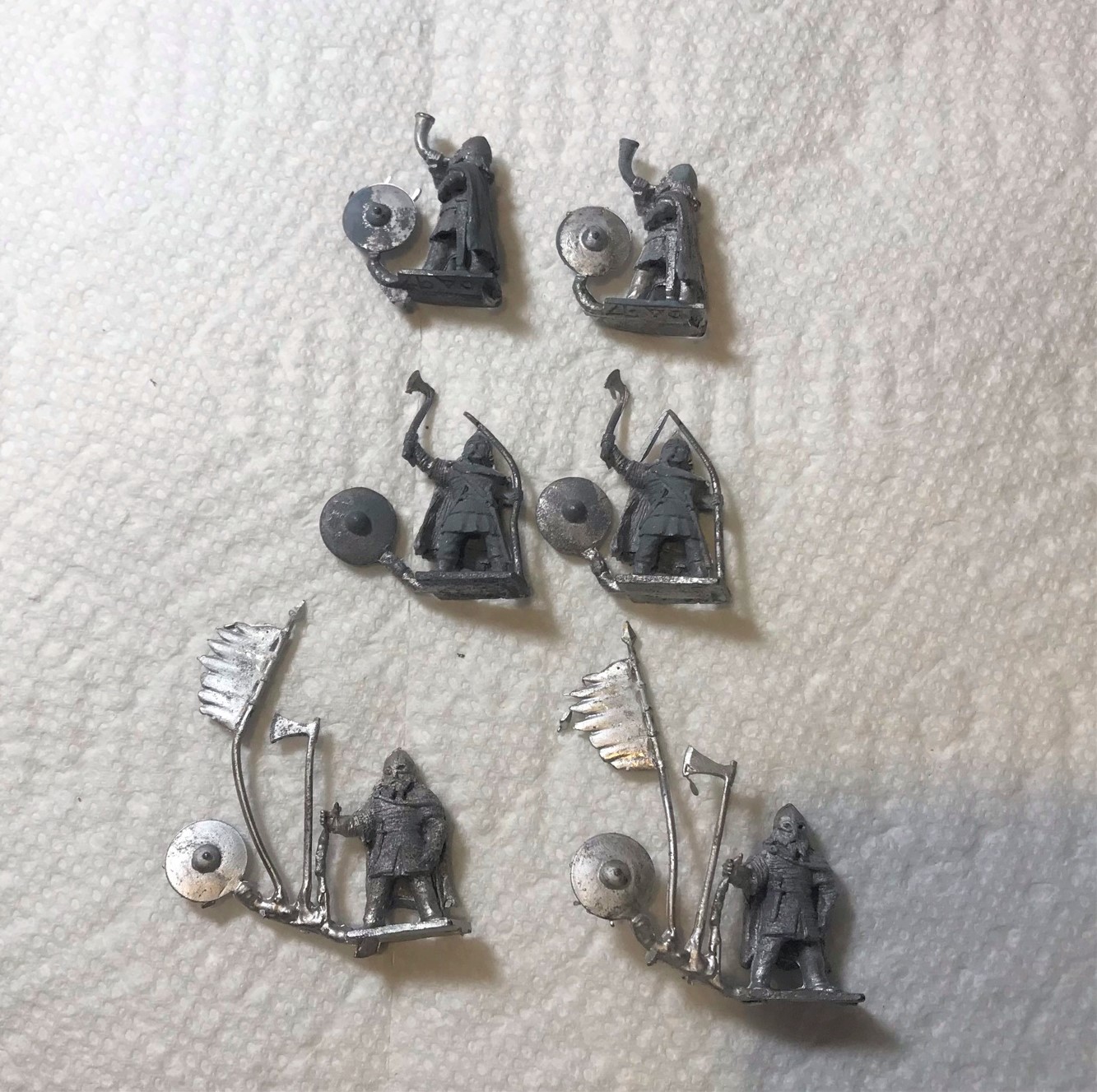
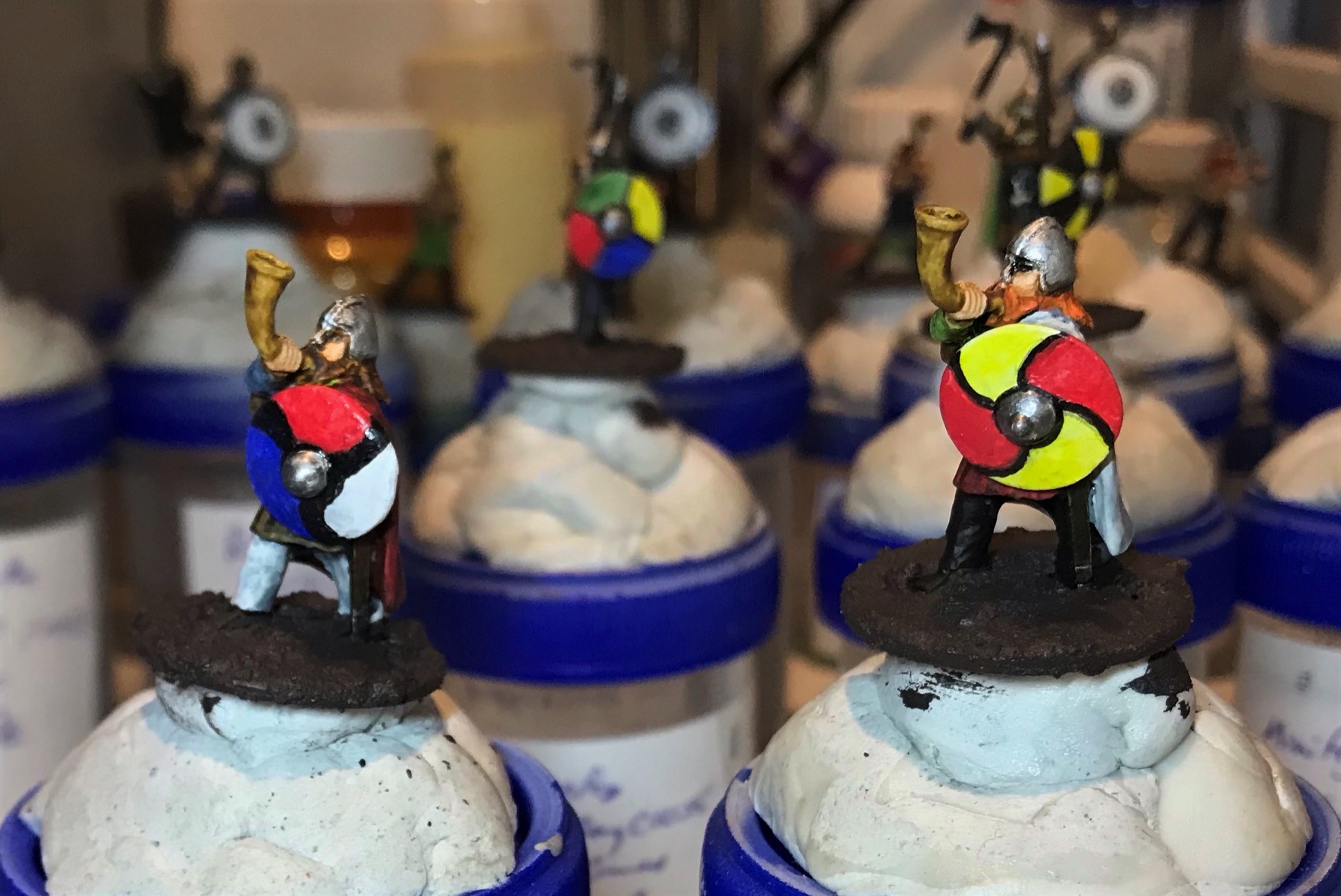
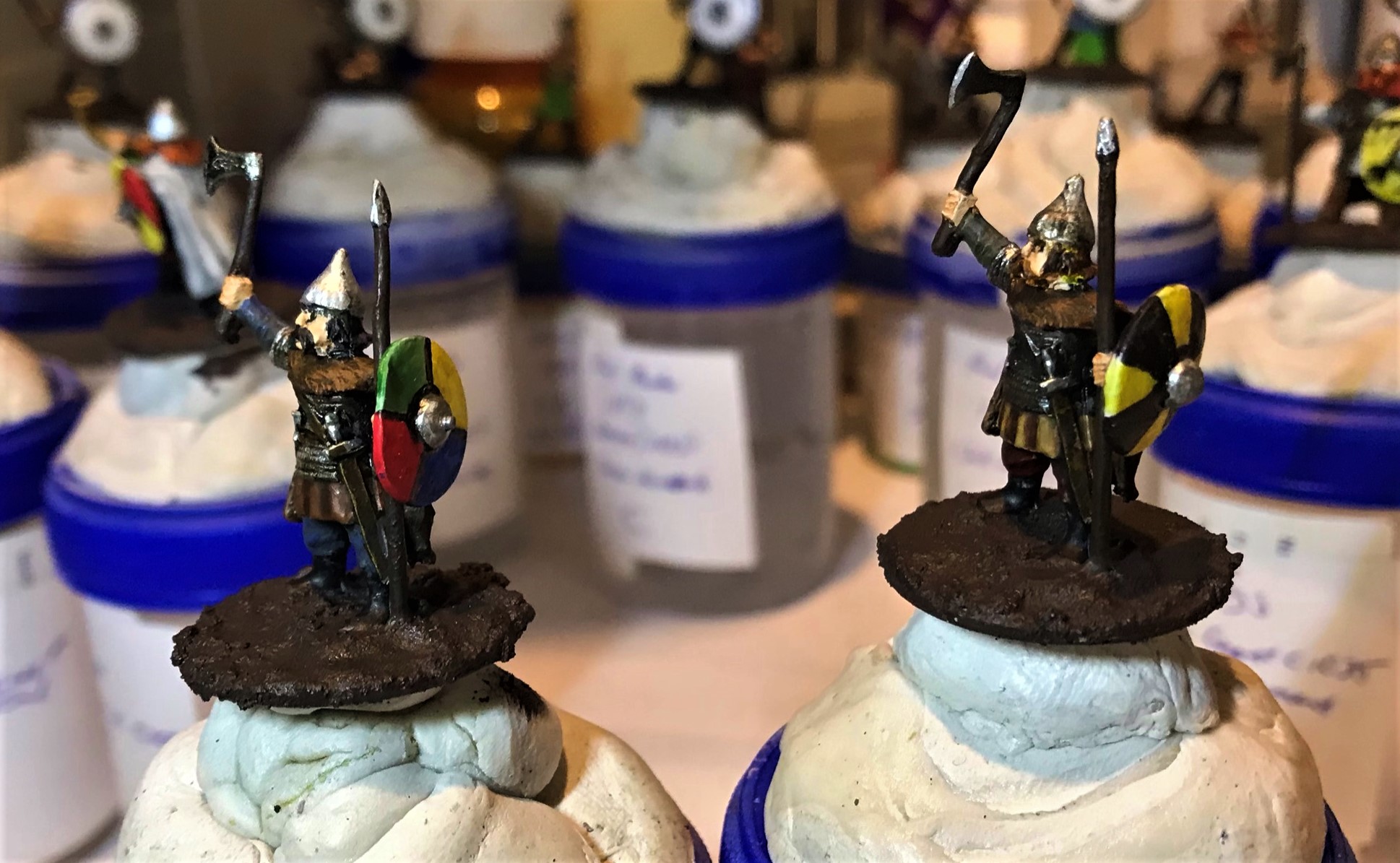
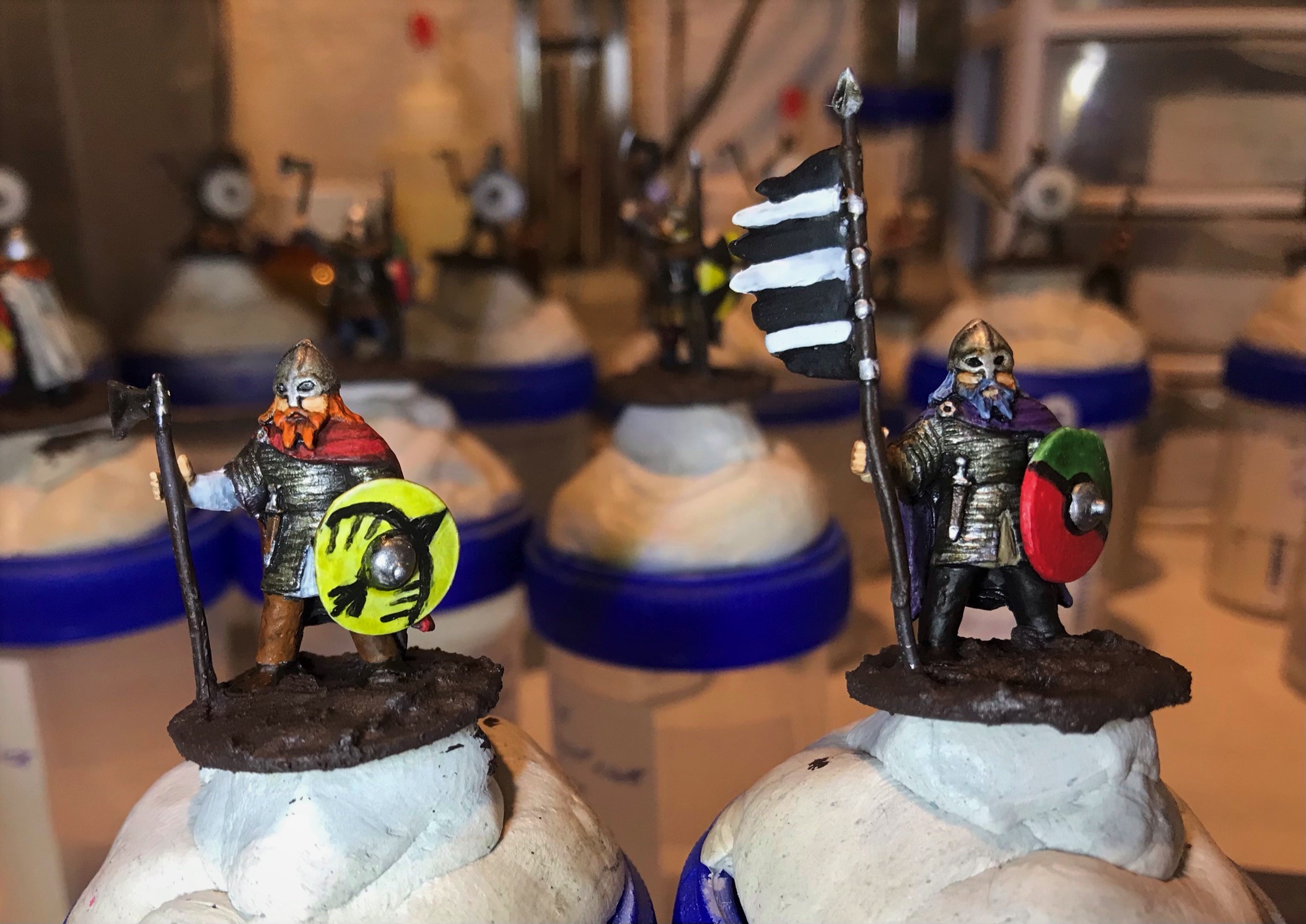
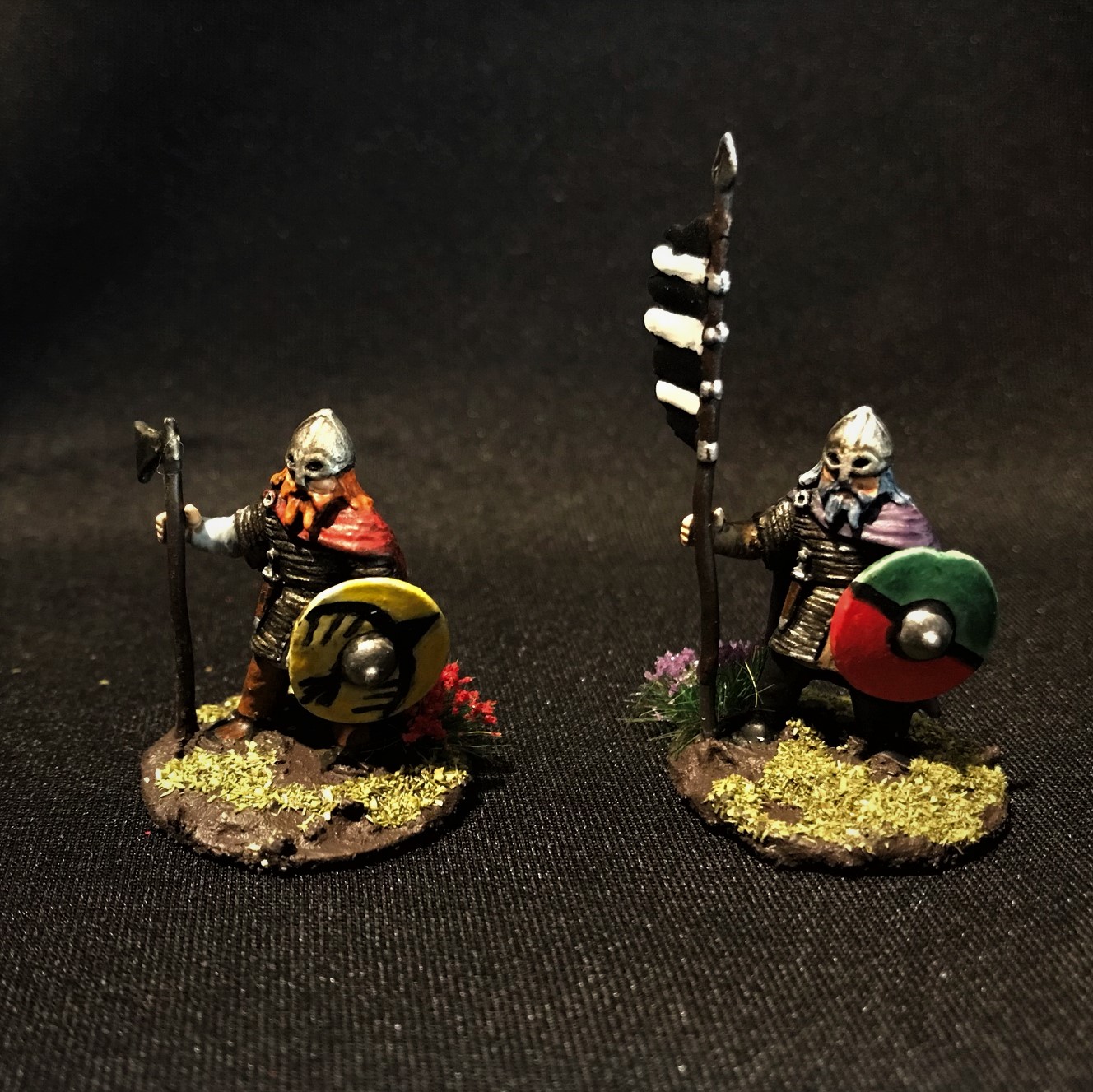
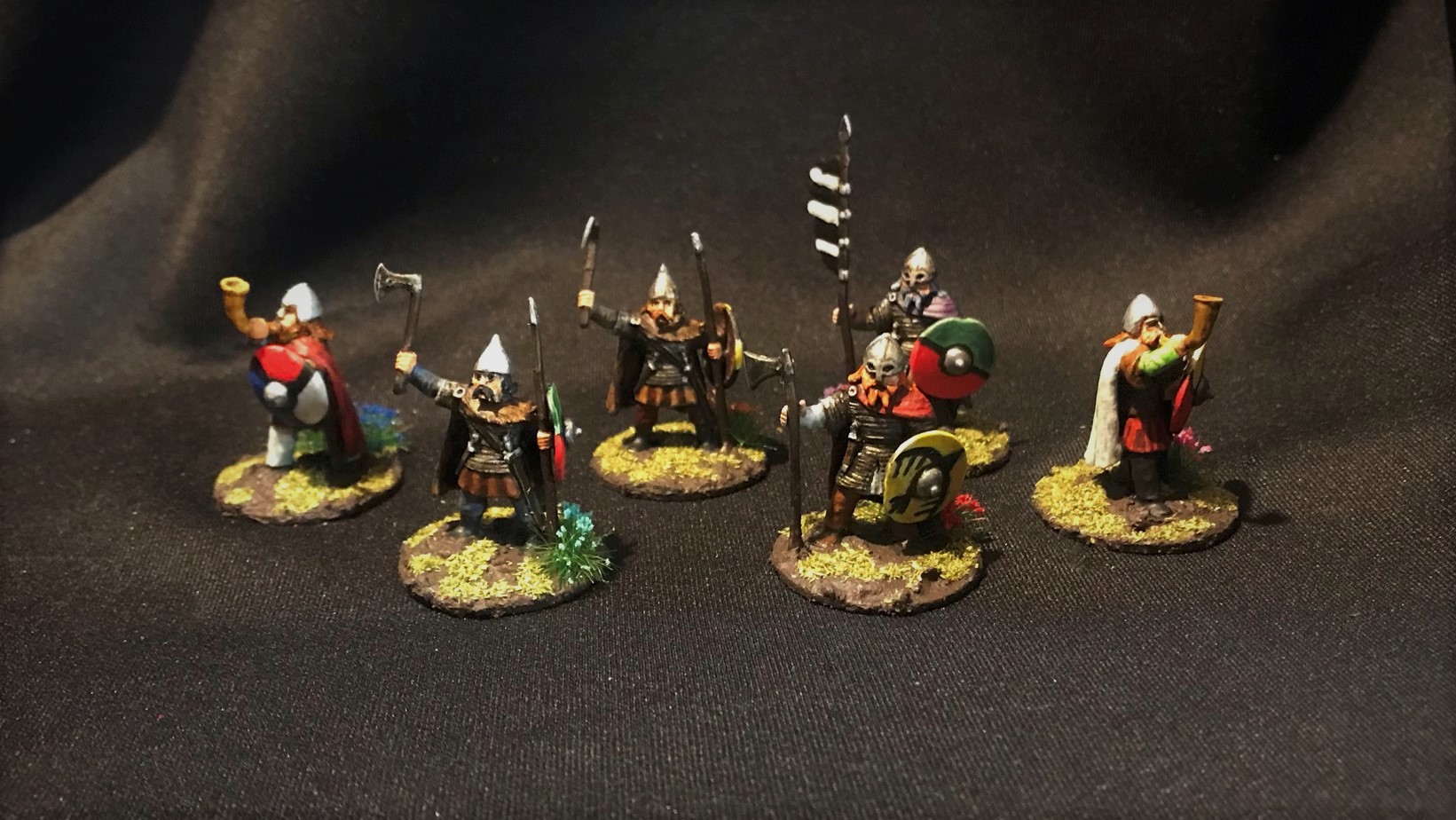
There were three poses here. Two with a horn, two with spears and axes, and two with either a banner or a long-shafted axe. For the last group, I gave one an axe and one a banner. They all had shields (unattached) so I did need to get some references for free-hand painting them.
The old blister – $3.98 for six figures!You can see the dark oxidation (if that’s what it was) on all the figures – which needed filing, cleaning, and fixing of the more-bendy shafts.Close-up shot showing issues.
Each of the three poses had a different number on the bases. Pose 1 (with horn) was DA97, pose two (with axe and spear) had only partially DA4-something, and the last one was DA42. I’m assuming DA stood for “Dark Ages”.
DA97DA4?DA42
Second pose after HBB wash.
I tried to give different looks to these as well – again, a painting plan in Excel helped. As for the shields – they were fun the most enjoyable to paint – and different than the Aztec shields to be sure. I chose 6 designs that I thought would work with the colors. Instead of thinner, I used Vallejo Flow Improver with the black on a Newton & Windsor 0000 brush – and that worked (thanks to The Imperfect Modeler for that suggestion).
I would sketch lightly with a .5mm pencil, then line with black paint thinned with flow improver.Painted shields.
After I painted the shields, I gave them a brush of satin varnish. Once they dried, I mounted them to the figures.
Pose 1Pose 2Pose 3
Then after drying time, they were off to varnishing and flocking (similar to the previous group). Below are the finished models.
The first pose with the horns. It was easier to give their capes details than it was for their faces.Pose two with the axes and spears. Pose two with the axes and spears.Pose three had the banner or the long axe.The Viking Command Group together.
Ral Partha Saxon Huscarle
While housecarles in English is proper, the blister said “Huscarle”, so…
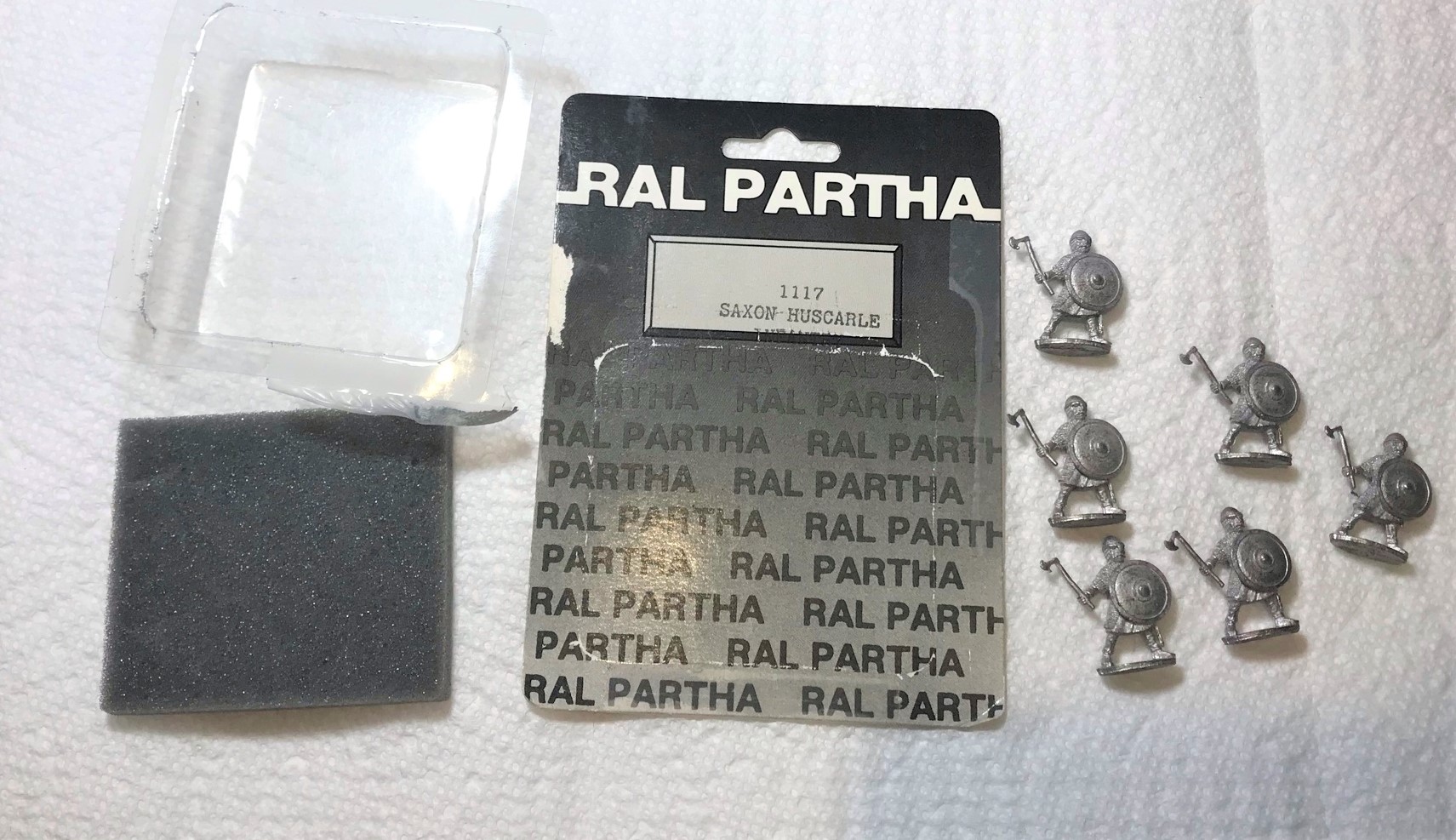
The old blister from the 1200 A.D. line.
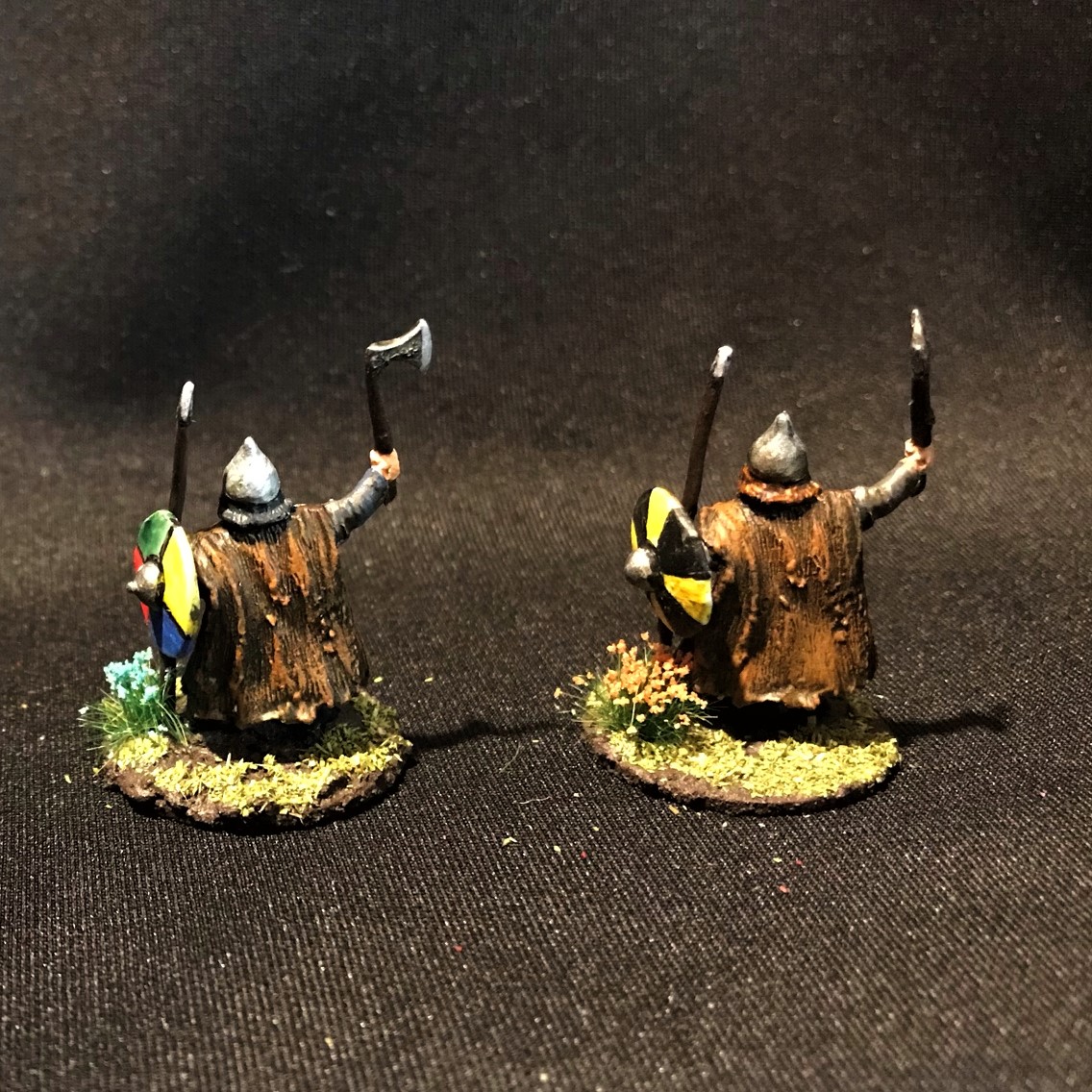
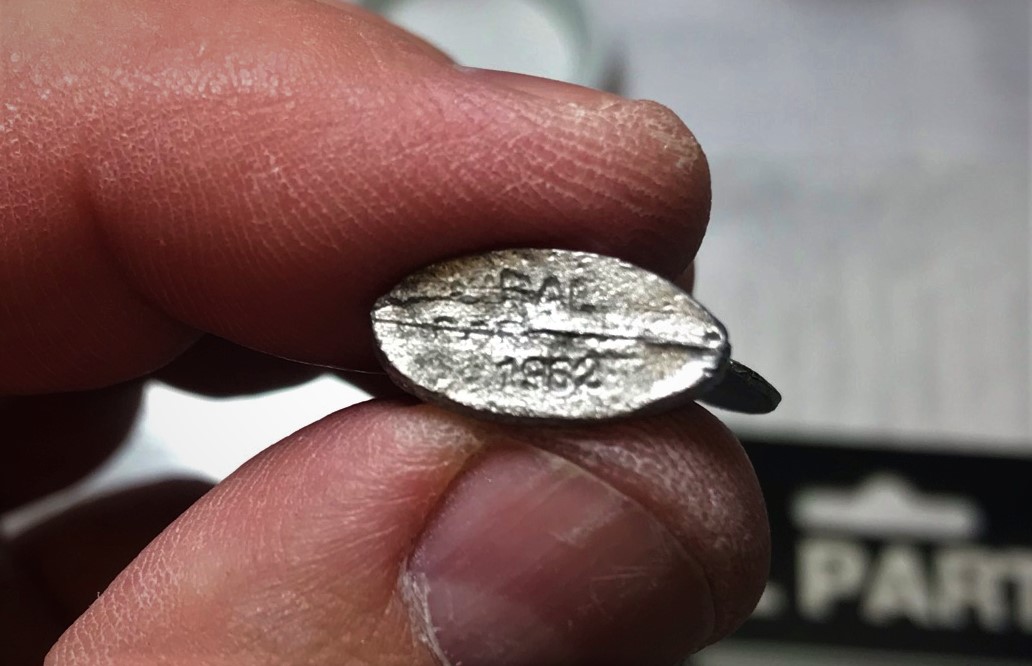
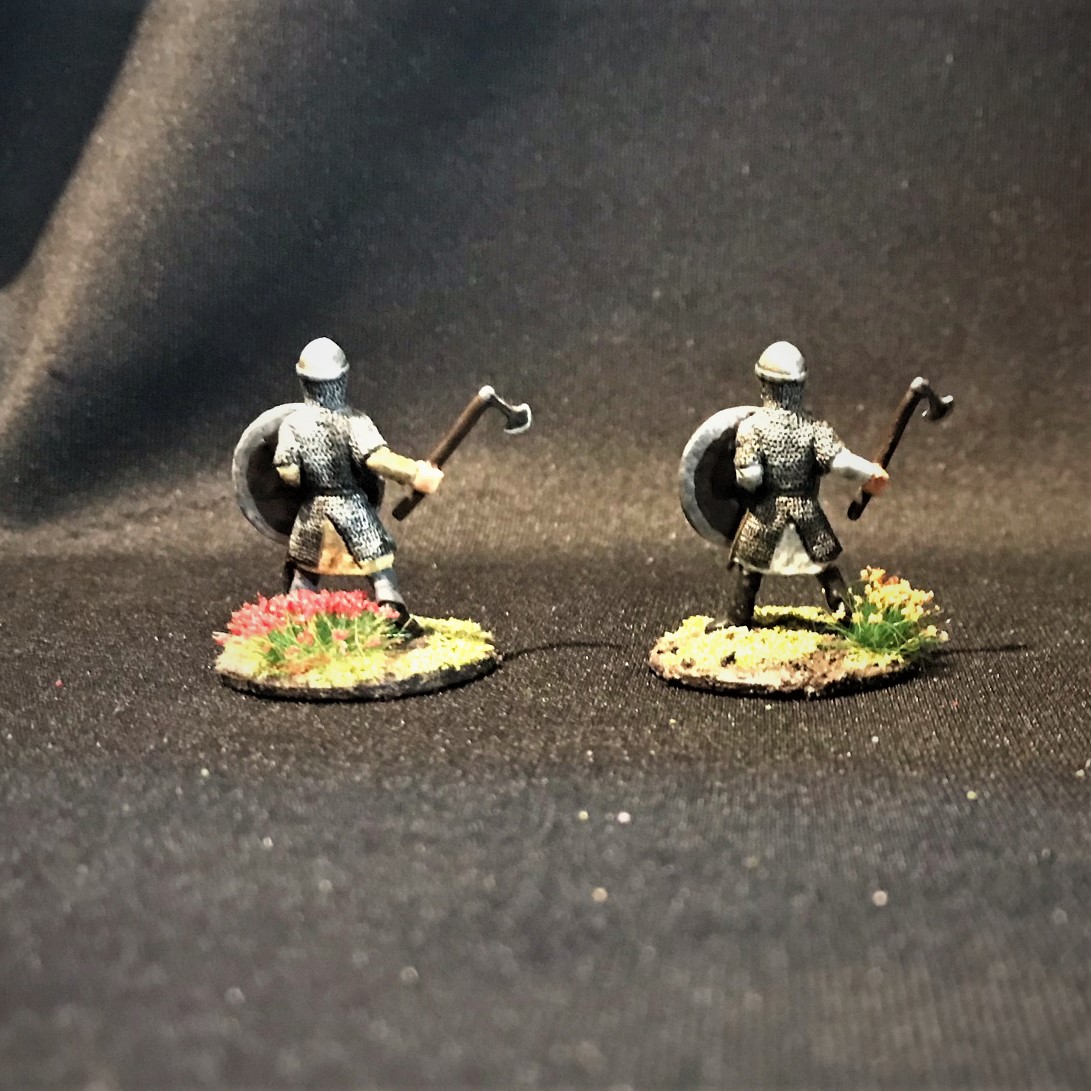
The sculpts were pretty nice – especially the chain mail. However, these were in all the same pose (as was common back when these were launched in 1982). Therefore, differentiation was more needed.
All the same!RAL 1982
I followed the same process as discussed above with priming and the initial wash application. Another nice thing about these was that the shields were already attached – that and the eyes would not need special attention.
After the priming and the HBB wash application. I could have used Nuln Oil but I thought I’d use the HBB before it became useless.
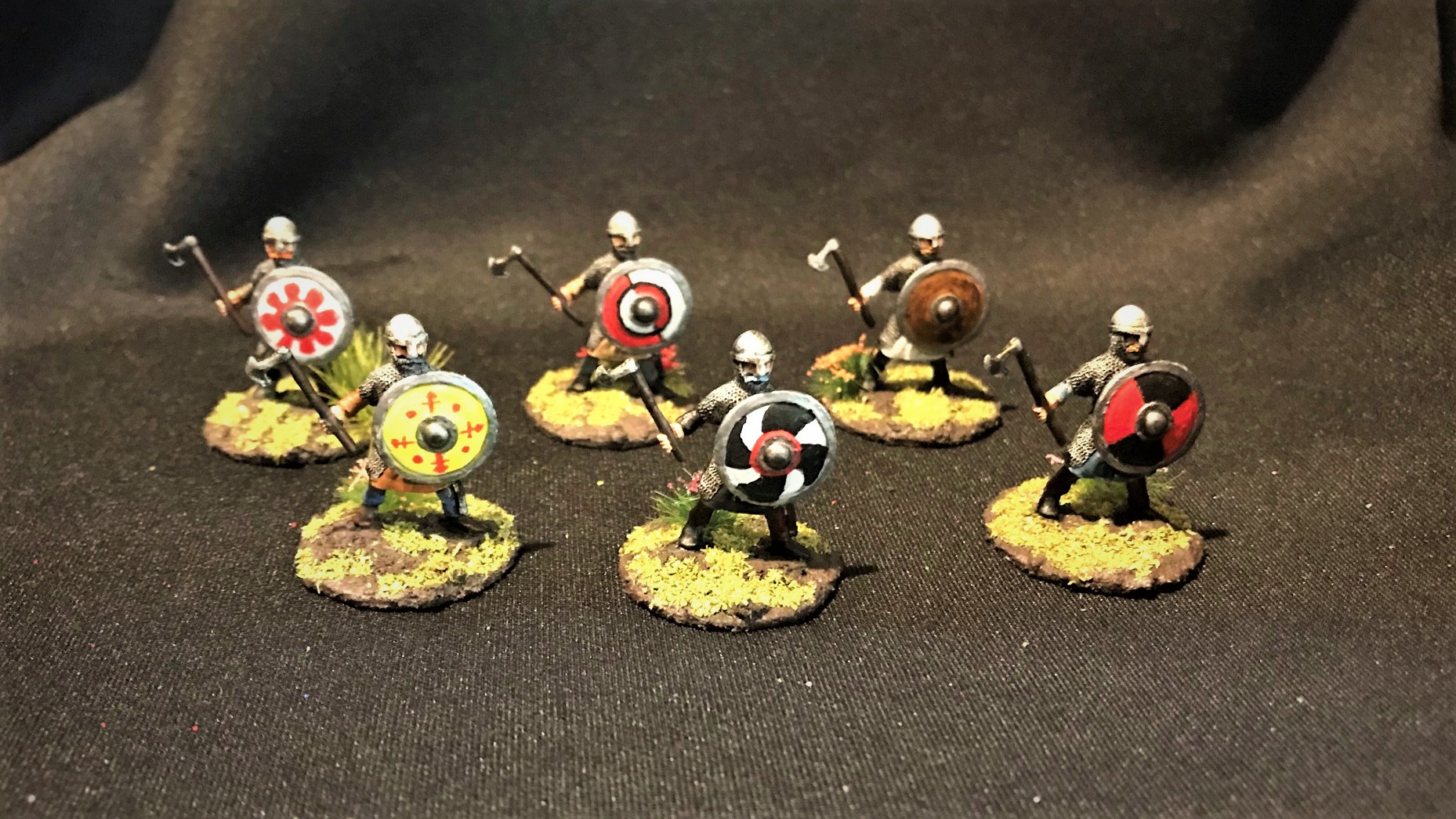
For shields, I looked up some images for Saxon ones and chose six.
Saxon shield painting.
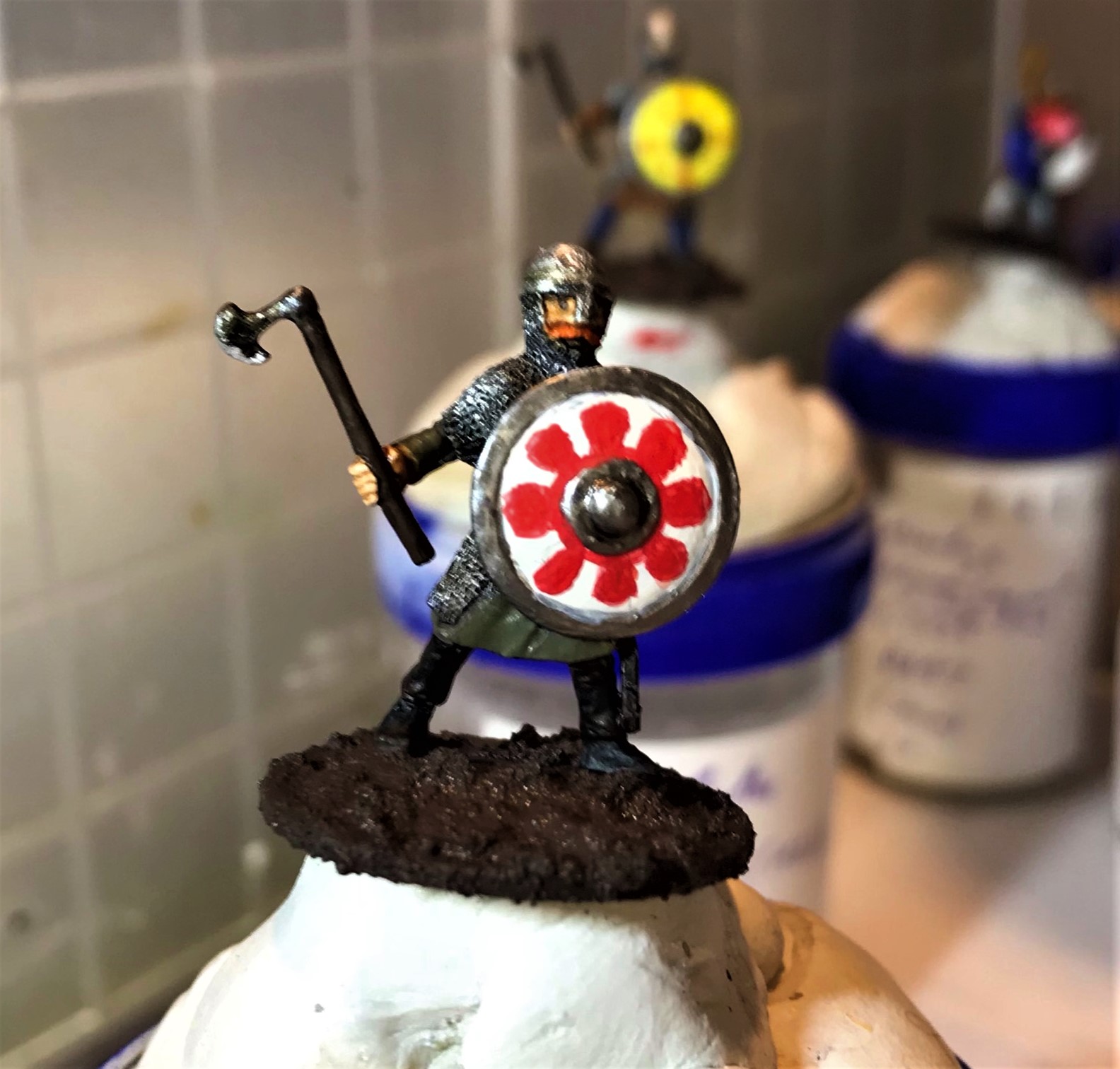
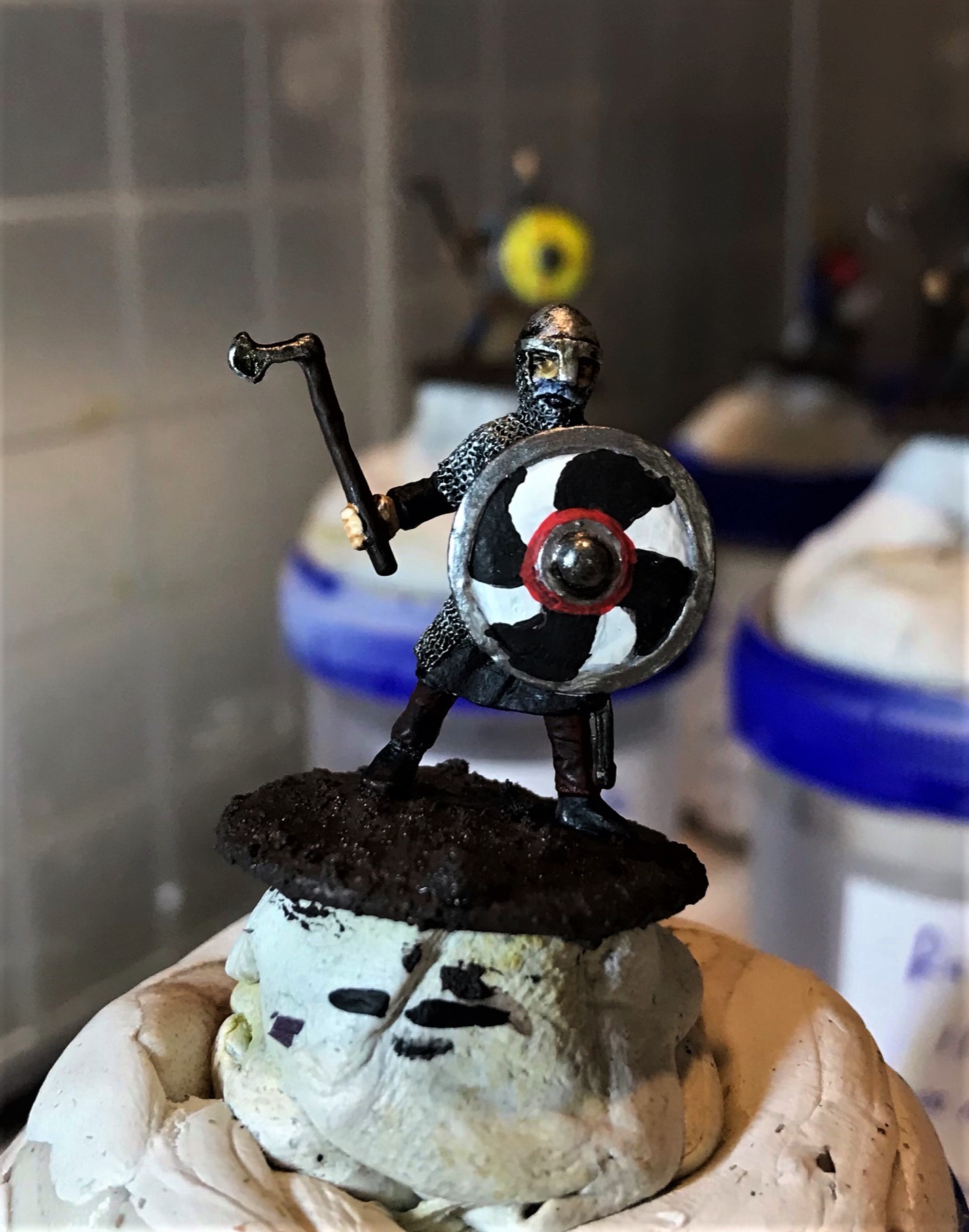
The final six look as follows:
The first and the second Saxon figures.The third and the fourth Saxons.The fifth and the sixth Saxons.The Saxon Huscarle group.
RAFM Berserker
The last figure was a single one – and he looks to be 28mm hero-scale. That makes him a bit off of the others, but maybe he’s like the Mountain from GoT?
Anyways, he looks pretty Viking-like, and Greg wanted him, so he’s in!
In his 1989 blister.Just out of the blister.After priming and wash.
This figure was so much easier to paint as it had virtually no mold lines and was well-sculpted. I only wish his axe was reasonably-sized.
Painted RAFM Berserker.
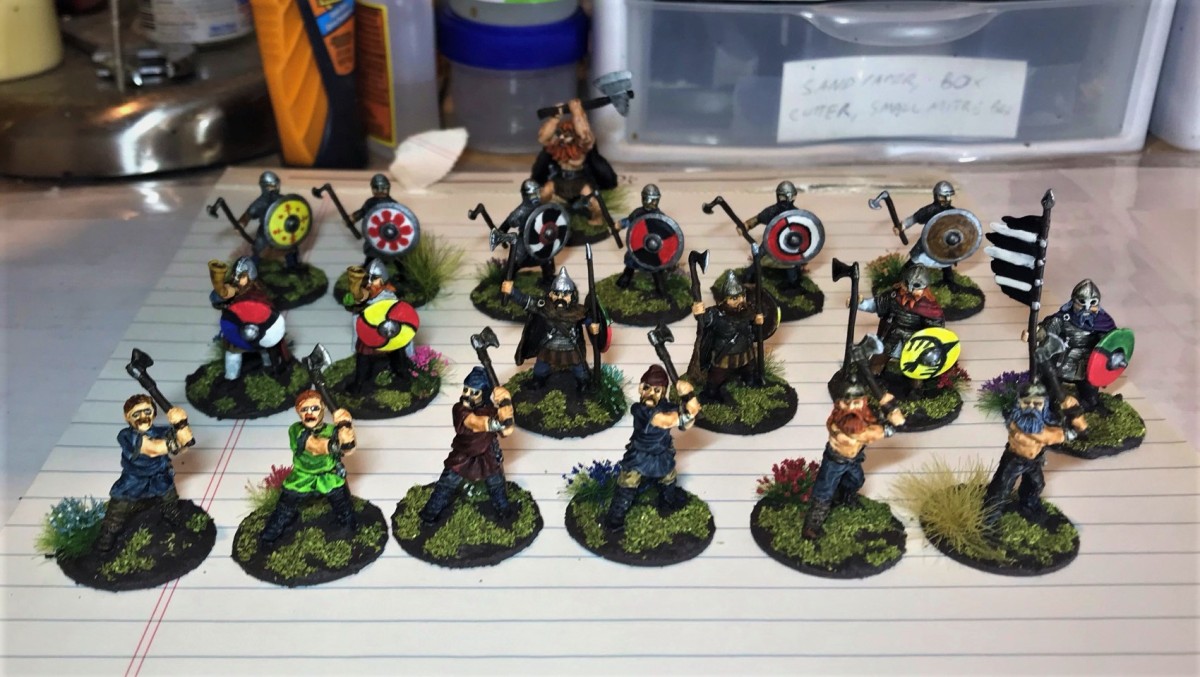
That’s the last of the 19. Here’s a group shot of them finished.
Group Shot. All in the mail to Greg in Maryland now!
I originally wanted to paint them all up as part of Roger’s (over at Rantings Under the Wargame Table) “Mo’vember Challenge”, but between surgery in November, Historicon, Thanksgiving, and my garage +build, it did not happen. Still, check out Roger’s cool roundup – I did get in Cortes…
As you may imagine, making all these figures different took a hell of a lot of paint! The list is at the end, but here’s a shot:
That’s a lot of paint!
I hope that this was enjoyable – and a change of pace was nice for me. Not sure what’s next, probably brigantines, but I do want to post a belated garage+ update by the end of this weekend. Thanks for looking and sharing any thoughts.
PAINTS, INKS, GLAZES, SHADES, WASHES, PIGMENTS, FLOCKING, GLUES AND MORE THAT I USED ON THESE VIKING FIGURES:
Below is a blog post from borderguy190 that some of you may not have seen – I am reblogging it with his permission. I (Mark) met him (Harry) at Historicon and he was a player in my Aztec/Conquistador game. I think he did a nice player review of my game as well as a superb review of the convention. His blog site is here – and I highly recommend you take a look! Now, here is his Historicon post:
One of the biggest joys of my year is getting to attend Fall In!, or as in the case this year, Historicon. Last year was a complete bust for conventions, and here in Michigan, the small local cons got called off for C19 earlier this year. Fall In! was my last hope. At some point […]
This post will cover my wargaming over the extended Veteran’s Day weekend – hopefully you will enjoy the discussion and the photos of the games here. Hell, grab a beer or a wine or whatever! Some cool pics and links to be sure.
I had been planning to attend the last Historicon – but it got moved (I think there was a pandemic or something, I (try) to forget). The event was then rescheduled for November. As Historicon and the other HMGS events have been on my bucket list, I wanted to go as a GM anyways and player too.
Also, as followers of this blog know – I have been deep into building out a series of games for the Spanish Conquest over the last year-and-a-half. This has involved many aspects – writing a rules supplement, painting figures, and building a series of games and battlefields much more for the for Feudal Patrol™ games for the period of the Spanish Conquest in Mesoamerica 500 years ago. I also recently rewrote my supplement Civilizations Collide – which will be a free download (as will a scenario booklet with multiple historic scenarios that I am working on now). So, I was very much looking forward to Historicon 2021.
Therefore, I signed up to run two games – both of which are scenarios on my in-progress booklet. I planned on running both my “Surprise Aztec Raid on the Spanish Outpost” and “Cortes’ Causeway Escape Attempt” games on Thursday night and Saturday morning respectively.
My friend Craig Hogan, myself, and Dave Wood back at USMA – probably Ring Weekend in the Fall of 1983. Craig sadly was killed a few years ago now in a private plan crash.Thanksgiving 1987 in Hagenbach, Rhineland-Pfalz, West Germany, Buck, myself, and my daughter Ellen (who is 34 now). We got together for gaming and the holiday. Buck came up from Vicenza, Italy where he was stationed to my place with a buddy, and we gamed and we had fun.
Through Dave and Buck, I have been lucky to make new friends with others of the H.A.W.K.’s, like Greg Priebe, Chris Palmer, and Duncan Adams (and many more too – like Zeb, Don, Eric and others – please don’t feel left out if I did not mention you). Due to my ongoing garage+ build (of which there are a number of updates that are listed here), I missed BARRAGE in September. So, I was pretty stoked about the opportunity to get together with friends (and make new ones) and push lead around the tabletop.
However, as fate would have it, some folks would not be able to attend Historicon due to personal reasons. As seeing and gaming with friends are as much a draw for me as the convention itself, I needed to make a change in plans. We had a Zoom call, and collectively arrived at a new plan. I would drive down from Massachusetts and meet Dave in Maryland for a gaming afternoon on the 11th at my hotel room. Then on Friday morning I would run my “Surprise Aztec Raid on the Spanish Outpost” game in Chris Palmer’s gaming room in Maryland, and then play in an Ozz game afterwards until I needed to leave for Historicon (about 90 minutes away). Friday night I would drive up to Valley Forge, Pennsylvania to set up my “Cortes’ Causeway Escape Attempt” game for Saturday morning play.
So, on a 28-degree morning in Massachusetts, I defrosted my loaded car (12 boxes of terrain, plus 2 mats, a wagon, plus a suitcase) and headed to Maryland – arriving around mid-day – where it was 4o degrees warmer. Ah, New England!
Frosty morning departure.
Axis & Allies
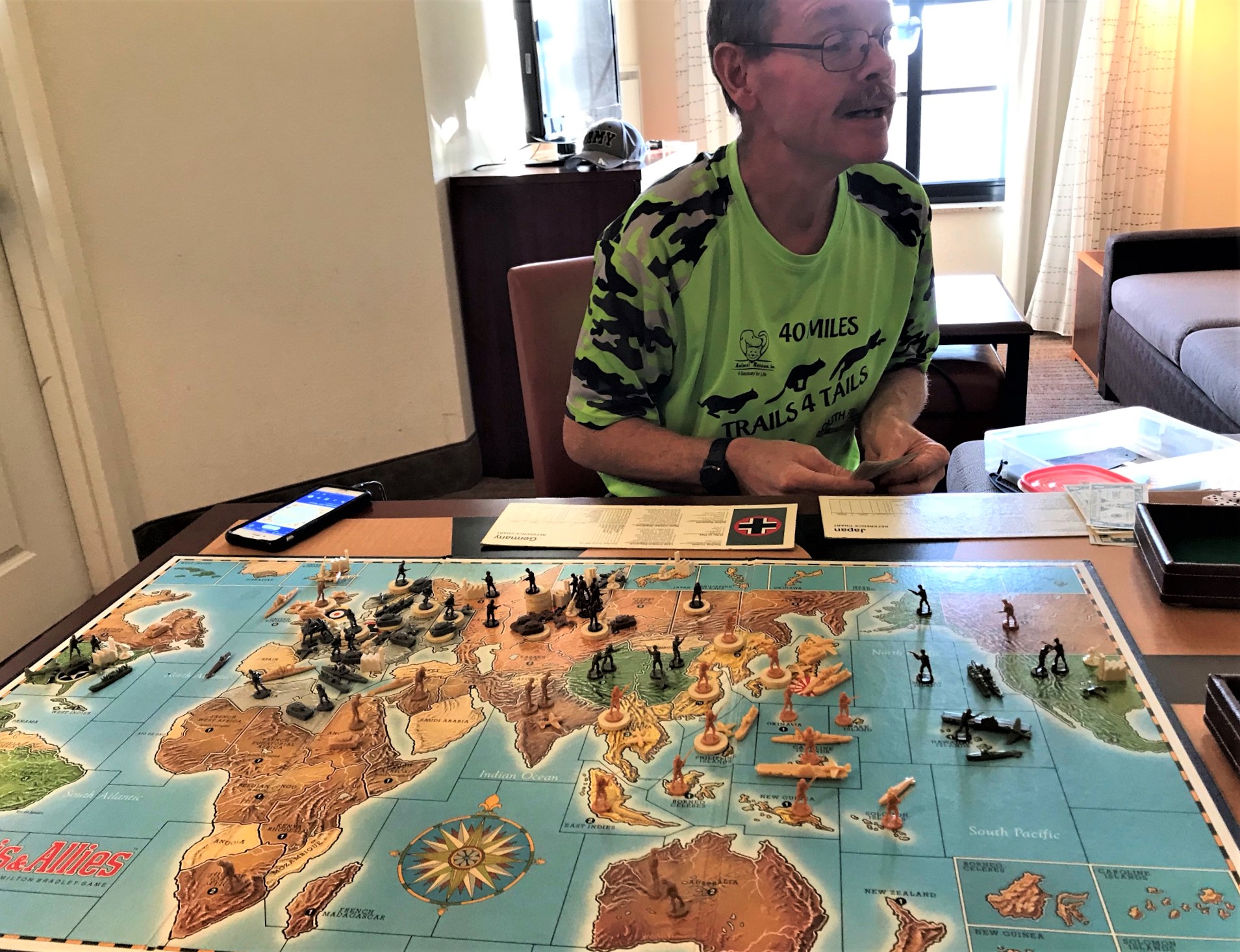
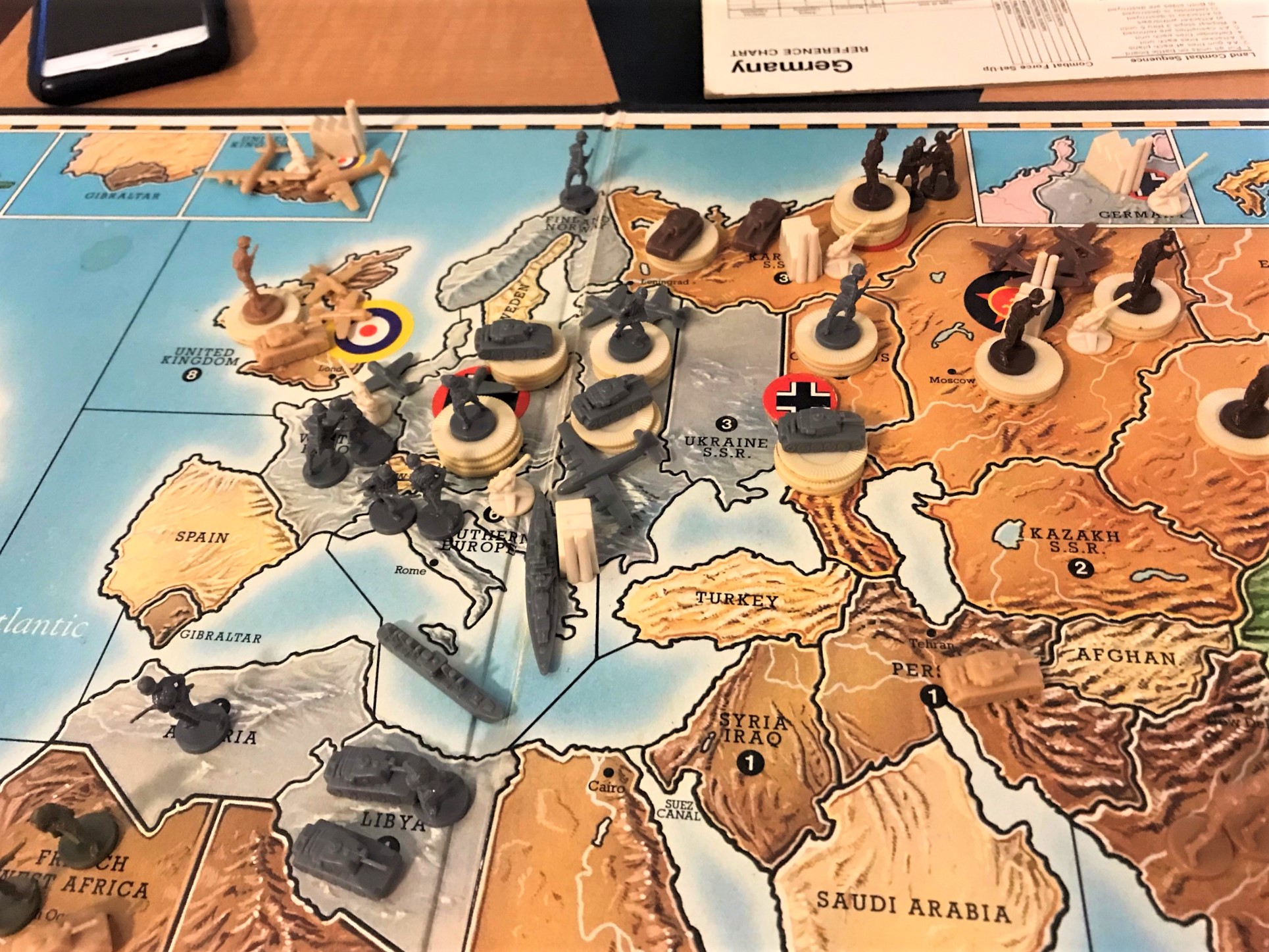
Dave and I have now gamed since 1982 – so coming up on 40 years. We have played Avalon Hill’s “Victory in the Pacific” (as well as other titles) dozens of times over the years. On Thursday, after I arrived, we decided to be different and try Milton Bradley’s “Axis & Allies” this time – a board game with plastic miniatures that we have discussed many times but never played before. I got this game back in the mid-80’s. At one point there was an on-line version but we never got around to playing that either. For this game, we picked sides at random, and Dave played the Axis, and I the Allies. It was Veteran’s Day, and as we are obviously both vets, it was a nice add.
The game went back and forth. A lot. I managed to keep Russia in the game – and built an industrial complex in India for the British. This allowed me to build 3 units per turn there in an attempt to keep the Japanese off the Russian’s back.
After the first turn, I had consolidated a nice position in Mother Russia to try to thwart Dave. And yes, the shirt says what I am impressed with – Dave has run dozens of marathons and many runs up to 50 miles and maybe more in distance.We had a back and forth fight over the Karelia territory that had a factory I did not want to lose. Eventually, I did.
Meanwhile, my Indian gambit attracted a lot of Japanese attention – maybe too much. Dave hammered away at it and while the Japanese were unsuccessful he did attrite my forces and that prevented me from exploiting my force buildup.
Dave made multiple attacks on India supported by carrier-based fighters and land-based bombers. I had sent the American-supported Chinese infantry in to help defend. Meanwhile, Russia fell.
Dave kept hammering away at India, and eventually had his Germans violate Afghan neutrality – hitting India for the decisive blow. Yes, the Germans took India by blitzing panzers through Afghanistan…
I built India up and flew in American air support, but the next turn it fell.
I did desperately roll for Weapon’s Development for both the Americans and the British – with only the British succeeding in getting 3 – Rockets, Super Subs, and Strategic Bombers. My rocket and strategic bomber attacks slowed the German’s production, but it was too late…congrats to Dave!
Christoricon – Surprise Aztec Raid on the Spanish Outpost
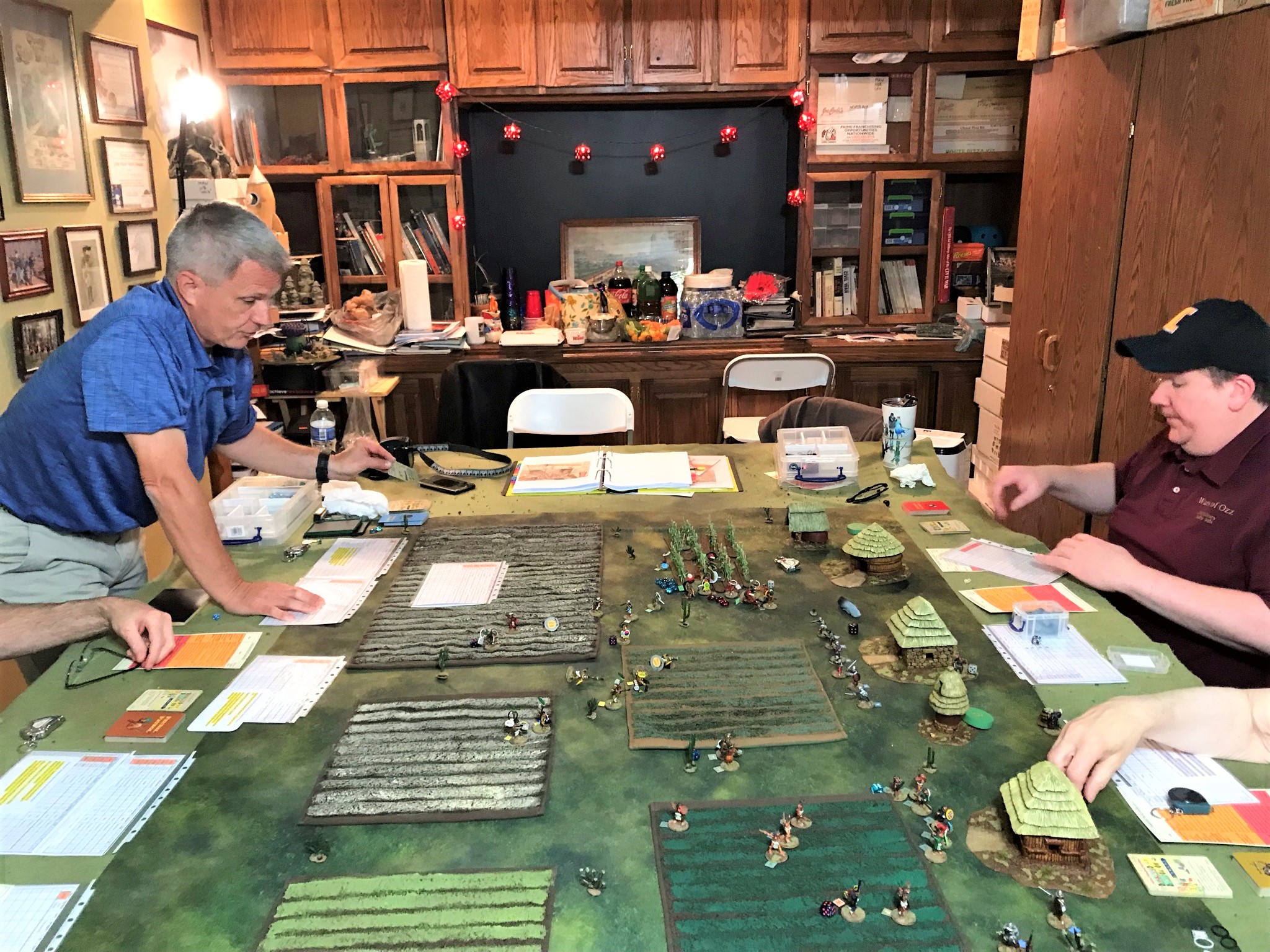
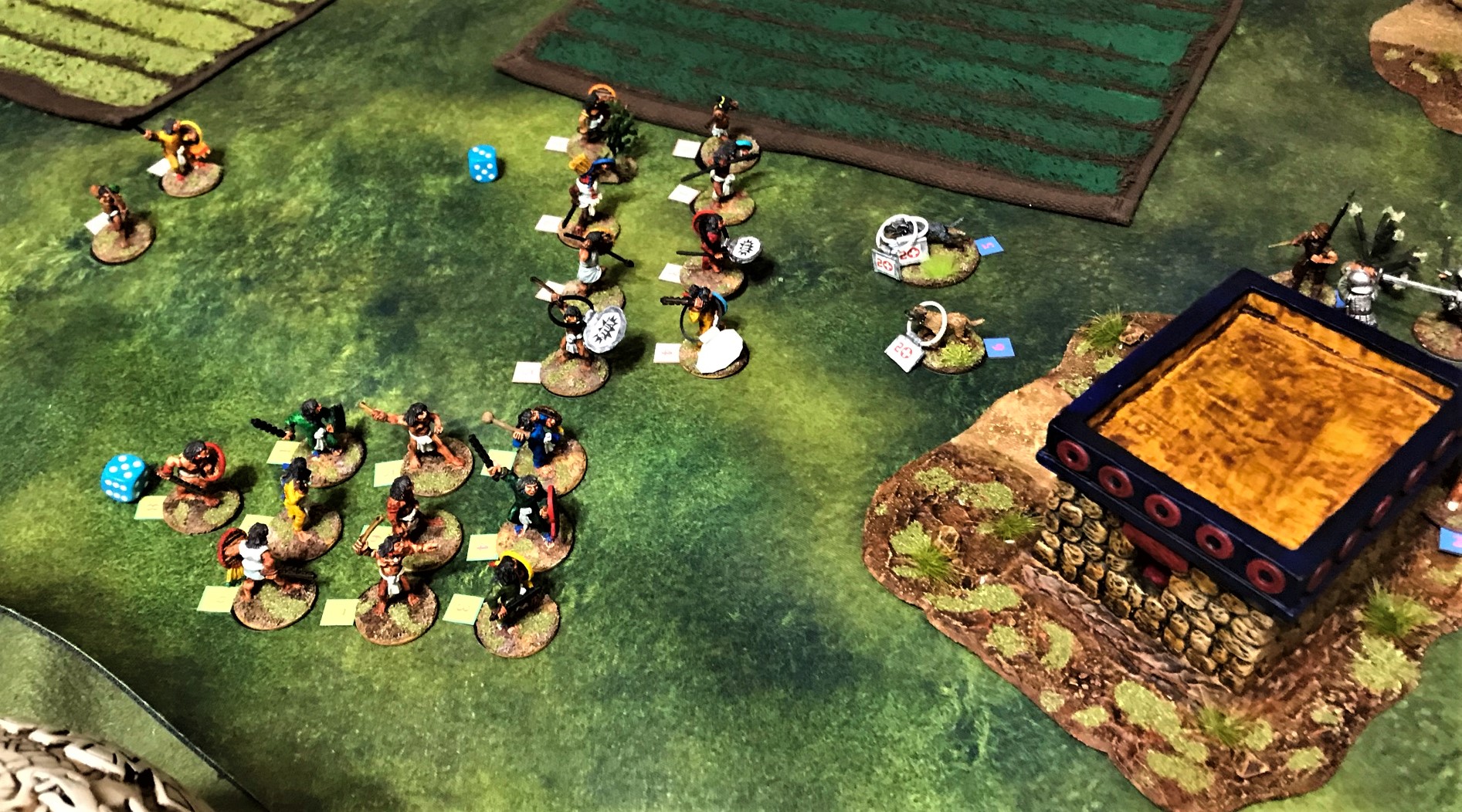
Originally I was supposed to run my one of my games at Historicon on Thursday night – that being a rural one where Aztecs are making a surprise raid on a Tlaxcalan village (acting as a Conquistador supply depot) – only to see that there were indeed some Spanish there. Instead, we went to Chris Palmer’s house and I ran the game on early Friday morning. We joked and called it “Christoricon”. I hosted and there were 5 players – Buck, Duncan Adams, and Dave for the Aztecs, and Chris and Greg Priebe for the Spanish/Tlaxcalans. The defending Spanish/Tlaxcalans had one Warband of three Elements – 23 figures worth 41 points. The attacking Aztecs had two Warbands of 3 Elements each – 53 figures worth 78.25 points. Buck has already written a great post about this game and the others that day on his blog here – and his write-up and pics are great. I took some photos that you see below, but for me, simultaneously being a GM and a photographer is not easy – so I do recommend you take a look. Meanwhile, here are my pics.
The game is ready to begin. Chris and Greg elected to place the Conquistador Element armed with arquebuses further away from their leader in their secret deployment in lieu of their Element of Sword & Buckler men. This meant that they were “pinned” with their black powder weapons only activating at best on half of the turns. They could have “unpinned” but as luck would have it the dice did not let that happen. Note also that Franco the unlucky Conquistador made the trip!
Chris chose to send out his war dogs towards Dave’s Aztecs as a screen, and they promptly took atlatl damage. Dave, Duncan and Buck moved up quickly, while Greg took up a position in the maize field with his dangerous Tlaxcalan bowmen.
Dave moves up his “twinned” Elements of veteran/novice warriors towards a wounded war dog.
The Spanish then had their Catholic Priest take possession of the gold (possession of the gold was one of the game objectives) and drag it to a more secure location while they contested the Noble House (another objective) – (insert joke here).
Battle starting at the Noble House – the war dogs are already going down here. Their priest has already dragged away the gold to a safer location.
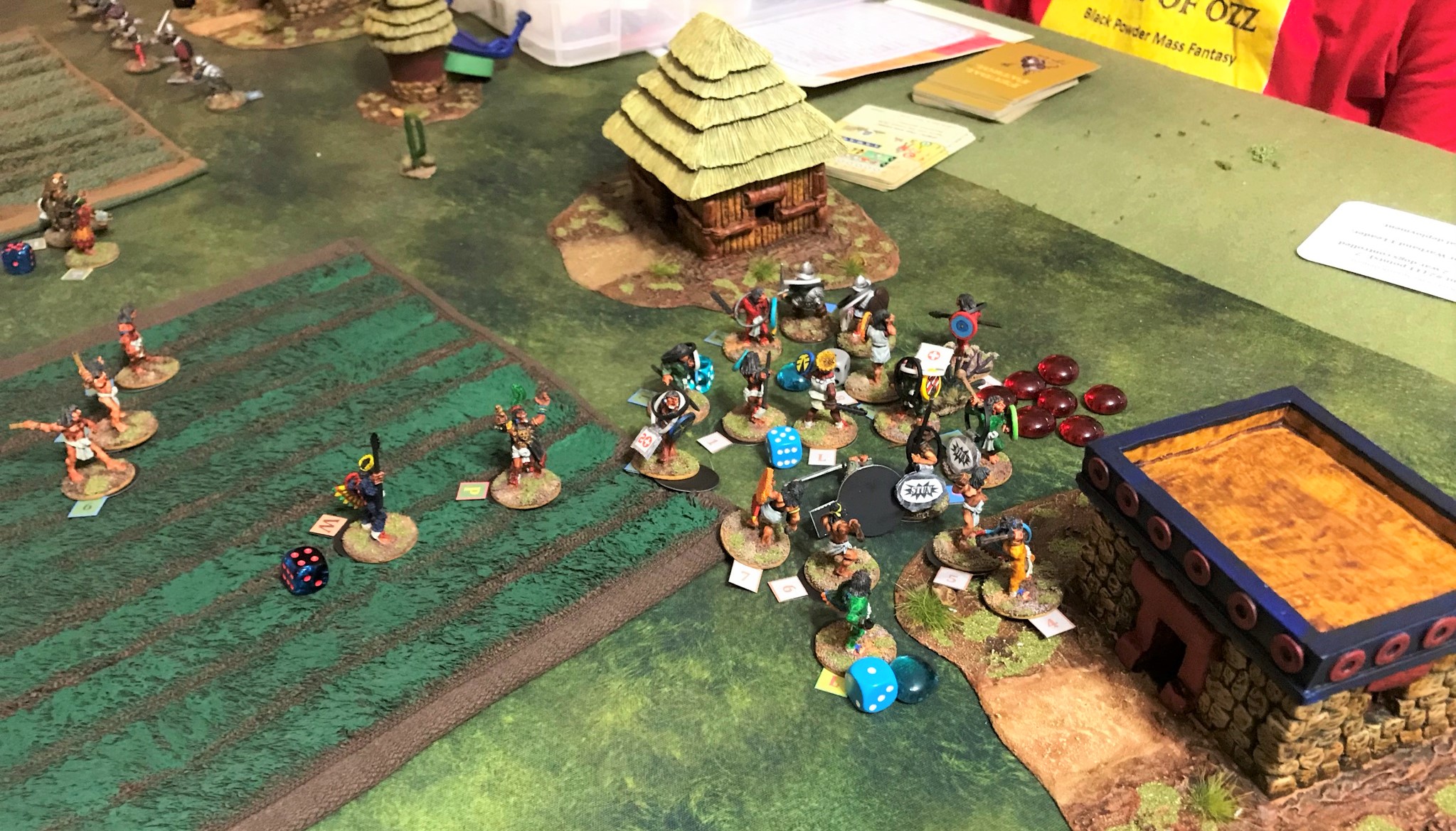
Buck’s advancing Elite Cuahchicque (“Shorn Ones”) took the full volley of arquebus fire from the less-activating pinned Spanish. Despite these Elite Aztecs taking a lot of damage and having a ton of Morale checks to overcome, Buck was able to rally his troops successfully against the odds twice. Meanwhile Duncan moved his Jaguar and Eagle Warriors against Greg’s Tlaxcalan bowmen in the cornfield – hoping to best them in melee.
Dave and Buck confer while surveying Duncan’s advance – and their chances at victory – with concern. This shows the second volley that Buck’s Elite Shorn Ones took and the blue beads are Morale checks he needed to pass. He did. Twice.
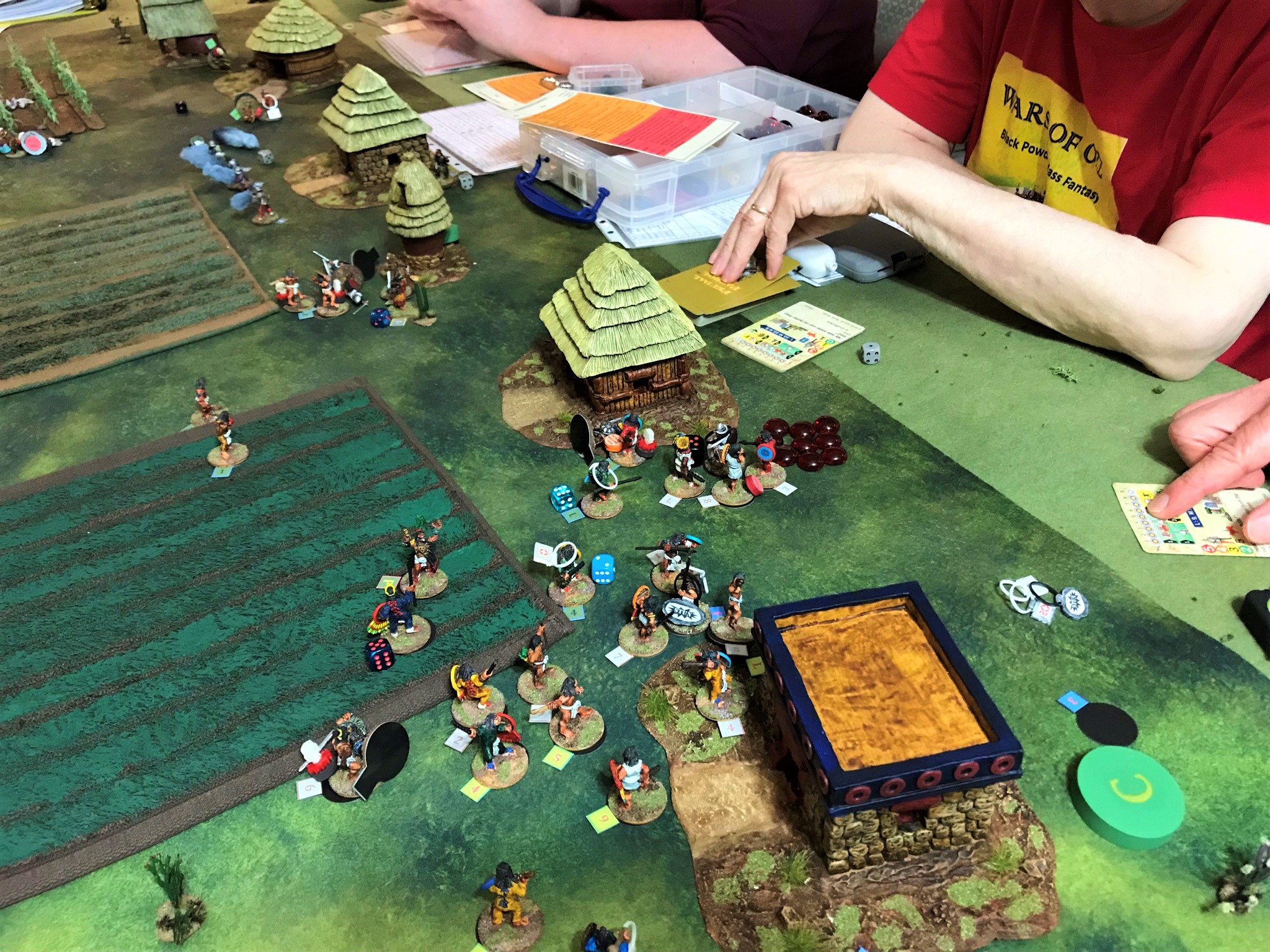
Slowly, the tide of battle started turning in the Aztecs’ favor. Dave’s attack on the Aztec right was making headway, and they were gaining control of the objectives.
Priest still dragging the gold away here.Lots of carnage on the tabletop.
Eventually, the Spanish and Tlaxcalans were overwhelmed.
The final break through.
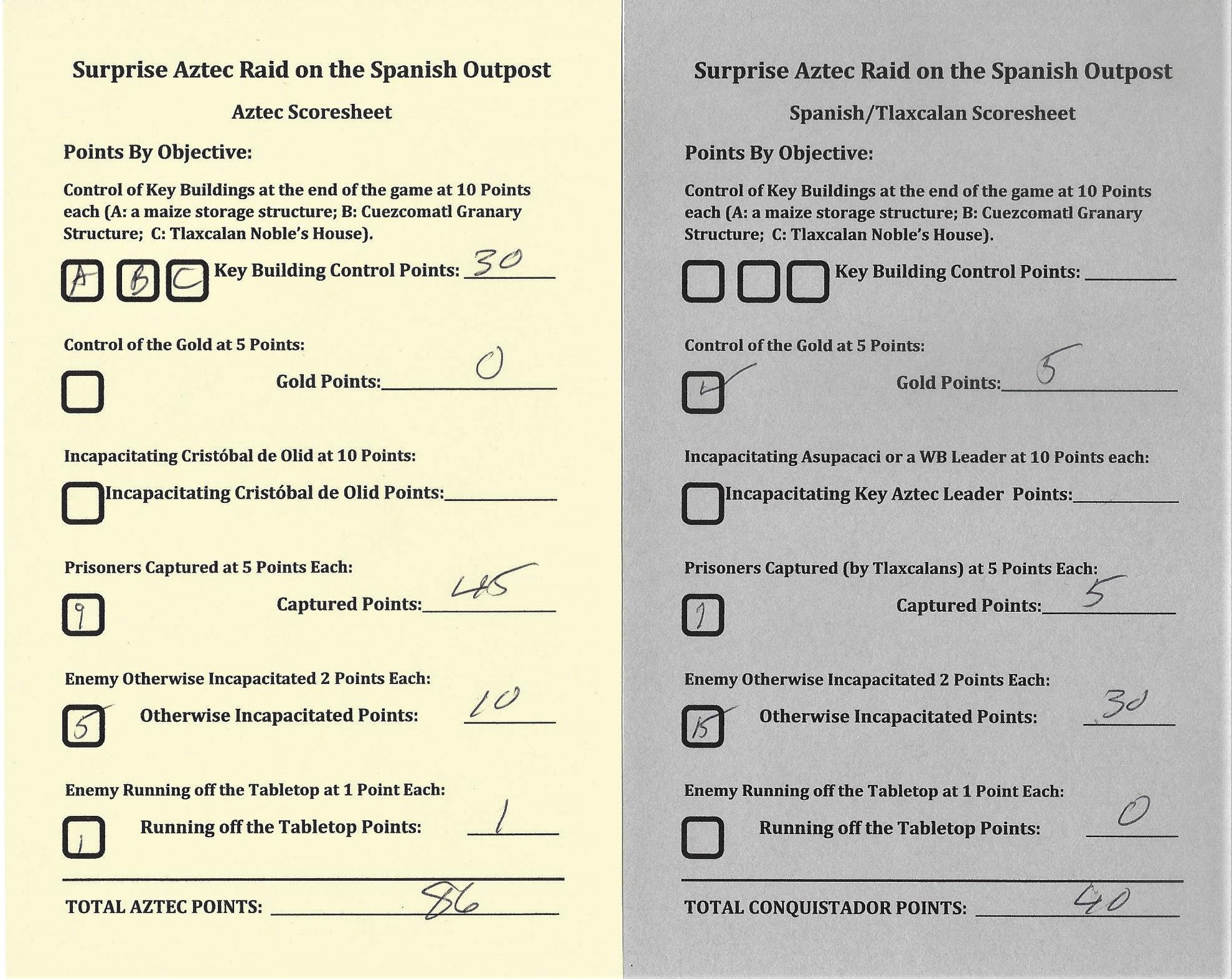
The game ended as a resounding Aztec win, as they had control of three objectives, as well as dragging off 9 pour souls for sacrifice, killing 2 more, and making one run away. The Spanish had only the gold, but did dispatch 15 Aztecs and capture one more. The final score was 86-40 as you see below. I think the players had a good game. Congrats to Dave, Buck, and Duncan!
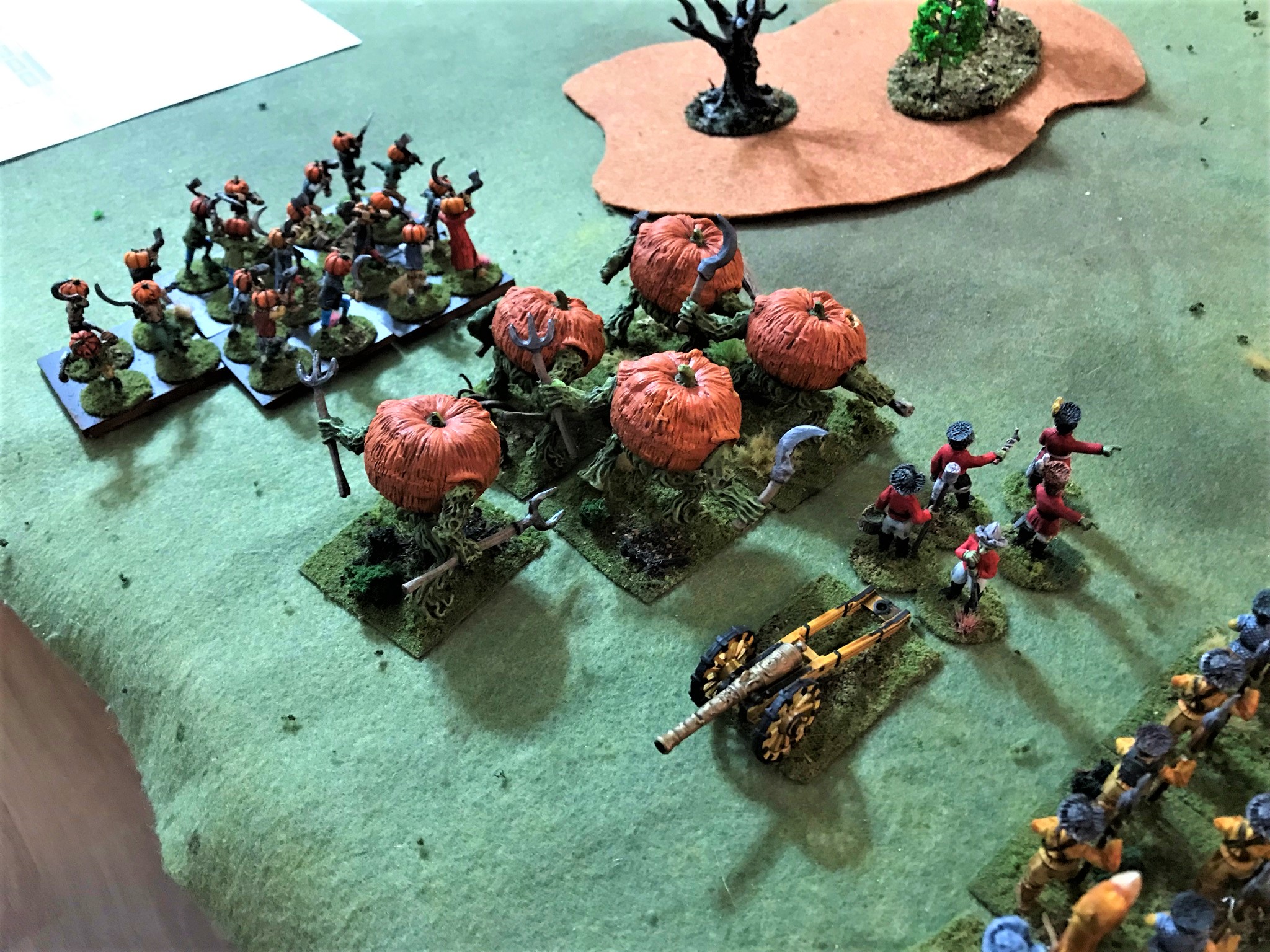
Greater PumpkinheadsI had a Winkie medium cannon……and 2 Winkie RegimentsMy Winkie and Pumpkinhead troops ready to contest control of the Yellow Brick Road.
I love the Ozz figures!
I then drove to Historicon, and set up for Saturday morning’s game.
Historicon – Cortes’ Causeway Escape Attempt
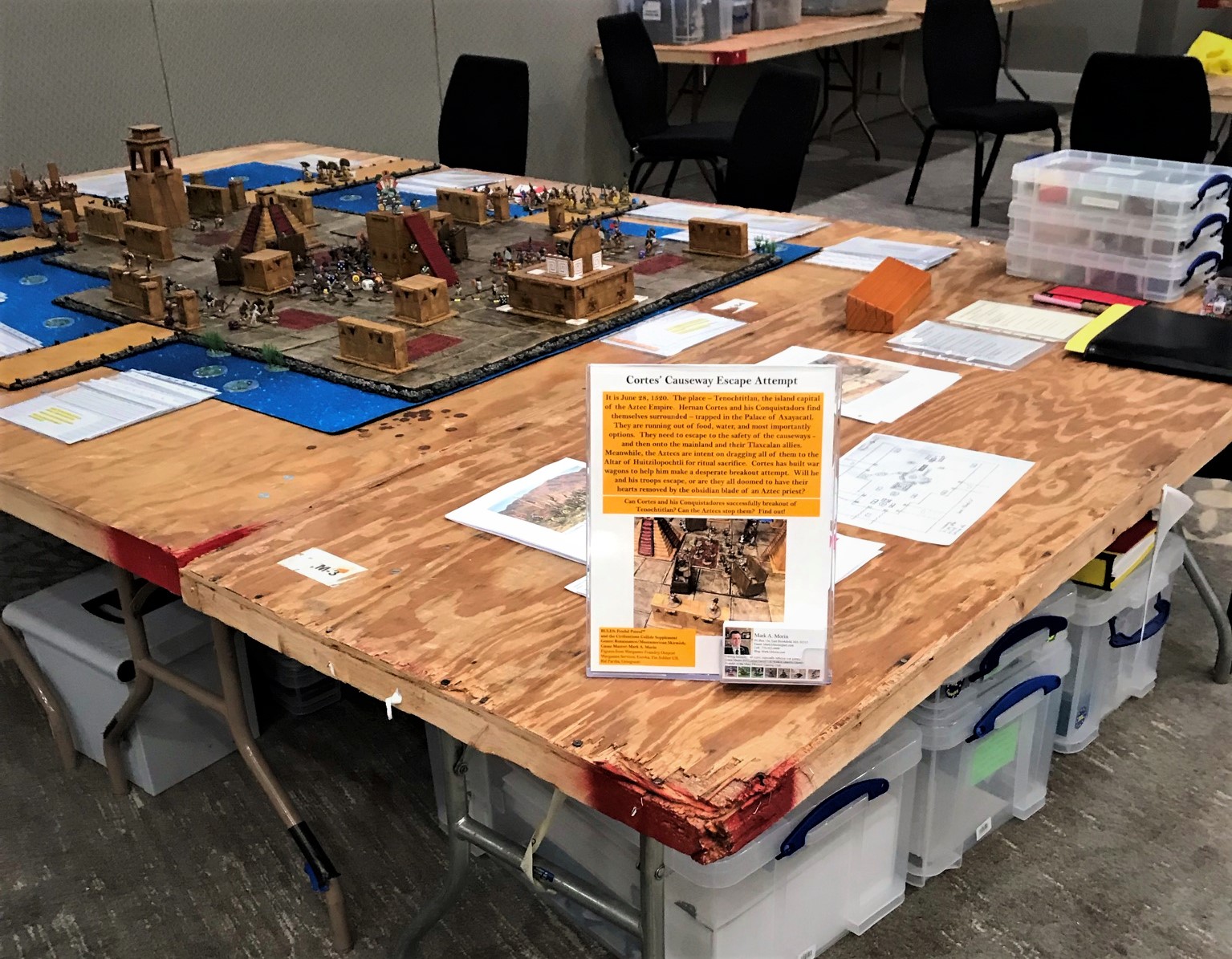
The drive up to Valley Forge Resort Casino was uneventful – though finding the H.A.W.K.’s room was a challenge. The gaming was not located in one location at the resort. Unfortunately, it was also a Friday night at a casino and all the close parking was gone. Luckily, I have a little collapsible wagon and was able to get into the room with my stuff in a few trips and set up the terrain and the troops for Saturday morning’s game, Cortes’ Causeway Escape Attempt.
It’s a BIG battle. The Spanish/Tlaxcalans have three Warbands of three Elements (2 Spanish, 1 Tlaxcalan) plus support – 77 figures (including the 4 war wagons) worth 161.75 points. The Aztecs have five Warbands of 2-3 Elements each – 109 figures worth 154.25 points. 186 figures in total. This battle is Cortes’ second attempt to escape. He would do a second on the following day, and three days later a third – La Noche Triste. Originally, on the Historicon listings, the game was supposed to be La Noche Triste – which again happened three days later (and of which I will have that scenario written soon) – but I needed war canoes for that one. Those I don’t have yet, and will be mentioned here in a bit.
Back to the game set up. As I was setting up, I had a number of people come by to remark positively on the game visuals – terrain and figures. They had seen my posts on different forums (or fora both are ok!). To all of you, thank you so much for your kind words and interest.
Besides all of the cityscape – and it’s a lot I know – but with everything predeployed I just needed to put players on their troops and let them know what they needed to do on their part of the battlefield.
As I mentioned before, I had previously needed to cancel my Thursday game – and I got a comment from one of our blog community – Harry (aka borderguy190)- that he was disappointed as he had signed up for the game. I apologized, as I wish I could have ran that too at Historicon as well. But the good news was that he would be playing in this game!
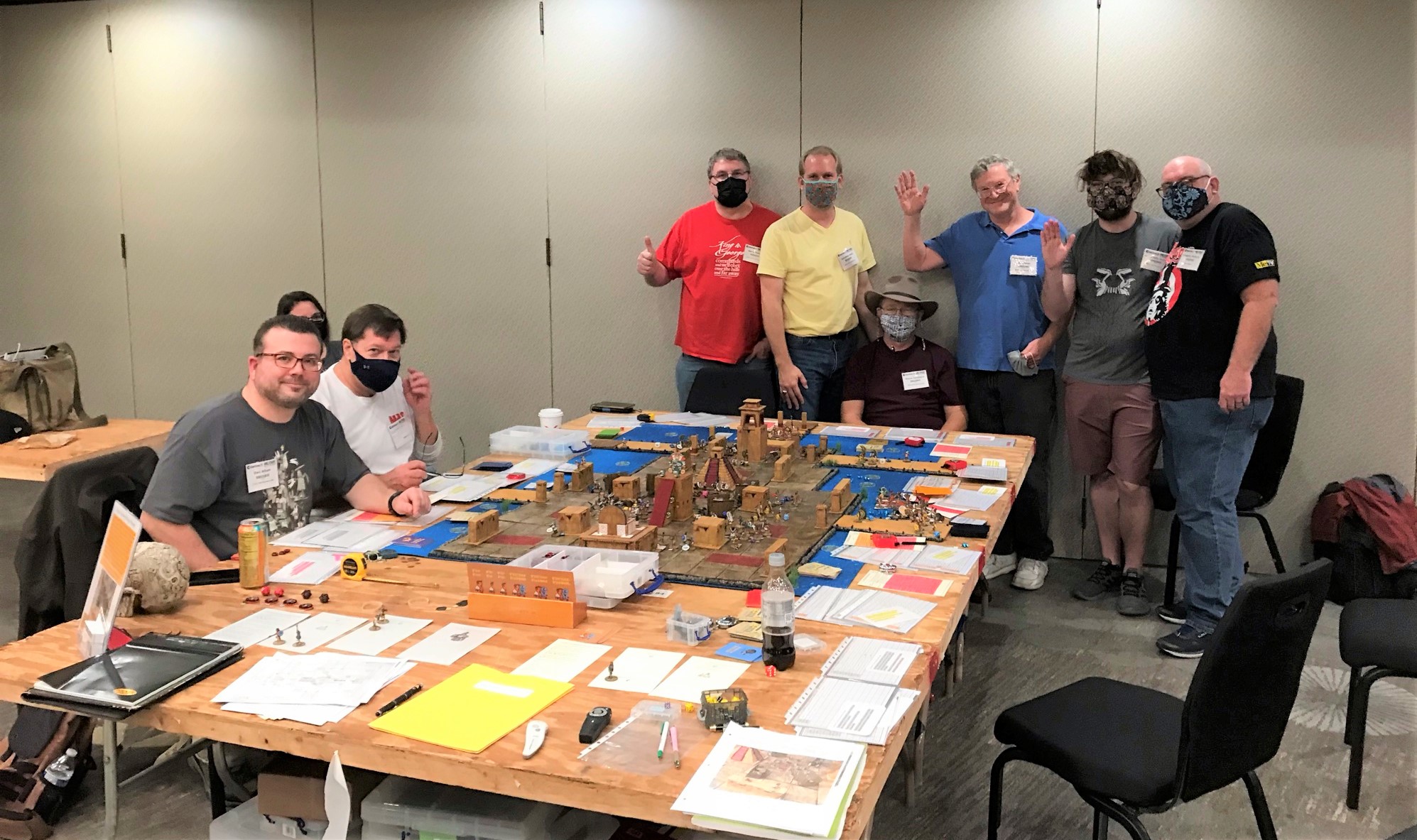
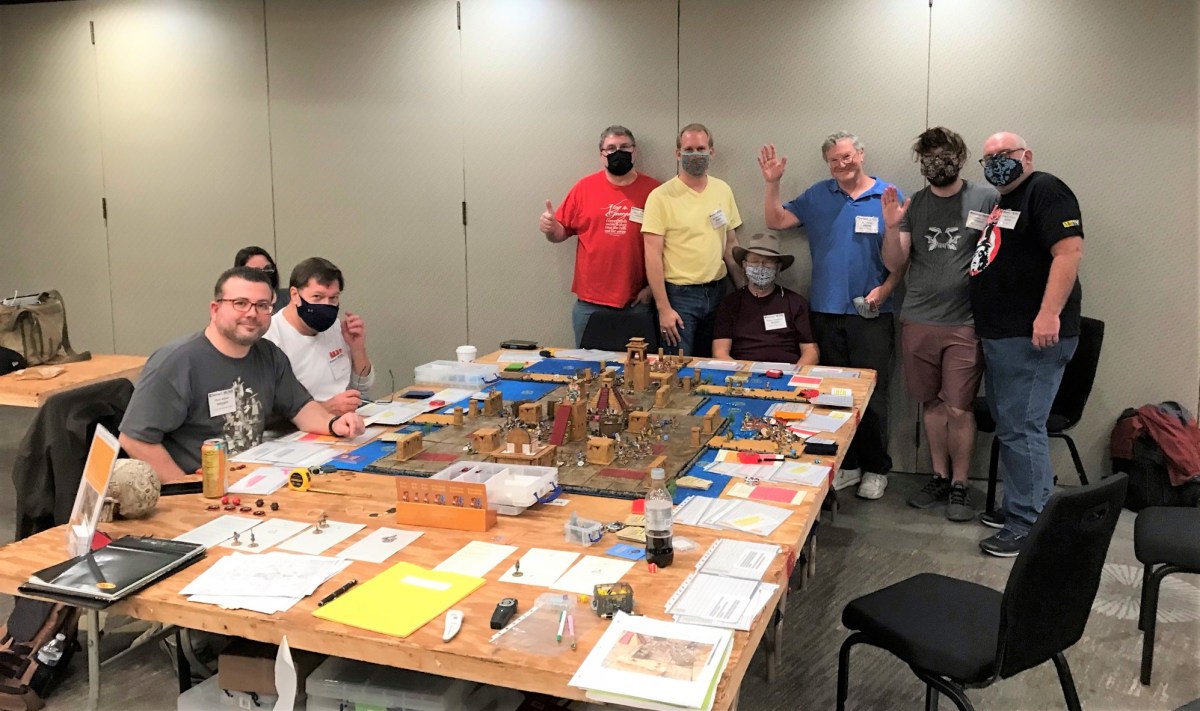
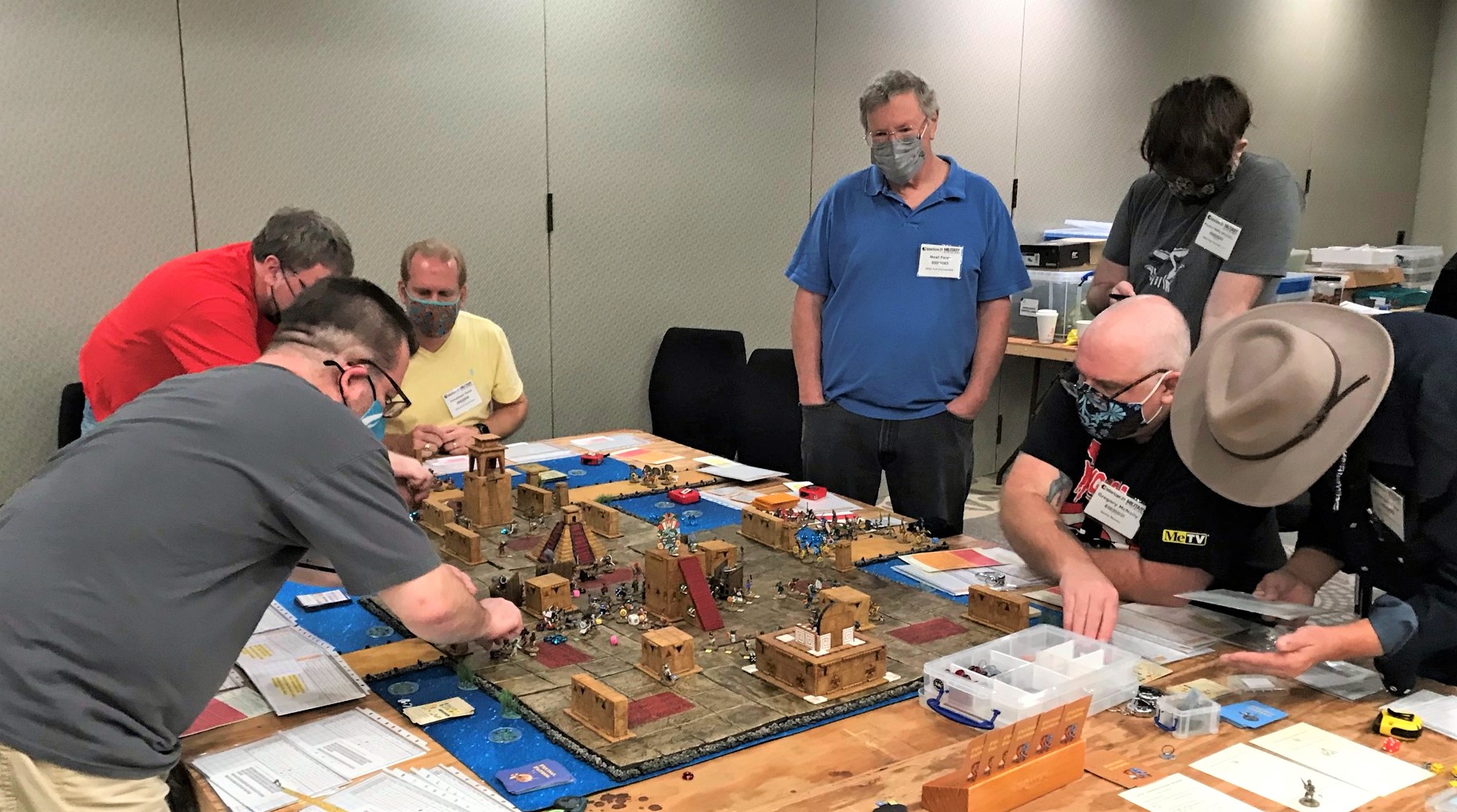
He joined 7 other players. They seemed to grasp the concepts of the game quickly – and I did get some help from Greg Priebe and Buck Surdu in the early turns before they had to help run an Ozz game.
The game set up.Troops deployed and dashboards out. My undermagnets and game markers really have proven their worth – especially in big melee scrums.
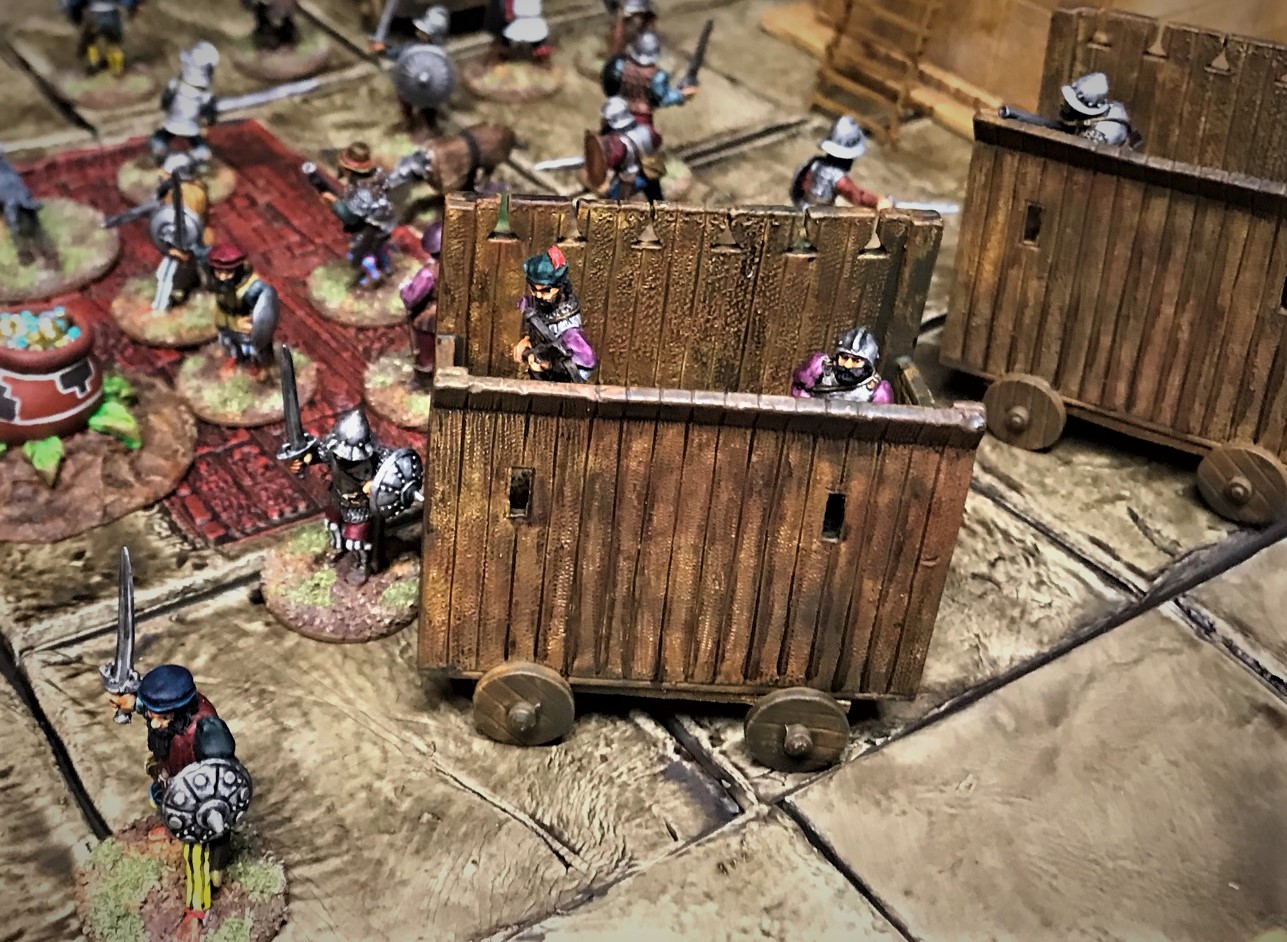
In this game, the Conquistadores are surrounded, and need to fight their way out from the Palace of Axayacatl where they were holed up with their hostage/puppet Montezuma II. They have war wagons, and while these are helpful in providing cover against missile weapons, they are also rickety and slow – and prone to breaking. In fact, all of them broke during the game and were unable to move afterwards. The Aztecs are trying to get to the Conquistadores and avenge the massacre that the Spanish perpetrated at the Festival of Toxcatl. Their Tlaxcalan allies are mostly on the other end of the tabletop and trying to break into Tenochtitlan to help their Spanish allies escape.
There were ups and downs for both sides all over the table. The Conquistadores breakout went slowly, but they did take out a lot of Aztecs. On the other end where the Tlaxcalans were trying to help, the two sides traded missile fire and got into a scrum but were unable to change the status quo.
Lots of action! Harry (in red) ponders his next move.Aztecs swarm the war wagons and wound the crossbowmen and arquebusiers inside.Thinks get more contested in Tenochtitlan.
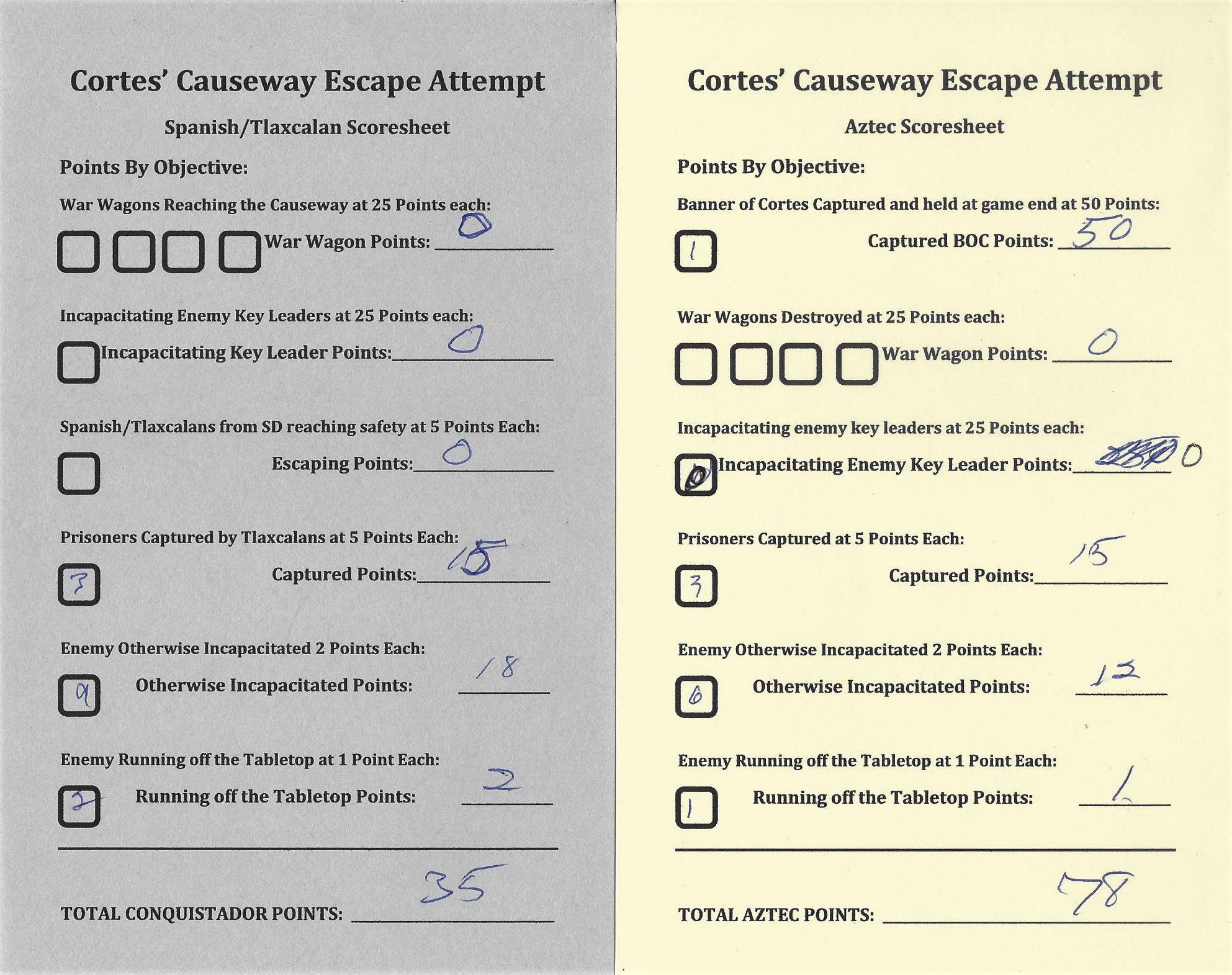
One of the aspects of the game is the importance of The Banner of Cortes. It provides inspiration to the Conquistadores and helps them to reduce negative Morale effects. However, I also made its capture (as well as incapacitating Cortes and dragging him off for sacrifice) game objectives. The Aztecs took some heavy losses BUT were able to take out the bannerman and seize the banner. This lead to the Spanish having to try to satisfy Honor and retake the banner. However, this did not happen before the game’s end. As it was worth 50 points (see below), it was decisive.
The Banner of Cortes is taken!Aztecs won 78-35. The 50 points for the capture of The Banner of Cortes made all the difference!
Thanks so much to all who played! I did not win any awards for the game – though many said I should have. Anyways, the best reward is happy gamers afterwards – and I got that in abundance!!
The gamers! Very cool group – thanks to all!
After the game, I got a lot of positive feedback, and learned of some areas to help make the play easier. Those suggestions have already have already been acted upon when I got home (mainly on the dashboards such as linking the undermagnet colors to the dashboards).
After the game, I then went with Greg and Buck to the vendors and the Flea Market. It was nice to go to the Badger Games booth and actually be remembered! Also, I was looking for canoes to use as war canoes, but only found one from Firelock Games that was $20. That is way too expensive when you need as many as do. I also found one in the Flea Market – a balsa wood scratch-built one from an estate sale- for $3. I am going to use both for gaming and as ideas on how to make my own. Of importance, Greg is a big lover of his 3D printer – and in exchange for me painting up some Viking figures for him, he will make me a good number of canoes! Win-win! So, my next job will be to paint those up.
I look forward to returning to the gaming and convention scene as a GM and a gamer. I hope you found this interesting – thanks for looking.
For all of my previous posts on games, units, and other projects for my 16th Century Spanish Conquest supplement for Feudal Patrol™ – “Civilizations Collide” – please see this page.
As I wrote back then in March (quoting myself) – and it’s still true:
…I want to emphasize that I did not need to do any of these projects to play Feudal Patrol™. Period. I did because they suited my personal needs and – well – I get thoughts of stuff in my head that need realization.
Buck’s Feudal Patrol rules have more than adequate tools and game aids. They are fantastic. My goals here were for myself so that I can make my games easier for me mainly.
Now, as time has gone on I have realized that I wanted a few more things to ease play for me as a GM – specifically to adapt to the period. I am sharing those here and my processes as they may prove useful for some, and just interesting for others.
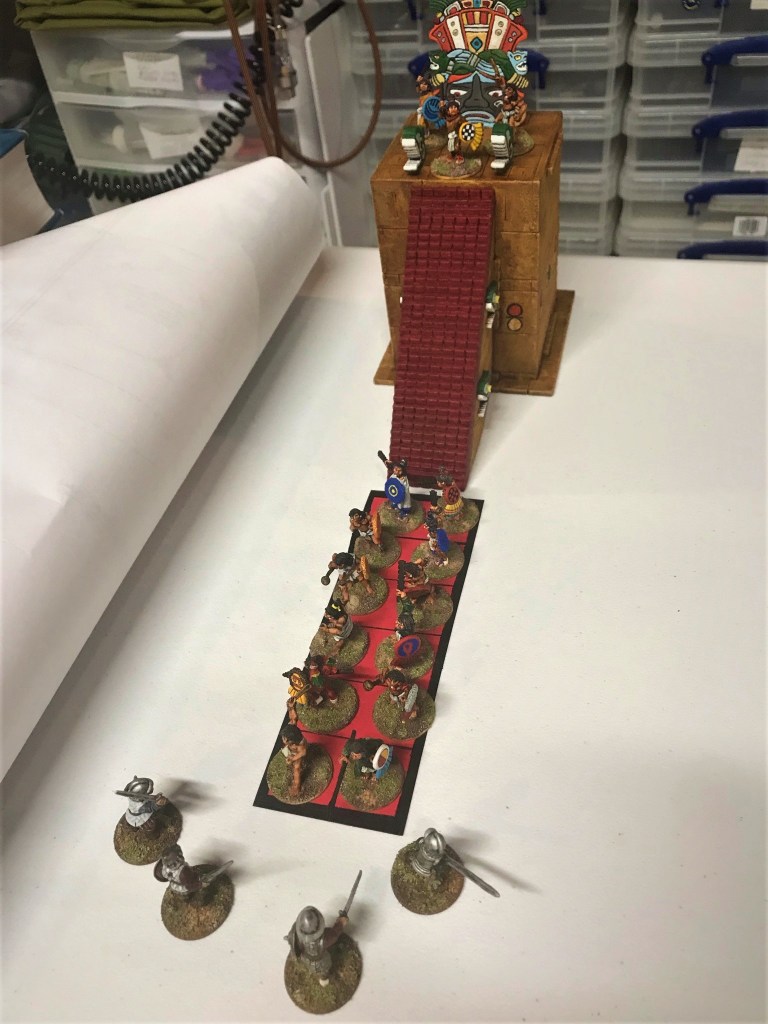
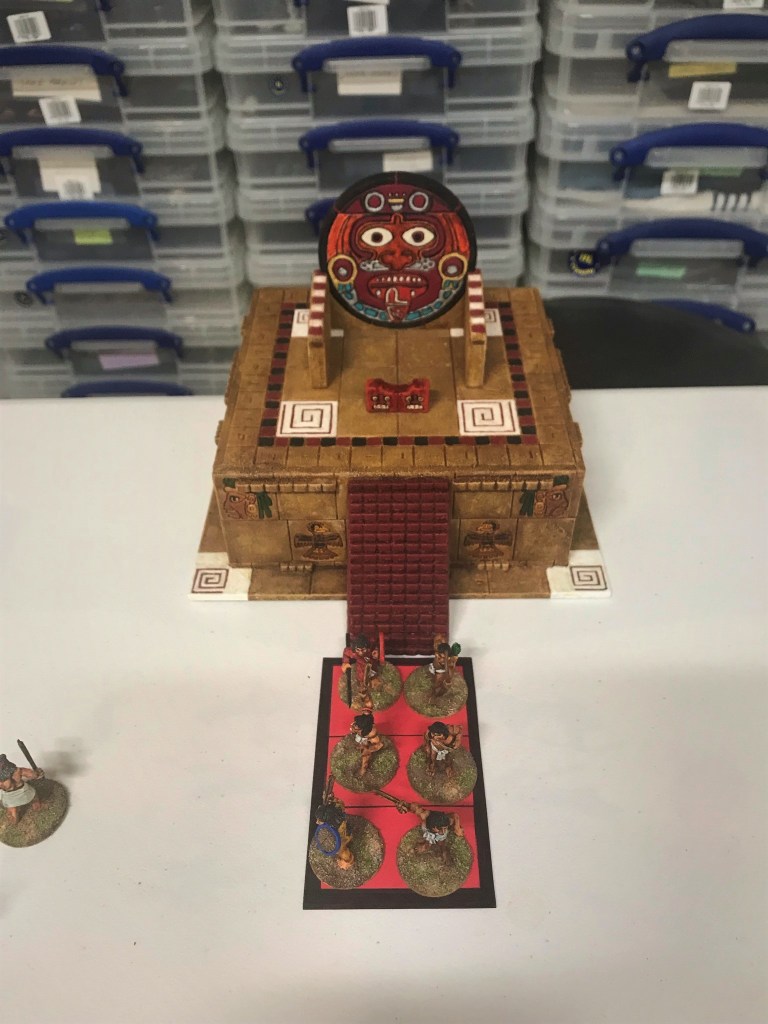
First, as far as steep-stepped structures (such as temples that one might expect to see in the Aztec or Mayan Empires), they pose a challenge gaming-wise. I have updated my rules for melee combat on these steps (but they are not yet published – but I use them). Most commercially available steep-stepped structures are either ruins (not ideal for depicting them in their heyday) or lacking adequate space on the steps to place figures during a game. Most of my figures are on 1″ bases, and getting them on the steps of my structures was not happening. I did not want them to be just big eye-candy on the tabletop. So what to do?
Make templates!
Below, I will share what I did and how – with the assumption that all my figures are 1″ based and that there would actually be sufficient depth in real life for them to stand on the steep steps in single rows.
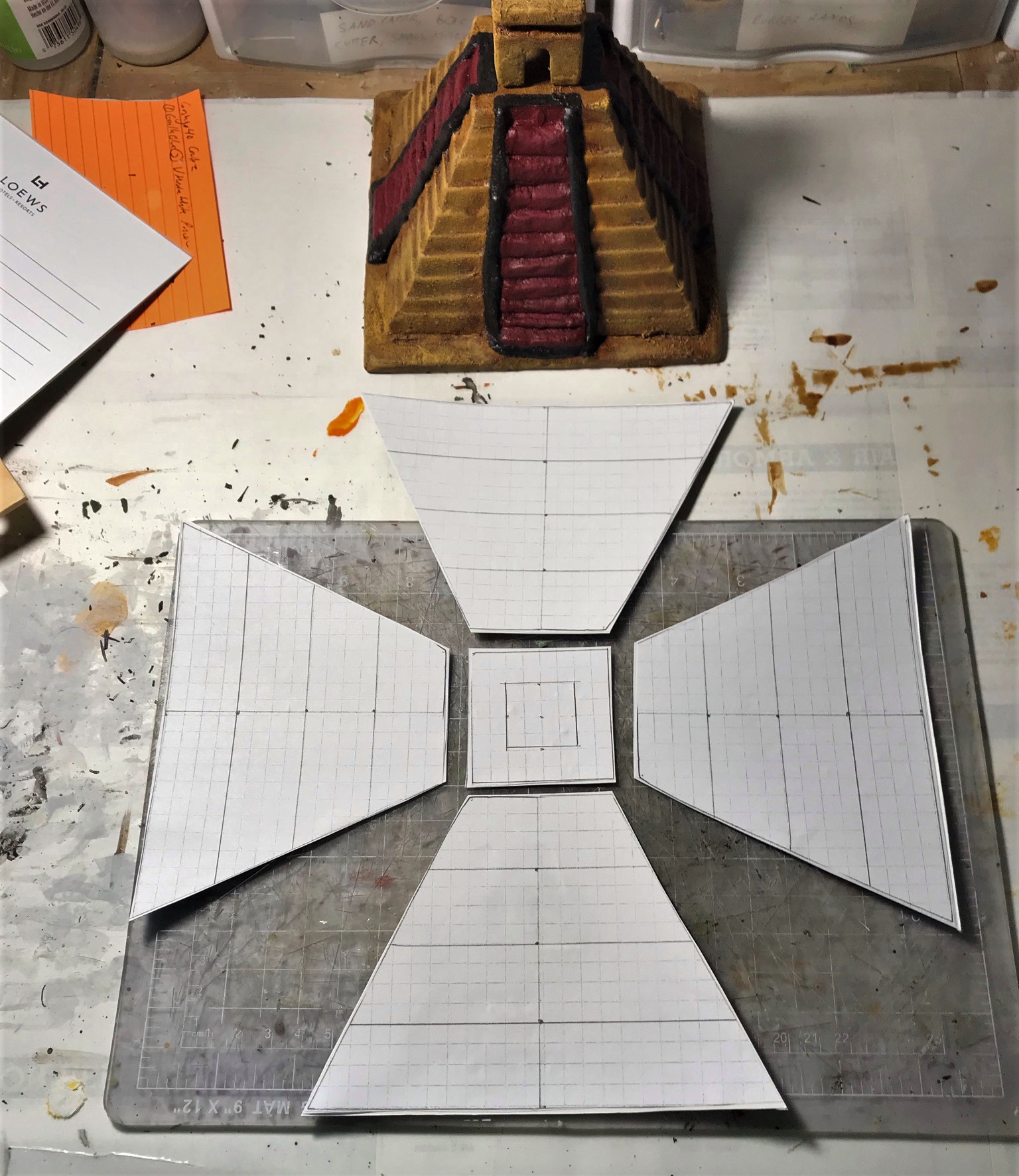
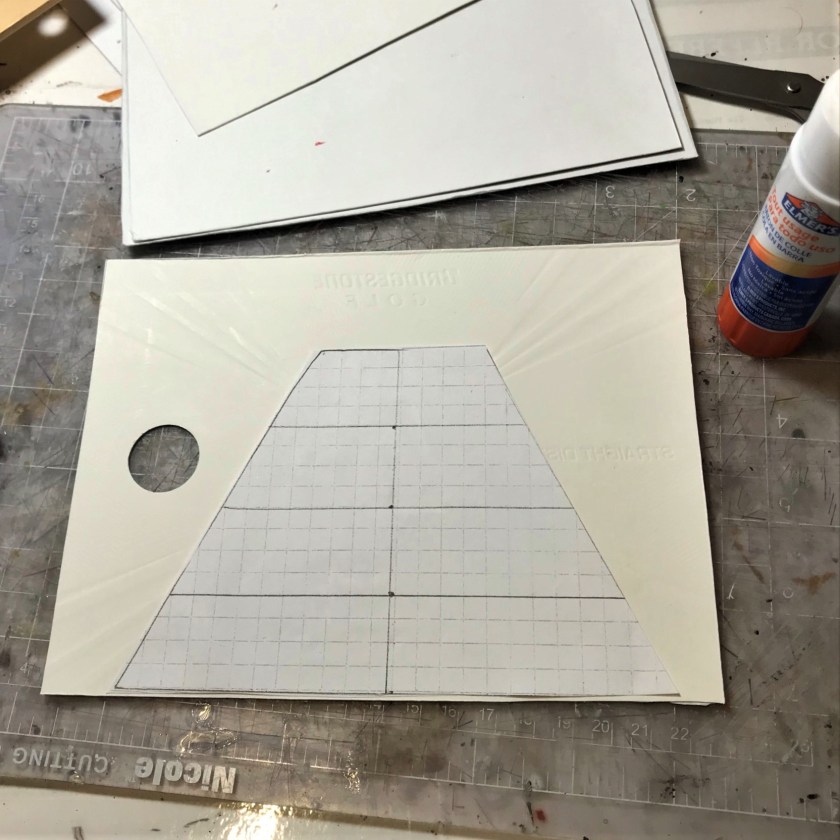
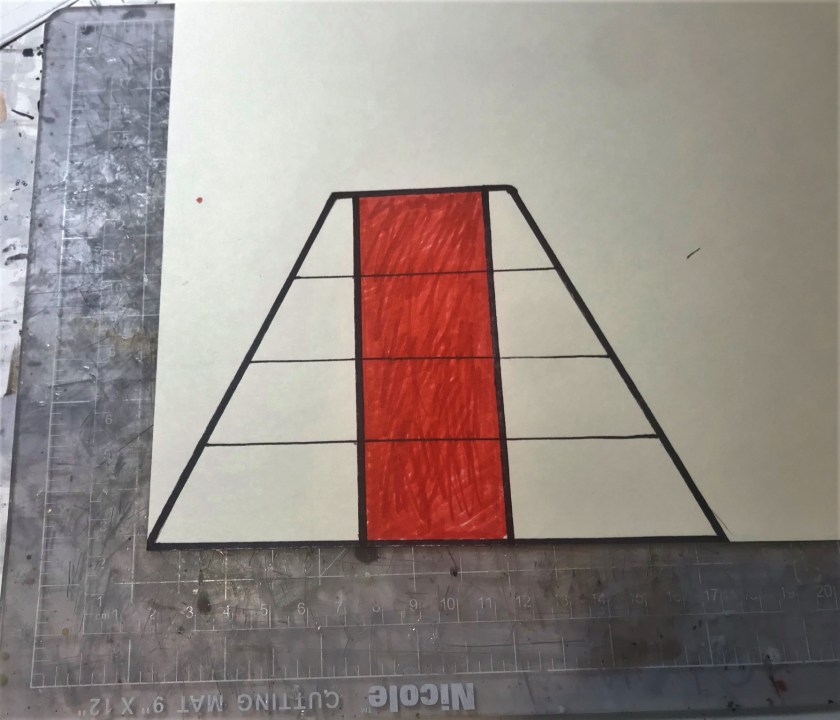
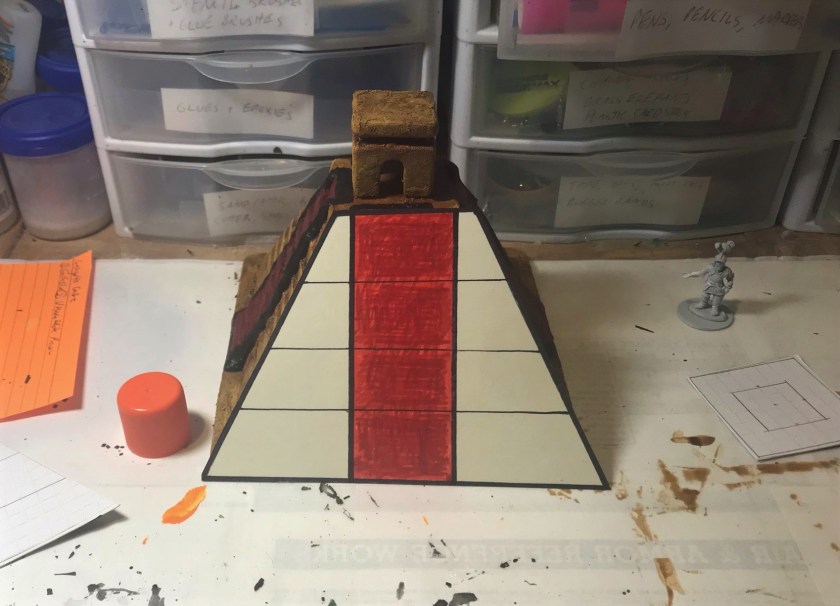
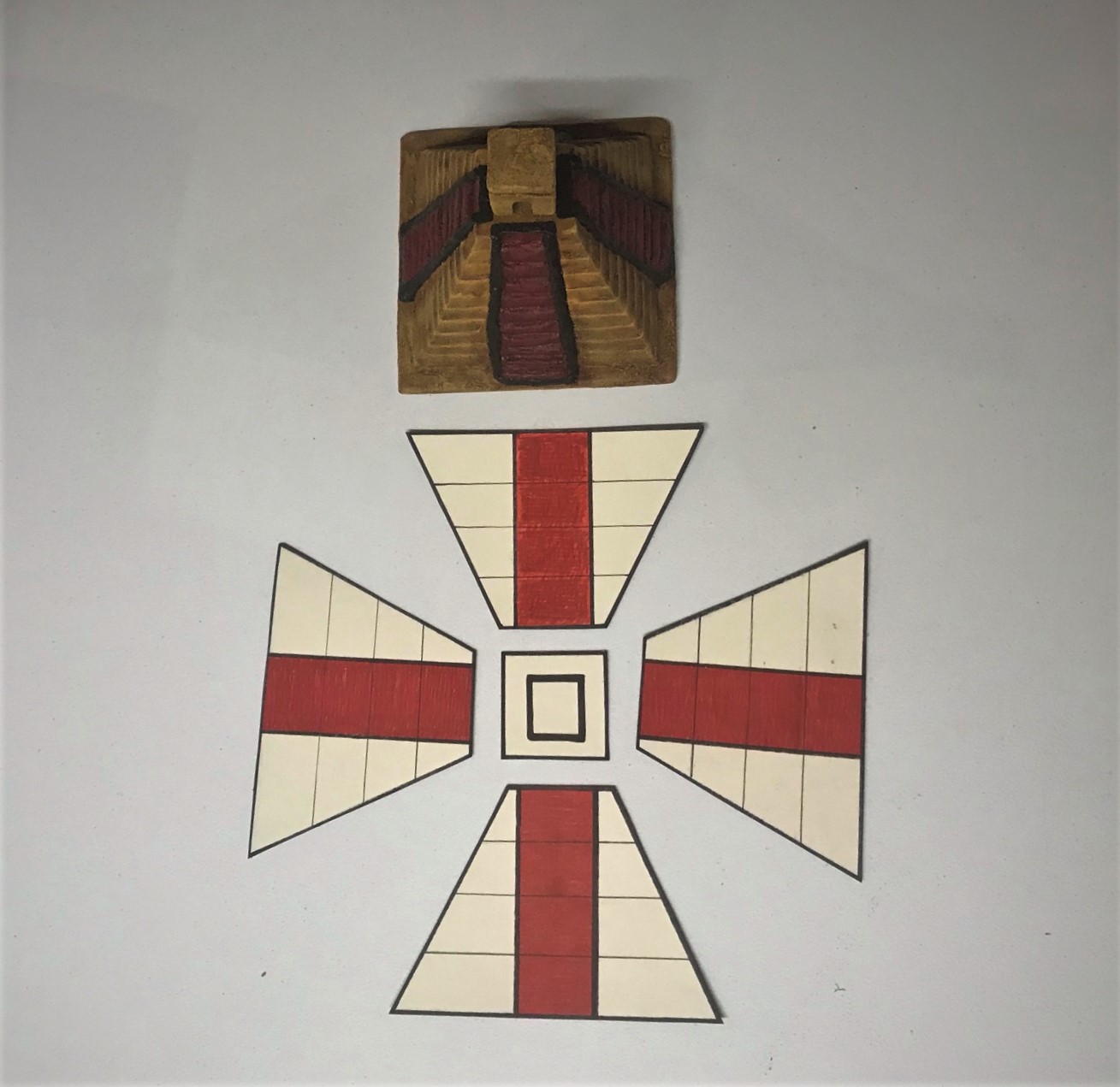
The main need was for the small temple that I am using as The Temple of Yopico in Tenochtitlan. I figured out the size of the sides and the top, and adjusted for 1″ steel washer bases. You can see that each side should allow for 14 figures plus one on the top. After drawing these, I then I cut out the graph paper templates. Ready for backing
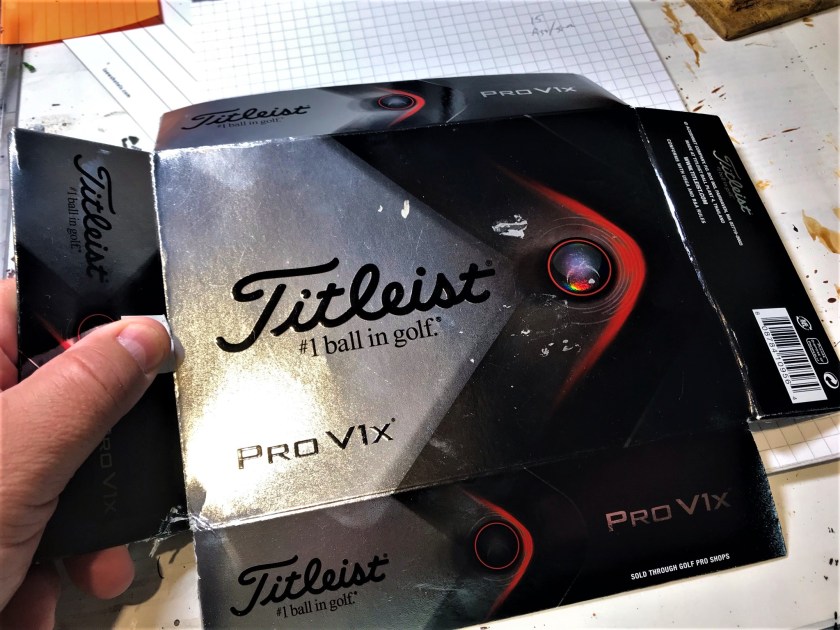
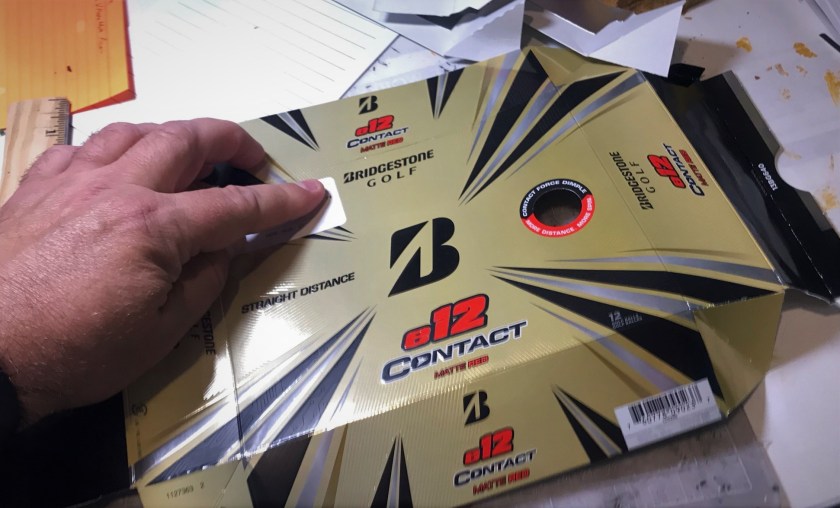
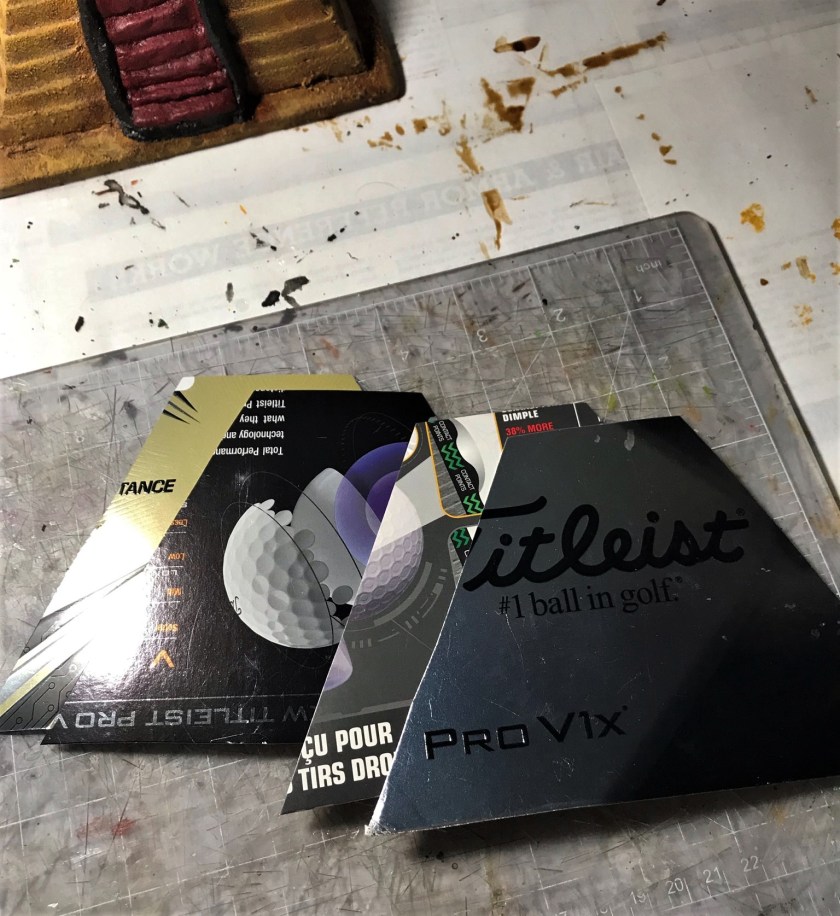
Clearly these needed some heft – and my other main hobby, golf, allowed for some good cardboard backings with a glue stick application. I pressed them down with a book and a 25 pound dumbbell.
Cut up box…
….and another…
…mount as backing…
…mounted…
…press for strong attachment…
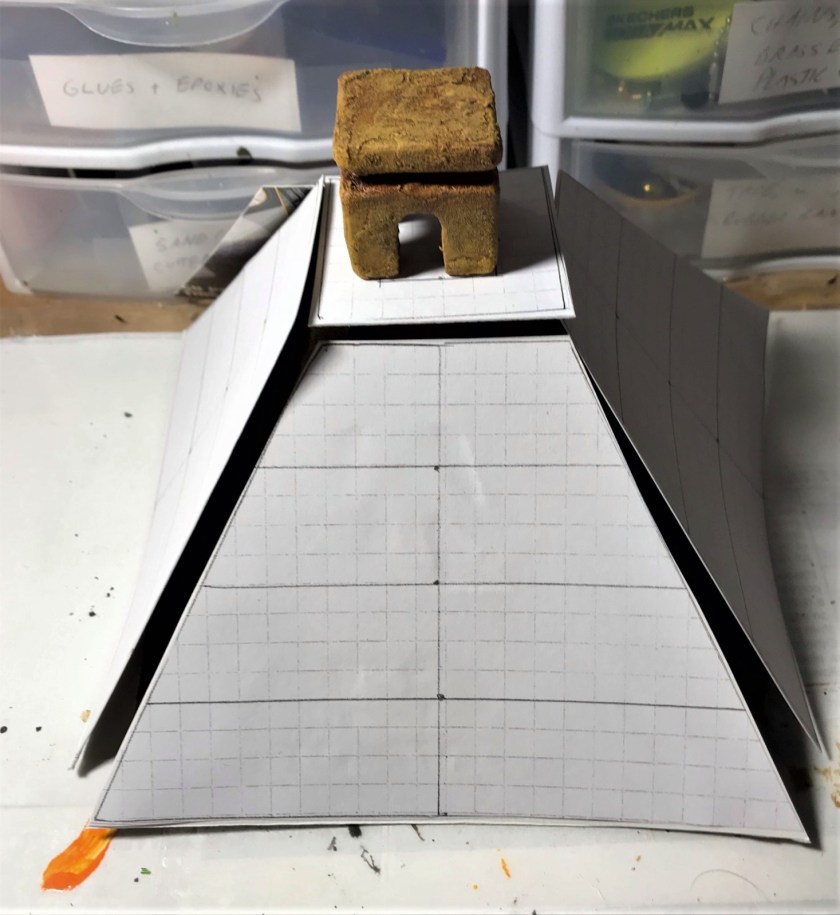
…and check against the temple for size!
Template phase 1
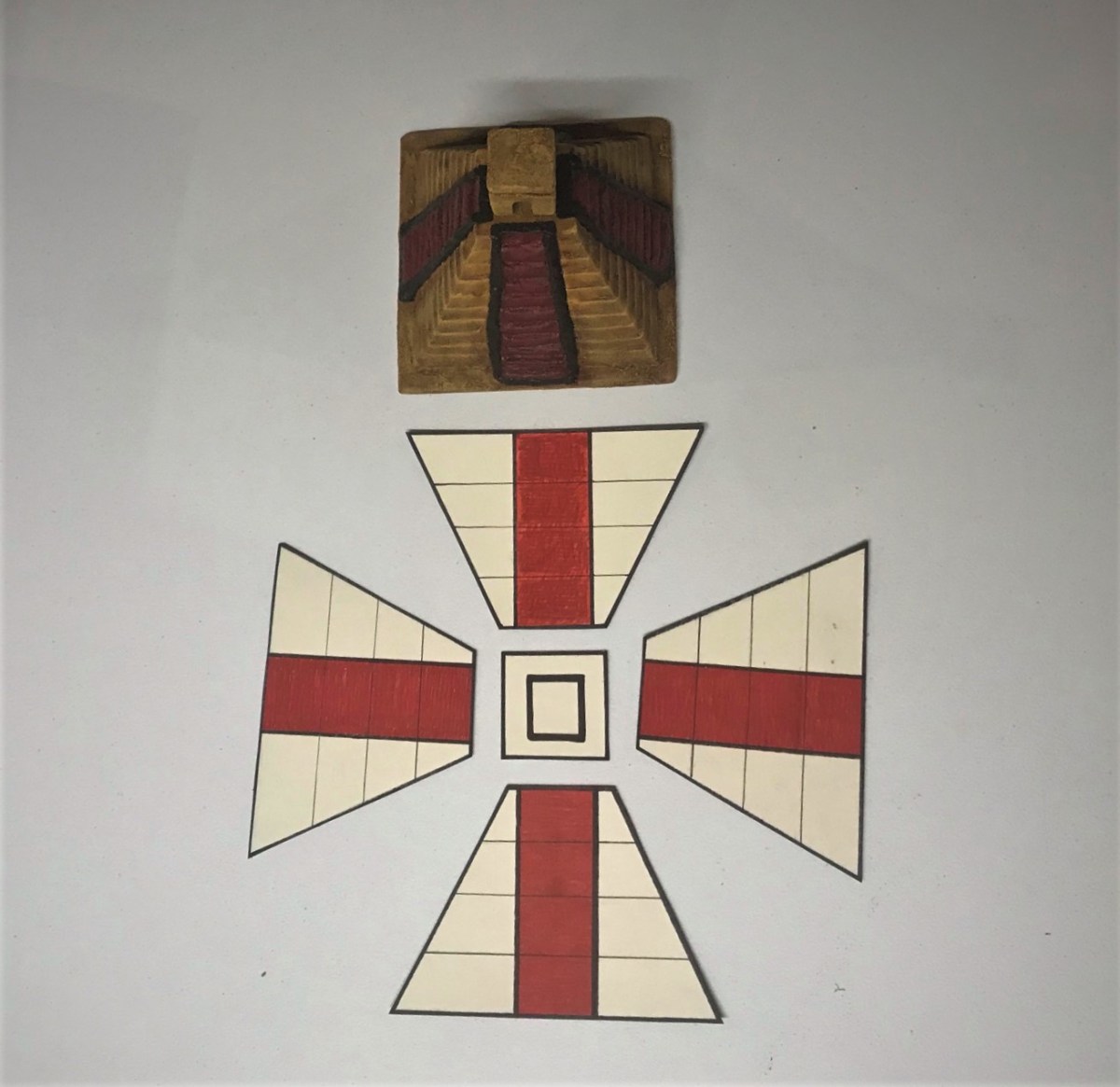
For phase 2, I traced the templates onto card stock, and in pencil drew in the lines. Next, cut out the card stock. Then I used red and black Sharpie pens to outline the steps and edges and color in. Add the glue stick, and press again under the weight.
The card stock
Sized up with the temple
Phase 2
I am pretty happy with the results and look forward to using them.
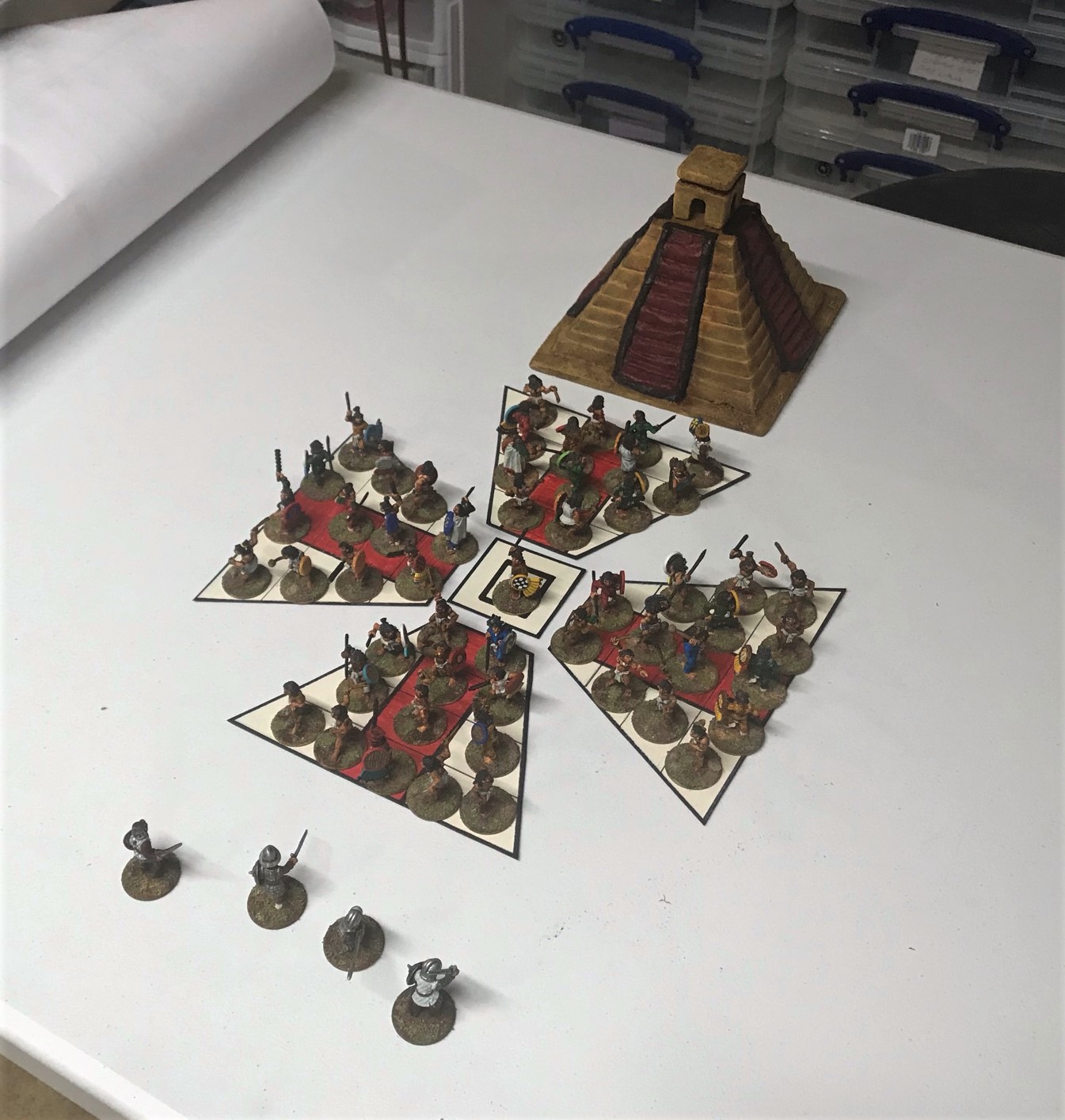
Final templatesA mock up of the templates with them full of Aztecs facing off against some Conquistadores. In games, I will have these templates setup off of the table for resolving combat but am showing it next to the temple for comparison.
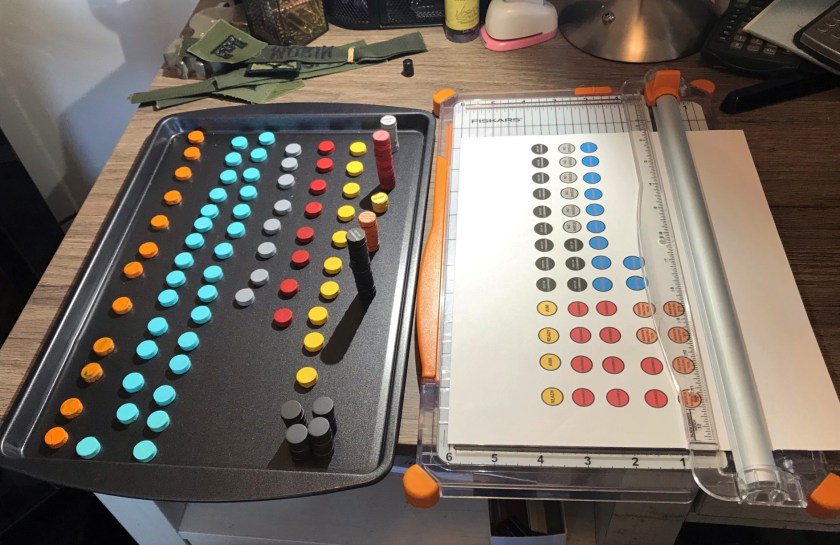
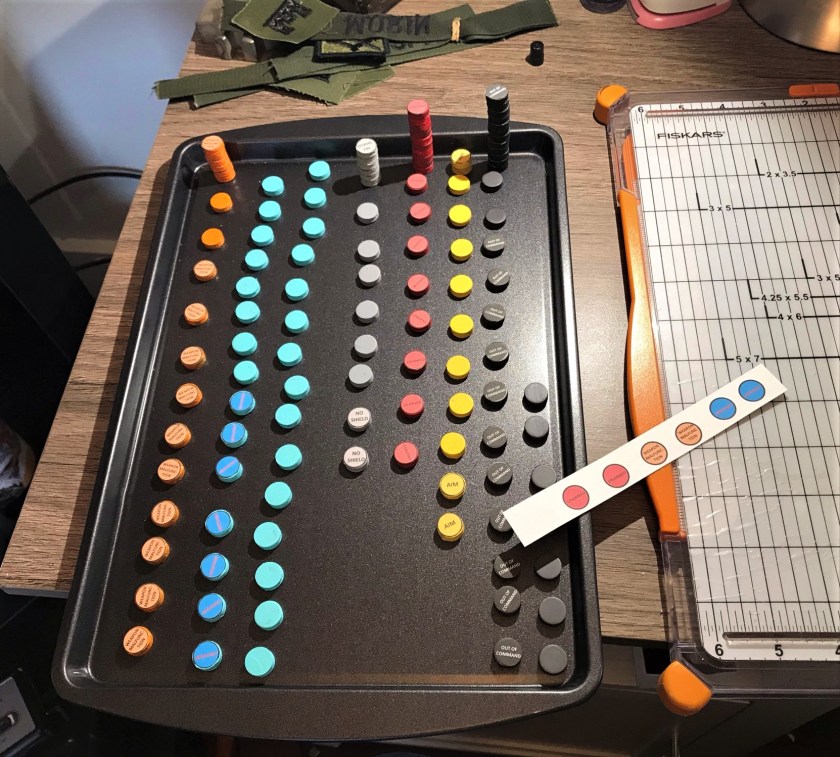
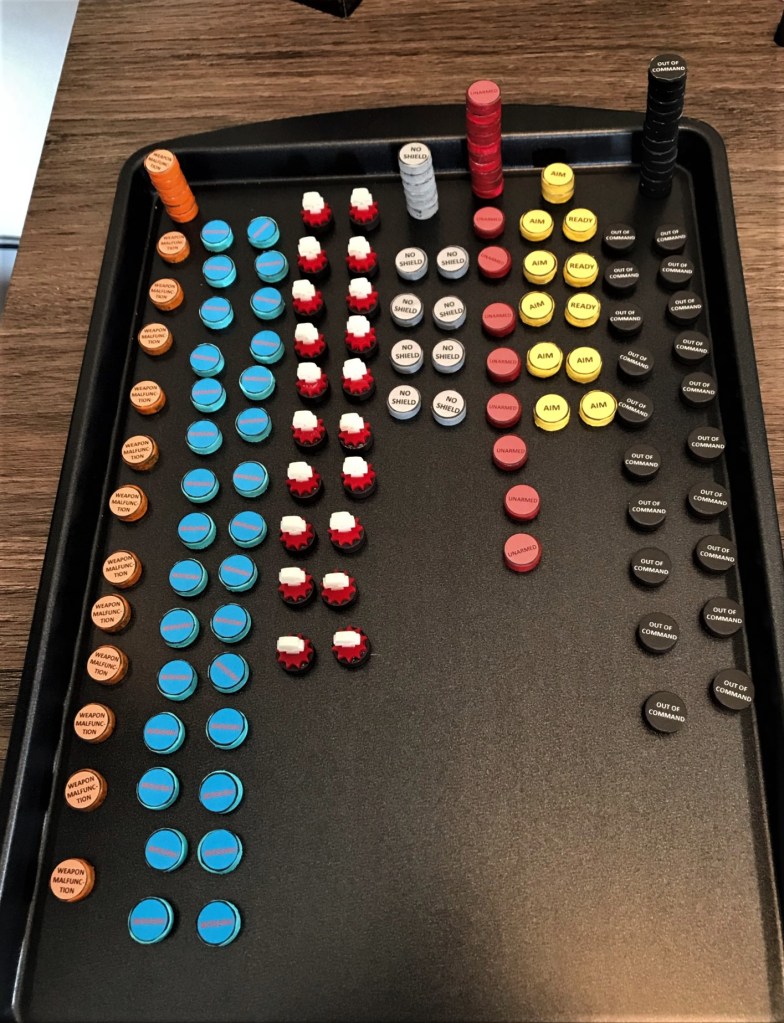
The next marker project was a continuation of my previous one that I mentioed above with some additions. In a game, Elite troops such as Jaguar or Eagle Warriors (and more) can go “berserk” – basically making a fanatical charge until either they kill an enemy or are killed. There are advantages and disadvantages to trying this as a player. I found that if Aztecs went into “berserk” mode on the battlefield, I needed to differentiate that on the tabletop, as some figures would, while others might not – plus they tended to charge far afield on the tabletop. To remedy this, and for better availability, I wanted more of the same magnetic markers. I did the same as you saw previously – using cheap magnets and craft paints and printing off labels that I cut out. As I use steel bases, magnets are a good help.
Old and new painted magnets
Punch out labels
In progress
All magnets complete
Magnetic markers
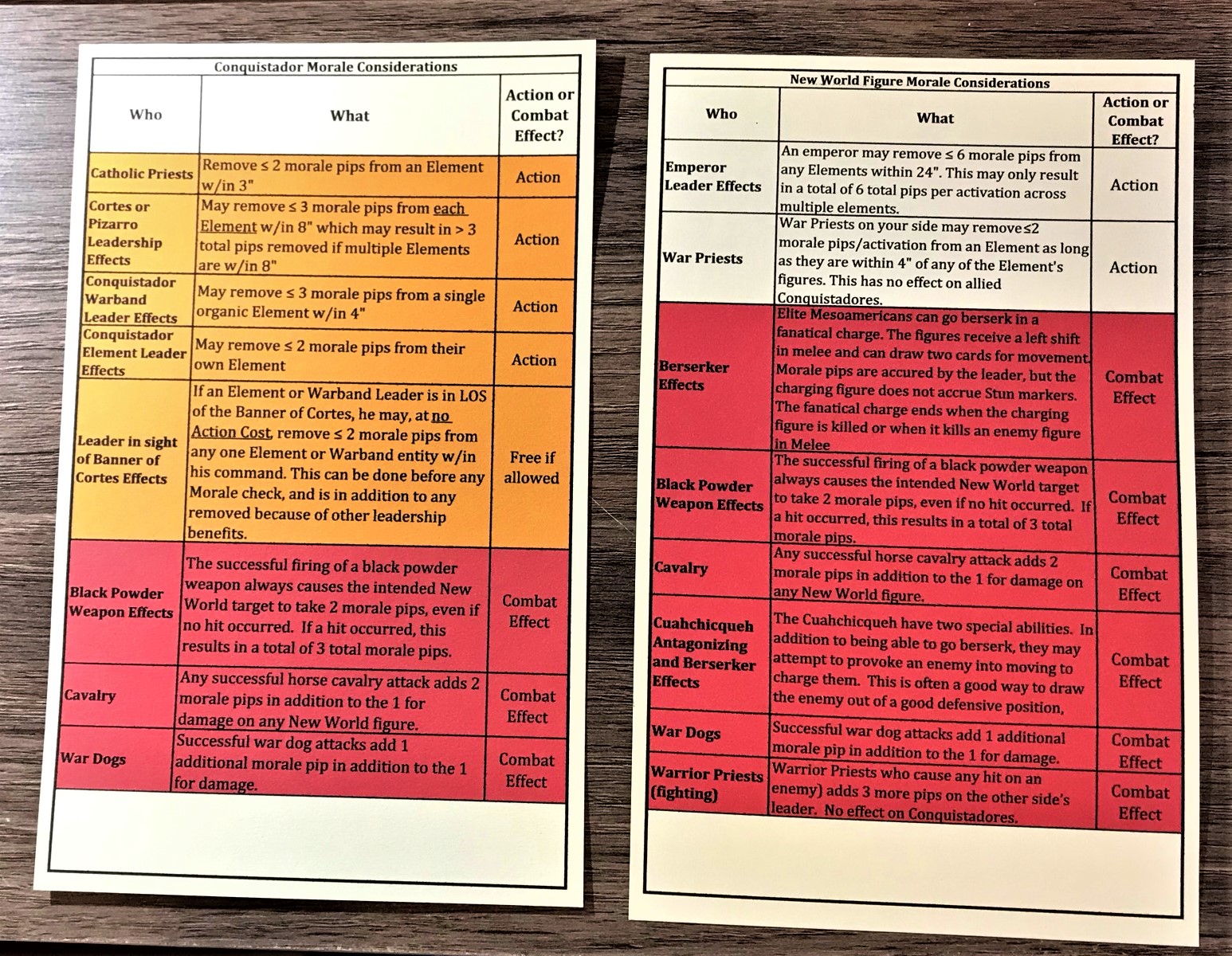
Lastly, I printed off some new 2-sided 5″ x 8″ cards with all the special Morale rule differences for my game versus other eras/theaters. Mine are meant to evoke the nature of the Spanish Conquest.
Morale Cards – and yes I see the typo!
Now, I as I write this I am getting ready to hit the road for a fun weekend of gaming with some old friends. Well, we are all getting older at this point I guess…beats the alternative!
I am hoping to share a good post on all the games when I return. Also I need to do a follow up on the garage+ project as a LOT is happening. If you are unfamiliar with my garage+ project, you can catch up on all of them here.
Miscellaneous details and references for those interested in that sort of thing:
For all of my previous posts on games, units, and other projects for my 16th Century Spanish Conquest supplement for Feudal Patrol™ – “Civilizations Collide” – please see this page.
Clearly, 500 years ago, the Catholic Faith of the Spanish Conquistadores was a huge part of their culture. One only need look at The Banner of Cortes to see that. As such, they were accompanied by priests that said Mass for them and worked – and did fight – alongside them in Mesoamerica 500 years ago. Remember, for them, in 1518-1521 it had only been a little over 20 years since they had successfully had the Reconquista and reclaimed the Iberian Peninsula from the Moors after 700 years of occupation. More recently, the Conquistadors had seen success in the Italian Wars. Much of that success was attributed to Providence to be sure.
For my Civilizations Collide scenarios for games of Feudal PatrolTM , I have updated my rules for priests on both sides. The updated supplement is soon to be made available for download, as is a planned 16-scenario booklet. In these games, the beneficial effect of Catholic Priests is that they can help reduce the number of Morale Checks that the Spanish might need to take as a result of combat and casualties, as they motivate them to fight on. They can also defend themselves, albeit understandably less effectively than a traditional Sword and Buckler Man.
While I have many Sword and Buckler Men figures, no appropriate figures to use as priests were in my unpainted mountain. After a good search I did find a few at Badger Games from Gripping Beast/Saga and Conquest Games. These looked quite medieval, but to my knowledge I would not think that religious garb or holy garments really changed much over the centuries back then. These were probably designed for the era of Viking raids. Plus, the two that I got that were from Conquest games were monks. And yes, as a practicing Catholic, I am familiar with the differences! Still, these looked the part as best as I could tell, so I bought them. They are 28mm and metal. As for painting research, I used the only plate I found in John Pohl’s Aztecs and Conquistadores(page 168) showing a priest as a guide for painting. Clearly, a monkish look – in black – was going to be fine for the tabletop.
With Historicon and some upcoming gaming looming as early as three days from today, I painted the three up quickly right after I finished Hernan Cortes. I’m fairly happy with them for gaming the period.
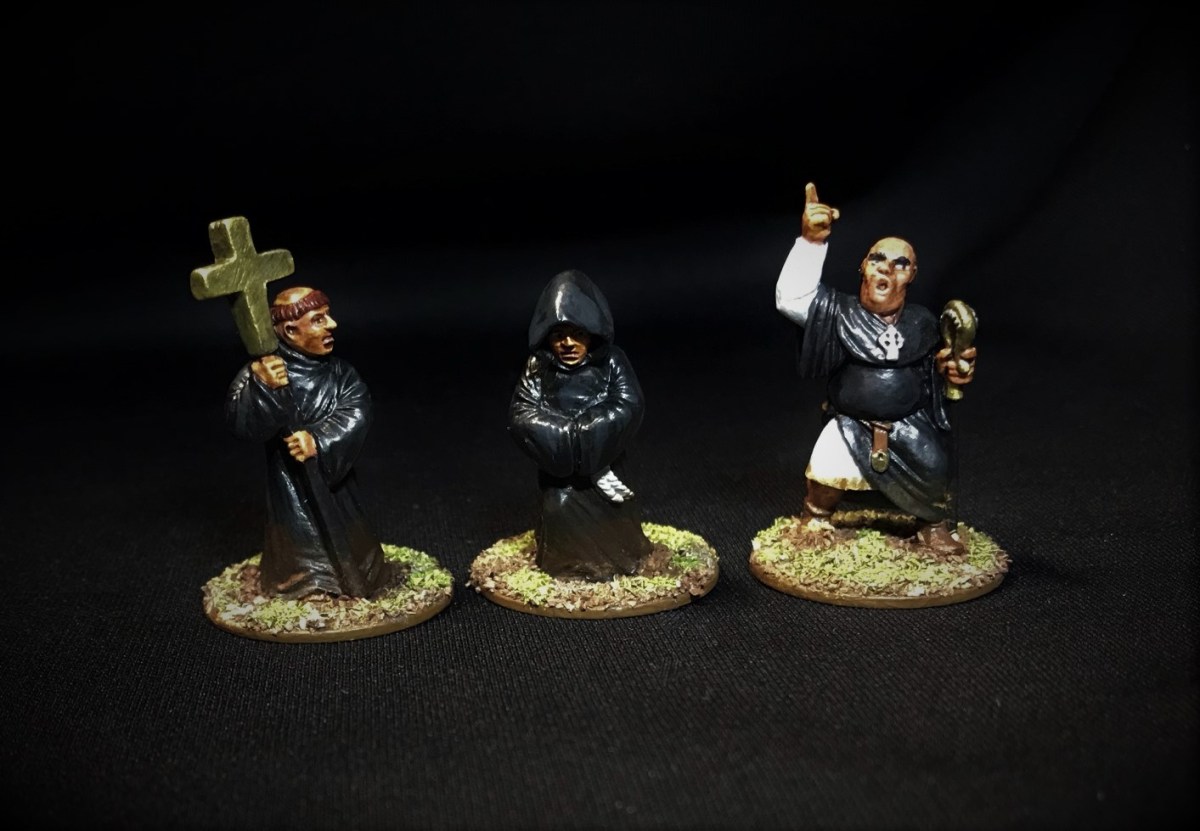
The two Conquest Game figures were both monks, the Gripping Beast/Saga one was called a priest:
Catholic Priest/monk figure from Conquest Games Ecclesiastics/Monks Line via Badger Games (#CG CGMM121f Monk in Cowl) – designated CCP2 by me
Catholic Priest/monk figure from Conquest Games Ecclesiastics/Monks Line via Badger Games (#CG CGMM121g Monk with Holy Cross) – designated CCP1 by me
Catholic Priest figure from Gripping Beast/SAGA Priests Line via Badger Games (#SPR06 Christian Priest 2) – designated CCP3 by me
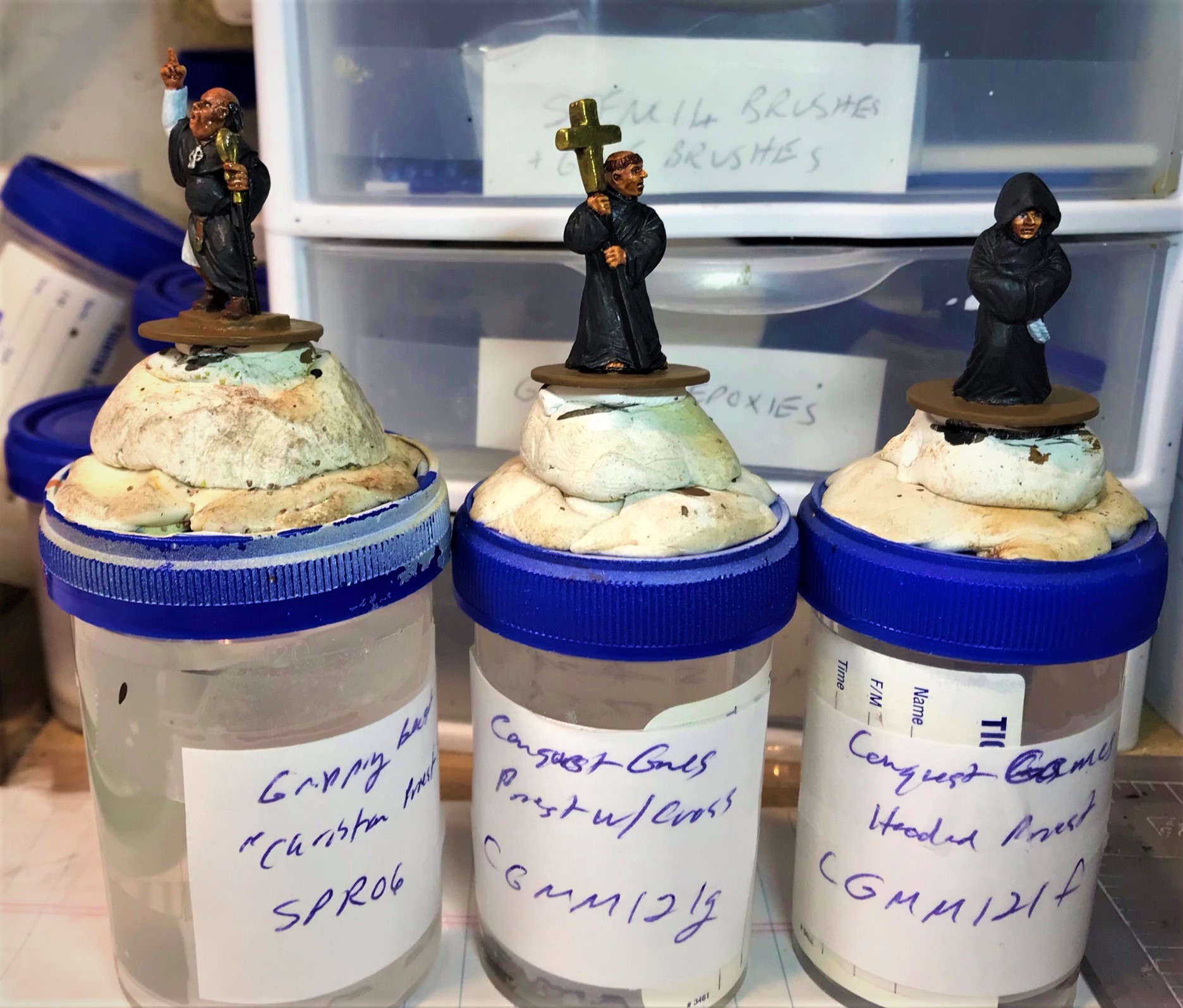
The three as receivedI removed the slotted bases from the two Conquest Games figures and based them all on good old steel washers. You can see a glaze on the steel washers – that’s Gorilla Glue, which I use to improve later paint adhesion on them (especially the rims).
As I was hurrying to get these done, I took few WIP shots, but here you go below:
Primed upPainted (base coat) and ready for some final touches
I want to mention a few areas of, well, let’s say minor challenges in painting these. First – and as someone without this condition I want to be sensitive. Two of them have shaven and/or bald pates. Painting shaved heads/bald heads was a new one for me and took a bit of experimentation to get acceptable results. After all, I would expect that these men of the cloth would have tanned up a bit facially. Still, the head and face on CCP3 (the Gripping Beast/SAGA figure) was not that easy to get right. Secondly, for all three you can imagine that their cloaks would have been less than pristine. I used some pigments for that. Lastly, highlighting black robes with gray was something I did want to play with here.
CCP1, 2, and 3. My three Priests. CCP3 actually has a sword in addition to his staff.
I like CCP 1 the best and CCP3 the least – mainly because of the face being a bit mushy. CCP2 is quite mysterious.
Well, now they have joined the ranks of the Conquistadores. Off to gaming with ye!
I hopefully have one more pre-Historicon post to share with you later today on gaming aids – if I can get it done before I have to pack. Then I’ll be silent for a bit and hopefully get a good post-weekend post on the gaming.
Miscellaneous details and references for those interested in that sort of thing:
For all of my previous posts on games, units, and other projects for my 16th Century Spanish Conquest supplement for Feudal Patrol™ – “Civilizations Collide” – please see this page.
PAINTS, INKS, GLAZES, SHADES, WASHES, PIGMENTS, FLOCKING, GLUES AND MORE THAT I USED ON THESE CATHOLIC PRIEST FIGURES:
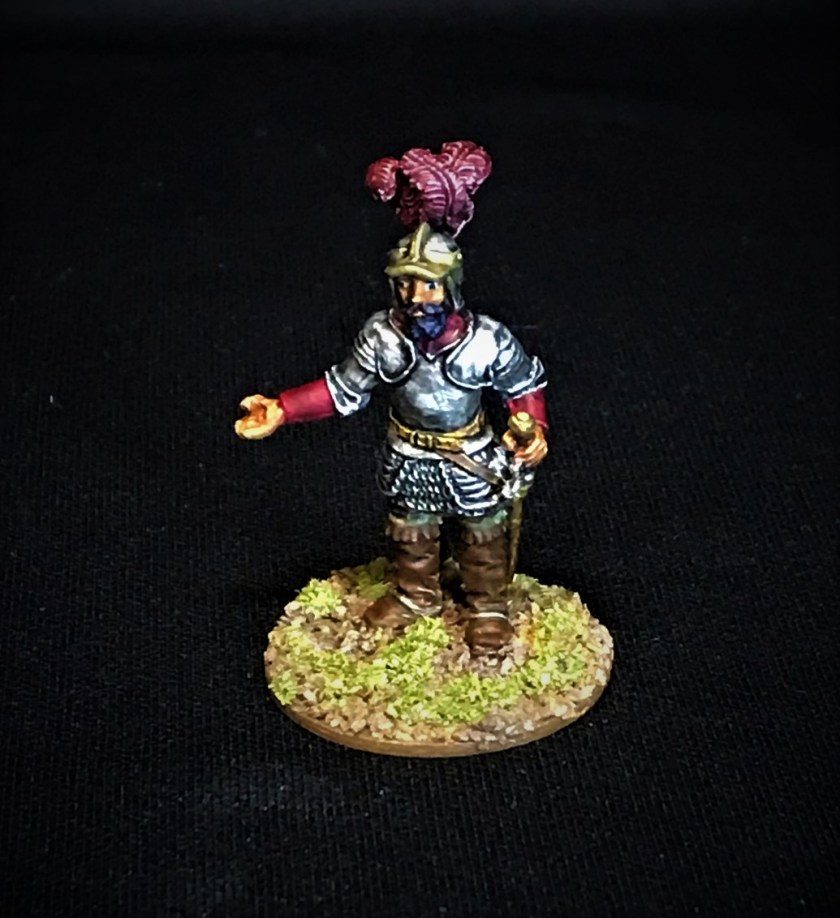
Or, let’s just call him Cortes for short – to avoid all the accent marks, surname confusion, and titles!
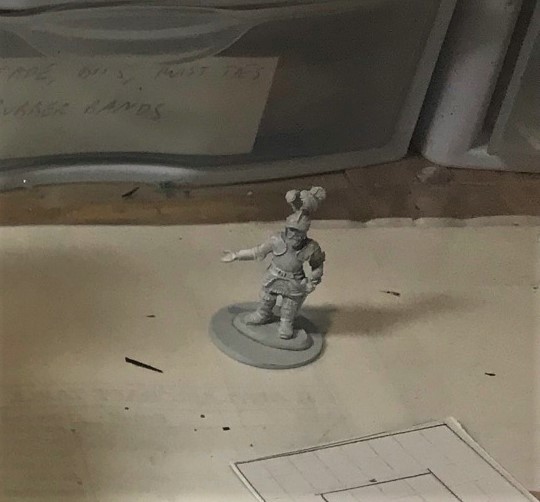
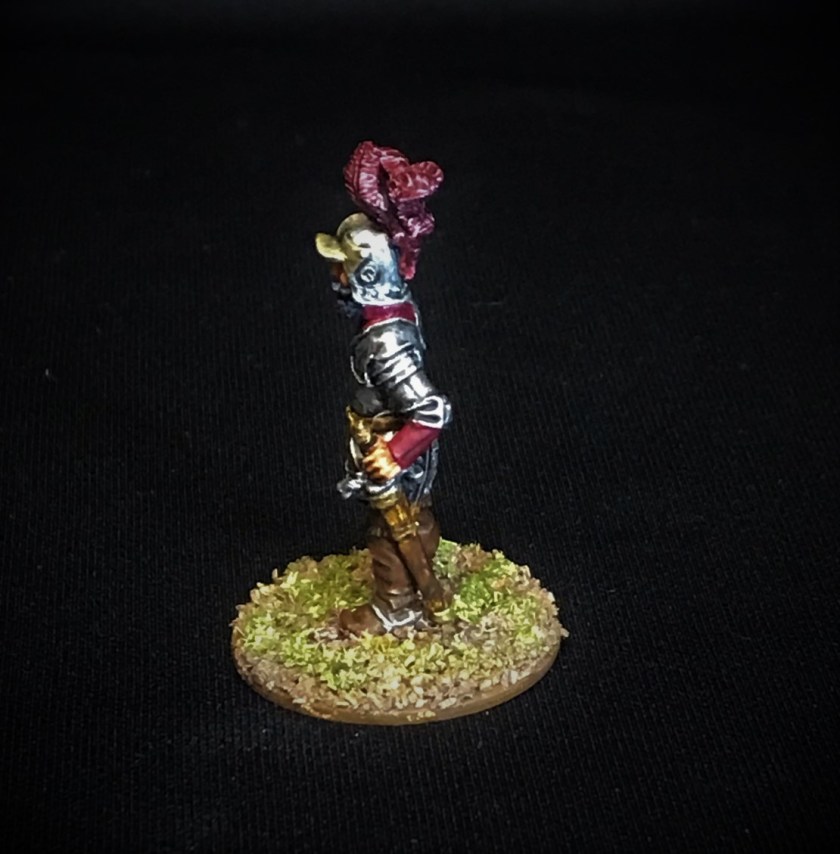
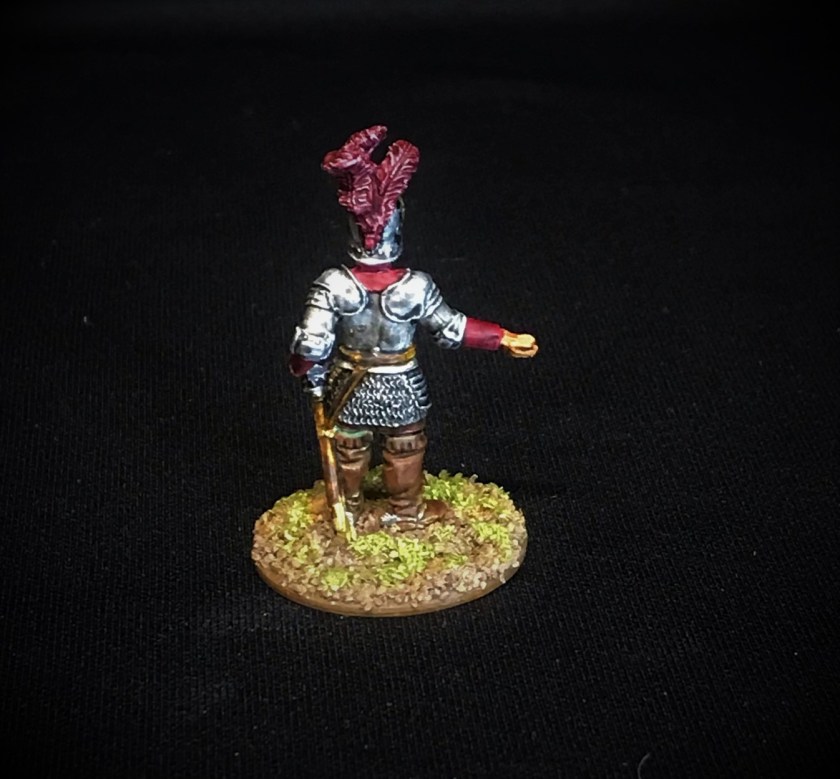
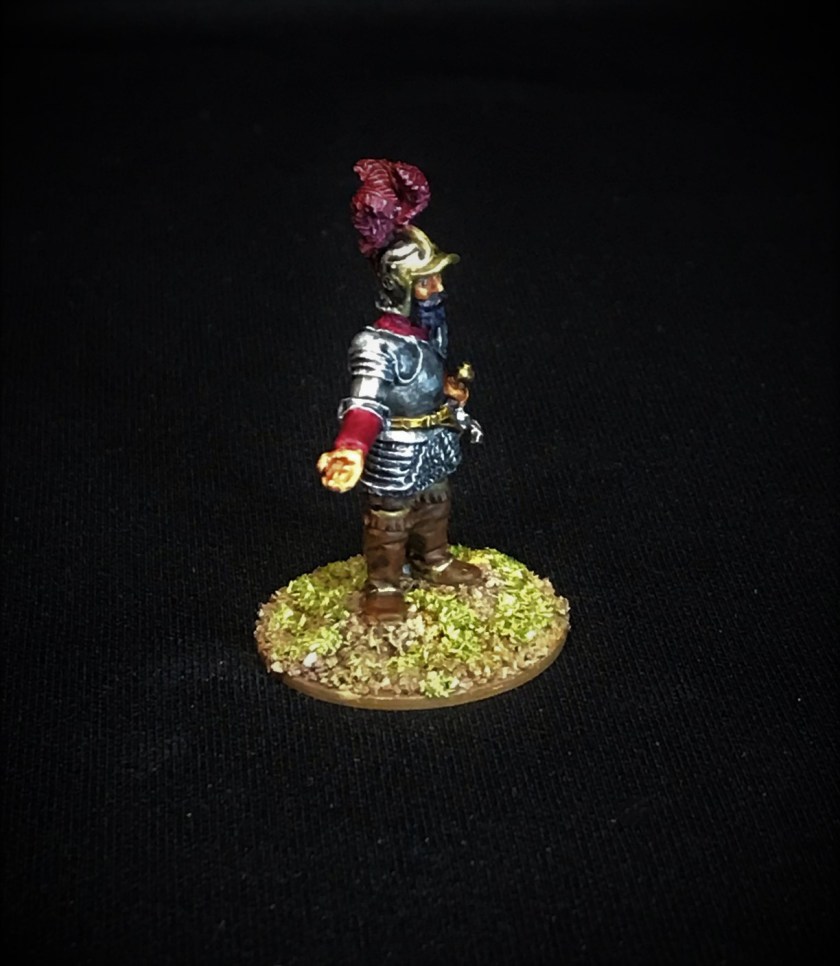
I got this figure from Gringo 40’s excellent collection of Conquistadores. It is from Gringo 40s Conquistadores line (#CONQP1 Cortez). The figure is 28mm in size, metal, and overall an excellent sculpt. I will be heading back to them for more figures. I had not painted a figure since I completed the war wagons back in August (also from Gringo 40’s), and really not a soldier since February. I am surprised at how much terrain took up the intervening time – as well as my garage (and now if you’ve not seen these you can see all of my garage+ project posts all in one place – here). But, let’s get back to Cortes.
In his early 30’s, Hernan Cortes made his way into the history books as a Conquistador and the vanquisher of the Aztec Empire. He lived to his early 60’s. Now, there are plenty of negative things to say about his life – and by no means am I considering him a “good guy” – just as I would not do that for Montezuma or any Aztec either. Both combatants were pretty damn brutal in so many ways. They were all men of their time – not today – and if you want to check out the Wikipedia page on Cortes you’ll get a flavor. He was remarkable in many ways, good and bad, and he was complex. I wanted a true Cortes figure for my Civilizations Collide scenarios for games of Feudal PatrolTM .
Of course, Cortes played a major role in the Spanish Conquest 500 years ago, especially as a combat leader. He also is bearded, and my good friend Roger over at Rantings Under The Wargame Table threw out a challenge for Mo’vember around such guys. Therefore, he is my submission for Roger’s challenge.
I was able to paint him up pretty quickly – and it felt great to paint again.
Primed and ready for Mo’vemberEarly work on base coatBase coated Cortez before washes and highlights addedHighlighted and washed – and very shiny – though I knew the matte varnish would help tone this down) some. I played with several metals here.Flocked and varnishedFinished off with some grass and some touch up shading
And add a label:
I enjoyed painting Cortes. I tried to give his armor different shading and tones while maintaining an overall proper look. The photo gallery below is not as good a group of shots as I’d like – it was tough to get the lighting correct – he’s thankfully not that shiny (as you saw above).
Cortes
I thought I’d add a picture of Cortes and Montezuma II. Cortes will get a lot more play in my scenarios anyways, but his picture is a little less shiny and better here, so here it is.
The two major figures in the Aztec Empire’s Fall
I hope that you enjoyed this – I have one more related post to do prior to this week’s Historicon game (I’m running it there on Saturday morning).
Miscellaneous details and references for those interested in that sort of thing:
For all of my previous posts on games, units, and other projects for my 16th Century Spanish Conquest supplement for Feudal Patrol™ – “Civilizations Collide” – please see this page.
PAINTS, INKS, GLAZES, SHADES, WASHES, PIGMENTS, FLOCKING, GLUES AND MORE THAT I USED ON THIS HERNAN CORTES FIGURE:
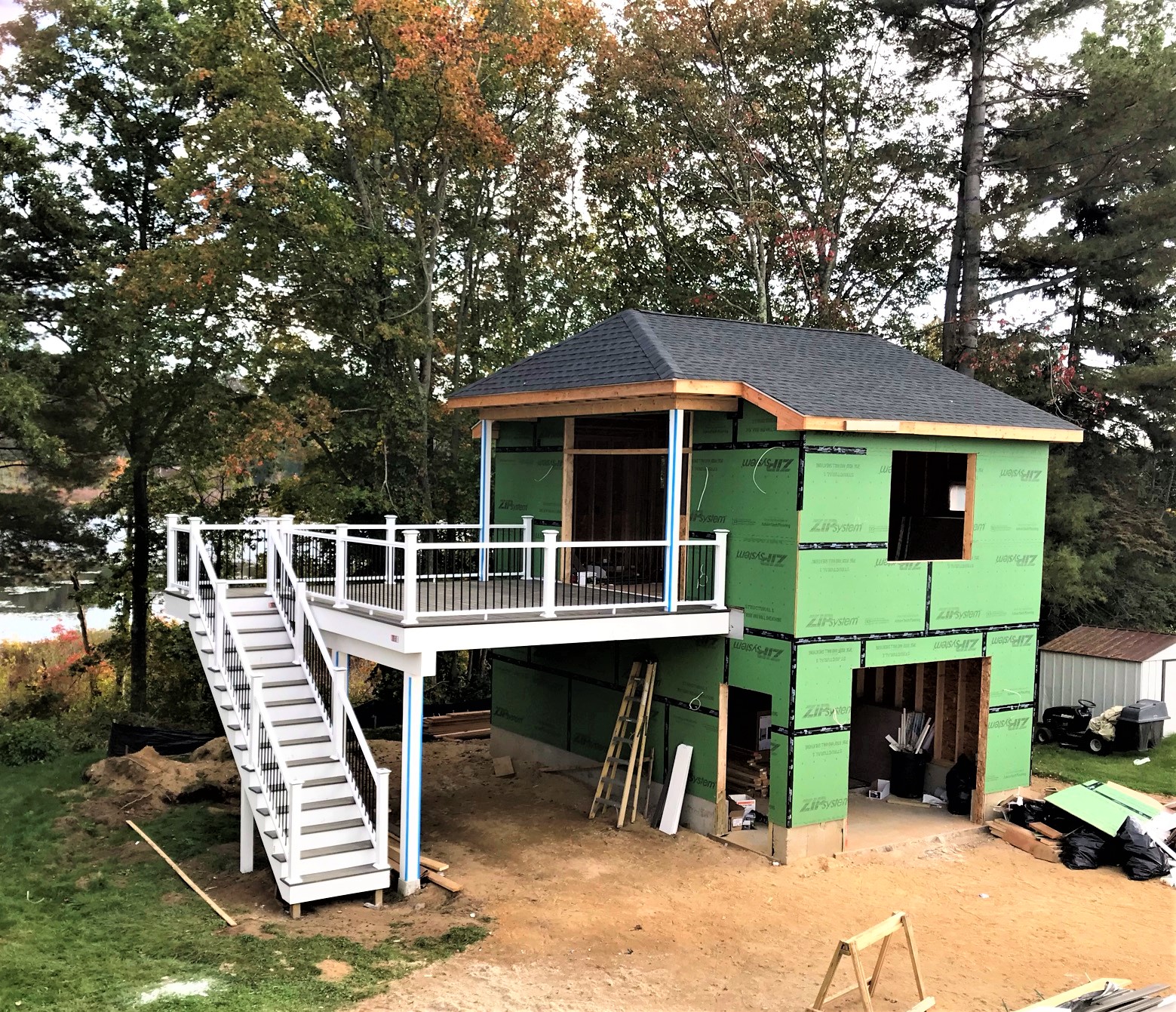
Lucky week 13 was October 10-16 on the project. Some really beautiful progress – though the delay in windows and doors has kept interior work from progressing. Therefore, for this post I have mostly deck updates plus a few hobby tidbits at the end for my dedicated hobby crowd.
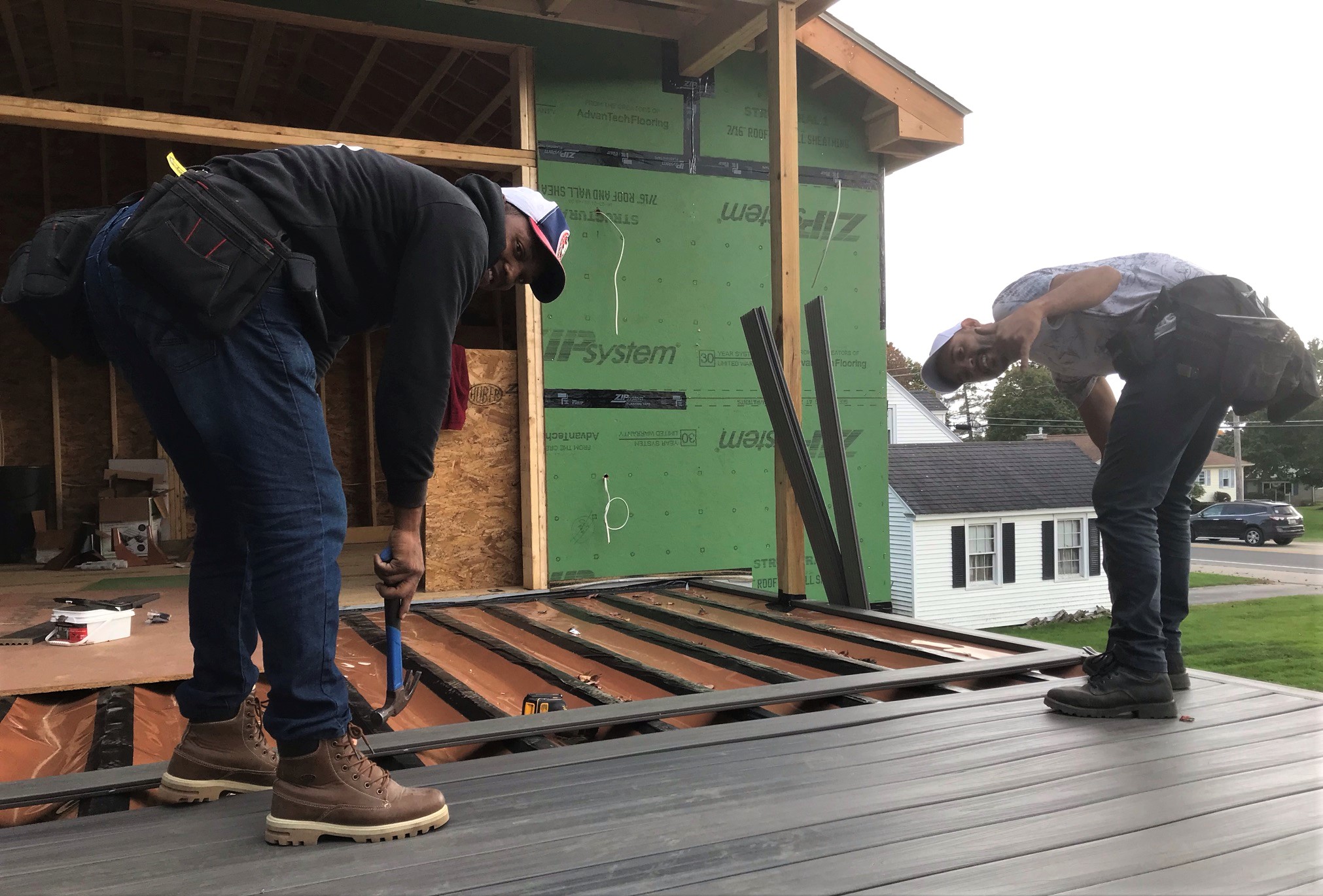
On Monday, deck proceeded on the deck stairs and fascia.
Cutting up and moving up PVC fascia for the garage deck. Decking being enthusiastically installed over the Trex rain gutter system you saw last week.Monday progress at the end of the day.
On Monday, our new Weber gas grill was delivered from Home Depot. It’s for natural gas so we can avoid the hassle of propane tanks in the future (though Lynn wants to use both). This is to be mounted on the new gas line on the back deck. We also got a nice drip mat and a cover for it. On Tuesday, Lynn and I put it together with the help of the manual and the Weber app. The process took us just under 4 hours (Weber says it should take 90 minutes – no way), and we worked well together to get it done. That means we are still happily married and no murders occurred or were even contemplated – which can be side effects of joint assembly! Of course, we can’t use it until the gas line is put in for it from the house.
Happy wife, happy life – and the new grill.
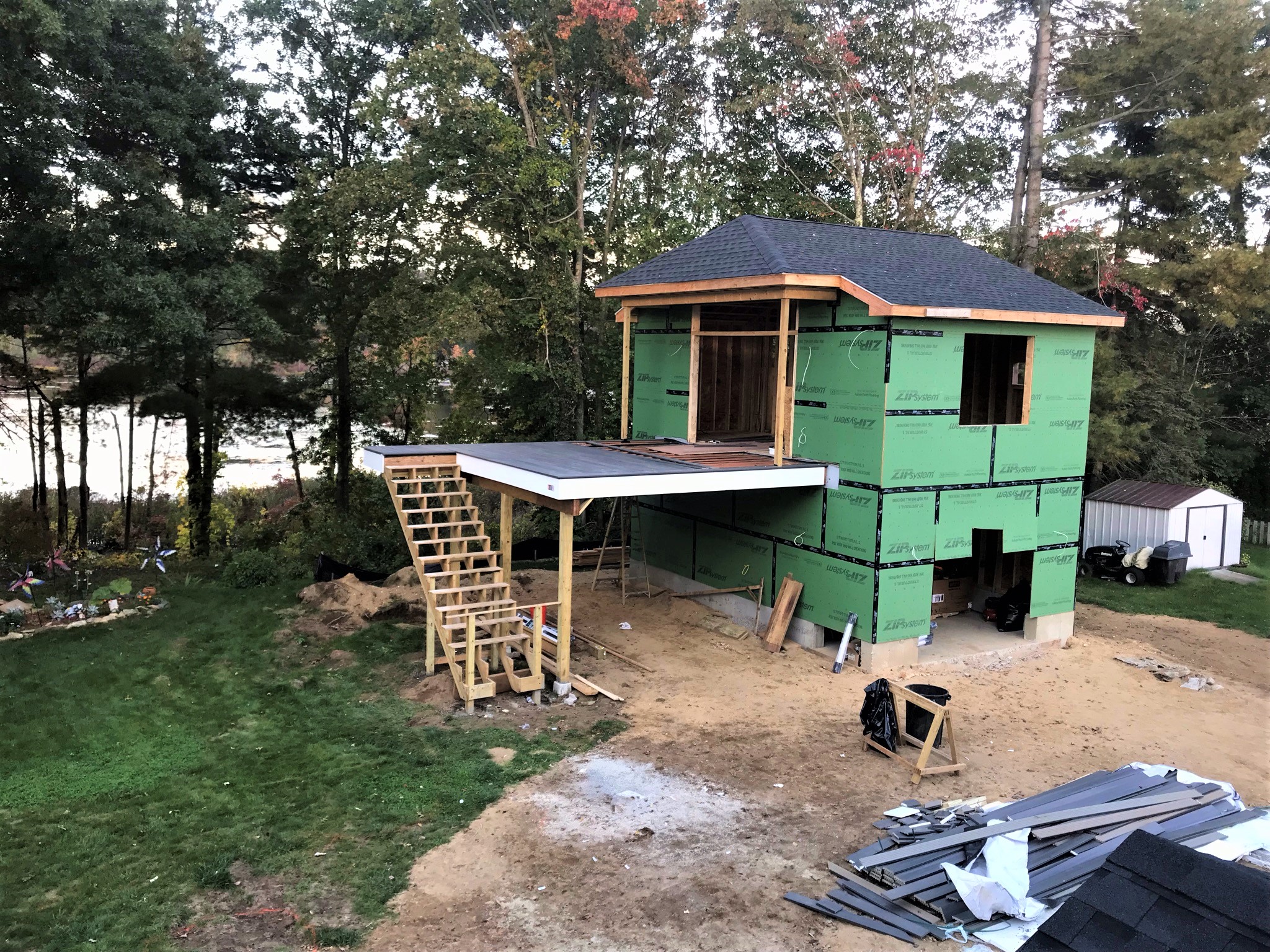
The rest of Tuesday saw work on the stairs to the garage deck and the deck itself.
Deck and stair work on Tuesday.End of day progress on Tuesday.
Wednesday saw more of the same.
Morning work Wednesday.Now we had stairs all the way up on Wednesday!
Thursday saw a couple of things happen. First, Jonny Victor got a boom truck in and all the blue board got delivered – though work on it can’t start until – yes – windows and doors are in. At least this saves time climbing the new stairs.
Boom truck delivery of blue board upstairs. Some went below as well.
The deck and stairs just got more attractive as the week went on.
Work began on the columns sheathing.Different angle view, Thursday mid-day.View from the back mid-day Thursday.
It was too dark to get a good shot of the total work – but Friday came and the fog, but it looked like this below.
Happy Friday morning showing fog and Thursday progress.
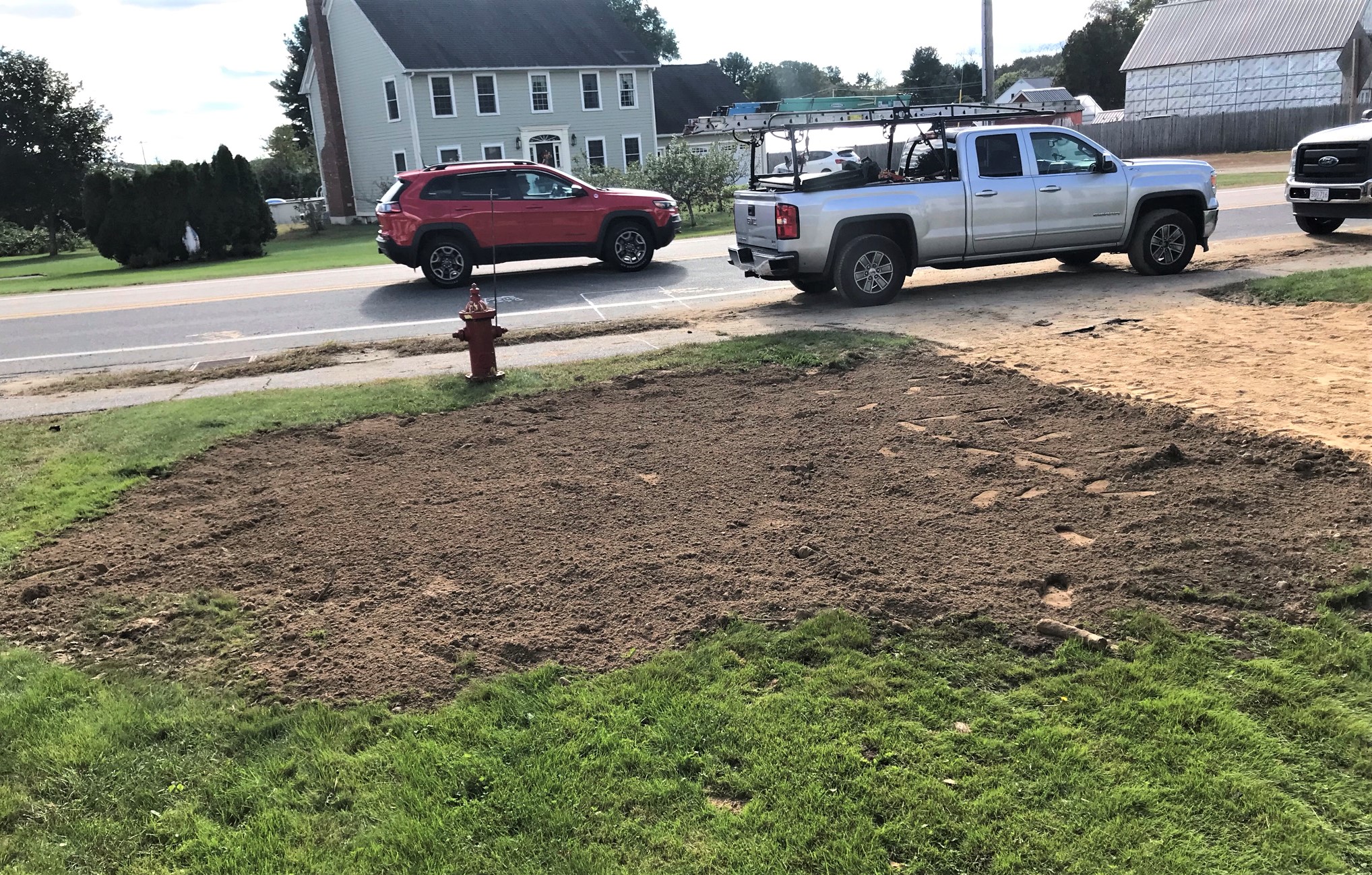
National Grid showed up and added loam and seed to the gas line excavation of last week.
National Grid repairing over the gas line excavation to the garage.
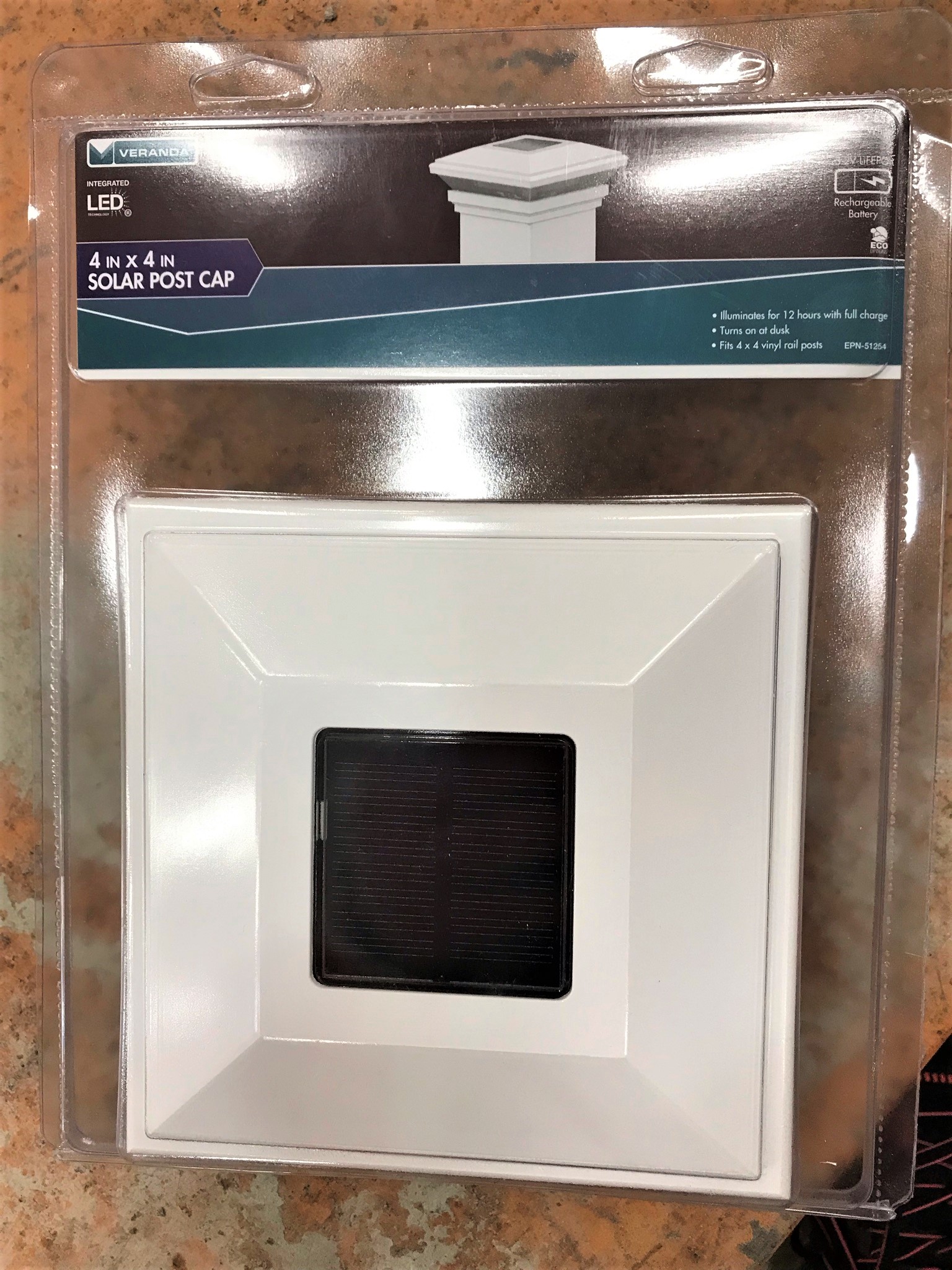
Our plumber was prepping to do some work, and asked about a vanity size. We also needed another solar cap for the deck posts (they are solar and are really cool at night – no pic yet as we needed 1 more). So, off to Home Depot for both and some more shelving for the cellar.
Before we left for Home Depot, this was the progress. You can also see the new grill on its new home.
More Home Depot shopping – last of the solar caps and the small vanity for the upstairs bathroom.
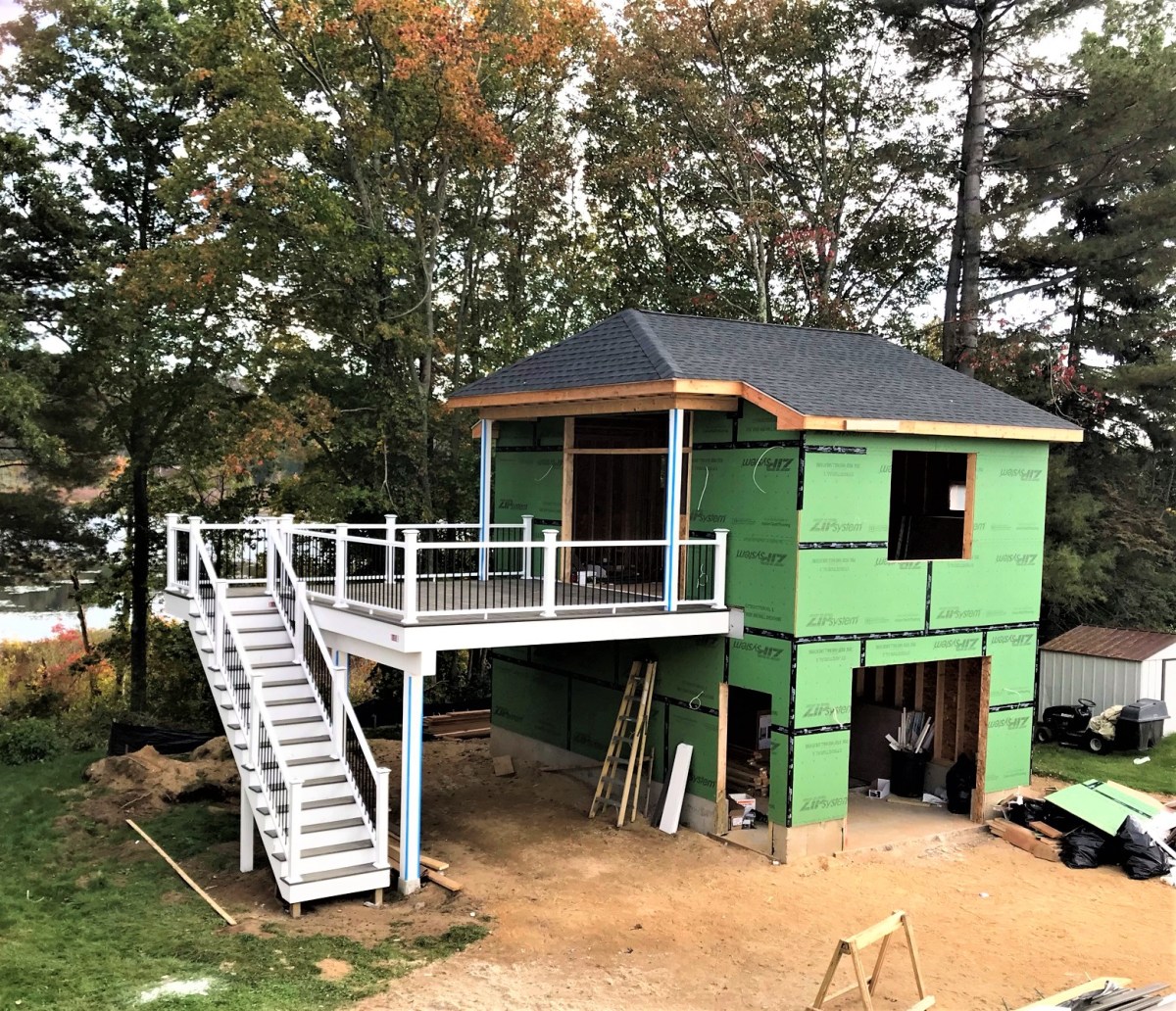
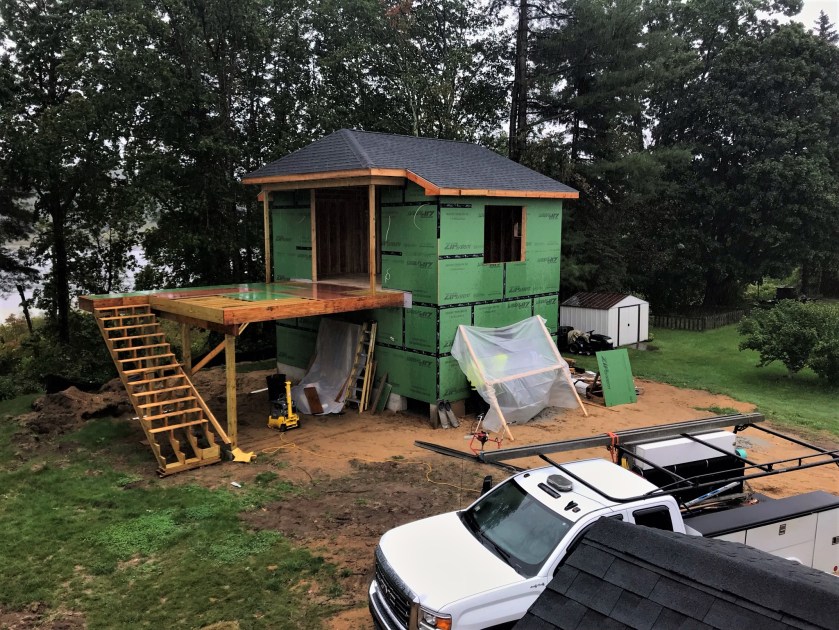
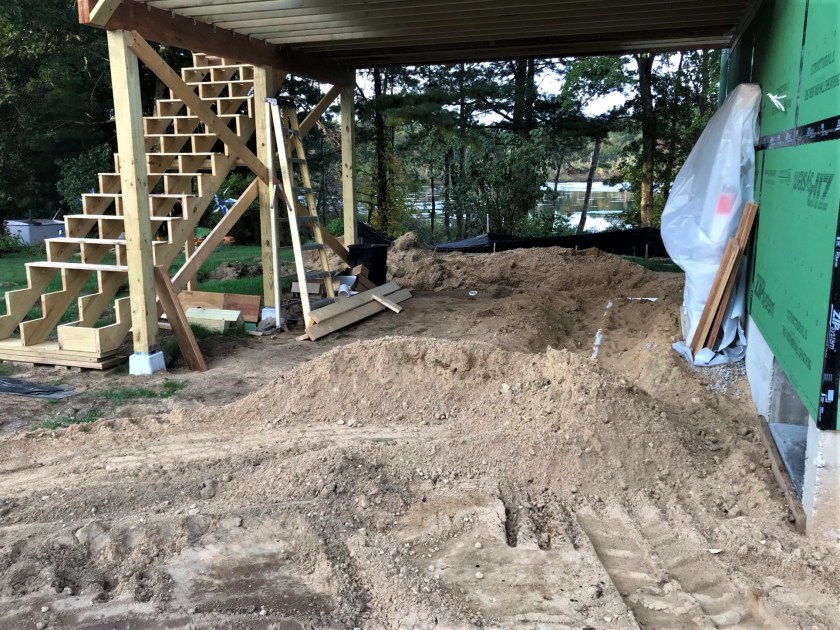
On Saturday, I got to get a shot of the completed work. Not only is it amazing, but the views from it are as well. The deck height is higher than our home’s second story windows.
Week end progress!
Now, I mentioned I would add a couple of hobby items. Well, I have a few – three to be exact.
First, I was able to finish writing the update to my Civilizations Collide supplement for Feudal PatrolTM. This is a way to wargame the Spanish Conquest and do it quite historically. I am working on a book of scenarios for that too. When either is available for download, I’ll share that.
Second, as I was working on the supplement, it became clear that I needed to have a way of tracking damage on Cortes’ war wagons, as after enough Aztec slings and arrows and more have hit them, they would disintegrate into scrap lumber. I saw these nice Litko markers and got 4 for my war wagons.
Just in case you missed what a war wagon is!These markers count down from (or up to) 20 – which is the amount of damage each war wagon has before they got into combat in one game scenario.
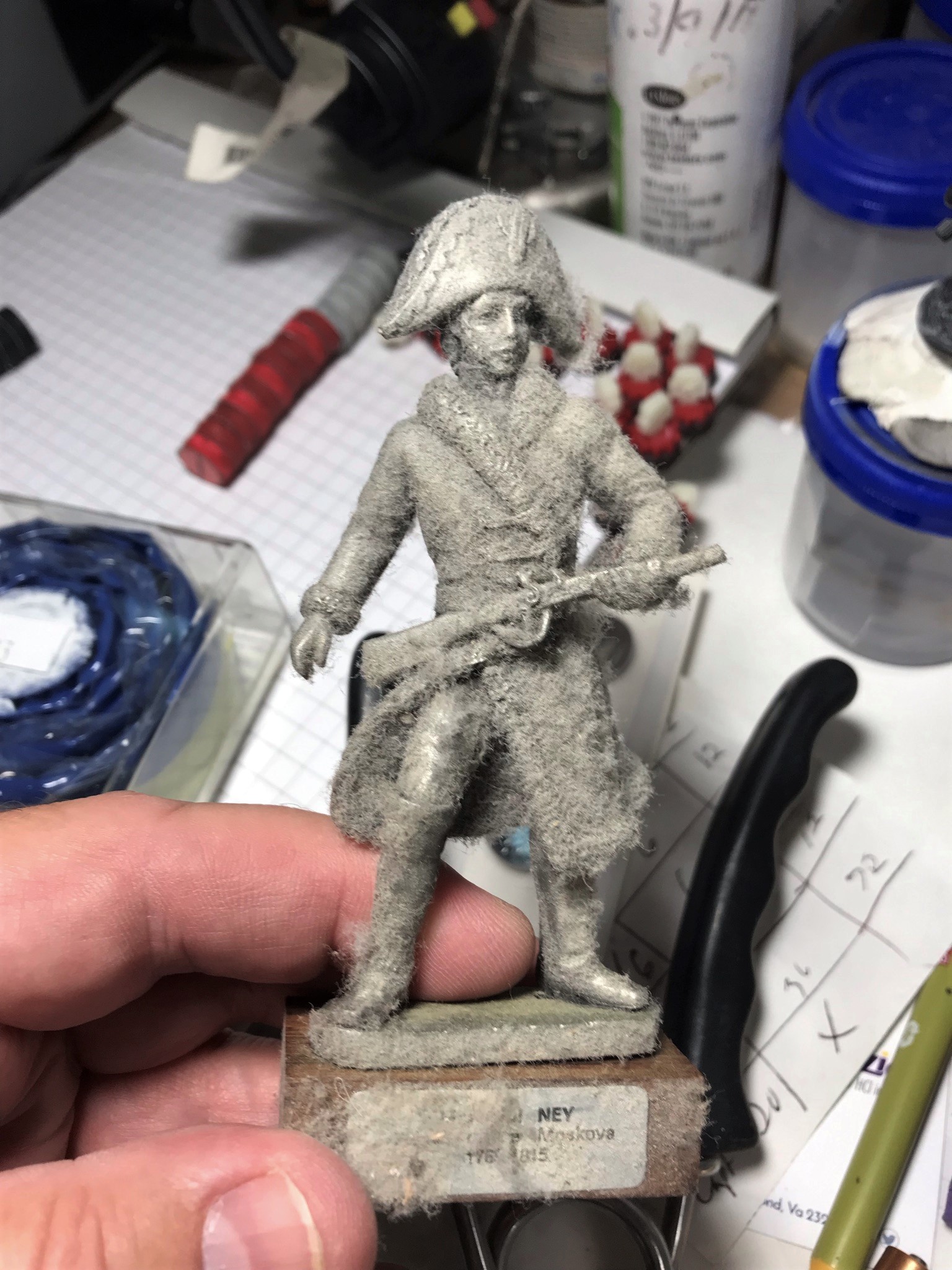
Lastly, I mentioned that we also have gotten shelving from Home Depot and have been assembling them and redoing storage in the cellar. We have put together 3 of these, 1 of these, and 1 of these. The last one replaced an old particle board printer stand that had been used for laundry soap, bleach, etc. It was messed up, and had a storage area under it. In the storage area were a couple of yearbooks from junior high I had not seen in a while, plus under the stand was a big lint-encrusted pewter figure of Marshal Michel Ney, the Bravest of the Brave, that I bought in France in the 1980’s! I was always fascinated by his story. However, I had zero idea how he ended up there.
Come, see how a Marshal of France can gather lint and dust!
Buck suggested that he would be a cool giant for a Wars of Ozz game, and Chris Palmer suggested that he could be a moss giant. I thought maybe a lint monster…but no, I’ll clean him up and put on a shelf as is.
Anyways, next week should have even more progress on the project – so thanks for looking and hope you found this interesting. Now I have blogs to read! (likely yours).
The project continues! Although I was so late with Week 10 that I decided to combine weeks 10 and 11. As you will see from this post – a lot went on from September 19-October 2, 2021. Some of it involved construction, some not – as you will see. I’ll do my level best to make this interesting by including not only some construction photos, some other stuff, to include golf and a bit of hobbies!
There are a lot of pictures here – click on any of them for a bigger view.
Let’s start with electrical work and some progress around the cellar. Wait, the cellar? Why there? Aren’t you building a new garage and house deck Mark? All valid questions that I am presupposing that you may be asking! So let me attempt clarification.
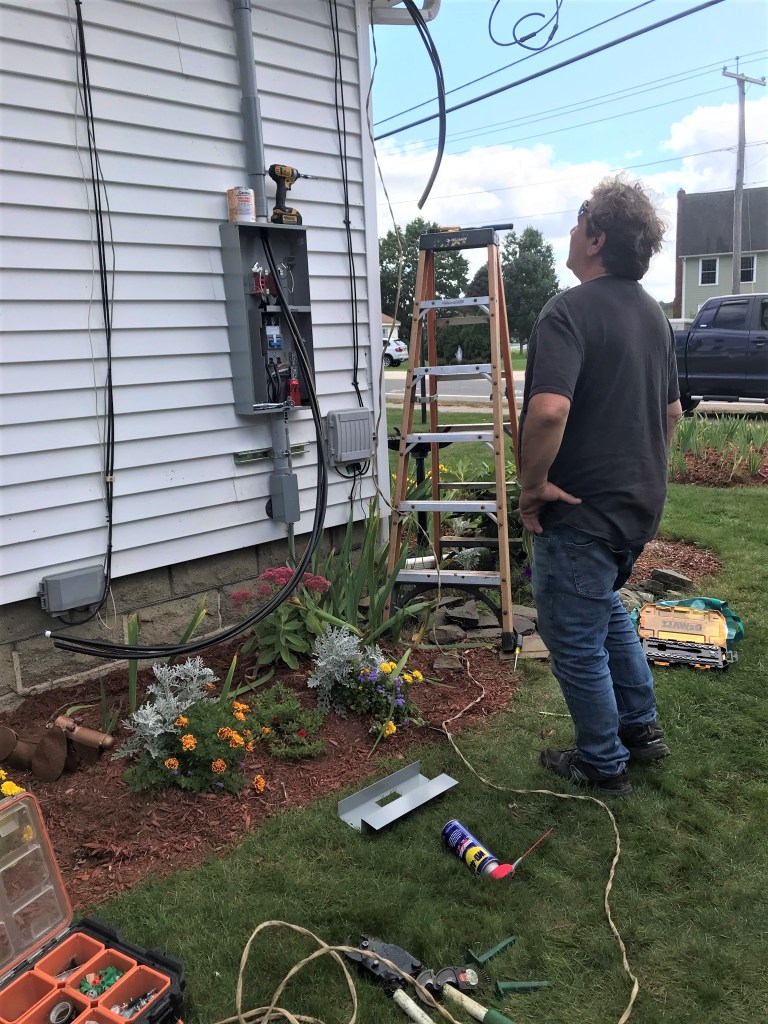
To power the new building, I needed to get the service upgraded from 100 amps to 200 amps. Our electrical service meter and box was in the back of the house over the old (now removed) house deck. Previously, electrical power came from the National Grid pole out front on the street to the house then went along the soffit and into the cellar at the back right-hand corner of the house if you will. The plan was to make this bigger and better by moving the meter and building a new box for it at the front left corner of the house. A new hole had to be drilled for the new power cable, and that needed to be run to a new replacement distribution box in the basement. This work occurred on September 21st.
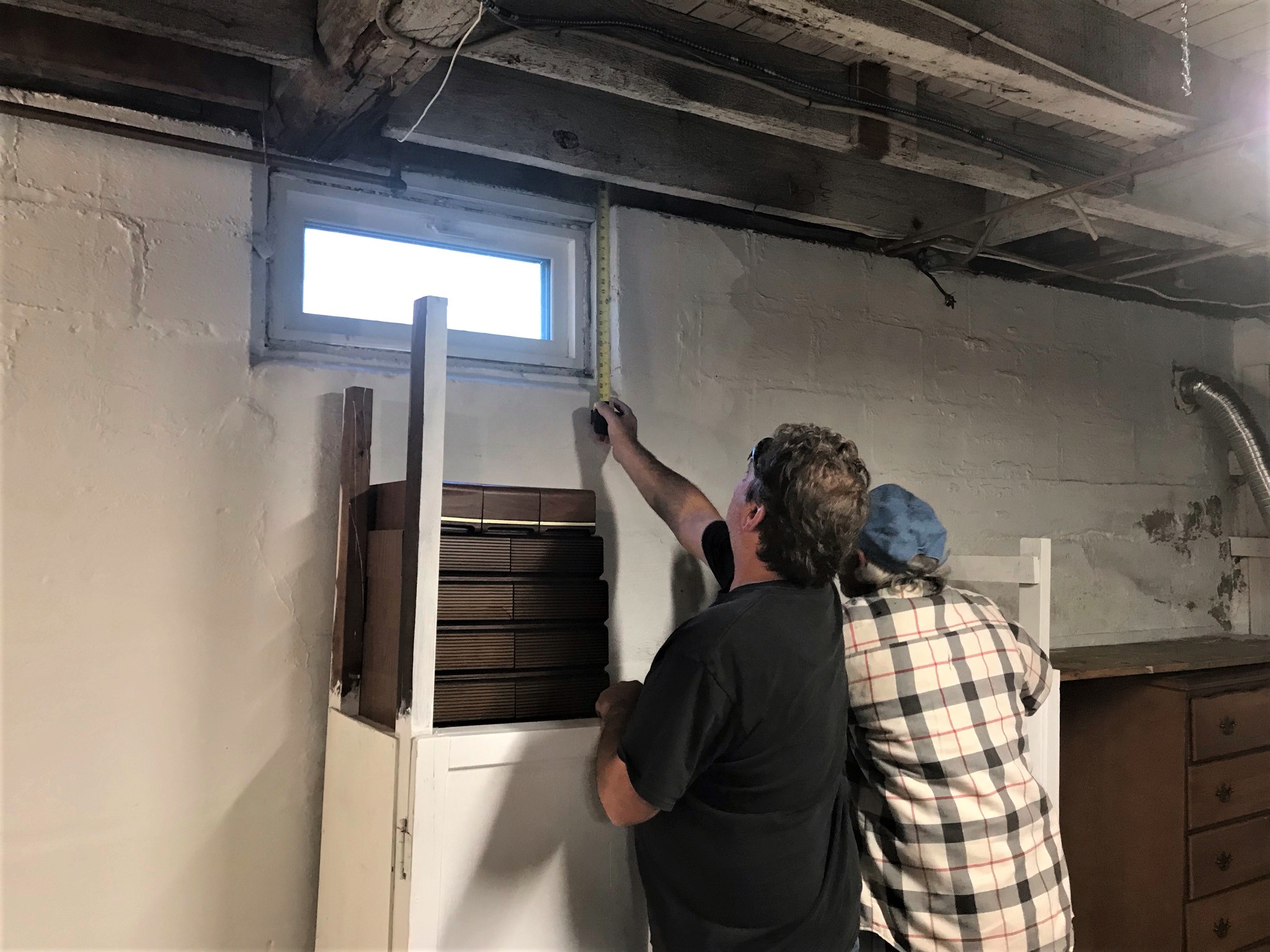
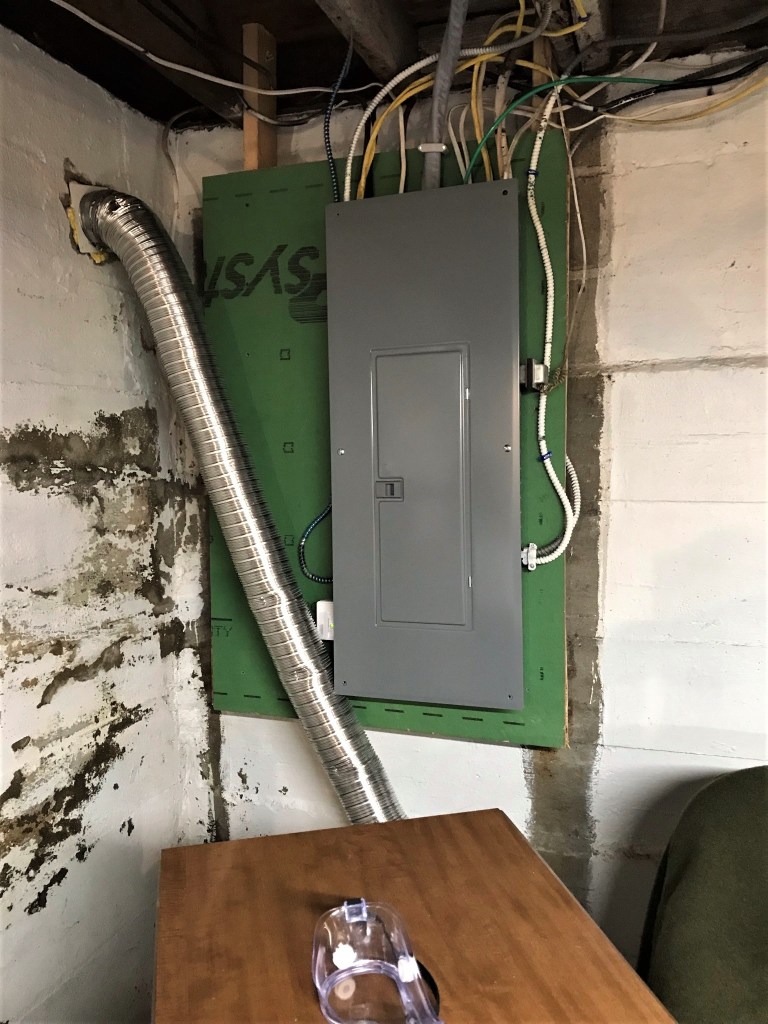
Here you see he old distribution box mounted on whatever lumber the previous homeowner had available – back in the 50’s? 60’s? – to include a piece of trim! We had a series of shelves built by the previous owner long ago (probably 40+ years) along this wall. We had put an old bureau (left over from my childhood actually) under the shelf planking that was attached to the monstrosity that the distribution box was mounted on. The dryer vent snakes up to the wall as you see.Here you see the electricians (Mike and Paul) trying to determine the sill height to drill for the power cable by using the window as a reference for outside. The actual hole would be far to the left. The other end of the old shelving/cabinet that I referred to above is seen here on the wall under the cassette cases (future yard sale items).
Drilling the new sill access.
Heavy duty cable!
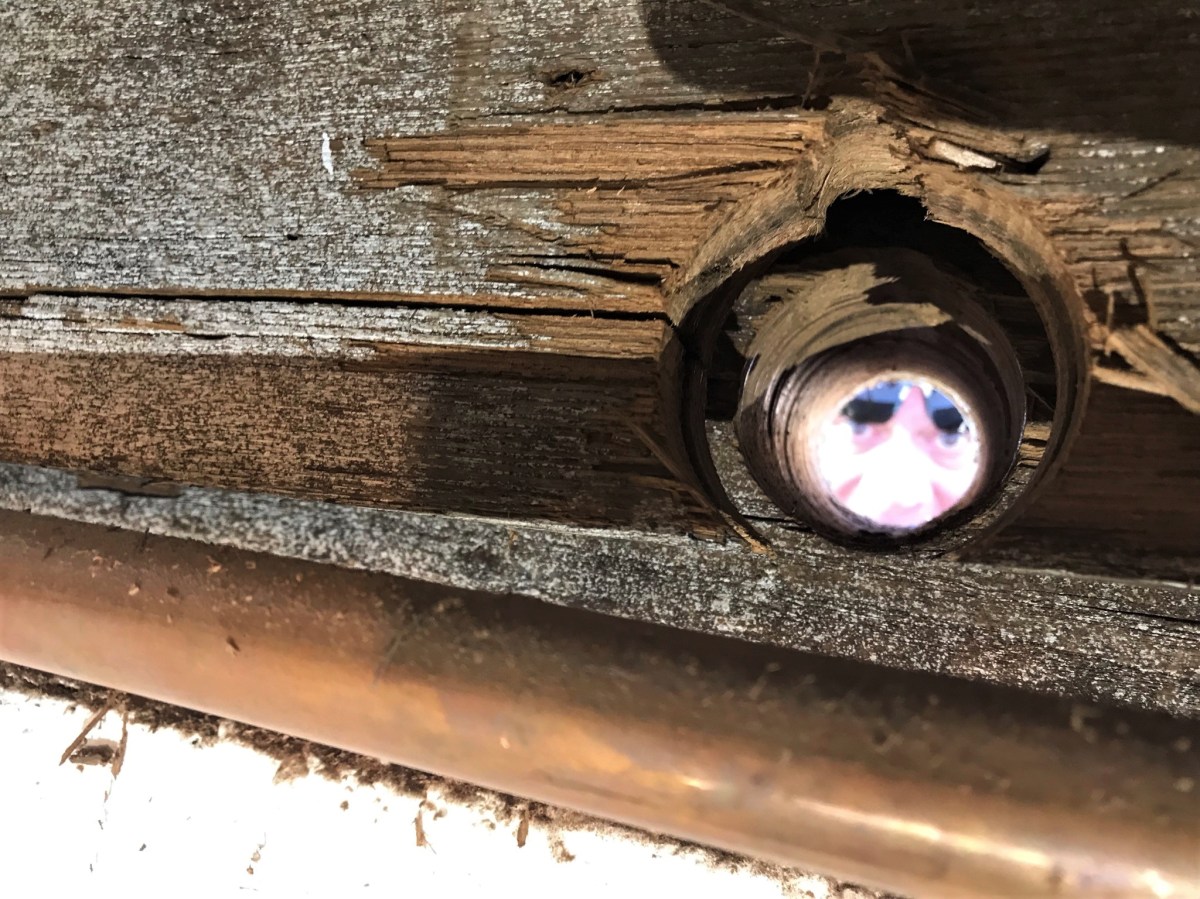
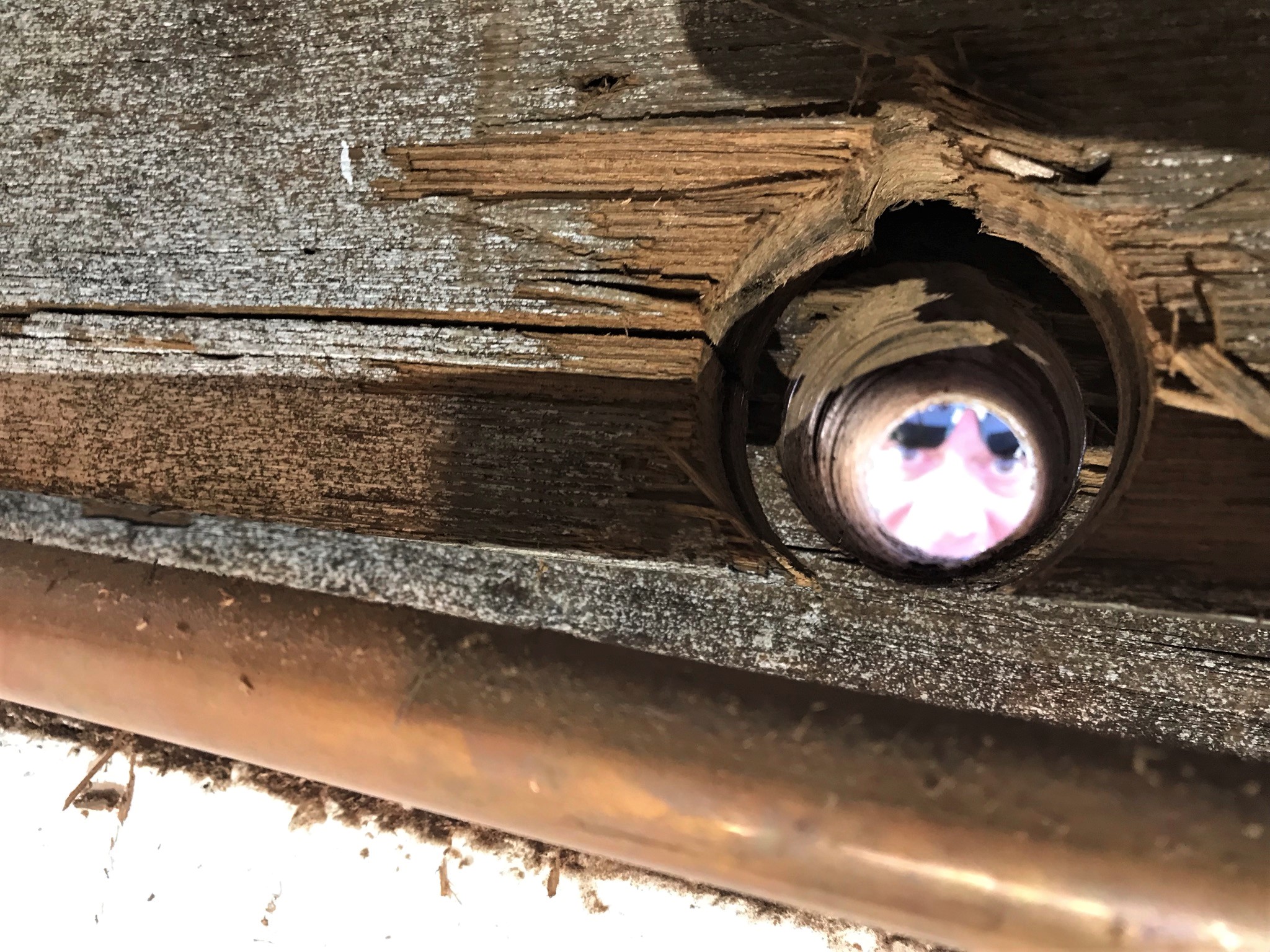
Drilling through the old sill was a bitch. The sill was quite thick – 13″ – and made of solid oak. The hole drilling destroyed two hole saw bits.
The view through the sill access hole from inside. This was 13″ of solid oak. Mike Astrella (electrician) can be seen here peering through the other side.
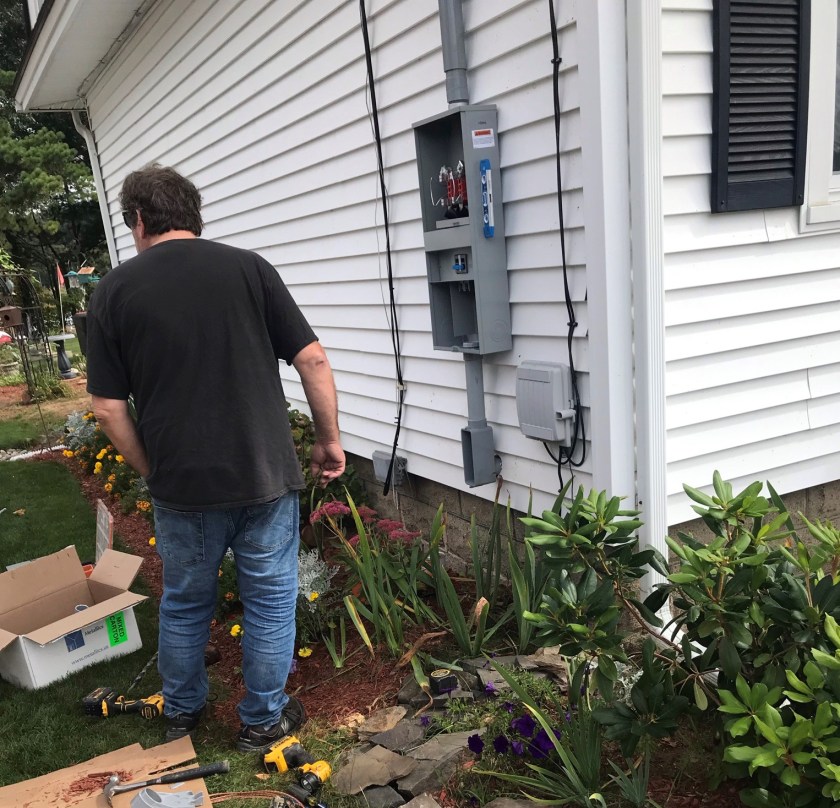
Outside, work went on the new meter box and running the cable and hooking it up to the power grid.
First the box was mounted and secured.
Power cable being pulled through.
Completed. The box on the left is an old Verizon landline box (now removed) and the one on the right is our Spectrum cable line.
Back in the cellar, the old distribution box mounting monstrosity was removed and a new sheet of plywood and some lumber from the garage build was used to build a suitable mount. The new configuration is bigger and we will need to move the dryer to the wall to the left of the distribution box so that the vent hose is not right next to it. But, as we were using the old the shelves I never got around to paint it as you can see – and it looked like hell.
New box.
New distribution box opened.
The inside electrical work . You can see how ugly the flaking paint was.
Also, I need to back up a bit. It had been necessary for me to clear a lane along the wall for the electricians to run the power cable prior to their starting work. After I did that, I got a good chance to look at the wall and the crappy homemade shelving/cabinet. I noticed a lot of old paint flaking on the wall near the dryer vent and some puckering where I had painted the corner in the front left of the house. The puckering was due to efflorescence, not water leaking, even with the excessive rain we have had this summer. An old dry well that I had built over a decade ago in the front left corner of the house was no longer doing its job, so the rain water outside the basement wall was not properly draining – leading to the efflorescence bubbling up behind the paint. We decided that the shelving cabinet needed to go and the wall repainted.
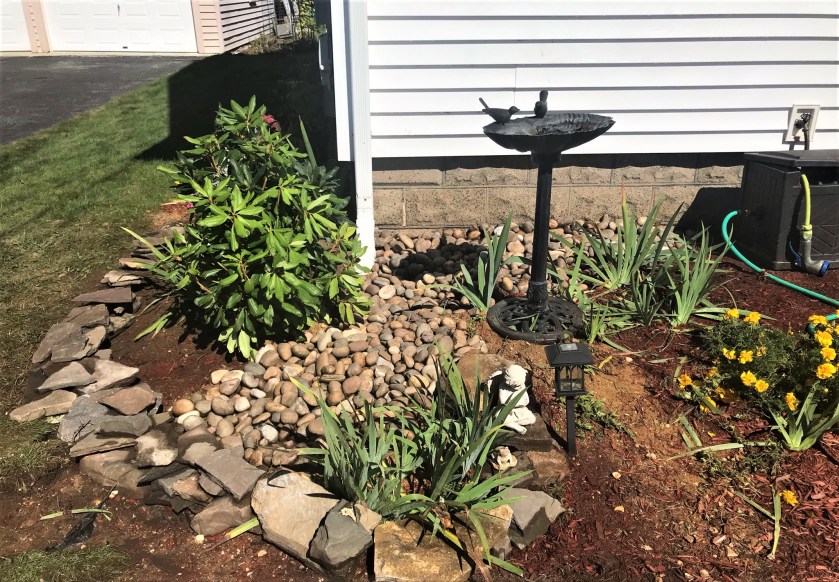
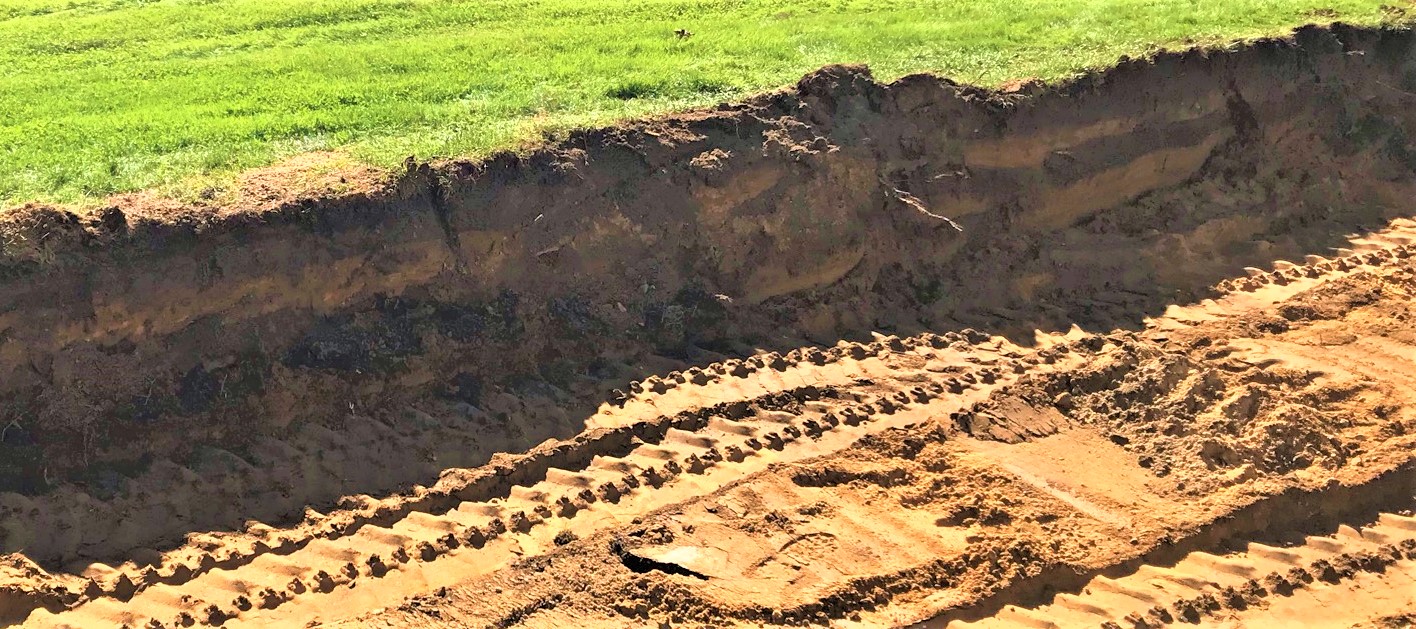
Before I did that, I rebuilt the drywell. When I originally built it, I had dug down about 3 feet and hit sand, so I had then assumed that the soil was free-draining. When I dug this time, I went a bit deeper, and to my surprise I found that there was yet another soil layer under the sand. This one was a loamy clay – that does not drain well. So, I dug down another 3 feet and backfilled it all with sand from the excavations in the backyard. I replaced the downspout extensions and doubled the length. The we covered the area with a filter fabric and then covered that with river stones.
Dry well excavation (would have been a good infantry fighting position)
Repaired dry well.
Dry well repair
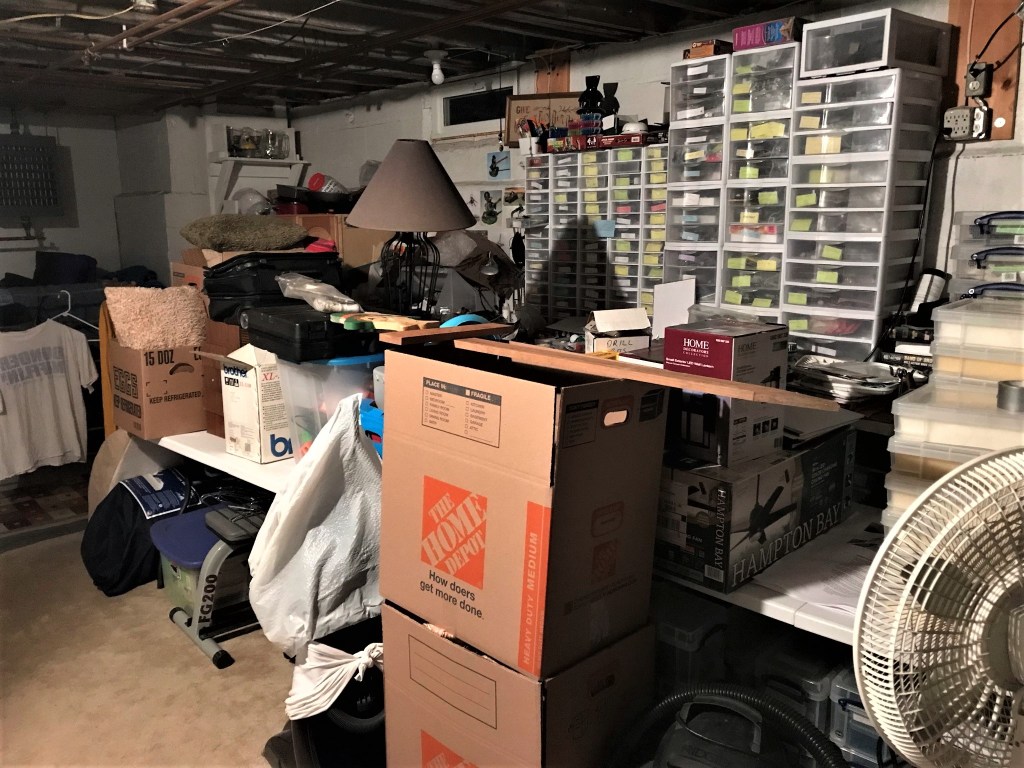
I then spent the time to take down the shelving/cabinet with my wife. She was able to recycle the doors as shelving in another section of the cellar. I scraped off any flaking paint and exposing any efflorescence. Then, I used a mildly acidic product, Drylok Etch, across the wall to clean and prep for painting with bright white Drylok Extreme (both from Home Depot). This took a while, but came out well. We are taking the opportunity to clear out some stuff and have a yard sale this weekend to get some new homes for some good stuff we don’t need anymore. Plus, I can’t do any hobbies as you can see below!
Wall done
Opposite angle on wall
Yard sale needed to get to my hobby bench!
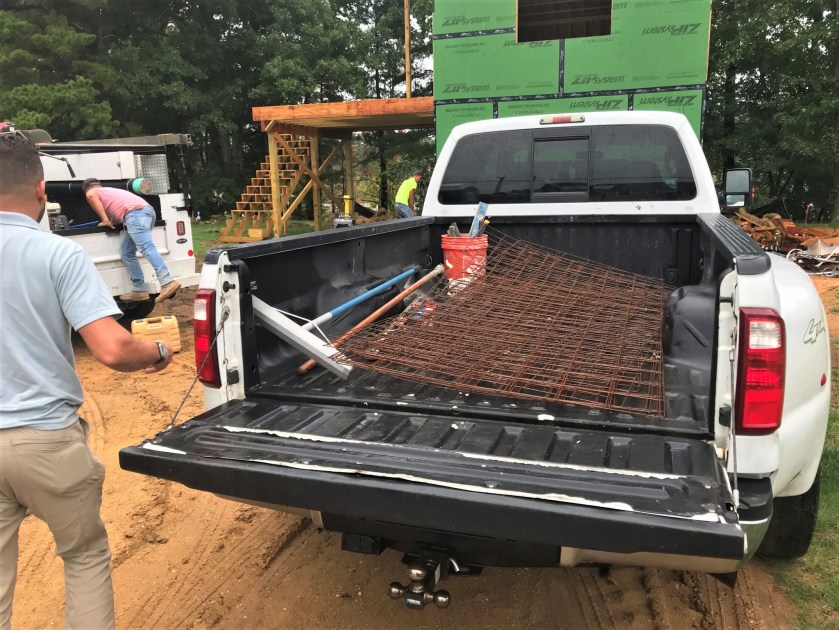
Back in the garage, the septic line was stubbed up in the floor with a cleanout.
A very exciting septic line beginning…
On the 24th, it was time to place the concrete floor in the garage. I say “place” and not “pour” because that was drilled into me in the US Army Corps of Engineers as the appropriate terminology – and that stuck.
Prepping the garage door entrance for concrete.
Steel!
The crew arrived early and was ready to go.
Installing the vapor barrier (ok a sheet of plastic over the compacted sand).
The plastic is secured, and the steel is wired together.
Placing steel on vapor barrier.…the concrete truck chute cannot extend far enough into the garage.
Evandro cuts a slot.
And on the other side..
…et voila, access!
Getting access for the concrete truck.
This was no problem as this plywood will be removed eventually when the door is installed.
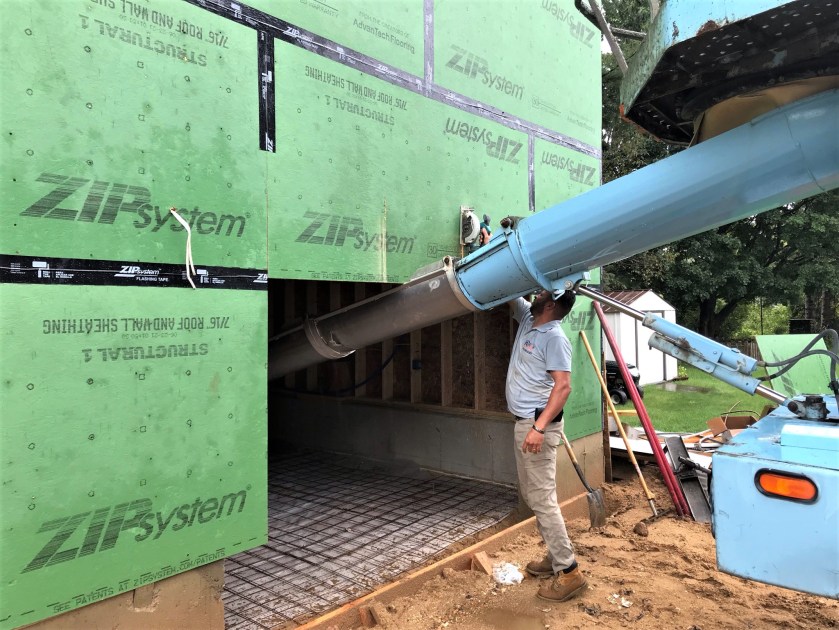
Concrete truck delivering.
Working the concrete.
Then the sky opened up…
…necessitating a temporary rain cover.
Final finishing.
Concrete work.
Because of the many rain days, Andy Cormier arranged to get help to finish off the septic line installation.
Finding the tank!
Line ready for backfill
View towards the tank.
Septic line work.
Ready for backfill.
Having the septic line in the ground and attached to the septic tank allowed for its backfilling as well as work to proceed on the driveway excavation.
On Monday, September 27th, Lynn and I participated in the annual West Point Society of New England’s annual charity golf tournament, along with our friends, Lisa and Jim Kularski. This year, the beneficiary was Homes for our Troops. It was a nice break while construction work continued.
Me, Lynn, Lisa, and Jim. The sign is a hole sponsorship I did for the charity event.
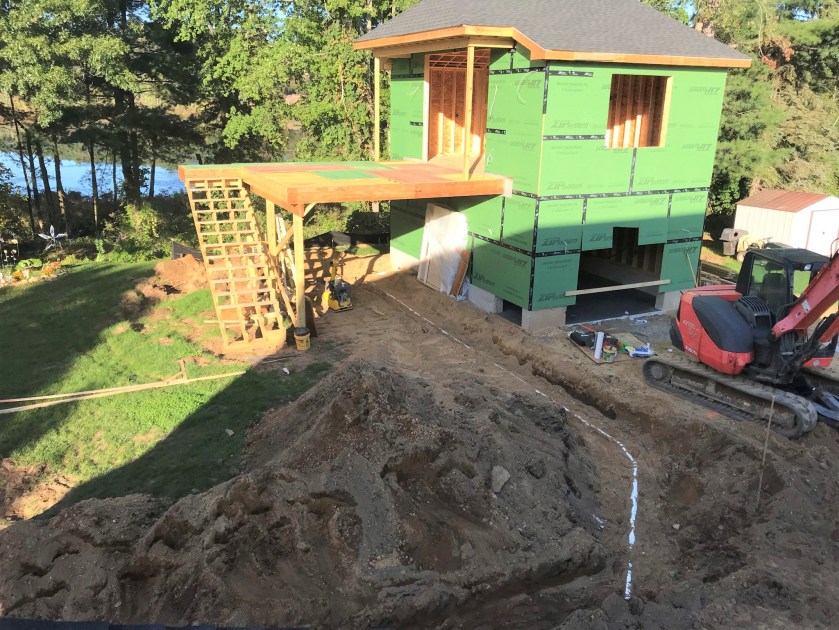
When we returned home, there was a lot of dirt moved around. It turned out that the soil under the driveway had the same layering issue that I found in my dry well excavation – so a lot had to go, and be replaced with clean fill.
Excavation showing the soil cross sectionBetter view of the soil layers.
Most of the septic line was backfilled.
Of course, Tuesday the 28th brought yet more downpouring rain. Therefore, earthwork and any other work could not happen. We only got a delivery of deck material for the house deck.
Deck lumber delivery.
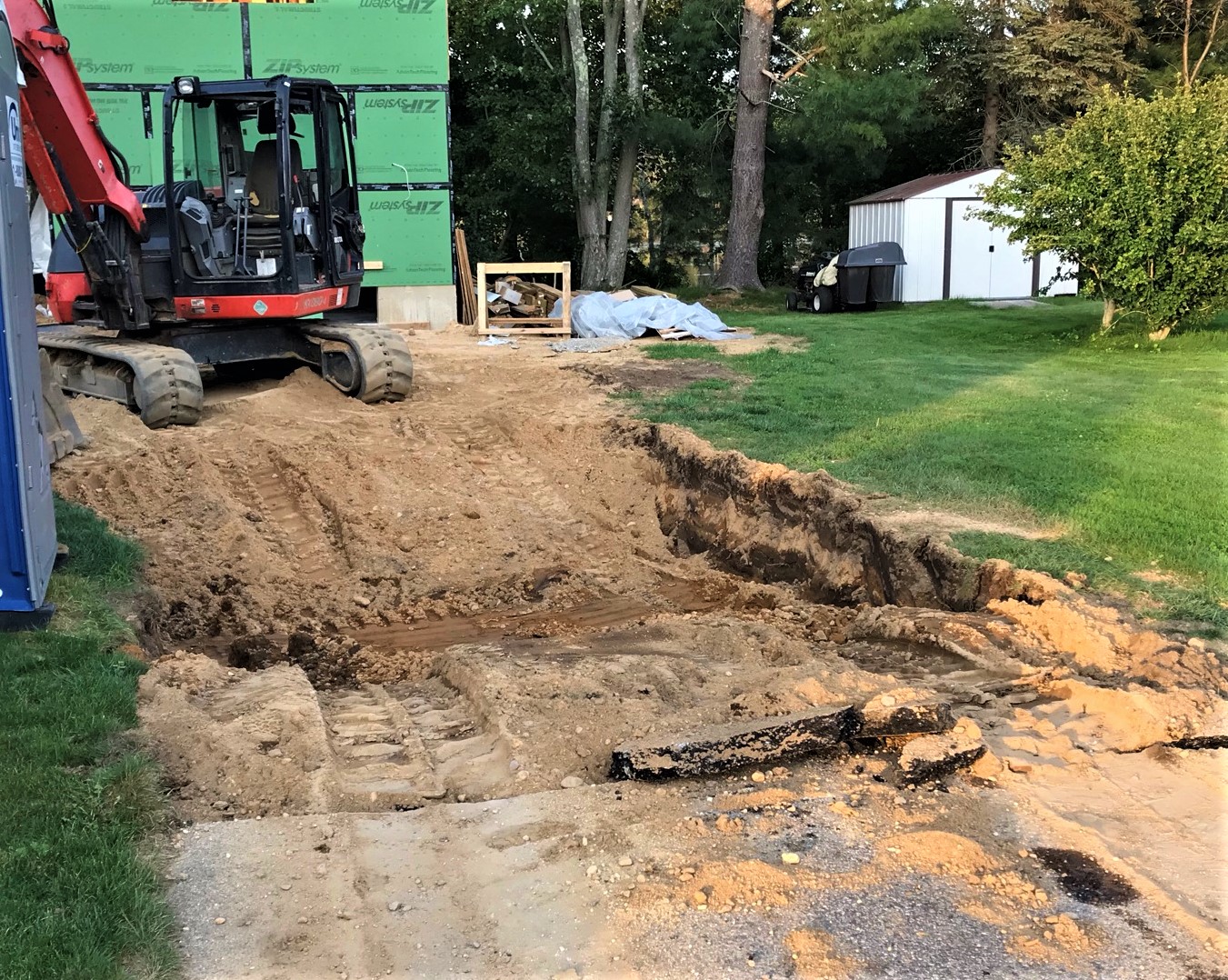
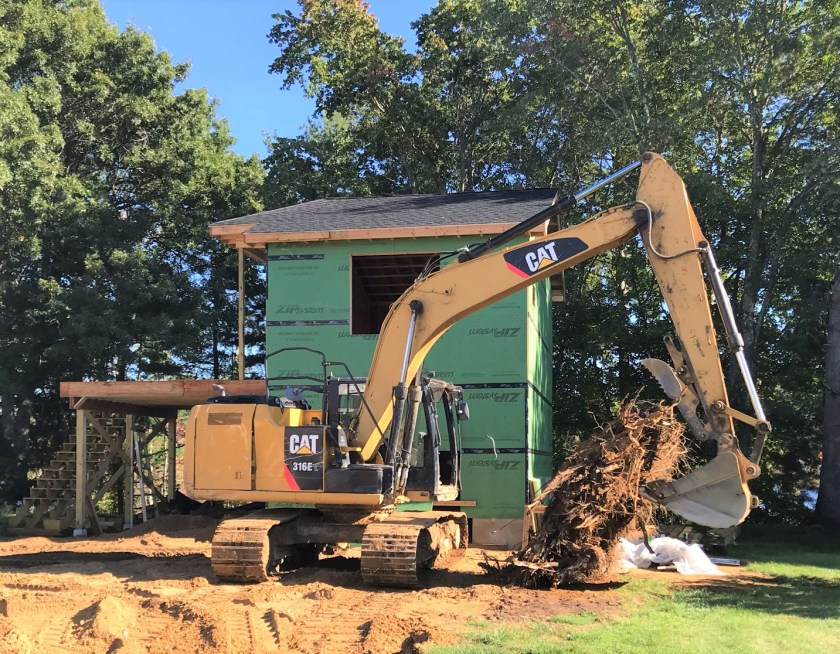
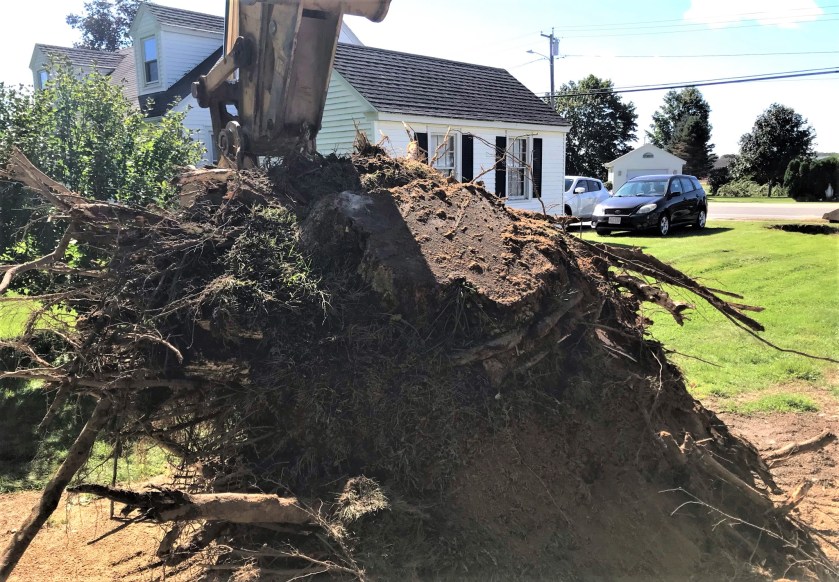
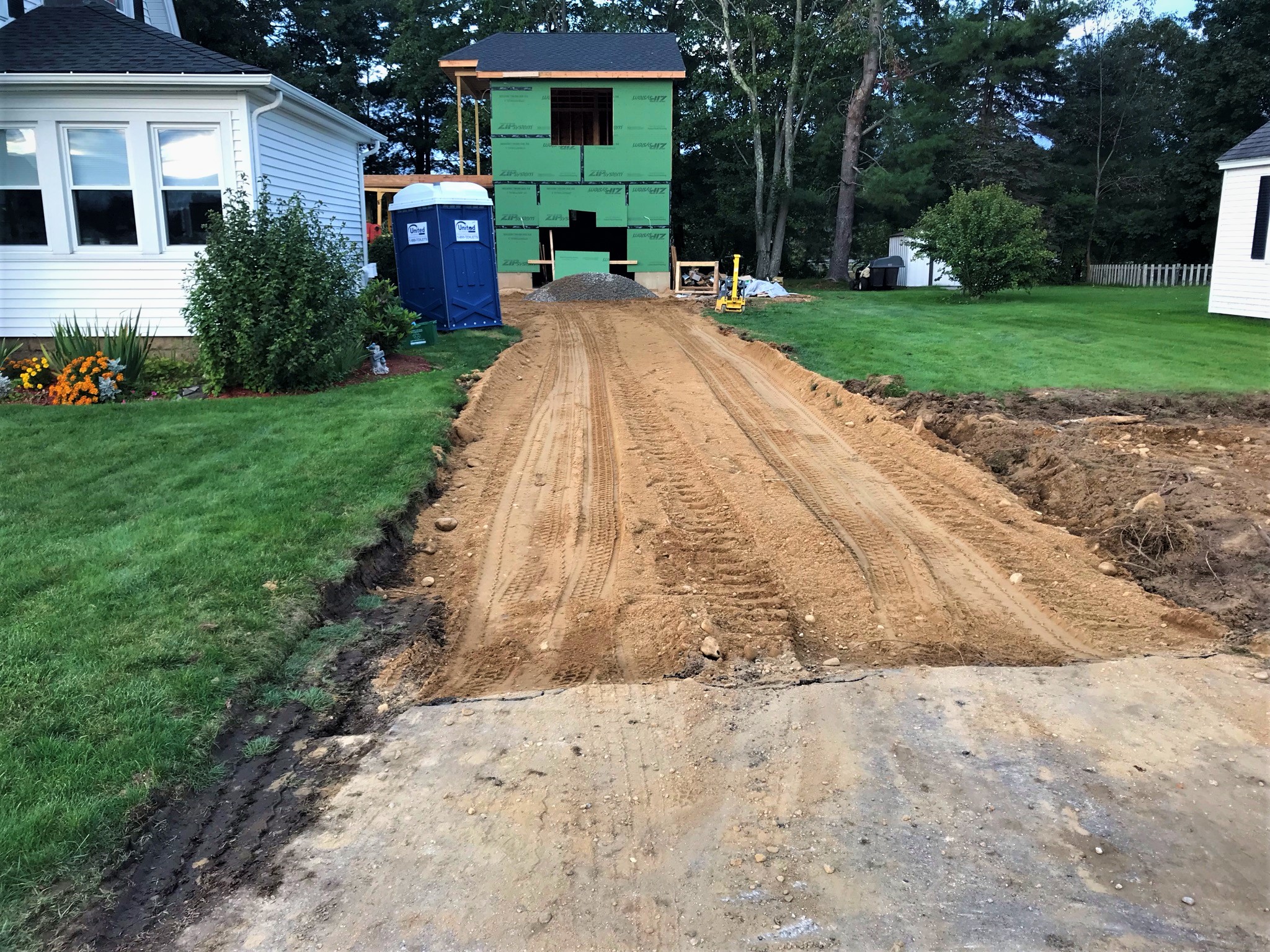
On Wednesday the 29th, the skies cleared and work could proceed. The driveway was excavated and brought to grade. Old asphalt, and interfering roots and stumps (including a 4-5 ton maple tree stump) were removed in this process.
Asphalt removal
Massive stump!
This was a huge stump with a lot of roots under the old driveway. Andy had to bring in a bigger machine to take care of it.
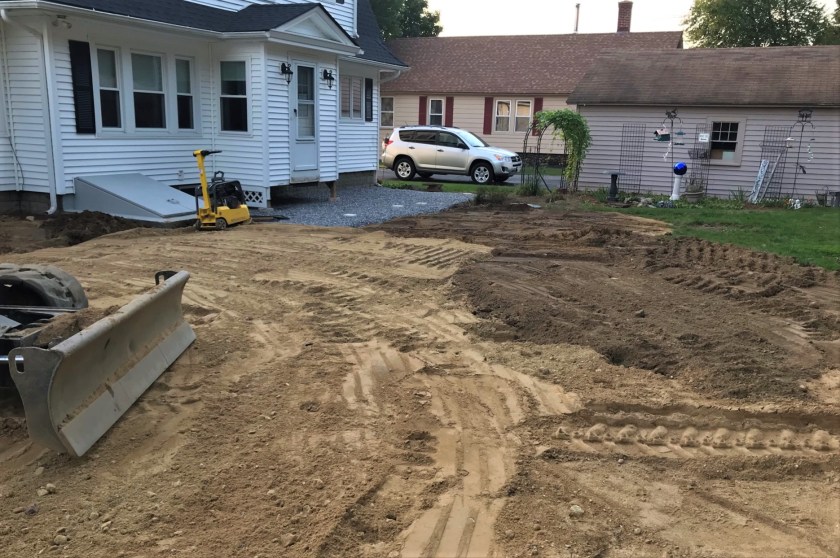
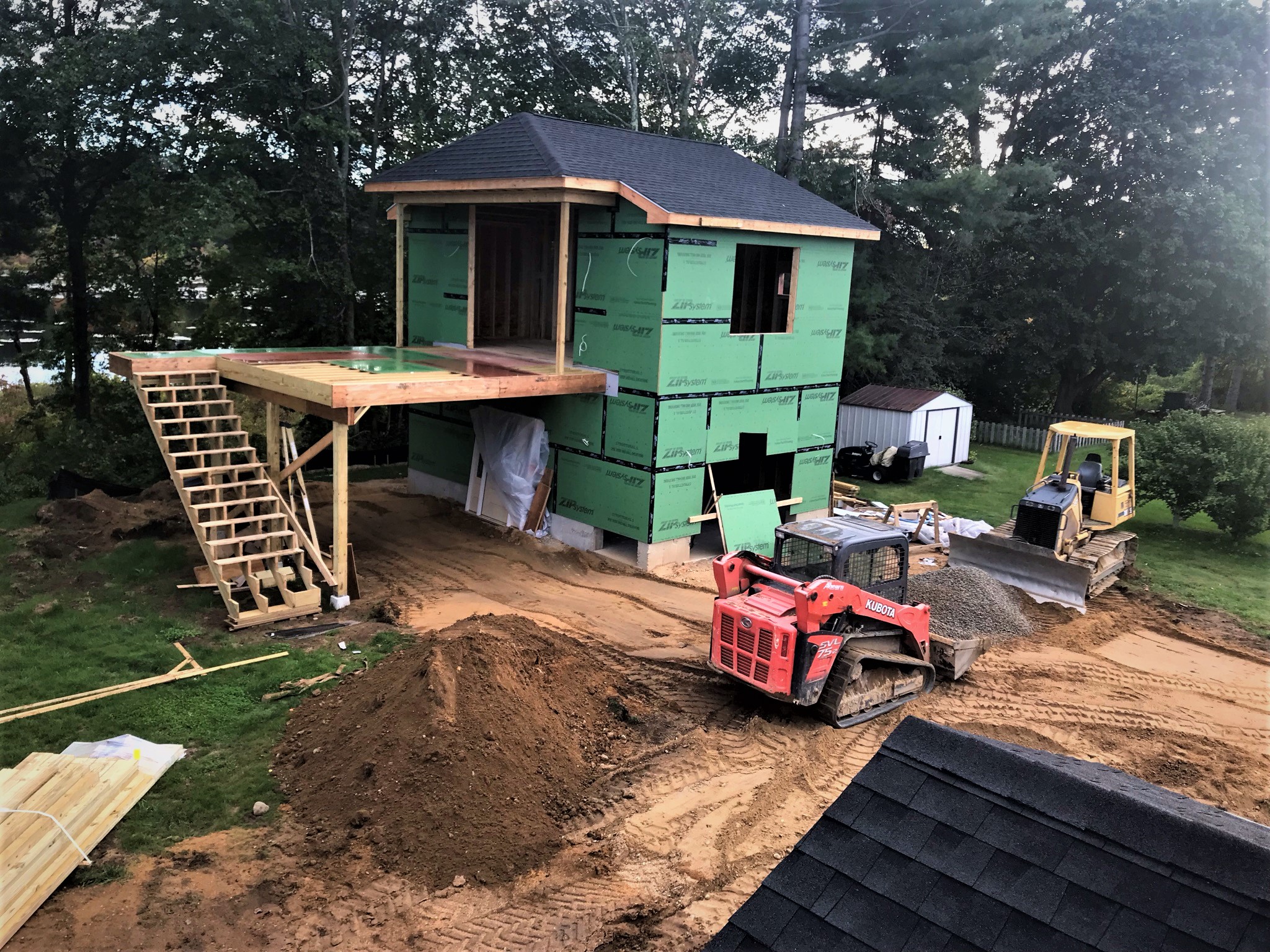
At the end of the day, the driveway was filled, and all the holes were filled in.
Driveway base in.Top view.No more stump.
The next work skipped a day (rain), and that involved the framing of the replacement house deck. This was October 1st. Jonny also got ready to install the rain gutter system for the garage deck.
Jonny prepping for the under-deck rain system installation.
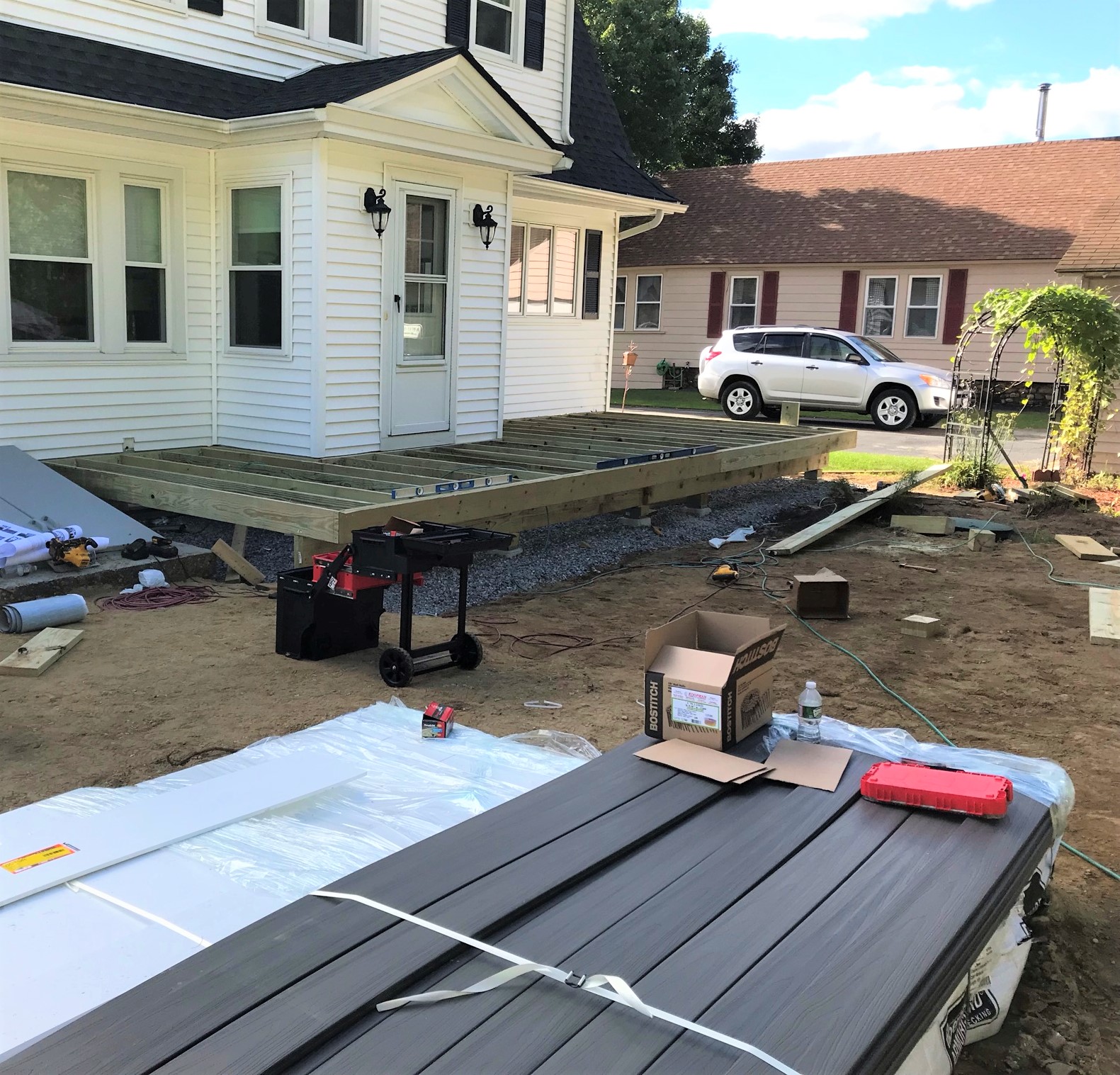
House deck framing begins.
Deck framing on October 1st.
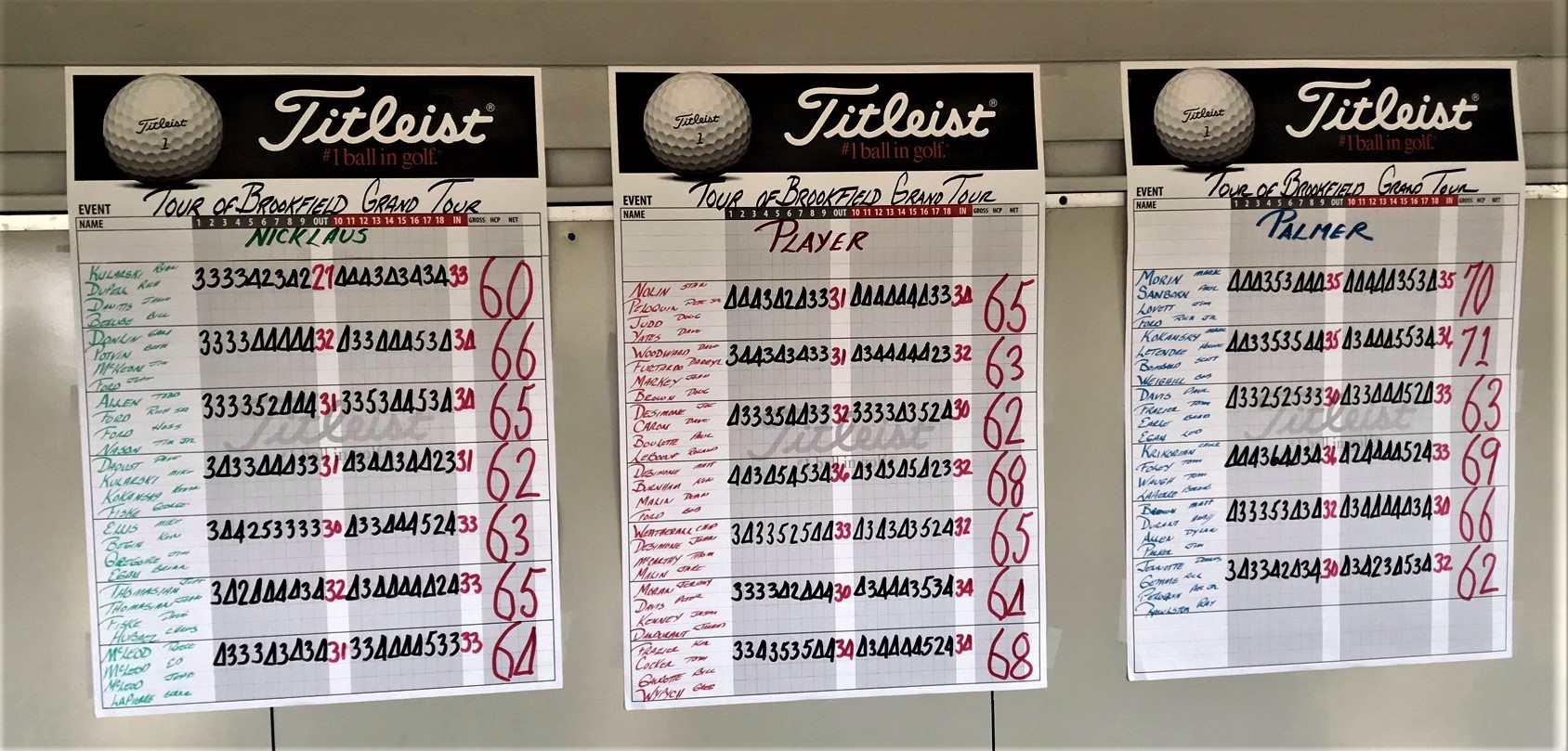
To make up lost time to rain, work continued on the deck on Saturday the 2nd. This weekend I had not one but two competitive golf tournaments. The first was on Saturday which was the Finals of the Tour of the Brookfields. If you are on Facebook, the group link is here. I am a member of the committee. My team was in the lowest division, but we did not come in the top three. Still, congrats to the winners!
Better luck next year.
After the tournament, I returned to see progress on the house deck.
Saturday progressDifferent angle view.
So, a lot of progress was made over the two weeks!
(Lastly, I previously mentioned a couple things that I need to circle back to – the first being the Sunday Founder’s tournament at Quail Hollow Golf and Country Club (where I am a member). This was an individual event and I played better, but not well enough to be the winner (only one male and one female winner out of dozens of players so no big deal). However, back during the annual club championship (a two-day 36-hole tournament of individual medal play from the back tees) on July 31-August 1st – I was able to play my best golf of the year (98/88 for a net 2 over par for the event) and win the D flight against 11 others. So Sunday, I got my reward.
In my office!
What you see here left to right is a comic statue that belonged to my grandfather Marcus (a WWII vet who gave me a love of golf), my unlucky conquistador “Franco”, my trophy, and as it’s October, my Halloween mini-diorama with Ral Partha 25mm figures of classic monsters from the 30’s Universal Studios movies.
Ah, but I digress – week 12 is well underway and I will have much more to share. I hope that you enjoyed this and thanks for looking!
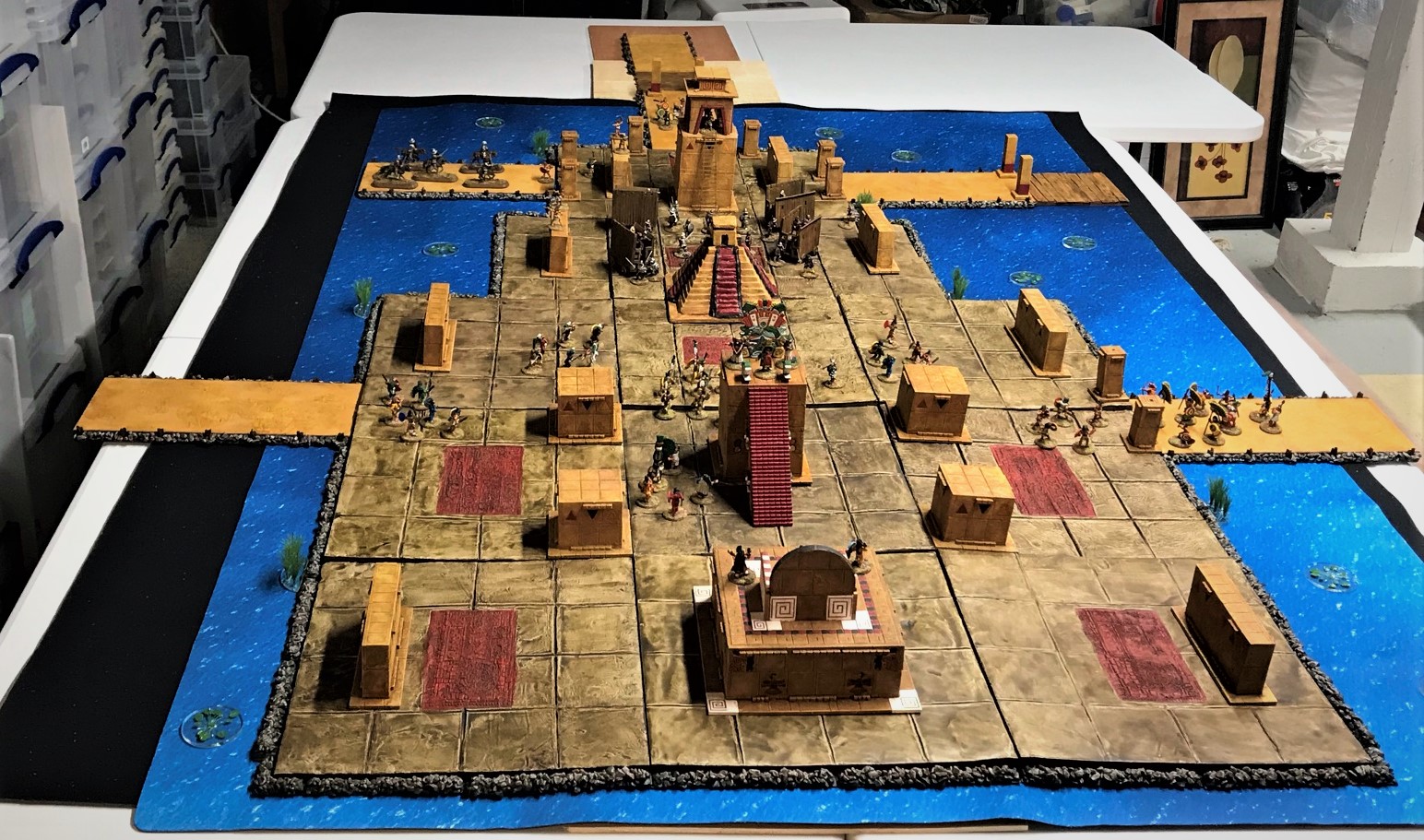
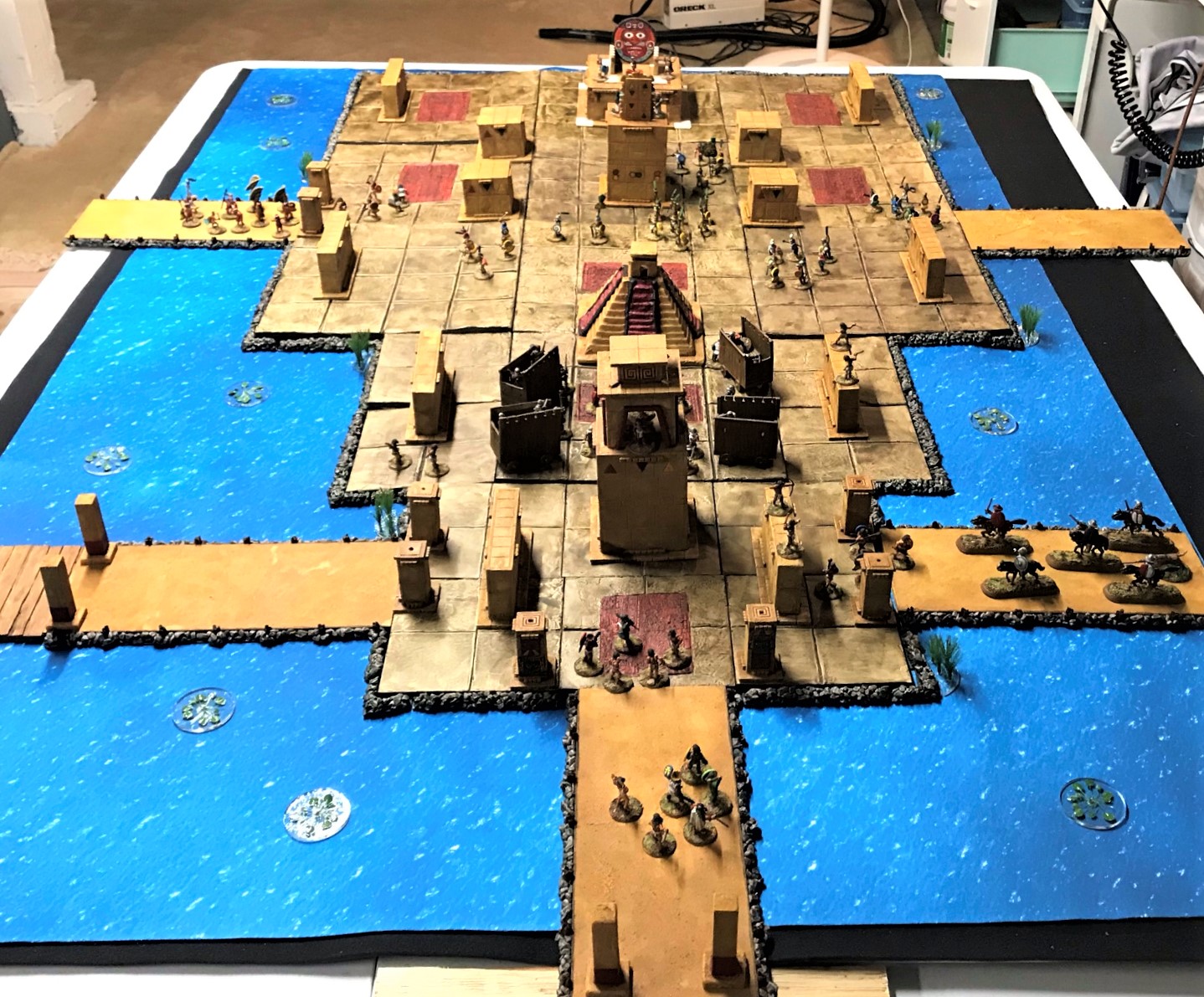
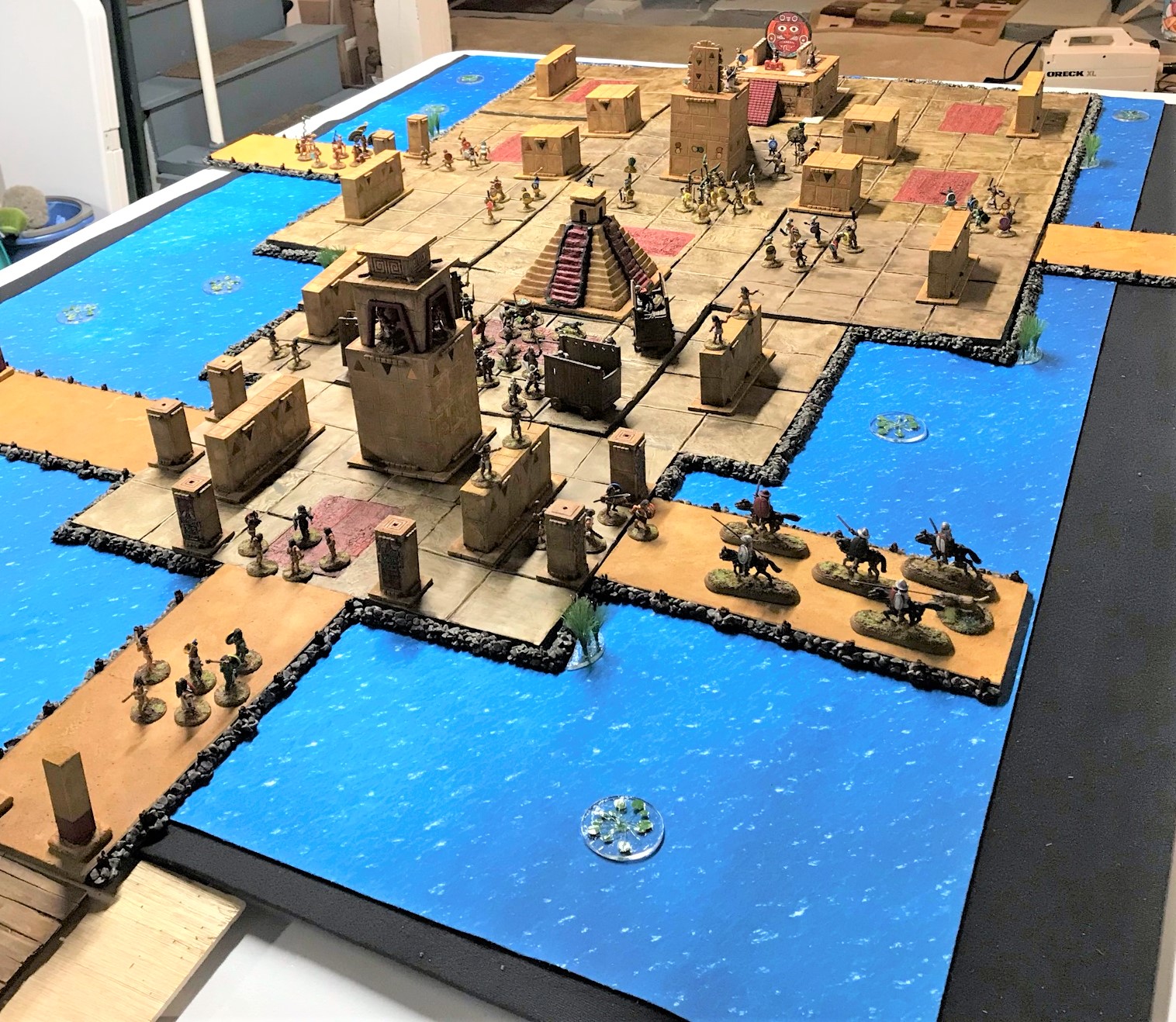
Yes! It’s finally time for the FINAL REVEAL of my Aztec cityscape. It’s been a labor of love – to recreate this tabletop for gaming. What game you ask? Why of course – Buck Surdu’s Feudal Patrol™! I wrote the gaming supplement for Feudal Patrol™ games during the period of the Spanish Conquest. The supplement involves the Conquistadores, the Aztecs, the Tlaxcalans (and more Mesoamericans who fought the Aztecs), the Maya, and the Inca (in South America). I called it Civilizations Collide, and it’s a free download from Buck’s website or from Sally4th in the UK. If you have not checked this excellent game out – do it!
This is Part 5 of my series on “Building an Aztec Cityscape”. There are a lot of background history and WIP details in these posts that for brevity I won’t repeat here. However, if you have missed the other parts, they are listed below with their links:
Building an Aztec Cityscape – Part 5: Tenochtitlan – THE FINAL REVEAL (this post)
As for wargaming the period of the Spanish Conquest 500 years ago, I want to be clear. It was brutal to be sure, and as I have stated often, there were no good guys on any side. I did not aim to glorify any aspect of the time, but to raise awareness and knowledge of it through wargaming.
From the start of this project, I wanted to create a unique and hopefully stunning tabletop for these games. I had a vision of creating a nice cityscape – an encompassing panorama that I had not seen anyone else do at any convention. Also, the cityscape needed to facilitate a fun gaming experience, so visually, I felt that had to go big. I had already painted 230 figures for the period. I had built many buildings too. Therefore, I wanted something that had the “flavor” of Tenochtitlan. However, with the tabletop designed for 28mm skirmish figures, (about 1″ tall), building a true-to-life and historically accurate Tenochtitlan would have required a gymnasium-sized playing area. I have seen stunning photos from SALUTE in the UK that were for 15mm gaming, but that scale went far beyond what I envisioned – or what was feasible for me. For travel to gaming conventions, the cityscape needed to be able to be broken down and transported easily. It needed to be useful for multiple games. This post will reveal my solution, for better or for worse.
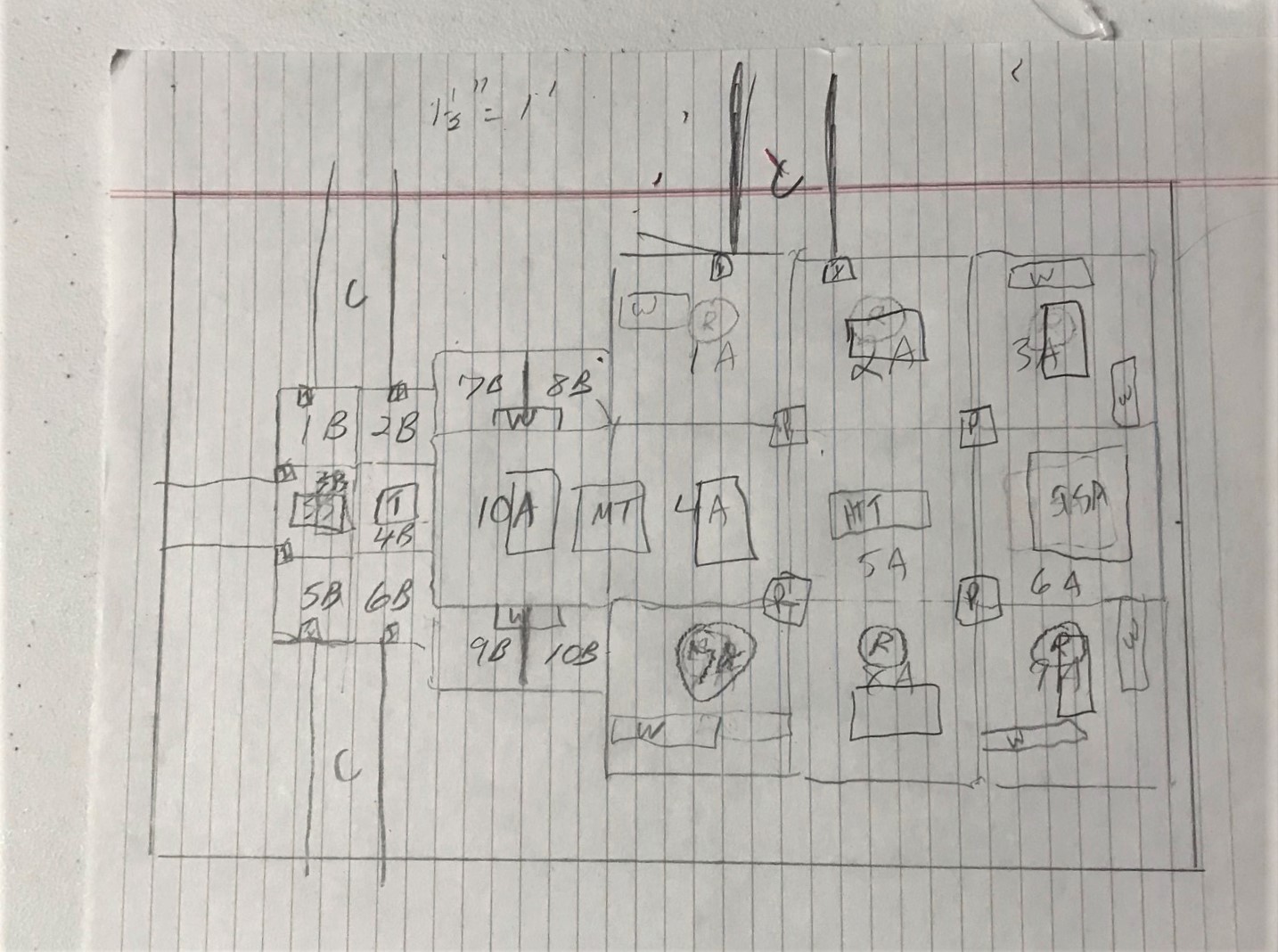
I started out with historical research into several sources, and thinking about what I wanted and what I could do. After I had my initial concept, I then refined it into the two plans that I put on paper below.
First rough draft of the plan.Then, I refined the plan.
The previous posts describe in more detail how I got here. So, let’s show some eye candy – and I will be posting on the Combat Patrol Facebook page and sharing a link to my IGTV page where you can view a video of the cityscape.
Here I set up some figures on the cityscape – many of these images were shown in previous posts – but here you get to see the whole thing!
Ta daa! Click on the images for a bigger view.End view – the mat is from FLG.Opposite lengthwise viewAngled view from the end.
As before, this is DEFINITELY (I think anyways) my last entry into Dave’s Season of Scenery Challenge! Thanks Dave for running the challenge and letting me be part of it. At least it’s the last part of the cityscape posts.
I also want to especially thank my wife for tolerating this bit of my madness. And of course I thank my old West Point comrades Buck Surdu and Dave Wood, Greg Priebe, Chris Palmer and the HAWKS, Chris Abbey at Sally4th, Dave at The Imperfect Modeler (especially for the chinchilla dust tip), GED at Gringo 40’s, IRO (for inspiration), Joerg Bender at Things From The Basement, the Uxbridge Historical Gaming Club and the Mass Pikemen Gaming Club.
A SPECIAL THANKS TO ALL the bloggers listed below who have taken the time to encourage me over this project. I am indebted to you all – you kept me focused, and motivated.
I’m not an award-winning videographer – but I hope that you enjoy the video.
What’s next? I will be going to my first HISTORICON and bringing both my cityscape and my rural tabletop. I will also be adding the two naval types (brigantines and war canoes) to the next version of my Civilizations Collide supplement – along with new scenarios and scenario-specific rules. I hope that you will like these. Yes, I have more work to do!
Please let me know your thoughts in the comments section – and thanks for looking!
For all of my previous posts on games, units, and other projects for my 16th Century Spanish Conquest supplement for Feudal Patrol™ – “Civilizations Collide” – please see this page.




















































































 Mark A. Morin