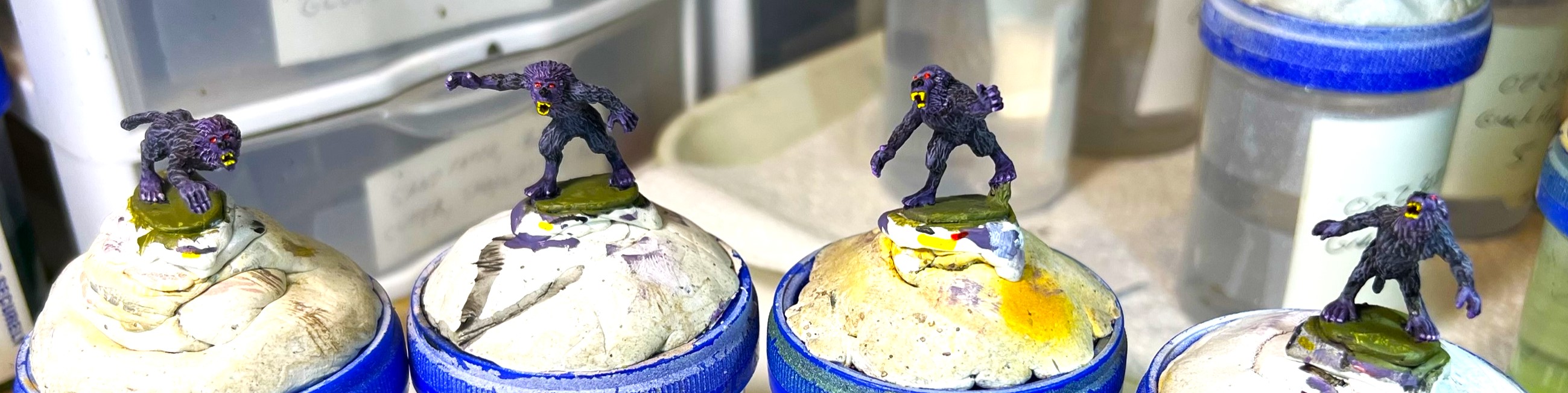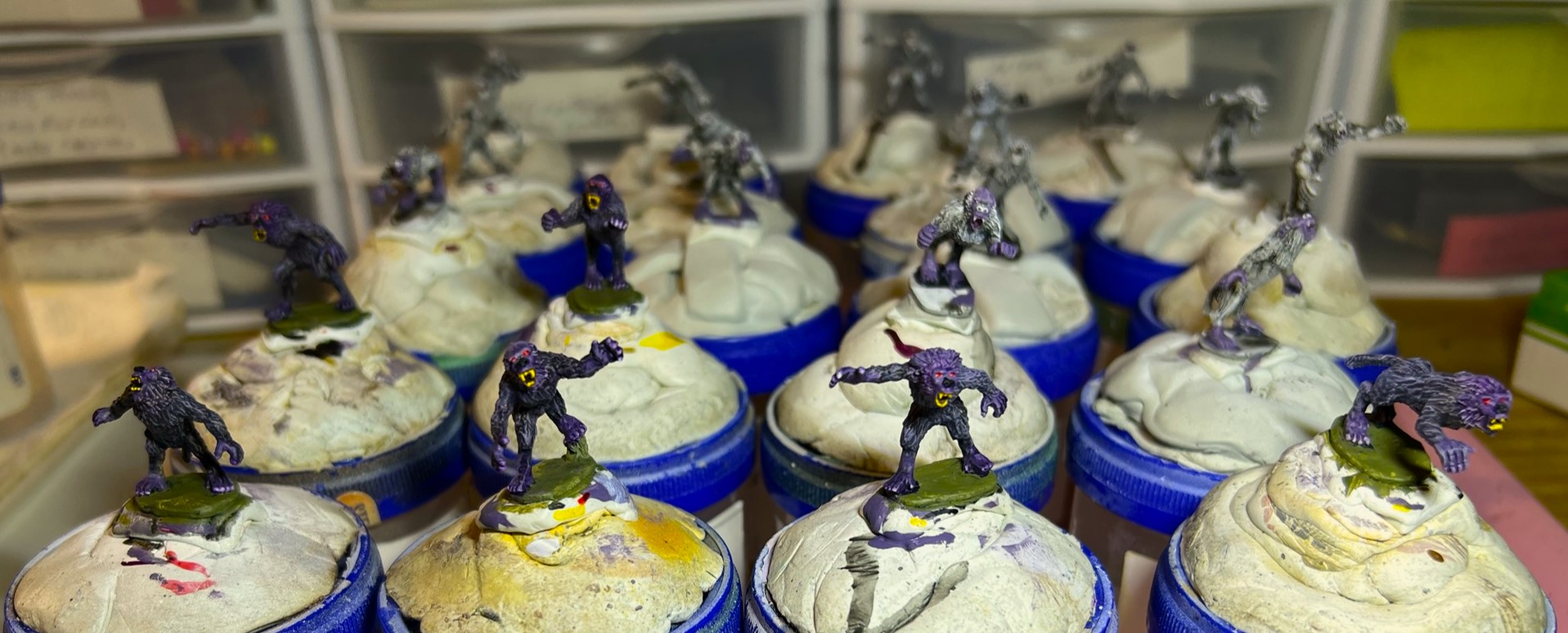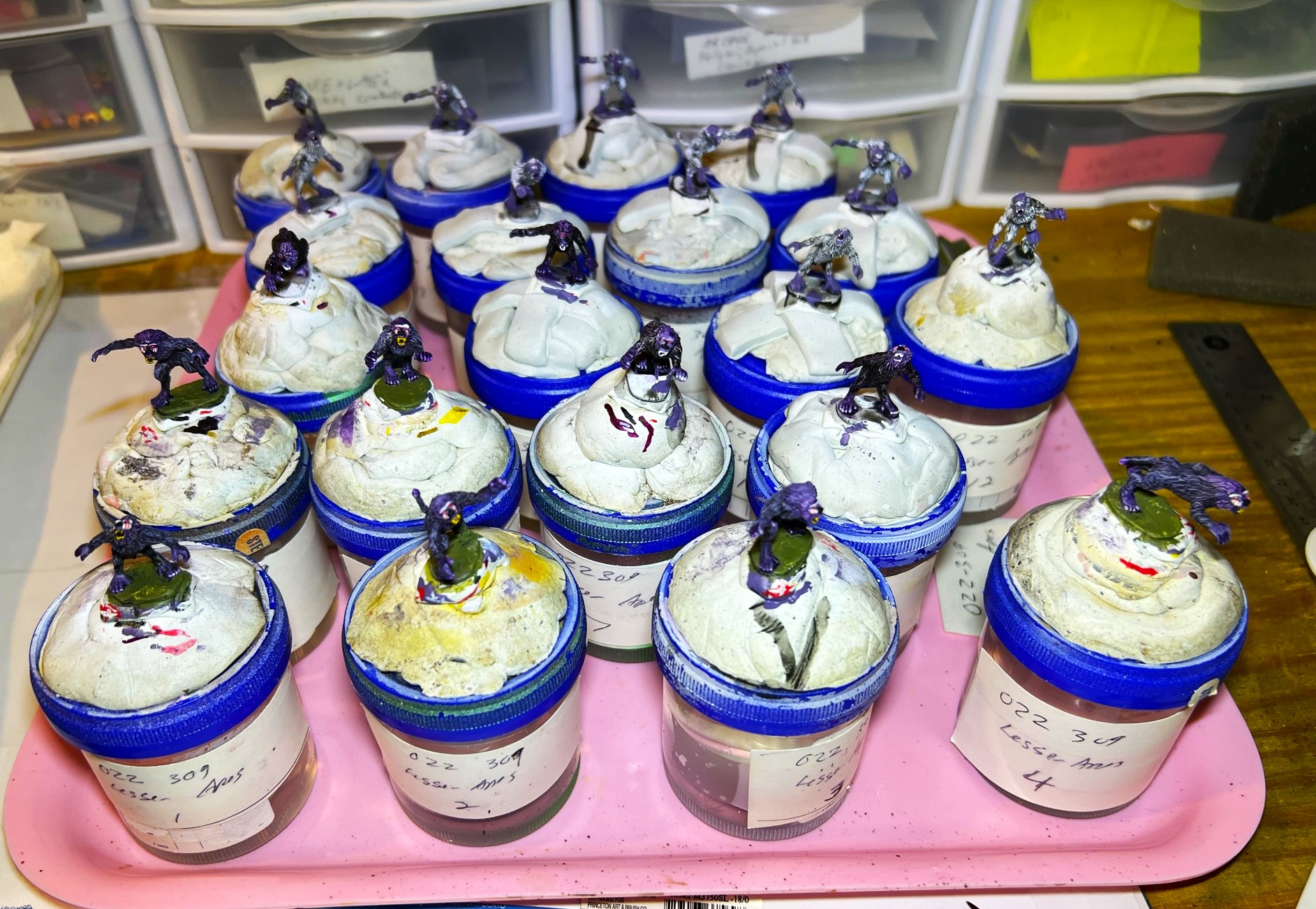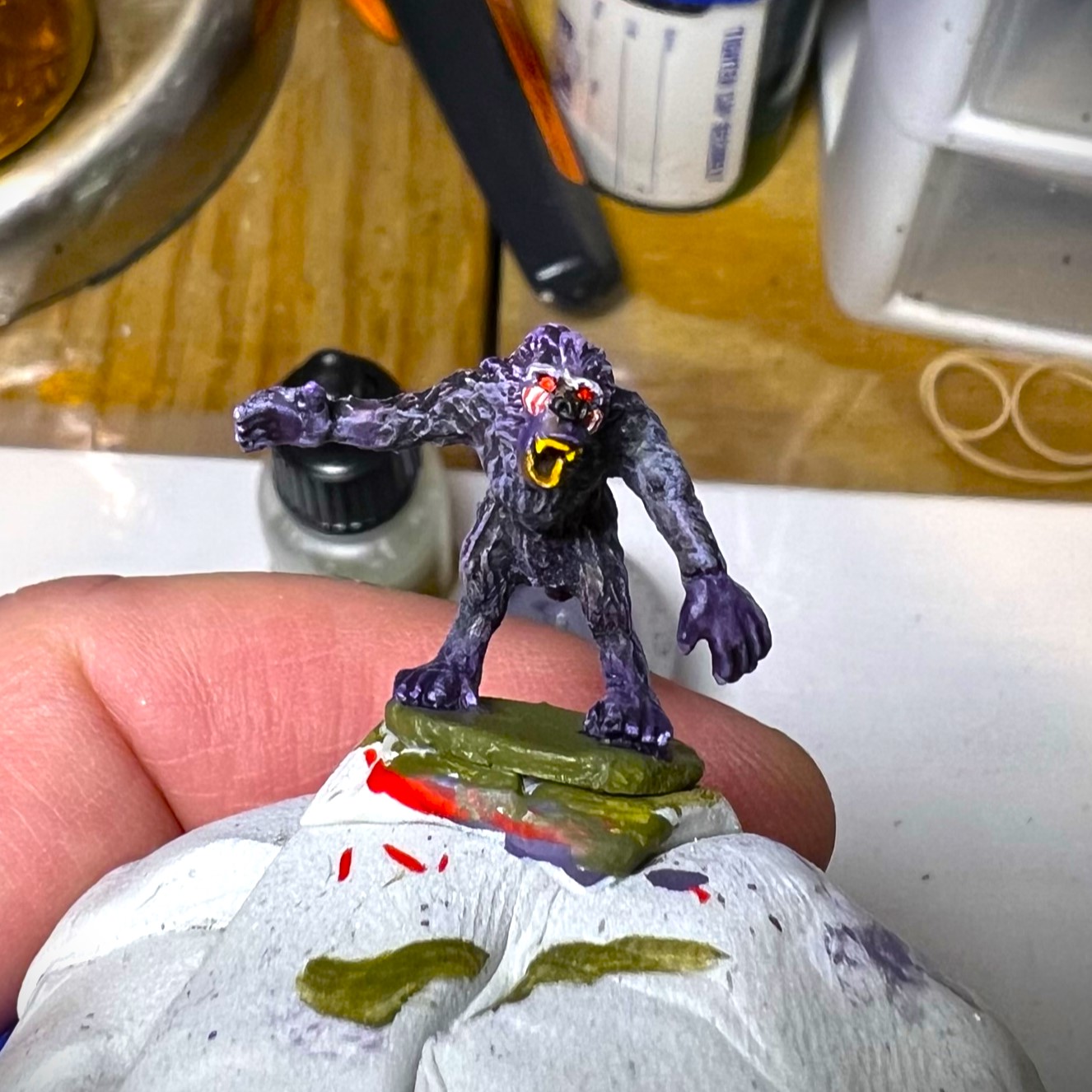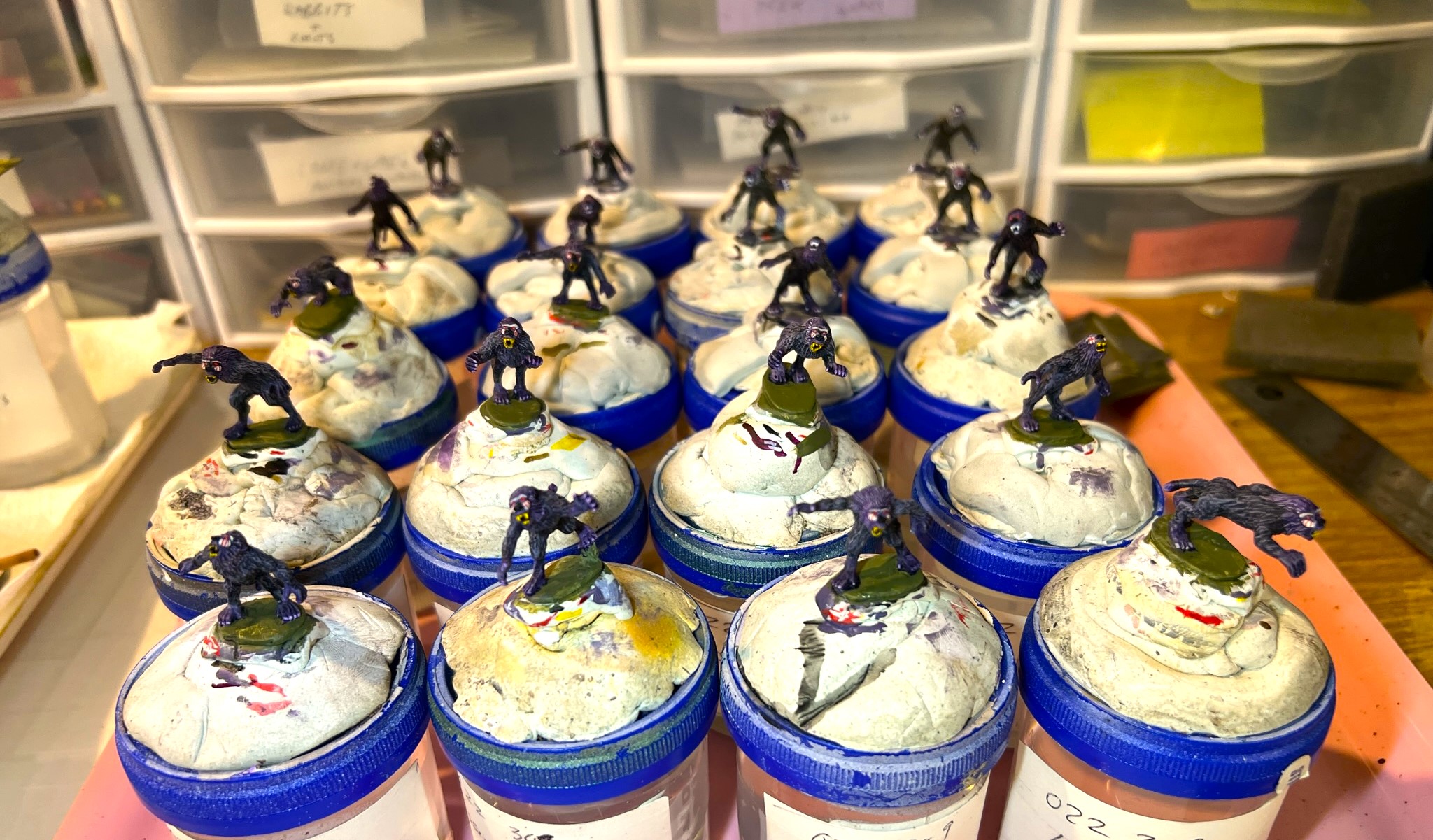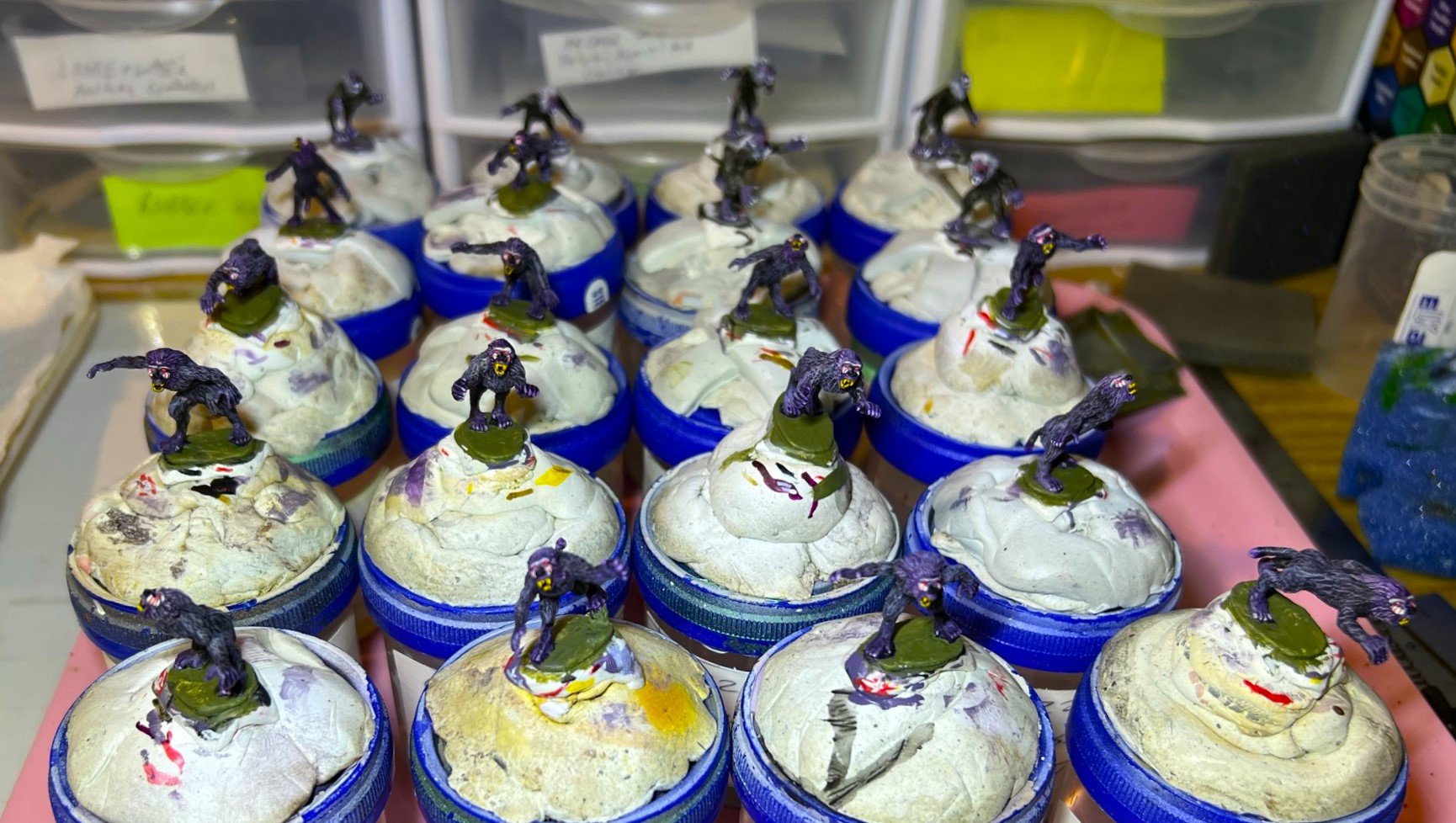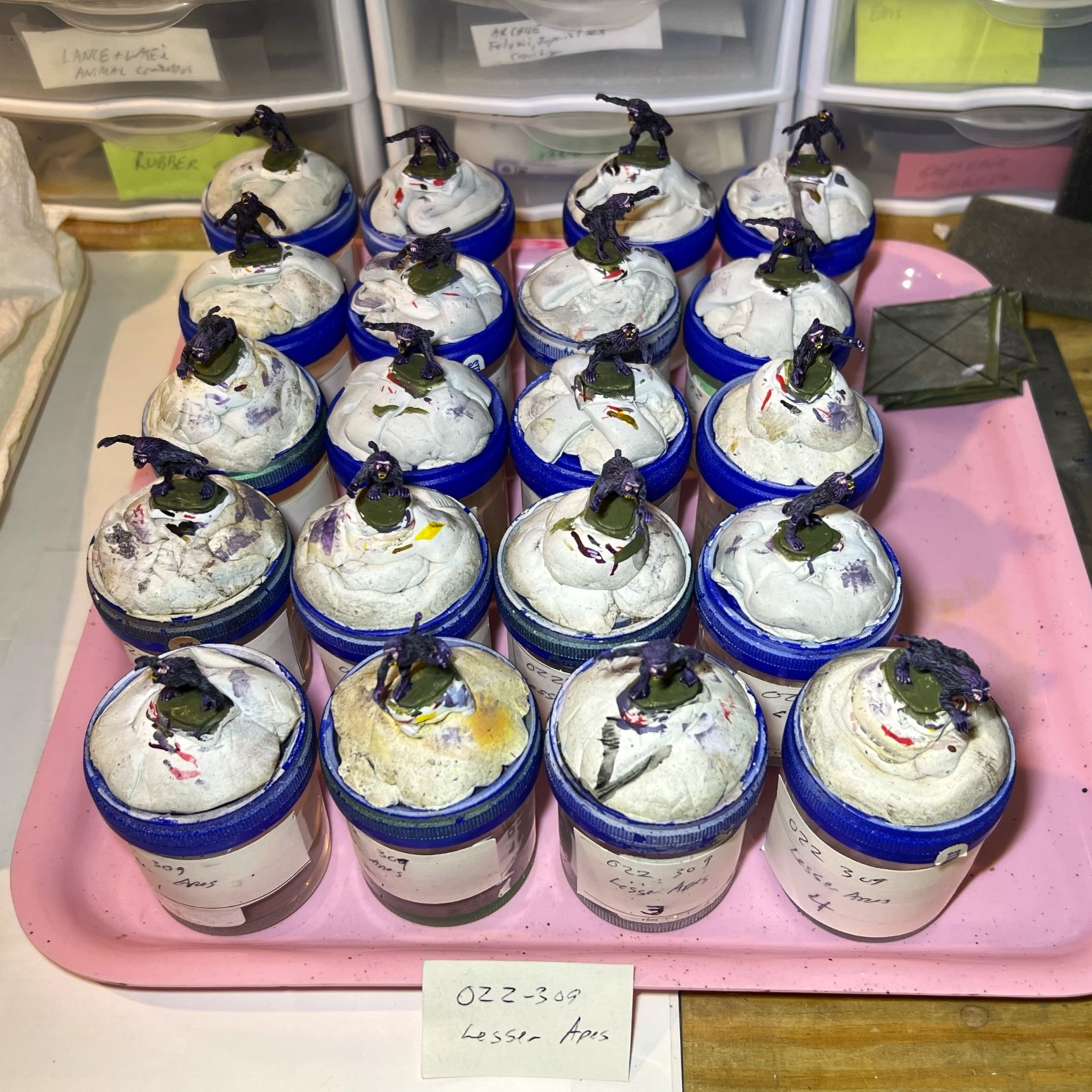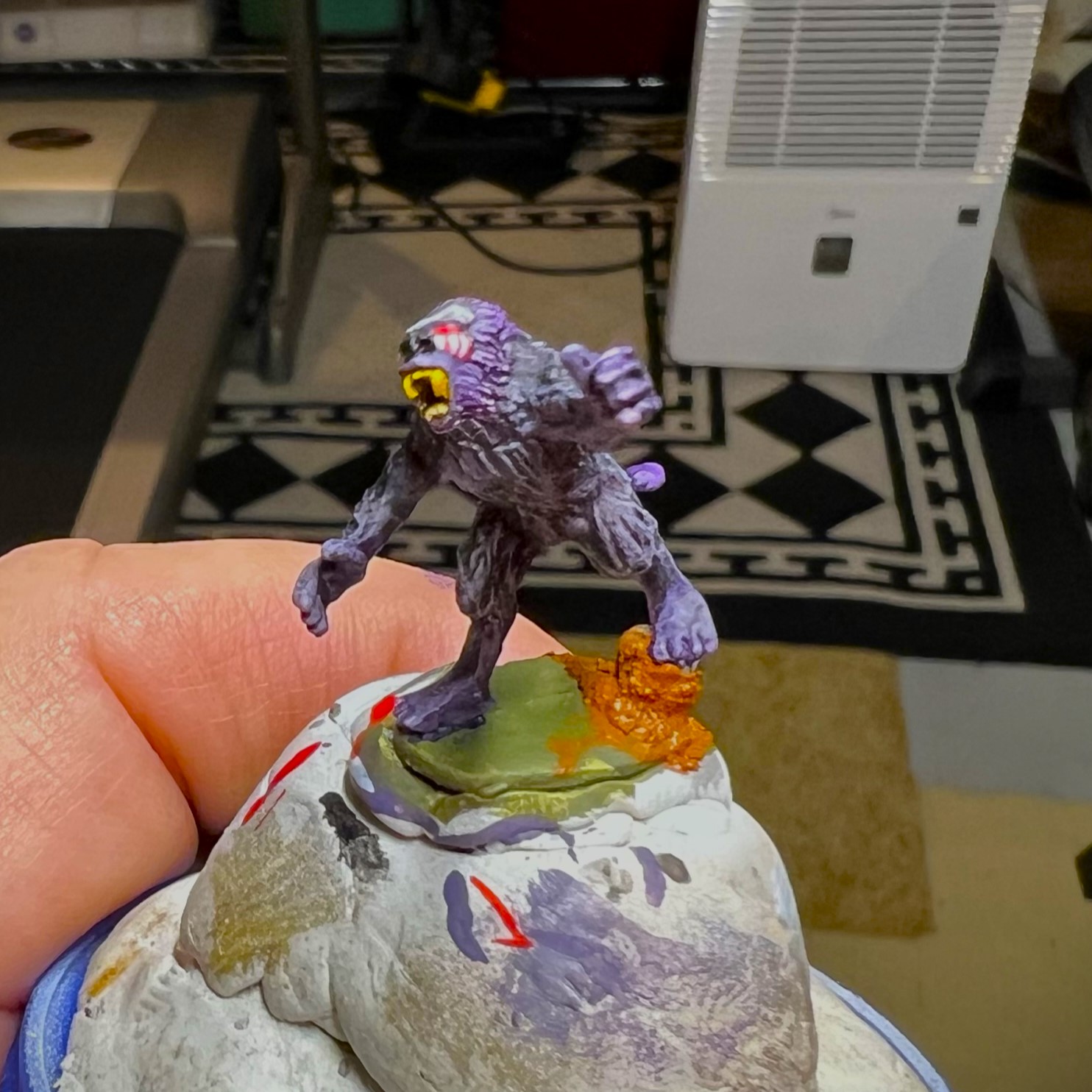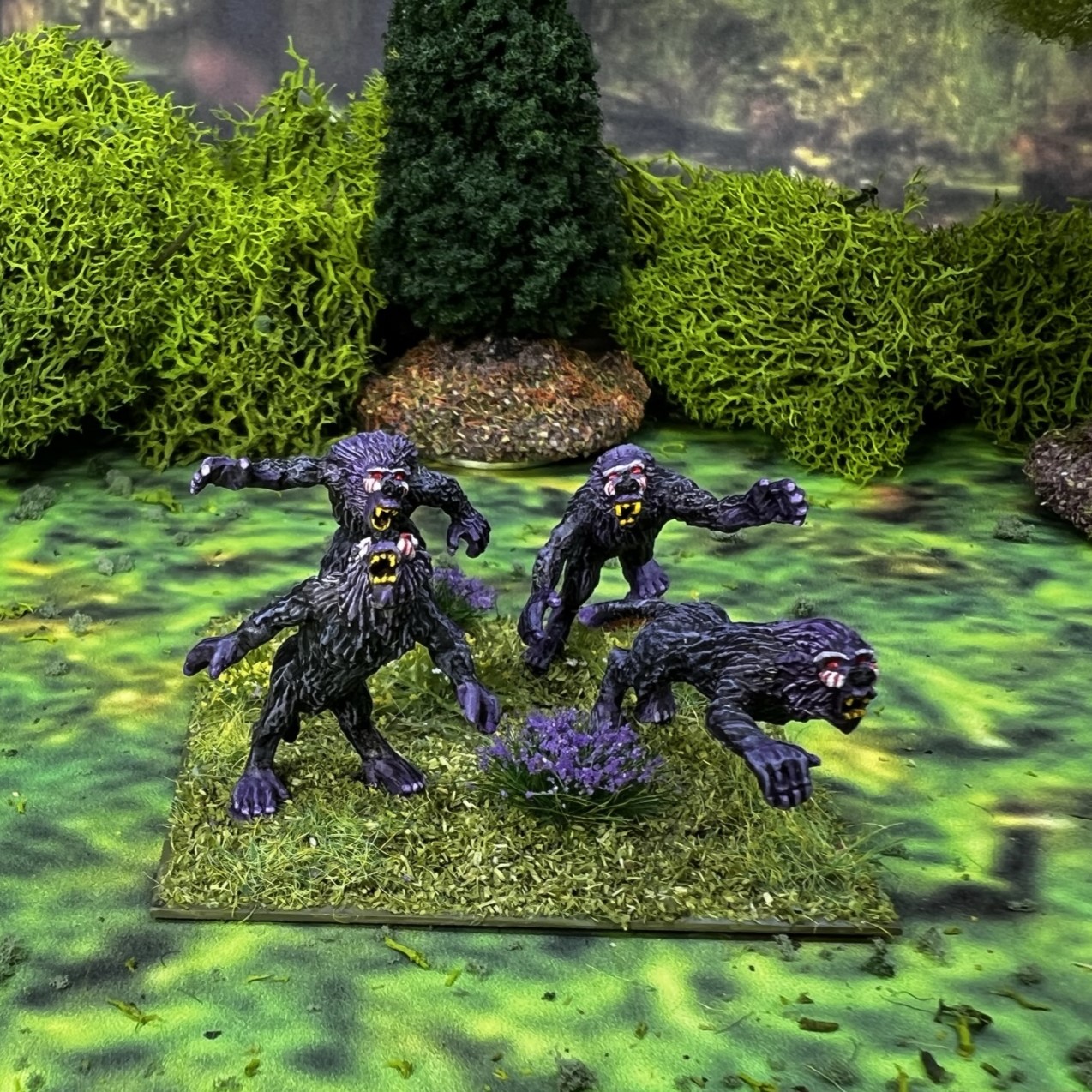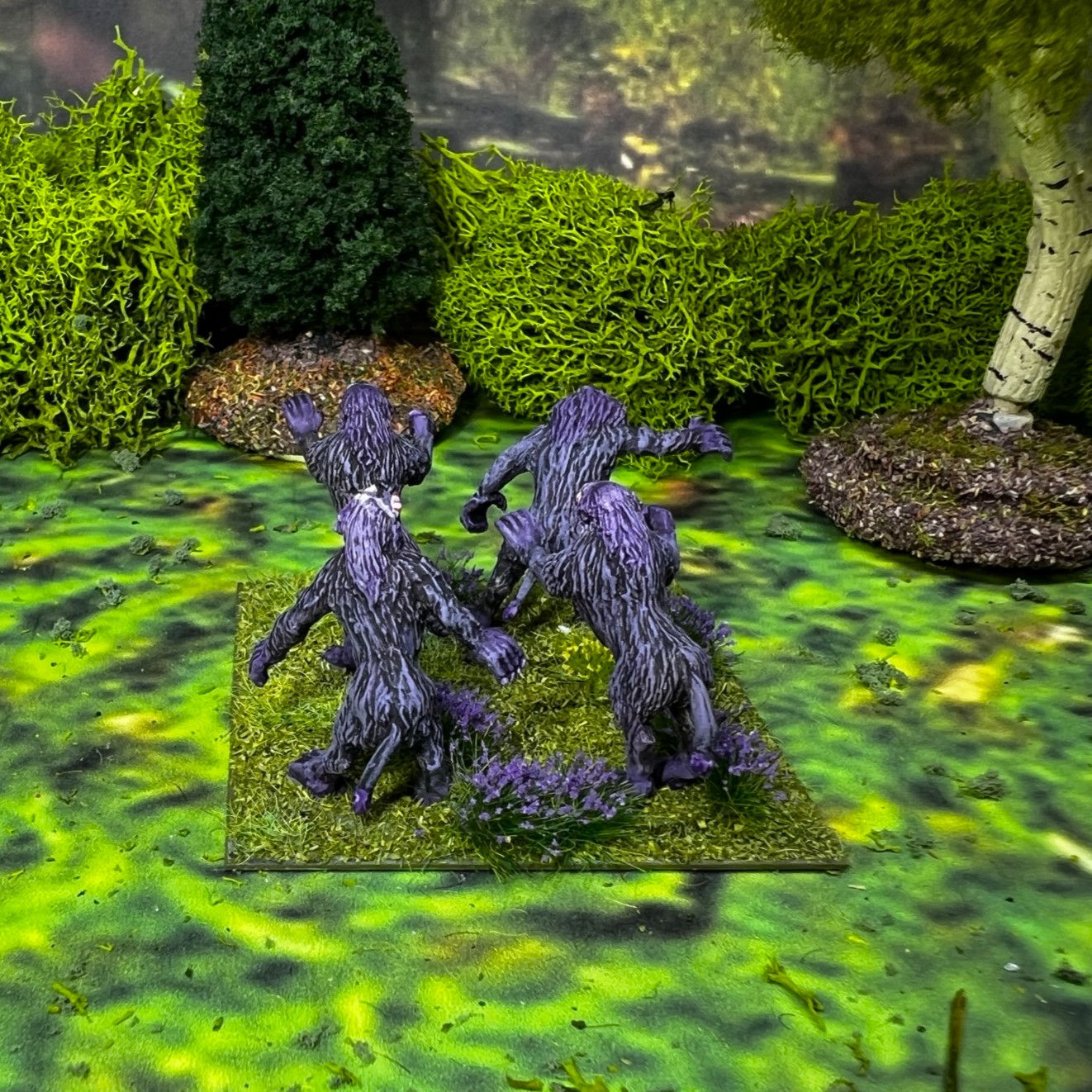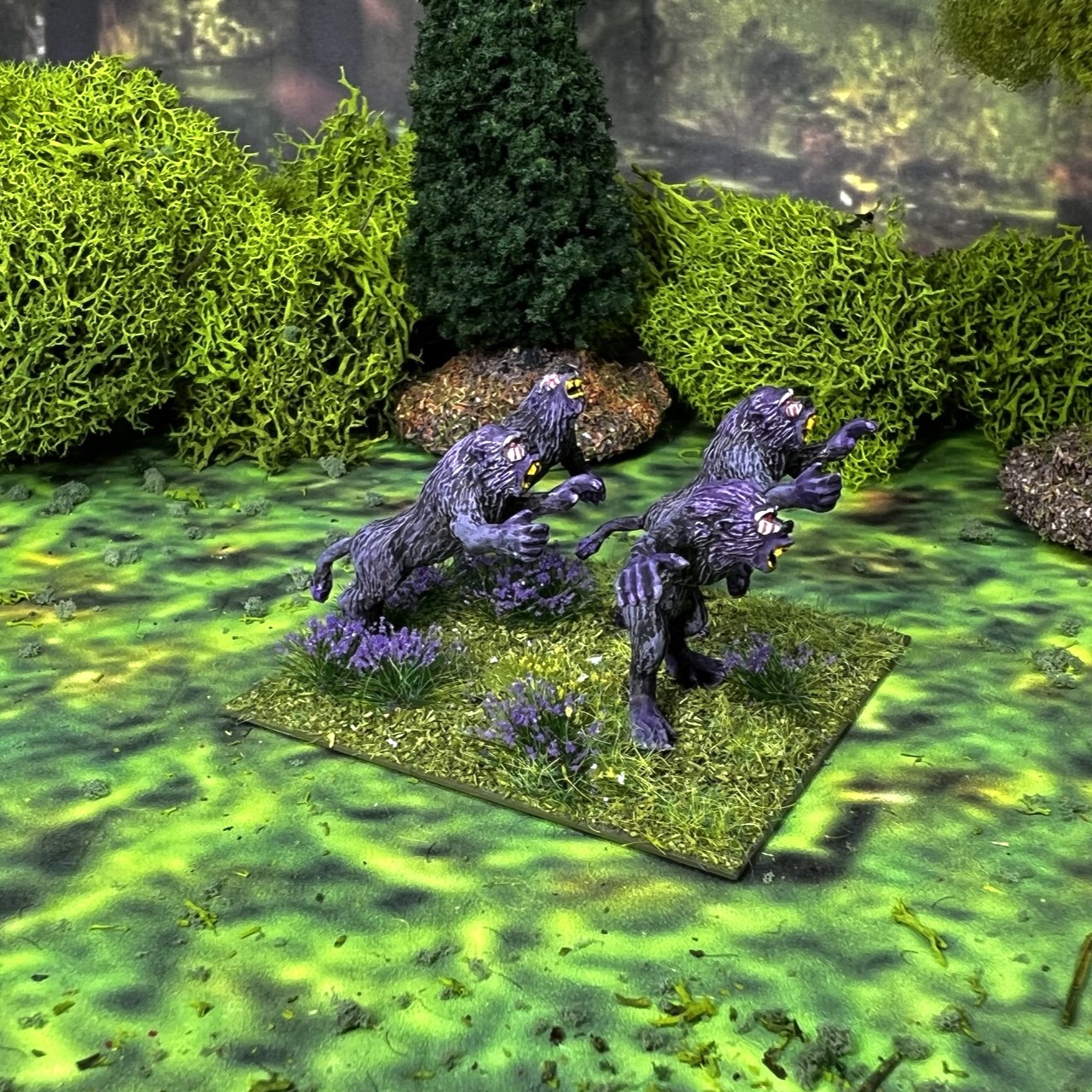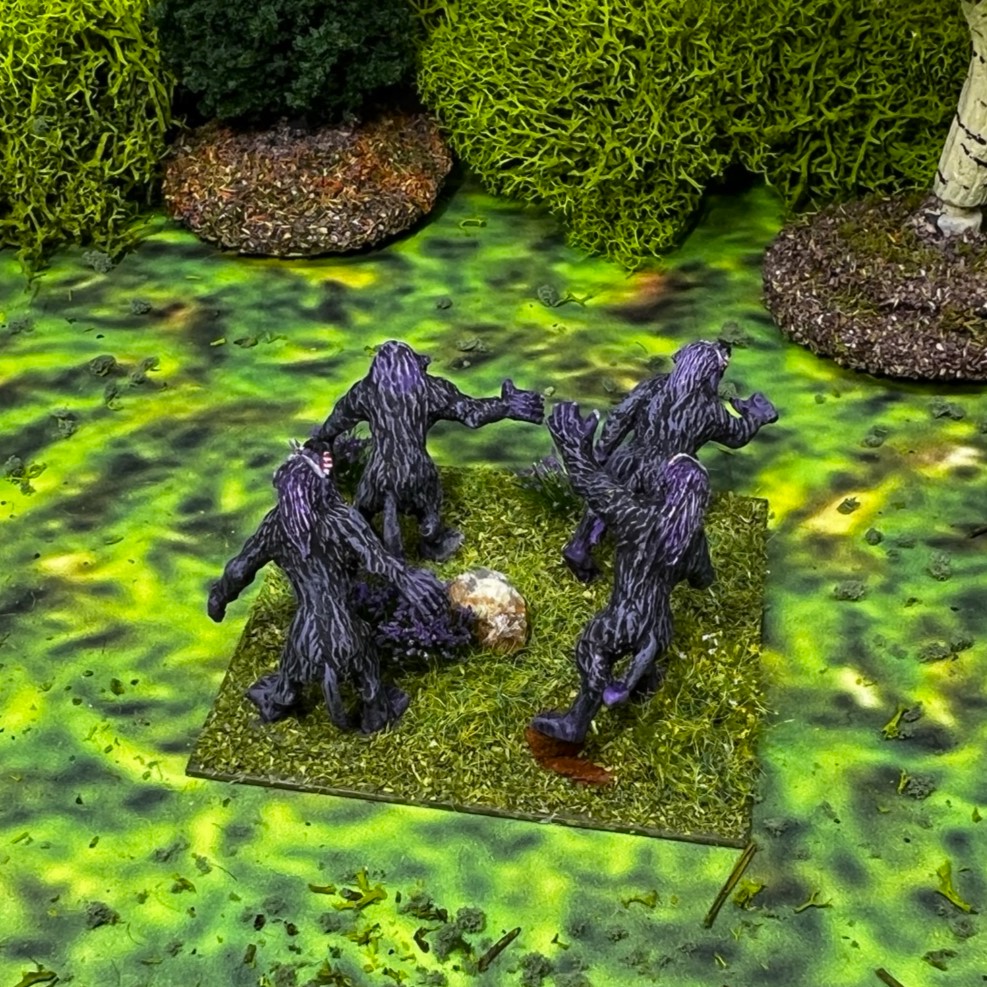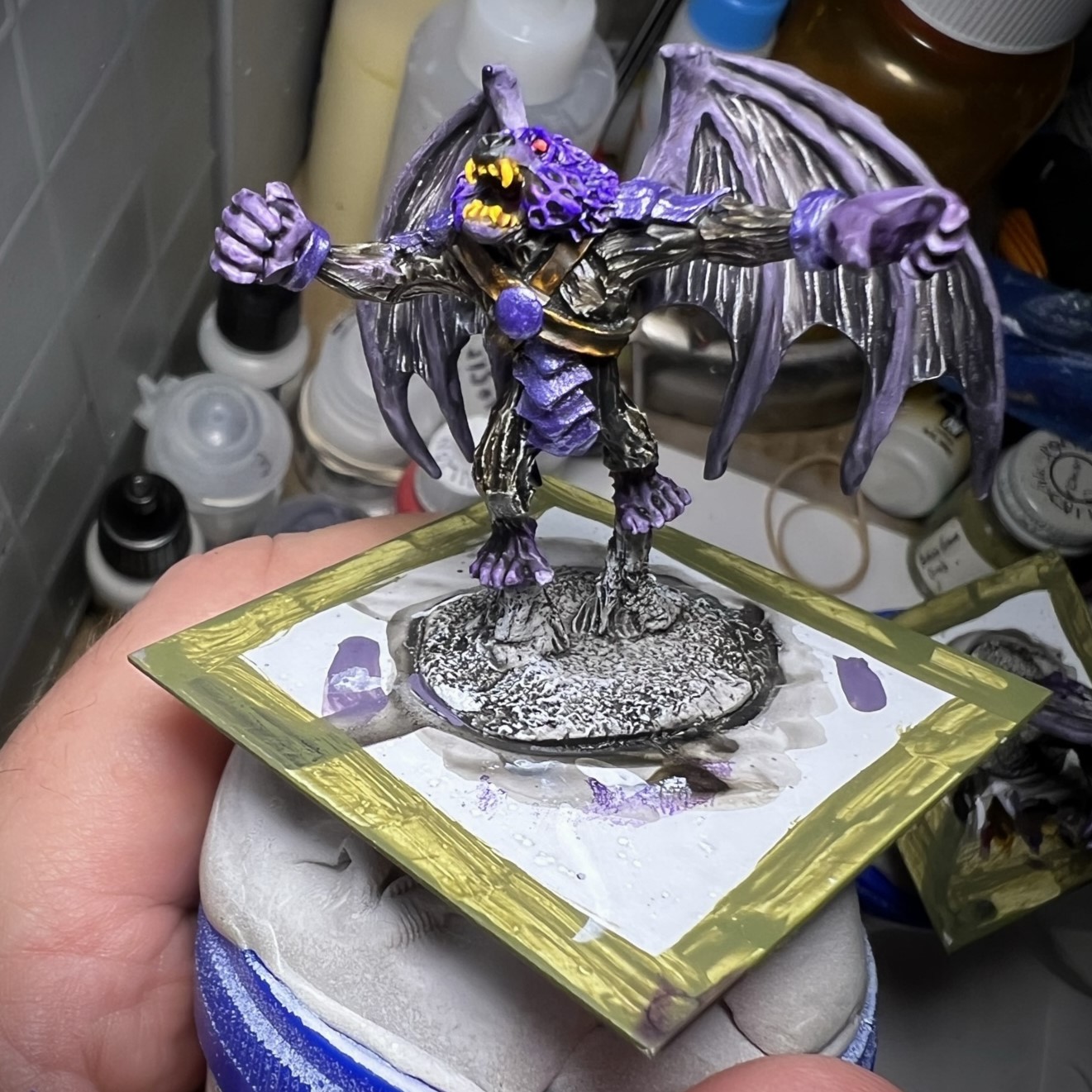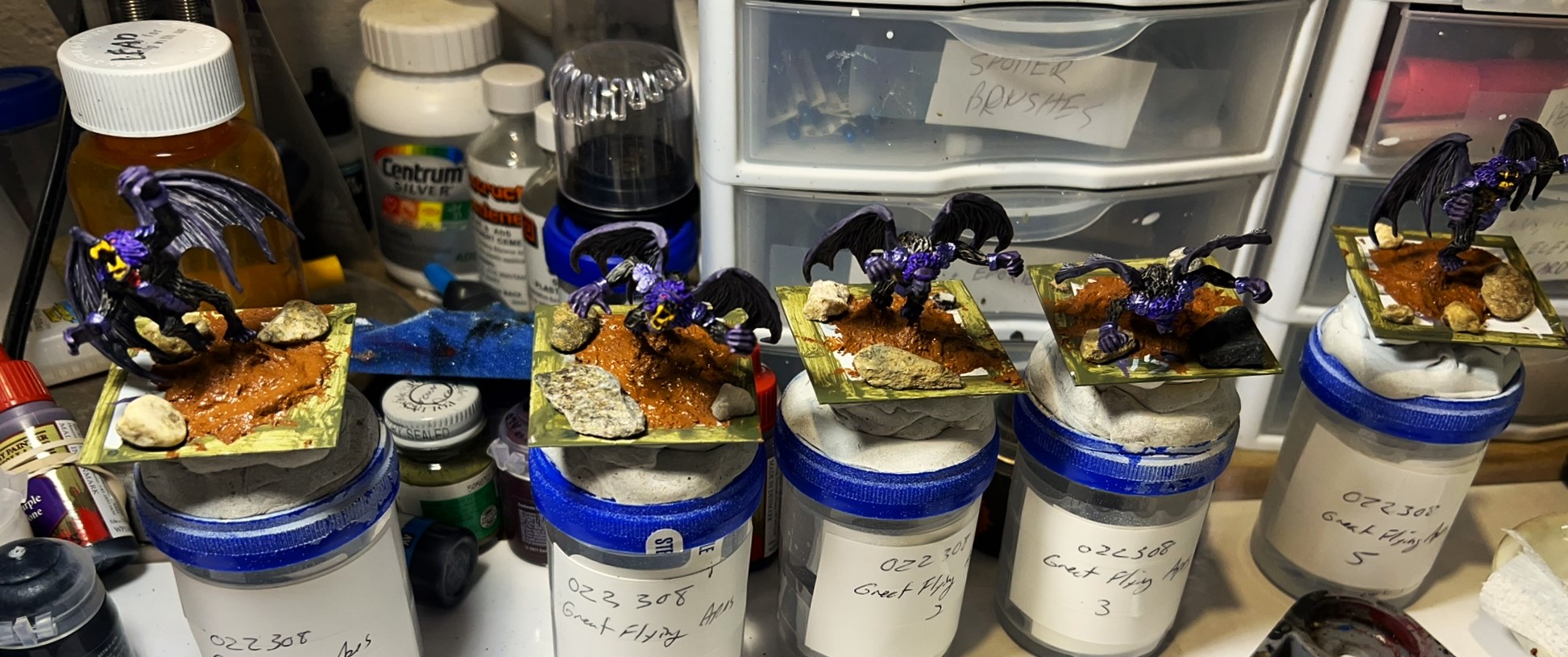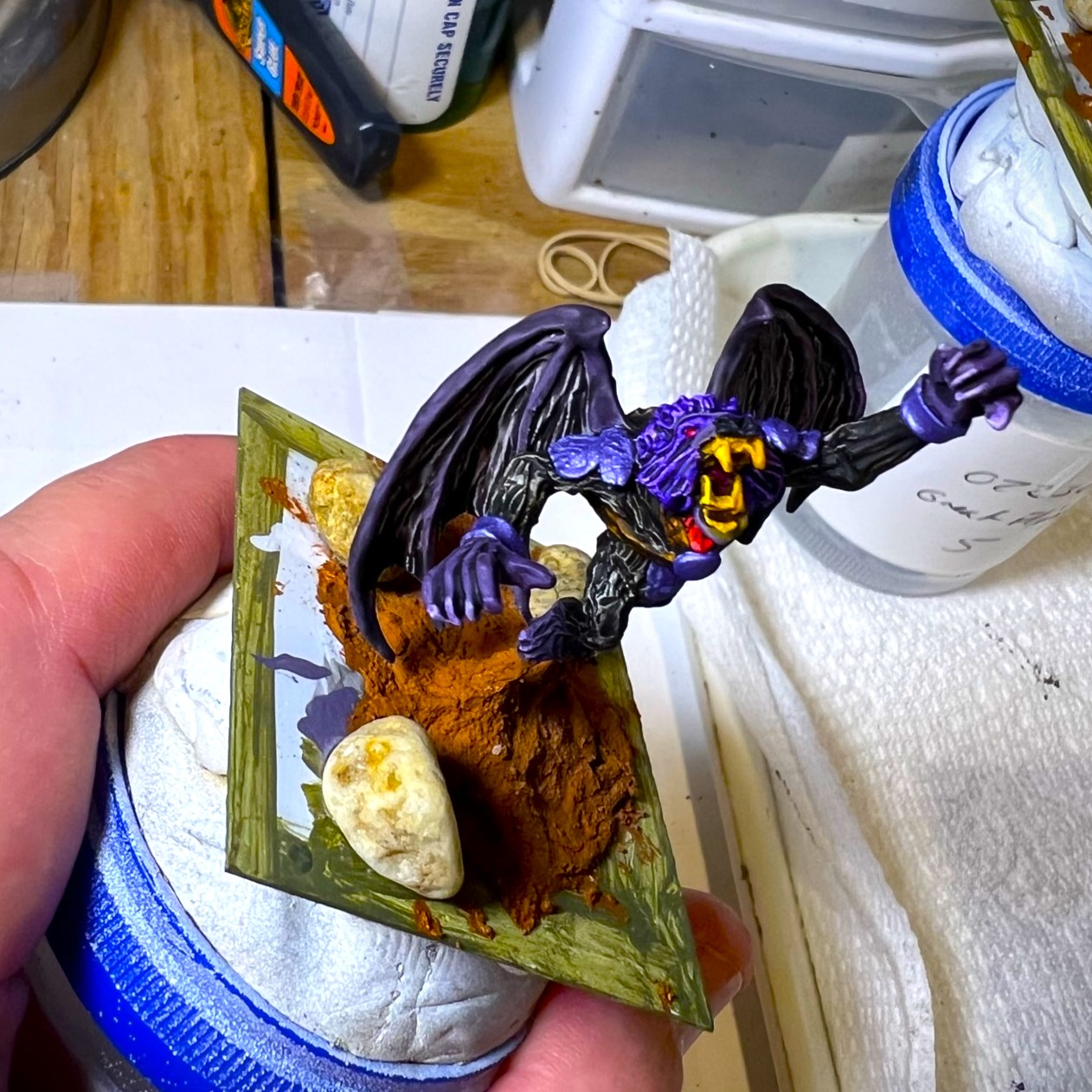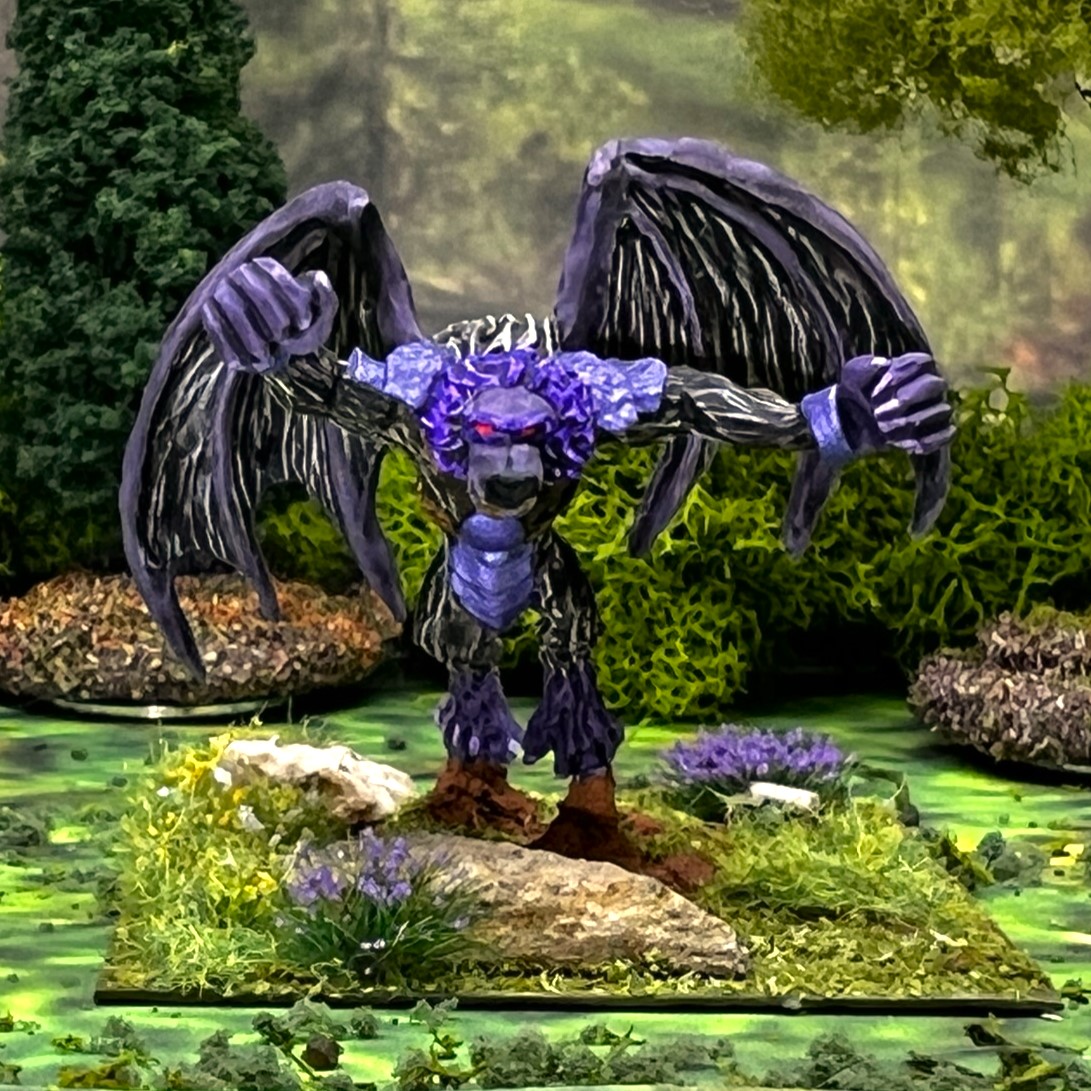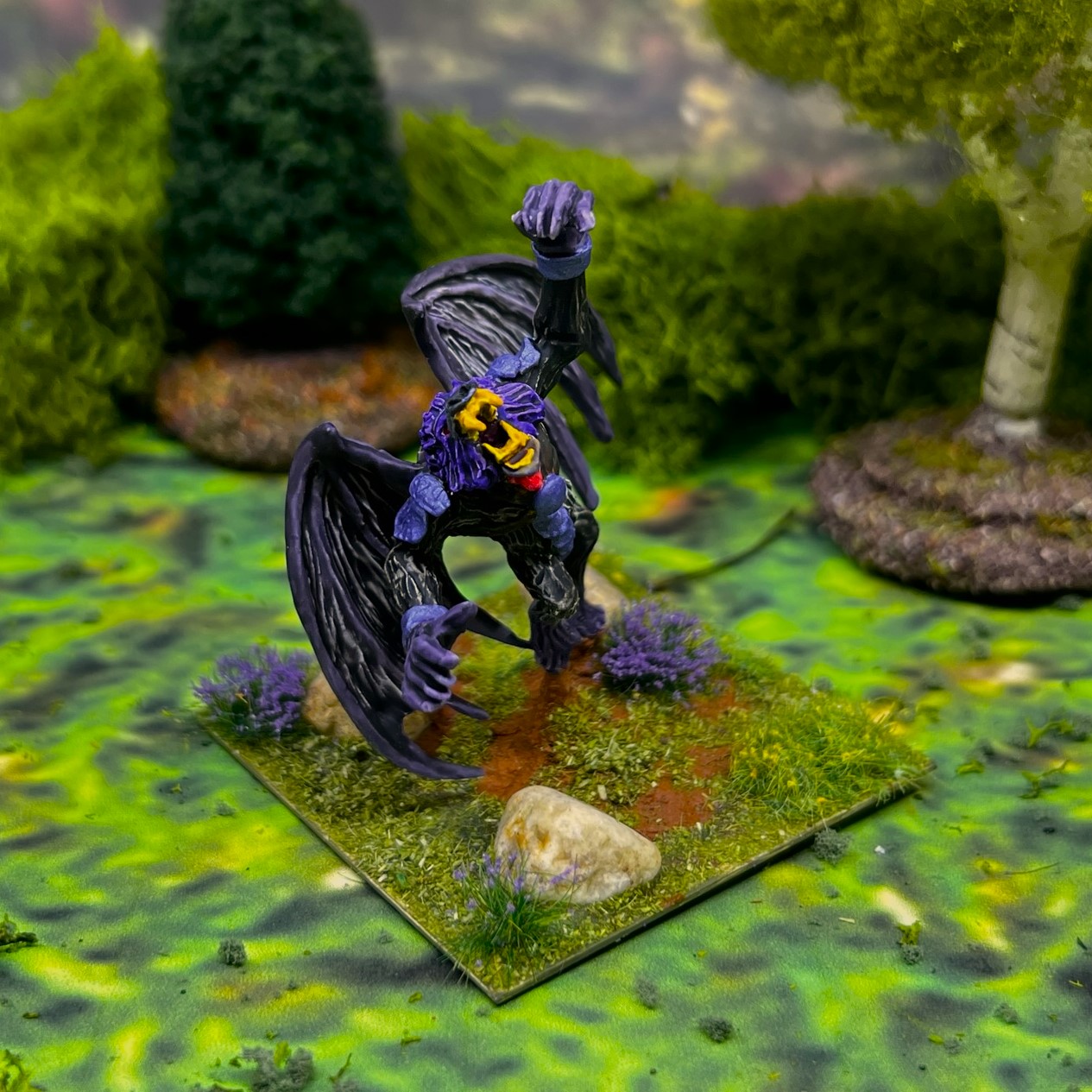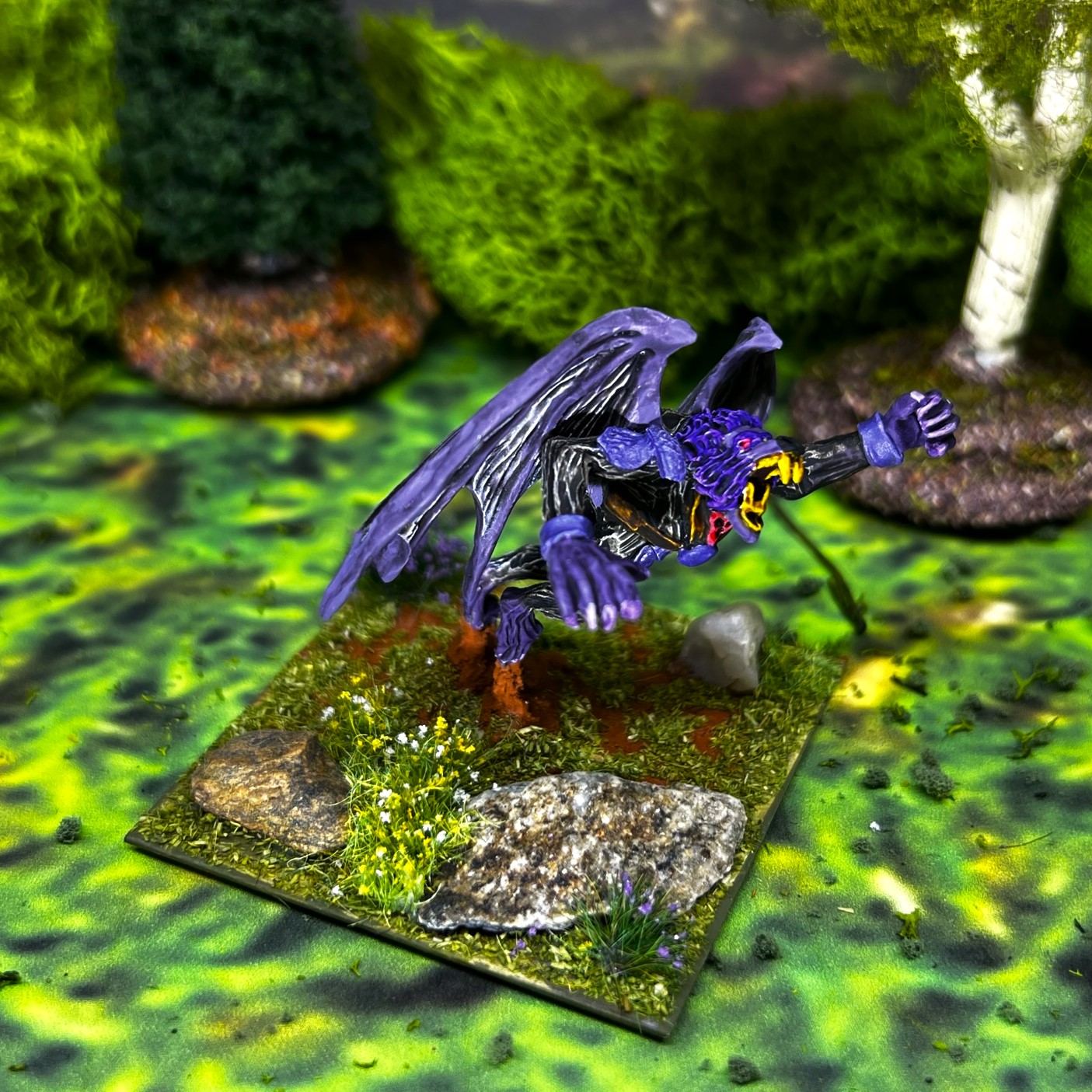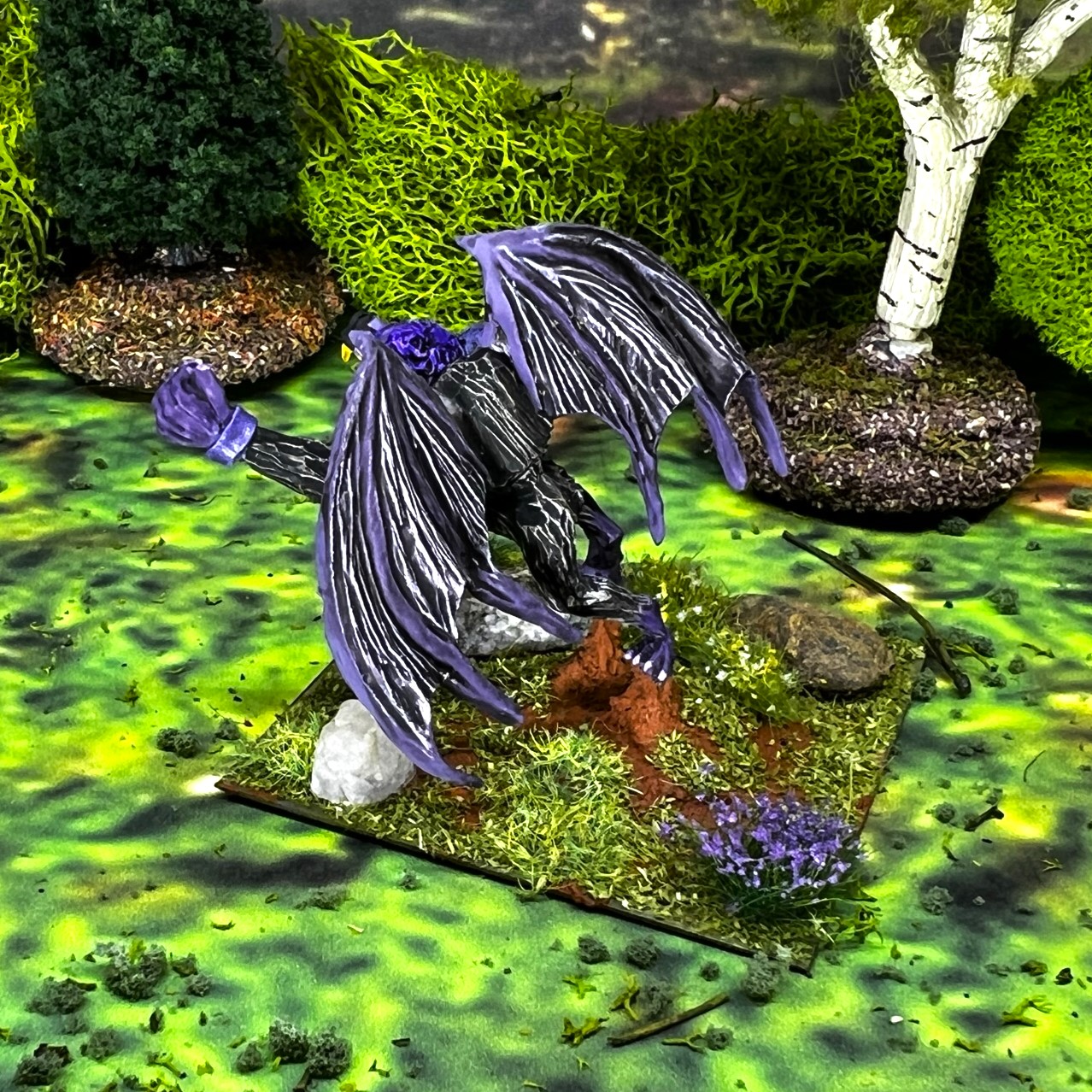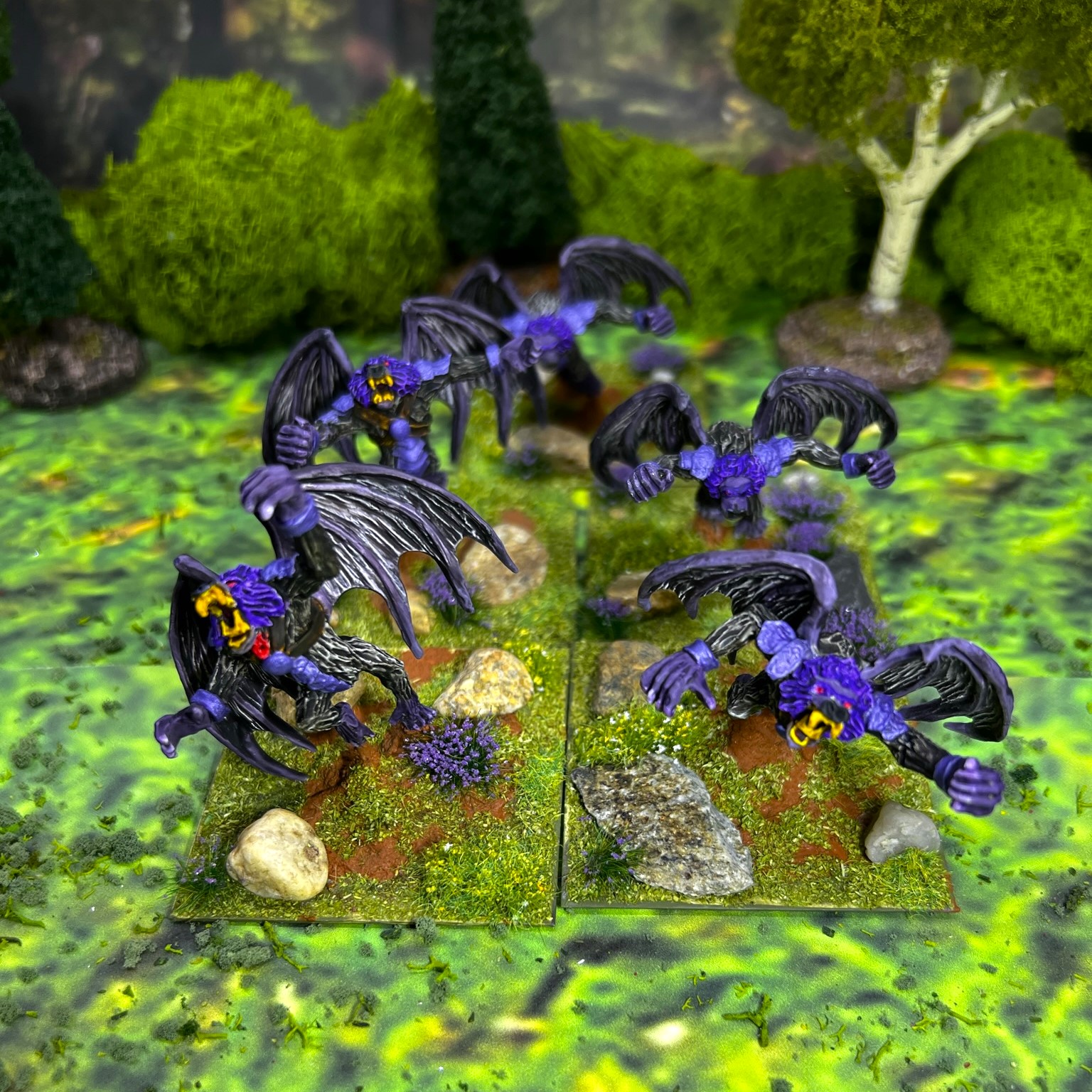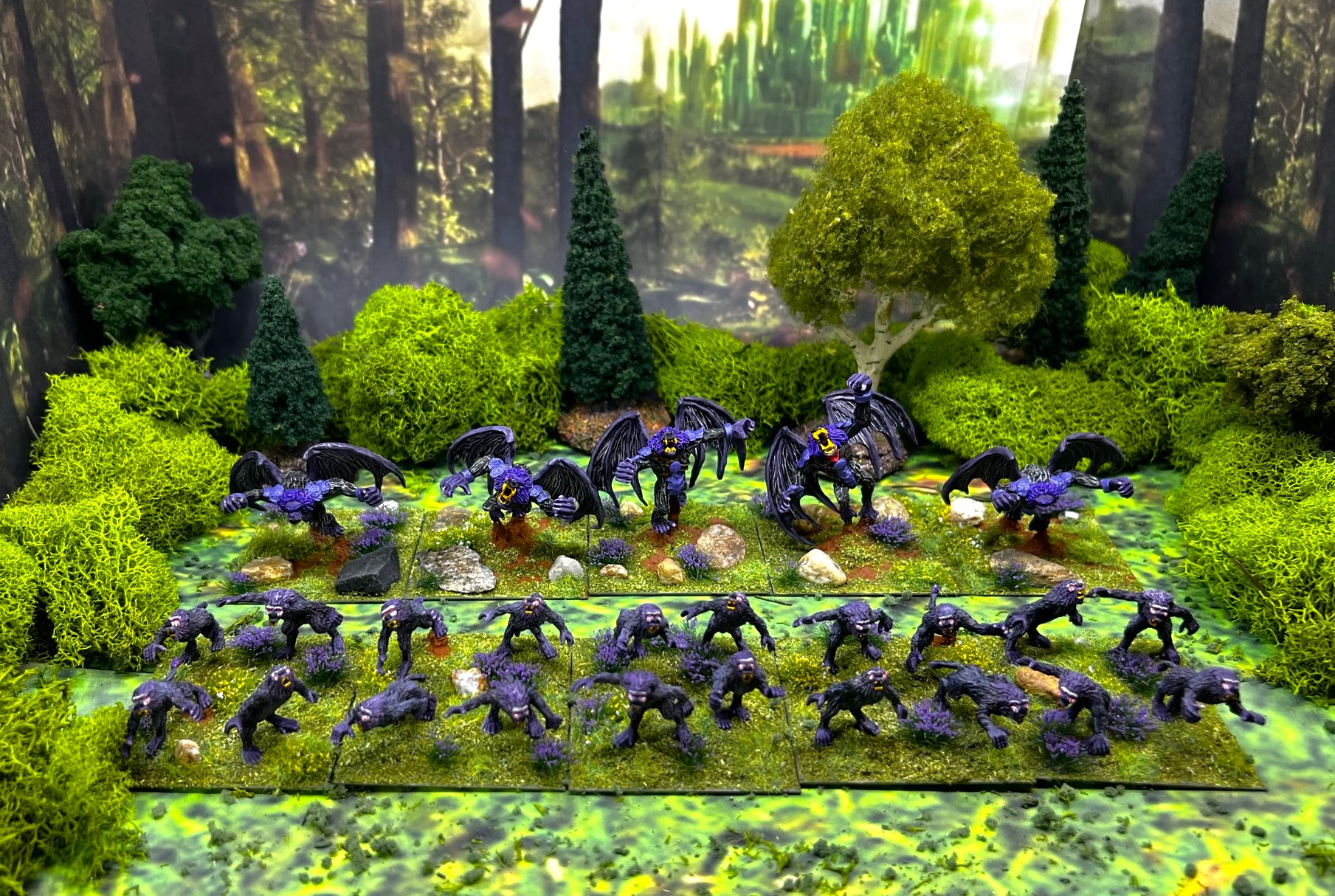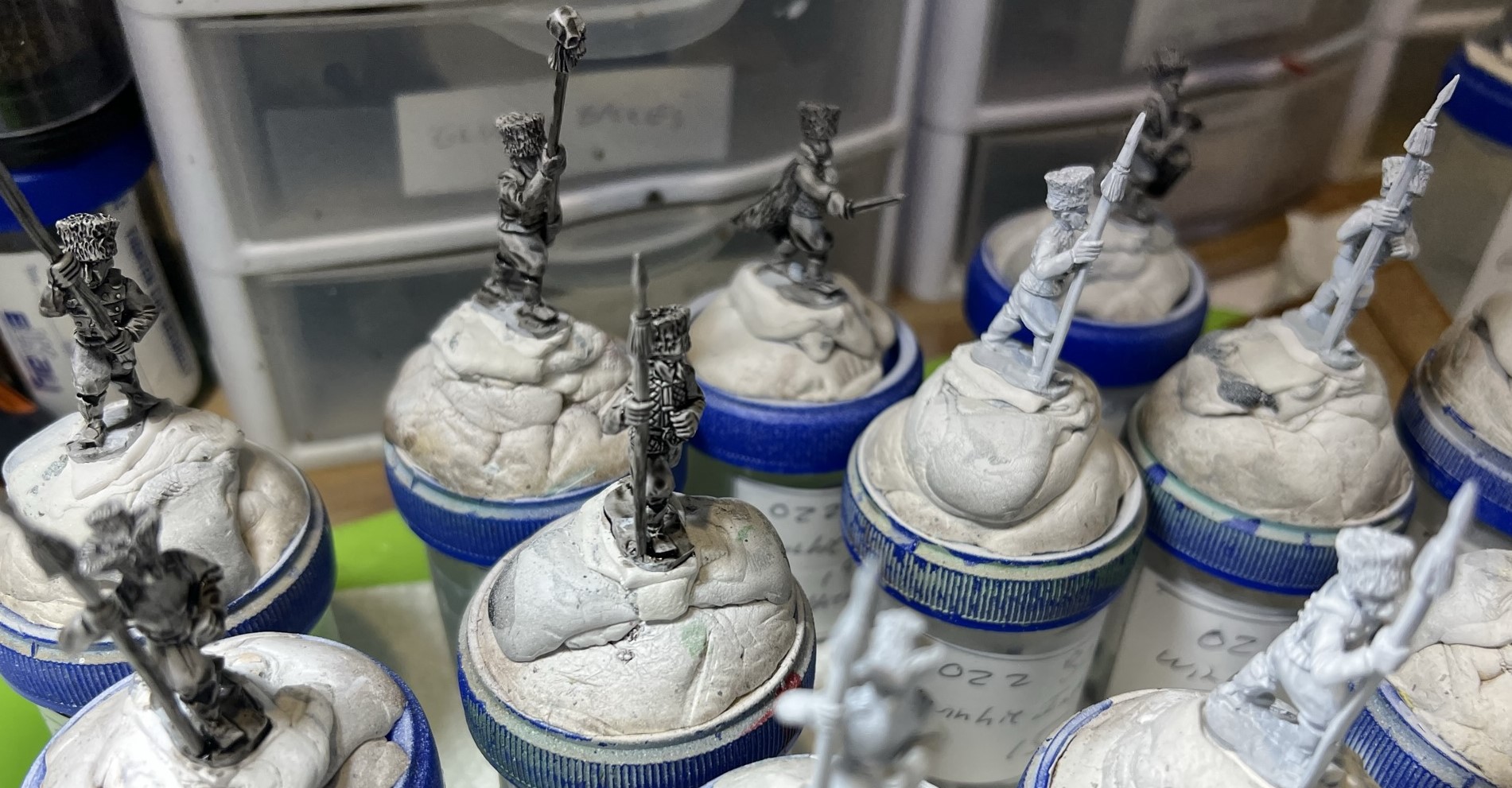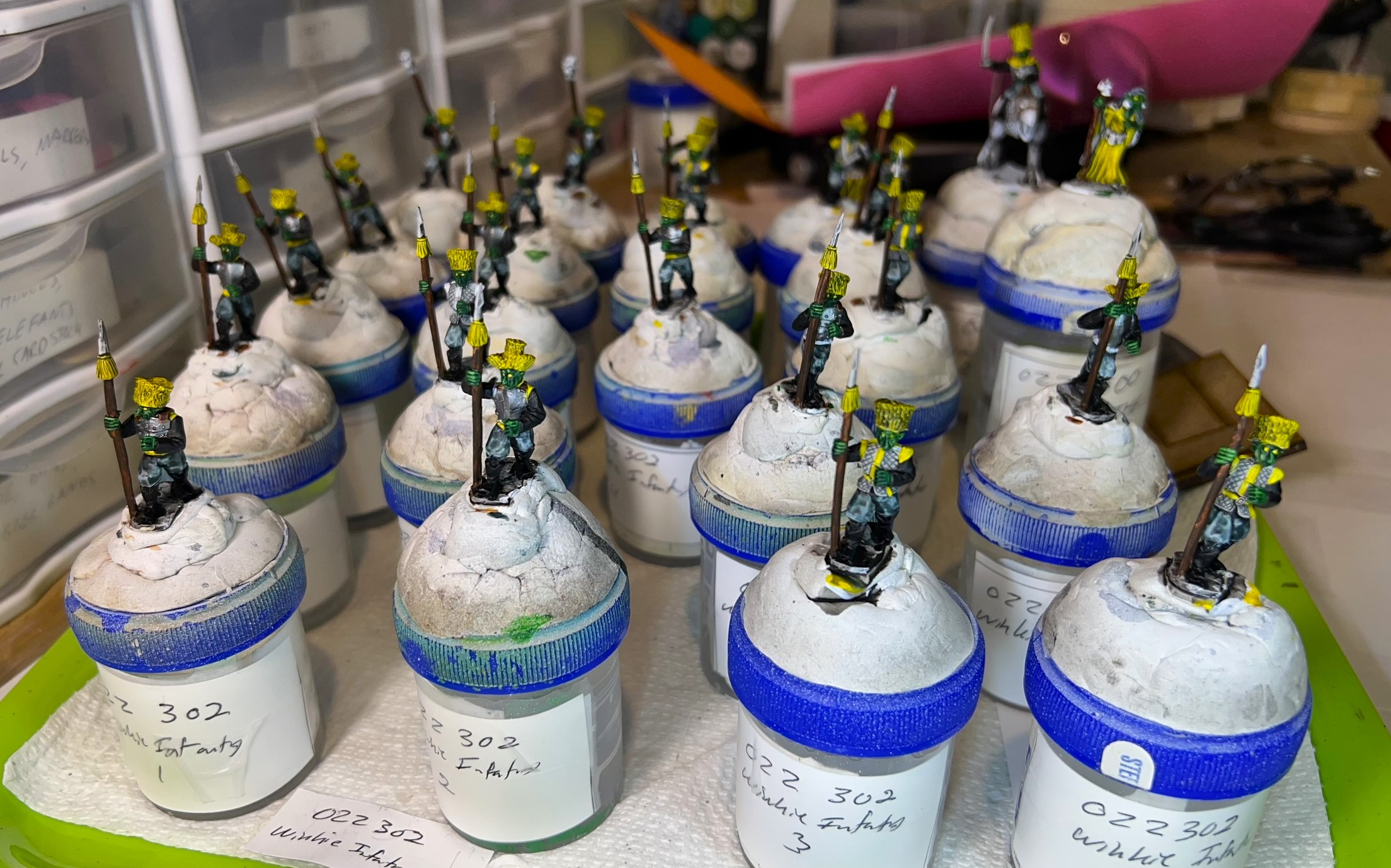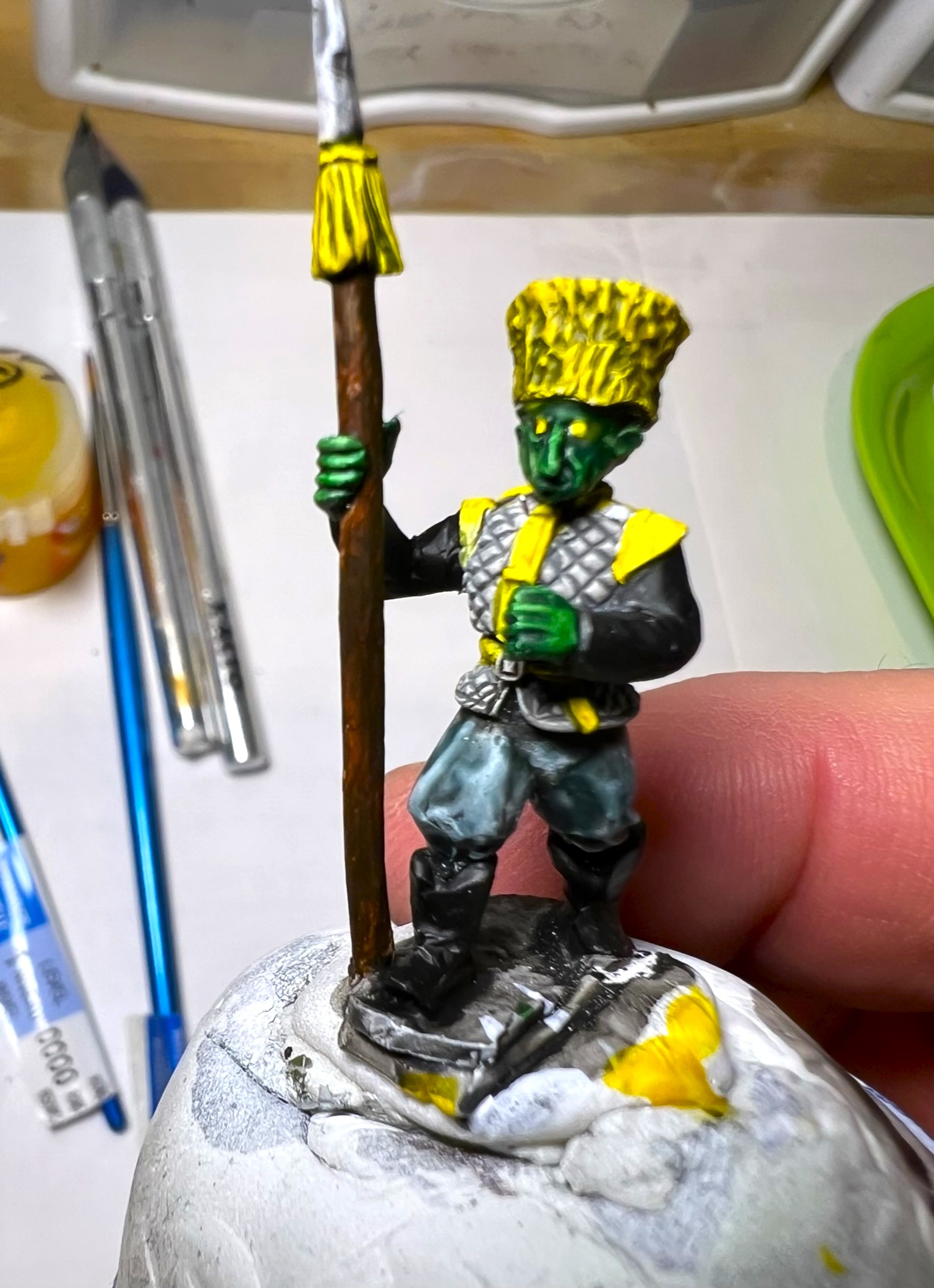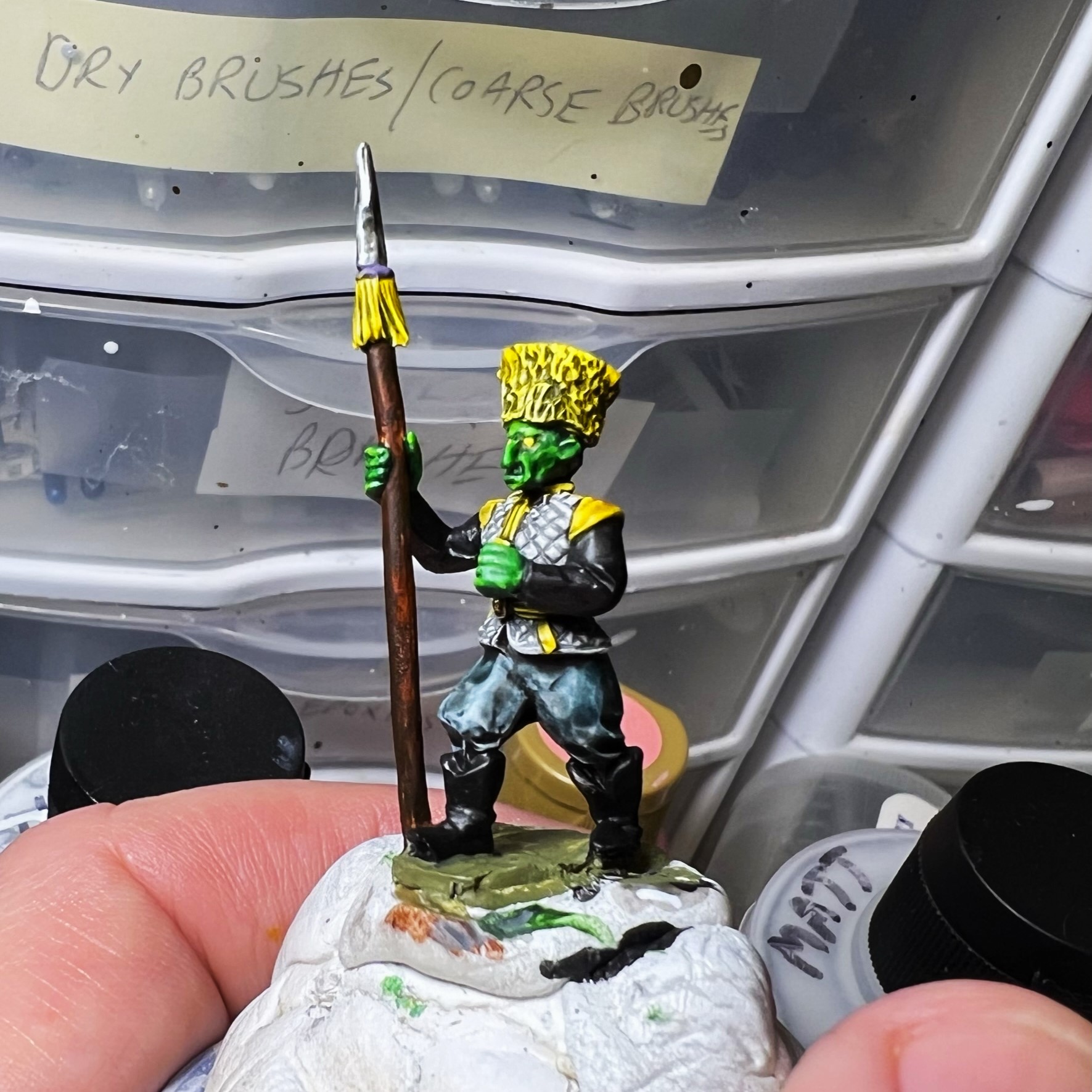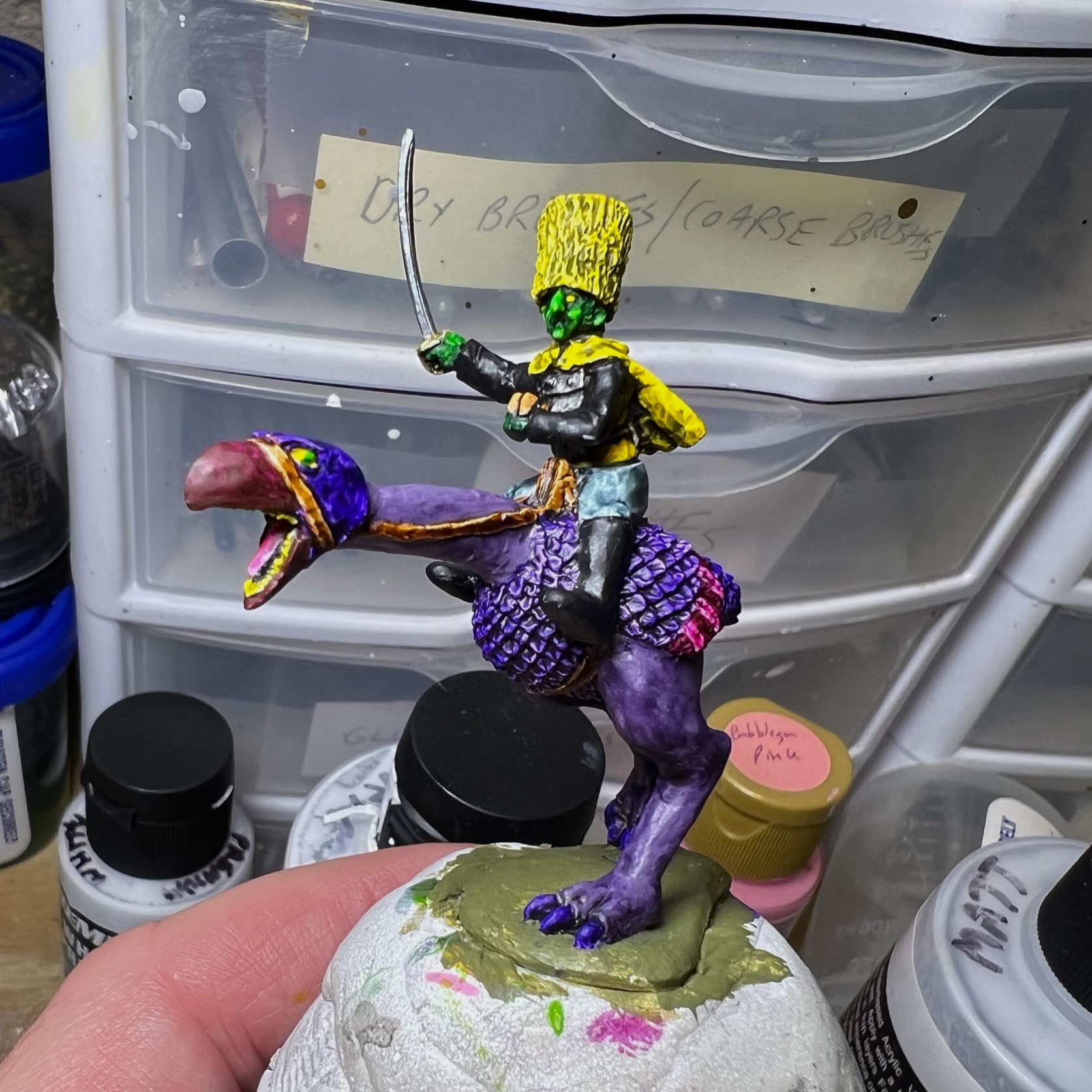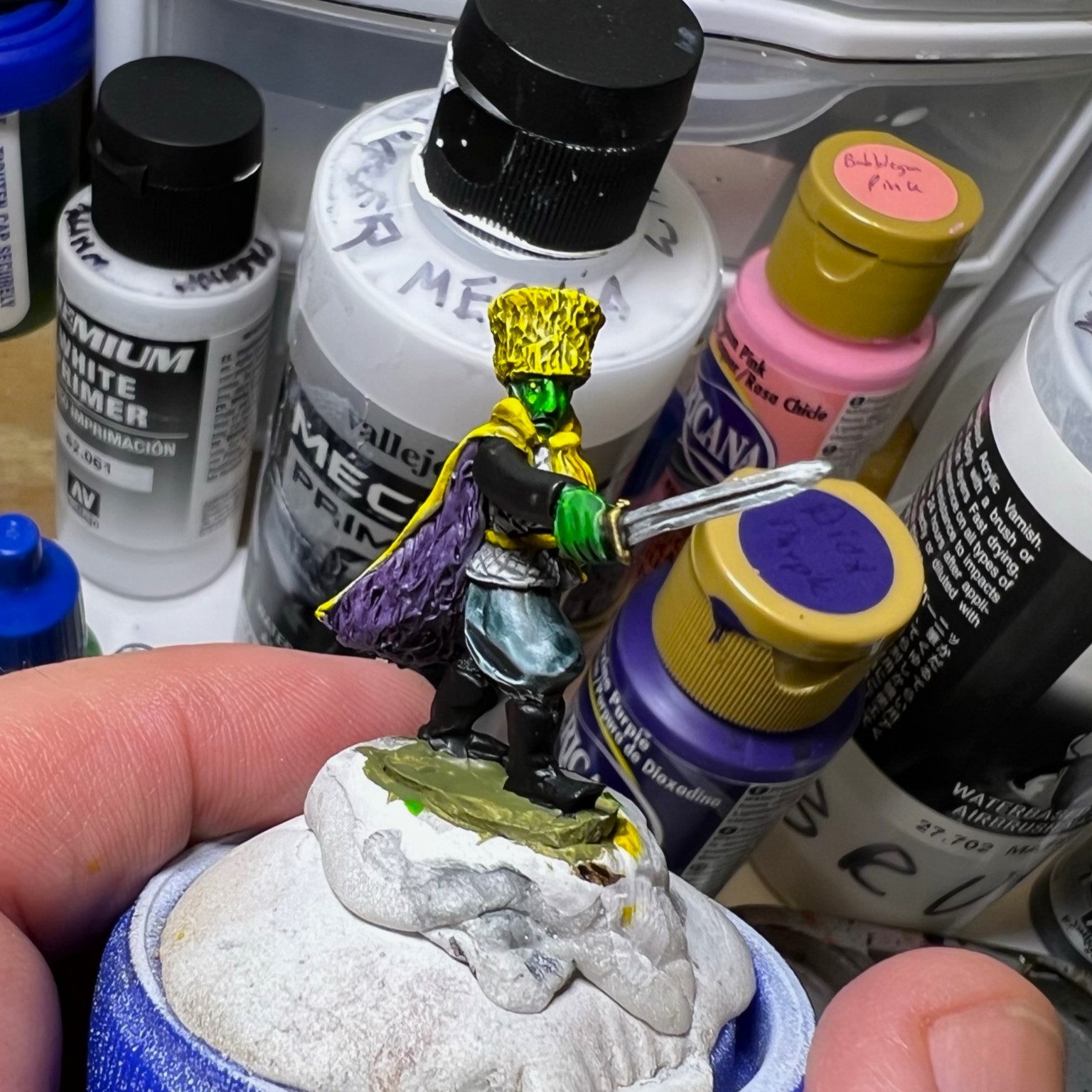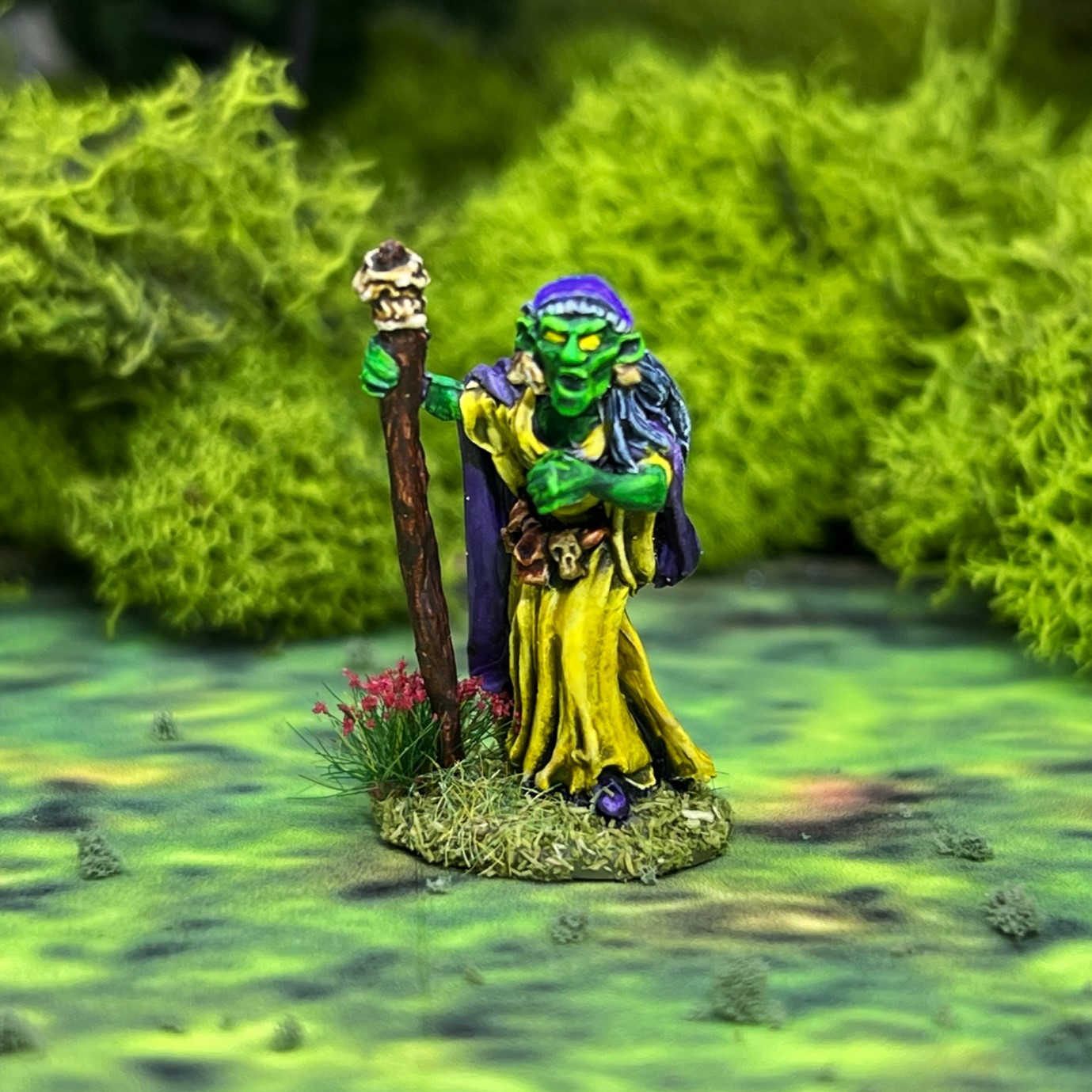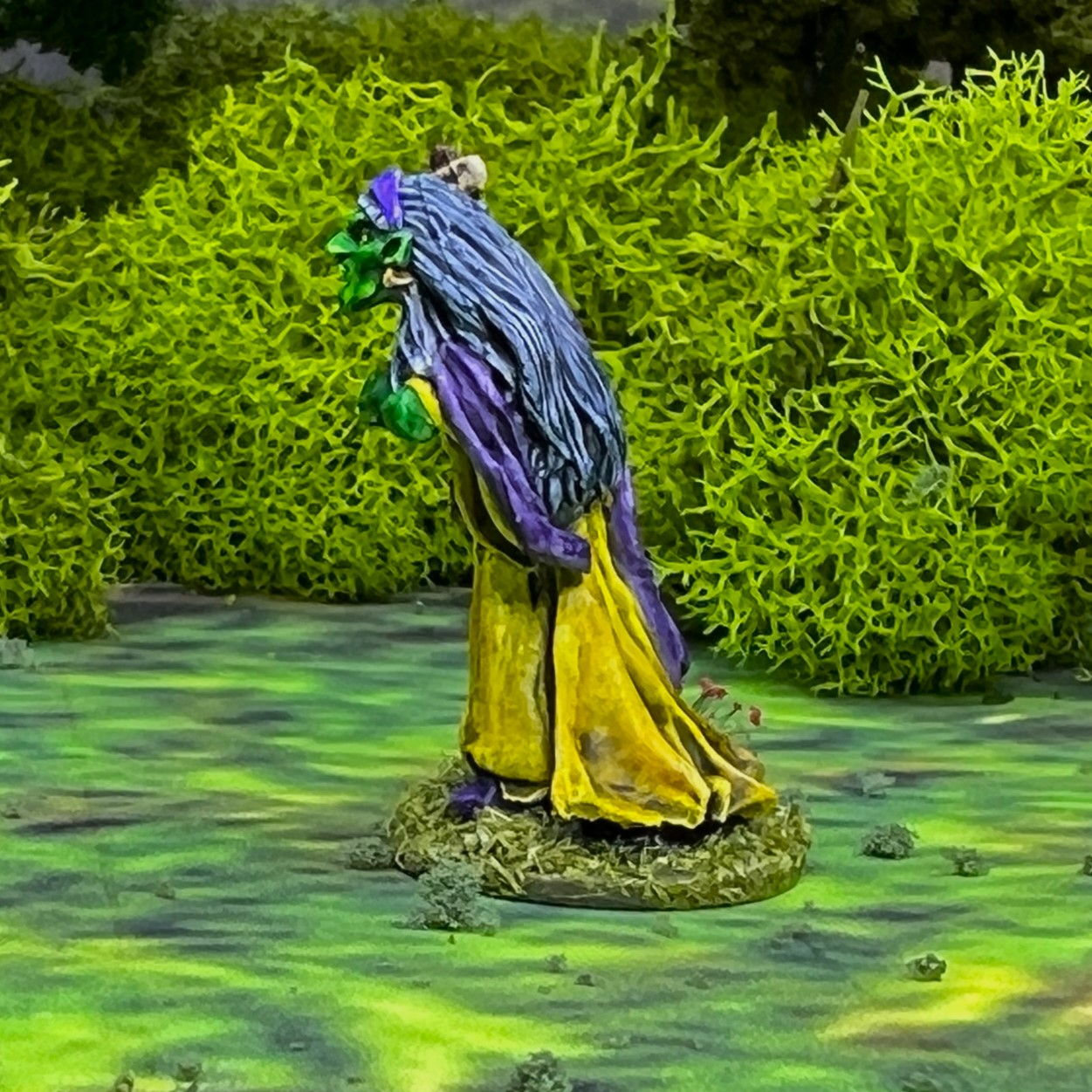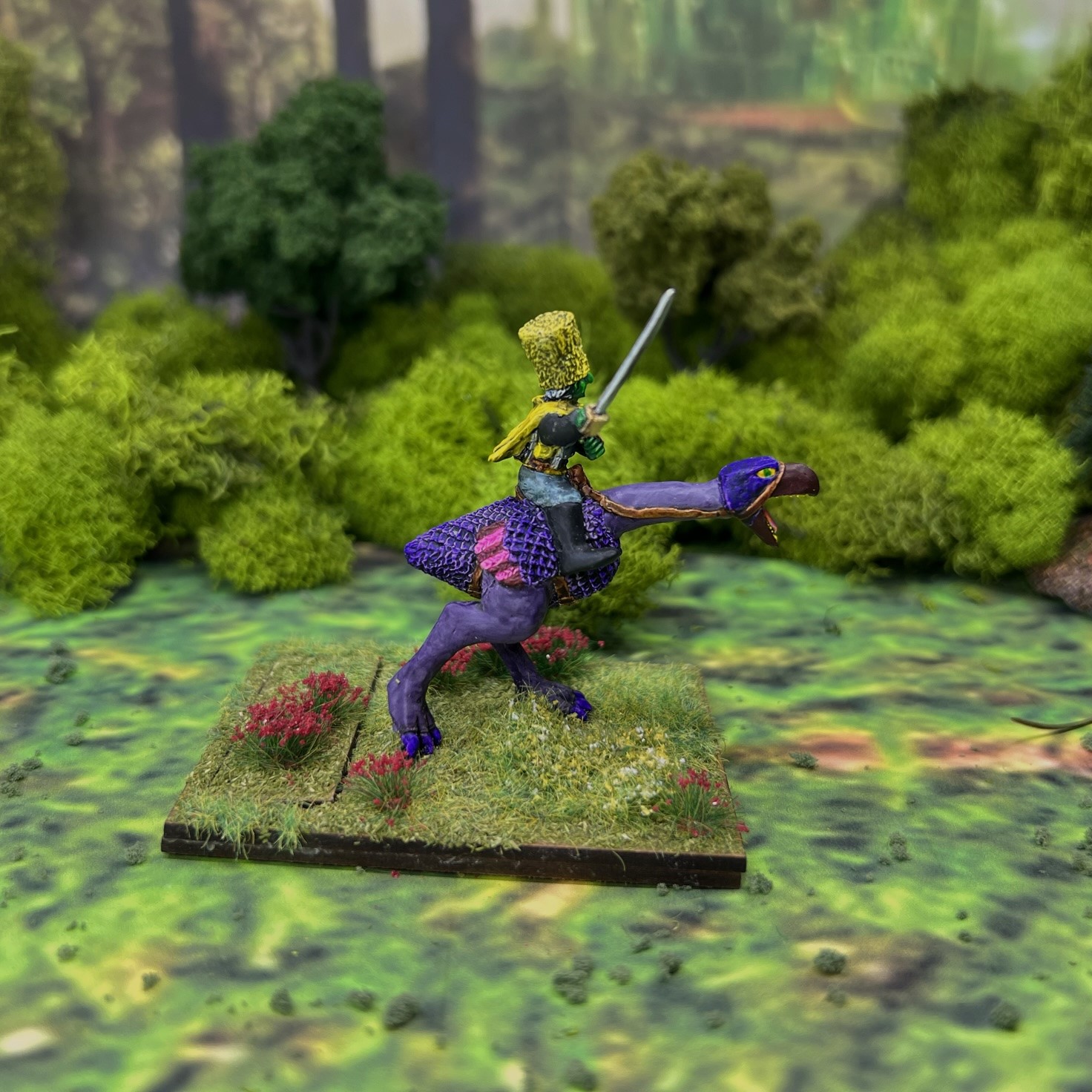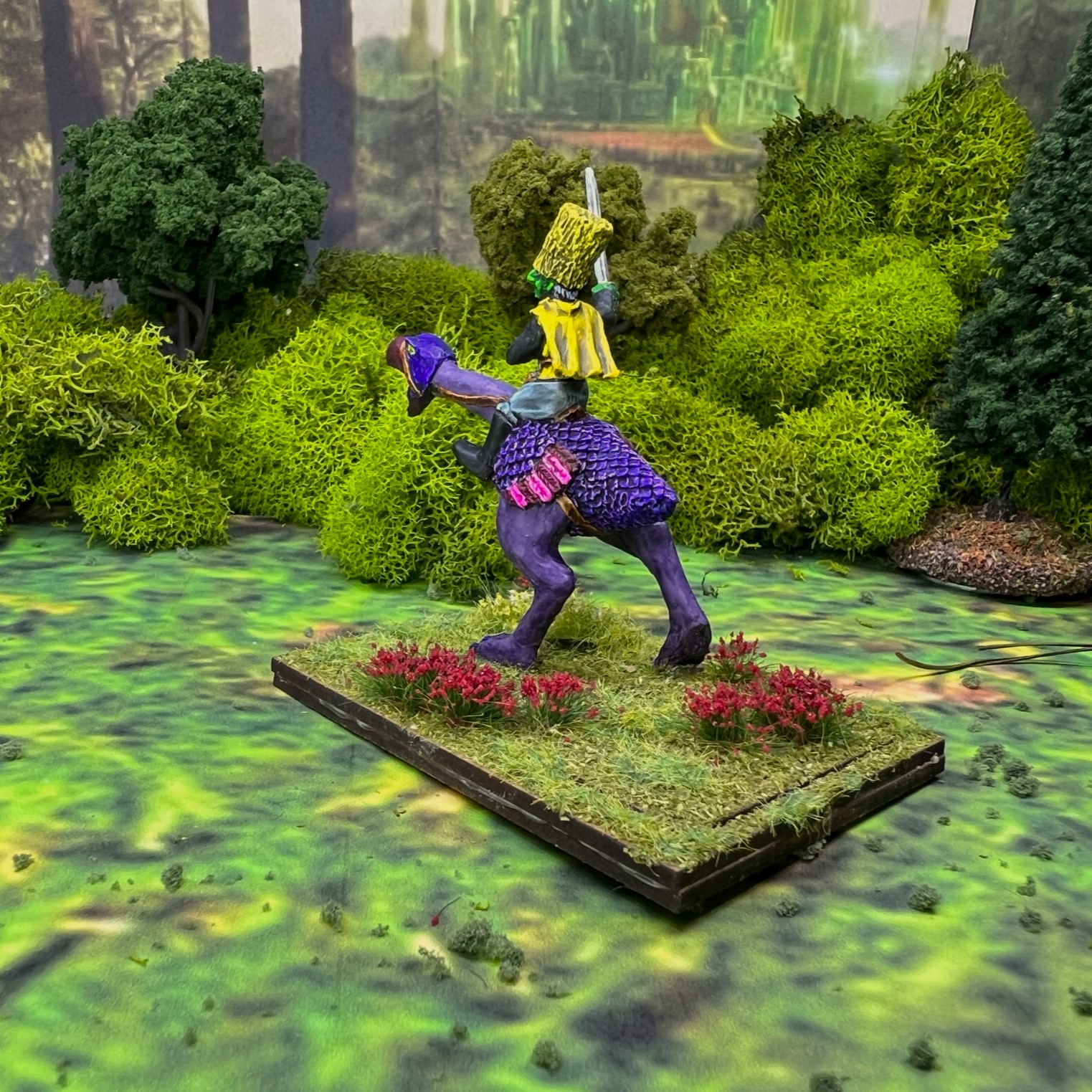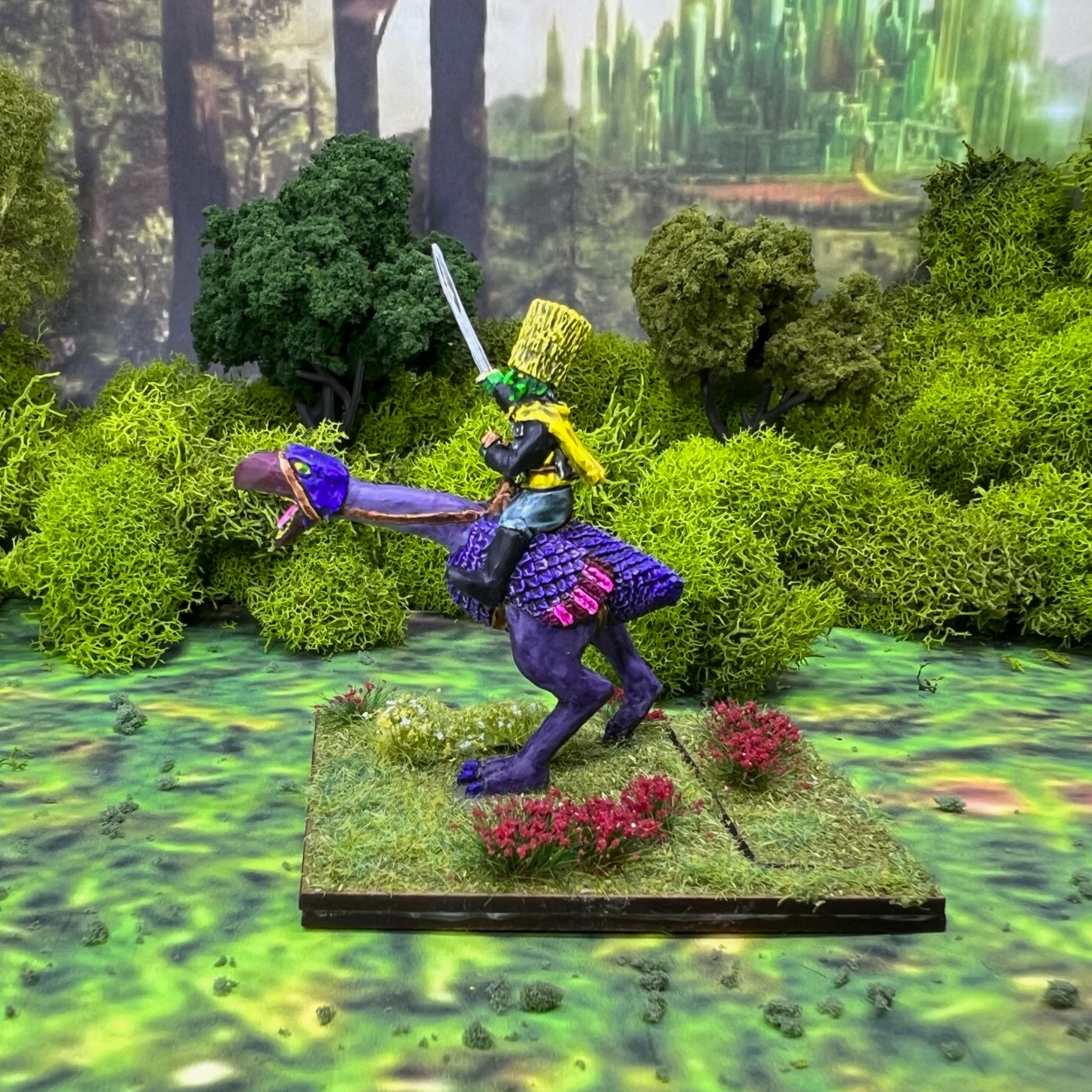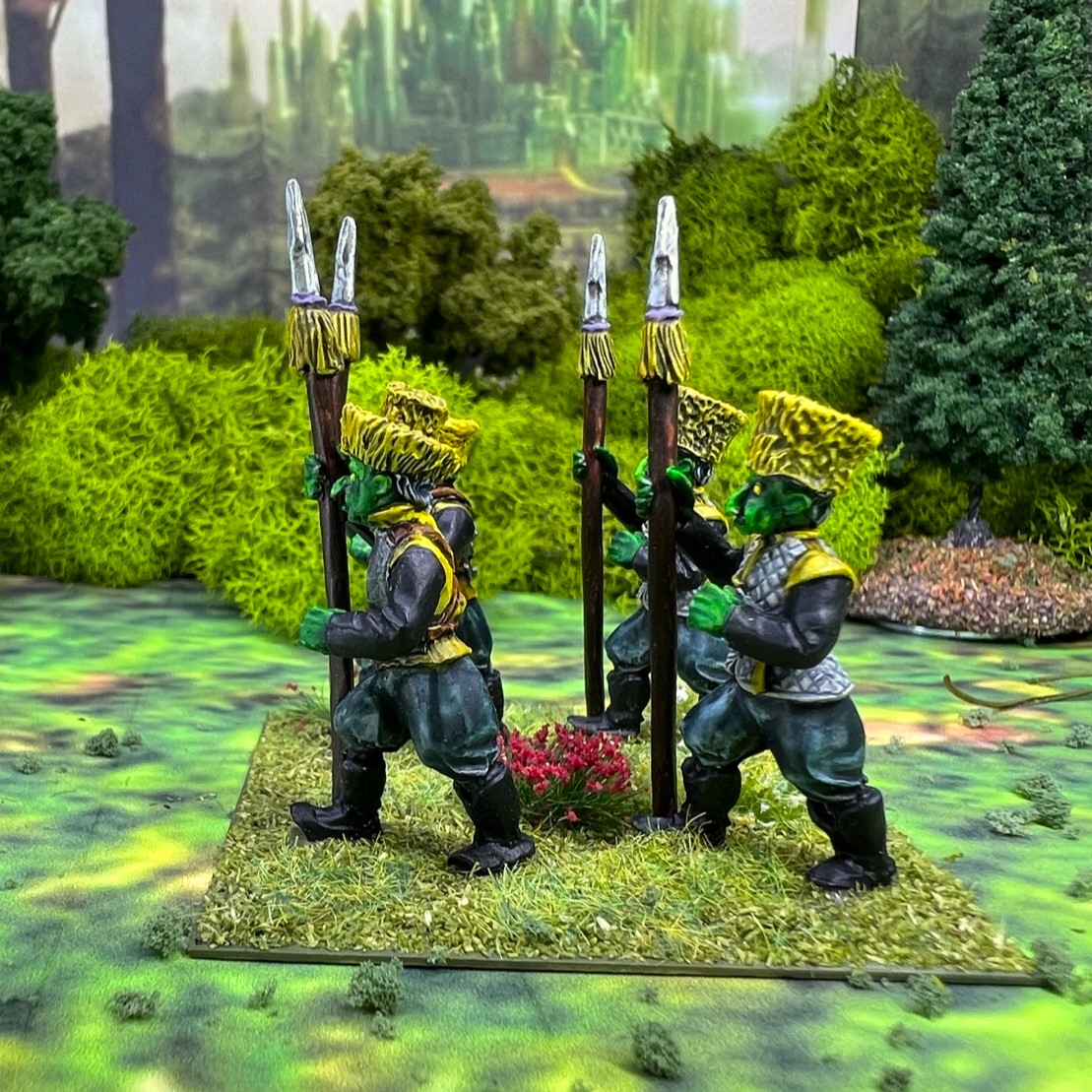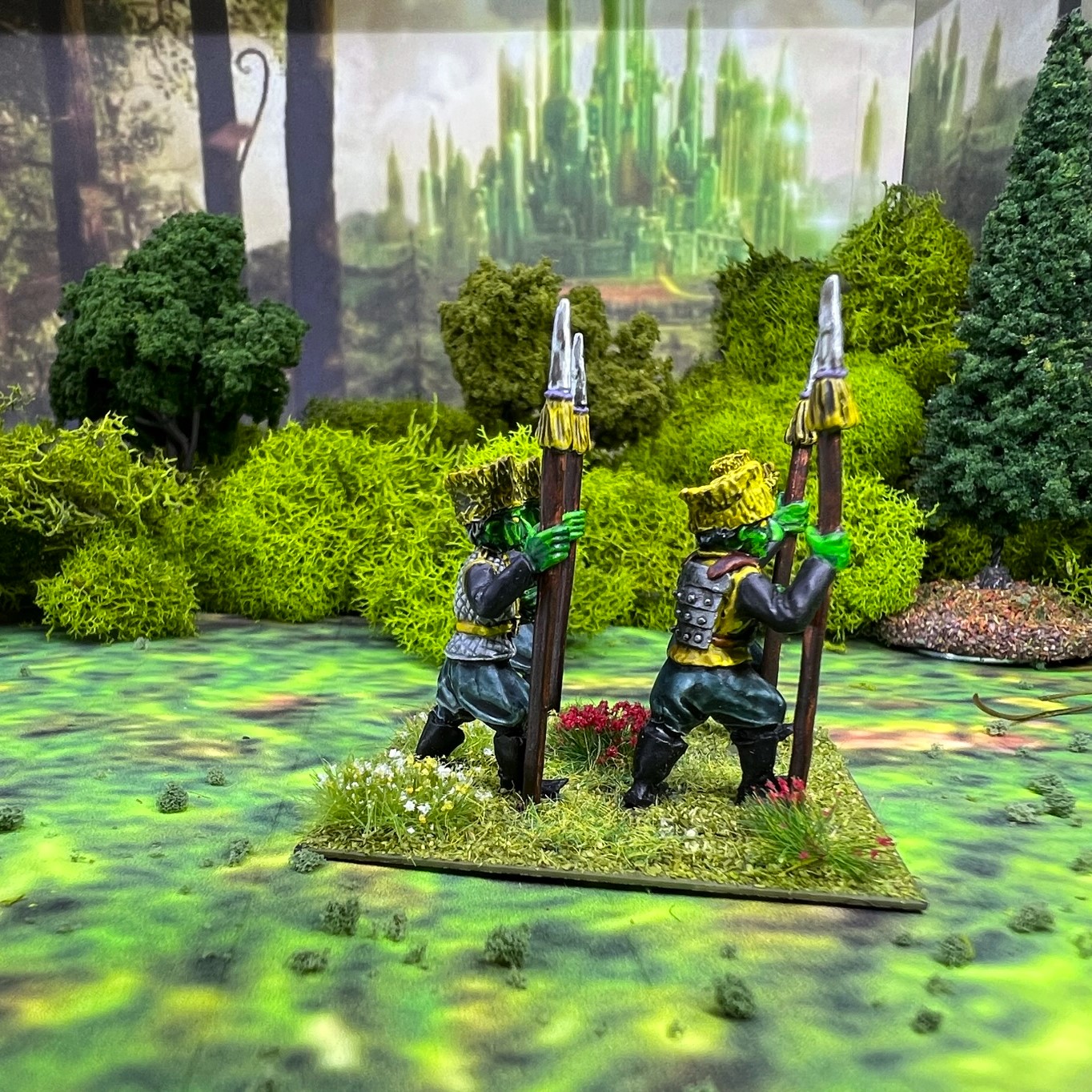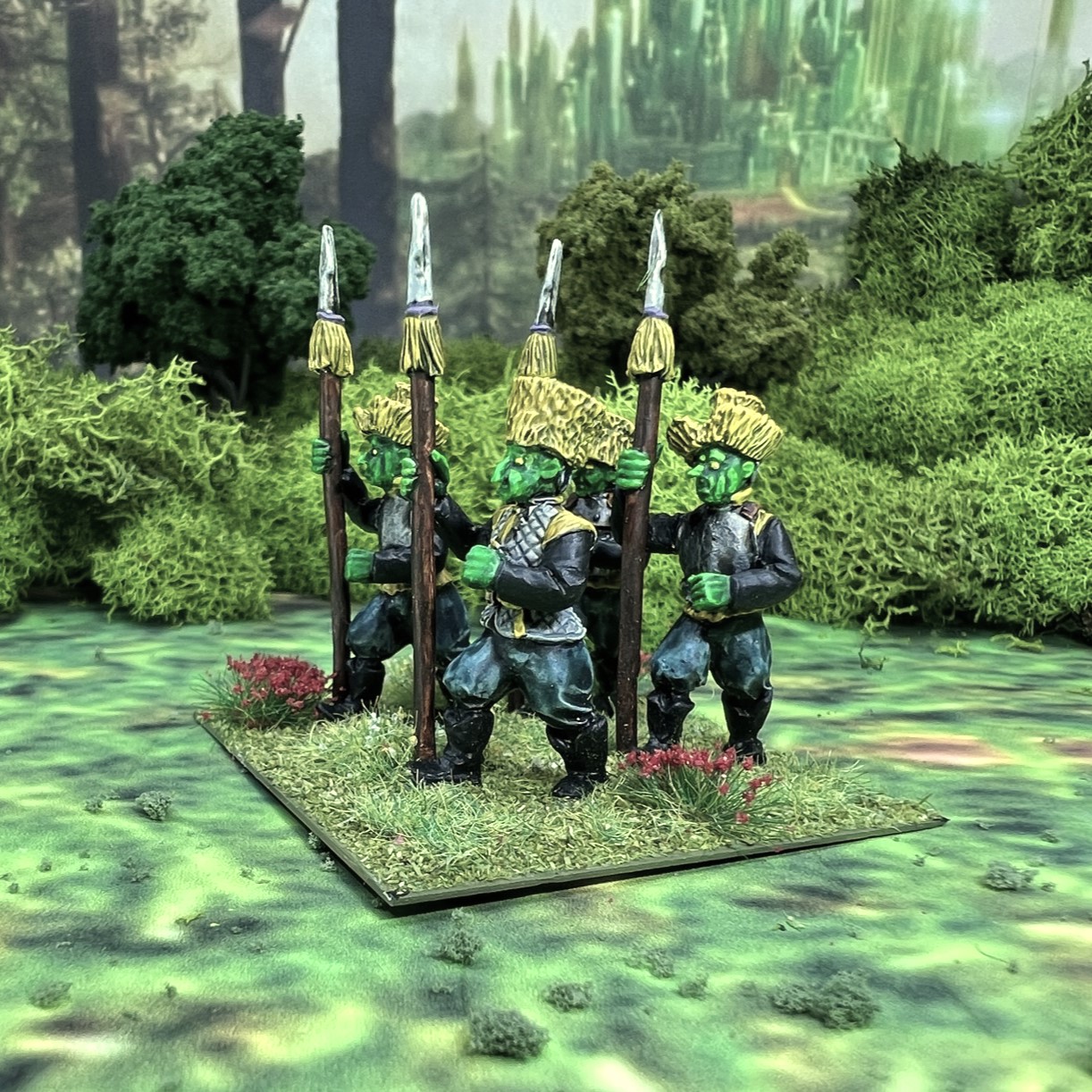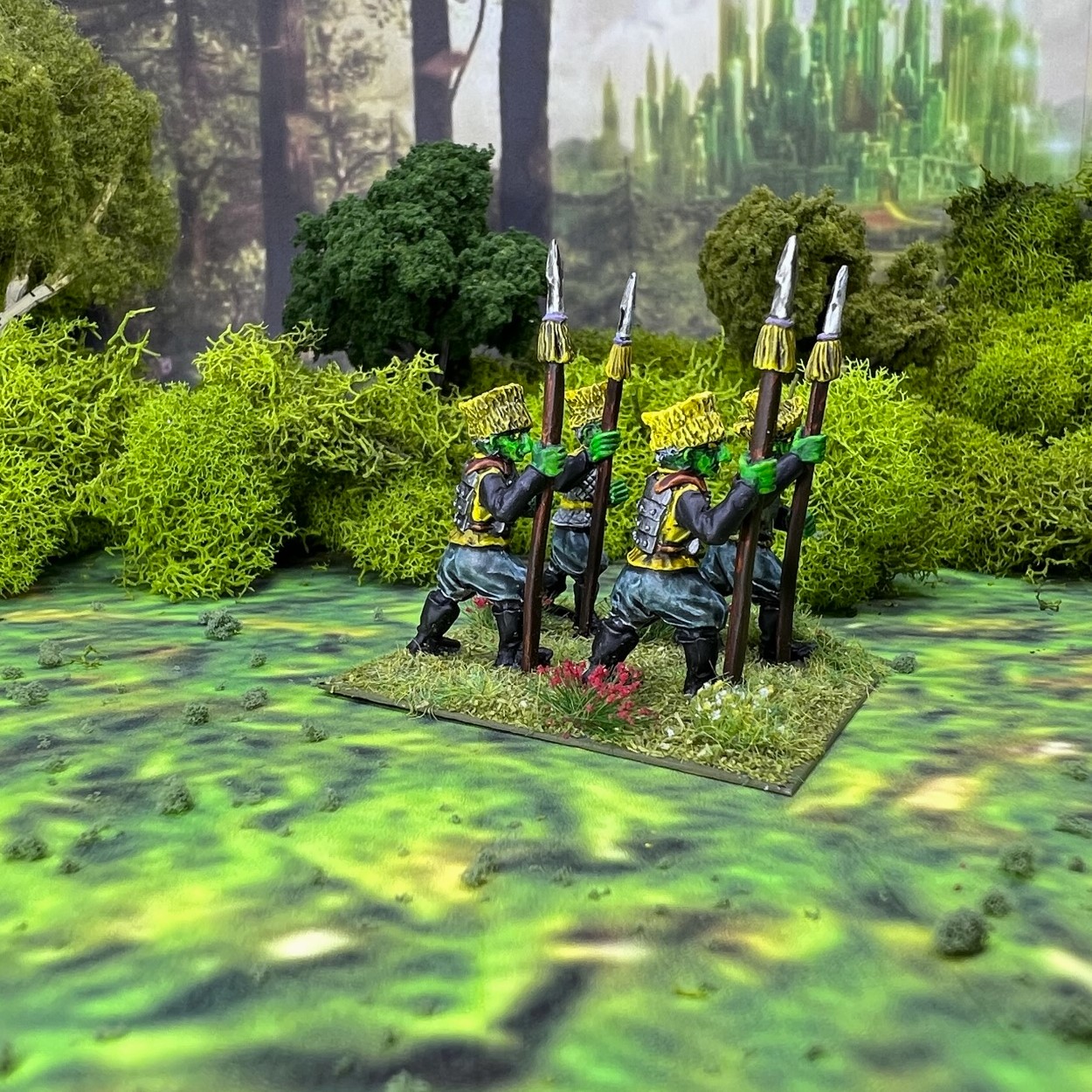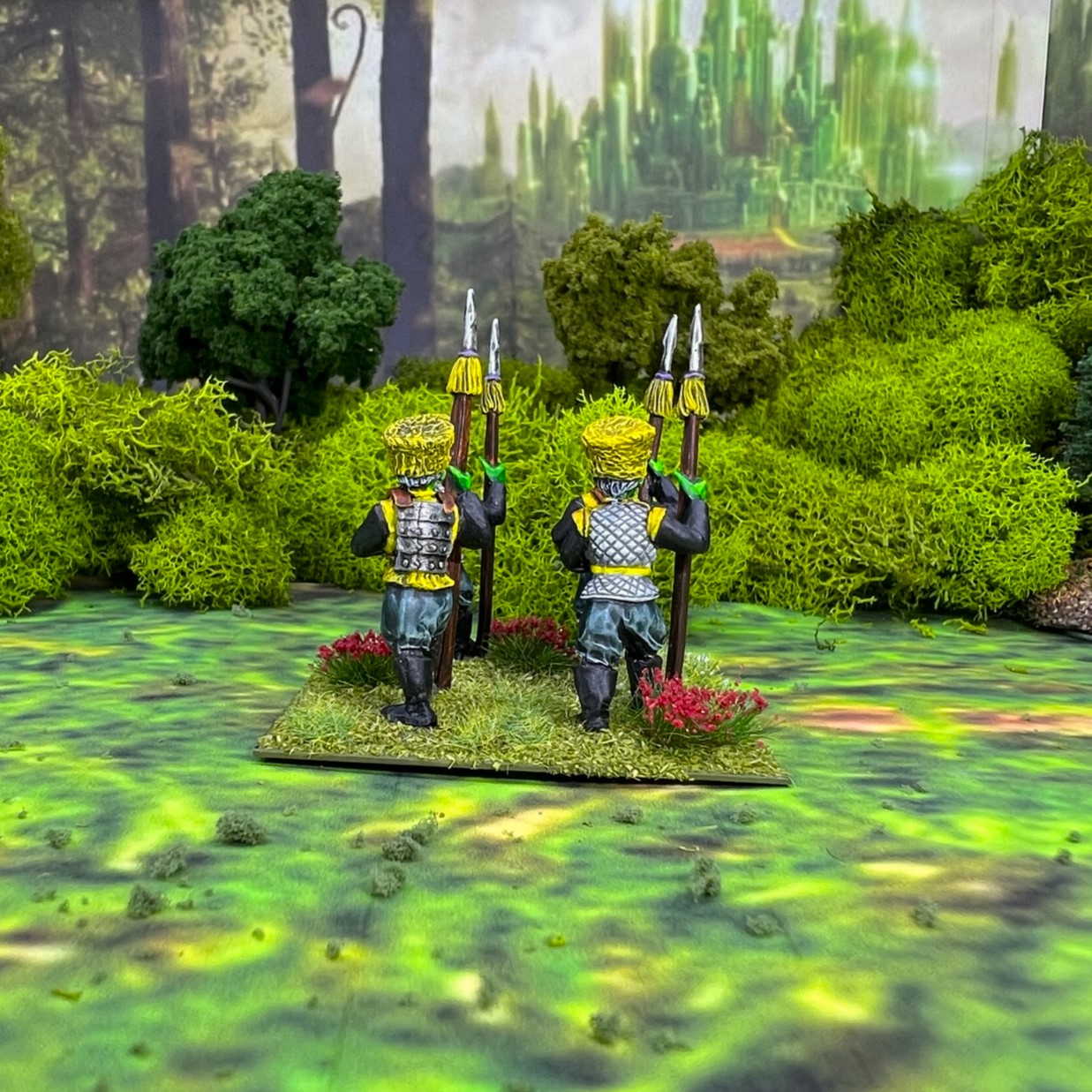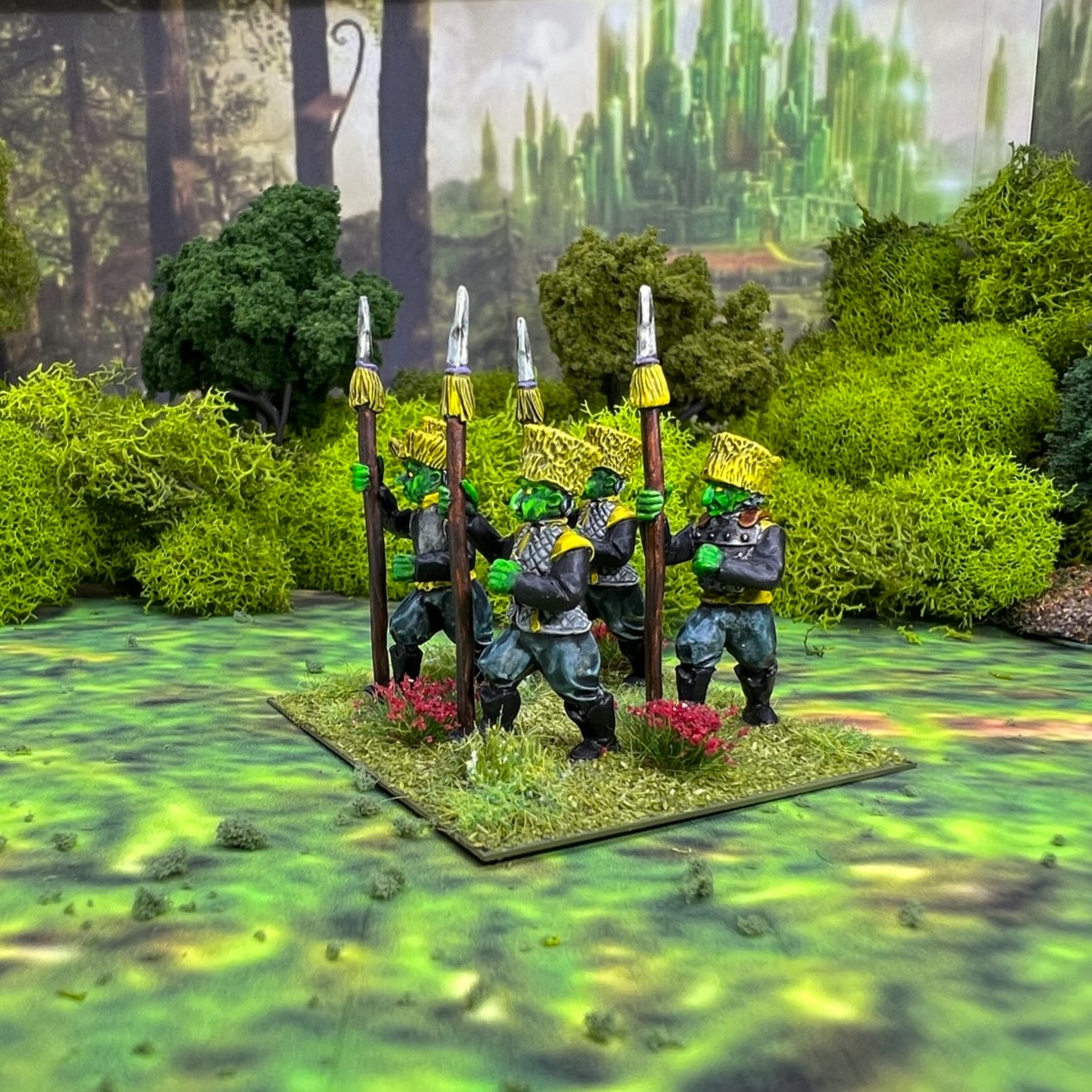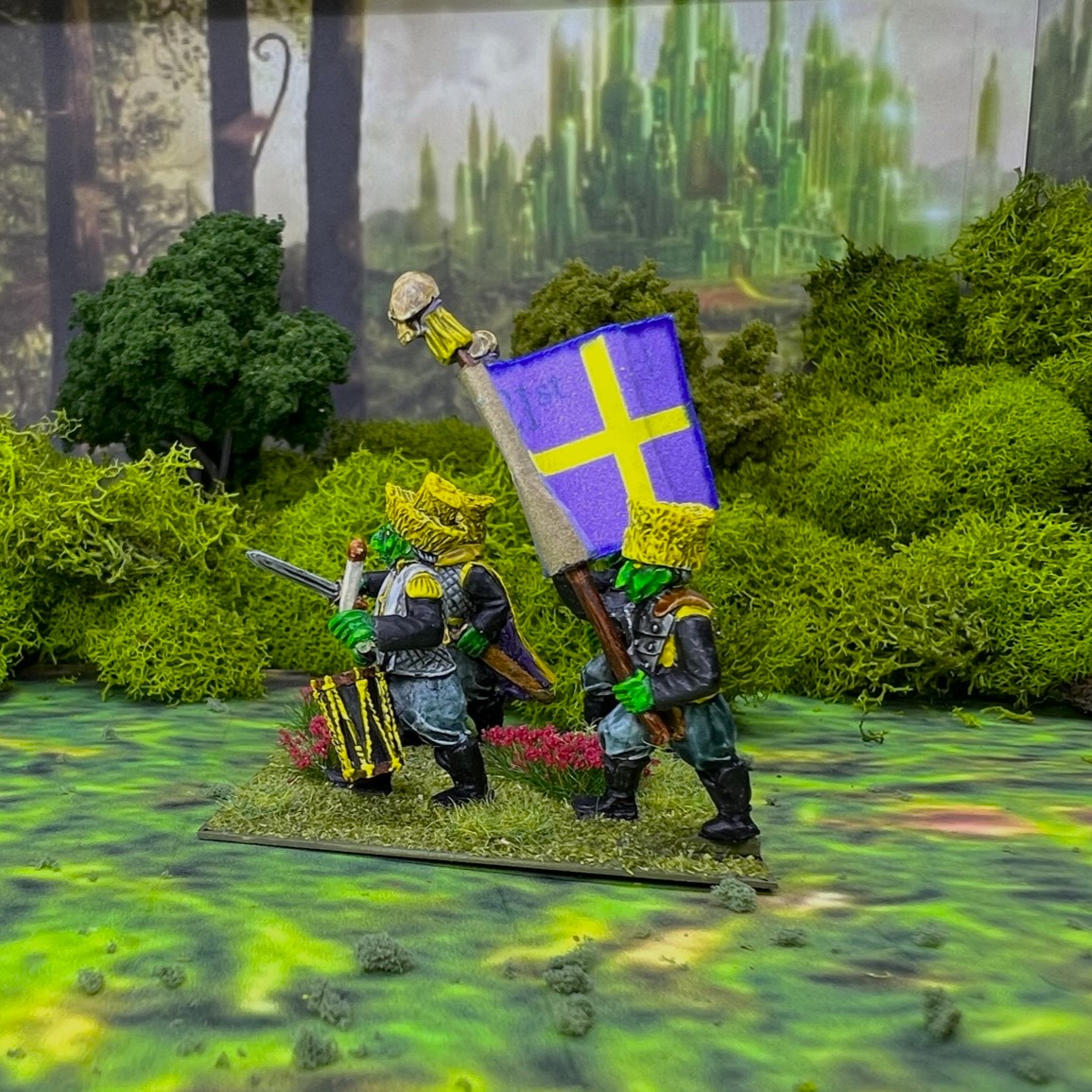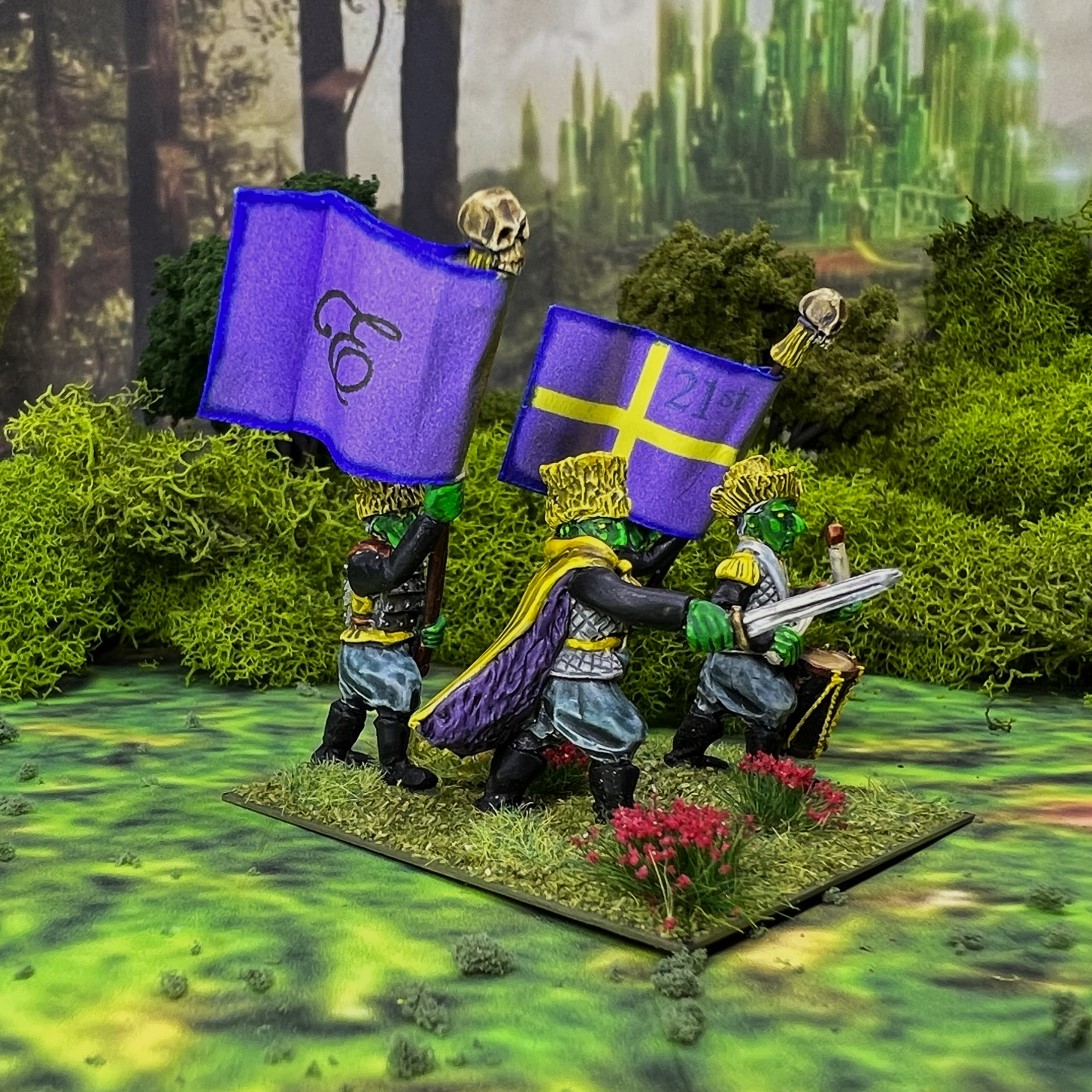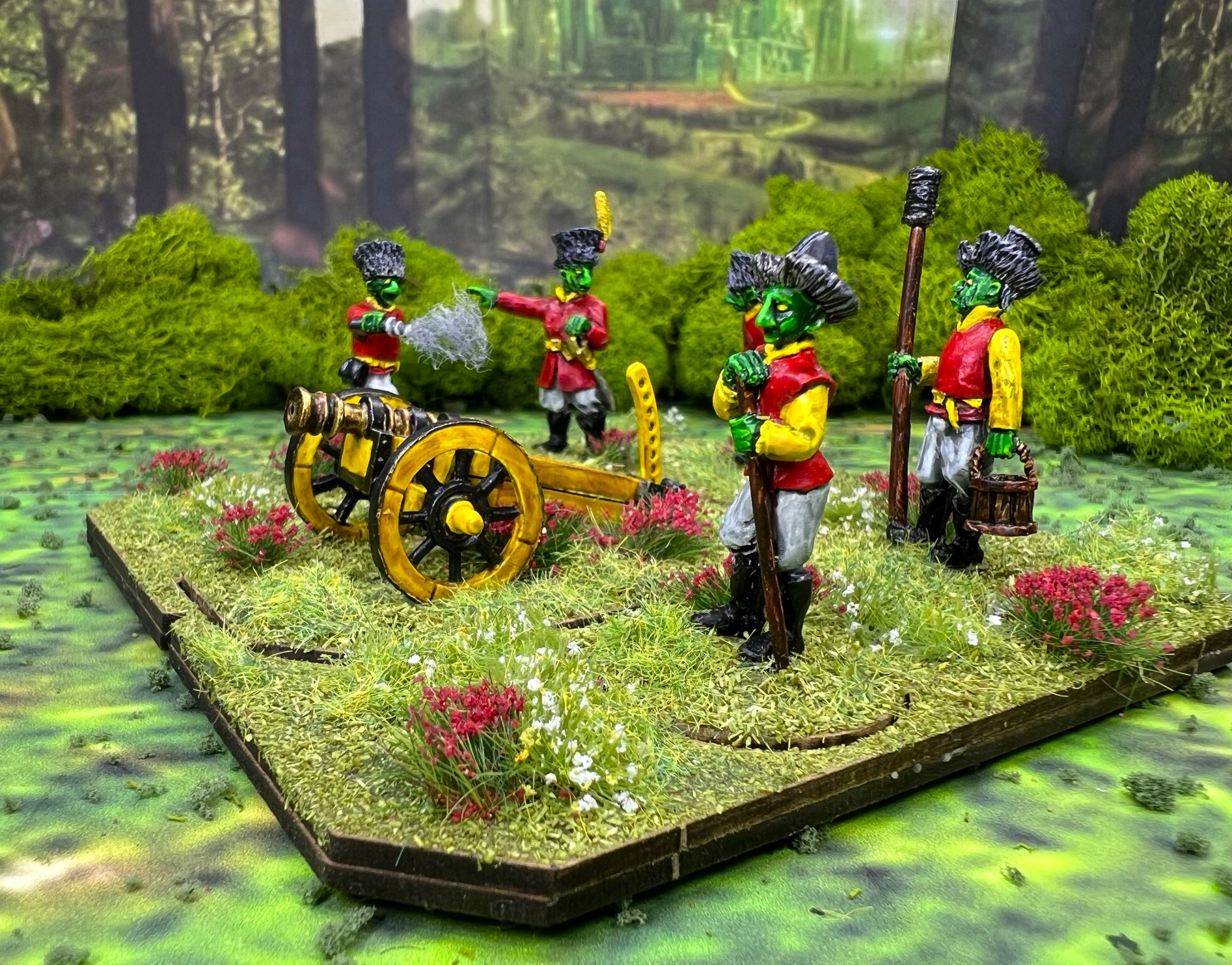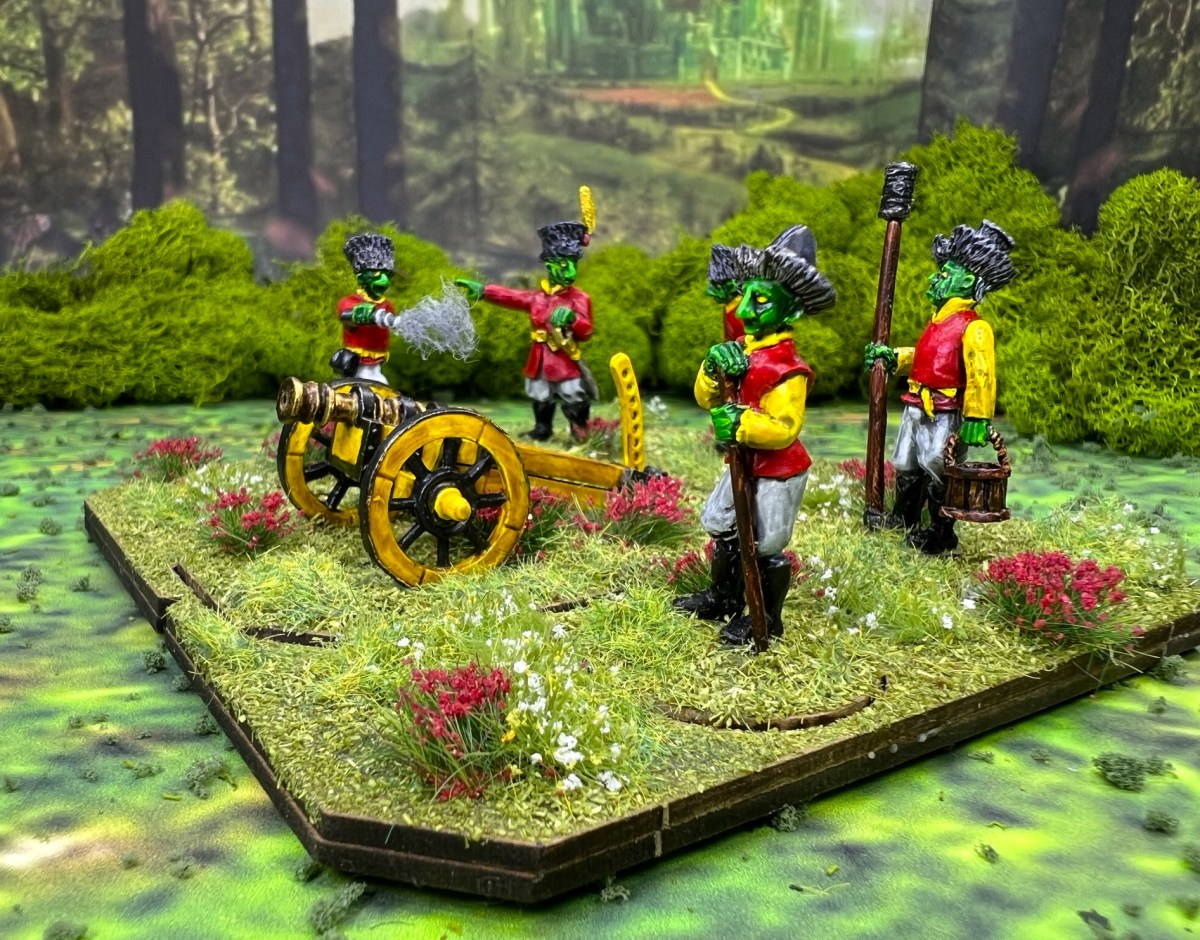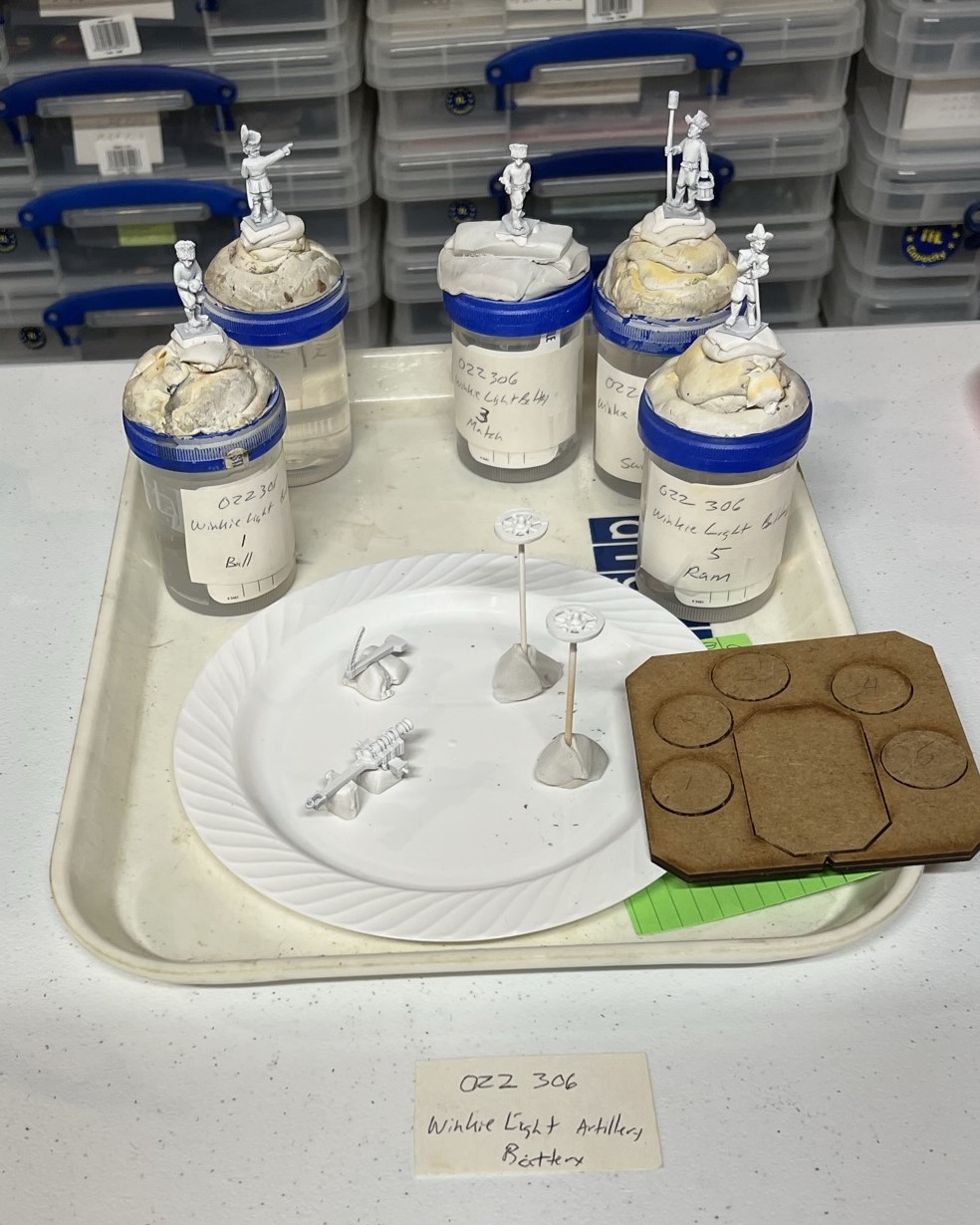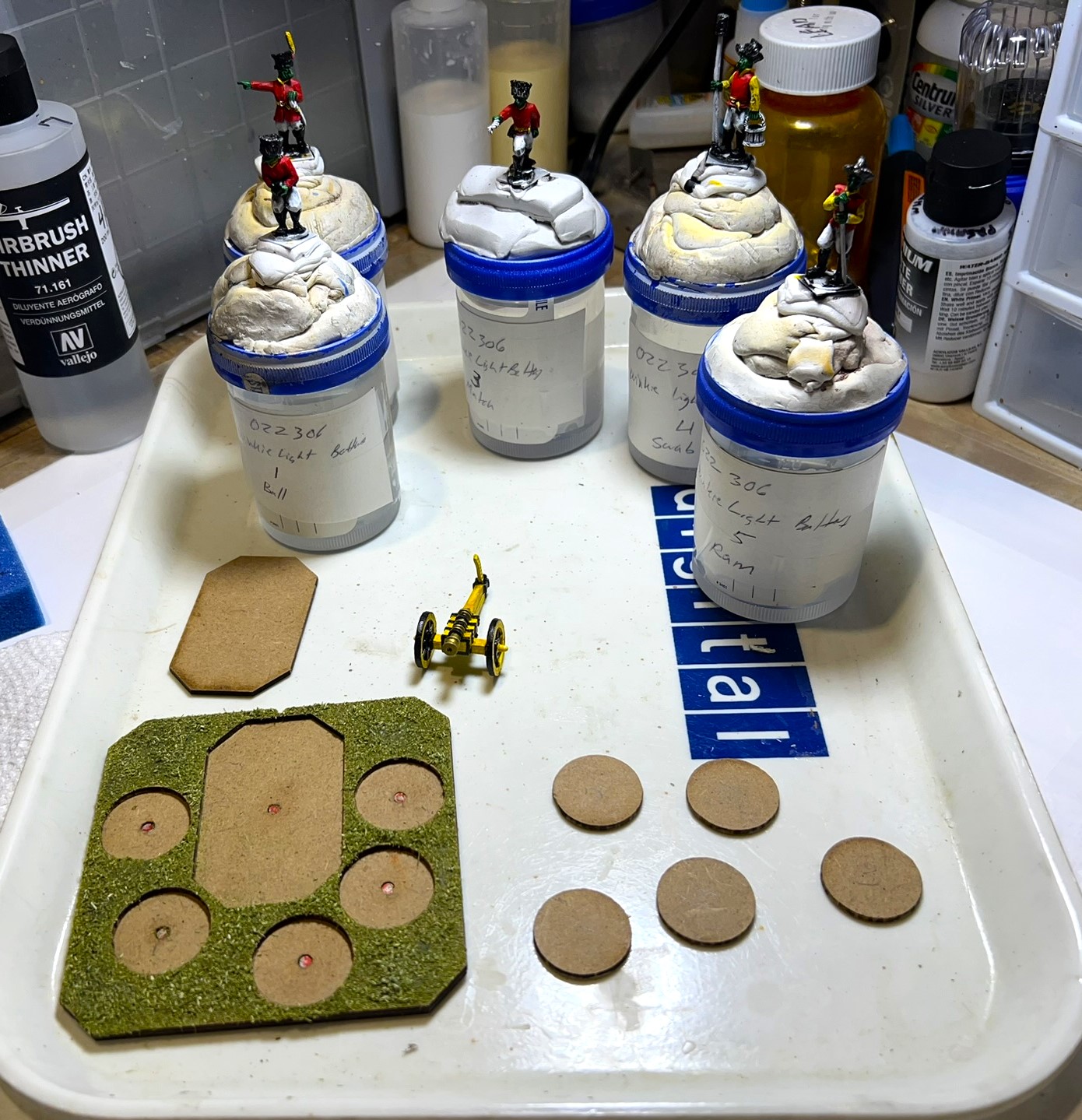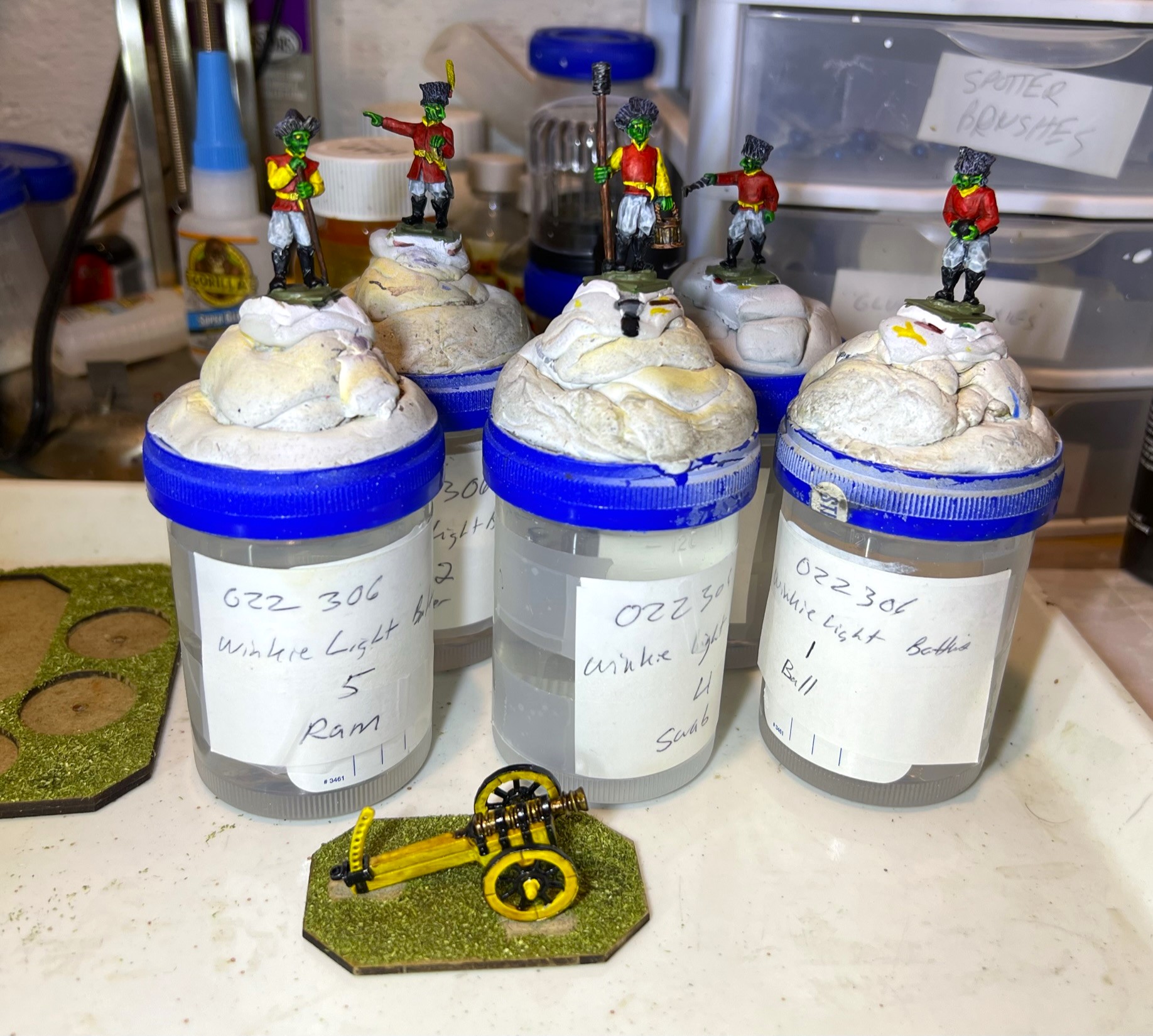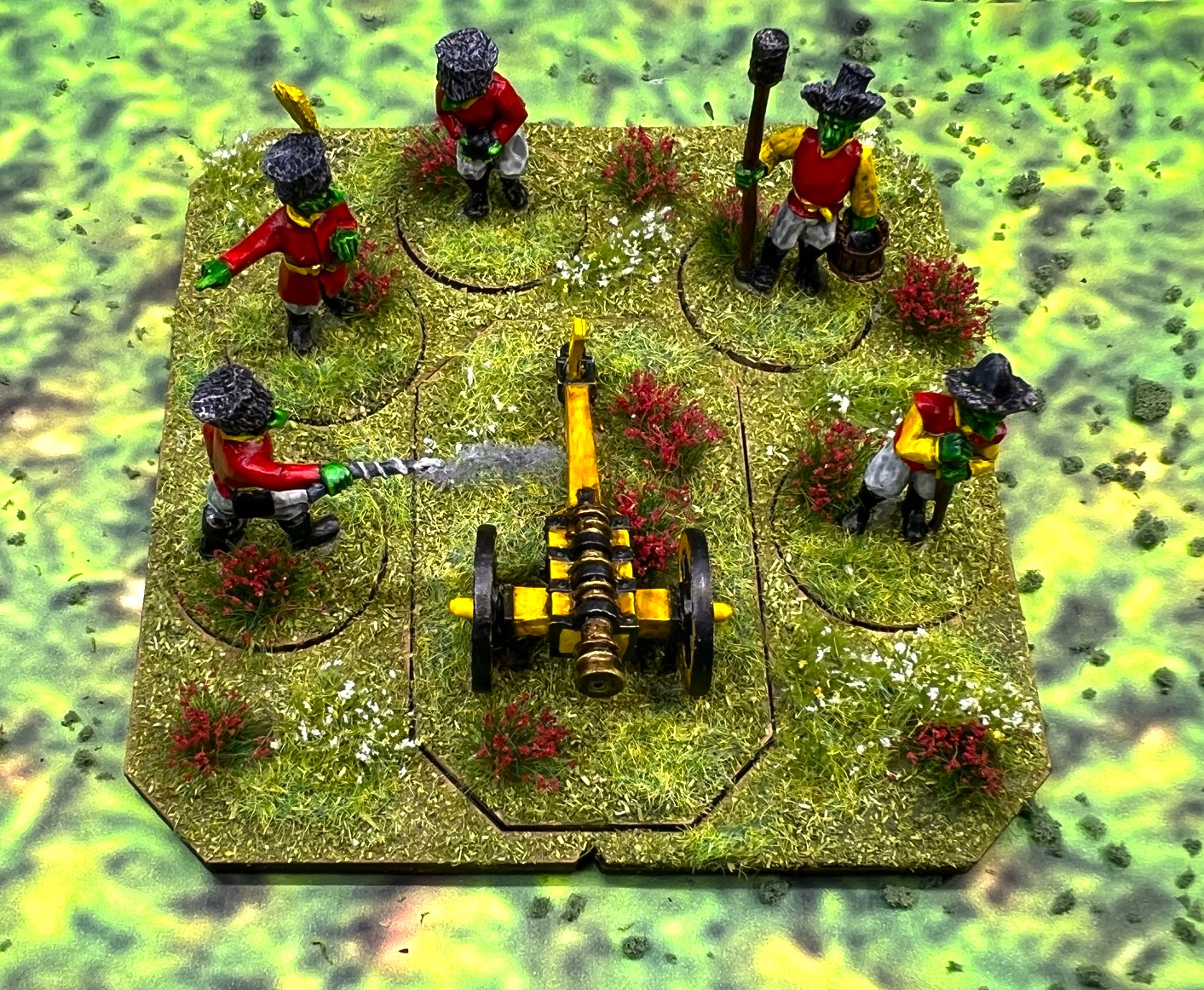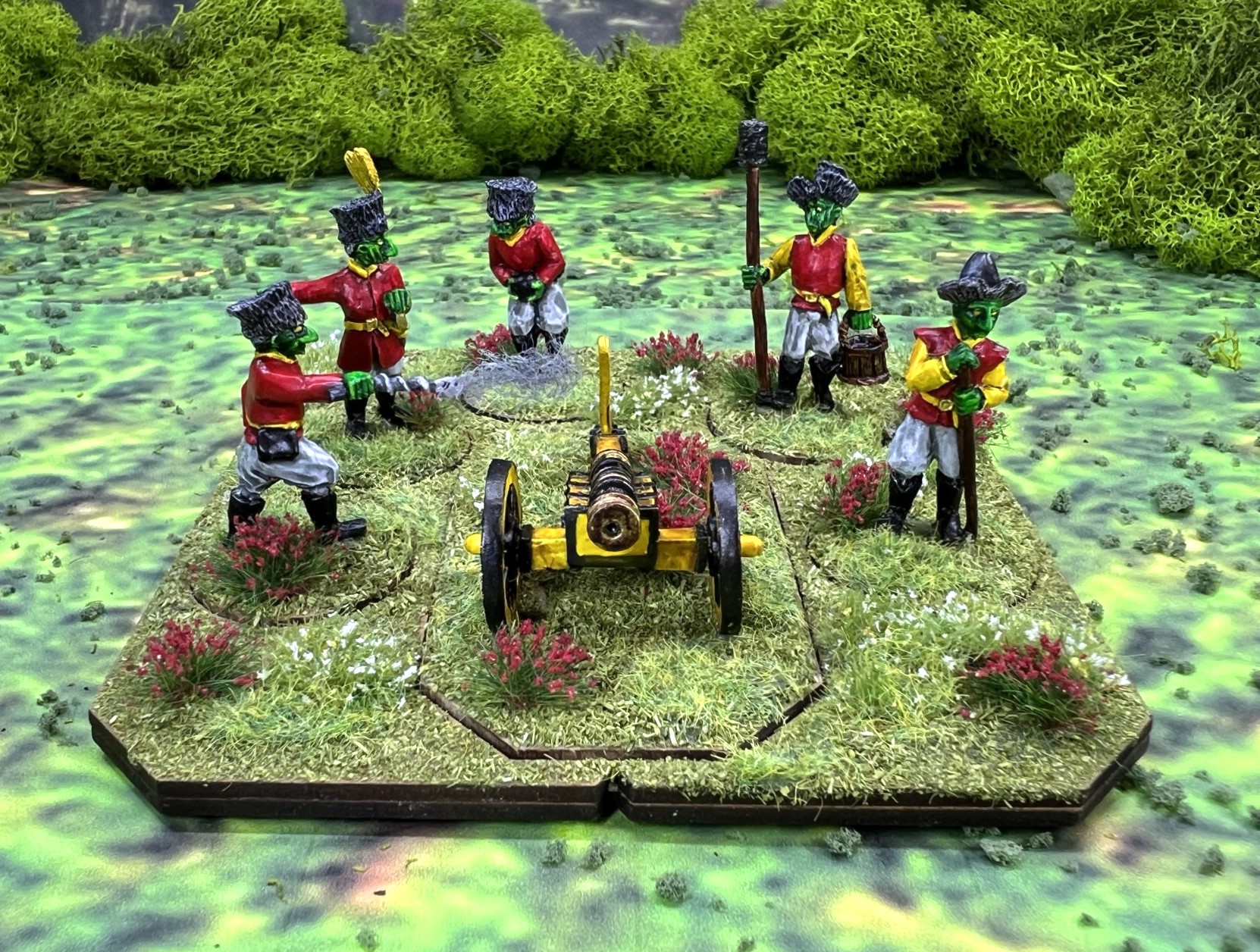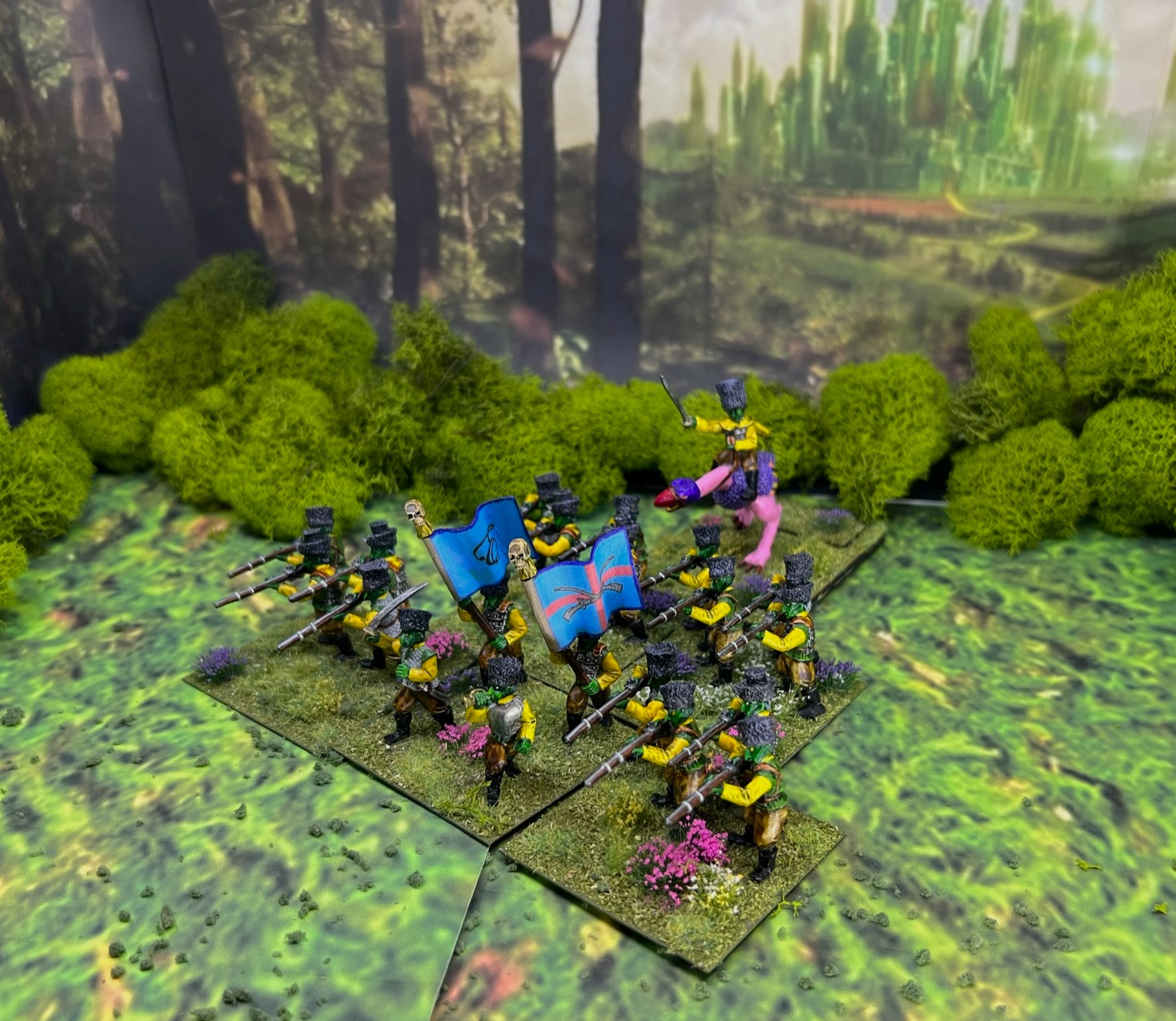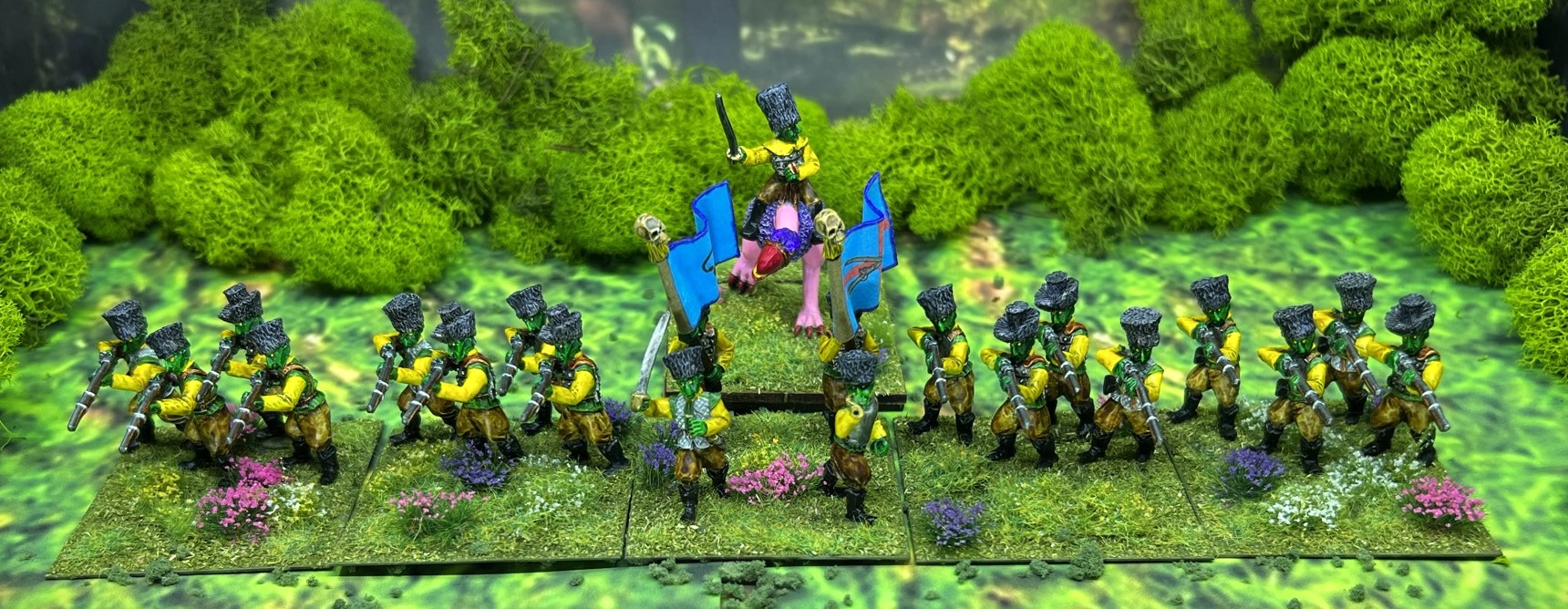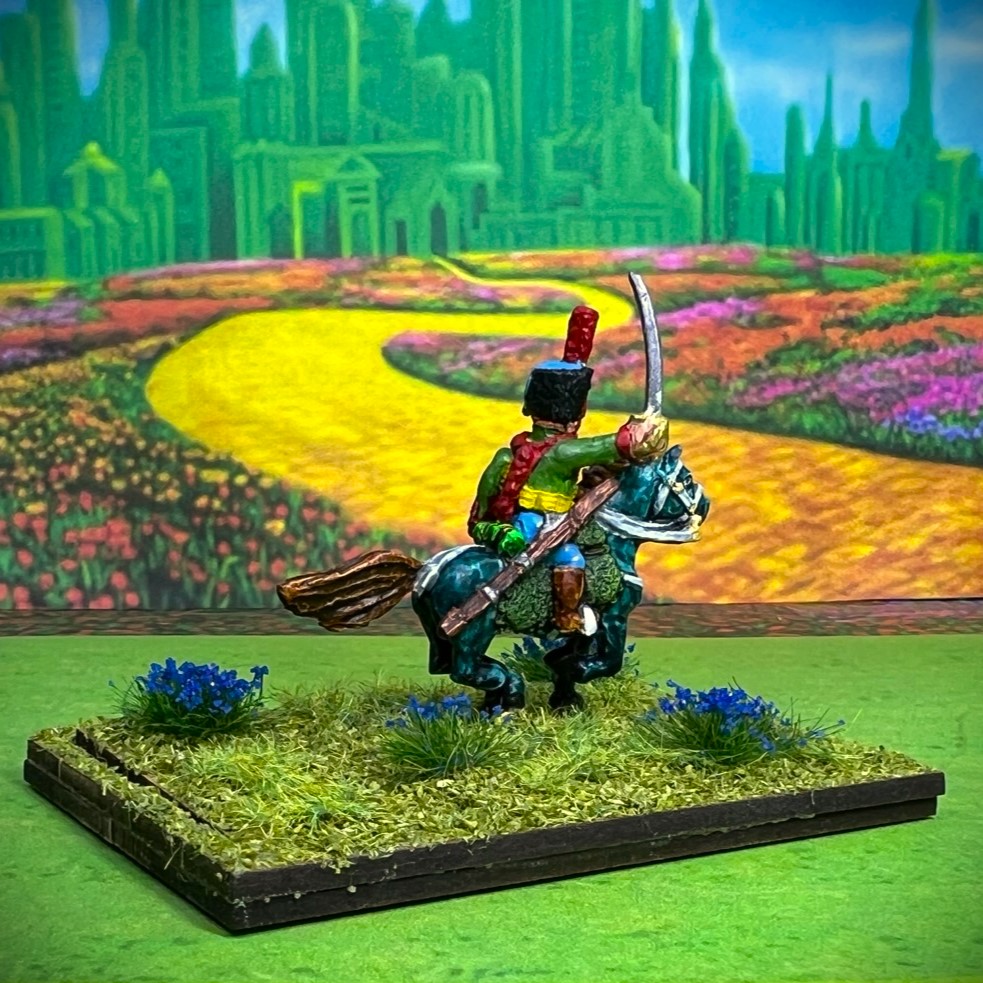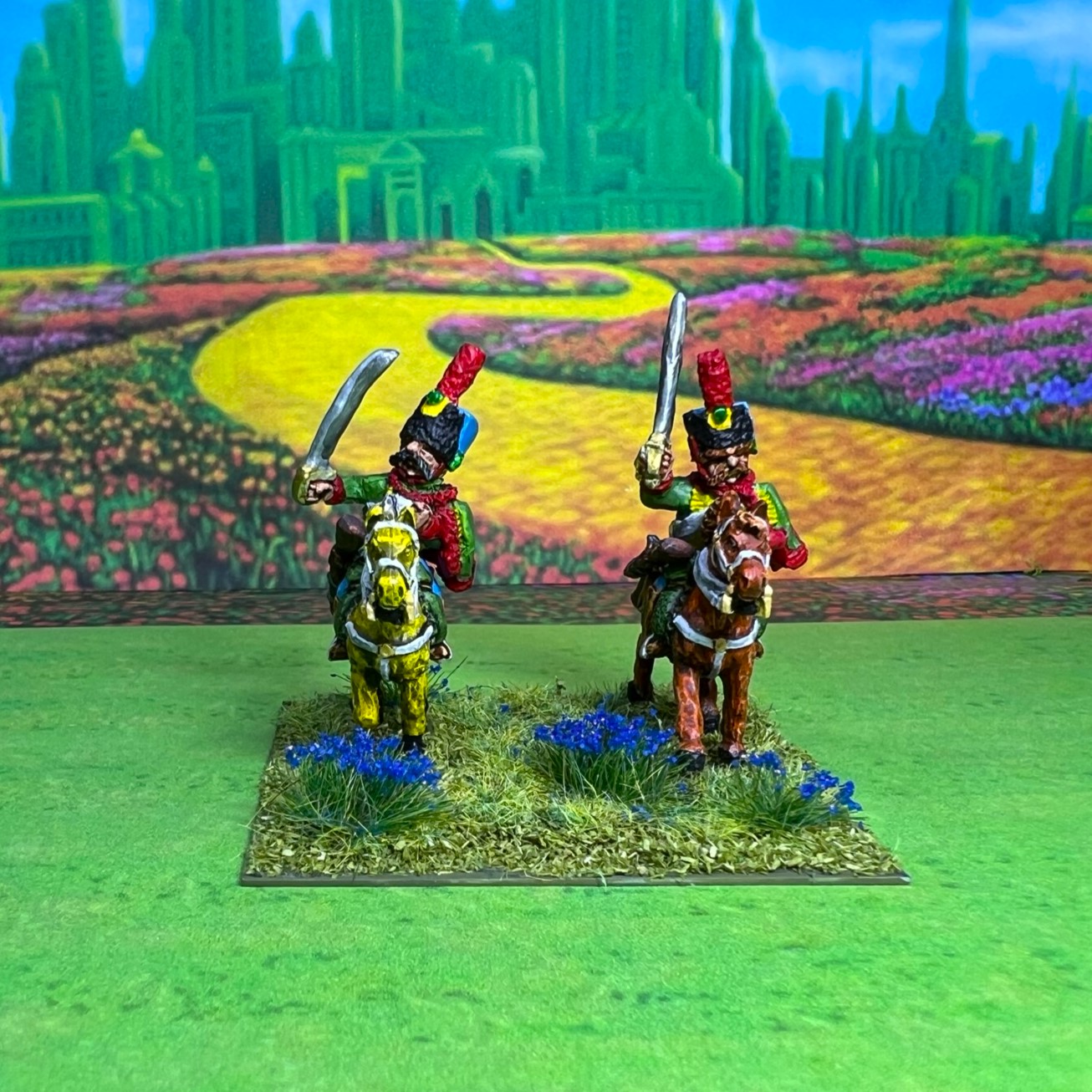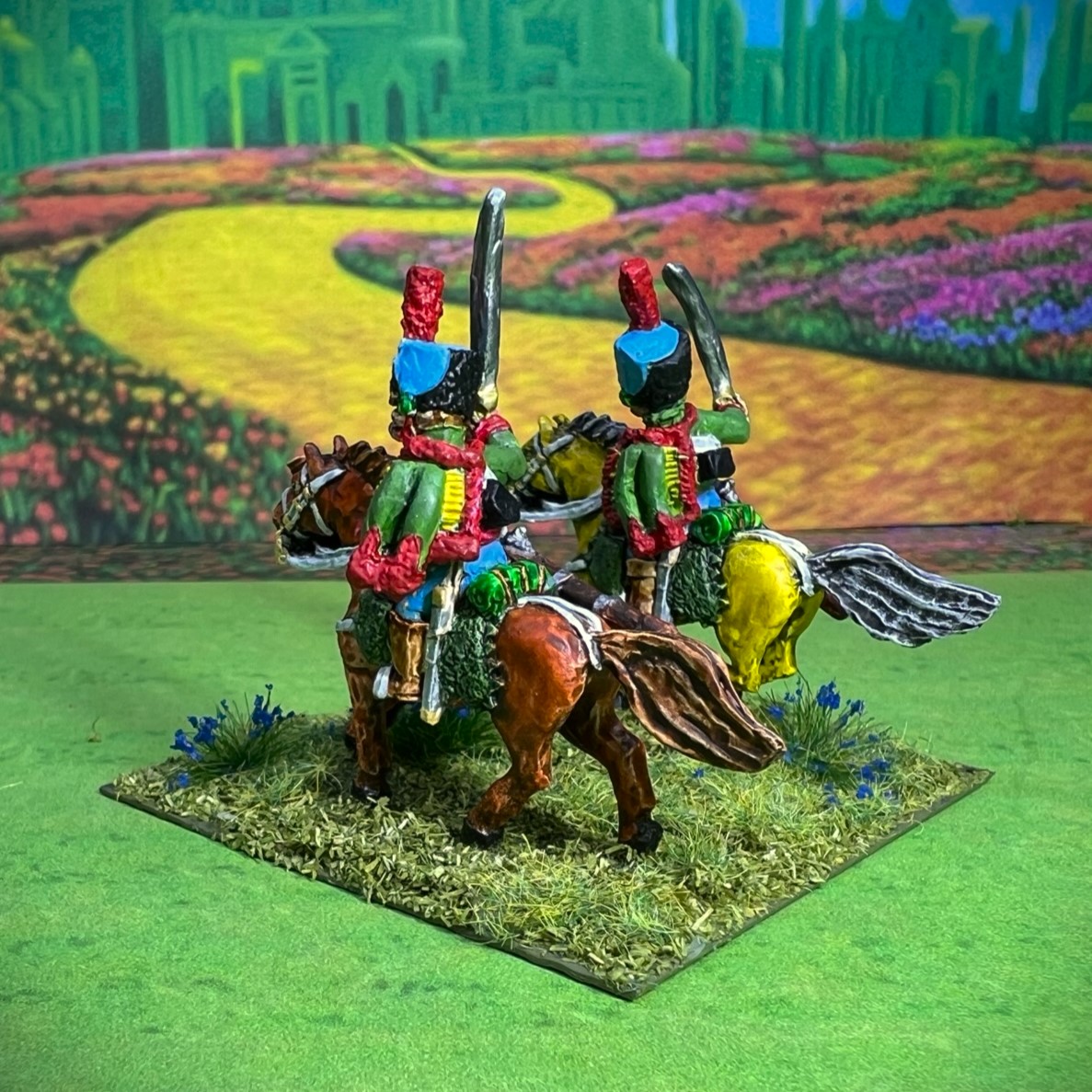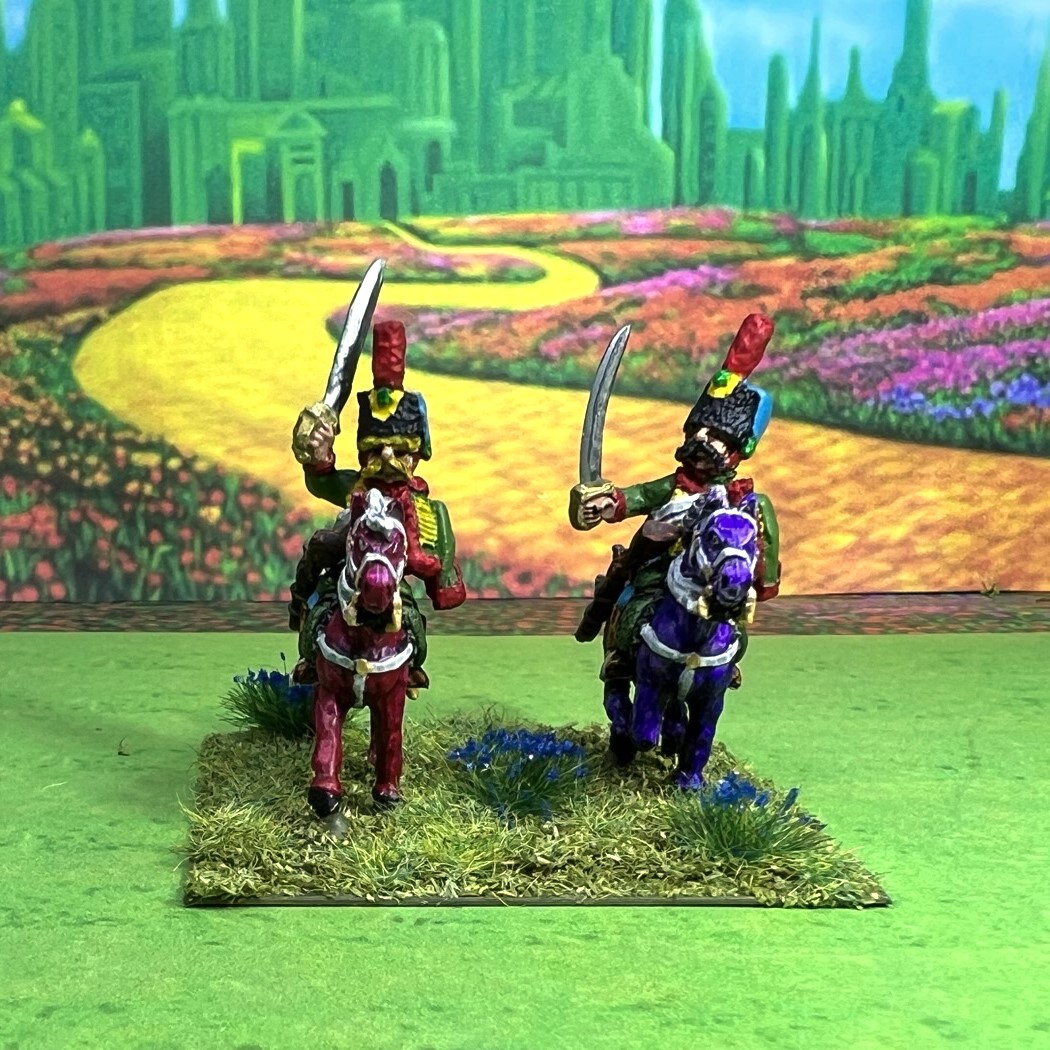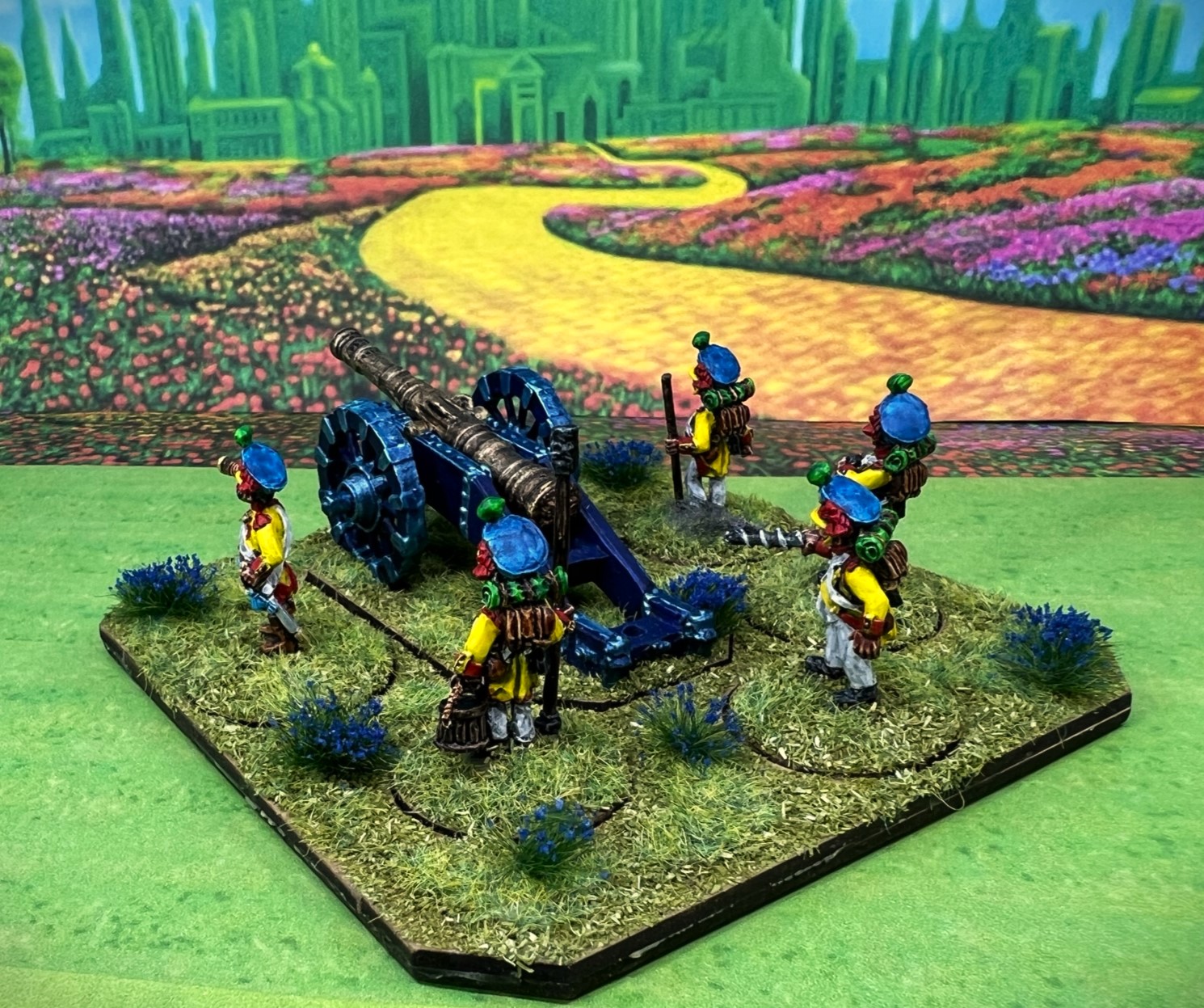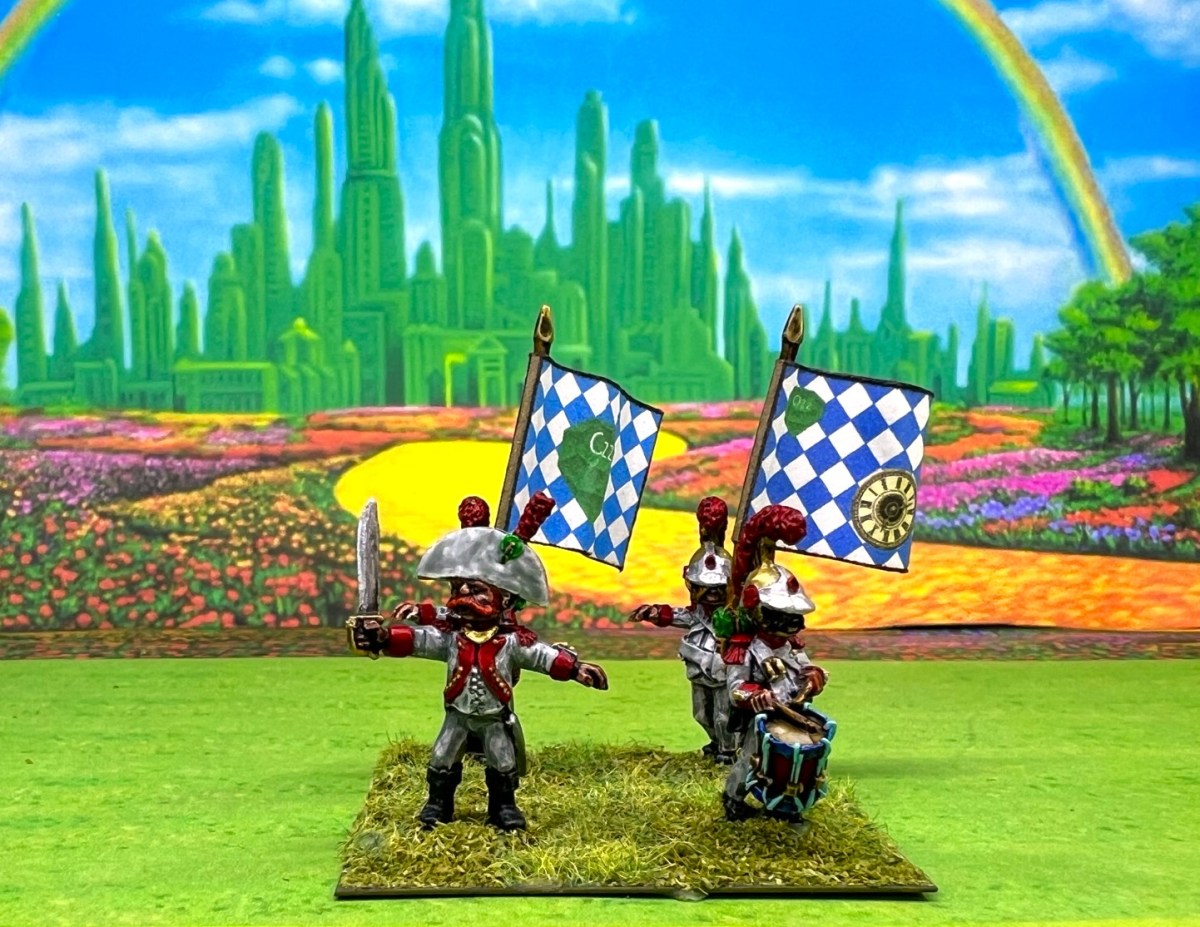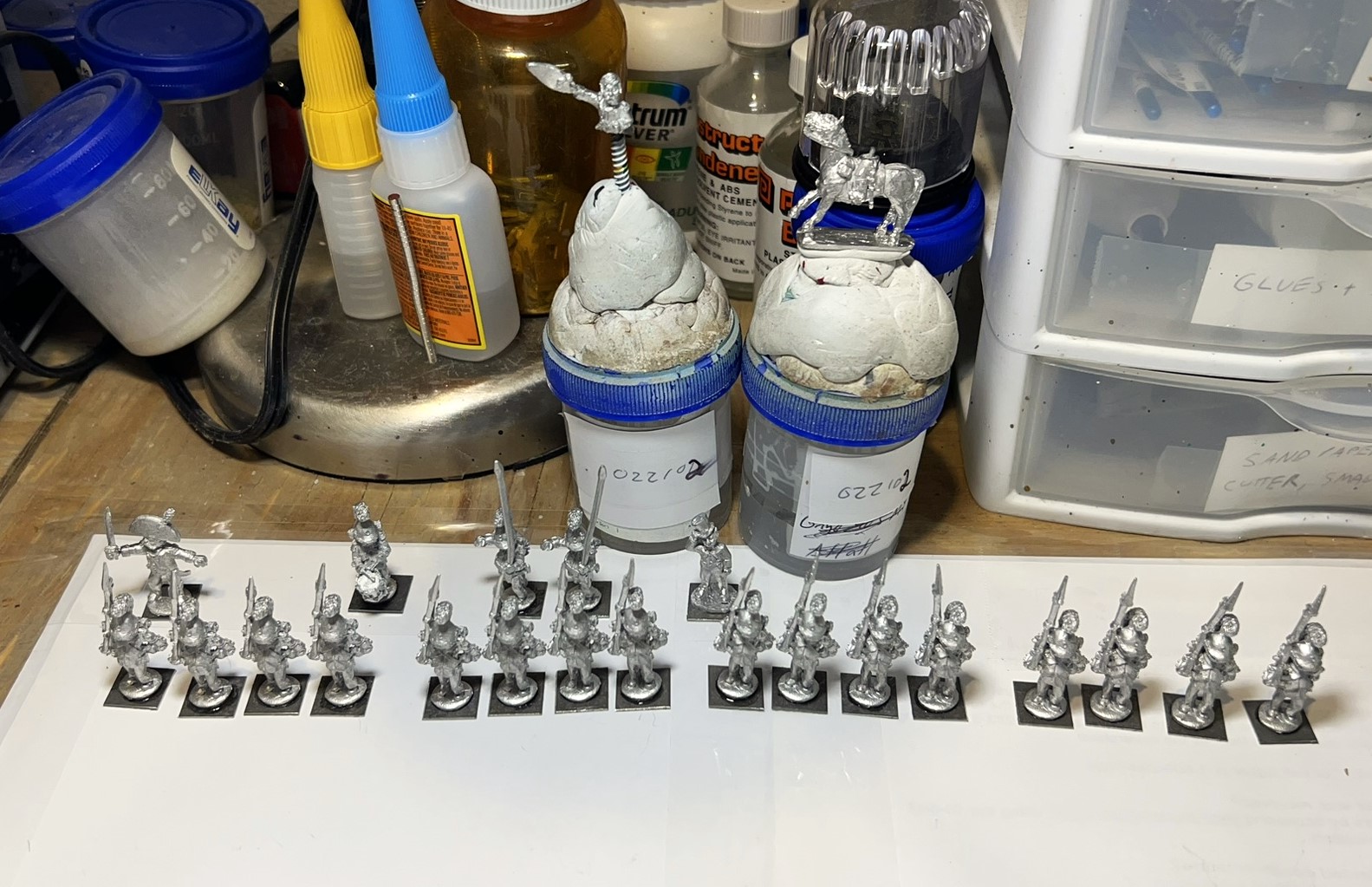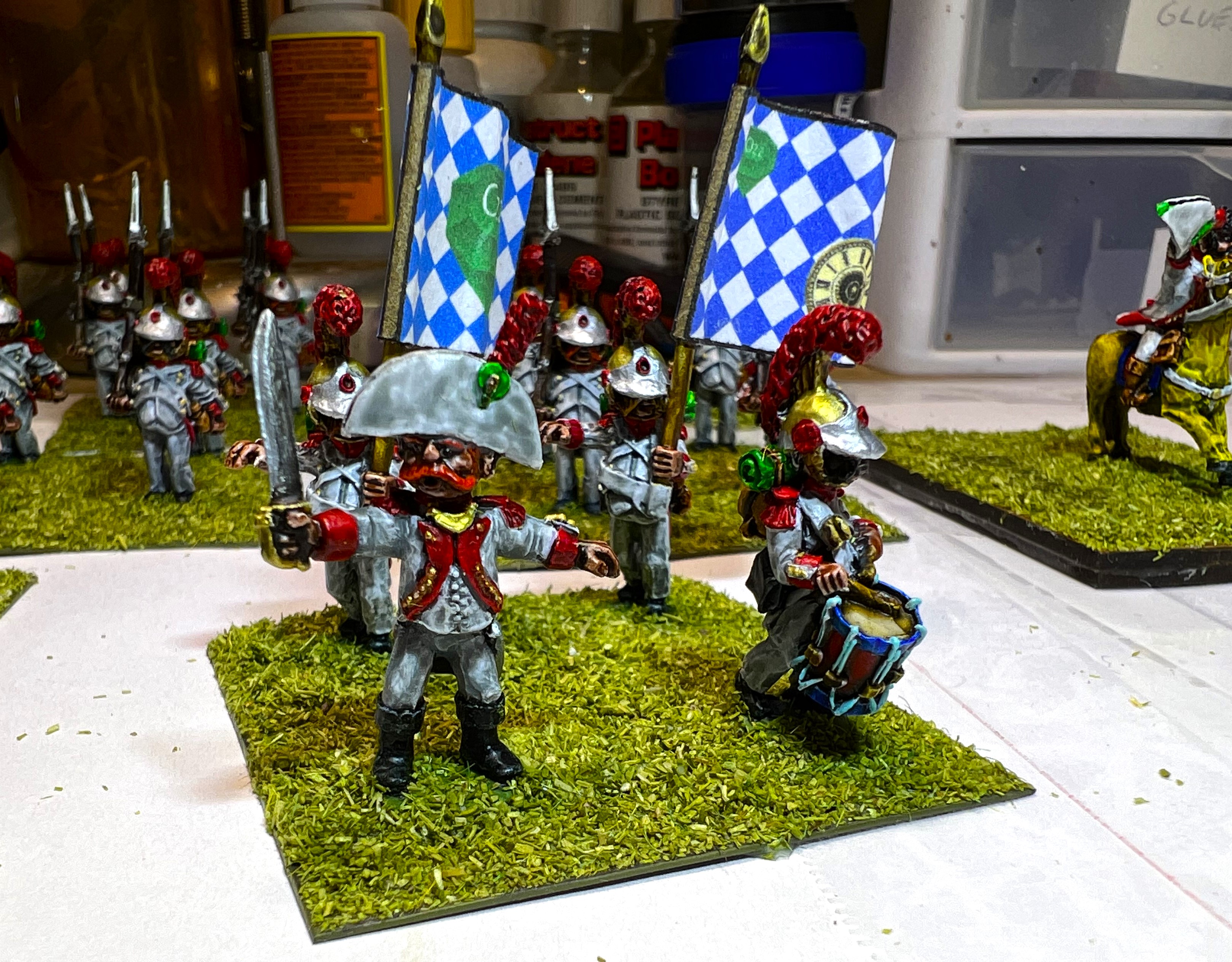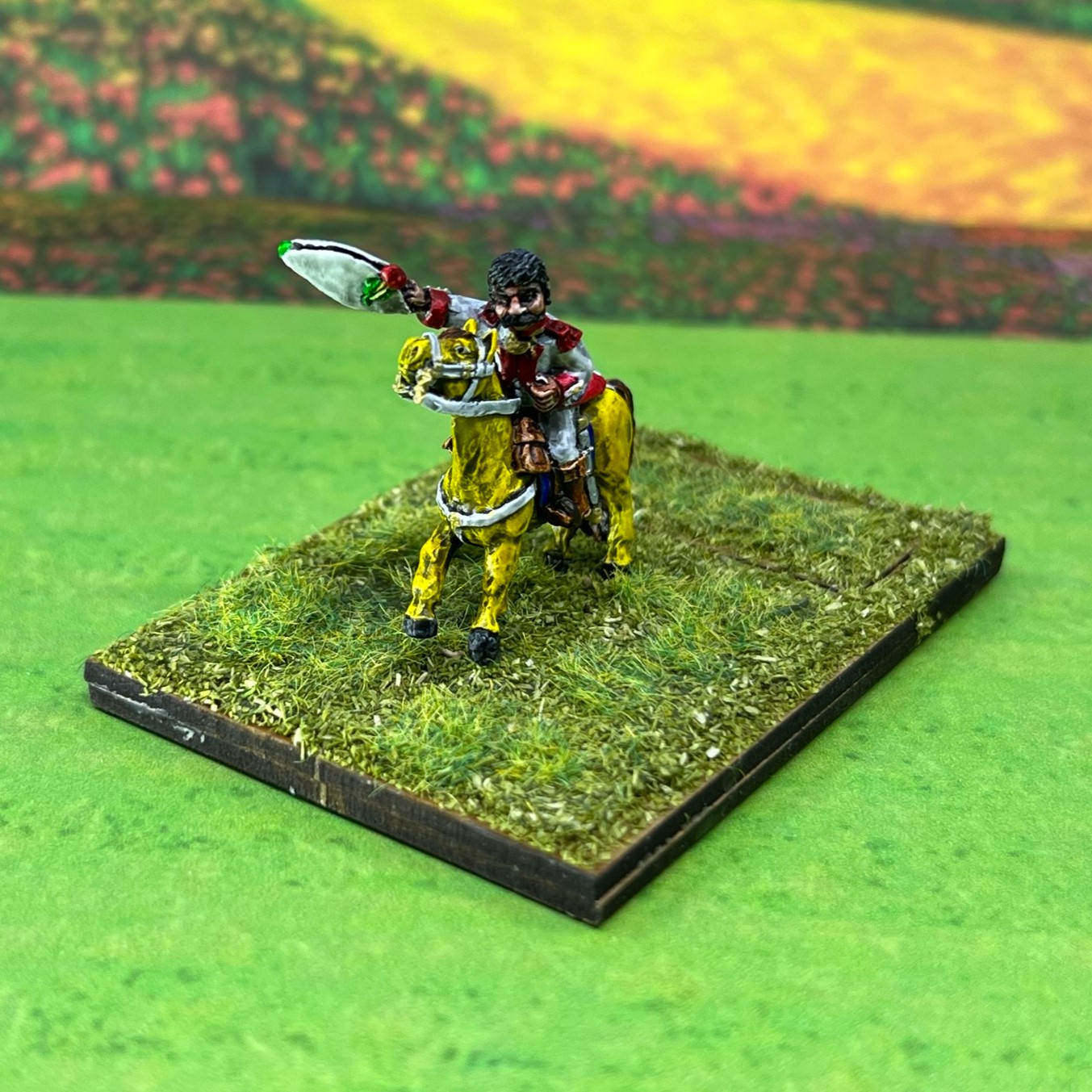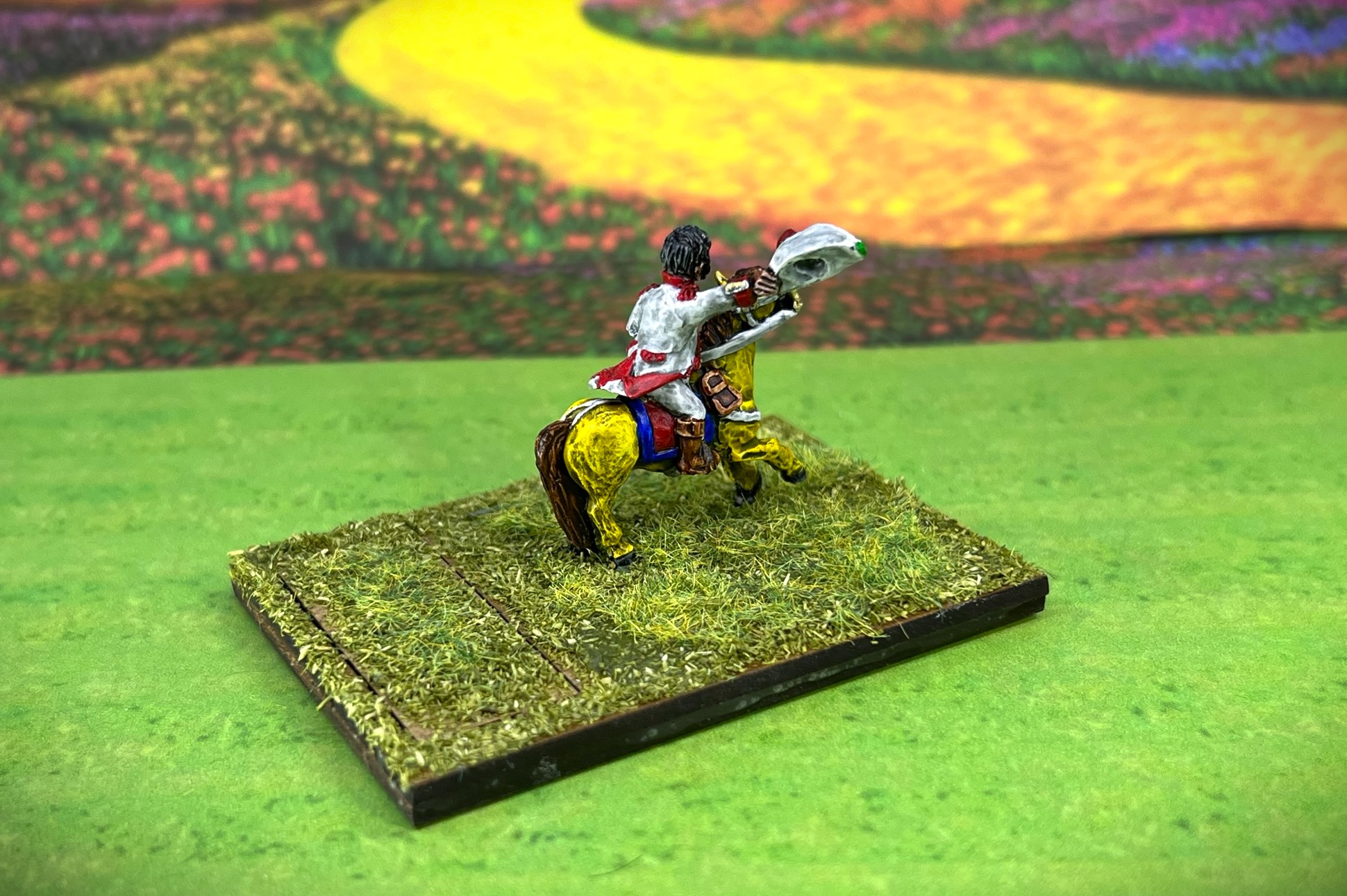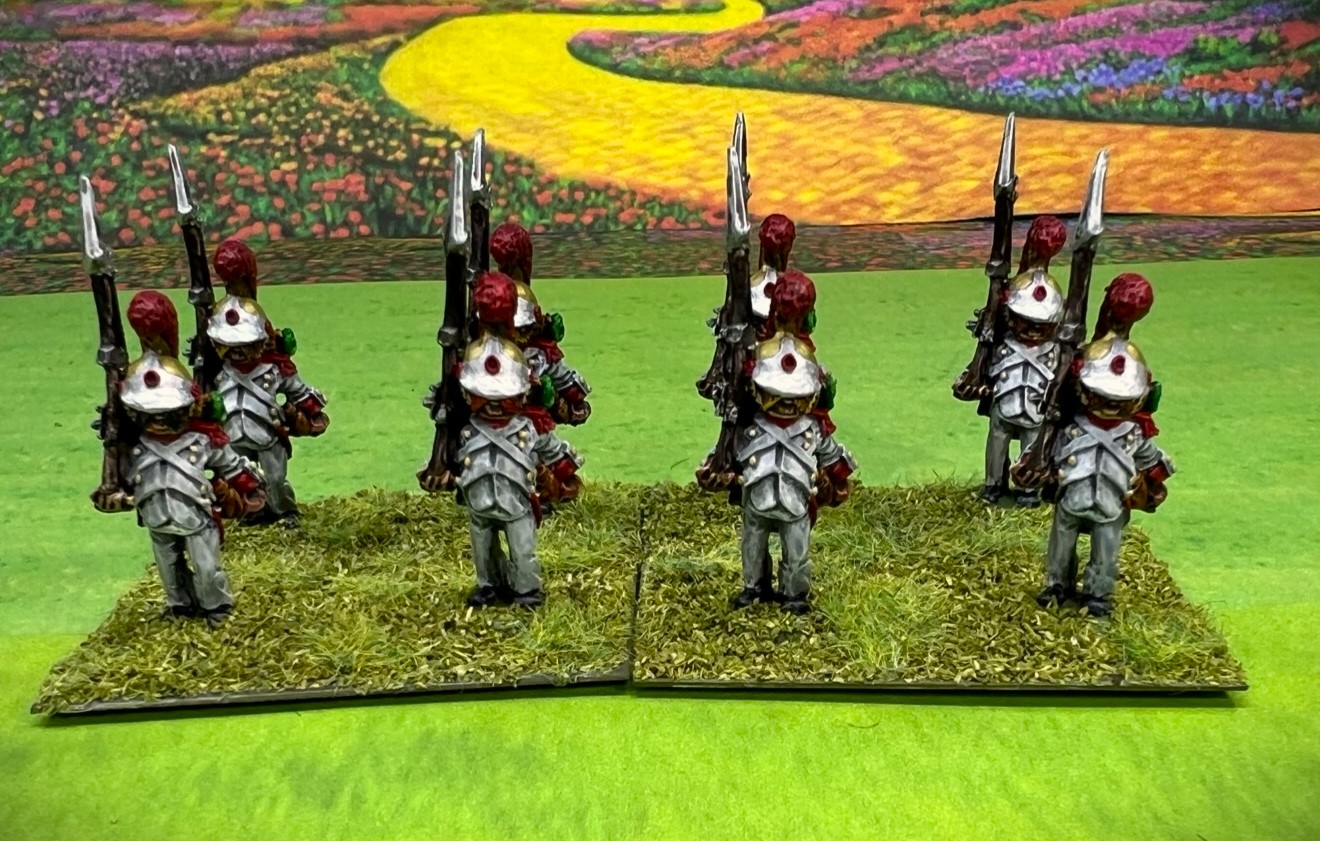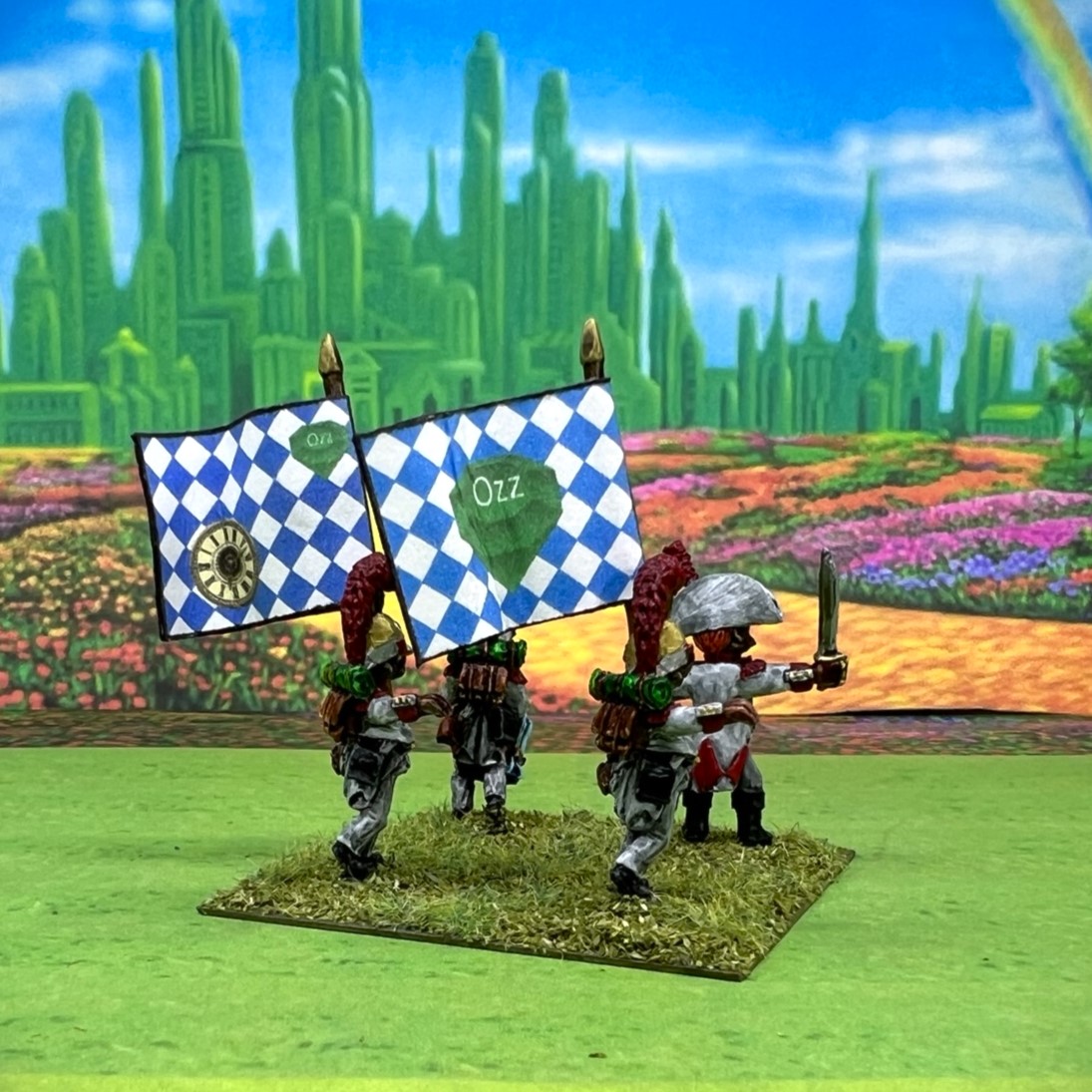
Winkie Light Artillery Battery (Wars of Ozz)

Any good brigade in Wars of Ozz games will need a bit of artillery. As I mentioned in my last post on the Winkie Sharpshooters, Winkies (the orcs of the world of Ozz) are much more interested in fighting hand-to-hand in melee with a foe versus shooting a weapon at one. Winkies are not overly bright in general, and certainly are not very educated. According to the Wars of Ozz rulebook,

“…Winkie artillery is something of an afterthought. Numerous battles and sieges have shown the usefulness of a strong artillery arm, but it is simply not a glorious or honourable role according to the Winkie mindset. Few Generals are chosen from the ranks of the artillery. Chieftains’ sons would much rather be leading a regiment of spearmen or jaegers. The artillery requires too much thinking, the guns can’t compete with the workshops of the Munchkins, and there is too much heavy lifting to be glorious. Consequently, the commanders of the batteries are an eccentric lot. They range from brilliant to simply odd. Except for the master gunners, most of the crew are conscripts secretly happy to be well back from the front line.”

Wars of Ozz by John R. “Buck” Surdu, Section 2.2.2.5, page 25

I therefore decided to have a Winkie Light Artillery Battery (WLAB) for my Brigade, and save some points for other troops. This unit (#OZZ306) has 5 figures plus the gun in total. I use an MDF sabot base for all of the figures and the gun similar to the Munchkin Medium Artillery Battery that I completed earlier. The WLAB is also 28mm in scale, and the figures are metal. It is worth 4 points versus a regular Winkie infantry unit which costs only 5. In the game, light artillery has a short/long range combination of 6″/18″ versus that of a medium battery which is 8″/24″.

The WLAB are supposed to have red coats, with white vests and trousers. Of course, being Winkies, the carriage of their gun had to be yellow. To me, their uniforms evoked a British look with the red coats. I again felt that the Winkie fur caps HAD to be black (but I think I’ll be changing some future Winkie units’ headgear on that score).

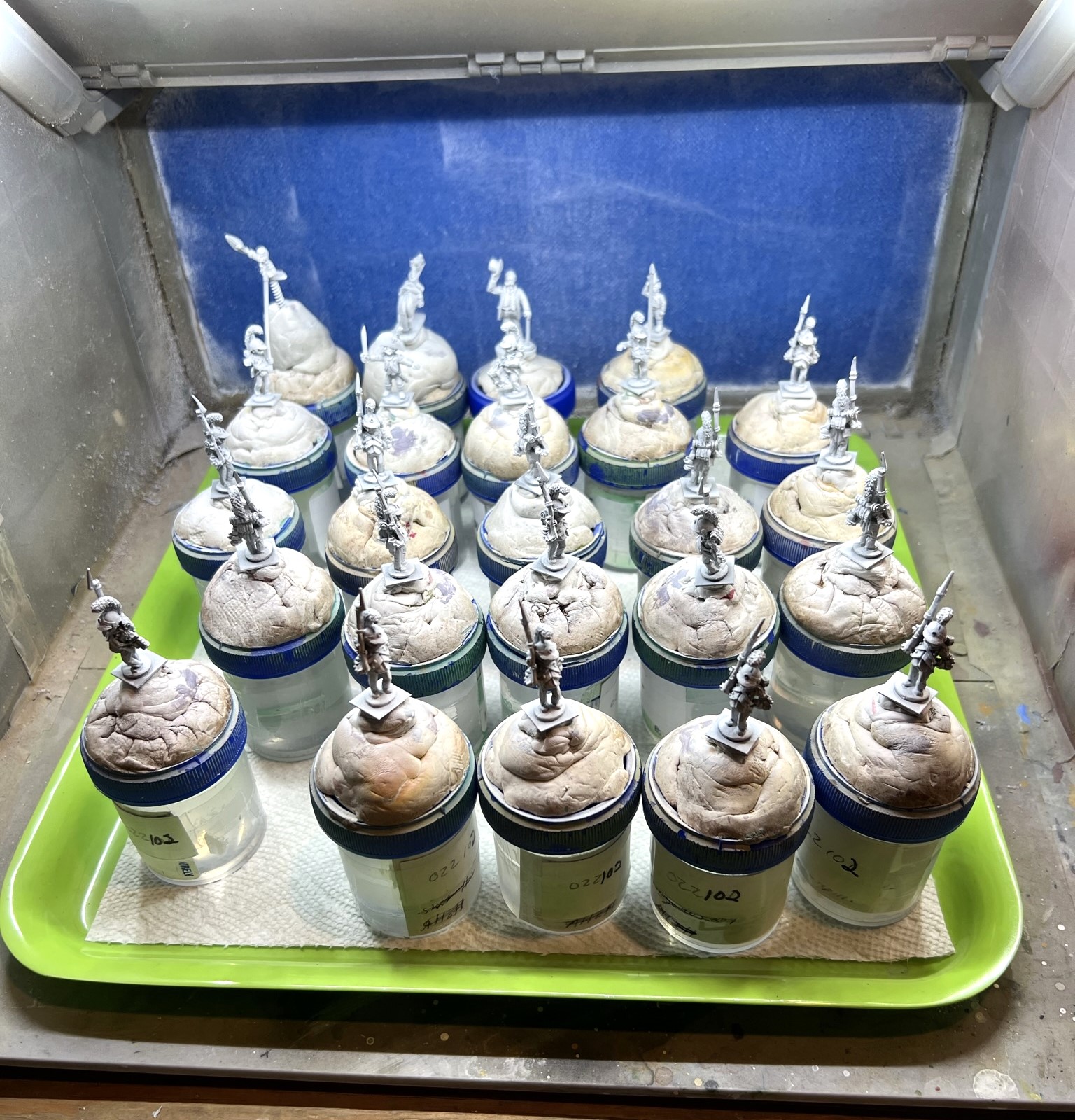
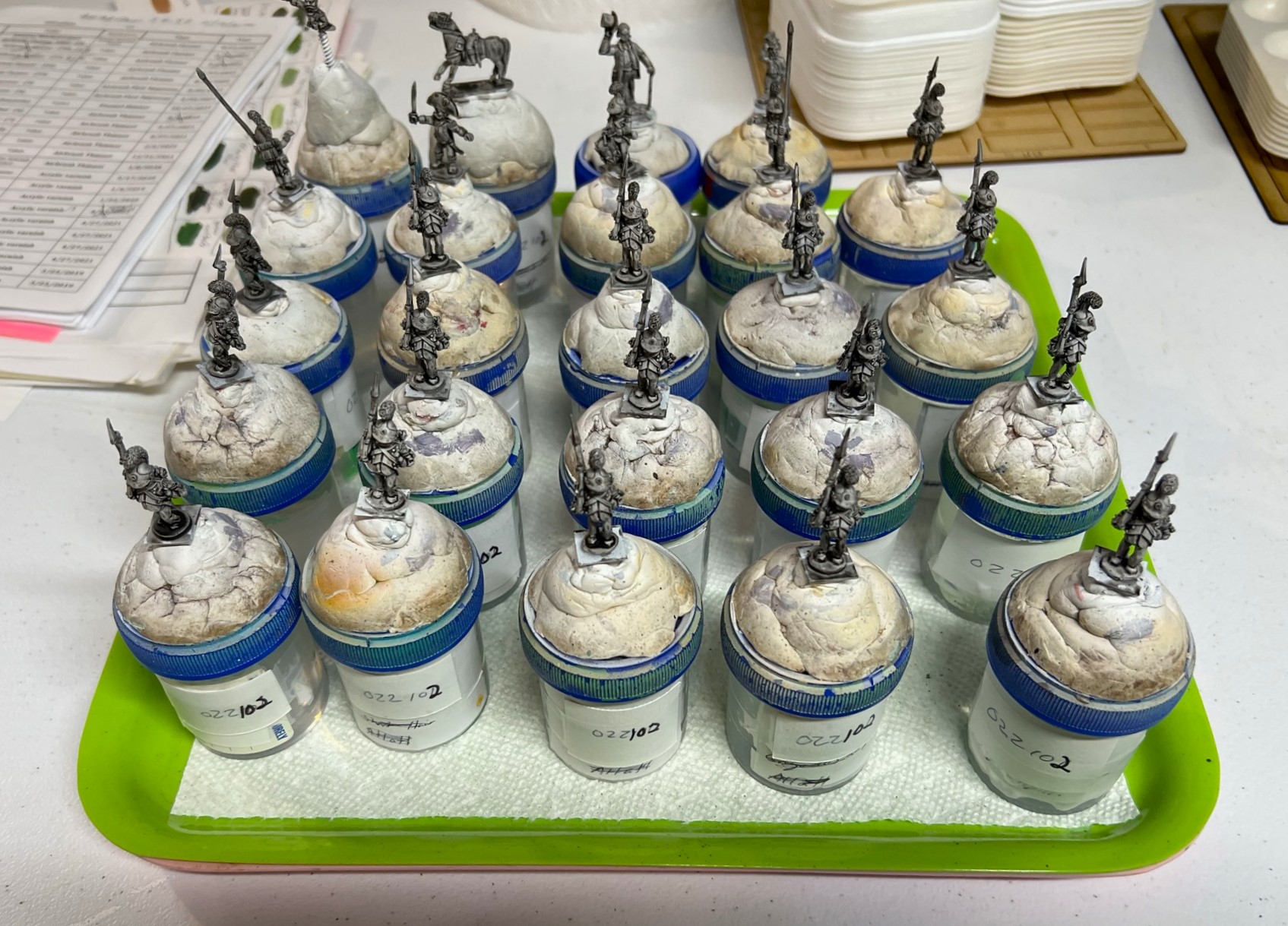
I began prepping the unit back on December 22nd in anticipation of my end of year surgery. My goal for the mass priming was to have some more units ready for painting in early 2023. I started painting the WLAB in earnest on New Year’s Day – and managed to complete the battery on January 5th.

This unit also qualifies as my second entry for for Dave Stone’s “Paint What You Got 2022/2023” challenge. As is my custom, I will list all the paints I used on this unit at the end of this post for those interested. This list really is mostly for my own use for later reference as well – I do forget stuff on occasion – and this listing has saved me on multiple occasions when I need to repeat a painting process! First, I’ll share some (well a few) WIP shots, then some eye candy of the WLAB.

WIP shots…

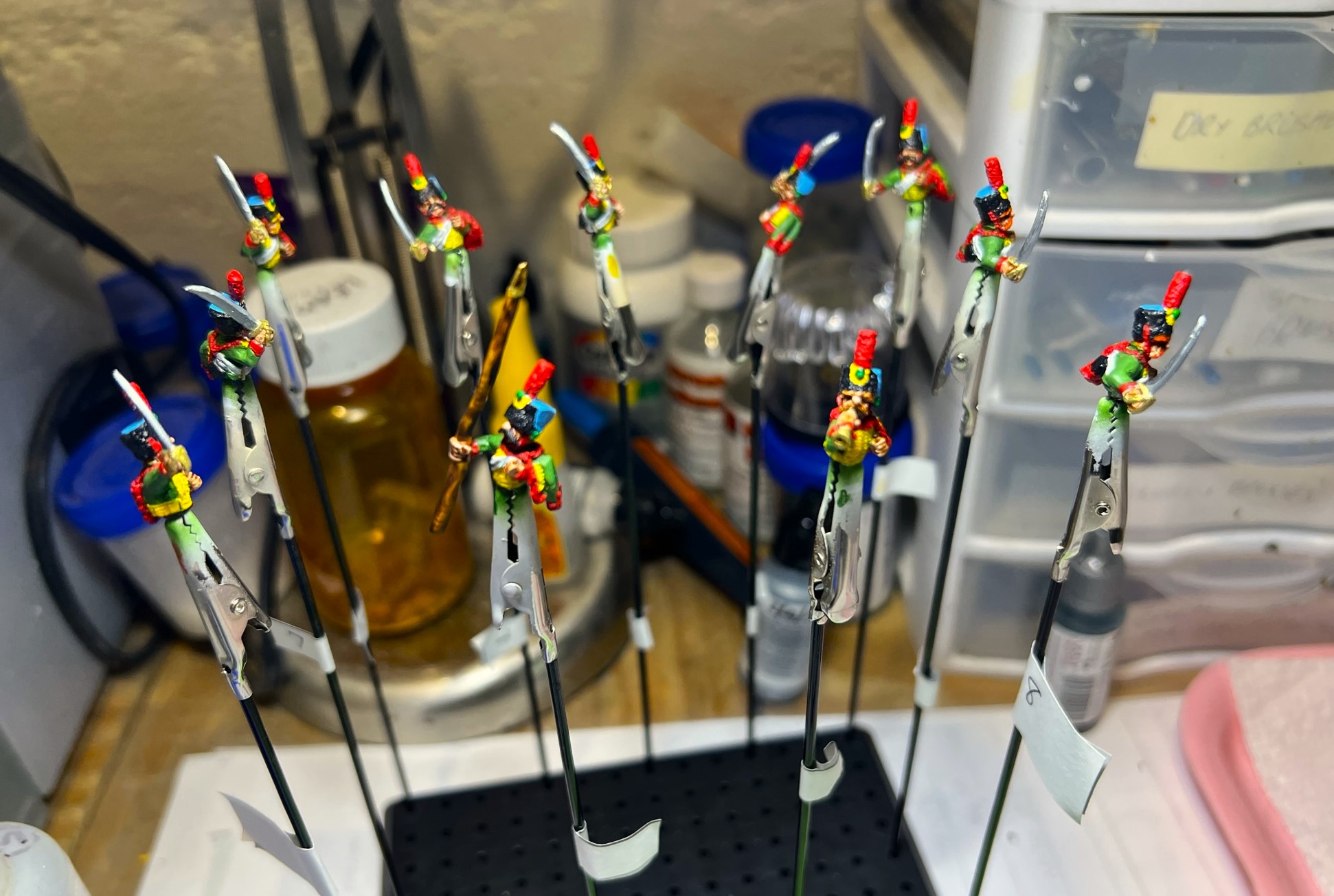
I mostly followed my usual process – but here are some photos of the WIP below. I primed back on December 22nd in a mass-priming exercise as noted earlier. The rest of the WIP photos are from January 1-January 3rd.

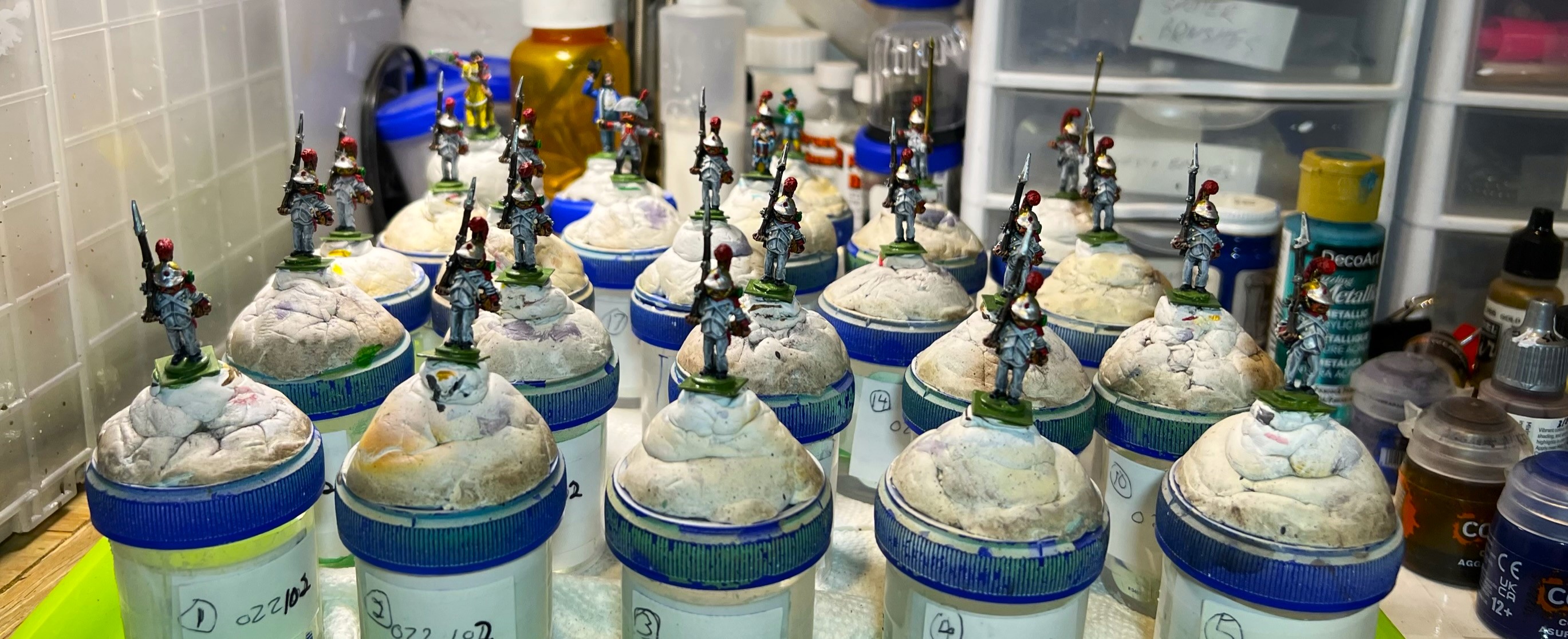
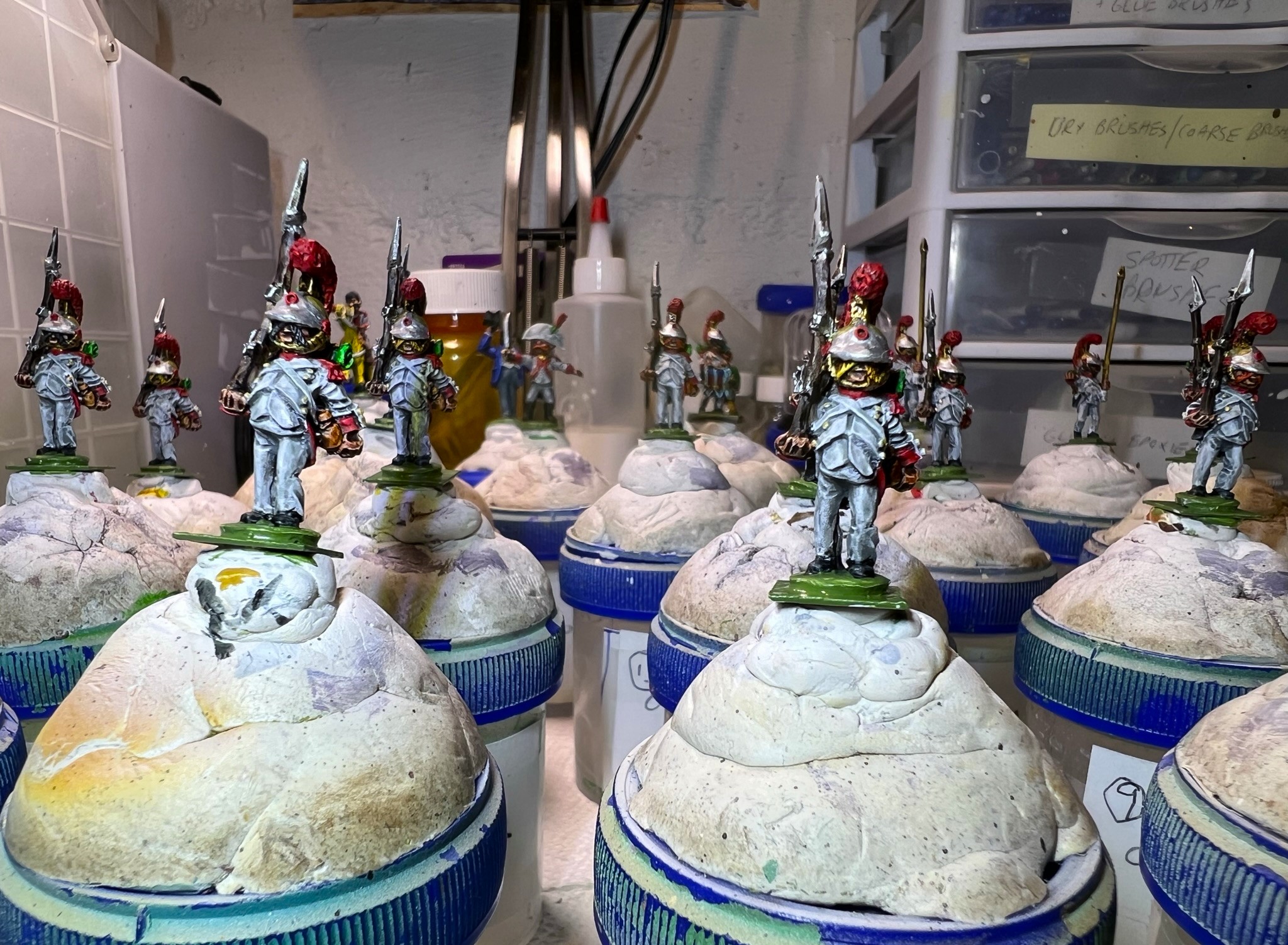
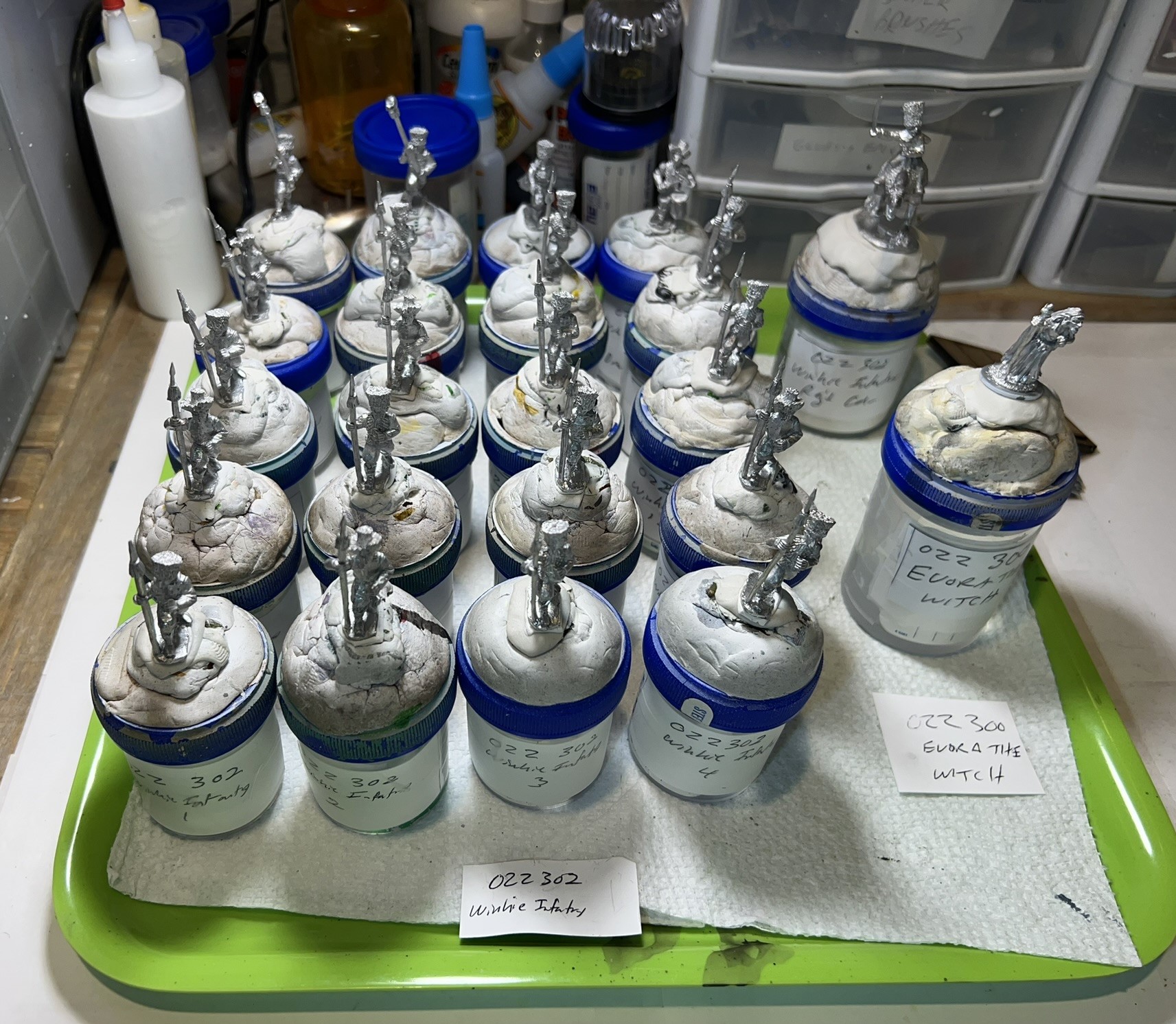
Primed on December 22nd. I waited until New Year’s Day to work on them.
January 2nd progress.
January 3rd progress
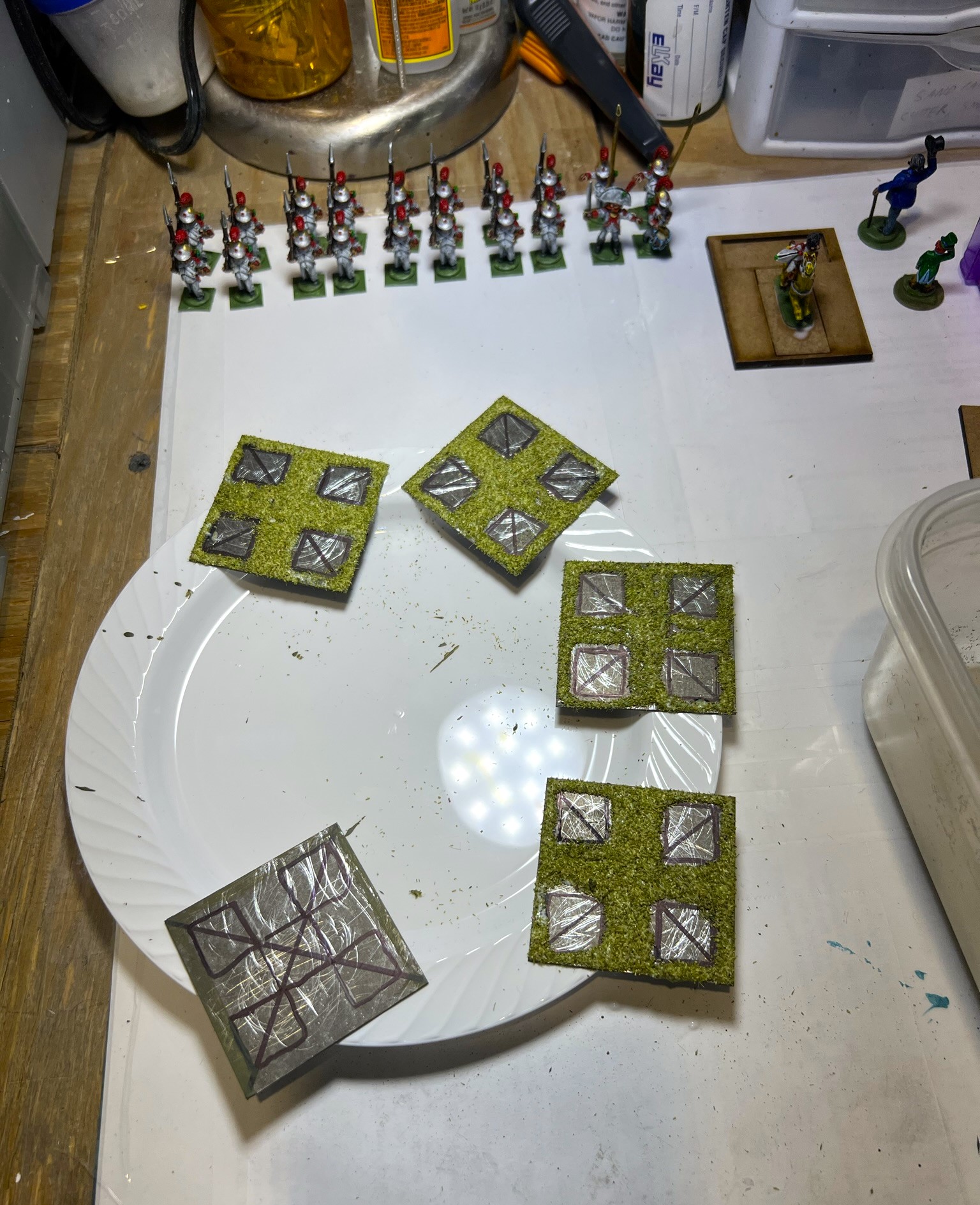
January 4th progress – almost done with flocking here.

I finished the flocking on January 4th, which left me only to add a wisp of smoke (a shred of painted pillow batting from one of my smoke markers) – to the match wielder on January 5th – and the WLAB was done. On to…

Eye Candy

The WLAB is on an MDF sabot base – that I also magnetized for easy transport and playability.

Group shots

The WLAB with the gun in limber position (facing backwards) and a crew member removed to show the neodymium magnet. Each crew member lost results in a combat die being lost.
Top view with the gun unlimbered.
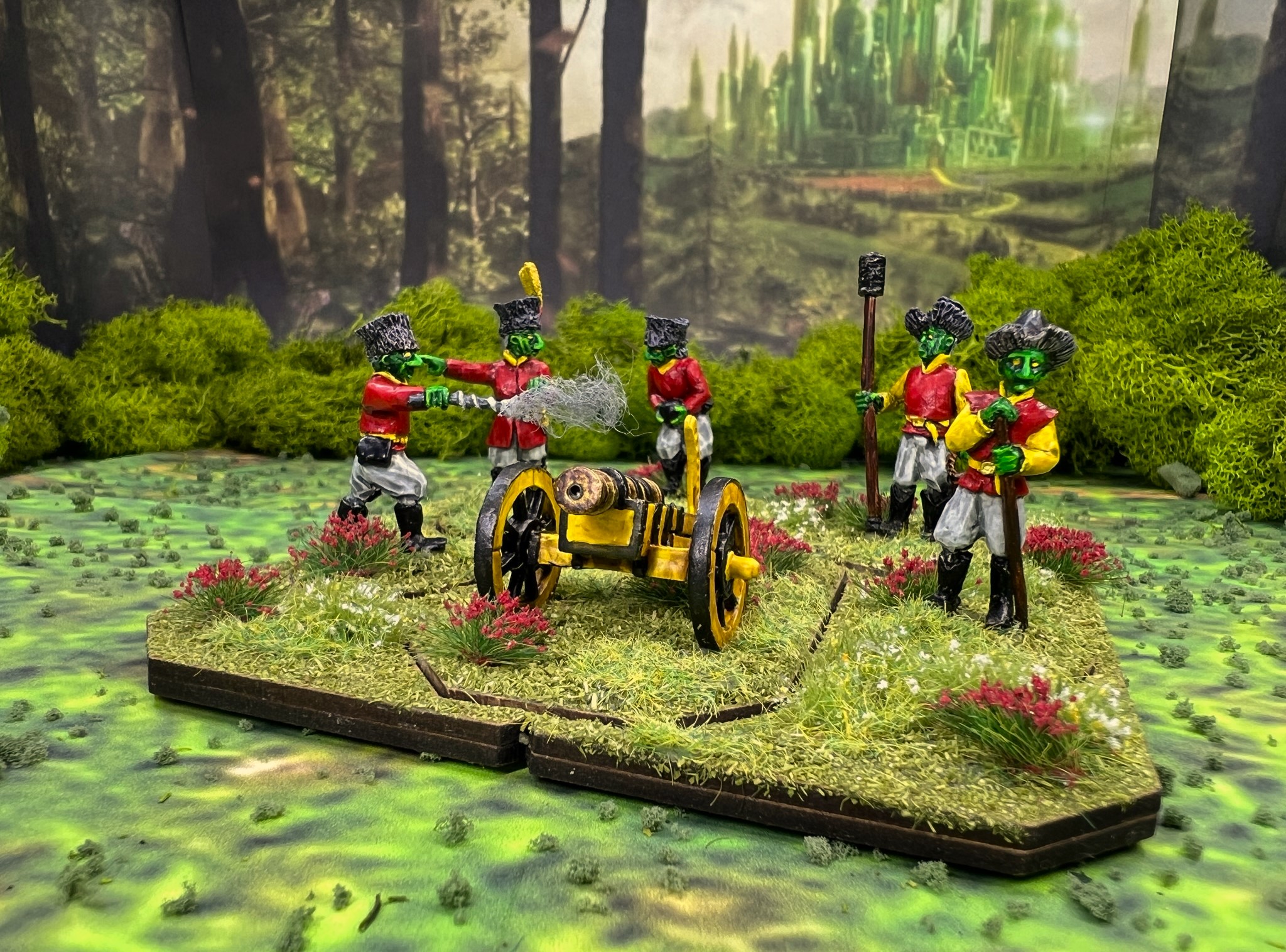
Head-on view.
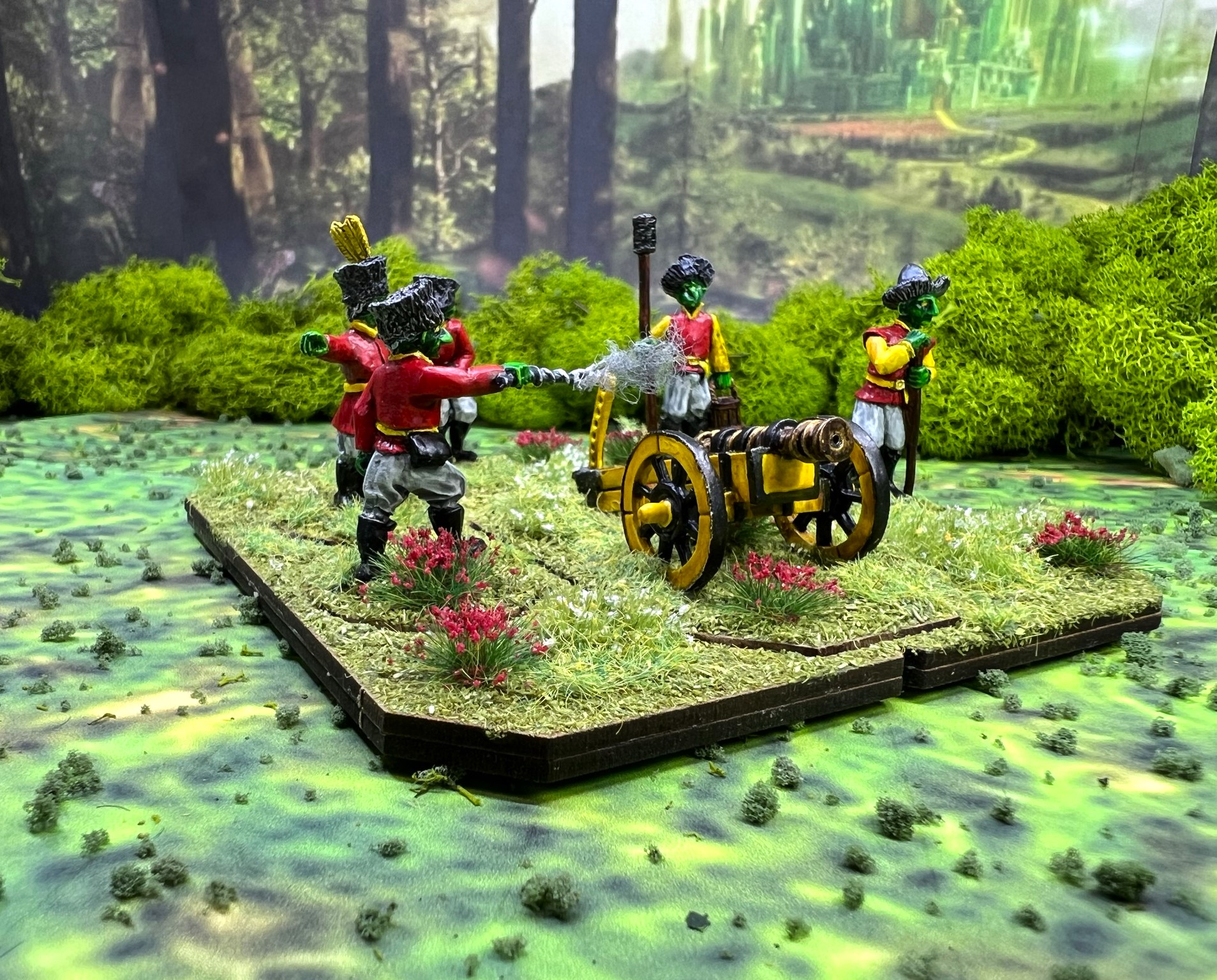
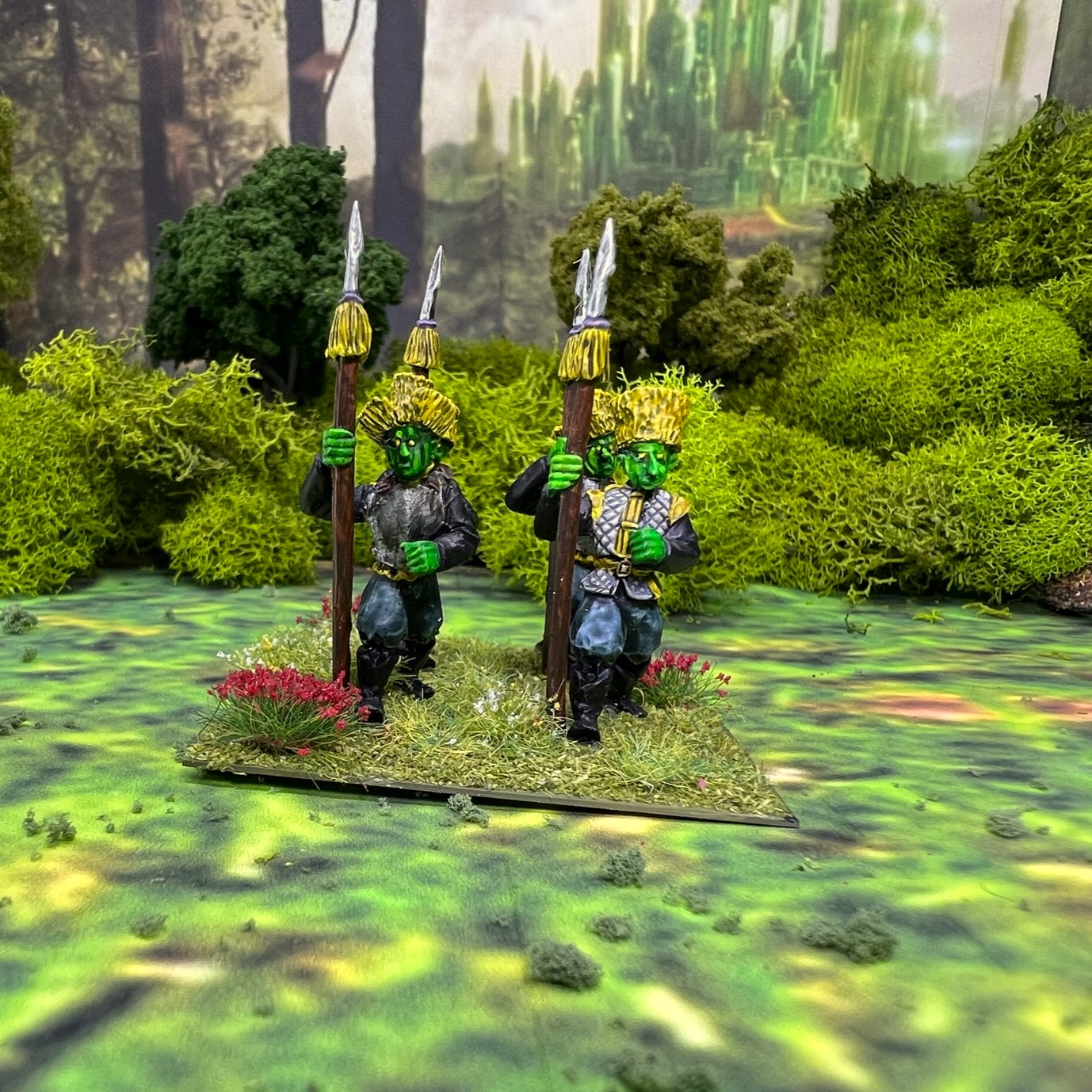
Front right view.
Front left view.
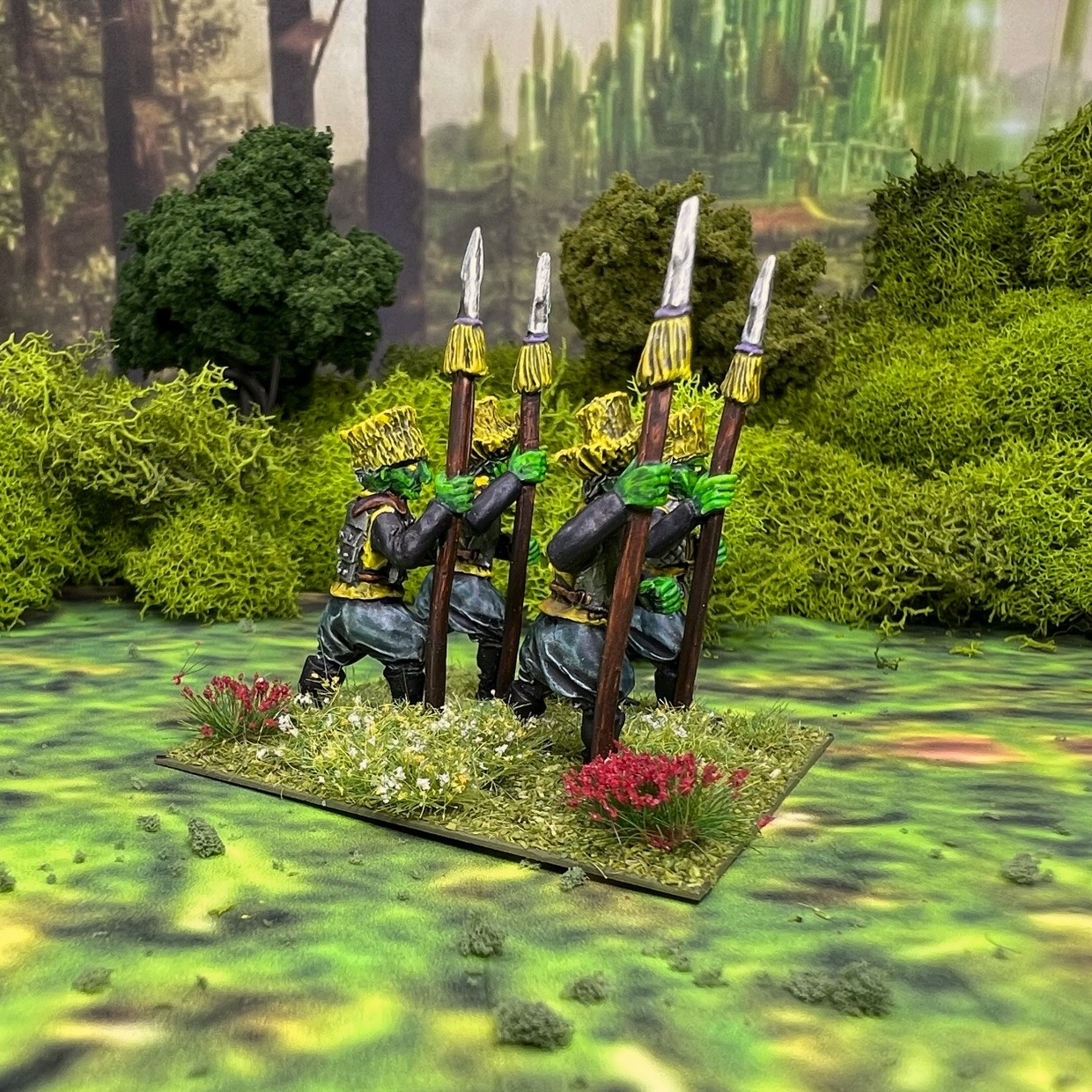
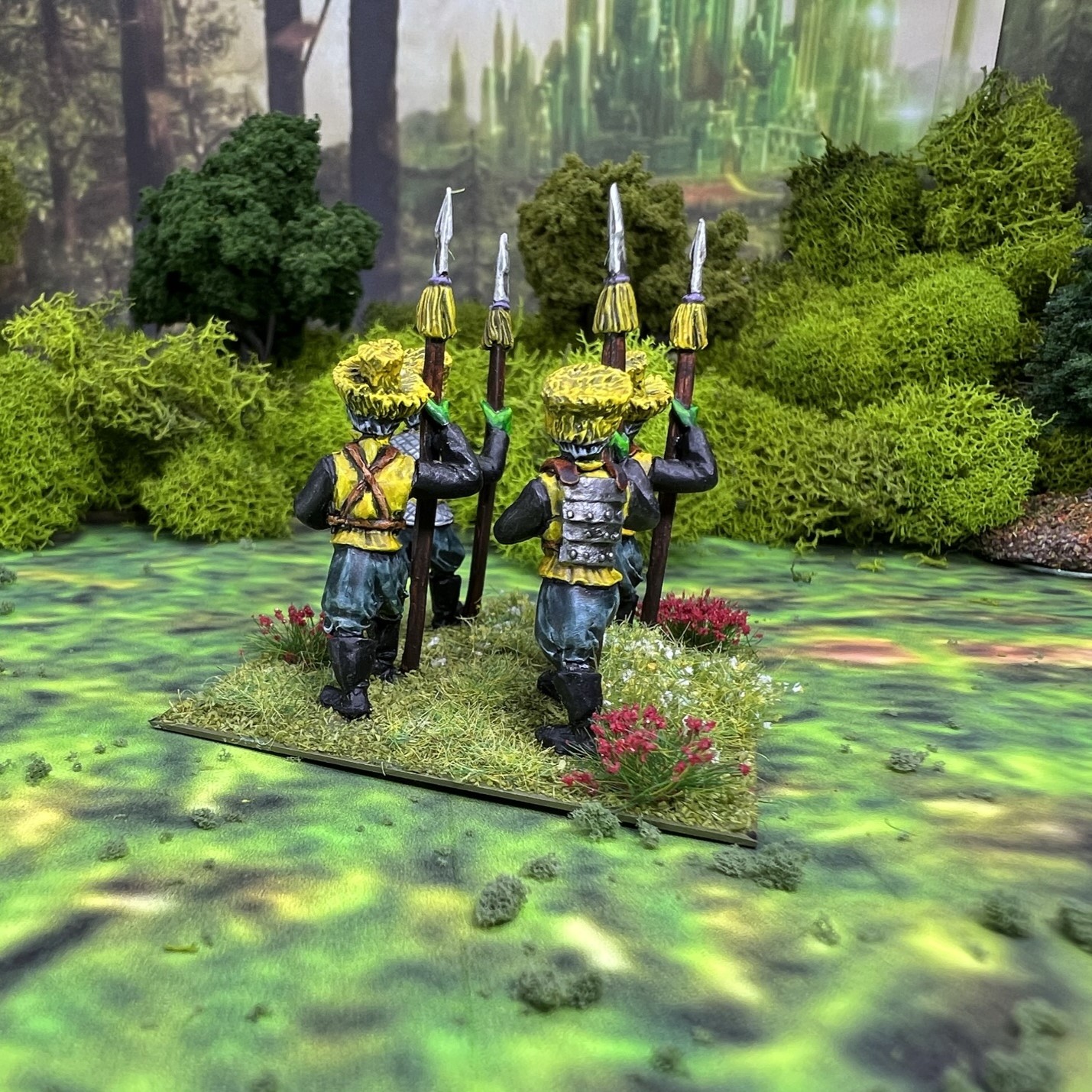
Rear view.
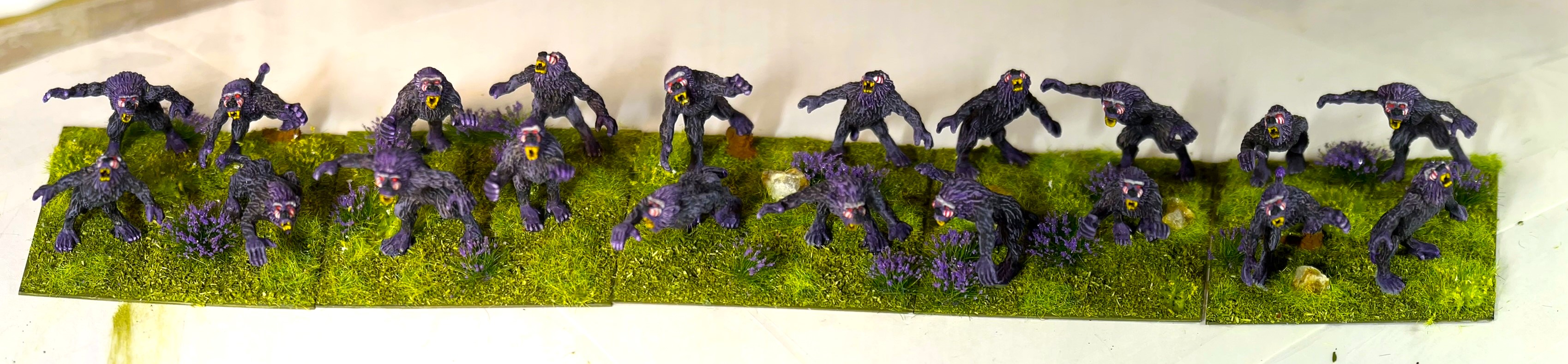
Good view of the WLAB.

I am definitely going to continue to build my brigade of Winkies in 2023, as well as more Ozz goodness. I have now completed 104 of my 268 planned figures for the game – so I have a ways to go. It’s only slightly fewer figures than my Spanish Conquest/Mesoamerican period stuff, but hopefully it will go quicker.

And note to Roger of Rantings from under the Wargames Table, yes, Roger, I do have an Excel spreadsheet for all these figures! Like Roger, I hope that you will stay with me on this path. And also check out Roger’s blog too.

As a second side note – and another recommendation – coincidentally my Aussie buddy Luke (IRO – the Imperial Rebel Ork) is also working on some black powder fantasy stuff for his Turnip28 project. Think anthropomorphic marsh rutabaga trolls (try to say that three times quickly)and Napoleonic zombies. So, he’s doing black powder fantasy as well. He’s even getting into sculpting for it – so I recommend you check him out. He’s done some cool artillery that you can see here and here is his sculpt post – both of which are outstanding, but there is a lot to see on his blog. His stuff is more grim dark than Ozz, but very cool, and it’s quite interesting that we are on a similar wavelength at the same time cross-globally.

Lastly, I had planned for this post to be about a 2022 roundup and my 2023 goal setting – but that will be the next one sometime this week (sorry Roger – but I do promise at least one Excel shot next time for both you and John from Just Needs Varnish! (another fine blog indeed).

I that roundup post, I’ll review and hold myself accountable for my 2022 predictions and goals of a year ago. I did fall short in some areas, which I am hoping to improve upon in 2023. I will set my 2023 goals in “blogging stone” as well. I am really going to push myself to finish as many Ozz figures as I can until preparing for conventions or even (shudder) playing a game take up more time – after all I need to game sometimes…

And I still have more Ozz stuff to come…

Miscellaneous details and references for those interested in that sort of thing:

For all of my previous posts on Wars of Ozz games, figures, units, and other related projects – please see this page.

PAINTS, INKS, GLAZES, SHADES, WASHES, PIGMENTS, FLOCKING, GLUES AND MORE THAT I USED ON THIS WINKIE LIGHT ARTILLERY BATTERY:

  1. Gorilla Glue
  2. 1/2″ x 1/2″ square steel bases from Wargames Accessories (#16)
  3. Artillery Battery MDF sabot base from Old Glory/Wars of Ozz Miniatures
  4. 1 1/4″ x 1″ steel base from Wargames Accessories (#FOW1)
  5. Poster tack
  6. Vallejo Premium Primer “White”
  7. Vallejo “Flow Improver”
  8. Vallejo “Airbrush Thinner”
  9. Citadel “Nuln Oil” (wash)
  10. Vallejo Model Color “White”
  11. Citadel “Contrast Paint – Ork Skin”
  12. Citadel “Contrast Paint – Contrast Medium”
  13. Citadel “Contrast Paint – Black Legion”
  14. Vallejo Model Air “Bright Brass”
  15. Citadel “Contrast Paint – Ironjawz Yellow”
  16. Createx Airbrush Colors “Pearlized Black”
  17. Vallejo “Thinner Medium”
  18. Citadel “Contrast Paint – Baal Red”
  19. Citadel “Cryptek Armourshade” (wash/shade)
  20. Army Painter “Speed Paint – Holy White”
  21. Citadel “Seraphim Sepia” (wash/shade)
  22. Vallejo “Gloss Varnish”
  23. Army Painter “Speed Paint – Runic Grey”
  24. Citadel “Contrast Paint – Striking Scorpion Green”
  25. Vallejo Game Air “Black”
  26. Citadel “Ironbreaker”
  27. Vallejo Model Color “Wood Grain”
  28. Citadel “Contrast Paint – Snakebite Leather”
  29. Citadel “Warpfiend Grey”
  30. Vallejo Model Air “Gun Metal”
  31. Vallejo Model Air “Steel”
  32. PS Model Color “British Brown Drab”
  33. Army Painter “Red Tone” (wash/shade)
  34. 1/8″ neodymium magnets
  35. Elmer’s PVA Glue
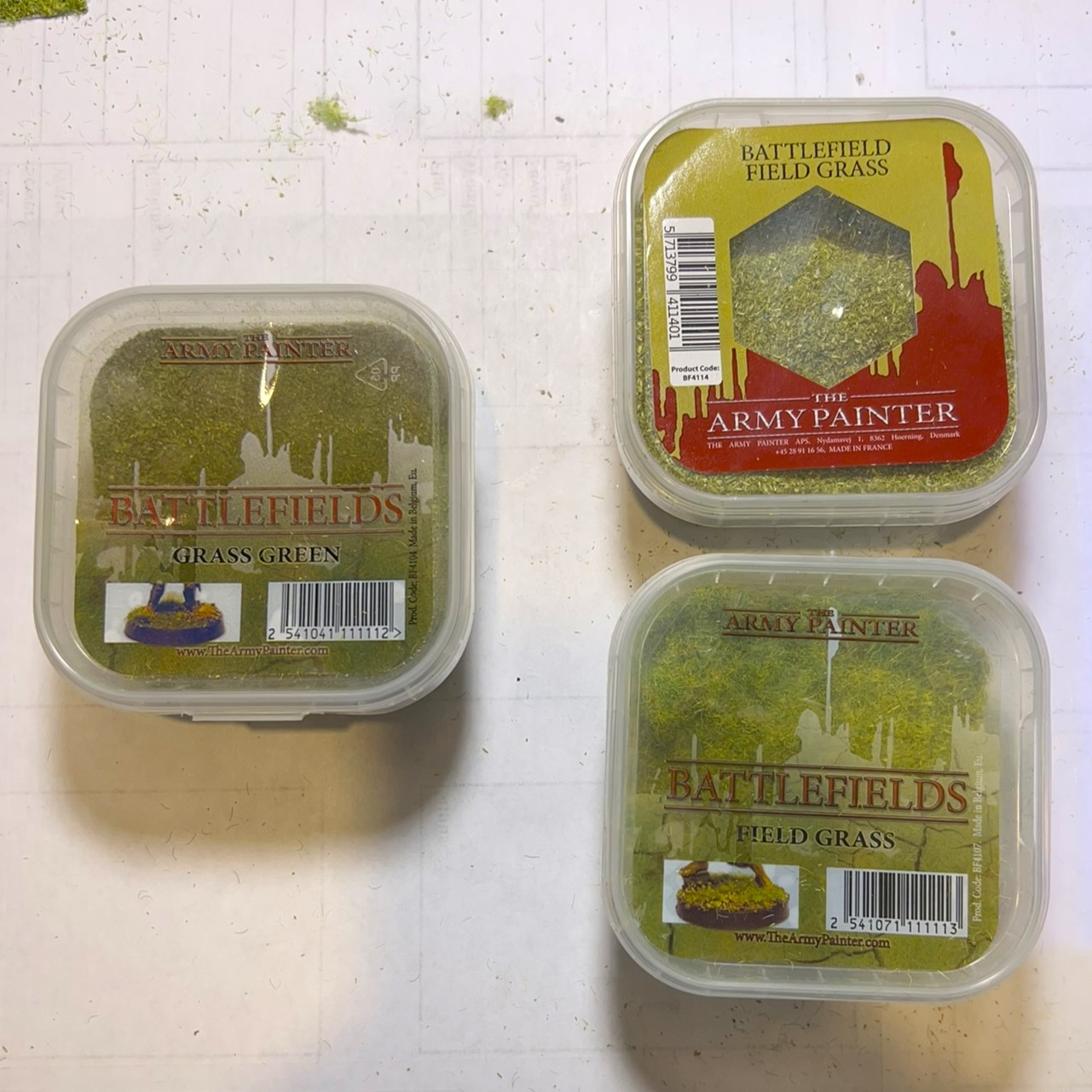
  36. Army Painter “Battlefields Grass Green” (flocking)
  37. Army Painter “Battlefield Field Grass” (flocking)
  38. Army Painter “Battlefields Field Grass” (flocking)
  39. Army Painter “Battlefields Meadow Flowers” (flocking)
  40. Shadow’s Edge Miniatures “6mm Dark Forest Red Tufts” (flocking)
  41. Pillow batting (for smoke)

Again, as you may want to check out the Wars of Ozz figures range – there are two places to get them (and I make no money from this btw). The game rules and the Wars of Ozz figures are available from the following two places:

In the US Old Glory has a site – Wars of Ozz Miniatures.

In the UK go to Sally 4th.

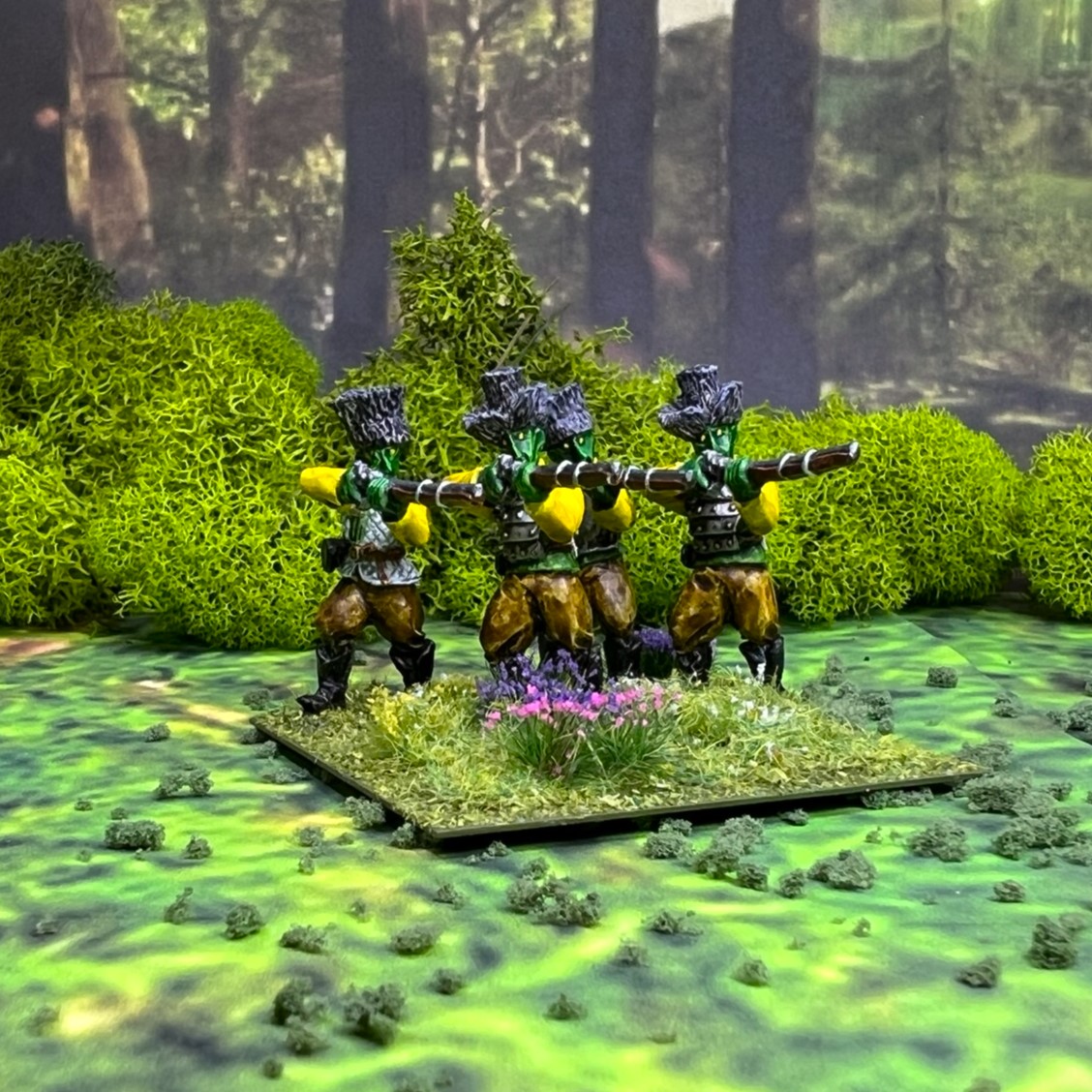
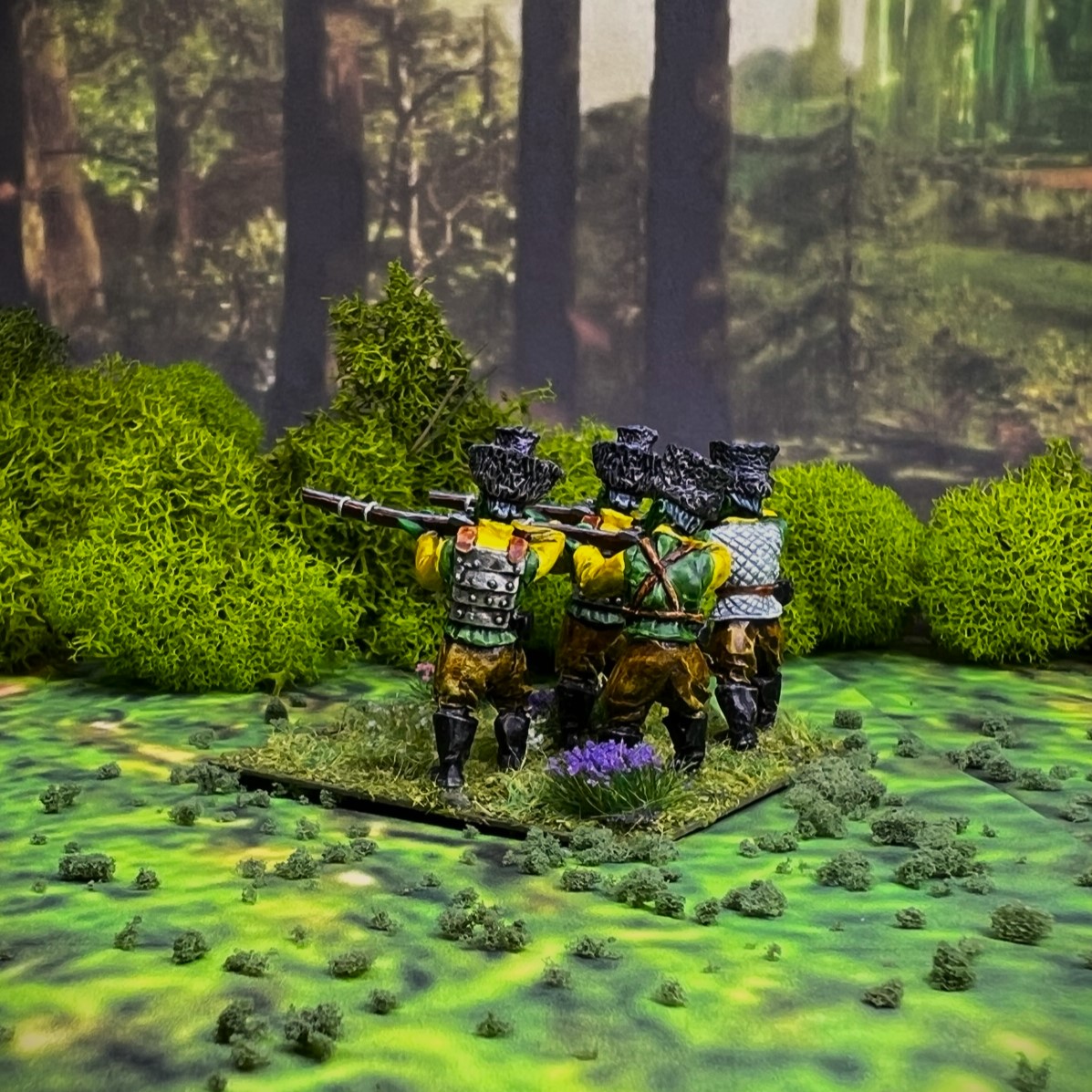
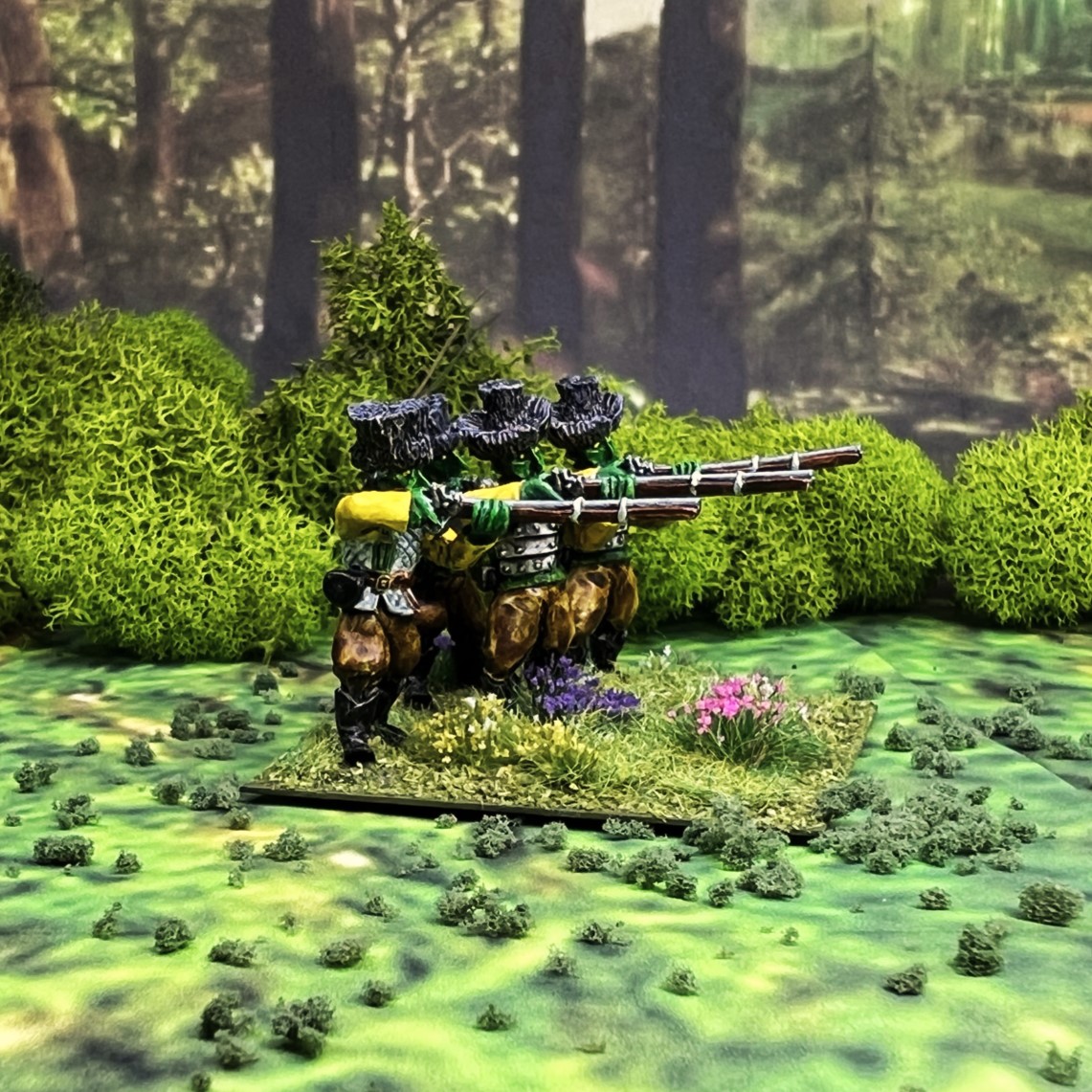
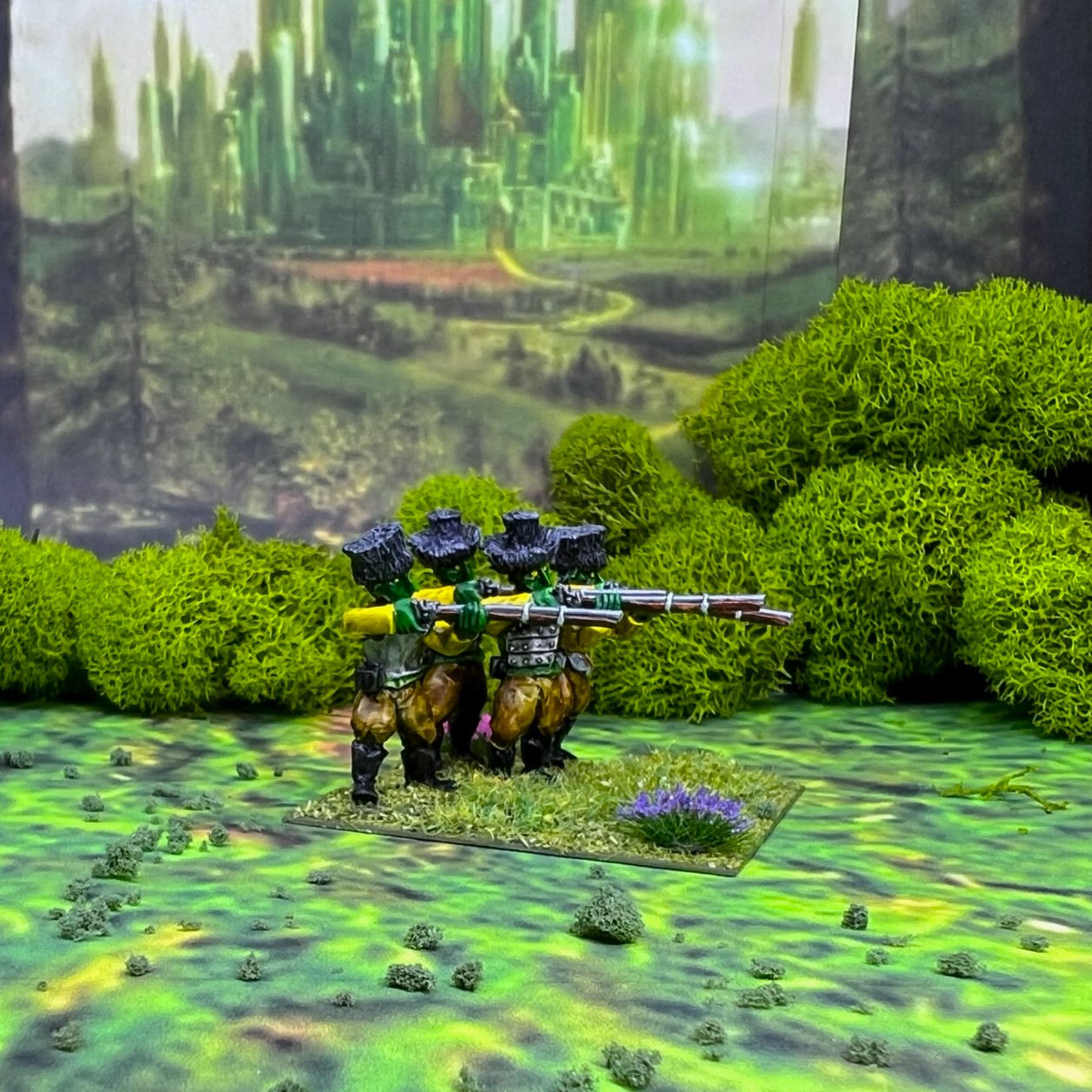
Winkie Sharpshooter Regiment (Wars of Ozz)

Now that I have a full Munchkin Brigade (as you saw in my last post), I needed to start building a worthy opponent. I decided to go with the Winkies – the orcs of the Wars of Ozz. Yes, the “oh-eee-oh” dudes from the movie.

My first unit ended up being atypical – as Winkies normally don’t think much of firearms and missile weapons (or those who wield them in battle). The Winkies consider melee as their preferred means of combat. Still, they do have some artillery, and as shown here a small contingent of troops armed with muskets to provide some firepower. My Winkie brigade will eventually have melee troops, light artillery, and Zilk-riding cavalry (zilks are giant ostrich-like carnivorous birds that Winkies capture and train as mounts – though they are known to eat fallen enemy and their Winkie riders alike). I’ll also have some Great Flying Apes, some lesser apes, and their witch Evora. I am trying to get as many as possible done so games can begin, and to that end I am batch-priming and batch-painting as many units as possible.

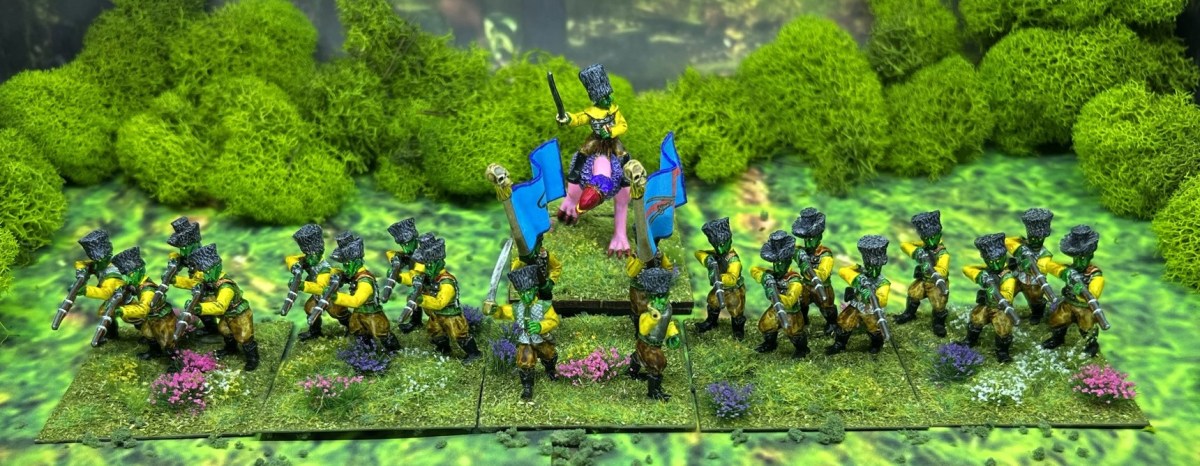
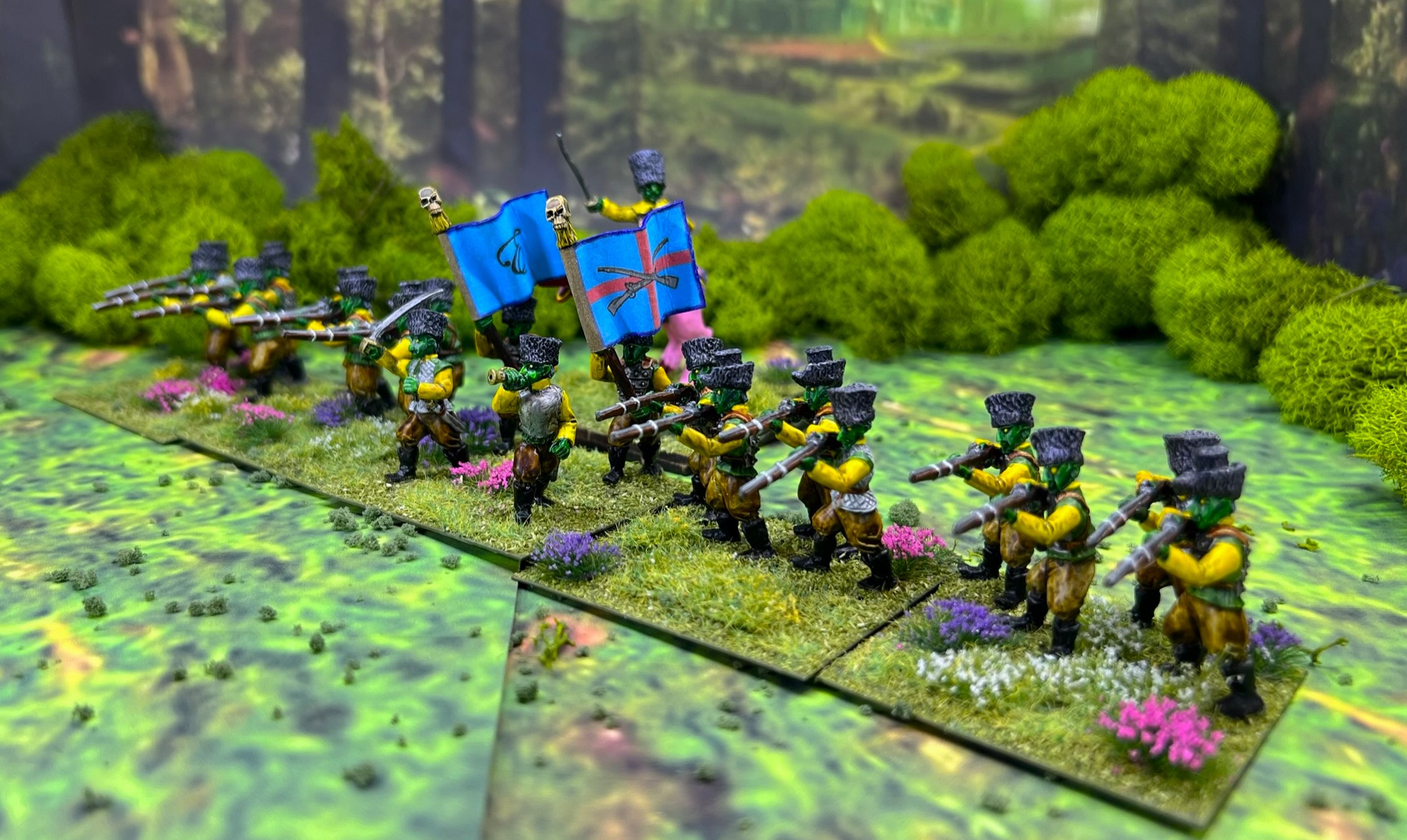
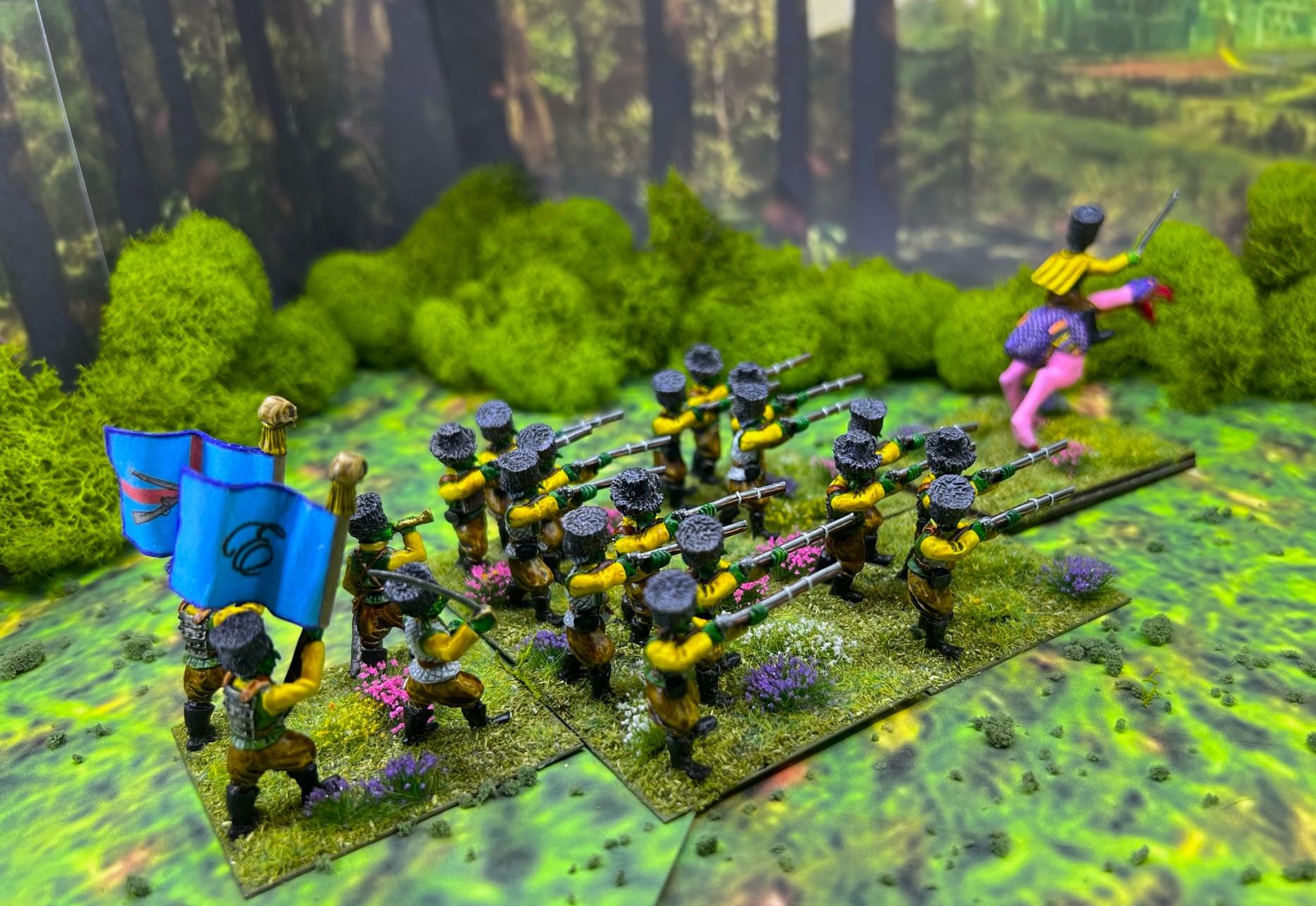
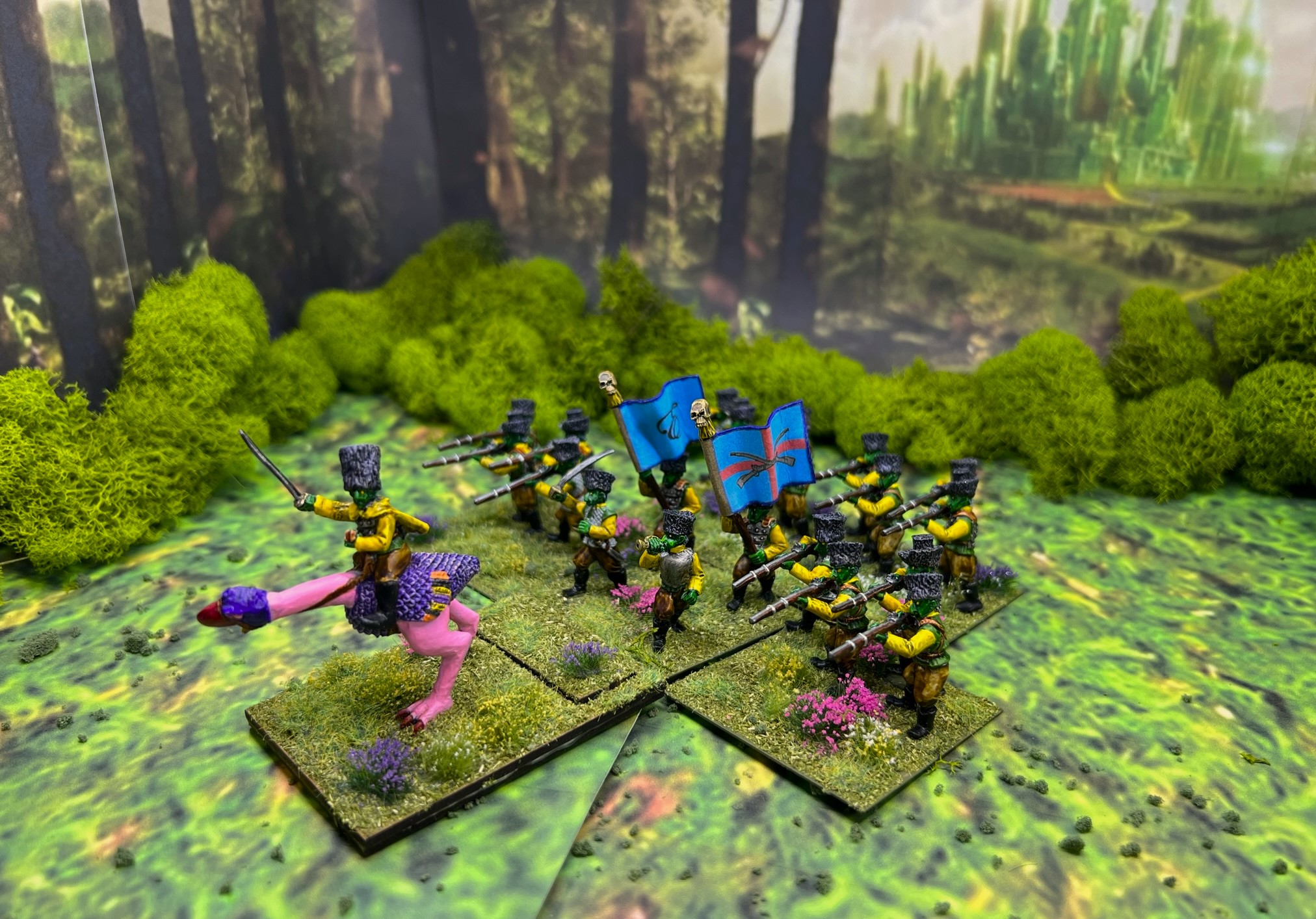
Back to the WSR – just like most Ozz regiments, this Winkie Sharpshooter Regiment (WSR) (#OZZ303) has 21 figures in total. They are on 5 bases – 4 figures with muskets per 4 stands, plus 4 figures on a single command stand, along with a regimental commander stand (MDF). The WSR is 28mm in scale, and the figures are metal. It is worth 7 points versus a regular Winkie infantry unit which costs only 5.

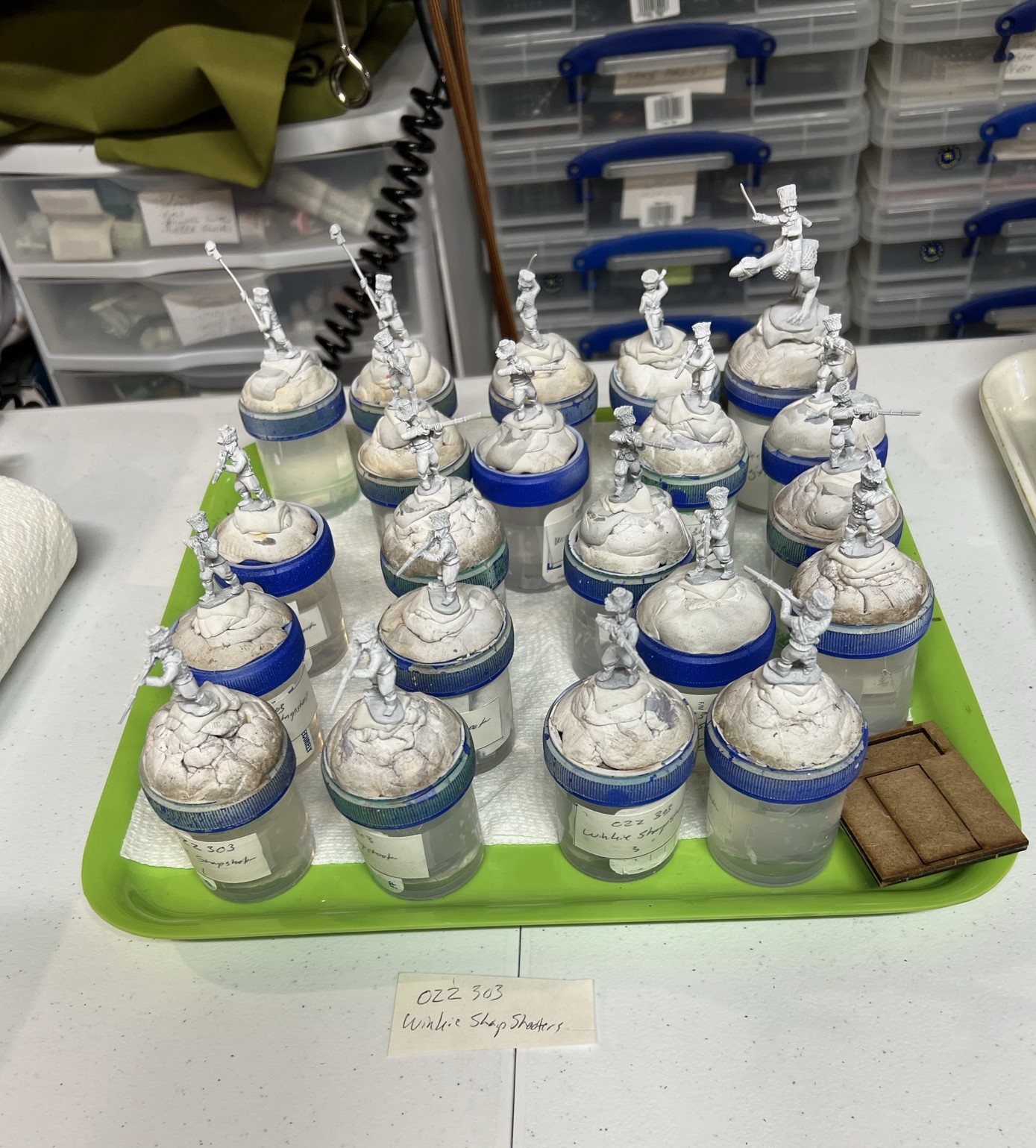
I began prepping the unit back on December 12th – and was hoping to finish by the end of the year – which I did today, December 31st! This allowed me to accomplish two things. First. I got to break the 200 level of painted figures for 2022 (I actually painted 202 in 2022 with the completion of the WSR). It also allowed me to enter this as my first (and definitely not the last) unit for Dave Stone’s “Paint What You Got 2022/2023” challenge.

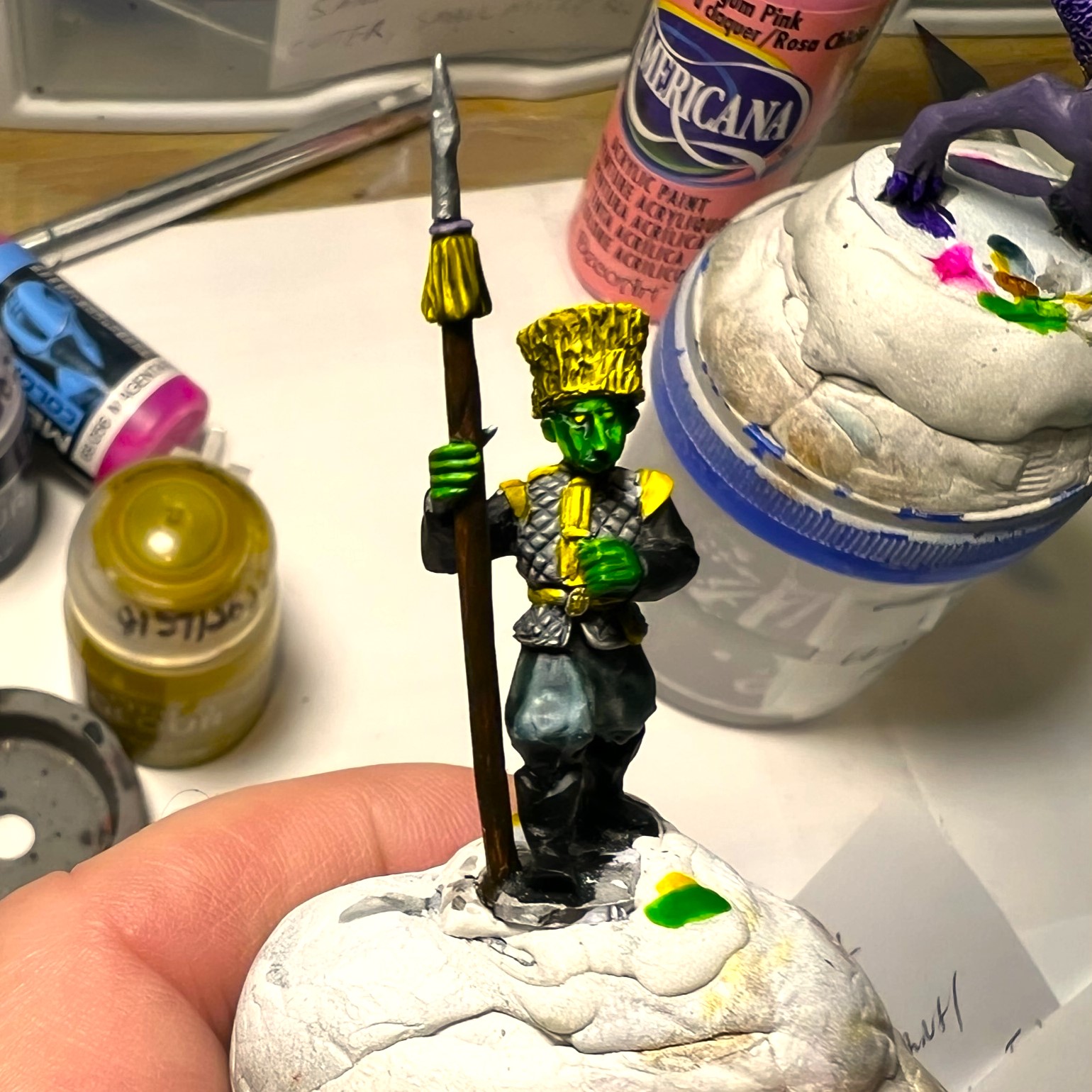
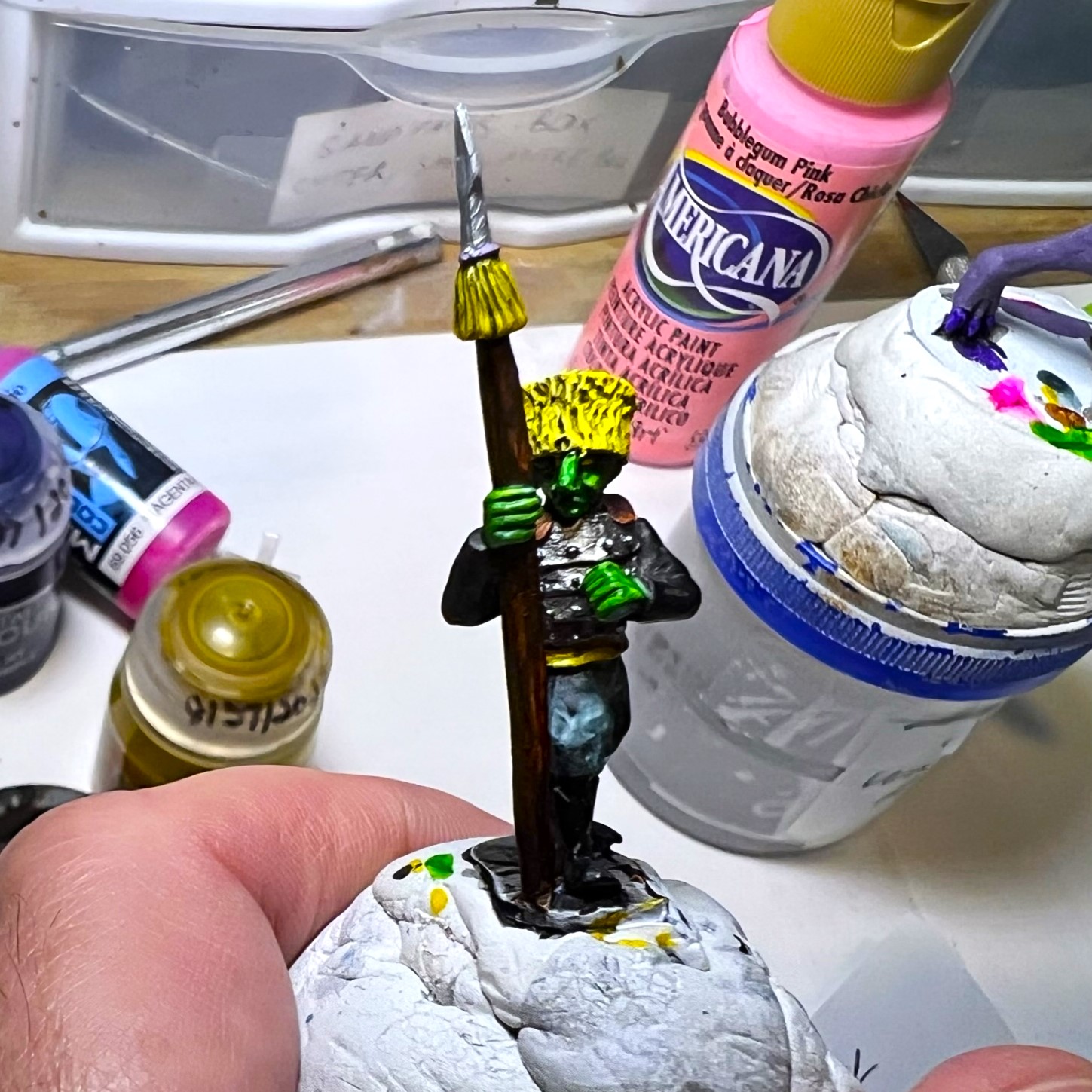
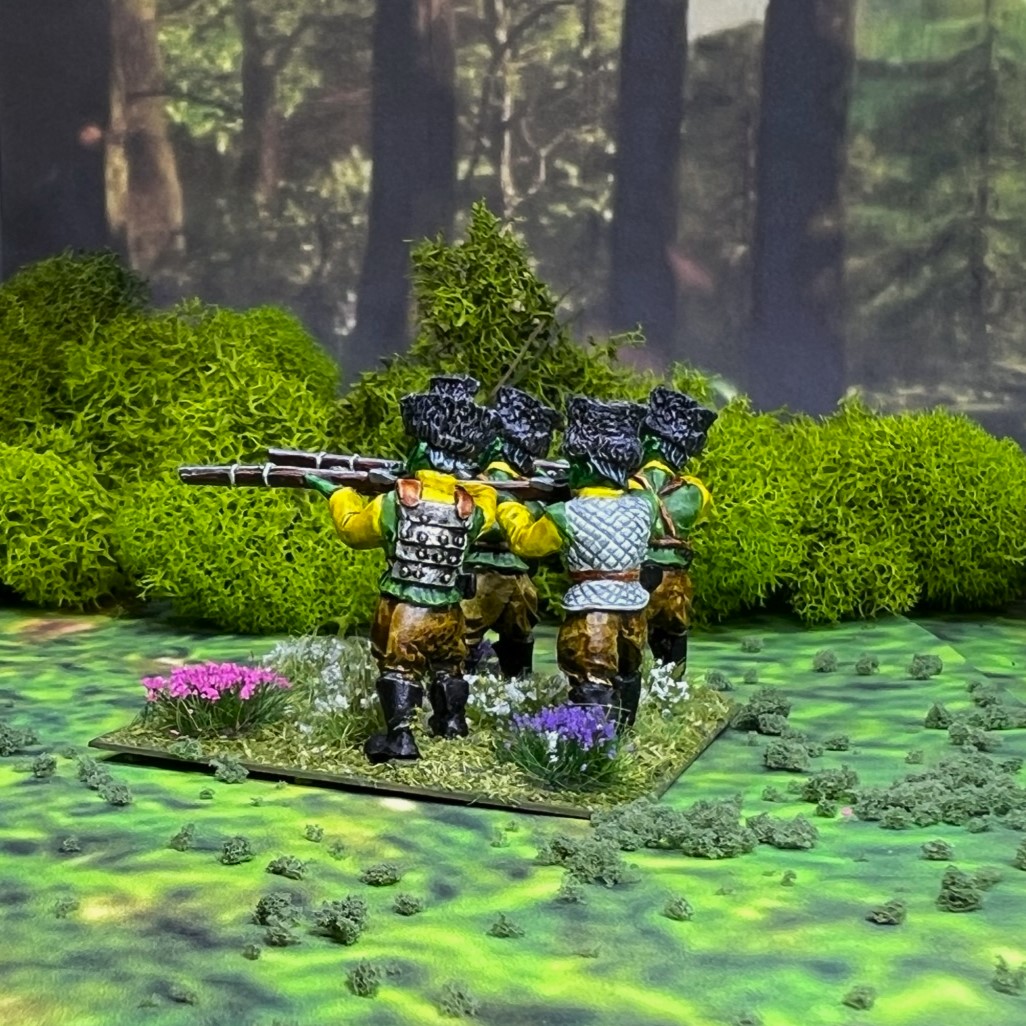
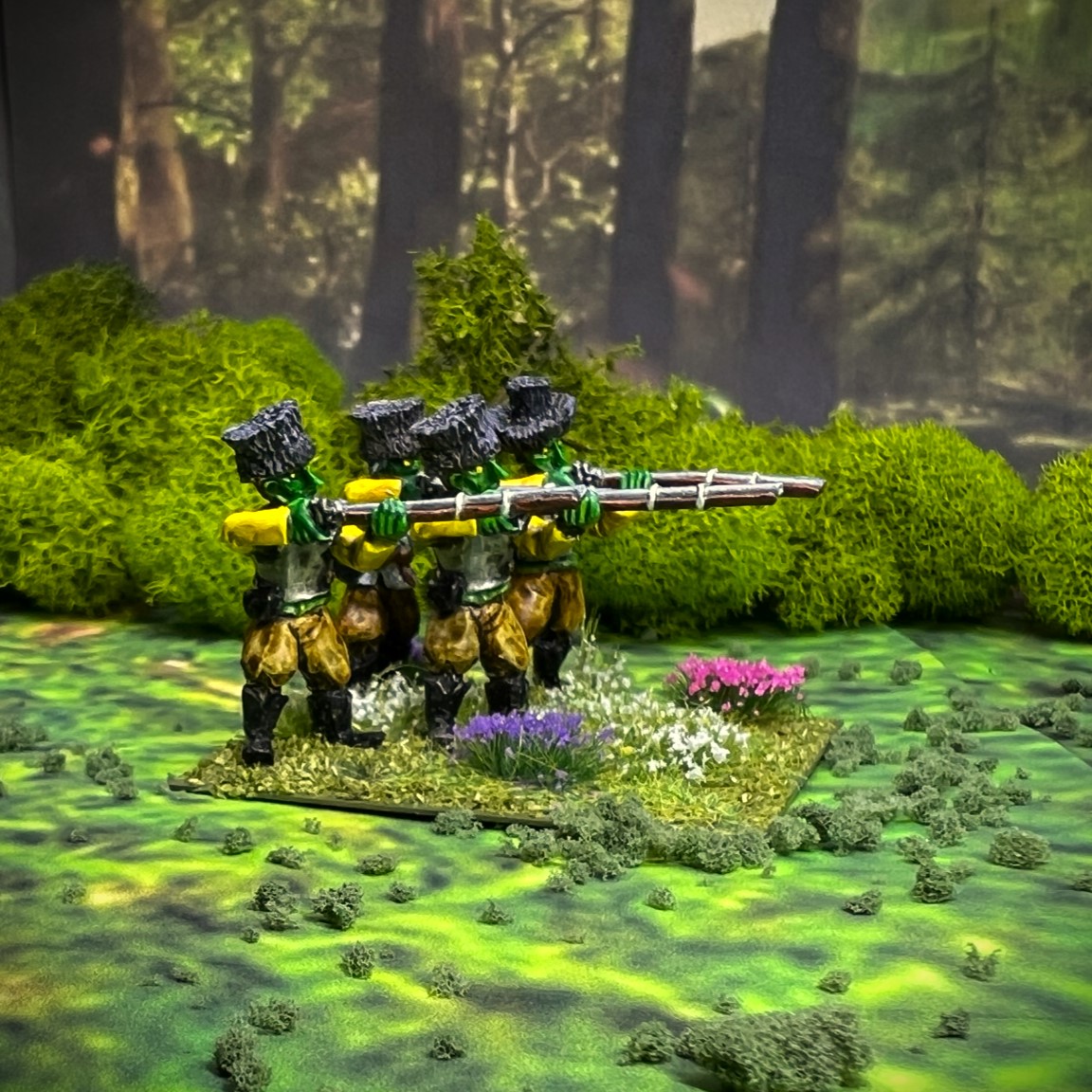
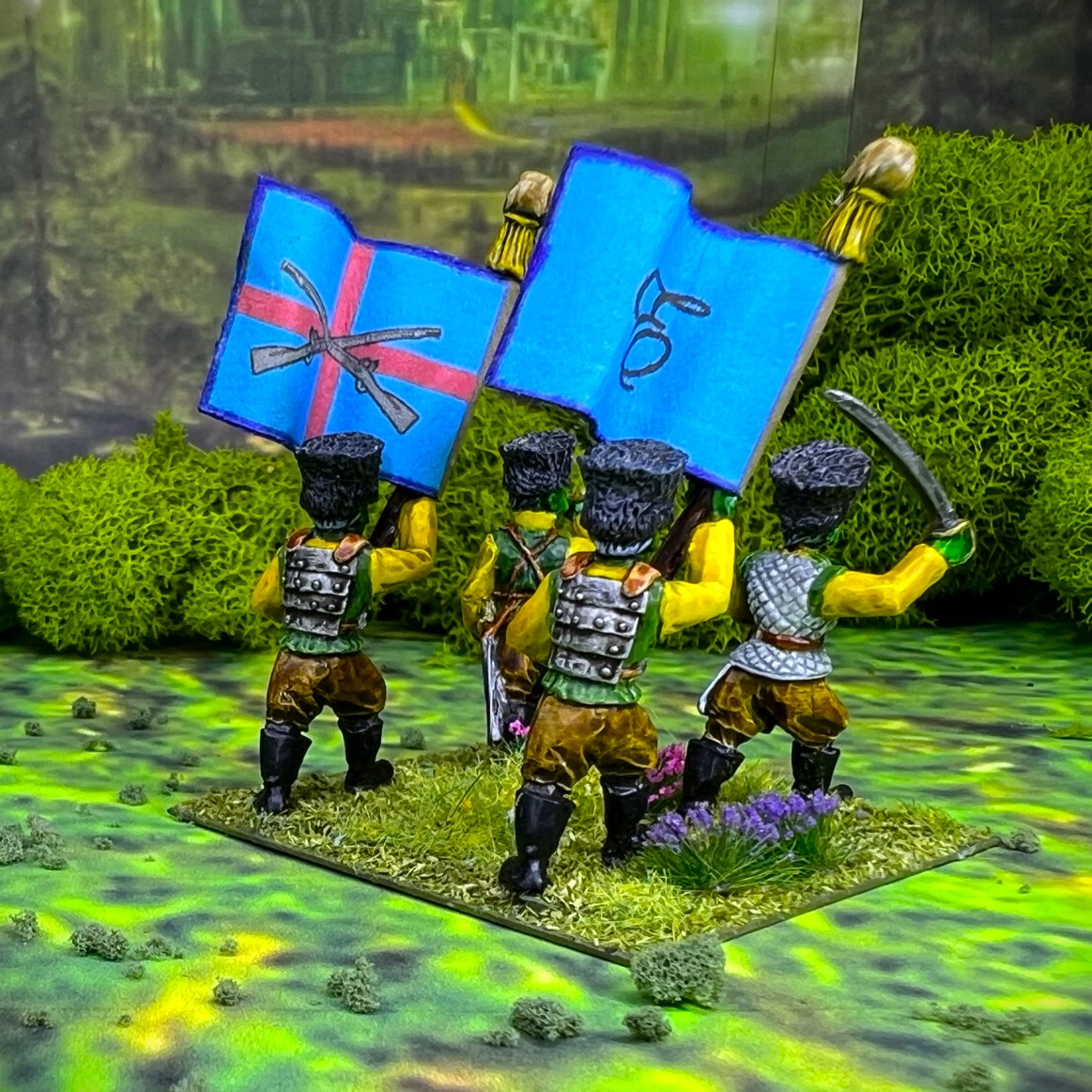
The Ozz rules say that the WSS should have “forest green” coats and khaki trousers. And because Evora just loves yellow – a healthy amount of yellow on all Winkies. The WSR figures had fur caps of two different types, plus three different kinds of armor – to include cotton armor like I had on my Aztecs and Conquistadores. I tried to mix them up them on each stand/base for a more varied look. I worked on the muskets first as I wanted them to be very distinctive of the WSR. As I felt that the fur caps HAD to be black, I made the Winkies’ hair to be a bluish grey over w white highlight so as to better stick out from underneath the dark headpieces. I needed to work around Christmas and and scheduled sinus surgery on 12/28 to complete them, so I am happy that I did. On Christmas Eve and Christmas Day, there is a marathon showing of the movie “A Christmas Story” which influenced me and played a part in some of my choices of colors that you’ll see below. A hint, “pink nightmare”…

More on this in a bit!

My goal is always to achieve a good tabletop standard – and you can be the judge about that. As usual, I will list all the paints I used on this unit at the end of this post for those interested in that sort of stuff (and for my own use for later reference as well – I do forget stuff on occasion). First, I’ll share some WIP shots, then some eye candy of the WSS.

WIP shots…

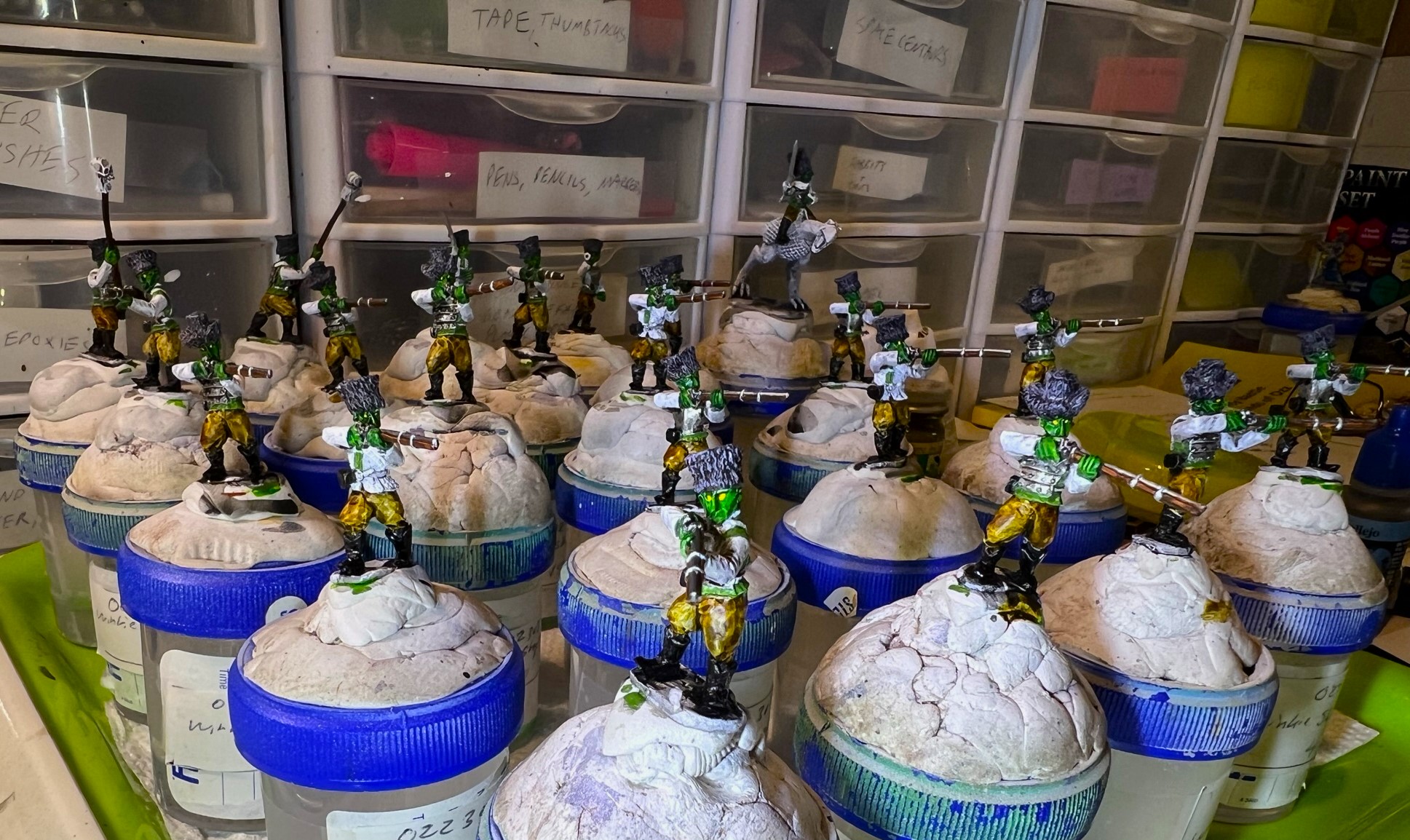
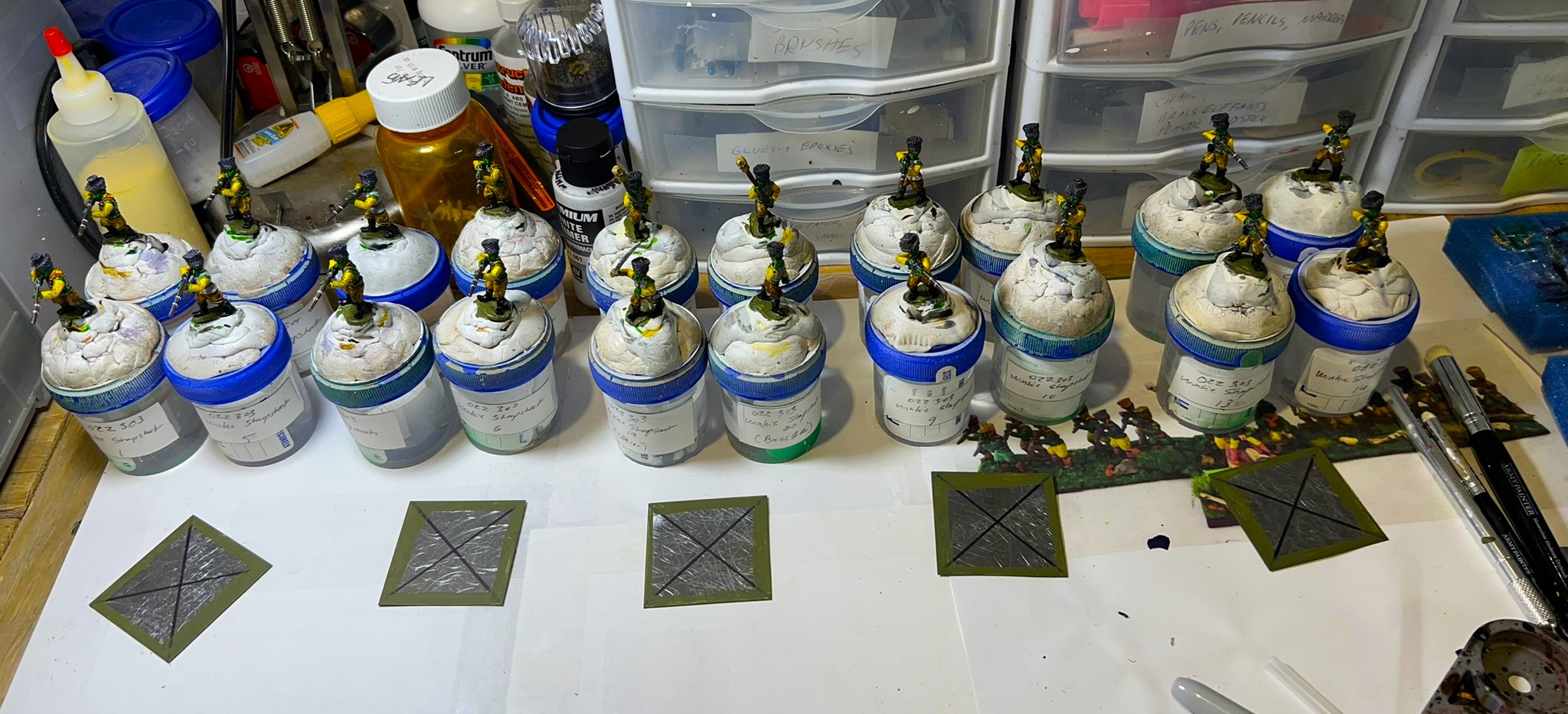
Primed in white and ready for painting on December 22nd
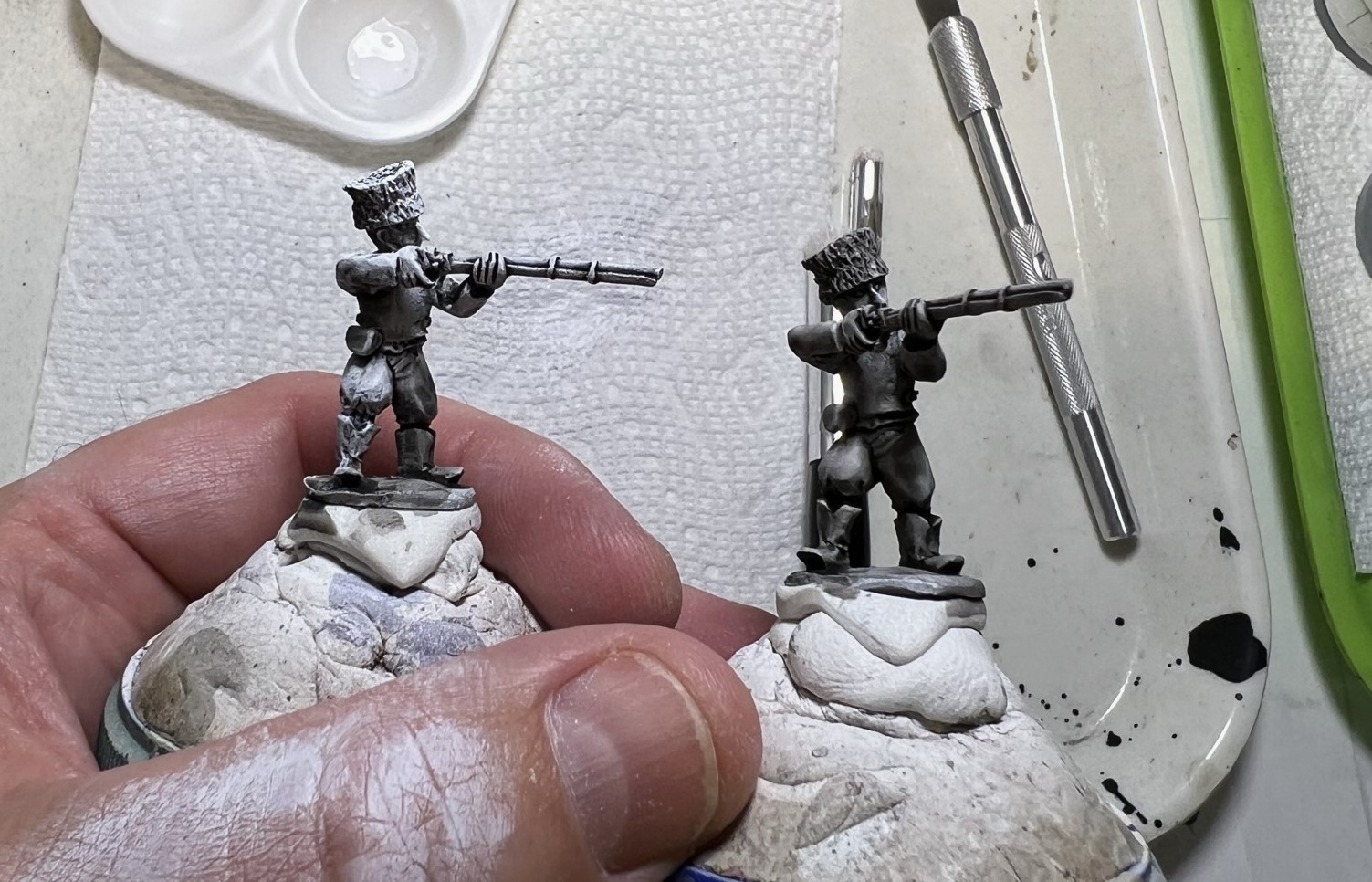
After priming, I added a wash of Citadel “Nuln Oil”, then dry brushed in white. The figure on the right has not been dry brushed yet and is shown for comparison with the one on the right which has only been washed on December 23rd.

Then came Christmas! After all the festivities, I knew I only had a couple of days to get the unit mostly done before I had my sinus surgery. That surgery would consist of my surgeon drilling out my internal sinus openings so I could drain better – as I have been plagued with increasingly worse headache episodes all year. Yes, this was done under anesthesia and more drugs. The headaches DID get in the way of both golf and miniature painting, as well as all of the simultaneous sinus infections I was having, so this was necessary.

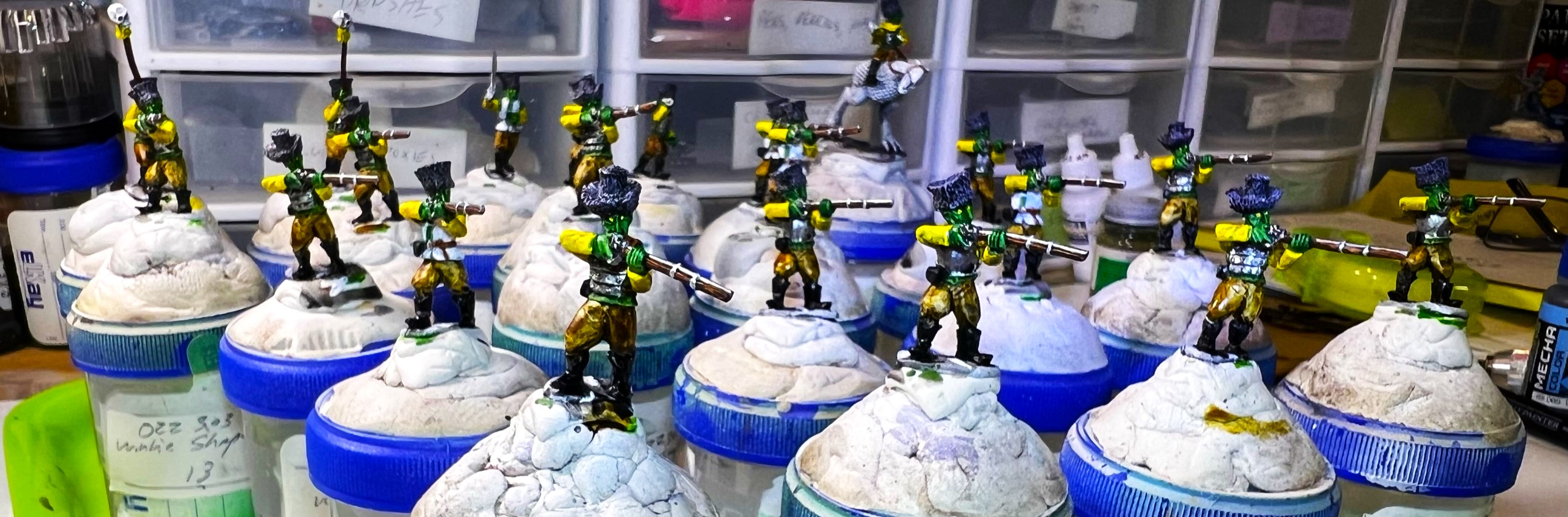
December 26th progress
December 27th progress

Then it was time to get my head drilled on December 28th. All went well, and recovery is coming along as expected, but I was in no shape to paint!

December 28th – my head was pretty swollen – even more than usual 😁. Normally I don’t have a head like Peter Griffin from “Family Guy”.

Did I mention that as part of this procedure the surgeon applies cocaine? Yup, and I’m pretty much just a beer guy so…yeah…

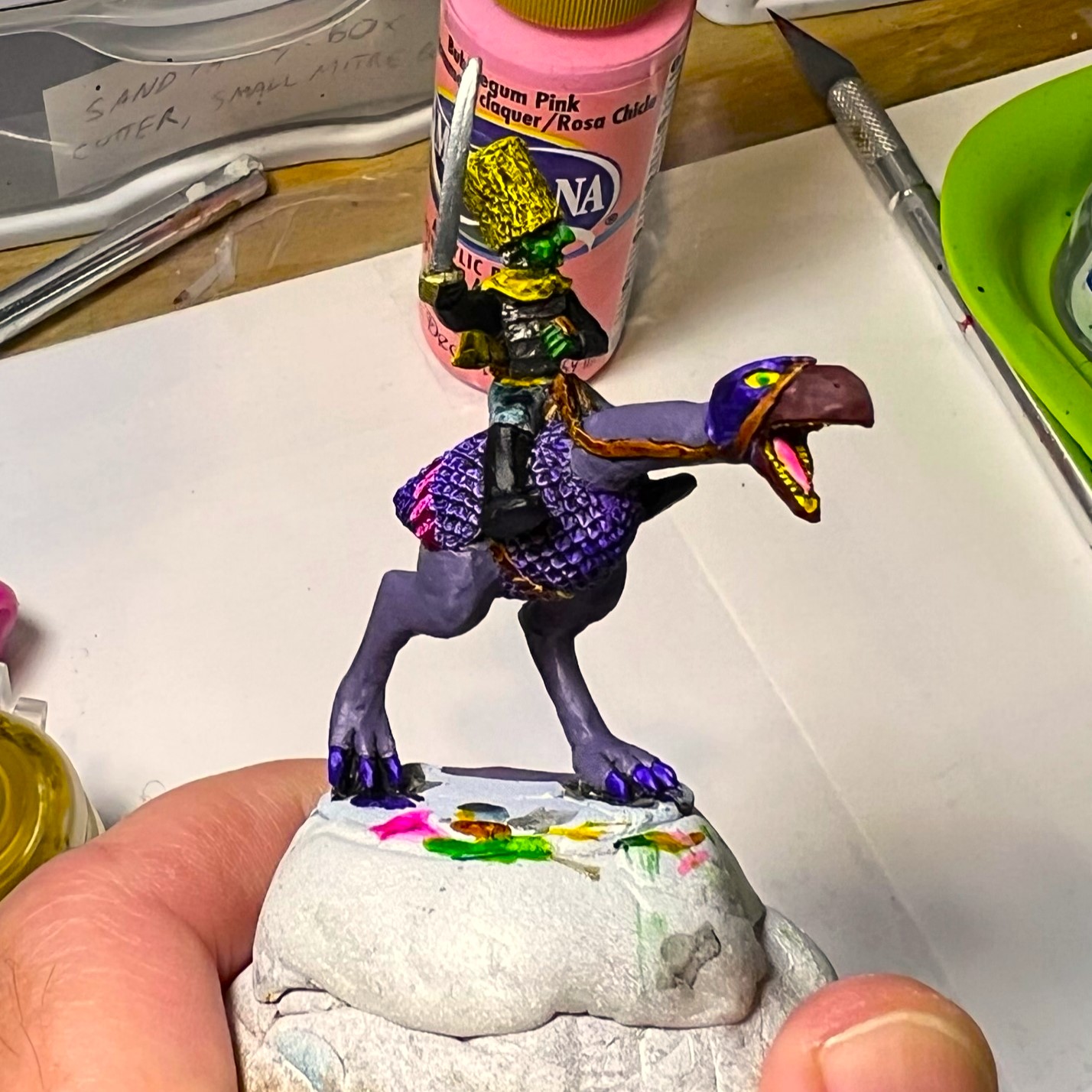
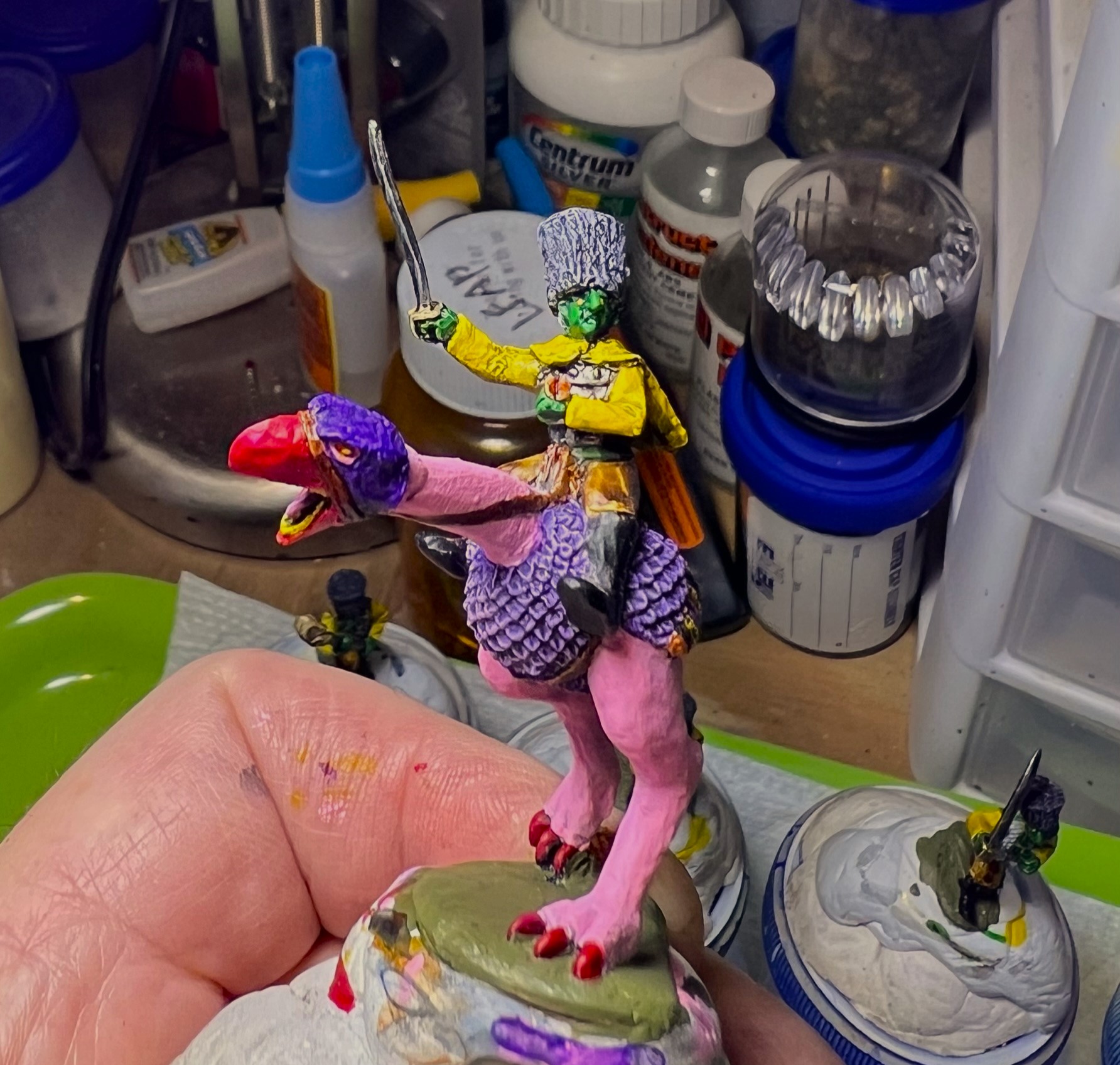
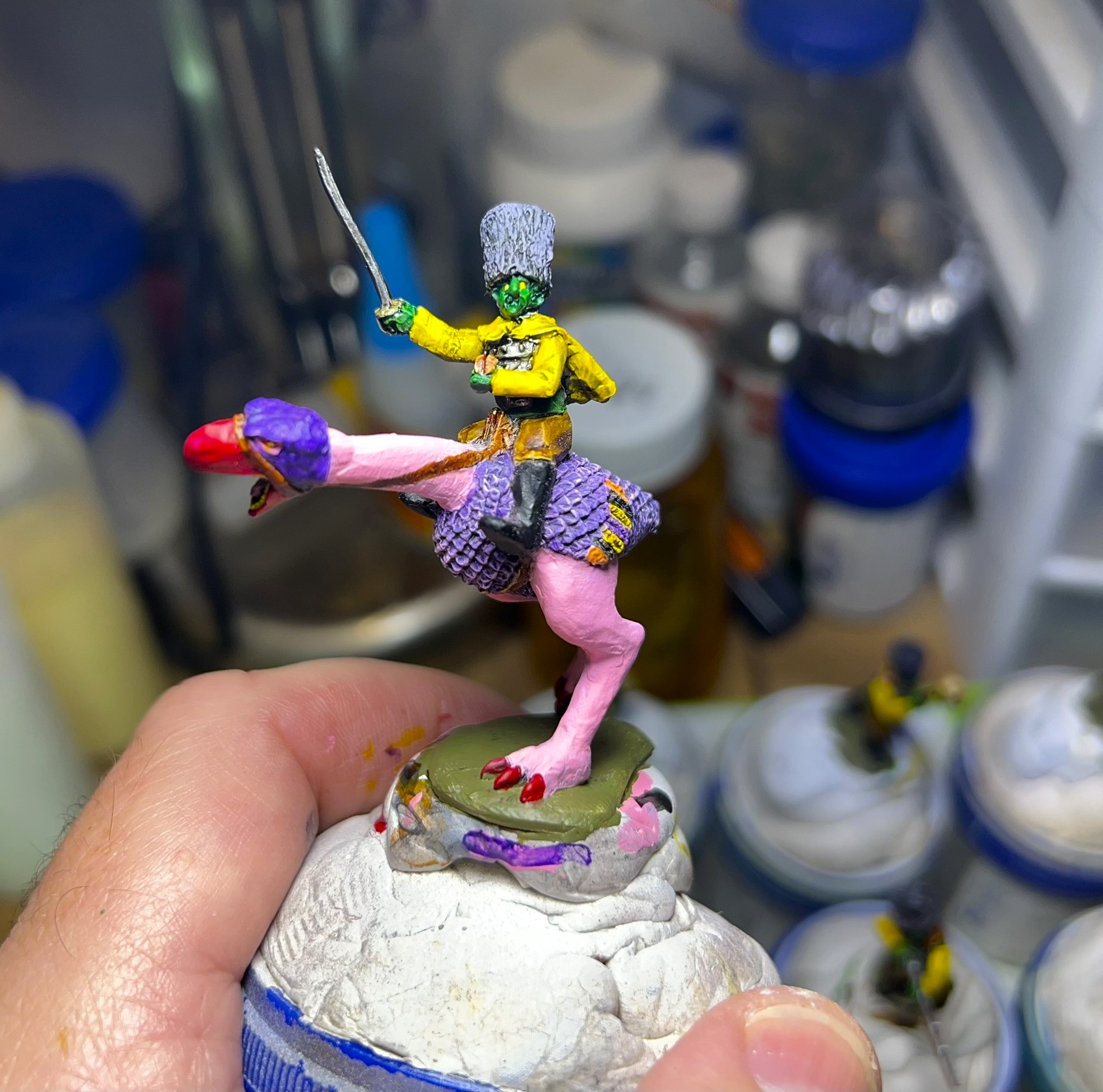
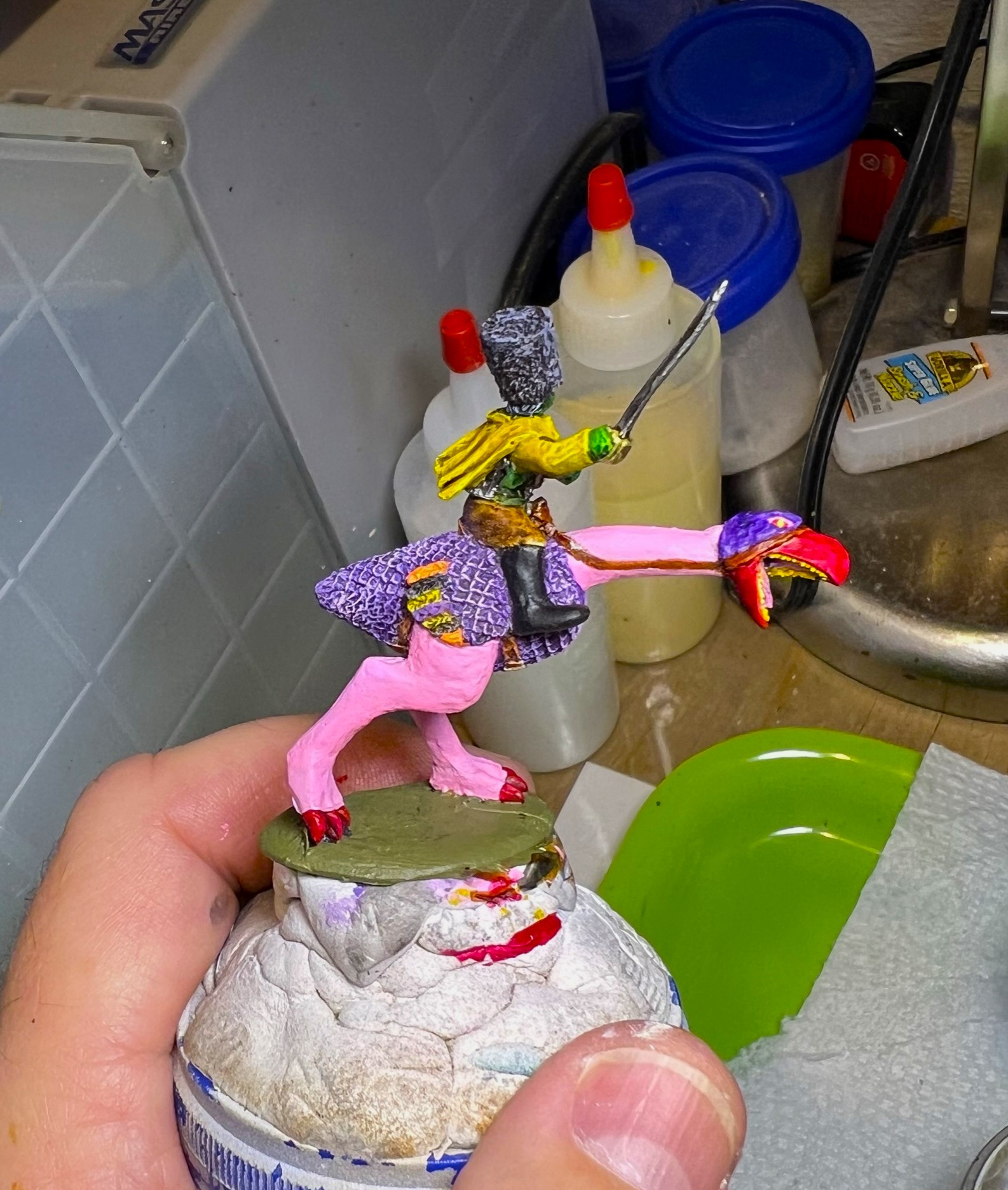
Anyways, I was back painting on the 29th, and made good progress by the 30th. One remaining major issue for me was how to paint the regimental commander’s zilk. Remember, Winkies look down on missile weapons, and I can imagine that the better-looking zilks would go to the cavalry and the regimental commanders of melee weapon-bearing infantry. I also had Ralphie’s rabbit suit in my mind subliminally, plus add in any residual cocaine…

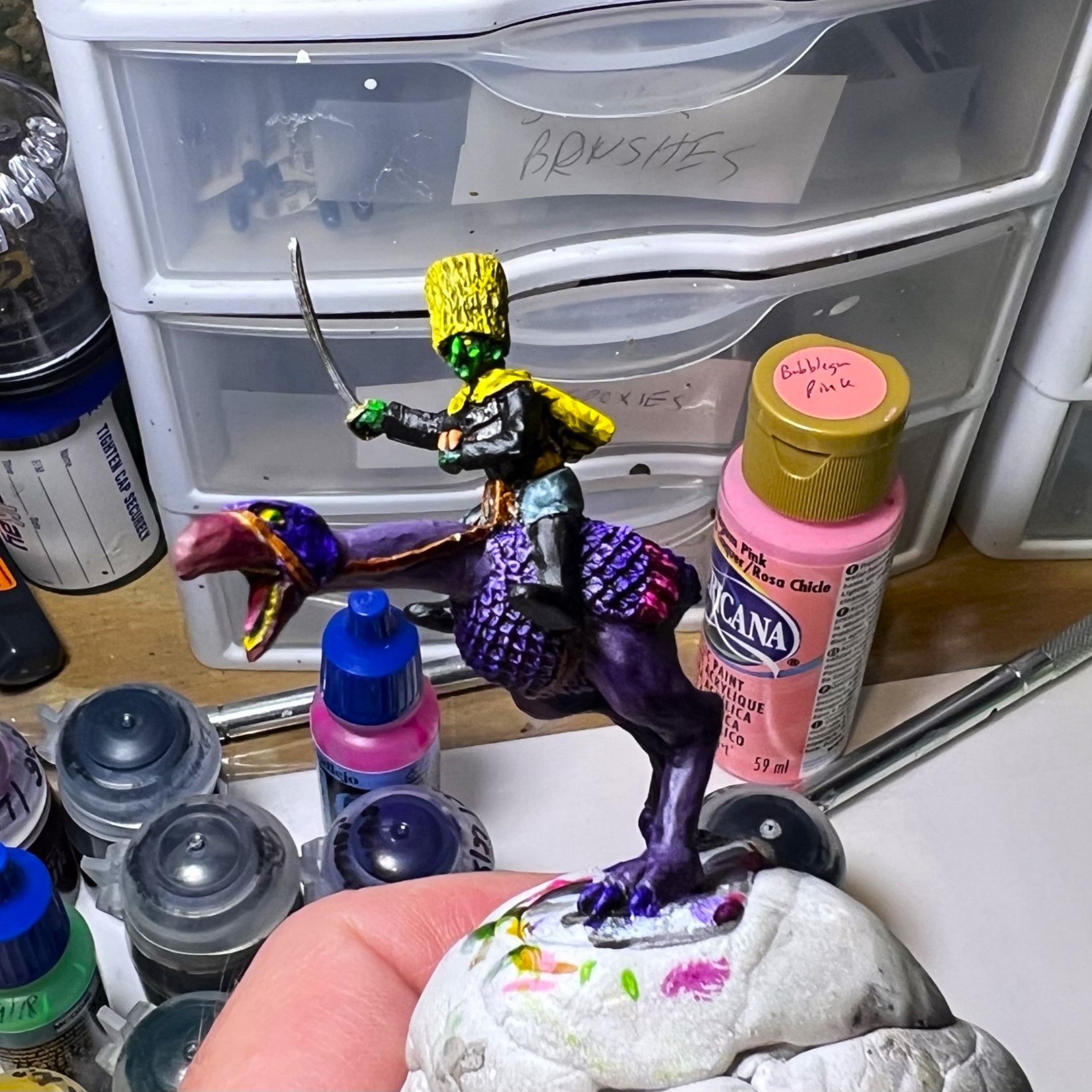
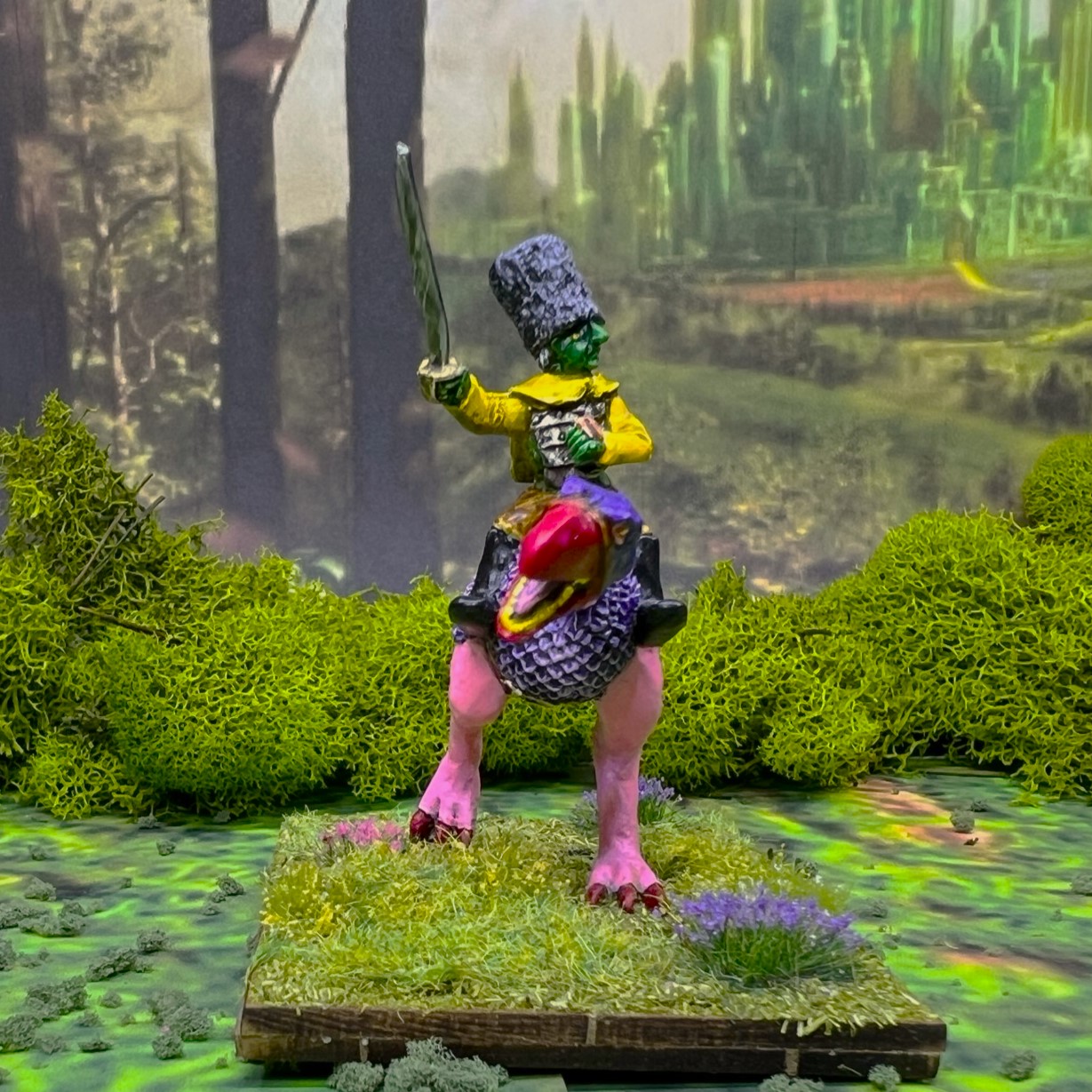
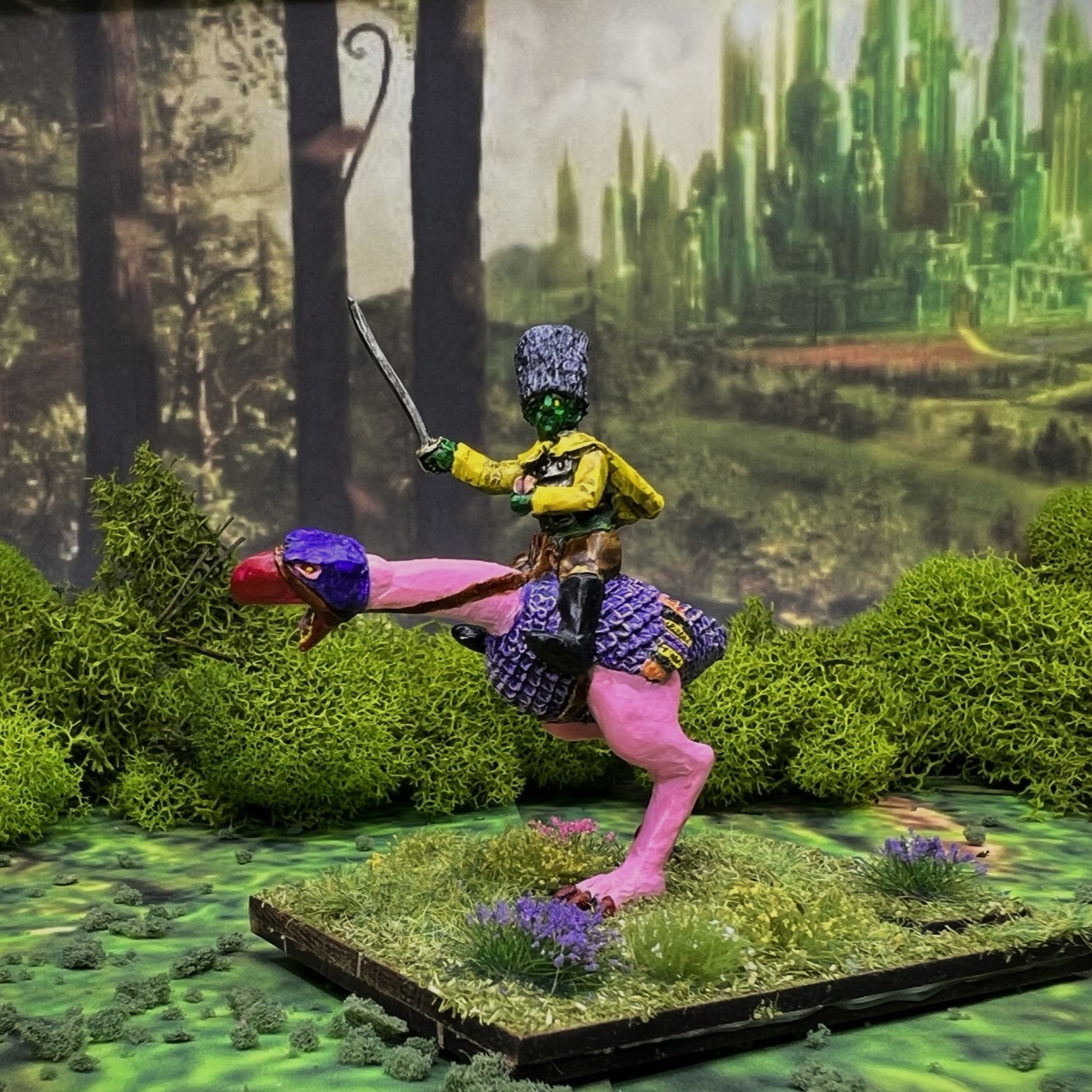
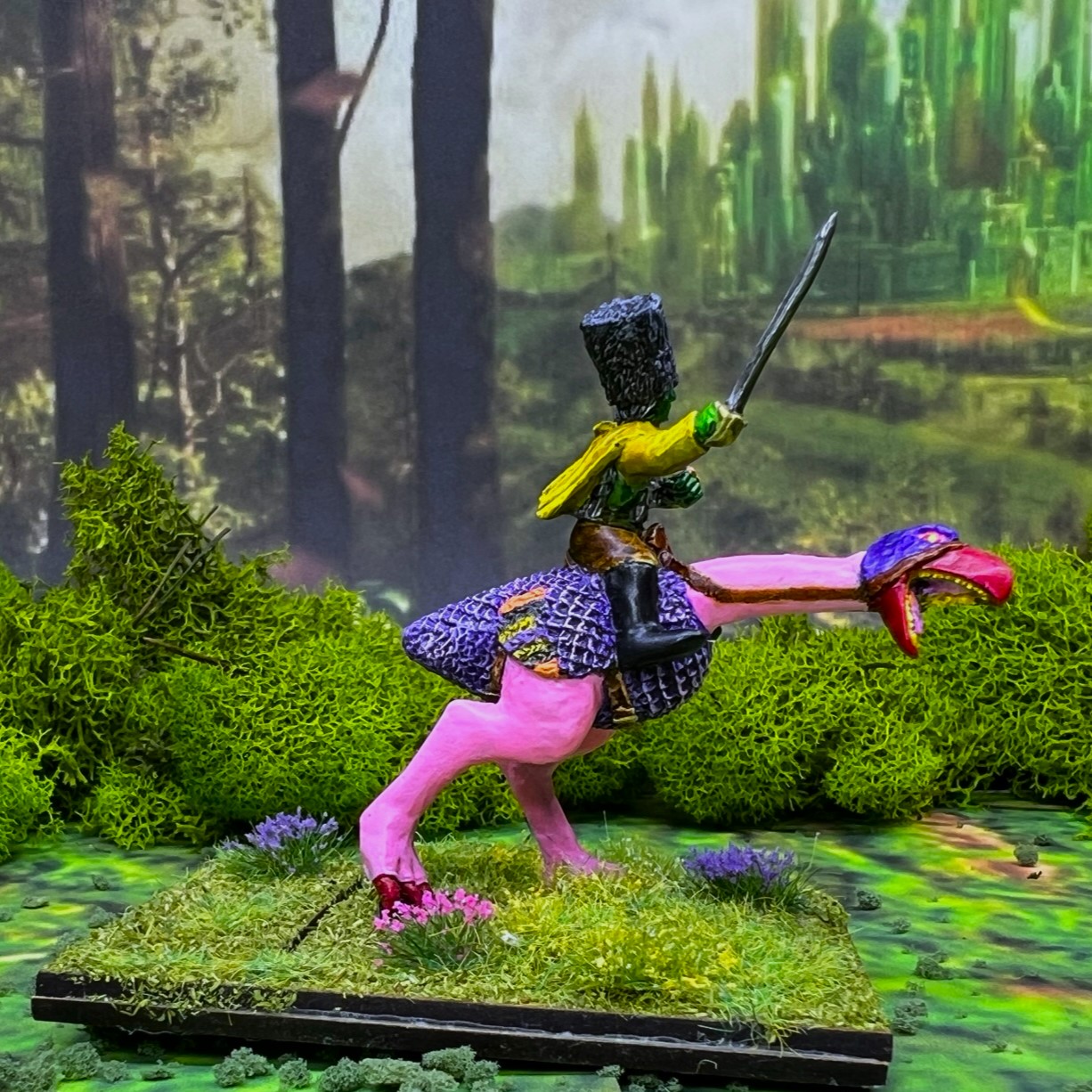
And I ended up with a bubble-gum pink and purple zilk…

Now, I am not sure how I feel about it, but it’s done now! Wars of Ozz are supposed to be colorful anyway – and hell, I had had that pink paint for a while without ever using it. I ended up airbrush varnishing the WSR with a gloss then a matte varnish so as to keep the colors bright but not shiny.

Base preparation on December 30th – the figures needed extra care for mounting if they were to look good. You can see the Wars of Ozz picture from the web store that I printed off as a guide underneath on the right.

As for mounting, I wanted the bases to have an appropriate look – with muskets facing forward and in parallel. Once the varnish had dried, I removed the WSR from their specimen jars. Then, I needed to use small bits of poster tack on the figures’ actual bases/bottoms – and a sharpie to trace out how they would fit on the 2″ square steel bases. Then I applied an initial flocking around where the figures would not be. After that had dried, I glued the figures carefully to the steel bases and added multiple grasses and flocking to the steel bases and the regimental commander’s MDF base. This took up most of the effort on the 30th as I added three types of grass plus flowers to give the bases depth and to not just see the shapes of the figures under one layer of flocking. It’s probably overkill, but I do prefer to have nicer bases. The flocking was done on December 30th. Then, it was flag time.

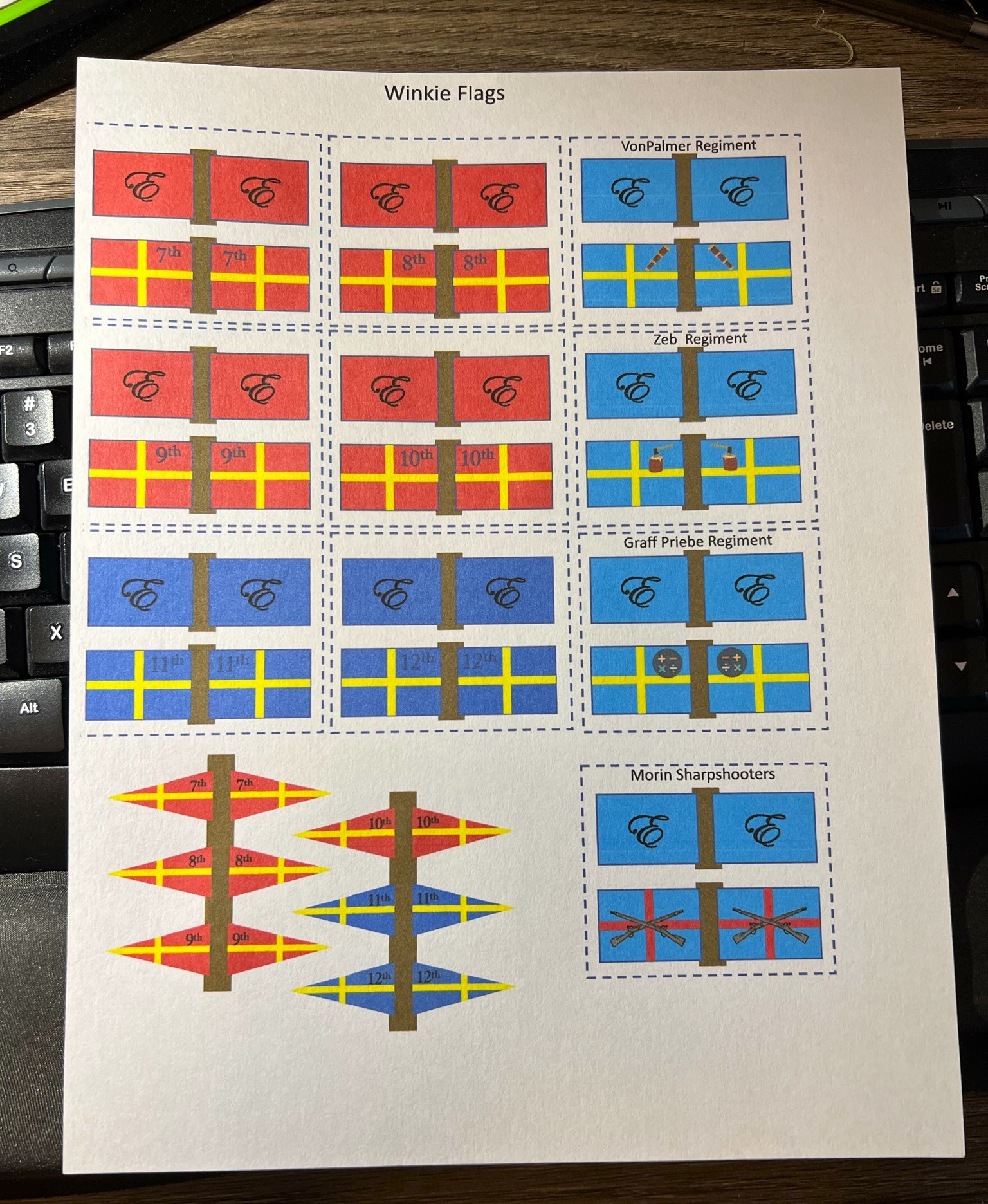
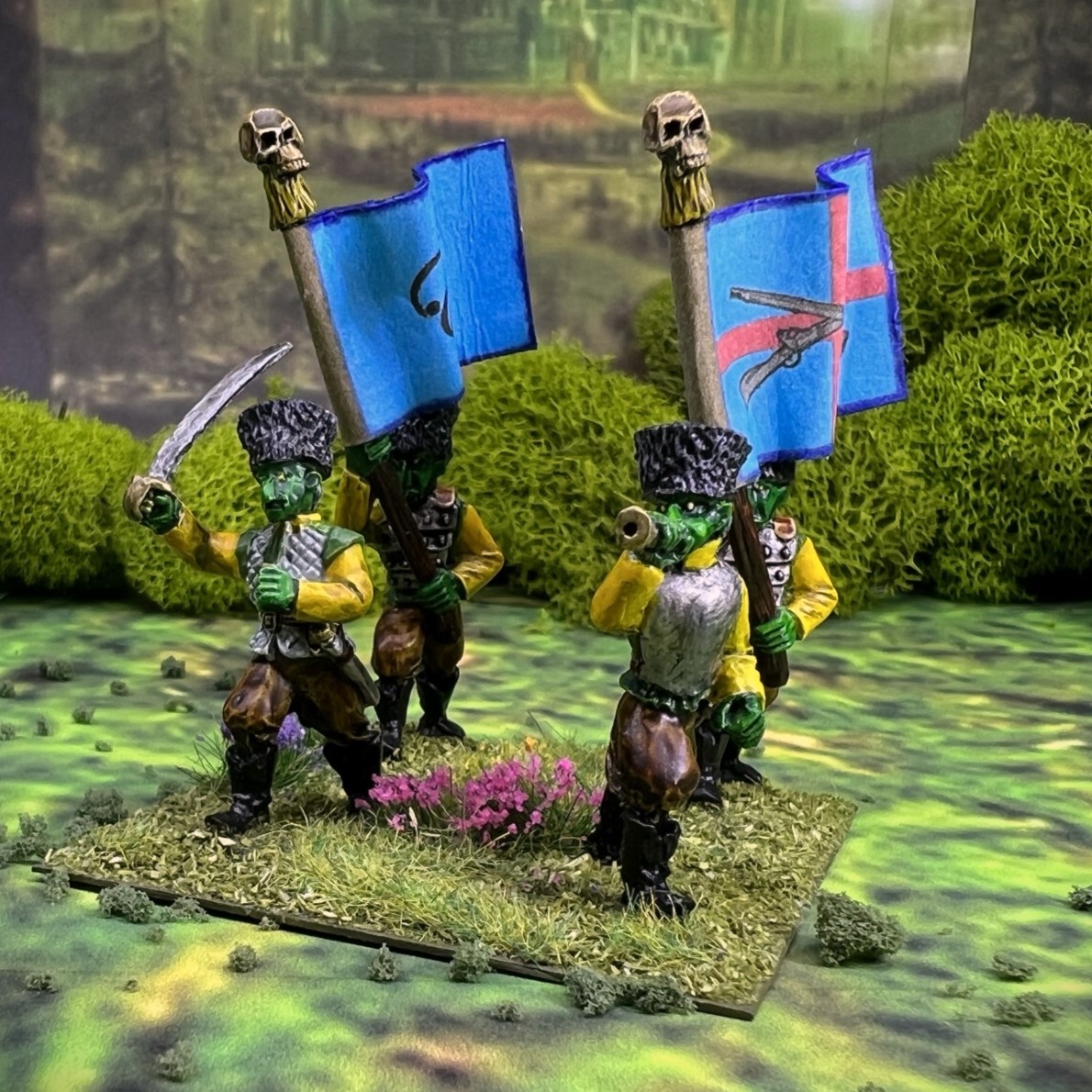
Most (but not all) regiments in Ozz have standards to apply to a couple of figures on a command base. One would be for the faction, the other would be for the regiment. These are available on the Ozz Facebook page as free downloads. When I looked for the WSR, there was no specified flag! By luck, my West Point buddy (and author of the Wars of Ozz rules) Buck Surdu had called me to check in on me post-surgery, and told me he would fix that – and boy he did as you’ll see below – Morin’s Sharpshooters! Hmmm, Buck, does this mean I ride a pink Zilk?

Thanks Buck!

As New Year’s Eve is today, I printed off the flags and finished the WSR. I also made a new backdrop for taking photos of the Winkies as I thought they needed a darker and less friendly look than I gave the Munchkin regiments. You’ll see that below in…

Eye Candy

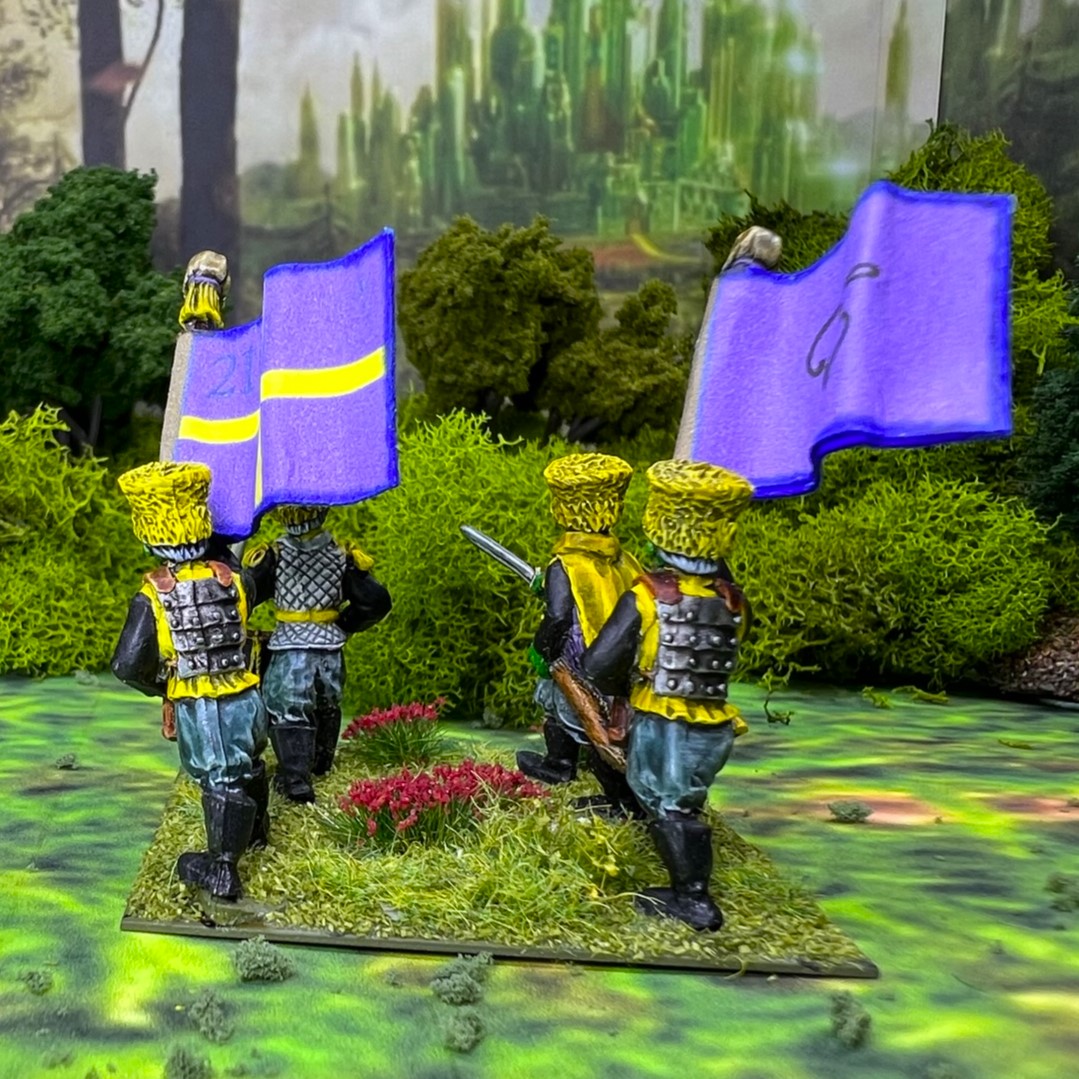
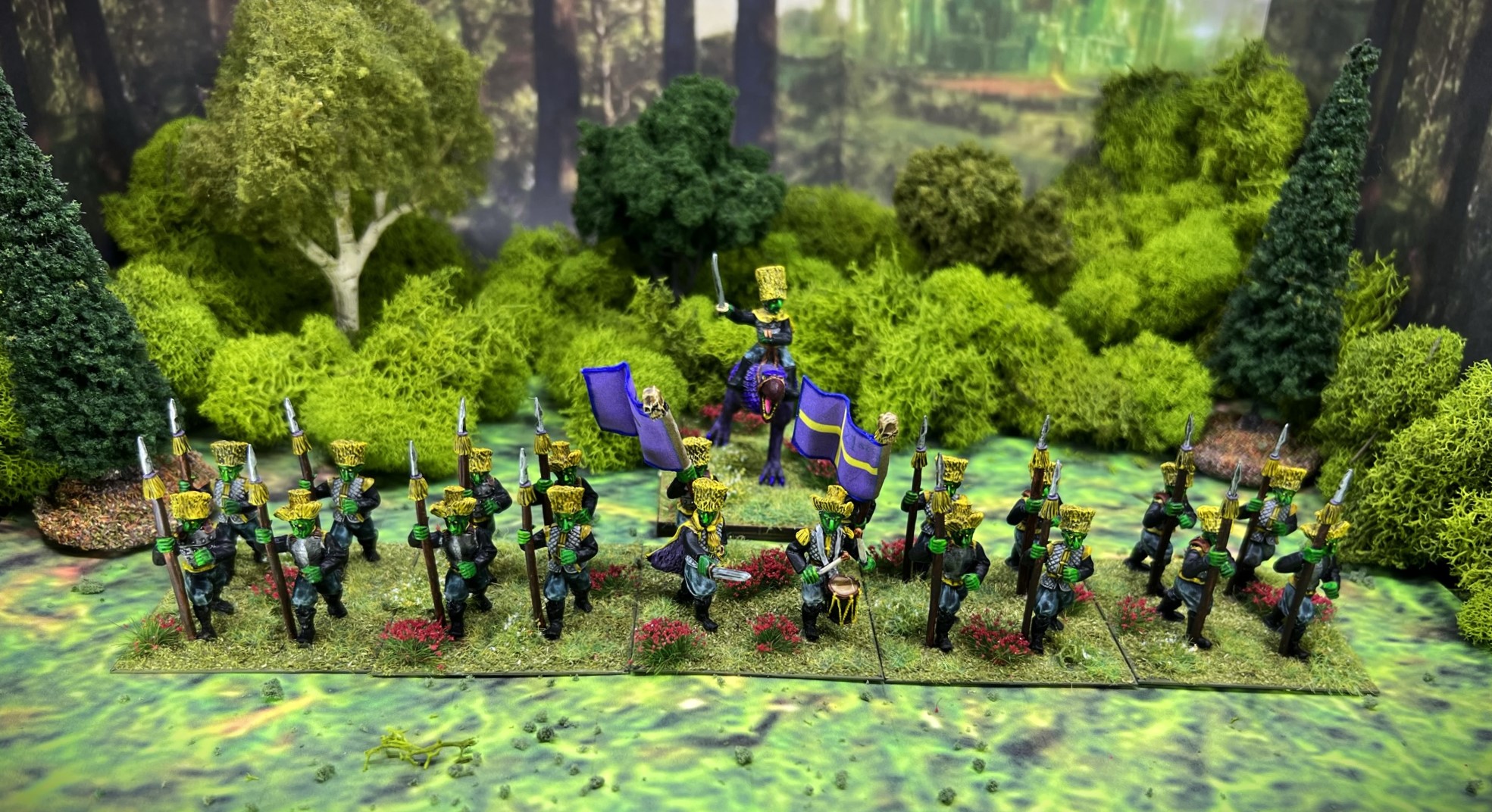
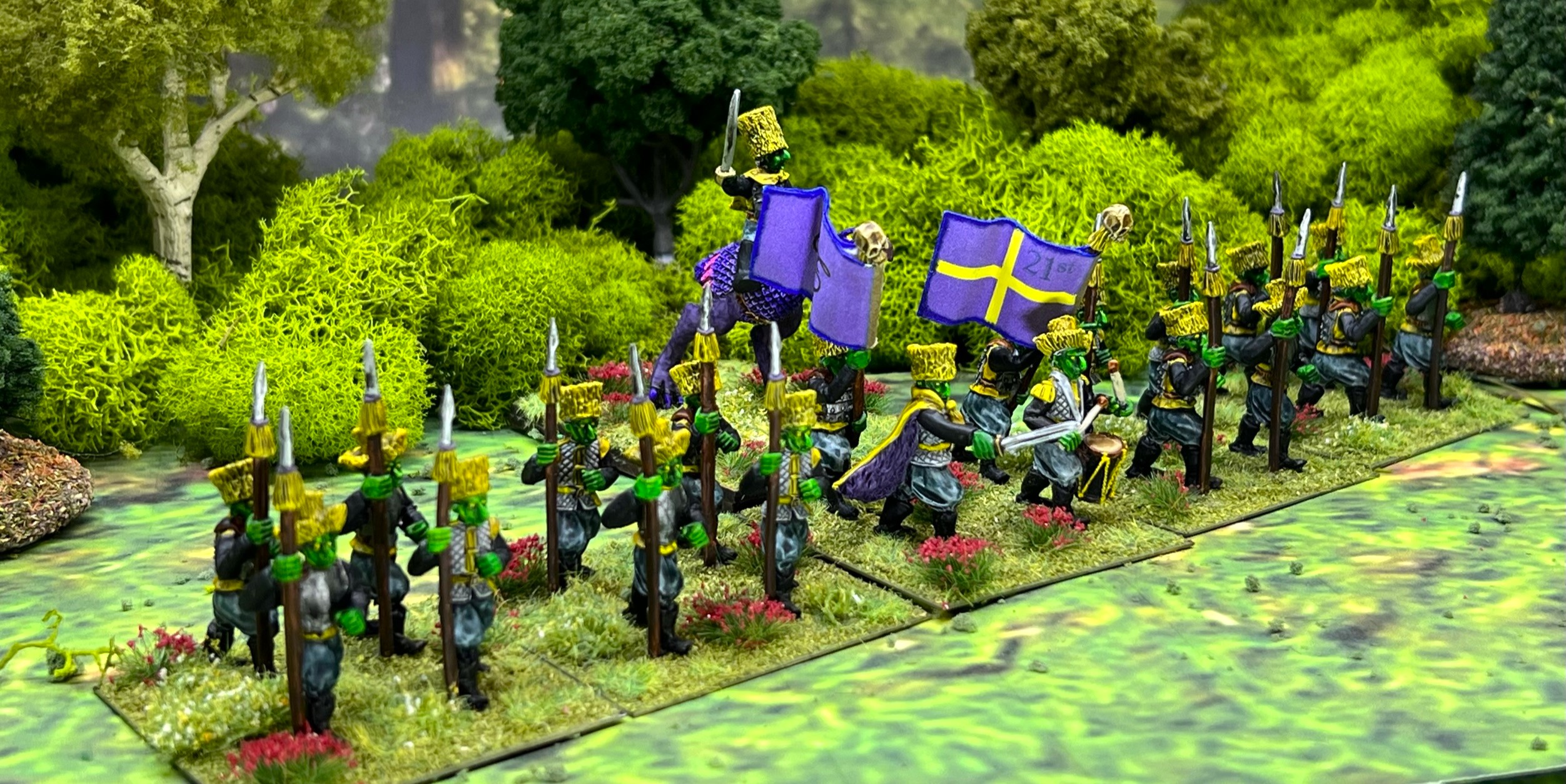
There are 5 stands of 4 figures each – 4 are similar and one is a command stand with an officer, 2 standard bearers and a bugler. I varied the flocking slightly but distinctly – hoping to have an overall match while having some uniqueness for each base. The pink zilk-mounted regimental commander goes on an MDF stand.

Regimental Commander Stand

Stand 1

Stand 2

Stand 3

Stand 4

Command Stand

Group shots

The WSR in line formation with the Regimental Commander in the rear.
The WSR in column formation with the Regimental Commander in the front.
A side view of the WSR in column formation with the Regimental Commander in the front.
A right side view of the WSR in another line formation with the Regimental Commander in the front.
A right side view of the WSR in another line formation with the Regimental Commander in the rear.
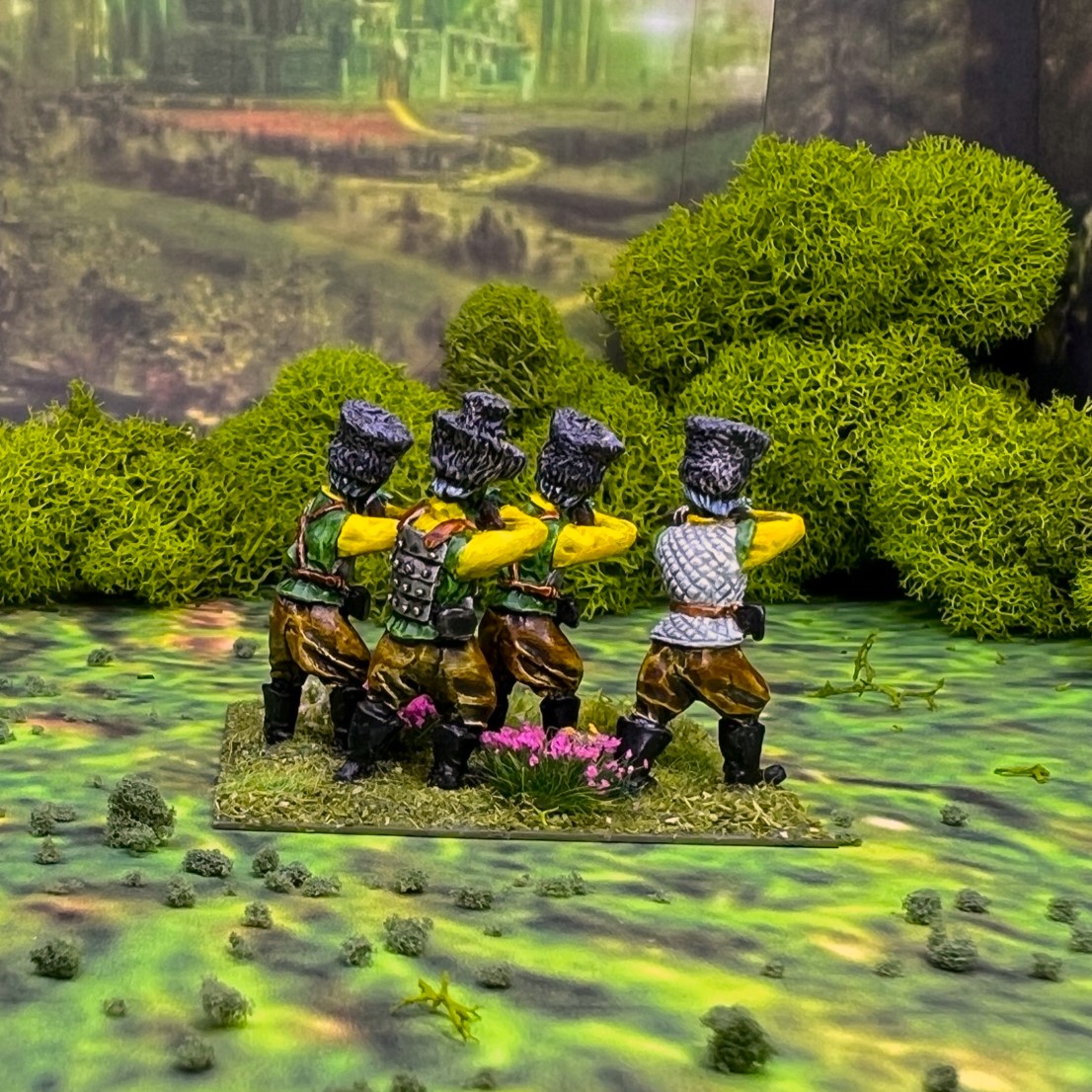
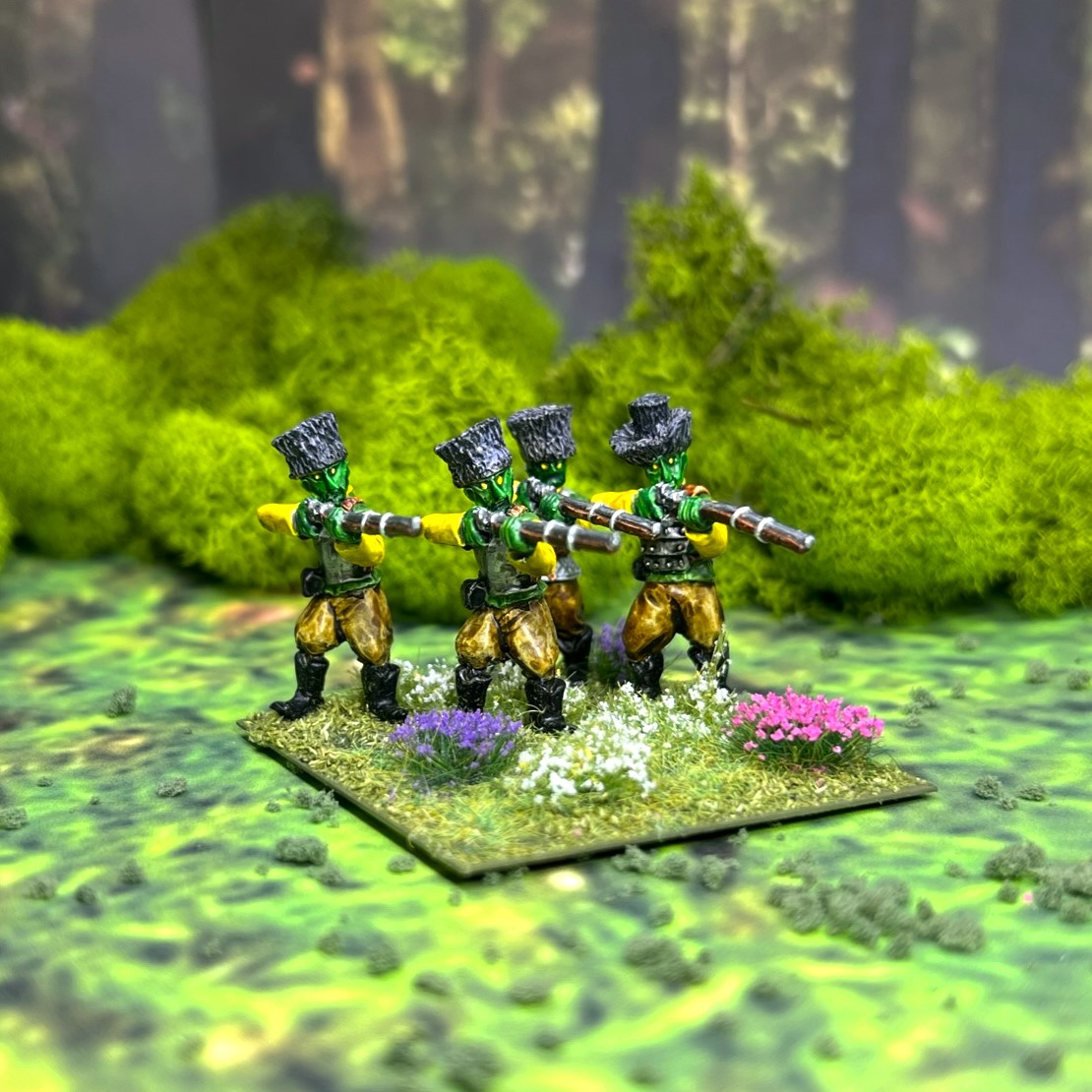
The WSR about to fire!

I will continue to build my brigade of Winkies in 2023, as well as more Ozz goodness. I hope that you will stay with and/or join me on this journey.

My next post will be a 2022 roundup and 2023 goal setting one. There, I’ll review and hold myself accountable for my 2022 predictions and goals of a year ago. Hell, somebody has to do it!

There, I will set my 2023 goals as well.

I wish all of you a very Happy New Year – and please know that I am very appreciative of your readership and support!

Still have more to come…

Miscellaneous details and references for those interested in that sort of thing:

For all of my previous posts on Wars of Ozz games, figures, units, and other related projects – please see this page.

PAINTS, INKS, GLAZES, SHADES, WASHES, PIGMENTS, FLOCKING, GLUES AND MORE THAT I USED ON THIS WINKIE SHARPSHOOTER REGIMENT:

  1. Gorilla Glue
  2. Paper clip wire pieces
  3. 1 1/4″ x 1″ steel base from Wargames Accessories (#FOW1)
  4. Poster tack
  5. Vallejo Premium Primer “White”
  6. Vallejo “Flow Improver”
  7. Vallejo “Airbrush Thinner”
  8. Citadel “Nuln Oil” (wash)
  9. Vallejo Model Color “White”
  10. Citadel “Contrast Paint – Ork Skin”
  11. Citadel “Contrast Paint – Contrast Medium”
  12. Vallejo Model Air “Gun Metal”
  13. Vallejo Model Air “Steel”
  14. Vallejo Model Color “Wood Grain”
  15. Army Painter “Speed Paint – Runic Grey”
  16. Citadel “Ironbreaker”
  17. Citadel “Nuln Oil GLOSS” (wash)
  18. Citadel “Contrast Paint – Black Legion”
  19. Citadel “Contrast Paint – Aggaros Dunes”
  20. Citadel “Warpfiend Grey”
  21. Citadel “Contrast Paint – Black Legion”
  22. Citadel “Contrast Paint – Striking Scorpion Green”
  23. Vallejo Game Air “Sick Green”
  24. Vallejo Game Ink “Yellow”
  25. Army Painter “Speed Paint – Hardened Leather”
  26. Vallejo Game Ink “Black Green”
  27. Citadel “Contrast Paint – Ironjawz Yellow”
  28. Citadel “Lamenters Yellow” (glaze)
  29. Vallejo Model Air “Bright Brass”
  30. Citadel “Contrast Paint – Skeleton Horde”
  31. Army Painter “Speed Paint – Holy White”
  32. Americana “Bubblegum Pink”
  33. Citadel “Fire Dragon Bright”
  34. Vallejo Game Air “Black”
  35. Americana “Dioxazine Purple”
  36. Citadel “Contrast Paint – Doomfire Magenta”
  37. Army Painter “Purple Tone” (wash/shade)
  38. Citadel “Changeling Pink” (dry)
  39. Vallejo “Gloss Varnish”
  40. Vallejo Mecha Varnish “Matte Varnish”
  41. Regimental MDF base from Old Glory/Wars of Ozz Miniatures
  42. 2″ square steel base from Wargames Accessories (#21)
  43. Black Sharpie pen
  44. PS Model Color “British Brown Drab”
  45. Elmer’s PVA Glue
  46. Army Painter “Battlefields Grass Green” (flocking)
  47. Army Painter “Battlefield Field Grass” (flocking)
  48. Army Painter “Battlefields Field Grass” (flocking)
  49. Army Painter “Battlefields Meadow Flowers” (flocking)
  50. Shadow’s Edge Miniatures “6mm Dark Forest Pink Tufts” (flocking)
  51. Shadow’s Edge Miniatures “6mm Dark Forest Purple Tufts” (flocking)
  52. Winkie Flags from Buck Surdu printed on card stock
  53. Blue Sharpie Pen
  54. Brown Sharpie Pen

Again, as you may want to check out the Wars of Ozz figures range – there are two places to get them (and I make no money from this btw). The game rules and figures are available from the following two places:

In the US Old Glory has a site – Wars of Ozz Miniatures.

In the UK go to Sally 4th.

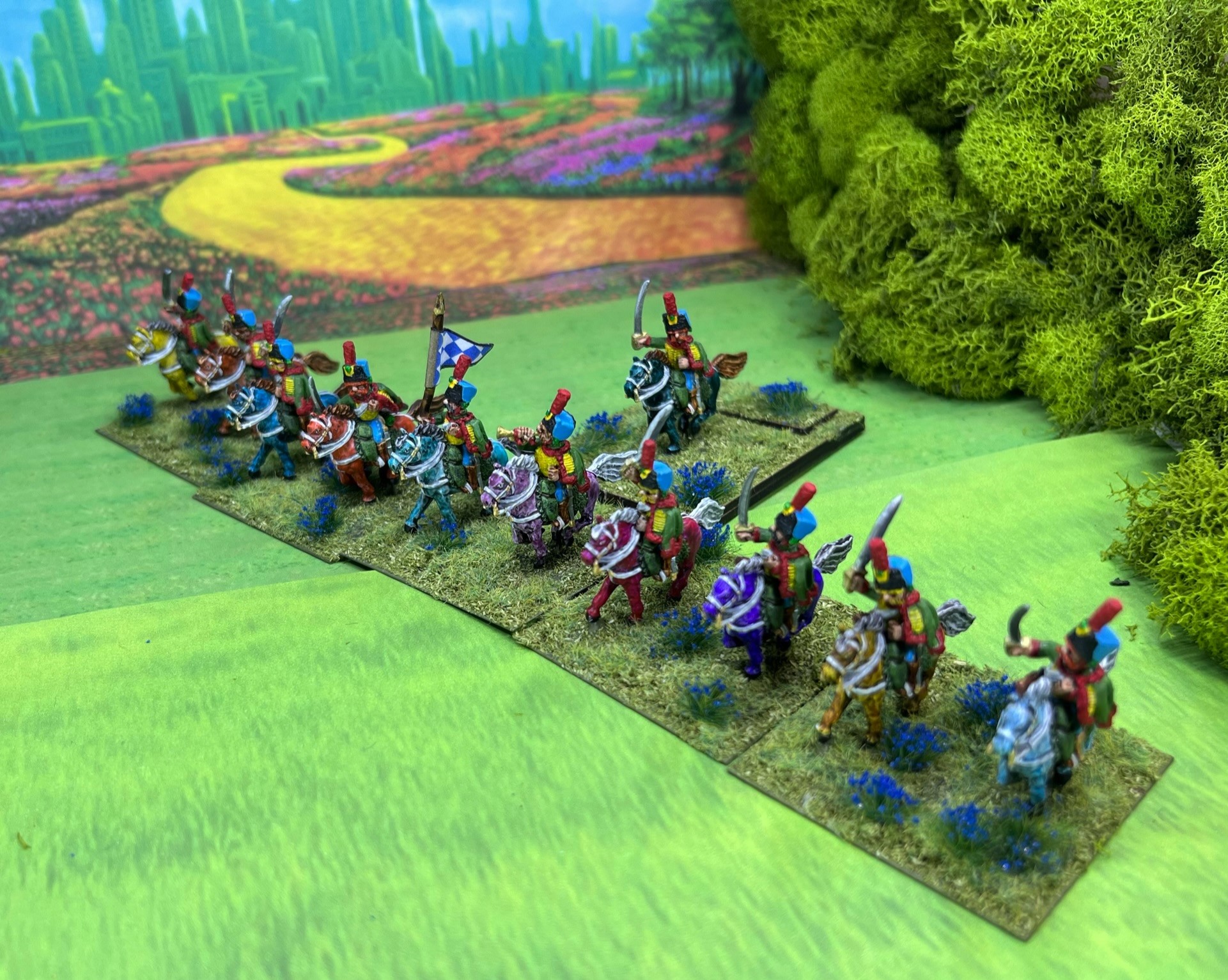
Munchkin Light Cavalry with Command (Wars of Ozz)

I had previously built two infantry regiments and an artillery battery for my Munchkin Brigade. It was time to add a cavalry regiment to my Munchkin Brigade for Wars of Ozz. This was a Light Cavalry Regiment, OZZ108 from Wars of Ozz miniatures.

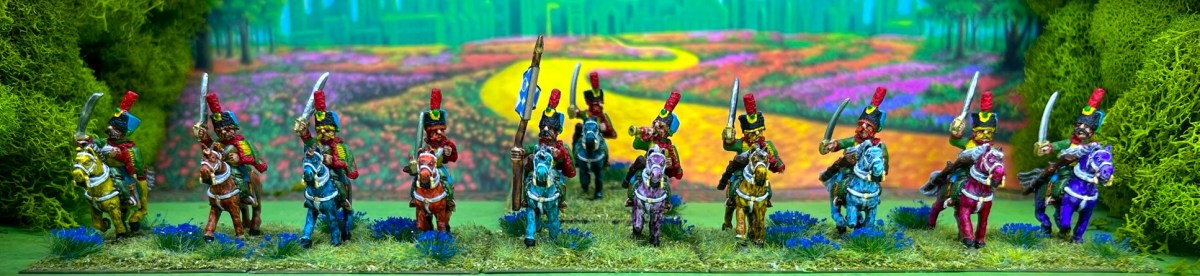
The regiment is 28mm and metal. It is composed of made of 11 figures broken into 11 ponies, 11 riders (from the torso up), and 11 carbines. The riders also are armed with sabers, so they can also engage the enemy from a distance (although carbines are not very long ranged). The Light Cavalry Regiment (LCR) is worth the same amount of points as the Medium Artillery Battery that I described in my last post. Each base in the game can take 4 hits, even though with cavalry there are only two figures per 2″ square base. This regiment has 5 bases plus a regimental commander on an MDF base.

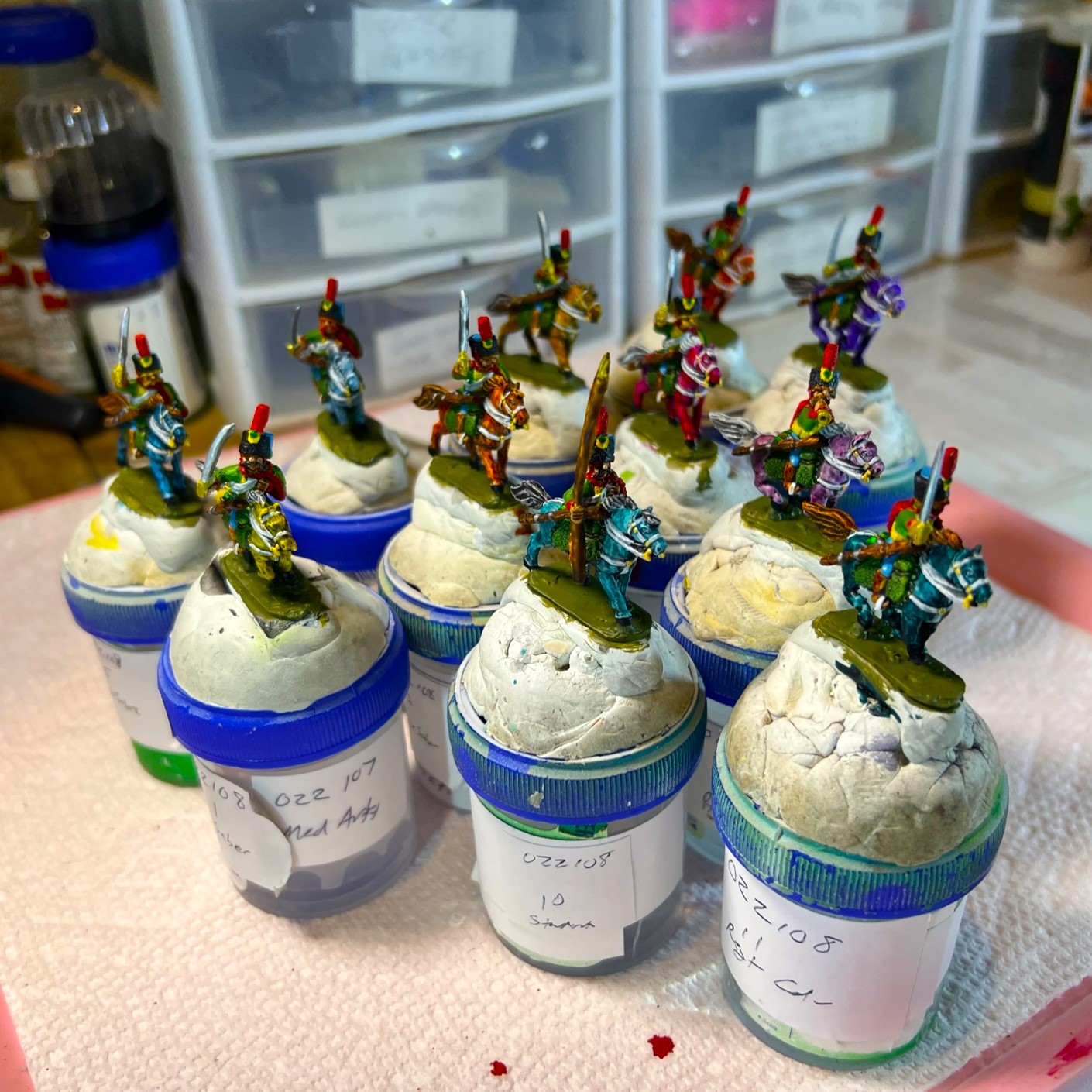
The rules say that the LCR should have “dragoon green” coats and light blue trousers. The ponies (these are Munchkins) are supposed to be in multiple pastel colors – which allowed me to use a number of Citadel Contrast and Army Painter Speed Paints. I painted the carbines, riders, and ponies all separately. Then, I assembled all after painting and varnishing was completed. I used both my specimen jars/poster tack combos and my painting stand with alligator clips to paint and varnish. The project was started on December 8th, and completed on December 19th. There was a lot more work here than I expected – I really needed to plan out the painting and assembly. I also did a bit of research on Napoleonic cavalry as my Napoleonic painting experience level is – well zero. My goal was to achieve a good tabletop standard – and you can be the judge of whether I achieved that. As usual, I will list all the paints I used on this unit at the end of this post for those interested in that sort of stuff (and for my own use for later reference as well). First, I’ll share some WIP shots, then some eye candy of the LCR.

WIP shots…

I actually prepped the bases first and started the flocking so that I would not have to manhandle the painted figures later on.

Base prep/sizing.

Then, I prepped/mounted the remaining torsos and riders for painting.

Mounted and tagged for painting. With each pony having a different color, this was instrumental.

The painting proceeded ok – though with all of the details it took a bit longer than I anticipated. I actually changed the fur cap colors from light blue to black after seeing some pictures on line with the light blue on the cap tops and sides. I then looked to give a lot of colorful detail in red, green, yellow, and blue as you’ll see below.

Then I varnished the group, assembled them, mounted them on the 2″ square steel bases, and flocked them.

Assembled.
Completed!

And now…

Eye Candy

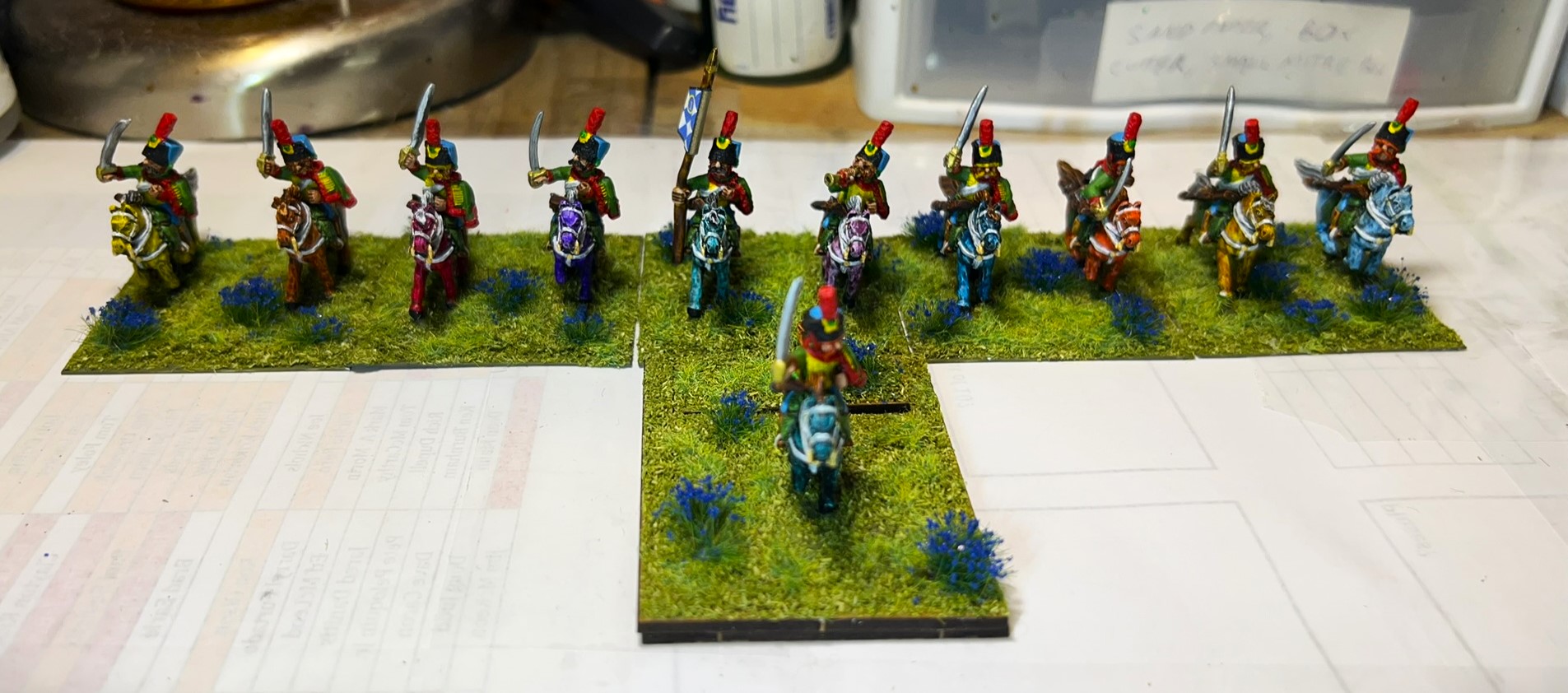
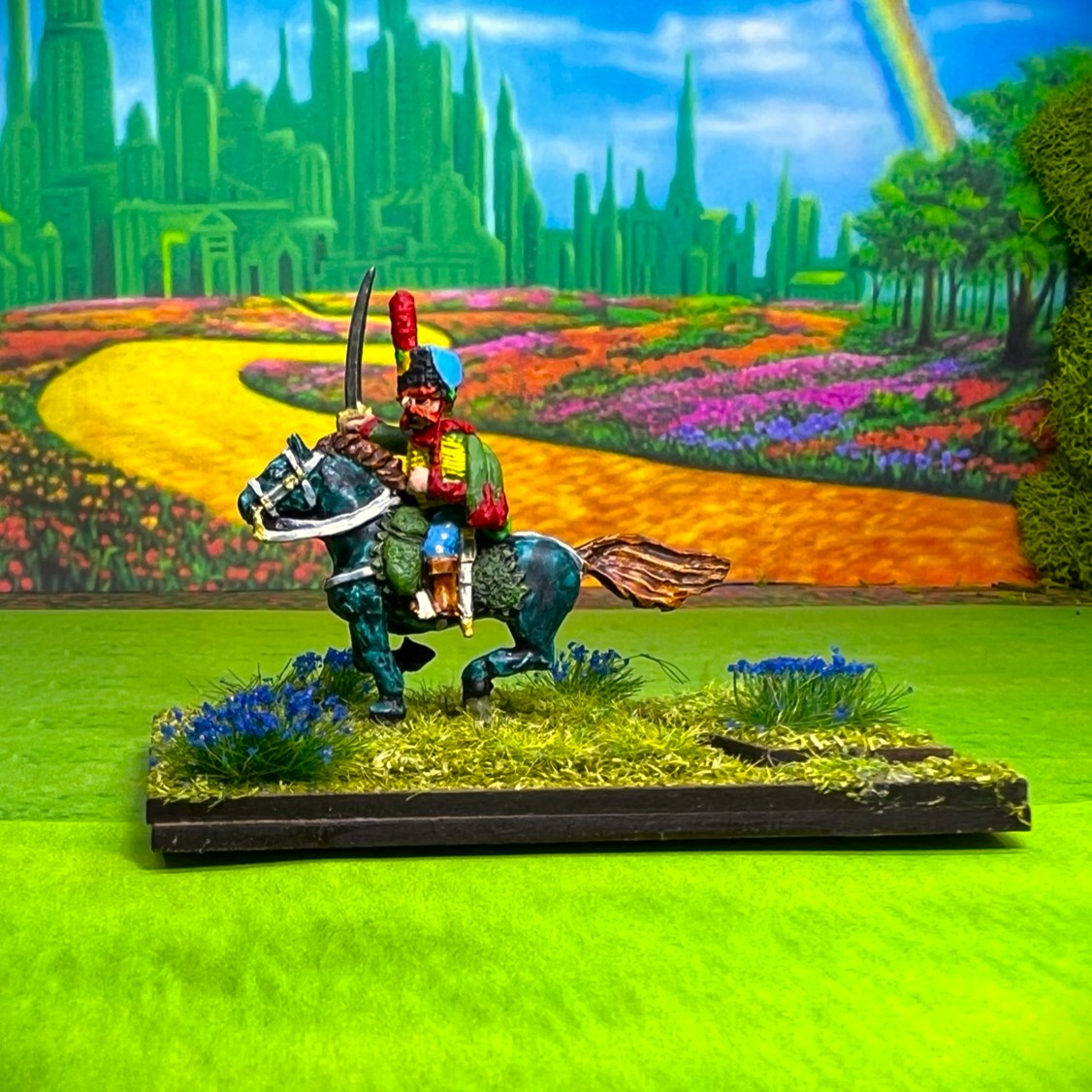
There are 5 stands of 2 figures – 4 are similar and one is a command stand with a standard bearer and a bugler. The regimental commander goes on an MDF stand.

Regimental Commander Stand

Stand 1

Stand 2

Stand 3

Stand 4

Command Stand

Group shots

The LCR in line formation, moving into melee with the Regimental Commander base in the rear.
A higher angle photo of the previous formation.
An angled shot of the left side of the LCR moving up with the Regimental Commander in front.
The LCR ready to charge the enemy with impetus!

So now I have a complete Munchkin Brigade!

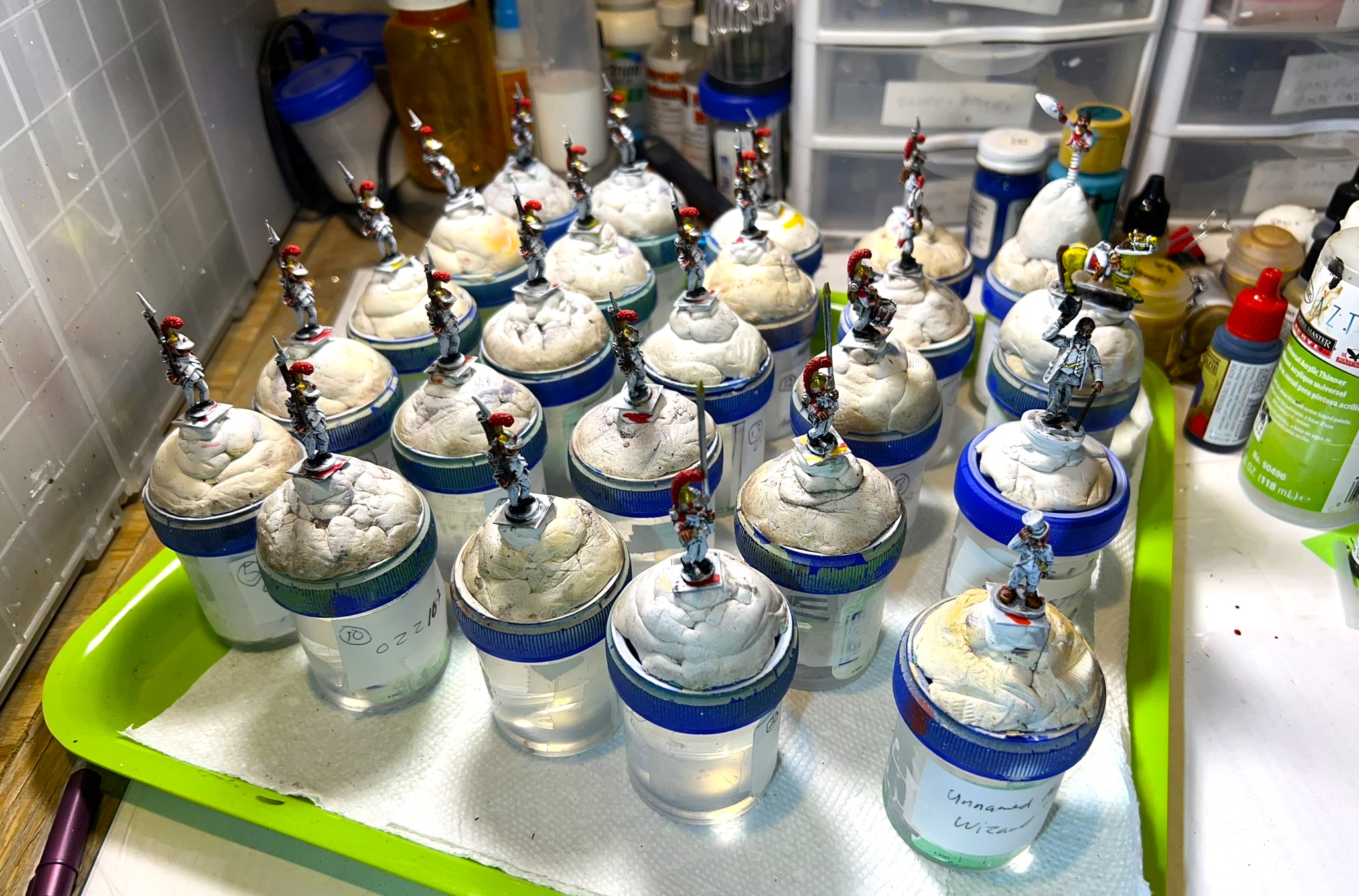
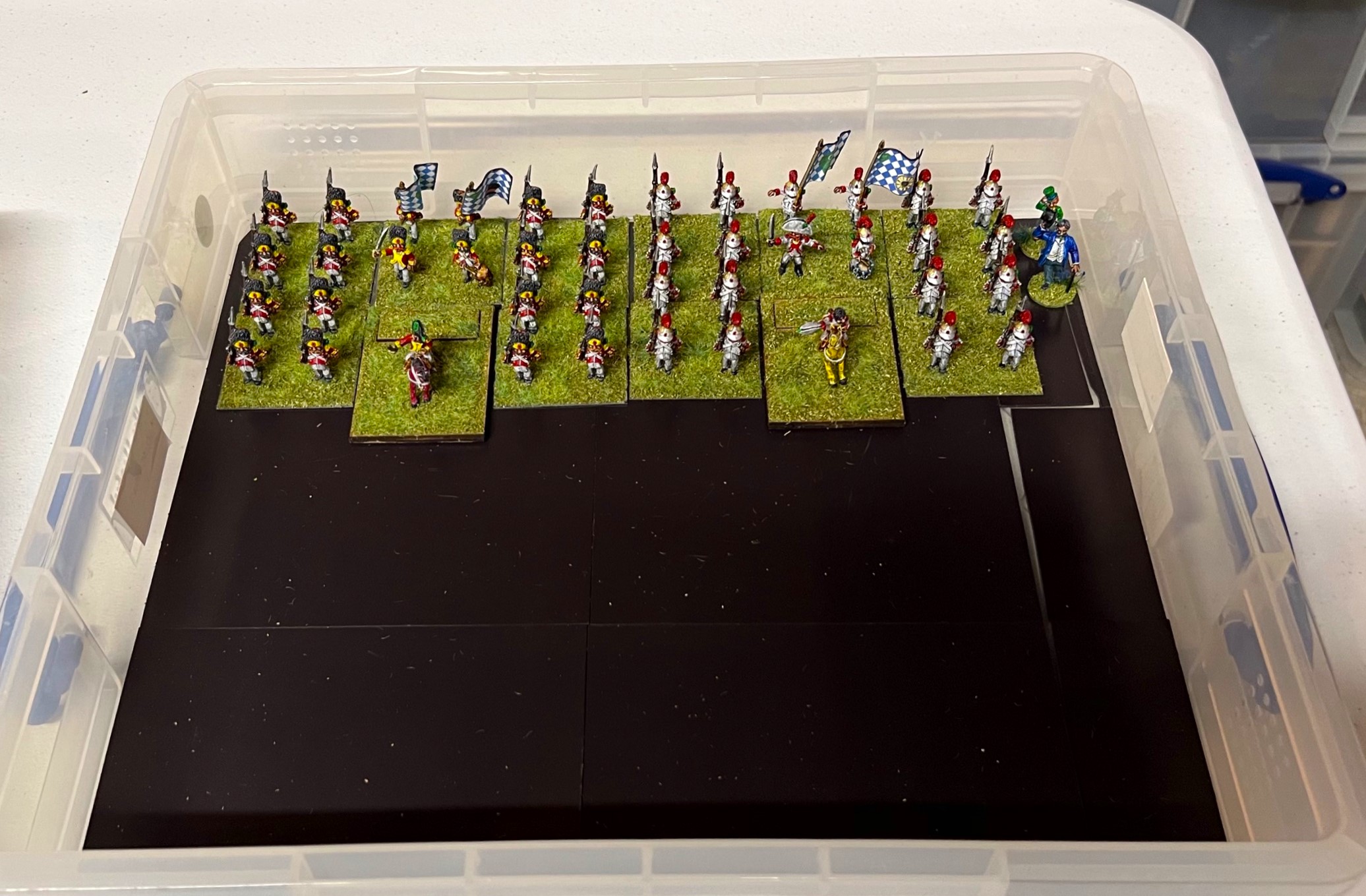
My Munchkin Brigade! Clockwise from the top left: Zoraster’s Guard Infantry, Colonel Tik-Tok’s Infantry Regiment, Zoraster and an unnamed wizard, the Light Cavalry Regiment, and the Medium Artillery Battery.

I will now move on to building my brigade of Winkies (basically the Orcs of Ozz). I am not sure how far I will get this year with Christmas coming plus some minor surgery for me right afterwards (oh yay). I am hoping to get at least one more unit done this month, then do a 2022 wrap up with my 2023 goals.

Again, as you may want to check out the figures range – there are two places to get them (and I make no money from this btw). The game rules and figures are available from the following two places:

In the US Old Glory has a site – Wars of Ozz Miniatures.

In the UK go to Sally 4th.

Thanks so very much for checking this post out and please let me know what you think in the comments section. I wish you all a very Merry Christmas and a Happy New Year!

Still have more to come…

Miscellaneous details and references for those interested in that sort of thing:

For all of my previous posts on Wars of Ozz games, figures, units, and other related projects – please see this page.

PAINTS, INKS, GLAZES, SHADES, WASHES, PIGMENTS, FLOCKING, GLUES AND MORE THAT I USED ON THIS MUNCHKIN LIGHT CAVALRY REGIMENT:

  1. Gorilla Glue
  2. Paper clip wire pieces
  3. 1 1/4″ x 1″ square steel bases from Wargames Accessories (#FOW1)
  4. Poster tack
  5. Vallejo Premium Primer “White”
  6. Vallejo “Flow Improver”
  7. Vallejo “Airbrush Thinner”
  8. Citadel “Nuln Oil” (wash)
  9. Vallejo Model Color “Wood Grain”
  10. Vallejo Model Color “White”
  11. Black Sharpie pen
  12. PS Model Color “British Brown Drab”
  13. Vallejo Model Air “Gun Metal”
  14. Vallejo Mecha Varnish “Matte Varnish”
  15. Vallejo Game Air “Sick Green”
  16. Vallejo Game Air “Electric Blue”
  17. Army Painter “Speed Paint – Hardened Leather”
  18. Citadel “Contrast Paint – Contrast Medium”
  19. Martha Stewart Crafts “Pale Bronze”
  20. Citadel “Contrast Paint – Ironjawz Yellow”
  21. Citadel “Contrast Paint – Gryph-Hound Orange”
  22. Citadel “Contrast Paint – Doomfire Magenta”
  23. Citadel “Contrast Paint – Luxion Purple”
  24. Citadel “Contrast Paint – Akhelian Green”
  25. Citadel “Contrast Paint – Pylar Glacier”
  26. Citadel “Contrast Paint – Nazdreg Yellow”
  27. Citadel “Contrast Paint – Magmadroth Flame”
  28. Citadel “Contrast Paint – Magos Purple”
  29. Citadel “Contrast Paint – Aethermatic Blue”
  30. Citadel “Contrast Paint – Terradon Turquoise”
  31. Battlefront “Black”
  32. Citadel “Contrast Paint – Basilicanum Grey”
  33. Citadel “Contrast Paint – Gore Grunta Fur”
  34. Army Painter “Speed Paint – Holy White”
  35. Army Painter “Speed Paint – Crusader Skin”
  36. Army Painter “Speed Paint – Grim Black”
  37. Army Painter “Flesh Wash” (wash/shade)
  38. Citadel “Contrast Paint – Baal Red”
  39. Model Air “Bright Brass”
  40. Vallejo Model Air “Steel”
  41. P3 “Midland Flesh”
  42. Citadel “Contrast Paint – Aggaros Dunes”
  43. Army Painter “Speed Paint – Dark Wood”
  44. Vallejo Game Ink “Yellow”
  45. Vallejo Game Ink “Black Green”
  46. Citadel “Cryptek Armourshade” (wash/shade)
  47. Citadel “Contrast Paint – Karandras Green”
  48. Elmer’s PVA Glue
  49. Regimental MDF base from Old Glory
  50. Army Painter “Battlefields Grass Green” (flocking)
  51. Army Painter “Battlefield Field Grass” (flocking)
  52. Army Painter “Battlefields Field Grass” (flocking)
  53. Army Painter “Brown Battleground” (flocking)
  54. Shadow’s Edge Miniatures “6mm Dark Forest Dark Blue Tufts” (flocking)

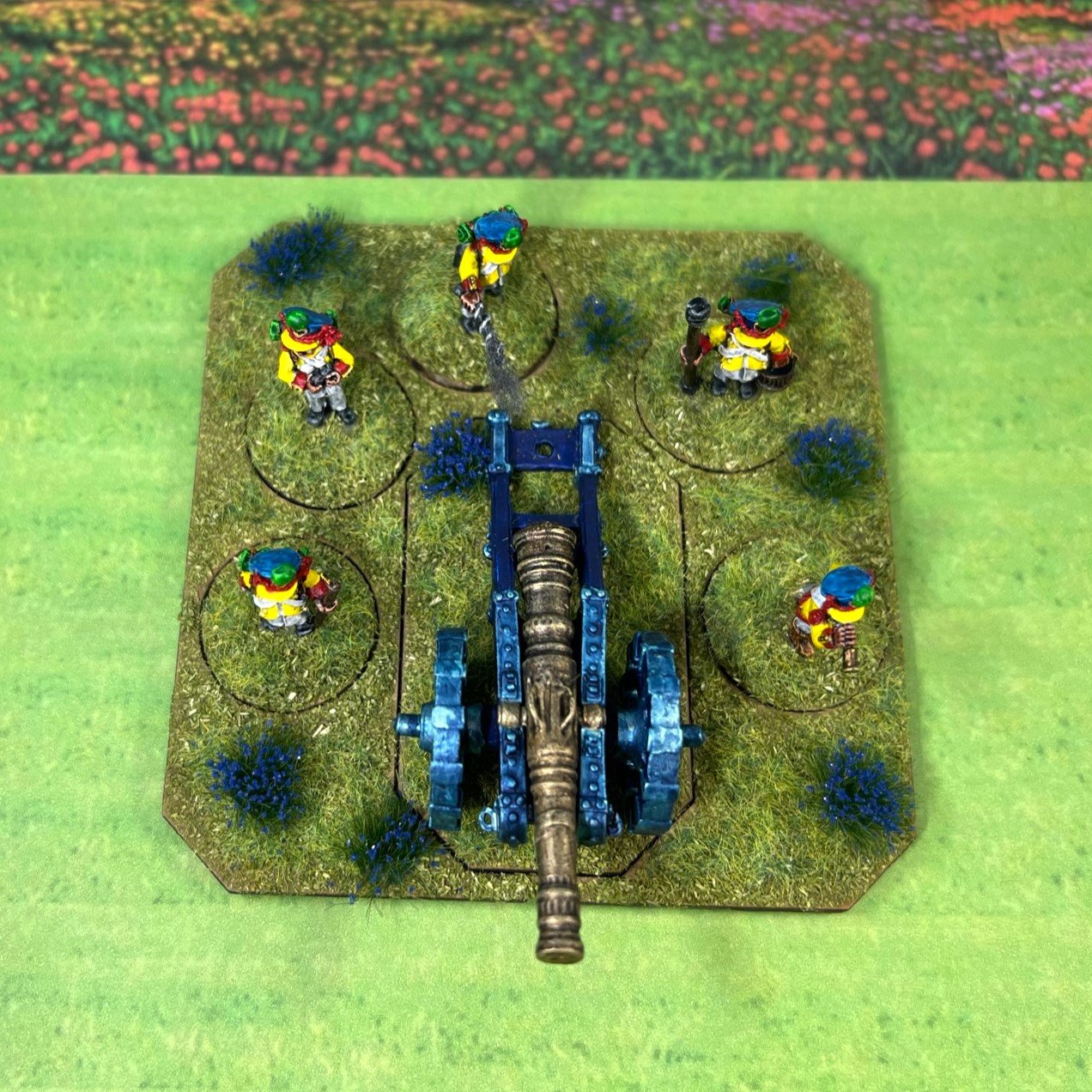
Munchkin Medium Artillery Battery (Wars of Ozz)

Any Munchkin Brigade needs a good dose of heavy firepower to fend off the enemies of the Emerald City at long range. For my Munchkin Brigade for Wars of Ozz games, I finished off a Munchkin Medium Artillery Battery with Crew (OZZ107). Let’s call it MMAB.

In the game, the MMAB is the stronger of the two artillery choices (the other being a light battery). For comparison, a medium battery can fire at targets up to 24″, while a light battery range is out to 18″, with musket range being at max of 14″. In the game, firing at half ranges is more effective as one would think, and short range for the MMAB is 8″, while a light battery is 6″, and muskets are 7″. So this MMAB gives the brigade a bit of standoff firepower.

The artillery batteries in Wars of Ozz are composed of 5 figures plus a gun. For close combat, they are armed with carbines (which are slightly more than half of the range of muskets – but hopefully they don’t have to get into melee – but the odds are that they will!). While an infantry or cavalry regiment has 5 bases – each of which can take 4 hits – the battery can take 5 hits (one per figure). Each hit removes a figure and loses a die for attacking. The scale is 28mm and these figures are metal.

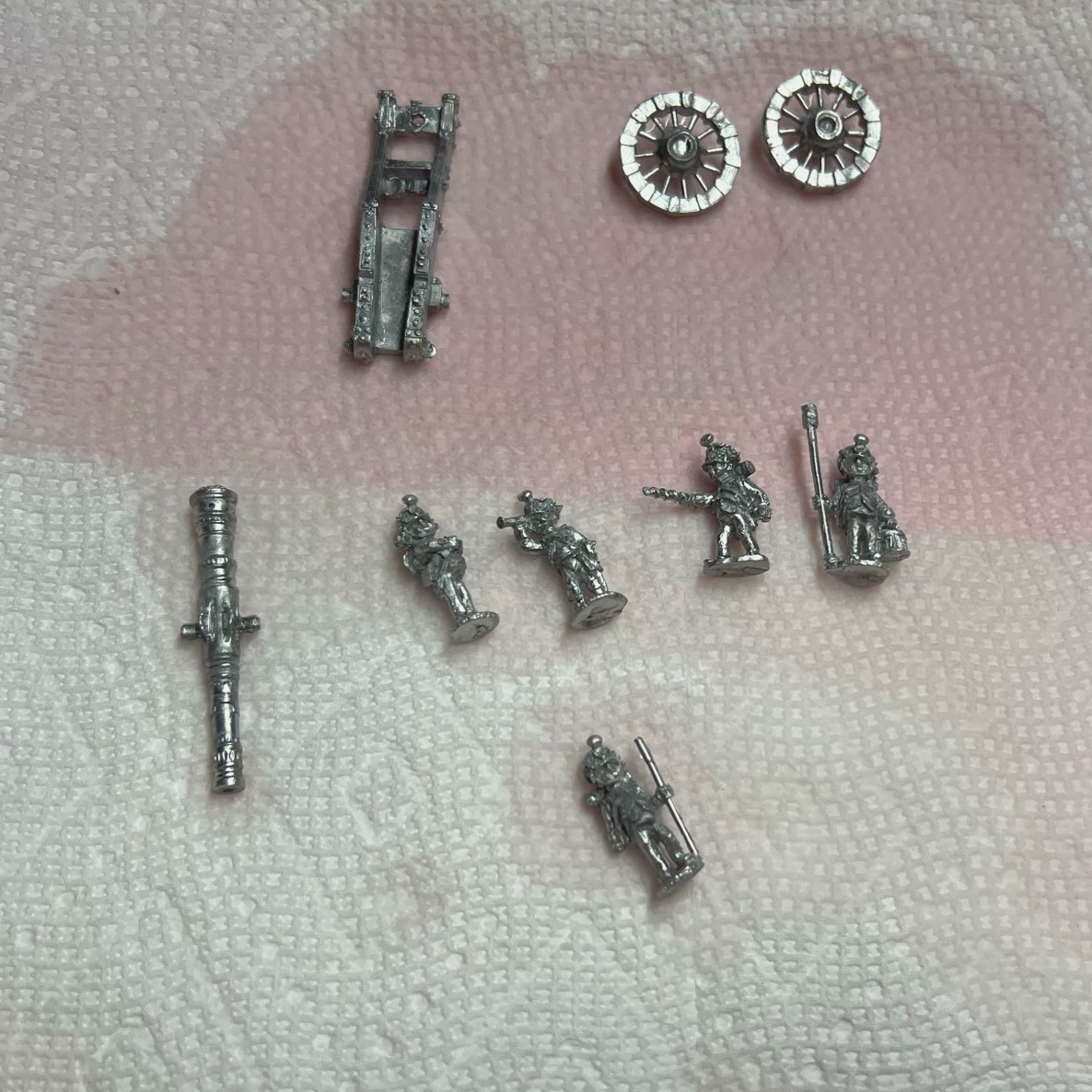
I started parallel-working on these while I worked on Colonel Tik-Tok’s Infantry Regiment back on November 25th. When I needed to let something dry, I did a little work on this unit. The gun with its carriage required assembly. With the carriage needing serial painting – so as to get the right bluish look per Ozz canon (pun intended – see how I did that!) – and the gun being pretty big, the parallel approach got it done without causing me impatience. I followed the same procedure as to painting these figures as I did with the previous units, by priming in white, then washing with a dark shade, then painting, highlighting, and shading.

A major consideration for me was how to paint up the cannon and carriage. First, there were undersides to the gun and carriage to consider for painting and assembly. Second, there were the choices of colors. I experimented with several blues and bluish craft metallics for the gun. Initially, I went with a classic grey gun metal look for the gun, but changed it to brass as I liked the look better. As Munchkins are being very fond of blue, I thought that was appropriate. As is my custom, I list all the paints I used on this unit at the end of this post for those interested in that sort of stuff (and for my own use for later reference as well). First, I’ll share some WIP shots, then some eye candy of the MMAB.

WIP shots…

As discussed, I started on November 25th. This was mainly preparatory work on filing, washing before priming. My main effort was the CTTIR during this time.

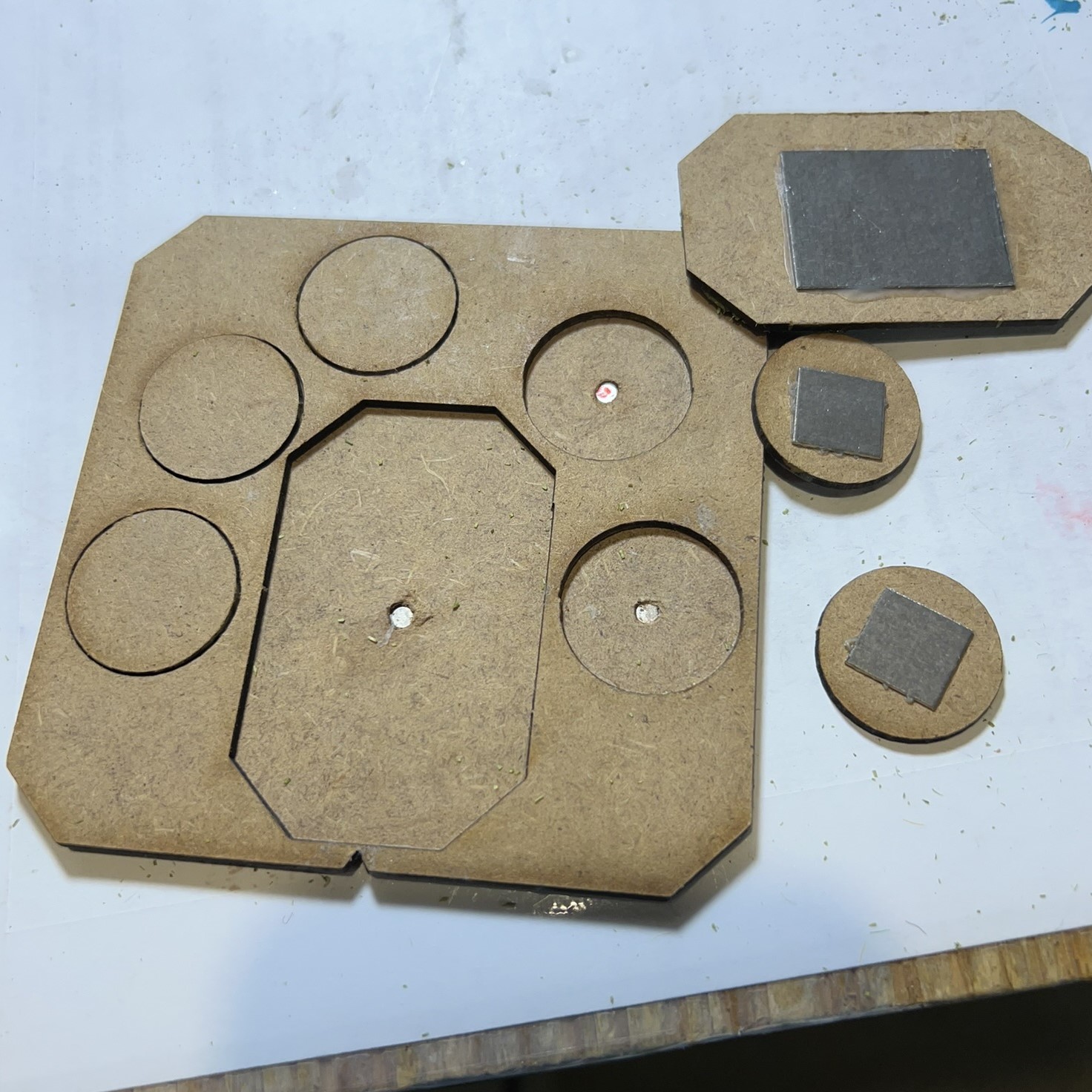
There is an MDF base available for artillery batteries with slots for the gun and figure – that even allows for removing casualties and for denoting if the gun is limbered or unlimbered. That needed assembly, so another thing to do while other things were drying. I also was thinking about transport and storage – so I added steel bases under the MDF ones for the artillerists and the gun.

Then, I slowly worked on painting the cannon and carriage components and assembled them by December 1st.

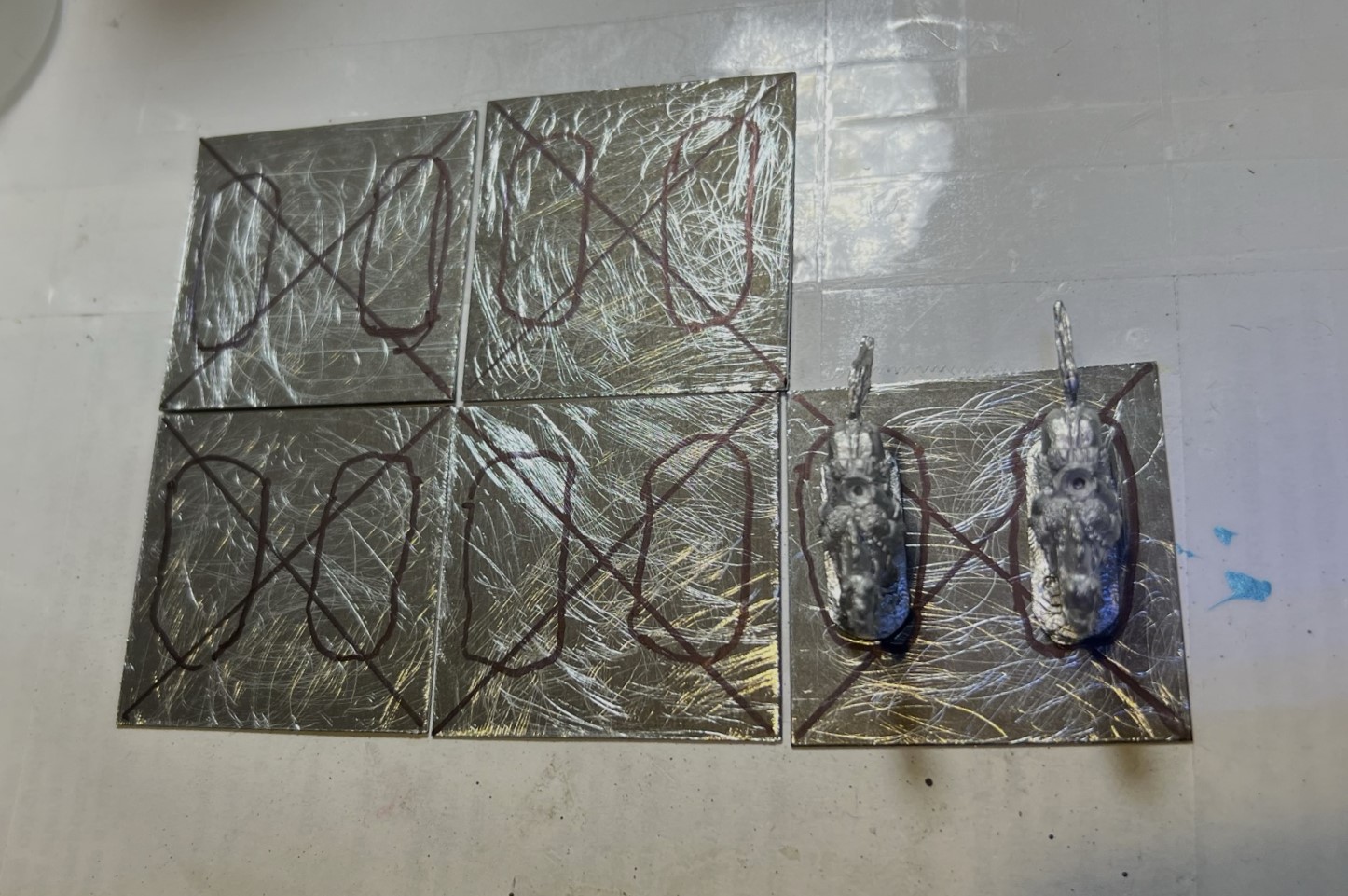
The cannon painted and varnished resting on its MDF base. Above, you can see how I traced so that I would be able to score the base under the tracings. This would get a better hold for gluing.

The figures came next, but unfortunately do not have any WIP shots of them. I followed Ozz canon (yes, I did that again) for the colors.

On December 4th, this brought me back to completing the magnetizing the unit for gaming, storage, and transport. My artillerist figures were mounted on 3/4″ steel washers. These would be glued to the MDF bases, which had 1/2″ steel squares glued to the their undersides as seen above. I drilled out 1/8″ holes in the center of each of the base’s recesses. Then, I glued another 1/2″ square steel base below the holes with 1/8″ neodymium magnets in each hole. In the end, the figures were removable from the base (but won’t fall out), and the base will store safely in my magnetic sheet-lined Really Useful Box with my other units. You can see this below in the photo.

By December 7th, I had the unit painted and was ready for final assembly and flocking.

December 7th progress

And…by December 9th I was done!

MMAB DONE!

How about some…

Eye Candy…

The unit can be shown as limbered (as above) or unlimbered as you can see below. A casualty is taken out on the right.

My favorite shot:

So now I am up to three units plus two Wizards. The Munchkin Light Cavalry is next. As you may want to check out the figures range – there are two places to get them (and I make no money from this btw). The game rules and figures are available from the following two places:

In the US Old Glory has a site – Wars of Ozz Miniatures.

In the UK go to Sally 4th.

Thanks for checking this post out and please let me know what you think in the comments section. Yes, I still have more to come…

Miscellaneous details and references for those interested in that sort of thing:

For all of my previous posts on Wars of Ozz games, figures, units, and other related projects – please see this page.

PAINTS, INKS, GLAZES, SHADES, WASHES, PIGMENTS, FLOCKING, GLUES AND MORE THAT I USED ON THIS MUNCHKIN MEDIUM ARTILLERY BATTERY:

  1. Vallejo Premium Primer “White”
  2. Vallejo “Flow Improver”
  3. Vallejo “Airbrush Thinner”
  4. Gorilla Glue
  5. 1/2″ x 1/2″ square steel bases from Wargames Accessories (#16)
  6. MDF Artillery base from Wars of Ozz Miniatures
  7. 1/8″ neodymium magnets
  8. 3/4″ steel washers
  9. Poster tack
  10. Citadel “Nuln Oil” (wash)
  11. Vallejo Model Color “White”
  12. 1 1/4″ x 1″ square steel bases from Wargames Accessories (#FOW1)
  13. Elmer’s PVA Glue
  14. Vallejo Model Air “Gun Metal”
  15. Armory “Dark Blue”
  16. DecoArt “Peacock Pearl”
  17. Tamiya XF-6 “Copper”
  18. Vallejo Model Color “Dark Prussian Blue”
  19. Martha Stewart Crafts “Pale Bronze”
  20. Army Painter “Speed Paint – Dark Wood”
  21. Citadel “Contrast Paint – Contrast Medium”
  22. Army Painter “Blue Tone”
  23. Secret Weapon Washes “Golden Brown” (wash)
  24. Army Painter “Speed Paint – Crusader Skin”
  25. Citadel “Nuln Oil GLOSS” (wash/shade)
  26. Citadel “Cryptek Armourshade” (wash/shade)
  27. Army Painter “Speed Paint – Hardened Leather”
  28. Army Painter “Speed Paint – Grim Black”
  29. Citadel “Contrast Paint – Frostheart”
  30. Vallejo Mecha Varnish “Matte Varnish”
  31. Citadel “Contrast Paint – Baal Red”
  32. Vallejo Model Air “Bright Brass”
  33. Citadel “Contrast Paint – Bad Moon Yellow”
  34. Citadel “Contrast Paint – Karandras Green”
  35. Vallejo Model Air “Armour Brown”
  36. Vallejo Model Air “Steel”
  37. Army Painter “Speed Paint – Holy White”
  38. PS Model Color “British Brown Drab”
  39. Army Painter “Battlefields Grass Green” (flocking)
  40. Army Painter “Battlefield Field Grass” (flocking)
  41. Army Painter “Battlefields Field Grass” (flocking)
  42. Shadow’s Edge Miniatures “6mm Dark Forest Dark Blue Tufts” (flocking)

Colonel Tik-Tok’s Infantry Regiment, Zoraster, and a Munchkin Mayor (Wars of Ozz)

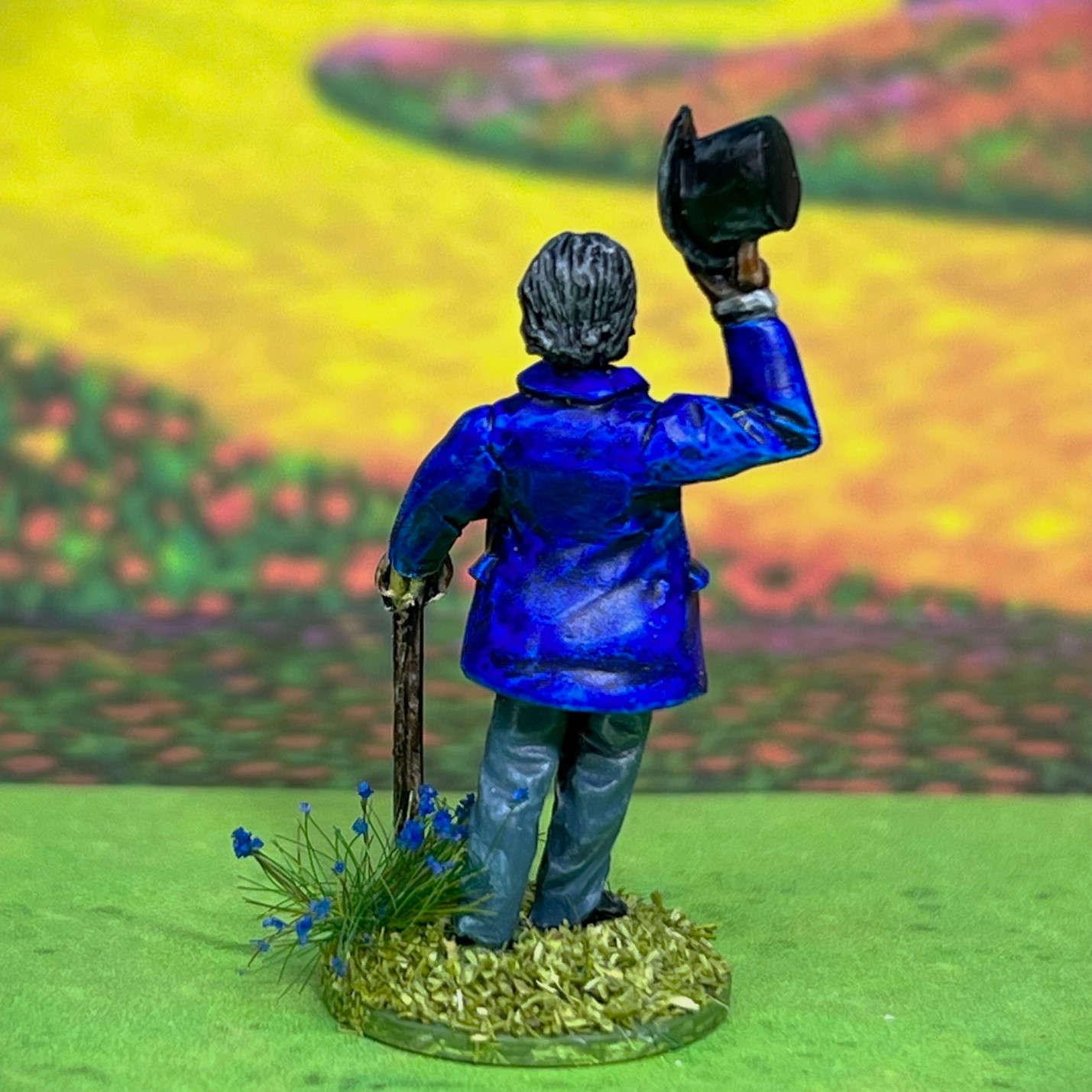
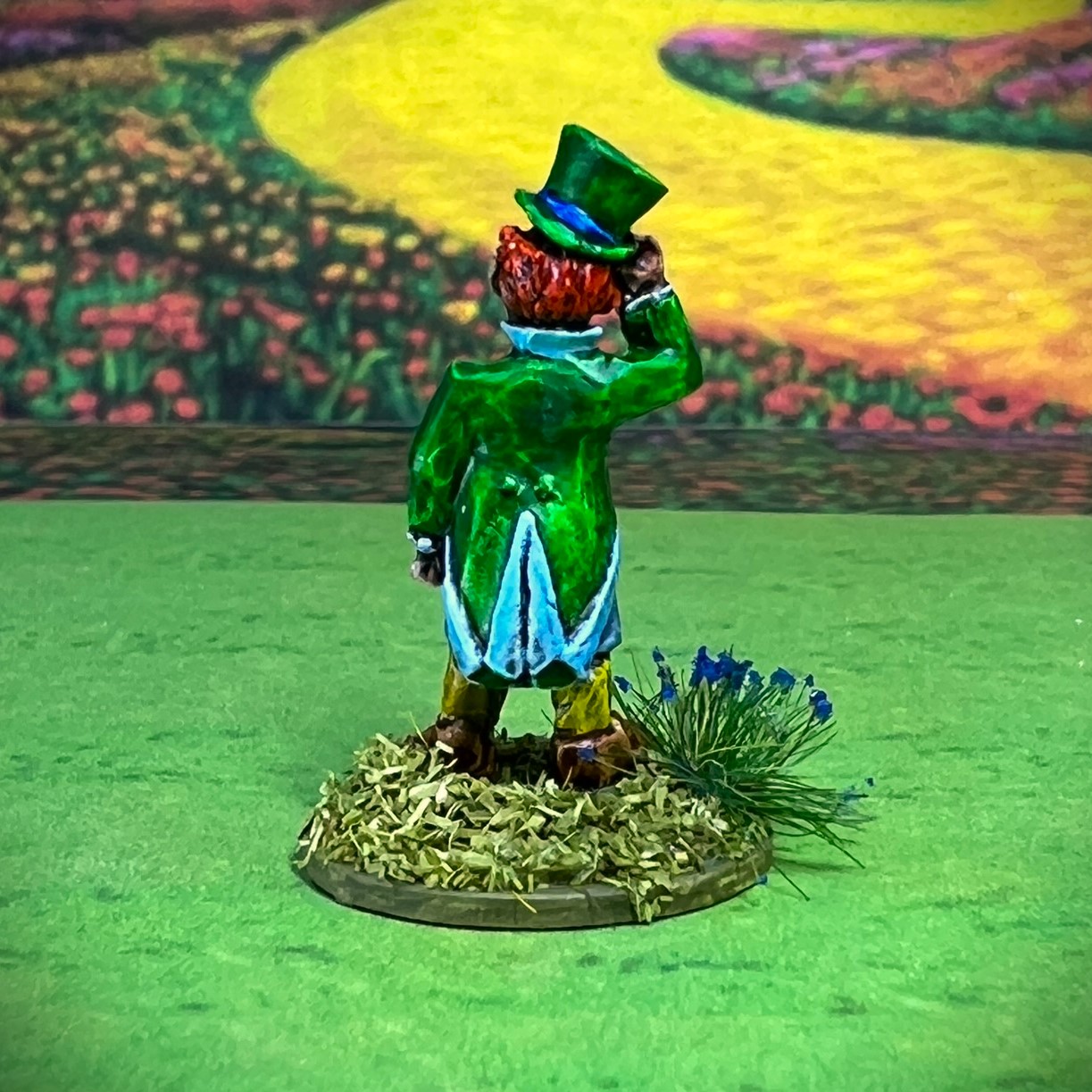
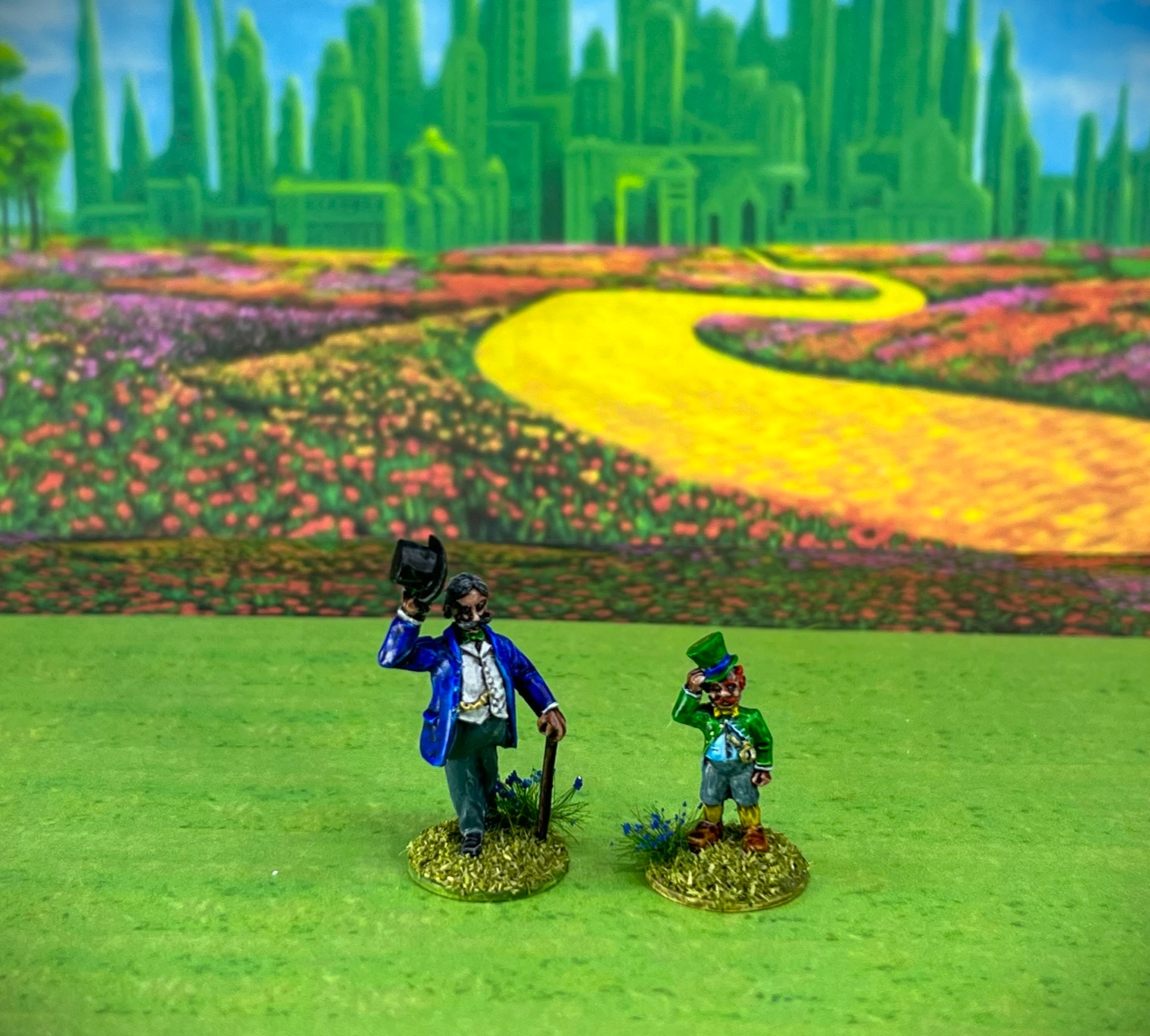
I am continuing to build my Munchkin Brigade for Wars of Ozz games. In my last post, I shared OZZ-101 – Zoraster’s Guard Infantry Regiment (ZGIR).  This time I have built and painted up a different Munchkin infantry unit – Colonel Tik-Tok’s Infantry Regiment (hereafter referred to here as CTTIR). I also painted up Zoraster (a Wizard) and a Munchkin Mayor as a lesser Wizard.

In the game, the CTTIR is slightly less capable than the ZGIR, but still better than a militia or Landwehr unit. Like the ZGIR, the regiment is composed of 20 figures plus a mounted regimental commander. It is similarly armed with muskets while sporting cool carabiner helmets. In the canon of the Wars of Ozz, Zoraster is “the Wizard Supreme”, and is the creator the Munchkin Army. The Munchkin Mayor figure came with the Kickstarter and confused me for a bit as you’ll see in the discussion below. The scale is 28mm and these 23 figures are metal.

There are 4 figures per 2″ square base, so five bases plus a commander make up a regiment. 16 of the based figures are of the same type, while the fifth base has four different figures – two standard bearers (with the Ozz flag and the regimental colors), a drummer, and another leader figure. This “command” stand fights like the others, but has an aesthetic effect on the tabletop of being nice to see. The regimental commander has his own base and can have special attributes, but its stand never engages in combat. It exists mainly for the attributes tab (on its MDF base) and also aesthetics. If the regiment dies, so does he. There is magic in the game – and Zoraster is a designated Wizard. There are also “unnamed Wizards”, so I will likely use the Munchkin Mayor as one – or maybe just an objective marker.

I pretty much followed the same procedure as to painting these figures as I did with the ZGIR. I prime in white, then wash with a dark shade, then paint and highlight. If I need more shade or highlight, I add it.

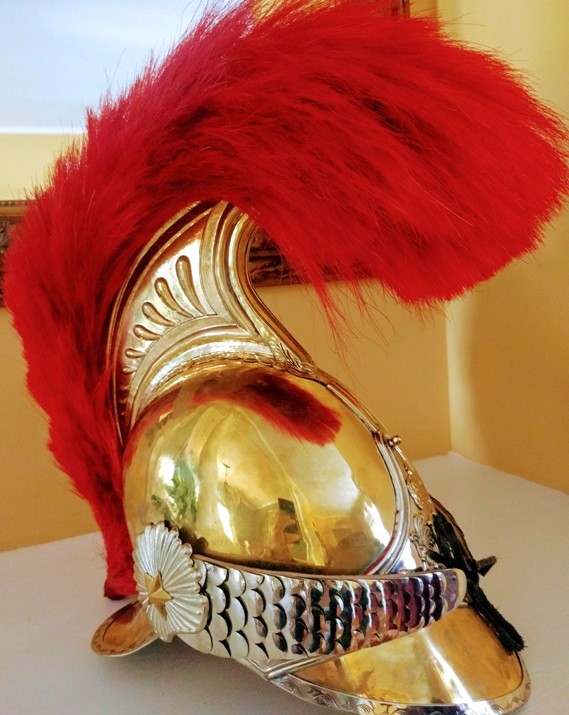
A major difference here for me was how to paint up the helmets and officer hats. While Wars of Ozz canon has this regiment in white, it also has all Munchkins as being very fond of blue. But after looking at images of Napoleonic era carabiner helmets (below) I decided that I wanted a similar metallic brass and chrome look.

I also decided to give the officers white hats. I did give the drummer a bit of blue on the drum and of course the standards have a lot of blue, so I think I’m safe. For the regimental commander’s pony I went with a slightly sallow pastel yellow. One cool aspect of the universe of the Wars of Ozz game is the use of a lot of color (hence the pastel ponies and more). The rules say that for CTTIR the facings, plumes and epaulettes are red – and that the coats and vests are white. Here I used a lot of Army Painter “Holy White” Speed Paint mixed with Citadel “Contrast Medium”. In fact, I still mix all of my Speed Paints with that medium. The combination of using the Citadel “Nuln Oil” wash post-priming and then the Holy White helped a lot with the less-detailed recesses on the figures. As usual, I list all the paints I used on these at the end of this post for those interested in that sort of information.

As I did previously, I’ll share some WIP shots, then some eye candy of the regiment.

WIP shots…

I started on November 25th. Below, you see the figures are based for priming, primed, and then I added a Citadel “Nuln Oil” wash before moving on to painting them. I have not tried “slap chop”, but I do like this way of using contrast/speed paints as part of my technique.

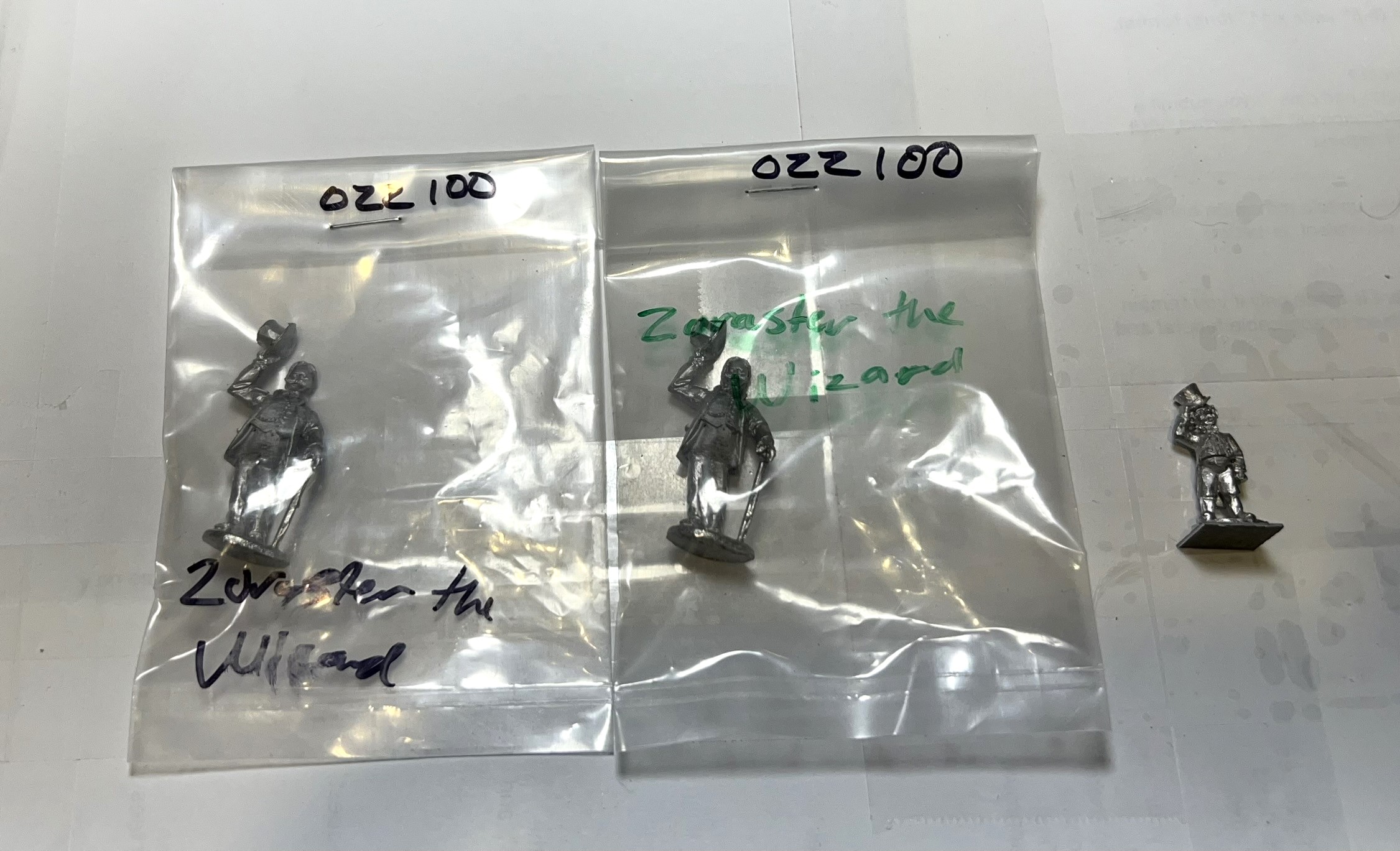
I was confused (as my Kickstarter order was a while back) as to which figure was Zoraster. Eventually, I determined that the smaller one was a Munchkin mayor thrown into the Kickstarter and that I had mistakenly ordered 2 Zoraster figures! I’ll keep one unpainted for trade. The Munchkin figure looks like the Boston Celtics mascot.

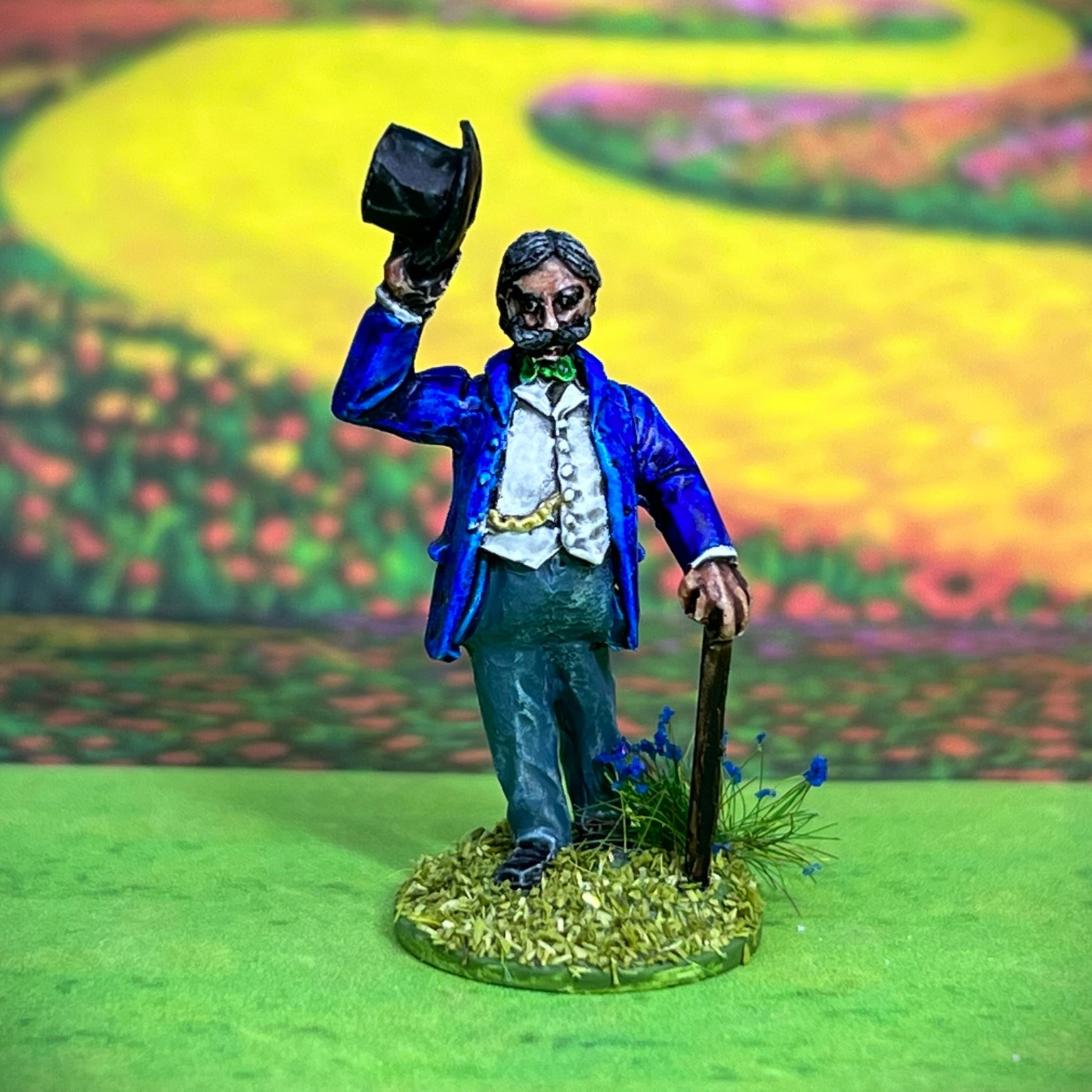
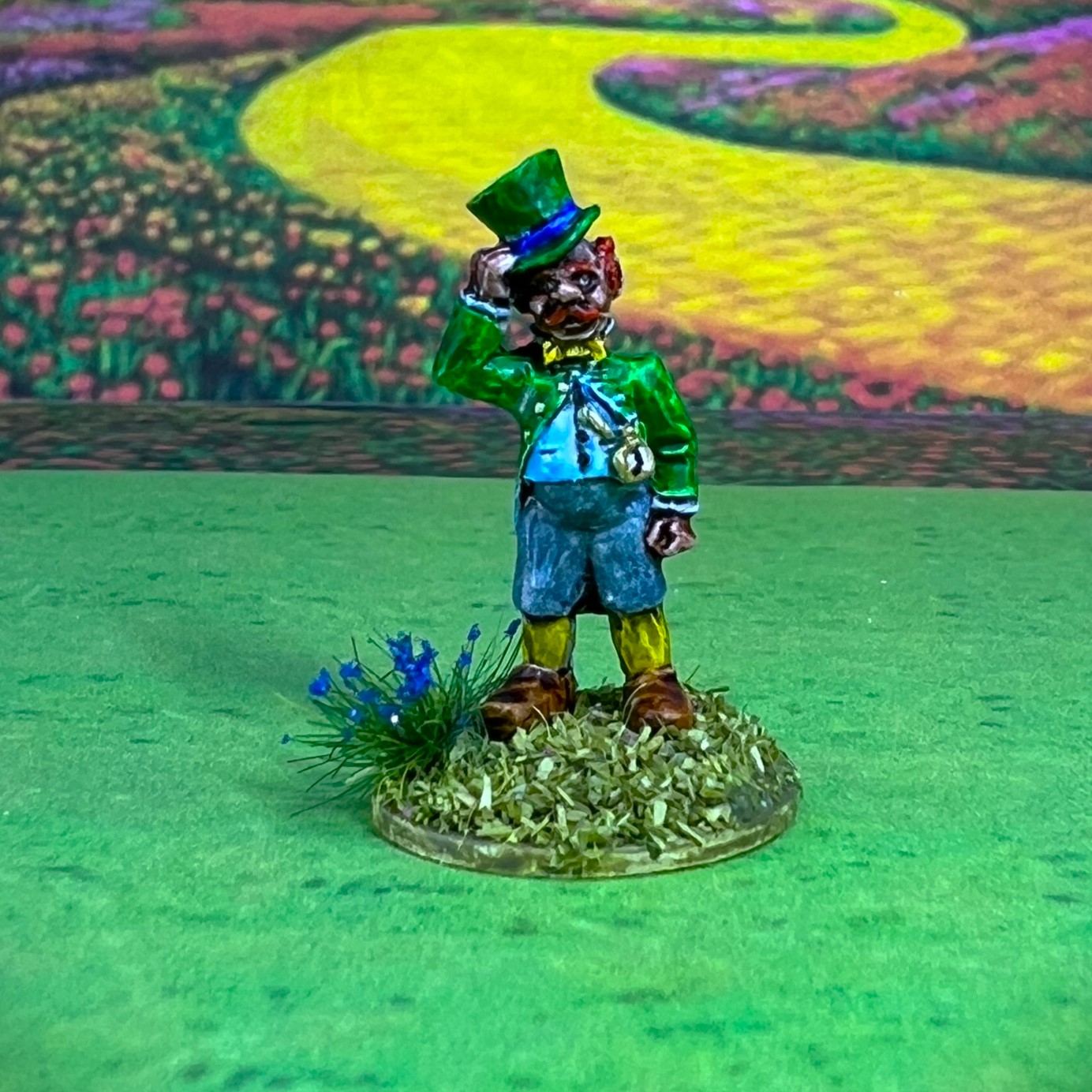
Two Zoraster figures and the Munchkin mayor doffing hats…

During the next three days, I made decent progress. I ended up numbering the specimen bottle labels with mistakes and keeping a list so I could fix them – this helped a lot.

The figures were all painted less any varnish and flocking by December 2nd.

Then it was on to the varnishing the figures, adding the standards/colors, and thereafter flocking the bases. I noticed that when I cut out the standards from card stock that the edges stood out as white. So, to remedy this, I used a black Sharpie pen to color in the edges as the standards have a black edge as well.

As for flocking, this time I pre-flocked all of the regimental bases with one type of grass, then added the other two types after affixing two, then three, then the fourth figure to each base. It’s probably overkill but I do like how they have come out. For the two Wizards, I just went with the first two grasses and added Shadow’s Edge Miniatures blue forest tufts.

My three sequential grasses, clockwise from the left. The first two may be different iterations of a similar type, but they are different enough to give some texture and more depth to the bases.

By December 4th, the CTTIR was done, plus the wizards as well. Now onto some eye candy…

Eye Candy

Colonel Tik-Tok’s Infantry Regimental Commander

A look at 2 stands…

A look at the command stand…

A look at the whole regiment…

A look at Zoraster…

A look at the Munchkin Mayor (Lesser Wizard)…

Howdy folks!

I hope that this was interesting for you. I am hoping to take 7-10 days per regiment or battery until I get through the Kickstarter. This should take me into next year, but hopefully I can keep a good pace. I have plenty of space in the box for this in-progress brigade…

Munchkin Brigade to date…

As you may want to check out the figures range – there are two places to get them (and I make no money from this btw). The game rules and figures are available from the following two places:

In the US Old Glory has a site – Wars of Ozz Miniatures.

In the UK go to Sally 4th.
Thanks for checking this post out and please let me know what you think in the comments section. More to come…

Miscellaneous details and references for those interested in that sort of thing:

For all of my previous posts on Wars of Ozz games, figures, units, and other related projects – please see this page.

PAINTS, INKS, GLAZES, SHADES, WASHES, PIGMENTS, FLOCKING, GLUES AND MORE THAT I USED ON THIS MUNCHKIN REGIMENT, ZORASTER, & THE MUNCHKIN MAYOR:

  1. Gorilla Glue
  2. Paper clip wire pieces
  3. 1/2″ x 1/2″ square steel bases from Wargames Accessories (#16)
  4. 3/4″ steel washers (wizards)
  5. Poster tack
  6. Vallejo Premium Primer “White”
  7. Vallejo “Flow Improver”
  8. Vallejo “Airbrush Thinner”
  9. Citadel “Nuln Oil” (wash)
  10. Vallejo Model Color “White”
  11. 1/2″ x 1/2″ square steel bases from Wargames Accessories (#FOW1)
  12. Vallejo Model Air “Gun Metal”
  13. Vallejo Model Air “Bright Brass”
  14. Vallejo Model Air “Chrome”
  15. Army Painter “Speed Paint – Dark Wood”
  16. Citadel “Contrast Paint – Contrast Medium”
  17. Army Painter “Speed Paint – Crusader Skin”
  18. Citadel “Contrast Paint – Baal Red”
  19. Citadel “Contrast Paint – Magmadroth Flame”
  20. Army Painter “Speed Paint – Grim Black”
  21. Citadel “Contrast Paint – Ironjawz Yellow”
  22. Citadel “Contrast Paint – Gore Grunta Fur”
  23. Army Painter “Speed Paint – Hardened Leather”
  24. Citadel “Contrast Paint – Karandras Green”
  25. Vallejo Model Air “Steel”
  26. Vallejo Model Air “Armour Brown”
  27. Citadel “Contrast Paint – Aggaros Dunes”
  28. Army Painter “Speed Paint – Pallid Bone”
  29. Army Painter “Red Tone”
  30. Citadel “Nuln Oil GLOSS” (wash/shade)
  31. Citadel “Cryptek Armourshade” (wash/shade)
  32. Citadel “Contrast Paint – Doomfire Magenta”
  33. Citadel “Contrast Paint – Nighthaunt Gloom”
  34. Citadel “Contrast Paint – Asurman Blue”
  35. Americana “Bahama Blue”
  36. Citadel “Contrast Paint – Pylar Glacier”
  37. Vallejo Model Color “Black”
  38. Citadel “Contrast Paint – Snakebite Leather”
  39. Citadel “Warpfiend Grey”
  40. Citadel “Longbeard Grey”
  41. Battlefront “Skin Shade”
  42. Battlefront “European Skin”
  43. P3 “Flesh Wash”
  44. Army Painter “Speed Paint – Holy White”
  45. Martha Stewart Crafts “Pale Bronze”
  46. Vallejo Mecha Color “Olive Green”
  47. Vallejo Mecha Varnish “Matte Varnish”
  48. PS Model Color “British Brown Drab”
  49. Black Sharpie pen
  50. Elmer’s PVA Glue
  51. Regimental MDF base from Old Glory
  52. Army Painter “Battlefields Grass Green” (flocking)
  53. Army Painter “Battlefield Field Grass” (flocking)
  54. Army Painter “Battlefields Field Grass” (flocking)
  55. Army Painter “Brown Battleground” (flocking)
  56. Shadow’s Edge Miniatures “6mm Dark Forest Dark Blue Tufts” (flocking)

Aztec Raid – Mass Pikemen Gaming Session June 5, 2021

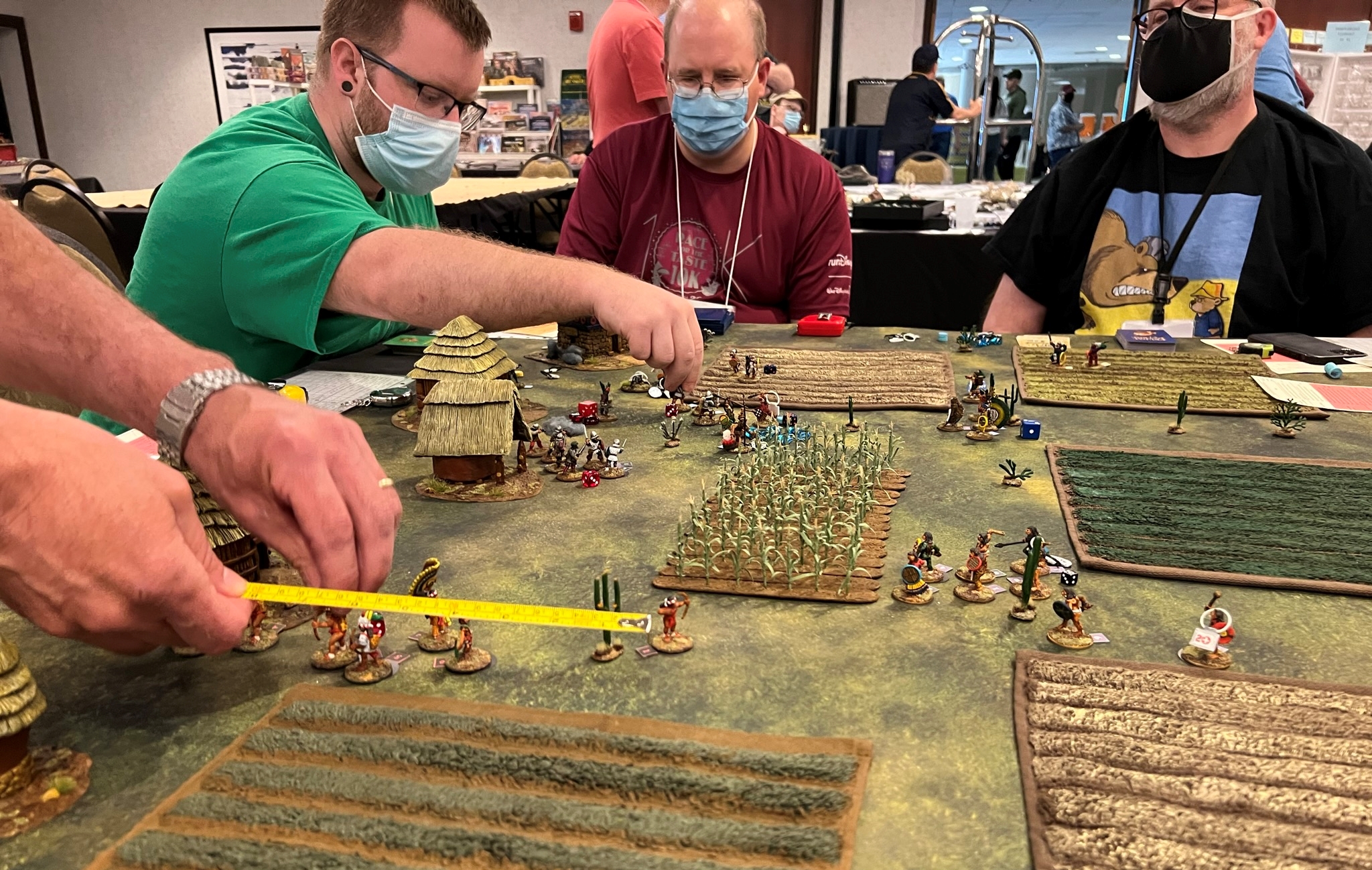
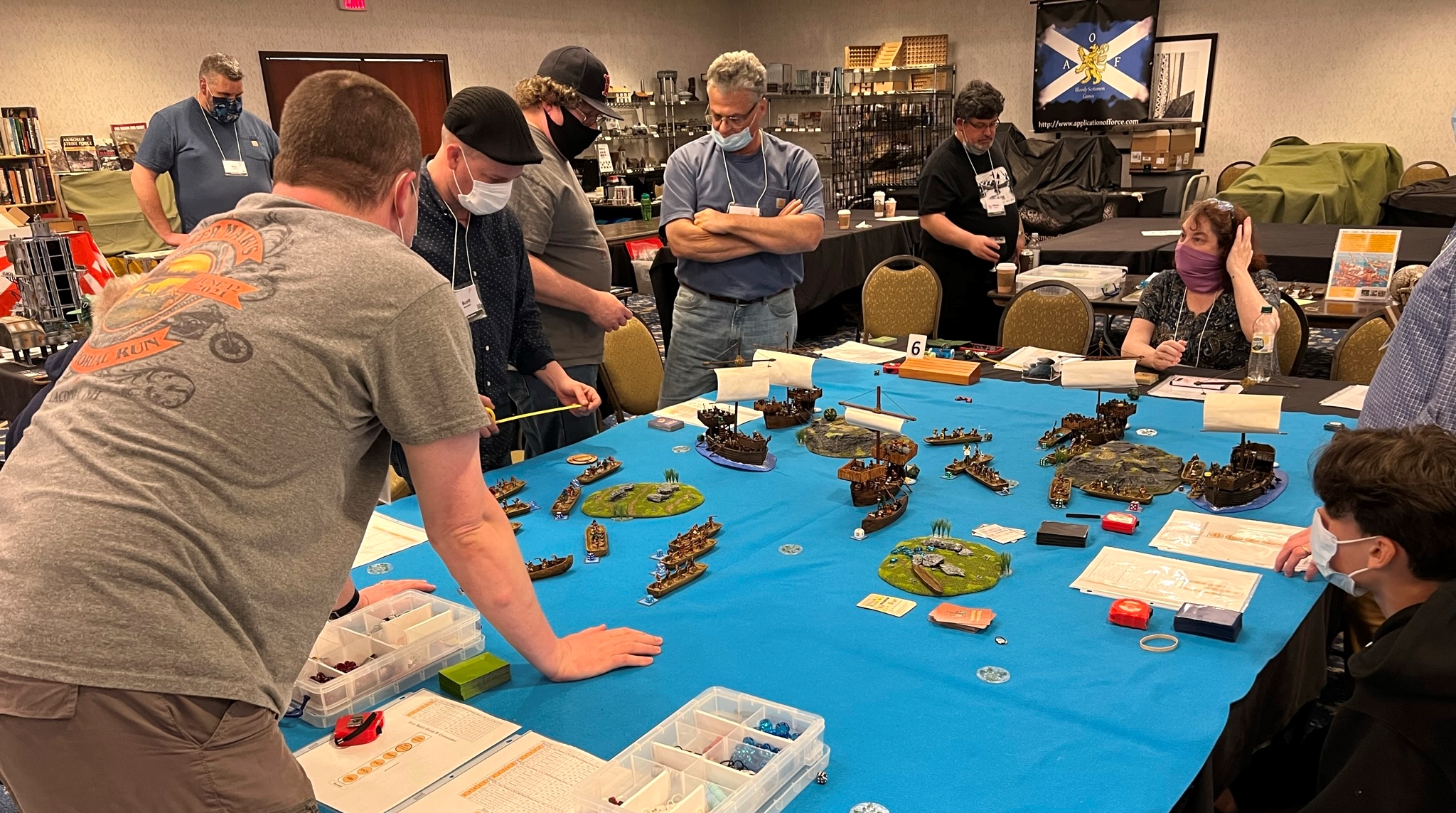
The Mass Pikemen returned to tabletop wargaming with live face-to-face interactions on June 5th! We played a game of Feudal Patrol in Mesoamerica (using my Civilizations Collide supplement. The game scenario was as follows:

Surprise Raid on Outpost

A Tlaxcalan village is being raided by the Aztecs, seeking to take wealth, food, and prisoners.  The Aztecs know the majority of the Tlaxcalan troops are with the Conquistadores elsewhere, and expect an easy task.  Unbeknownst to the Aztecs, there are some Spanish troops at this town who will help to defend it.

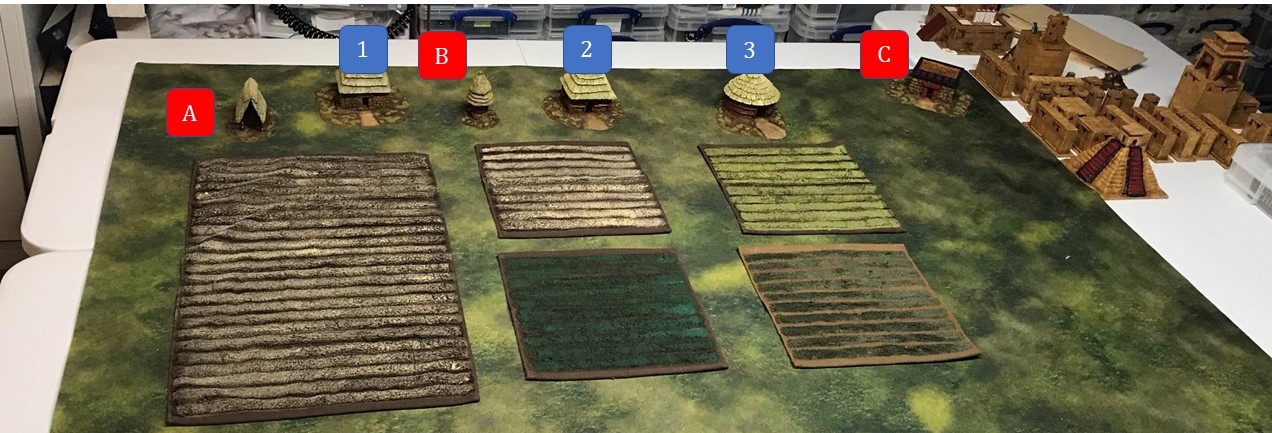
The battlefield.

Objectives:

  • A: a maize storage structure – 10 points to either side for control
  • B: Cuezcomatl Granary Structure – 10 points to either side for control
  • C: Tlaxcalan Noble’s House – 10 points to either side for control, 5 more for securing the gold inside and having possession of it.
  • Additionally, the attacking Aztecs gain 5 points for each prisoner taken, 2 points for each enemy otherwise incapacitated, and 1 point for any enemy that runs off the tabletop.  The defenders gain 8 points for each prisoner taken by Tlaxcalans, and 3 points for each enemy otherwise incapacitated, and 2 points for any enemy that run off the tabletop.

Deployment and special rules:

Aztecs: 

  • All Aztecs troops deploy anywhere on the south side of the tabletop 6” from the long end of the mat.
  • The Aztec Warband Leader controls two Warrior Priests

Conquistadores and Tlaxcalans: 

  • The Conquistador leader (a Warband Leader) deploys from C.
  • Each of the three Spanish/Tlaxcalan elements deploy in 1,2, and 3 and are hidden from the Aztecs but predetermined before the game start.  This means that some will be out of command and cannot swap dice at the beginning of the game (24” command radius). At start, they can be outside of their huts.
  • Tlaxcalan element cannot swap dice, and cannot be considered out of command radius.

The map:

  • The fields are muddy and movement rate through them is at half-speed.

In this game, an element is 4-11 figures depending on type, and warbands are made up of 2-5 elements.

The Aztecs had an overall commander with his conch blower as a signaler. Under him was one warband leader commanding two “twinned” 11-figure veteran/novice elements, an elite 6 figure cuahchic (“Shorn Ones”) element, an elite 5-figure Eagle Warrior element, and two warrior priests.

The Spanish had an overall warband leader commanding an elite element of 5 figures and an elite element of 5 figures plus a war dog. The Tlaxcalans – who were separate but allied – had an elite warrior leader with 4 veteran bowmen.

The overall troop points were 54.75 for the Aztecs and 36.5 for the defending Spanish/Tlaxcalans. The fields were slightly moved for the actual game. Of note, the command radius for a warband leader is 24″ – so the Conquistadores have two command and control challenges. First, they start with one of their elements starting the game over 24″ away from the leader making them “pinned” – meaning they only get to activate half as much as normal until they can be made “unpinned” (not an easy task). Second, the Tlaxcalans are independent actors – meaning that the Spanish have limited command and control of them – but they are not limited by command radius restrictions either.

The Tlaxcalans ended up starting at 1, with the other two Conquistador elements at 2 and 3. The Conquistador leader was at C. The Aztecs deployed their elements (from the Aztec left to right) as follows: veteran/novice twinned element, cuahchic elite element, elite Eagle Warrior Element, and the other veteran/novice twinned element.

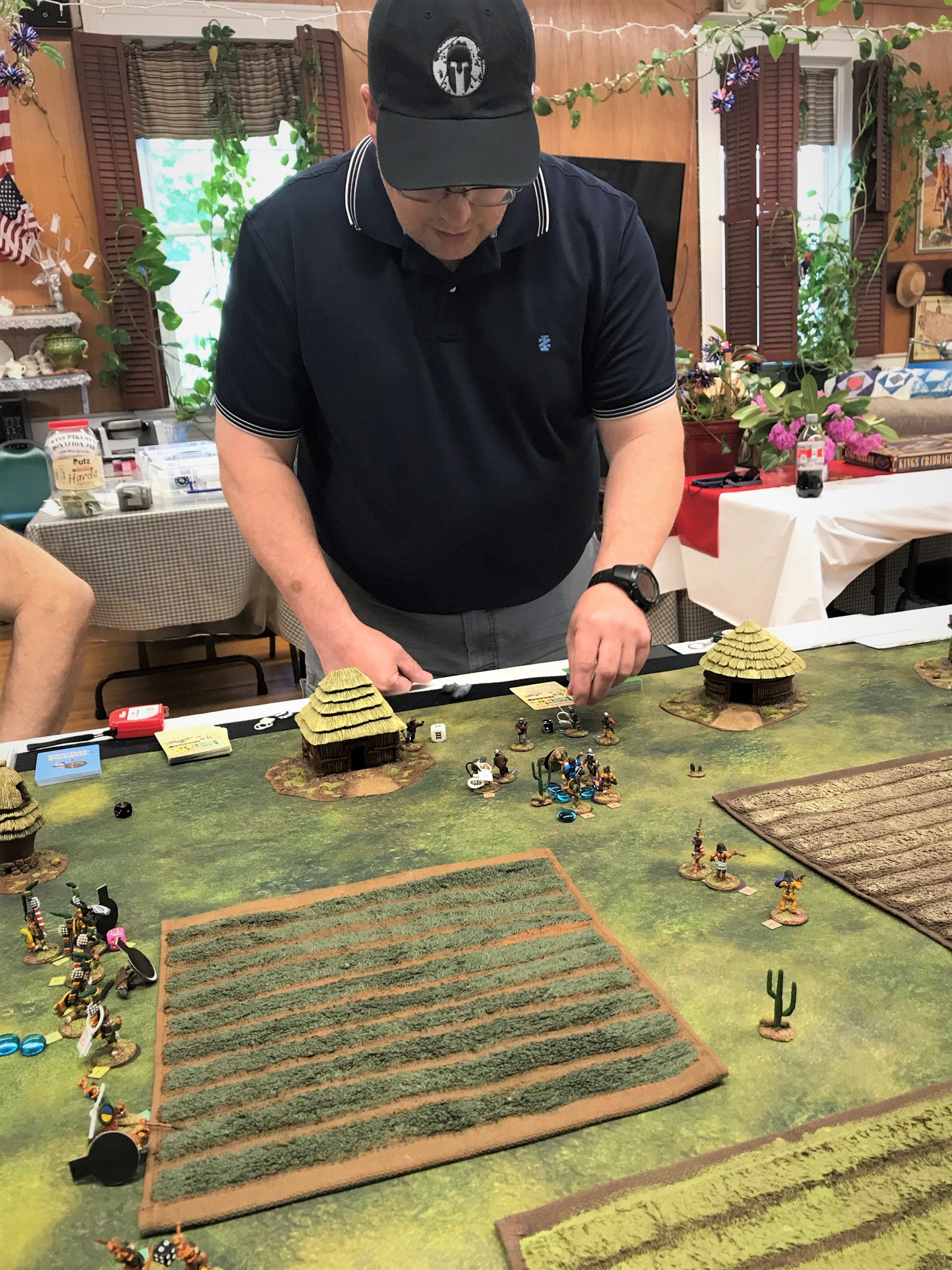
Scott looks over the tabletop. He would command the Tlaxcalans.
Glenn moves up his twinned veteran/novice element while his ally Chris watches…
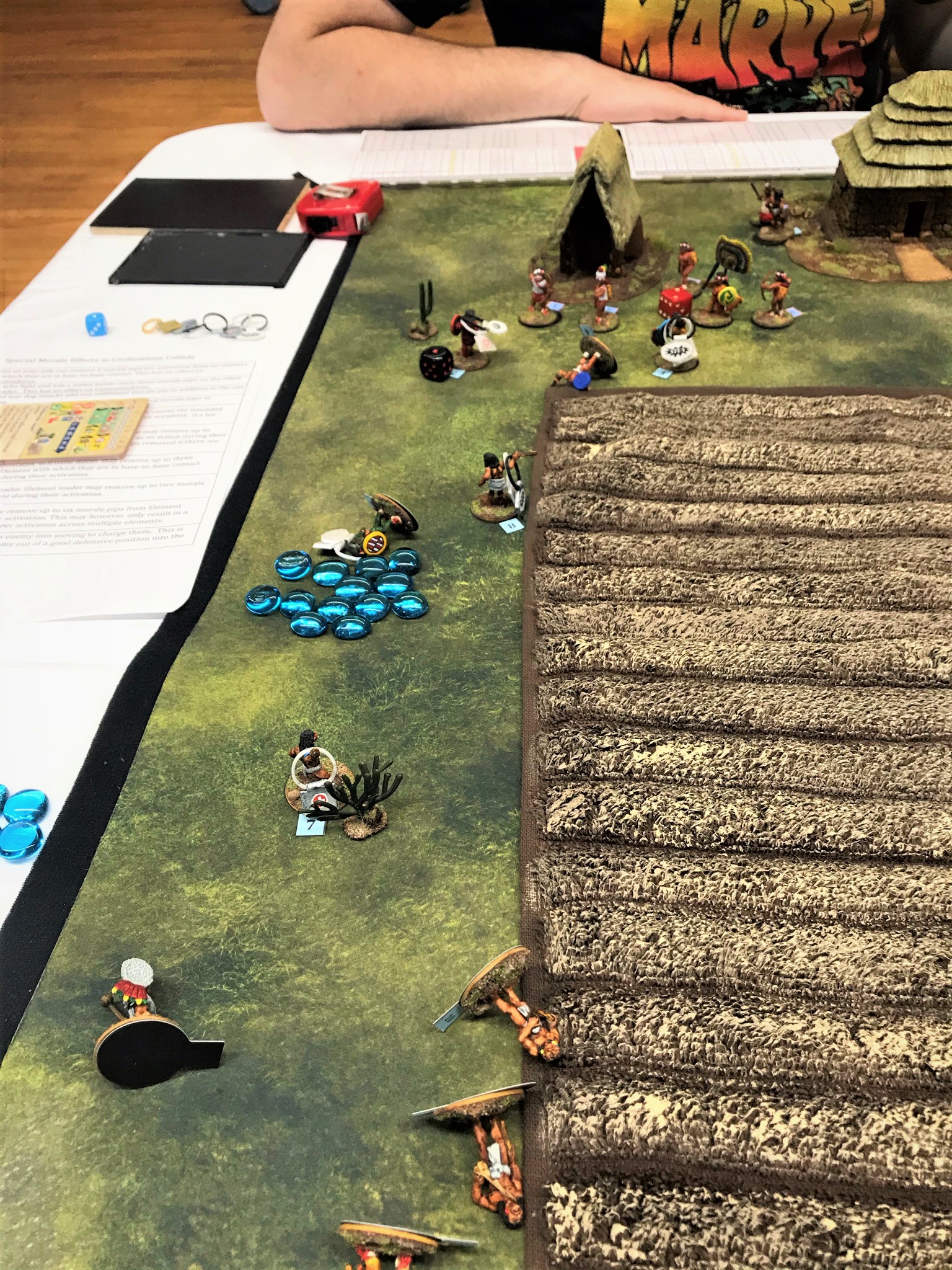
…and promptly takes fire from a Spanish arquebus and a crossbow! The blue glass beads indicate morale checks that the Aztecs had to take and did pass here.

On the Aztec left, Chris moved up his veteran/novice twinned element to take on Scott’s Tlaxcalan bowmen. Historically, the Tlaxcalans were superior bowmen. Chris had to cross a lot of open ground, and the Tlaxcalans dispatched two novices from long range (novices typically are without armor). He then tried on a subsequent activation to charge into melee with the Tlaxcalans – a good move – but the Tlaxcalans were able to react and loose even more deadly arrows into the Aztecs.

Scott grins after sending an initial hail of lucky arrows into Chris’ approaching Aztecs. The incapacitated Aztecs are lying off their bases. The blue beads each indicate a morale check that the Aztec element would need to pass – and more would come…
Only 4 out of 11 figures made it to the Tlaxcalan bowmen, and they had little effect as the Tlaxcalans repelled their assault.

In the middle of the tabletop, the two elite Aztec elements were making good progress forward. The Conquistadores were lucky enough to unpin their handicapped element, making their defense much stronger. That element had a wardog, and they challenged the advance of the cuahchic and the Eagle Warrior elements. That scrum left the Conquistadores with several dead – including the war dog. The cuahchicqueh (plural of cuahchic) advanced, but the Eagle Warriors lost heart and failed morale – running away from the fight.

Then Chris had even more morale checks to make. Luckily for him he endured them, but his unit was pretty decimated. Chris’ Aztecs had 14 morale checks to make. They passed, but were a spent force.

The Shorn Ones (cuahchicqueh) do a number on the Spanish and their war dog.
The Shorn Ones advance to the cuezcomatl granary storage structure (objective B), while their Eagle Warrior comrades run away.
Here you see Chris’ Aztecs – or what’s left of them – and their pile of morale check pips.

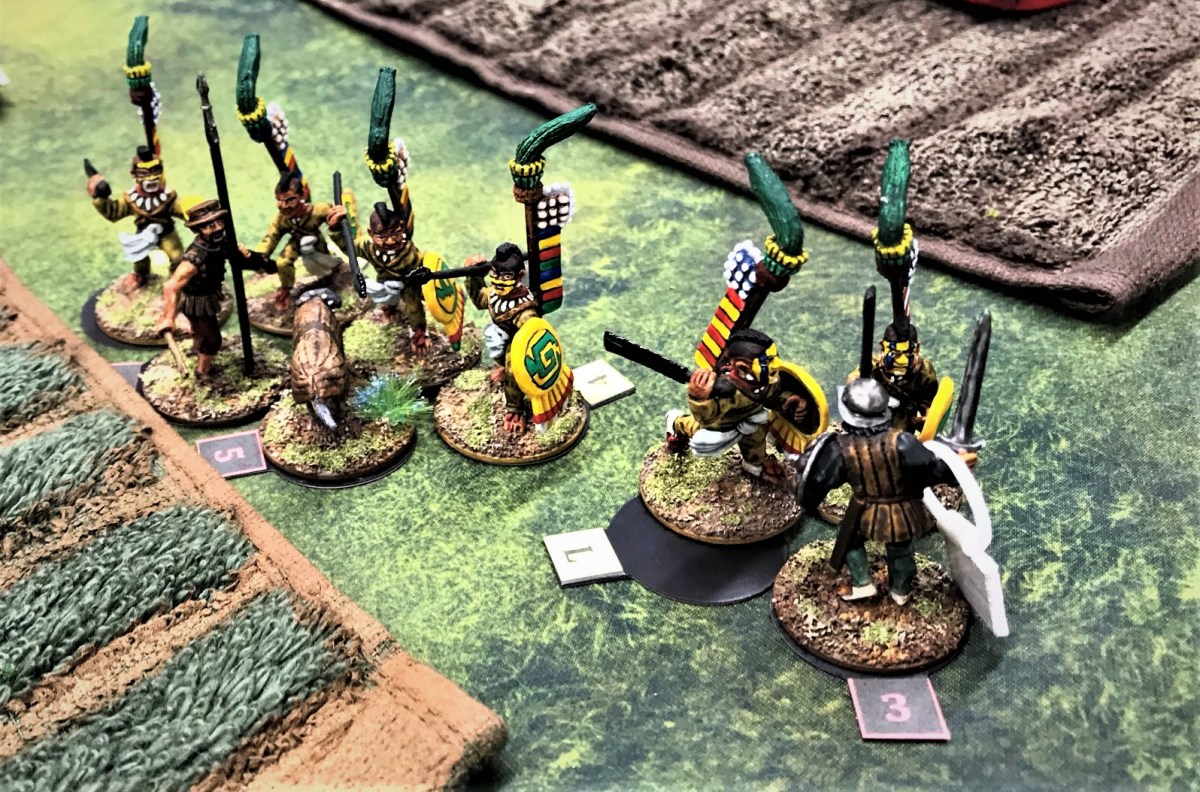
Glenn’s advance on the right of the elite elements was making good progress. They had a bowman, an atlatl user, and several slingers in their veteran/novice element. His non-missile weapon-armed Aztecs charged into Leif’s Conquistador element, hoping to take them down (especially as they had the arquebus and the crossbow). Glenn and Leif both did damage to each other in the ensuing melee.

Leif defends against Glenn’s Aztec assault. At this point, the Aztecs were threatening also to take out the Conquistador officer.
Scott and Leif appear confident in their defense.
Leif – commanding the Conquistador officer – takes out an Aztec – but quickly three more of Glenn’s Aztecs gang up on the leader, who kills another, and wounds one more but…
…the Conquistador officer is overwhelmed by the Aztecs, and is incapacitated and dragged off for sacrifice. This left both of the remaining Conquistador elements in a “pinned” status – meaning that they would only activate half as much as an unpinned element – a significant disadvantage.
And finally, an Aztec Warrior Priest showed up to make sure the granary remained in Aztec hands.

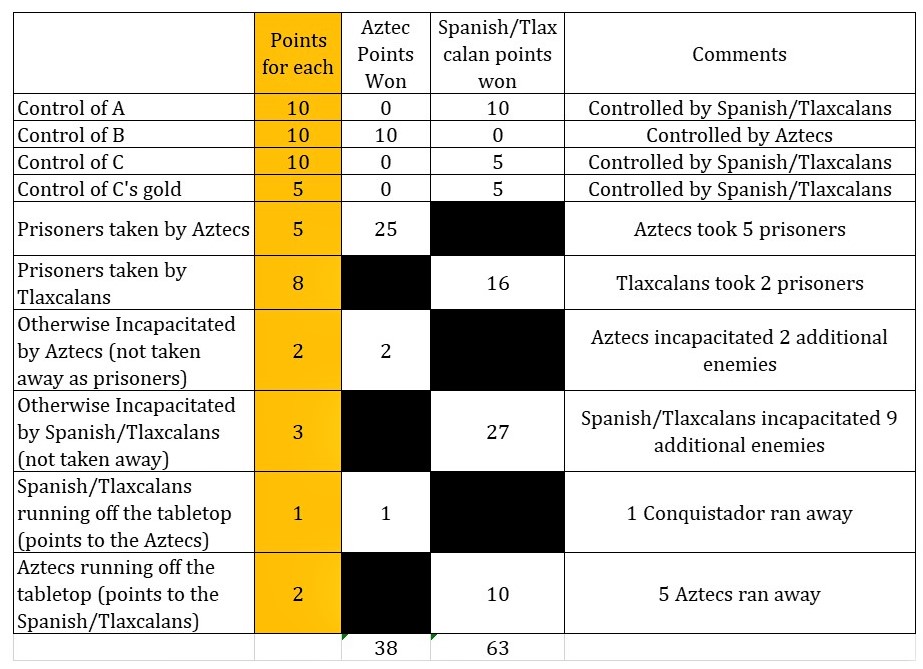
The Conquistadores were able to sprint one remaining unwounded trooper over to objective C (Noble’s House), gaining control of it, and its gold, for important end of the game points. The Tlaxcalans were also able to secure the maize storage structure (A). Meanwhile, the Aztecs gained control of the granary (B). The overall scoring led to a Spanish/Tlaxcalan victory with a score of 63-38. If the Spanish had not secured the Noble’s House and it’s gold, it would have been 48-38.

The players all had a good time and really enjoyed the game. Some are already on the way to buying their own copy of Feudal Patrol !

I do like the scenario -and I thank Buck Surdu and David Wood for an earlier week Zoom playtest. When I update my supplement (which is coming by year’s end or sooner), it will be one of the scenarios I add. I do need to finish off my cityscape and THAT is in progress.

I do thank Saturday’s players as well. It was soooo nice to finally have a face-to-face game for the Mass Pikemen’s Gaming Club. On the next go-around, I will adjust the forces slightly – probably giving another element to the Aztecs and maybe a falconet or another element to the Spanish – depending on the number of players. I will also add points for incapacitating or even capturing warband or higher leaders.

So, when will that be? June 26th at 1 PM at the Great Stories Comics and Gaming Store in Uxbridge, MA! The Mass Pikemen are taking this (and other future games) to a great hobby store, Great Stories in Uxbridge, MA. We will be gaming there and at our home in East Brookfield going forward – hopefully alternating between sites for gaming.

I hope that you enjoyed this battler report – let me know your thoughts in the comments section!

For all of my previous posts on games, units, and other projects for my 16th Century Spanish Conquest supplement for Feudal Patrol™ – “Civilizations Collide” – please see this page.

Aztec Temple Rehab

Sounds like a good concept for a reality show doesn’t it? Circa 1520 or so…

Actually, it’s my latest attempt at adding another structure to my Aztec terrain/buildings for games of Feudal Patrol in Mesoamerica (using my Civilizations Collide supplement). There have been a good number of buildings from me lately (which is why I did my contest). There is also a link at the end of this post on all of my project terrain and miniature builds for it.

And this particular post is dedicated to Ryan MacRae and Chris Rett. Why?

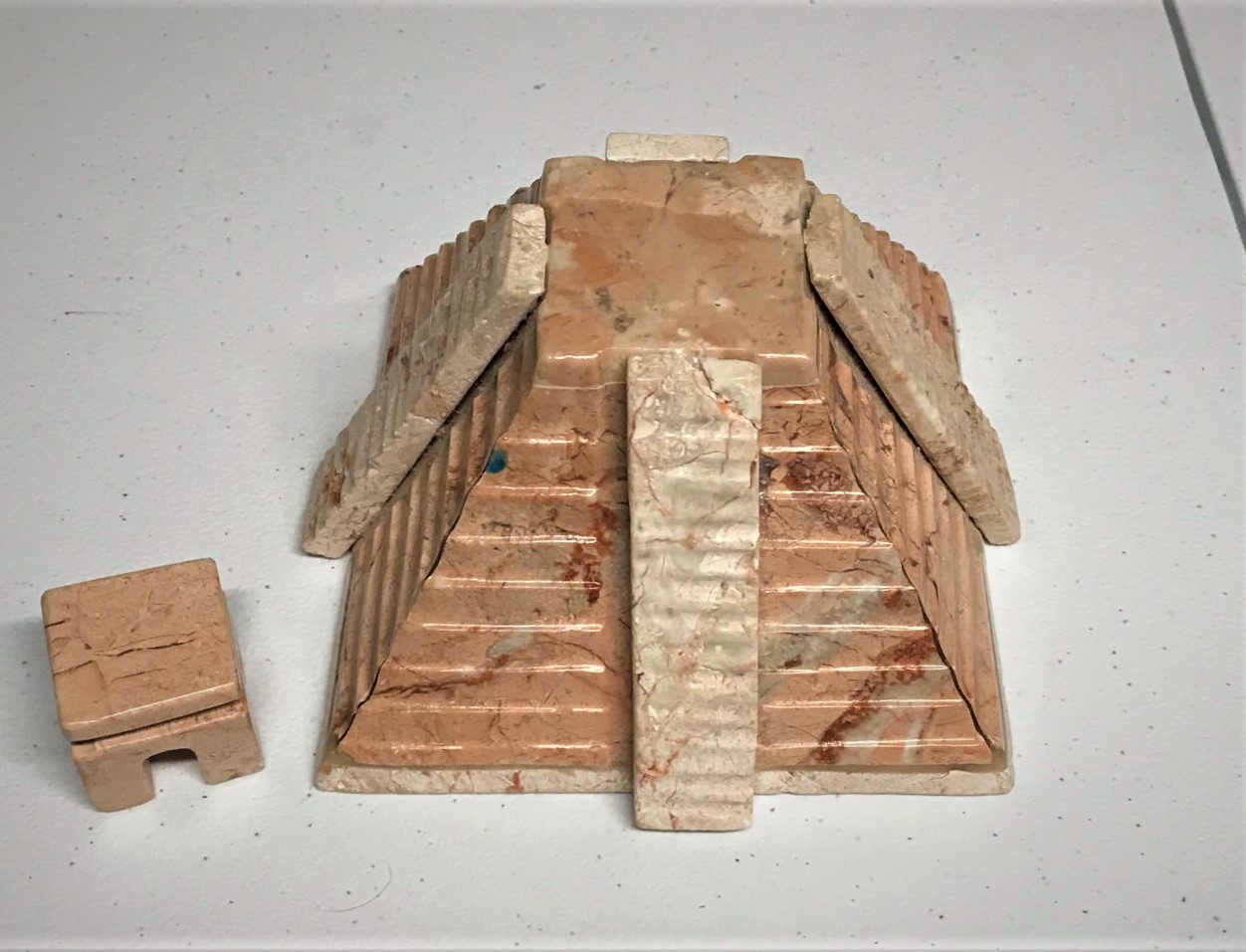
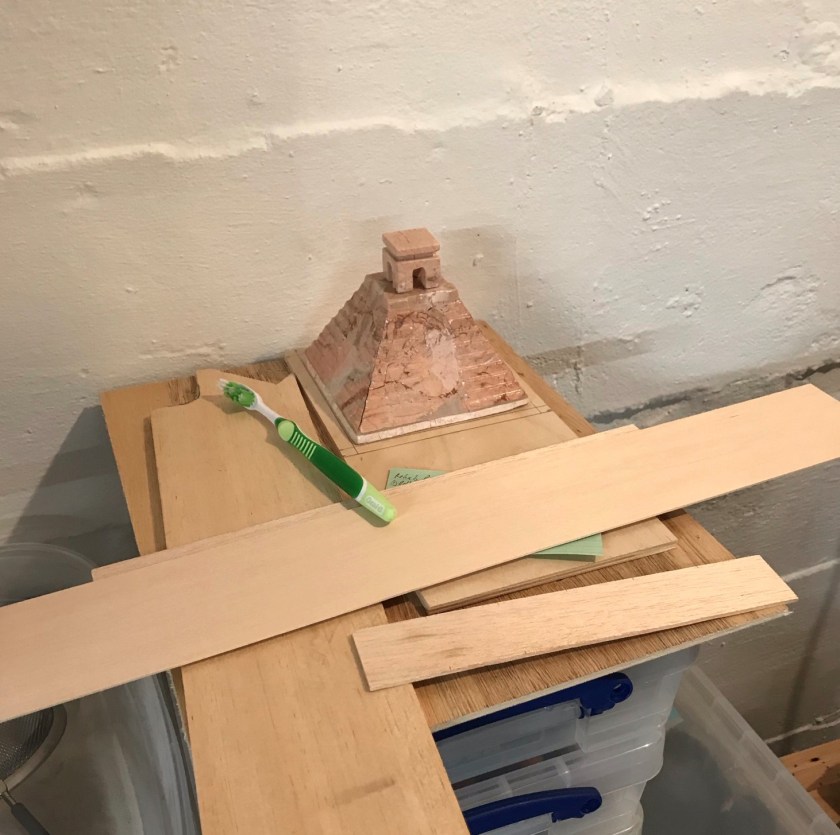
Well, this temple piece has a somewhat unclear past. It was given to me by Ryan MacRae and Christopher Rett. It was left over from their back room cleanout at the Great Stories store in Uxbridge, MA. Ryan said it was maybe originally found in his dad’s garage? Was it a souvenir? A kit project? A piece for a terrarium or even an aquarium? Who knows. All I saw in it was potential as a reasonable secondary temple-type building for Tenochtitlan. It was in two unconnected pieces, had a few cracks, and seemed to be somewhat ceramic. Obviously, I needed to have it match my other pieces. I was not thrilled with the stairs and their alignment, and it was mostly (but not totally) symmetrical. Though I believe something is either symmetrical or its not right? The top would not stay on the top if bumped. Anyways, I thought I could try to make something more useful out of it gaming-wise.

The piece as it was when I got it.

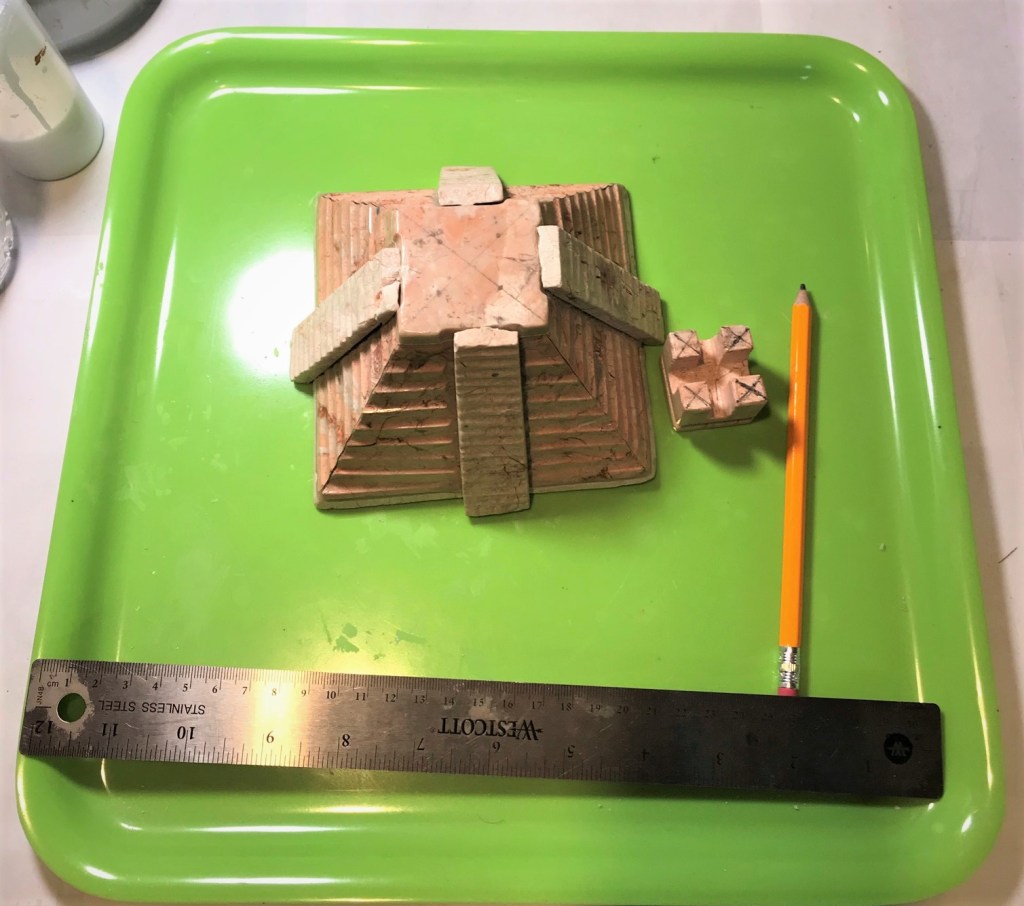
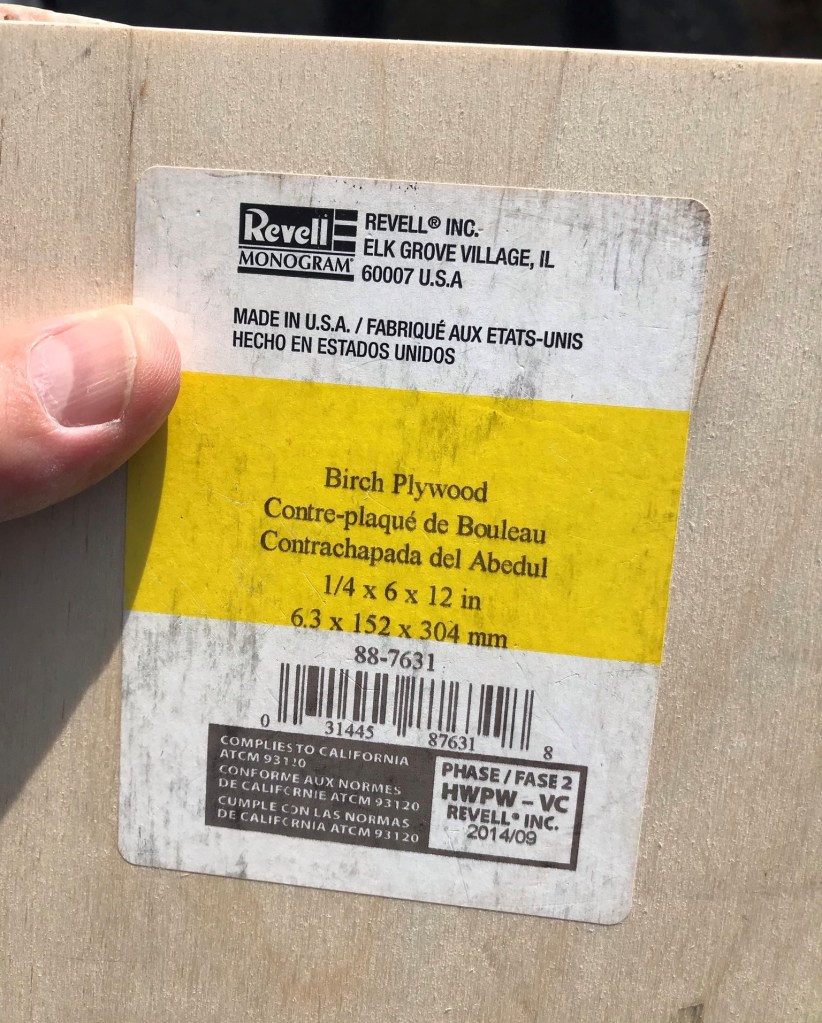
I thought it needed a base, and I did have an spare piece of Revell plywood that I cut to size up to the piece – as symmetrically as possible.

I then sanded the edges of the plywood and the bottom of the piece, and attached the two with wood glue. As you can see, I found a way to compress the two while the glue set!

I then decided to use black Milliput to construct the stairs. Why black? It was what was available! I don’t have a lot of experience with it, and I chose it due to being cheaper than green stuff. I did not expect to get great sculpted details on the stairs – I just wanted something that would be aesthetically ok on the tabletop. I did consider using square wood dowels, but the work involved in sizing them seemed disproportionate to the needs of this project. I also would make the steps wider and more visible – but still they would not useable by a figure on a base.

As for the sculpting – it was a bit more difficult than I had imagined beforehand. I tried to use the existing lines on the piece as guidelines, and was successful for the most part. It’s not Michelangelo, that’s for sure. I actually was a little disappointed at this point, but I pressed on thinking the rest of the rehab may go better, and let the Milliput cure.

The dusting process was similar to my previous efforts with MDF – that being painting the model with a PVA/water slurry and dusting with a salt shaker containing the dust. I did add (temporarily) extra neodymium magnets so as to prevent the dust from blocking the installed ones.

All dusted up – note the extra magnets as masking.

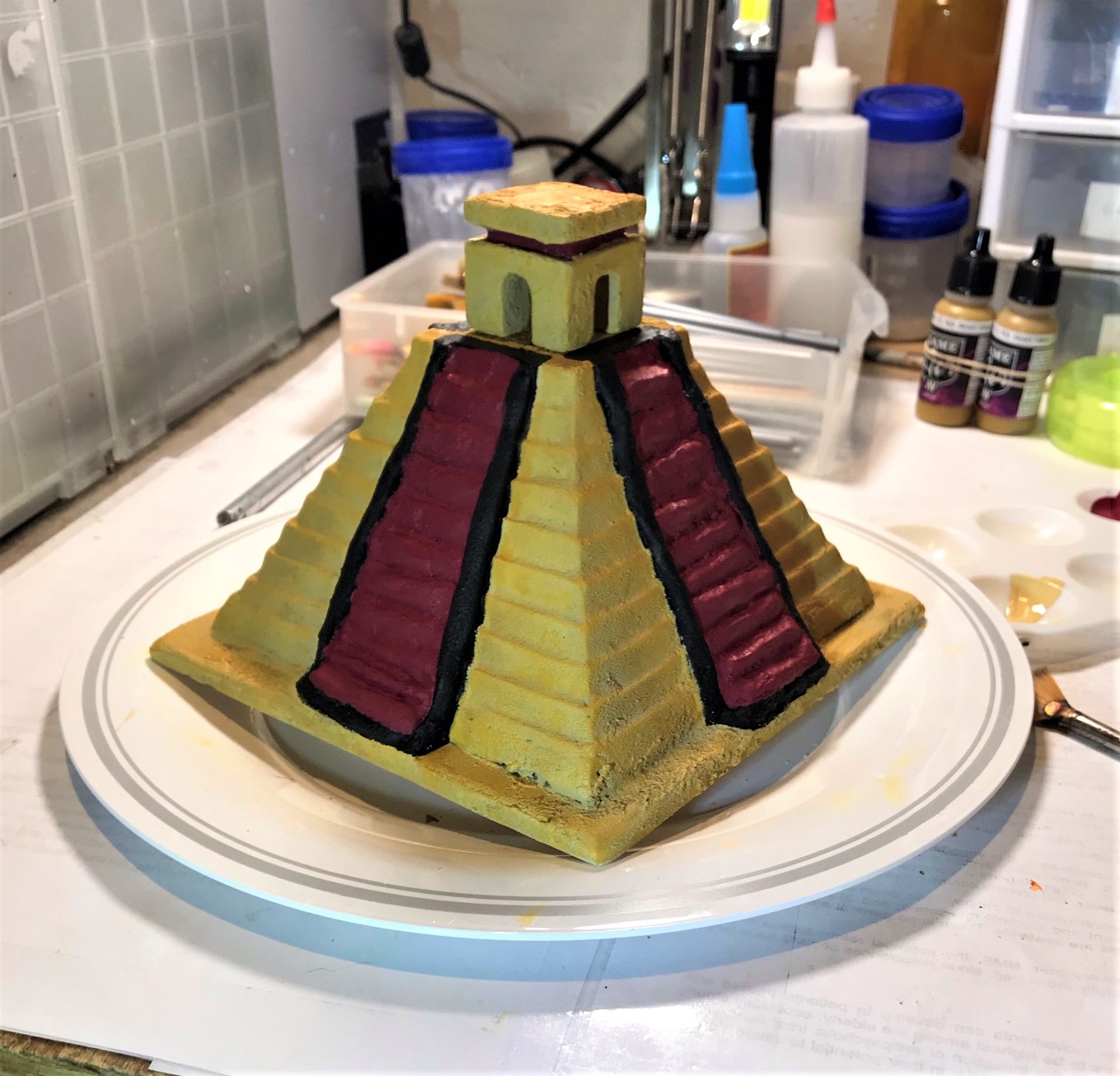
I then moved on to painting it. I dry brushed it and then painted it in the same color schemes as my MDF.

The piece after first dry brushing and base coating.

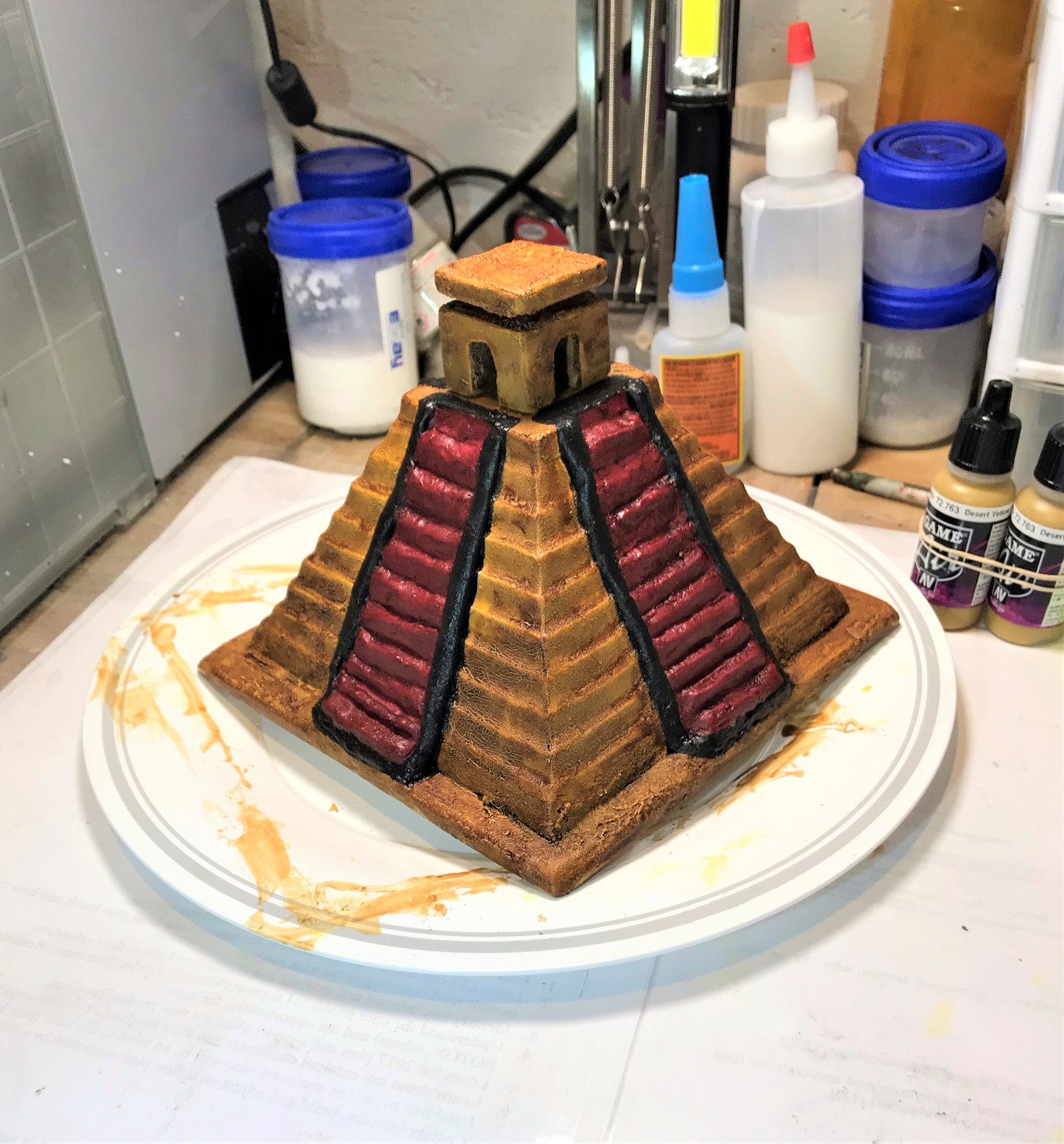
I then used Army Painter “Light Tone” on it and let it dry. Once dry, I added more highlights.

After adding the tone but before the final highlighting.
Completed!

To get a feel for the model, here are some eye candy shots.

One side
Opposite side
Top side view
Some Eagle and Jaguar Warriors and a Warrior Priest by the piece.

I learned a bit during the processes of this project. I’m on the fence on Milliput as an architectural sculpting agent – it was not easy to sculpt into the stairs and I did face a challenge with regards to the Milliput’s “slump” (a term used to describe how wet concrete settles and does not hold a shape). Though, the extreme slope of the stairs (as is found with the actual ones) made gravity NOT my friend in this aspect. Maybe green stuff or Apoxie Sculpt would have been easier but more expensive. I am unsure. I think my approach in the end worked out ok, and the painting helped I think – and you, dear reader, can let me know your assessments.

My biggest goal was for this piece to be a good add to my little mini Tenochtitlan tabletop. The next two pics are good comparisons. I think it succeeded. Not my finest work, but it is acceptable.

Next to the Temple High Throne
The piece seen next to all of my Aztec terrain (with some WIP Conquistador War Wagons in the back – more on them in a future post).

I think now my terrain just needs pavement and some causeways – I already have a working concept (below) and I will be making the surrounding lake swampy with some neat floating flora. More on this when I’m done with that!

My tabletop urban Aztec battlefield concept. There will be textured pavement and causeways on this MDF – and this will also be a future post! For rural areas, I have the other buildings.

The pavement is in WIP. I used MDF with sculpted DAS clay (including a Green stuff Aztec roller in judicious spots). It needs to set and get matte varnished, but I’m excited on the potential. I also need to build the causeways.

Pavement WIP

So that’s it for now – hope you enjoyed this post – let me know your thoughts – good, bad, or otherwise – in the comments section. Thanks for looking!

For all of my previous posts on games, units, and other projects for my 16th Century Spanish Conquest supplement for Feudal Patrol™ – “Civilizations Collide” – please see this page.

PAINTS, INKS, GLAZES, SHADES, WASHES, PIGMENTS, FLOCKING, GLUES AND MORE THAT I USED ON THIS MODEL

  1. Wood Glue
  2. Plastic Plates
  3. 1/8″ neodymium magnets
  4. Gorilla Glue
  5. Revell Birch plywood (1/4″ x 6″ x 12″)
  6. Paper clip wire
  7. Black Milliput
  8. All Living Things Dry Dust Bath (chinchilla dust)
  9. Vallejo “Flow Improver”
  10. Vallejo “Airbrush Thinner”
  11. Vallejo Model Air “Sand (Ivory)”
  12. Vallejo Model Color “Dark Sand”
  13. FolkArt “Yellow Ochre”
  14. Vallejo Model Color “Black”
  15. Vallejo Model Color “Red”
  16. Army Painter “Light Tone” (wash)

Aztec Temple High Throne

At the center of Aztec life was their religion, which drove many of their cultural, military, political, and economic practices. The Aztecs had over 200 deities, of which the chief one was Huitzilopochtli, the patron god of the Mexica and of their capital Tenochtitlan. He was also the Aztec god of war.

In trying to replicate an appropriate Tenochtitlan cityscape for 28mm games of for Feudal Patrol games in Mesoamerica (using my Civilizations Collide supplement), I have been building and painting multiple types of resin and MDF buildings. This plan by necessity would be clearly downsized from the original, but should have the flavor of the era and location. The painting below from LFIllustration is one that I saw recently on my Pinterest feed. It that gives an idea of what I have been going for conceptually in terms of the cityscape, the farms, the causeways, and more if dealing with Tenochtitlan and its environs circa 1519-1521.

I really like this picture – note the war canoes by the causeway. This appears to be a depiction of Cortes’ arrival at Tenochtitlan and his meeting Montezuma II for the first time. Of course, the causeways would later play a major part in Cortes’ forces escape from and later return to (and conquest of) Tenochtitlan.

In order to motivate myself to get through my terrain building as efficaciously as possible, In mid-March I devised “Mark’s Aztec Building Challenge Contest”. This was to reward my followers with a guessing contest as to when I would finish all of the terrain in the challenge – as well as to give me impetus to getting through all I was setting out to do. As I wanted like terrain and building pieces to be matching/similar in color and texture, and I needed several paints, I did end up having some materials delays – and others that I have described previously as well. But finally, I have finished all of the pieces in the challenge! I will be posting the winners on a separate and subsequent blog post that will shortly follow this one, so I am adding a bit more suspense to the contestants – but not too much. I just felt I should give this piece its own due, and do a separate contest wrap-up.

So, you ask, what piece is it? Why, it’s “Temple High Throne”. It is another MDF kit. This one, like my previous Aztec MDF, also came from from Things From the Basement via 4Ground via Badger Games – you can see it here. Basically, it is a high raised platform, and as such, Montezuma II would have this platform as his throne overlooking Tenochtitlan in the temple complex. It is adorned with serpent/snake heads and a giant idol image of Huitzilopochtli. Overall, the kit was of good quality and I enjoyed building and painting it. I will have to add some rules about the steepness of the steps with regards to both movement up and down and melee combat.

I built and painted parts of the kit contemporaneously with the Temple Sacrificial Altar for economy of effort. I will go over some WIP and share some eye candy after that. As is my practice, I list the materials I used is at the end of this post for those interested. Also, as Huitzilopochtli is – at least to me – quite monstrous – and physically quite large here as well, I am adding this bad boy/building to the painting challenges being run by Angry Piper over at Dead Dick’s Tavern And Temporary Lodging called “Monster Mayhem 2021” (subject to his assent of course). I found the image below on line and used it as the basis for my painting of the large Huitzilopochtli idol. It’s a bit different than the others I have seen, but I thought it would be a good general guide.

Huitzilopochtli – I can spell this pretty easily now! I liked the charcoal and sky blue-colored face paint.
The kit box.
The model all glued together with the top idols just dry-fitted for planning.
The idols and the serpent heads were then given their chinchilla dust treatment. The idol face on the right is described in my last post.
I started multiple serial dry brushing and tone applications as you see here. I also decided the circle colors on the tower should match those of the Huitzilopochtli image, and that the serpents/snakes should as well. The chinchilla dust gives a great result to the dry brushing and tone applications.
As the chinchilla dust surface of the dusted model is quite rough and porous, I painted in the idols’ lines in the MDF with relatively thick black paint. While this felt like “paint by numbers”, I did find it gave a sufficiently primitive look while making later color choices more effective for me.
The rear view of the model shown above.
A close up view of Huitzilopochtli’s idol face after I lined it. I decided that I would paint the front and sides of the idol, basically treating it like a billboard in terms of color application.
Early painting of the idols and circles but before toning it all down on the sides. I did apply a diluted brush matte varnish to the idols as I wanted them to pop and not be dulled down by the tone. I thought that some poor Aztecs would have been enslaved to keep the idol paints fresh. You can tell me if that worked or not conceptually.
A face only a mother could love, and maybe not even then. The brush on varnish is still moist here.

After all the painting, I glued it together. A challenge was the Huitzilopochtli idol due to its height and its thinness. Both prevented using rubber bands during the gluing process, but I think it worked out ok. Now, I will share some eye candy shots of the completed model.

Front left side.
Back side.
Front right side.
Aztec Temple High Throne – close up shot of the top.
Montezuma, and an Aztec Captain and his conch blower signal the troops to muster…
And the Jaguar Warriors answer the call!

Thank you for taking a look. I have a few more buildings and some other stuff coming up for this project, as well as a rules update, but I’m pretty happy with the progress. I will share those shots on the next post, and eventually I hope to have a nice shot of all the terrain on the tabletop – I’m just not there yet. But, my gaming club is back LIVE on June 5th, so I’m close!

All my terrain so far.

For all of my previous posts on games, units, and other projects for my 16th Century Spanish Conquest supplement for Feudal Patrol™ – “Civilizations Collide” – please see this page.

PAINTS, INKS, GLAZES, SHADES, WASHES, PIGMENTS, FLOCKING, GLUES AND MORE THAT I USED ON THIS MODEL

  1. Elmer’s PVA Glue
  2. Poster tack
  3. Plastic Plates
  4. All Living Things Dry Dust Bath (chinchilla dust)
  5. Vallejo “Flow Improver”
  6. Vallejo “Airbrush Thinner”
  7. Vallejo Model Air “Sand (Ivory)”
  8. Citadel “Ushabti Bone”
  9. Vallejo Model Color “Dark Sand”
  10. Vallejo Model Color “Black”
  11. Vallejo “Thinner Medium”
  12. FolkArt “Yellow Ochre”
  13. Vallejo Game Air “Desert Yellow”
  14. Vallejo Model Color “White”
  15. Vallejo Mecha Color “Sky Blue”
  16. Citadel “Contrast Paint – Warp Lightning”
  17. Vallejo Model Air “Base Grey”
  18. Vallejo Model Color “Red”
  19. Martha Stewart Crafts “Pale Bronze”
  20. Citadel “Yriel Yellow”
  21. Vallejo Model Color “Clear Orange”
  22. Secret Weapon Washes “Sunshine” (ink)
  23. P3 “Red” (ink)
  24. Vallejo Game Color “Bloody Red”
  25. Vallejo Mecha Color “Sand Yellow”
  26. Vallejo Mecha Color “SZ Red”
  27. Vallejo Game Air “Moon Yellow”
  28. Vallejo Mecha Color “Turquoise”
  29. Vallejo Model Air “Silver”
  30. Army Painter “Light Tone” (wash)
  31. Vallejo Mecha Varnish “Matt Varnish”
  32. Army Painter “Mid Brown” (wash)

Aztec Temple Sacrificial Altar

Historically, the Aztecs and their Empire were well known for dominating Mesoamerica prior to the arrival of the Spanish. One of the more gruesome aspects of their way of making warfare involved the priority of capturing their enemies for both slavery and human sacrifice. A lowly commoner’s only way to ascend the social hierarchy in Aztec society was be a warrior who captured many enemy of perceived value (in other words not easy marks).

So, it became obvious that a suitable sacrificial altar-type building to drag these poor souls to their sad end would be necessary for games based in a city like Tenochtitlan. Obviously, in 28mm scale, I can only try to approximate the elements of a cityscape on a 6′ by 4′ tabletop, but the Aztecs would have had a place for ritual sacrifice as part of one.

In this post I will share my latest – and largest to date – MDF kit build for Feudal Patrol games in Mesoamerica (using my Civilizations Collide supplement). It is called Temple Sacrificial Altar and is scaled for 28mm figures. It has a large idol overlooking a small altar on a raised platform. This one, like my previous Aztec MDF, also came from from Things From the Basement via 4Ground via Badger Games – you can see it here.

The kit in its box.

This is part of “Mark’s Aztec Building Challenge Contest” (which you will read more about shortly in this blog post), as well as being part of not one but two painting challenges being kindly run by a couple of great bloggers. The first is “The Summer Solstice Painting Challenge” from Ann’s Immaterium. Its supposed to be an entry that you consider your “best”, and as I think you’ll see I think this building is one I feel qualifies – and this is my entry. The second is from Angry Piper over at Dead Dick’s Tavern And Temporary Lodging called “Monster Mayhem 2021”. As the idol on the building is pretty monstrous, and Angry Piper concurred – it’s my entry here too!

On to the project – the kit was an enjoyable build but much more detailed than previous attempts – so it took longer. Plus, as you’ll see, I had to do some circling back on the paint job. It happens. I did also dust this baby up with chinchilla dust again – and thanks again to The Imperfect Modeler (TIM) for introducing me to Chinchilla dust. There are a few WIP shots this time as well.

I started by wiping down the kit with a moist microfiber cloth.
Assembly was pretty easy. After earlier using rubber bands to secure the walls and stairs while they were being glued together, I used large washers to secure the top while it was being glued.
Next I dusted up the idol here (the dragon heads are for the next project) and the base.
Using my airbrush, I base coated everything.
I added the stairs and began painting. The model pieces are dry-fitted here and not glued yet. Here you see my initial – yes INITIAL – color choices for the idol. That would change.

Thanks to Pinterest, I got an image on my feed – of course on the day after I painted it – that would, well, make me somewhat aggravated but also allow me to take a new direction. The idol face apparently comes from an Aztec calendar – and the reddish image I saw on my feed fit my concept much better than what I originally chose.

I found that lining the recesses with black paint helped greatly. As the chinchilla dust is very absorptive (especially on MDF), I mostly used somewhat thicker paints – even craft paints with the brush. Otherwise, you can get some capillary effects. My list of the materials I used is at the end of the post.
More or less a repeat photo with the new idol shot – plus the little sacrificial altar dry fitted to the base.
I ended up using the white and red and black scheme you see here on the model. You also can see the highlighting of the chinchilla dust. I did find that I needed to go over the highlighting again with Army Painter Light Tone (the initial highlighting was over a toned-down base coat) – but I liked the final outcome.

It took me from the end of April to complete this model. I had some needed supplies finally arrive, allowing me to proceed. And I think now I’ve single-handedly bought the world’s supply of Army Painter “Light Tone”.

An aside as it affects how the contest challenge is proceeding. I had several delays beyond the supplies and repainting that I described, such as, well, golf, and mundane medical issues. Not that my game has been any good mind you! As for medical stuff, count my final COVID-19 jab that knocked me down a bit the next day (AND it was also at a golf tournament – bad call to schedule that on my part), plus a series of allergy/sinus issues, and a nearly broken toe (got a bit lucky with a bad bruise) – all causing me to slow down a bit. Oh yeah, multiple meetings and a town hearing to get (hopefully) approval to tear down and build a garage. And I still need another hearing! I hope to post on that IF AND WHEN I get approved.

The contest rolls on though.

A reminder on the contest!

Without further ado, let’s look at the final completed model and some Warrior Priests checking out the new digs.
Front view.
Top view. Note the bloody altar with a little BFTBG.
Detail of the front and the altar. There were two golden eagles and two faces on each side of the model. I also stuck with the red and white symbols on each corner.
Right side.
Rear of model.
Left side.
This Wargames Foundry warrior priest has the heart of a poor Conquistador – who was apparently already dragged away.
All my Warrior Priests (and a Priestess) checking out the new building. All are from Wargames Foundry, and you can see their stories here, here, and here.

All that I have left in the contest challenge is this model below. FYI, some work has been started.

Thanks for looking and I hope that you found this post enjoyable to read and check out. As always, please do let me know your thoughts in the comments section !

For all of my previous posts on games, units, and other projects for my 16th Century Spanish Conquest supplement for Feudal Patrol™ – “Civilizations Collide” – please see this page.

PAINTS, INKS, GLAZES, SHADES, WASHES, PIGMENTS, FLOCKING, GLUES AND MORE THAT I USED ON THIS MODEL

  1. Elmer’s PVA Glue
  2. Poster tack
  3. Plastic Plates
  4. All Living Things Dry Dust Bath (chinchilla dust)
  5. Vallejo “Flow Improver”
  6. Vallejo “Airbrush Thinner”
  7. Vallejo Model Air “Sand (Ivory)”
  8. Citadel “Ushabti Bone”
  9. Vallejo Model Color “Dark Sand”
  10. Vallejo Model Color “White”
  11. Vallejo Model Color “Red”
  12. Vallejo Model Color “Black”
  13. Vallejo “Thinner Medium”
  14. Vallejo Game Color “Bloody Red”
  15. Vallejo Game Color “Livery Green” (REPAINTED)
  16. Citadel “Waywatcher Green” (glaze) (REPAINTED)
  17. Citadel “Bloodletter” (glaze)
  18. Vallejo Game Air “Sun Yellow”
  19. Citadel “Lamenters Yellow” (glaze)
  20. DecoArt “Light Buttermilk”
  21. Vallejo Model Color “Dark Blue” (REPAINTED)
  22. Vallejo Mecha Color “Turquoise”
  23. Vallejo Model Air “Fluorescent Red”
  24. Vallejo Model Air “White”
  25. Vallejo Model Air “Silver”
  26. Martha Stewart Crafts “Pale Bronze”
  27. Citadel “Carroburg Crimson” (glaze)
  28. Citadel “Yriel Yellow”
  29. Vallejo Game Air “Beastly Brown”
  30. Citadel “Contrast Paint – Warp Lightning”
  31. Army Painter “Light Tone” (wash)
  32. Vallejo Mecha Varnish “Matt Varnish”
  33. Citadel “Blood for the Blood God”

Aztec Buildings and Scatter Terrain from Acheson Creations

This post will cover the Aztec resin terrain/structures from Acheson Creations that I have recently finished for my  Feudal Patrol games in Mesoamerica (using my Civilizations Collide supplement). I purchased 6 structures from the company, and they were kind enough to throw in some scatter terrain that I believe will prove to be quite useful. The six buildings plus the 4 scatter pieces are all part of “Mark’s Aztec Building Challenge Contest“, as are all of the MDF I listed in the original contest post. While the buildings in this post would be probably more suited to a rural setting versus a cityscape, I think that the scatter terrain will be useful in several gaming ways.

Originally, my plan was to do finish all of the MDF structures first, and then move on to the resin ones. That concept did not pan out as I ran out of some key items for the MDF. The MDF need to match exactly so that visually the collection makes a nice panorama.

So, those shortages moved me onto the resin, which I had luckily prepped for priming back in March. I thought Acheson had made the recommendation to prime with Rustoleum “Painters Touch Ultra Cover Flat Black” – a rattlecan – something I usually avoid. (Now that I looked back at his website, that recommendation is not there?) Anyways, I got another delay in priming as the Massachusetts weather also did not play nice (it’s been cold and we even got 6″ of snow on April 16th).

I thought it prudent – prior to priming them – to give all a thorough scrubbing and washing. I also saw a need to install 1/8″ neodymium magnets for the resin structures with roofs – to make them more stable (and stay on the buildings during games). This would be useful on the tabletop and yet keep them easy enough to open up for gaming. I used different patterns for the magnets as you will see below – so the roofs won’t end up on the wrong buildings in error.

Subsequent to washing, I based these pieces back in March on 1.5mm sanded styrene card – so as to appear more flush with the tabletop. When the weather finally cooperated (one day), I primed them all with that flat black and then sprayed a coat of Army Painter “Leather Brown” over the pieces that would be lighter or brown. This group of pieces all needed different paints – I am listing what I used by type at the end of this post (this helps me remember for future consideration and projects but you may find it useful too). As I started them all before April began, these will be 10 more entries in the April painting challenge from Ann’s Immaterium called Ann’s “Paint the Crap You Already Own” challenge.

The pieces washed and with neodymium magnets installed. I would also have to figure out how to paint and finish the inside of the roofs so that I could mount them for the roofs’ exterior painting. I would mount all of these on styrene card.

One major difference here with these pieces versus how I have painted previously is my use of Army Painter “Soft Tone” (the “dip”) applied with a brush. This is an oil-based product, which I do not employ usually, mainly as I hate the need for cleanup with paint thinner. However, I thought that it would be a good use for the stuff that I bought back in 2017 – especially on the thatched roofs as it would both shade and provide a varnish-like protection. I could then dry brush over them with abandon and dull the dip’s shine with a final matte varnish.

I would need to finish the roofs’ interiors prior to the outside – and I basically treated them as separate pieces to be worked on.

Below, you will see I broke each of the pieces out so you can get an idea of the transformation. I must give a shout out to TIM of The Imperfect Modeler who graciously gave me some excellent advice for these pieces.

Cuezcomatl Granary Structure

The term cuezcomatl refers to a granary storage structure that was used in Mesoamerica before the arrival of the Spanish and even up to today in some rural areas (see reference here). The model was interesting to paint, and working on it also helped me to prepare for the other thatched roofs. In the end, I decided to use Army Painter Soft Tone (the “dip”) with a brush. This allowed me to both get some good detail shading as well as to protect the model. I can see this model being useful as a terrain piece, as well as an objective marker. The Aztecs were quite avid practitioners of raiding their neighbors for food as well as captives (or anything else that they wanted to take), as were all Mesoamerican peoples of the era. The Aztecs were just more adept at the practice.

Jaguar Warriors seize an enemy cuezcomatl

Maize Storage Structure

This piece had a few areas that I worked to improve upon. One was to fill an open storage well with “maize” – or at least something that could approximate it. Another was to convert the dowel-like smooth front pillars into a more convincing-looking pair of period wooden supports. The pillars did have a slight wood grain, but I wanted to make them more rustic. Lastly, I did need to do some drilling and magnet installation so as to allow the piece to stay together. As with all of the other pieces here with separate roofs, I needed to finish the inside of the roof (including up to varnishing) before I finished the outside.

Similar to the cuezcomatl piece, this one can serve as both terrain and an objective marker due to the food storage bounty.

Structure completed.

Aztec Veterans defend the maize.

Aztec Peasant/Farmer’s House

I had three peasant houses – this is the first one.

Novice warriors defend a peasant’s house – maybe not even theirs at the beginning of the day!

Huaxtec House

The Huaxtec were a people who lived near the east coast of Mexico. They were related to the Maya and were conquered by the Aztecs. I found this structure to be quite striking visually and I have to imagine that it was somewhat common. In any case, it was different than the others, so I thought it worth adding. The only issue that this piece presented was that the roof size did not line up as easily for the magnets – but enough to make a couple work enough to keep the roof on.

The Aztecs pillage the Huaxtec House.

Aztec Stone House

The third type of house is an Aztec Stone House. This is one of the two stone houses in the group. I decided that I would go for more of a sandstone or light limestone look for these.

Aztec Veteran and Novice Warriors deploy from the stone house

Aztec Noble’s House

The Aztec Noble’s house had an interesting roof and a bit of opportunity for some color.

The Aztec Snake Woman (General) and a Noble Captain depart for battle.

Miscellaneous Scatter Terrain

It was a nice surprise to get this scatter terrain. I used all of it except one – which was an African mask. I based it and primed it but did not paint it. As I will not likely use it, it will be another (5th!) prize in Mark’s Aztec Building Challenge Contest.

These will be nice treasure markers for the games. I played with some shiny (and tiny) beads (from Japan) and Swarovski glittery crystals from Michaels to make the treasure and fill the pots over some steel BB’s. I also had a chance to do some minimal Aztec freehand work on the pots.

The Leafy Pot treasure. Why is it on leaves? You got me – I don’t know!
The gold staff treasure – with a treasure chest, a silver carafe, a gold vase, and a large gold staff of some type.
Top view of the treasures
Elite Warriors – Cuachiqueh (“Shorn Ones”) – protect Montezuma’s gold.

That rounds out my pieces for April. I now have just two more pieces of MDF left for the contest – though I do have more planned terrain and structures – keep following!

Coming up next – these last two MDF.

I’d love to hear any feedback on these – and I did use a different photo set up as well – so let me know on that too if you want. Getting my last “jab” this weekend, as well as trying to play in two golf tournaments – so when will I get done and end the contest…who knows?

As far as Acheson, I must give them a very positive review on these resin pieces. Check out their stuff here. Their offerings and ranges are quite extensive across many periods. The sculpting is good and the details are nice, and the extras they threw in were very cool too. And other than the freebies that they threw in, I have not been paid by them in any way.

Thanks for looking and please let me know what you think in the comments section!

For all of my previous posts on games, units, and other projects for my 16th Century Spanish Conquest supplement for Feudal Patrol™ – “Civilizations Collide” – please see this page.

The next sections are references on the paints I used – mainly for me – so skip the rest if you are so inclined. Thanks for looking and I hope that you’ll let me know what you think about these models.

PAINTS, INKS, GLAZES, SHADES, WASHES, PIGMENTS, FLOCKING, GLUES AND MORE THAT I USED ON THESE STRUCTURES AND PIECES:

Cuezcomatl Granary Structure:
  1. Rustoleum “Painter’s Touch 2X Ultra Cover Flat Black” (spray can)
  2. Army Painter Color Primer “Leather Brown” (spray can)
  3. 1.5mm styrene sheet
  4. Sci-Grip “16 Fast Set Clear, Medium-bodied solvent cement”
  5. Vallejo “Brown Earth Gel Leather Brown”
  6. Vallejo Game Air “Desert Yellow”
  7. Vallejo Model Air “Sand (Ivory)”
  8. Vallejo Mecha Color “Sand Yellow”
  9. Hataka “Jaune d’Ochre”
  10. Vallejo Model Color “Wood Grain”
  11. Citadel “Ushabti Bone”
  12. Citadel “Aggaros Dunes”
  13. Vallejo Game Air “Ivory”
  14. Vallejo Model Color “Dark Sand”
  15. Vallejo Game Air “Red Terracotta”
  16. Vallejo Model Color “Red”
  17. Army Painter Quickshade “Soft Tone” (dip)
  18. Hobby talus
  19. Gorilla Glue
  20. Vallejo “Flow Improver”
  21. Vallejo “Airbrush Thinner”
  22. Vallejo Model Air “German Red Brown”
  23. FolkArt “Yellow Ochre”
  24. Vallejo “Dark Yellow Ochre” (pigment)
  25. Vallejo “Burnt Umber” (pigment)
  26. Citadel “Skrag Brown”
  27. Citadel “Steel Legion Drab”
  28. Citadel “Tallarn Sand”
  29. Citadel “Karak Stone”
  30. Americana “Desert Sand”
  31. DecoArt “Light Buttermilk”
  32. Army Painter “Soft Tone” (wash)
  33. Vallejo Mecha Varnish “Matt Varnish”
  34. Army Painter “Grass Green” (flocking)
  35. Elmer’s PVA Glue
  36. Shadow’s Edge Miniatures 12mm Jungle Tufts
  37. Poster tack
  38. Plastic Plates
Maize Storage Structure
  1. Rustoleum “Painter’s Touch 2X Ultra Cover Flat Black” (spray can)
  2. Army Painter Color Primer “Leather Brown” (spray can)
  3. Green stuff (kneadatite)
  4. 1.5mm styrene sheet
  5. Birch wood
  6. Sci-Grip “16 Fast Set Clear, Medium-bodied solvent cement”
  7. Vallejo “Brown Earth Gel Leather Brown”
  8. 1/8″ neodymium magnets
  9. Reaper MSP “Black Primer”
  10. Vallejo Game Air “Desert Yellow”
  11. Vallejo Model Air “Sand (Ivory)”
  12. Vallejo Mecha Color “Sand Yellow”
  13. Vallejo Mecha Color “Brown”
  14. Vallejo Game Air “Beastly Brown”
  15. Vallejo Model Air “Wood”
  16. Vallejo Model Air “Yellow Ochre”
  17. Vallejo Model Color “Wood Grain”
  18. Army Painter Quickshade “Soft Tone” (dip)
  19. Vallejo Model Air “German Red Brown”
  20. Wooden toothpicks
  21. Elmer’s PVA Glue
  22. Citadel “Hexos Palesun”
  23. FolkArt “Yellow Ochre”
  24. Citadel “Iyanden Yellow”
  25. Army Painter “Strong Tone” (wash)
  26. Citadel Air “Balor Brown”
  27. Citadel “Skrag Brown”
  28. Citadel “Aggaros Dunes”
  29. Hobby talus
  30. Gorilla Glue
  31. Vallejo “Dark Yellow Ochre” (pigment)
  32. Vallejo “Burnt Umber” (pigment)
  33. Citadel “Steel Legion Drab”
  34. Citadel “Tallarn Sand”
  35. Citadel “Karak Stone”
  36. Americana “Desert Sand”
  37. DecoArt “Light Buttermilk”
  38. Vallejo Model Color “Dark Sand”
  39. Vallejo Game Air “Sun Yellow”
  40. Citadel “Lamenters Yellow” (glaze)
  41. Army Painter “Soft Tone” (wash)
  42. Vallejo Mecha Varnish “Matt Varnish”
  43. Army Painter “Grass Green” (flocking)
  44. Shadow’s Edge Miniatures 12mm “Jungle Tufts”
  45. Poster tack
  46. Plastic Plates
  47. Vallejo “Flow Improver”
  48. Vallejo “Airbrush Thinner”
  49. Army Painter “Light Tone” (wash)
Aztec Peasant/Farmer’s House
  1. Rustoleum “Painter’s Touch 2X Ultra Cover Flat Black” (spray can)
  2. Army Painter Color Primer “Leather Brown” (spray can)
  3. 1.5mm styrene sheet
  4. Sci-Grip “16 Fast Set Clear, Medium-bodied solvent cement”
  5. Vallejo “Brown Earth Gel Leather Brown”
  6. 1/8″ neodymium magnets
  7. Gorilla Glue
  8. Vallejo Game Air “Desert Yellow”
  9. Vallejo Model Air “Sand (Ivory)”
  10. Vallejo Mecha Color “Sand Yellow”
  11. Vallejo Mecha Color “Brown”
  12. Vallejo Game Air “Beastly Brown”
  13. Vallejo Model Air “Wood”
  14. Vallejo Model Air “Yellow Ochre”
  15. Vallejo Model Color “Wood Grain”
  16. Army Painter Quickshade “Soft Tone” (dip)
  17. Vallejo Model Air “German Red Brown”
  18. Army Painter “Soft Tone” (wash)
  19. FolkArt “Yellow Ochre”
  20. Citadel “Hexos Palesun”
  21. Hobby talus
  22. All Living Things Dry Dust Bath (chinchilla dust)
  23. Army Painter “Light Tone” (wash)
  24. Vallejo “Dark Yellow Ochre” (pigment)
  25. Vallejo “Burnt Umber” (pigment)
  26. Citadel “Skrag Brown”
  27. Citadel “Steel Legion Drab”
  28. Citadel “Tallarn Sand”
  29. Citadel “Karak Stone”
  30. Americana “Desert Sand”
  31. DecoArt “Light Buttermilk”
  32. Elmer’s PVA Glue
  33. Vallejo “Flow Improver”
  34. Vallejo “Airbrush Thinner”
  35. Vallejo Mecha Varnish “Matt Varnish”
  36. Army Painter “Grass Green” (flocking)
  37. Shadow’s Edge Miniatures 12mm “Jungle Tufts”
  38. Poster tack
  39. Plastic Plates
Huaxtec House
  1. Rustoleum “Painter’s Touch 2X Ultra Cover Flat Black” (spray can)
  2. Army Painter Color Primer “Leather Brown” (spray can)
  3. 1.5mm styrene sheet
  4. Sci-Grip “16 Fast Set Clear, Medium-bodied solvent cement”
  5. Vallejo “Brown Earth Gel Leather Brown”
  6. 1/8″ neodymium magnets
  7. Gorilla Glue
  8. Vallejo Game Air “Desert Yellow”
  9. Vallejo Model Air “Sand (Ivory)”
  10. Vallejo Mecha Color “Sand Yellow”
  11. Vallejo Mecha Color “Brown”
  12. Vallejo Game Air “Beastly Brown”
  13. Vallejo Model Air “Wood”
  14. Vallejo Model Air “Yellow Ochre”
  15. Vallejo Model Color “Wood Grain”
  16. Army Painter Quickshade “Soft Tone” (dip)
  17. FolkArt “Yellow Ochre”
  18. Citadel “Hexos Palesun”
  19. All Living Things Dry Dust Bath (chinchilla dust)
  20. Army Painter “Light Tone” (wash)
  21. Vallejo “Dark Yellow Ochre” (pigment)
  22. Vallejo “Burnt Umber” (pigment)
  23. Army Painter “Soft Tone” (wash)
  24. Elmer’s PVA Glue
  25. Citadel “Skrag Brown”
  26. Hobby talus
  27. Citadel “Steel Legion Drab”
  28. Citadel “Tallarn Sand”
  29. Citadel “Karak Stone”
  30. Americana “Desert Sand”
  31. DecoArt “Light Buttermilk”
  32. Vallejo “Flow Improver”
  33. Vallejo “Airbrush Thinner”
  34. Vallejo Mecha Varnish “Matt Varnish”
  35. Army Painter “Grass Green” (flocking)
  36. Shadow’s Edge Miniatures 12mm “Jungle Tufts”
  37. Poster tack
  38. Plastic Plates
Aztec Stone House
  1. Rustoleum “Painter’s Touch 2X Ultra Cover Flat Black” (spray can)
  2. Army Painter Color Primer “Leather Brown” (spray can)
  3. 1.5mm styrene sheet
  4. Sci-Grip “16 Fast Set Clear, Medium-bodied solvent cement”
  5. Vallejo “Brown Earth Gel Leather Brown”
  6. 1/8″ neodymium magnets
  7. Gorilla Glue
  8. Reaper MSP “Black Primer”
  9. Vallejo Game Air “Desert Yellow”
  10. Vallejo Model Air “Sand (Ivory)”
  11. Vallejo Mecha Color “Sand Yellow”
  12. Vallejo Model Color “Wood Grain”
  13. Army Painter Quickshade “Soft Tone” (dip)
  14. FolkArt “Yellow Ochre”
  15. Citadel “Hexos Palesun”
  16. Vallejo Model Air “German Red Brown”
  17. Vallejo “Light Slate Grey” (pigment)
  18. Army Painter “Soft Tone” (wash)
  19. Americana “Raw Sienna”
  20. Vallejo Model Color “Dark Sand”
  21. All Living Things Dry Dust Bath (chinchilla dust)
  22. Army Painter “Light Tone” (wash)
  23. Hobby talus
  24. Vallejo “Dark Yellow Ochre” (pigment)
  25. Vallejo “Burnt Umber” (pigment)
  26. Elmer’s PVA Glue
  27. Citadel “Ushabti Bone”
  28. Citadel “Skrag Brown”
  29. Citadel “Steel Legion Drab”
  30. Citadel “Tallarn Sand”
  31. Citadel “Karak Stone”
  32. Americana “Desert Sand”
  33. DecoArt “Light Buttermilk”
  34. Vallejo “Flow Improver”
  35. Vallejo “Airbrush Thinner”
  36. Vallejo Mecha Varnish “Matt Varnish”
  37. Army Painter “Grass Green” (flocking)
  38. Shadow’s Edge Miniatures 12mm “Jungle Tufts”
  39. Poster tack
  40. Plastic Plates
Aztec Noble’s House
  1. Rustoleum “Painter’s Touch 2X Ultra Cover Flat Black” (spray can)
  2. Army Painter Color Primer “Leather Brown” (spray can)
  3. 1.5mm styrene sheet
  4. Sci-Grip “16 Fast Set Clear, Medium-bodied solvent cement”
  5. Vallejo “Brown Earth Gel Leather Brown”
  6. 1/8″ neodymium magnets
  7. Gorilla Glue
  8. Reaper MSP “Black Primer”
  9. Vallejo Model Air “German Red Brown”
  10. Vallejo “Light Slate Grey” (pigment)
  11. Armory “Dark Blue”
  12. FolkArt “Yellow Ochre”
  13. Vallejo Model Color “Red”
  14. Army Painter “Soft Tone” (wash)
  15. Citadel “Drakenhof Nightshade” (wash)
  16. Americana “Raw Sienna”
  17. Vallejo Game Air “Desert Yellow”
  18. Vallejo Model Color “Yellow Ochre”
  19. Army Painter “Light Tone” (wash)
  20. All Living Things Dry Dust Bath (chinchilla dust)
  21. Hobby talus
  22. Vallejo “Dark Yellow Ochre” (pigment)
  23. Vallejo “Burnt Umber” (pigment)
  24. Elmer’s PVA Glue
  25. Citadel “Ushabti Bone”
  26. Citadel “Skrag Brown”
  27. Citadel “Steel Legion Drab”
  28. Citadel “Tallarn Sand”
  29. Citadel “Karak Stone”
  30. Americana “Desert Sand”
  31. DecoArt “Light Buttermilk”
  32. Vallejo Model Color “Dark Sand”
  33. Vallejo “Flow Improver”
  34. Vallejo “Airbrush Thinner”
  35. Vallejo Mecha Varnish “Matt Varnish”
  36. Army Painter “Grass Green” (flocking)
  37. Shadow’s Edge Miniatures 12mm “Jungle Tufts”
  38. Poster tack
  39. Plastic Plates
Miscellaneous Scatter Terrain Pieces
  1. Rustoleum “Painter’s Touch 2X Ultra Cover Flat Black” (spray can)
  2. 1.5mm styrene sheet
  3. Sci-Grip “16 Fast Set Clear, Medium-bodied solvent cement”
  4. Vallejo “Brown Earth Gel Leather Brown”
  5. Vallejo Model Air “Wood”
  6. Reaper MSP “Black Primer”
  7. Vallejo Model Air “German Red Brown”
  8. Citadel “Skrag Brown”
  9. Vallejo Game Color “Livery Green”
  10. Vallejo Game Air “Beastly Brown”
  11. Vallejo Model Air “White”
  12. Vallejo Model Air “Silver”
  13. Citadel “Waywatcher Green” (glaze)
  14. Vallejo Model Air “Dark Brown”
  15. Citadel “Yriel Yellow”
  16. Battlefront “Dark Leather”
  17. Vallejo “Thinner Medium”
  18. Vallejo Model Color “Red”
  19. Citadel “Skeleton Horde”
  20. Citadel “Retributor Armour”
  21. Citadel “Gehenna Gold”
  22. Citadel “Auric Armour Gold”
  23. Vallejo Mecha Weathering “Rust Texture”
  24. Swarovski “Shimmer Effect Crystals”
  25. Steel BB’s
  26. Vallejo Mecha Weathering “Light Rust Wash”
  27. Citadel “Nuln Oil GLOSS” (wash)
  28. Army Painter “Mid Brown” (wash)
  29. Vallejo Game Air “Desert Yellow”
  30. Vallejo Model Color “Yellow Ochre”
  31. Play sand
  32. Elmer’s PVA Glue
  33. Army Painter “Soft Tone” (wash)
  34. Citadel “Ushabti Bone”
  35. Citadel “Steel Legion Drab”
  36. Citadel “Tallarn Sand”
  37. Citadel “Karak Stone”
  38. Americana “Desert Sand”
  39. DecoArt “Light Buttermilk”
  40. Vallejo Model Color “Dark Sand”
  41. Vallejo “Dark Yellow Ochre” (pigment)
  42. Vallejo “Burnt Umber” (pigment)
  43. Vallejo “Flow Improver”
  44. Vallejo “Airbrush Thinner”
  45. Vallejo Mecha Varnish “Matt Varnish”
  46. Toho Gold 6/0 “E” Beads
  47. Miyuki 11/0 “Delica” Turquoise Beads
  48. Miyuki 11/0 “Delica” Gold Beads
  49. Miyuki 11/0 “Delica” Silver Beads
  50. Gorilla Glue
  51. Army Painter “Light Tone” (wash)
Man of TIN blog two

Toy Soldiers, Gaming, ImagiNations

Gisby's Gaming Blog

Miniatures gaming projects, products, and reviews

Carrion Crow's Buffet

Narrative Wargaming, Fiction and General Musings on the Universe

Despatches from Fort Syllabub

An account of fictional adventures on the North West Frontier - and other times and places, real or imagined

Man of Tin blog

Toy soldiers, gaming, Imagi-Nations

Zauberwurfs Blog

Ein Blog über Tabletop und Miniature Wargames.

Frank Tank Rants

musings of a fat old bloke on tanks and wargames

Dragons of Lancasm

Games, miniatures, painting, books and more games

Tiny Painted Heroes

The Adventures of a lifelong Tabletop Gamer, Game Design hobbyist, and full-time Software Engineer

Steve's Paint Brush

Grimdark model making and mini painting

Wargamesculptors Blog

Life, Golf, Miniatures, & Other Distractions

Dead Dick's Tavern and Temporary Lodging

Life, Golf, Miniatures, & Other Distractions

Guru Pig - the gaming Guru

Guru's thoughts on wargaming, life, and the universe!

Wisely lead... without a head!

History, Miniatures and Wargaming

Kuribo's Painting

Fallout Wasteland Warfare, Warhammer, and Hellboy Painting, Terrain, Dioramas, and Battle Reports

Don't Give Greg Ideas

Seriously, just don't

War Across the Ages, and other dark horrors

A discussion of miniatures collecting, painting and gaming.

Classic Warhammer 40K

Painting diary focused on Warhammer 40K 2nd ed., 5th ed. WHFB, related GW games, and miscellaneous whimsy

Colonel Mustard

WW2 Modelling in 1/72 Scale

Bogenwald

Random painting and terrain making.

Pat's 1:72 Military Diorama's

Scale diorama tips and ideas

Arcade Dreams

Building the Arcade Dream

P.B.Eye-Candy

Phil's 20th century wargame pages

SP's Projects Blog

A futile fight against entropy or 'Every man should have a hobby'? Either way it is a blog on tabletop wargames, board games and megagames

30mmdave

Wargaming Plausible reality?

The Imperfect Modeller

Miniature Figure Painting and Diorama Modelling

Double Down Dice

Painting miniatures and rolling dice!

Just Needs Varnish!

My ongoing wargames projects!

miniaturepopcorns

Sculpting some worlds

Despertaferres

Wargaming with the ability of a dull nine year old

Dawn of the Lead

Miniature wargaming and the occasional zombie

Rantings from under the Wargames table

Wargames, Figures, Sculpting and Converting Miniatures

Simple as War

Miniatures & Terrains

Buck's Blog

Life, Golf, Miniatures, & Other Distractions

IRO aka Imperial Rebel Ork

- I model - therefore I am -