Historically, the Aztecs and their Empire were well known for dominating Mesoamerica prior to the arrival of the Spanish. One of the more gruesome aspects of their way of making warfare involved the priority of capturing their enemies for both slavery and human sacrifice. A lowly commoner’s only way to ascend the social hierarchy in Aztec society was be a warrior who captured many enemy of perceived value (in other words not easy marks).
So, it became obvious that a suitable sacrificial altar-type building to drag these poor souls to their sad end would be necessary for games based in a city like Tenochtitlan. Obviously, in 28mm scale, I can only try to approximate the elements of a cityscape on a 6′ by 4′ tabletop, but the Aztecs would have had a place for ritual sacrifice as part of one.
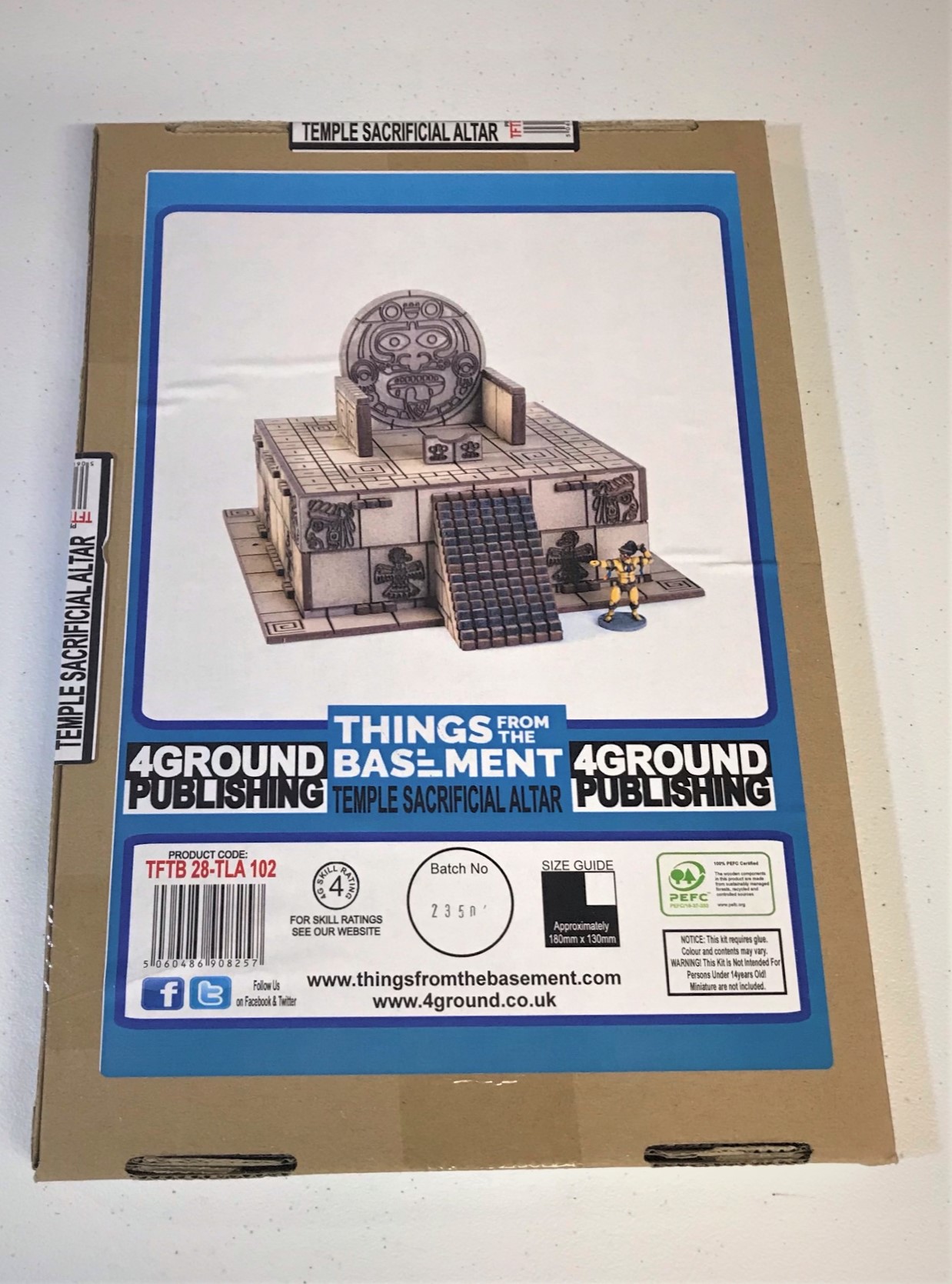
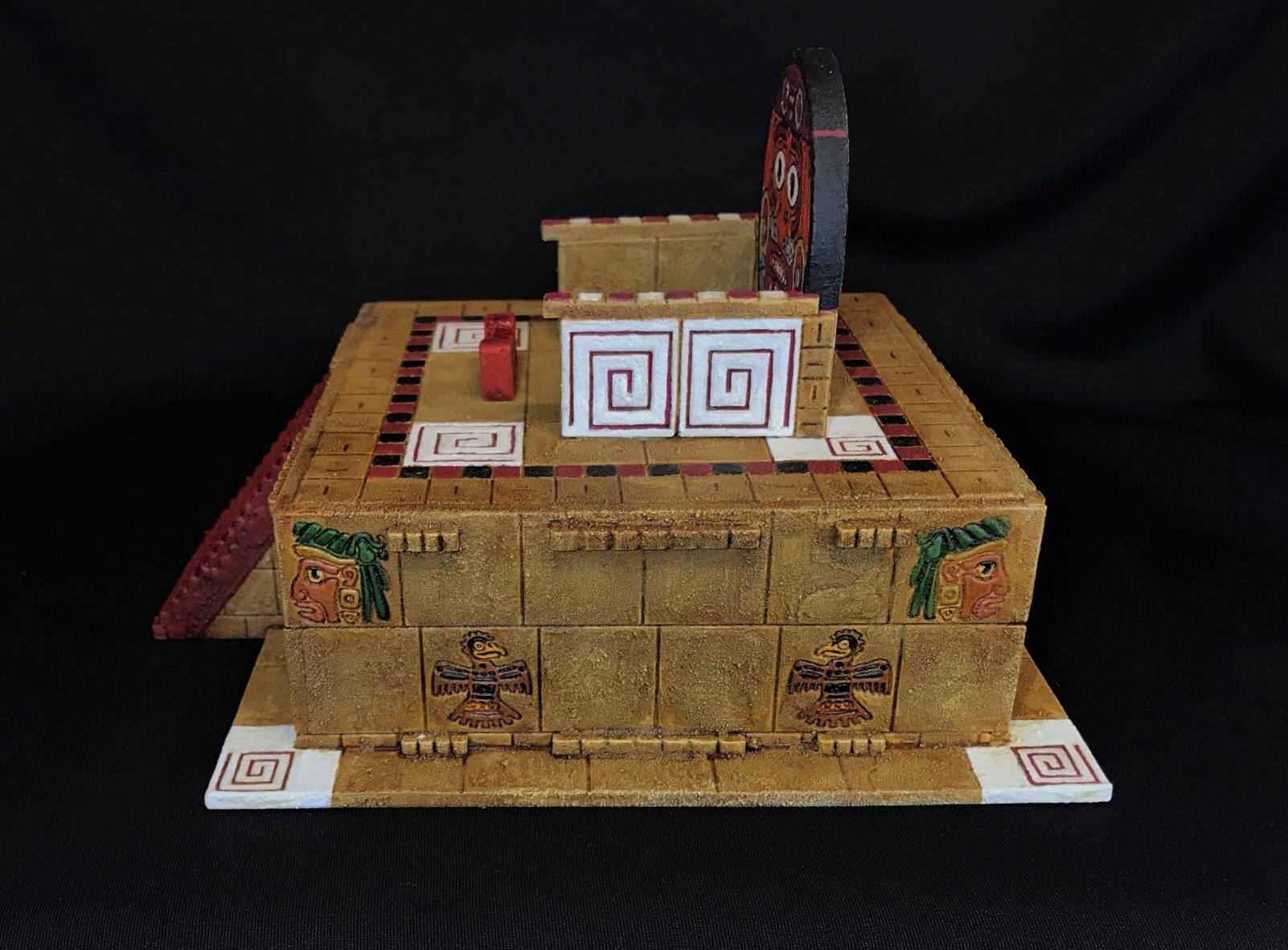
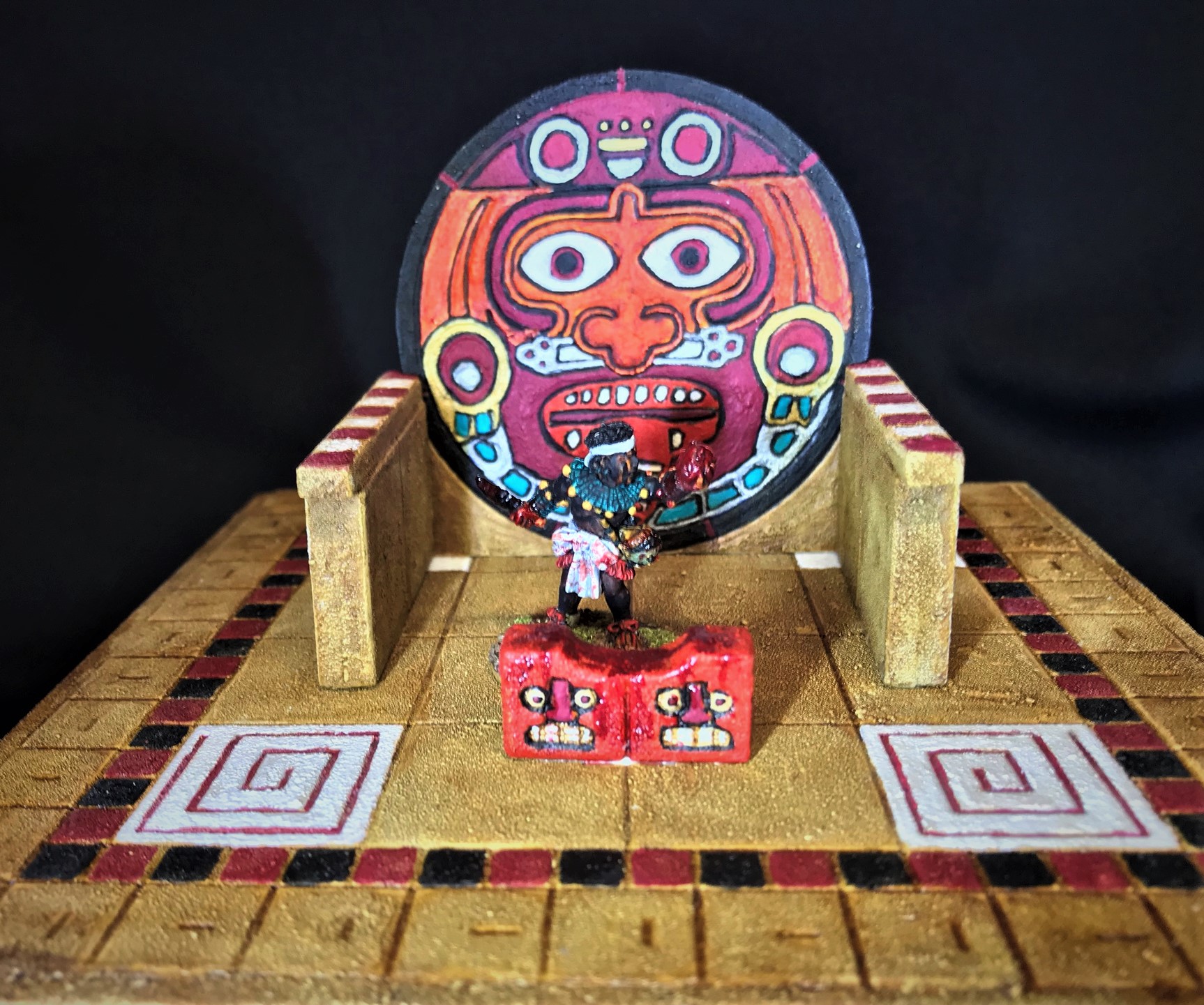
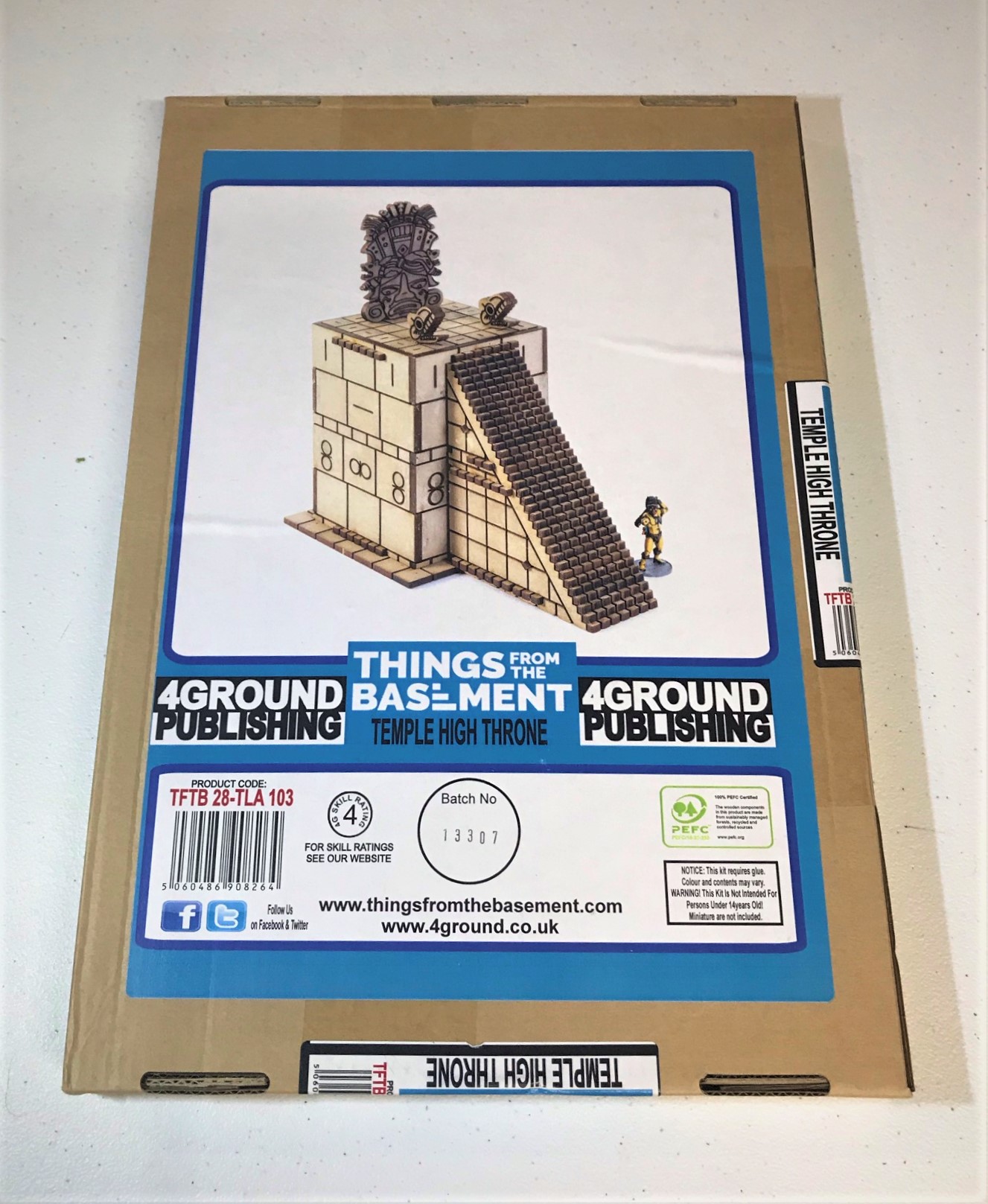
In this post I will share my latest – and largest to date – MDF kit build for Feudal Patrol™ games in Mesoamerica (using my Civilizations Collide supplement). It is called Temple Sacrificial Altar and is scaled for 28mm figures. It has a large idol overlooking a small altar on a raised platform. This one, like my previous Aztec MDF, also came from from Things From the Basement via 4Ground via Badger Games – you can see it here.
The kit in its box.
This is part of “Mark’s Aztec Building Challenge Contest” (which you will read more about shortly in this blog post), as well as being part of not one but two painting challenges being kindly run by a couple of great bloggers. The first is “The Summer Solstice Painting Challenge” from Ann’s Immaterium. Its supposed to be an entry that you consider your “best”, and as I think you’ll see I think this building is one I feel qualifies – and this is my entry. The second is from Angry Piper over at Dead Dick’s Tavern And Temporary Lodging called “Monster Mayhem 2021”. As the idol on the building is pretty monstrous, and Angry Piper concurred – it’s my entry here too!
On to the project – the kit was an enjoyable build but much more detailed than previous attempts – so it took longer. Plus, as you’ll see, I had to do some circling back on the paint job. It happens. I did also dust this baby up with chinchilla dust again – and thanks again to The Imperfect Modeler (TIM) for introducing me to Chinchilla dust. There are a few WIP shots this time as well.
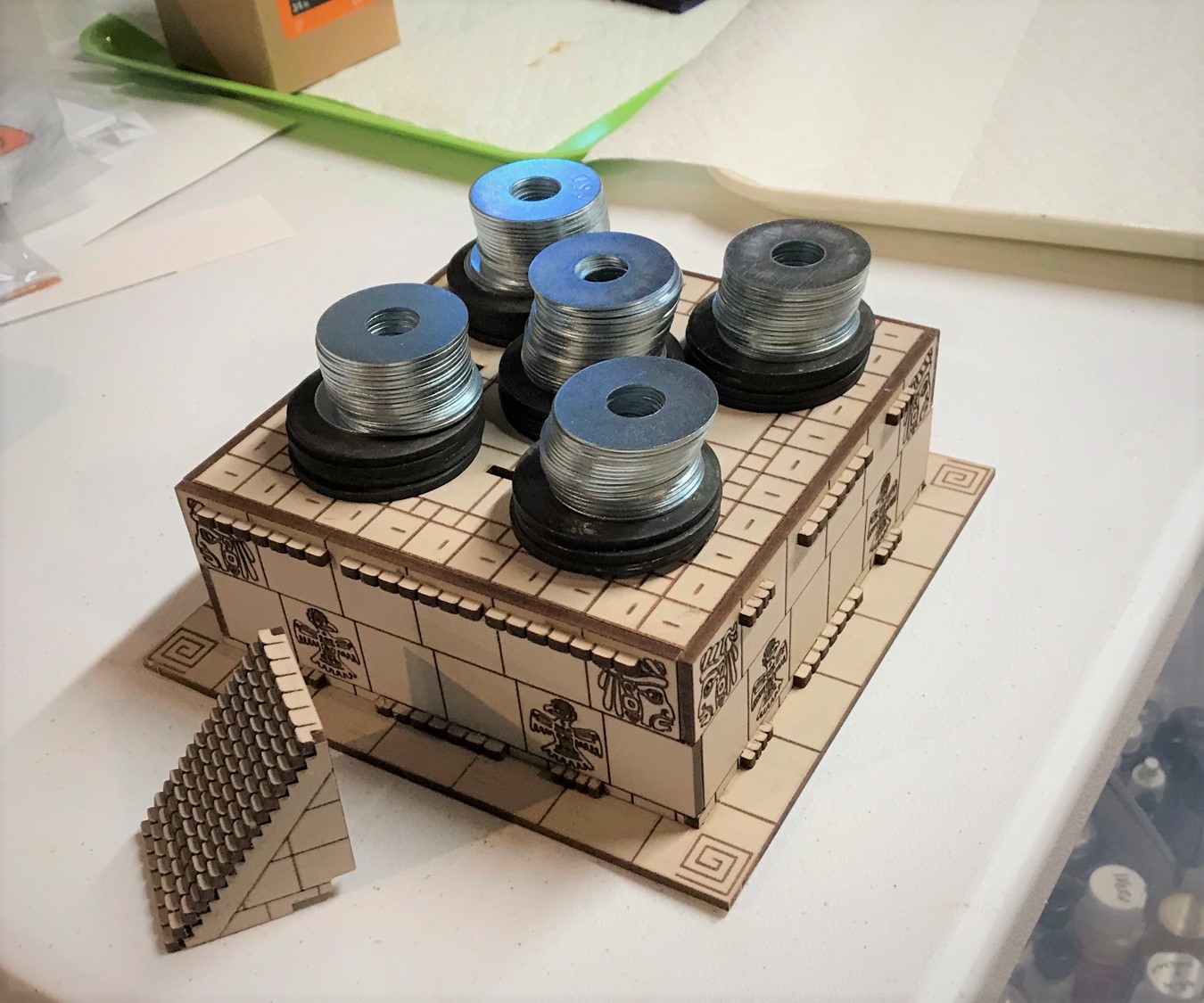
I started by wiping down the kit with a moist microfiber cloth.Assembly was pretty easy. After earlier using rubber bands to secure the walls and stairs while they were being glued together, I used large washers to secure the top while it was being glued.Next I dusted up the idol here (the dragon heads are for the next project) and the base.Using my airbrush, I base coated everything.I added the stairs and began painting. The model pieces are dry-fitted here and not glued yet. Here you see my initial – yes INITIAL – color choices for the idol. That would change.
Thanks to Pinterest, I got an image on my feed – of course on the day after I painted it – that would, well, make me somewhat aggravated but also allow me to take a new direction. The idol face apparently comes from an Aztec calendar – and the reddish image I saw on my feed fit my concept much better than what I originally chose.
My original paint scheme and a printed copy of the one from Pinterest – I had to redo!
And the second option is done.
Repainting the idol.
I found that lining the recesses with black paint helped greatly. As the chinchilla dust is very absorptive (especially on MDF), I mostly used somewhat thicker paints – even craft paints with the brush. Otherwise, you can get some capillary effects. My list of the materials I used is at the end of the post.
More or less a repeat photo with the new idol shot – plus the little sacrificial altar dry fitted to the base.I ended up using the white and red and black scheme you see here on the model. You also can see the highlighting of the chinchilla dust. I did find that I needed to go over the highlighting again with Army Painter Light Tone (the initial highlighting was over a toned-down base coat) – but I liked the final outcome.
I secured the final assembly as shown her with rubber bands while glue set – plus another on top of the idol (not seen here).
Back of the model view.
Final assembly.
It took me from the end of April to complete this model. I had some needed supplies finally arrive, allowing me to proceed. And I think now I’ve single-handedly bought the world’s supply of Army Painter “Light Tone”.
An aside as it affects how the contest challenge is proceeding. I had several delays beyond the supplies and repainting that I described, such as, well, golf, and mundane medical issues. Not that my game has been any good mind you! As for medical stuff, count my final COVID-19 jab that knocked me down a bit the next day (AND it was also at a golf tournament – bad call to schedule that on my part), plus a series of allergy/sinus issues, and a nearly broken toe (got a bit lucky with a bad bruise) – all causing me to slow down a bit. Oh yeah, multiple meetings and a town hearing to get (hopefully) approval to tear down and build a garage. And I still need another hearing! I hope to post on that IF AND WHEN I get approved.
Without further ado, let’s look at the final completed model and some Warrior Priests checking out the new digs.
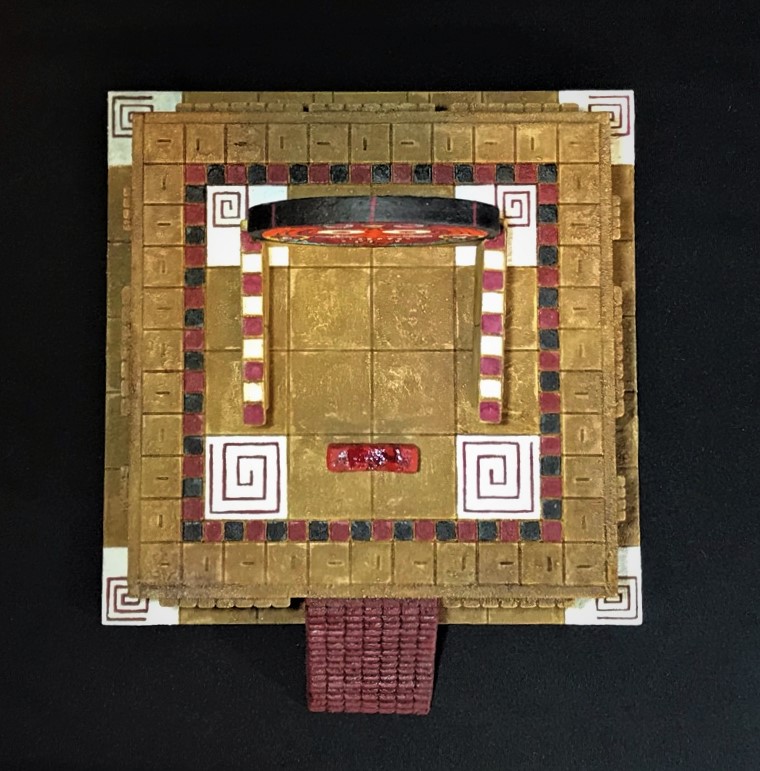
Front view.Top view. Note the bloody altar with a little BFTBG.Detail of the front and the altar. There were two golden eagles and two faces on each side of the model. I also stuck with the red and white symbols on each corner.Right side.Rear of model.Left side.This Wargames Foundry warrior priest has the heart of a poor Conquistador – who was apparently already dragged away.All my Warrior Priests (and a Priestess) checking out the new building. All are from Wargames Foundry, and you can see their stories here, here, and here.
All that I have left in the contest challenge is this model below. FYI, some work has been started.
Thanks for looking and I hope that you found this post enjoyable to read and check out. As always, please do let me know your thoughts in the comments section !
For all of my previous posts on games, units, and other projects for my 16th Century Spanish Conquest supplement for Feudal Patrol™ – “Civilizations Collide” – please see this page.
PAINTS, INKS, GLAZES, SHADES, WASHES, PIGMENTS, FLOCKING, GLUES AND MORE THAT I USED ON THIS MODEL
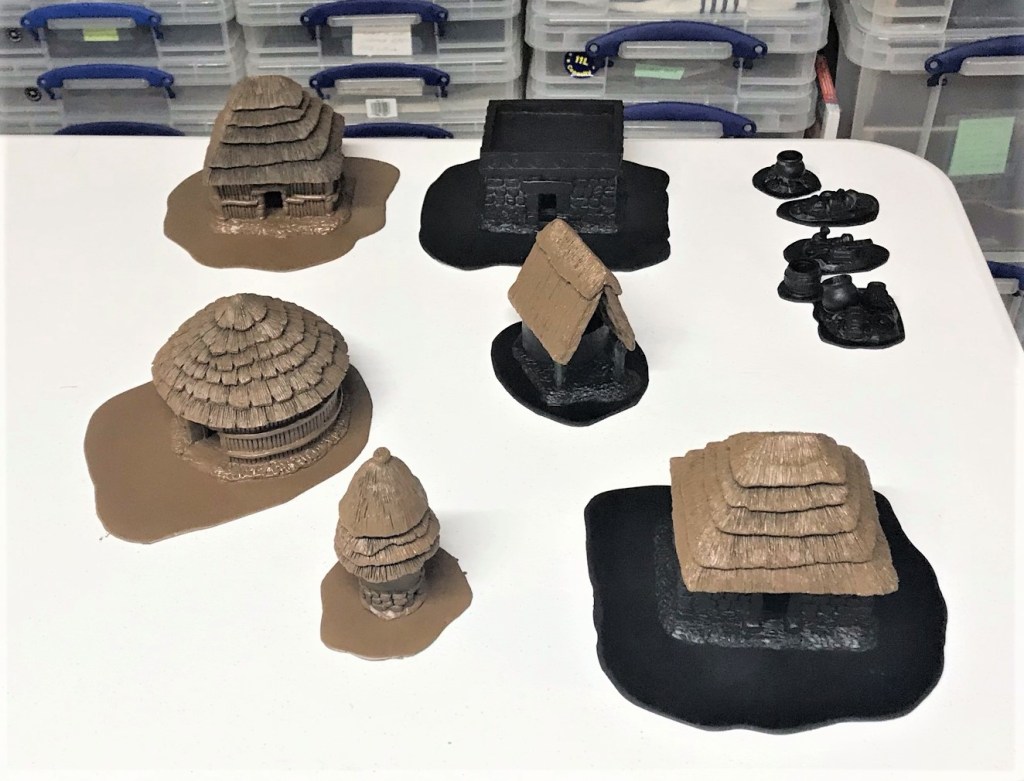
This post will cover the Aztec resin terrain/structures from Acheson Creations that I have recently finished for my Feudal Patrol™ games in Mesoamerica (using my Civilizations Collide supplement). I purchased 6 structures from the company, and they were kind enough to throw in some scatter terrain that I believe will prove to be quite useful. The six buildings plus the 4 scatter pieces are all part of “Mark’s Aztec Building Challenge Contest“, as are all of the MDF I listed in the original contest post. While the buildings in this post would be probably more suited to a rural setting versus a cityscape, I think that the scatter terrain will be useful in several gaming ways.
Originally, my plan was to do finish all of the MDF structures first, and then move on to the resin ones. That concept did not pan out as I ran out of some key items for the MDF. The MDF need to match exactly so that visually the collection makes a nice panorama.
So, those shortages moved me onto the resin, which I had luckily prepped for priming back in March. I thought Acheson had made the recommendation to prime with Rustoleum “Painters Touch Ultra Cover Flat Black” – a rattlecan – something I usually avoid. (Now that I looked back at his website, that recommendation is not there?) Anyways, I got another delay in priming as the Massachusetts weather also did not play nice (it’s been cold and we even got 6″ of snow on April 16th).
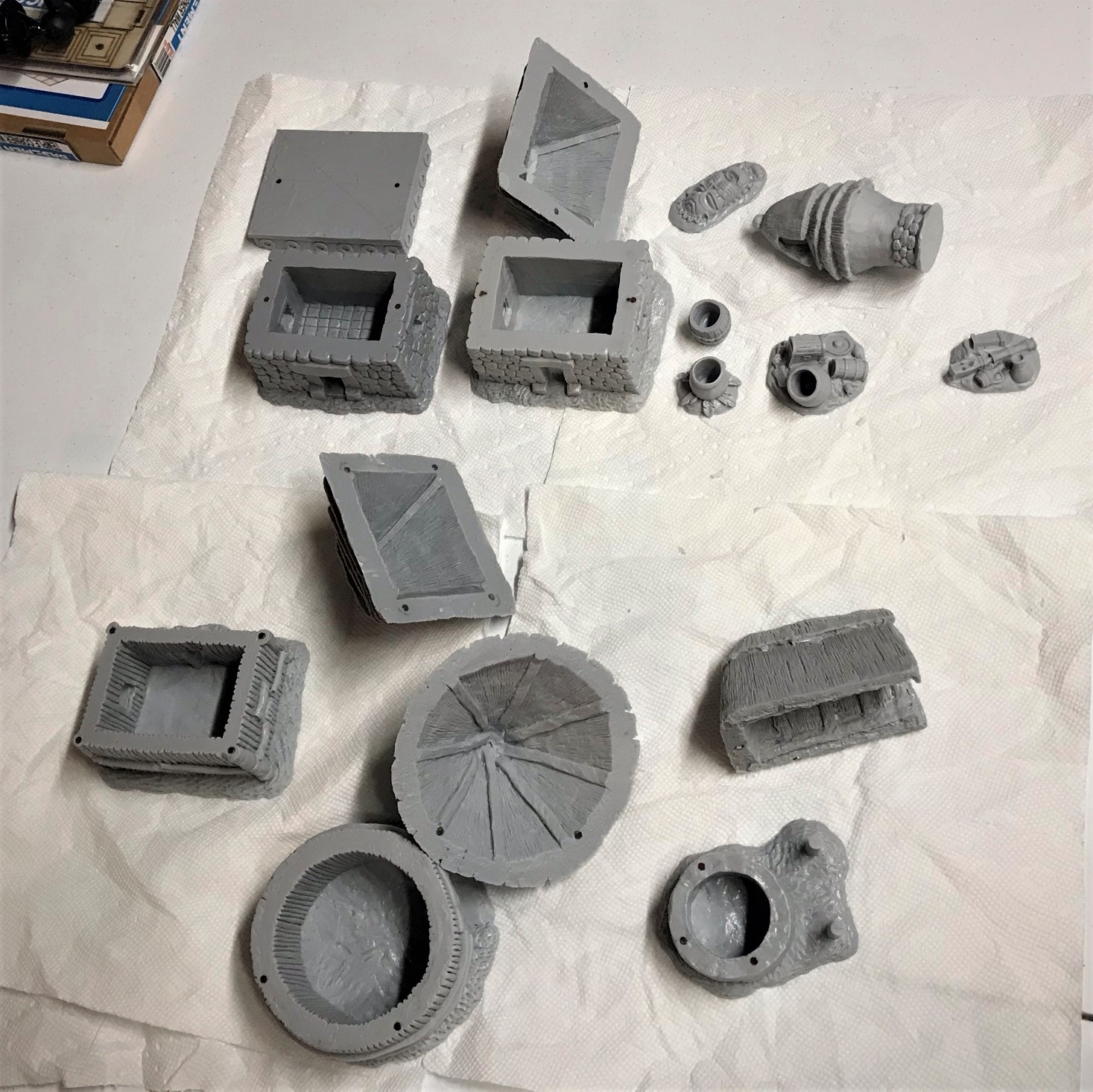
I thought it prudent – prior to priming them – to give all a thorough scrubbing and washing. I also saw a need to install 1/8″ neodymium magnets for the resin structures with roofs – to make them more stable (and stay on the buildings during games). This would be useful on the tabletop and yet keep them easy enough to open up for gaming. I used different patterns for the magnets as you will see below – so the roofs won’t end up on the wrong buildings in error.
Subsequent to washing, I based these pieces back in March on 1.5mm sanded styrene card – so as to appear more flush with the tabletop. When the weather finally cooperated (one day), I primed them all with that flat black and then sprayed a coat of Army Painter “Leather Brown” over the pieces that would be lighter or brown. This group of pieces all needed different paints – I am listing what I used by type at the end of this post (this helps me remember for future consideration and projects but you may find it useful too). As I started them all before April began, these will be 10 more entries in the April painting challenge from Ann’s Immaterium called Ann’s “Paint the Crap You Already Own” challenge.
The pieces washed and with neodymium magnets installed. I would also have to figure out how to paint and finish the inside of the roofs so that I could mount them for the roofs’ exterior painting. I would mount all of these on styrene card.
The pieces mounted on styrene card and primed.
One major difference here with these pieces versus how I have painted previously is my use of Army Painter “Soft Tone” (the “dip”) applied with a brush. This is an oil-based product, which I do not employ usually, mainly as I hate the need for cleanup with paint thinner. However, I thought that it would be a good use for the stuff that I bought back in 2017 – especially on the thatched roofs as it would both shade and provide a varnish-like protection. I could then dry brush over them with abandon and dull the dip’s shine with a final matte varnish.
I would need to finish the roofs’ interiors prior to the outside – and I basically treated them as separate pieces to be worked on.
Below, you will see I broke each of the pieces out so you can get an idea of the transformation. I must give a shout out to TIM of The Imperfect Modeler who graciously gave me some excellent advice for these pieces.
Cuezcomatl Granary Structure
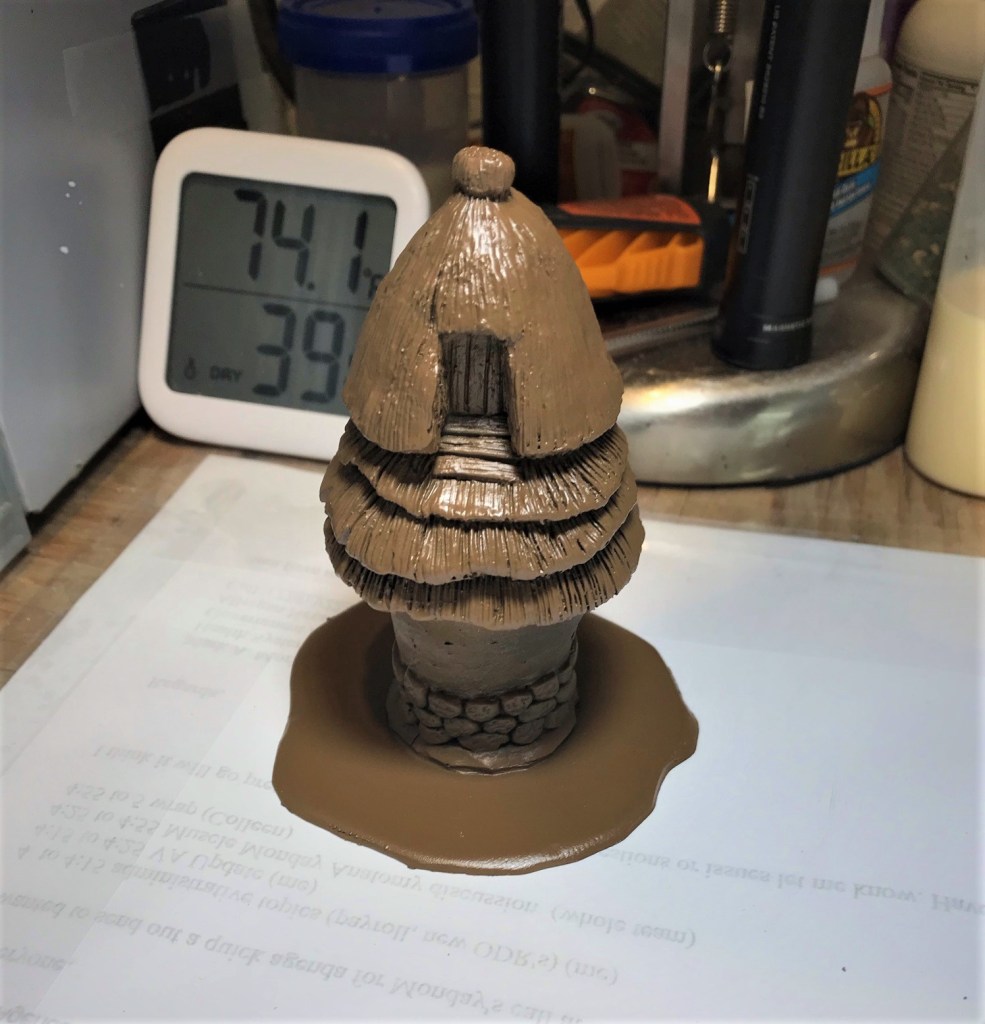
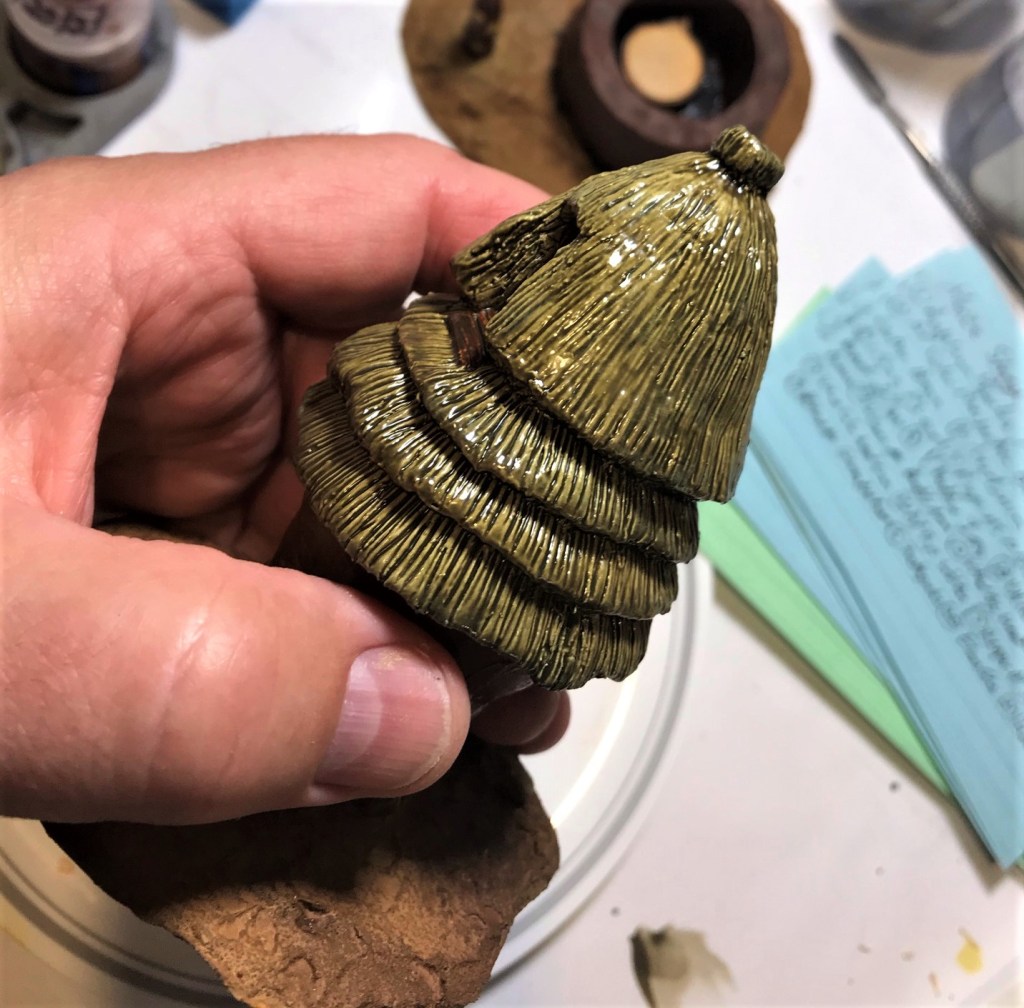
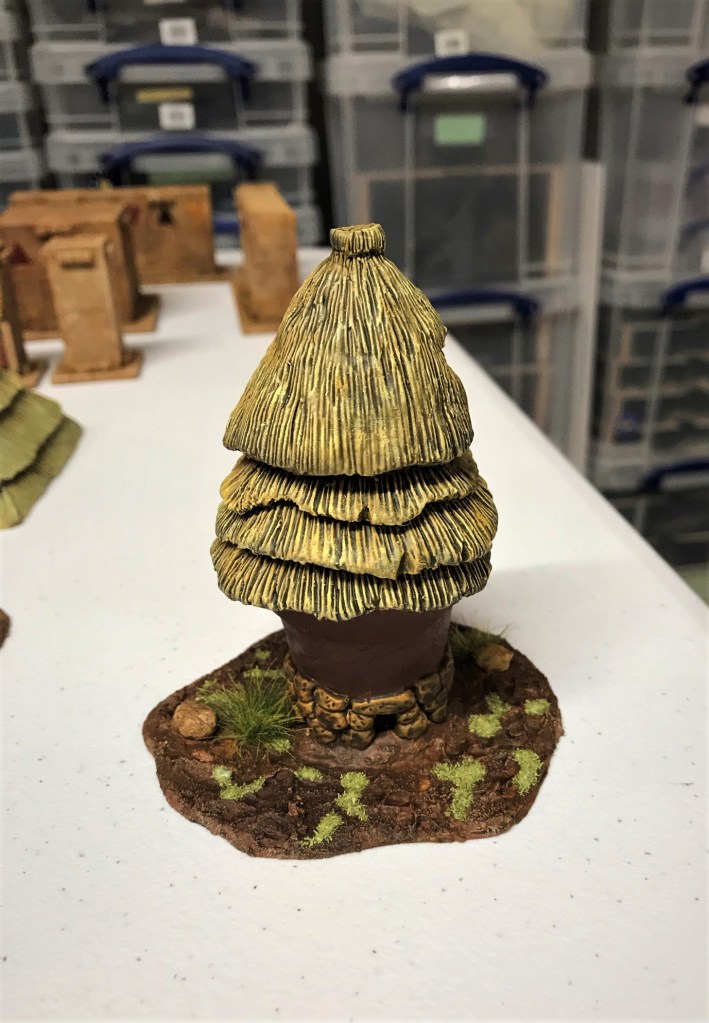
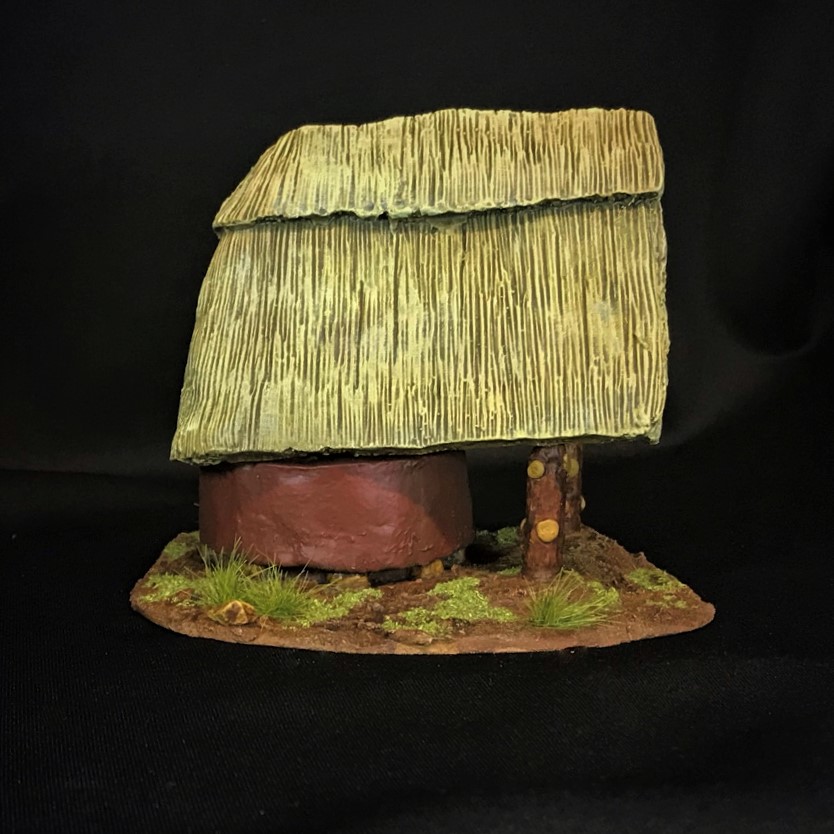
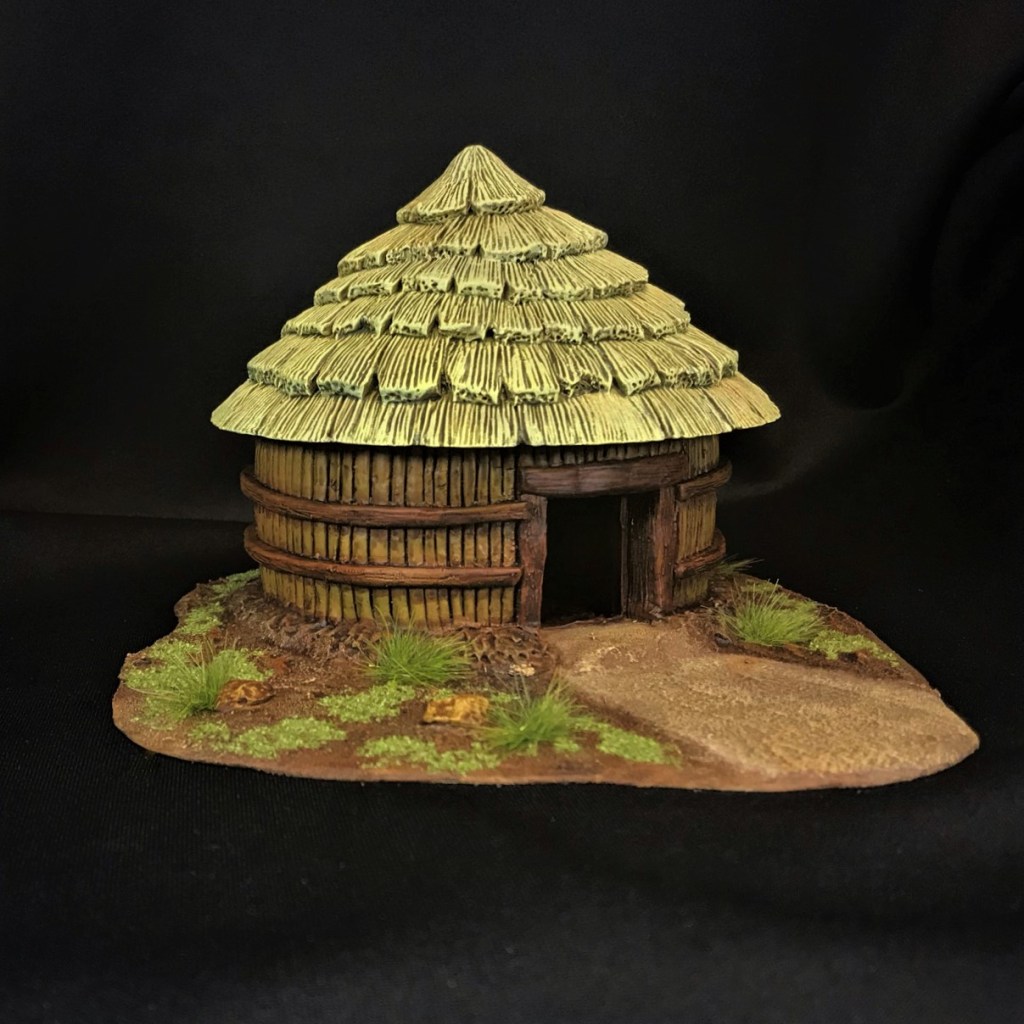
The term cuezcomatl refers to a granary storage structure that was used in Mesoamerica before the arrival of the Spanish and even up to today in some rural areas (see reference here). The model was interesting to paint, and working on it also helped me to prepare for the other thatched roofs. In the end, I decided to use Army Painter Soft Tone (the “dip”) with a brush. This allowed me to both get some good detail shading as well as to protect the model. I can see this model being useful as a terrain piece, as well as an objective marker. The Aztecs were quite avid practitioners of raiding their neighbors for food as well as captives (or anything else that they wanted to take), as were all Mesoamerican peoples of the era. The Aztecs were just more adept at the practice.
Unprimed and on its card base
Primed
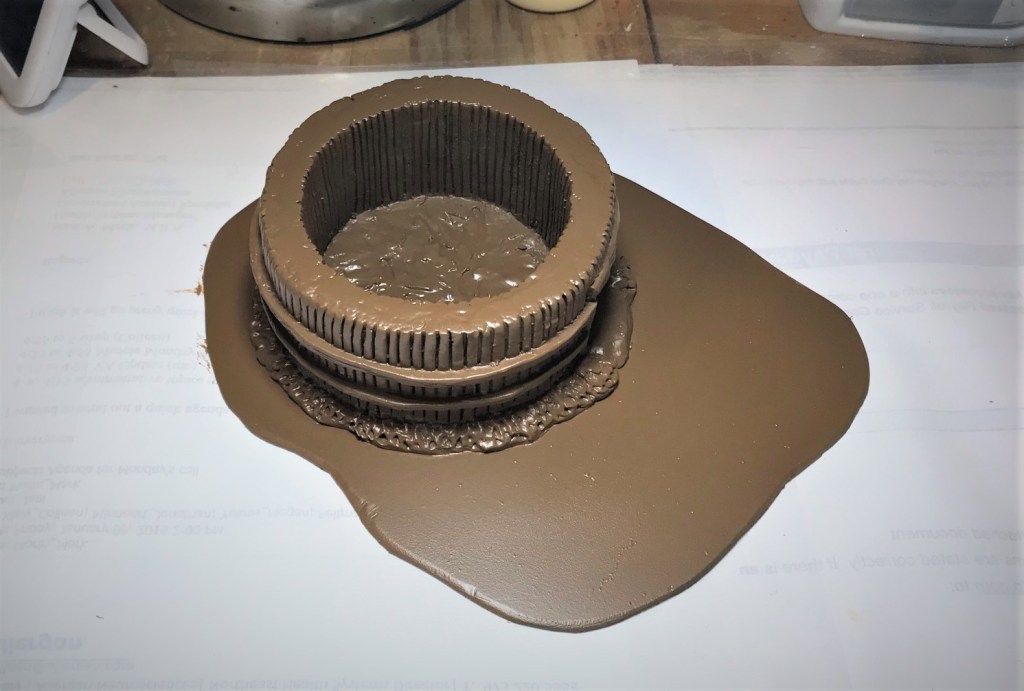
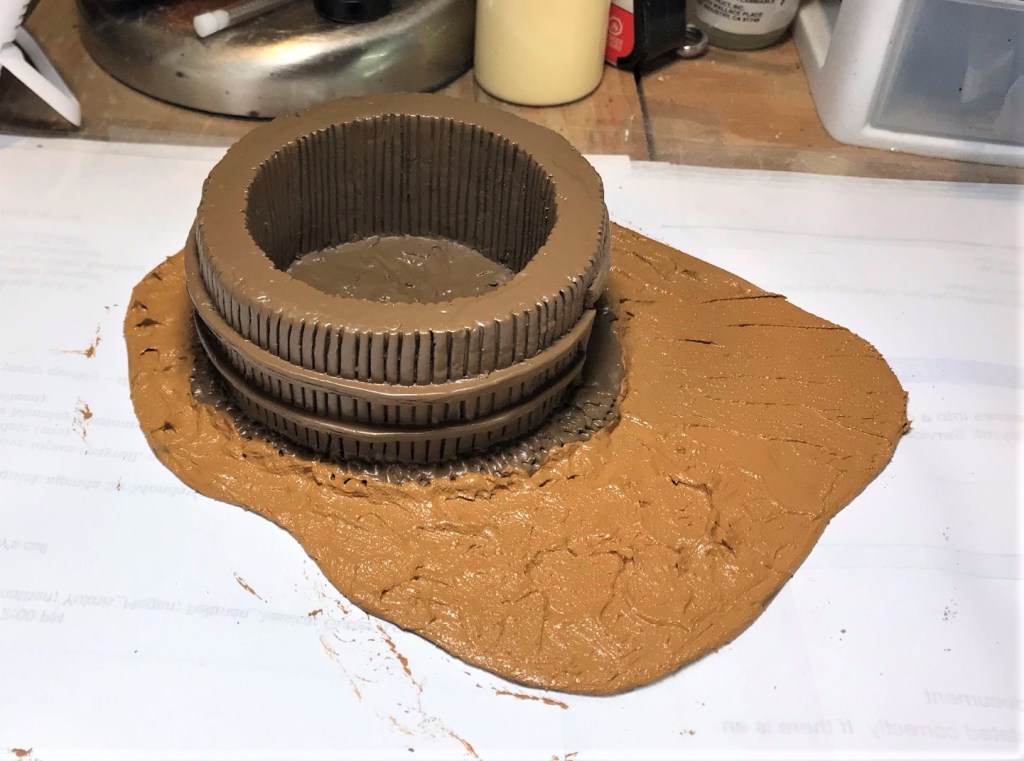
Added texture to the base
I base coated the piece, then used the dip as a shade, then later I did a lot of dry brushing
The finished terrain piece
Progress on the Cuezcomatl
Cuezcomatl Granary Structure (door side)
Cuezcomatl Granary Structure (back side)
Jaguar Warriors seize an enemy cuezcomatl
Maize Storage Structure
This piece had a few areas that I worked to improve upon. One was to fill an open storage well with “maize” – or at least something that could approximate it. Another was to convert the dowel-like smooth front pillars into a more convincing-looking pair of period wooden supports. The pillars did have a slight wood grain, but I wanted to make them more rustic. Lastly, I did need to do some drilling and magnet installation so as to allow the piece to stay together. As with all of the other pieces here with separate roofs, I needed to finish the inside of the roof (including up to varnishing) before I finished the outside.
Similar to the cuezcomatl piece, this one can serve as both terrain and an objective marker due to the food storage bounty.
The base of the Maize Storage Structure primed. Note the altered sculpted posts.
After adding the Vallejo texture.
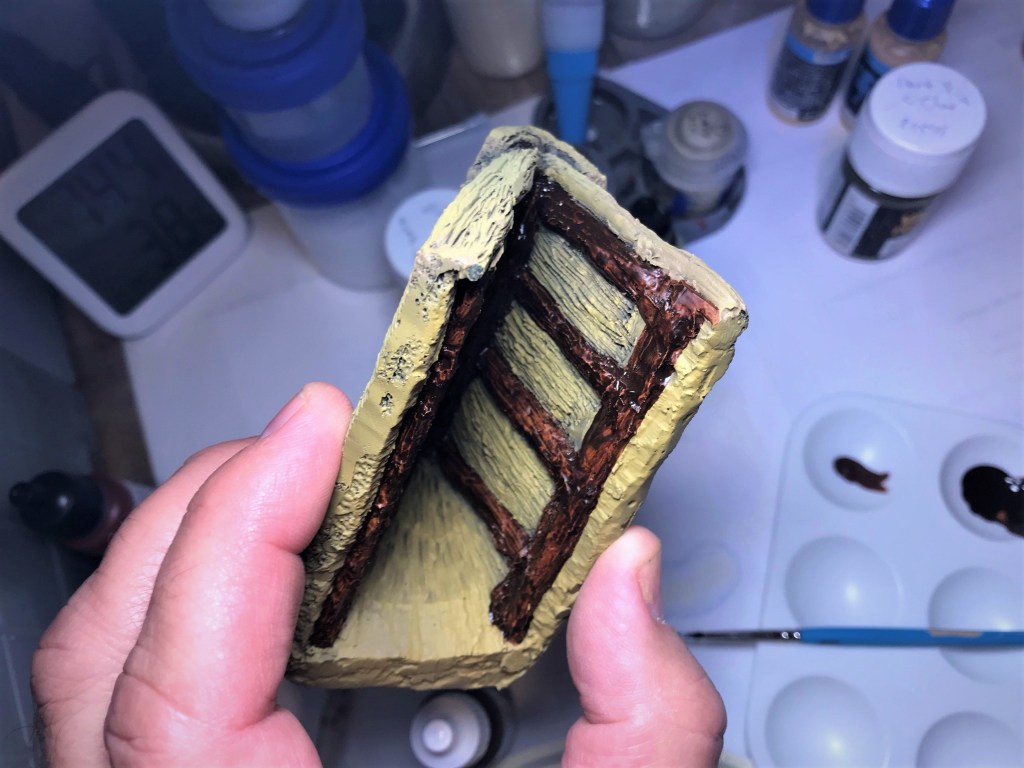
The underside and inside of the roof – I needed to drill carefully for the magnets.
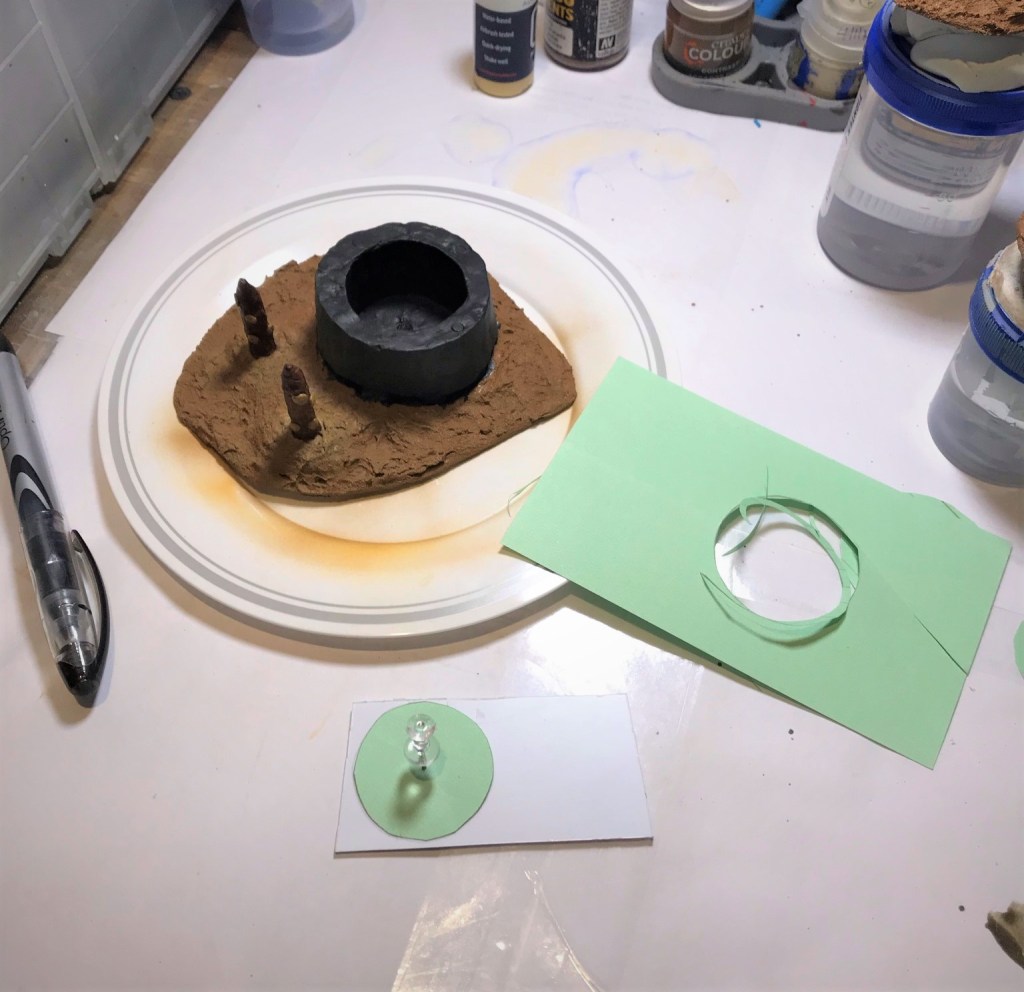
Made a template out of card for a base for the maize.
I wanted the base to fit.
Used shaved and cut toothpicks as maize. This is a test to see how many I would need.
Used a piece of birch wood to support the card.
I made a paper form to hold the toothpick shards and PVA glue to make a “maize mass”.
The maize well and the maize mass drying.
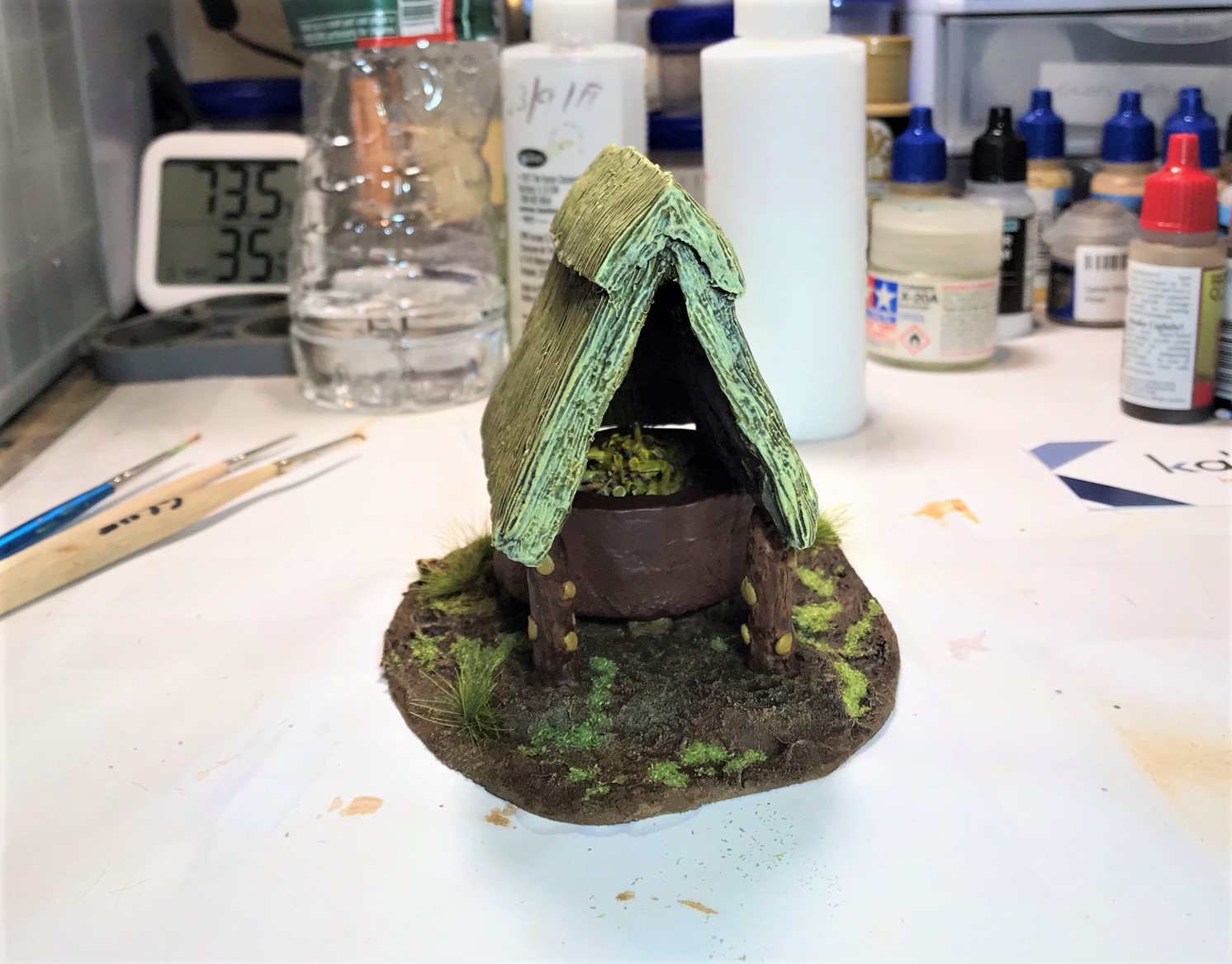
The finished piece with roof off.
The maize building process I used broken out.Structure completed.
With roof off showing maize
Back of piece
Left side
Right side
Aztec Veterans defend the maize.
Aztec Peasant/Farmer’s House
I had three peasant houses – this is the first one.
The piece with magnets installed and on the styrene base awaiting priming weather
Primed with black and then brown.
Main painting completed prior to final shading.
Completed and united with its roof.
Progress on the Aztec Peasant/Farmer’s House
Right side
Back side
Left side
Front – showing pathway of chinchilla dust.
Novice warriors defend a peasant’s house – maybe not even theirs at the beginning of the day!
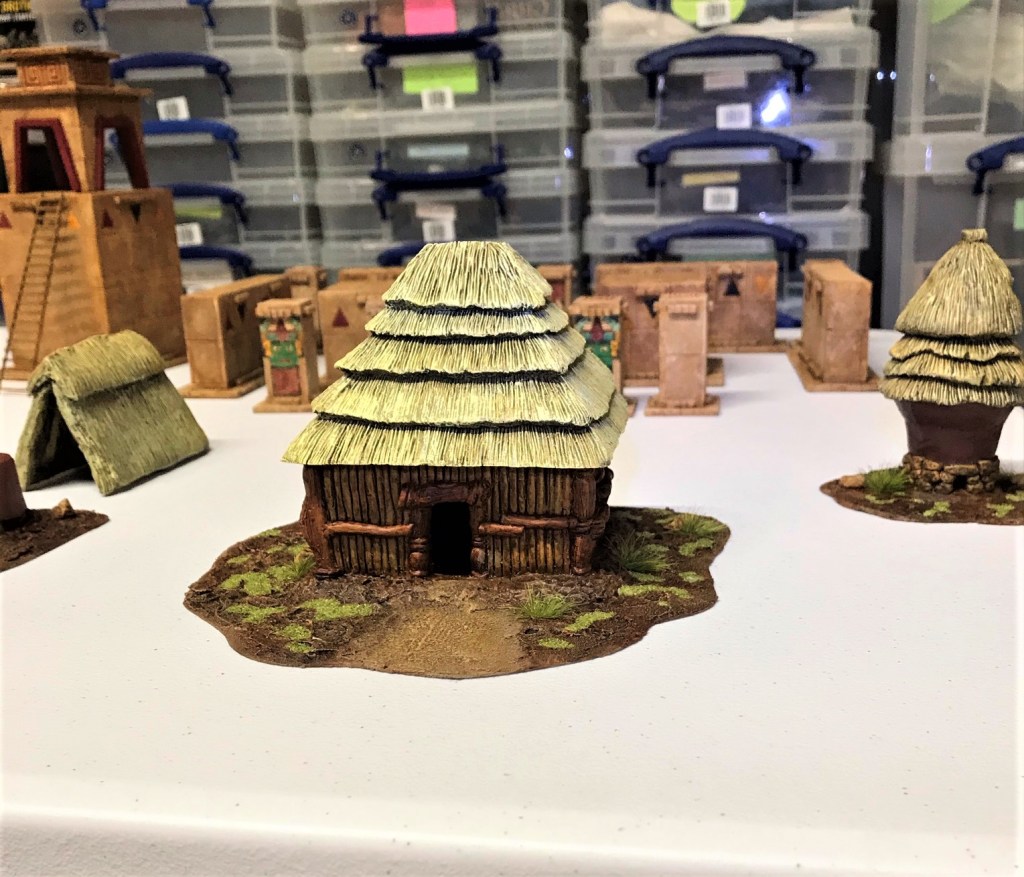
Huaxtec House
The Huaxtec were a people who lived near the east coast of Mexico. They were related to the Maya and were conquered by the Aztecs. I found this structure to be quite striking visually and I have to imagine that it was somewhat common. In any case, it was different than the others, so I thought it worth adding. The only issue that this piece presented was that the roof size did not line up as easily for the magnets – but enough to make a couple work enough to keep the roof on.
You can see the two magnetic positions that I could drill.
Primed.
Added Vallejo texture to the base.
Finished bottom.
Finished with the roof.
Huaxtec House progress
Finished front view of Huaxtec house.
Back view.
The Aztecs pillage the Huaxtec House.
Aztec Stone House
The third type of house is an Aztec Stone House. This is one of the two stone houses in the group. I decided that I would go for more of a sandstone or light limestone look for these.
An example of how I created a template to make sure that the roof and building magnets lined up.
On styrene base showing magnets installed
Primed in black
Added Vallejo earth texture
After pigments and early base dry brushing
Aztec Stone House progress
Right side
Back side
Left side
Front of Aztec Stone House
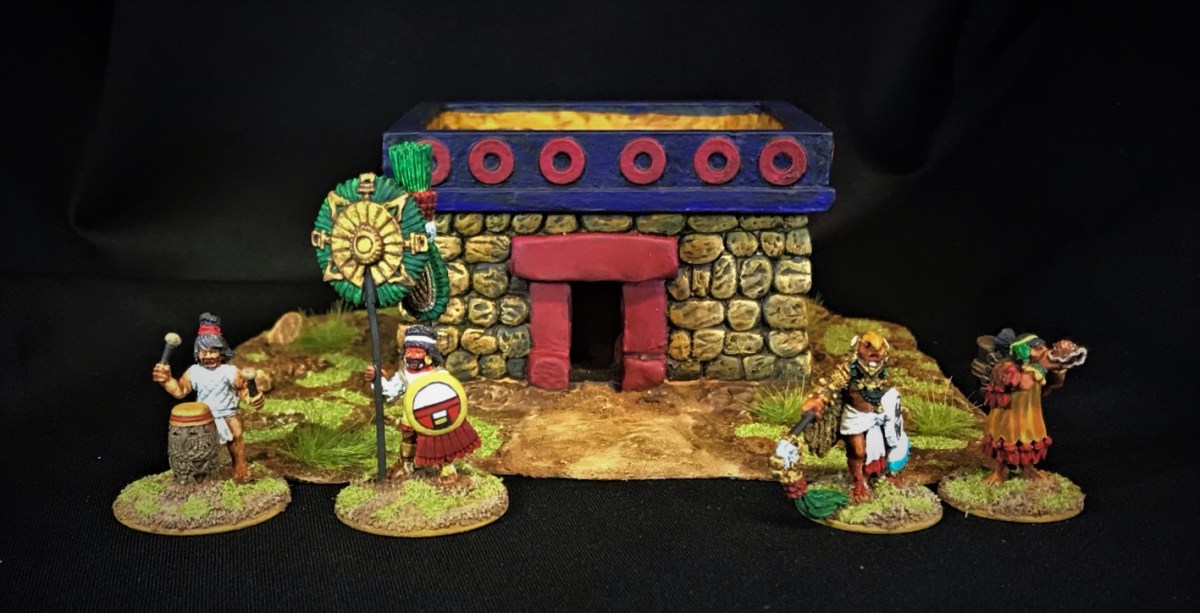
Aztec Veteran and Novice Warriors deploy from the stone house
Aztec Noble’s House
The Aztec Noble’s house had an interesting roof and a bit of opportunity for some color.
Using a template with thumbtacks to align the roof and magnets
Magnets installed and structure based
Primed
Added Vallejo texture to the base
After adding some talus, chinchilla dust, I dry brushed
Aztec Noble House progress
Left side
Back
right side
Front of Aztec Noble’s House
The Aztec Snake Woman (General) and a Noble Captain depart for battle.
Miscellaneous Scatter Terrain
It was a nice surprise to get this scatter terrain. I used all of it except one – which was an African mask. I based it and primed it but did not paint it. As I will not likely use it, it will be another (5th!) prize in “Mark’s Aztec Building Challenge Contest“.
These will be nice treasure markers for the games. I played with some shiny (and tiny) beads (from Japan) and Swarovski glittery crystals from Michaels to make the treasure and fill the pots over some steel BB’s. I also had a chance to do some minimal Aztec freehand work on the pots.
Cleaned and based freebies – the mask on the right is another prize in the contest now.
Primed and based textured.
The leafy pot that I added the freehand to – loosely based on a design I saw online.
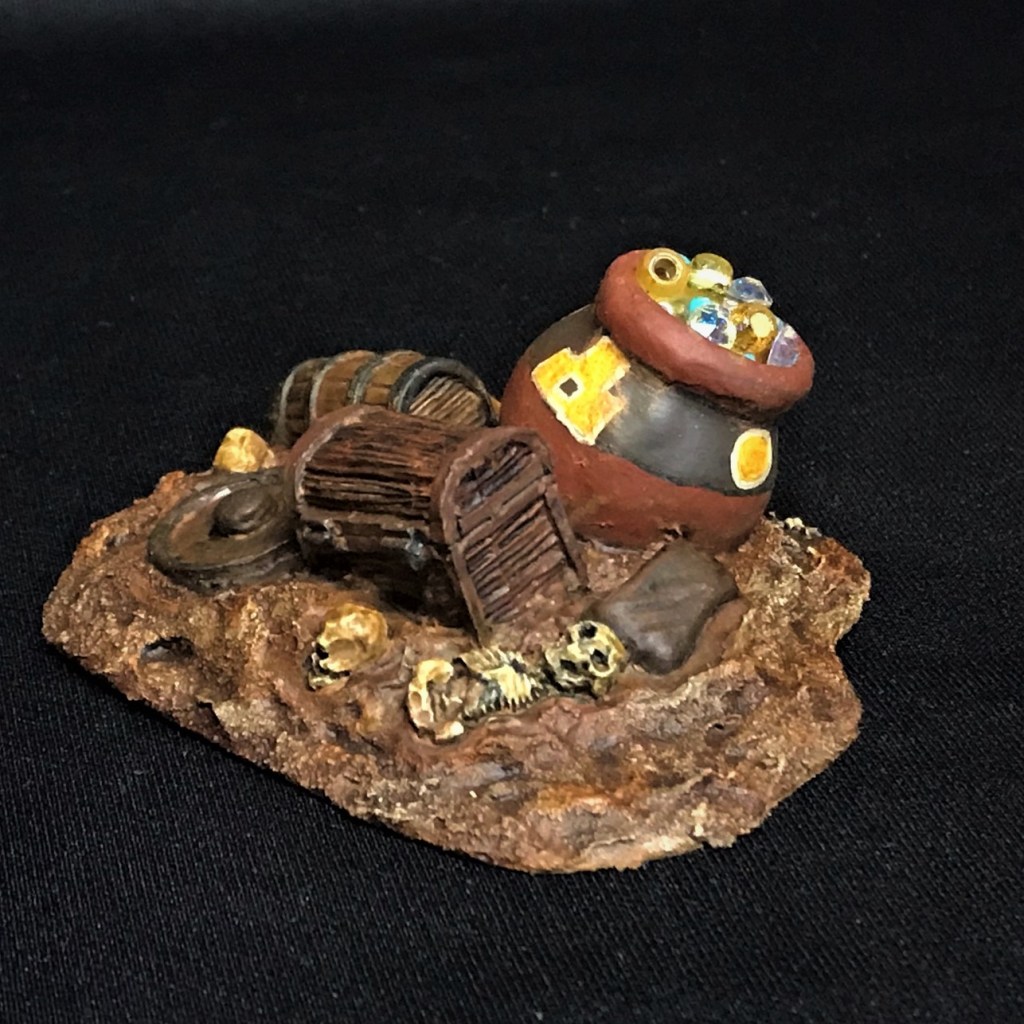
This marker had bones, skulls, a treasure chest, and more.
Some larger gold and silver items.
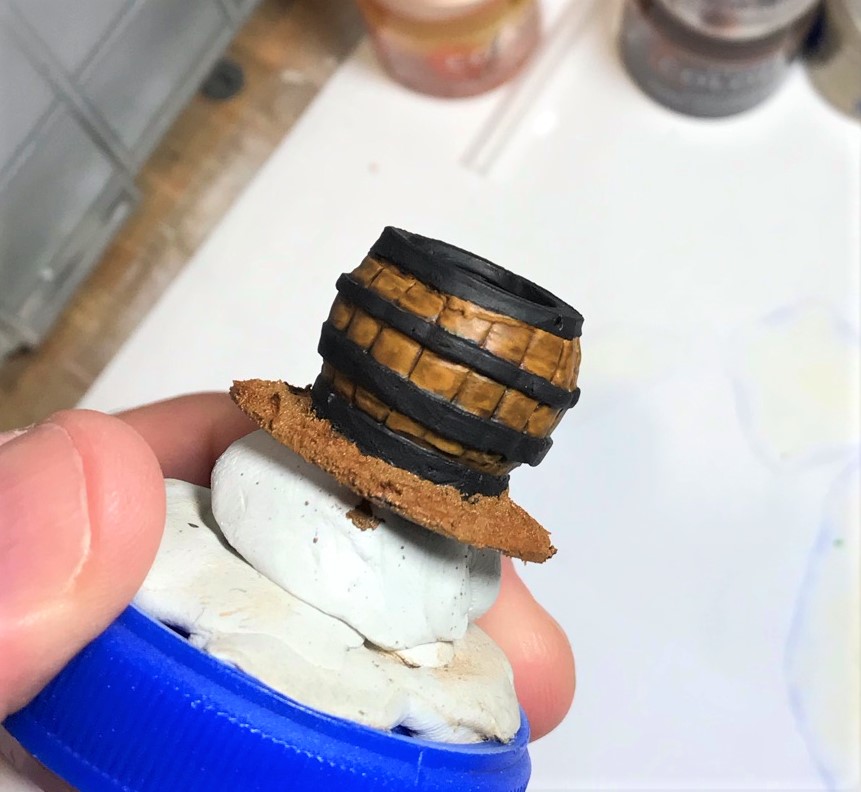
A barrel – I was going to make it a water barrel but made it full of treasure instead.
Tiny little beads – gold (2 sizes), silver, and turquoise.
Treasure!
Scatter Terrain progressThe Leafy Pot treasure. Why is it on leaves? You got me – I don’t know!
The “Bones” treasure marker, replete with two skulls, a partial skeleton, a barrel, a pot, a treasure chest and an old sack. The gold staff treasure – with a treasure chest, a silver carafe, a gold vase, and a large gold staff of some type.Top view of the treasuresElite Warriors – Cuachiqueh (“Shorn Ones”) – protect Montezuma’s gold.
That rounds out my pieces for April. I now have just two more pieces of MDF left for the contest – though I do have more planned terrain and structures – keep following!
Coming up next – these last two MDF.
I’d love to hear any feedback on these – and I did use a different photo set up as well – so let me know on that too if you want. Getting my last “jab” this weekend, as well as trying to play in two golf tournaments – so when will I get done and end the contest…who knows?
As far as Acheson, I must give them a very positive review on these resin pieces. Check out their stuff here. Their offerings and ranges are quite extensive across many periods. The sculpting is good and the details are nice, and the extras they threw in were very cool too. And other than the freebies that they threw in, I have not been paid by them in any way.
Thanks for looking and please let me know what you think in the comments section!
For all of my previous posts on games, units, and other projects for my 16th Century Spanish Conquest supplement for Feudal Patrol™ – “Civilizations Collide” – please see this page.
The next sections are references on the paints I used – mainly for me – so skip the rest if you are so inclined. Thanks for looking and I hope that you’ll let me know what you think about these models.
PAINTS, INKS, GLAZES, SHADES, WASHES, PIGMENTS, FLOCKING, GLUES AND MORE THAT I USED ON THESE STRUCTURES AND PIECES:
It’s my blogaversary! I started this blog 6 years ago today on March 19th, 2015!! It all started with this post – The Story of the Nightmare Legion. It’s been a fun journey.
I started this blog to share my minis and to share stuff that I learned after an extended absence from the hobby. I wanted to help with lessons learned and the like. Since then it’s been a blast, and I really appreciate all of you who read and follow this little blog of mine! I certainly have been inspired by yours.
This current post was one with which I struggled as far as deciding on whether or not to do write it as it involves making stuff to make my games easier for the players and for me as a GM. In the end, I was encouraged to give it a go (thanks IRO and TIM!). So, this post will be more of a how to (and a throwback to some of my earlier projects) in terms of stuff I have conceived of, designed, and built for my Feudal Patrol™ games using my supplement Civilizations Collide. After reading this, you might have some new ideas, you might know about some new materials, or you might just think that I am nuts. After all, the stuff I will show took 3+weeks to make.
Now, before I go any further, I want to emphasize that I did not need to do any of these projects to play Feudal Patrol™. Period. I did because they suited my personal needs and – well – I get thoughts of stuff in my head that need realization.
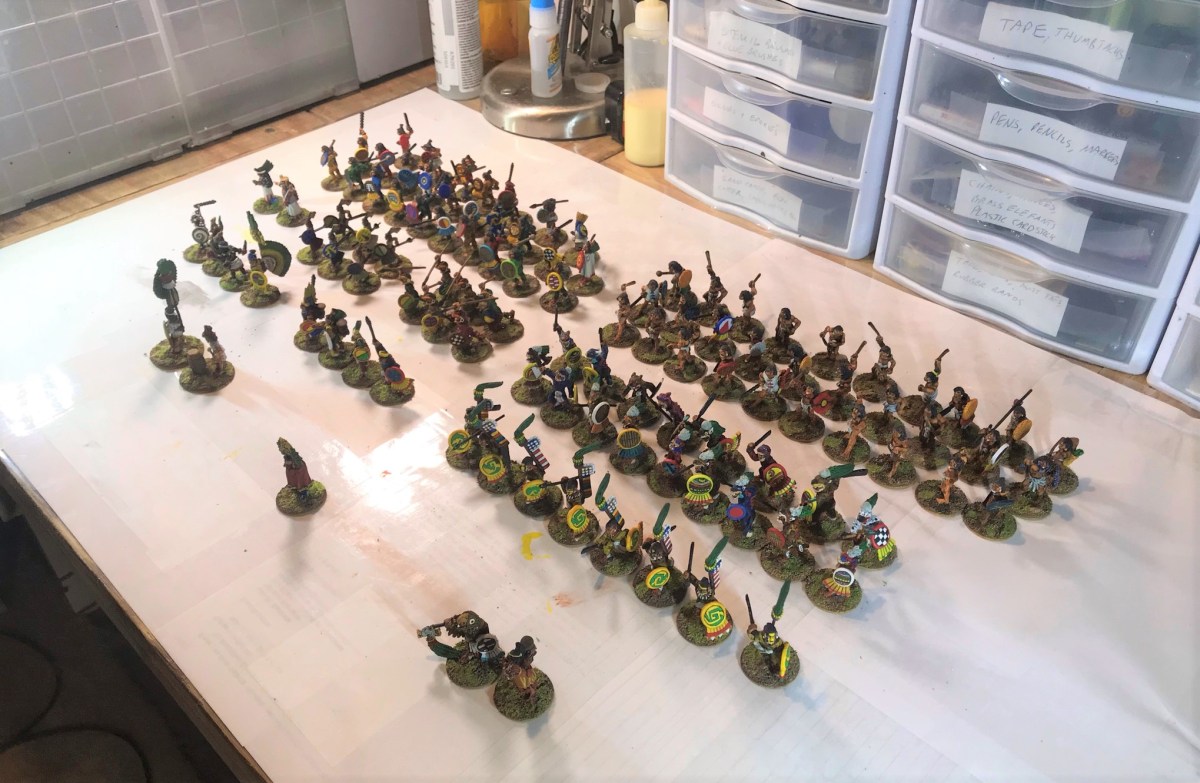
Buck’s Feudal Patrol rules have more than adequate tools and game aids. They are fantastic. My goals here were for myself so that I can make my games easier for me mainly. Also, with 216 available figures for a game of Civilizations Collide, I needed some tools if I am going to provide CHOICE and AGENCY to my players.
To accomplish this, I have broken down my efforts into “challenges” with some supporting pics and links for the materials and tools. I hope that you find them interesting as they are really how I built “stuff” for my games.
The Under-Base Label Challenge
Challenge: The Conquistadores arrived in Mesoamerica in the early 16th Century and there had been many different Mesoamerican civilizations for centuries prior to that. “Uniforms” in this era were anything but uniform. In the game, Warbands and Elements within Warbands are composed of figures that are attired, armored, and armed differently. In terms of both figure identification and using the points system to build Elements and Warbands, this poses a challenge, especially with my 216 available figures. Having thought of this from the beginning of this project, I had kept an identification Excel spreadsheet for all 216 figures throughout the project – which helped immeasurably with having identification data for each figure. I did take many pictures and also wrote (somewhat illegibly as is my curse) on the bottoms of the figures’ bases with a Sharpie. However, I needed a clear and legible solution for the tabletop.
Goal: Make all figures easily and individually identifiable. Ideally, have a system that identifies each figure and the points cost for each under the 1” and 1.25″ steel washer bases.
Solution: Create custom labels for use under the 1” and 1.25″ steel washer bases.
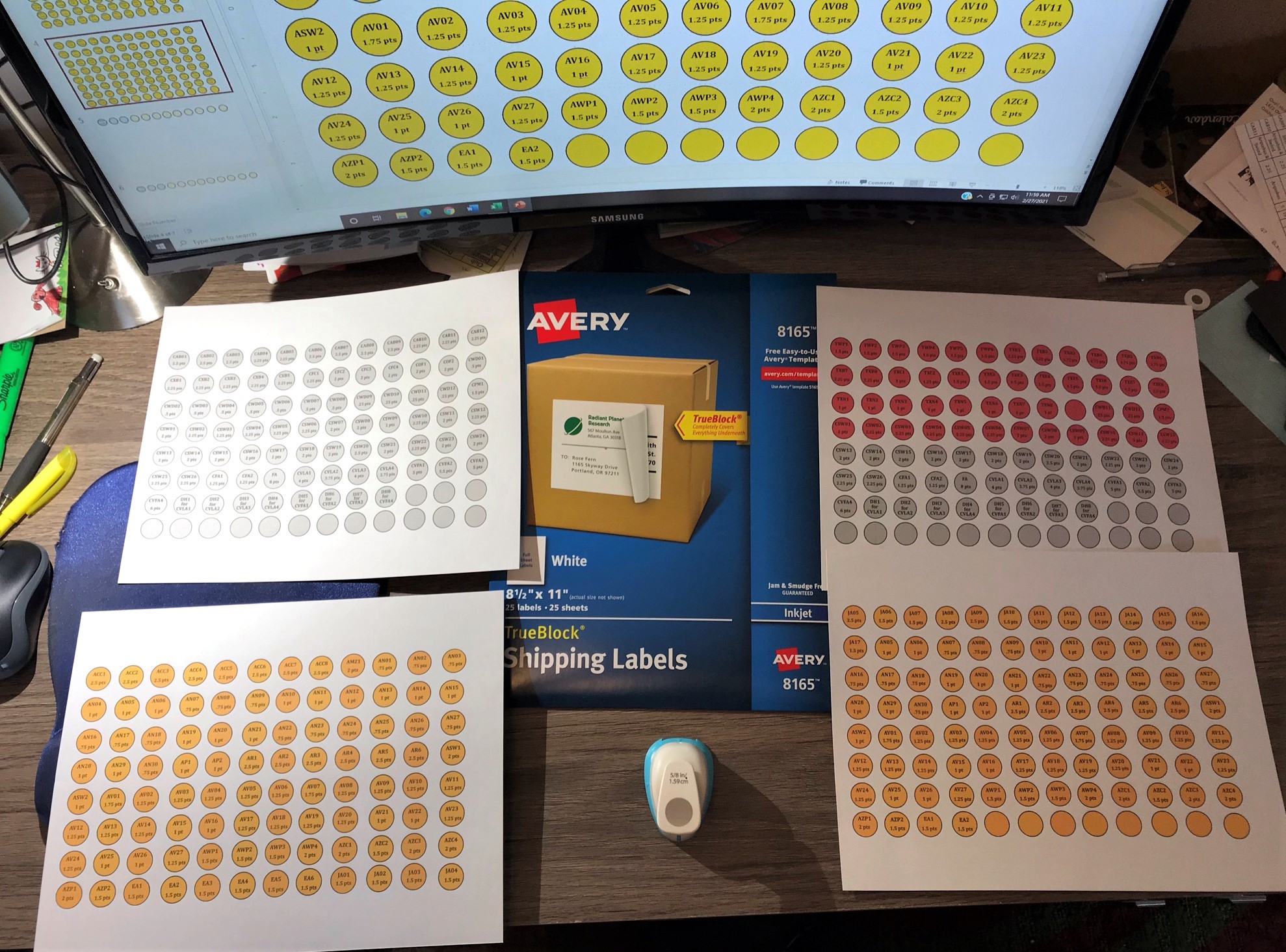
Process: Using PowerPoint, I designed a ¾” round label that has both the figure identification number and the figure point value on it. I cut and pasted additional circles and aligned them on the sheet for future removal. Alignment of the circles and editing them was easy with PowerPoint – and was very helpful in later steps with the paper trimmer. I filled one sheet or slide in PowerPoint full of the circles. At that point all I needed to do was to copy that entire sheet and make a second sheet, and so on. This enabled me to edit each circle on the subsequent sheets for all 216 figures. I inputted the figure numbers and the point values from my master spreadsheet onto the circles. I used a color code for the round labels by type – grey for the Conquistadores, gold for the Aztecs, and red for the Tlaxcalans. I also used a thick point circle on the border of the circles – I used 1.5 but I could have gone thicker. The thicker borders help with aligning them for punching out later. I then printed off the sheets of labels on Avery™ #8165 8.5” x 11” Trueblock® shipping labels that I bought at Staples. I took each sheet and used my Fiskars® SureCut™ Deluxe Paper Trimmer (from Michaels) to cut thin strips holding multiple labels. This made punching out the labels easier. I used my 5/8” punch from Michaels (Lever Punch, Circle by Recollections™), punch out the labels. Even though the punch was 5/8” versus the 3/4” circle – they aligned better – as the thick point border helped me to position the strip. The punch has a clear underside so you can see if you are aligned or not. I affixed the labels to the underside of each base of each of the 216 figures. I store and transport my figures in 11-liter Really Useful Boxes (which I bought from Staples but this UK company has their own website too in the US) lined with Aleene’s® Magnetic Tacky Sheets™ (which Michaels sometimes carries too). The labels did not impede the magnetic attraction that I needed because they were smaller in diameter than the 1” bases – and were centered on the washers – leaving enough steel available to get a “bite”.
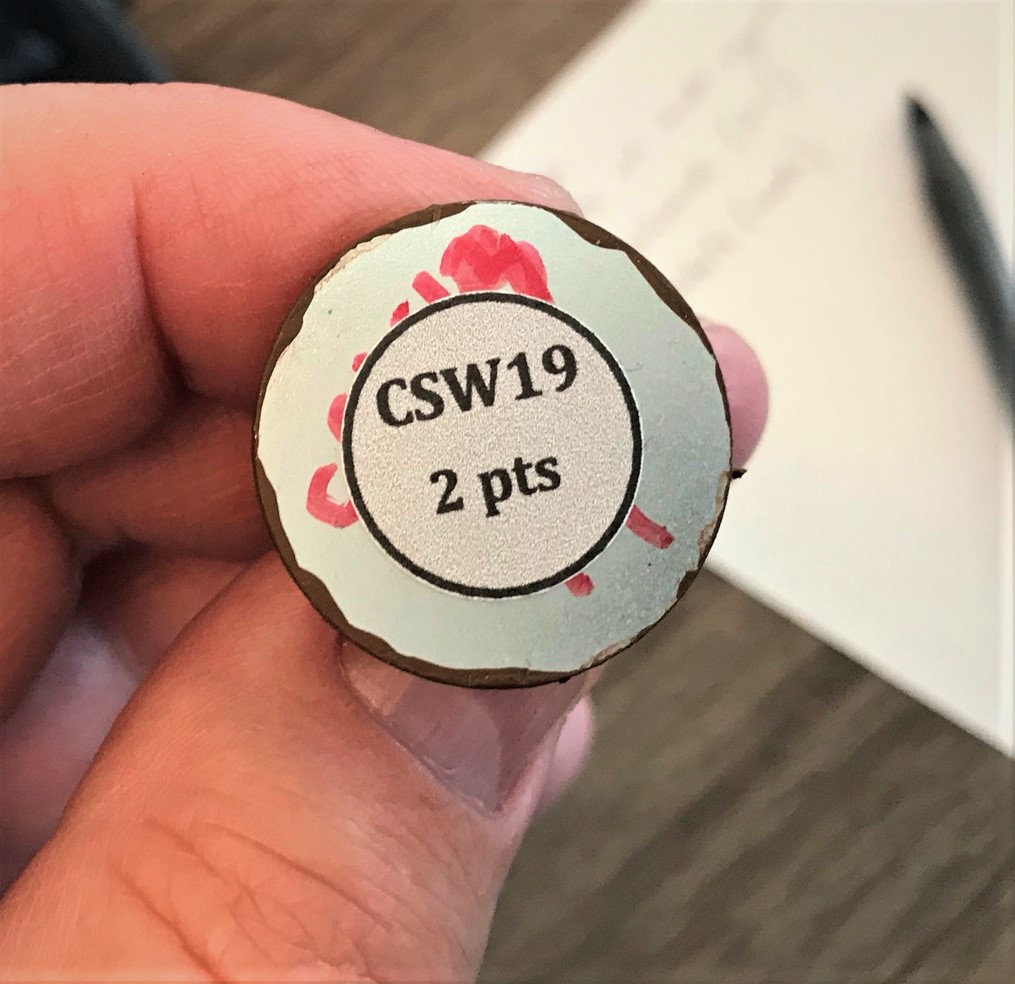
End result: Every figure now has a printed label with its ID number and point value printed on it underneath as you see below.
Printed off labels shown here in front of my PowerPoint design. Note the hole punch – trimming these with the Fiskars trimmer made punching them a breeze. (As if punching 216 labels could ever be considered a breeze!)Example of the under-label of a Conquistador Sword & Buckler Man figure.
The Really Useful Box Organization Challenge
Challenge: I can store and transport each of the figures in my Really Useful Boxes, but setting up a game and gathering figures from 216 figures for a warband can be too time-consuming if one has to look at each figure’s undersides! I needed to make my Really Useful Boxes even more useful.
Goal: Make my Really Useful Boxes more organized and more functional such that each figure has an easily identifiable slot for selection and also to speed pick up after a game.
Solution: Design and build a system within each Really Useful Box that facilitates easy figure identification for both gathering figures for a game and picking them up after a game while preserving any benefits for storage and transport.
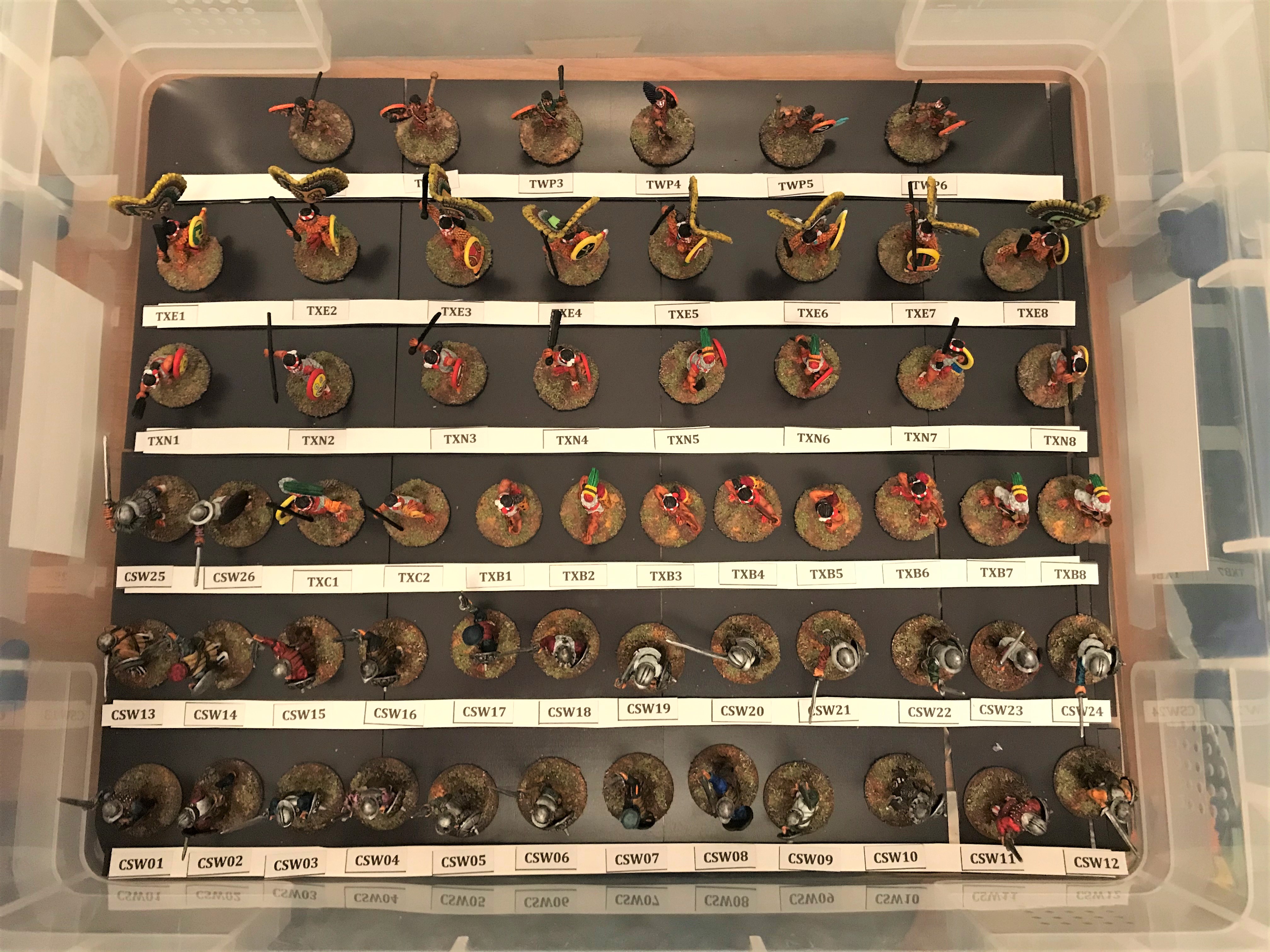
Process: Each 11-liter Really Useful Box is about 12” x 14.5”. I could have gone through endless iterations of how to organize the figures so that they would fit, and never be 100% sure my set up would work in reality. I came up with an idea that I think worked. Here again I went to PowerPoint. Most of my figures are on 1” bases, but a few are on 1.25” bases. I decided that I would make 3/8” labeling strips in layers upon which I could affix the figure identification numbers. I wanted each figure to have 1/8” clearance on both sides, so each row would be 1.5”. To verify how this would work, I made shapes in PowerPoint at 50% scale such that they fit on the screen. The shapes included how much space I would need for each type of figure. This really worked – and is a process that I will use again. You can see below my rough plan. Once I had my rough design, employing my Fiskars® SureCut™ Deluxe Paper Trimmer I cut strips of card stock and affixed them to the magnetically-lines Really Useful Boxes with small balls of poster tack. Then I made a second set of card stock strips to go on top of the first sets, affixing them with poster tack. Lastly, I just printed off my Excel spreadsheet pages onto card stock with the figure identification numbers on them, trimmed them up, and affixing them to the now-raised card stock “line” with poster tack. For the Conquistador cavalry, I made little corrals as they were in need of a bit more support. I then put all of the figures into the boxes as you see below – I ended up needing 4 boxes.
End result: Every figure has a labeled slot as you see below.
Really Useful Boxes before modifying them.Using PowerPoint as a CAD program, I designed the reorganization. Before any cutting!Aztec Box 1 finishedAztec Box 2 finishedConquistador Box 1 finished – note the cavalry corral.Conquistador/Tlaxcalan Box 2 finished
The Movement Tray Challenge
Challenge: I needed a safer way to transport figures to and from the tabletop.
Goal: Design and make a couple of magnetically-lined movement trays.
Process: This was pretty simple. I just used some old 1/8” thick balsa wood under two Aleene’s® Magnetic Tacky Sheets™ and reinforced the glue with wood glue. After being weighted down, the sheets were firmly attached.
End result: Success – I have two movement boards!
Magnetic Movement tray with some Conquistador Sword & Buckler MenMagnetic Movement Tray with some Aztec Cuachicqueh
The “Menu” Challenge
Challenge: Many of my games will be virtual, and some will be at convention games. I needed a simple way to convey two key concepts. First, I needed to present to the players the options that they had available with regards to figures’ stats and cost. Secondly, I needed to help them organize their troops – especially as Aztecs and Tlaxcalans have special organizations. In my games they are bigger and can have novice warriors attached. Normally, an Element in Feudal Patrol™ is 4-5 figures plus a leader figure. A Warband consists of 2-4 Elements plus a Warband Leader. To reflect how the Aztecs waged war, their Elements are bigger – adding up to 5 novice warriors to each Element (if they pay the point costs of course). This is useful as the novices can be assigned to drag away any incapacitated enemy for either sacrifice or slavery – which is historically in line with what they actually did do. Killing an enemy was regarded as “clumsy”. Additionally, each Mesoamerican Warband can have a Warrior Priest, who can both fight and help with Aztec or Tlaxcalan Morale results during a battle. At this point, my players could look at the figures in the boxes, but not have any information save the figure number, what he’s carrying and wearing, and the point value (if you pick one up to see the label). Certainly, this would not be efficient.
Goal: Design and make a simple way (a “menu” system) for players to make informed choices for both virtual and in-person games.
Process: What I did here was to go back to my Excel spreadsheet and size up the data to fit on a dashboard (more on that in a bit). Then I adapted Buck Surdu’s excellent data cards to fit on a single strip in Excel that would fit approximately 8” wide and 3/8” high. These I would make for each of my 216 figures – plus 4 additional to represent having the Army leader (Cortes or Pizarro) as a mounted versus dismounted choice for the Conquistadores. Each section of the Word document (basically a “menu” of figure choices) was organized as you see below. I then cut and pasted the strips from Excel into Word as pictures (paste special). I then added some brief information about the figures, as well as a picture of each of the 216 to help further identify the players’ options. Lastly, I created worksheets at the end of each “menu” to help the players build their forces. To do this, I went back to PowerPoint, and created the shapes that I wanted for the worksheets. I saved each individual slide as a JPEG (make sure you choose “Just This One” when it asks, and then edited the JPEG size. If it did not work, I just went back to the PowerPoint, resized, resaved as a JPEG, and repasted in Word. You can see the results below.
End result: I have three good menus that I can email or hand out to players at the beginning of a game and they will speed up the time for players to make their troop choices. As a side note, I prefer that players get to make choices in games!
Screen shot from Aztec MenuScreen shot from Conquistador Menu Screen shot from Tlaxcalan Menu Screen shot from Aztec Menu showing worksheets
The Dashboard and Stat Strip Challenge
Challenge: The players need a quick and easy reference system that designates their troops’ stats, and one that does not take up a lot of space.
Goal: Design and build a system of sufficient dashboards and supporting elements of appropriate ease and flexibility such that the players can play easier and faster and have more fun.
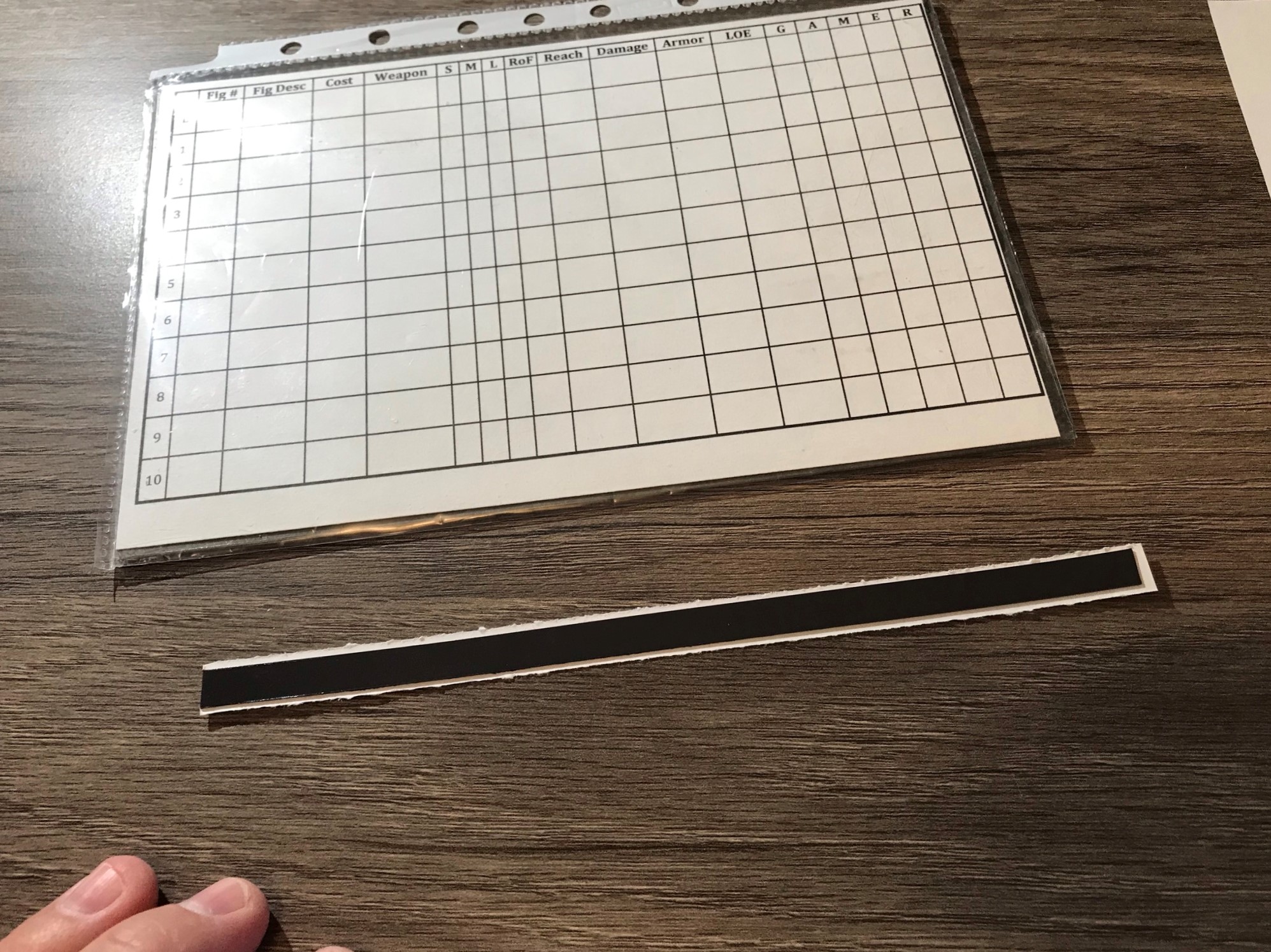
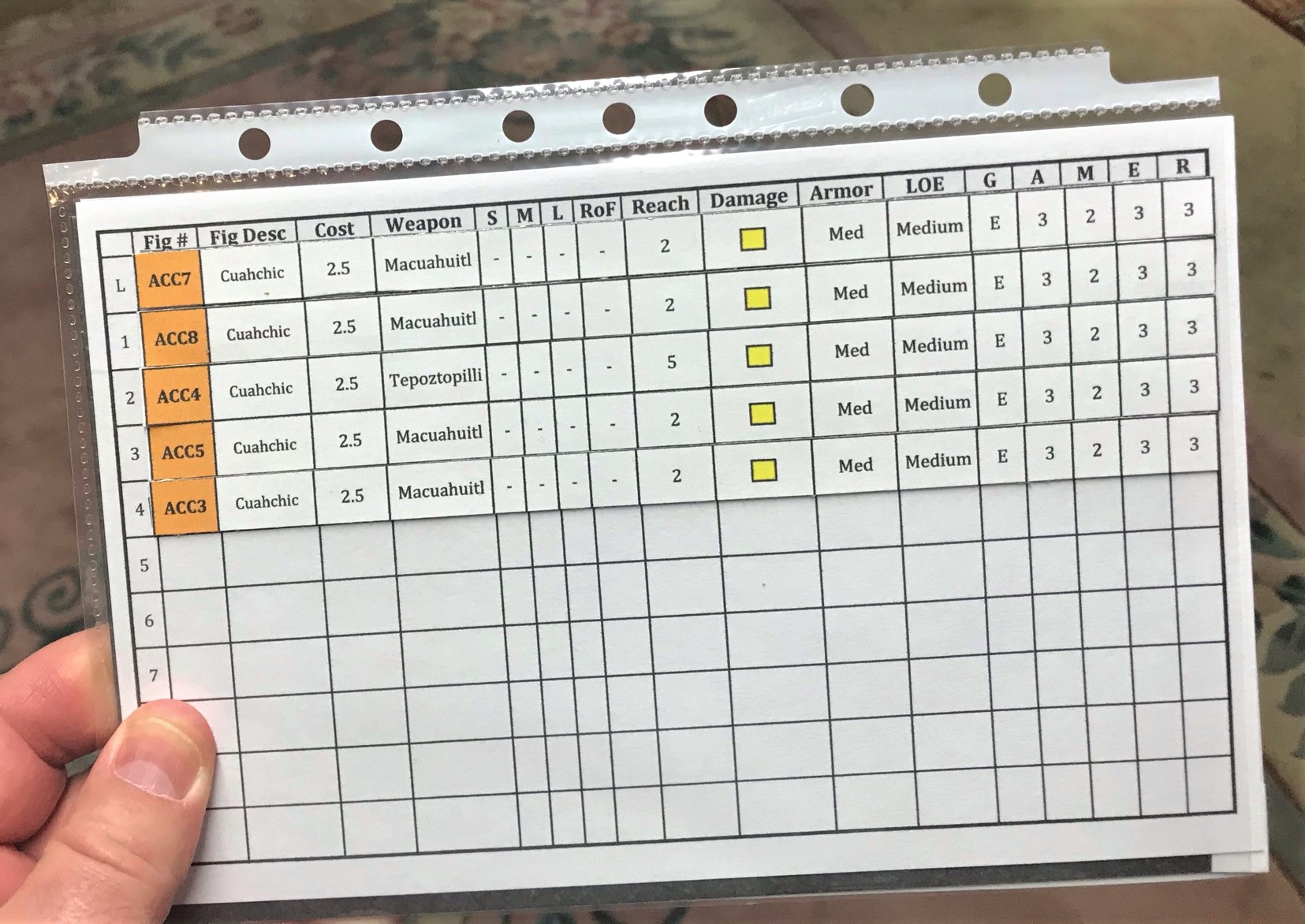
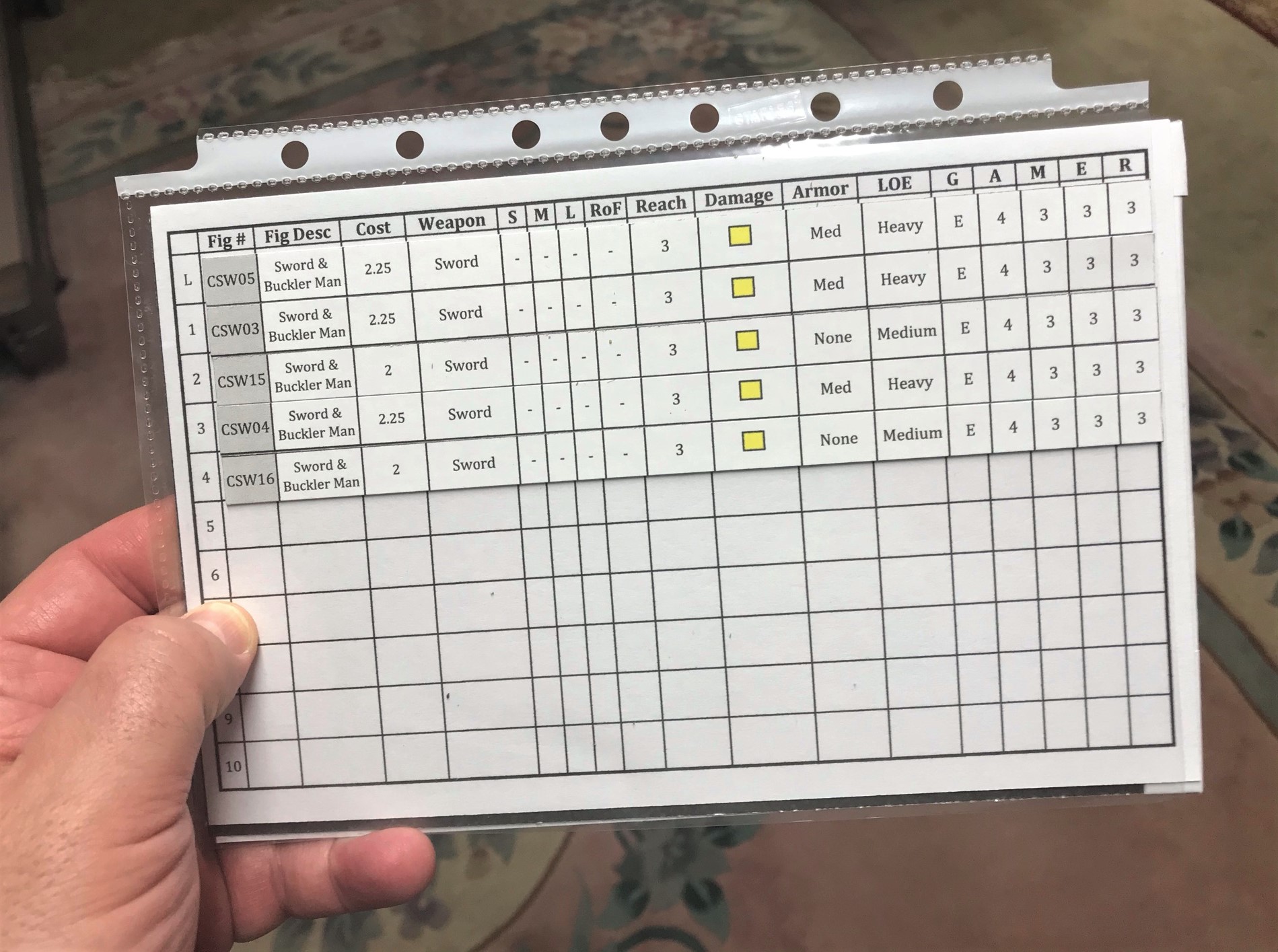
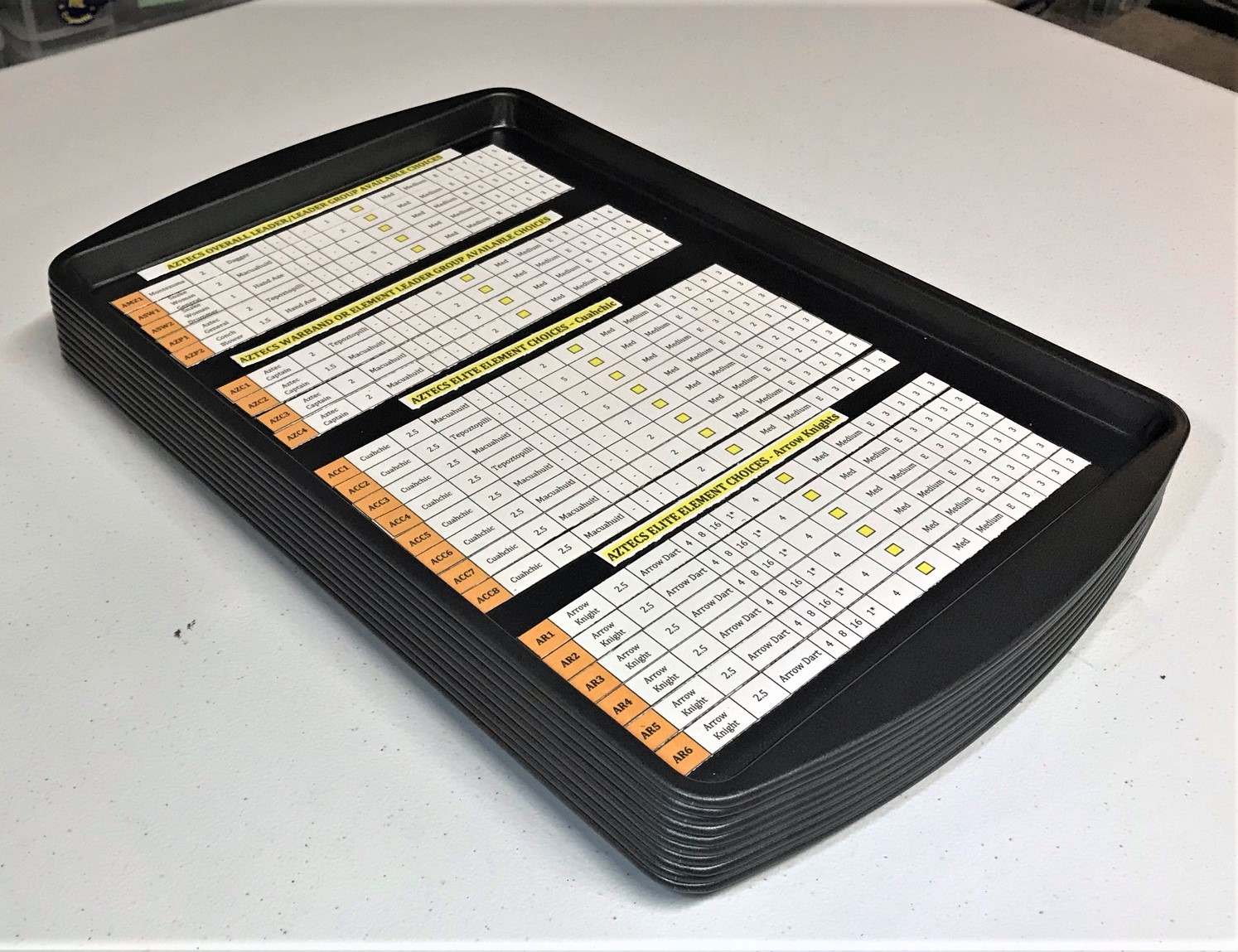
Process: I do like gaming systems and setups that are flexible – that is giving players adequate AGENCY. As you have read, the menus allow the players to make their choices, but to have them write down all data at the game’s beginning could be a bit of a pain. Plus, there can be a variety of differnt types of figures in some Elements. My solution was to build on what I already had been developing. I designed a dashboard in Excel that would accommodate being printed off on card stock and placed in a 5.5” x 8.5” sheet protector such as this one from Staples. And remember the stat lines from the menus? I used them to fit on the dashboards. How you say? Well first, I special-ordered steel base material in sizes of 5.5” x 8.5” from Wargames Accessories. The steel sheets do have some rough edges – which I covered with scrap pieces from the Avery shipping labels with no problems. These steel sheets fit inside the sheet protectors and under the dashboards – and I made 31 of these. Then I cut and pasted each individual stat lines into Word as pictures. Then I printed off each of these 216 + 4 stat lines (220 in total) onto strips of card stock and trimmed them with the paper trimmer to fit on the dashboards. To affix them to the dashboards, I needed magnetic strips – 220 of them. I found a really nice source on Amazon of 8.5” x 11” sheets made by Craftopia called Adhesive Magnetic Sheets that are the best that I have found. Again, my paper trimmer helped here to trim the magnetic strips to ¼” size width (fitting nicely under the 3/8” wide stat strips). I did need to replace my Fiskars blade once and augment that effort with scissors. Each of the 220 strips could be now be added to the dashboards, but how to organize and store these! My answer would come from Wal-Mart. Cookie sheets! I found inexpensive cookie sheets (see photo below) for $1.50 each that stack together. I organized the strips as you see below and added troop categories – basically mirroring the menus.
End result: I have a pretty decent system now for organizing a game. I have every figure’s stat line on a removable magnetically-backed card on 10 stackable cookie sheets. These stat lines fit perfectly on sheet protector-encased steel dashboards.
Cutting magnets and stat stripsA dashboard with a stat strip flipped over to show the magnet underneathExample of an Elite Cuahchic Dashboard – as Elites they would not have novices attached but if this was a Veteran Dashboard there would be sufficient room for the novices’ stat stripsAn example of a Conquistador DashboardMy solution for organizing my stat strips!My 10 cookie sheets with stat strips, as well as the dashboards and other aids discussed here.Closer shot of the cookie sheets with the labels on them mirroring the menusThe cookie sheets stack nicely for transport
The Tabletop ID Challenge
Challenge: Using the dashboards is useful, but telling which figure is which on the tabletop can be a challenge, especially virtually. As with the previous challenges, the figure’s lack of uniformity poses a gaming identification challenge.
Goal: Design and create a system that would allow for easy identification of the figures but would not overly detract from the aesthetic of the game.
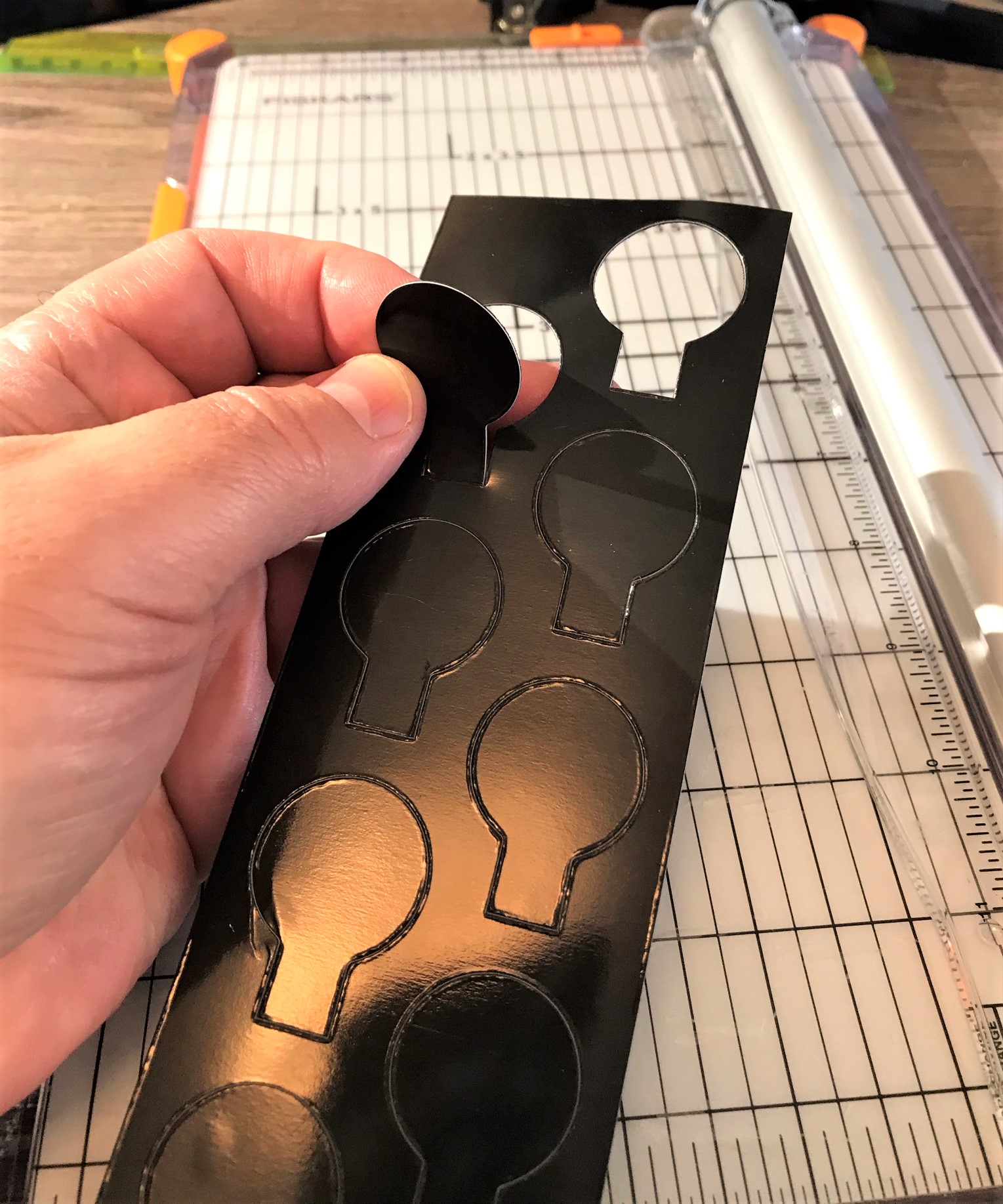
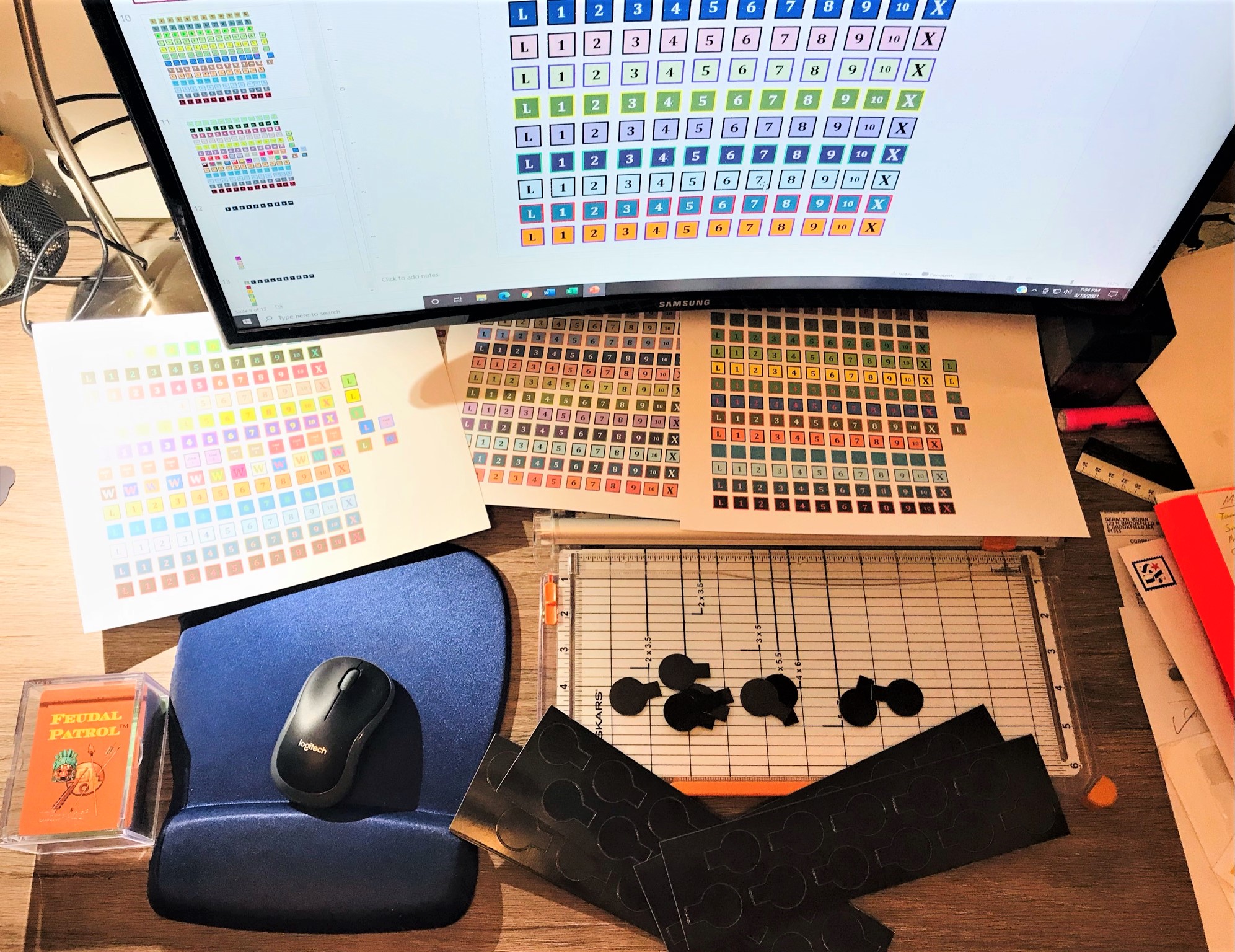
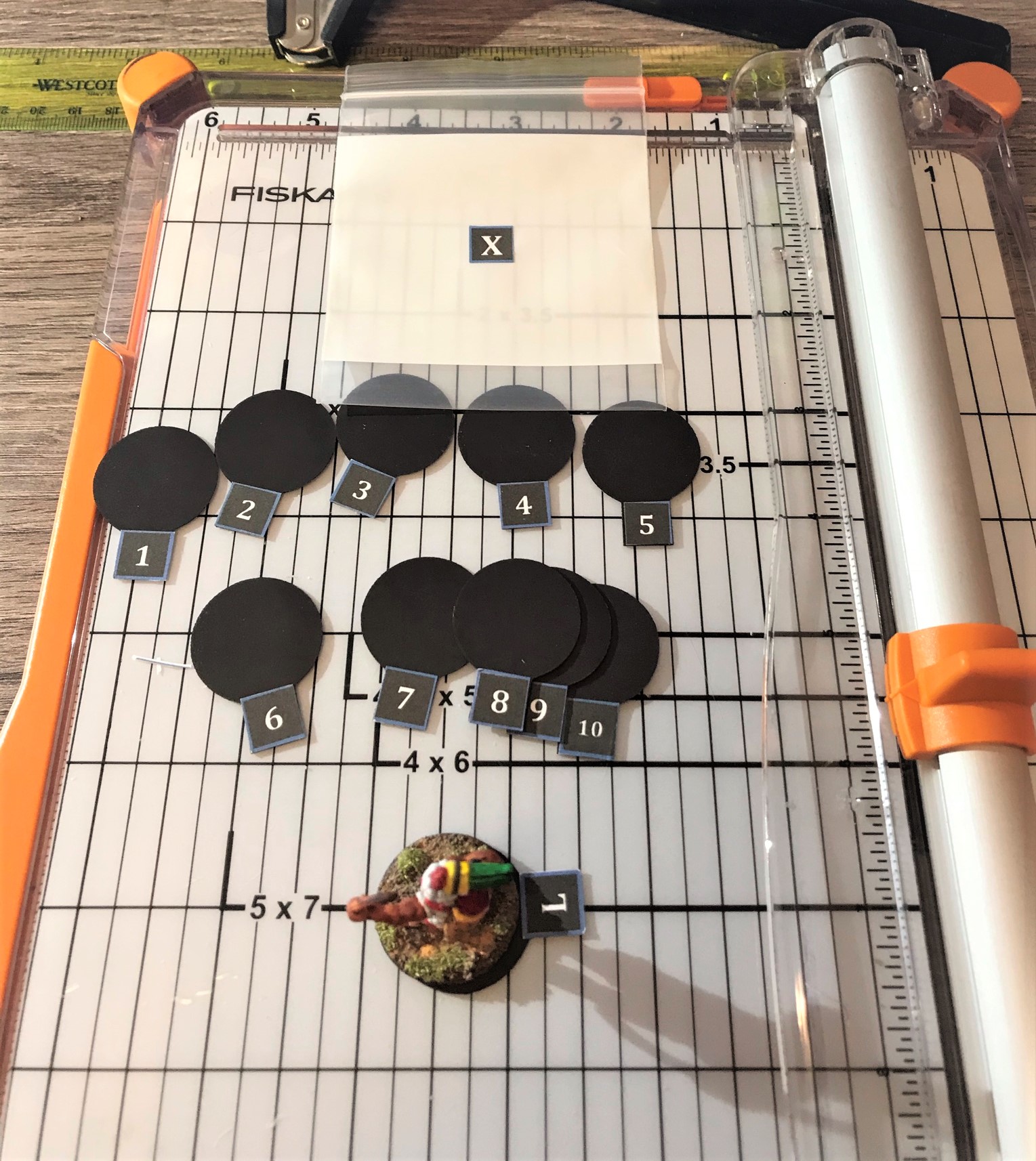
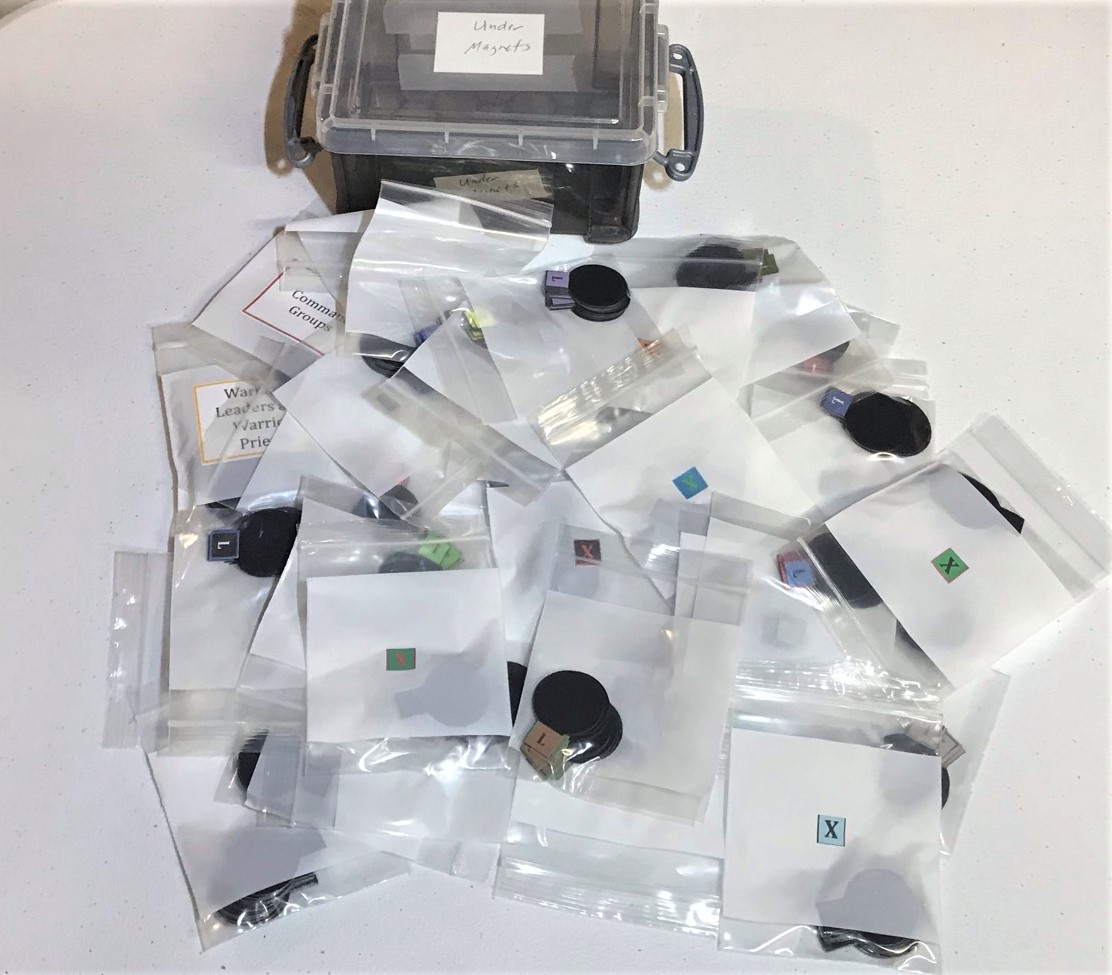
Process: I thought that as I used steel washers under my figures, my best option was to try something else in the realm of magnets. But what? I used some refrigerator magnets as prototypes of “under-magnets”, developed the concept, and then used PowerPoint to refine it. However, the concept of cutting out a few hundred magnets by hand was not appealing to me – plus I saw that they would look rough on the edges. I contacted Fridgedoor in Quincy, MA and worked with them to make me the magnets. There did not need to be any fancy printing on the bottom (non-magnetic) side as I knew that would be too tough and expensive. I had them make 20 mil thick sheets with each sheet having 11 of the under-magnets that could be easily popped out. One side (facing the figure) would be magnetic and the other printed black. The square jutting out on the magnetic side would be where I would affix labels for the figures. I used PowerPoint to make sets of differently colored and designed labels for the figures’ little jutting square. For the Elements, I made L, 1-10, and X (L for the Leader, 1-10 for the figure in the Element, and X for the baggie I would store them in). Then I printed them off, trimmed them, and affixed them. I ended up with 34 sets bags of under-magnets in individual little zip lock with ID numbers. This was made up of 33 sets of 11 and 1 set of 24 (different for Warband Leaders, Army Leaders, and Warrior Priests) for a grand total of 387 total under-magnets. I stored these in a small Really Useful Box, which in turn goes into another Really Useful Box for the game (see below).
End result: I have now a soup-to-nuts system for setting up and running my game more efficiently for both virtual and in-person games that is useful and easily transported.
My under-magnet design. Not rocket science!Popping out manufactured under-magnetsWorking on the under-magnets labelsHow the under-magnets will be used. Here, a Tlaxcalan figure has a Leader under-magnet. The rest of the set is above him, including the “X” marked baggie. Multiple color schemes were used.Lots of sets of under-magnetsHere you can see a group of Conquistadores and some Aztec Cuachicqueh engaging in battle – the under-magnets show who is who easily.
I hope that you enjoyed this blog (and all the other ones for the last 6 years!). Just for kicks, please take a look at my very first post, The Story of the Nightmare Legion. Here’s hoping I keep doing more and reading and more of yours as well – and let me know if any of my somewhat insane stuff inspires you or if I need to be medicated – just asking!
And here’s a pic for IRO who asked for a T-shirt shot in March. Not ready for selfies I guess.
GO ARMY! BEAT NAVY!
I’ll be announcing my next free giveaway contest soon – this time I’ve got some terrain to do and if you guess closest you can win stuff FREE from me. Just like in the last contest!
Don’t forget to let share your thoughts in the comments section!
Miscellaneous details and references for those interested in that sort of thing:
Previous posts on games, units, and other projects for my 16th Century Spanish Conquest supplement for Feudal Patrol™ – “Civilizations Collide”
Game Aids and Tools for Feudal Patrol games using the Civilizations Collide Supplement (this post)
Perro de Guerra (Conquistador War Dogs). 13 figures total: Outpost Wargames Services #CONS6 “War Dogs” (8 war dogs); Eureka #100CON13 “Dog Handler and Dogs” (1 dog handler/pikeman and 4 war dogs)
Conquistador Foot Command, Crossbowmen, and a Couple of Officers. 11 figures total: Outpost Wargames Services #CONC1 “Conquistador Foot Command” (a leader, a banner bearer, a drummer, and a bugler); Eureka #100CON04 “Crossbowmen” (5 crossbowmen); and Eureka CONC1 “Conquistador Officer” and an unknown SKU officer (2 officers)
2020 was – HOPEFULLY – a once-in-a-lifetime experience. As we all did, I had highs and lows on the personal side of life, the hobby side of life, and the golf side and others.
First, my deep thanks for all of you who regularly follow this blog and share your feedback with me. My thanks also to those whose blogs I follow. Your work inspires me.
As readers of this blog know, I am currently knee-deep in finishing up my forces for Feudal PatrolTM games. But I did set some goals back in January 2020 – so here I’d like to examine and share how I did – or did not do – versus those benchmarks, how my production was in 2020, how the blog did, and my personal highs and lows. I’ll also set some 2021 goals for myself. This is really to hold myself accountable here – and please know I’m open to any and all feedback.
How did I do versus my 2020 goals?
These are the goals I set for myself and how I did:
Games:
Run convention games at TotalCon, HAVOC, HUZZAH, BARRAGE, and the Fort Devens Game Day (and a few more maybe) –
Complete a supplement for Feudal PatrolTM for Mesoamerican warfare (Aztecs, etc).
Yes – this was a big part of my February and March. Civilizations Collide was published on the Sally 4th website and Buck Surdu’s website as free downloads. This is the accomplishment in 2020 of which I am most proud.
2. Be productive, but never sacrifice quality
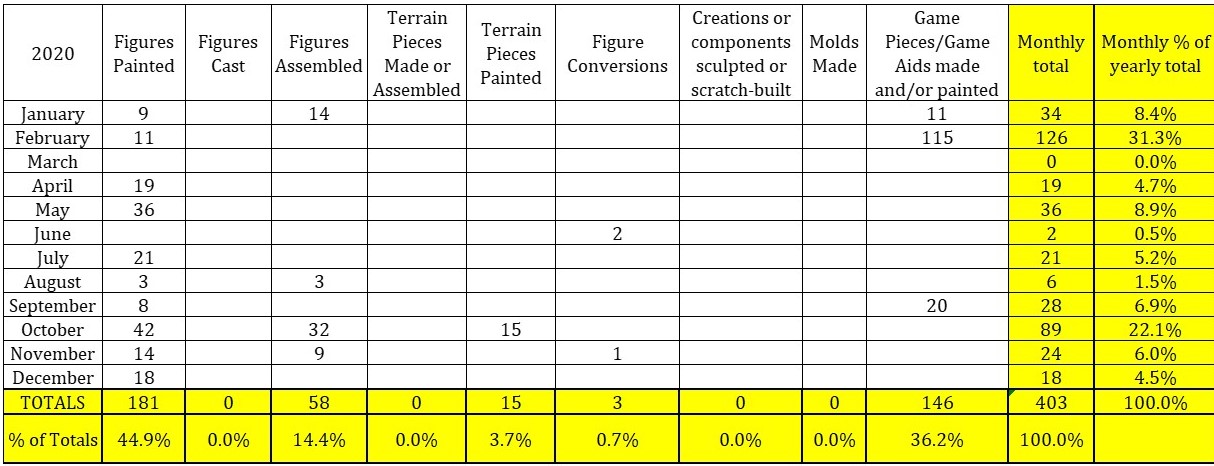
Well, you dear reader can be the judge of that. I did paint 181 figures this year versus 153 in 2019. My project total was only 403 versus 775 in 2019, but I did a lot of scratch-building numerous game aids (410 to be exact while I only did 146 in 2020), so my production was different. Still, almost 181 figures is a lot!
My 2020 production summary.
3. Grow the blog and find new ones to follow!
I definitely did both of these. As for the blog, it grew by about 12% in terms of views and visitors, and my followers are up too. My posts were fewer by five – so that is something I need to work on.
4. Entertain my audience!
I think so – again – you are the judge of this, not me!
Golf
Get my handicap below 14 (if I have enough non-gaming time!)
I did a lot of research in March and wrote Civilizations Collide, a supplement for the upcoming Feudal Patrol™ card-based wargaming system from Buck Surdu. The supplement covers the Spanish Conquest, to include the Conquistadores, the Aztecs of the Triple Alliance, Aztecs of the Aztec-Chichimec Alliance, the Maya, and the Inca. I cannot quantitate this as a hobby project, but it certainly was one!
April: 19 projects
Figures painted (19):
12 Aztec Novice Warrior figures painted for Feudal Patrol™ (28mm scale), from Wargames Foundry (#WF AZ018 Novice Warriors II)
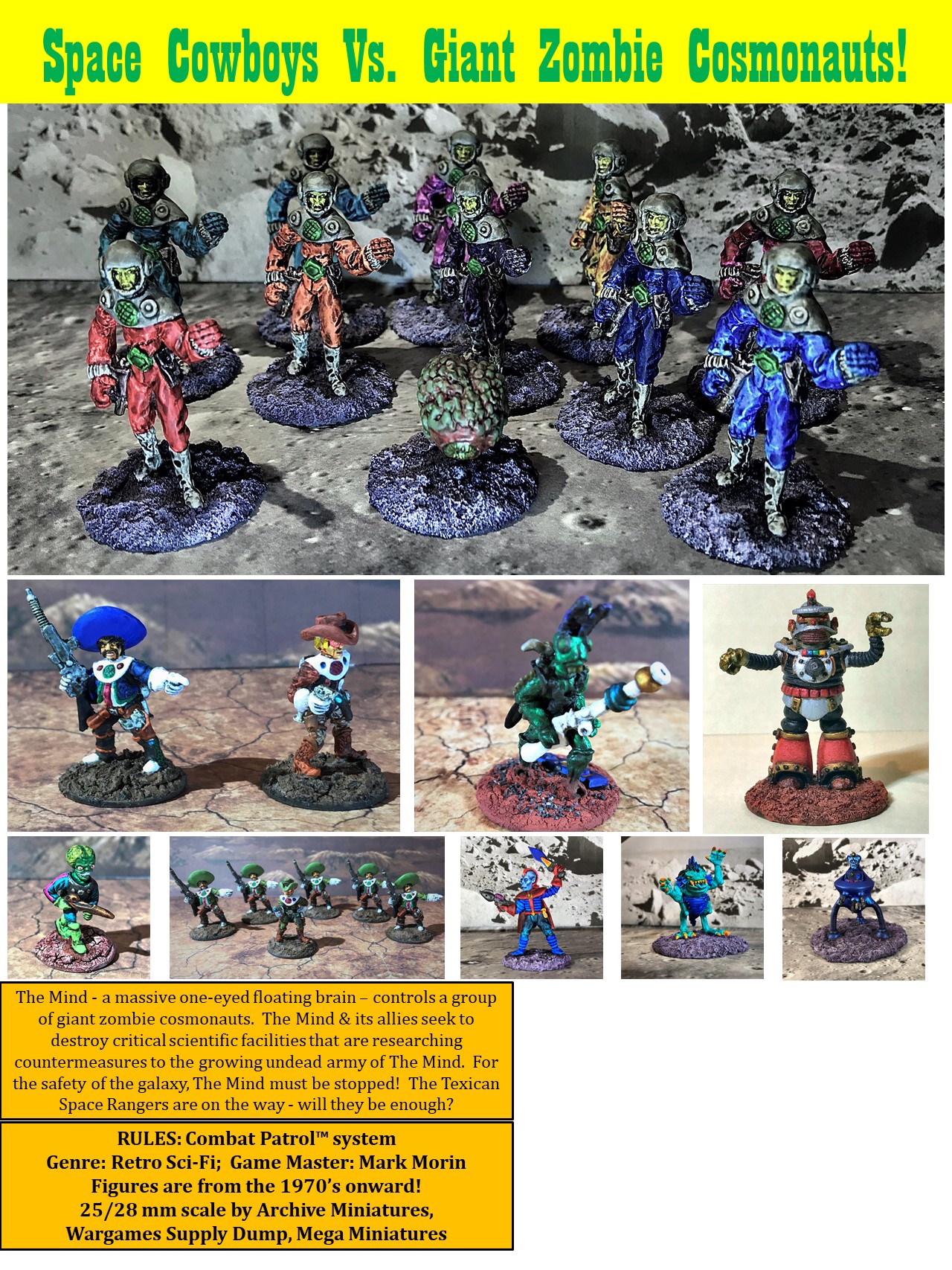
7 Power-Armored Frinx figures painted/repainted for Combat Patrol™ retro sci-fi games (25mm/28mm scale) from Archive (#2040)
18 Aztec Novice Warriors painted for Feudal Patrol™ (28mm scale), from Wargames Foundry Aztecs line (12 from 2 blisters of #AZ016 Novice Aztec Warriors I, 6 from 1 blister of #AZ028 Novice Aztec Warriors III).
Figures assembled (32):
8 Tlaxcalan Novice Warriors assembled for Feudal Patrol™ (28mm scale), from Outpost Wargames Services (#TX2 Tlaxcalan Novices in Padded Vests)
8 Tlaxcalan Elite Warriors assembled for Feudal Patrol™ (28mm scale), from Outpost Wargames Services (#TX3b Elite Warriors in Feather Costume)
1 Tlaxcalan Captain assembled for Feudal Patrol™ (28mm scale), from Outpost Wargames Services (#TXC01 Tlaxcalan Captain with Conch Blower)
1 Tlaxcalan Conch Blower assembled for Feudal Patrol™ (28mm scale), from Outpost Wargames Services (#TXC01 Tlaxcalan Captain with Conch Blower)
6 Aztec Warrior Priests assembled as Tlaxcalans for Feudal Patrol™ (25mm scale), from Ral Partha’s 1200 A.D. line, circa 1988 (#42-302 Aztec Warrior Priests)
8 Aztec Novice Warriors assembled for Feudal Patrol™ (28mm scale), from Wargames Foundry Aztecs line (6 from 2 blisters of #AZ016 Novice Aztec Warriors I, 2 from 1 blister of #AZ028 Novice Aztec Warriors III).
8 Aztec Cuachicqueh (the “Shorn Ones” shock troops) figures assembled for Feudal Patrol™ (28mm scale), from Outpost Wargames Services (#AZ006 Cuachic Warriors- body suit and back banner)
1 Aztec Warrior Priest figure assembled for Feudal Patrol™ (28mm scale), from Wargames Foundry (#AZ011 Montezuma and Chieftains)
Figures converted (1):
1 Aztec Chieftain converted to one with a signaling drum from #AZ011 Montezuma and Chieftains
















































 Mark A. Morin