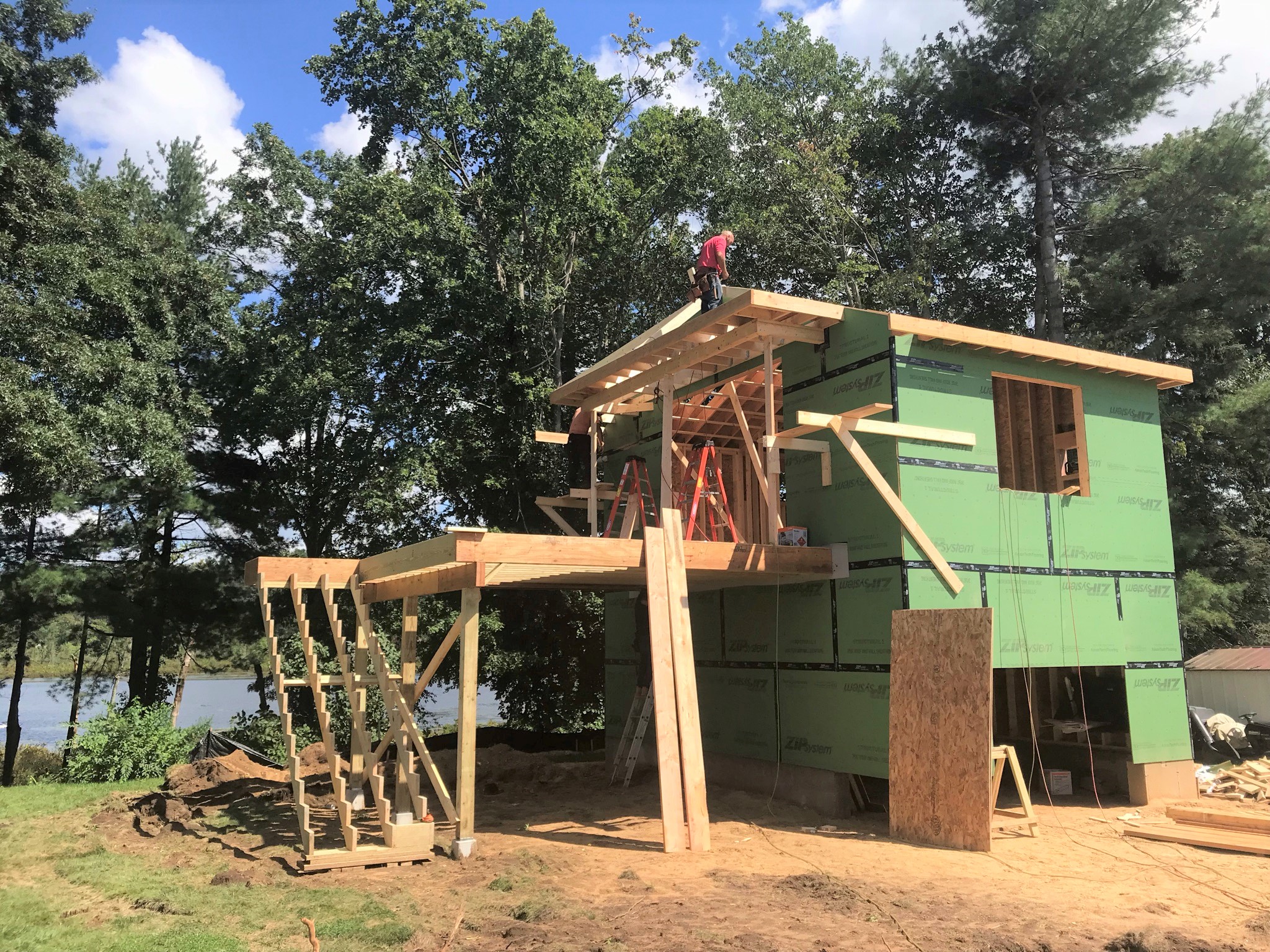
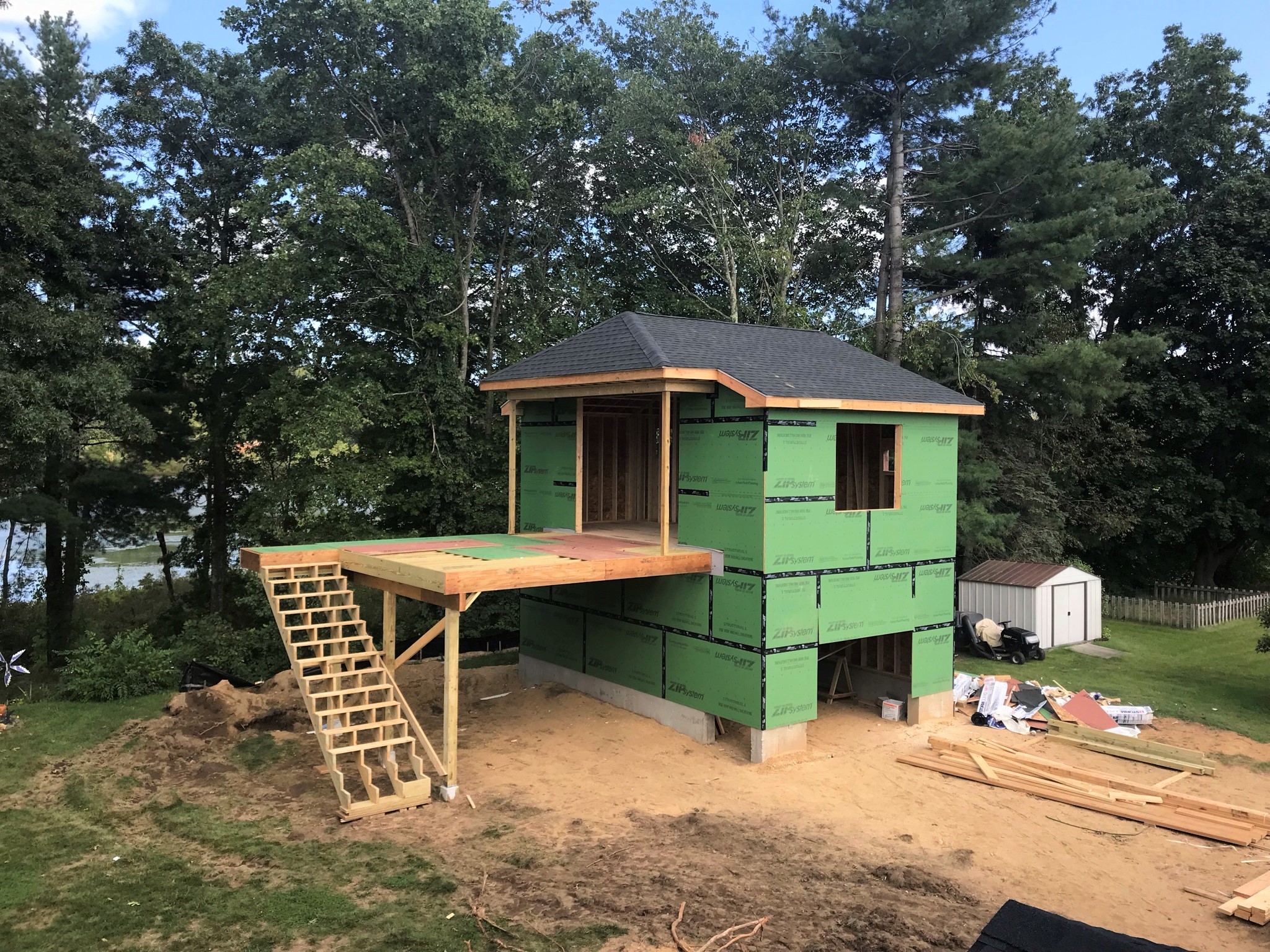
Week 12 saw work being done on both decks, and well as connection to the National Grid gas line. We also had Evandro Rodrigues from E&V Masonry (who works with Ready Installs) come out to lay out the paving stone areas and the proposed gas fire pit. They also placed the concrete floor in last week.
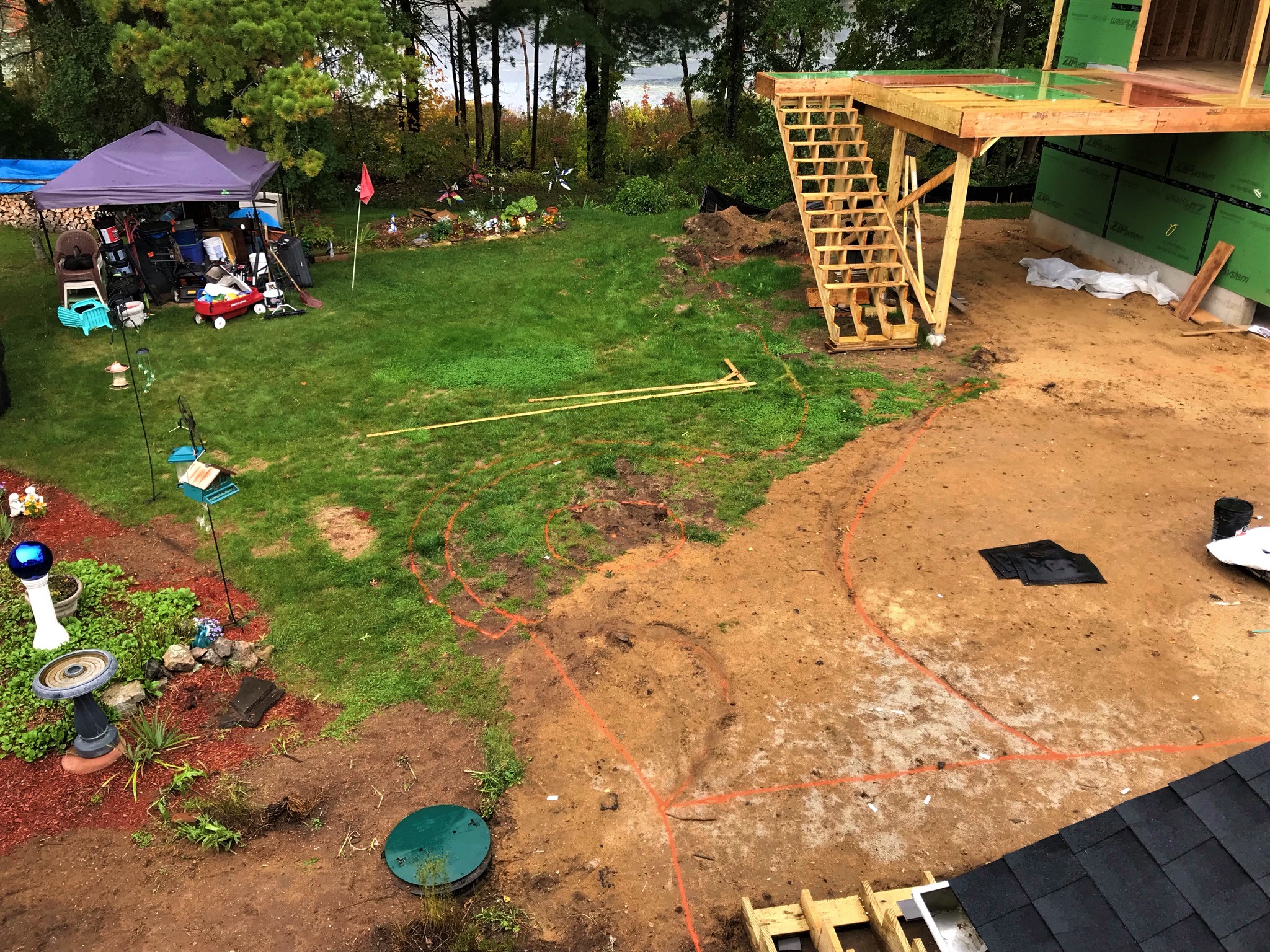
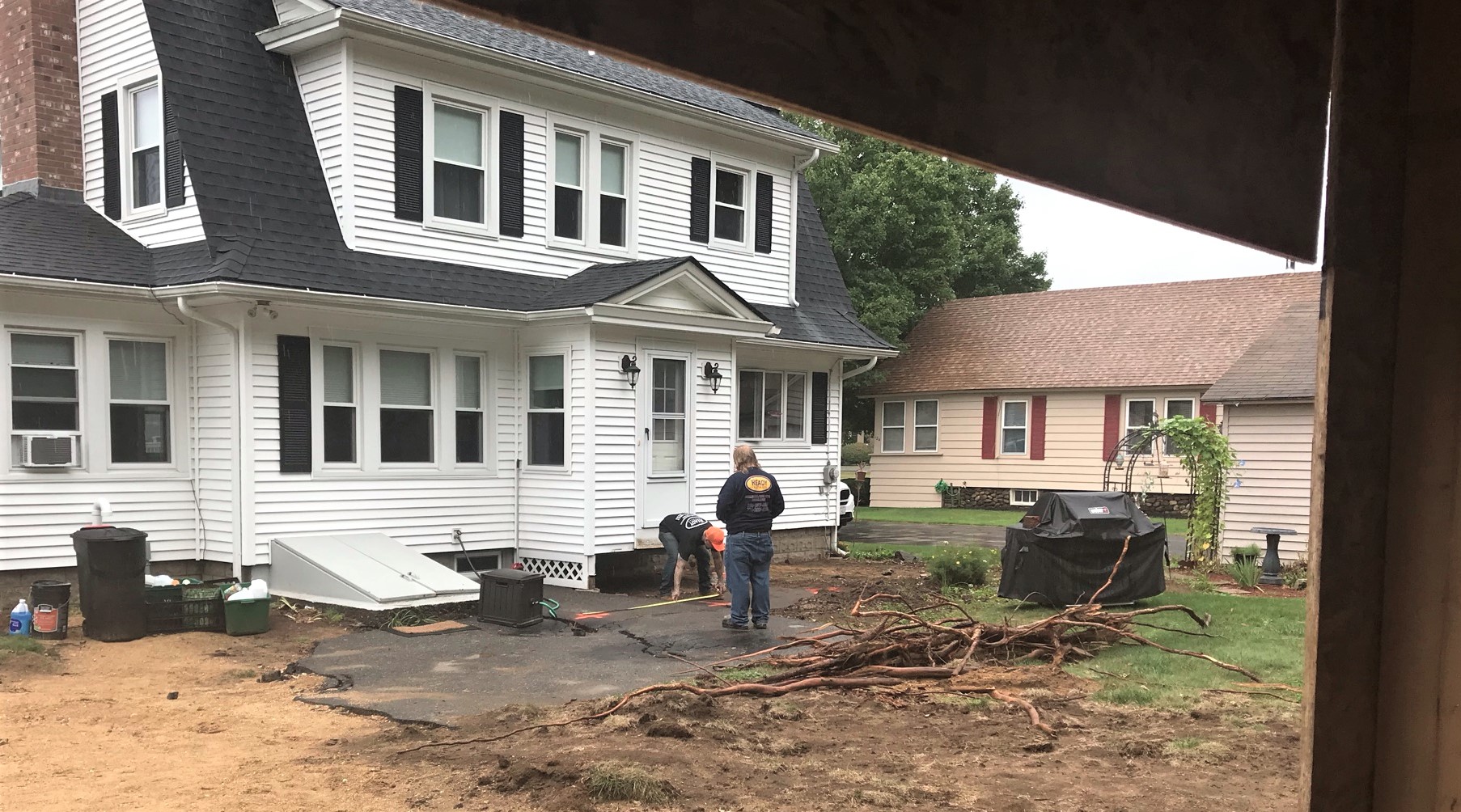
It’s a bit difficult to see, but the spray-painted orange lines designate the plan for paving stones. These patio stones will go under the garage deck and stairs, then connect to the house deck. The gas fireplace will be the round circle here.
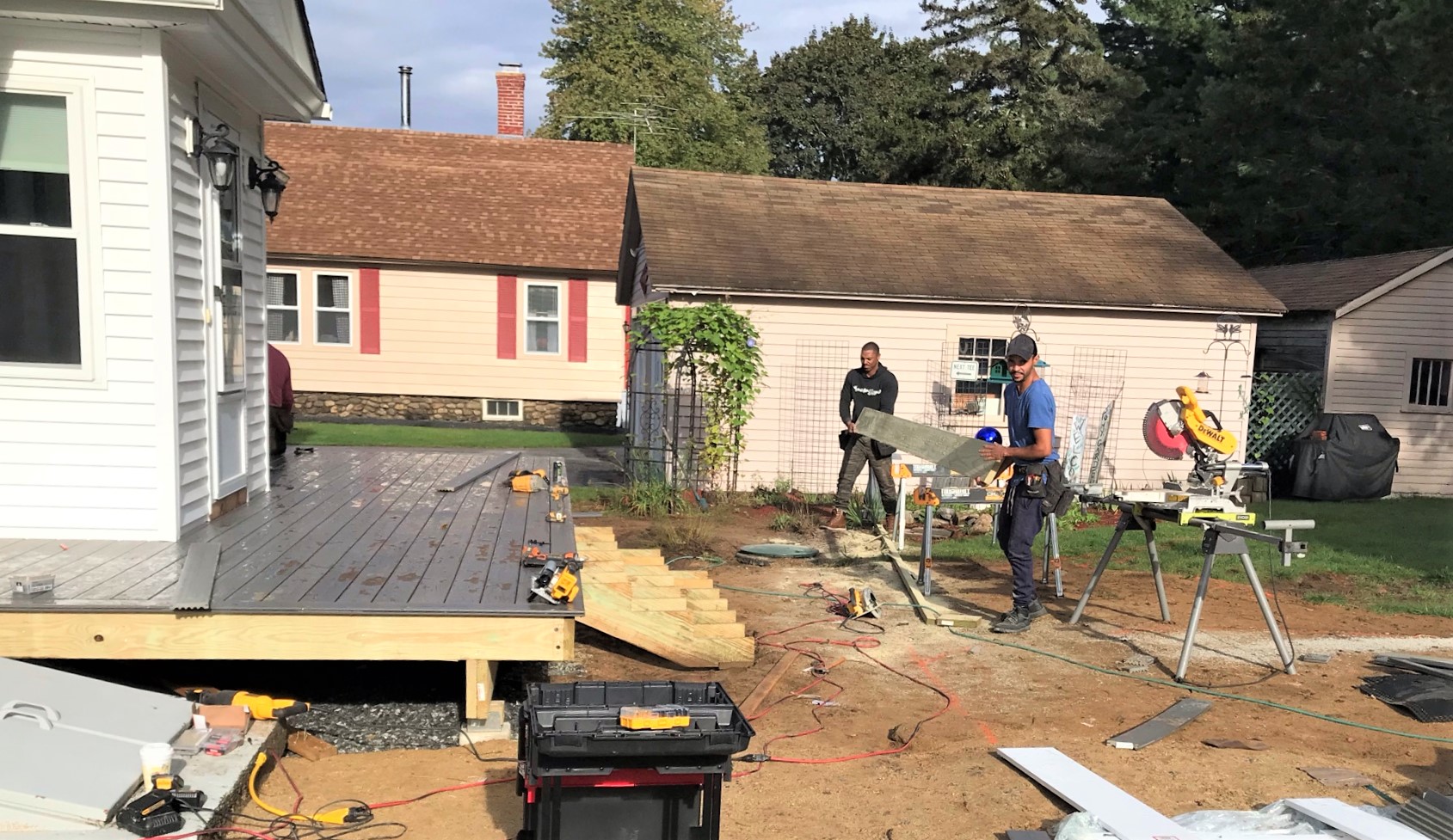
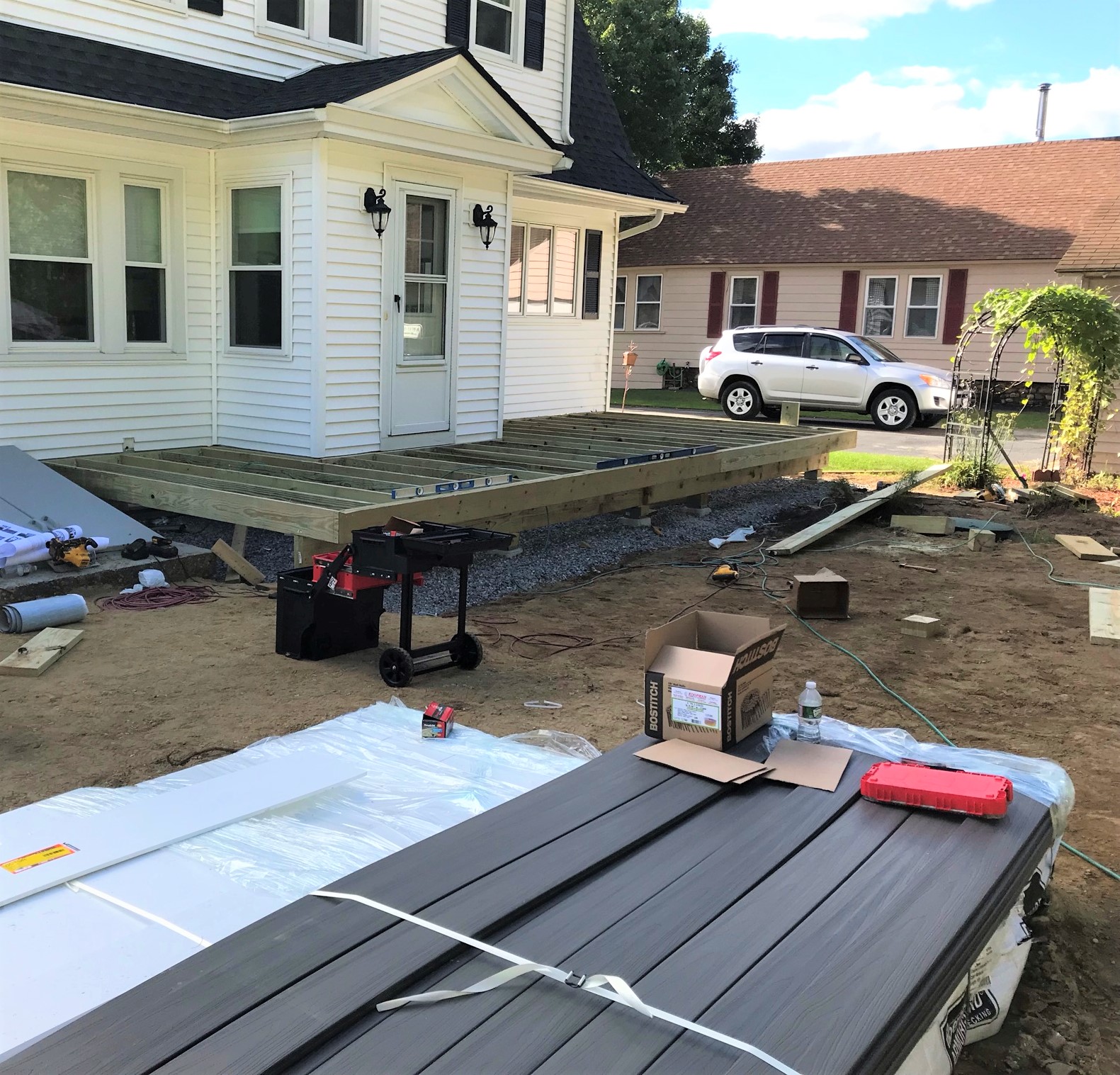
Work continued on the house deck as you can see below.
The house deck in progress.
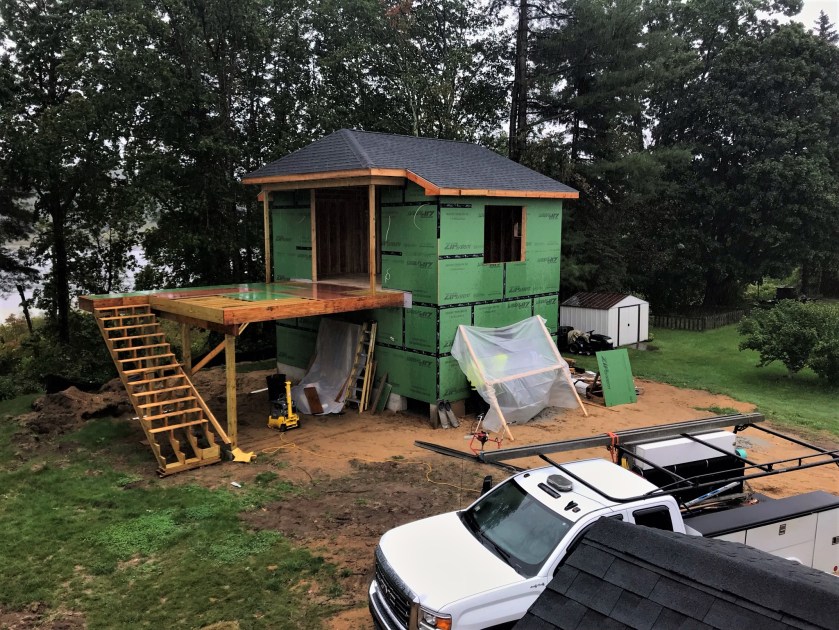
The garage stairs were stabilized and set up for decking.
The stairs being braced and supports added.Close up of previous shot.
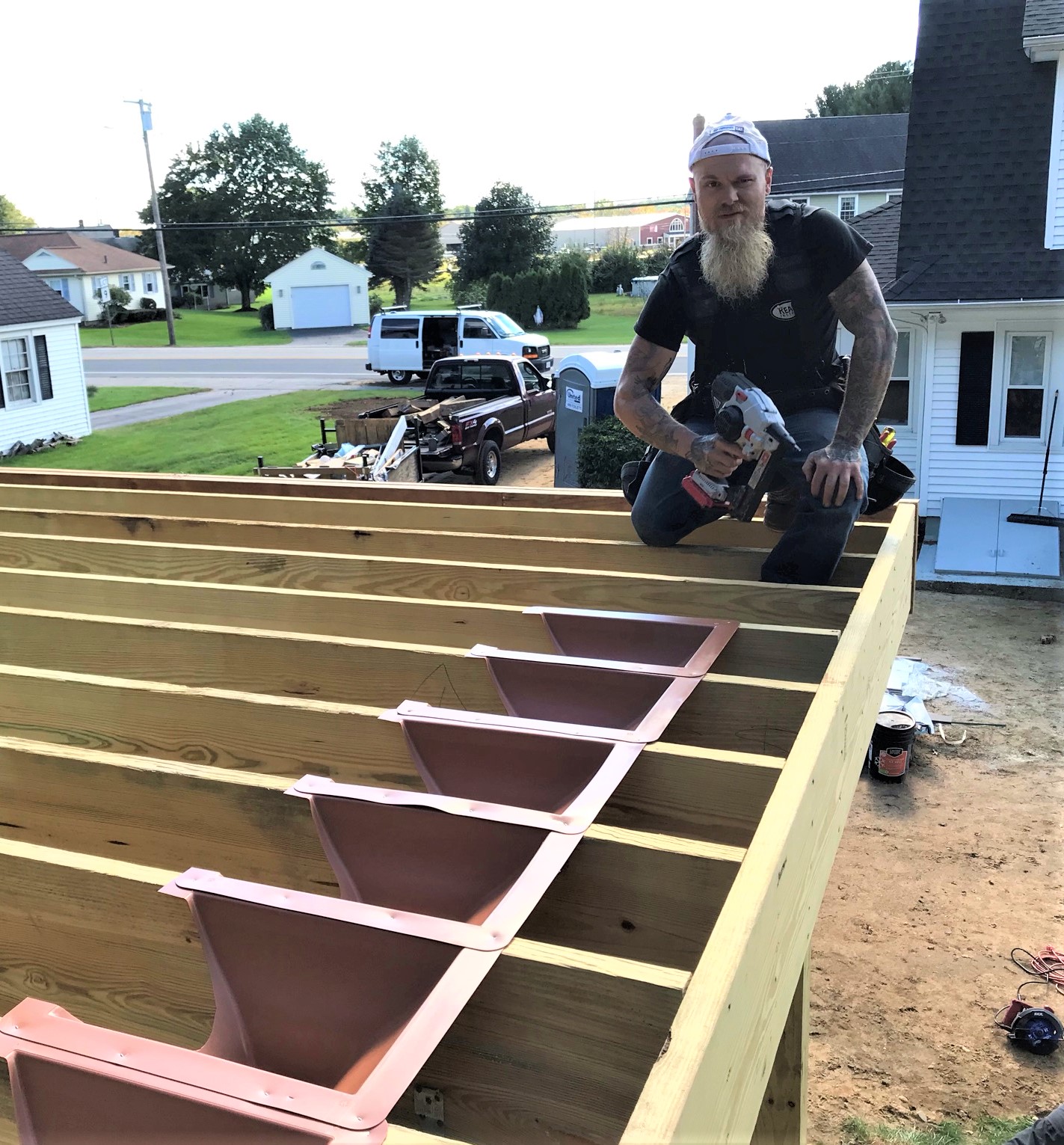
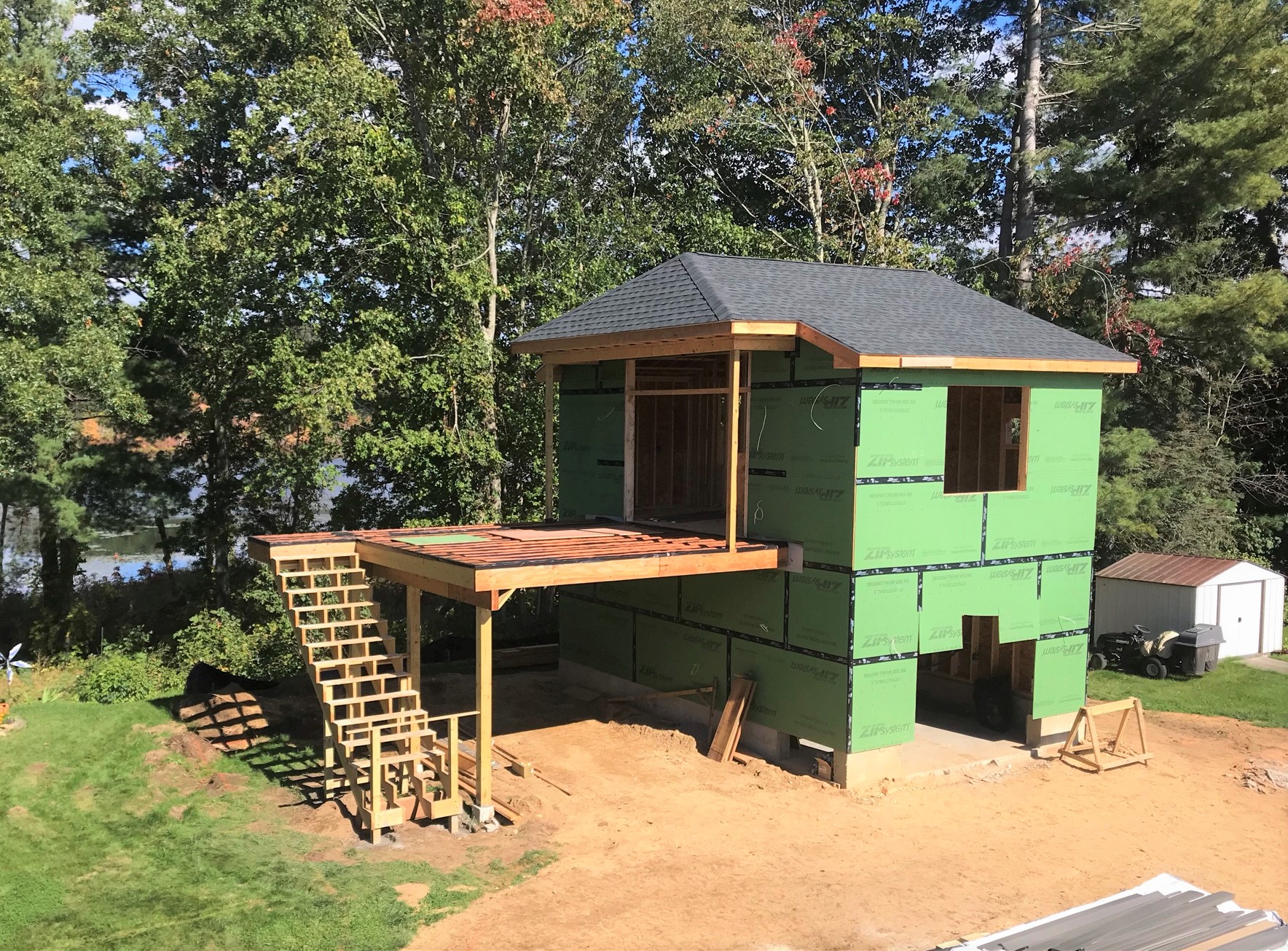
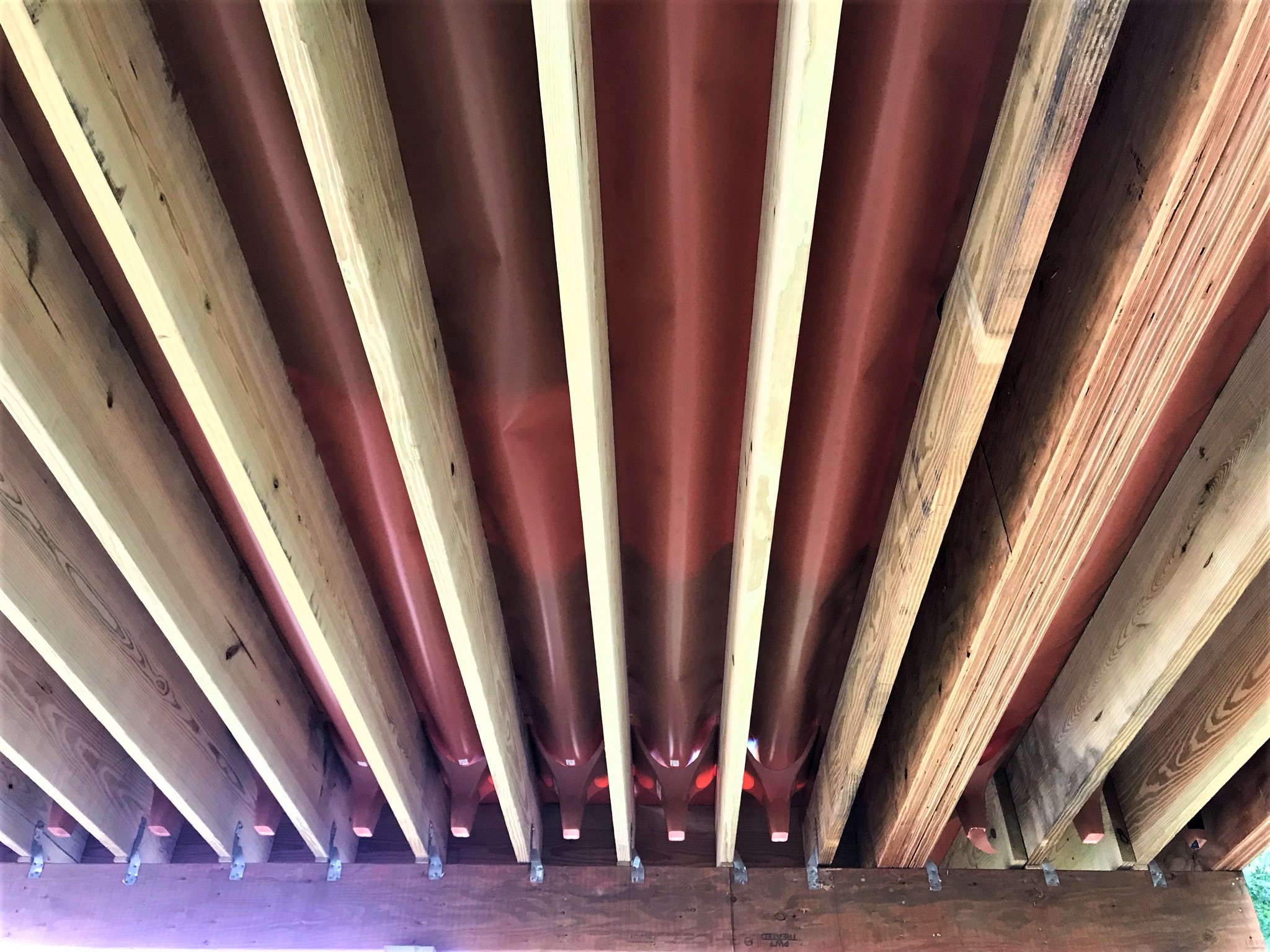
On the garage deck, the Trex rain gutter system was installed. This will keep the patio underneath dry. It will feed into a gutter under the downspouts.
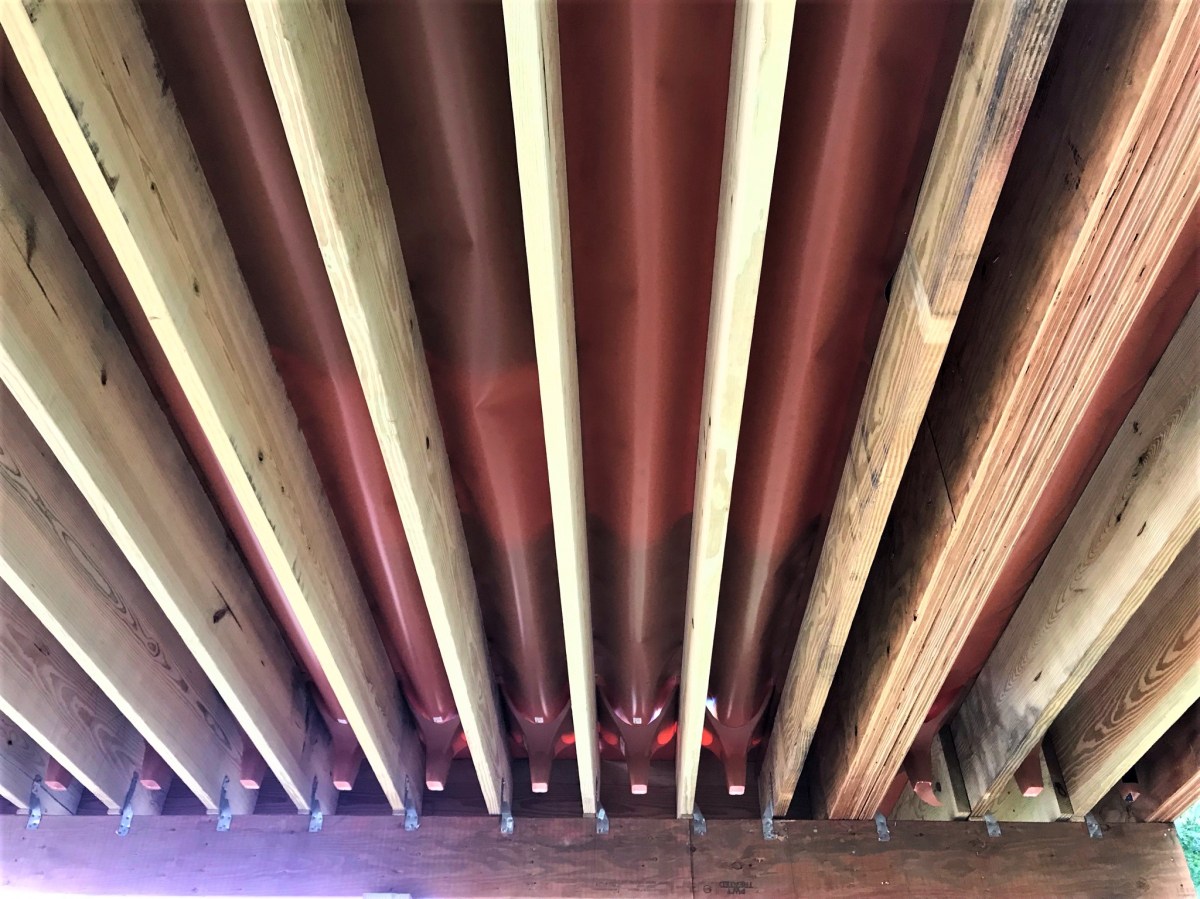
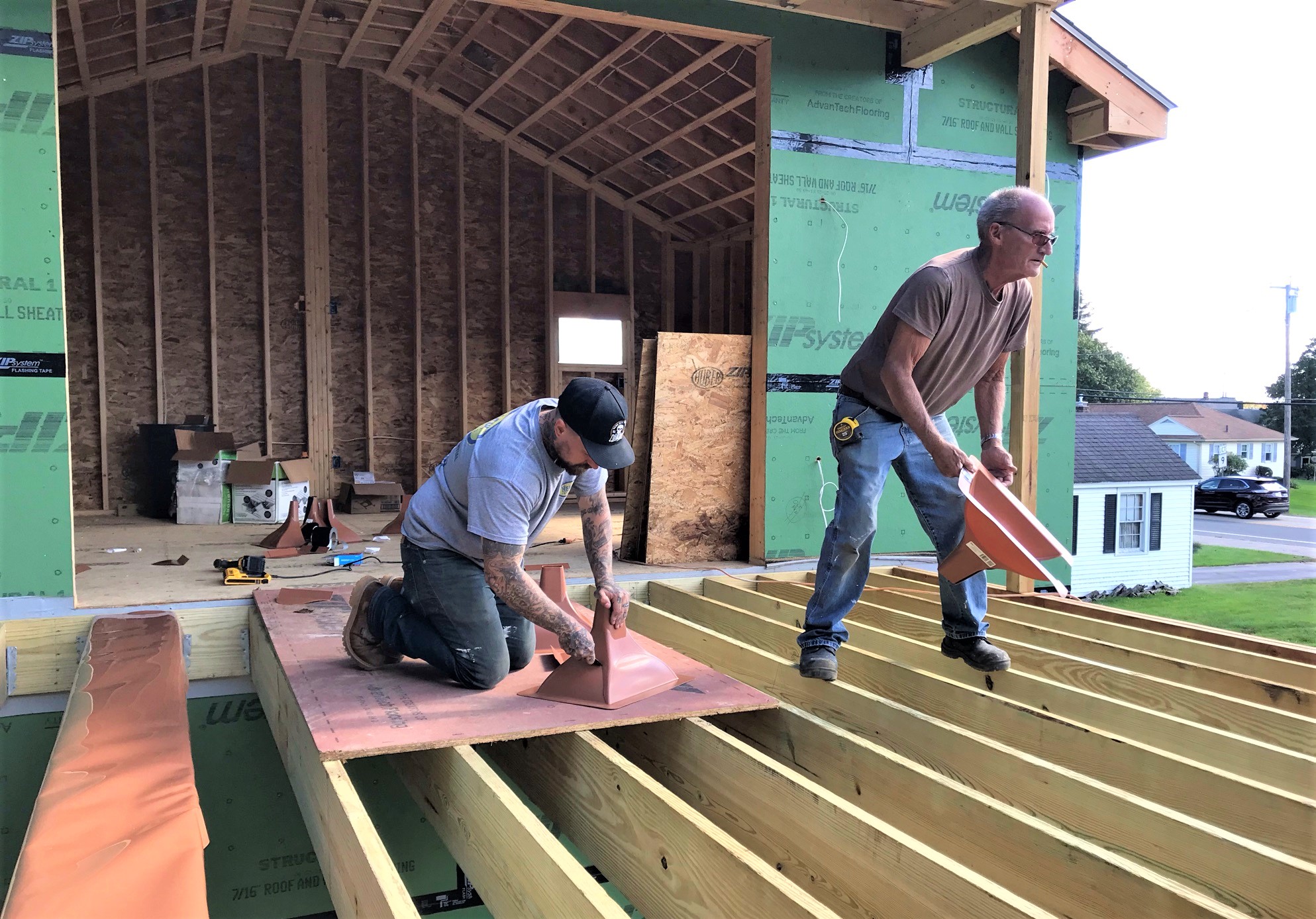
The downspouts fit between the joists (with some help).Jon and Will prep the downspouts for Josh.Josh Victor stapling in the downspouts.
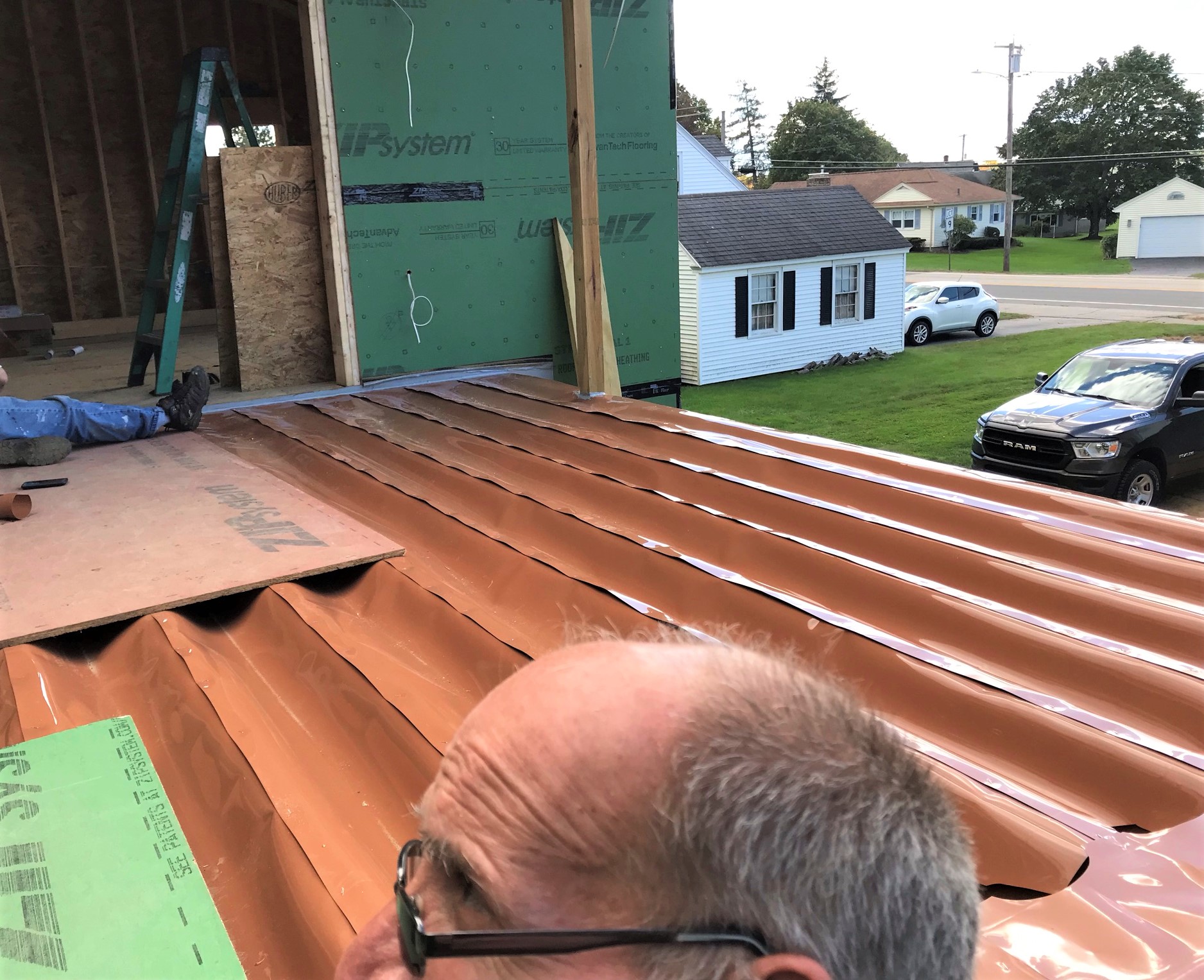
After the downspouts were in, the membrane that will carry the water to them is installed with the proper slope and sealed.
You can see the membrane here (and Will’s head).Top view of the deck.Underneath view.
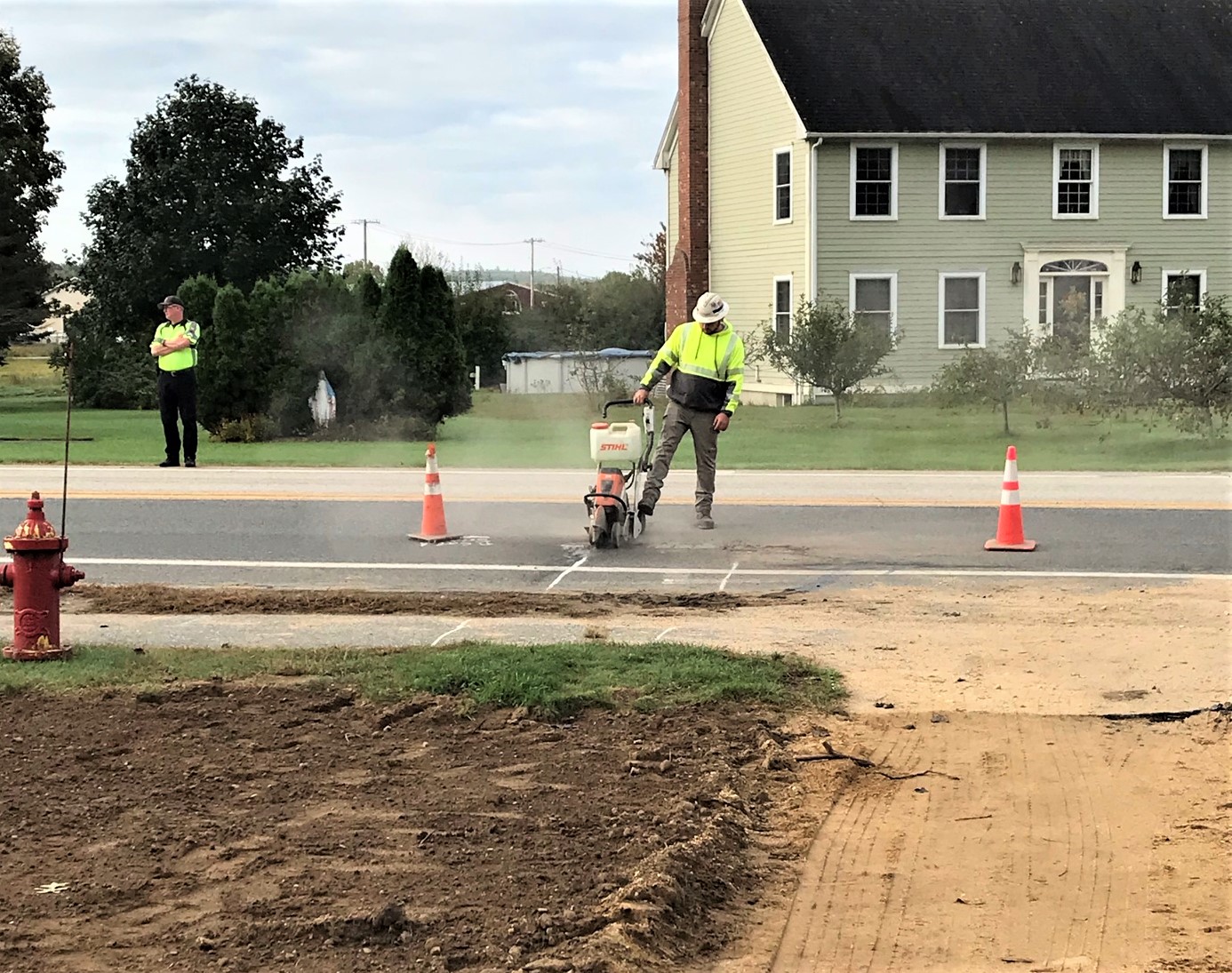
Friday was a very active day, as National Grid came in to excavate and place the gas line. We also had deliveries for the finishing of the garage deck and stairs.
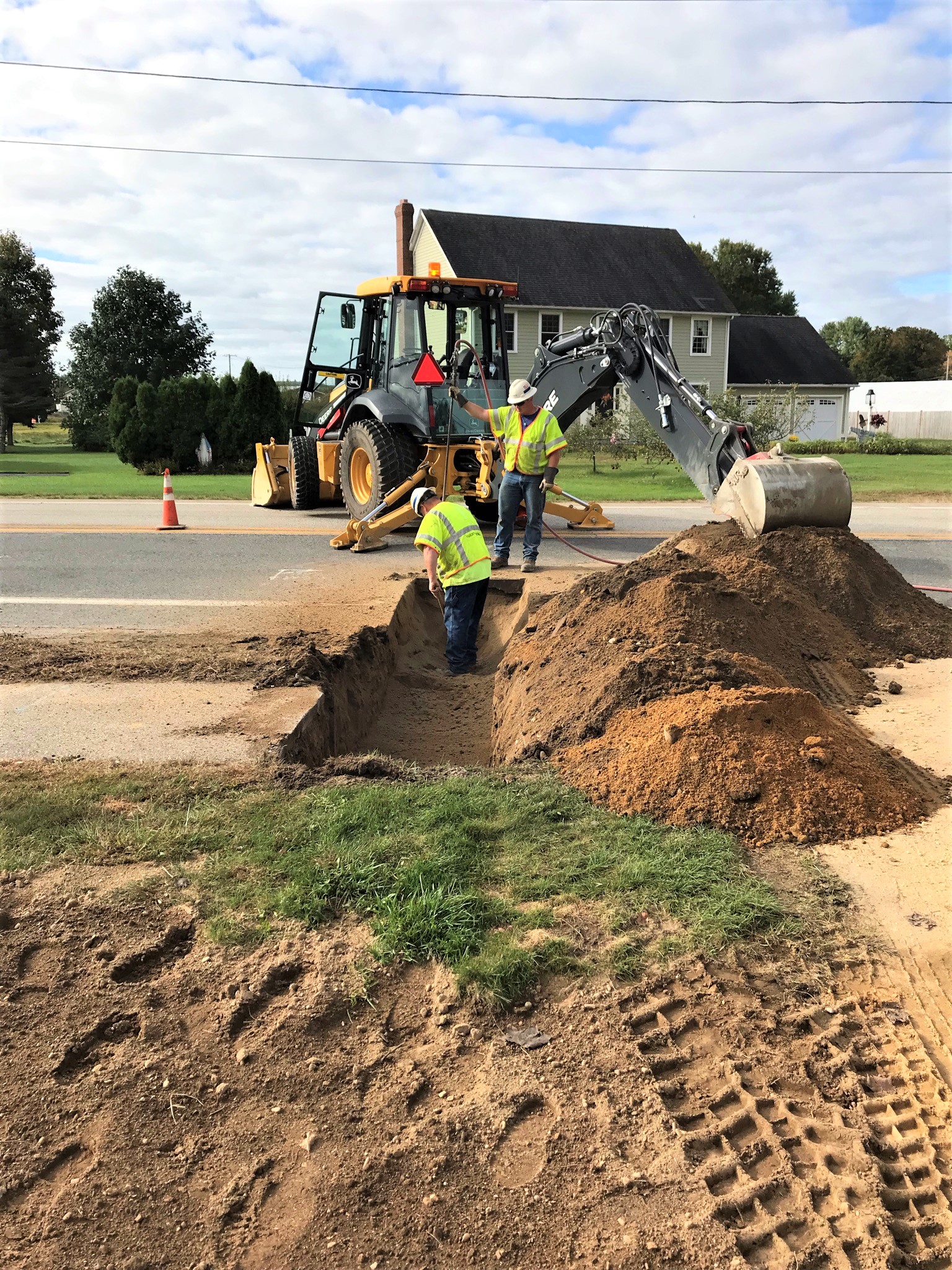
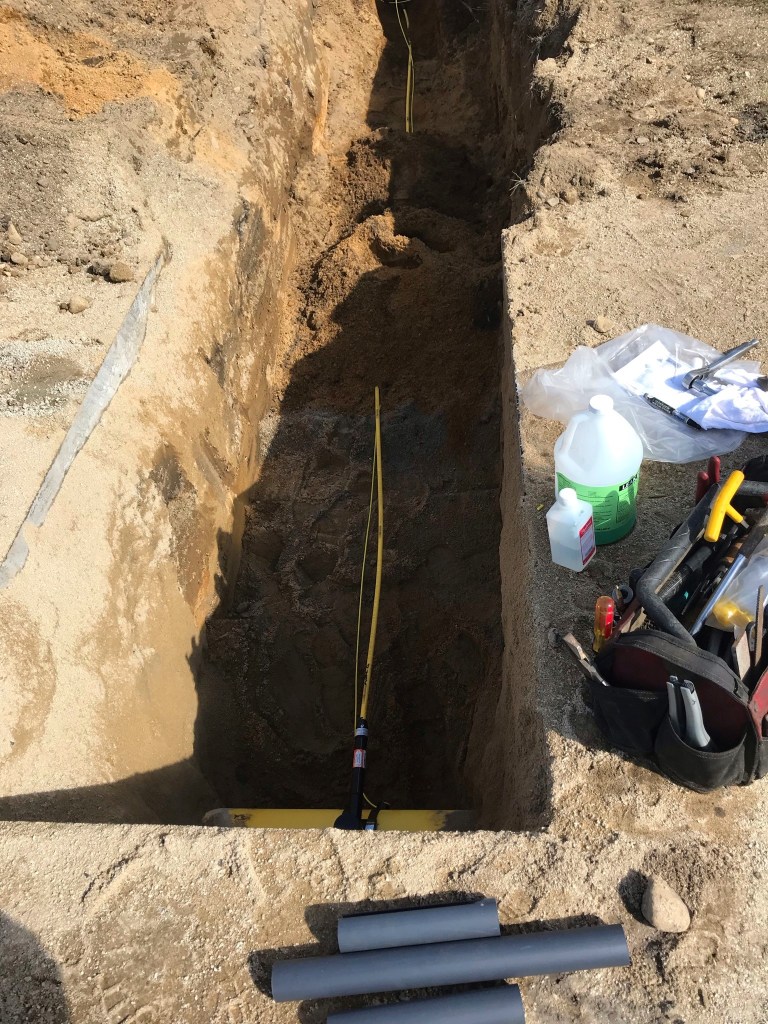
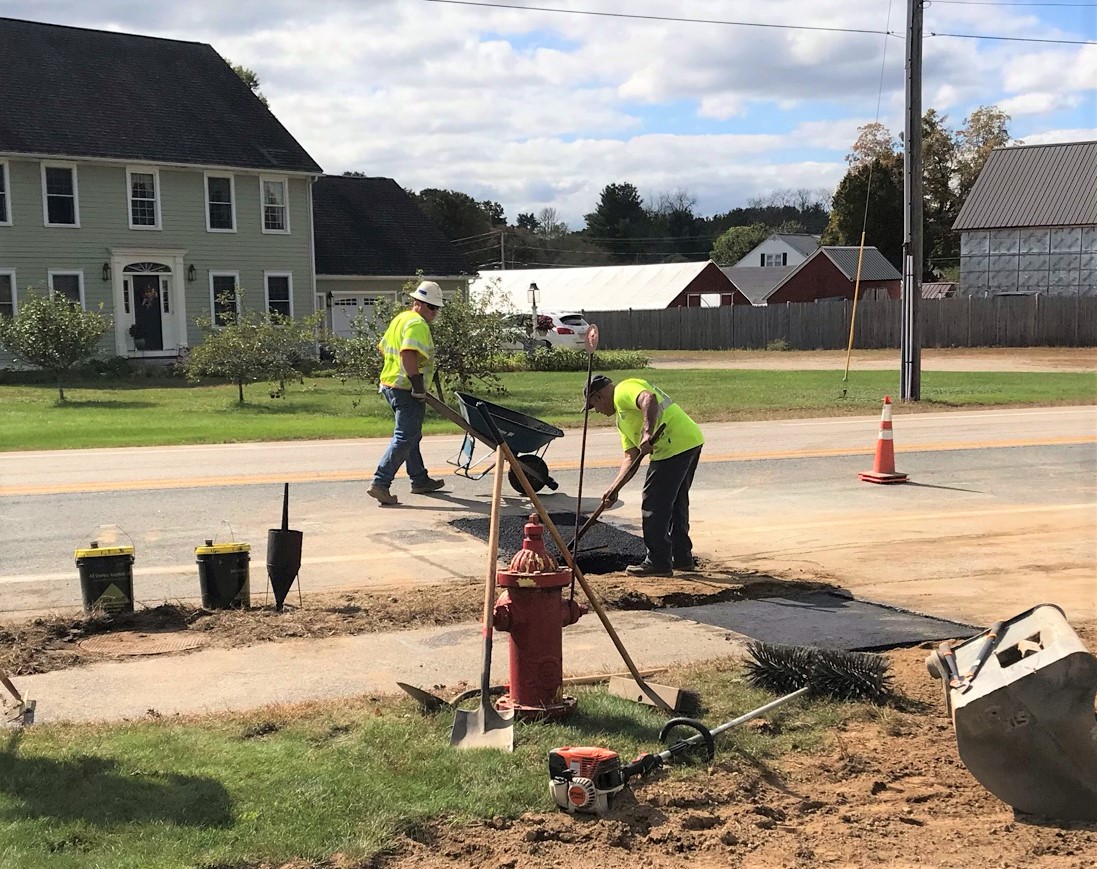
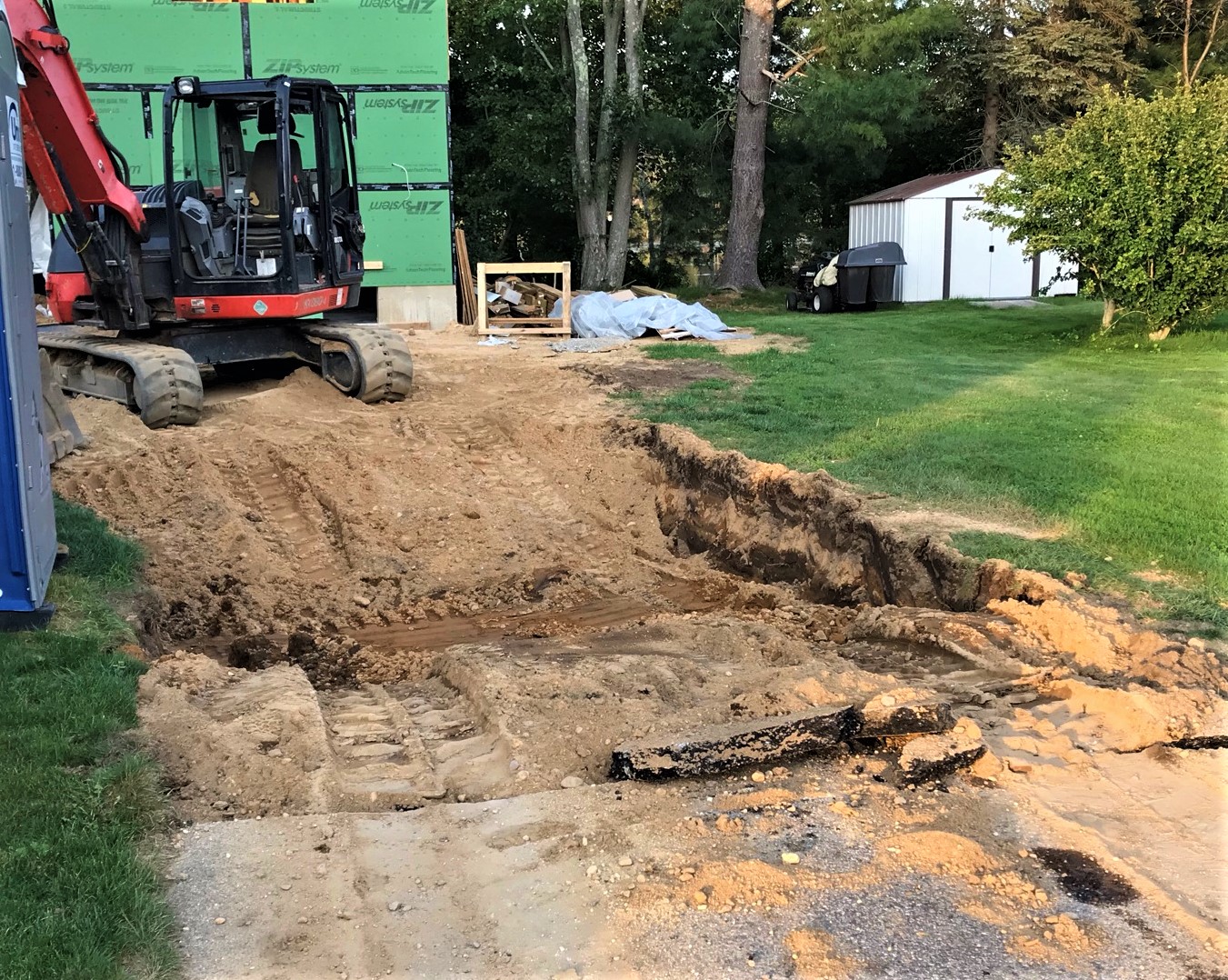
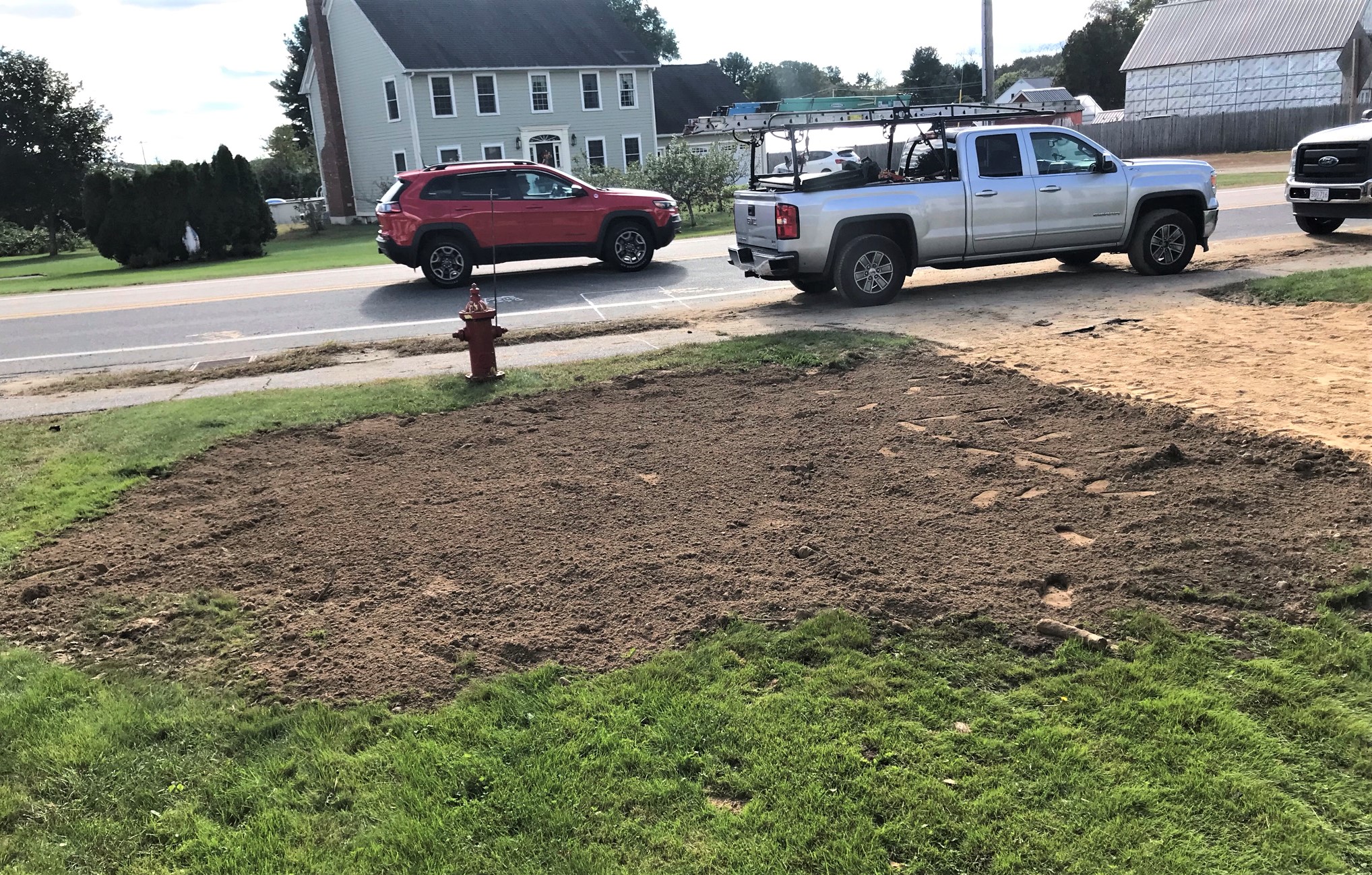
National Grid begins cutting the street and sidewalk to excavate for the new gas line.Cut that asphalt!There’s a gas main here somewhere……found it!
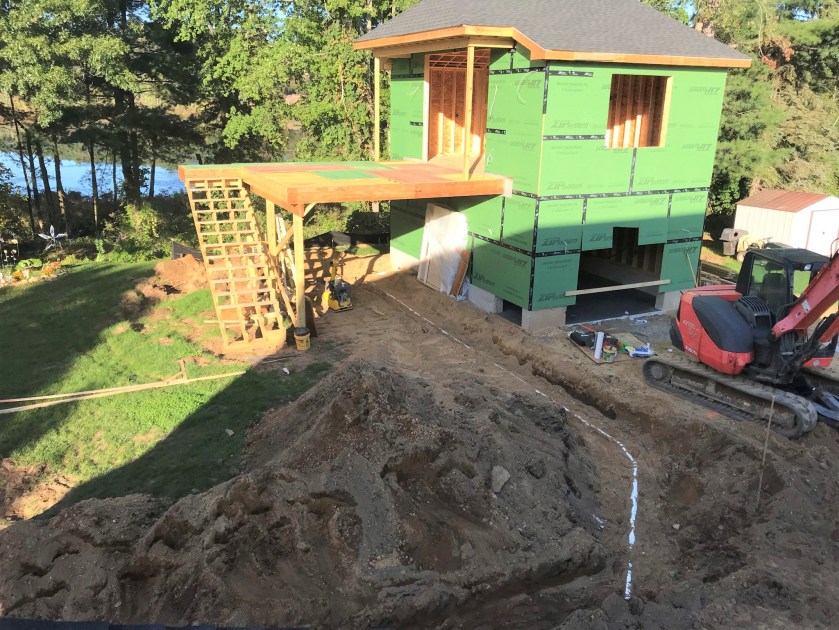
The line went from the street to the back of the garage along the driveway. This will be a second line we will have, and will provide gas for the heating of the garage as well as the future fire pit. Below you’ll see some shots of the trenching, connecting, and the asphalt repair.
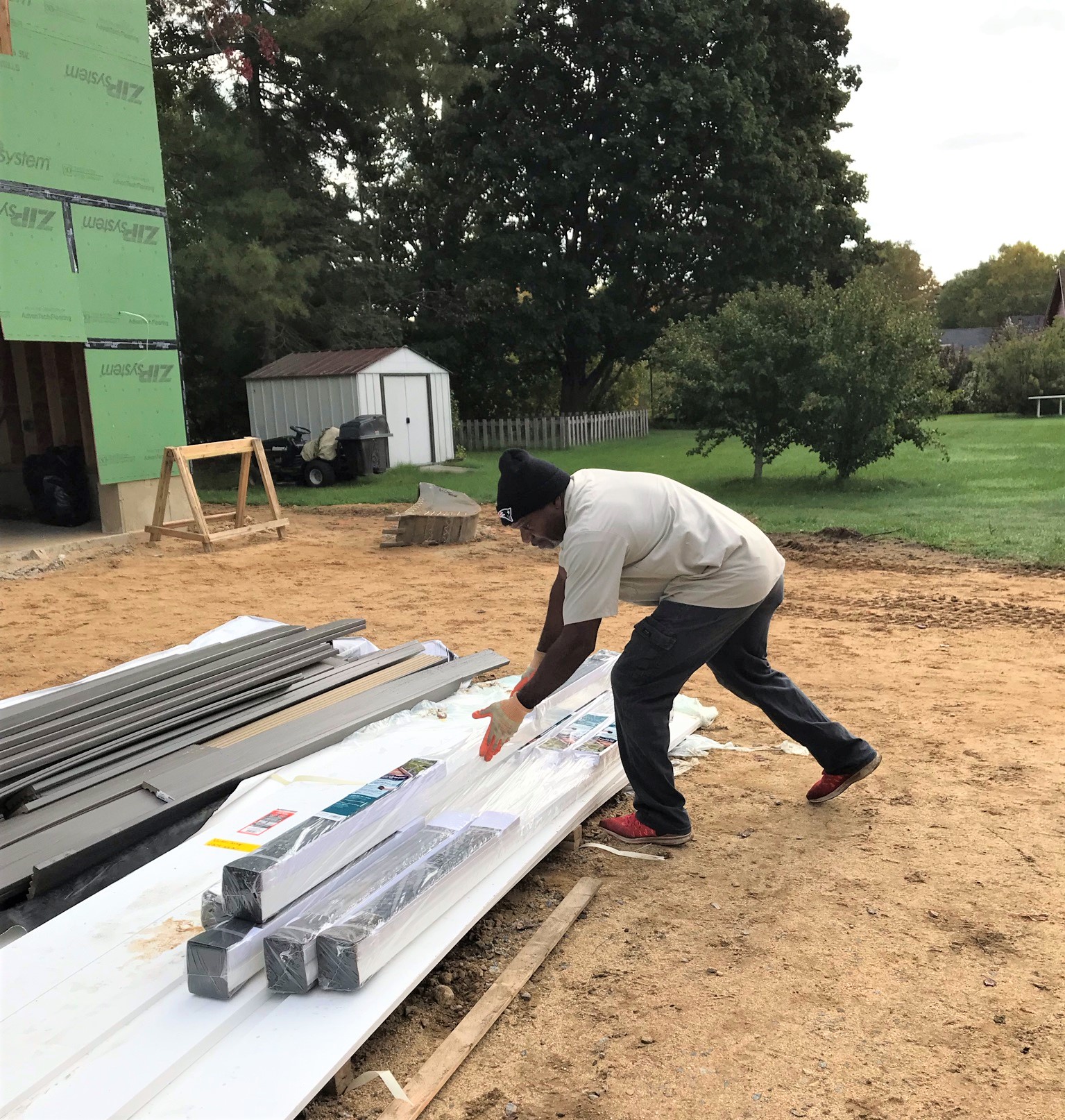
At the beginning of all this, Home Depot and Jonny Victor delivered a lot of the materials for the following week’s work – mainly for the garage deck and stairs.
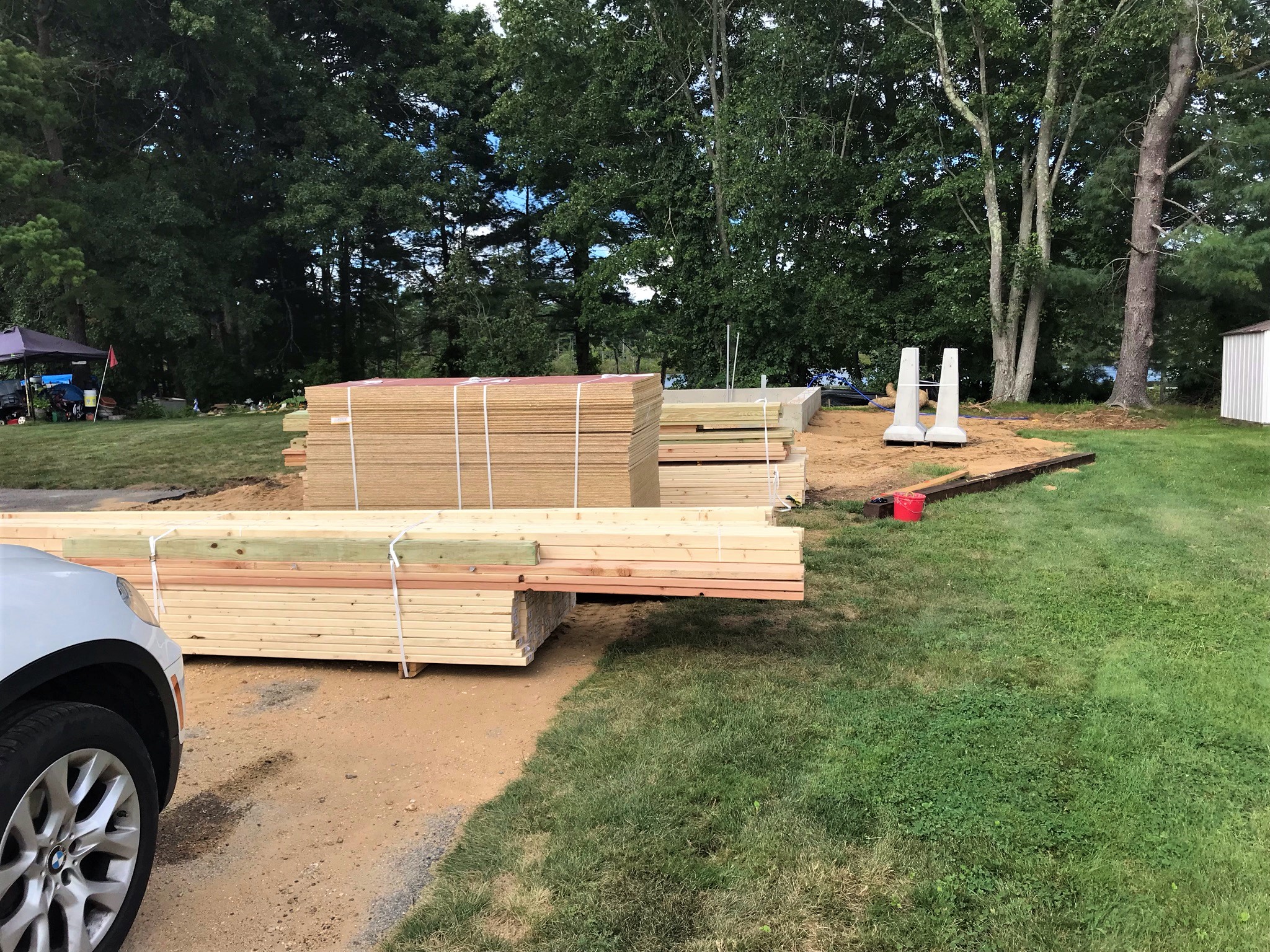
Deck materials for week 13!
As a side note of interest (well I found it cute), I’ll add the following. My daughter works in a hospital as a radiation therapist with cancer patients – and has early hours two weeks a month. I help, as she drops my granddaughter Tabitha off with me at 6 AM (which for a 4 year old is pretty early). I get her breakfast and generally have good quality time with her before I bring her to preschool. While waiting to get dropped off at 8 AM, the following happened – watch my granddaughter here enthralled with her “sparkly pants”. I admit, she makes a good case for them…
Anyways, back to the project! There is still a lot of work to go, but this was a busy week indeed. Hopefully, I’ll be able to share an even more active week on my next update. Thanks for looking and feel free to throw in your two cents (or whatever the equivalent is in your currency) in the comments section.
And I hope you enjoy your fashion choices as much as Tabitha does!
The project continues! Although I was so late with Week 10 that I decided to combine weeks 10 and 11. As you will see from this post – a lot went on from September 19-October 2, 2021. Some of it involved construction, some not – as you will see. I’ll do my level best to make this interesting by including not only some construction photos, some other stuff, to include golf and a bit of hobbies!
There are a lot of pictures here – click on any of them for a bigger view.
Let’s start with electrical work and some progress around the cellar. Wait, the cellar? Why there? Aren’t you building a new garage and house deck Mark? All valid questions that I am presupposing that you may be asking! So let me attempt clarification.
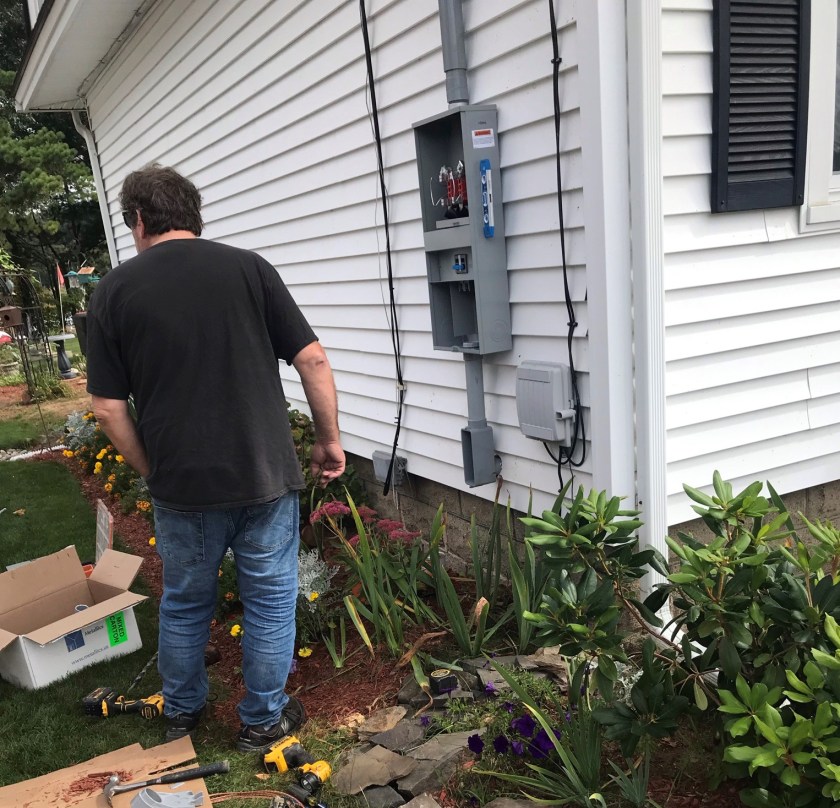
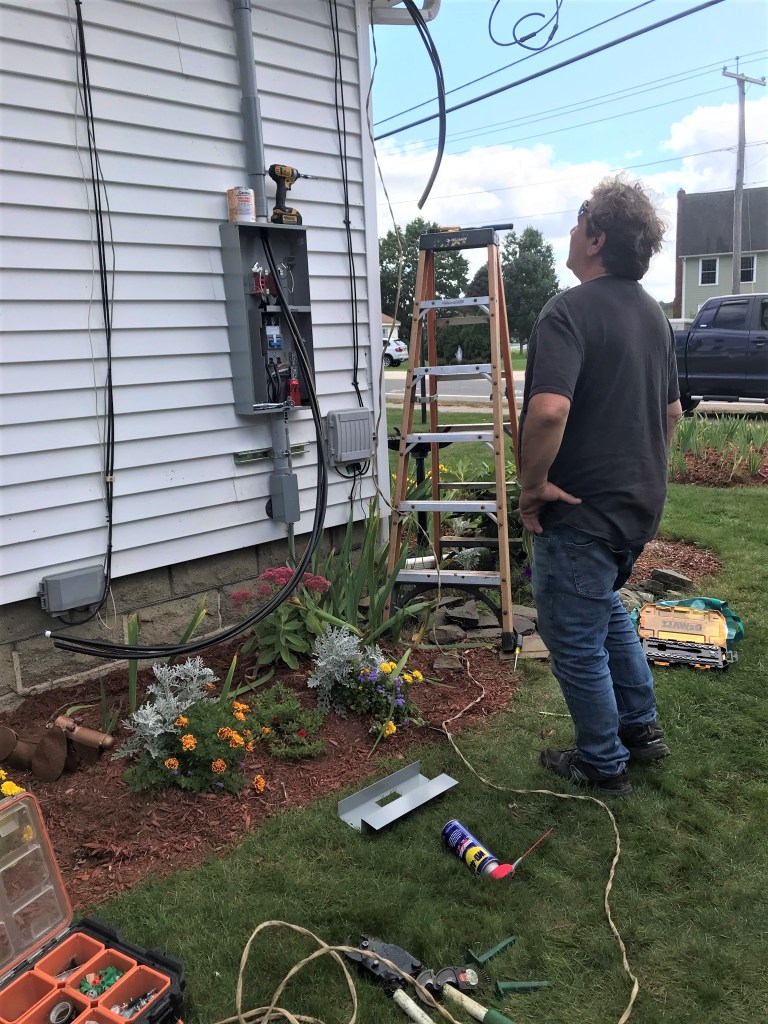
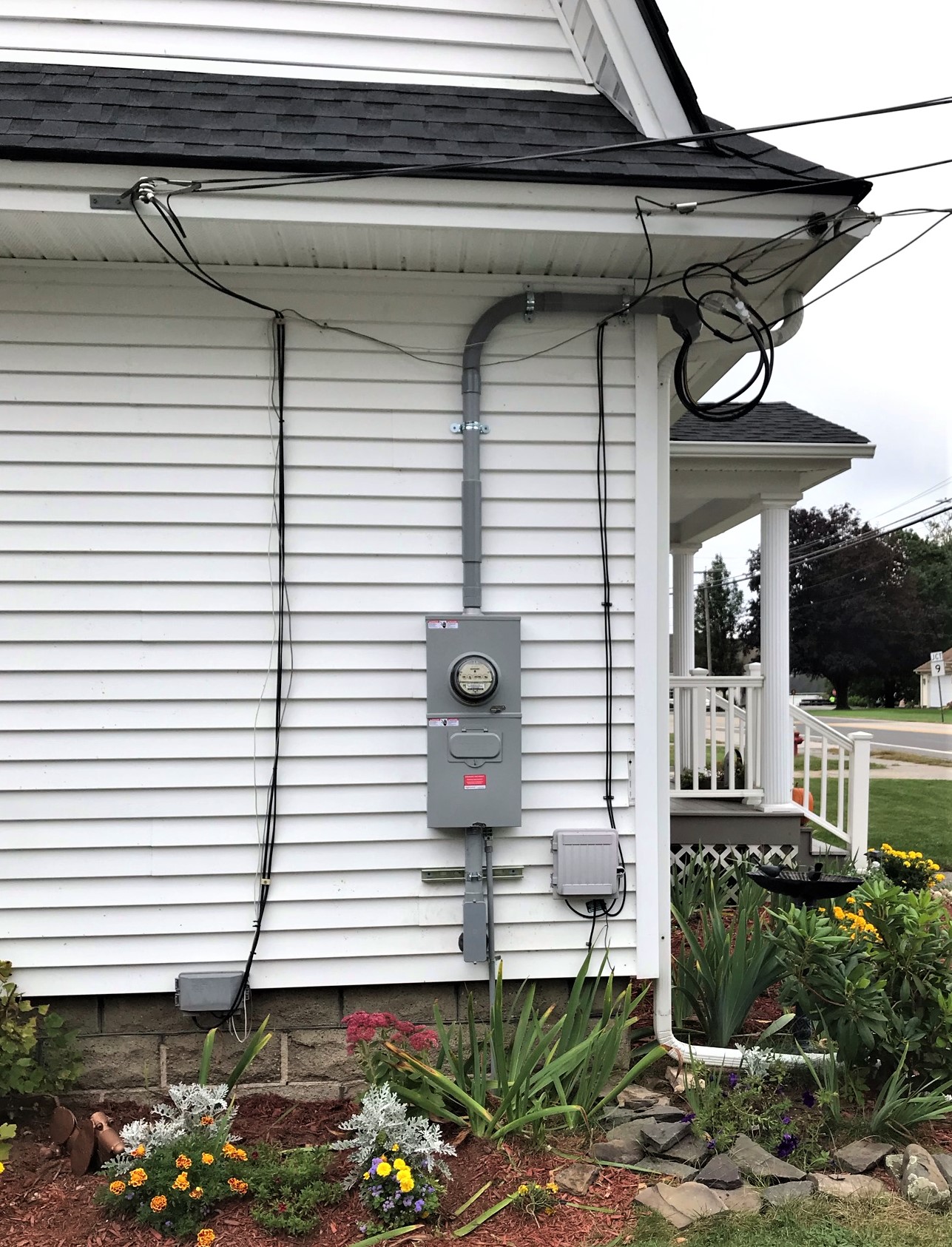
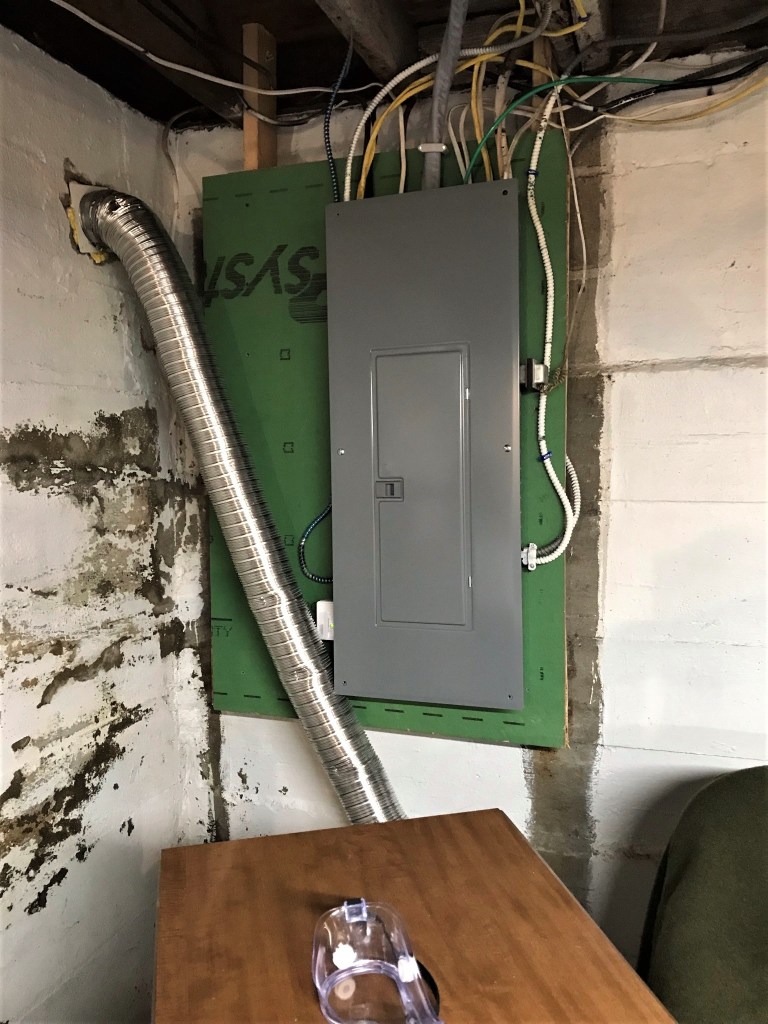
To power the new building, I needed to get the service upgraded from 100 amps to 200 amps. Our electrical service meter and box was in the back of the house over the old (now removed) house deck. Previously, electrical power came from the National Grid pole out front on the street to the house then went along the soffit and into the cellar at the back right-hand corner of the house if you will. The plan was to make this bigger and better by moving the meter and building a new box for it at the front left corner of the house. A new hole had to be drilled for the new power cable, and that needed to be run to a new replacement distribution box in the basement. This work occurred on September 21st.
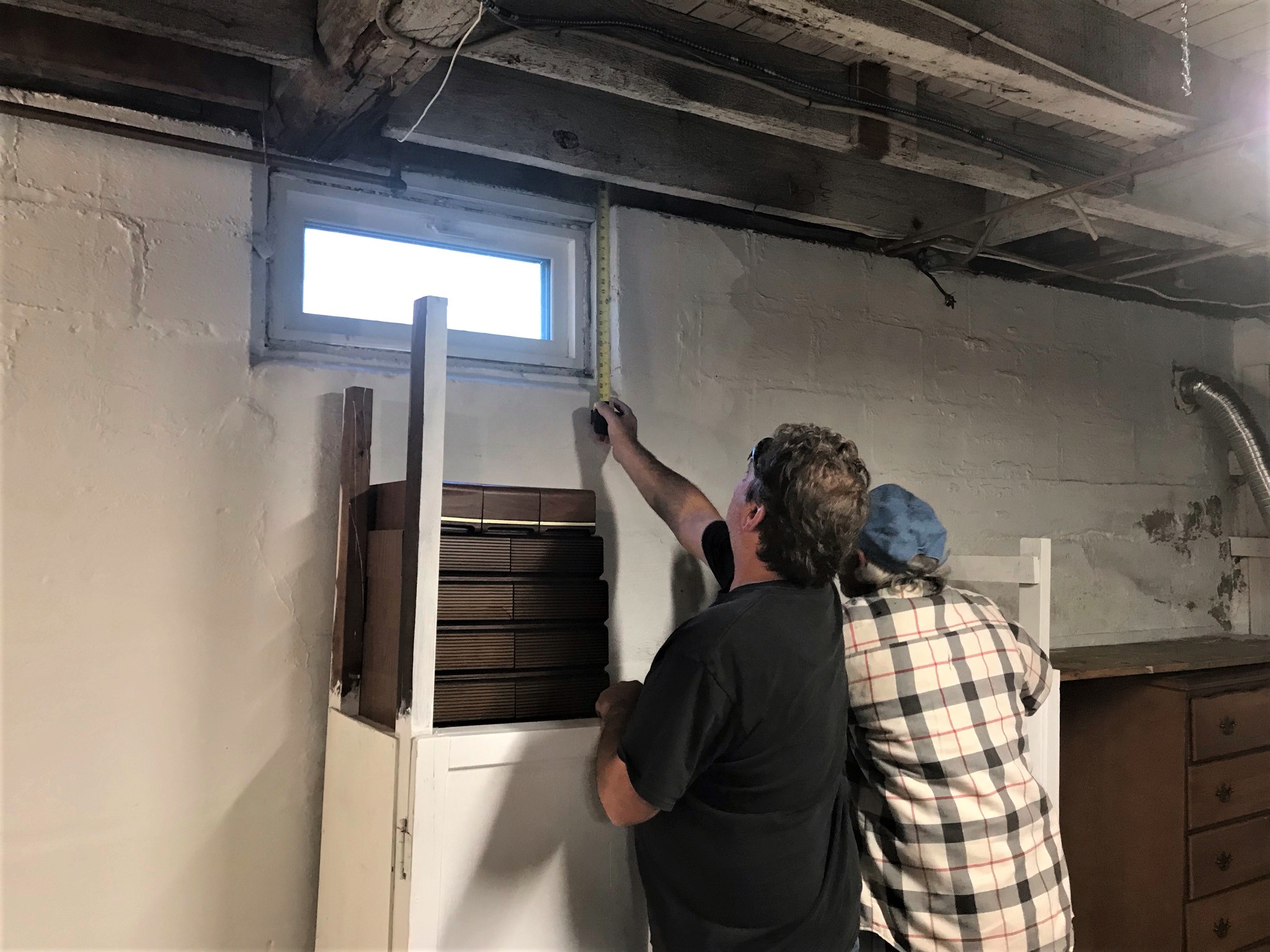
Here you see he old distribution box mounted on whatever lumber the previous homeowner had available – back in the 50’s? 60’s? – to include a piece of trim! We had a series of shelves built by the previous owner long ago (probably 40+ years) along this wall. We had put an old bureau (left over from my childhood actually) under the shelf planking that was attached to the monstrosity that the distribution box was mounted on. The dryer vent snakes up to the wall as you see.Here you see the electricians (Mike and Paul) trying to determine the sill height to drill for the power cable by using the window as a reference for outside. The actual hole would be far to the left. The other end of the old shelving/cabinet that I referred to above is seen here on the wall under the cassette cases (future yard sale items).
Drilling the new sill access.
Heavy duty cable!
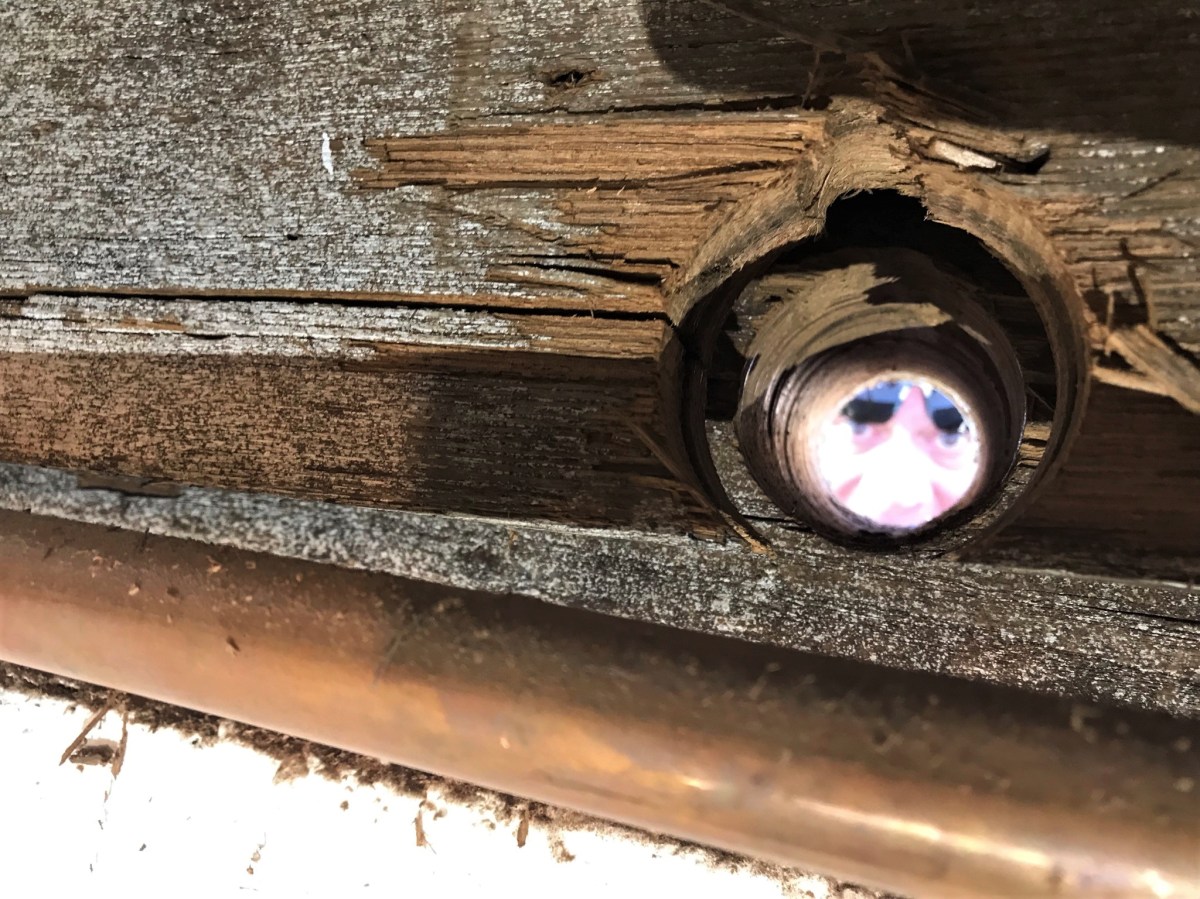
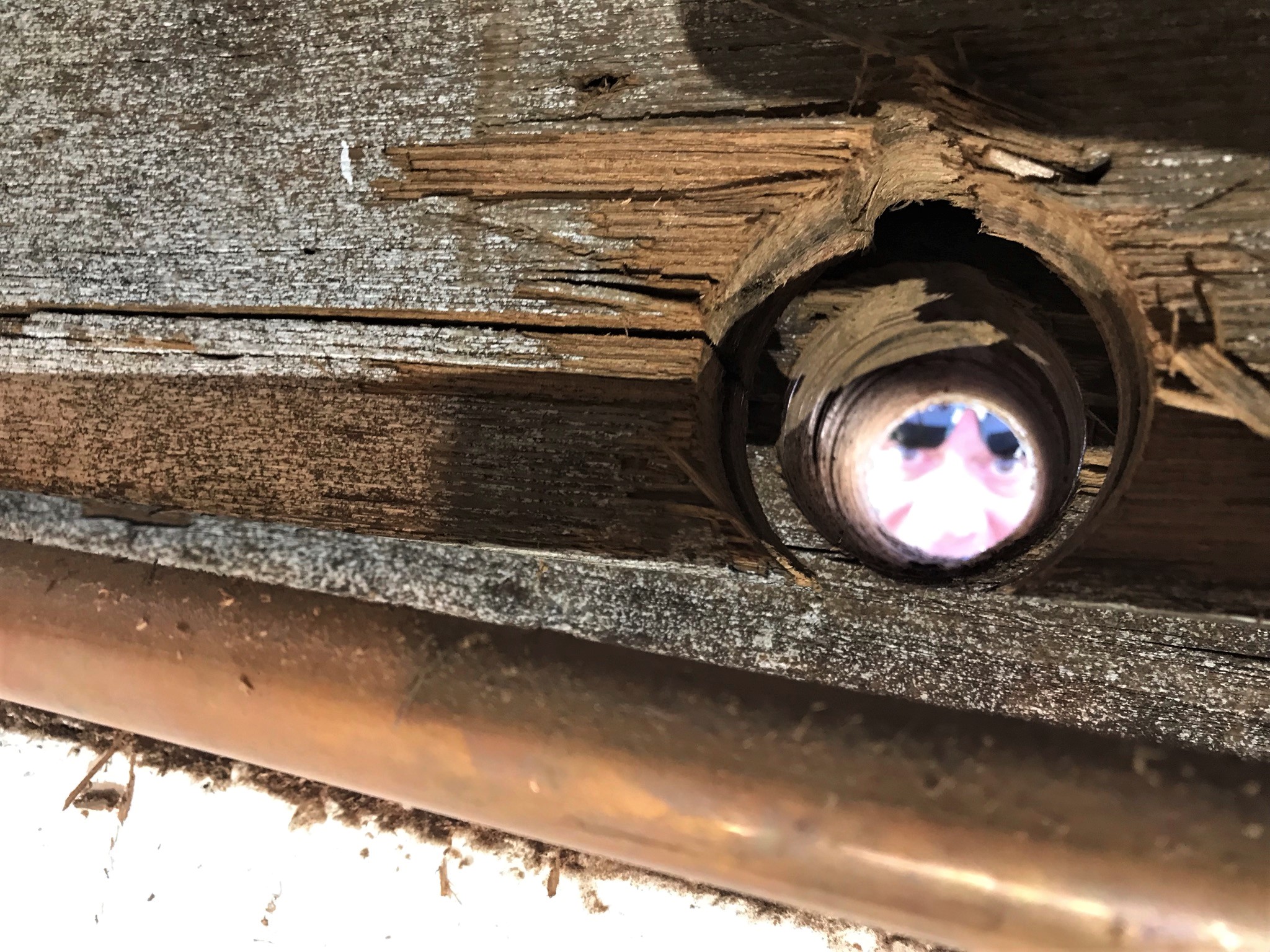
Drilling through the old sill was a bitch. The sill was quite thick – 13″ – and made of solid oak. The hole drilling destroyed two hole saw bits.
The view through the sill access hole from inside. This was 13″ of solid oak. Mike Astrella (electrician) can be seen here peering through the other side.
Outside, work went on the new meter box and running the cable and hooking it up to the power grid.
First the box was mounted and secured.
Power cable being pulled through.
Completed. The box on the left is an old Verizon landline box (now removed) and the one on the right is our Spectrum cable line.
Back in the cellar, the old distribution box mounting monstrosity was removed and a new sheet of plywood and some lumber from the garage build was used to build a suitable mount. The new configuration is bigger and we will need to move the dryer to the wall to the left of the distribution box so that the vent hose is not right next to it. But, as we were using the old the shelves I never got around to paint it as you can see – and it looked like hell.
New box.
New distribution box opened.
The inside electrical work . You can see how ugly the flaking paint was.
Also, I need to back up a bit. It had been necessary for me to clear a lane along the wall for the electricians to run the power cable prior to their starting work. After I did that, I got a good chance to look at the wall and the crappy homemade shelving/cabinet. I noticed a lot of old paint flaking on the wall near the dryer vent and some puckering where I had painted the corner in the front left of the house. The puckering was due to efflorescence, not water leaking, even with the excessive rain we have had this summer. An old dry well that I had built over a decade ago in the front left corner of the house was no longer doing its job, so the rain water outside the basement wall was not properly draining – leading to the efflorescence bubbling up behind the paint. We decided that the shelving cabinet needed to go and the wall repainted.
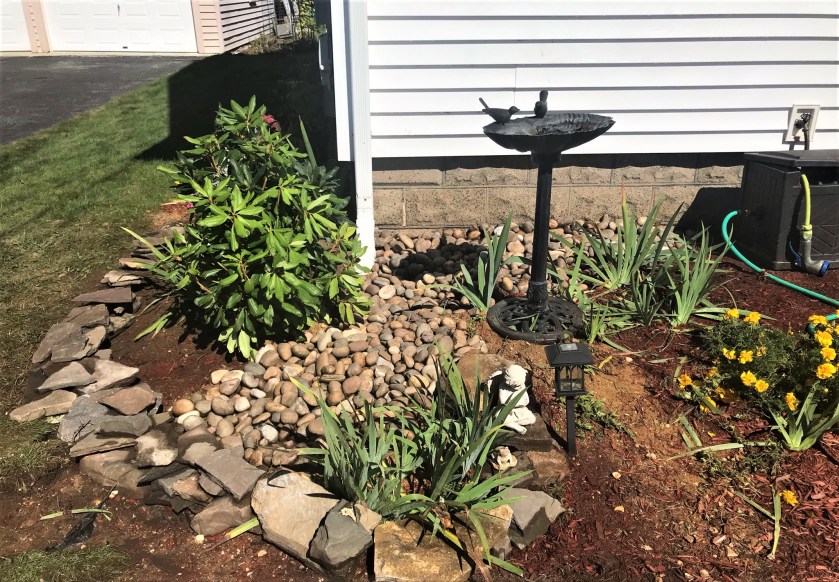
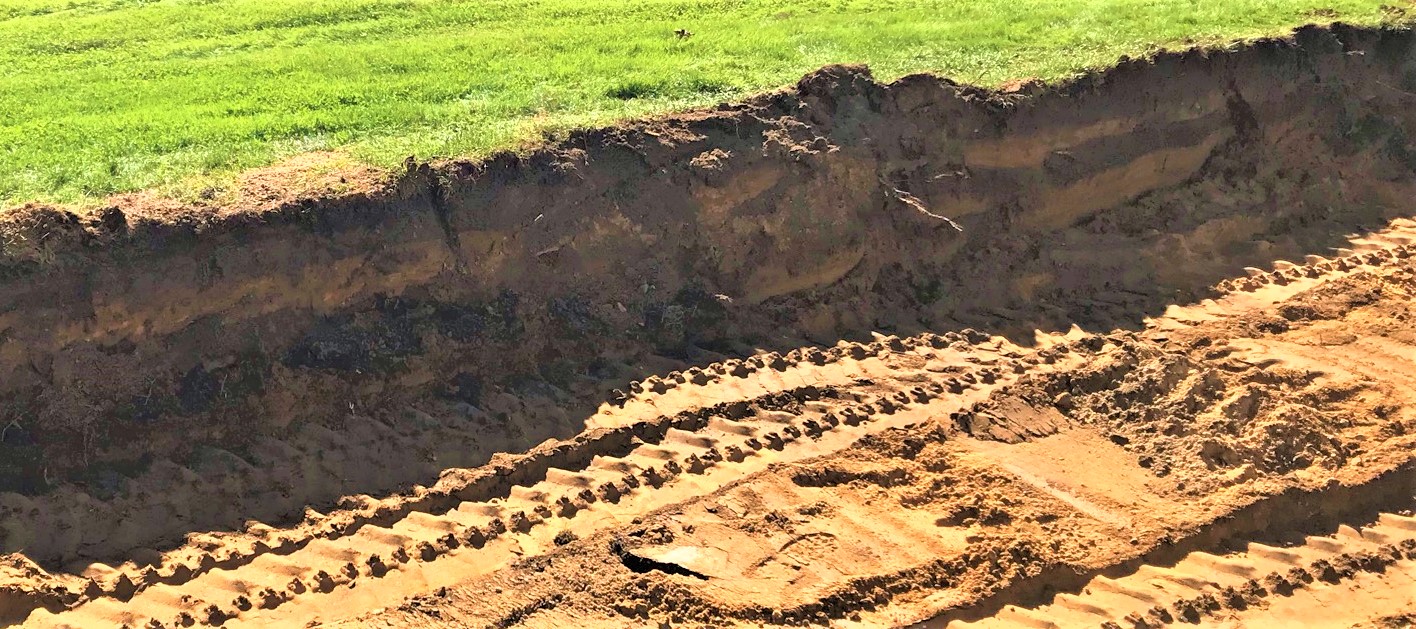
Before I did that, I rebuilt the drywell. When I originally built it, I had dug down about 3 feet and hit sand, so I had then assumed that the soil was free-draining. When I dug this time, I went a bit deeper, and to my surprise I found that there was yet another soil layer under the sand. This one was a loamy clay – that does not drain well. So, I dug down another 3 feet and backfilled it all with sand from the excavations in the backyard. I replaced the downspout extensions and doubled the length. The we covered the area with a filter fabric and then covered that with river stones.
Dry well excavation (would have been a good infantry fighting position)
Repaired dry well.
Dry well repair
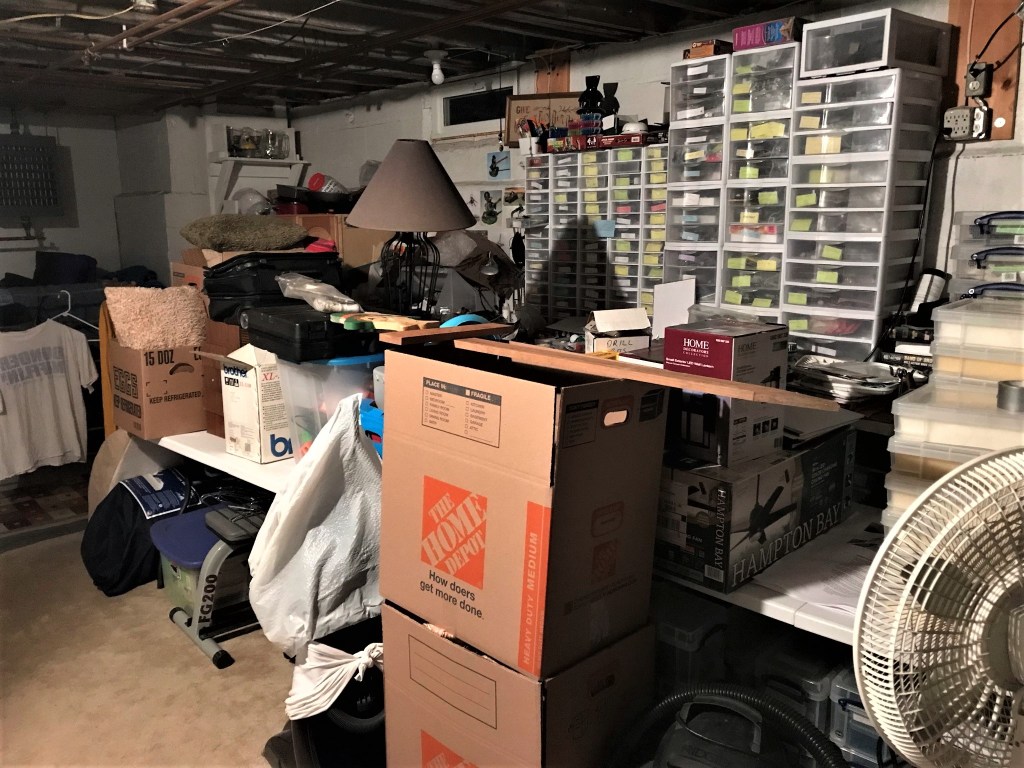
I then spent the time to take down the shelving/cabinet with my wife. She was able to recycle the doors as shelving in another section of the cellar. I scraped off any flaking paint and exposing any efflorescence. Then, I used a mildly acidic product, Drylok Etch, across the wall to clean and prep for painting with bright white Drylok Extreme (both from Home Depot). This took a while, but came out well. We are taking the opportunity to clear out some stuff and have a yard sale this weekend to get some new homes for some good stuff we don’t need anymore. Plus, I can’t do any hobbies as you can see below!
Wall done
Opposite angle on wall
Yard sale needed to get to my hobby bench!
Back in the garage, the septic line was stubbed up in the floor with a cleanout.
A very exciting septic line beginning…
On the 24th, it was time to place the concrete floor in the garage. I say “place” and not “pour” because that was drilled into me in the US Army Corps of Engineers as the appropriate terminology – and that stuck.
Prepping the garage door entrance for concrete.
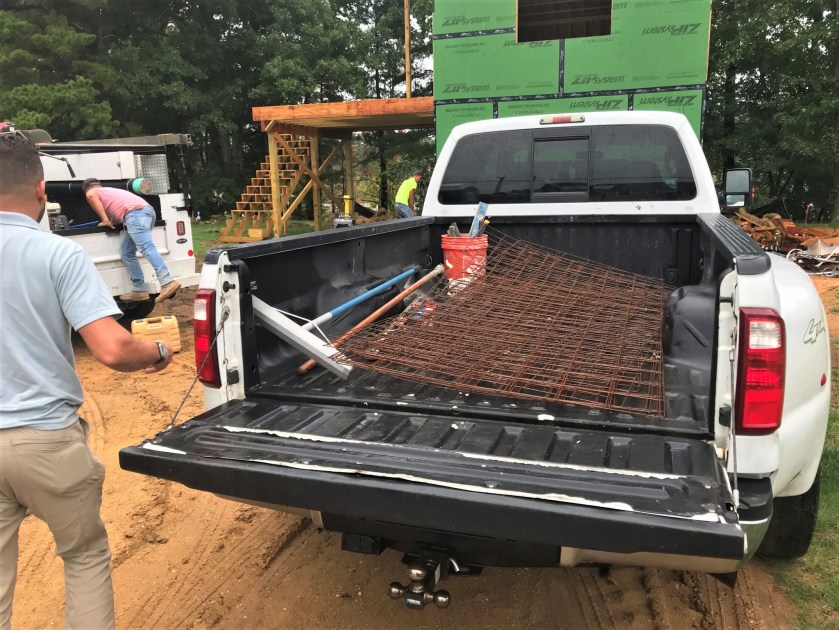
Steel!
The crew arrived early and was ready to go.
Installing the vapor barrier (ok a sheet of plastic over the compacted sand).
The plastic is secured, and the steel is wired together.
Placing steel on vapor barrier.…the concrete truck chute cannot extend far enough into the garage.
Evandro cuts a slot.
And on the other side..
…et voila, access!
Getting access for the concrete truck.
This was no problem as this plywood will be removed eventually when the door is installed.
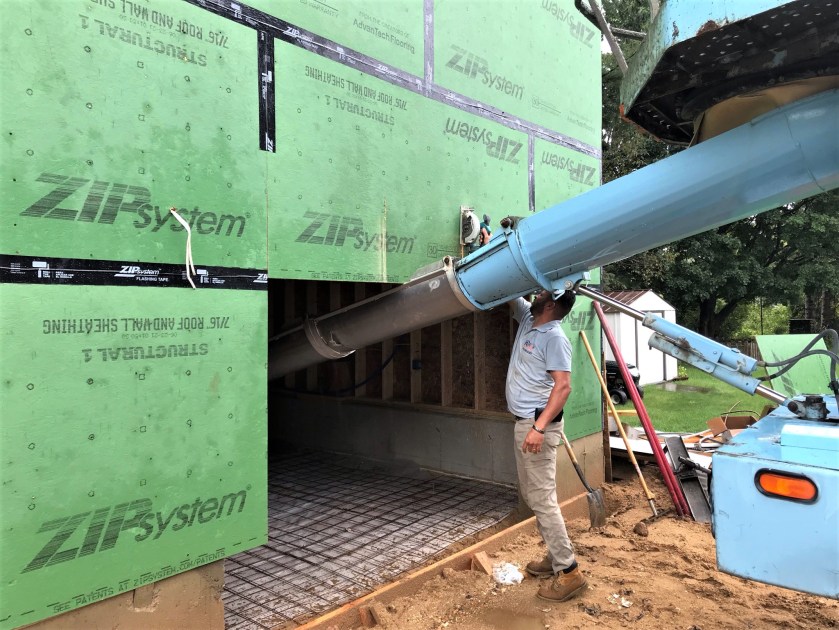
Concrete truck delivering.
Working the concrete.
Then the sky opened up…
…necessitating a temporary rain cover.
Final finishing.
Concrete work.
Because of the many rain days, Andy Cormier arranged to get help to finish off the septic line installation.
Finding the tank!
Line ready for backfill
View towards the tank.
Septic line work.
Ready for backfill.
Having the septic line in the ground and attached to the septic tank allowed for its backfilling as well as work to proceed on the driveway excavation.
On Monday, September 27th, Lynn and I participated in the annual West Point Society of New England’s annual charity golf tournament, along with our friends, Lisa and Jim Kularski. This year, the beneficiary was Homes for our Troops. It was a nice break while construction work continued.
Me, Lynn, Lisa, and Jim. The sign is a hole sponsorship I did for the charity event.
When we returned home, there was a lot of dirt moved around. It turned out that the soil under the driveway had the same layering issue that I found in my dry well excavation – so a lot had to go, and be replaced with clean fill.
Excavation showing the soil cross sectionBetter view of the soil layers.
Most of the septic line was backfilled.
Of course, Tuesday the 28th brought yet more downpouring rain. Therefore, earthwork and any other work could not happen. We only got a delivery of deck material for the house deck.
Deck lumber delivery.
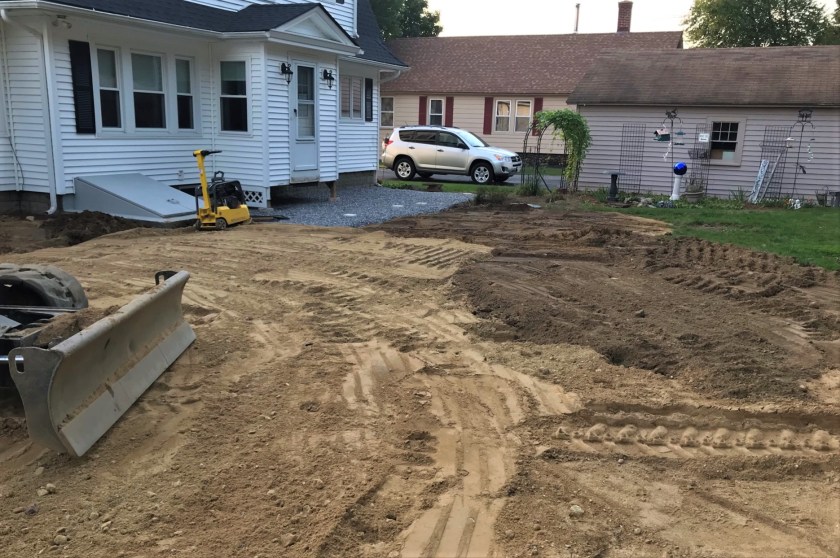
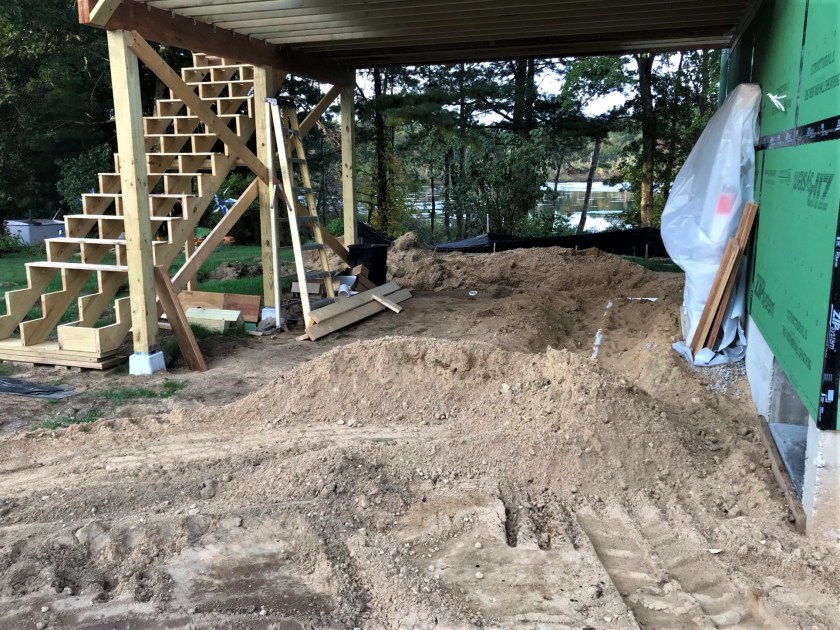
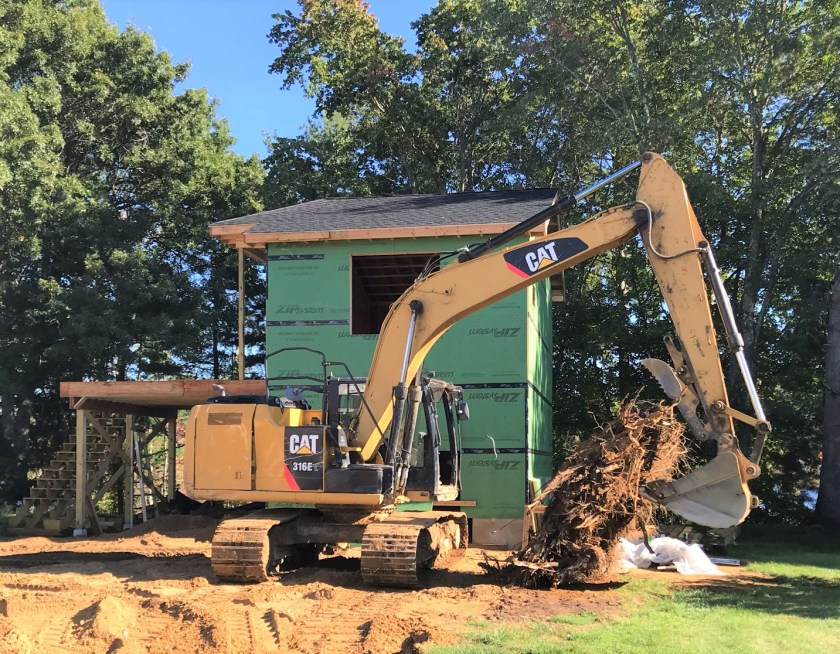
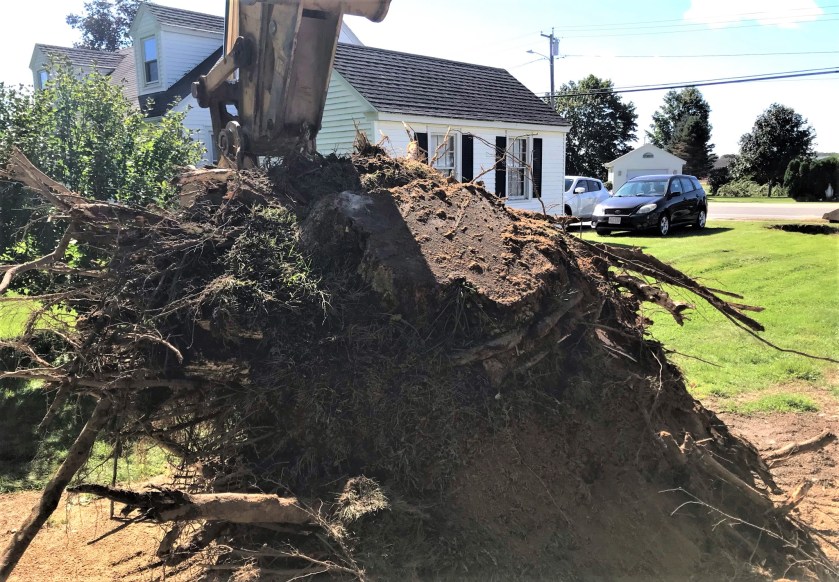
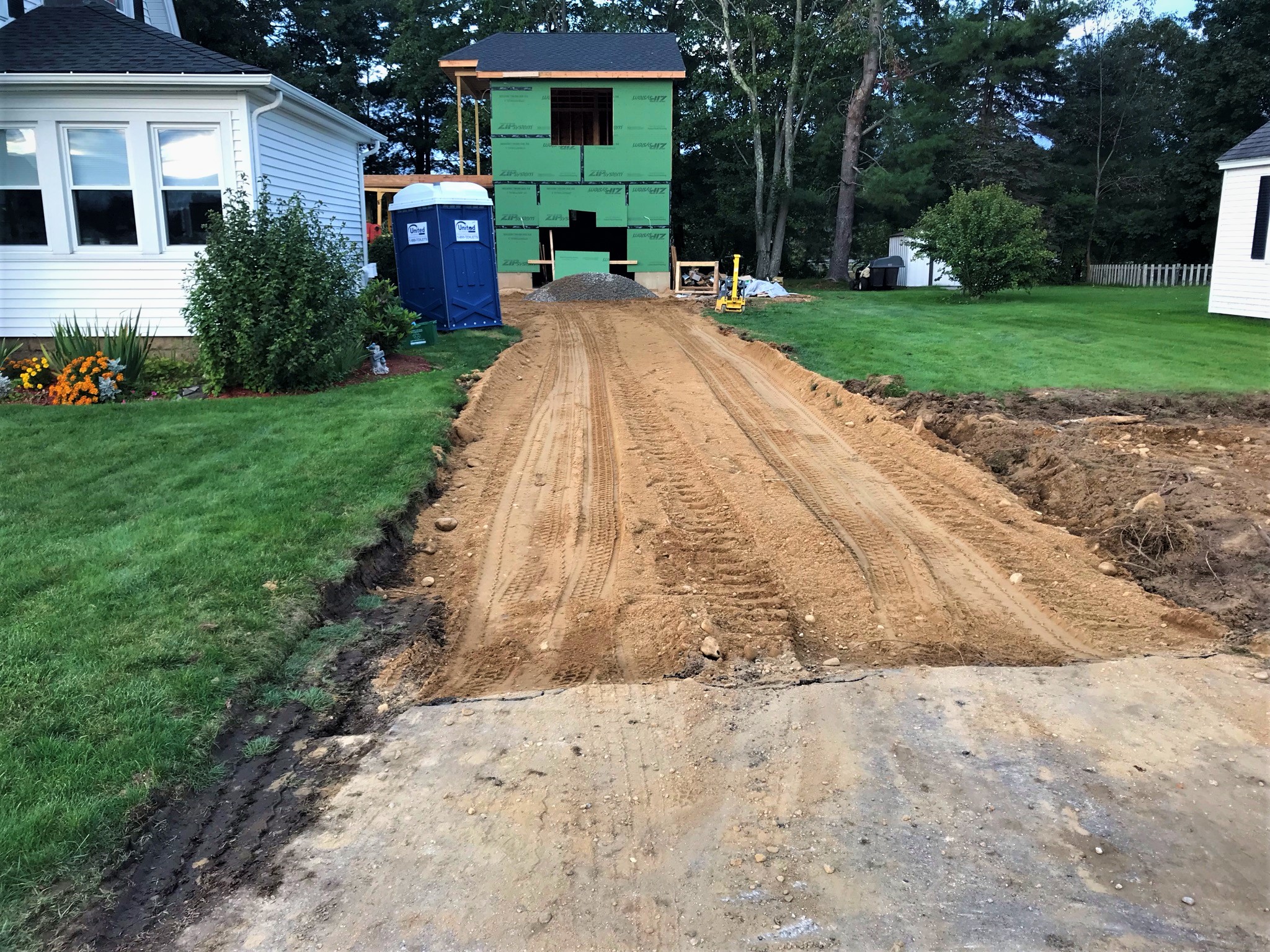
On Wednesday the 29th, the skies cleared and work could proceed. The driveway was excavated and brought to grade. Old asphalt, and interfering roots and stumps (including a 4-5 ton maple tree stump) were removed in this process.
Asphalt removal
Massive stump!
This was a huge stump with a lot of roots under the old driveway. Andy had to bring in a bigger machine to take care of it.
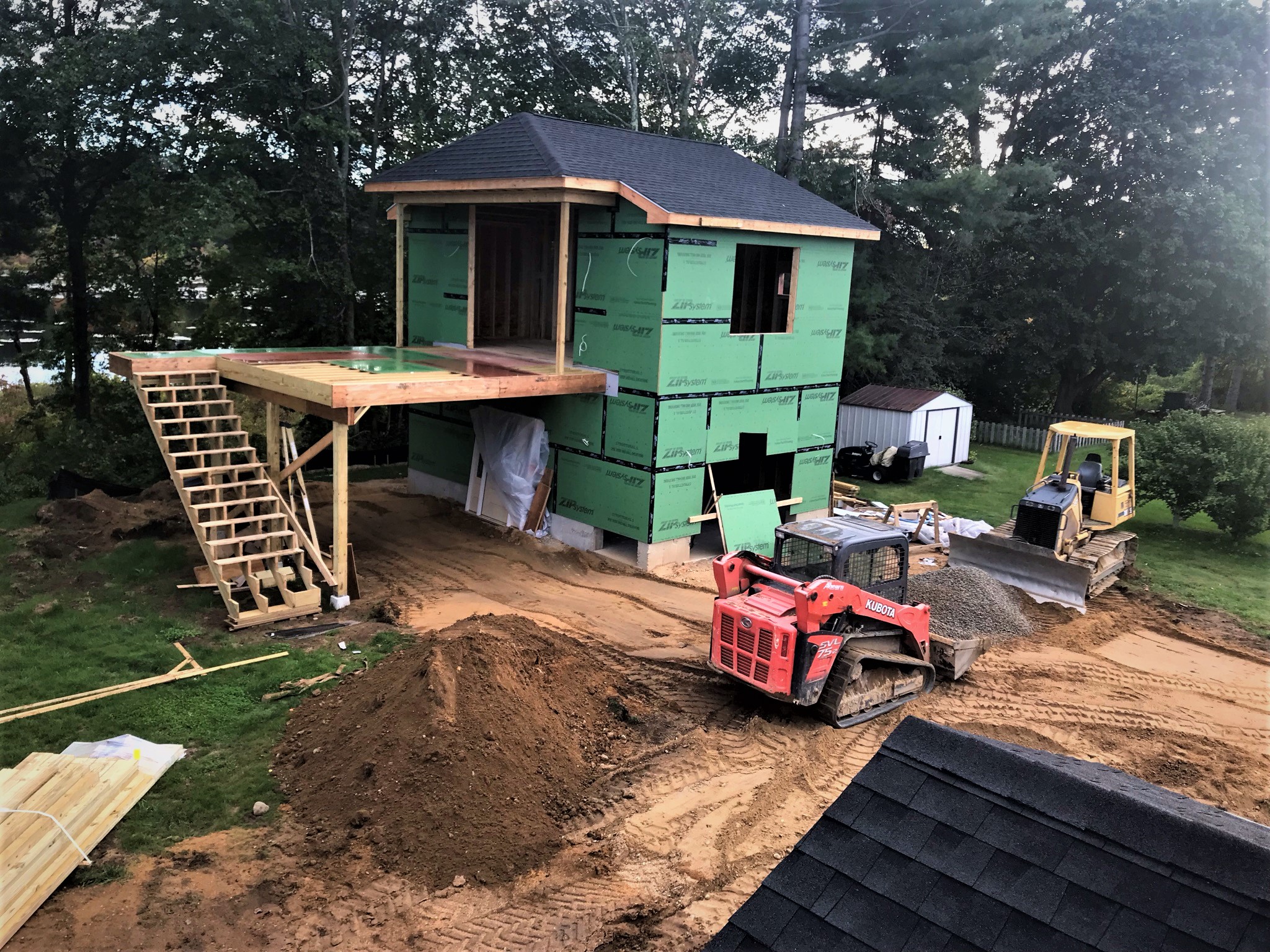
At the end of the day, the driveway was filled, and all the holes were filled in.
Driveway base in.Top view.No more stump.
The next work skipped a day (rain), and that involved the framing of the replacement house deck. This was October 1st. Jonny also got ready to install the rain gutter system for the garage deck.
Jonny prepping for the under-deck rain system installation.
House deck framing begins.
Deck framing on October 1st.
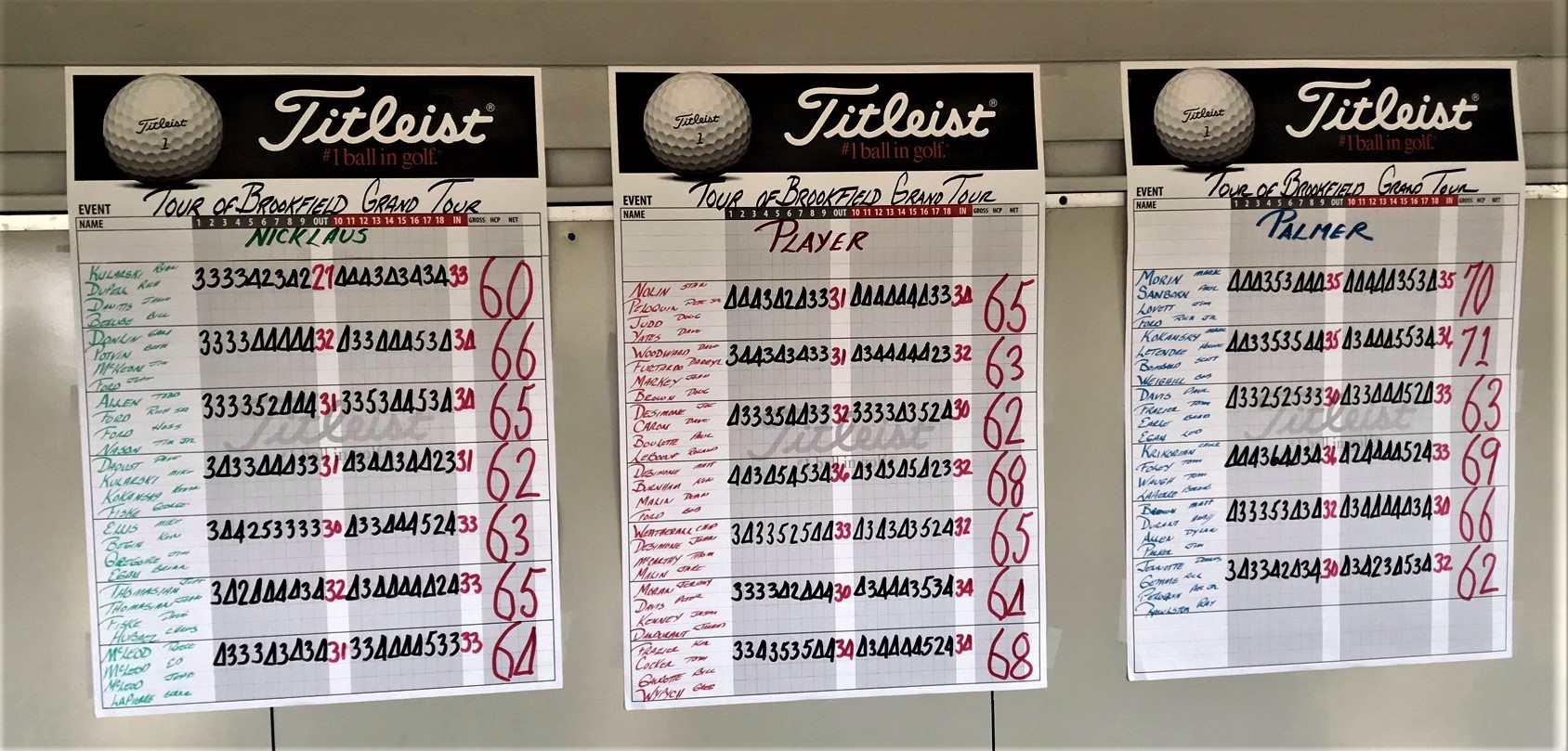
To make up lost time to rain, work continued on the deck on Saturday the 2nd. This weekend I had not one but two competitive golf tournaments. The first was on Saturday which was the Finals of the Tour of the Brookfields. If you are on Facebook, the group link is here. I am a member of the committee. My team was in the lowest division, but we did not come in the top three. Still, congrats to the winners!
Better luck next year.
After the tournament, I returned to see progress on the house deck.
Saturday progressDifferent angle view.
So, a lot of progress was made over the two weeks!
(Lastly, I previously mentioned a couple things that I need to circle back to – the first being the Sunday Founder’s tournament at Quail Hollow Golf and Country Club (where I am a member). This was an individual event and I played better, but not well enough to be the winner (only one male and one female winner out of dozens of players so no big deal). However, back during the annual club championship (a two-day 36-hole tournament of individual medal play from the back tees) on July 31-August 1st – I was able to play my best golf of the year (98/88 for a net 2 over par for the event) and win the D flight against 11 others. So Sunday, I got my reward.
In my office!
What you see here left to right is a comic statue that belonged to my grandfather Marcus (a WWII vet who gave me a love of golf), my unlucky conquistador “Franco”, my trophy, and as it’s October, my Halloween mini-diorama with Ral Partha 25mm figures of classic monsters from the 30’s Universal Studios movies.
Ah, but I digress – week 12 is well underway and I will have much more to share. I hope that you enjoyed this and thanks for looking!
Last week (September 12-18, 2021) was unfortunately the slowest progress week to date. Gravel was spread under the new house deck location and some more asphalt was removed there as well. We also got our first plumber visit and a lot of action is happening that is not actual construction.
For example, we were able to get a visit from Door Systems of Worcester so that we could evaluate options and order a garage door. The bad news is that that door will take 3 months to arrive. COVID-19-related delays are a factor beyond anyone’s control.
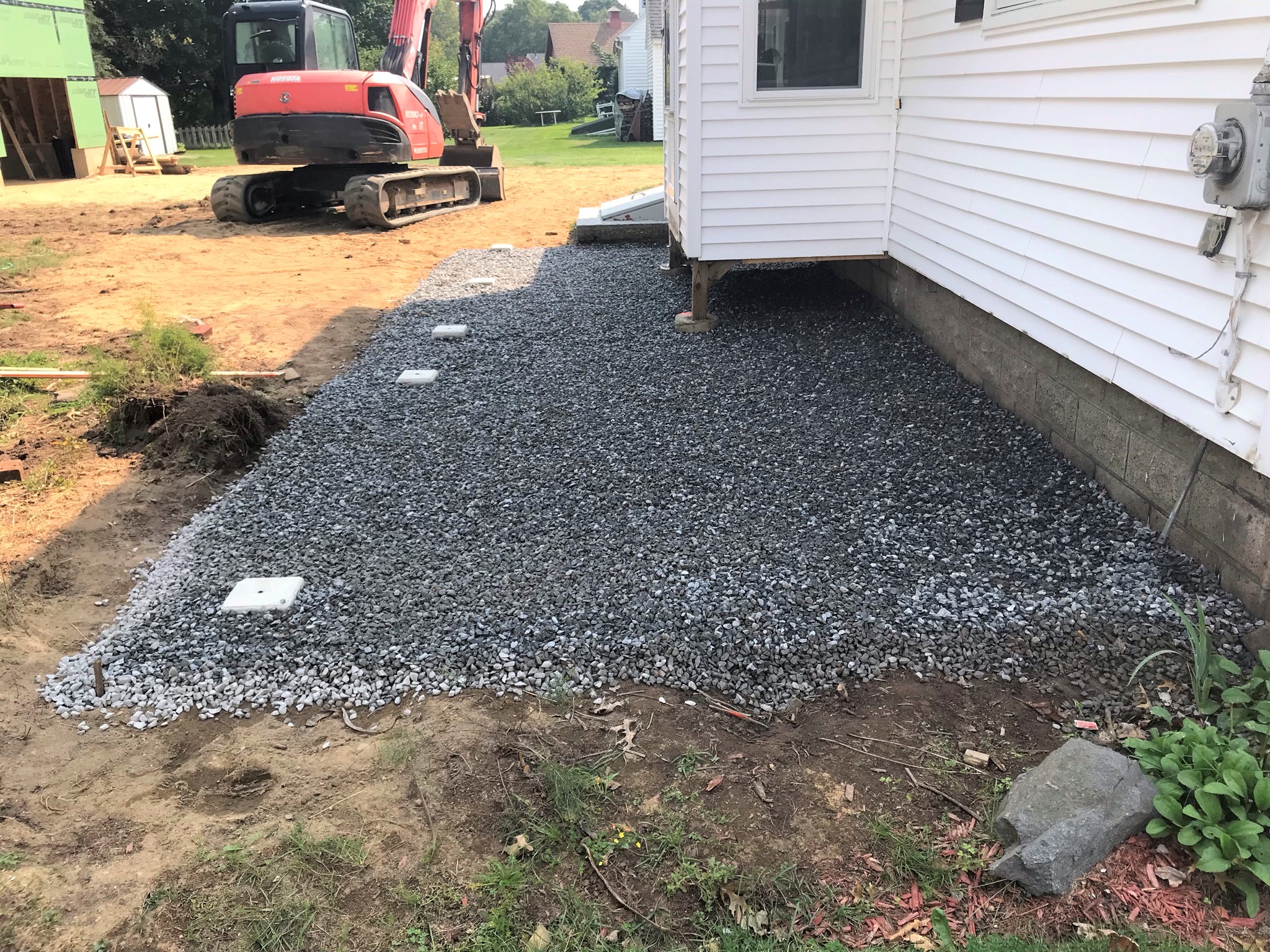
The Victors measure for the gravel.The gravel is placed.
This week should prove to be more active – Andy Cormier is back from vacation, so digging will recommence on the sewer line and the driveway. And much electrical work will be happening, with our service upgrade (needed for the new building demands and more) as well as some plumbing too.
Thanks for staying with me. I turned 59 this week, so I still believe that this project will get done before I turn 60!
Tabitha got me some practice foam golf balls – her favorite color – purple. Well, she also likes pink, but I’m glad she didn’t go down that route!
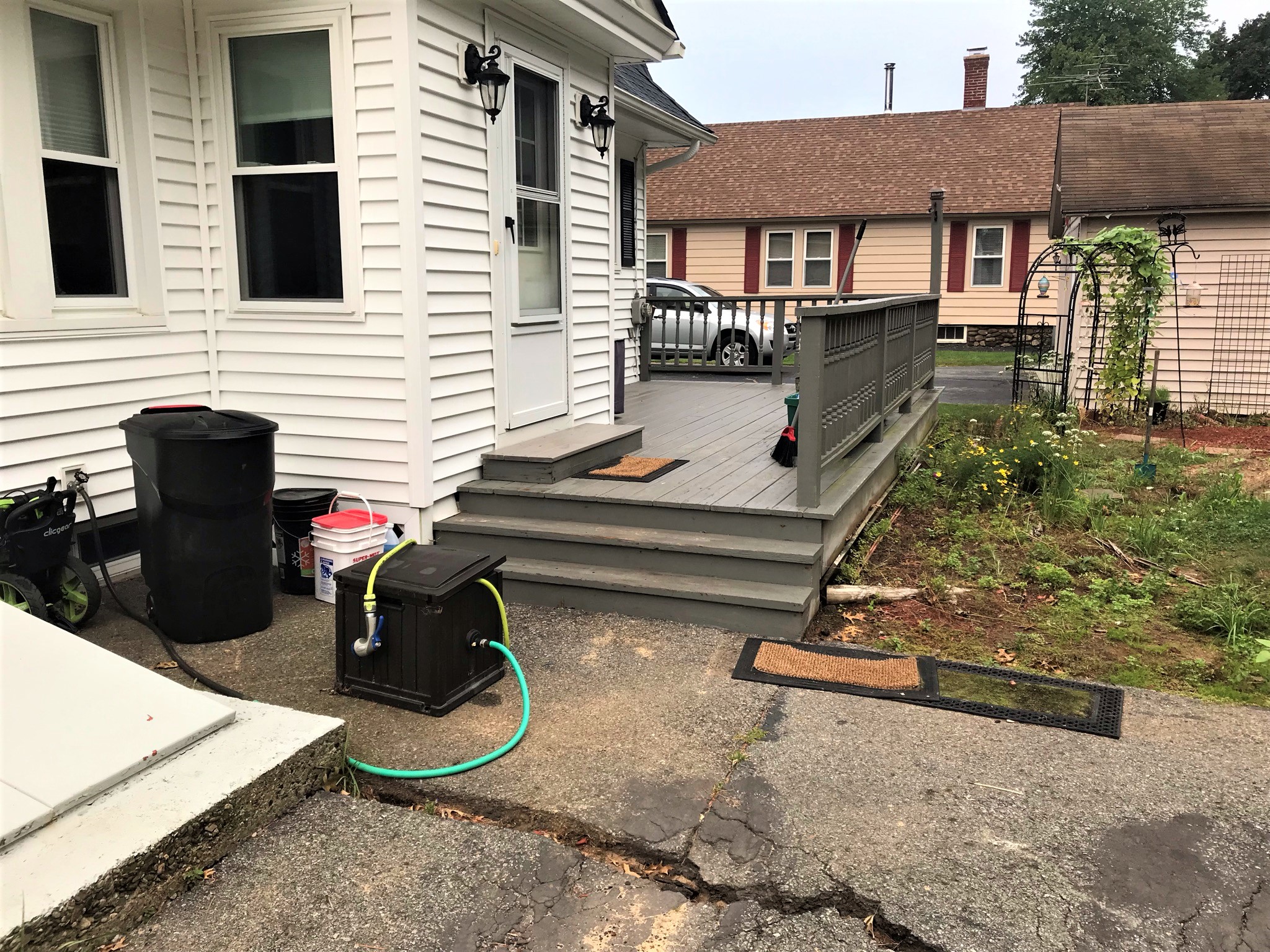
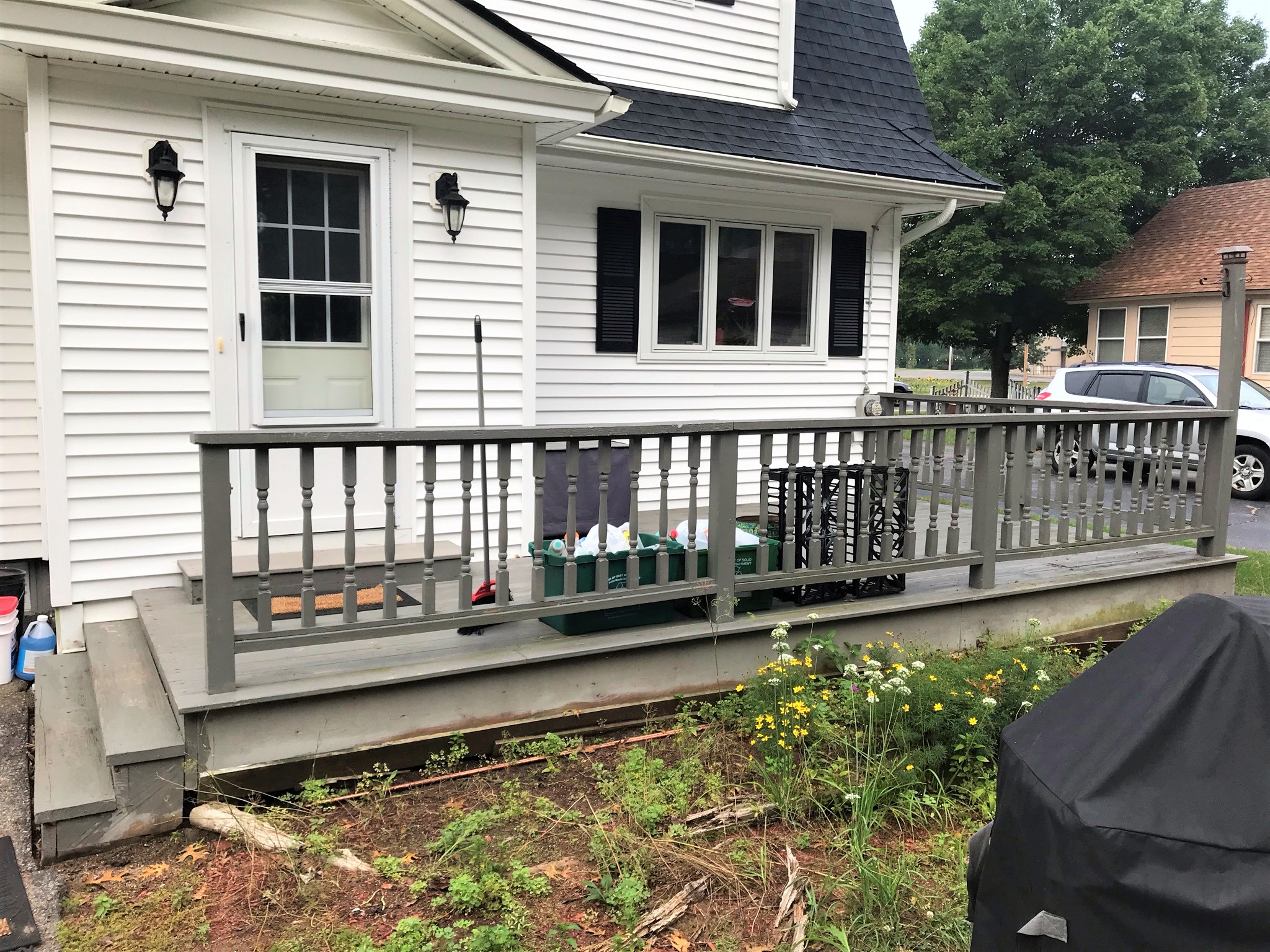
The project continues into week #8. This week, with Labor Day on Monday, was a short one, but work did get done. If you remember, this project also includes work on our back yard, driveway, and back deck. This is the deck attached to the house – as opposed to the one attached to the garage. It will be bigger and more functional than the current one. Foot traffic into the house will be rerouted and the driveway reconfigured here.
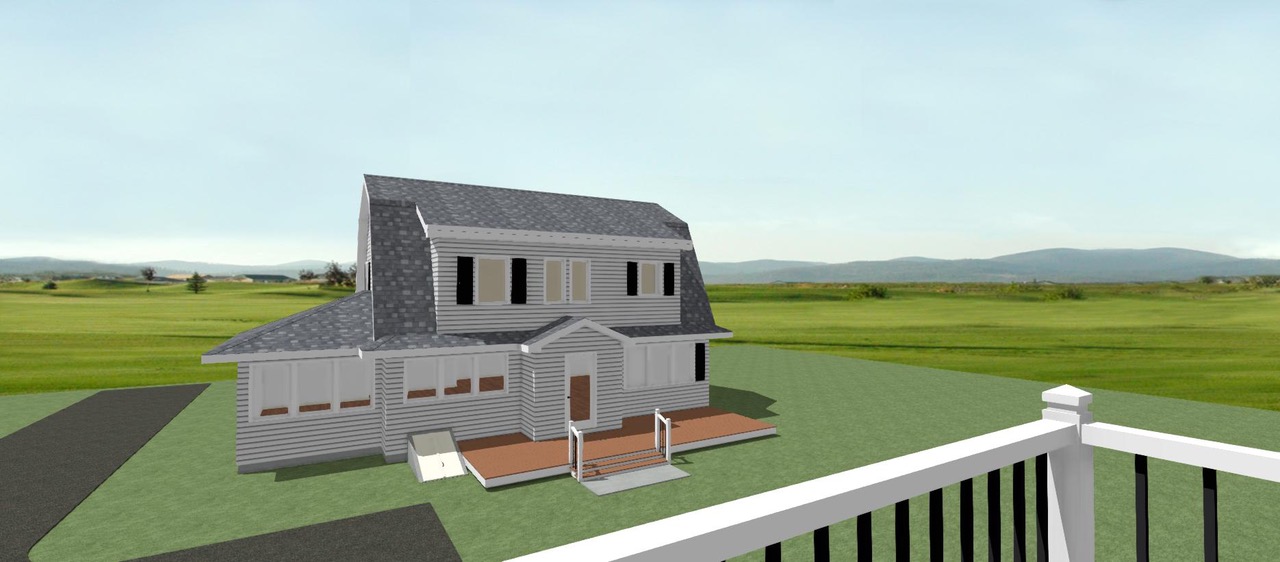
A longitudinal view of the existing house deck on Tuesday. Access will be rerouted as you will see below.Lateral view of the existing house deck on Tuesday. We had some flowers here but did not really do much gardening-wise here this year as the renovation was coming. I say “we” but that is Lynn’s purview – not mine…she does that work (as she would tell you). She’s actually superb at landscaping. And mowing the lawn – but that’s because she forbids me to do it. Seriously! The plan for the house deck as seen from a CGI view of the new deck off of the new garage building – though the decking color plan is for gray not brown. In addition to the new access means to the back door, we also will be adding paving stones to make walkways connecting the two buildings (not shown here).
Given the amount of previous work done, there was a need to reorganize the site a bit on Tuesday September 7th and Wednesday September 8th. Excess materials were returned for credit and site trash and leftover pieces of “stuff” (shingles, lumber, plywood, etc.) were picked up and carted away.
Tuesday morning saw Ready Installs loading up the excess roofing shingles for credit.
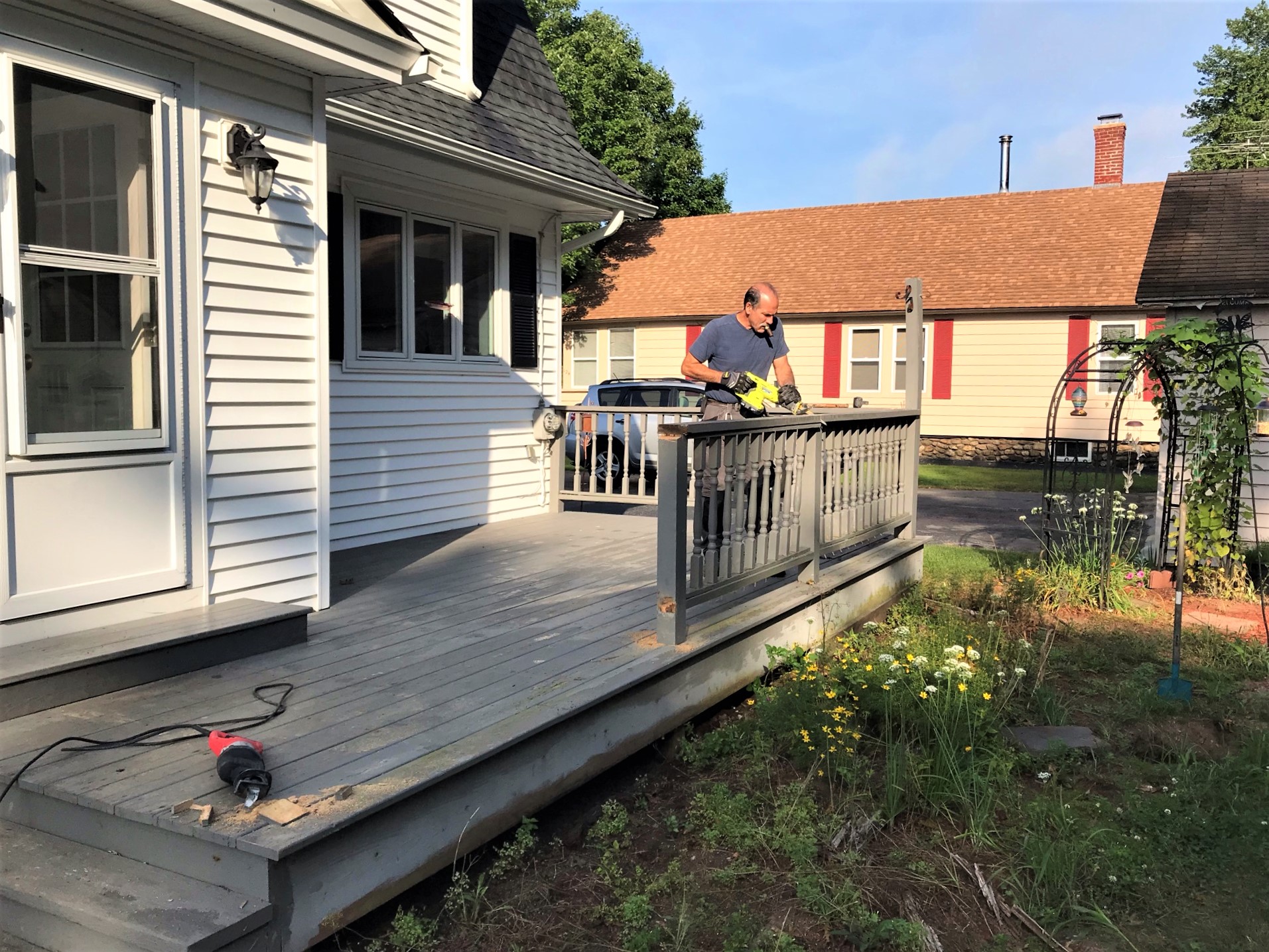
On September 9th, work on the back deck went into high gear. It was removed and carted away.
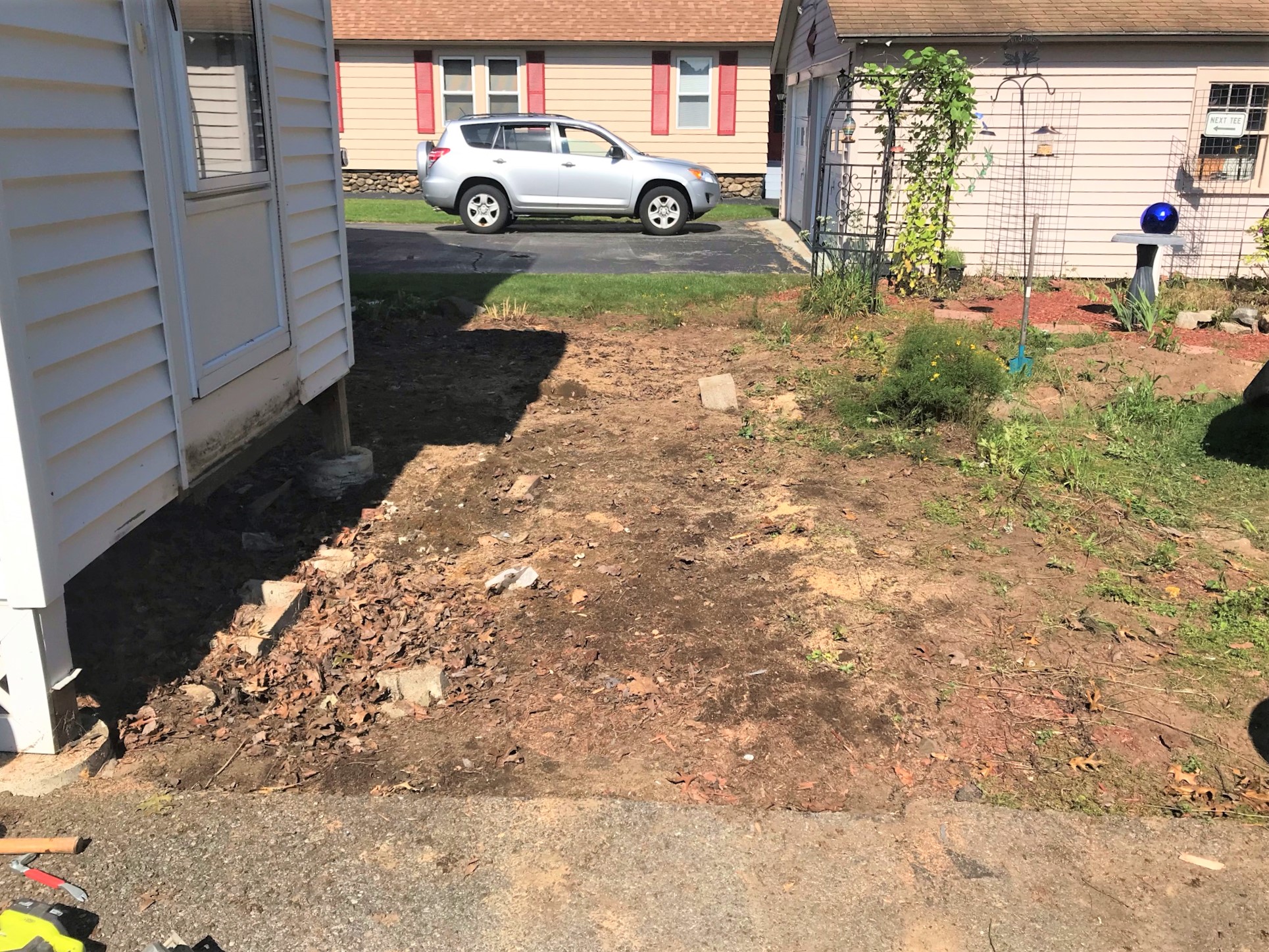
Rail removal on the house deck.The decking is removed and now the joists and end plates are ready to go.Deck is gone!
Surprisingly, there was an old asphalt landing under the dirt here that I found while removing a decades worth of leaves that had blown through the lattice found a home under our mudroom!
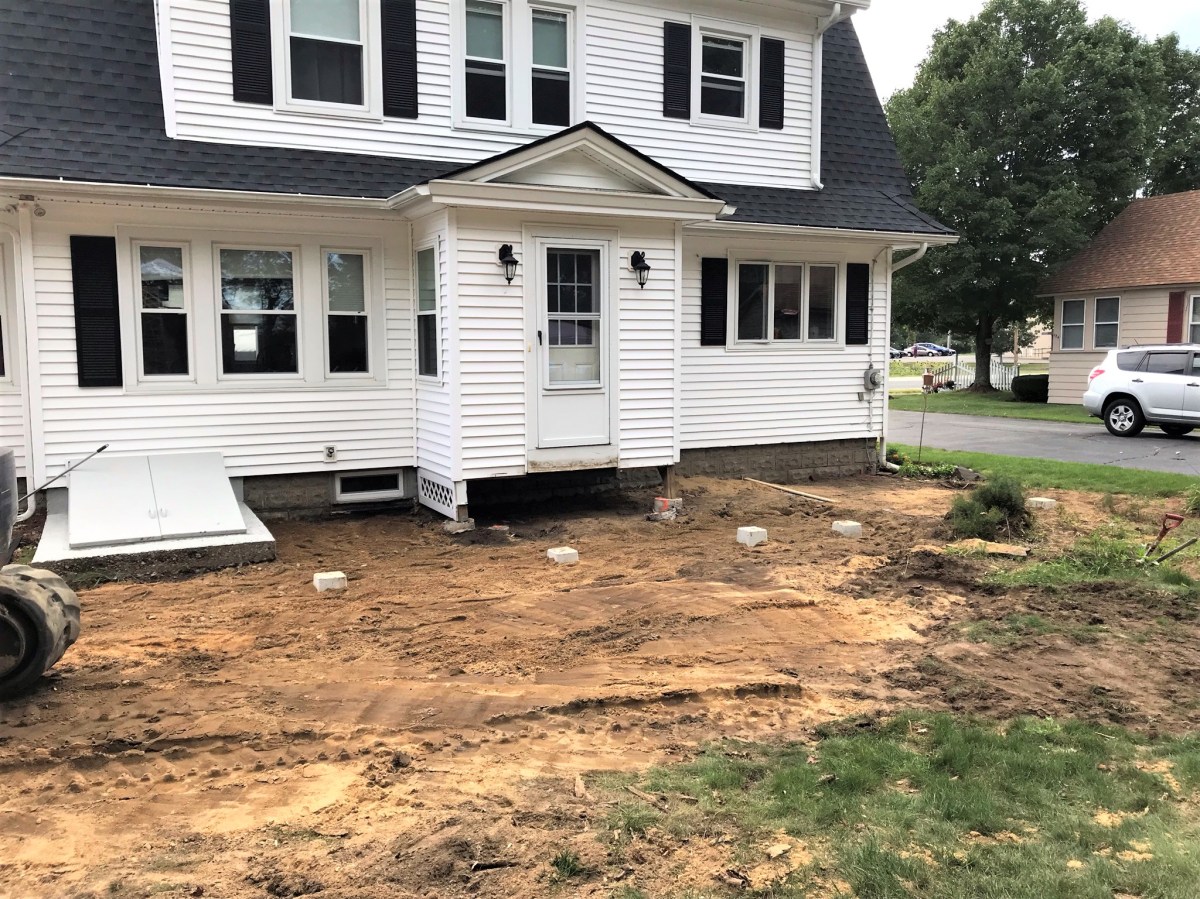
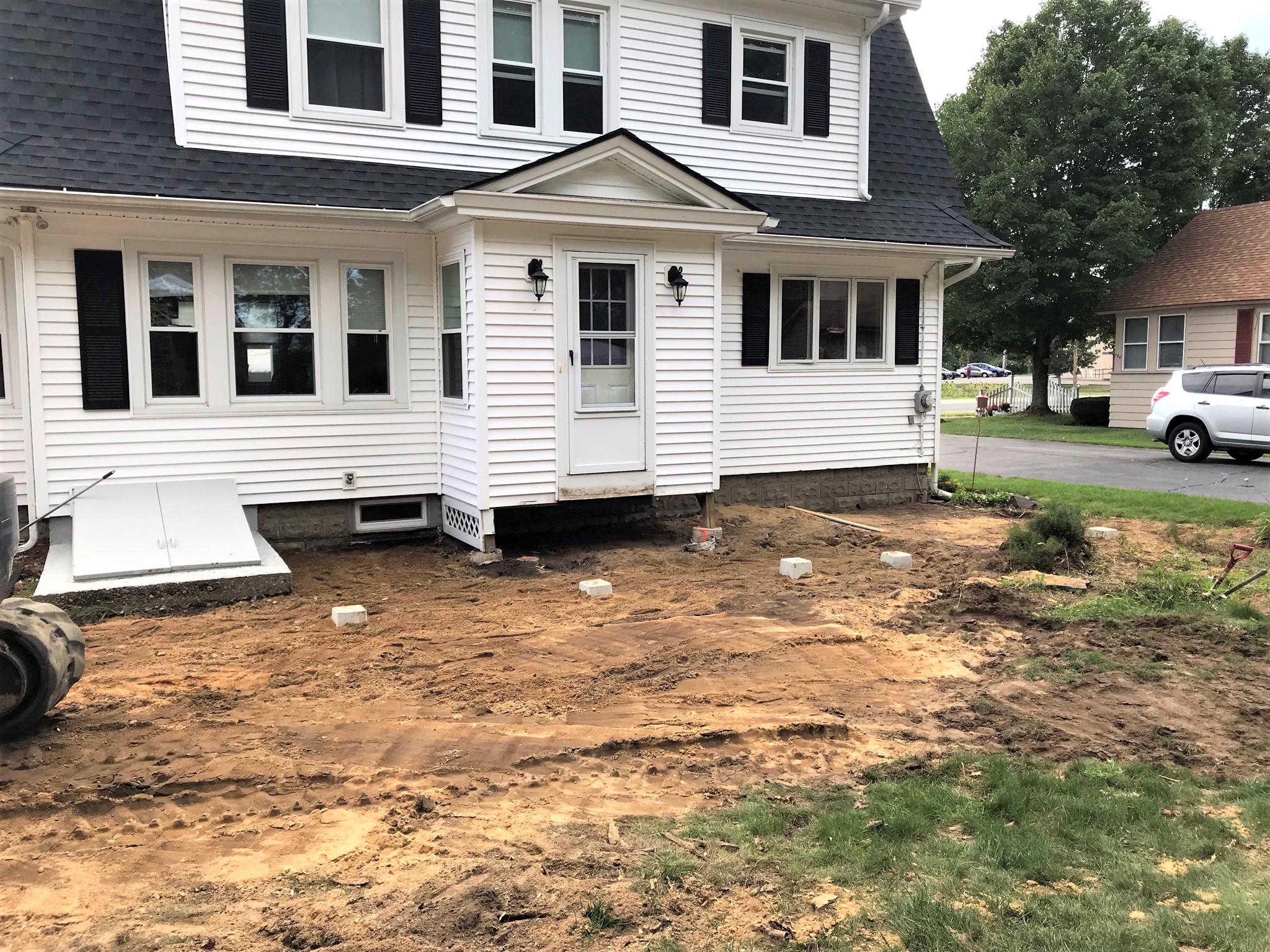
Cleaned up and ready for the piers. Note the old found asphalt landing.Lateral view with deck removed.View towards the new garage building.
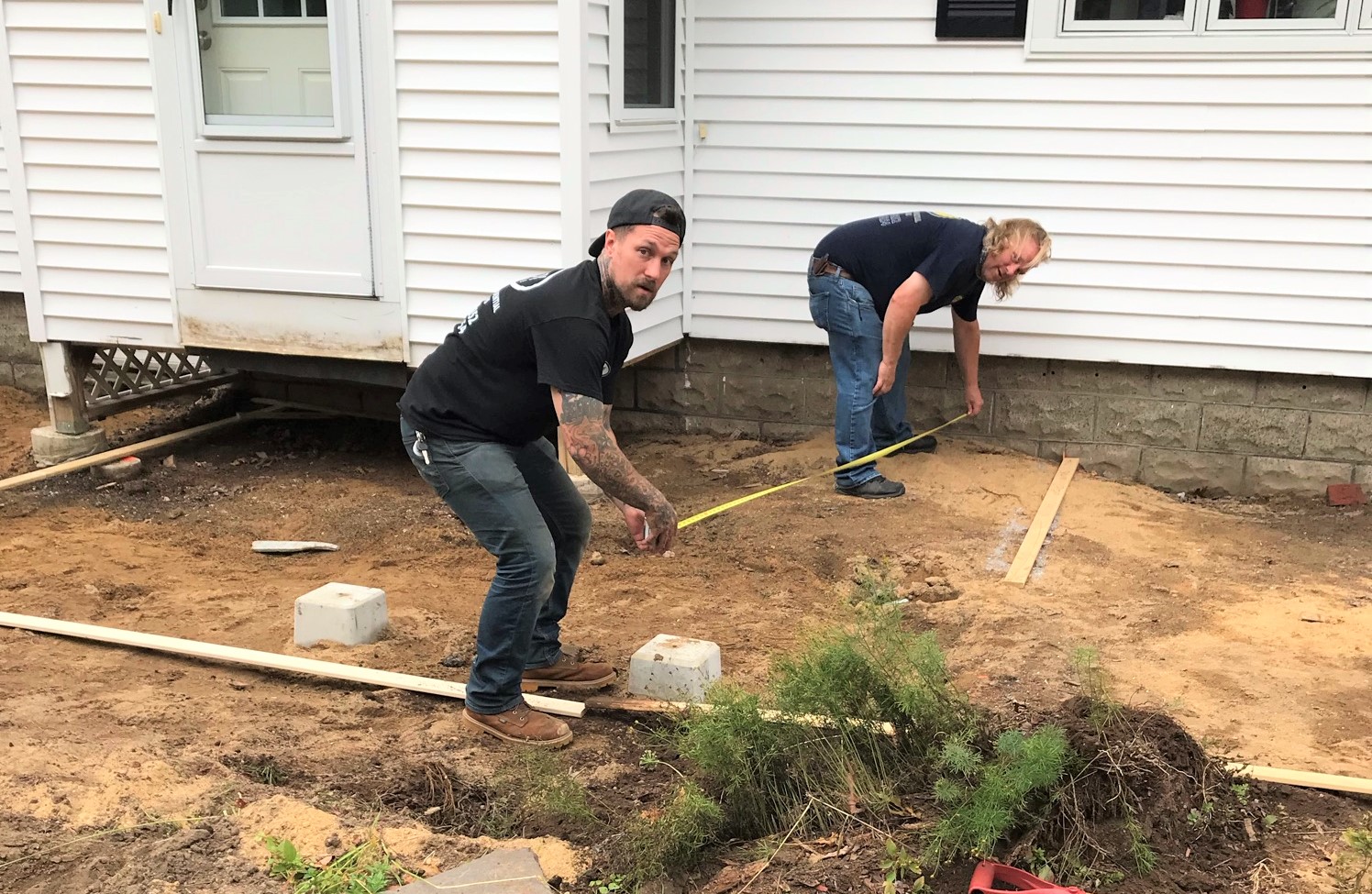
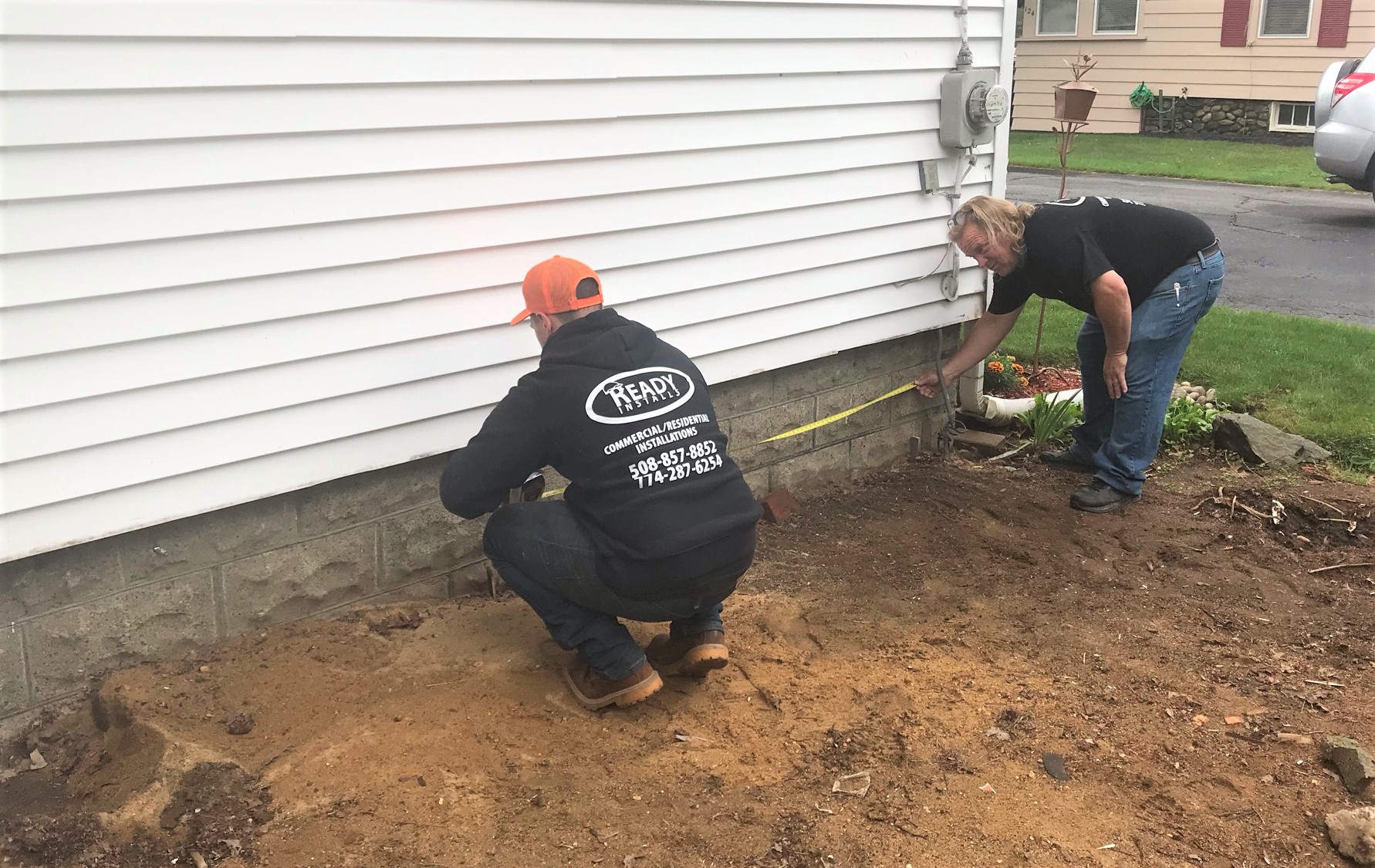
On Thursday September 9th, the father and son team from Ready Installs (Jon and Jonny Victor) measured for the new piers for the house deck. Later on Thursday, it rained a lot – AGAIN.
Measuring for the house deck piers. Care had to be taken to avoid the outgoing septic line.
Meanwhile Mike Astrella (electrician) was busy getting light positions chosen, as well as working on the rough electrical for both the upstairs and downstairs of the new building.
Selecting light locations and rough-in wiring
On Friday, I made a few supply runs to Home Depot in Auburn and EW Electrical Wholesalers in Worcester to get overlooked electrical supplies and materials.
Hitting Home Depot!
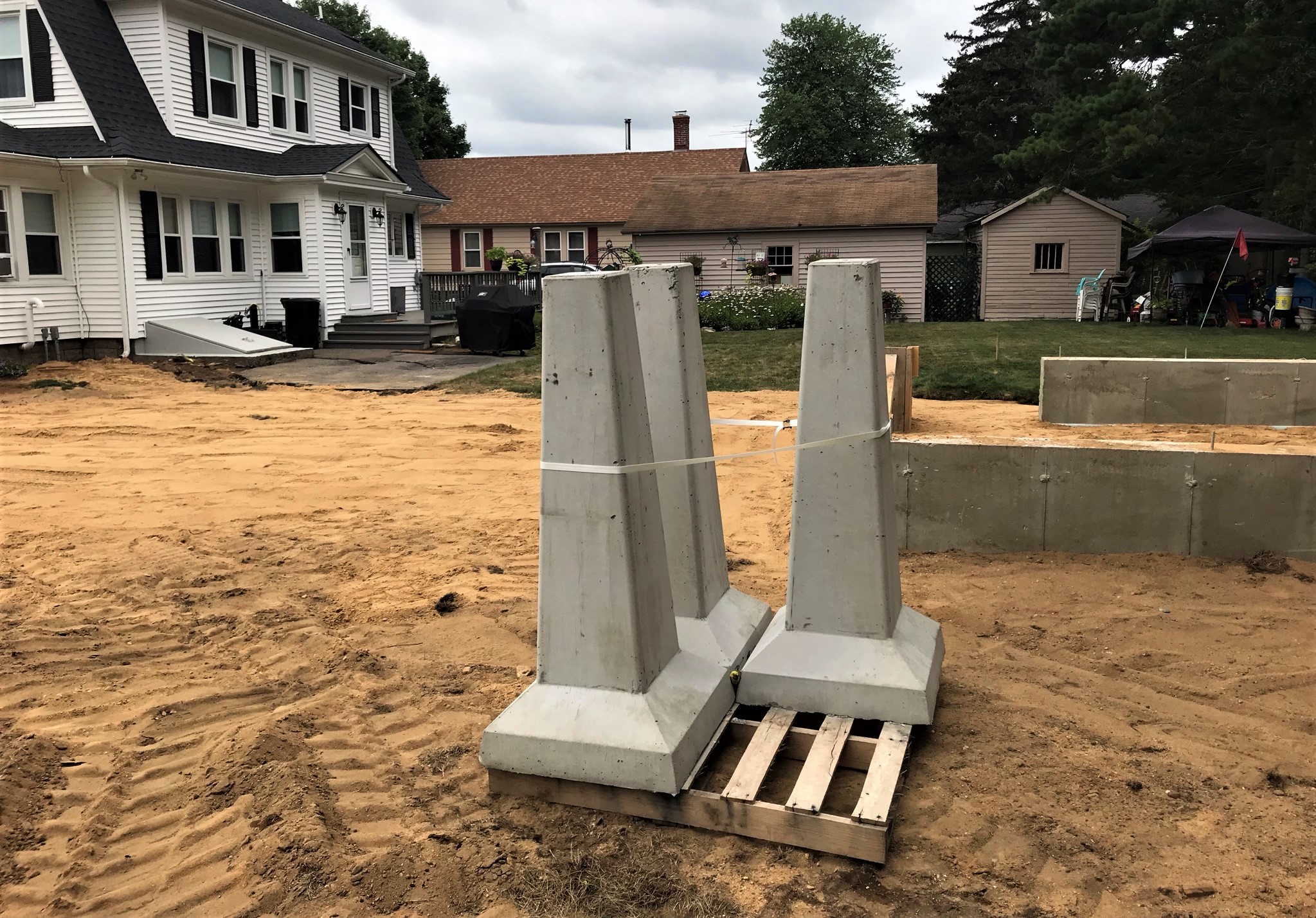
Also on Friday, the house deck piers arrived.
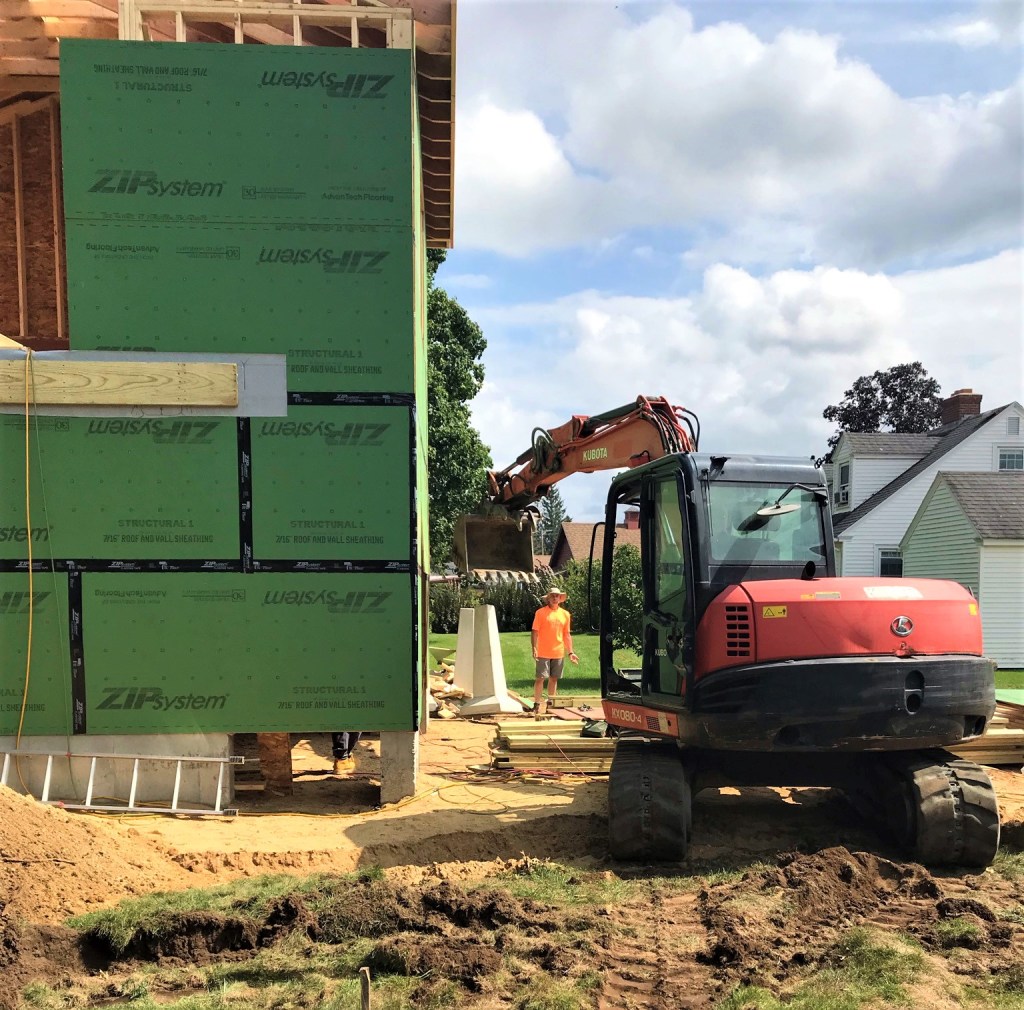
Piers being moved to the back by Cormier’s crew. This view is from the new building so you can tell it’s quite tall.
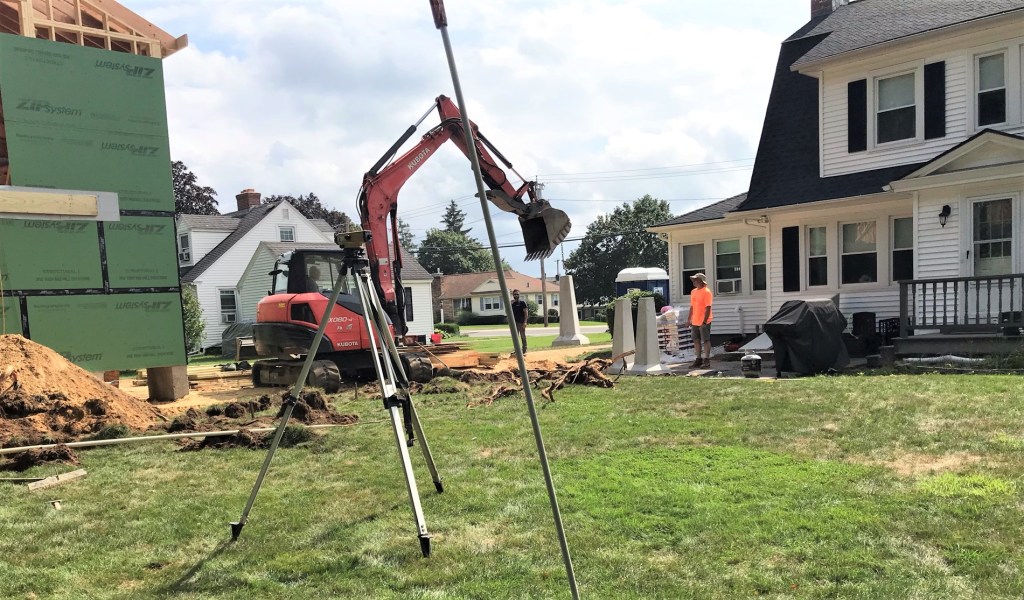
On Saturday, September 11th, the piers were installed and backfilled.
Some asphalt removal, and the piers are in.
That’s the progress for the week of September 5-11. We are getting there. Hope that you are enjoying these summaries!
Wow – we are almost two months into this building project now. This week (August 29 – September 4, 2021) was REALLY busy as you’ll see below. My photos focused on the more active stuff – so I hope you find them and the continuing saga of this project interesting.
First, I was able to get some shots on the interior work on the second floor.
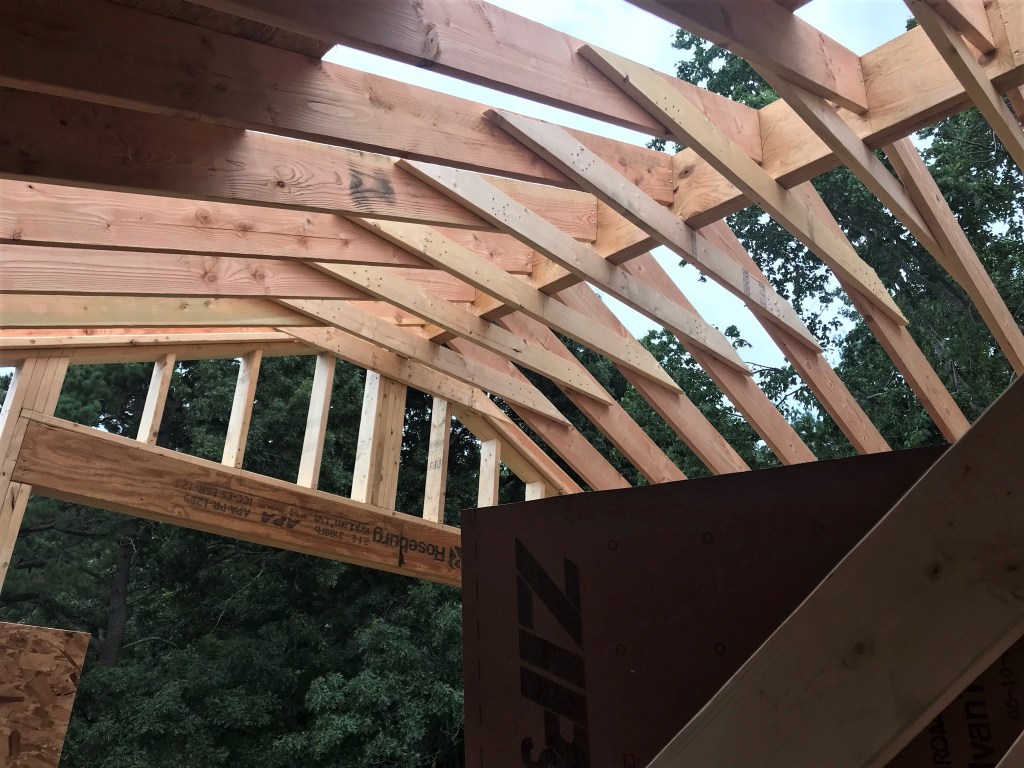
Braces on rafters
Our ceiling with no roof – yet
View towards the future front window
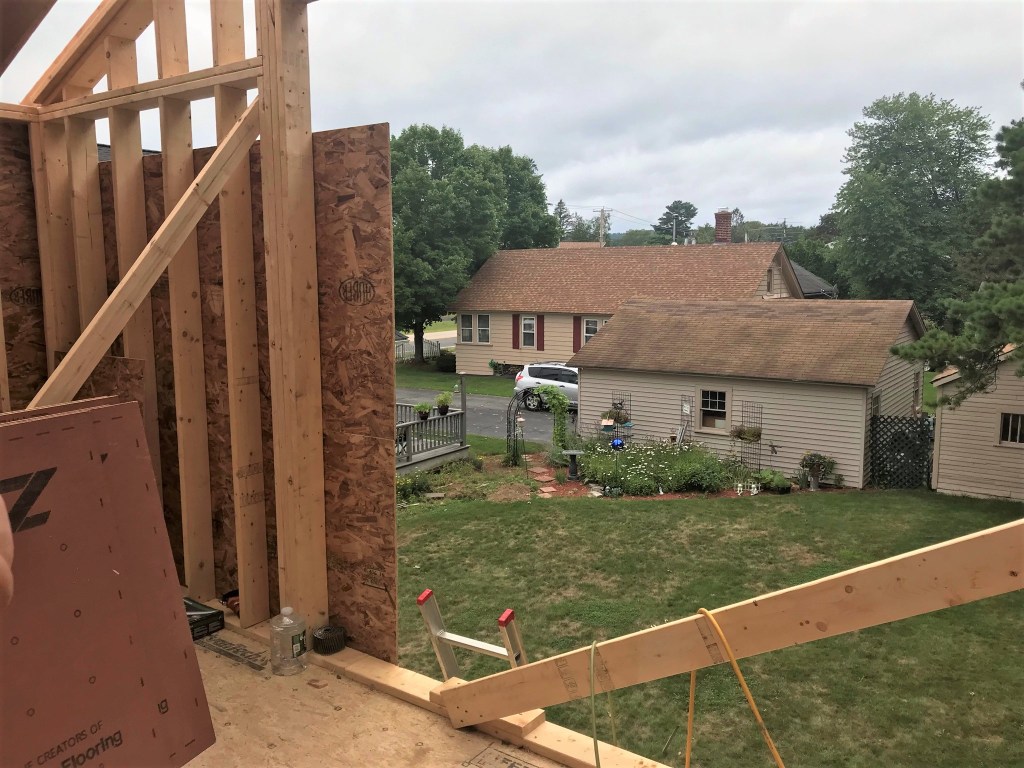
View towards the future 16′ x 16′ deck
A few shots from the second floor
Jon and and Jonny Victor (the father and son team of Ready Installs) showed up early to check out the project’s progress.
Jonny checking out door height.
Next, the first order of business on Monday, August 30th, was to get the deck header up. This involved installing an ice-water barrier (which the crew decorated with a muscle-man drawing of Raphael as it will never be seen again), and nailing the header.
Ice water barrier up
Header nailed in over barrier
Getting the deck header in
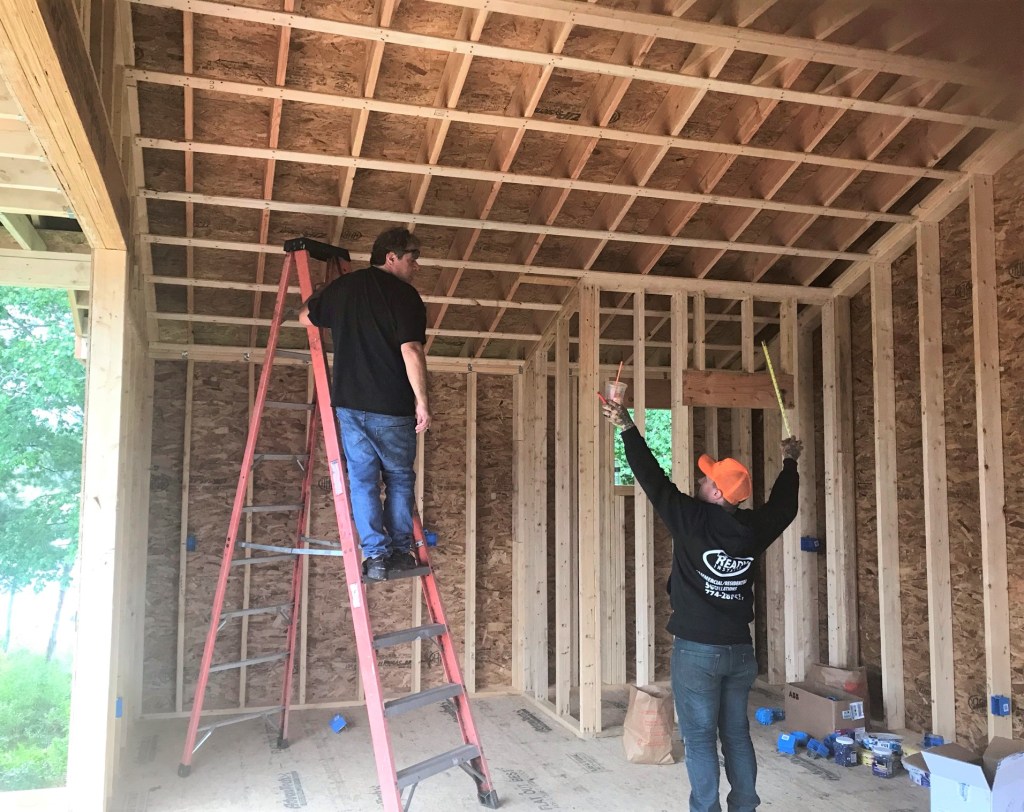
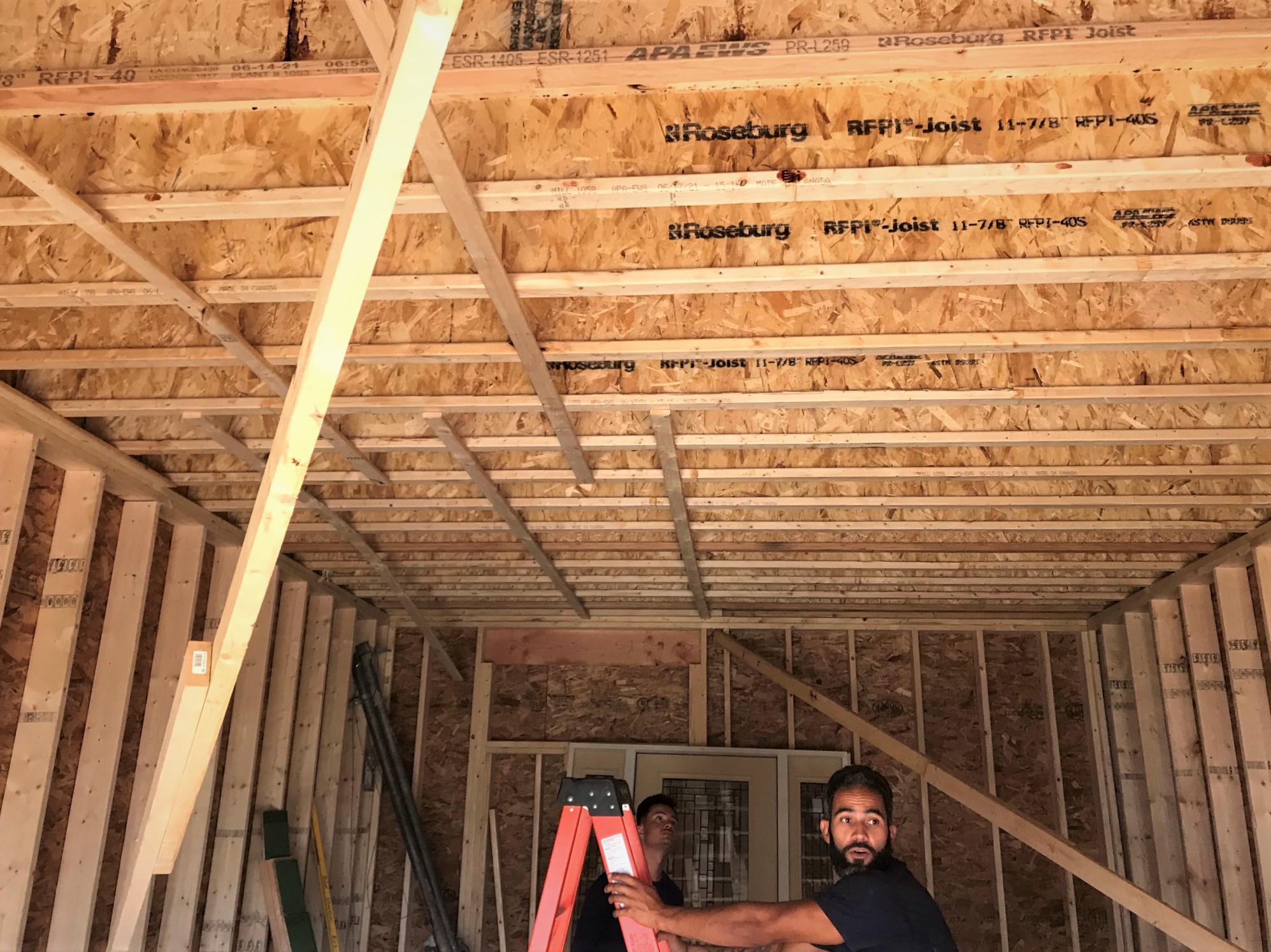
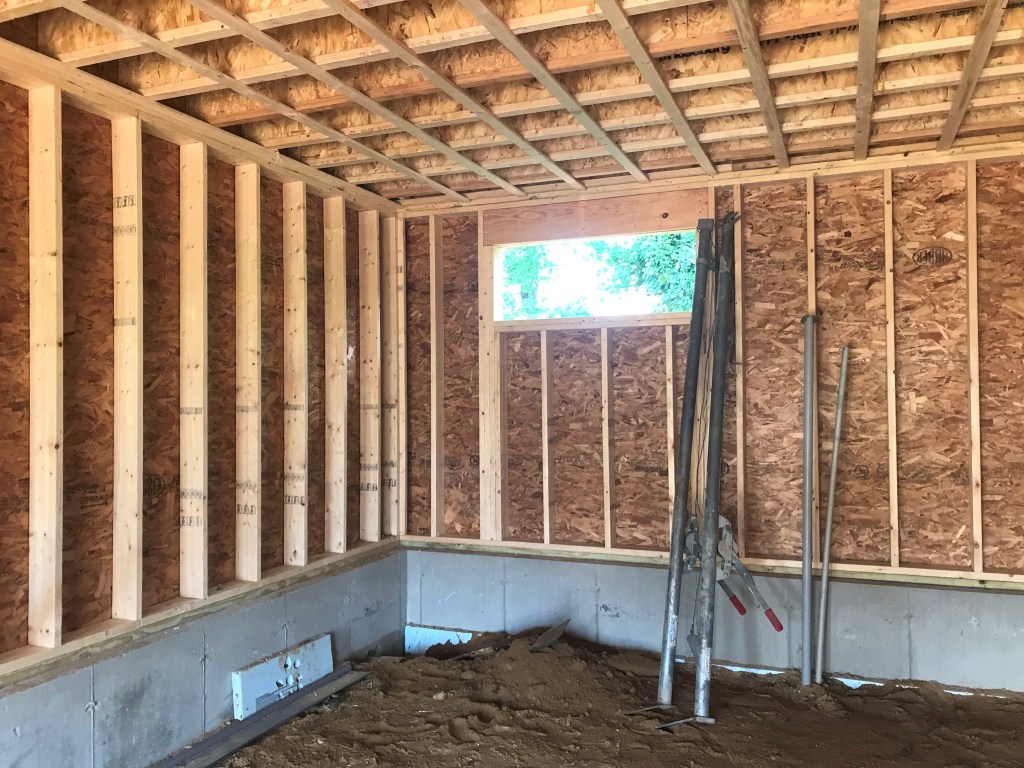
Inside the garage, work on installing furring in the ceiling went on.
Early furring work in garage
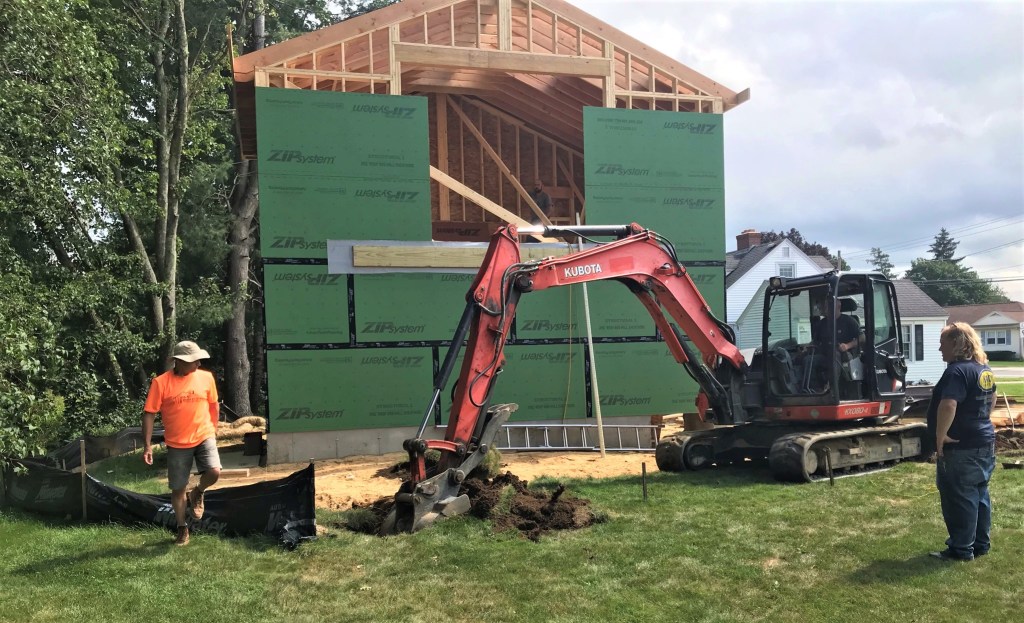
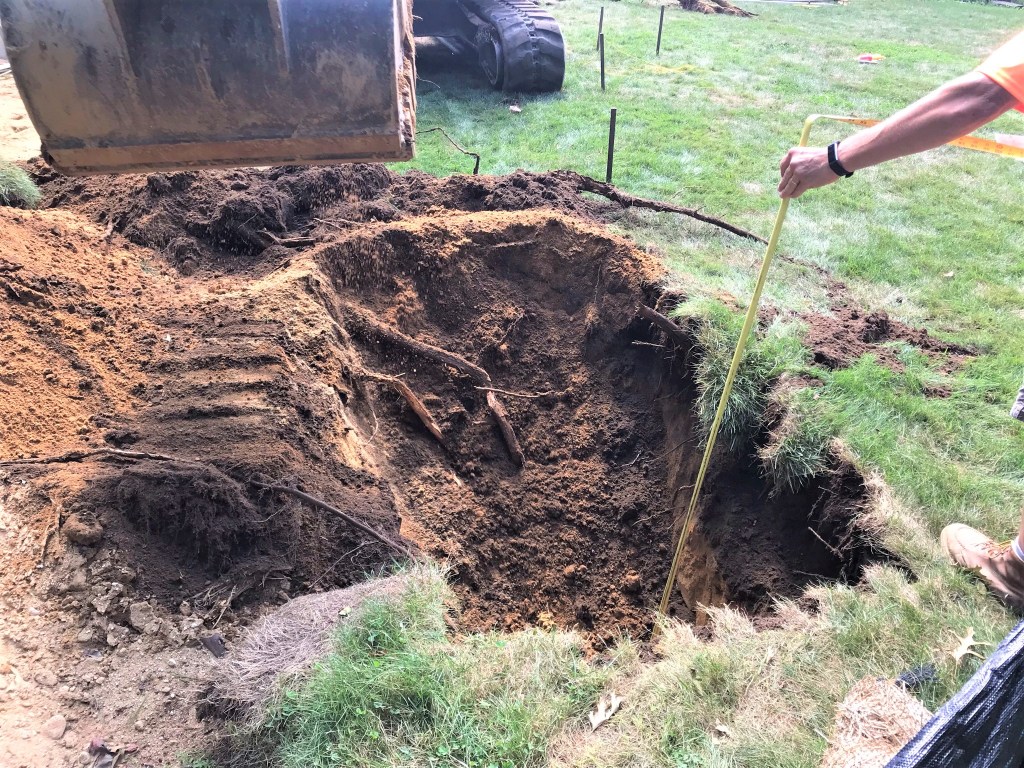
At this point, we had a need to get some construction synchronized dance going. To start the deck we needed get the piers in for the deck – which required excavation and careful measurement. Also, the septic line needed to be started. Andy Cormier returned with his excavator and crew to do this. There were quite a few roots in the ground from a previously removed pine tree.
Staking out the deck location
Andy begins digging for the piers
Checking depth
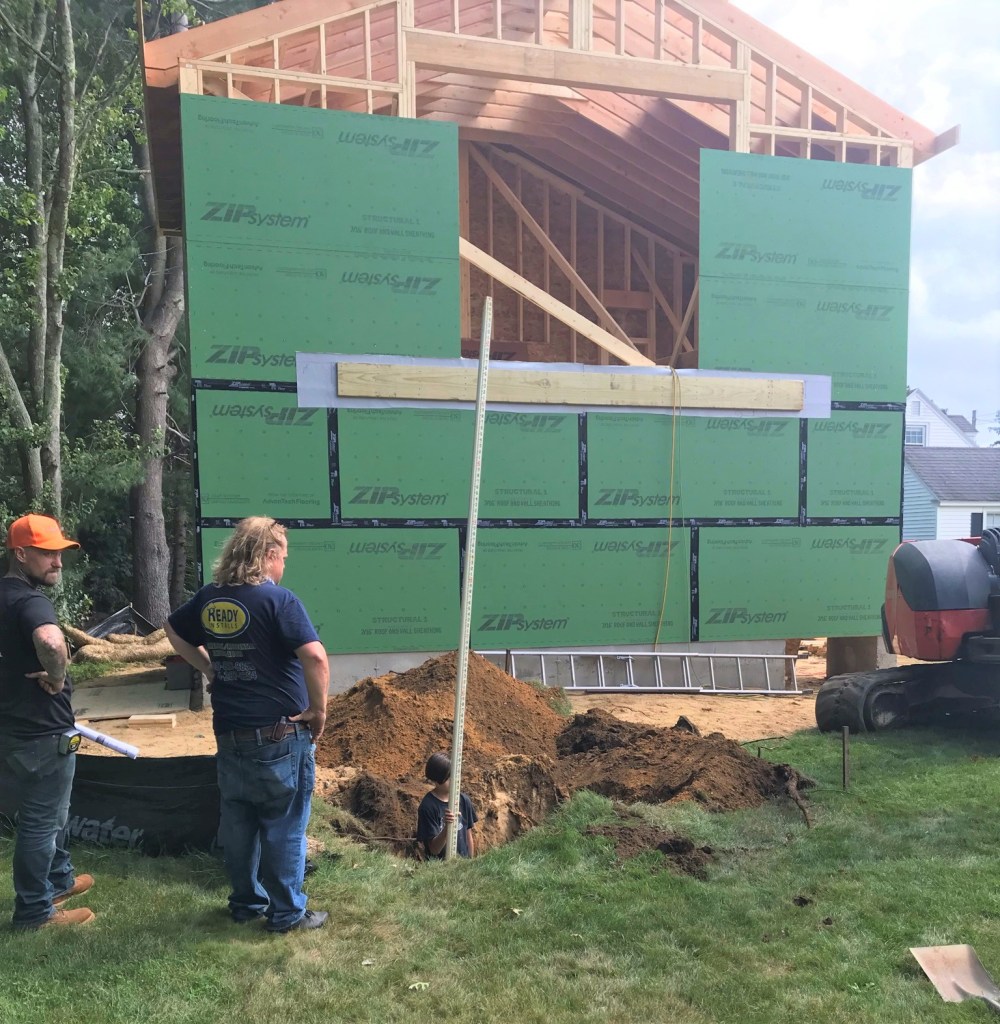
Jon Victor watches as the hole depths are verified by Andy and his grandson
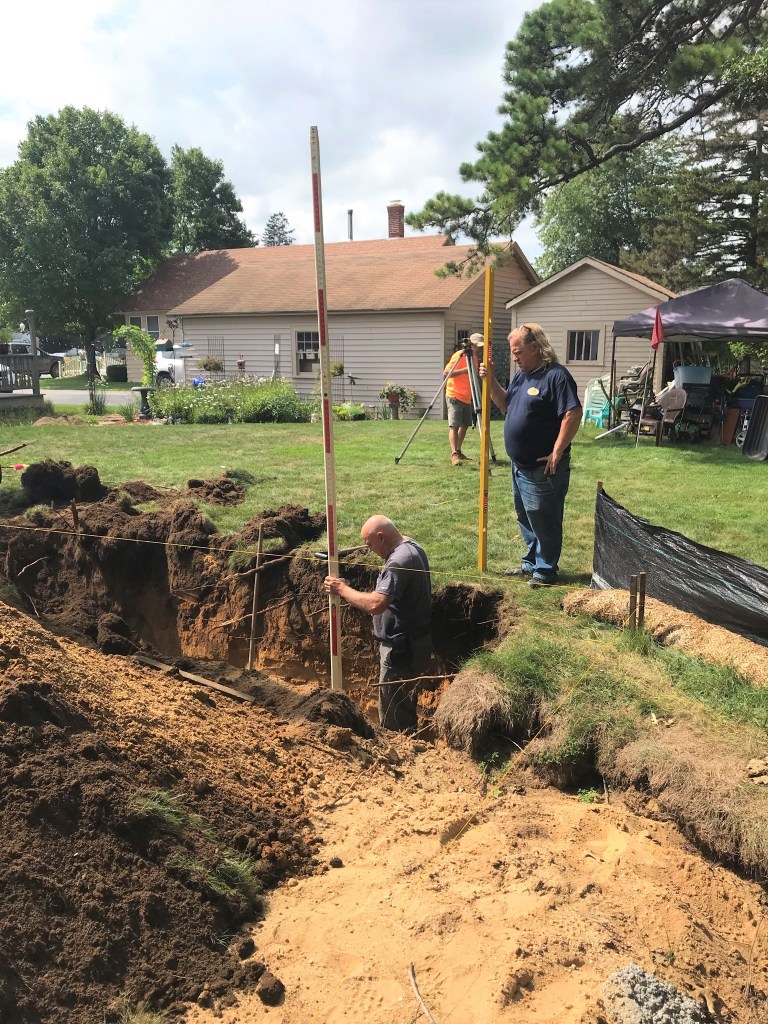
View of the excavation
Getting ready to exactly place the piers
Pier excavation activities
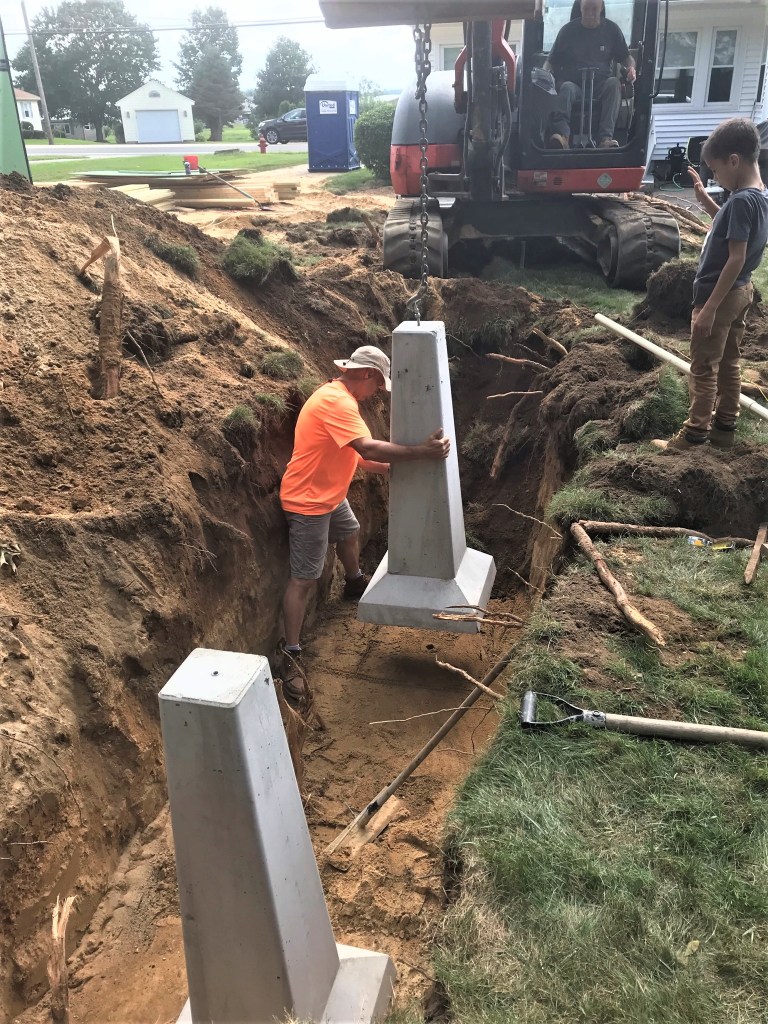
Once the trench was right, each 600-lb. pier was put in, and checked for accurate placement.
Picking up the first pier
All three piers moved to the last chunk of asphalt in the driveway.
Moving the first pier
Guiding the pier in
Last of the 3 piers going in
Pier installation for the deck
After this, Andy backfilled the trench.
Monday August 30th progress.
On Tuesday, August 31st, work continued apace. The framing of the deck began as well as work on a septic line and more.
Deck framing beginning.
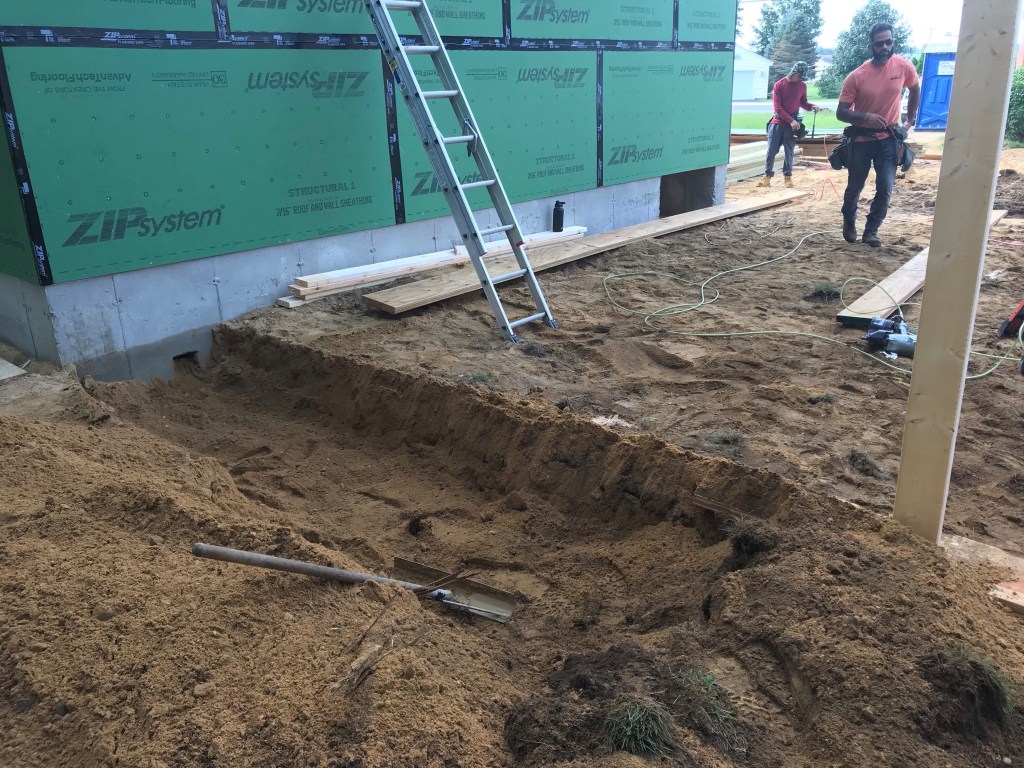
Septic line excavation
Septic trench
Septic line into garage floor
Septic line work.
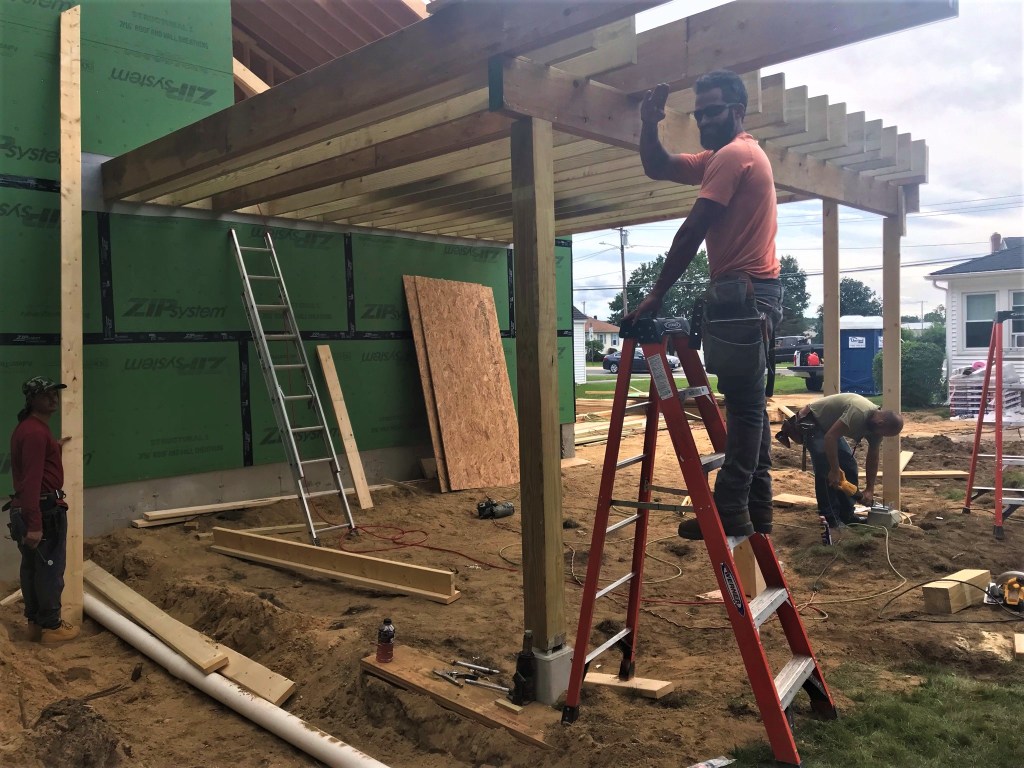
When Andy was safely done, work could get going on the deck supports. Temporary supports were used and then the main deck supports were attached to the piers.
Temporary deck supports going up
Raphael and crew making it happen
Permanent column attachment next to a temporary support
Getting the deck supports upThe sun sets on Tuesday’s progress.
Wednesday saw more of the same – deck progress. I was out so I did not get as many photos. The crew had to wrap it up early as the remnants of Tropical Storm Ida were coming with heavy rain predicted Wednesday-Thursday.
The crew here is framing up the deck roof overhang as Jonny gets the stairway landing area identified and cleared.A shortened day (Sep 1st) with progress on the stairs and the deck area clear here.
Ah, but the rain came heavy – BUT – it was only overnight and gone by the morning of Thursday September 2nd – so happily work could continue on the deck and second floor in preparation for Saturday roofing.
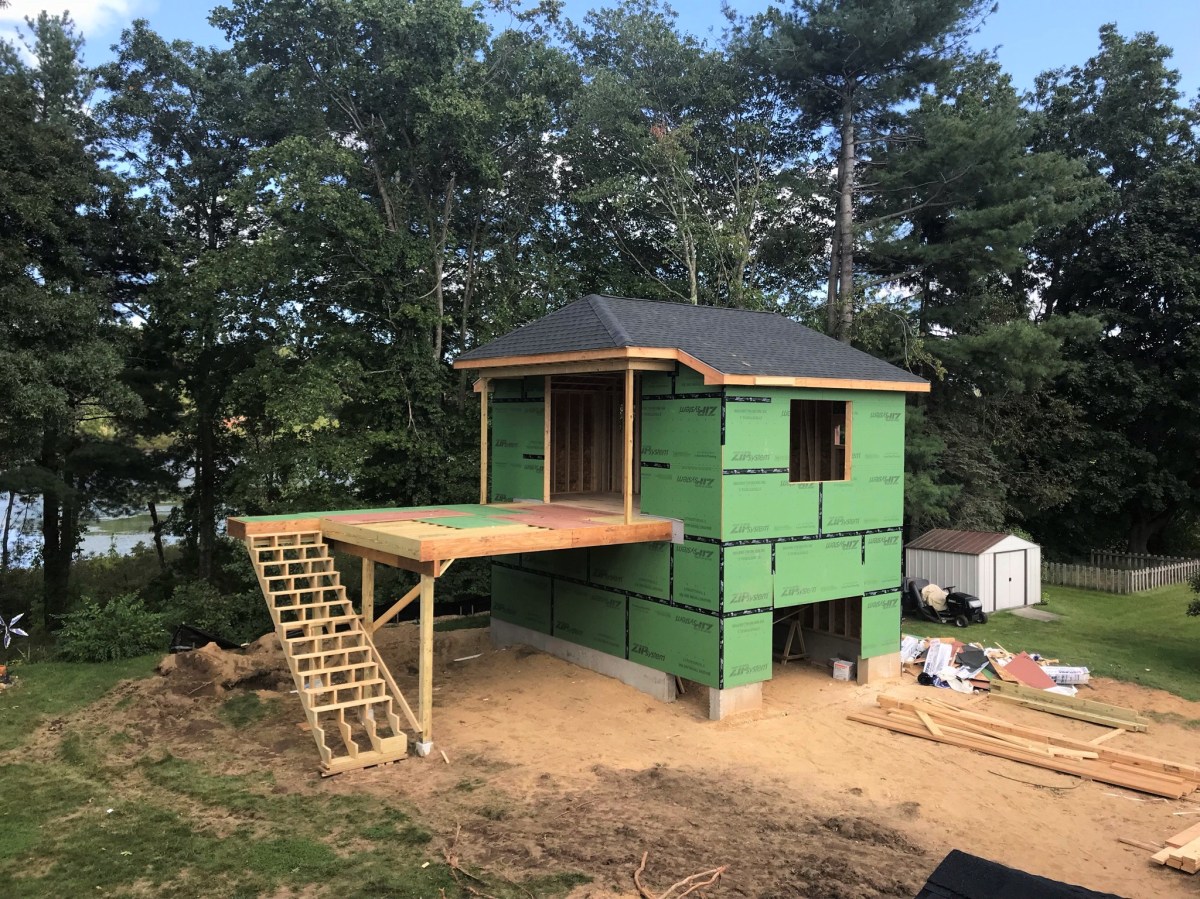
Yay – work can go on!Interior framing progress.View of the stair stringers and temporary cross bracing.Thursday mid-day progress was strong – deck roofing overhang was nearly done.End of day Thursday had the roof all enclosed and ready for the roofers. The boards on the deck are temporary supports for the crews.
No construction happened Friday as the roofing crew was going to hit the ground running on Saturday. And hit the ground early they did at 7 AM!
Sun coming up on the roofing crew on Saturday, September 4th.
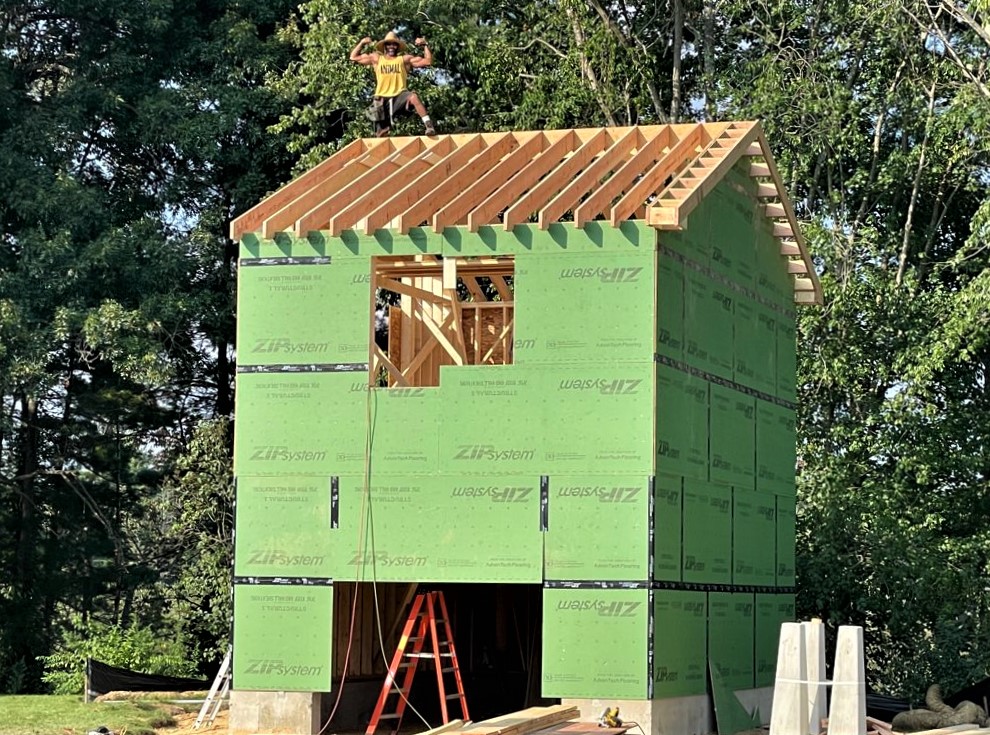
The roofing crew was done in 4 hours – and now we are ready for another good week. We did also work o Saturday with one of Jon’s patio specialists to define what our patio would look like and that should be very exciting and gorgeous – but you’ll have to wait to see that (like us).
All roofed in!
Thanks for taking a look here – and what do you think of the progress so far? We have a good ways to go, and as the Starks (and EVERY New Englander) says, “Winter is Coming”…so we are certainly wanting sooner than later.
For those of you who are wondering if I will EVER get back to hobby stuff, I will. I am using some time to rewrite and add onto my Aztec supplement for Buck Surdu’s Feudal Patrol™ in Mesoamerica (Civilizations Collide). New and improved (I hope).
Also, I am writing a good number of scenarios too. Plus, golf season is winding down in the next six weeks, so that’s happening too.
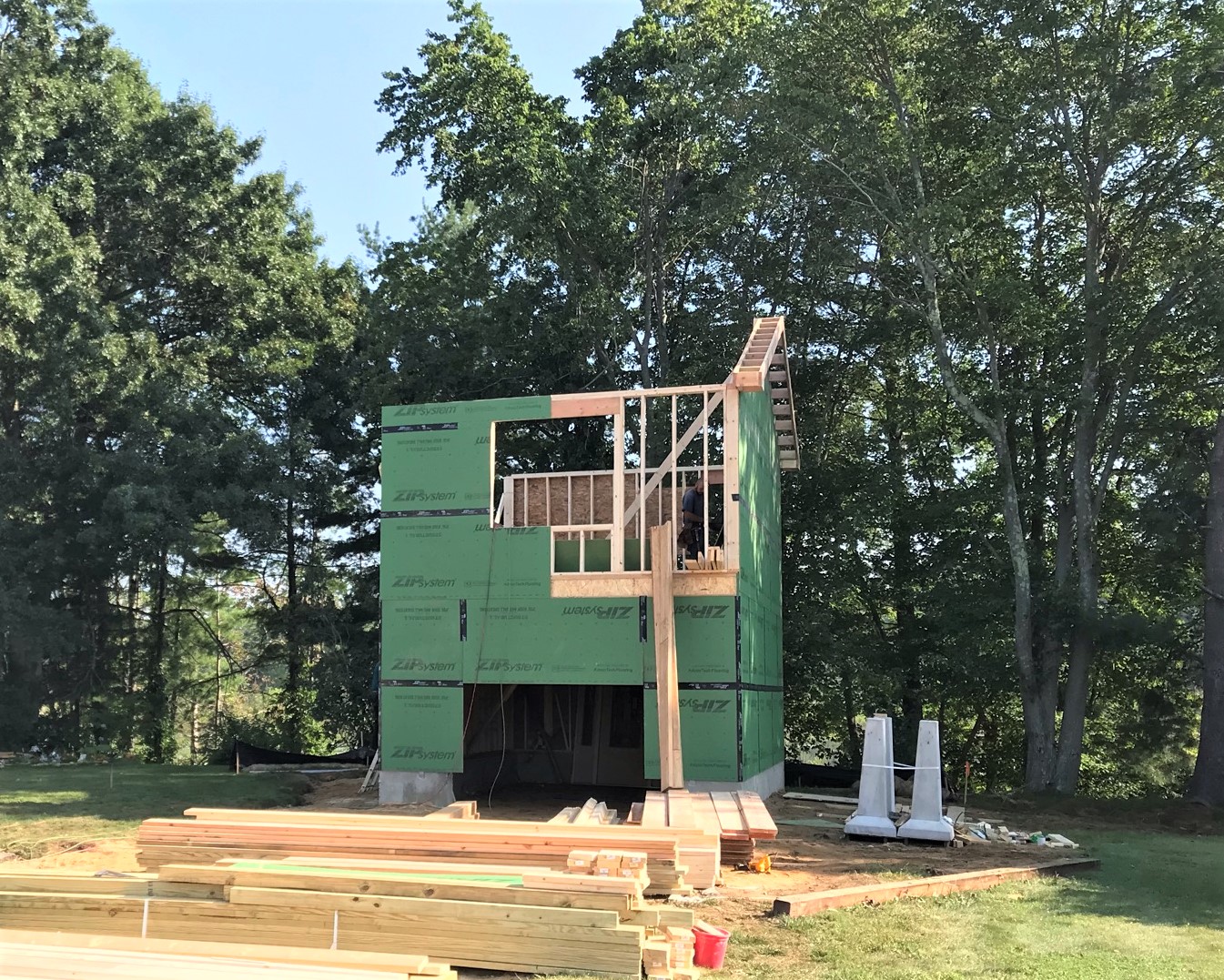
Last week (August 22-28, 2021) was a stop-and-go affair for the project. As I mentioned in my last post, Tropical Storm Henri hit us with wind and rain Sunday-Monday, so progress on work was delayed until Tuesday the 24th.
At that point, things went fast as you’ll see below – until Friday. There was a crack three-man crew of Raphael (supervisor), yet another Raphael, and Enrique who arrived and worked like men possessed. This despite that the weather was really hot all three days – mid-90 degrees Fahrenheit (32 to 36 Celsius for you metric folks). There is really no shade either in our yard.
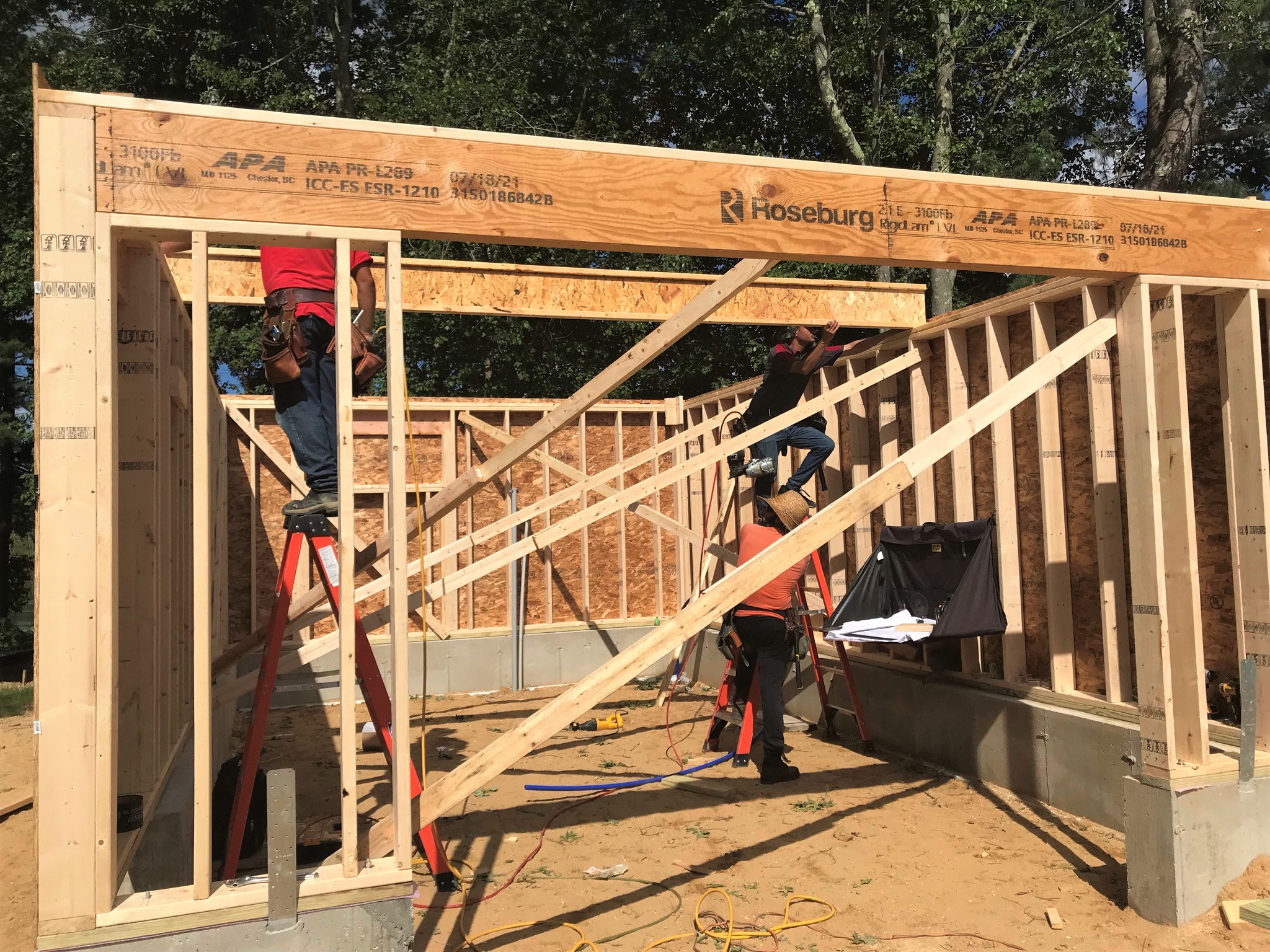
Putting on the sill and building the first garage wall.
Walls went up quicklyThe two Raphaels mug for the camera after getting up the first LVL beam. On the left is the supervising Raphael.Another view of the beam going up showing the ZIP system sheathing and tape. Soon, three garage walls were framed and sheathed. Here you see Raphael in front, Raphael in the middle, and Enrique in the back.Bracing was set, and then the first of the second-story floor joists was installed on top of the garage walls.More floor joists were to follow.At the end of Tuesday the 24th, this was the hard-won progress. Again, it was HOT.On Wednesday the 25th, work began early on the second floor flooring.We also got a delivery of more lumber…and a porta-potty!Work started on the second floor gables and walls.Raphael handles a sheet of sheathing with ease.
Looking at the back of the garage
Looking out the front
The garage interior at least now provides some shade!View from the street as the first gabled wall goes up.Closer shot of the first second floor gabled wall. There is going to be a pretty tall ceiling in that room.The hot sun sets, revealing Wednesday the 25th’s progress.
More second floor walls up
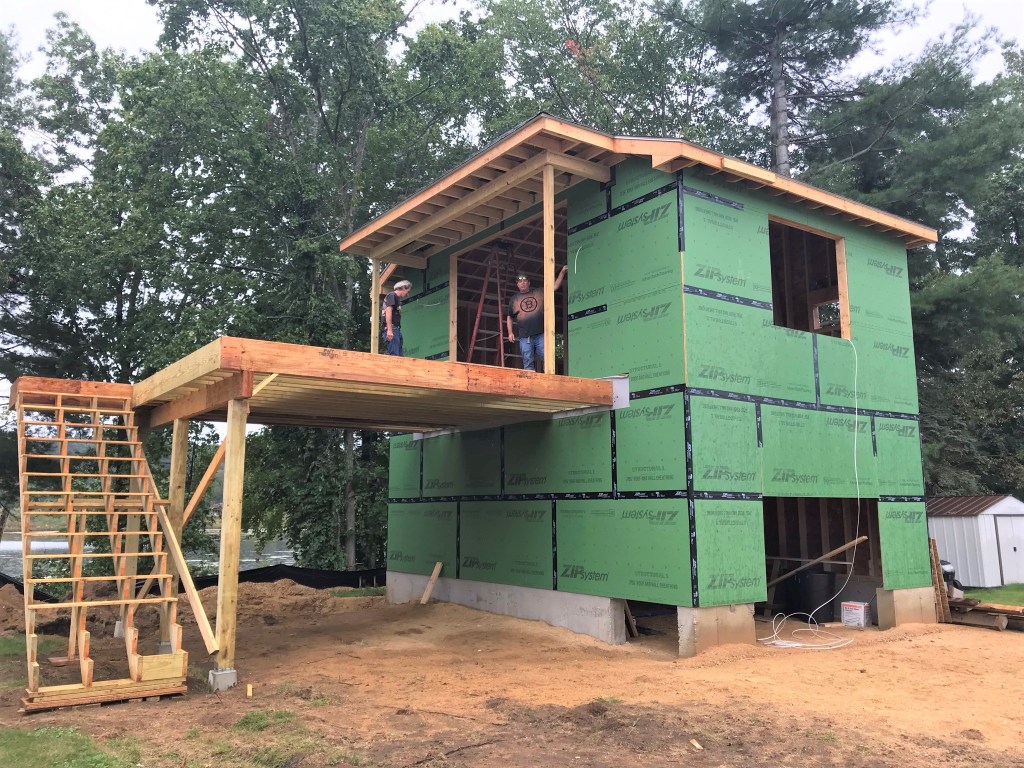
Good view of the side where the deck will be
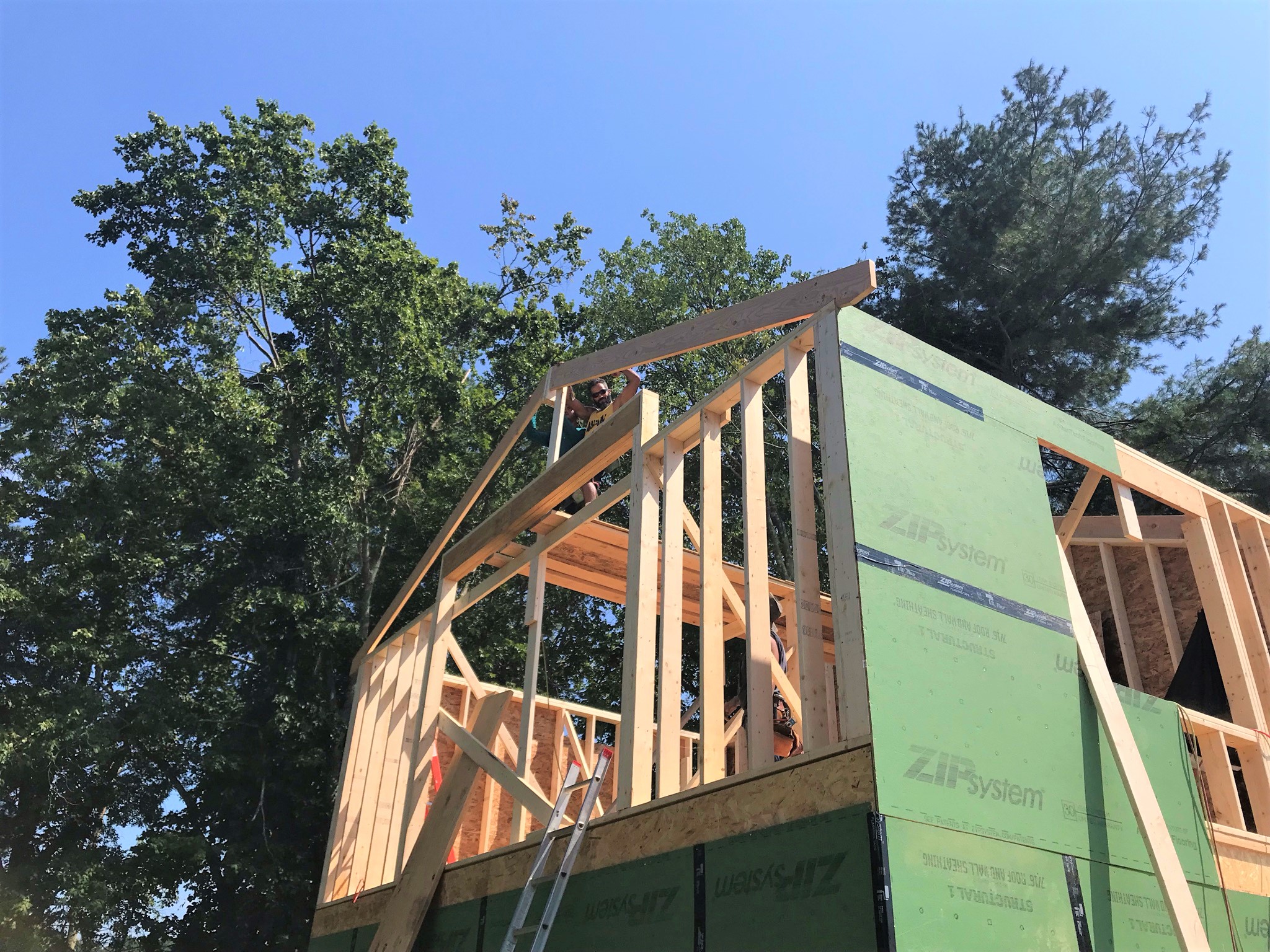
Thursday morning more progress on the second floor was made.The deck side wall went up plus the strong LVL beam that will go over the glass doors. Again, did I mention it was HOT? AGAIN?Close up view of the second floor deck/door side.Raphael strikes a pose as the rafters take shape! The man has some guns!
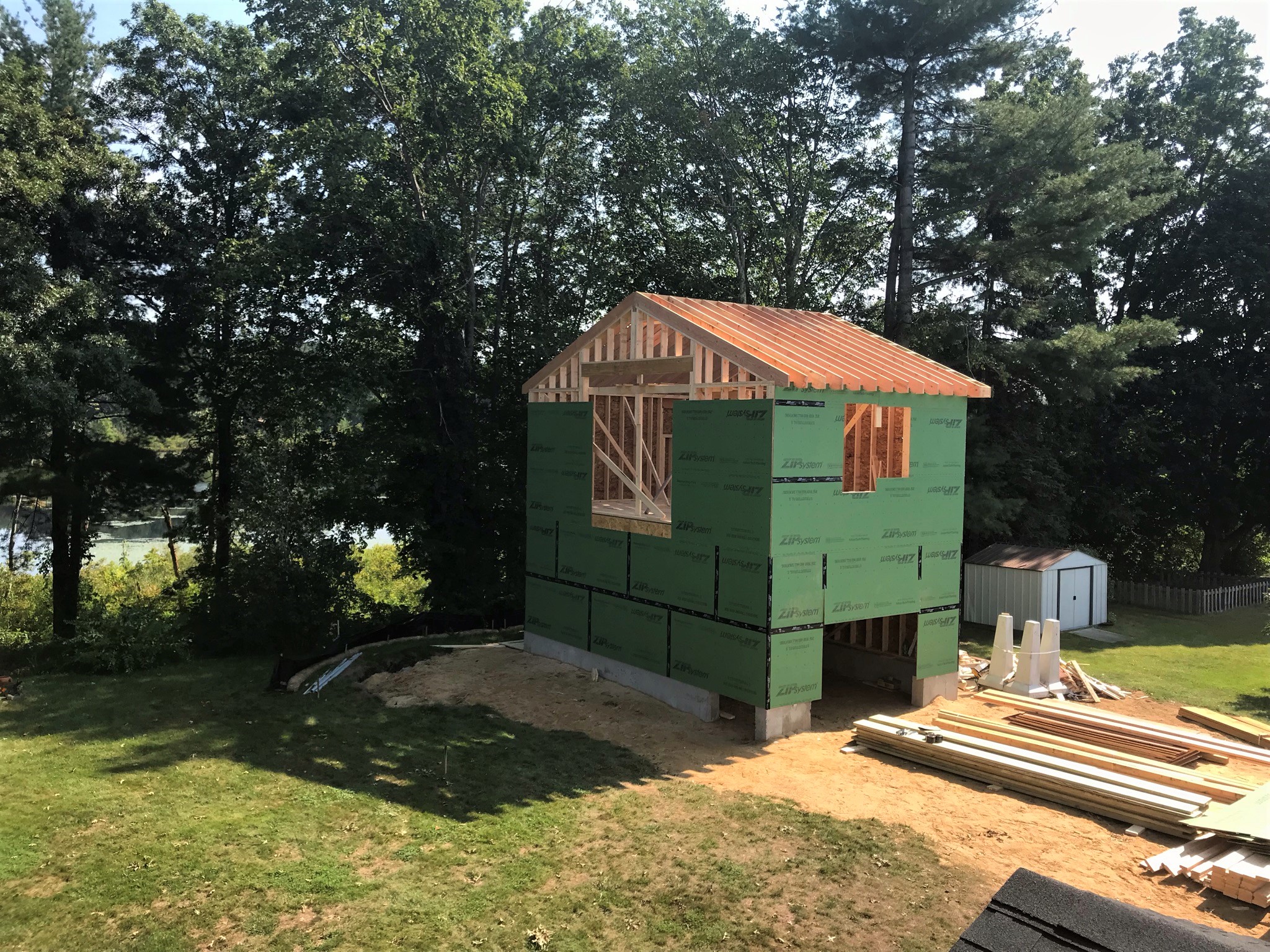
At the end of the day, here below was the progress for the week – on Thursday.
Progress at the end of August 26th.
Friday the project got held up as we needed to get the deck piers excavated – and the excavator did not make it to the site. Also, the pre-fabricated concrete deck piers would need to be moved to the other side of the building, and they weigh about 600 lbs. each. Ironically, the heat broke Thursday night and Friday was nice and in the 70’s. But it is August, so….the heat will be back, even in September. Of course it could snow in October…
I’m looking forward to more progress coming during the week of August 29th to September 4th. Stay tuned!
Has it been 5 weeks already? Still, we are indeed anxious to get this building up!!
Ready Installs and Cormier Homebuilding were busy this week. We also had Mike Astrella and his crew doing some electrical work. Moving forward for sure.
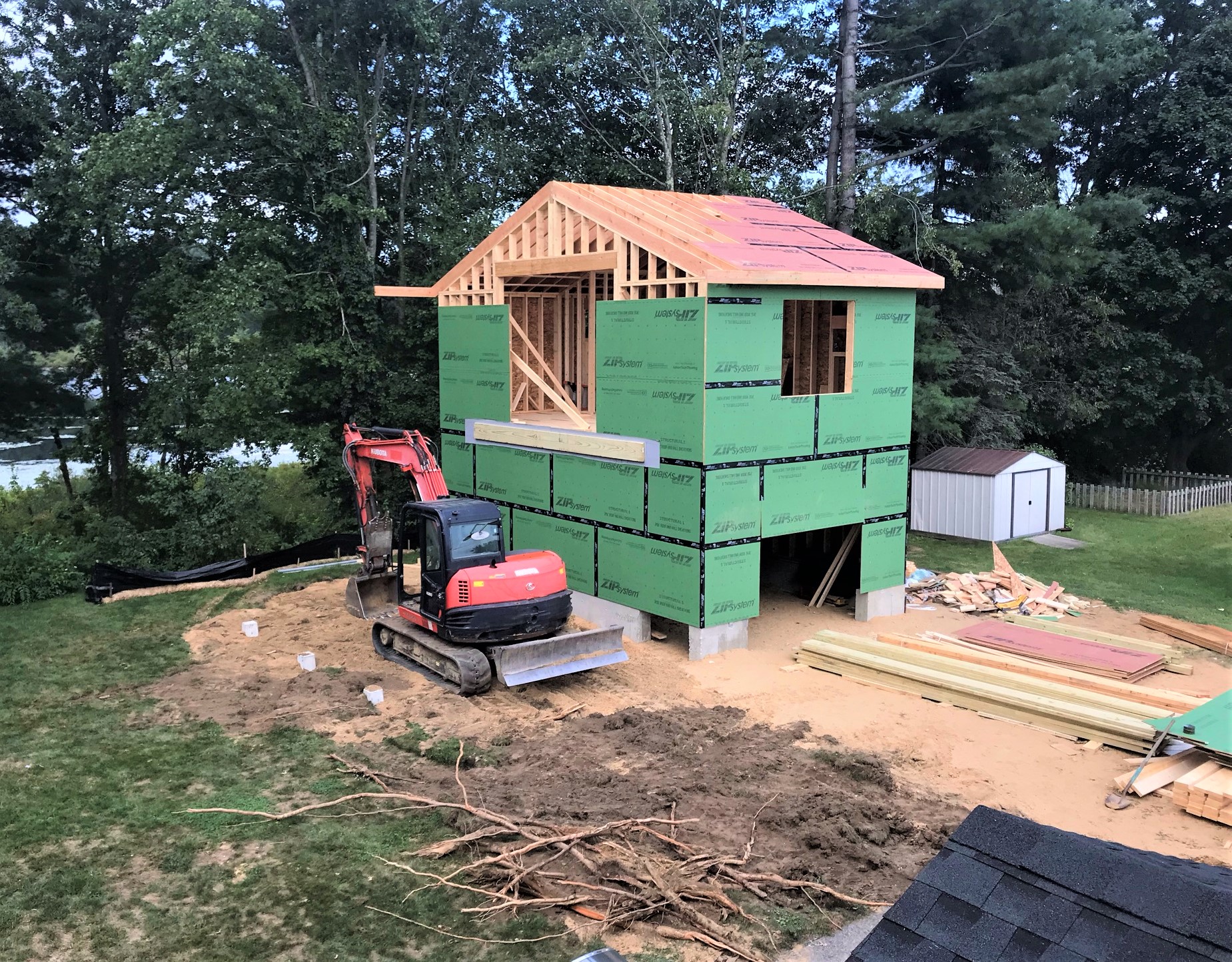
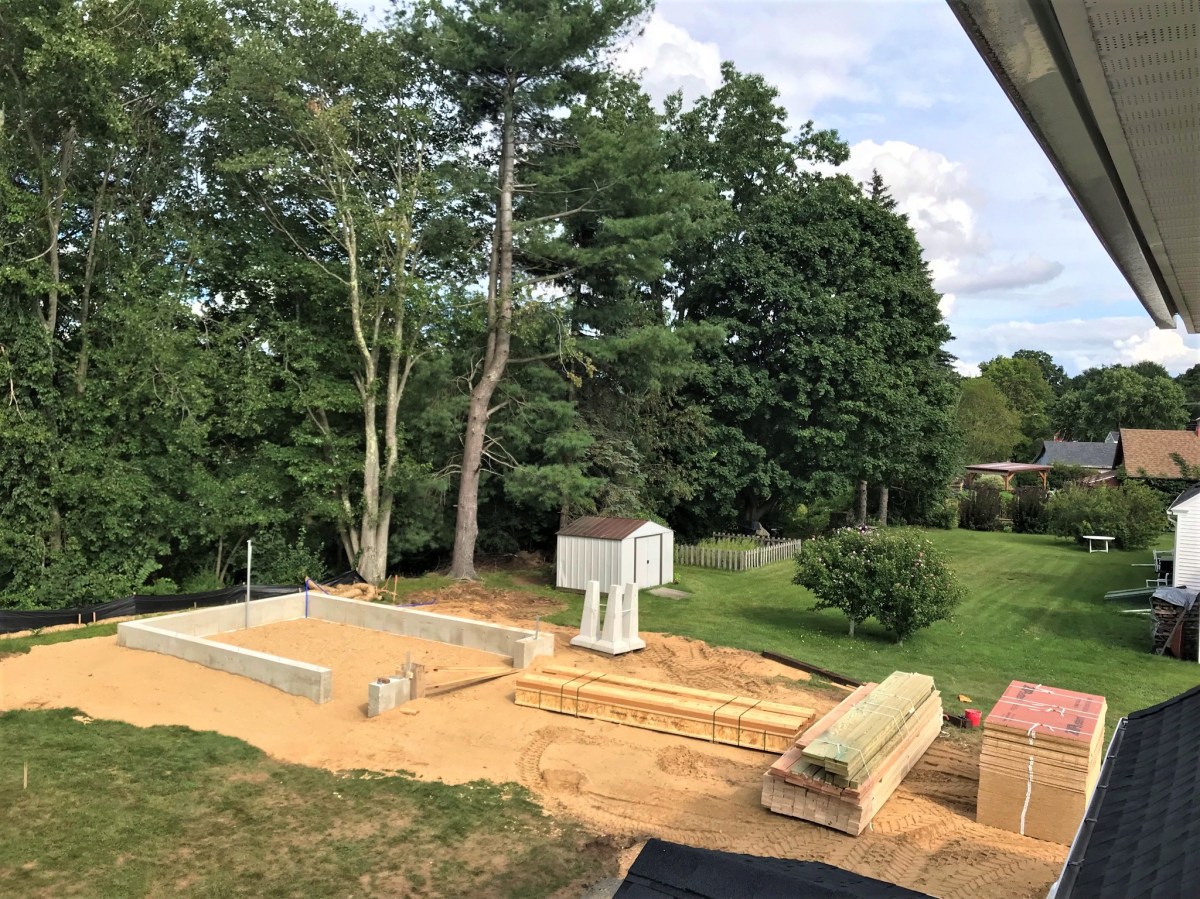
Backfilling the foundationMore sand for backfillingMike Astrella working on conduitsDrilling out hole for septic accessBackfilling progress – and repair on foundation chip.Concrete piers for the deck came on Wednesday. Deliveries would start to accelerate.Close up view of chip repair. Looks good!Wednesday progress.By Wednesday, this was the view of the progress from upstairs in the house.
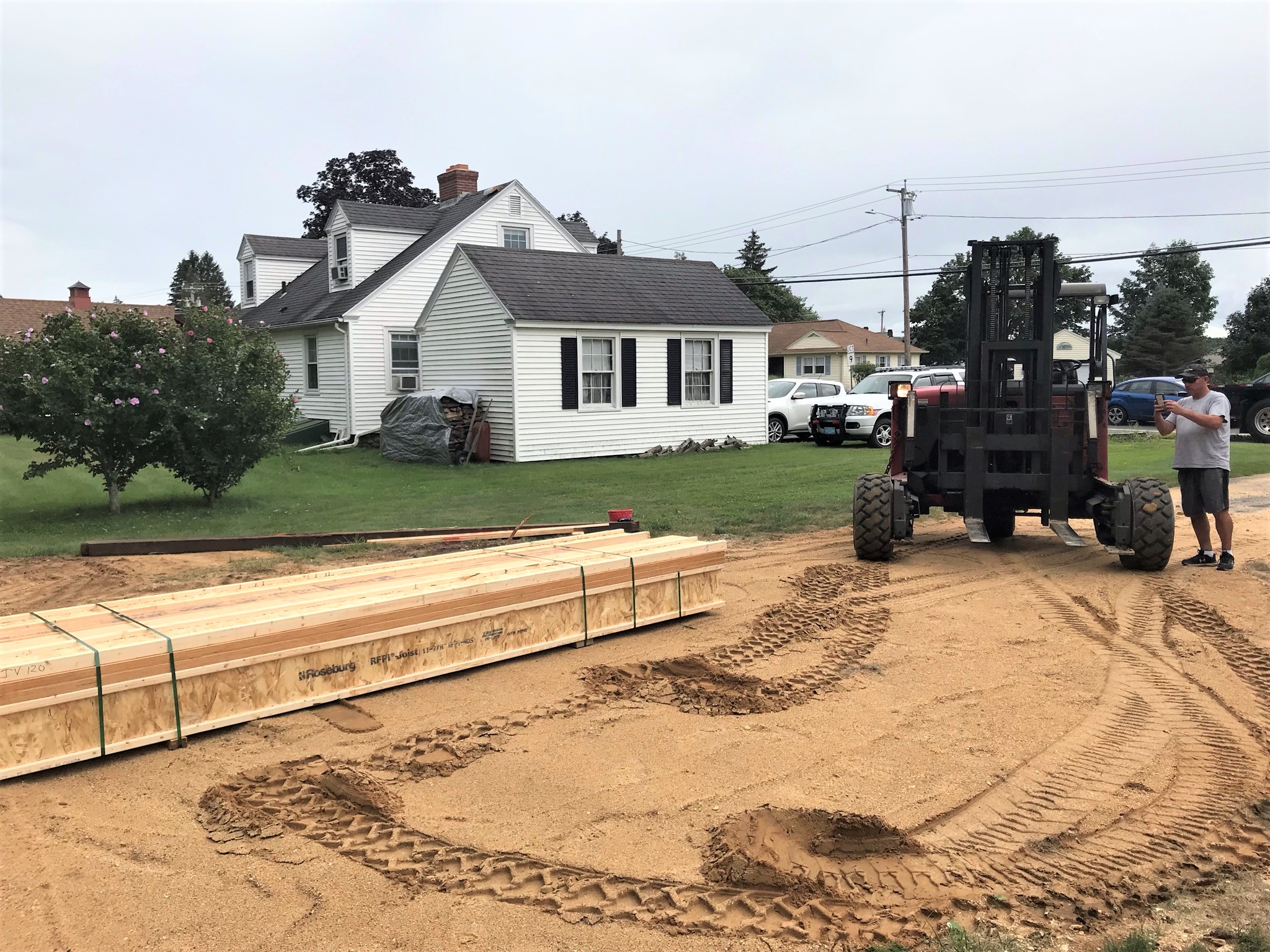
Friday and Saturday would see more deliveries. Some lumber is still on back-order, but not too much.
Friday saw a delivery of lumber – mostly LVL’s and floor joists.Saturday saw a BIG delivery of even more lumber.Lots of lumber!End of week – here we are progress-wise.
With any luck, Tropical Storm Henri (which hit us Sunday with rain and wind and will affect us through Monday) will not cause any delays this week.
Hope you are enjoying these posts – and this journey.
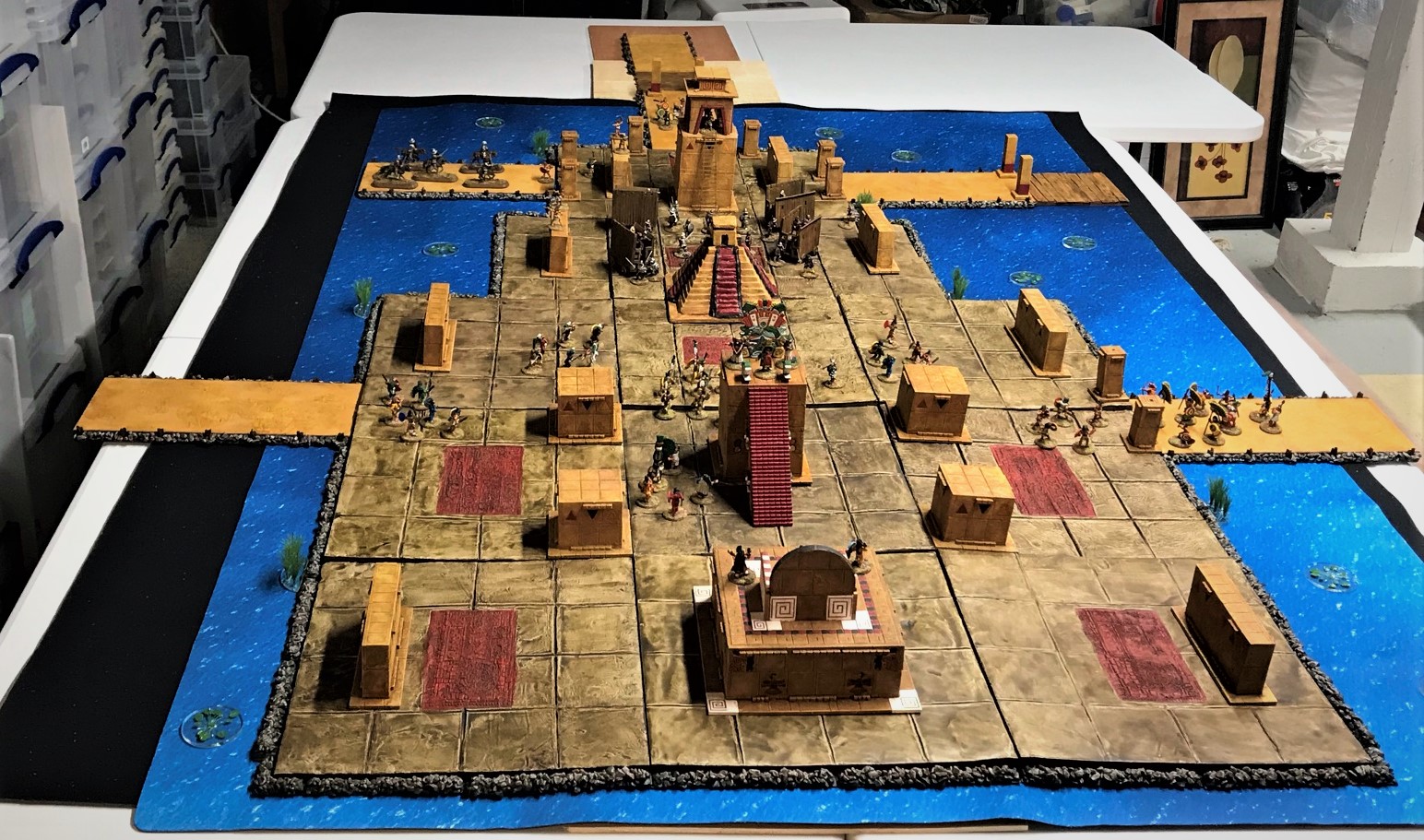
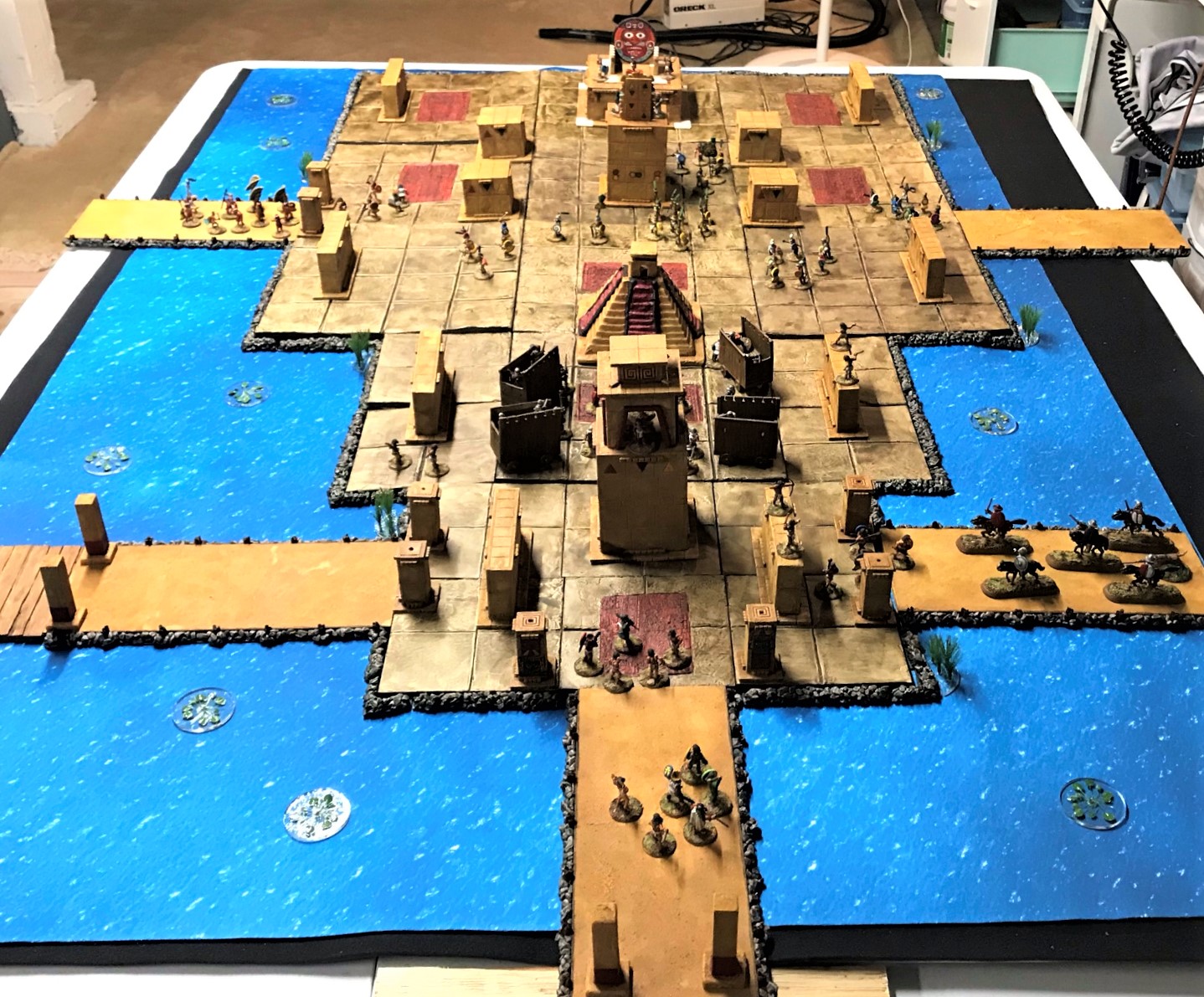
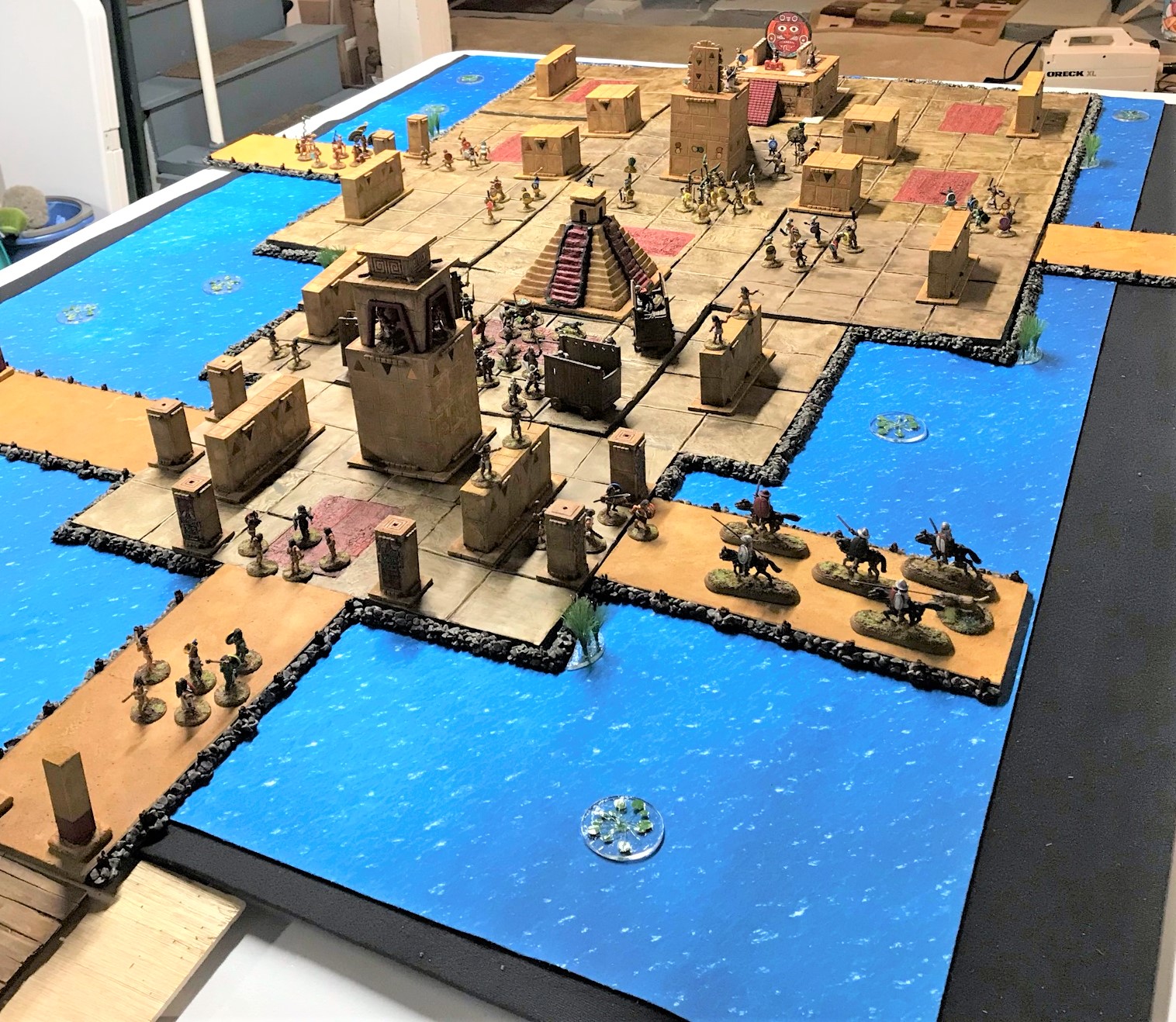
Yes! It’s finally time for the FINAL REVEAL of my Aztec cityscape. It’s been a labor of love – to recreate this tabletop for gaming. What game you ask? Why of course – Buck Surdu’s Feudal Patrol™! I wrote the gaming supplement for Feudal Patrol™ games during the period of the Spanish Conquest. The supplement involves the Conquistadores, the Aztecs, the Tlaxcalans (and more Mesoamericans who fought the Aztecs), the Maya, and the Inca (in South America). I called it Civilizations Collide, and it’s a free download from Buck’s website or from Sally4th in the UK. If you have not checked this excellent game out – do it!
This is Part 5 of my series on “Building an Aztec Cityscape”. There are a lot of background history and WIP details in these posts that for brevity I won’t repeat here. However, if you have missed the other parts, they are listed below with their links:
Building an Aztec Cityscape – Part 5: Tenochtitlan – THE FINAL REVEAL (this post)
As for wargaming the period of the Spanish Conquest 500 years ago, I want to be clear. It was brutal to be sure, and as I have stated often, there were no good guys on any side. I did not aim to glorify any aspect of the time, but to raise awareness and knowledge of it through wargaming.
From the start of this project, I wanted to create a unique and hopefully stunning tabletop for these games. I had a vision of creating a nice cityscape – an encompassing panorama that I had not seen anyone else do at any convention. Also, the cityscape needed to facilitate a fun gaming experience, so visually, I felt that had to go big. I had already painted 230 figures for the period. I had built many buildings too. Therefore, I wanted something that had the “flavor” of Tenochtitlan. However, with the tabletop designed for 28mm skirmish figures, (about 1″ tall), building a true-to-life and historically accurate Tenochtitlan would have required a gymnasium-sized playing area. I have seen stunning photos from SALUTE in the UK that were for 15mm gaming, but that scale went far beyond what I envisioned – or what was feasible for me. For travel to gaming conventions, the cityscape needed to be able to be broken down and transported easily. It needed to be useful for multiple games. This post will reveal my solution, for better or for worse.
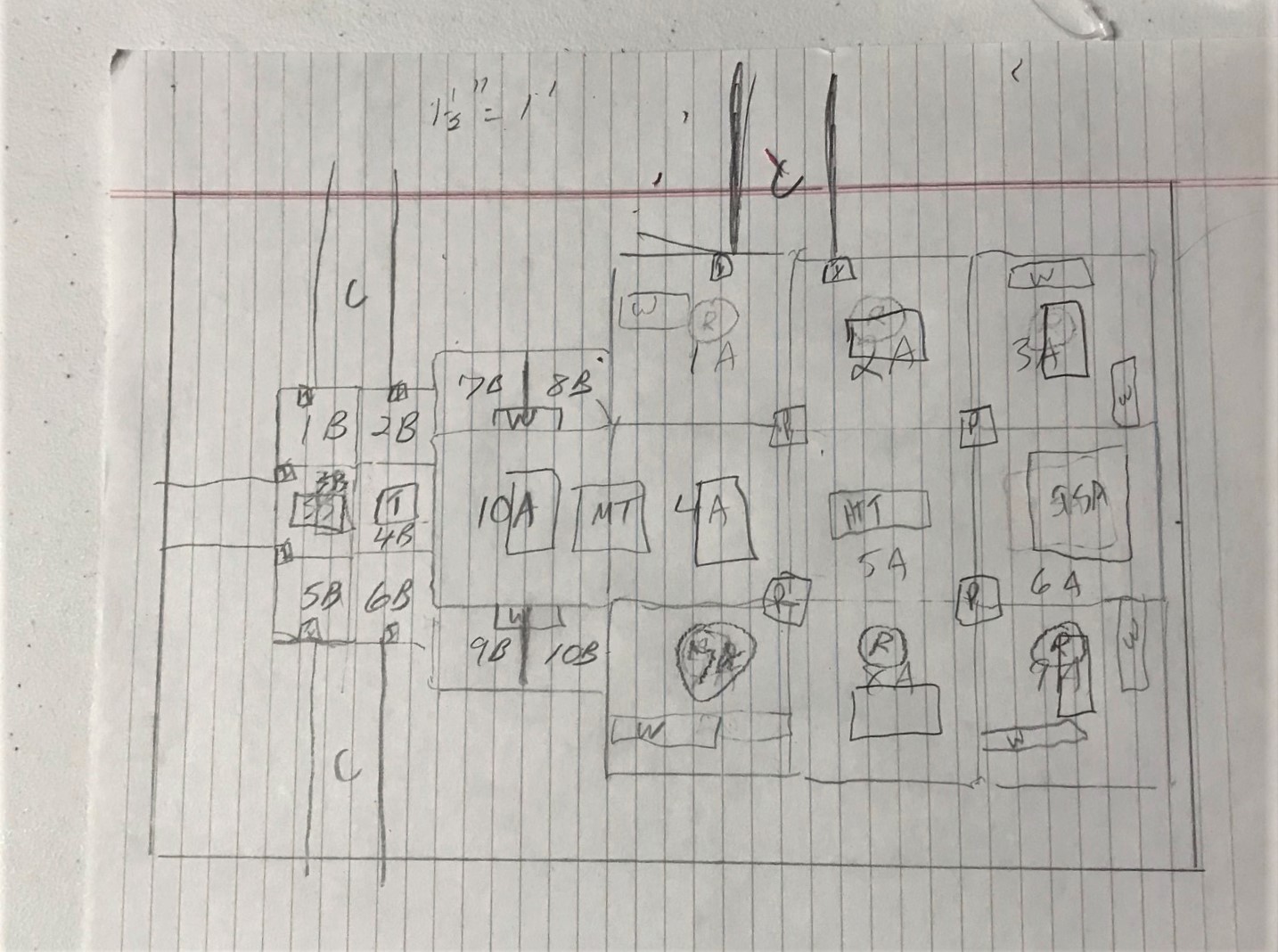
I started out with historical research into several sources, and thinking about what I wanted and what I could do. After I had my initial concept, I then refined it into the two plans that I put on paper below.
First rough draft of the plan.Then, I refined the plan.
The previous posts describe in more detail how I got here. So, let’s show some eye candy – and I will be posting on the Combat Patrol Facebook page and sharing a link to my IGTV page where you can view a video of the cityscape.
Here I set up some figures on the cityscape – many of these images were shown in previous posts – but here you get to see the whole thing!
Ta daa! Click on the images for a bigger view.End view – the mat is from FLG.Opposite lengthwise viewAngled view from the end.
As before, this is DEFINITELY (I think anyways) my last entry into Dave’s Season of Scenery Challenge! Thanks Dave for running the challenge and letting me be part of it. At least it’s the last part of the cityscape posts.
I also want to especially thank my wife for tolerating this bit of my madness. And of course I thank my old West Point comrades Buck Surdu and Dave Wood, Greg Priebe, Chris Palmer and the HAWKS, Chris Abbey at Sally4th, Dave at The Imperfect Modeler (especially for the chinchilla dust tip), GED at Gringo 40’s, IRO (for inspiration), Joerg Bender at Things From The Basement, the Uxbridge Historical Gaming Club and the Mass Pikemen Gaming Club.
A SPECIAL THANKS TO ALL the bloggers listed below who have taken the time to encourage me over this project. I am indebted to you all – you kept me focused, and motivated.
I’m not an award-winning videographer – but I hope that you enjoy the video.
What’s next? I will be going to my first HISTORICON and bringing both my cityscape and my rural tabletop. I will also be adding the two naval types (brigantines and war canoes) to the next version of my Civilizations Collide supplement – along with new scenarios and scenario-specific rules. I hope that you will like these. Yes, I have more work to do!
Please let me know your thoughts in the comments section – and thanks for looking!
For all of my previous posts on games, units, and other projects for my 16th Century Spanish Conquest supplement for Feudal Patrol™ – “Civilizations Collide” – please see this page.
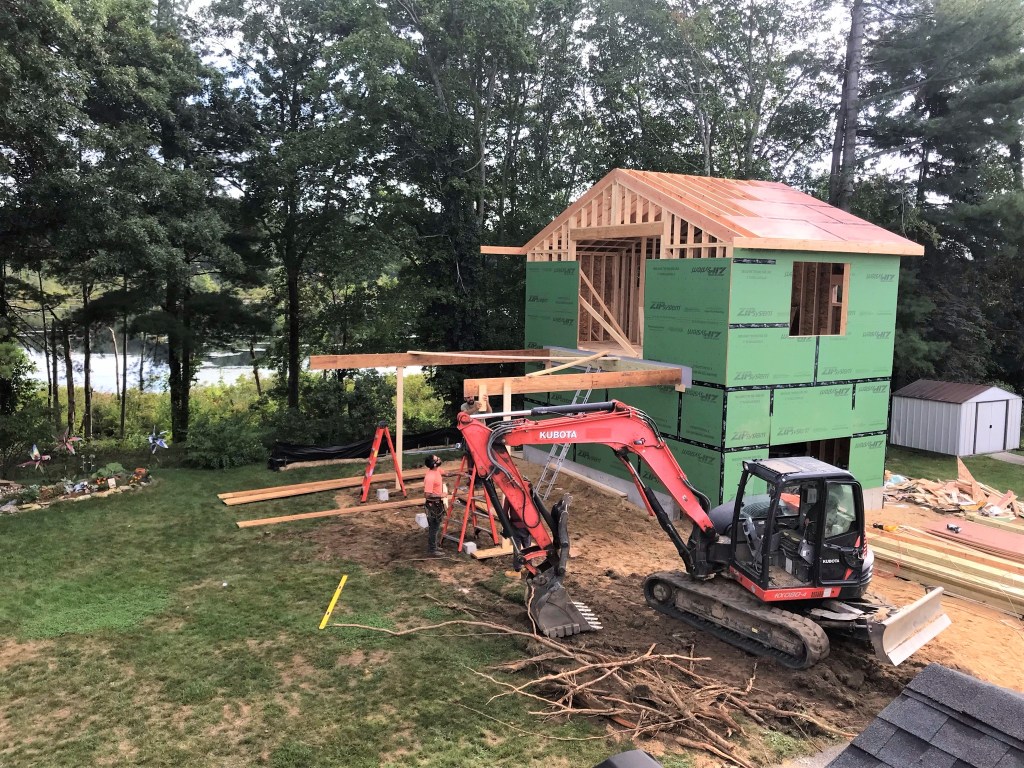
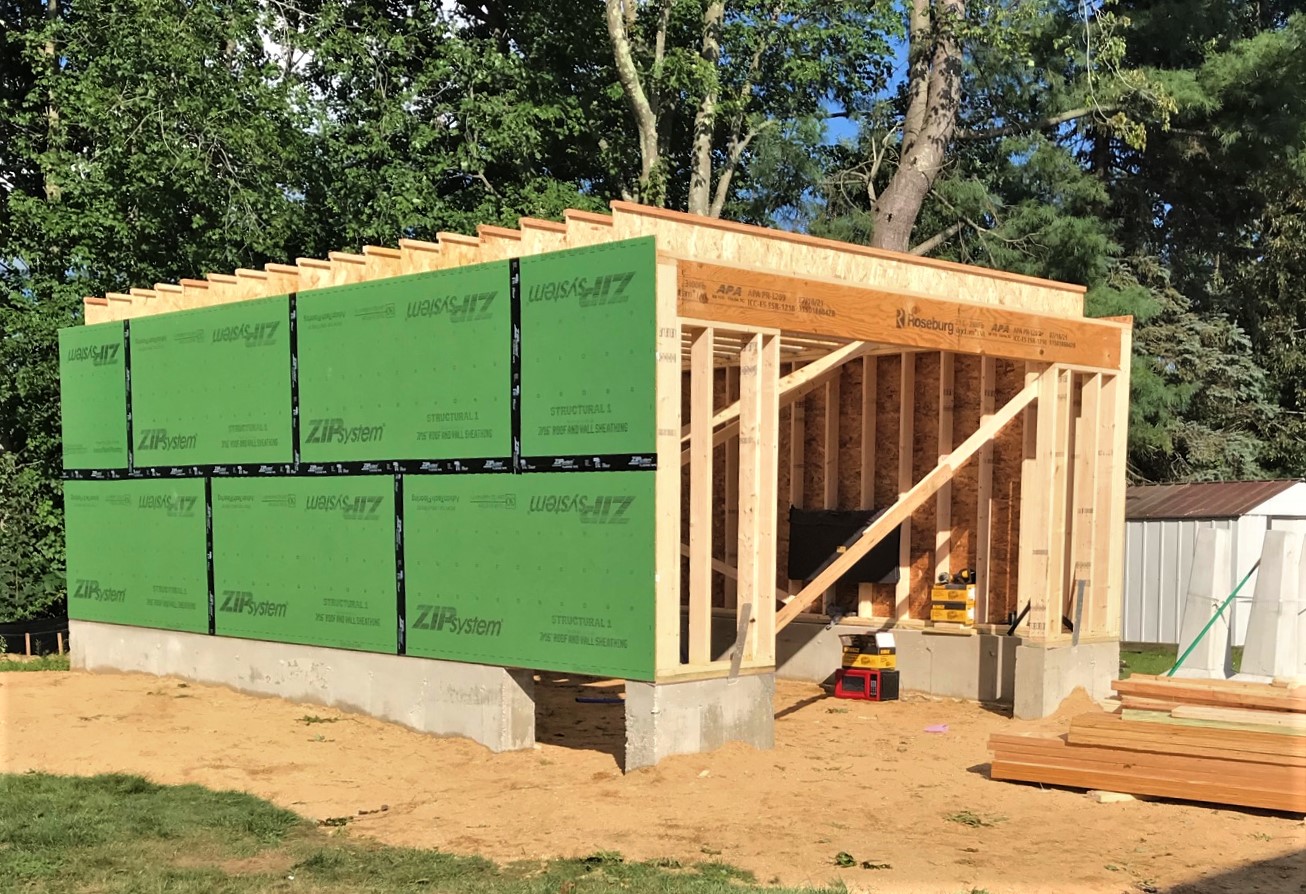
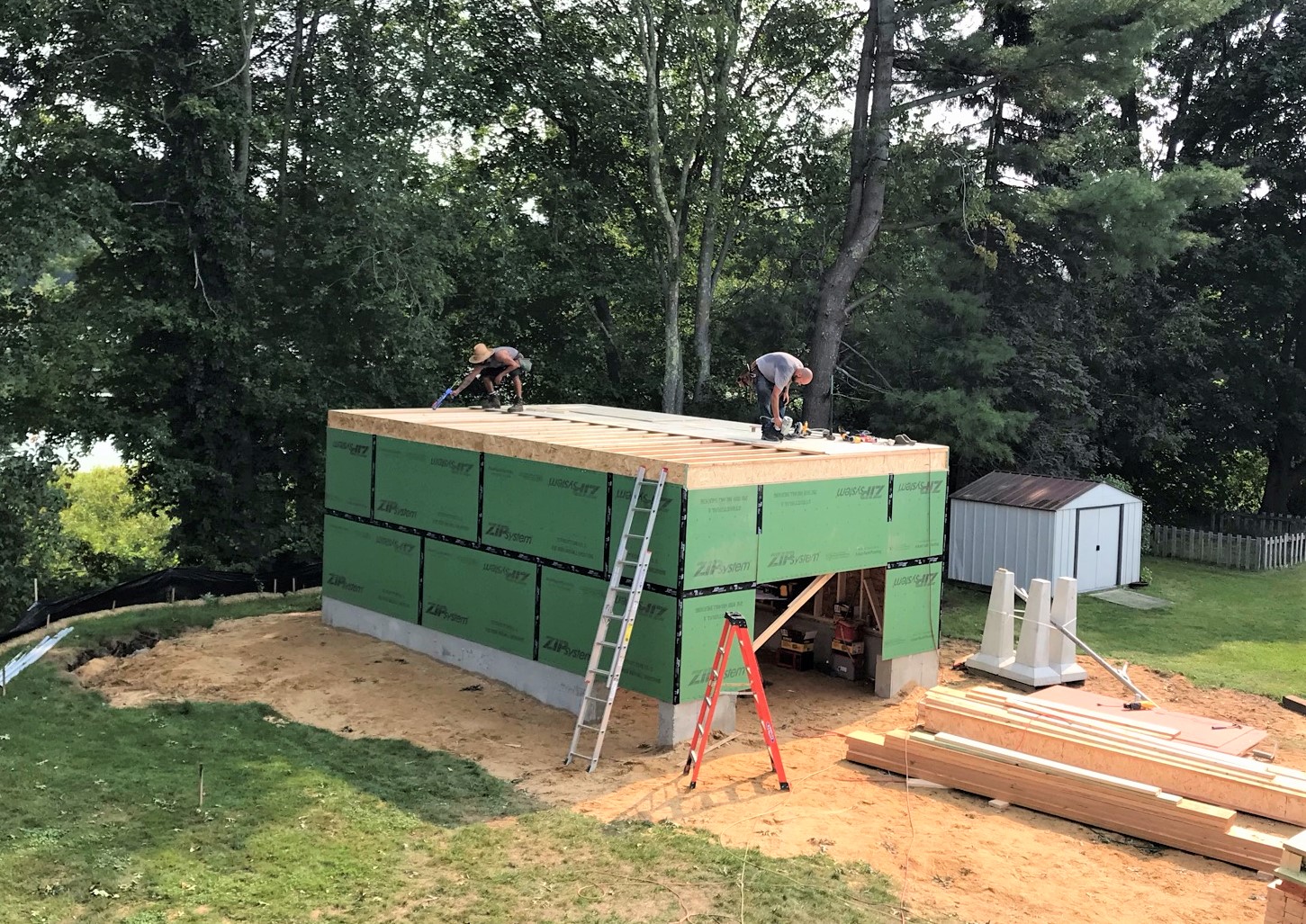
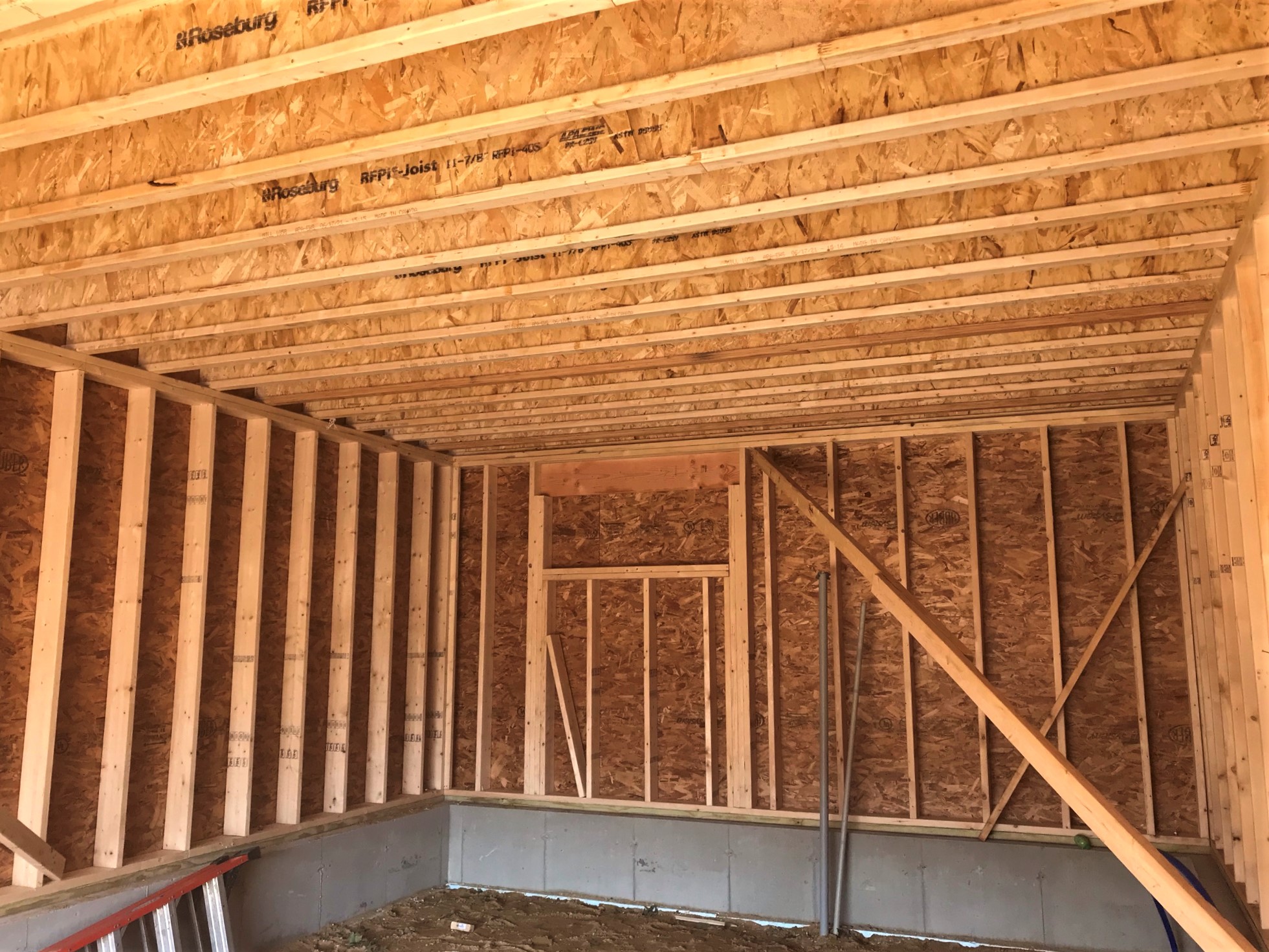
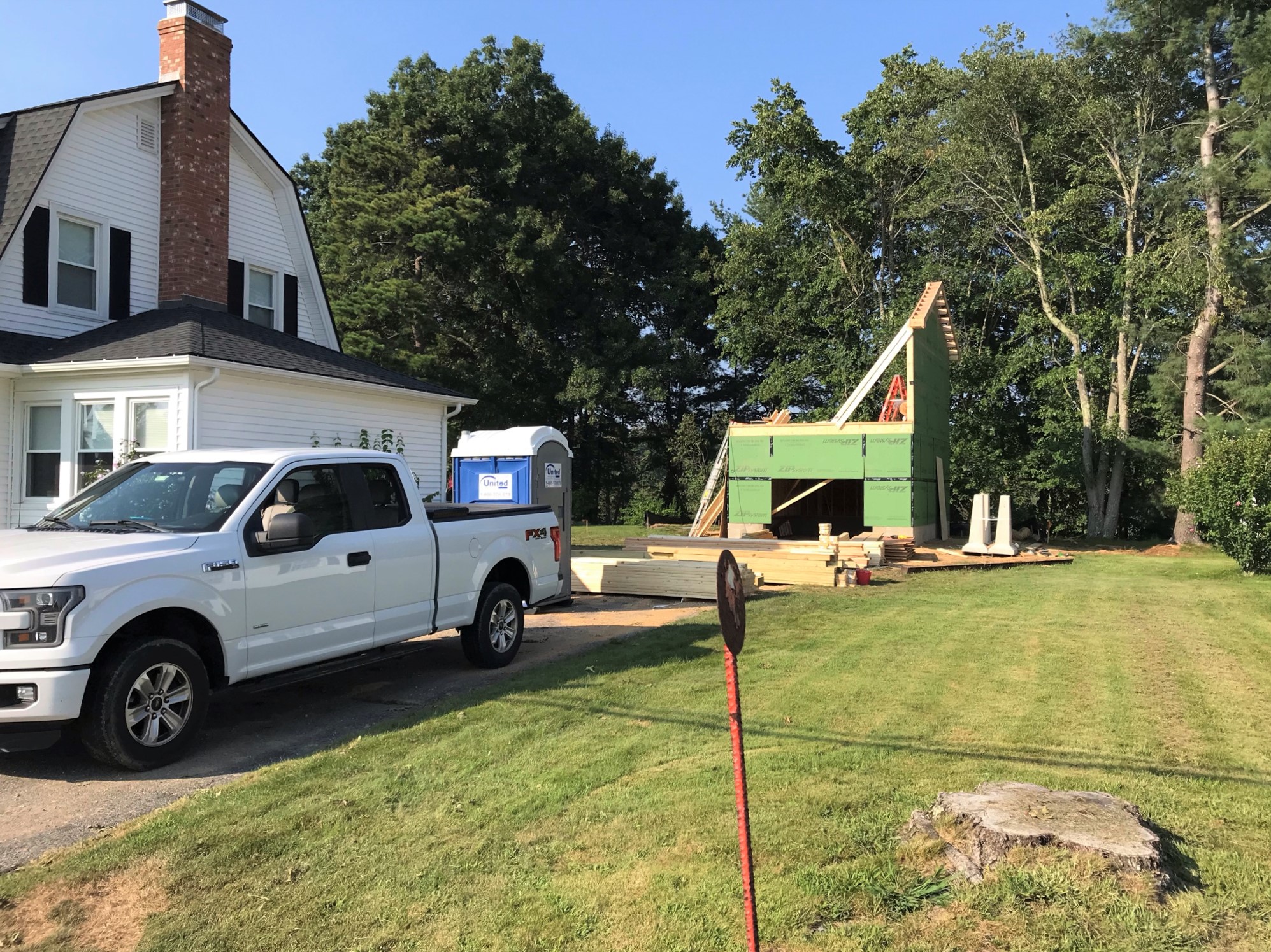
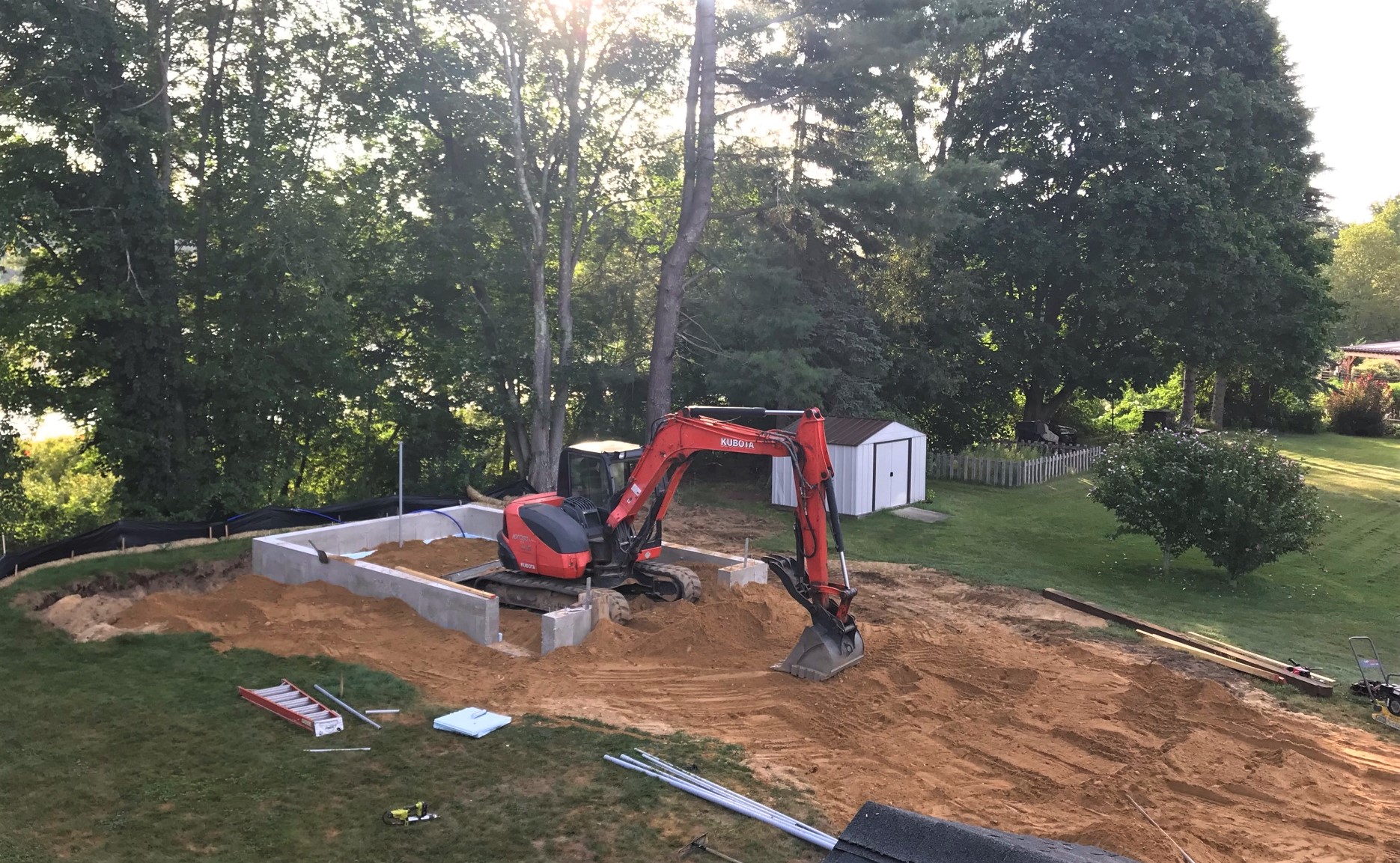
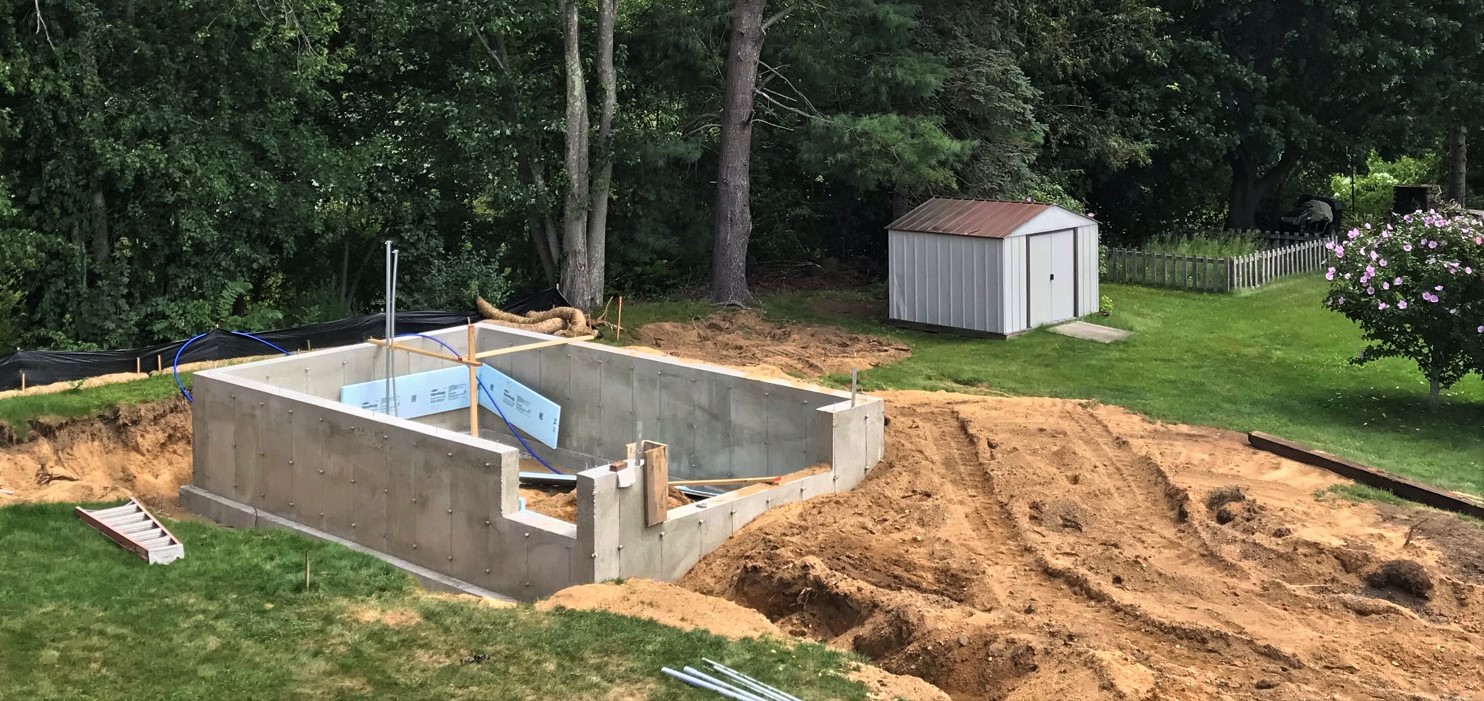
The fourth week of the project (through August 14th) saw some progress, as well as some headaches. I’ll let the pictures below help to tell the story.
View from the house
Looking from my normal parking spot on the driveway
This is where the project was early morning Monday, August 10th. By Tuesday, August 10th, we started to see some dirt moving.
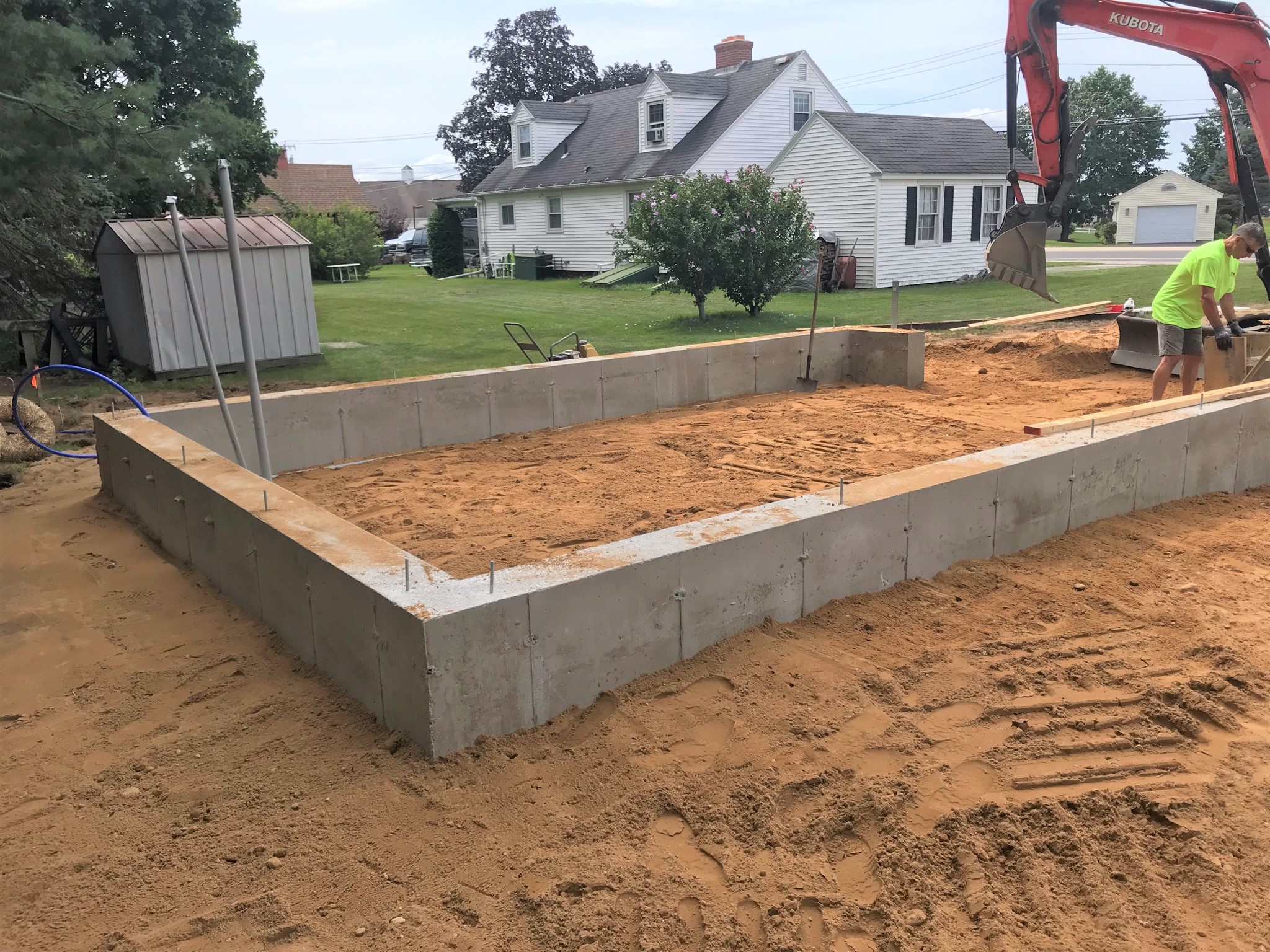
On Monday, serious work began on moving dirt. More of the old driveway was removed, as was some overburden. Unfortunately, on the previous week, one of the less-experienced excavator operators hit the new foundation and chipped off a piece.
AAARGH!
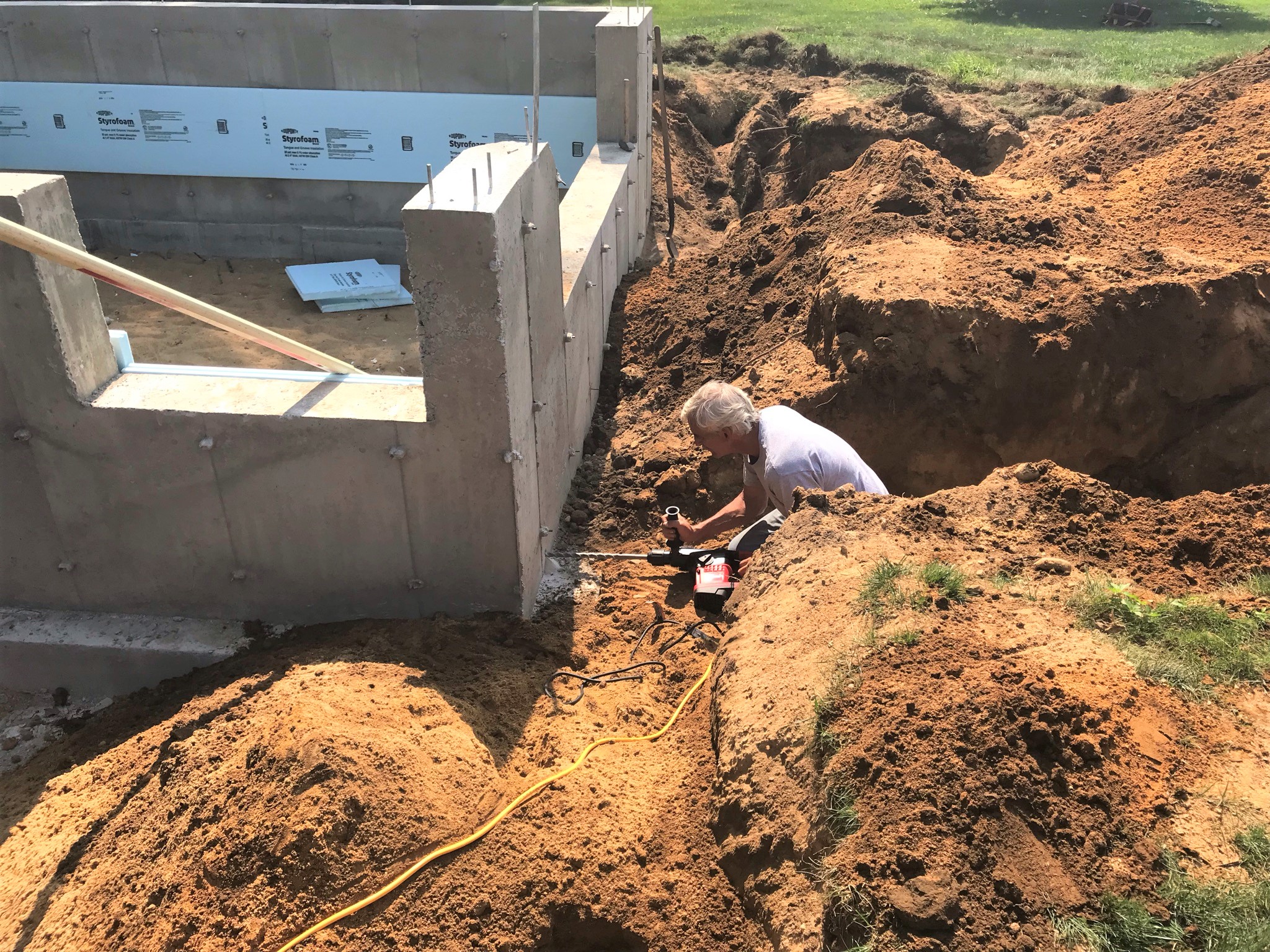
That was not pleasant to learn or see. It’s repairable, but felt awful as it’s brand new. As this week was about digging a trench for the water line and a second trench for the power and coax cables – and would require digging close to our house foundation – the owner of the company doing the subcontractor work for the excavation (Andy Cormier), took charge of the digging. That was a relief as having an excavator hit the house would have been a nightmare.
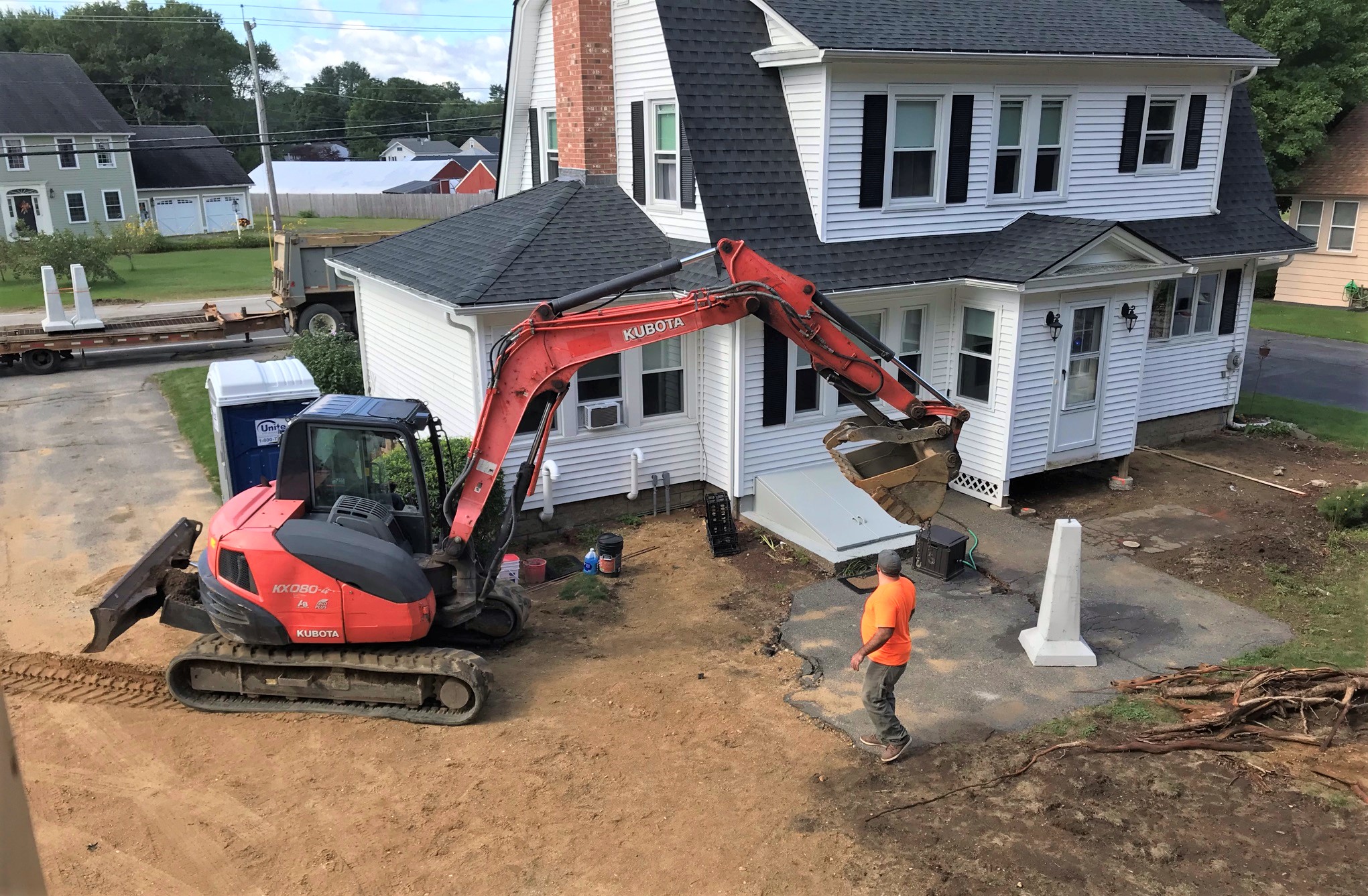
This is Tuesday, August 11th. Andy is digging the electrical/cox cable trench. More of the old driveway was removed and some cracked as you see here to the left of the open cellar bulkhead. It will all be repaved anyways.
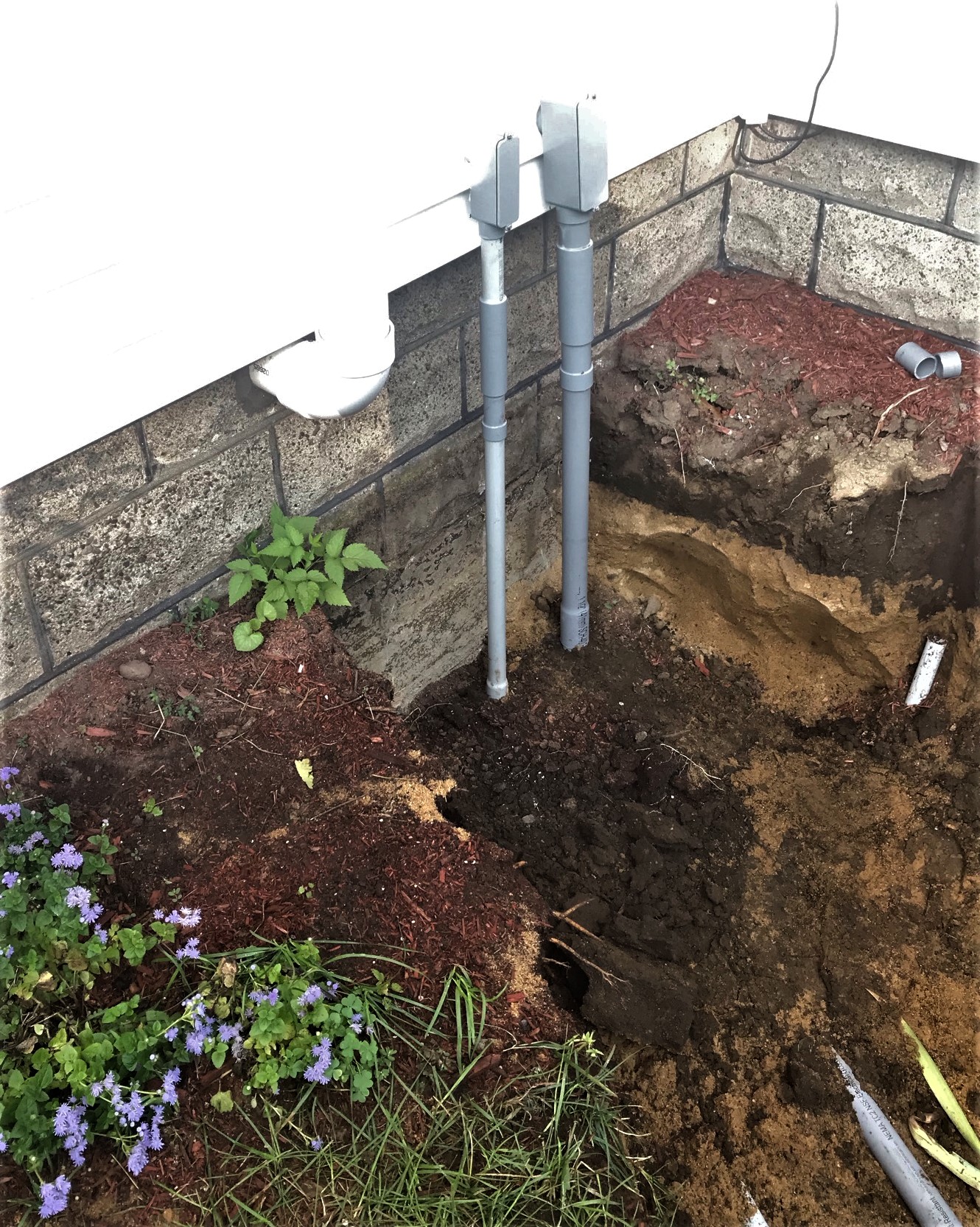
While Andy digs, Frank drills a hole in the foundation for the electrical & coax conduits. You can see the “ding” on the foundation’s car door above his head on the photo on the right.The electrical/coax trench being dug.Setting up a form to repair the chipped edge.
Here the water line trench is started (separate and distant from the other electrical/coax conduit trench for obvious reasons).Electricians work on the conduits in the foundation. My wife Lynn is inspecting above!Long view of the trenches – looking very WWI in the back yard…At the end of Wednesday, August 11th, the water line was in and its trench was backfilled. The electrical and coax cable conduits were inside the foundation and ready for backfill there too.
At this point, it became a waiting game for the wiring inspector, as both the conduits in the remaining trench, and in the foundation, needed to be inspected before being backfilled. We lost time as he did not come until Friday morning. As Andy was not sure as to when he would come, he had moved his excavator to another job site. This would delay the backfilling. Also, the wiring inspector wanted thicker conduit installed where it attached to the house (schedule 80 versus schedule 40), in case it was struck buy something. He also wanted more sealing where it went through the siding. Therefore the electricians had another task for the following week’s work.
The end of the electrical/coax cable trench by the house on Friday.
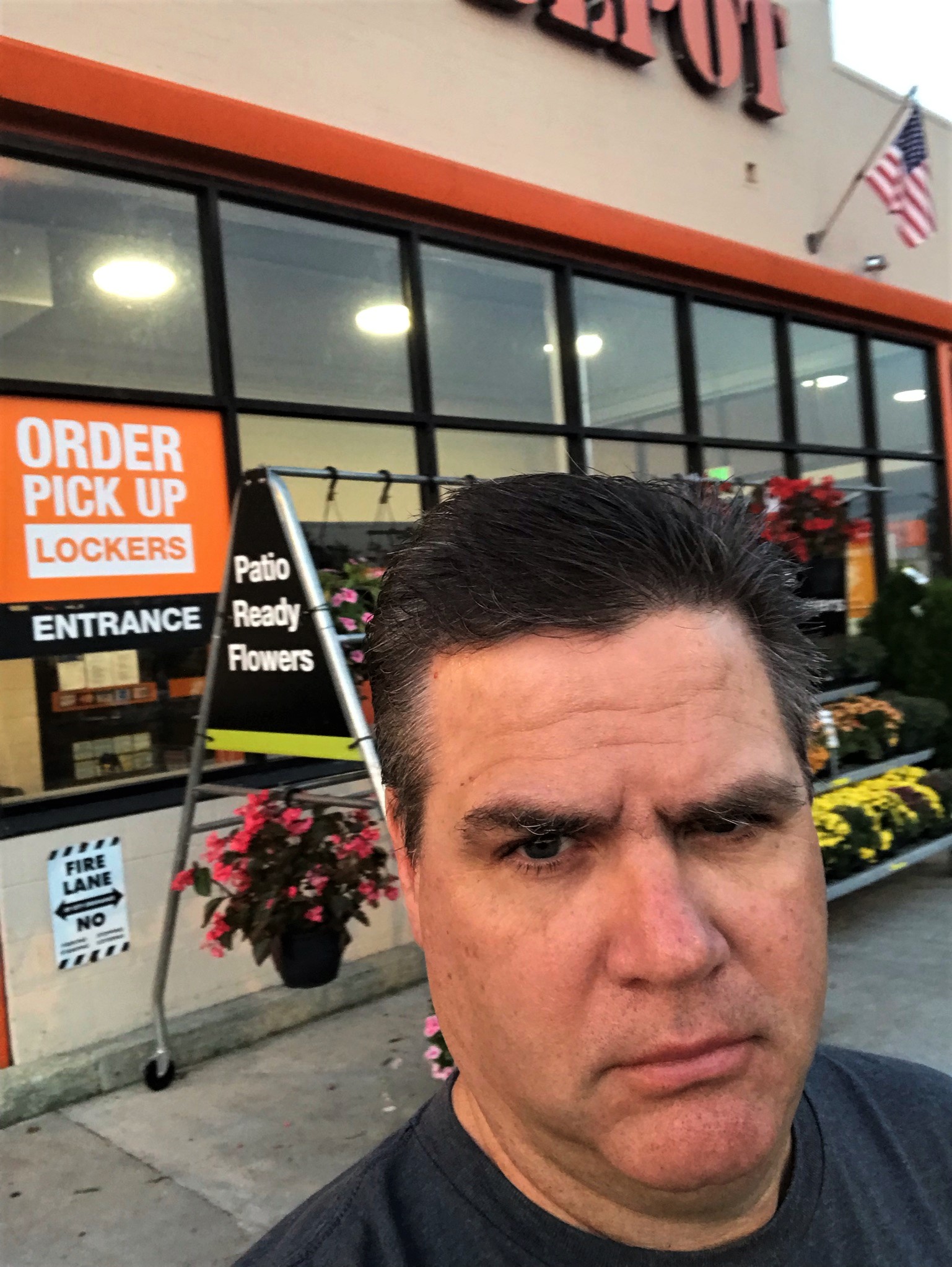
While construction was on hold, Saturday was a big day as it involved Massachusetts having a “tax-free weekend”. This is when – as a “gift” from the legislature – businesses can sell items up to $2,500 with none of the 6.25% Massachusetts sales tax applied. While I wish that we had been allowed to start this whole project a couple of months sooner, this was a boon. I am purchasing all of the project materials so as to get the points on my credit card. This requires some degree of management on my part. I had spent the week working with Ready Installs and their vendors to line up as much as I could get to be ordered on that weekend. A few items (mainly big doors) did not qualify, but a lot did. One of the biggest orders would be from The Home Depot store in Shrewsbury, which is about 45 minutes away. I also knew that there would be a LOT of people and contractors thinking similarly about the tax-free weekend. So, I got up before 4 AM, got myself ready, and was the first in line before the Home Depot opened at 6 AM on Saturday. No worries as getting up early is my norm. I got the order – and all the other orders in – and saved a substantial amount of money overall.
Yes, I am awake…hell, the sun’s almost up even…The project at the end of the week. The next week will hopefully show more progress!
That’s Week Four, ending August 14th (for those non-US folks – our calendars end on Saturday). Looking forward to more progress in Week 5.
Thanks for looking! FYI – for those of you also following my Aztec project – the BIG REVEAL is coming very soon! If you are not, you should take a look here at the first installment – there are four now and one more to go.
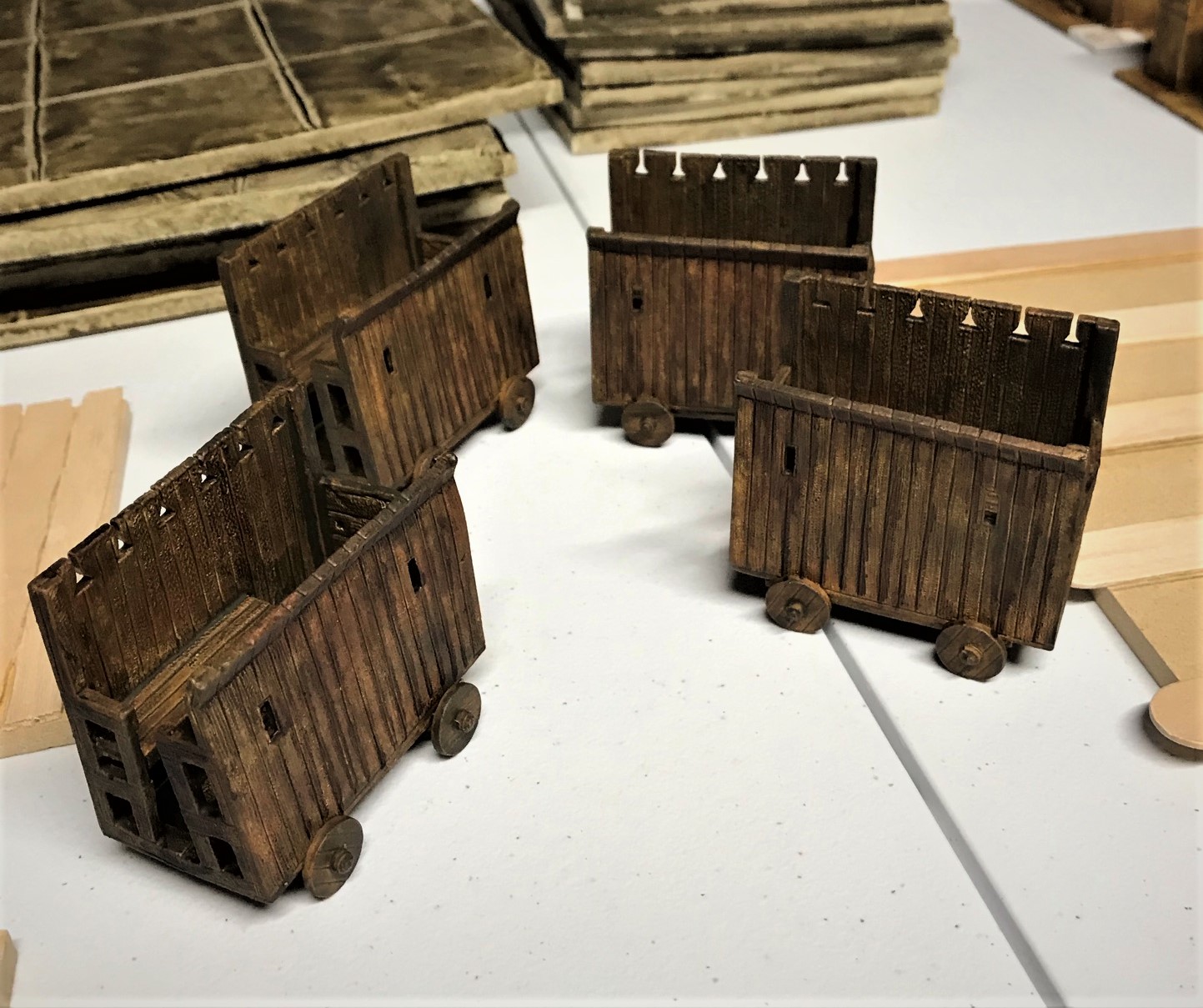
War wagons were wooden carts for deploying missile troops. They had slits in them for crossbowmen and arquebusiers to be able to fire from while having some protection against enemy missile weapons. I think of them as wooden APC’s (WPC’s maybe?). Hernan Cortes used them as he was besieged in Tenochtitlan in 1520 – yes – over 500 years ago now.
This is Part 4 of my series on “Building an Aztec Cityscape”. The war wagons were so integral to the events in 1520 that I needed to have some as part of my cityscape. If you have missed the other parts, they are:
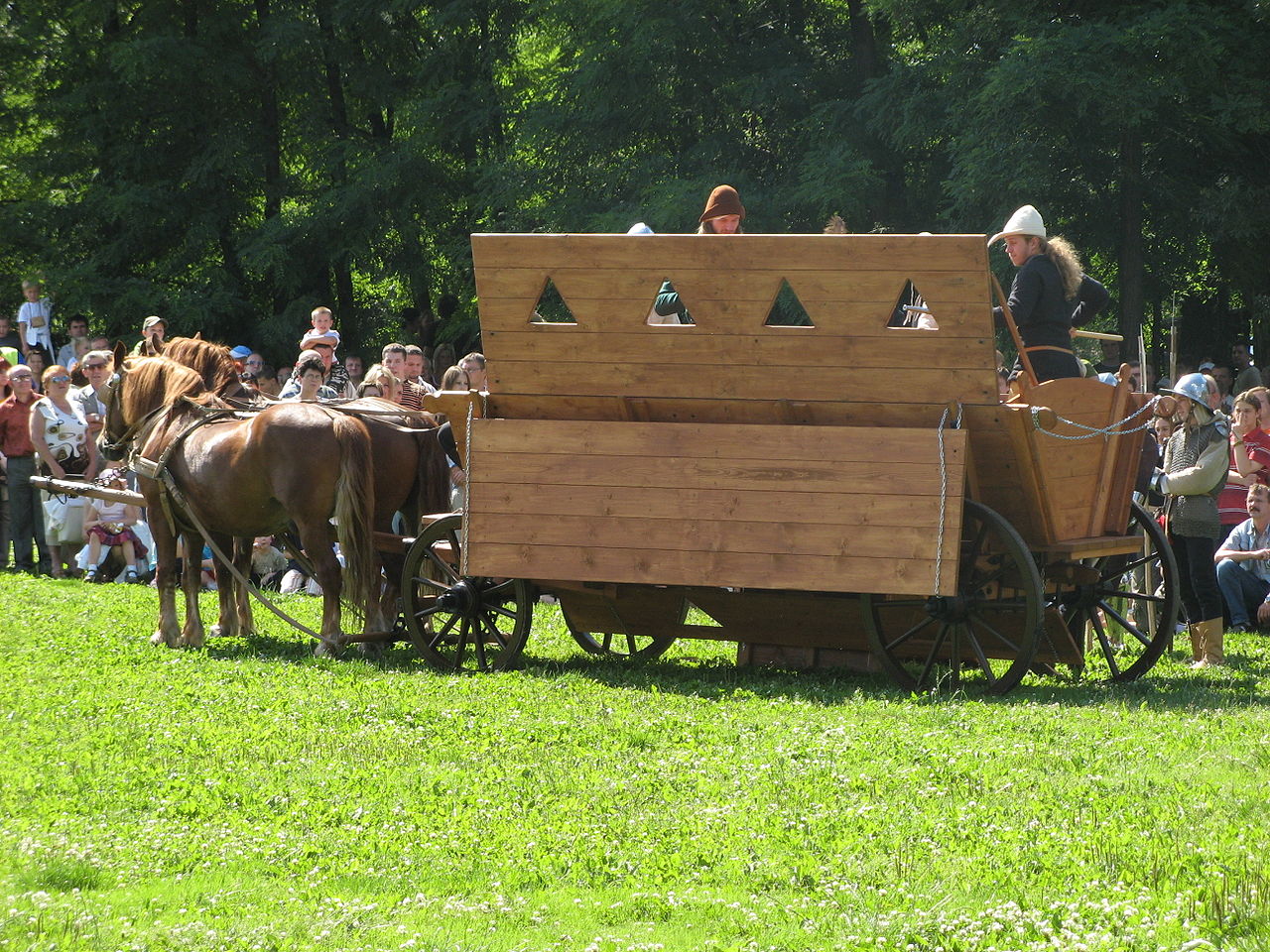
The first use of a war wagon in medieval Europe is ascribed to the Hussites during the Hussite Wars (1420-1434) in Bohemia. They were horse-drawn and would be linked together like a mobile fort.
Nearly 100 years later, Cortes would build some similar ones. These would be constructed as a measure of desperation to escape the Aztec capital. Cortes’ war wagons were thrown together during the time when they were besieged by the Aztecs in Tenochtitlan.
I need to give you a condensed chronological synopsis – the history of this time is quite full of twist, turns, and intrigue. The timeline is confusing but important for context. Therefore, listed here below is a condensed chronology with respect to the use of war wagons and a couple of possible wargame scenarios that I am working to build:
November 18, 1518 – Cortes departs the Spanish colony of Santiago de Cuba with his expedition – before he could be detained by Lieutenant Governor Velazquez (who had originally commissioned his expedition). Cortes leaves abruptly so that the Governor (who had justifiable suspicions about Cortes and his motives) could not relieve and replace him prior to his departure.
February 1o, 1519 – After fitting out in Trinidad and San Cristobal de la Habana, Cortes sails for Mexico.
March 22, 1519- Cortes arrives in Mesoamerica. He will fight and win several battles with both the Maya and the Tlaxcalans up until later in 1519. By that time, his victories will have given him a few key assets. One of these, from the Maya, was a slave girl named Malintzin aka La Malinche who was to serve Cortes as a key translator, and later, his mistress. The second was a post-conflict alliance secured with the Tlaxcalans, whose warriors would provide the bulk of Cortes’ forces.
November 1, 1519 – Cortes begins his march to Tenochtitlan to try to meet Montezuma II.
November 8, 1519 – Cortes arrives at Tenochtitlan and meets Montezuma II. He and his contingent are welcomed to the city and stay in it.
November 14, 1519 – through a ruse, Cortes successfully seizes Montezuma II and makes of him a puppet/hostage.
March 5, 1520 – Meanwhile, back in Cuba, Lieutenant Governor Velazquez sends an expedition led by Panfilo de Narvaez to intercept Cortes
April 19, 1520 – Narvaez and his troops arrive in Mexico. Cortes, with some of his Conquistadores, leaves Tenochtitlan to deal with this internecine threat. He leaves behind a trusted lieutenant, Pedro de Alvarado, in charge of the remaining Spanish/Tlaxcalan forces in Tenochtitlan.
May 16, 1520 – The Aztec nobility and elite troops in Tenochtitlan celebrate the Festival of Toxcatl. It is a large assembly of all the elite and elite military of the city, who are unarmed and dancing in a city square or plaza. Alvarado, afraid that the celebration is a prelude to an attempted massacre on them, seals off the plaza where the dancing/celebration is taking place. His Conquistadores methodically move through the throng and murder or capture every possible Aztec. One of the captured elites is Cuitlahuac, Montezuma II’s brother.
May 29, 1520 – Back on the coast, Cortes defeats Narvaez (despite being outnumbered by Narvaez by 2:1). He incorporates Narvaez’ surrendered troops into his forces and returns with them to Tenochtitlan on June 24th . (This Conquistador-on-Conquistador fight would be a good possible scenario for a wargame (using my Civilizations Collide supplement to Buck Surdu’s Feudal Patrol™rules).
June 2, 1520 – The Aztecs have been fully enraged since the festival massacre – and the situation is dire for the Conquistadores.
June 25, 1520 – In an attempt to mollify the Aztecs, Cortes releases Cuitlahuac. This was a rare strategic error. Immediately, Cuitlahuac, who rightly viewed his brother to be no more than a Spanish puppet, assumes Montezuma II’s powers and takes command of the siege of the Spanish as the new Aztec Emperor. The Spanish are besieged and are holed up in the Palace of Axayacatl. The Aztecs attempt to burn the Spanish out of the palace, but are repulsed by cannon and arquebus fire.
June 27, 1520 – Cortes forces Montezuma II to go to the roof of Palace of Axayacatl to plead with the Aztecs to stop the fighting. He is struck in the head by a rock from a sling and is gravely injured. At the same time, Cortes instructs his troops to scavenge wood from the Palace of Axayacatl and build several war wagons. His hope was that by using war wagons he could protect his own missile troops from the slings and arrows of the Aztecs – and make it easier for the Conquistadores to escape Tenochtitlan and survive.
June 28, 1520 – Cortes makes his first attempt with his war wagons to reach the causeways. He loads them with crossbowmen and arquebusiers, and supports them on the ground with sword and buckler men, and cannon (probably falconets and maybe lombards). Their movements are not powered by horses, but by the Spanish themselves. The Conquistadores fight bravely, but are pushed back. (This would be a possible scenario for a wargame on the cityscape with the war wagons).
June 29, 1520 – Cortes decides that the Temple of Yopico, a tall structure, was enabling the Aztecs to be able to hit his troops with enfilading missile fire from above. This is his second use of his war wagons, and he literally used them in a half-circle (yes, “circling the wagons”). He uses them similarly as before to help the Conquistadores to reach the Temple. This time they were tactically successful. However, the war wagons were to take so much damage that they are destroyed in the process. Cortes, beneath his personal banner, successfully leads his troops to ascend the 100 steps of the temple, killing many war priests and setting fire to the structure. But, the Conquistadores cannot hold the position against the Aztec numbers and are pushed back. (This – the assault on the Temple of Yopico – would be a second possible scenario for a wargame on the cityscape with the war wagons).
June 30, 1520 – Montezuma II either dies of his head wound, or is killed by the Conquistadores – accounts differ.
July 1, 2020 – La Noche Triste (the Night of Sorrows or the Sad Night) – the Spanish break out of Tenochtitlan at a high cost in lives, materiel, and looted treasure. (This – La Noche Triste – would be a possible scenario for a wargame on the cityscape and/or just the causeways with or without the war wagons).
Of course, then followed the Battle of Otumba, where Cortes used his cavalry to save his entire force against overwhelming odds. Eventually, he was able to regroup and with the help of brigantines, make a successful assault and conquer the city of Tenochtitlan. And yes, I have brigantines in the queue, along with war canoes. Plus I will be adding the two naval types (brigantines and war canoes) to the next version of myCivilizations Collide supplement – along with these two scenarios.
The only good image I can find of war wagon use comes from the cover of Sheppard, Si. (2018). Tenochtitlan: 1519-21. Oxford: Osprey Publishing, shown below. It is an excellent resource, and I do recommend it. There is a larger blow up of the same picture in the book – and you can see the war wagons in the lower right hand side at the base of the temple.
Enough background information (at least I hope). In looking for war wagons, I was challenged. I did consider scratch building some until I discovered these at Gringo 40’s in the UK in their 28mm Conquistador section.
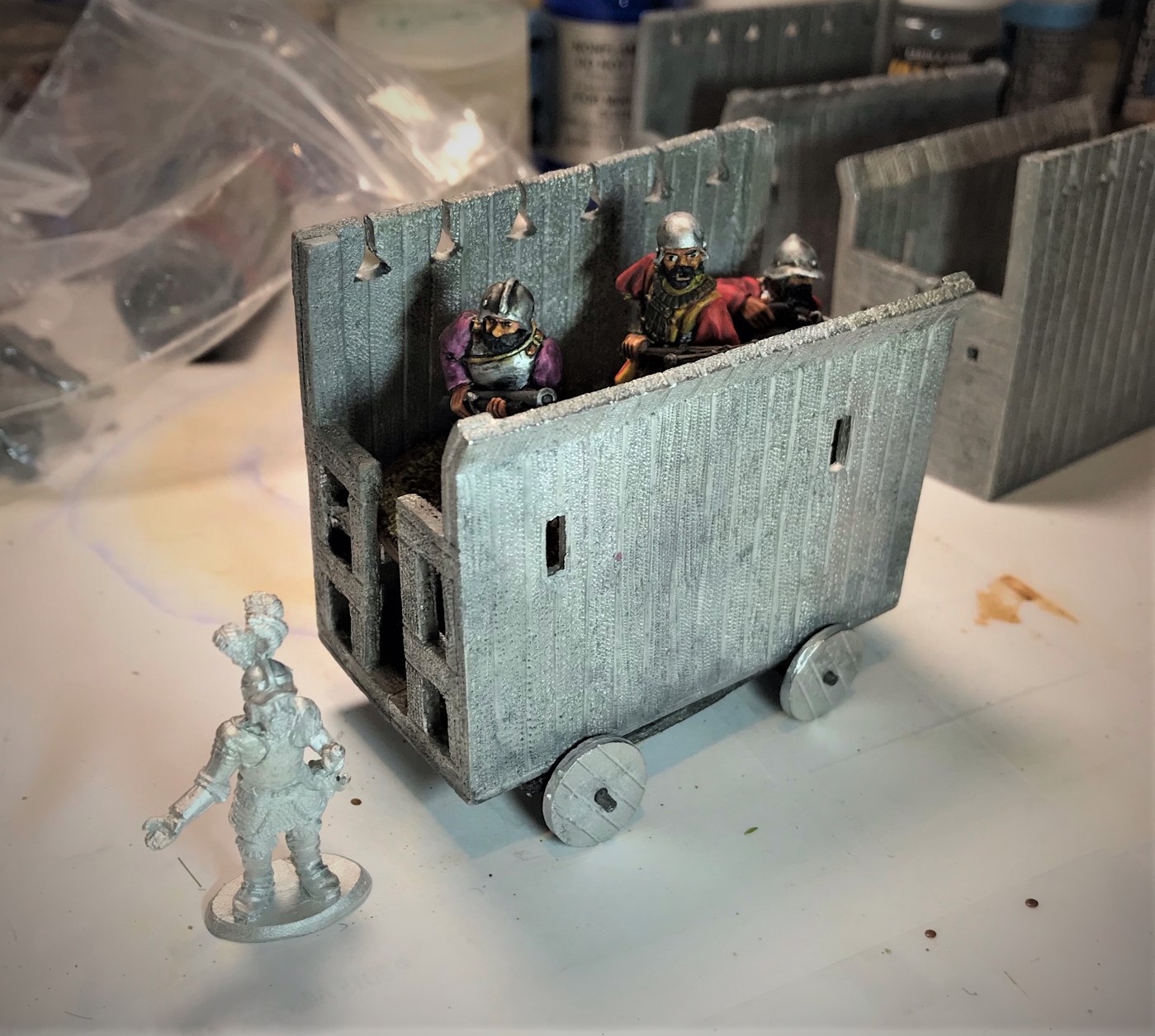
Yes! I had found my solution! I ordered four from them, and the company was great. They even gave me a free Cortes figure (which I will paint soon I hope). Even better, these were solid METAL. Assembly was just adding the undercarriage axle supports, the wheels, and a wheel spacer. There are two benches inside and I can get two figures into the wagon. One challenge faced me that was new – no brush or angled brush would reach under the benches for painting. They do look nice though.
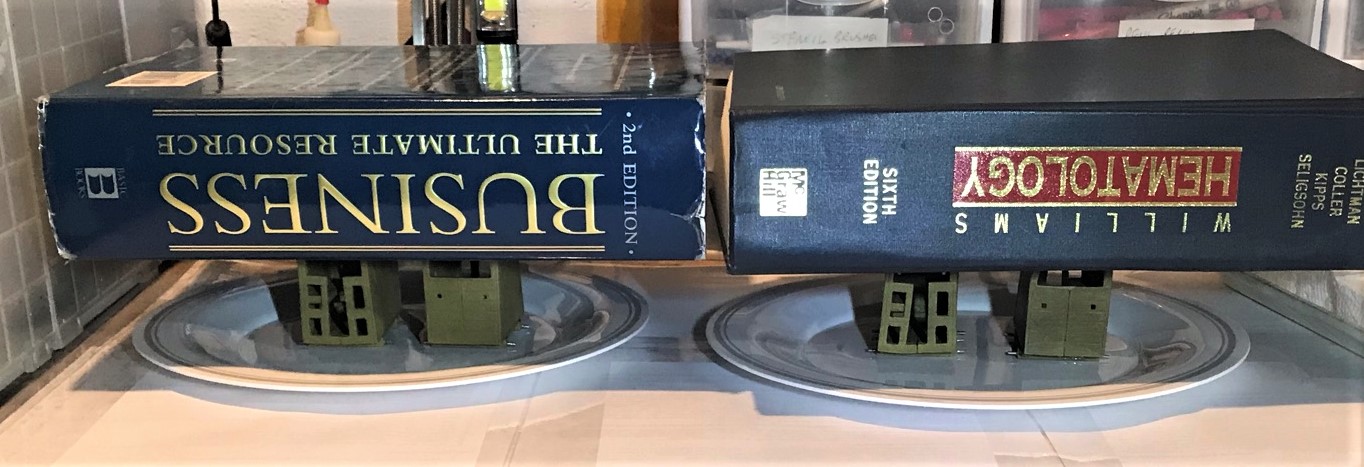
On the left is my 28mm Cortes figure, and the war wagons as received. The one with the figures in it is dry-fitted with the other pieces. While I have three figures in there, after painting them I’m now limiting that to two. A close angle of the same shot as above. The only brush access to the bench undersides was restrictive through this end.I gave the war wagons a spray prime – and then after a curing period, a brush prime – swirling a few cheap brushes like mops on the insides – getting as much primed as I could. This destroyed those brushes, but that was fine. Then I glued on the undercarriages and pressed them down.After the previous step, I attached the wheels and spacers/holders for the wheels, and reapplied primer which as you see here was needed.
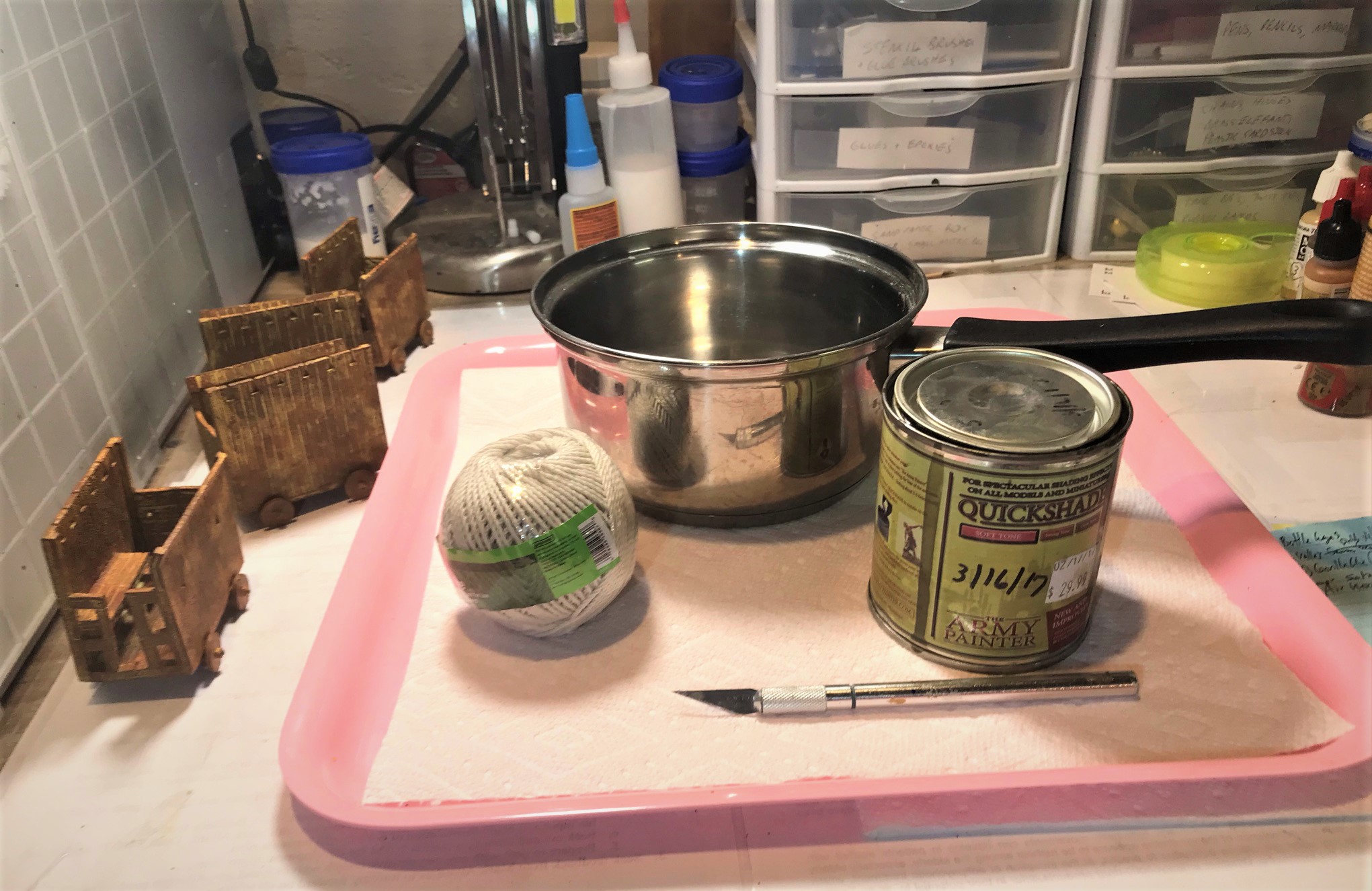
I then used various browns (I list all my paints and more at the end of this post). to approximate a used wood tone. After all, these war wagons were made from old recycled lumber. At this point in the project, I still wondered how I was going to get paint etc. under the benches, as well as how I was going to varnish them. As you may imagine, these are heavy! I decided that they needed a “dip” – in some Army Painter dip. To retrieve them without a huge mess, I used a pot I bought from a Salvation Army Thrift store, some twine from the hardware store, and an old piece of balsa.
The war wagons in brown, and the pot, dip, and twine.How I was able to suspend the war wagons into the dip in the pot. I just had to restring each one after the dipping process.After the dip.
I needed to do more shading and some dry brushing after the dip, and then I spray varnished them outside (as I could for once).
Nice enough to varnish outside! Not common weather in New England year-round, but it’s summer.War wagons finished!
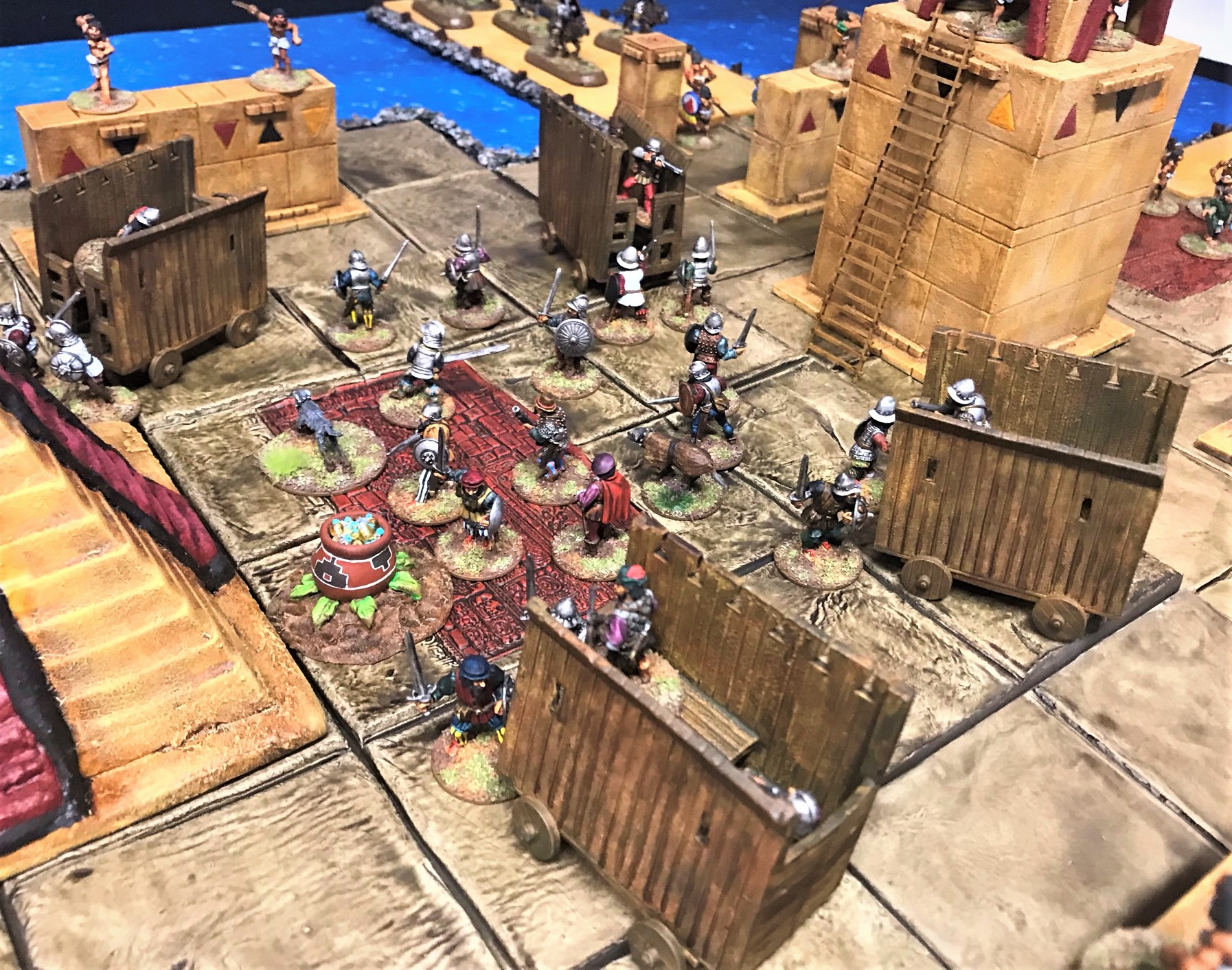
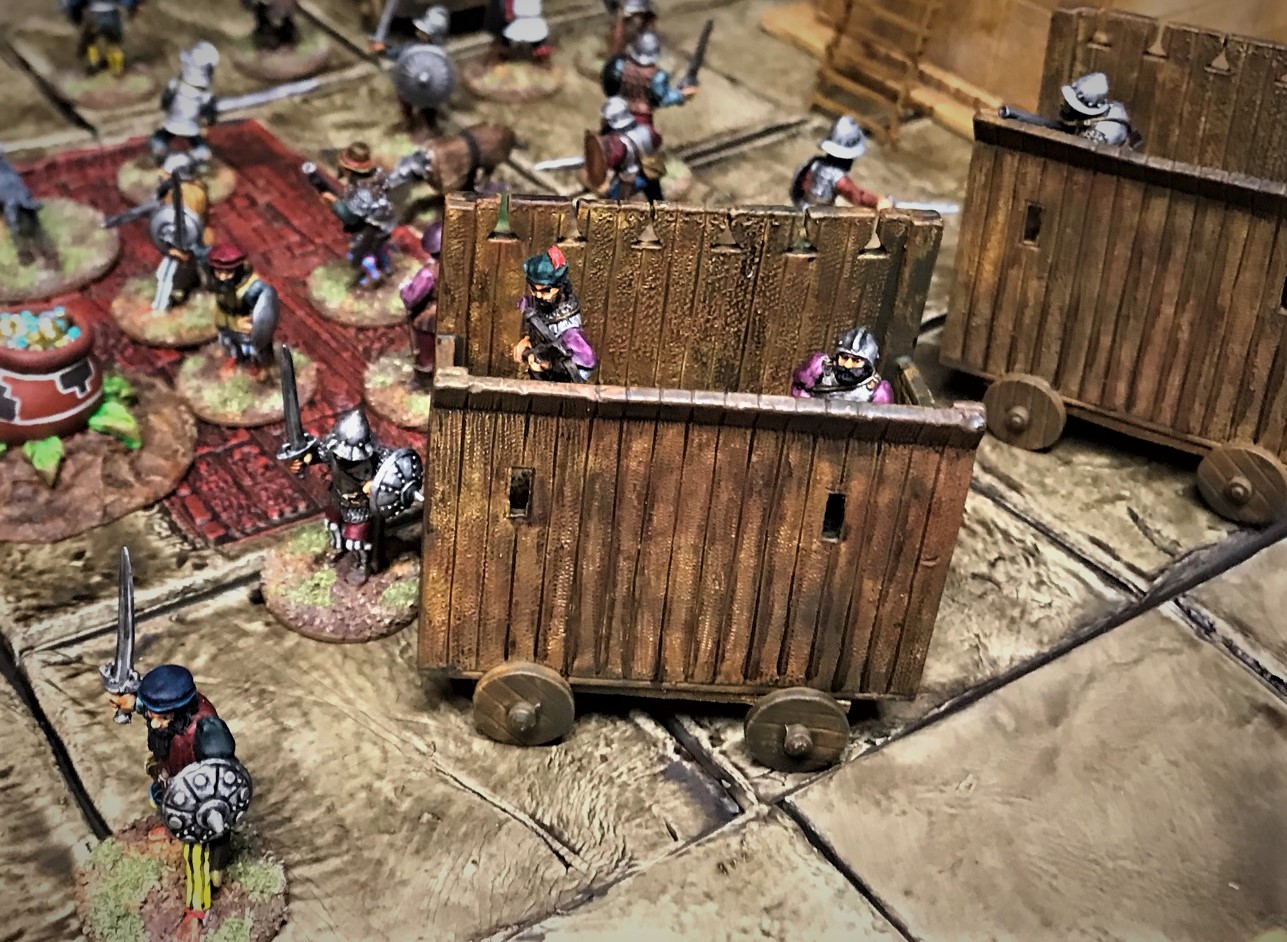
As this is the penultimate (love that word) post in the series, I will share some action shots below of the war wagons on the cityscape.
Battle in the Cityscape! Cortes tries to break out!Trying to escape Tenochtitlan with their lives – and their gold – the Conquistadores fight towards the causeways. Close up shot of a war wagon with an arquebusier and a crossbowman at the ready. The poor sword and buckler men get to push.
I think these will be very fun in a game. I just need to write rules specifically for their use.
The next post will be….(insert drumroll)…the FINAL REVEAL.
I hope to have a video link as well as pictures of the cityscape for you. These, because they are “vehicles” and were completed in July and August, all count as more of my entries into Dave’s Season of Scenery Challenge! Thanks so much for looking. I hope that you enjoyed the brief history and the war wagons themselves.
Please let me know your thoughts and ideas in the comments section! And the FINAL REVEAL is coming!!!
For all of my previous posts on games, units, and other projects for my 16th Century Spanish Conquest supplement for Feudal Patrol™ – “Civilizations Collide” – please see this page.
PAINTS, INKS, GLAZES, SHADES, WASHES, PIGMENTS, FLOCKING, GLUES AND MORE THAT I USED ON THESE TERRAIN PIECES/MODELS:






















































































 Mark A. Morin
