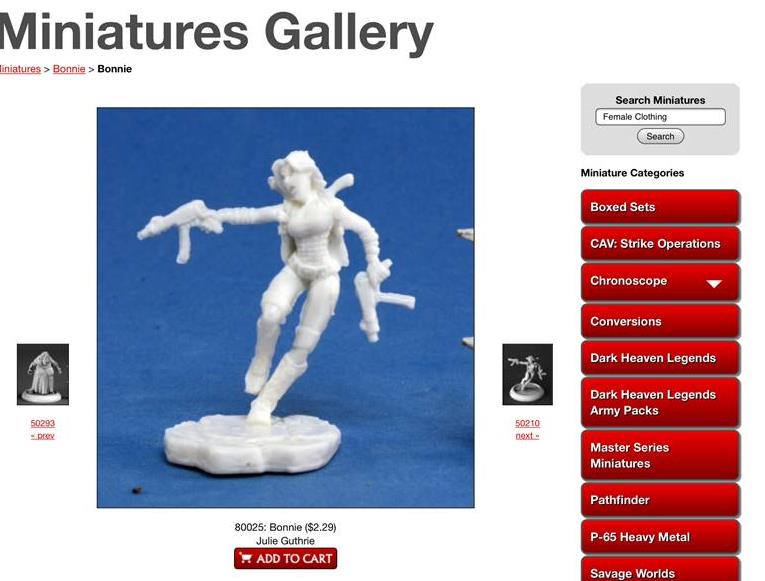
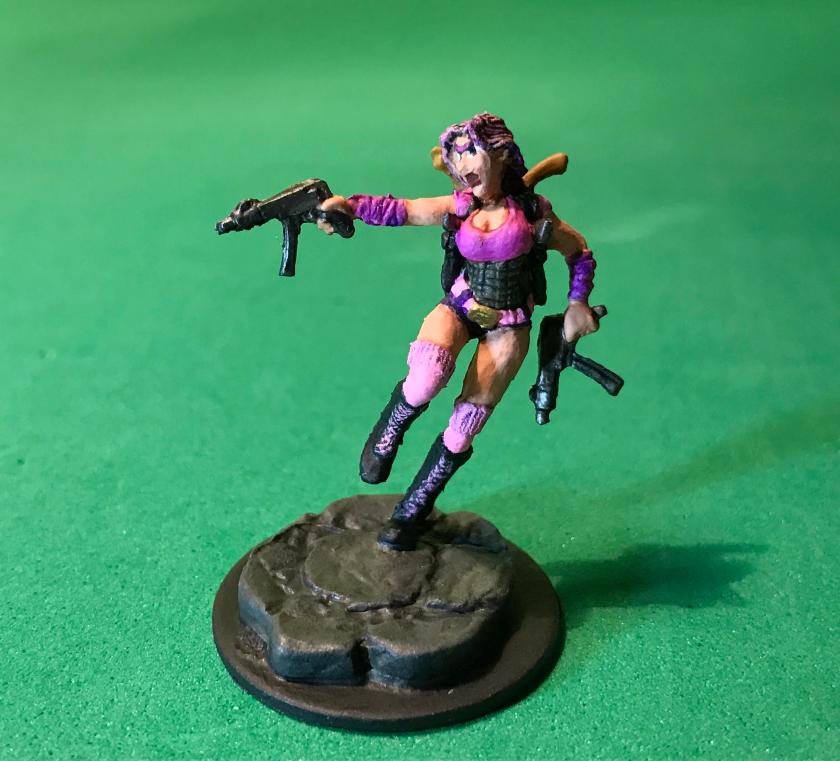
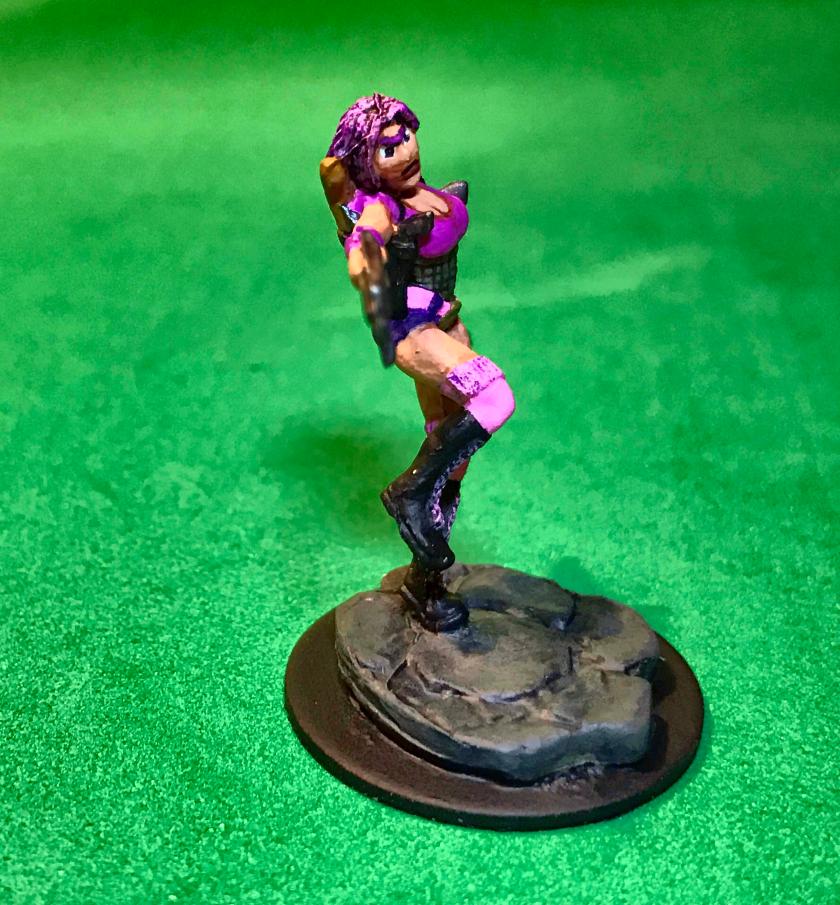
This blog is about the second figure that I painted for Chris Smedile’s birthday. It is a 28mm Reaper Chronoscope figure, “Bonnie” (#80025) sculpted by Julie Guthrie in 2015 or 2016. This was a challenging project mainly as I have so little experience in this type of fashion (if it can be called that). This is also my first “Reaper Bones” figure (resin) as all my others have mainly been metal. You can see the website link for it here.
From the Reaper website
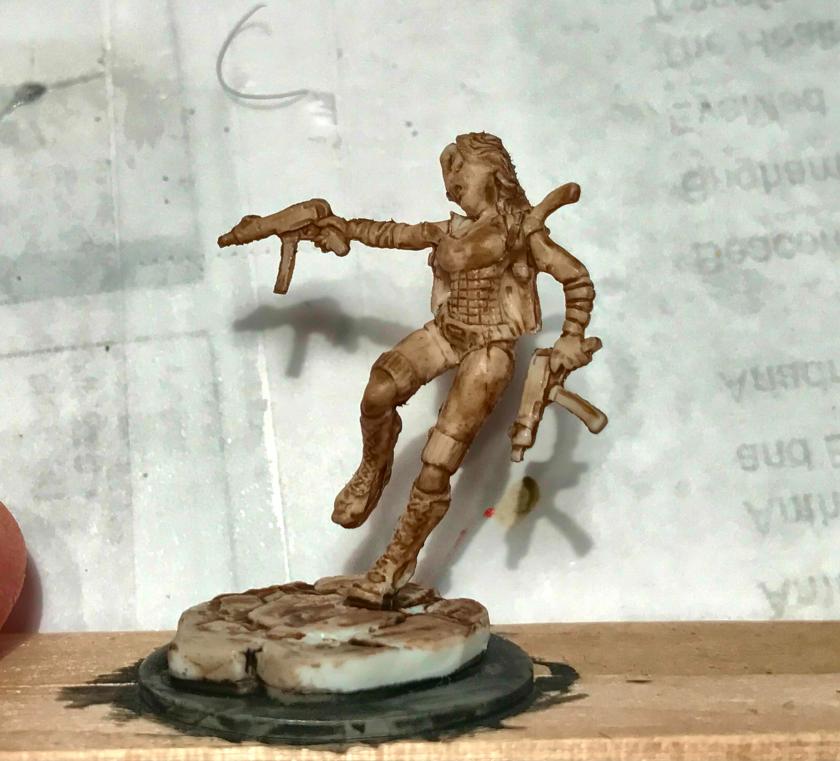
I noticed that the figure had visible mold lines, which I tried to remove with an Exacto knife and some light sanding. Then, I decided to apply a wash with Citadel “Agrax Earthshade” over the figure so as to see the details better.
After wash, frontAfter wash, rear view
I initially had a struggle trying to have a vision for this figure. Basically, she is a well-armed (probably overly-armed) post-apocalyptic warrior or perhaps a zombie hunter. After looking at her attire, I decided that she needed to have a bright comic book look – after all, who wears this in the apocalypse? Also, early on I was not so enamored of the details (or lack of details) that were molded on her face. I ended up thinking about it a bit – and eventually going with a patent leather and purple/pink/violet and glossy black theme.
First, I base-coated the figure. I began with her flesh, using P3 “Midland Flesh”. I used Citadel “Ceramite White” for the whites of her eyes, and Americana “Ebony” for the pupils.
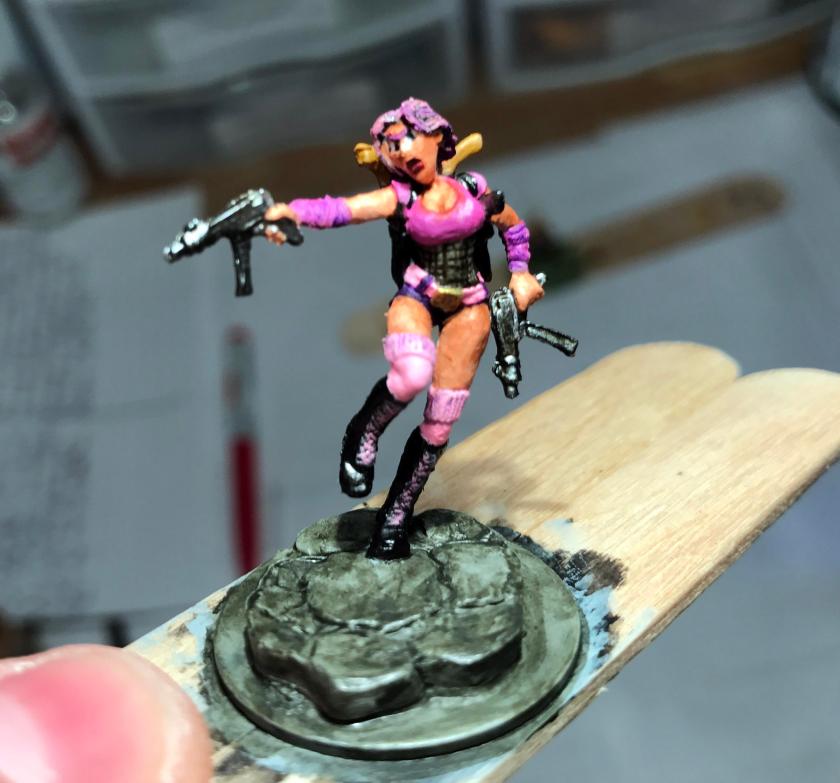
For her midriff vest/leather armor, I used Americana “Slate Gray”. Regarding her socks, halter top, and wrist wraps (I’m sure there is a name for them but hey, my fashion sense is limited!), I broke open my Americana “Bubblegum Pink”. I did not like the solid pink look on the top and the wrist wraps, so I mixed that with a little Americana “Vivid Violet” and “Dioxazine Purple” and that seemed to work better. For her hot pants (or shorty-shorts if you’re Larry the Cable Guy), I went with a very distinctive purple – Americana “Dioxazine Purple”. I gave her boots and straps a patent leather appearance with Armory “Gloss Black”. I decided that her hair should be black, so I went with Americana “Ebony” and a Citadel “Nuln Oil” wash. I gave her some hair highlights in with the three colors – “Vivid Violet”, “Dioxazine Purple”, and “Bubblegum Pink”.
For her two submachine guns, I applied Vallejo “Gun Metal”, which I also used for the triggers on her two sawed-off shotguns in holsters on her back. I painted the handles of the shotguns with Armory “Musket Brown”, followed by Vallejo “Wood”. For the base, I used Americana “Zinc”.
I moved on to some finer details and shading. I drybrushed her boot laces with “Bubblegum Pink”. I used Secret Weapons Washes “Armor Wash” to shade the submachine guns and her midriff armor. I highlighted the guns with “Gun Metal”. I washed her flesh with a light use of Citadel “Reikland Fleshshade” . Also I highlighted her ribbed sock tops with “Dioxazine Purple”. For her bottom lips and the inside of her mouth, I chose Polly-S “Demon Deep Red”.
Initial base coating, highlights, and shading, front of Bonnie Initial base coating, highlights, and shading, back of Bonnie
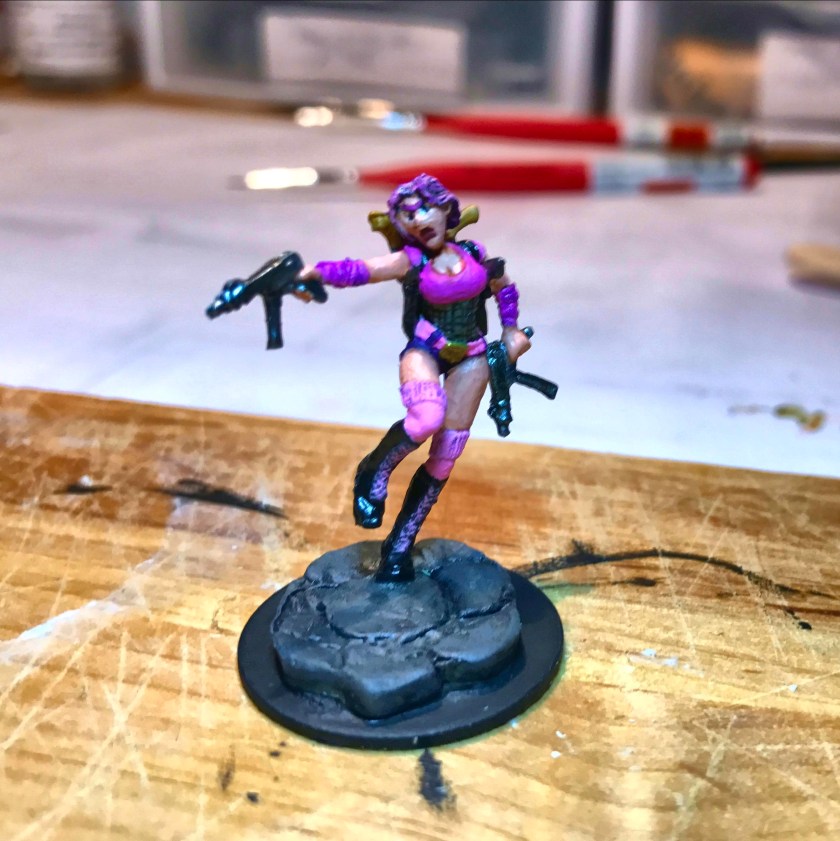
As you can see above, Bonnie looks pretty tan, and I felt as if she needed to look a little less of a tanning booth patron. So, I lightened up her skin by mixing in P3 “Ryn Flesh” with some “Midland Flesh”. I also tried to clean her up overall in a number of small fixes. I used Americana “Slate” to highlight the base, gave it a wash of Secret Weapons Washes “Heavy Body Black”, and painted the washer on the bottom “Ebony”.
Before varnish, frontBefore varnish, back
I then gave the figure two coats of Testors “Dullcoat”, allowing for adequate drying between steps.
Overall, I thought the figure came out ok. I was disappointed at the lack of facial details, especially as this was a Julie Guthrie figure, but perhaps that is a function of the resin. The mold lines were harder to cut and sand than I would have thought. I would use Bones figures again, but I am still preferential to metal.
The good news is that Chris like it, and I hope that he has a lot of great gameplay with it!
I apologize to my readers as its been a while since I have blogged, and as you will see I will be somewhat more active this week as I have completed some projects and now have a few things to actually write about! I expect that I will write three blog entries this week about projects that I have completed.
This is my first entry and concerns a RAFM Bard sculpted by Steven Koo in 1992 as part of the Women of the Ninth Meridian line. Here is a link to the 1994 catalog from DnD Lead website that shows that there were three in each set. The circled figure is the subject of this blog. The figure had pointed ears, so obviously she is an elf.
From the 1994 RAFM Catalog
Chris Smedile’s birthday was coming up, so I offered him the chance to go through my assorted unpainted miniatures and pick a couple of figures that he would like me to paint for him. He picked two – this Bard, and a Reaper Chronoscope Bones figure (which you can read about here). It is 25mm in scale, cast in white metal (possibly lead-free), and had great detail.
Bard front view before painting
Rear view of Bard before painting
“RAFM 92”
I looked at the weather forecast as I wanted to finish this project in time to properly use spray varnish outside – and I need close to 70° F and low humidity for best effect. I wanted her to have a slight “Little Red Riding Hood” look.
Beginning the base coat process, I started with the flesh, and used P3 “Ryn Flesh”. I painted her flute with Tamiya “Chrome Silver”. Using a pine tipped brush, I painted her eyes with Citadel “Ceramite White” and Reaper MSP “Blue Liner”. Moving on to her hair, I decided to go with blond. For that, P3 “Sulphuric Yellow” was my choice. For her tunic and her earrings, I went with a paint I purchased in West Germany in 1987, Deka Lack “Dunkelblau” (dark blue). She had a thin sword, and the scabbard I painted with Vallejo “Gun Metal”.
Moving on to her cape, I got another oldie but goodie paint from 1984. This was Polly-S “Demon Deep Red”, which ironically is older than Chris is!! I also used that color to base her hair ribbon. For her breeches, I based with Armory “Prussian Blue”. For the trim and cuffs on her tunic, I used another Deka Lack paint, “Weiss” (white). She had a canteen and a pouch on her belt. These I painted respectively with Vallejo “US Dark Green” and Armory “Brick Red”. For her leatherwork and straps, I decided on P3 “Bootstrap Leather”. I needed to finish her metallics, and so I painted her brooch and sword pommel with Vallejo “Silver”, and her belt buckle and scabbard tip with Vallejo “Bright Brass”. She has a jewel in her brooch, which I painted with Citadel “Soulstone Blue”. For her base, I used Americana “Hauser Light Green” so as to make later base applications better.
Bard, front, after base coat
Bard, back, after base coat
I then moved on to highlighting and shading the figure. For her hair, I used successive washes, first with P3 “Sunshine Yellow” and then with Citadel “Reikland Fleshshade”. I then used a wash on the tunic with Citadel “Agrax Earthshade”. I then lightly washed her hands with “Reikland Fleshshade”. To highlight her facial features, I mixed Polly-S “Elf Flesh” with P3 “Ryn Flesh” and applied it to her cheeks, nose, hand and fingers.
For her breeches, I shaded with “Agrax Earthshade”, followed by highlighting with a mix of “Weiss” and “Prussian Blue”. Lastly, I moved on to her cape and hair ribbon. Here, I darkened the cape with “Agrax Earthshade”, then highlighted it with Americana “Santa Red”. I also painted her hair ribbon with “Santa Red”.
To finish the base, I applied Army Painter “Moss Green” flocking with white glue. Then the figure got two coats of Testors spray “Dullcoat”, allowing for sufficient drying time between coats. To finish her, I added a yellow flower tuft from Army Painter “Meadow Flowers”.
Finished Bard, frontal view
Finished Bard, rear view
Finished Bard, side view
Overall, I was pleased with the work I did on the figure. It was a nice break from my very large Star Duck project.
Chris got it on his birthday, and he loved it! I am looking forward to hearing of her exploits!
As described earlier in this blog (here), I had acquired and cast some Archive Star Rovers figures – “Power-Armored Frinx” (#2040 or #2305) last year. As these were made between 1977 and 1981, it became difficult to acquire enough of them for a unit, and Archive no longer exists to purchase them. I cast several of them for myself and friends.
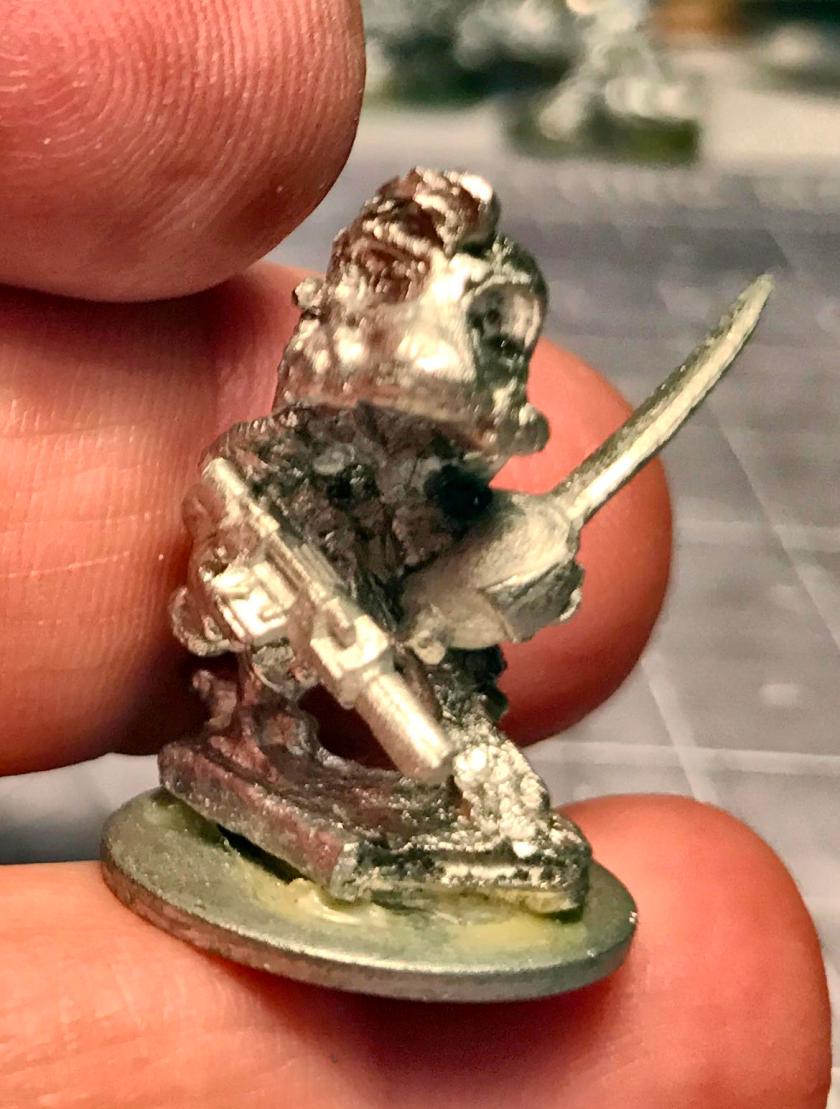
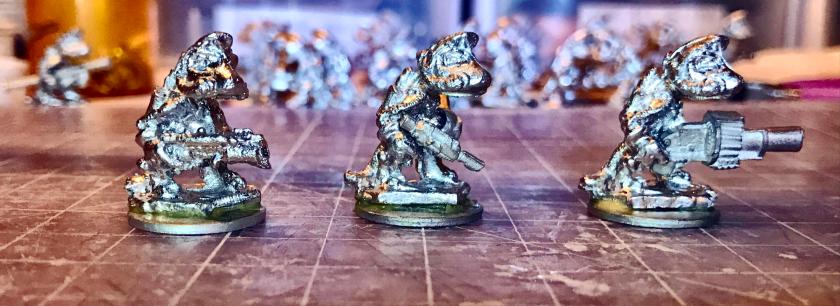
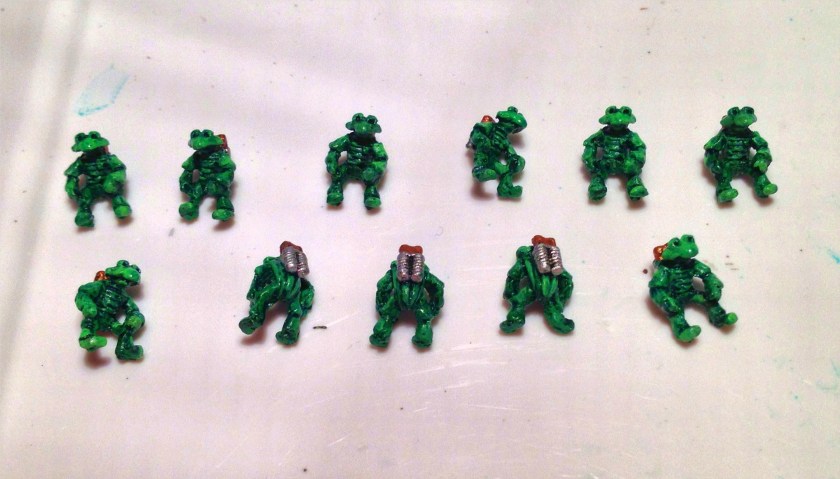
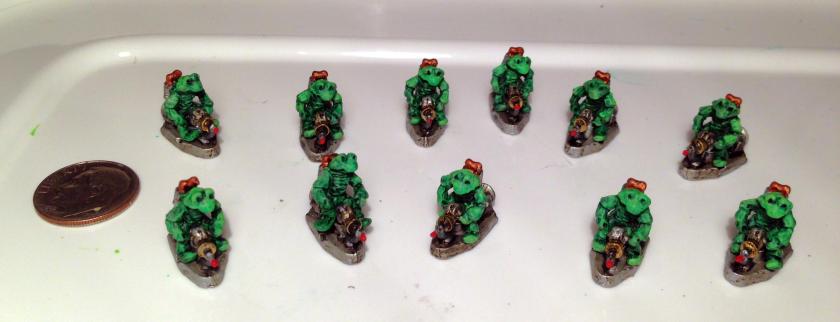
My goal was to create a platoon-sized unit of these Frinx for a retro-sci-fi battle using Combat Patrol™. My concept of these figures is that they are reptilian, and that they wear suits of “power-armor” that protect them, while negatively affecting their movement. They are armed with a blaster-type weapon. My castings did not pick up the details of the helmets which had a light-like feature similar to that of a miners helmet. What they did pick up yielded a look similar to a beret (if a helmet could become a beret), and I incorporated that feature into my painting scheme.
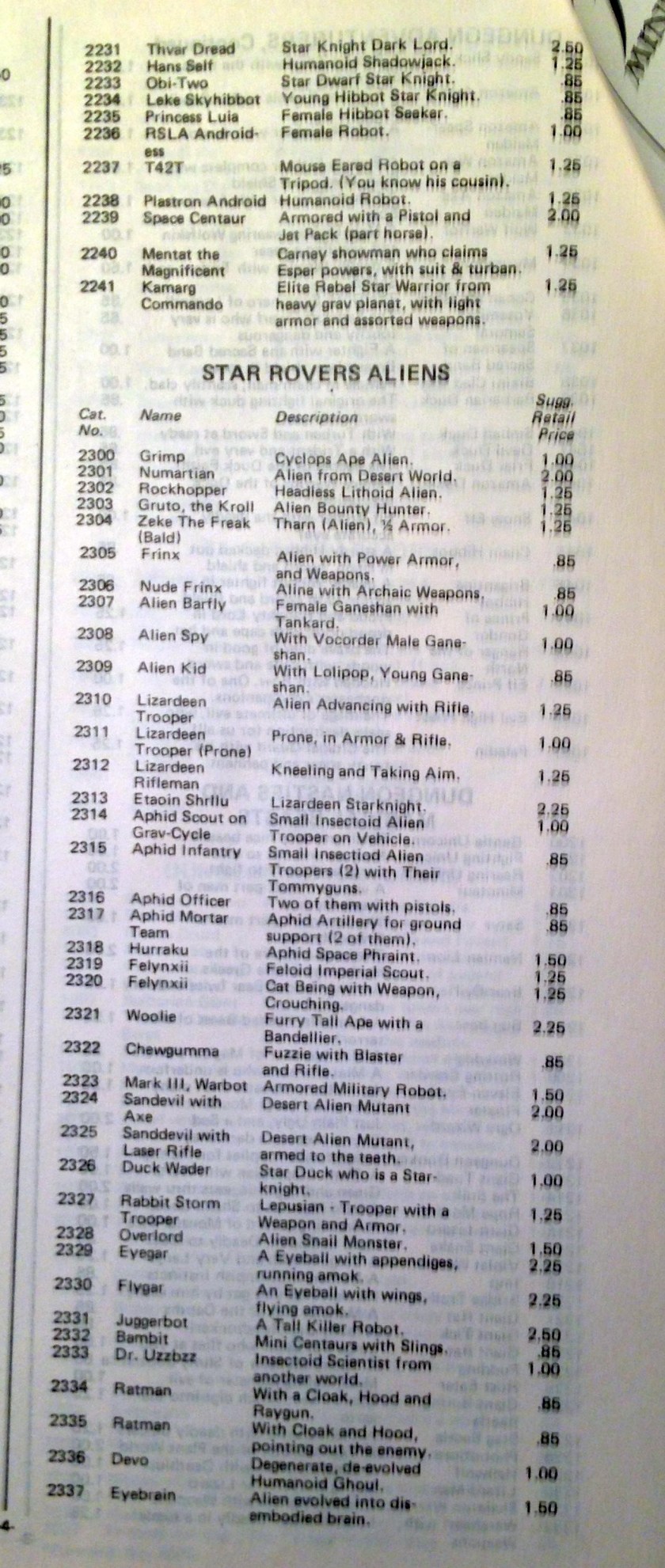
For fun, below is a catalog shot that came with my Star Rovers game. Note that it lists “Frinx” and “Nude Frinx”. I do have one of the latter, and its a Frinx out of armor!
Catalog scan from Archive Star Rovers game
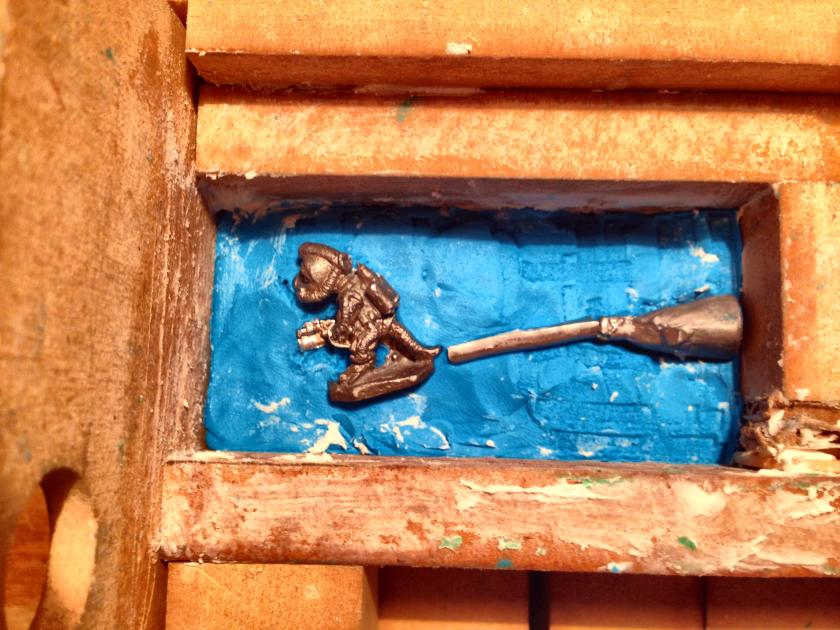
Mold with Power-Armored Frinx
After I had 32 figures, I organized them for the platoon. I needed to convert several troopers to make a platoon leader, a platoon sergeant, and an anti-tank section. I also plan on attaching the Mark 1 Sphere tanks I previously created into the platoon. The organization of the platoon is below.
Power-Armored Frinx platoon structure (32 fighting figures plus 3 vehicles):
Frinx Platoon Leader (1 Frinx with blaster pistol and light cutlass)
Frinx Platoon Sergeant (1 Frinx with automatic grenade launcher)
AT section (3 Frinx with bazookas)
Jade Squad (9 Frinx)
Squad Leader (1 Frinx with blaster rifle, also leads Jade A team)
A Team – 4 Frinx Infantry with blaster rifles
B Team Leader (1 Frinx with blaster rifle, also leads Jade B team)
3 Frinx Infantry with blaster rifles in Jade B team
Pearl Squad (9 Frinx)
Squad Leader (1 Frinx with blaster rifle, also leads Pearl A team)
A Team – 4 Frinx Infantry with blaster rifles
B Team Leader (1 Frinx with blaster rifle, also leads Pearl B team)
3 Frinx Infantry with blaster rifles in Pearl B team
Amethyst Squad (9 Frinx)
Squad Leader (1 Frinx with blaster rifle, also leads Amethyst A team)
A Team – 4 Frinx Infantry with blaster rifles
B Team Leader (1 Frinx with blaster rifle, also leads Amethyst B team)
3 Frinx Infantry with blaster rifles in Amethyst B team
Sphere Tank Section (3 Mark 1 Sphere Tanks with heat rays and ray guns)
I used a jewelry saw and some blades to remove the blaster on two figures, as well as the left arm on the platoon leader. I had some sci-fi weapons that I had gotten on eBay and from Buck Surdu (perhaps from War Games Supply Dump). I gave the platoon leader a light cutlass (instead of a light saber) and a blaster pistol.
Platoon Leader after conversion
I then moved on to the AT section, which reports to the platoon sergeant. After removing the blaster and shaving some space, I used a pin vise drill to make space for the bazookas on 3 Frinx. I used 3 bazookas from 3 Reaper Chronoscope Weapons Pack III’s (#5o234). I split the bazookas in half and sized them to the figures. For the platoon sergeant, I removed the blaster, and gave him a cool automatic grenade launcher.
AT Frinx after conversion.
Source of bazookas
A trooper, the converted platoon leader, and the converted platoon sergeant
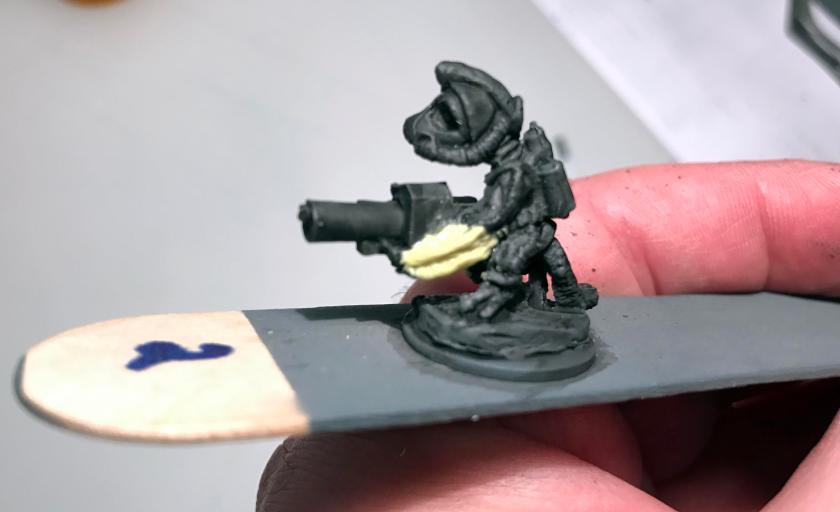
I mounted all the figures on ¾” steel washers with wood glue, and let them dry. Subsequently, I used white glue to lightly mount the figures to numbered popsicle sticks. I covered the numbers with scotch tape, and primed the lot with Krylon “Ultra Flat Gray”. I then removed the tape so as to know what stick I was working on and have a reference point for the beginning and the end as painting units can cause one to forget. Using Citadel “Nuln Oil”, I gave the unit a wash to better identify their features. This gave me a surprise for the platoon sergeant!
All primed
The automatic grenade launcher already had a couple of hands on it! The Frinx hands are gloved – similar to say 1920’s Mickey Mouse for lack of a better comparison. I had to create a left arm with Milliput for the figure that would cover up the left glove and extend to the left hand under his weapon. For the right extra hand, I filled in the fingers with Milliput and made it look like part of the grenade launcher.
Platoon Sergeant – before conversion on left side
New arm for him!
Platoon Sergeant with extra hand?
Turned extra hand into stock
As far as my painting scheme, I wanted to try something new – and use a lot of metallic paint for a few purposes. First, to create the image of the “power armor” I used a series of DecoArt metallic paints. These had a side benefit of also allowing me to easier differentiate my squads into three (Jade, Pearl, and Amethyst). I used other Citadel Technical Paints to denote leaders, and parts of weapons. Additionally, I used a few Tamiya metallic paints as I will describe. The net effect of the metallic was to make this a difficult project due to the thicknesses of the metallic paints – but I think the results worked (but the reader can be the judge). These photos are ok, but I found it difficult to get the lighting right for them.
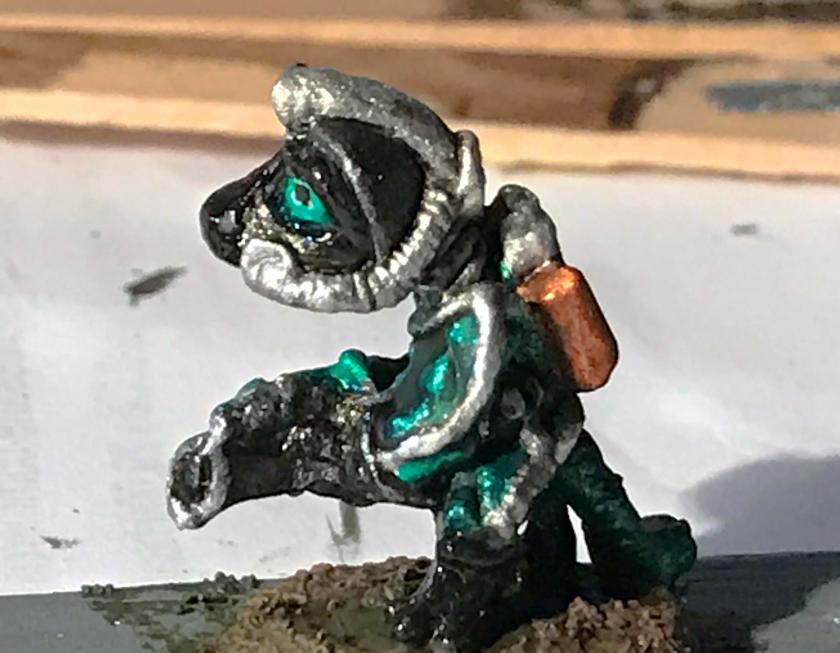
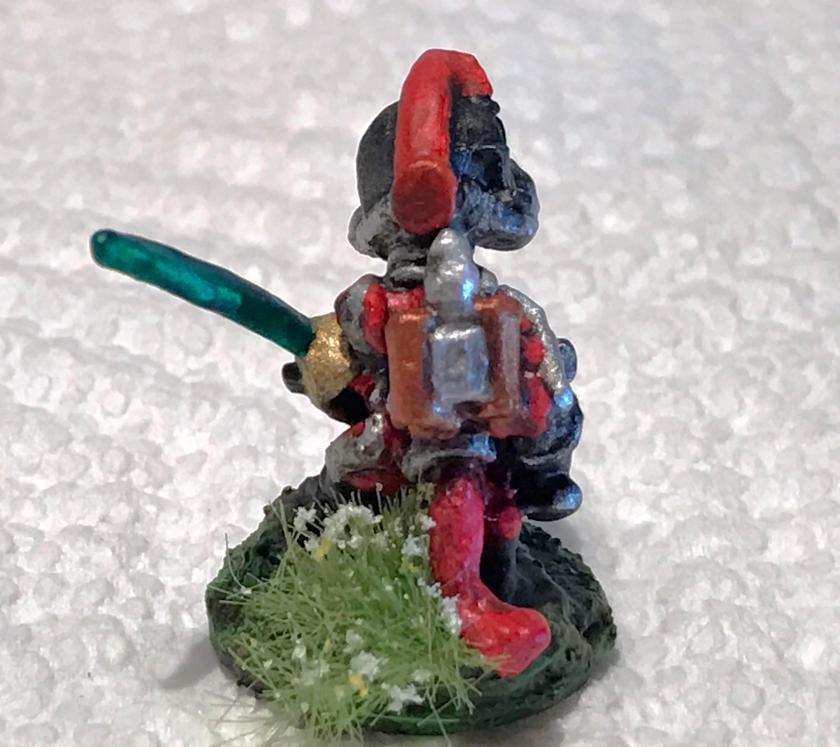
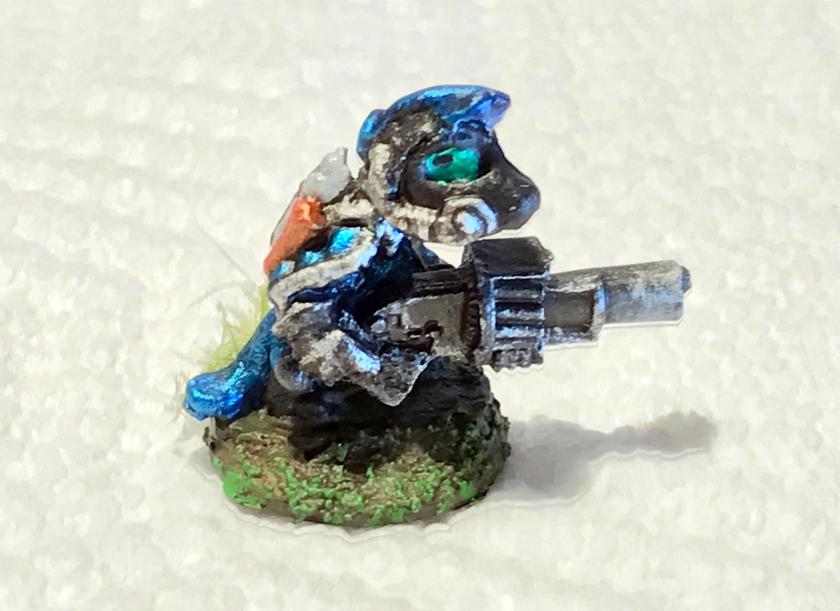
Basically, I had to abandon the typical assembly line approach I normally take to when painting units due to the properties of the metallic paints (especially the viscosity and the clotting). Thinning helped, but to get the desired effects I went slow and methodically. Each figure was base coated with a DecoArt Dazzling Metallic or Craftsmart metallic main color (DecoArt “Festive Red” for the platoon leader, Craftsmart “Sapphire” for the platoon sergeant, DecoArt “Festive Green” for the AT section, DecoArt “Crystal Green” for the Jade squad, DecoArt “Peacock Pearl” for the Pearl squad, and Craftsmart “Amethyst” for the Amethyst squad. Tamiya “Chrome Silver” was my choice for the breathing regulators, straps, part of the blaster sights, and the center of the helmets. Tamiya “Gun Metal” was what I used for the blasters and the remainder of the helmets. For the Frinx faceplates, gloves, and boots, I used another metallic, Craftsmart “Onyx”. The main part of the breathing tanks was coated with another metallic, DecoArt “White Pearl”, while the tanks themselves got Tamiya “Copper”. Inside the faceplates, I painted the eye wells with Citadel “Ceramite White”, then dotted the eyes with “Onyx”. Using Citadel Technical “Waystone Green”, I filled in the rest of the eye well, creating an eye. I ten used Citadel “‘Ardcoat” to create a lens-like effect on the faceplate – this took a while as I had to do one side at a time, and let each dry. I also used the “Chrome Silver” as a base for “Waystone Green” on parts of the blasters, the platoon leader’s light cutlass, and on the team leaders’ helmets. For the squad leader’s and platoon sergeant’s helmets, I used the same approach but with another Citadel Technical paint, “Soulstone Blue”. The platoon leader’s helmet got Citadel “Spiritstone Red” (yet another “Technical” paint).
I then used “Nuln Oil” for shade, and highlighted all the areas overly darkened by it with the original colors to add depth. For the black gloves, I used highlights of “Chrome Silver” intermixed and slightly covered by “Onyx”. For the bazookas, I used my first Vallejo paint, “US Dark Green” – and I loved the paint. It was so easy to use after all the metallics! I shaded the bazookas with Citadel “Athonian Camoshade”.
For the bases, I tried a new approach to hide the raised bases. Using Citadel “Lustrian Undergrowth” (a thick “Texture” product), I carefully filled in around each base. This was better than I thought as far as effects. After the bases were dry, I washed them with Citadel “Seraphim Sepia” and let them dry. I was able to dry brush the bases successively with Armory “Musket Brown” and Citadel “Niblet Green”. Due to the cold weather, I was not able to varnish at home. Luckily, my friend Jeff Smith has a nice heated workshop that he was kind enough to let me use. There I gave the platoon a couple of coats of Testors “Dullcoat”.
Lastly, I used tufts to better differentiate for play between A and B teams on the squads. Jade team A got one Army Painter “Swamp Tuft”. Pearl Team A got Army Painter “Wilderness Tuft”. Amethyst Team A got Army Painter yellow “Meadow Flowers”. The platoon leader and platoon sergeant got white “Meadow Flowers”.
Midway progress
Lots of Frinx!
Close up of Jade team Frinx after base coat
After painting and off to the varnishing
Assembled platoon less sphere tanks
Amethyst Squad, side view
Platoon Leader with light cutlass
Blaster side
Rear view of PL
Platoon Sergeant, weapon view
Platoon sergeant, rear view
AT Section
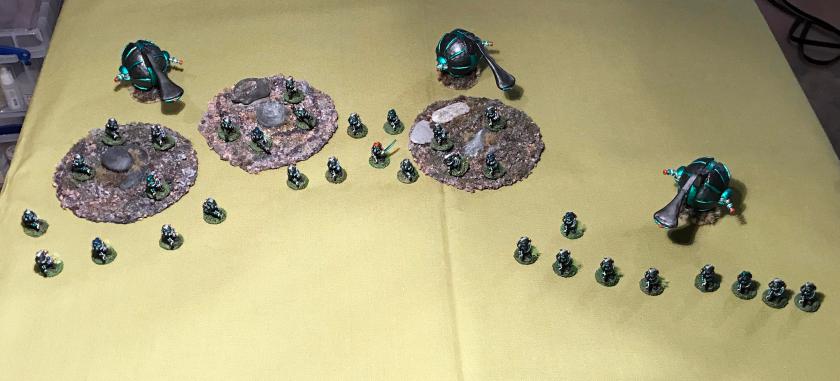
Supported by Mark 1 Sphere Tanks
On the move
The Power-Armored Frinx Platoon deployed
I tried a number of new things for this project and learned some things:
Multiple metallic paints
Tamiya – use their thinner, it works better than water and can rejuvenate old Tamiya paints
Craftsmart and DecoArt – thick stuff, but will work
Citadel products
“‘Ardcoat” – great for lenses over Citadel Technicals
“Lustrian Undergrowth” (Texture) – works well on bases and drybrushes well
Technicals (“Soulstone Blue”, “Spiritstone Red”, “Waystone Green” – all good, but need to consider what you use as base and drying time
“Seraphim Sepia” and “Athonian Camoshade” are nice washes
Conversions – sometimes the details are not immediately visible on additions! Use a wash on gray or white primer to see details
I am happy to begin the 2017 blogging season with a very complicated project. While I began work on this project in December, I had been thinking about it since last May.
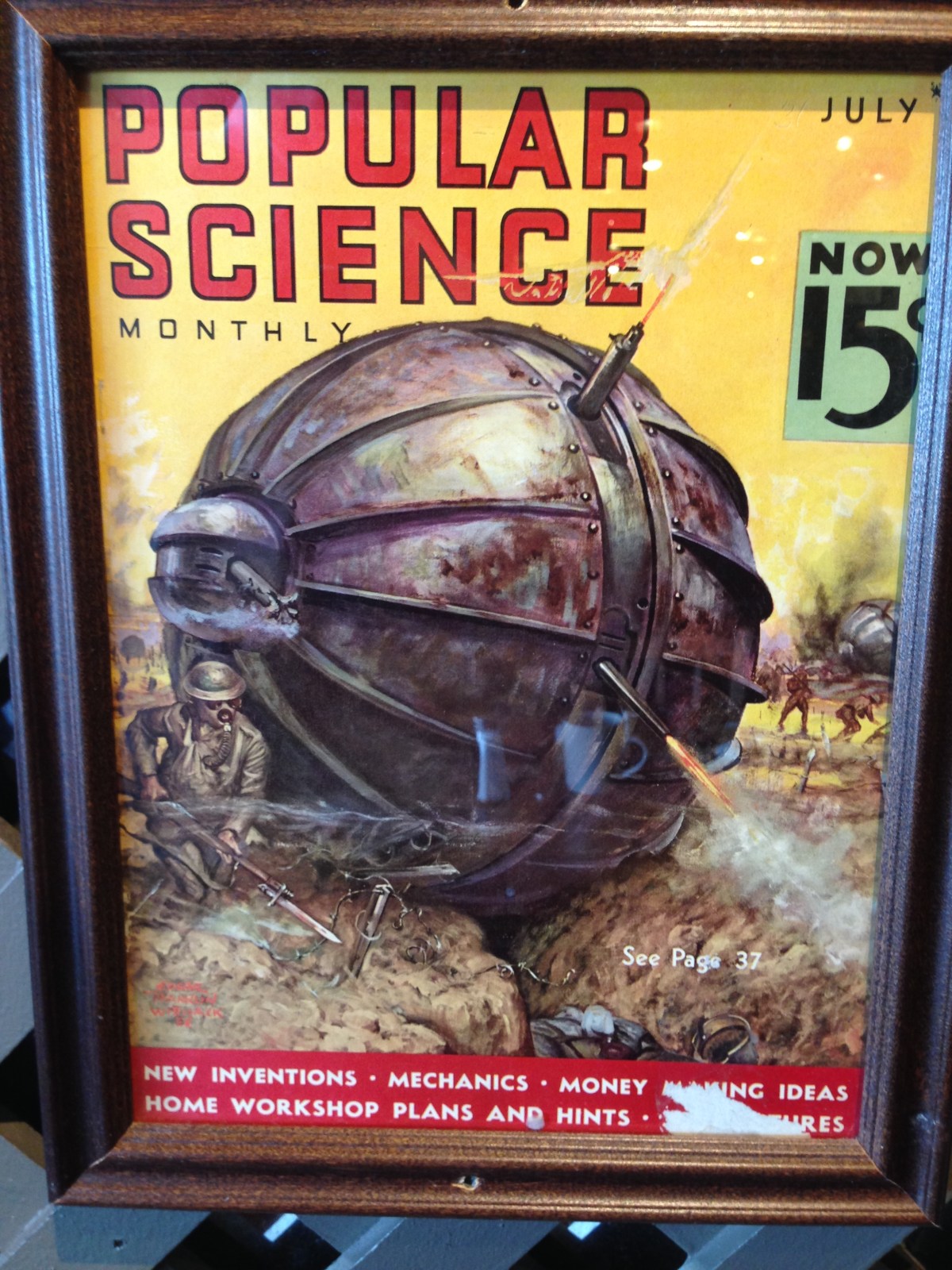
So what happened in May 2016? I was traveling for work, and sat down in a Cracker Barrel in Connecticut for breakfast (Uncle Herschel’s with a sweet tea of course). For those of you who have never been to a Cracker Barrel, there are always old photos and curios all over the walls. I looked to my left, and saw this on the wall:
What started this journey
I was amazed at this and wanted to dig in more and learn the date of this issue of Popular Science magazine and see what the article said. The article was just a paragraph with another picture – here is the link and a shot of the July 1936 article on page 37.
The page 37 article
The concept of the “tumbleweed tank” tank was one of two outer shell halves rotating independently on rollers over a solid stationary sphere. More or less, the outer halves acted as the vehicle’s treads. I do not believe that anyone ever tried to build this as a combat vehicle, but I still found the concept fascinating and worthy of a project.
During the intervening months, I conceived of an idea that I could make a model of the tank, build a mold, and cast it for tabletop wargaming. As I have been building units of Star Rovers figures for sci-fi Combat Patrol™, my first thought was to make a retro-sci-fi tank, probably for the Frinx. I was not enthusiastic about the weapons design as shown in the magazine – machine guns alone would make this a very boring retro sci-fi tank. I also considered making it modular – so that I could adapt different weapons for it.
While thinking about it, I wanted to have a great sphere – and my sculpting experience is at best weak to nonexistent. I have seen a few blogs that I follow where folks are sculpting their own figures, and that helped to inspire me. As I also cast – this was a chance to go from beginning to end with the project. But what to use?
The answer came easily to me as a golfer – a golf ball! That would be an easy thing to work with and would afford me a chance to see what works. I had an idea that I wanted it to be armed with ray guns in the side sponsons. I had not decided on the main weapon, when I had a brainstorm – 1953’s War of the Worlds Martian Heat Rays!
1953 movie posterThe Martian ship
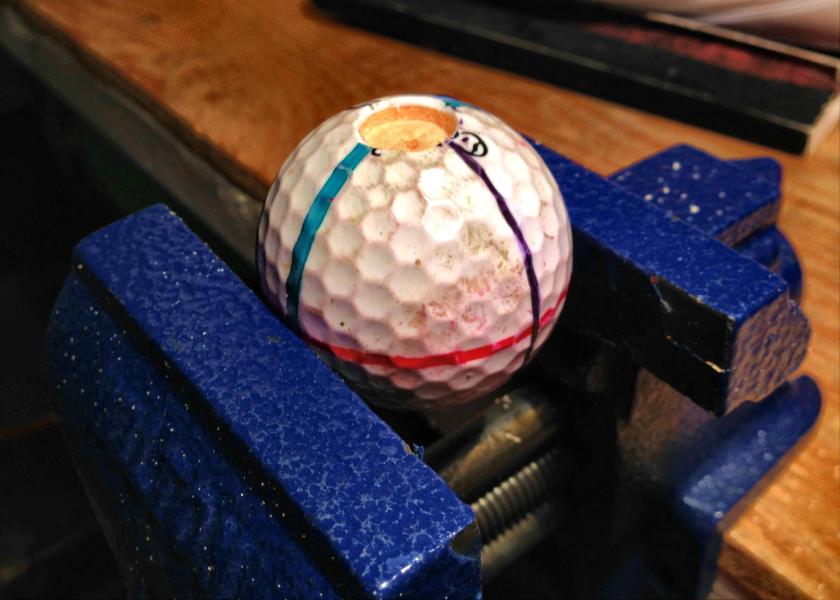
So with this plan, I went forward to try to create my new Mark 1’s (what else to call them!). I thought that I could learn from the project (and I have). I used a “Line ’em Up” golf accessory to create lines on a used Callaway golf ball, and drilled a ½” hole in the side of the ball on two sides. I like the Callaway for this as it has hexagonal dimples.
First drill hole into the Callaway
After this, I used a Plastruct 2mm x 4.8mm styrene strip to size up the gap between the ball halves. I used my Dremel to cut the outer surface of the ball – it ended up being messy and needed a lot of Exacto knife work. The Dremel cutting blade tends to melt the outer ball cover – another lesson learned
After cutting the chassis ridge with my Dremel
I then needed to create the tread ridges. I used an Exacto knife to carve small channels along the lines for the treads. This took a lot of cutting! Using some old plastic membership cards, I cut out each tread, sized them to the holes, and glued them in with super glue.
Tread ridges cut from plastic membership cards
I then drilled a ¼” hole for the attachment of a main weapon – which I would cast separately with the sponsons in a single mold. To build a base for the model, I used three 1¼” washers, and glued them together with wood glue. I then covered them with Apoxie Sculpt, leaving a hole to mount the ball to the base with a wood screw through the washer. This ended up being a base that I feel in the end was a little too tall, but usable, and castable.
A Callaway golf ball converted into the tank chassis
I originally was going to use Milliput or Apoxie Sculpt for the sponsons – when I discovered these ½” Button Plugs from Lara’s Crafts – which were the right shape and fit perfectly into the holes on the sides (got lucky here). I bought a set of Niji woodcarving knives (which I wish I had when I was carving the treads and the middle gap!) and used them to make the sponson shells. After trial and error (where I learned the hard way that I needed to wear a cutting glove with these very sharp knives), I carved two sponsons and sanded down the middle slots.
Making the button plugs into sponsons
I initially thought that I needed to smooth out the golf ball dimples and the tread cuts, so I first tried with Apoxie Sculpt, with poor results. My next attempt was with Citadel “Liquid Green Stuff”, which was better, but I think was an unneeded step.
The master figure and sponsons mid-project
I drilled a 1/8″ hole in the sponson shell, and mounted a short piece of Evergreen Scale Models strip styrene 1/8″ tube. For the ray guns, I turned to the use of model airplane parts. I used two Dubro products – a 2mm socket head cap screw with three 2 mm flat washers superglued to it. To line up the washers evenly, I found that using toothpicks on both sides and underneath to define the gaps and make the washers relatively parallel worked well. I inserted the guns into the ends of the styrene, after coring out the ends of the styrene rods for a better fit. Eventually, I primed the sponsons black with Citadel “Imperium Primer”, as I wanted there to be less tackiness to the Quick-Sil from the wood.
Nice view of the ray guns in the sponsons
Another view of the ray gun sponson
I then moved onto the main weapon, the heat ray. In the 1953 movie, the heat ray was rectangular, leading to the distinctive head. I eyeballed the length, and designed the head. I sculpted it in two stages, with the “eye” section being attached to the neck, which itself was on the Plastruct strip styrene.
Designing the heat ray – this worked!
Initial heat ray sculpt on styrene strip
I cut the styrene strip to size, and used more Apoxie Sculpt to make a mount that would fit into the main weapon recess. After it hardened, I saw that I would have to bend it in my mold, or otherwise I would have a very turtle-like appearance. As the styrene is flexible, this was not a problem. I made two two-piece molds with Castaldo Quick-Sil – one for the chassis and one for the weapons. I also tried some new innovations with venting with the use of some more model airplane parts – in this case flexible fuel lines that I cut for venting. As you can see below, I bent the heat ray in the mold to my desired shape.
Weapons mold before Quick-Sil
After first half molded
Chassis mold before Quick-Sil
Chassis mold after first half molded
In the end, the mold for the weapons worked very well, needing little work on the finished weapons. However, the chassis mold had a few issues. First, I knew as a golfer that golf balls compress when struck. What I did not realize was that there would be a strong interaction of the flattish sponson holes and the pressure exerted by the curing Quick-Sil on them at 90° angles. As a result, the cast ball would be visibly compressed somewhat. Additionally, the flow was not perfect – leading to my needing to add Apoxie Sculpt to the finished models’ chassis. Lastly, because the mold for the chassis was thick, and the casting was large, it took a long time to cool, and used a lot of metal (see phots for weight below in the blog). Unfortunately I discovered this when I opened the mold once and the metal flowed out! I will incorporate these lessons learned into the Mark 2’s.
The master and the molds
Shrinkage! Was he in the pool? (Apologies to George Costanza and Jerry Seinfeld)
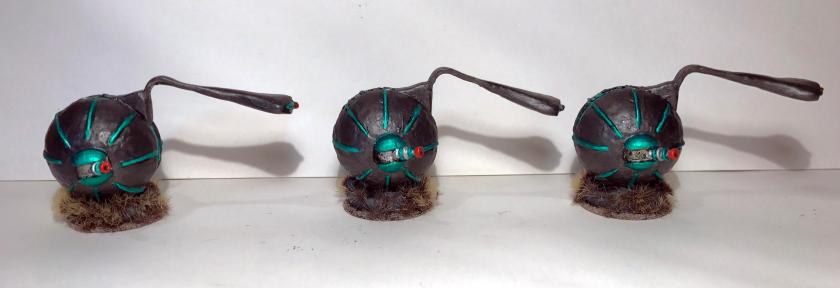
I managed to successfully cast two chassis, and decided to use the master as well as I already had the mold. So I cast three sets of weapons, and assembled three tanks in total. I used some Apoxie Sculpt to fill in the gaps in the back where flow was less than ideal -and this worked fine. Next, I mounted the assembled tanks to a 1 5/8″ steel washer for magnetic storage in my gaming boxes.
Assembled tanks
I then primed the tanks with Citadel “Imperium Primer” – I must say I like this as a brush primer – it’s a nice product.
Primed tanks
After priming, I moved on to painting them. Painting these proved to be challenging, especially the fully-cast models, due to the weight of the models. The metal ones weighed about 14 ounces, while the master weighed in at 4 ounces!
I used Citadel “XV-88” on the base and the chassis gaps. For the chassis and the heat ray, I based with Tamiya “Gun Metal”. I used several light coats and had a shiny finish to deal with – but a smooth one. The trick with Tamiya is a wet brush and a lot of shaking and shaking again. I then used another Tamiya metallic, “Chrome Silver” to paint the sponsons, the tread ridges, and the business end of the heat rays. I painted the tips pf the ray guns and the “eye” of the heat ray with “XV-88” and Citadel “Gehenna’s Gold” in anticipation of future colors. The base I gave an application of Americana “Ebony”.
After base coat
I then used my new Citadel Technical paints. Remember that the Martian craft had orbs that were glowing green. To recreate that feel, I applied two coats of Citadel “Waystone Green” to the sponson tops and bottoms, the tread ridges, the chassis gaps, and the main portion of the heat ray. I also painted the first and last rings of the ray guns with this technical paint. I wanted the slot of the sponson to be a bit darker – and Secret Weapons Washes “Armor Wash” helped me to achieve that look. For the tips of the ray guns and the “eye” of the heat ray, Citadel “Spiritstone Red” gave a nice focal character to the weapons.
After highlights
To accent the green, I shaded areas around the “Waystone Green” with Citadel “Nuln Oil GLOSSY”. As I was going to dull down the overall shiny paint job, I thought this would work better – and I think it did. I drybrushed the bases with Citadel “Mechanicus Standard Gray”, and then applied a light flocking with Army Painter “Ash Grey” on the washer alone.
Ready for varnish!
I was now ready to varnish, and for the first time I used Army Painter’s “Anti-Shine” matte varnish. This is an aqueous varnish. I liked it, and am excited as varnishing in New England in the winter is always a logistical challenge. I uses 2 parts varnish to 1 part water, and applied with a fan brush lightly. It came out nice and smooth. After it dried, I sprayed the models with Testors “Dullcoat” is my cellar bulkhead after I got it warm enough. This enabled venting of the fumes outside after I was done and kept my wife from killing me when she got home!
To finish the models, I needed to deal with the elevated bases. Using a lot of Army Painter “Wasteland Tuft” applied with white glue, I was able to create an image of the tanks plowing through grass. They are heavy though, but sturdy.
This is a heavy model!!! In English and metric units!
The master weighs a lot less!
Here are some close up photos of the final product.
Run!
Convoy!
Nice group shot
I am very happy with how these came out. If I get enough interest, I may offer some for sale as kits. Certainly, these are my first real creations from conception to creating to molding to casting to painting. I learned a lot, and I am sure that my next iterations will be better.
They will be an excellent part of my Frinx forces for Combat Patrol™!
As readers of this blog know, I have been collecting figures from the now-defunct Archive Miniatures Star Rovers line. The figures from this line were made in the late 1970’s, and my goal is to get them collected and adapt them for use with Buck Surdu’s Combat Patrol™ card-based rules.
There was a lot of work on this project – so please enjoy the photos!
They show up from time to time on eBay, and my experience showed that the ones I found were more or less 25mm in scale. However, the Aphids I am going to describe here were a surprise as far as size goes as you will see. You have to be careful in acquiring these – there are a number of really bad recasters of these figures (and others) out there – selling them at exorbitant prices. I have been sure to be diligent before deciding to buy them.
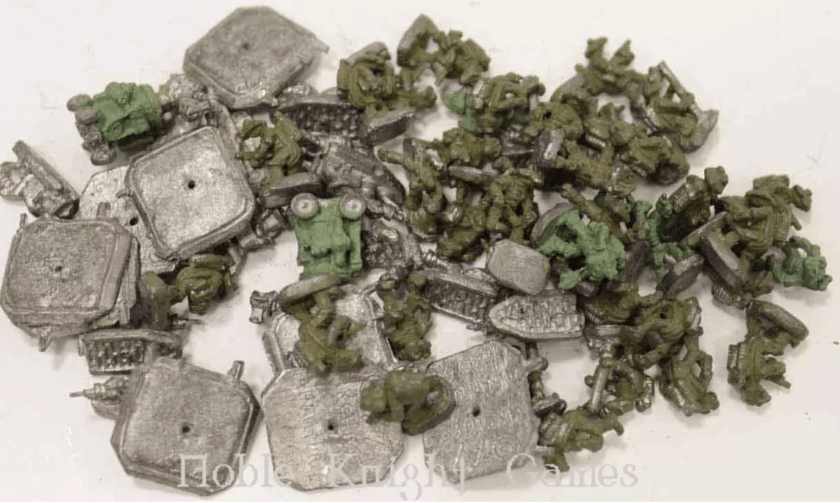
One listing is below. I had seen it several times from the Noble Knight Games store on eBay, but I was initially unimpressed. It looked like a hodge-podge of painted and unpainted figures and bases, and I could not tell what was there at first glance.
The Aphids listing picture from eBayOn a phone call to catch up, I had a discussion with Buck about the Star Rovers line, and he pointed this listing out to me, so I gave it another look. I compared this with Lost Minis Wiki Star Rovers page and saw that there were several figures that I did not have. They appeared to be different Aphids types, including Aphid Scouts on Grav-Cycles, Aphid Infantry, Aphid Officers, Aphid Mortar Crews, and a couple of robots. Archive had two different numbers for the same miniatures, and Lost Minis Wiki does not explain why – perhaps Archive changed the numbers with later production? In any case, they looked to be original, and I bought them. This set included the following miniatures (I list both catalog numbers here for completeness but I am sure that they are from the older group due to the robots being included):
11 examples of Archive #2060/2314 Aphid Scout on Grav-Cycle (11 riders and 11 grav-cycles plus bases).
18 examples of Archive #2061/2315 Aphid Infantry.
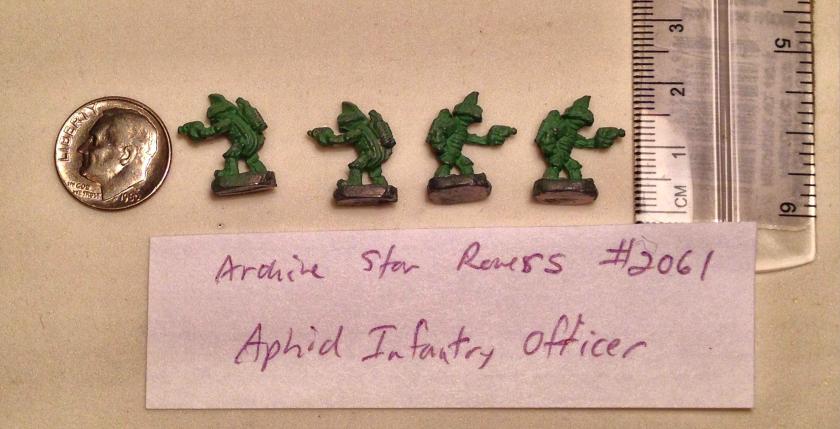
4 examples of Archive #2061/2316 Aphid Officer. The 2061 listing included 5 Aphid Infantry and 1 Officer while the 2316 was just the officer.
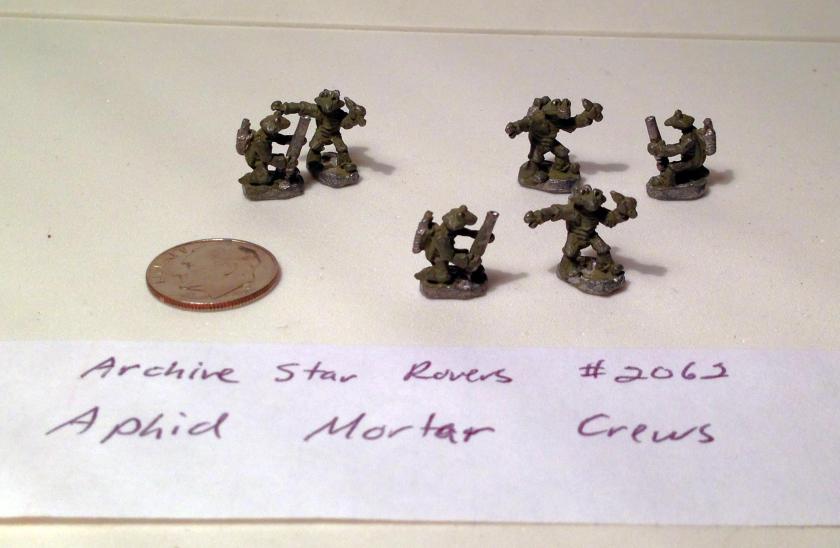
3 examples of Archive #2062/2317 Aphid Mortar Team (two figures per crew for 6 figures).
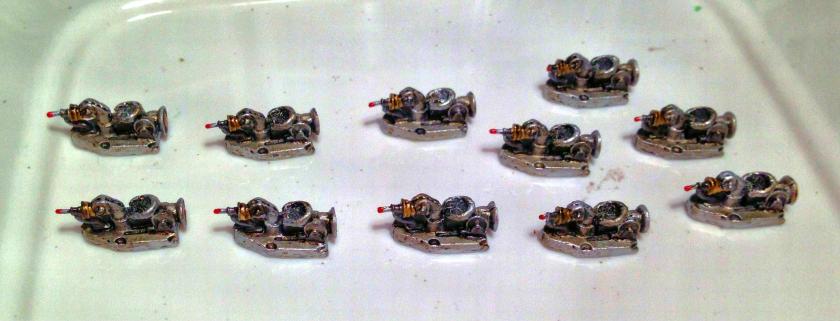
2 examples of Archive #2011A (no later listing) Robot Group. There were 3 robots originally in the set of different types.
Archive Miniatures Catalog detail showing the Aphids with the newer catalog numbersI will refer to the older numbers for the most part in this article as I think mine are older.
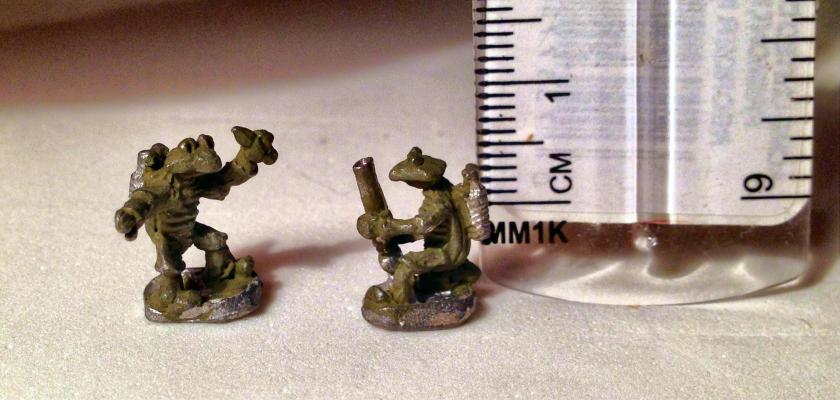
The figures were in good shape except for one scout rider who was missing a right leg and foot. Surprisingly, they were small – really small – maybe 12mm. The detail on them was appropriate for the time period – but as you can see from the eBay photo they were not greatly detailed. To me, this was a challenge to let the brush bring out the potential of the figures. Also, I thought that this acquisition presented me with an opportunity to field an entire platoon of Aphids for Combat Patrol™ games!
My first step was to strip all of them down of any residual paint – which I accomplished with a long (2 week) soak in Simple Green®. I prefer the blue type as it seems to work better (and smells nicer). This time I used some rifle cleaning tools (bore brushes) with plastic bristles in addition to tooth brushes to remove the old paint which was pretty thick.
The Aphid Scouts as received – just stacked together here
Aphid Scout base detail showing #2060Aphid Infantry as receivedAphid Infantry Officers as receivedAphid Mortar Crews as receivedClose up of Aphid Mortar Crew as received – this shows their size and how the previous owner had painted them
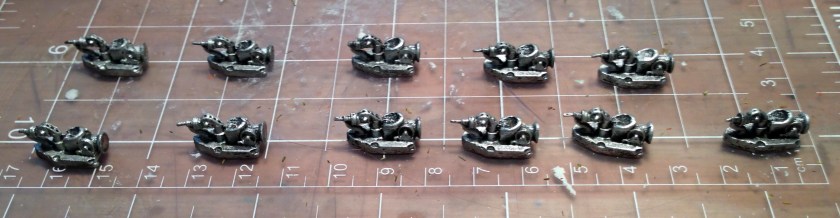
The two robots – look like self-propelled guns – in the form of a steam boiler!I decided that I should first work on the Aphids on Grav-Cycles as they would be the most difficult due to the needed assembly. There were 11 Aphids and 11 Grav-Cycles with bases. More research showed me that these originally came with piano wire to mount them – similar to the image below from Lost Minis Wiki:
From Lost Minis WikiI did not have the piano wire and this did not seem to me to be a sturdy way of mounting the grav-cycles. I wanted a more permanent solution, but one that was cool as well. The cycles themselves seemed to had the wire in them at some point in the past, but nothing remained. The bases still had the holes. While shopping at Michael’s it hit me – I could use clear plastic push pins as mounting platforms.
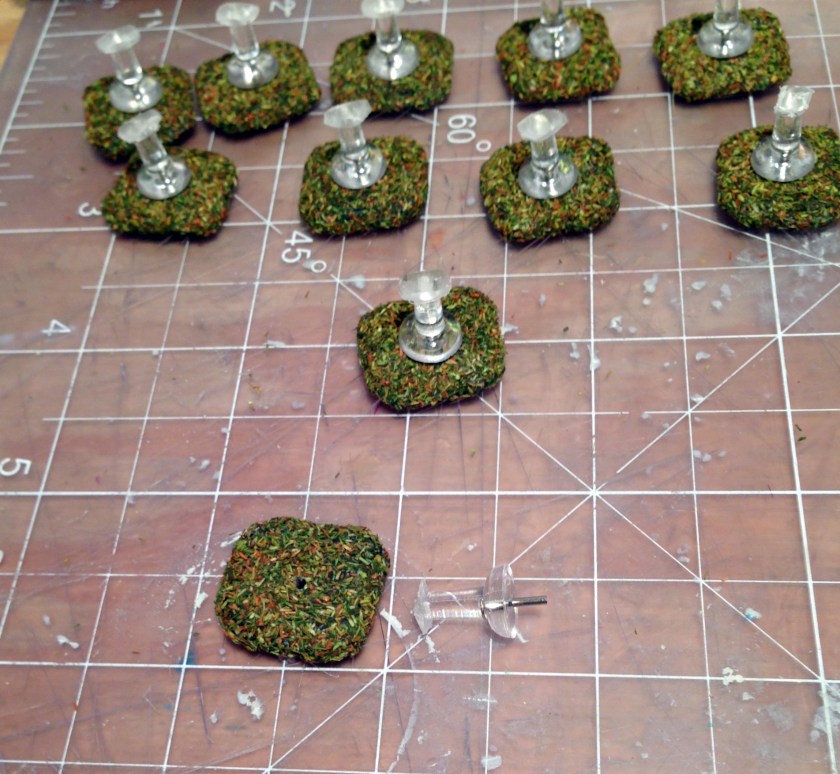
To make this work, I needed a plan as I did not want to varnish the clear plastic and take away from the visual effect of flight that I was going to try to achieve. I mounted the bases on two stacked and centered ¾” steel washers using wood glue and let the combination dry overnight. I cleaned off the flash from the bases, filed them, and primed them with Krylon “Ultra-Flat” matte spray paint. After that I flocked them with 4Ground “Brown Leaves” using white glue. Once that glue was dry, I applied two coats of Testors “Dull Coat” to the bases. Using wire cutters, I trimmed off the pointed tips of the pins to be recessed in the washers when inserted into the bases. I then flattened and narrowed the rounded push pin tops with an Exacto knife, and sized them up with the base of the grav-cycles. This was to make a small flat mounting platform. However, I wanted more stability than super glue alone would give me. My pin vise was the needed tool to make this happen. Using my smallest drill bit, I made a hole in the top center of each push pin. Using E6000 epoxy, I affixed and mounted the push pins onto the bases. Once that had set, I mixed some Aves® Apoxie® Sculpt, and filled the bottom of the washer wells where the push pin tip was. This had the advantage of giving the structure more strength as well as some weight for stability on the gaming table. I cut some pieces of wire from a thin paper clip and glued them at a nearly vertical angle in the hole in the top of the push pin. This worked well as the wire was deep enough to secure the grav-cycle to the platform.
How I used push pins – note the narrowed and flattened tops. The paper clip wire was subsequently superglued into the holes in the pin topsI then moved on to painting the riders and their grav-cycles. This was more difficult as I could not mount these onto a suitable painting structure and paint them successfully – which took much longer. I basically had to paint the Aphid Scouts and Grav-Cycles in my hand.
First I’ll discuss the cycles. I painted the deep recesses of the bottom of the grav-cycles successively with Americana “Deep Burgundy”, followed by Citadel “Spiritstone Red”. I wanted an “aviation” look to the cycles (which had flywheels and a big ray gun as part of the details!). I gave them a heavy dry brush of Tamiya “Flat Aluminum”.
Grav-Cycles after dry brushingFor the details, I used Americana “Ebony” on the seat base and the center of the exhaust port. FolkArt “Gunmetal Gray” was my choice for the front ray gun support and the flywheel bracket, while the flywheel got Tamiya “Chrome Silver”. For the ray gun cowling, Martha Stewart Crafts “Pale Bronze” was my choice. For the tip of the ray gun, I used Craftsmart “Festive Red” metallic. For the exhaust port. I used a combination of Craftsmart “Bright Yellow”, Tamiya “Orange”, and “Festive Red” in a concentric circling pattern. Once this dried, I gave the cycles a wash with Secret Weapons Washes “Armor Wash”, and let that dry. Using “Flat Aluminum”, I highlighted the cycles’ edges and reflective surfaces. Lastly, I used two applications of the “Spiritstone Red” to bring out the ray gun tip even more.
Grav-Cycles paintedLet’s discuss the riders and the other Aphids painting in general. As I wanted them to look similar (all in the same platoon and the same insect species), I wrote down each step of painting and washing and highlighting. That helps with reproducing the same effects. There are a few differences among each type but I’ll note those as I go along. The only special steps for the riders involved basically repairing the one missing leg on one figure. I used my pin vise, and drilled out a hole in the figure’s leg stump. I cut a piece of paper clip, and bent it at 90°, and superglued it in place. I sculpted a suitable leg with Aves® Apoxie® Sculpt, and let it harden overnight. It came out acceptably!
The painting of the Aphids followed the same basic pattern. I wanted to smooth over any rough areas, so I gave the figures a wash with Secret Weapons Washes “Green”. I then base coated the bunch with my old 1984 Polly-S “Slime Green” using a dry brushing technique.
Amazingly, this 32 year old paint is still good!Each of the Aphids (all types) was equipped with a couple of tanks on their backs, which I interpreted as being a breathing apparatus. For these, I used “Chrome Silver” on the tank bodies and Tamiya “Copper” on the valve sections. After this dried, I gave each Aphid a wash with Citadel “Nuln Oil Glossy”. I wanted glossy so as to bring out the small details that were recessed. Then I highlighted the flat chitinous surfaces of the head and thorax (these are insects) with Craftsmart “Apple Green” satin. To smooth out the colors, I applied yet another wash of “Green” to the Aphids’ shells and “Nuln Oil Glossy” to the ribs on the breathing tanks. For varnishing, I wanted to dull down the glossy a bit so the Aphids got two coats of Testors “Dullcoat”.
Riders painted and awaiting varnishingAfter varnishing and awaiting mounting
Let me get specific about the Aphid Scouts on Grav-Cycles, which were then ready for assembly. I glued the riders to the cycles. Then, I drilled a hole on the bottom of each cycle with my pin vise to fit the paper clip in the push pin with my smallest bit. I needed to also use an Exacto knife to clear the hole of filings and another push pin to start the pin vise (pilot hole). I had some of the riders come off during this process but was able to reglue them easily.
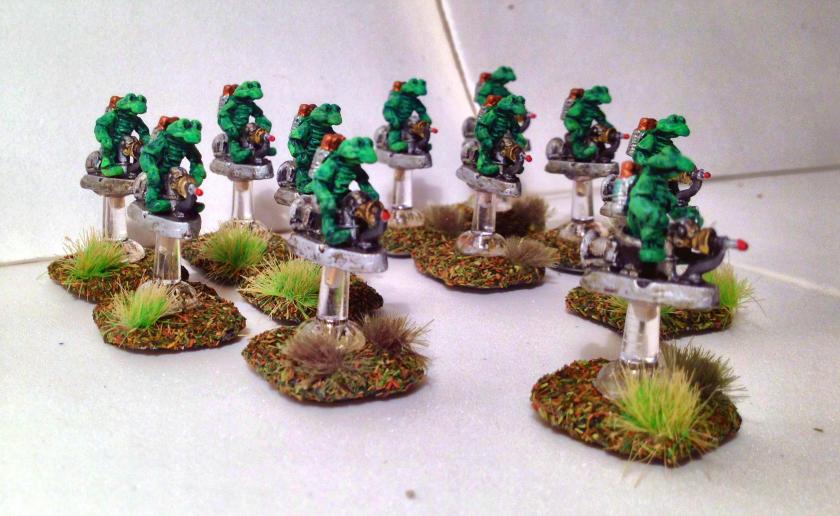
Hole drilled in bottom of cycleThese were then finally assembled. I used differently-colored flocking tufts from Army Painter to show their command and control relationships. They are organized as one squad in the platoon – with one squad leader, and two team leaders each leading teams of 4 grav-cycles. My thoughts initially are to treat the ray gun weapon as an automated analogue of a 37mm anti-tank gun and the vehicle as terrain-defying flying motorcycles.
Scouts out! The Aphid Grav-Cycle SquadClose up of figure left sideRight side of grav-cycle
Coming at you!The process of painting was the same for all of the Aphid Infantry, Aphid Officers, and Aphid Mortar Crews with some differences. First, they are all mounted on two #8 steel washers that have been glued together with wood glue. Second, the infantry is armed with tommy guns (I am assuming that Thompson submachine guns must have a thriving export market in the future!). I used my 1987 Deka Lack “Braun” for the wooden parts of the guns, and “Gunmetal Gray” for the metal ones.
For the officers, three would be squad leaders and one would be the overall platoon leader. The officers’ laser pistols got painted with “Chrome Silver” and the tips got the “Spiritstone Red” treatment on top of Citadel “Gehenna’s Gold”. I chose “Flat Aluminum” for the squad leaders’ helmets, and “Gehenna’s Gold/Spiritstone Red” for the platoon leader’s. Once again, I used Army Painter tufts of different colors and locations to indicate command and control relationships. The platoon leader has three mortar crews and the two robots reporting to him as well. The only difference for the mortar crews was the mortar round and mortar tubes. For the small mortar rounds, I used “Chrome Silver” on the body and “Spiritstone Red” for the fins. The tubes got “Gunmetal Gray”.
Base coat on Aphid InfantryBase coat on Aphid OfficersBase coat on Aphid Mortar CrewsPainted and flocked, awaiting varnish and tuftsSquad Leader with his Aphid Infantry Squad armed with Thompson SMG’s. Tuft locations and color denote command relationships.One completed mortar crew. Each crew has its own tuft color, and reports to the platoon leader.Three completed squad leaders
Completed Aphid Platoon LeaderTo round out the platoon, there are the two Robot self-propelled guns. These look almost steam-punk-like in design. I went with a very metallic scheme for them. First, I gave the figures a wash with Secret Weapons Washes “Armor Wash”. The top part/gun turret was painted with “Flat Aluminum”, while the bottom of the chassis was painted with “Copper” . I painted the wheels and lower chassis with “Gunmetal Gray”. I added Citadel ” Auric Armor Gold” to some of the chassis attachments. For the radiator in the back (!) I used “Copper” framed with “Gunmetal Gray”. The whole assembly got a wash again, and then I painted the robotic insect eyes with Craftsmart “Festive Red” metallic. I highlighted the figure with the same paints again after the wash, and I was pretty happy with it.
From Lost Minis Wiki – Robot Group – I got two of the models on the top
Completed Robot Self-propelled GunsThe platoon structure (41 fighting figures) is as follows in summary:
Aphid Platoon Leader (1)
Scout Squad Leader for Aphid Scouts on Grav-Cycle (1)
Team A Leader, Grav-Cycle (1)
4 Aphids on Grav-Cycles
Team B Leader, Grav-Cycle (1)
4 Aphids on Grav-Cycles
1st Squad Leader for Aphid Infantry (1)
6 Aphid Infantry with Thompson SMG
2nd Squad Leader for Aphid Infantry (1)
6 Aphid Infantry with Thompson SMG
3rd Squad Leader for Aphid Infantry (1)
6 Aphid Infantry with Thompson SMG
Mortar Section A (2)
Mortar Section B (2)
Mortar Section C (2)
Robot Assault Gun Section (2)
The Aphid PlatoonI have to say that this was a very challenging project – the figures were smaller than I am used to painting, and they were much less detailed. However, I am pretty proud of what I was able to do with it and look forward to seeing them in action in a game. It’s fun to bring nearly 40-year old figures back to life – especially with many old paints as well. I’m glad I got these, and am very happy with how they turned out. I’m planning on chatting with Buck about assigning combat values to them soon.
This is the story of the second game set that my daughter Ellen and her fiancé Chris got me for Settlers of Catan®. RAFM in Canada makes these and you can see their offerings here.
The first one I completed was the Egyptian set (1202), and this is the Viking set (1200). There are 25 pieces in each set – 15 roads, 5 settlements, 4 cities, and one themed robber. These would take the place of the generic wooden pieces that come with the game.
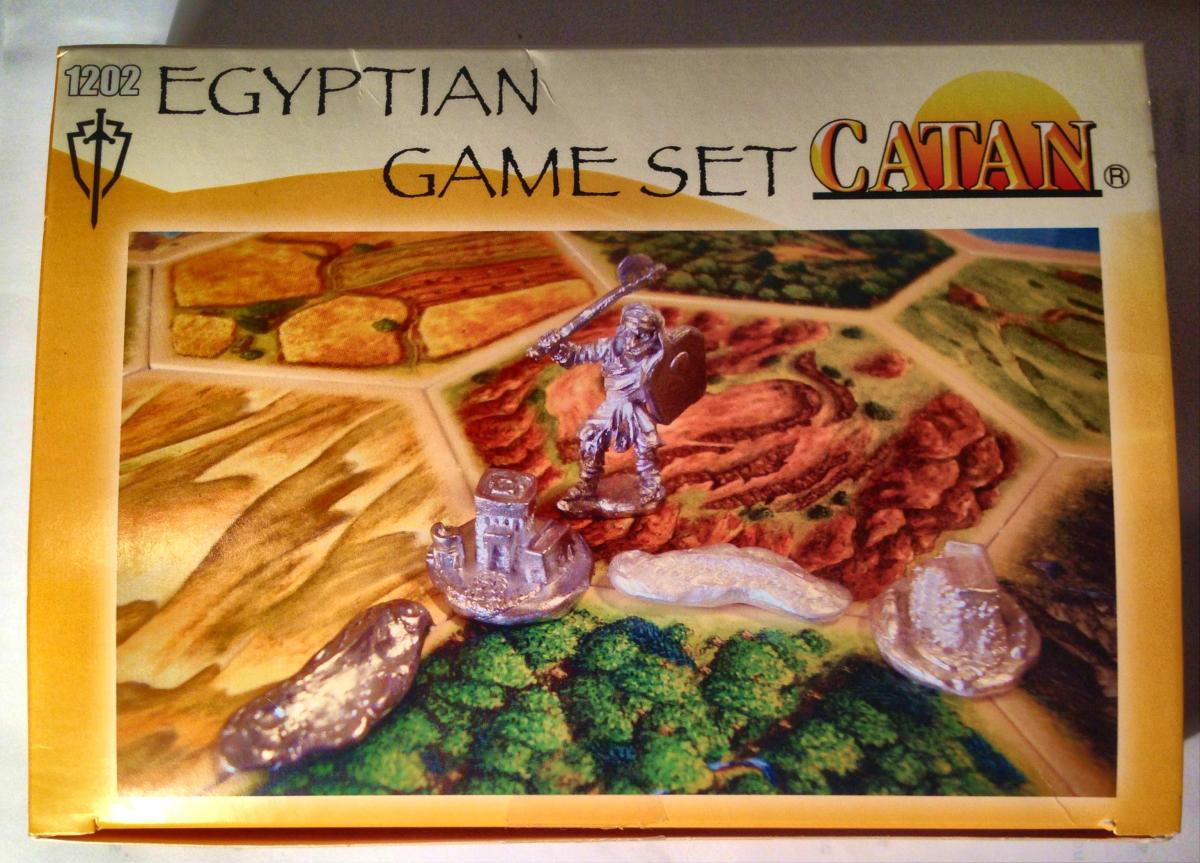
I saw these on the RAFM website before when I was looking through their offerings there Egyptian, Bavarian, and Chinese set in addition to the Viking one. Interestingly, the box cover shows incorrect game play – each city or settlement needs to be separated by two or more roads, and there is only one road here.
Cover of the box with incorrect play
Side of the box
There was very little flash on the robber, and none on the other pieces. I did the robber last, so I will show that work after the others. I cleaned them up with a quick scrub, then primed them with Krylon “Ultra-Flat Black” matte spray paint when I did my Slag Mound priming.
Before priming (with Slag Mounds)
The first challenge I had was in figuring out how to mount these for painting. Normally, I mount the figures on a washer and then mount the combination to a popsicle stick. Here, I was only going to use a washer for the robber as the other pieces were not really configured for mounting. I mounted each lightly to a popsicle stick with white glue. In the end, this procedure forced me to retouch all the figures’ sides as well as deal with painting and varnishing the undersides.
I decided to try to keep a blue theme to these pieces to match the box and for ease of play.
In the set, the roads were much more road-like than the sand dunes in the Egyptian set. The settlements and cities had a Viking row house look to them.
I needed to have a consistent color scheme as these are game pieces – and not traditional miniatures. I wanted them to be very bluish but have some details.
I used another old 1987 Deka Lack paint – “Blau” (blue) as my base color on all of the pieces. This made the roads look a bit like rivers, but for use as game pieces this is not a problem.
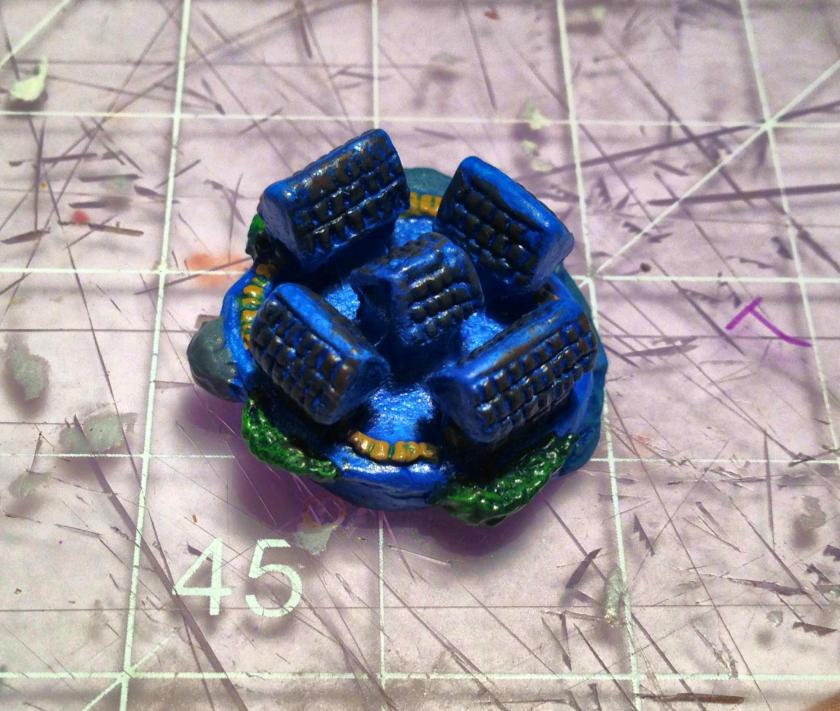
I used Americana “Zinc” on the rocks and steps, and Citadel “Caliban Green” on the foliage. For the pathways on the towns and cities, I used Citadel “Balor Brown”. I needed some highlighting for the structural parts of the buildings, so I used Citadel “Dryad Bark” to good effect. Following this, I used Secret Weapons Washes “Blue” to wash all the pieces. Then I added highlights to the foliage with “Dryad Bark” and Citadel “Niblet Green”. I removed the figures, touched up any bare spots, and moved to varnishing. I first varnished the set with Krylon “Clear Glossy” spray paint. I then varnished the topsides with two coats and the underside with one coat of Testors “Dull Coat”. I did this because they are board game pieces, with more need of paint protection.
Figures before application of varnish
Close up of a city and a town before varnish
Roads before varnish
Completed settlement
Completed city
Completed roads
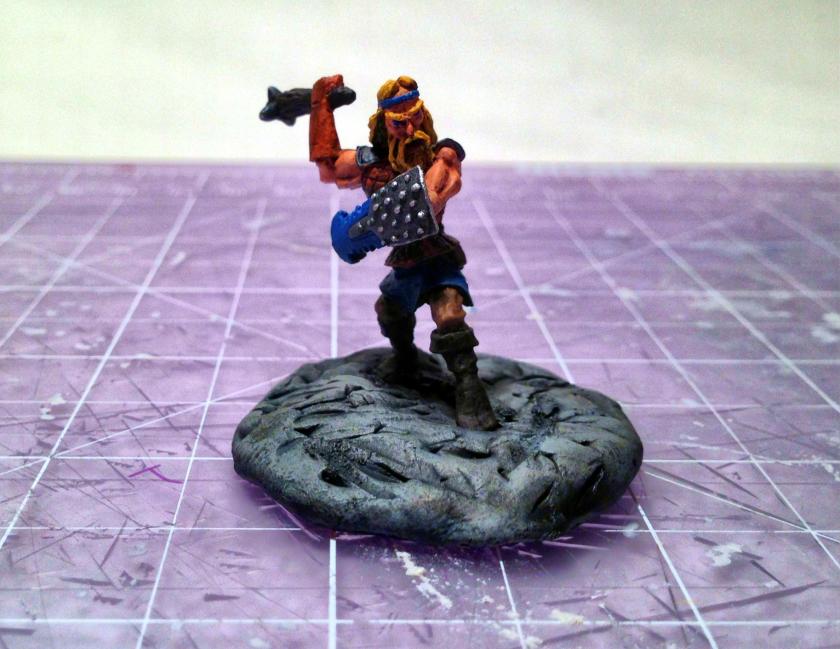
After this I moved on to the robber. It is a 28mm figure, dressed as a Viking berserker, armed with an spiked club. The first thing I did was to glue the figure to a larger 1.25″ steel washer with wood glue. Once that had dried, I used Apoxie Sculpt to create a base. I decided here as well that flocking the robbers would be messy and not useful.
Viking robber before priming
I primed the robber with Krylon “Ultra-Flat Black” matte spray paint. I then covered the whole figure and base with Americana “Ebony”. This was done in order to try a new dry brushing technique for armor that I saw Chris Palmer use in his blog. You can see his entry here.
I first dry brushed the robber’s shield and shoulder guards with FolkArt “Gunmetal Grey”. I drybrushed the base with Americana “Slate” which had a slight bluish hue to it.
I then worked on base coating the details. The club handle got a coat of Americana “Bittersweet Chocolate” with the spikes getting “Gunmetal Gray”. For the leather armor and gloves, I used my 1996 Armory “Leather Brown”. For his shield I used “Gunmetal Gray” and “Blau” to tie into the color theme for the set. His headband also got “Blau” for the same reason. I used “Bittersweet Chocolate” on the boots and his rope.
I then applied P3 “Midland Flesh” on the face and arms. For the hair, eyebrows, and beard, I used P3 “Sulfuric Yellow”. I did the sclera of the eyes with Americana “Snow” and “Blau” for the pupils (he is Scandinavian after all). I painted the lower lip with 1984 Polly-S “Demon Deep Red”. The boots got a coat of Americana “Raw Sienna”. I then used “Agrax Earthshade” on the blond areas and P3 “Flesh Wash” on the skin, and let the figure dry.
For his shirt, I chose another 1987 paint, Deka Lack “Dunkelblau” (dark blue). To highlight the club spikes and the bolts on the shield, I used Tamiya “Chrome Silver”. I highlighted his nose and cheekbones with FolkArt “Light Flesh”, then used P3 “Flesh Wash” again to make his arm muscles more pronounced and defined. I also used FolkArt “Light Flesh” to lighten his nose and forehead, and to highlight his arm musculature.
I used “Sulfuric Yellow” on the hair to highlight it. I darkened the leather armor and the base with Citadel “Nuln Oil”.
I then went around the figure and highlighted all the areas that I thought needed more “pop”. Lastly, once the figure was dry I then varnished it with two coats of Testors “Dull Coat”. I did this because they are board game pieces, with more need of paint protection.
Finished Viking robber
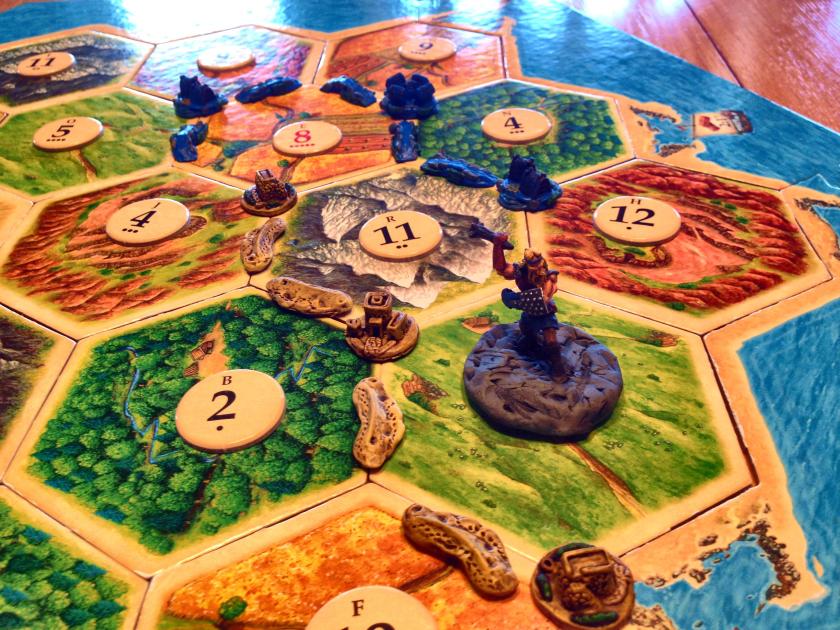
Overall, I am satisfied with the work – they are after all game pieces. I hope to get these into a game of Catan soon.
My daughter Ellen and her fiancé Chris got me a couple of game sets for Settlers of Catan® and I thought I’d take the opportunity to paint these up. RAFM in Canada makes these and you can see their offerings here.
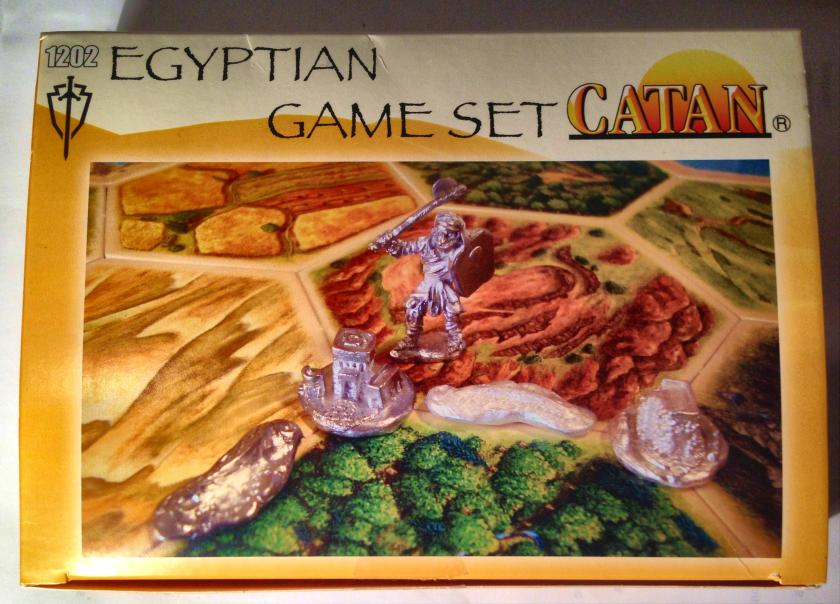
The first one I completed was the Egyptian set (1202). There are 25 pieces in each set – 15 roads, 5 settlements, 4 cities, and one themed robber. These would take the place of the generic wooden pieces that come with the game.
I saw these on the RAFM website before when I was looking through their offerings. There are Viking, Bavarian, and Chinese sets in addition to the Egyptian one. Interestingly, the box cover shows incorrect game play – each city or settlement needs to be separated by two or more roads, and there is only one road here.
Cover of the box with incorrect play
Side of box
There was very little flash on the robber, and none on the other pieces. I did the robber last, so I will show that work after the others. I cleaned them up with a quick scrub, then primed them with Krylon “Ultra-Flat White” matte spray paint.
Before priming (less the robber)
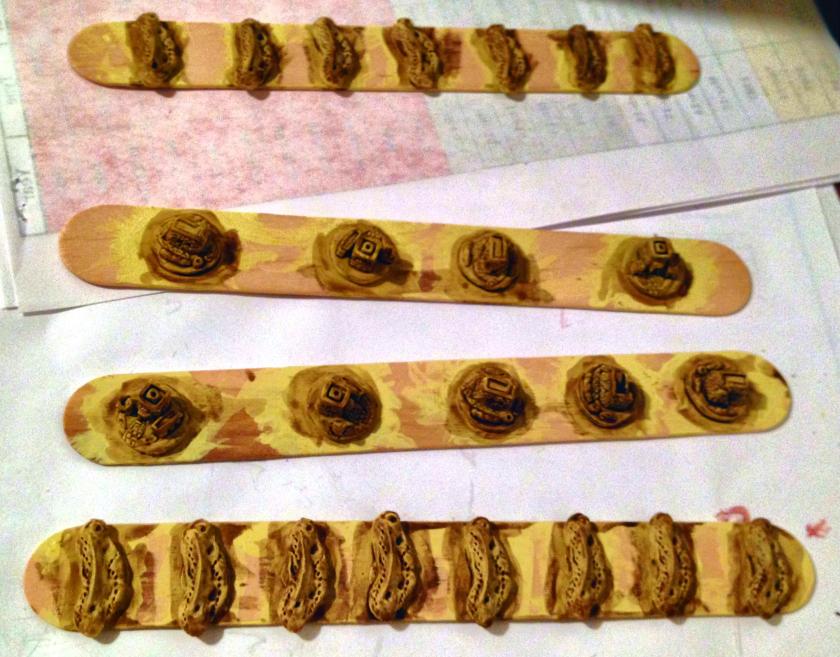
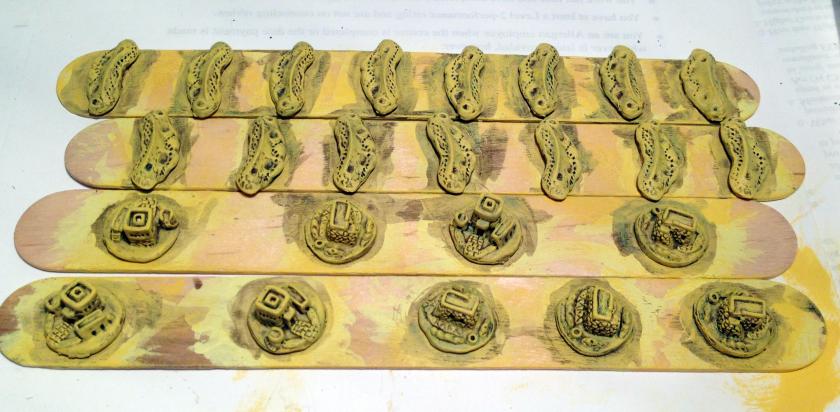
The first challenge I had was in figuring out how to mount these for painting. Normally, I mount the figures on a washer and then mount the combination to a popsicle stick. Here, I was only going to use a washer for the robber as the other pieces were not really configured for mounting. I mounted each lightly to a popsicle stick with white glue. In the end, this procedure forced me to retouch all the figures’ sides as well as deal with painting and varnishing the undersides.
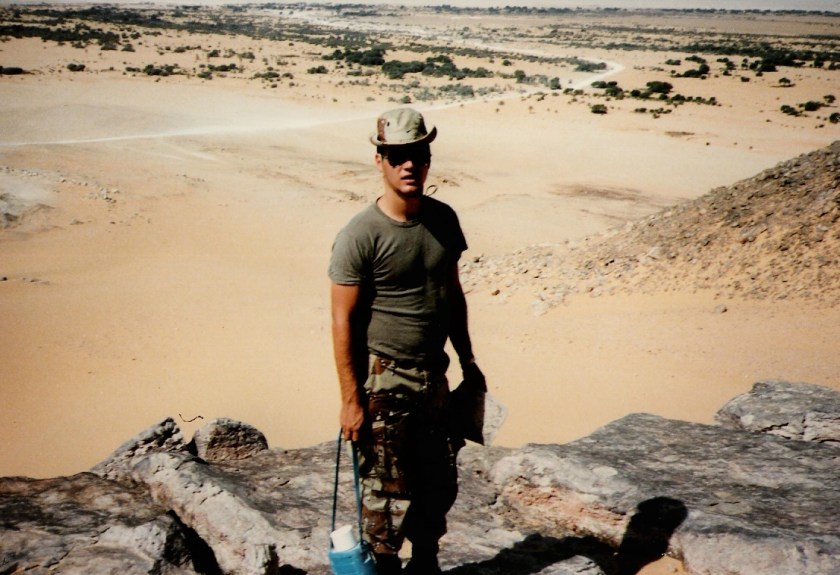
I decided to try to keep a desert theme to these pieces. I was somewhat familiar with this coloration due to previous experience in the desert. I led a Mobile Training Team at an airfield project in the Sahara Desert when I was a US Army Engineer officer.
1LT Morin back in the day…1986, Dirkou, Republic of Niger
In the set, the roads were merely sand dunes with two sets of footprints, and the settlements and cities were adobe-like structures (very similar to what I saw in the Sahara). However, I needed to have a consistent color scheme as these are game pieces – and not traditional miniatures. I achieved my coloration goals by making a 50/50 mix of my old 1987 Deka Lack “Gelb” (yellow) and Americana “Bleached Sand” and using that as a base coat. This finished off my “Gelb” after 29 years! I then applied a liberal amount of Citadel “Agrax Earthshade”.
After basing and first wash
I then highlighted these with a 50/50 mix of P3 “Sulfuric Yellow” and Americana “Desert Sand”.
After highlighting
Then I did a bit of detail work. On the settlements, I used Citadel “Balor Brown” on the wells and “Castellan Green” on the foliage. After another application of “Agrax Earthshade”, I used the previous mix of P3 “Sulfuric Yellow” and Americana “Desert Sand”to highlight again. I also highlighted the foliage with Citadel “Niblet Green”. Knowing that there was likely to be some bare spots from the gluing, I gently removed the pieces and painted the undersides and sides where there were some bare spots. I first varnished the set with Krylon “Clear Glossy” spray paint. After allowing the pieces to dry, I then varnished the topsides with two coats and the underside with one coat of Testors “Dull Coat”. I did this because they are board game pieces, with more need of paint protection.
Finished pair of roads
Two settlementsTwo cities
After this I moved on to the robber. It is a 28mm figure, dressed in desert garb, with an axe. The first thing I did was to glue the figure to a larger 1.25″ steel washer with wood glue. Once that had dried, I used Apoxie Sculpt to create a base. I decided that flocking the robbers would be messy and not useful.
Robber before priming
I first dry brushed the robber with the P3 “Sulfuric Yellow” and Americana “Desert Sand” 50/50 mix.
After first dry brushing
I then worked on base coating the details. The axe handle and the backside of the shield got a coat of Citadel “Dryad Bark”, and the axe got a coat of FolkArt “Gunmetal Gray”. I used P3 “Midland Flesh” on the face. For the shield, I used another 1987 paint, Deka Lack “Ocker” (ochre), which had more of a metallic tint. I then used “Agrax Earthshade” and let the figure dry.
I highlighted the figure and the base with “Sulfuric Yellow” and dry brushed some areas. Then I did the sclera of the eyes with Americana “Snow” and “Ebony” for the pupil and eyebrows. The boots and gloves got a coat of P3 “Bootstrap Leather”. To create an edge on the axe, I used Tamiya “Chrome Silver”. I highlighted his nose and cheekbones with FolkArt “Light Flesh”, then used P3 “Flesh Wash” to make it more tan. I used “Sulfuric Yellow” on the boss on the shield, then darkened it and the base with “Agrax Earthshade”.
Lastly, once the figure was dry I then varnished it with two coats of Testors “Dull Coat”.
Finished robber
Overall, I am satisfied with the work – they are after all game pieces. I hope to get these into a game of Catan soon.
I have been collecting various examples of the long-defunct Archive Miniatures Star Rovers line of figures from 1977. This month, I have had some health issues that precluded being able to sit down (long story and a pain if you know what I mean). Therefore, I chose to work on making molds and casting, focusing on Star Rovers, which is something I do standing up.
My overall goal is to create squad-sized units of these “lost” but very cool minis. I want these to set up and play games of Buck Surdu’s Combat Patrol™, as well as to see if I can create a scenario using the Star Rovers figures that I have collected. Combat Patrol™ was created as a WWII skirmish card-based miniatures rules set, but it has been successfully adapted to other historical periods as well as Star Wars™ scenarios. To learn more about Combat Patrol™, click here.
Before I get to the figures and the making of the molds, I wanted to share information about my casting set up. I basically use pewter and I use a Hot Pot 2 crucible with a Lyman pyrometer to measure the alloy’s temperature.
I also use appropriate safety equipment!
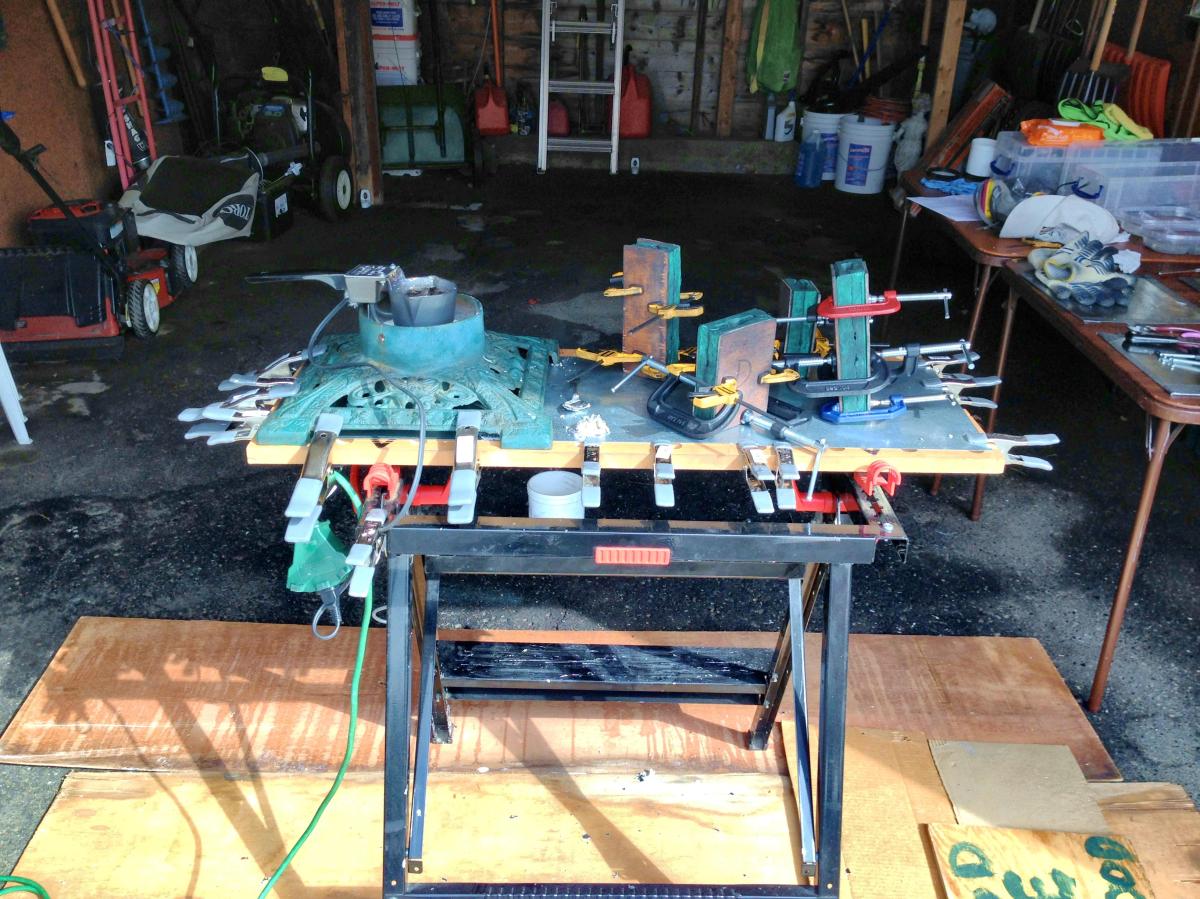
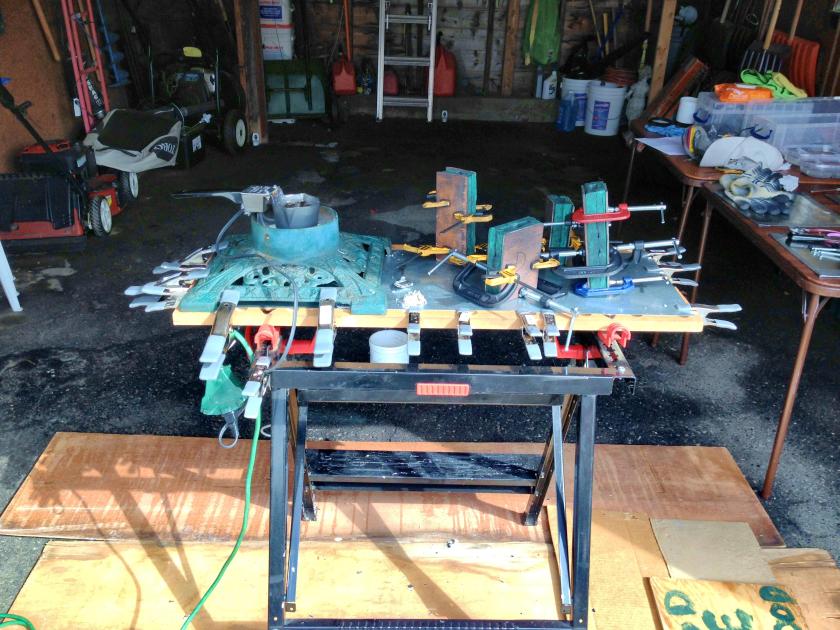
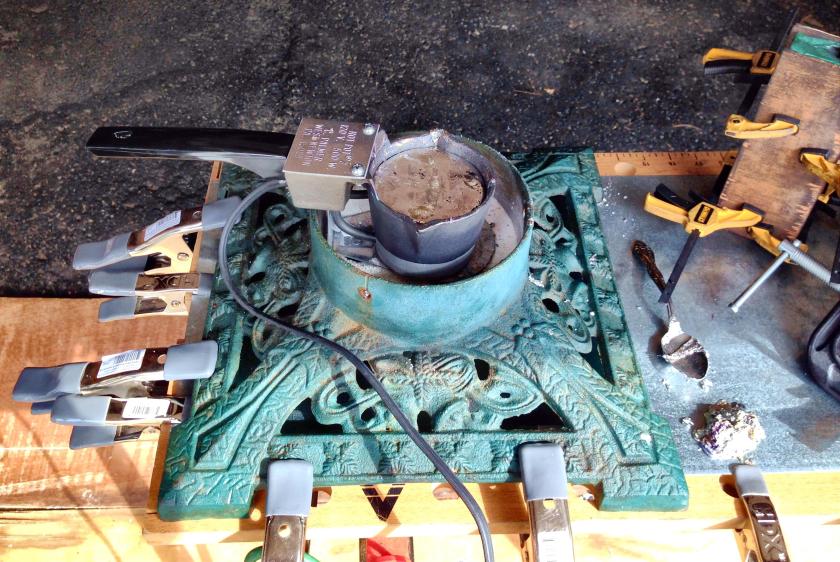
The Hot Pot 2 holds about 4 pounds of molten metal, and is used for making bullets, fishing sinkers, and miniatures. Unfortunately, it comes with a tripod stand which teeters and is prone to tipping. Why the manufacturer did not use four legs on the stand for stability is beyond me. After a couple of spills (where I dodged the 650° F contents and had a lovely clean up) I was determined to have a new set up. Currently I have 1′ x 1′ steel sheets clamped to my old Sears Craftsman® work bench that I have had for close to 30 years. My friend Jeff Smith came up with an idea that proved to be a great fix. He had an old cast iron (heavy) Christmas tree stand he was not using. I filled the large holder with play sand to raise the bottom up and put the tripod into the sand in the tree well. This provided great stability and rendered the set up virtually spill-proof. I clamped the tree stand to my work bench (after extending my bench depth about an inch). This worked great and I am very happy with my new casting set up.
My new set up in the garage – clamped molds on the right
Close up of use of the iron Christmas tree stand to hold the Hot Pot 2, clamped to the workbench
To learn more about the Archive Miniatures Star Rovers line click here.
I cannot find any reliable sources to buy these figures – I only find them sporadically on eBay. This is why I recast them for personal use and for gifts.
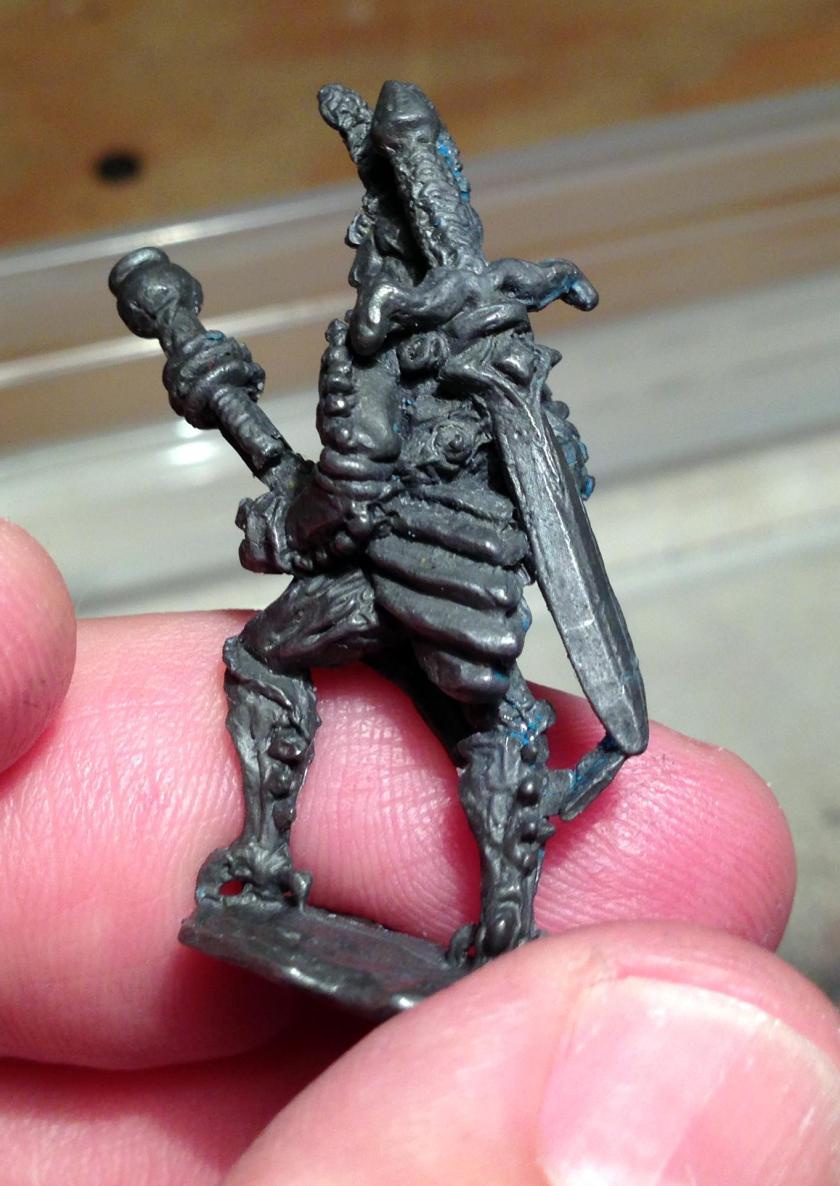
My first mold in October was for the Space Phraints. These are 9 foot tall emotionless insect men that were in the old Arduin game. These are armed with huge swords and a ray gun.
I found a nice synopsis on Phraints from Saundby.com that you can see here. The photos below show the original I got on eBay (the blue clay you see came from the mold-making process and is easily removed).
Space Phraint front
Space Phraint back
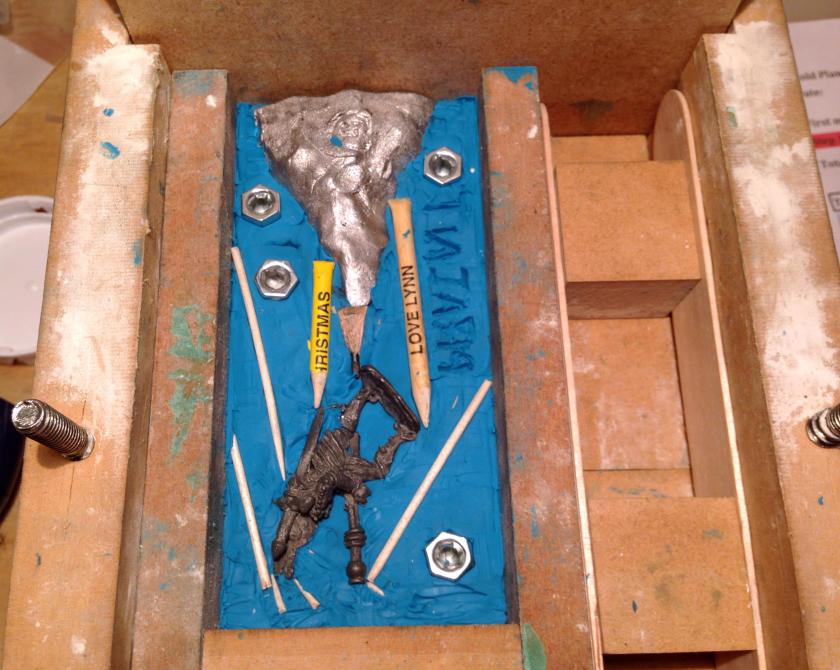
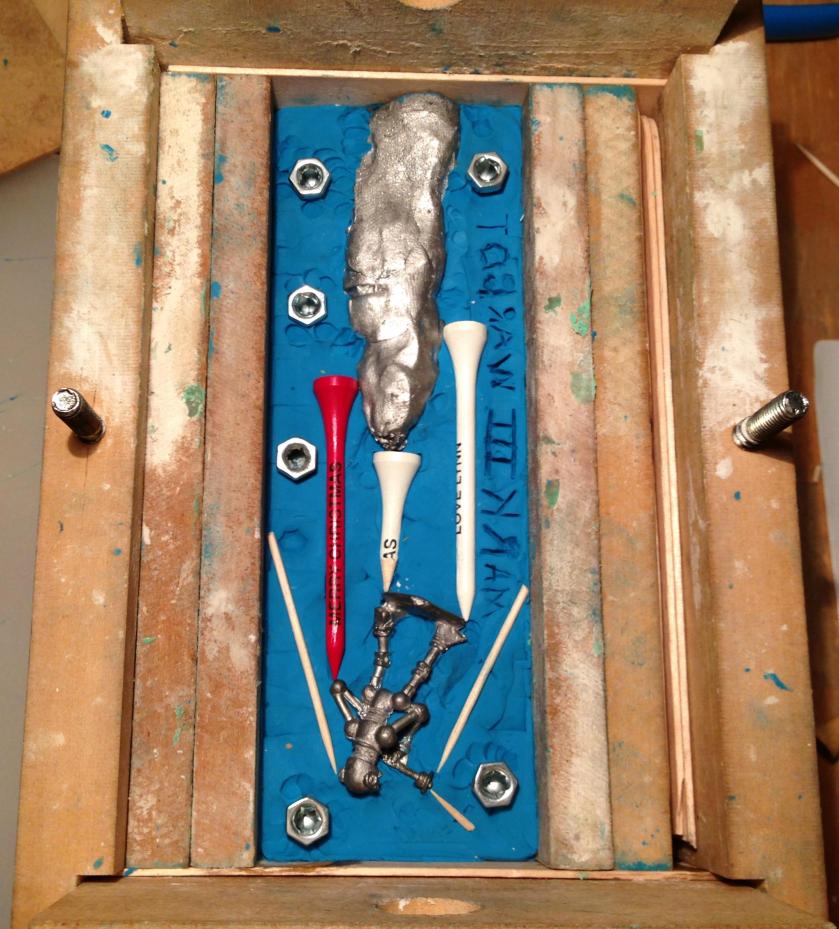
Below is the first mold half set up for the Space Phraint. I used an old metal mold plug to create my flow aperture along with some golf tees my wife gave me a while back for Christmas. I also used toothpicks to create air flow vents and release points for better casting. I also wrote a mirror image of the word “PHRAINT” on the clay. The QuickSil is measured and mixed and put into the mold press for curing. I generally wait 28 minutes for it to cure – and I use a hand-held hair dryer to warm the outside of the press to assist in curing the RTV (room temperature vulcanizing) compound.
Space Phraint mold in the mold press – first half
Removing the first half of the mold from the mold press before removing the blue clay from the RTV
The first mold half of the Space Phraint mold
I then put the first half back into the mold press, applied a releasing cream to any wooden surfaces of the press that QuickSil would touch as well as the green set up rubber RTV. I then measured and mixed more QuickSil and repeated the process. After I made the mold, I cut out wooden backings for the mold from 1/8″ plywood using my scroll saw.
The Space Phraint mold was very successful and needed little modification during the casting process. I was able to cast 42 figures from this mold.
A formation of Space Phraints led by the original
The next mold is a Mark III Warbot. As far as I can tell, there are no Mark I or II’s in Star Rovers! He is clunky and retro looking, with a very cool ray gun/blaster. He reminded me of Bender from Futurama, though he was created in 1977!
Mark III Warbot front
Mark III Warbot back
I followed a similar process in making this mold as described above.
Mark III Warbot first mold half
Mark III Warbot mold completed
This also was a successful mold. I cast 42 figures using it.
A formation of Mark III Warbots led by the original
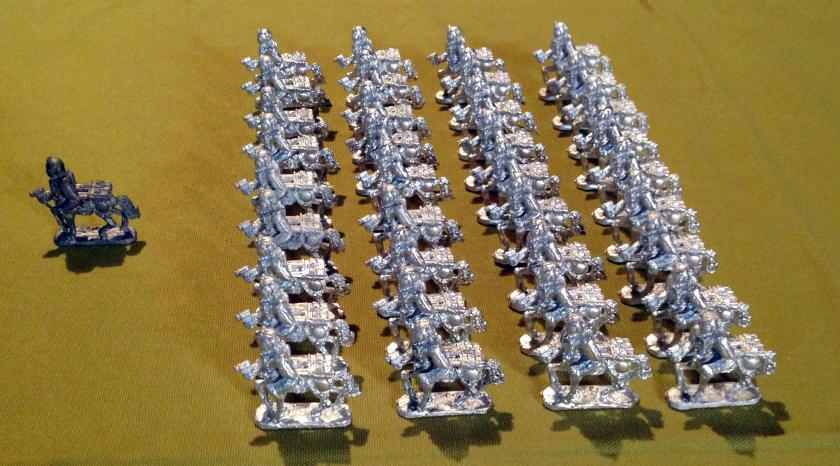
I then moved onto the Space Centaur, who has rocket packs on his back, but is only armed with a laser pistol! This was my first try at making a mold of a four-legged creature. The mold itself needed more tweaking during the casting process than I like in terms of cutting vents and opening up spaces. I believe that I should have used more of a cone-shaped pour aperture for the mold. Here I used a small hotel soap and golf tees to shape the pouring well – and I think that works less effectively than a cone. I also had leaking issues with the mold initially. I solved these with adding more C-clamps when casting.
I was able to cast 36 figures with this mold.
Master Space Centaur figure
A formation of Space Centaurs, led by the original
The last two figures that I worked on were Dragonspawn Infantry. There were actually three made by Archive, but I do not have the prone figure, only the crouching and kneeling ones. My guess from these pictures is that they were originally painted but then stripped.
Kneeling Dragonspawn Trooper, right side
Kneeling Dragonspawn Trooper, left side
Standing Dragonspawn Trooper, right side
Standing Dragonspawn Trooper, left side
I tried a new mold design – two figures in one mold. I wanted to see if this would be more efficient. It was not, primarily I believe that the cone aperture design works better, especially a tall one. Here I used another hotel soap and golf tees – and I had a lot of casting failures with this mold. With some adaptations during the casting process (making the pouring aperture and tees wider), my success rate improved, but the overall mold leaked a lot and was a pain to work with. At one point, some of the RTV came off in a figure, but this did not seem to be a major issue with subsequent castings.
My attempt at a new mold design – less than fully successful
I was able to cast 24 good figures of each type, but I probably had a 50% failure rate overall.
Two Dragonspawn formations with master in front
I cast 168 miniatures in total with the four molds. Some I am giving to friends, while the rest I an putting into the painting queue.
October production on the table
I learned some new things about the process, and got a new casting set up that is much safer. My next casting will be in a few months – I really want to start painting now that the weather is turning colder, and get them into a Combat Patrol™ game!
Some projects take a while – and this one was over 33 years in the making. As background, my first introduction to tabletop wargaming was in 1983 at West Point. My classmate Dave Wood (USMA 1984) introduced me to Buck Surdu (USMA 1985). Buck had set up a fantasy tabletop war game on a gaggle of desks in the Department of Foreign Languages, and from then on, a whole new gaming experience was open to me.
Buck wrote his own rules, and he and Dave had units of all kinds for the game. One type that Buck had was a unit of “Roomans”, which he referred to as “Beaks” as well. They were of course of the marsupial macropod (large foot) persuasion – more or less humanoid kangaroos. Of course, the word play of Romans/Roomans is evident as well. They were armed with pikes, had great movement and combat capabilities, and overall were just pretty cool. I wanted to get some, and every time I went to a hobby store in the 1980’s and 1990’s, I looked for Roomans. I had hardly any luck.
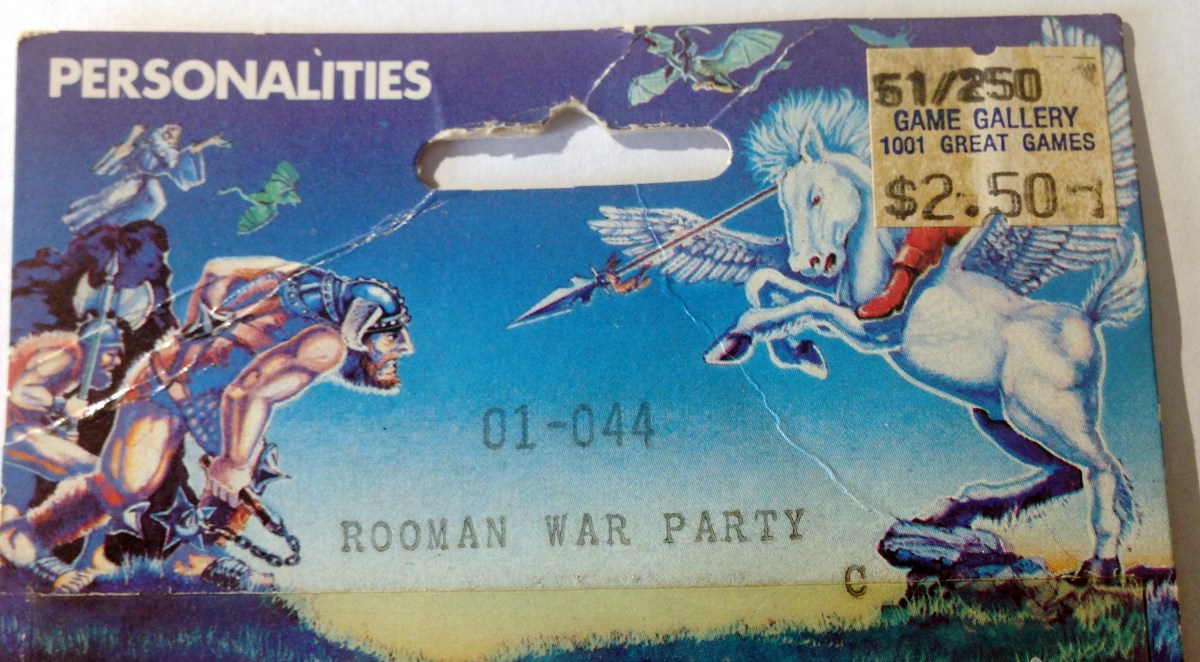
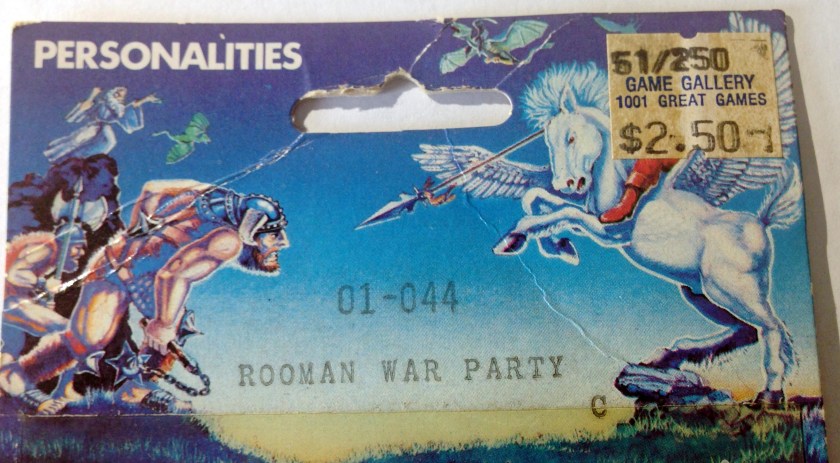
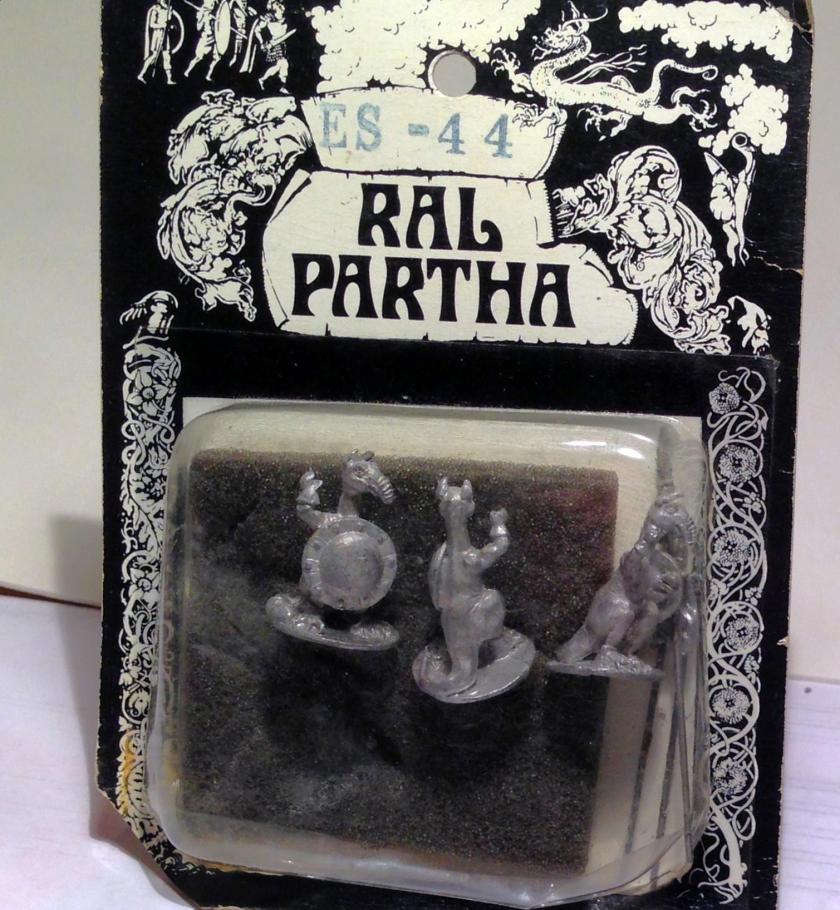
Little did I know back then that Ral Partha had produced only one type of blister pack of “Rooman War Party”, with production starting in 1977. The original numbering of the blister pack was ES-44, and in 1978 and later years that was changed to 01-044. This set was in the “Personalities and Things…That Go Bump in the Night” line from Ral Partha. Each pack in 1977 came with one Rooman with a shield in front, two Roomans with shields on the side, and three assembled pikes on piano wire. By this I mean that the 1977 pack had pikes that were in one piece with streamers rolled up under the business end of the pike. Later, Ral Partha changed the pikes to a two-piece type, where the point of the pike had smaller streamers coming off and would need to be glued to a piece of enclosed piano wire. This latter type was the most prevalent type made by Ral Partha.
Let’s get back to my search. As time went on, I became very frustrated in my attempts to locate any blister packs of Roomans. Today, I’d just look on the company web site or call them – but back then – well kids there was no internet – and that would be a very expensive long-distance toll call to Cincinnati (especially from West Germany where I spent most of the latter 1980’s in the Army). Alas, I found just one blister pack of Roomans at a hobby store around 1986 or 1987 – and that was it!
The Only Roomans I Ever Found in a Hobby Store
I put them away, awaiting the day when I would find another blister pack – and then I could make a unit of 6 figures perhaps…that wait was indeed over 33 years.
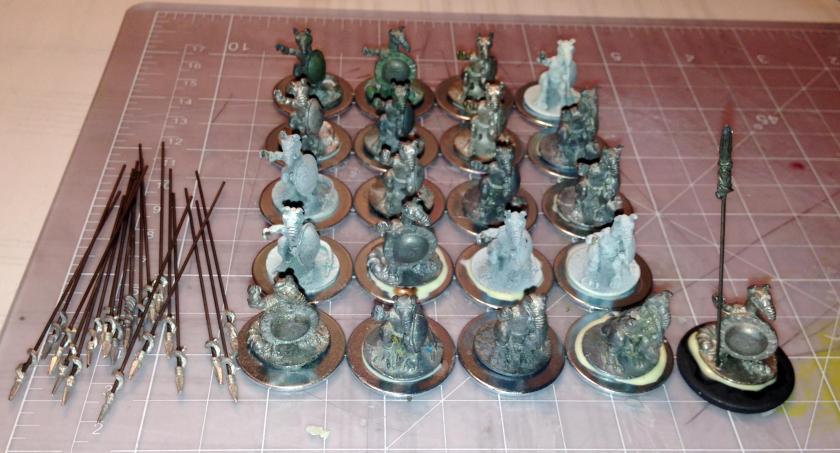
Now I must fast forward to my getting back into the hobby in 2014 and discovering eBay. Wow! Surely I will be able to find some Roomans on eBay! So, I searched and searched, and was able to find 18 loose Roomans either singly or in larger lots, plus one original 1977 blister package over the space of 18 months or so. Most times, they were called Goblins or Orcs by the sellers. Almost all had very bad paint jobs that needed to be stripped. This left me with 24 original Roomans.
I have not seen any in quite a while except for a poor recast here and there. Buck knew some contacts at Iron Winds Metals, and we inquired as to the status of the original molds, but unfortunately they were either lost or destroyed. This was sad. But I was able to get pikes from Melissa Morello at Iron Winds Metals that matched the post-1977 type as most of the Roomans I got on eBay either had the wrong weapon type or none at all. (THANK YOU MELISSA!) Of course, I also learned how to make gravity molds during this timeframe and now can make my own castings of the original Roomans for personal use. Iron Winds Metals told me that they are bringing back Roomans under a new name “Rues”, but to my knowledge that has not yet occurred.
The Roomans I acquired on eBay needed a lot of work to clean and strip. Some were painted with what appeared to be a tough lacquer. I used a combination of several sequential applications of Simple Green, vinegar, hot water, and pewter polish to remove old paint. I also needed to use a lot of toothbrush scrubbing and picking with a needle to get the old paint off.
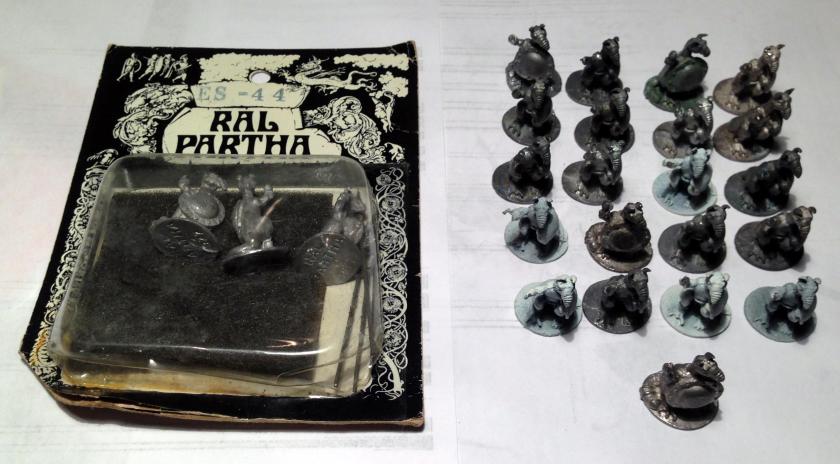
In August 2016, I gathered up my 24 original Roomans – and decided that I could not in good conscience open up my vintage 1977 blister given the difficulty in finding Roomans (let alone ones in an old blister pack). That left me with 21. I had two 1977-type pikes as well as the ones from Iron Winds Metals. I decided that I would incorporate the two old ones within the mob and use post-1977 style pikes to arm the remainder. One would be a leader, and the other 20 would form the mob or troop.
Yes, I said mob. A group of 10 or more kangaroos is referred to as a mob, a troop, or a court. Females (who are the only ones with pouches) are does, flyers, or jills. Males are referred to as bucks, boomers, jacks, or old men. Of course the term joey for the young is more commonly known. This means that my Roomans that have a shield in front are males (pouchless), while the rest are females (having pouches). Of course, being marsupials, and hopping ones at that, they have many unique qualities. If interested, here is a link: https://en.wikipedia.org/wiki/Kangaroo
My Original 1977 ES-44 Rooman War Party Blister and those destined for the Rooman TroopClose up of the blister – note the 1977 pikes on the right
My first action was to glue the 19 newer pike heads to the piano wire with Scotch super glue, and the Roomans to 1″ steel fender washers with wood glue. This size worked better as the Roomans bases were too big for a ¾” washer. I used a slightly thicker 1″ washer for the leader. I gently bent the arms of the Roomans and oh-so-carefully opened their hands to hold the pikes at different angles. Some of the hands were not well-cast, and I fixed these with Aves Apoxie Sculpt (a two-piece clay that sets up hard as a rock in a day) https://www.amazon.com/Aves-Apoxie-Sculpt-White-pound/dp/B0013UFM7M/ref=sr_1_6?ie=UTF8&qid=1473111581&sr=8-6&keywords=apoxie+sculpt .
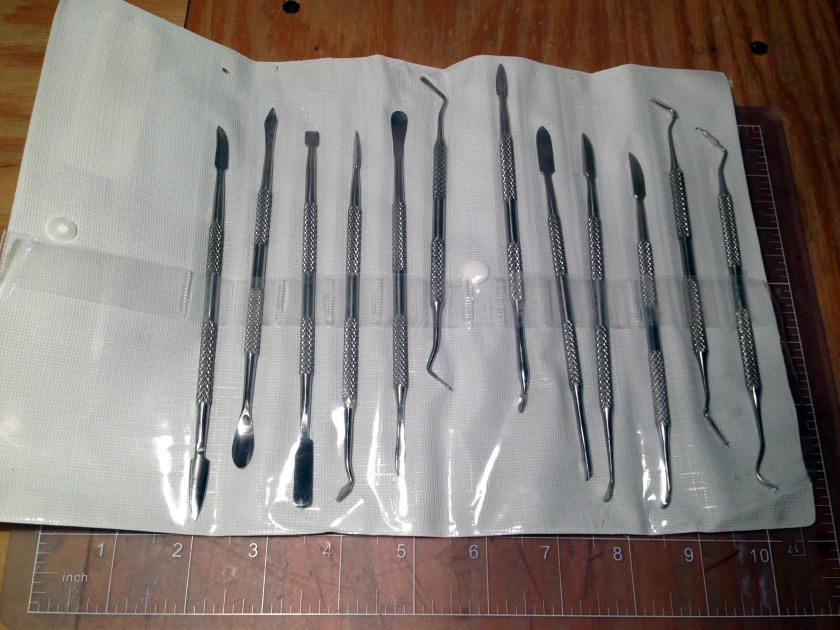
The Pikes and the Roomans, note the Rooman Leader holding the older type pikeMy new sculpting tool set
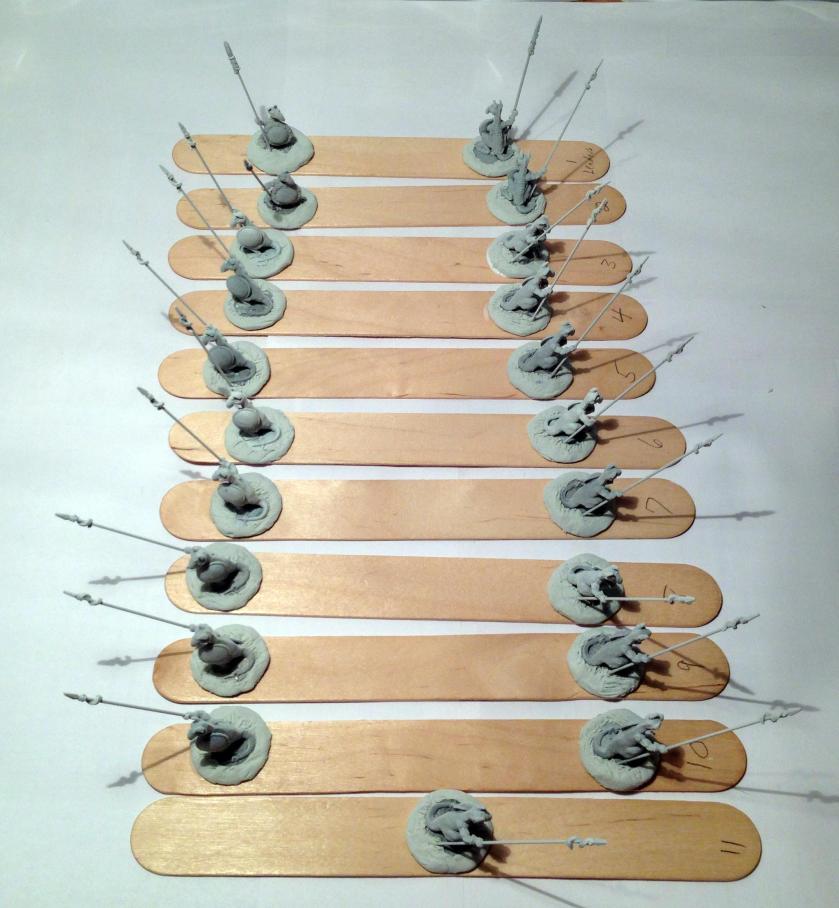
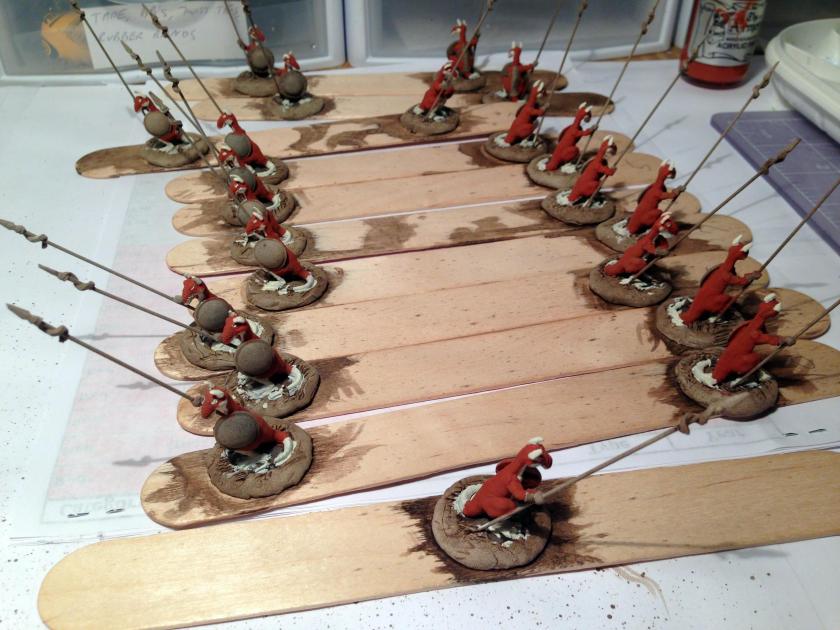
After I let the glue dry and the clay set up, I primed the unit with Krylon “Ultra Flat White”. I used Elmer’s white glue to lightly affix the Roomans to large popsicle sticks for painting.
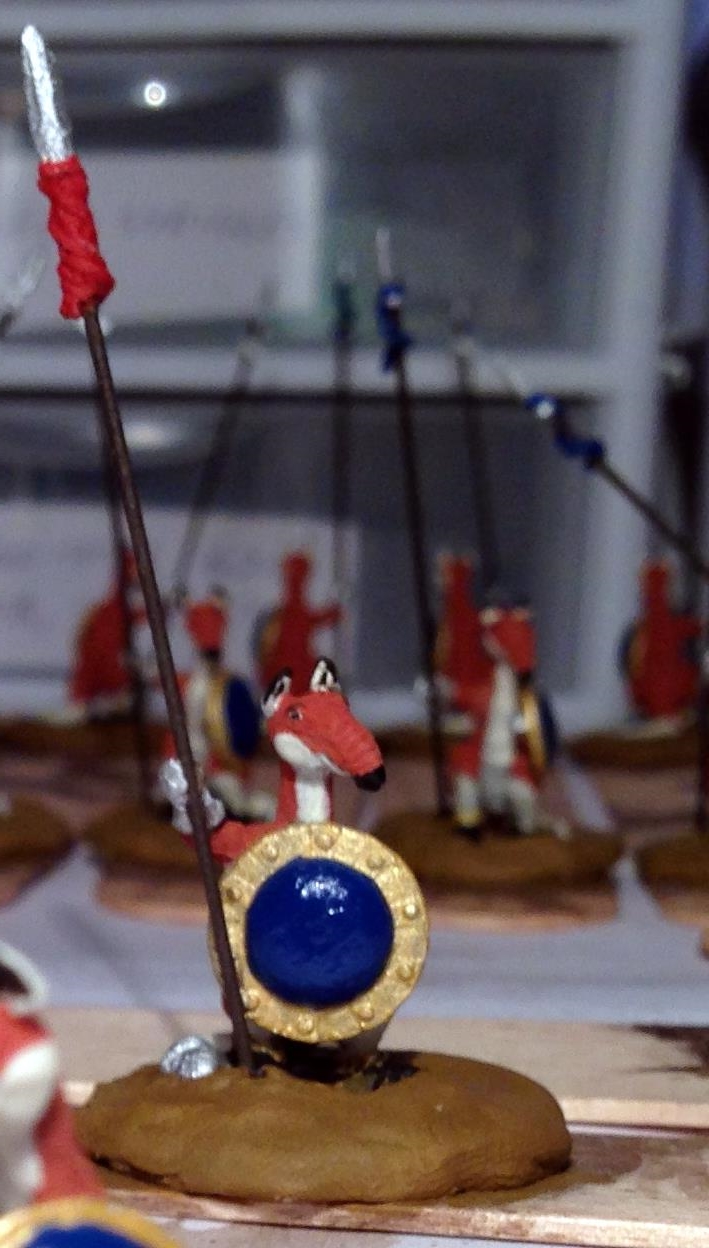
Primed and Ready for paintRooman Leader Primed (front view)Rooman Leader, primed (rear view)Rooman Jill primed, pike sideRooman Jill primed, shield side
Now I needed to have a plan on colors. Buck always painted his Roomans green (he says that his are tropical). I wanted to check out real kangaroos and see their colors. There are two main types, the red and the grey, and the reds are larger. Therefore, I went with a scheme based on the red kangaroo.
Red Kangaroo (male Jack)
My first action was to use a light coat of Citadel “Agrax Earthshade” to the models. I wanted a good reddish-brown, and I looked in my paint supply, and had a nice candidate in the form of a 1996 bottle of Armory “Red Brown”. I used this for the fur outside of the feet and the belly. For the belly, I used Americana “Bleached Sand”. I also used that color up to the jaw muscles and lower jawline to help accentuate the glare and demeanor of the figures. I also used this for the eyes and for the ears. I used another 1996 paint – Armory “Gloss Black” – for the noses and to finish off the pupils of the eyes. For the feet, I went with Americana “Ebony”. I also used this color for the tips of the ears. The jack figures had two anklets, and the jills had one. These I painted with Martha Stewart Crafts “Pale Bronze”. I am not sure why the jacks had more jewelry than the jills!
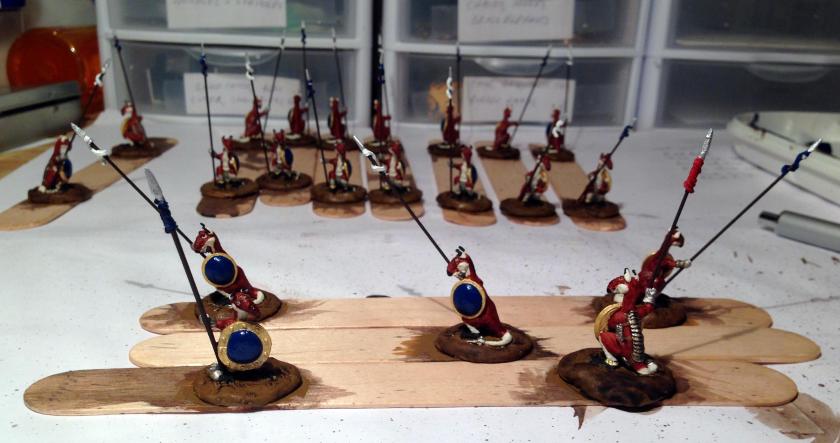
Early base coating
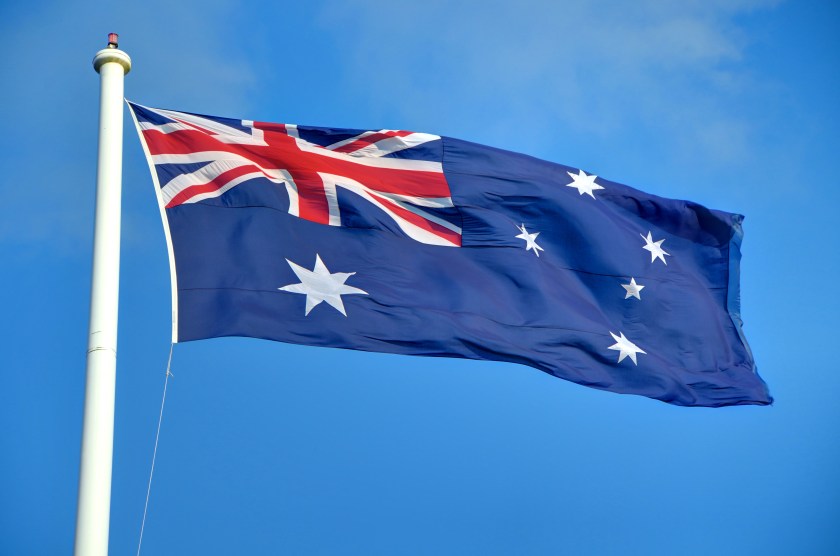
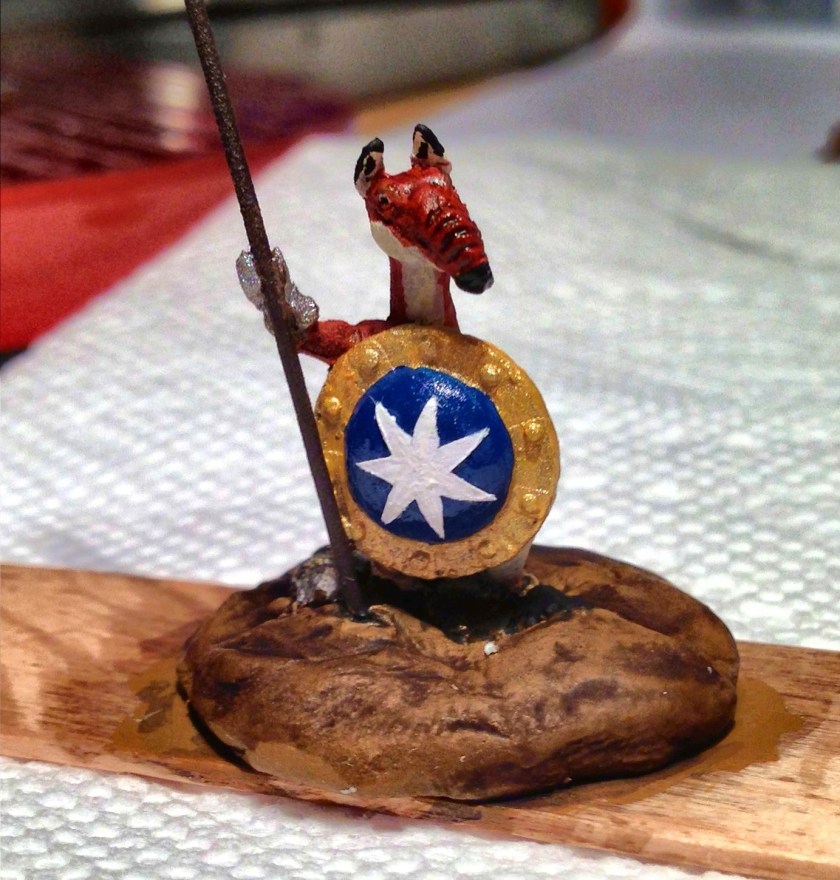
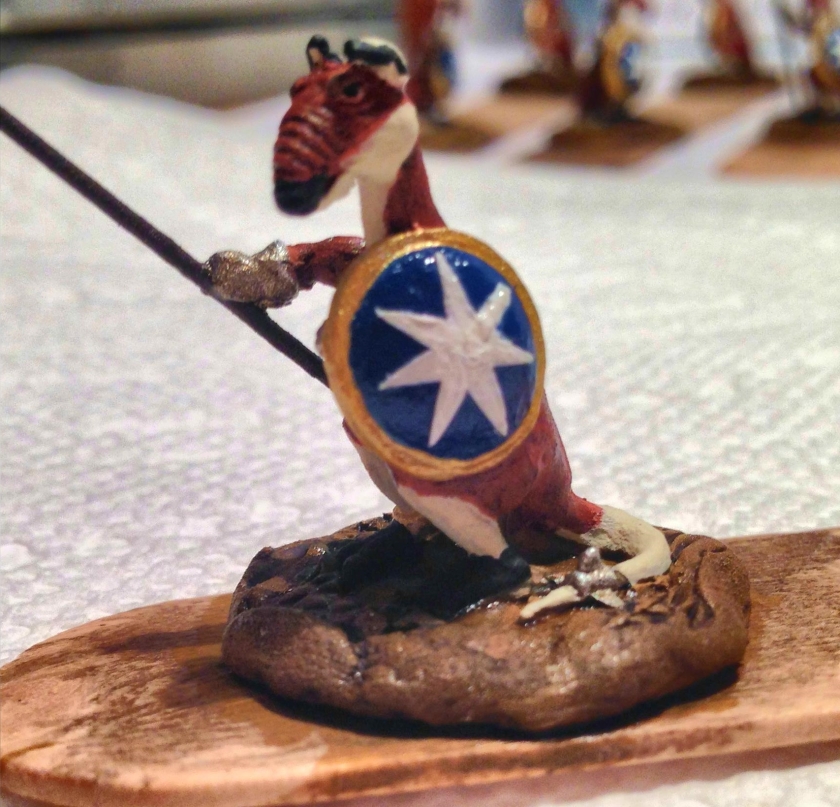
As I moved on to the other metallic – armor, tail spikes, shields, and pike heads – I paused to think of a good color scheme and theme for the unit that would tie it together. I particularly wanted a shield that would “pop”. Looking at Greek phalanxes, one usually sees a bronze shield with a pattern upon it. But these are not Greeks – they are Australians! I decided to use the colors and symbols of the Australian flag for the troop. For colors, I decided that the leader would have the red of the St. George’s Cross (in the Union Jack) on his pike streamer, with the rest of the streamers being evenly split between dark blue and white. The shields would have a dark blue center circle. There are a series of stars on the Australian flag. A seven-pointed star on the lower left quadrant represents the British Commonwealth. The other stars (four seven-pointed stars and one five-pointed star) represent the southern cross. I tried to draw a seven-pointed star, and that is nearly impossible. Additionally, the ones that I would use on the shields would need no be 1/8″ from top to bottom. My wife Lynn suggested I print them off from my computer. Luckily, I found some seven-pointed stars on the internet, and shrunk them down to size, and printed them off.
The Flag of Australia
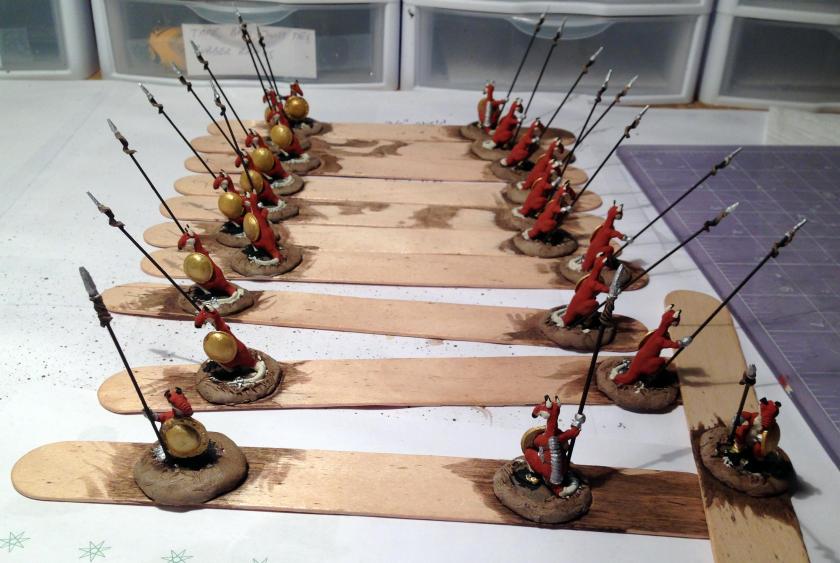
I used the “Pale Bronze” on the shields. For the tail weapons, pike heads, gauntlets, and armor (on the jacks) I used Tamiya X-11 “Chrome Silver”. For the shield straps and eyebrows, I used P3 “Bootstrap Leather”. I wanted the pikes to look like a hardwood – so I painted them with Citadel “Dryad Bark”.
After metallic base coating – note seven-pointed stars in foreground
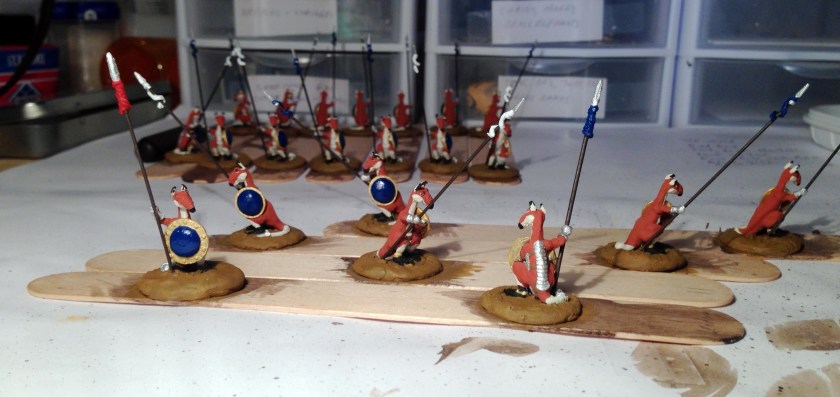
I then needed to move forward with my Australian flag color scheme, For the leader’s streamer, I used Americana “Santa Red”. The other streamers got either a blue or white treatment with another of my older paints. For the dark blue streamers, I used Deka Lack “Dunkelblau”; for the white streamers I used Deka Lack “Weiβ” (Weiss). Both of these date from 1987 when I bought them when I was stationed in Karlsruhe, West Germany. I also used “Dunkelblau” on the shields’ centers. I then used Citadel “XV-88” on the bases.
Completed base coated troopClose up of Rooman leader after base coat
I considered using some dry brushing on the figures at this point but decided against it. Basically, I wanted to darken the red fur and see if using a wash would do that and give some detail to the snouts and haunches of the Roomans. I mixed a 50/50 mix of two inks – Secret Weapons Washes “Just Red” and P3 “Brown Ink”, and carefully covered all the red fur sparing the lighter fur. I also used Secret Weapons Washes “Armor Wash” on all steel armor. I then added another coat of “Agrax Earthshade” to my sculpted bases to bring out the earthlike shapes of the ground. These washes really had a great effect and made the figures look like I desired, as well as bringing out important details that I feared to dry brush.
After base coat and washes – nice darker hues
Let us return to the all-important seven-pointed stars that I printed off! I used my Exacto knife and carefully cut out 26 or so stars with the assistance of the 2.5 magnification of my Carson glasses. I used the best ones for the shields. I applied a light coat of Elmer’s white glue to the underside of each star with a Testors microsponge (this is a good use of this tool). I centered each star and ensured that each point was glued down.
Once the glue dried, I applied a coat of “Weiβ” to the stars and touched up the “Dunkelblau” around the shield where the glue seeped out. I then applied three coats of varnish sequentially – first Krylon “Clear Matte”, then two coats of Testors “Dull Coat”.
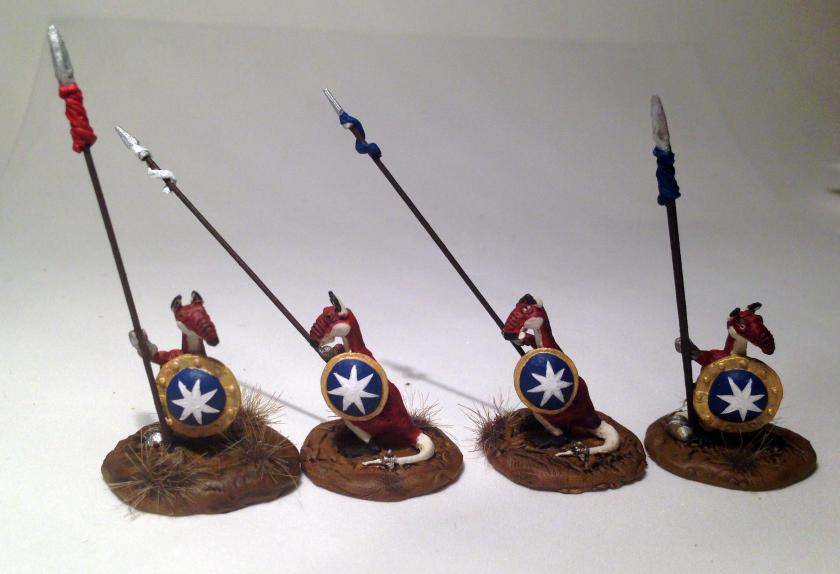
The Rooman Leader (a Jack) after varnishingA Rooman Jill after varnishing
Lastly, I added some Army Painter “Wasteland Tuft” to give them the appearance of coming out of an Australian Desert.
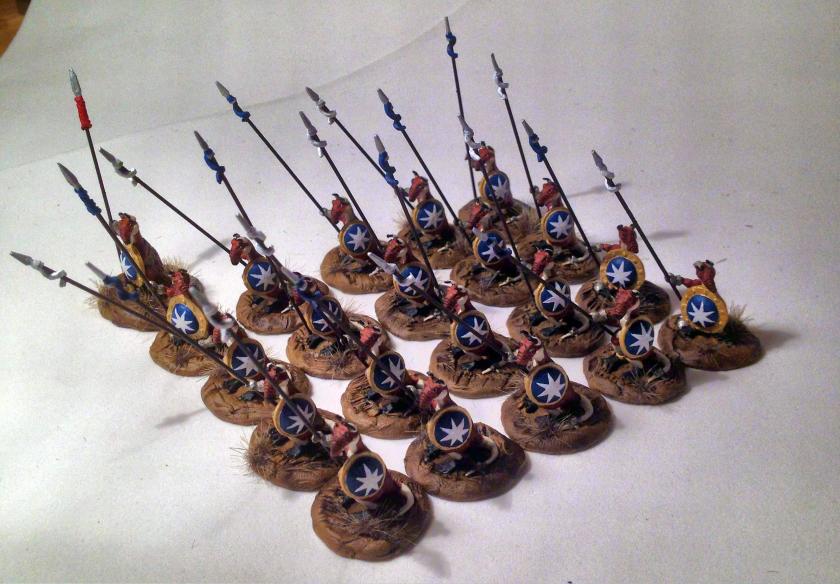
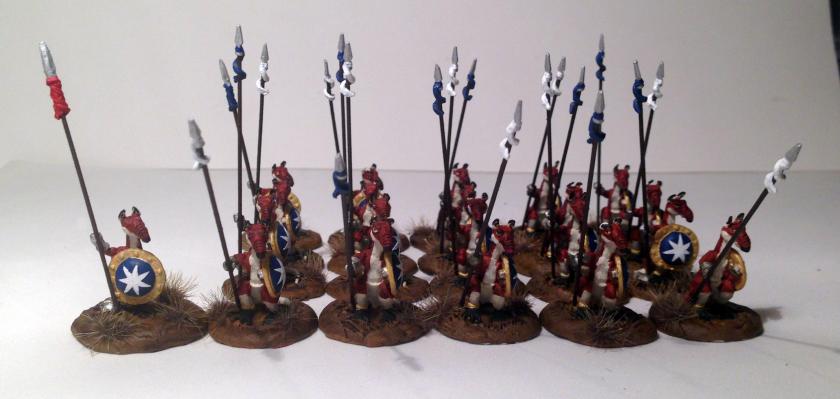
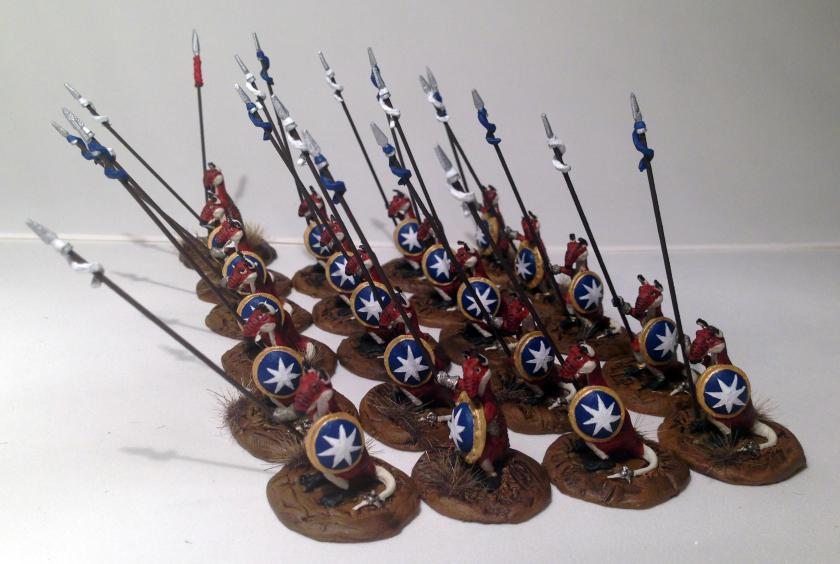
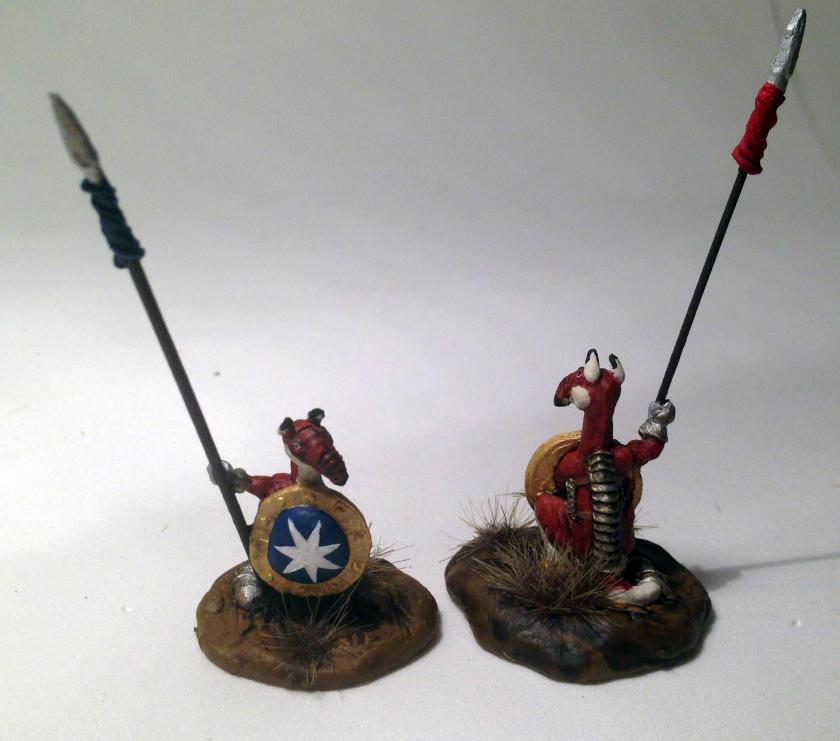
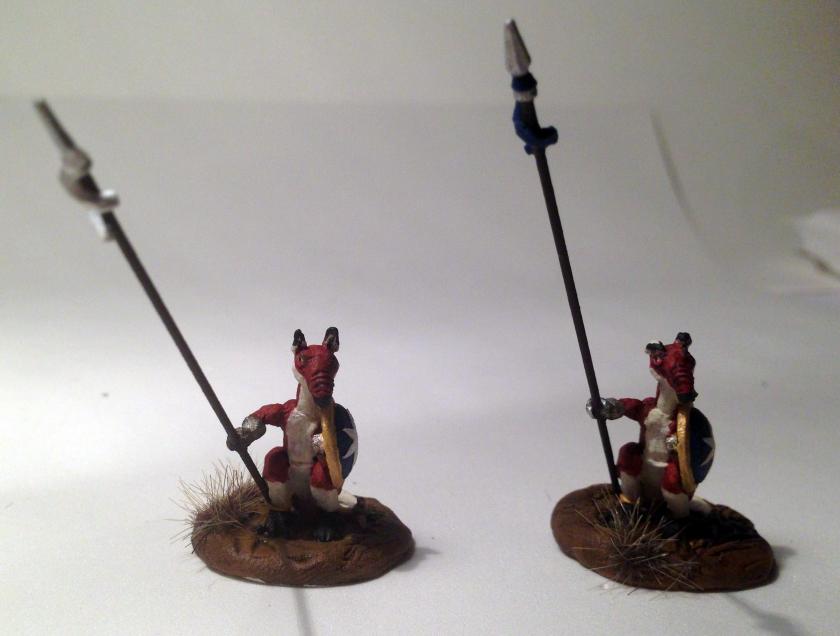
Completed Rooman Troop, angled viewCompleted Rooman Troop, front viewCompleted Rooman Troop, flank viewLeft to right, Rooman Leader, two Jills, and a JackA Jack and the Rooman LeaderTwo Jills
I am more excited and happy with this unit than I had even hoped to be! The unit looks positively awesome and the stars help it pop. As I build more units with my self-cast Roomans I can incorporate the same color scheme (though I believe my 1980’s paint supply will run out!).
A final note of thanks – to Buck and Dave for getting me into this hobby – and especially to Buck for starting me on this Quixotic quest for a Rooman unit all those years ago! I look forward to rolling dice and pushing lead with you soon!!


































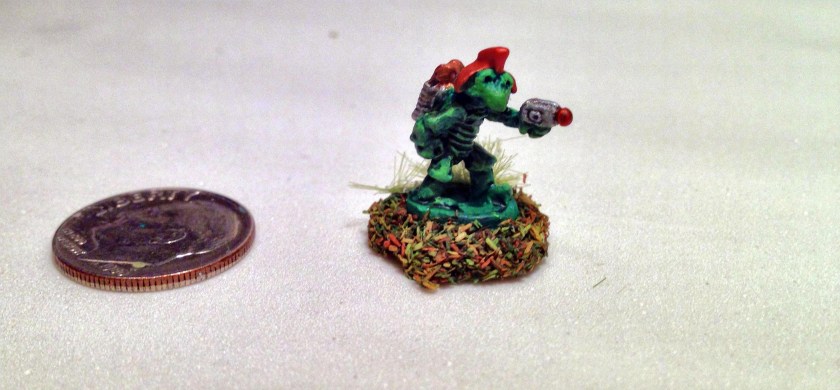

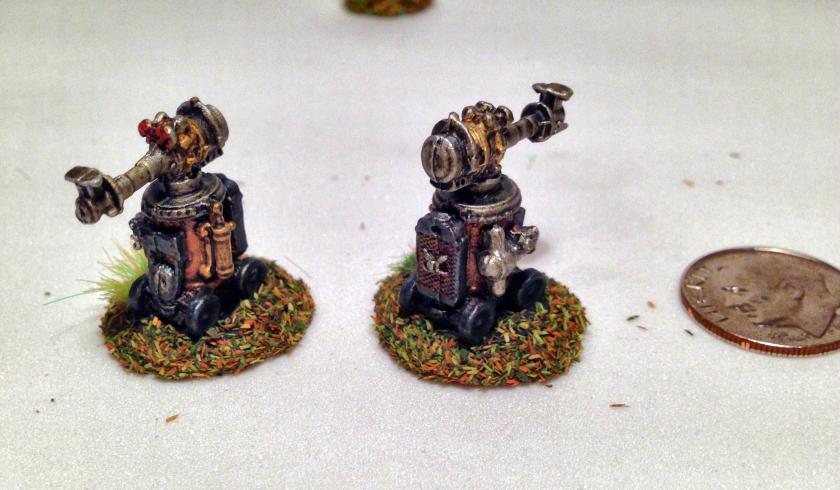


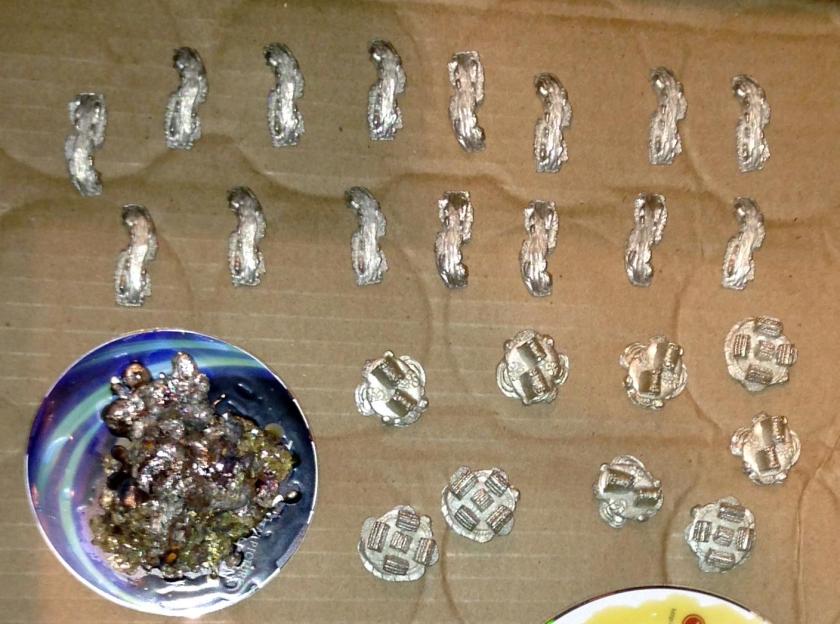


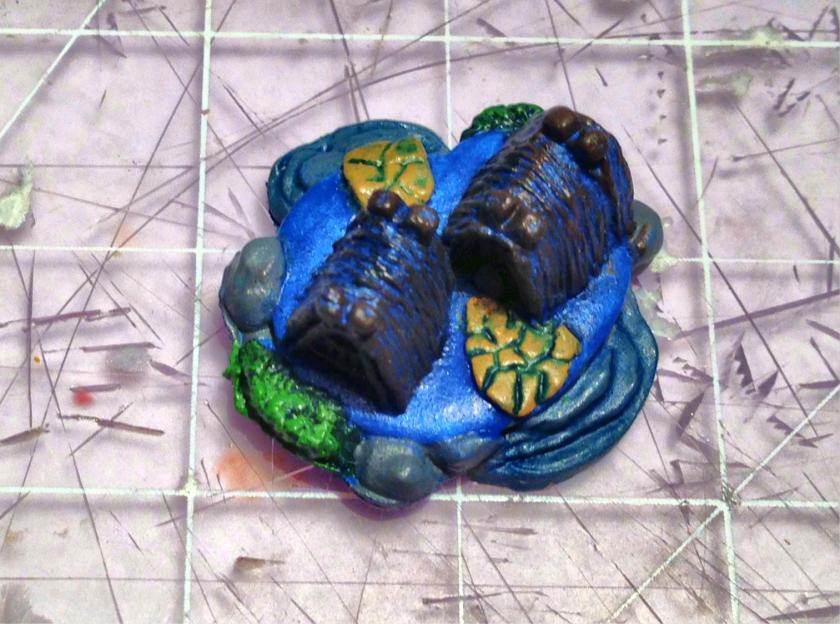

















 Mark A. Morin

