Back in 2016, I had finally completed an original Ral Partha “Rooman War Party” (#01-044) from 1977. This effort culminated in my building a 21-figure phalanx of pike-armed anthropomorphic kangaroos, replete with Australian 7-pointed stars on their shields.
At that time, I also began to see that others, like the wonderfully named Imperial Rebel Ork (IRO for short) were doing amazing “kit-bashes” and conversions with different models. Of course, IRO uses plastic, and I’m more of an old school metal guy. I also was getting more into retro sci-fi figures and using them for skirmish games. I was inspired by IRO and Azazel (both Aussies) to push myself to do my own conversion. So, I combined two figures – a Ral Partha Rooman (25 mm scale) and a Reaper #80010, “Nova Corp Sergeant” (28 mm scale), made a mold, and cast a bunch of “Space Roomans” (in metal of course). You can read about that somewhat massive project here. Getting around to painting these took a bit longer, and even my good friend Buck Surdu painted some that I gave him much quicker than I did.
Ral Partha RoomanThe Reaper figure (circled) that I used was in a bunch of figures I got on eBay
Azazel is kind enough to run a monthly community painting challenge – and October’s was “Unit-ed October”, and focused on units. So, I took this opportunity to get these done. Of course, this effort was slightly affected by some gaming and the Red Sox winning the 2018 World Series (YES!), but I got them (the Space Roos that is) done by October 31st, 2018. I will use them in Combat Patrol™ games.
I decided to paint the Roos similar to the way I did the Roomans, except that I wanted a more dusty and dirty look to them, as they are intrepid infantrymen (infantryroos?). I also wanted to convert a couple of figures per squad (yes, a conversion of a conversion) to carry different weapons. In this case, I used a grenade launcher sprue from RBJ miniatures to make two Roos into grenadiers, and a different RPG sprue from RBJ to make two other Roos into anti-tank troopers. So my 28-figure platoon would consist of:
Platoon Leader
Platoon Sergeant
2 Space Roo Squads consisting of:
1 Squad Leader in each squad
2 teams of:
1 TL per team
4 Space Roos with assault rifles/blasters per team
1 Space Roo per team with either a grenade launcher or anti-tank weapon
Two squads make a light platoon, but I think that they will be a potent elite fighting force on the tabletop. Also, these Roos are equipped with body armor on their torsos, and importantly, jet packs! I will also give them a higher rate of movement similar to what I did for the Space Phraints (1½ cards of movement). I cleaned and filed the models, and prepared them for conversion and priming by mounting them on 1″ steel washers.
The two squads behind their platoon leader and platoon sergeant. The weapons for conversion are on the left.
I had a tough time reorienting the arms of the RPG-armed Roos, and I needed to break them and use green stuff to create a proper pose. Pinning was not feasible unfortunately. I also used green stuff to mount the grenadiers’ launchers and to give them bandoleers of grenades. The grenadiers looked fine enough for the tabletop, but I was unhappy with the RPG Roos, as they looked “Popeye” like in their arms. As the Space Roos body armor gives them an angular body look, I decided to use a series of very small 2 mm polystyrene chips to create an “armored look” over the arms by affixing them with Gorilla glue.
The green stuff conversions – note the bulbous arms that needed attention on the AT Roos.My fix for the arms. You can see that my casts varied in terms of “crispness”. Clearly, I was going to need the brushwork to make these work.
I ended up double priming these figures, as I knew that I would need to fix much with brushwork and painting. For example, there was a large indentation on the Roos’ left feet (paws?) that I needed to paint over. I thought that a thinned brush priming followed by a thinned airbrush priming would help. I think it did.
The platoon primed
For their base colors, I went with a yellowy/sandy look for their armor, which I thought would reflect a desert or dusty deployment.
I airbrushed the armor with a yellowish/sand color. The idea was to use washes to bring out details (and allow me to obscure casting abnormalities). This would give me a nice camouflaged look at the end.Outlining the eyes, ears, feet, and gloves in black. I went with a red kangaroo coloring for the Roo parts .Moving on to fur painting. Inks and washes gave more depth to this later on.Jet packs!The bottom torso on the left has been painted with additional inks for depth.Comparison of the weapons – before (left) and after (right) dry brushing. The blue is indicative of the 1st Squad.
One of the issues I really want to focus on when I build a platoon is to make it easy for the players (some of us with “experienced” eyes) to see and identify a figure’s squad and team. I got some steel punches, and some jewelry stamps to make 1/4″ and 5/16″ placards that I could mount on the figures’ bases.
My 1/4″ punch and the two jewelry stamps next to the polystyrene placards. I did use 5/16″ placards for the platoon leader and platoon sergeant.The placards, stamped and painted. I used a wash to fill out the letters and numbers.Placard close up shot
Next, I washed the figures twice with Citadel “Agrax Earthshade”. I then mounted the RPG’s with Gorilla glue.
RPG Roos!
Lastly, I used a whole bottle of Citadel “Armageddon Dunes” to fill and shape around the bases and let them dry and harden. The placards were mounted into this paint. Then I gave the bases a wash with “Agrax Earthshade” and two different dry brush applications (Polly Scale “WWII German Armor Light Tan” and Vallejo “Light Brown”). Then I gave everything two coats of matte varnish.
After filling the bases The platoon leader and platoon sergeant almost ready!Nice close up of the bases. The shading gave the body armor the dirty effect that I wanted.The four conversions of conversions, front……and back
After adding some tufts from Shadows Edge Miniatures for even better identification, the platoon was finally done (I LOVE their tufts). I am happy with it, given the work and effort it took to bring it to life. So, now, appropriately, I will share with you some eye candy!
The platoon HQ, frontal view…and rear view, with a good view of the jet packs, red placards, and tufts. 1st Squad with blue placards2nd Squad with green placards and green tufts on the leaders.The AT and grenadier RoosThe Space Roos meet their ancestors, the Roomans!My box of Roos and RoomenThe Space Roos’ 1st Squad holds off the WarbotsThe 2nd Squad close Assaults Juggerbot
I am looking forward to seeing these guys in action soon. I appreciate your looking and hope that you enjoyed this post. I always read your feedback, so please let me know what you think in the comments section at the bottom of this post.
I dedicate this post to all my Aussie friends!
PAINTS, INKS, GLAZES, WASHES, AND FLOCKING USED:
Citadel “Imperium Primer”
Vallejo “Surface Primer – White”
Vallejo “Flow Improver”
Vallejo “Airbrush Thinner”
Testors “Universal Acrylic Thinner”
Vallejo Mecha Color “Sand Yellow”
Vallejo Game Air “Red Terracotta”
Citadel “Flayed One Flesh”
Americana “Bleached Sand”
Americana “Black Tie – Satin”
Vallejo “Black”
Vallejo “US Dark Green”
Tamiya “Copper XF-6”
Tamiya “X-20A Thinner”
Tamiya “XF-49 Khaki”
Vallejo Game Air “Weiss”
Tamiya “Gun Metal X-10”
Vallejo Game Air “Steel”
Vallejo Game Air “Beasty Brown”
Vallejo Mecha Color “Light Steel”
Vallejo Mecha Color “Dark Steel”
Vallejo Mecha Color “Metallic Blue”
Vallejo Game Air “Electric Blue”
Vallejo Mecha Color “Metallic Green”
Citadel “Hexwraith Flame”
Vallejo Mecha Color “SZ Red”
Secret Weapons Washes “Just Red” (ink)
P3 “Brown” (ink)
Secret Weapons Washes “Armor Wash” (wash)
Citadel “Nuln Oil Gloss” (wash)
Citadel “Agrax Earthshade” (wash)
Gorilla Glue
Citadel “Armageddon Dunes”
Polly Scale WWII “German Armor Light Tan”
Vallejo “Light Brown”
Vallejo Mecha Varnish “Matt Varnish”
Shadows Edge Miniatures 6 mm “Dark Forest Red” (tufts)
Shadows Edge Miniatures 6 mm “Dark Blue” (tufts)
Shadows Edge Miniatures 12 mm “Wild Tufts” (tufts)
Thanks again for looking and for your feedback! ESPECIALLY AUSSIES!
I am always searching for cool old school figures that are out of production that I could use in my Combat Patrol™ retro sci-fi games. This is firstly because I like to find neat stuff that time has passed by – and expose the figures to a brand new audience. Secondly, it allows me to run really fun games – as the rules are so easy to play and learn even for true newbies – while older gamers are simultaneously having a good time.
Fortunately, I came across Michael Thomas’ site, classicminiatures.net. There I found many Archive Star Rovers figures that he could cast (as he has a spin caster and now owns many original molds). I acquired my Space Dwarves (Archive’s Long Gone Jones) from him, and he suggested two others that I might like.
One was also previously described in this blog – that being Mega Miniatures Robot Peacekeepers. These were my first figures from that now-defunct company. Michael piqued my interest with a second figure, which was Mega Miniatures “Mars Alien” (#71501 seen here in the Lost Minis wiki) from their Sci Fi Future range Aliens subset. It looks like the figure is the only one in that group, and was OOP in 2003. It was sculpted by Hermann Grassnick, and the rights were sold by Mega Miniatures in 2011 (I am assuming to Michael Thomas). I got 19 of the figures for a two-squad Martian platoon.
Interestingly, I wonder if there was a copyright issue that caused a cessation of production? I was also completely unaware that a UK company called Mantic Games put out a Mars Attacks game complete with figures and terrain. I looked through the Mantic website, but it looks like the game is not really available or at least not supported much, or that Mantic is just selling whatever inventory it has of its components. (Side note – I did also see the Kings of War game there which I have seen referred to often in the blogosphere. If I ever get back to fantasy armies, perhaps this will be a resource!).
Back to my Martians…
I did see that the figures from Mantic were colored like the movie, so I adopted that scheme for my Mega Miniature figures, which is a turquoise and lime green combination. Of course, I thought I could finish these in time for a painting challenge by Azazel called “Jewel of July” – after all turquoise is a jewel right? But it was not to be, so these Martians got completed in early August. There were no helmet bubbles or air tanks, but otherwise the figures were comparable.
I cleaned off any unwanted sprue residue, filed, and washed the figures. They cleaned up easily, and the casting quality was good. They are probably 25mm in scale (Star Duck size). I mounted the figures to ¾” steel washers with Gorilla Glue, and then used poster tack to affix them to my painting jars.
The Martians as received
I wanted there to be an easy way for the platoon to be used on the tabletop. I decided that I needed a painting plan. So I made one, using different colors for the weapons, armored vests, belts, and accouterments – it was 11 PowerPoint pages – and you can see one such example below. This helped me to keep it all straight. I list all the paints that I used at the end of this blog post for those interested – there were a number used!
I usually use some details to denote who is who. Usually red for officers, blue for higher NCO’s, and green for lower NCO’s. I used two different colors on the trim to denote each squad.
As for the figures’ details, I did have an issue with the teeth and the brain folds (who doesn’t), as they tended to fill up quickly even with light airbrushing. Eventually, I figured out how to present them in a game-worthy way.
After priming and base coating with turquoiseThe B squad after priming
I ended up using multiple very thinned applications of Citadel “Ceramite White” on the Vallejo Mecha Color “Turquoise” so that I could get the other colors to be more vivid.
White heads – trim and belts next!
I tried to match the colors from the movie on the skulls and brains. It was tough, but I found that using multiple inks, dry brushing, and washing here was a winning approach. My initial tries were too dark or too light as shown below.
Need a middle ground!Eventually, using patience, dry brushing, inks, and washes, I got my Martians’ brains to be close to the desired result.I worked on the heads first, then inside to out on the torsos and legs.
After the painting was at a stage that I was happy with and what I wanted, I gave the torsos downward a good wash with Citadel “Nuln Oil Gloss”. I like the results it gives with metallics. Still, the damn teeth were bedeviling me, Washes were not working, and dry brushing them was not either. They were fairly snaggle-toothed dudes.
The platoon leader after an application of wash on his torso. But the teeth were unacceptable!
My dental solution was to use a very thin and slightly jagged line of Vallejo Game Air “Black” just under the upper teeth – and I settled on that.
A member of A squad (fluorescent magenta highlights) on the left and a B squad member (fluorescent yellow highlights) on the right. The B Martian has not yet gotten a wash with the Nuln Oil Gloss. Here, the teeth are improved.B squad after the Nuln Oil Gloss wash on their torsos and legs.
I then used Vallejo “Gloss Varnish” for my first varnishing application. I planned on adding a matte coat after I finished the bases.
Shiny happy people…err Martians…after the gloss varnish (apologies to REM)
I then worked on the bases. I decided to use Citadel “Martian Ironearth” on them. I really like to get the crackling effect from that paint when you use a hand-held hair dryer on it as it dries. So yes, I used a blow dryer on dudes that not only had no hair, but no scalps…in any case the bases came out fine. Instead of using a wash on them, I dry brushed the bases sequentially with Armory “Brick Red” (from 1996) and P3 “Ryn Flesh”. I liked the effect better than my previous uses.
B squad figure after base completion but before the matte varnishThe platoon all done and waiting for the matte varnish to dryCloseup of the platoon leaderAn A squad trooper from Team 1 (denoted by the copper colored weapon)
Overall, I am happy to have some more “bad guys” to add to my retro sci-fi forces. I do not think that they are my best work, but they are good enough, and should be fine for gaming. And now, some action shots!
The Martian platoonMartian Platoon leadership – platoon leader is in the center, with the A squad leader and his two team leaders on the left of the photo, and the B squad leader and his two team leaders on the right.An example of how I painted the belts differentially. From left to right, the platoon leader (red), the A squad leader (blue), a B squad team leader (green), an A squad trooper (magenta), and a B squad trooper (yellow)The A squad moves out around some Armorcast terrain.The B squad checks out the cooling units and power generatorThe A squad’s Team 1 moves up alongside a Mark 1 Sphere tankThe A squad’s Team 2 surrounds some Texican Space RangersSize does not matter as the platoon leader and the B squad’s Team 1 move in to kill the Hurraku Space Phraints…or at least try to do so!The Space Dwarves throw grenades at the advancing Martians – the Team 2 from B squadACK ACK ACK!
I hope you enjoyed this post – please let me know your thoughts and suggestions in the comments section. And no, I will not have a Slim Whitman weapon that will kill these guys!
Back in November, I was happy to have an extended game of Combat Patrol™ using resurrected Archive Miniatures Star Rovers figures (specifically, Star Ducks, Frinx, Aphids, and Mark III Warbots). My old West Point buddies Dave Wood and Buck Surdu made the trek up from Maryland, and my daughter Ellen and her fiance Chris Smedile joined us for a fun game which was described here.
The game was a blast – and afterwards I thought that I could make some improvements that would make play easier and improve the tabletop aesthetics. The retro sci-fi aspect brought in some new elements. In a WWII game, I would normally use small rubber bands to designate the status of a figure with regards to wounds, being stunned, or being out of ammunition. This is to eliminate a lot of bookkeeping which can bog down a game. I also use glass beads to represent morale checks. In a WWII game, this works fine as most figures can only take 3 wounds before they are incapacitated. However, in the retro sci-fi game, I added other elements. One of these was allowing the Star Ducks to use their jet packs three times per game. Another was the Mark III Warbots, which can take up to 6 or 7 wounds, and who may take critical hits (see chart below) that adversely impact their capabilities.
One issue with their high endurance this is that the Warbots can end up looking like they just arrived on Maui after getting several garlands of leis once the action gets going (see photo below).
Who just arrived in Maui?
I also introduced two breaching arc weapons and a plasma ball breacher that would be key elements of the Mark III Warbots capabilities. As a Army Engineer officer veteran, I thought that this would be fun, and I wanted some cool templates to represent these game elements. Lastly, I wanted to be able to have the casualties remain on the tabletop as a depiction of what happened during the game. This does not always work, so now I make casualty cards for my units that are sized to the figures size (I discussed this previously here).
So my list of improvements became:
Create casualty cards for each unit/figure (done)
Create templates for the plasma weapons (discussed in this post)
Create specialized markers (placards with decals) for use with retro sci-fi Combat Patrol™ games (discussed in this post)
With any new project, I like to try new techniques and learn from trying them out. Here, I decided to try to use my airbrush to do more than prime, base coat, and varnish. I also wanted to use my computer and make decals for the placards. I had not really done any of these things in this way before, so I was going into uncharted waters. I will first discuss the plasma weapons, and then the placards.
For the arc weapons and the plasma ball, I wanted something easy to sue that was durable and vibrant. The Warbots arc weapons can either shoot a 2″ cone (door-sized) for a distance of 5″, or fire a 1″ cone (window-sized) for a distance of 10″. This is to allow them to breach obstacles. The other weapon fires a plasma ball that can make holes (or dissolve stuff/enemies) – think of a really effective M203 grenade launcher. I found a some hardwood (oak or maple) dowels at Home Depot that would work well size-wise. As a golfer, I sacrificed one old Pinnacle for the plasma ball, and mounted it on a 1¼” washer (I don’t play Pinnacles anyways!).
I used my circular saw and cut the dowels to size, and sanded them up a bit. Originally, I had thought I could use decals on them, but decided that I could not sand and varnish them enough for proper alignment and adhesion. Besides, this gave me the chance to play with my airbrushes. I gave them all a prime coat of Vallejo “Surface Prime Gray”, followed by Vallejo “Game Air Black”. I had some challenges with painting the longer templates due to their sizes and being too wobbly to reliably stand up for airbrushing. I made a cradle of sorts out of popsicle sticks that worked adequately – notwithstanding that I needed to be sure each coat was dry before I rotated them.
The dowel sanded and ready for priming5″ template after base coat applicationWorking through base coat application on 10″ template and ball
I used some Tamiya airbrush masking tape to make the center beam, and a crossing pattern where the beam would come out of the arc weapon. I started off with Createx “Brite Yellow”. I should have noticed that the label said “TRANSPARENT”! This took a few applications (that was a learning point). I then airbrushed Vallejo “Light Orange” closer to the masking and around the ends. I then removed the masking, and used Vallejo “Vermilion” on the beam centers and the cross on the ends. Lastly, I painted “Brite Yellow” on the ends and as edging on the beams (worked better). I did the same with the ball , but in a mottled pattern. They are not my best work, but they will serve the purpose.
Warbot Arc and Plasma Weapon templates completedFORE – Warbot on the left fires plasma ball at a Frinx and a Star Duck (he missed!)Warbot Arc Weapon (5″) in action, rear viewWarbot Arc Weapon in action, showing the end you don’t want to be onWarbot 10″ Arc Weapon
The greater portion of the work came with the making of the placards. I decided that I would make the following 185 placards made for use in Combat Patrol™ retro sci-fi. Why that many – well that was basically an educated guess based on most games that I have played.
50 wound markers
15 1-wound markers
15 2-wound markers
6 3-wound markers
6 3-wound markers
6 4-wound markers
4 5-wound markers
4 6-wound markers
25 stun markers
10 critical hit – optics/sensors markers damage for Mark III Warbots
10 critical hit – mobility damage (“STOP”) markers for Mark III Warbots
10 critical hit – CPU damage (“ROGUE”) markers for Mark III Warbots
20 out of ammunition markers
60 jet-pack use markers
20 for one use of jet pack in the game
20 for two uses of jet pack in the game
20 for three uses of jet pack in the game
My first effort was to try to sculpt with Apoxie Sculpt and to use stamps. I was very unhappy with the product, as I thought they would be difficult to read and not reliably reproducible.
My first effort at placards – not good enough
I then changed plans and decided to try to use polystyrene to see if that would work in conjunction with decals that I could print off on my HP Printer. I found a couple of decal products that I could print with – one was clear and from Testors and one white and was from Bare-Metal Foil Company. The Testors product has (6) 5.5″ x 8.5″ sheets, while the Bare-Metal Foil product was 8.5″ x 11″. I went with the Bare-Foil product for this as I thought it would be easier to print with and it had more space. I did notice that it had a white backing, which I thought would help with visibility once the decals were on the placards. Obviously, some uses would be better with a clear backing, so consider that.
I drew up some mock-ups out of paper to size my placards. I wanted them to have distinct colors (matching their rubber bands) and distinct shapes. Once I had the shapes, I designed the decals . I used Microsoft PowerPoint and Google to select images and shapes. This allowed me make a full landscape page image of the proposed decal. I would then save that PowerPoint slide as a JPEG, and insert that JPEG into a Microsoft Word document. I would then change the size of the JPEG (keeping the aspect ratio locked) and print off different sizes until they matched the mock-up placards. Once that was complete, I copied the requisite number of decals into the Word document, leaving adequate space for later removal by Exacto knife on the actual decal paper. I thought that one decal was adequate instead of double-siding the placards.
Before I could print off the decals, I needed the placards. I got .080″ thick Evergreen polystyrene sheets and 1/8″ tubes. These bond well by using Plastruct Bondene plastic solvent cement. I cut the shapes out with a template, and cut the tubes into 1″ sections. I then evenly split the sections lengthwise. Lastly, I cut the tubes into ¼” lengths. I took differently colored rubber bands, and slid them into the lengthwise cuts on the tubes. Then with the Plastruct Bondene, I attached the placards and the tubes. You do not need much of this stuff – and its good to hold the pieces together for a count of 10. I waited a few minutes, and reapplied the solvent over the attachment and the lengthwise cuts, sealing in the rubber bands as the cuts welded. The small rubber bands are the same as what we used before – they come from Michael’s and are used for some sort of young girls’ weaving crafts. I made 185 of these placards!
The solvent – be careful and read the label!Polystyrene SheetsPolystyrene tubes
Then came the painting of the placards. I should have used my airbrush to prime them, but I wanted to use up some Citadel “Imperium Primer” I has. Plus, they were a little awkward to paint due to their configuration. After priming both sides, I laboriously (again I should have airbrushed) hand painted the placards as follows:
Wound, Stun, Optics, and Rogue markers with FolkArt “Champagne” (metallic)
Mobility Damage markers with Createx “Pearl Copper”
Out of ammunition markers with Vallejo “Bright Brass” (metallic)
Jet-pack use markers with Americana “Apple Green”
Once painted, and having painfully learned my lesson in terms of not using airbrush paints, I used my airbrush to coat the placards with Vallejo “Mecha Varnish Gloss”. This helps the decals to slide on properly.
Printing off the decals was new for me. Apparently, there are several steps in addition to printing the decals! First, once you print the decals, you need to apply a couple of coats of a Microscale Liquid Film product (better done with an airbrush, but you can brush it by hand, allowing each coat to dry of course). This application protects the colors. Then the decals can be removed with an Exacto knife from the printed sheet and put into water, but wait, more stuff needed! You also need Microscale Micro Set applied to the surface prior to applying the waterslide decals. This product improves adhesion. then put on the decal, adjusting its location with a toothpick. Let this fully dry, and then another product, Micro Sol, is used to soften the decal and tack it down. Lastly, get the Microscale Liquid Decal Film back out, and put another coat on of that, and let it dry. This will log up any brush you use, so use an old one. Now the decal is protected! Again, repeat 184 more times…for this project.
My decal sheetMy printed decals after airbrushing with Liquid Decal FilmThe three magic decal solutionsPainted placards drying awaiting decalsCompleted placardsWound markers – these are 1/2″ x 3/8 “Star Duck with a placard indicating he has used his jet pack three times, which is the maximum per game that I allow. This one placard takes the place of three rubber bands.A stunned Star DuckA CPU-damaged (“Rogue”) Warbot faces off with a Frinx whose weapon is unfortunately out of ammunition or jammedThe Warbot on the left received a critical hit to its optics/sensors, and cannot engage as well with its weapon. The Frinx in the back is stunned, and the Star Duck on the right has one wound.This Warbot with an Arc breaching weapon has taken a critical hit and cannot move, limiting its ability to penetrate an obstacle.
I have organized all of these into really useful boxes with extra rubber bands (in case I don’t have enough placards for some reason). Hopefully I get to play test their use soon.
Thanks for reading – and I hope you find this helpful! Please let me know in the comments section dear reader!
Back in early 2016, I found an interesting miniature on eBay that I had never seen before. It was from the Archive Star Rovers line. It was a large bug-like creature with a large blaster and a huge sword on its back. It reminded me of a deadly grasshopper. Doing a little research, I learned that the figure was made around 1979-1981, and was designated as Archive #2318, “Hurraku Space Phraint”.
From the Archive Catalog in my Star Rovers game from 1981
I immediately thought that a group of these figures would make a great platoon for a retro-sci-fi game of Combat Patrol™. However, like many Star Rovers figures they proved to be very scarce. Eventually I decided that I would need to cast my own to make such a unit (you can read about that effort here).
I made a mold, and recast a bunch of these, and shared some with my good friend Buck Surdu. Buck called them “Space Bugs” (which of course they are), and painted up a unit himself – you can see his work on these here. I really liked what Buck had done with his and his use of glitter paint. His work inspired me to seek a way to get a shine on mine without being, well, overly shiny. Meanwhile, my Space Phraints waited as other projects and personal stuff got in the way (as it always does!).
Over time I researched and dug deeper. I found that there is quite an interesting back story to these bugs. I discovered that Phraints were originally in the Arduin Grimoire RPG system, which was a contemporary competitor to TSR’s Dungeons and Dragons system in the mid-to-late 1970’s. It was written and marketed by David Hargrave and his company, Grimoire Games. Phraints played a major role in Arduin, and were prominently shown on their rules systems covers (see below). One of the main differences from D&D was that Arduin went from fantasy to futuristic sci-fi all in the same universe.
Apparently (and unsurprisingly) there were a series of lawsuits by TSR against Hargrave, and his company, alleging trademark infringement, etc. It’s history at this point, but truly a fascinating (and drama-filled) chapter in the early era of fantasy and sci-fi gaming. If you would like to learn more about that kerfuffle, here is a good link.
So where did Archive come in? Archive Miniatures had the license for the Arduin line. According to Archive founder Nevile Stocken, the original Phraint figure was a Steve Lortz sculpt in their Arduin figure line (#783). Nevile adapted the original Phraint figure and created the Hurraku Space Phraint. He did this by removing the hive the front foot was resting on, as well as the quiver on the back. This leaned the figure forward. The large sword on the front was removed and replaced the quiver on the back. The Hurraku was then given what Nevile described as a BFG (“big f’ing gun”). The Phraints are truly interesting, and this is another great link on their characteristics. I like that they are emotionless – and incapable of lying.
OK, enough Phraint back story (hope it was interesting anyways). Back to the platoon making!
Originally, I had 39 Space Phraints. It was time to clean and file the metal miniatures, which are large for the ranges 25mm scale (the Space Phraints are about 1¾” or 44 cm tall). Overall, I found it difficult at most times during the project to discern the difference between my recasts and the originals, except during this phase. However, upon better inspection, I found 3 figures out of 39 that were not of acceptable quality, so I went to 36 figures for the unit, with the unfortunate three going to the remelt pile.
I ended up with 36 Space Phraints (1 original, and 35 recasts), for the platoon. It would consist of 3 squads composed of 2 teams of 5, each led by a squad leader, making each squad having 11 figures. Additionally, there would be a Platoon Leader, a Platoon Sergeant, and a Sith Knight. The Sith Phraint would be great fun to game with when I use Greg Priebe’s Star Wars supplement for Combat Patrol™. I decided to make the figures look the same so as to reinforce the “hive” effect. In other words, they would look to unfortunate opponents as a swarm of huge humanoid insects. To us they all look alike, while to the Space Phraints, they do not.
Cleaning and filing of the figures took some time. I use a high tin content when I cast, so this was not quickly accomplished. I also needed to repair some swords that were too short, some blaster stocks that did not cast well, and some foot talons with green stuff (kneadatite). I’m not the greatest (or worst I imagine) with green stuff, but I think that it worked out well (you be the judge dear reader!). I also used a small pin vise bit to round out the blaster ends. The figures are very much in line with those of the era of the late 1970’s. This is not to say that they are not good, but they are much less crisp than today’s plastic and resin models. Plus, 35/36 were obviously my recasts, and some details are lost in that process. For me, all this meant was that I needed to really work with my painting to realize my vision for them.
After cleaning and filing – the one darker figure is the original Space Phraint. Three of these 39 were not good enough and are in my future remelt pile.
I mounted the figures with gorilla glue to 1¼” steel washers, and the washers to specimen bottles with poster tack. Simultaneously, I also began to search for a suitable base color, and I wanted to have something green that was not too glossy – I wanted subtle iridescence. This would mimic the sheen you see on some grasshoppers as their chitin reflects the sunlight. As I have an airbrush and compressor now, I decided upon a novel approach (for me anyway). I would use a pearlized airbrush paint with Createx Airbrush Colors “Pearl Green”.
This airbrush paint is designed for model hot rods and muscle cars. I thought that this would work and that I could shade and highlight later as needed. So, I airbrush-primed all of the figures with Vallejo Gray Surface Primer, and let that harden for 24 -48 hours. Then I broke out the “Pearl Green”. I needed a higher pressure to use this paint (40 vs 20-25 psi for the primer). I also did thin it a bit, and I was able to get good coverage of the figures with my airbrush. The Createx line is made for airbrushing, which is a plus.
After base coat of “Pearl Green”Unit after “Pearl Green” application
After that, I grabbed my regular brushes as I wanted to shade the figures for ease of painting, which I accomplished with Citadel “Nuln Oil GLOSS”. The pearlized paints are very smooth, especially after airbrushing, and I found that the gloss version of Nuln Oil worked better on this base coat of green than the plain one. It really got into the nooks and crannies and stayed there.
After initial shading
For the antennae, I wanted something that would be closer to what a bug would have and not be like a bunny’s ear. For this I used Vallejo “Dark Blue” and washed it with Secret Weapons Washes “Purple”. The eyes, to me, needed to be special. I built up the eyes with serial light coats of Vallejo “Gloss Black”, followed by a 50/50 mix of Vallejo Mecha Color “Yellow Fluorescent” and “Green Fluorescent”. Lastly, I topped the eyes off with a small drop of “Yellow Fluorescent”. This approach really gave the eyes character, and gave the impression of a compound eye structure.
Close up of the eyes (sorry for the blurry image but this head is only 1/2″ long including antennae)
On the bandoleer, I went with Vallejo “Game Air Black”. I decided not to try to highlight them at all as I had too much variability among casts with regards to their details. I also thought that the contrast from the black would be greater with the green chitin which was what I wanted. For the blaster, I went with the last of my 1987 West German Deka Lack “Weiss”, followed by highlighting with Vallejo “Gloss White”.
Moving to the rear of the figures, I painted the swords’ pommels and hilts with Vallejo “Steel” and the grip with a mix of Vallejo “Gunmetal” and “Game Air Black”. Each sword’s scabbard had an inlay and a jewel. The inlay and jewel got Vallejo “Chrome”. After the “Chrome” had dried, I lightly applied Citadel “Waystone Green” on the jewel to achieve a crystalline appearance. For the scabbard and the straps, I stayed with “Game Air Black” to continue the contrasting effect with the chitinous green.
I then went to the front of the figure and dealt with the blaster. For a further contrast, I painted the bulb at the end gold with Citadel “Retributor Armor” . The blaster rings got a covering of “Chrome” followed by an application of Citadel “Soulstone Blue”. To highlight the lobster-like claw structures on the arms and calves and the mandibles, I used Vallejo “Yellow-Green”.
Painted front, before shading
Painted back, before shading
As I earlier said, the upside of the “Pearl Green” is its effect – and the downside is that for subsequent paint applications adhesion is less than other paints. To address the need for both shading and for paint protection on the tabletop, I brushed Army Painter “Quickshade-Soft Tone” over all of the models. I tried my best to sop up any extra pooling shade. I then let these dry and harden for 48 hours. A couple of figures picked up some paper towel fibers at some point, but that was remedied easily with a wet brush once everything was dry.
During this drying period, I sculpted placards for the bases out of Apoxie Sculpt. I wanted the Space Phraints to look the same, but for gaming purposes, there needs to be some differentiation for the players (especially those of a certain age). Apoxie Sculpt is much better than green stuff for this purpose. I mixed this two-piece material, and spread it thinly over my cutting board. Using rubber stamps, I made placards for each figure, and some more for future projects. These I allowed to dry and harden for 24 hours. At that point, I removed and trimmed them, and applied them to the bases with gorilla glue. I primed them with Citadel “Imperium Primer”. For a placard painting scheme, I brush painted:
Vallejo “Signal Red” and “Retributor Armor” for the platoon leader (PL)
Createx “Pearl Blue” and “Retributor Armor” for the platoon sergeant (PSG)
Vallejo’s “Metallic Black” and “Red” for the Sith (SITH)
Createx “Pearl Green” and “Retributor Armor” for the 1st squad leader (1)
Createx “Pearl Green” and Vallejo “Silver” for the 1st squad team leaders (A and B)
Createx “Pearl Green” and Vallejo “Game Air Black” for the 1st squad troopers (A and B)
Martha Stewart Crafts “Duckling” and “Retributor Armor” for the 2nd squad leader (2)
Martha Stewart Crafts “Duckling” and Vallejo “Silver” for the 2nd squad team leaders (A and B)
Martha Stewart Crafts “Duckling” and Vallejo “Game Air Black” for the 2nd squad troopers (A and B)
Createx “Pearl Plum” and “Retributor Armor” for the 3rd squad leader (3)
Createx “Pearl Plum” and Vallejo “Silver” for the 3rd squad team leaders (A and B)
Createx “Pearl Plum” and Vallejo “Game Air Black” for the 3rd squad troopers (A and B)
PlacardsPlacards mounted awaiting paint
Once my shade had dried, I highlighted chitinous areas with the “Pearl Green” that may have been overly darkened. I also used Vallejo “Game Air Dead White” and “Retributor Armor” to highlight on the blasters as the Quickshade needed some adjustments here.
I then moved on to the bases, and used a combination of Citadel “Martian Ironcrust” and Army Painter “Black Battlefield” flocking to cover the bases. I learned at this point that I should have trimmed the poster tack from the edge of the bases at an earlier stage in the project. This would have made addressing the edges easier. As it was, I removed the edges, and used Citadel “Martian Ironearth” on the edges to cover any unpainted parts of the bases. I also dry brushed the Space Phraints’ feet with “Martian Ironearth” to replicate their walking on the red planet and catching its dust.
When using either “Martian Ironcrust” or “Martian Ironearth”, I always use a hand-held blow dryer after to dry and crack the paint for a better effect. Now it was time to apply a matte varnish and remove the shine from the models.
After the Army Painter Quickshade and highlighting…I need varnish!
I applied two coats of Vallejo “Matte Varnish” with my airbrush, allowing for 4 hours between coats. I was really happy with the results – the iridescent effect that I wanted was achieved!
After the matte varnish, achieved green iridescence!!
I detached the Space Phraints from the bottles, and retouched their bases, but finally they were done. I decided to take some formation shots and some action shots below. For Combat Patrol™ games, I plan to have them be able to climb walls without penalty, and to be able to use two cards for movement. Additionally, to replicate their emotional state, I will have them use the Japanese deck for morale results.
I am very proud of these – it was a very large and long project.
As always will appreciate any feedback in the comments section.
Thanks for looking and as promised, here are some more photos below – enjoy!
Command Group out front1st Squad2nd Squad3rd SquadPlatoon formationTop view of command group2nd squad view from the rear2nd squad moves through a refinery of Armorcast terrain3rd squad defends a bunker1st squad in the ruins
I have been getting ready for Christmas, but I wanted to get at least a few things done hobby-wise before 2018 rings in. Last month, we had a rousing sci-fi game using Buck Surdu’s Combat Patrol™card-based rules (you can read about that game here).
We were able to use the new Japanese South Pacific decks for robot morale checks, and incorporated many of the rules from Greg Priebe’s superb Star Wars supplement. We also used some of my rule additions for Mark III Warbot casualties, special weapons, and a few other nuances.
One of the issues came in the way of finding an easier way of denoting casualties on the table and making play a little easier. As you can see below, we just tipped over the figures, and that became crowded! I do like to see the casualties on the table as it gives a nice account of what occurred in the game, but perhaps there is a better way? Also, given that the Warbots take many wounds, I also am making some play aids specifically for them and their weapons (and I will cover this work in a future blog entry).
Casualties litter the field/table last month
As for the casualties, Buck suggested that I could create some cards for the casualties that would take the place of the “dead” miniature on the table. This would allow for showing the results of the battle, and enable an easier playing experience.
For this project, I bought a Fiskars® paper cutter from Michael’s. I had a 40% off coupon so I got it pretty cheaply. I used white 65-lb. card stock from Staples for the cards.
Fiskars paper cutter
I started out last week with the Aphid platoon. My goal was to make the card sizes as close to the actual miniature sizes as possible. The Aphids are really small, so their cards were small. I experimented with Microsoft PowerPoint, using the grid lines tool, and comparing what I printed with the actual miniatures. I ended up making the Aphids cards about ¾” – 3/8″ high by ¾” wide. I had a lot of variability as I got used to using the paper cutter. The pictures that I inserted into PowerPoint had different aspect ratios, and I remedied this when I moved on to the Star Ducks.
I do recommend using the aspect ratio tool when cropping pictures for this type of work. Additionally, the grid line tool in PowerPoint allowed me to make exact front and back cards by making sure that the sizes were the same and aligned. The easiest way to do this is to import your photos first, and then copy that slide. Then, you replace the photos on the second slide with the written cards. By printing these on both sides of the paper (use regular paper first, not card stock to check), they will line up perfectly. The only caveat I need to add is that you need to pay attention to the cards as you will need to reverse the text in the blocks so as to match the pictures – see below.
My PowerPoint page of 39 Aphid photos – note the reversing of texts below on the text portion The text section – I numbered these text box blocks and put up to the light to see which text went where – each is an individual text box
I printed these on card stock with a “thick paper” setting on my printer, and used two-side printing. I then cut them out using the Fiskars tool. There is a learning curve to the tool, and it worked out fine. The Aphids on Grav-Cycles were not sized to the miniatures, but I wanted all of the Aphids cards in their deck to be the same size, so I can live with that discrepancy. I did however want to improve for the next group of cards – which was for the Star Ducks.
Here, I needed to make bigger cards, and went with 1½” by 1½”. I made a few important changes in my processes. First, I used the “aspect ratio” function when I cropped the photos – in this case using the “square” aspect. I also added a 2-point thick line on the pictures and the text boxes, which really made cutting easier. Lastly, I colored the cards text-printed side with light orange hue, to match their bills! I plan on having future unit casualty cards with different colors on the printed sides.
Page 1 of my cards (photo side). These when printed on a standard sheet of paper approximated the true sizes of the miniatures.The text block side of the PowerPoint, with adjustments so that the two-sided printing would line up properly. These were then colored orange as below.The photo sides of the cards after cutting – they are 1.5″ square
The printed sides of the cards with the orange backgroundsClose up of the cards
These were much better – and I feel confident that I can finish off cards for the Frinx and Mark III Warbots soon. My goal is that when I next run a game that these aids will make play even easier than Combat Patrol already is! These are not perfect, but are close enough and stiff enough to avoid becoming paper canoes!
Casualty cards, Death cards, whats the difference!
Please let me know what you think in the comments section – thanks for looking!
I have been accused of having a Boston accent, but this is not really true – I have a Worcester accent, or properly a Worcester County accent. Throughout my military and civilian career, my pronunciation of my name, Mark, sounds to others like Ma’k. My good buddy Buck Surdu has often shortened it to “Ma’k” on his blog posts. Last weekend (right before Thanksgiving) he and my other good buddy, Dave Wood, made the drive up from Maryland on a traffic-filled Friday afternoon for a Saturday full of gaming – and it was called “Ma’k Con”. My wife Lynn really helped out as well with her keeping us well fed. This blog post is about the gaming we crammed into that Saturday.
Buck and Dave got me into tabletop wargaming when we were back at West Point. Since then, Buck has published a myriad of rules for gaming, and Dave has contributed to many of those rule sets. The most recent rules that Buck published is a fantastically easy to play and streamlined card-based system for skirmish-level combat in WWII called Combat Patrol™. It is truly flexible, and has had optional rules and supplements written to cover different possible scenarios, to include the South Pacific theater, the Winter War, the Falklands War, the Napoleonic era, and even the Star Wars universe. These can be downloaded for free from his website, and the cards are available in the US from Drive Thru Cards and in the EU from Sally Forth. The rules are also available in book form from both On Military Matters and Sally Forth.
Buck recently added a new set of cards for the South Pacific, which have different morale results for Japanese troops. Readers of this blog know that I have been collecting and assembling units from the old Archive Miniatures Star Rovers line of figures, specifically Star Ducks, Power-Armored Frinx, Aphids, and Mark III Warbots. Additionally, I have been supplementing these forces with Khang Robots, weapons, Robo-Sentry Guns from War Games Supply Dump, and my own sculpt of a sphere tank. I also used some weapons from Bombshell Miniatures.
I decided that I would combine aspects from different Combat Patrol™ rules for a fun retro sci-fi game. Specifically, I would use the new South Pacific deck for morale results for robots, the new vehicle-mounted flame thrower template for my sphere tanks’ death rays, and the Sith rules from the Star Wars supplement. Also, I added in several rules from the optional rules. Lastly, I added my own special rules for the Mark III Warbots and their leader, Juggerbot, to account for possible effects that weapons fire could cause on their behaviors and capabilities.
Upon arrival in Massachusetts, Buck surprised Dave and I with uniform t-shirts from West Point that we would have worn to gym or when we played sports. It was called Gym-A (Gym-Alpha) and we wore it for Saturday’s game marathon. Admittedly, both Buck and Dave wore it better than I did. We were also joined by my daughter Ellen Morin and her fiancé Chris Smedile.
Buck Surdu, me, and Dave Wood (US version for you UK followers) in our Gym-A shirts
The scenario was one where the Star Ducks, Aphids, and Frinx were allied against the cybernetic horde of attacking robots. The non-metallic forces had captured a robot Mark 1 Sphere tank. The Frinx were attempting to repair it so it could be used against the robots, who were to have two Mark I Sphere tanks of their own in the assault. The tanks have two side mounted laser cannons, and a Death Ray (think 1953 War of the Worlds movie). Dave and Ellen had the robots, while Buck, Chris and I defended.
Dave and Ellen prepare to attack. The Aphids are in the ruined building to the front, and there are the Robo-Sentry Guns acting as speed bumps to their front.
The Robo-Sentry guns slowed the attacking robots slightly, but allowed Aphid and Star Duck mortar fire to hit the Warbots near Juggerbot, damaging the robot leader, and causing some of his robots to go rogue, or blow up. When they went rogue, they would attack the nearest figure. Juggerbot ended up dealing with such a problem.
The battle begins with the Warbots clearing the Robo-Sentry gun defenses.
Normally, in Combat Patrol™ games, figures can take a certain number of hits, usually three wounds, before they die or are incapacitated. In this game Frinx had 4 wounds (because of their power-armor), most line Star Ducks had 3, and Warbots had 6. However, I allowed for critical hits as outlined below. This had a nice balancing effect on the game.
Warbot Critical Hit Chart – lots of 4’s and 5’s happened!
The Warbots also had some devastating energy weapons. The opposing forces had two “Sith Lords” (Duck Wader from the Star Ducks and Lt. Ma’k from the Frinx) with special powers from the Star Wars supplement. Early in the game, Buck moved Duck Wader up to engage the Warbots, only to get vaporized along with some Aphids by an arc weapon blast.
Duck Wader (center) near the corner where he was shortly vaporized thereafterThe Frinx AT section moves up – only to never make an impact
The other Sith, Lt. Ma’k, used his Force powers to fly into the middle of a group of 8 immobilized Warbots (they had drawn a “Hold until Death” morale result due to Frinx fire, but the robots could still fire).
Lt. Ma’k (a Frinx) then tried a Sith power – Force Blast – which damaged some robots’ weapons and caused them to explode. Additionally, friendly mortar rounds landed there (Lt. Ma’k did not care) and eventually he succumbed, as did several Warbots. Simultaneously, Juggerbot finally was destroyed by Aphids on Grav-Cycles. As he was the platoon leader, his destruction led to his unit becoming pinned – and only activating on black cards. This really had the effect of reducing the entire robot platoon’s combat effectiveness.
Lt. Ma’k (by the purple die) makes his last stand. Note the black die for the Warbot Green Team 2 due to a “Hold until Death” morale role. Later the entire Warbot platoon would get black dice (“pinned”) when Juggerbot was destroyed.The death (destruction) of JuggerbotAphids an Grav-Cycles make a desperate charge before dying to the last bug – but they sealed Juggerbot’s fateFrinx on Glyptodon cavalry move up before being taking heavy fire and being routed
At this point, the carbon-based living got very lucky and fixed their captured Sphere tank earlier than would have been expected due to Chris pulling some great cards. However, the robots got reinforcements in the form of two of their own Sphere tanks, a squad of Warbots, plus 2 self-propelled robot guns. Chris and Buck were able to immobilize one tank with some very lucky shots. The other annihilated a squad of Buck’s Star Ducks with a Death Ray Blast.
Buck’s Star Ducks are hit by Death Ray fireSome of Buck’s Star Ducks jet pack onto the immobilized Mark I Sphere tank. Their satchel charges (6) attacks all failed to destroy the tank.
By now it was dinnertime and pizza called, plus we wanted to move to the next game. It looked like a slight victory for the living forces, but casualties were high! The game turned out well and I may redo this scenario at Barrage in Maryland in January. Buck’s account of the battle is the next entry in this blog.
Surveying the carnageGreat Game!
Then we moved onto a play test of Dave’s micro-armor game of “The Battle of Nikolayevka (Nikitowka)” using the Look Sarge No Charts rules. This was a breakout of Italian forces on the Eastern Front in 1943 as part of the Battle of Stalingrad. So we had Italians and some Germans attacking a small town held by the Russians. The link above describes the historical battle well.
Buck attacked with a combined German/Italian force on the right half of the battlefield and I attacked along the left half. Dave defended. It was a tough slog, with the Russian artillery (they had no armor) making progress difficult. Later in the game Dave had us command reinforcements in the form of the Italian stragglers from an earlier phase in the battle. It was a good scenario, and interesting to see a primarily Italian versus Russian scenario.
Initial set up – Italians and Germans (on left) fight into the town to the right of the railway crossing (in light orange)Another view showing the town in the upper right. The attackers needed to get into the town so as not to freeze to death.Assaulting the rail line defensesBuck tries to get into the town
I think Dave will have a very good scenario for an upcoming convention!
The day flew by, and I am so appreciative that we West Point Old Grads had the chance to game together. Thanks to Buck and Dave, and Chris and Ellen! And of course, Lynn for her logistical support!!
Followers of this blog may have wondered where I have been, why have I not been posting? Well, I have been working on building a platoon of Archive Miniatures “Mark III Robots” (#2323). The platoon will be led by Archive Miniatures “Juggerbot” (#2331). Both of these sculpts are from the vibrant imagination of Nevile Stocken, who was way ahead of his time with his work. Given that these figures were from the late 70’s and early 80’s, I have to think that they were inspired (especially the visors) by the original Cylons from the 1978 TV series Battlestar Galactica. I loved that show when I was a kid! So, I had to make them shiny!
Mark III Warbot inspiration?
These will be used in upcoming games using the Combat Patrol™ set of card-based rules. The figures are effectively 25-28mm, being large robots (larger than humans).
This long project started with making a mold and casting 38 out of the 40 Mark III Robots as described previously here. I wish that I could have just bought them, but my time machine is broken…and that made purchasing them an impossibility. The platoon will have 4 squads of 10 (5 per team), plus 4 squad leaders, and Juggerbot – so the platoon is composed of a total of 45 figures.
The original Mark III’s (there were no Mark I’s or II’s!) were from the Star Rovers line of figures made by Archive in the 1979-1981 timeframe. They are very tough to find on eBay or anywhere else. I managed to acquire two originals, but only one was fully intact, and it became the master for my recasting efforts. The other original I converted with another weapon.
I found the Juggerbot kit on eBay, and decided that it would make an excellent platoon leader. For squad leaders, I have four War Games Supply Dump Khang Robots that were previously described in this blog here. Each Khang is color-coded (red, green, blue, and purple), and each squad in my platoon follows that scheme. Each Mark III Warbot Squad consists of the Khang Squad Leader, and two teams of five Warbots.
I converted one Warbot per team with a special weapon. Each squads’ Team 1 had a conversion with Bombshell Miniature’s “particle beam weapon” (BOM36016). I gave the Team 2’s two different weapons each. Two teams got Bombshell Miniatures large “arc weapon” as their conversion, while the other two got a large War Games Supply Dump retro sci-fi weapon from the WP01 “Weapons Pack 1”. All of the conversions I did were with these weapons, which are no longer available from either Bombshell or the now-shuttered War Games Supply Dump.
Conversion of these figures, as well as cleanup in terms of cutting and filing were major efforts in this project. I use mostly tin (about 67%) in my casting, and this made sawing away and filing pieces from them tedious as they are not as soft as a higher-lead alloy would be. Still, I was able to convert 7 of my castings plus the extra original for a total of 8 conversions. In most cases, I needed to bend the arms to accommodate the new weapons. My concept was for Team 1 to have one Warbot with a higher rate of fire weapon, while the Team 2’s would have specialized breaching or anti-armor capabilities.
My original Mark III Warbot with weapon intact. I had one other with a broken weapon, which I converted to another weapon.
Juggerbot as received from eBay – obviously cast from a mold in the post-Archive eraJuggerbot contents – needed some TLC…glue, and pressure while the glue setAssembled and straightened Juggerbot
Bombshell Miniatures arc weapon sprue -I used two of the ones on the far leftI used the far left particle beam weapon for each Team 1 conversionFrom the 1981 catalogJuggerbot drawing from the 1981 Star Rovers game rule bookMark III Warbot drawing from the 1981 Star Rovers game rule book
After cleaning up the figures, I made a plan to complete the conversions. I also wanted to try a few new things in making this platoon. I wanted to use my new airbrushes and spray booth, and I wanted to use poster tack on specimen bottles and grocery store coins to have greater ease of painting with both the airbrushes and traditional brushes.
After cleanup but before conversion – I ended up using 2 arc weapons (far left), 2 of the WSD weapons (2nd from left), and 4 of the particle beam weapons (far right) in my conversionsAfter conversion – arc weapon on left, particle beam on rightWar Games Supply Dump weapon conversionMounted on steel washers and ready for the poster tack and the specimen jars
After all of my conversions were complete, I mounted the figures on steel washers for eventual magnetized storage. I had to use a bigger washer for Juggerbot. The platoon was then affixed to outdated grocery store bonus coins and specimen bottles or just to the bottles themselves with poster tack. In the future, I will not use the coins, as it was just easier to use the bottles minus the coins. I used an Aztec airbrush to prime the figures with gray Vallejo “Surface Primer”, giving the figures 24 hours to dry. I had read that doing that is desirable so that this primer paint can harden.
Primed on the specimen jars
I then used Createx “Wicked Aluminum” airbrush paint (very sparkly) to base coat the Warbots using an Iwata Eclipse air brush – and I found this brush to be a much easier tool than the Aztec. I used Vallejo Model Air “Gold” to base coat Juggerbot with the airbrush.
Juggerbot base coatedClose up of Warbots base coated
I saw that the Createx paint had given the Warbots the appropriate shiny starting point for further development of the paint scheme I wanted, which was to be very retro sci-fi metallic, and reminiscent of the Cylons. Then I went back to the regular brush!
For my color schemes of red, blue, green, and purple on the Warbots, I went with DecoArt “Festive Red”, “Peacock Pearl”, “Crystal Green”, and Craftsmart “Amethyst” respectively. These metallic paints are great, but thick, and not easily thinned. Still, they worked well and I put these colors on the ankle, knee, and wrist joints for ease of tabletop play. I chose to use them as well for the visor interior colors, with Vallejo Model Air metallic “Black” for the outer parts of the visors. I then used “Gold” for the Warbot voice boxes and weapons tips on the unconverted troopers. “Black” was my choice for the rest of the weapons, offset with Vallejo Model Air “Steel” and Martha Stewart Crafts “Duckling” (this was a nod to my friend Buck Surdu, whose love of all things ducky and his take on the Mark III Warbots helped me plan out my approaches here).
For the common weapon barrels, I employed Vallejo Model Air “Copper”, and complemented them with Vallejo Model Air “Medium Gunship Gray”. Juggerbot had several lights on him, so Vallejo Model Air “Arctic Blue” and “Signal Red”, and “Aluminum” helped me with these details. I used these as well on the conversion weapons.
I then used several applications of Citadel “Nuln Oil Gloss” and “Black” on Juggerbot to shade the recesses of the figure. Moving back to the Warbots, I used “Aluminum” on the bodies, then similar to what I did with Juggerbot, I shaded with “Black” and “Nuln Oil Gloss”. Interestingly, I found that the inks really rolled off the figures, and the “Black” paint really helped with the shading.
I then added a healthy coat of Citadel “Ardcoat” to all visor and lighted surfaces. As a final highlight for Juggerbot and the Warbot weapon tips, I used Citadel “Retributor Armour”.
Juggerbot mid-stageEarly stage painting of Red Squad WarbotEarly stage painting of Purple Squad WarbotEarly stage painting of Green Squad Warbot
I decided that I wanted to be able to differentiate between the two teams within each squad. To do this, I experimented with kneadatite (green stuff) and Apoxie Sculpt and some numbered stamps. I found that the Apoxie Sculpt was easier to form, stamp, and once dry, cut. I applied these numbers to the figures’ bases with Gorilla Glue.
Figures with the numbers applied
I used Citadel “Imperium Primer” on the Apoxie Sculpt numbers, then added Citadel “Martian Ironearth” to them. Then, I built up the bases with Citadel “Martian Ironcrust” with a light sprinkle of Army Painter “Black Battleground” for more texture. After using both “Ironearth” and “Ironcrust”, I dried them to a crackly surface with a hand-held hair blow dryer. I highly recommend this technique.
After a day of drying, I dry brushed the bases with Armory’s “Red Brown” and “Brick Red”. I filled the numbers in with “Imperium Primer” for all troopers, with the team leaders getting “Retributor Armour” on theirs. Then it was back to the paint booth for two coats of varnish, this time with an Iwata Neo airbrush, allowing for adequate drying between applications.
Juggerbot ready for varnishThe platoon all varnished
I now needed to remove the figures from the bottles and coins. The poster tack was easier to remove when I did not use the coins. I lightly painted the underside of the bases with Craftsmart “White” so I could use a black fine-tipped Sharpie to write information on the figures’ bottoms.
Red Team 1 conversion with particle beam weapon – this is the other original Warbot that had a broken weaponGreen Warbot Squad with Khang Robot Squad LeaderLeft to right, regular trooper, particle beam weapon conversion, and arc weapon conversion of Green SquadPurple Warbot Squad with Khang Robot Squad LeaderLeft to right, regular trooper, particle beam weapon conversion, and War Games Supply Dump weapon conversion of Purple Squad Blue Warbot Squad with Khang Robot Squad LeaderLeft to right, regular trooper, particle beam weapon conversion, and War Games Supply Dump weapon conversion of Blue SquadFear the Juggerbot!Coming at youMr. Universe poseThe back viewAssembled Mark III Warbot Platoon, front viewAssembled Mark III Warbot Platoon, side view
I cannot express enough how much I like this platoon! The figures started off pretty rough, but in the end, I was able to make a nice unit for tabletop gaming. It did take me a couple of months, but it was worth it. They will be in action this upcoming weekend, as they make their tabletop debut – stay tuned, and let me know your thoughts below!
This post is about another group of miniatures that I acquired in March from the recently closed Wargames Supply Dump (thanks so much Roger!).
These are DG-08 and DG-09, Khang Robots. One model is tracked, the other has legs. I purchased 2 kits of each type of robot.
I’m currently planning on building out a series of different squads and platoons for use in retro-sci-fi skirmish games using the Combat Patrol™ system of rules. I have described previously here in this blog my casting work on making a platoon of Archive Miniatures Mark III Warbots. I thought these Khang Robots would be great as leaders for that platoon. They look so very retro! The tracked version really evokes the old “B9” from the 1960’s TV series Lost in Space.
Additionally, I eventually will be painting up a unit of WSD Khang troopers, and I can use these four robots to augment those forces as well.
The kits arrived, and I washed them with a light scrub with soap and water, and let them dry. Once dry, I assembled them with super glue. I tried to glue each robots’ arms so that they would each have a different position for better aesthetics. After they were together, I affixed them to 1¼” steel washers using Loctite glue for ease of eventual magnetic box storage. Then, I used poster tack to affix the models to popsicle sticks for ease of painting. This is now my new favorite tactic as it is very easy to remove after painting.
I then primed them (top and bottom) with Krylon “Ultra Flat” white matte spray paint. This allows me the option to write (with a fine-tipped Sharpie) on the washer bottoms with info that I’d like to have on them, such as the model’s name, the date of completion, my name, and any unit identification.
After the primer dried, I gave the models an aggressive wash with Citadel “Nuln Oil”.
The kits as they arrived
The Khang Robots unassembled and drying after cleaning
Assembled and based awaiting priming
After priming
I used Vallejo Model Air Metallics “Steel” as the primary base coat for the models’ helmets, shoulders, belt, and claws. I painted the waist/ribbed chest area with Citadel “Mechanicus Standard Gray”. Then, for a shiny rubber-like look on the ribs, boots, and legs, I applied a coat of Armory “Gloss Black”. For the front of the tracked bases and the chest-mounted cannons, I used Vallejo Model Air Metallics “Gun Metal”. Then I highlighted the shiny parts on the shoulders and helmets with Vallejo Model Air Metallics “Aluminum”. For the voice box (cannot really call it a mouth!) I added a light coat of Citadel “Spiritstone Red”.
Moving on to some of the details on the helmet, arm sockets, “ears”, and back components, I found a great solution with Vallejo Model Air Metallics “Copper”. There were several lights on the front and back of the robots, and for these I used a spotter brush with Citadel “Yriel Yellow”, Vallejo Model Air Metallics “Signal Red”, Craftsmart “Sapphire”, and DecoArt “Crystal Green” – varying the lights a bit in the front.
For the vents in the front of the tracked figures, I used “Gloss Black”, with “Steel” on the vents. I then extensively used Vallejo Model Air Metallics “Gold” and Craftsmart “Onyx” on bolt straps and bolts respectively throughout all the models. I also used “Onyx” to highlight the “Gloss Black” painted parts.
I then chose some bright-colored metallics to theme the robots and make them easier to identify on the gaming table. My four choices were: DecoArt “Crystal Green”, “Festive Red”, “Peacock Blue”, and Craftsmart “Amethyst”. I painted with these as you see below – as highlights on the robots’ helmet crests, “ears”, belts, boots, and backs of the lower chassis (all depending on the models). I did a lot of highlighting!
This completed my initial base coating and highlighting. For the bases, I thought I’d use Citadel “Martian Ironcrust”. This texture paint has a nice crackling effect if you use a blow dryer between applications (as I did) to dry the paint. I also added some Army Painter “Black Battlefield” into it when it was still moist – and this worked well to give a realistic texture. For the tracked models, I tried to make a track and chassis impression with the “Martian Ironcrust”. I also tried to show the accumulation of dust on the tracks and boots with this texture paint. I think it worked well enough.
Early base coating, front view
Early base coating, back view
I then moved on to serial washes with Citadel “Agrax Earthshade” on some lighter parts and “Nuln Oil” on others such as the ribs. For the robots’ claws, I found that Citadel “Seraphim Sepia” gave a unique metallic tone to the claws. On the bases, “Agrax Earthshade” really enhanced the cracks and gave a lot of depth to them. I used a lot of washes to give depth to the figures.
Ready for varnish
Close up of my attempt to create track and chassis marks, and accumulation of dirt
I then waited a day or so for the humidity to go down and for the temperature to be adequate for varnishing. I sprayed the models with one coat of Krylon “Clear Matte”, followed by two coats of Testors “Dullcoat”, allowing for adequate drying time between applications.
The Red Khang Robot
The Blue Khang Robot
The Green Khang Robot
The Purple Khang Robot
Nice view of the tops of the Khang Robots
Group shot!
These are pretty cool figures – and the downside is that pretty cool figures have a lot of details! The upside is they give the painter a tremendous opportunity to create a nice visual product. These are really fun retro sci-fi figures – and I hope that I did achieve success with these four. I really like them, and am motivated to get going on the Mark III Warbots to complete the platoon – and to use my new airbrush to prime, base coat, and varnish this my next project. Stay tuned, and let me know your thoughts in the comments section! Thanks!
Back in March of 2017, I read that WSD (Wargames Supply Dump) in the U.K. was shutting down its website and its figures from the Dirk Garrison line would no longer be available. Very bad news! I had not yet had the chance to buy any of these, and their retro sci-fi look lured me in to try to get a few before it was too late.
I was able to get a few different sets, which I will be painting up and using in my retro sci-fi games using the card-based Combat Patrol™ system.
The first ones I started were MIS06 “Robo Sentry Guns“. These came in a two-pieces per kit. As you can see below, the models were not greatly detailed, but very nice for what I wanted – unmanned and immovable guns for attacking infantry (or vehicles) to deal with during a skirmish. They were sculpted by Jason Miller. I wanted to buy 10, but only 5 were left by the time I tried to buy them. I grabbed them as they were heavily discounted!
The Robo Sentry Guns as shipped
The Robo Sentry Guns primed
I affixed the bases to a 1¼” steel washer using Loctite glue. This tactic allows me to use magnetic sheets to easily store them in plastic boxes. I then primed them with Krylon “Ultra Flat” matte spray paint. I also made sure that I painted the bottoms white as well, as I find that leaves me the option to place information on the bottom that I’d like to have once the models are done, such as the model’s name, the date it was finished, and any unit identification, etc. I just use a fine-tipped Sharpie.
I decided to paint the two parts separately, base coat both, and then assemble the kit after that. I also made a change in my process in that I used 3M white poster tack from Michael’s to affix the bases to popsicle sticks for painting instead of white glue. This worked MUCH better – and the tack is reusable – so I was happy to discover this would work and so well. The models stayed affixed very well.
I started brushwork with a wash of Citadel “Nuln Oil” over both pieces. I followed this with a heavy dry brushing with Citadel “Mechanicus Standard Gray”. Then, I switched to Vallejo Model Air “Medium Gunship Gray” for the tripod legs (with a brush – no airbrushing was done on these models). For the tripod feet, and the center mount, I used Vallejo Model Air “Steel”. The gun itself was mounted on a rock-like structure on a washer disk. I thought the rock made little sense for a robo sentry gun, so I decided to obscure it with Armory “Gloss Black” (still good from 1996!). I then shaded the tripod base with “Nuln Oil”. I subsequently used Secret Weapons Washes “Heavy Body Black” on the base, followed by lightly dry brushing and stippling it with “Mechanicus Standard Gray”.
At this point, I glued the two pieces together with wood glue, and let the assembly dry overnight. To further obscure the rock, I used Vallejo Model Air “Gold” on the washer – with an eye towards mimicking the coloration of the lunar modules from the Apollo missions. I thought it worked well, though it took three coats to get it properly covered.
On the gun, I used Vallejo Model Air “Gun Metal”, with Vallejo “Aluminum” on the optics. On the optics I then painted the ends with “Gold” and Citadel “Spiritstone Red”. I finished the gun with Secret Weapons Washes “Armor Wash”, with some light highlighting with “Gun Metal”. Once dry, I applied two coats of Testors “Dullcoat”, allowing for adequate drying between coats.
Robo Sentry Guns facing forward
Robo Sentry Guns in different poses
Close up of Robo Sentry GunShowdown with SFC Mallard
I think these will be a nice addition to my Combat Patrol™ games, as I can use these in multiple situations as a GM. I like the retro sci-fi look, and as I move into building a Robot army, these will fit in nicely (more to come on those in future blog posts). I also added a photo to the Lost Minis Wiki on the model, as there was none there. Still, sad to see that WSD will no longer produce these cool minis.
I have long been searching for the Archive Miniatures Frinx on Glyptodon (#2042) from the Star Rovers line. This three-figure kit was made in 1978, and was composed of two power-armored Frinx riding a glyptodon. So what is a glyptodon? A glyptodon is basically a prehistoric armadillo – and the size of a small car. Its a quirky kit, reminiscent of a Tusken Raider riding a Bantha in Star Wars.
At long last, my good friend Buck Surdu acquired one kit at exorbitant price on eBay. The plan was to create some Frinx recon sections for use in retro-sci-fi games using the Combat Patrol™ gaming system by recasting.
The original kit in unopened bag
Archive card in bag
Contents of the kit
The kit itself held two glyptodon halves, two rear feet, two bridle bits, one metal reins set, one forward facing Frinx, and one Frinx facing right. Clearly, I needed to consolidate in order to effectively cast this set via gravity casting. My first decision was to abandon any idea of casting the metal reins. I wanted to use the bridle bits, and use some string or similar material for reins when I paint the kit.
The bridle bits were very small as you see below. I used a small pin vise and drilled out a place for the bits on the glyptodon. I secured the bits with super glue, then filled in around them with green stuff. I also opened the bridle bits up, for if I left them closed they would not been locked in by the Quick-Sil and would not have cast well.
The small bridle bits
The other challenge was that the original glyptodon figure was not well formed or cast. There were large seam lines and gaps on each side. My concern was that this gap would wreak havoc with molding as the Quick-Sil RTV that I use would easily expand into every crevice. It also would look lousy.
Good view of the gap between the glyptodon halves on the right side
Similar gap issue on the left. Note the rear feet are unattached.
Interior view of the bottom glyptodon half – note the Archive 78
Top half of the glyptodon
As you can see, because the glyptodon was in two pieces with a hollowed out middle, I needed to address this and the seam issue. Therefore, I decided to fill the middle and the gaps with green stuff. I then affixed the rear feet with super glue, followed by adding green stuff around the gaps there as well.
Green stuff to the rescue
Nice view of the modified bridle bits
While I smoothed out the seam lines, I still had unsightly lines that would show up on every cast. I decided to use more green stuff to add a band of tiny armor plates around the base to smooth out the seams – and it worked. I thought that I should keep the figure as original as possible, so the additional plates were left as a lower band, and not over the whole figure.
The glyptodon with its new armor plates added, left side view – no unwanted lines!
Rear view after adding armor plates
Right side view after adding armor plates
I then moved on to the riders, and was surprised to see the beginnings of lead rot under their saddles. This discovery made me very happy that I was going to preserve this kit through cleaning and ultimately recasting. I did my best to clean off the oxidation with soap, water, a toothbrush, and an aqueous pewter cleaner.
Lead rot begins…before cleaning
Ready for molding
I made two new mold designs – one for the glyptodon and one basic type for the two riders as shown below. The major concerns that I had with the glyptodon mold were easy flow of alloy, adequate venting, and adequate cooling with so much molten metal. With the smaller molds, I had the same, but I really just wanted great details.
First half of the glyptodon mold
First half of the front Frinx rider
First half of the rear Frinx rider
All three molds completed
All three molds worked well, with small modifications to ensure good casting. I was able to successfully cast 14 sets (42 total figures).
14 sets!
You can see below a comparison of the recasts and the master figure.
Frontal view of recast and modified master figure
View of right side
Rear view
Left side view
They are officially now in my painting queue (which has grown a bit long so I will wait to cast more figures until I have painted some). Overall, I am pleased with how they came out – please let me know your thoughts in the comments section!

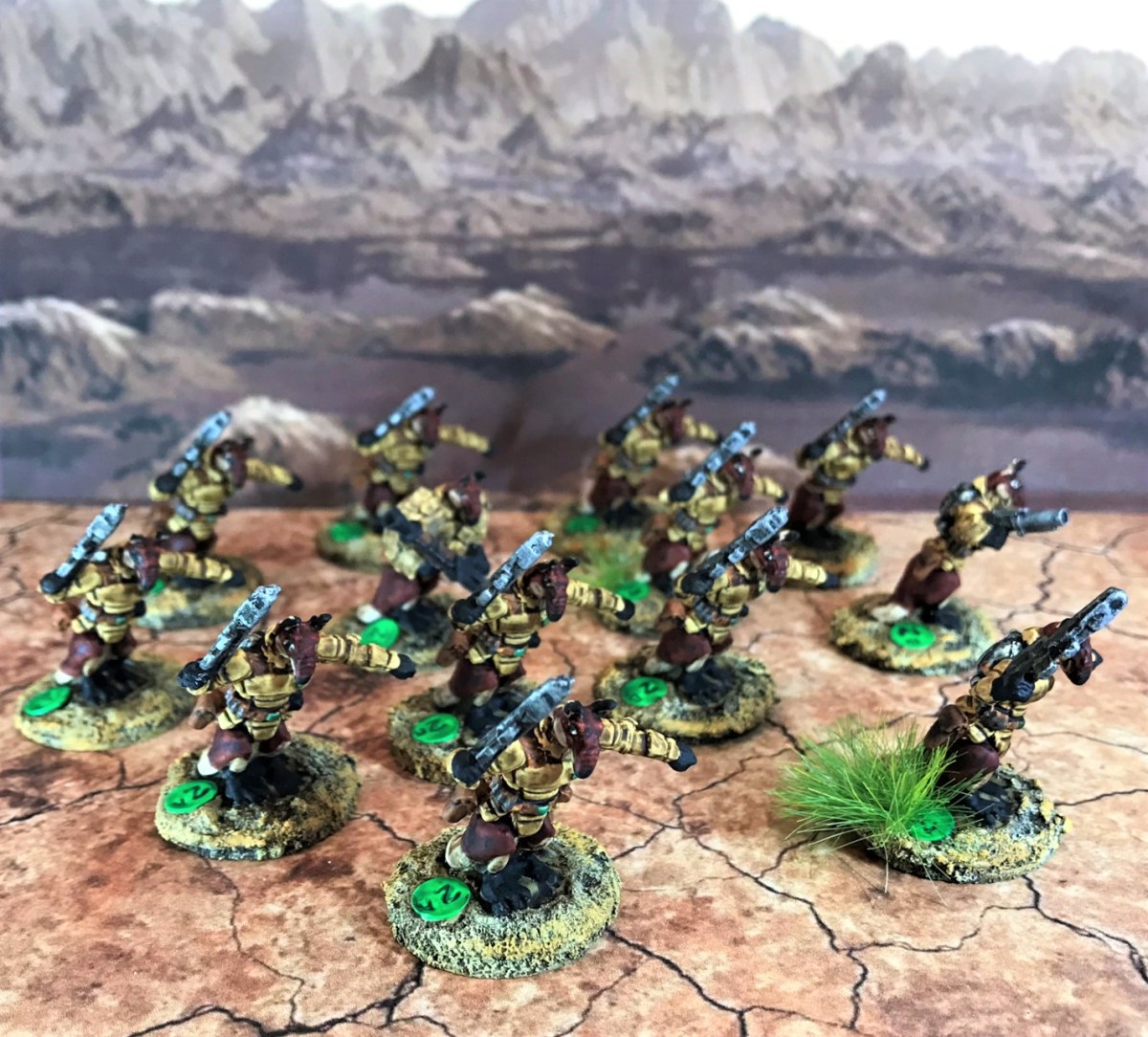
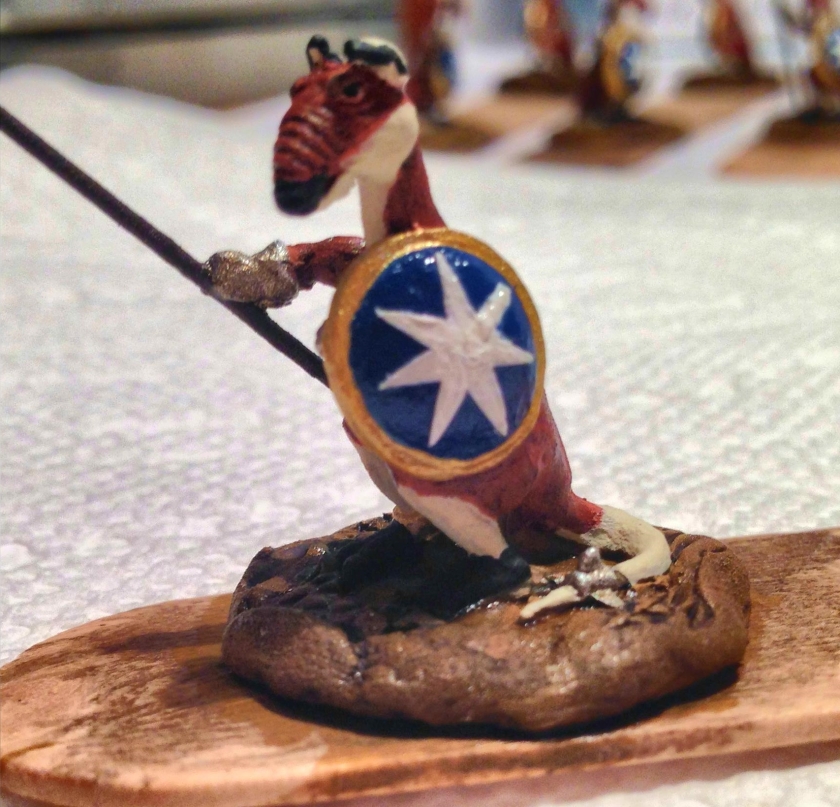

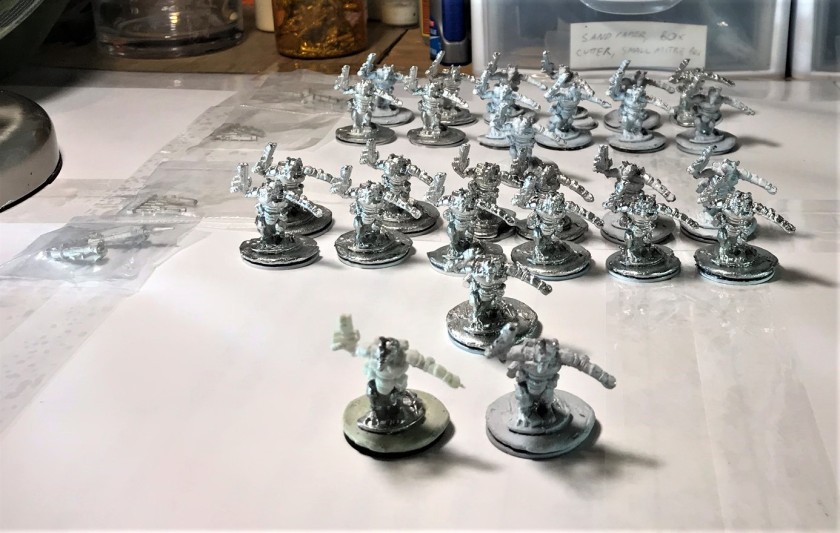
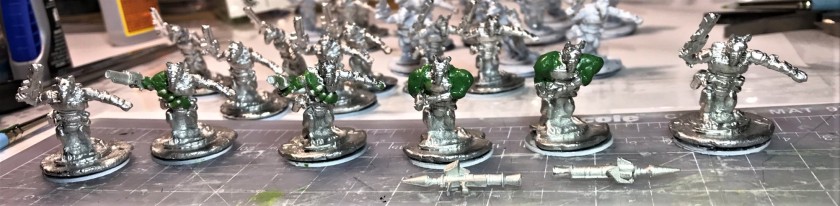
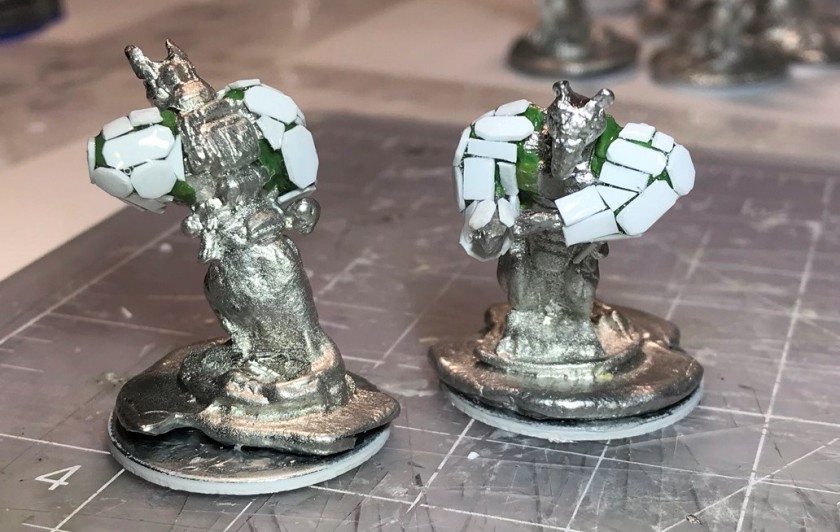
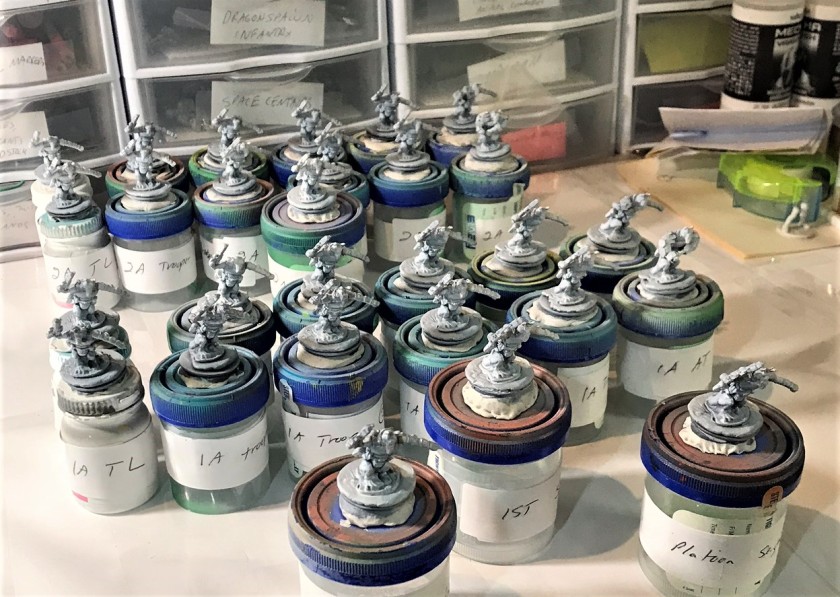
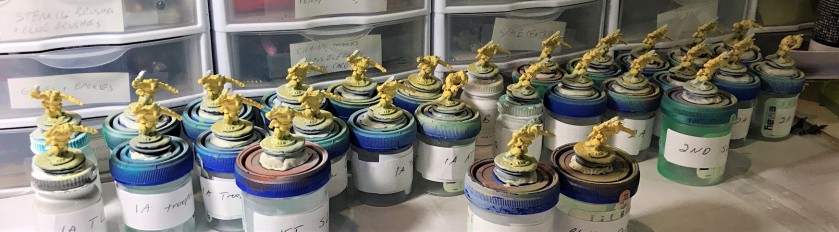
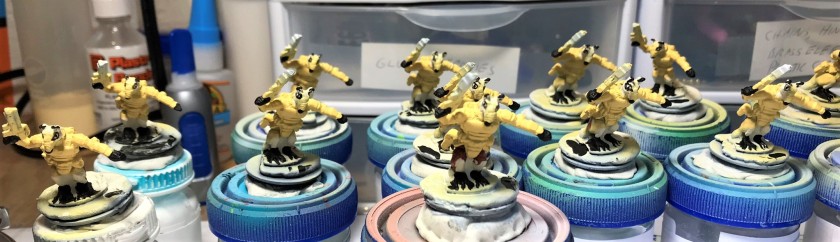
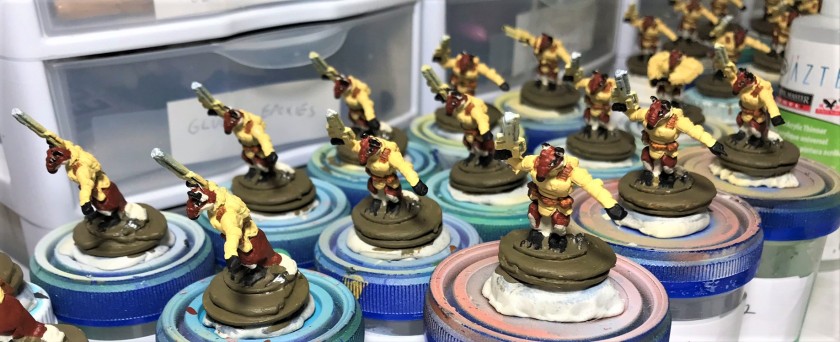

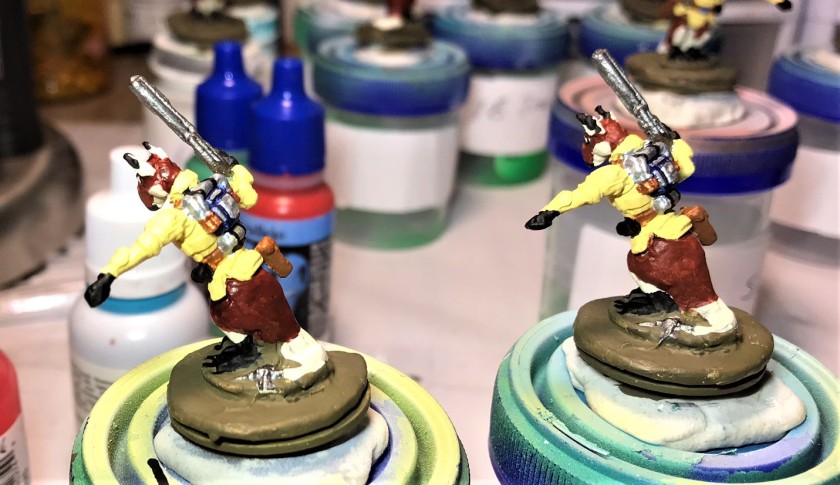


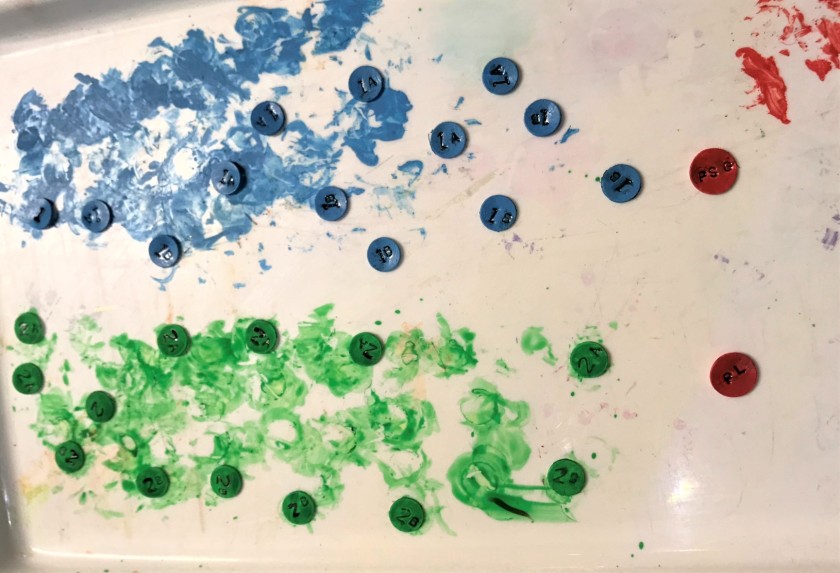

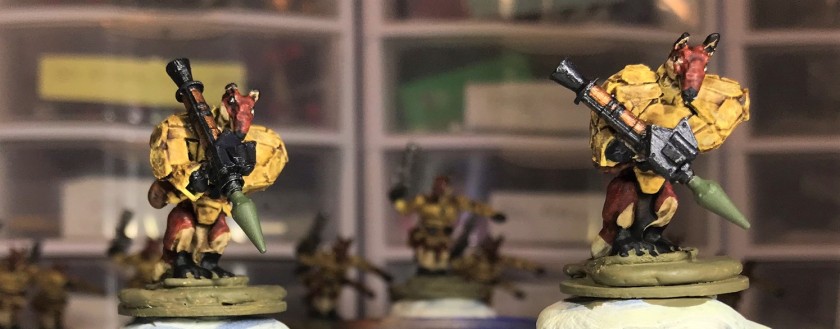

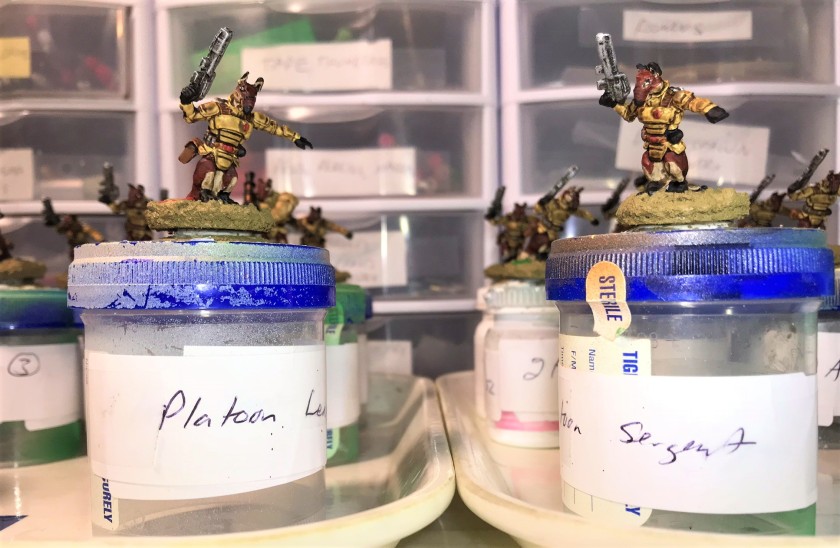
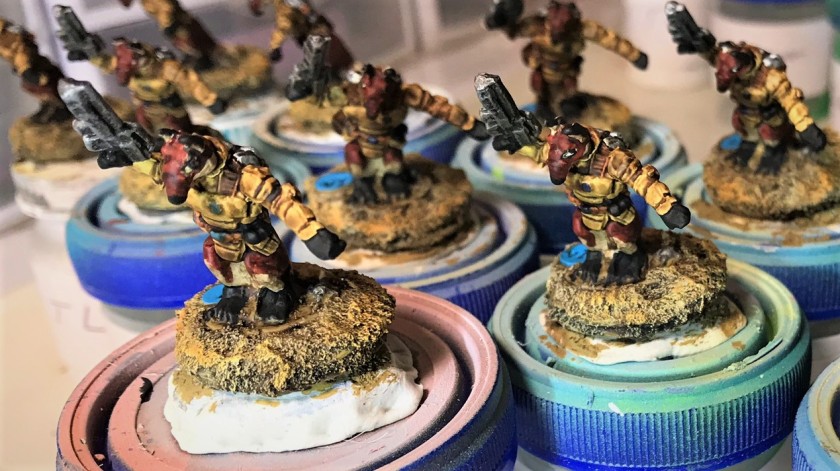
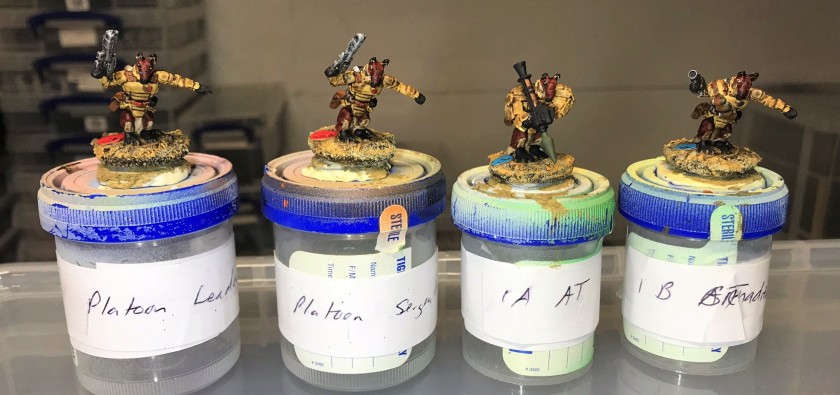
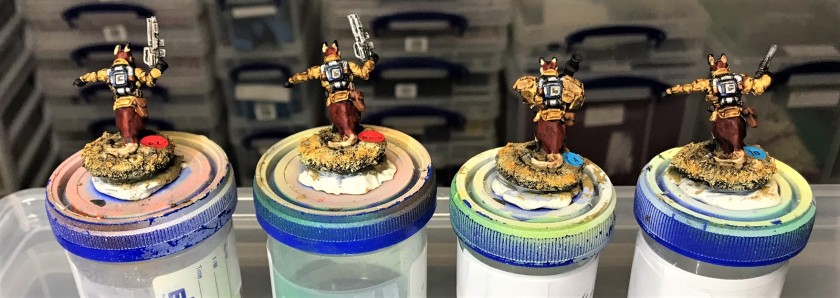
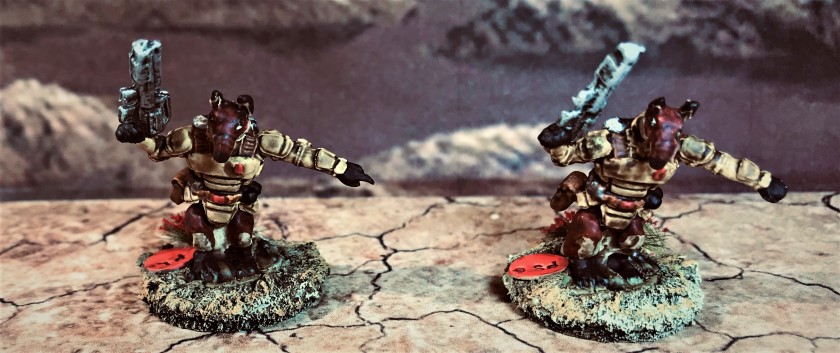


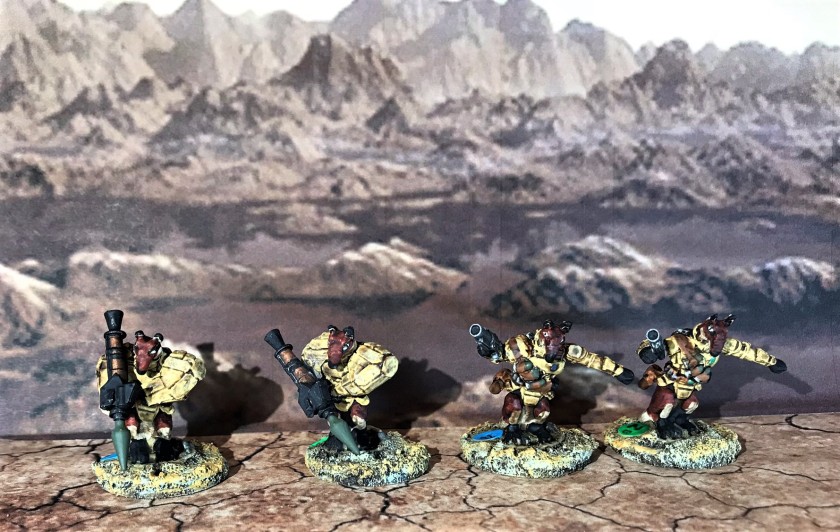

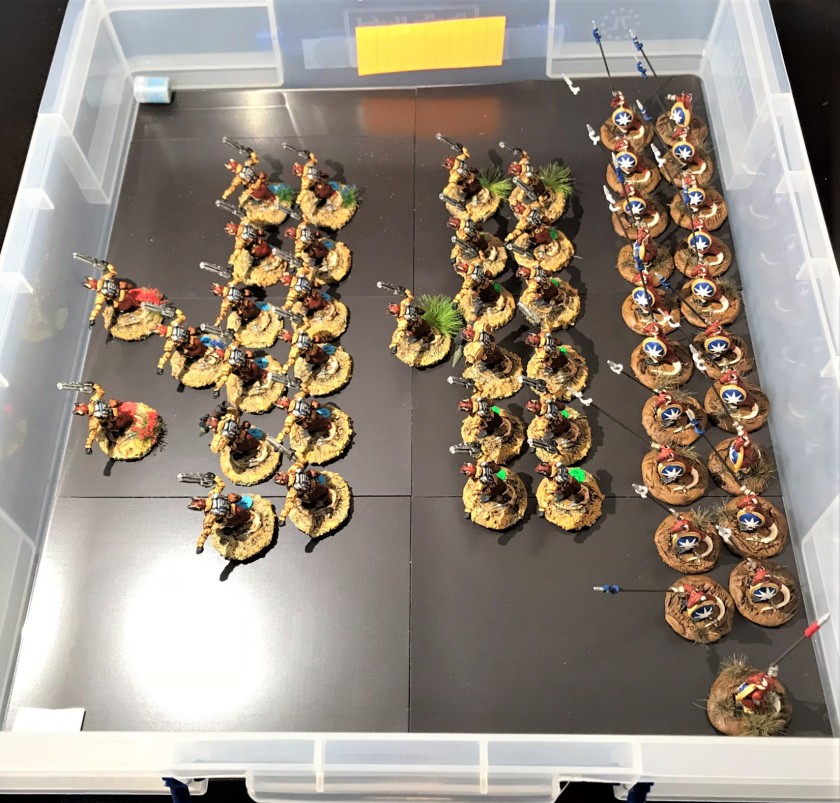
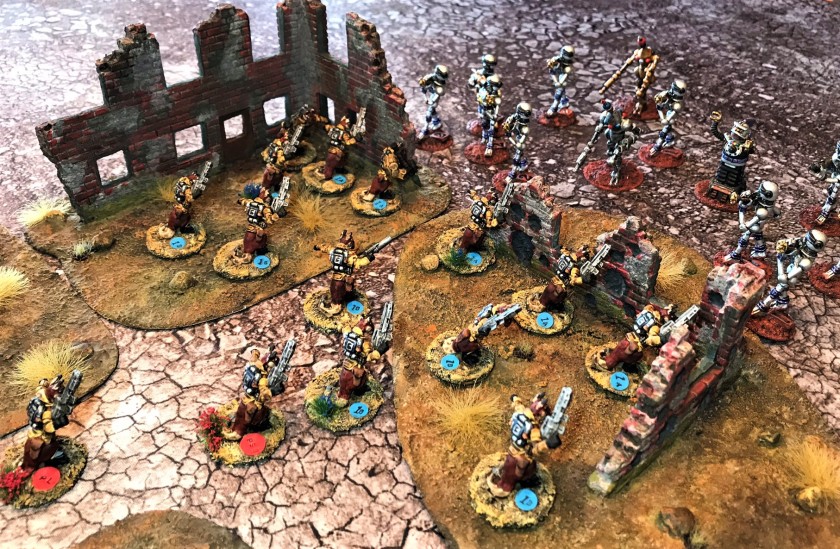
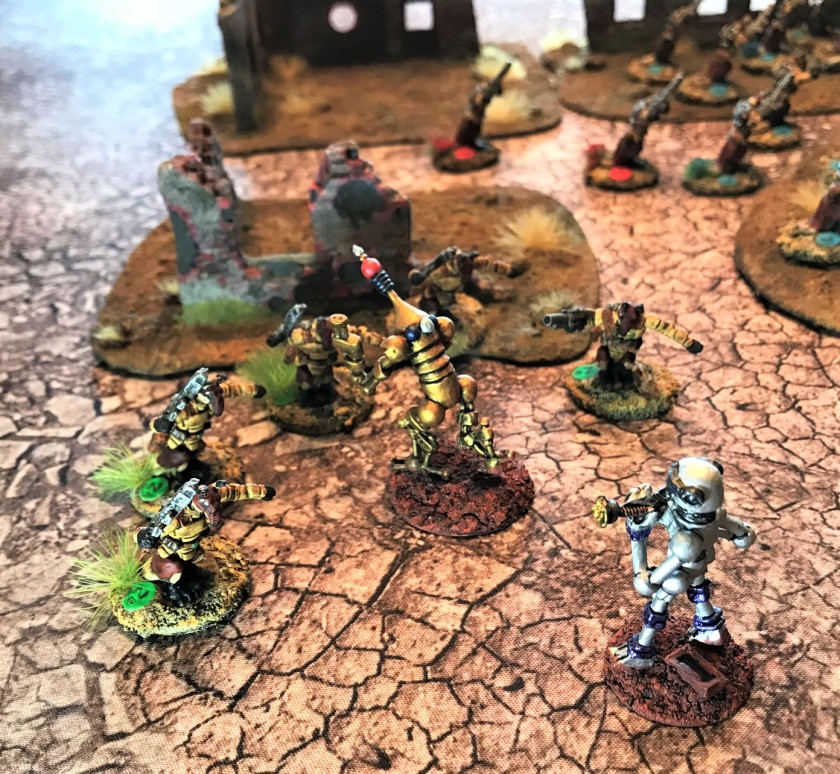


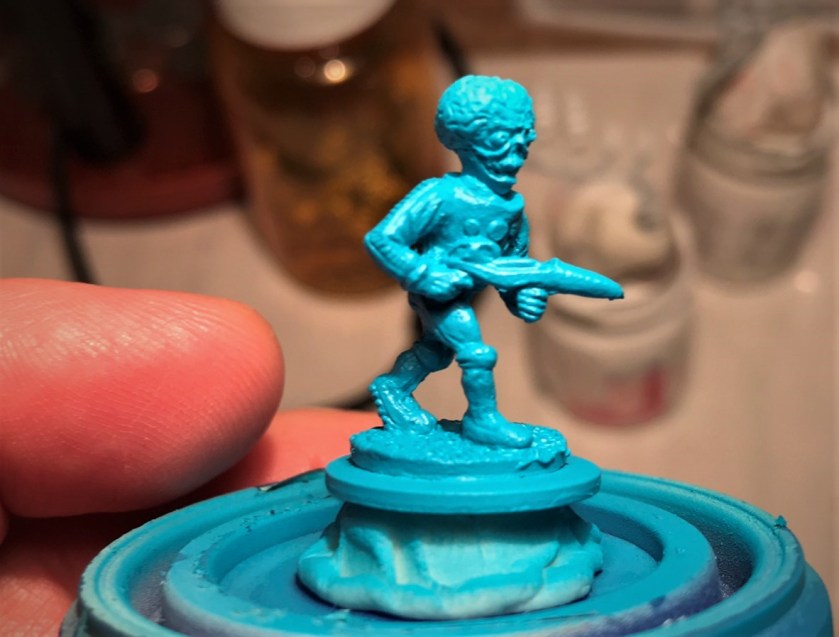
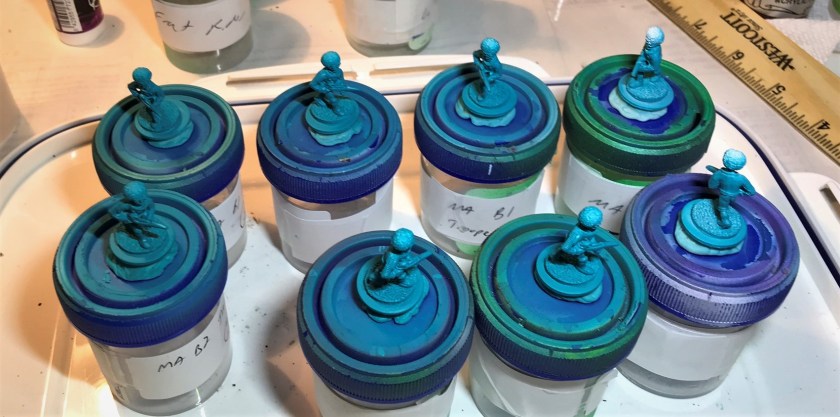
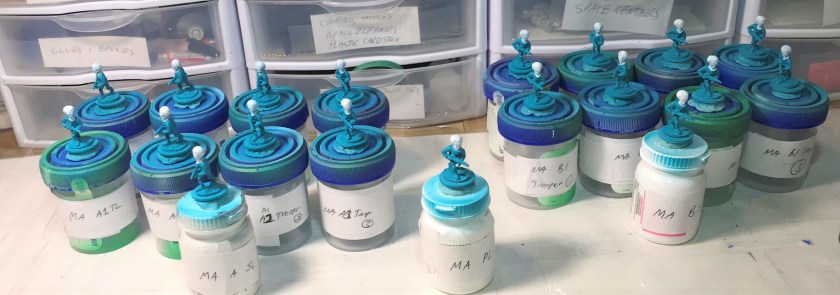

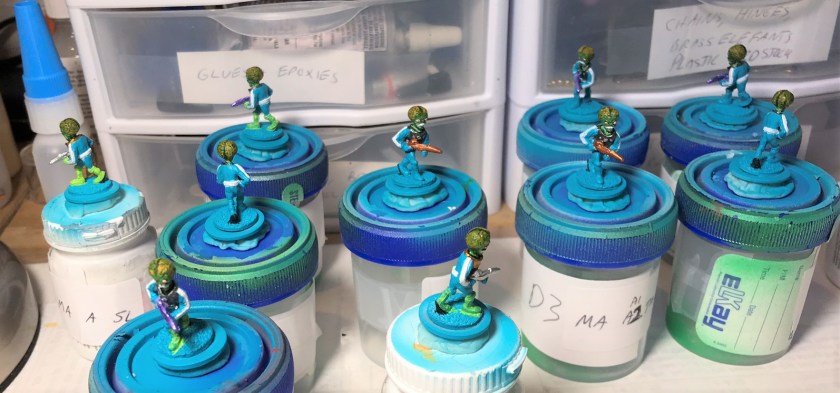
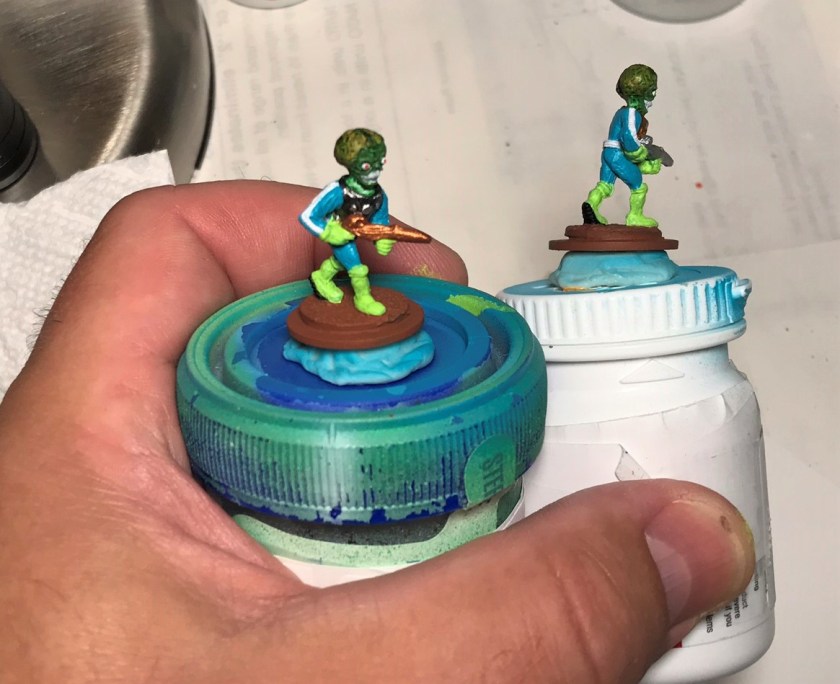

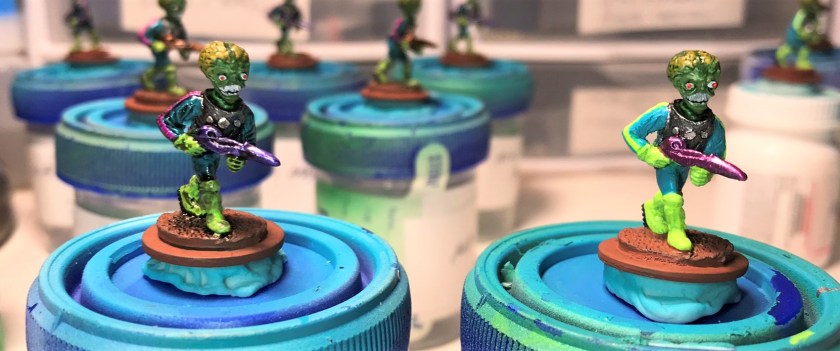
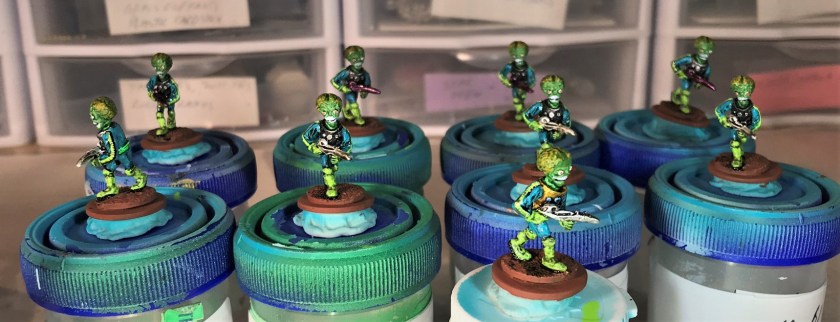
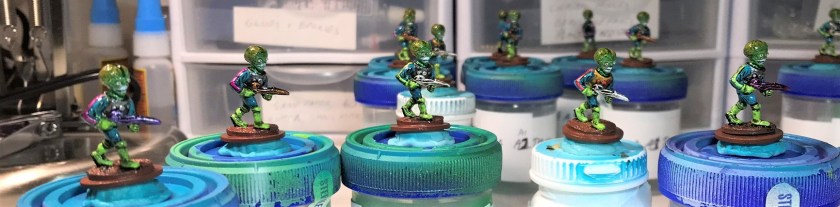
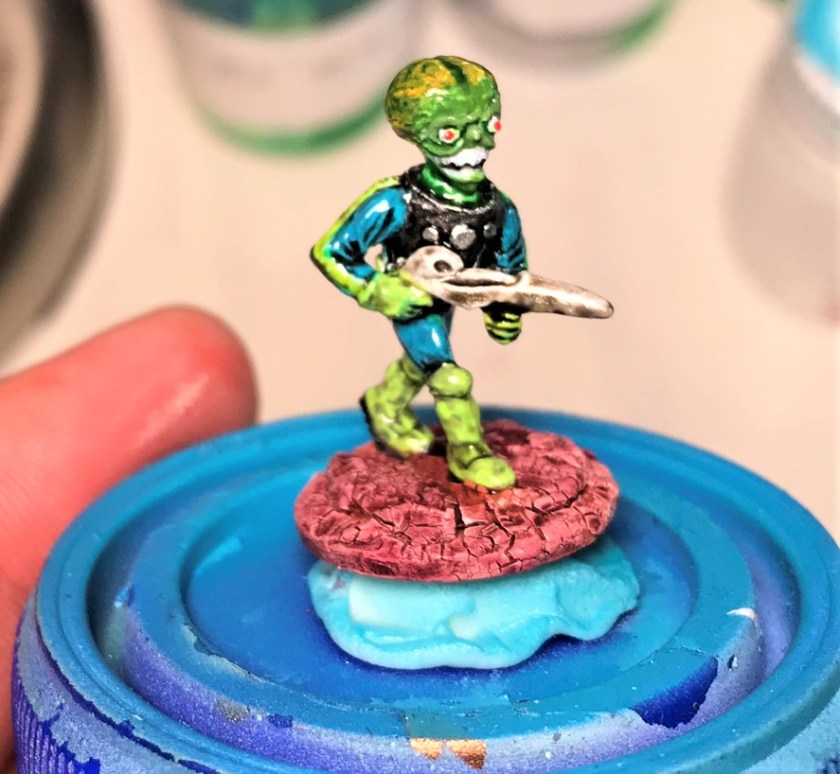

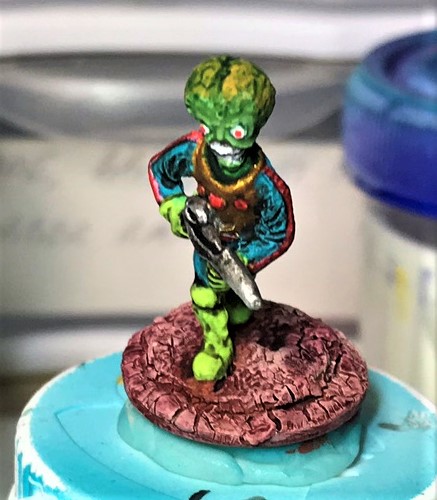

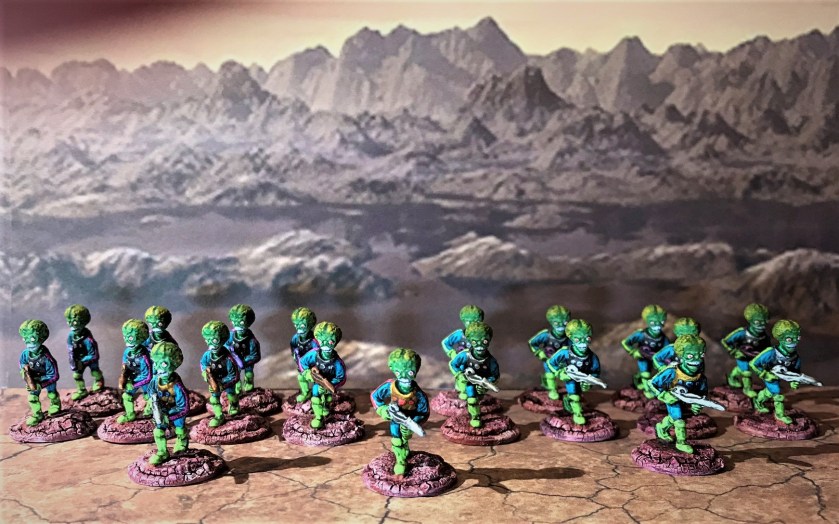
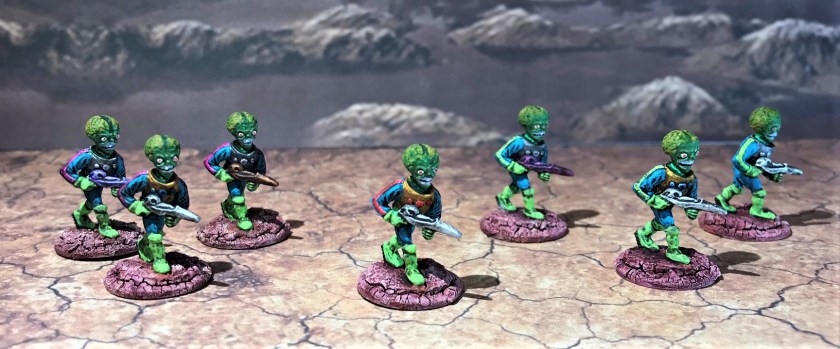


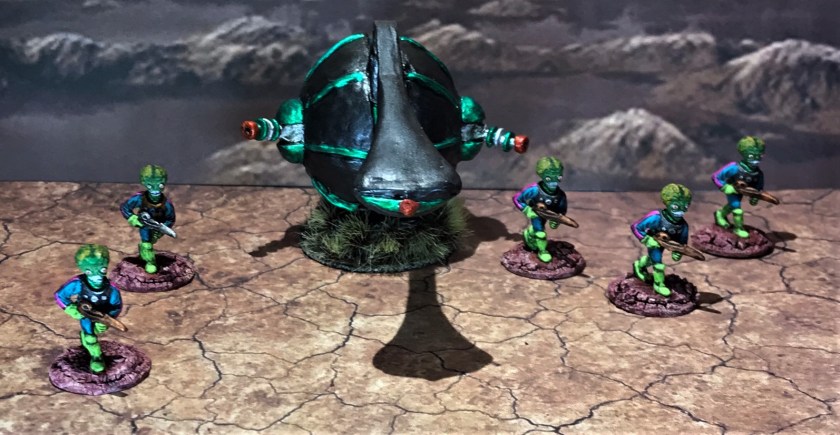
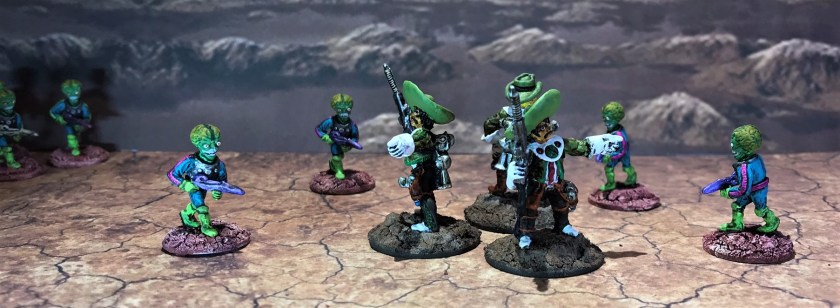
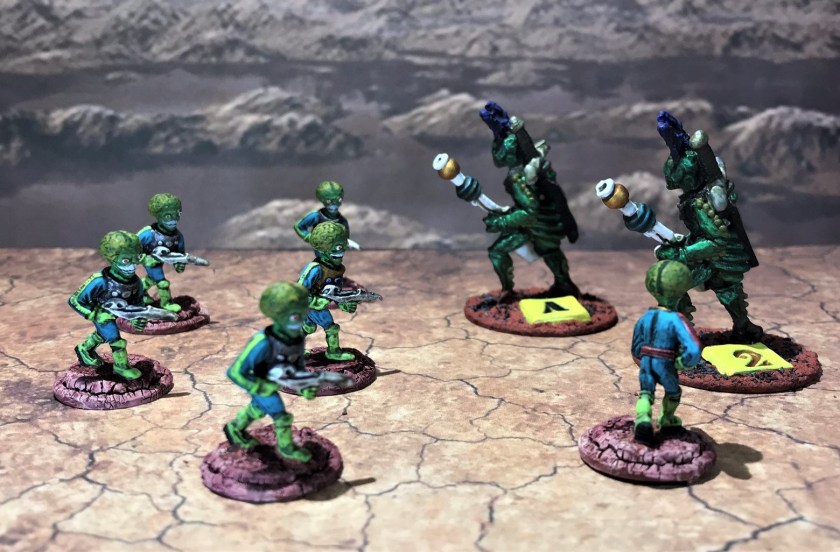
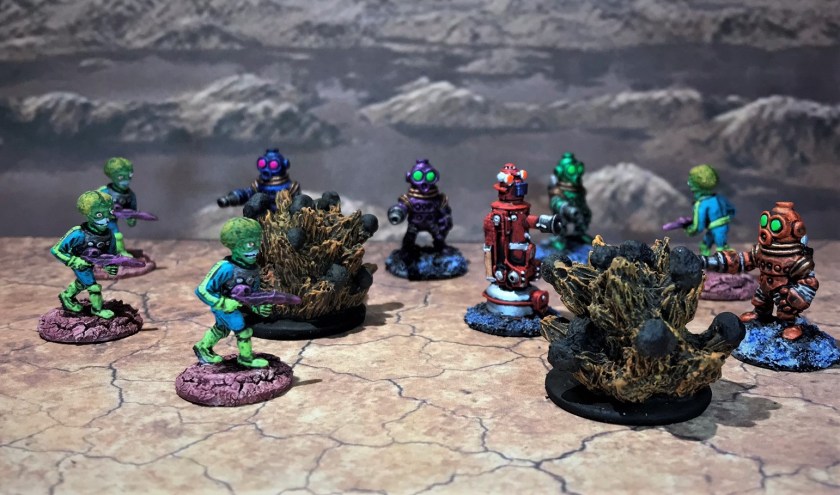
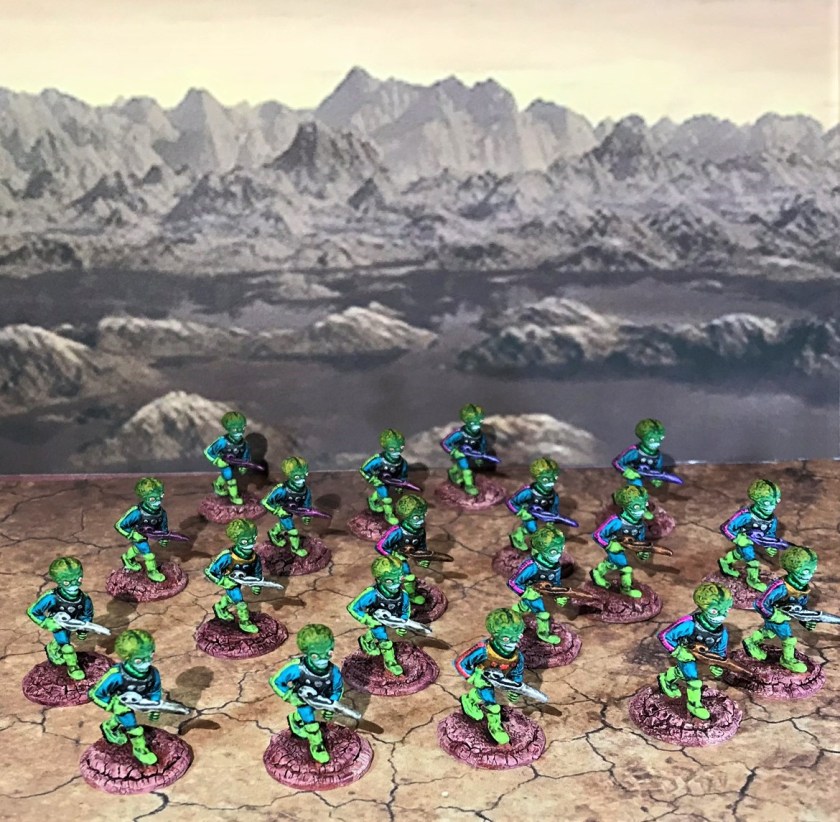


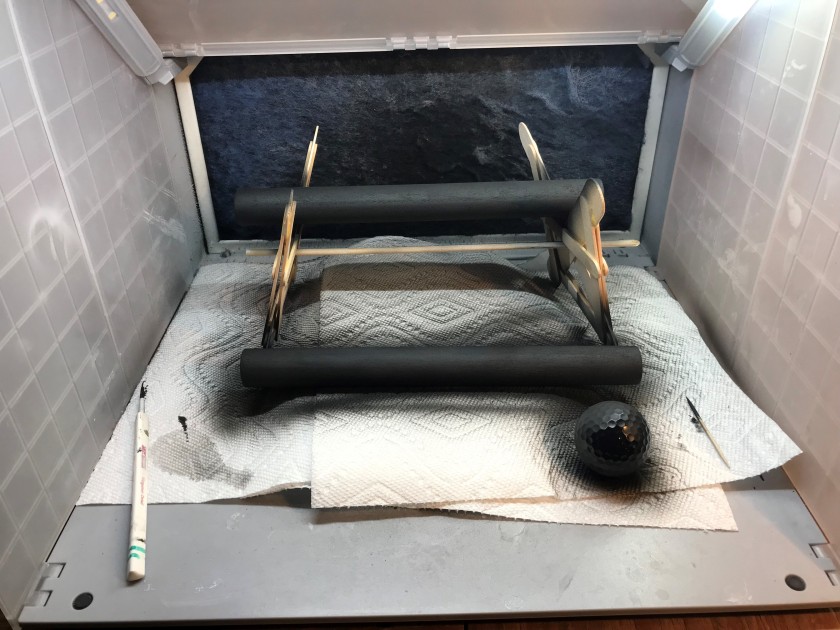

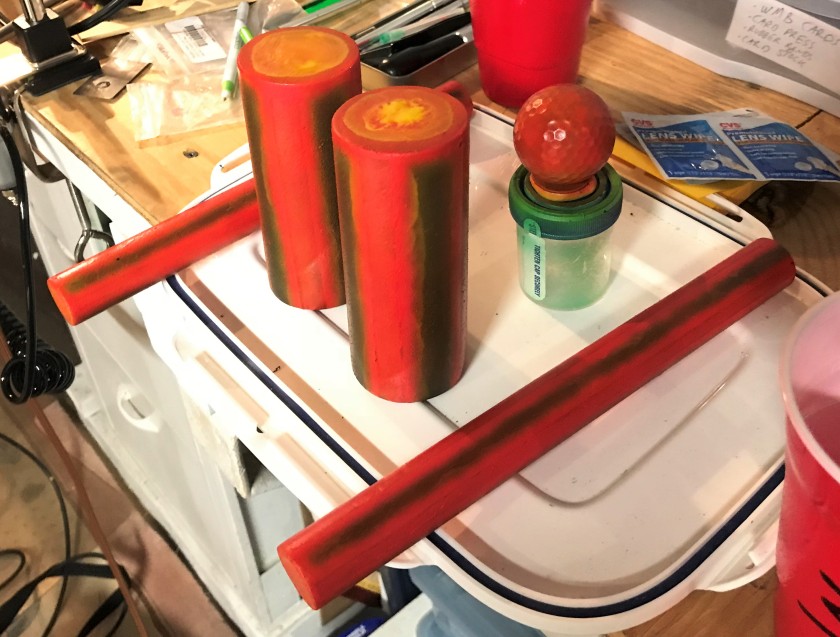

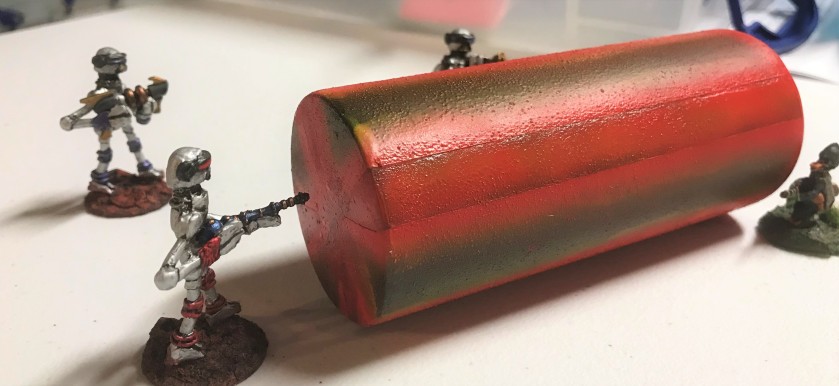
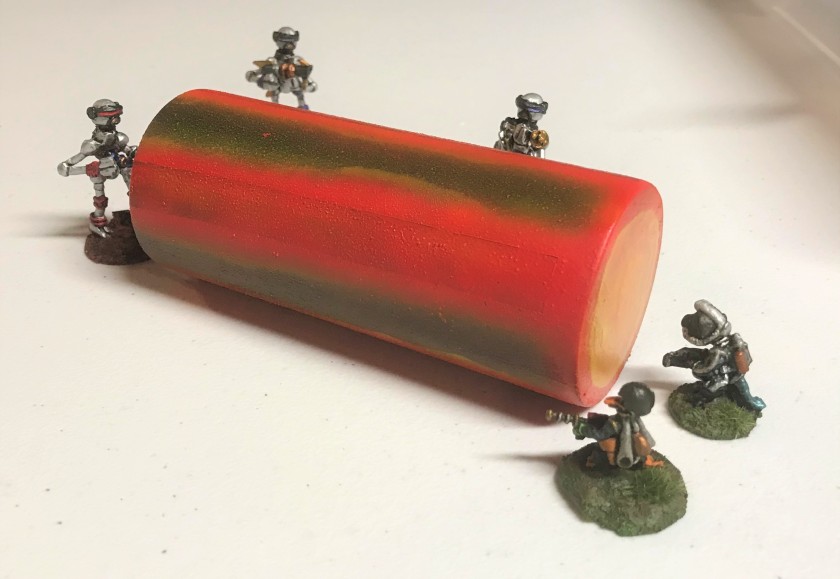
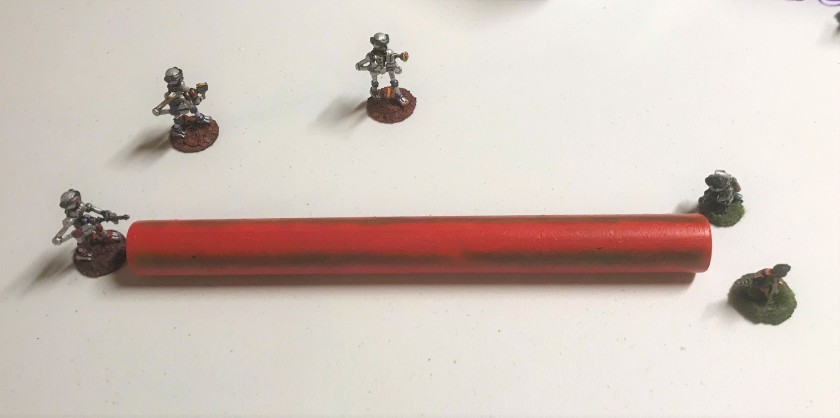


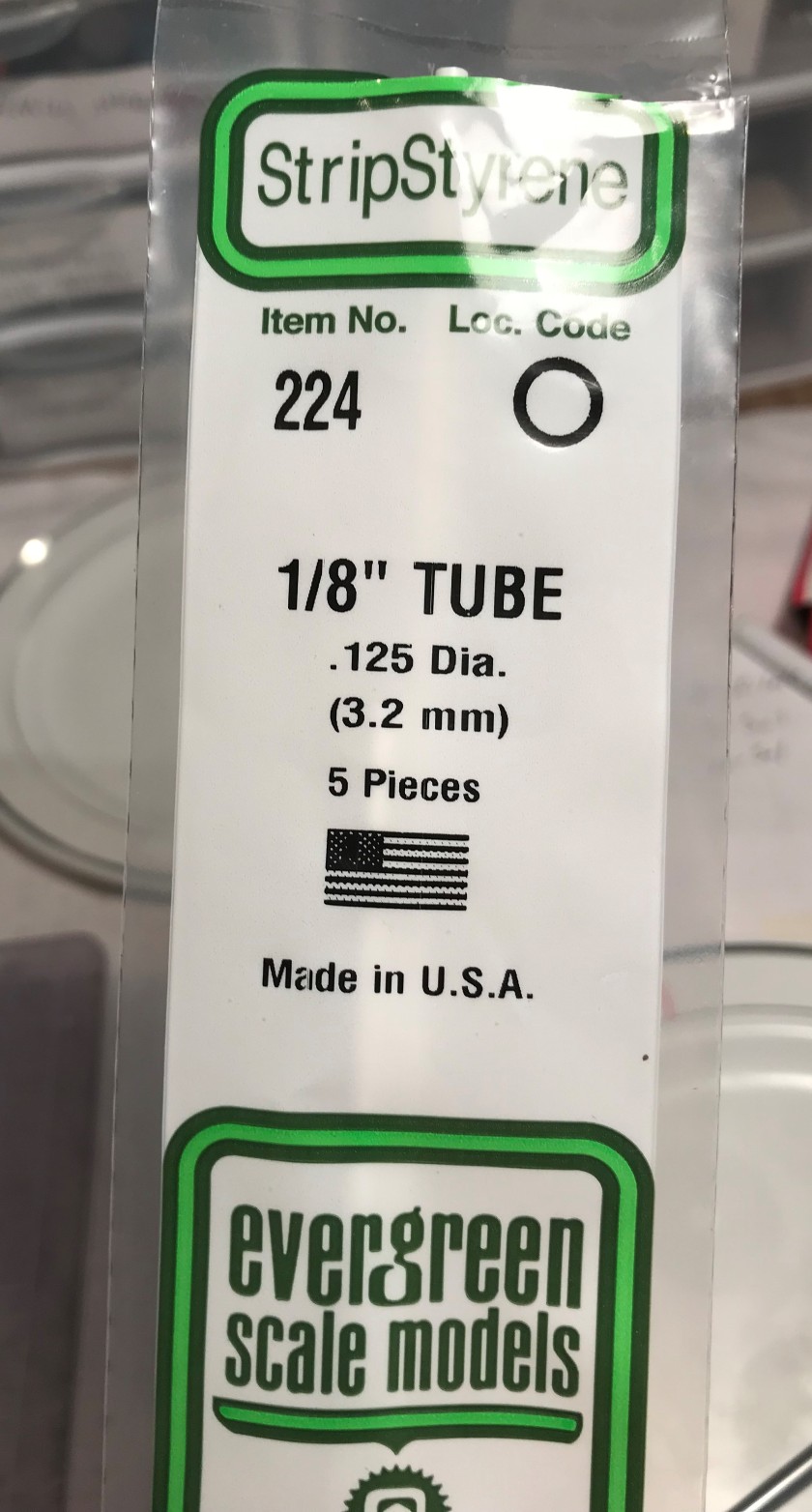
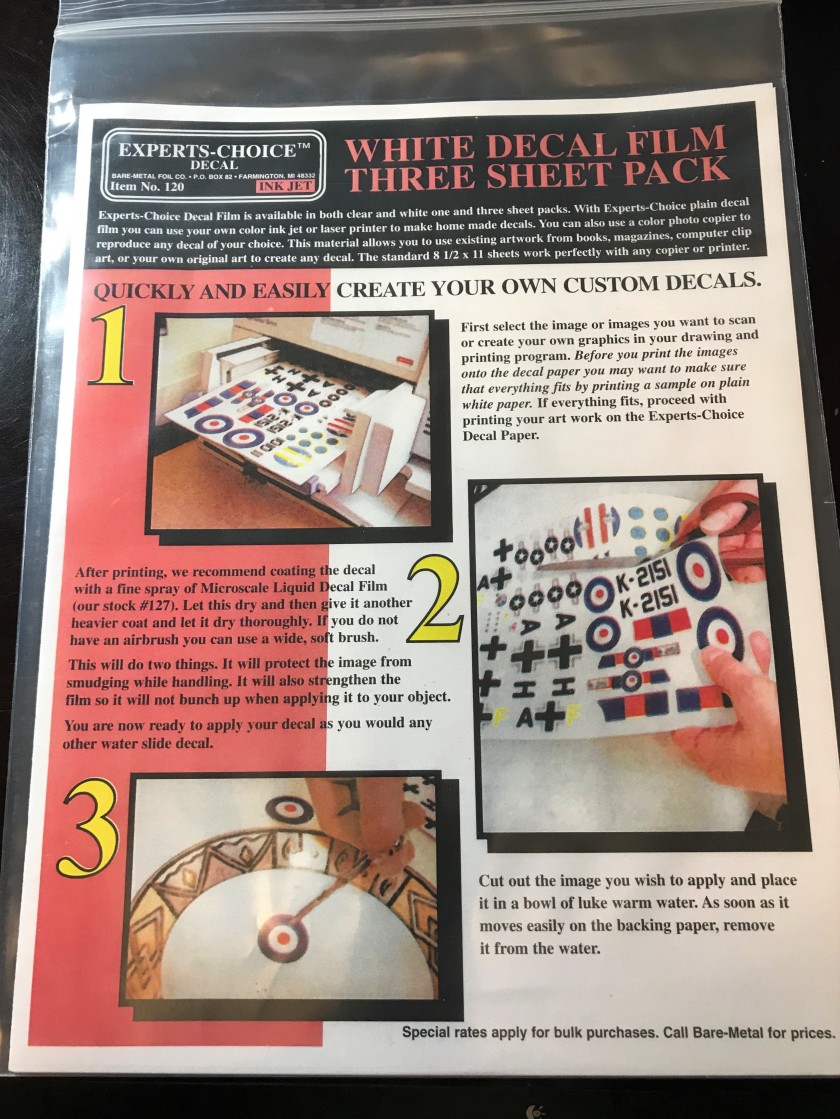

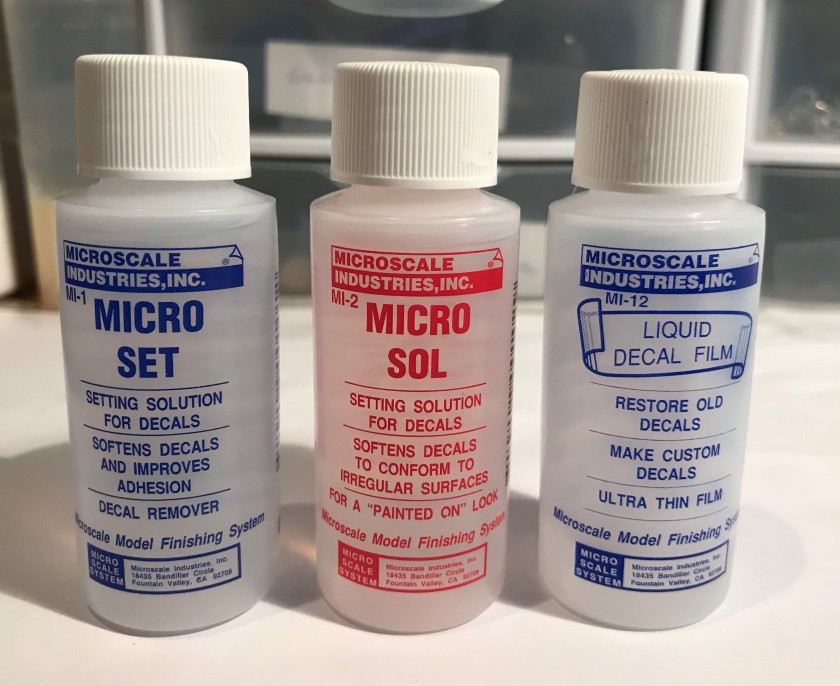
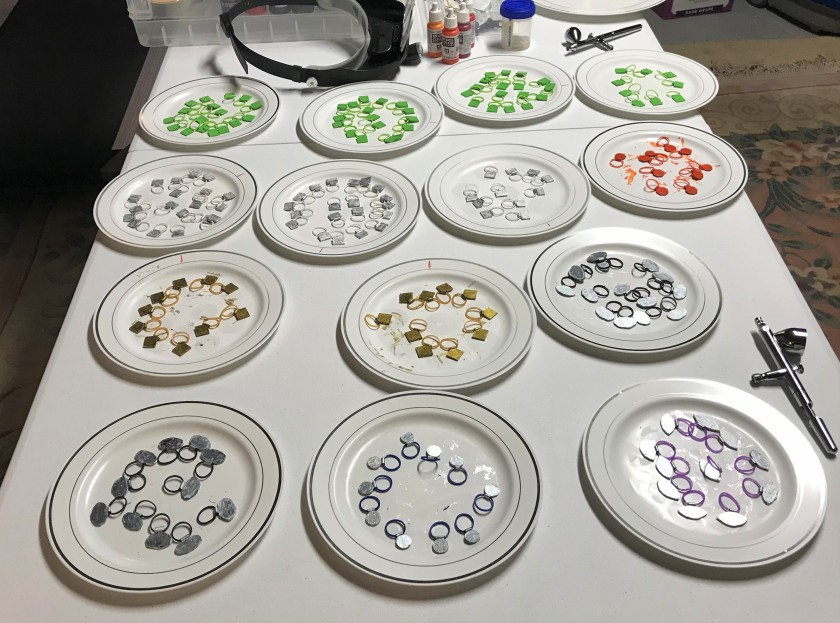
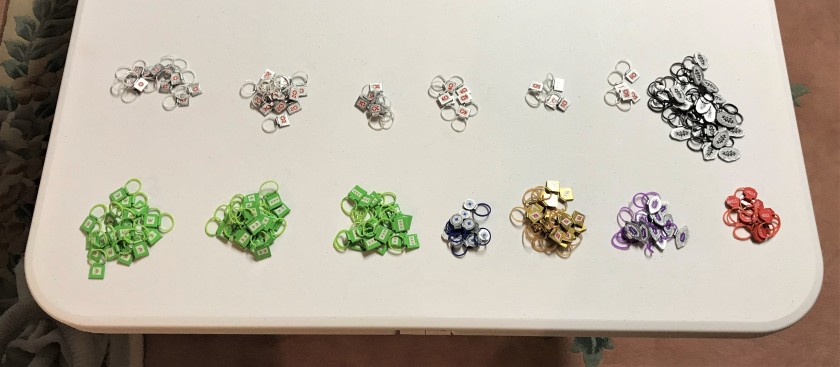

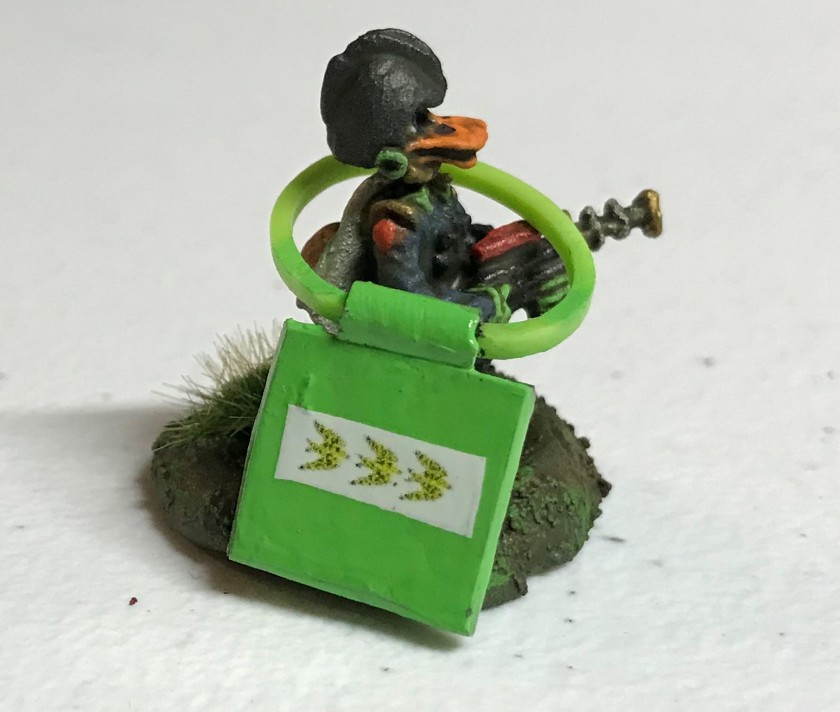
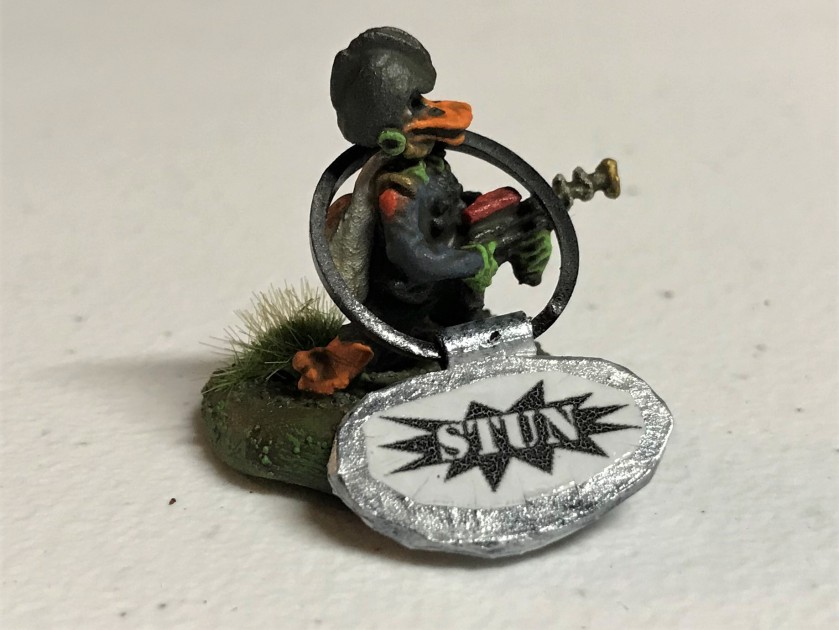
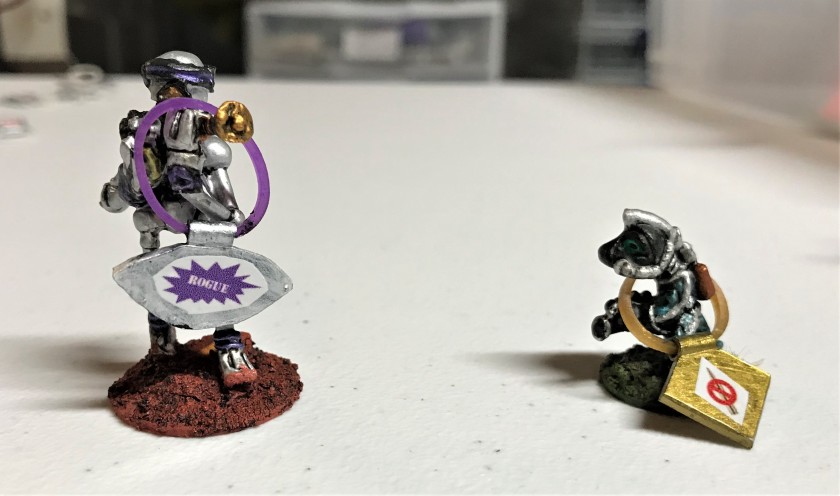
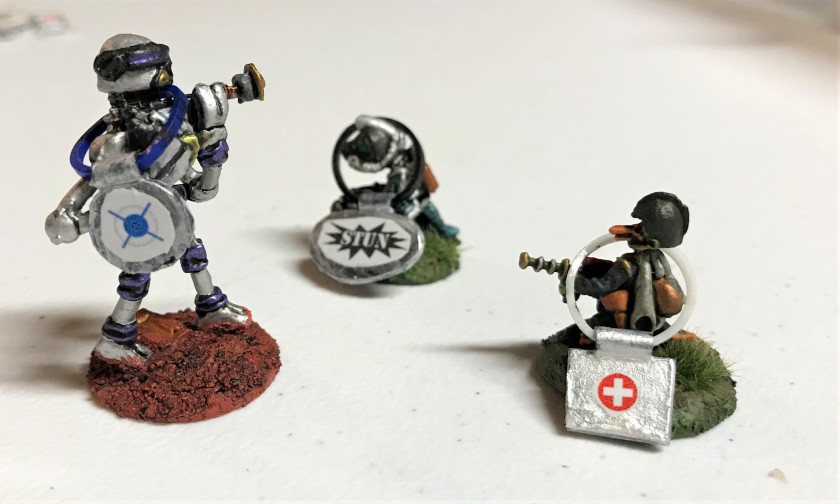
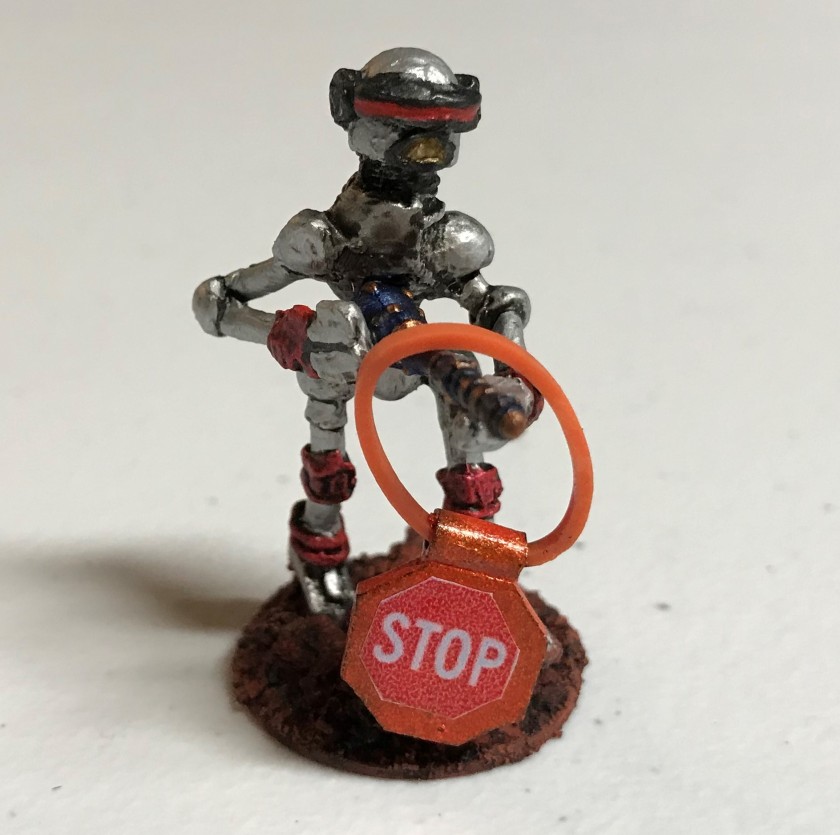
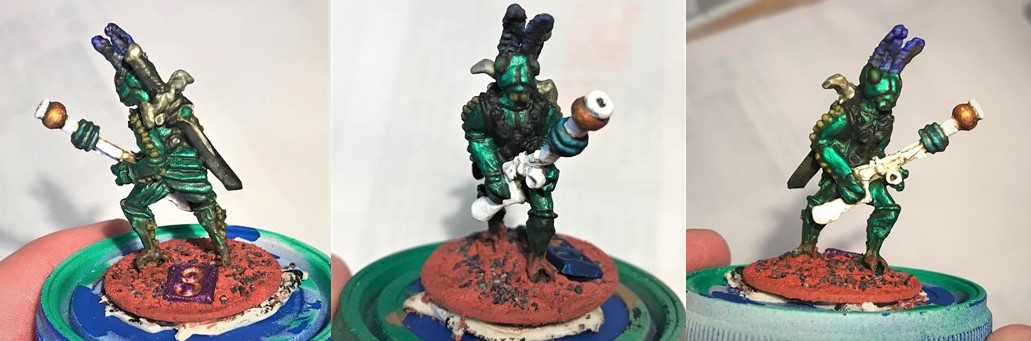


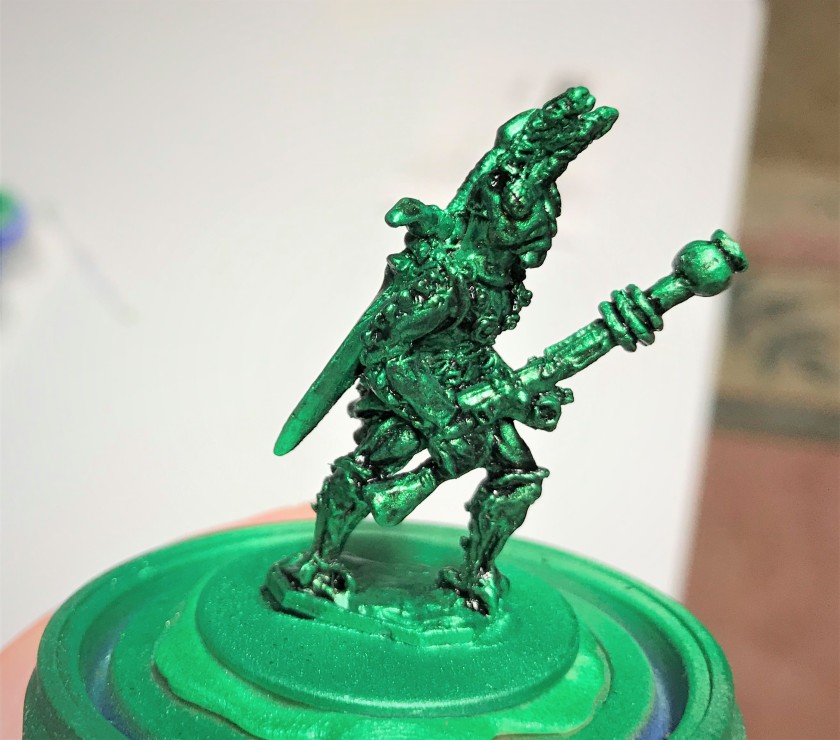


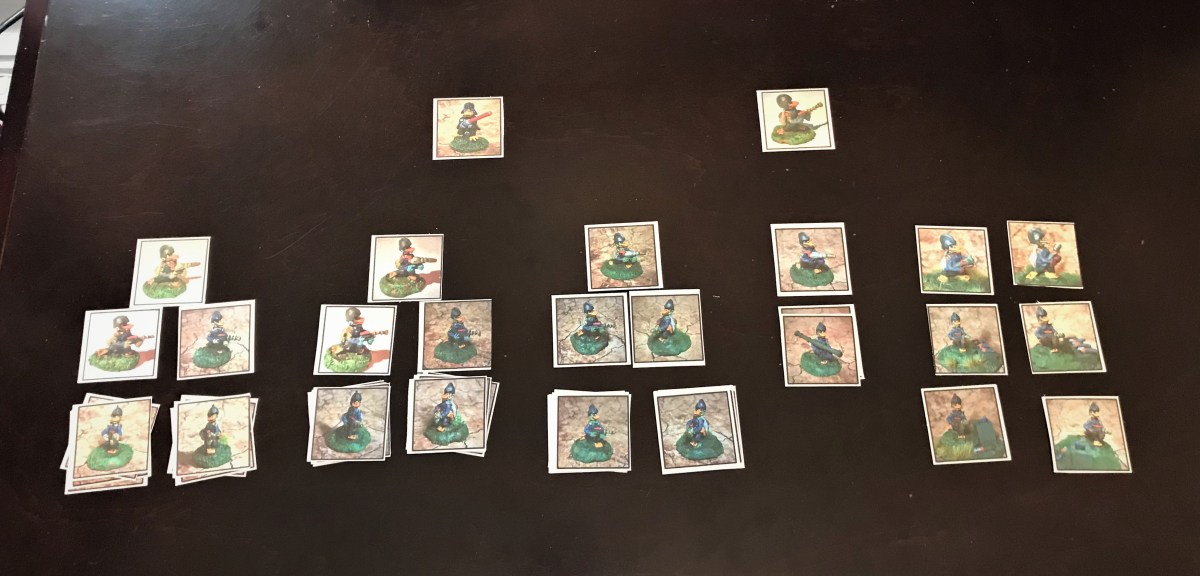
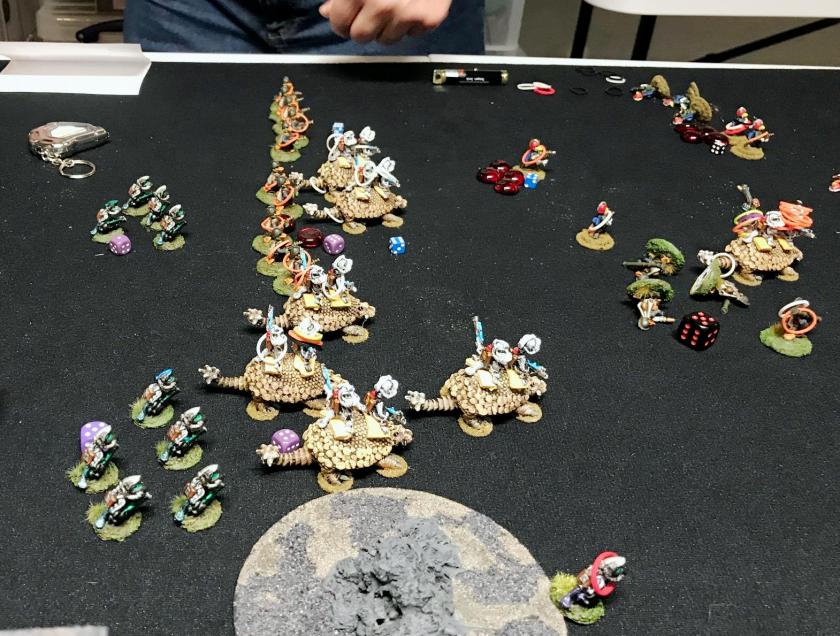

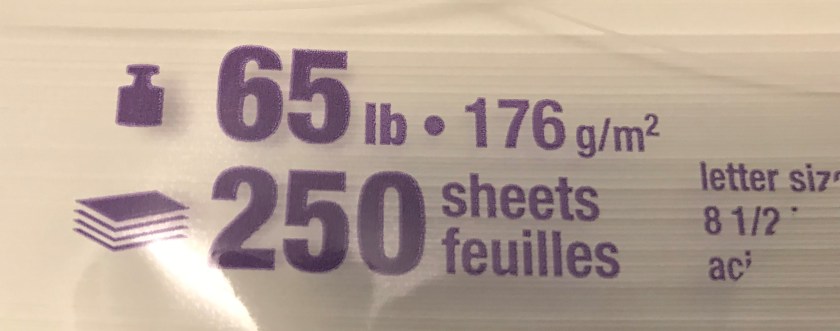



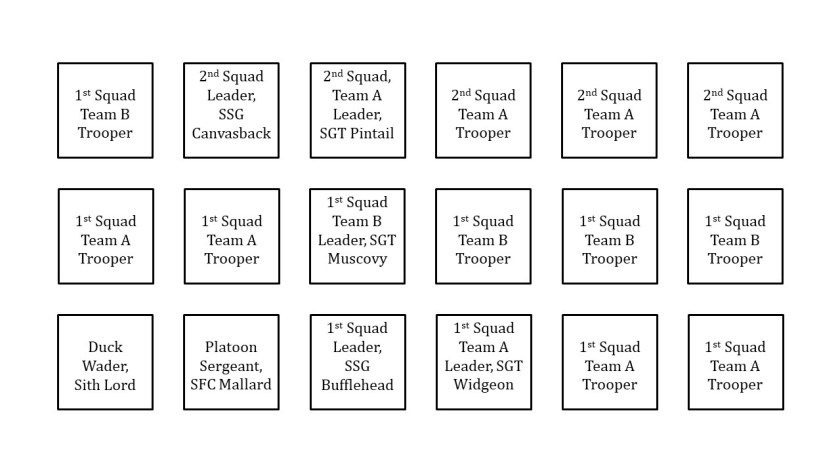


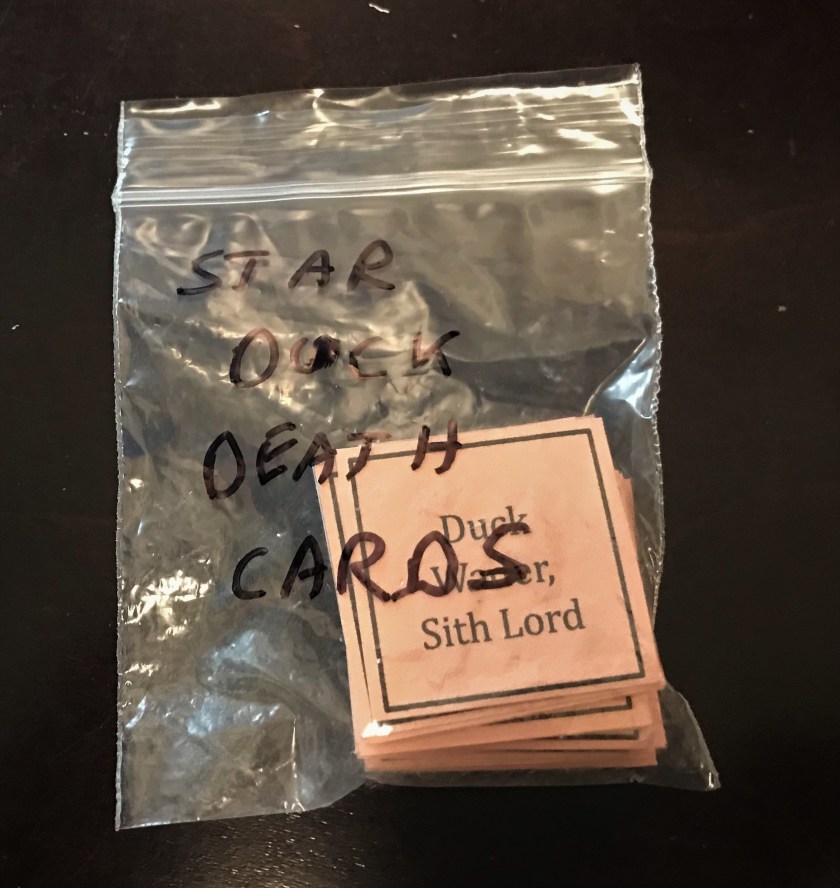

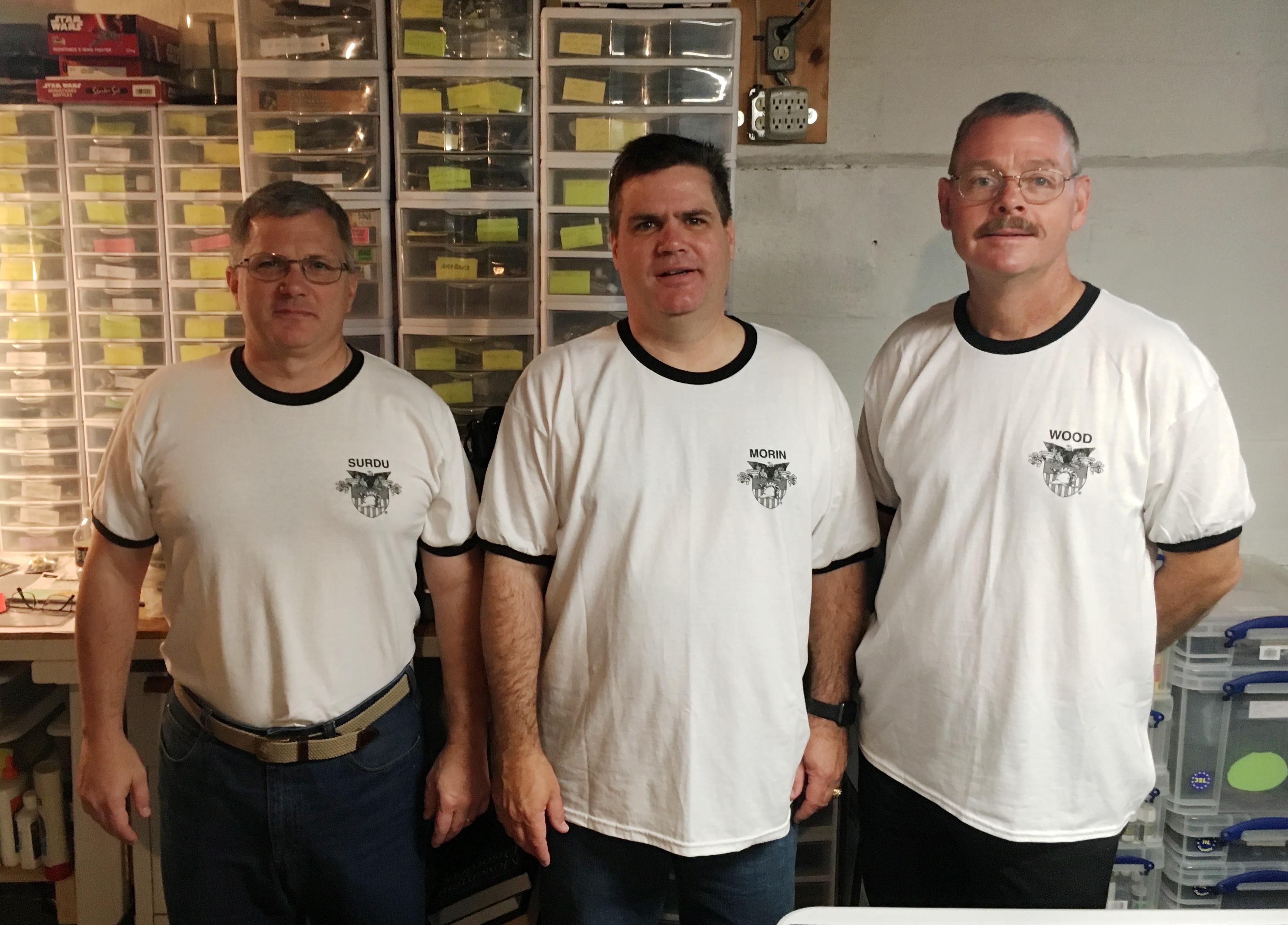

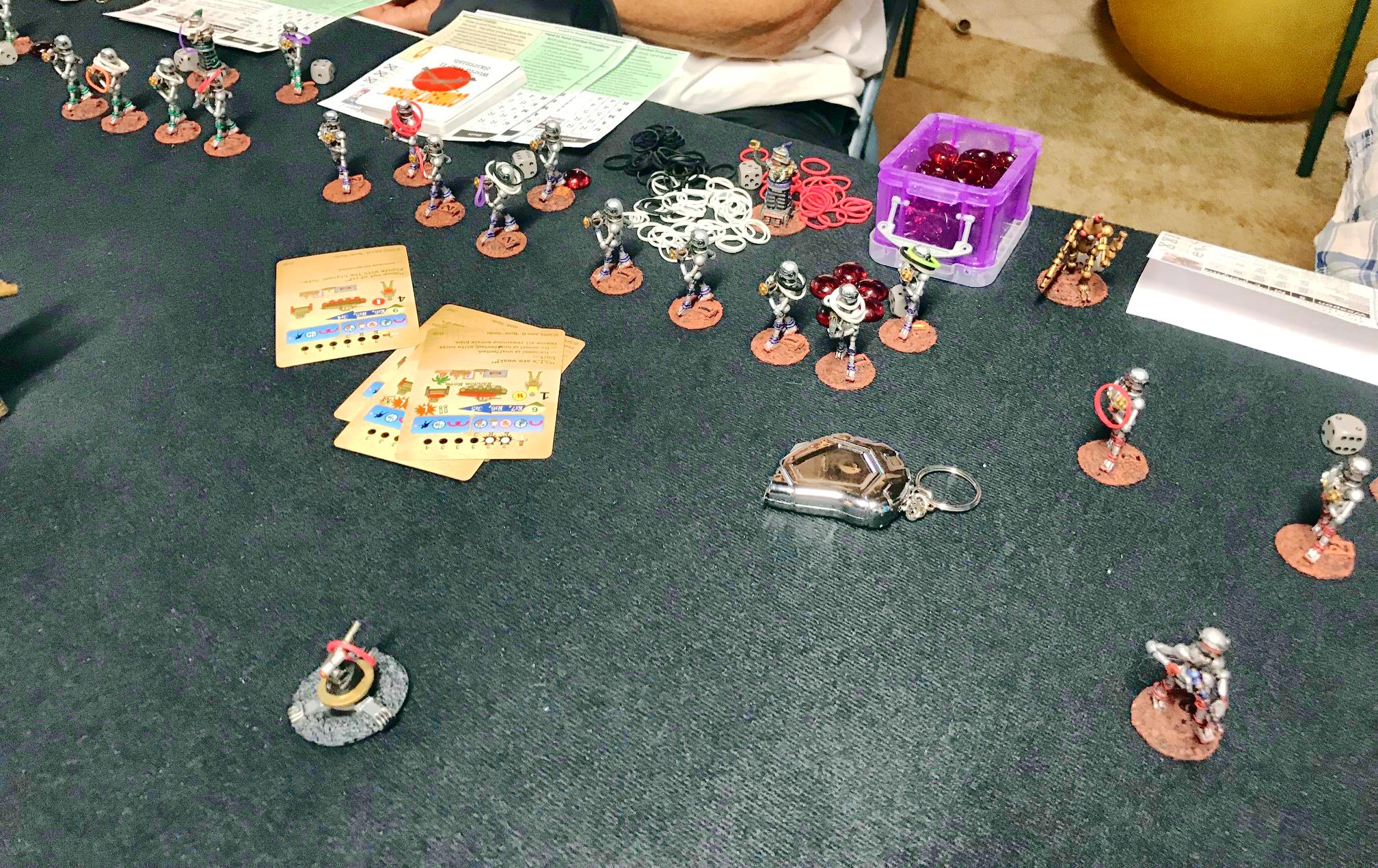
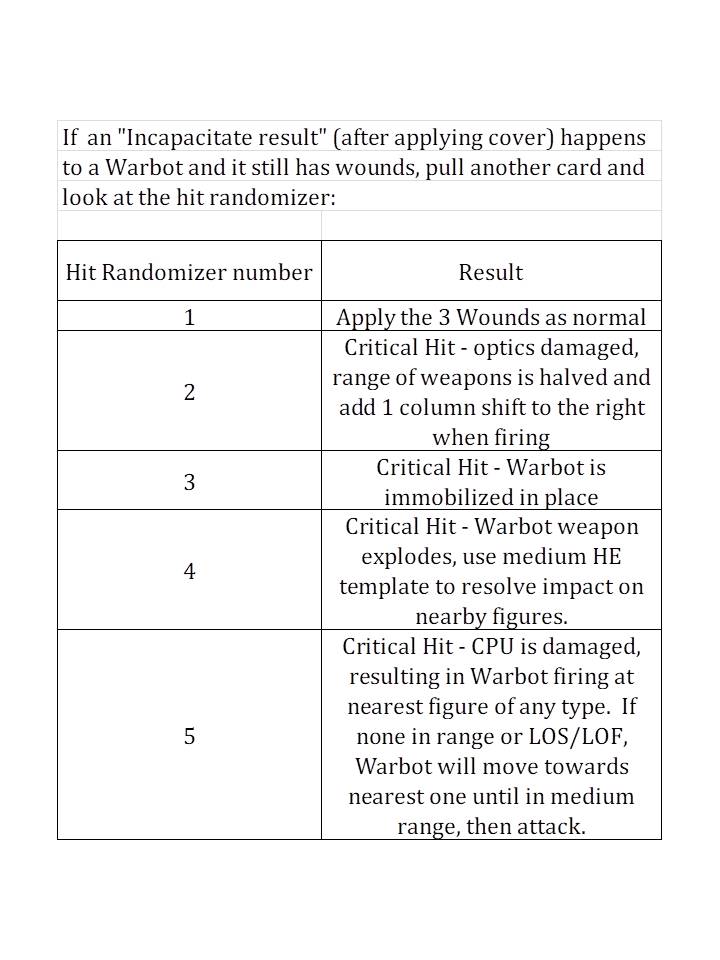

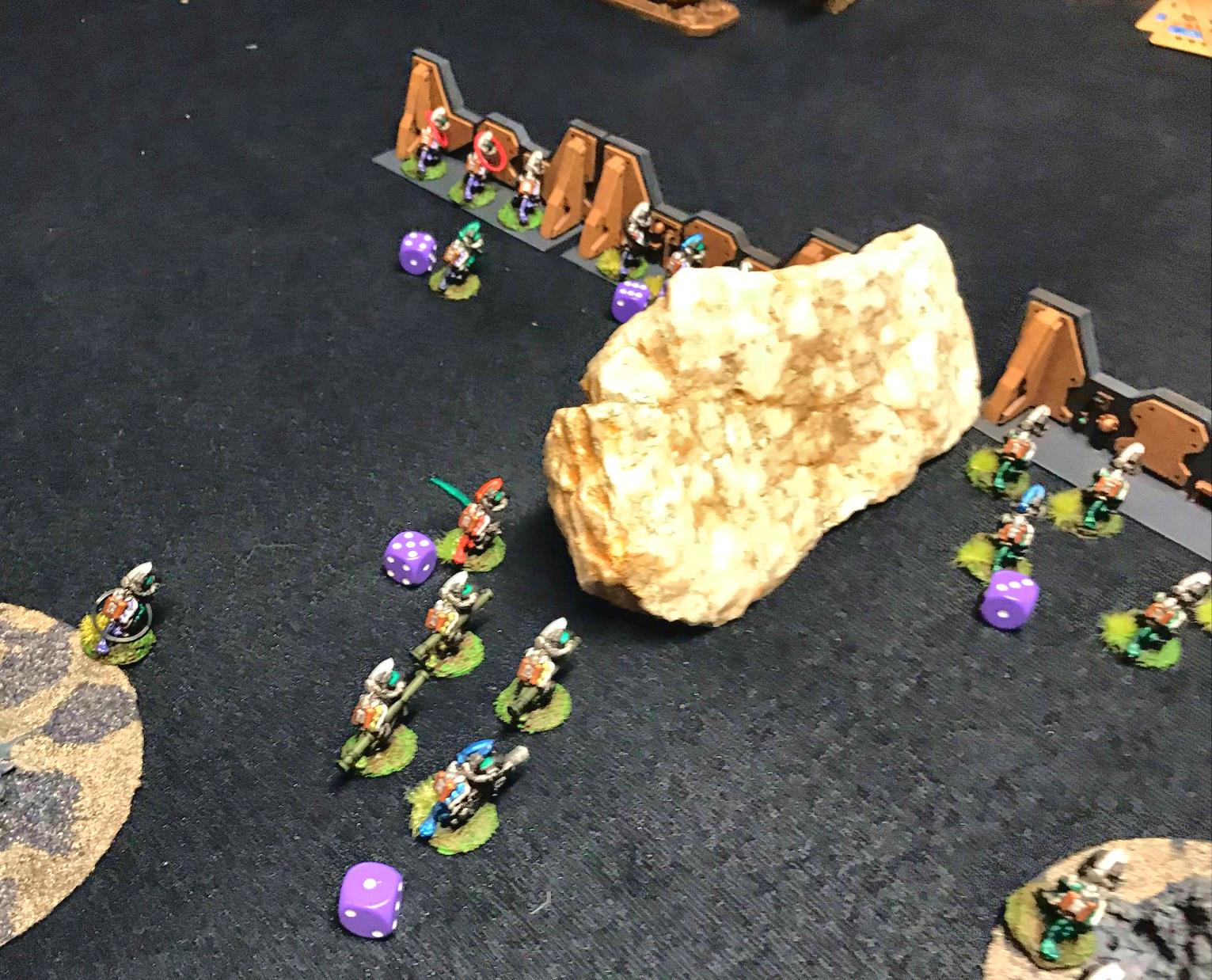
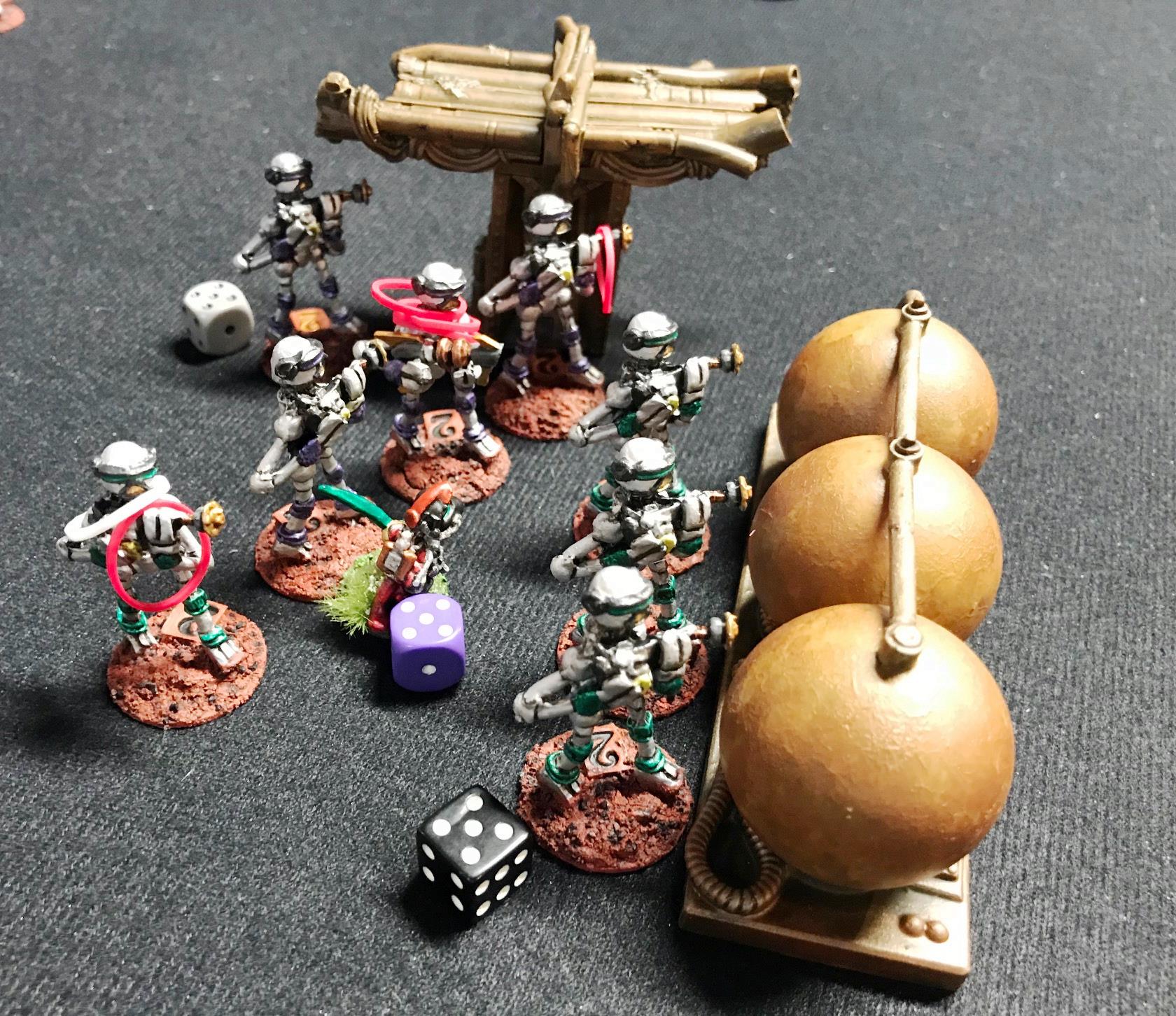


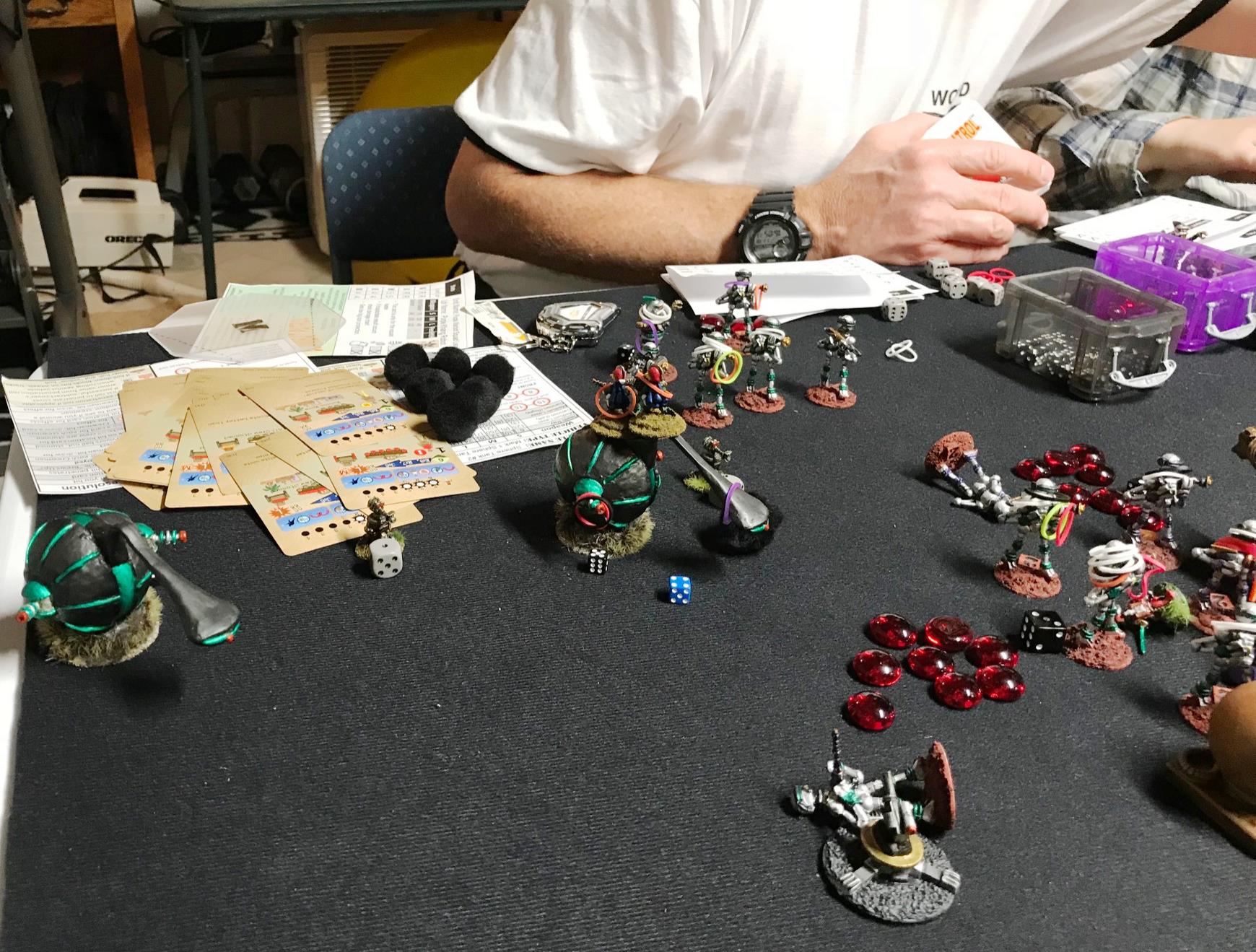


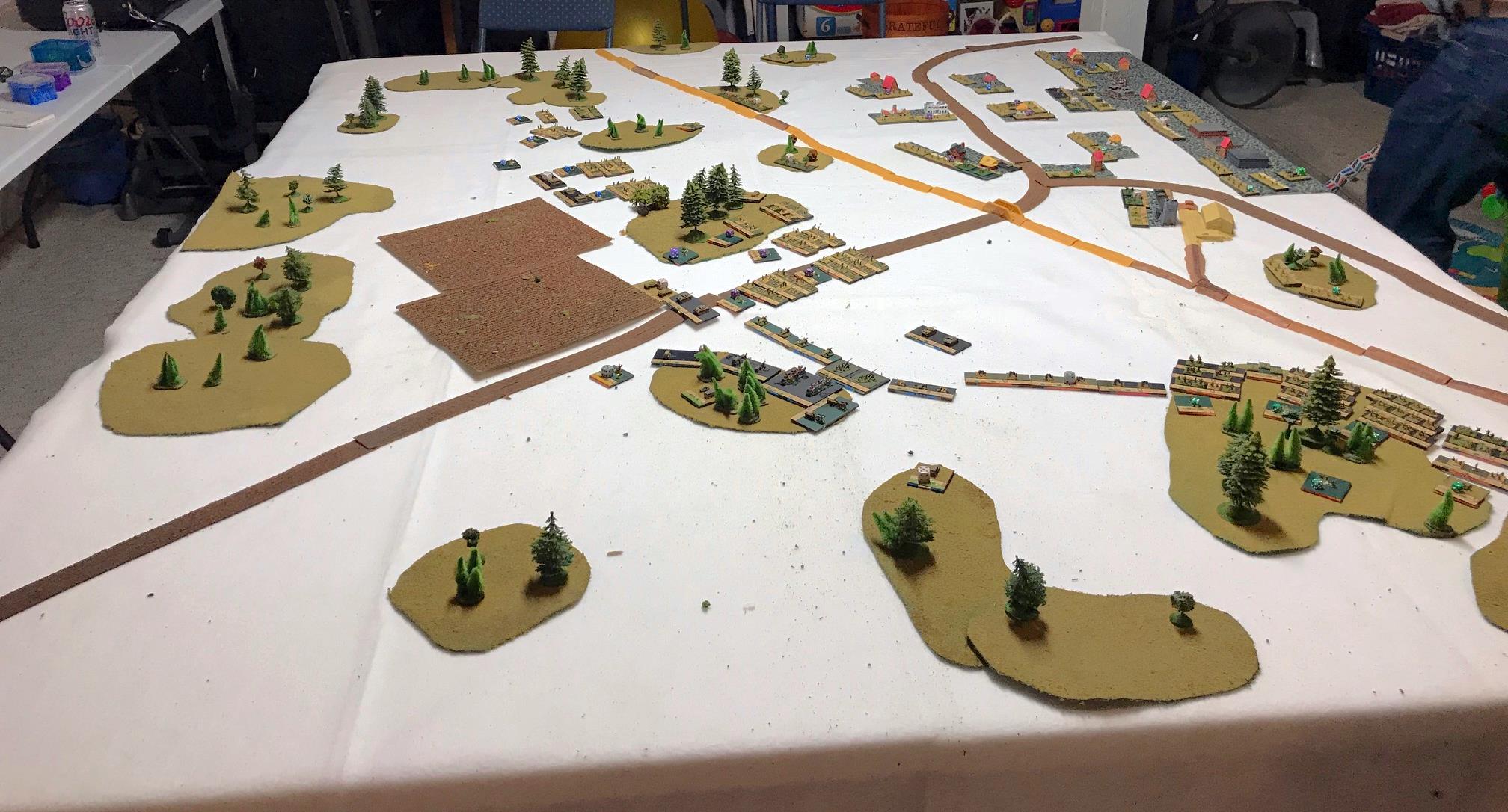
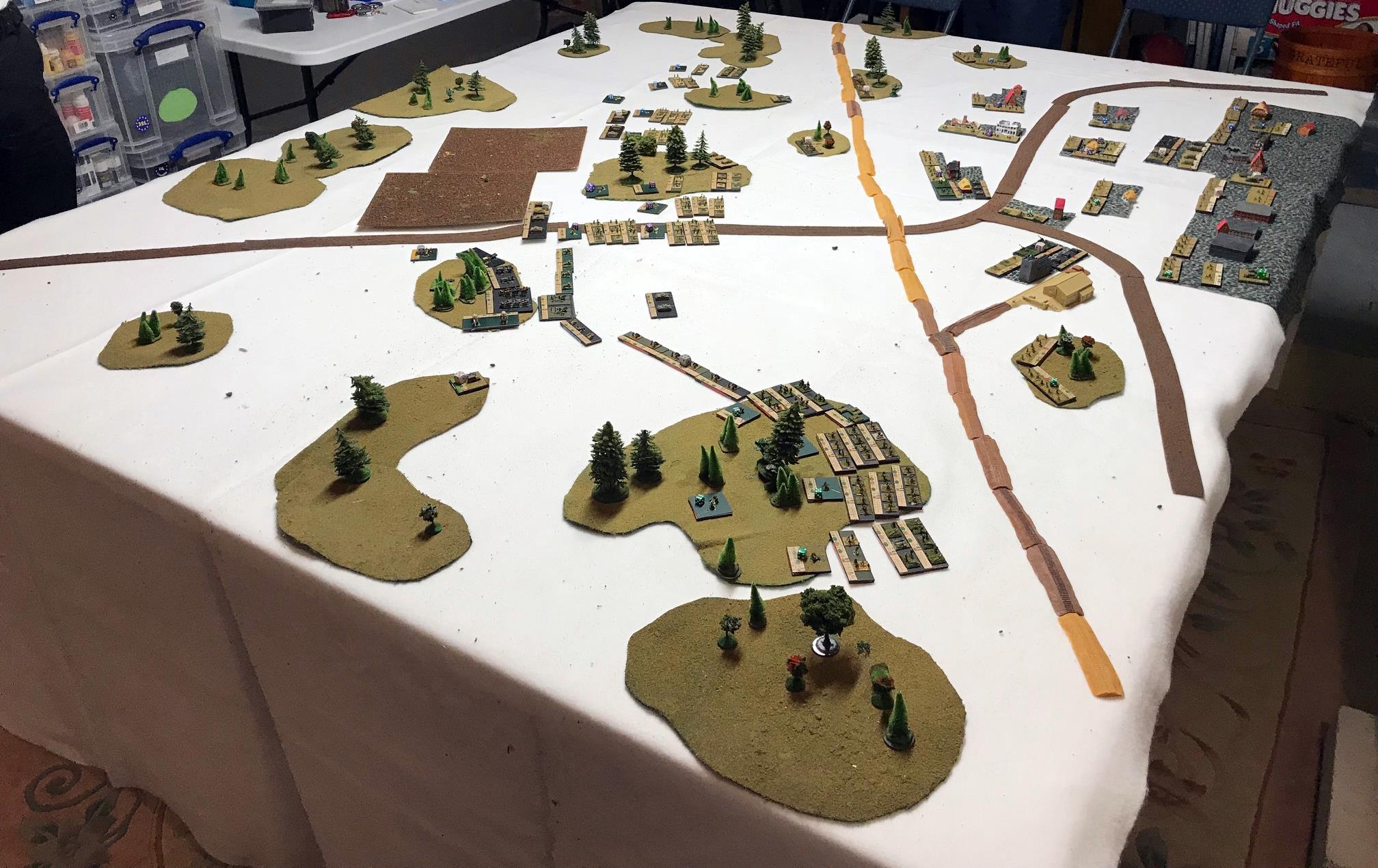


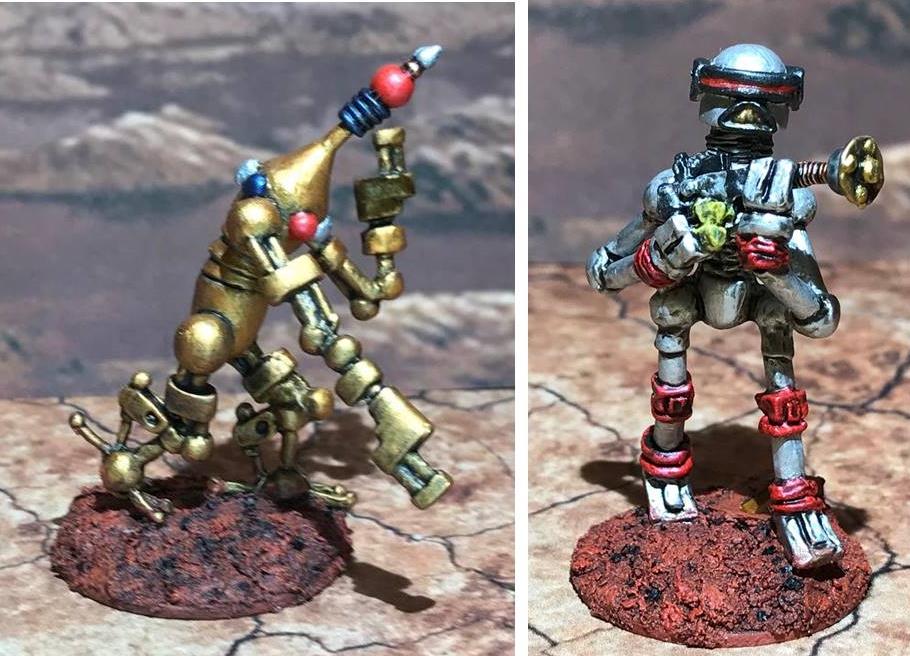

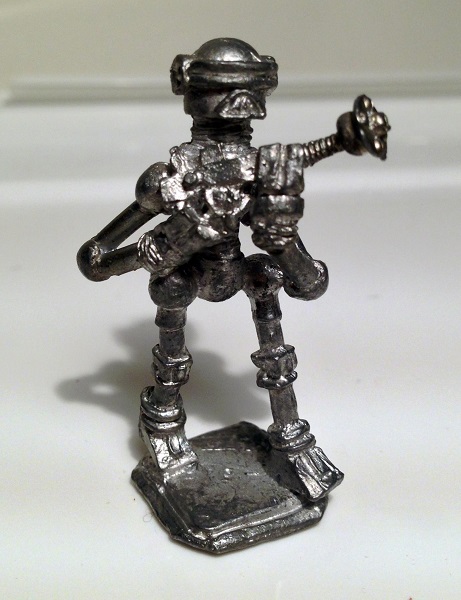

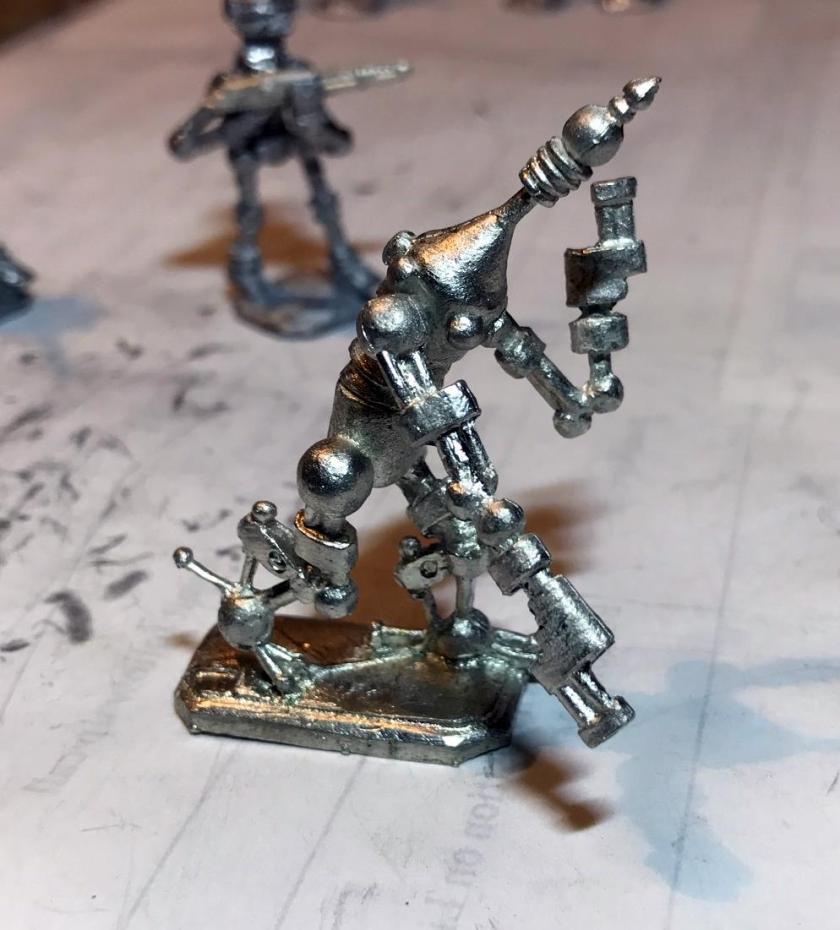
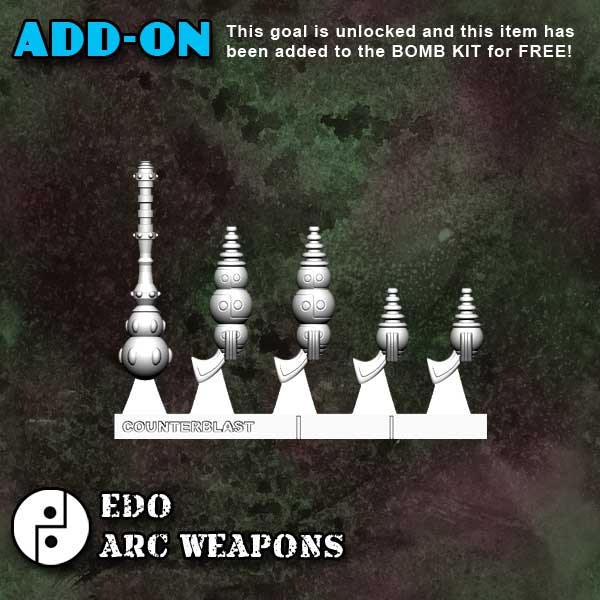

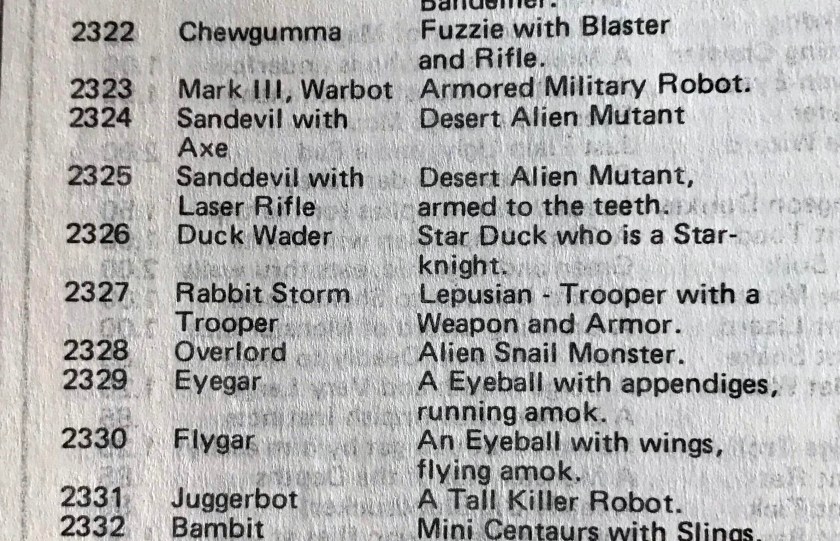
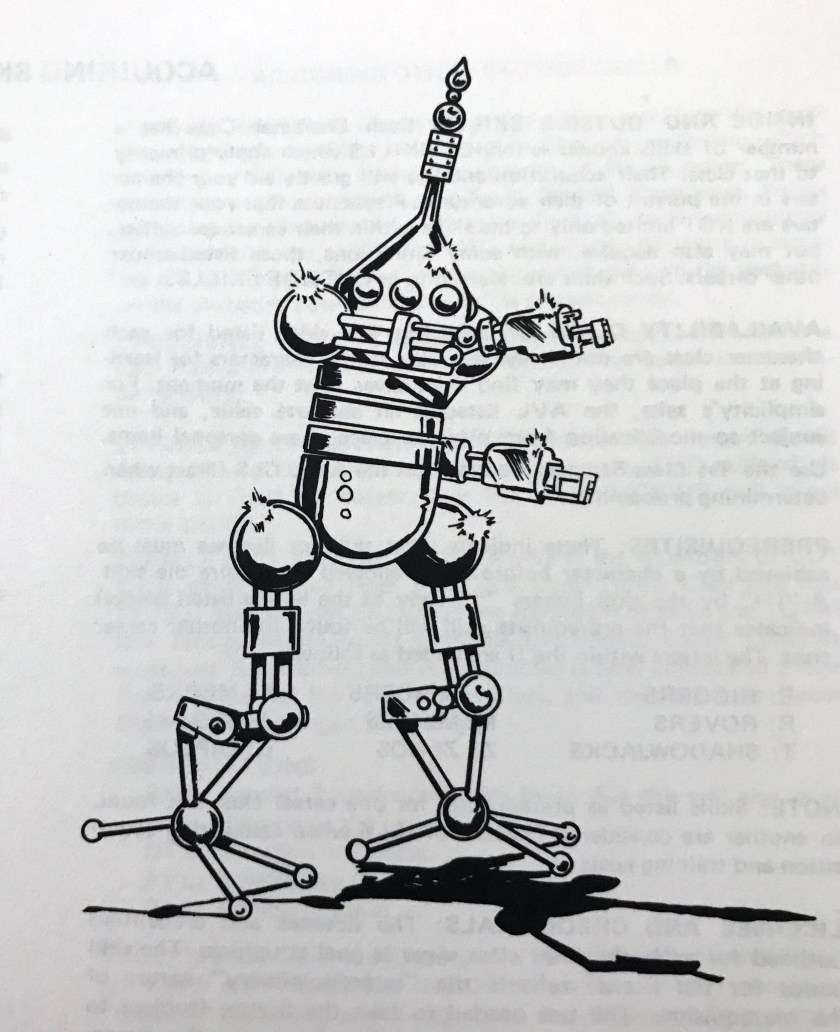
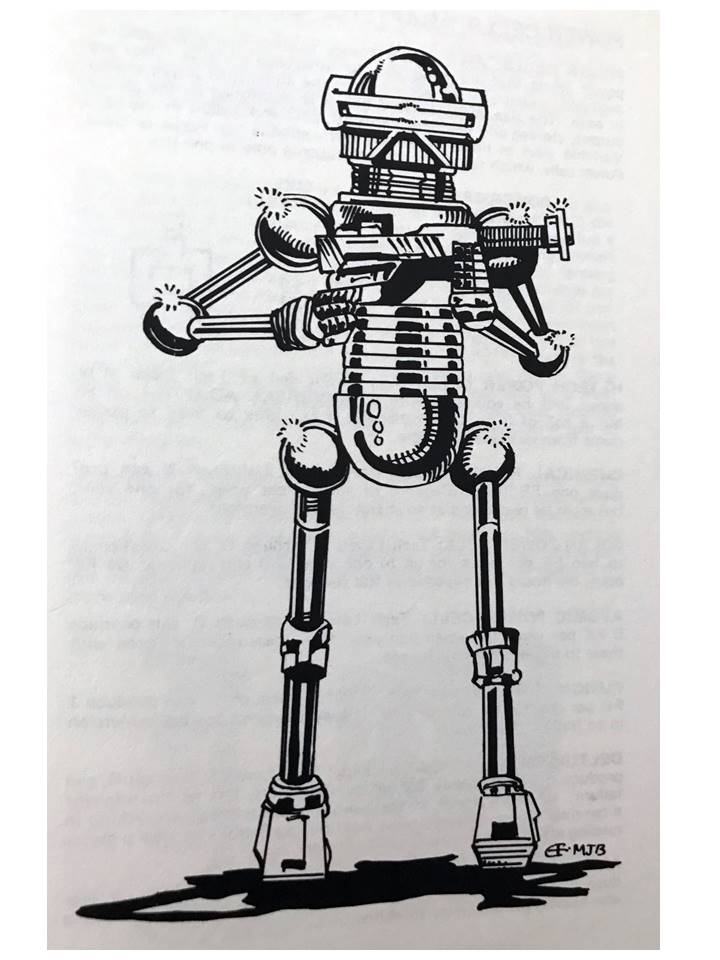

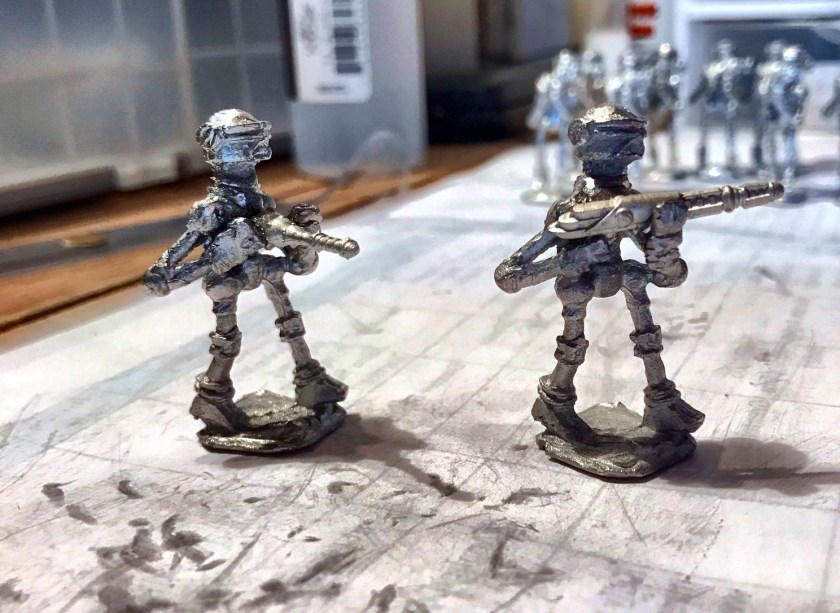


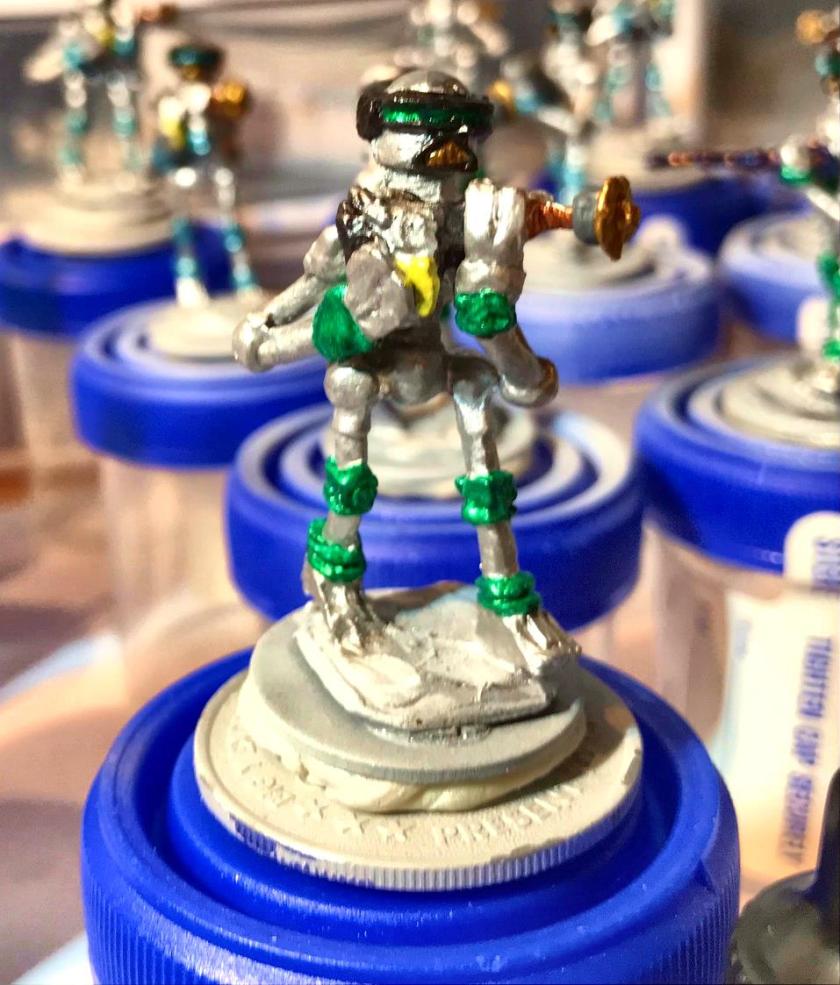
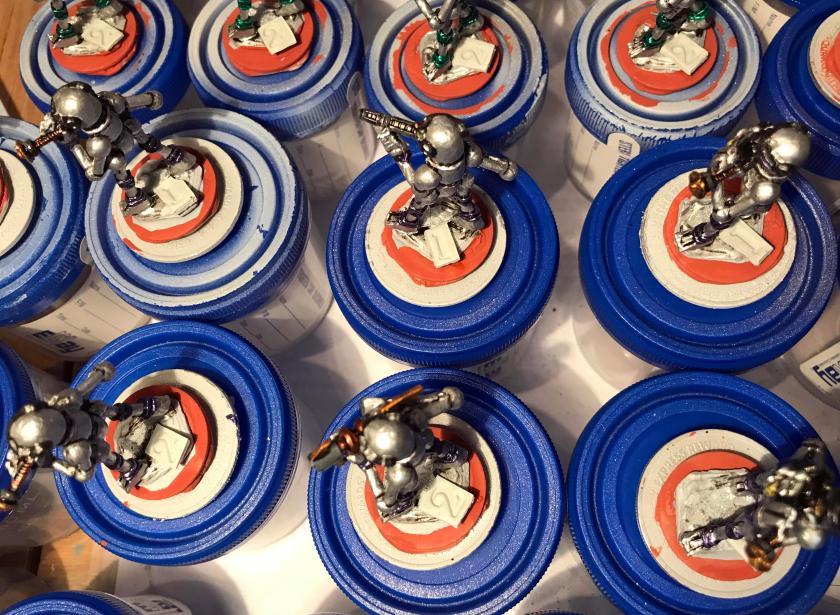


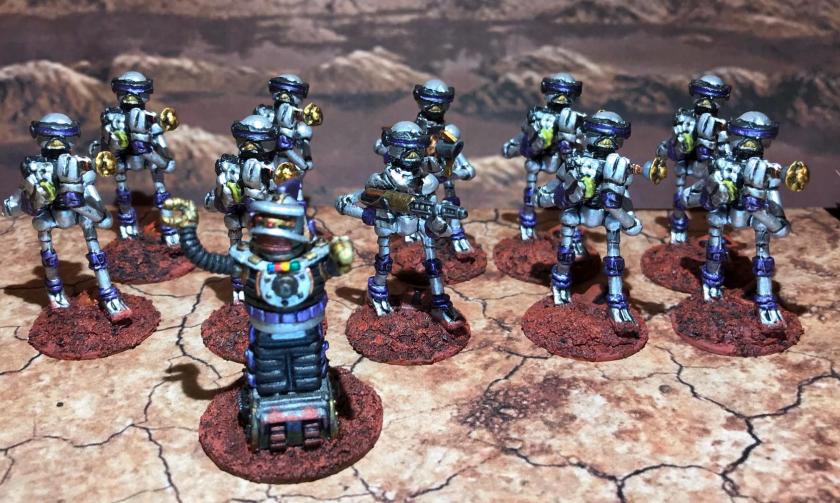

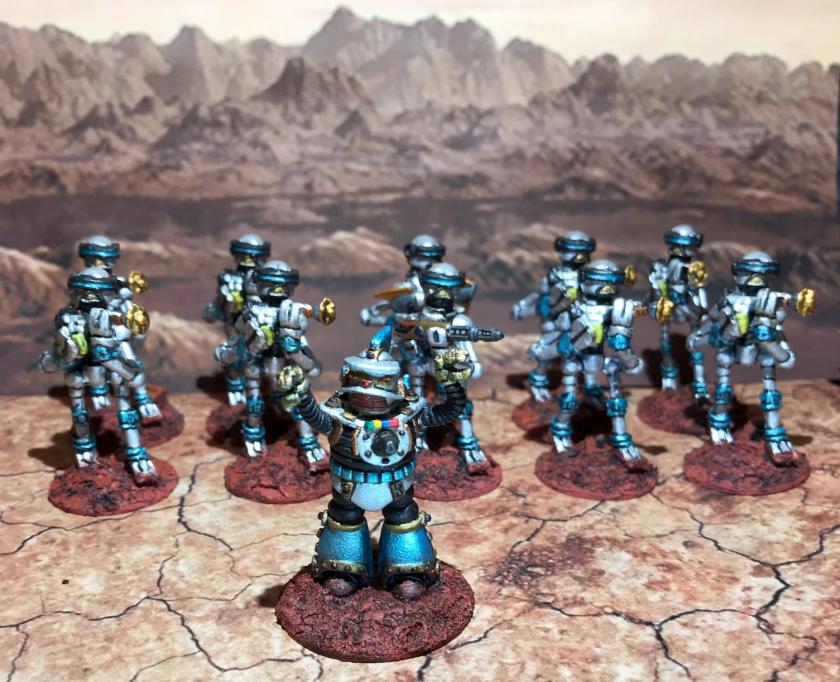

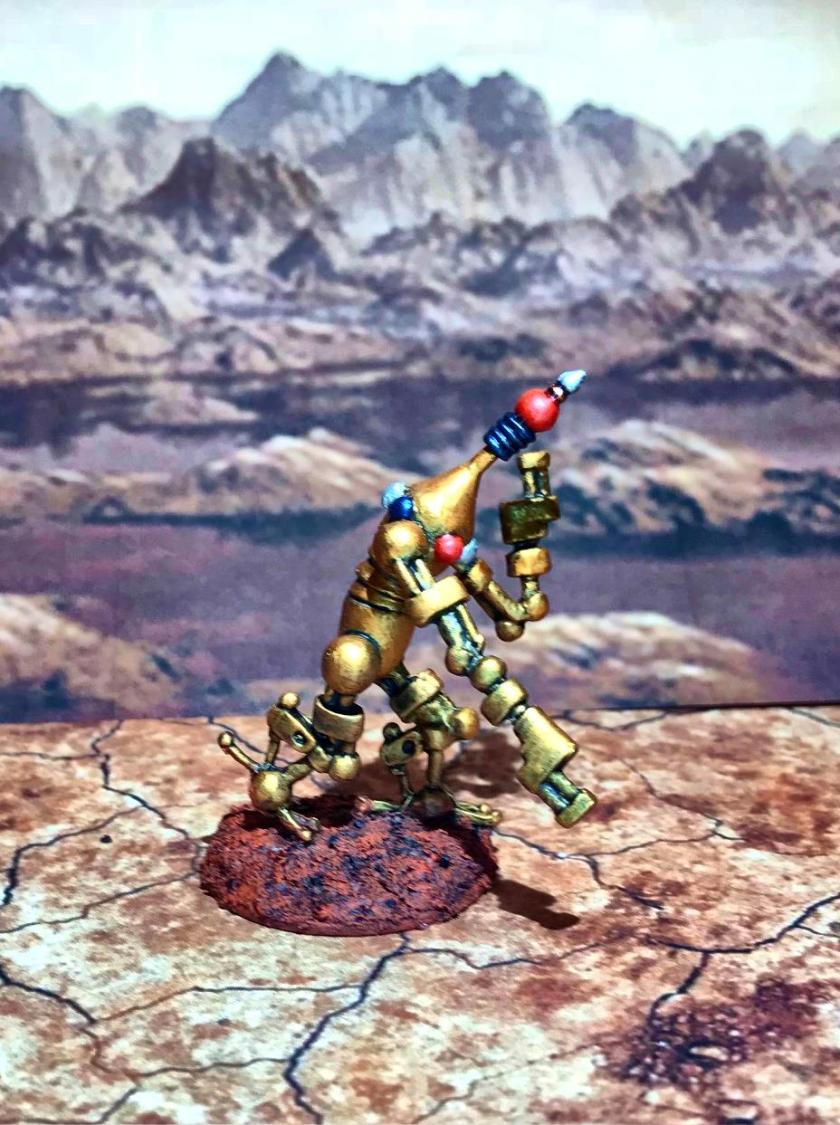


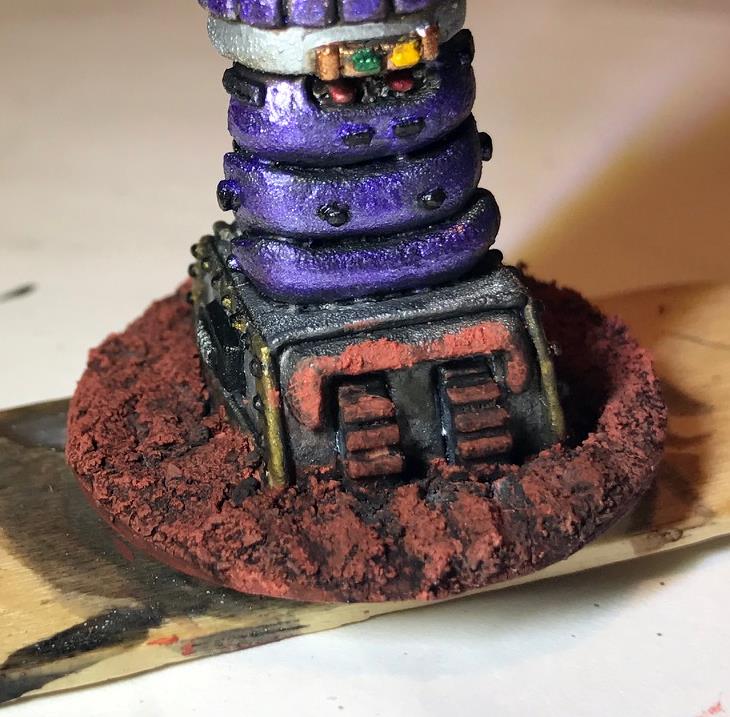


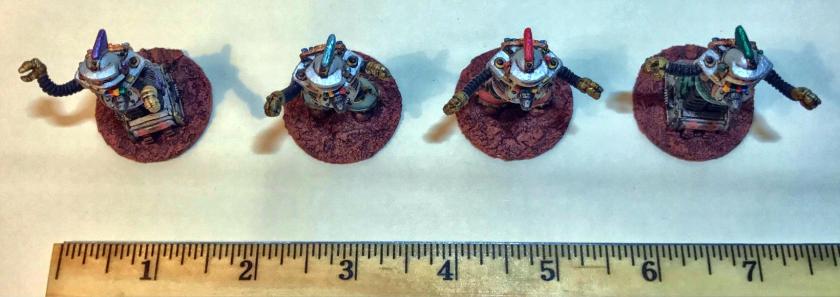
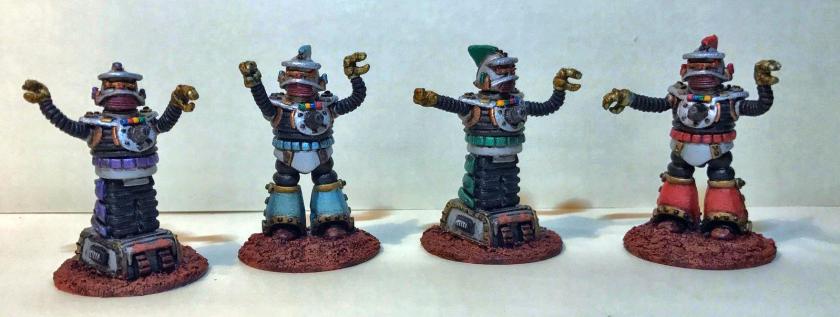
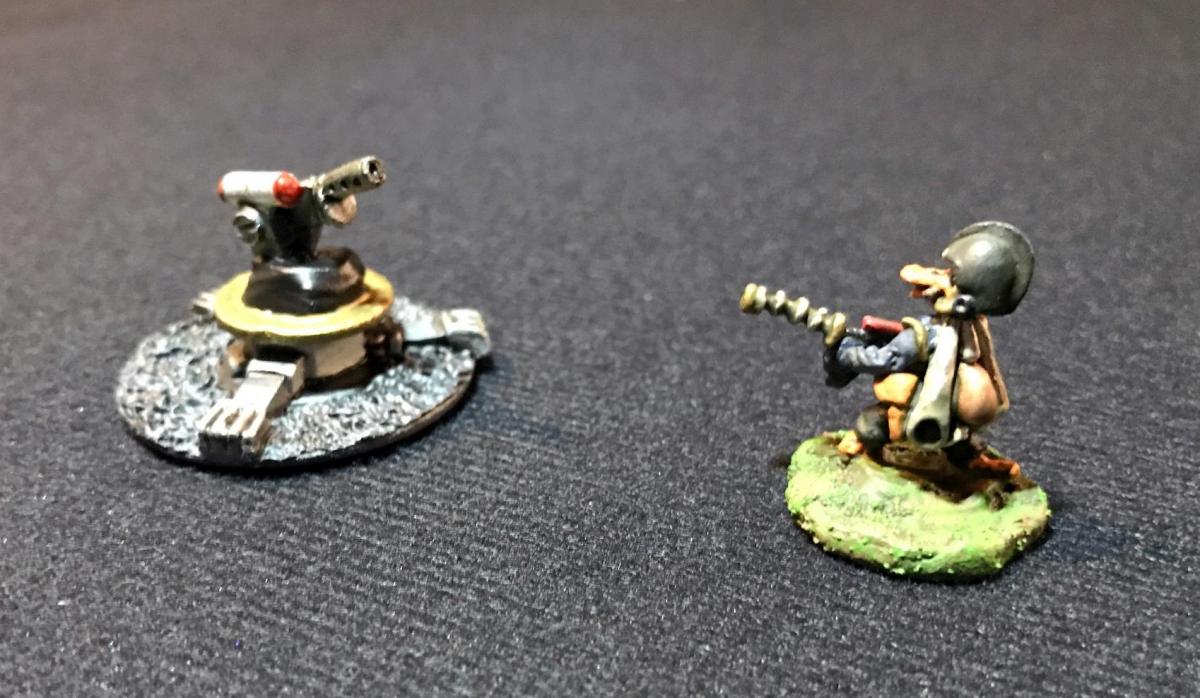
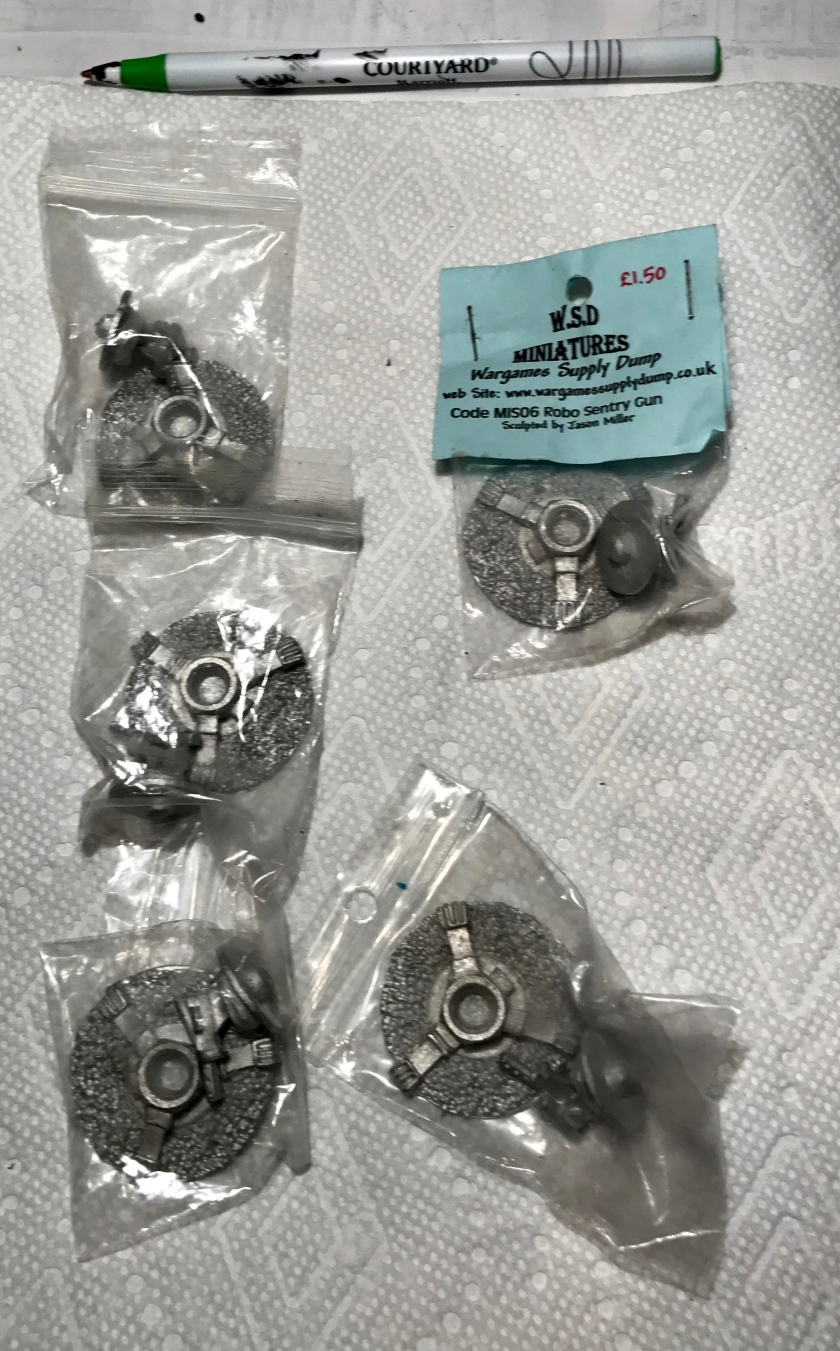
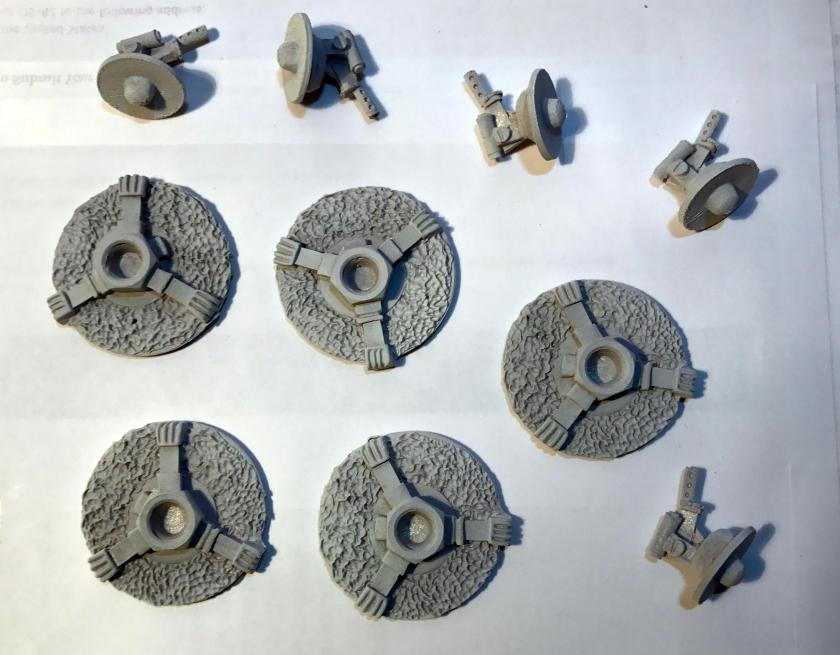
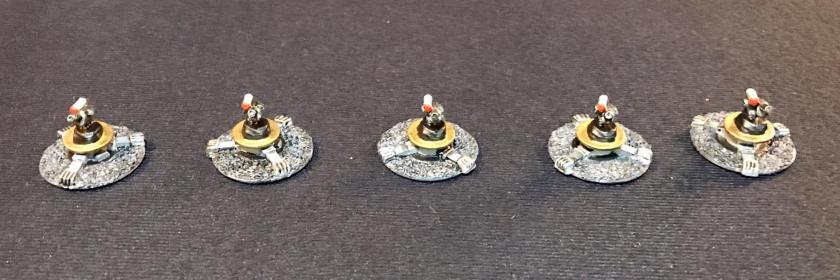
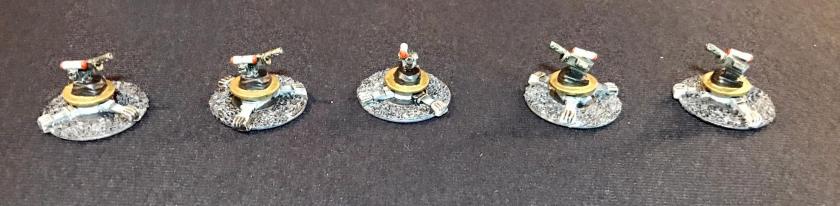


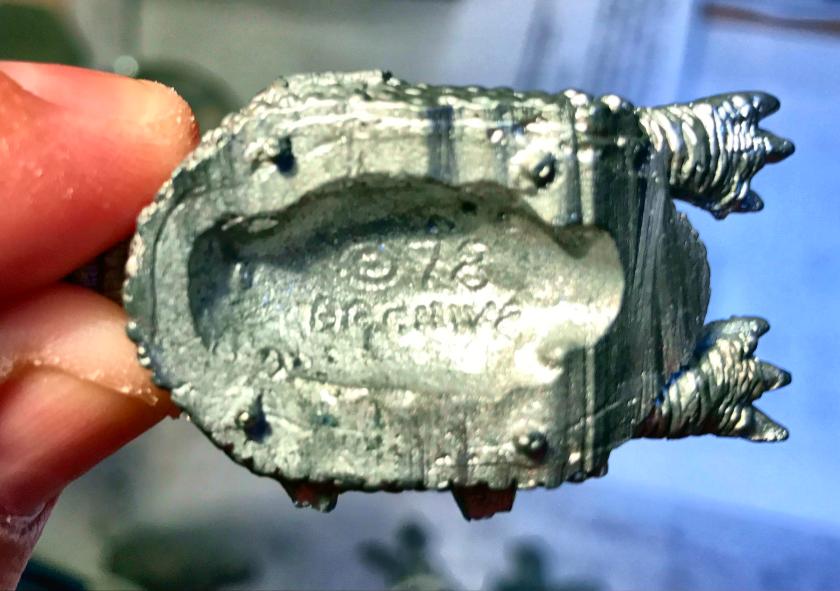


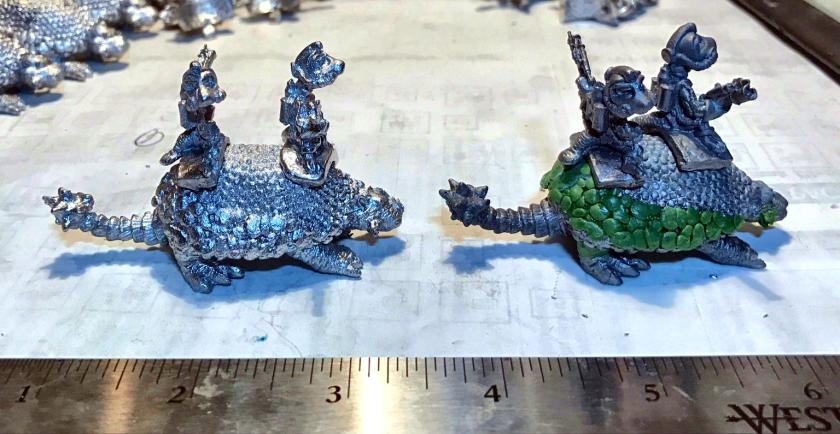
 Mark A. Morin


