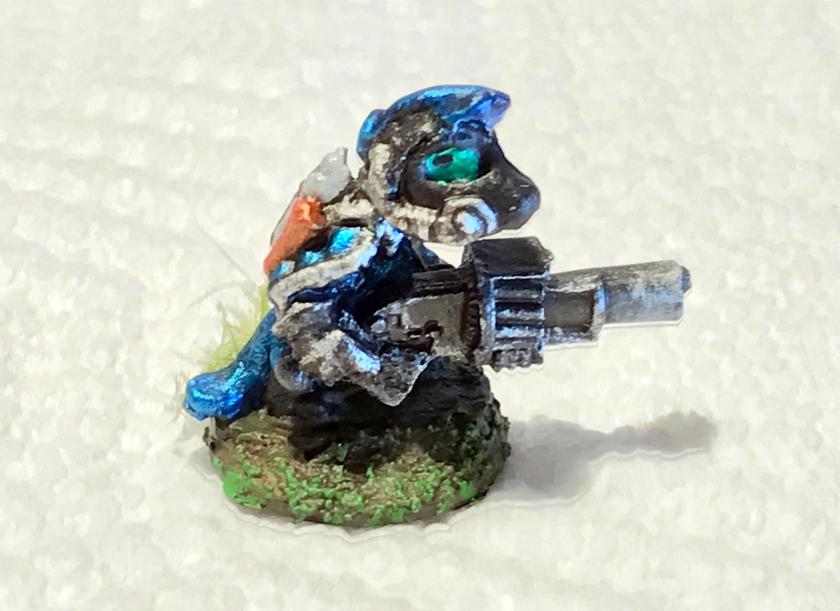
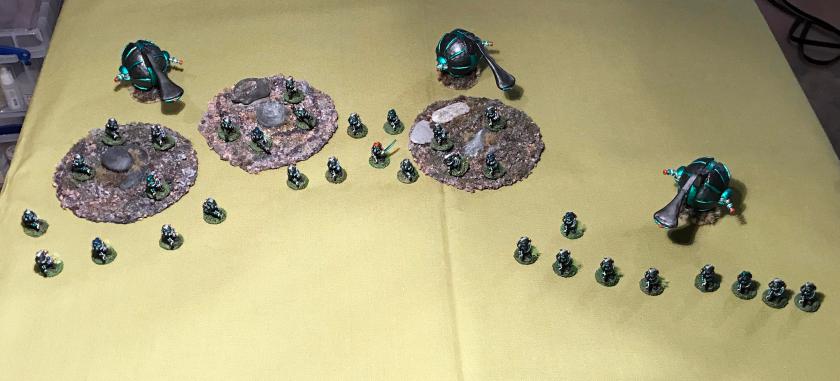
This month, in between other projects and recovery, I worked on several terrain pieces for use with my Star Rovers figures and the Combat Patrol™ gaming system. Some I got earlier in the year from WorldWorks Games on Amazon, others I got on eBay that were from Armorcast Battlefield Scenery, others I made – and some I just don’t know who made them. I’m hoping to use these at The Battle Standard in Auburn soon after coordinating with the owner, Jared Brodeur.
Normally I have more detail (how-to), but I lost most of the details of these terrain projects, as I had a few that I had to rework. I think the pictures below are hopefully sufficient. I was really happy to try new techniques with rust applications using a “pointillism” technique with a combination of Polly-S (“Rust”) and Vallejo (“Rust” 71.069 and 71.080) paints. I mounted all of the terrain pieces on flat steel basing pieces.
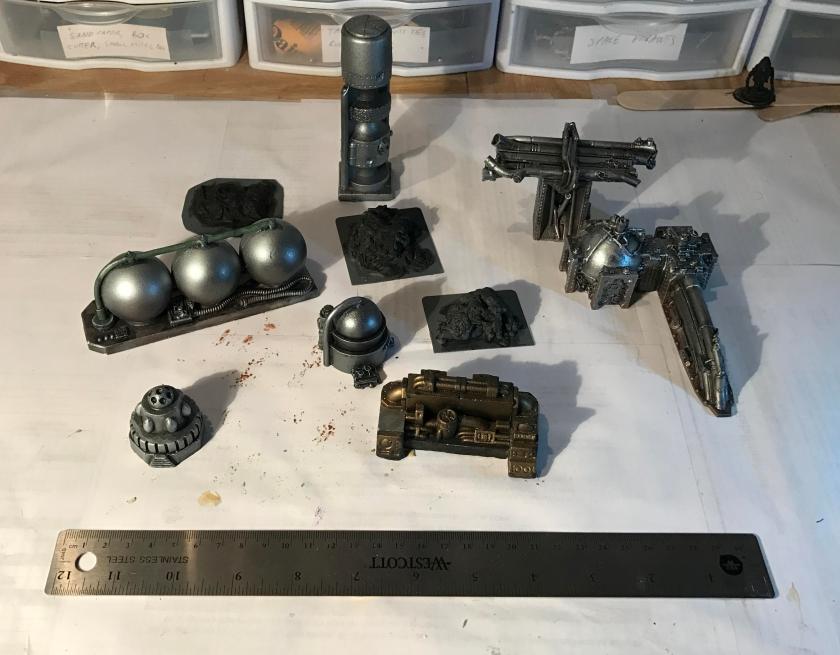
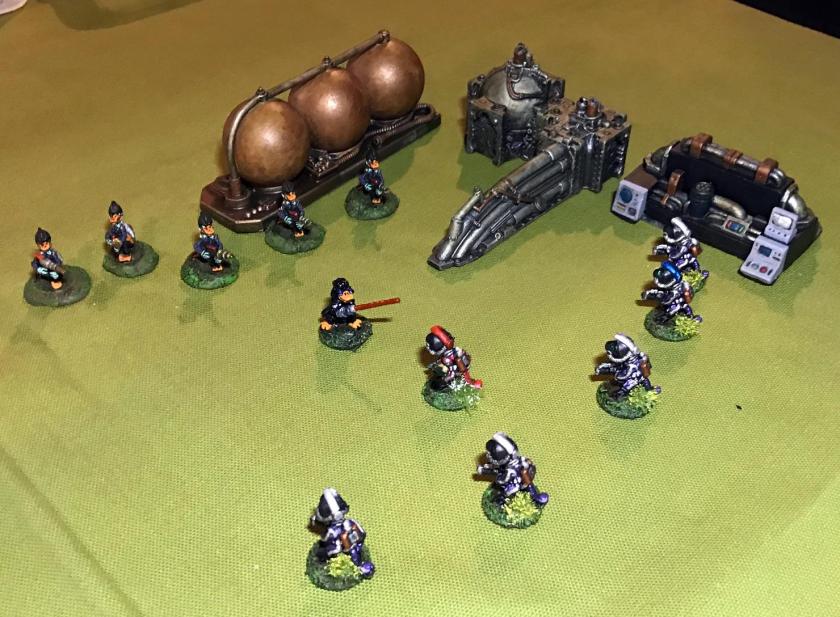
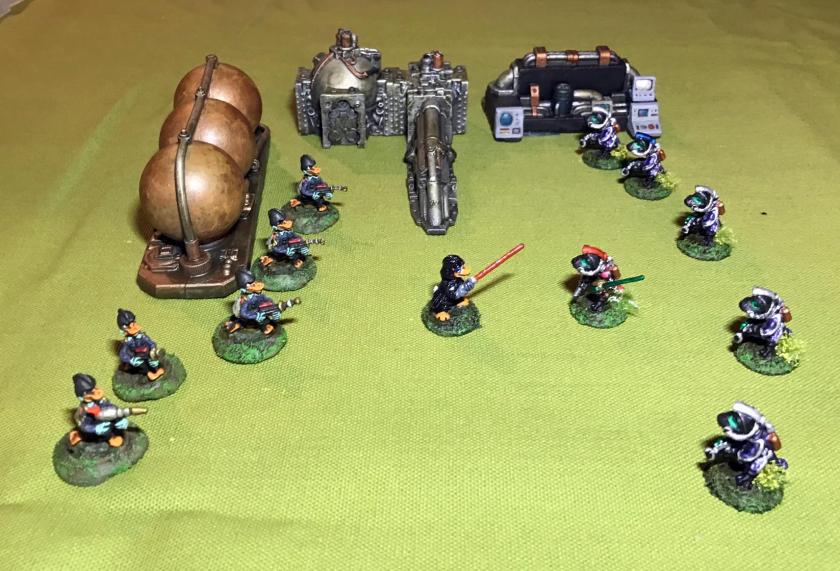
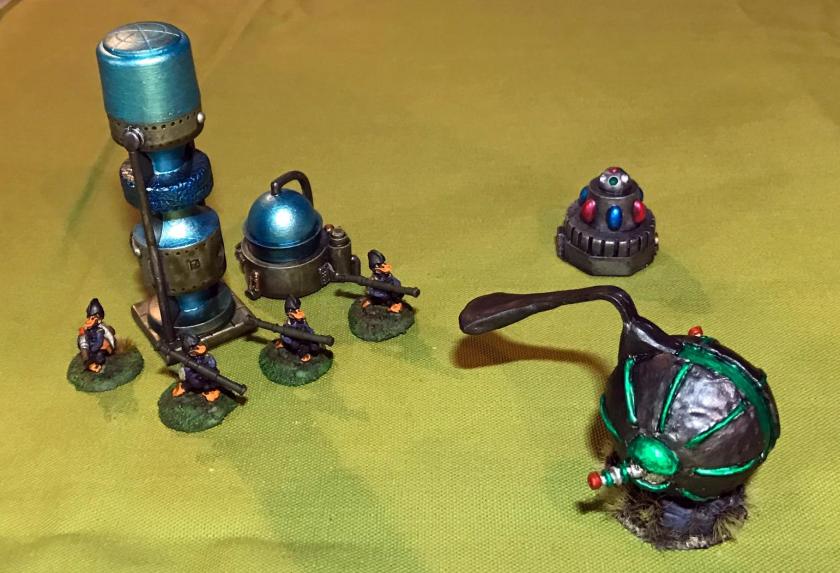
The mostly Armorcast “set” I got on eBay were various refinery or industrial pieces that were airbrushed silver and gold, and that did not work for me. I wanted the industrial ones to be more dirty and rusty. I ended up painting some of them with various colors, and then using Army Painter Quickshade “Soft Tone” to shade. I was not happy with most of these results, especially the Quickshade effects. I repainted them, some with bright colors for the newer pieces of terrain, and with rust for the grittier ones, and then used spray varnish to seal. Luckily, the Testors “Dullcoat” actually had a “crackling” chemical effect on one of the industrial tanks which worked well – (note – this was not an Armorcast piece and was likely homemade with some type of Styrofoam). I was surprised as there was already a lot of paint and varnish on it at that point – but it was minimal and I liked it anyways.
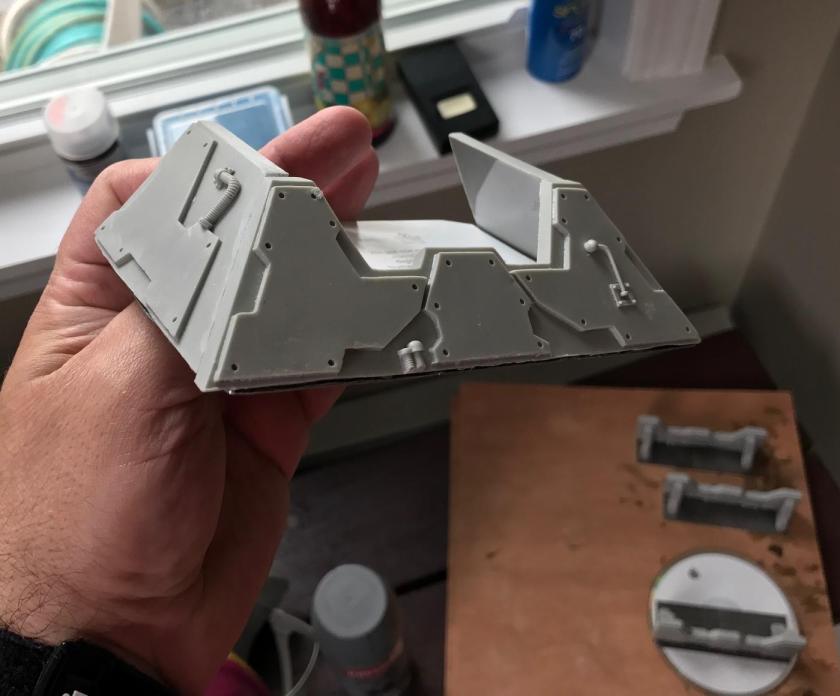
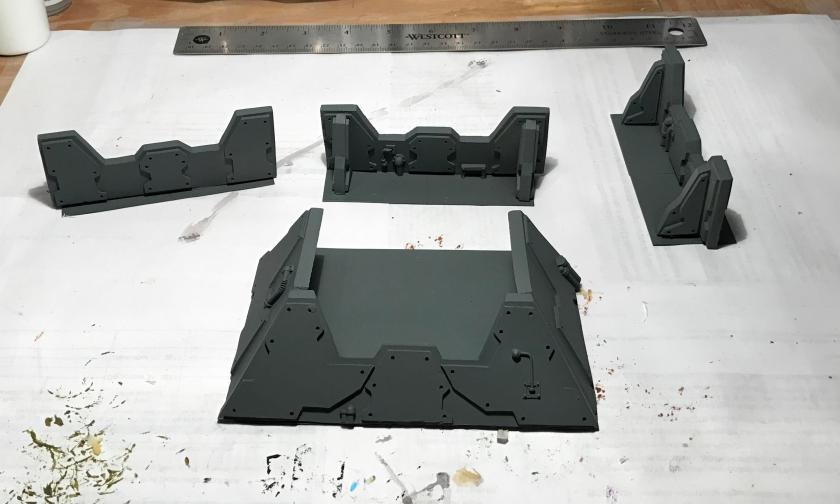
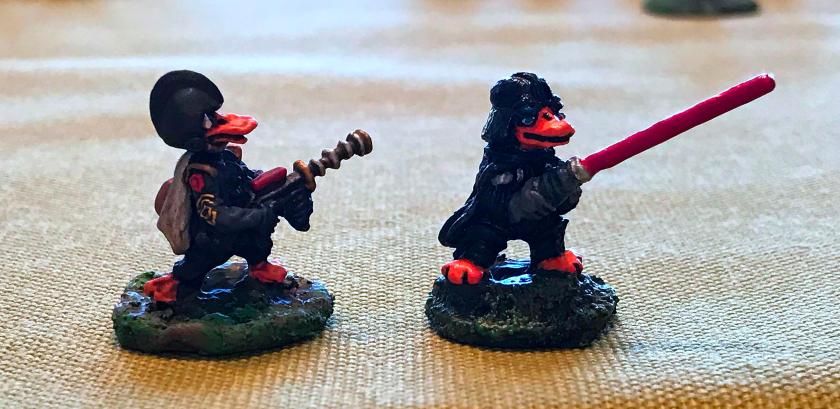
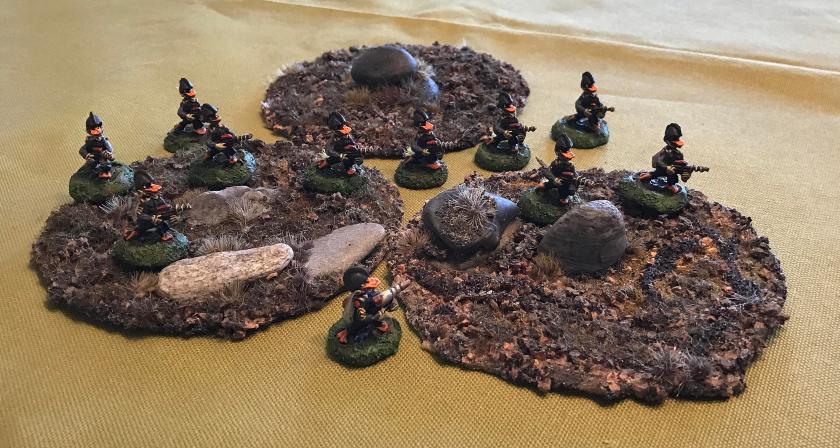
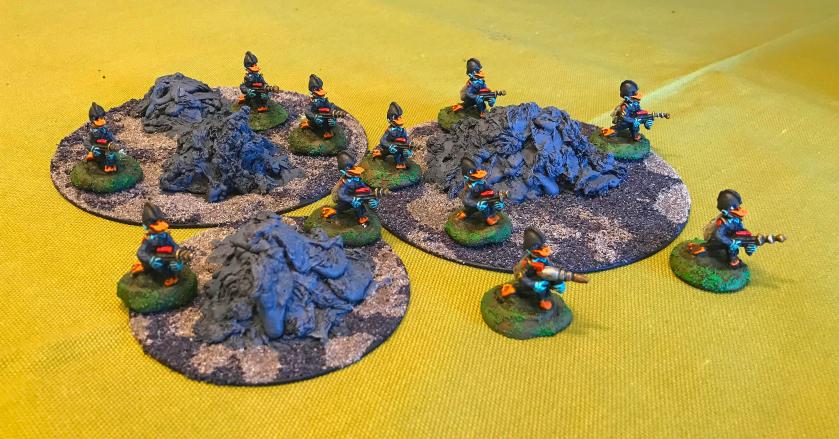
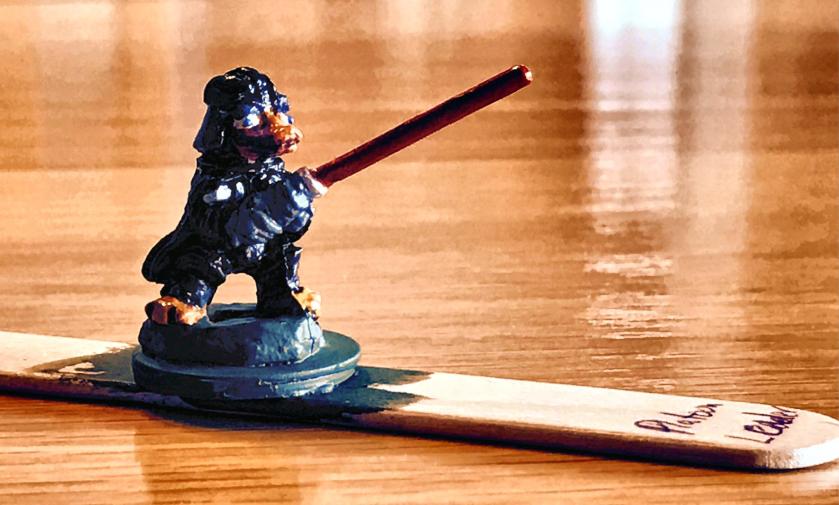
The initial set of mostly Armorcast terrain I got on eBay, plus the slag mounds I made. This is how I got them. The triple tank is the homemade one that the varnish affected. The pipeline/industrial terrain after repainting (and repainting). Duck Vader and his Star Ducks confront Power-Armored Frinx led by their platoon leader. Frontal view of the skirmish – light saber versus light cutlass! Aphids on Grav-Cycles swing around a ruined overhead pipeline to swarm attack a Frinx Mark 1 Sphere tank Star Duck Bazookaducks ambush a Mark 1 in front of a large moisture condenser, a cryo unit, and a small power unitThe WorldWorks Games set consisted of a bunker, and three barricades. They are for 28mm for sure. The bunker was used, and difficult to assemble well with super glue. I ended up using steel base material, popsicle sticks, wood glue, and cardboard to assist in the construction. Here, I really liked my use of the rust pattern that I discussed earlier.
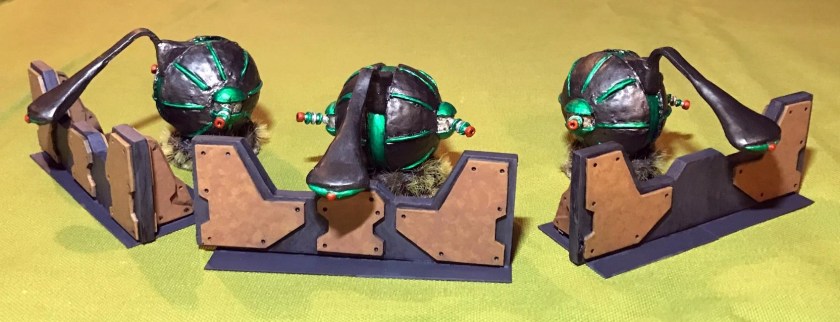
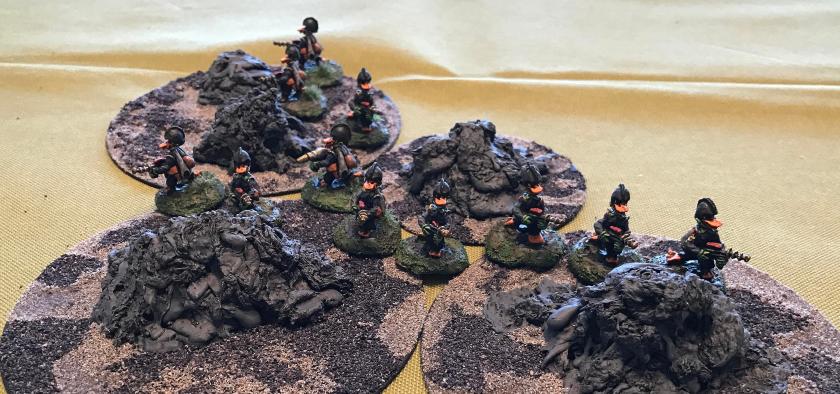
Assembled barrier before priming Assembled bunker, front view, before priming Assembled bunker, back view, with cardboard mounted on popsicle sticks mounted on steel bases Bottom of the bunker – I needed to trim the steel bases and file off sharp edges After priming with gray A Star Duck Mortarduck crew operates from the finished bunker Three Mark 1 Sphere tanks set up in defensive positions behind the barriersLastly, I had three slag mounds that I mounted on two old CD’s. The slag was a byproduct of my casting projects. For these, I had a “Red Planet” plan, and used Citadel “Martian Ironcrust” and “Martian Ironearth” to good effect, as well as different washes.
An Aphid squad and their robot assault gun patrol the slag moundsIt’s a good start and I’m sure I could use some buildings and other things, but that I will get to in due time!
May was a slow hobby month as I spent some time recovering from the surgeon’s blade!
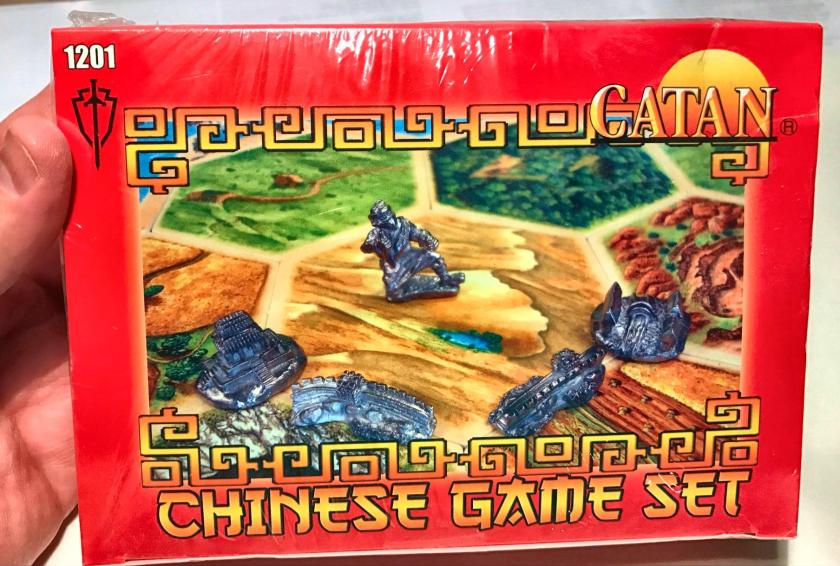
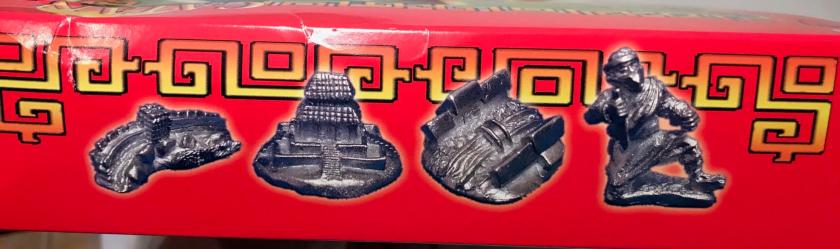
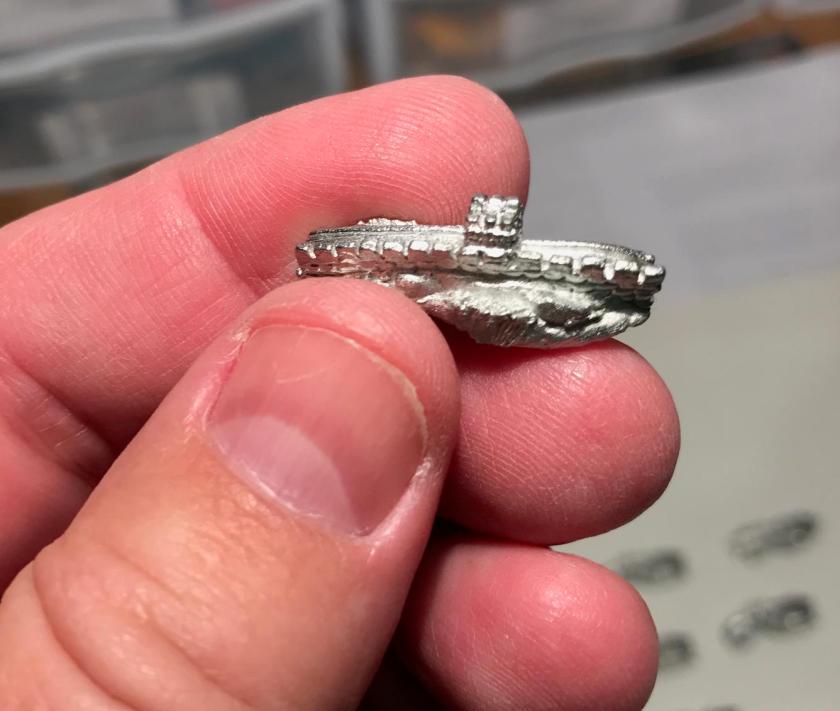
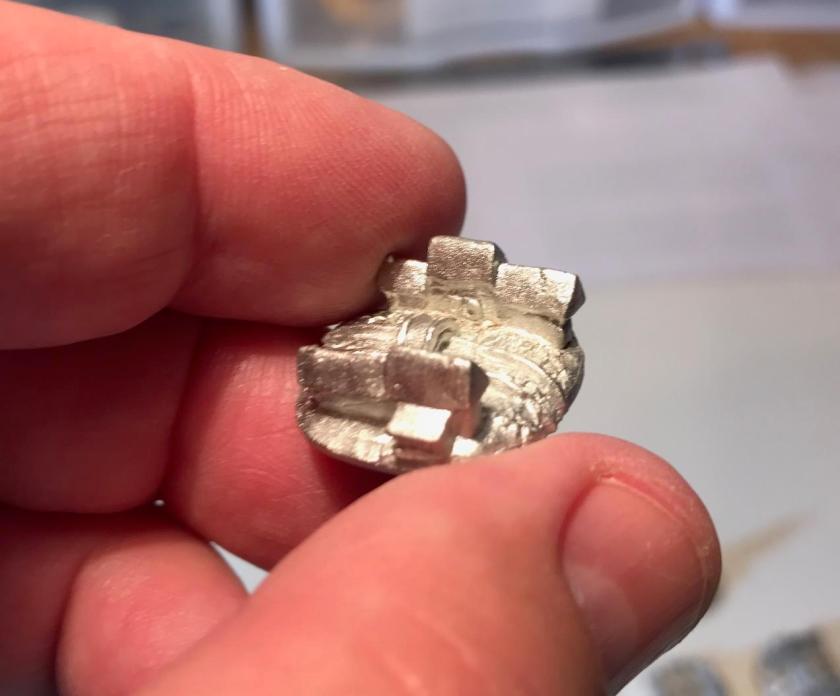
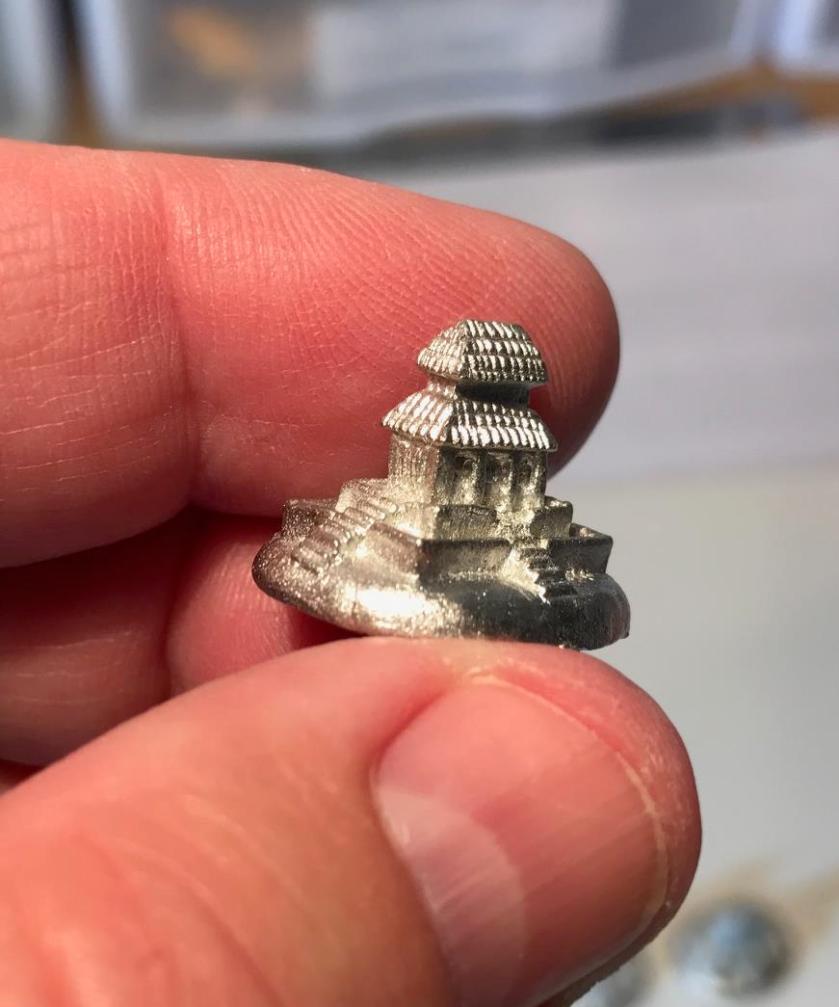
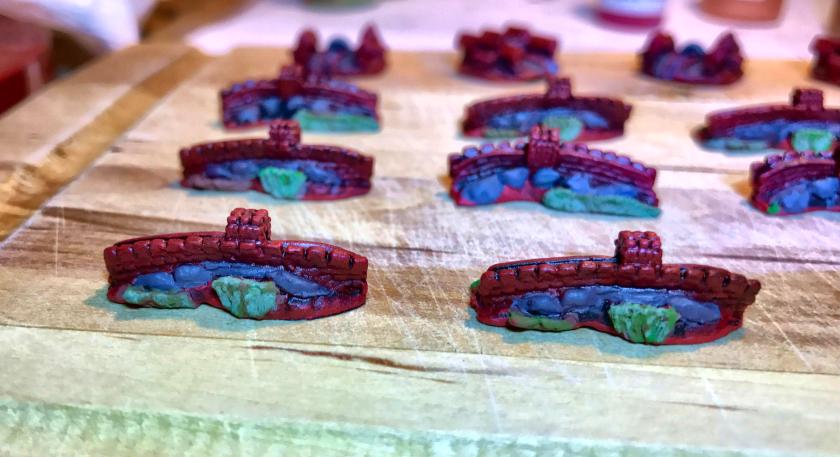
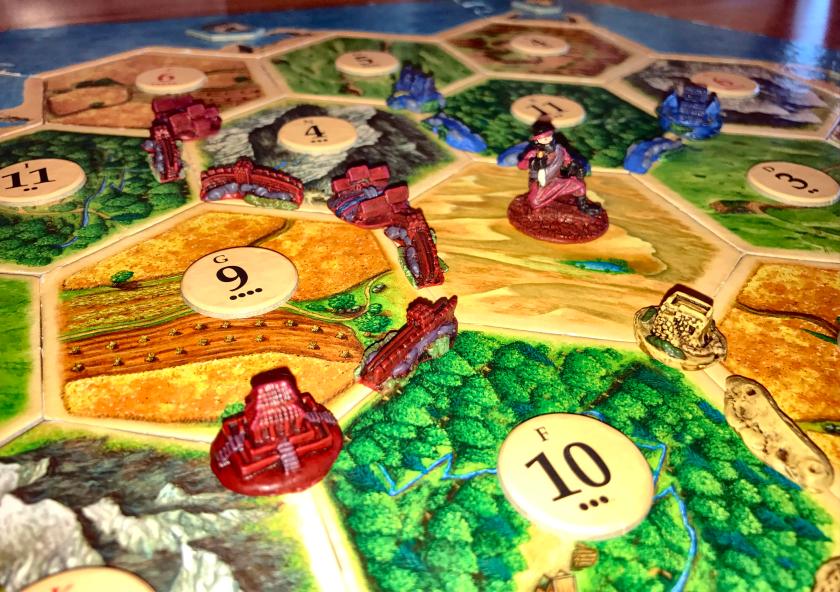
One of the projects that I started in April and completed in May was another RAFM game set for the Settlers of Catan game. It was a gift from my daughter and son-in-law, and I had it in the painting queue for a while. The set is made of white metal (likely britannia). I had completed most of the painting in April, and finished and varnished the project in May. Each set consists of figures that represent 15 roads, 5 settlements, 4 cities, and one robber. This one is Chinese-themed, and joins my Viking and Egyptian sets. I opened the set, cleaned up and filed some loose casting remnants, and washed everything with mild soap and a toothbrush. After a good rinse and a thorough drying, they were ready to paint. I decided to go with a red and gray theme, which are my Fitchburg High school colors!
Game set box, unopened
Side detail of box
Unpainted road
Unpainted settlement
Unpainted city
Unpainted robber, front view
Unpainted robber, back view
As you can see above, the details of the figures are variable. The robber really was not well-detailed, and I attempted to rectify this with the brush. On the previous two sets, I mounted all of the figures to popsicle sticks for ease of painting. I elected not to do that this time as I did not want to have to deal with painting the undersides with affixed glue. I did mount the robber on a 1″ steel washer. This was fine.
I made a change again and used a brush primer as April was very cold and I did not want to wait until New England cooperated with 50°F – and that was a good call. I used Citadel “Imperial Primer” slightly diluted with Testors “Universal Acrylic Thinner” in two coats for priming. I then drybrushed all the figures with Americana “Santa Red”. My next step was to use Secret Weapons Washes “Red Black” ink and apply a thorough wash all over the figures. Then I painted the trees and bushes on the road sections with Armory “Chestnut Brown”.
In progress – I put the figures on the pallet and used it as a surface to paint almost everything
On the roads (which resembled sections of the Great Wall), I painted the boulders with Americana “Zinc”. I then applied another wash with “Red Black” ink. To create the effect of the greenery, trees, and shrubs, I highlighted successively with Citadel “Niblet Green” and “Nurgling Green”.
On the settlements, I painted the paved spaces between the buildings and the river and the bridge with “Zinc”, followed by a coat of “Red Black” ink on the pavement. The river got a treatment of Americana “Sky Blue” followed by Reaper MSP “Blue Liner” as a wash. The river edges and buildings were highlighted and lined with Vallejo “Red”.
For the cities, I used “Zinc” on the stairways, and more “Red Black” ink as a wash. I then highlighted the walls and framework of the large temple with the Vallejo “Red”.
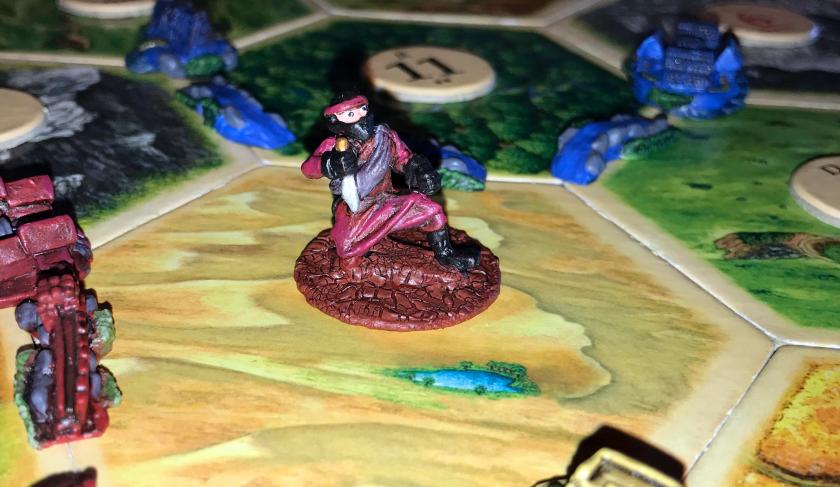
I did not go crazy with the robber as I really was unimpressed with the figure. He looked like a Japanese Ninja in a Chinese set! So I used the same patterns with the same reds as the other figures. I painted his bedroll with “Zinc”, his bandana and gloves with Americana “Ebony”, and his hair and boots with Americana “Onyx”. P3 “Midland Flesh” was my choice for his face, with Vallejo “White” and “Ebony” for the eyes. I highlighted his headband and his robes with Vallejo “Red”. On his dagger I used FolkArt “Gunmetal Gray” highlighted with Tamiya “Titanium Silver”. For the handle of his dagger, I gave him a splash of Citadel “Gehenna’s Gold”. On his base, I used Citadel “Martian Ironcrust” and a blow dryer to create the crackling effect. And again, I added more “Red Black”.
Roads before varnish
I also want to note here that the bottoms of all of these figures were painted with the same red combinations. Lastly, as these are game pieces, I wanted to give them a good protective coat of varnish from bottom to top. They all got three successive applications of varnish with sufficient drying time in between. Of course, I needed a warm day (above 70°F) for this. I used Krylon “Glossy”, followed by Krylon “Clear Matte”, followed by Testors “Dullcoat”.
On the Catan board – with the Viking and Egyptian set
Robber, settlement, and road close up
I am satisfied with the project – and now I only need one more (the Bavarian set) to have all of them. Certainly a worthy gaming project!
This was a very large project that ended up with producing a 45-figure platoon. I hope that you find this story interesting, if only to see the determination I had to have to see this through! I am going to give some background, and then show the photos for the finished unit. After that, I will give a detailed description for my fellow hobbyists as to how I completed the various aspects of this unit – this will allow you to see the final product earlier in the blog – and those who want more details can go past the completed photos to see more detail.
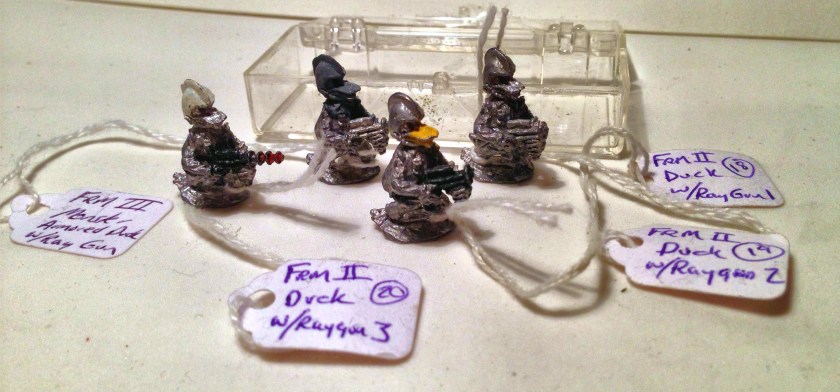
The beginning -my original 4 Star Ducks from an eBay estate sale. Note the broken ray guns. The broken ones made good candidates for conversions.
My Duck Vader box from eBay – this was a reproduction by Dark Ages miniatures, which like Archive, is no more. Note Nevile Stocken’s name is misspelled.
Background
I first saw the Archive Star Ducks (#2002) and Duck Vader (#2326) on the Lost Minis Wiki as I was researching some other Archive Star Rovers figures. These were made by Archive between 1977 and 1981 or so. They are made of lead and tin alloy. These were sculpted by Nevile Stocken. He sent me the drawing below via Facebook Messenger.
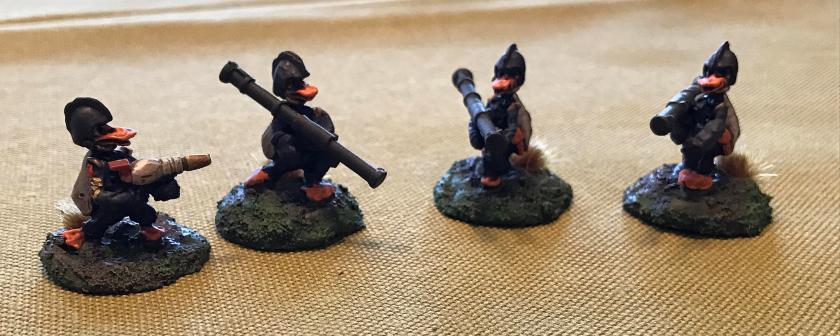
The rights to some of Archive’s figures have been sold off a few times. Several have been reproduced, but they are not currently in production. I searched through eBay, and these are very hard to find. I did manage to find only 4 Star Ducks and one Duck Vader, but that paltry number does not make a unit. My stretch goal was to create a platoon for use with Buck Surdu’s Combat Patrol™ system for tabletop skirmish gaming. I thought that I would need about 40 or more figures to make the unit, and I ended up with 45, which is a good size for a traditional platoon. In this process, I ended up making a mold and casting 40 for myself and some for Buck as previously described in this blog and Buck’s. I converted 4 Squad Leaders with War Games Supply Dump retro sci-fi weapons – which I was lucky to get as WSD closed on March 31st, 2017. I converted 6 figures to make up the mortar crew, to include making the mortars, ammo boxes, and mortar rounds. I also converted three figures to make up an Anti-Tank section (now known as the Bazookaducks) by arming them with Reaper Chronoscope bazookas.
Platoon Organization
The platoon is composed of 45 figures as described below. Five of the figures, including the platoon sergeant and the platoon leader are original castings. The remaining 40 are all Star Ducks that I cast over the last year.
Star Duck Platoon
Platoon leader – Duck Vader (1)
Platoon Sergeant (1)
Duckfoot Mortar Section (6 figures)
Mortar Crew 1 (3 converted Star Duck figures as crewducks)
1 loader
2 crewducks
Mortar Crew 2 (3 converted Star Duck figures as crewducks)
1 loader
2 crewducks
First Squad (11 figures with tan gloves)
Squad Leader (1 converted figure with WSD weapon)
Team A (5 figures)
Team Leader (1) and 4 Star Ducks
Team B (5 figures)
Team Leader (1) and 4 Star Ducks
Second Squad (11 figures with light blue gloves)
Squad Leader (1 converted figure with WSD weapon)
Team A (5 figures)
Team Leader (1) and 4 Star Ducks
Team B (5 figures)
Team Leader (1) and 4 Star Ducks
Third Squad (11 figures with light green gloves)
Squad Leader (1 converted figure with WSD weapon)
Team A (5 figures)
Team Leader (1) and 4 Star Ducks
Team B (5 figures)
Team Leader (1) and 4 Star Ducks
Bazookaduck Section (4 figures with dark red gloves)
Squad Leader (1 converted figure with WSD weapon)
Bazookaducks (3 Star Ducks with Reaper Anti-Tank weapons)
The Completed Duck Platoon
Platoon Sergeant and Duck Vader, Platoon Leader, frontal view. The Platoon Sergeant is an E-7 (Sergeant First Class). Duck Vader is a First Lieutenant.
Platoon Sergeant and Duck Vader, Platoon Leader, reverse view. Both are original.
The 4 Squad Leaders, converted with WSD weapons. Each is an E-6 (Staff Sergeant). From right to left, 1st, 2nd, 3rd Squad and AT Section leader. I used different colors on the gloves, lapels, and helmet buttons to differentiate them for tabletop play.
The team leaders for each line infantry squad, with the same coloration of the Squad Leaders but with original Star Duck weapons. The B teams for each squad have a unique tuft. These are E-5’s (Sergeants).
First Squad moves out.
Second Squad defends the lava mounds.
Third Squad assembles.
The Bazooka Ducks face off against Frinx Sphere tanks. For scale, the sphere tanks are golf ball sized.
The Bazookaduck Section Leader (an E-5), and the three Bazookaducks with Reaper Chronoscope bazookas.
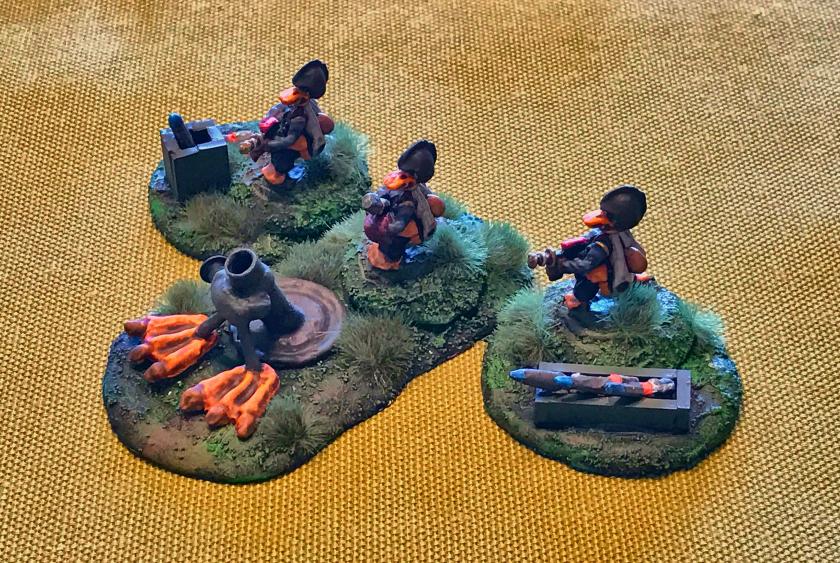
Mortarduck crew A with Duckfoot mortar. The two outer crewmen have ammo boxes and rounds to prepare for the loader. The loader is converted and holds a scratch-built round. The mortar is scratch-built from a washer, a bolt extender, paper clips, servo parts, and green stuff. Brown tufts designate this as crew A.
Reverse view of crew A.
Mortarduck crew B. Made similarly to crew A, except this crew has green tufts.
Reverse view of crew B.
The Star Duck Platoon in formation, view from the right.
Star Duck Platoon, reverse view.
Overall, I am very happy with the unit. I did use Army Painter Quickshade (Soft Tone) which darkened them much more than I expected. The effect was acceptable, but some of my identifying colors were muted.
I will now go into the how-to’s of the making of the unit.
How to Section
Conversions
All of the figures that I converted were missing the ray gun ends. These were either original casts or my own. I used a jewelry saw, wood carving knives, files, an awl, and an Exacto knife to remove the ray guns and make room for the weapons. Some of the figures lost limbs in this process, but I was able to use green stuff to recreate arms and hands for these figures. I drilled any “amputees” with a pin vise, and used 24 gauge wire as an armature for these.
a. Mortars and Mortarducks
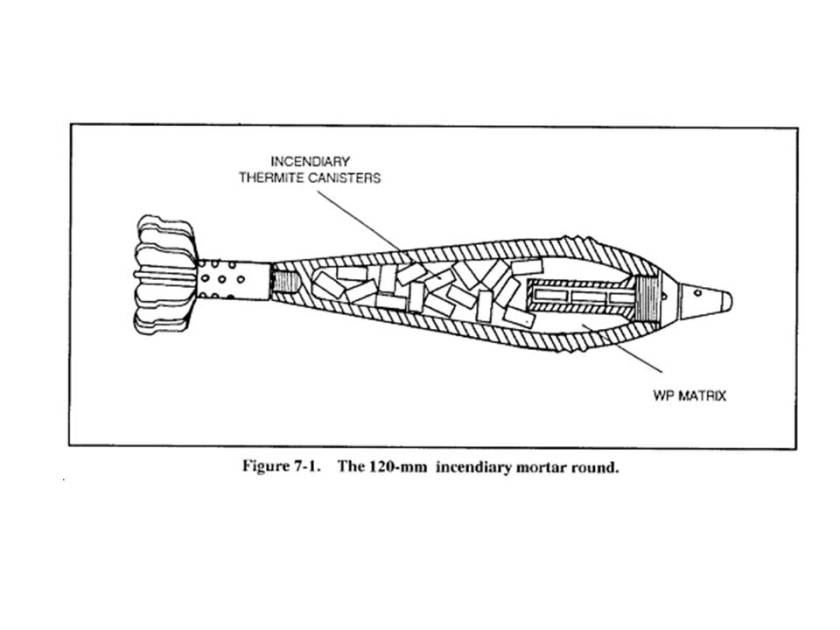
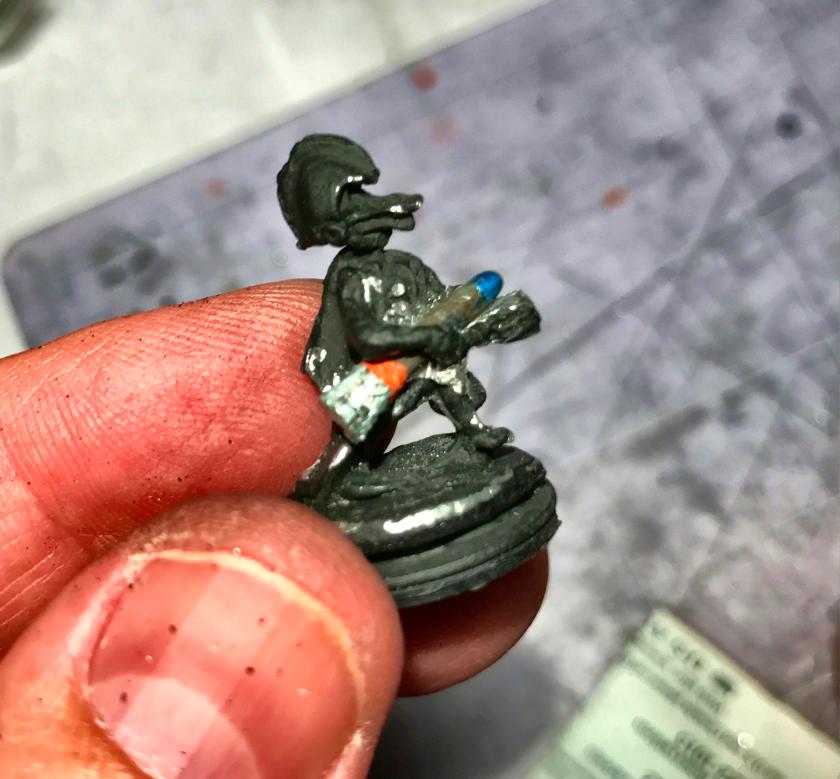
The mortars and mortarducks were the first conversions I attempted for this unit. I envisioned two teams of three – made up of a loader, and two crewducks with ammunition boxes. I made the ammo boxes from Plastruct styrene plastic and special styrene adhesive. I had acquired some Army Painter green stuff, and decided to give it a go for the mortars and rounds. I ended up using my steel sculpting tools, but quickly learned that I needed something different for green stuff, so I got some silicone- tipped tools that worked much better (less stickiness problems). I used paperclip wire with the green stuff for the mortar legs and the rounds. I tried to make a form for the mortar round bases out of 1/8″ plywood, with mixed success. Eventually, I found that correction with an Exacto knife was a good way to go. I made the bases with Apoxie Sculpt and steel washers. In the case of the mortar base, this made sense as I was able to make a strong base with room for the loader using two slightly different washers. The mortars themselves were made with screw extenders, washers, and servo parts for a model airplane. Testors super glue was the means by which I glued the rounds to the loaders and the ammo boxes. Additionally, I found that having some small hobby mirrors from Michaels made the sculpting and assembly process much easier. I decided to leave the two crewducks with their original weapons as the loader conversion had proved to be a lot of work and I did not think it made a difference as I already had the ammo boxes.
My mortar plan and notes
Idea for mortar round sculpts
Initial work on the mortar and the rounds
Early stage in sculpt
Early stage in sculpt, side view
Middle stage of sculpt, before Duckfoot alteration
Duckfoot mortars!
Mortar Rounds completed and painted
Mortarduck loader conversion in progress
b. Bazookaducks
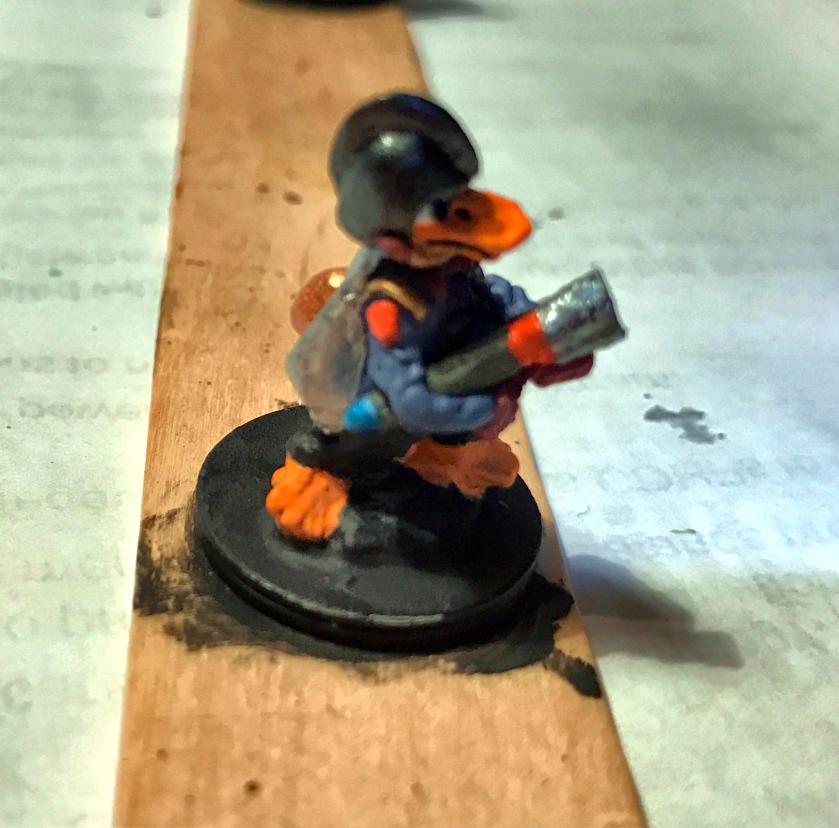
I wanted the unit to have an anti-tank capability beyond the mortars. I had previously converted some Frinx for this purpose, and decided to do the same for the Star Ducks. The bazookas are from Reaper and came with several other weapons. I basically carved away the ray gun and made the bazookas “fit”. There were amputees in this group, but I think the conversions worked well.
c. Squad Leaders
The squad leaders were simply converted with the same tools. I gave them the War Games Supply Dump blasters from the Dirk Garrison line.
3. Painting and Basing
The biggest challenge with painting was the color orange – I had not used it much before – and it took several iterations of trying different combinations until I found what I liked.
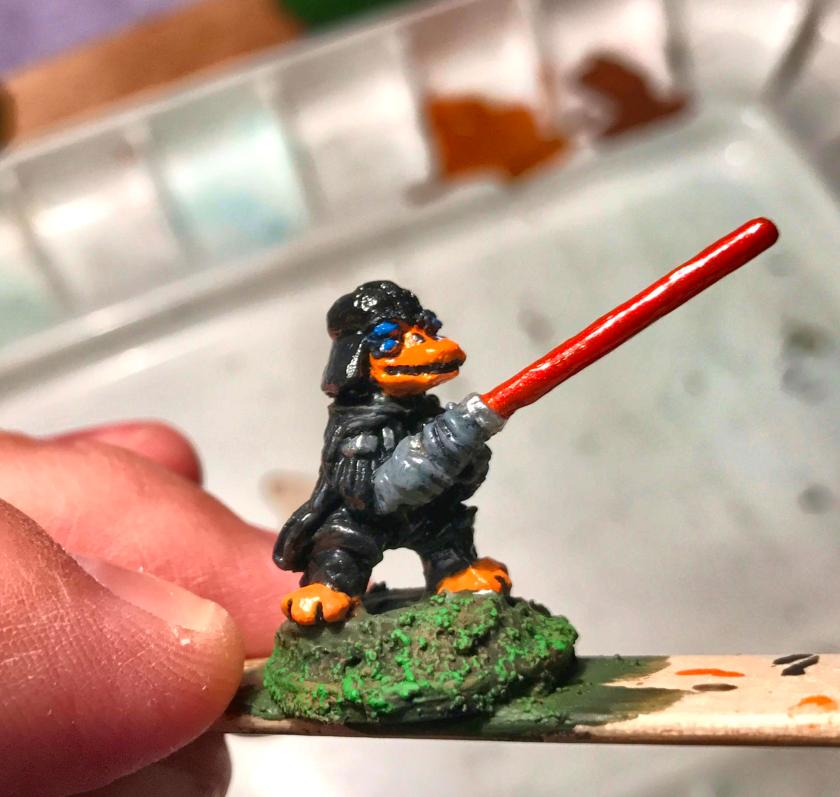
a. Duck Vader
The sequence was as follows:
Citadel “Imperium Primer” as a brush primer
Armory “Gloss Black” on helmet
Craftsmart “Orange” on feet and bill
Tamiya “Orange” on feet
Citadel “Ceramite White” on face and tail
Reaper MSP “Blue Liner” around eyes and pupils
Vallejo “Aluminum” on light saber beam
Vallejo “Chrome” on light saber handle
Vallejo “Steel” on chest details
Vallejo “Medium Gunship Gray” on gloves
P3 “Cygnar Blue Highlight” on eyes
Citadel “The Fang” on eyebrows
Citadel “Castellan Green” on base
Citadel “Nuln Oil Gloss” on cape and fingers
Citadel “Spiritstone Red” on light saber
P3 “Flesh Wash” on tail
Highlight cape with Vallejo “Black Grey”
Vallejo “Black” and “Glazing Medium” on cape and mouth slit
Deka Lack “Weiss” highlight on tail and face
Vallejo “Gloss Varnish” on helm
Army Painter “Anti-shine Varnish” on figure
Base coated
Finished Duck Vader
b. Mortar and mortar rounds
The sequence was as follows:
Citadel “Imperium Primer” as a brush primer
Armory “Gloss Black” on mortar base
Vallejo “US Dark Green” on mortar rounds
Tamiya “Titanium Silver” on mortar round tips and base
Craftsmart “Orange” on Duckfoot mortar feet
Tamiya “Orange” on feet
Citadel “Athonian Camoshade” wash on mortars
P3 “Sulfuric Yellow” on toes of mortar feet
Highlight with Tamiya “Orange” on feet
Citadel “Soulstone Blue” on mortar tip/fuse
Vallejo “Olive Drab” on mortar and rounds
Vallejo “Steel” and “Black Metallic” on mortar fins
Citadel “Fire Dragon Bright” on mortar rounds
Mounted the mortars and boxes and rounds on bases
Bases painted with Citadel “Lustrian Undergrowth”
Bases shaded with Citadel “Seraphim Sepia”
Bases highlighted with Armory “Musket Brown”
Bases highlighted with Citadel “Niblet Green”
Mortar dipped in Army Painter “Quickshade (Soft Tone)”
Mounted mortar and rounds got coat of Testors “Dullcoat”
c. Star Ducks
Citadel “Imperium Primer” as a brush primer
Citadel “Nuln Oil” on figures
Citadel “Ceramite White” on face and tail
Citadel “Fire Dragon Bright” on feet and bills
Reaper MSP “Blue Liner” around eyes and pupils
Citadel “Soulstone Blue” on eyes
Citadel “The Fang” on the jacket
Vallejo “Metallic Black” on helmets and infantry ray guns
Vallejo “Copper” on fuel tanks
Americana “Ebony” on trousers
Vallejo “Black” on mouth slit
Vallejo “Aluminum” on jet venturi on back
Vallejo “Gold” and “Chrome” on ray guns
Polly-S “Goblin Flesh” and Vallejo “Glaze Medium” on holsters
Vallejo “German Grey” on ammo pouches
Vallejo “Signal Red” on ray gun scopes
Vallejo “Gold”, “Chrome”, “Copper”, and “Signal Red” on WSD blasters
Different glove colors on lapels, helmet buttons, and gloves: Platoon Sergeant – Vallejo Metallic “Arctic Blue”; 1st Squad – Citadel “Ushabti Bone”; 2nd Squad – Americana “Bahama Blue”; 3rd Squad – Americana “Apple Green”; Bazookaducks – Polly-S “Demon Deep Red”; Mortarducks – Americana “Dioxazine Purple”
Armory “Musket Brown” and Vallejo “Neutral Grey” on cigars
Vallejo “Black” on bill vents
Vallejo “Light Orange” and “Glaze Medium” as glaze on bills and feet
Vallejo “US Dark Green” on bazookas
Citadel “Athonian Camoshade” wash on bazookas
Milliput (yellow) on bases
Bases painted with Citadel “Lustrian Undergrowth”
Bases shaded with Citadel “Seraphim Sepia”
Bases highlighted with Armory “Musket Brown”
Bases highlighted with Citadel “Niblet Green”
Figures dipped in Army Painter “Quickshade (Soft Tone)”
Figures coated with an application of Testors “Dullcoat”
Used various Army Painter tufts and meadow flowers on bases to designate teams
Base coated and ready for varnishClose-up of unit pre-varnishMortarduck loader, pre-varnishPlatoon Sergeant, post-dipPlatoon post dip, with Milliput added to bases
To wrap up, I am very happy that the unit is done. I am on the fence as to the use of the Army Painter “Quickshade” – the figures are darker and well-shaded, and should be well protected, but some details are obscured. I enjoyed my new Vallejo products and found that they really worked well. I also learned that orange as a color requires multiple applications and glazing to work well.
I learned much that I can use for future projects, and I hope that you enjoyed this blog entry.
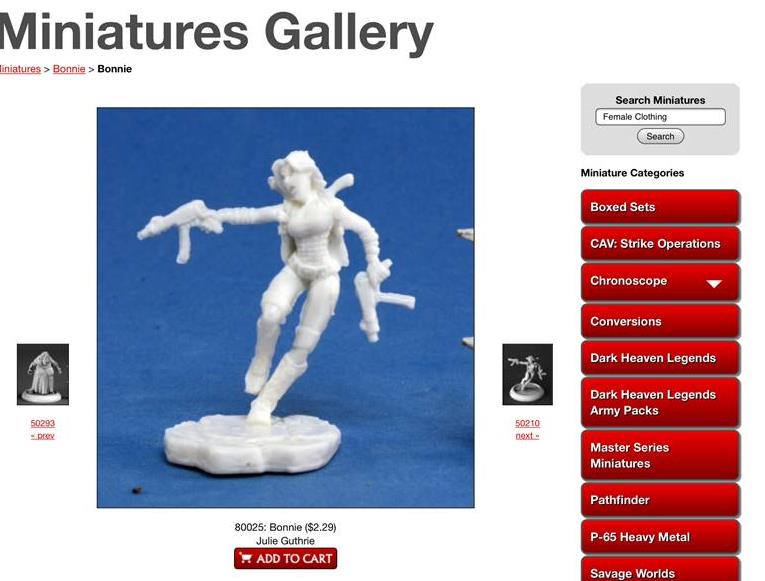
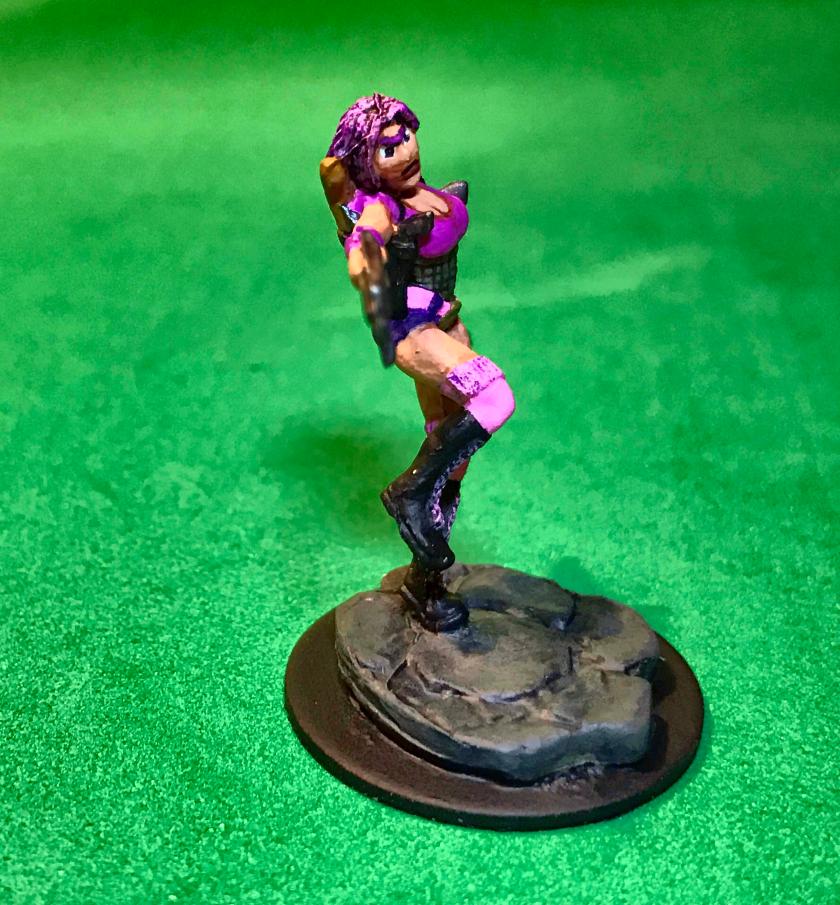
This blog is about the second figure that I painted for Chris Smedile’s birthday. It is a 28mm Reaper Chronoscope figure, “Bonnie” (#80025) sculpted by Julie Guthrie in 2015 or 2016. This was a challenging project mainly as I have so little experience in this type of fashion (if it can be called that). This is also my first “Reaper Bones” figure (resin) as all my others have mainly been metal. You can see the website link for it here.
From the Reaper website
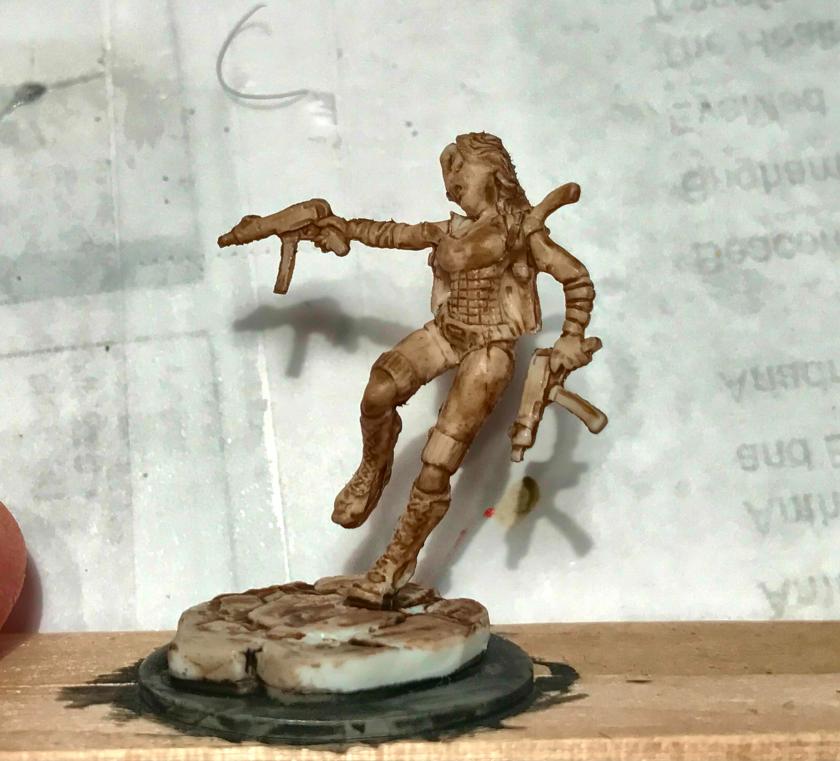
I noticed that the figure had visible mold lines, which I tried to remove with an Exacto knife and some light sanding. Then, I decided to apply a wash with Citadel “Agrax Earthshade” over the figure so as to see the details better.
After wash, frontAfter wash, rear view
I initially had a struggle trying to have a vision for this figure. Basically, she is a well-armed (probably overly-armed) post-apocalyptic warrior or perhaps a zombie hunter. After looking at her attire, I decided that she needed to have a bright comic book look – after all, who wears this in the apocalypse? Also, early on I was not so enamored of the details (or lack of details) that were molded on her face. I ended up thinking about it a bit – and eventually going with a patent leather and purple/pink/violet and glossy black theme.
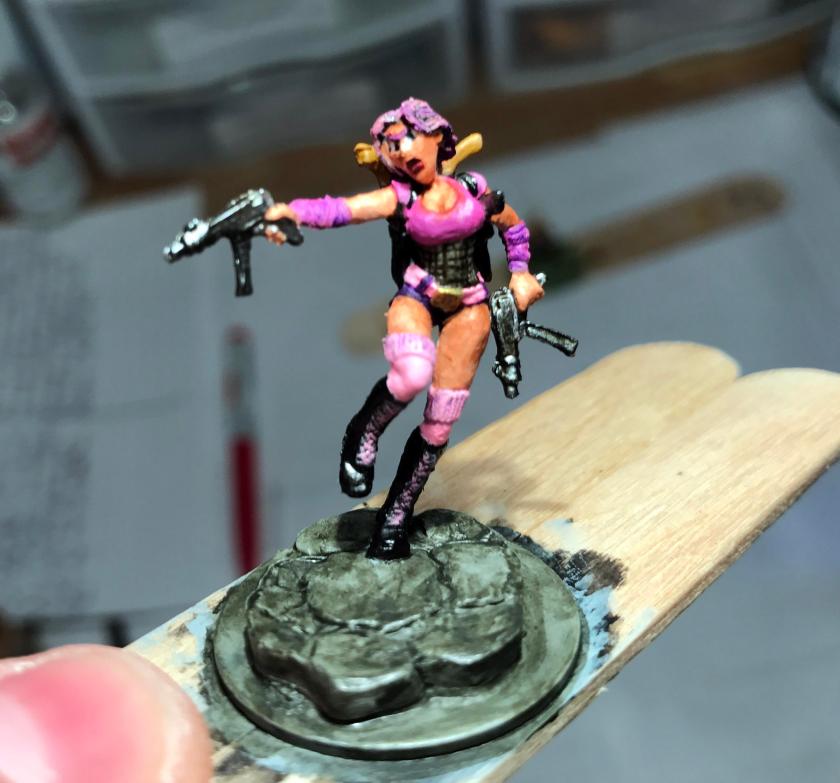
First, I base-coated the figure. I began with her flesh, using P3 “Midland Flesh”. I used Citadel “Ceramite White” for the whites of her eyes, and Americana “Ebony” for the pupils.
For her midriff vest/leather armor, I used Americana “Slate Gray”. Regarding her socks, halter top, and wrist wraps (I’m sure there is a name for them but hey, my fashion sense is limited!), I broke open my Americana “Bubblegum Pink”. I did not like the solid pink look on the top and the wrist wraps, so I mixed that with a little Americana “Vivid Violet” and “Dioxazine Purple” and that seemed to work better. For her hot pants (or shorty-shorts if you’re Larry the Cable Guy), I went with a very distinctive purple – Americana “Dioxazine Purple”. I gave her boots and straps a patent leather appearance with Armory “Gloss Black”. I decided that her hair should be black, so I went with Americana “Ebony” and a Citadel “Nuln Oil” wash. I gave her some hair highlights in with the three colors – “Vivid Violet”, “Dioxazine Purple”, and “Bubblegum Pink”.
For her two submachine guns, I applied Vallejo “Gun Metal”, which I also used for the triggers on her two sawed-off shotguns in holsters on her back. I painted the handles of the shotguns with Armory “Musket Brown”, followed by Vallejo “Wood”. For the base, I used Americana “Zinc”.
I moved on to some finer details and shading. I drybrushed her boot laces with “Bubblegum Pink”. I used Secret Weapons Washes “Armor Wash” to shade the submachine guns and her midriff armor. I highlighted the guns with “Gun Metal”. I washed her flesh with a light use of Citadel “Reikland Fleshshade” . Also I highlighted her ribbed sock tops with “Dioxazine Purple”. For her bottom lips and the inside of her mouth, I chose Polly-S “Demon Deep Red”.
Initial base coating, highlights, and shading, front of Bonnie Initial base coating, highlights, and shading, back of Bonnie
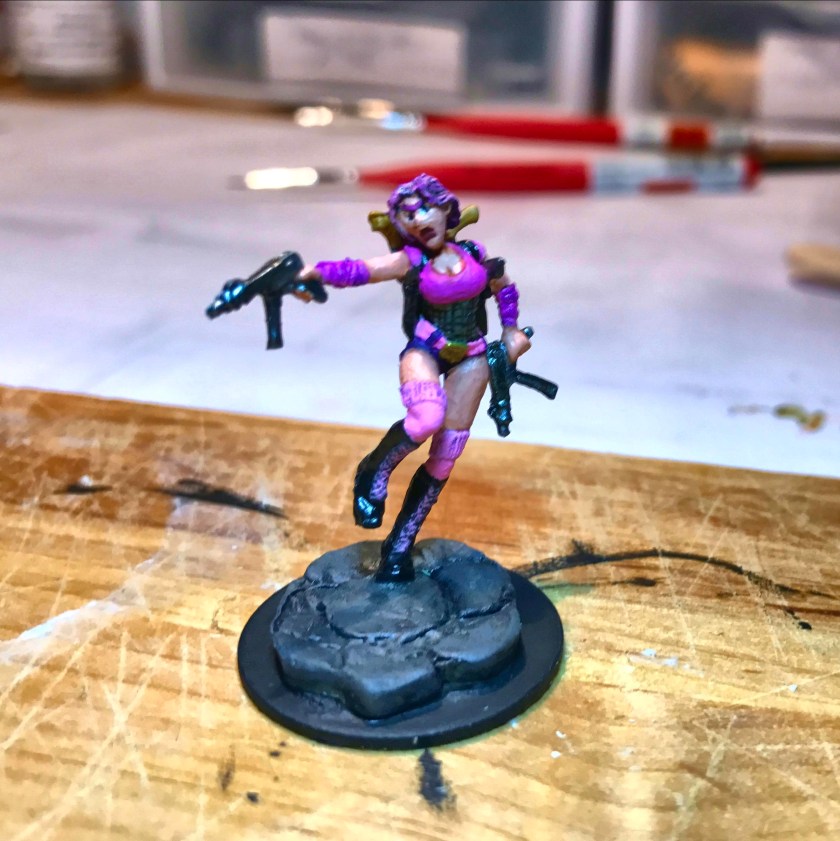
As you can see above, Bonnie looks pretty tan, and I felt as if she needed to look a little less of a tanning booth patron. So, I lightened up her skin by mixing in P3 “Ryn Flesh” with some “Midland Flesh”. I also tried to clean her up overall in a number of small fixes. I used Americana “Slate” to highlight the base, gave it a wash of Secret Weapons Washes “Heavy Body Black”, and painted the washer on the bottom “Ebony”.
Before varnish, frontBefore varnish, back
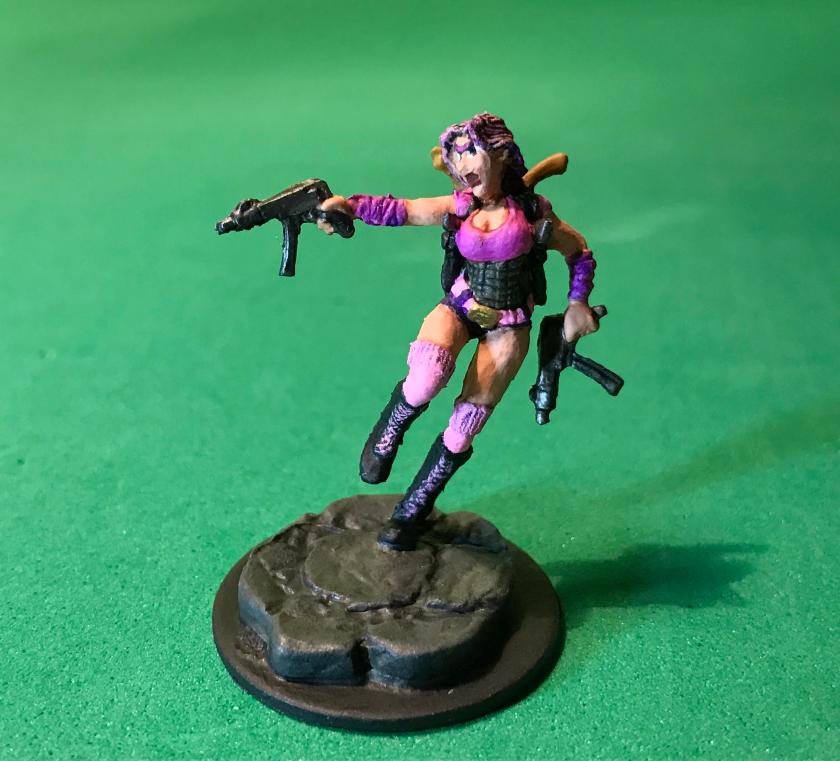
I then gave the figure two coats of Testors “Dullcoat”, allowing for adequate drying between steps.
Overall, I thought the figure came out ok. I was disappointed at the lack of facial details, especially as this was a Julie Guthrie figure, but perhaps that is a function of the resin. The mold lines were harder to cut and sand than I would have thought. I would use Bones figures again, but I am still preferential to metal.
The good news is that Chris like it, and I hope that he has a lot of great gameplay with it!
I apologize to my readers as its been a while since I have blogged, and as you will see I will be somewhat more active this week as I have completed some projects and now have a few things to actually write about! I expect that I will write three blog entries this week about projects that I have completed.
This is my first entry and concerns a RAFM Bard sculpted by Steven Koo in 1992 as part of the Women of the Ninth Meridian line. Here is a link to the 1994 catalog from DnD Lead website that shows that there were three in each set. The circled figure is the subject of this blog. The figure had pointed ears, so obviously she is an elf.
From the 1994 RAFM Catalog
Chris Smedile’s birthday was coming up, so I offered him the chance to go through my assorted unpainted miniatures and pick a couple of figures that he would like me to paint for him. He picked two – this Bard, and a Reaper Chronoscope Bones figure (which you can read about here). It is 25mm in scale, cast in white metal (possibly lead-free), and had great detail.
Bard front view before painting
Rear view of Bard before painting
“RAFM 92”
I looked at the weather forecast as I wanted to finish this project in time to properly use spray varnish outside – and I need close to 70° F and low humidity for best effect. I wanted her to have a slight “Little Red Riding Hood” look.
Beginning the base coat process, I started with the flesh, and used P3 “Ryn Flesh”. I painted her flute with Tamiya “Chrome Silver”. Using a pine tipped brush, I painted her eyes with Citadel “Ceramite White” and Reaper MSP “Blue Liner”. Moving on to her hair, I decided to go with blond. For that, P3 “Sulphuric Yellow” was my choice. For her tunic and her earrings, I went with a paint I purchased in West Germany in 1987, Deka Lack “Dunkelblau” (dark blue). She had a thin sword, and the scabbard I painted with Vallejo “Gun Metal”.
Moving on to her cape, I got another oldie but goodie paint from 1984. This was Polly-S “Demon Deep Red”, which ironically is older than Chris is!! I also used that color to base her hair ribbon. For her breeches, I based with Armory “Prussian Blue”. For the trim and cuffs on her tunic, I used another Deka Lack paint, “Weiss” (white). She had a canteen and a pouch on her belt. These I painted respectively with Vallejo “US Dark Green” and Armory “Brick Red”. For her leatherwork and straps, I decided on P3 “Bootstrap Leather”. I needed to finish her metallics, and so I painted her brooch and sword pommel with Vallejo “Silver”, and her belt buckle and scabbard tip with Vallejo “Bright Brass”. She has a jewel in her brooch, which I painted with Citadel “Soulstone Blue”. For her base, I used Americana “Hauser Light Green” so as to make later base applications better.
Bard, front, after base coat
Bard, back, after base coat
I then moved on to highlighting and shading the figure. For her hair, I used successive washes, first with P3 “Sunshine Yellow” and then with Citadel “Reikland Fleshshade”. I then used a wash on the tunic with Citadel “Agrax Earthshade”. I then lightly washed her hands with “Reikland Fleshshade”. To highlight her facial features, I mixed Polly-S “Elf Flesh” with P3 “Ryn Flesh” and applied it to her cheeks, nose, hand and fingers.
For her breeches, I shaded with “Agrax Earthshade”, followed by highlighting with a mix of “Weiss” and “Prussian Blue”. Lastly, I moved on to her cape and hair ribbon. Here, I darkened the cape with “Agrax Earthshade”, then highlighted it with Americana “Santa Red”. I also painted her hair ribbon with “Santa Red”.
To finish the base, I applied Army Painter “Moss Green” flocking with white glue. Then the figure got two coats of Testors spray “Dullcoat”, allowing for sufficient drying time between coats. To finish her, I added a yellow flower tuft from Army Painter “Meadow Flowers”.
Finished Bard, frontal view
Finished Bard, rear view
Finished Bard, side view
Overall, I was pleased with the work I did on the figure. It was a nice break from my very large Star Duck project.
Chris got it on his birthday, and he loved it! I am looking forward to hearing of her exploits!
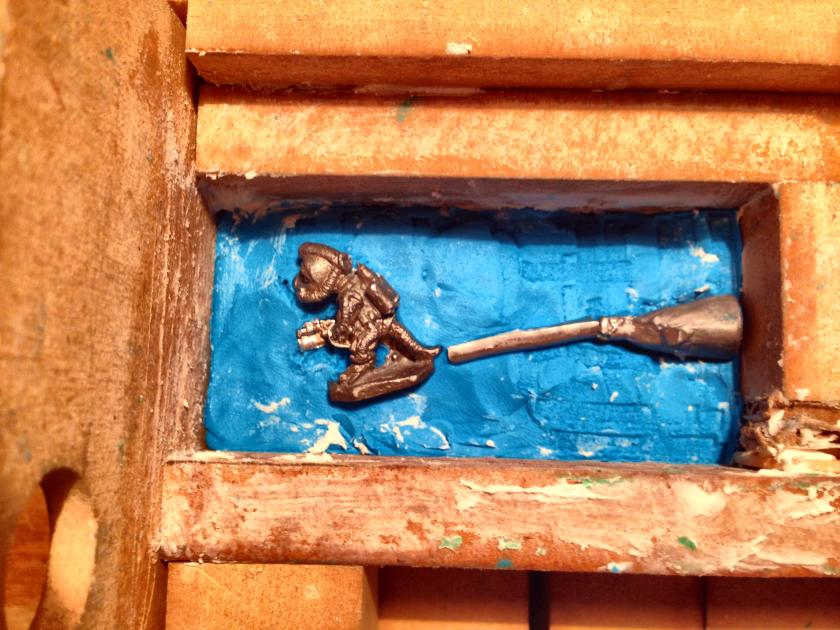
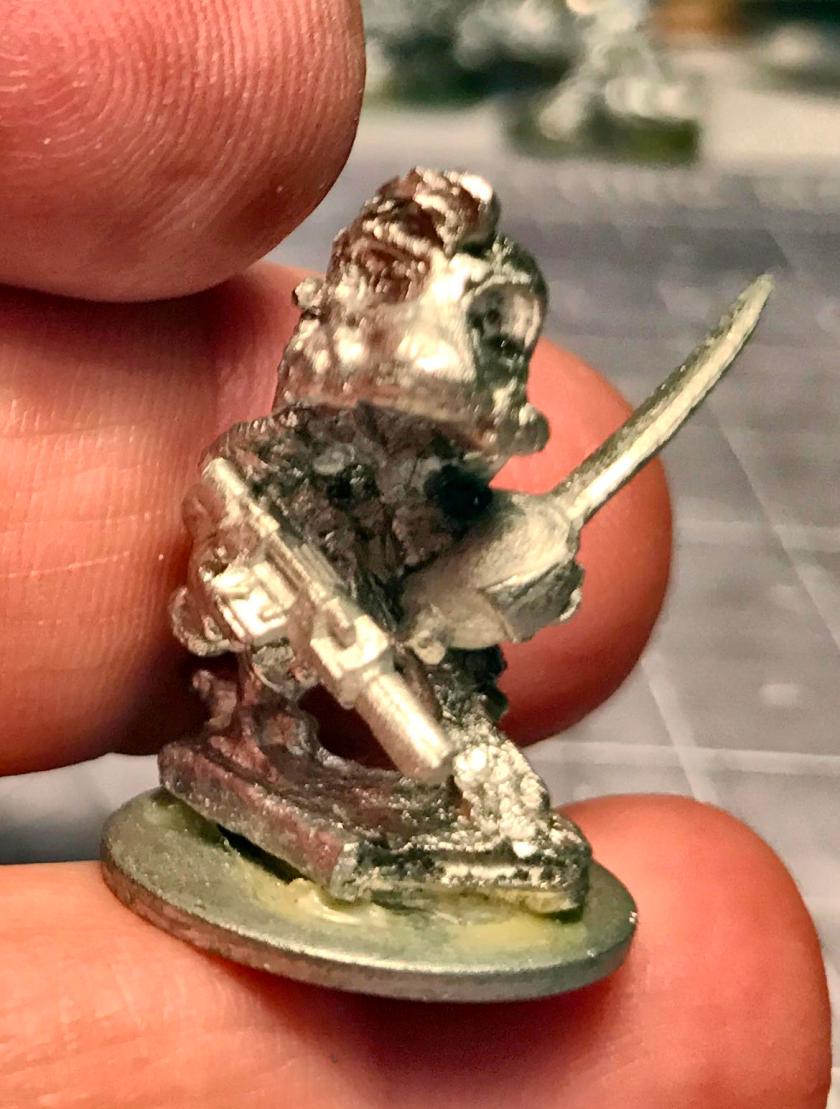
As described earlier in this blog (here), I had acquired and cast some Archive Star Rovers figures – “Power-Armored Frinx” (#2040 or #2305) last year. As these were made between 1977 and 1981, it became difficult to acquire enough of them for a unit, and Archive no longer exists to purchase them. I cast several of them for myself and friends.
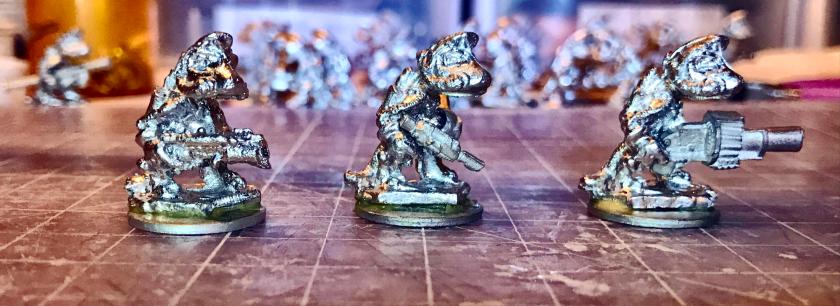
My goal was to create a platoon-sized unit of these Frinx for a retro-sci-fi battle using Combat Patrol™. My concept of these figures is that they are reptilian, and that they wear suits of “power-armor” that protect them, while negatively affecting their movement. They are armed with a blaster-type weapon. My castings did not pick up the details of the helmets which had a light-like feature similar to that of a miners helmet. What they did pick up yielded a look similar to a beret (if a helmet could become a beret), and I incorporated that feature into my painting scheme.
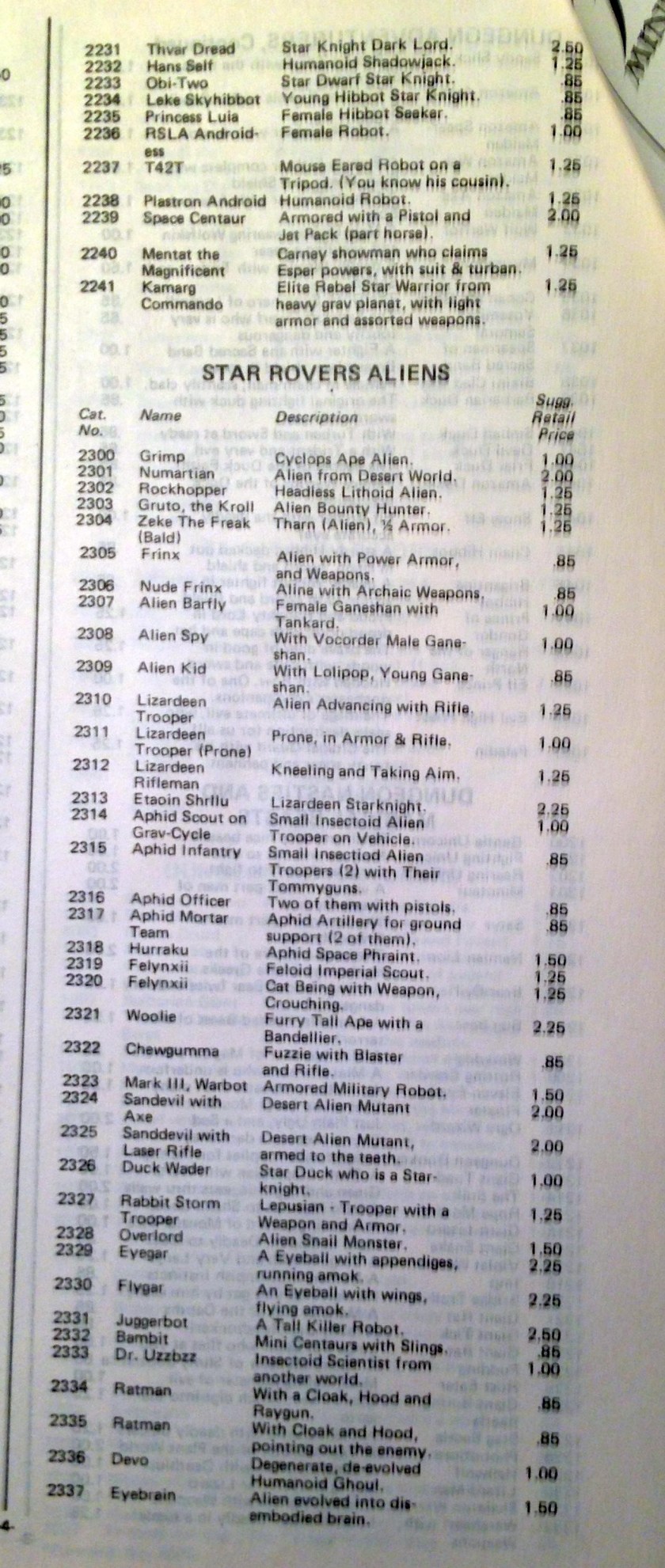
For fun, below is a catalog shot that came with my Star Rovers game. Note that it lists “Frinx” and “Nude Frinx”. I do have one of the latter, and its a Frinx out of armor!
Catalog scan from Archive Star Rovers game
Mold with Power-Armored Frinx
After I had 32 figures, I organized them for the platoon. I needed to convert several troopers to make a platoon leader, a platoon sergeant, and an anti-tank section. I also plan on attaching the Mark 1 Sphere tanks I previously created into the platoon. The organization of the platoon is below.
Power-Armored Frinx platoon structure (32 fighting figures plus 3 vehicles):
Frinx Platoon Leader (1 Frinx with blaster pistol and light cutlass)
Frinx Platoon Sergeant (1 Frinx with automatic grenade launcher)
AT section (3 Frinx with bazookas)
Jade Squad (9 Frinx)
Squad Leader (1 Frinx with blaster rifle, also leads Jade A team)
A Team – 4 Frinx Infantry with blaster rifles
B Team Leader (1 Frinx with blaster rifle, also leads Jade B team)
3 Frinx Infantry with blaster rifles in Jade B team
Pearl Squad (9 Frinx)
Squad Leader (1 Frinx with blaster rifle, also leads Pearl A team)
A Team – 4 Frinx Infantry with blaster rifles
B Team Leader (1 Frinx with blaster rifle, also leads Pearl B team)
3 Frinx Infantry with blaster rifles in Pearl B team
Amethyst Squad (9 Frinx)
Squad Leader (1 Frinx with blaster rifle, also leads Amethyst A team)
A Team – 4 Frinx Infantry with blaster rifles
B Team Leader (1 Frinx with blaster rifle, also leads Amethyst B team)
3 Frinx Infantry with blaster rifles in Amethyst B team
Sphere Tank Section (3 Mark 1 Sphere Tanks with heat rays and ray guns)
I used a jewelry saw and some blades to remove the blaster on two figures, as well as the left arm on the platoon leader. I had some sci-fi weapons that I had gotten on eBay and from Buck Surdu (perhaps from War Games Supply Dump). I gave the platoon leader a light cutlass (instead of a light saber) and a blaster pistol.
Platoon Leader after conversion
I then moved on to the AT section, which reports to the platoon sergeant. After removing the blaster and shaving some space, I used a pin vise drill to make space for the bazookas on 3 Frinx. I used 3 bazookas from 3 Reaper Chronoscope Weapons Pack III’s (#5o234). I split the bazookas in half and sized them to the figures. For the platoon sergeant, I removed the blaster, and gave him a cool automatic grenade launcher.
AT Frinx after conversion.
Source of bazookas
A trooper, the converted platoon leader, and the converted platoon sergeant
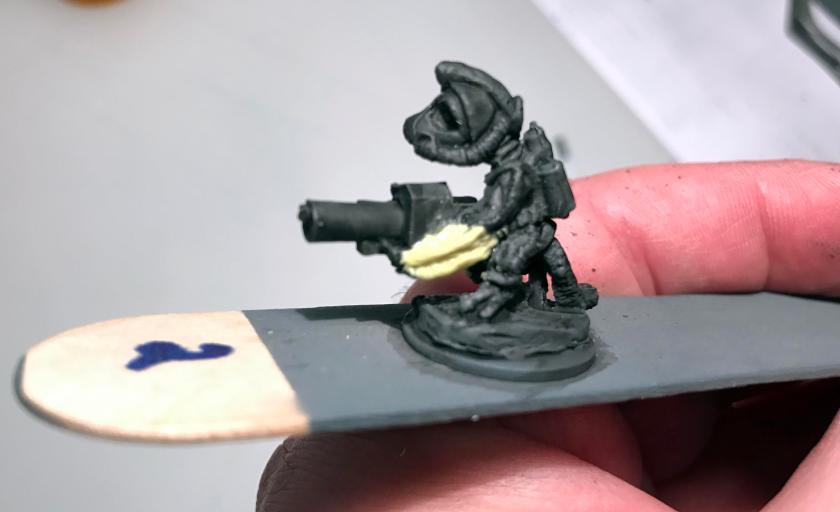
I mounted all the figures on ¾” steel washers with wood glue, and let them dry. Subsequently, I used white glue to lightly mount the figures to numbered popsicle sticks. I covered the numbers with scotch tape, and primed the lot with Krylon “Ultra Flat Gray”. I then removed the tape so as to know what stick I was working on and have a reference point for the beginning and the end as painting units can cause one to forget. Using Citadel “Nuln Oil”, I gave the unit a wash to better identify their features. This gave me a surprise for the platoon sergeant!
All primed
The automatic grenade launcher already had a couple of hands on it! The Frinx hands are gloved – similar to say 1920’s Mickey Mouse for lack of a better comparison. I had to create a left arm with Milliput for the figure that would cover up the left glove and extend to the left hand under his weapon. For the right extra hand, I filled in the fingers with Milliput and made it look like part of the grenade launcher.
Platoon Sergeant – before conversion on left side
New arm for him!
Platoon Sergeant with extra hand?
Turned extra hand into stock
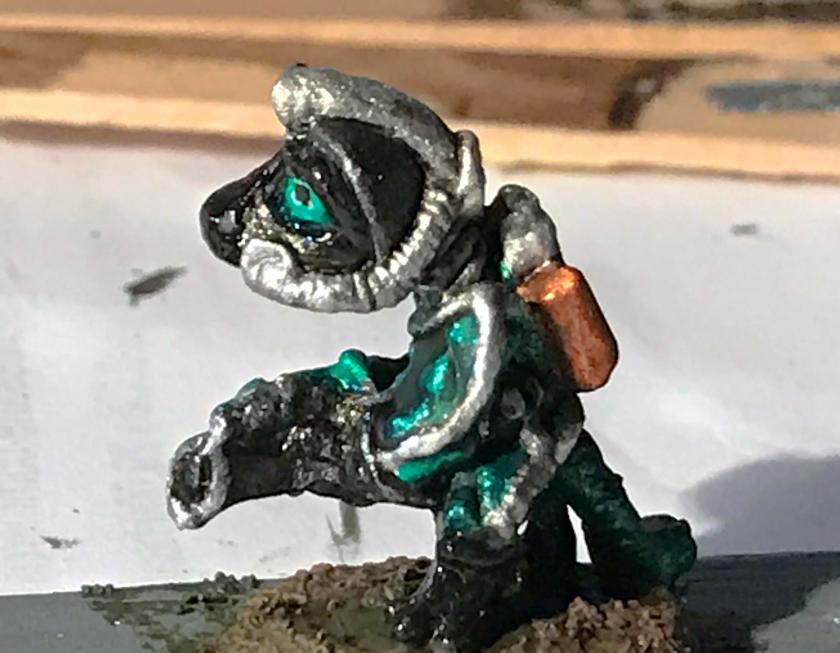
As far as my painting scheme, I wanted to try something new – and use a lot of metallic paint for a few purposes. First, to create the image of the “power armor” I used a series of DecoArt metallic paints. These had a side benefit of also allowing me to easier differentiate my squads into three (Jade, Pearl, and Amethyst). I used other Citadel Technical Paints to denote leaders, and parts of weapons. Additionally, I used a few Tamiya metallic paints as I will describe. The net effect of the metallic was to make this a difficult project due to the thicknesses of the metallic paints – but I think the results worked (but the reader can be the judge). These photos are ok, but I found it difficult to get the lighting right for them.
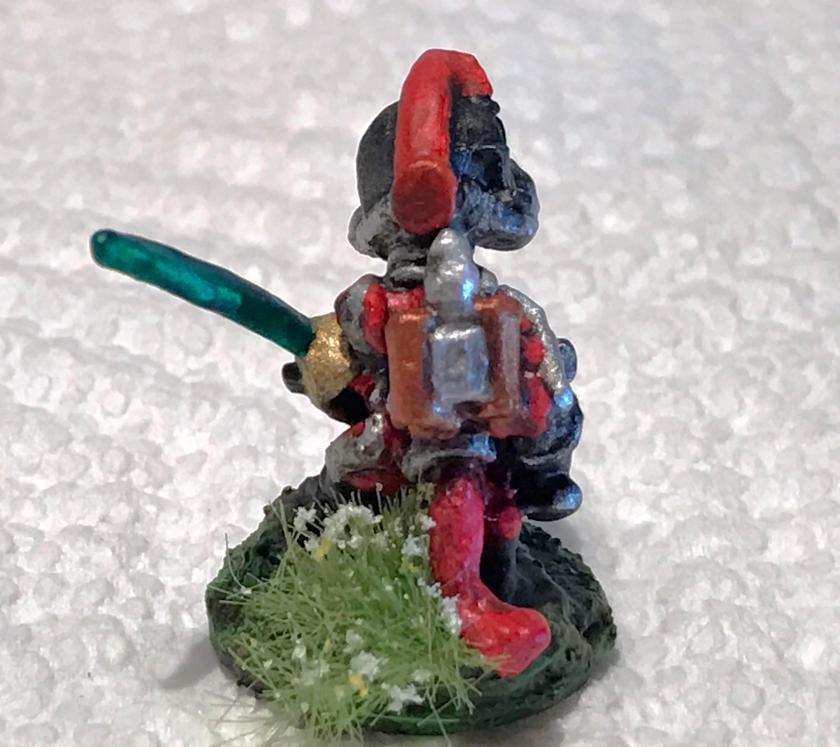
Basically, I had to abandon the typical assembly line approach I normally take to when painting units due to the properties of the metallic paints (especially the viscosity and the clotting). Thinning helped, but to get the desired effects I went slow and methodically. Each figure was base coated with a DecoArt Dazzling Metallic or Craftsmart metallic main color (DecoArt “Festive Red” for the platoon leader, Craftsmart “Sapphire” for the platoon sergeant, DecoArt “Festive Green” for the AT section, DecoArt “Crystal Green” for the Jade squad, DecoArt “Peacock Pearl” for the Pearl squad, and Craftsmart “Amethyst” for the Amethyst squad. Tamiya “Chrome Silver” was my choice for the breathing regulators, straps, part of the blaster sights, and the center of the helmets. Tamiya “Gun Metal” was what I used for the blasters and the remainder of the helmets. For the Frinx faceplates, gloves, and boots, I used another metallic, Craftsmart “Onyx”. The main part of the breathing tanks was coated with another metallic, DecoArt “White Pearl”, while the tanks themselves got Tamiya “Copper”. Inside the faceplates, I painted the eye wells with Citadel “Ceramite White”, then dotted the eyes with “Onyx”. Using Citadel Technical “Waystone Green”, I filled in the rest of the eye well, creating an eye. I ten used Citadel “‘Ardcoat” to create a lens-like effect on the faceplate – this took a while as I had to do one side at a time, and let each dry. I also used the “Chrome Silver” as a base for “Waystone Green” on parts of the blasters, the platoon leader’s light cutlass, and on the team leaders’ helmets. For the squad leader’s and platoon sergeant’s helmets, I used the same approach but with another Citadel Technical paint, “Soulstone Blue”. The platoon leader’s helmet got Citadel “Spiritstone Red” (yet another “Technical” paint).
I then used “Nuln Oil” for shade, and highlighted all the areas overly darkened by it with the original colors to add depth. For the black gloves, I used highlights of “Chrome Silver” intermixed and slightly covered by “Onyx”. For the bazookas, I used my first Vallejo paint, “US Dark Green” – and I loved the paint. It was so easy to use after all the metallics! I shaded the bazookas with Citadel “Athonian Camoshade”.
For the bases, I tried a new approach to hide the raised bases. Using Citadel “Lustrian Undergrowth” (a thick “Texture” product), I carefully filled in around each base. This was better than I thought as far as effects. After the bases were dry, I washed them with Citadel “Seraphim Sepia” and let them dry. I was able to dry brush the bases successively with Armory “Musket Brown” and Citadel “Niblet Green”. Due to the cold weather, I was not able to varnish at home. Luckily, my friend Jeff Smith has a nice heated workshop that he was kind enough to let me use. There I gave the platoon a couple of coats of Testors “Dullcoat”.
Lastly, I used tufts to better differentiate for play between A and B teams on the squads. Jade team A got one Army Painter “Swamp Tuft”. Pearl Team A got Army Painter “Wilderness Tuft”. Amethyst Team A got Army Painter yellow “Meadow Flowers”. The platoon leader and platoon sergeant got white “Meadow Flowers”.
Midway progress
Lots of Frinx!
Close up of Jade team Frinx after base coat
After painting and off to the varnishing
Assembled platoon less sphere tanks
Amethyst Squad, side view
Platoon Leader with light cutlass
Blaster side
Rear view of PL
Platoon Sergeant, weapon view
Platoon sergeant, rear view
AT Section
Supported by Mark 1 Sphere Tanks
On the move
The Power-Armored Frinx Platoon deployed
I tried a number of new things for this project and learned some things:
Multiple metallic paints
Tamiya – use their thinner, it works better than water and can rejuvenate old Tamiya paints
Craftsmart and DecoArt – thick stuff, but will work
Citadel products
“‘Ardcoat” – great for lenses over Citadel Technicals
“Lustrian Undergrowth” (Texture) – works well on bases and drybrushes well
Technicals (“Soulstone Blue”, “Spiritstone Red”, “Waystone Green” – all good, but need to consider what you use as base and drying time
“Seraphim Sepia” and “Athonian Camoshade” are nice washes
Conversions – sometimes the details are not immediately visible on additions! Use a wash on gray or white primer to see details