I put some new edits to this post in blue! Mea culpa and read on please!
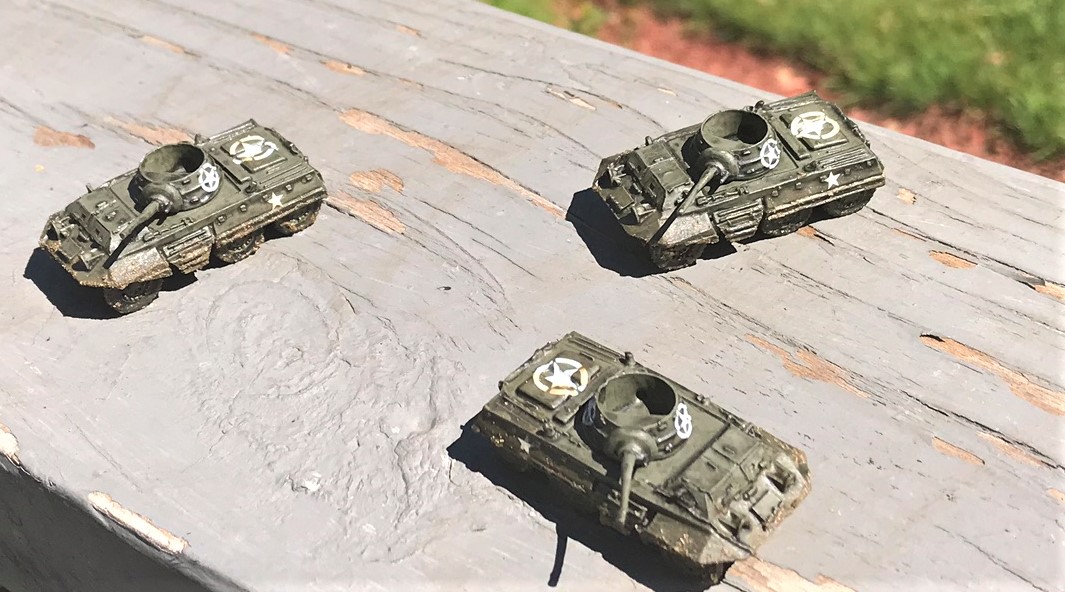
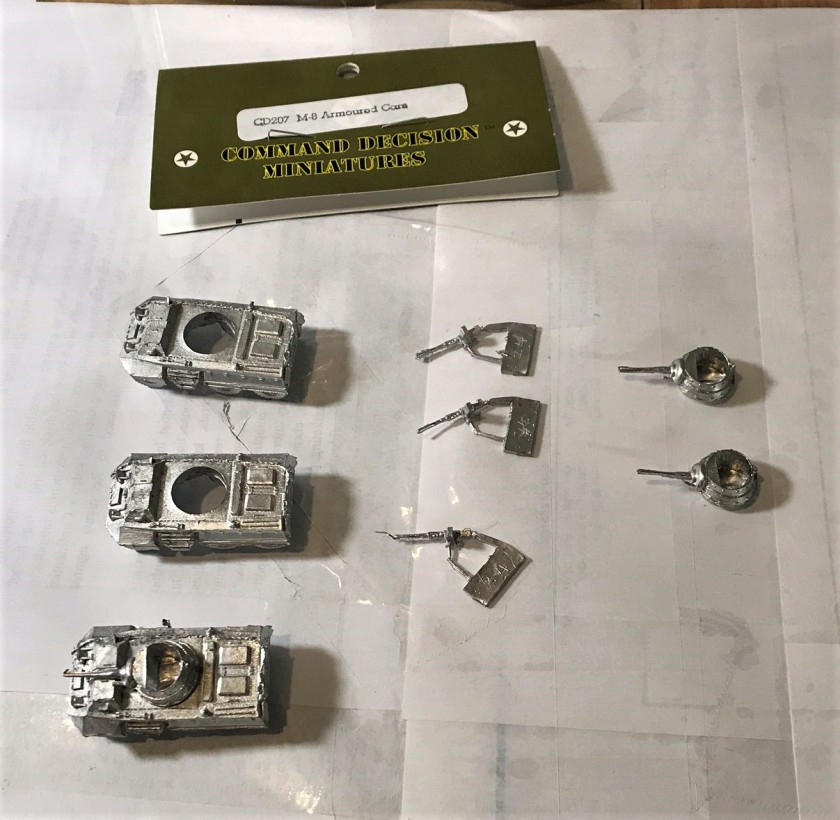
Back to gathering the models – I ended up with American M8 Greyhounds and Daimler Dingoes. It was difficult to find suitable 15mm/1:100 scale models. From Noble Knight Games, I found a couple of 3 Dingo blister packs of Battlefront Daimler Dingoes (#BR310 – now out-of-production). I got these a few days before I was scheduled to run the Normandy Breakout game – so time was not on my side. I built one pack for Normandy and will save the other one for North Africa. As for the M8 Greyhounds, I ended up buying a three-vehicle bag from Old Glory of Command Decision models (#CD207). All of these arrived the week of the game. Tick tock….
This Daimler Dingo blister is OOP.
The Dingo trio came with bendy metal machine guns to mount on top, but I did not see these surviving tabletop play – or even being easy to mount. I think the Dingoes work well as I completed them. If I ever get a few Daimler Armored Cars, or any Humber Scout Cars, they would be easy and fun to add to the British forces. The Dingoes’ crews of two were not very detailed, but I tried my best. The Old Glory M8 Greyhounds did not come with crew, and I saw afterwards that you can buy crew separately from them; however, by then it was too late for my schedule. The M8’s also had machine guns, but these models are all metal. The 37mm guns on the M8’s were spindly enough, so for the same reason as the Dingoes, I left off the large machine guns.
Dingo kit components – lots of wheels to mount.My M8 Greyhounds just out of the bag. One of the turrets has been placed on the bottom M8 for comparison.I decided to prime the components and then assemble, especially with 12 Dingo wheels. I used the Vallejo “Russian Green” primer – and that looked off. I eventually painted them the proper olive drab.
CORRECTION: I assembled the Dingoes incorrectly and fixed them – see notes in blue and at the end of this post!
I used some Battlefront decals for ease of tabletop identification on the Dingoes. I am unsure as to the units – but they are indeed British/Commonwealth and super small. All vehicles got some mud to weather them.
Normally, I set up my completed minis on a tabletop, but given that my game was coming up, I decided to take some shots of them in the sun on my deck railing (yes, the deck needs paint but will be replaced soon I hope!). This is after all Massachusetts – stuff weathers naturally!
The three M8 Greyhounds.The three Dingoes (now with crews in correct position).OK, the Dingoes have a stubby front!My crews originally faced this way – and went into tabletop combat for one game like this. To an American, this looked like the front, but it’s the back. I got fooled by the view ports in back and the long back of the vehicle that looked like a hood to me.Side view of a proper Daimler Dingo.Now this is better!All my Allied recon for Normandy in one shot. Except these have the crews in backwards!! Compare with previous shots.
The biggest challenge with these was their size, followed by the US stars on the M8’s for aircraft ID. It was different for sure.
My next post will detail these vehicles’ experiences in their little battle last Saturday! There was some action for sure.
Thanks for looking! Any favorites? Comments? Always appreciate your feedback in the comments section!
PAINTS, INKS, GLAZES, SHADES, WASHES, PIGMENTS, FLOCKING, GLUES AND MORE USED ON THESE VEHICLES:
Gorilla Glue
E6000 epoxy
Vallejo “Flow Improver”
Vallejo “Airbrush Thinner”
Vallejo “Surface Primer – Russian Green”
Vallejo “Surface Primer – Black”
Vallejo Model Air “US Olive Drab”
Battlefront”Black”
Army Painter “Military Shader” (wash)
Battlefront “European Skin”
Battlefront “Skin Shade” (wash)
Testors “Universal Acrylic Thinner”
Vallejo “Light Brown”
Vallejo Game Air “Satin” (varnish)
Battlefront “Battlefield Brown
Battlefront “Dark Gunmetal”
Appropriate decals from Battlefront
Microscale Micro-Set
Microscale Micro-Sol
Microscale Liquid Decal Film
Vallejo “Gloss Varnish”
Vallejo “European Mud” (Thick Mud)
Vallejo “European Slash Mud” (Splash Mud)
Vallejo Mecha Varnish “Matt Varnish
CORRECTIONS!
Well, I am a bit embarrassed to say that when I built my Dingoes I put the crews in backwards.
Yes, backwards.
We even played with them last weekend and none of us, being Americans, knew they were wrong. I should have paid better attention – but I was able to correct the problem – luckily I had used E6000 epoxy to mount the crews instead of Gorilla Glue so they were easier to remove. I did have to repaint them a bit and reapply varnish. I have changed the pics above to reflect that! My apologies to the British Army and the British Empire! It was not a 4th of July joke!
For those of you who are modelers and or gamers, you know the feelings about your hobby work – to do a good job recreating a scene, a vehicle, terrain, or just a figure such that others enjoy it. I put this blog in the same category. I understand that for better or for worse, I am putting myself out there and my creativity to be judged up or down.
This blog post will be a bit different in that its admittedly somewhat self-indulgent. I am unsure as to how it will be received – but I hope that you enjoy it and that you can appreciate what this was for me and why I was doing this last weekend.
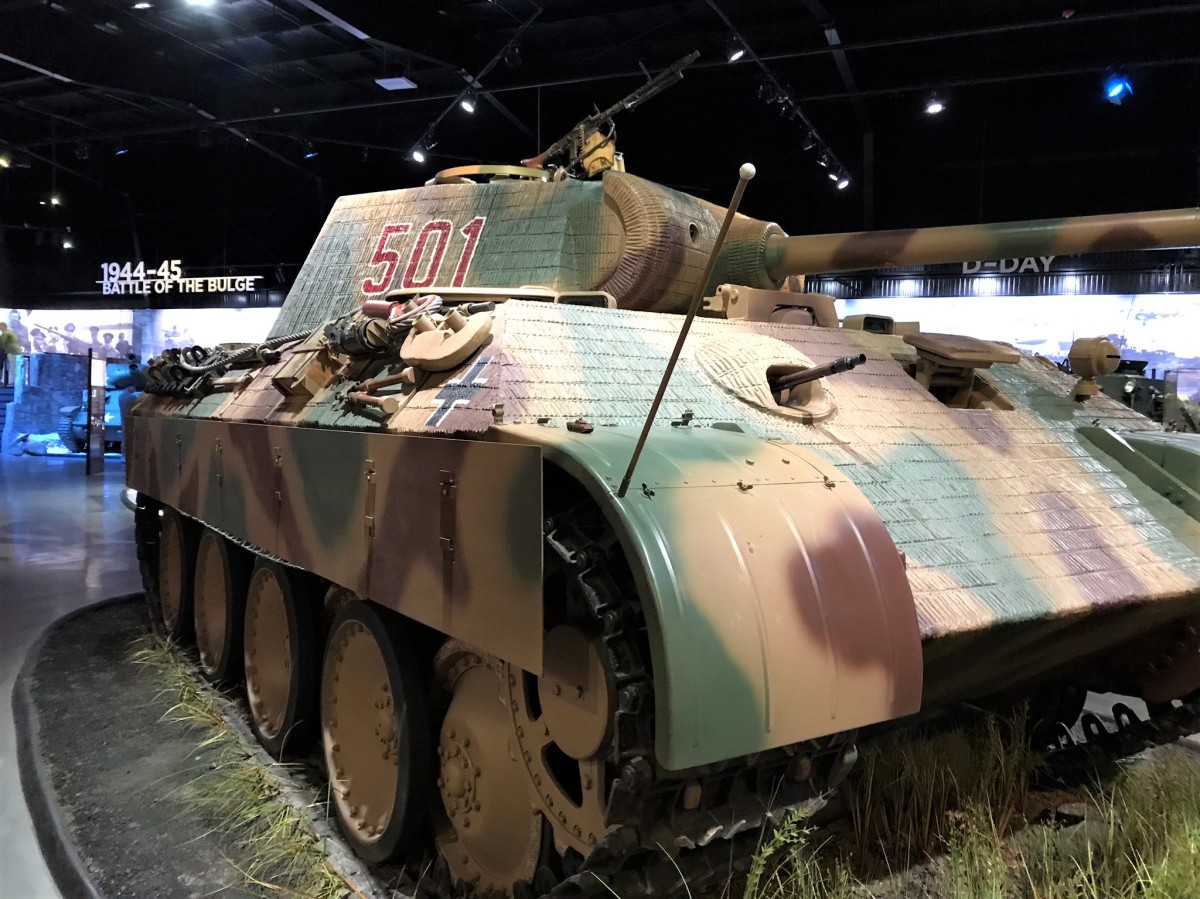
Last Saturday, the Historical Gaming Club of Uxbridge, MA, sponsored a road trip to the American Heritage Museum in Hudson, MA. I have posted about this museum last year (you can read about it here). It’s really great. I unfortunately also signed up for a golf tournament an hour away and was disappointed in my planning. I was however able to leave the tournament (my team lost by one stroke) after I was done and drive to meet the others (about 10 of us) at the museum. And I brought two “friends”…
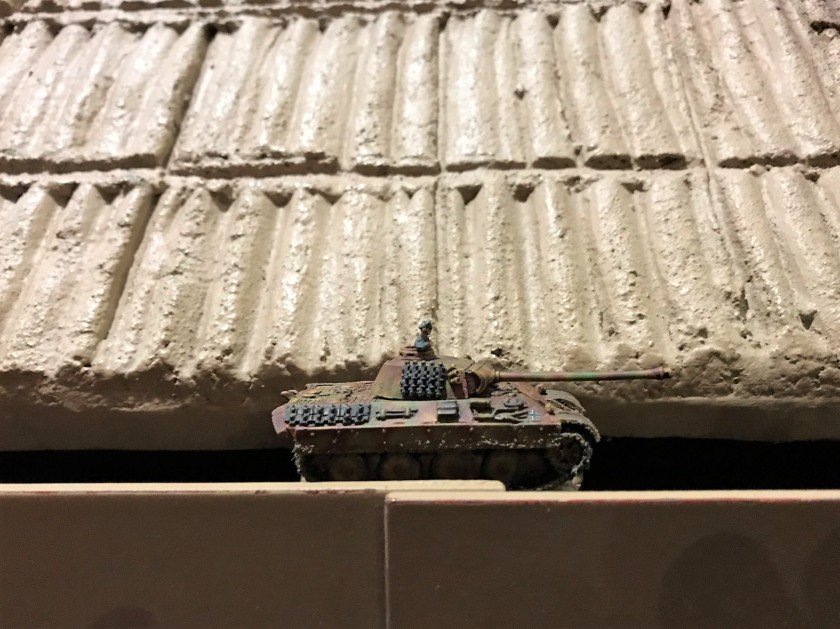
Followers of this blog know that I have been somewhat tank-heavy in hobby activities and gaming since last fall. I thought that it would be cool to have the real Panther at the museum meet my 15mm/1:100 scale Panther. And as my late grandfather Marcus C. Delaney drove an M24 Chaffee light tank in WWII, I wanted to hook up one of my M24’s with a real one too.
I just thought it would be a cool thing to do – and to give my models a connection to the real deal. Of course, you can be the judge.
First stop was the Panther.
A real Panther and my model – can you see it?There it is!Impishly placing my Panther on the right fender.Both Panthers are now aiming at a T-34…but I don’t think mine has the needed gun velocity!
Then I moved over to the M24 Chaffee.
Where is my model?There it is!On the M24 frontal armor.Trust me, we are all smiling. Even my grandfather from above.
It felt good to do this, and I’m glad I did. Now when these are in a game, I can say that they have been with the real thing, and in actual contact.
Would you do this? Let me know in the comments section, and thanks for looking!
My plastic kits – all bought from The Plastic Soldier Company.
The tanks were all single models, while the PSC kit allowed you to build either SdKfz 231, 232, 233, or 263 8-rad scout cars. While I liked the idea of having a 232 or 263 with their iconic roof antennae, I decided not to build them as such for a couple of reasons. First, the spindly plastic antennae did not look survivable as tabletop figures. Secondly, if I built the antennae, the turrets would not work. In the end, I built three SdKfz 231 (with the same 20mm autocannon as the Panzer II) and two turretless and open-topped SdKfz 233 (with the same 75mm gun as the Panzer IVD). Two SdKfz 231’s would be for North Africa, with the remaining 231 and both 233’s being built for Normandy. These scout cars, and the other tanks and tank destroyers here all could reasonably be used on either the Western or Eastern Fronts. I will cover each type in order, and then some “eye candy “shots of the finished models. I will also share a listing of the paints and other materials I used in the projects for those interested.
SdKfz 231’s and SdKfz 233’s (8-rad scout cars)
These are all 8-wheeled scout cars, and I plan on using them to add some recon aspects to my games. They are very light, and as I was concerned that they would be knocked around very easily. I added Daisy BB-gun BB’s to the 231’s, but the 233’s were open topped and that was not an option. The 233’s did have crew that needed to be painted and mounted.
SdKfz 231 showing my use of BB’s as ballast.The group of 5, assembled, less crews for the 233’s.One of the crews. I drilled, ahem, their seat areas, with a pin vise, and mounted them on toothpicks for ease of painting. I removed most of the toothpick tips before mounting the crewmen and painted over their posteriors. You can’t see them, but forever these will have a stick up their asses…
233 mid-project
231 mid project
As you see above, my Iwata Micron-B was a wonderful tool to achieve the three-tone camouflage patterns. I applied decals, weathered the vehicles, and varnished them. The sun finally came out so I took a couple of shots on the deck.
Completed SdKfz 233 shot outside.All three for Normandy catching some rays.
For the North Africa/DAK 231 models, I just washed and dry-brushed them to achieve a weathered look. I did not give the DAK 233’s because I did not want to paint another 15mm crew! These will work just fine.
Das Afrika Korps now has reconnaissance.
Jagdpanther
The lines on this tank destroyer are practically beautiful. Though if I was in a Sherman seeing one, my opinion would certainly be different! Only 415 of these were ever built.
The Jagdpanther model was the easiest to assemble of the three. The boxes say you don’t need glue, but I recommend using modeling cement for sure. It certainly helps to close gaps. I also weighted the tanks and tank destroyers down with BB’s in their hulls.
Assembled JagdpantherMid-project.Before final weathering and varnish was applied.
Jagdtiger
This monster was quite impractical – yet one tough AFV. It weighed nearly 72 tons, and had a number of mechanical challenges. However, its 128 mm gun was more than enough to dispatch any other vehicle on the planet. Between 70 and 88 were built – so they were rare.
If the Tiger was iconic, the second generation version Tiger II is a step up even higher. Only 492 of these 68-ton behemoths were ever built, but they first saw action in Normandy. This one has the Henschel turret (a few rarities had a Porsche turret). Early Tiger II versions also had reliability issues, but these improved quickly.
Assembled model of the Tiger II.After initial camouflage applied. Note the droopy bow machine gun. I used liquid decal film to “firm” it up.
Of course, these are all part of my planned Normandy breakout scenario – so I will now share some eye candy of these German models on that planned tabletop battlefield.
Eye Candy
I thought I’d first share this – this is my painting area with the images I used to guide my painting. The vehicles are below.
Here is the battlefield and a first play test of the scenario that I ran at the Historical Gaming Club of Uxbridge, MA. The Americans can be seen here.
First play test of the scenario. Note the cards on the table – those represent possible German vehicle positions – which the Americans and British had to recon as they attempted their breakout through hedgerow country. I appreciate the gamers’ feedback here – it was helpful, and the scenario was close – it went 91-89 in favor of the Germans. You can learn about the club here.
I modified the previous tabletop, and my current set up is below.
Allies move on from the left.
Allies move on from this side.
So now some shots of the vehicles on the new tabletop set up!
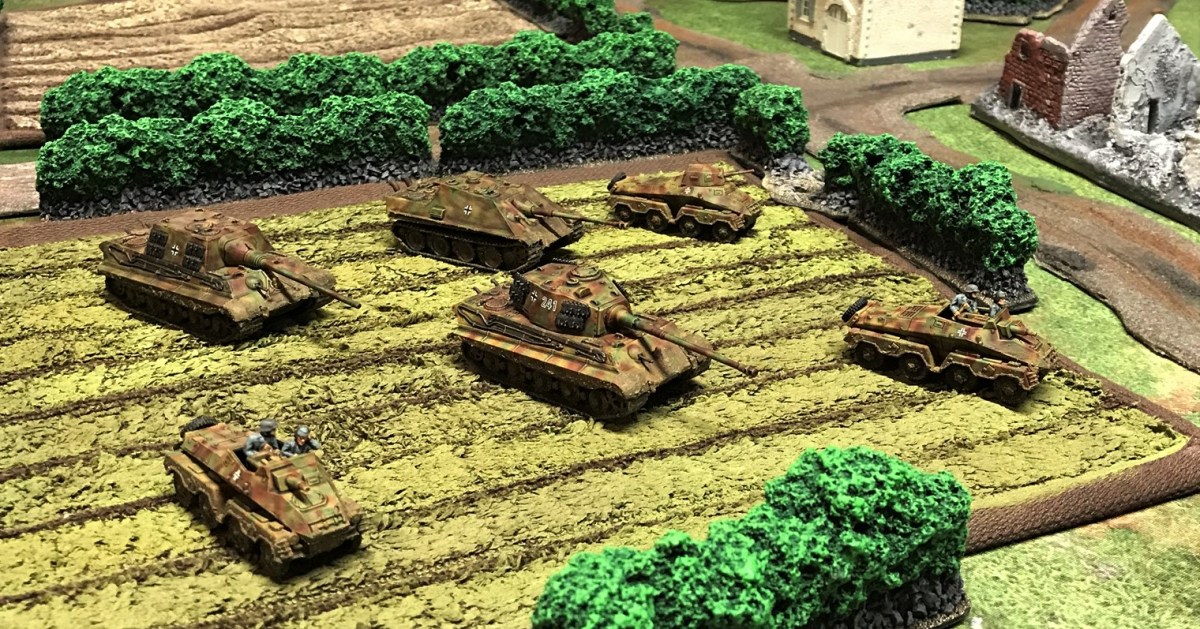
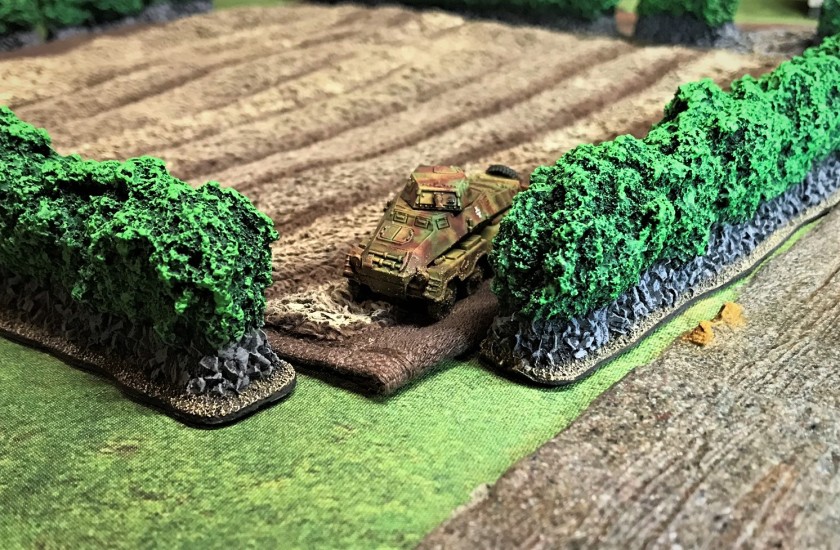
An SdKfz 231 recons.Right side of SdKfz 231.Two SdKfz 233’s recon past a destroyed building.Jagdpanther advances down a French road.
Right side of the Jagdtiger at a Normandy crossroads.
Left side of the Jagdtiger as it crosses a field.Rear shot of the Jagdtiger. For all of these I tried Citadel’s “Typhus Corrosion” paint on the mufflers. It’s a bit shiny in this shot due to lighting, but I think it worked well.Right side of my Tiger II by a hedgerow.Not great lighting – the turret is not “shiny” – but this shot shows the Tiger II from the rear.Moving out! Schnell! (sustained road speed was 24 mph!)Nice front shot of the Tiger II in a field showing the weathering/mud. Also, the machine gun is “up” and no longer droopy.The best shot I have of the Tiger II.
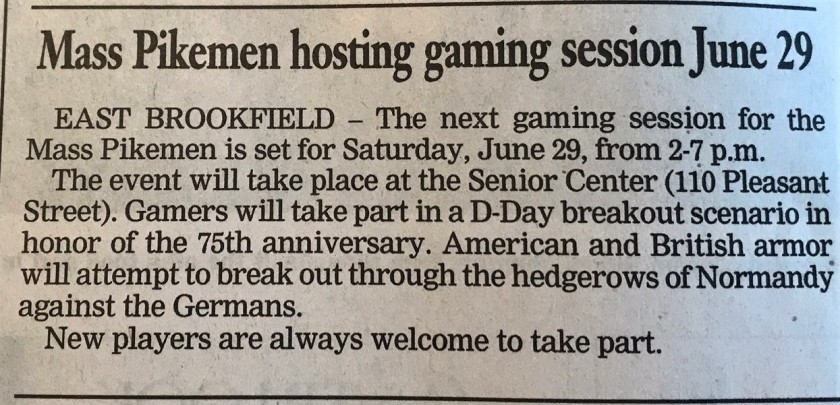
If you want to get in on the action, here’s our announcement for our next gaming session on June 29th. Or visit our Facebook page (and join if you’d like here).
Thanks for looking! Always appreciate your feedback in the comments section!
PAINTS, INKS, GLAZES, SHADES, WASHES, PIGMENTS, FLOCKING, GLUES AND MORE USED ON THESE VEHICLES:
Gorilla Glue
Testors Plastic Cement
Daisy BB-Gun BB’s
E6000 epoxy
Aleene’s poster tack
1/8″ rare earth neodymium magnets
Vallejo “Flow Improver”
Vallejo “Airbrush Thinner”
Vallejo “Surface Primer – Black”
Testors “Universal Acrylic Thinner”
Battlefront “European Skin”
Battlefront “Skin Shade” (wash)
Vallejo Game Air “Moon Yellow”
Vallejo Model Air “Bright Brass”
Battlefront”Black”
Vallejo Mecha Color “Grey Green”
Vallejo “Black Grey”
Vallejo “Neutral Grey”
Battlefront “Oxide Red”
DecoArt “White Pearl”
Army Painter “Military Shader” (wash)
Vallejo Model Air “Dark Yellow”
Vallejo Model Air “US Olive Drab”
Vallejo Model Air “German Red Brown”
Battlefront “Dark Gunmetal”
Vallejo Model Air “Rust (71.080)”
Microscale Liquid Decal Film
Vallejo Model Air “Wood”
Citadel “Typhus Corrosion”
Vallejo Mecha Weathering “Oil Stains”
Appropriate decals from Battlefront
Appropriate decals from Armorcast
Microscale Micro-Set
Microscale Micro-Sol
Vallejo Mecha Varnish “Matt Varnish”
P3 “Bootstrap Leather”
Vallejo Game Air “Black”
Army Painter “Mid-Brown” (wash – desert models only)
The 10th running of the HUZZAH! wargaming convention was held last month from May 17th-19th in Portland, Maine. It was ably run by the Maine Historical Wargamers Association. There were a lot of games, including some run by friends from both the Maryland -based H.A.W.K.’s (Harford Area Weekly Kriegspielers) and the Historical Gaming Club of Uxbridge (Massachusetts). Several members of the Mass Pikemen were also in attendance. I missed the sign up to run a game, but I was nevertheless happy to make the trek to Maine, attend and play.
As I am catching up on my blogging, and as I did not get a chance to take many pictures of games that I was not involved in, this post will focus on the five games that I did participate in at the convention. It will hopefully give a flavor of the games, and my experience – however slim compared with all the events that were run there.
Game 1 – “The Enchanted Valley; Rules – Blood & Swash/Thunder & Plunder
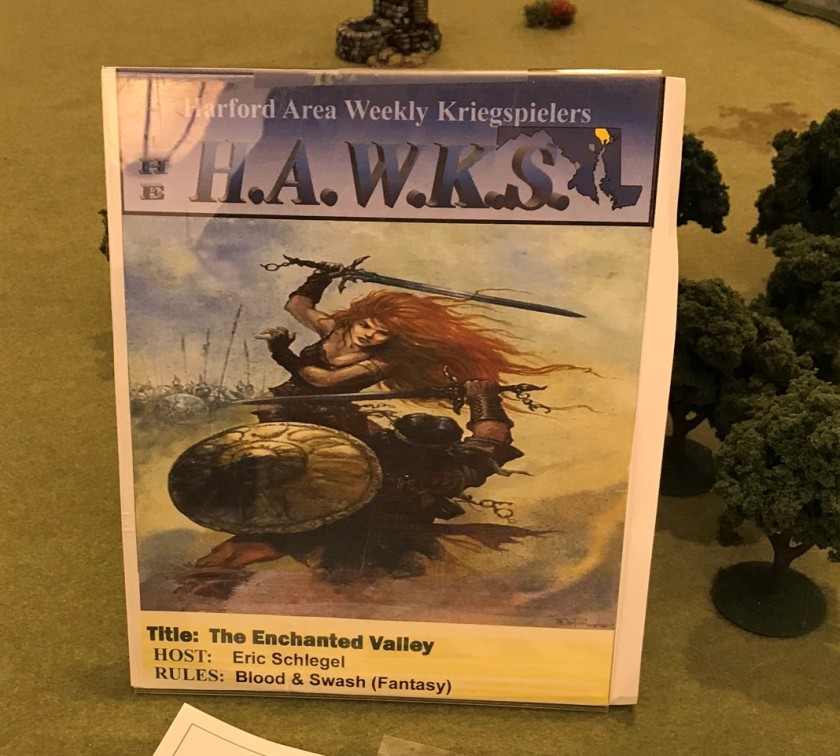
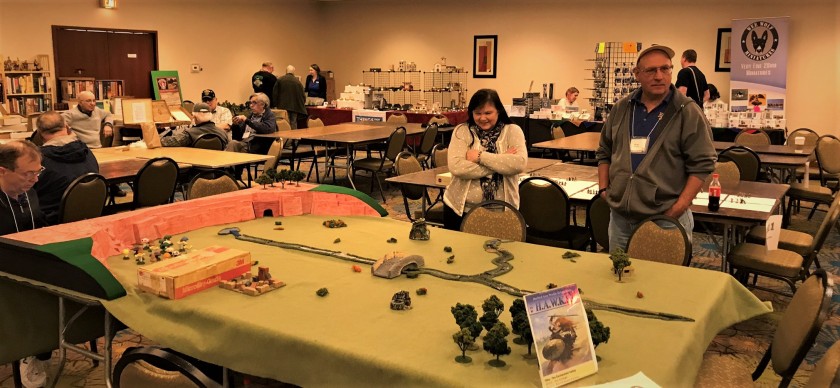
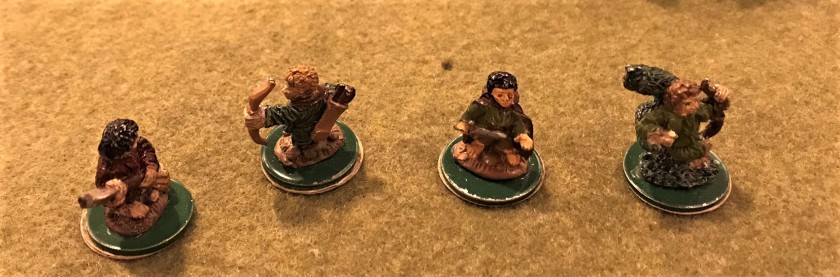
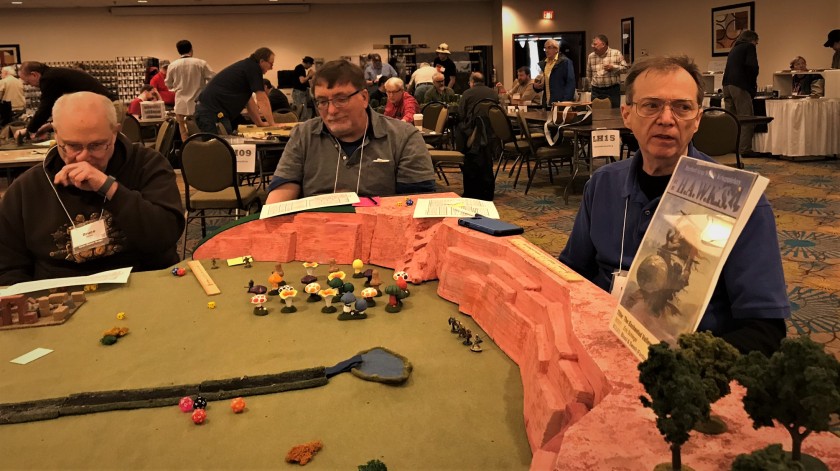
The first game was run by Eric Schlegel from the H.A.W.K.’s. The scenario was “The Enchanted Valley” – a fantasy game in which you had a small squad, and you had to battle GM-run bad guys for treasure and points. In my case, I had a squad of halflings (hobbits), and the figures were old Grenadier ones from the 1980’s. I spent the game battling giant armed frogs and goblins, while other players were similarly battling other creatures. The rules were Blood & Swash/Thunder & Plunder written by two friends of mine, Buck Surdu and Chris Palmer, and were the basis for their later set of rules – G.A.S.L.I.G.H.T. You can read about these and other rules here (just scroll down).
Eric and Vickie await the start of the gameMy squad – these are Grenadier halflings from the boxed set Halflings – which was issued in 1980 by Grenadier. You can read about them here.My squad stats.Nice view of the board and some of the players, including Bruce Carson on the left and another H.A.W.K. Duncan Adams on the right.The frogs I battled.My hobbit leader dispatched a goblin leader and a few giant ticks.
I fared OK, but did not come out on top. I think that there were close to 8 or 9 players. I think that Eric and Vickie ran the game well and it was quite fun.
Game 2 – “Mortwald Under Siege: Zero Hour”; Rules – Warhammer 40K
Many of you who follow this blog are avid 40K players and GW miniature painters. The minis that you assemble, convert, and paint are truly a sight to see. Additionally, the terrain is very eye-catching. Of course, I missed that whole era/genre of wargaming when it launched and as it grew. I wanted to give this 40K game a shot, and I will likely give the game another shot at some time in the future. But before I go on, I want to say that the following is not an attack on anyone who loves 40K – it’s just my experience with it at the HUZZAH! convention.
It was the absolute worst gaming experience that I have ever had. Sorry, but it was.
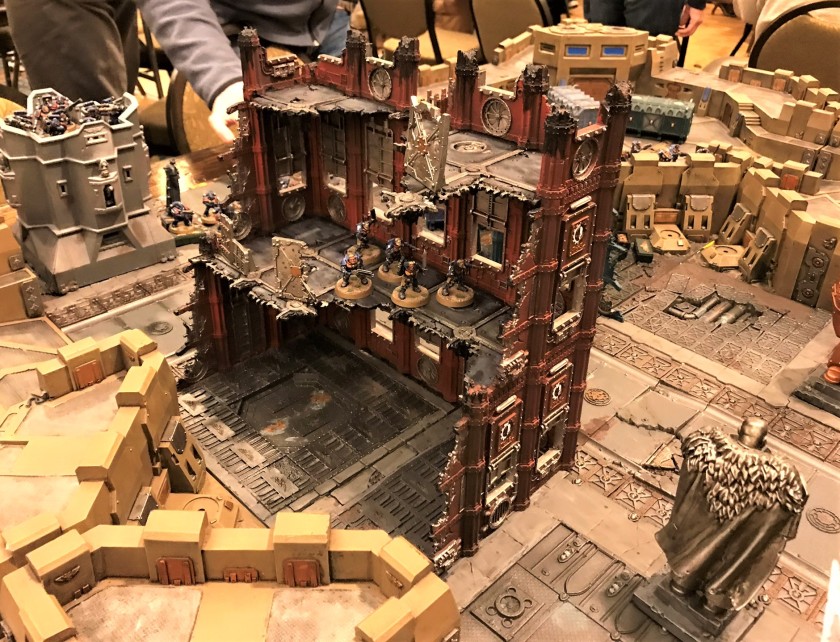
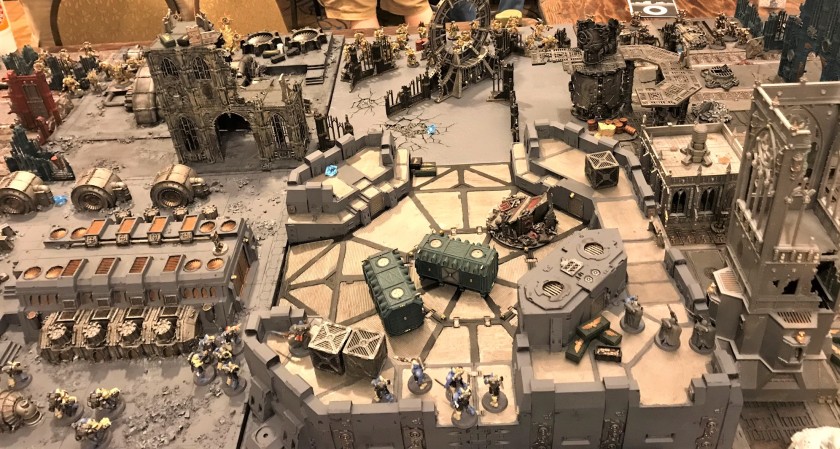
The terrain was gorgeous, and the figures were well-painted. The game scenario, unfortunately, had no story or reason as to why anything was there in terms of terrain or figures. There were two tables next to each other, and mine had several newbies and some experienced players. A couple of the GM’s were subbing (and admirably trying I will say) for another GM who could not attend. But hurting their efforts was the fact that there were hardly any cheat sheets or charts available, and those that were were microscopic in font size. Much of the game was spent figuring out the stats of the different space marine factions by either looking at the rule books or some players using a GW app on their iPads or iPhones.
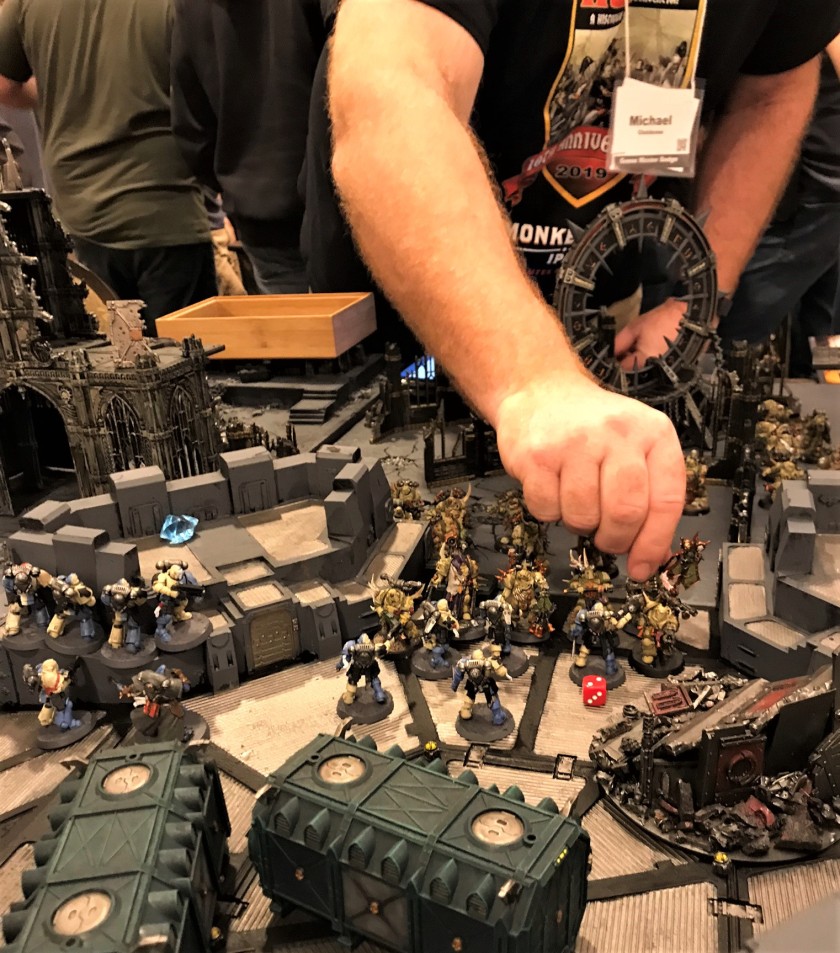
The players on my side with whom I played also had a similarly negative experience. What I remember about the game was that a large number of Plague Marines moved in, and over us (whoever we were – the figs were blue and some kind of space marine) with seemingly no way of effectively stopping them. I don’t remember many strategic of tactical gaming choices we made except to move and take up defensive positions and try to shoot. Was it balanced or play tested? Who knows. My memory of the game includes spending a lot of time looking at other people consulting rule books and devices, interspersed with being overrun by gloppy plague marines. Oh yeah, there was the conversations on my side with teammates asking WTF multiple times. I was told by someone I trust that this game was not typical – and that perhaps Kill Team is better. Again, I’ll keep an open mind, but for beginners this game was definitely was not! I also want the GM’s to know that we did not hold the experience against them at all – at least I did not. It’s not easy to be a GM.
One of the two tables – not the one I played on.
Table 1Table 1Table 2 – we were defending this side.We came, we were confused about the rules, the scenario…then plague marines wiped us out.
Just to be clear again, I follow several blogs whose authors do a great job on GW stuff. I mainly tried to play because I have been inspired by their projects. If you want to see some of their excellent painting and conversions of GW stuff, check out any of the following sites:
These guys give me hope to try 40K again…sometime. This game finished off Friday at HUZZAH! for me.
Game 3 – “Clash at Palmer’s Island, Chesapeake Bay 1637”; Rules – Feudal Patrol™ (as of yet unpublished)
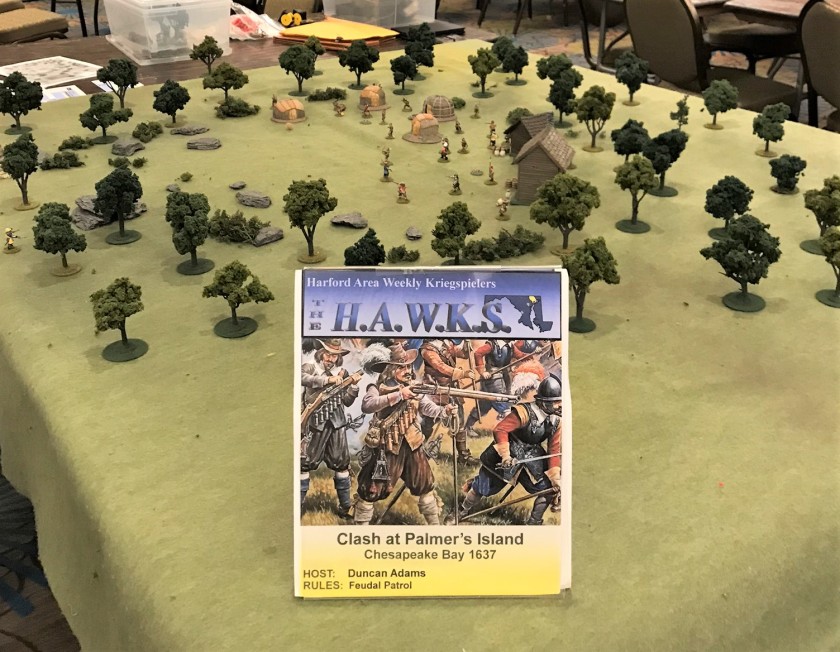
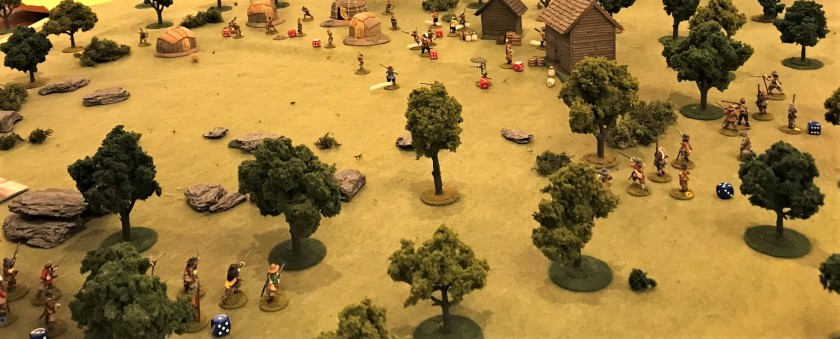
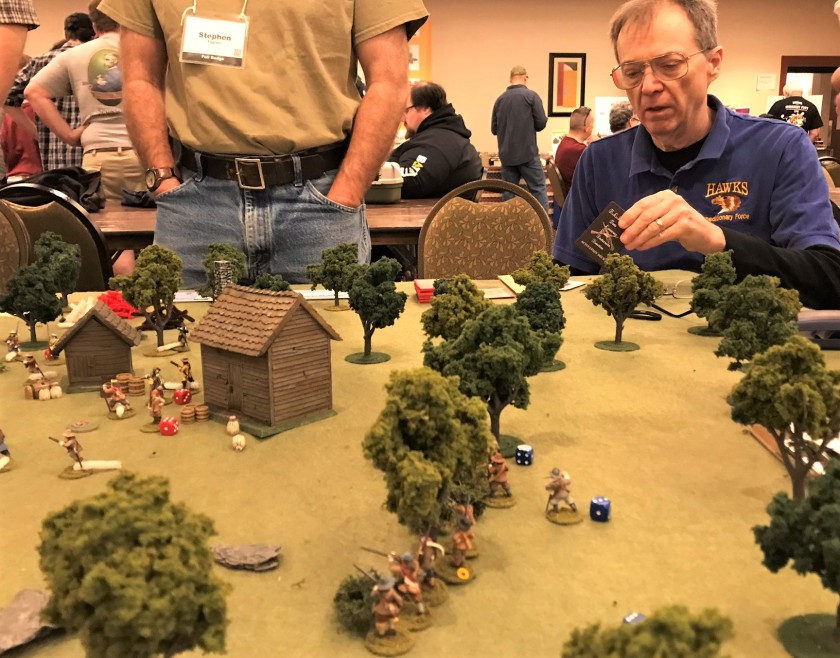
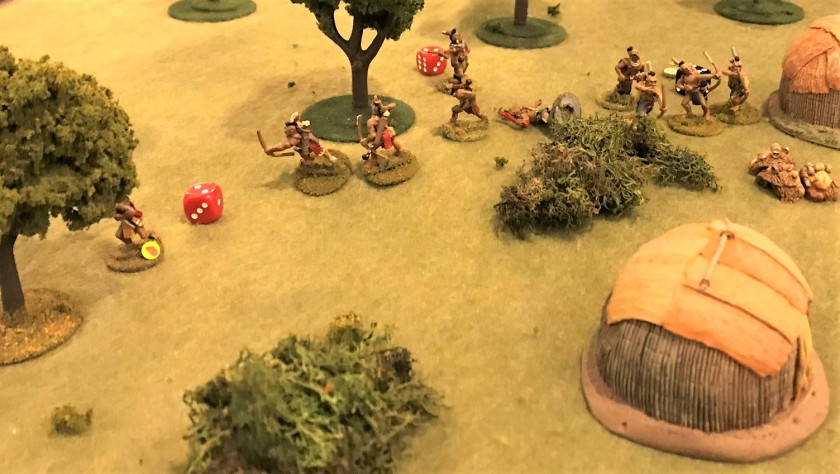
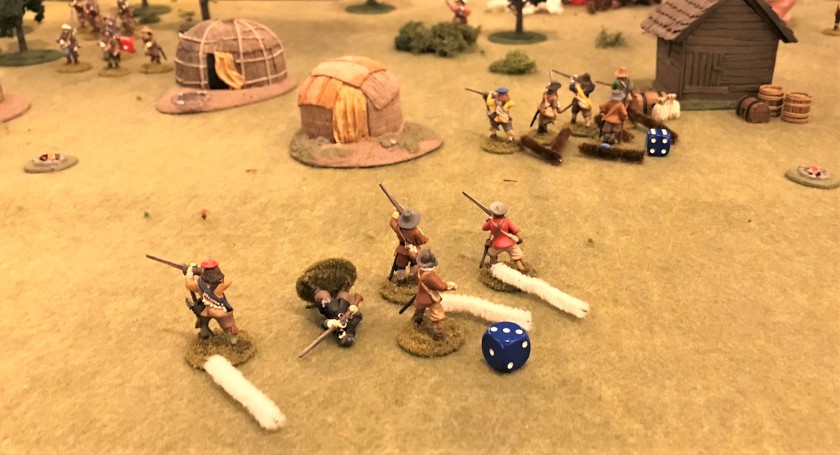
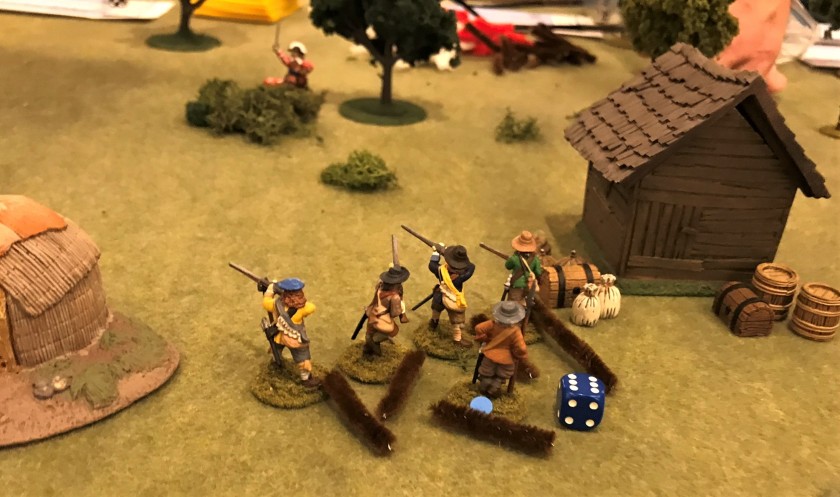
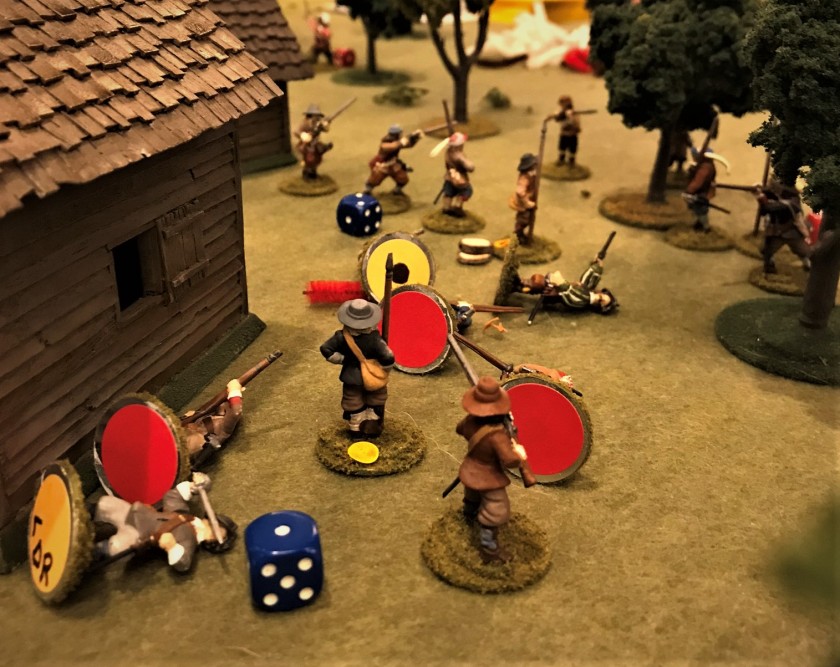
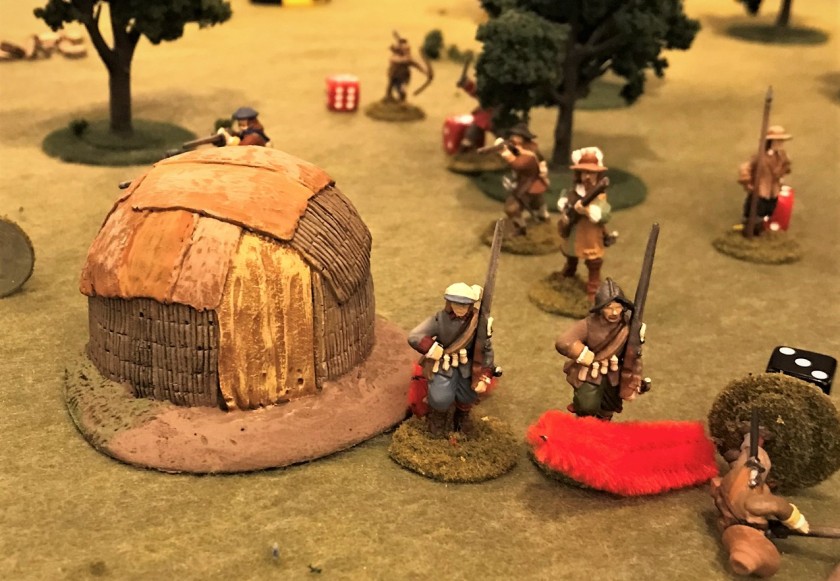
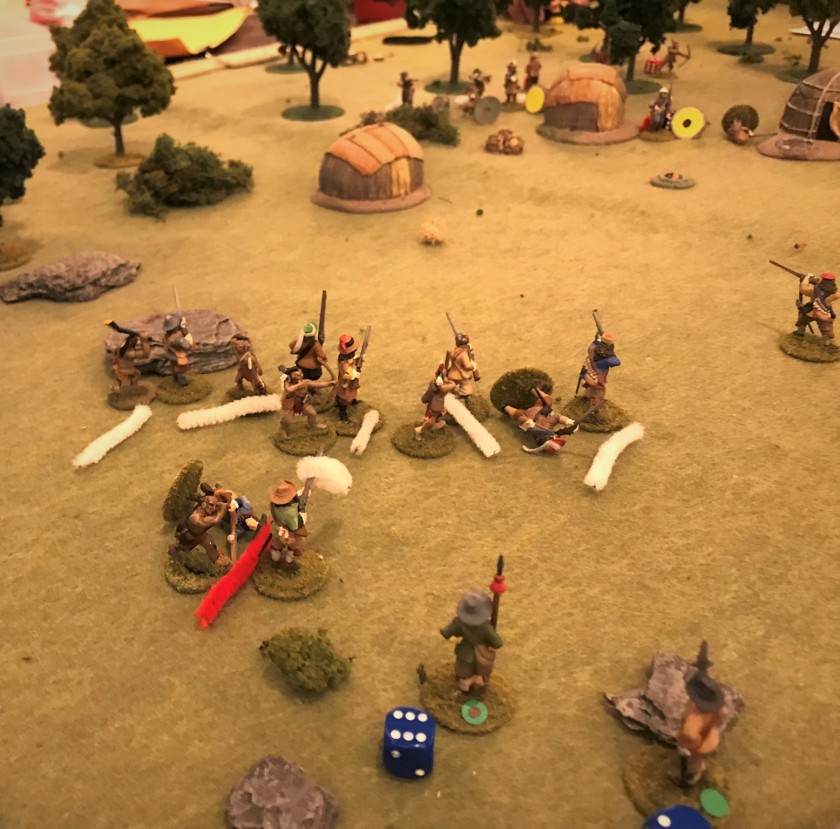
Duncan Adams of the H.A.W.K.’s ran this scenario on Saturday morning. It featured Marylanders (my side) contesting the “illegal” occupation of Palmer’s Island by Virginians and some Indian allies. The rules used were Buck Surdu’s soon to be published Feudal Patrol™, a card-based system similar to Combat Patrol™, but for eras/genres with more swords and arrows and matchlocks than modern warfare. As a huge fan of Combat Patrol™, I was really looking forward to trying the system. Here, it was a skirmish action.
The game went very well, with the players grasping the game’s concepts very quickly. Also, I liked the changes on the cards for melee and missile weapons. Our team’s matchlocks (and troop maneuver) held the day with a major victory.
Game set up.Maryland militia move in for the assault.Duncan Adams ably ran this fun game.Virginia had Indian allies – shown here attempting to flank our attack through the woods. A relief column of Virginians (upper right) kills one Marylander (forefront). The Virginians are then taken quickly under matchlock fire as they exit the woods.Marylanders take out the Virginian leader as he less than bravely hid in the brush.This became a bit of a scrum afterwards, with casualties mounting and the Marylanders prevailing.Close up of some of the figures and terrain.The Indians made a flanking charge from the woods, but were beaten back.
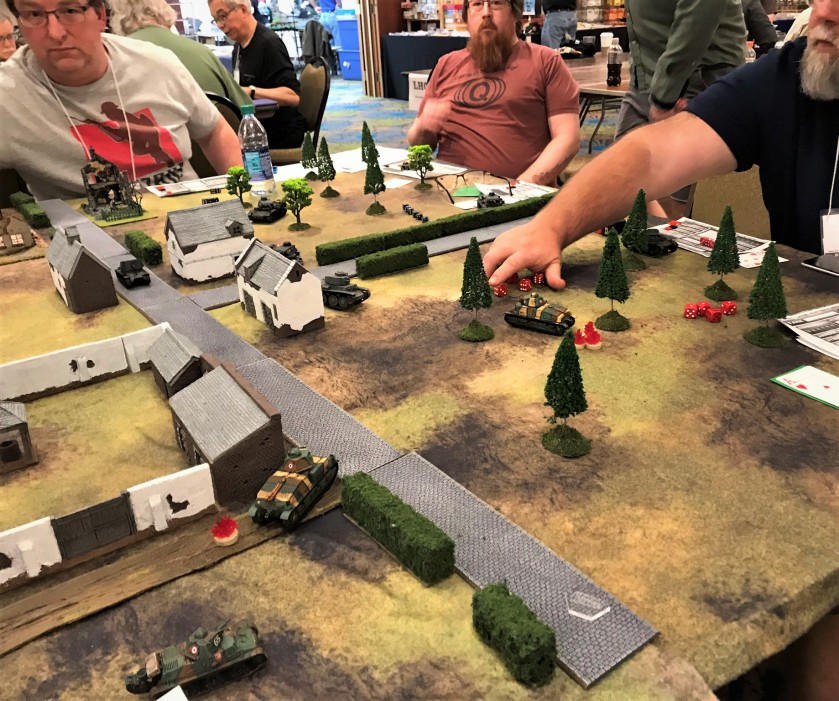
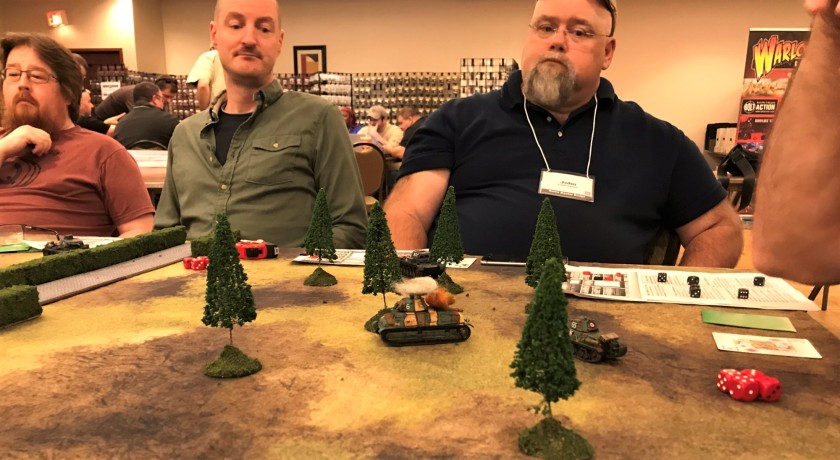
Game 4 – “Battle of Hannut” with 28 mm tanks; Rules – What a Tanker
Interestingly, Christopher had a few changes he made for the game. First, for activation, he used a card-based system. Second, he had everyone roll all of their Command Dice at the same time at the beginning of the turn. Lastly, he allowed you to turn in all your dice for one you wanted if your roll was bad. The card system was interesting, but really not too different than rolling dice, except that “banking” a six from the previous turn got you an additional card for activation that could be better than what you would have gotten. I’m not sure I like all players rolling all the Command Dice at the beginning – it allows you to see what your adversary can do before you take your turn. You also get to choose which Command Dice you lose if you take damage. The house rule on converting all your dice into one desired action was interesting, but I would not add that as it helps damaged tanks too much. It was different, but consistent for all players.
My SOMUA moved up quickly and was the target for no less than four German Panzers. My armor absorbed the hits, but eventually my tank was knocked out – with the crew surviving. I respawned as a new SOMUA, and rammed a Panzerjager 1. The game ended there. We achieved a minor victory for the French. Thanks to Christopher for running a superb and fun game.
The Battle of Hannut set up.My SOMUA attracts a lot of German attention (upper right).Eventually, my SOMUA was knocked out.Late in the game, I got to ram a Panzerjager I with my second SOMUA, doing minor damage to the German. Christopher Boynton used the flame markers as “ACQUIRED” markers.
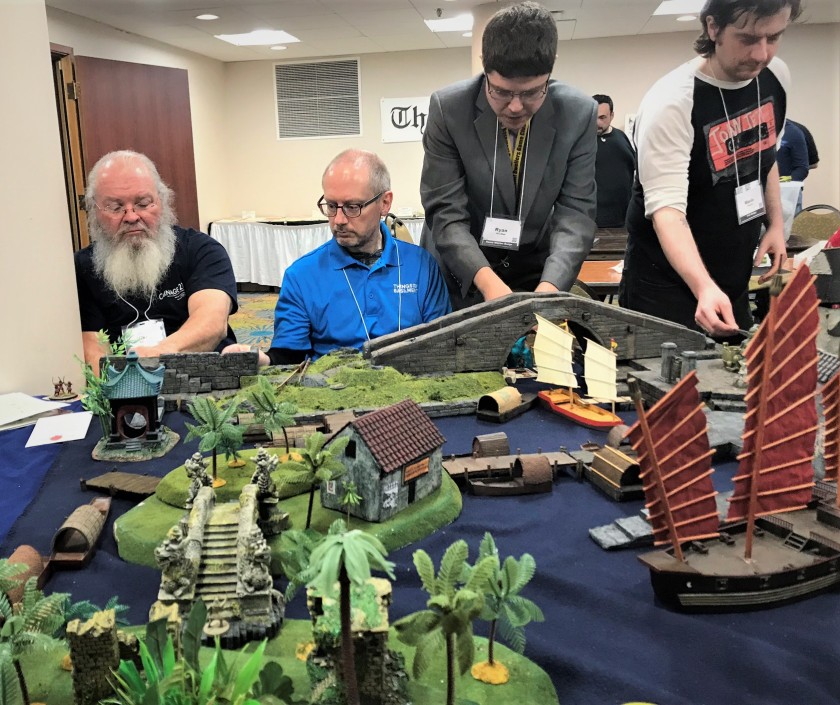
Game 5 – “Test of Honour Returns to Hanghai”; Rules – Test of Honour
The last game for Saturday was “Test of Honor Returns to Hanghai” using Mike Paine’s wonderful and extensive Hanghai tabletop. Ted Salonich and Ryan MacRae split GM responsibilities as Chris Rett was unable to attend. They did a marvelous job running the Test of Honour rules by Grey for Now Games.
I also finally got to game with Mike Paine, a true legend in the New England gaming community. We were teams of three, and Mike faced off with us. We had a back and forth, but in the last couple of turns we were beaten back soundly.
Thanks again to Ted and Ryan for running a fun game.
Ryan (standing on the left) getting set up, while Mike Paine and his team wait for the game to start on Mike’s table.Mike Paine’s board is so much fun.Final scrum on the island – we were soon pushed back.
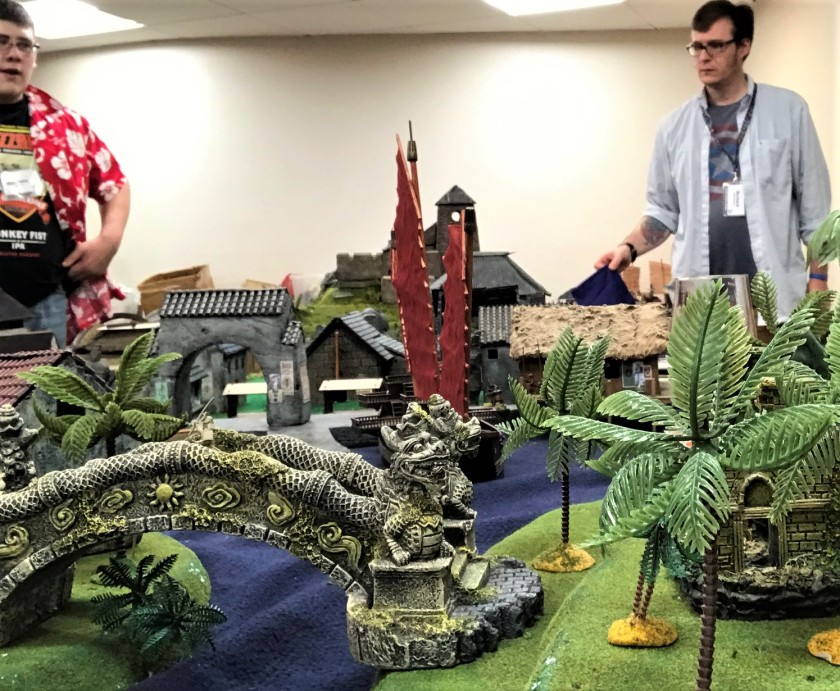
Game 6 – “Returning to Hanghai”; Rules – Mike Paine’s home brew rules
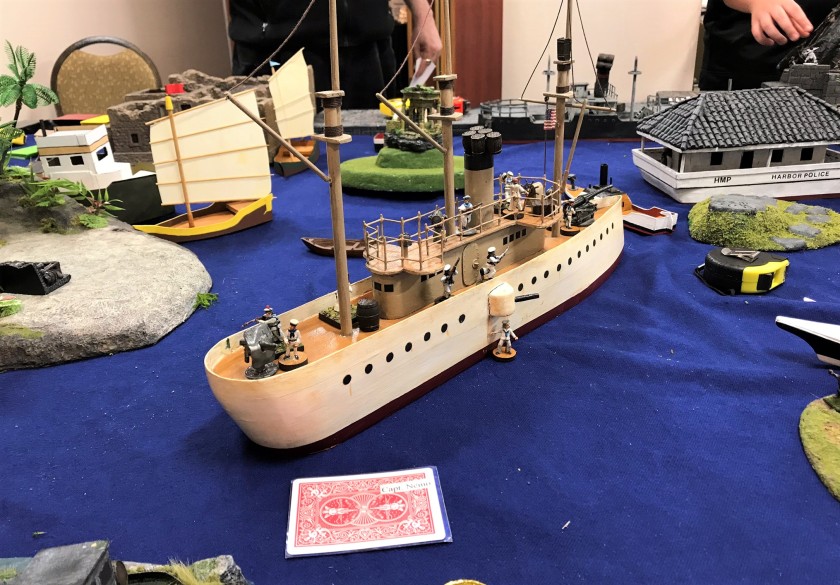
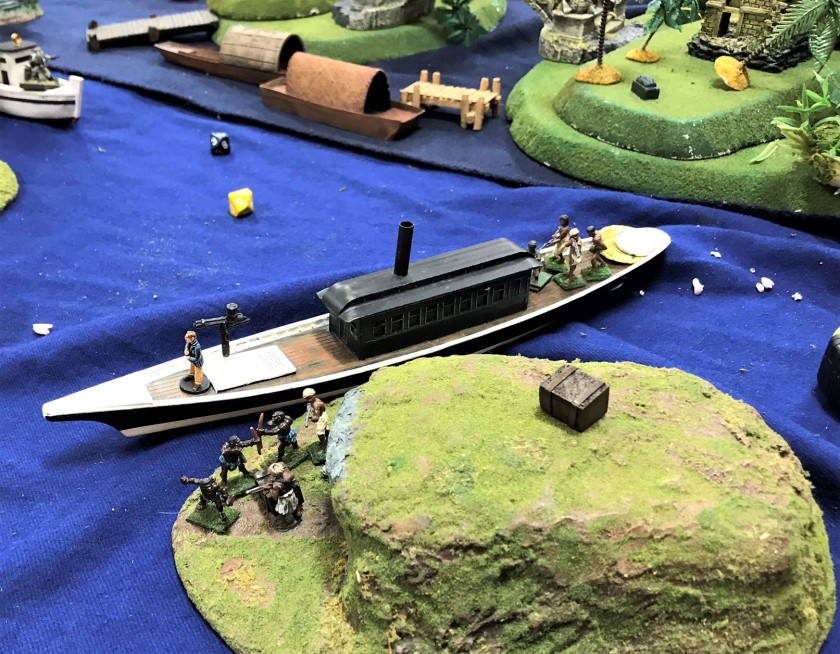
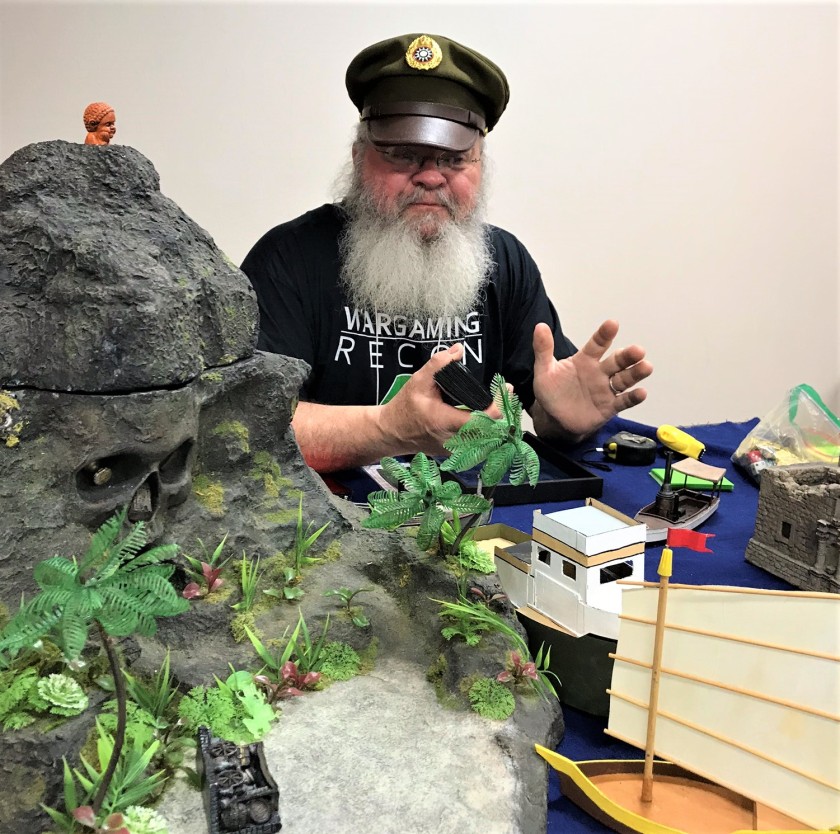
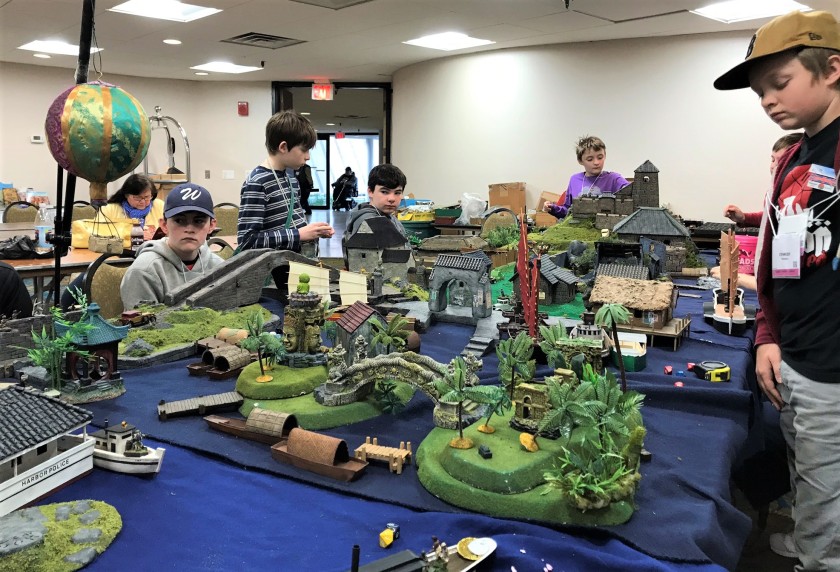
On Sunday morning, I had the chance to finally try Mike Paine’s Hanghai game. It is a 1920’s pulp game, and it is a big hit at a convention with both young and old. It was pretty much the same table as what we played Saturday night, but there were ships and planes and many other cool things all scattered everywhere. The amount of work that went into the table is staggering. You have to see it to appreciate it.
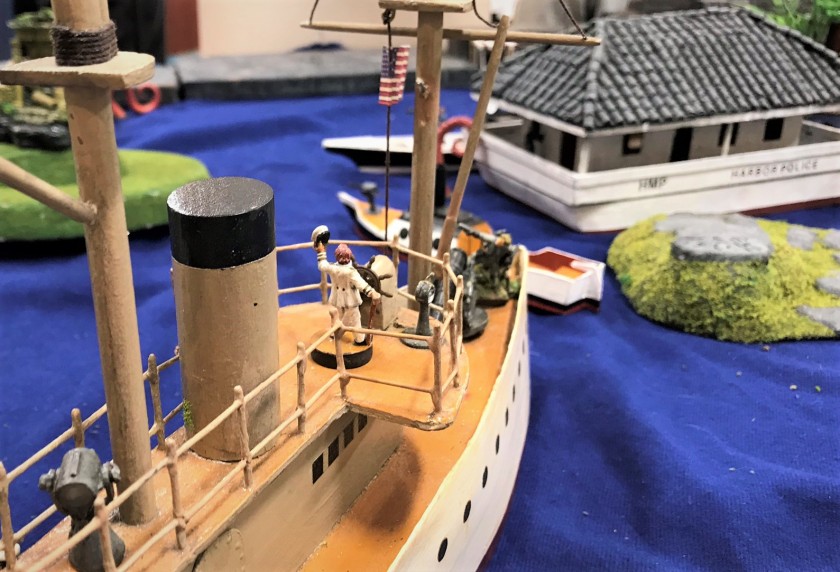
I took a naval crew in a gunboat – and I had a submarine. My leader was Captain Nemo. The goal of the game was to grab treasures and key items. I was playing next to Eric Schlegel, and I decided to try to eliminate the competition, which led to counter-fire, with Eric getting the better of the exchange. I ended up with only a submarine and one sailor, so with a long drive back home, I surrendered my sub to Eric with Mike Paine’s blessing.
Truly an epic game to try! Thanks to Mike Paine!
My crew and gunboat.Eric Schlegel’s forces return fire on me.Mike Paine – master of Hanghai game.The game attracted a lot of players, young and old. The amount of terrain is unbelievable.View of the harbor.My gunboat and Captain Nemo – before Eric shot them all.
This was my first HUZZAH! but hopefully not my last. By my count there were 117 games over the three day weekend, so this is a very small sample. Thanks to the folks of the Maine Historical Wargamers Association for running a classy convention!
If you have any thoughts or feedback, please let me know below. Thanks for looking!
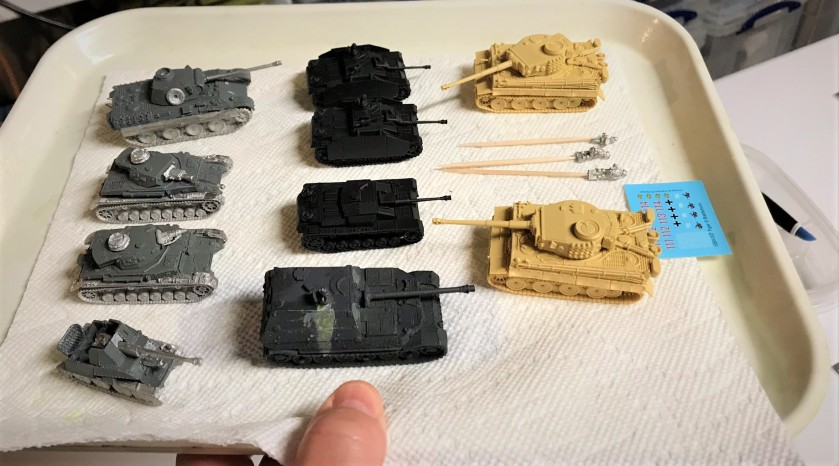
As for the Germans, last year I had bought and assembled a 5-vehicle Plastic Soldier Company StuG III kit that could be completed as either F8 or G variants. I assembled and primed them, but put them aside, as they did not fit in with either my France 1940 or North Africa scenarios. From Battlefront Miniatures, I had bought several resin and plastic models to include a Marder III, 7 Panzer IV’s (E, F2, and H’s), 2 Tiger I’s, and a Panther D. Additionally, I was able to acquire a Battlefront Ferdinand/Elefant from Chris Rett in my gaming club – which was fortunate as this model is now out of production. This made 17 tanks/tank destroyers available to assemble and paint, but too big a force for just a Normandy scenario. Plus, from my research, the StuG F8 was more of an Eastern Front vehicle. So, I decided to proceed to complete these 17 for two different scenarios, some for the Eastern Front and some for the Normandy scenario.
Researching the camouflage patterns for these two groups showed me very different patterns of painting – and in each case I would need to expand my skills and tools to be able to achieve a good historical representation of each vehicle. In particular, I needed an airbrush that could do the finest lines and make these tiny tanks look appropriate. I found a solution in an Iwata Micron B airbrush. This was not inexpensive, but in the end turned out to live up fully to my expectations. As an aside, I had been struggling to have enough time to finish all of these tanks in May. Work this month had been hectic, I attended HUZZAH in Maine (more to come on that in a future post), Memorial Day ceremonies, and the Boston Bruins have been in the Stanley Cup playoffs (and now the finals!!) so my hobby time has been constrained somewhat, Unfortunately I got a bit more time as I was unexpectedly laid off this week! I am sure that if I did not have a job, I would not have bought the new Micron B airbrush, but who knew that would happen? Not me, but at least I was able to finish these in time to be my second entry in Azazel’s“Mechanismo May” community painting challenge.
Given that I was so busy, I took fewer WIP photos than normal – so I decided that this post I will go through some points on assembly, then share in turn the Eastern Front vehicles, the Normandy vehicles, and lastly the paints and materials that I used. This means the eye-candy shots will be interspersed this time throughout the blog. As always, let me know your thoughts and feedback – and which one you like the most, if you are so inclined of course! There are links on the headers and elsewhere if you want more background, albeit from Wikipedia.
Notes on Assembly
Resin models
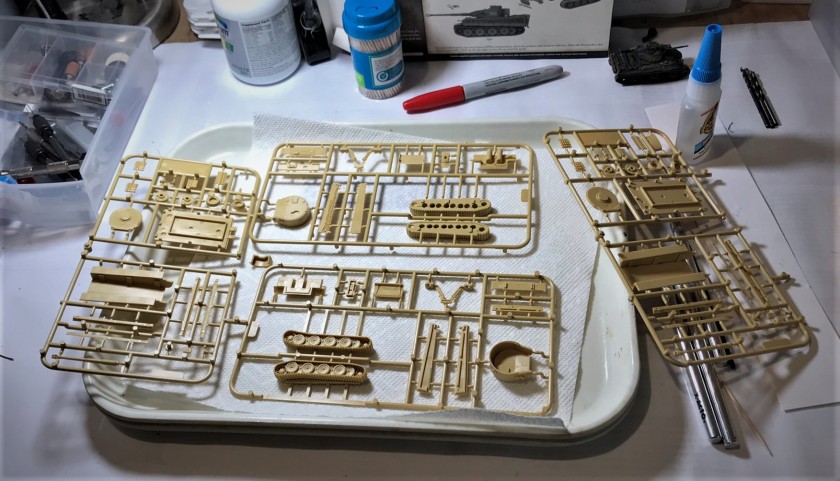
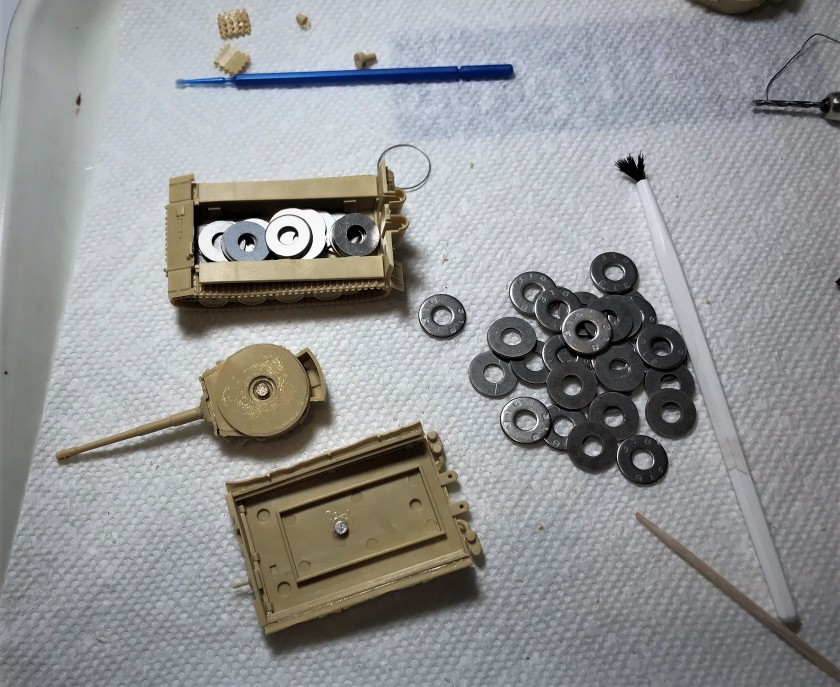
Plastic Tiger I’s
Plastic Panzer IVH’s
Tiger I kit innardsI wanted more heft in my tanks – so I added steel washers to the Tiger’s. I filled the hulls afterwards with PVA glue.I remembered that I had some ball bearings from Jeff Smith and some BB’s – so the Panzer IV’s got these and PVA glue on top as ballast.Some of the tanks, some primed, some not yet. The Elefant in front had been given an Elefant trunk and ears with green stuff by Chris Rett’s daughter. I did my best to remove the excess kneadatite before repriming.
Eastern Front
Here are the vehicles I built for a future Eastern Front scenario.
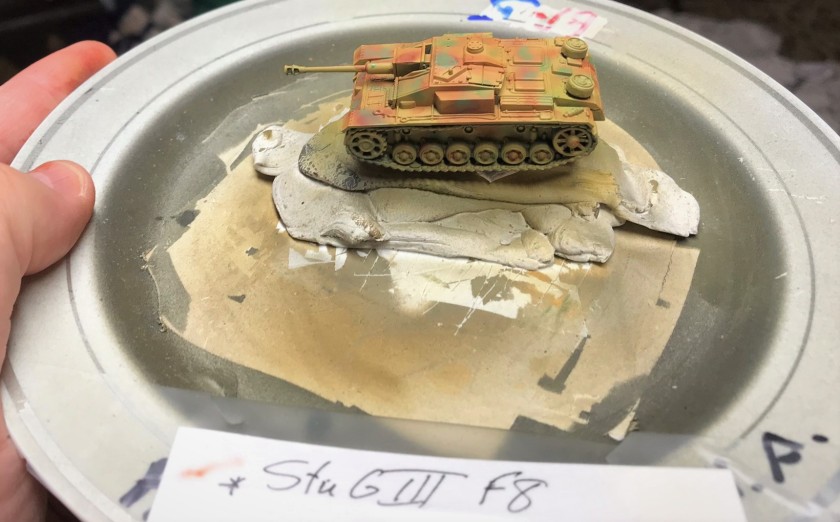
StuG IIIF8 base coatedI made three F8’s for the Easter front. Two had the two-toned reddish/brownish camouflage.The third F8 I experimented with the Iwata Micron B to make a three-toned camouflage pattern.The three StuG IIIF8’s completed deployed in a wheat field.Left side view of the StuG IIIF8’sRear view of the F8’s. I used the Vallejo “Thick Brown Mud” on my Eastern Front vehicles to simulate the effects of Mother Russia.
Panzer IVH turrets – three would be for the Eastern Front.
I painted one Panzer IVH in a reddish/brown two-tone, and the other two in a two-tone yellow/green pattern. Here they are with different decals. I tried Armorcast decals in addition to my Battlefront ones – and the sizes of theirs (crosses) work better for small areas like you see here. Give them a look if interested.Patrolling a field.Left side of the Panzer IVF2’s. I also varied adding crew or leaving the tank buttoned up to make it easier for tabletop identification and play – in addition to the different decal numbers.
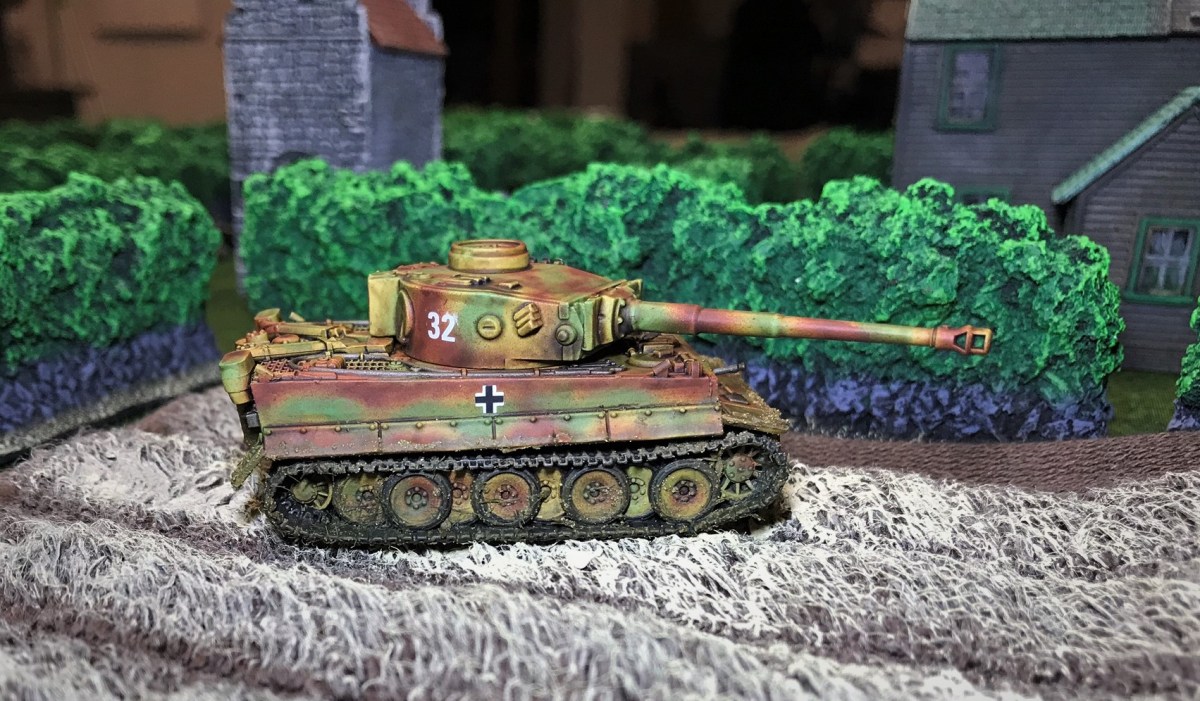
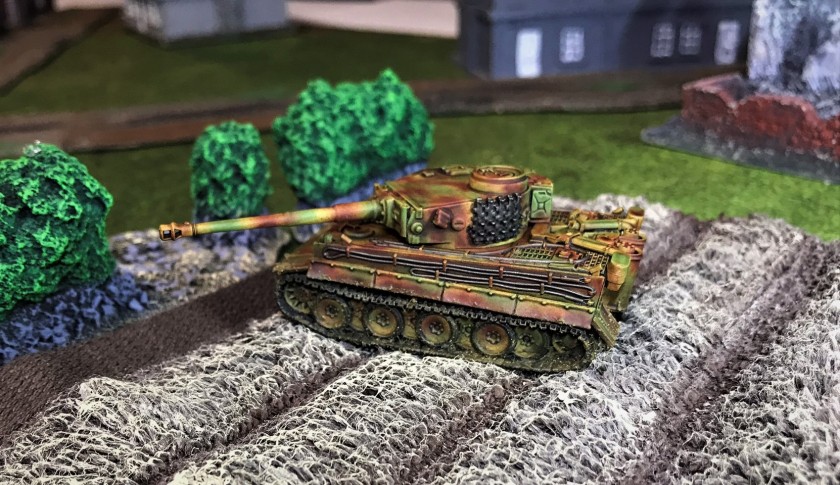
Eastern Front Tiger I, left side, crossing a wheat field.This was a fun model – and the weathering products worked well.Acquiring a Soviet target.Right side shot.Rear angle on the Tiger I.
These are going to be fun to use and see used in future games. I previously had built a Battlefront resin Tiger I for North Africa, and I must say that the plastic ones are really nice models too (less weighty of course – which is why I added ballast). Of course, I was primarily focused on getting ready for the 75th Anniversary of D-Day. So let’s get to those AFV’s!
Group Shots
Here are some group shots all of the German AFV’s for Eastern Front scenarios that I did this month.
Normandy Campaign
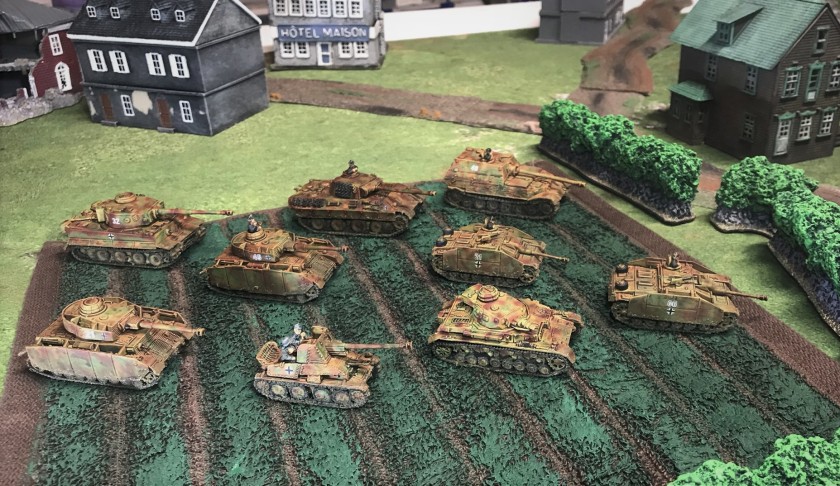
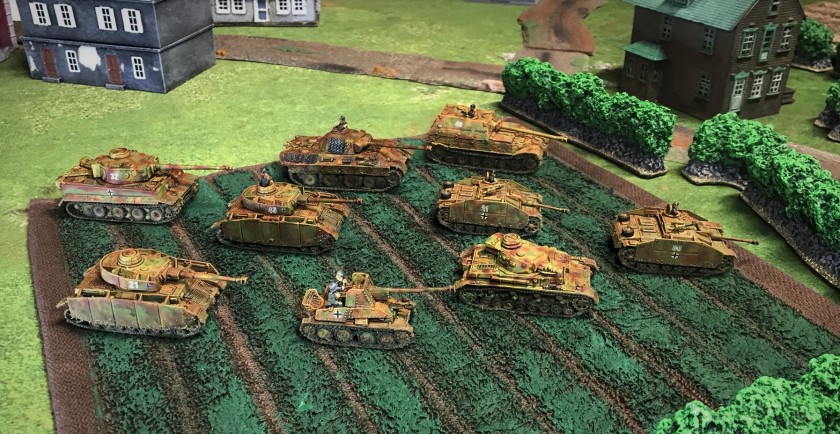
Here are the Normandy Campaign tanks and tank destroyers I built this month. These all have three-toned camouflage pattern, though I tried to be true to the examples I found in my research.
This model is the least powerful of the Panzer IV’s I built for Normandy, but it was deployed in Normandy and in good numbers.
As base coated.
The camouflage pattern here was a bit different.
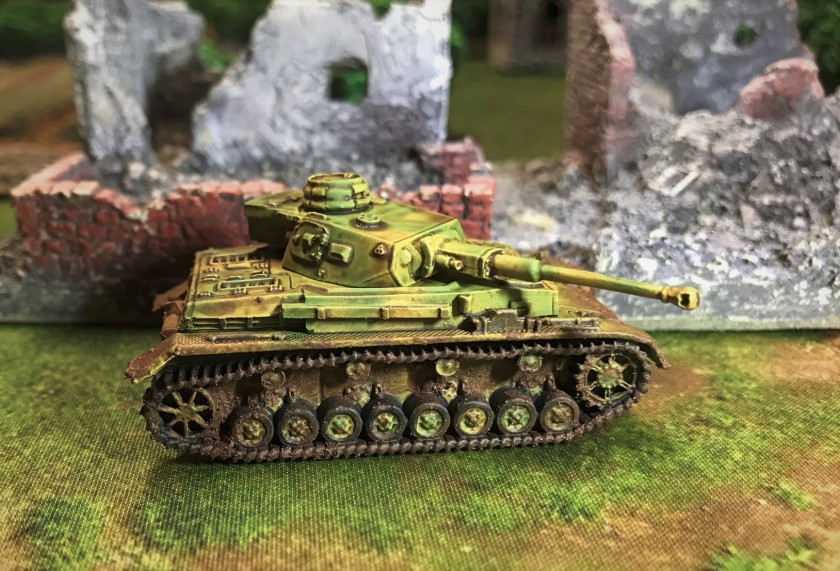
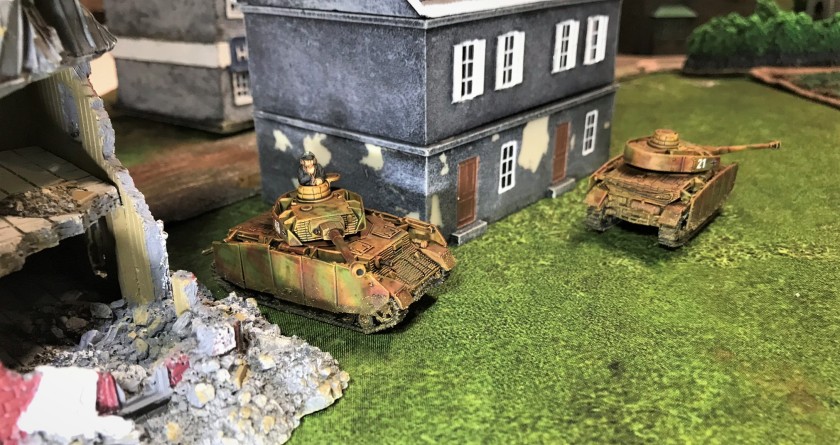
The Panzer IVE by a building near a Panzer IVH – the Vallejo “Crushed Grass” worked well along with the “European Thick Mud” and the European “Splash Mud” for weathering.
I built two plastic Panzer IVH’s for Normandy. The side armor (schürzen) were not easy to affix, and made painting a challenge on both these and the previous Eastern Front versions. Their camouflage patterns were slightly different.
The two Panzer IVH’s and the Panzer IVE (for comparison) on the right in the hedgerows.Frontal view of the Panzer IVH’s for Normandy.Patrolling the ruined village.
I really enjoyed bringing this monster tank destroyer model back to the tabletop. It is out of production, so I was very happy that Chris sold it to me for a song.
Base coated Elefant
The Iwata Micron B really helped here.
Towards the end of building.
Elefant right side. Nice view of the front – the crewman was already mounted when I got this model. I prefer to paint them separately, but this worked out fine – they are just so tiny.Good look at the rear of the vehicle – I liked that it had the zimmerit on it too.
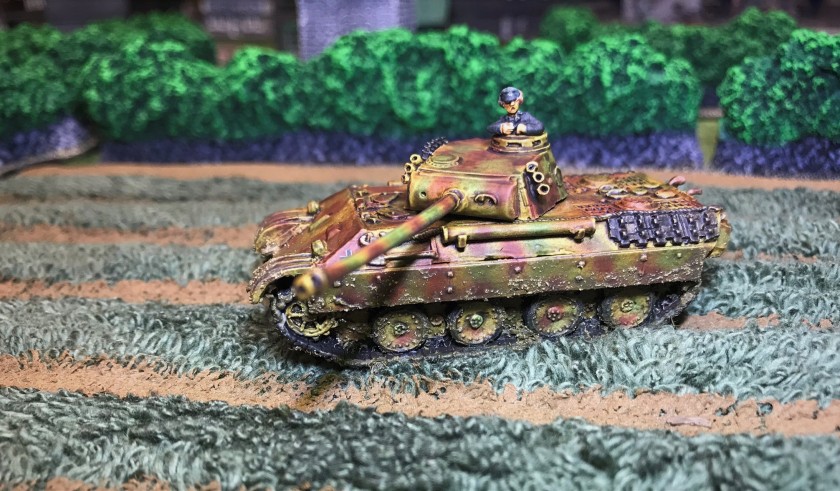
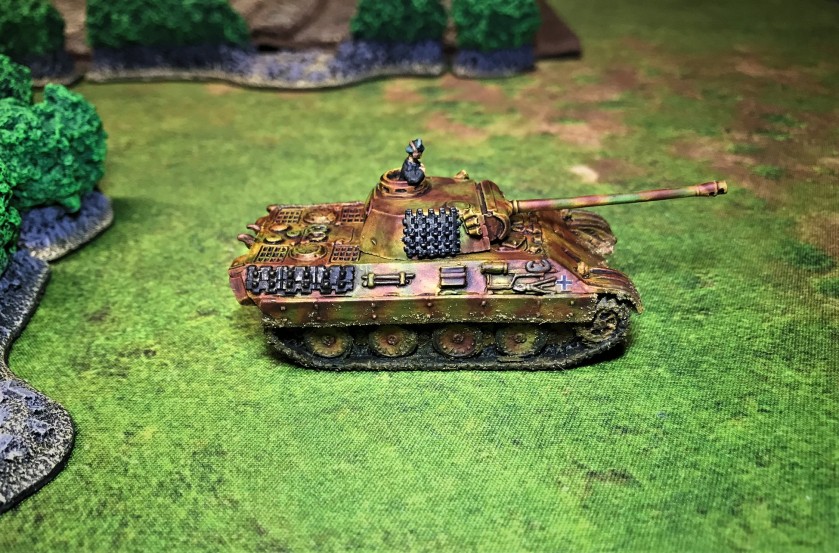
Mine is a Panther D, and it was a resin/metal model.
Base coated Panther hull
After applying camouflage pattern.
Note the road wheel on the turret. It came in the kit, and I put it there as there was a nub to hang it. Unfortunately, it interfered with the turret being flush on the hull. Luckily, I was able to remove the road wheel. As I had an extra track section, I was able to affix it over that space on the turret. The model was also missing on of the two exhaust pipes – an iconic part of a Panther. I was able to drill the resin hull and build a replacement with a cut-down paper clip.
Panther crossing an open field.Nice left side view showing the muddy tracks.Right side view with track section on the turret.Target spotted! Schnell! Feuer!
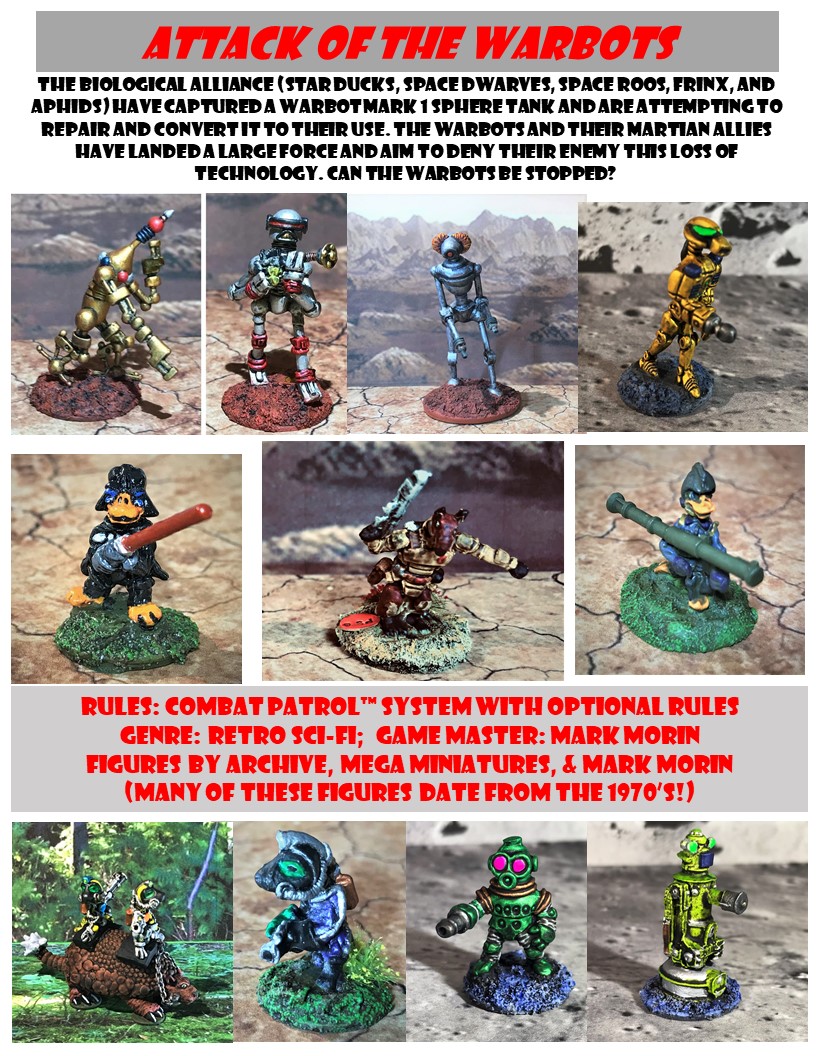
Battle Group Boston’s HAVOC 2019 (or HAVOC XXXV) is in the books. This previous weekend in Shrewsbury, MA was a Friday-Sunday gaming marathon that saw me run two games (“What a Tanker”in North Africa and “Attack of the Warbots” using Combat Patrol™). I also played in three other games: a First Boer War scenario using Combat Patrol™; “Look Sarge we are Invading Russia” using Look Sarge, No Charts™; and another “What a Tanker” game on Sunday. I have not been blogging much recently as my prep for the event took a lot of time. So, this post will share some shots of the events, with more focus on the games that either I ran as a GM or participated in as a player.
Of note, it was very nice to have my West Point classmate and good friend Dave Wood from the Maryland HAWKS make it up to play in my games and run two of his own. It was also great to see attendance and gaming from the Mass Pikemen, especially Mike Morgan, Leif Magnuson, Chris Comeau, and others.
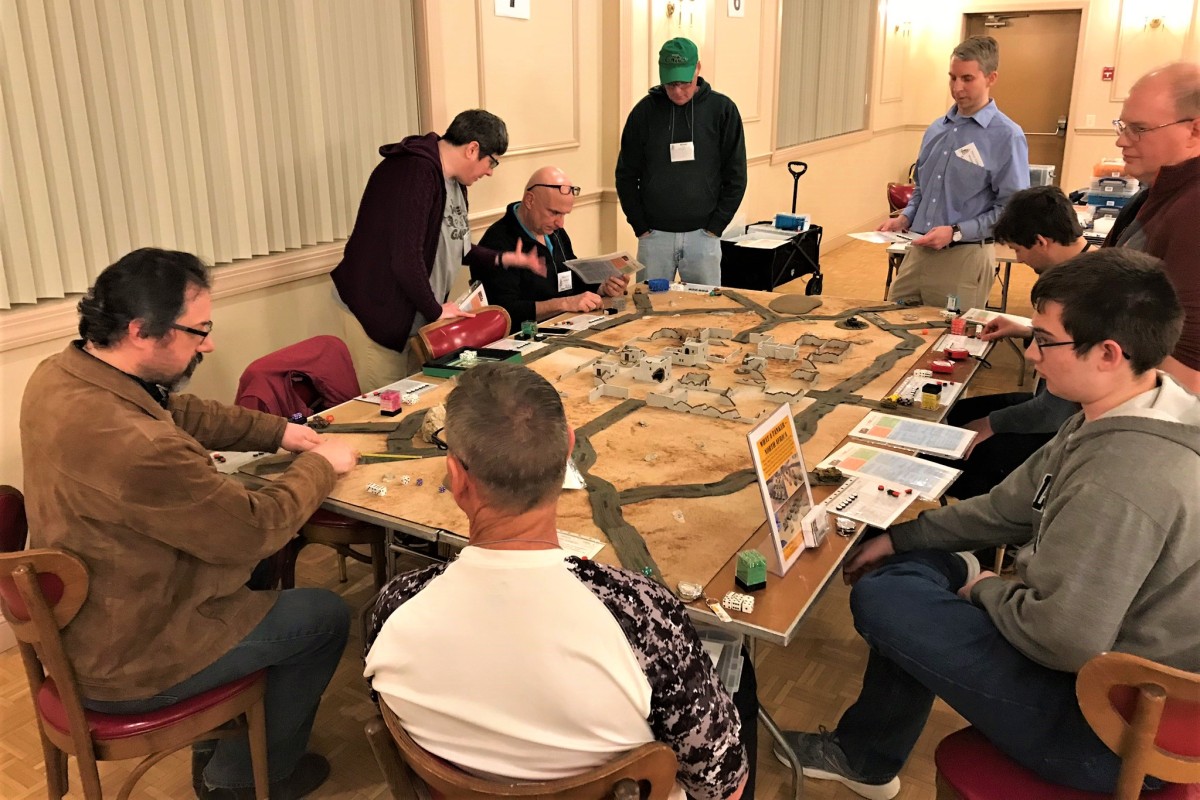
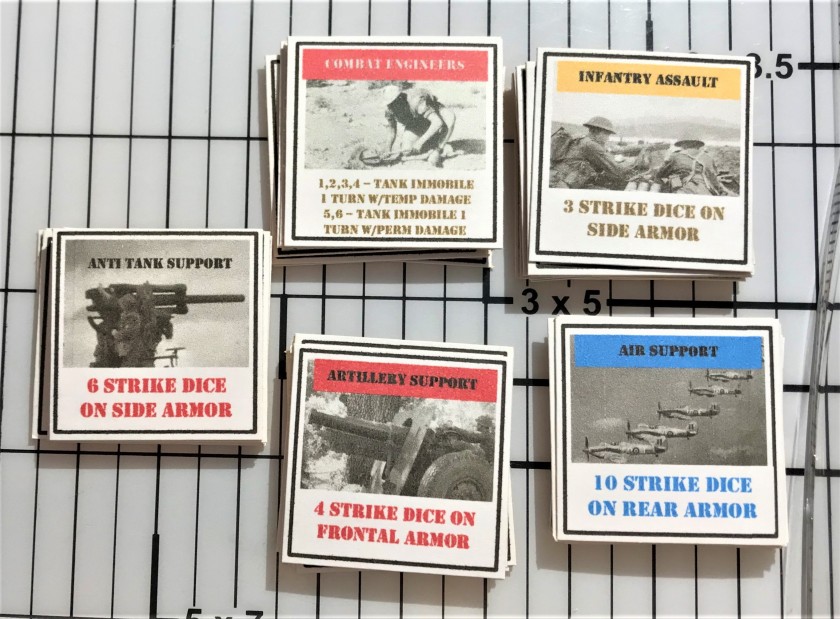
On Friday, I ran “What a Tanker – North Africa” and had a full table. I was able to roll out my new Bonus Attack cards that I created for the convention. They were very popular in the game and I will be expanding my use of them in the future based on the scenarios I run and the historical aspects of the specific theaters and scenarios/battles. I will adjust their use, and how I allow tank replacements going forward. Still, the game went very well, and I earned an award for the “Best in Time Slot”! The Axis battled back from early losses and defeated the British 104-58.
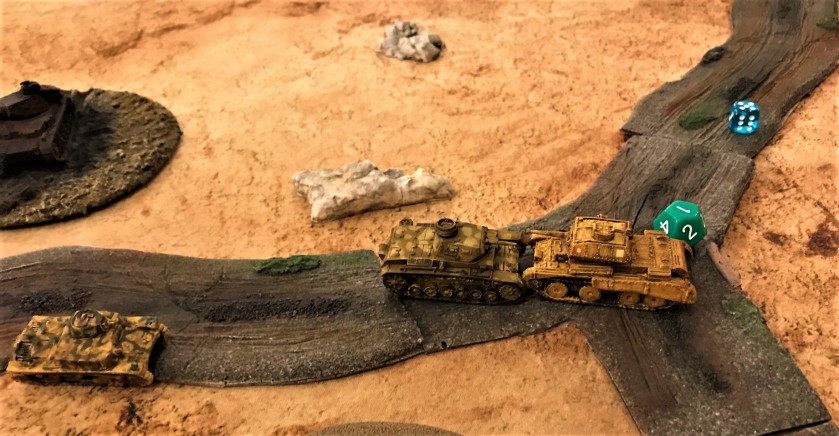
My game announcement posterMy “Bonus Attack” cards for the game. They worked well, especially the Combat Engineers.I mapped out the game board in my cellar beforehand. I got a new 8′ x 4′ badlands/desert mat that worked very well for the scenario from Frontline Gaming.Detail of the town I put in the middle of the battlefieldFriday night’s full crowd at What a Tanker – North Africa using 15mm tanks.The first use of one of my Bonus Attack cards – in this case an airstrike card on a hapless M11/39.What a Tanker – or in this case “What a Rammer” as a Panzer IIIE runs into an A13. The Panzer IIIE got the worst of it from the Brit, but the A13 was subsequently knocked out by an Italian M13/40.The game had a lot of action, but in the end the Axis prevailed.I was happy to earn this award, but the players’ enthusiasm carried the day.
Saturday, I played in two games, and ran a third. The first one Saturday morning was “First Battle of the First Boer War” using the Combat Patrol™ rules system as modified for this era. It was a fun game, with the Boers holding off the British as they attempted to seize a wagon. In the end, the Boers prevailed.
Dave Wood briefs the players on the Boer War scenario.Boers are outnumbered, but hold the wall – each glass bead represents a morale check. They held for a long time.
There were many other games – over 56 I believe, and I did not get a chance to take a picture of all of them, but here are some shots below.
A beautiful American Civil War board.Palestine in WWI. Definitely a game I would have loved to try.Wings of Glory.Bolt Action.A new sci-fi game, Trilaterum, had some beautiful scenery.Test of Honor – and note a 1970’s classic return in the back – OGRE – a near future tank game. I played that game with cardboard chits in the early 1980’s.
The next game went up in operational level and down in miniature scale. Dave Wood ran “Look Sarge, We are invading Russia”, using the Look Sarge No Charts set of rules and 6 mm microarmor. The Germans held off the Russian counterattack, and won the game. Both of Dave’s games were very well-received.
The Germans move down the road.
Skipping to Sunday, Leif Magnuson ran a nice What a Tanker game using 28mm tanks in an Eastern Front battle. It was a lot of fun, and the Soviets eked out a win. Leif also won an award for “Best in Time Slot” – well-deserved. This meant that our club (The Mass Pikemen) won two awards – and both were “What a Tanker” games!
“Ivan is a Tanker” run by Leif Magnuson.
Flashing back to Saturday night – I ran an updated “Attack of the Warbots” game. The game was a success, as the players had a great time.
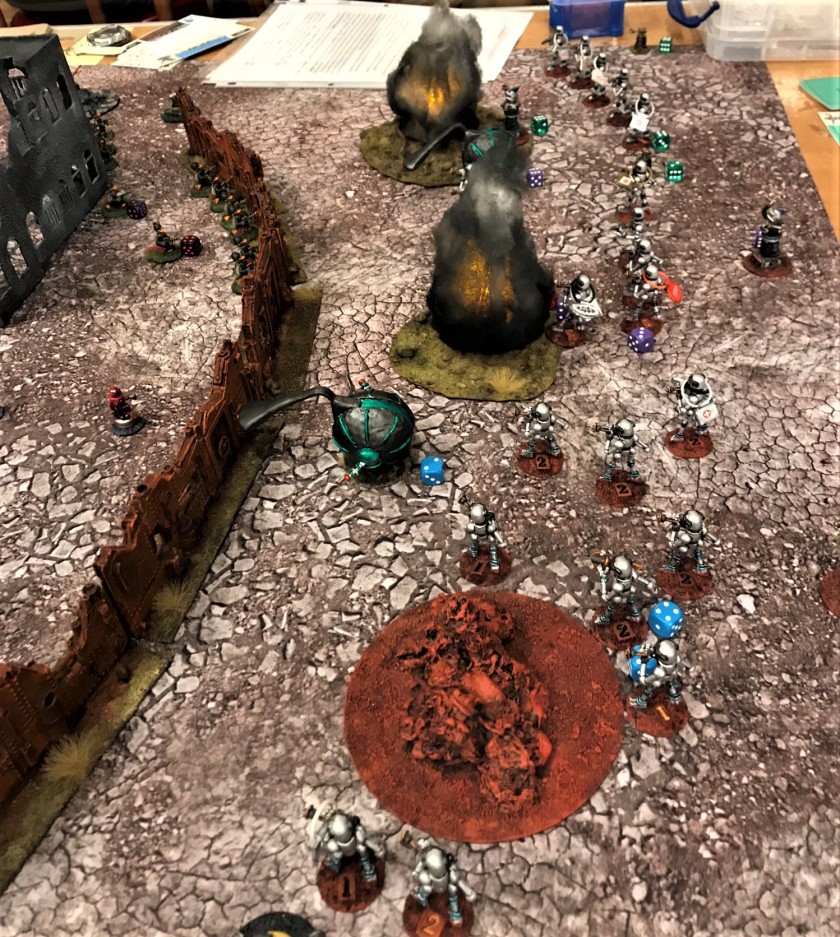
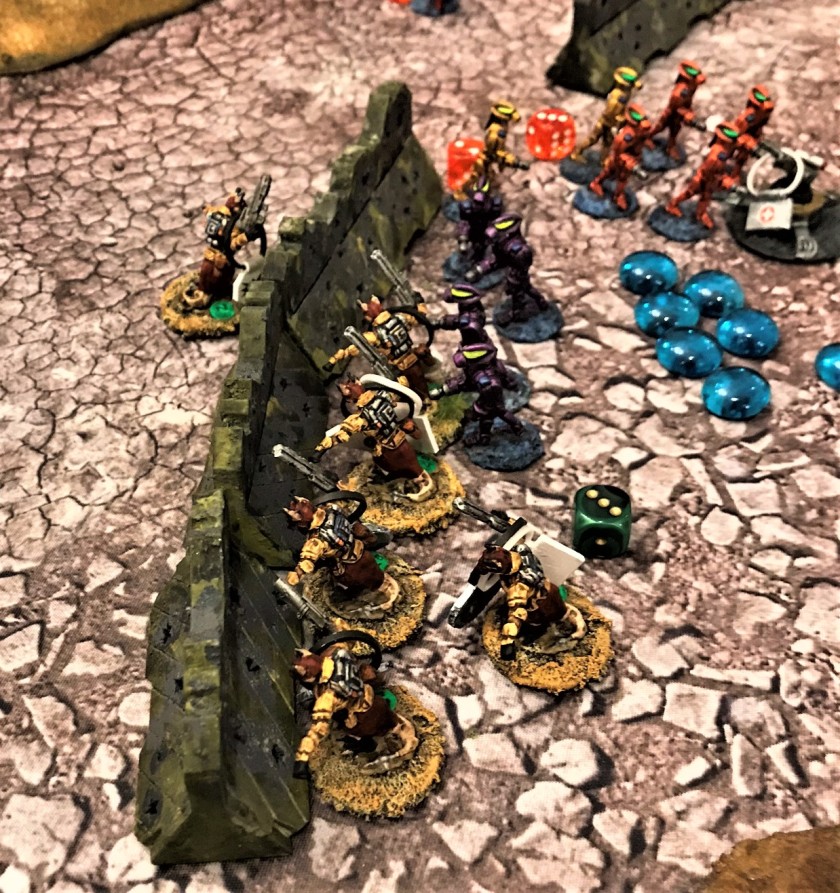
My game posterThe game set up plan.The tabletop is set – and the attack begins.The Warbots got slowed by the Aphids defense, but managed to advance a Mark 1 Sphere tank to the wall.On the other side of the board, Leif Magnuson’s Martians and Robot Peacekeepers press their attack against Chris Comeau’s Space Roos.Chris jet-packed his Space Roos into the heart of the Martian attack. The Star Ducks disabled a second Mark 1 Sphere tank with a satchel charge, immobilizing it and taking it out of the fight – a critical loss.Biological forces desperately converge on the Mark 1 Sphere tank as it breaks through and approaches the captured tank and its Space Dwarf repair crew.Meanwhile, the Robot Peacekeepers pulled a “Banzai” charge morale check and swarm the defending Space Roos on the other side of the table.
At this point in the battle, Duck Wader made a power leap with his Sith powers, and drove his light saber into the Warbot tank, resulting in its disabling just two inches from victory.
Nearby, Roberker, a giant robot (with flame-throwing arms) was the Warbots’ last chance. The Frinx shot Roberker a bit, and its resulting morale check caused a miracle result – apparently the robot lost face, ran away in shame, and blew himself up!
The suicide of Roberker. I replace these “ancient” miniatures on the battlefield when they become casualties with homemade cards.The card that did in Roberker. Note the morale result at the bottom – I have the Warbots use the South Pacific deck from Combat Patrol deck which have different (WWII Japanese) morale results.
The death of Roberker was followed by raucous laughter from the table – even from the player who had it happen to his Roberker.
I was tired after the weekend, but it was a great time. I want to thank all the players, as well as the GM’s, and especially Battle Group Boston for another fun convention!
I have been very busy – too busy to effectively write blog entries lately. I have been working on terrain and game support for the two games I will be running at HAVOC on April 5th and 6th. Each will support 10 players – and its my goal that all have a blast! So, in the interim, please enjoy these two announcements – hopefully I get some other stuff painted and blog-worthy for you dear readers! The link for the convention is here.
I am looking forward to seeing a number of friends – including my old USMA classmate (and HAWKS member) Dave Wood who is also running a couple of games – so that’s exciting too.
I’ll be running these two games!
I updated this game with my Space Roos and have new terrain!
This overall North Africa project has been documented in this blog in five previous posts, (which you can read about here, here, here, here, and here) and I plan on a summary post as well in the near future. There I will detail more about the game scenario and how I run it. These 5 tanks brings me to a total of 46 tanks since December for this scenario.
I decided to try a different source for the tank models, and found that I could get three from Old Glory for $25, which seemed reasonable. I also bought a few other vehicles for other scenarios. I was surprised to see that they were completely made of metal – even with a lead warning on the package! As a metal aficionado, I was pleased.
A bag of early war Italian tanks
Wow – still making with lead!
I did have however a concern with the quality of the castings. They all had significantly problematic mold lines on the machine gun turret, and the details on the hull were much less clear than Battlefront models. Still, the price reflected that, so it was up to me to make it work. Which I did.
Two of these would be for the Italians, and one would be an Australian-captured M11/39 tank. While technically not a squad, they certainly could have started out that way in the Italian Army! For that reason – and because my good friend Azazel runs a fun painting challenge each month (and is an Aussie) – these three will constitute a submission from me for March’s“Squad March” painting challenge.
The turrets needed a good amount of surgery and filing.After assembly and a lot of filing. I glued the machine gun turrets as it made no sense to have them be movable for What a Tanker games..The three M11/39’s assembled.
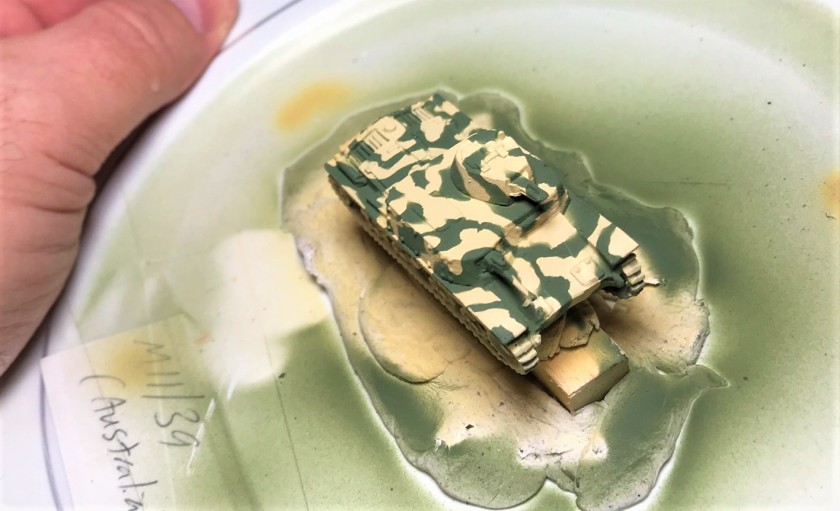
For priming, I went with a brush, as these seemed to be very smooth castings. I worried that it would be difficult to get the paint to “bite”. They also were hollow at the bottom, so I needed to devise a way to mount them for painting. I ended up using a small square dowel and poster tack on small plates.
I brush primed these
The hollow bottom of the model
I did not take as many pictures during the process as I wanted to get these done for a game this weekend, but unfortunately some snow took care of that, and they will get a chance next weekend. I list all the paints I used at the end of the blog for those interested.
Poster tack on the M11/39’s as they are prepped for camouflage paint. I use gauze on the spray booth filter to extend the life of my spray booth filters.Close up of the poster tack before painting.This is not a fine Italian meal by any stretch!After the poster tack was gently removed, I got this result.
Then I used washes, pigments, decals, and other paints to finish them all up. There will be an eye-candy section following the sections on the tanks.
My Italian M11/39’s with the model I used. I ended up with more green, but I still liked the results. In any case, I always want my tanks dusty and dirty.And here is the M11/39 the Aussie’s captured that will join the 8th Army forces.A nice comparison with a photo of the actual Aussie M11/39’s used. I love the ‘roos.
I read that the Aussies used these until they ran out of diesel (their tanks had gasoline engines so diesel was rare). Then they blew them up. I believe that there are no surviving examples of the M11/39 in the world.
M3 Grant
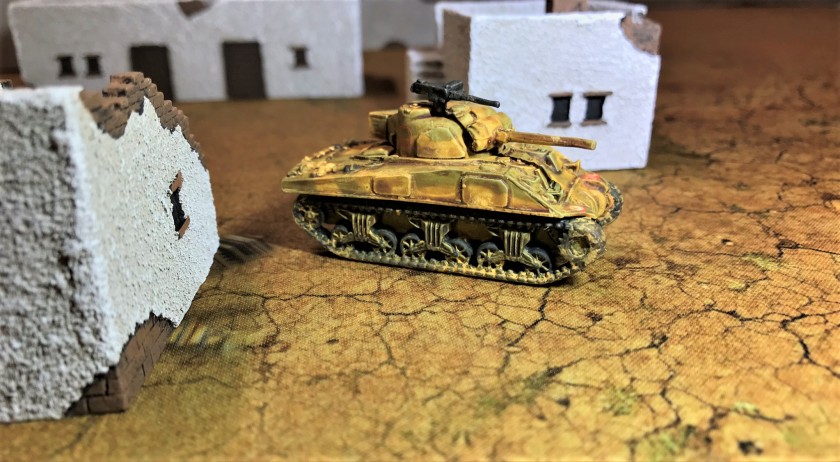
I already had one M3 Grant painted, but with the Germans having a Panzer IVF2 and a Tiger I in the DAK inventory, I wanted to augment the 8th Army’s later war desert forces with another Grant and a Sherman.
My Grant in the blister
Assembled Grant
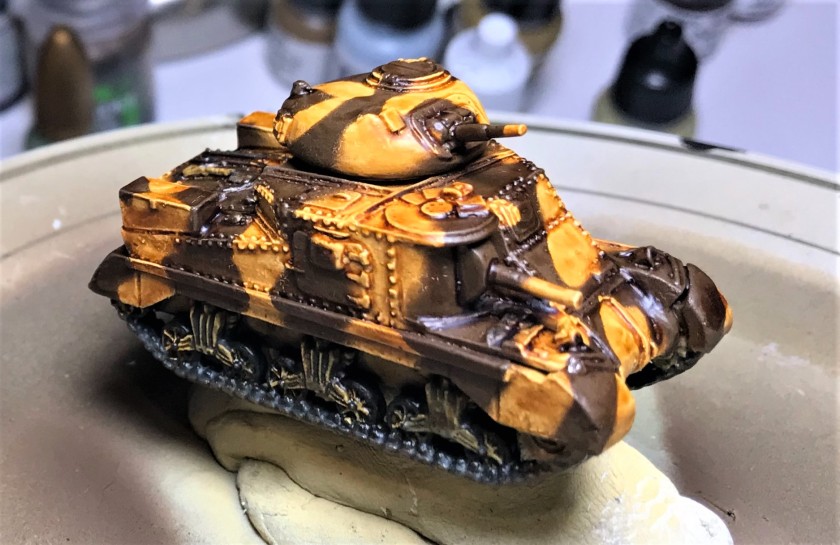
Awaiting decals, pigments, and varnish.The completed model with the one I used as a guide. There was no way I was going to be able to pull off the white and black outlines here on such a small model. I do like how it came out – again dirty and dusty.
M4 Sherman
My Sherman in the blister
Assembled Sherman
The major difference in painting here from the M3 Grant was the camouflage pattern I used.
M4 Sherman awaiting decals, pigments, and varnish.The completed model with the guide in my research material.Here are the two with images I printed out from Battlefront’s web page.
Please let me know any feedback in the comments section, I do appreciate your thoughts. Now it’s time for…
Eye Candy
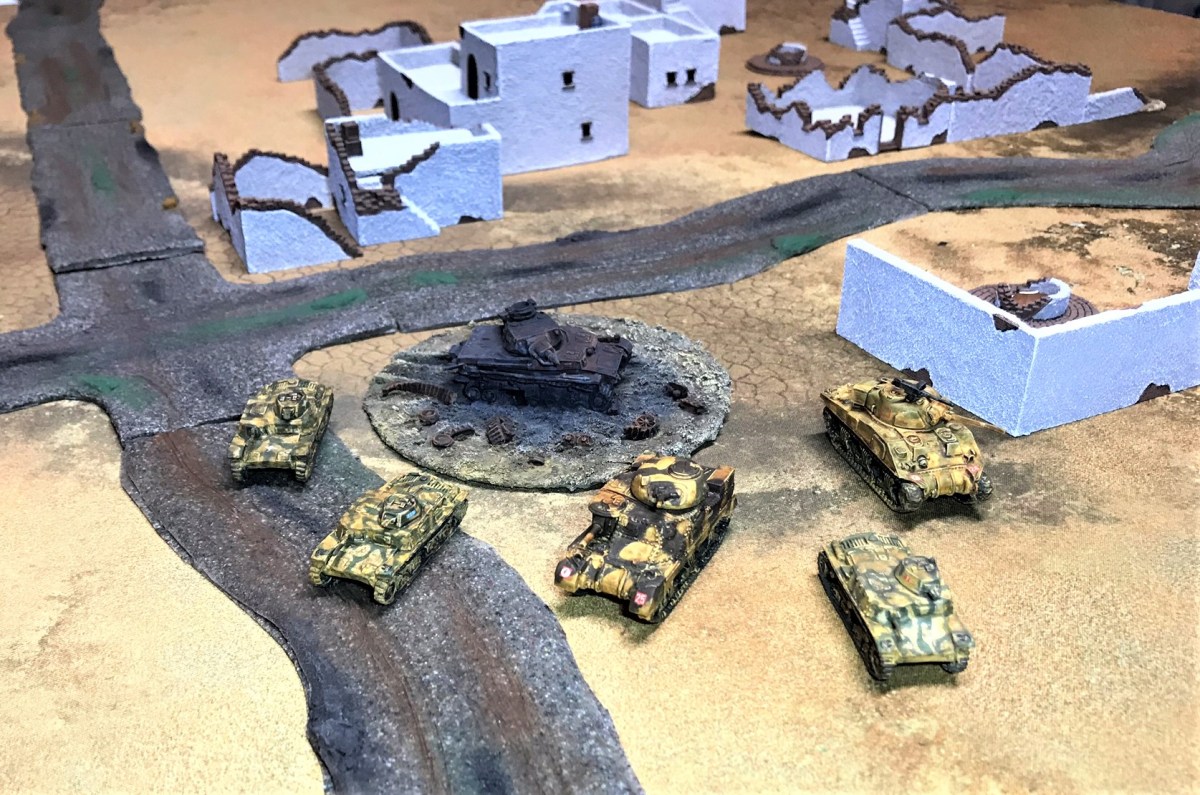
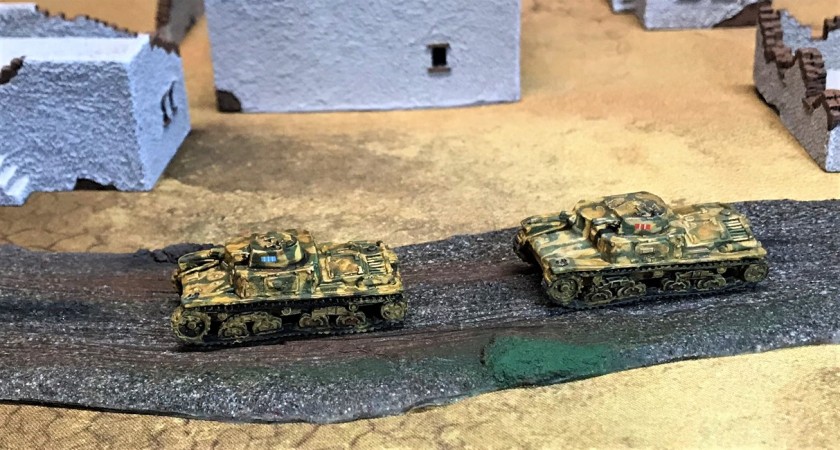
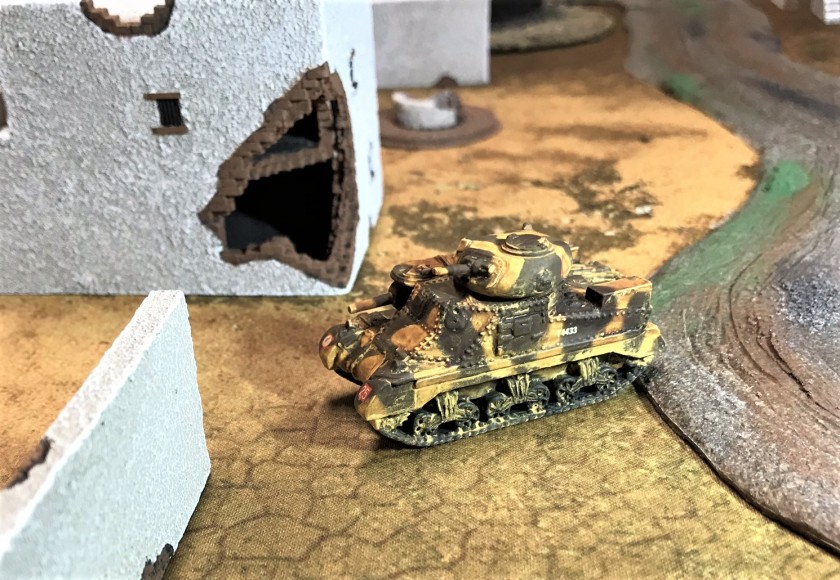
Here are the three M11/39’s, with the Aussie on the far right.Right front view of one of the Italian M11/39’s. The main gun is the antitank weapon, and can only be moved with the tank itself as the turret had only machine-guns.Left side view of the M11/39.The two Italian M11/39’s hit the road.Rear view of the two Italian M11/39’s.The Australian M11/39 with ‘Roo markings so as not to attract friendly fire.Gotta say I love the ‘Roo.Other side.Aussie M11/39 driving by a wrecked Panzer IVD.M3 Grant with Desert Rat markings.Nice left side view of the M3 Grant.Coming at ya!Rear view.The M4 all dusted up. I also gave the M4 Desert Rat markings.M4 Sherman moving out.I don’t want to end up like Heinz!Rear view of the M4 Sherman. I had to pin the bustle rack, and at certain angles it looks off, but at a distance its unnoticeable.The 8th Army additions all assembled.All the tanks that were completed for this post.
PAINTS, INKS, GLAZES, SHADES, WASHES, PIGMENTS AND FLOCKING USED ON THE M11/39’s:
Vallejo “Flow Improver”
Vallejo “Airbrush Thinner”
Vallejo “Surface Primer – Black”
Vallejo “Dark Sand”
Battlefront “Dry Dust”
Battlefront “Army Green”
Vallejo Game Air “Black”
Battlefront “Monty Shade” (shade)
Army Painter Quickshade “Soft Tone” (wash)
Army Painter Quickshade “Strong Tone” (wash) – on Australian version only
Battlefront “Dark Gunmetal”
Vallejo Mecha Color “Light Rust Wash” (wash)
Testors “Universal Acrylic Thinner”
Vallejo “Dark Yellow Ochre” (pigment)
Vallejo “Light Slate Grey” (pigment)
Vallejo “Light Yellow Ochre” (pigment)
Vallejo “Desert Dust” (pigment)
Vallejo “Natural Umber” (pigment)
Gorilla Glue
Vallejo Mecha Varnish “Gloss Varnish”
Microscale Micro-Set
Microscale Micro-Sol
Microscale Satin
Microscale Liquid Decal Film
Appropriate decals from Battlefront
Vallejo Mecha Varnish “Matt Varnish”
Aleene’s poster tack
Sponges
PAINTS, INKS, GLAZES, SHADES, WASHES, PIGMENTS AND FLOCKING USED ON THE M3 GRANT AND M4 SHERMAN:
As for research materials, I used the same ones as I cited in previous posts plus Google searches and Battlefront’s website. Here the books are in case you are interested – you can find them on Amazon and I highly recommend them all:
Jean Restayn:WWII Tank Encyclopaedia, 1939-45
Smithsonian/DK: Tank: The Definitive Visual History of Armored Vehicles
Michael Green:Axis Armoured Fighting Vehicles of the Second World War (Images of War)
Robert Jackson:Tanks and Armored Fighting Vehicles Visual Encyclopedia
I would again easily recommend all of these books as really good resources for gamers and modelers. Thanks for looking and for sharing your feedback in the comments section.
Now I might go back to retro sci-fi for a bit! Still have many more tanks to do, but those will be for other scenarios.
Do you have a favorite tank of the ones here? Why? Let me know!
These projects are my February submissions for Azazel’s February Community Painting Challenge, which he supplemented to include terrain. This week I also started a new job! So, I wanted to wrap up these projects this weekend.
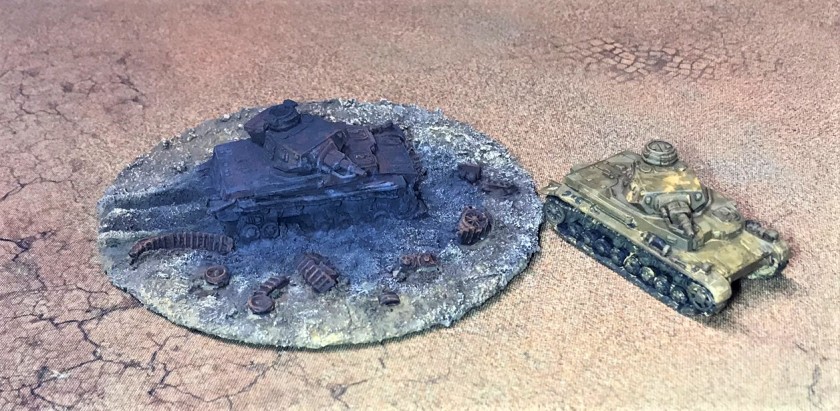
Panzer IVD Wreck
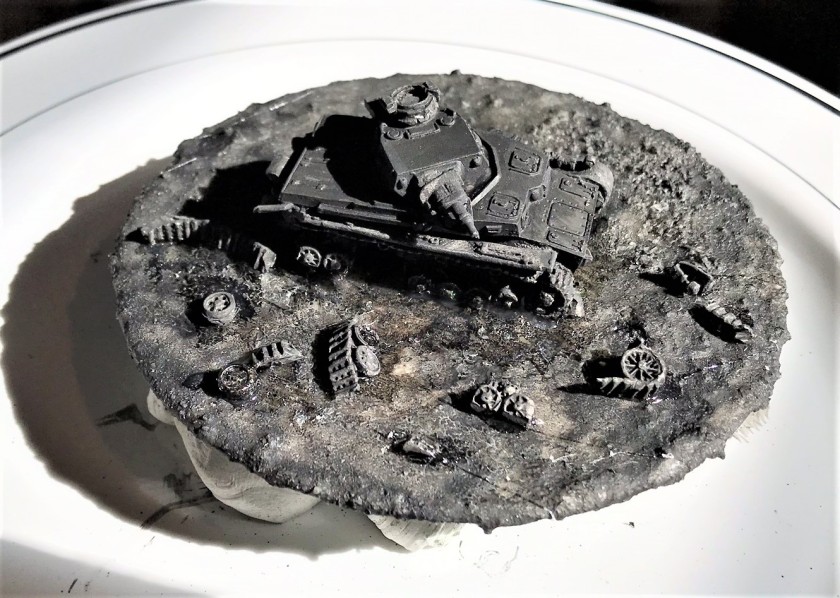
I decided to base the wreck on an old CD that was surfaced with play sand and Elmer’s (PVA) glue. To cover the hole, I affixed some leftover polystyrene bits. Then, I used sandpaper to lightly scratch the CD, then applied the glue, then the sand, and let it harden overnight. I removed the front and rear sprockets from one of the tracks and cut away some road wheels, so as to be able to flip them on the CD and make them available for the right side of the wreck in the correct locations as debris. I carefully cut away the road wheels and part of the track and some fender, and washed everything to prep for painting.
All the pieces I would use
Sand and PVA glue on the CD hardening
Ready to assemble
After all the pieces had dried, I then I assembled the model to look “messed up”. I put the gun and mantlet on slightly crooked. The turret and bustle rack were put on a bit akimbo as well.
I took a 1/8″ drill bit and drilled a hole into the hull between the missing road wheels to simulate the impact of a hard shot into the weaker flank of the tank. In my portrayal, that shot hit ammunition, causing an explosion. I scattered the resultant debris on one side of the tank to simulate that, affixing everything with E6000 epoxy. I then mounted the CD onto a disposable plastic plate using poster tack for ease of painting. I applied a coat of Citadel “Imperium Primer” as the E6000 was a bit rubbery and smooth – and I was worried that it would not hold paint well. To double up on priming, I then airbrushed on another primer coat – Vallejo “Surface Primer – Black”.
My initial basing and priming
My next thought was to do a bit of the original Panzer IVD paint on the wreck before I changed it into a wreck, as perhaps some of it would survive (I don’t think much eventually did, but I thought, better safe than sorry). This consisted of the same basic pattern I followed on my previous German tanks.
First some grey……and then some more DAK colors.
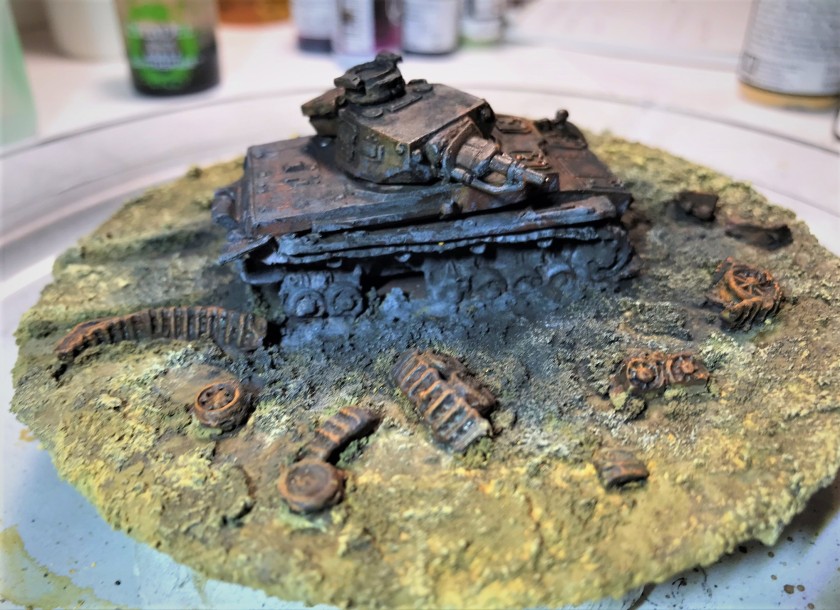
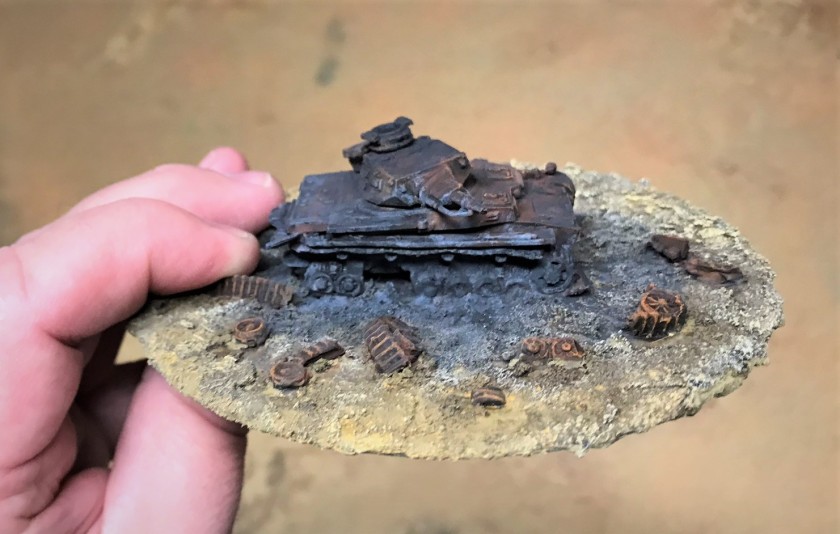
My concept at this point was to portray the Panzer IVD as having been hit, having caught fire, then after being abandoned, rusting away. The fire would have destroyed all or most of the original paint on the hull. Any metal debris would have rusted afterwards in my opinion, so I decided that decals would be a waste here.
Here, I worked on rusting things up with several different rusting products (all listed at the end of the post).
The sand and PVA glue texture was insufficiently granular for the base, so I used Citadel “Armageddon Dunes” to roughen up the landscape. It also allowed me to make the doomed German tank’s last tracks in the desert at the rear of the vehicle. I darkened them up with Citadel “Agrax Earthshade”.
After using the Armageddon Dunes texture paint to gain a better surface on the base.
Then I went into using various Vallejo weathering pigments to create soot, smoke, and dust on and around the model. I especially like the soot!
Impact side, after weathering but before varnishing.Opposite side of the tank before varnishing.Top of the tank before varnishing.
For varnishing, I used two coats. First, I applied a Vallejo “Satin” varnish with my airbrush. After that had dried, I applied a light coat of Vallejo Mecha Color “Matt Varnish”. I did not want to overly dull the tank, but I definitely did not want it too glossy.
After first coat of varnish.
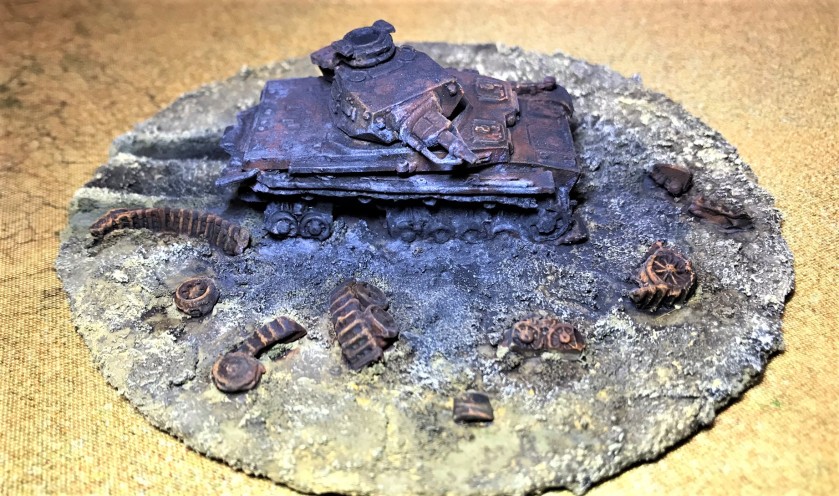
I am reasonably happy with the final results. Here are some eye-candy shots on my desert game mat – you be the judge!
Completed Panzer IVD wreck model, impact side.Completed Panzer IVD wreck model, rear side, showing the track marks in the sand before its final moments.Completed Panzer IVD wreck model, left side.One of my favorite views.An intact Panzer IVD crew drives by the wreck, thinking it could have been them!Let’s be careful Heinz! We don’t want to end up crispy like that one!A little different angle – plus my hands for scale.Nice view of the top – some of the original paint can be seen here I think.
Smoke/Blast Markers
The next project was making some more (and better) to put on the tabletop when tanks meet their demise – or for any explosions in general. I took tea lights, and hot glued thin strips of pillow batting to them in a “closed lily” type of shape.
After building the markers, but before painting them.Lit up with the lights down.
I then painted them black and grey, trying to make them less dark thank my previous attempts.
Completed and lit in the light.Look much better in less light!
Thanks for looking at these – and I hope that perhaps these give you some ideas. In any case, I hope you enjoyed seeing them and my processes. Please share any feedback you have in the comments section!
PAINTS, INKS, GLAZES, SHADES, WASHES, PIGMENTS AND FLOCKING USED ON THE PANZER IVD WRECK:
Play sand
Used CD
Elmer’s Glue
Battlefront model #GE040
E6000 epoxy
Gorilla Glue
Testors “Universal Acrylic Thinner”
Citadel “Imperium Primer”
Polystyrene bits
Vallejo “Flow Improver”
Vallejo “Airbrush Thinner”
Vallejo “Surface Primer – Black”
Vallejo Model Air “Base Grey”
Vallejo Model Air “German Green Brown”
Vallejo Model Air “Light”
Vallejo Model Air “German Green Brown”
Vallejo Model Air “Hull Red”
Vallejo Model Air “First Light”
Vallejo Model Air “Brown”
Citadel “Armageddon Dunes” (Texture)
Battlefront “Monty Shade” (shade)
Vallejo Mecha Color “Light Rust Wash” (wash)
Vallejo Mecha Color “Dark Rust Wash” (wash)
Citadel “Agrax Earthshade” (wash)
Vallejo “Dark Sand”
Battlefront “Dry Dust”
Vallejo “Titanium White” (pigment)
Vallejo “Carbon Black” (pigment)
Vallejo “Pigment Binder”
Citadel “Typhus Corrosion”
Citadel “Ryza Rust”
Vallejo “Desert Dust” (pigment)
Vallejo “Dark Yellow Ochre” (pigment)
Vallejo “Light Yellow Ochre” (pigment)
Vallejo Model Air “Satin Varnish”
Vallejo Mecha Varnish “Matt Varnish”
Citadel “Nuln Oil” (wash)
PAINTS, INKS, GLAZES, SHADES, WASHES, PIGMENTS AND FLOCKING USED ON THE SMOKE/BLAST MARKERS:
My ultimate goal is to have an excellent game that I can run at conventions or club meetings. I now have that, but will probably add some Marder III’s, M3 Grants/Lees, and M4 Shermans to be complete.
I will share here both the Italian vehicles and the Panzer IVD – and some of their in progress photos. Then, you will get a chance to view some eye candy shots! Because I have been very busy seeking new employment (and it looks good on that front!), I was able to finish the tanks and run a couple of play tests before I could finish this post. So there will be a few shots of the play tests I have been running with these tanks. I also share the materials and research used at the end for those interested.
This tank is basically the M13/40 with a better engine and slightly better armor.
M14/41 in blister
Cleaned up and ready for assembly
Assembled tank
I used a painting scheme that attempted to match the one example in the Bovington museum.
M14/41 primed and base coated
Prepped for camouflage
After camouflage paint – a little lighter than I wanted
After applying decal and varnish, but before adding weathering powders.The completed M14/41 tank model next to one in the book.
Semovente 47/32
In the WaT rules, this vehicle is interesting. It is small (tougher to hit), low profile (tougher to acquire), fast (can move every turn), and a tank destroyer (can aim easier). It also is, like the Panzerjager I, open-topped, so never buttoned (and more vulnerable). Each blister had two vehicles, and I bought two at the 50% off sale!
Semovente 47/32’s in blisters.
Ready for assembly.
The tiny tank destroyers primed and base coated.
Close up after decals
With the book example
Semovente 75-18
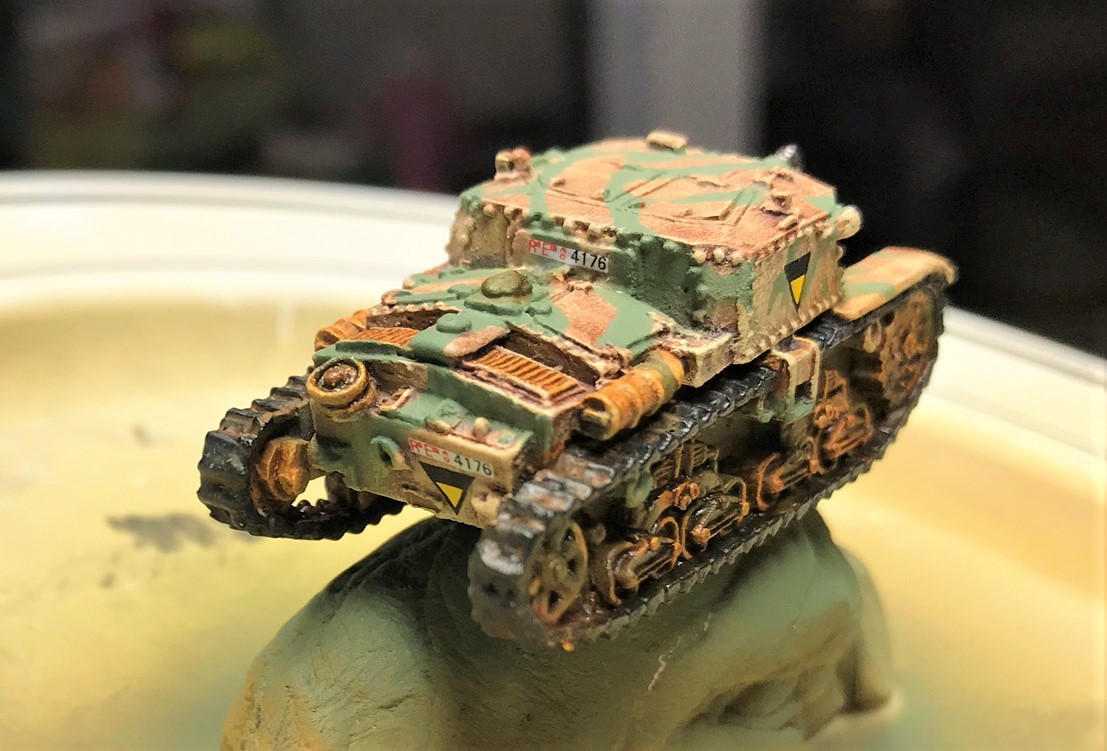
I had two of these, with one being a command model (carro comando), that had a range finder (called a goniometer). I used a slightly different camouflage scheme with these and love the triangle vehicle marking decals that these got.
The two 75/18 types in their blisters
Components – with useless instructions (wrong model).
Primed and base coated
Prepped for camouflage
After adding crew and decals
Hey, matching licence plates!I used this color scheme, and went with the decals anyways.
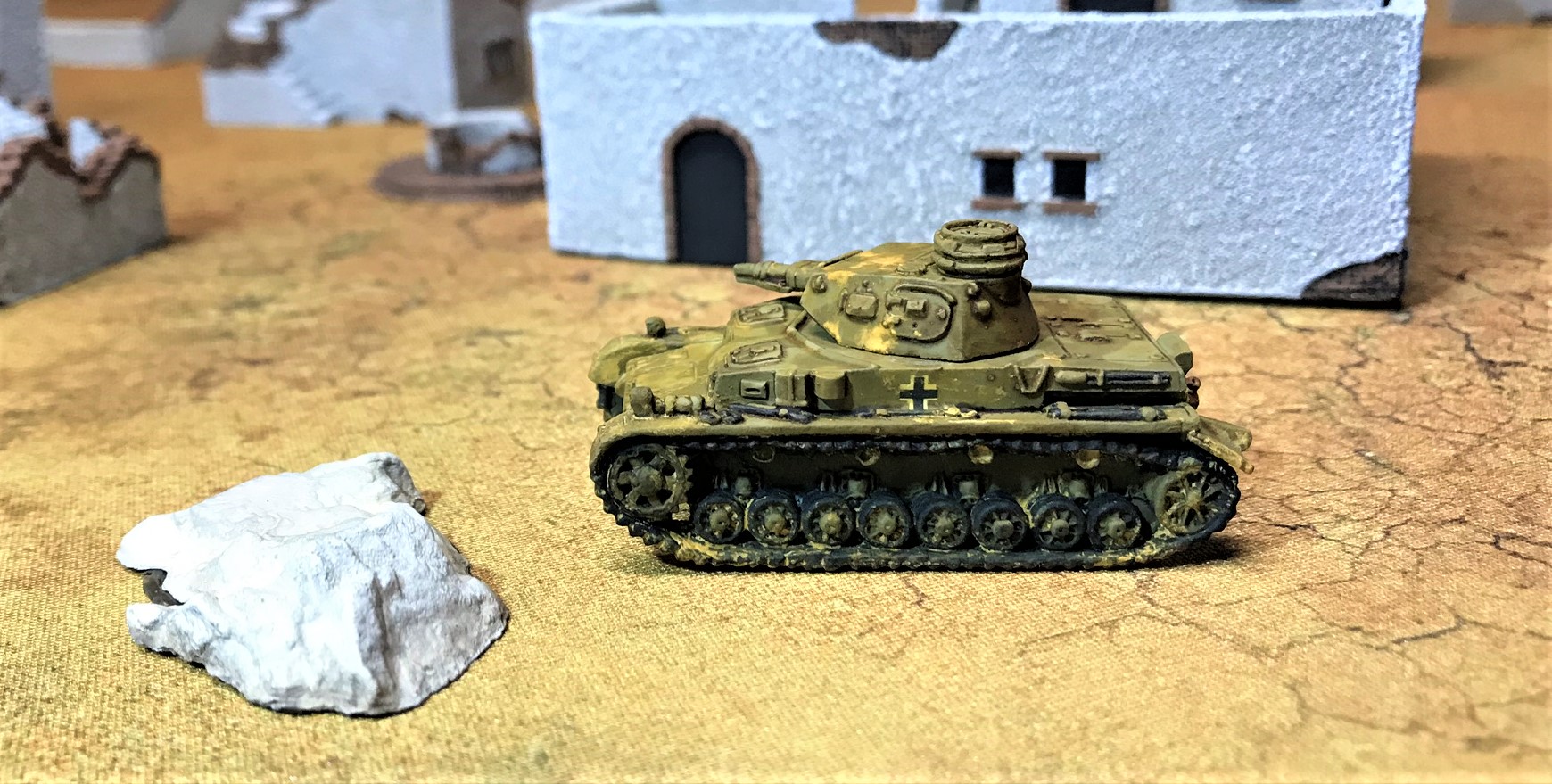
Panzer IVD
My previous Panzer IVD did not make the last project group as it came with two left tracks. Battlefront sent me a replacement, and I plan to use the defective one soon as a wreck project.
In the blister
Ready fir assembly
Had to pin the main gun.
Assembled Panzer IVD
Italian Repainting
For my Wargame Model in Ohio tanks, I decided to give them a makeover with paint and decals so that they were less different than the newer Italian vehicles. They are still not perfect, but I decided to stick with what I have done with them now.
My repaint of the other Italians
I hope you liked the in progress stuff above – and now…it’s Eye Candy time!
Eye Candy
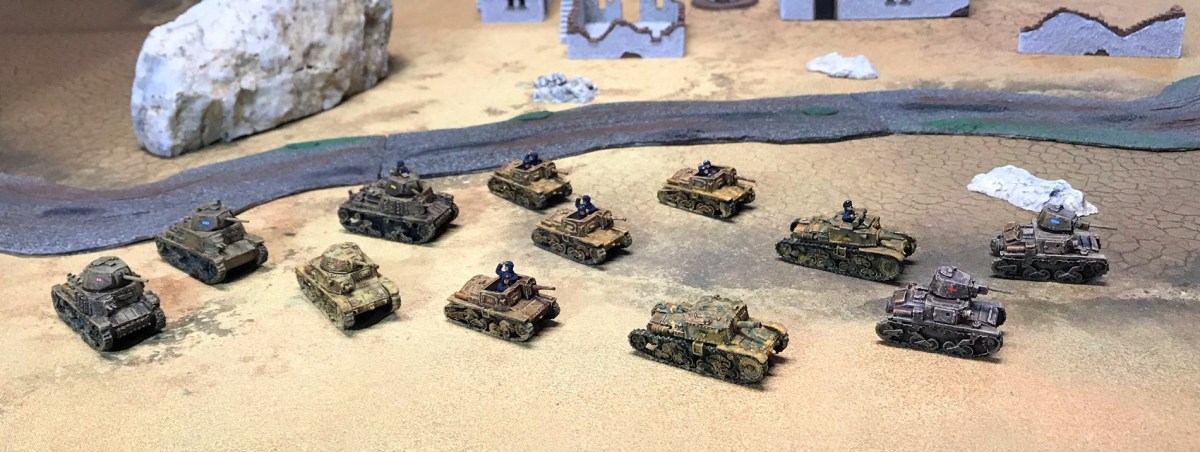
Front view of M14/41.Left rear view of M14/41Right side view of M14/41 on the roadLittle Semovente 47/32’s in a convoyFront left view of Semovente 47/32Rear right view of Semovente 47/32Semovente 75/18 right side view.Left front view of Semovente 75/85Rear view of the Semovente 75/18 tank destroyerIn comparison, here is the Semovente 75/18 Carro Comando version from the backSemovente 75/18 right sideSemovente Carro Comando 75/18 right side. Note the goniometer on the top in front of the crewman.The two versions of the Semovente 75/18’s togetherPanzer IVD left sidePanzer IVD left sideRear view of the Panzer IVDItalian Group shot!
Lastly, I am thankful to Chris Rett, Ryan MacRae, Frank Ramsay, and Mike Morgan for helping me to start to play test the scenario and rules tweaks that I will use to make this work at HAVOC in April for up to 10-12 players. Here’s a few shots!
At Great Stories in Uxbridge, MA – Chris, Ryan, and Frank have fun. The Brits made a comeback and won here under Chris’ command.Mike Morgan maneuvers his Brits to a narrow victory at my house.One of my innovations – Kill Ring Cards!
Thanks for looking – and I hope that you found this post interesting and fun. As I add more tanks/tank destroyers, I will share them. I also hope to add better pics from future games.
Please let me know your thoughts and feedback – as always – in the comments section!
PAINTS, INKS, GLAZES, SHADES, WASHES, PIGMENTS AND FLOCKING USED ON THIS TANK GROUP:
Vallejo “Flow Improver”
Vallejo “Airbrush Thinner”
Vallejo “Surface Primer – Black”
Citadel “Imperium Primer”
Battlefront “German Camo Orange Ochre”
Testors “Universal Acrylic Thinner”
Vallejo Model Air “Base Grey”
Army Painter Quickshade “Mid Brown” (wash)
Battlefront “Dry Dust”
Vallejo Model Air “German Green Brown”
Battlefront “Monty Shade” (shade)
Army Painter Quickshade “Strong Tone” (wash)
Battlefront “Army Green”
Battlefront “Dark Gunmetal”
Battlefront “Panzer Gray”
Vallejo “Neutral Grey”
Vallejo Model Air “Green Brown”
Vallejo Model Air “Light”
Vallejo Model Air “Cam. Grey Green”
Battlefront “Black”
Battlefront “Battledress Brown”
Vallejo Mecha Color “Light Rust Wash” (wash)
DecoArt “White Pearl”
Army Painter Quickshade “Light Tone” (wash)
Battlefront “European Skin”
Battlefront “Skin Shade” (shade)
Vallejo “Dark Flesh”
Vallejo “Dark Prussian Blue”
Vallejo “Dark Yellow Ochre” (pigment)
Vallejo “Light Slate Grey” (pigment)
Vallejo “Light Sienna” (pigment)
Vallejo “Desert Dust” (pigment)
Citadel “Nuln Oil” (wash)
Gorilla Glue
Vallejo Mecha Varnish “Gloss Varnish”
Microscale Micro-Set
Microscale Micro-Sol
Microscale Liquid Decal Film
1/8″ rare earth neodymium magnets
Appropriate decals from Battlefront
Vallejo Mecha Varnish “Matt Varnish”
Aleene’s poster tack
Sponges
Thanks for looking and for sharing your feedback!
ONCE MORE – ON MY RESEARCH MATERIALS
As for research materials, I used the same ones as I cited before – but for completeness here they are in case you are interested (you can find them on Amazon):
One by Jean Restayn:WWII Tank Encyclopaedia, 1939-45
One by the Smithsonian/DK: Tank: The Definitive Visual History of Armored Vehicles
One by Michael Green:Axis Armoured Fighting Vehicles of the Second World War (Images of War)
One by Robert Jackson:Tanks and Armored Fighting Vehicles Visual Encyclopedia
I would again easily recommend all of these books as really good resources for gamers and modelers.








































































 Mark A. Morin