In November 1942, the Vichy French had a 8 division’s worth of troops in her colonies – from Morocco to the Levant. Under the terms of the Armistice of 22 June 1940, Vichy France was still obligated to defend its unoccupied lands as a neutral state.
And yes, they had more tanks than just the FT-17’s you saw in my last post. In addition to those old WWI relics, Vichy had Hotchkiss H35 and H39 tanks, as well as Renault R35’s. Both of the Hotchkiss models were “cavalry” tanks, in that they had been forced as a light tank on the French cavalry in the 1930’s (and later forced on infantry tank regiments as stopgaps). Contrastingly, the R35 was an “infantry tank”. After the Armistice, the Vichy Army had both types in the colonies. I did read somewhere that some R35’s were hidden away under hay bales behind horse barns to keep prying German and Italian officers of the Armistice Commission from finding them.
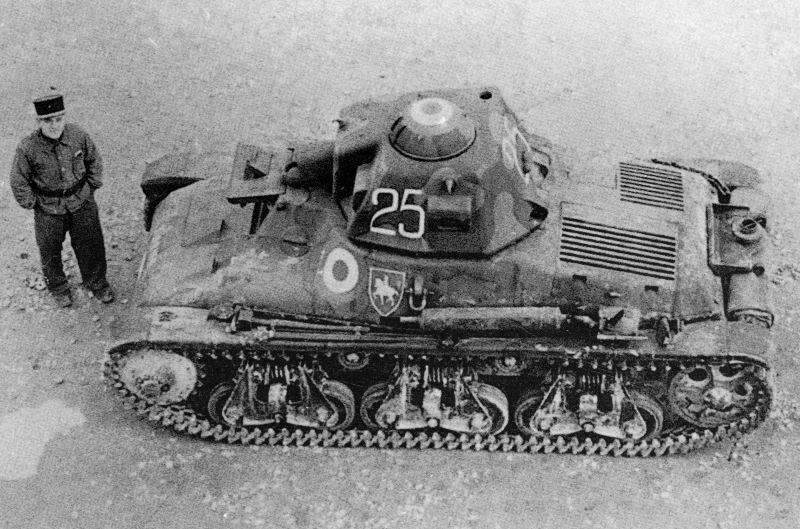
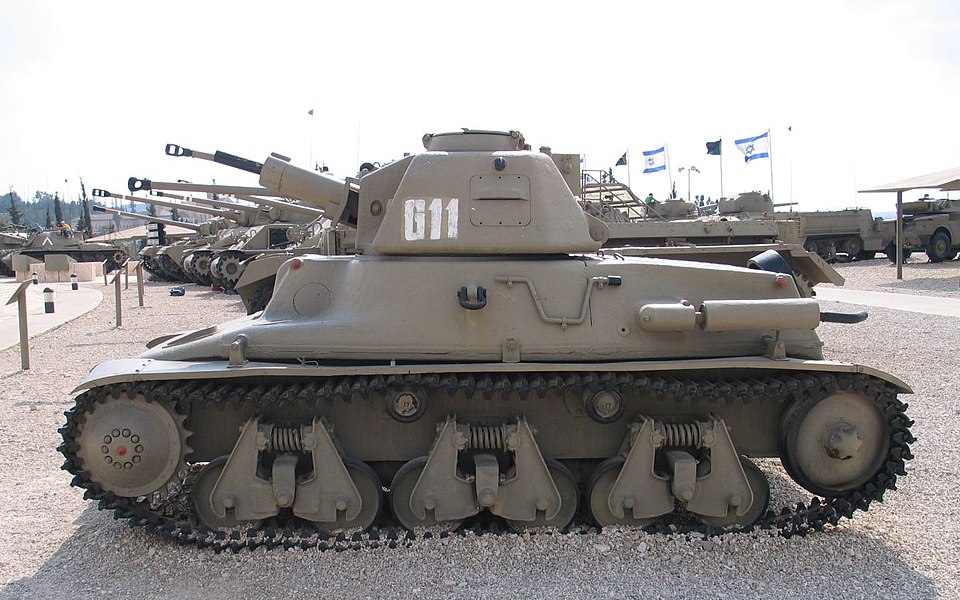
The H35, or Char léger modèle 1935 H, was a two-man tank, armed with the same cannon as the FT-17 (the Puteaux SA18 37mm cannon). The H39, or Char léger modèle 1935 H modifié 39, was a 1938 upgrade of the H35 that also got a better engine, and a newer and longer 37mm gun – the SA38 cannon, that supposedly had increased armor penetration over the SA18 (how much I cannot find!). Both variants were in North Africa in November 1942. There are only two observable differences to an outsider between the two models. Both have different engine deck configurations and the mufflers of H35’s point forward – while H39 mufflers point rearward.
An H35 tank. Note the engine deck and the forward-pointing muffler.An H39 tank shown in Israeli markings at Yad La-Shiryon (officially: The Armored Corps Memorial Site and Museum at Latrun in Israel. Note the rearward-pointing muffler.
As for the R35, or Char léger Modèle 1935 R, it was an infantry tank under French Army doctrine. It too had a two-man crew, and was also armed with the Puteaux SA18 37mm cannon. It was thought to be slightly better mechanically than the H35/H39 variants. As the Armistice forbade Vichy from having pure tank units, these and the Hotchkiss tanks would be spread around into combined-arms units. These Vichy tanks and armored cars would play a role in Operation Torch in November 1942 against US forces in Morocco (and Algeria as well).
R35 tank at Saumur Museum in France.
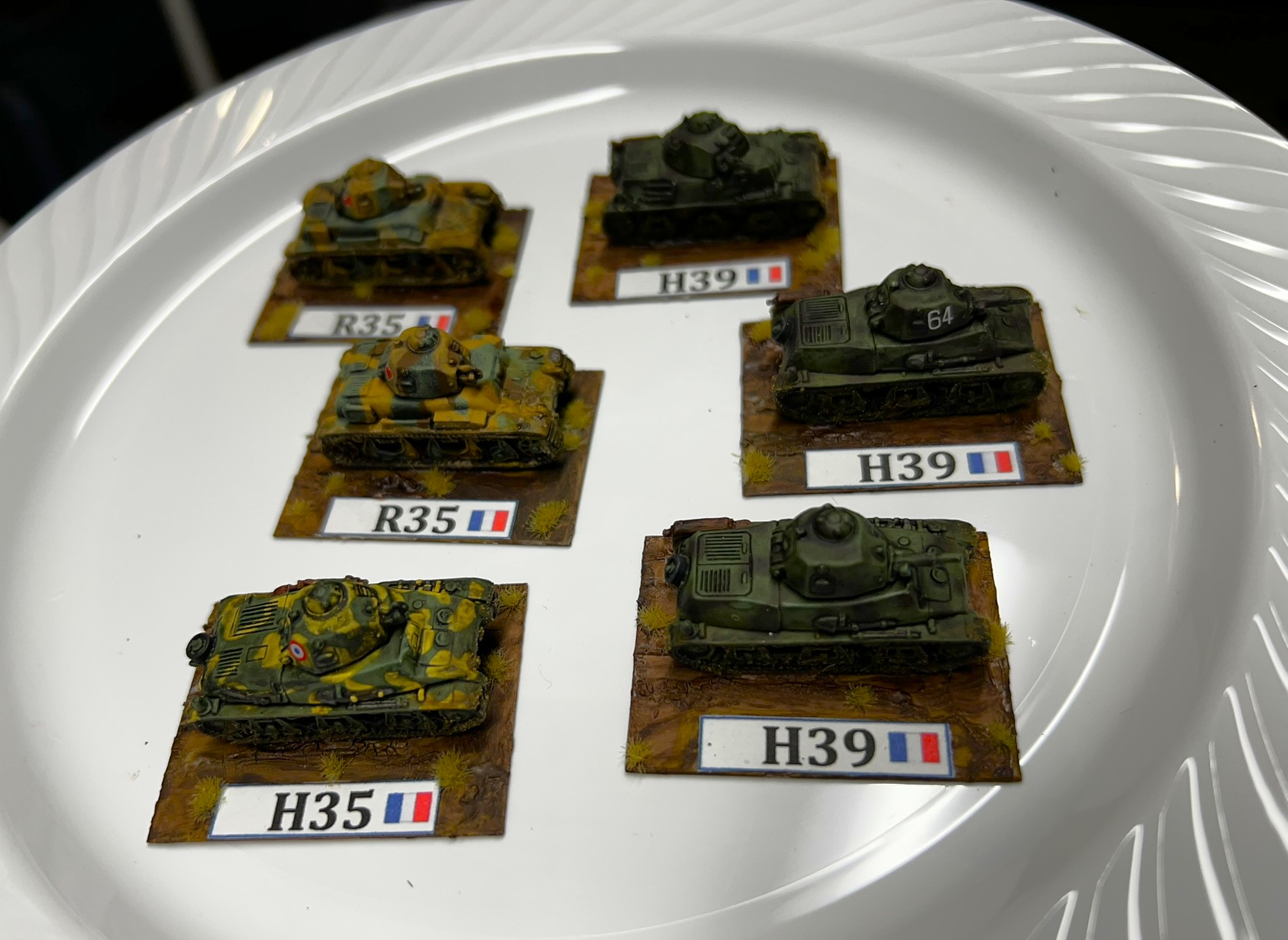
In gathering appropriate models for my What a Tanker game for HISTORICON, I started with looking for H35 and H39 metal or 3D-printed models in resin. I found a two listings for some on eBay. One was for Sarge_s Stuff – he had H35’s that could be bought individually – and I ordered 4 of them. The other site was the same one I bought the FT-17’s from earlier – jacobsminis (aka HobbyHouse&Miniatures.LLC). I ordered 5 from HH&M as that was the minimum order. The tanks from HH&M were (and still are) listed as H39’s, but when I got them I realized that they were actually H35’s. Unlike their excellent FT-17 models, some of these had printing errors, and I ended up using just 2 of these. However, I did use all 4 of the Sarge_s Stuff ones as H35’s. For H39’s and R35’s, I decided to rebase the ones that I painted a few years ago. I had 1 H35 and 3 H39’s (documented here) and 2 R35’s (documented here). I rebased all 6 of these.
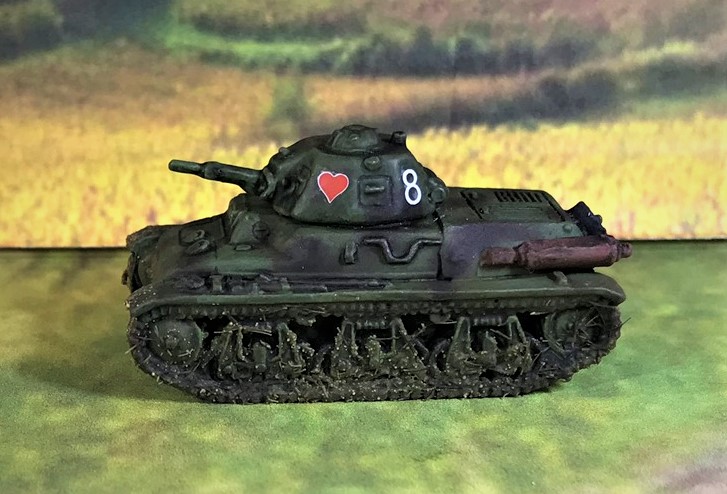
One of my 3 H39’s before I rebased.My R35’s before rebased them.All rebased!
This left me with 6 H35’s to paint to round out the tanks for Vichy (more armored cars would be coming!). As I was also working on many other vehicles at the time, plus running for reelection (I won), plus preparing for and attending HUZZAH, AND prepping for HISTORICON…plus golf…I was BUSY in April, May and even June and July. I am sure that you get the picture, and ironically I have few WIP pictures! But I’ll share what I have.
I used neodymium magnets and flat-head nail again to mount the turrets. The two H35 turret prints were slightly different, but I adapted with green stuff.
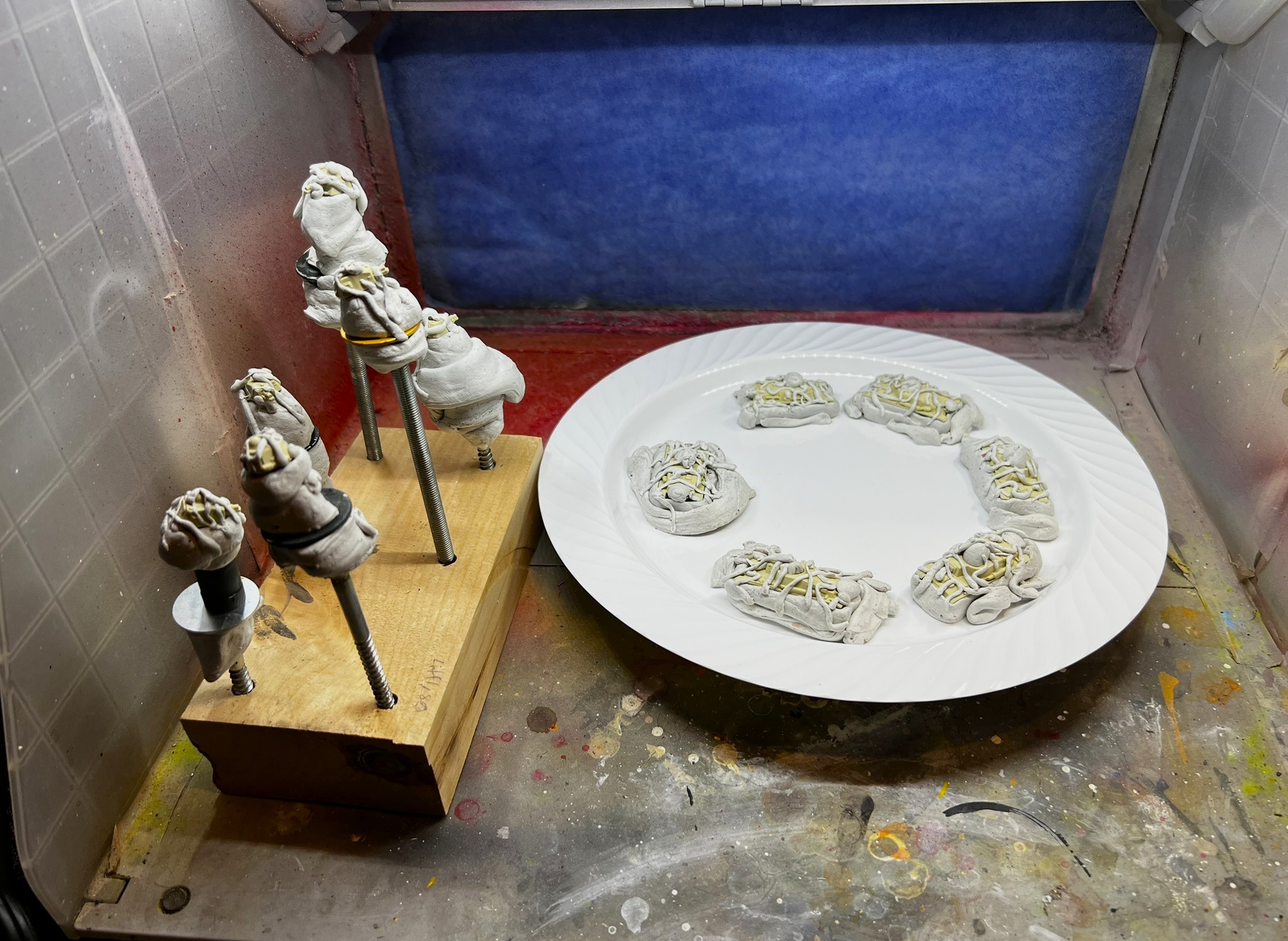
The 6 H35’s primed with the first desert sand color.
I used poster-tack again for masking/making camouflage patterns over the initial color. I did experiment with using Silly Putty as masking as I had seen someone do that – but it did not work for me. So I went back to what I knew would work – poster tack and touching up afterwards..
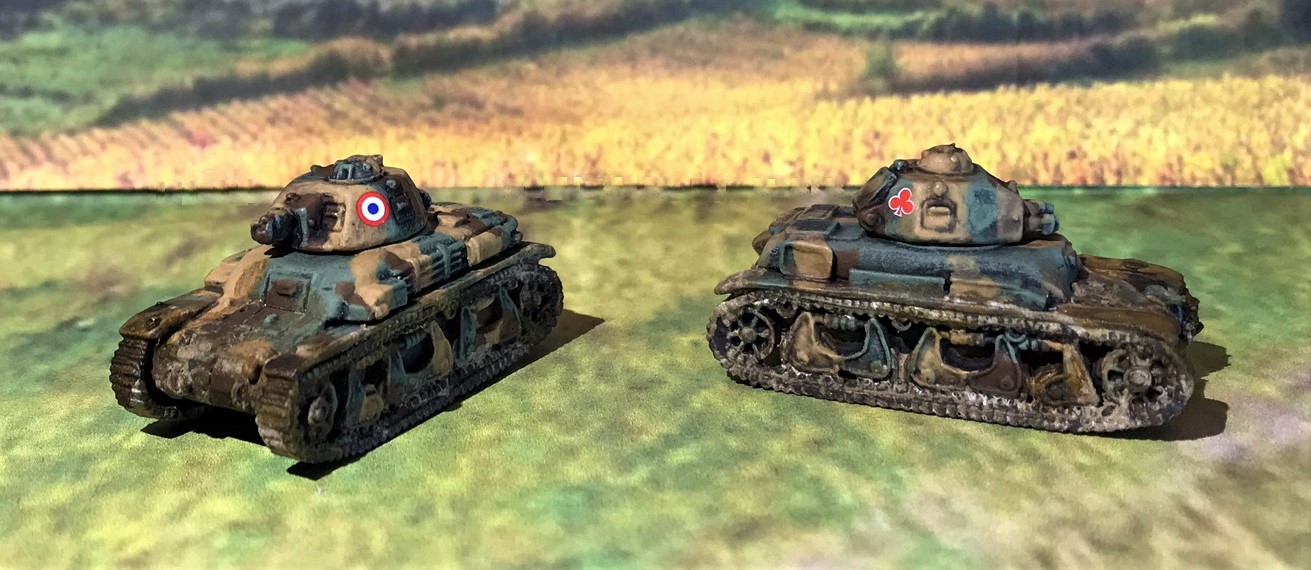
Poster-tack covered!Then I applied a second prime with a NATO Green. Al paints are listed at the end of this post.Now I had 6 H35’s. The third one from the left is one from an earlier project that I rebased, with the other 5 being new. The yellow is different on that older one, but ok enough I think for a game.
Now, I can share some limited…
Eye Candy
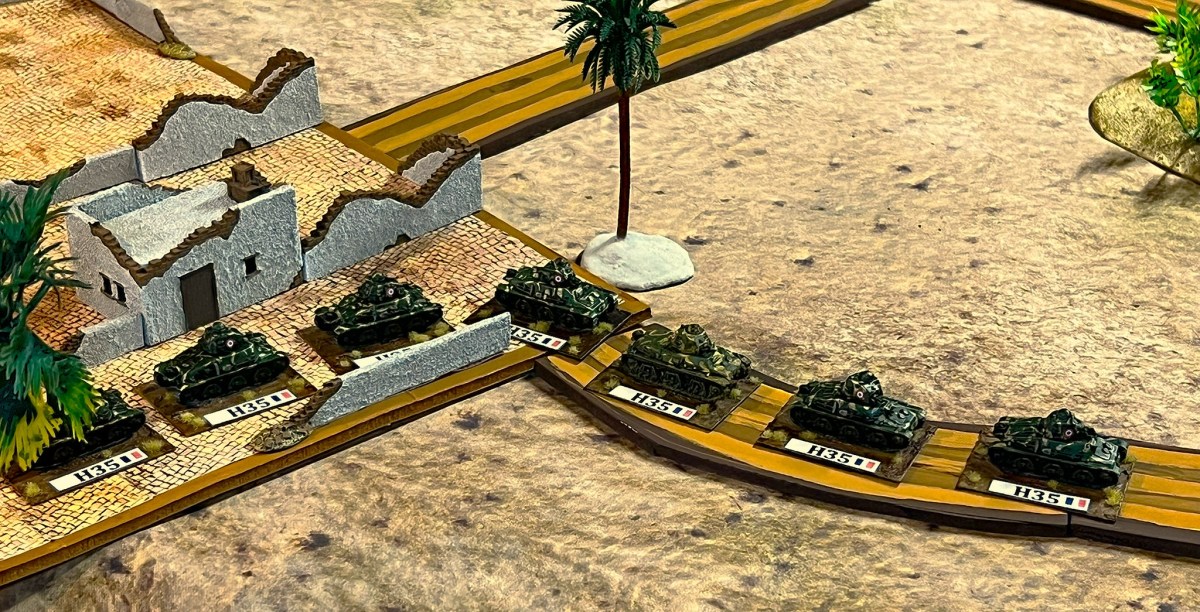
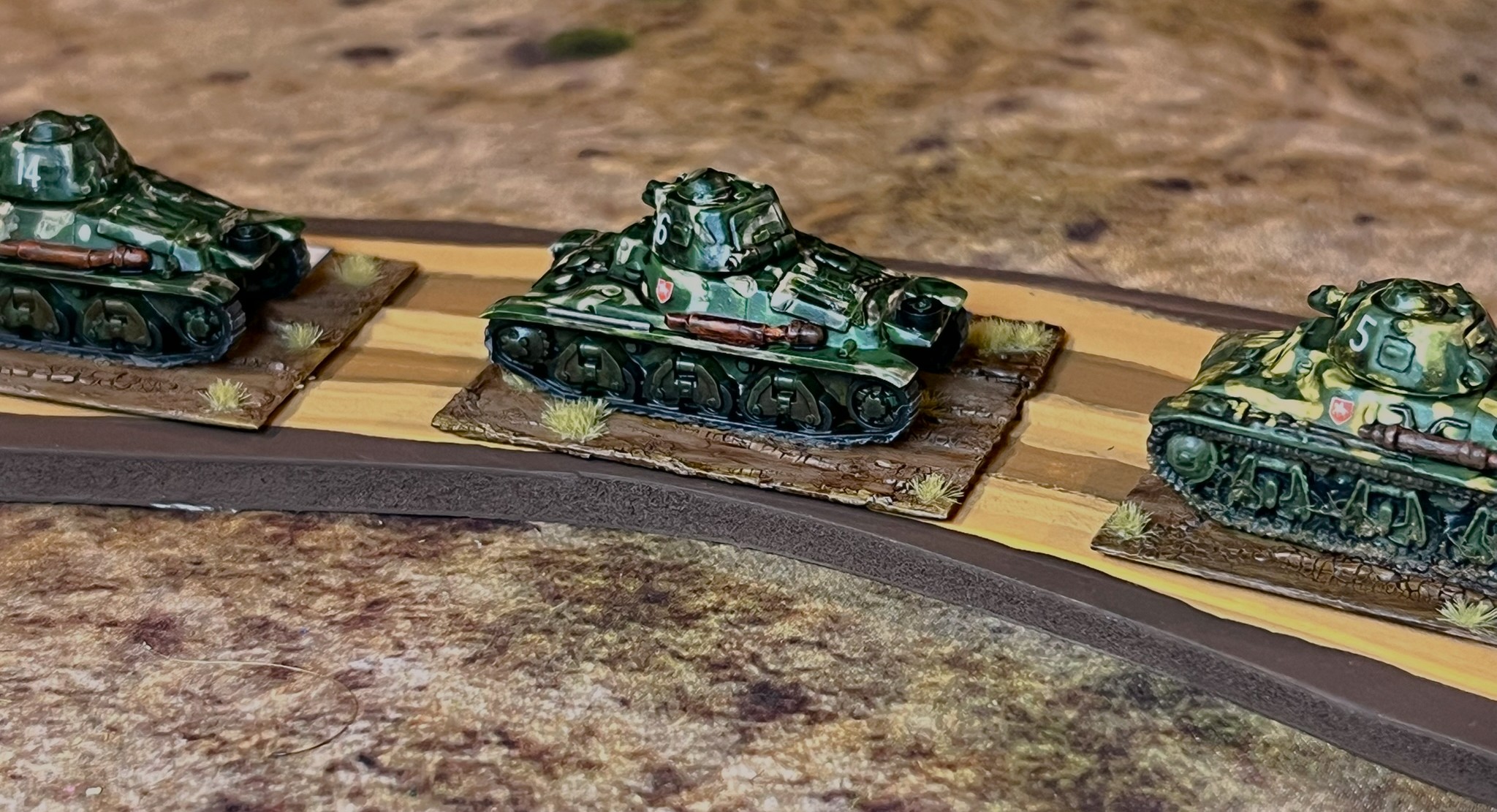
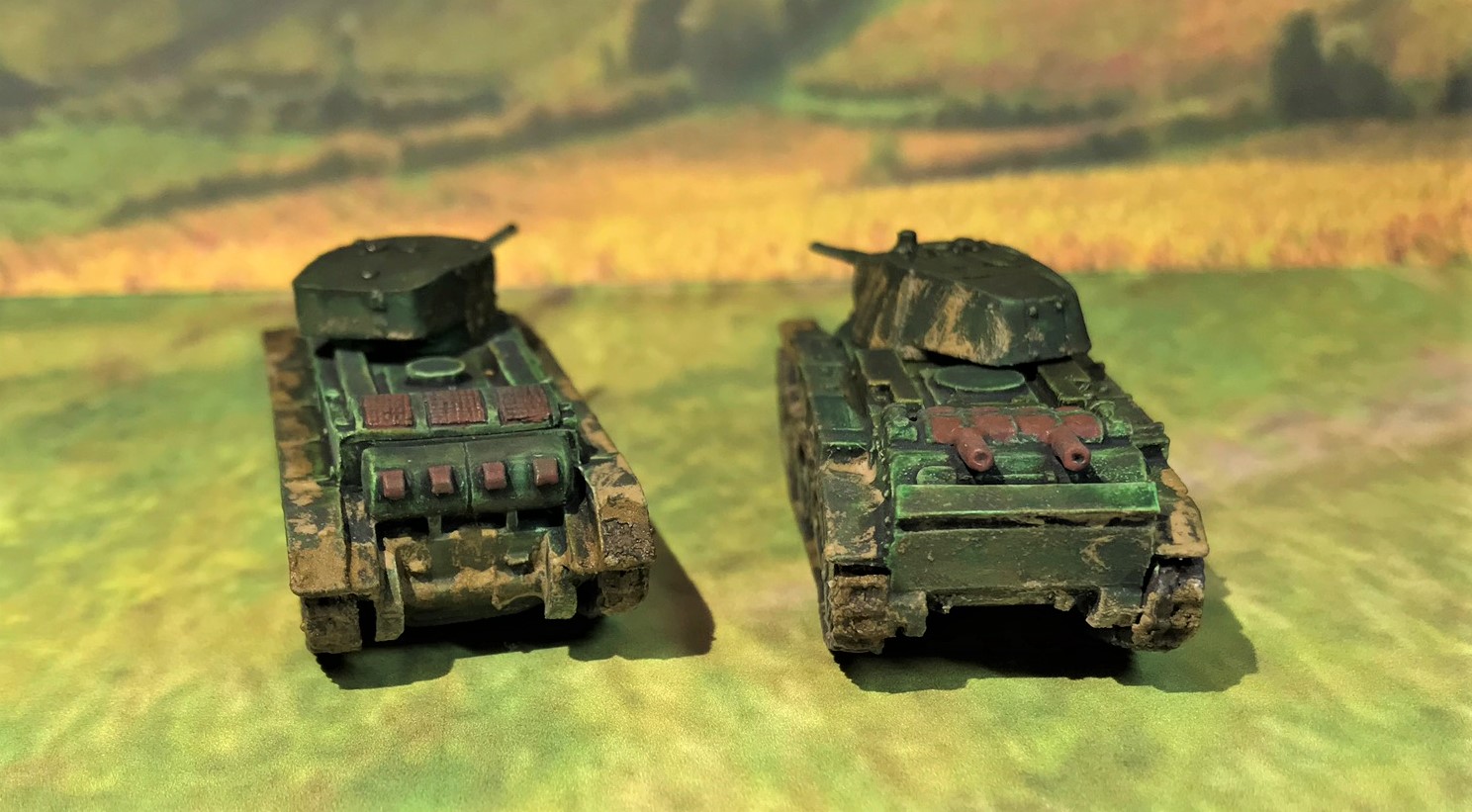
H35’s in column on my game tabletop.Close up of the H35 column.
I am indeed – as promised – catching up on the posts I have backlogged for my What a TankerOperation Torch game project- and yes there are more AFV’s to come. I do appreciate you, my readers. Of the eventually-painted 31 Vichy vehicles I had for the game, this brings me up to 24 Vichy combat vehicles that I have covered to date in this blog. I have 8 remaining Vichy armored cars to write about before I get to the USA. Those 8 will be the topic of my next post. Please, if you want, I’d love to hear any feedback – feel free to let me know your thoughts in the comments section.
For all of my posts on WWII games and projects – there is a consolidated list of posts and their links located here.
MATERIALS USED
PAINTS, INKS, GLAZES, SHADES, WASHES, PIGMENTS AND FLOCKING USED ON THESE H35 MODELS:
Green Stuff
War Games Accessories Steel Bases Number 23 (1½” x 2″)
Vichy France had many different old or at least obsolete combat vehicles in their colonies. While more than half of Metropolitan France was occupied by the Germans, under the Armistice of 22 June 1940, Vichy was still obligated to defend its unoccupied lands as a neutral state.
As such, while Vichy was denied armored units, she was allowed to have integrated combined-arms units in the colonies – forces that had armored vehicles. These Vichy tanks and armored cars would play a role in Operation Torch in November 1942 against US forces in Morocco (and Algeria as well).
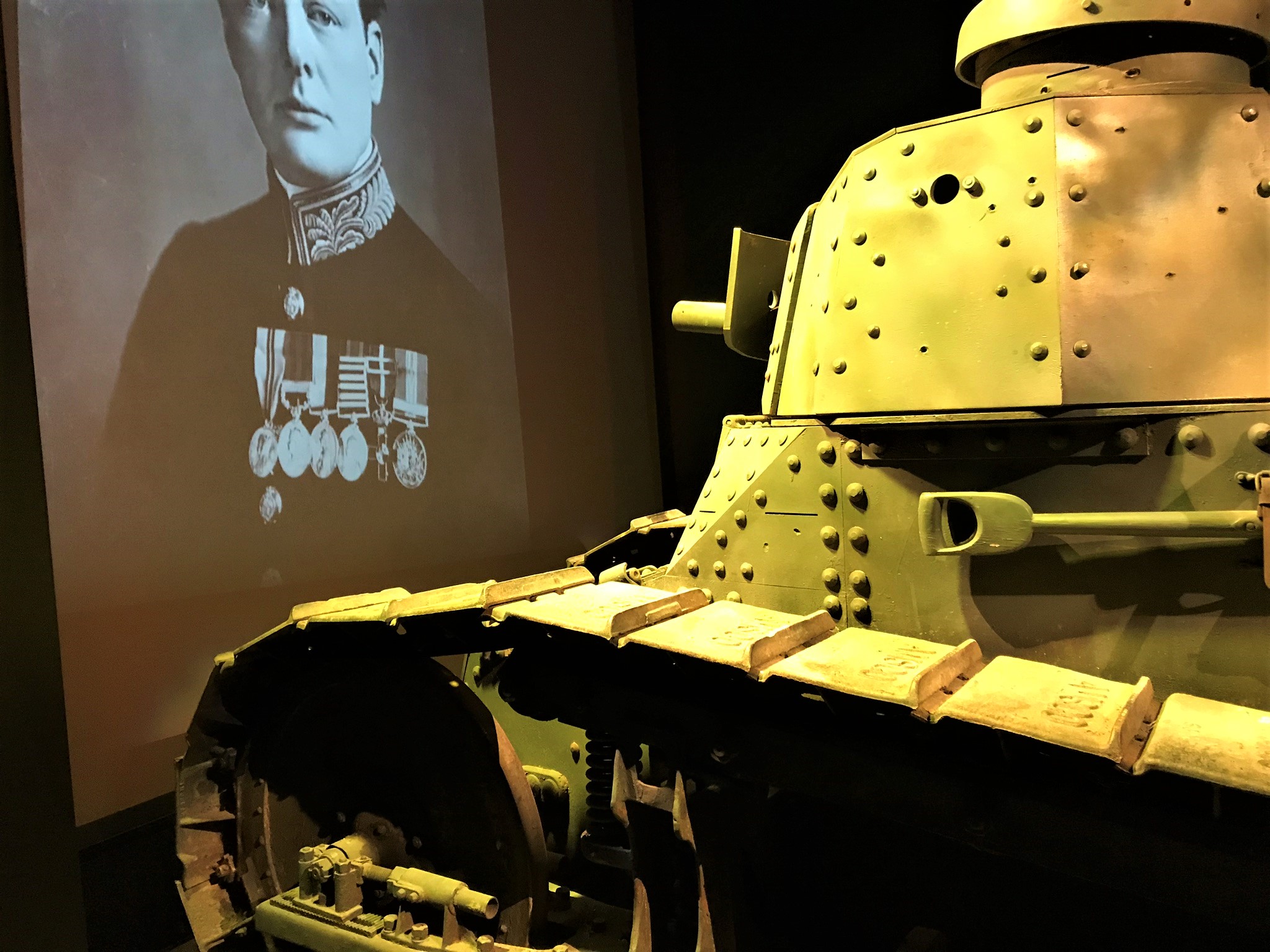
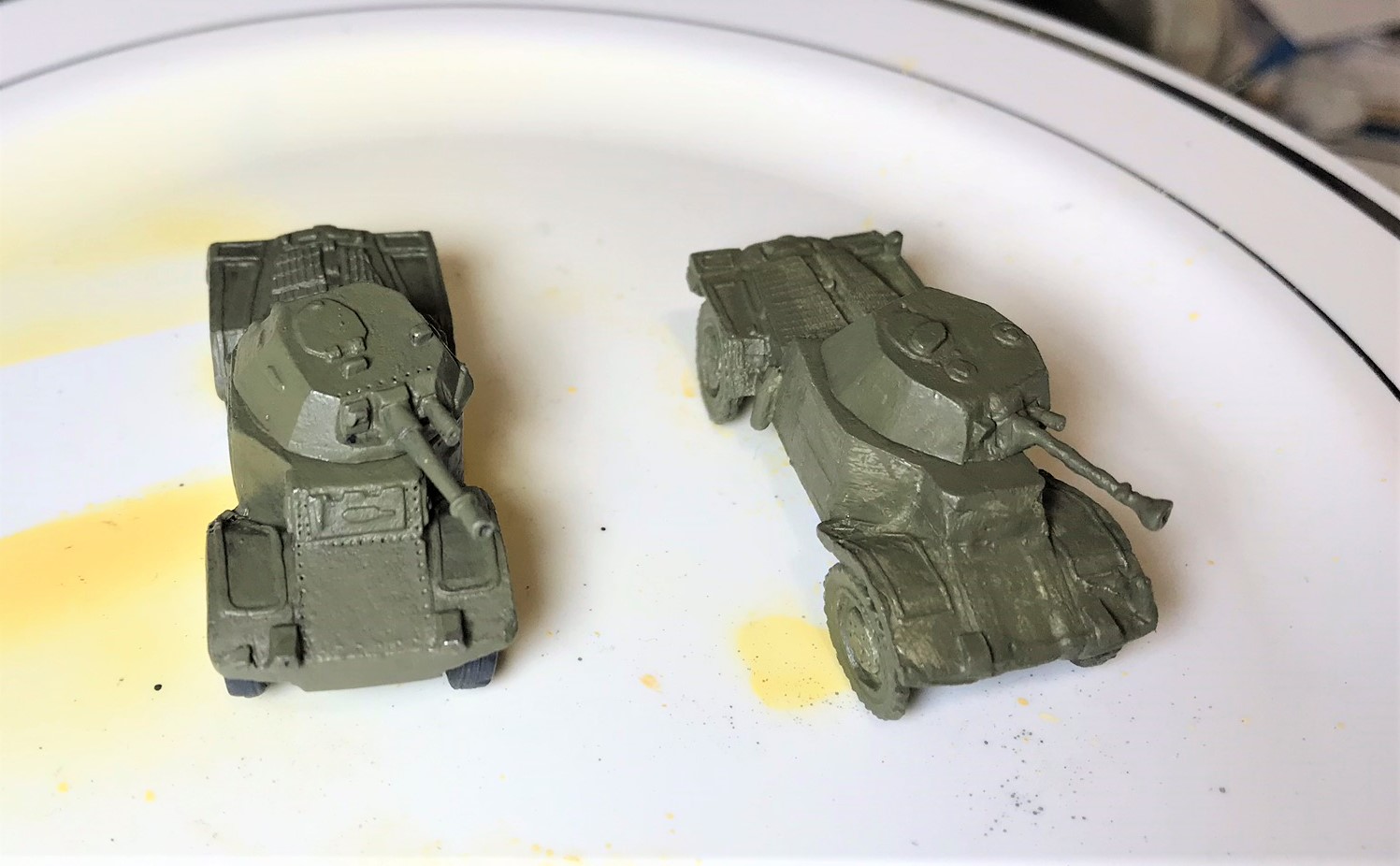
My last post covered two older (by November 1942 standards) armored cars used by Vichy forces – the White-Laffly AMD 80 and the Schneider AMC P16. Vichy also had tanks in North Africa, one of the most common was the WWI-vintage Renault FT-17.
For this post, I will discuss the venerable Renault FT-17’s that I built and painted up for my Operation Torch game of What a Tanker that I ran at HISTORICON 2025.
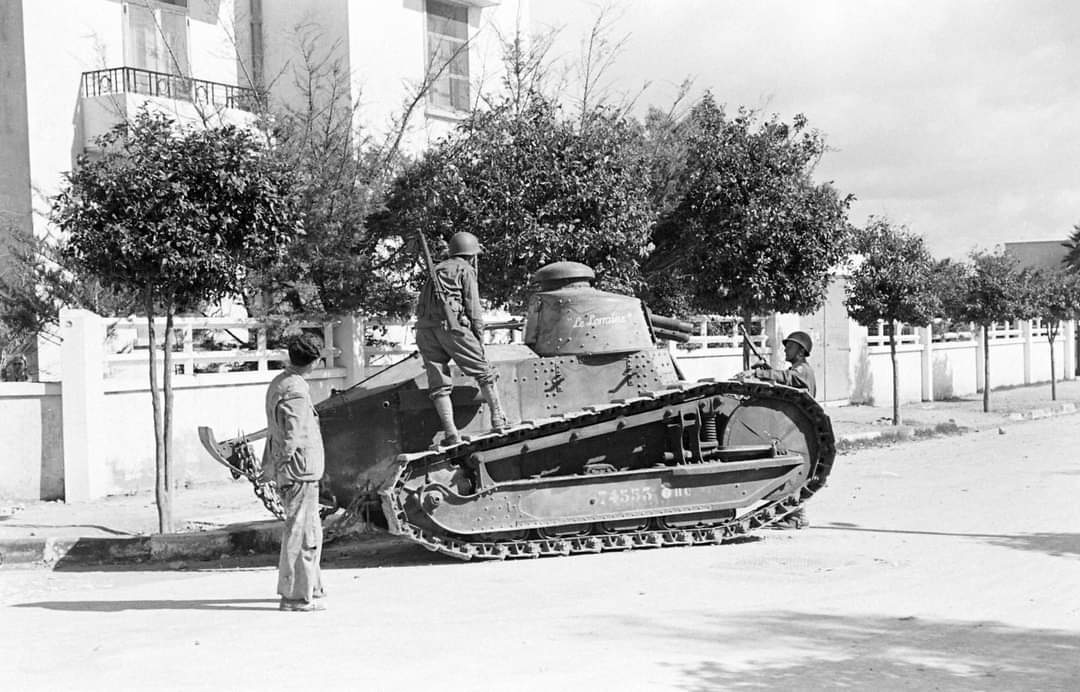
3,000 FT-17’s were built by France between 1917 and 1919. Indeed, she had so many old FT-17’s that the development and acquisition of newer tanks was negatively affected. Simply put, the French budgetary bean counters saw that the French Army had plenty of tanks available on paper, so why build too many more expensive ones? This would not bode well when May-June 1940 came around. Of course, French military doctrine was as least as equally to blame for the Fall of France (read BG Doughty’s The Seeds of Disaster: The Development of French Army Doctrine 1919-1939). After that debacle, Vichy did have many FT-17’s still in her colonies.
For my game, I had to have some FT-17’s. Historically, some were armed with the Puteaux SA18 37mm cannon, others with machine guns and even a very few with a short-barreled 75mm howitzer. For my game-design purposes, I decided that all should be armed with the 37mm cannon. I did have one completed 15mm/1:100 scale metal FT-17 from Peter Pig that I could rebase and use – it was described in my blog here.
To augment that, I purchased a 5-vehicle FT-17 platoon on eBay from jacobsminis (aka HobbyHouse&Miniatures.LLC). The tanks were nice crisp resin models. I ordered them on April 8th, and they arrived on April 14th. I started to work on them on April 28th (while concurrently working on all of the other vehicles for the project).
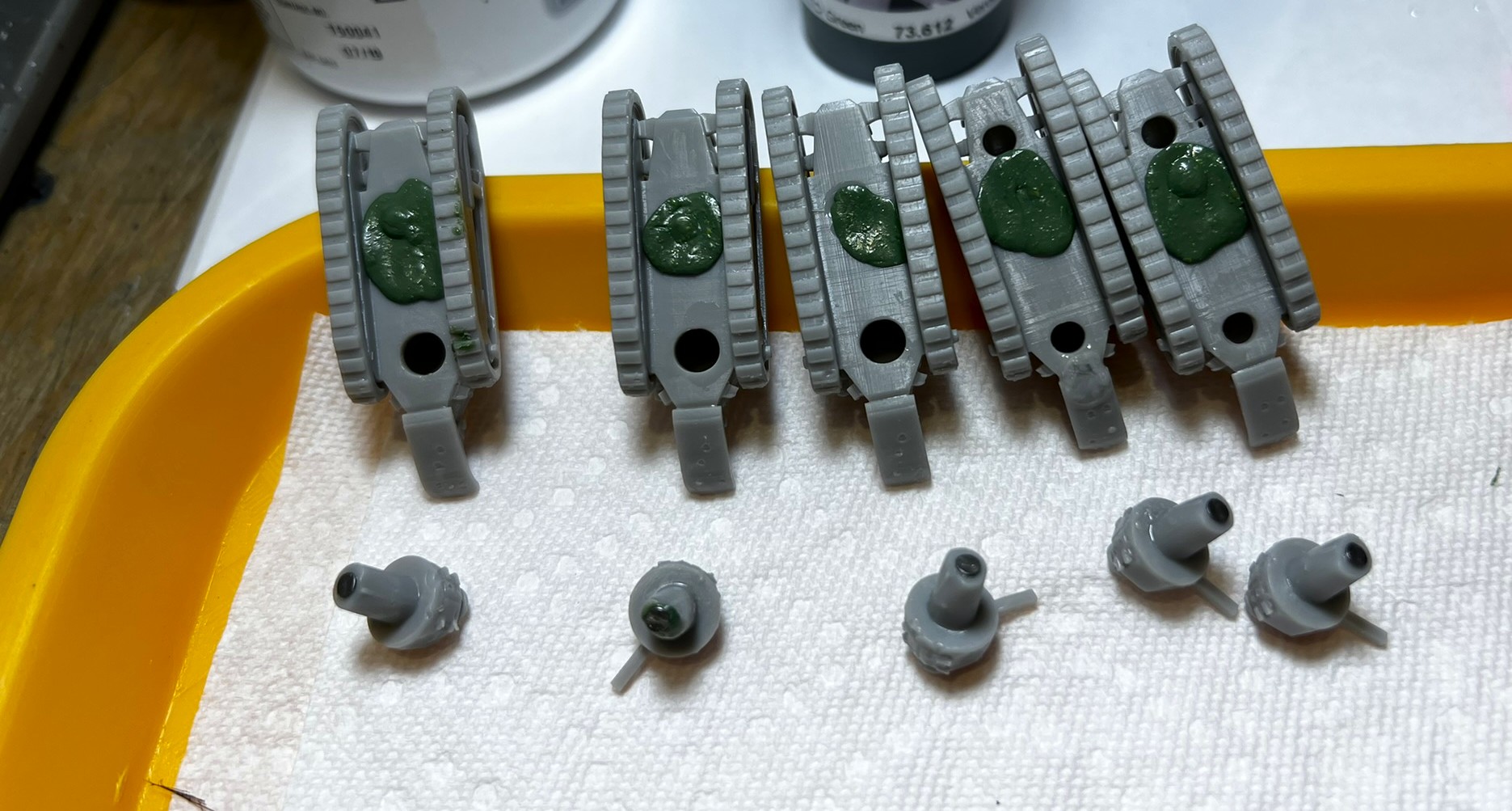
After washing the models, I drilled out and installed neodymium magnets in the hulls with green stuff. I also drilled out the turret bases to accommodate small flat-headed steel nails. These would work with the magnets in the hulls to both allow rotation and keep the turrets relatively secure. Priming and painting followed.
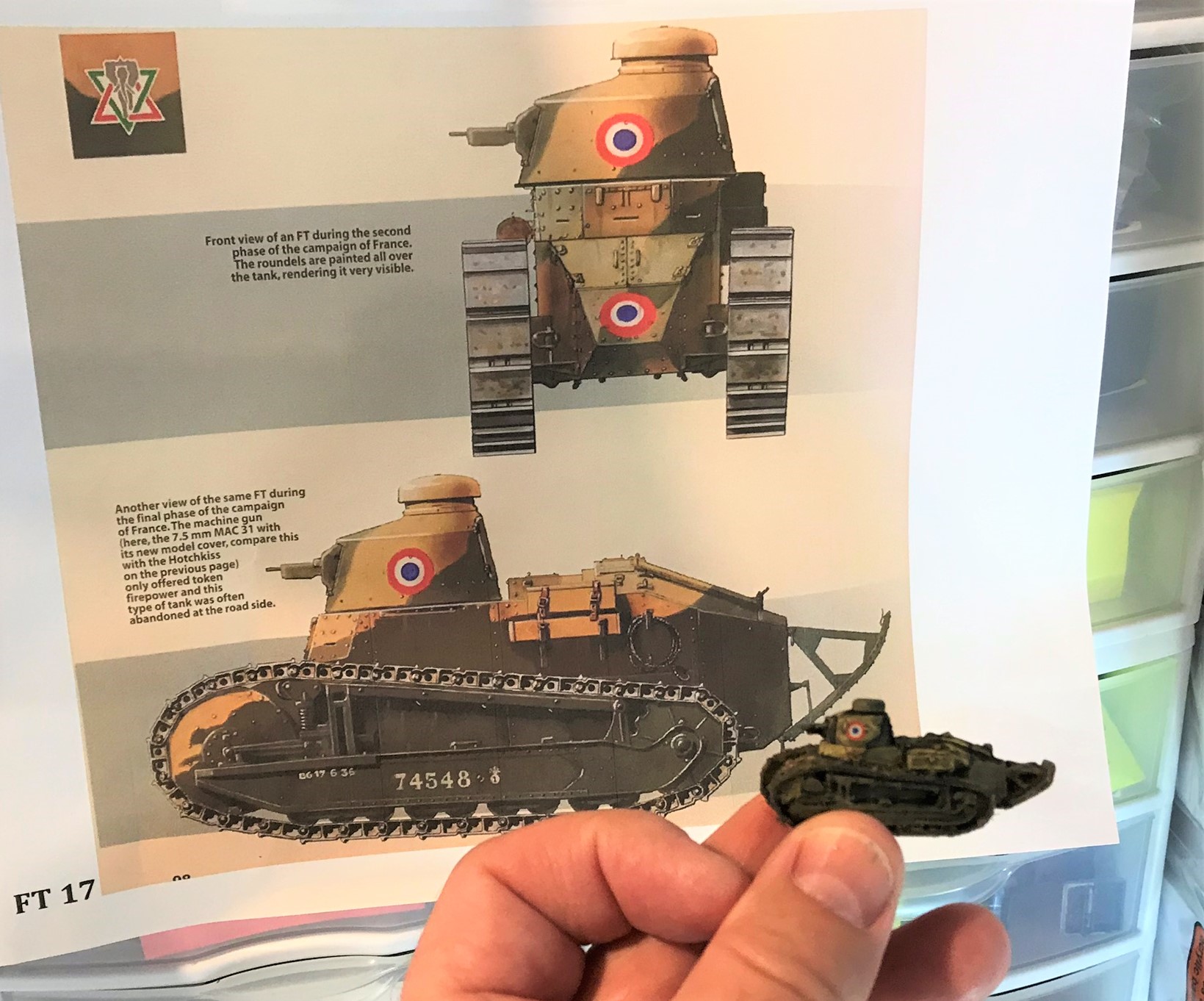
As I was working on many other vehicles, photo time got to be rare for me. Therefore, I do not have much in terms of WIP shots. I adopted the same airbrush painting pattern as I used for the Peter Pig model. The only difference was that I did not add a lot of mud to the tracks.
The main painting is done. You can see the turrets are semi-mounted temporarily on magnets and steel washers for painting purposes.
Then it was on to the decal and basing phases, which were like those that I employed and shared in my last post. I did end up with similar numerical decals on different tanks – but I did vary the sides and the other decals. Each one had a distinct name.
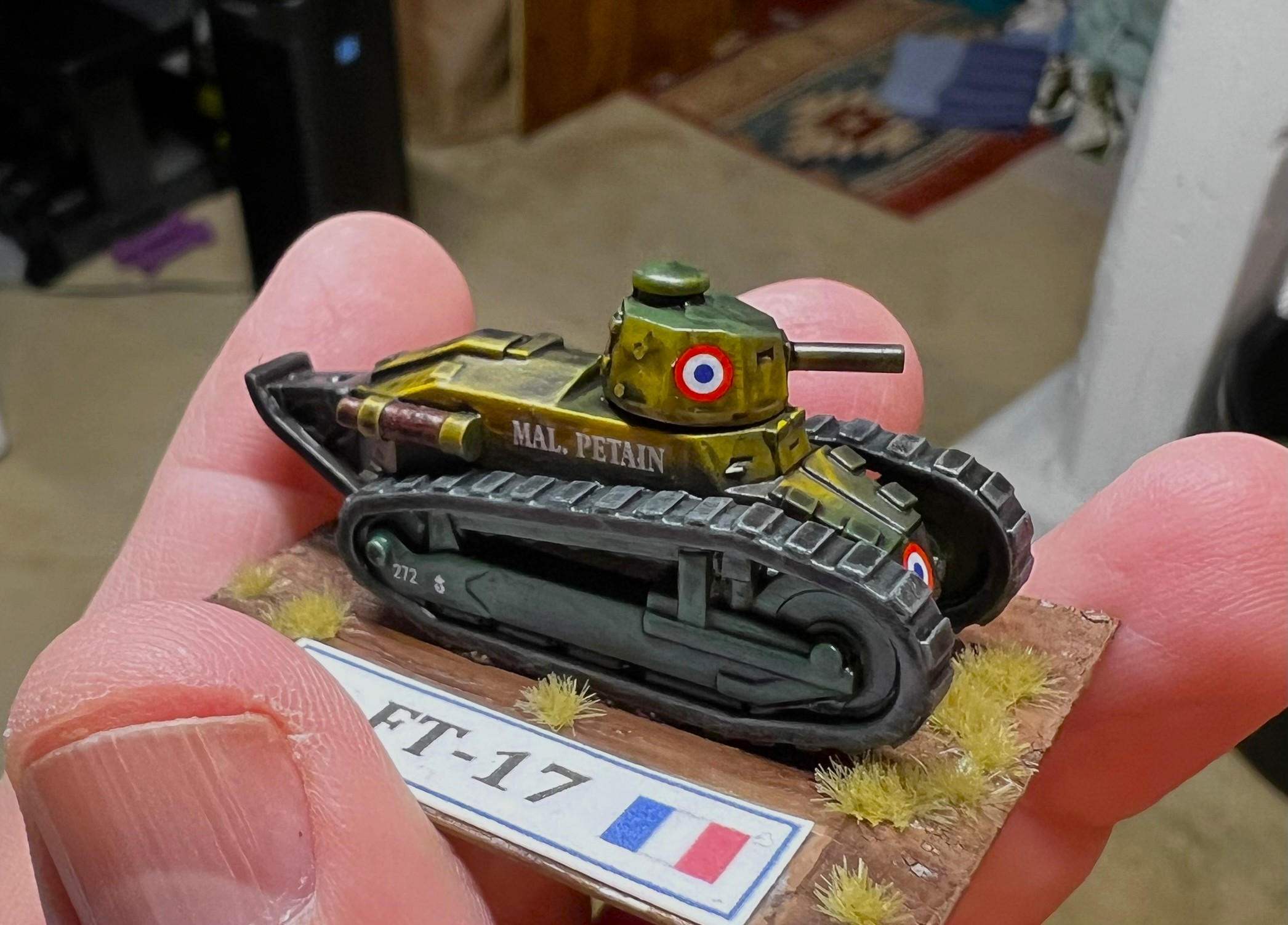
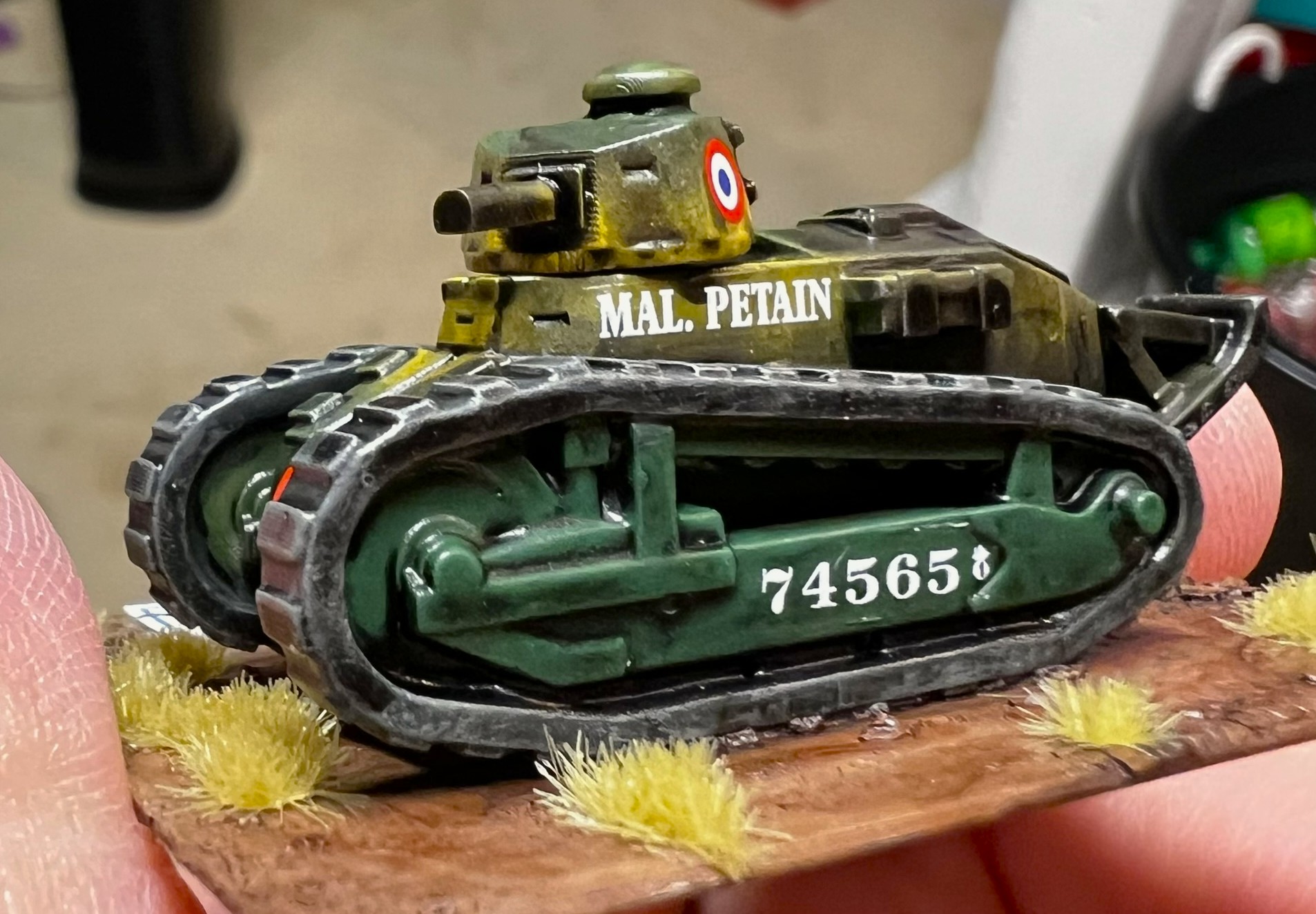
As an example, here is “MARECHAL PETAIN”. Each steel base is 1½” x 2″.
I’m sure that you’d like some better “eye candy”, so…
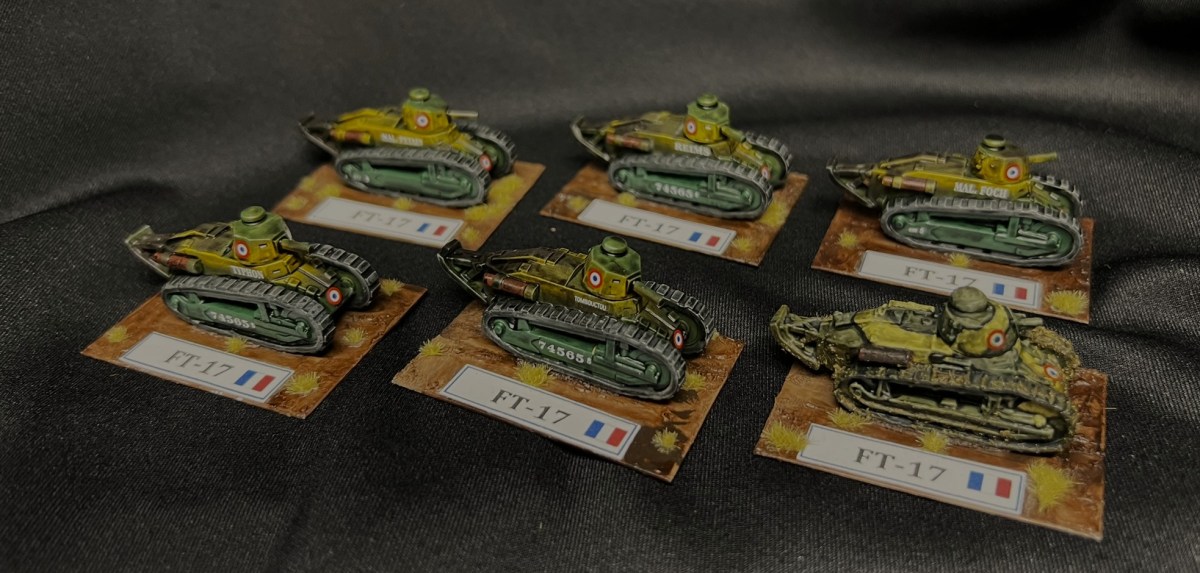
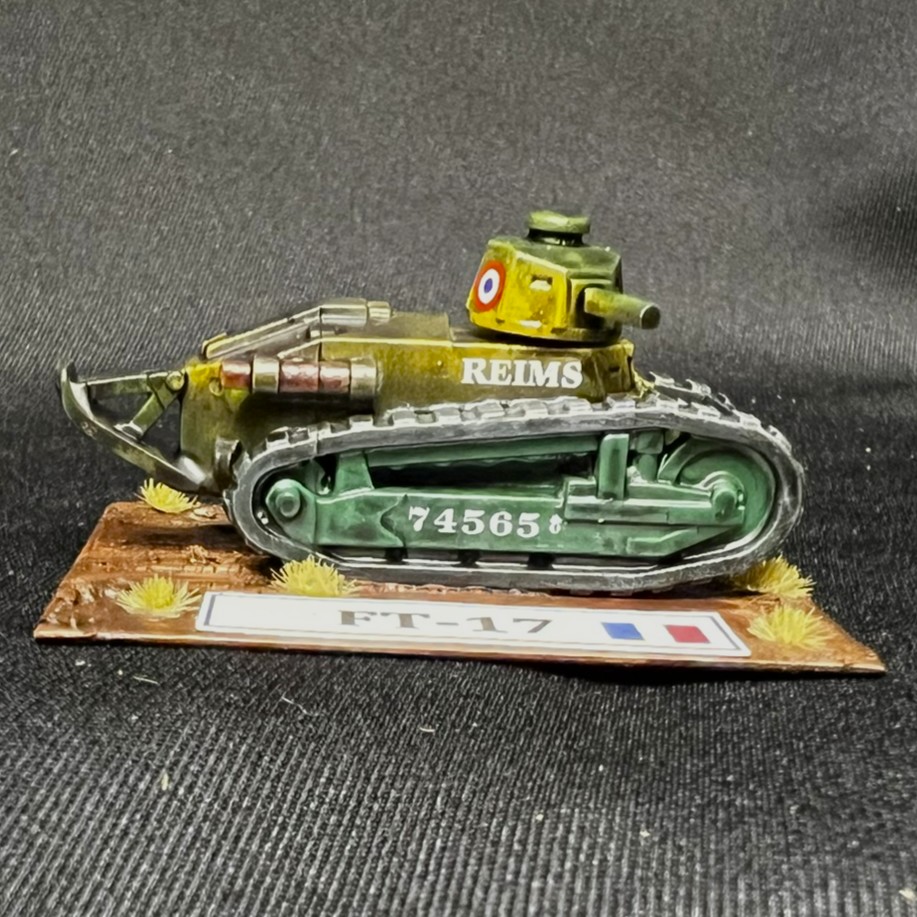
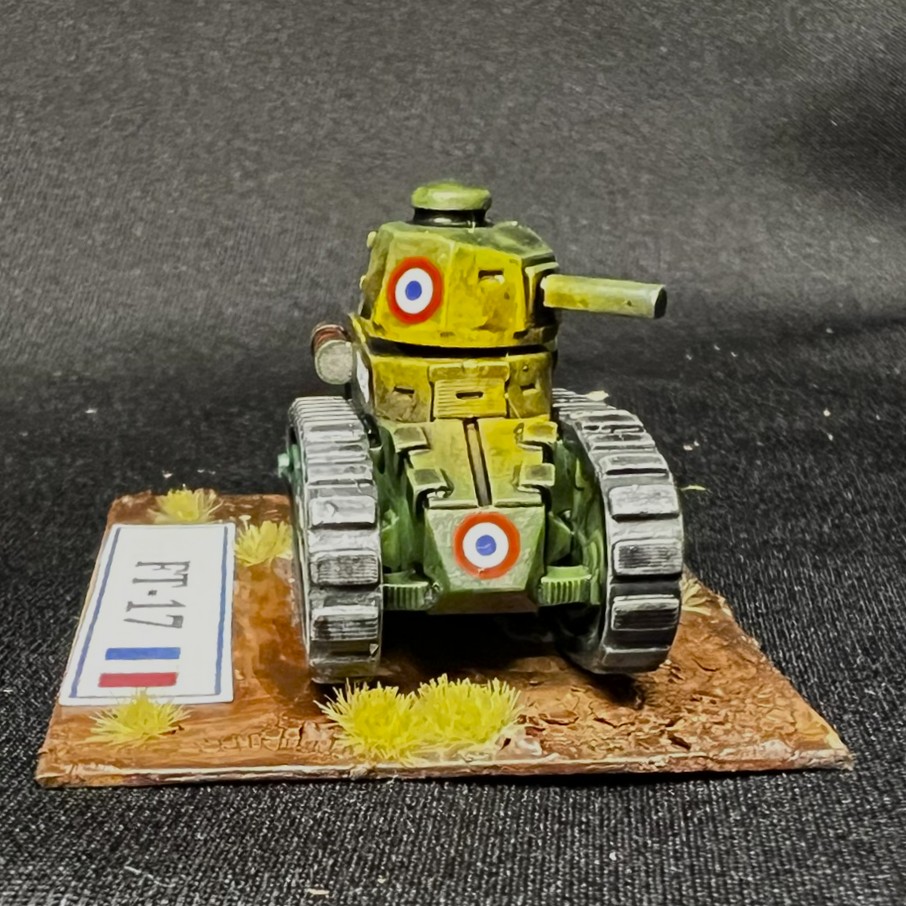
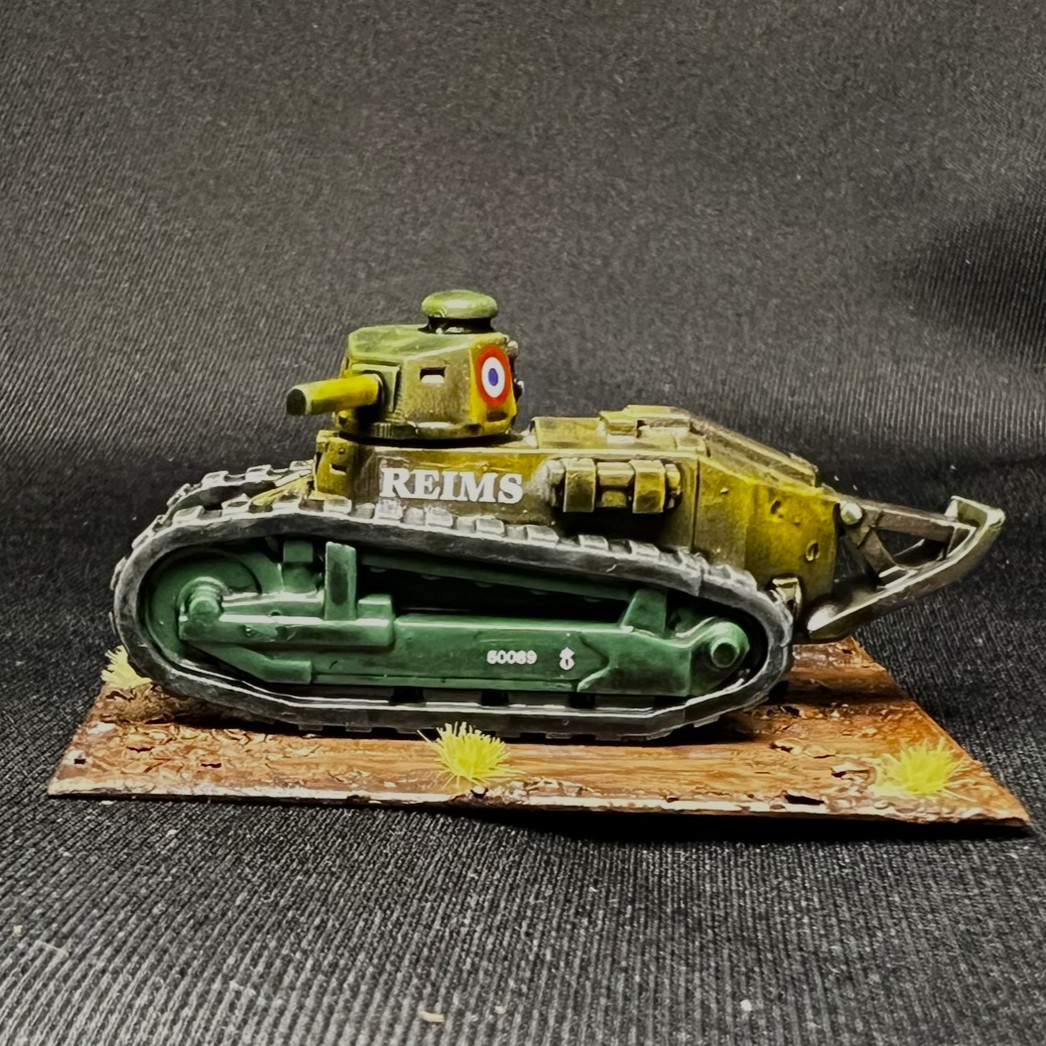
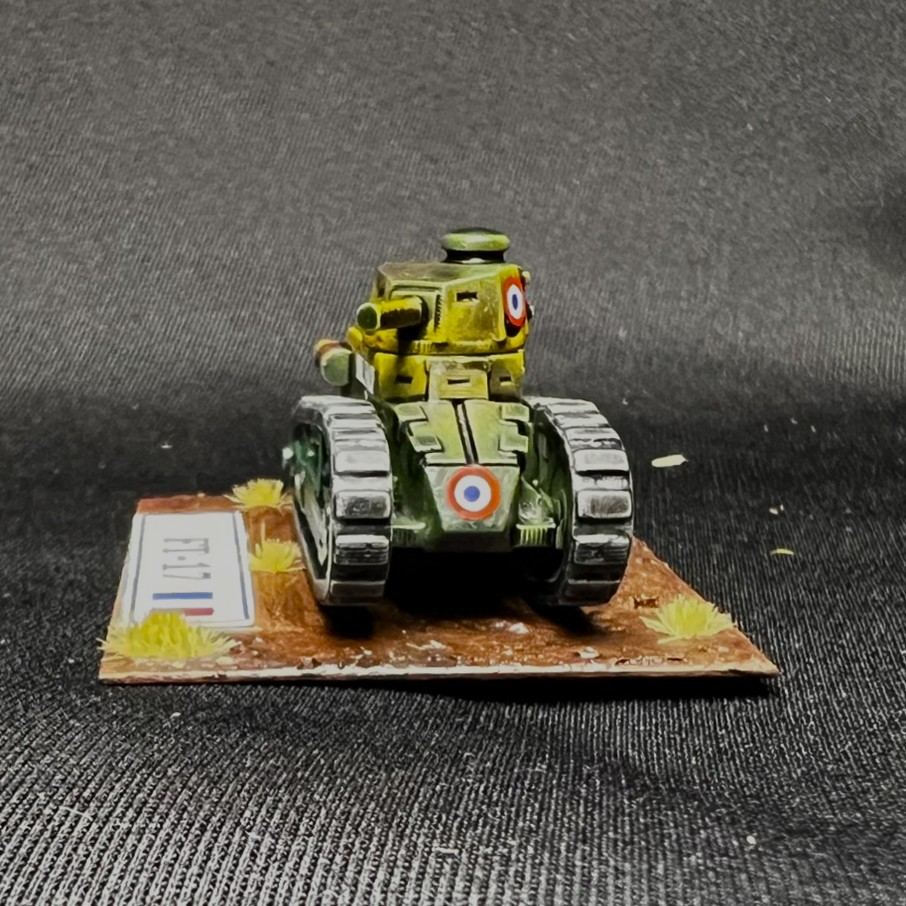
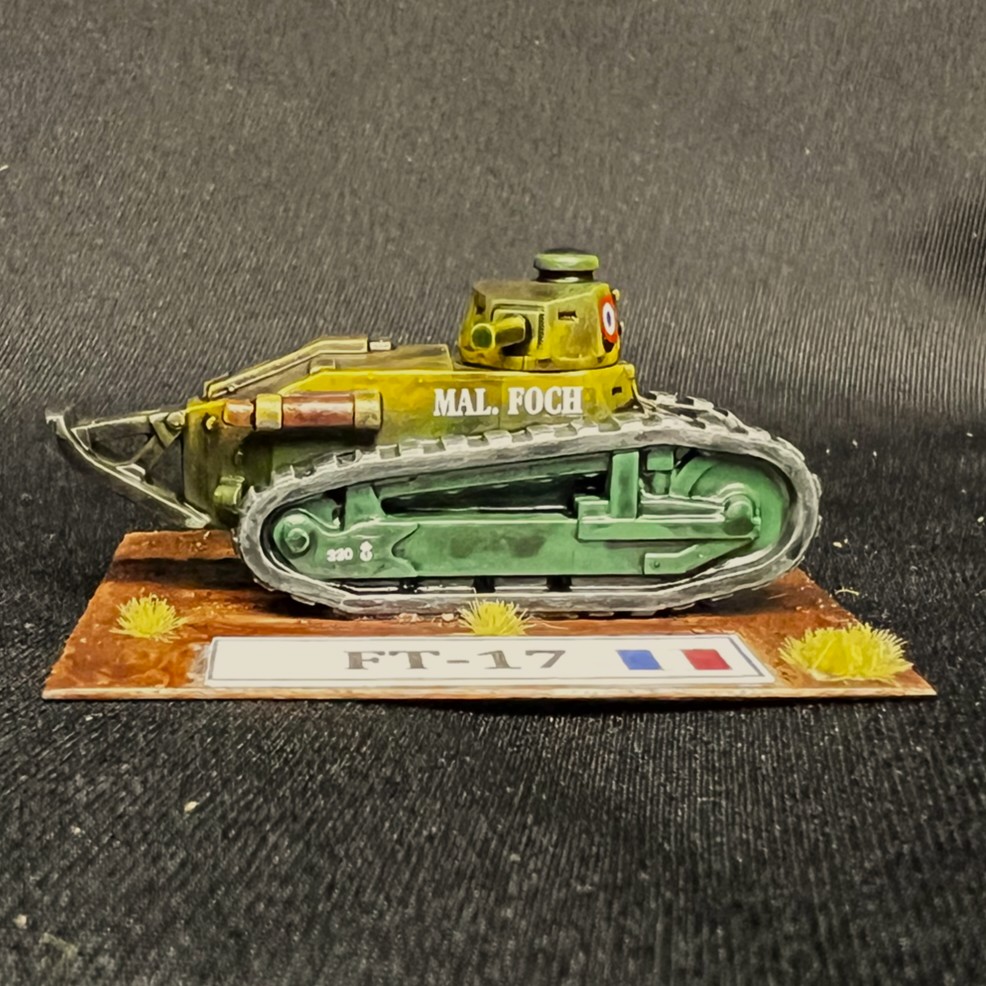
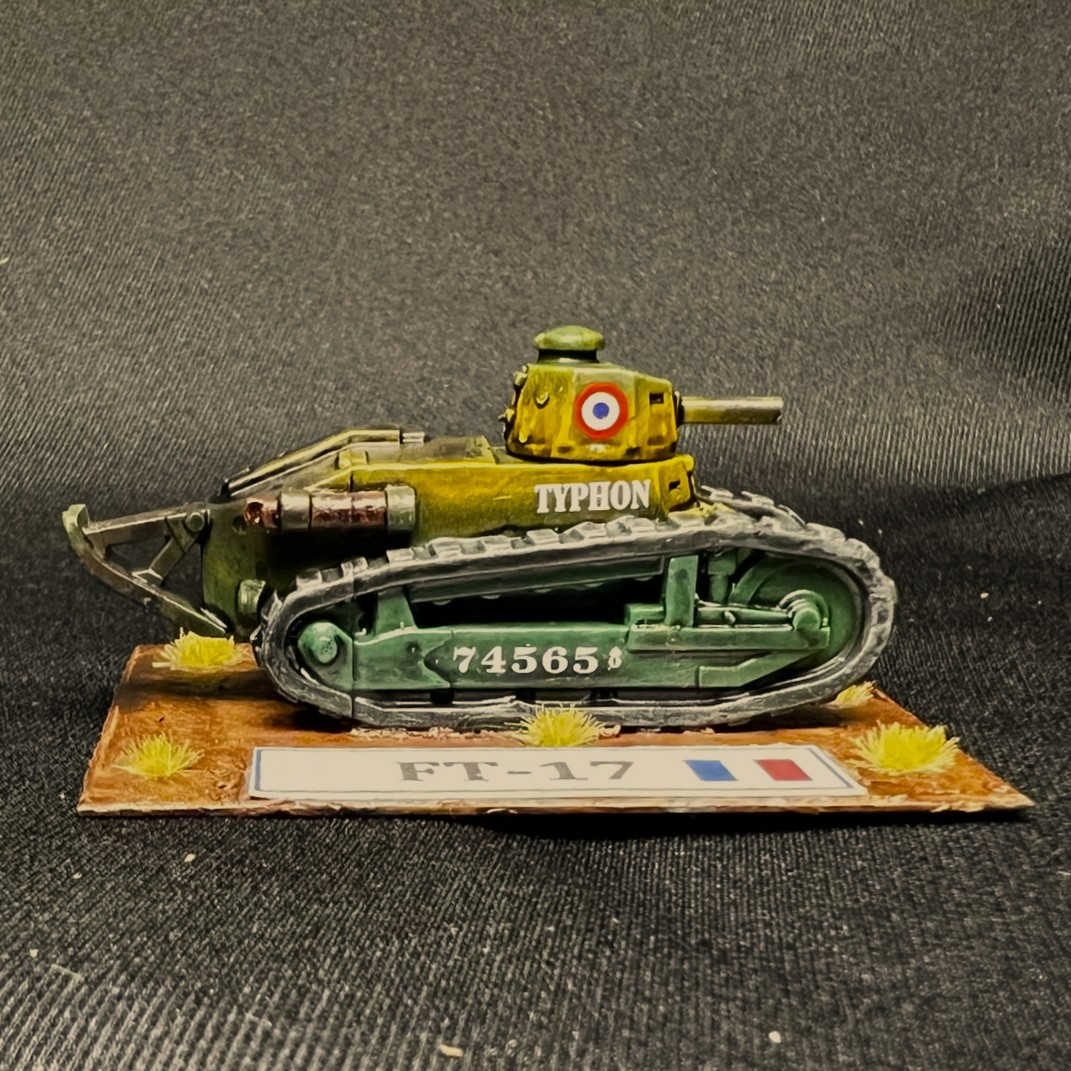
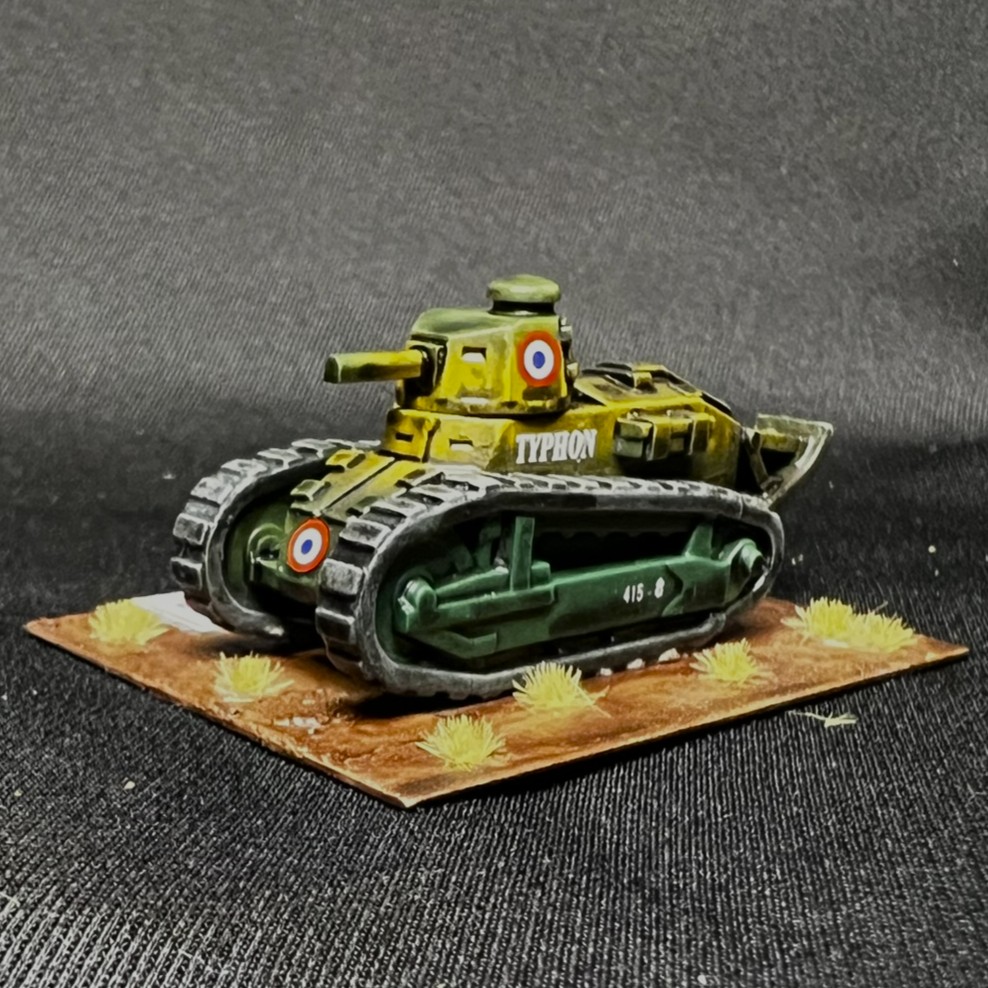
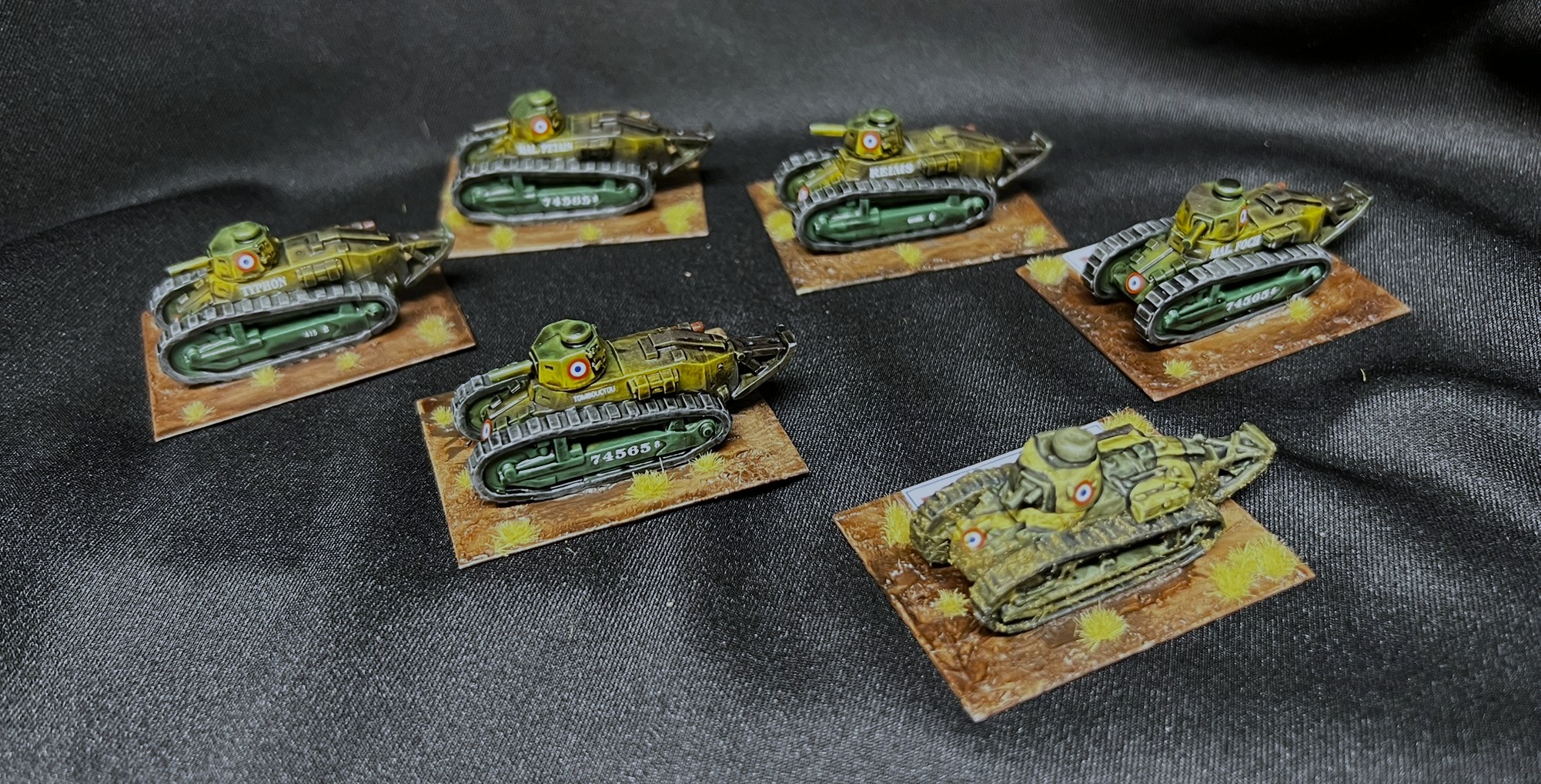
FT-17’s
“REIMS”
“MARECHAL FOCH”
“MARECHAL PETAIN”
“TYPHON”
“TOMBOUCTOU”
Group Shots
Below are all my FT-17’s, including the Peter Pig model on the front right. It has no name – but it does have mud!
Another view of the opposite side of the tanks – the Peter Pig model is on the bottom right here as well.
With terrible armor – yet the same 37mm gun as many other Vichy French AFV’s – these antique FT-17’s did indeed engage the US in battle in November 1942.
I do want to dedicate this post to my good friend Leif, who adores the FT-17 more than anyone else I know. When we play, it’s an easy choice as to which side he wants. He also helps me immensely at conventions – so this post is for you!
To all of you, thanks for looking! I will have share more Vichy vehicles soon. I eventually painted up 31 Vichy – and so far I’ve covered just 12 of them (6 FT-17’s, 3 White-Laffly AMD 80’s, and 3 Schneider AMC P16’s). More to come as I catch up. And there of course will be US vehicles. As always, if you want, I’d love to hear any feedback – feel free to let me know your thoughts in the comments section.
For all of my posts on WWII games and projects – there is a consolidated list of posts and their links located here.
Next up – Hotchkiss 35’s, 39’s, and Renault 35’s. Until my next post!
Eventually I do get these in games!
MATERIALS USED
PAINTS, INKS, GLAZES, SHADES, WASHES, PIGMENTS AND FLOCKING USED ON THESE FT-17 MODELS:
Vallejo “Flow Improver”
Green Stuff
War Games Accessories Steel Bases Number 23 (1½” x 2″)
It’s been a while for the return of several blog-related things here.
First, this marks the first hobby post I have done in a while. The last one I did was on Professor Nitpik’s Mechanical Mini Swarm back in April. I also never got around to a recap of my games at HUZZAH in May (but I hope to at some point as I do have a good number of photos).
Secondly, I have not done any WWII-related hobby work since March of 2020 (wow 5 years!). After my last What a Tanker tank project, I did a lot with my Feudal Patrol Mesoamerican project (Aztecs, Conquistadors, Maya), and then Wars of Ozz. Luckily for me (and maybe you), I catalog and link all my posts by genre on multiple pages for easy recall. As an aside, for new readers, here are the links for all of these:
There are others as well, and these pages help me to remember how I did certain aspects of projects in terms of painting and assembly (and anything else).
Additionally, as many of you know, the US Army is celebrating its 250th Anniversary. The Historical Miniatures Gaming Society (HMGS) is celebrating that anniversary as its theme for this year’s HISTORICON gaming convention. As a proud US Army veteran, I just HAD to get a game or two together for it. As game submission was back in March, that might seem like plenty of time to get such an endeavor together. But I had HAVOC, HUZZAH, a Florida trip, my reelection, and golf in between then and now! Blogging took a back seat to actually finishing off any projects. Until now!
I usually try to create scenarios and run games that are not common or run-of-the-mill. For the US Army, there is a wide swath of stuff to choose from.
I ended up deciding on looking into the early days of WWII. I dug into Operation Torch, the Allied invasion of North Africa. I further read up on the combat in Morocco, where the US and Vichy France actually fought for several days before agreeing to an armistice and coming over to the Allies’ side. I chose to focus on the Western Task Force under then-MG George S. Patton, that invaded Morocco in three places. My specific focus would be on Sub-Task Force Goalpost, which was led by MG Lucien Truscott, Jr. – and what really intrigued me, as I did my research, was his response to a Vichy armored counterattack. Apparently the Vichy French launched an armored counterattack with what they had to interdict one of the US landing beaches. Truscott sent all his armor (7 M5 Stuart tanks) and some support to stop the threat, which outnumbered him by more than 2:1. Now I had a game concept!
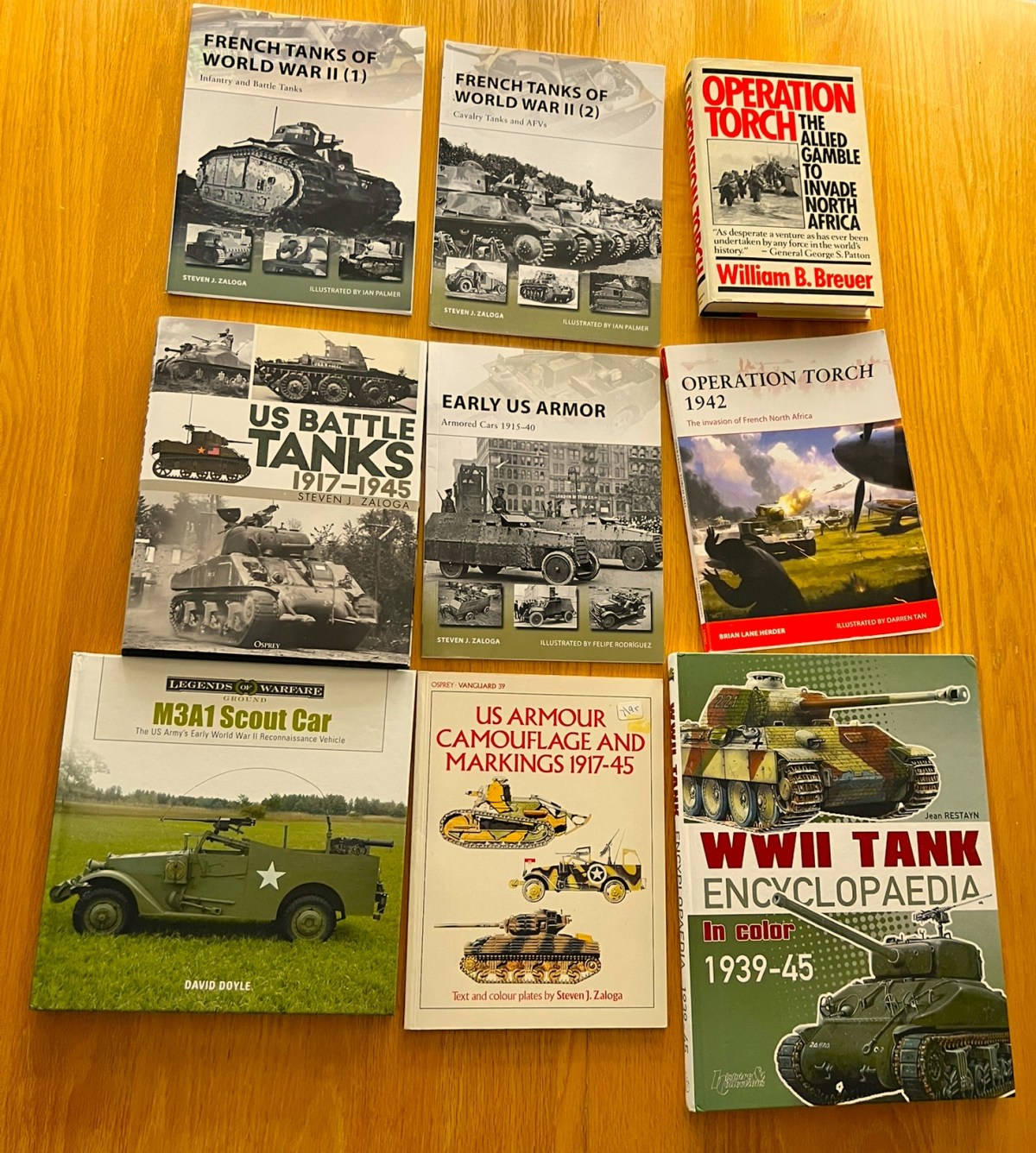
As for research, here are all the books I read and used:
Certainly a lot of Steven Zaloga here, and the Breuer and Osprey books were the most helpful. There indeed was significant armored Vichy forces in the North African colonies. In Morocco was a motley assortment of tanks (WWI -era FT-17’s, Hotchkiss H35’s and H39’s, plus some R35’s that had been hidden from the German and Italian Armistice Commission). Sources vary as to what was available, but certainly these types were in Morocco in November 1942. There also were multiple old armored cars dating back to the 1920’s and early 1930’s. Vichy also had naval assets there, plus any of their air force that had flown there to escape Armistice terms. A good number of Dewoitine D.520 fighter planes and others made up a strong air component for Vichy.
The US here did not have M3 Lee’s or M4 Sherman tanks available to stop he counterattack. Those were on large ships that needed a port to unload, unlike the M5 Stuarts. The US had the Stuarts, M3 GMC’s, M3A1 Scout Cars, and the weird stopgap M6 Fargo. On the other side, the US had F4F Wildcats and Avenger TBF’s. Offshore were these significant naval assets that I would also add to the game design. Interestingly, many French tanks were hit with impact-fused depth charges from the air – plus naval gunfire from the USS Savannah.
The US Army in November 1942 was seeing its first real amphibious landing and combat in the ETO, so I incorporated that with regards to their shooting abilities. The Stuarts had gotten their radios wet, and hence inoperable, in the landing – so that was another aspect I added. The French had a lot of very worn out vehicles, and I did add an aspect of mechanical unreliability to them as well.
With these equipments as my baseline, I resurrected my WaT rules. Sourcing all of the vehicles took time, and I will chronicle each of the types in successive posts. My thought is that its better to focus on each vehicle type with a short post than a massive one now that blurred the lines. Writing all of these will take some time, and I also hope to share a review of my HISTORICON 2025 experience. If you are at the convention, I will be in the H.A.W.K.’s room as below. While my games are “sold out”, you never know if space becomes available! Besides my two Ozz games on Thursday and Friday, I’ll be running the “Operation Torch: Vichy mounts a Counterattack” game twice on Saturday. Come by!
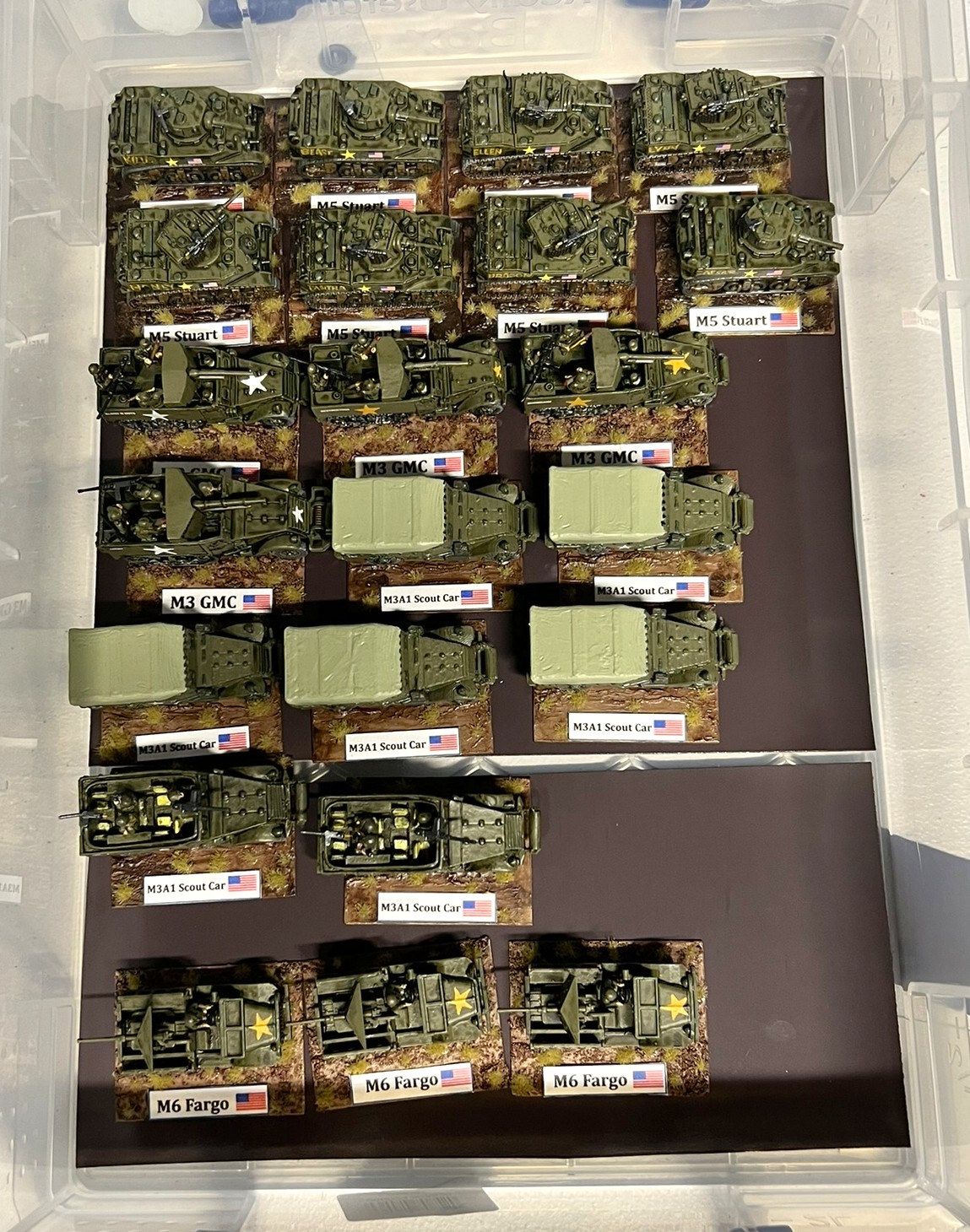
Here is a tease on the 31 French and 22 American vehicles that I have amassed and painted for the game since March. All are 15 mm/1:100 scale. They will get their own posts in the next few weeks (I hope).
This upcoming May-June will mark the 80th Anniversary of the Battle of France. The world was never the same afterwards. It was a cataclysmic defeat of the French Army – and there were many causes of it. Some key ones were that the leadership of the French Army believed that the lessons of WWI taught them that the key to victory was to fight a “methodical battle” with every aspect of the fighting and deployment of firepower tightly controlled from higher headquarters. By contrast, the German Army leadership preached the need of subordinates to act in accordance with the “commander’s intent”, and to take initiative down to the platoon level. French officers were taught to stay at their command posts and manage the battlefield at the highest level. German officers lead from the front, and made battlefield decisions in real time and exploited opportunities. Importantly, French losses in WWI curtailed the birthing and hence the availability of men of military age in 1940. German demographics managed to overcome their Great War losses and had plenty of available young men. The Germans also taught the world the value and use of the tank, armored forces, and especially combined arms – and were the first to do so. Thankfully, Great Britain is an island and that fact, plus the RAF, preserved the chance to defeat Hitler and save civilization.
Certainly, there are many, many other contributing causes to the crushing French defeat – far too many to review here – and I list several books later in this post that are what I consider must-reads for those wanting to understand this complex history. I also list good resources on the tanks and armored cars as well of course for the gamer and modeler that I have found useful. Understanding the Battle of France is not a simple case of one thinking that the Germans were destined to defeat the inferior French, or that the French were worthy of disdain on multiple levels.
Too often, I have found many of my countrymen (and others) dismissive of the French and the French Army based on the defeat of 1940. To understand the whole picture, one must go much deeper. My thoughts go to those killed in 1940 defending their country. Also, I consider the 1.8 million soldiers of the French Army of 1940 who survived this humiliating defeat, and were sent as POW’s to Germany after the Armistice until 1945 as unwilling laborers. Because of the Armistice agreement with Germany, their POW status would not change until the war was over. They returned to a France that not only was devastated physically, but one who lionized the Resistance (rightly) and blamed France’s initial loss on them. Hence, I doubt there will be much commemoration of this seminal battle by either the French or the Germans.
The true blame for the French defeat should be on the generals and the politicians of the Third Republic. The French Army leadership failed to develop a proper fighting doctrine and failed to train the French Army in the 1930’s to win a war in 1940. The politicians failed to ensure that France equipped and fielded a professional army to win a war in 1940. Did some individual French soldiers perform miserably? Absolutely – but that is true of every army in every conflict. As the French politicians supported a policy of national mobilization (levée en masse) instead of a professional army as espoused by some (like Charles de Gaulle did in his book Vers l’armée de métier). In essence, what occurred was that a well-trained and largely professional German army trounced a poorly-trained French one. Ironically, the French had more tanks than the Germans, and some were better, but they were employed ineffectively.
Speaking of equipment, and of course tanks, this post concerns mostly just that. This wraps up my build of French armor for the 80th Anniversary of the Battle of France. I started building my French armor in November 2018 (SOMUA S35’s and Renault R35’s here), then adding to it last month with some FCM 36’s (here), and some Hotchkiss H35 and H39’s (here). I already had two pre-painted Char B1 bis tanks, so I needed to add some more variety – as I will be doing next for the Germans as well.
I’ll also share some eye-candy on the completed models, and the materials that I used to paint them. As a quick aside, I had run low on my Battlefront paints. As a replacement a paint set I found (on eBay) was a Hataka French Early War Armor set. It looks to be out of production, hence my eBay acquisition. Hataka sounds like it might be a Japanese company, but it’s actually a Polish one. I had wanted proper colors, and while I did like the colors I used here, this was a difficult paint set to thin, especially in my airbrush. There was definitely a learning curve.
I ended up using a 0.5 mm needle – and close to 30 psi in my airbrush. Each bottle was 17 ml, and had an internal mixer of some type in them that you could hear when shaking them. The colors were great for French vehicles of 1940, but they took some getting used with both the airbrush and the standard brush.
Front of Hataka set box
Back of Hataka set box
Now, let’s discuss the vehicles!
AMC 35
The AMC 35 was a medium cavalry tank. It was also known as the Renault ACG-1. It had a good 47 mm gun, and was the first French tank with a two-man turret. It’s maximum speed approached 26 mph, due in part to a 180 hp engine, but also due its having less weight due to less than great armor at 25 mm thick. Only 100 of these were built. Thirteen were sold to the Belgians, and none were in any French units until after the crucial German breakthrough at Sedan on May 15, 1940. After that point, all reserve materiel was sent to fight. Therefore the crews would have had virtually no training on these tanks prior to combat, and training is indispensable. Compounding the issue of training, mechanically, the tanks were not overly reliable (though that is a common issue with French tanks of that era). Captured vehicles were only used by the Germans for driver training. One vehicle survives today that was recovered from a ravine and restored.
The models came from Old Glory, (come in packets of three) and were in pretty good shape. Some minor filing was needed to prep the models.
Three AMC 35 models from Old Glory
Assembled AMC 35 models
First, I base-coated the models
I used poster-tack for masking
The Hataka paint was a bit thick, leaving a visible (almost raised) border next to my masking with poster tack. For the first time, I decided to line the paint borders by hand. I was a bit apprehensive, but I think it worked fine for the tabletop.
My first try at hand-lining the camouflage colors.
I then added browns and tried to smooth out overly thick lines by filling in with the green and yellow next to the black lines.
The AMC 35’s on my workbench with the image that I blew up and used as a guide (from B.T. White’s 1972 book with illustrations by John Wood – see citation in references below).
R40
The Renault R40 was an infantry tank, an improved version of the R35. Officially, it was just a variant of the R35 called Char léger modèle 1935 R modifié 1939. It had a longer 37mm gun with the ability to penetrate up to 40 mm of armor. The suspension was improved over the R35, and it looked very different than the original. Delays caused it to not be fielded except to the last two French Army tank battalions and to the Polish 10th Armoured Cavalry Brigade (which fought in France after the defeat of Poland). One major improvement was the inclusion of radios. Captured R35 and R40 vehicles were extensively used and converted to other uses by the Germans. None survive today.
The model came from QRF and was in reasonably good shape and needed little filing. It was also very reasonably priced. As this was a rare vehicle, having to buy only 1 was a plus. Painting was easy as there were neither any decals nor camouflage painting needed due to their being hurried to the front in 1940.
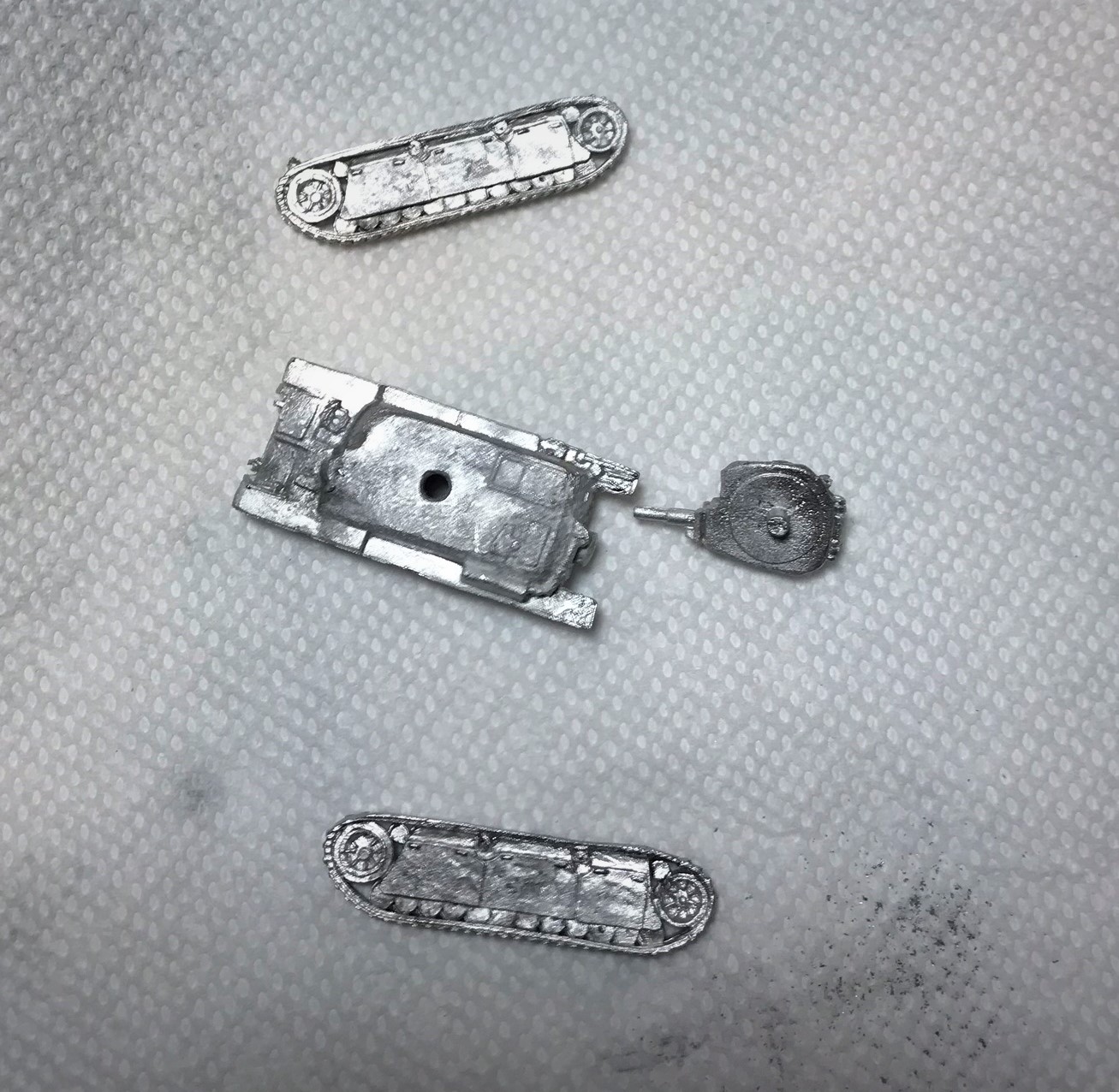
Nice easy 4 pieces
The chassis – I magnetized the hull and the turret for ease of play.
Completed R40.
Char D2
The Char D2 was a medium infantry tank, also built by Renault. It was an interim design, a heavier and improved version of the Char D1, and it was supposed to bridge the gap until the Char B series could be built in sufficient numbers. However, the production of the Char B1 bis never attained the needed levels. Thus it served on the front lines – notably under Charles de Gaulle – and in some of the best tank battalions in the French Army. It had a 47 mm gun, and 40 mm of armor, and like the AMC 35, radios. After the fall of France, the Germans took off some D2 turrets and mounted them on armored trains in the Balkans. Only 100 were built, and none survived the war.
The model came from QRF as well. It was a bulky one, and needed a good bit of filing as there were a few dings and heavy mold lines. Still, at the price and needing to only buy one, it worked for me.
…as were some dings like this
Turret mold lines were heavy…
The Char D2 as received
Getting the Char D2 base coated – you can see some dings on the side and top that were not amenable to filing.
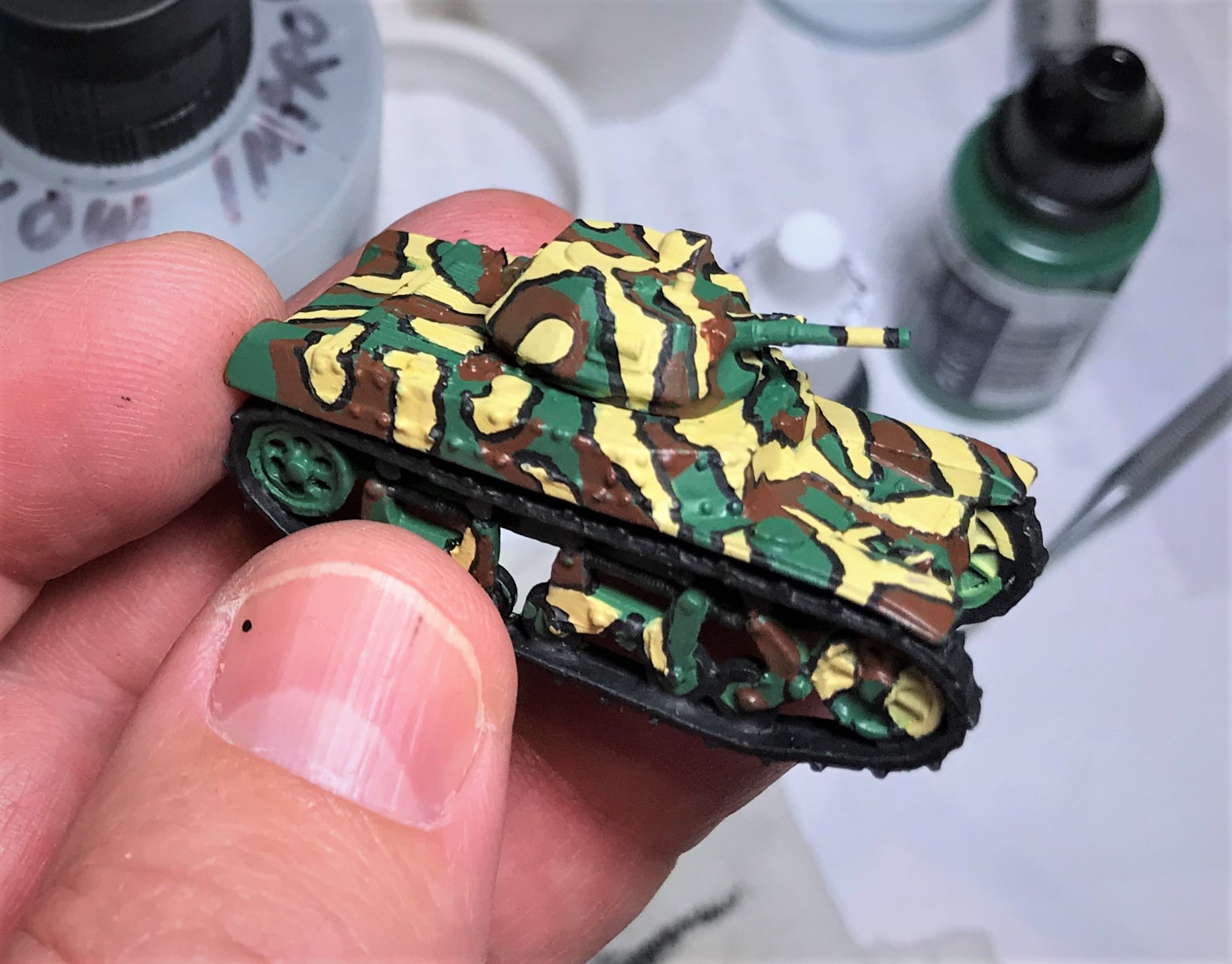
Early work on the camouflage scheme on the chassis.
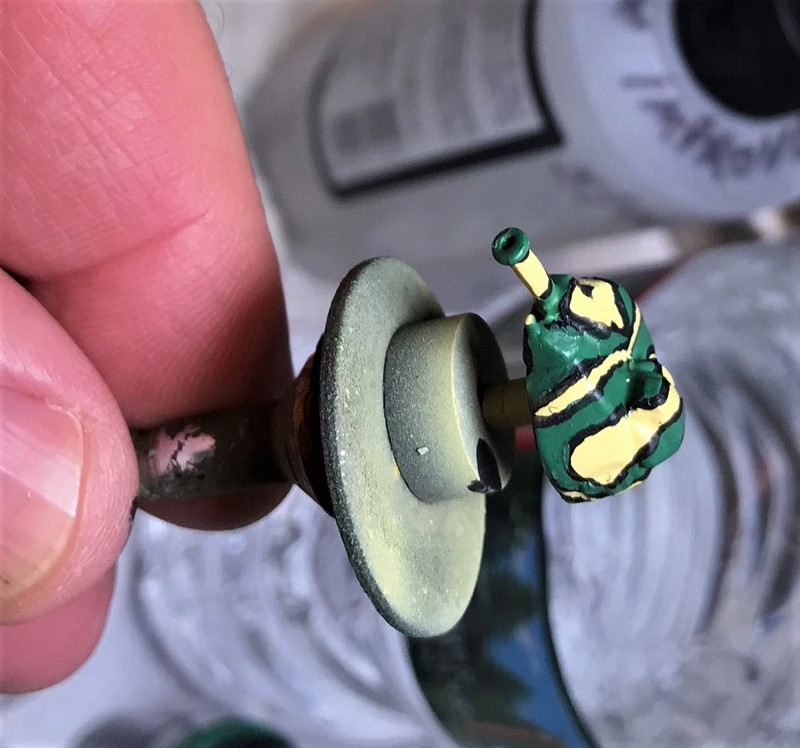
Early work on the camouflage scheme on the turret. I did similar painting work to what I did with the AMC 35’s.
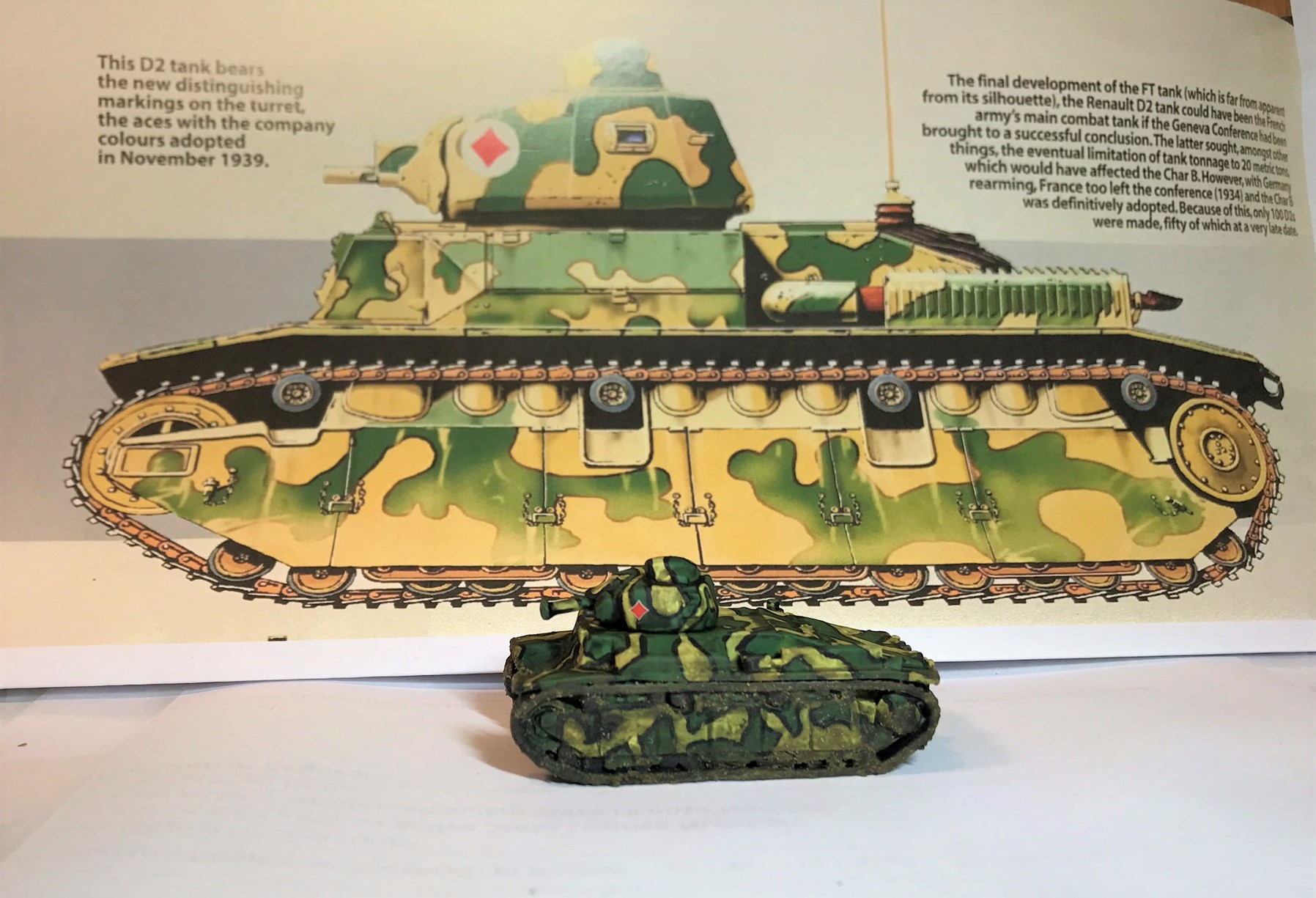
With the picture from Jean Restayn’s great book that I used as a guide. I considered painting the white circles under the diamond but decided not to as I thought this worked as is.
FT17
This WWI survivor was one I added to my force just because there were 504 FT17’s still serving in seven front-line tank battalions in 1939 – not counting over a hundred vehicles in French colonies. The FT17 infantry tank had the same 37 mm gun as many other French contemporaries like the R35, H35, and FCM 36. Armor was enough to stop small arms at best (maximum was 22 mm). Against the Wehrmacht, they were pretty ineffective. Many survive as over 3,000 were made by the French, and almost 1,000 under licence in the US (see below for one of those 35 miles from my house).
The model came from Peter Pig and was sold as a single. That worked for me, as I did not want a lot of these in the game. It was in good shape.
My FT 17 chassis after adding a roundel decal but before applying weathering effects.
My FT17 model with the Restayn page I used as a painting guide.
Panhard 178
The Panhard 178 (nicknamed the “Pan-Pan) was a superb 4×4 armored car for its day. It equipped French cavalry and infantry division reconnaissance units in 1940. It ended up being used by the Germans extensively after the Fall of France, and indeed was used after the war by the French until the 1960’s. It also equipped other forces, especially former French colonies. It had a good two-man turret, and its 25 mm gun could penetrate up to 50 mm of armor. It also was reasonably fast, and could do 26 mph off-road and almost 45 mph on the road. An assistant driver had controls in the vehicle’s rear allowing for fast reverse if needed. Protection was good for an armored car (20 mm armor in places), but as a recon vehicle its job was not taking on enemy tanks. Over 1,100 were built, and many survive today..
I plan to use them in my games as recon vehicles similar to what I did with my Normandy Breakout! scenario. They will be able to hide better than a tank, and I will be assigning them extra bonus attack cards from a French-specific deck. Likely I will make cards for French artillery, infantry, and anti-tank support, but no air support (the Germans’ recon will appropriately get that!).
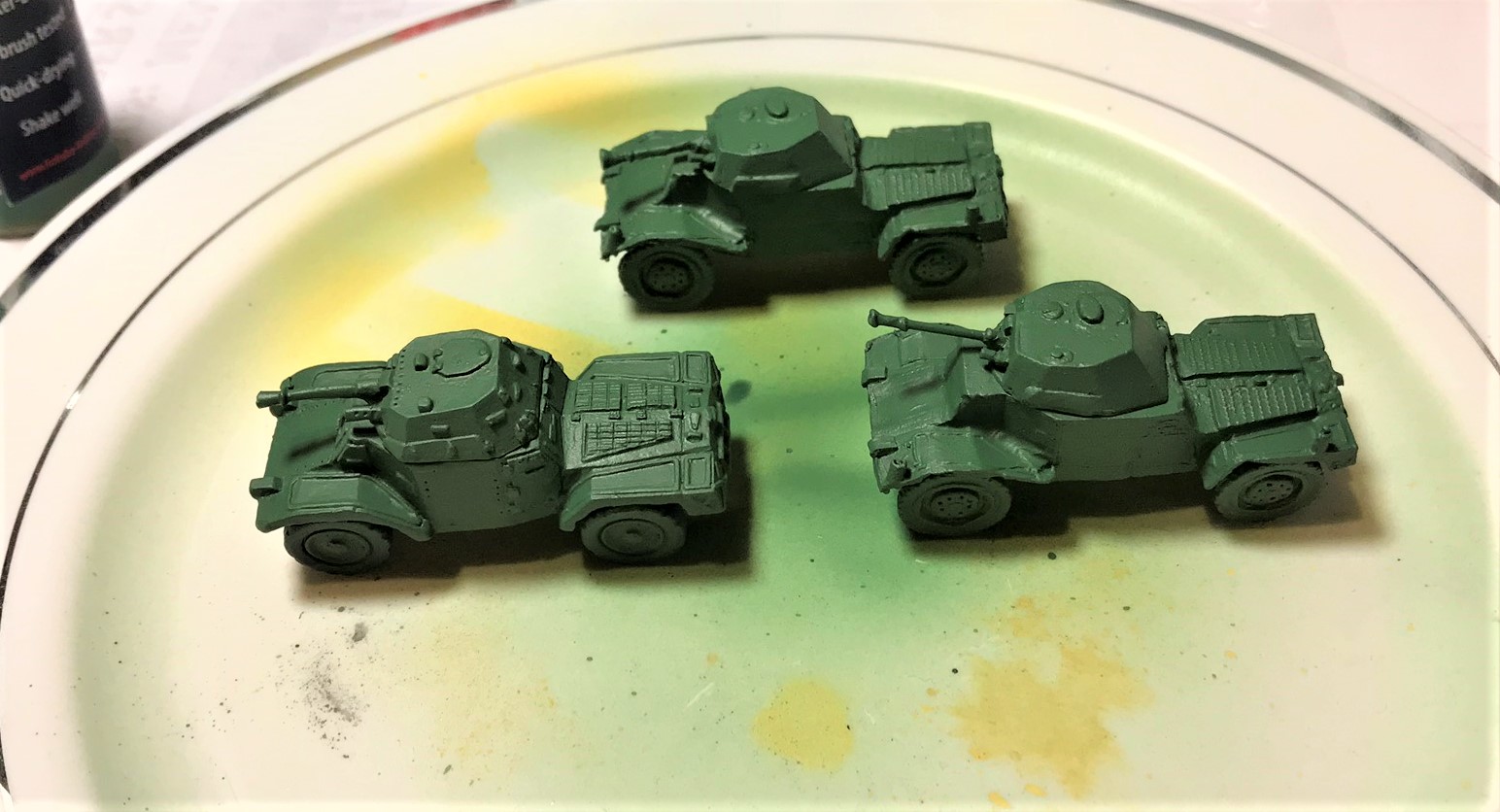
Here I got one Panhard 178 model from Peter Pig and two models from QRF. The Peter Pig model had a sleeve for the turret to fit into the chassis. I just added a magnet in the inside top to attract one of my blast markers if needed. The QRF models I magnetized as I usually do. The Peter Pig model is much more detailed. The QRF models were pretty disappointing and I needed to sculpt gun replacements for both (see below). The QRF models needed a lot of filing too. In the end, I think I made all three effectively for tabletop play – you of course can be the judge!
Peter Pig Panhard 178 Model
QRF Panhard 178 Models
The guns on the Panhard 178 models from QRF were in need of “stiffening”. You can also see the mold lines here too.
Here, the guns on the two left Panhard 178 (QRF) turrets have been replaced with paper clip wire placed into drill holes. I added green stuff to recreate the shape of the main gun that you see on the Peter Pig turret on the right.
The three Panhard 178’s after assembly with the new guns on the outer models.
After priming – a comparison of the detail on the Peter Pig model on the left and the QRF model on the right.
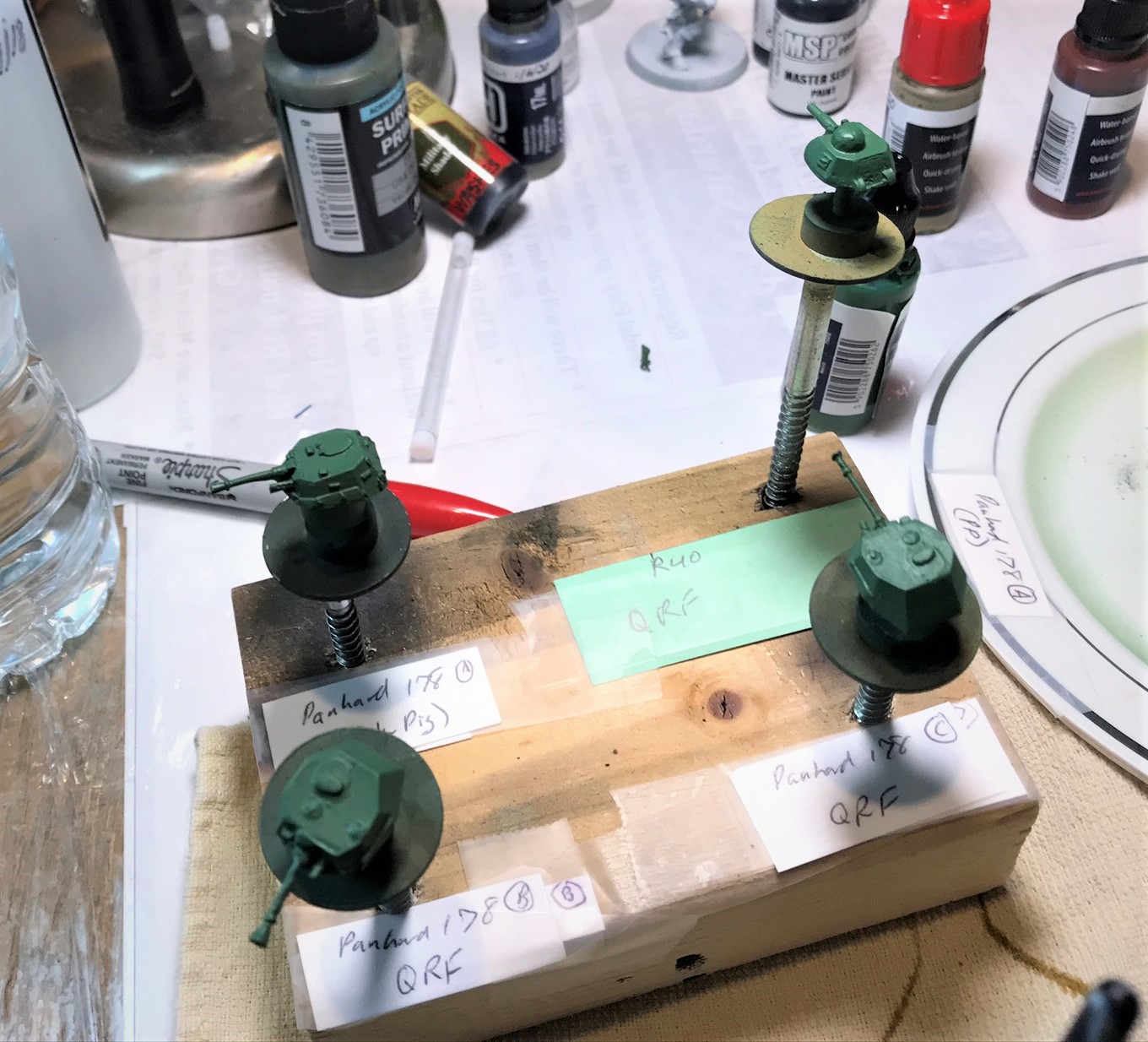
Panhard 178 turrets after base coating with the Hataka paint.
The Peter Pig model chassis showing the sleeve well for the turret.
All three models base coated.
Masking for camouflage paint application.
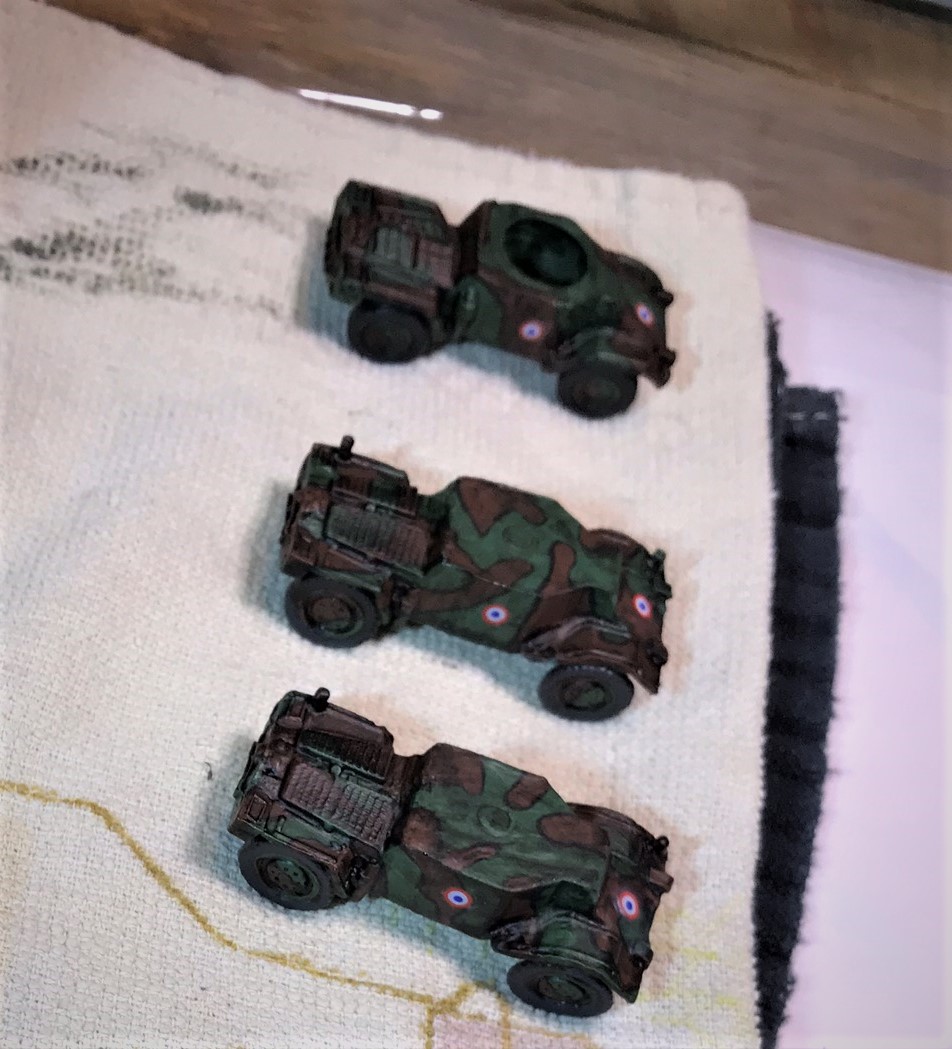
The three after decals and varnish. Each turret got a different number for ease of play.
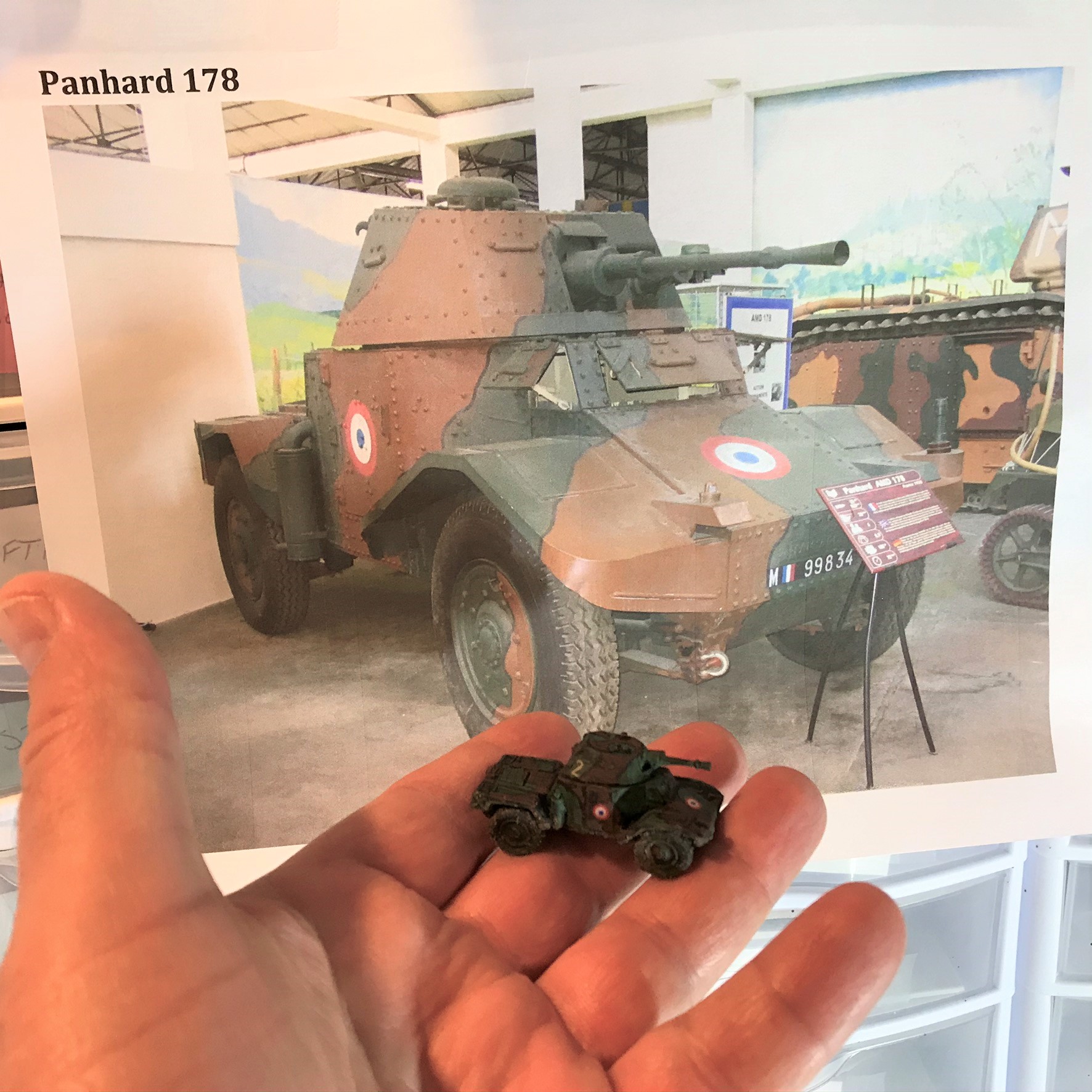
My Peter Pig Panhard 178 in front of an image of the one at the Musée des Blindés in France that I used as a painting guide.
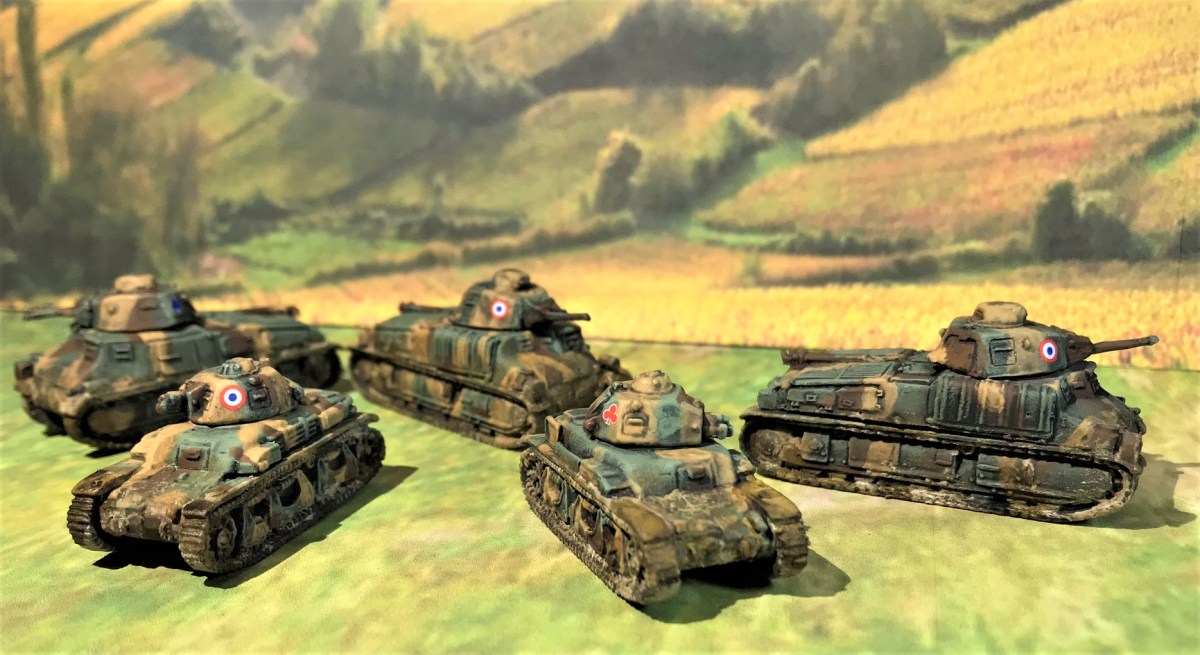
Eye Candy
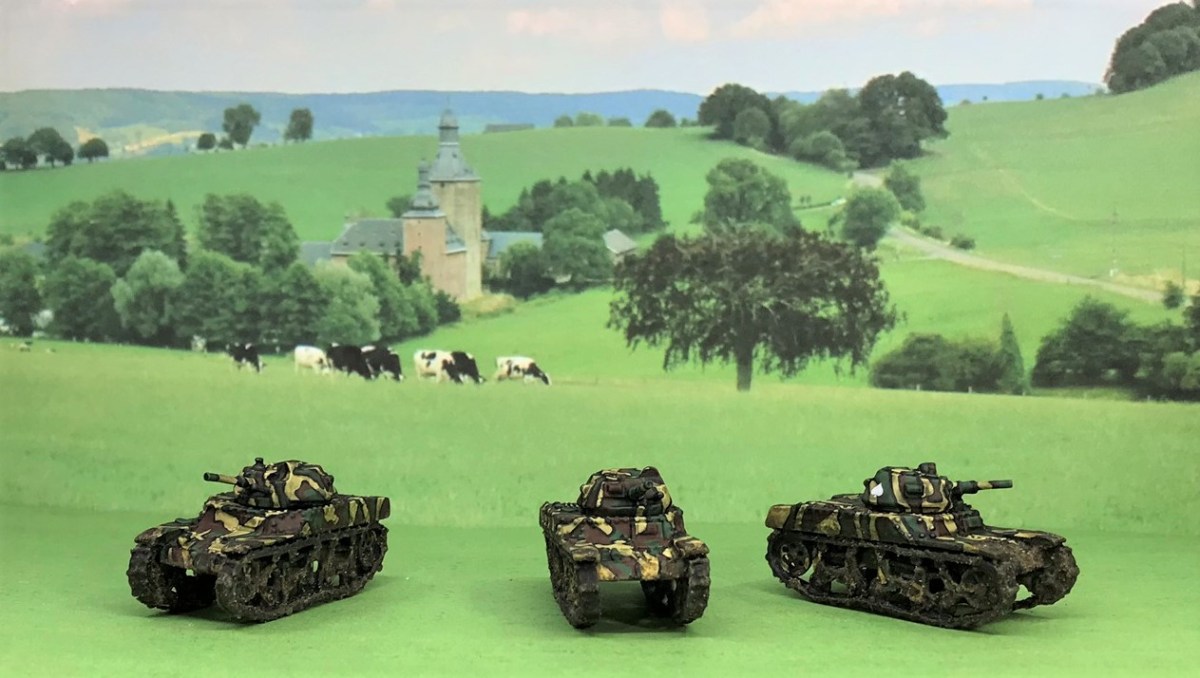
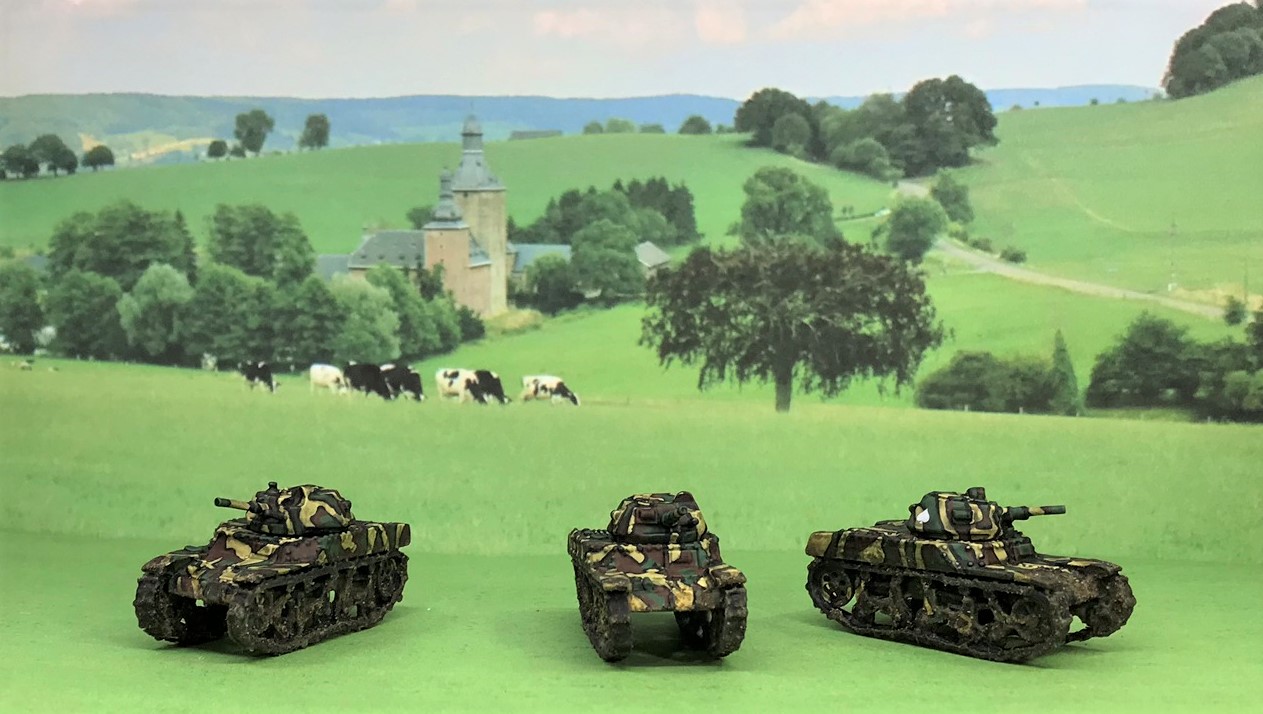
Now, please enjoy some close ups of the completed vehicle models against a backdrop of the French countryside!
AMC 35:
R40:
Char D2:
FT17:
Panhard 178:
Lastly, as these French models are far less known than say a later-war Sherman or a Tiger I – here are some size comparisons with a Char D2 and an AMC 35:
A Side Note on Photography
I try to make my posts visually appealing. My camera is an iPhone 7. I tried to use a technique offered by Per on his excellent blog Roll a One and use my computer monitor screen as a backdrop. While I really appreciated the suggestion, the lighting for me did not work and I got shine on the screen as shown below. Also, my cows were monster-size (though adequately-sized targets for my French tanks!)!
After seeing a post by Ted Salonich showing a photo booth for miniatures on a local hobby store’s (Great Stories) Facebook page, I was inspired to try my spray booth as a photo booth – and it worked quite well. I printed off the backdrop shot onto a piece of card stock, and using PowerPoint made a ground piece to match the connecting ground. I did this by making a new slide and cutting and pasting matching the grass background from the original backdrop slide. I started the fan and the backdrop image was sucked against the filter – and I was able to mount the booth floor with poster tack.
Too much shine, not level, and man, look at the size of those cows!
Sometimes I got the “crazing” of the screen with the monitor.
Shadows and scale posed problems for me.
This (above) was my last solution – and I used this for my eye-candy shots you saw above. I like it a lot – your thoughts?
Below is a shot taken in the spray booth.
Storage and Transport
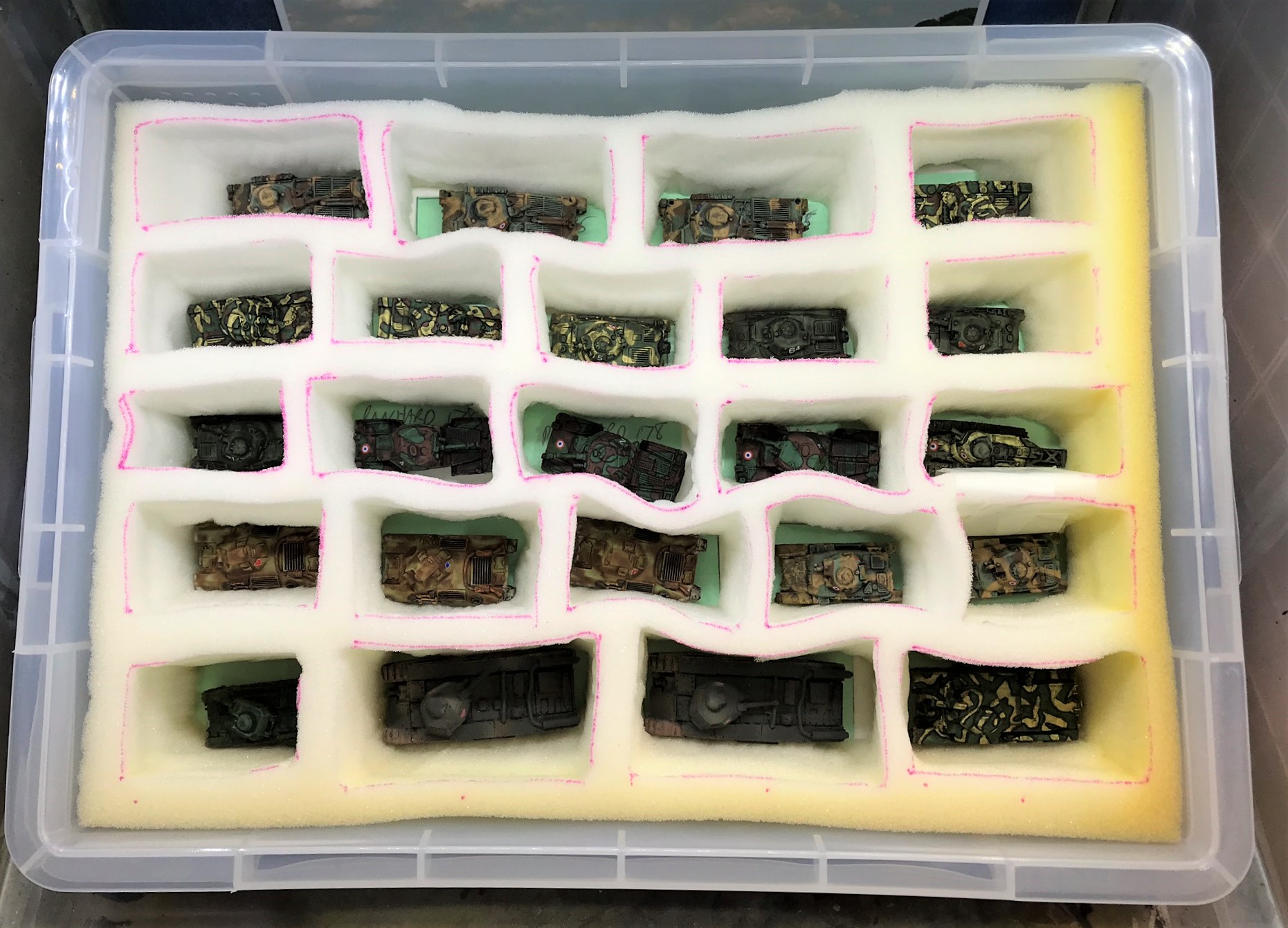
The storage and transport of miniatures to games is an issue. I have zero intention of having my models damaged or destroyed in transit. I use a 4-liter Really Useful Box, and cut a 2″ foam piece from Home Depot to fit snugly in the box. I cut up and lined the bottom with a similarly-sized piece of thin foam from Michael’s. Then I mock up sizes of the tanks with card stock and trace them onto the foam. I also take a photo to remember what tank goes where. Using a new and very sharp Exacto knife, I carefully remove the openings by cutting as vertically as possible. I start by patiently removing pieces from the middle and continue moving outward in a circle. I then affix the card stock pieces to the bottom of the hole openings with tape to mark the locations of the tanks. I thought I’d share this as it may help others.
The mock up.
My French Armor force in its new home.
References
Throughout this project I have used many of the books that I have as references – here are some I have used and strongly recommend. I do not get paid by anyone to recommend these, but I am sharing the links if you want to get them. I did study with BG Robert Doughty at West Point over 35 years ago – and he did give me my copy of the B.T. White book in 1984 – that I still have and used many times. There are certainly other books, but these I recommend. I will be using these in my next phase with my German tank additions.
For history of the conflict I recommend buying:
Doughty, Robert A. (1985). The Seeds of Disaster: the development of French Army Doctrine 1919-1939. Mechanicsburg, PA: Stackpole books. (available at Amazon here)
Doughty, Robert A. (1990). The Breaking Point: Sedan and the Fall of France, 1940. Mechanicsburg, PA: Stackpole books. (available at Amazon here)
Horne, Alistair. (1969, 1990). To Lose a Battle: France 1940. London: Penguin books. (available at Amazon here)
For modelers and gamers interested in the vehicles’ look and history:
Forty, G. and Livesey, J. (2017). The World Encyclopedia of Tanks & Armoured Fighting Vehicles. London: Lorenz Books. (available at Amazon here)
Jackson, R. (2009). Tanks and Armored Fighting Vehicles Visual Encyclopedia in color. London: Amber Books. (available at Amazon here)
Restayn, Jean. (2007). World War II Tank Encyclopedia in color 1939-1945. Paris: HISTOIRE & COLLECTIONS. (available at Amazon here)
Smithsonian Enterprises. (2017). Tank: the Definitive Visual History of Armored Vehicles. New York, NY: Penguin Random House. (available at Amazon here)
White, B.T. (1972). Tanks and other A.F.V.s of the Blitzkrieg Era 1939 to 1941. Dorset: Blandford Press. (available at Amazon here)
Zaloga, S. (2014). French Tanks of World War II (1): Infantry and Battle Tanks. New York, NY: Osprey. (available at Amazon here)
Zaloga, S. (2014). French Tanks of World War II (2): Cavalry Tanks and AFVs. New York, NY: Osprey. (available at Amazon here)
PAINTS, INKS, GLAZES, SHADES, WASHES, PIGMENTS, FLOCKING, GLUES AND MORE USED ON THESE VEHICLES:
Microscale Liquid Decal Film (except R40)
1/8″ neodymium magnets
Green stuff (kneadatite)
Gorilla Glue
Poster tack and ¼” square wooden dowels on plastic plates
Reaper MSP “Black Primer”
Vallejo “Flow Improver”
Vallejo “Airbrush Thinner”
Vallejo “Surface Primer – USA Olive Drab”
Vallejo “Black Grey”
Hataka “Jaune d’ochre” (only on AMC 35’s, Char D2, and FT17)
Hataka “Vert foncé”
Hataka “Terre d’ombre” (only on AMC 35’s and Panhard 178’s)
Hataka “Gris vert” (only on FT17)
Battlefront “Oxide Red” (only on R40 and FT17)
Citadel “Typhus Corrosion” (only on R40 and FT17)
Army Painter “Military Shader” (shade)
Battlefront “Dark Gunmetal”
Vallejo Model Air “Gloss Varnish” (except R40)
Vallejo Model Air “Satin Varnish” (except R40)
Microscale Micro-Set (except R40)
Microscale Micro-Sol (except R40)
Appropriate decals from Battlefront (except R40)
Vallejo Weathering Effects “European Thick Mud”
Vallejo Weathering Effects “European Splash Mud”
Vallejo Weathering Effects “Crushed Grass”
Vallejo Mecha Varnish “Matt Varnish”
Thanks for looking – please let me know your thoughts and feedback!
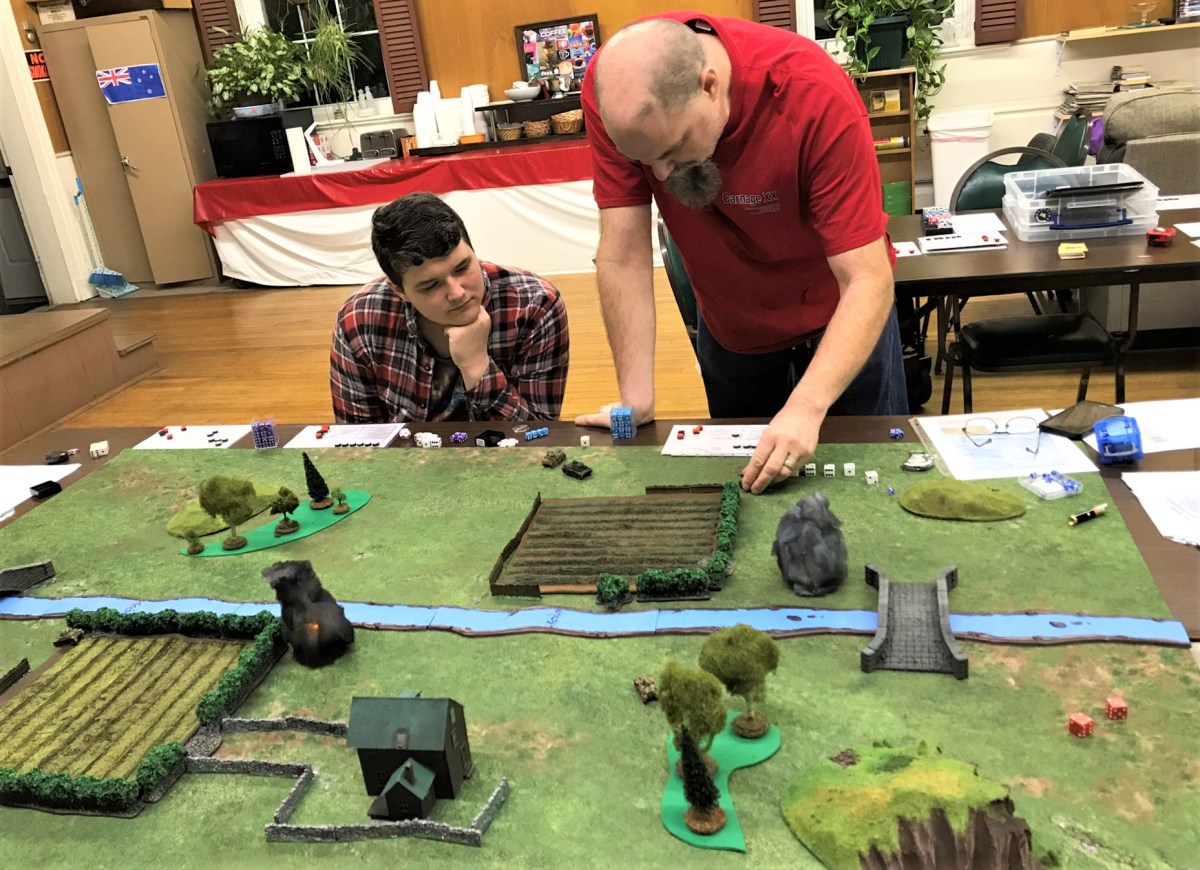
Each team was given poker chips to represent available points to choose and deploy their tanks. In this scenario, each had 25 points to choose three tanks. If a tank was destroyed, the winning team would get that many points in chips – which they could use to either upgrade a deployed tank, buy a new tank, or purchase a Bonus Card. The destroyed tank would respawn in the game. There was a river in the middle of the board, with roughly equivalent terrain on both sides of the board. I said that any tank on the opposite side of the river at the game’s end would count for two times as many points for victory. This gave each side an incentive to move forward.
For initial forces, the Germans chose two Panzer IVD’s (2 for 14 points) and a Panzer 38(t) (one for 9 points), leaving them with 2 chips extra. The Germans passed on choosing a Panzer IIC. The French chose two R35’s (2 for 14 points) and one SOMUA S35 (1 for 10 points), leaving them with one extra chip. While there were StuG IIIA and Char B1 bis vehicles in the inventories, I did not allow either to be chosen initially for reasons of play balance.
The game board set up. The Germans chose to enter on the right side.
The Germans initially deployed from here, with the French deploying on the opposite side.
In early action, a Panzer 38 (t) was knocked out by a flank shot from one of the R35’s as it hid on the left behind the bocage. A Panzer IVD and the other R35 watch it burn.
The previously successful R35 runs behind the bocage. Another Panzer IV crosses the river at a ford (minor obstacle), but by this time it had been hit multiple times and was down to one Command Die…
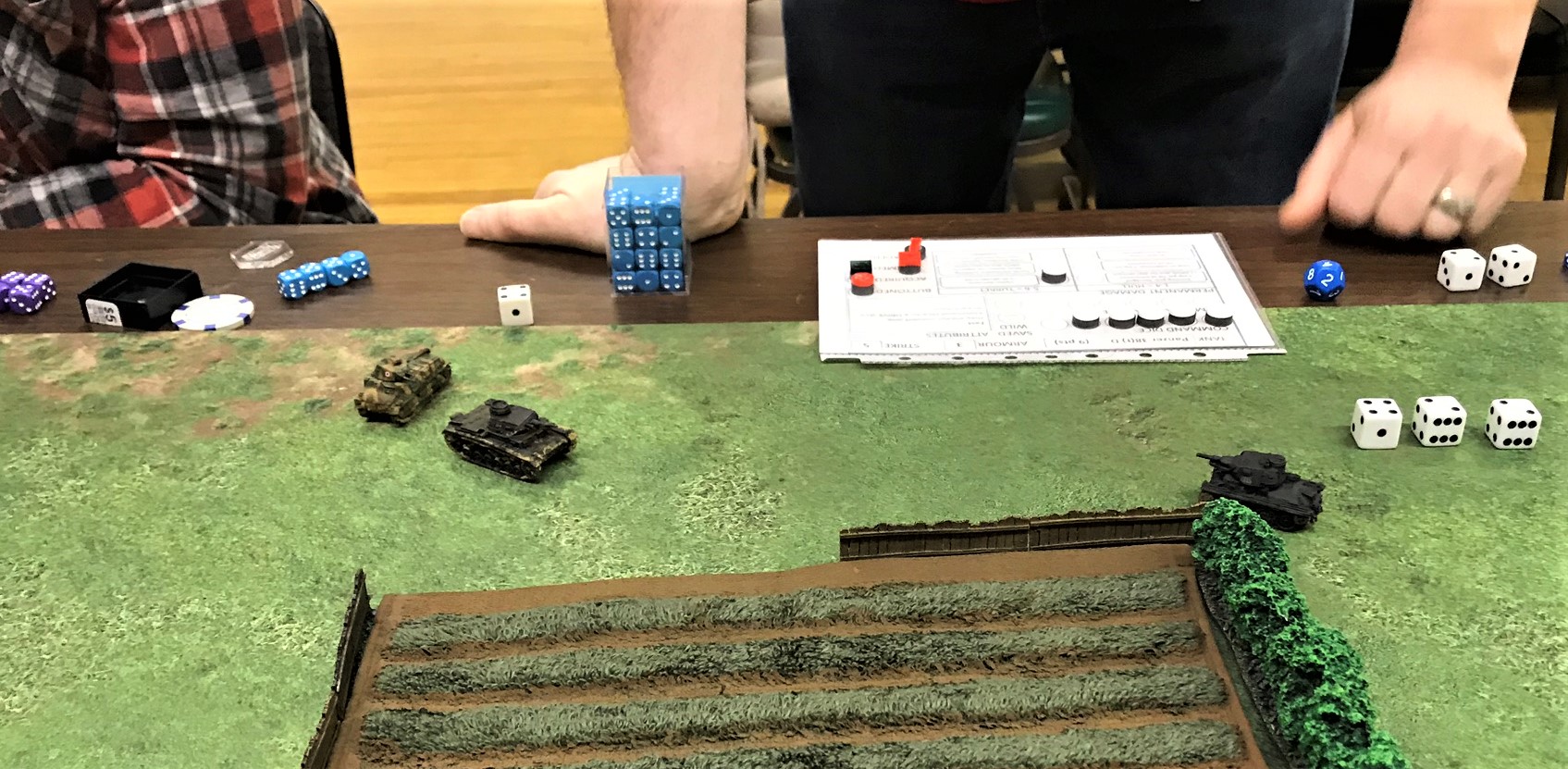
…and the French SOMUA rolled this! An example of the French Command Dice rolls. Each 6 is a Wild card and each 4 is a firing die. Basically, this allowed the loaded French SOMUA to fire 3 times in that turn, contributing to the demise of the Panzer IVD. Unfortunately, the Germans’ rolls were hardly ever this good during the game.
The previously mentioned unlucky Panzer IVD burns on the left by the bocage. Scott and Ethan Howland are maneuvering another Panzer IVD and a Panzer 38 (t) against the SOMUA S35.
The SOMUA activates, and moves to the rear of the Panzer IVD, but is unable to get off a shot. The Germans were able to subsequently knock out the S35 in their only kill of the day.
On the left French flank bridge, a duel went on between a Panzer IVD and an R35. The French were lucky and activated first, hitting the German in the side. Subsequently, the German reoriented, but was hit again and forced back.
The Panzer IV was dispatched by the intrepid two man crew of the R35.
At that point the game was called. The French crossed one R35 to the other side of the river and got 14 points. The final score was France 38, Germans 12. It was a good rolling day for the French and a bad one for the Germans. The best tanks did not get to deploy, but both sides needed to use terrain well, and they did. It was nice to have some new players (Leif, Ethan, and Scott), thank you for coming. Everyone had fun, and I will run this scenario again.
Score Breakdown:
French 38 chips:
1 chip left over from initial deployment (1 chip)
Two Panzer IVD’s knocked out (14 chips)
1 Panzer 38 (t) knocked out (9 chips)
1 R35 on the other side of the river at game’s end (14 points)
Germans 12 chips:
2 chips left over from initial deployment (2 chips)
1 SOMUA knocked out (10 chips)
Our next session will be on January 5th at 2 PM at 110 Pleasant Street, East Brookfield, MA. Please follow us on FaceBook at the Mass Pikemen Gaming Club.
My focus continued to be on early war vehicles. I had enough forces for an early Eastern Front game between the Axis (Germans and Italians) and the Soviets, but I wanted to have more variety in terms of tanks available. My KV-1 platoon needed some help, so I added some BT-series tanks.
My other goal was to build German and French forces for a France 1940 scenario. For the Germans I added a Panzer IIC, a Panzer IIIE, and three StuG Ausf A assault guns to my fleet. For the French, I added two Renault 35’s and three SOMUA S-35’s. All of these came from the Flames of War line from Battlefront Miniatures. I really like their tanks, even though I don’t play Flames of War! I think that I can get some crossover between the early-war German forces for such a scenario and use some on the Eastern Front. Long term, I am also planning on designing a North Africa scenario for the British and the Germans, and some of the figures I got from Battlefront will serve nicely after I paint them in desert colors.
Regarding colors, I also acquired some of the Battlefront paints so as to understand the colors that they recommend. The current Battlefront “Colours of War” line mixes sets of 20 ml and 12 ml dropper bottles, as compared with Vallejo’s 17 ml bottles. It appears that at least some of their paints may have been made by Vallejo, at least in the past. I found them to be good paints that worked well either thinned in an airbrush or a regular brush. At the end of this post, I will share the paints and materials that I used for those interested.
In this post, in order I will discuss the Soviets, the French, and the German models I worked on in November. I also am submitting these as part of a Mechanical November community painting challenge run by Azazel (which is very fun to be a part of – check him out!).
Soviet
BT-5 & BT-7 in Blister
Priming the BT’s undercarriages
Painted up and needing weathering
The two Soviet tanks that I added were the BT-5 and the BT-7. An advantage of adding these will be that they also were used against the Finns in the Winter War and against the Japanese at Nomonhan in 1939 and during the Soviet Invasion of Manchuria in 1945. So, I can use them in different scenarios for sure. I followed the same procedure to paint these as I did my previous early war Soviet tanks.
For assembly, I again chose to magnetize the turrets by drilling out the hulls and the turrets and using rare earth magnets. I weathered all of the tanks, as I prefer my tanks to be muddy. I also left the crews out, as I did not like the way they fit in the turrets. Of note, their Christie suspensions (an American invention) would be reproduced with the T-34 series.
I have always had an affinity for the French Army, as I have a French name (albeit of French-Canadian extraction), speak French, and spent time with three different Regiments du Genie (Engineer Regiments) back in the 1980’s.
SOMUA prepped for drilling and magnetizing the turrets
SOMUA’s assembled
R-35’s in the blister – tiny 2-man tanks!
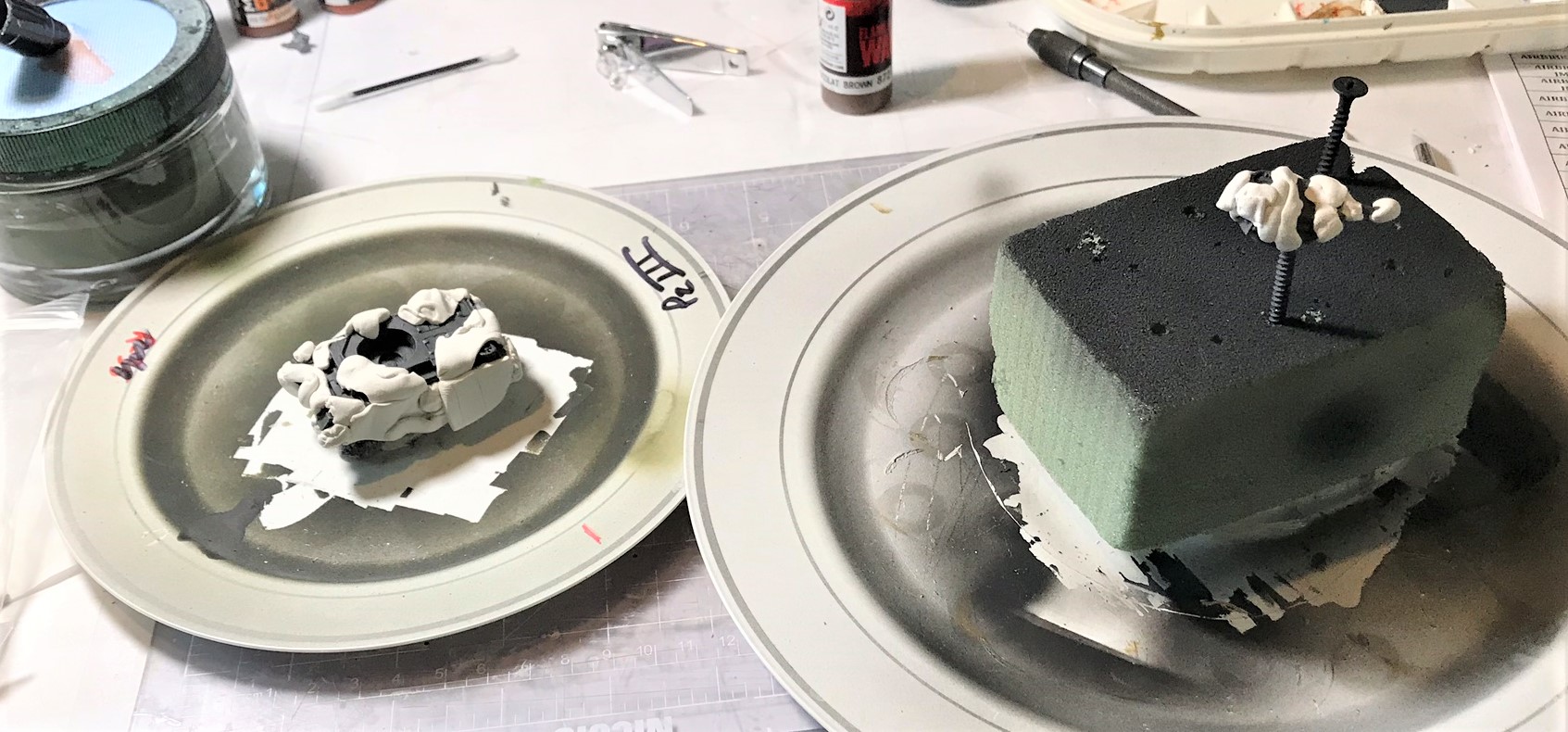
Assembling and painting these would require new uses of poster tack, plastic plates, and wood screws. This allowed me to both safely handle the tanks in production but also to get the right look of the camouflage. I decided to leave the crews out, as I had little confidence that they would survive the tabletop for very long as the models were designed.
I also got to play with some decals from Battlefront. These did require retreatment with Liquid Decal Film from Microscale Industries before I used their other products to affix their decals. I could not believe that the French roundel decal came in two pieces (the blue dot was separate and had to be affixed after and onto the red-ringed white circle). That was annoying!
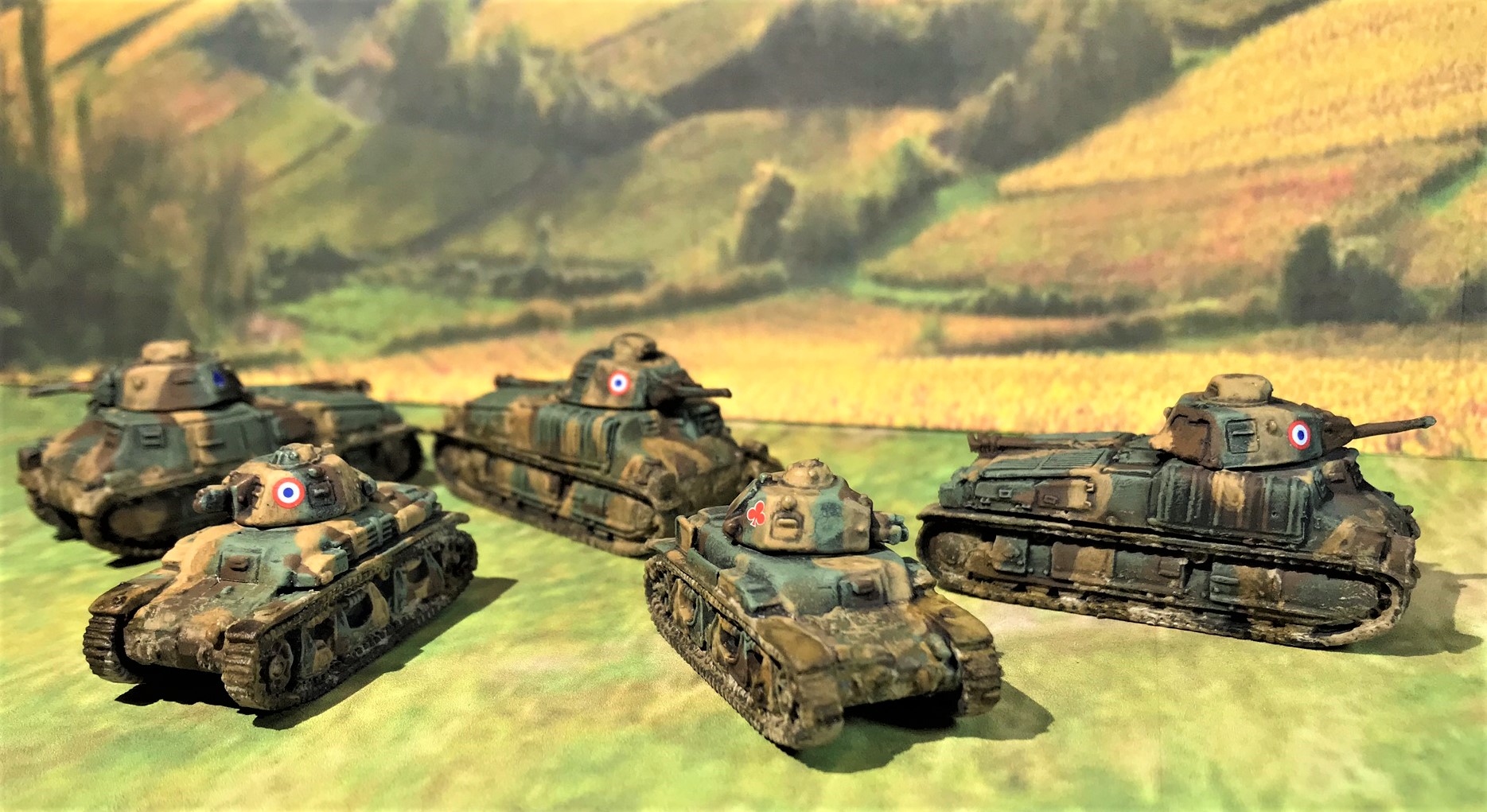
My new French tanks with my old Char B1 bis tanks
The three SOMUA S35’s, frontal view
SOMUA side view showing the card-suit designations on the turret backs
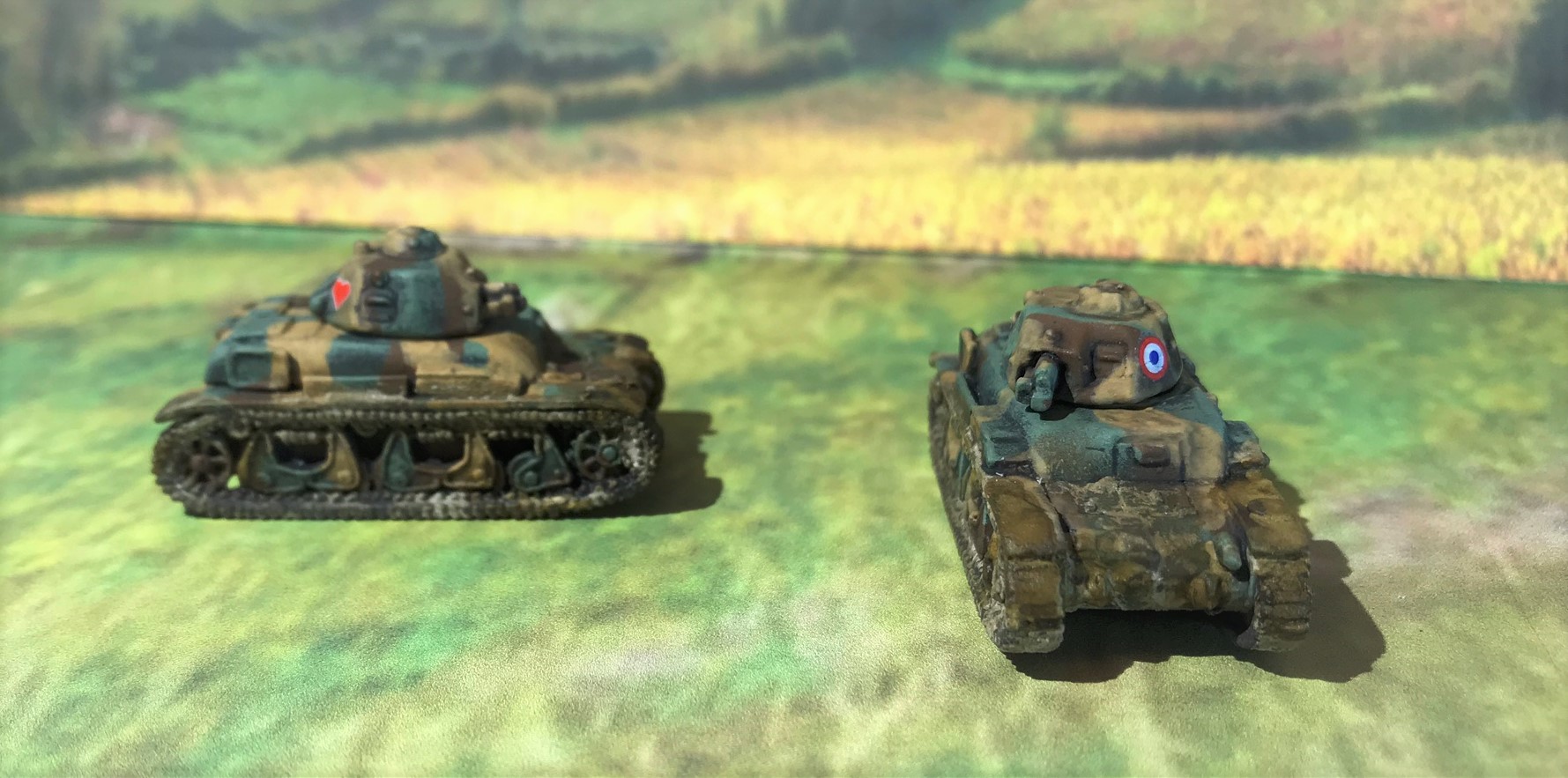
Renault R35’s
Nice group shot
German
For the Germans, I chose to use the Panzer IIC, the Panzer IIIE, and the Sturmgeschutz Ausf A. The Panzer II’s came in a box of 5 – but was missing one tank gun. Battlefront has promised to make this good (and I expect it soon). I chose to make one of the Panzer II’s a France 1940 candidate, saving the other four for a North African scenario that I will complete later on. The Panzer IIIE came in three separate blisters. Ironically, the Panzer IIIE was the worst of the Germans to assemble. One gun was almost split, and the turrets were nearly three different sizes. There were a lot of mold lines to correct as well, especially on the tracks.
I repaired the one gun with green stuff, and chose it for the France 1940 group, saving the other two for North Africa. Lastly, historically it seems that very few StuG III’s made it to North Africa. Therefore, I added all three of the assault guns for my France 1940 scenario.
Panzer II’s prepped.
The Panzer IIIE blisters
The StuG Ausf A box.
Assembled/repaired Pz IIIE’s
Assembled StuG IIIA.
How I mounted the turrets
Mounted turrets for painting
Pz II and III primed
StuG IIIA’s base coated
The Panzer IIIE prepped for camouflage
Panzer IIC complete, left side
Panzer IIC, left side. The 14 is for my wife – her and my lucky number!
Rear view of the tiny Panzer IIC.
The Panzer IIIE completed. The brown camouflage doesn’t really show up as well here (so I guess it works!).
Panzer IIIE opposite view
Sturmgeschutz III Ausf A, frontal view
Sturmgeschutz III Ausf A, left side view
Sturmgeschutz III Ausf A, right side and rear view
My Germans for the France 1940 scenario
I was glad to have finished these in time for our club’s monthly session (which I will post about shortly). I will be adding more to my fleet, but in the meantime, I hope you enjoyed these. Do you have a favorite?
I appreciate hearing your thoughts and feedback in the comments section below. Thanks for looking!
PAINTS, INKS, GLAZES, WASHES, AND FLOCKING USED:
COMMONLY USED ON MULTIPLE TANKS:
Vallejo “Flow Improver”
Vallejo “Airbrush Thinner”
Testors “Universal Acrylic Thinner”
Battlefront “German Camo Black Brown”
Battlefront “Dark Gunmetal”
Vallejo Mecha Color “Green”
Battlefront German Camo Black Brown
Vallejo “Surface Primer – Black”
Vallejo “Burnt Umber” (pigment)
Vallejo “Light Sienna” (pigment)
Vallejo “Light Slate Grey” (pigment)
Vallejo “Natural Umber” (pigment)
Vallejo Mecha Color “Light Rust Wash” (weathering)








































 Mark A. Morin