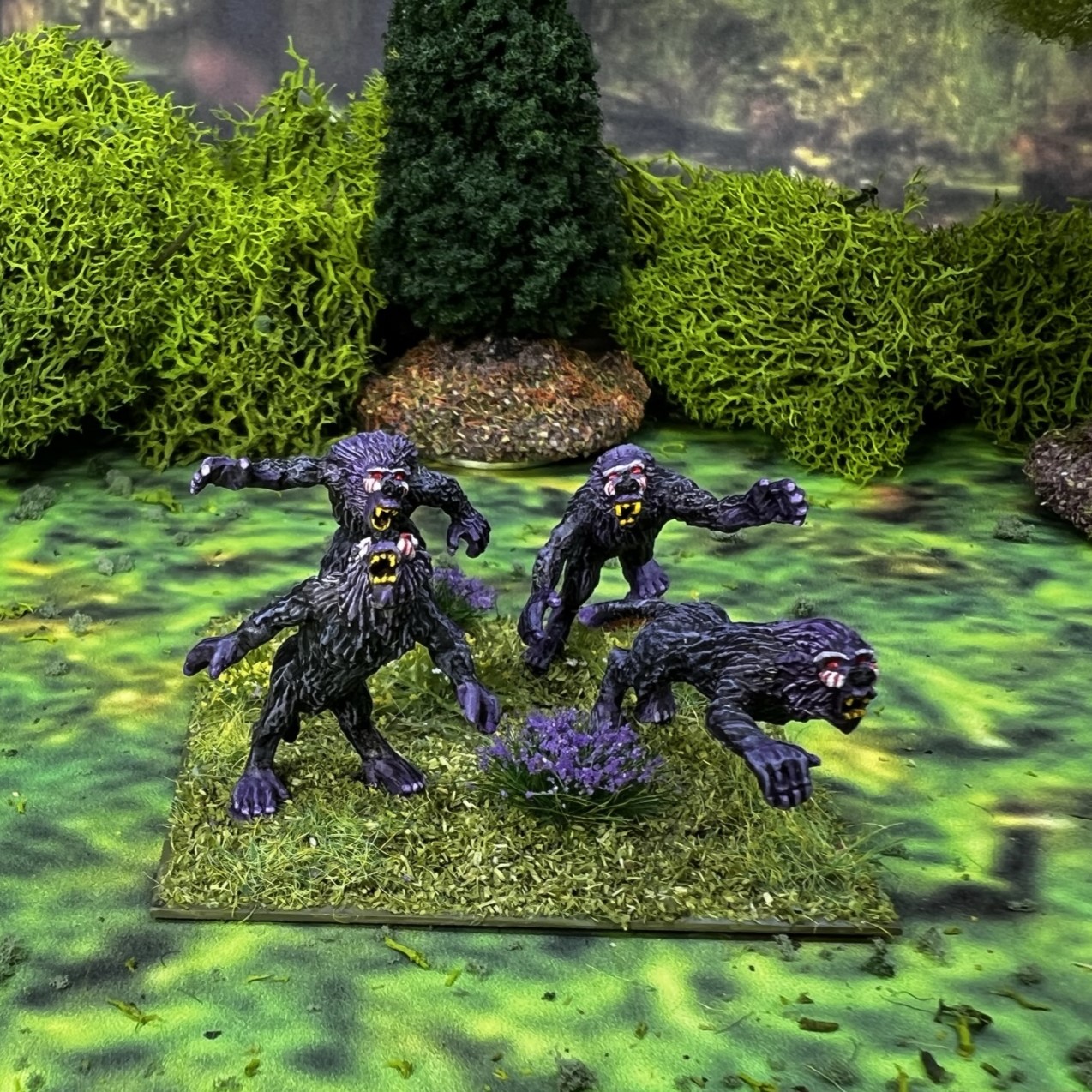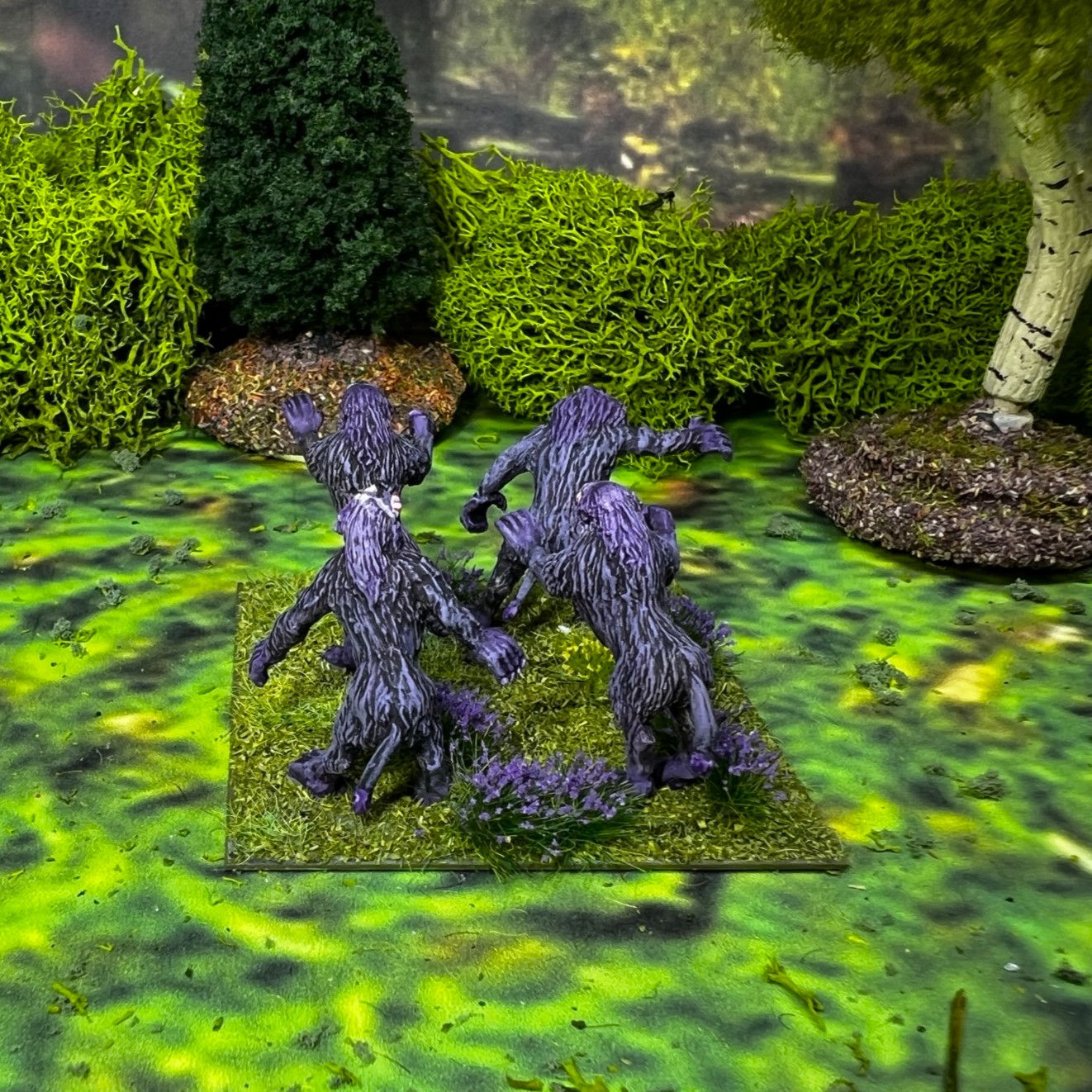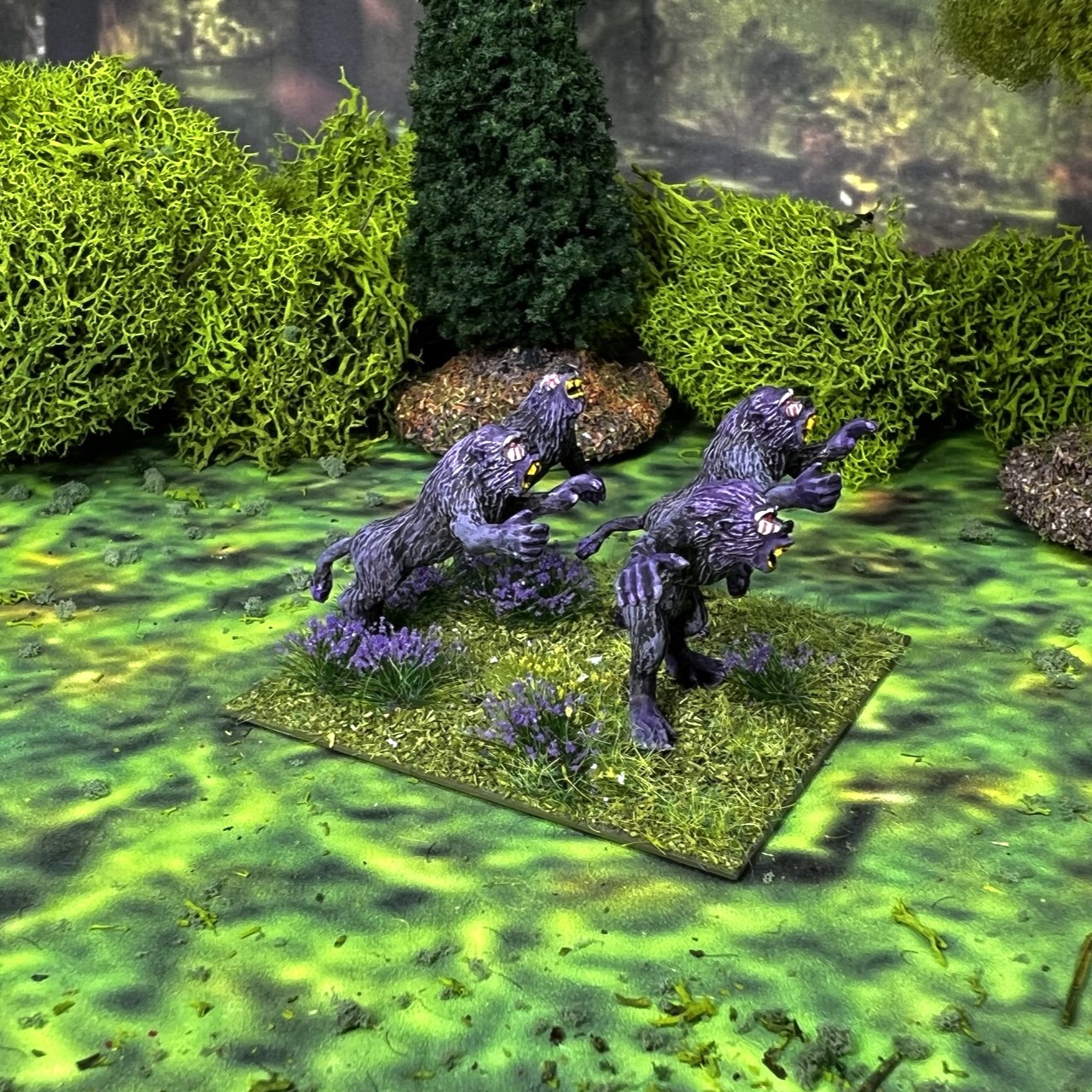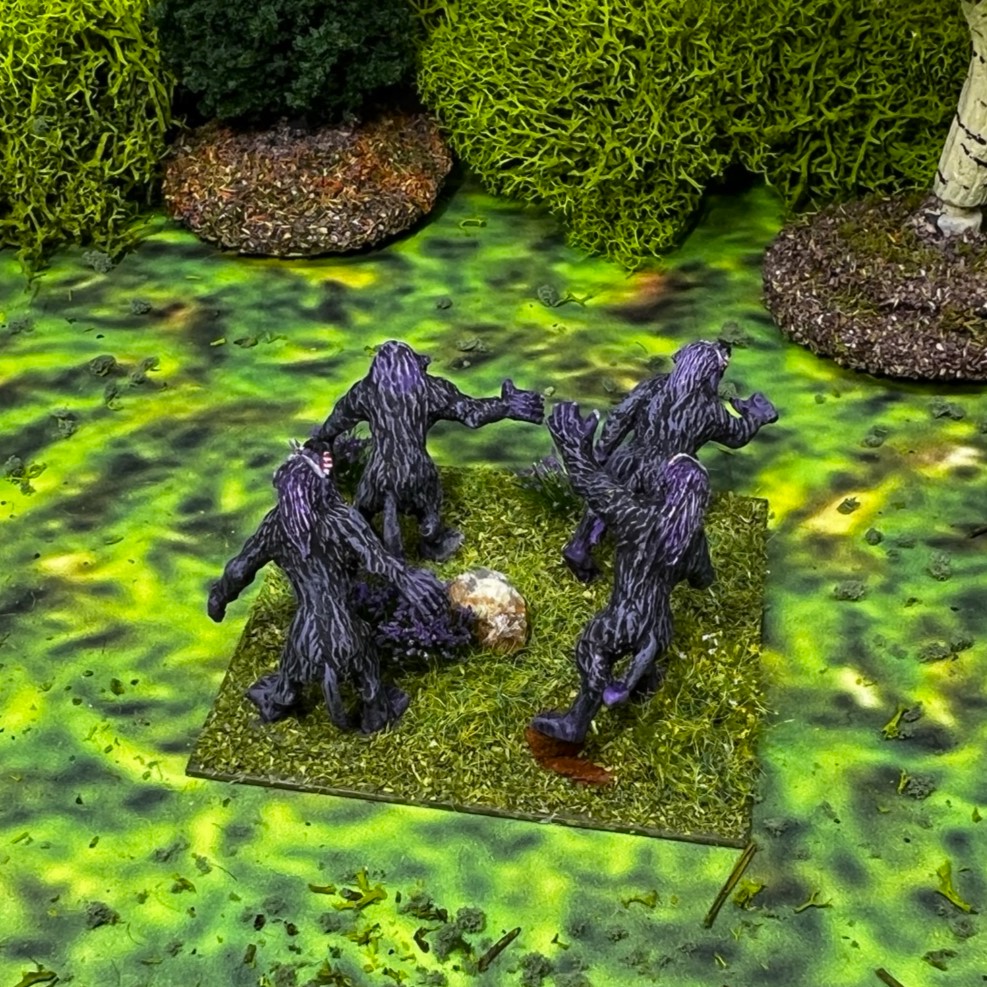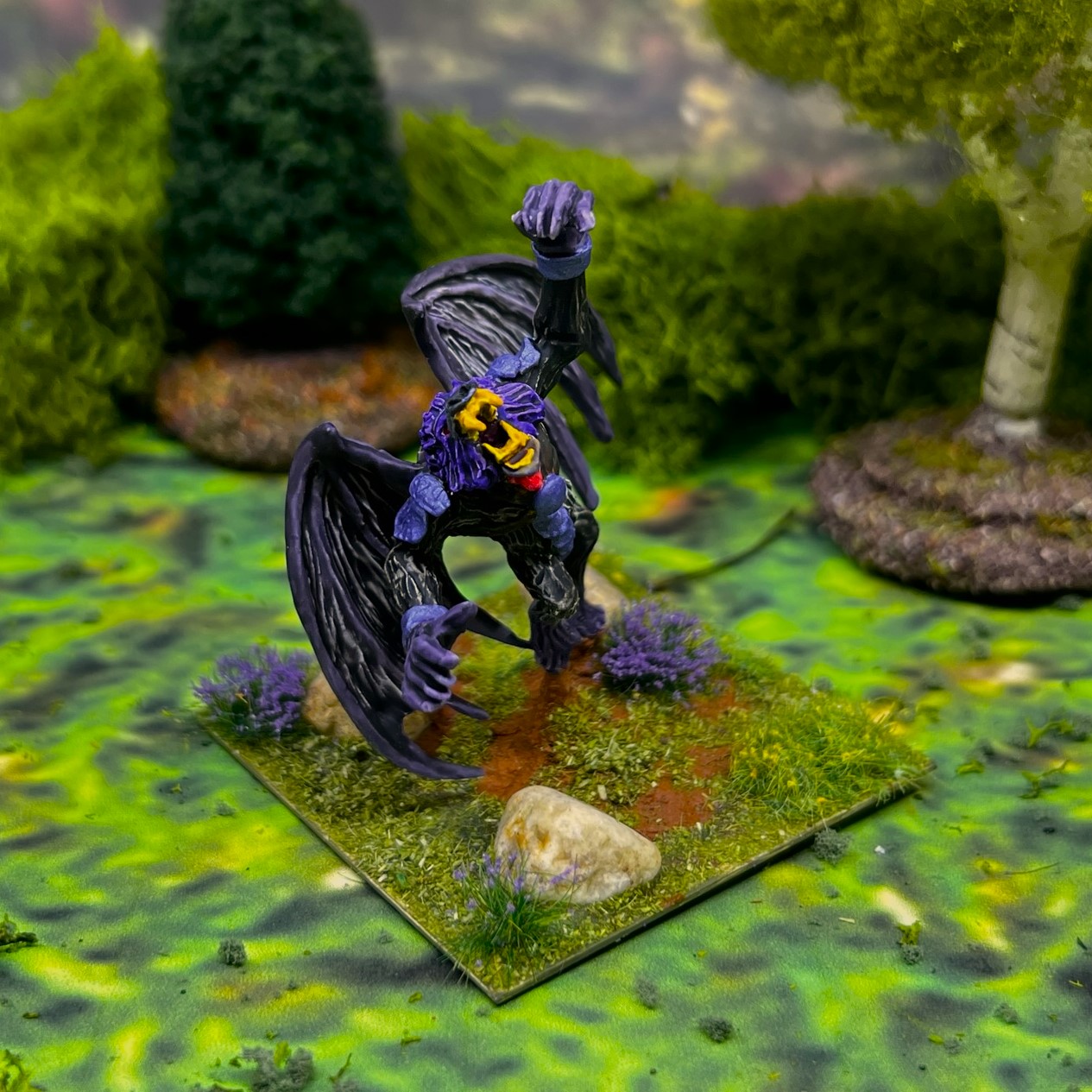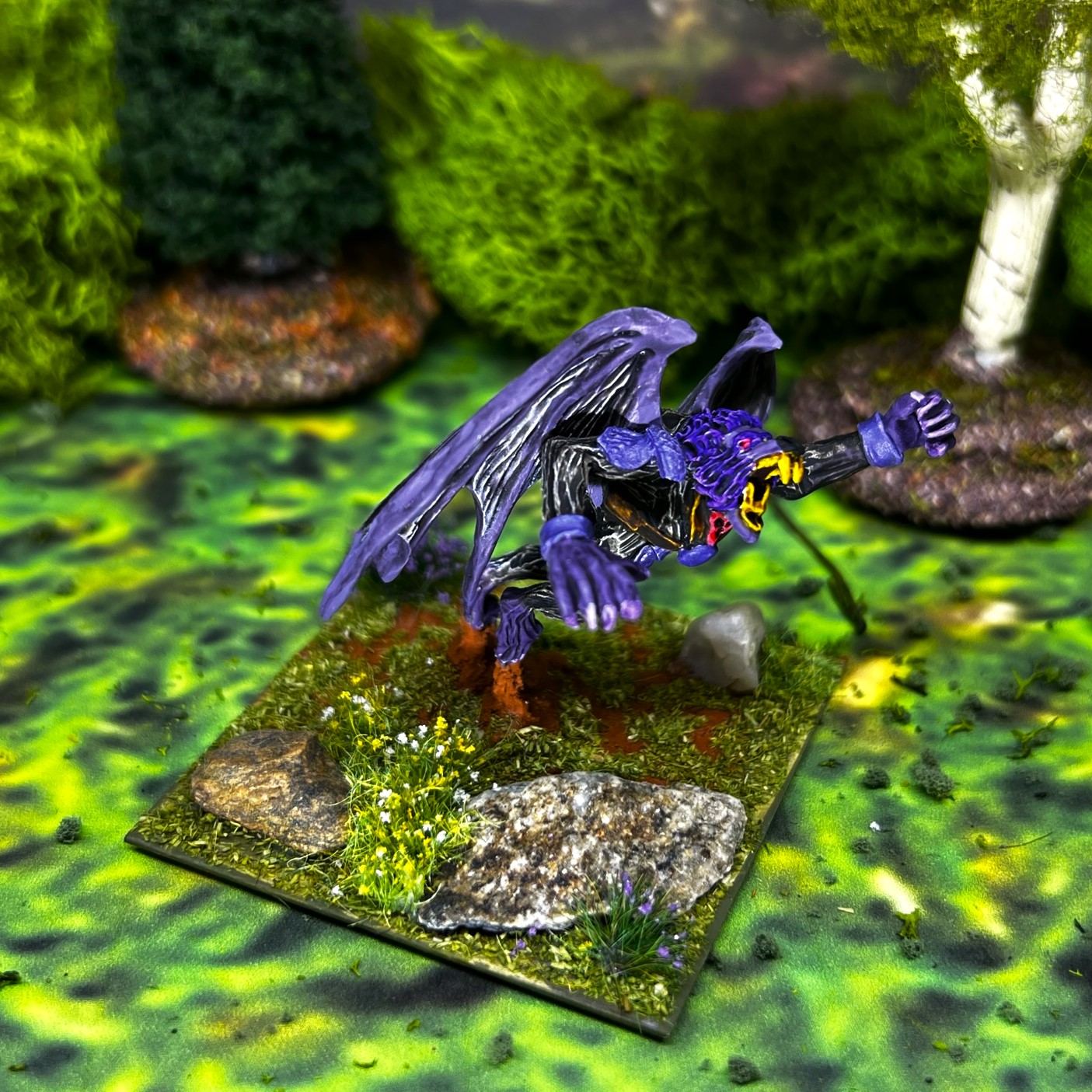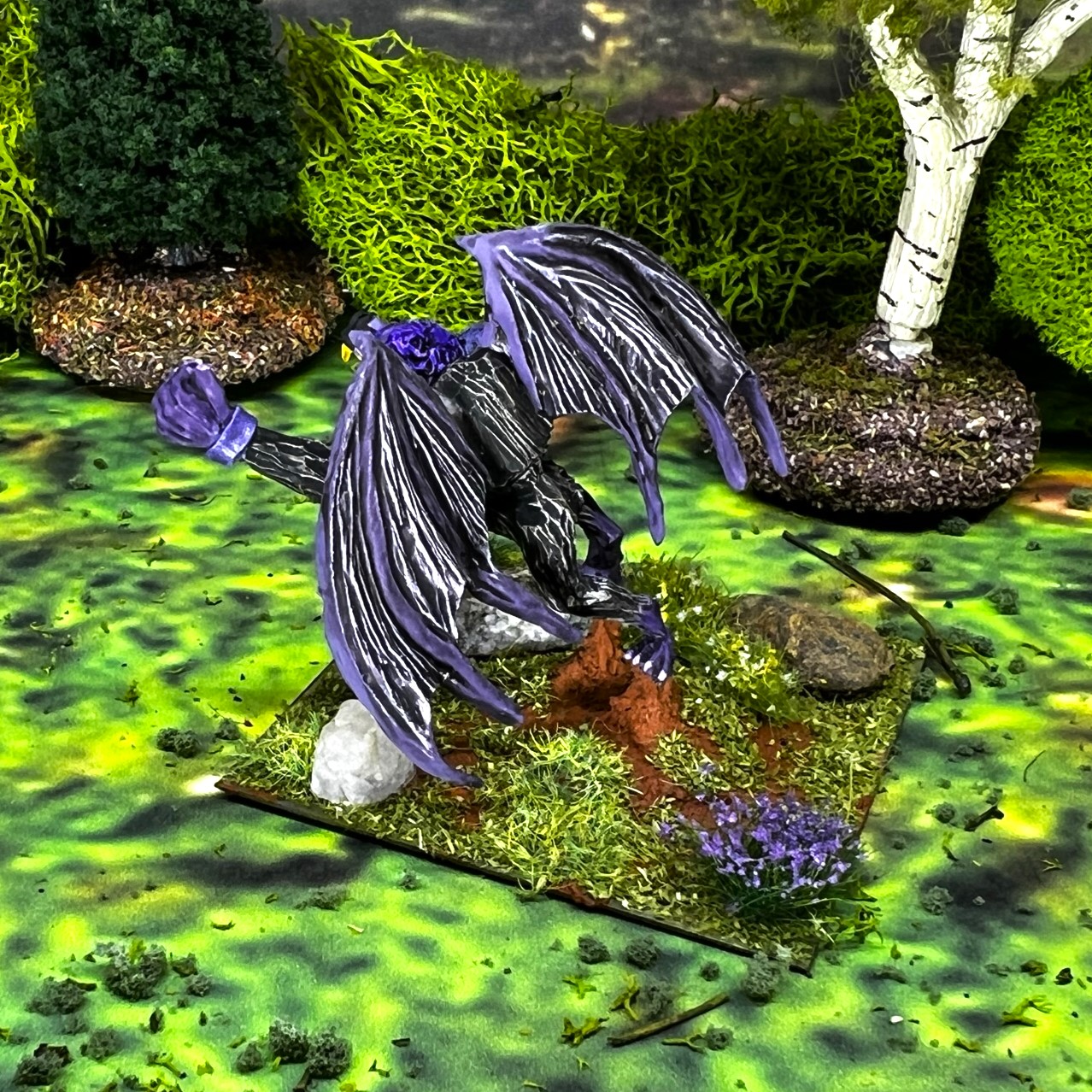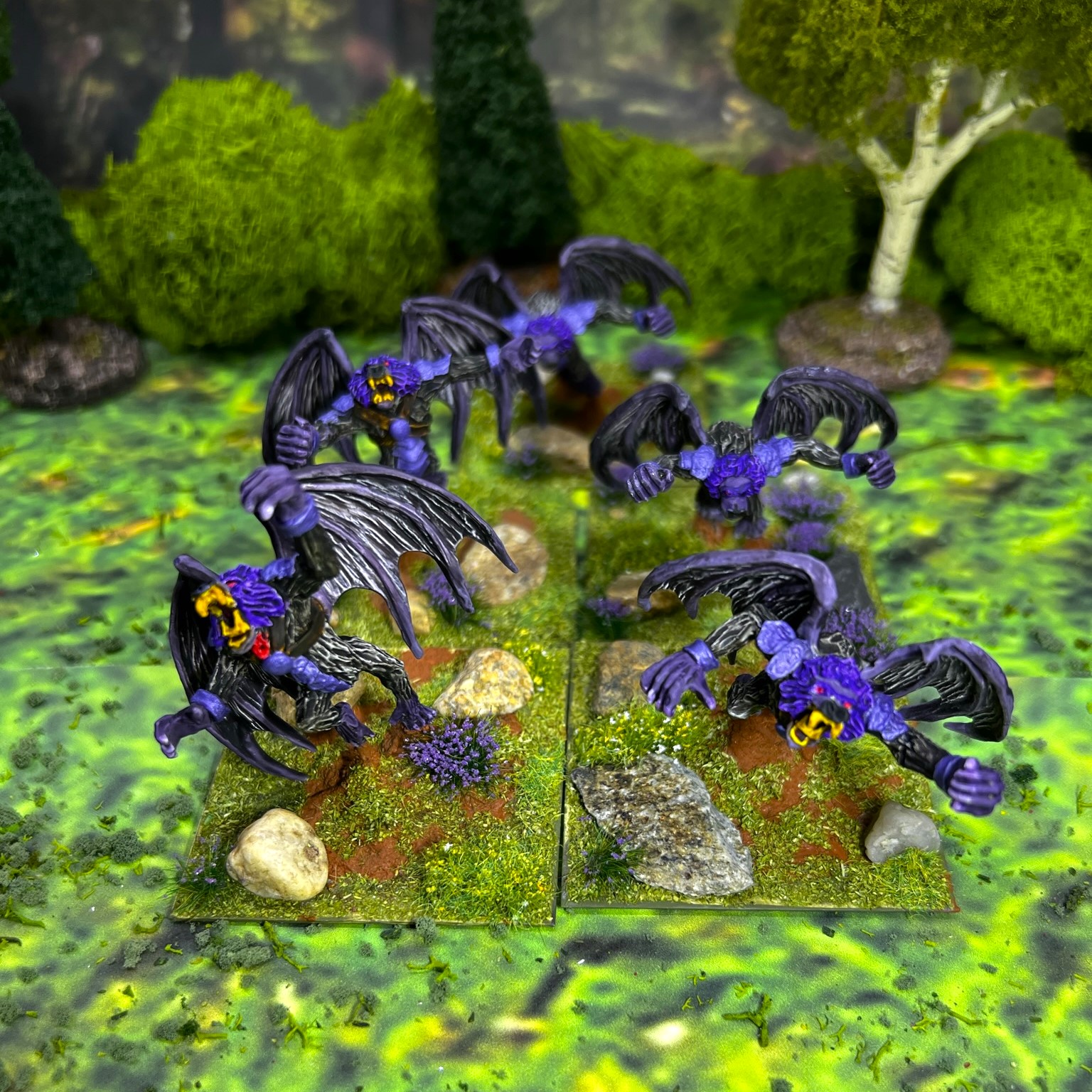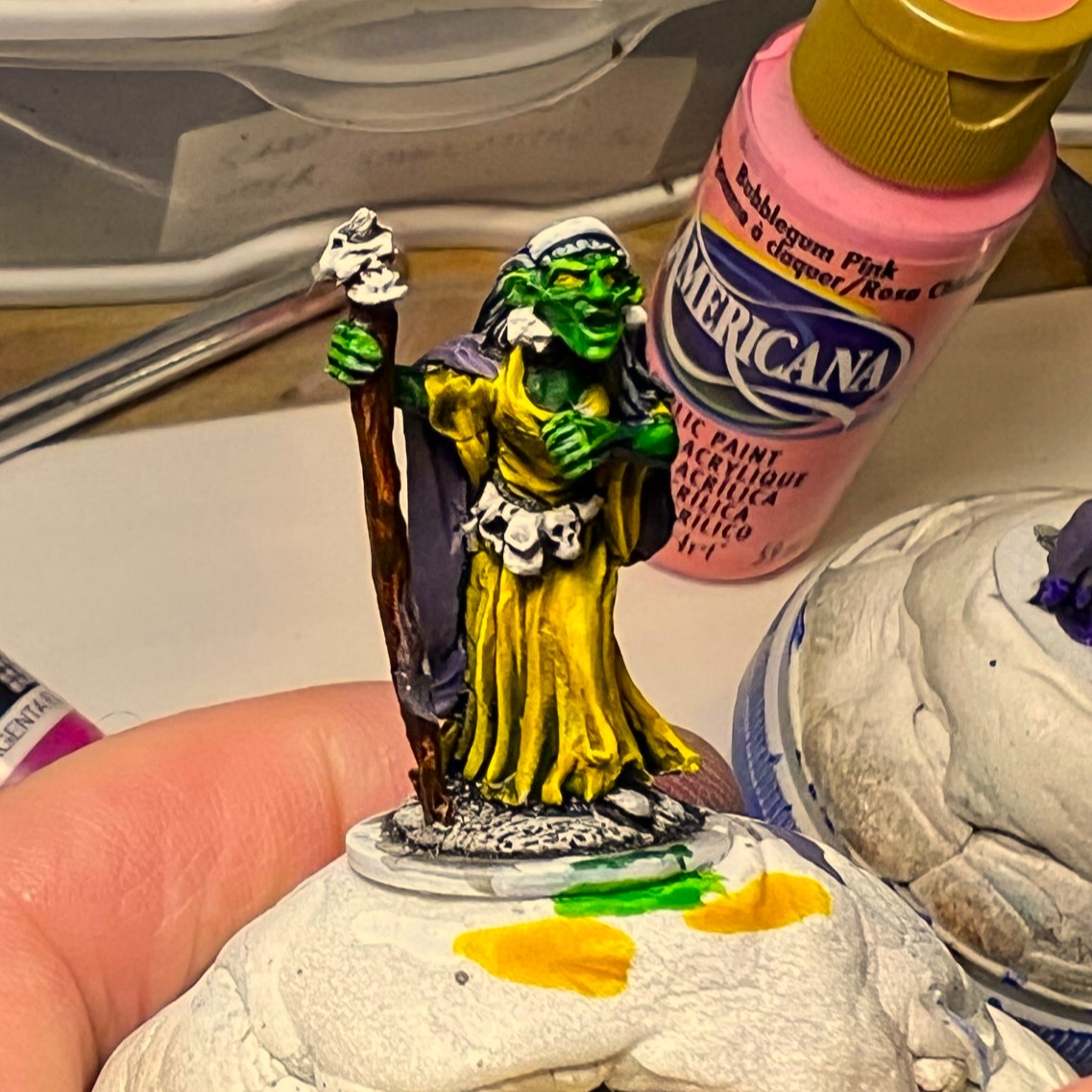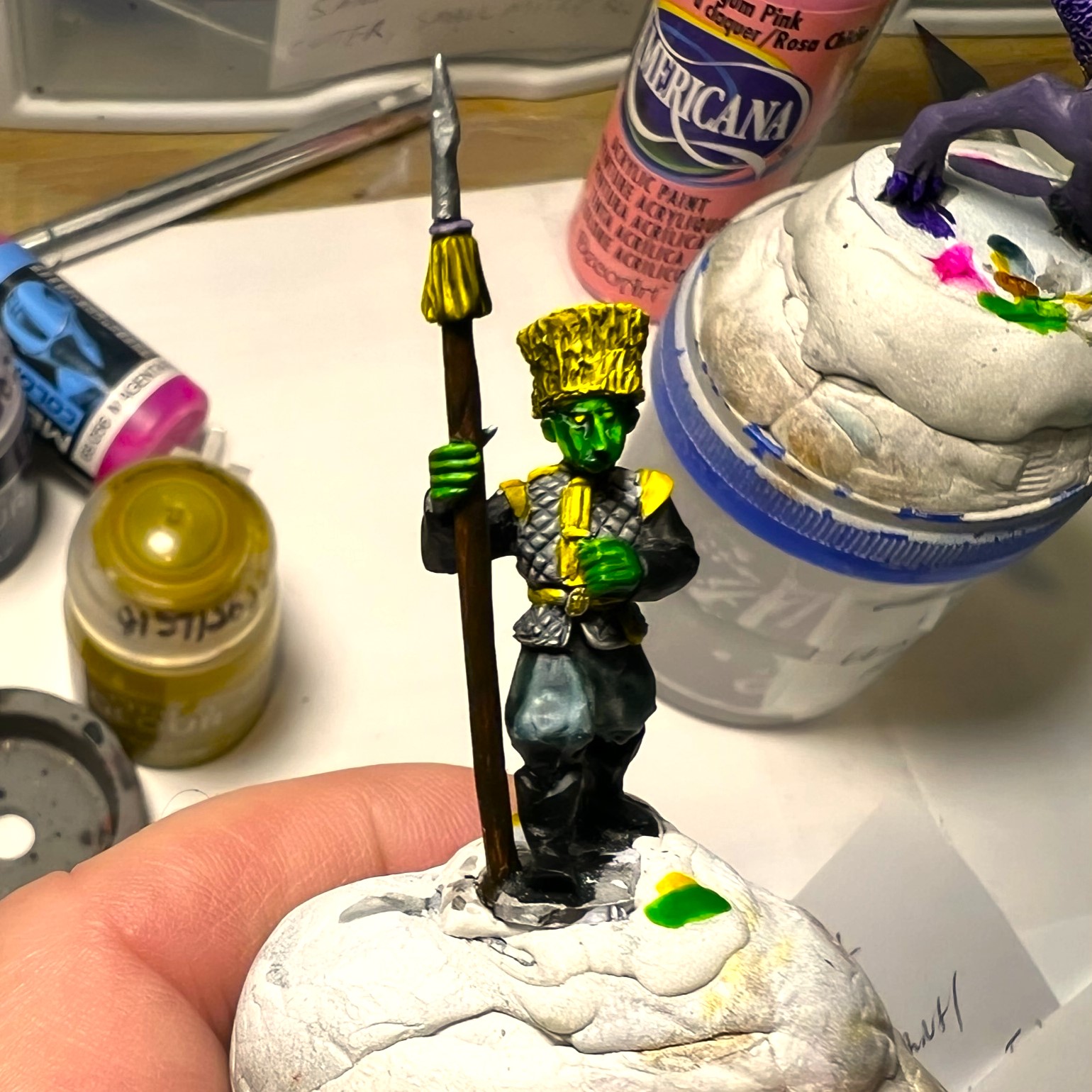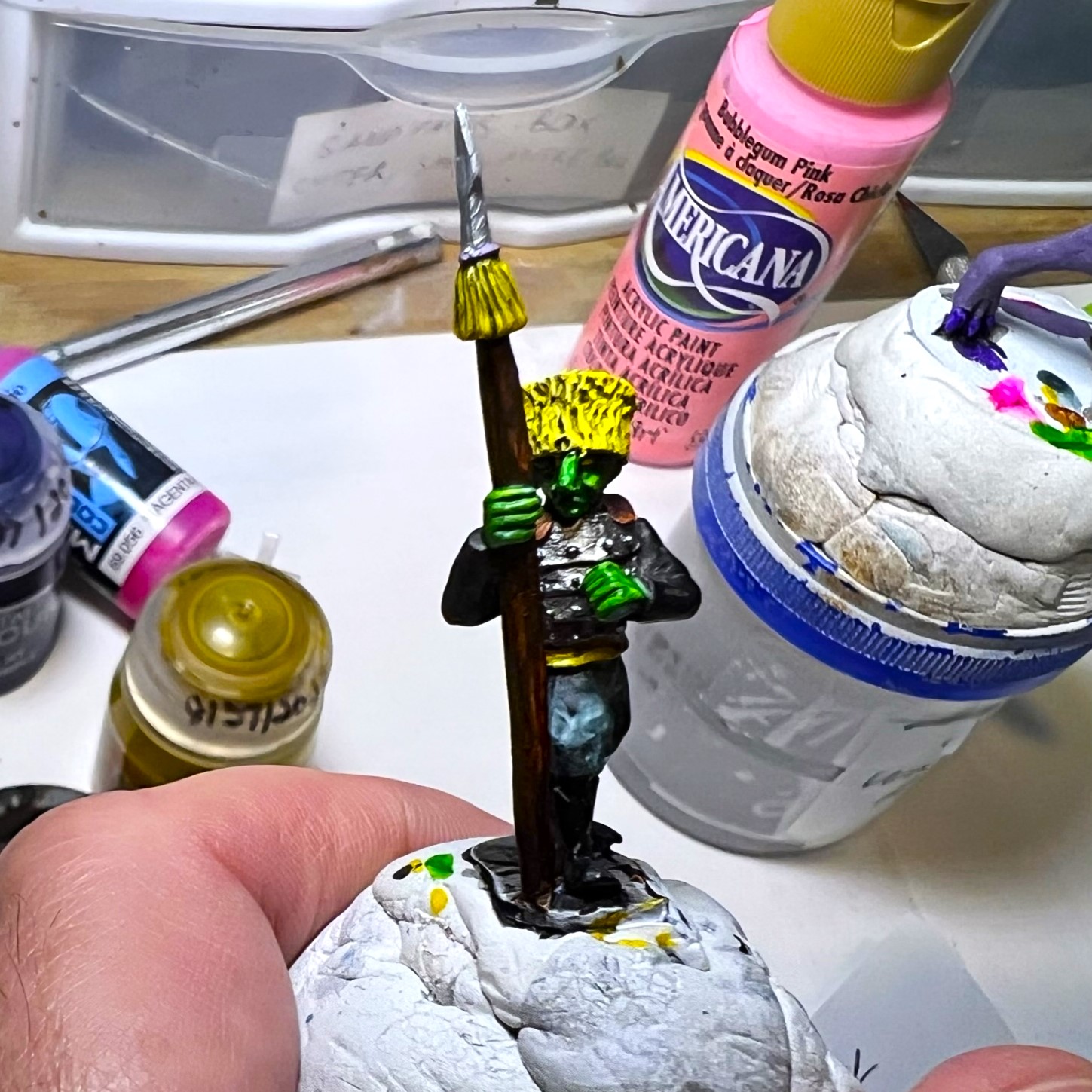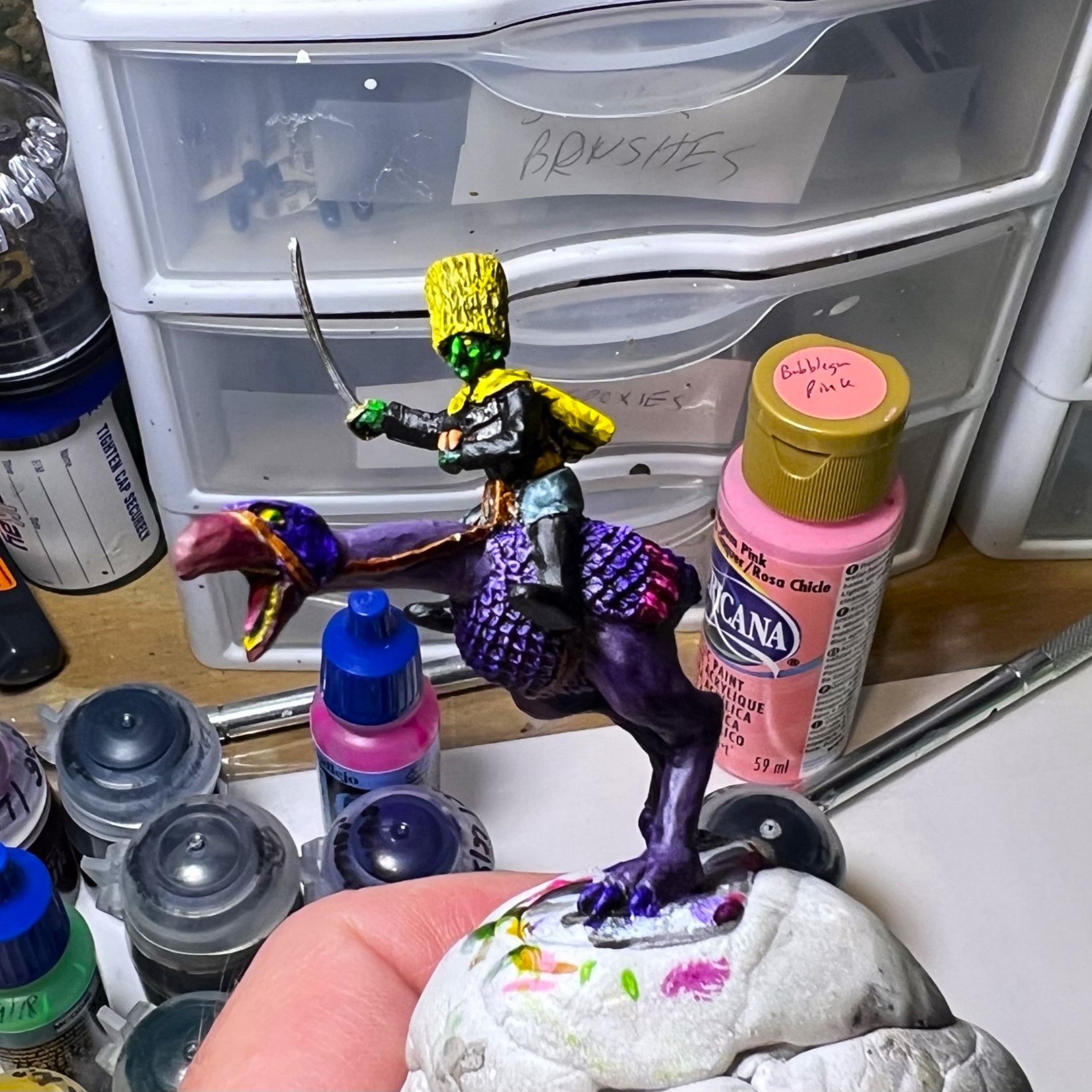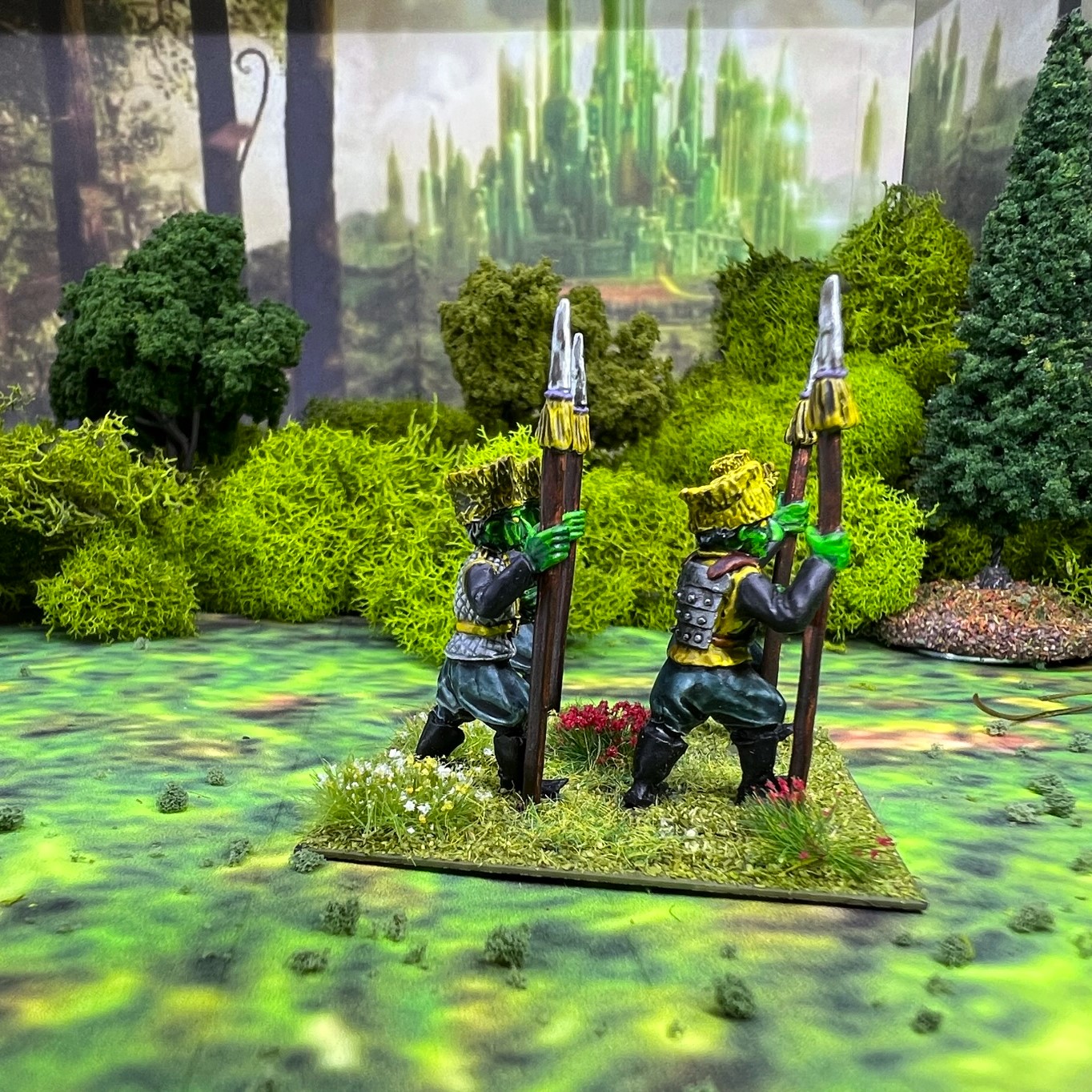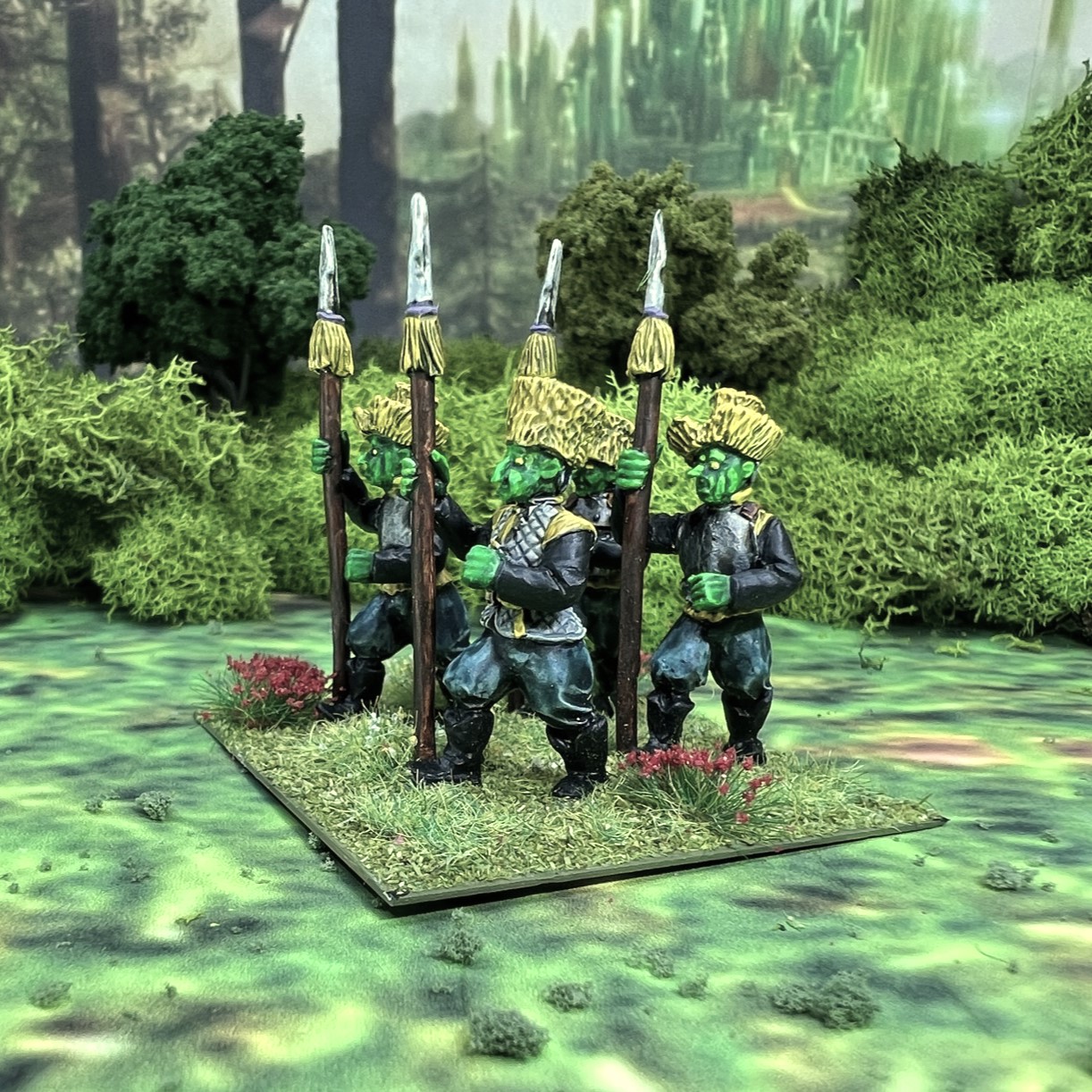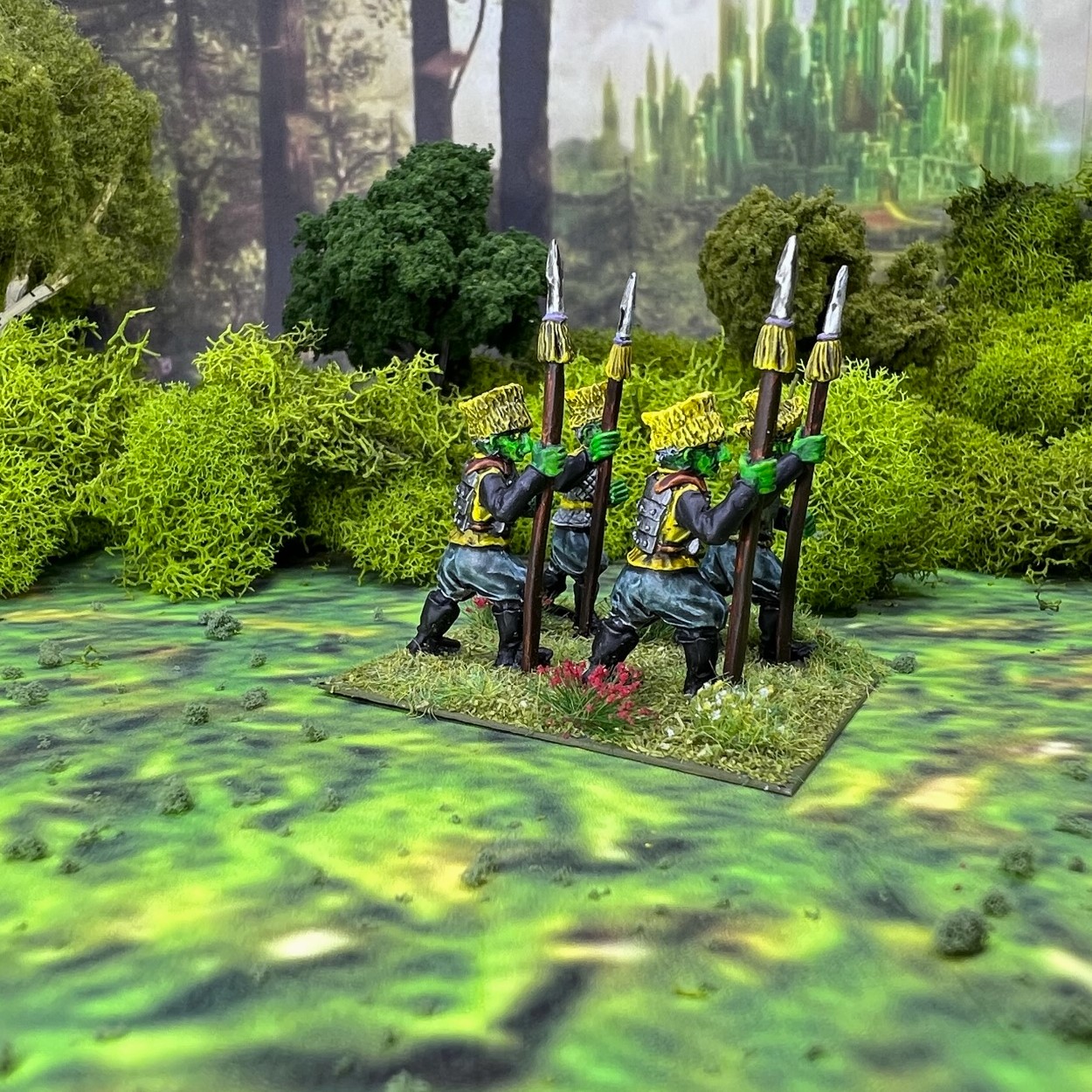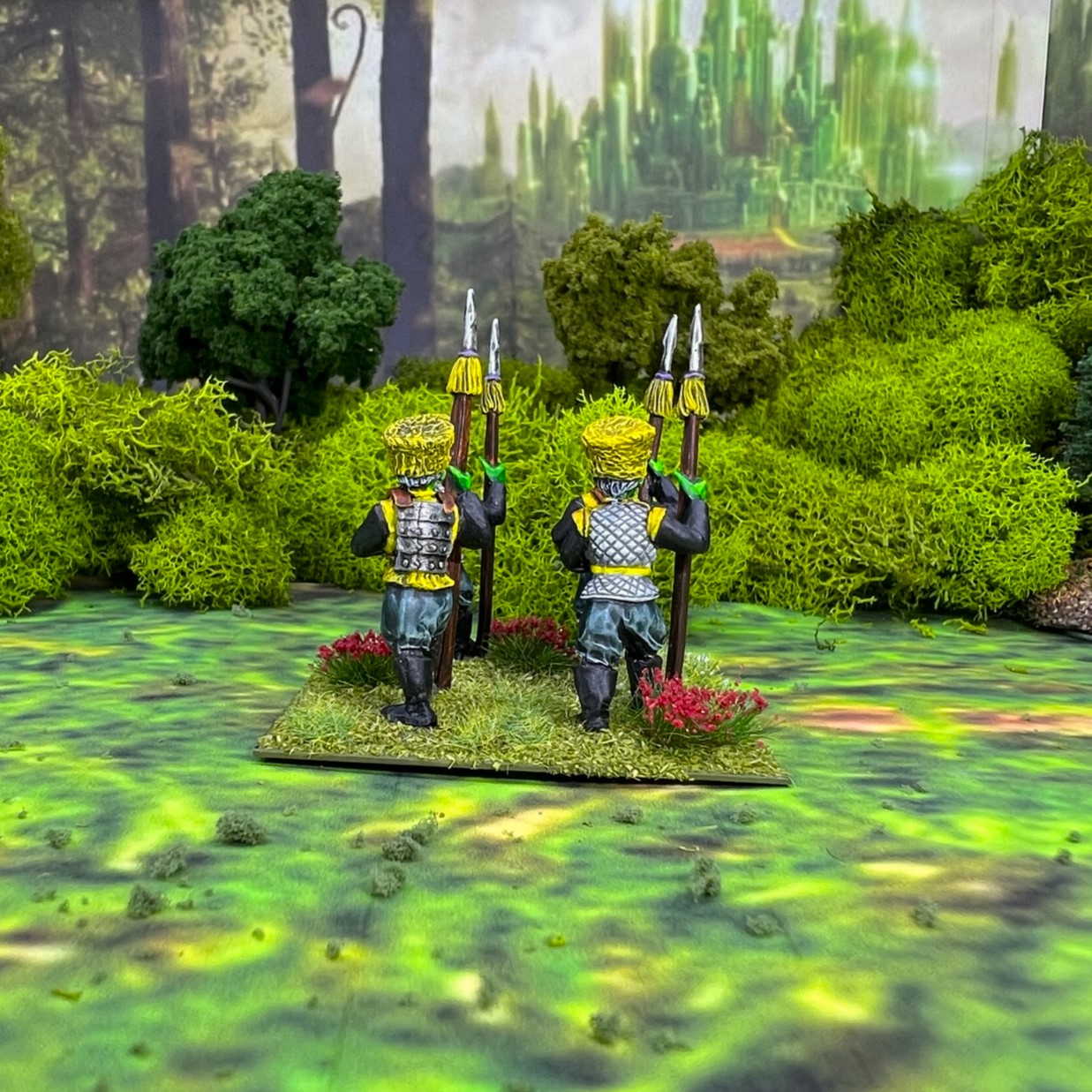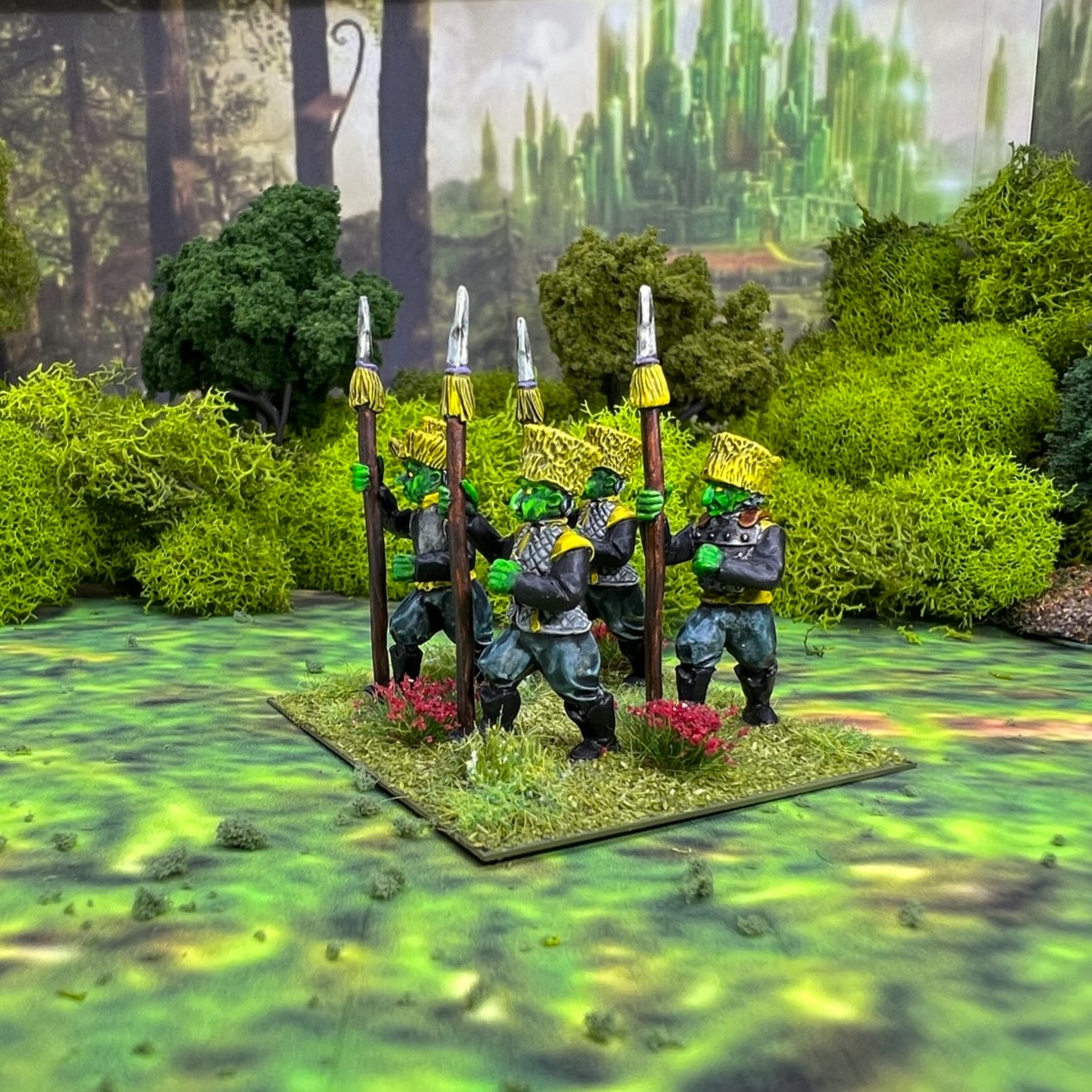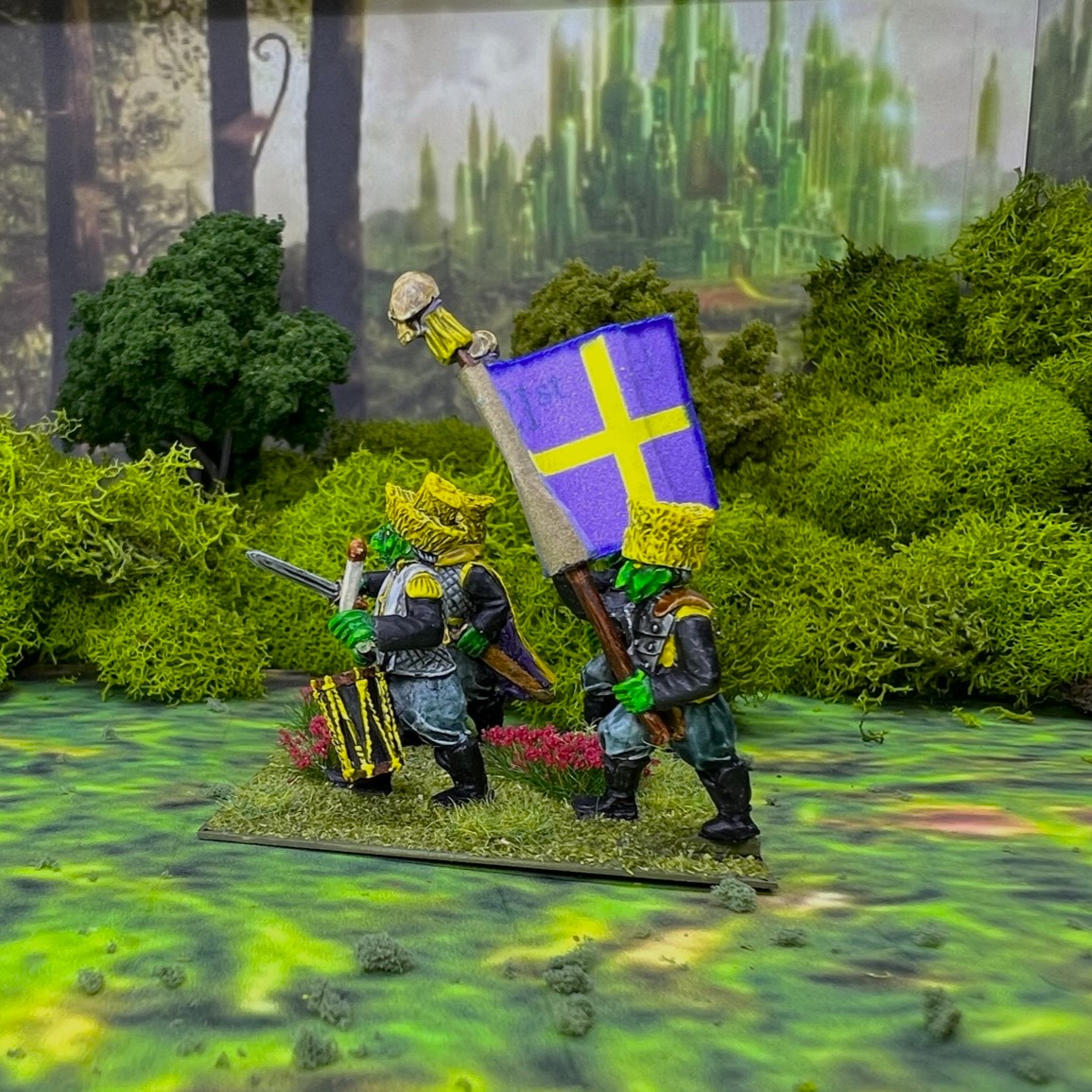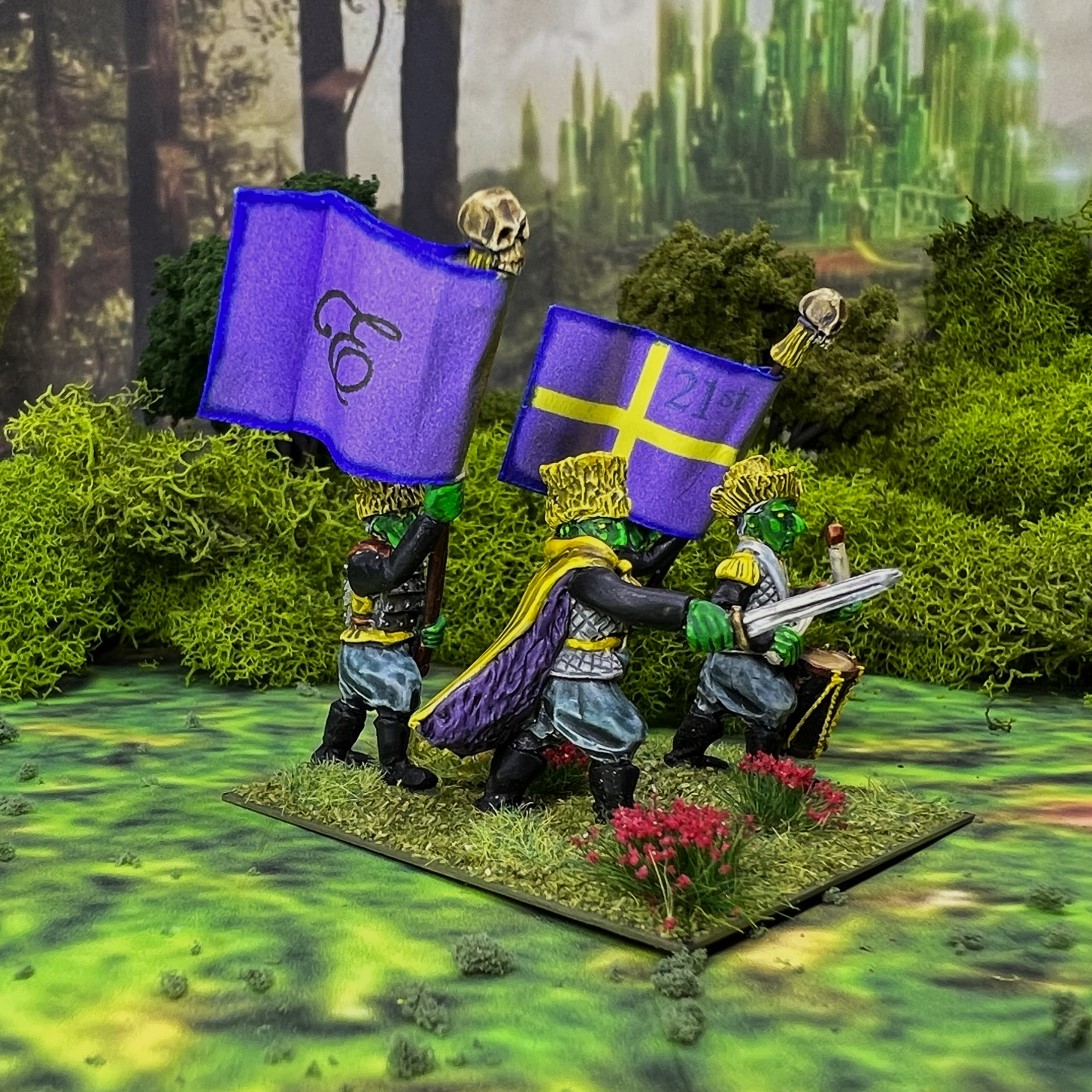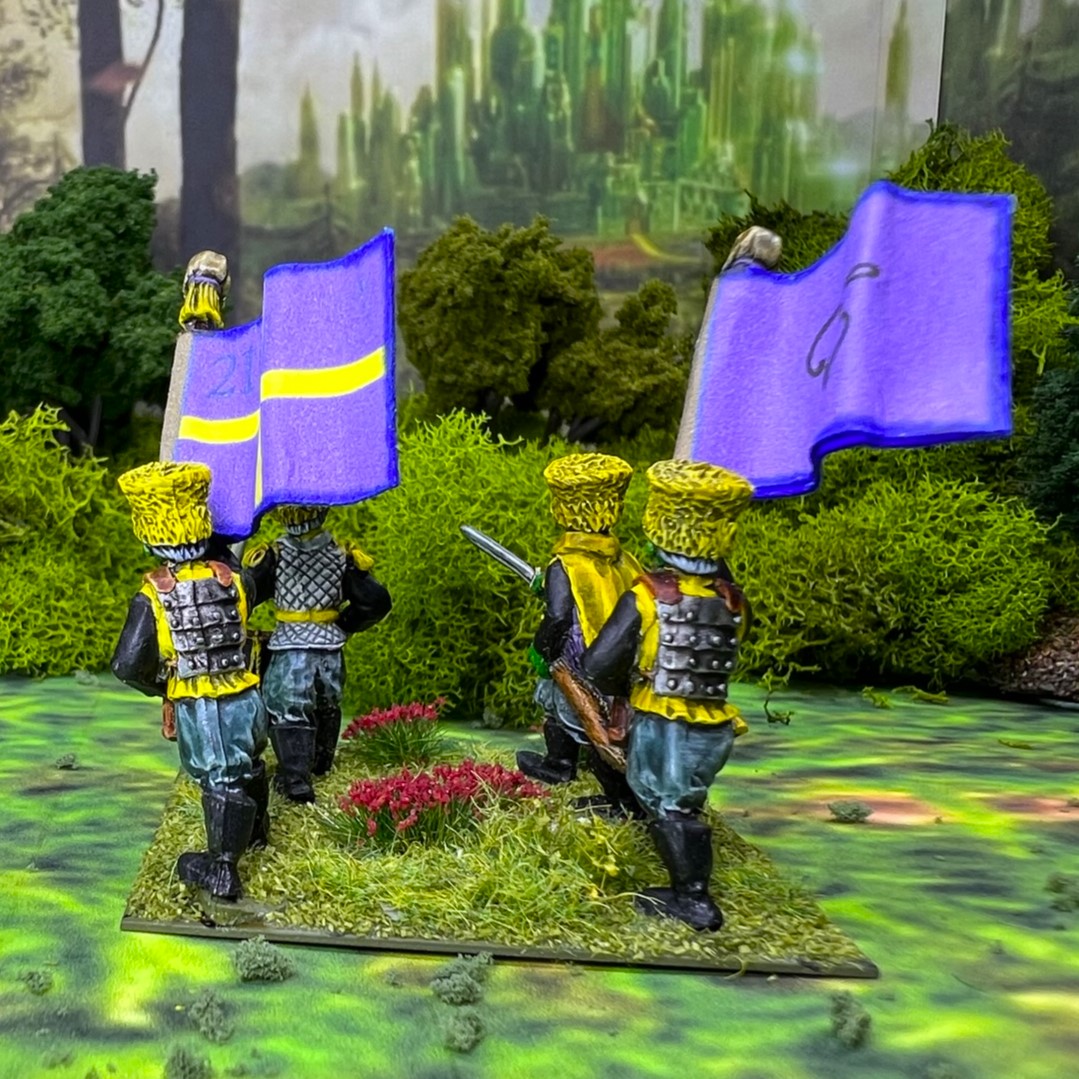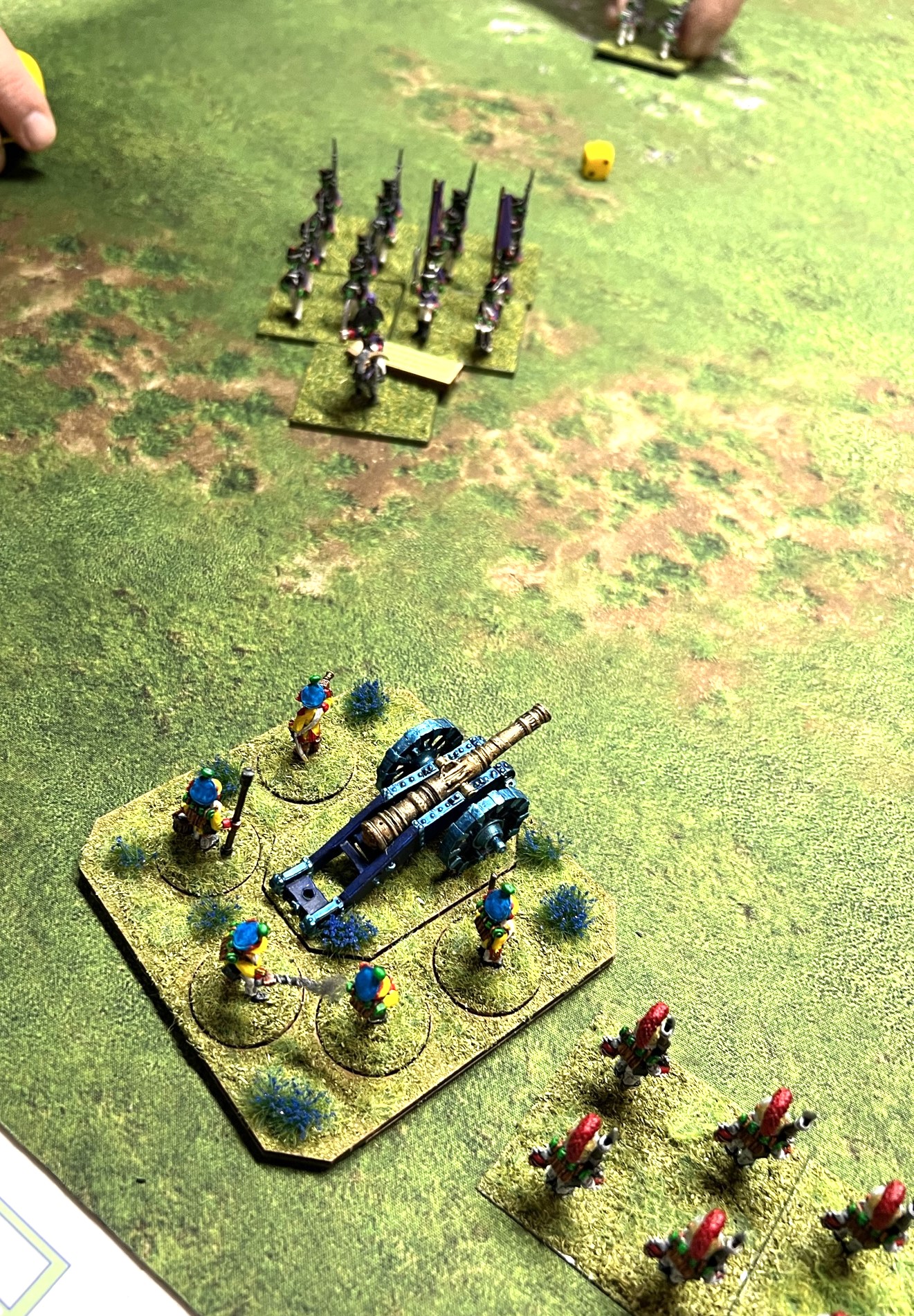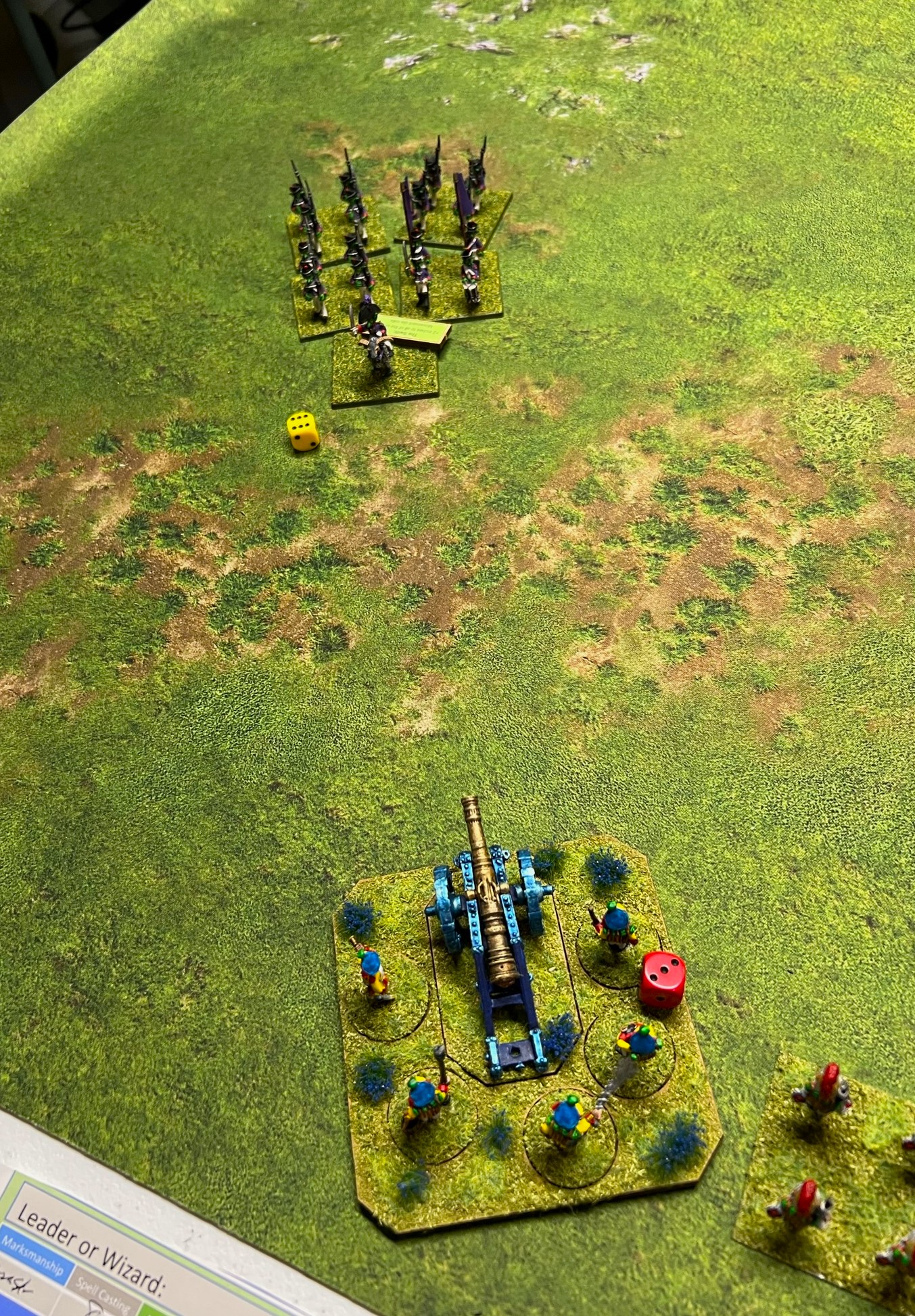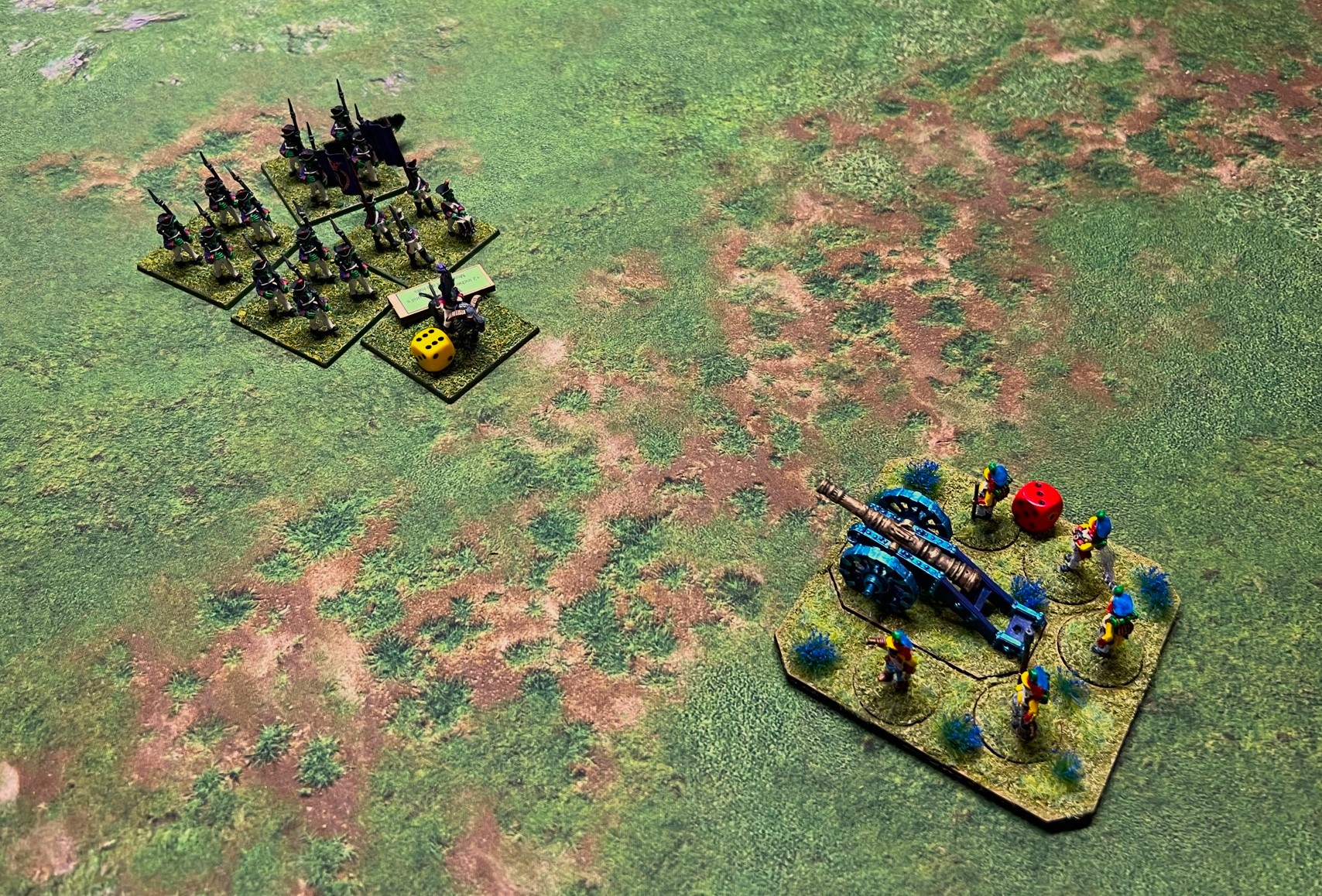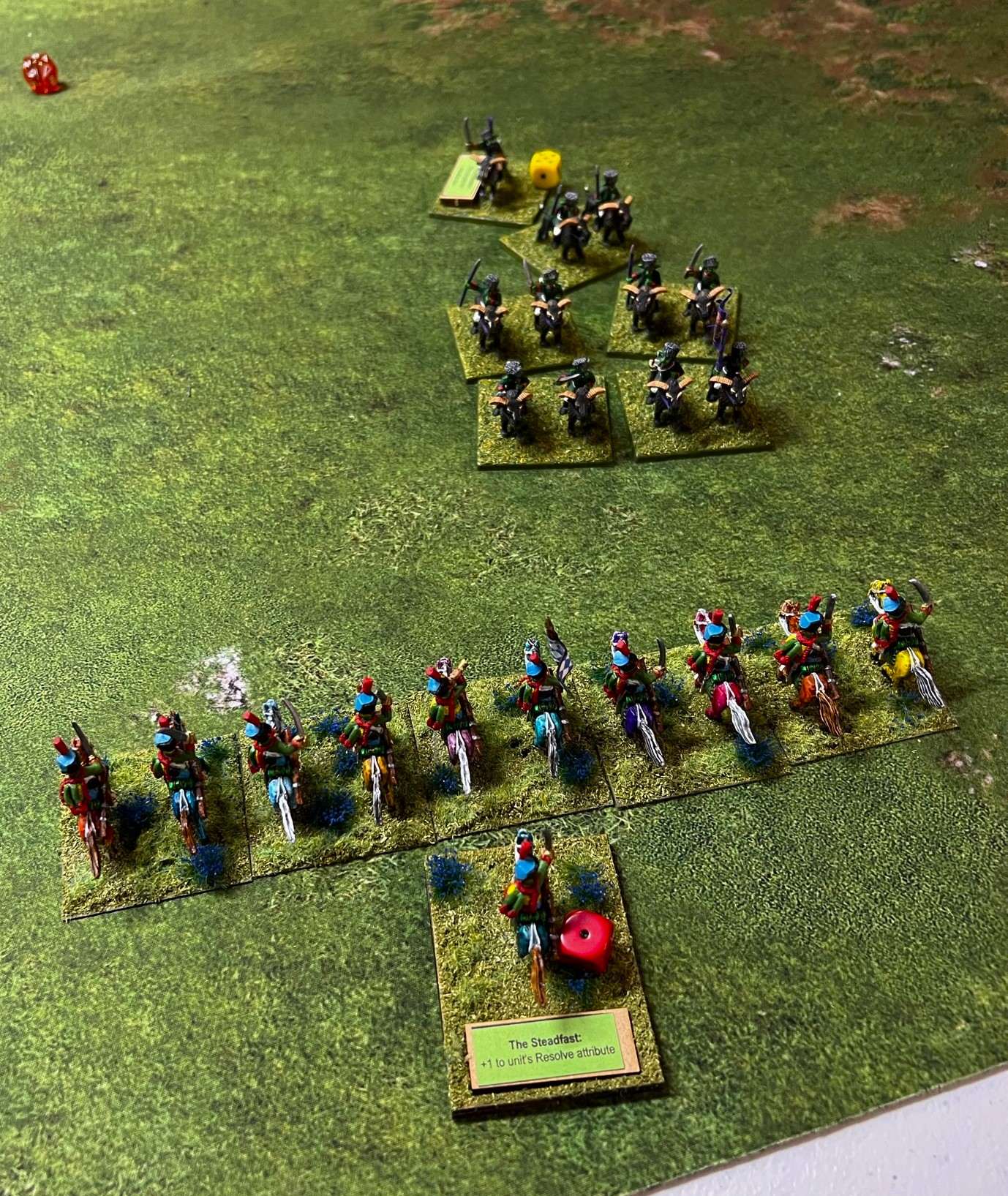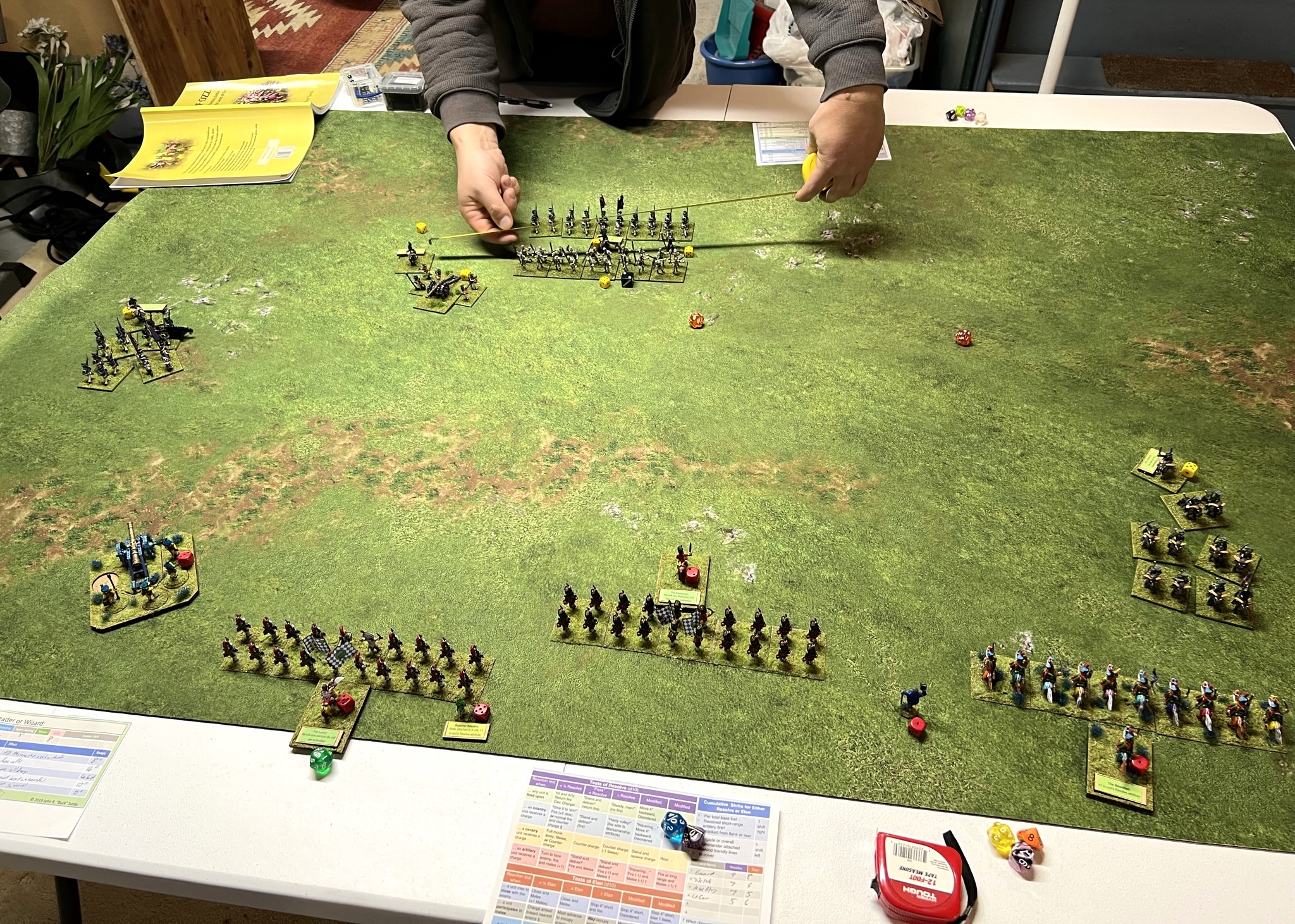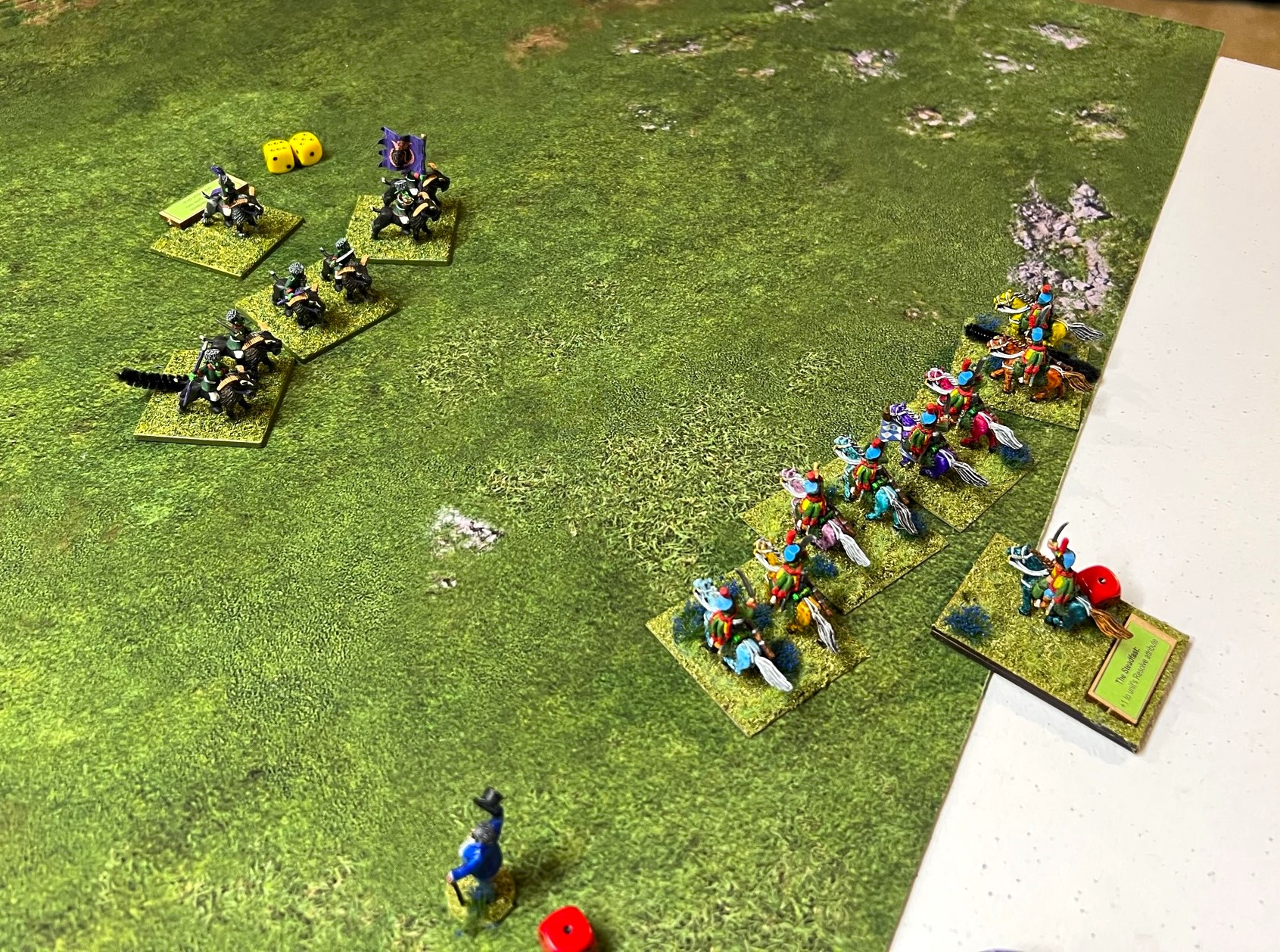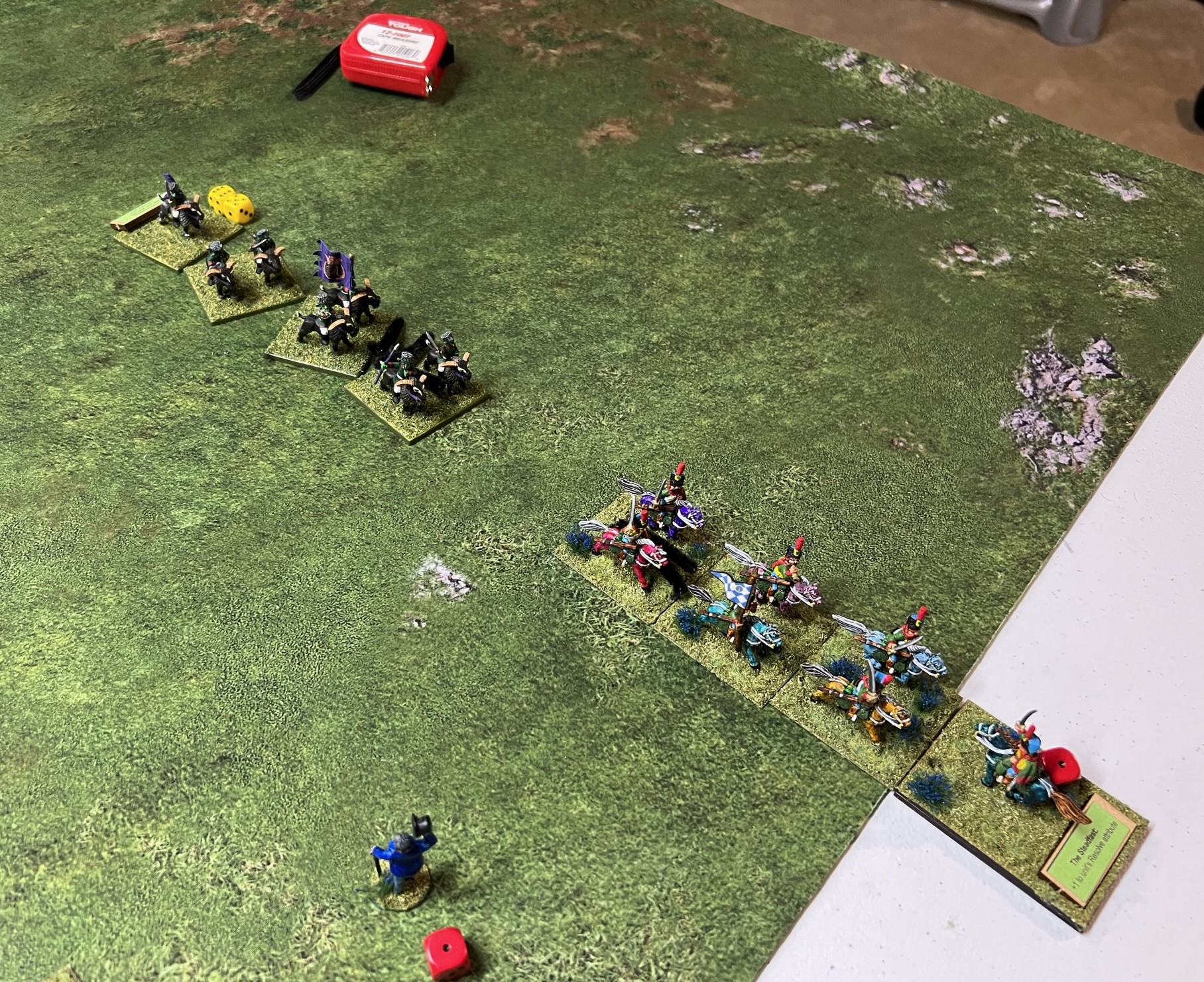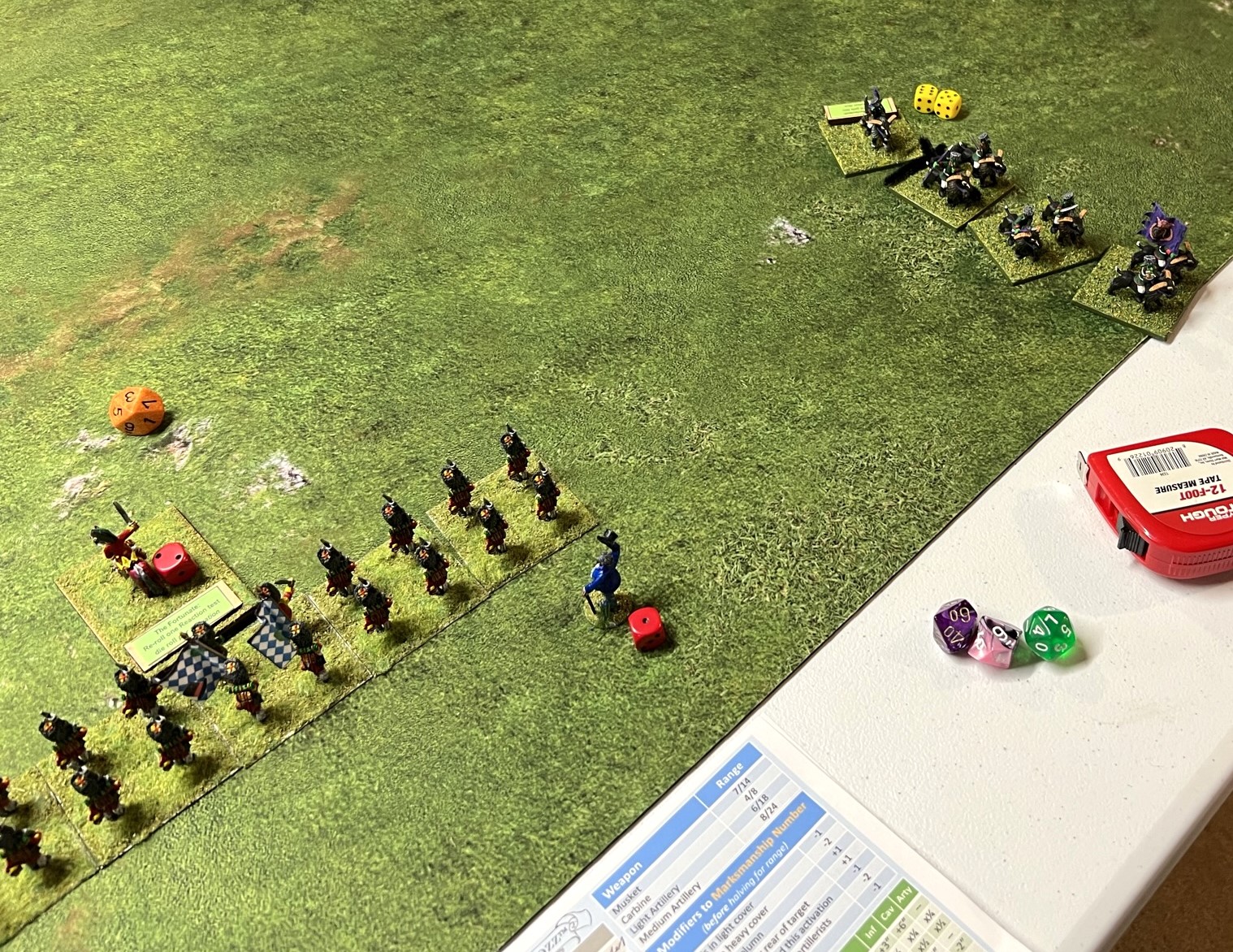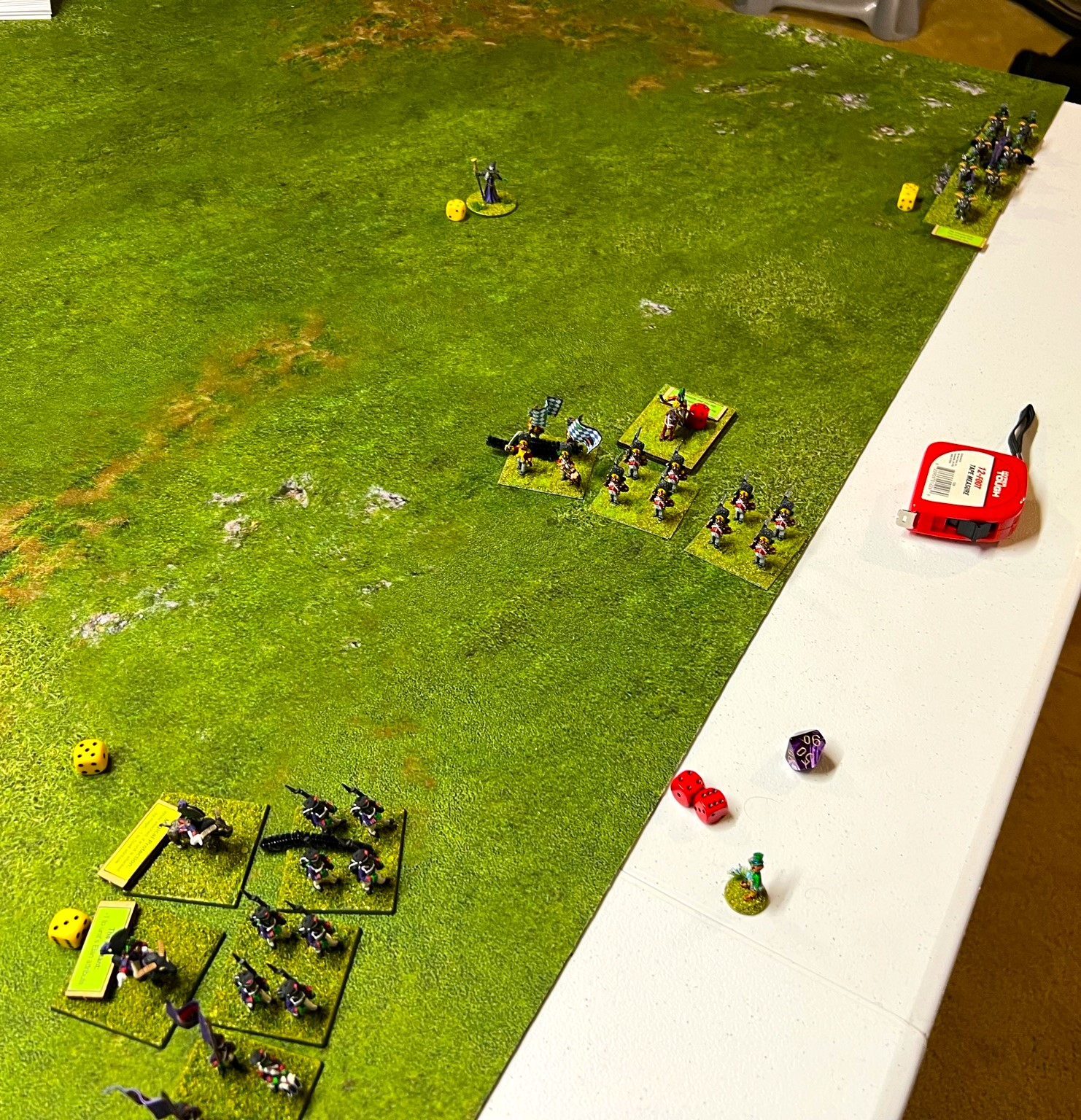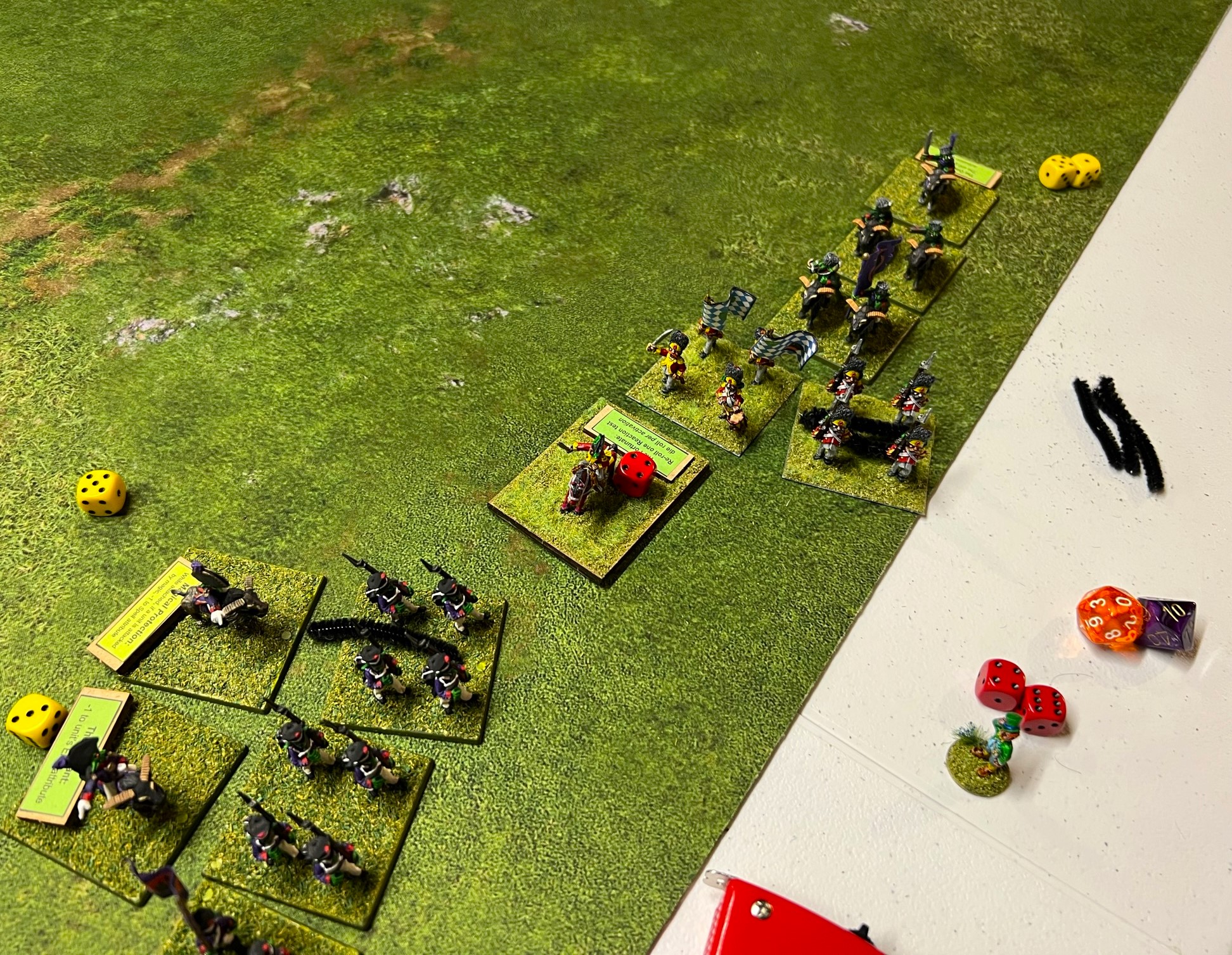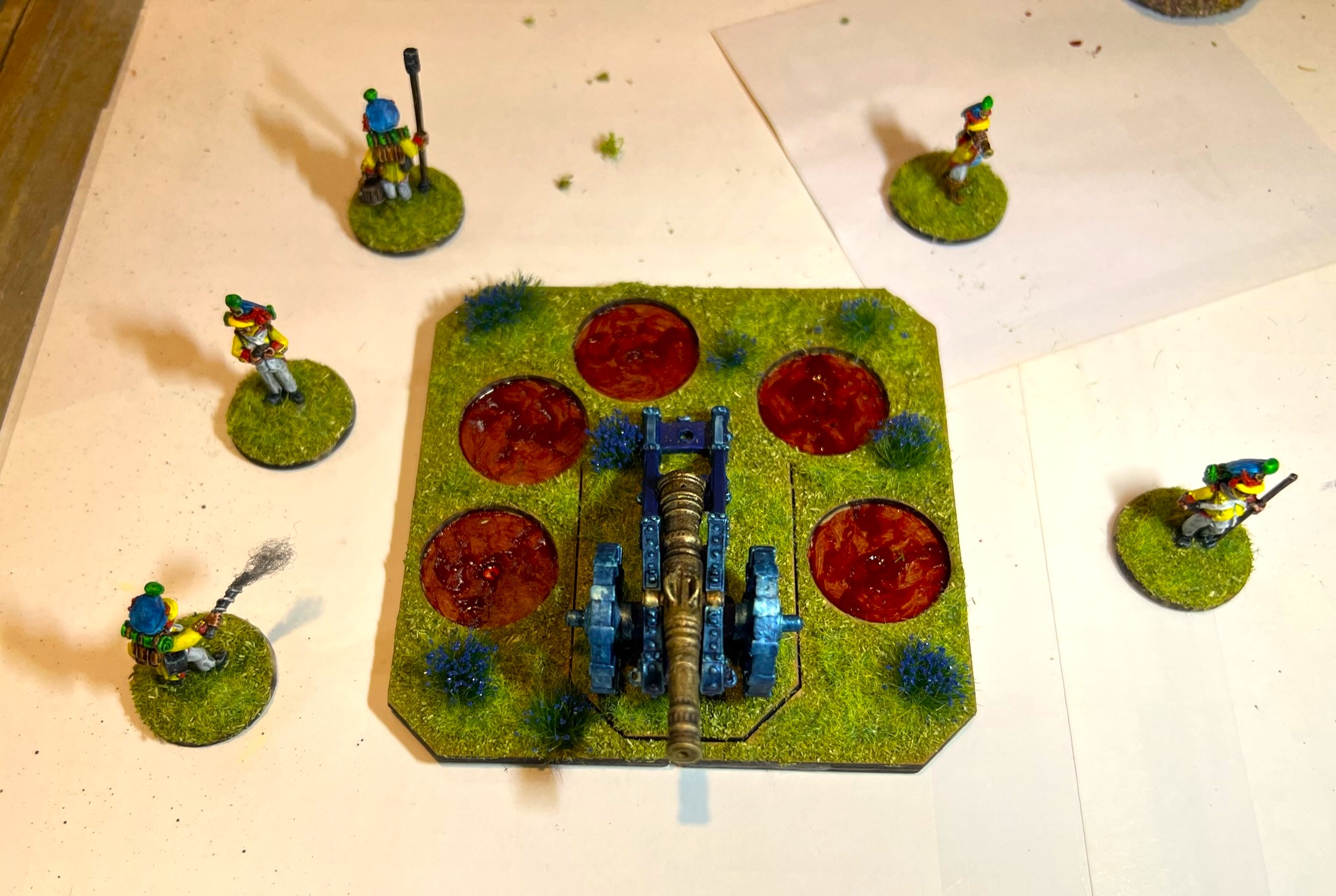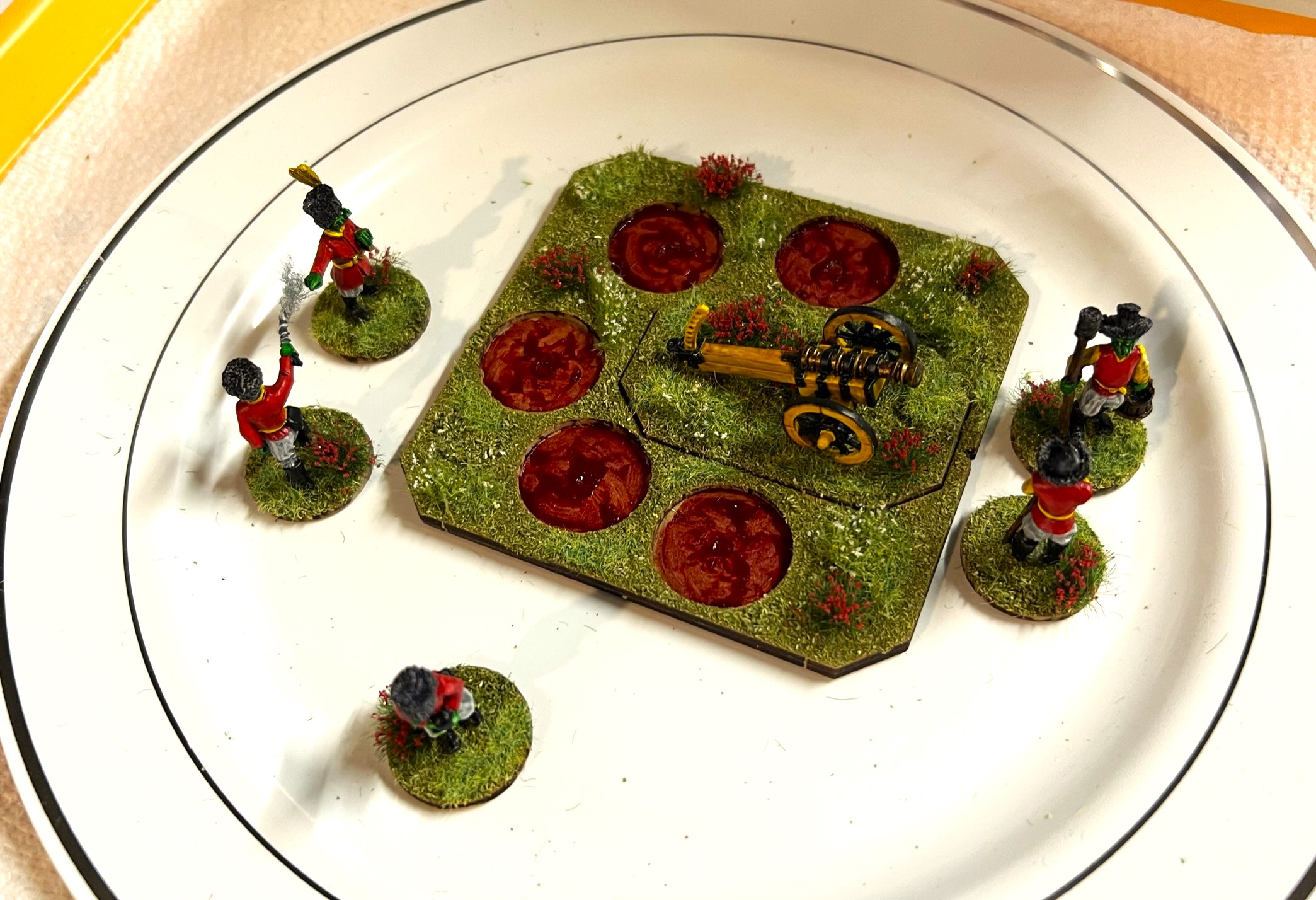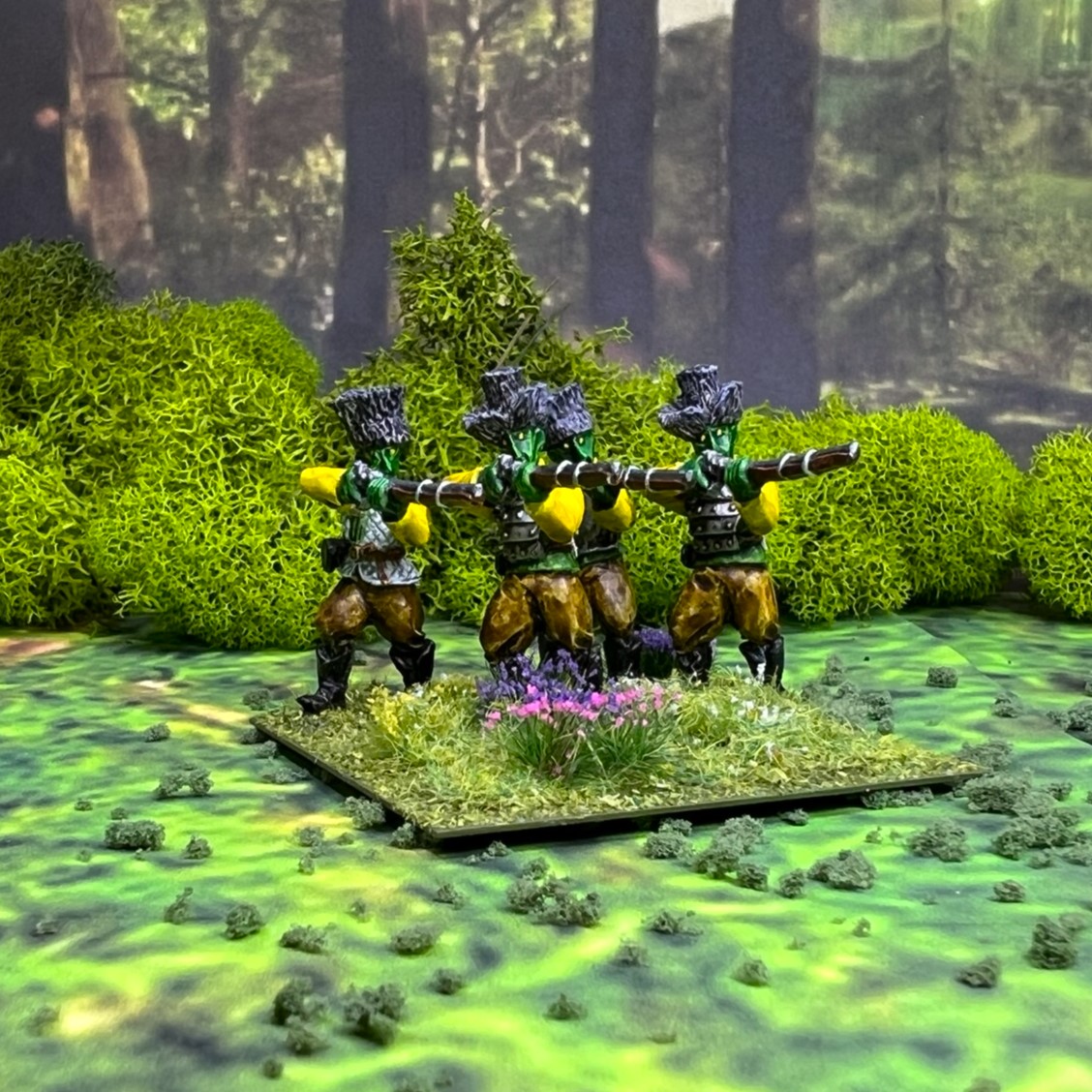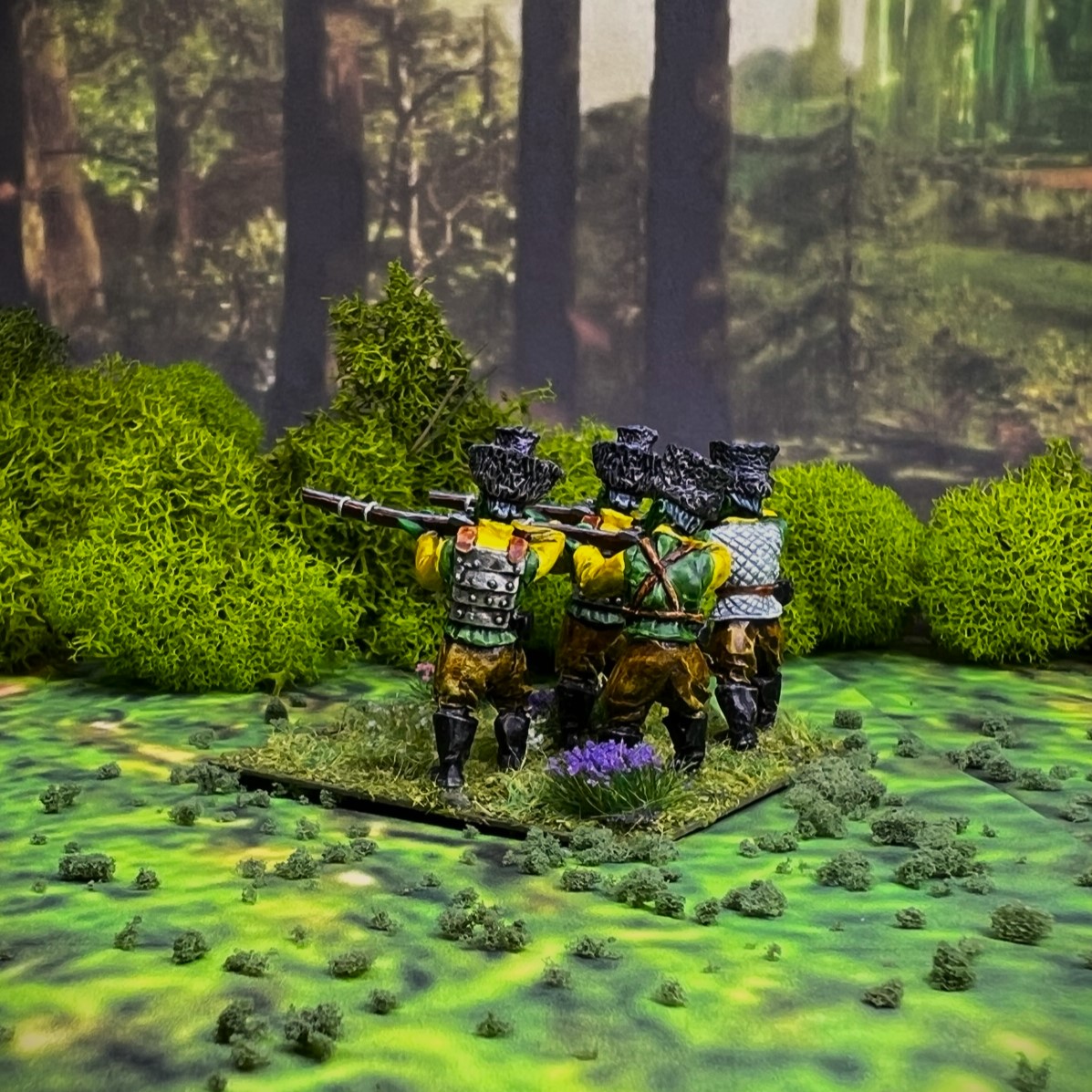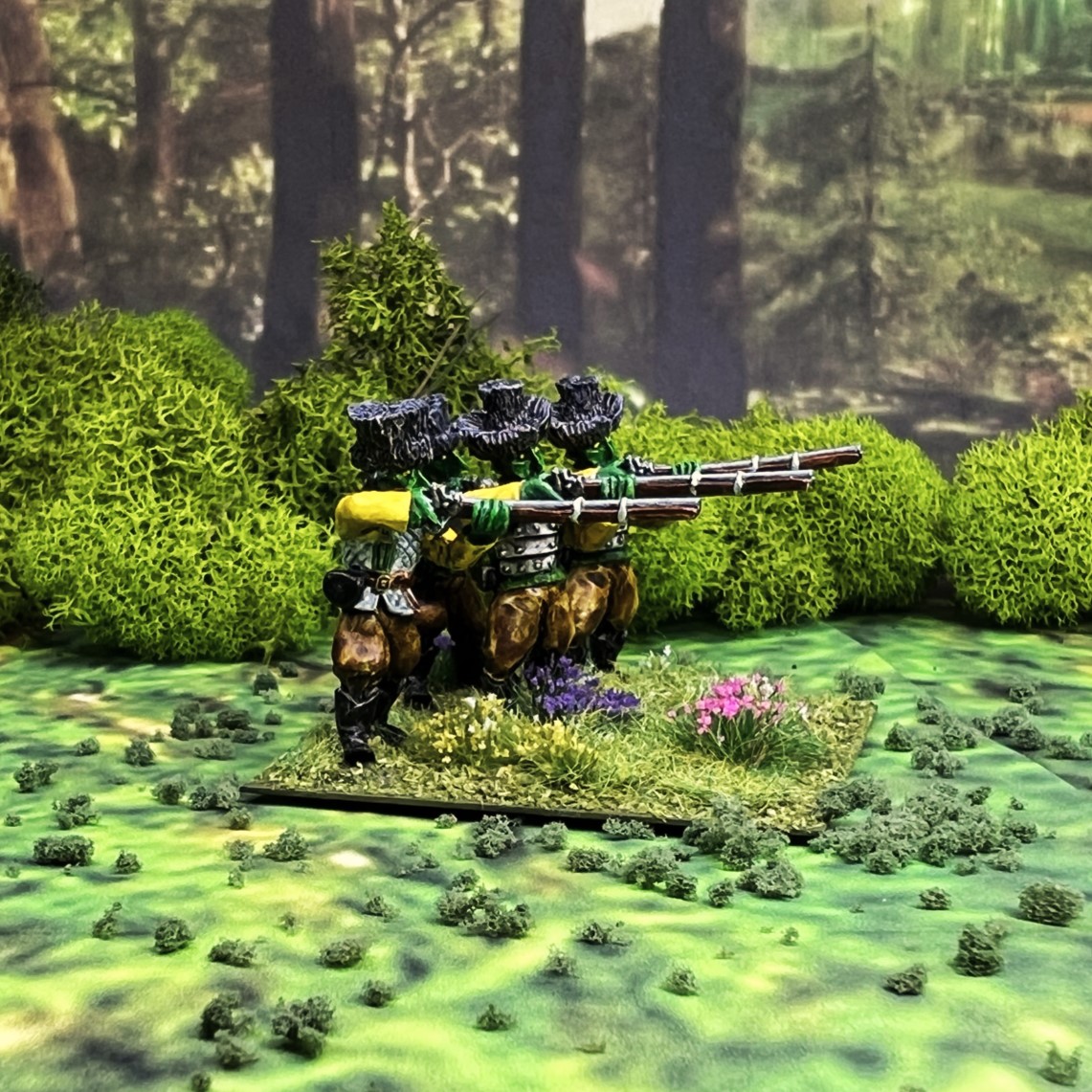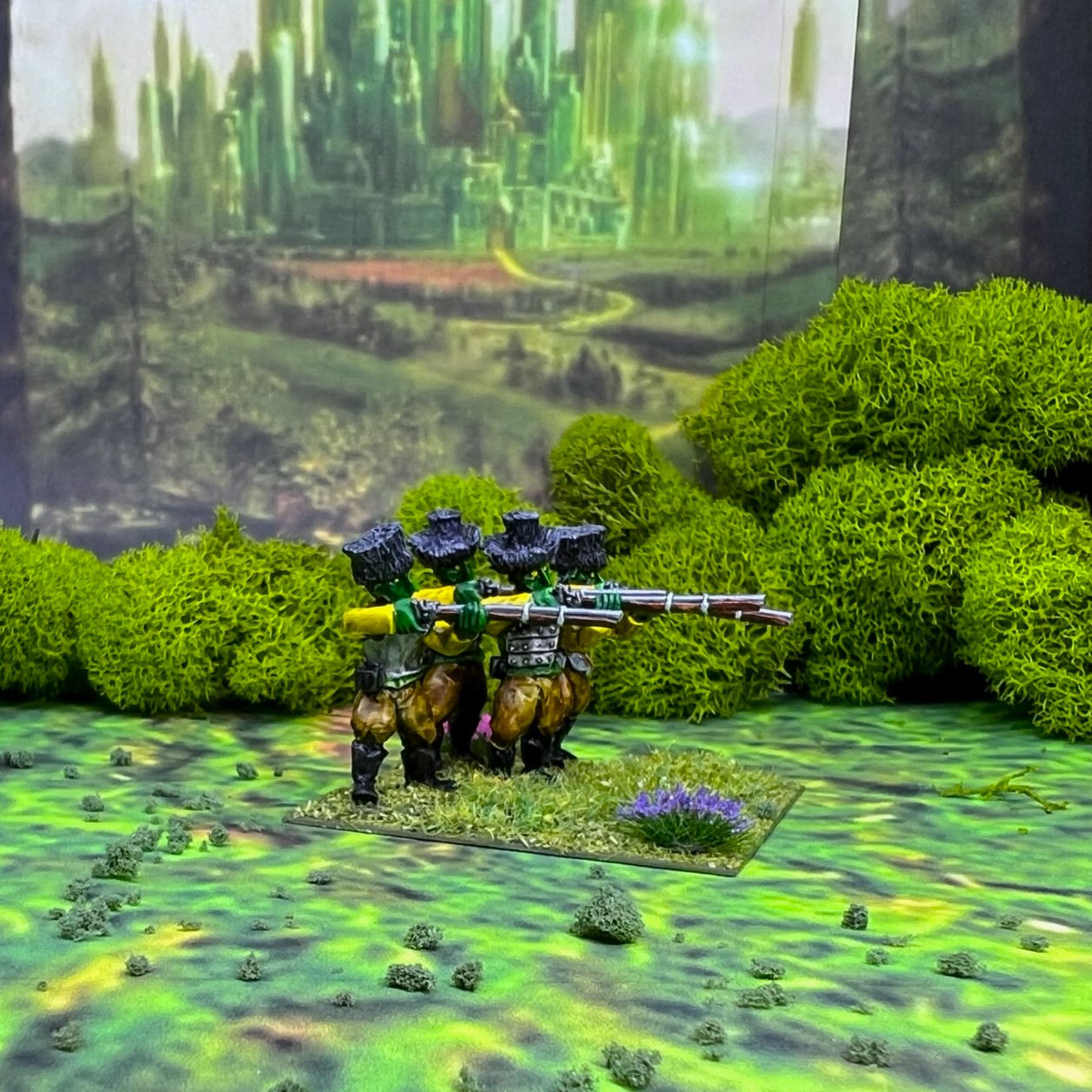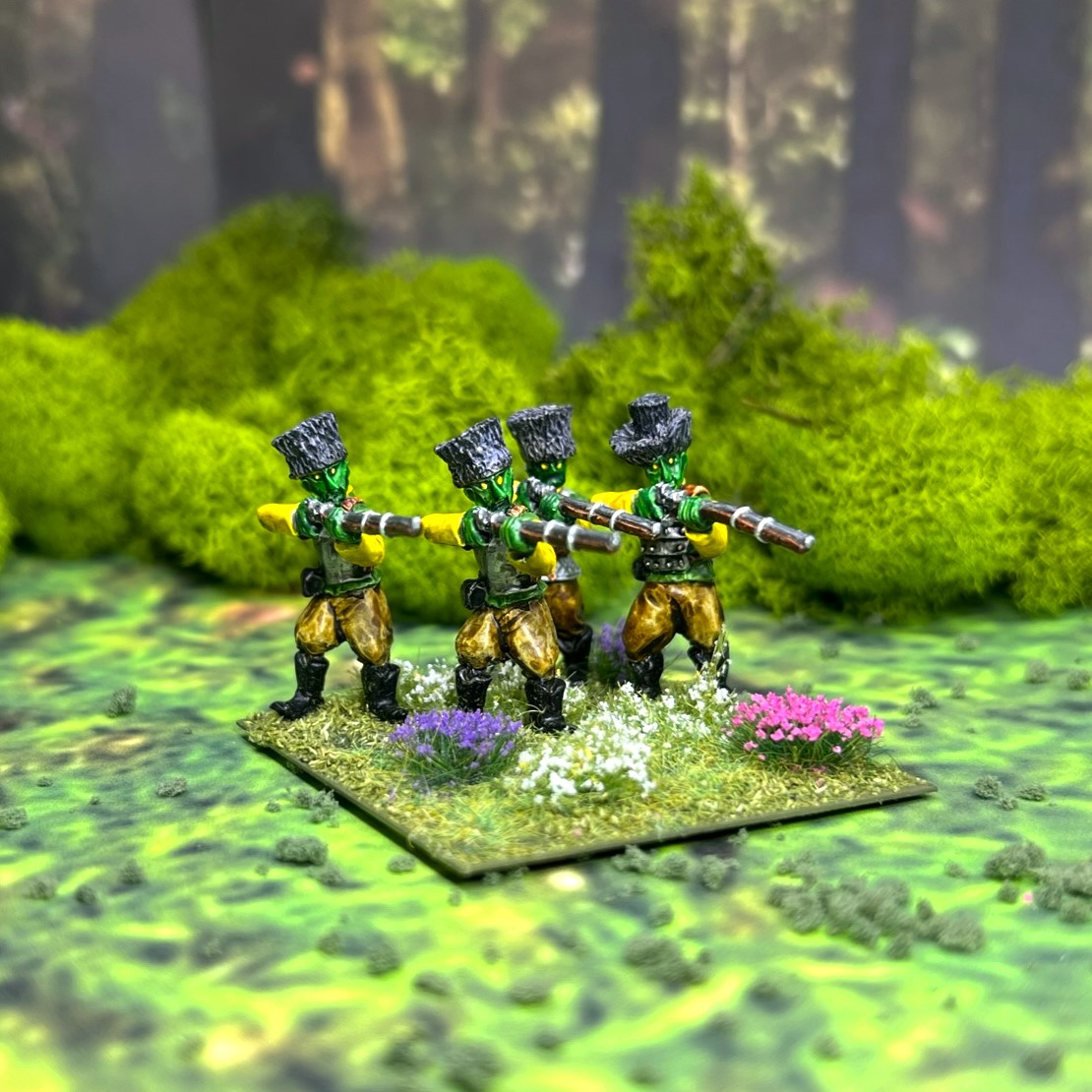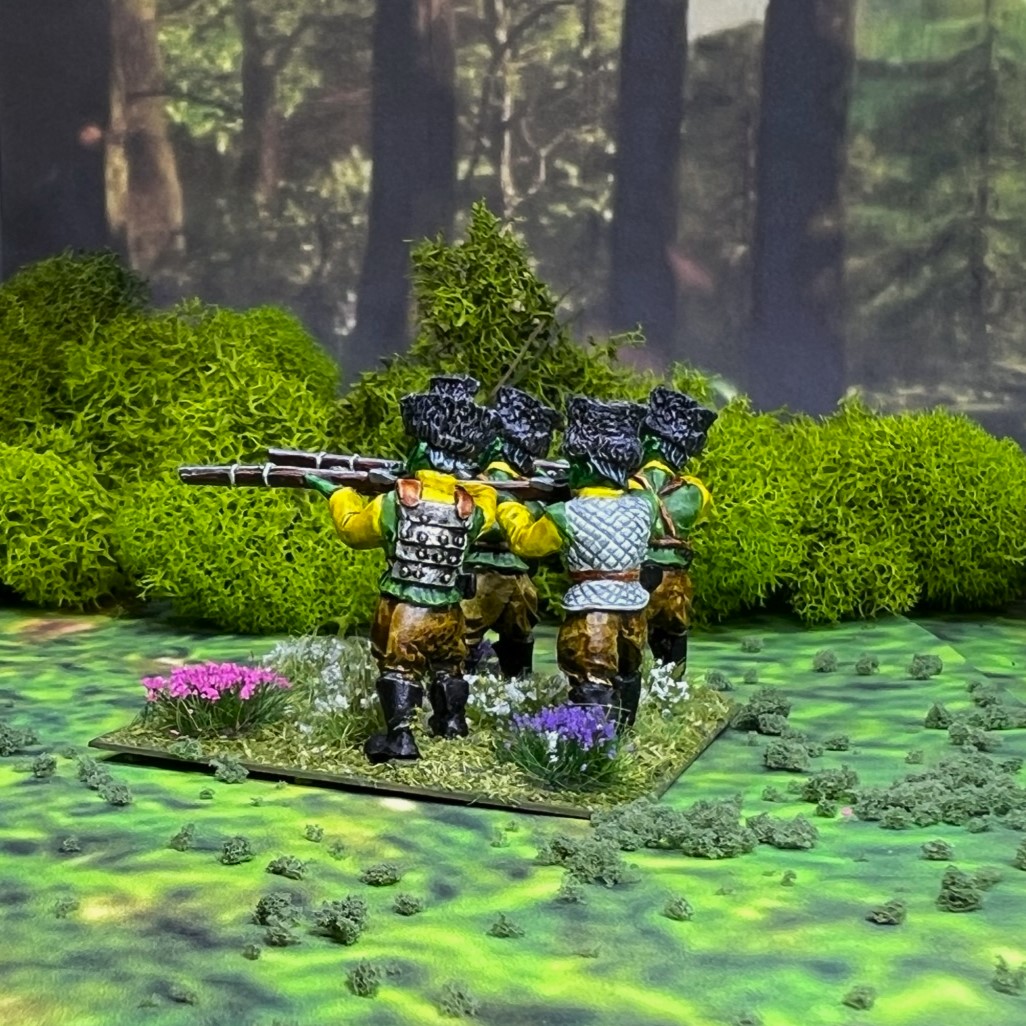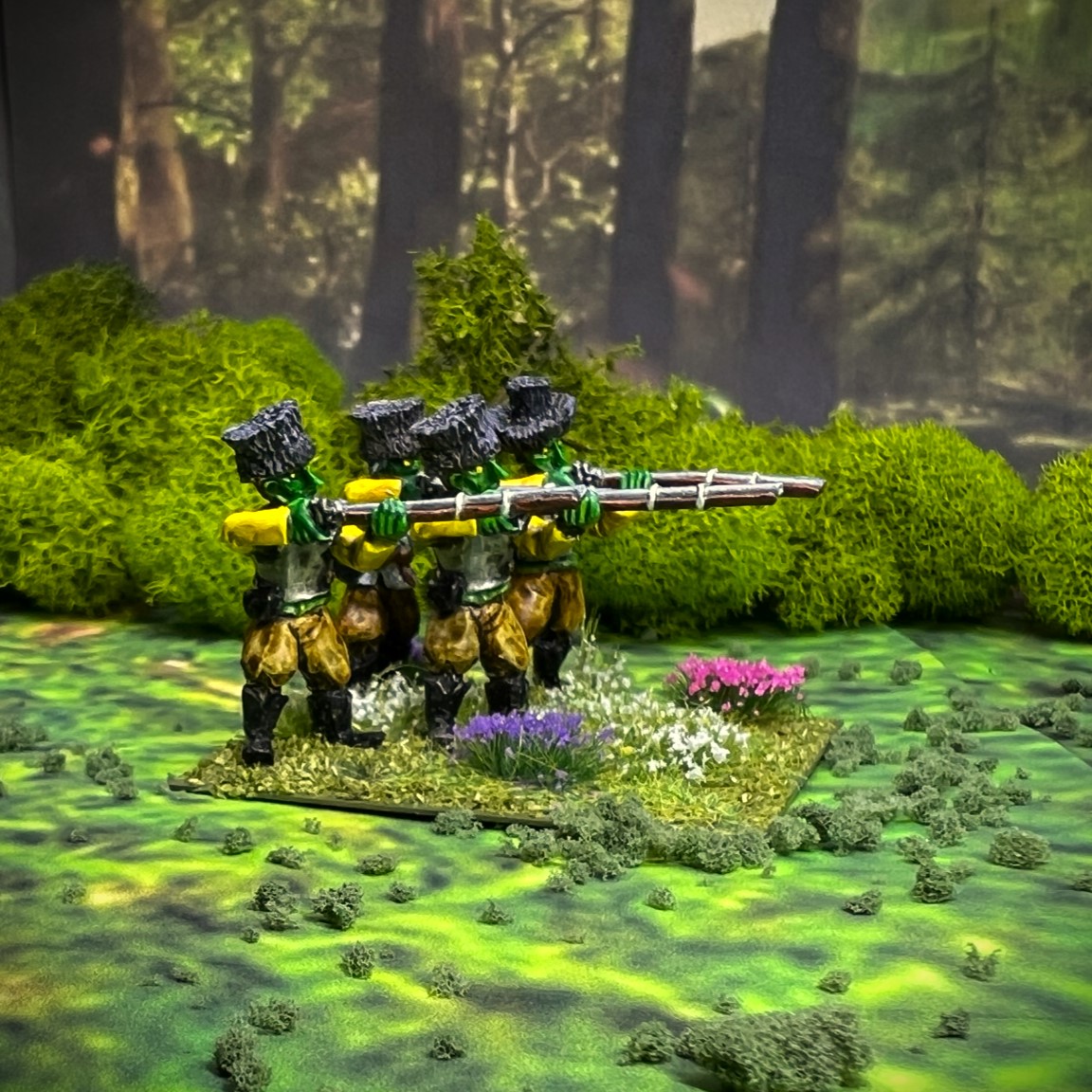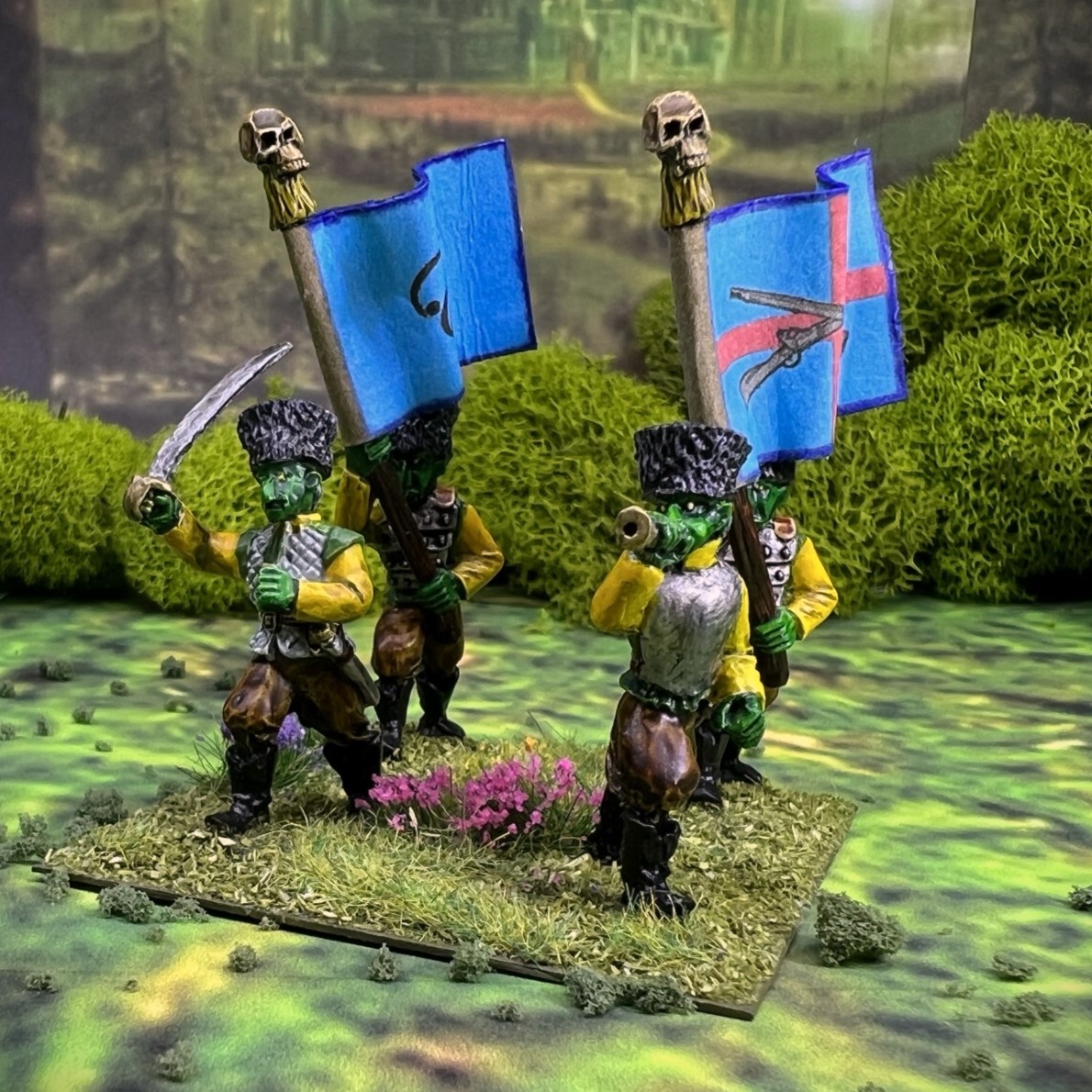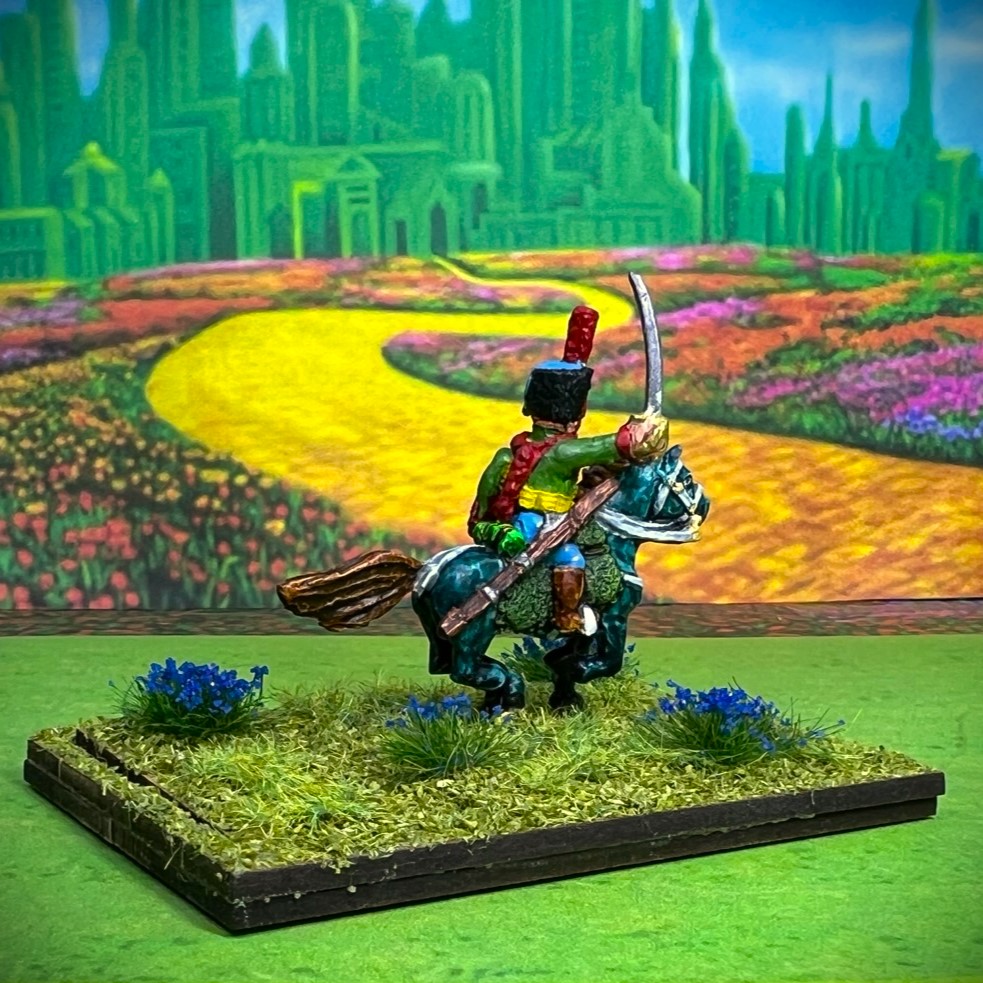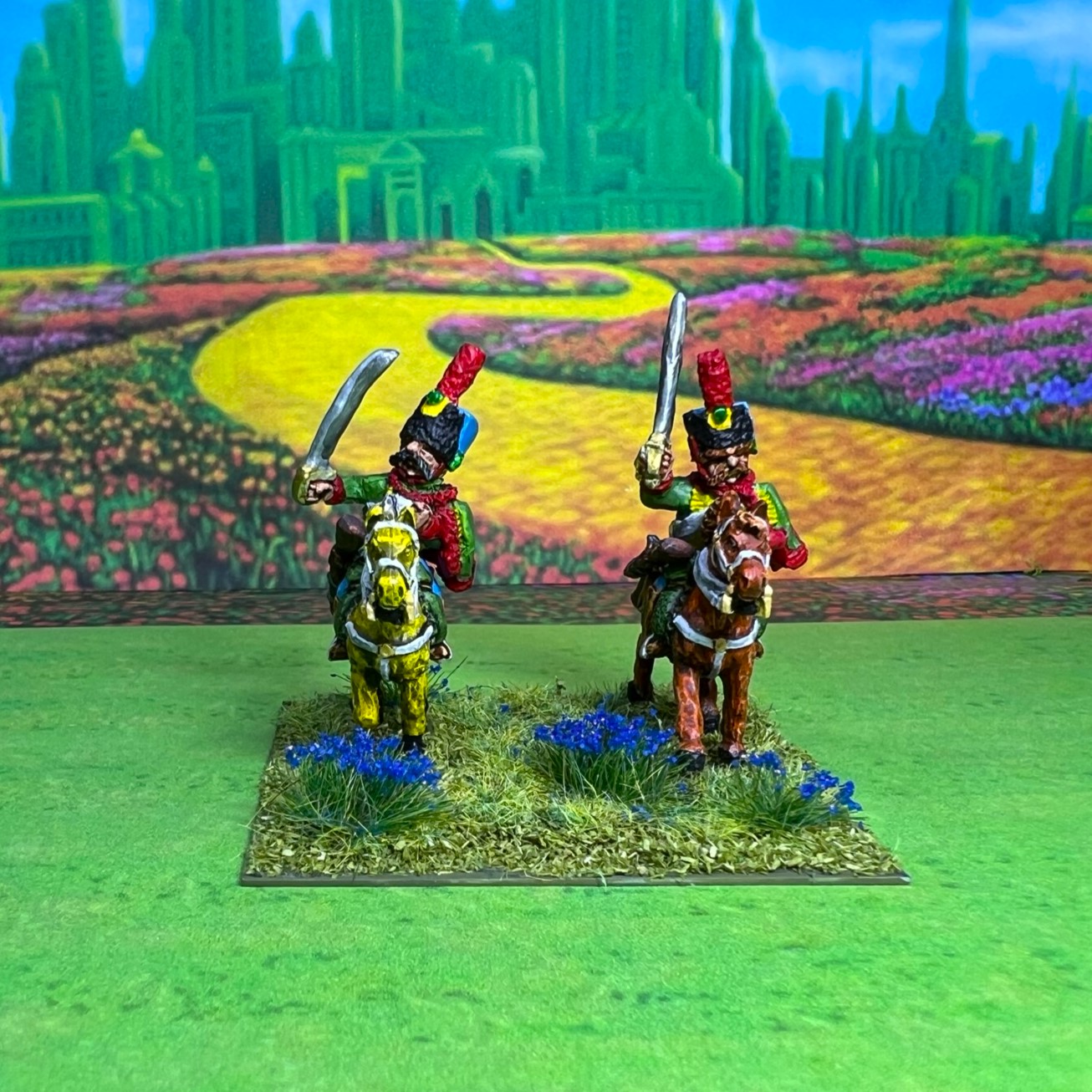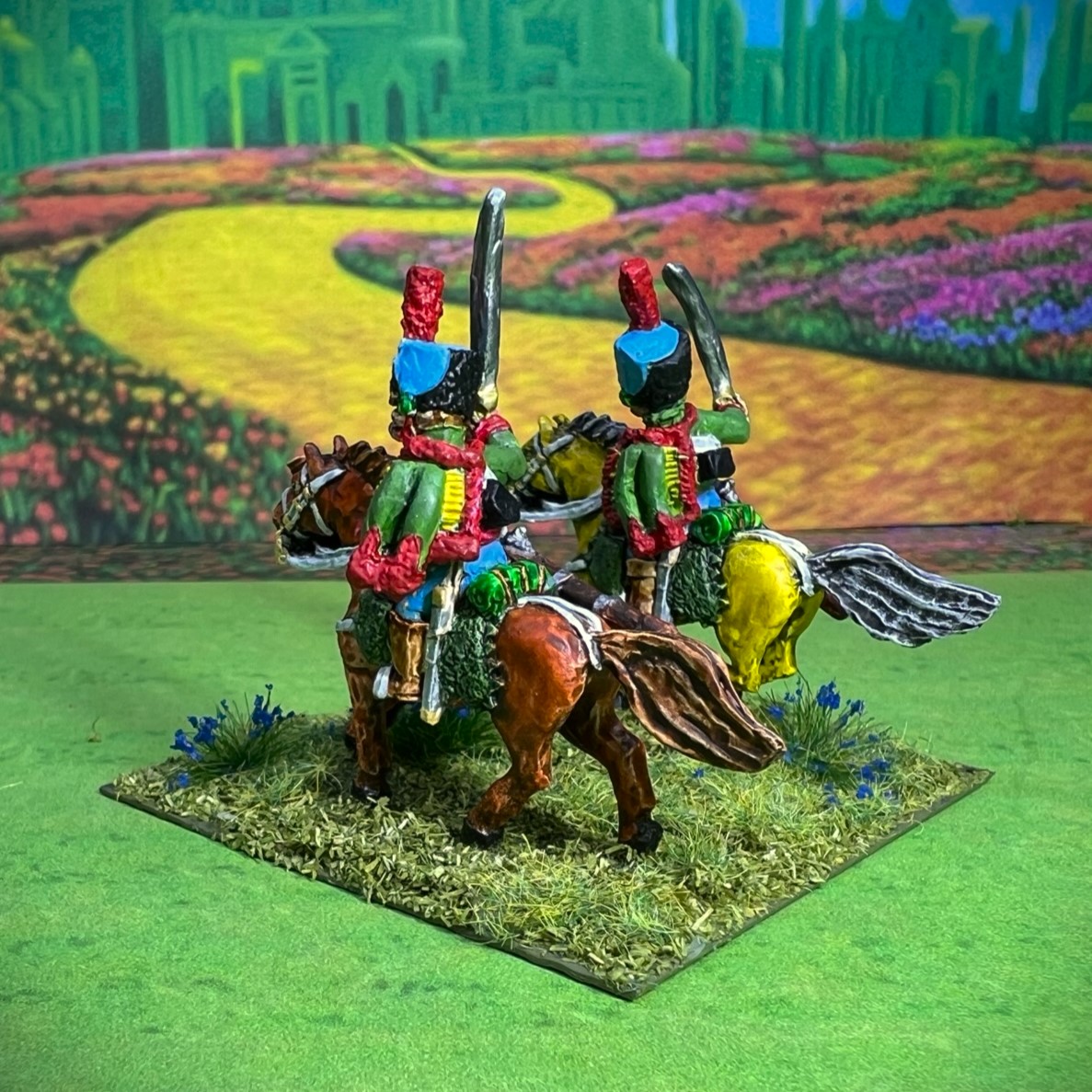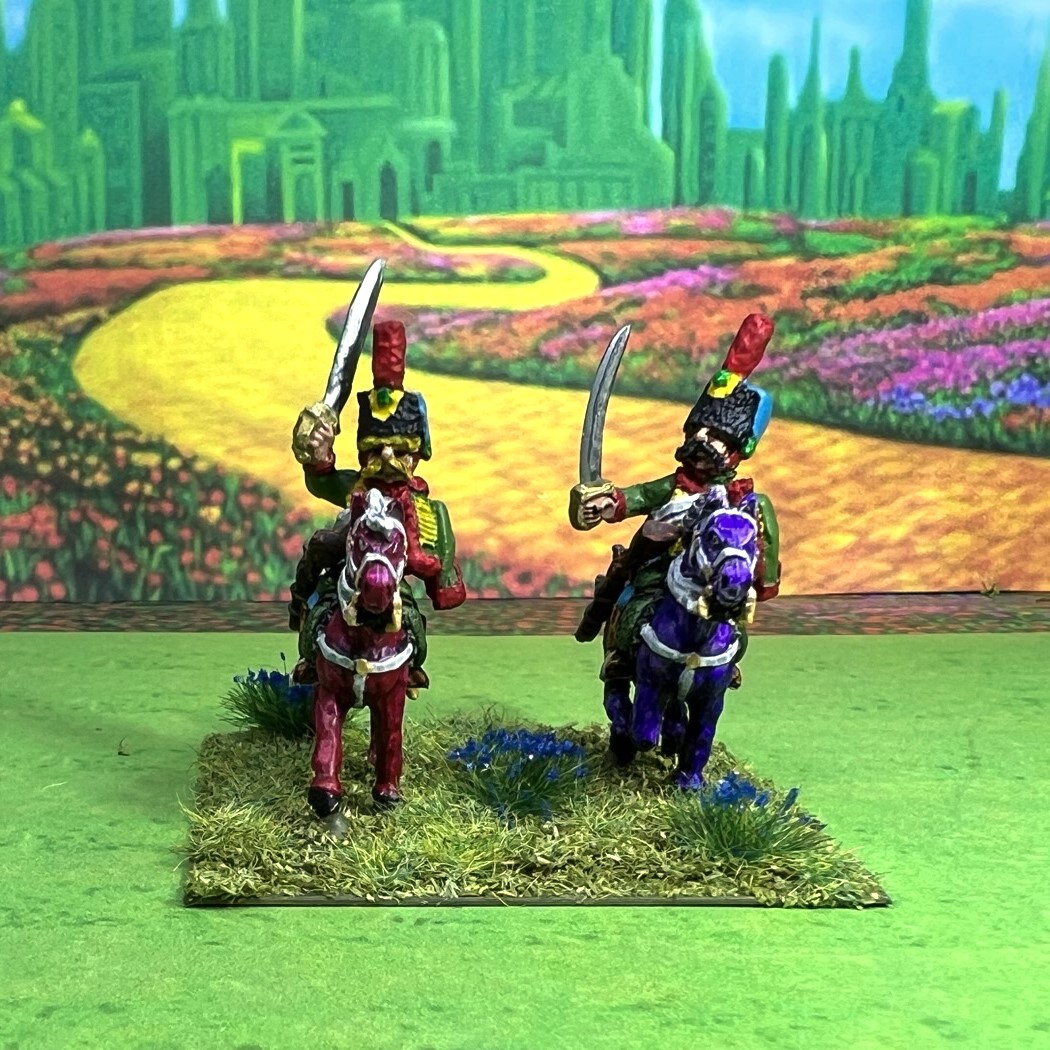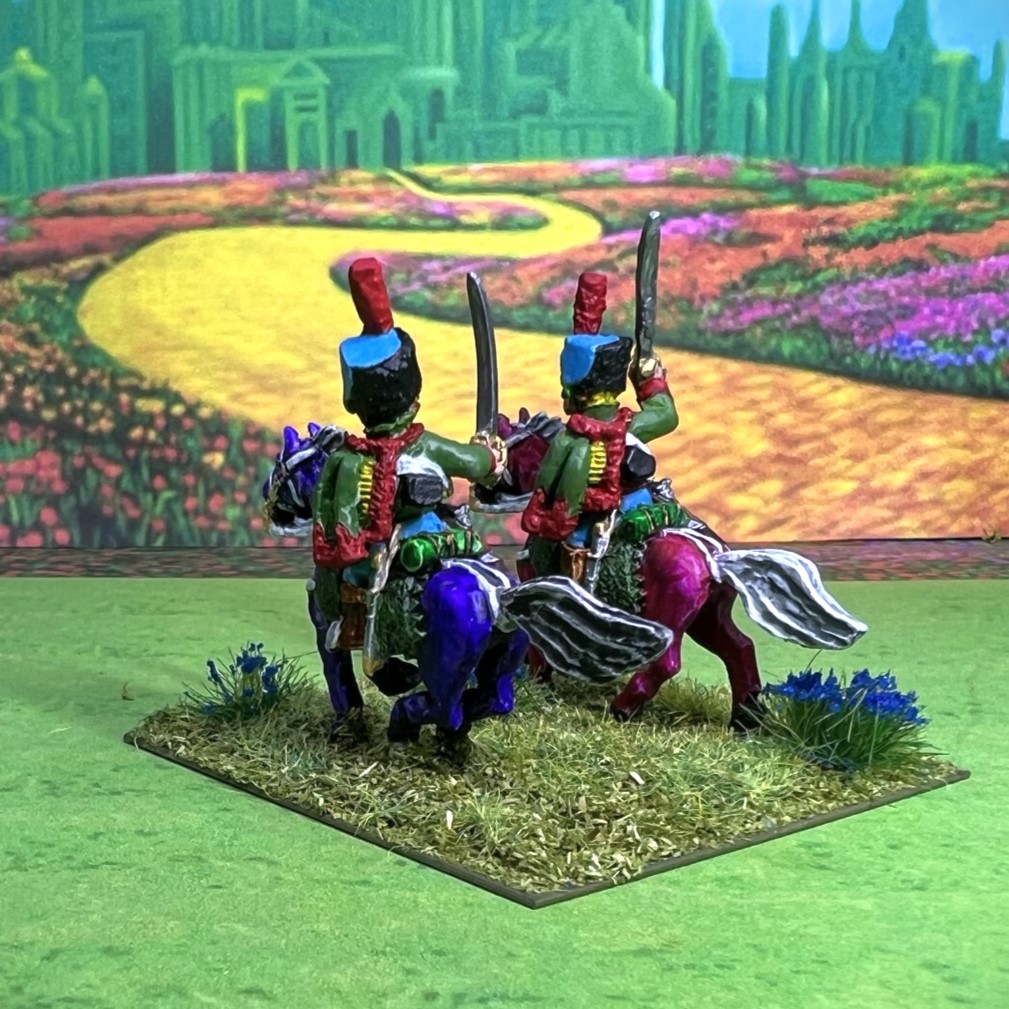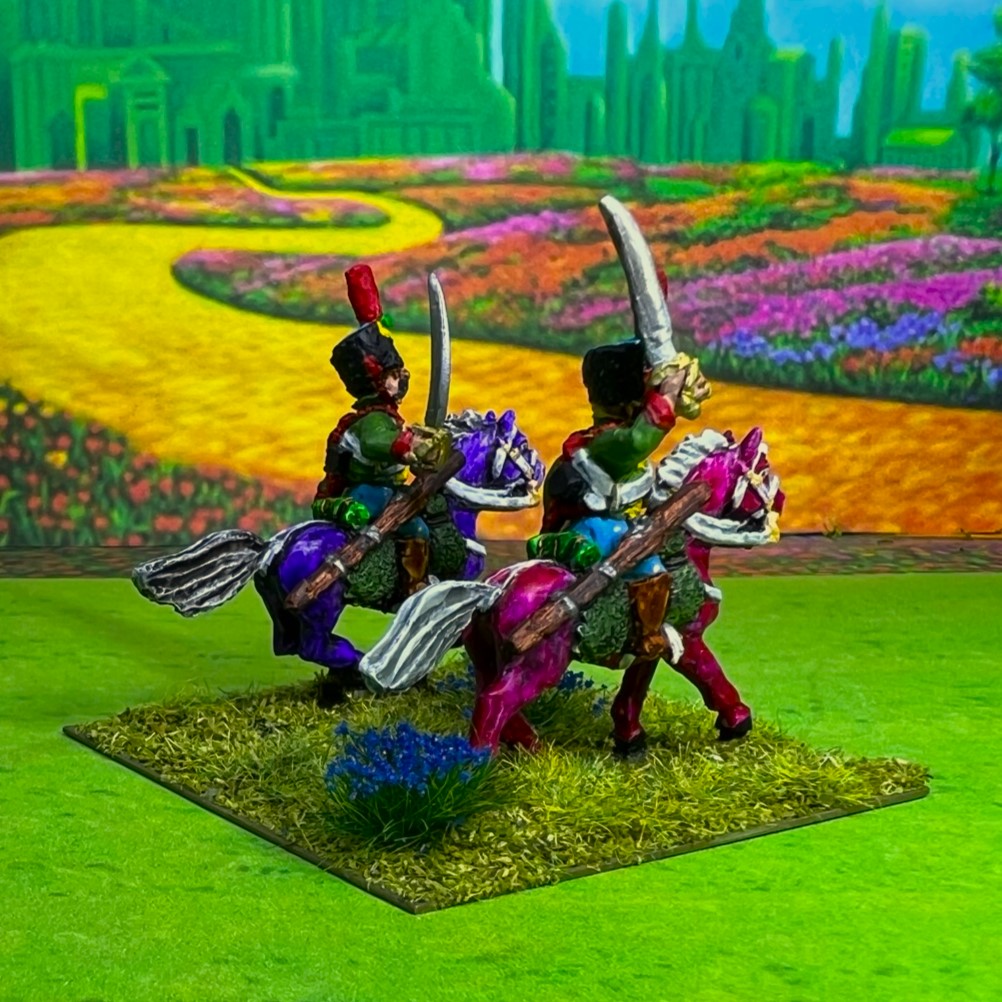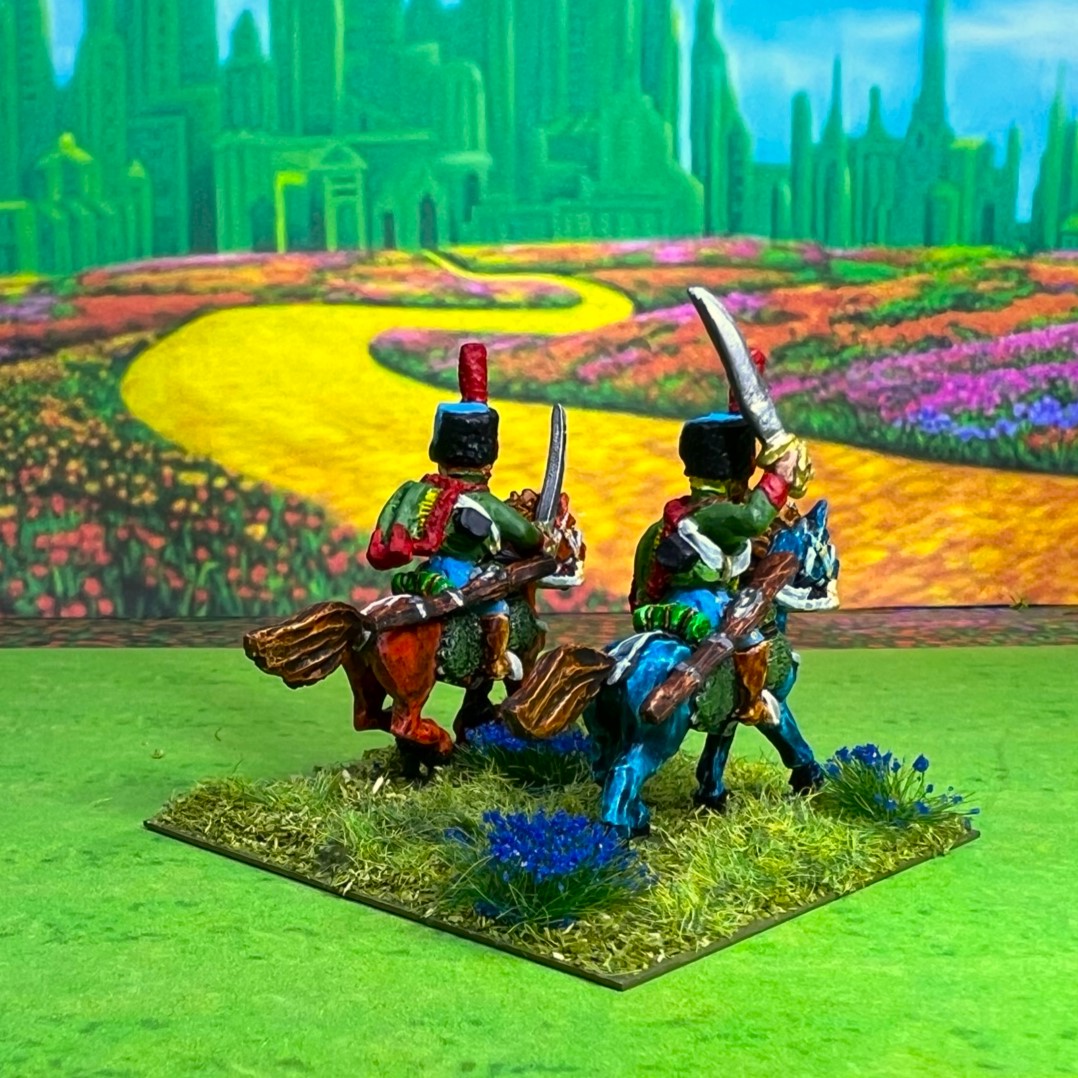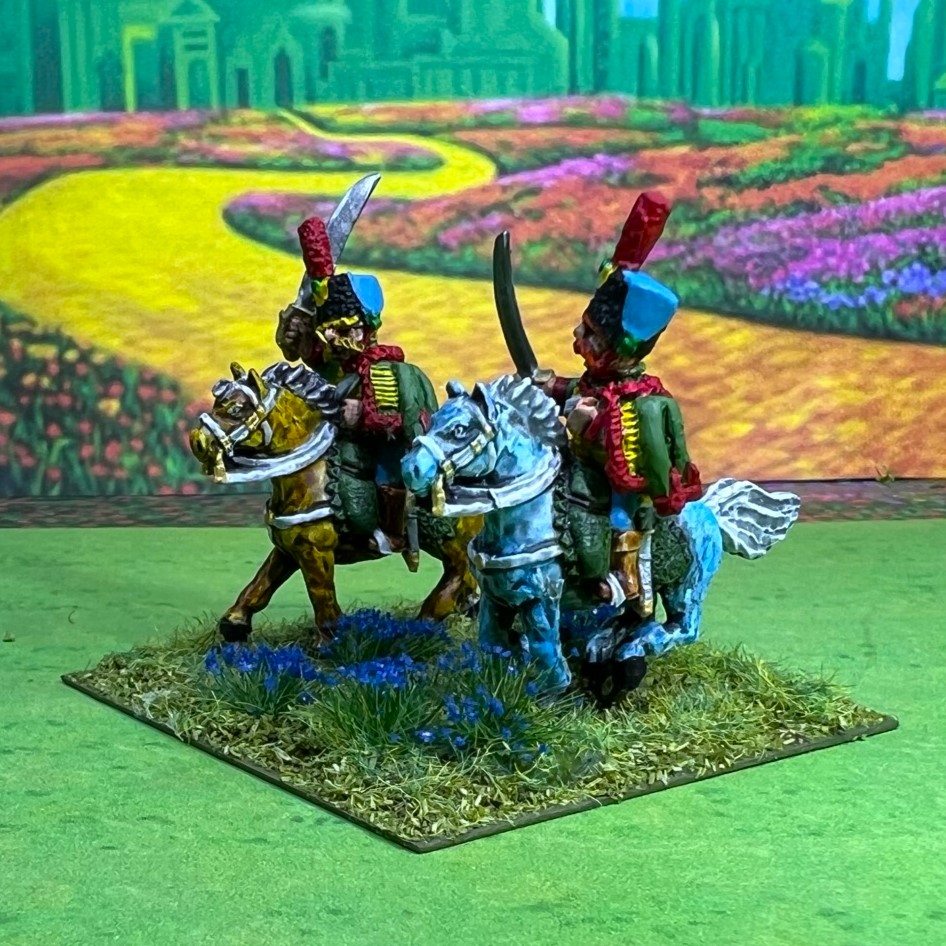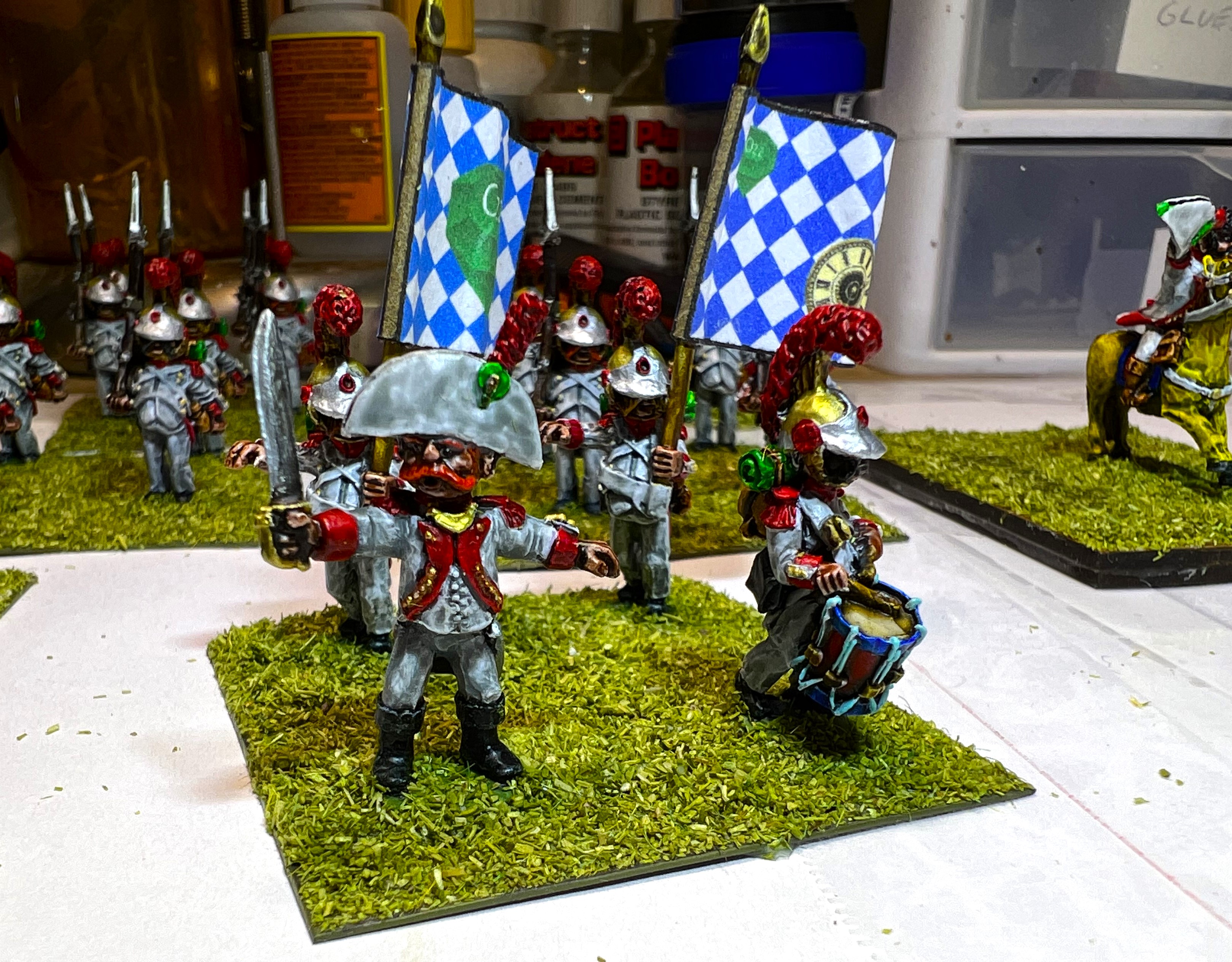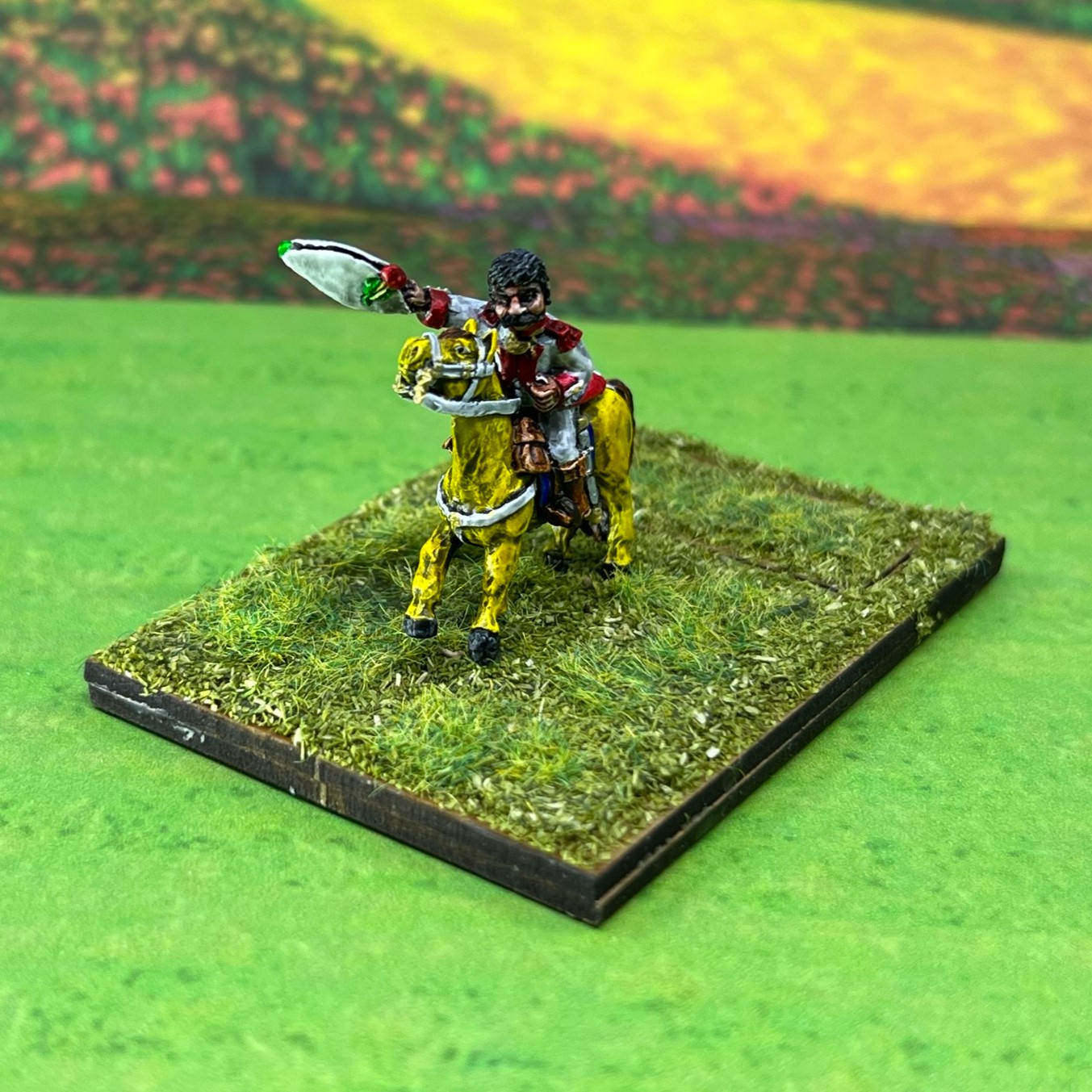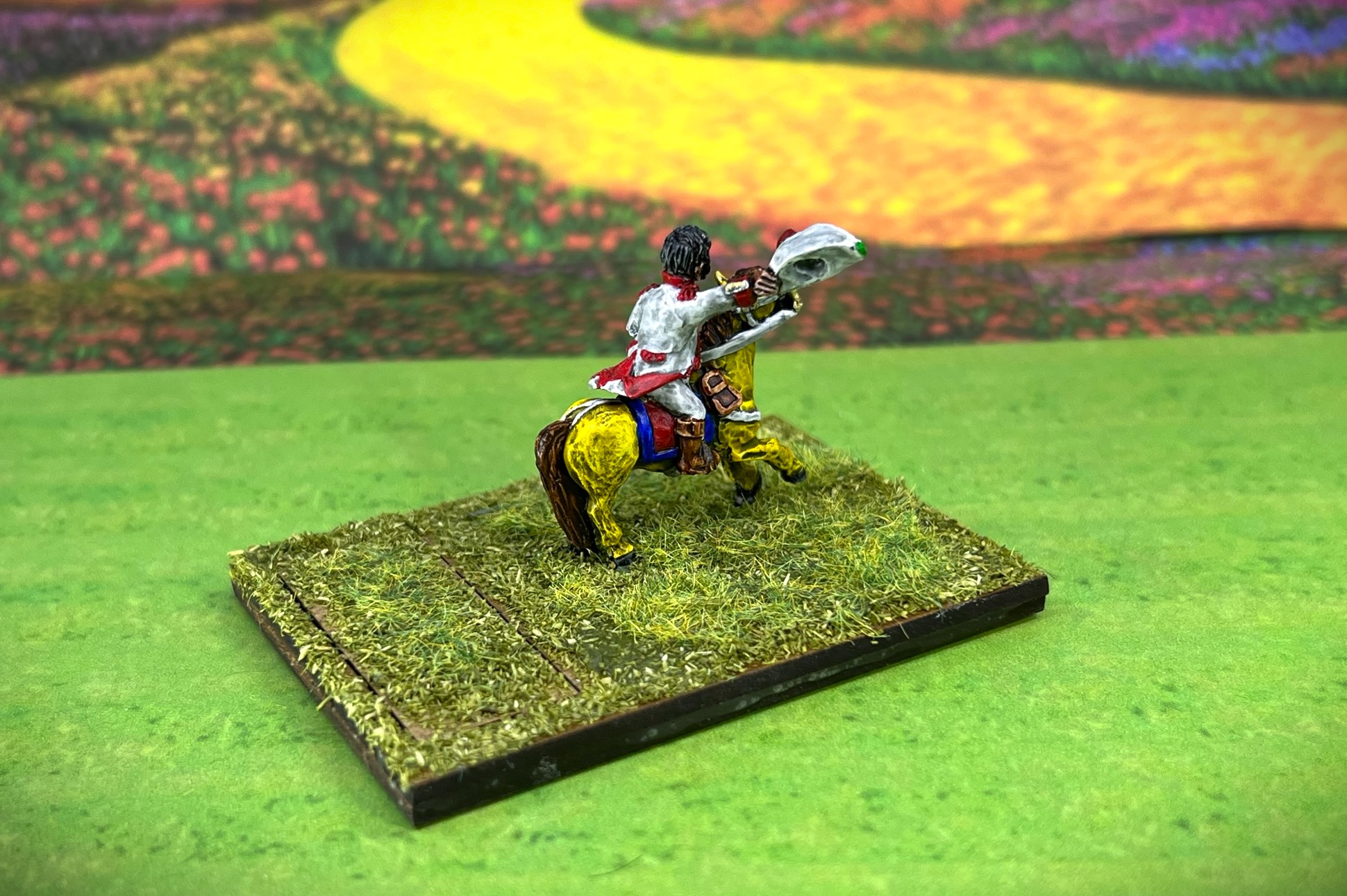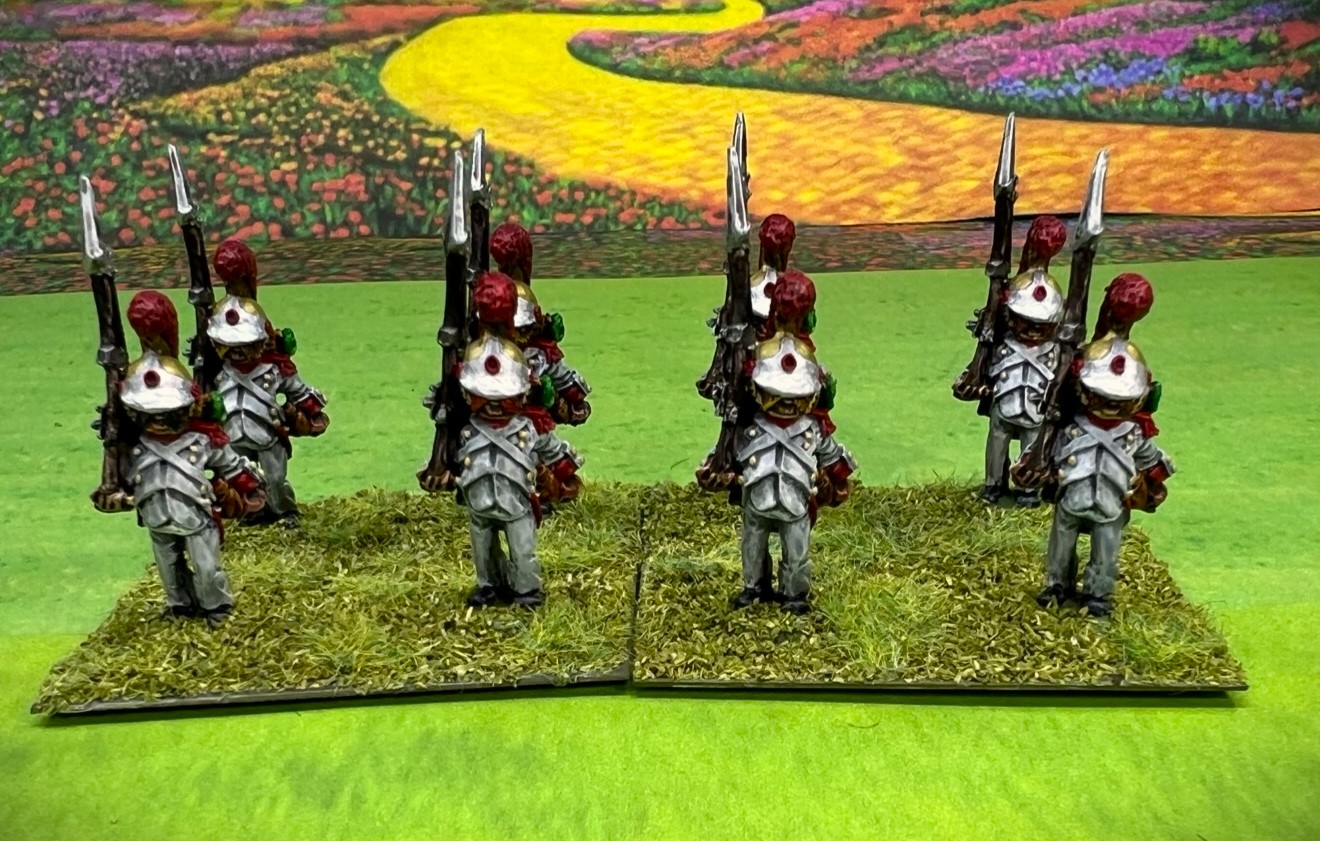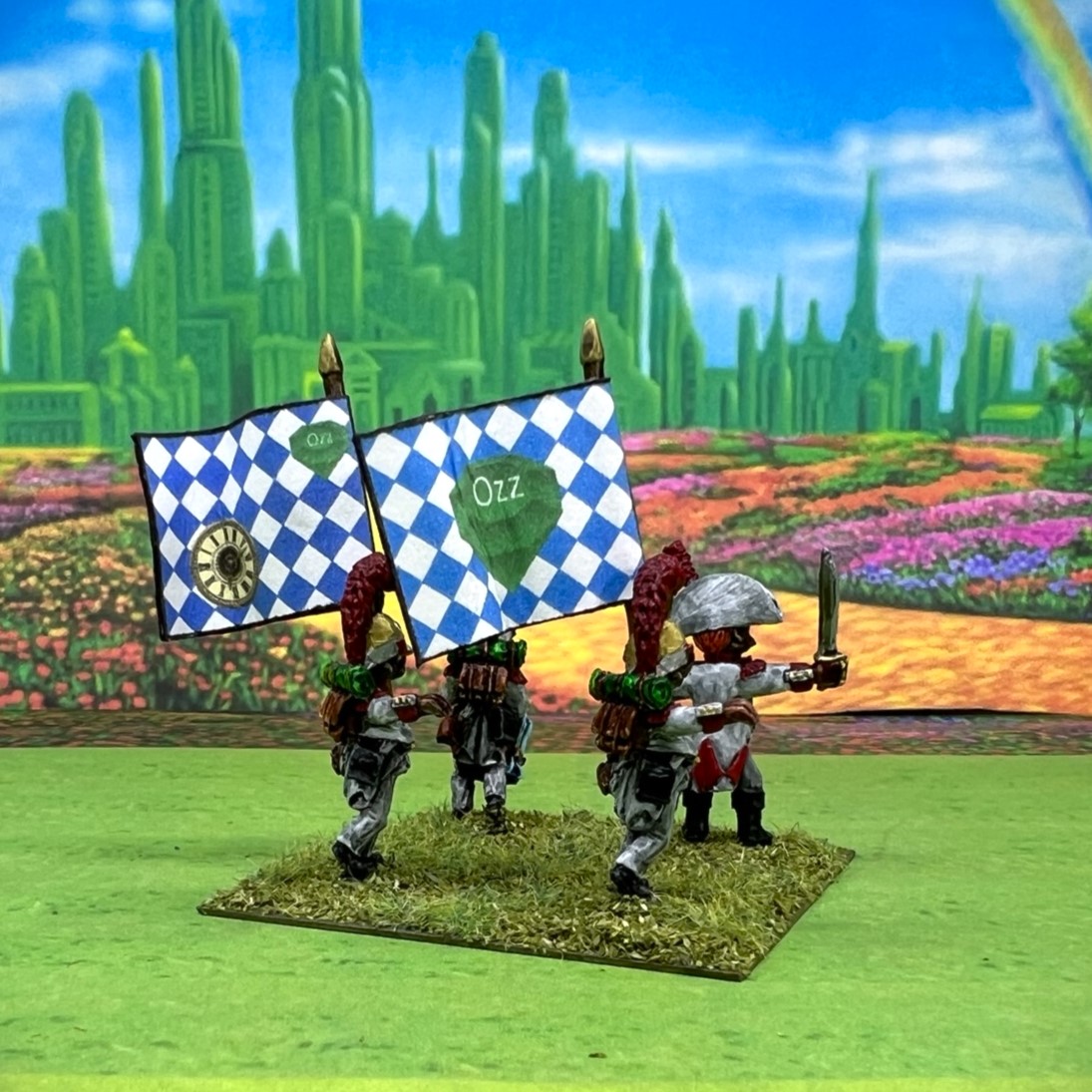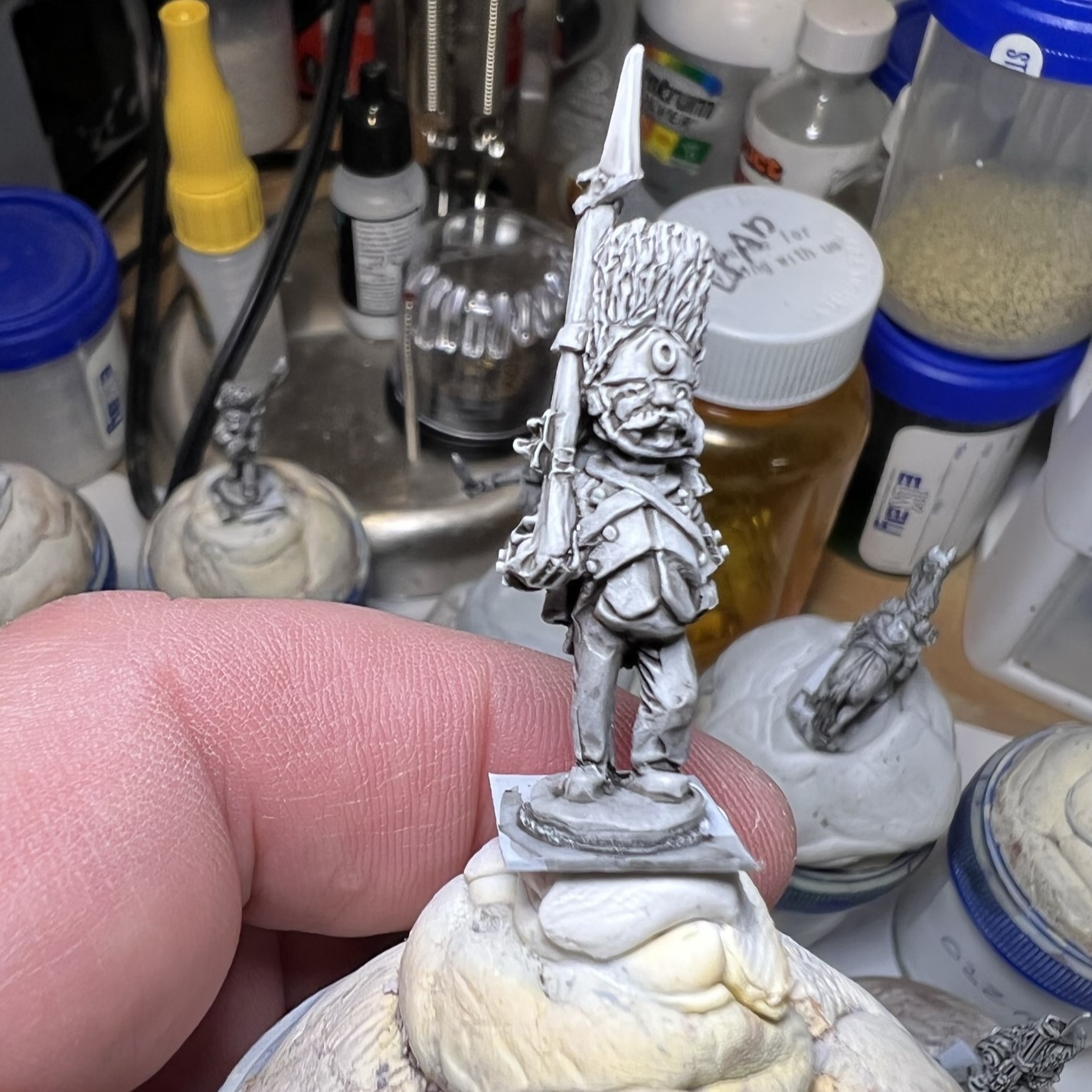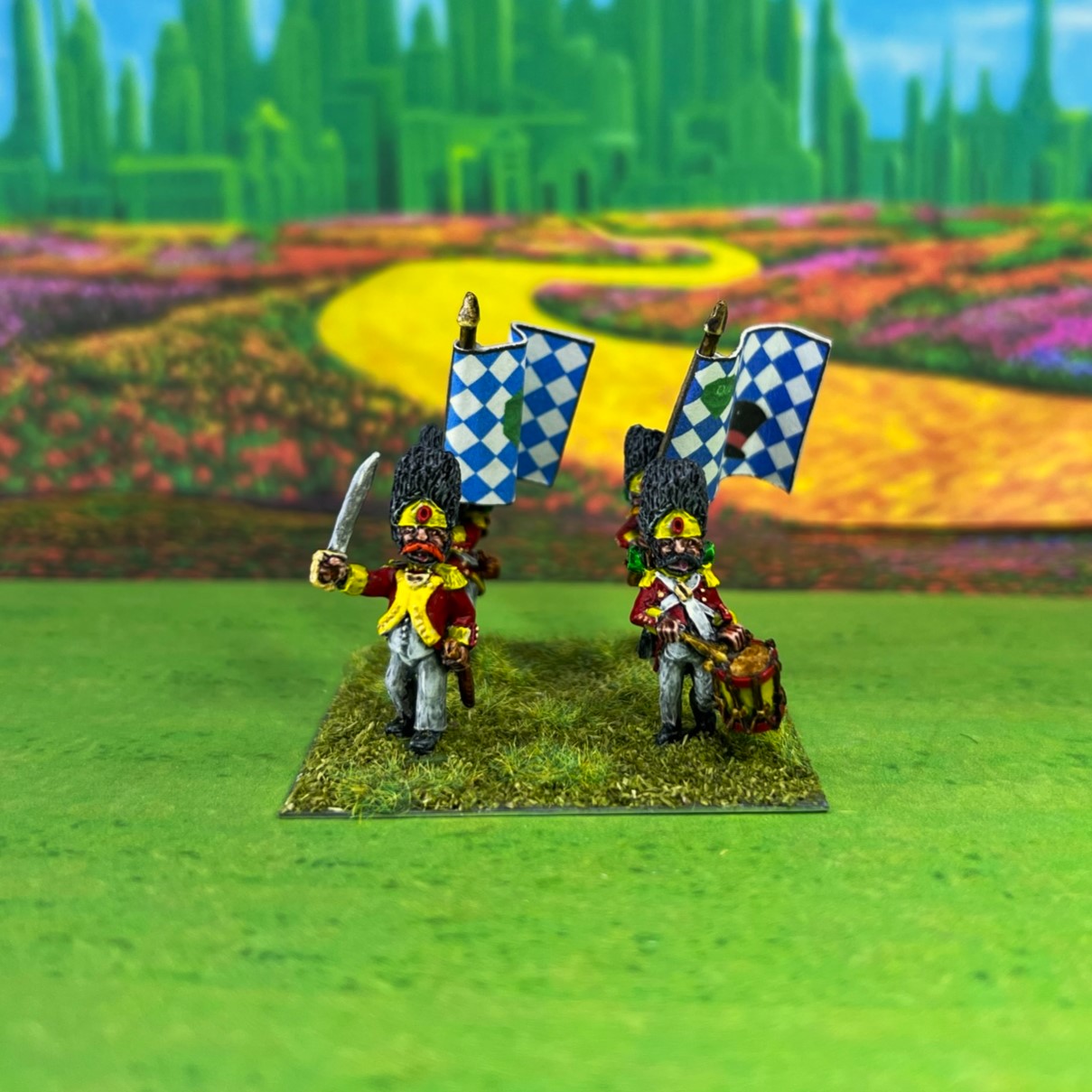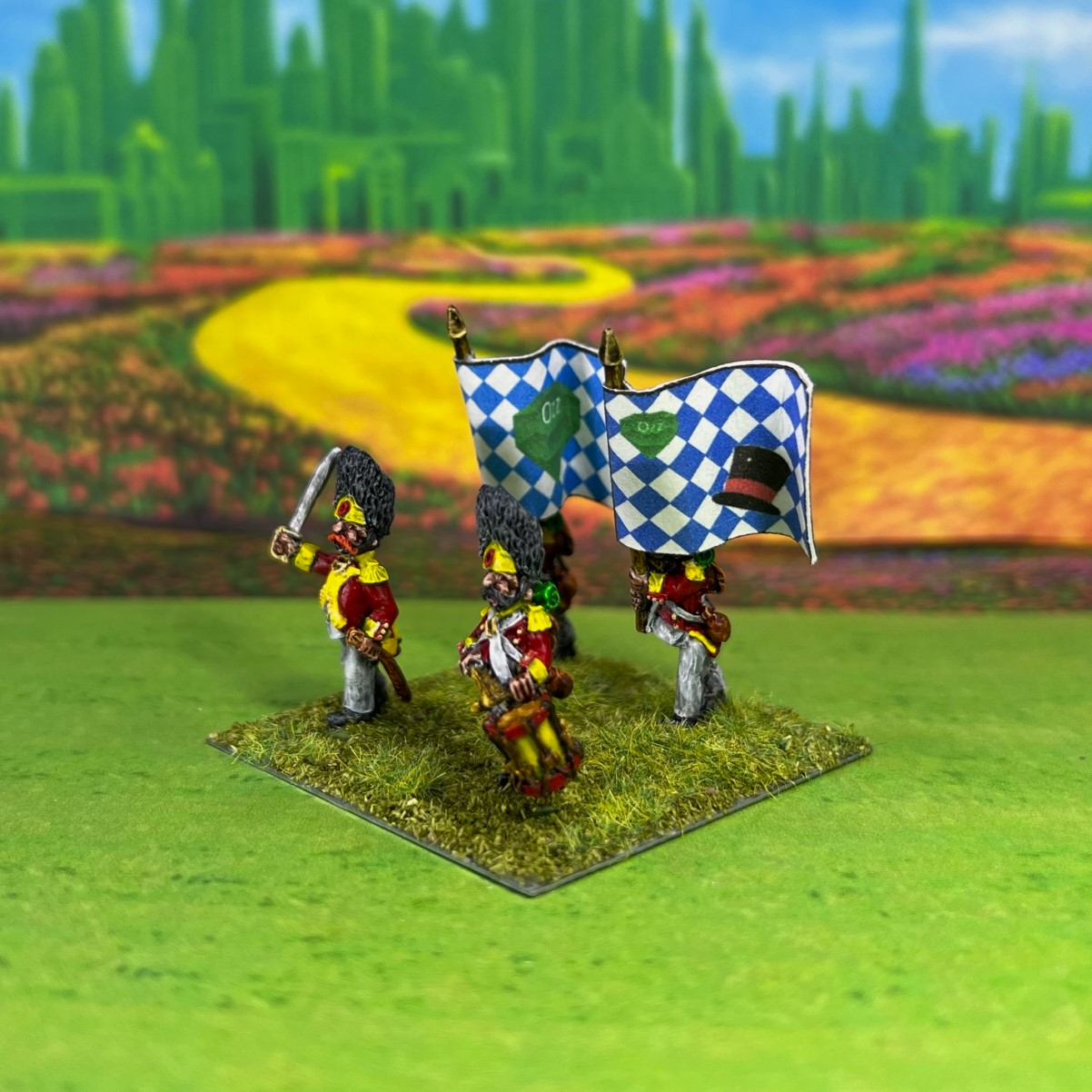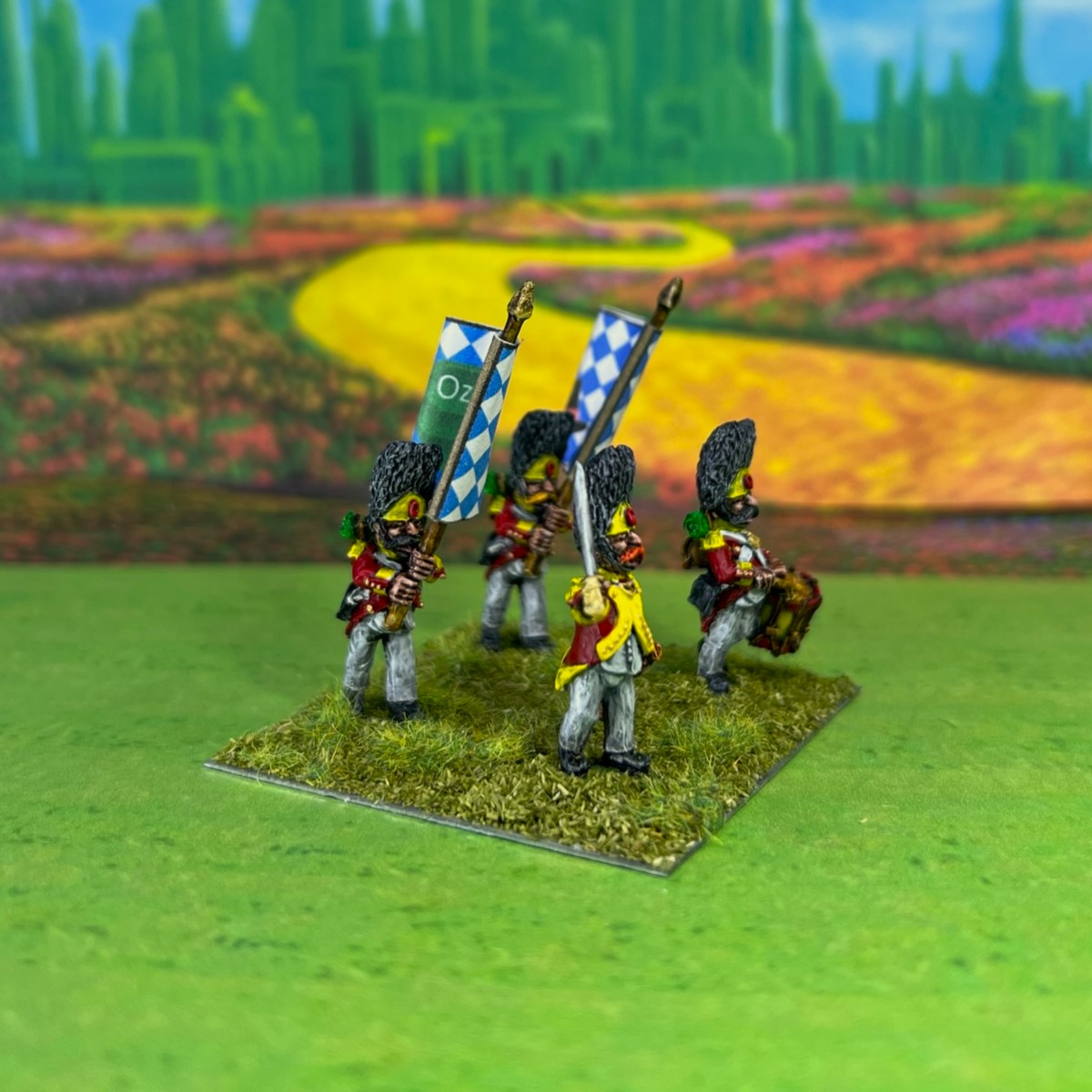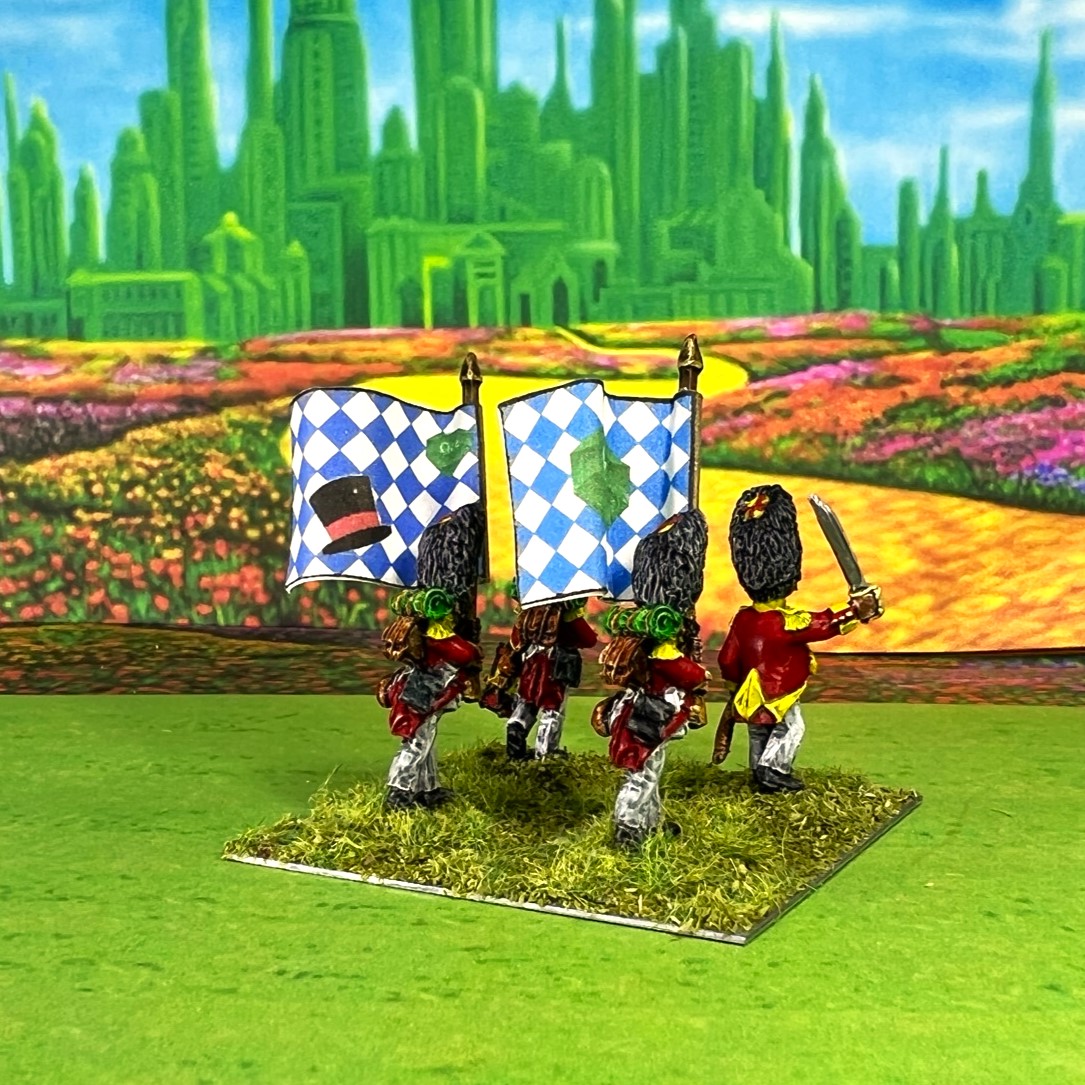
Winkie Sharpshooter Regiment (Wars of Ozz)

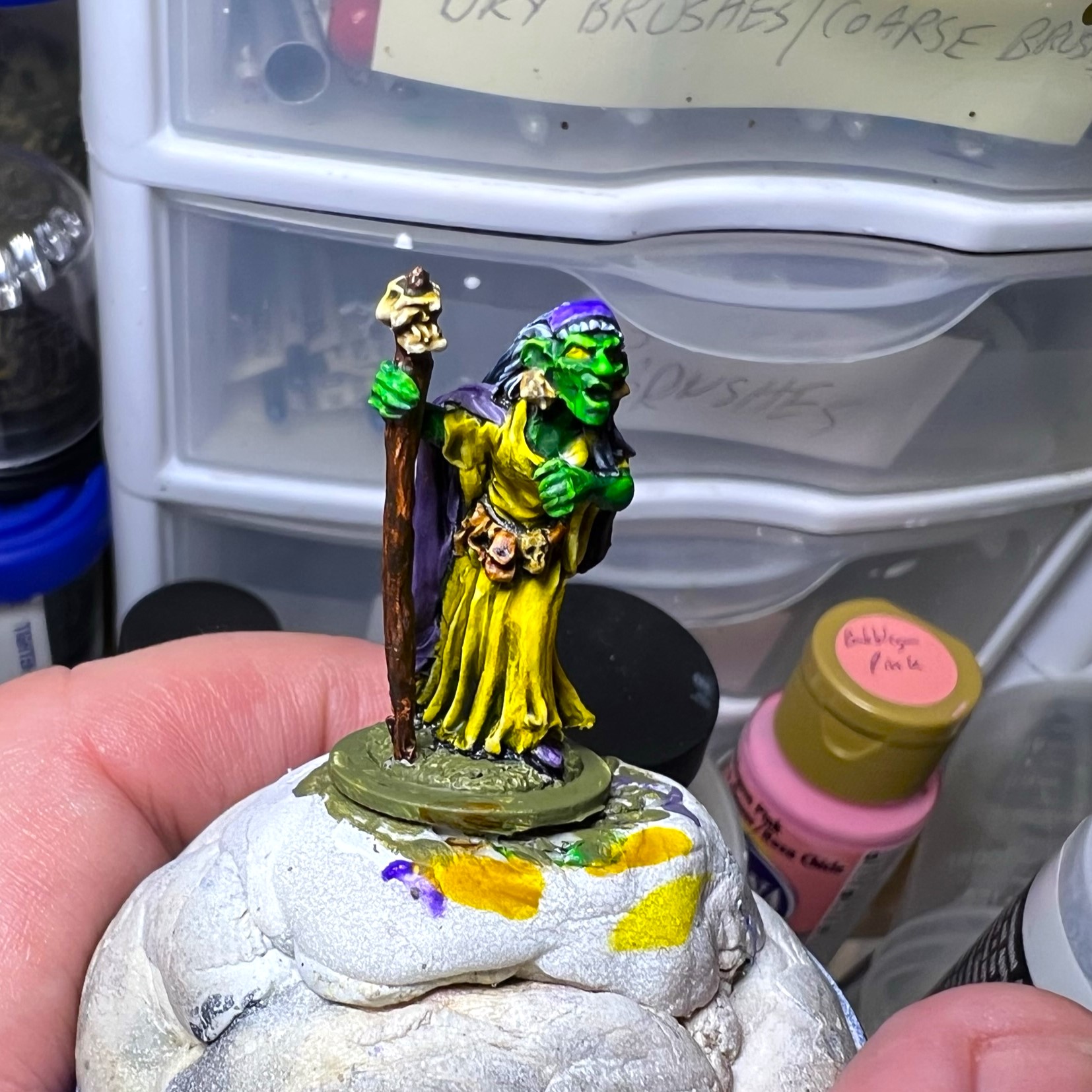
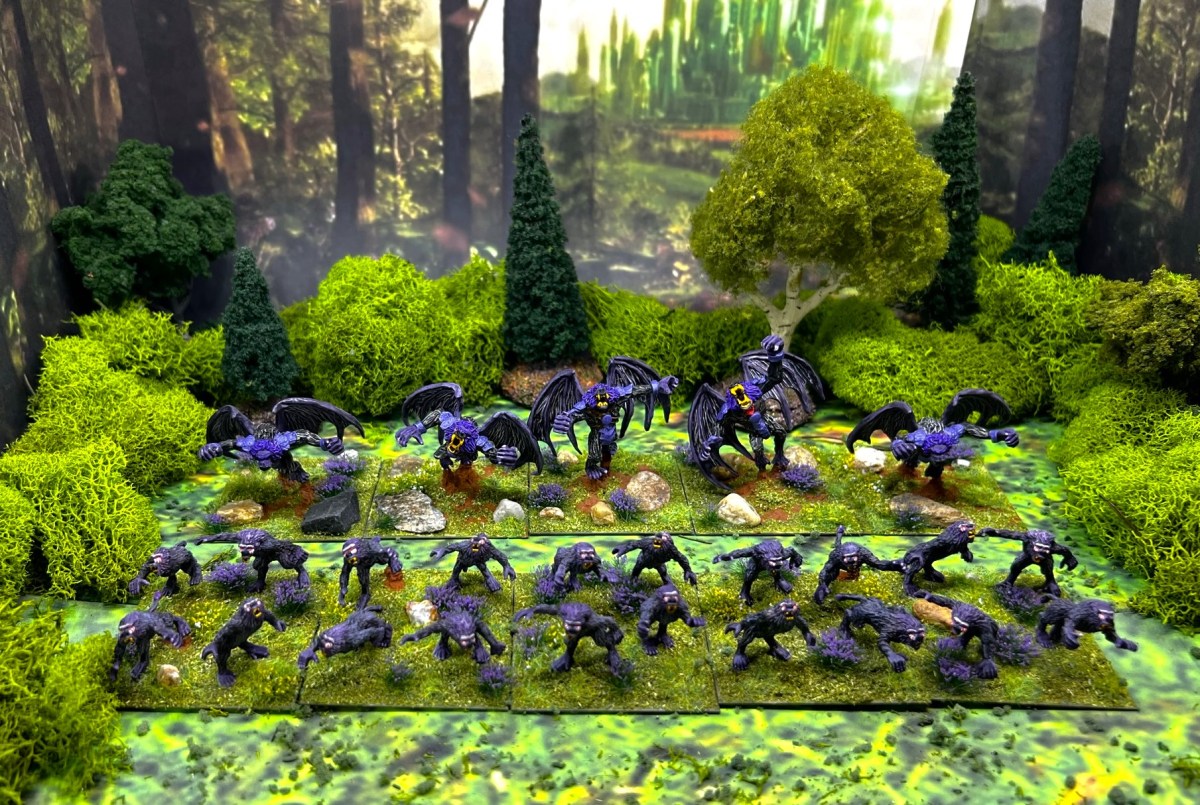
Now that I have a full Munchkin Brigade (as you saw in my last post), I needed to start building a worthy opponent. I decided to go with the Winkies – the orcs of the Wars of Ozz. Yes, the “oh-eee-oh” dudes from the movie.

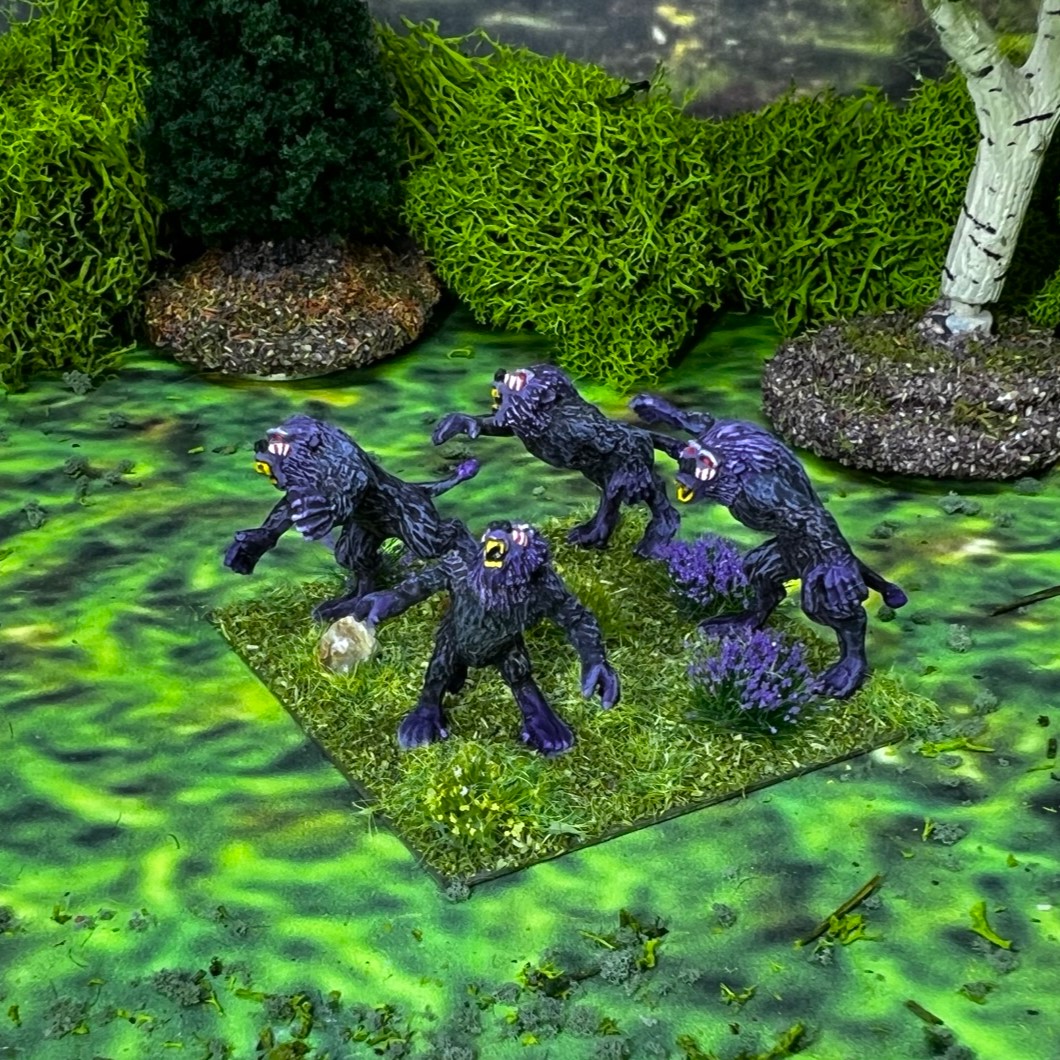
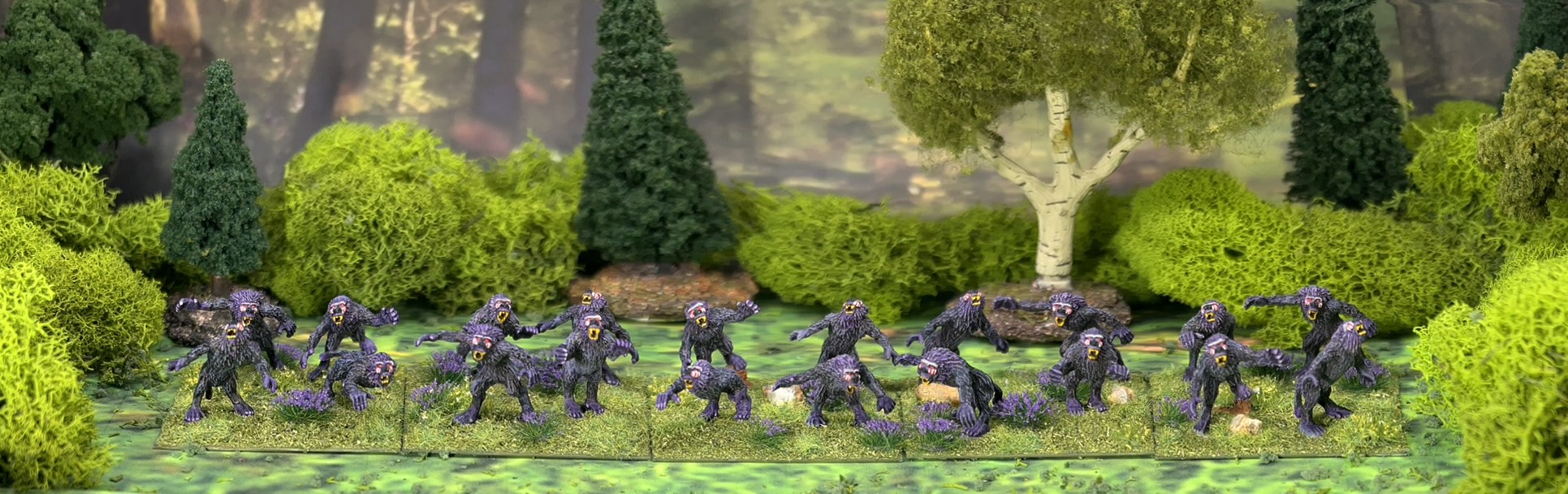
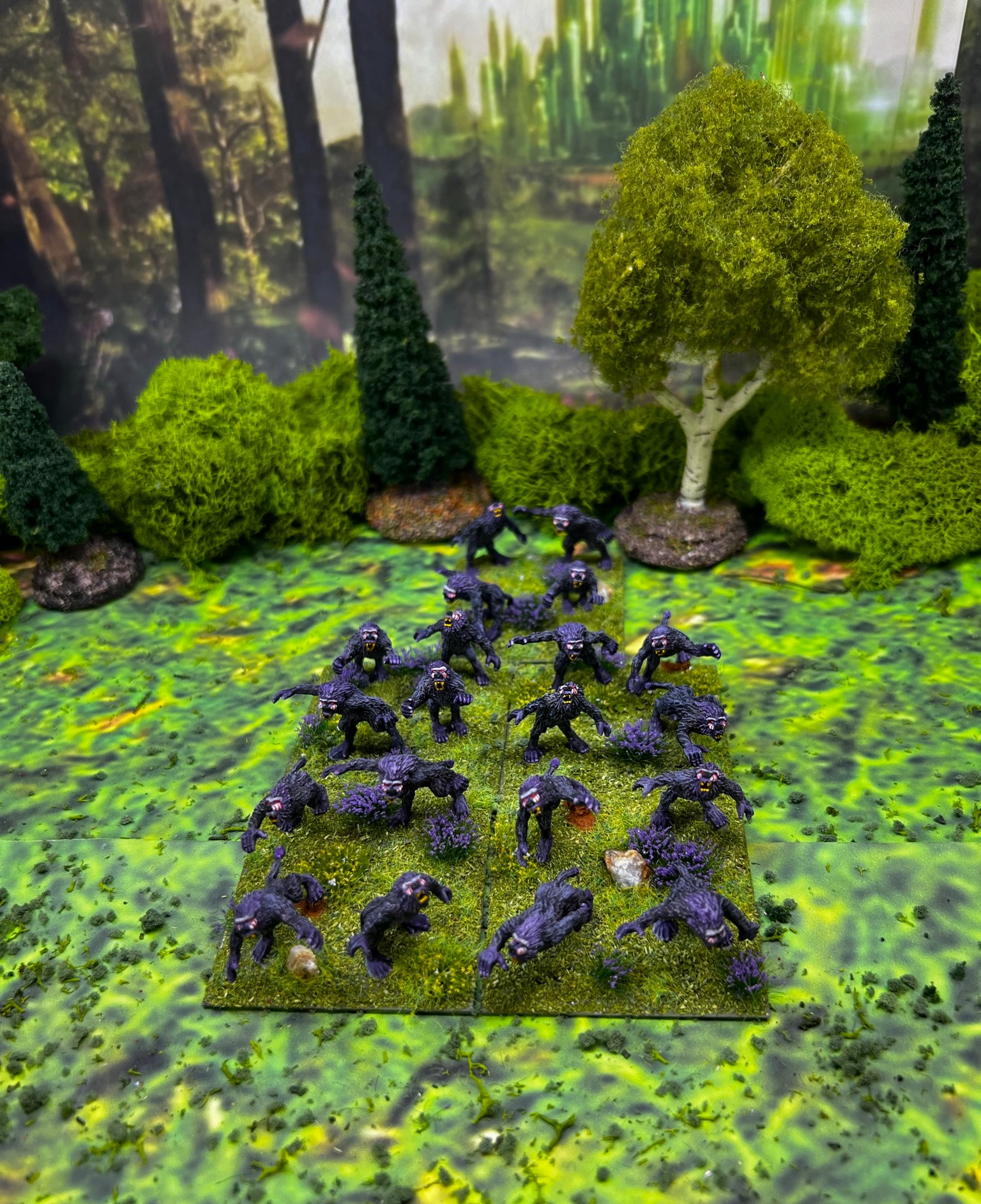
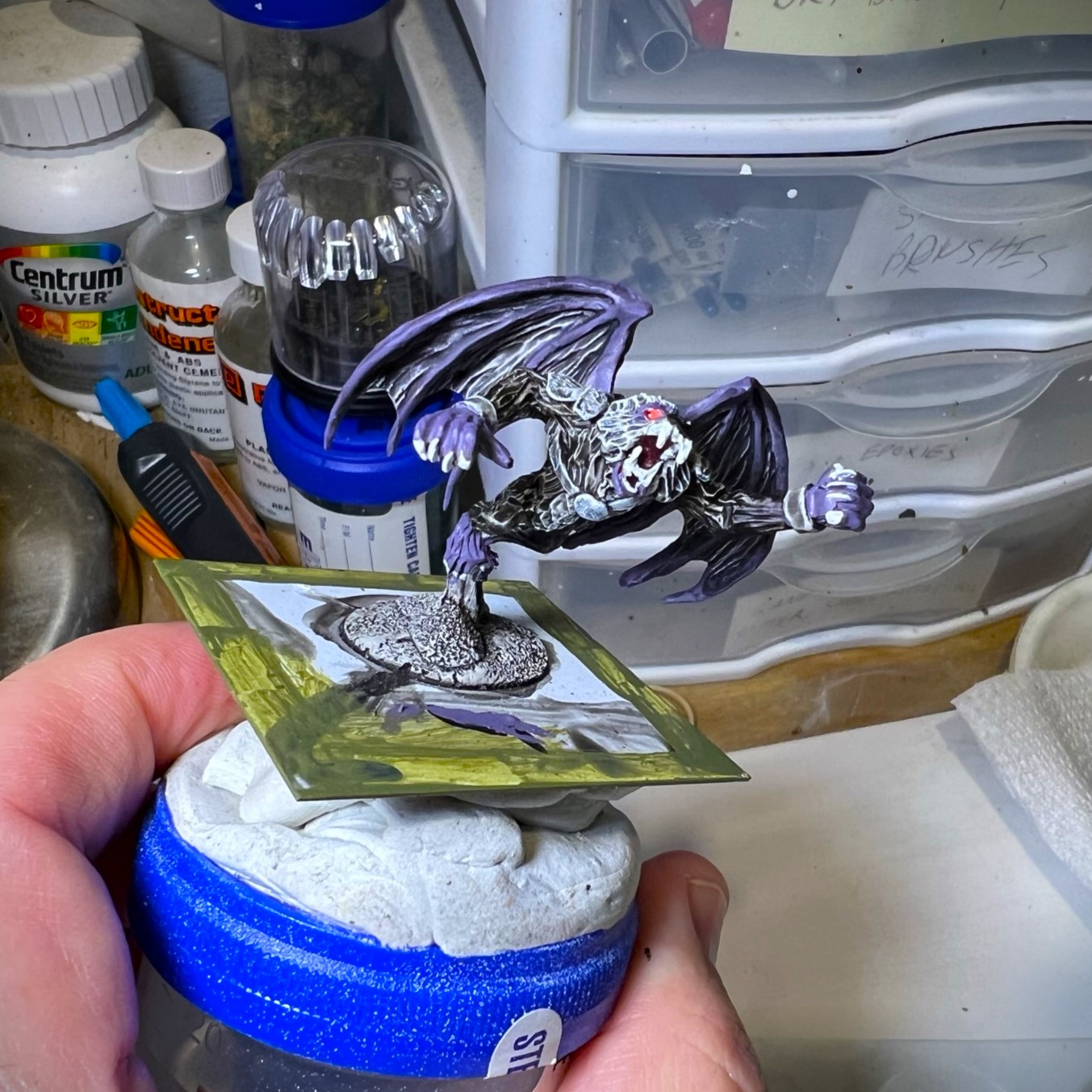
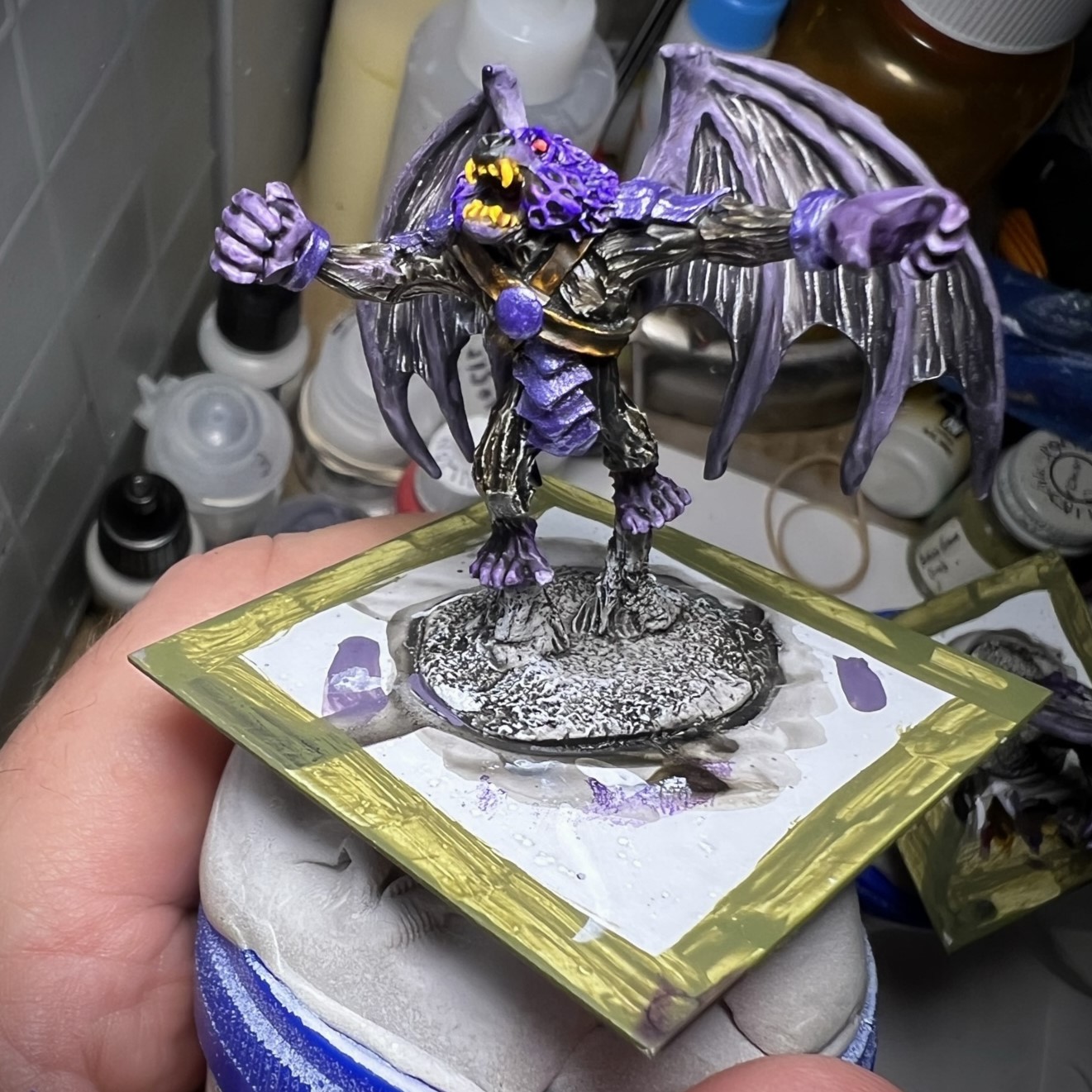
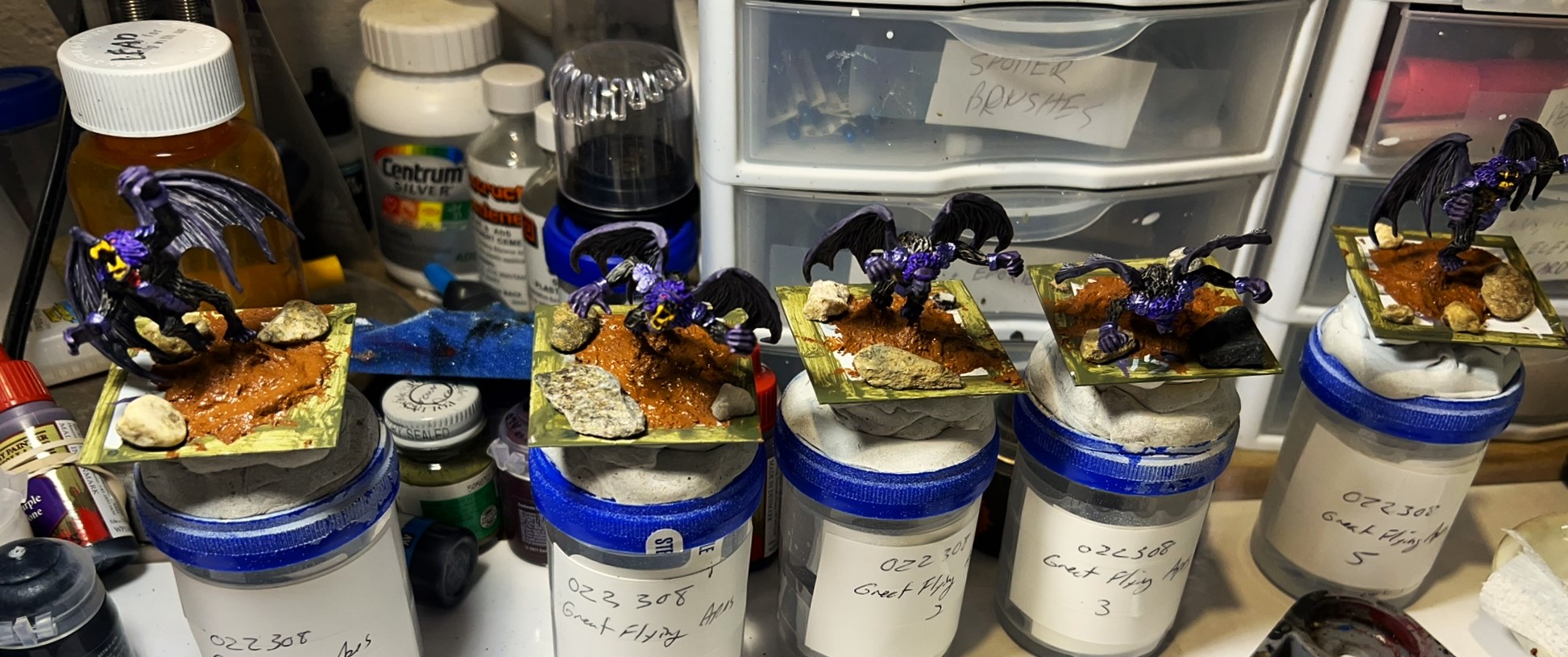
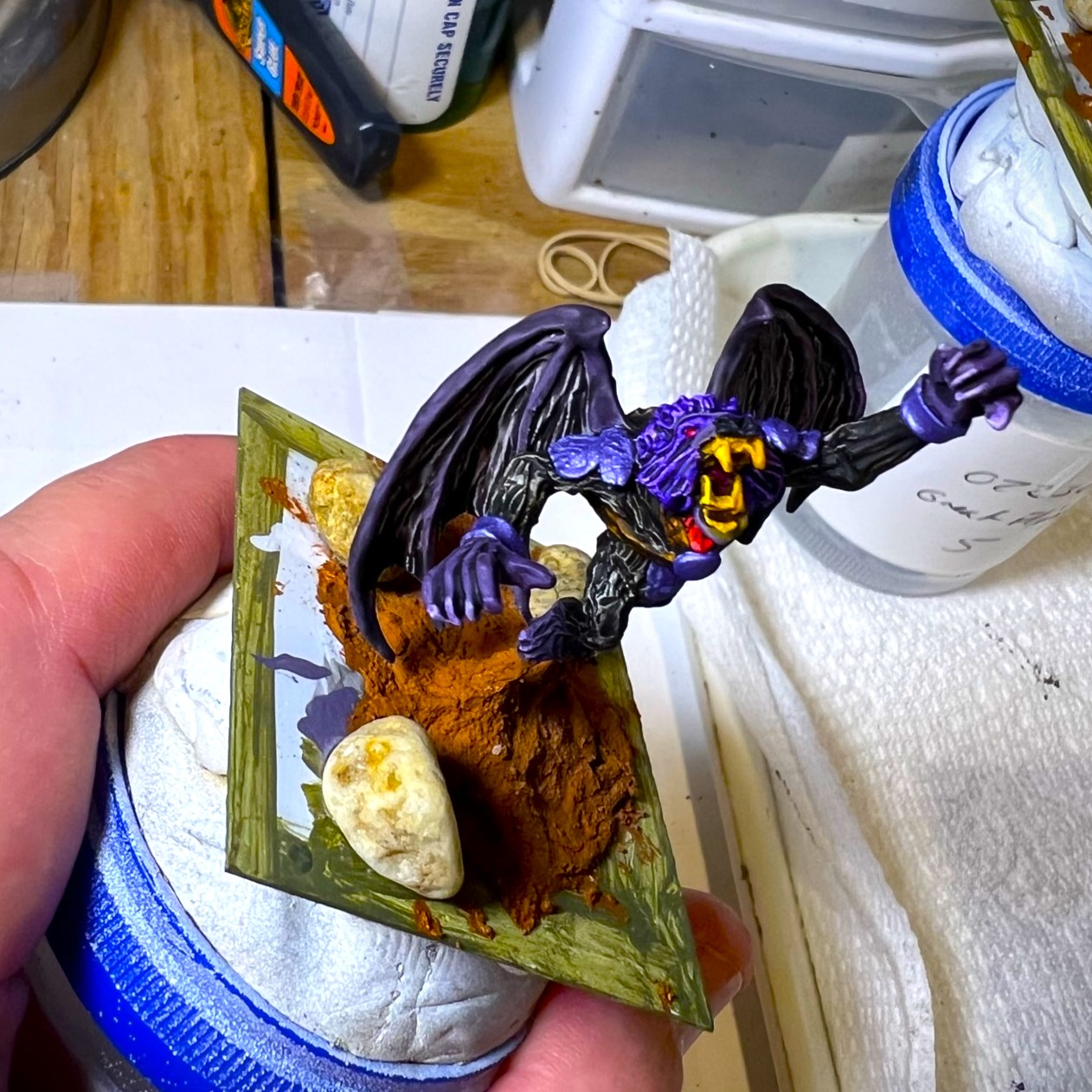
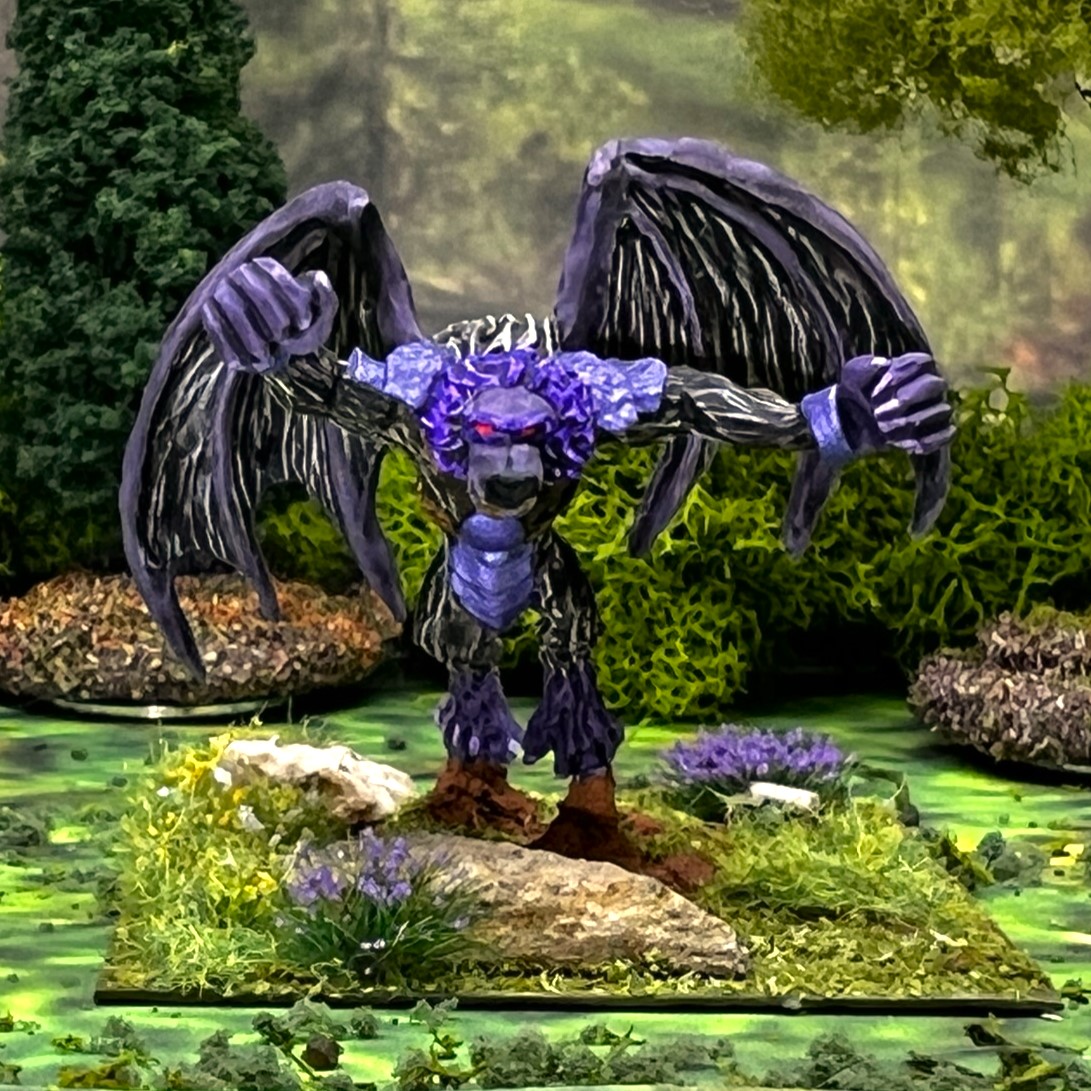
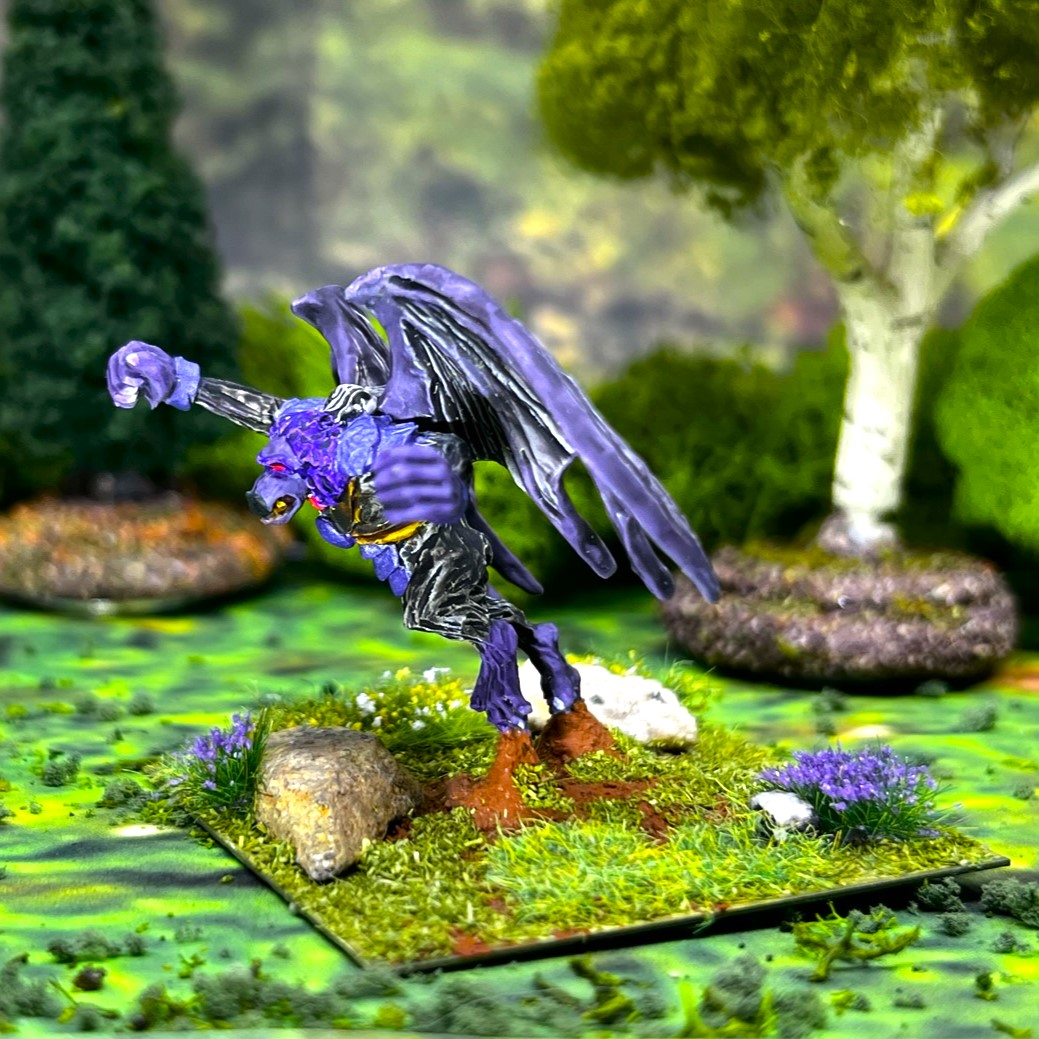
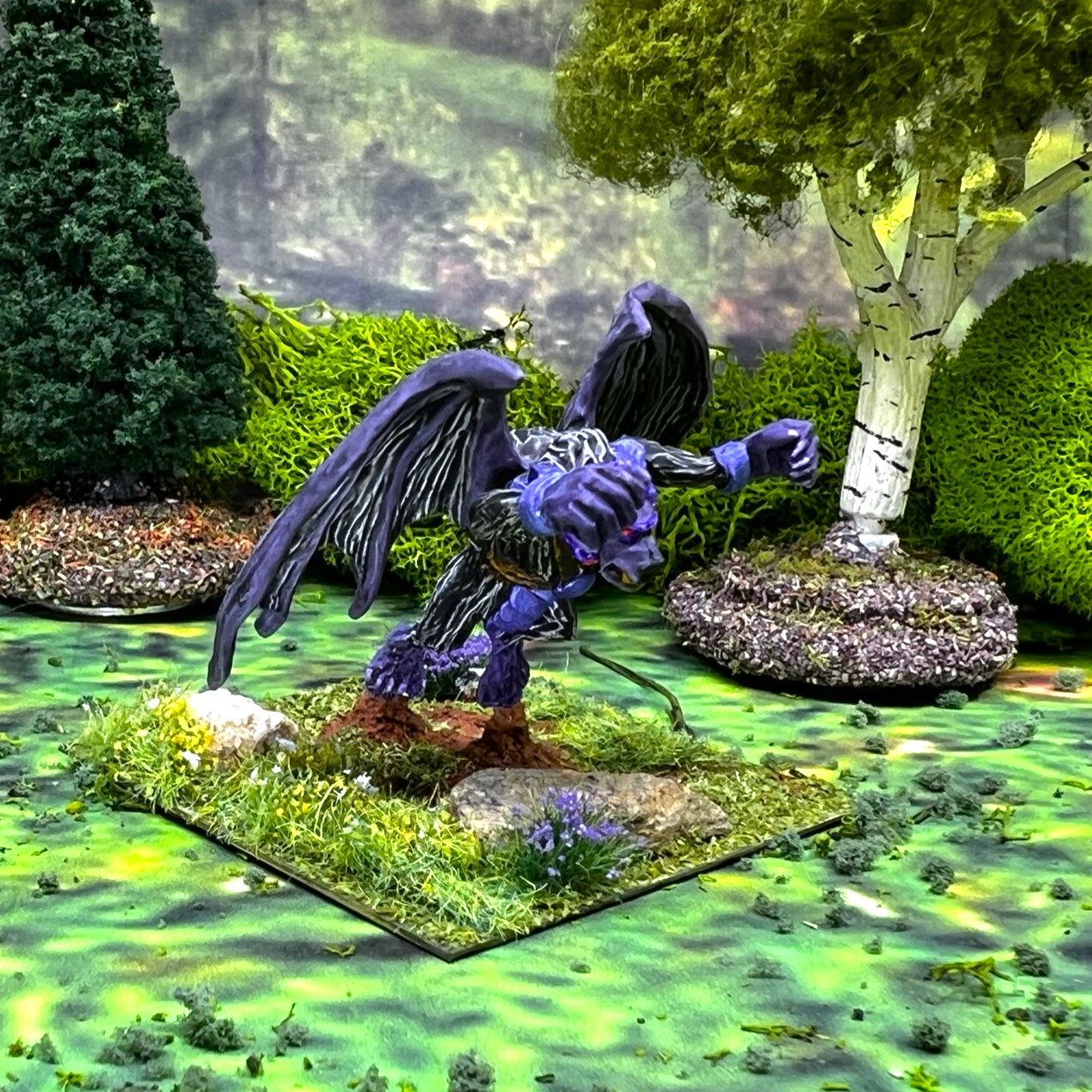
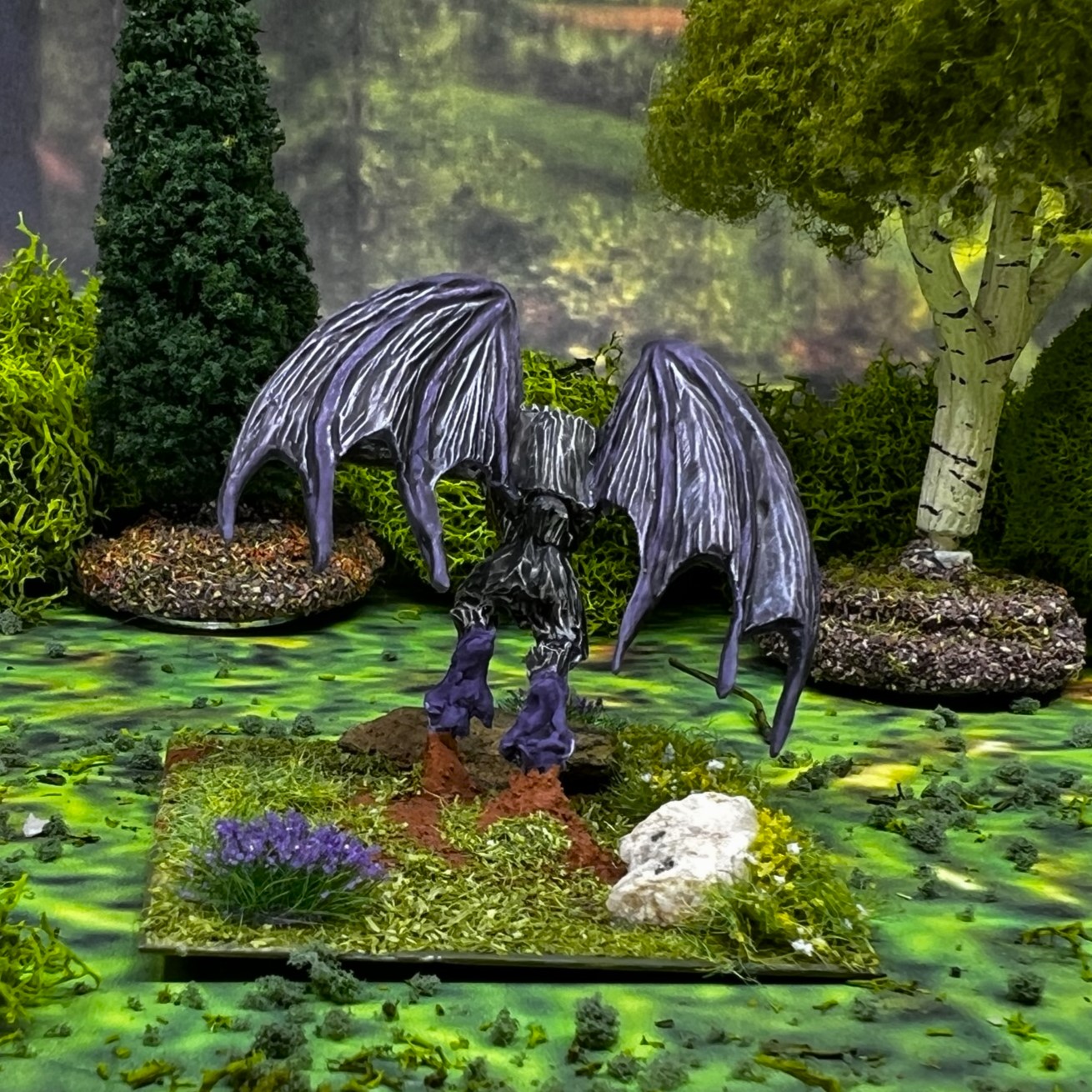
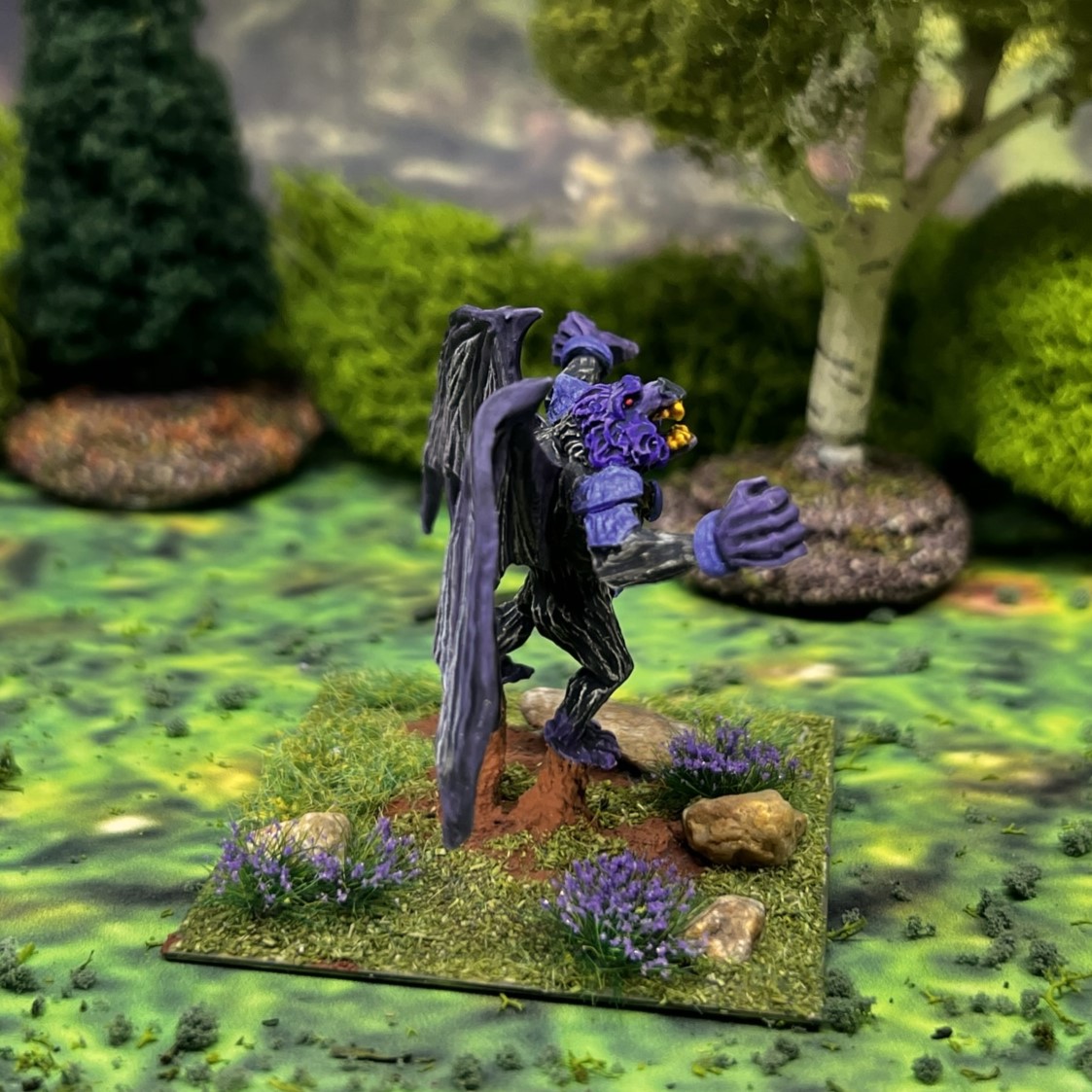
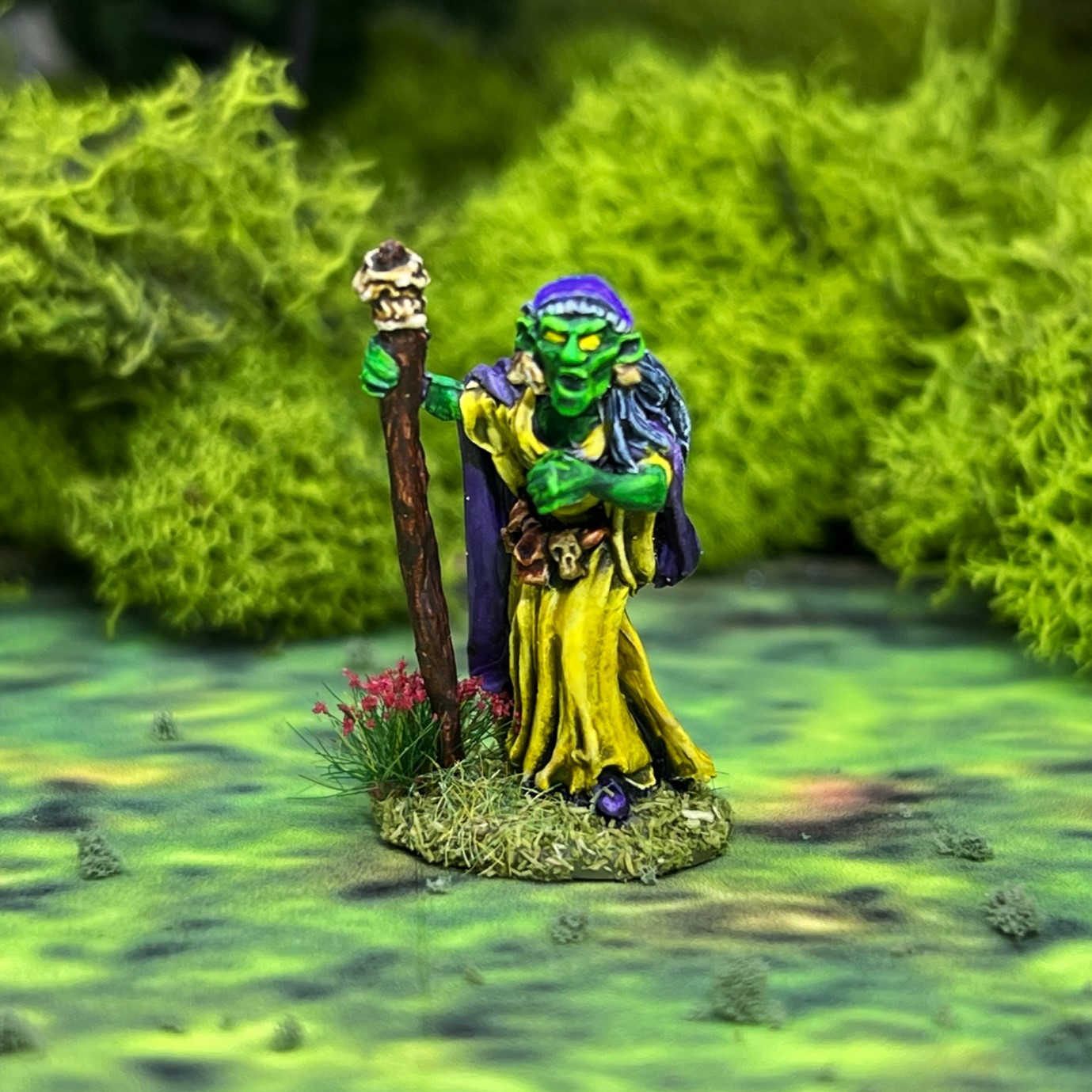
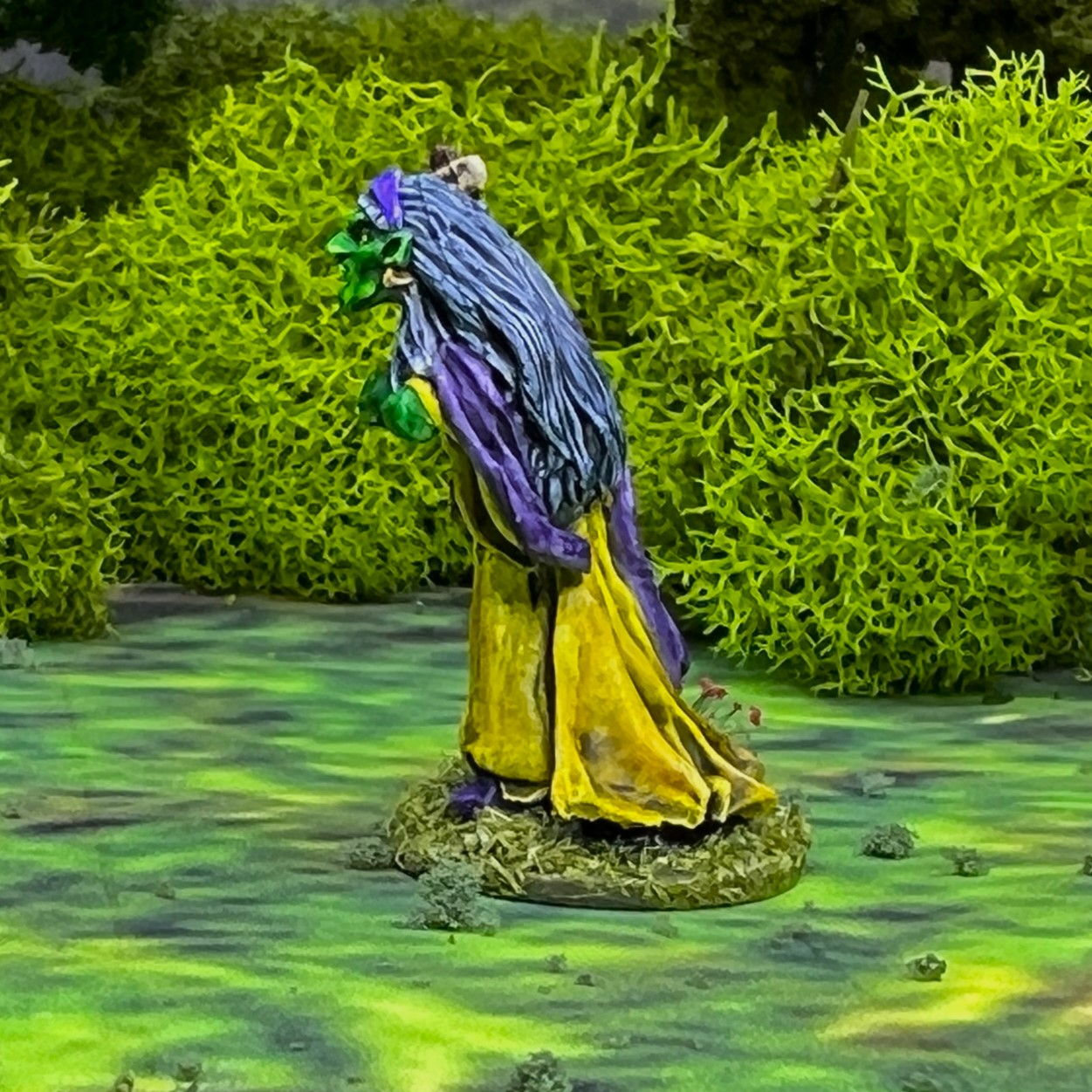
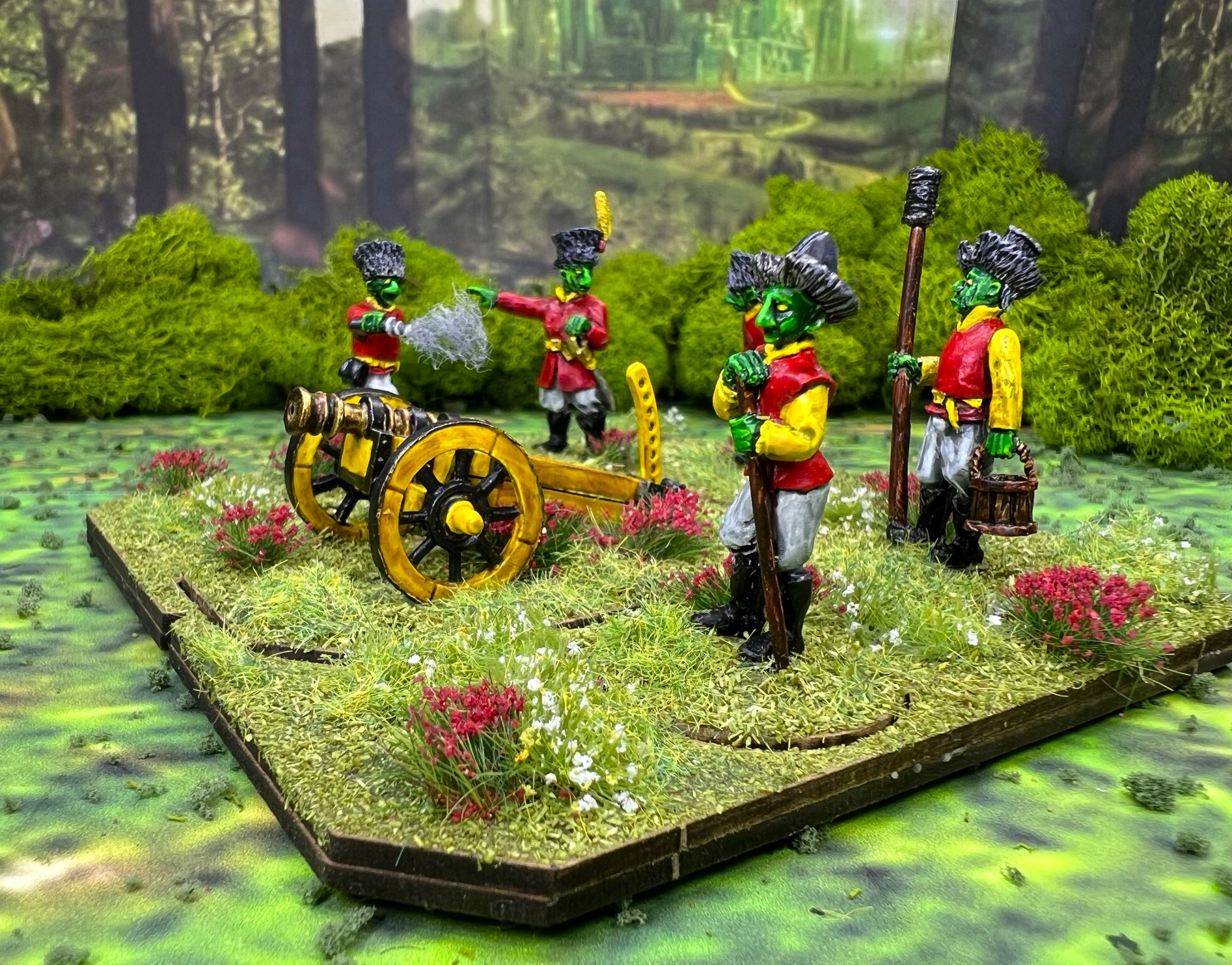
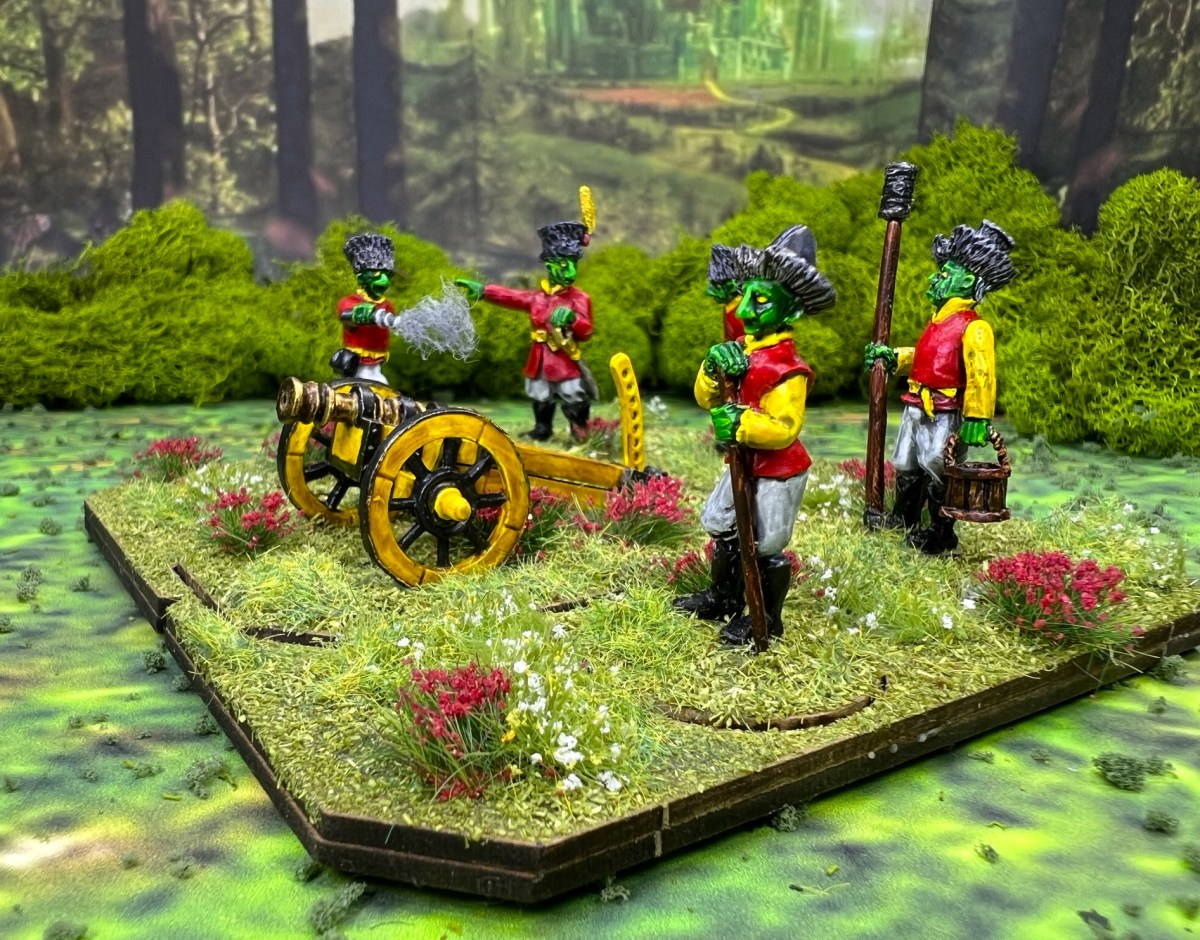
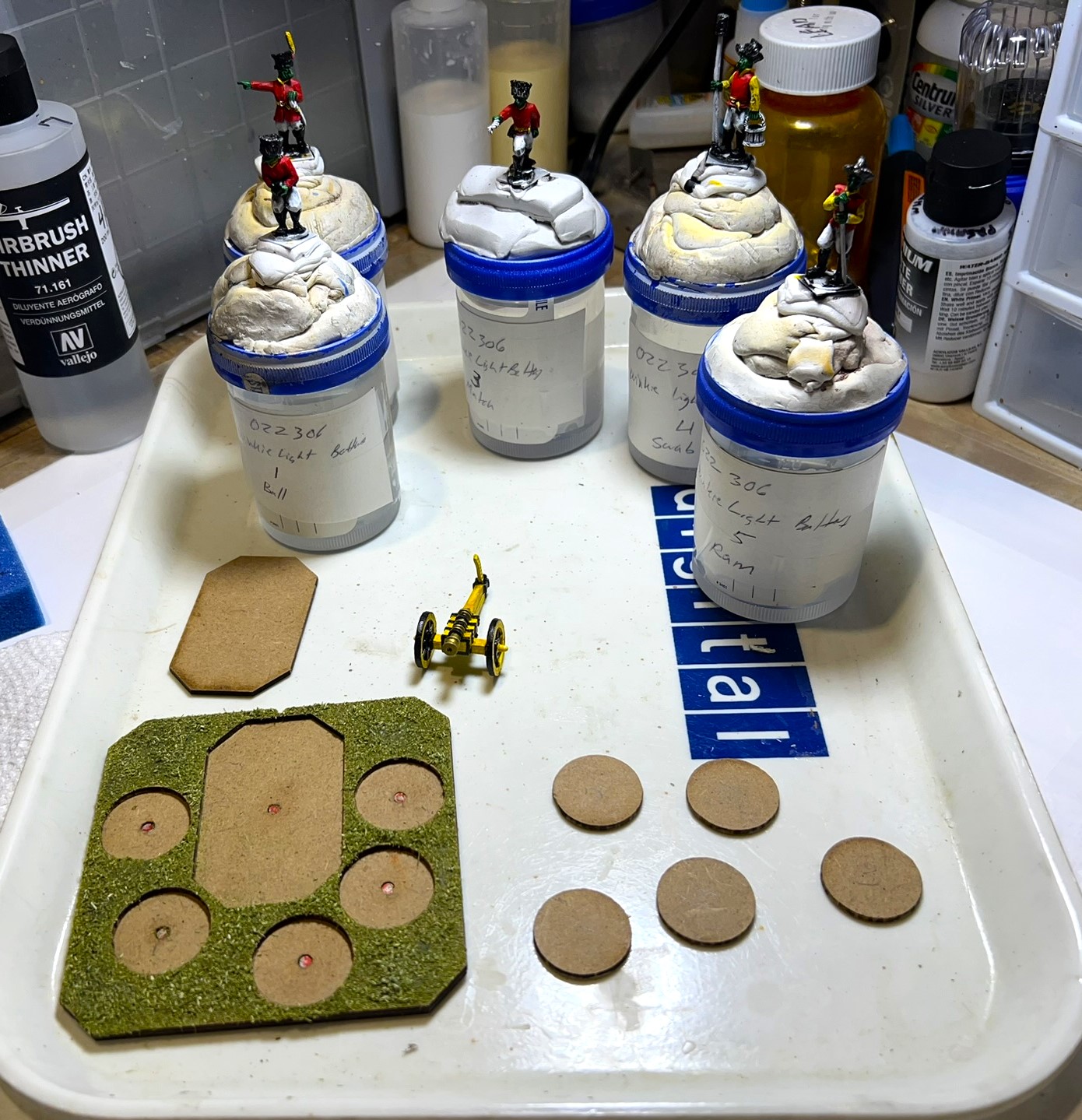
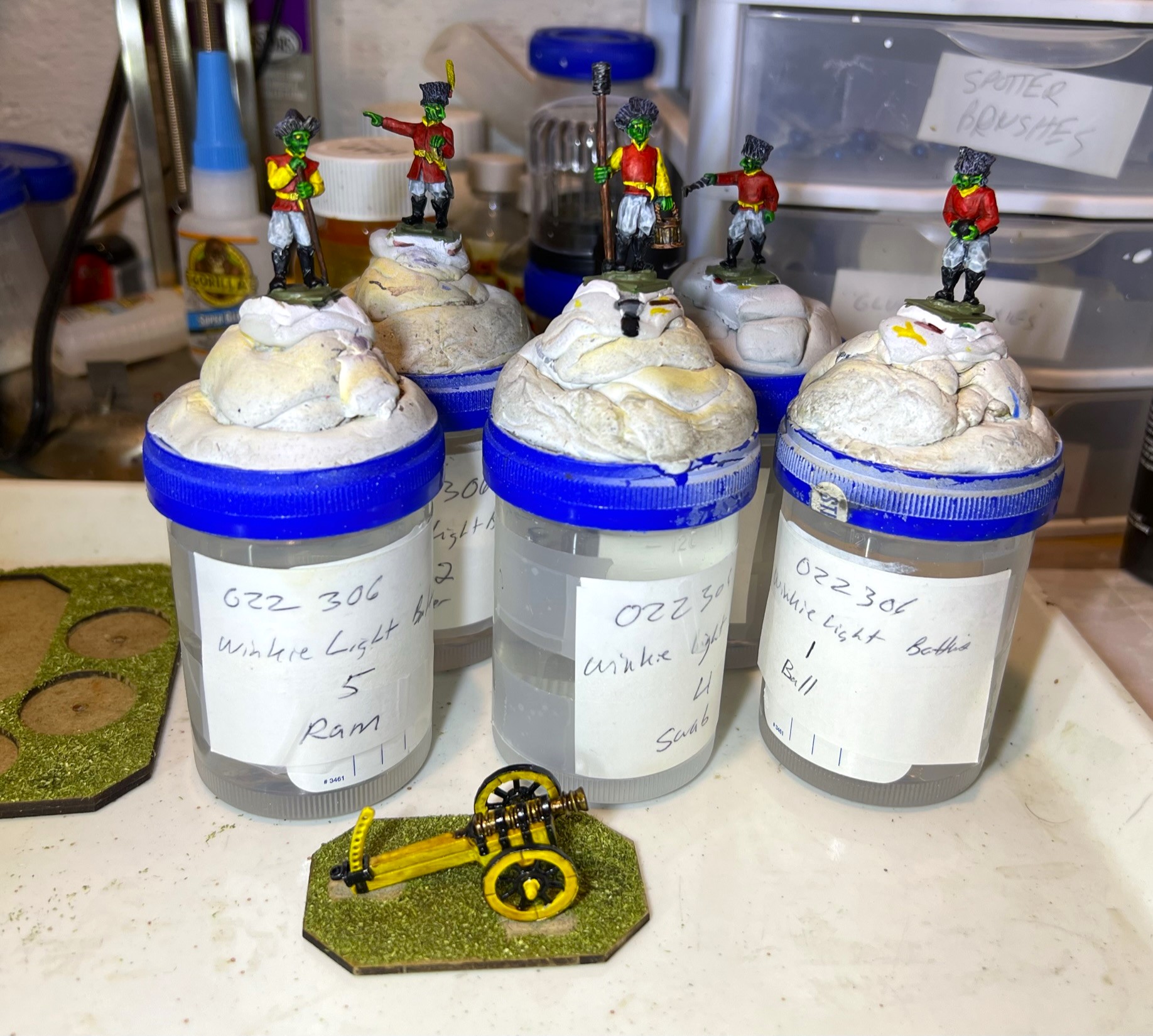
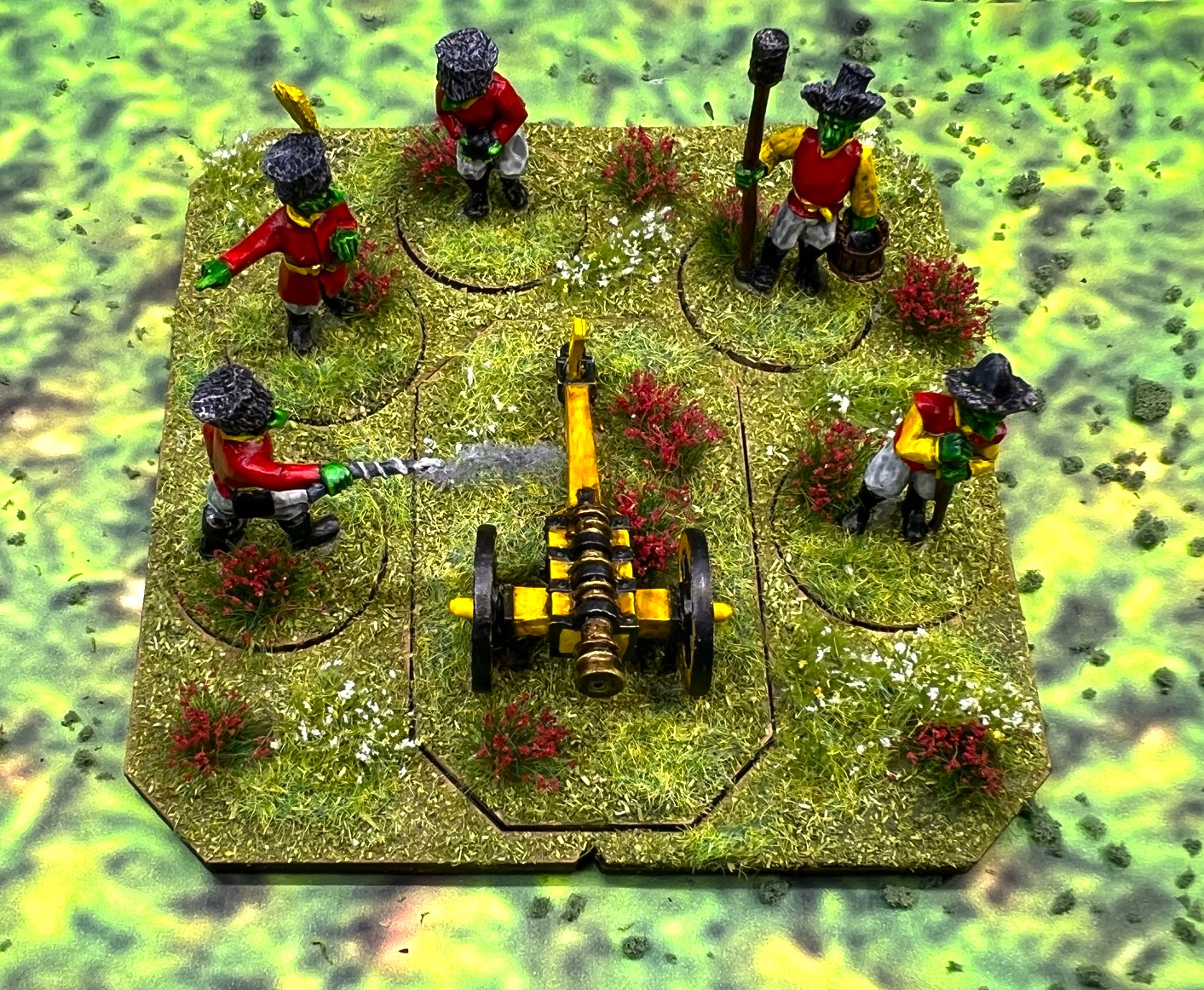
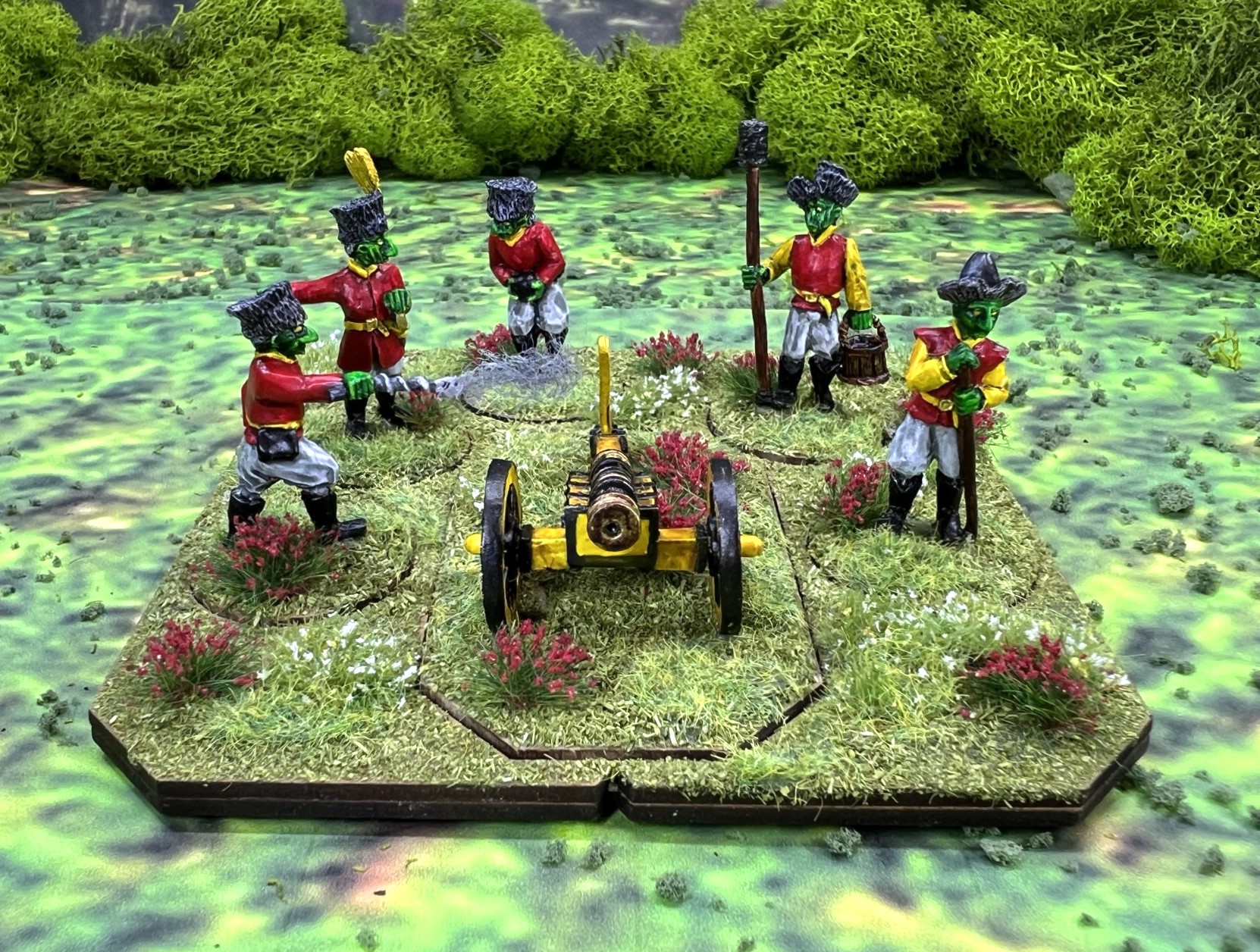
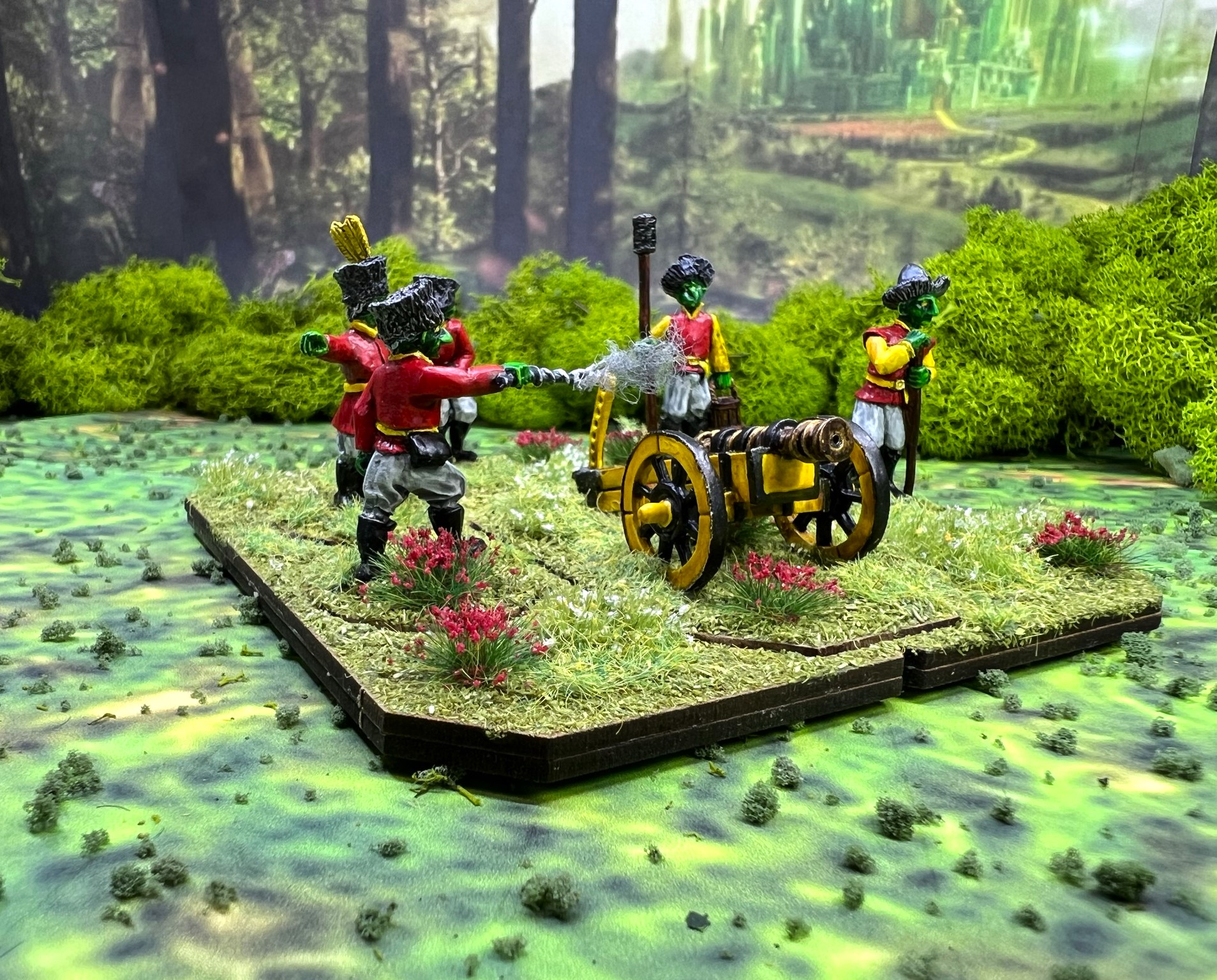
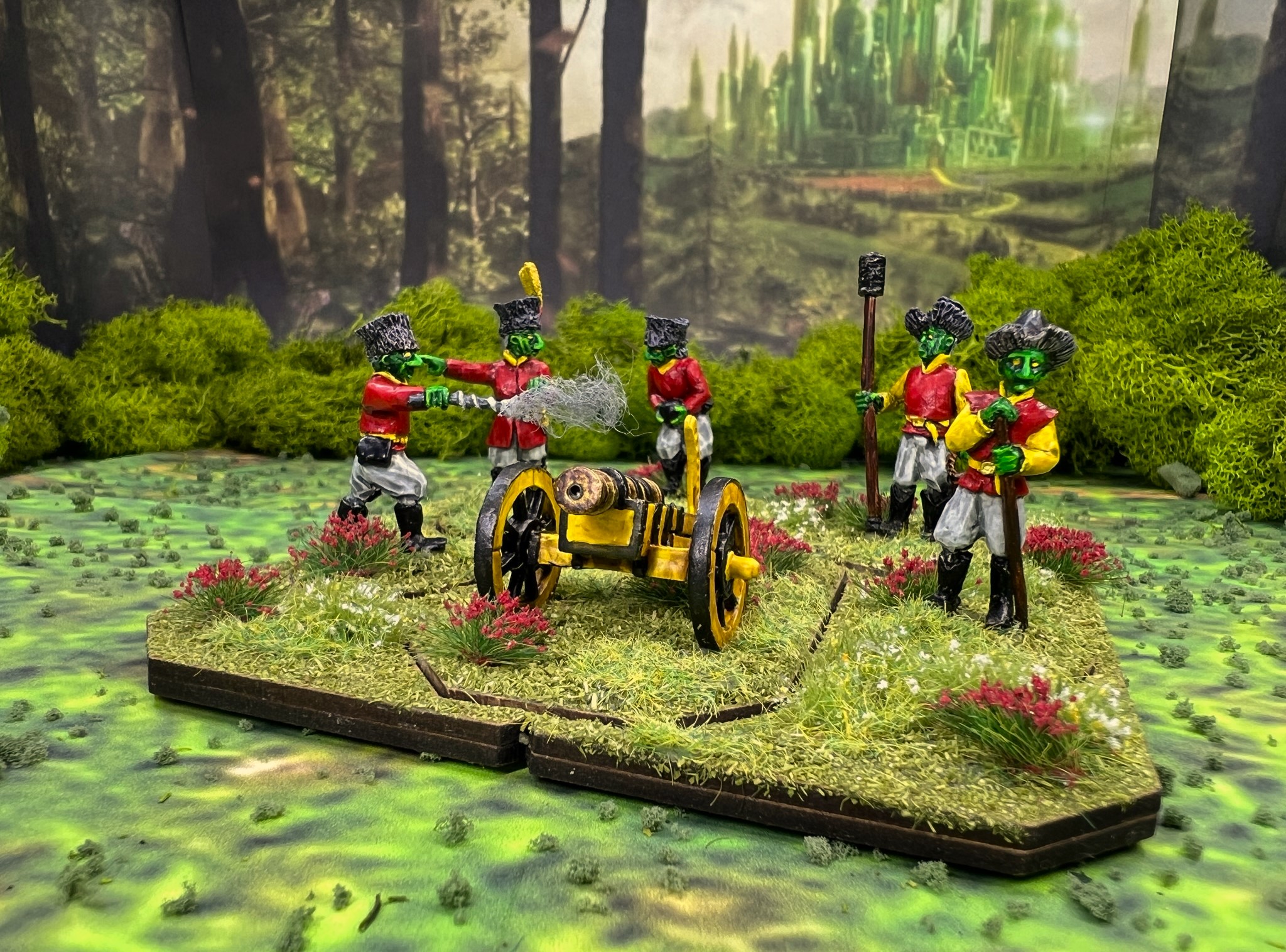
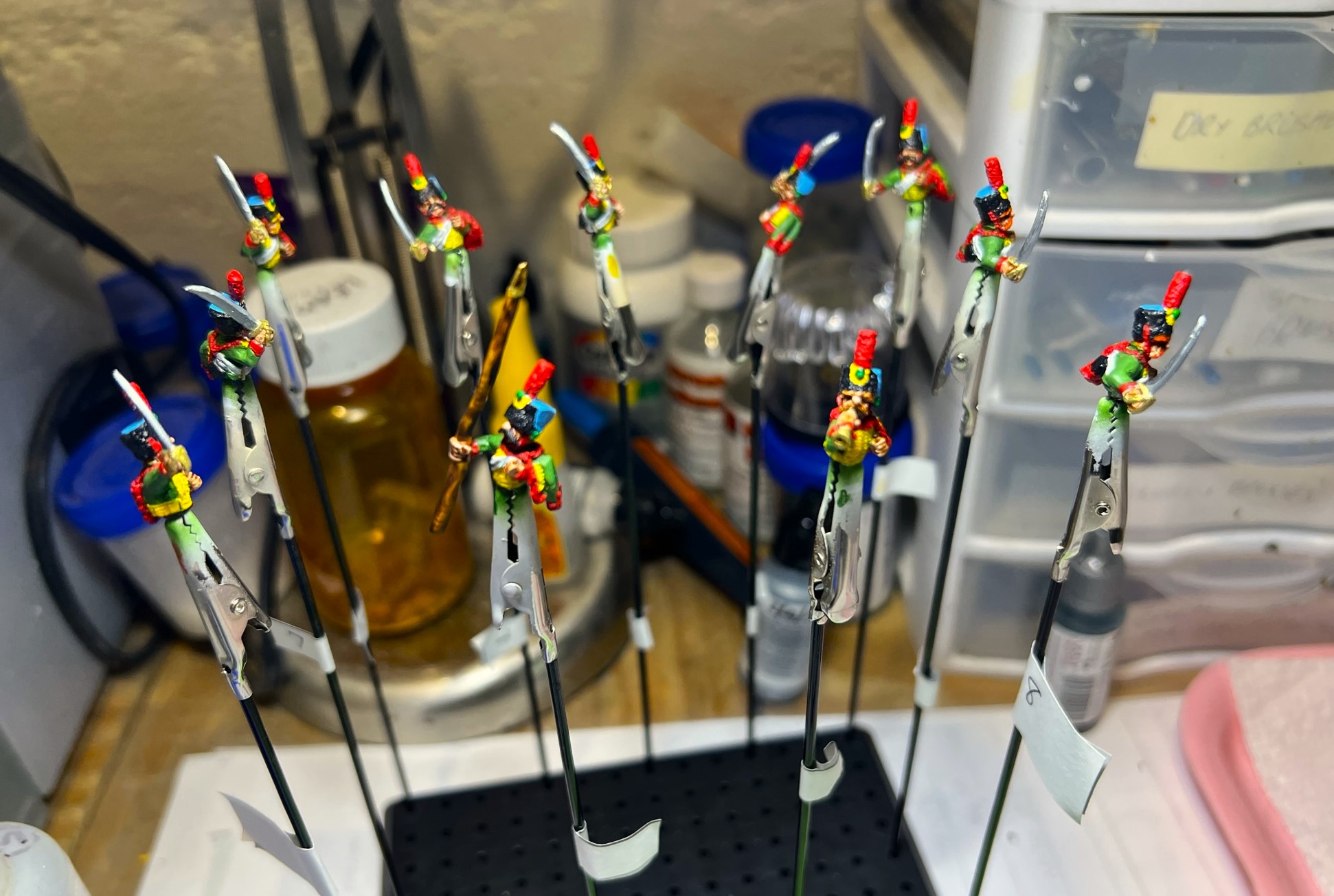
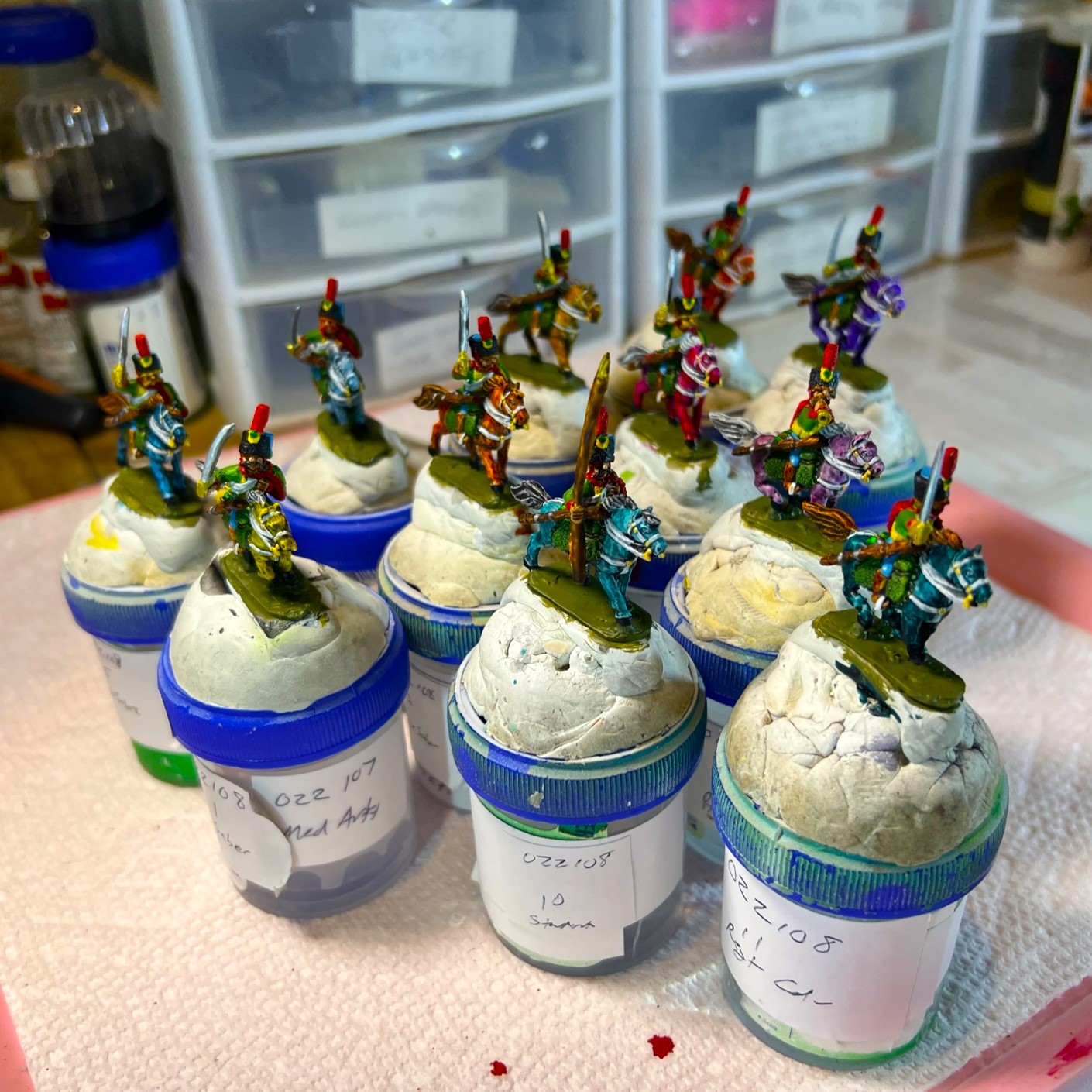
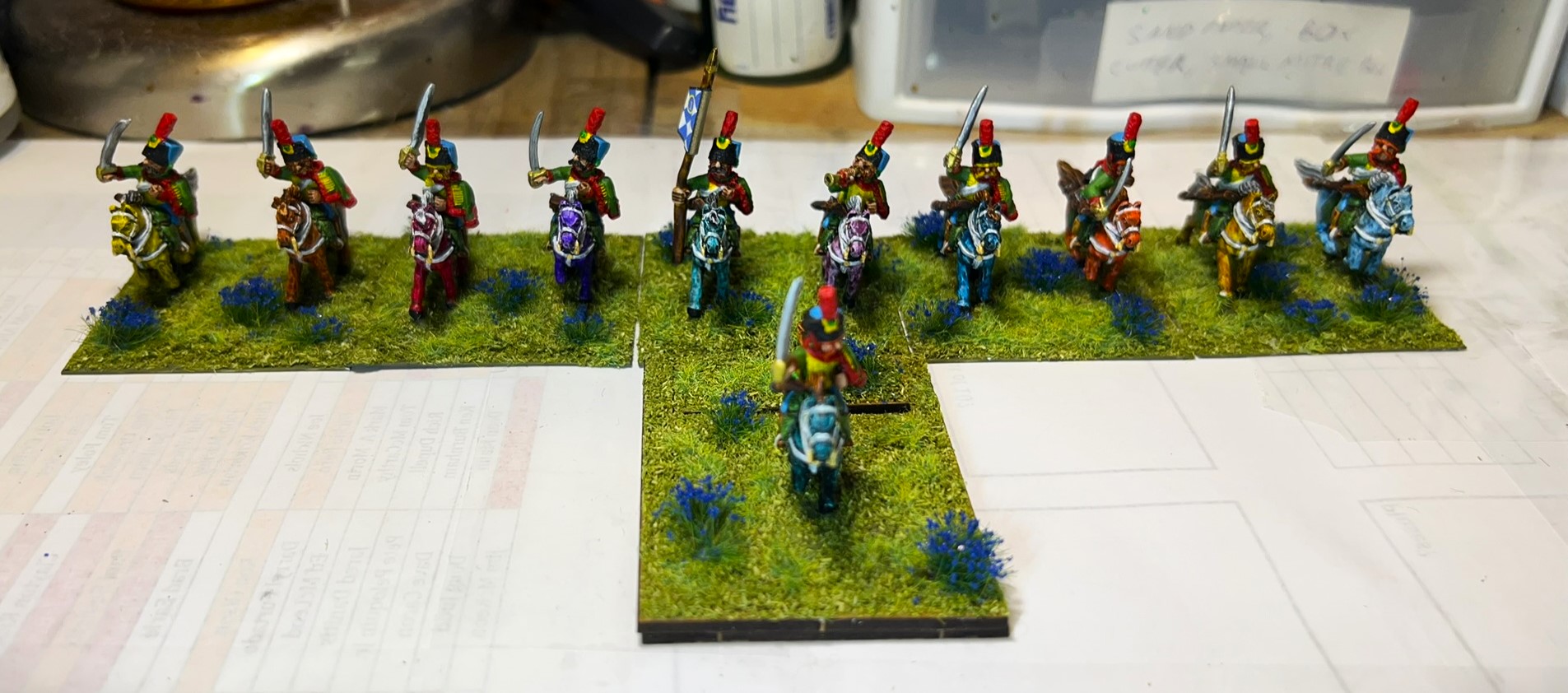
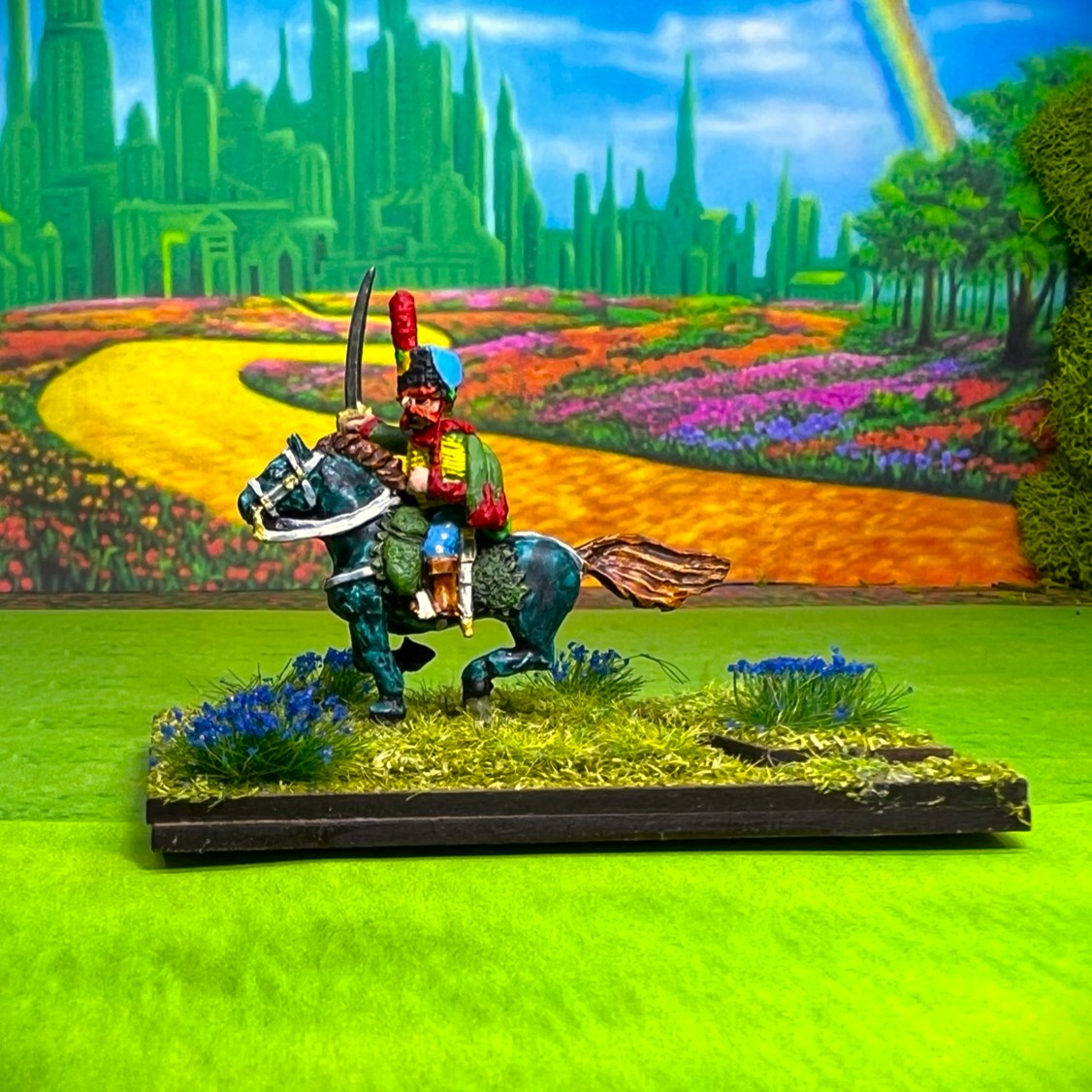
My first unit ended up being atypical – as Winkies normally don’t think much of firearms and missile weapons (or those who wield them in battle). The Winkies consider melee as their preferred means of combat. Still, they do have some artillery, and as shown here a small contingent of troops armed with muskets to provide some firepower. My Winkie brigade will eventually have melee troops, light artillery, and Zilk-riding cavalry (zilks are giant ostrich-like carnivorous birds that Winkies capture and train as mounts – though they are known to eat fallen enemy and their Winkie riders alike). I’ll also have some Great Flying Apes, some lesser apes, and their witch Evora. I am trying to get as many as possible done so games can begin, and to that end I am batch-priming and batch-painting as many units as possible.

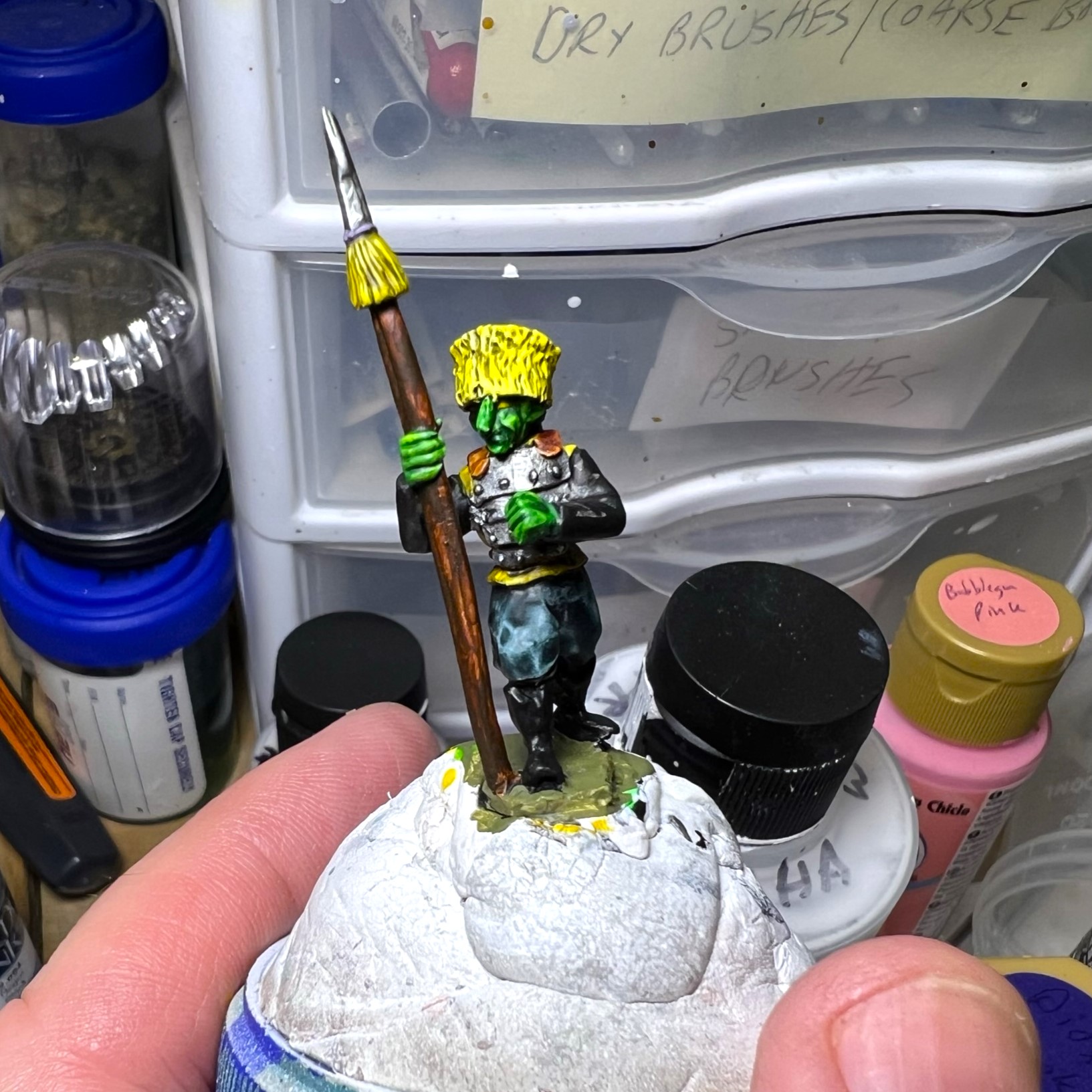
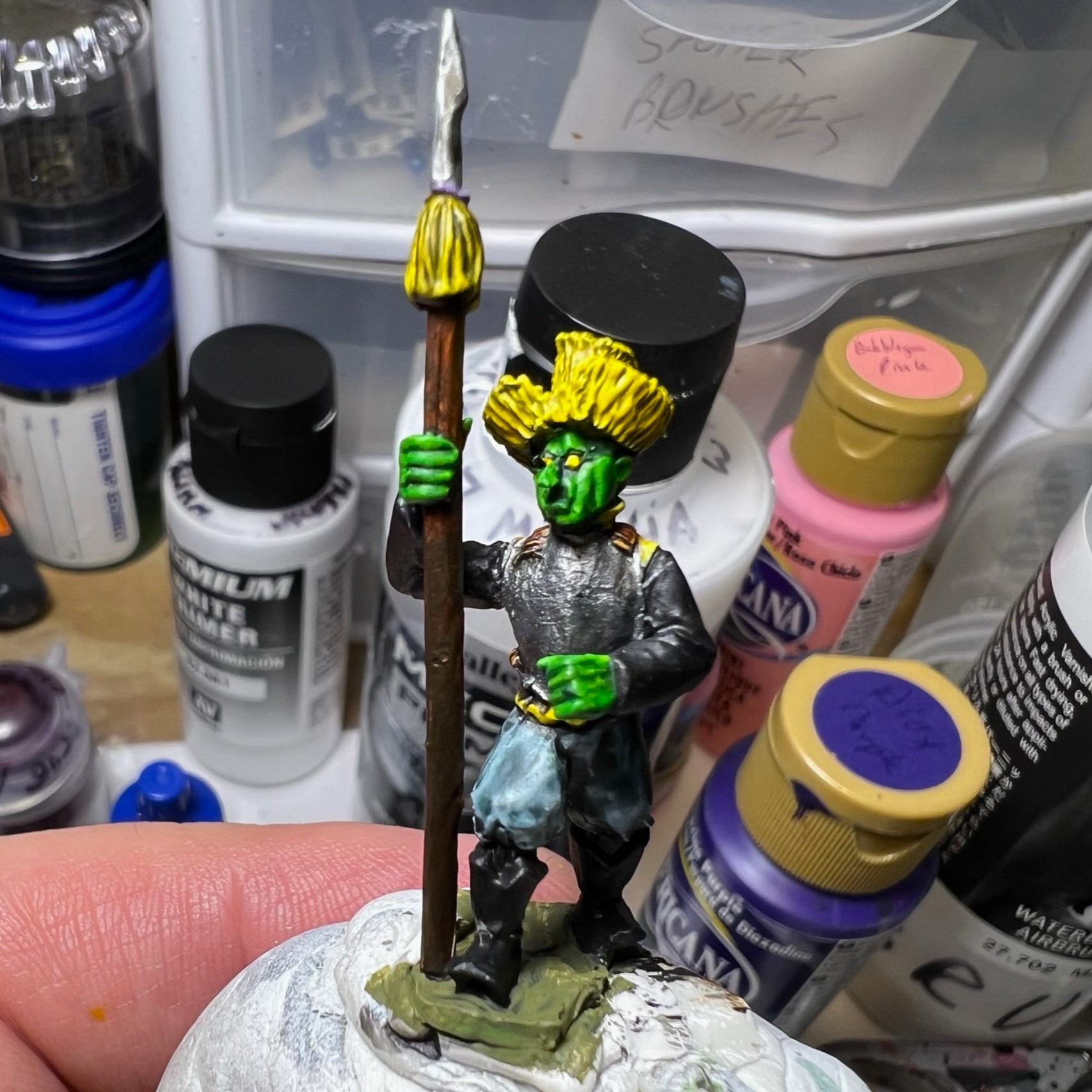
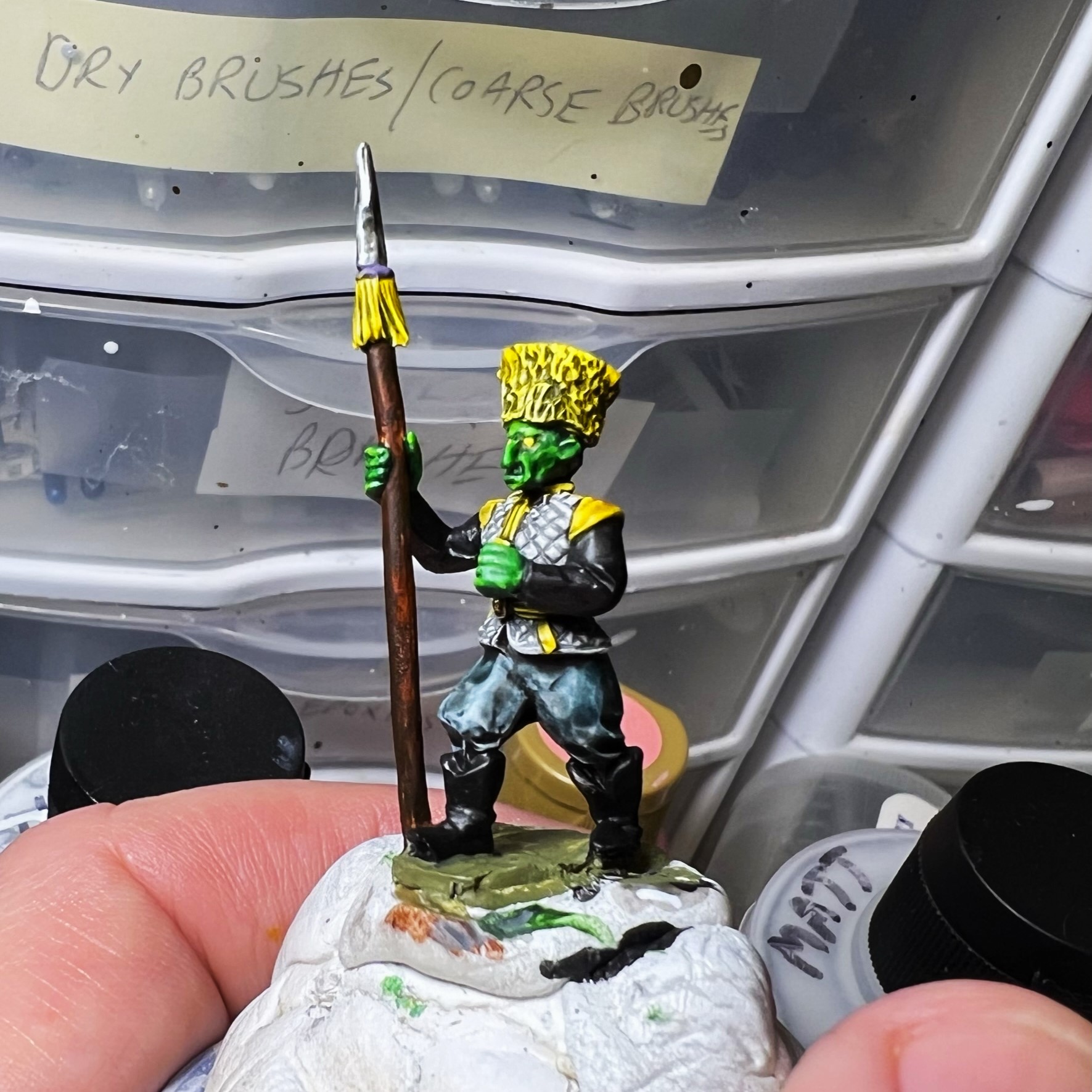
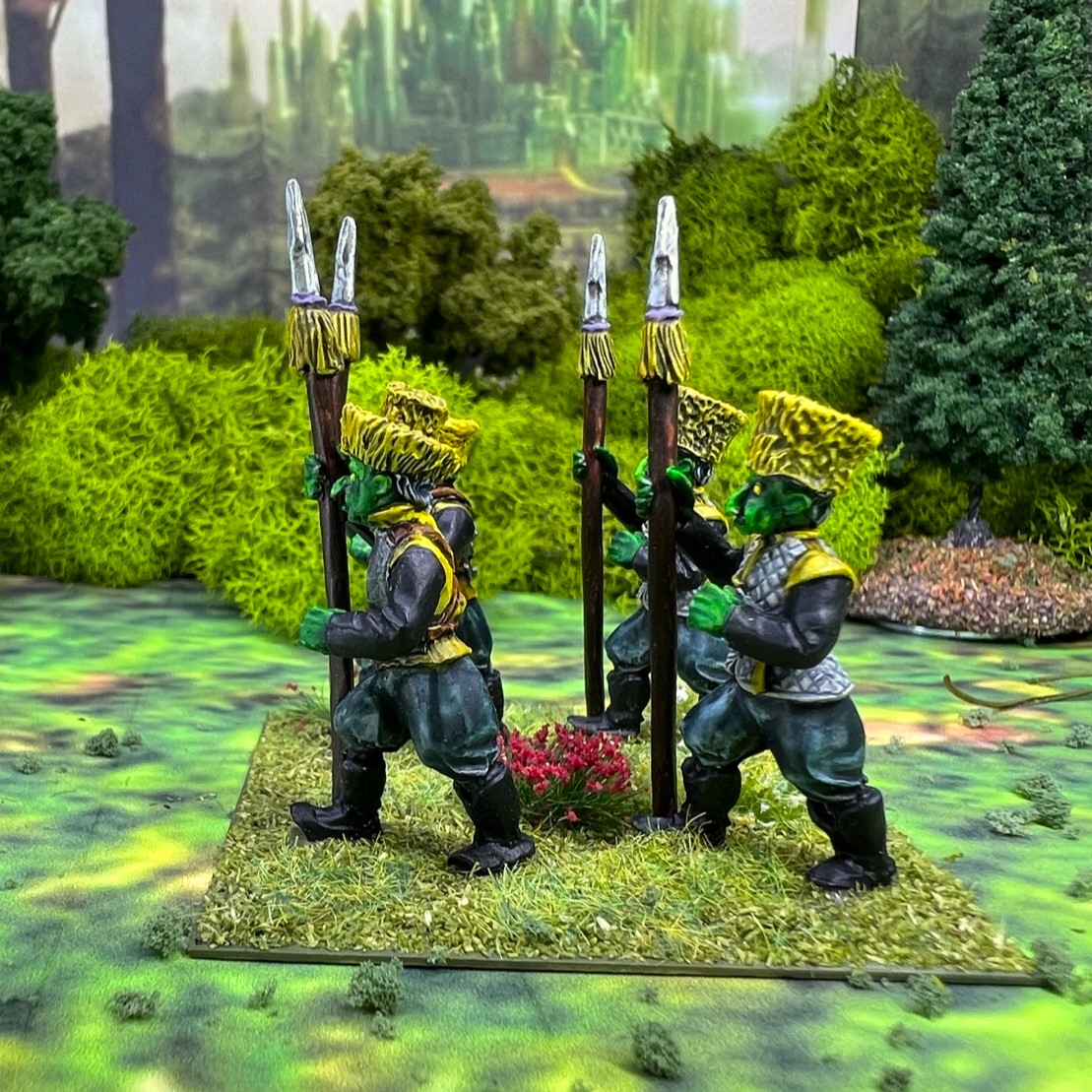
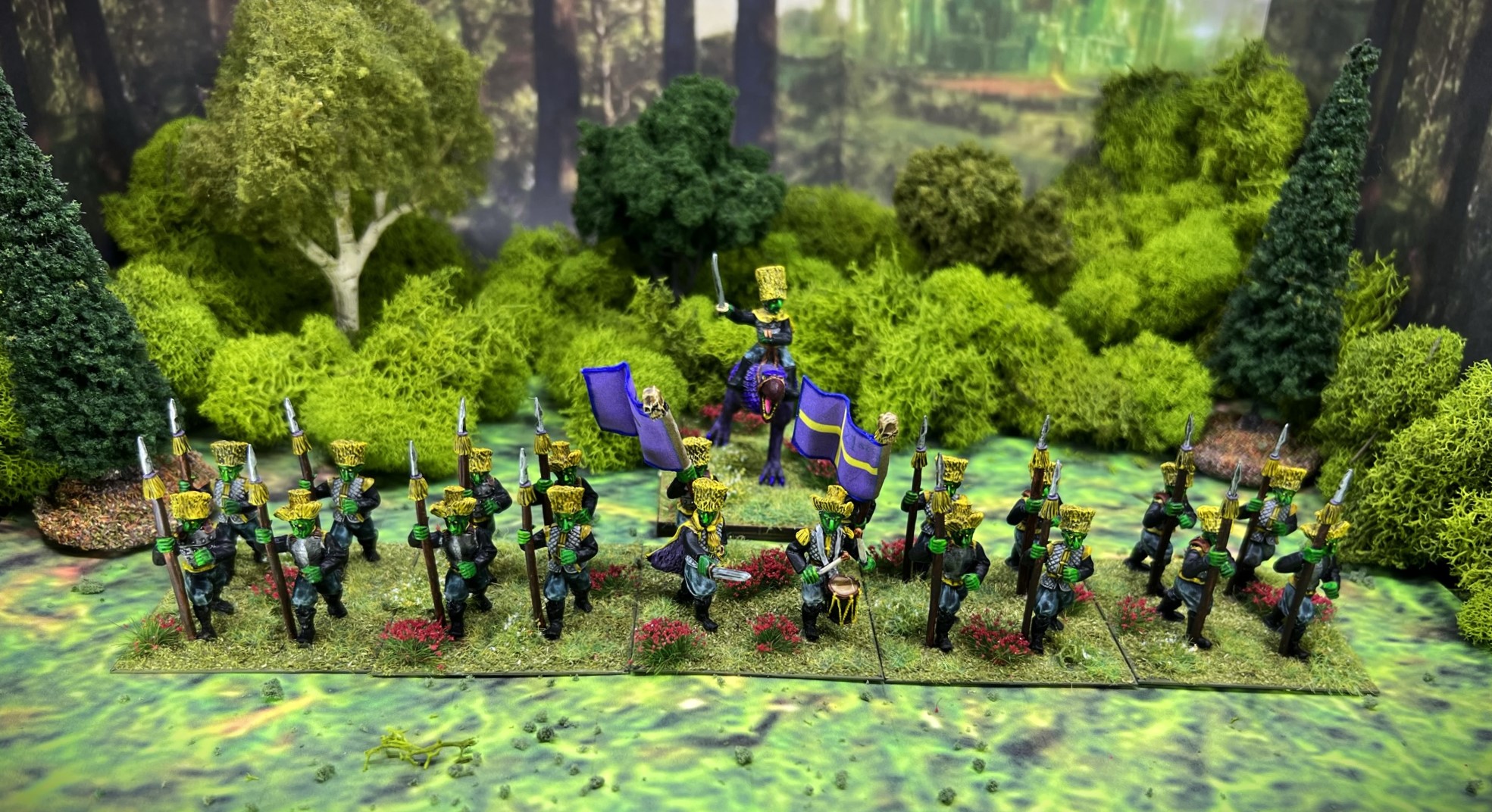
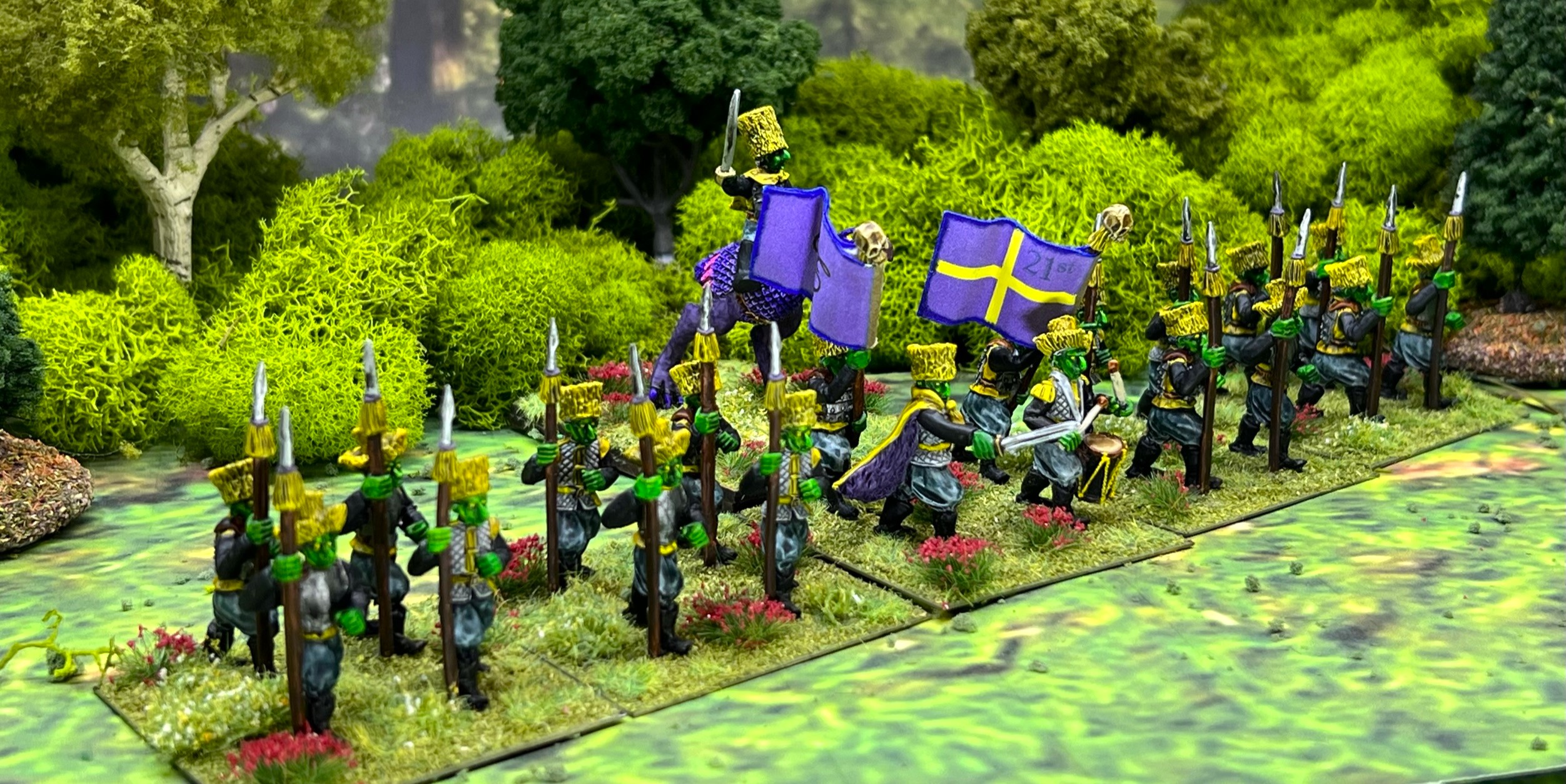
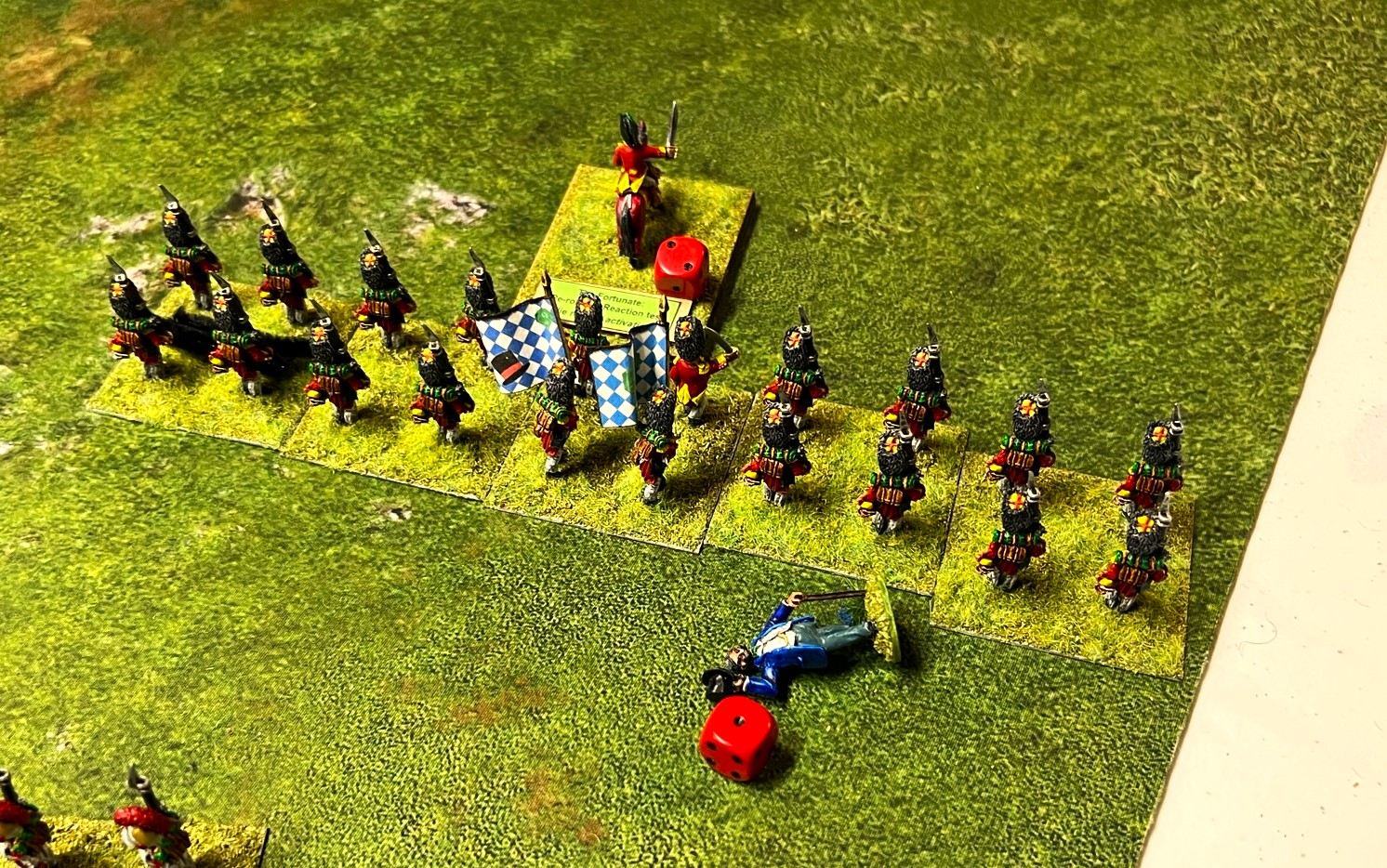
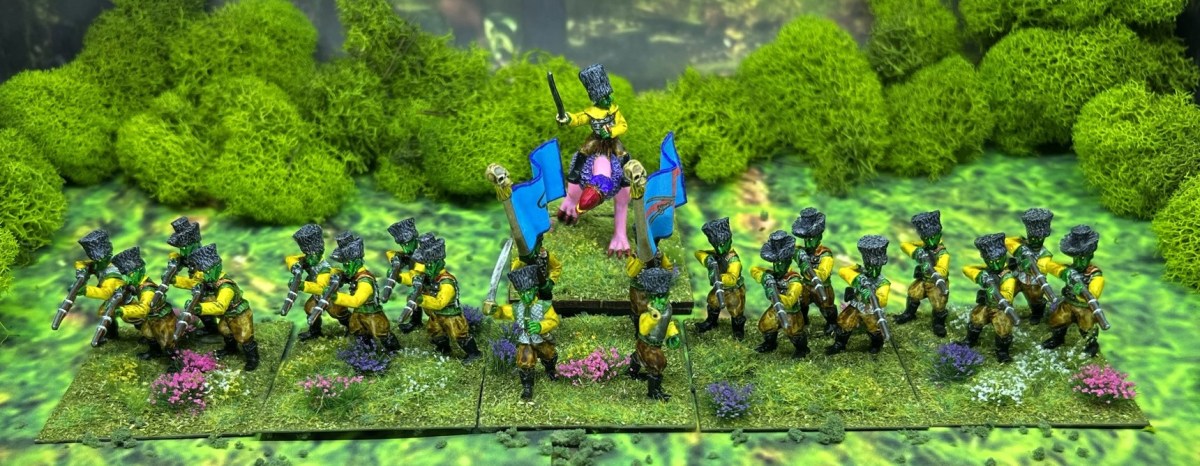
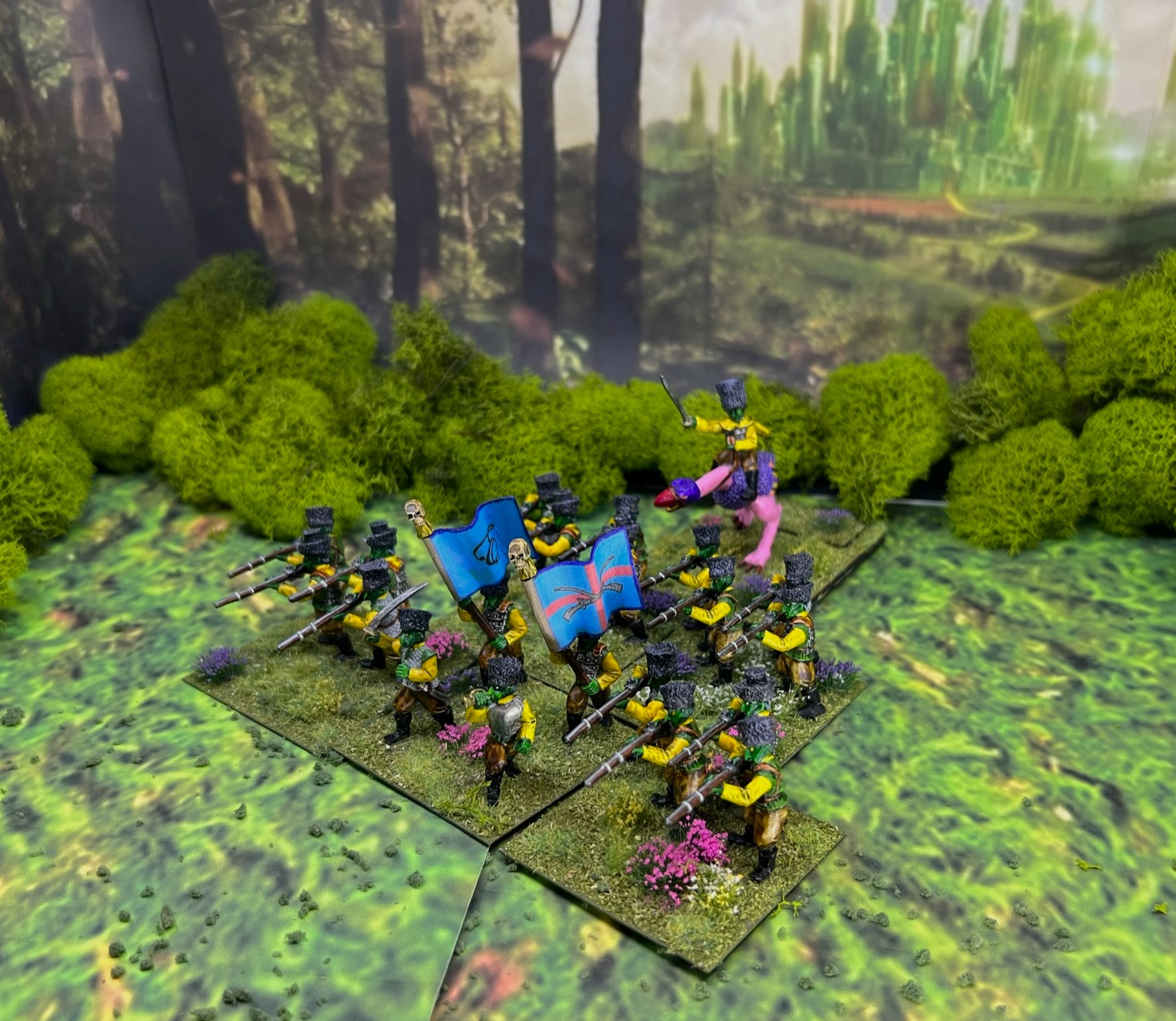
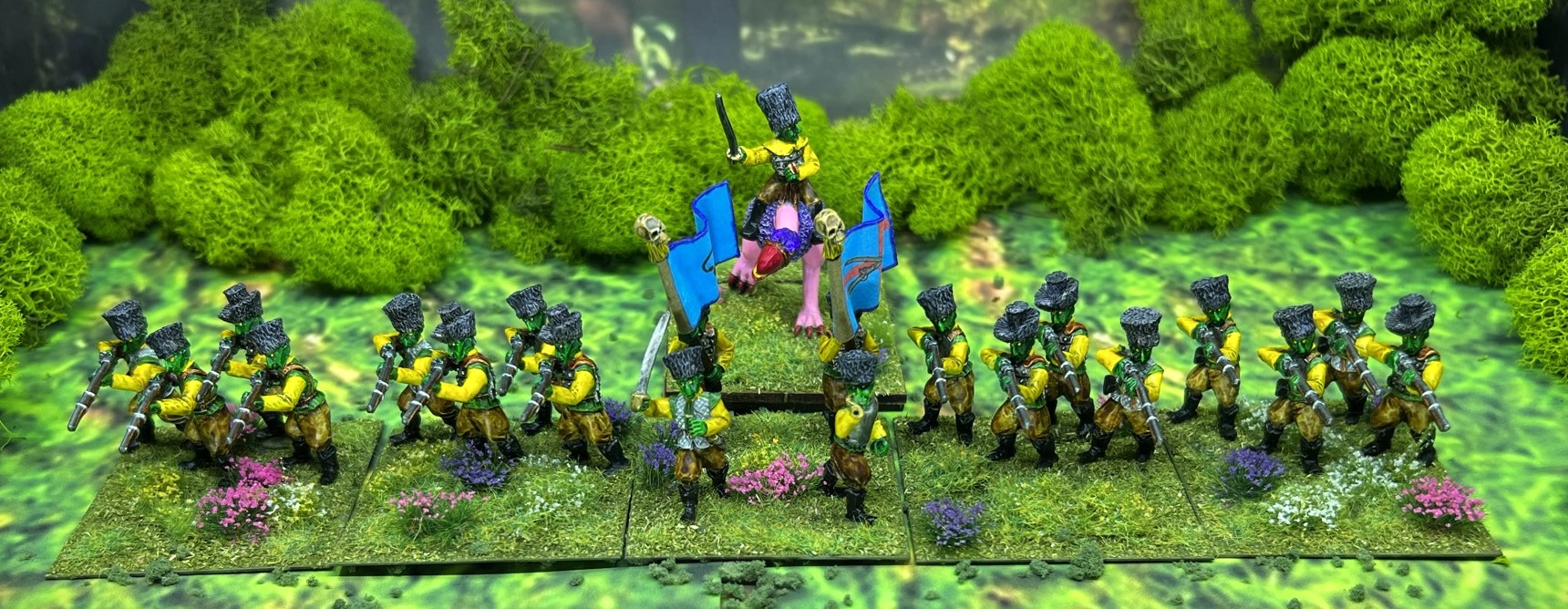
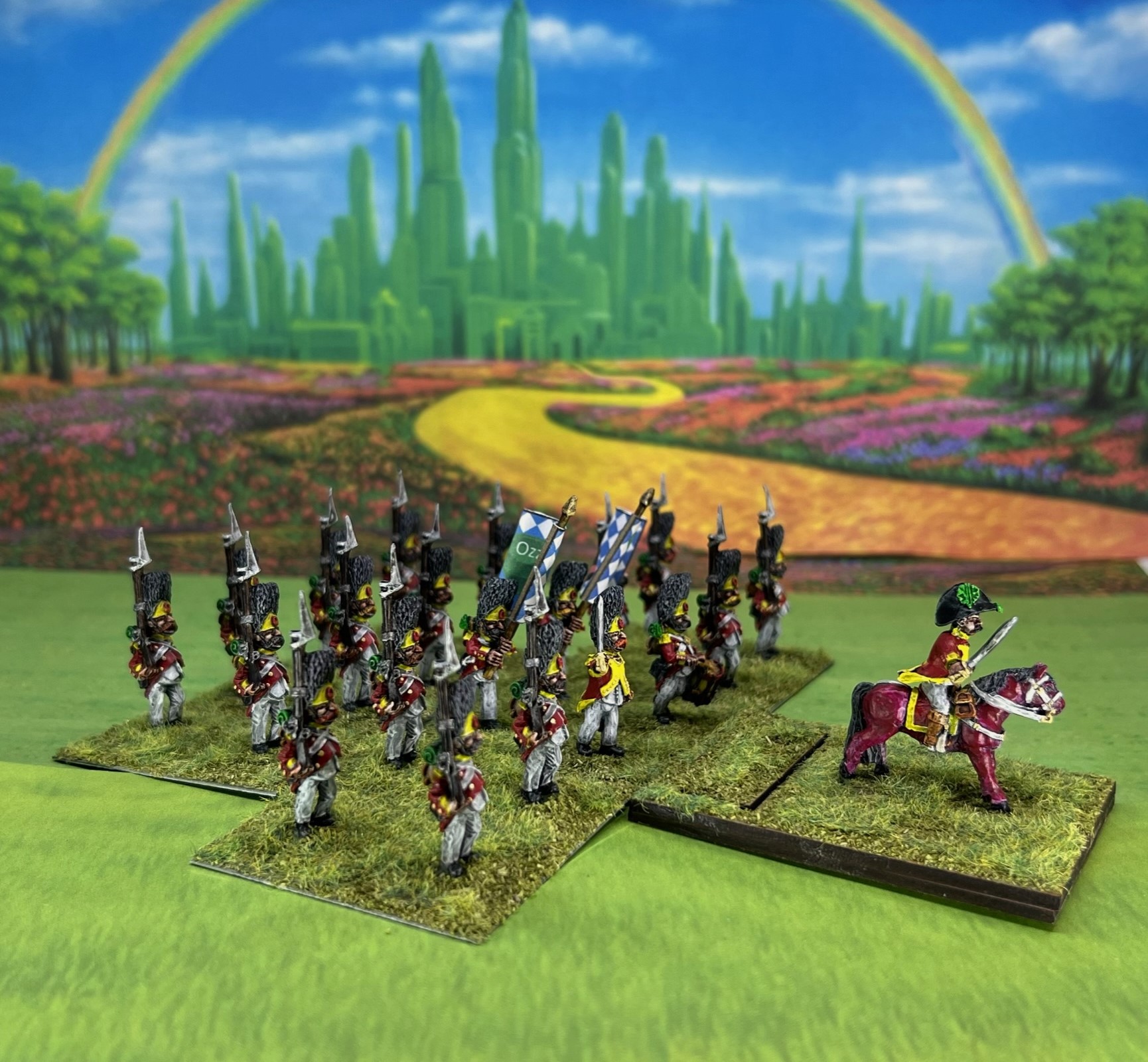
Back to the WSR – just like most Ozz regiments, this Winkie Sharpshooter Regiment (WSR) (#OZZ303) has 21 figures in total. They are on 5 bases – 4 figures with muskets per 4 stands, plus 4 figures on a single command stand, along with a regimental commander stand (MDF). The WSR is 28mm in scale, and the figures are metal. It is worth 7 points versus a regular Winkie infantry unit which costs only 5.

I began prepping the unit back on December 12th – and was hoping to finish by the end of the year – which I did today, December 31st! This allowed me to accomplish two things. First. I got to break the 200 level of painted figures for 2022 (I actually painted 202 in 2022 with the completion of the WSR). It also allowed me to enter this as my first (and definitely not the last) unit for Dave Stone’s “Paint What You Got 2022/2023” challenge.

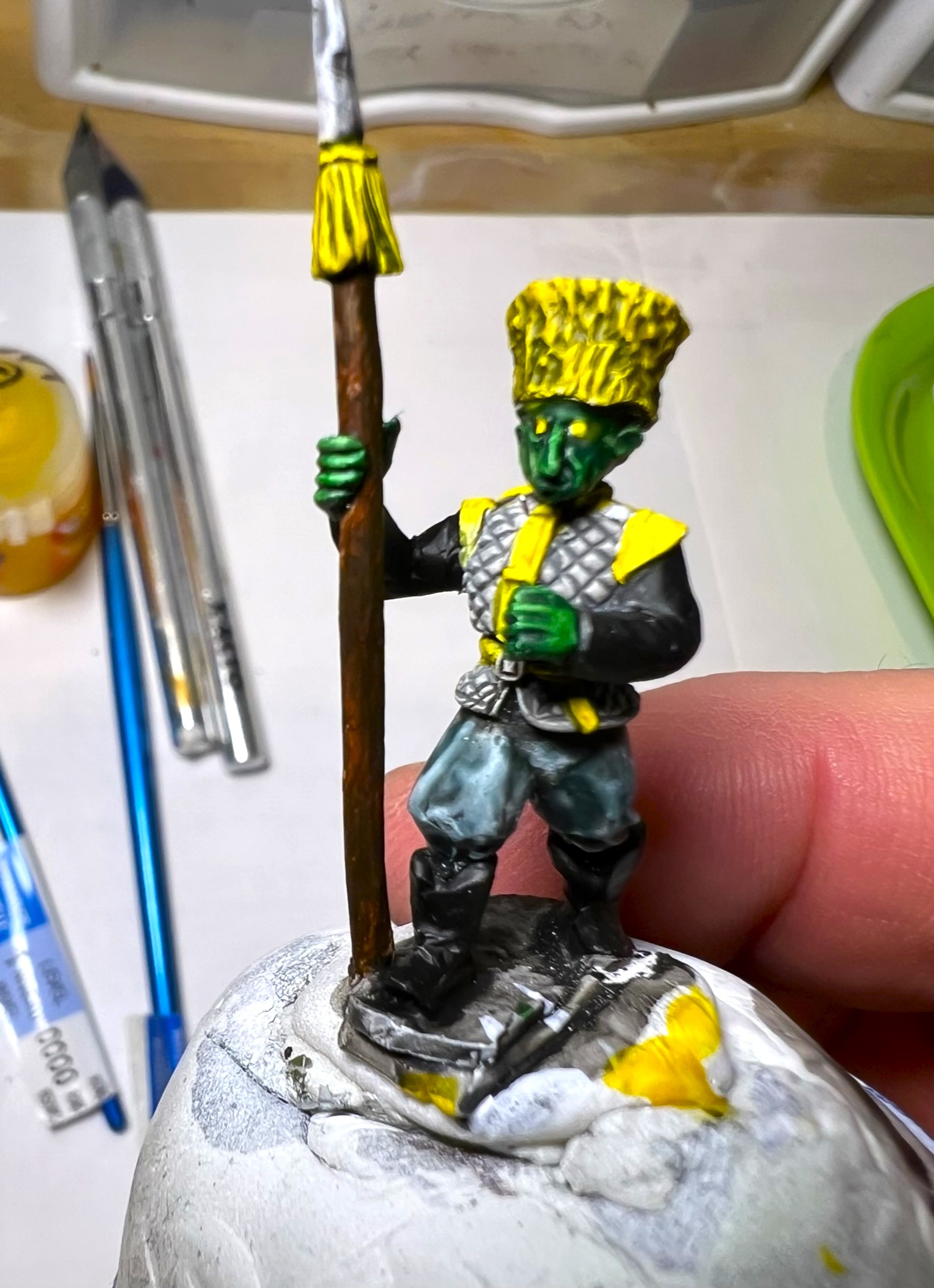
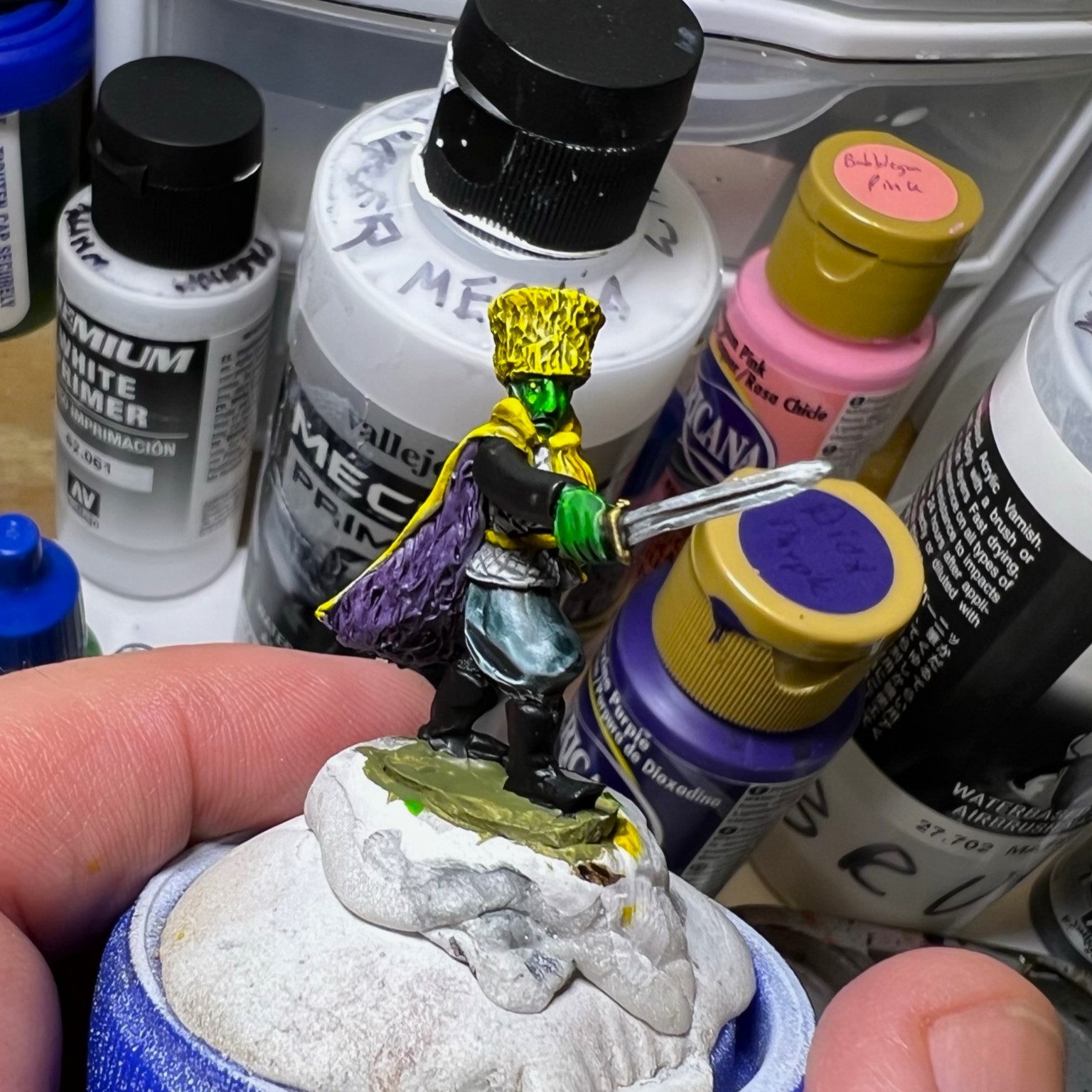
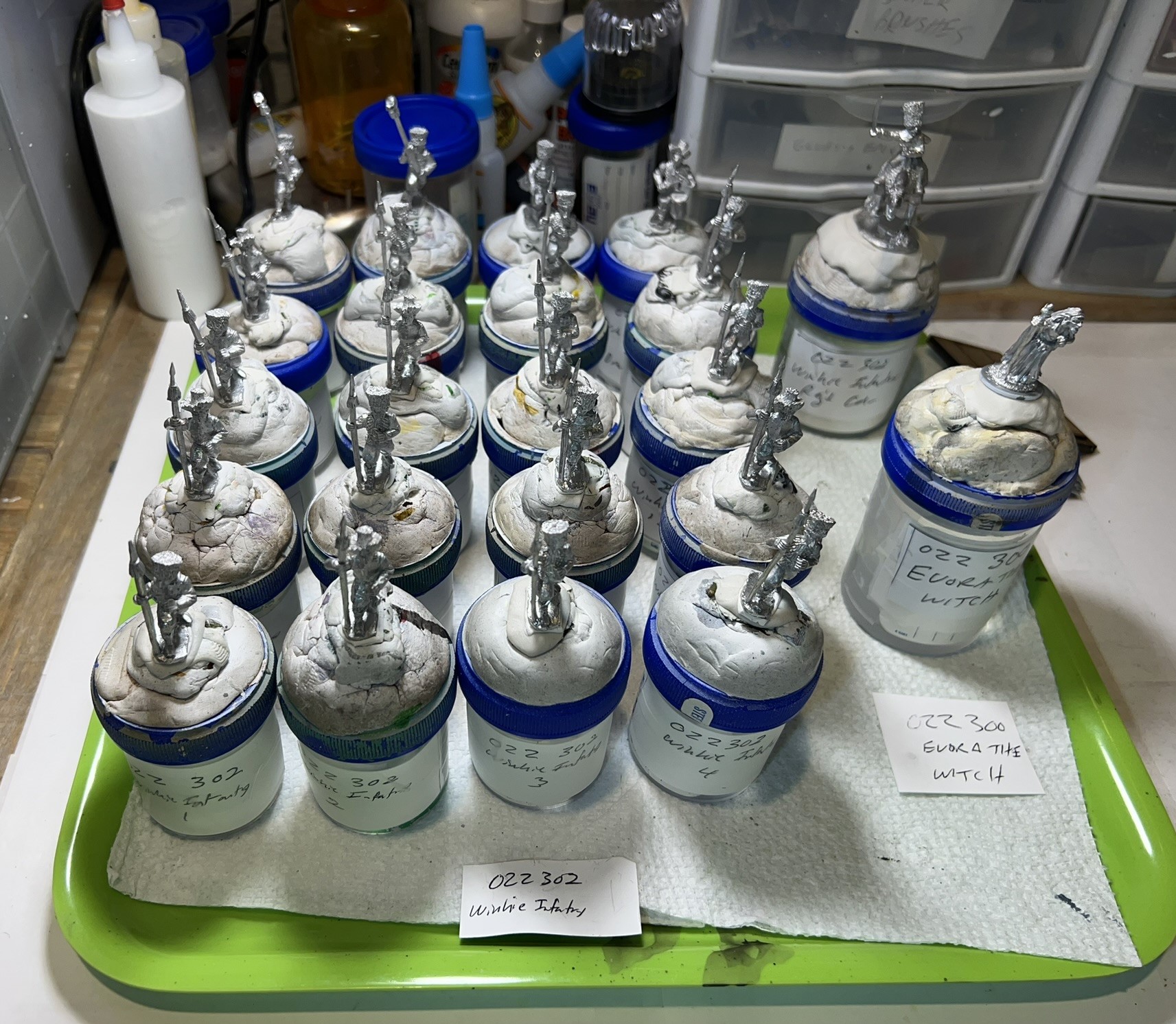
The Ozz rules say that the WSS should have “forest green” coats and khaki trousers. And because Evora just loves yellow – a healthy amount of yellow on all Winkies. The WSR figures had fur caps of two different types, plus three different kinds of armor – to include cotton armor like I had on my Aztecs and Conquistadores. I tried to mix them up them on each stand/base for a more varied look. I worked on the muskets first as I wanted them to be very distinctive of the WSR. As I felt that the fur caps HAD to be black, I made the Winkies’ hair to be a bluish grey over w white highlight so as to better stick out from underneath the dark headpieces. I needed to work around Christmas and and scheduled sinus surgery on 12/28 to complete them, so I am happy that I did. On Christmas Eve and Christmas Day, there is a marathon showing of the movie “A Christmas Story” which influenced me and played a part in some of my choices of colors that you’ll see below. A hint, “pink nightmare”…

More on this in a bit!

My goal is always to achieve a good tabletop standard – and you can be the judge about that. As usual, I will list all the paints I used on this unit at the end of this post for those interested in that sort of stuff (and for my own use for later reference as well – I do forget stuff on occasion). First, I’ll share some WIP shots, then some eye candy of the WSS.

WIP shots…

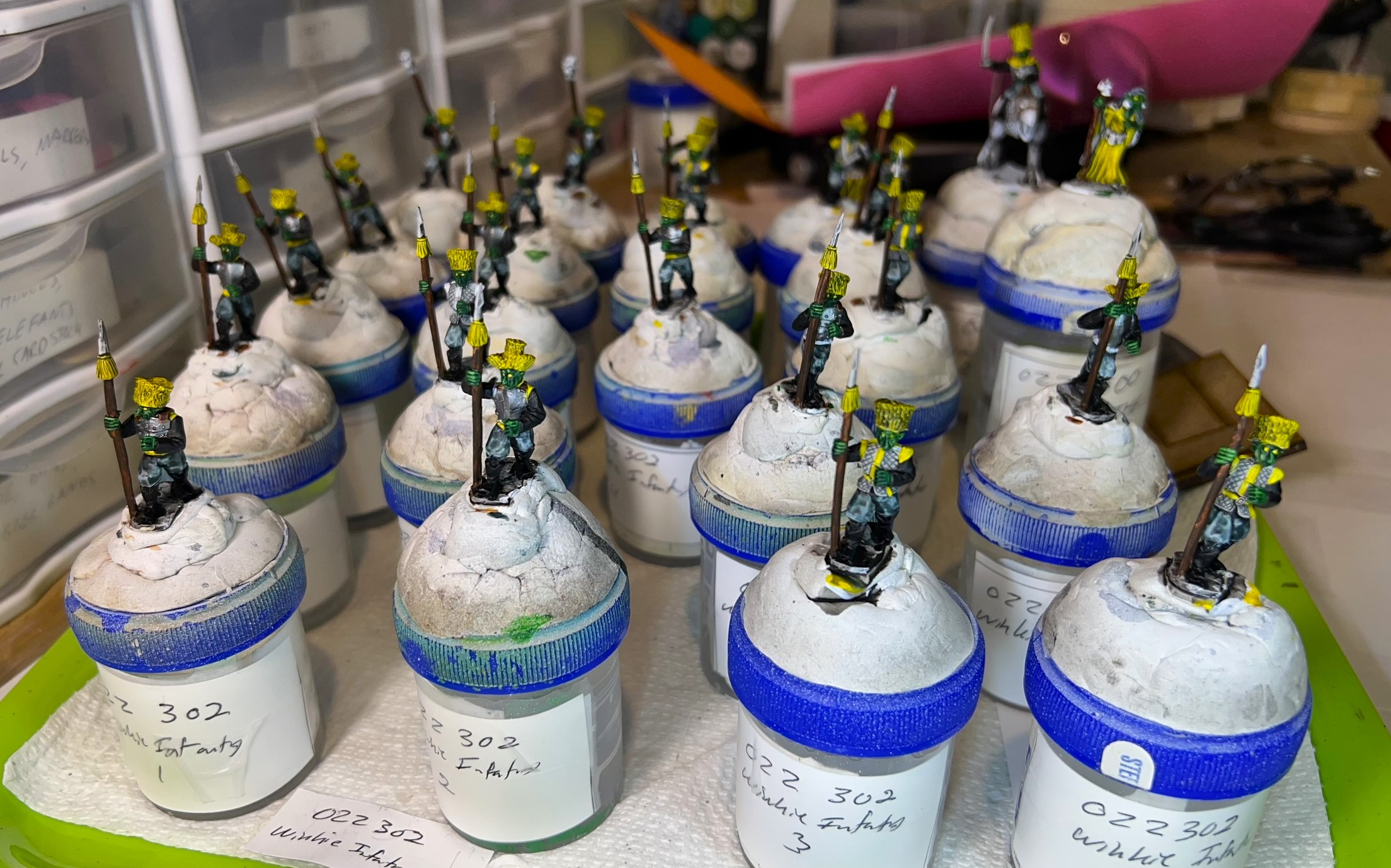
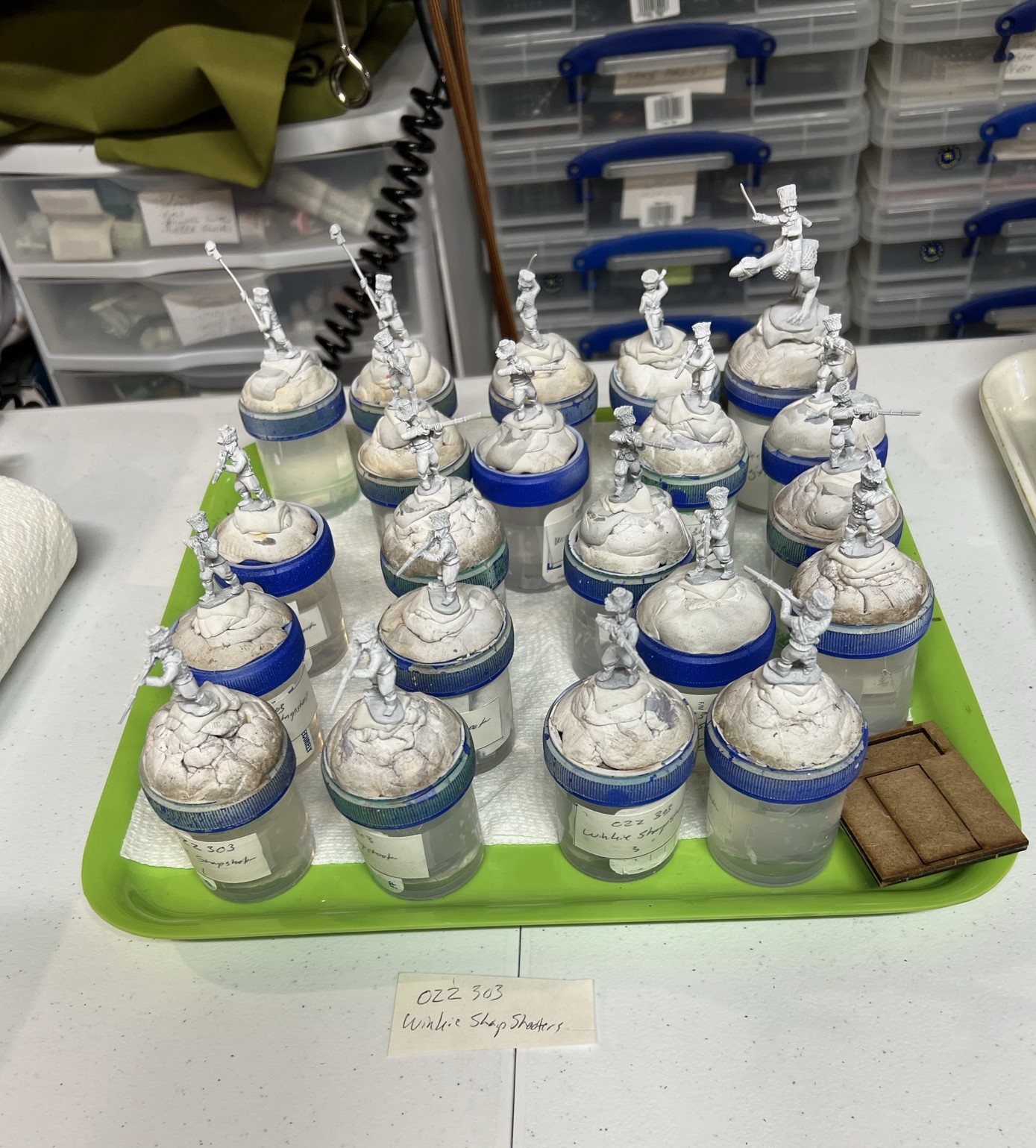
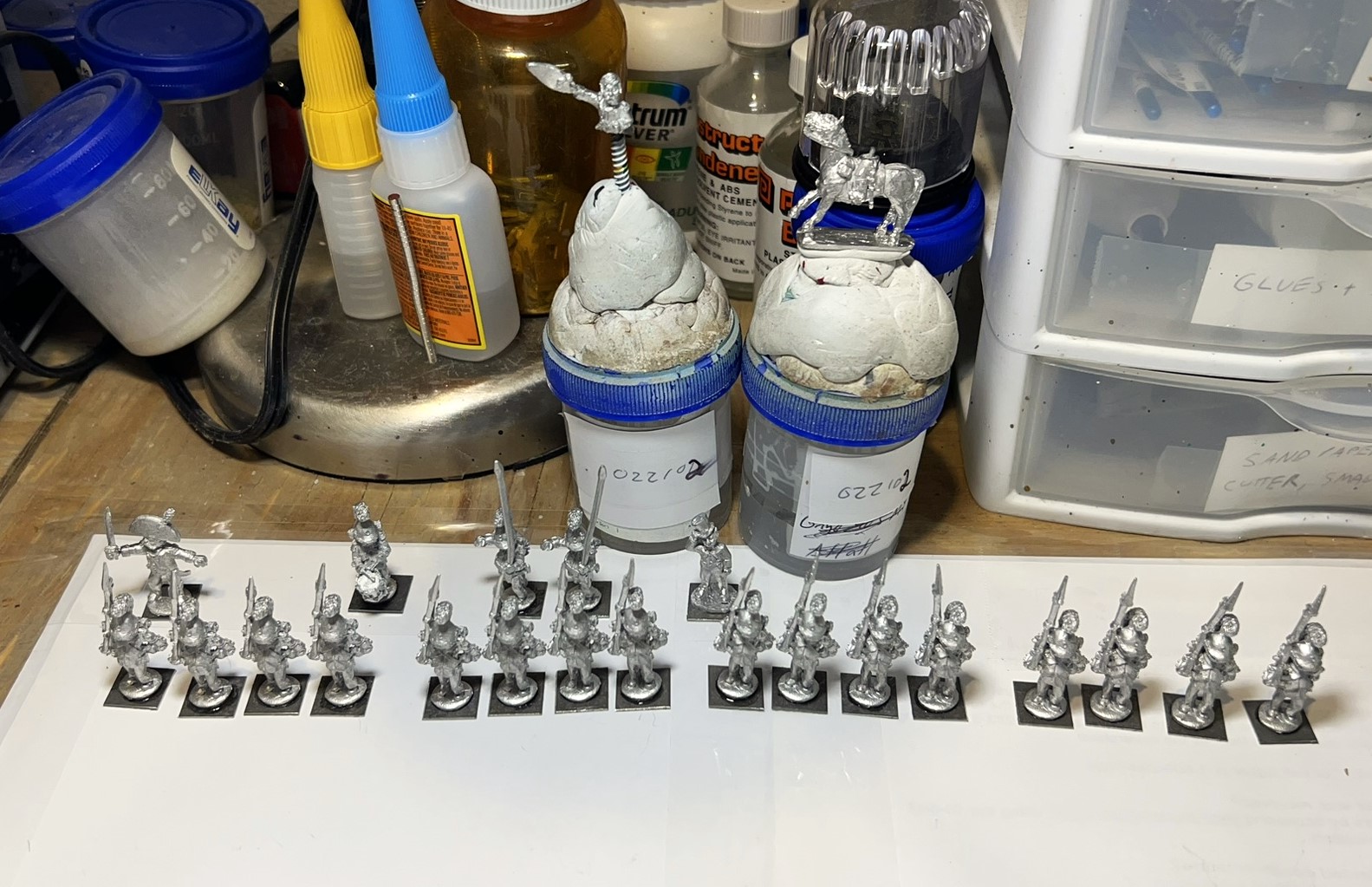
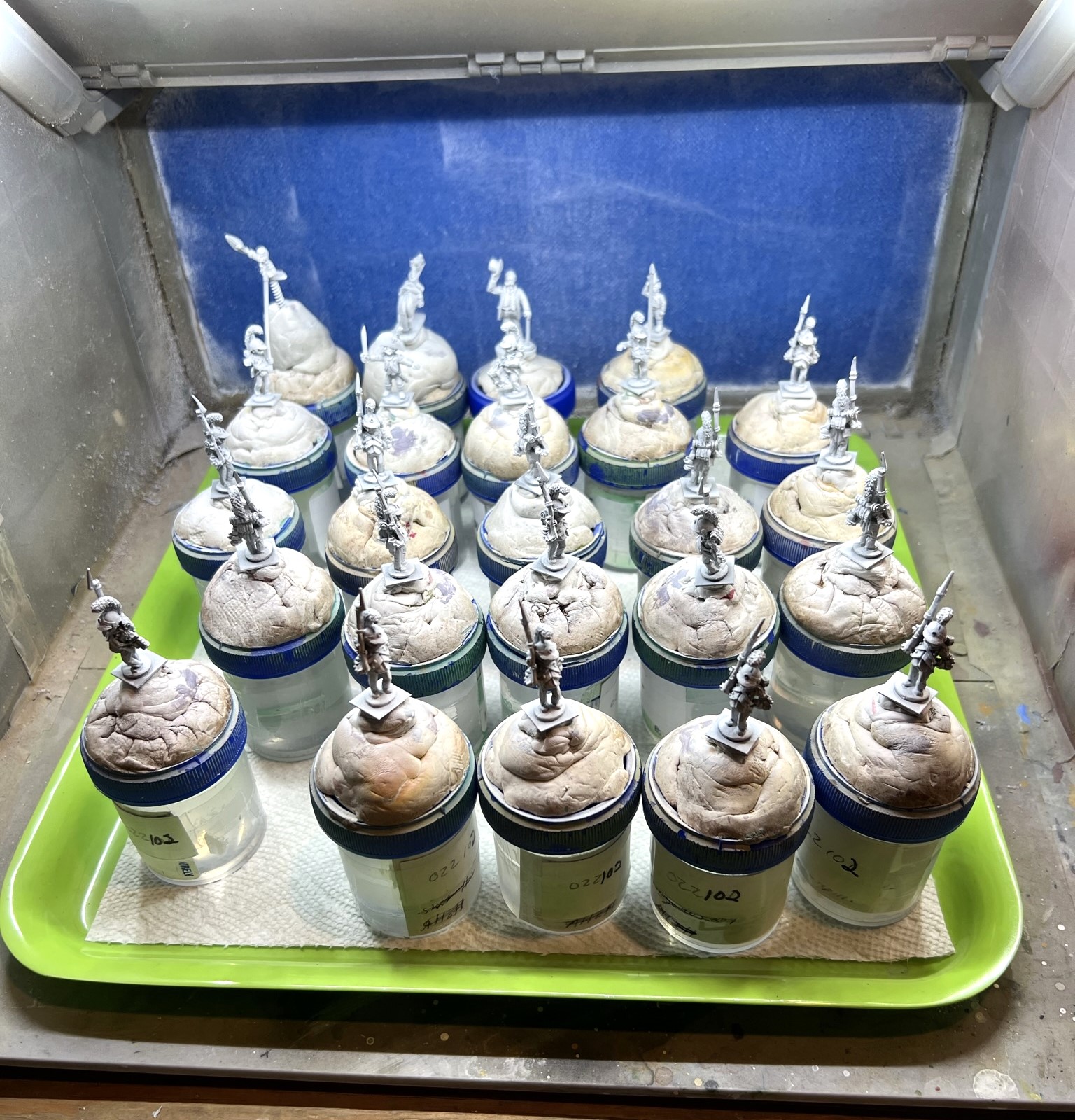
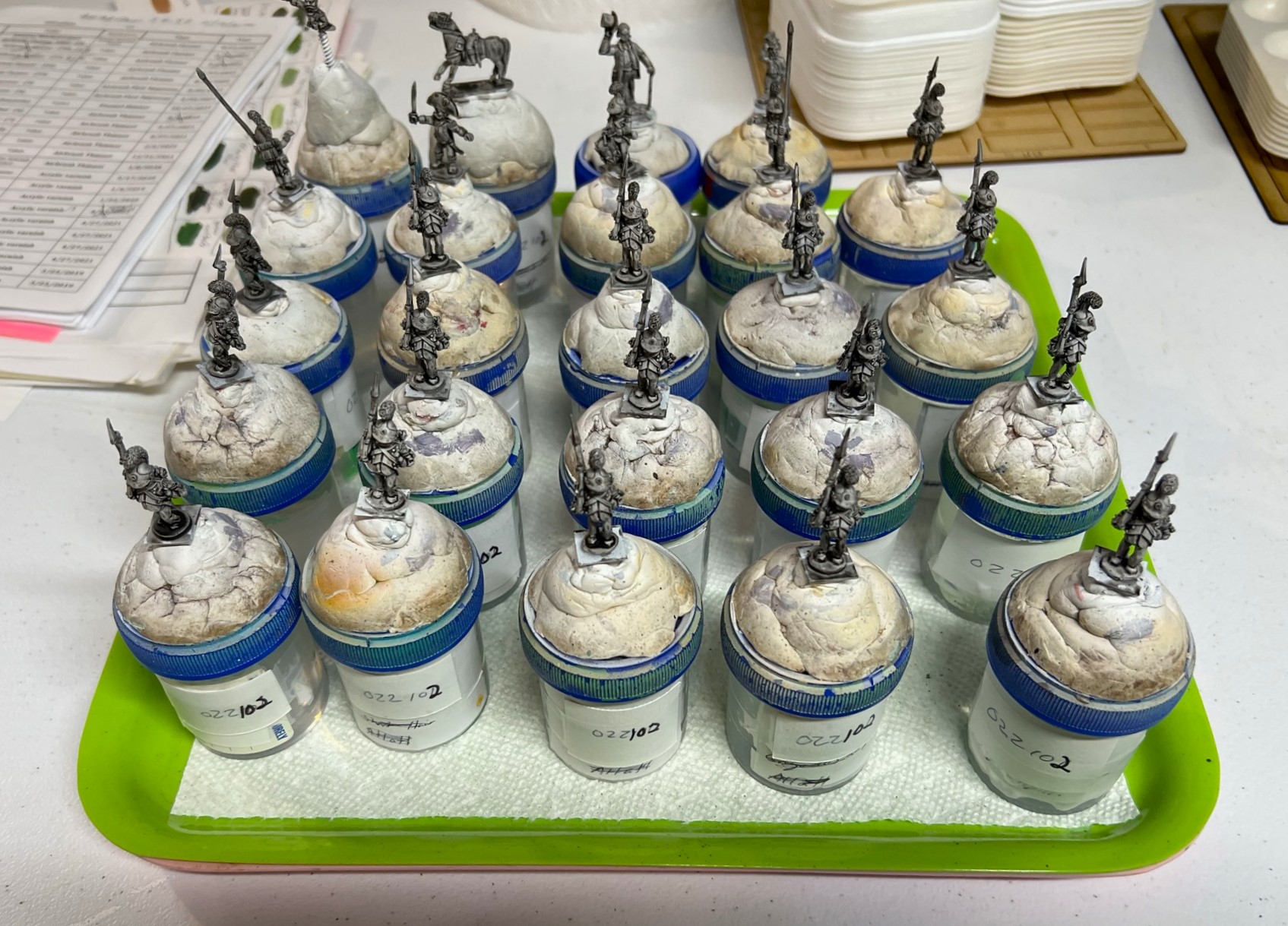
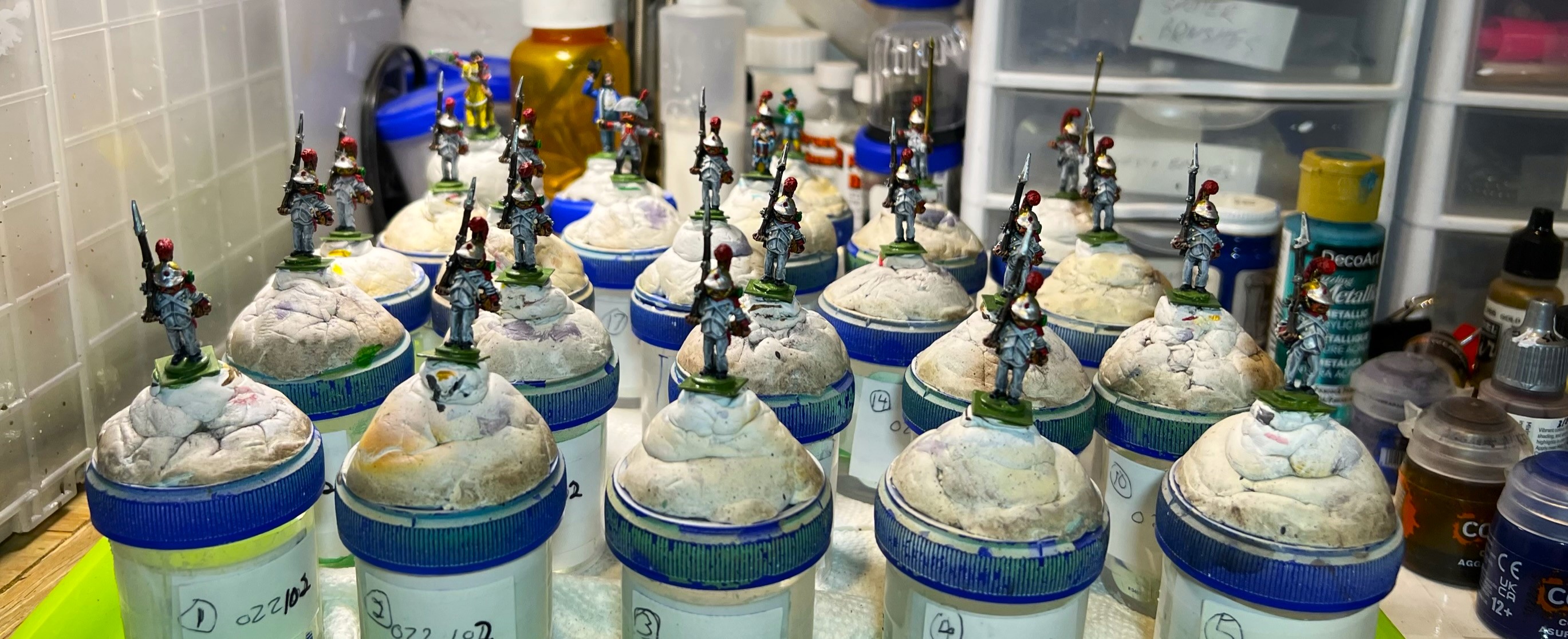
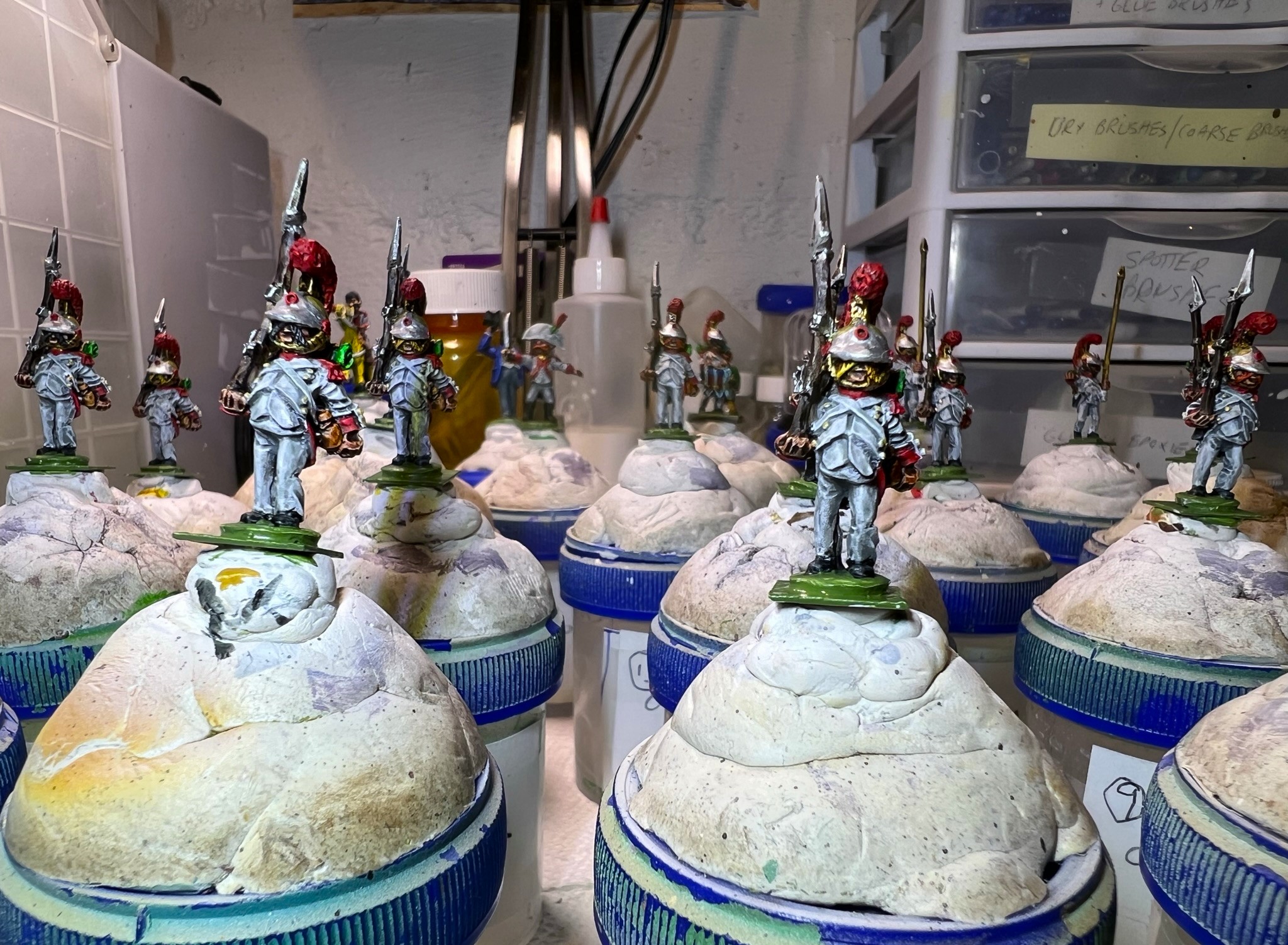
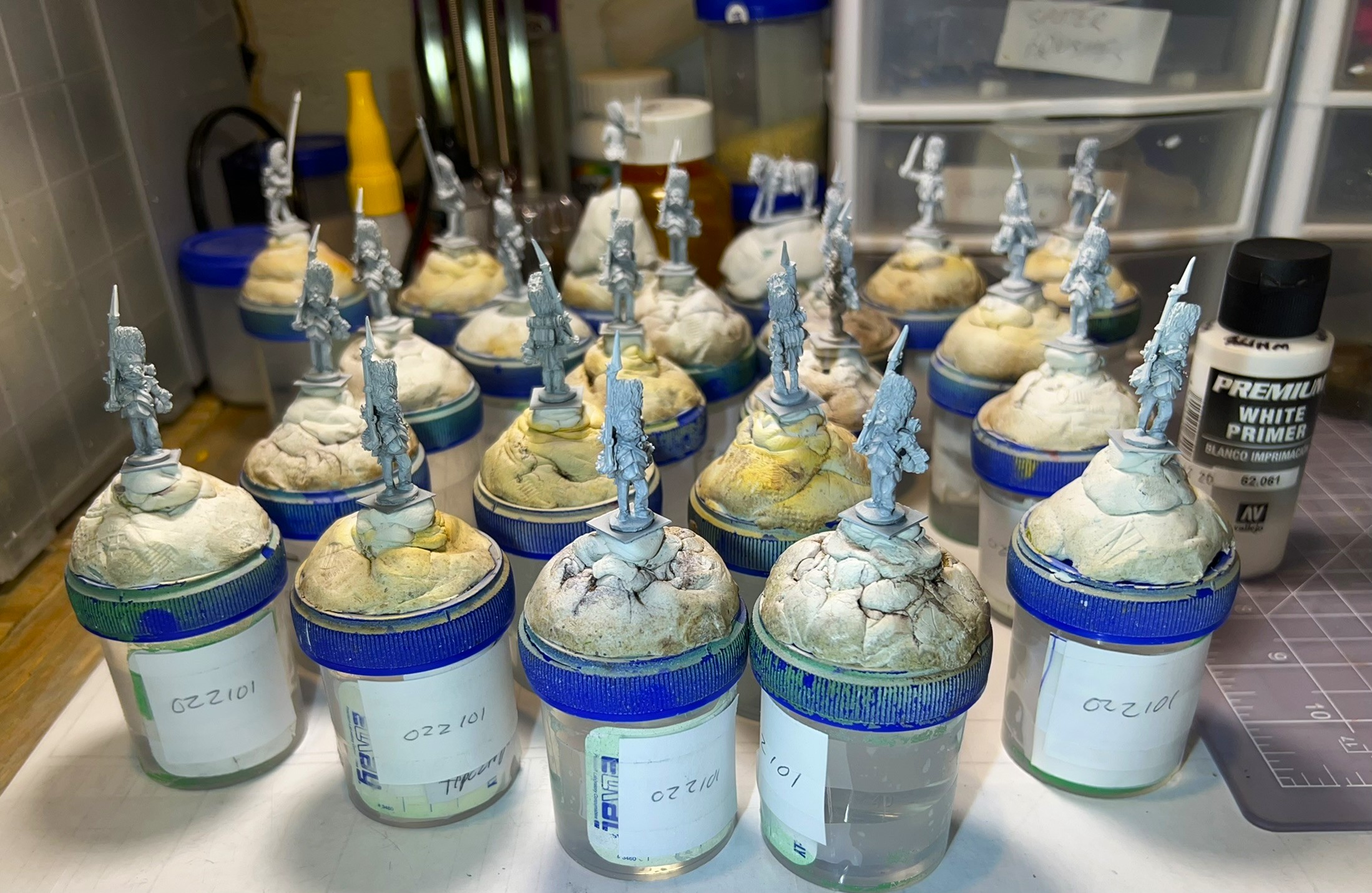
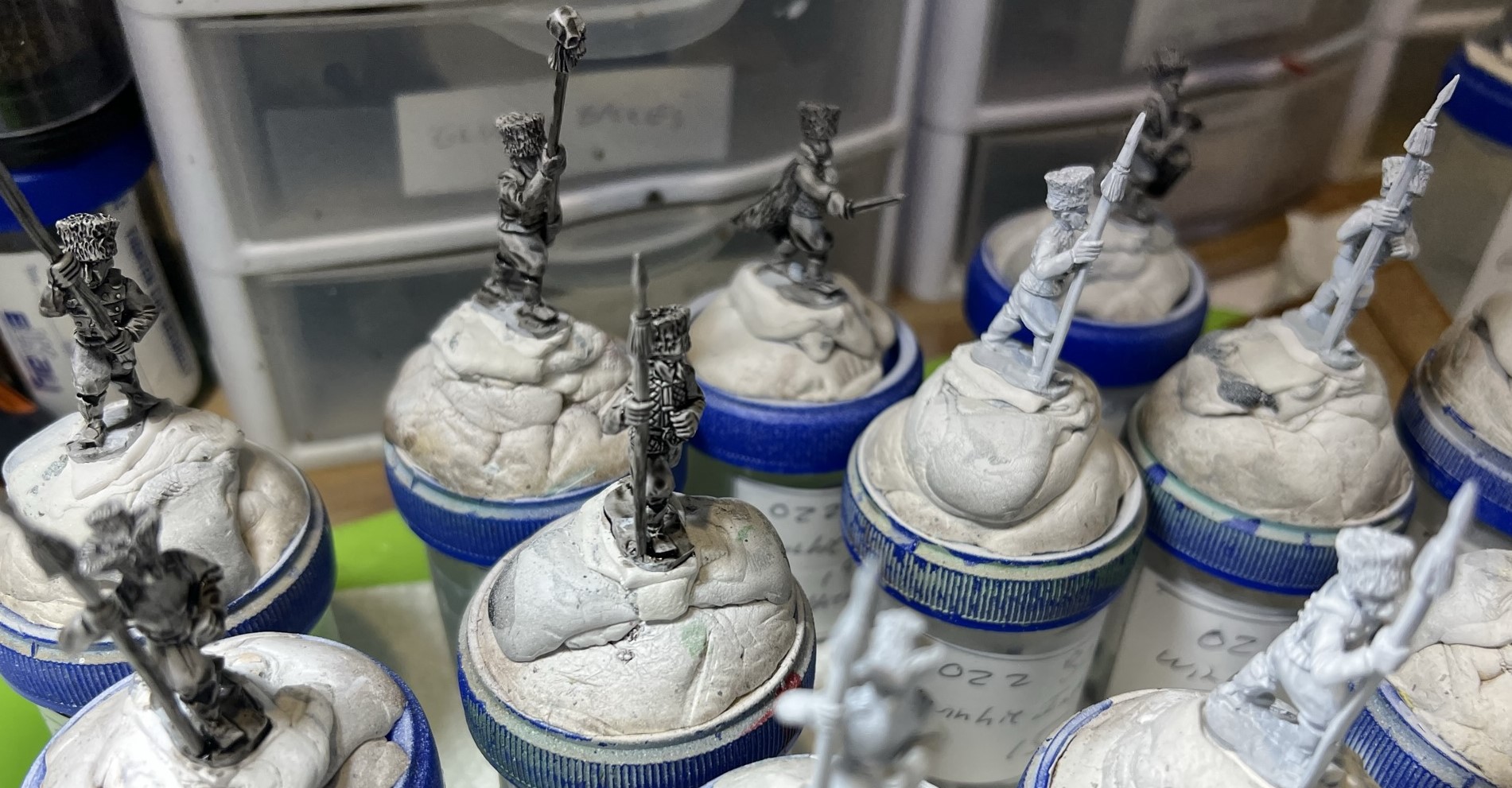
Primed in white and ready for painting on December 22nd
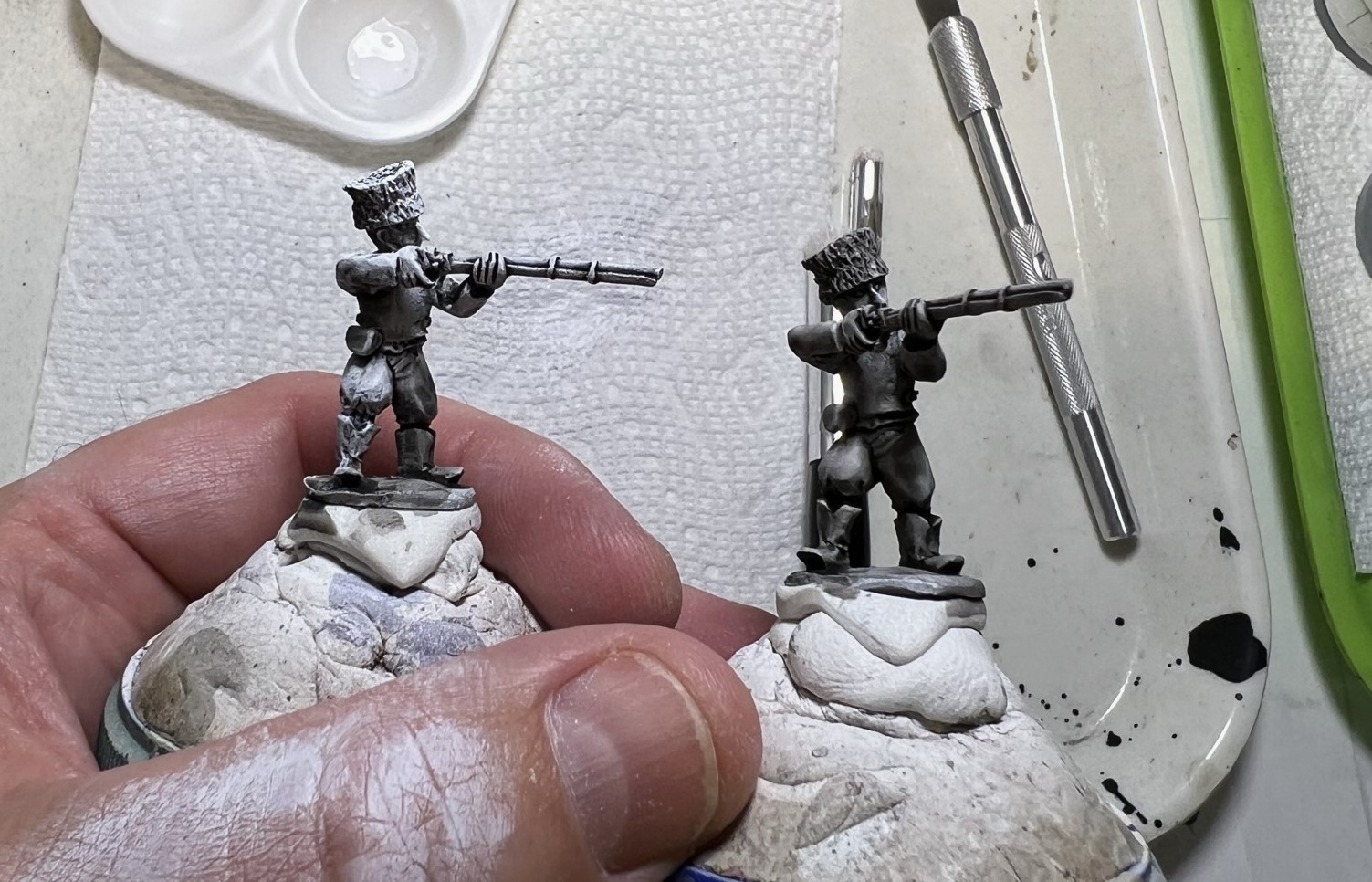
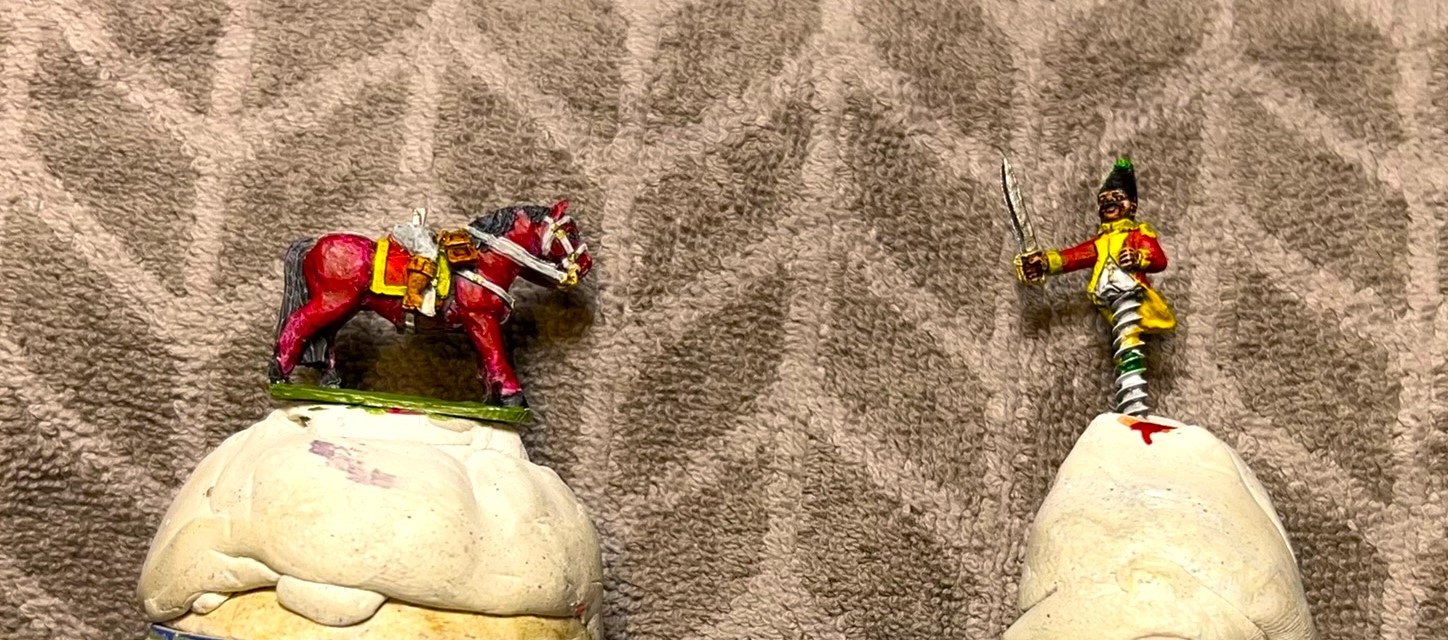
After priming, I added a wash of Citadel “Nuln Oil”, then dry brushed in white. The figure on the right has not been dry brushed yet and is shown for comparison with the one on the right which has only been washed on December 23rd.

Then came Christmas! After all the festivities, I knew I only had a couple of days to get the unit mostly done before I had my sinus surgery. That surgery would consist of my surgeon drilling out my internal sinus openings so I could drain better – as I have been plagued with increasingly worse headache episodes all year. Yes, this was done under anesthesia and more drugs. The headaches DID get in the way of both golf and miniature painting, as well as all of the simultaneous sinus infections I was having, so this was necessary.

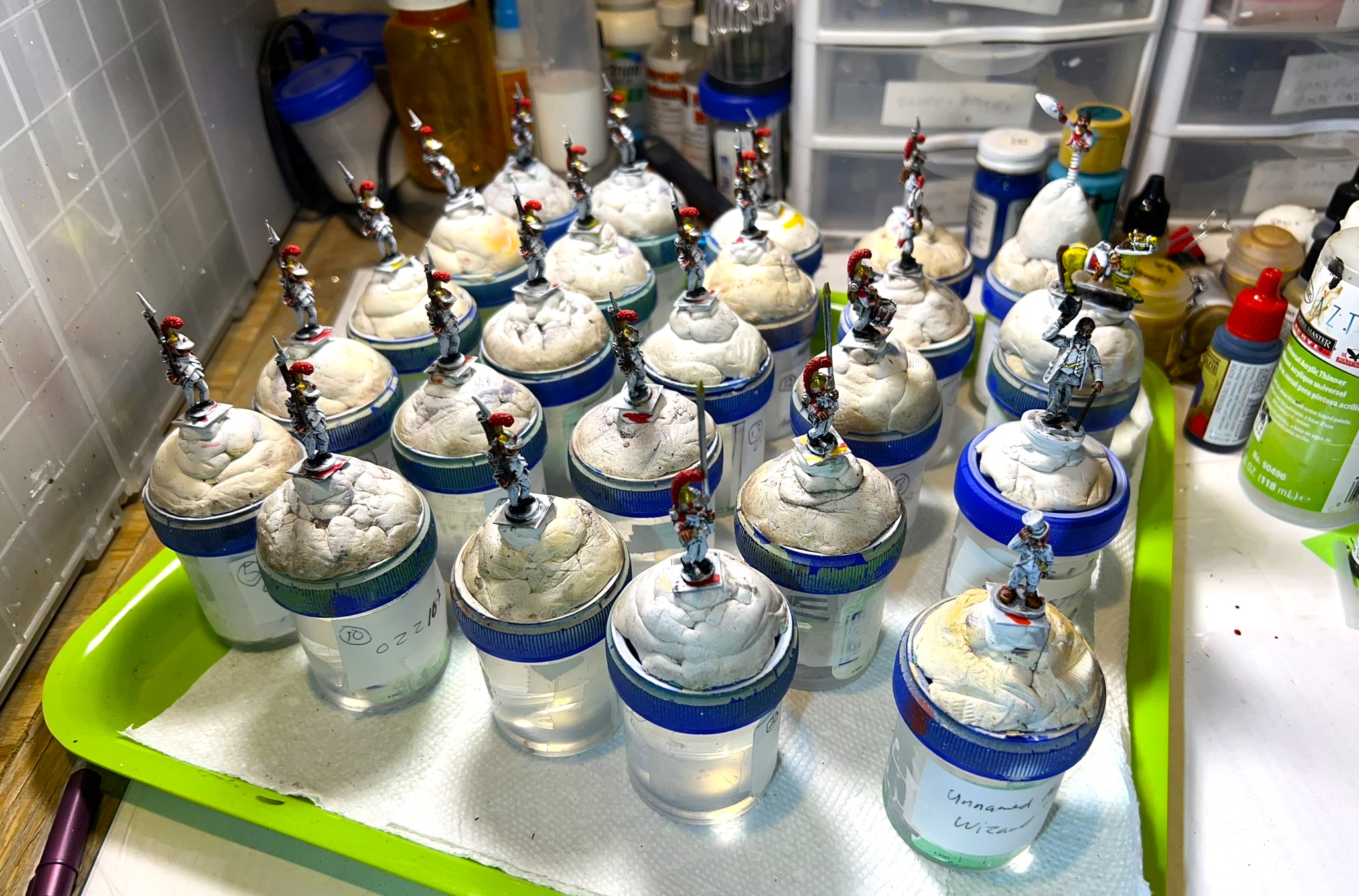
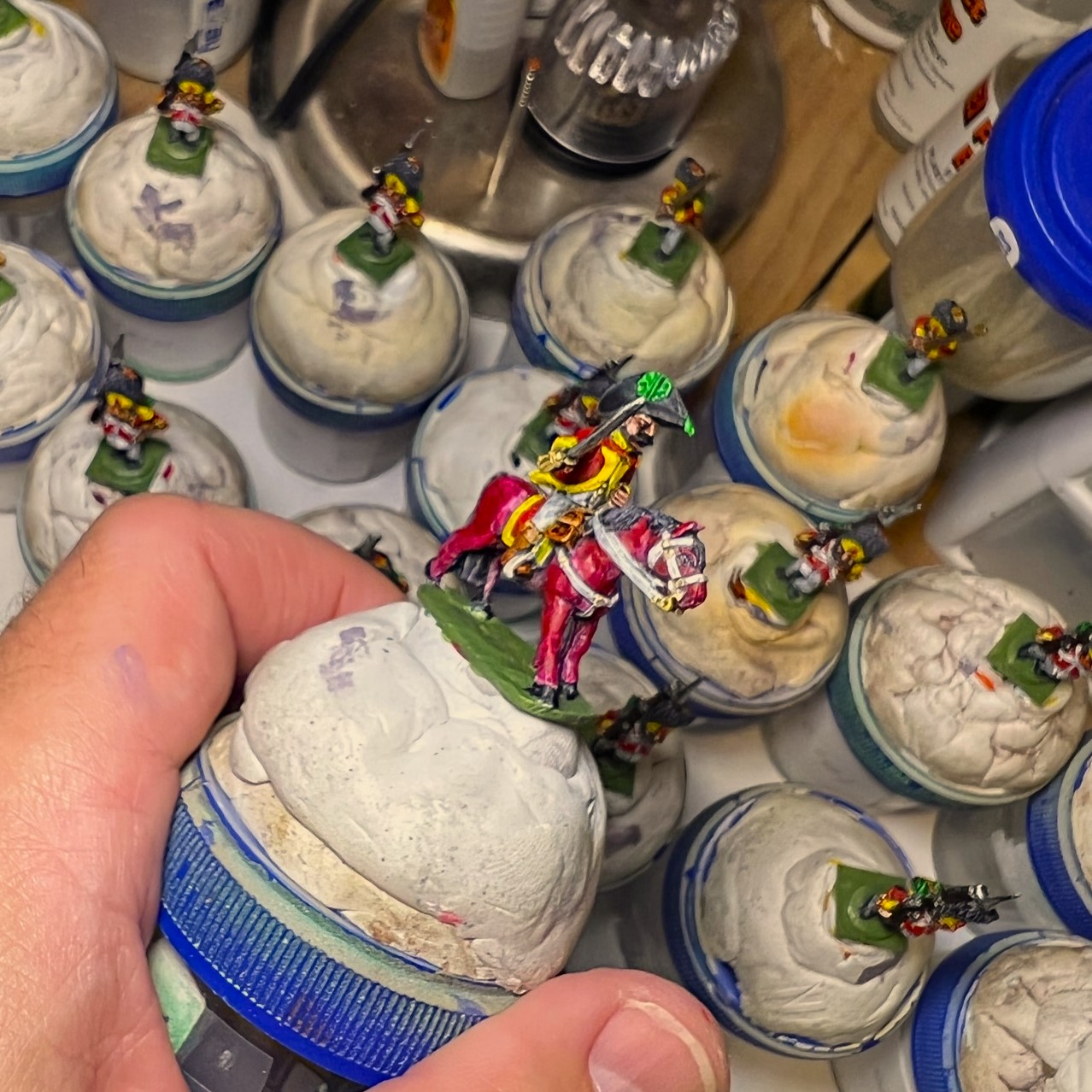
December 26th progress
December 27th progress

Then it was time to get my head drilled on December 28th. All went well, and recovery is coming along as expected, but I was in no shape to paint!

December 28th – my head was pretty swollen – even more than usual 😁. Normally I don’t have a head like Peter Griffin from “Family Guy”.

Did I mention that as part of this procedure the surgeon applies cocaine? Yup, and I’m pretty much just a beer guy so…yeah…

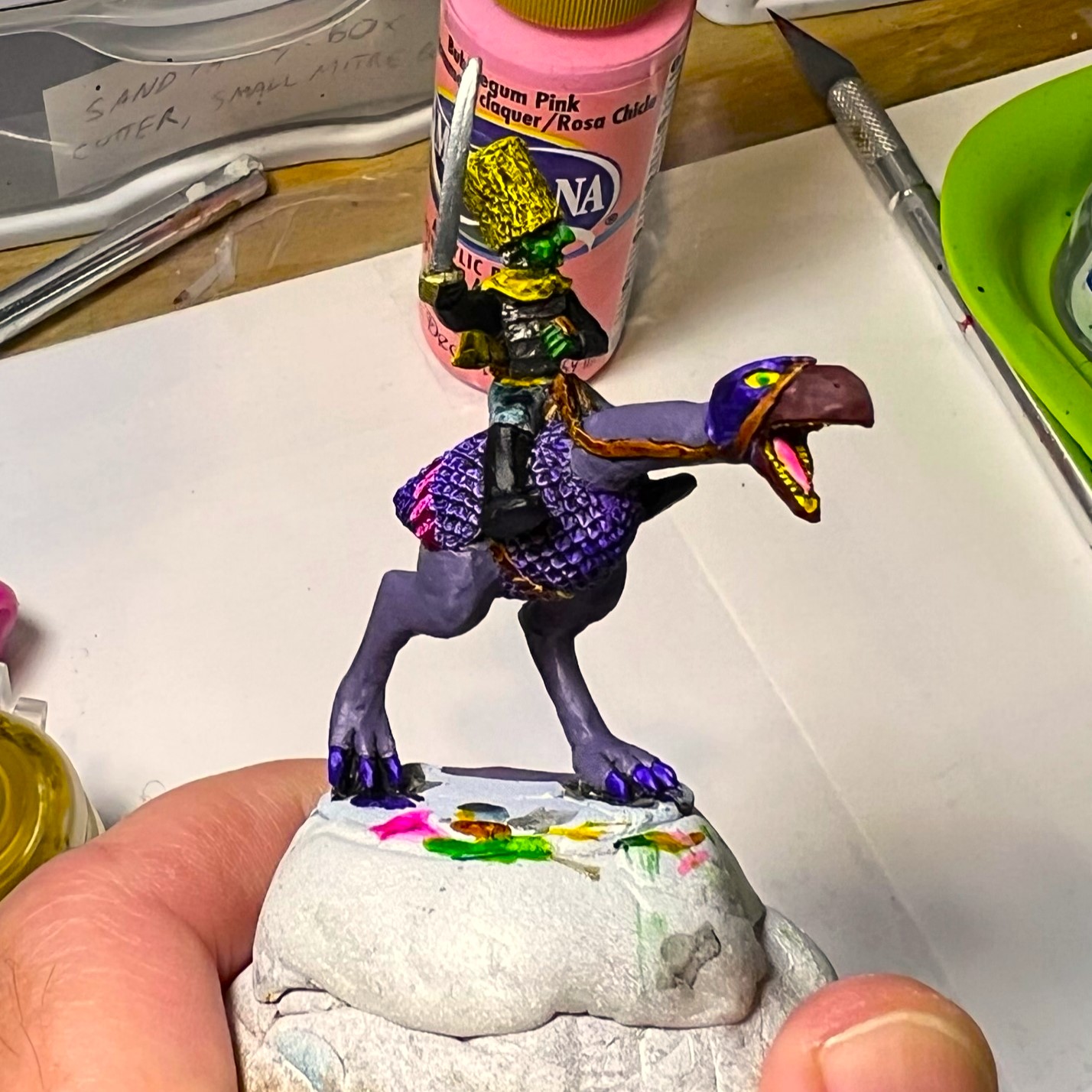
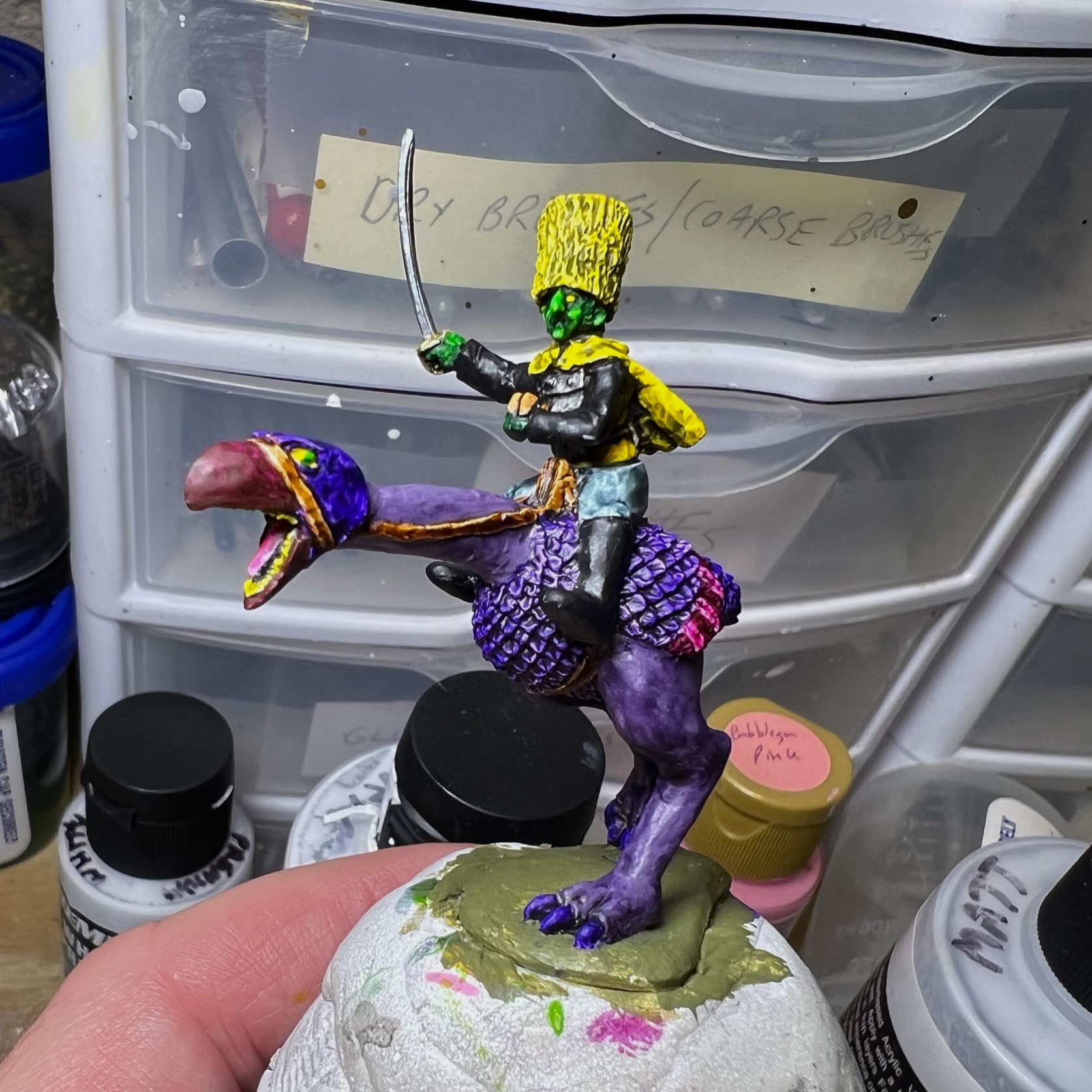
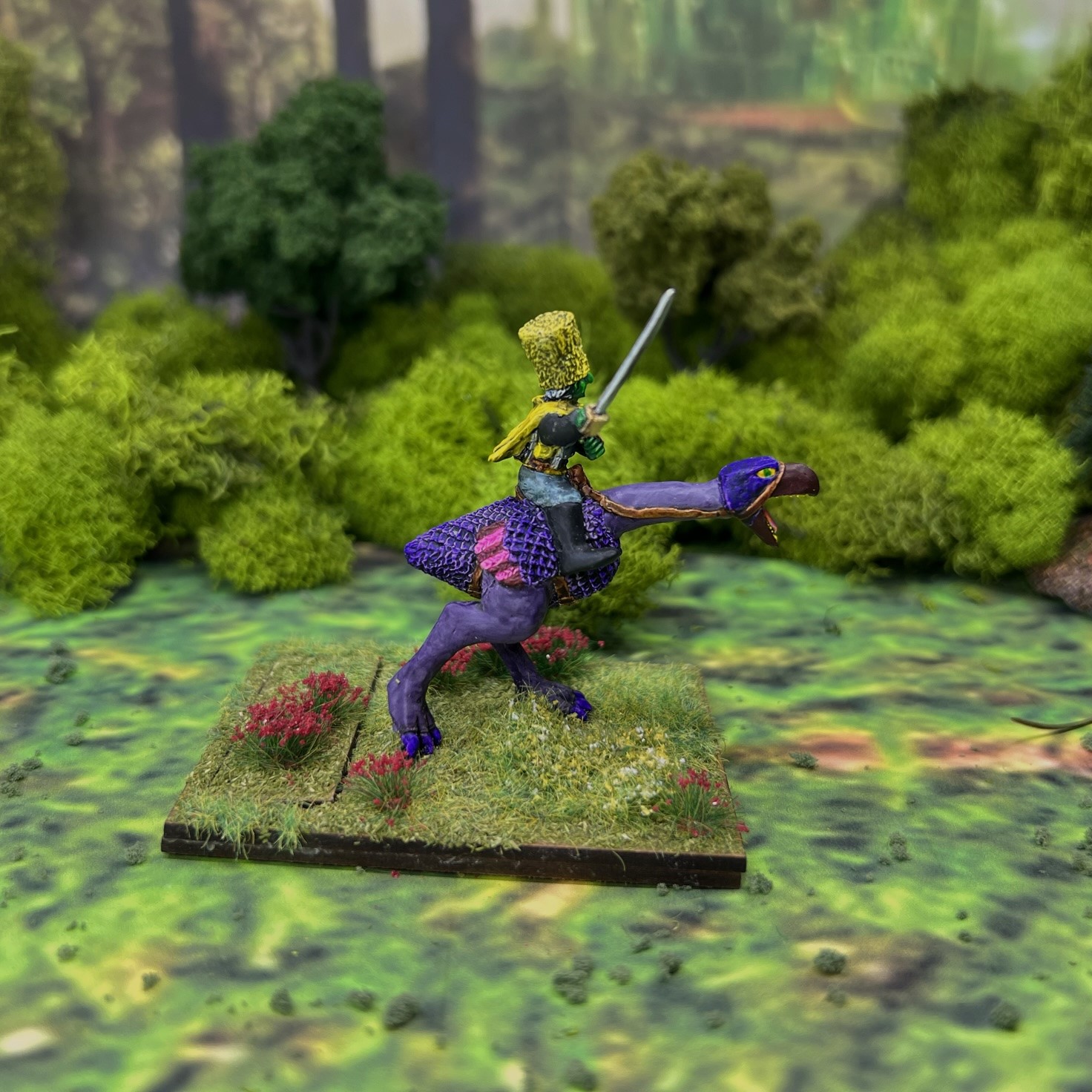
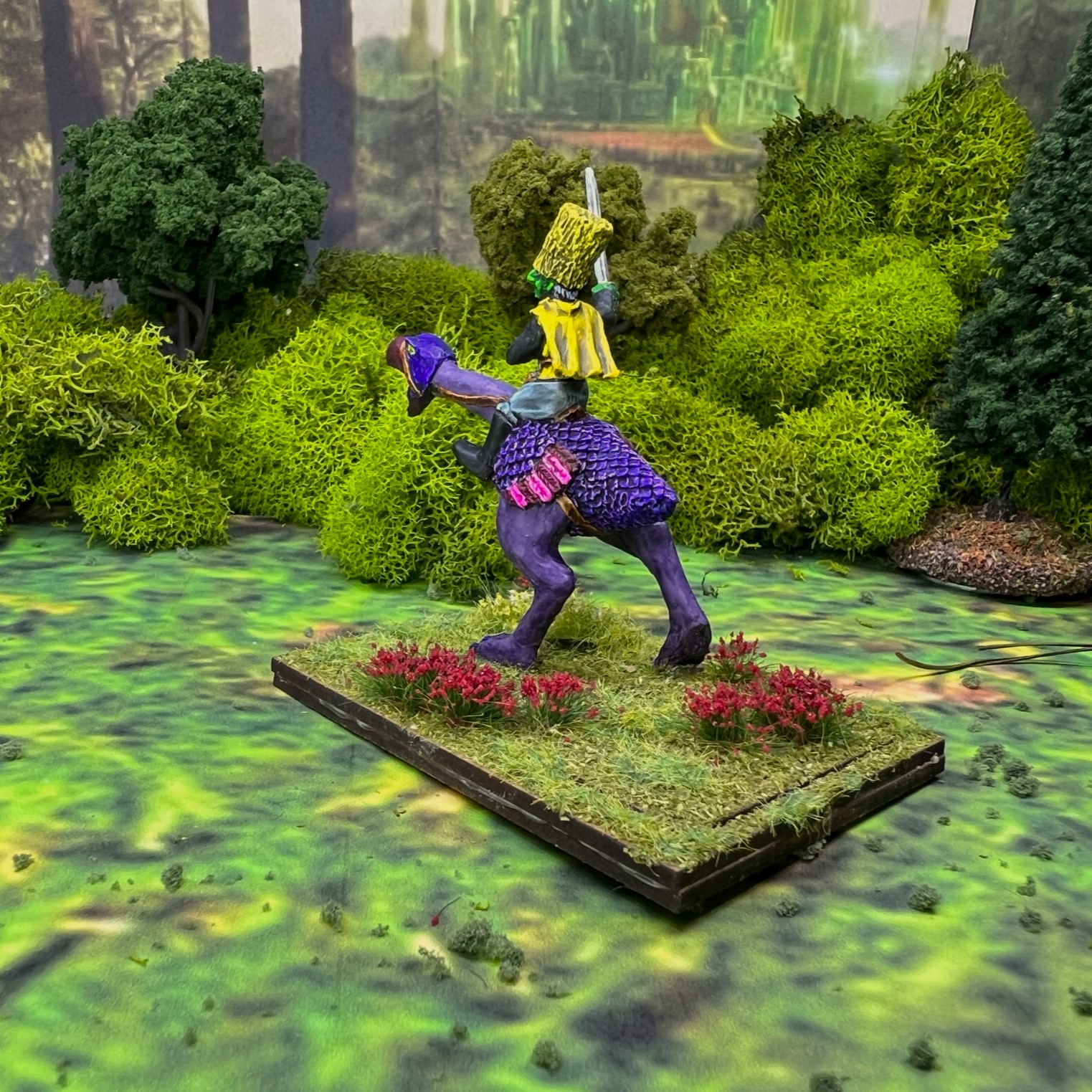
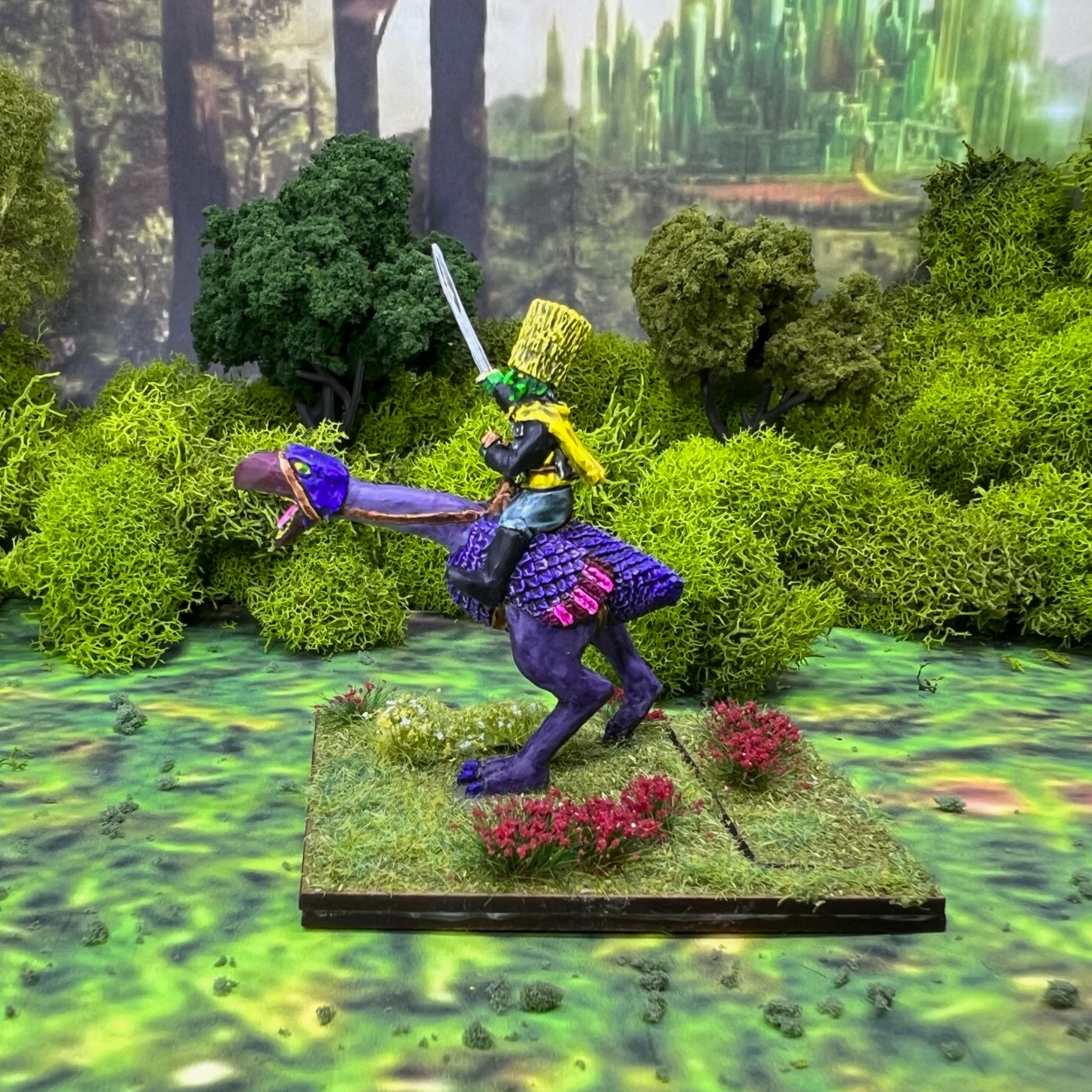
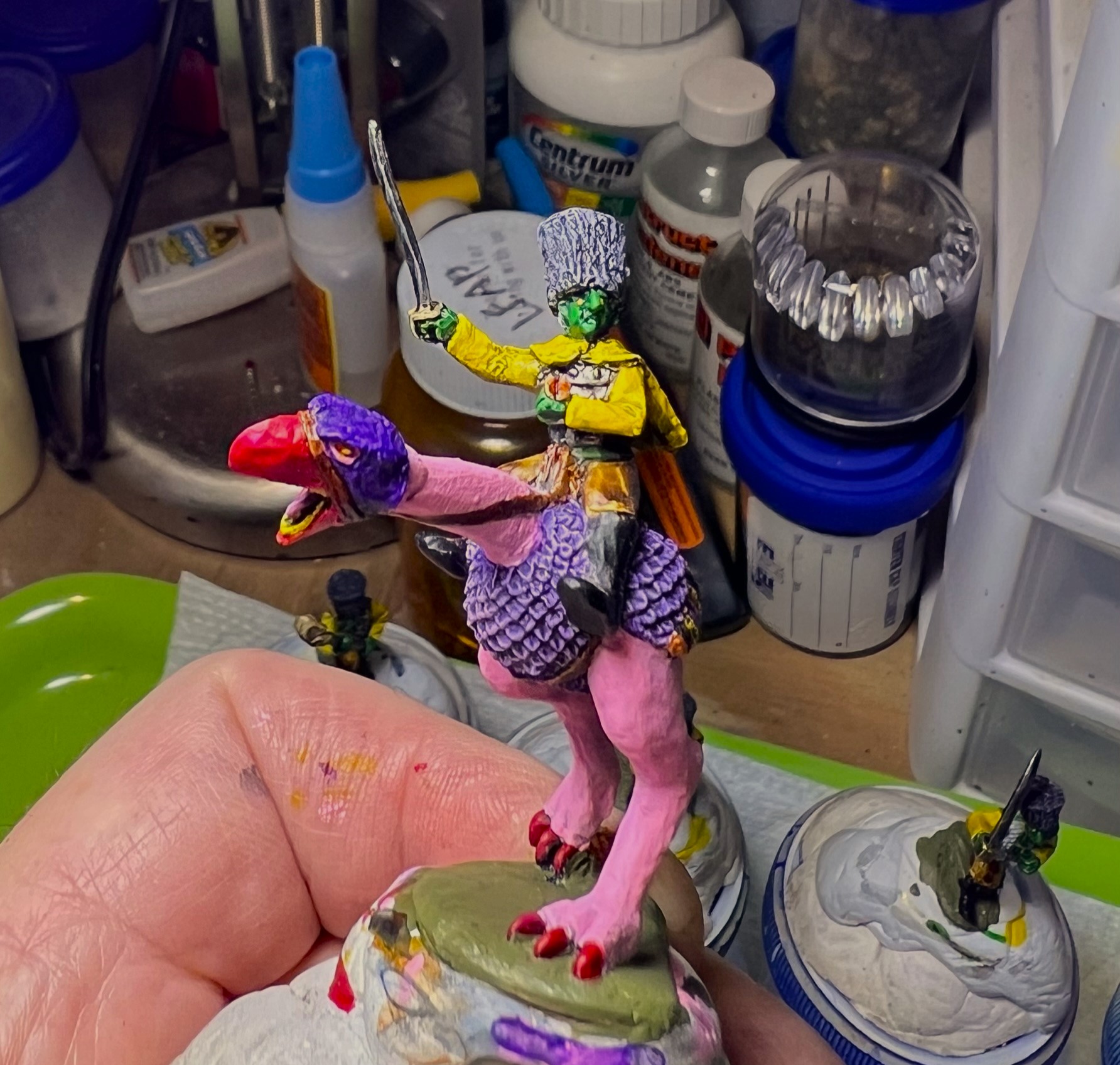
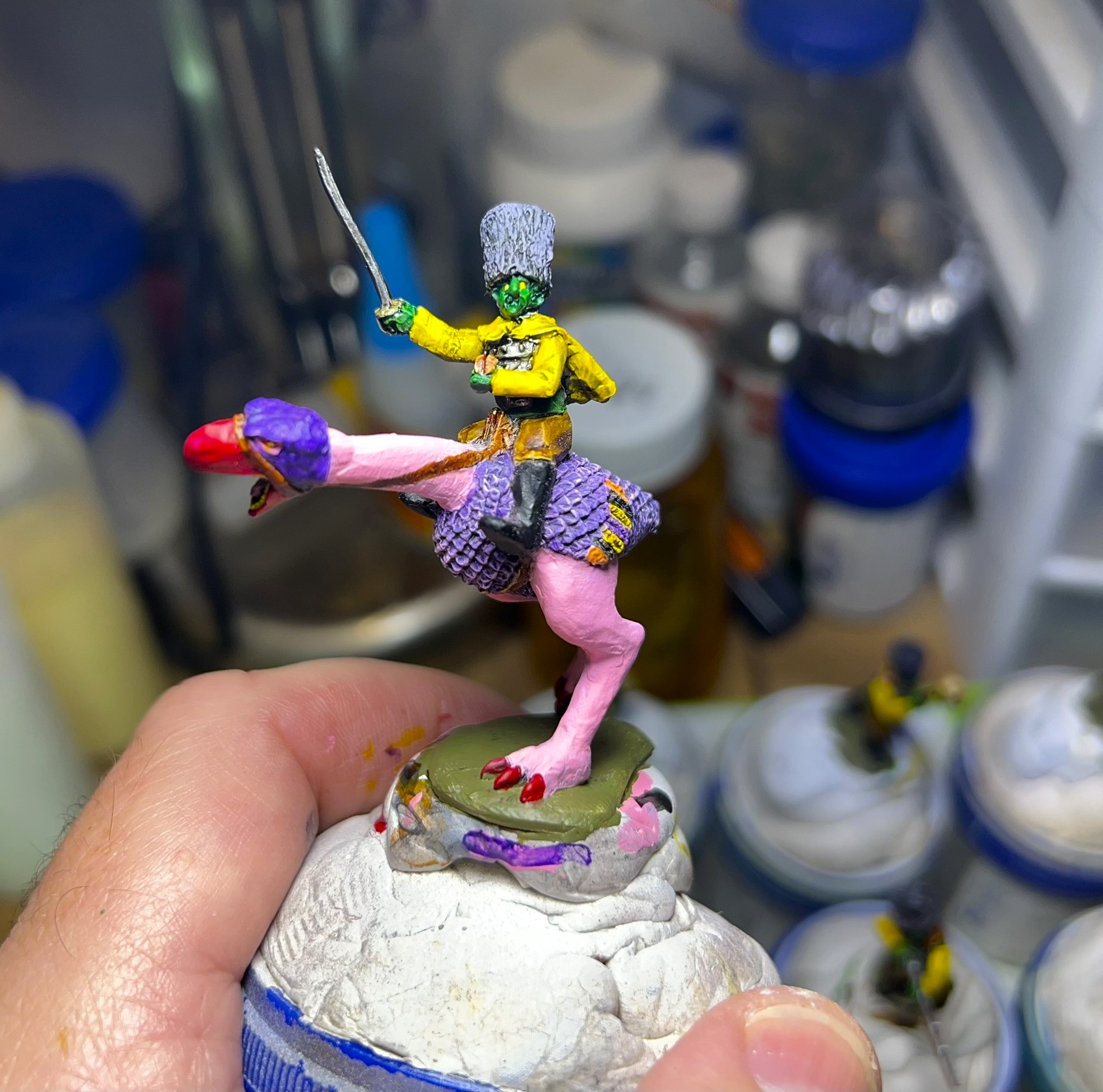
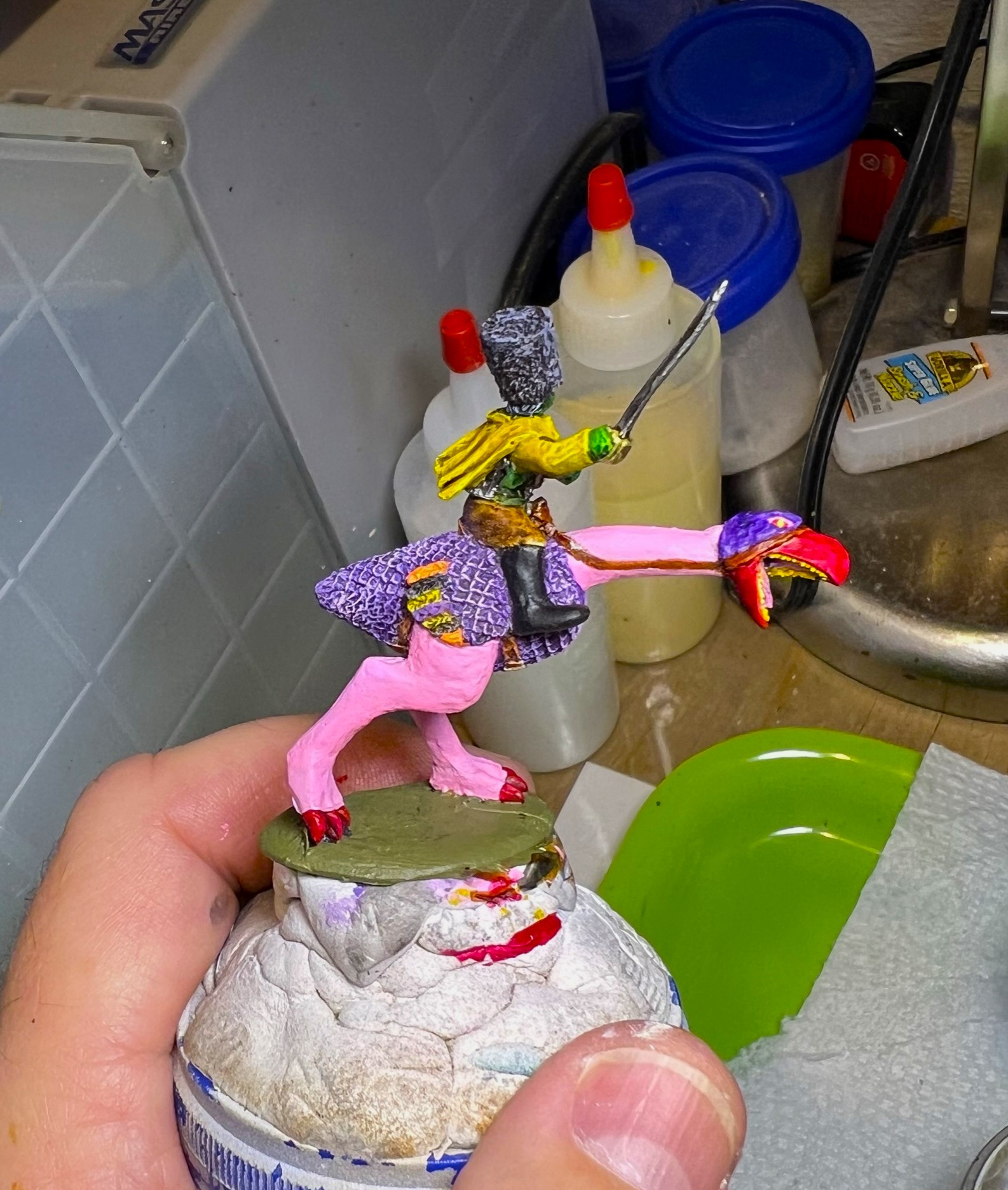
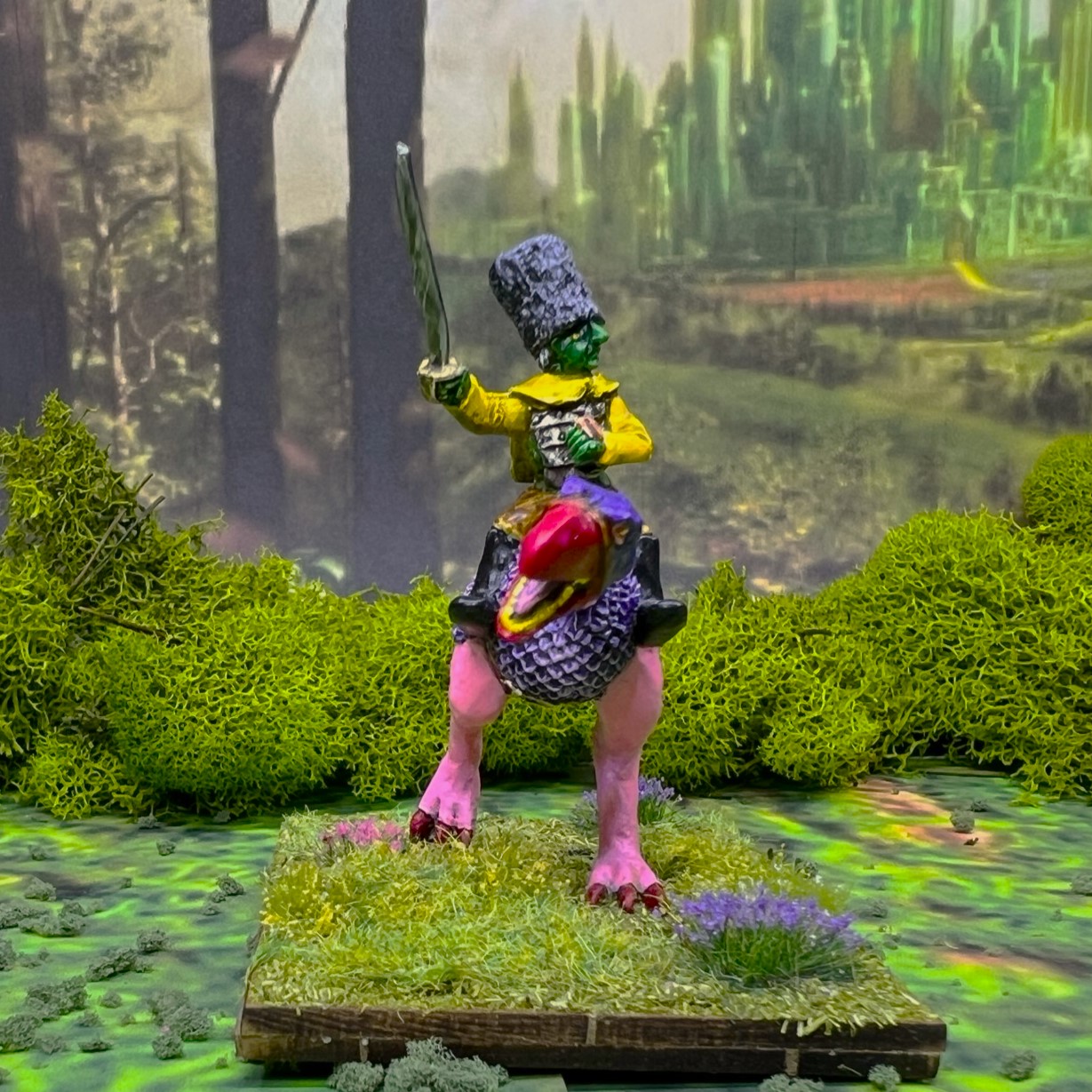
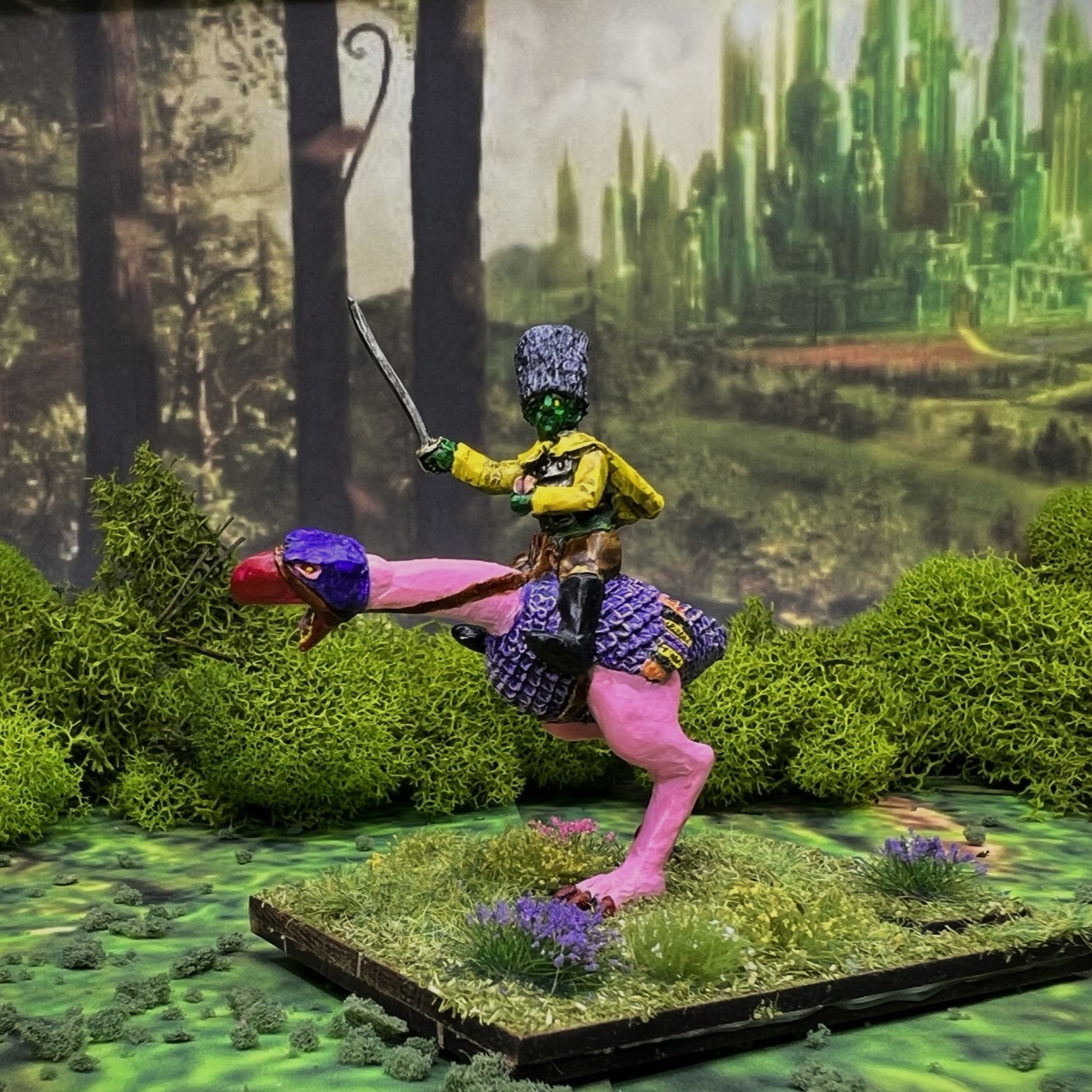
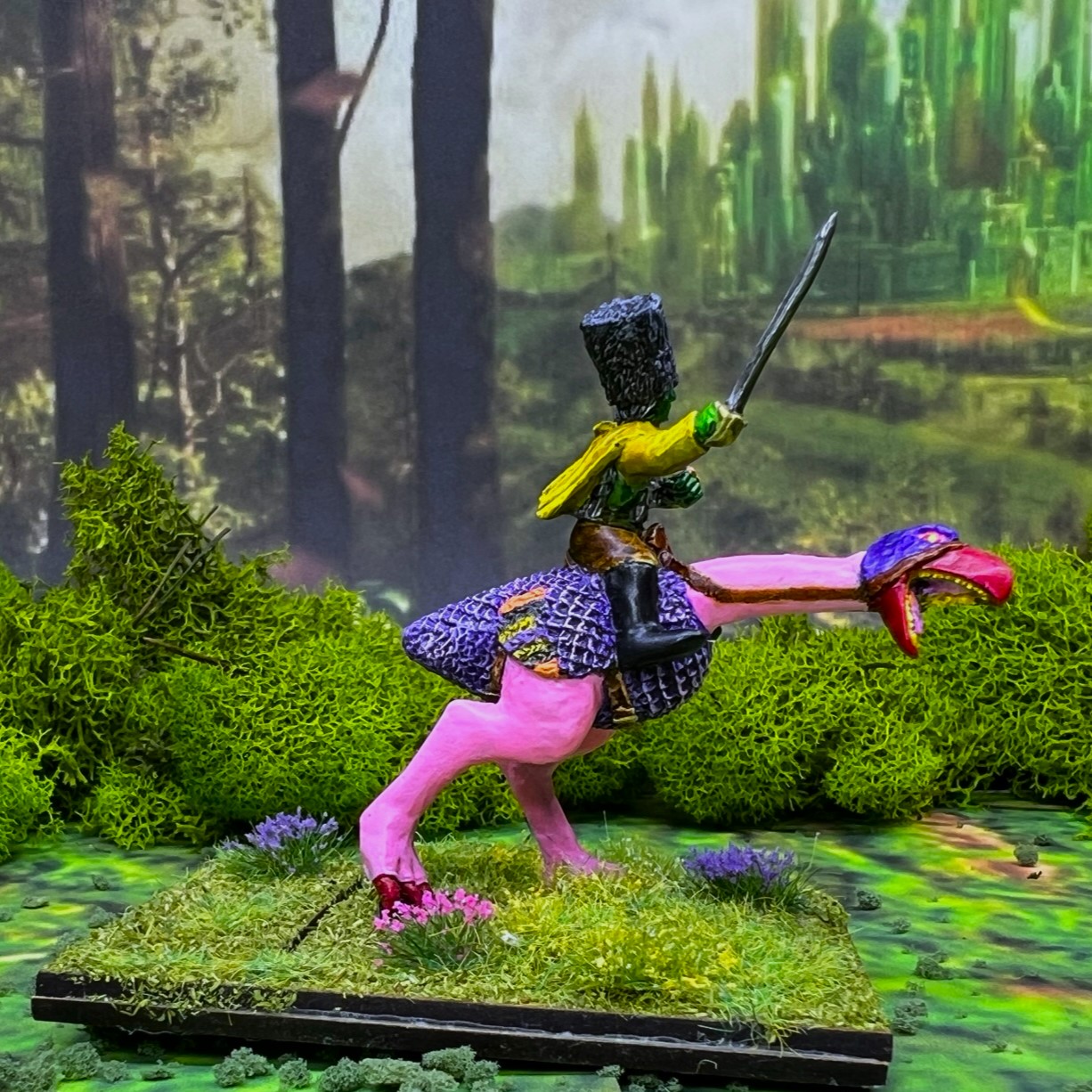
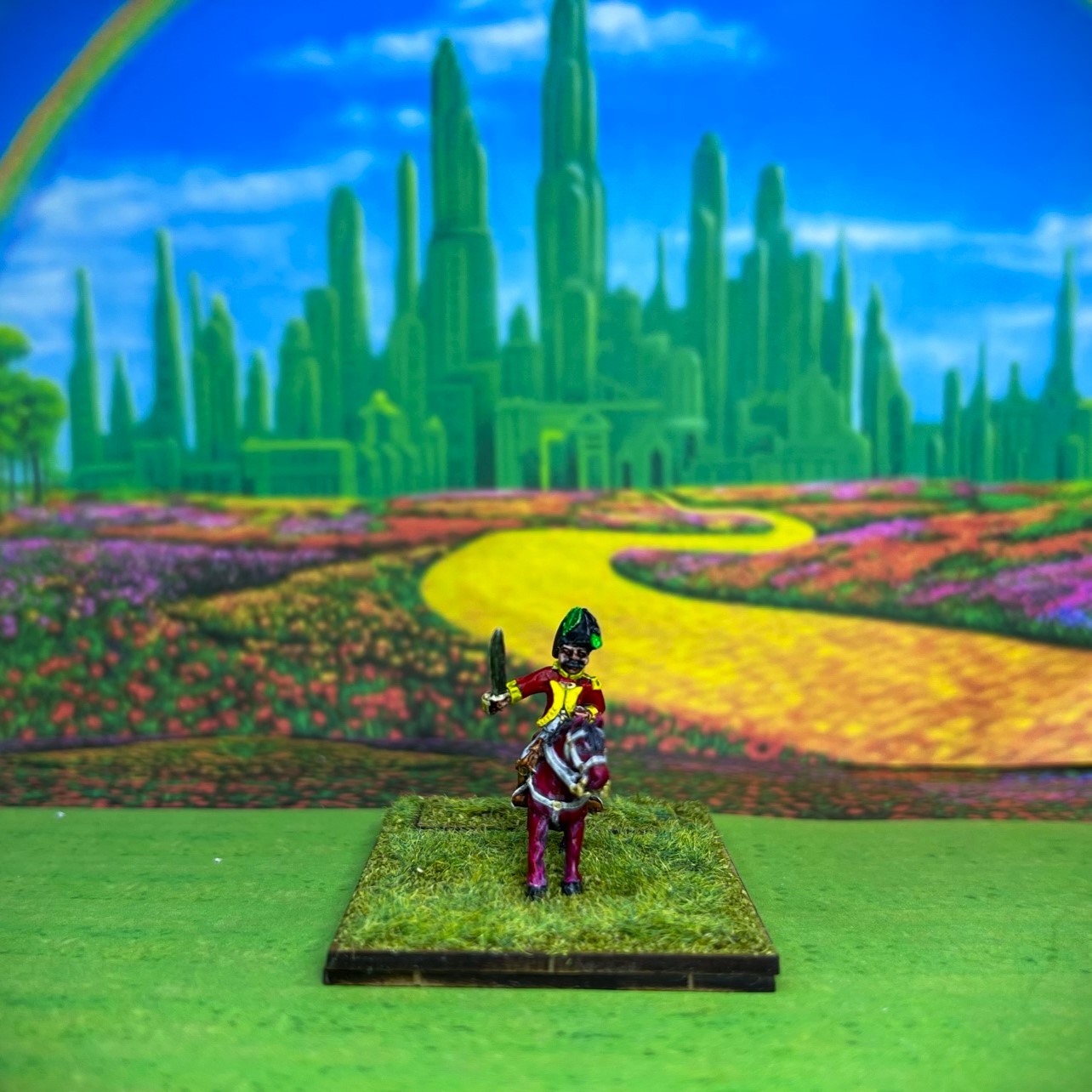
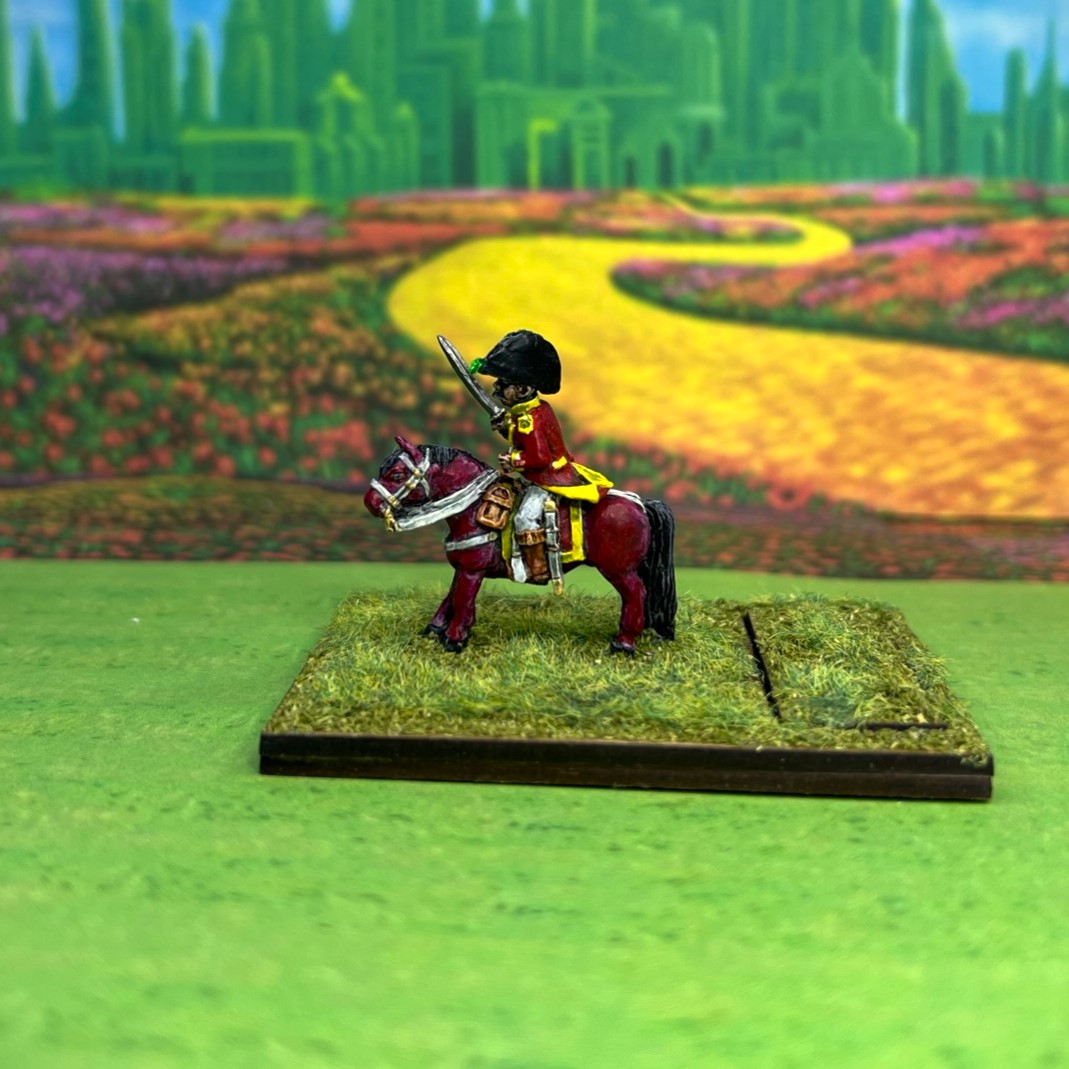
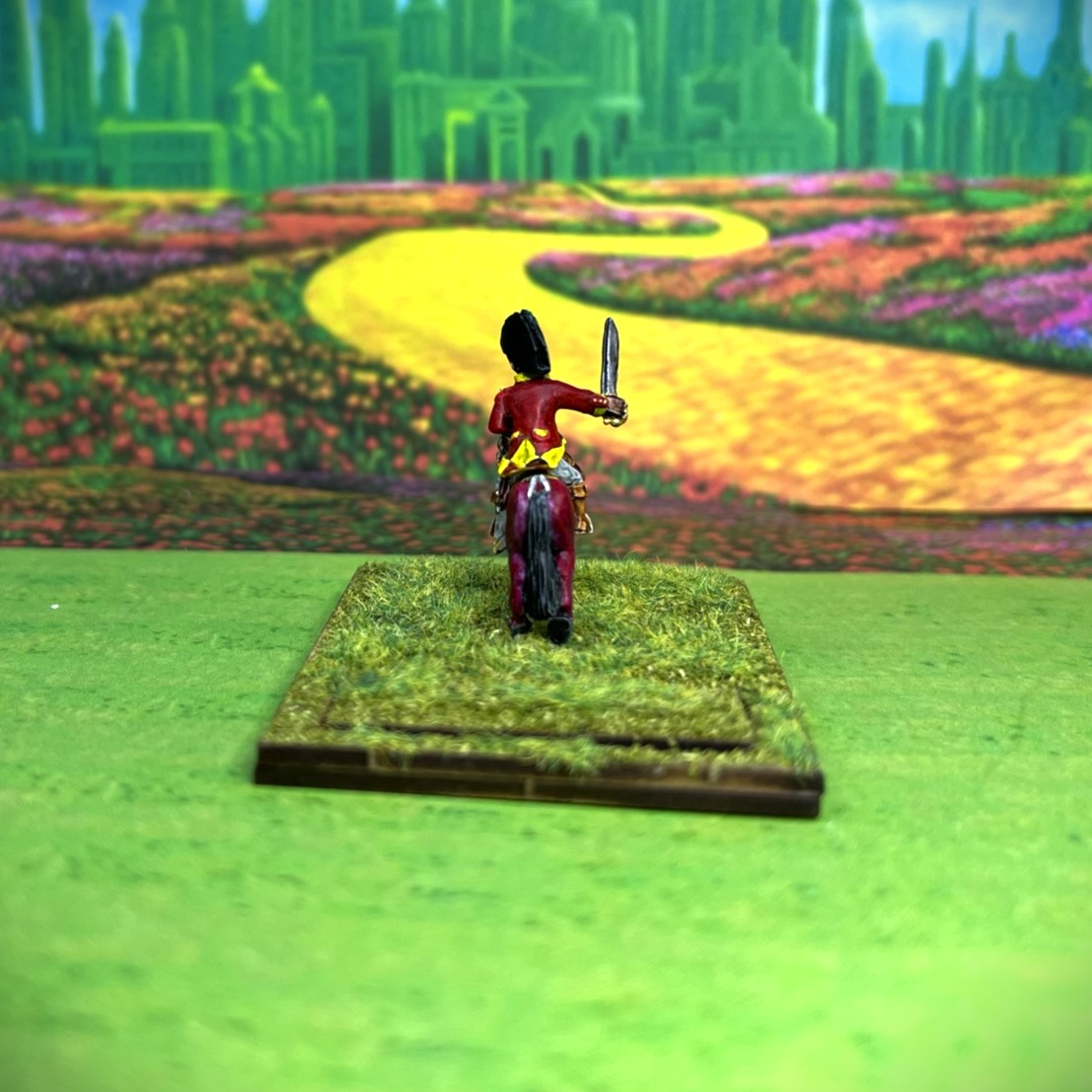
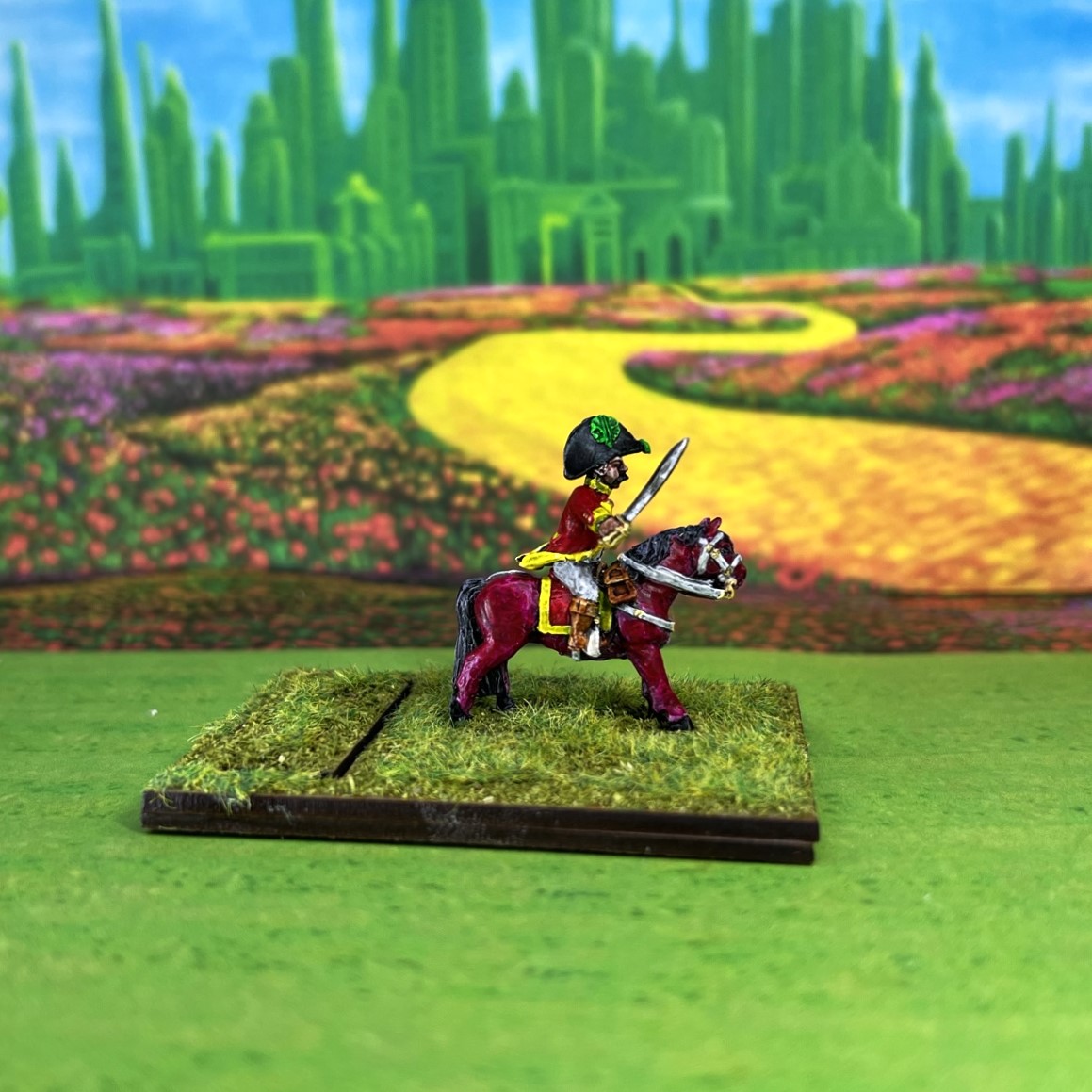
Anyways, I was back painting on the 29th, and made good progress by the 30th. One remaining major issue for me was how to paint the regimental commander’s zilk. Remember, Winkies look down on missile weapons, and I can imagine that the better-looking zilks would go to the cavalry and the regimental commanders of melee weapon-bearing infantry. I also had Ralphie’s rabbit suit in my mind subliminally, plus add in any residual cocaine…

And I ended up with a bubble-gum pink and purple zilk…

Now, I am not sure how I feel about it, but it’s done now! Wars of Ozz are supposed to be colorful anyway – and hell, I had had that pink paint for a while without ever using it. I ended up airbrush varnishing the WSR with a gloss then a matte varnish so as to keep the colors bright but not shiny.

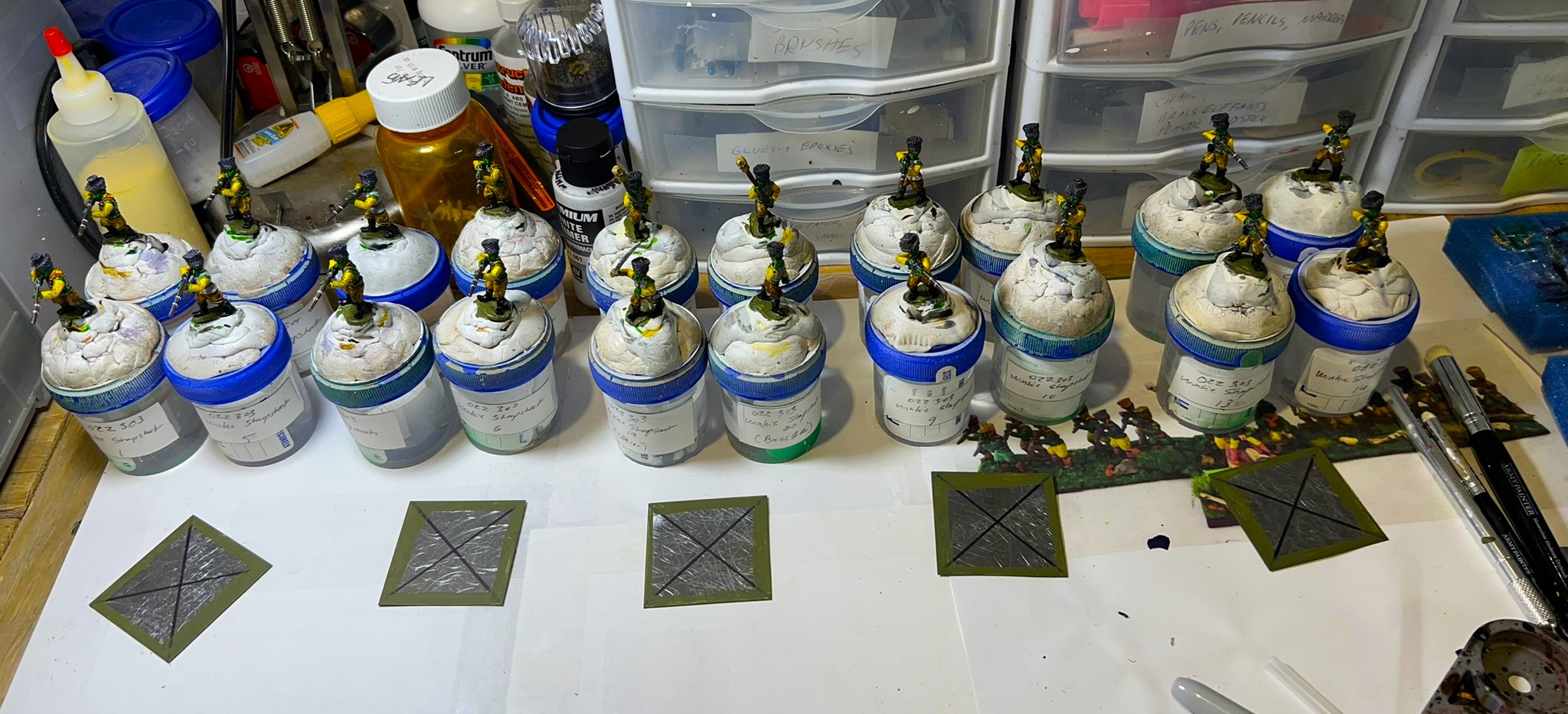
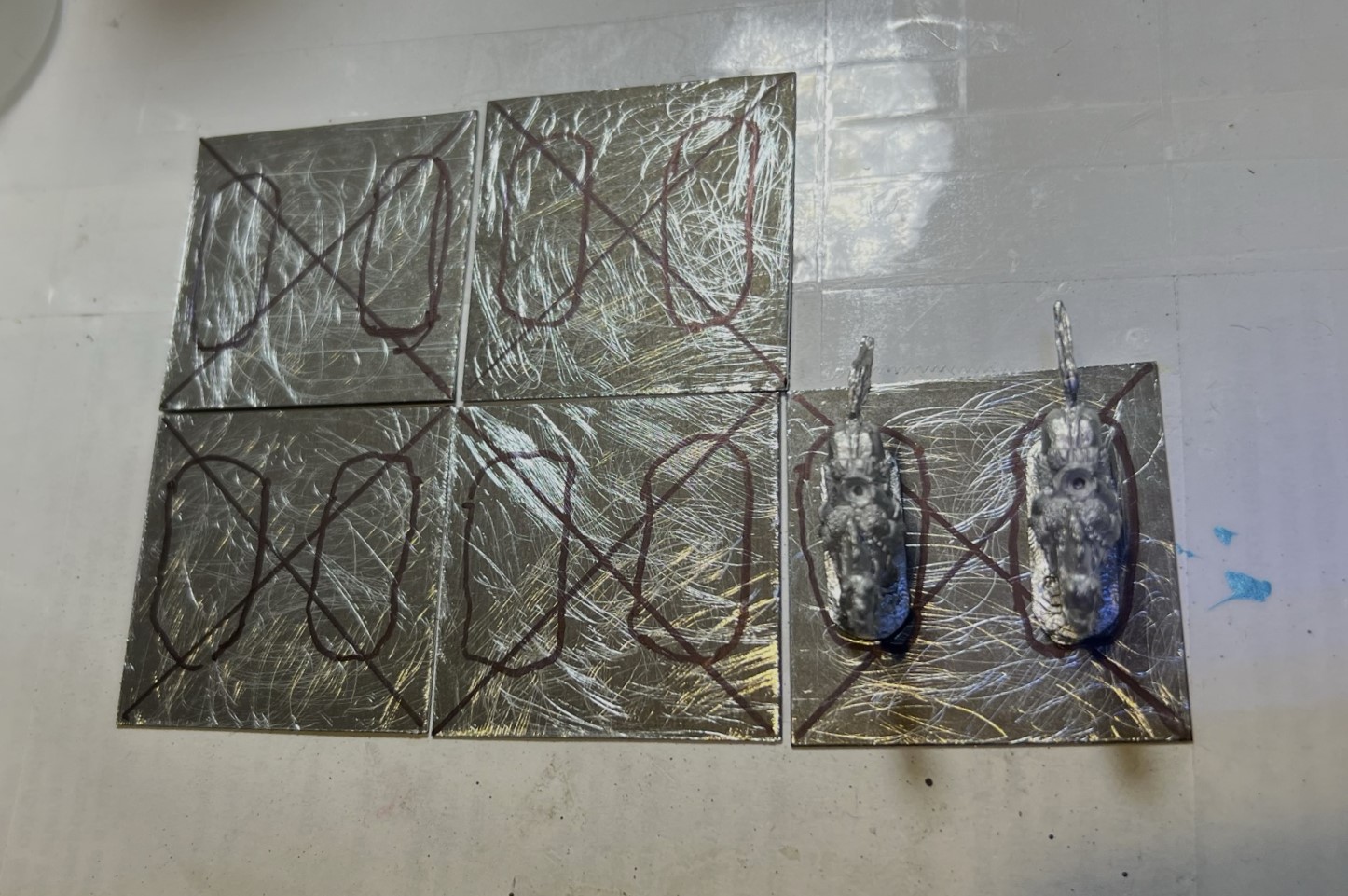
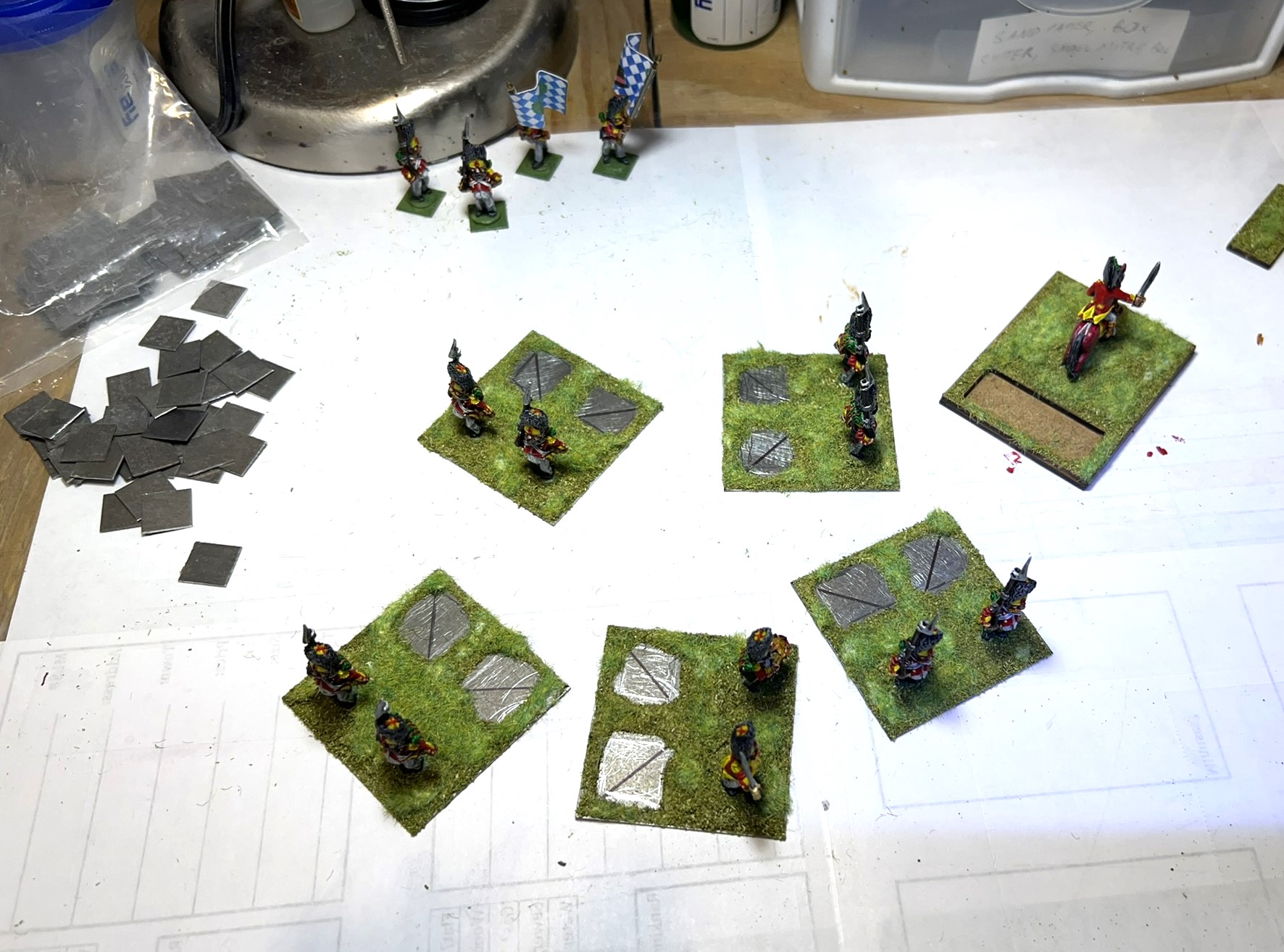
Base preparation on December 30th – the figures needed extra care for mounting if they were to look good. You can see the Wars of Ozz picture from the web store that I printed off as a guide underneath on the right.

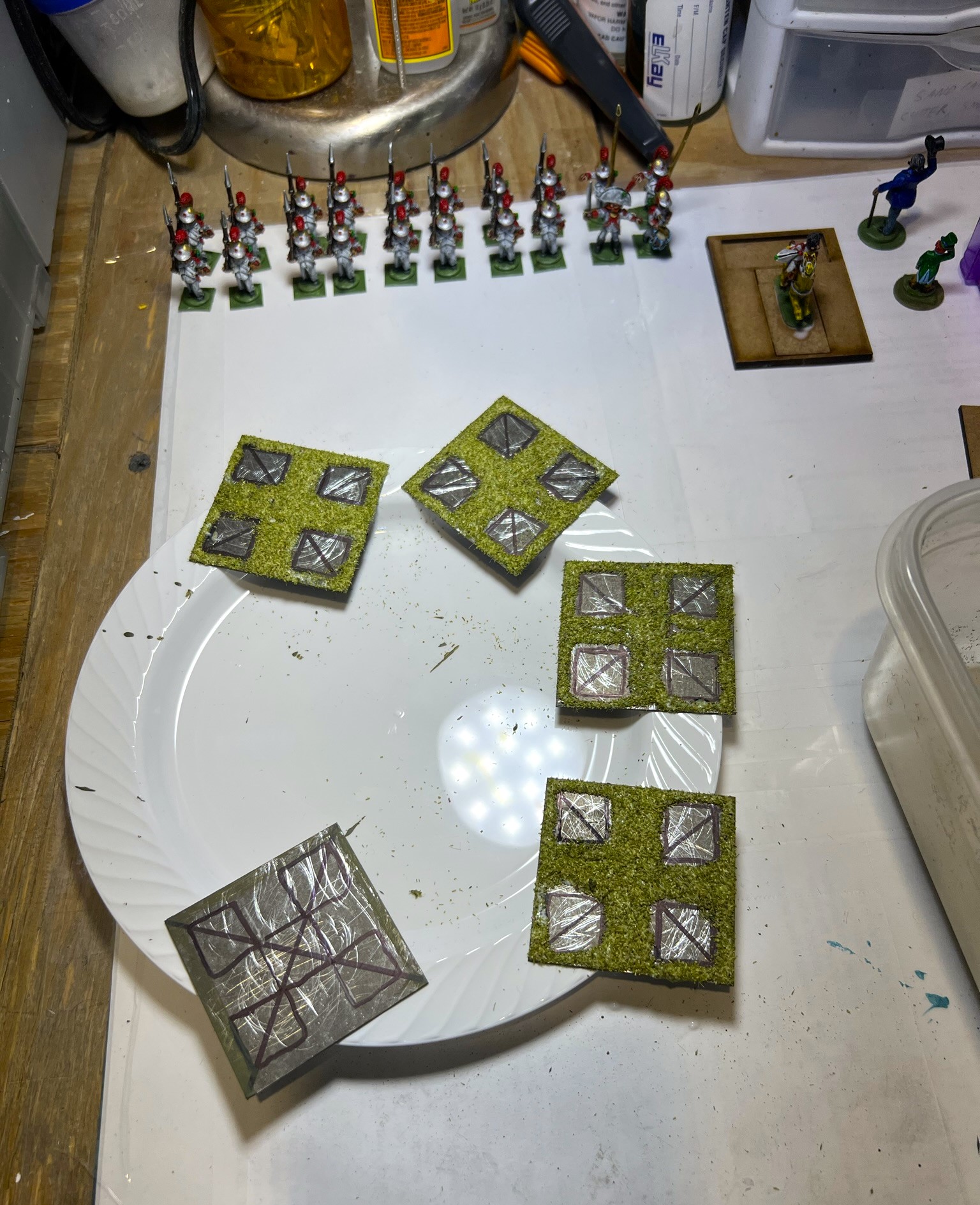
As for mounting, I wanted the bases to have an appropriate look – with muskets facing forward and in parallel. Once the varnish had dried, I removed the WSR from their specimen jars. Then, I needed to use small bits of poster tack on the figures’ actual bases/bottoms – and a sharpie to trace out how they would fit on the 2″ square steel bases. Then I applied an initial flocking around where the figures would not be. After that had dried, I glued the figures carefully to the steel bases and added multiple grasses and flocking to the steel bases and the regimental commander’s MDF base. This took up most of the effort on the 30th as I added three types of grass plus flowers to give the bases depth and to not just see the shapes of the figures under one layer of flocking. It’s probably overkill, but I do prefer to have nicer bases. The flocking was done on December 30th. Then, it was flag time.

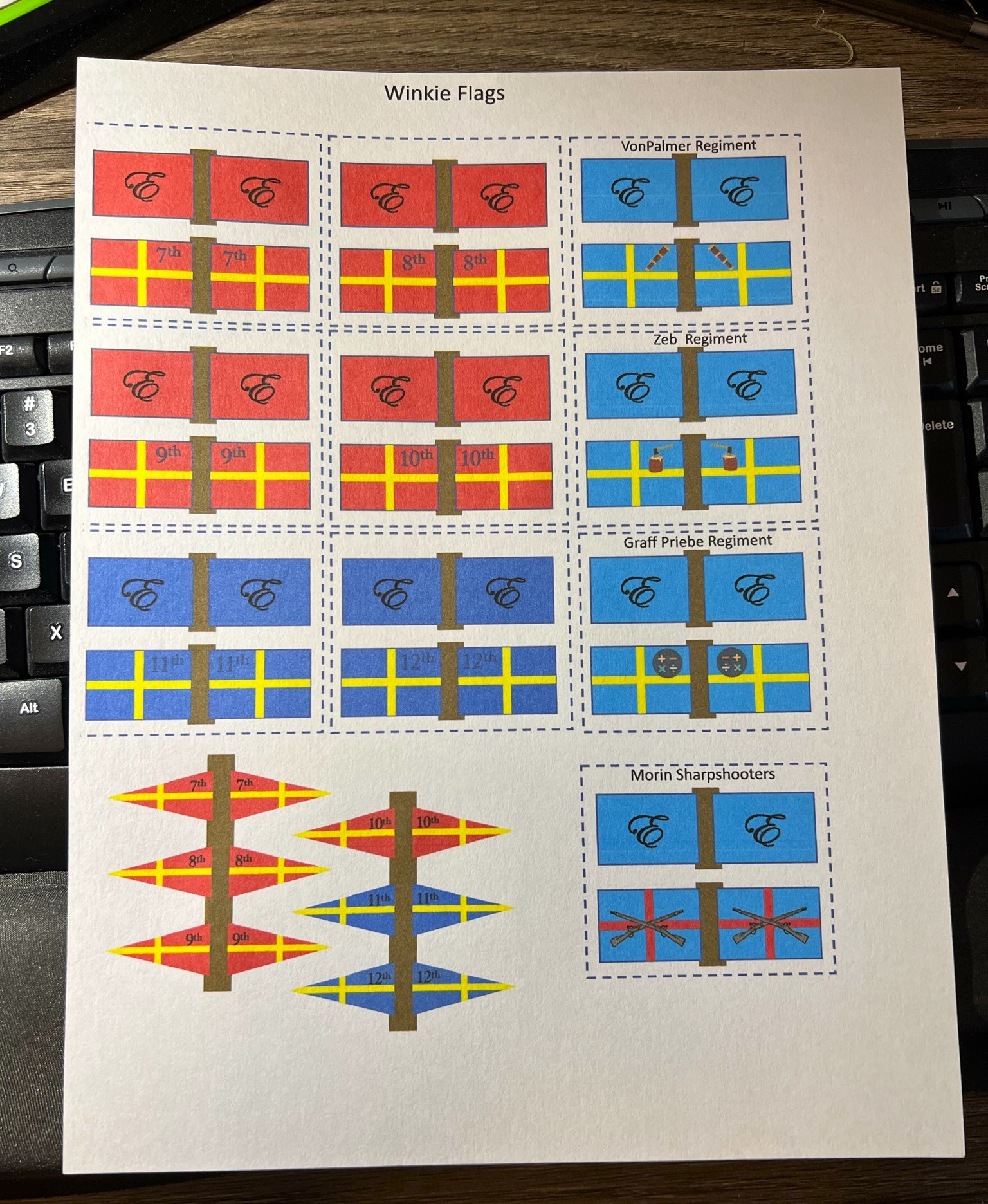
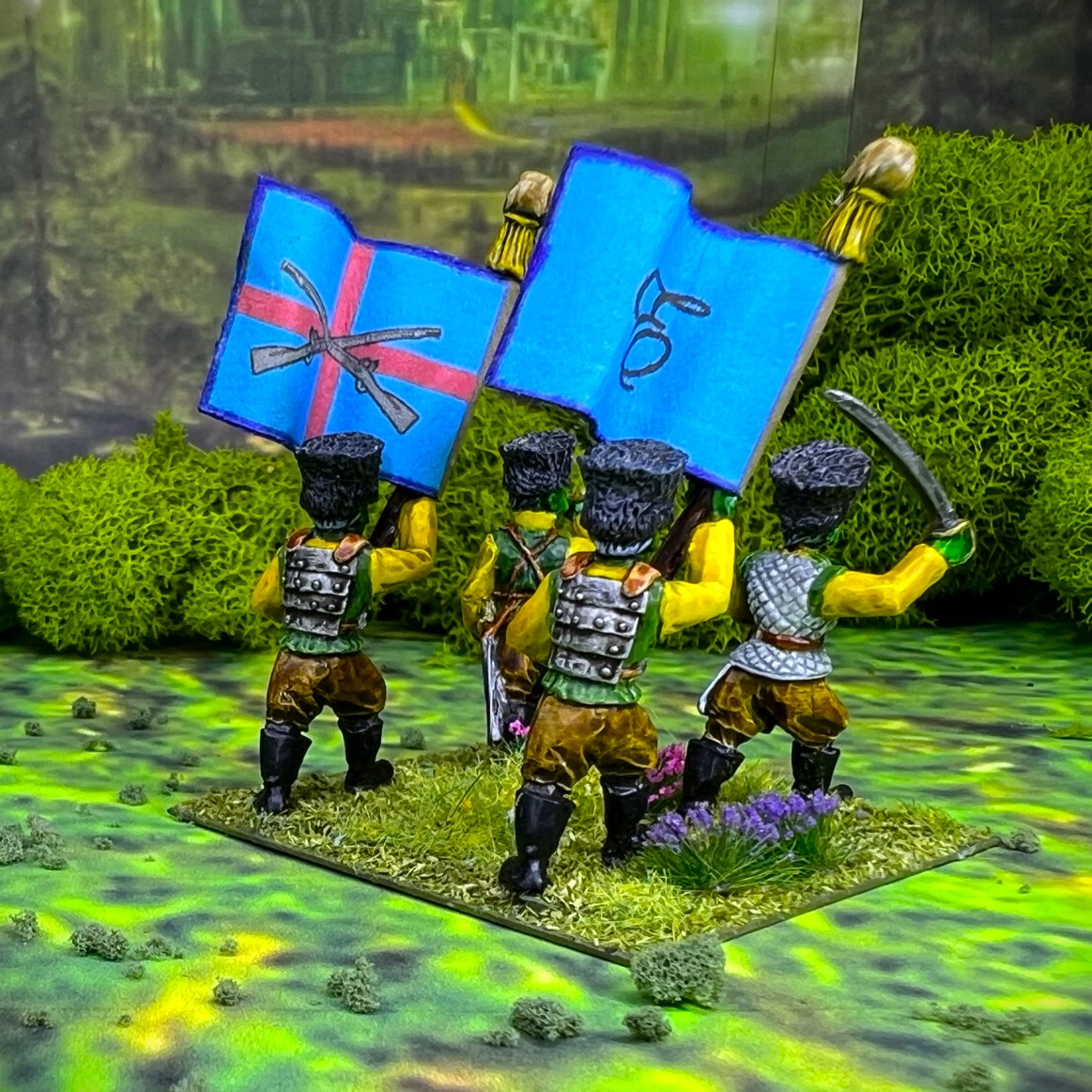
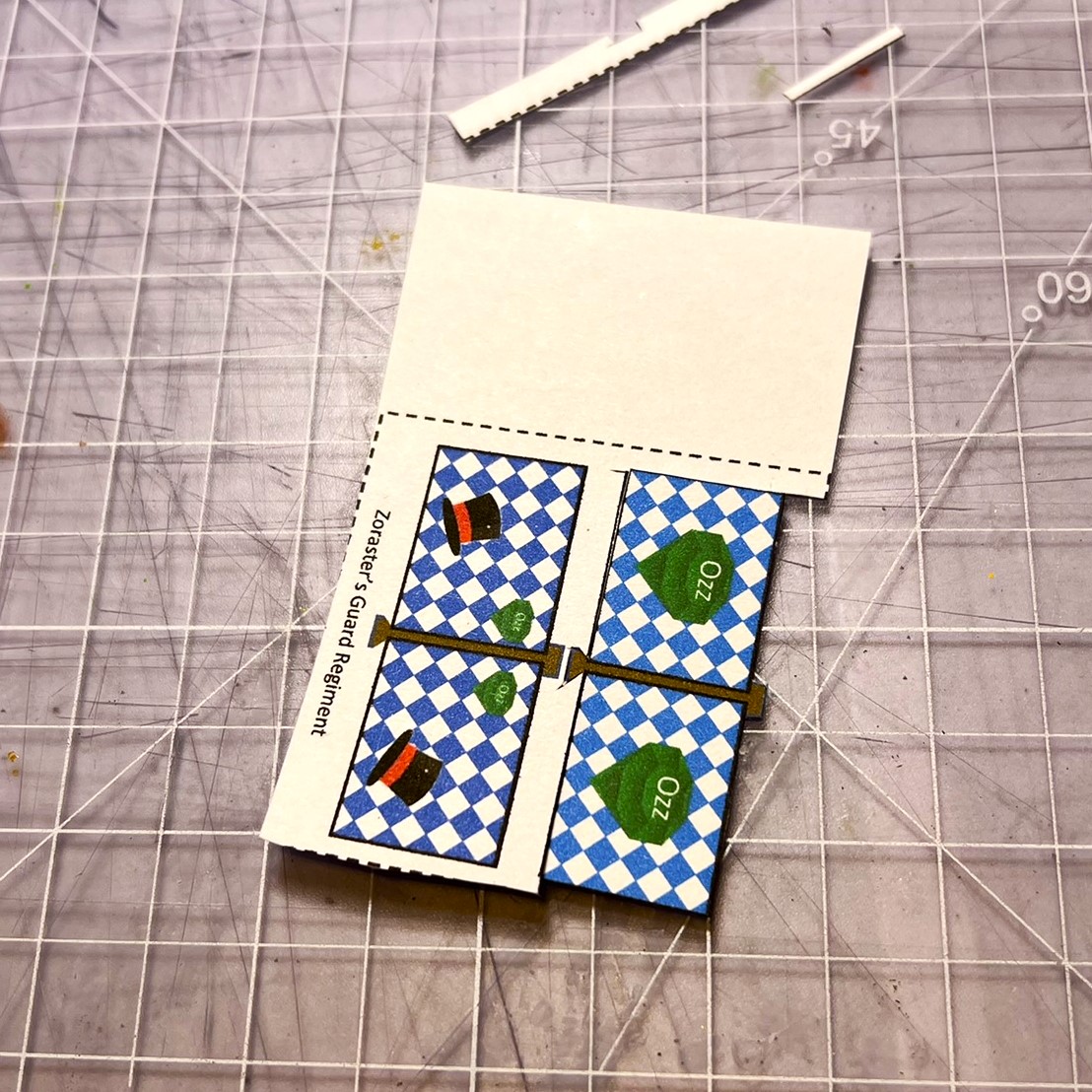
Most (but not all) regiments in Ozz have standards to apply to a couple of figures on a command base. One would be for the faction, the other would be for the regiment. These are available on the Ozz Facebook page as free downloads. When I looked for the WSR, there was no specified flag! By luck, my West Point buddy (and author of the Wars of Ozz rules) Buck Surdu had called me to check in on me post-surgery, and told me he would fix that – and boy he did as you’ll see below – Morin’s Sharpshooters! Hmmm, Buck, does this mean I ride a pink Zilk?

Thanks Buck!

As New Year’s Eve is today, I printed off the flags and finished the WSR. I also made a new backdrop for taking photos of the Winkies as I thought they needed a darker and less friendly look than I gave the Munchkin regiments. You’ll see that below in…

Eye Candy

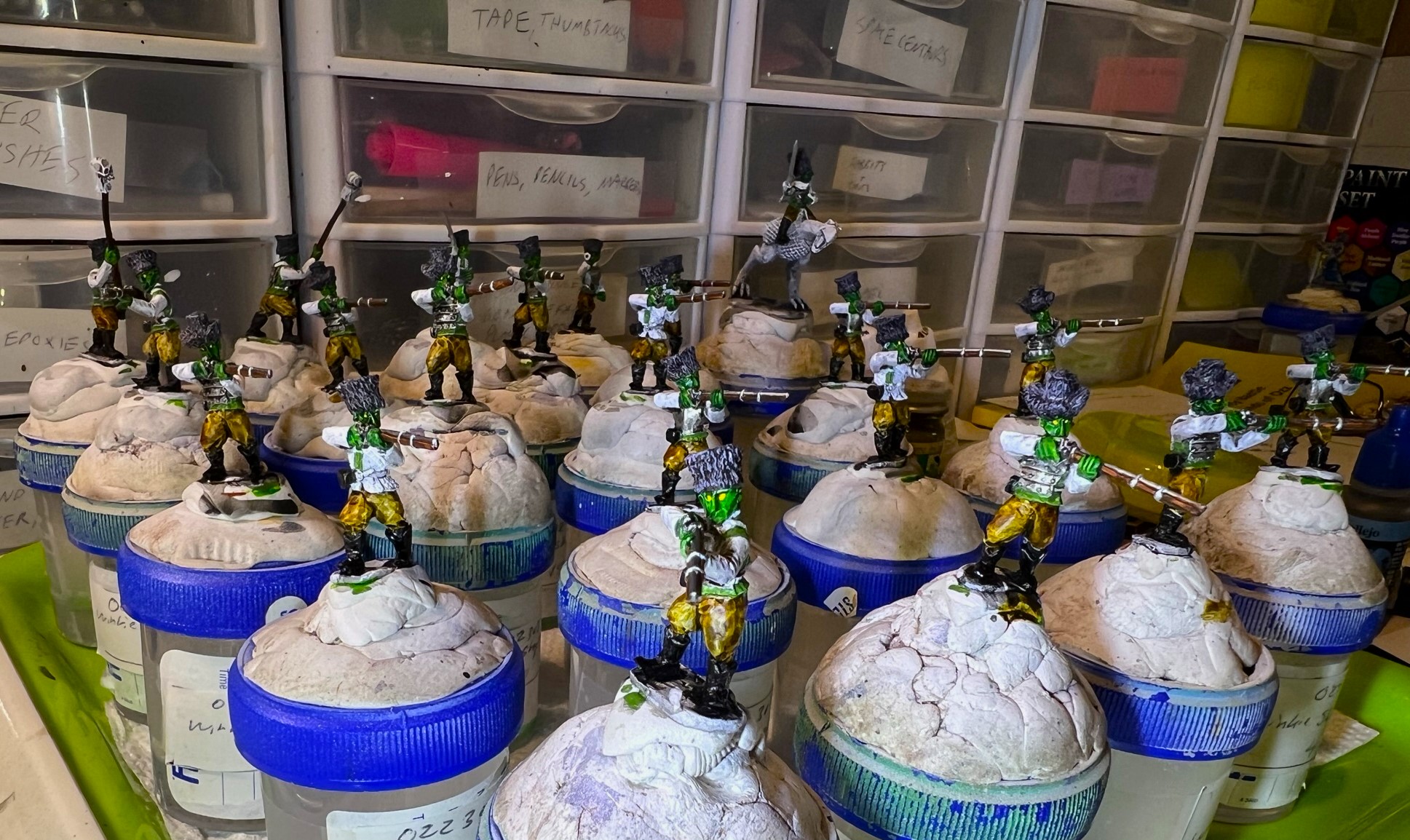
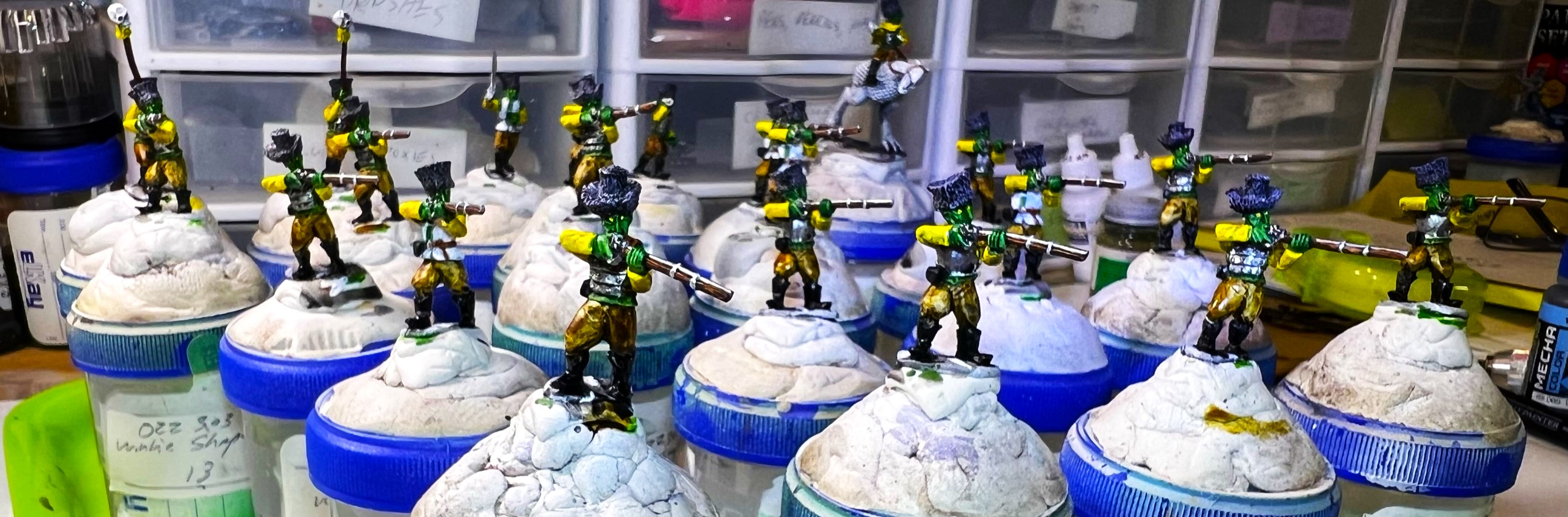
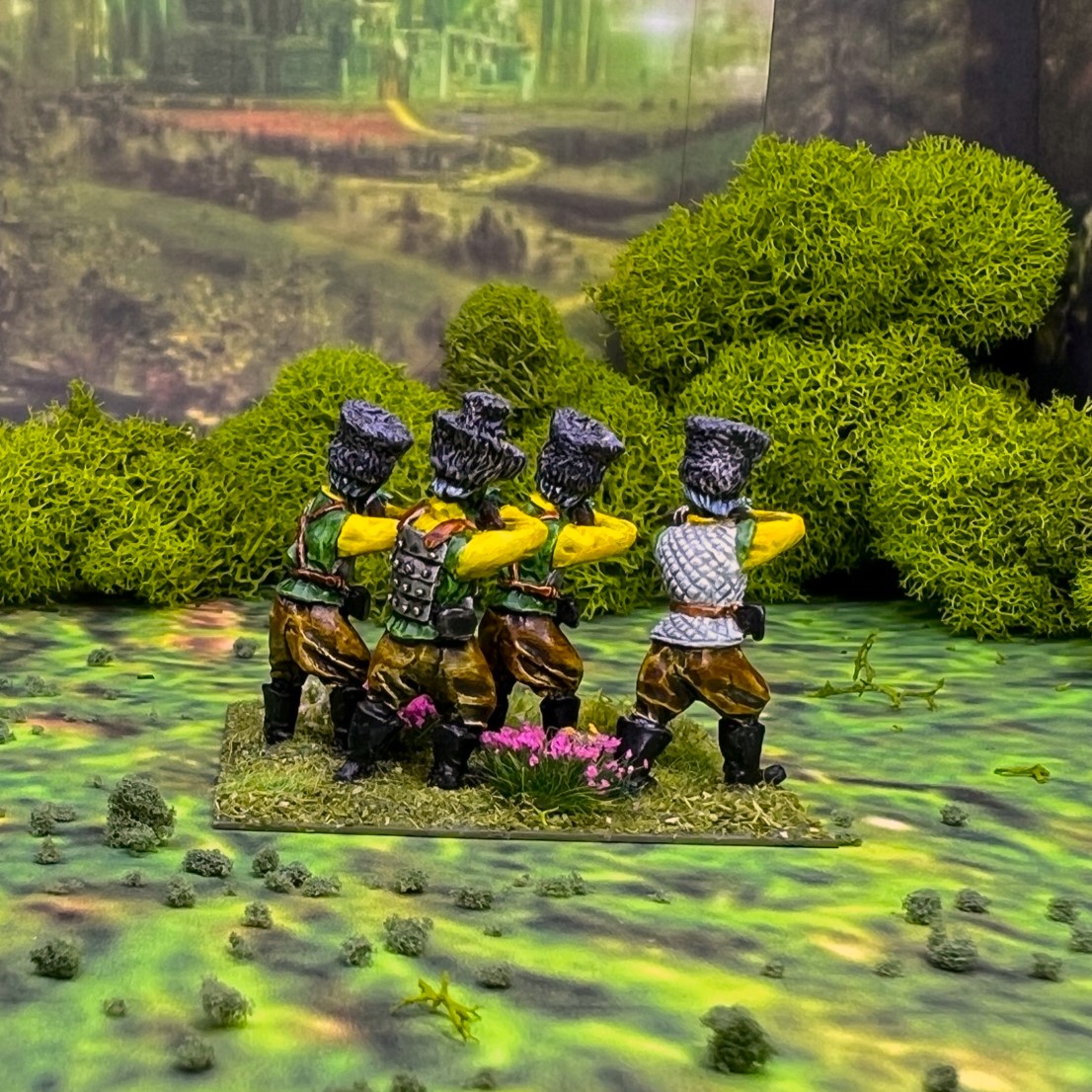
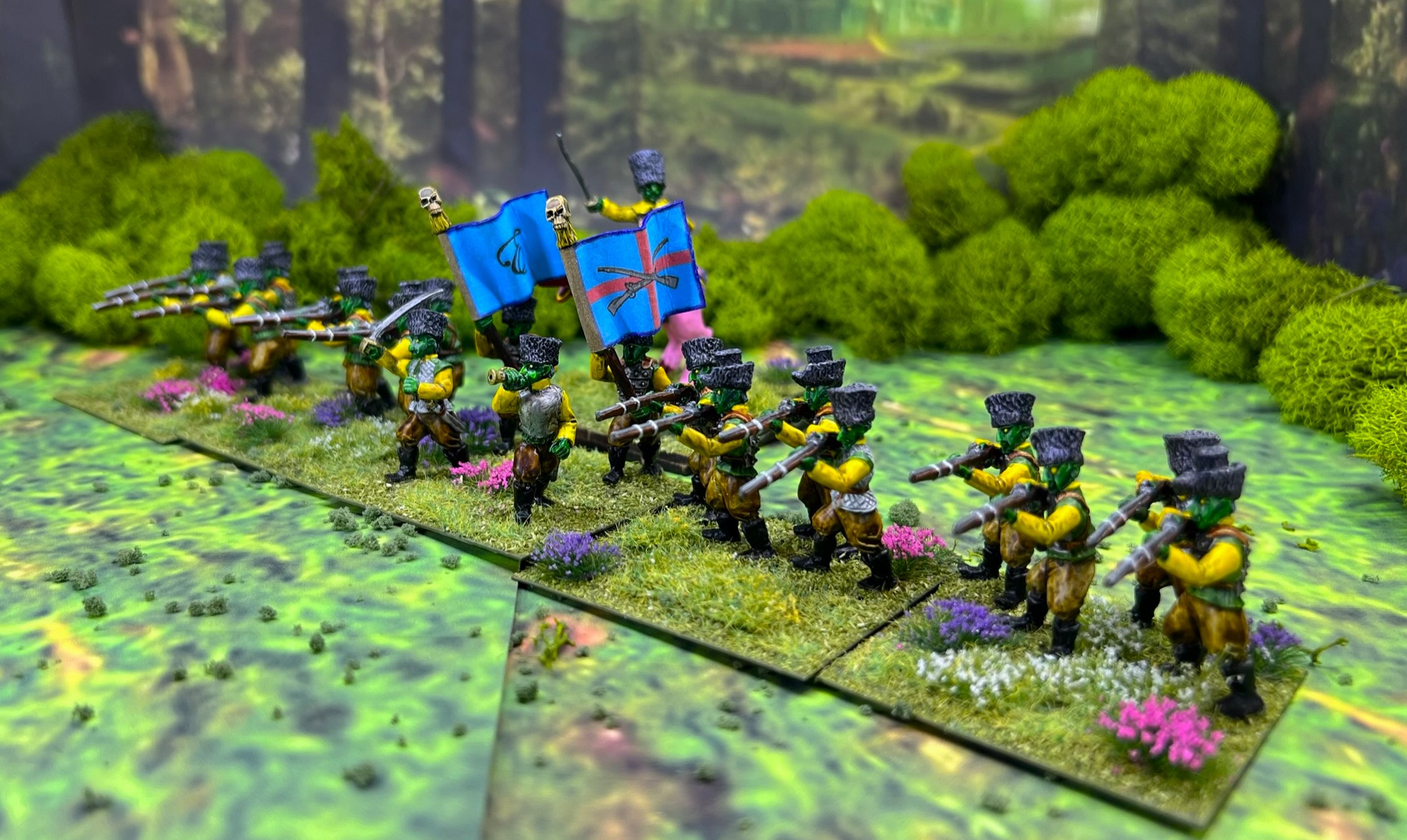
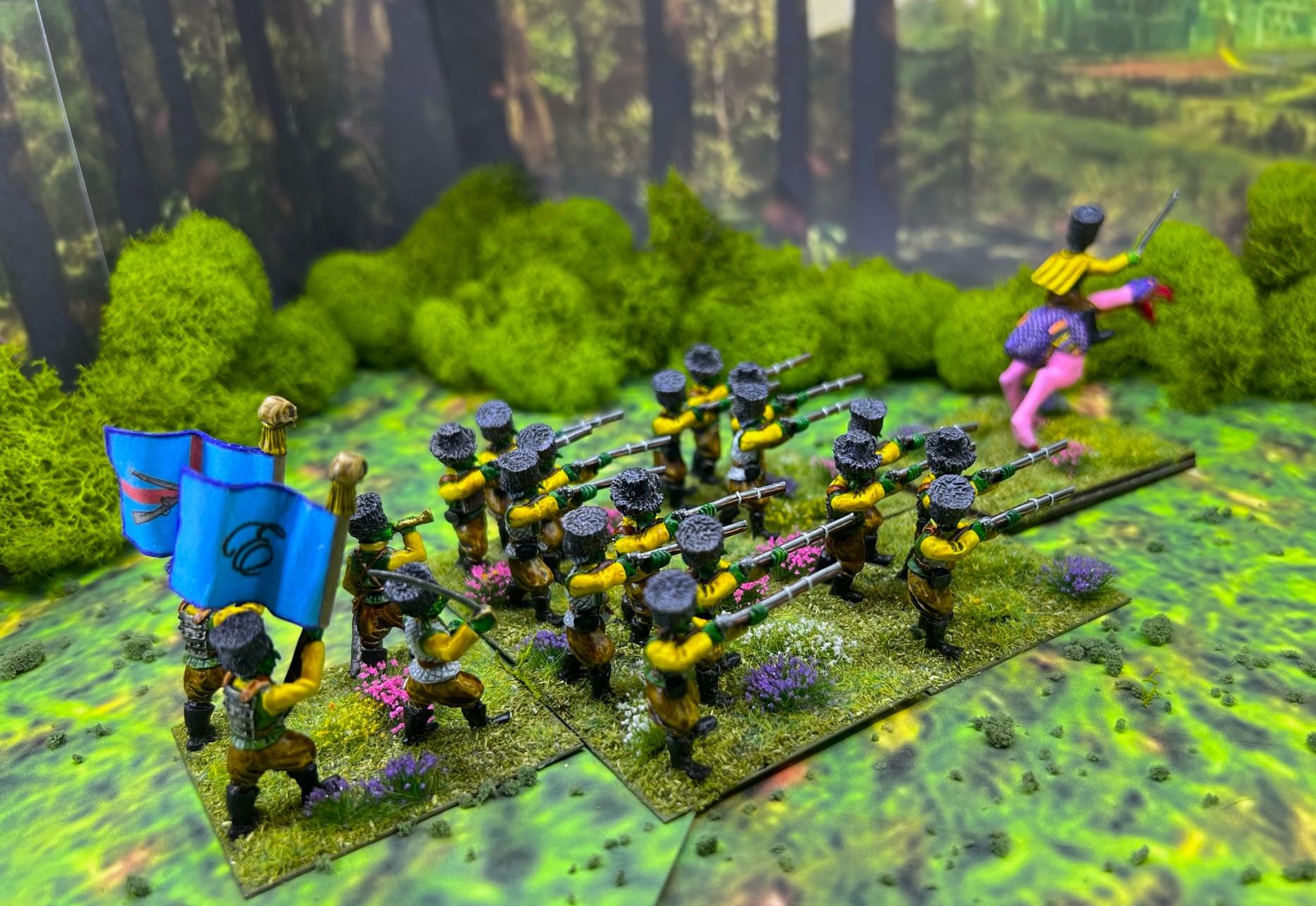
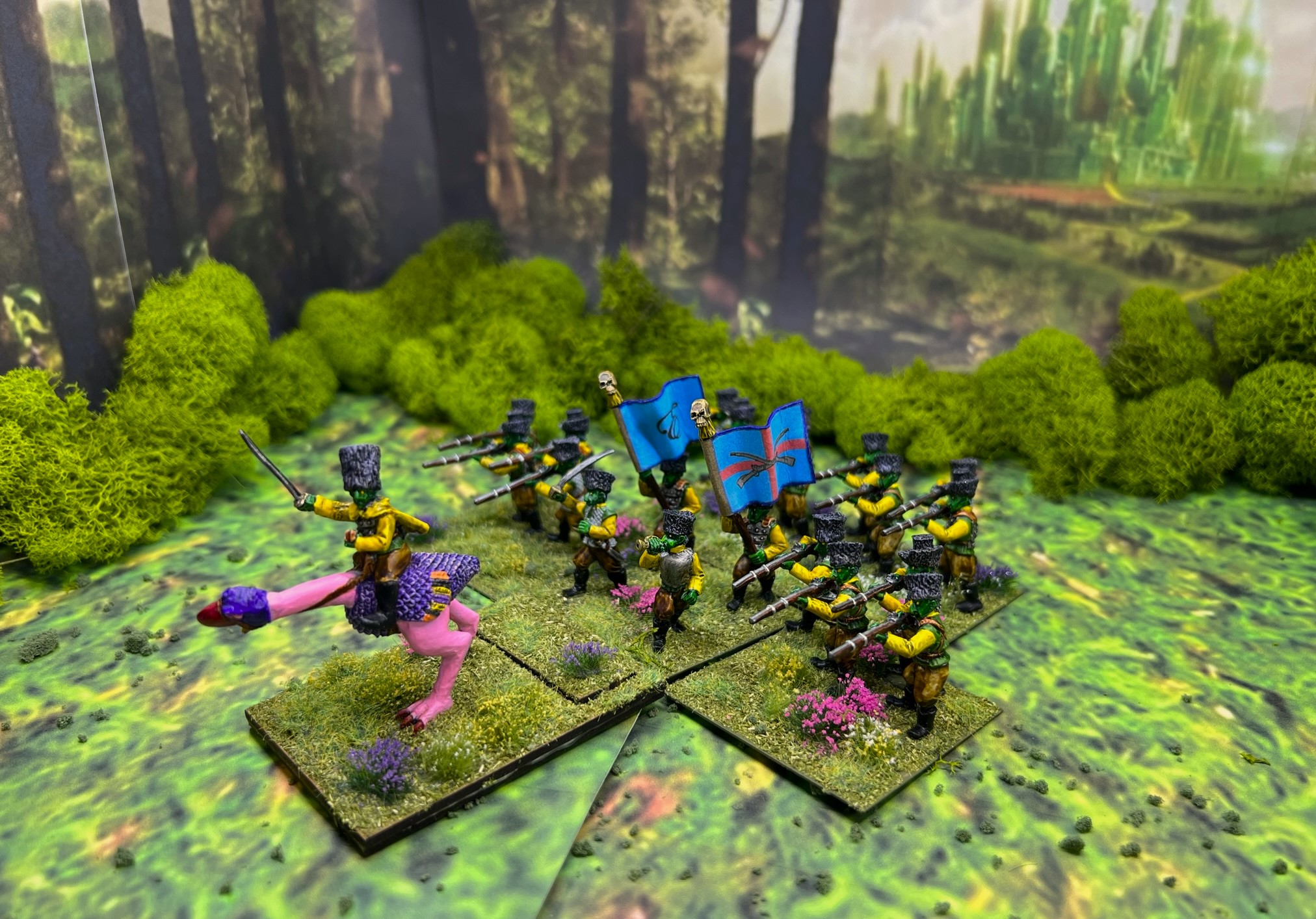
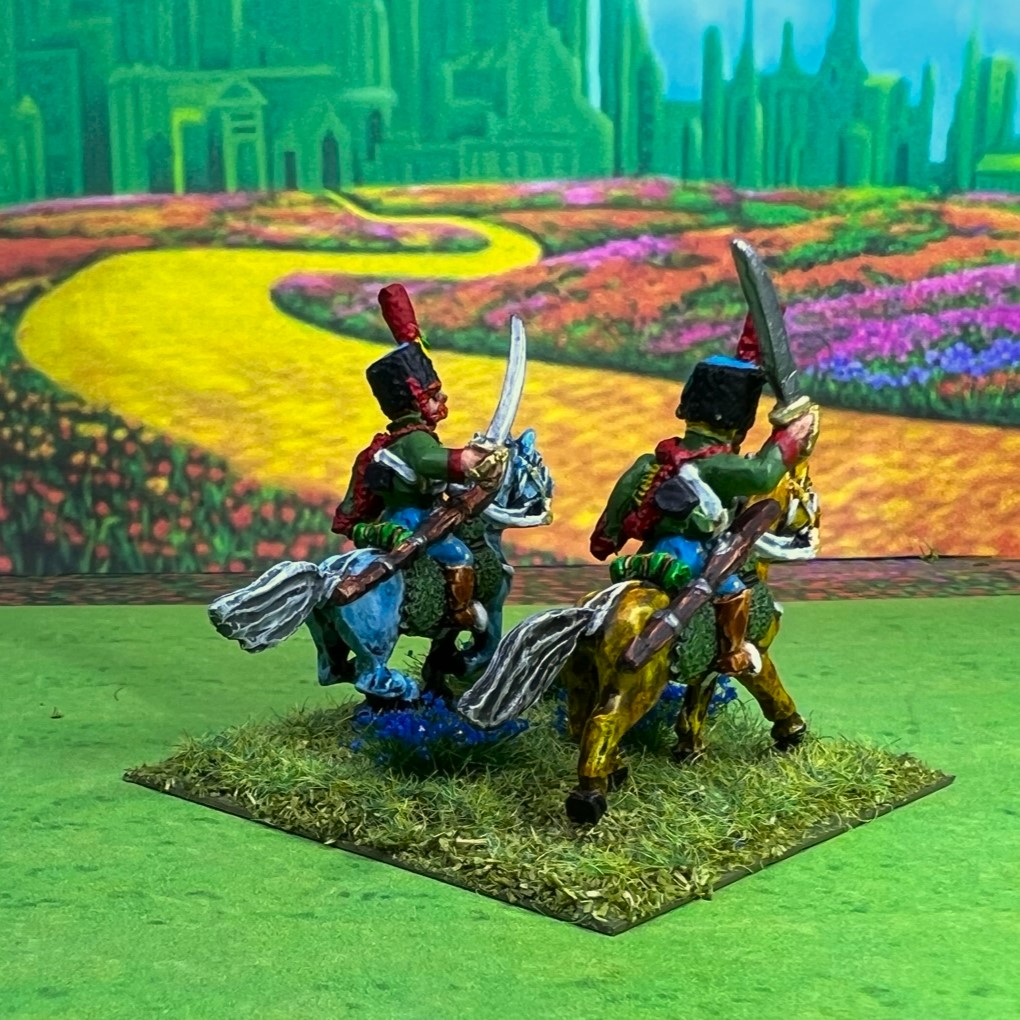
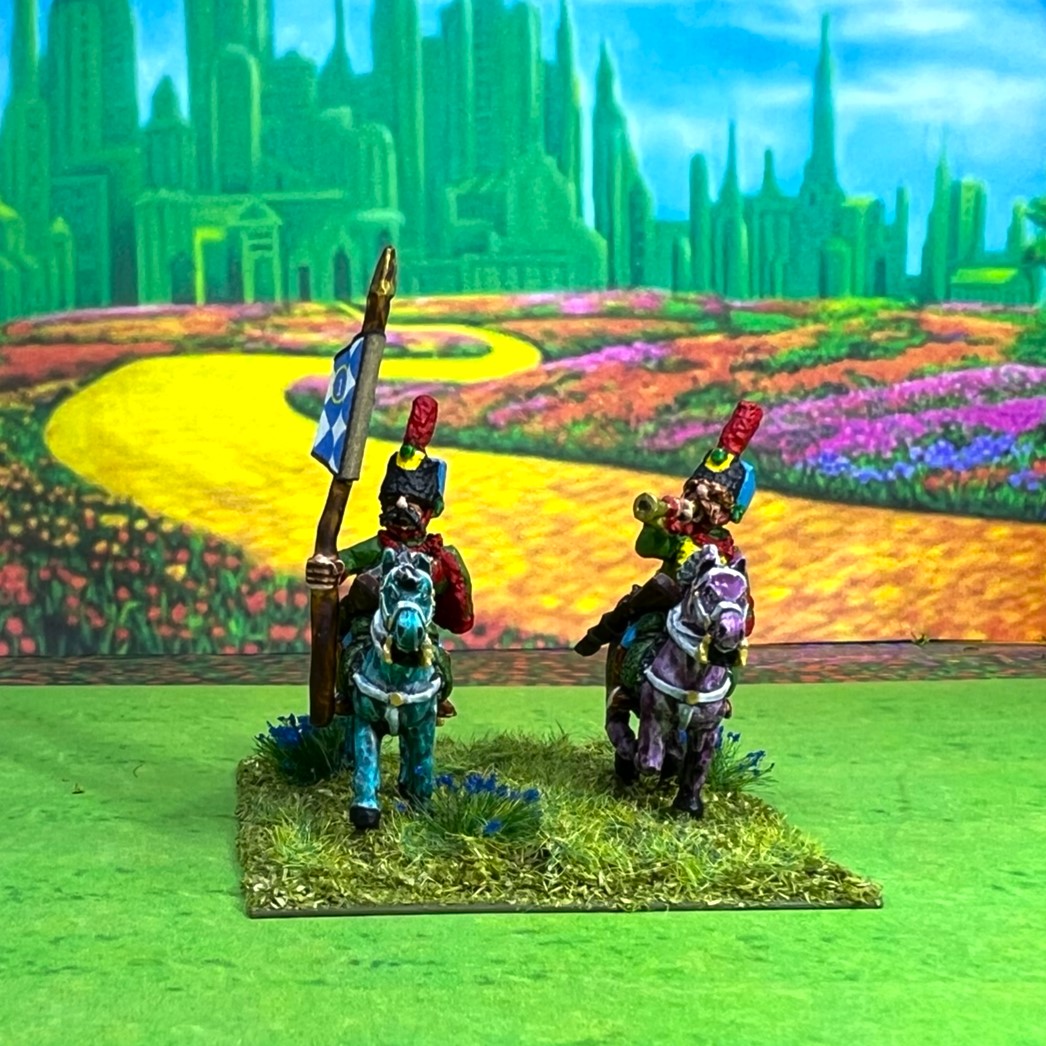
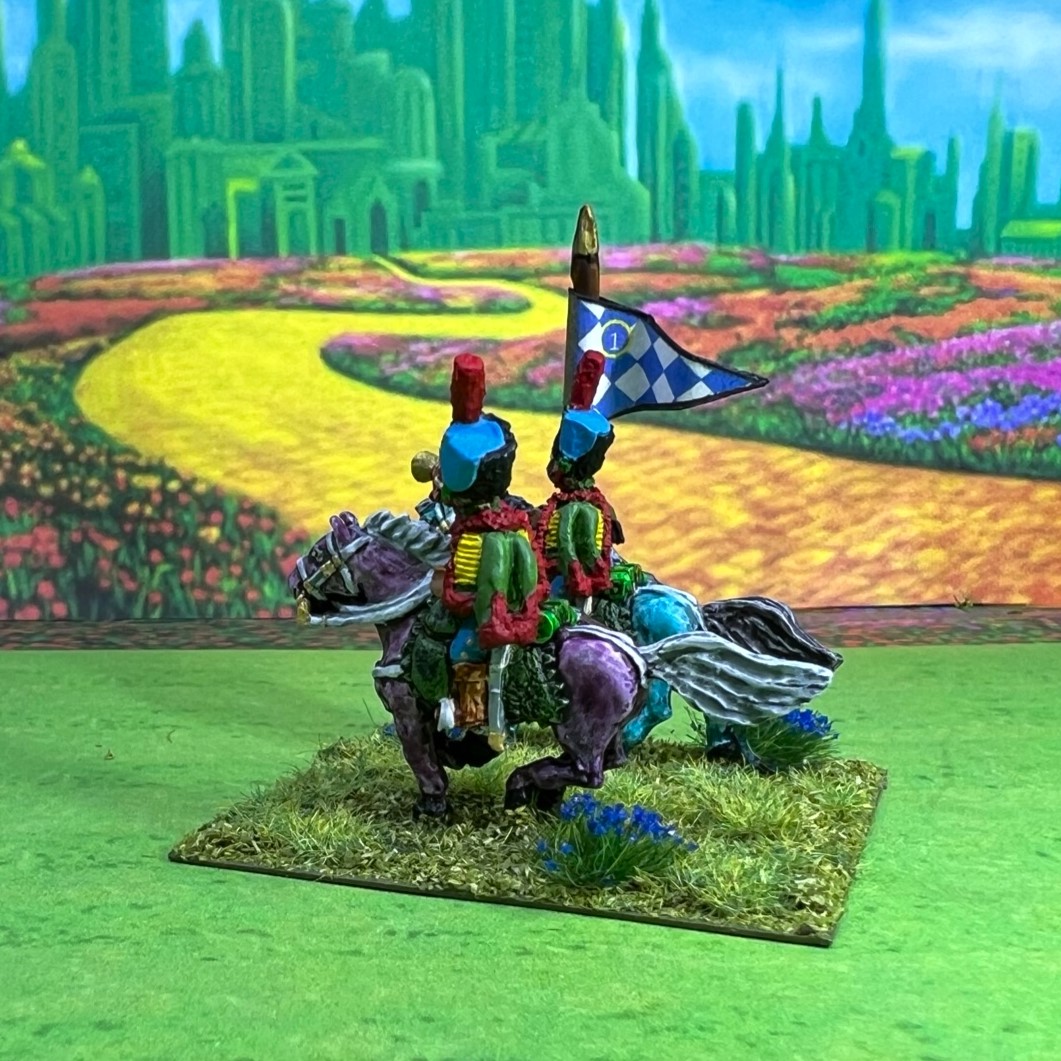
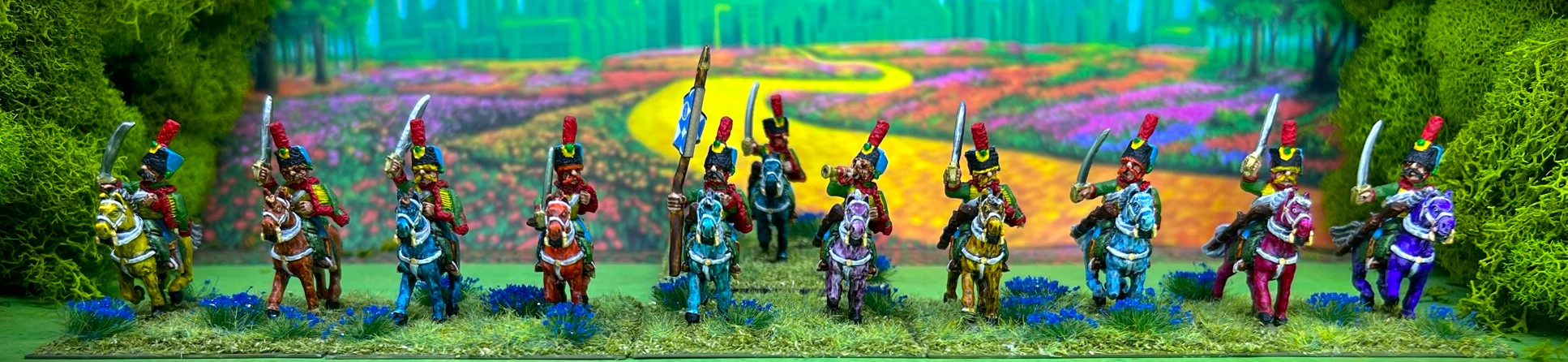
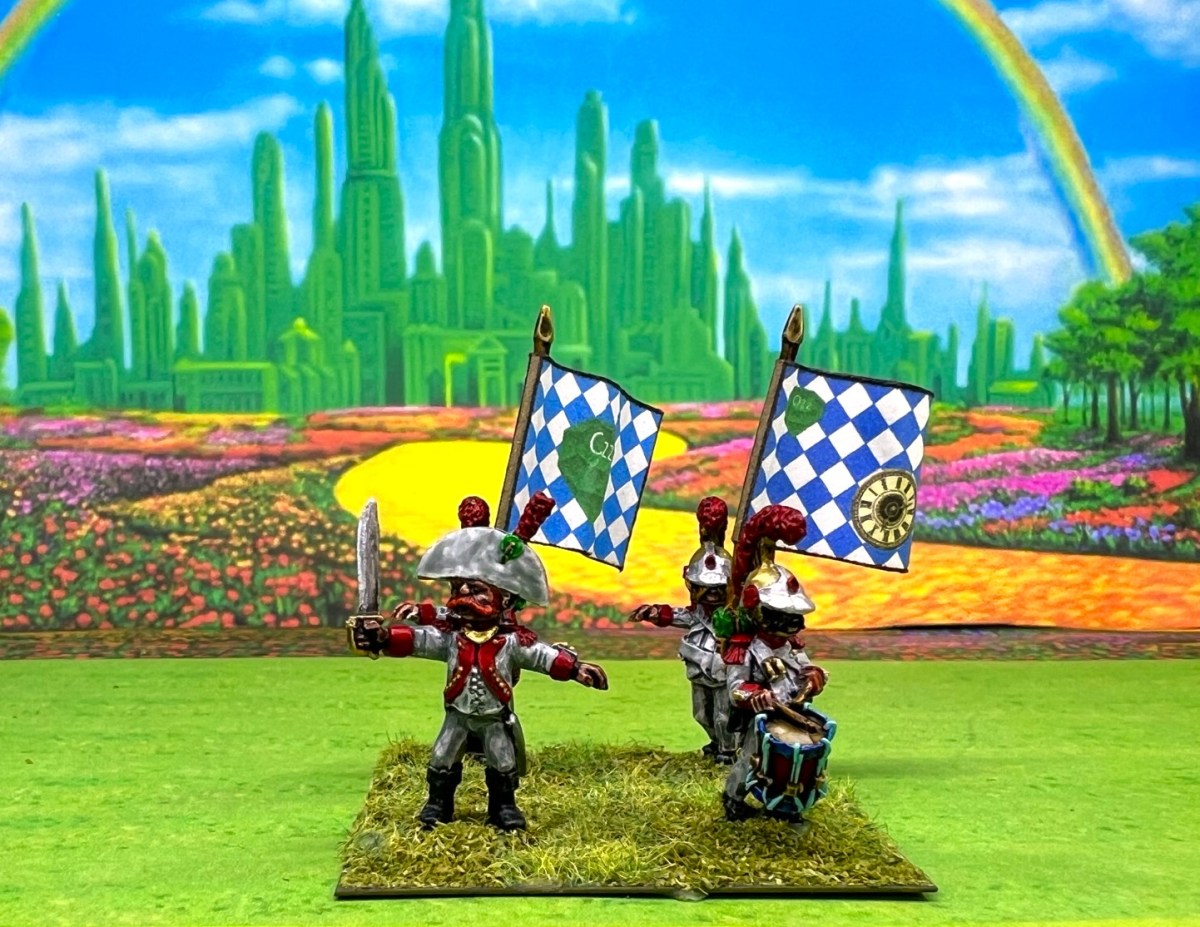
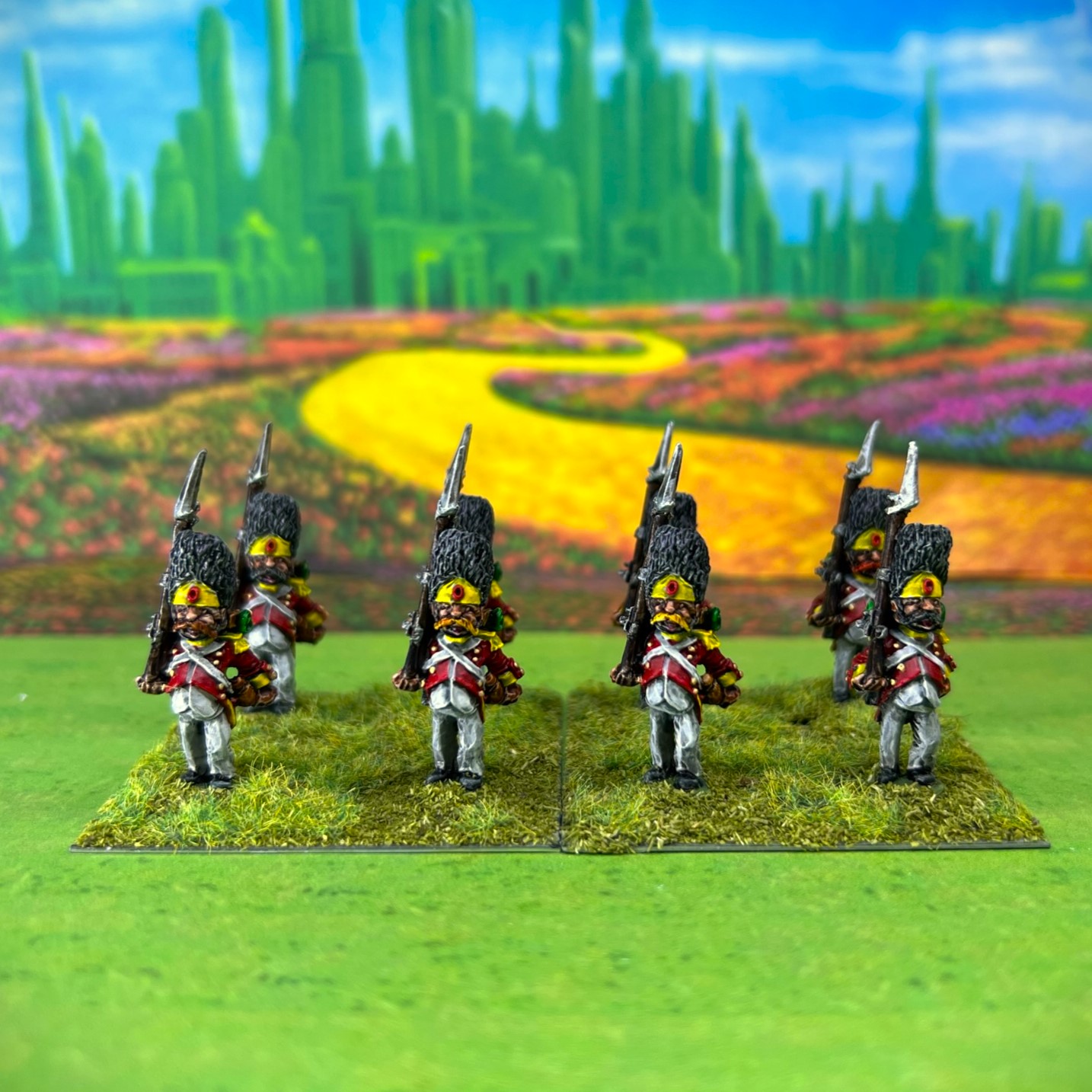
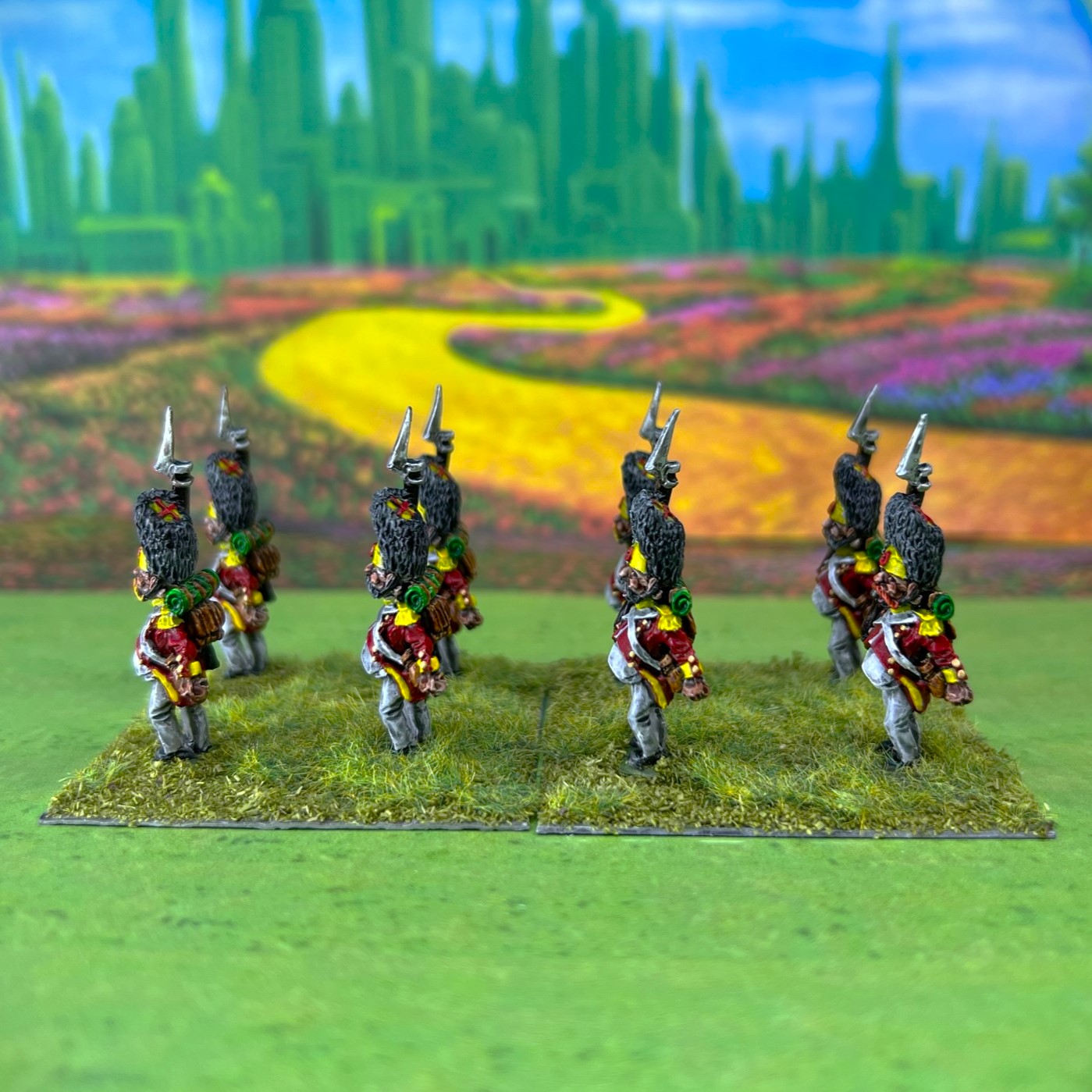
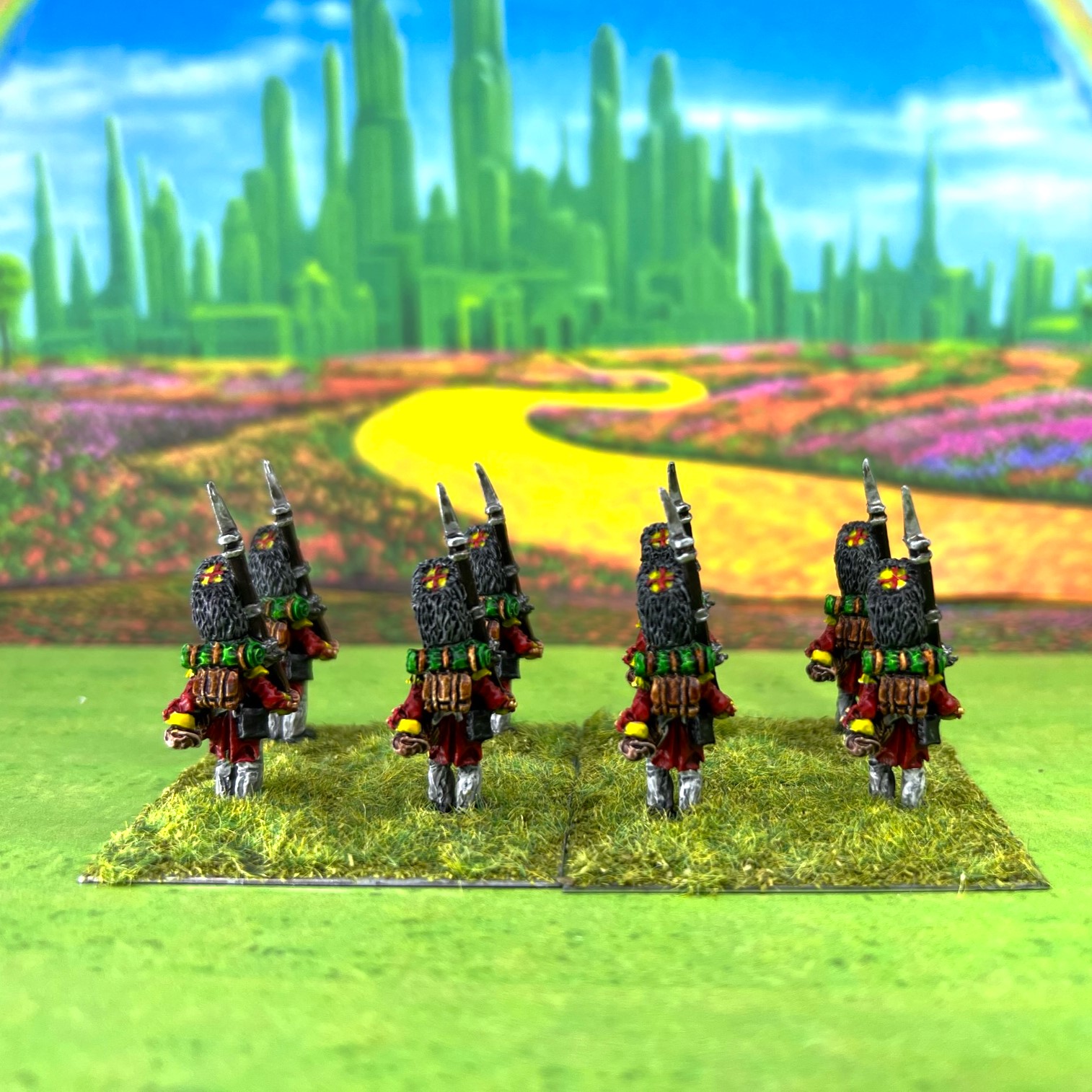
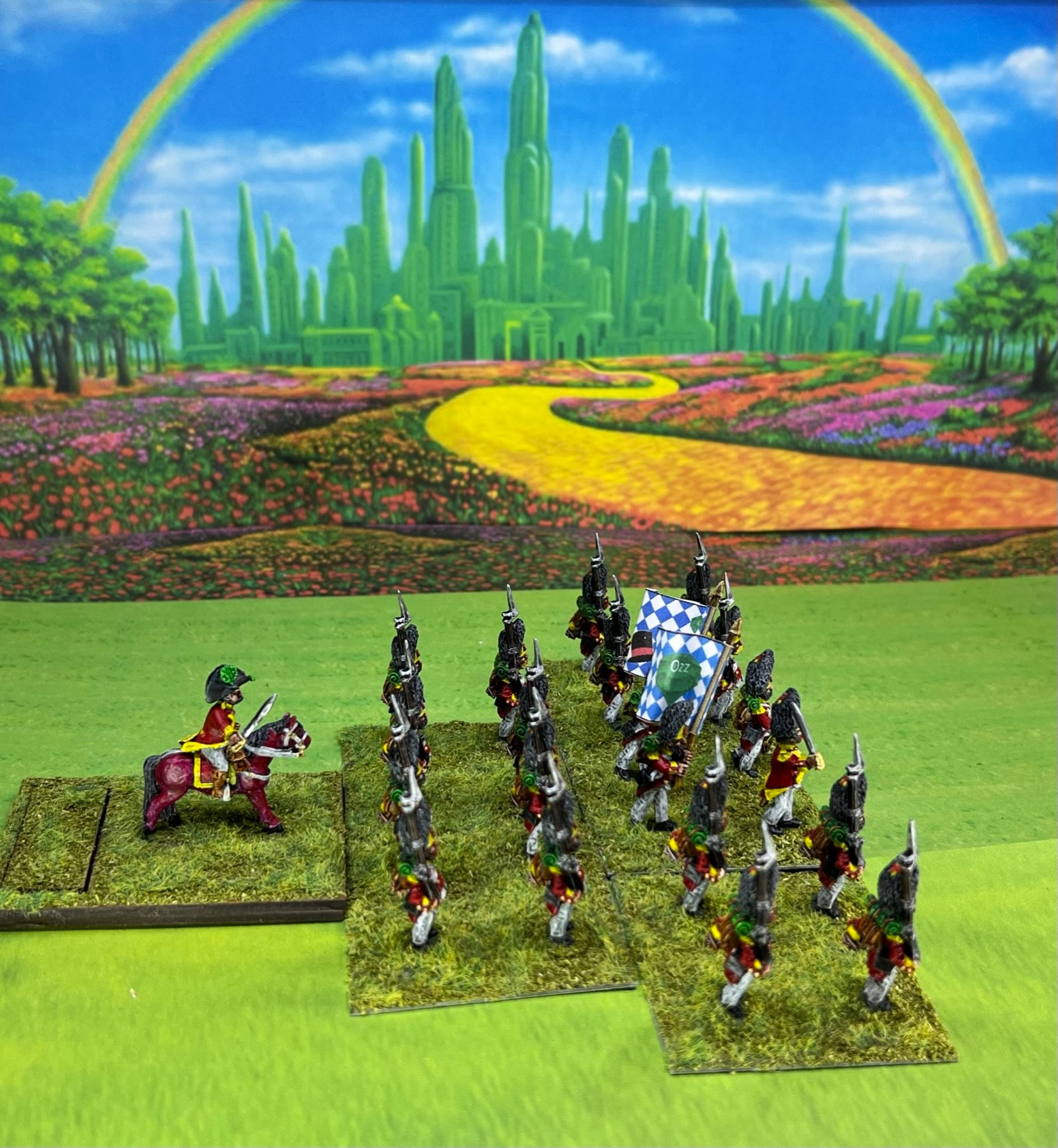
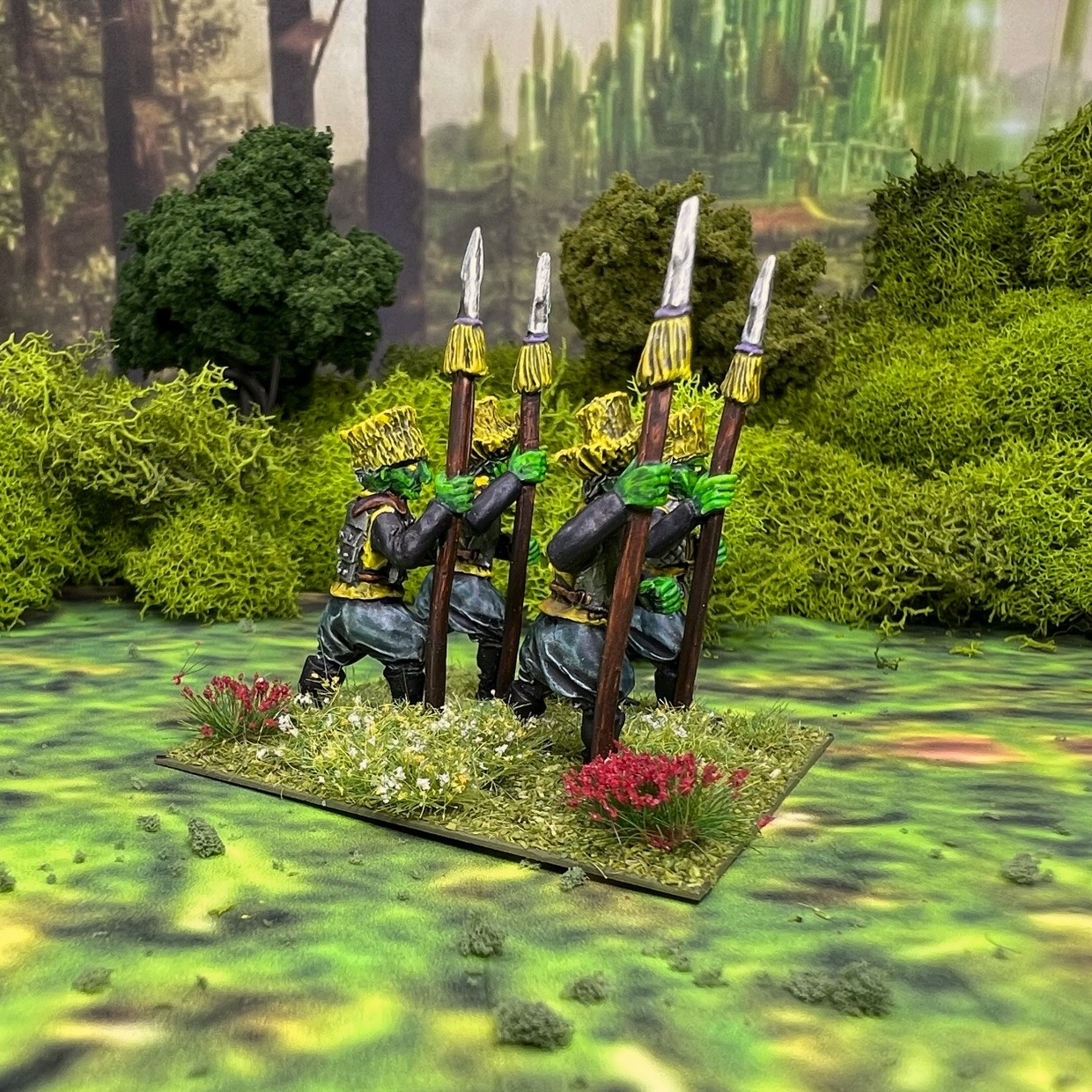
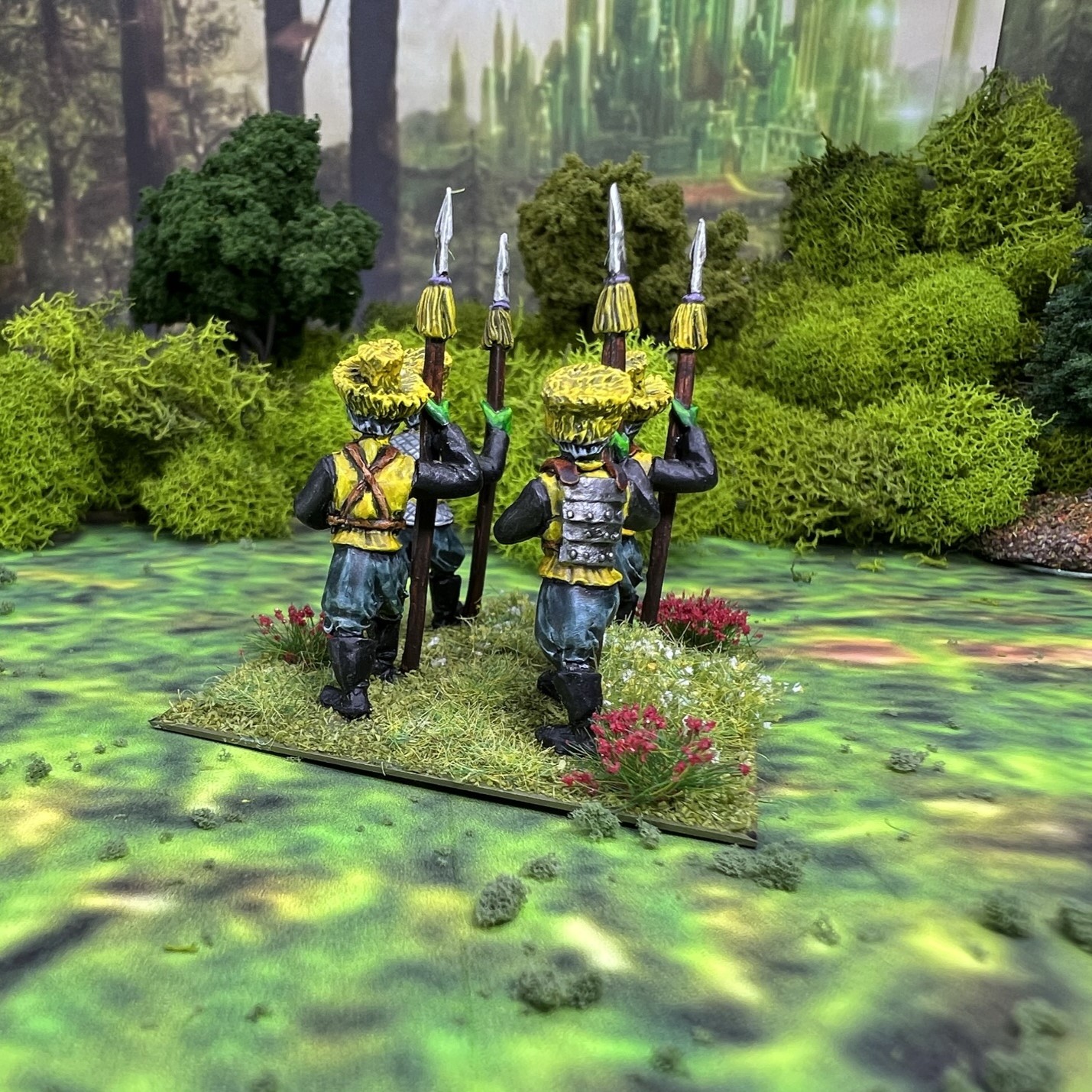
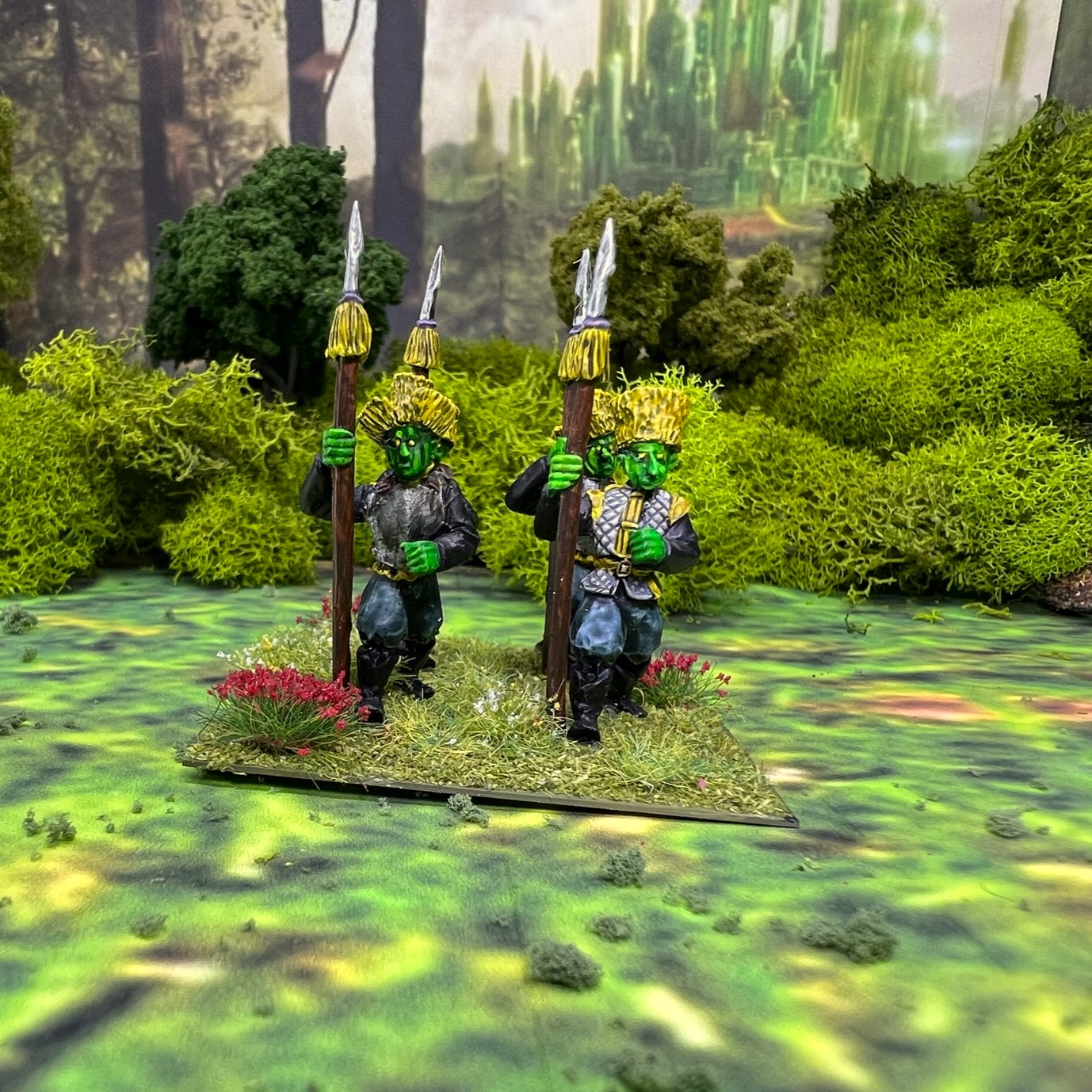
There are 5 stands of 4 figures each – 4 are similar and one is a command stand with an officer, 2 standard bearers and a bugler. I varied the flocking slightly but distinctly – hoping to have an overall match while having some uniqueness for each base. The pink zilk-mounted regimental commander goes on an MDF stand.

Regimental Commander Stand

Stand 1

Stand 2

Stand 3

Stand 4

Command Stand

Group shots

The WSR in line formation with the Regimental Commander in the rear.
The WSR in column formation with the Regimental Commander in the front.
A side view of the WSR in column formation with the Regimental Commander in the front.
A right side view of the WSR in another line formation with the Regimental Commander in the front.
A right side view of the WSR in another line formation with the Regimental Commander in the rear.
The WSR about to fire!

I will continue to build my brigade of Winkies in 2023, as well as more Ozz goodness. I hope that you will stay with and/or join me on this journey.

My next post will be a 2022 roundup and 2023 goal setting one. There, I’ll review and hold myself accountable for my 2022 predictions and goals of a year ago. Hell, somebody has to do it!

There, I will set my 2023 goals as well.

I wish all of you a very Happy New Year – and please know that I am very appreciative of your readership and support!

Still have more to come…

Miscellaneous details and references for those interested in that sort of thing:

For all of my previous posts on Wars of Ozz games, figures, units, and other related projects – please see this page.

PAINTS, INKS, GLAZES, SHADES, WASHES, PIGMENTS, FLOCKING, GLUES AND MORE THAT I USED ON THIS WINKIE SHARPSHOOTER REGIMENT:

  1. Gorilla Glue
  2. Paper clip wire pieces
  3. 1 1/4″ x 1″ steel base from Wargames Accessories (#FOW1)
  4. Poster tack
  5. Vallejo Premium Primer “White”
  6. Vallejo “Flow Improver”
  7. Vallejo “Airbrush Thinner”
  8. Citadel “Nuln Oil” (wash)
  9. Vallejo Model Color “White”
  10. Citadel “Contrast Paint – Ork Skin”
  11. Citadel “Contrast Paint – Contrast Medium”
  12. Vallejo Model Air “Gun Metal”
  13. Vallejo Model Air “Steel”
  14. Vallejo Model Color “Wood Grain”
  15. Army Painter “Speed Paint – Runic Grey”
  16. Citadel “Ironbreaker”
  17. Citadel “Nuln Oil GLOSS” (wash)
  18. Citadel “Contrast Paint – Black Legion”
  19. Citadel “Contrast Paint – Aggaros Dunes”
  20. Citadel “Warpfiend Grey”
  21. Citadel “Contrast Paint – Black Legion”
  22. Citadel “Contrast Paint – Striking Scorpion Green”
  23. Vallejo Game Air “Sick Green”
  24. Vallejo Game Ink “Yellow”
  25. Army Painter “Speed Paint – Hardened Leather”
  26. Vallejo Game Ink “Black Green”
  27. Citadel “Contrast Paint – Ironjawz Yellow”
  28. Citadel “Lamenters Yellow” (glaze)
  29. Vallejo Model Air “Bright Brass”
  30. Citadel “Contrast Paint – Skeleton Horde”
  31. Army Painter “Speed Paint – Holy White”
  32. Americana “Bubblegum Pink”
  33. Citadel “Fire Dragon Bright”
  34. Vallejo Game Air “Black”
  35. Americana “Dioxazine Purple”
  36. Citadel “Contrast Paint – Doomfire Magenta”
  37. Army Painter “Purple Tone” (wash/shade)
  38. Citadel “Changeling Pink” (dry)
  39. Vallejo “Gloss Varnish”
  40. Vallejo Mecha Varnish “Matte Varnish”
  41. Regimental MDF base from Old Glory/Wars of Ozz Miniatures
  42. 2″ square steel base from Wargames Accessories (#21)
  43. Black Sharpie pen
  44. PS Model Color “British Brown Drab”
  45. Elmer’s PVA Glue
  46. Army Painter “Battlefields Grass Green” (flocking)
  47. Army Painter “Battlefield Field Grass” (flocking)
  48. Army Painter “Battlefields Field Grass” (flocking)
  49. Army Painter “Battlefields Meadow Flowers” (flocking)
  50. Shadow’s Edge Miniatures “6mm Dark Forest Pink Tufts” (flocking)
  51. Shadow’s Edge Miniatures “6mm Dark Forest Purple Tufts” (flocking)
  52. Winkie Flags from Buck Surdu printed on card stock
  53. Blue Sharpie Pen
  54. Brown Sharpie Pen

Again, as you may want to check out the Wars of Ozz figures range – there are two places to get them (and I make no money from this btw). The game rules and figures are available from the following two places:

In the US Old Glory has a site – Wars of Ozz Miniatures.

In the UK go to Sally 4th.

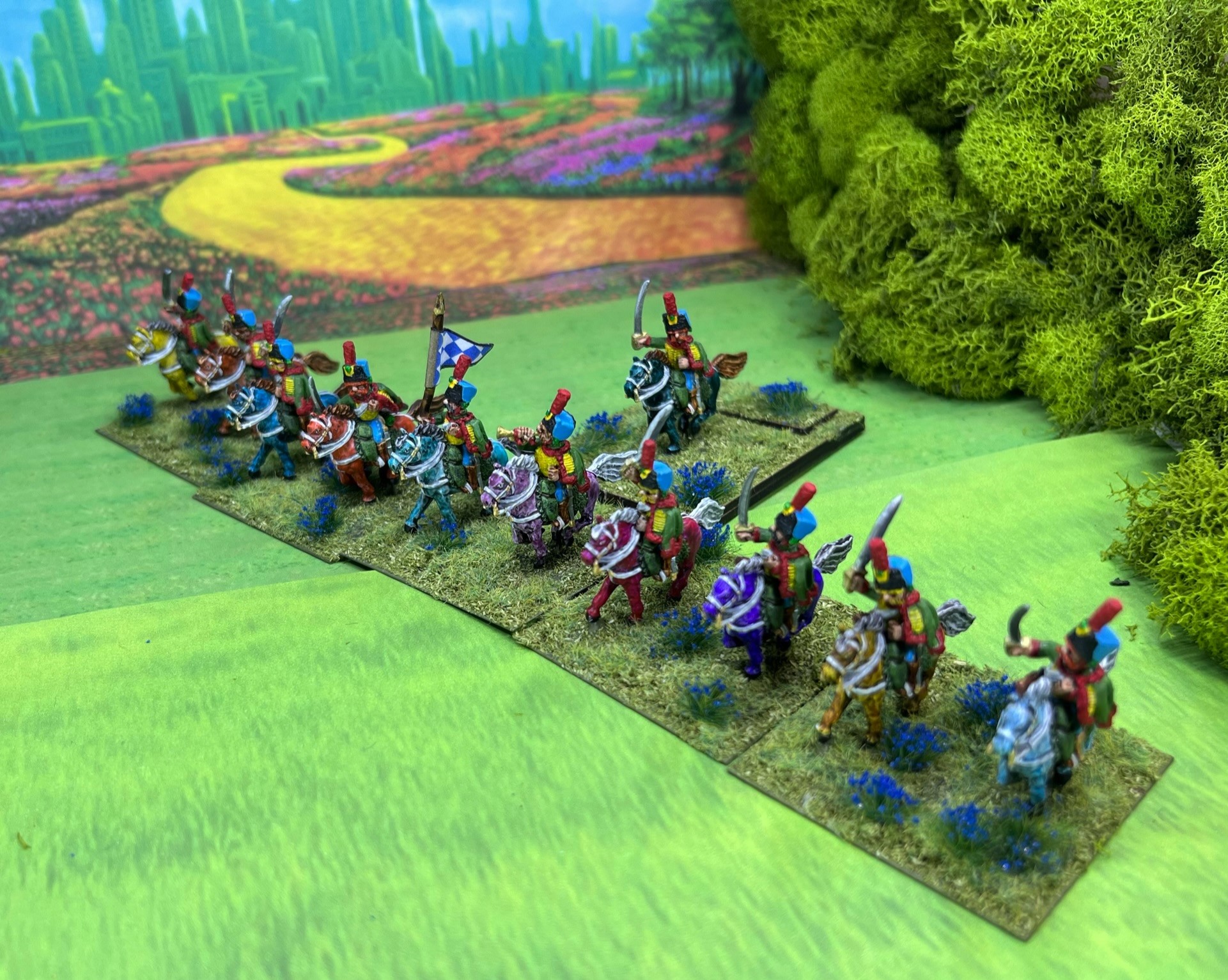
Munchkin Light Cavalry with Command (Wars of Ozz)

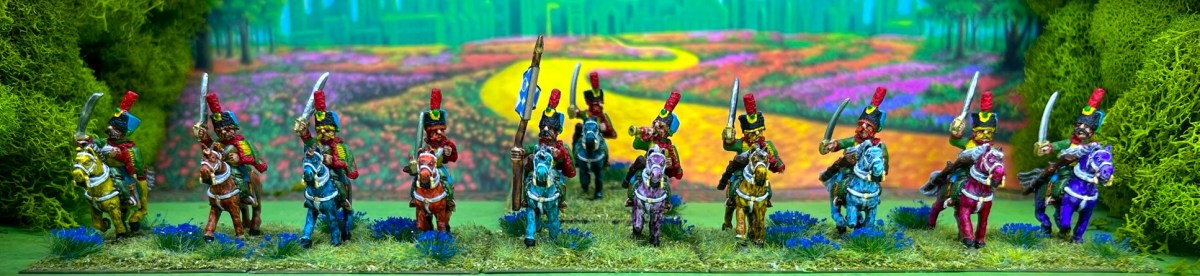
I had previously built two infantry regiments and an artillery battery for my Munchkin Brigade. It was time to add a cavalry regiment to my Munchkin Brigade for Wars of Ozz. This was a Light Cavalry Regiment, OZZ108 from Wars of Ozz miniatures.

The regiment is 28mm and metal. It is composed of made of 11 figures broken into 11 ponies, 11 riders (from the torso up), and 11 carbines. The riders also are armed with sabers, so they can also engage the enemy from a distance (although carbines are not very long ranged). The Light Cavalry Regiment (LCR) is worth the same amount of points as the Medium Artillery Battery that I described in my last post. Each base in the game can take 4 hits, even though with cavalry there are only two figures per 2″ square base. This regiment has 5 bases plus a regimental commander on an MDF base.

The rules say that the LCR should have “dragoon green” coats and light blue trousers. The ponies (these are Munchkins) are supposed to be in multiple pastel colors – which allowed me to use a number of Citadel Contrast and Army Painter Speed Paints. I painted the carbines, riders, and ponies all separately. Then, I assembled all after painting and varnishing was completed. I used both my specimen jars/poster tack combos and my painting stand with alligator clips to paint and varnish. The project was started on December 8th, and completed on December 19th. There was a lot more work here than I expected – I really needed to plan out the painting and assembly. I also did a bit of research on Napoleonic cavalry as my Napoleonic painting experience level is – well zero. My goal was to achieve a good tabletop standard – and you can be the judge of whether I achieved that. As usual, I will list all the paints I used on this unit at the end of this post for those interested in that sort of stuff (and for my own use for later reference as well). First, I’ll share some WIP shots, then some eye candy of the LCR.

WIP shots…

I actually prepped the bases first and started the flocking so that I would not have to manhandle the painted figures later on.

Base prep/sizing.

Then, I prepped/mounted the remaining torsos and riders for painting.

Mounted and tagged for painting. With each pony having a different color, this was instrumental.

The painting proceeded ok – though with all of the details it took a bit longer than I anticipated. I actually changed the fur cap colors from light blue to black after seeing some pictures on line with the light blue on the cap tops and sides. I then looked to give a lot of colorful detail in red, green, yellow, and blue as you’ll see below.

Then I varnished the group, assembled them, mounted them on the 2″ square steel bases, and flocked them.

Assembled.
Completed!

And now…

Eye Candy

There are 5 stands of 2 figures – 4 are similar and one is a command stand with a standard bearer and a bugler. The regimental commander goes on an MDF stand.

Regimental Commander Stand

Stand 1

Stand 2

Stand 3

Stand 4

Command Stand

Group shots

The LCR in line formation, moving into melee with the Regimental Commander base in the rear.
A higher angle photo of the previous formation.
An angled shot of the left side of the LCR moving up with the Regimental Commander in front.
The LCR ready to charge the enemy with impetus!

So now I have a complete Munchkin Brigade!

My Munchkin Brigade! Clockwise from the top left: Zoraster’s Guard Infantry, Colonel Tik-Tok’s Infantry Regiment, Zoraster and an unnamed wizard, the Light Cavalry Regiment, and the Medium Artillery Battery.

I will now move on to building my brigade of Winkies (basically the Orcs of Ozz). I am not sure how far I will get this year with Christmas coming plus some minor surgery for me right afterwards (oh yay). I am hoping to get at least one more unit done this month, then do a 2022 wrap up with my 2023 goals.

Again, as you may want to check out the figures range – there are two places to get them (and I make no money from this btw). The game rules and figures are available from the following two places:

In the US Old Glory has a site – Wars of Ozz Miniatures.

In the UK go to Sally 4th.

Thanks so very much for checking this post out and please let me know what you think in the comments section. I wish you all a very Merry Christmas and a Happy New Year!

Still have more to come…

Miscellaneous details and references for those interested in that sort of thing:

For all of my previous posts on Wars of Ozz games, figures, units, and other related projects – please see this page.

PAINTS, INKS, GLAZES, SHADES, WASHES, PIGMENTS, FLOCKING, GLUES AND MORE THAT I USED ON THIS MUNCHKIN LIGHT CAVALRY REGIMENT:

  1. Gorilla Glue
  2. Paper clip wire pieces
  3. 1 1/4″ x 1″ square steel bases from Wargames Accessories (#FOW1)
  4. Poster tack
  5. Vallejo Premium Primer “White”
  6. Vallejo “Flow Improver”
  7. Vallejo “Airbrush Thinner”
  8. Citadel “Nuln Oil” (wash)
  9. Vallejo Model Color “Wood Grain”
  10. Vallejo Model Color “White”
  11. Black Sharpie pen
  12. PS Model Color “British Brown Drab”
  13. Vallejo Model Air “Gun Metal”
  14. Vallejo Mecha Varnish “Matte Varnish”
  15. Vallejo Game Air “Sick Green”
  16. Vallejo Game Air “Electric Blue”
  17. Army Painter “Speed Paint – Hardened Leather”
  18. Citadel “Contrast Paint – Contrast Medium”
  19. Martha Stewart Crafts “Pale Bronze”
  20. Citadel “Contrast Paint – Ironjawz Yellow”
  21. Citadel “Contrast Paint – Gryph-Hound Orange”
  22. Citadel “Contrast Paint – Doomfire Magenta”
  23. Citadel “Contrast Paint – Luxion Purple”
  24. Citadel “Contrast Paint – Akhelian Green”
  25. Citadel “Contrast Paint – Pylar Glacier”
  26. Citadel “Contrast Paint – Nazdreg Yellow”
  27. Citadel “Contrast Paint – Magmadroth Flame”
  28. Citadel “Contrast Paint – Magos Purple”
  29. Citadel “Contrast Paint – Aethermatic Blue”
  30. Citadel “Contrast Paint – Terradon Turquoise”
  31. Battlefront “Black”
  32. Citadel “Contrast Paint – Basilicanum Grey”
  33. Citadel “Contrast Paint – Gore Grunta Fur”
  34. Army Painter “Speed Paint – Holy White”
  35. Army Painter “Speed Paint – Crusader Skin”
  36. Army Painter “Speed Paint – Grim Black”
  37. Army Painter “Flesh Wash” (wash/shade)
  38. Citadel “Contrast Paint – Baal Red”
  39. Model Air “Bright Brass”
  40. Vallejo Model Air “Steel”
  41. P3 “Midland Flesh”
  42. Citadel “Contrast Paint – Aggaros Dunes”
  43. Army Painter “Speed Paint – Dark Wood”
  44. Vallejo Game Ink “Yellow”
  45. Vallejo Game Ink “Black Green”
  46. Citadel “Cryptek Armourshade” (wash/shade)
  47. Citadel “Contrast Paint – Karandras Green”
  48. Elmer’s PVA Glue
  49. Regimental MDF base from Old Glory
  50. Army Painter “Battlefields Grass Green” (flocking)
  51. Army Painter “Battlefield Field Grass” (flocking)
  52. Army Painter “Battlefields Field Grass” (flocking)
  53. Army Painter “Brown Battleground” (flocking)
  54. Shadow’s Edge Miniatures “6mm Dark Forest Dark Blue Tufts” (flocking)

Munchkin Medium Artillery Battery (Wars of Ozz)

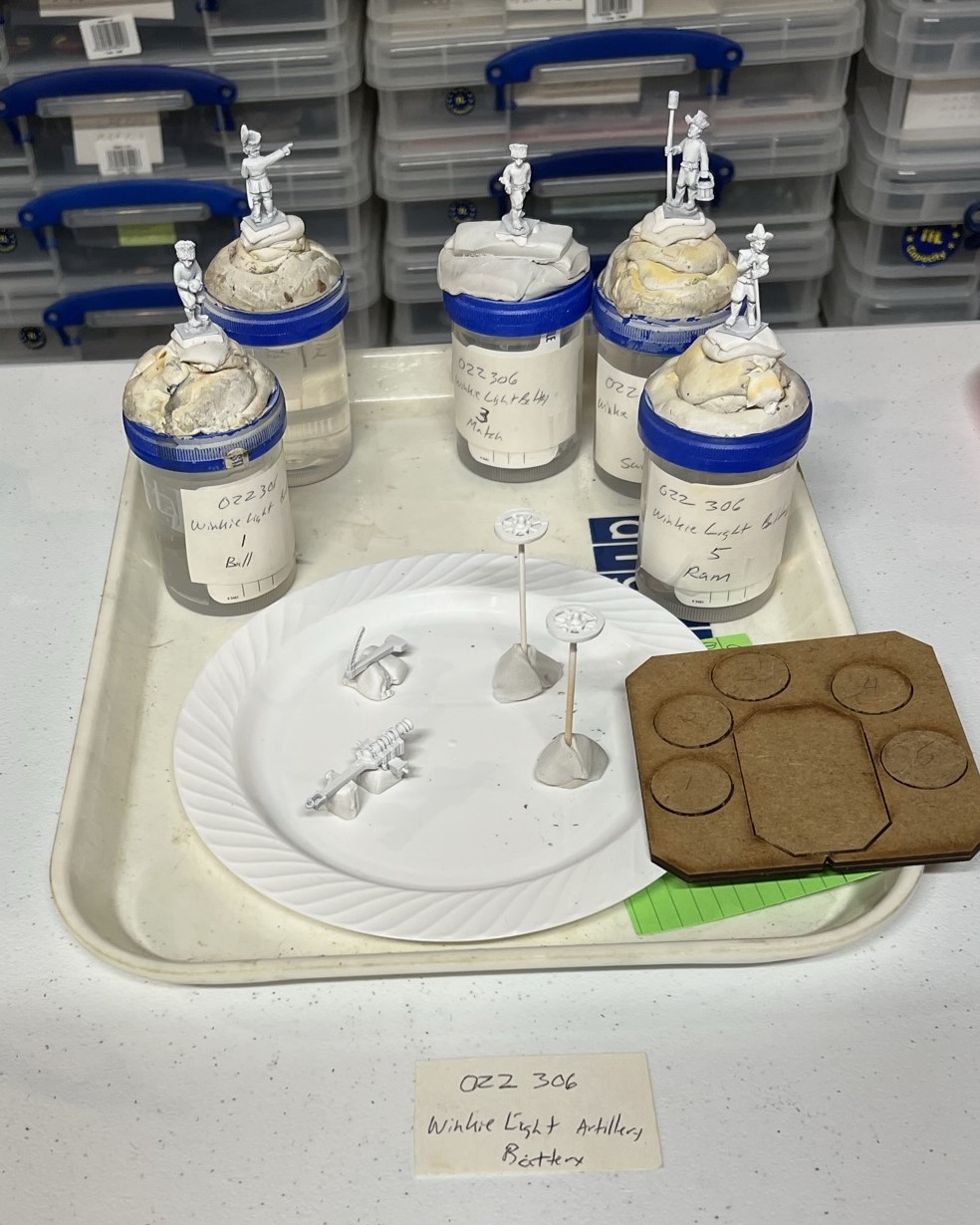
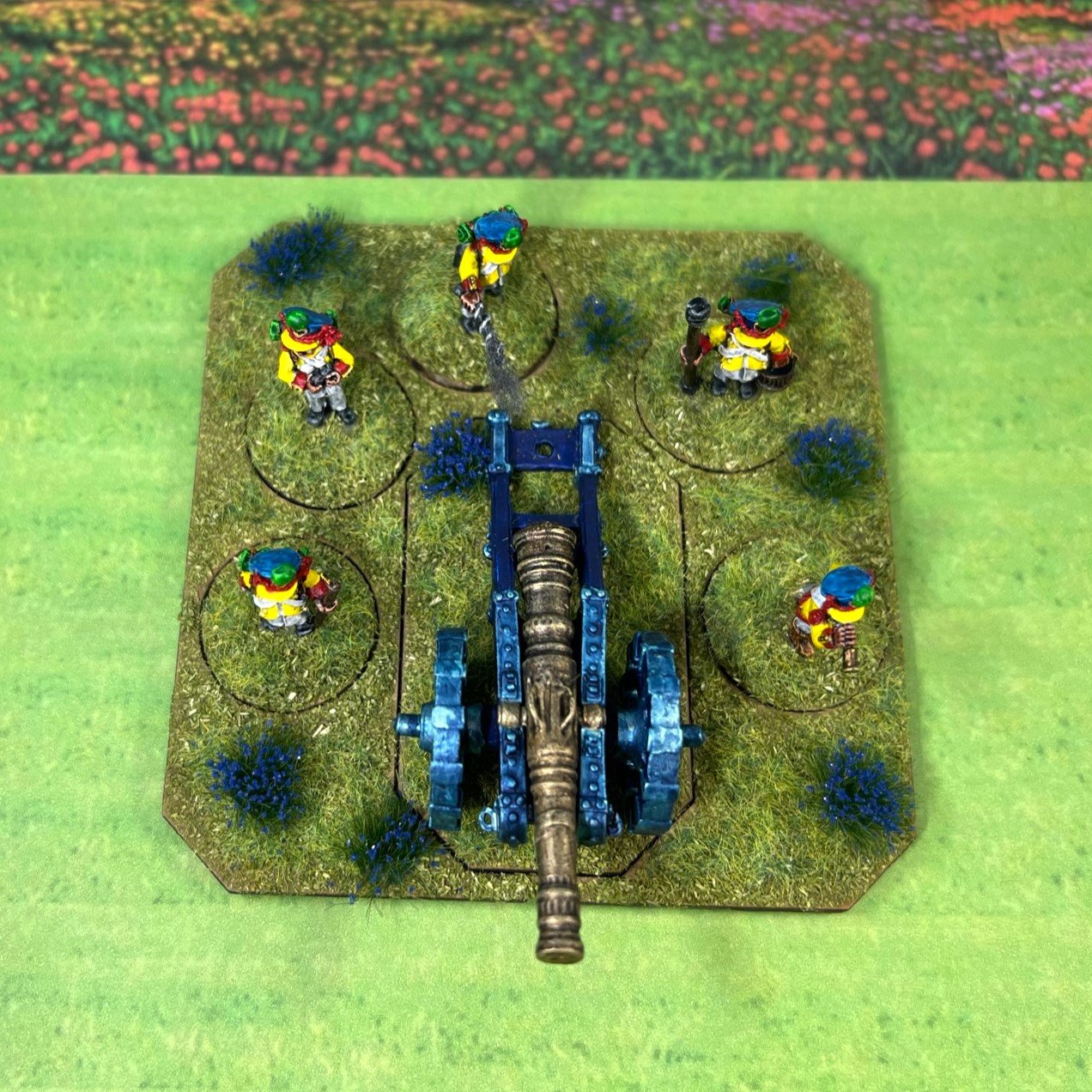
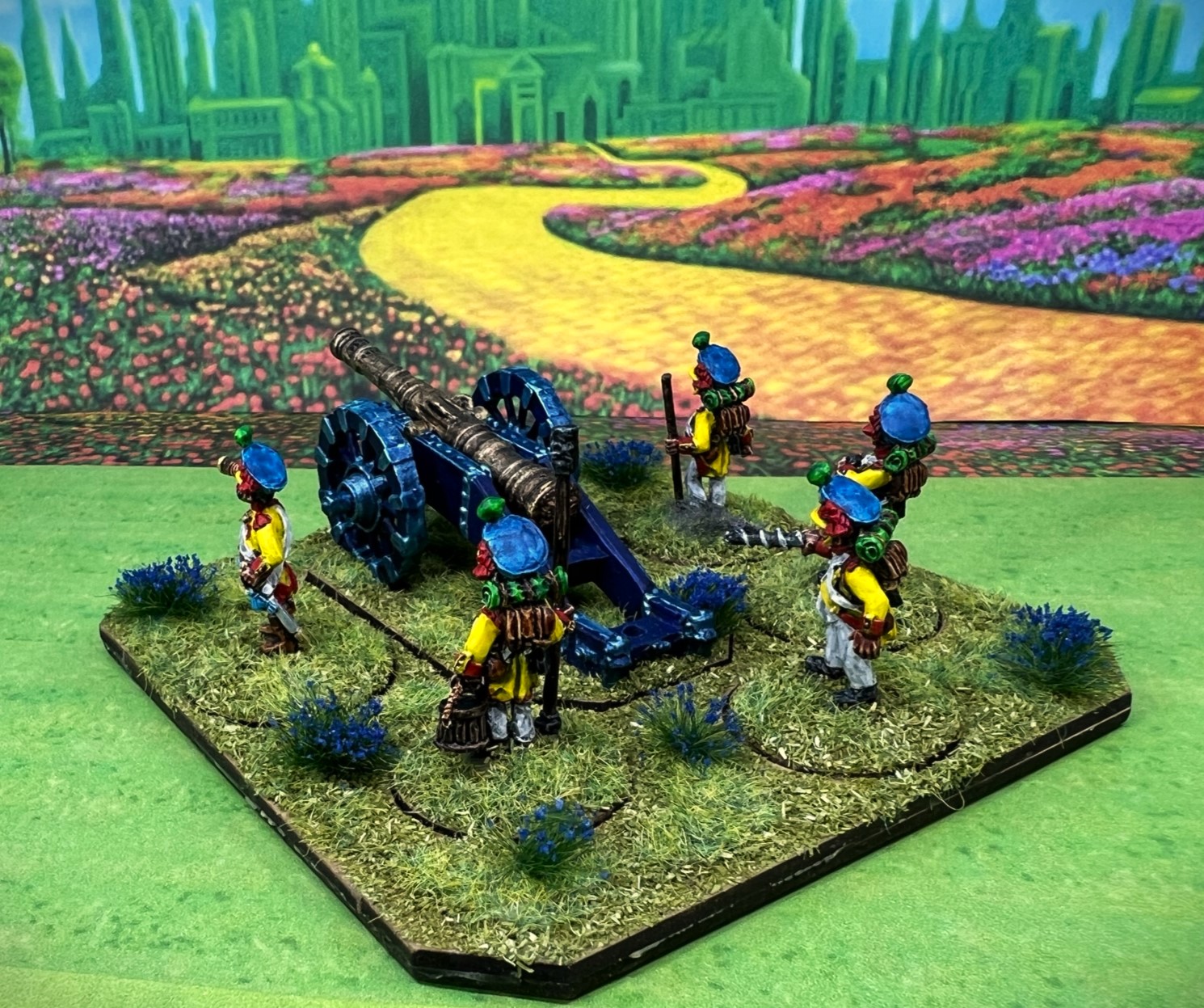
Any Munchkin Brigade needs a good dose of heavy firepower to fend off the enemies of the Emerald City at long range. For my Munchkin Brigade for Wars of Ozz games, I finished off a Munchkin Medium Artillery Battery with Crew (OZZ107). Let’s call it MMAB.

In the game, the MMAB is the stronger of the two artillery choices (the other being a light battery). For comparison, a medium battery can fire at targets up to 24″, while a light battery range is out to 18″, with musket range being at max of 14″. In the game, firing at half ranges is more effective as one would think, and short range for the MMAB is 8″, while a light battery is 6″, and muskets are 7″. So this MMAB gives the brigade a bit of standoff firepower.

The artillery batteries in Wars of Ozz are composed of 5 figures plus a gun. For close combat, they are armed with carbines (which are slightly more than half of the range of muskets – but hopefully they don’t have to get into melee – but the odds are that they will!). While an infantry or cavalry regiment has 5 bases – each of which can take 4 hits – the battery can take 5 hits (one per figure). Each hit removes a figure and loses a die for attacking. The scale is 28mm and these figures are metal.

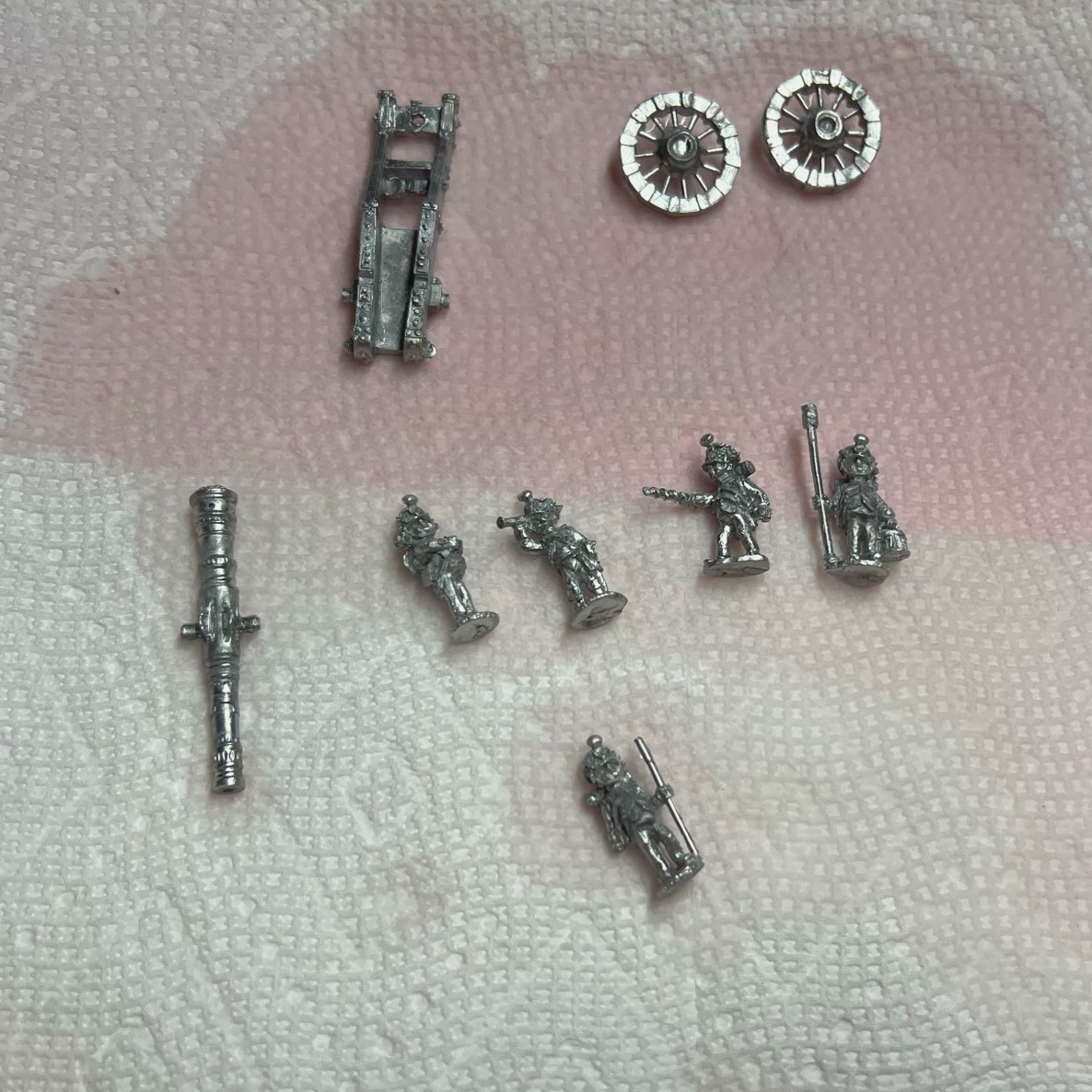
I started parallel-working on these while I worked on Colonel Tik-Tok’s Infantry Regiment back on November 25th. When I needed to let something dry, I did a little work on this unit. The gun with its carriage required assembly. With the carriage needing serial painting – so as to get the right bluish look per Ozz canon (pun intended – see how I did that!) – and the gun being pretty big, the parallel approach got it done without causing me impatience. I followed the same procedure as to painting these figures as I did with the previous units, by priming in white, then washing with a dark shade, then painting, highlighting, and shading.

A major consideration for me was how to paint up the cannon and carriage. First, there were undersides to the gun and carriage to consider for painting and assembly. Second, there were the choices of colors. I experimented with several blues and bluish craft metallics for the gun. Initially, I went with a classic grey gun metal look for the gun, but changed it to brass as I liked the look better. As Munchkins are being very fond of blue, I thought that was appropriate. As is my custom, I list all the paints I used on this unit at the end of this post for those interested in that sort of stuff (and for my own use for later reference as well). First, I’ll share some WIP shots, then some eye candy of the MMAB.

WIP shots…

As discussed, I started on November 25th. This was mainly preparatory work on filing, washing before priming. My main effort was the CTTIR during this time.

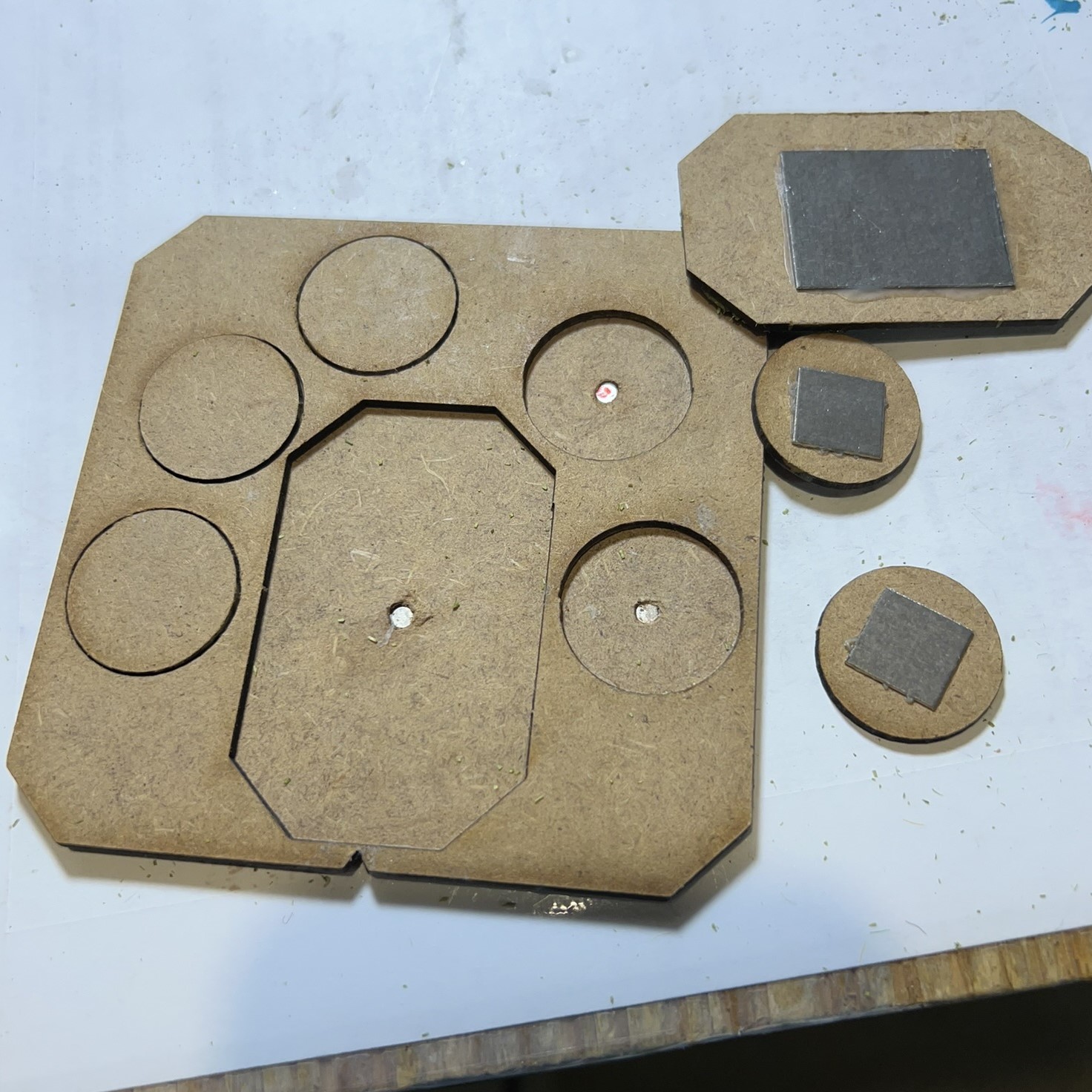
There is an MDF base available for artillery batteries with slots for the gun and figure – that even allows for removing casualties and for denoting if the gun is limbered or unlimbered. That needed assembly, so another thing to do while other things were drying. I also was thinking about transport and storage – so I added steel bases under the MDF ones for the artillerists and the gun.

Then, I slowly worked on painting the cannon and carriage components and assembled them by December 1st.

The cannon painted and varnished resting on its MDF base. Above, you can see how I traced so that I would be able to score the base under the tracings. This would get a better hold for gluing.

The figures came next, but unfortunately do not have any WIP shots of them. I followed Ozz canon (yes, I did that again) for the colors.

On December 4th, this brought me back to completing the magnetizing the unit for gaming, storage, and transport. My artillerist figures were mounted on 3/4″ steel washers. These would be glued to the MDF bases, which had 1/2″ steel squares glued to the their undersides as seen above. I drilled out 1/8″ holes in the center of each of the base’s recesses. Then, I glued another 1/2″ square steel base below the holes with 1/8″ neodymium magnets in each hole. In the end, the figures were removable from the base (but won’t fall out), and the base will store safely in my magnetic sheet-lined Really Useful Box with my other units. You can see this below in the photo.

By December 7th, I had the unit painted and was ready for final assembly and flocking.

December 7th progress

And…by December 9th I was done!

MMAB DONE!

How about some…

Eye Candy…

The unit can be shown as limbered (as above) or unlimbered as you can see below. A casualty is taken out on the right.

My favorite shot:

So now I am up to three units plus two Wizards. The Munchkin Light Cavalry is next. As you may want to check out the figures range – there are two places to get them (and I make no money from this btw). The game rules and figures are available from the following two places:

In the US Old Glory has a site – Wars of Ozz Miniatures.

In the UK go to Sally 4th.

Thanks for checking this post out and please let me know what you think in the comments section. Yes, I still have more to come…

Miscellaneous details and references for those interested in that sort of thing:

For all of my previous posts on Wars of Ozz games, figures, units, and other related projects – please see this page.

PAINTS, INKS, GLAZES, SHADES, WASHES, PIGMENTS, FLOCKING, GLUES AND MORE THAT I USED ON THIS MUNCHKIN MEDIUM ARTILLERY BATTERY:

  1. Vallejo Premium Primer “White”
  2. Vallejo “Flow Improver”
  3. Vallejo “Airbrush Thinner”
  4. Gorilla Glue
  5. 1/2″ x 1/2″ square steel bases from Wargames Accessories (#16)
  6. MDF Artillery base from Wars of Ozz Miniatures
  7. 1/8″ neodymium magnets
  8. 3/4″ steel washers
  9. Poster tack
  10. Citadel “Nuln Oil” (wash)
  11. Vallejo Model Color “White”
  12. 1 1/4″ x 1″ square steel bases from Wargames Accessories (#FOW1)
  13. Elmer’s PVA Glue
  14. Vallejo Model Air “Gun Metal”
  15. Armory “Dark Blue”
  16. DecoArt “Peacock Pearl”
  17. Tamiya XF-6 “Copper”
  18. Vallejo Model Color “Dark Prussian Blue”
  19. Martha Stewart Crafts “Pale Bronze”
  20. Army Painter “Speed Paint – Dark Wood”
  21. Citadel “Contrast Paint – Contrast Medium”
  22. Army Painter “Blue Tone”
  23. Secret Weapon Washes “Golden Brown” (wash)
  24. Army Painter “Speed Paint – Crusader Skin”
  25. Citadel “Nuln Oil GLOSS” (wash/shade)
  26. Citadel “Cryptek Armourshade” (wash/shade)
  27. Army Painter “Speed Paint – Hardened Leather”
  28. Army Painter “Speed Paint – Grim Black”
  29. Citadel “Contrast Paint – Frostheart”
  30. Vallejo Mecha Varnish “Matte Varnish”
  31. Citadel “Contrast Paint – Baal Red”
  32. Vallejo Model Air “Bright Brass”
  33. Citadel “Contrast Paint – Bad Moon Yellow”
  34. Citadel “Contrast Paint – Karandras Green”
  35. Vallejo Model Air “Armour Brown”
  36. Vallejo Model Air “Steel”
  37. Army Painter “Speed Paint – Holy White”
  38. PS Model Color “British Brown Drab”
  39. Army Painter “Battlefields Grass Green” (flocking)
  40. Army Painter “Battlefield Field Grass” (flocking)
  41. Army Painter “Battlefields Field Grass” (flocking)
  42. Shadow’s Edge Miniatures “6mm Dark Forest Dark Blue Tufts” (flocking)

Colonel Tik-Tok’s Infantry Regiment, Zoraster, and a Munchkin Mayor (Wars of Ozz)

I am continuing to build my Munchkin Brigade for Wars of Ozz games. In my last post, I shared OZZ-101 – Zoraster’s Guard Infantry Regiment (ZGIR).  This time I have built and painted up a different Munchkin infantry unit – Colonel Tik-Tok’s Infantry Regiment (hereafter referred to here as CTTIR). I also painted up Zoraster (a Wizard) and a Munchkin Mayor as a lesser Wizard.

In the game, the CTTIR is slightly less capable than the ZGIR, but still better than a militia or Landwehr unit. Like the ZGIR, the regiment is composed of 20 figures plus a mounted regimental commander. It is similarly armed with muskets while sporting cool carabiner helmets. In the canon of the Wars of Ozz, Zoraster is “the Wizard Supreme”, and is the creator the Munchkin Army. The Munchkin Mayor figure came with the Kickstarter and confused me for a bit as you’ll see in the discussion below. The scale is 28mm and these 23 figures are metal.

There are 4 figures per 2″ square base, so five bases plus a commander make up a regiment. 16 of the based figures are of the same type, while the fifth base has four different figures – two standard bearers (with the Ozz flag and the regimental colors), a drummer, and another leader figure. This “command” stand fights like the others, but has an aesthetic effect on the tabletop of being nice to see. The regimental commander has his own base and can have special attributes, but its stand never engages in combat. It exists mainly for the attributes tab (on its MDF base) and also aesthetics. If the regiment dies, so does he. There is magic in the game – and Zoraster is a designated Wizard. There are also “unnamed Wizards”, so I will likely use the Munchkin Mayor as one – or maybe just an objective marker.

I pretty much followed the same procedure as to painting these figures as I did with the ZGIR. I prime in white, then wash with a dark shade, then paint and highlight. If I need more shade or highlight, I add it.

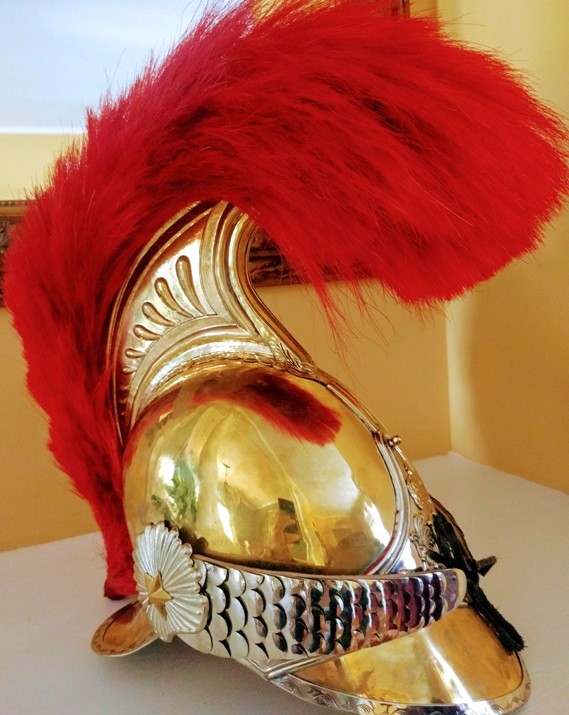
A major difference here for me was how to paint up the helmets and officer hats. While Wars of Ozz canon has this regiment in white, it also has all Munchkins as being very fond of blue. But after looking at images of Napoleonic era carabiner helmets (below) I decided that I wanted a similar metallic brass and chrome look.

I also decided to give the officers white hats. I did give the drummer a bit of blue on the drum and of course the standards have a lot of blue, so I think I’m safe. For the regimental commander’s pony I went with a slightly sallow pastel yellow. One cool aspect of the universe of the Wars of Ozz game is the use of a lot of color (hence the pastel ponies and more). The rules say that for CTTIR the facings, plumes and epaulettes are red – and that the coats and vests are white. Here I used a lot of Army Painter “Holy White” Speed Paint mixed with Citadel “Contrast Medium”. In fact, I still mix all of my Speed Paints with that medium. The combination of using the Citadel “Nuln Oil” wash post-priming and then the Holy White helped a lot with the less-detailed recesses on the figures. As usual, I list all the paints I used on these at the end of this post for those interested in that sort of information.

As I did previously, I’ll share some WIP shots, then some eye candy of the regiment.

WIP shots…

I started on November 25th. Below, you see the figures are based for priming, primed, and then I added a Citadel “Nuln Oil” wash before moving on to painting them. I have not tried “slap chop”, but I do like this way of using contrast/speed paints as part of my technique.

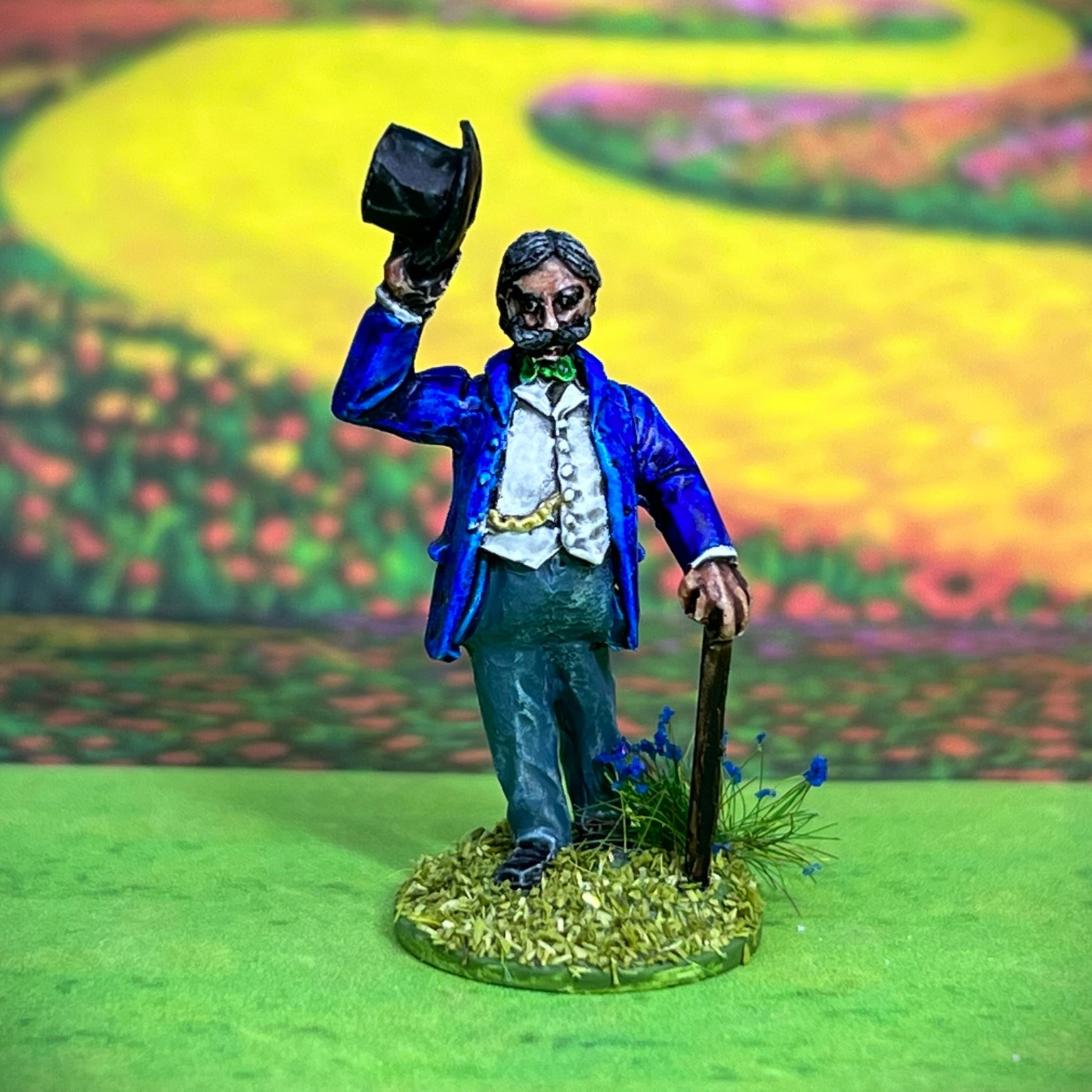
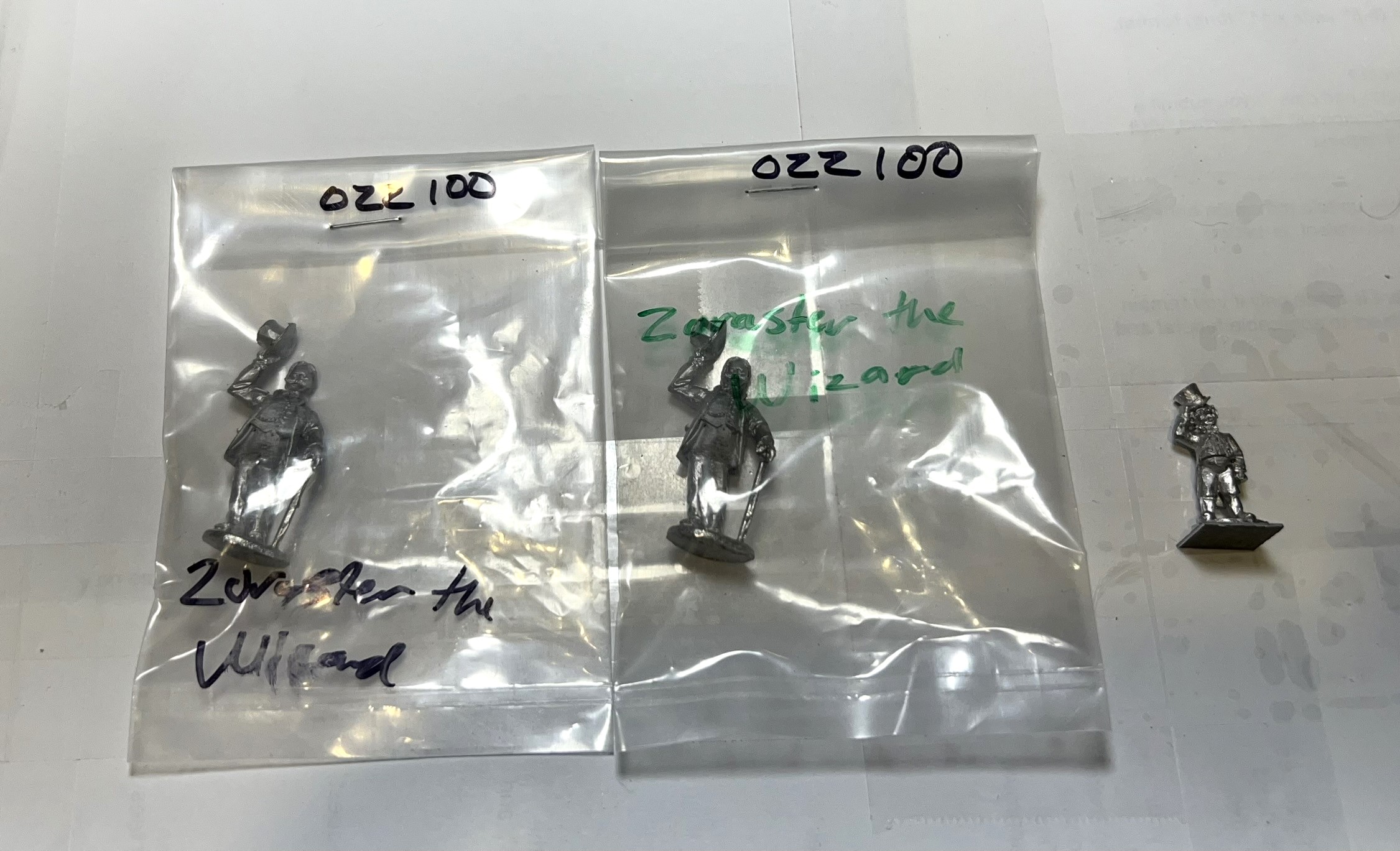
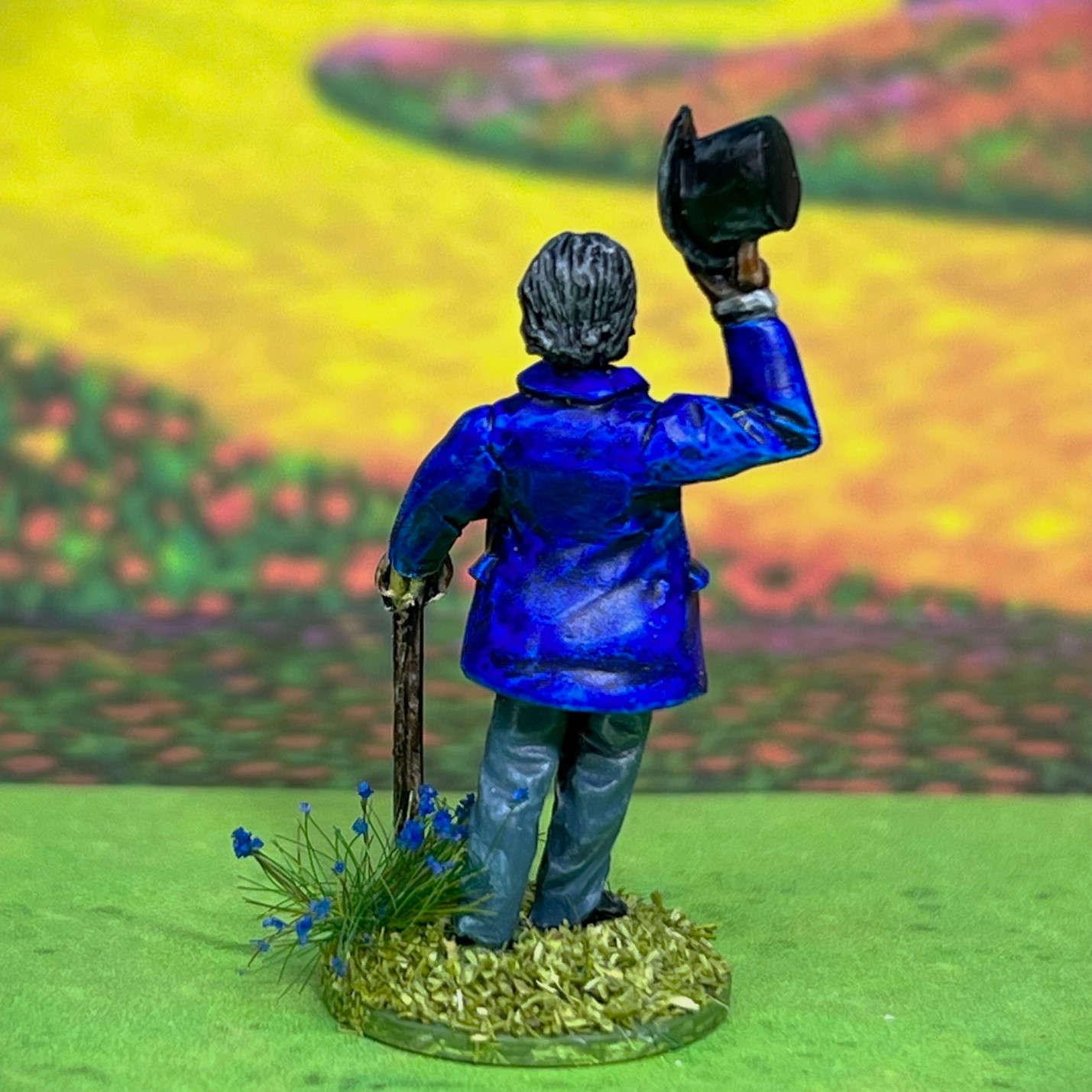
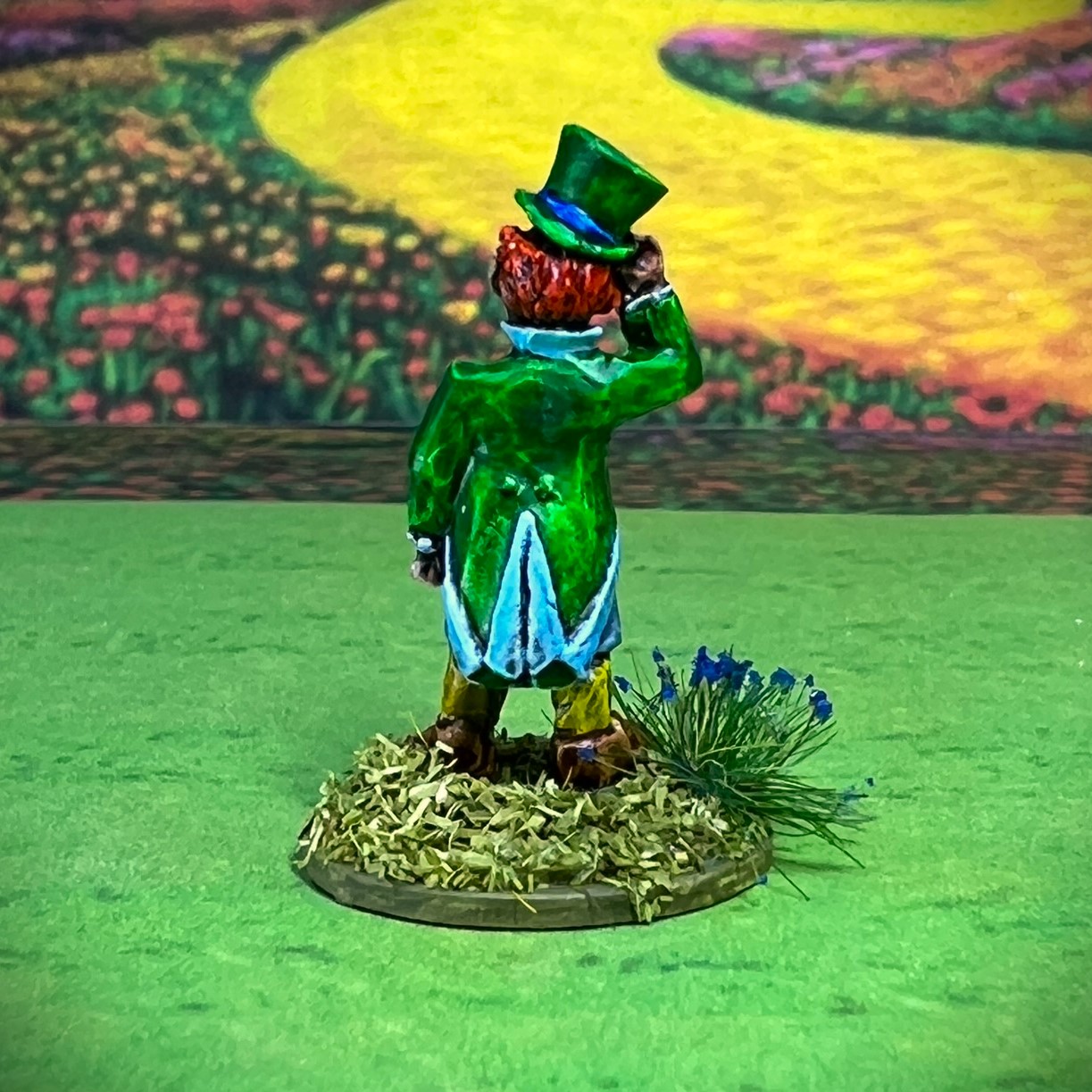
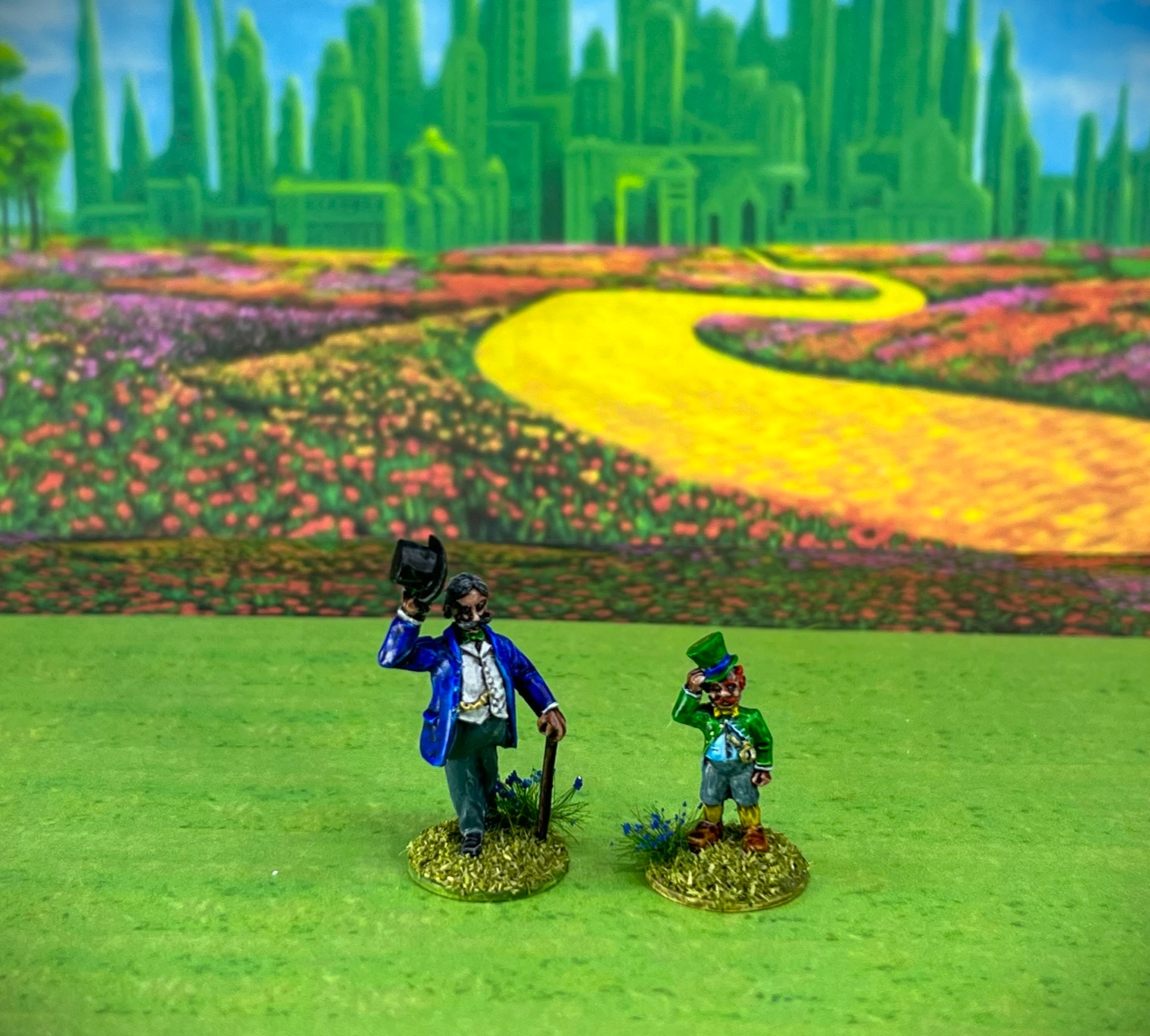
I was confused (as my Kickstarter order was a while back) as to which figure was Zoraster. Eventually, I determined that the smaller one was a Munchkin mayor thrown into the Kickstarter and that I had mistakenly ordered 2 Zoraster figures! I’ll keep one unpainted for trade. The Munchkin figure looks like the Boston Celtics mascot.

Two Zoraster figures and the Munchkin mayor doffing hats…

During the next three days, I made decent progress. I ended up numbering the specimen bottle labels with mistakes and keeping a list so I could fix them – this helped a lot.

The figures were all painted less any varnish and flocking by December 2nd.

Then it was on to the varnishing the figures, adding the standards/colors, and thereafter flocking the bases. I noticed that when I cut out the standards from card stock that the edges stood out as white. So, to remedy this, I used a black Sharpie pen to color in the edges as the standards have a black edge as well.

As for flocking, this time I pre-flocked all of the regimental bases with one type of grass, then added the other two types after affixing two, then three, then the fourth figure to each base. It’s probably overkill but I do like how they have come out. For the two Wizards, I just went with the first two grasses and added Shadow’s Edge Miniatures blue forest tufts.

My three sequential grasses, clockwise from the left. The first two may be different iterations of a similar type, but they are different enough to give some texture and more depth to the bases.

By December 4th, the CTTIR was done, plus the wizards as well. Now onto some eye candy…

Eye Candy

Colonel Tik-Tok’s Infantry Regimental Commander

A look at 2 stands…

A look at the command stand…

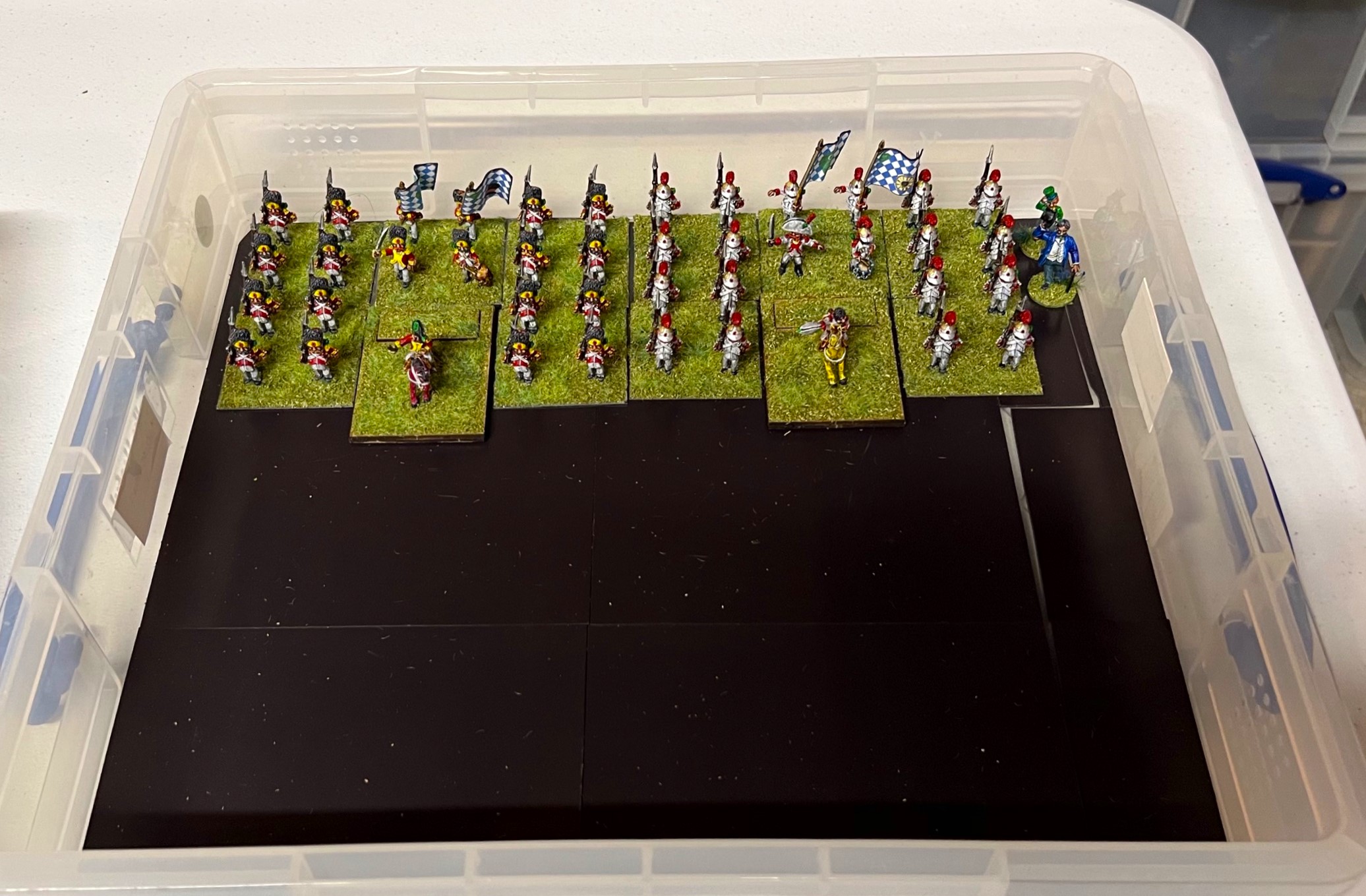
A look at the whole regiment…

A look at Zoraster…

A look at the Munchkin Mayor (Lesser Wizard)…

Howdy folks!

I hope that this was interesting for you. I am hoping to take 7-10 days per regiment or battery until I get through the Kickstarter. This should take me into next year, but hopefully I can keep a good pace. I have plenty of space in the box for this in-progress brigade…

Munchkin Brigade to date…

As you may want to check out the figures range – there are two places to get them (and I make no money from this btw). The game rules and figures are available from the following two places:

In the US Old Glory has a site – Wars of Ozz Miniatures.

In the UK go to Sally 4th.
Thanks for checking this post out and please let me know what you think in the comments section. More to come…

Miscellaneous details and references for those interested in that sort of thing:

For all of my previous posts on Wars of Ozz games, figures, units, and other related projects – please see this page.

PAINTS, INKS, GLAZES, SHADES, WASHES, PIGMENTS, FLOCKING, GLUES AND MORE THAT I USED ON THIS MUNCHKIN REGIMENT, ZORASTER, & THE MUNCHKIN MAYOR:

  1. Gorilla Glue
  2. Paper clip wire pieces
  3. 1/2″ x 1/2″ square steel bases from Wargames Accessories (#16)
  4. 3/4″ steel washers (wizards)
  5. Poster tack
  6. Vallejo Premium Primer “White”
  7. Vallejo “Flow Improver”
  8. Vallejo “Airbrush Thinner”
  9. Citadel “Nuln Oil” (wash)
  10. Vallejo Model Color “White”
  11. 1/2″ x 1/2″ square steel bases from Wargames Accessories (#FOW1)
  12. Vallejo Model Air “Gun Metal”
  13. Vallejo Model Air “Bright Brass”
  14. Vallejo Model Air “Chrome”
  15. Army Painter “Speed Paint – Dark Wood”
  16. Citadel “Contrast Paint – Contrast Medium”
  17. Army Painter “Speed Paint – Crusader Skin”
  18. Citadel “Contrast Paint – Baal Red”
  19. Citadel “Contrast Paint – Magmadroth Flame”
  20. Army Painter “Speed Paint – Grim Black”
  21. Citadel “Contrast Paint – Ironjawz Yellow”
  22. Citadel “Contrast Paint – Gore Grunta Fur”
  23. Army Painter “Speed Paint – Hardened Leather”
  24. Citadel “Contrast Paint – Karandras Green”
  25. Vallejo Model Air “Steel”
  26. Vallejo Model Air “Armour Brown”
  27. Citadel “Contrast Paint – Aggaros Dunes”
  28. Army Painter “Speed Paint – Pallid Bone”
  29. Army Painter “Red Tone”
  30. Citadel “Nuln Oil GLOSS” (wash/shade)
  31. Citadel “Cryptek Armourshade” (wash/shade)
  32. Citadel “Contrast Paint – Doomfire Magenta”
  33. Citadel “Contrast Paint – Nighthaunt Gloom”
  34. Citadel “Contrast Paint – Asurman Blue”
  35. Americana “Bahama Blue”
  36. Citadel “Contrast Paint – Pylar Glacier”
  37. Vallejo Model Color “Black”
  38. Citadel “Contrast Paint – Snakebite Leather”
  39. Citadel “Warpfiend Grey”
  40. Citadel “Longbeard Grey”
  41. Battlefront “Skin Shade”
  42. Battlefront “European Skin”
  43. P3 “Flesh Wash”
  44. Army Painter “Speed Paint – Holy White”
  45. Martha Stewart Crafts “Pale Bronze”
  46. Vallejo Mecha Color “Olive Green”
  47. Vallejo Mecha Varnish “Matte Varnish”
  48. PS Model Color “British Brown Drab”
  49. Black Sharpie pen
  50. Elmer’s PVA Glue
  51. Regimental MDF base from Old Glory
  52. Army Painter “Battlefields Grass Green” (flocking)
  53. Army Painter “Battlefield Field Grass” (flocking)
  54. Army Painter “Battlefields Field Grass” (flocking)
  55. Army Painter “Brown Battleground” (flocking)
  56. Shadow’s Edge Miniatures “6mm Dark Forest Dark Blue Tufts” (flocking)

Zoraster’s Guard Infantry Regiment (Munchkins for Wars of Ozz)

Yes, you read that correctly. Munchkins.

They are one of many factions in the Wars of Ozz game. The rules were written by my good friend Buck Surdu (who also wrote the rulesets of Combat Patrol™ and Feudal PatrolTM . I have been wanting to get going on my Wars of Ozz figures – but first wanted to finish the figures and terrain for my Civilizations Collide games involving the Aztec/Conquistadores/Tlaxcalans/Maya. As I shared in my last post, that has now happened, so onwards to Ozz!

The game rules and figures are available from the following two places:

In the US Old Glory has a site – Wars of Ozz Miniatures.

In the UK go to Sally 4th.
Of course, there are now many new factions for Wars of Ozz. Currently, I have Munchkins and Winkies (think orc-like dudes) and some pretty cool allies – which I’ll eventually post about here. However, first I am going to finish a Munchkin brigade. It will consist of two infantry regiments, a light cavalry squadron (on pastel ponies), and an artillery battery. One cool aspect of the universe of the Wars of Ozz game is the use of a lot of color (hence the pastel ponies and more). I find, like I did in my Mesoamerican projects, that having a lot of color can be a lot of fun.

Here, the units in Ozz are made up of mass armies – this is not skirmish gaming. There are wizards and witches, so some magic, but the game is primarily black powder type warfare. The gaming engine of Ozz has also been used as the basis for WOOD (Wars of Orcs and Dwarves) for mass fantasy battles. But let’s get back to my first regiment…

It is OZZ-101 – Zoraster’s Guard Infantry Regiment (hereafter referred to by me as ZGIR). The scale is 28mm and these are metal.

Zoraster is “the Wizard Supreme”, and created the Munchkin Army. As for ZGIR, it’s a tough unit, as one would expect of a guard unit, with excellent marksmanship and melee values. It is armed with muskets. It also has great resolve and elan values which help it in combat. It’s also the most expensive Munchkin unit. Of course, I had to start with this one…

It, like all infantry regiments in Ozz, is composed of 20 figures plus a regimental commander. There are 4 figures per 2″ square base, so five bases plus a commander make up a regiment. 16 of the based figures are of the same type, while the fifth base has four different figures – two standard bearers (with the Ozz flag and the regimental colors), a drummer, and another leader figure. This “command” stand fights like the others, but has an aesthetic effect on the tabletop of being nice to see. The regimental commander has his own base and can have special attributes, but its stand never engages in combat. It exists mainly for the attributes tab (on its MDF base) and also aesthetics. If the regiment dies, so does he.

I’ll share some WIP shots, then some eye candy of the regiment.

WIP shots…

I first cleaned up the regiment (filing, washing) then worked on drilling out a couple of holes on the two figures for the regimental commander to be able to be mounted onto his pony. I inserted a paper clip wire into the pony to match the hole under the commander. This also allowed me to mount the upper torso of the commander for painting on a screw on a specimen container.

Then, I needed to find a way to mount the other figures. The figures’ bases are less than 3/8″, and as mentioned will eventually be mounted on 2″ square bases. For the individual figures, I decided to use 1/2″ x 1/2″ square steel bases – both the 2″ and 1/2″ square bases are from Wargames Accessories.

I decided to use Citadel Contrast and Army Painter speed paints as much as possible. As these are mass units, I thought this would be fine. I want to get them into games!

The figures themselves are nice, but not differentiated much. The faces are all mustachioed, and all have a “puppy dog” look with an open mouth and tongue sticking out. Still, they have a certain character.

As it’s Mo’vember, I chose to vary the mustache colors. After priming, I gave them all a wash with Citadel “Nuln Oil” and then dry brushed them in white before adding any colors. As is my habit, I do list all the paints I used on these at the end of this post for those interested.

I started working on these on 11/14 – by 11/22 I had made good progress. I found highlighting with Citadel “Doomfire Magenta” over its “Baal Red” was effective. The regiment has a somewhat British redcoat look to it.

The commander and his mount

Then I assembled the Regimental commander’s MDF base.

Gluing together the regimental commander’s base.
Ready for their air brush varnish application.

While the base set, I matte varnished the figures in preparation for mounting on the 2″ square steel bases.

The ZGIR post-varnish needed its standards attached and also basing completion – to include flocking. The flags are available on the Wars of Ozz Facebook page as downloads. I cut out the flags after printing them out on cardstock. I glued them together on with PVA and bent them to get a wind-blown look. As for mounting the figures, I drew a pair of lines with a sharpie on the steel bases corner-to-corner. Then I took a blank 1/2″ x 1/2″ square steel base and aligned it in the center of the 2″ base, using the lines to align the 4 corners of the 1/2″ base. Then I traced over the little base in pencil, such that I could going forward use the corner of the little traced square and the sharpie lines to orient the bases. I believed that flocking with the figures all affixed to the 2″ square bases would be too difficult. Therefore, I glued on two figures, flocked, then the third, then flocked, then the fourth. All this time I flocked the spaces where the figures would not be. This way I was able to apply the flocking effectively to give some depth of grass. In this case – I used three different flocking products from Army Painter sequentially with PVA to give this depth to the otherwise bland steel bases.
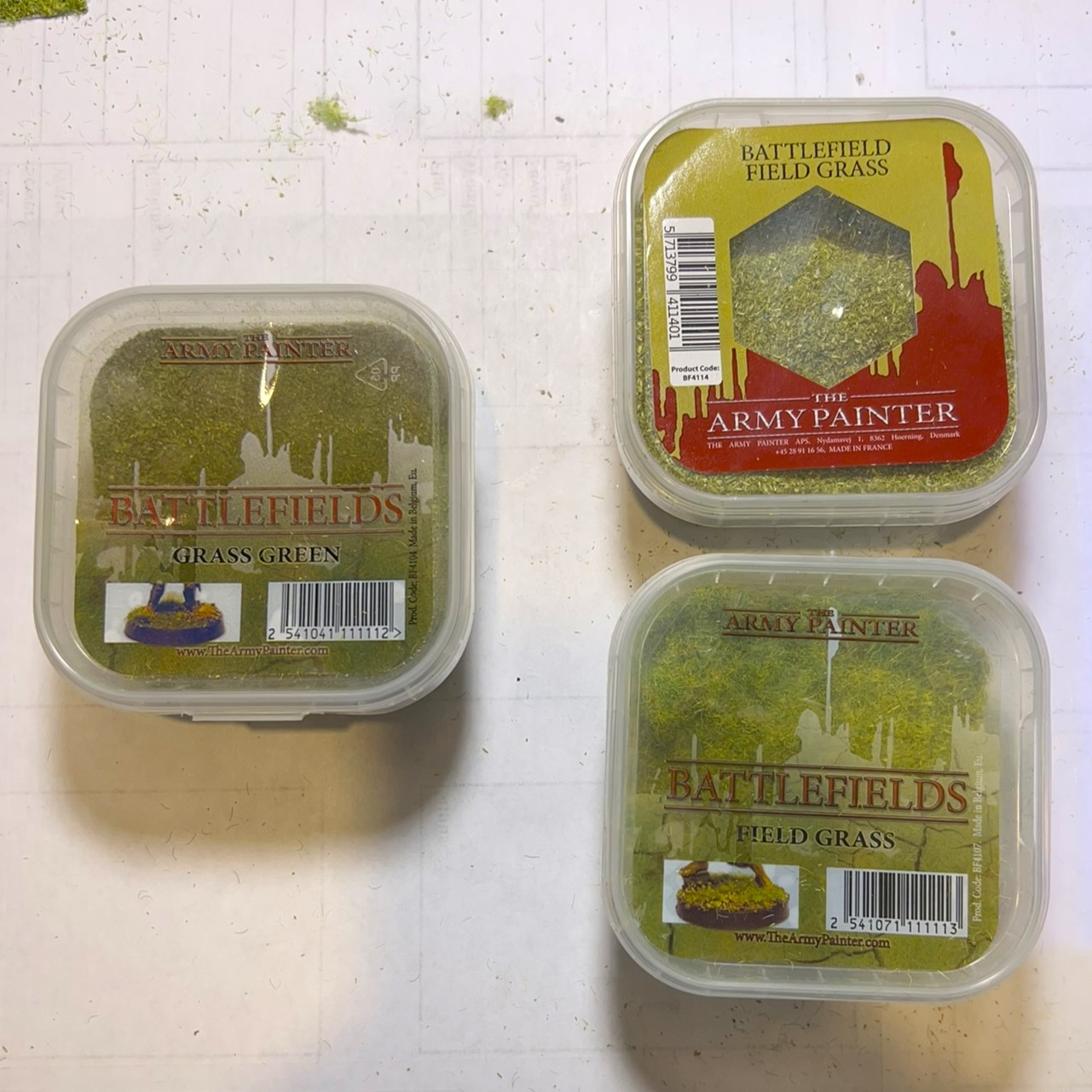
These sound similar, but they are not. Clockwise from the left, I sequentially used Battlefields Grass Green, followed by Battlefield Field Grass, followed by Battlefields Field Grass. Confusing, but it worked as you see below.
Close up of flocking.

Now on to some eye candy with a new background!

Eye Candy

Zoraster’s Guard Infantry Regimental Commander

A look at 2 stands…

A look at the command stand…

A look at the whole regiment…

Zoraster’s Guard Infantry Regiment in modified line. The regimental commander here is in the back of the command stand.
Side view with the regimental commander up front.
Here, the commander is put in back as the regiment is about to enter melee…
A different orientation – still in line with 4 stands abreast and the other stand just behind. All 5 stands could be in line – but not if I want a group photo!

I managed to finish the regiment on 11/22 – so 8 days. This post had to wait for Thanksgiving (and for me to overcome a bad cold). I enjoyed painting these and am moving on to the rest of my Munchkin brigade.

Thanks for looking, and always please let me know what you think of this new project in the comments section.

Miscellaneous details and references for those interested in that sort of thing:

For all of my previous posts on Wars of Ozz games, figures, units, and other related projects – please see this page.

PAINTS, INKS, GLAZES, SHADES, WASHES, PIGMENTS, FLOCKING, GLUES AND MORE THAT I USED ON THIS MUNCHKIN REGIMENT:

  1. Gorilla Glue
  2. Paper clip wire pieces
  3. 1/2″ x 1/2″ square steel bases from Wargames Accessories (#16)
  4. Poster tack
  5. Vallejo Premium Primer “White”
  6. Vallejo “Flow Improver”
  7. Vallejo “Airbrush Thinner”
  8. Citadel “Nuln Oil” (wash)
  9. Vallejo Model Color “White”
  10. Citadel “Contrast Paint – Bad Moon Yellow”
  11. Citadel “Contrast Paint – Contrast Medium”
  12. Citadel “Contrast Paint – Volupus Pink”
  13. Army Painter “Speed Paint – Crusader Skin”
  14. Army Painter “Speed Paint – Grim Black”
  15. Citadel “Contrast Paint – Ironjawz Yellow”
  16. Citadel “Contrast Paint – Magmadroth Flame”
  17. Citadel “Contrast Paint – Gore Grunta Fur”
  18. Citadel “Contrast Paint – Baal Red”
  19. Army Painter “Speed Paint – Holy White”
  20. Citadel “Contrast Paint – Karandras Green”
  21. Citadel “Contrast Paint – Aggaros Dunes”
  22. Army Painter “Speed Paint – Hardened Leather”
  23. Army Painter “Speed Paint – Dark Wood”
  24. Vallejo Model Air “Armour Brown”
  25. Vallejo Model Air “Steel”
  26. Vallejo Model Air “Gun Metal”
  27. Martha Stewart Crafts “Pale Bronze”
  28. Citadel “Contrast Paint – Snakebite Leather”
  29. Army Painter “Speed Paint – Pallid Bone”
  30. Citadel “Nuln Oil GLOSS” (wash/shade)
  31. Citadel “Warpfiend Grey”
  32. Vallejo Mecha Color “Olive Green”
  33. Citadel “Contrast Paint – Doomfire Magenta”
  34. Vallejo Mecha Varnish “Matte Varnish”
  35. Elmer’s PVA Glue
  36. Regimental MDF base from Old Glory
  37. Army Painter “Battlefields Grass Green” (flocking)
  38. Army Painter “Battlefield Field Grass” (flocking)
  39. Army Painter “Battlefields Field Grass” (flocking)
  40. Army Painter “Brown Battleground” (flocking)

Excuse me, Maya Finish This Massive Endeavor?

Pardon the pun, but this post marks the completion (for now) of all of my figures for my Spanish Conquest/Mesoamerican games. Many of you have been following my progress in this blog on my various Aztec, Tlaxcalan, and Conquistador figure projects over the last few years. To all of you, thank you so much for joining me on this long journey!

My first post was back on April 25th, 2020. Since then I have researched the period and written the period supplement for the Feudal PatrolTM  rules by Buck Surdu. That supplement is called Civilizations Collide. It is free to download at that link. I have built multiple scenarios for gaming the period and eventually hope to have that available as a supplement as well. Until then, I have been running these games at multiple conventions, gaming events, and club meetings.

Just this year, I have run 18 Feudal PatrolTM games for this period at various of these opportunities. Most of these have been documented in this blog. I have posted on this blog no less than 58 different times on my Civilizations Collide projects and the games I have run (this post will be #59). All of those posts are catalogued here.

Project Background

The last piece of the puzzle that I wanted to fill in figure-wise was the Maya. To that end, last December I sourced 34 figures from Gringo 40’s in the UK to assemble a good-sized force for gaming. After the spring conventions, I honestly thought I would be onto getting these done quickly. As the title of this blogs is “Life, Golf, Miniatures, & Other Distractions”, well, that did not happen.

As it turned out, the weather this year was superb for golf – and I really got in a lot of rounds – close to 80+ rounds of golf since April. I still wanted to get the Maya done. So, in the summer, I decided to start. My goal was to try to get them done quickly and move on to other projects such as Buck’s Wars of Ozz rules and figures. To that end, I thought I’d use Citadel Contrast Paints and Army Painter Speed Paints that I had just received in conjunction with mass airbrushing to knock out the 34.

Not so fast as it turned out…

A couple of our blog buddies Azazel at Azazel’s Bitz Box and maenoferren22 at Bogenwald Random Painting and Terrain Making had discovered and shared on their respective blogs unsettling reports that Army Painter Speed paints had a reactivation problem – that is they bled out under other colors when exposed to wetness – such as another paint applied on the model. This news put a slowdown on my adoption of the Speed Paints – and for certain my Maya progress. The last thing that I wanted to deal with was a problem that would potentially ruin paint jobs.

Later Azazel did share this video with me that showed adding Citadel Contrast Medium to the Speed Paints negated the problem. I can say for sure that at least for me – this worked perfectly. Thanks Az! Also, there are a ton of YouTube videos on Speed Paint – many suggesting to treat them like you would use oils. But I digress.

So, On August 23rd, I set out to get started on the Maya. I did get held up time -wise by golf as I wrote, plus my Woodstock rehab project called to me. On top of that I had an issue with Facebook where some of my own posts on pages that I am the administrator got marked as spam! While this is no longer happening anymore now (knock on wood), it did at the time also make me less motivated to paint. Why? well this is because I do share my posts on Facebook on appropriate hobby pages as well as on my own, and if I could not share them well I was less motivated to work on them until the situation got fixed. Lastly, I started painting with the Maya novices – who are – well – anatomically correct and totally naked as you’ll see at the end of this blog. Painting naked dudes did not get me motivated at all. The rest of these were sporting loincloths, so in the end, I got through all of these figures as you will see.

A Little History

I will have a few scenarios for the Maya. Their history is long and quite convoluted. They did NOT refer to themselves as “Maya”. They additionally had no unifying identity or government. They existed before the Aztecs – and indeed struggled against multiple invaders well after the Aztecs were long gone. Th0ugh the last Mayan city (Nojpetén) fell in 1697, there were revolts against multiple central governments by Maya descendants up and through the 19th century.

Also, the correct use of the term “Maya” versus “Mayan” can cause confusion. Here is a link that helps. Basically – use Maya!

The Maya were located more in the Yucatan peninsula area, Southern Mexico, Honduras, and Belize. They did not really interact with the Aztecs – though if the Spanish had not shown up that probably would have been their next conflict. Cortes first ran into the Maya when he arrived and fought them at the Battle of Centla. The Maya settled with him and told him of the wealth of the Aztecs – and that took the Maya were off the Conquistadores’ radar – for a while. After the fall of the Aztecs, Cortes sent expeditions into Maya territory. Some of these never were heard from again.

Let’s move on to discussing the Maya figures…

They all came from Gringo 40’s in the UK. I wanted some elites, some veterans, and some green troops. I also wanted some warrior priests and leaders. The available 28mm metal figures available from Gringo 40’s is excellent. The figures are very nice sculpts as well.

Here is the breakdown of the 34 that I bought.

  1. Figure M1 – “Mayan Charging with Dual-edged Obsidian Club”. Got 4 figures to use as veterans ( designated in my system as MV01-MV04).
  2. Figure M2 – “Atlatl Thrower”. Got 4 figures to use as elites (designated in my system as ME01-MV04).
  3. Figure M3 – “Mayan Archer”. Got 3 figures to use as veterans (designated in my system as MV05-MV07).
  4. Figure M4 – “Mayan with Stone-Headed Mace”. Got 3 figures to use as novices (as they are naked – designated in my system as MN01-MN03).
  5. Figure M5 – “Mayan Warrior in Headdress Advancing”. Got 3 figures to use as elites ( designated in my system as ME05-ME07).
  6. Figure M7 – “Mayan War Chief”. Got 3 figures to use as leaders/captains (designated in my system as MWC01-MWC03).
  7. Figure M8 – “Mayan Priest in Mask”. Got 3 figures to use as warrior priests (designated in my system as MWP01-MWP03).
  8. Figure M9 – “Atlatl Thrower (a)”. Got 4 figures with longer hair than M2 to use as elites (designated in my system as ME08-MV11).
  9. Figure M11 – “Mayan with Club Advancing (b)”. Got 2 figures to use as novices (as they are naked with longer hair than M4- designated in my system as MN05-MN06).
  10. Figure M12 – “Mayan with Club Advancing (c)”. Got 3 non-naked figures similar to the novices to use as veterans (designated in my system as MV08-MV10).
  11. Figure M15 – “Mayan Carrying Spears”. Got 1 figure to use as a novice (not naked – designated in my system as MN15).
  12. Figure M16 – “Mayan Chief”. Got 1 figures to use as Tabscoob, a Mayan War Chief (designated in my system as TABSCOOB).

Most of these came with shields. A challenge with this project was that the figures did not really allow for much moving of their poses. Therefore, as you will see below, except for the M7’s (which had pose variability), I had to rely on different painting schemes, especially with regards to colors, and differently painted and shaped shields. I also flocked them slightly differently.

Still, tabletop differentiation and playability are important concerns to deal with when designing an army. To this end I replaced a few of the Gringo 40’s shields with Aztec extras that I had lying around from previous projects. I mixed up the shield shapes across the figures as you will see below.

Process of Assembling, Painting, Etc.

I assembled the M7’s – placing their arms in different positions. The atlatl’s provided for the M2 and M9 figures were too soft and bendy – as were the spears for the M5’s. I replaced all of these with wire spears cut to size. The M3’s needed their quivers to be attached, as did the spear bundle for M15. The latter two were addressed by drilling out holes with a pin vise, inserting paper clip wire, and affixing with Gorilla glue. I experimented with the flesh tones a lot (all of the paints and materials that I used are at the end of this post for those interested in that sort of information). After priming, I airbrushed a base coat, then worked on common colors across the range of figures. As the vast majority of the 34 figures were basically waiting for me to get them to the final varnishing and flocking stage, I did not have many blog posts to share with my readers – but hopefully this post will be a good explanation of why.

As for the shields, I did them separately – having googled some images that I thought would be appropriate. Unlike the Aztec’s shields, sources are far more limited. To a degree, I used artistic license here.

Then I just proceeded to paint the figures, then affix the shields, then flock and varnish them. This only took me from August to November!

The Figures

I will now showcase the figures – with some details as appropriate. I am going from the highest ranking to the lowest ranking figures, not in the order that I completed them.

Tabscoob

Tabscoob was the Maya ruler that fought Cortes at The Battle of Centla. I loved painting this figure! The name of the Mexican state of Tabasco, and hence the hot sauce are derived from his name. This is figure M16.

Maya Warrior Chiefs

There were three of these M7 figures. They will act as Warband Leaders in the games. Note the three different color schemes and arm positions.

MWC01

MWC02

MWC03

ALL MAYA WARRIOR CHIEFS

Maya Warrior Priests

I envision these as having the same role as the Aztec Warrior Priests in the games. They can help with Morale, and can fight as well. I’ve share only the back of MWP01 as the others are similar. I really like the masks. These are all figure M8.

MWP01

MWP02

MWP03

ALL MAYA WARRIOR PRIESTS

Maya Elite Warriors

For the Elite figures, I had M2, M5, and M9 figures. The M2 figures (ME01-ME04) are armed with atlatls and have slightly shorter hair. The M5’s (ME05-ME07) have headdresses and are armed with tepoztopilli (thrusting spears). The M9’s (ME08-ME11) are armed with atlatls and have longer hair. Where the backsides are similar I only share one photo.

First, the four elite M2’s armed with atlatls.

ME01

ME02

ME03

ME04

ALL M2 FIGURES WITH ATLATLS

The next group of elites are the 3 M5 figures – armed with tepoztopilli (thrusting spears). I gave them different headdresses and shield designs, and was able to slightly alter the angle of each tepoztopilli.

ME05

ME06

ME07

ALL M5 FIGURES WITH TEPOZTOPILLI

The last group of elites contains the 4 M9’s armed with atlatls. They have slightly longer hair than the similar M2’s.

ME08

ME09

ME10

ME11

ALL M9 FIGURES WITH ATLATLS

Maya Veteran Warriors

My Maya veterans came in three types – 3 M1’s with macuahuitls, 3 M3’s with bows, and 3 M12’s with cuauhololli. On the bows, I attempted to make the quivers look as they had been made out of three different kinds of animal hides: ocelot, jaguar, and capybara.

First, here are the 4 M1 figures.

MVo1

MV02

MV03

MV04

ALL M1 FIGURES WITH MACUAHUITLS

Next up are the 3 bow-armed M3 figures.

MV05

MV06

MV07

ALL M3 FIGURES WITH BOWS

The last group of veteran Maya is the 3 M12 figures armed with cuauhololli (basically clubs). These figures are very similar to the Warrior Priests, other than the masks.

MV08

MV09

MV10

ALL M12 FIGURES WITH CUAUHOLOLLI

Maya Novice Warriors

And lastly, we come to the novices. I painted 6 up for my Maya forces. 3 M4’s armed with cuauhololli, 1 M15 with throwing spears, and 2 M11 with cuauhololli and longer hair. Only the M15 has a loincloth…so let’s just show 2 group shots…

ALL NOVICE FIGURES

All Maya Figures

These 34 bring me to a grand total of…

300 Figures for the Spanish Conquest/Mesoamerican Conflicts!

A nice round number!

Now Azazel or Buck Surdu (or many of you) could paint that many in a far shorter time – but 300 is a lot to for me be sure and I’m pretty happy that I finally have them done and ready to game. That total of 300 includes:

  1. 121 Aztecs
  2. 113 Conquistadores
  3. 32 Tlaxcalans
  4. 34 Maya

I am not counting brigantines or war canoes in that total by the way. I have them all in five 11-liter Really Useful Boxes – and there is a specific numbered individual spot for each and every figure. This allows me to quickly set up and take down games where the forces might change – especially at conventions. The boxes are lines with magnetic sheets and the figure bases all have steel underneath for safe transport.

Once again, thanks to you all for sharing this ride with me. It’s not completely over as I will be running many games going forward plus finishing the scenario booklet. One thing I’ve found is that my games are not the usual fare – which is great – it’s nice to bring something totally different to the tabletop.

Now I’ll get to start painting my Wars of Ozz figures. Thanks for taking a look and as always sharing your thoughts on this post in the comments section.

Miscellaneous details and references for those interested in that sort of thing:

For all of my previous posts on games, units, and other projects for my 16th Century Spanish Conquest supplement for Feudal Patrol™ – “Civilizations Collide” – please see this page.

PAINTS, INKS, GLAZES, SHADES, WASHES, PIGMENTS, FLOCKING, GLUES AND MORE THAT I USED ON THESE MAYA FIGURES:

  1. Shafts from North Star Military Figures 100mm wire spears (leftover from building Conquistador Pikemen)
  2. Leftover shields from various Aztec projects
  3. Gorilla Glue
  4. 1/8″ x 1″ Everbilt Fender Washers
  5. Gorilla Glue Gel
  6. Poster tack
  7. Vallejo Mecha Primer “White”
  8. Vallejo “Flow Improver”
  9. Vallejo “Airbrush Thinner”
  10. Vallejo Game Color “Bronze Fleshtone”
  11. Battlefront “Skin Shade”
  12. Vallejo Model Color “Dark Flesh”
  13. Vallejo Model Color “Medium Skin Tone”
  14. Vallejo Model Color “Sunny Skin Tone”
  15. Citadel “Contrast Paint – Darkoath Flesh”
  16. Citadel “Contrast Paint – Fyreslayer Flesh”
  17. Citadel “Contrast Paint – Contrast Medium”
  18. Army Painter “Speed Paint – Grim Black”
  19. Army Painter “Speed Paint – Sand Golem”
  20. Vallejo Mecha Color “Off-white”
  21. Citadel “Ushabti Bone”
  22. Vallejo Model Color “Glossy Black”
  23. Vallejo Mecha Color “Black”
  24. Vallejo Model Color “Tan Earth”
  25. Citadel “Agrax Earth Shade” (wash)
  26. Army Painter “Speed Paint – Magic Blue”
  27. Citadel “Contrast Paint – Ironjawz Yellow”
  28. Citadel “Contrast Paint – Baal Red”
  29. Army Painter “Speed Paint – Holy White”
  30. Battlefront “Flat Earth”
  31. Citadel “Contrast Paint – Karandras Green”
  32. P3 “Sulfuric Yellow”
  33. Citadel “Contrast Paint – Imperial Fist”
  34. Army Painter “Speed Paint – Runic Grey”
  35. Citadel “Contrast Paint – Magmadroth Flame”
  36. Vallejo Model Color “English Uniform”
  37. Vallejo Model Air “Armour Brown”
  38. Battlefront “Sicily Yellow”
  39. Citadel “Contrast Paint – Frostheart”
  40. Battlefront “Worn Canvas”
  41. Secret Weapon Washes “Parchment”
  42. Vallejo Model Color “White”
  43. Vallejo Game Ink “Yellow”
  44. Citadel “Averland Sunset”
  45. Citadel “Gehenna’s Gold”
  46. Army Painter “Speed Paint – Dark Wood”
  47. Vallejo Mecha Varnish “Gloss Varnish”
  48. Citadel “Longbeard Grey”
  49. Citadel “Warpfiend Grey”
  50. Citadel “Seraphim Sepia” (wash)
  51. Army Painter “Speed Paint – Hardened Leather”
  52. Citadel “Contrast Paint – Gore Grunta Fur”
  53. Vallejo Model Color “Yellow Ochre”
  54. Vallejo Model Color “Light Brown”
  55. Vallejo Game Color “Livery Green”
  56. Armory “Dark Blue”
  57. Vallejo Game Color “Bloody Red”
  58. Citadel “Contrast Paint – Asurman Blue”
  59. Vallejo Game Ink “Blue”
  60. Citadel “Contrast Paint – Stormfiend”
  61. Vallejo Model Color “Prussian Blue”
  62. Citadel “Contrast Paint – Terradon Turquoise”
  63. Citadel “Cryptek Armourshade Gloss” (shade)
  64. Army Painter “Red Tone” (shade)
  65. Army Painter “Blue Tone” (shade)
  66. Vallejo Game Ink “Green”
  67. Army Painter “Speed Paint – Pallid Bone”
  68. Army Painter “Soft Tone” (shade)
  69. Citadel “Contrast Paint – Doomfire Magenta”
  70. Small hobby talus pieces
  71. Elmer’s PVA Glue
  72. Army Painter “Brown Battleground” (flocking)
  73. Vallejo “Dark Yellow Ochre” (pigment)
  74. Vallejo “Burnt Umber” (pigment)
  75. Citadel “Steel Legion Drab”
  76. Citadel “Tallarn Sand”
  77. Battlefront “Wool Brown”
  78. Citadel “Karak Stone”
  79. Vallejo Mecha Varnish “Matte Varnish”
  80. Army Painter “Grass Green” (flocking)
  81. Shadows Edge “Wild Tufts”
  82. Army Painter “Jungle Tufts”
  83. Army Painter “Swamp Tufts”

My Fall In! 2022 Roundup

I was fortunate to attend the HMGS Fall In®  gaming convention last weekend (November 3-6, 2022) in Lancaster, PA. The Maryland-based Harford Area Weekly Kriegspielers (H.A.W.K.’s) were kind enough to adopt me (a Massachusetts-based Mass Pikeman) and invited me to be a game master in their dedicated gaming room at Fall In!. They are a great group of folks and I am very grateful for their hospitality! Lancaster is a 6-hour drive for me – but the trip was well worth it.

There were close to 400 games – or more too many to count – at the convention. The event was amazing and very well-run for sure. I played in two games, and ran 4 of my own. As this situation begs for visual inputs, I will have A LOT of photos and a couple of video links to share.

Click on the photos for a better view.

Thanks to Chris Palmer for some of these photos below as well. I hope that you find these enjoyable.

Thursday Night, Marines versus Japanese, a Combat Patrol™ Game

After I set up my first game on Thursday night (for Friday morning), Eric Schlegel of the H.A.W.K.’s ran a pick up  Combat Patrol™ game Thursday night. It involved US Marines storming a Japanese island. I played on the Japanese side and the USMC overwhelmed the defenders and won. It was a fun quick game. Here’s a couple of photos:

Friday Morning, “Raid to Satisfy Huitzilopochtli”, a Feudal Patrol™ Game

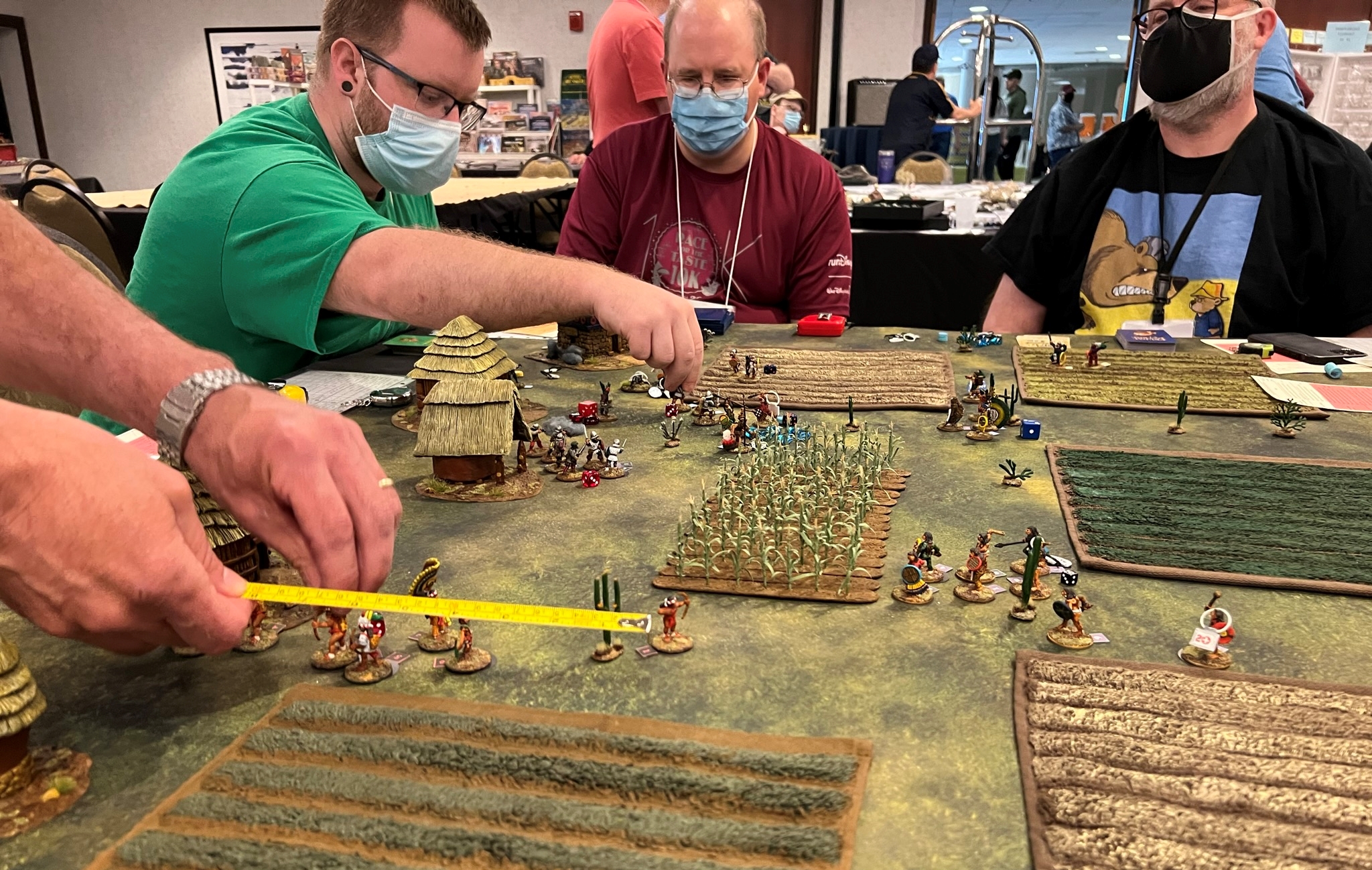
After a good night’s sleep, I arrived early to set up my Feudal Patrol™ game of “Raid to Satisfy Huitzilopochtli”. It’s a pre-Spanish Conquest fight between the Aztecs and their neighbors the Tlaxcalans. The Aztecs attempt to conduct a raid of a Tlaxcalan village to gain captives for slavery and blood sacrifice, and the Tlaxcalans fight back!

The game went very well – as you will see below. The Aztecs made a valiant assault across open terrain into a hail of Tlaxcalan arrows – and went into melee. The Tlaxcalans were ready and gave as good as they got. In the end, they Aztecs eked out a minor victory 34-27. The casualties were separated only by 3 figures out of 18 total on both sides. Both sides were totally excited about their prospects and the battle. Here’s a gallery of photos from that game:

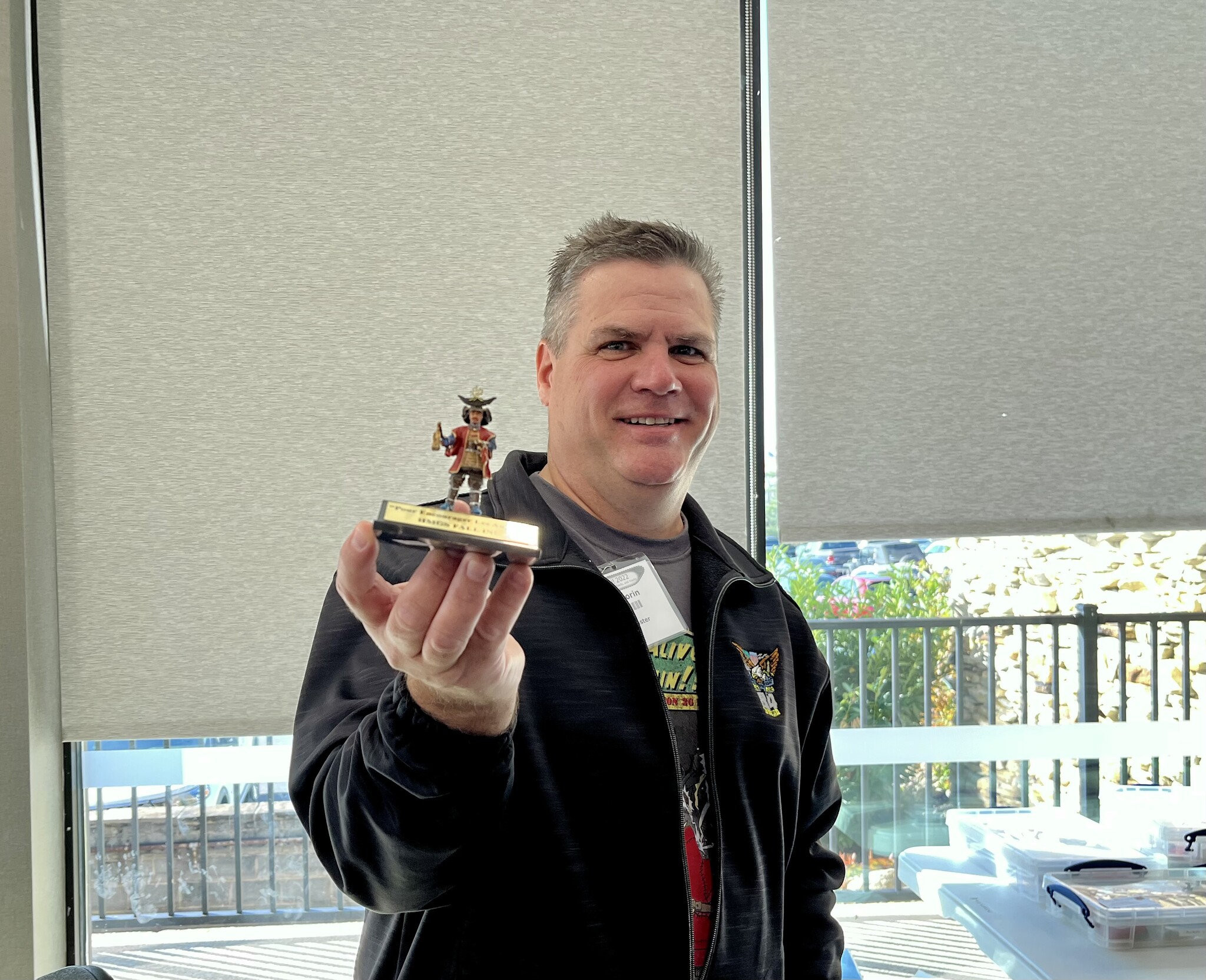
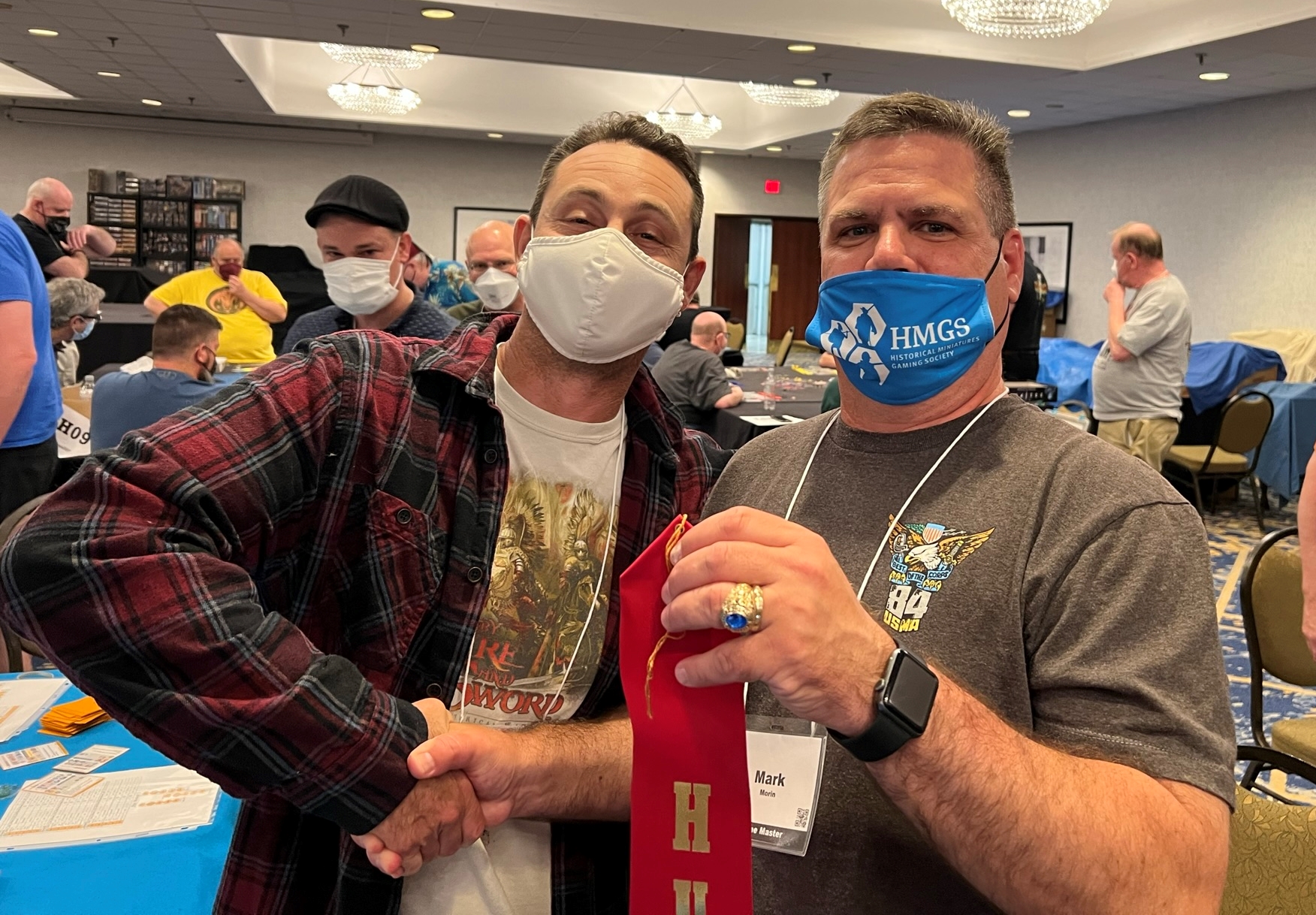
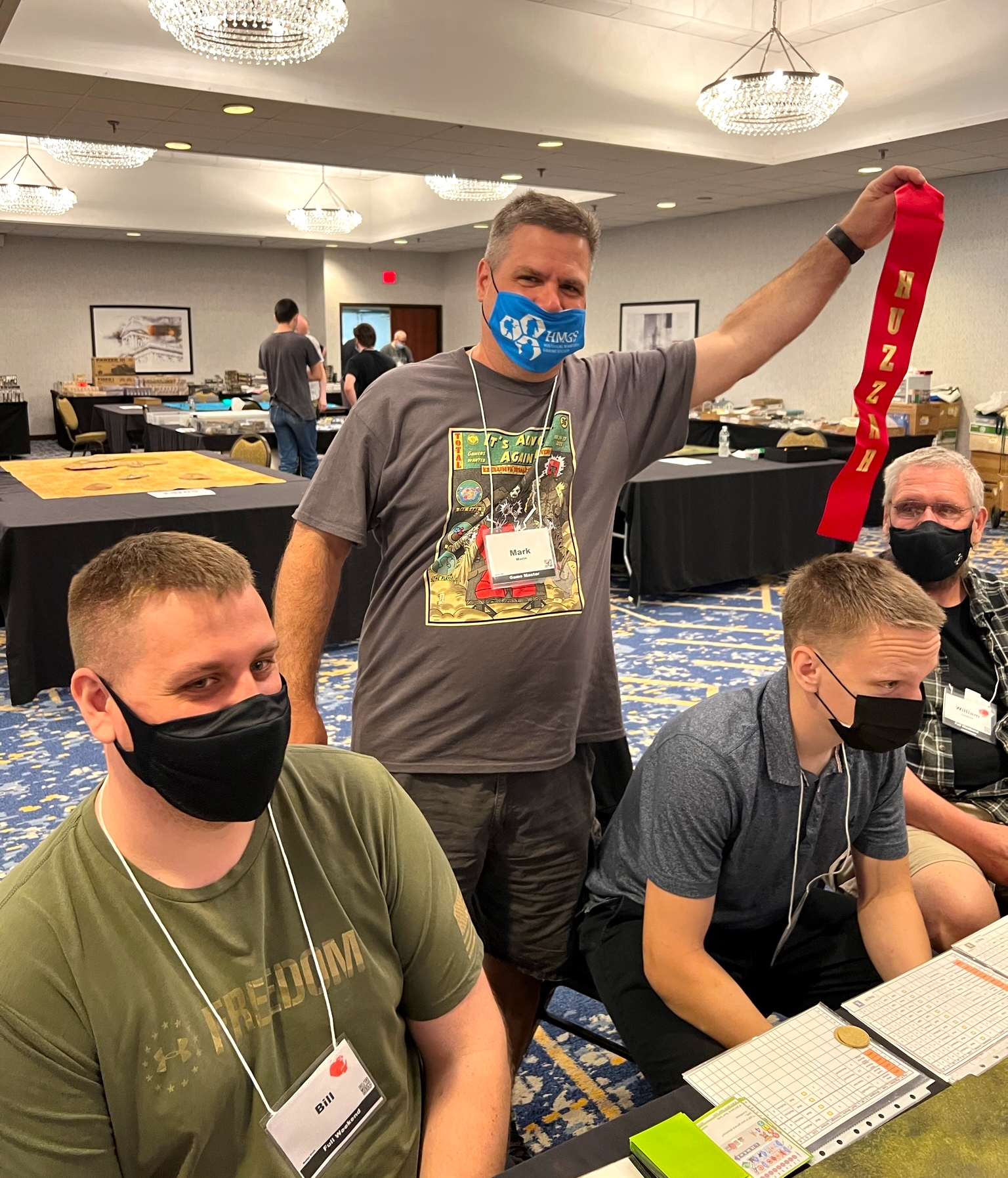
Near the end of the game, an official of the convention briefly interrupted the game – and to my surprise awarded me a PELA award (my first ever) for the time slot. PELA stands for “Pour Encourager Les Autres” which in English translates to “For Encouraging the Others”. These awards are defined by HMGS as going:

“to the games that best embody the positive traits of miniatures gaming, such as well-painted figures, great looking terrain, interesting scenarios, enjoyable rules, good sportsmanship, and an enjoyable time – events that do the most to “encourage others”.”

I was really shocked and honored – and as a cherry on the sundae I got a rousing applause from the players too. There were about 30 games in my time slot – so not a lay up to be chosen by any means. The award was a lovely Samurai figure on a plinth and a voucher for the vendor hall.

Yes, I’m happy! And honored!
My award!

After picking up the morning game, I and Greg Priebe walked around the event before preparing for our evening game that we had collaborated on. Here is a gallery of just some of what was there- some truly amazing stuff.

This Japanese tabletop was amazing.
This NYC gangster game was shockingly beautiful. It was electrified – lights everywhere, the steamer had a horn going, WOW. WOW. WOW!!!

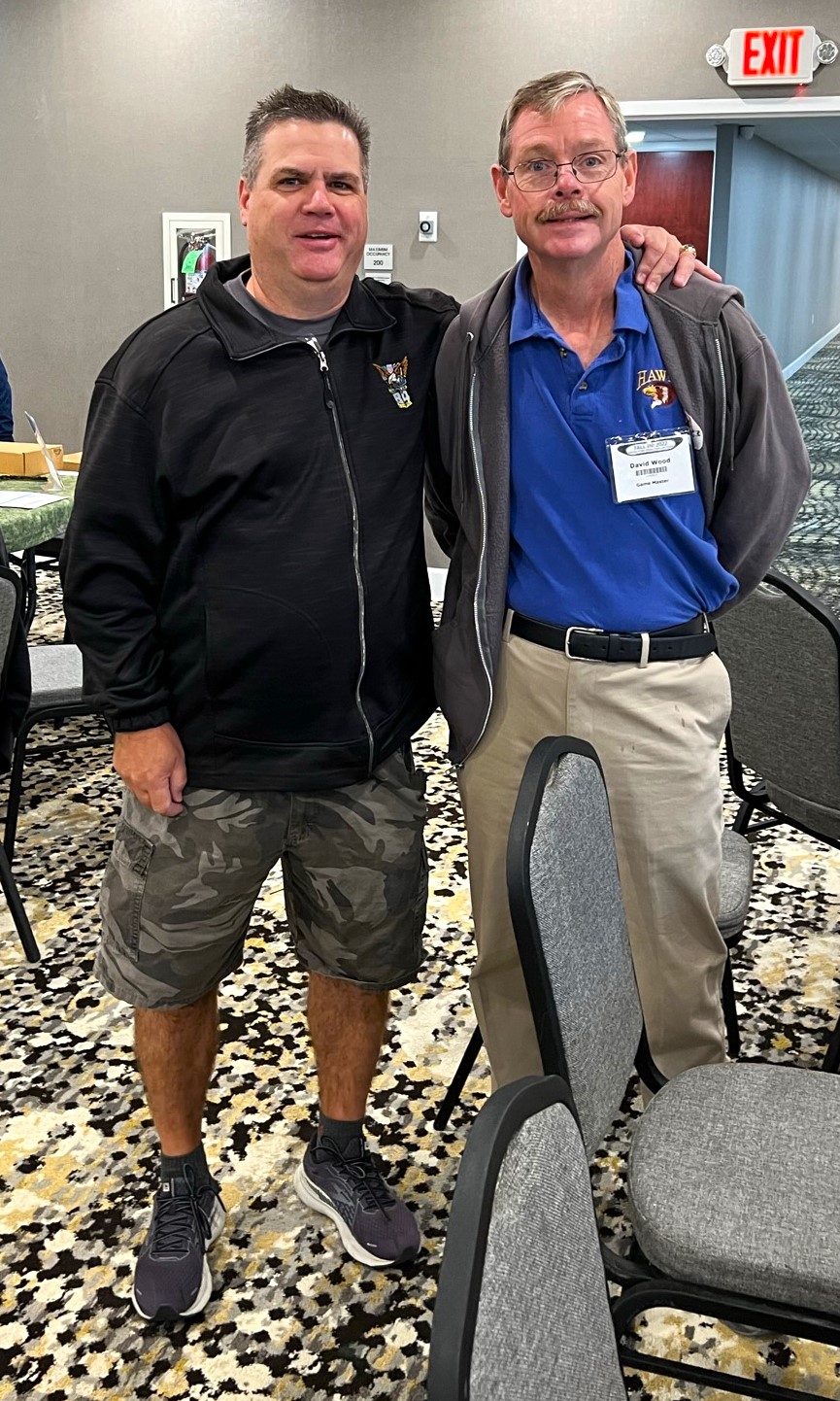
I mentioned Dave Wood above – my West Point roommate – always good to see my good friend, my brother from another mother…

Me and Dave, USMA 1984

Greg and I then set up our game, Vikings vs. Aztecs!!!

Friday Evening, “Vikings vs. Aztecs!!!”, a Feudal Patrol™ Game

Greg Priebe and I had worked out this scenario over the phone and Zoom.

Obviously this is not a historical recreation, but a “what if”. Greg had brought the Viking figures and I of course brought the Aztecs – and we co-GM’ed the game.

The game went well. The Aztecs, led by Acamapichtli, needed to prevent the Vikings, led by Carl the Jarl and Brunhilde the Shieldmaiden, from raiding and looting various structures – and of course casualties counted as well for both sides. In the end, the Aztecs majorly triumphed – partly due to the Vikings having probably the WORST luck of the draw in any wargame that I have seen in 20 years. That’s not to detract from the Aztec play – which focused on defense and won the day. However, I did not tally a score. Here’s a gallery:

Mayhem in Tenochtitlan!

It was a fun game nonetheless and the players on both sides displayed excellent camaraderie. Greg also gave me a bunch of Viking sprues so that I could have my own Vikings too. I do have some old school metal ones, but I will (someday), assemble and paint these up to run this game again. I just need to help out the Vikings!

We then cleaned up and I then set up most of my next day’s afternoon and evening games – as I planned on playing in Chris Palmer’s Ozz game on Saturday morning.

Saturday Morning, “Wars of Ozz: Attack on the Emerald City”, a Wars of Ozz Game

When I had visited Florida and Buck Surdu (as described here) I played a Wars of Ozz game at Recon. Buck’s Wars of Ozz rules and figures are available from Sally4th in the UK here, and in the US at a dedicated Old Glory Ozz site here.

As I have factions (Munchkins, Winkies, Greater and Lesser Pumpkinheads), I wanted to play another game to make sure that I understood the rules since it had been a while. Chris Palmer ran his outstanding scenario of “Attack on the Emerald City“. This involved Nomes (yes, Nomes), burrowing underneath the walls of the Emerald City and undermining its defenses/taking out a wall section. Meanwhile, Winkies, Giant Bears, and Skeletons are assisting the Nomes by attacking from outside the walls. Quadlings and Tin Men inside attempt to defend, while Munchkins defend outside.

In the game I was outside the walls with a medium battery of Munchkin artillery, two infantry regiments (Tik-Tok and Landwehr), and a small Munchkin cavalry regiment. I sent the cavalry to disrupt the Nomes coming after my teammates rears (that sounds wrong but you get it), and succeeded so that they could face the oncoming Winkies and skeletons and not get hit on two sides. This was successful but the cavalry was badly weakened and did not reform until the last turn of the game. My artillery ended up in a counter-battery duel with a couple of Winkie batteries – and was wiped out. Meanwhile, my two infantry regiments held their respective grounds and heavily damaged two attacking Winkie regiments AND wiped out a regiment of Giant Bears. Then, my cavalry reformed and drove off the Nomes on my side. So, victory! Here’s a couple of galleries:

This was an EXCELLENT game and motivates me to hurry up and get to my Ozz figures. Of key note, Chris Palmer deservedly won a PELA for this game the day before! Congrats Chris!

A PELA for Chris!!

As I had set up my afternoon game, after lunch it was time for:

Saturday Afternoon, “The Battle of Lake Texcoco”, a Feudal Patrol™ Game

I planned to run two of this scenario back-to-back. I had FULL tables for each iteration – and I’ll share each in turn. Greg Priebe was a BIG help at both games – thanks Greg!

The scenario is best summarized below:

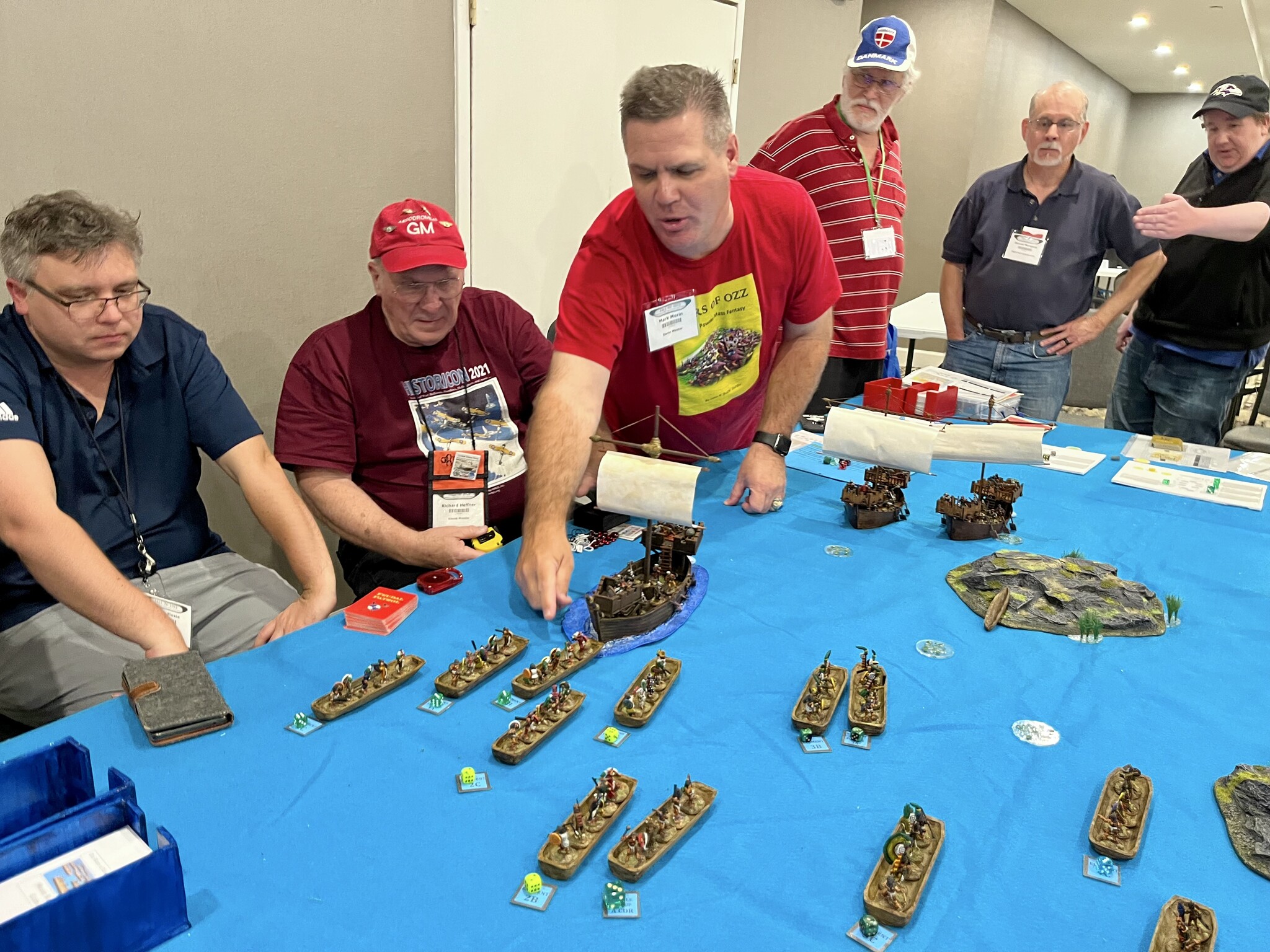
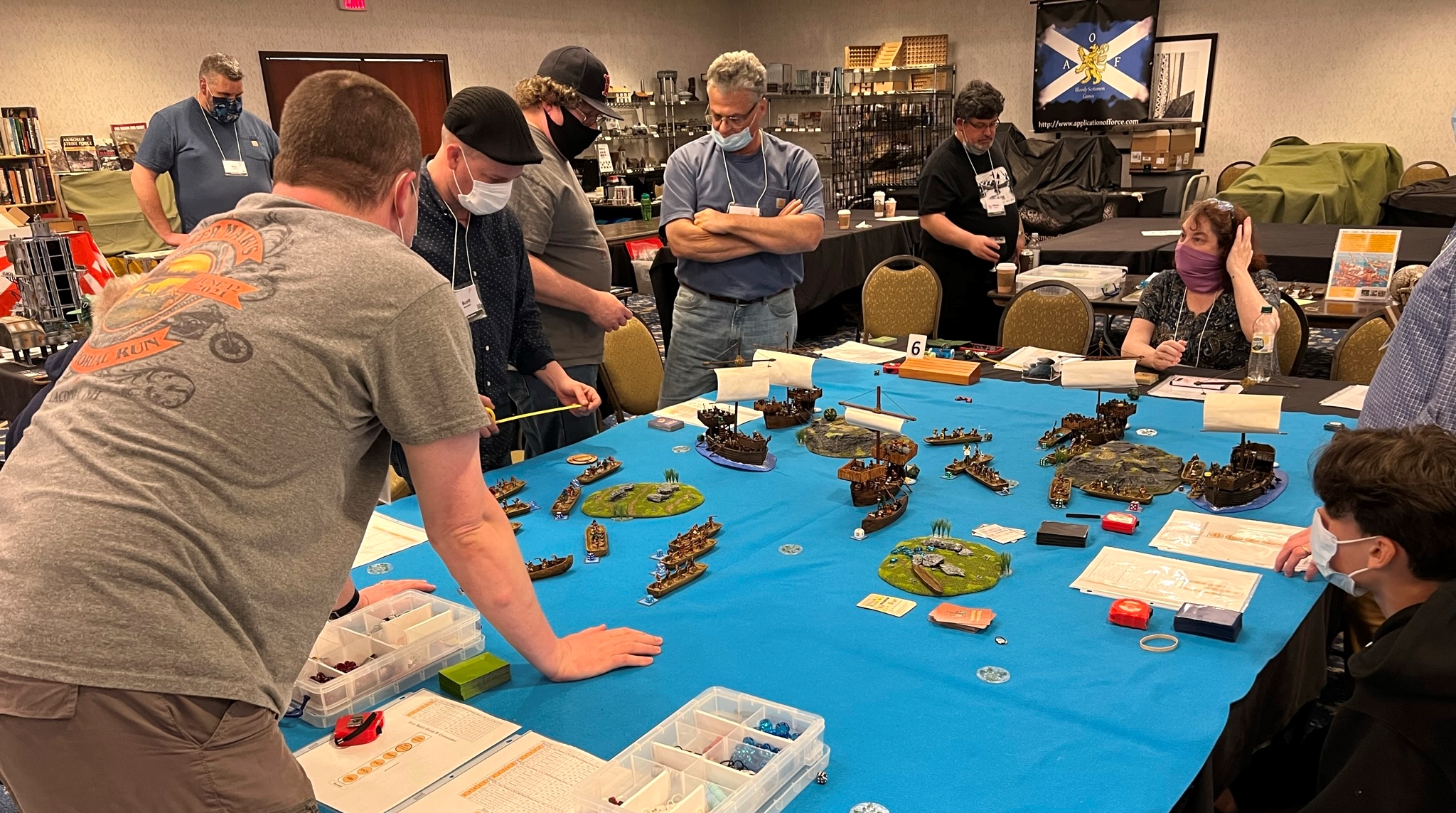
In the first game, the Conquistadores sailed towards the Aztec war canoe fleet. The Conquistadores needed to fire their falconets and lombards into Tenochtitlan for Victory Points, while the Aztecs got their big points by boarding the brigantines. VP’s were also awarded to both sides for inflicting casualties. Some of the brigantines raised full sails – notably El Dólar (The Buck after Buck Surdu) & El Gregorio (The Greg after Greg Priebe). The other three brigantines are named El Perro de Guerra (The War Dog), & El Conquistador (The Conquistador of course), and El Marcos (named after, well, me). All made it towards Tenochtitlan but the Aztecs were able to board them all and disrupt them sufficiently. El Dólar ended up hitting an underwater obstacle at full speed and settled to the mud bottom, allowing the Aztecs to swarm over it. It’s cannon was unable to bear on the city, and no other ship managed a shot into the city. The Aztecs won a minor victory as no shot hit the capital – but killed a LOT of Aztecs. But the game ended with a score of 226-207 in favor of the Aztecs. Here’s a gallery of that game:

The game was a success, and I reset it for:

Saturday Evening, “The Battle of Lake Texcoco”, a Feudal Patrol™ Game

After resetting from the afternoon, the play recommenced with a different yet FULL slate of gamers. In this game the Spanish were more cautious, and that let the Aztecs close on them sooner. Unlike the first game, the Conquistadors did get one shot off at Tenochtitlan from El Gregorio – but it missed! The final score was 290-172 in favor of the Aztecs. It did not help the Spanish that an arquebus misfired/exploded and killed that arquebusier, another arquebusier, and Alvarado (a key leader). It was nice to have several HAWKS in the game – especially Greg and Chris and Geoff. Here’s a gallery of round 2:

Both games were well-received and I really appreciate the help in cleaning up from Chris Palmer, Greg Priebe, and Dave Wood as it was after midnight!

Videos links showing Fall In! 2022 and some of these games

There have been two videos on YouTube that I think are worth seeing if you want more shots of the Fall In! 2022 convention.

The first is by Walt O’Hara called “Fall IN! 2022 at sub light speed“. Click here you will see this video with some nice overall shots of many other games plus some amusing commentary. Chris Palmer’s Wars of Ozz: Attack on the Emerald City shows up at 1:52. Our Vikings vs. Aztecs!!!” game show up at 2:09. His PELA comment was a joke of course- though I did win for my Raid to Satisfy Huitzilopochtli as discussed.

The second is from Little Wars TV, called “Fall In” 2022 Show Recap”. It is very well done and you can see a few seconds of me and my Lake Texcoco game at 10:50. Click here to see that video.

Thanks so much to the folks that ran the convention – it was outstanding. Special thanks again to the H.A.W.K.’s for bringing me in and making me feel welcome and a part of the group. Of course, to all who played in my games, please know how much I appreciated sharing my game with you.

Lastly, and as a side note, you may remember that I won a PELA. As part of that award, in addition to the miniature I got this:

So, I took my $12 voucher for my PELA and on Sunday morning after packing up hit the vendor hall. I decided to get some dice etc., and then saw a steel conquistador’s helmet. It called to me. Now it’s mine!

After a long drive home – I showed my wife. Somehow she was not very pleased! Oh well, sorry honey…still love ya…

Thanks for looking and to my regular followers I hope to post more figures soon as golf season has basically wound down.

3 Aztec Feudal Patrol Games Coming to Fall In 2022

I will be running 4 Feudal Patrol™ games at the HMGS Fall In® gaming convention next week in Lancaster, PA. In 2022, I have been running Aztec/Mesoamerica/Spanish Conquest themed games at multiple gaming conventions – and they all have been well-received. I am really looking forward to running these games at Fall In® in the H.A.W.K.’s room – and I hope to see some of you there.

So, you ask, what are you running Mark, and when? Well, I aim to please – so let me answer that!

Friday, November 4th from 9 AM to 1 PM, Paradise Room

I will be running my “Raid to Satisfy Huitzilopochtli”. It’s a pre-Spanish Conquest fight between the Aztecs and their neighbors the Tlaxcalans. The Aztecs attempt to conduct a raid of a Tlaxcalan village to gain captives for slavery and blood sacrifice, and the Tlaxcalans will fight back!

Friday, November 4th from 7 PM to 11 PM, Paradise Room

Later that day, I will be teaming up with Greg Priebe of the H.A.W.K.’s to run a “what if” scenario. Let’s say a Viking raiding party got lost and while trying to get to Greenland and wound up in Tenochtitlan. Never to pass up the opportunity for looting and pillaging, they decide to make the best of it, but the Aztecs have other plans.  I think this will be a LOT of fun. Greg wrote the rules for the Feudal Patrol™ Vikings supplement – and we will use my Aztec supplement rules as well (Civilizations Collide). featuring a 1200’s Viking raid on the Aztec capital of Tenochtitlan!

Saturday, November 5th from 2 PM to 6 PM, Paradise Room

AND

Saturday, November 5th from 7 PM to 11 PM, Paradise Room

On Saturday, I will be running a Feudal Patrol™ naval game – this time the epic Battle of Lake Texcoco.

TWICE! Once in the afternoon and once in the evening. After I ran this at HUZZAH! in Maine – I knew it was a hit.

The history is this – back in the summer of 1521 Cortes had a problem. To seize control of the Aztec island capital of Tenochtitlan, he realized that he needed to control the surrounding waters of Lake Texcoco (where Mexico City is now – the lake is long-gone).  This meant building a fleet.  Cortes had his troops build small brigantines in sections. These prefabricated pieces were then carried by his Tlaxcalan allies to the shore of Lake Texcoco, where they were assembled, and made ready for combat on the lake.  While simultaneously he sent land-based conquistadores to attack Tenochtitlan’s causeways, Cortes launched his brigantines to attack Tenochtitlan. 

In his way were hundreds of Aztecs canoes waiting to swarm over the Spanish. This is the basis of this game.
So, you will have two chances to jump in on this game!

To my regular readers – YES I have been neglecting this blog – more a case of a lot hitting my schedule (mostly golf) – and I will be catching up with some of the miniatures that I have painted up and some games that I have run going forward. In the meantime, I am looking forward to reconnecting with you al soon – and I appreciate those who kindly checked in on me to see if I had assumed room temperature yet.

Thankfully, I have not – I think not yet anyways…

Rehabilitating Woodstock

Two totally unrelated things conspired to make me jump off my Spanish Conquest/Mesoamerican hobby path for just a short August detour. The first was my desire to participate in Dave Stone’s Season of Scenery challenge. I did get in that last year with my cityscape build for Tenochtitlan, the Aztec capital. My challenge this year was that I really did not need any more scenery for those games. The second thing – and we are talking about scenery here – was right in my back yard.

Woodstock.

Yes, that Woodstock from the late Charles Schulz’s Peanuts. Or rather the resin yard sculpture of Woodstock that we have had in the back yard for so many years that I don’t remember when we got it. Plus, I grew up reading the strip and still do in the reruns in the daily newspaper (which, yes, I still get daily). I think Peanuts still holds up.

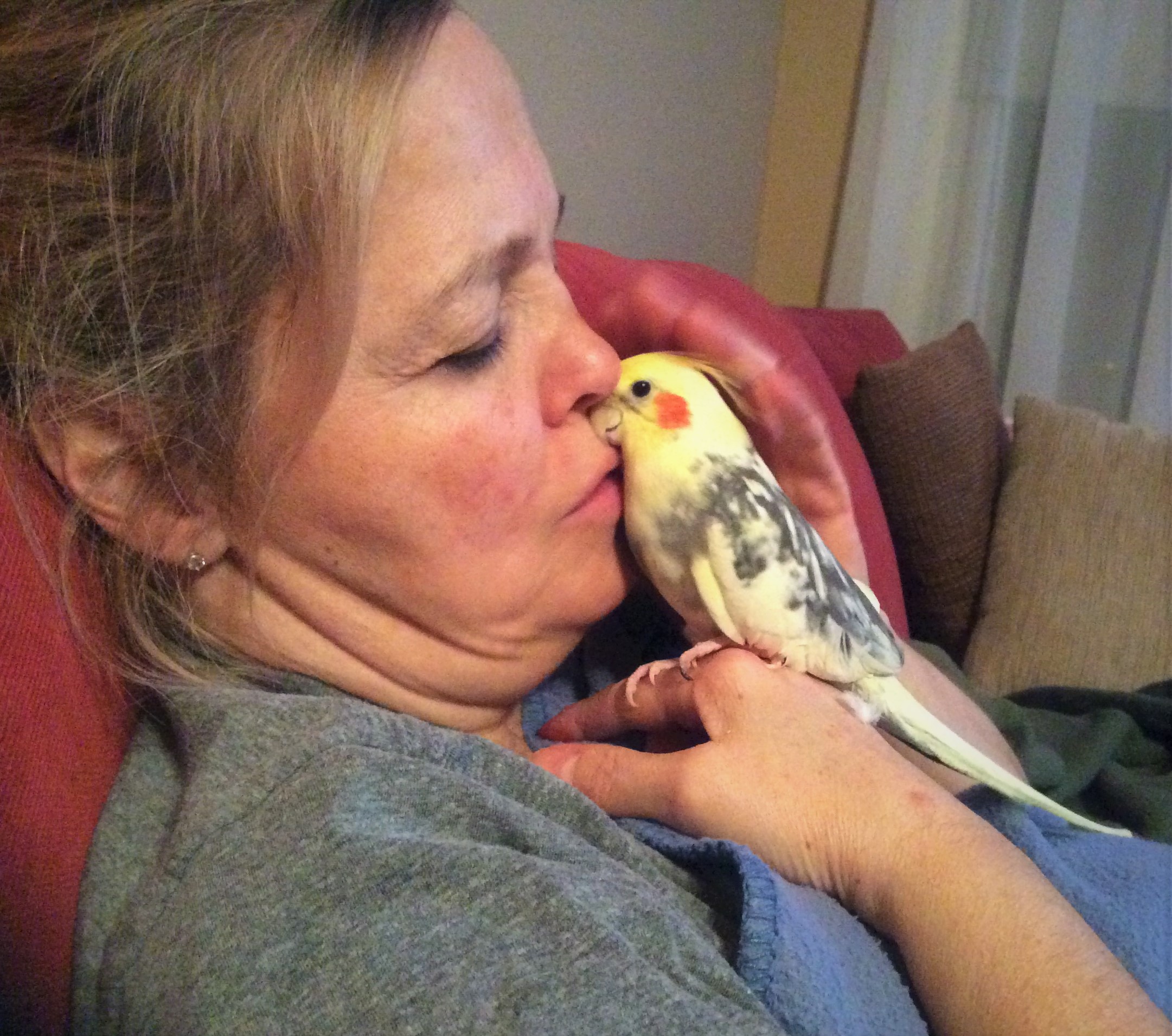
As some of you remember, my wife Lynn and I had a cockatiel named Caesar who passed away on January 1st in my wife’s arms.

Miss this guy…

Woodstock looks somewhat like a cockatiel (but Schulz never would specify exactly what kind of bird he intended him to be).

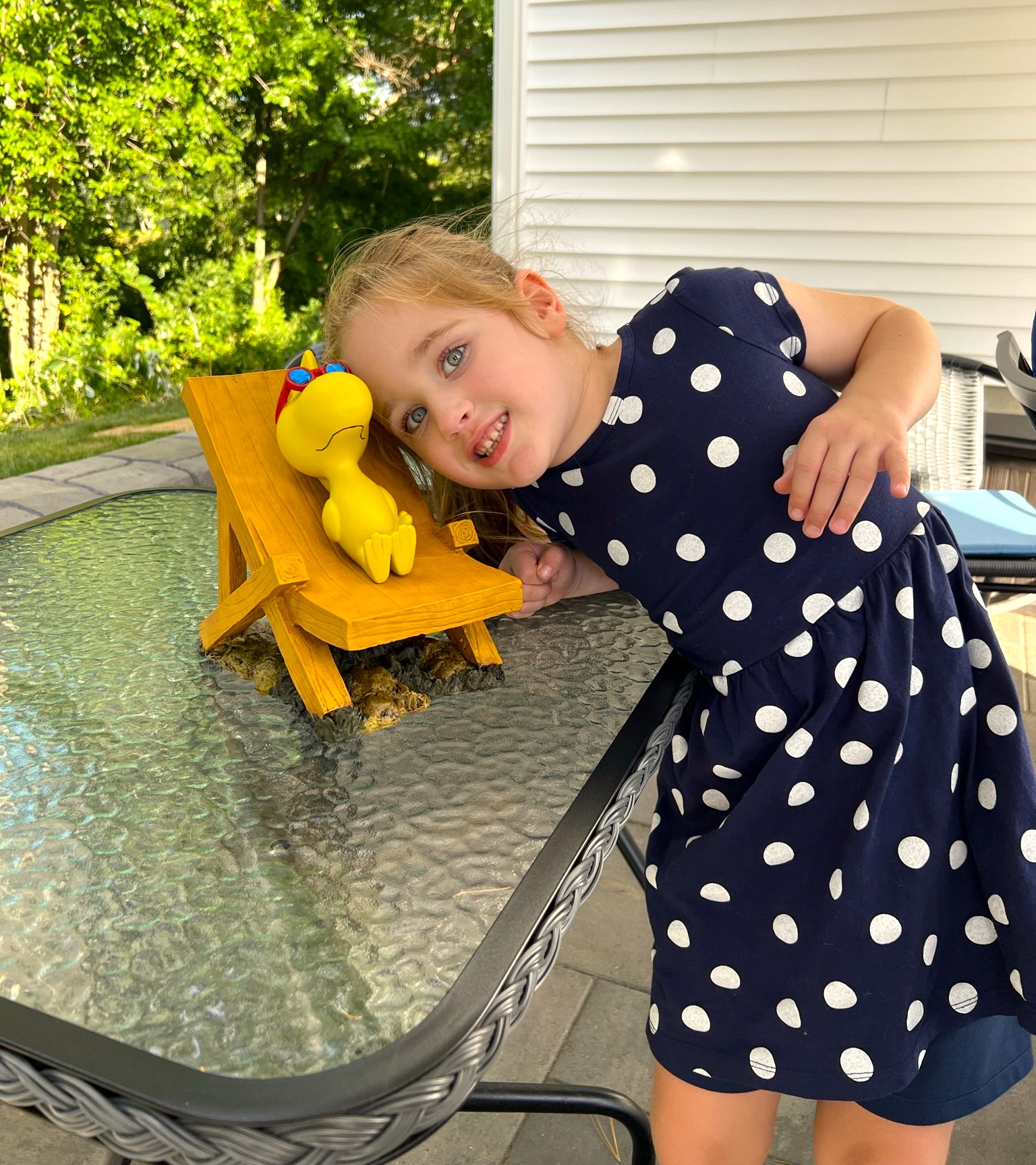
In any case, as Caesar was part of our family, we naturally have had several bird-themed decorations inside and outside of the house. One of these is the aforementioned resin yard sculpture/ornament of Woodstock wearing sunglasses while lounging on a chaise lounge for many years. The New England sun, snow, heat and rain have taken their collective toll on the dude. But, back to my original point, he’s part of the scenery! And he is a fond reminder of Caesar. So, as such, I decided to rehab Woodstock for my backyard and for Dave Stone’s Season of Scenery.

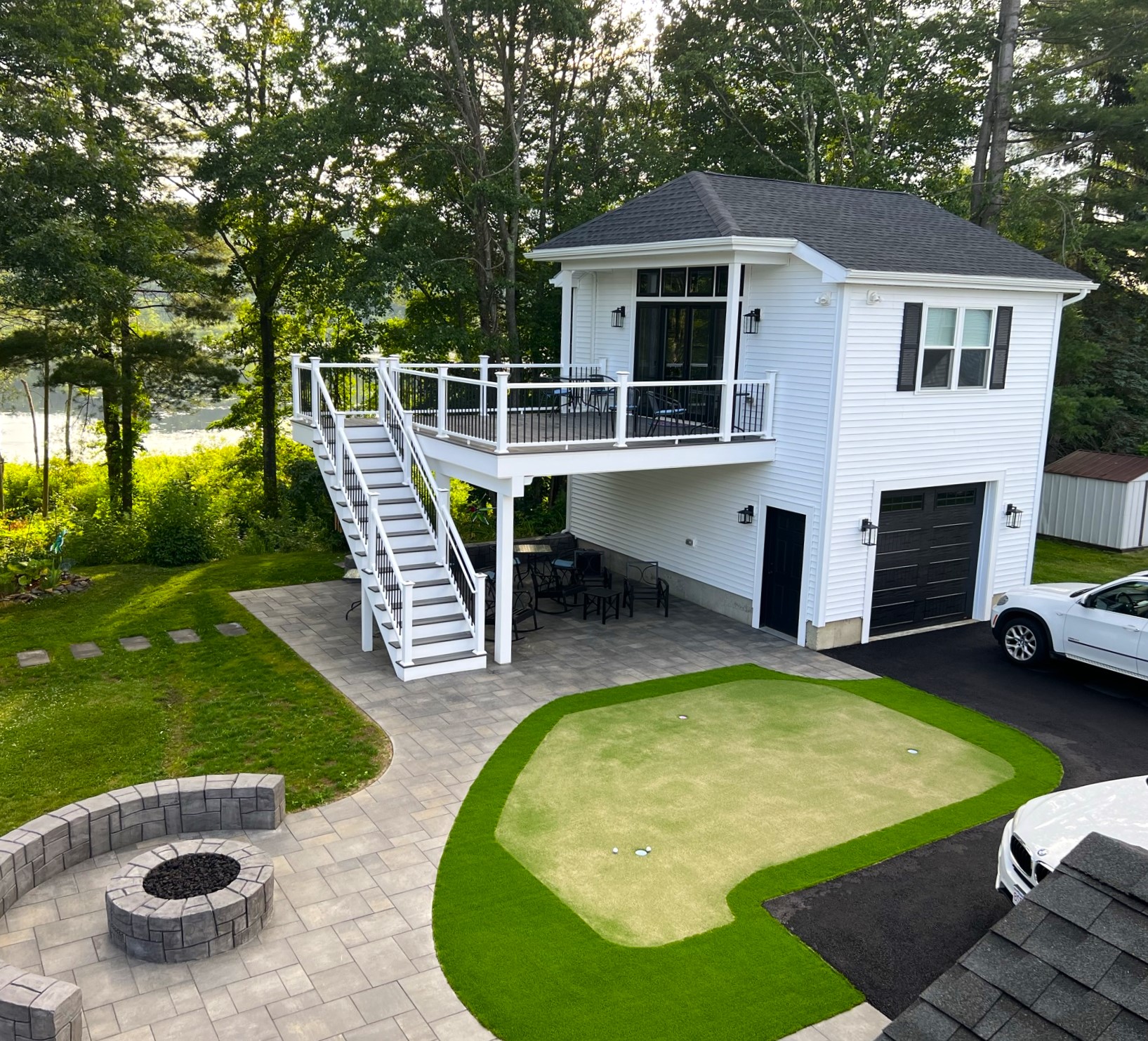
View from the putting green towards the fire pit and the flower garden behind it – see the circled bench!

And it’s been quite hot this summer – and we are in a drought so my grass (not the artificial putting green) are pretty burnt. You can see below that Woodstock has long since been separated from his chair. My granddaughter Tabitha does likes to hold him. As he’s no longer affixed, I thought I’d rehab Woodstock and keep him removable but also make him more secure on his chaise lounge as well. Therefore, as fate would have it, I could do that and use him for Dave’s annual scenery challenge!

I decided to use a combination of paints and varnishes – craft paints, old primers that are no longer good to airbrush with (i.e. too prone to clot and jam up an airbrush), and some rattlecan varnishes and lacquers left over from my pre-airbrush days. Add to that some other paints (which I list at the end of this post for those interested).

First, I washed and scrubbed the piece – it had a good amount of grime on it and I wanted the primers to really adhere. A few ants had taken up residence in it as well and kept wandering out at random times despite the cleaning.

The chaise lounge also had a good-sized crack that I repaired with green stuff.

Green stuff repair.

The next challenge was how to paint the two pieces without handling them. For the chaise lounge, I just did each side and allowed for drying. For Woodstock, I needed a support jig – so I built one. The drilling also allowed for magnet insertion later with a bigger hole centered on the smaller one (not shown immediately below but later on in this post).

As for the jig itself, I reused a blot of wood that had a few holes that I had used to support 15mm tank turrets on previous projects. I had a longer bolt for the support that I drilled from the bottom side, and added several washers so that the bolt head would not touch the ground when flipped over and supporting Woodstock. I secured all the washers and the bolt with wood glue.

The bottom of the jig showing the washers and the support bolt in the middle.
I let the glue on the jig set overnight. The long support bolt is unseen up against the edge. I used another block and the DeWalt drill bits case to weigh it down while drying.

For Woodstock, I scribed over his mouth and eyes with an awl before priming him. I then secured Woodstock and brush primed with some older primer that was no longer suitable for the airbrush but was still good enough for the brush.

Woodstock on the jig, primed.

From here, it was onto the chaise lounge base. It needed to be primed both on top and on the bottom as there were some rock-like and bush-like structures underneath that were not well-defined. These I painted and then added a glossy wash for depth. Over the repair, I had previously etched the wood grain of the chaise lounge.
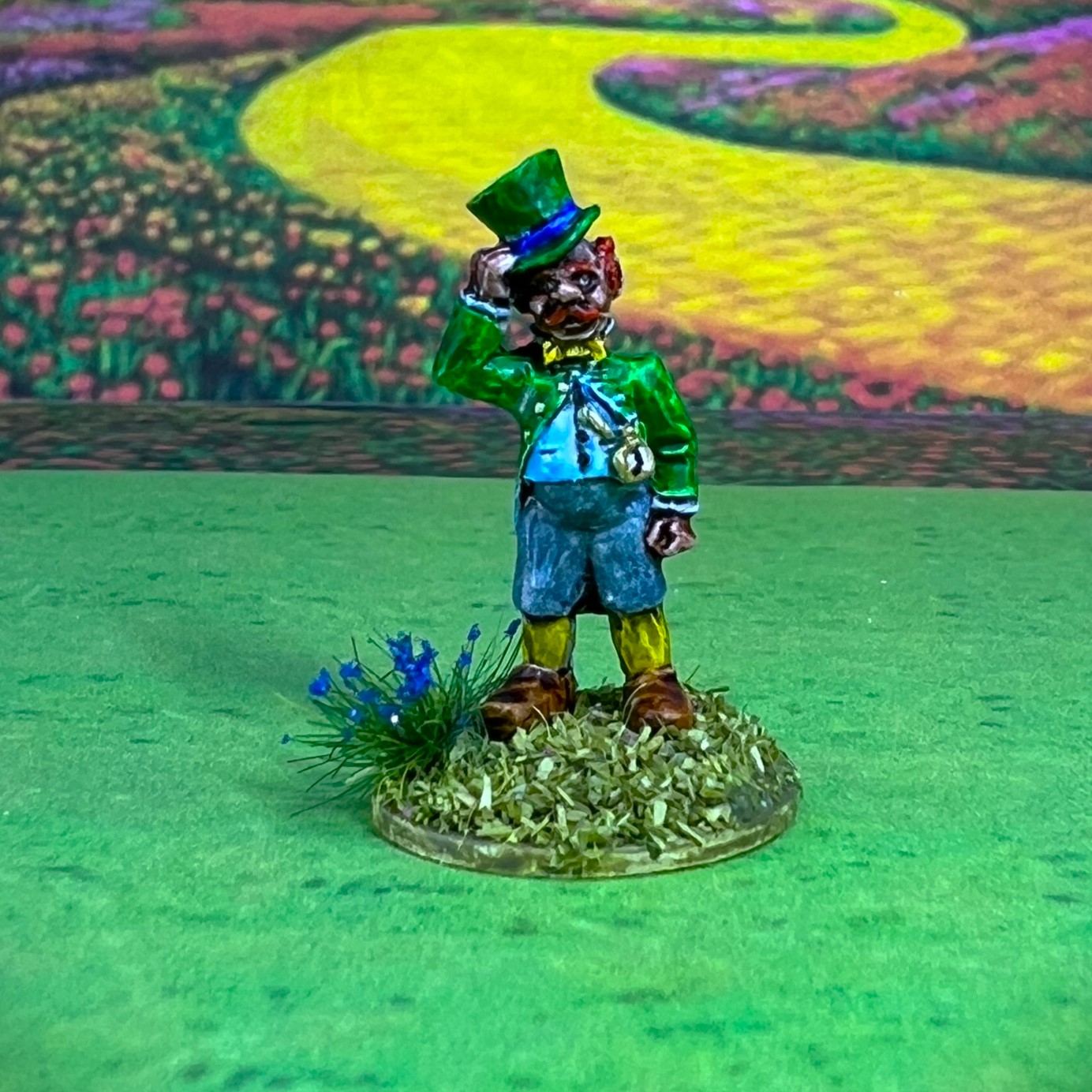
I still wanted more definition in the wood grain. I tried a wash but the result was highly unsatisfactory – it came out horribly blotchy. So I repainted the base chair and decided to dry brush it instead- which worked much better. After all, it should retain a “cartoony” look right? I used an airbrush yellow paint with a brush on Woodstock and painted his eyes, mouth, and sunglasses.

Getting closer to the finish. This is after I repainted the chair but before the dry brushing.
After dry brushing the chair. I added a bluish color to the sunglasses (not shown here).

Before I was to varnish, I needed to install Woodstock’s magnet and a washer into the base. Originally I planned to put in a magnet into the base too – but upon drilling it I discovered that the base was more hollow than I knew (hence the ants too). So, I chose to insert a 3/4″ zinc-coated washer and secured the gap with E6000 epoxy.

The magnet and the washer will allow Woodstock to be removed with a little effort but not fall out at rest.

All that remained was to apply varnish and lacquer. Luckily, I still had some old rattlecans from my pre-airbrush days – and I gave each a couple coats of good coverage.

Finished!

So how does he look in the yard?

On the bench!
By the house back deck!
Before and after!

Most importantly, Tabitha approves!

Thanks for looking at this little diversion from my normal pace – hope you found it as fun as I did! Or Tabitha!

PAINTS, INKS, GLAZES, SHADES, WASHES, PIGMENTS, FLOCKING, GLUES AND MORE THAT I USED TO REHAB WOODSTOCK AND HIS CHAISE LOUNGE:

  1. Kneadatite (green stuff)
  2. Gorilla Glue
  3. A block of 2″ X 4″ wood
  4. Elmer’s Wood Glue
  5. 1/8″ x 1″ Everbilt Fender Washers
  6. 4″ bolt
  7. 1/4″ magnet
  8. Multiple drill bits of different sizes
  9. Vallejo Surface Primer “Grey”
  10. Vallejo Surface Primer “Russian Green”
  11. Vallejo Surface Primer “German Green Brown”
  12. DecoArt “Honey Green Brown”
  13. Citadel “Agrax Earthshade GLOSS (wash)
  14. Americana “Black Tie Satin”
  15. Americana “Santa Red”
  16. Com-Art Colours “Opaque Hansa Yellow”
  17. FolkArt “Yellow Ochre”
  18. Craftsmart “Neon Blue”
  19. Citadel “Contrast Paint – Talassar Blue”
  20. Krylon “Matte Finish” (varnish in rattlecan)
  21. Testors “Dullcoat” (lacquer in rattlecan)
  22. E6000 epoxy

Aztec Eagle Knights, Ral Partha 42-303, circa 1986

The first figures that I got to paint came from a triad of companies – Ral Partha, Minifig, and Grenadier – back in the 1980’s. There were others too – but Ral Partha was my favorite company, as I was mainly into buying, painting (and casting) 25mm fantasy figures in those days. I left the hobby in the late 1980’s, and subsequently came out of my hobby time machine in early 2015 with the Nightmare Legion. To my surprise, I found that Ral Partha – and many others – were gone or subsumed into other entities. For example the Ral Partha lines now can be found at now Iron Wind Metals. Also, for many manufacturers, metal figures were being replaced by – dare I say it – PLASTIC. Oh, the horror.

Anyways, I discovered that there were still a good many metal options available and I have stayed mostly with metal figures. One of the lots that I bought on eBay around 2016 was a bunch of unopened and opened Ral Partha Aztec figure blisters. I sorted them and put them away. Then in 2019 Buck Surdu asked for collaboration on supplements for his new rules set called Feudal PatrolTM  . I jumped in, and now most of you know it resulted in my writing my supplement called Civilizations Collide in late 2019/early 2020. It’s free to download at that link (and you should!).

I then started painting figures and terrain for the period in April of 2020. Now, after two years, having painted and assembled 254 figures (109 Aztecs, 113 Conquistadores, 32 Tlaxcalans), 21 war canoes, 5 brigantines, a TON of terrain, and written 55+ blog posts (you can see the list of posts here), I felt I was ready to move on to my 34 Maya figures and finish up. After a whirlwind of preparation for gaming at HAVOC! 2022 and HUZZAH! 2022, I thought that I was prepared to move on to my 34 Maya figures…

Or was I…

I had painted or given away all of my original eBay lot score – all except 12 remaining Aztec Eagle Warriors. They were metal (of course) Ral Partha figures – so 25mm not 28mm, in two blisters (one opened and one not). The SKU designation for them is #42-303 “Aztec Eagle Knights”, circa 1986, sculpted by R. Kerr. From their storage location I heard them desperately cry out – “don’t leave us behind – it’s already been 36 years since we were cast! You need us to join your Aztecs!”. Funny, they cried out in English and not Nahuatl…

So, being somewhat of a completionist (insert sarcastic comment here), I decided to finish the LAST of my Aztecs. Besides, this would bring me to an even 300 figures of all types for the period (once the 34 remaining Maya were done) and that seemed to me to be an auspicious number to round out the project.

The 2 blister packs. One of the opened figures was partially painted and needed to be stripped.
Curiously, this was in the unopened blister pack – I had never seen this before – and I wonder – where is now?

Historical Background

Aztec Eagle Warriors were, along with the Jaguar Warriors and the Shorn Ones, at the apex of the Aztec warrior classes. They would be armed with melee weapons, in particular the macuahuitl obsidian-edged club/sword, the tepoztopilli (obsidian-bladed thrusting spears)and the cuauhololli (round-headed club).  To be a member of any of these classes required that one had captured many quality enemies for sacrifice on the Altar of Huitzilopochtli. Indeed, while they battled almost incessantly, the status and rewards were great for them. Here is a good summary of the history of the Eagle Warriors.

Painting and Assembly Plan

I had previously assembled and painted 6 Eagle Warriors from Tin Soldier UK (documented in this post). I numbered those EA01-EA06. These will be EA07-18. As I have 17 Jaguar Warriors that seems good. Similar to the previous Eagle Warrior project, I found that the#42-303 Ral Partha Eagle Knight tepoztopilli were way too soft and bendy. While the macuahuitl were small and bendable, I found that both five of those and three of the cuauhololli that would work.

I replaced four of the shafts of the tepoztopilli with leftover North Star shafts I had cut for my Conquistador pikemen. I drilled out the ends and used green stuff to bind them together. The other challenge were the limited poses. In each blister of 6 there are just TWO poses – one with a left arm forward and one with a right arm forward. (FYI these two are still available from Iron Wind Metals less any shields or weapons here). At least mine have weapons and shields!

The two poses.

As before, my plan was to reorient each of their arms into different poses, and to give each one a different weapon that was also oriented slightly differently. I would also give them a variety of colors for their suits (tlahuiztli), using red, light green, dark green, and light brown. Add to that I would use different shield patterns and different feather colors for authenticity and ease of tabletop play.

And yes, I had a painting plan matrix in writing!

Assembly, Modifications, and Painting

My first task was to redo the tepoztopilli (thrusting spears).

The stripped one and the rest now washed (I always wash metal before painting) and ready for pose adjustment and priming.

Using pliers, I carefully and slowly reoriented the arms as best as I could to turn 2 poses into 12 – or close enough to it. Then, I repaired any flattened spots by stippling with an Exacto knife point.

The Eagle Knights with their weapons affixed. I ended up using green stuff to affix the weapons to the ones armed with tepoztopilli (thrusting spears). I made three of them left-handed warriors. In the rear are my Tin Soldier UK Eagle Warriors – watching the new additions/recruits in progress. They look like a conga line, and I wanted more variety of poses with the Ral Partha ones.

Then it was on to priming and applying a dark wash.

A close up of the wash-over-prime effect.

Then I base coated the figures – using several contrast paints.

Then I dry brushed and washed each painted figure to achieve the color variations. Additionally, I painted (well, inked) the feathers on each helmet differently so no two are alike. Then I added gloss varnish to the feathers so that later when matted down the colors will “pop” a bit more. It also helps protect the inks I used here.

Then it was on to adding the initial flocking before returning to work on the shields.

Initial flocking before pigments added. After the two pigments set, I dry brush the bases with three colors.

The shields here are quite difficult to paint up with patterns. The surfaces are not smooth, and of course they are tiny. Below are the patterns I gave them under a gloss varnish – again to protect the colors.

The shields – painted and all glossy here.

Then it was time to mount them to the figures, add a matte varnish, and then add some grass.

Give us each a shield please!
It was hot out so I took these outside to speed the curing of the matte varnish.
All done and ready for play – and eye candy!

As promised…eye candy – note the color variations here and different poses.

Eye Candy

EA-07

EA-08

EA-09

EA-10

EA-11

EA-12

EA-13

EA-14

EA-15

EA-16

EA-17

EA-18

Group Shots

The four Eagle Knights armed with tepoztopilli.
Three were armed with cuauhololli.
The final 5 are armed with macuahuitl.
Here is a size comparison with a Tin Soldier UK Eagle Warrior. It will work ok on the tabletop!
All of the Ral Partha Eagle Knights together on my Things From the Basement Aztec Temple Sacrificial Altar!

I hope that you enjoyed this post and the photos – I tried playing around with my new iPhone and lighting – I’m not 100% sure I’ve got it down yet. I painted these in between a LOT of golf, so I’m happy that they are done. If you have any feedback, I’d love to read it in the comments section.

My Aztec figures now count up at 121:

I still can’t believe I painted all these…

As a second FYI, these Ral Partha figures are still available from IWM – here is the link. (Only again now they come without shields or weapons). I am sure that the lead content is no longer there too.

The Aztecs are DONE! On to the MAYA!

Miscellaneous details and references for those interested in that sort of thing:

For all of my previous posts on games, units, and other projects for my 16th Century Spanish Conquest supplement for Feudal Patrol™ – “Civilizations Collide” – please see this page.

PAINTS, INKS, GLAZES, SHADES, WASHES, PIGMENTS, FLOCKING, GLUES AND MORE THAT I USED ON THESE EAGLE KNIGHT FIGURES:

  1. Kneadatite (green stuff)
  2. Shafts from North Star Military Figures 100mm wire spears (leftover from building Conquistador Pikemen)
  3. Gorilla Glue
  4. 1/8″ x 1″ Everbilt Fender Washers
  5. Gorilla Glue Gel
  6. Poster tack
  7. North Star Military Figures 100mm wire spears
  8. Vallejo Mecha Primer “White”
  9. Vallejo “Flow Improver”
  10. Vallejo “Airbrush Thinner”
  11. Citadel “Nuln Oil” (wash)
  12. Vallejo Mecha Color “Off-white”
  13. Vallejo Mecha Color “Black”
  14. Vallejo Game Color “Bronze Fleshtone”
  15. Citadel “Contrast Paint – Fyreslayer Flesh”
  16. Battlefront “Skin Shade”
  17. Citadel “Contrast Paint – Blood Angels Red”
  18. Citadel “Contrast Paint – Dark Angels Green”
  19. Citadel “Contrast Paint – Skeleton Horde”
  20. Citadel “Contrast Paint – Creed Camo”
  21. Citadel “Contrast Paint – Contrast Medium”
  22. Americana “Kelly Green”
  23. Vallejo Model Color “White”
  24. Americana “Apple Green”
  25. Vallejo Game Color “Bloody Red”
  26. Citadel “Carroburg Crimson” (wash)
  27. Secret Weapon Washes “Fallout” (wash)
  28. Secret Weapon Washes “Green” (wash/ink)
  29. Citadel “Contrast Paint – Iyandan Yellow”
  30. Vallejo Game Air “Moon Yellow”
  31. Citadel “Contrast Paint – Aggaros Dunes”
  32. Citadel “Lamenters Yellow” (glaze)
  33. Vallejo Model Color “Burnt Umber”
  34. Citadel “Contrast Paint – Warp Lightning”
  35. Citadel “Contrast Paint – Talassar Blue”
  36. Citadel “Contrast Paint – Flesh Tearers Red”
  37. Vallejo Game Ink “Yellow”
  38. Citadel “Gehenna’s Gold”
  39. Citadel “Contrast Paint – Apothecary White”
  40. Vallejo Mecha Color “Turquoise”
  41. Vallejo Model Color “Glossy Black”
  42. Citadel “Tallarn Sand”
  43. Citadel “Cryptek Armourshade Gloss” (shade)
  44. Battlefront “Chocolate Brown”
  45. Vallejo Mecha Varnish “Gloss Varnish”
  46. Citadel “Contrast Paint – Terradon Turquoise”
  47. Vallejo Model Color “Dark Blue”
  48. Secret Weapon Washes “Just Red” (wash/ink)
  49. Vallejo Model Color “Black Green”
  50. Secret Weapon Washes “Yellow Snow” (wash/ink)
  51. Vallejo Game Ink “Green”
  52. Vallejo Game Ink “Red”
  53. Vallejo Game Ink “Blue”
  54. Citadel “Contrast Paint – Aethermatic Blue”
  55. E6000 epoxy
  56. Vallejo “Dark Yellow Ochre” (pigment)
  57. Vallejo “Burnt Umber” (pigment)
  58. Elmer’s PVA Glue
  59. Army Painter “Brown Battleground” (flocking)
  60. Vallejo Model Color “English Uniform”
  61. Army Painter “Mid Brown” (shade)
  62. Citadel “Karak Stone”
  63. Vallejo Mecha Varnish “Matt Varnish”
  64. Army Painter “Grass Green” (flocking)
Man of TIN blog two

Toy Soldiers, Gaming, ImagiNations

Gisby's Gaming Blog

Miniatures gaming projects, products, and reviews

Carrion Crow's Buffet

Narrative Wargaming, Fiction and General Musings on the Universe

Despatches from Fort Syllabub

An account of fictional adventures on the North West Frontier - and other times and places, real or imagined

Man of Tin blog

Toy soldiers, gaming, Imagi-Nations

Zauberwurfs Blog

Ein Blog über Tabletop und Miniature Wargames.

Frank Tank Rants

musings of a fat old bloke on tanks and wargames

Dragons of Lancasm

Games, miniatures, painting, books and more games

Tiny Painted Heroes

The Adventures of a lifelong Tabletop Gamer, Game Design hobbyist, and full-time Software Engineer

Steve's Paint Brush

Grimdark model making and mini painting

Wargamesculptors Blog

Life, Golf, Miniatures, & Other Distractions

Dead Dick's Tavern and Temporary Lodging

Life, Golf, Miniatures, & Other Distractions

Guru Pig - the gaming Guru

Guru's thoughts on wargaming, life, and the universe!

Wisely lead... without a head!

History, Miniatures and Wargaming

Kuribo's Painting

Fallout Wasteland Warfare, Warhammer, and Hellboy Painting, Terrain, Dioramas, and Battle Reports

Don't Give Greg Ideas

Seriously, just don't

War Across the Ages, and other dark horrors

A discussion of miniatures collecting, painting and gaming.

Classic Warhammer 40K

Painting diary focused on Warhammer 40K 2nd ed., 5th ed. WHFB, related GW games, and miscellaneous whimsy

Colonel Mustard

WW2 Modelling in 1/72 Scale

Bogenwald

Random painting and terrain making.

Pat's 1:72 Military Diorama's

Scale diorama tips and ideas

Arcade Dreams

Building the Arcade Dream

P.B.Eye-Candy

Phil's 20th century wargame pages

SP's Projects Blog

A futile fight against entropy or 'Every man should have a hobby'? Either way it is a blog on tabletop wargames, board games and megagames

30mmdave

Wargaming Plausible reality?

The Imperfect Modeller

Miniature Figure Painting and Diorama Modelling

Double Down Dice

Painting miniatures and rolling dice!

Just Needs Varnish!

My ongoing wargames projects!

miniaturepopcorns

Sculpting some worlds

Despertaferres

Wargaming with the ability of a dull nine year old

Dawn of the Lead

Miniature wargaming and the occasional zombie

Rantings from under the Wargames table

Wargames, Figures, Sculpting and Converting Miniatures

Simple as War

Miniatures & Terrains

Buck's Blog

Life, Golf, Miniatures, & Other Distractions

IRO aka Imperial Rebel Ork

- I model - therefore I am -