French Armor for Operation Torch: Hotchkiss H35’s, H39’s, and Renault R35’s

In November 1942, the Vichy French had a 8 division’s worth of troops in her colonies – from Morocco to the Levant. Under the terms of the Armistice of 22 June 1940, Vichy France was still obligated to defend its unoccupied lands as a neutral state.

And yes, they had more tanks than just the FT-17’s you saw in my last post. In addition to those old WWI relics, Vichy had Hotchkiss H35 and H39 tanks, as well as Renault R35’s. Both of the Hotchkiss models were “cavalry” tanks, in that they had been forced as a light tank on the French cavalry in the 1930’s (and later forced on infantry tank regiments as stopgaps). Contrastingly, the R35 was an “infantry tank”. After the Armistice, the Vichy Army had both types in the colonies. I did read somewhere that some R35’s were hidden away under hay bales behind horse barns to keep prying German and Italian officers of the Armistice Commission from finding them.

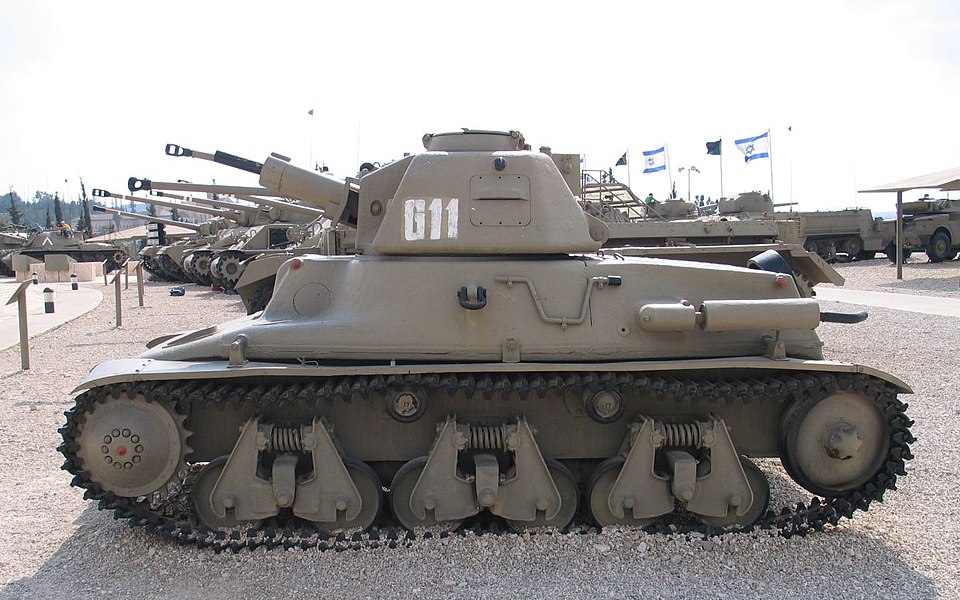
The H35, or Char léger modèle 1935 H, was a two-man tank, armed with the same cannon as the FT-17 (the Puteaux SA18 37mm cannon). The H39, or Char léger modèle 1935 H modifié 39, was a 1938 upgrade of the H35 that also got a better engine, and a newer and longer 37mm gun – the SA38 cannon, that supposedly had increased armor penetration over the SA18 (how much I cannot find!). Both variants were in North Africa in November 1942. There are only two observable differences to an outsider between the two models. Both have different engine deck configurations and the mufflers of H35’s point forward – while H39 mufflers point rearward.
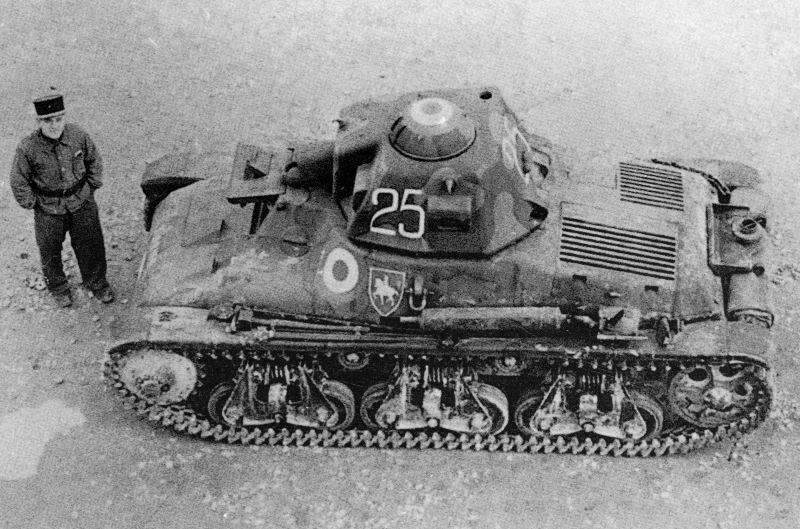
An H35 tank. Note the engine deck and the forward-pointing muffler.
An H39 tank shown in Israeli markings at Yad La-Shiryon (officially: The Armored Corps Memorial Site and Museum at Latrun in Israel. Note the rearward-pointing muffler.

As for the R35, or Char léger Modèle 1935 R, it was an infantry tank under French Army doctrine. It too had a two-man crew, and was also armed with the Puteaux SA18 37mm cannon. It was thought to be slightly better mechanically than the H35/H39 variants. As the Armistice forbade Vichy from having pure tank units, these and the Hotchkiss tanks would be spread around into combined-arms units. These Vichy tanks and armored cars would play a role in Operation Torch in November 1942 against US forces in Morocco (and Algeria as well).

R35 tank at Saumur Museum in France.

In gathering appropriate models for my What a Tanker game for HISTORICON, I started with looking for H35 and H39 metal or 3D-printed models in resin. I found a two listings for some on eBay. One was for Sarge_s Stuff – he had H35’s that could be bought individually – and I ordered 4 of them. The other site was the same one I bought the FT-17’s from earlier – jacobsminis (aka HobbyHouse&Miniatures.LLC). I ordered 5 from HH&M as that was the minimum order. The tanks from HH&M were (and still are) listed as H39’s, but when I got them I realized that they were actually H35’s. Unlike their excellent FT-17 models, some of these had printing errors, and I ended up using just 2 of these. However, I did use all 4 of the Sarge_s Stuff ones as H35’s. For H39’s and R35’s, I decided to rebase the ones that I painted a few years ago. I had 1 H35 and 3 H39’s (documented here) and 2 R35’s (documented here). I rebased all 6 of these.
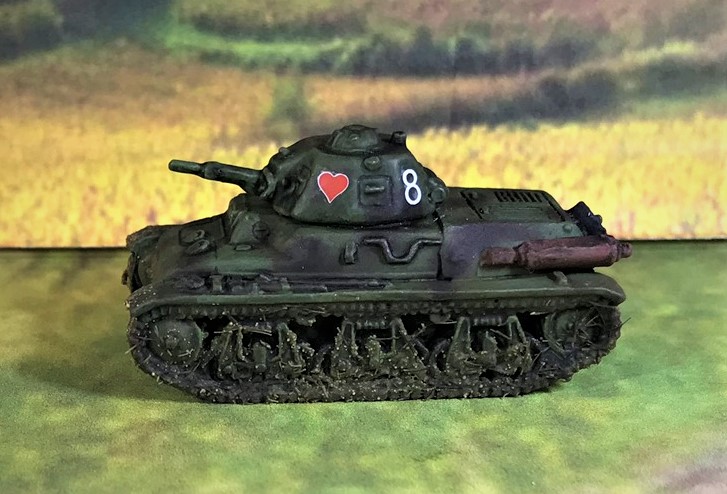
One of my 3 H39’s before I rebased.
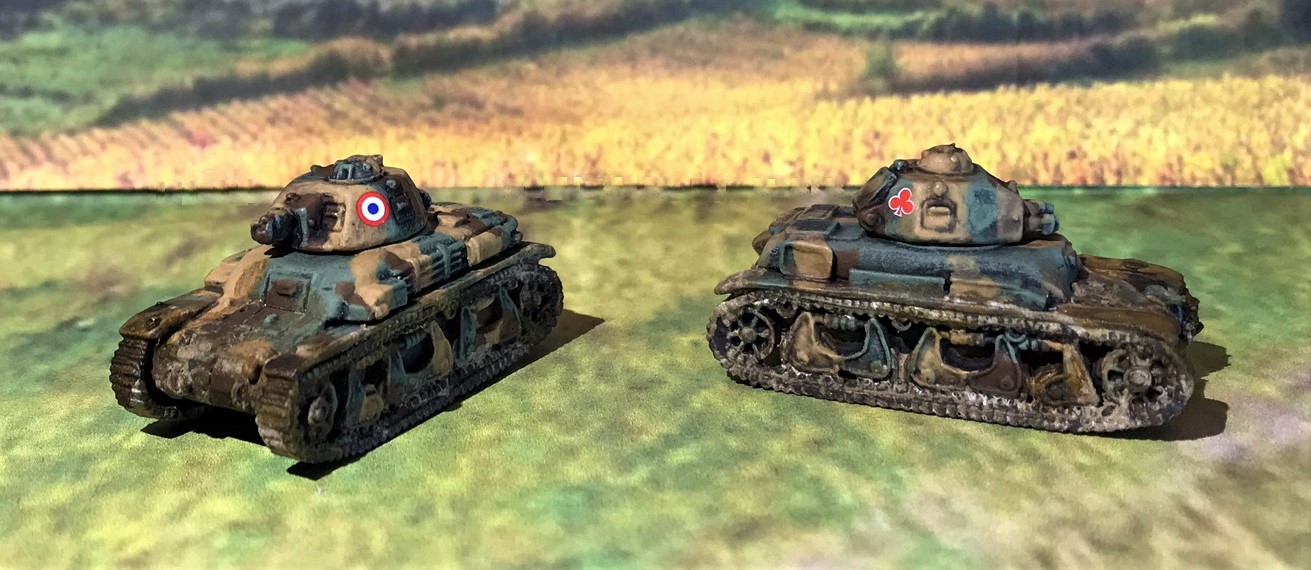
My R35’s before rebased them.
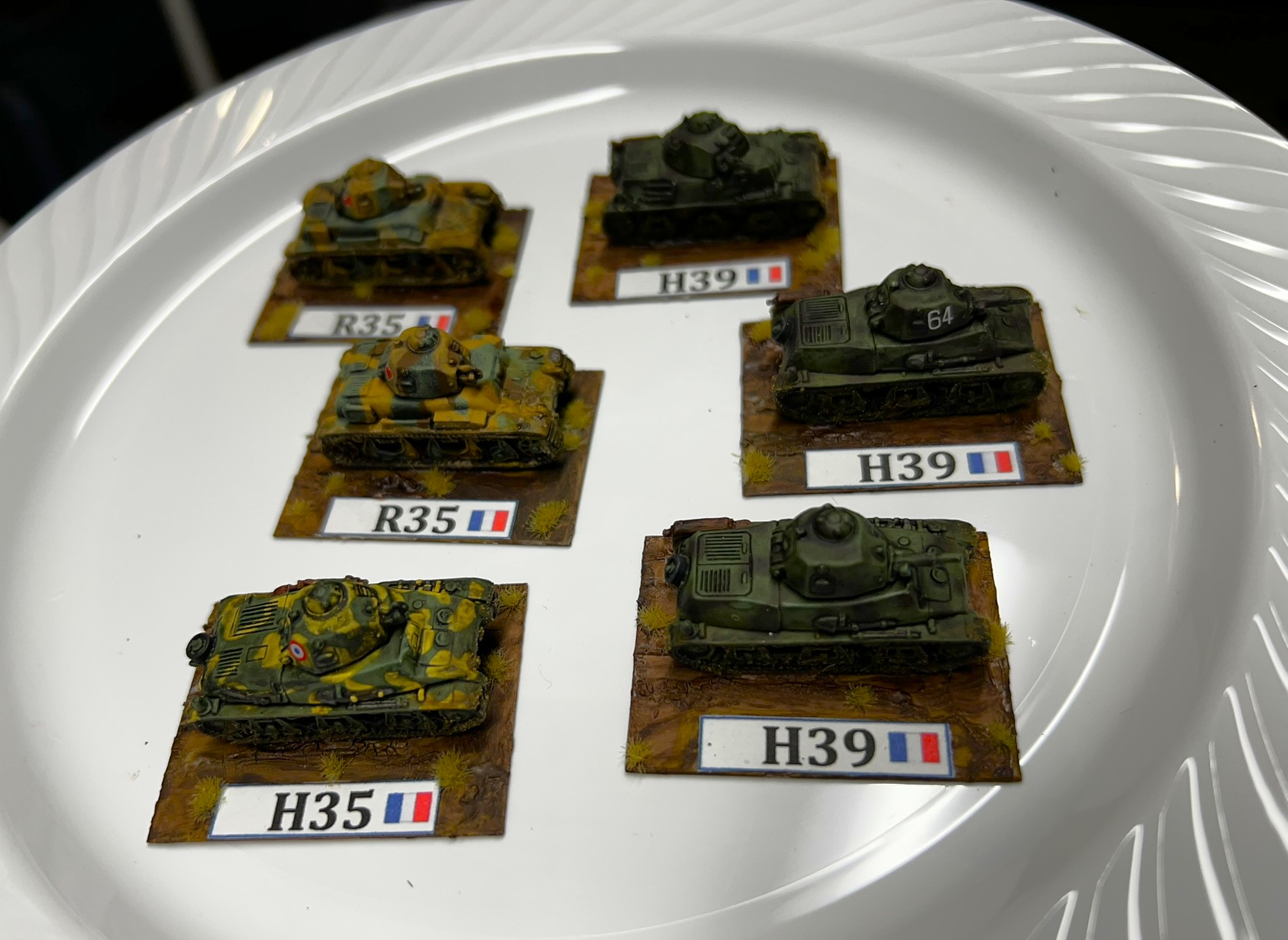
All rebased!

This left me with 6 H35’s to paint to round out the tanks for Vichy (more armored cars would be coming!). As I was also working on many other vehicles at the time, plus running for reelection (I won), plus preparing for and attending HUZZAH, AND prepping for HISTORICON…plus golf…I was BUSY in April, May and even June and July. I am sure that you get the picture, and ironically I have few WIP pictures! But I’ll share what I have.

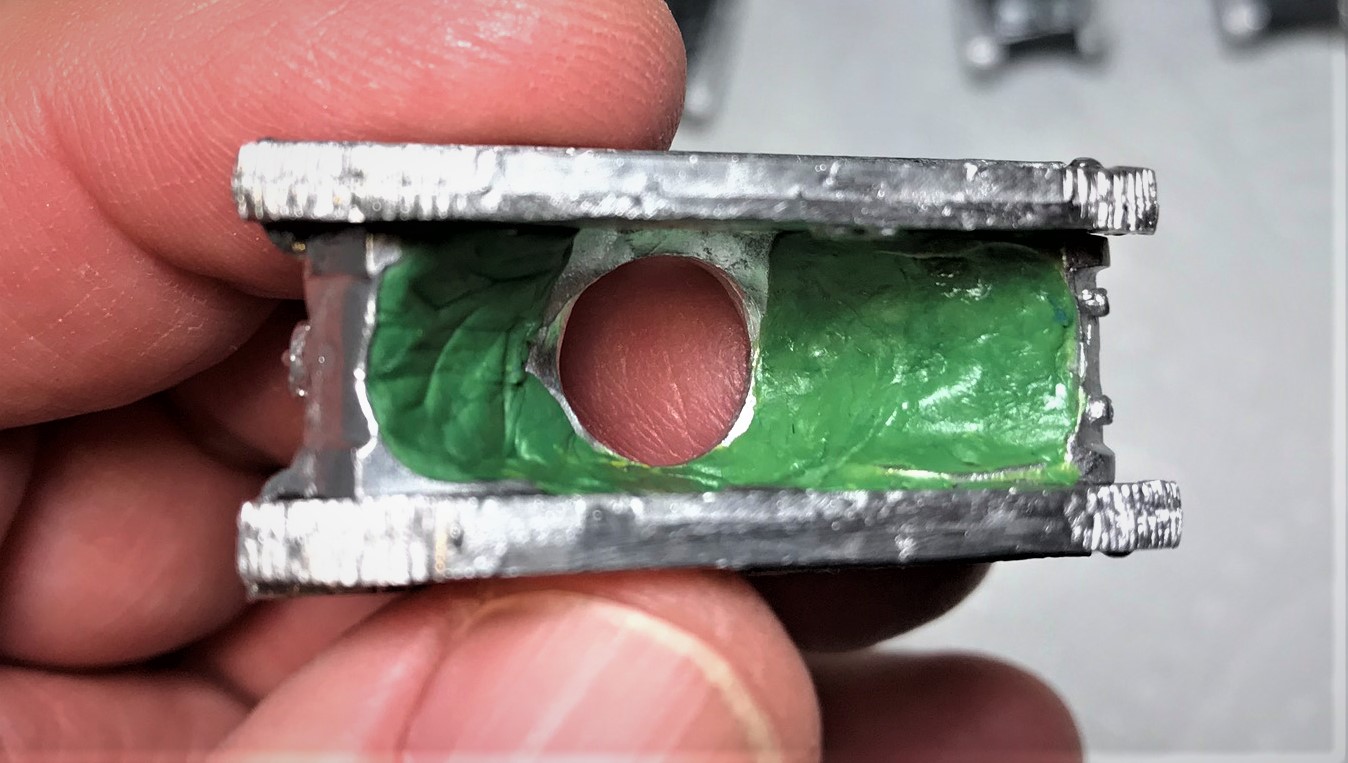
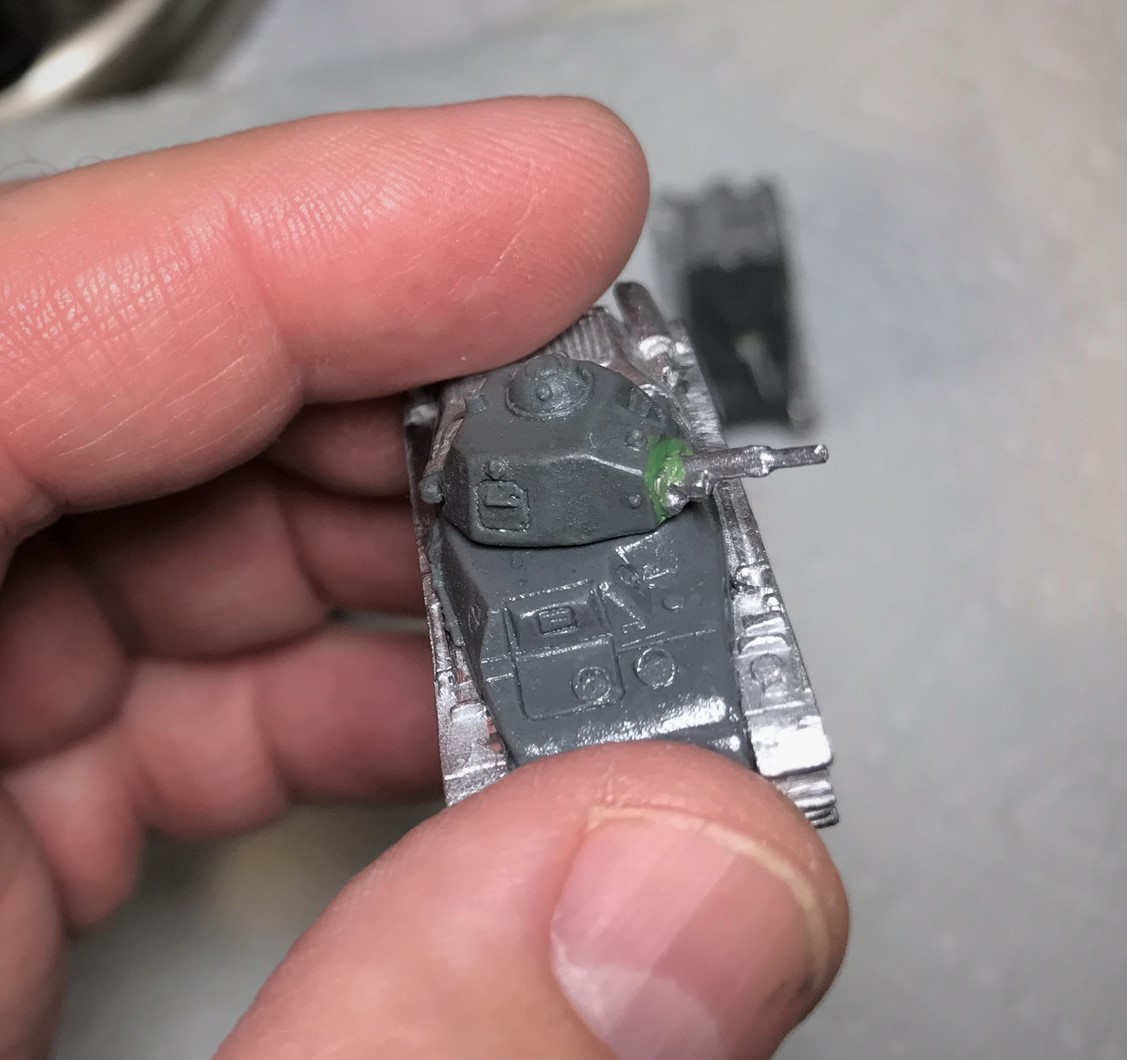
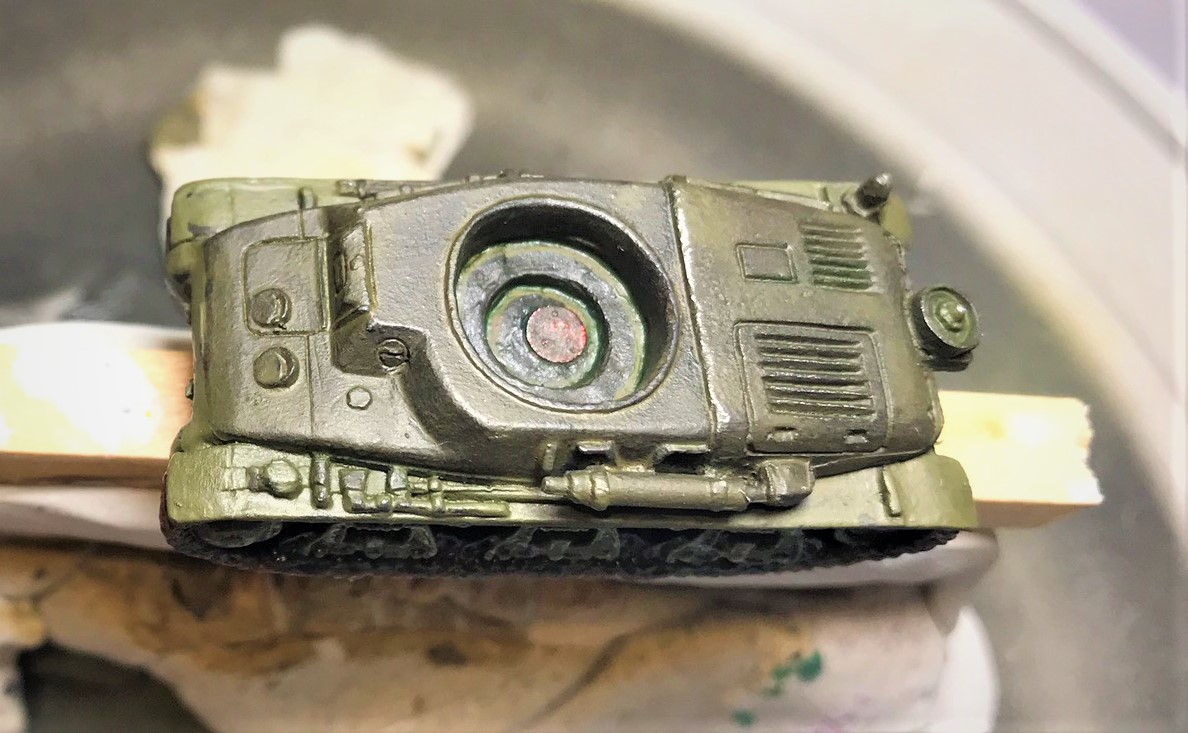
I used neodymium magnets and flat-head nail again to mount the turrets. The two H35 turret prints were slightly different, but I adapted with green stuff.

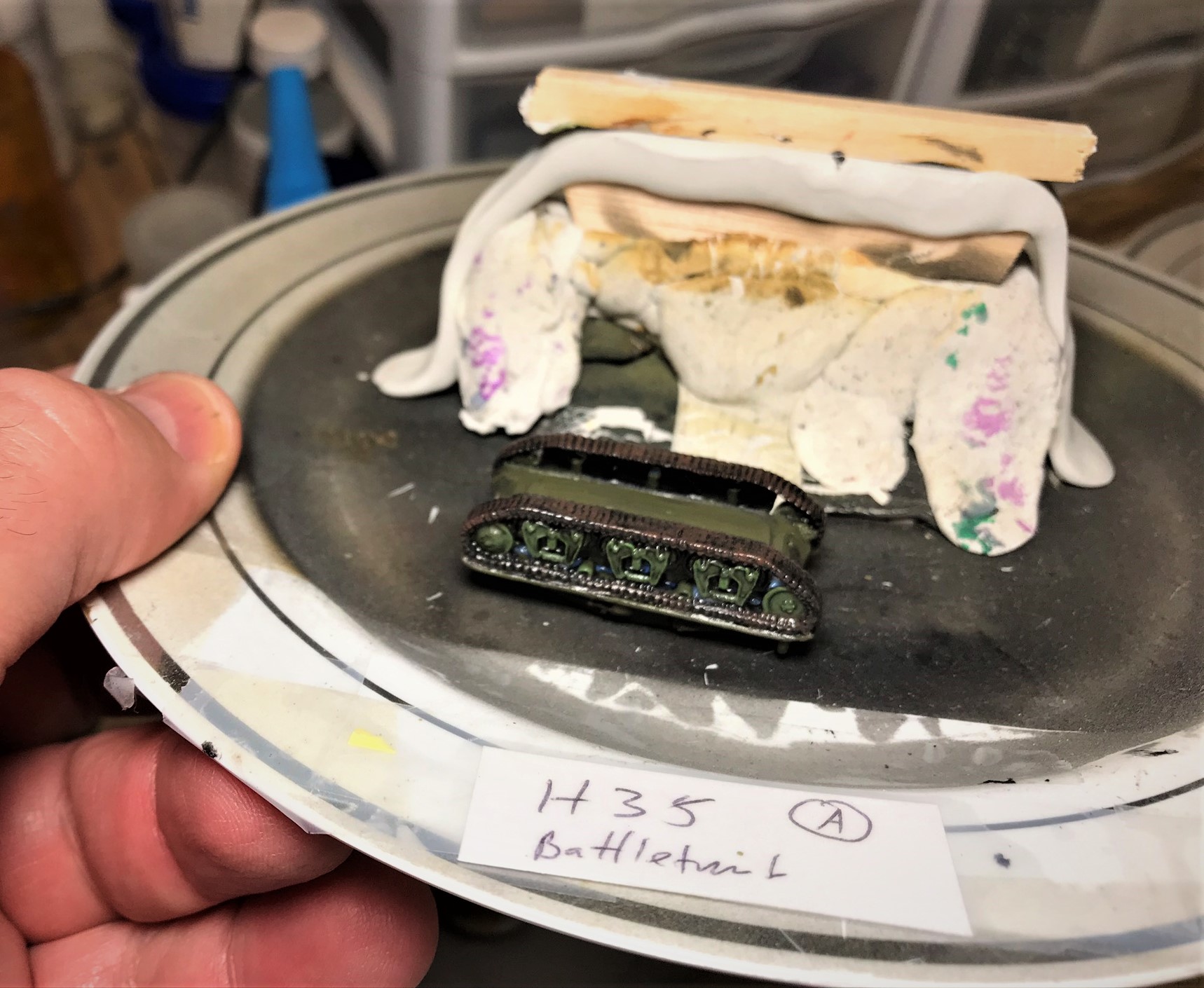
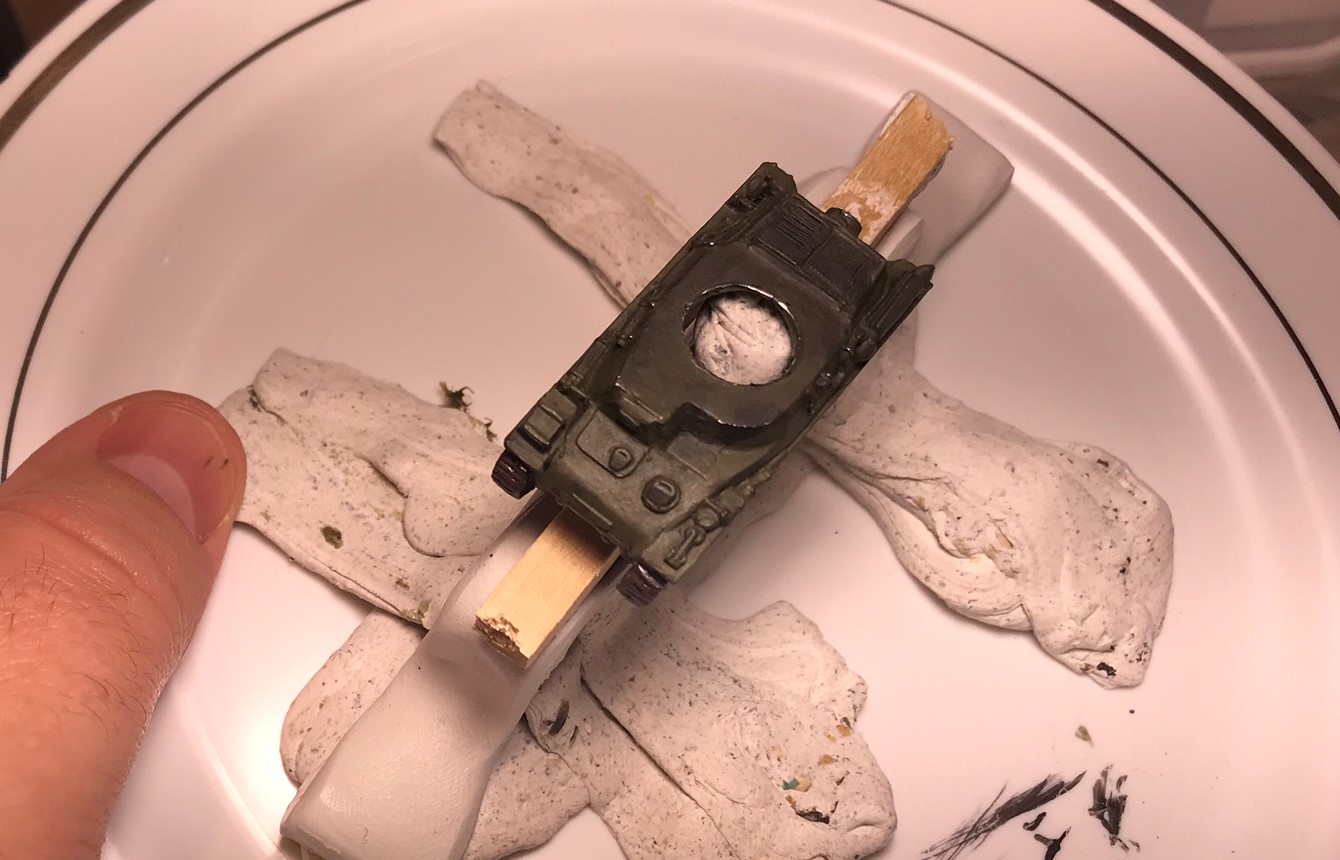
The 6 H35’s primed with the first desert sand color.

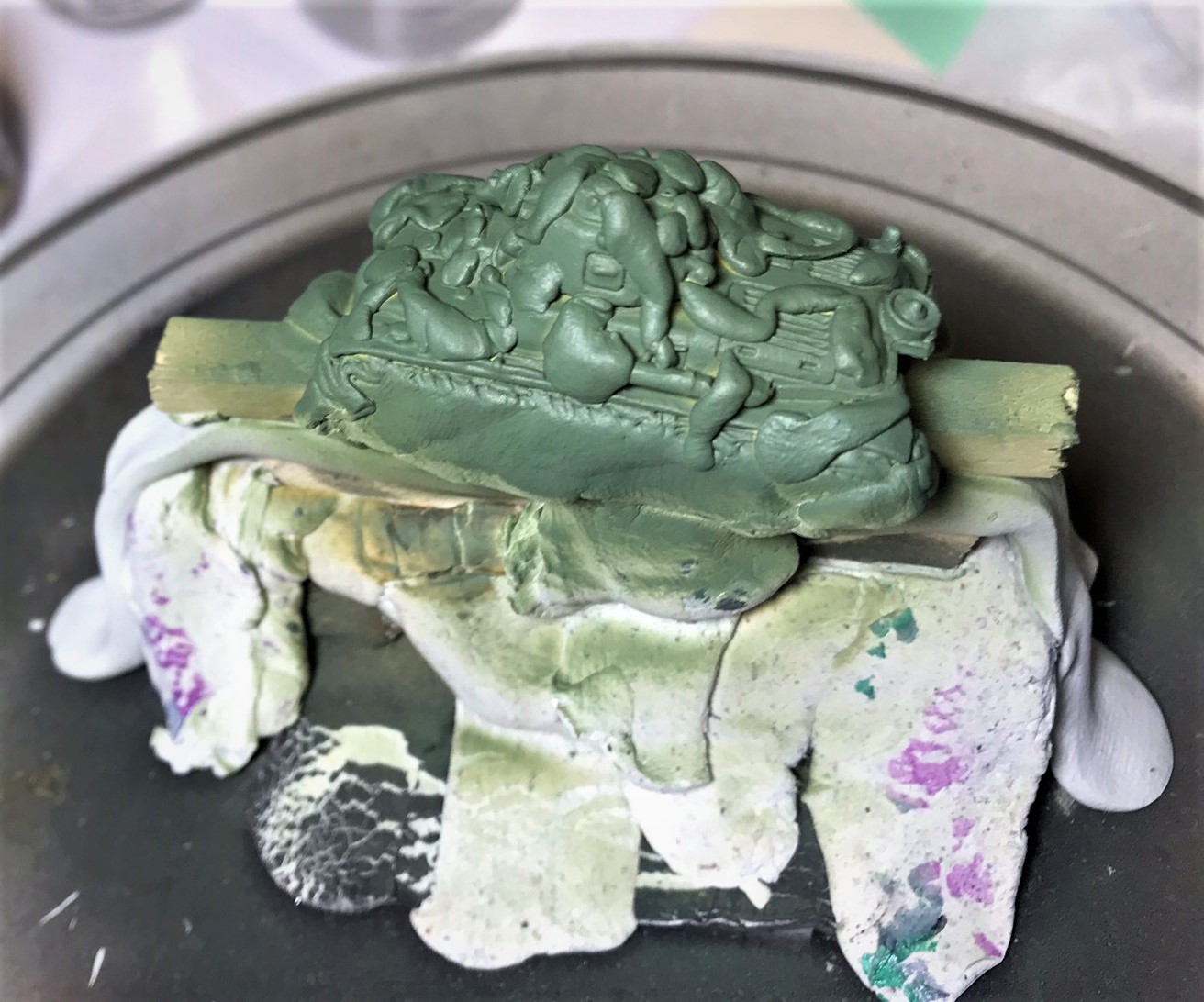
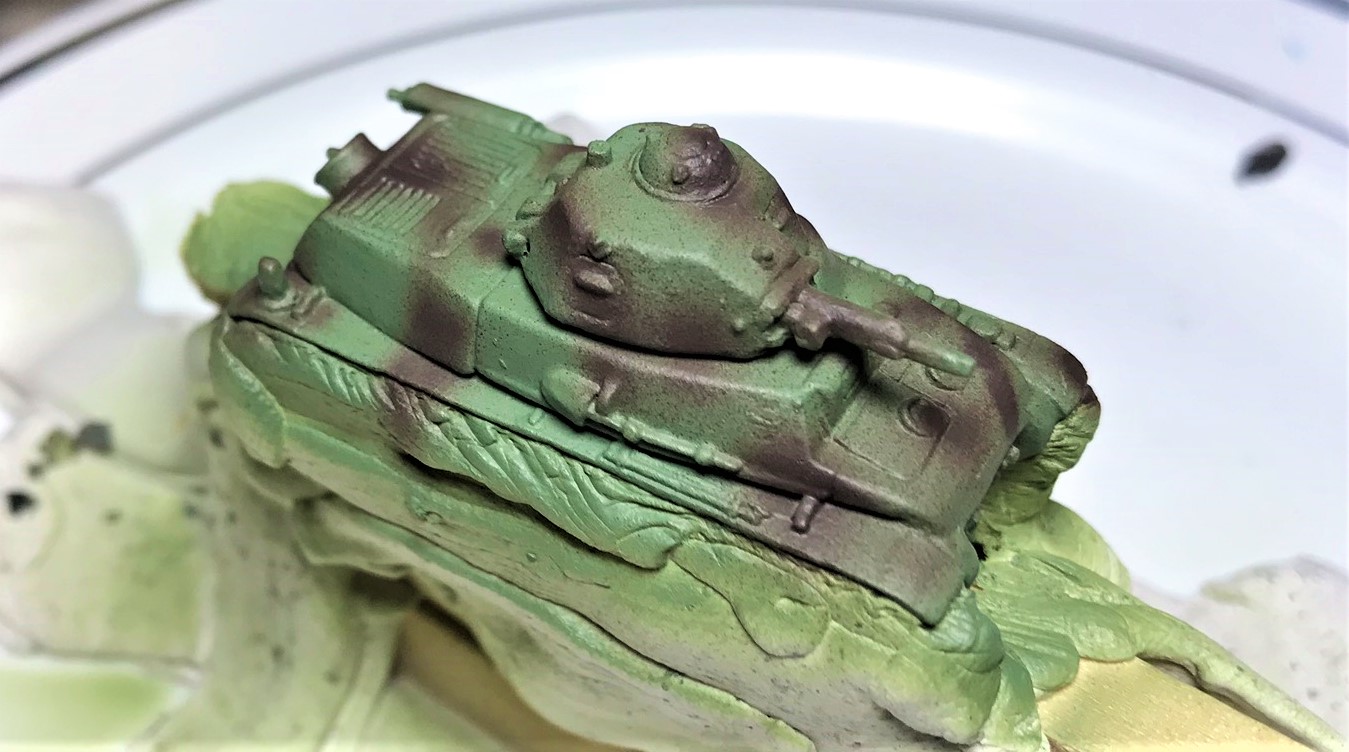
I used poster-tack again for masking/making camouflage patterns over the initial color. I did experiment with using Silly Putty as masking as I had seen someone do that – but it did not work for me. So I went back to what I knew would work – poster tack and touching up afterwards..
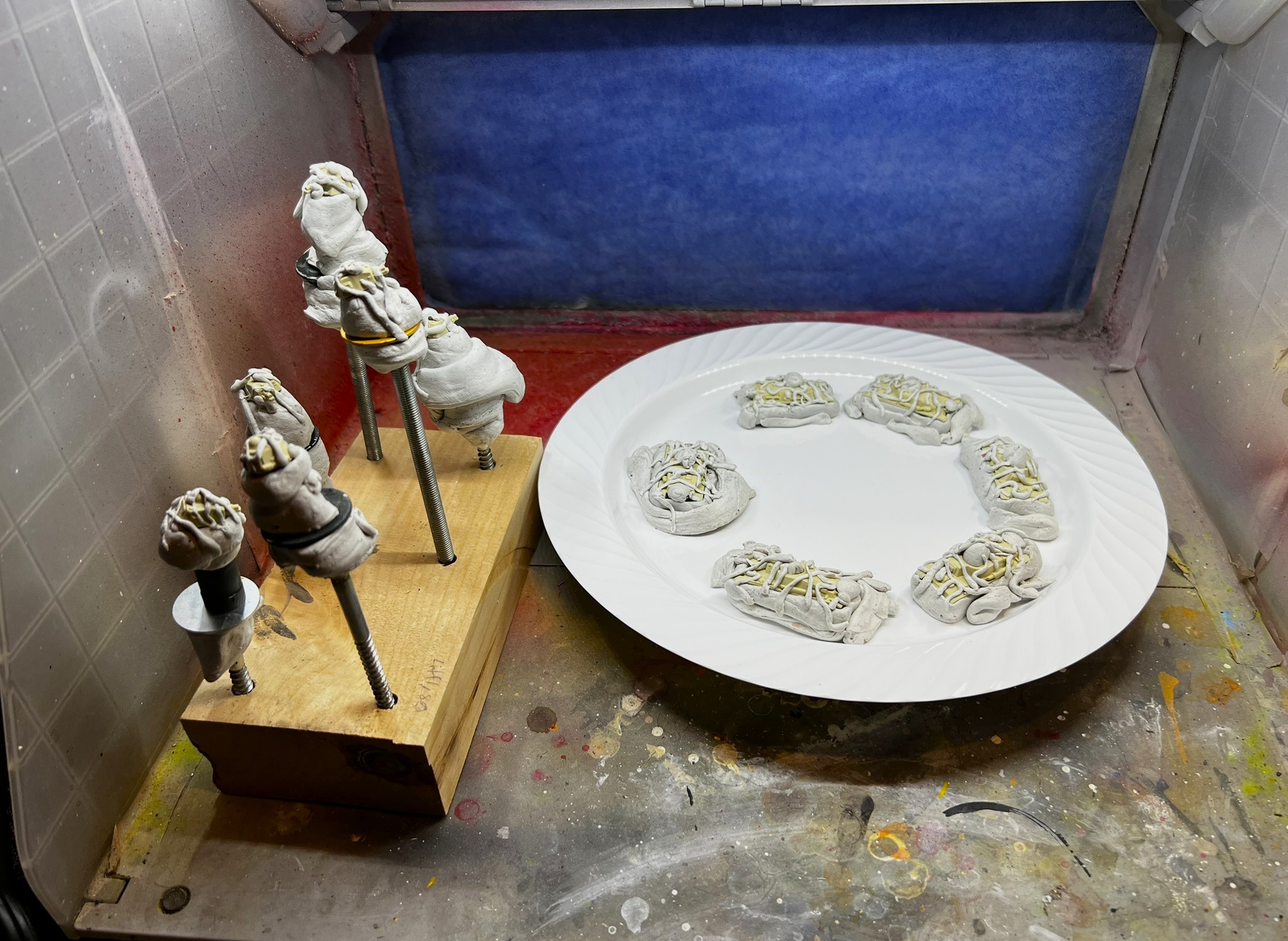
Poster-tack covered!
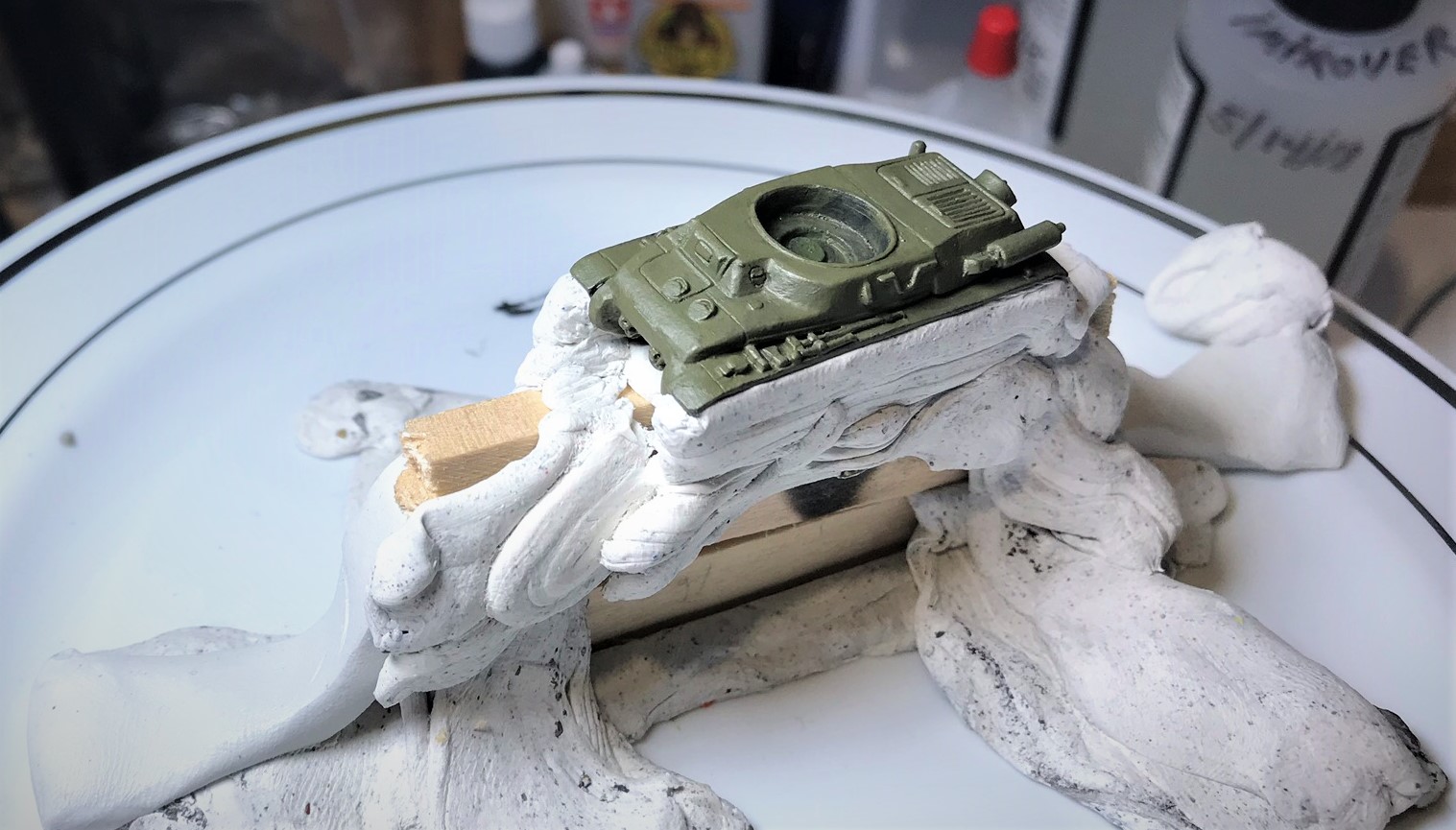
Then I applied a second prime with a NATO Green. Al paints are listed at the end of this post.
Now I had 6 H35’s. The third one from the left is one from an earlier project that I rebased, with the other 5 being new. The yellow is different on that older one, but ok enough I think for a game.

Now, I can share some limited…

Eye Candy

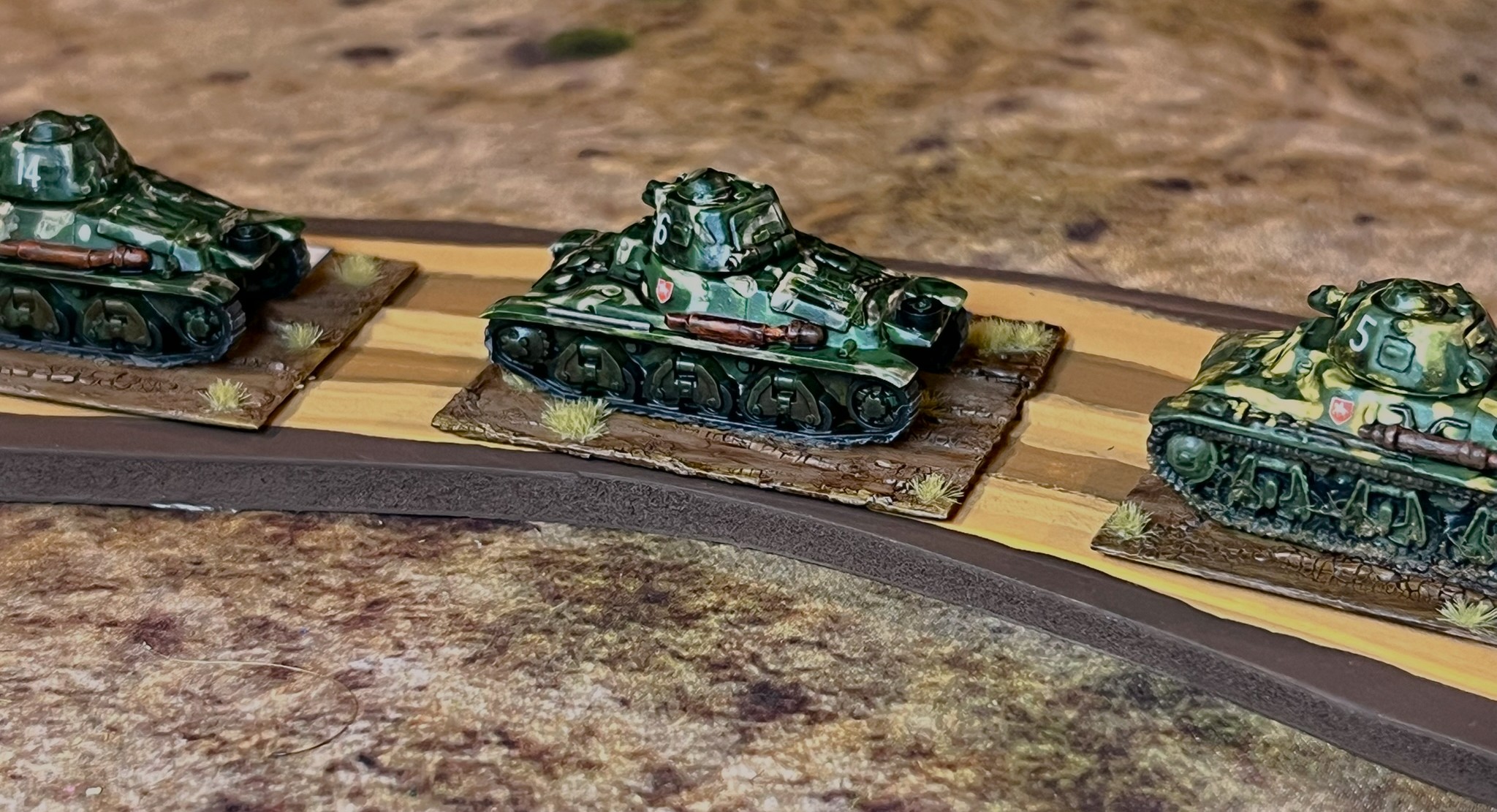
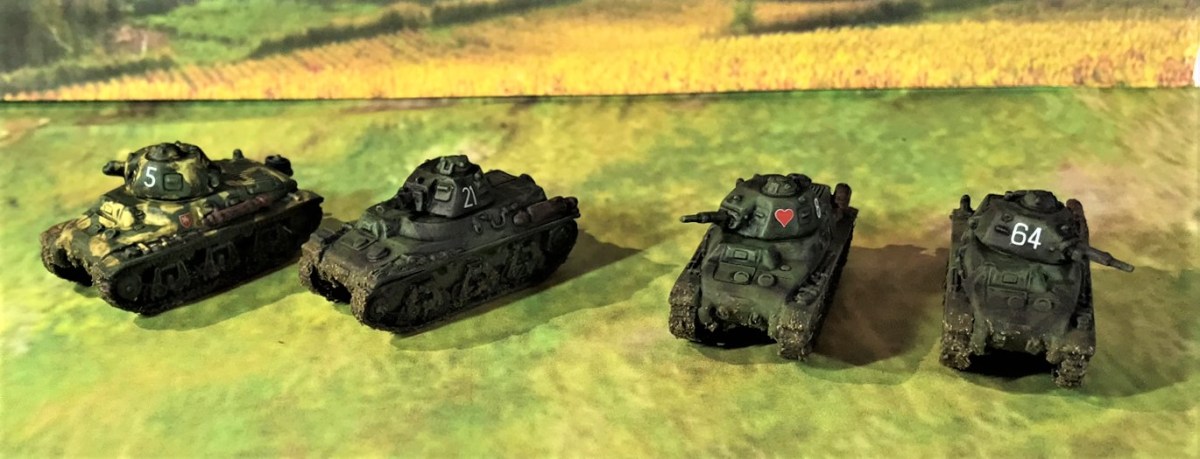
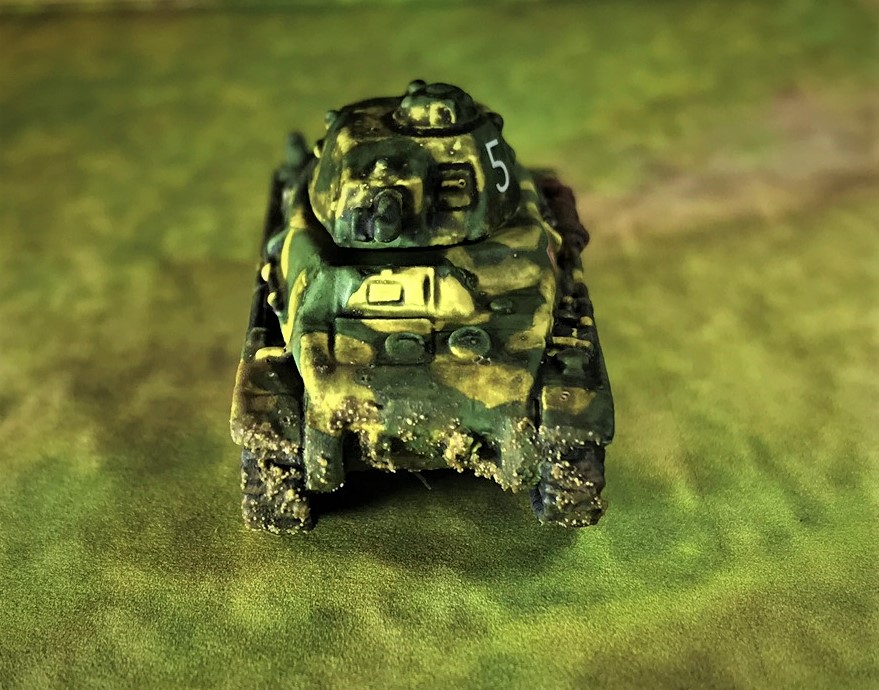
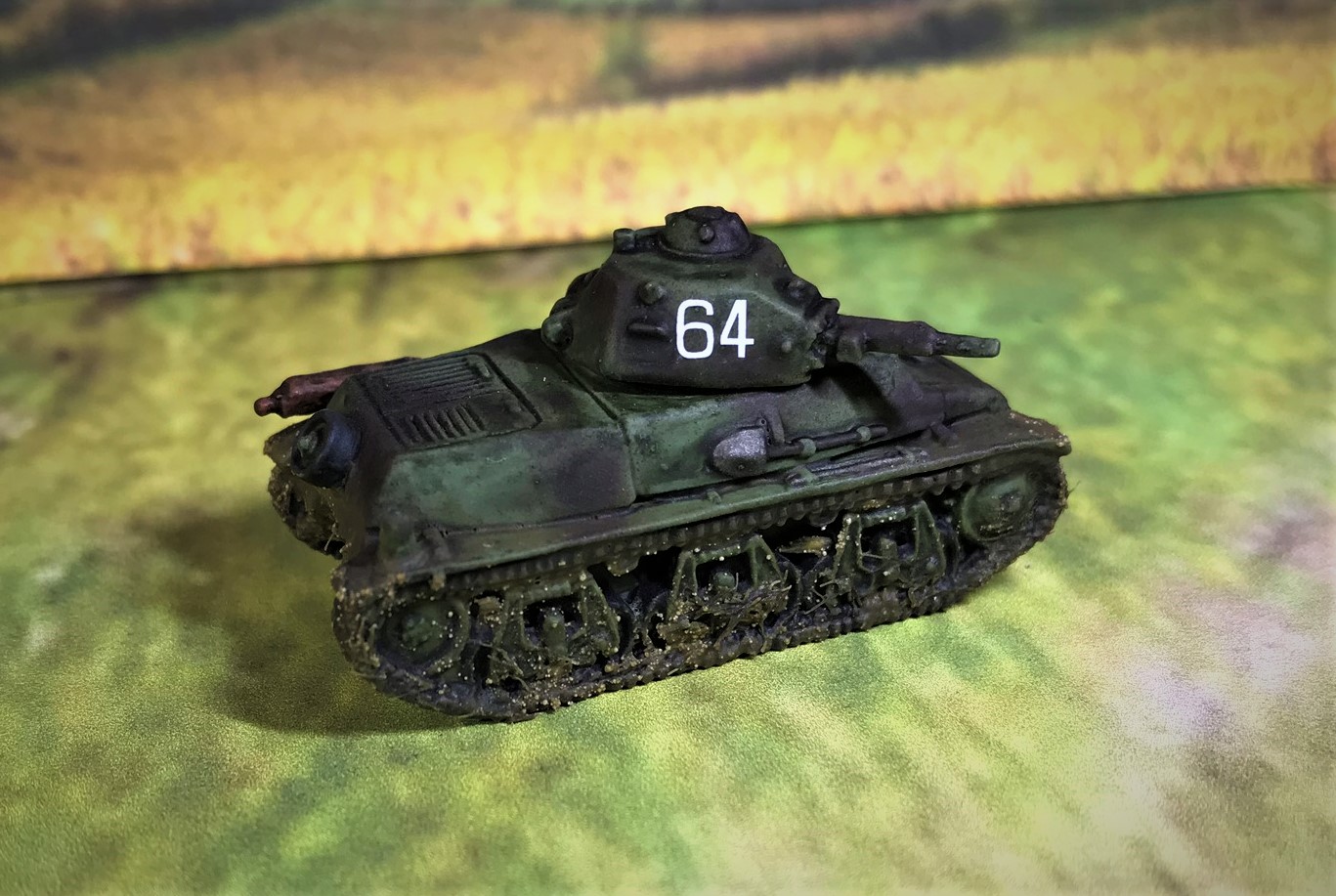
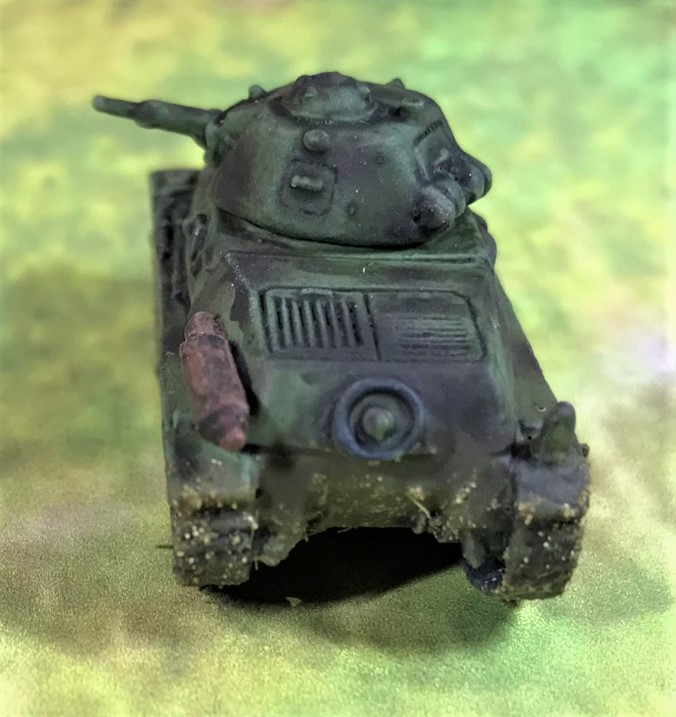
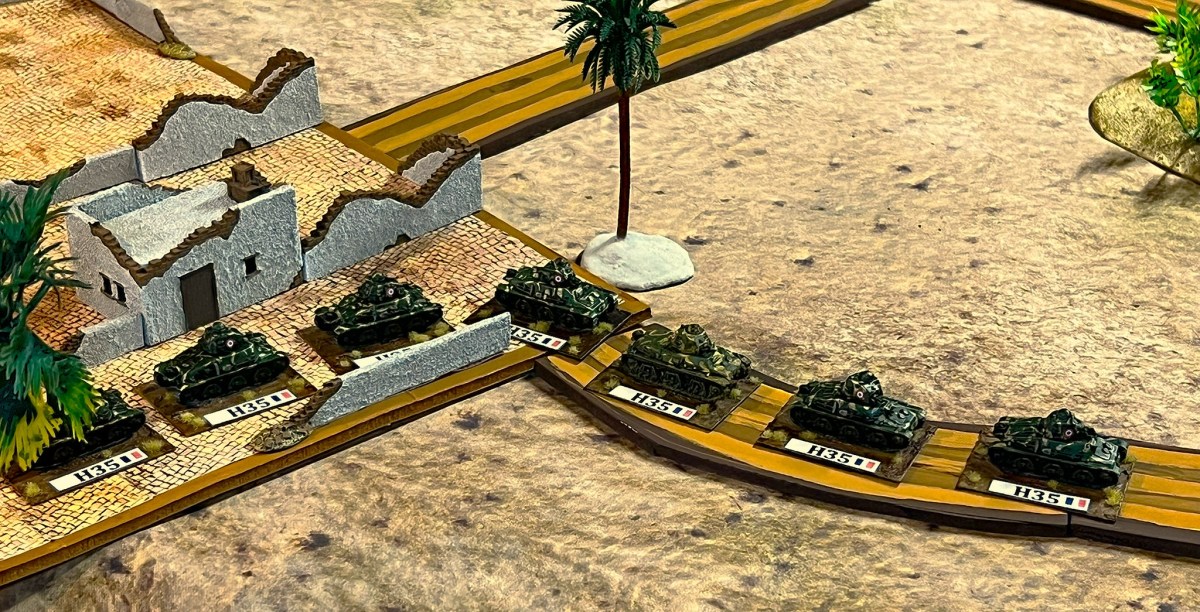
H35’s in column on my game tabletop.
Close up of the H35 column.

I am indeed – as promised – catching up on the posts I have backlogged for my What a Tanker Operation Torch game project- and yes there are more AFV’s to come. I do appreciate you, my readers. Of the eventually-painted 31 Vichy vehicles I had for the game, this brings me up to 24 Vichy combat vehicles that I have covered to date in this blog. I have 8 remaining Vichy armored cars to write about before I get to the USA. Those 8 will be the topic of my next post. Please, if you want, I’d love to hear any feedback – feel free to let me know your thoughts in the comments section.

For all of my posts on WWII games and projects – there is a consolidated list of posts and their links located here.

MATERIALS USED

PAINTS, INKS, GLAZES, SHADES, WASHES, PIGMENTS AND FLOCKING USED ON THESE H35 MODELS:

  1. Green Stuff
  2. War Games Accessories Steel Bases Number 23 (1½” x 2″)
  3. No. 19 x ½” flat head nails
  4. Vallejo Surface Primer “German Green Brown”
  5. Neodymium magnets (¼”)
  6. Gorilla Glue
  7. Wooden Blocks, steel bolts, steel washers, nails, magnets, steel screws
  8. Citadel “Agrellan Earth” (texture)
  9. Vallejo Primers “NATO Green”
  10. Vallejo Surface Primer “Black”
  11. Vallejo Primers “Desert Tan”
  12. Vallejo Surface Primer “German Green Brown”
  13. Reaper MSP Core Colors “Blackened Brown”
  14. Army Painter “Mid Brown” (shade/wash)
  15. Vallejo Mecha Color “Dark Steel”
  16. Battlefront “Oxide Red”
  17. Reaper MSP “Carrot Top Red”
  18. Army Painter Speed Paint 1.0 “Dark Wood”
  19. Army Painter “Dark Tone” (wash)
  20. Vallejo Mecha Weathering Effects “Dark Rust Wash”
  21. Vallejo Model Air “Tire Black”
  22. Vallejo Model Color “Dark Sea Grey”
  23. Vallejo “Mecha Varnish Gloss”
  24. Microscale Industries “Micro Set”
  25. Microscale Industries “Micro Sol”
  26. Microscale Industries “Liquid Decal Film”
  27. Flames of War French Decal Set (FR940)
  28. Peddinghaus-Decals 1/100 2181 “World of Flames French tanks early war”
  29. Citadel “‘Ardcoat”
  30. Vallejo “Gloss Acrylic Varnish”
  31. Citadel “Agrellan Earth” (texture)
  32. Army Painter “Mid Brown” (shade/wash)
  33. Reaper MSP Core Colors “Blackened Brown”
  34. Vallejo Flow Improver
  35. Vallejo Thinner
  36. Vallejo “Matte Polyurethane Varnish”
  37. Printed labels on card stock
  38. Gamers Grass “Tiny Beige 2mm Tufts” (flocking)
  39. PVA Glue

Operation Torch: Planning My WWII Gaming Experience for HISTORICON

It’s been a while for the return of several blog-related things here.

First, this marks the first hobby post I have done in a while. The last one I did was on Professor Nitpik’s Mechanical Mini Swarm back in April. I also never got around to a recap of my games at HUZZAH in May (but I hope to at some point as I do have a good number of photos).

Secondly, I have not done any WWII-related hobby work since March of 2020 (wow 5 years!). After my last What a Tanker tank project, I did a lot with my Feudal Patrol Mesoamerican project (Aztecs, Conquistadors, Maya), and then Wars of Ozz. Luckily for me (and maybe you), I catalog and link all my posts by genre on multiple pages for easy recall. As an aside, for new readers, here are the links for all of these:

There are others as well, and these pages help me to remember how I did certain aspects of projects in terms of painting and assembly (and anything else).

Additionally, as many of you know, the US Army is celebrating its 250th Anniversary. The Historical Miniatures Gaming Society (HMGS) is celebrating that anniversary as its theme for this year’s HISTORICON gaming convention. As a proud US Army veteran, I just HAD to get a game or two together for it. As game submission was back in March, that might seem like plenty of time to get such an endeavor together. But I had HAVOC, HUZZAH, a Florida trip, my reelection, and golf in between then and now! Blogging took a back seat to actually finishing off any projects. Until now!

I usually try to create scenarios and run games that are not common or run-of-the-mill. For the US Army, there is a wide swath of stuff to choose from.

I ended up deciding on looking into the early days of WWII. I dug into Operation Torch, the Allied invasion of North Africa. I further read up on the combat in Morocco, where the US and Vichy France actually fought for several days before agreeing to an armistice and coming over to the Allies’ side. I chose to focus on the Western Task Force under then-MG George S. Patton, that invaded Morocco in three places. My specific focus would be on Sub-Task Force Goalpost, which was led by MG Lucien Truscott, Jr. – and what really intrigued me, as I did my research, was his response to a Vichy armored counterattack. Apparently the Vichy French launched an armored counterattack with what they had to interdict one of the US landing beaches. Truscott sent all his armor (7 M5 Stuart tanks) and some support to stop the threat, which outnumbered him by more than 2:1. Now I had a game concept!

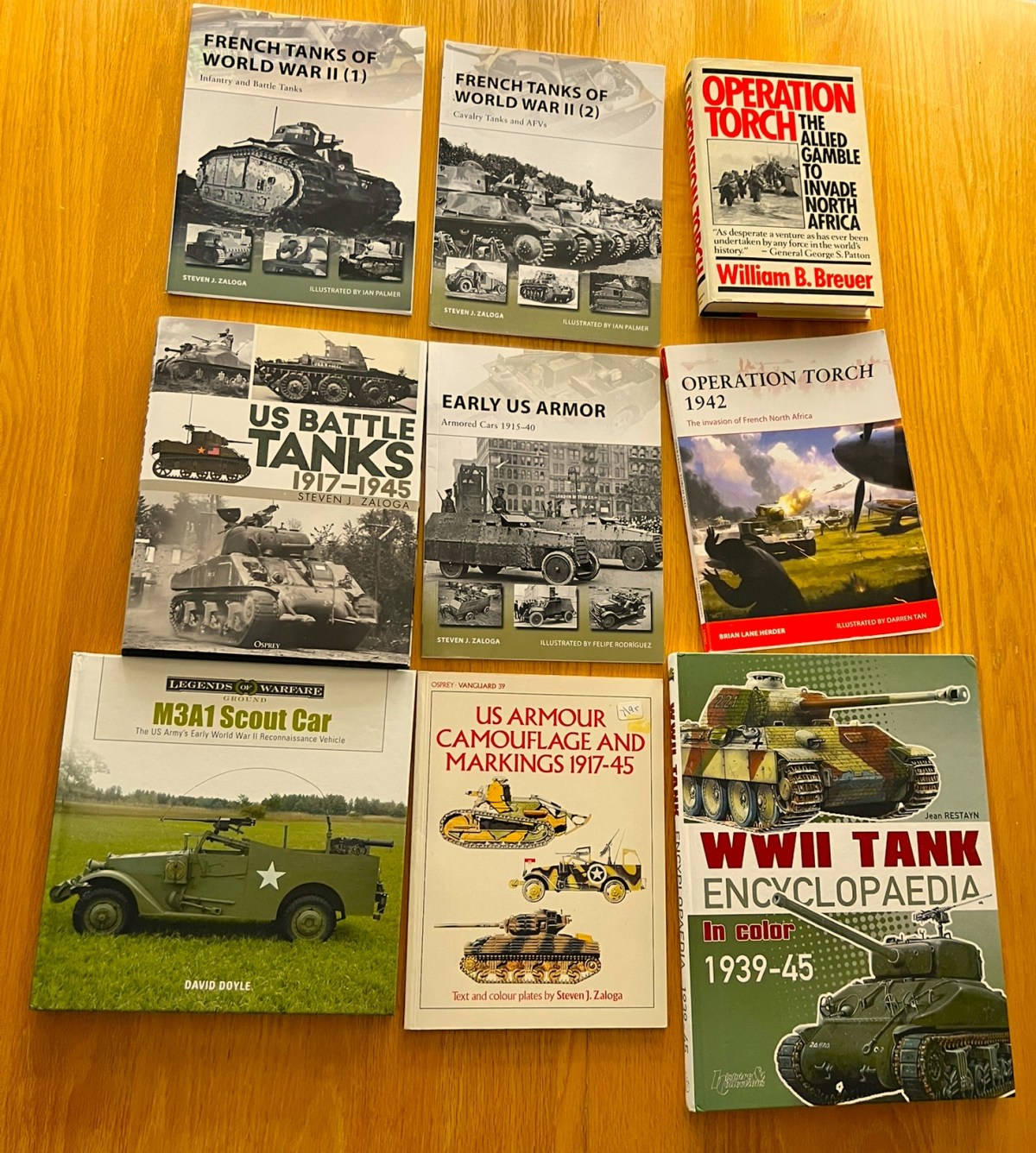
As for research, here are all the books I read and used:

Certainly a lot of Steven Zaloga here, and the Breuer and Osprey books were the most helpful. There indeed was significant armored Vichy forces in the North African colonies. In Morocco was a motley assortment of tanks (WWI -era FT-17’s, Hotchkiss H35’s and H39’s, plus some R35’s that had been hidden from the German and Italian Armistice Commission). Sources vary as to what was available, but certainly these types were in Morocco in November 1942. There also were multiple old armored cars dating back to the 1920’s and early 1930’s. Vichy also had naval assets there, plus any of their air force that had flown there to escape Armistice terms. A good number of Dewoitine D.520 fighter planes and others made up a strong air component for Vichy.

The US here did not have M3 Lee’s or M4 Sherman tanks available to stop he counterattack. Those were on large ships that needed a port to unload, unlike the M5 Stuarts. The US had the Stuarts, M3 GMC’s, M3A1 Scout Cars, and the weird stopgap M6 Fargo. On the other side, the US had F4F Wildcats and Avenger TBF’s. Offshore were these significant naval assets that I would also add to the game design. Interestingly, many French tanks were hit with impact-fused depth charges from the air – plus naval gunfire from the USS Savannah.

The US Army in November 1942 was seeing its first real amphibious landing and combat in the ETO, so I incorporated that with regards to their shooting abilities. The Stuarts had gotten their radios wet, and hence inoperable, in the landing – so that was another aspect I added. The French had a lot of very worn out vehicles, and I did add an aspect of mechanical unreliability to them as well.

With these equipments as my baseline, I resurrected my WaT rules. Sourcing all of the vehicles took time, and I will chronicle each of the types in successive posts. My thought is that its better to focus on each vehicle type with a short post than a massive one now that blurred the lines. Writing all of these will take some time, and I also hope to share a review of my HISTORICON 2025 experience. If you are at the convention, I will be in the H.A.W.K.’s room as below. While my games are “sold out”, you never know if space becomes available! Besides my two Ozz games on Thursday and Friday, I’ll be running the “Operation Torch: Vichy mounts a Counterattack” game twice on Saturday. Come by!

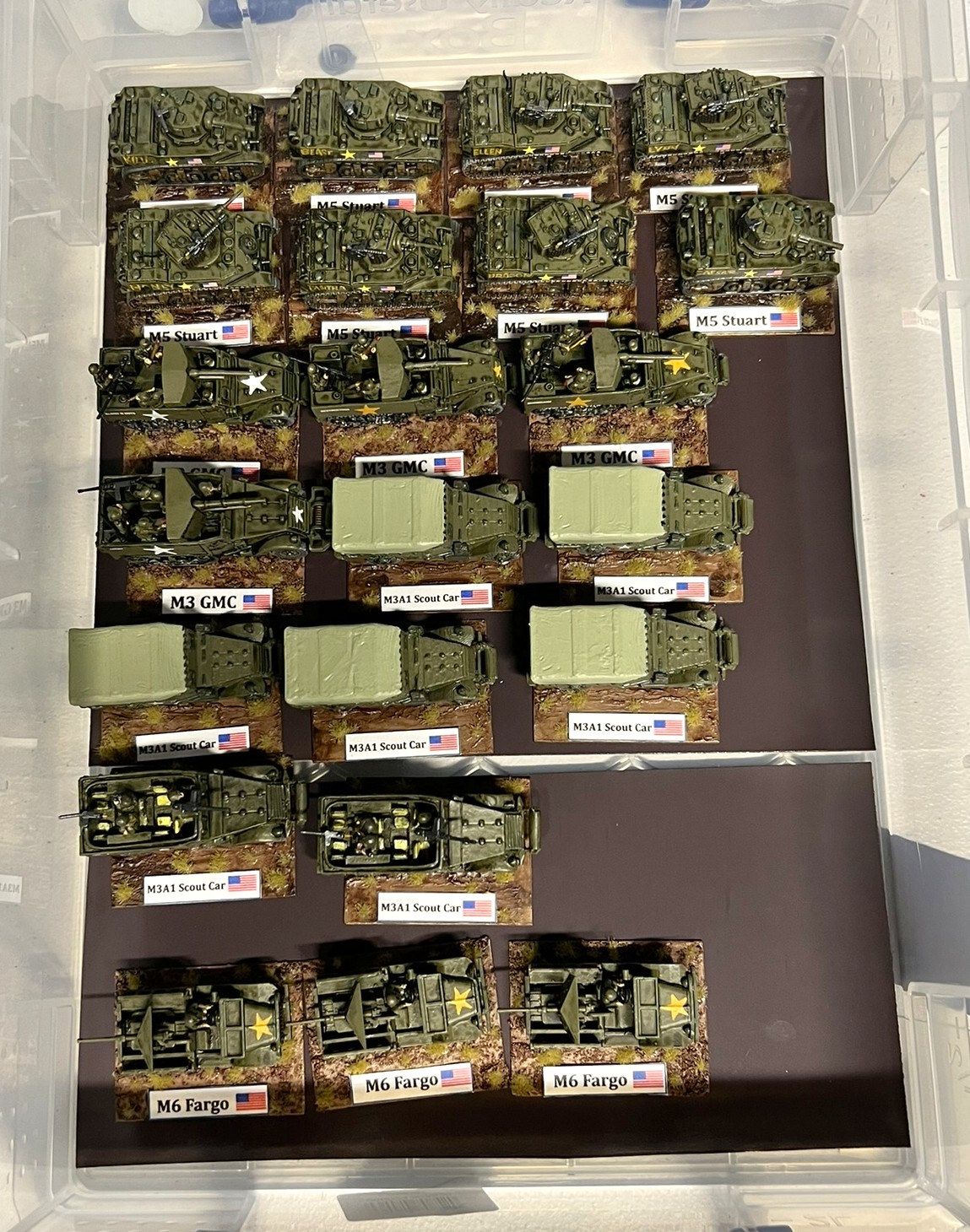
Here is a tease on the 31 French and 22 American vehicles that I have amassed and painted for the game since March. All are 15 mm/1:100 scale. They will get their own posts in the next few weeks (I hope).

Vichy French Vehicles
US Vehicles for the game

I do want to join in a couple of painting challenges – like Fort Syllabub’s “Jagpanther Juni”, and Dave’s annual “Season of Scenery” at Wargames Terrain Workshop. With HISTORICON looming, my hope is to get these individual posts out as I can. It is golf season…

Plus I have MANY of my fellow blogger’s posts to catch up on – I have been reading them and there is some great work out there!

I hope I’ve piqued your interests! Let me know!

My WWII posts master list is again here for your enjoyment.

Until next post!

French Armor for the 80th Anniversary of the Battle of France: Hotchkiss H35 and H39 Light Cavalry Tanks

Amazingly, this upcoming May-June 2020 will mark the 80th anniversary of the Battle of France.  I am curious as to how it will be remembered – if at all.  Certainly I would think that both the French and the Germans will likely shy away from commemorating the event for diametrically opposed reasons.  Yet, it is definitely worth remembering it as a seminal event that without question fashioned all of the world’s history since.

I have studied this battle since my days at West Point.  I was fortunate there to study with the then-USMA Department of History Chair COL Robert A. Doughty (now a retired Brigadier General).  I was able to participate in a class (HI498 – a colloquium) with him and just one other cadet during my second semester senior year as part of my concentration of studies in French.  A side note – my class – 1984 – was the last class not to have majors – we had concentrations.  This meant we could choose 8 classes outside of the 44 classes in the core curriculum.  As I love military history, especially French military history, this colloquium was a great opportunity.  We studied Alistair Horne’s works among others.

BG Doughty has authored many books (just check out this list on Amazon), many that focus on France from WWI to WWII.  I recently got two excellent books on the subject that he published after I graduated that I have not read: The Seeds of Disaster: The Development of French Army Doctrine, 1919-39, (which discusses how the French Army came to set themselves up for disaster) and The Breaking Point  (dealing with the pivotal Sedan breakthrough in 1940).  I also plan on rereading Alistair Horne’s To Lose a Battle: France 1940 as well.

The reason for all this reading and research is (well, besides for pure pleasure) to prepare myself to be fully knowledgeable ready to run several tank battle games set in France in May-June 1940 using the What a Tanker© rules.  Obviously, the games will be, at best, an abstraction of what happened.  However, I wanted to have requisite knowledge of the battle and to prepare and build suitable models for both sides to give a proper flavor to the conflict that shocked the world.  I did get an A- in the colloquium, but that was 35½ years ago, I want to refresh!

Previously, I have built French and German tanks and run several France 1940 games described in this blog – but my 15mm/1:100 scale tank inventory was quite lacking in terms of the wide variety of vehicles used.  I aim to remedy that.  I am currently planning on running a game at TotalCon in February, and at HAVOC in April.  I may do others as well, plus club gaming sessions.  This blog post describes the first chapter of my preparation and force building upgrades for those events – four Hotchkiss light cavalry tanks (one H35 and three H39’s).

I will go over a bit of history of the Hotchkiss tanks and then show some WIP shots of the models.  I will then share some eye-candy shots of the finished models.  Lastly, as per usual, I will share the paints and materials used in this project.

The H35 tank was originally rejected by the infantry, who chose the R35 instead.  It was intended to be a light cavalry tank, though it did equip some infantry tank units as well.  Hotchkiss built around 1200 H35’s and H39’s, with the majority being H35’s.  The Hotchkiss company was actually founded by an American from Connecticut, Benjamin Hotchkiss.  He was a Union ordnance engineer at Colt and a munitions builder during the American Civil War.  Finding no US business after that conflict, he moved to France and set up his own company.

The H35 and H39 both had the same  37mm SA18 gun that many French tanks had though the H39 had a longer barrel with better armor penetration (30mm vs 23mm of armor with the shorter barrel).  Given that a Panzer IIIE of the time had 30mm of armor all around, this was not adequate to be sure.  It had a crew of just two, which made it challenging to operate effectively in battle.  Three out of four of the armored divisions’ tank regiments had Hotchkiss tanks (the other one had SOMUA S35’s).  The armor was adequate, but with a range of only 80 miles and a top speed of 17 mph, it was not very cavalry-like.  On top of it all, it was tough to drive and mechanically unreliable.

After France capitulated, both Germany and Italy got Hotchkiss tanks.  Some of these Italian vehicles faced US Army Rangers in Sicily.  After the war, some Hotchkiss tanks served on with the Israeli Defense Force until 1952.

I acquired a 3-vehicle packet from Battlefront Miniatures (#FR020) and one single H39 vehicle from Peter Pig (#PP33).  The Battlefront ones could be either H35’s or H39’s.  In the end, one of the H35 guns was unsatisfactory, so I ended up with one H35 and three H39’s.  In the game, there are no differences statistically between the two types.

1 Hotchkiss tanks at start
Here are the models – the Peter Pig one was all metal.  The Battlefront ones had two different engine hatches depending on what version was to be built.  These were relatively easy to assemble and prep for painting.

2 Hotchkiss tanks assembled
Assembled and magnetized Hotchkiss tanks.  From left to right, Peter Pig H39, Battlefront H35, and two Battlefront H39’s.  

3 H35 assembled
The Battlefront H35 gun was drilled in and affixed with Gorilla Glue.  Later, the drill holes were filled with kneadatite (green stuff).

4 H39 Bottom Peter Pig assembled
The bottom of the Peter Pig H39 model.  For reinforcement of the tracks, I added green stuff under the chassis.  I also added a magnet to the inside of the turret so my knocked out tank blast markers would stick to an otherwise non-magnetic model.

5 H39 Battlefront assembled
H39 showing green stuff around the longer gun.

6 Hotchkiss tank chassis painting mounts
My mounting arrangement for the tanks.  I did paint and varnish the tracks first.

7 Hotchkiss tank turrets painting mounts
Turrets ready to paint.

8 Tracks first!
This shows the H35 after the tracks were painted, washed, and lightly varnished.

9 Double Primed showing metal exposure
Then the models were mounted and primed.  I had a challenge priming the exposed metal parts as you see here – I needed a few thin coats.

9a Double Primed showing metal exposure
The priming issue (exposed metal) was more difficult for the Peter Pig model as it was all metal.

10 H35 masked for airbrush
After priming, the H35 awaits set up for base coat painting.  Protecting the already painted tracks with poster tack was the first step.

11 H35 masked for airbrush camo
I was not thrilled with the yellow, but I darkened it.  Here, I applied more poster tack to apply a camouflage pattern.

12 H39 masked for airbrush camo
The H39’s got their base coats, and then I used an Iwata Micron airbrush to blend in some browns on the green.  As I researched tanks of this era on the French side, I found that there was no standardization of tank painting schemes.

13 H35 masked for airbrush camo after
The H35 under the poster tack for a camouflage scheme.  

14 H39 close up after camo
The Peter Pig H39 model showing the added brown color airbrushed across the tank.

15 H35 close up after camo
After removing the poster tack from the H35, this was the result.  

16 H39 close up before decals and weathering
I then washed the vehicles with Army Painter Military Shader.  All that was left was adding decals, weathering, and final varnishing.

18 Tiny decals
Battlefront decals – so tiny.  I still do not understand why the roundels are two piece decals.

Now, I would like to share the finished vehicles – eye candy (at least I hope you find them nice to look at).

Battlefront H35

1 H35 left side
Right side view, Battlefront H35

2 H35 frontside
Front view, Battlefront H35

3 H35 right side
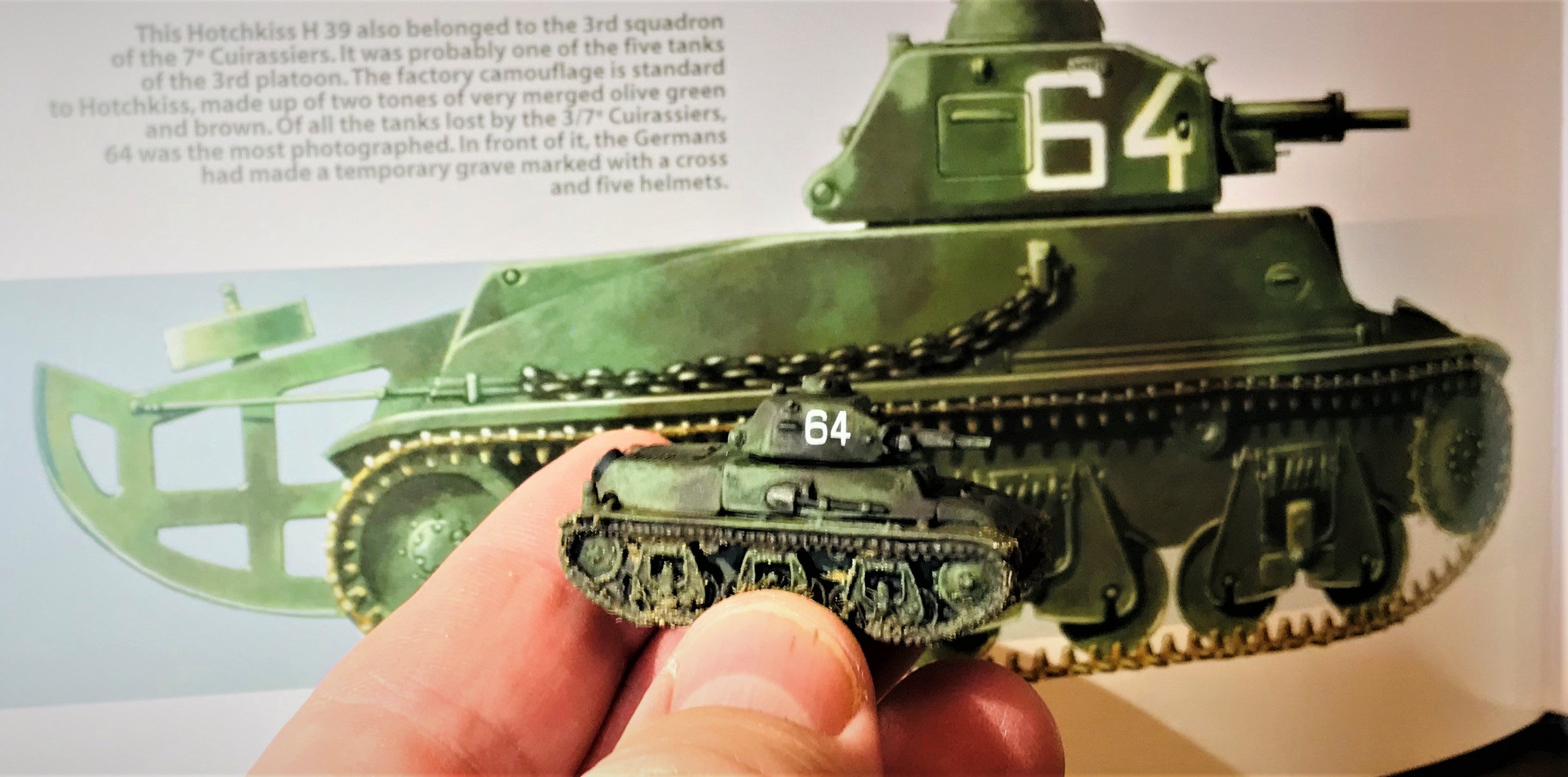
Left side view of the H35.  The number is helpful for tabletop ID, but is historically correct.  The unit insignia is from the 4eme regiment de cuirassiers, part of the 1st Light Mechanized Division (DLM).

4 H35 rear view
The roundel on the back right.   

1a H35 left side
How I planned the paint job – I am hoping to get better tan/yellow tan paint for future French use, but after washing/shading, I think this is fine.  Do you?

Battlefront H39’s (two)

5 H39 (B model) left side
Battlefront H39 “#8” left side.  

6 H39 (B model) left front side
Battlefront H39 “#8” left front side.

7 H39 (B model) left rear side
Battlefront H39 “#8” rear view.

8 H39 (B model) right side
Battlefront H39 “#8” right side.

5b H39 (B model) left side
My plan for the “#8”.

12 H39 (D model) right side
Battlefront H39 “#64” left side.  This was the only Hotchkiss tank I built with a number on the right side of the turret.  Again, markings were definitely not standardized.

13 H39 (D model) right front side
Battlefront H39 “#64” right front side.

14 H39 (D model) left side
Battlefront H39 “#64” right side.

15 H39 (D model) rear view
Battlefront H39 “#64” rear view.

12a H39 (D model) right side
How I modeled the vehicle.

Peter Pig H39

9 H39 (C model) left front side
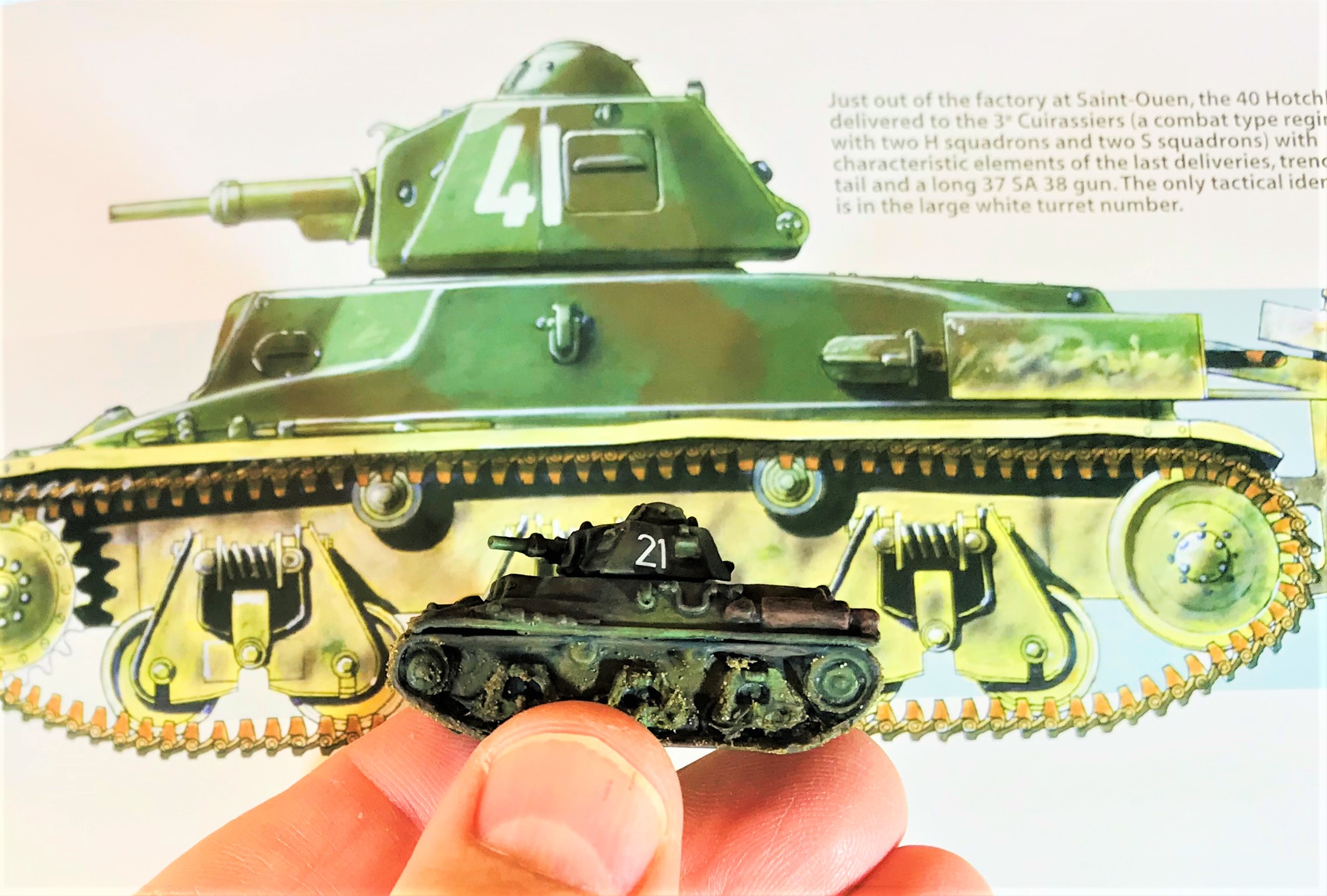
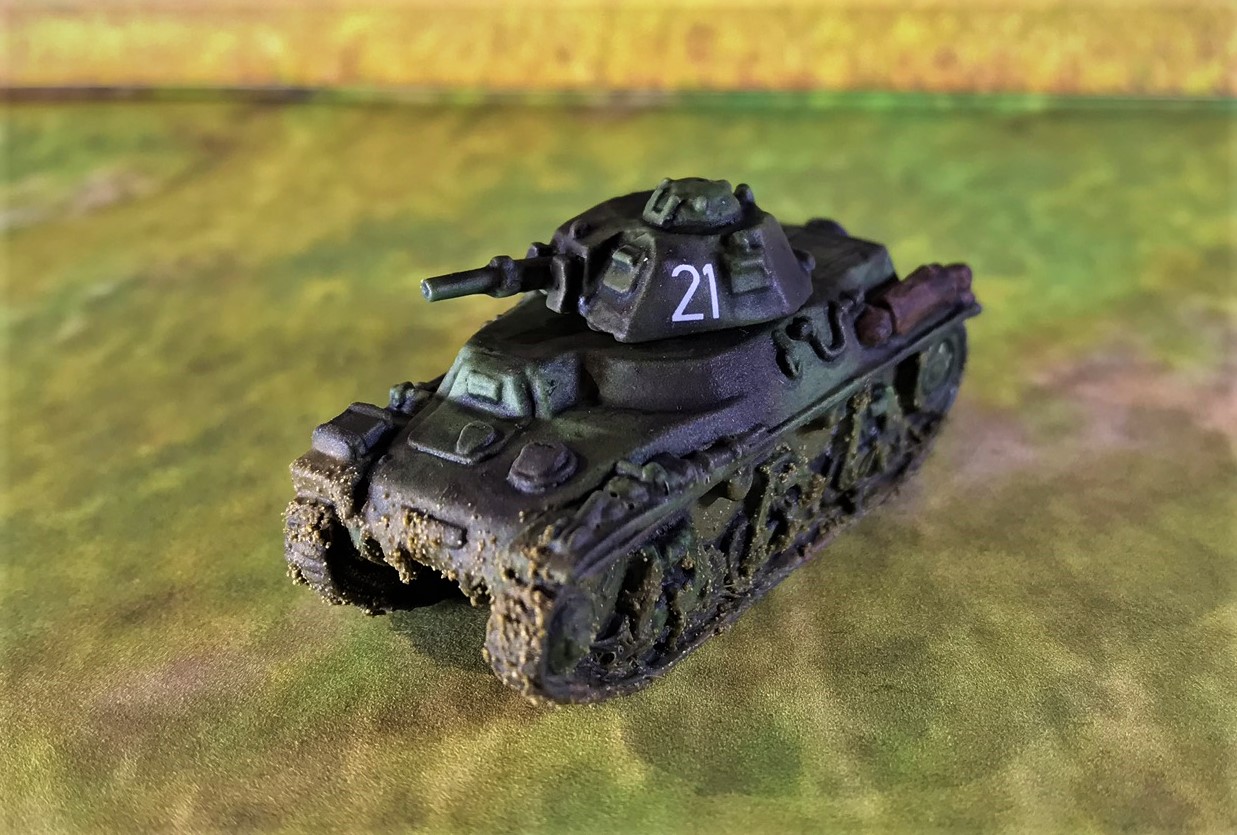
Peter Pig H39 “#21” front left view.


10 H39 (C model) right side
Peter Pig H39 “#21” right side view.  After weathering was added, the side looked similar to the Battlefront models.

9a H39 (C model) left front side
I did not have a #41!

11 comparing Peter Pig vs Battlefront
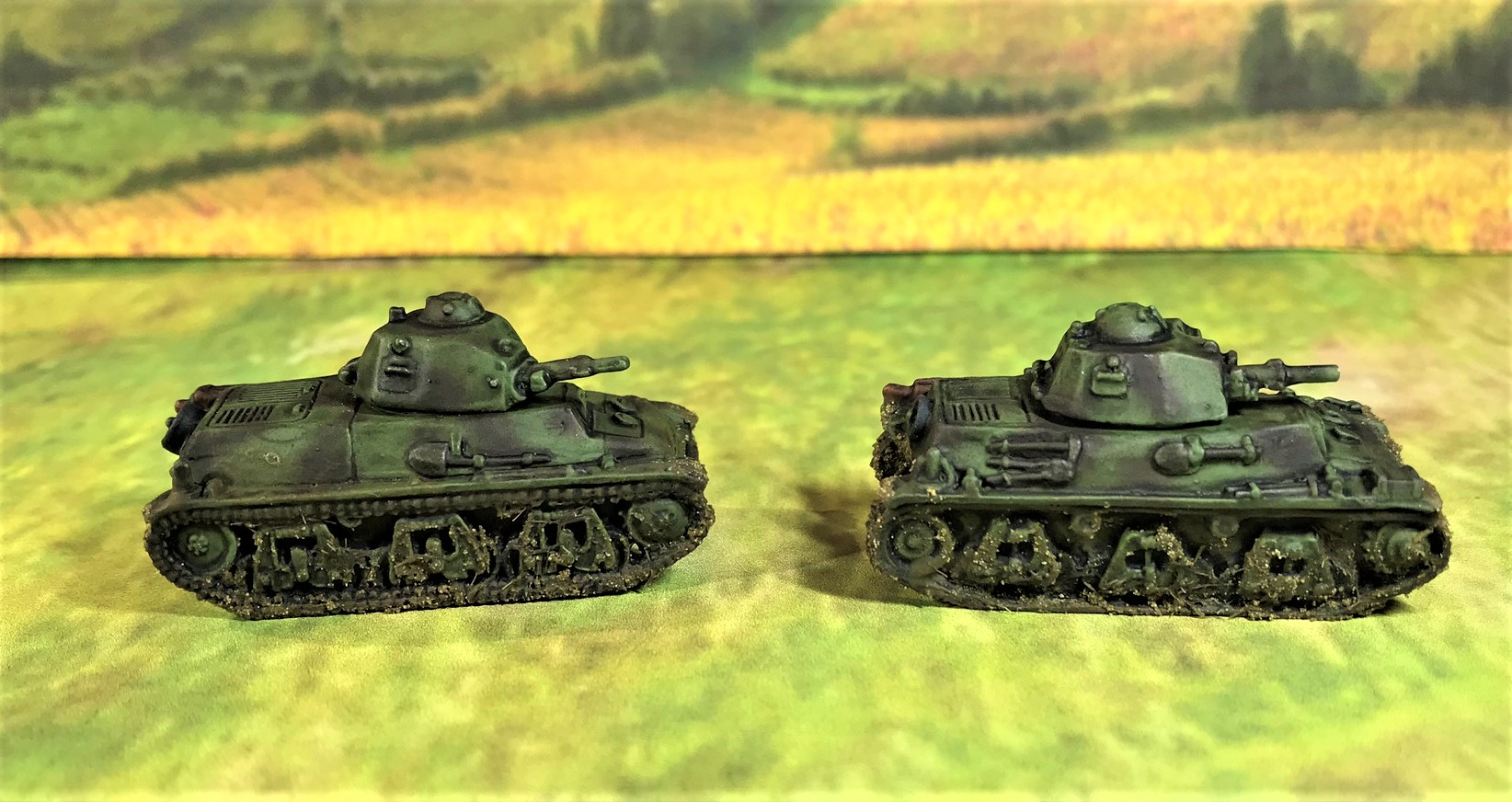
This is a side-by-side comparison of the Battlefront (left) and Peter Pig (right) H39’s.  I like both – though my preference is for the Battlefront models – which are resin and metal.  However, many of the models I need for this project are hard to find and not made by Battlefront, and sometimes with some manufacturers you need to buy up to five vehicles.  With Peter Pig, I can just get one  vehicle (QRF with metal models sells one at a time as well – and you’ll see some of their vehicles soon too).  Old Glory usually sells 3 vehicles (all metal) in a pack.

Group Shots

16 Group Shot16a Group Shot

This concludes my very last post of 2020 – and the beginning of this project.  (I will be doing a 2019 round up of course – but that will be coming later this week).

More Battle of France vehicles (French and German) will be coming and I hope that you will find them interesting.  If you have any feedback, good, bad or otherwise, let me know in the comments section – I do appreciate knowing what you think.

Thanks for looking and Happy 2020!

PAINTS, INKS, GLAZES, SHADES, WASHES, PIGMENTS, FLOCKING, GLUES AND MORE USED ON THESE VEHICLES:

  1. Isopropyl Rubbing Alcohol 91%
  2. Microscale Liquid Decal Film
  3. 1/8″ neodymium magnets
  4. Green stuff (kneadatite)
  5. Gorilla Glue
  6. Poster tack and ¼” square wooden dowels on plastic plates
  7. Reaper MSP “Black Primer”
  8. Vallejo “Black Grey”
  9. Vallejo “Surface Primer – USA Olive Drab”
  10. Vallejo “Flow Improver”
  11. Vallejo “Airbrush Thinner”
  12. Vallejo Model Air “Pale Green”
  13. Vallejo Game Air “Black”
  14. Battlefront “Army Green”
  15. Army Painter “Military Shader” (shade)
  16. Battlefront “Dark Gunmetal”
  17. Vallejo Model Air “Rust” (71.080)
  18. Vallejo Model Air “Matt Varnish”
  19. Vallejo Model Air “Sand Yellow” (H35 only)
  20. Battlefront “Army Green”
  21. Vallejo Model Air “Dark Brown” (H39’s only)
  22. Battlefront “Oxide Red”
  23. Vallejo Model Air “Glass Varnish”
  24. Appropriate decals from Battlefront
  25. Microscale Micro-Set
  26. Microscale Micro-Sol
  27. Vallejo Weathering Effects “European Thick Mud”
  28. Vallejo Weathering Effects “European Splash Mud”
  29. Vallejo Weathering Effects “Crushed Grass”
  30. Vallejo Mecha Varnish “Matt Varnish”
Despatches from Fort Syllabub

An account of fictional adventures on the North West Frontier - and other times and places, real or imagined

Man of Tin blog

Toy soldiers, gaming, Imagi-Nations

Zauberwurfs Blog

Ein Blog über Tabletop und Miniature Wargames.

Frank Tank Rants

musings of a fat old bloke on tanks and wargames

Dragons of Lancasm

Games, miniatures, painting, books and more games

Tiny Painted Heroes

The Adventures of a lifelong Tabletop Gamer, Game Design hobbyist, and full-time Software Engineer

Steve's Paint Brush

Grimdark model making and mini painting

Wargamesculptors Blog

Life, Golf, Miniatures, & Other Distractions

Dead Dick's Tavern and Temporary Lodging

Life, Golf, Miniatures, & Other Distractions

Guru Pig - the gaming Guru

Guru's thoughts on wargaming, life, and the universe!

Wisely lead... without a head!

History, Miniatures and Wargaming

Kuribo's Painting

Fallout Wasteland Warfare, Warhammer, and Hellboy Painting, Terrain, Dioramas, and Battle Reports

Don't Give Greg Ideas

Seriously, just don't

War Across the Ages, and other dark horrors

A discussion of miniatures collecting, painting and gaming.

Classic Warhammer 40K

Painting diary focused on Warhammer 40K 2nd ed., 5th ed. WHFB, related GW games, and miscellaneous whimsy

Colonel Mustard

WW2 Modelling in 1/72 Scale

Bogenwald

Random painting and terrain making.

Pat's 1:72 Military Diorama's

Scale diorama tips and ideas

Arcade Dreams

Building the Arcade Dream

P.B.Eye-Candy

Phil's 20th century wargame pages

SP's Projects Blog

A futile fight against entropy or 'Every man should have a hobby'? Either way it is a blog on tabletop wargames, board games and megagames

30mmdave

Wargaming Plausible reality?

The Imperfect Modeller

Miniature Figure Painting and Diorama Modelling

Double Down Dice

Painting miniatures and rolling dice!

Just Needs Varnish!

My ongoing wargames projects!

miniaturepopcorns

Sculpting some worlds

Despertaferres

Wargaming with the ability of a dull nine year old

Dawn of the Lead

Miniature wargaming and the occasional zombie

Rantings from under the Wargames table

Wargames, Figures, Sculpting and Converting Miniatures

Simple as War

Miniatures & Terrains

Buck's Blog

Life, Golf, Miniatures, & Other Distractions

IRO aka Imperial Rebel Ork

- I model - therefore I am -

Azazel's Bitz Box.

Painting, Modelling, Miniatures, 1:6, Games... Whatever else I find interesting.

diggingforvictoryblog

Smallholding and Wargaming.......not always at the same time!

Shamutantis

Nørdblog numero uno