
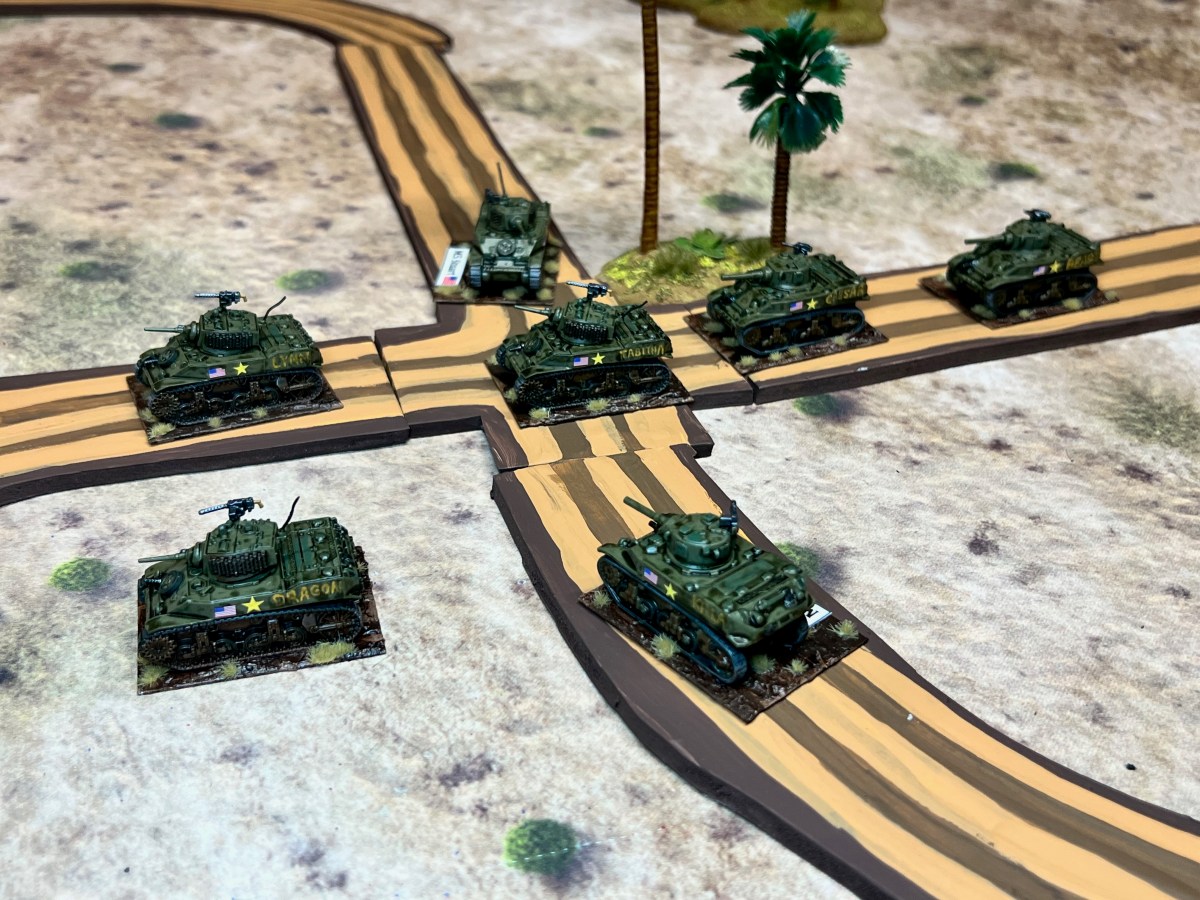
I promised back in August that I would post about my US M5 Stuart tanks. These would be the linchpin of my US forces in my “Operation Torch: Vichy Mounts an Armored Counterattack” games.

Yes, the US and UK did briefly engage French forces of Vichy in North Africa in WWII. After the US Operation Torch landings, Vichy did put up a resistance. Technically they were supposed to be neutral after the 1940 Armistice. However, the Soviets were dealing with massive battles on the Eastern Front, and the US/UK allies were not yet ready to successfully invade Fortress Europe. As the Dieppe raid showed, it would have been a catastrophic failure in 1942.
The idea was to take off some of the pressure on the Soviets by getting in the war somewhere and tie down the Germans. French North Africa became the chosen option, with the hope that the Vichy French would welcome the US/UK invaders as liberators and not invaders. For a brief period in November 1942, both of these two options played out in Morocco, Tunisia, and Algeria – until the French there decided to cease resisting the Allies. Subsequently, back in Europe, Hitler was enraged at the Vichy capitulation and ordered his forces to invade the remaining southern part of France that was not yet occupied.
Back in North Africa in November 1942, one of the more obscure incidents of the conflict was in Morocco – where the French 1er Regiment de Chasseurs d’Afrique launched an armored counterattack towards the landing beaches. At that critical juncture, the 66th Armored Regiment of the 2nd Armored Division (and Sub-Task Force Goalpost) had just 7 M5 Stuart tanks that it could cobble together to intercept the French. Their M4 Sherman tanks needed a port to unload, and that had not happened yet.
I found this article/post by Patrick Chaisson to be an excellent description of the combat that happened in November 1942.
As far as a concept for a wargame, I liked the idea of a game that would recreate this clash of armor – especially as one side was green as hell, and the other fielded such a hodgepodge of elderly and obsolescent armor.
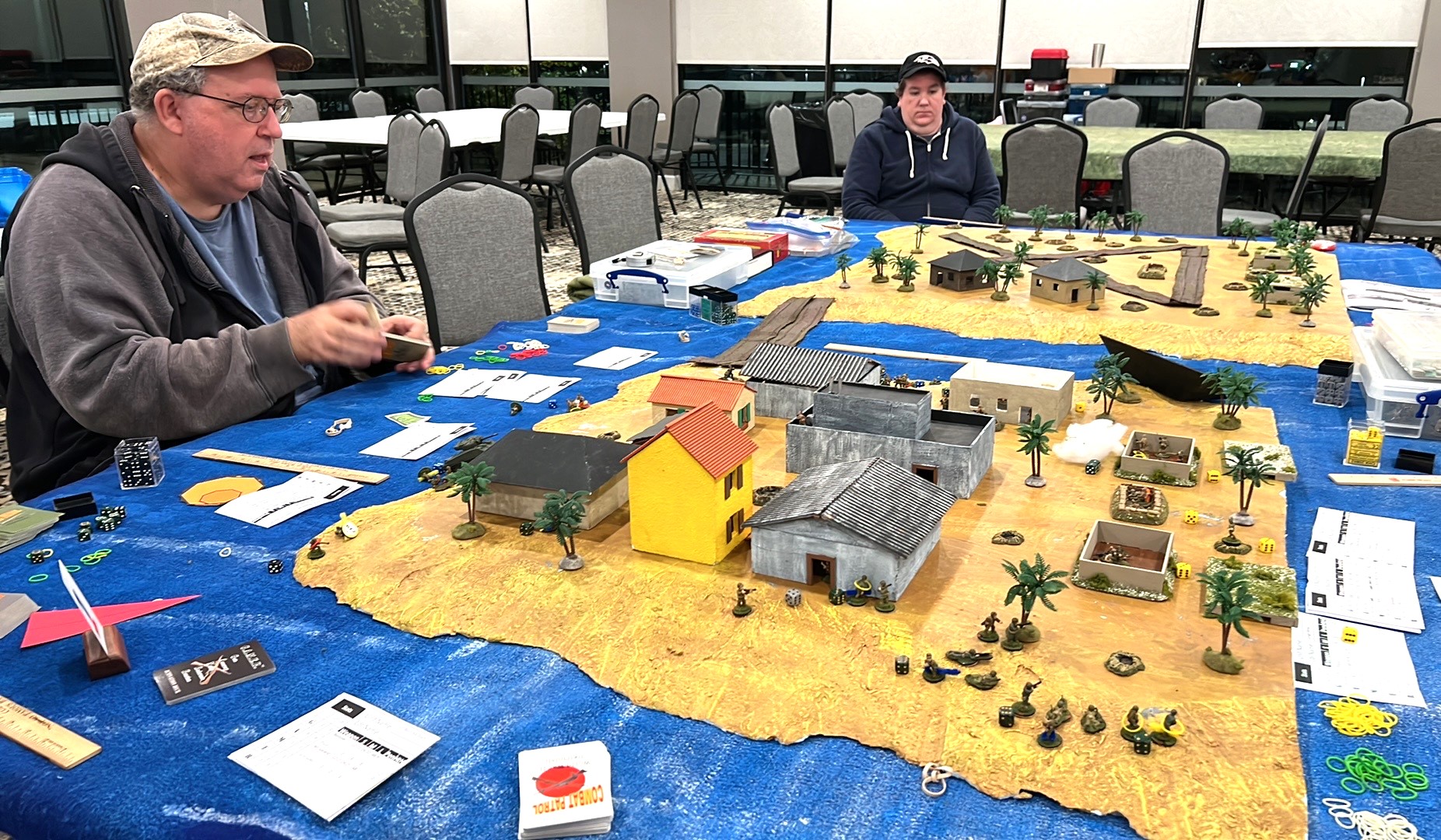
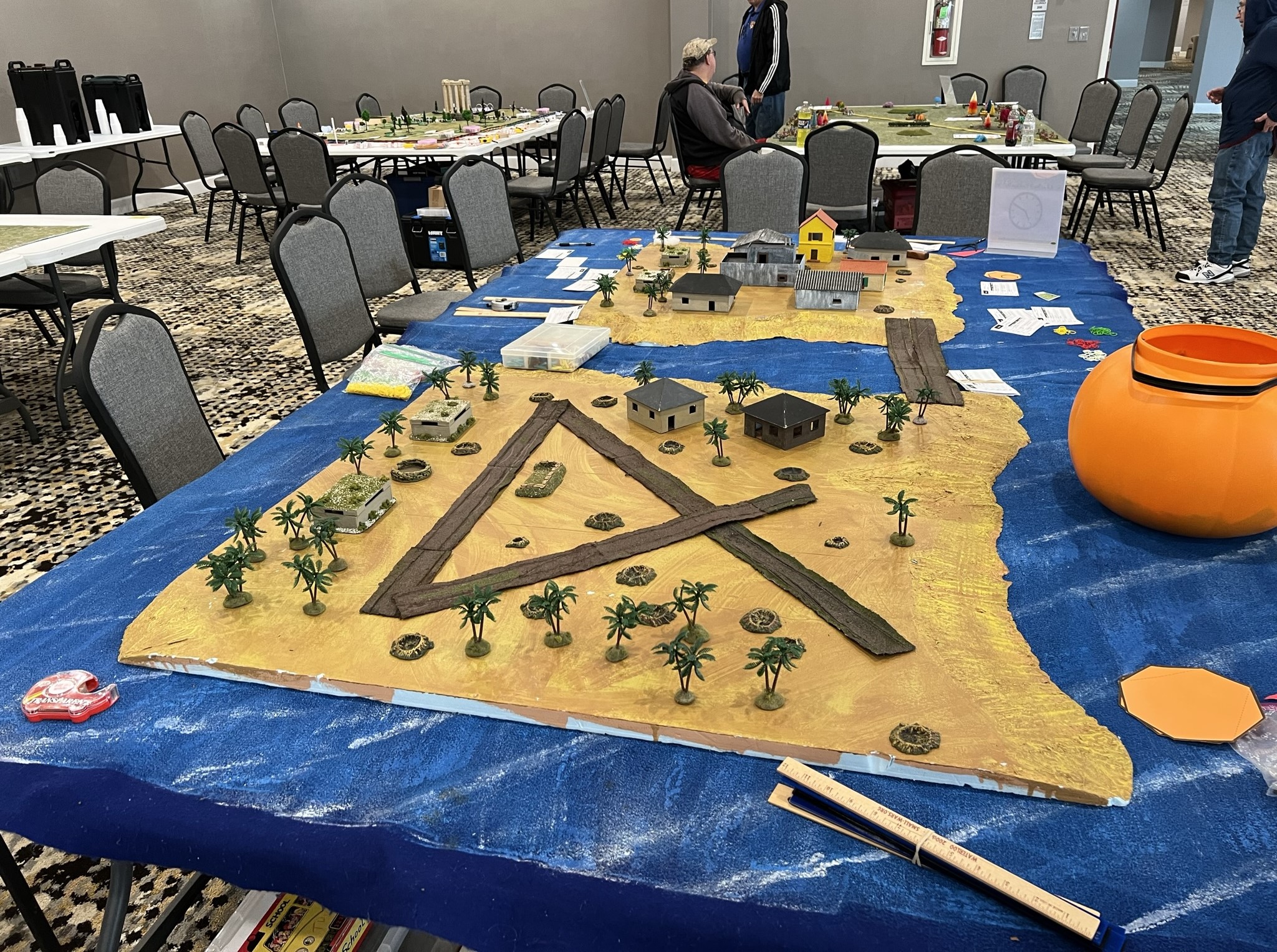
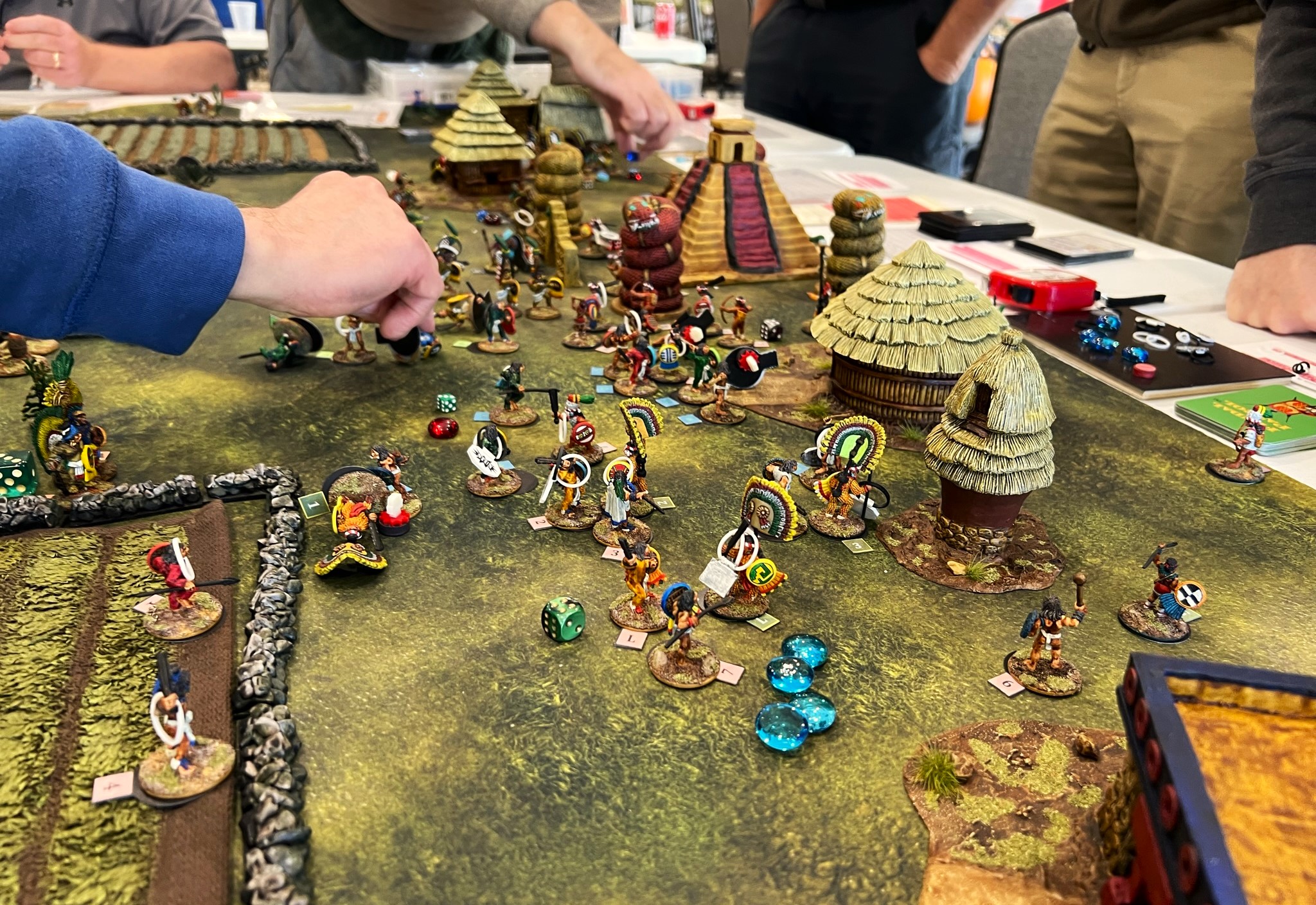
I ran this game twice at HISTORICON 2025, along with two Wars of Ozz games. All went well. I hope to post some convention shots in my next post (albeit very late). Unfortunately golf season was very busy this summer (well, fortunately for my golf game and not my hobby projects). Still, I keep my word. I thought I’d add a bit about the game as well, while saving specific game/convention photos for the next post. However, the game is coming back!
I will be running the game again twice at HMGS Fall In this November. Here are the inks – one is on Friday afternoon and one is on Friday night. I can handle up to 10 players per game – and I can scale it for fewer as well. as of this writing, there are still slots available.
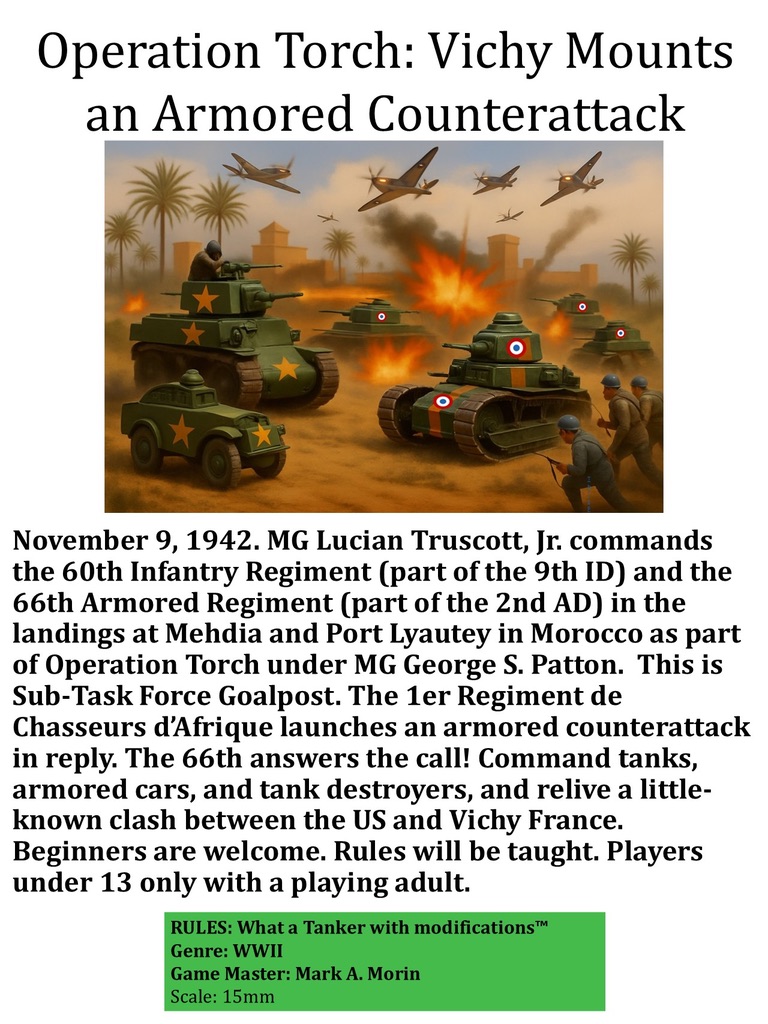
The game uses modified What a Tanker rules. The major modifications that I use are:
- Using Bonus Attack Cards to simulate infantry, anti-tank, artillery, naval gunfire, and air actions. These are deployed by scout cars according to each sides’ historical capabilities. Bonus Attack Cards are purchased with “Tanker Bucks”, which also play into Victory Conditions. Having more Tanker Bucks at the games end is better. Yet, you need to use resources to take out the enemy. So, a balancing act exists for the players. Do they hoard their Tanker Bucks, or use them effectively against their opponent?
- Representing the French vehicles’ advanced age and mechanical unreliability. “OLD” French vehicles that try to move and roll a 5 or less will lose 1 die to temporary damage. Mathematically, there is an 11% chance of that happening. So the Vichy Forces are indeed slow. But there are more of them, and not all of the French tanks are OLD.
- Creating a way for armored cars to engage other armored cars – and tanks, with heavy machine guns or Bonus Attack Cards. Also I have rules that show how devastating any cannon fire would have been against thin-skinned vehicles.
- Representing the US Army as being totally GREEN at this point in the war. Their base roll needed to hit goes from needing a 6 on 2d6 added together to a 7. Add to that the concept that most of the French vehicles are SMALL, necessitating an addition +1 to hit at short range, and another +1 at long range. Oh yeah, the Stuarts have just a 37mm gun. This means that the US has a tough time making damaging hits at long range against French tanks.
- The US use of Bonus Attack Cards is limited to just the US and French Armored Cars. The M5 Stuart’s radios got wet during the landings and were not working. Many French tanks in North Africa did not have radios.
- Use of Bonus Attack Cards also represented that the US had both carrier-based air support as well as naval gunfire from the USS Savannah. I added F4F Wildcat’s and Avenger TBF’s for US air support. The F4F’s can provide air superiority, which allows them to also do limited close air support missions. Having air superiority enables the US player to deploy the Avengers, which can act as spotter planes for both artillery and naval gunfire. The Avengers can also bomb the French vehicles with depth charges (yes that happened). The French can contest the US air superiority by deploying Dewoitine D.520’s.
- Modifying the activation sequencing methodology by using Buck Surdu’s “Double Random Activation” method. It’s the same one used with Wars of Ozz, Feudal Patrol, and Combat Patrol games.
Back to the Stuarts. The M5 vehicles are 15mm/1:100 scale. I sourced them from two places. I got an OOP Flames of War 5-tank platoon (plastic) from Noble Knight Games. I also bought five 3D-printed resin models on eBay from HobbyHouse&Miniatures LLC. The plastic models were fun to work on, and I was glad to have the additional resin ones. Historically, 7 M5 Stuarts were sent to counter the Vichy counterattack. When I drilled out the resin models for magnet installation, two broke in half (not the fault of the model, just me. In the end, I had 3 of those, making 8 models in total, which was fine given that seven were originally sent along with some M3 and M6 tank destroyers.
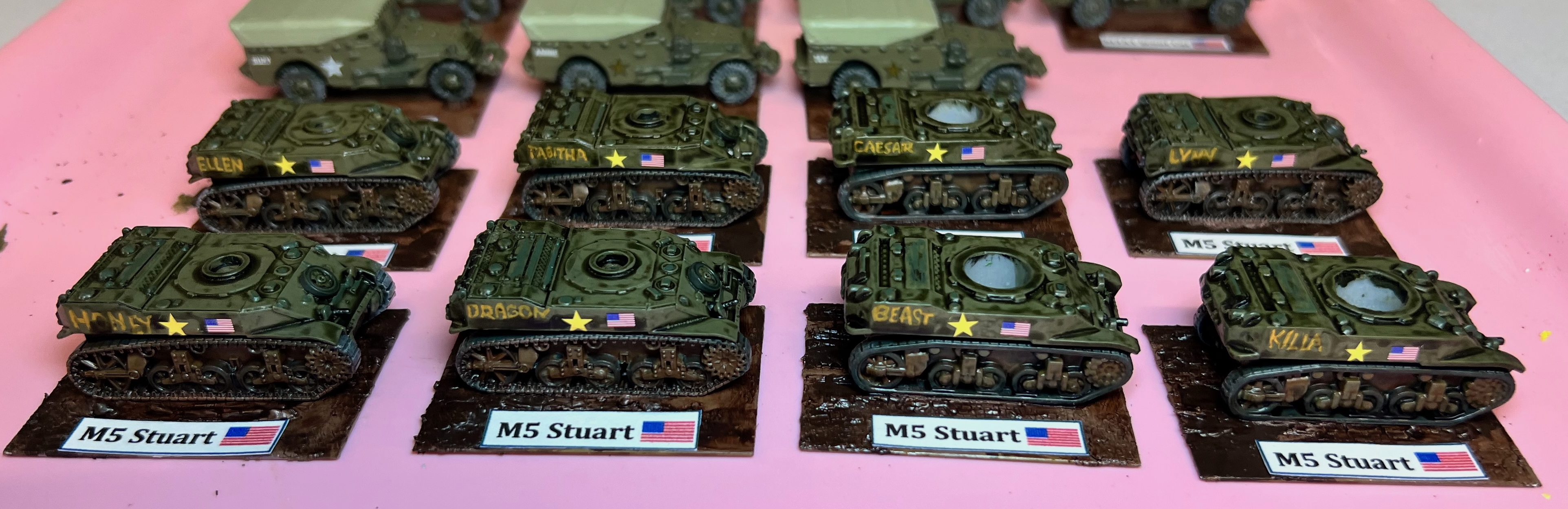
I worked on the M5 tanks in parallel with the M3A1 Scout Cars and the M3 and M6 Tank Destroyers that I have discussed previously. I tried to incorporate the gold stars and US flags that were unique to that period of the war. I also decided to give the vehicles hand-painted names:
- Honey (my Mom’s nickname)
- Dragon
- Beast
- Killah
- Ellen (my daughter’s name)
- Tabitha (my granddaughter’s name)
- Caesar (my late cockatiel’s name)
- Lynn (for my ever-so-tolerant wife)

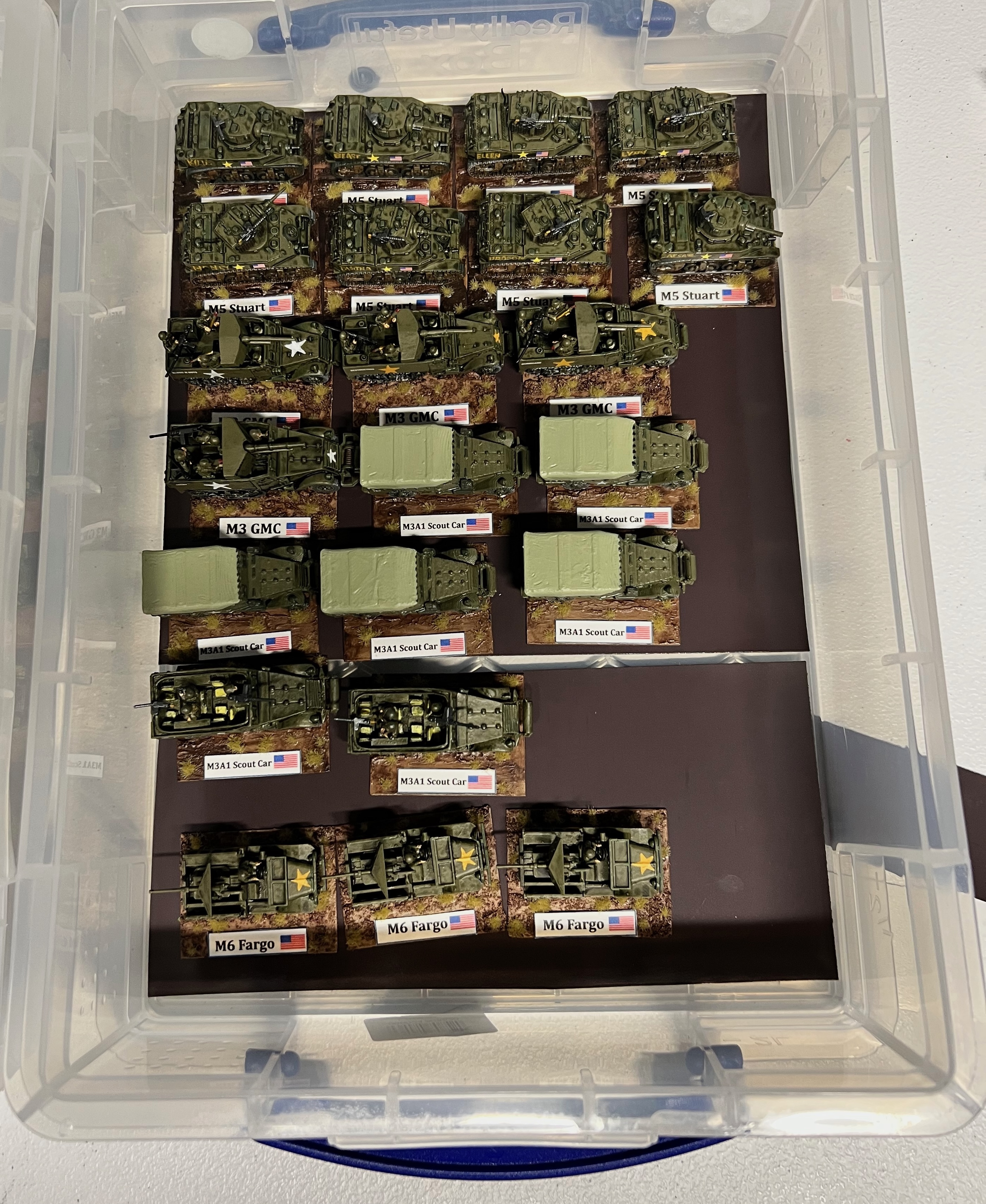

This wraps up this post on my 8 M5’s. If you have any feedback – please let me know in the comments section!
Lastly, for all of my posts on WWII games and projects – there is a consolidated list of posts and their links located here.
MATERIALS USED
PAINTS, INKS, GLAZES, SHADES, WASHES, PIGMENTS AND FLOCKING USED ON THE FIVE BATTLEFRONT/FLAMES OF WAR PLASTIC M5 TANK MODELS AND THE THREE HOBBYHOUSE&MINIATURES LLC 3D-PRINTED RESIN M5 TANK MODELS:
- Green Stuff
- Paper Clip wire
- War Games Accessories Steel Bases Number 16 (½” x ½”)
- Wooden Blocks, steel bolts, steel washers, magnets, steel screws
- Neodymium magnets (⅛” and ¼”)
- Gorilla Glue
- Tamiya Extra Thin Cement
- Daisy BB’s
- Plastic broom bristles
- Vallejo Surface Primer “Black”
- Vallejo Surface Primer “USA Olive Drab”
- Vallejo Model Air “Black Metallic”
- Army Painter “Military Shader” (shade/wash)
- Hataka “Vert Fonce”
- Vallejo Model Color “USA Olive Drab”
- Vallejo Model Air “Tire Black”
- Vallejo Model Color “Dark Sea Grey”
- Vallejo Model Air “Gun Metal”
- Vallejo Model Air “Wood”
- Vallejo Mecha Weathering Effects “Dark Rust Wash”
- War Games Accessories Steel Bases Number 23 (1½” x 2″)
- Vallejo Surface Primer “German Green Brown”
- Citadel “Agrellan Earth” (texture)
- Army Painter “Mid Brown” (shade/wash)
- Reaper MSP Core Colors “Blackened Brown”
- Vallejo Thinner Medium
- Citadel “Averland Sunset”
- Vallejo “Mecha Varnish Gloss”
- Microscale Industries “Micro Set”
- Microscale Industries “Micro Sol”
- Microscale Industries “Liquid Decal Film”
- Battlefront US Army decals
- Vallejo “Gloss Acrylic Varnish”
- Citadel “‘Ardcoat”
- Vallejo “Gloss Acrylic Varnish”
- Vallejo Flow Improver
- Vallejo Thinner
- Vallejo “Matte Polyurethane Varnish”
- Printed labels on card stock
- Gamers Grass “Tiny Beige 2mm Tufts” (flocking)
- PVA Glue










































 Mark A. Morin