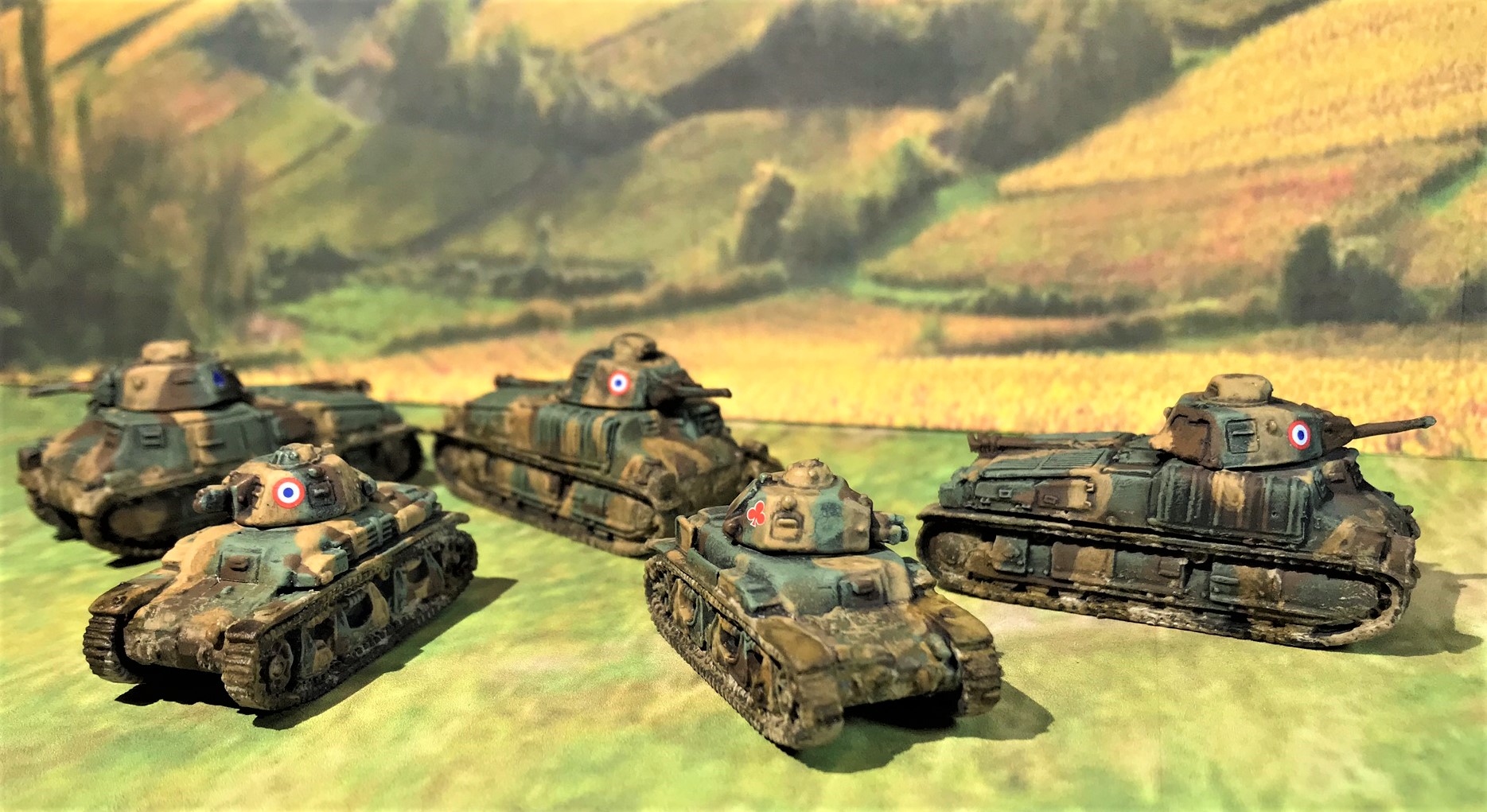
Creating a WWII Vichy Counterattack Game Scenario

Over the summer, happily, golf dominated my free time for the most part. I didn’t really have much time for hobby work or wargames. Blogging about what little I did complete or participate in fell to the wayside. The “little” that I refer to is work on my 15mm/1:100 scale WWII scenario, Operation Torch: Vichy Mounts a Counterattack. This scenario is part of a What a Tanker game. It is set in Morocco in November 1942. The Vichy French responded to the American landings during this time with an armored counterattack.

It is a little-known clash. France the June 1940 post-armistice was titurlarly neutral, and had the responsibility to defend its colonies against any allied invasions. At this time in 1942, the Soviets were under massive German pressure on the Eastern Front. They were begging the Allies to get in the fight against the Germans – anywhere at all. However, at this point in the war, the US/UK were not in a position logistically to assault Fortress Europe. They also lacked the necessary forces to execute such a mission successfully.

The invasion of North Africa – and the colonies of Vichy France – became the compromised option. Operation Torch thus came to be. In addition, this assault would open up a line of attack on Rommel’s rear. This would reduce pressure on the British 8th Army in Egypt. However, no one knew how much the Vichy French would resist.

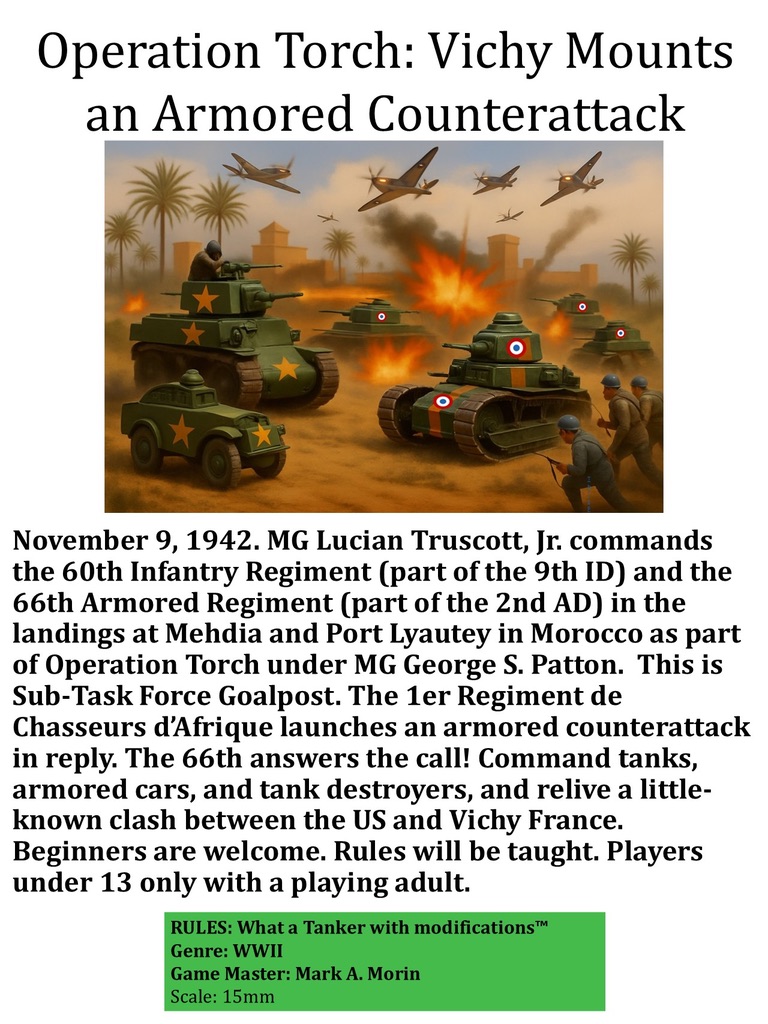
My flyer for the game scenario.

As I write this, the 2025 golf season is over now. At least it is here in balmy Massachusetts in November. It’s time for me to capture my summer and fall efforts that led to my running this games at conventions. This post will cover some of my preparations, upgrades, and the actual games themselves. I will discuss the initial games at HMGS HISTORICON, then my upgrades, then the games at HMGS FALL IN! and EllisCon.

By the time I attended HISTORICON in July of 2025, I had the scenario pretty much where I wanted it. I had play-tested it with friends, and was ready to roll it out. This year, in total I have run the game twice at three different conventions. These are HMGS HISTORICON in July, and both HMGS FALL IN! and EllisCon in November. This makes six iterations so far since the spring.

For vehicles for the game, I have finished many AFV’s for that I have discussed in previous posts. Here below are those posts in reverse chronological order in case you missed them:

  1. M5 Stuart tanks for “Operation Torch: Vichy Mounts an Armored Counterattack” Game
  2. US Vehicles for Operation Torch: TANK DESTROYERS – M3 GMC’s and M6 GMC Fargo’s
  3. US Vehicles for Operation Torch: M3A1 Scout Cars
  4. French Armor for Operation Torch: Panhard 175 TOE’s, Laffly S15 TOE’s, and Berliet VUDB’s
  5. French Armor for Operation Torch: Hotchkiss H35’s, H39’s, and Renault R35’s
  6. French Armor for Operation Torch: Renault FT-17’s
  7. French Armor for Operation Torch: White-Laffly AMD 80’s & Schneider AMC P16’s
  8. Operation Torch: Planning My WWII Gaming Experience for HISTORICON
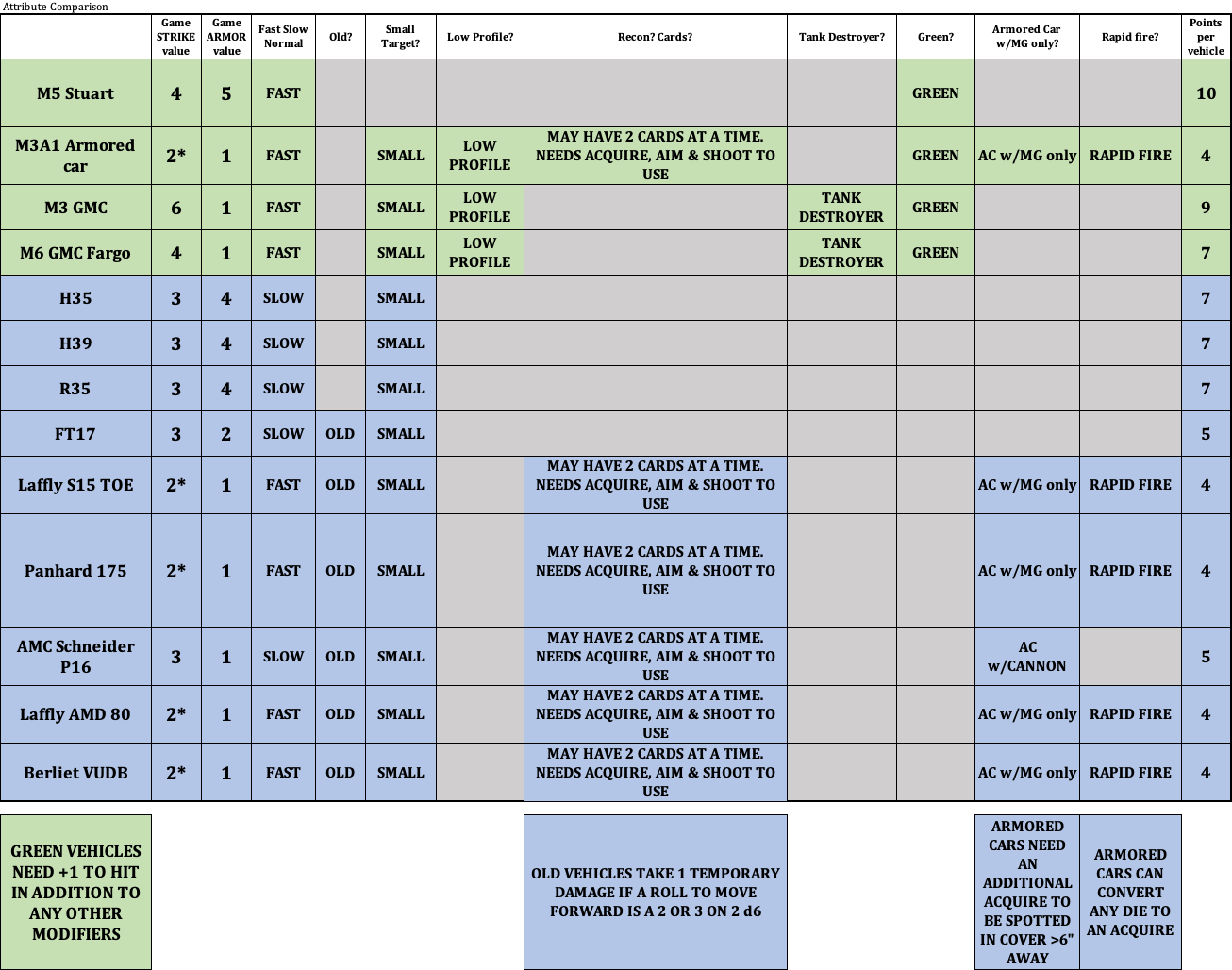
The vehicles for the game
AFV attributes for the game

In addition to the vehicles, many game aids also were on my to do list. Before HISTORICON, I made road sections and town bases out of poster board and painted them. I also built dice boxes and dice frames for ease of play. Plus, I needed more blast markers for destroyed vehicles.

I was making these dice aids to make play better. What a Tanker is a great game. However, for a multiplayer game at a convention, the activation sequence is not the greatest. It does not keep the players engaged. I decided to borrow Buck services Double Random ActivationTM activation methodology, and that seemed to serve the game well. I also added Bonus Attack Cards and other changes as discussed in the next section.

Overview of My Scenario Rules Modifications

The game uses modified What a Tanker rules. The major modifications that I use are:

  • The game starts with each player receiving $75 in Tanker Bucks.
  • Before there are any play or purchases of extra resources, there is a VICHY FREE ATTACK PHASE. All US vehicles on the table will receive both 1 French infantry attack and 1 French AT attack.  This phase represents the Vichy infantry attacks that were repulsed in November 1942 prior to the armor engagement. This happens only once at the beginning of the game.
  • There is an ACQUISITION PHASE after the free attacks conclude. More vehicles and Bonus Attack Cards may be purchased. This phase happens once at the beginning of each turn.
  • Uses of Bonus Attack Cards in the game simulate infantry, anti-tank, artillery, naval gunfire, and air actions. These are deployed by scout cars according to each sides’ historical capabilities. These cards can be shared across the team. Bonus Attack Cards are purchased with “Tanker Bucks”, which also play into Victory Conditions. Having more Tanker Bucks at the games end is better, as high amount remaining wins the game. I allow teams to share their Tanker Bucks as well. However, you need to use resources to defeat the enemy. You earn $25 for each AFV or plane destroyed. See the card below to see the costs for acquisitions and for rewards. So, a balancing act exists for the players. Do they hoard their Tanker Bucks, or use them effectively against their opponent?
Costs and Rewards as shown on the requisition form.
  • To represent the French vehicles’ advanced age and mechanical unreliability. “OLD” French vehicles that try to move and roll a 3 or less will lose 1 die to temporary damage. Mathematically, there is an 8.33% chance of that happening. So a good number of the Vichy Forces are indeed OLD (mainly the armored cars and the FT-17’s). In addition, all of the French tanks and some armored cars are SLOW – which limits their advances. But, in the game, there are more of them, and not all of the French tanks are OLD.
  • Any vehicle touching a road can convert any die to a DRIVE dice.
  • Armored and scout cars may engage other armored cars and tanks with heavy machine guns or deploy Bonus Attack Cards. Also I have rules that show how devastating any cannon fire would have been against thin-skinned vehicles. Cannon fire causes double hits on thinly armored vehicles that are not tanks.
  • The US Army was inexperienced before these landings. To represent that, their status is GREEN at this point in the war. GREEN means their base roll needed to hit increases. It goes from needing a 6 on 2d6 added together to a 7 as a base number. Most of the French vehicles are SMALL. This necessitates an additional +1 to hit at short range. There is also another +1 at long range. Oh yeah, the Stuarts have just a 37mm gun. This means that the US has a tough time making damaging hits at long range against French tanks.
  • The US use of Bonus Attack Cards is limited to just the US Scout and French Armored Cars. The M5 Stuart’s radios got wet during the landings and were not working. Many French tanks in North Africa did not have radios. The one-man-turrets in all of these Vichy tanks made coordinating activities very difficult.
  • To represent the fight for air superiority, I added Bonus Attack Cards that allow the deployment of French Dewoitine D.520’s and American carrier-bases F4F Wildcats. These vie for air superiority and can also convert to ground attack missions with other Bonus Attack Cards as well.
  • Having air superiority enables the US player to deploy the Avenger TBM’s as spotter planes. These can improve US artillery accuracy significantly. They also can also bomb the French vehicles with depth charges (yes that happened). Lastly, Avenger deployment also opens up the chance for devastating naval gunfire from the light cruiser USS Savannah.
  • Modifying the activation sequencing methodology by using Buck Surdu’s “DOUBLE RANDOM TM ACTIVATION” method.
  • Because of the different activation sequence from What a Tanker, I now use three types of dice. Larger white d6 are used for COMMAND DICE (these let your AFV take actions). Larger colored d6 are used for ACTION DICE (for rolling for movement and firing). Smaller colored d6 are used for ACTIVATION DICE (to, well, activate an AFV in the game).
  • Scoring is done with TANKER BUCKS. Most wins at game end. See the rules file below (downloadable) for all the details.

I was asked to share my rules on the Facebook What a Tanker page. As I am a wicked nice guy (as we say here in Massachusetts), I am happy to do so. Below is the Word document that outlines all of the rules changes in detail. Feel free to download. If you use them, please do share your thoughts and experiences with me, I’d love to hear them.

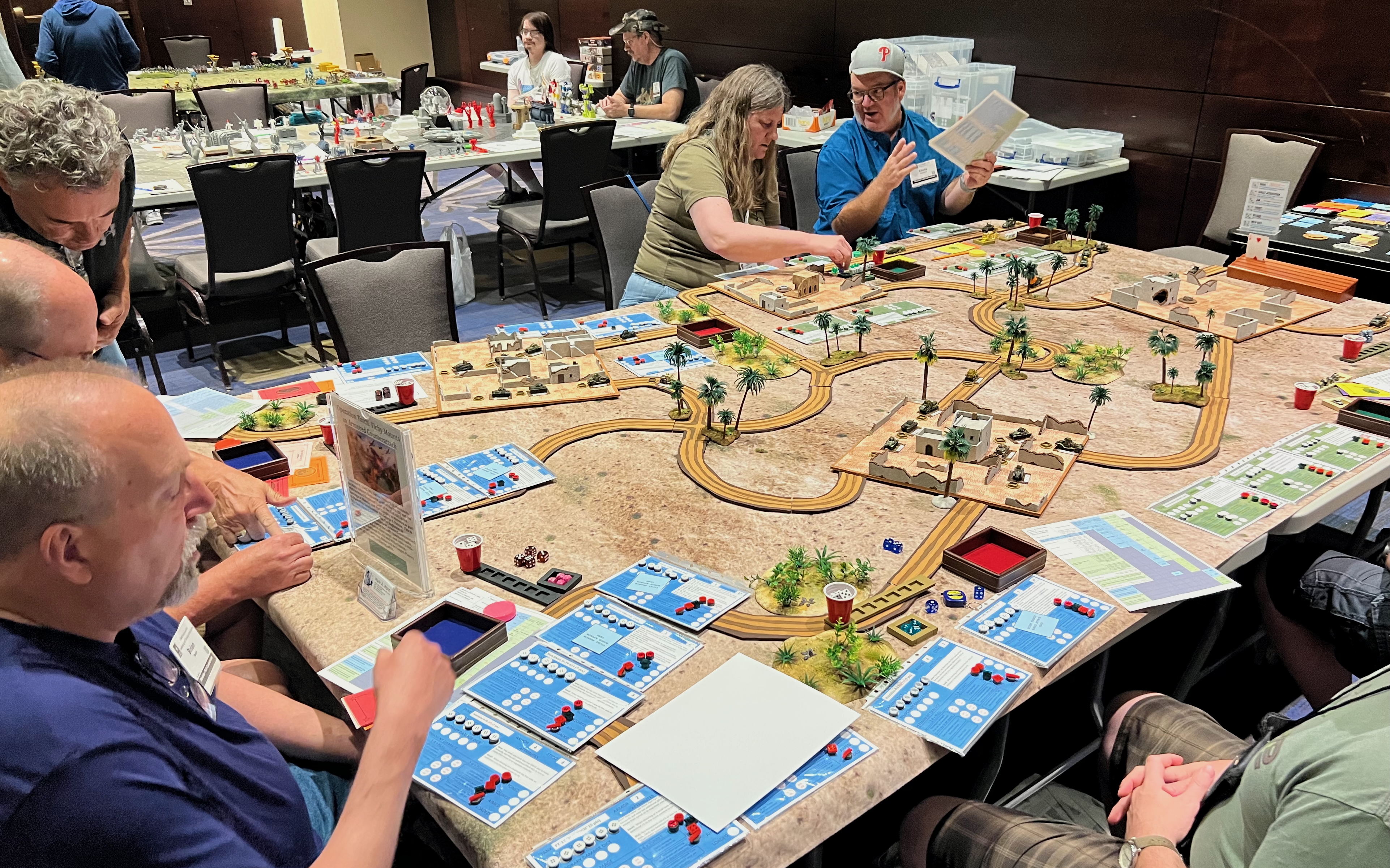
Let’s look at some photos from the HMGS HISTORICON convention games next.

HMGS HISTORICON 2025 PHOTOS OF THE GAME

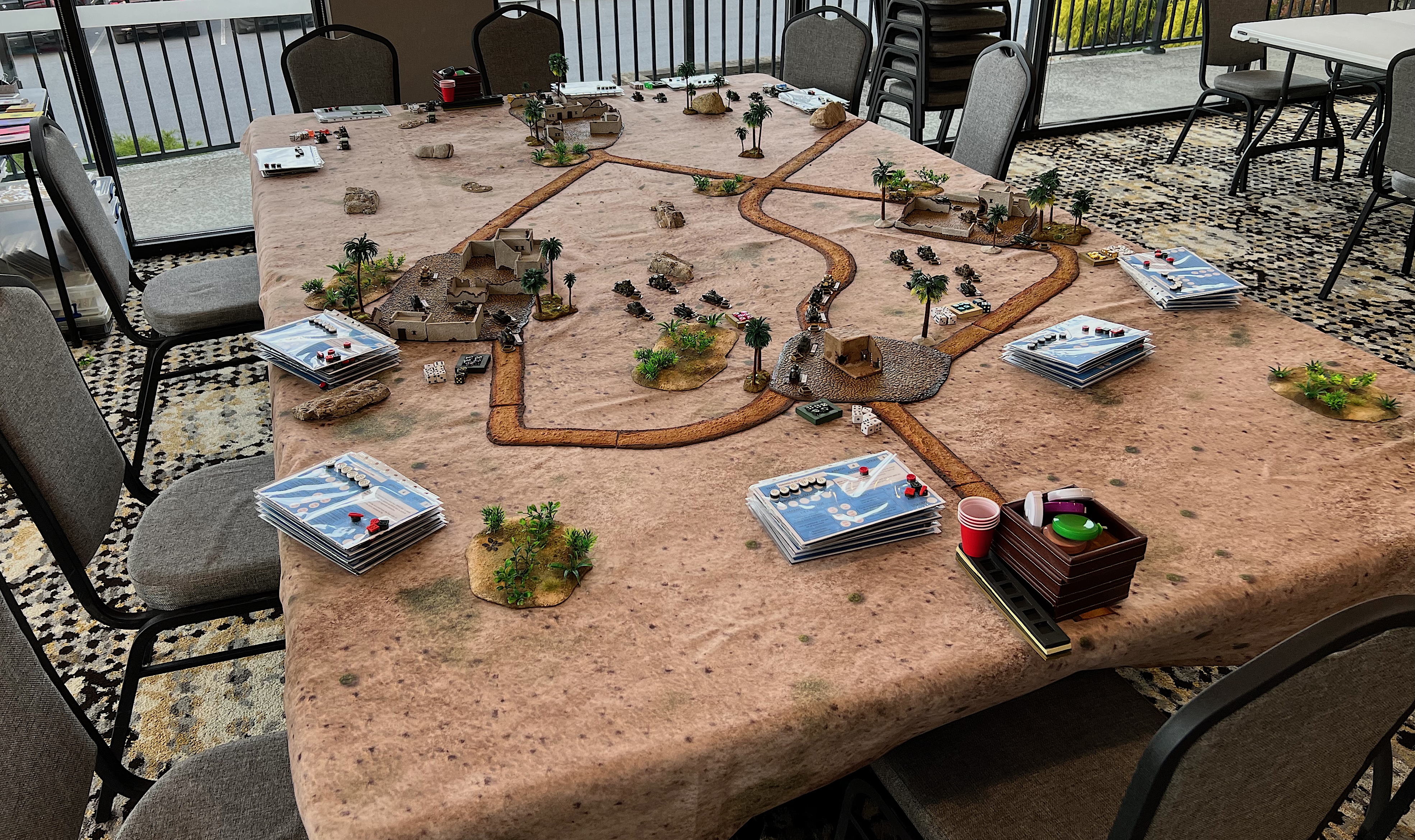
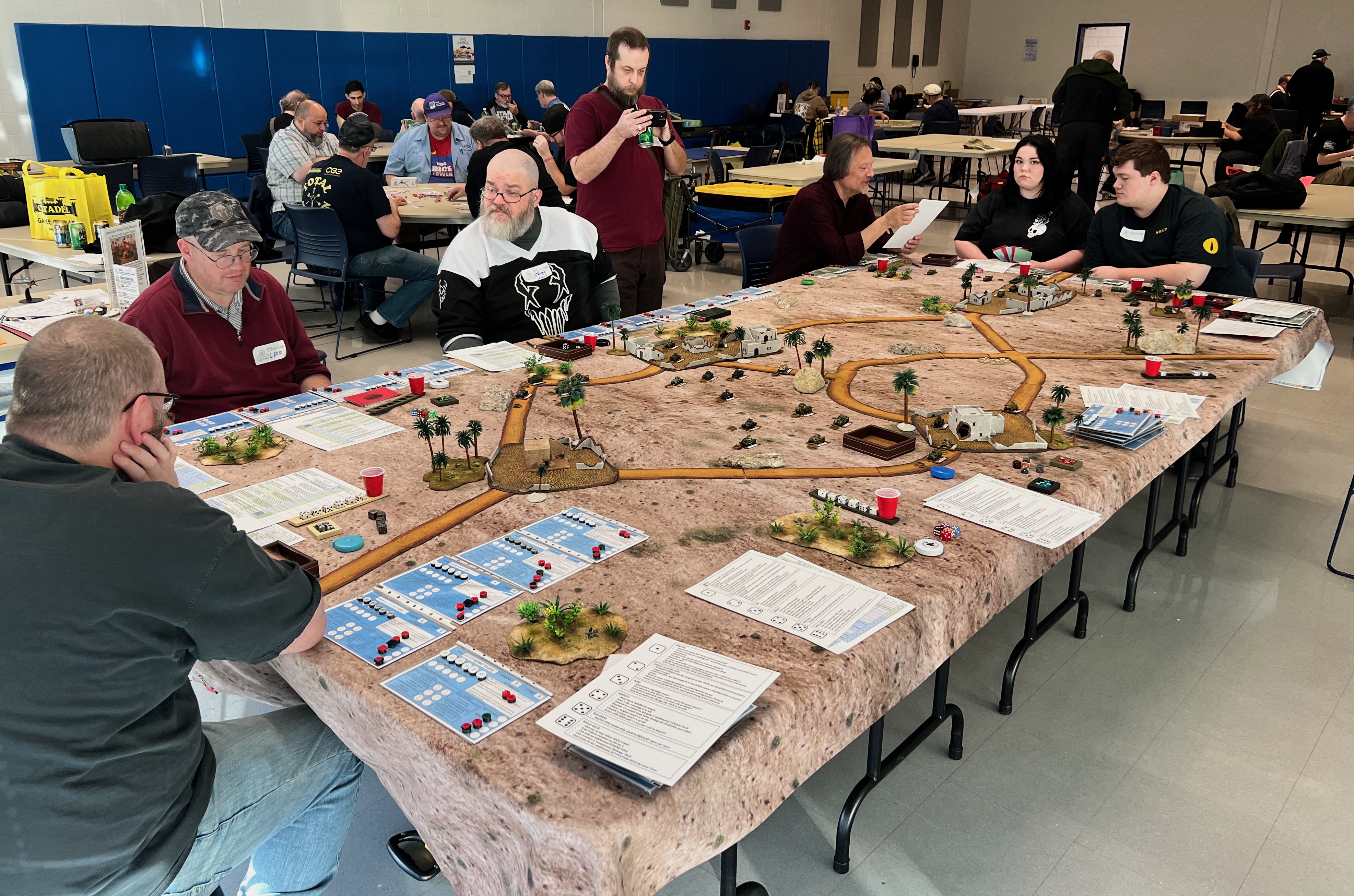
I ran the scenario twice at HISTORICON in July 2025. The games went well. Each side won once.

The tabletop set up from the French side. Note the painted poster board roads and town pavements.
Each French player started with 5 vehicles. The number of American vehicles varied by player, usually 2-3 including one M5 Stuart tank.
Set up with Tanker Bucks. I did eventually decide on $75 per player on each side with the differentials being the cost of resources.
The players from the first game – the French won here.
In the second game, the US won. This victory was mainly because Dan Eustace successfully used his Bonus Attack Cards. He successively achieved air superiority with Wildcats, then got the Avenger deployed. This led to calling in naval gunfire from the USS Savannah – unleashing a volley from its 15 6″ guns. The results on the French armor was devastating.

After the game, I pondered what improvements I could make. The tweaks in the rules are reflected in the file I shared previously. However, I need to add:

  • More game aids like dice holders
  • More blast markers
  • Better roads – I wanted rubber ones that laid flat and took up less space in a box.
  • Better town bases that also were rubber and laid flat on the tabletop.
  • Actual plane models to represent the aircraft. I was using photos on flight stands at HISTORICON for the planes, and I wanted better.

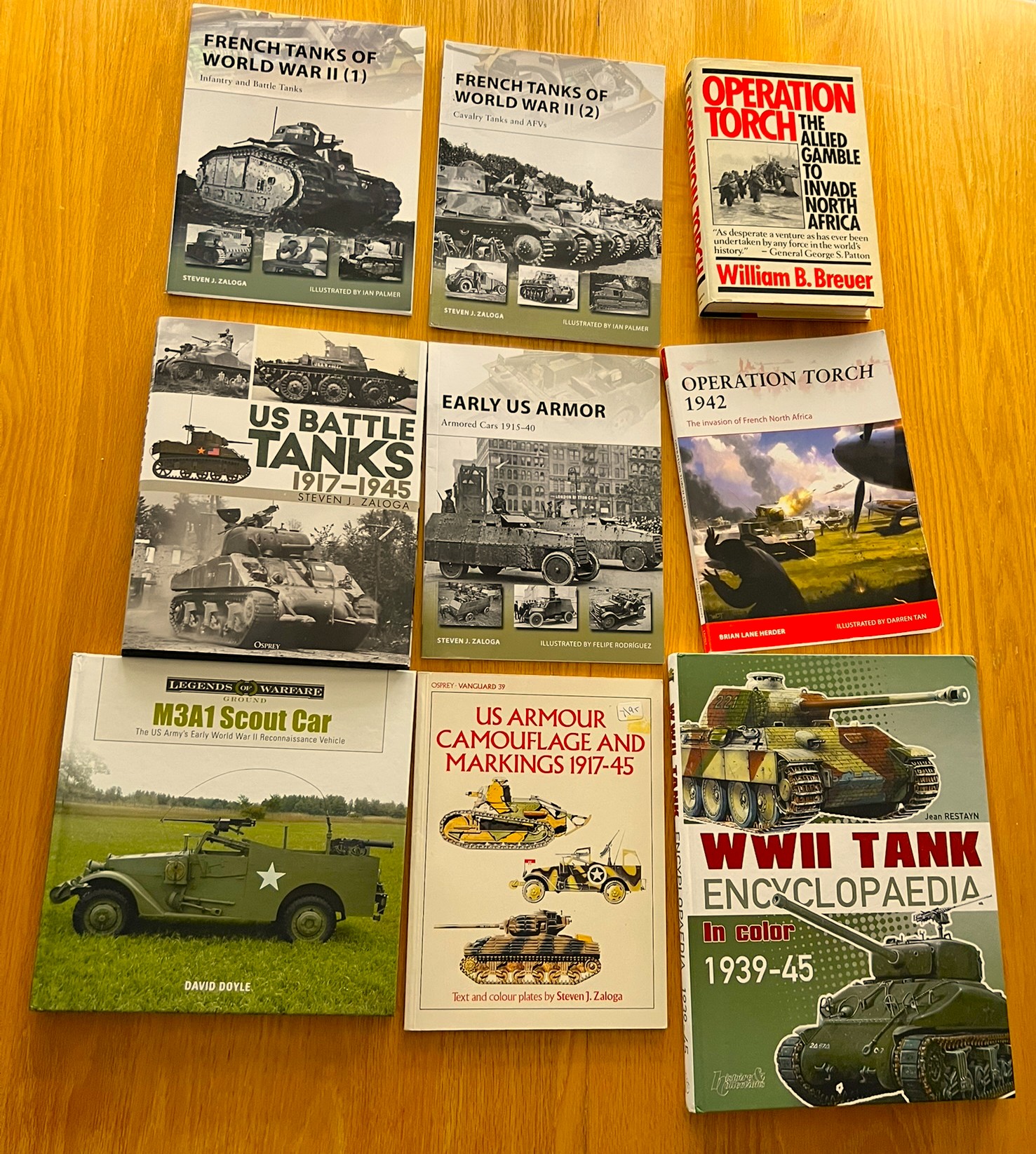
I wanted to read a book on the campaign that I learned about. It was recommended to me in a comment to one of my blog post links on TMP. It focused on this phase of WWII, and I planned to do this before I did any more hobby work. Rick Atkinsons’s An Army at Dawn is a true gem of a historical book, and a must read. This was my August effort.

After reading these, it was time to get going on the additional “stuff” listed above. I knocked out the dice frames and similar tasks quickly. I had enough for 8 players, and now I was set for 10.

Building Dirt Roads and City Bases WIP Shots

Now it was time to make the roads and city bases. I stumbled on this excellent video on how to make rubber wargaming roads. It became the blueprint I used and I highly recommend his process.

Here is a link to the excellent video.

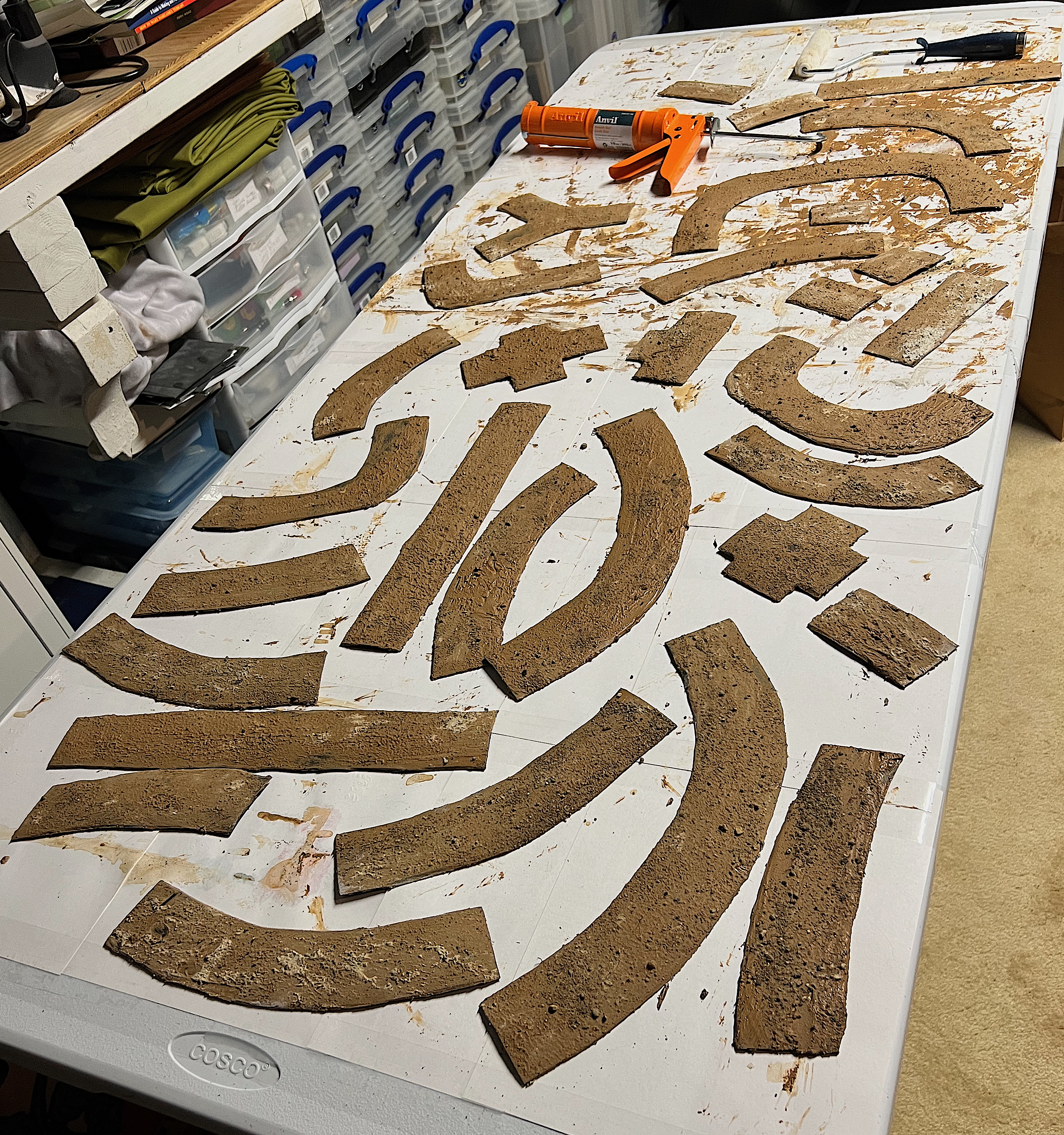
Below are progress WIP shots of how I built 54 sections of road and 4 bases.

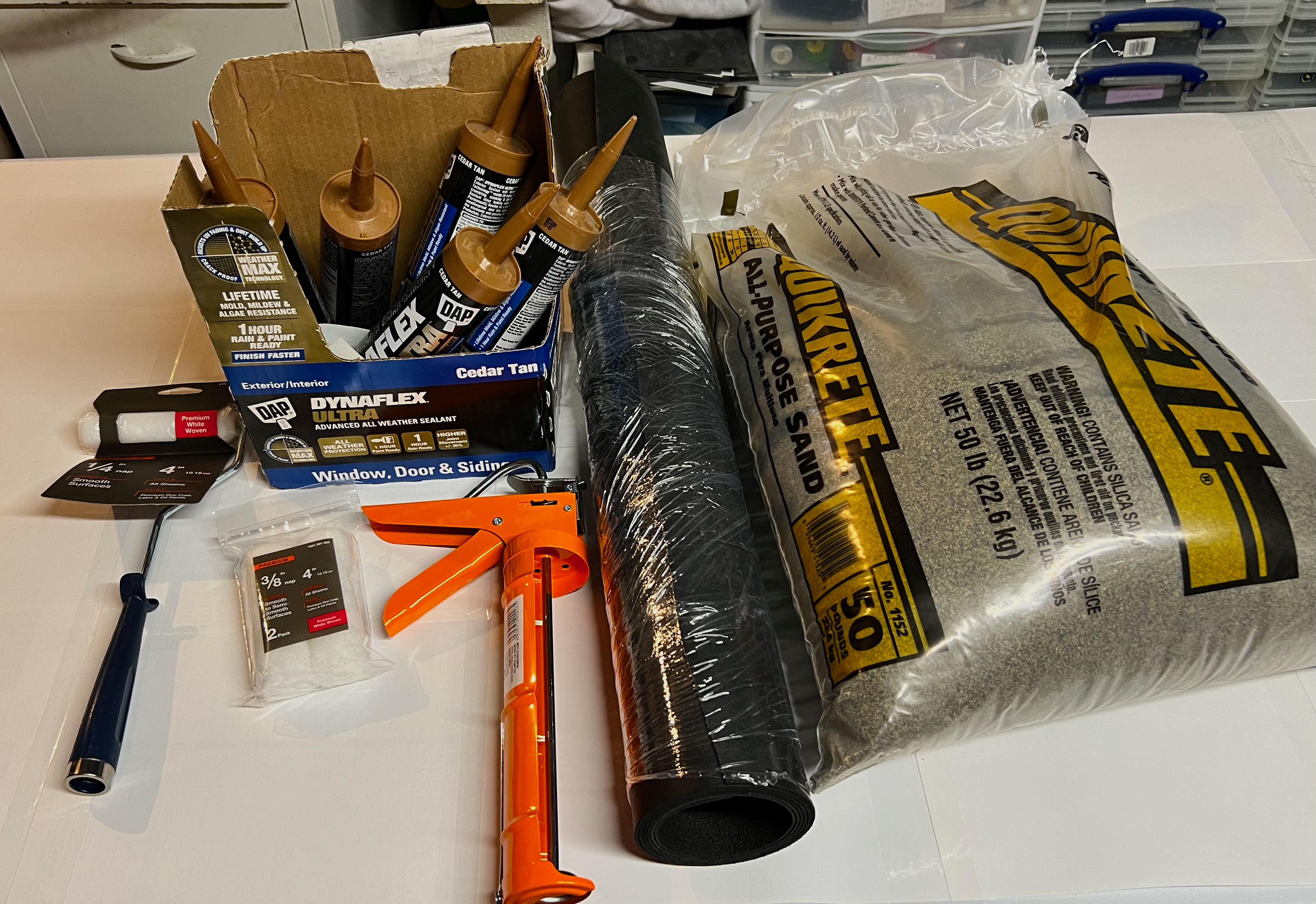
What I needed included a small paint roller, a caulking gun, and paintable caulk sealant. It also involved cutting up rubber floor runner material. Additionally, play sand and chinchilla dust were used on the roads for texture.
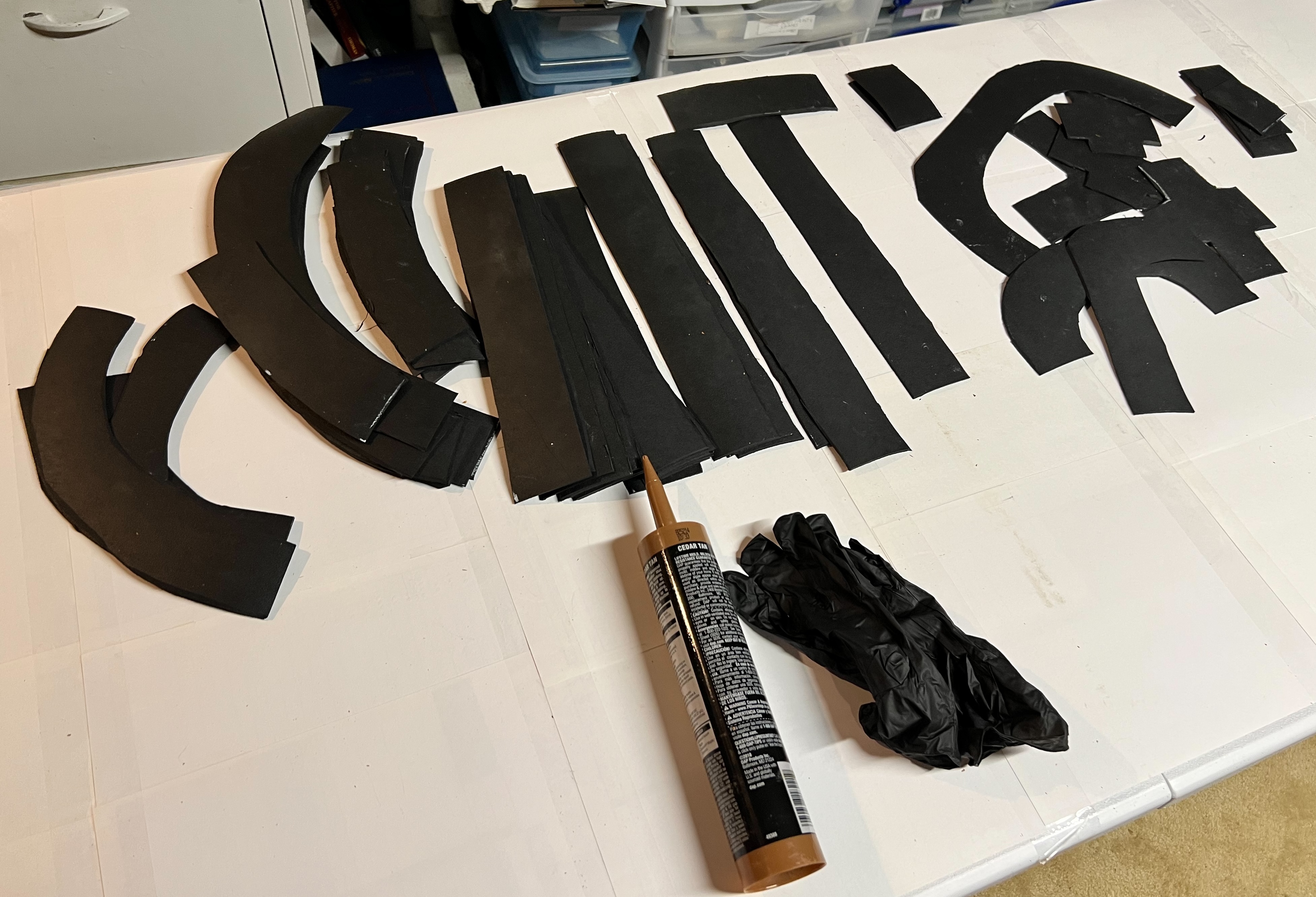
I cut the floor runner rubber with a box cutter on a wooden cutting board. I made the same number and types of dirt roads I had previously made with the poster board (54).

For a working space to work on the roads, I covered one of my gaming tables with paper. The sheets were secured with packing tape and this was sufficient to protect the table.

Here you see some of the road sections in progress. Sand and chinchilla dust were both rolled onto the caulk with a wet paint roller.
The first tranche of roads drying…
…and here painted minus some final dry brushing.
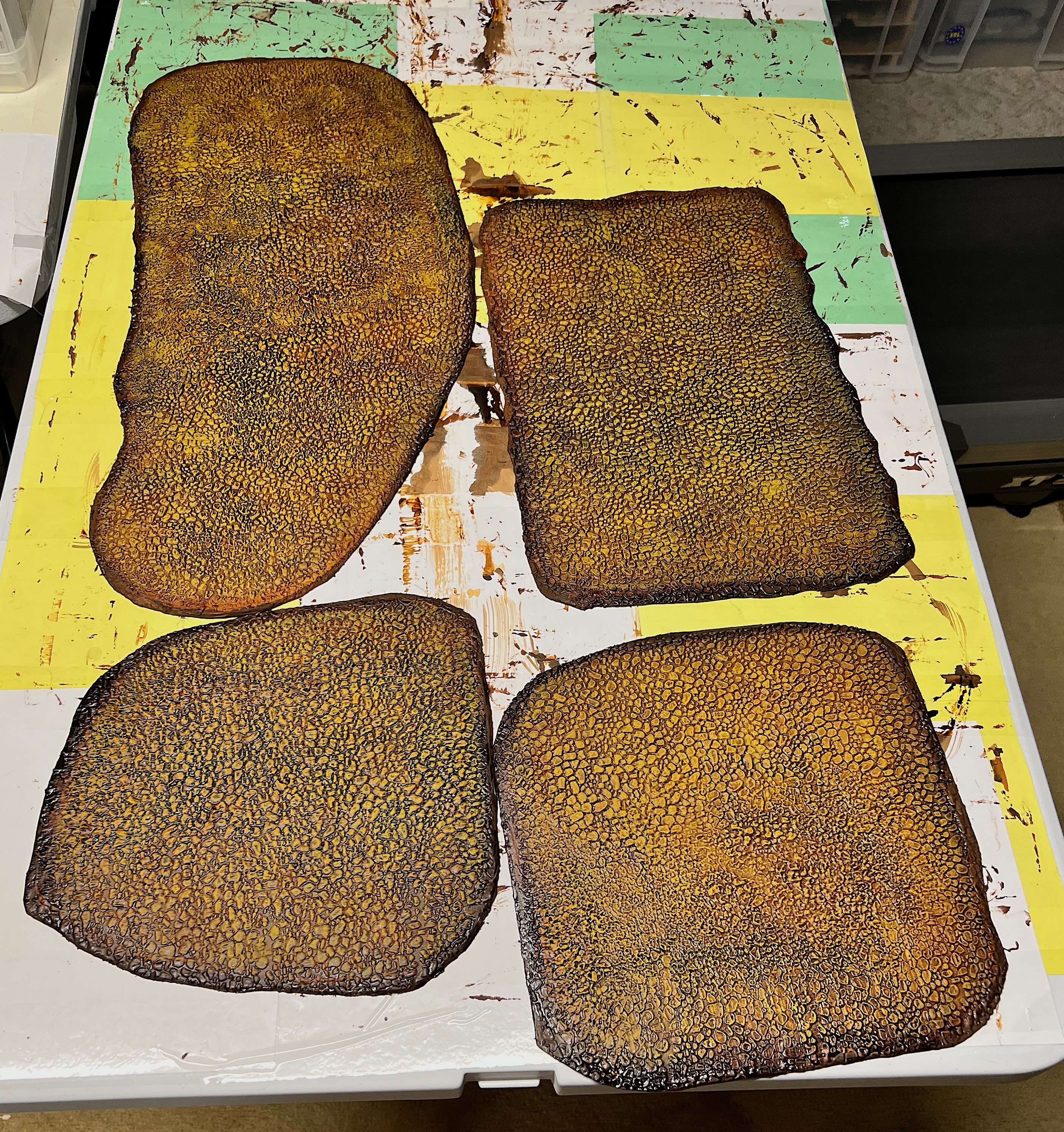
Then it was on to the city bases. I limited the width of the city bases to accommodate using a Green Stuff World Mega roller. The roller made a cobblestone imprint.Greg Priebe was kind enough to gift me the roller. Here I cut the first piece of rubber floor runner. As I did with the roads, I beveled the edges slightly. The edge angle was around 45 degrees.
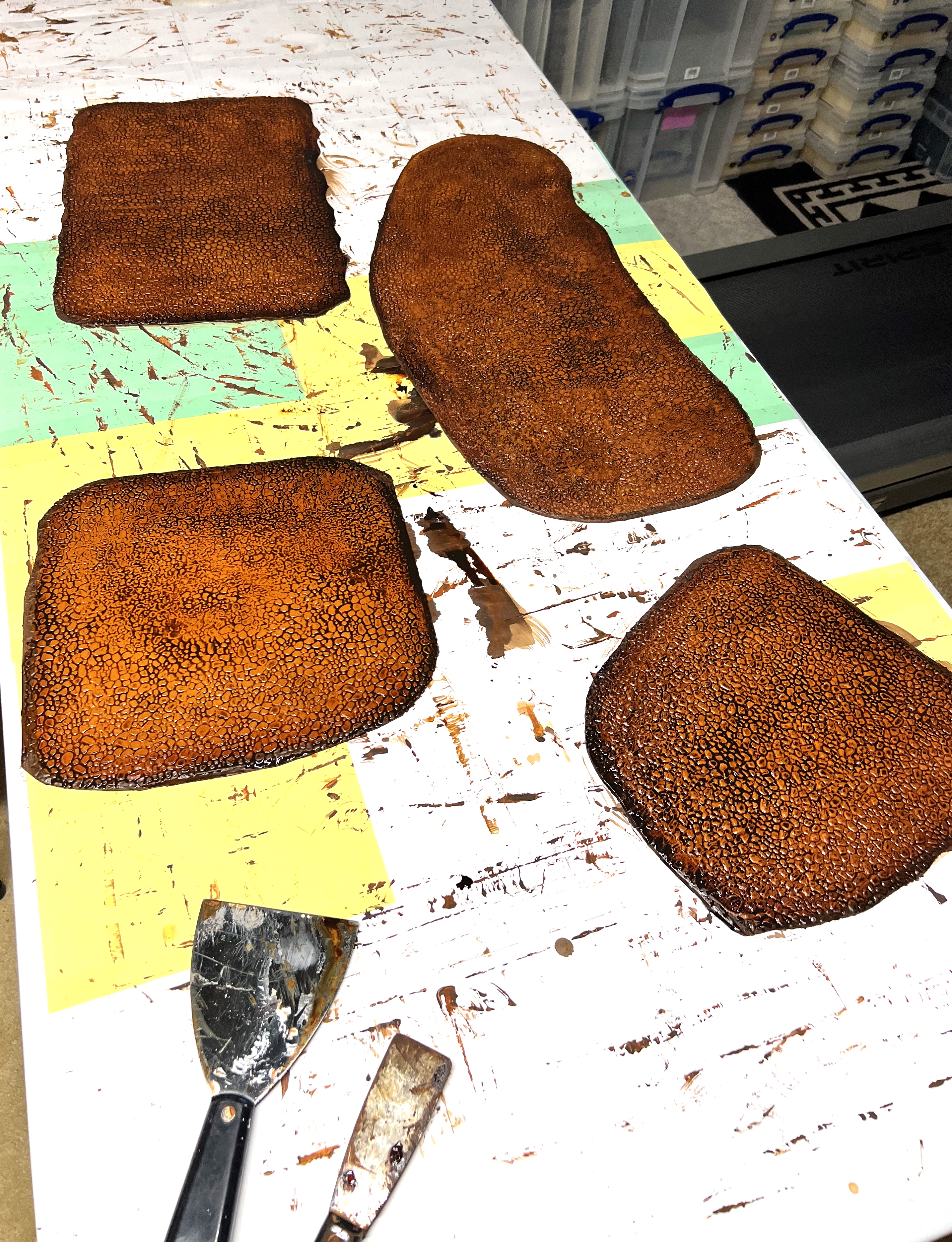
A caulking gun spread out the sealant. Then I smoothed it as you see with two different putty knives, before rolling the cobblestone patterns. This was the approach for all four bases – I just sized and shaped them differently.
The painting scheme was basically the same for all four. Here you can see the imprinted cobblestones. To accentuate them, I used a Liquitex “Burnt Umber” ink cut with thinner. Then I let them dry before adding a quick dry brush.
The final bases completed. I would place 15mm buildings on them.

This was far more economical than buying similar roads. Now that the dirt roads and town bases were completed, it was time to add my 3 aircraft.

Aircraft Model WIP Shots

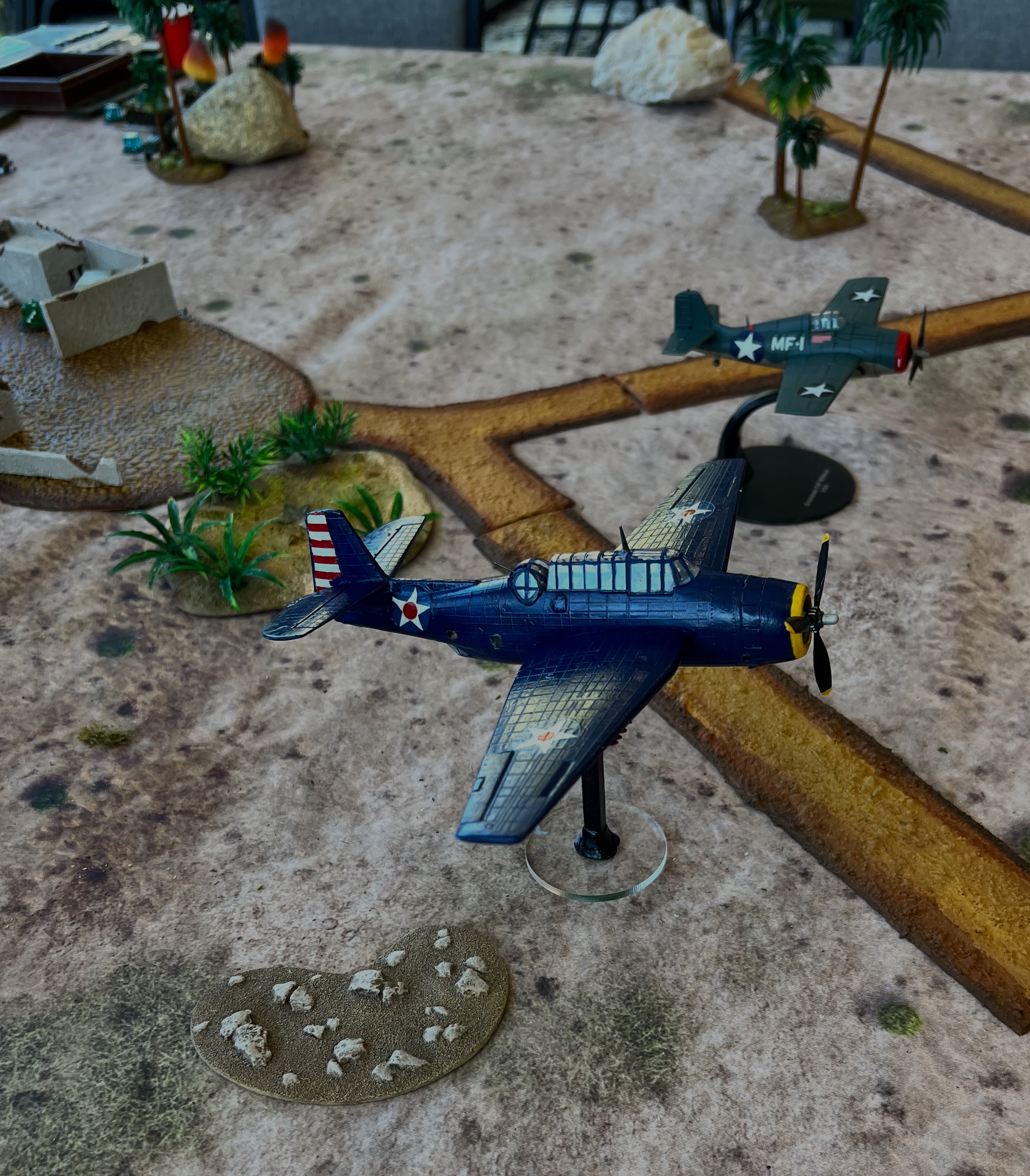
My search initially was for the right three 1:100 scale planes, but that effort proved fruitless. No one really makes aircraft in that scale, at least not the ones that I was looking for. Most models were 1:72. I did find some die cast models that would work just fine. They are more like game status makers. Those diecast models were the carrier-based Grumman F4F Wildcat and the Dewoitine D.520. Both had flight stands – an important feature as I wanted their landing gear to be retracted in flight.

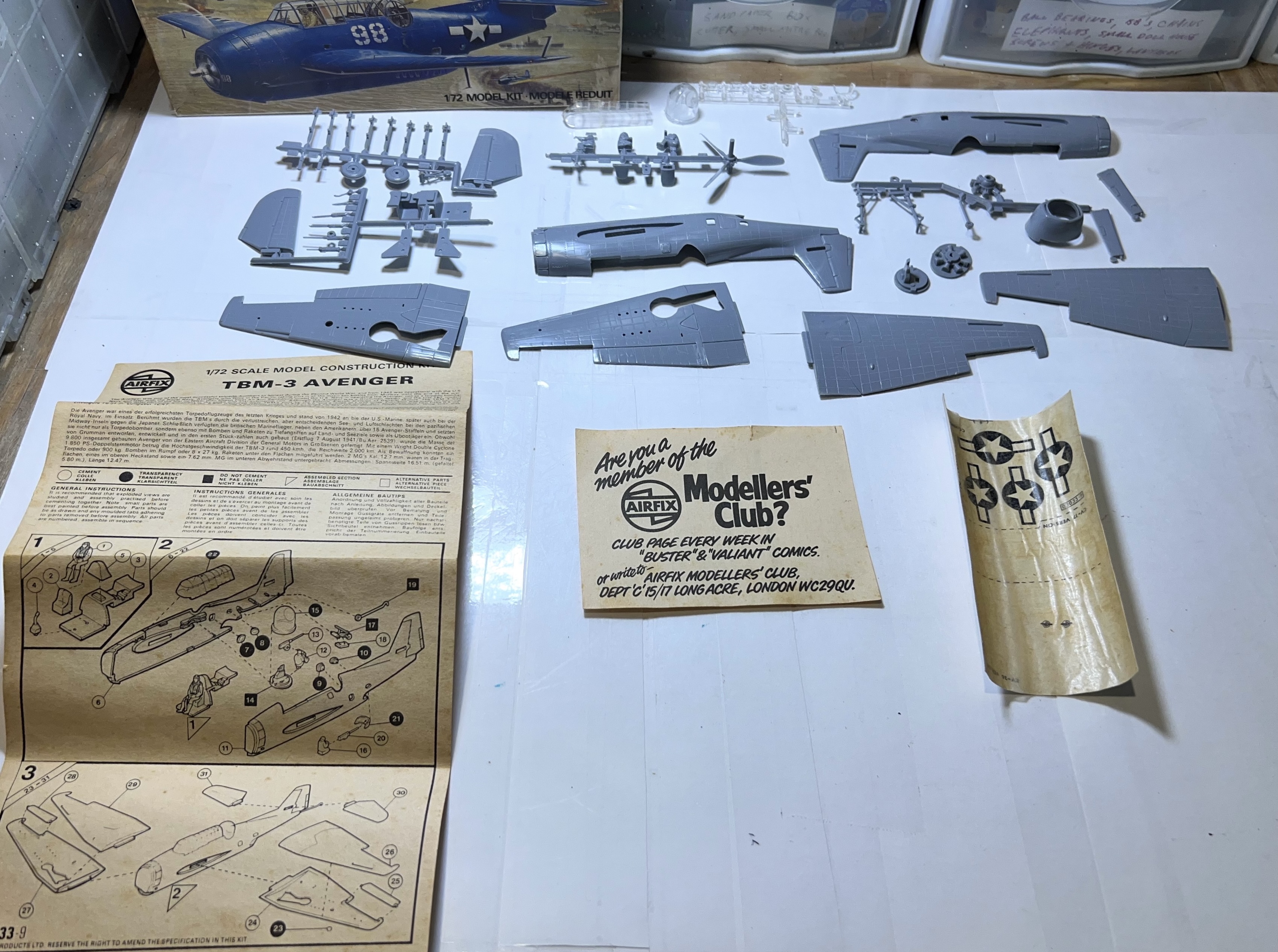
A bit of assembly for these two diecast models was required, but not much. That left the Grumman Avenger TBM to source. And lucky me, I found one on eBay – obviously left unassembled since at least 1979 – if not much earlier. It was an Airfix plastic model, and it was complete. The papers inside were amazingly yellowed with age as you will see. I had not built a plastic model like this since I was a kid. It was probably for sale back then!

The F4F Wildcat, the Dewoitine D.520, and the Avenger kit. It says “new”, but…I guess it was at some point in the 1970’s? 1960’s?
The kit contents.
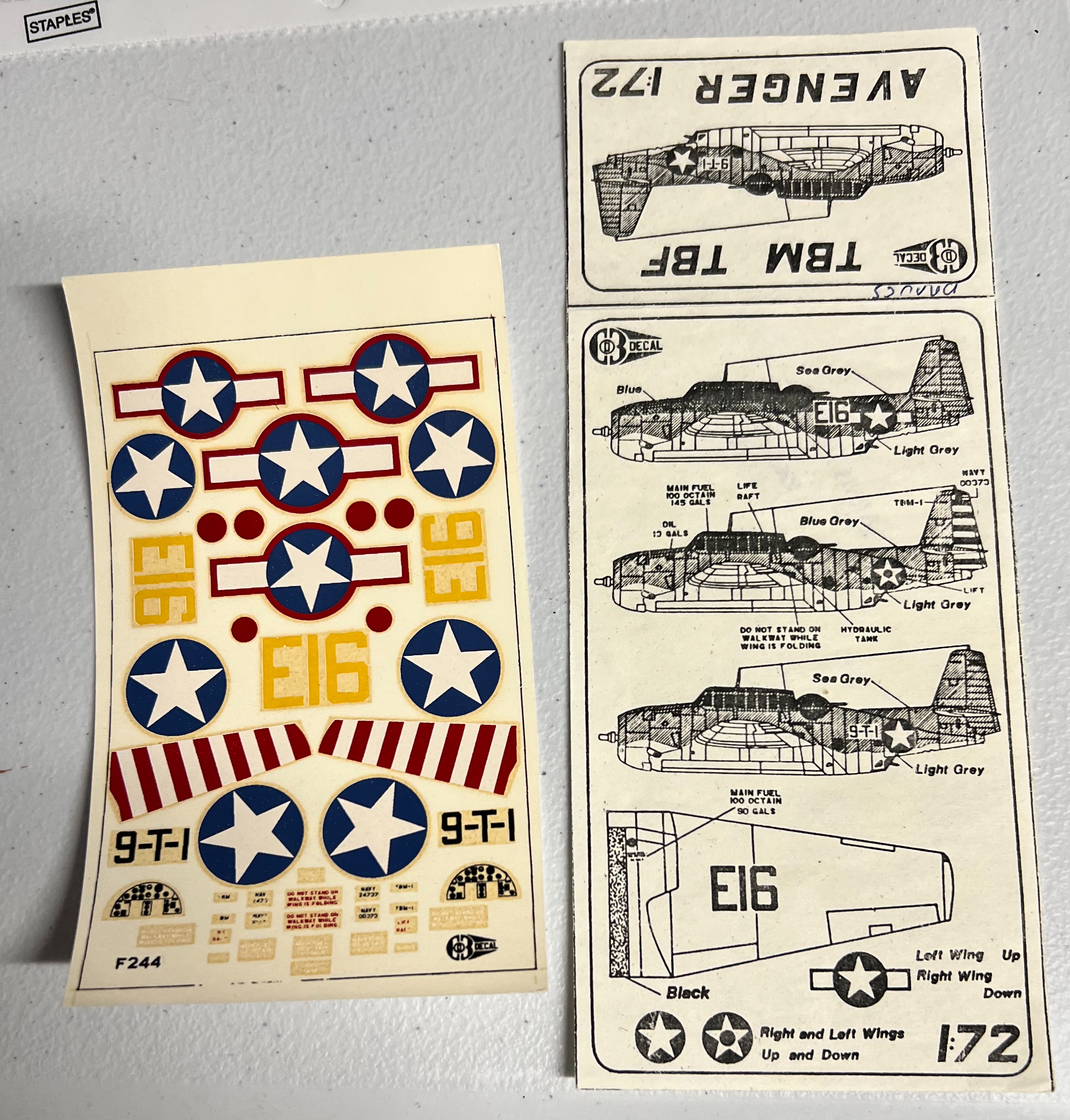
The components laid out so as to figure it all out. The directions were fine. The decals were, well, as you can see, trash. I did order some replacements from eBay as you will see.

As for assembly, it went fine. I painted the three crewmen. The tail gunner will never be seen because the acrylic window was not too clear. As for the outside, I went with a Vallejo “Deep Prussian Blue” – it seemed closest to the box color. In my research, I saw several different color schemes for the undercarriage. Some were blue, some were two-toned. The model would be on a flight stand. This stand would not afford visibility to the bottom, so I decided that blue was sufficient.

Inside the wing – how old was this?
The three crewmen and the rear landing gear and tailhook. The tailhook would not survive the build.
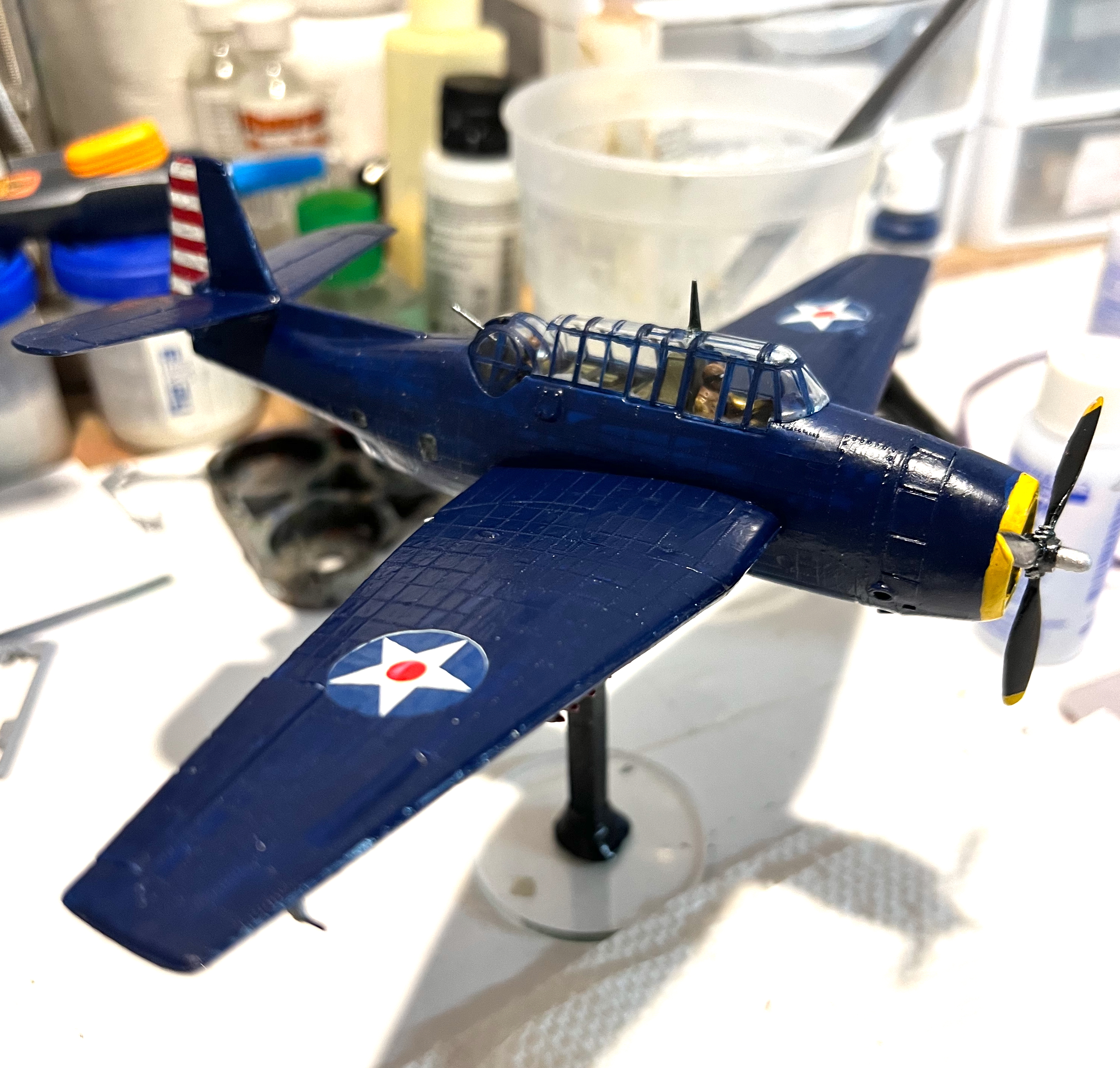
Avenger TBM assembled and painted (and below in the gallery).

The last assembly from the kit for the Avenger was the rockets underneath. I assume that any depth charges would have been in the bomb bay – as unseen as the gunner underneath. So that works!

The rockets are mounted. Next, we moved on to applying appropriate decals. That proved to be the most difficult part.

The decals I bought were from the US and came via a modeling shop in Latvia of all places. I have no idea of the age – except likely post-Cold War I imagine. I used multiple coats of Microscale “Liquid Decal File” to restore them as best I could. Even with that, several of them disintegrated into multiple jigsaw pieces in the progress of placing them on the model. This led to my having to reconstruct the decals while wet. Ugh. I made it work.

But wait – before all the decal work – I needed a flight stand! I made one with a 1/4″ wooden dowel, green stuff, and a 2″ acrylic base. I carefully carved out a hole on the model to accommodate the stand.

Then it was on to applying decals as best as I could.

Mid-stage with the decals. The tail and rudder ones were really finicky.

Finally the planes were done. I also built a special travel box for the Avenger. For the other two, the original package blisters served that purpose.

All three planes for the game, frontal view…
…and a side view.

Upon completion, I could mock up the tabletop in the cellar in preparation for HMGS FALL IN! in Lancaster PA and EllisCon in Danielson, CT.

Mock up of the Tabletop

I used photos of this mock up in my cellar to guide its recreation at both upcoming gaming conventions.

First up, HMGS FALL IN!

HMGS FALL IN! 2025 PHOTOS OF THE GAME

The game as set up in the H.A.W.K.’s room.
The players in my first game. It was nice to have my Wargame Wingman Leif Magnuson in the game. Several Maine Historical Wargame Association members joined as well! As I am also a member of MHWA, that was VERY cool.
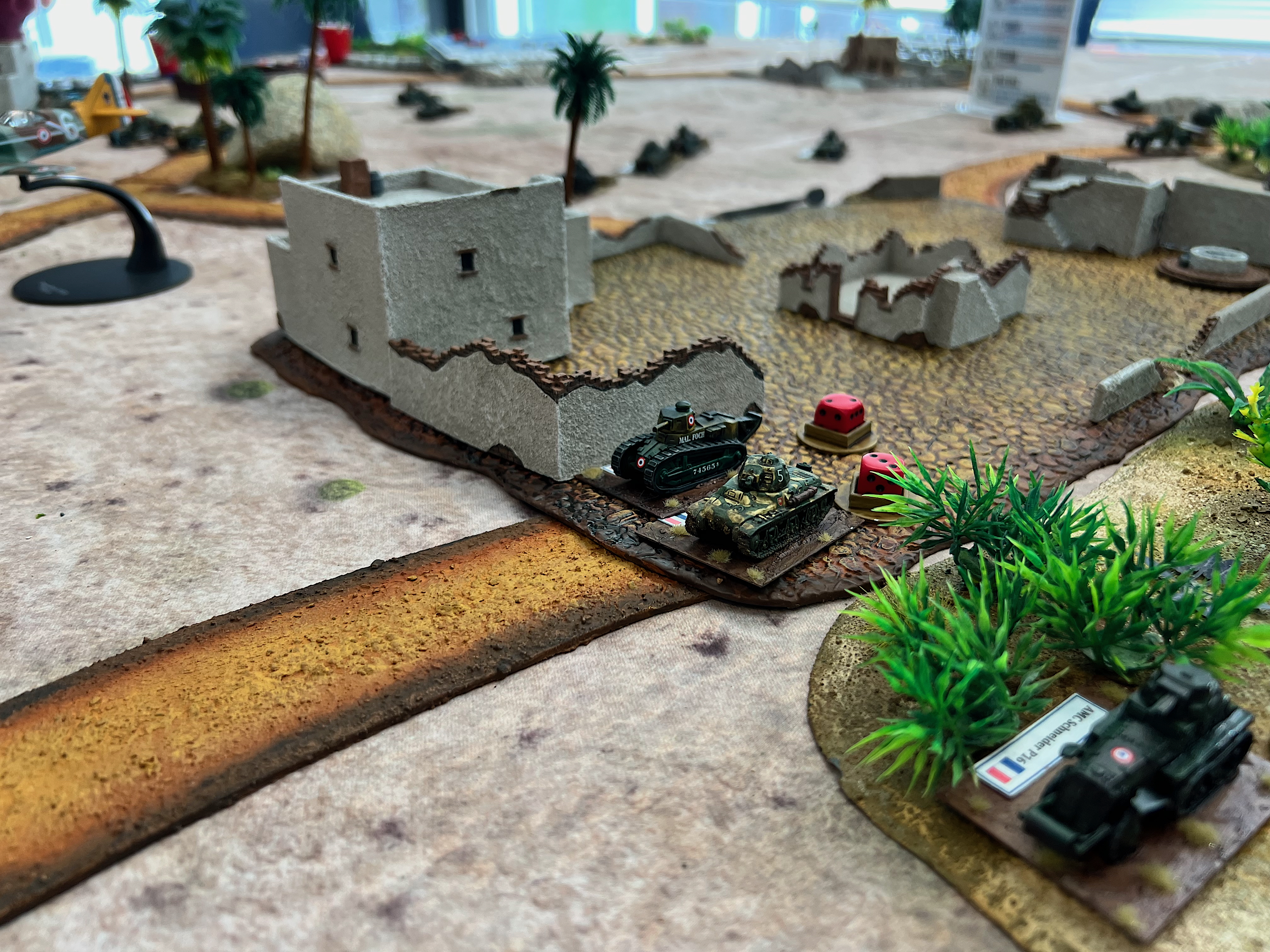
The French tanks and armored cars were cautious about leaving a town here.
The Mainers plot their strategy.

The US then deployed air, achieved superiority, and brought on the Avenger.

The F4F Wildcat about to dispatch the Dewoitine D.520.
While US vehicles burn in the background, the Avenger deploys, and calls in naval gunfire…
…blasting the Vichy armor.

With that, the US won the first game I ran.

In the second game, the tables turned. The US never got going very well. Or, perhaps, the French were very lucky. Take your pick. I don’t have any photos of that game (apologies) – but it was a complete French victory.

Next up, one week later, was EllisCon.

EllisCon 2025 Photos

Here I also ran the game twice.

The first game at EllisCon had 4 players. Leif joined us again for both games. Here he strategizes for the French with his teammate Brian.
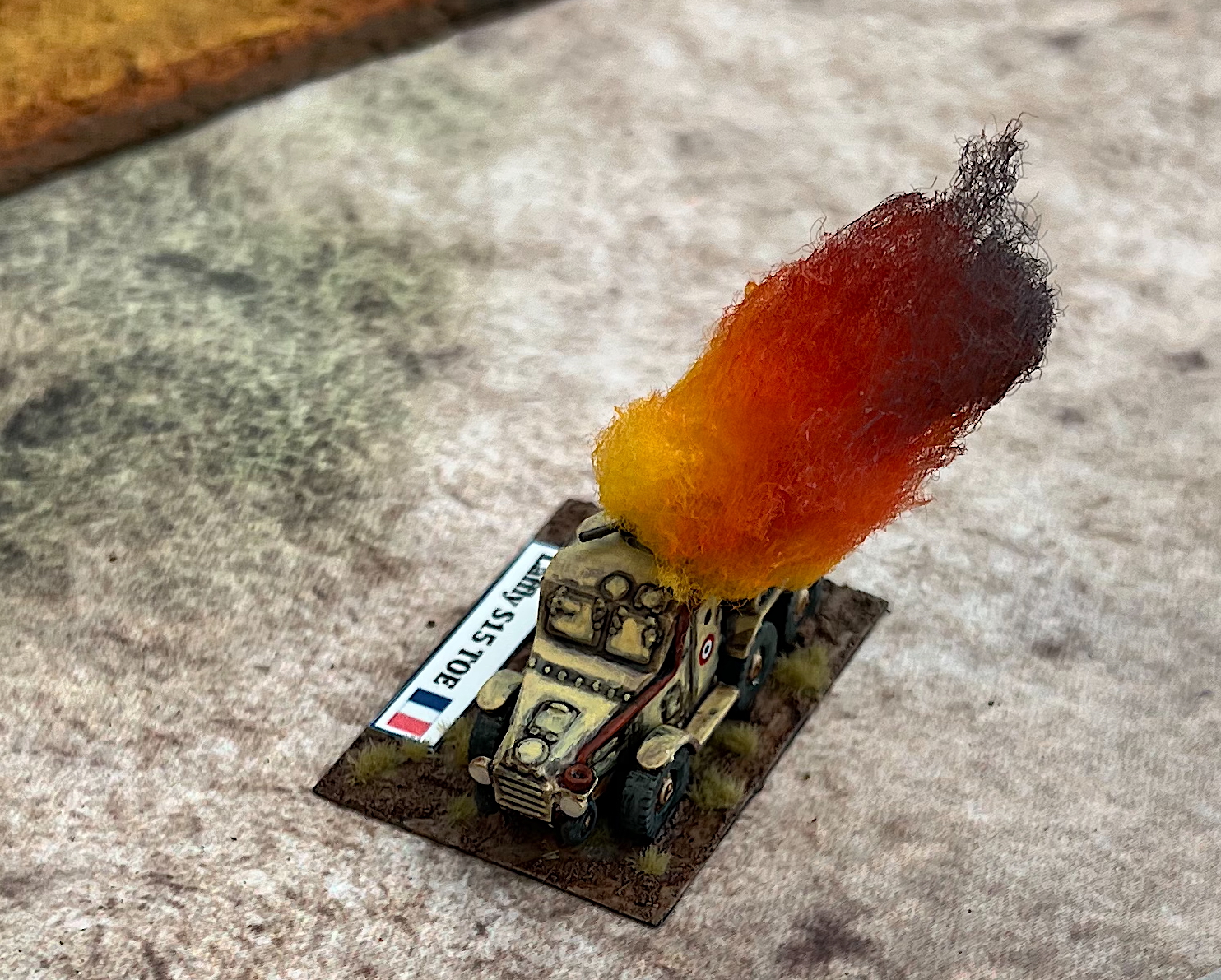
A Laffly S15 TOE armored car is hit and burns early in the game.
The US players are then hit hard, as the M5 Stuart “Beast”, and M3A1 Scout Car “Annie” are destroyed. The M3 GMC “Hurricane” takes cover in a brush firing position.
Once again, though at a different convention, the Vichy armor looks to leave the town safely in the face of “Hurricane”.
The French gain air superiority.
An AMC Schneider P16 (the old armored car on right) uses its 37mm gun to destroy the M5 Stuart “Beast”.
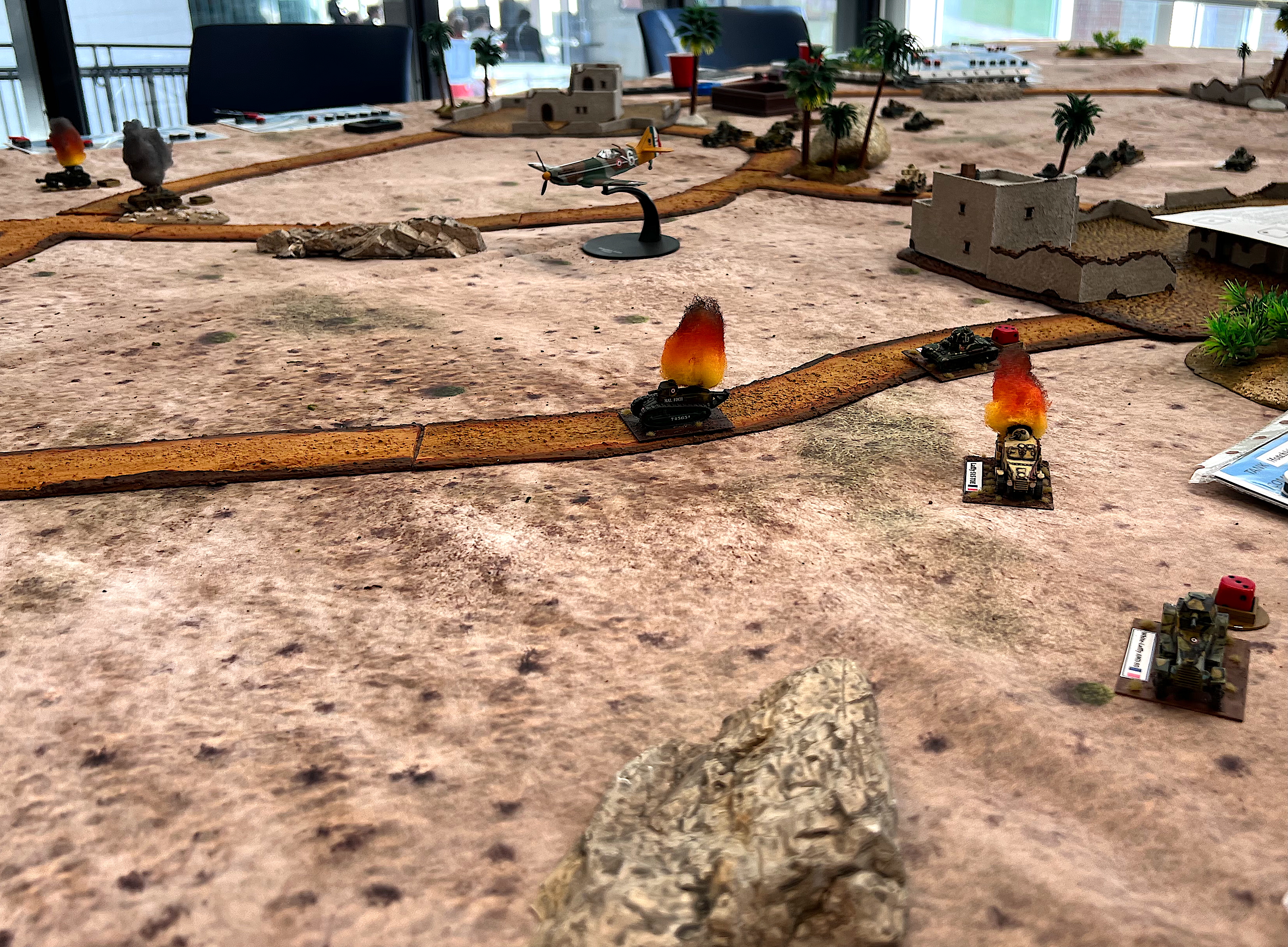
The FT-17 ” Marechal Foch” is taken out near r=the end of the game.

At the end, the Vichy claimed a victory, as their Tanker Bucks were more than the Americans total.

In game two, the fortunes reversed yet again. Leif played again and was joined on the other side by Gregg Belevick. Both were involved in my initial play testing of this scenario.

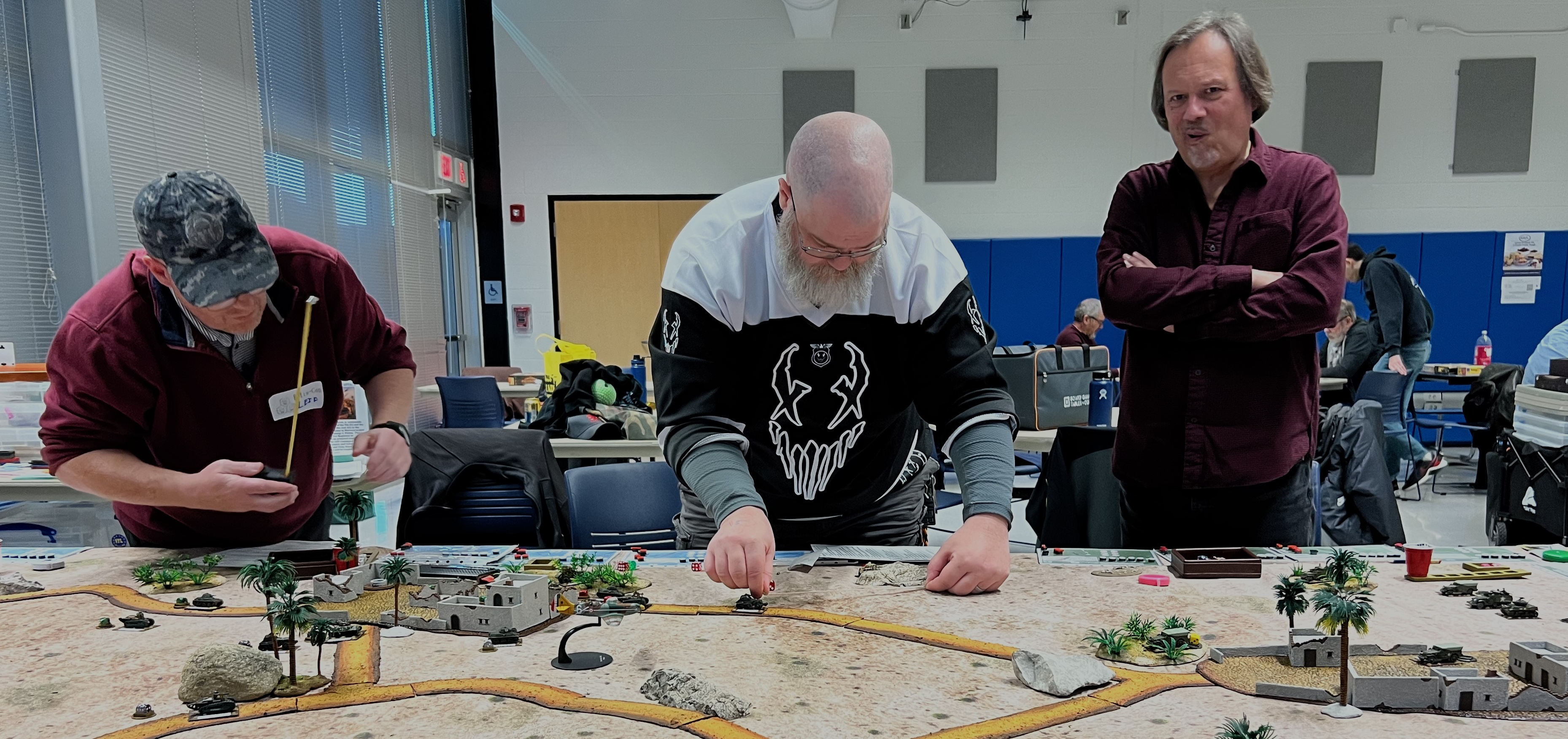
The players discuss their game strategies.
The French players move up – and Gregg has a twinkle in his eye – does he have a plan?
Yours truly GM’s the game. Photo courtesy of David DeVeau
I guess Gregg did have a plan – naval gunfire! Convention history repeats itself as 5 Vichy vehicles burn on the Moroccan sand.

The US won this game with the last barrage destroying 1/3 of the Vichy force deployed at the time. A massive US victory!

I really like this scenario. So far, the victories have been 3 for each side. It seems pretty fairly balanced. It’s fun and highlights a little-known part of WWII. It’s likely coming again to a convention in 2026.

I list the paints that I used for the roads at the end of this blog post. For my records, I am sharing these materials I use for these projects with you, dear reader. You’ll see the list below detailing the process and materials for both the roads/bases and the Avenger torpedo bomber.

I hope that you found this tale of my journey interesting. If you do use my rules modifications, again please let me know how they worked out. If you have any questions, certainly throw them at me. I’d also enjoy any feedback on the work or this post in the comments section. Thanks in advance for that.

Lastly, I have compiled all of my posts on WWII games and projects. There is a consolidated list of posts and their links located here.

MATERIALS USED

PAINTS, INKS, GLAZES, SHADES, WASHES, PIGMENTS AND FLOCKING USED ON THE DIRT ROADS:

  1. TrafficMaster Rubber Floor Runner from Home Depot, SKU 1003092882
  2. DynaFlex Ultra Advanced All Weather Sealant “Cedar Tan”, (paintable caulking)
  3. Quikrete “All Purpose Sand”
  4. Chinchilla Dust
  5. DecoArt Americana “Cinnamon Stick”
  6. DecoArt Americana “Deep Ochre”
  7. DecoArt Americana “Raw Sienna”
  8. DecoArt Americana “Raw Umber”
  9. Apple Barrel “Burnt Umber”
  10. Vallejo Thinner

PAINTS, INKS, GLAZES, SHADES, WASHES, PIGMENTS AND FLOCKING USED ON THE TOWN BASES:

  1. TrafficMaster Rubber Floor Runner from Home Depot, SKU 1003092882
  2. DynaFlex Ultra Advanced All Weather Sealant “Cedar Tan”, (paintable caulking)
  3. Quikrete “All Purpose Sand”
  4. Chinchilla Dust
  5. DecoArt Americana “Cinnamon Stick”
  6. DecoArt Americana “Deep Ochre”
  7. DecoArt Americana “Raw Sienna”
  8. DecoArt Americana “Raw Umber”
  9. Apple Barrel “Burnt Umber”
  10. Vallejo Thinner
  11. Liquitex “Burnt Umber” (ink)

PAINTS, INKS, GLAZES, SHADES, WASHES, PIGMENTS AND FLOCKING USED ON THE AIRFIX AVENGER TBM-3 MODEL:

  1. Airfix Grumman Avenger TBM-3 1:72 plastic model kit
  2. Tamiya “Extra Thin Cement”
  3. Vallejo Surface Primer “USA Olive Drab”
  4. Vallejo Surface Primer “Sun Yellow”
  5. Vallejo Surface Primer “German Dark Yellow”
  6. Vallejo Surface Primer “Leather Brown”
  7. Vallejo Surface Primer “Black”
  8. P3 “Midland Flesh”
  9. Army Painter “Soft Tone” (wash)
  10. P3 “Flesh Wash”
  11. Vallejo Model Color “Dark Prussian Blue”
  12. Vallejo Thinner Medium
  13. Hataka “Gris Clair Neutre”
  14. Reaper MSP Core Colors “Pure White”
  15. Vallejo Model Air “Black Metallic”
  16. Tamiya “XF-16 Flat Aluminum”
  17. Green Stuff
  18. Vallejo Model Air Metallic “Signal Red”
  19. Vallejo Model Color “Red”
  20. Vallejo “Mecha Gloss Acrylic Varnish”
  21. Vallejo Thinner
  22. Citadel “Nuln Oil Gloss” (shade/wash)
  23. 1/4″ square wooden dowel
  24. 2″ Clear acrylic disk
  25. 2″ steel washer
  26. Gorilla Glue
  27. Microscale Industries “Liquid Decal Film”
  28. Avenger decals from eBay
  29. Microscale Industries “Micro Set”
  30. Microscale Industries “Micro Sol”

Thanks for looking!

M5 Stuart tanks for “Operation Torch: Vichy Mounts an Armored Counterattack” Game

I promised back in August that I would post about my US M5 Stuart tanks. These would be the linchpin of my US forces in my “Operation Torch: Vichy Mounts an Armored Counterattack” games.

M5 Stuart in Casablanca.

Yes, the US and UK did briefly engage French forces of Vichy in North Africa in WWII. After the US Operation Torch landings, Vichy did put up a resistance. Technically they were supposed to be neutral after the 1940 Armistice. However, the Soviets were dealing with massive battles on the Eastern Front, and the US/UK allies were not yet ready to successfully invade Fortress Europe. As the Dieppe raid showed, it would have been a catastrophic failure in 1942.

The idea was to take off some of the pressure on the Soviets by getting in the war somewhere and tie down the Germans. French North Africa became the chosen option, with the hope that the Vichy French would welcome the US/UK invaders as liberators and not invaders. For a brief period in November 1942, both of these two options played out in Morocco, Tunisia, and Algeria – until the French there decided to cease resisting the Allies. Subsequently, back in Europe, Hitler was enraged at the Vichy capitulation and ordered his forces to invade the remaining southern part of France that was not yet occupied.

Back in North Africa in November 1942, one of the more obscure incidents of the conflict was in Morocco – where the French 1er Regiment de Chasseurs d’Afrique launched an armored counterattack towards the landing beaches. At that critical juncture, the 66th Armored Regiment of the 2nd Armored Division (and Sub-Task Force Goalpost) had just 7 M5 Stuart tanks that it could cobble together to intercept the French. Their M4 Sherman tanks needed a port to unload, and that had not happened yet.

I found this article/post by Patrick Chaisson to be an excellent description of the combat that happened in November 1942.

As far as a concept for a wargame, I liked the idea of a game that would recreate this clash of armor – especially as one side was green as hell, and the other fielded such a hodgepodge of elderly and obsolescent armor.

I ran this game twice at HISTORICON 2025, along with two Wars of Ozz games. All went well. I hope to post some convention shots in my next post (albeit very late). Unfortunately golf season was very busy this summer (well, fortunately for my golf game and not my hobby projects). Still, I keep my word. I thought I’d add a bit about the game as well, while saving specific game/convention photos for the next post. However, the game is coming back!

I will be running the game again twice at HMGS Fall In this November. Here are the inks – one is on Friday afternoon and one is on Friday night. I can handle up to 10 players per game – and I can scale it for fewer as well. as of this writing, there are still slots available.

My game poster. It marks my first foray using AI (Freepik) to generate an image. I wasn’t completely thrilled with the result, but it’s OK for a flyer.

The game uses modified What a Tanker rules. The major modifications that I use are:

  • Using Bonus Attack Cards to simulate infantry, anti-tank, artillery, naval gunfire, and air actions. These are deployed by scout cars according to each sides’ historical capabilities. Bonus Attack Cards are purchased with “Tanker Bucks”, which also play into Victory Conditions. Having more Tanker Bucks at the games end is better. Yet, you need to use resources to take out the enemy. So, a balancing act exists for the players. Do they hoard their Tanker Bucks, or use them effectively against their opponent?
  • Representing the French vehicles’ advanced age and mechanical unreliability. “OLD” French vehicles that try to move and roll a 5 or less will lose 1 die to temporary damage. Mathematically, there is an 11% chance of that happening. So the Vichy Forces are indeed slow. But there are more of them, and not all of the French tanks are OLD.
  • Creating a way for armored cars to engage other armored cars – and tanks, with heavy machine guns or Bonus Attack Cards. Also I have rules that show how devastating any cannon fire would have been against thin-skinned vehicles.
  • Representing the US Army as being totally GREEN at this point in the war. Their base roll needed to hit goes from needing a 6 on 2d6 added together to a 7. Add to that the concept that most of the French vehicles are SMALL, necessitating an addition +1 to hit at short range, and another +1 at long range. Oh yeah, the Stuarts have just a 37mm gun. This means that the US has a tough time making damaging hits at long range against French tanks.
  • The US use of Bonus Attack Cards is limited to just the US and French Armored Cars. The M5 Stuart’s radios got wet during the landings and were not working. Many French tanks in North Africa did not have radios.
  • Use of Bonus Attack Cards also represented that the US had both carrier-based air support as well as naval gunfire from the USS Savannah. I added F4F Wildcat’s and Avenger TBF’s for US air support. The F4F’s can provide air superiority, which allows them to also do limited close air support missions. Having air superiority enables the US player to deploy the Avengers, which can act as spotter planes for both artillery and naval gunfire. The Avengers can also bomb the French vehicles with depth charges (yes that happened). The French can contest the US air superiority by deploying Dewoitine D.520’s.
  • Modifying the activation sequencing methodology by using Buck Surdu’s “Double Random Activation” method. It’s the same one used with Wars of Ozz, Feudal Patrol, and Combat Patrol games.

Back to the Stuarts. The M5 vehicles are 15mm/1:100 scale. I sourced them from two places. I got an OOP Flames of War 5-tank platoon (plastic) from Noble Knight Games. I also bought five 3D-printed resin models on eBay from HobbyHouse&Miniatures LLC. The plastic models were fun to work on, and I was glad to have the additional resin ones. Historically, 7 M5 Stuarts were sent to counter the Vichy counterattack. When I drilled out the resin models for magnet installation, two broke in half (not the fault of the model, just me. In the end, I had 3 of those, making 8 models in total, which was fine given that seven were originally sent along with some M3 and M6 tank destroyers.

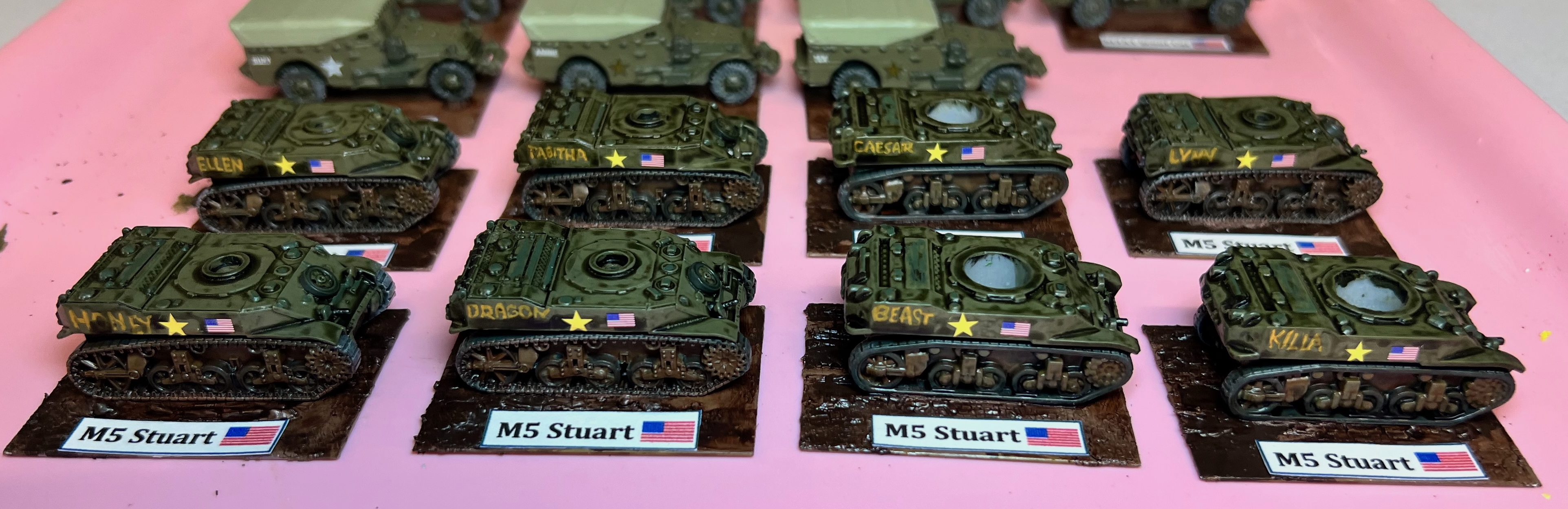
I worked on the M5 tanks in parallel with the M3A1 Scout Cars and the M3 and M6 Tank Destroyers that I have discussed previously. I tried to incorporate the gold stars and US flags that were unique to that period of the war. I also decided to give the vehicles hand-painted names:

  • Honey (my Mom’s nickname)
  • Dragon
  • Beast
  • Killah
  • Ellen (my daughter’s name)
  • Tabitha (my granddaughter’s name)
  • Caesar (my late cockatiel’s name)
  • Lynn (for my ever-so-tolerant wife)
The M5’s without their turrets, showing the basing and details. I list the paints and other materials used at the end of this post.
The eight M5’s completed.
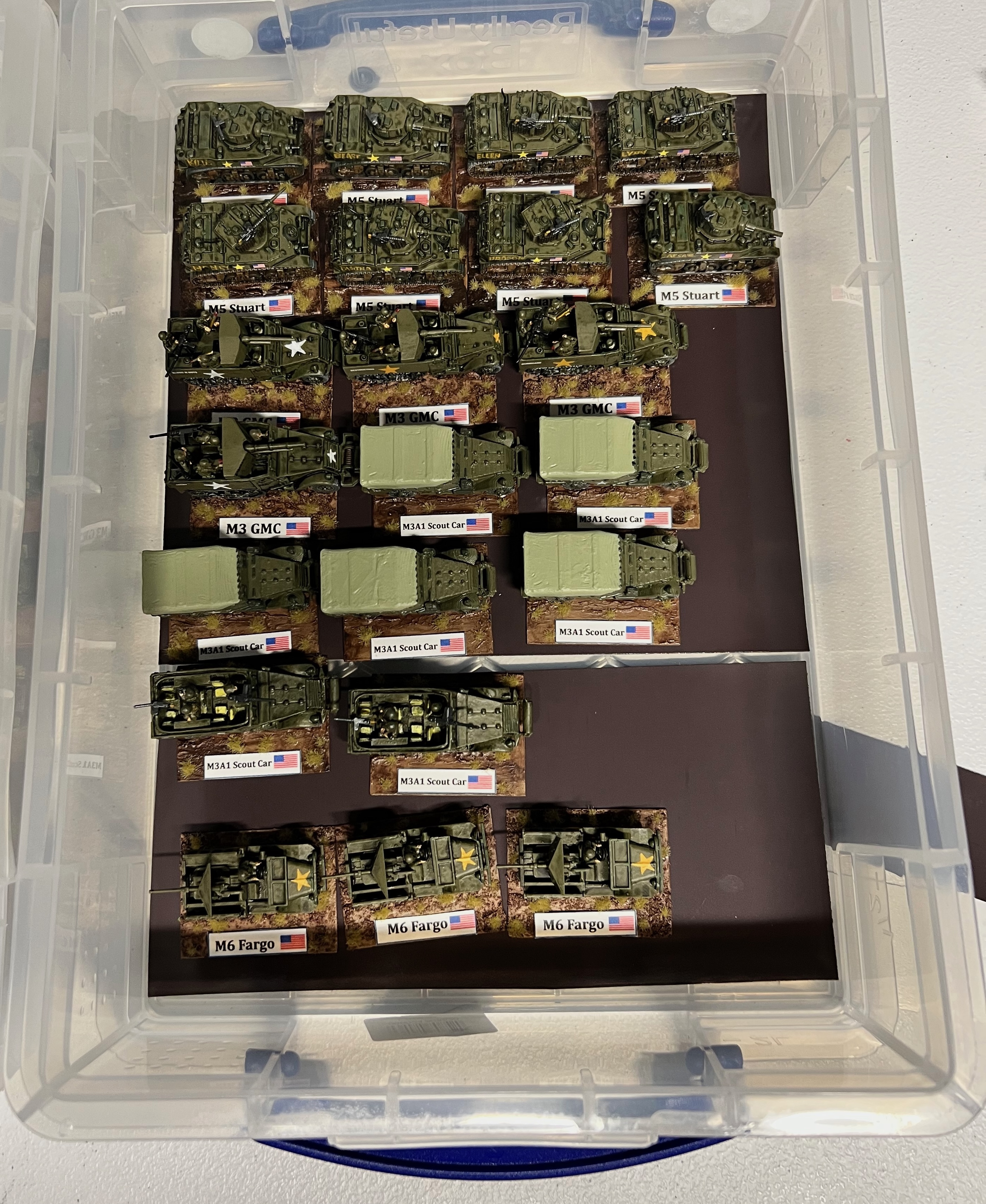
The 22 US Army vehicles for my game in a Really Useful Box.
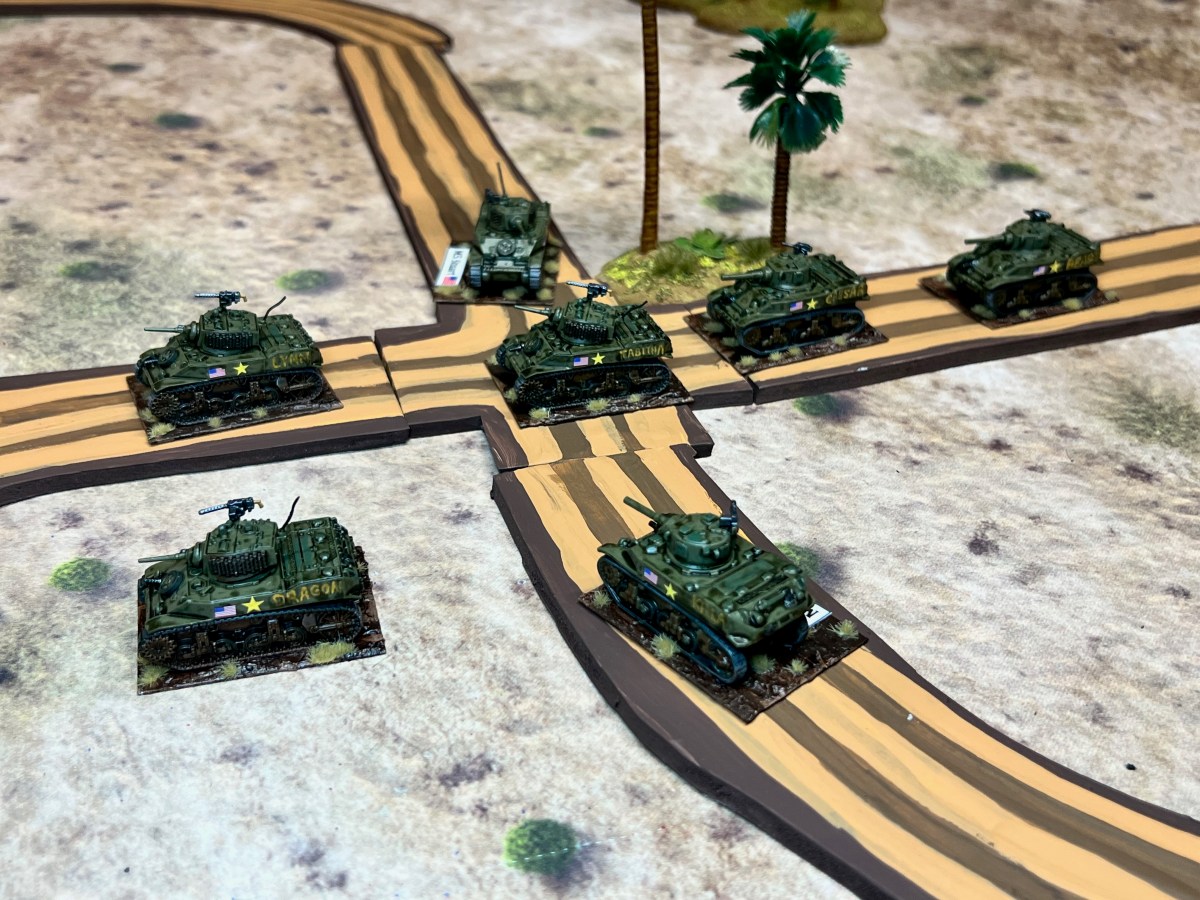
The 8 M5’s on my tabletop.

This wraps up this post on my 8 M5’s. If you have any feedback – please let me know in the comments section!

Lastly, for all of my posts on WWII games and projects – there is a consolidated list of posts and their links located here.

MATERIALS USED

PAINTS, INKS, GLAZES, SHADES, WASHES, PIGMENTS AND FLOCKING USED ON THE FIVE BATTLEFRONT/FLAMES OF WAR PLASTIC M5 TANK MODELS AND THE THREE HOBBYHOUSE&MINIATURES LLC 3D-PRINTED RESIN M5 TANK MODELS:

  1. Green Stuff
  2. Paper Clip wire
  3. War Games Accessories Steel Bases Number 16 (½” x ½”)
  4. Wooden Blocks, steel bolts, steel washers, magnets, steel screws
  5. Neodymium magnets (⅛” and ¼”)
  6. Gorilla Glue
  7. Tamiya Extra Thin Cement
  8. Daisy BB’s
  9. Plastic broom bristles
  10. Vallejo Surface Primer “Black”
  11. Vallejo Surface Primer “USA Olive Drab”
  12. Vallejo Model Air “Black Metallic”
  13. Army Painter “Military Shader” (shade/wash)
  14. Hataka “Vert Fonce”
  15. Vallejo Model Color “USA Olive Drab”
  16. Vallejo Model Air “Tire Black”
  17. Vallejo Model Color “Dark Sea Grey”
  18. Vallejo Model Air “Gun Metal”
  19. Vallejo Model Air “Wood”
  20. Vallejo Mecha Weathering Effects “Dark Rust Wash”
  21. War Games Accessories Steel Bases Number 23 (1½” x 2″)
  22. Vallejo Surface Primer “German Green Brown”
  23. Citadel “Agrellan Earth” (texture)
  24. Army Painter “Mid Brown” (shade/wash)
  25. Reaper MSP Core Colors “Blackened Brown”
  26. Vallejo Thinner Medium
  27. Citadel “Averland Sunset”
  28. Vallejo “Mecha Varnish Gloss”
  29. Microscale Industries “Micro Set”
  30. Microscale Industries “Micro Sol”
  31. Microscale Industries “Liquid Decal Film”
  32. Battlefront US Army decals
  33. Vallejo “Gloss Acrylic Varnish”
  34. Citadel “‘Ardcoat”
  35. Vallejo “Gloss Acrylic Varnish”
  36. Vallejo Flow Improver
  37. Vallejo Thinner
  38. Vallejo “Matte Polyurethane Varnish”
  39. Printed labels on card stock
  40. Gamers Grass “Tiny Beige 2mm Tufts” (flocking)
  41. PVA Glue

US Vehicles for Operation Torch: M3A1 Scout Cars

Now that I have shared all of the Vichy French vehicles that I completed on this blog, it is time for me to add the American models. These will also be used in my What a Tanker games for Operation Torch at HISTORICON 2025. I am starting with the American reconnaissance scout car – the M3A1 Scout Car.

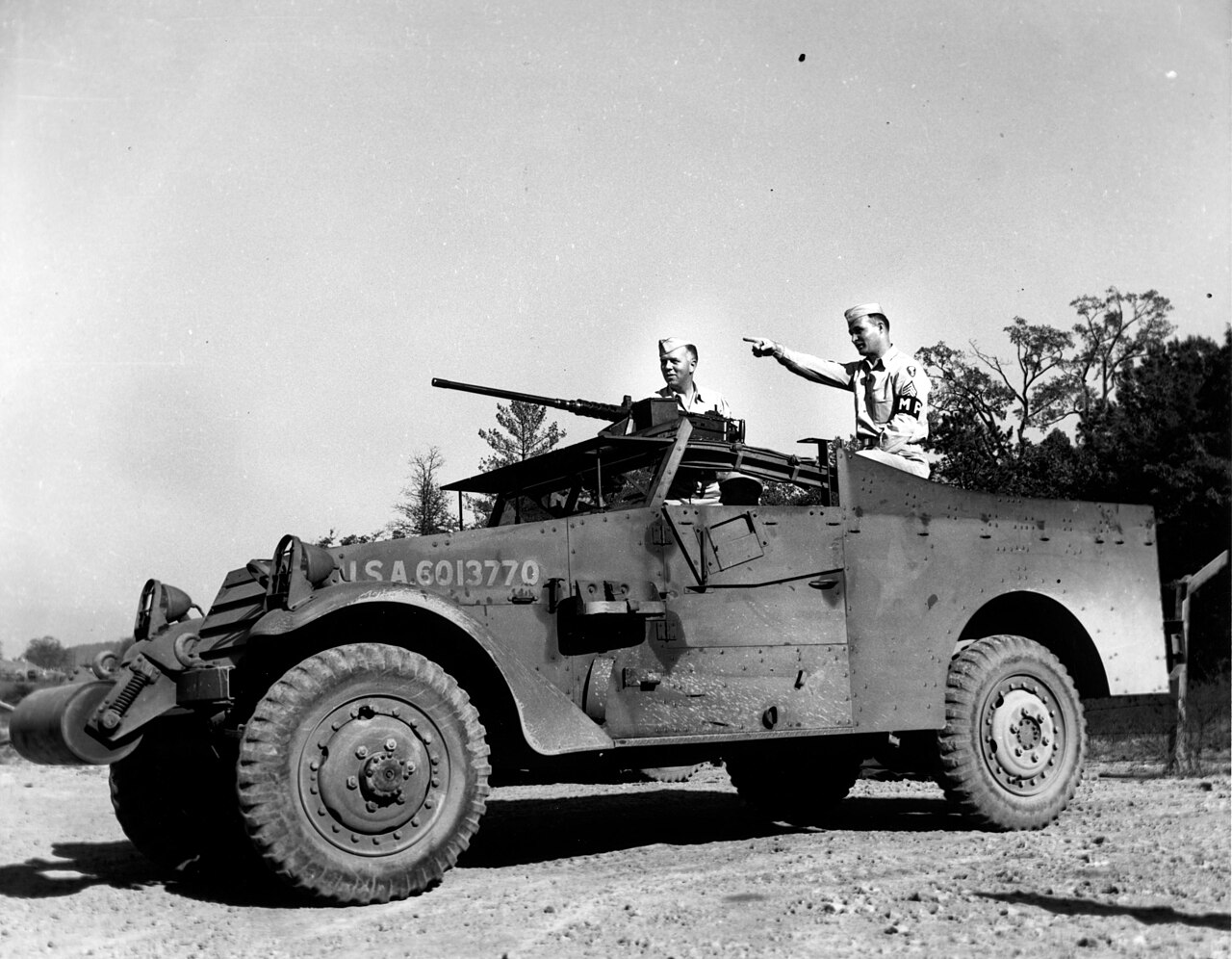
It was designed and built by the now-defunct White Motor Company, with the chassis interestingly being a product of the Diebold Lock and Safe Company. It was a 4×4, and could do up to 50 mph on the road (80 kph). Many of you will notice how similar the M3A1 is to the M3 half-track. And for good reason, as the M3 half-track was a development of the M3A1 Scout car.

It typically carried a Browning M2 .50 caliber machine gun plus up to two additional Browning M1919 .30 caliber machine guns. It was open-topped with armor on the chassis up to 13mm/.5″ in thickness. It could carry up to 6 soldiers in addition to the driver. A canvas cover was available for protection against the elements. The M3A1 was intended to be a reconnaissance vehicle, but its lack of protection made it less desirable than the M3 half-track in that role. In US use, it was relegated to rear-echelon uses after Operation Torch and Operation Husky (the invasion of Sicily). Over 21,000 were made, with over half of that number going as Lend-Lease, mainly to the British Commonwealth and the Soviet Union.
I found David Doyle’s book, M3A1 Scout Car: The US Army’s Early World War II Reconnaissance Vehicle (Legends of Warfare: Ground, 8), very interesting and useful.

For my Operation Torch What a Tanker games, I decided that these would serve as the cavalry scouts that would run into those quirky French armored cars that I’ve been posting about recently.

Sourcing of the M3A1 models came from two different places. I got two Battlefront Flames of War models (SKU US 300) from a flea market at the HAVOC gaming convention in April. These models came with crew and machine guns. As the Battlefront model seems to be out-of-production, I needed to look elsewhere for more models. I went to eBay as a second source.

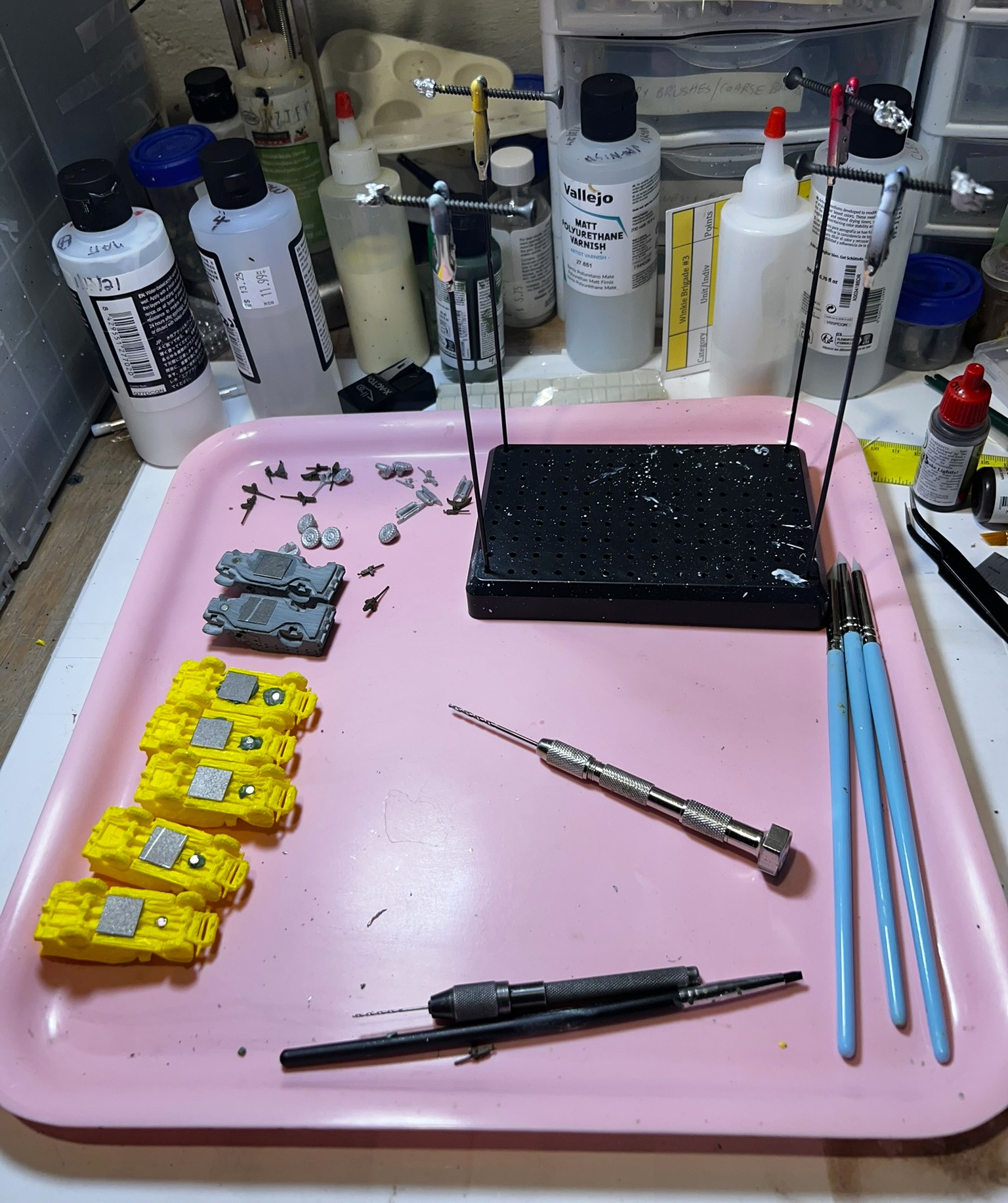
There from Wolverine3d.com I found models with the tarpaulin covers on. Given that a) these were different from the Battlefront models, b) there would be no crew to paint (saving time), and c) very reasonably-priced, I ordered 5, bringing my total available to 7 M3A1’s. They were not too crisp, and made of PLA plastic, but good enough for tabletop use. I started work on them all on May 23rd, and finished them on June 2nd. As I was hurrying to complete the entire project, photography of in-progress work took a backseat. I did work on multiple types of US vehicles concurrently as well. I judged doing separate posts for each type was better for me and you dear reader!

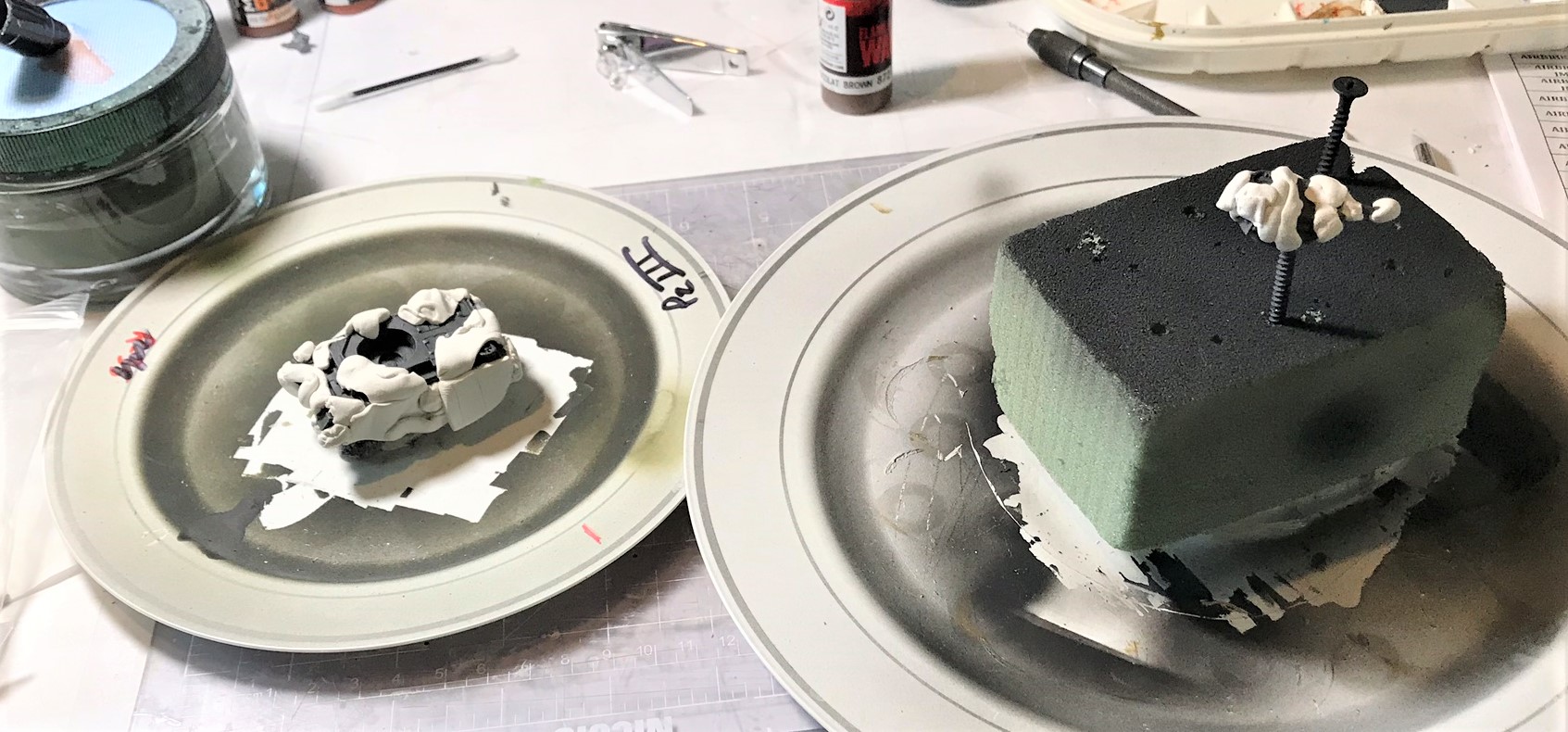
I cleaned up the models and washed them. For ease of painting I then mounted a small 1/2″ square steel base under each M3A1 model. This would allow me to use magnets to support the vehicles while I painted them. I also drilled out and installed small neodymium magnets (secured with green stuff) so that I would be capable of using my equally-magnetized blast markers on any that got brewed up in a game. As for crew- I used my alligator clip stand and some wood screws on them as supports – in a painful way for them (if they were capable of pain of course).

May 23rd – the work begins.

After painting I added decals and labels. Each M3A1 got a different name. Because in Operation Torch there was a mixed use of gold and white stars on US vehicles, I varied their application as well with some home-made gold star decals. They were ok – but not 100% to my liking, and you will see the different approach that I took on the other US vehicles (in future posts).

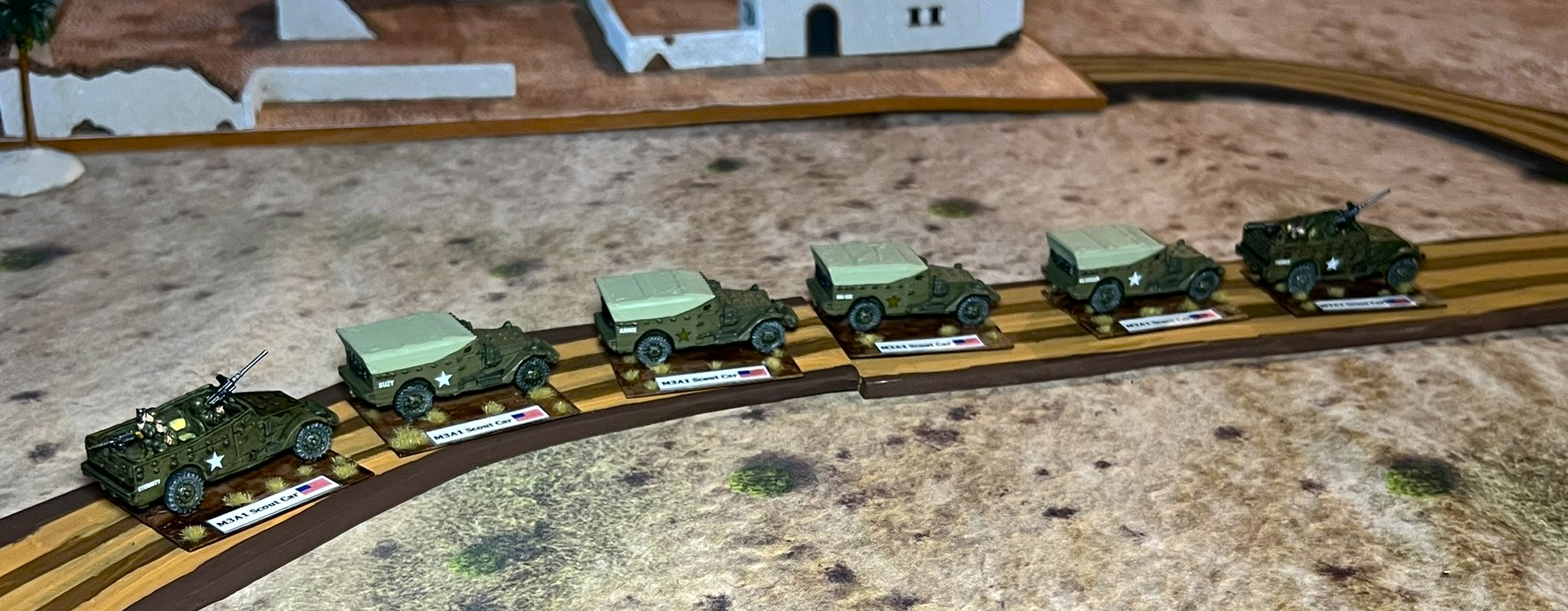
The seven M3A1’s before I added any tufts as final flocking. The bases are 1.5″ x 2″.

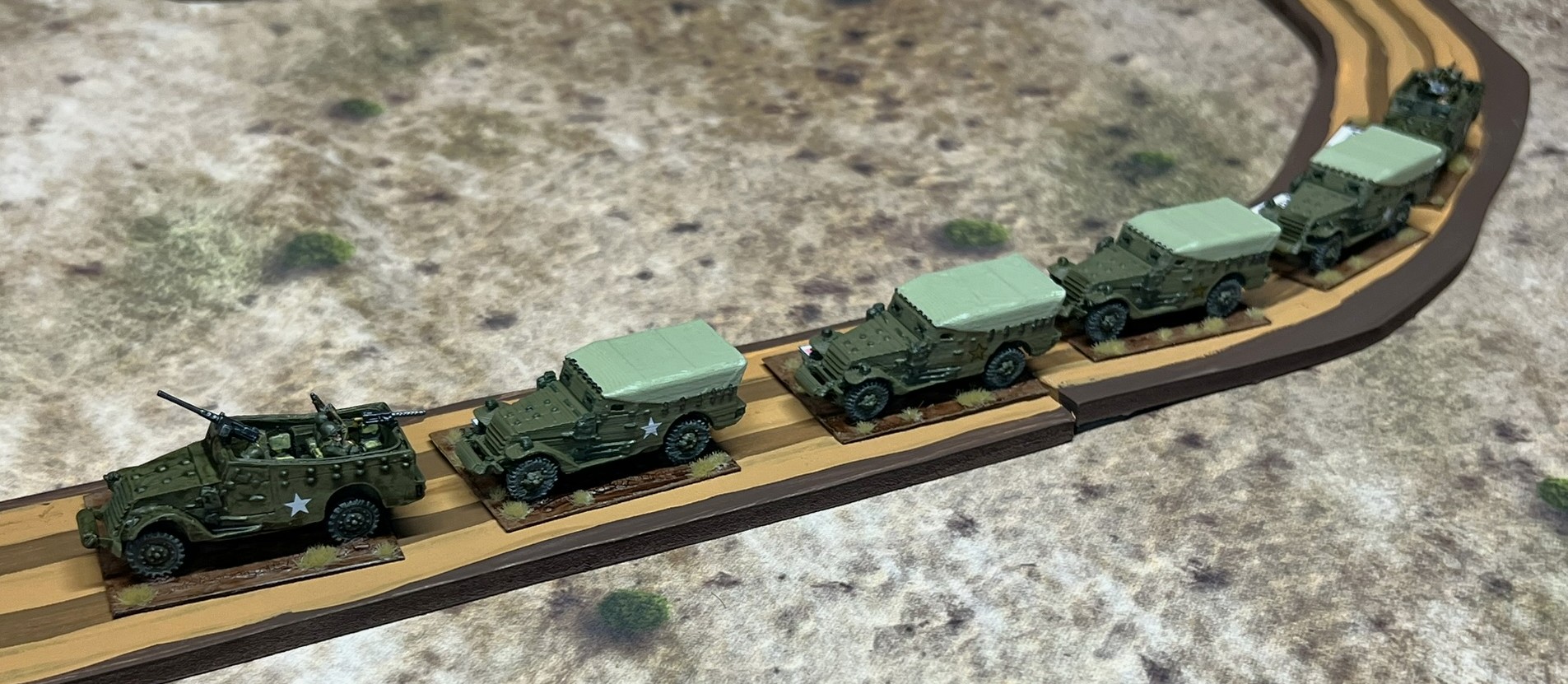
Once completed, I took a few photos of them assembled on my tabletop set up.

M3A1’s in convoy from the drivers’ sides.
M3A1’s in convoy from the other side.
Close up shot of M3A1 “Fierce”. Each Battlefront model had a driver and two soldiers in the back. I also replaced some of the bendy metal machine guns with plastic ones from another kit.

This wraps up this post on my 7 M3A1’s. Remaining are I have 8 American tanks and 6 tank destroyers to share. Which ones? You can probably guess – rightly or wrongly! What did you think of the M3A1’s? Did you learn anything? Maybe I motivated you to get some for yourself? Please let me know your thoughts in the comments section!

Lastly, for all of my posts on WWII games and projects – there is a consolidated list of posts and their links located here.

MATERIALS USED

PAINTS, INKS, GLAZES, SHADES, WASHES, PIGMENTS AND FLOCKING USED ON THE TWO BATTLEFRONT/FLAMES OF WAR RESIN M3A1 MODELS AND THE FIVE WOLVERINE3D.COM M3A1 3D-PRINTED MODELS:

  1. Green Stuff
  2. War Games Accessories Steel Bases Number 23 (1½” x 2″)
  3. Vallejo Surface Primer “German Green Brown”
  4. War Games Accessories Steel Bases Number 16 (½” x ½”)
  5. Gorilla Glue
  6. Alligator clips and stand
  7. Wooden Blocks, steel bolts, steel washers, magnets, steel screws
  8. Neodymium magnets (⅛” and ¼”)
  9. Vallejo Surface Primer “Black”
  10. Vallejo Surface Primer “German Green Brown”
  11. Plastic machine guns from Battlefront M5 Stuart Platoon kit
  12. Vallejo Surface Primer “USA Olive Drab”
  13. Citadel “Agrellan Earth” (texture)
  14. Army Painter “Mid Brown” (shade/wash)
  15. Reaper MSP Core Colors “Blackened Brown”
  16. Vallejo Model Air “Tire Black”
  17. Vallejo Model Color “Dark Sea Grey”
  18. Battlefront “Tommy Green”
  19. Vallejo Model Air “Ivory”
  20. Vallejo Model Color “Off White”
  21. Citadel “Tallarn Sand”
  22. Reaper MSP “Pure Black”
  23. Battlefront “European Skin”
  24. Vallejo Model Air “Black Metallic”
  25. Vallejo Model Color “Wood Grain”
  26. Vallejo Model Air “Wood”
  27. Army Painter “Flesh Wash” (shade/wash)
  28. Army Painter “Military Shader” (shade/wash)
  29. Hataka “Vert Fonce”
  30. Vallejo Model Color “USA Olive Drab”
  31. Vallejo “Mecha Varnish Gloss”
  32. Microscale Industries “Micro Set”
  33. Microscale Industries “Micro Sol”
  34. Microscale Industries “Liquid Decal Film”
  35. Expert’s Choice Ink Jet Clear Decal Paper
  36. Gin Fritter US Army decals
  37. Battlefront US Army decals
  38. Vallejo “Gloss Acrylic Varnish”
  39. Citadel “‘Ardcoat”
  40. Vallejo “Gloss Acrylic Varnish”
  41. Vallejo Flow Improver
  42. Vallejo Thinner
  43. Vallejo “Matte Polyurethane Varnish”
  44. Printed labels on card stock
  45. Gamers Grass “Tiny Beige 2mm Tufts” (flocking)
  46. PVA Glue

German Armor for the 80th Anniversary of the Battle of France: Panzer 35(t), Panzer 38(t), Panzer IVB, and Panzer IVD Tanks; and Sd.Kfz. 231 (6-rad) Armored Cars

This post marks the last of my vehicle additions for the 80th Anniversary of the Battle of France in May-June 1940.  These German vehicles were completed in late January, but with my personal situation, naturally my posting and hobby activities were put on hold.  Time has passed now and I want to return to a certain degree of normalcy – of course that’s not the easiest thing to do.  But I’ll try – and now let’s catch up and get back to good old hobby stuff.

As readers of this blog know, I had needed to augment the depth and breadth of my 15 mm/1:100 scale armor (both sides) for my What a Tanker© Battle of France 1940 scenario.  I also wanted to develop some Bonus Attack cards for it as well (similar to what I did with my Normandy Breakout! scenario).  I had promised to get these projects covered on the blog and share some about games that I have run for them (at club days and the TotalCon convention).  Here, I will focus here uniquely on these German vehicles and the Bonus Attack Cards and post about the gaming events separately.

Below is my poster for the game that I use at convention-style events.

02222020 TOTALCON Battle of France 1940

Previously, I had posted and described several projects in support of building this scenario – here they are for reference:

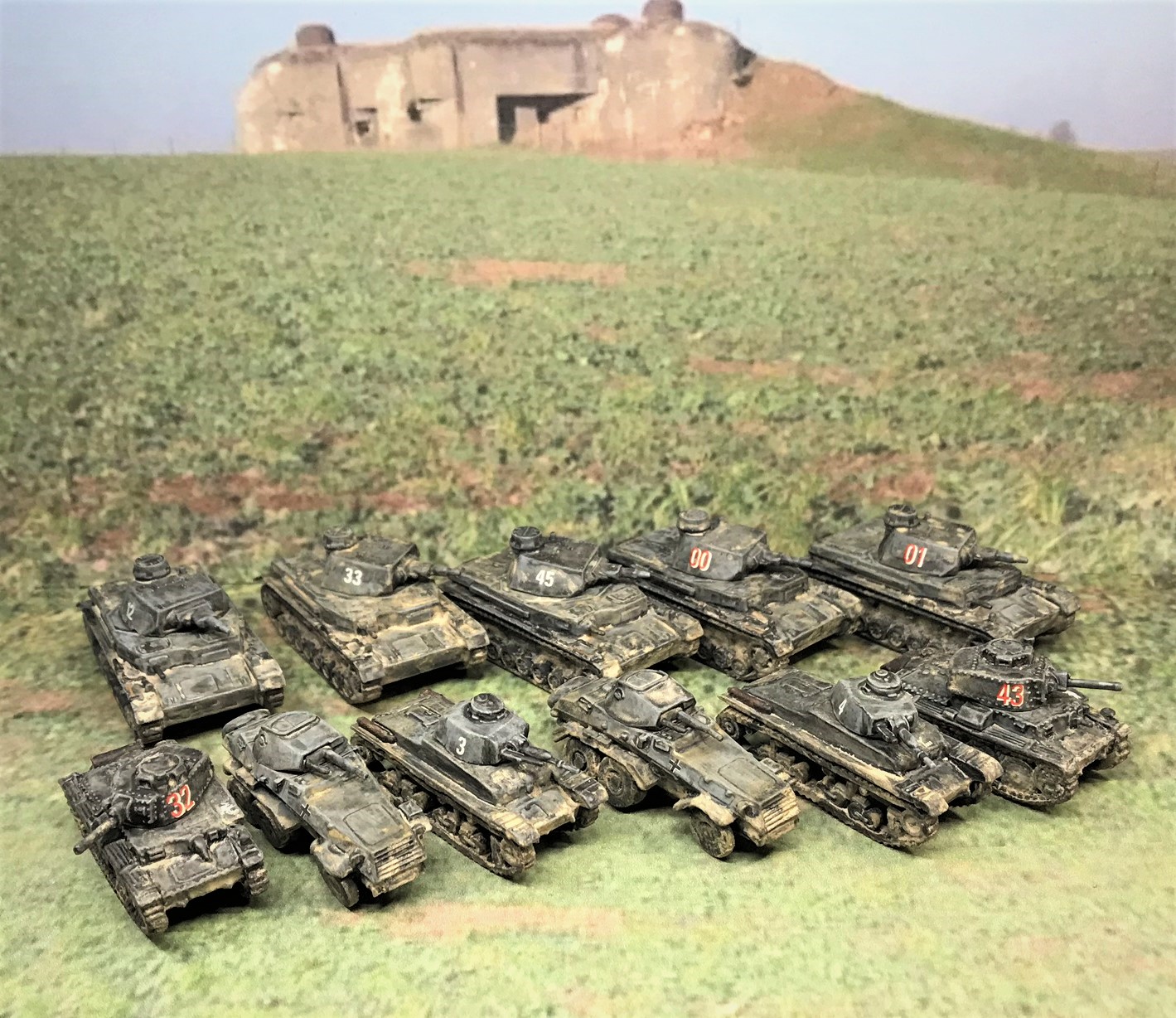
Basically, prior to this project I had only 11 German vehicles for the scenario, and the mix was a bit unbalanced to say the least.  I had 4 Panzer IIC’s, 1 Panzer IIIE, 1 Panzerjäger I, 2 Panzer IVD’s, and 3 Sturmgeschutz A’s.  Now that I have 23 French vehicles, I needed to increase the size of the available German vehicles for the scenario.

Back in May-June 1940, Panzer I’s and Panzer II’s did form a large proportion of the German armored forces in May-June 1940.  As Panzer I’s have only machine guns, which are somewhat useless in a tank-on-tank game).  As I have 4 Panzer IIC’s in the inventory, I decided to augment the light tanks with Panzer 35(t)’s and Panzer 38(t)’s.  These were originally built for the Czechoslovakian Army, and the Wehrmacht happily incorporated these vehicles into their units – and continued building the both after the annexation.  I got two metal Panzer 35(t) models (#GFV28) from QRF in the UK, and two metal and resin Panzer 38(t) models (#GE022) from Battlefront.  Perhaps later on I might add a Panzer I, we’ll see.

For the medium tanks, I “assigned” (for game purposes) my two currently-painted Wargame Models in Ohio Panzer IVD’s into ausf A versions – and added B and D variants of the venerable Panzer IV with Zvezda models (SKU #ZD35 or #6151 for each box) from The Plastic Soldier Company.  PSC has a reasonable deal for a platoon of 5 so I grabbed those.  I already have one Panzer IIIE model for France 1940, and decided that was enough of those (for now anyways).

Lastly, similar to what I did with the French Panhard 178’s , I added 2 Sd.Kfz. 231 (6-rad) armored cars (#GE320) from Battlefront.  I know that the 8-wheeled versions were available and used in May 1940.  However, at the time the 6-wheel 231’s were being phased out in favor of the 8-wheeled versions – and I thought having the older ones would give a better feel to the scenario.  By building these models and converting the ones mentioned, I now have 23 vehicles available for both sides to choose.  I will go through a bit of a WIP with each type – as I did experiment a bit with contrast paints on them – to a bit of frustration which I will share.  I’ll also show the Bonus Attack Cards, some eye-candy shots, references, and list of paints for those interested.

General Assembly

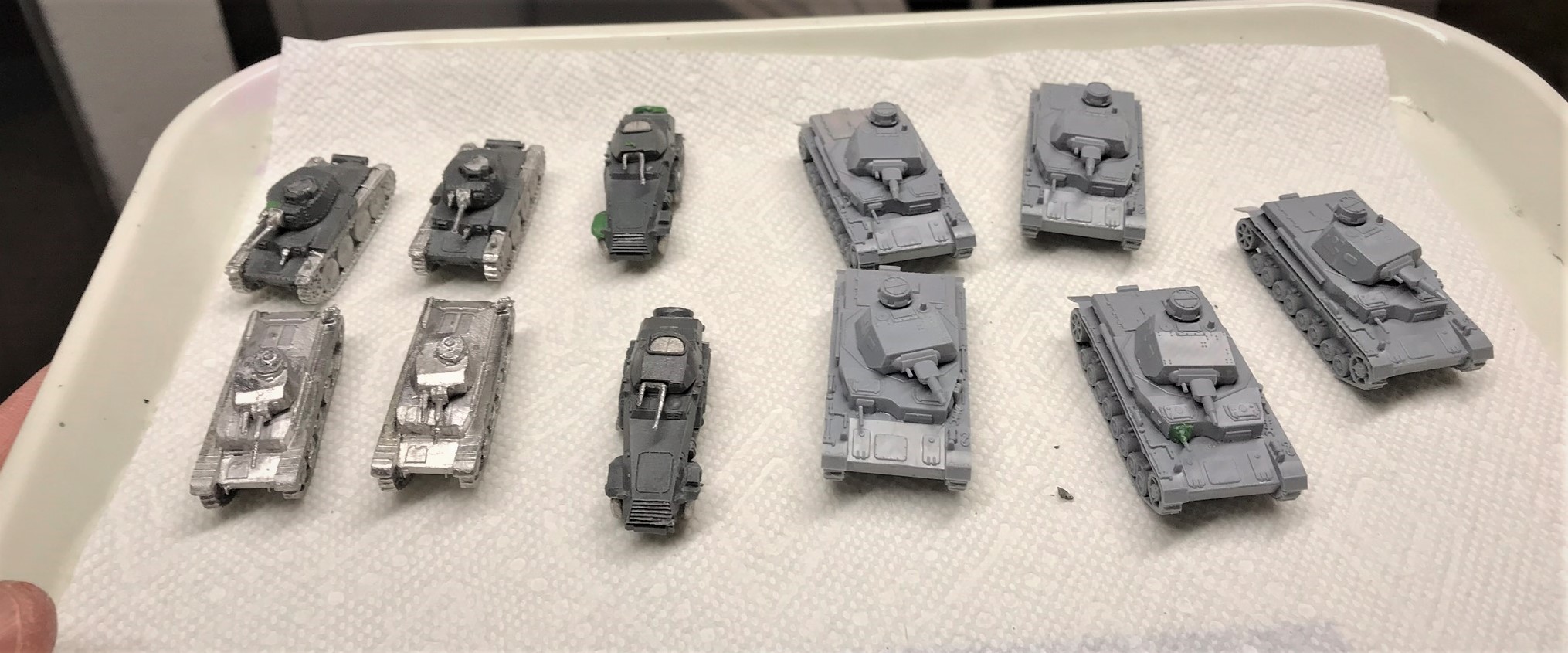
The QRF Panzer 35(t) models were all metal, the Battlefront Panzer 38(t) and Sd.Kfz. 231 (6-rad) models were metal and resin, and the Zvezda Panzer IV’s were plastic.  I cleaned and prepped them all prior to assembly and painting, to include magnetizing the turrets.  Some green stuff reinforcement and repair was needed.  My overall goal was to have vehicles that were more grey and less dark than my previous German vehicles for 1940.  The dark colors were also historically correct – I just wanted a bit more variety in the collection that was also historically correct.

1 German armor for 1940 part two
The 11 models for this project in their packaging.

3 Czech armor assembled
The Panzer 38(t) models and the Panzer 35(t) models assembled.

7 All assembled for painting
All of the 11 models are here assembled.

8 All mounted for painting
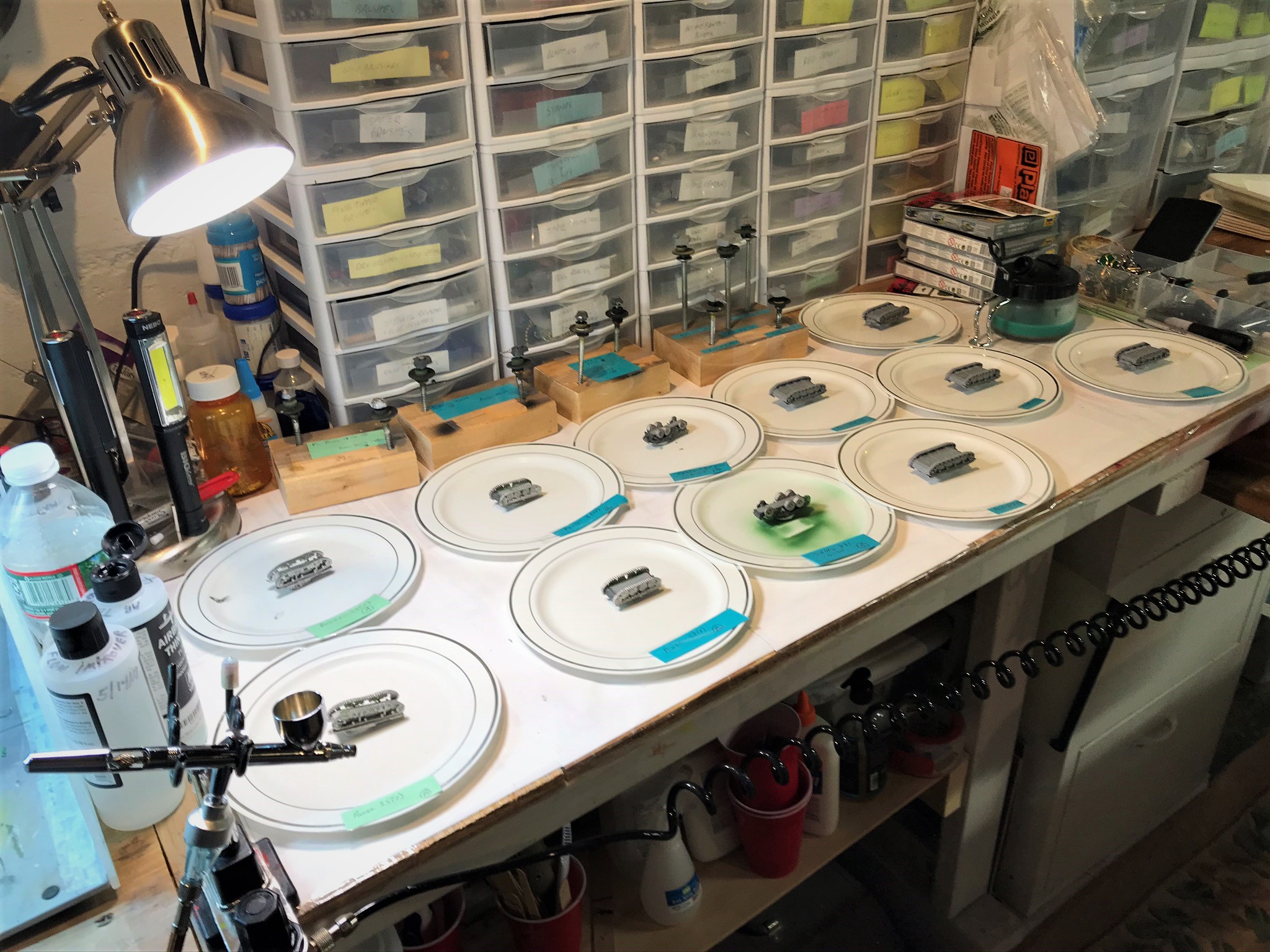
I always prime and base coat the tank bottoms first – they are affixed to small plastic plates with poster tack.

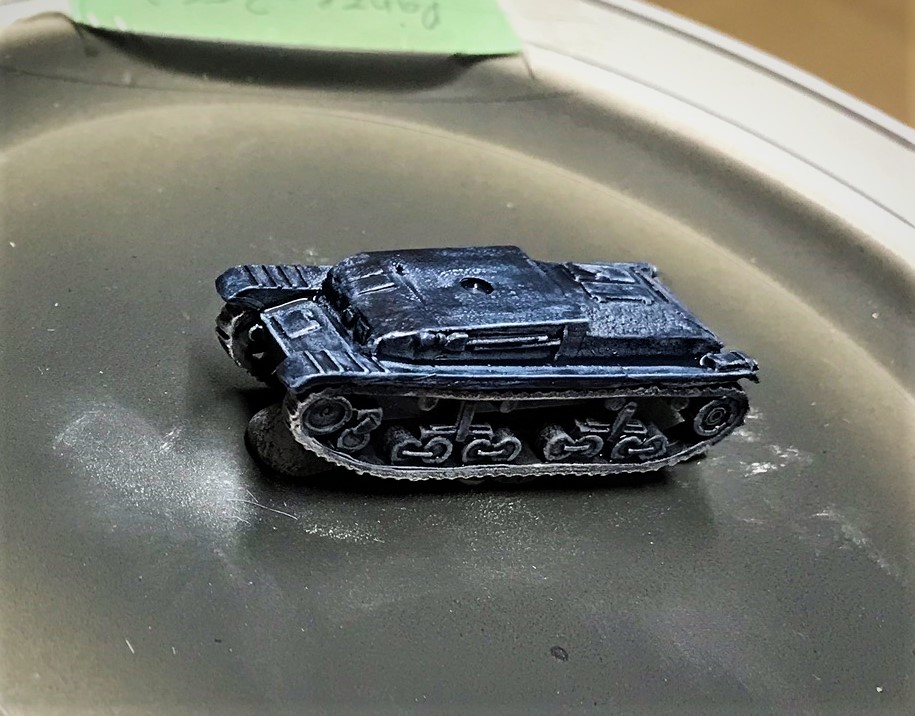
The painting process was a bit different for me this time.  I basically did this sequence with all 11 vehicles.  I wanted to test out the contrast paints, so I decided to try the “Space Wolves Grey” contrast paint over Vallejo “German Panzer Grey” primer – and the chassis were nearly purple.

2 Panzer 35(t) with Space Wolves Grey contrast paint
My Panzer 35(t)  model looking a bit too purple for my tastes.

I then went back and dry brushed them with Vallejo “White” primer, then used “Apothecary White” contrast paint and dry brushed with a few more grays and added some shading (see the list at the end of this post).

3 Panzer 35(t) turrets after Apothecary White contrast paint
After redoing with a dry brush of white, added “Apothecary White” as seen with these turrets.ion

4 Panzer 35(t) completed turrets
I shaded these, and more dry brushing, followed by decals.  Here are some turrets looking better!

2 Panzer IVD needs weathering
Here is a Panzer IV chassis before weathering.

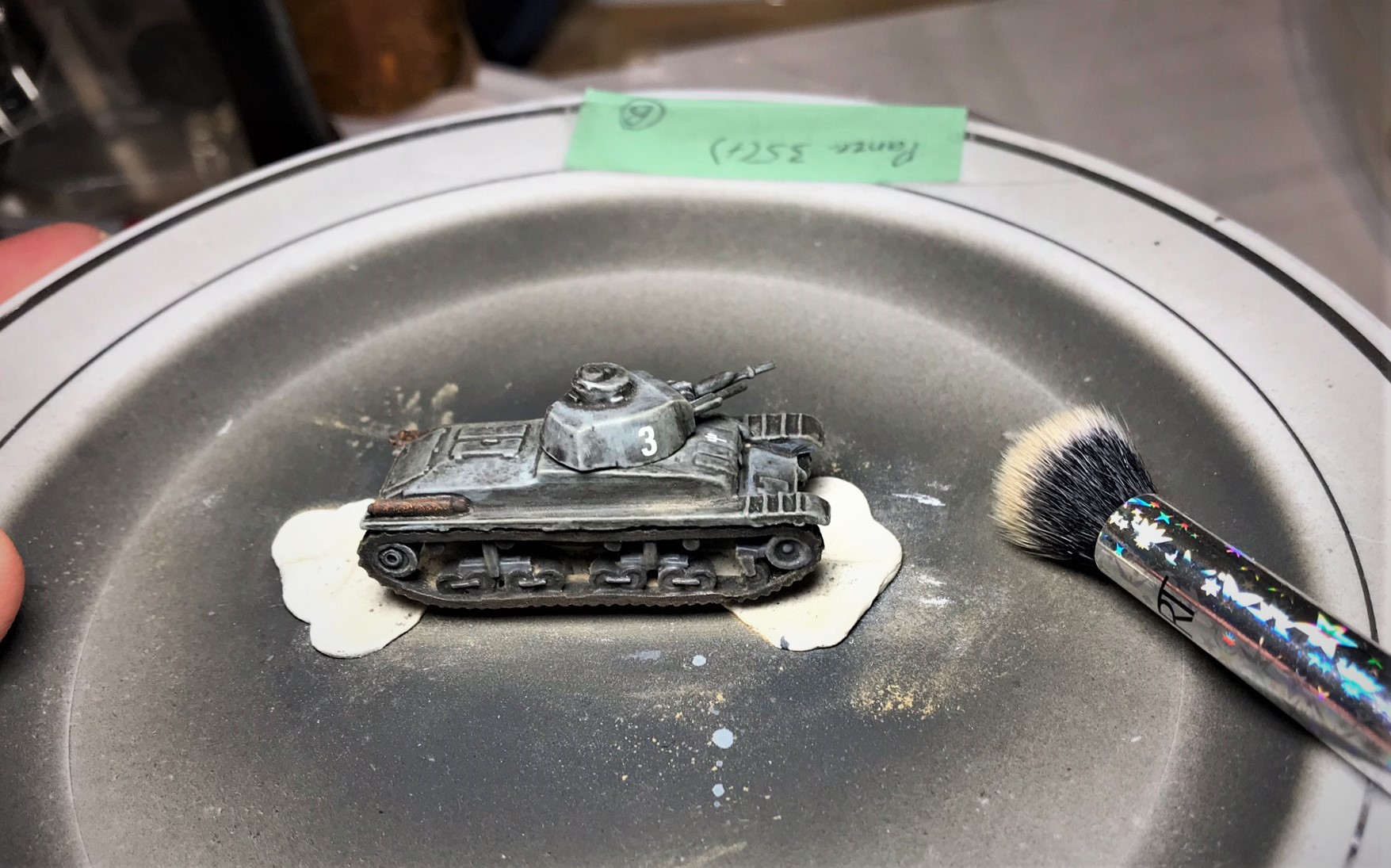
For weathering, I used Vallejo pigments – a combination/blend of two pigments on these with a makeup brush for dusting effect.

5 Panzer 35(t) in progress weathering
Weathering this Panzer 35(t)

Then I varnished the tanks with Vallejo Mecha Color “Matt Varnish”.  Now, let’s look at each type in brief.

Panzer 35(t)

These were originally built by Skoda.  The (t) stands for the German word for Czech, which is tschechisch.  The Germans had 244 of these after the annexation, and used them in both the invasion of Poland and of France.   Around 132 were involved in the Battle of France, and they served in the Wehrmacht through the invasion of the USSR until the summer of 1941.  By that time, there were no more spare parts being made, was performing badly in the cold, and it was badly obsolete.  Some were then converted to other uses, and some sold to Romania.

The Panzer 35(t) had a reasonably good (for 1940) 37 mm gun capable of penetrating 30 mm of armor.  It was a light tank, and had maximum frontal armor of 25 mm, with 15-16 mm on the side, 15-19 mm on the rear, and 8 mm on the top.  This allowed better speed and greater range than most French contemporaries, with a top speed of 21 mph and a range of 120 miles from its 120 hp 4-cylinder engine.  The chassis armor was riveted together.  It did have a radio.

Panzer 38(t)

The Panzer 38(t) was another Czech “acquisition” as it were.  It was designed and built by CKD.  Over the course of the war, the Germans had over 1,400 – of which only about a hundred were used in France.

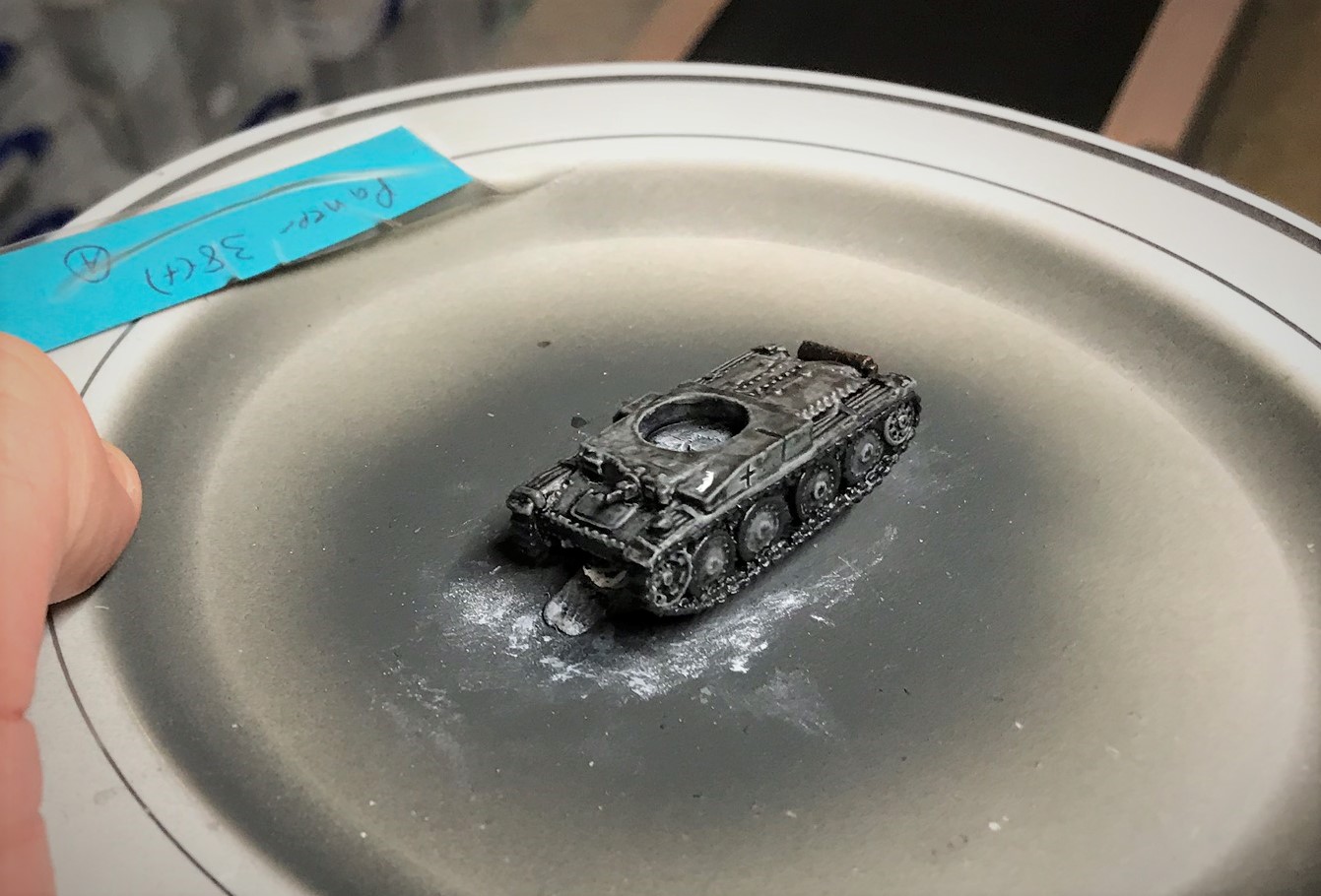
The Panzer 38(t) had a better 37 mm gun than the Panzer 35(t).  That gun was capable of penetrating 36-59 mm of armor.  It also was a light tank, with a (in 1940) maximum frontal armor of 30 mm.  It also had much better speed and greater range than most French (and some German) contemporaries, with a top speed of 26 mph and a range of 160 miles from its 123.3 hp 6-cylinder engine.  The chassis armor was riveted together, and the tank had a radio.  The tank itself was used by the Germans until 1942, and the chassis was reused for many other vehicles, notably the Grille and the Hetzer, as well as being exported to Sweden (who also built them under license), Slovakia, Romania, and even Peru.  Peru also had acquired some from Czechoslovakia and used them in combat in South America versus Ecuador in 1941 in the Ecuadorian-Peruvian War as well as 50 years later against the Shining Path insurgents.

1 Panzer 38(t) turrets with decals

Panzer 38(t) turrets late in project

2 Panzer 38(t) chassis with decals
Panzer 38(t) chassis – I was happy with this shade of grey.

Sd.Kfz. 231 (6-rad)

Most modelers and WWII gamers know the Sd.Kfz. 231 8-wheeled version but the 6-wheeled (“6-rad”) version preceded it.  Over 900 were built from 1932-1937.  The Sd.Kfz. 231 (6-rad)  and the 8-wheeled versions were both known as Schwerer Panzerspähwagen (heavy armored reconnaissance vehicle).  The acronym Sd.Kfz. stood for Sonderkraftfahrzeug (special purpose vehicle)The Sd.Kfz. 231 had the same automatic 20 mm gun as the Panzer II, so it had some anti-tank capability (able to penetrate 40 mm at 100 meters and 23 mm at 500 meters).  Like the Panhard 178, it could be driven either forwards or backwards with redundant driver positions.  Armor was thin (8-15 mm) but it could get up to 53 mph.  They served in the Wehrmacht up until the early stages of the invasion of the USSR.

The models did have some QC issues – notably big pieces of resin were missing on fenders and on the rear spare tire.  I fixed these with green stuff.  These will serve the Germans as (of course) reconnaissance vehicles for my 1940 scenario.

Panzer IVB and Panzer IVD

The Panzer IV is iconic and was ubiquitous in WWII in Europe and North Africa.  My goal for the game scenario was to have A, B, and D models, all of which participated in the Battle of France.  The Germans made only 35 A’s, which had less armor (only 14.5 mm on the front!) than the B’s and D’s (30 mm on the front) and a less powerful engine (247 hp) making it only capable of 19 mph.  The B’s and D’s had a 296 hp engine, and more armor, and were faster (26 mph).  The Germans made 42 B models and 248 D models.  There was a C model, but that did not have a hull-mounted machine gun like the B’s and D’s, so I opted not to build these as C’s (140 C’s were made).  All had the short 75 mm gun.

I designated 3 of the Zvezda models as B’s and 2 as D’s.  In the game, they have the same stats – and are almost identical anyways.  I did use white numbers for the B’s and red numbers for the D’s.

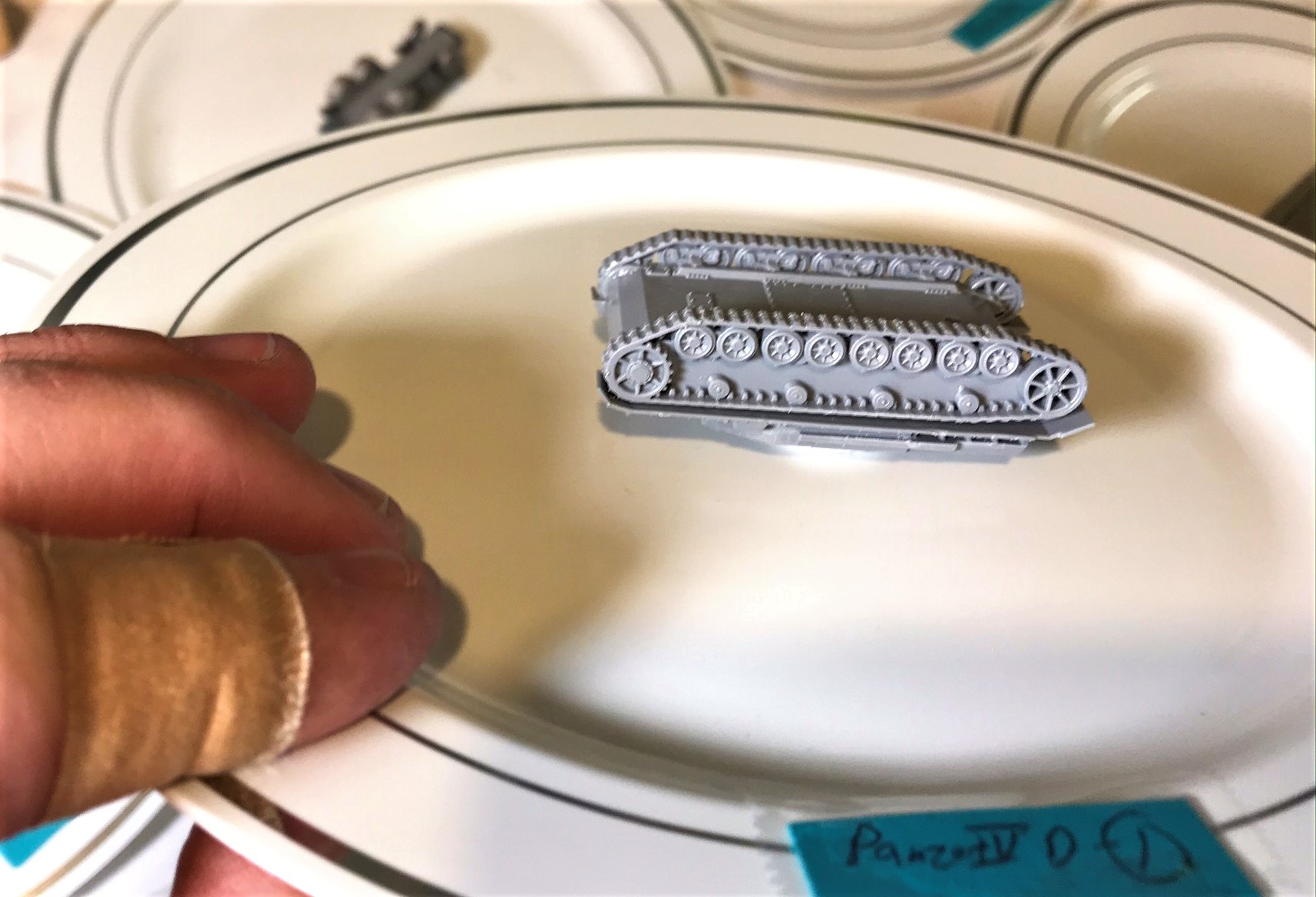
1 Panzer IVD mounted for painting
Panzer IVD assembled and mounted for priming.


1 Panzer IVB after wash and decals
Panzer IV B chassis later on before weathering added.

3 Panzer IVD Done!
Panzer IVD completed.

Bonus Attack Cards

In my scenario, each side starts at 200 points and must use points to buy vehicles and other combat items.  I added Bonus Attack cards, which were optional 5-point purchases apiece for each side.  I allow reconnaissance vehicles to buy and have up to two at a time, and others one.  The caveat is that your vehicle must have a radio!  So the French FT-17, FCM 36, R35, and H35 tanks cannot get these cards.  Additionally, there are two bridges that the French player can choose to wire for demolition – at a cost of 20 points each.  The river does have fords, but obviously that slows the Germans down.  The French player can wire two, one, or no bridges for demolition.  Only the French players and the GM know what has been done, and I allow them to try to blow the bridges at any time.  The attempts may fail, or they may drop a German tank into the river.  Each crossing German vehicle and each failed attempt makes the demolition more difficult.  I also added “dummy explosion cards” (with an exploding dummy on it) so that the French player can keep the Germans unsure whether the bridges were wired for demolition or not.  The Germans get the Luftwaffe here – and the French Air Force does not show up.

You can see the cards below – the players buy these and get random results:

  • 104 “Bonus Attack Cards” built for What a Tanker© games
    • 50 German cards
      • 16 Infantry Assault cards
      • 6 37 mm anti-tank gun cards
      • 3 88 mm anti-tank gun cards
      • 7 Artillery HE Support cards
      • 10 Air Support cards
      • 3 Artillery Smoke Support Cards
      • 2 Radio problem cards
      • 2 Quick Repair cards
      • 1 Heinz Guderian Arrives! card
    • 54 French cards
      • 20 Infantry Assault cards
      • 7 25 mm anti-tank gun cards
      • 4 47 mm anti-tank gun cards
      • 10 Artillery HE Support cards
      • 4 Artillery Smoke Support Cards
      • 2 Radio problem cards
      • 2 Quick Repair cards
      • 1 Charles de Gaulle Arrives! card

French Deck, 1940
French Deck

German Deck, 1940
German Deck

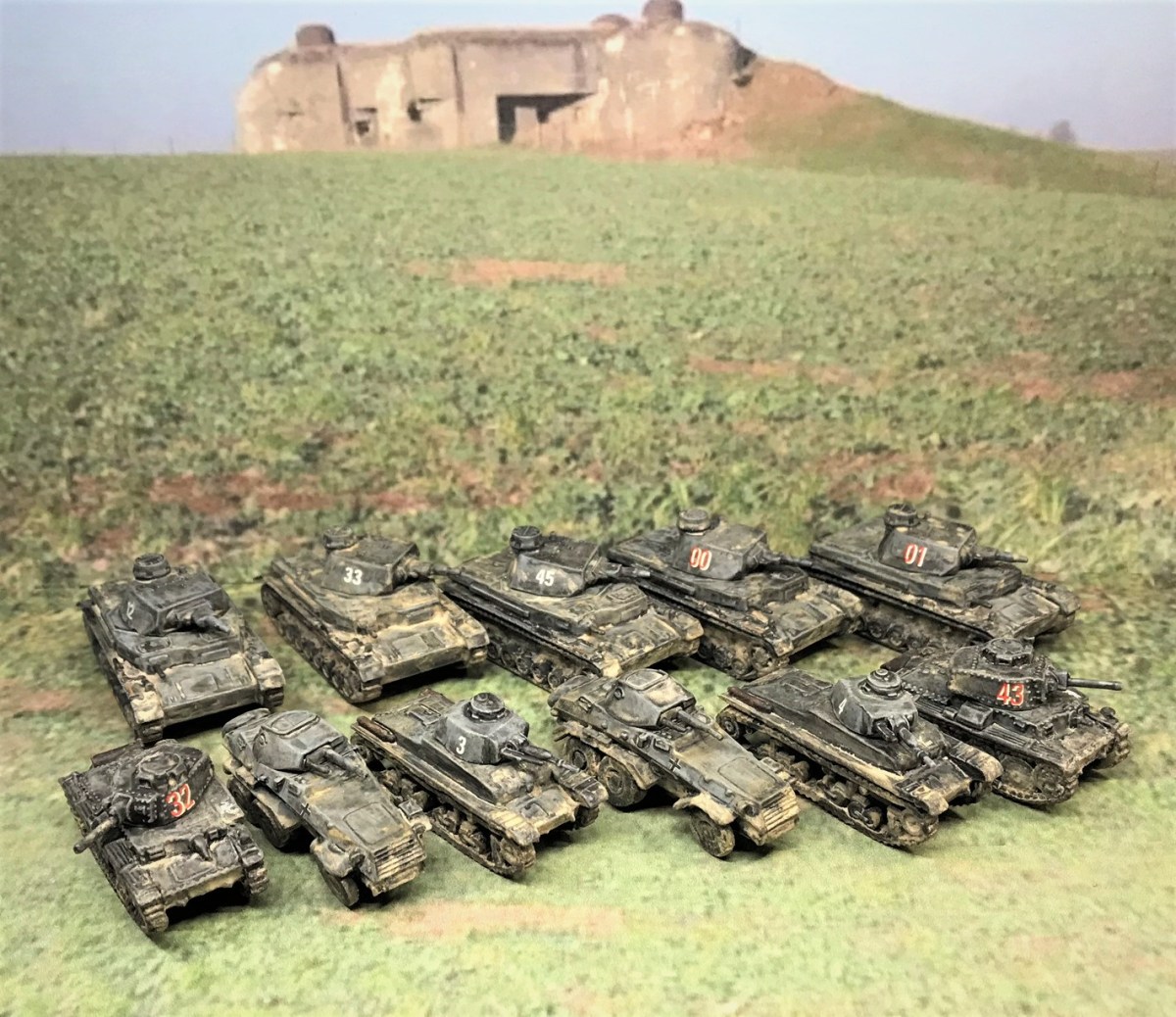
And finally, a couple of group shots in front of an old Maginot Line fort:

1 German armor group shot frontal2 German armor group shot frontal top

I am repeating my reference section below for those interested.

References

Throughout this project I have used many of the books that I have as references – here are some I have used and strongly recommend.  I do not get paid by anyone to recommend these, but I am sharing the links if you want to get them.  I did study with BG Robert Doughty at West Point over 35 years ago – and he did give me my copy of the B.T. White book in 1984 – that I still have and used many times.  There are certainly other books, but these I recommend.  I will be using these in my next phase with my German tank additions.

For history of the conflict I recommend buying:

Doughty, Robert A. (1985). The Seeds of Disaster: the development of French Army Doctrine 1919-1939. Mechanicsburg, PA: Stackpole books. (available at Amazon here)

Doughty, Robert A. (1990). The Breaking Point: Sedan and the Fall of France, 1940. Mechanicsburg, PA: Stackpole books.  (available at Amazon here)

Horne, Alistair. (1969, 1990). To Lose a Battle: France 1940. London: Penguin books. (available at Amazon here)

For modelers and gamers interested in the vehicles’ look and history:

Forty, G. and Livesey, J. (2017). The World Encyclopedia of Tanks & Armoured Fighting Vehicles.  London: Lorenz Books. (available at Amazon here)

Jackson, R. (2009). Tanks and  Armored Fighting Vehicles Visual Encyclopedia in color.  London: Amber Books. (available at Amazon here)

Restayn, Jean. (2007). World War II Tank Encyclopedia in color 1939-1945.  Paris: HISTOIRE & COLLECTIONS. (available at Amazon here)

Smithsonian Enterprises. (2017). Tank: the Definitive Visual History of Armored Vehicles.  New York, NY: Penguin Random House. (available at Amazon here)

White, B.T. (1972). Tanks and other A.F.V.s of the Blitzkrieg Era 1939 to 1941.  Dorset: Blandford Press. (available at Amazon here)

Zaloga, S. (2014). French Tanks of World War II (1): Infantry and Battle Tanks. New York, NY: Osprey.  (available at Amazon here)

Zaloga, S. (2014). French Tanks of World War II (2): Cavalry Tanks and AFVs. New York, NY: Osprey.  (available at Amazon here)

PAINTS, INKS, GLAZES, SHADES, WASHES, PIGMENTS, FLOCKING, GLUES AND MORE USED ON THESE VEHICLES:

  1. Microscale Liquid Decal Film
  2. 1/8″ neodymium magnets
  3. Green stuff (kneadatite)
  4. Gorilla Glue
  5. Poster tack and plastic plates
  6. Vallejo “Surface Primer – German Panzer Grey”
  7. Vallejo “Flow Improver”
  8. Vallejo “Airbrush Thinner”
  9. Citadel “Contrast Paint – Space Wolves Grey”
  10. Vallejo “Surface Primer – White Primer”
  11. Citadel “Contrast Paint – Apothecary White”
  12. Vallejo “German Grey”
  13. Vallejo “Neutral Grey”
  14. Battlefront “Dark Gunmetal”
  15. Battlefront “Oxide Red”
  16. Citadel “Typhus Corrosion”
  17. Citadel “Ryza Rust”
  18. Army Painter “Dark Tone” (shade)
  19. Vallejo Model Weathering “Dark Rust Wash”
  20. Vallejo Model Air “Gloss Varnish”
  21. Microscale Micro-Set
  22. Microscale Micro-Sol
  23. Appropriate decals from Battlefront
  24. Vallejo “Light Sienna” (pigment)
  25. Vallejo “Light Slate Grey” (pigment)
  26. Vallejo Mecha Varnish “Matt Varnish”

Thanks for looking – please let me know your thoughts and feedback!


Happy Tanksgiving! 2 Soviet, 5 French, and 5 German tanks get off the November painting table for “What A Tanker” games

November 2018 for me has been a month of armor, culminating in a fine “Tanksgiving” – a fine output for me of early WWII 15mm (1:100) scale armor.  I intend for these to be used in What a Tanker© games.  Certainly, my mid-November visit to the American Heritage Museum played a role in spurring this direction in my hobby efforts.  You can see my current 2018 production here, and there are a lot of tanks.

My focus continued to be on early war vehicles.  I had enough forces for an early Eastern Front game between the Axis (Germans and Italians) and the Soviets, but I wanted to have more variety in terms of tanks available.  My KV-1 platoon needed some help, so I added some BT-series tanks.

My other goal was to build German and French forces for a France 1940 scenario.  For the Germans I added a Panzer IIC, a Panzer IIIE, and three StuG Ausf A assault guns to my fleet.  For the French, I added two Renault 35’s and three SOMUA S-35’s.  All of these came from the Flames of War line from Battlefront Miniatures.  I really like their tanks, even though I don’t play Flames of War!  I think that I can get some crossover between the early-war German forces for such a scenario and use some on the Eastern Front.  Long term, I am also planning on designing a North Africa scenario for the British and the Germans, and some of the figures I got from Battlefront will serve nicely after I paint them in desert colors.

Regarding colors, I also acquired some of the Battlefront paints so as to understand the colors that they recommend.  The current Battlefront “Colours of War” line mixes sets of 20 ml and 12 ml dropper bottles, as compared with Vallejo’s 17 ml bottles.  It appears that at least some of their paints may have been made by Vallejo, at least in the past.  I found them to be good paints that worked well either thinned in an airbrush or a regular brush.  At the end of this post, I will share the paints and materials that I used for those interested.

In this post, in order I will discuss the Soviets, the French, and the German models I worked on in November.  I also am submitting these as part of a Mechanical November community painting challenge run by Azazel (which is very fun to be a part of – check him out!).

Soviet

The two Soviet tanks that I added were the BT-5 and the BT-7.  An advantage of adding these will be that they also were used against the Finns in the Winter War and against the Japanese at Nomonhan in 1939 and during the Soviet Invasion of Manchuria in 1945.  So, I can use them in different scenarios for sure.  I followed the same procedure to paint these as I did my previous early war Soviet tanks.

For assembly, I again chose to magnetize the turrets by drilling out the hulls and the turrets and using rare earth magnets.  I weathered all of the tanks, as I prefer my tanks to be muddy.  I also left the crews out, as I did not like the way they fit in the turrets.  Of note, their Christie suspensions (an American invention) would be reproduced with the T-34 series.

Overall, I am happy with the way these turned out.  In What a Tanker© their fighting characteristics are exactly the same.

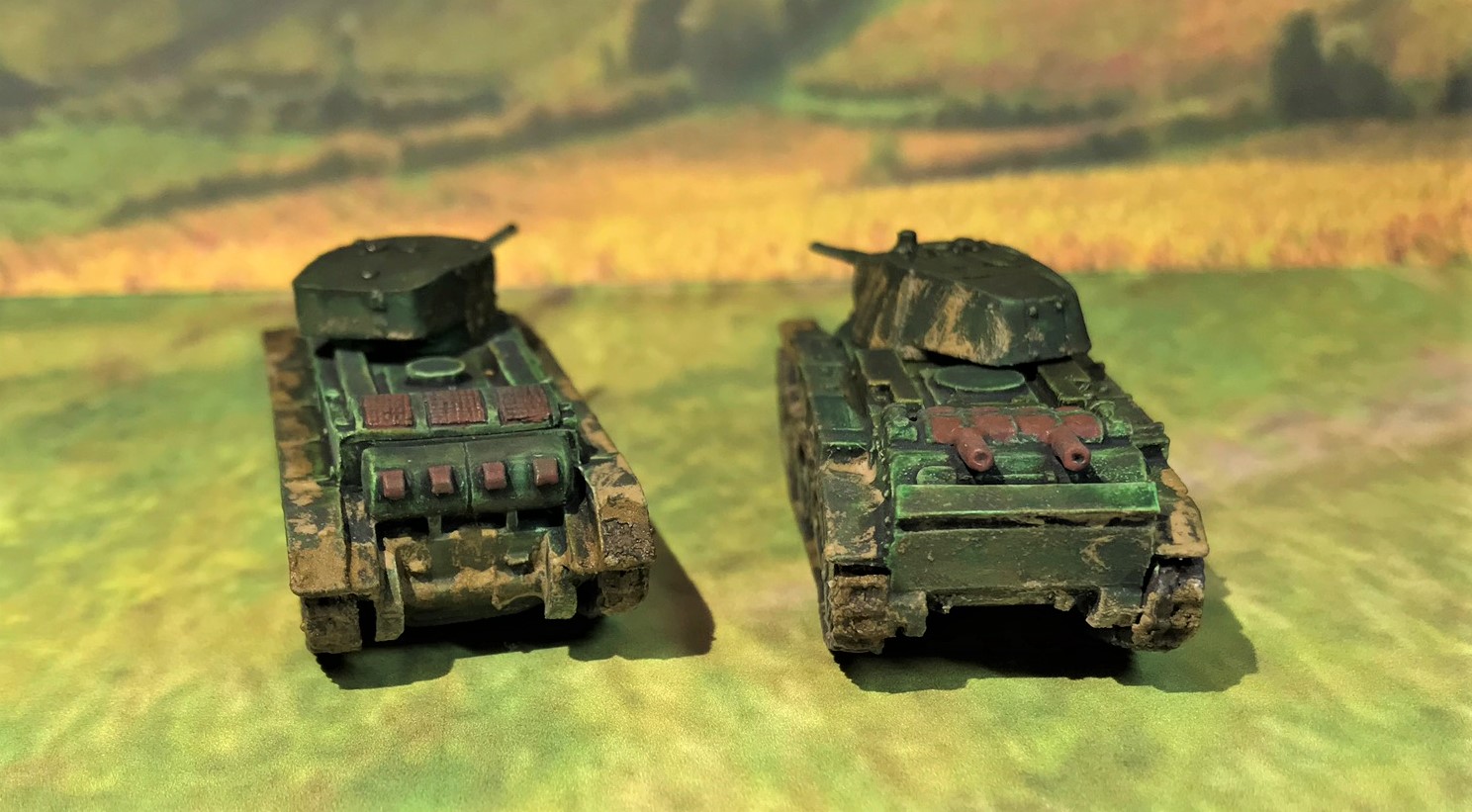
6 BT5 and BT7 front
BT-5 (left) and BT-7 (right) frontal view

7 BT5 and BT7 back
BT-5 (left) and BT-7 (right) rear view

 French

I have always had an affinity for the French Army, as I have a French name (albeit of French-Canadian extraction), speak French, and spent time with three different Regiments du Genie (Engineer Regiments) back in the 1980’s.

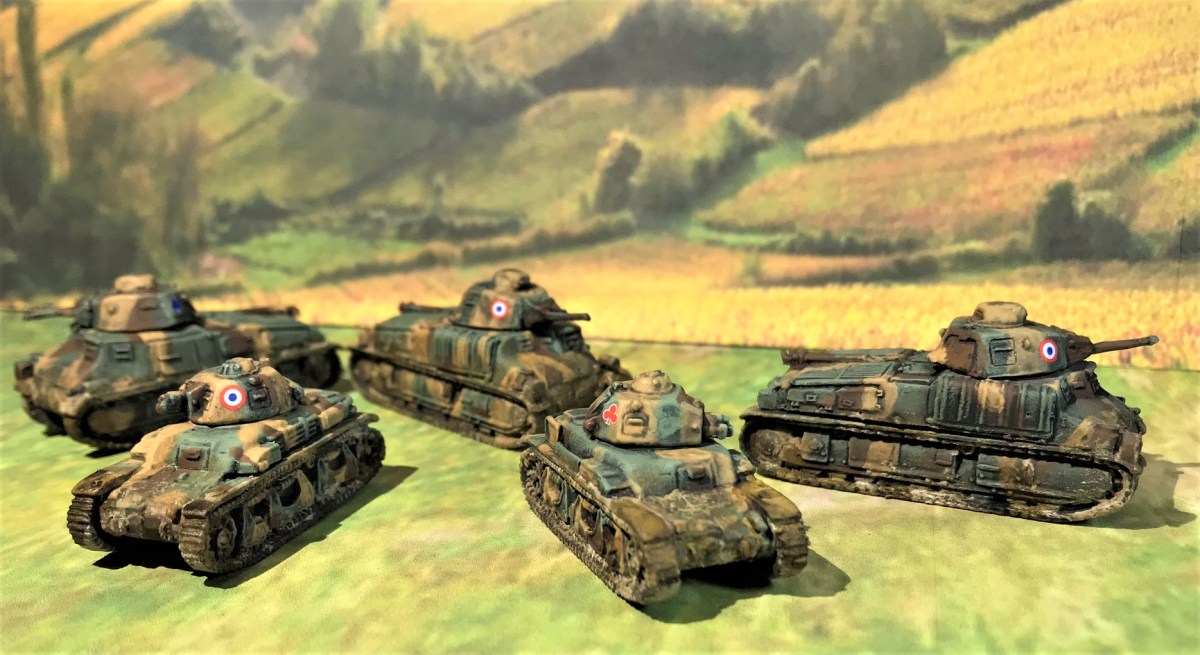
For my France 1940 scenario, I already had two resin Char B1 bis tanks from Wargame Models in Ohio.  I added two light infantry tanks (Renault 35 or R35) and three SOMUA S35’s for a balanced group.

Assembling and painting these would require new uses of poster tack, plastic plates, and wood screws.  This allowed me to both safely handle the tanks in production but also to get the right look of the camouflage.  I decided to leave the crews out, as I had little confidence that they would survive the tabletop for very long as the models were designed.

I also got to play with some decals from Battlefront.  These did require retreatment with Liquid Decal Film from Microscale Industries before I used their other products to affix their decals.  I could not believe that the French roundel decal came in two pieces (the blue dot was separate and had to be affixed after and onto the red-ringed white circle).  That was annoying!

9 French forces for 1940
My new French tanks with my old Char B1 bis tanks

10 SOMUA's front
The three SOMUA S35’s, frontal view

11 SOMUA's left side
SOMUA side view showing the card-suit designations on the turret backs

12 SOMUA's right side

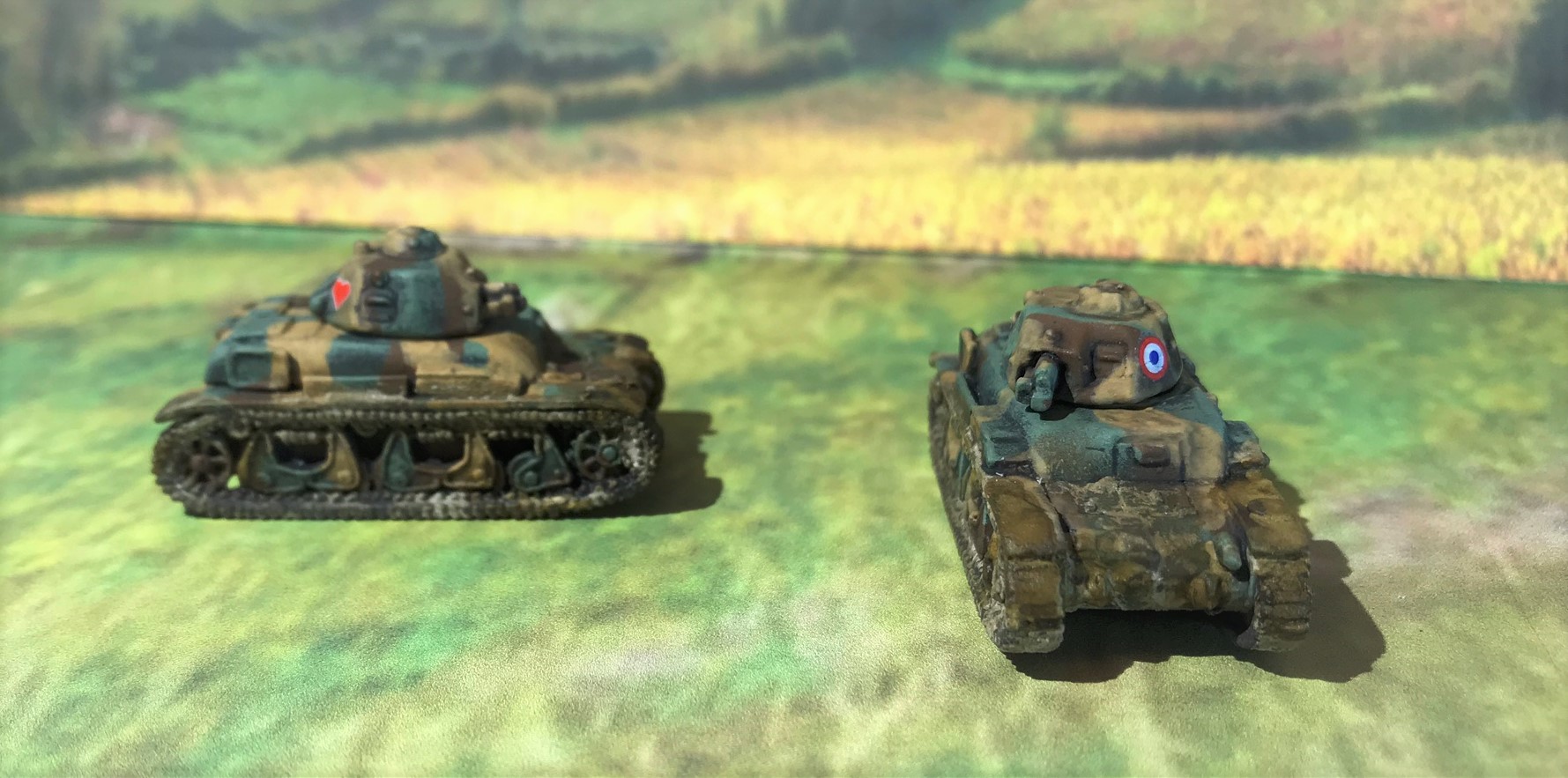
13 R35 front
Renault R35’s

14 R35 moving

15 Defenders of France
Nice group shot

German

For the Germans, I chose to use the Panzer IIC, the Panzer IIIE, and the Sturmgeschutz Ausf A.  The Panzer II’s came in a box of 5 – but was missing one tank gun.  Battlefront has promised to make this good (and I expect it soon).  I chose to make one of the Panzer II’s a France 1940 candidate, saving the other four for a North African scenario that I will complete later on.  The Panzer IIIE came in three separate blisters.  Ironically, the Panzer IIIE was the worst of the Germans to assemble.  One gun was almost split, and the turrets were nearly three different sizes.   There were a lot of mold lines to correct as well, especially on the tracks.

I repaired the one gun with green stuff, and chose it for the France 1940 group, saving the other two for North Africa.  Lastly, historically it seems that very few StuG III’s made it to North Africa.  Therefore, I added all three of the assault guns for my France 1940 scenario.

12 Panzer III prepped for camo
The Panzer IIIE prepped for camouflage

14 PzIIC right side
Panzer IIC complete, left side

15 PzIIC left side
Panzer IIC, left side.  The 14 is for my wife – her and my lucky number!

16 PzIIC rear
Rear view of the tiny Panzer IIC.

17 Pz IIIE front
The Panzer IIIE completed.  The brown camouflage doesn’t really show up as well here (so I guess it works!).

18 Pz IIIE back
Panzer IIIE opposite view

19 StuGA's front
Sturmgeschutz III Ausf A, frontal view

20 StuGA's left side
Sturmgeschutz III Ausf A, left side view

21 StuGA's right side and rear
Sturmgeschutz III Ausf A, right side and rear view

22 all German fronts
My Germans for the France 1940 scenario

I was glad to have finished these in time for our club’s monthly session (which I will post about shortly).  I will be adding more to my fleet, but in the meantime, I hope you enjoyed these.  Do you have a favorite?

I appreciate hearing your thoughts and feedback in the comments section below.  Thanks for looking!


PAINTS, INKS, GLAZES, WASHES, AND FLOCKING USED:

COMMONLY USED ON MULTIPLE TANKS:

  1. Vallejo “Flow Improver”
  2. Vallejo “Airbrush Thinner”
  3. Testors “Universal Acrylic Thinner”
  4. Battlefront “German Camo Black Brown”
  5. Battlefront “Dark Gunmetal”
  6. Vallejo Mecha Color “Green”
  7. Battlefront German Camo Black Brown
  8. Vallejo “Surface Primer – Black”
  9. Vallejo “Burnt Umber” (pigment)
  10. Vallejo “Light Sienna” (pigment)
  11. Vallejo “Light Slate Grey” (pigment)
  12. Vallejo “Natural Umber” (pigment)
  13. Vallejo Mecha Color “Light Rust Wash” (weathering)
  14. Vallejo Mecha Color “Oil Stains” (weathering)
  15. Battlefront “Oxide Red”
  16. Gorilla Glue
  17. Vallejo Mecha Varnish “Gloss Varnish”
  18. Microscale Micro-Set
  19. Microscale Micro-Sol
  20. Microscale Liquid Decal Film
  21. 1/8″ rare earth neodymium magnets
  22. Citadel “Nuln Oil” (shade)
  23. Citadel “Nuln Oil Gloss” (shade)
  24. Appropriate decals from Battlefront
  25. Vallejo Mecha Varnish “Matt Varnish”

UNIQUE TO THE SOVIET TANKS:

  1. Vallejo “Surface Primer – Russian Green”
  2. Vallejo Panzer Series “Camouflage Olive Green”
  3. Vallejo Mecha Color “Light Green”
  4. Citadel “Biel-Tan Green” (shade)
  5. Citadel “Athonian Camoshade” (shade)
  6. Secret Weapons Washes “Sewer Water”
  7. Citadel “Agrax Earthshade”

UNIQUE TO THE FRENCH TANKS:

  1. Battlefront “GI Green”
  2. Battlefront “Flat Earth”
  3. Battlefront “Sicily Yellow”

UNIQUE TO THE GERMAN TANKS:

  1. Battlefront “Panzer Gray”
  2. Battlefront “Rommel Shade”
  3. Battlefront “Chocolate Brown”
  4. Battlefront “European Skin”
  5. Battlefront “Skin Shade”
  6. Vallejo “Medium Skin Tone”
  7. Battlefront “Black”
  8. Green stuff

Thanks again for looking and for your feedback!


Despatches from Fort Syllabub

An account of fictional adventures on the North West Frontier - and other times and places, real or imagined

Man of Tin blog

Toy soldiers, gaming, Imagi-Nations

Zauberwurfs Blog

Ein Blog über Tabletop und Miniature Wargames.

Frank Tank Rants

musings of a fat old bloke on tanks and wargames

Dragons of Lancasm

Games, miniatures, painting, books and more games

Tiny Painted Heroes

The Adventures of a lifelong Tabletop Gamer, Game Design hobbyist, and full-time Software Engineer

Steve's Paint Brush

Grimdark model making and mini painting

Wargamesculptors Blog

Life, Golf, Miniatures, & Other Distractions

Dead Dick's Tavern and Temporary Lodging

Life, Golf, Miniatures, & Other Distractions

Guru Pig - the gaming Guru

Guru's thoughts on wargaming, life, and the universe!

Wisely lead... without a head!

History, Miniatures and Wargaming

Kuribo's Painting

Fallout Wasteland Warfare, Warhammer, and Hellboy Painting, Terrain, Dioramas, and Battle Reports

Don't Give Greg Ideas

Seriously, just don't

War Across the Ages, and other dark horrors

A discussion of miniatures collecting, painting and gaming.

Classic Warhammer 40K

Painting diary focused on Warhammer 40K 2nd ed., 5th ed. WHFB, related GW games, and miscellaneous whimsy

Colonel Mustard

WW2 Modelling in 1/72 Scale

Bogenwald

Random painting and terrain making.

Pat's 1:72 Military Diorama's

Scale diorama tips and ideas

Arcade Dreams

Building the Arcade Dream

P.B.Eye-Candy

Phil's 20th century wargame pages

SP's Projects Blog

A futile fight against entropy or 'Every man should have a hobby'? Either way it is a blog on tabletop wargames, board games and megagames

30mmdave

Wargaming Plausible reality?

The Imperfect Modeller

Miniature Figure Painting and Diorama Modelling

Double Down Dice

Painting miniatures and rolling dice!

Just Needs Varnish!

My ongoing wargames projects!

miniaturepopcorns

Sculpting some worlds

Despertaferres

Wargaming with the ability of a dull nine year old

Dawn of the Lead

Miniature wargaming and the occasional zombie

Rantings from under the Wargames table

Wargames, Figures, Sculpting and Converting Miniatures

Simple as War

Miniatures & Terrains

Buck's Blog

Life, Golf, Miniatures, & Other Distractions

IRO aka Imperial Rebel Ork

- I model - therefore I am -

Azazel's Bitz Box.

Painting, Modelling, Miniatures, 1:6, Games... Whatever else I find interesting.

diggingforvictoryblog

Smallholding and Wargaming.......not always at the same time!

Shamutantis

Nørdblog numero uno