French Armor for Operation Torch: Hotchkiss H35’s, H39’s, and Renault R35’s

In November 1942, the Vichy French had a 8 division’s worth of troops in her colonies – from Morocco to the Levant. Under the terms of the Armistice of 22 June 1940, Vichy France was still obligated to defend its unoccupied lands as a neutral state.

And yes, they had more tanks than just the FT-17’s you saw in my last post. In addition to those old WWI relics, Vichy had Hotchkiss H35 and H39 tanks, as well as Renault R35’s. Both of the Hotchkiss models were “cavalry” tanks, in that they had been forced as a light tank on the French cavalry in the 1930’s (and later forced on infantry tank regiments as stopgaps). Contrastingly, the R35 was an “infantry tank”. After the Armistice, the Vichy Army had both types in the colonies. I did read somewhere that some R35’s were hidden away under hay bales behind horse barns to keep prying German and Italian officers of the Armistice Commission from finding them.

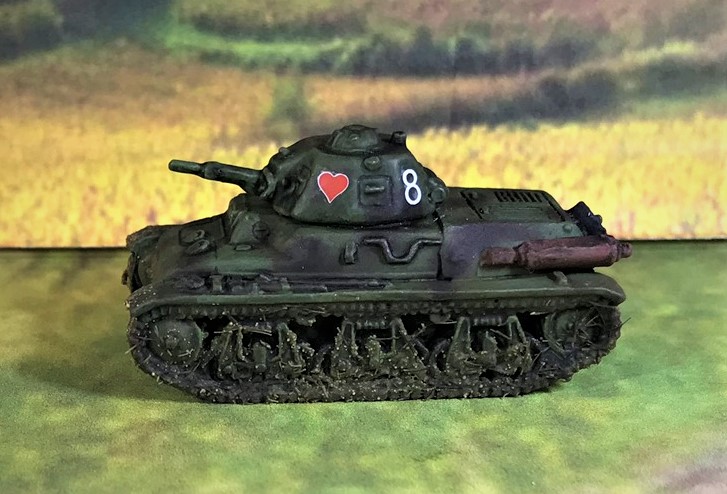
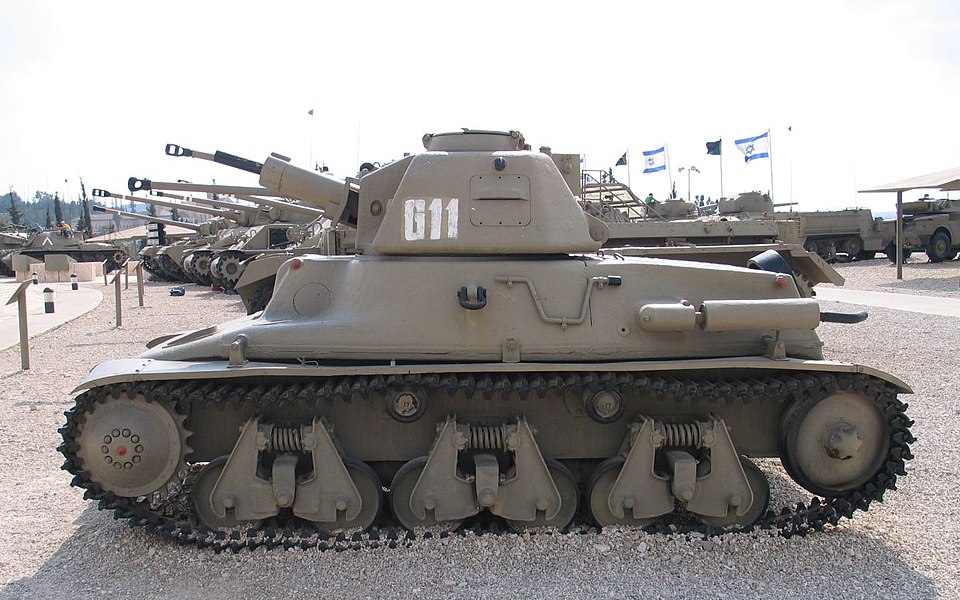
The H35, or Char léger modèle 1935 H, was a two-man tank, armed with the same cannon as the FT-17 (the Puteaux SA18 37mm cannon). The H39, or Char léger modèle 1935 H modifié 39, was a 1938 upgrade of the H35 that also got a better engine, and a newer and longer 37mm gun – the SA38 cannon, that supposedly had increased armor penetration over the SA18 (how much I cannot find!). Both variants were in North Africa in November 1942. There are only two observable differences to an outsider between the two models. Both have different engine deck configurations and the mufflers of H35’s point forward – while H39 mufflers point rearward.
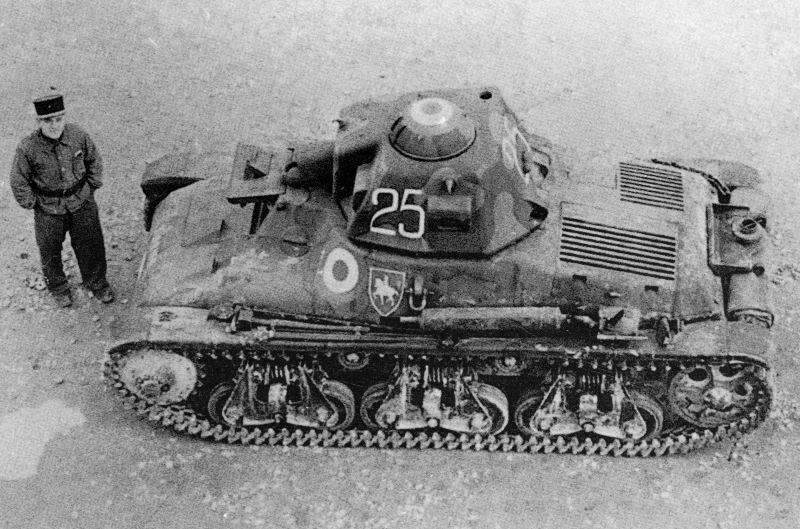
An H35 tank. Note the engine deck and the forward-pointing muffler.
An H39 tank shown in Israeli markings at Yad La-Shiryon (officially: The Armored Corps Memorial Site and Museum at Latrun in Israel. Note the rearward-pointing muffler.

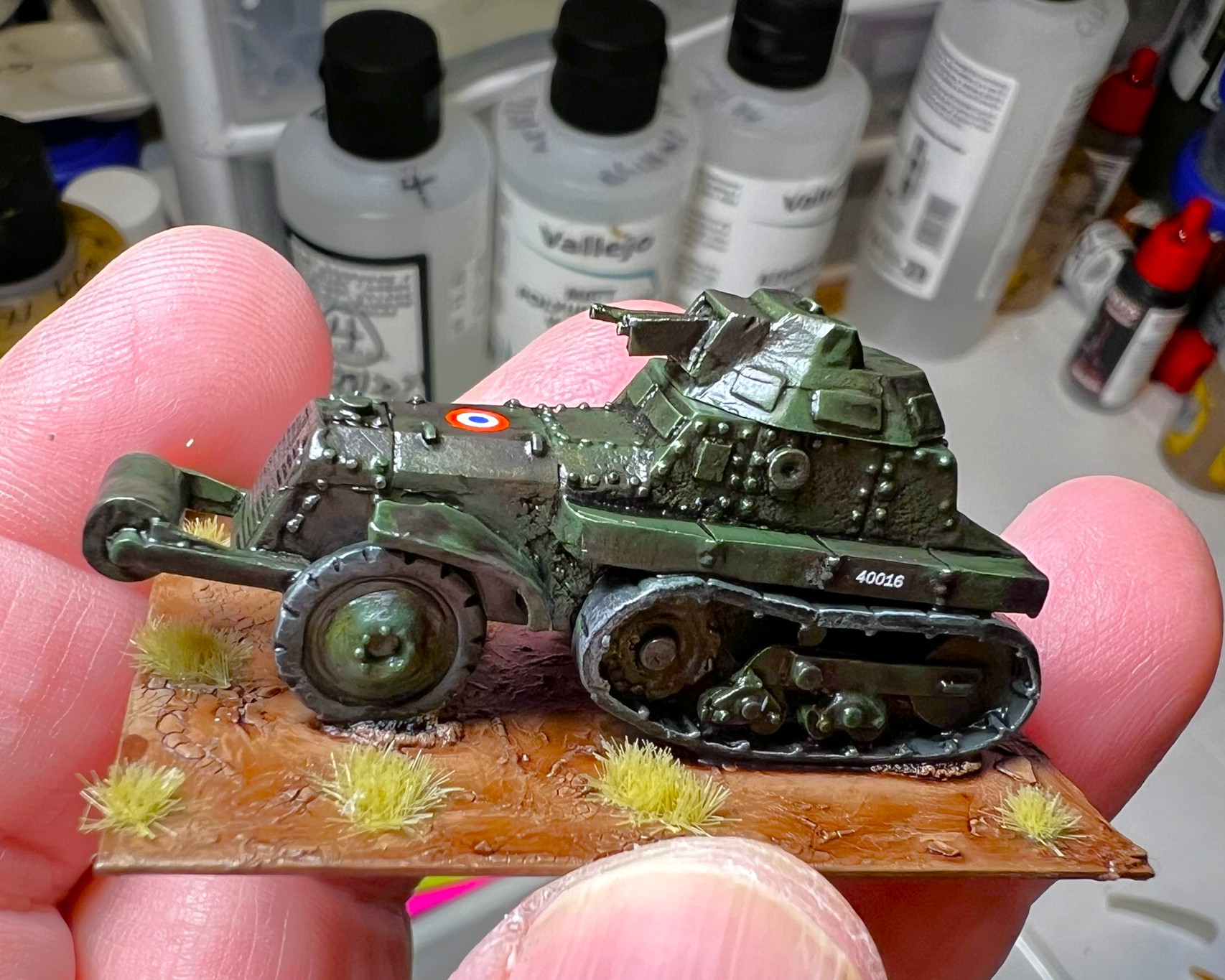
As for the R35, or Char léger Modèle 1935 R, it was an infantry tank under French Army doctrine. It too had a two-man crew, and was also armed with the Puteaux SA18 37mm cannon. It was thought to be slightly better mechanically than the H35/H39 variants. As the Armistice forbade Vichy from having pure tank units, these and the Hotchkiss tanks would be spread around into combined-arms units. These Vichy tanks and armored cars would play a role in Operation Torch in November 1942 against US forces in Morocco (and Algeria as well).

R35 tank at Saumur Museum in France.

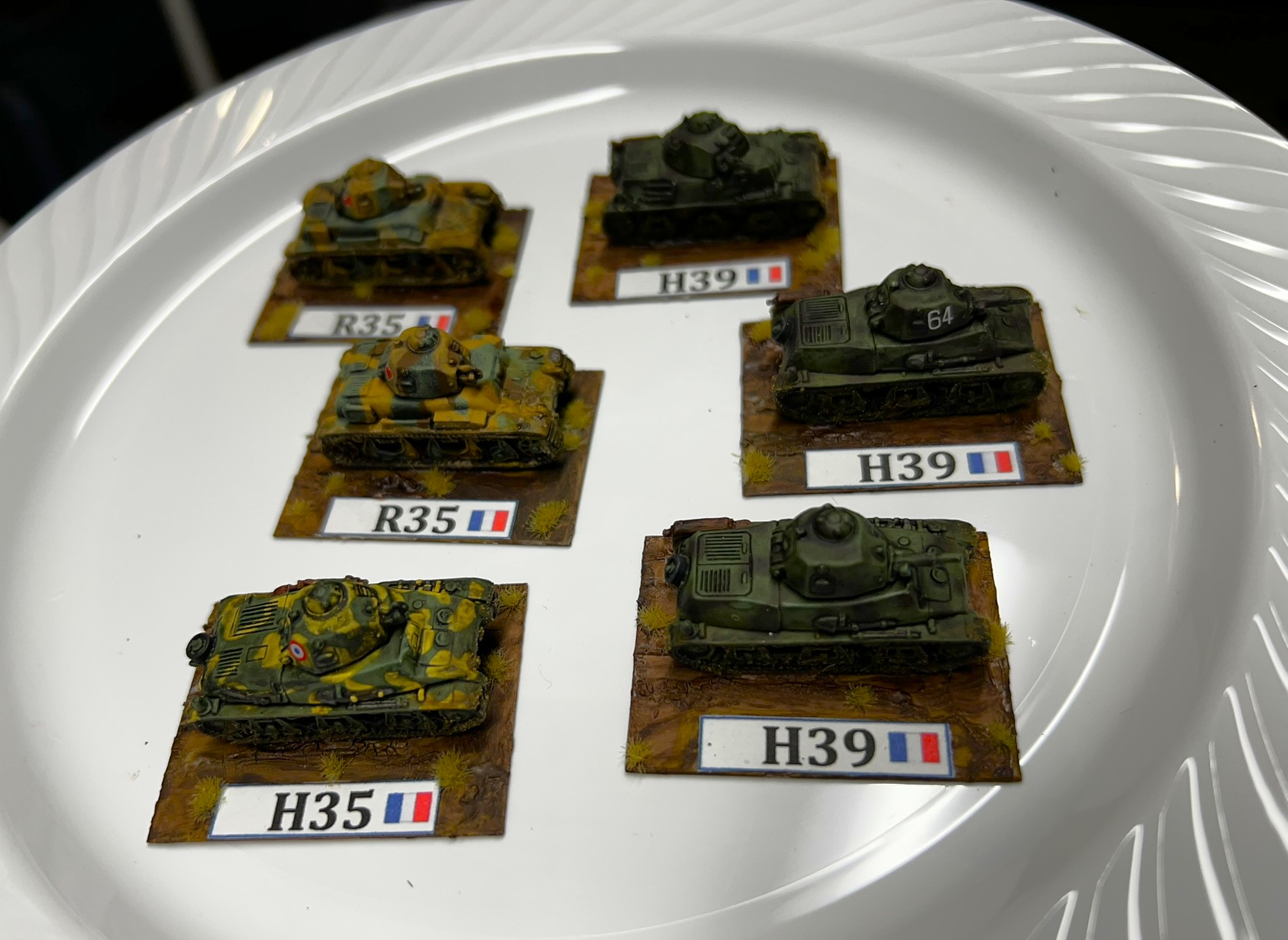
In gathering appropriate models for my What a Tanker game for HISTORICON, I started with looking for H35 and H39 metal or 3D-printed models in resin. I found a two listings for some on eBay. One was for Sarge_s Stuff – he had H35’s that could be bought individually – and I ordered 4 of them. The other site was the same one I bought the FT-17’s from earlier – jacobsminis (aka HobbyHouse&Miniatures.LLC). I ordered 5 from HH&M as that was the minimum order. The tanks from HH&M were (and still are) listed as H39’s, but when I got them I realized that they were actually H35’s. Unlike their excellent FT-17 models, some of these had printing errors, and I ended up using just 2 of these. However, I did use all 4 of the Sarge_s Stuff ones as H35’s. For H39’s and R35’s, I decided to rebase the ones that I painted a few years ago. I had 1 H35 and 3 H39’s (documented here) and 2 R35’s (documented here). I rebased all 6 of these.

One of my 3 H39’s before I rebased.
My R35’s before rebased them.
All rebased!

This left me with 6 H35’s to paint to round out the tanks for Vichy (more armored cars would be coming!). As I was also working on many other vehicles at the time, plus running for reelection (I won), plus preparing for and attending HUZZAH, AND prepping for HISTORICON…plus golf…I was BUSY in April, May and even June and July. I am sure that you get the picture, and ironically I have few WIP pictures! But I’ll share what I have.

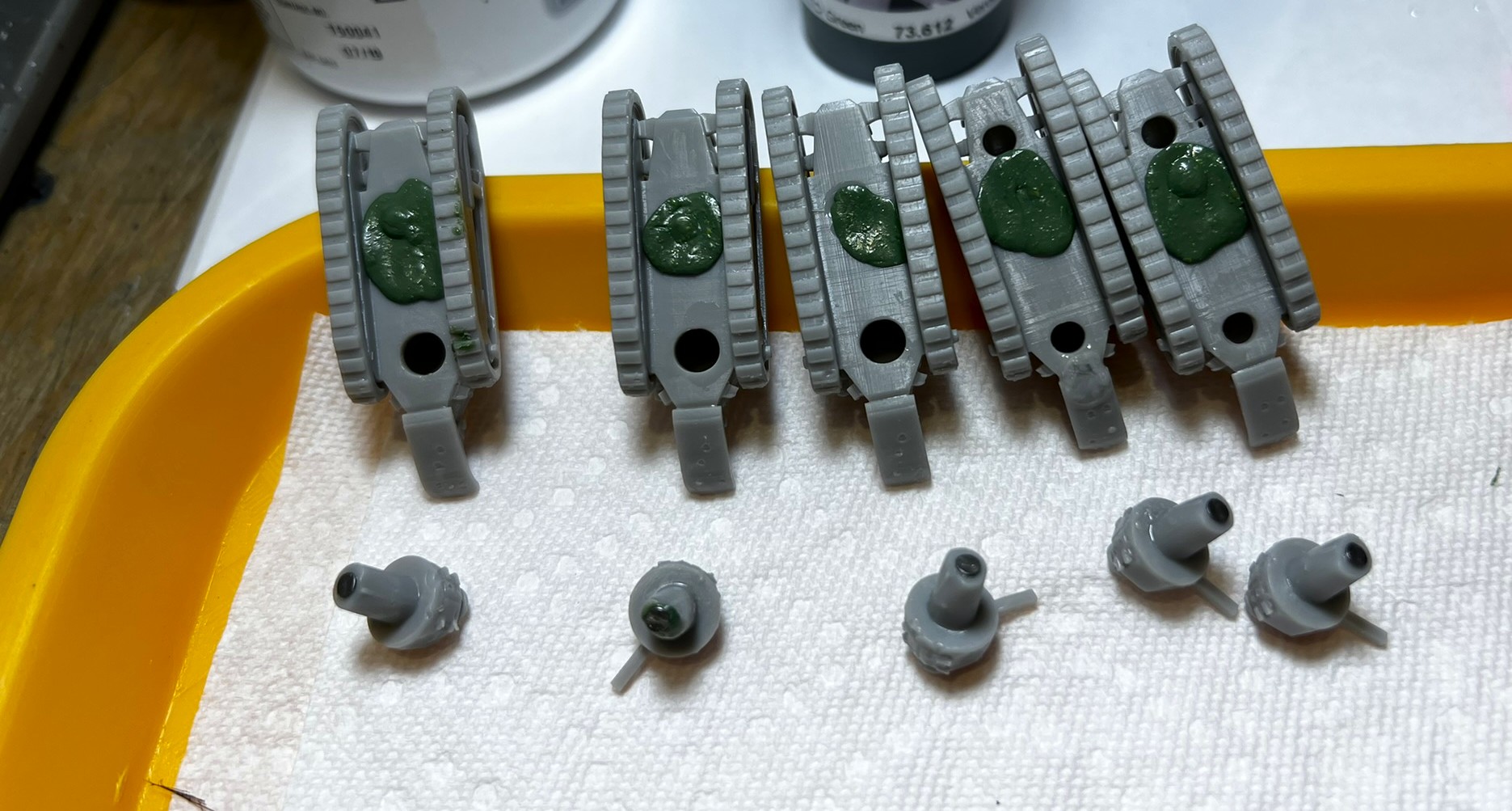
I used neodymium magnets and flat-head nail again to mount the turrets. The two H35 turret prints were slightly different, but I adapted with green stuff.

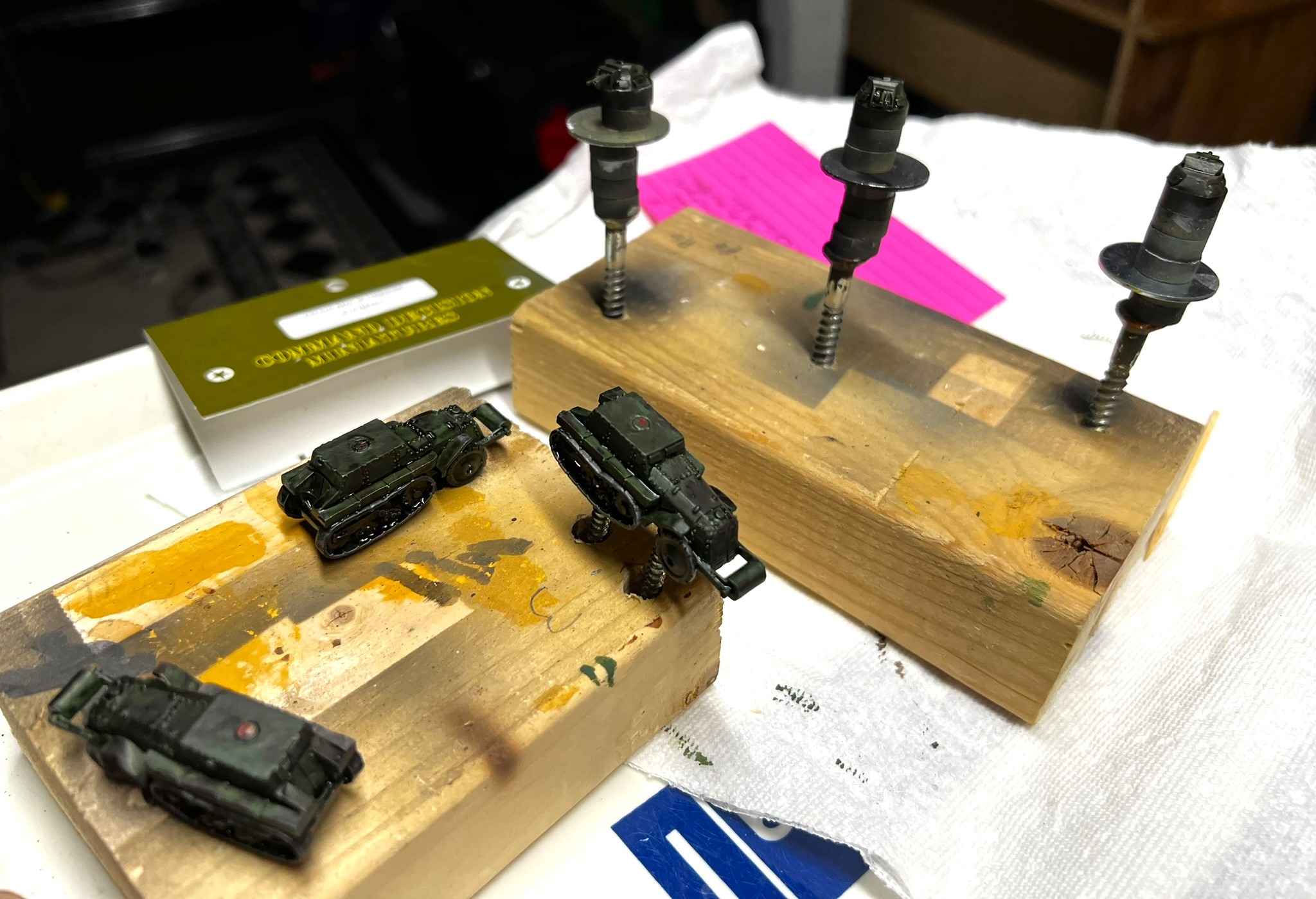
The 6 H35’s primed with the first desert sand color.

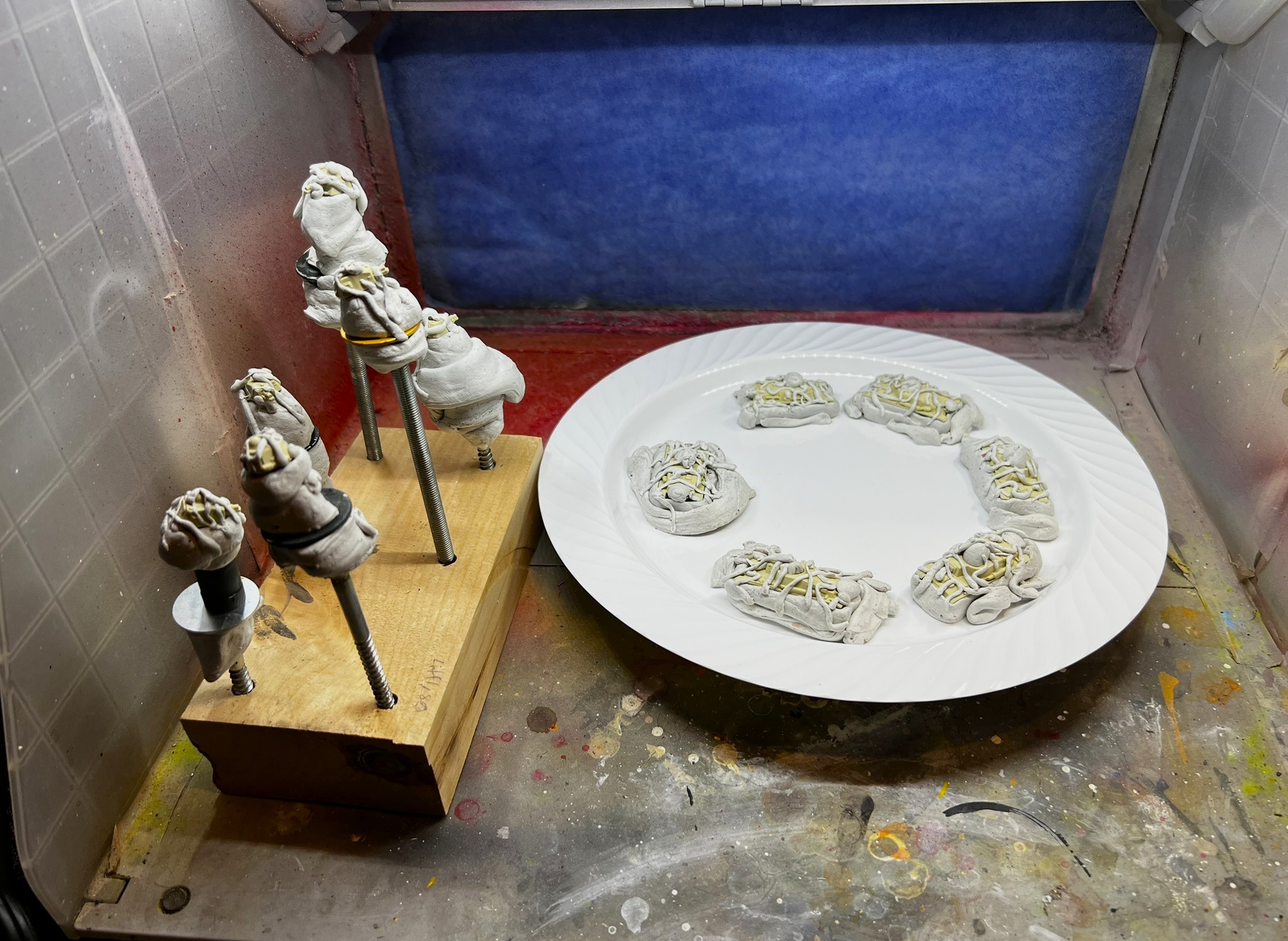
I used poster-tack again for masking/making camouflage patterns over the initial color. I did experiment with using Silly Putty as masking as I had seen someone do that – but it did not work for me. So I went back to what I knew would work – poster tack and touching up afterwards..

Poster-tack covered!
Then I applied a second prime with a NATO Green. Al paints are listed at the end of this post.
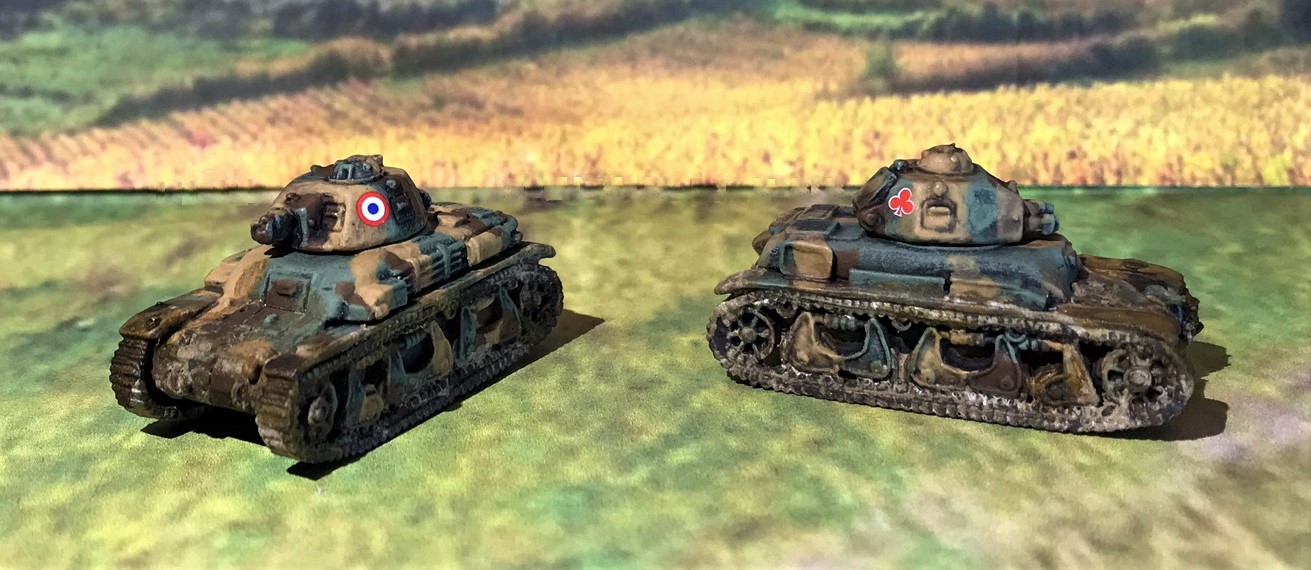
Now I had 6 H35’s. The third one from the left is one from an earlier project that I rebased, with the other 5 being new. The yellow is different on that older one, but ok enough I think for a game.

Now, I can share some limited…

Eye Candy

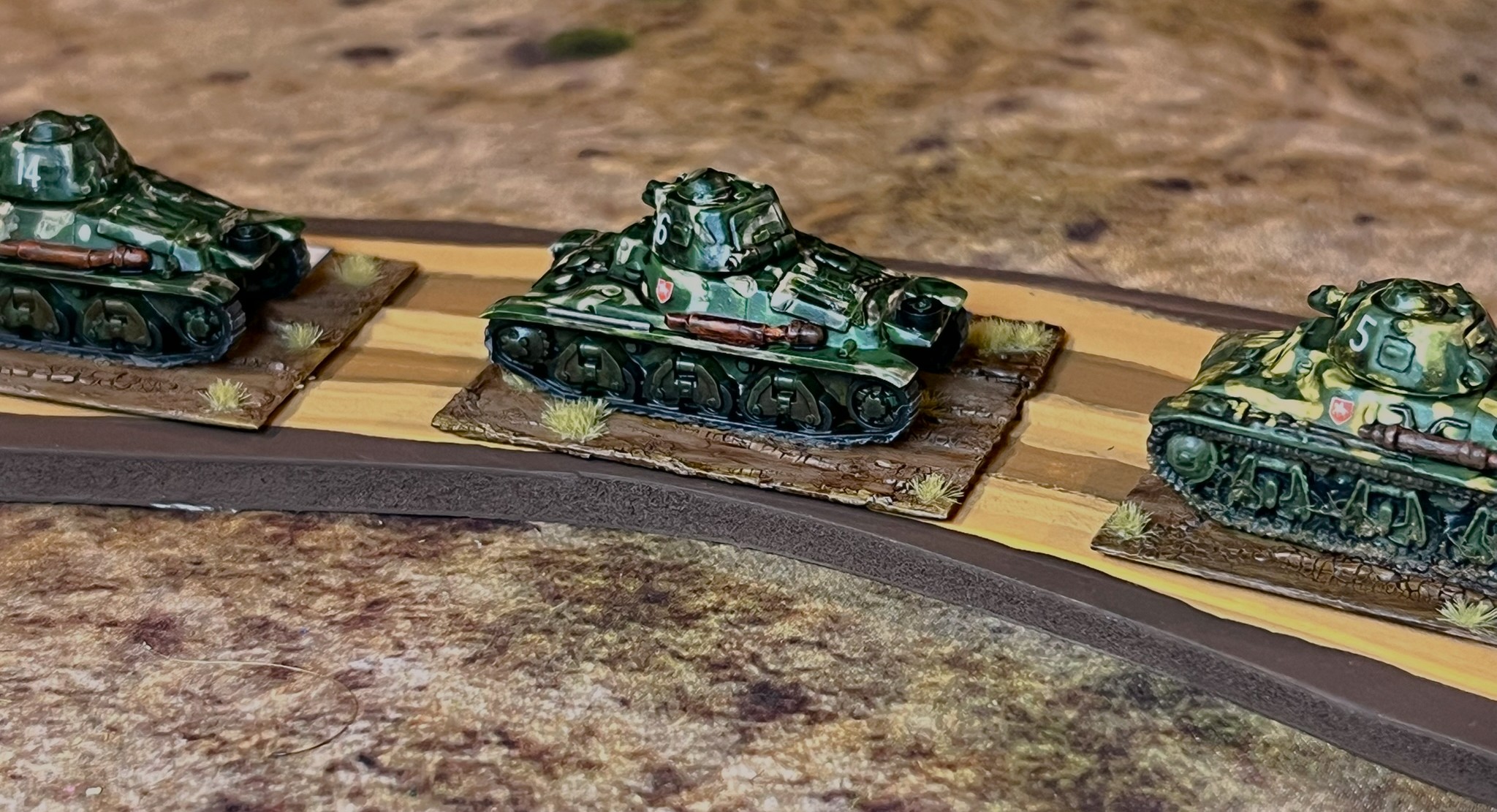
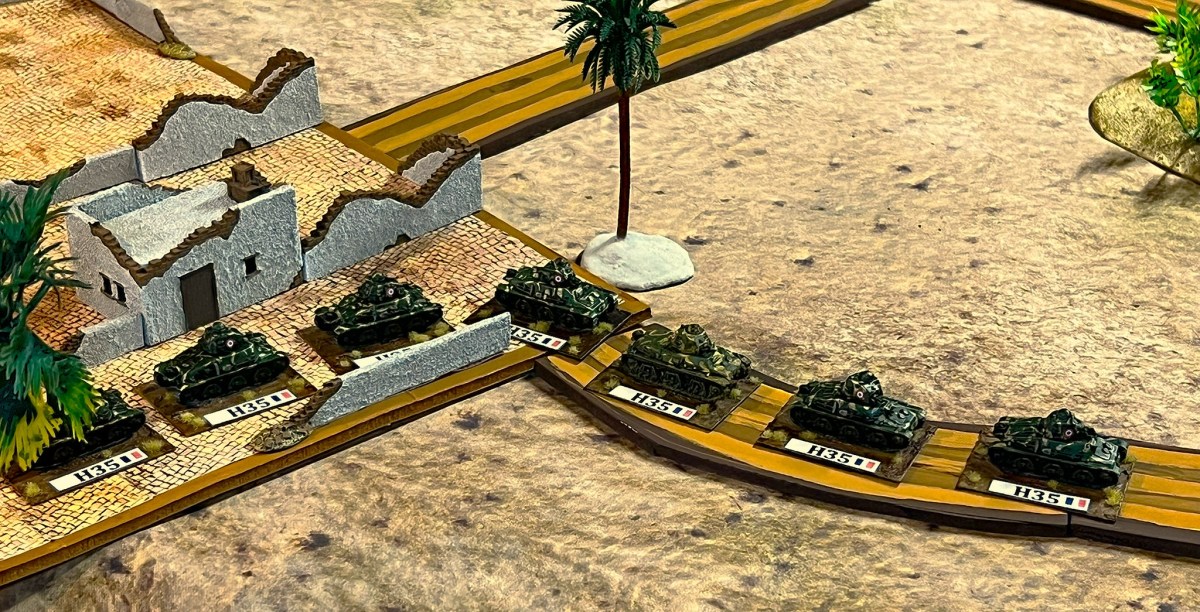
H35’s in column on my game tabletop.
Close up of the H35 column.

I am indeed – as promised – catching up on the posts I have backlogged for my What a Tanker Operation Torch game project- and yes there are more AFV’s to come. I do appreciate you, my readers. Of the eventually-painted 31 Vichy vehicles I had for the game, this brings me up to 24 Vichy combat vehicles that I have covered to date in this blog. I have 8 remaining Vichy armored cars to write about before I get to the USA. Those 8 will be the topic of my next post. Please, if you want, I’d love to hear any feedback – feel free to let me know your thoughts in the comments section.

For all of my posts on WWII games and projects – there is a consolidated list of posts and their links located here.

MATERIALS USED

PAINTS, INKS, GLAZES, SHADES, WASHES, PIGMENTS AND FLOCKING USED ON THESE H35 MODELS:

  1. Green Stuff
  2. War Games Accessories Steel Bases Number 23 (1½” x 2″)
  3. No. 19 x ½” flat head nails
  4. Vallejo Surface Primer “German Green Brown”
  5. Neodymium magnets (¼”)
  6. Gorilla Glue
  7. Wooden Blocks, steel bolts, steel washers, nails, magnets, steel screws
  8. Citadel “Agrellan Earth” (texture)
  9. Vallejo Primers “NATO Green”
  10. Vallejo Surface Primer “Black”
  11. Vallejo Primers “Desert Tan”
  12. Vallejo Surface Primer “German Green Brown”
  13. Reaper MSP Core Colors “Blackened Brown”
  14. Army Painter “Mid Brown” (shade/wash)
  15. Vallejo Mecha Color “Dark Steel”
  16. Battlefront “Oxide Red”
  17. Reaper MSP “Carrot Top Red”
  18. Army Painter Speed Paint 1.0 “Dark Wood”
  19. Army Painter “Dark Tone” (wash)
  20. Vallejo Mecha Weathering Effects “Dark Rust Wash”
  21. Vallejo Model Air “Tire Black”
  22. Vallejo Model Color “Dark Sea Grey”
  23. Vallejo “Mecha Varnish Gloss”
  24. Microscale Industries “Micro Set”
  25. Microscale Industries “Micro Sol”
  26. Microscale Industries “Liquid Decal Film”
  27. Flames of War French Decal Set (FR940)
  28. Peddinghaus-Decals 1/100 2181 “World of Flames French tanks early war”
  29. Citadel “‘Ardcoat”
  30. Vallejo “Gloss Acrylic Varnish”
  31. Citadel “Agrellan Earth” (texture)
  32. Army Painter “Mid Brown” (shade/wash)
  33. Reaper MSP Core Colors “Blackened Brown”
  34. Vallejo Flow Improver
  35. Vallejo Thinner
  36. Vallejo “Matte Polyurethane Varnish”
  37. Printed labels on card stock
  38. Gamers Grass “Tiny Beige 2mm Tufts” (flocking)
  39. PVA Glue

French Armor for Operation Torch: Renault FT-17’s

Vichy France had many different old or at least obsolete combat vehicles in their colonies. While more than half of Metropolitan France was occupied by the Germans, under the Armistice of 22 June 1940, Vichy was still obligated to defend its unoccupied lands as a neutral state.

As such, while Vichy was denied armored units, she was allowed to have integrated combined-arms units in the colonies – forces that had armored vehicles. These Vichy tanks and armored cars would play a role in Operation Torch in November 1942 against US forces in Morocco (and Algeria as well).

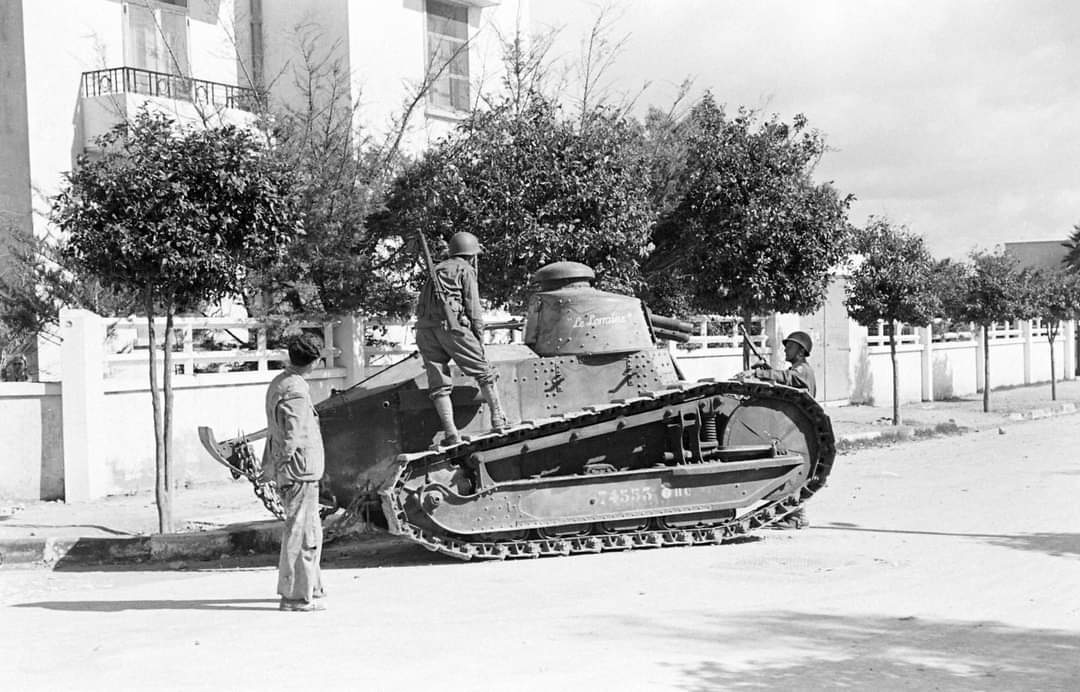
Abandoned / damaged Vichy French Renault FT-17 tanks are examined by curious US Personnel in Safi Morocco during Operation Torch – November 1942 – from https://www.reddit.com/r/WW2info/comments/17rn03o/abandoned_damaged_vichy_french_renault_ft17_tanks/

My last post covered two older (by November 1942 standards) armored cars used by Vichy forces – the White-Laffly AMD 80 and the Schneider AMC P16. Vichy also had tanks in North Africa, one of the most common was the WWI-vintage Renault FT-17.

For this post, I will discuss the venerable Renault FT-17’s that I built and painted up for my Operation Torch game of What a Tanker that I ran at HISTORICON 2025.

3,000 FT-17’s were built by France between 1917 and 1919. Indeed, she had so many old FT-17’s that the development and acquisition of newer tanks was negatively affected. Simply put, the French budgetary bean counters saw that the French Army had plenty of tanks available on paper, so why build too many more expensive ones? This would not bode well when May-June 1940 came around. Of course, French military doctrine was as least as equally to blame for the Fall of France (read BG Doughty’s The Seeds of Disaster: The Development of French Army Doctrine 1919-1939). After that debacle, Vichy did have many FT-17’s still in her colonies.

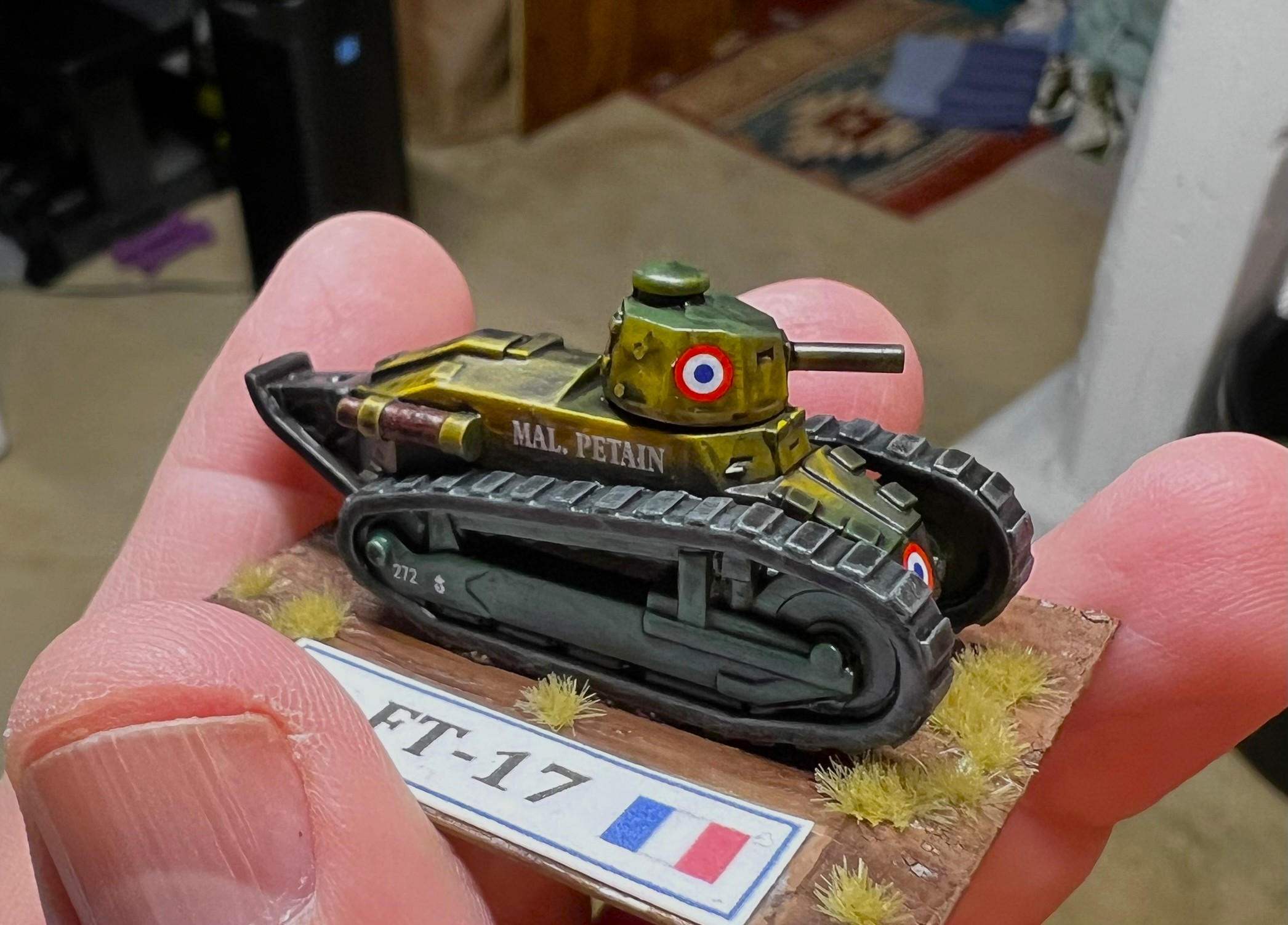
For my game, I had to have some FT-17’s. Historically, some were armed with the Puteaux SA18 37mm cannon, others with machine guns and even a very few with a short-barreled 75mm howitzer. For my game-design purposes, I decided that all should be armed with the 37mm cannon. I did have one completed 15mm/1:100 scale metal FT-17 from Peter Pig that I could rebase and use – it was described in my blog here.

To augment that, I purchased a 5-vehicle FT-17 platoon on eBay from jacobsminis (aka HobbyHouse&Miniatures.LLC). The tanks were nice crisp resin models. I ordered them on April 8th, and they arrived on April 14th. I started to work on them on April 28th (while concurrently working on all of the other vehicles for the project).

After washing the models, I drilled out and installed neodymium magnets in the hulls with green stuff. I also drilled out the turret bases to accommodate small flat-headed steel nails. These would work with the magnets in the hulls to both allow rotation and keep the turrets relatively secure. Priming and painting followed.

As I was working on many other vehicles, photo time got to be rare for me. Therefore, I do not have much in terms of WIP shots. I adopted the same airbrush painting pattern as I used for the Peter Pig model. The only difference was that I did not add a lot of mud to the tracks.

The main painting is done. You can see the turrets are semi-mounted temporarily on magnets and steel washers for painting purposes.

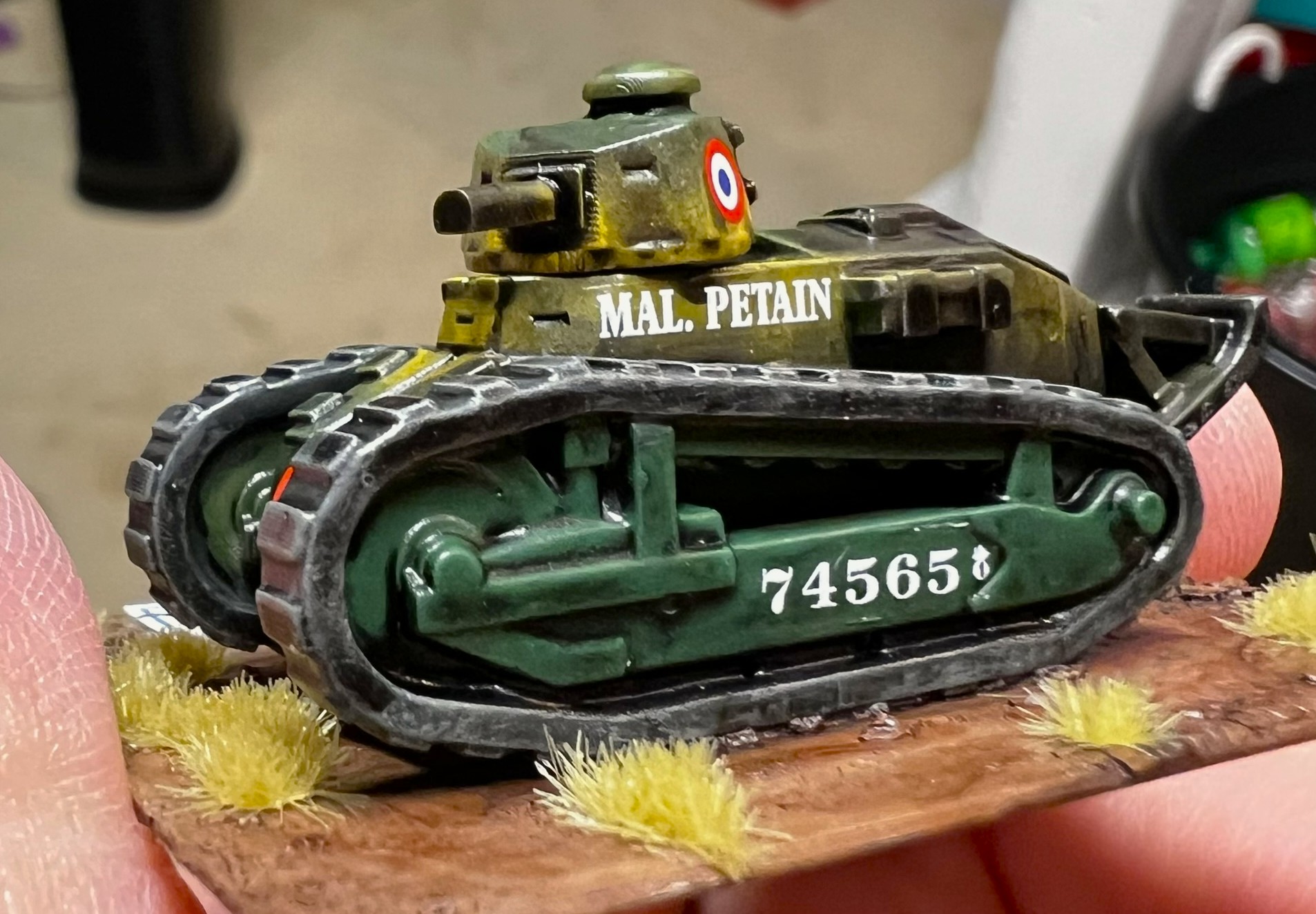
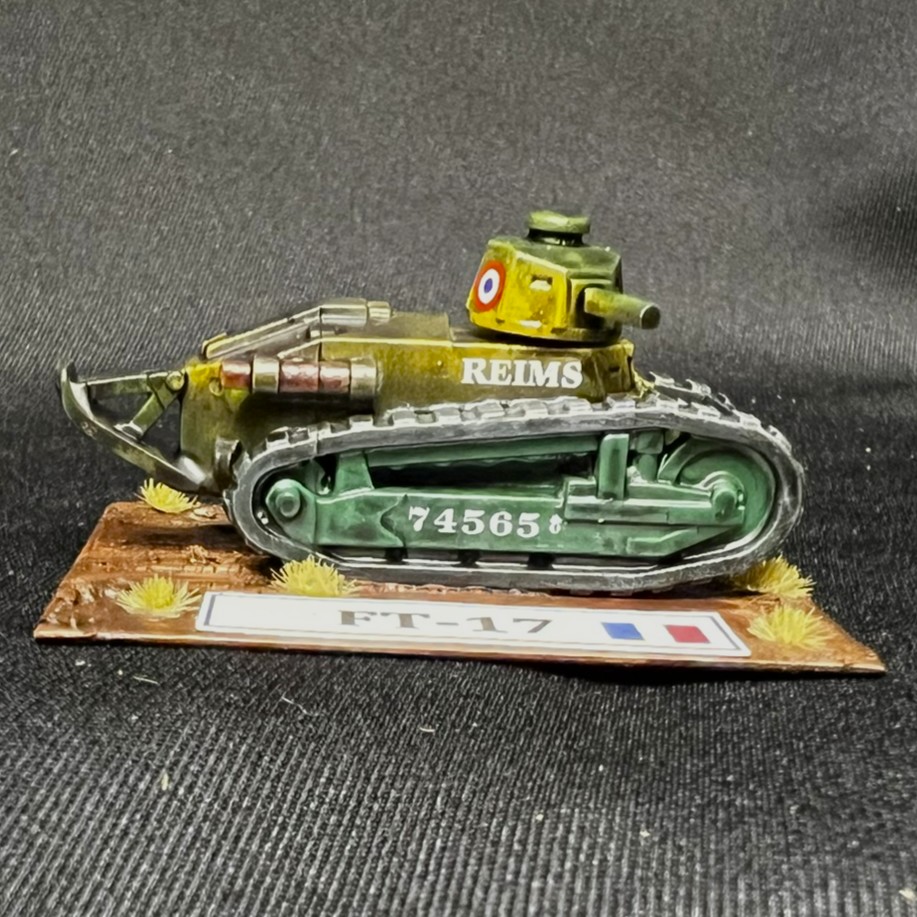
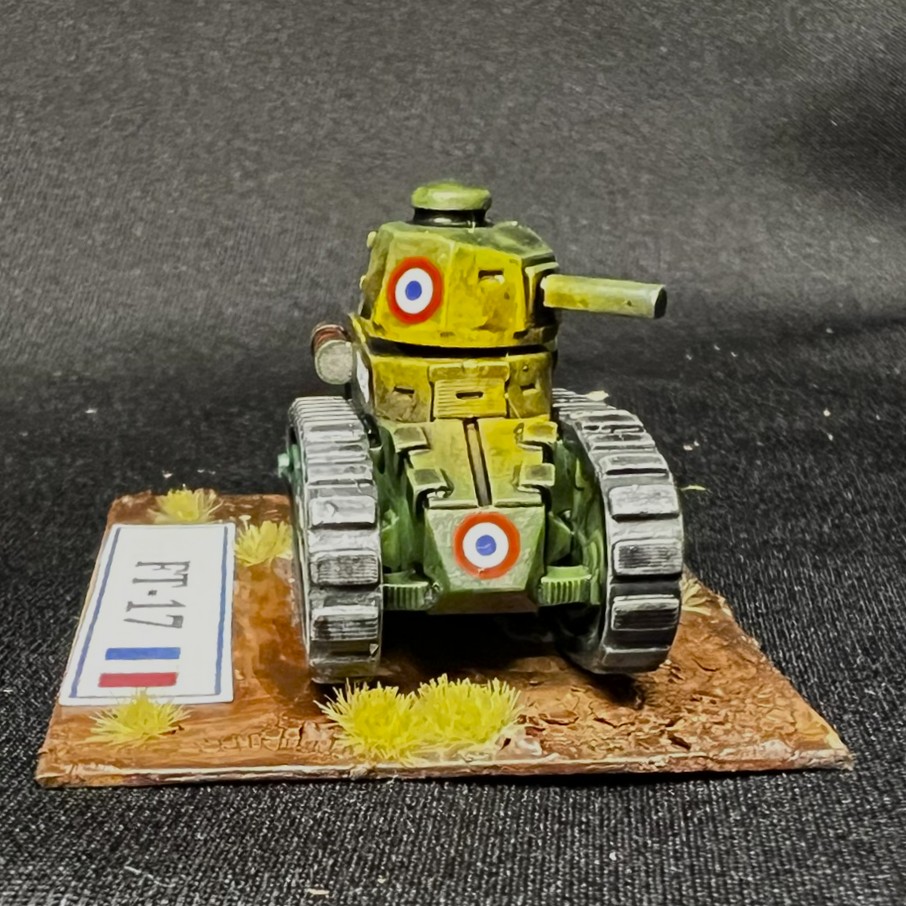
Then it was on to the decal and basing phases, which were like those that I employed and shared in my last post. I did end up with similar numerical decals on different tanks – but I did vary the sides and the other decals. Each one had a distinct name.

As an example, here is “MARECHAL PETAIN”. Each steel base is 1½” x 2″.

I’m sure that you’d like some better “eye candy”, so…

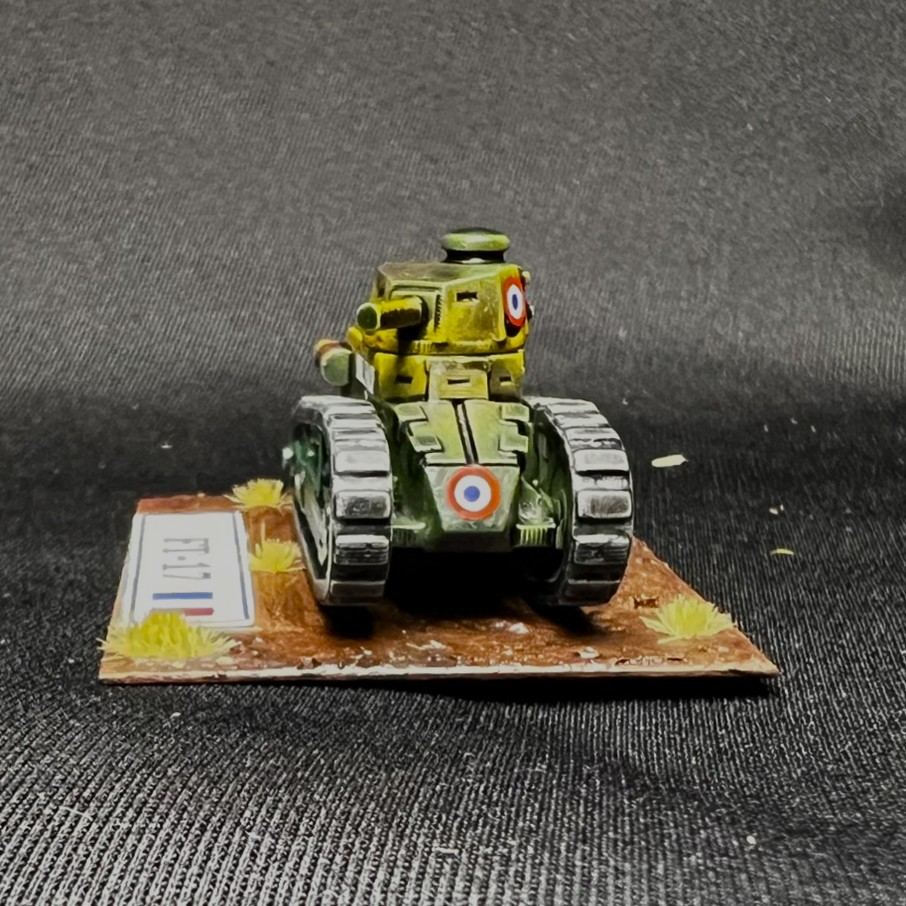
FT-17’s

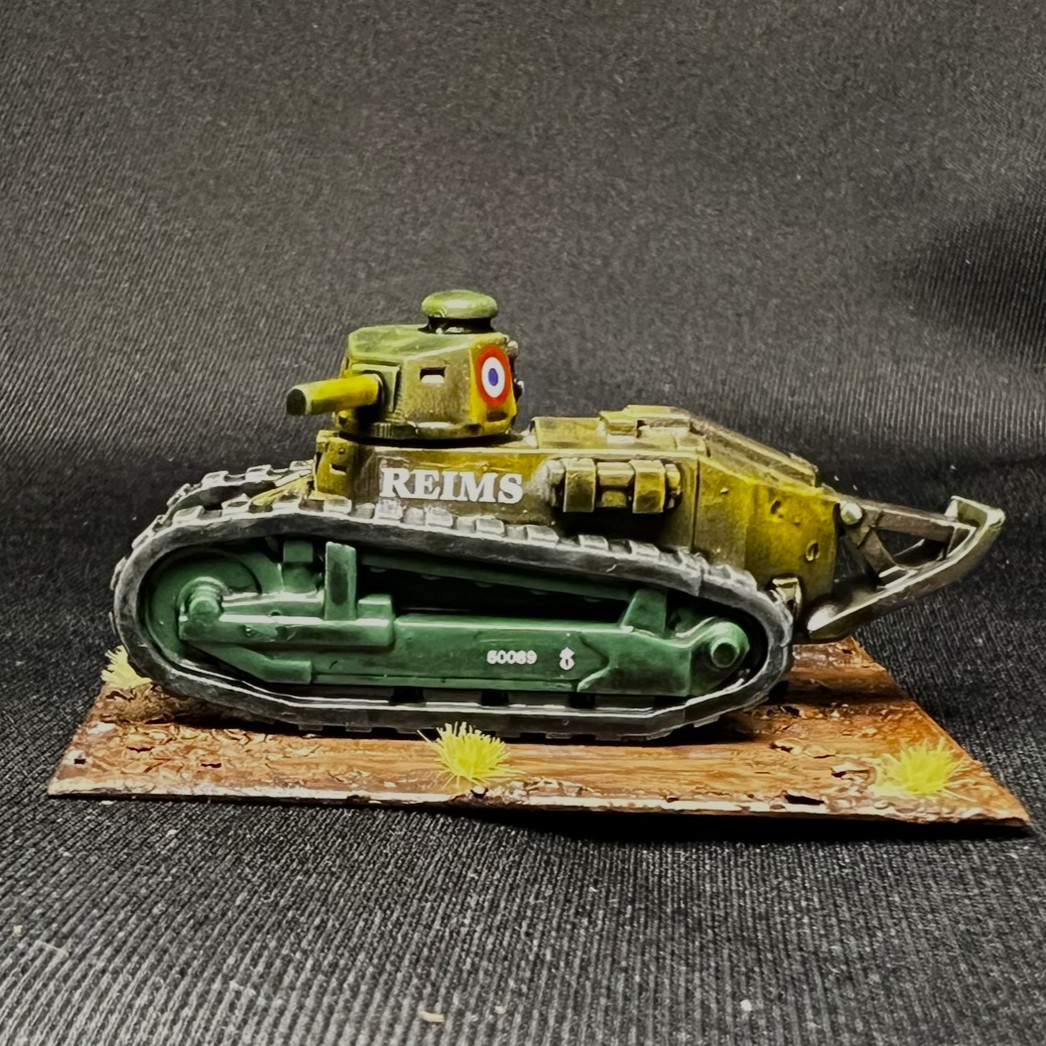
“REIMS”

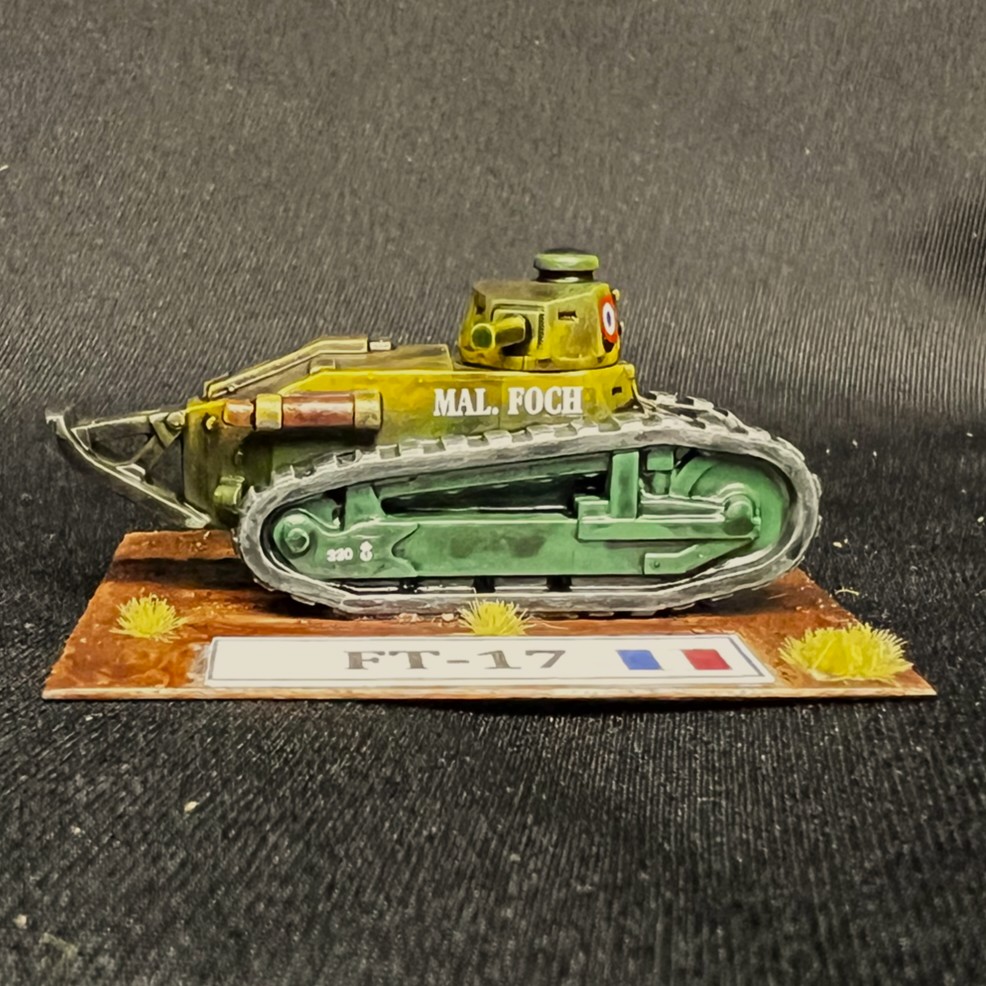
“MARECHAL FOCH”

“MARECHAL PETAIN”

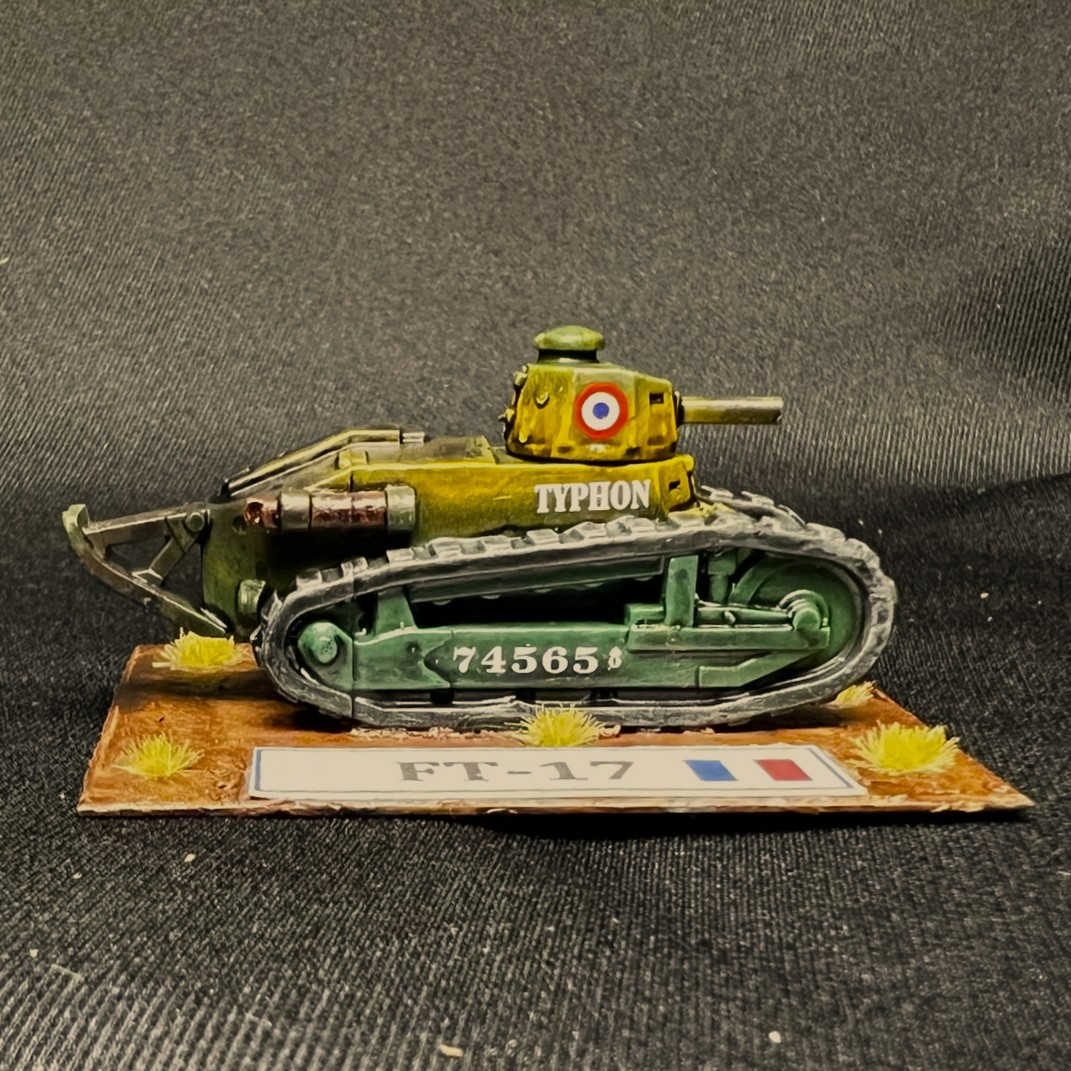
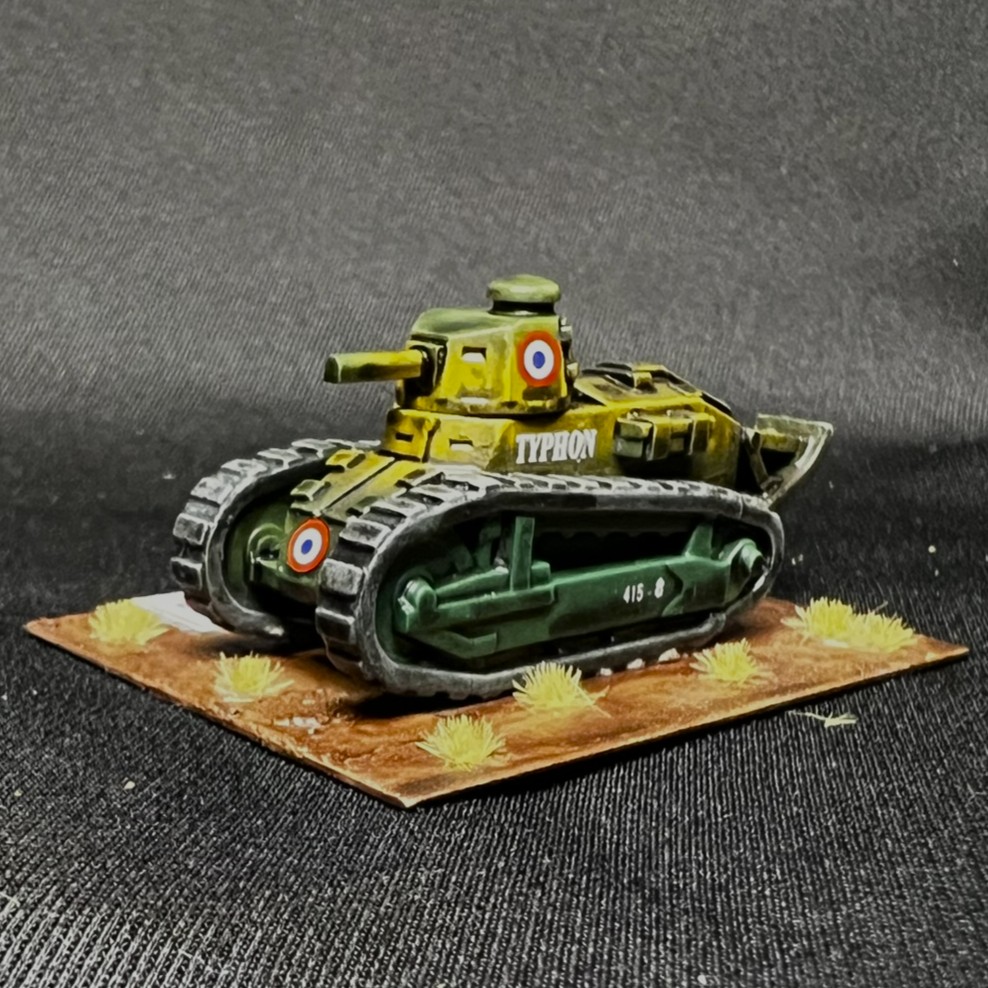
“TYPHON”

“TOMBOUCTOU”

Group Shots

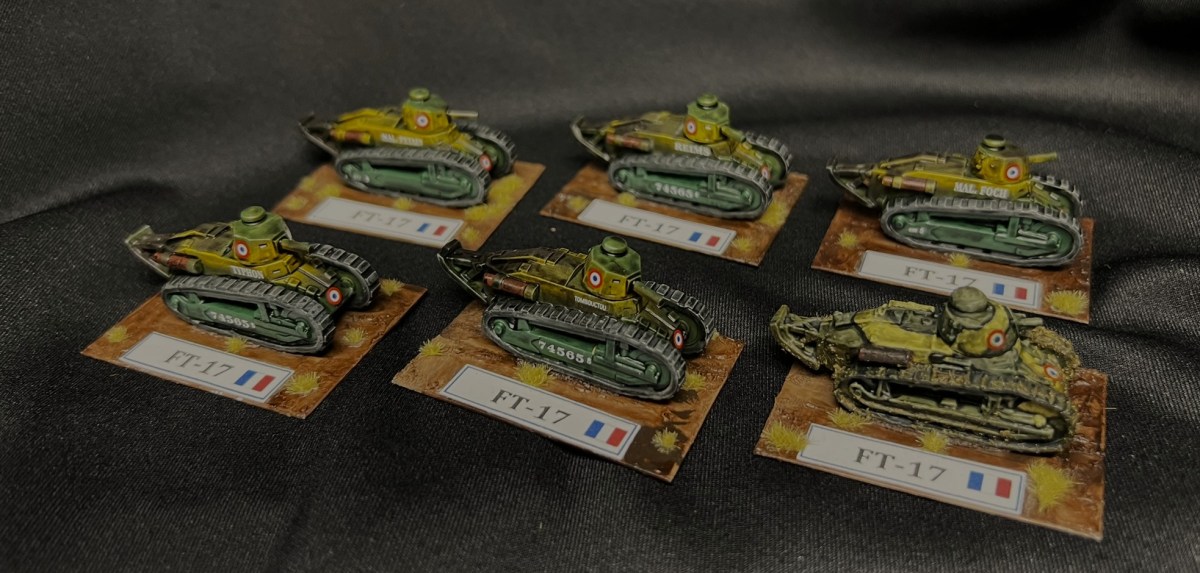
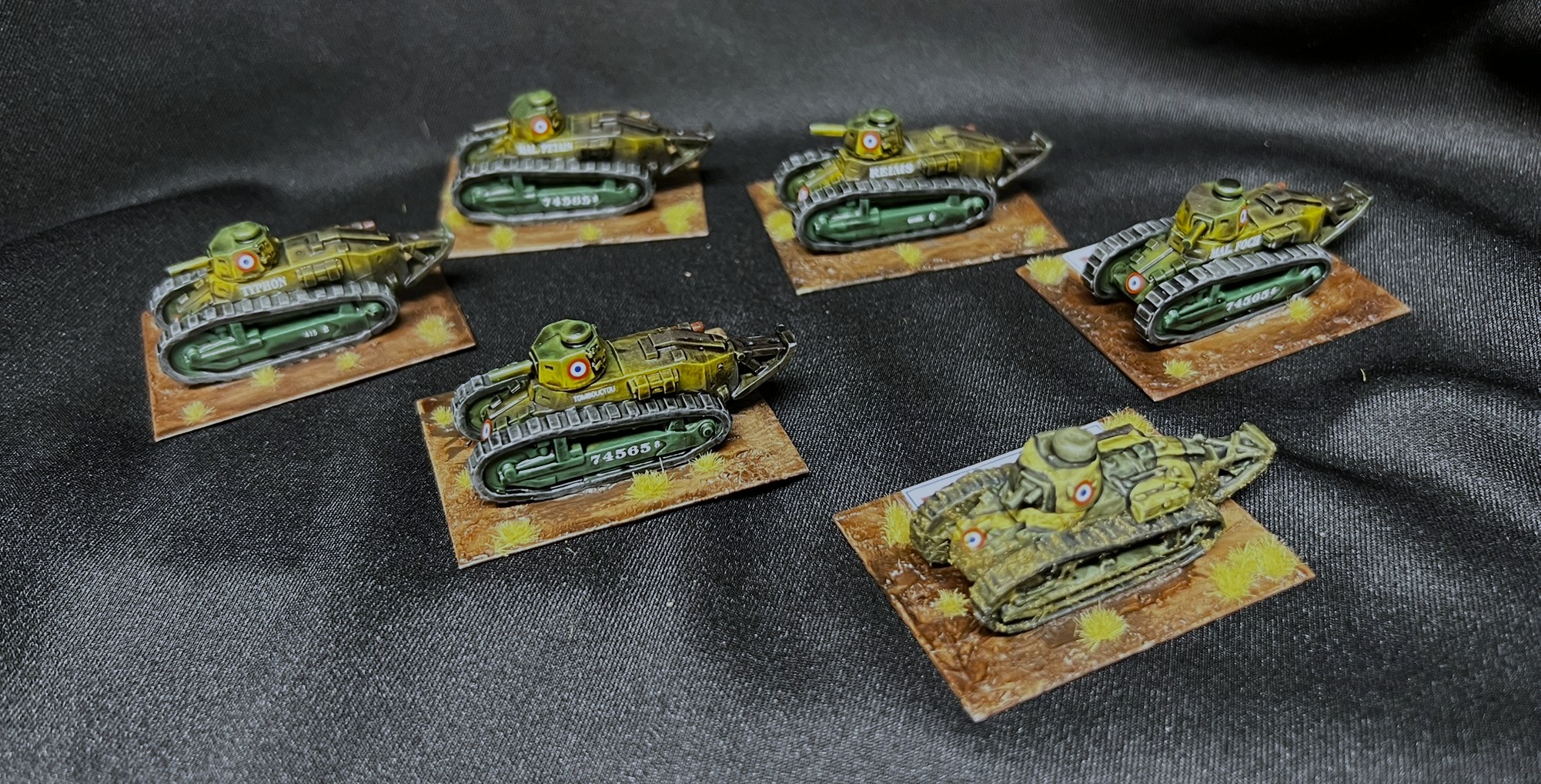
Below are all my FT-17’s, including the Peter Pig model on the front right. It has no name – but it does have mud!

Another view of the opposite side of the tanks – the Peter Pig model is on the bottom right here as well.

With terrible armor – yet the same 37mm gun as many other Vichy French AFV’s – these antique FT-17’s did indeed engage the US in battle in November 1942.

And an Instagram link for a video: https://www.instagram.com/p/DMwIOgMNcpD/

I do want to dedicate this post to my good friend Leif, who adores the FT-17 more than anyone else I know. When we play, it’s an easy choice as to which side he wants. He also helps me immensely at conventions – so this post is for you!

To all of you, thanks for looking! I will have share more Vichy vehicles soon. I eventually painted up 31 Vichy – and so far I’ve covered just 12 of them (6 FT-17’s, 3 White-Laffly AMD 80’s, and 3 Schneider AMC P16’s). More to come as I catch up. And there of course will be US vehicles. As always, if you want, I’d love to hear any feedback – feel free to let me know your thoughts in the comments section.

For all of my posts on WWII games and projects – there is a consolidated list of posts and their links located here.

Next up – Hotchkiss 35’s, 39’s, and Renault 35’s. Until my next post!

Eventually I do get these in games!

MATERIALS USED

PAINTS, INKS, GLAZES, SHADES, WASHES, PIGMENTS AND FLOCKING USED ON THESE FT-17 MODELS:

  1. Vallejo “Flow Improver”
  2. Green Stuff
  3. War Games Accessories Steel Bases Number 23 (1½” x 2″)
  4. No. 19 x ½” flat head nails
  5. Neodymium magnets (⅛” and ¼”)
  6. Gorilla Glue
  7. Vallejo Surface Primer “Black”
  8. Wooden Blocks, steel bolts, steel washers, nails, magnets, steel screws
  9. Vallejo Model Air “Dark Brown”
  10. Vallejo Primers “NATO Green”
  11. Vallejo Premium Color “Yellow Ochre”
  12. Hataka “Vert Fonce”
  13. Vallejo Model Air “Tire Black”
  14. Vallejo Model Color “Dark Sea Grey”
  15. Battlefront “Oxide Red”
  16. Army Painter “Dark Tone” (wash)
  17. Vallejo Mecha Weathering Effects “Dark Rust Wash”
  18. Vallejo “Mecha Varnish Gloss”
  19. Microscale Industries “Micro Set”
  20. Microscale Industries “Micro Sol”
  21. Microscale Industries “Liquid Decal Film”
  22. Flames of War French Decal Set (FR940)
  23. Peddinghaus-Decals 1/100 2181 “World of Flames French tanks early war”
  24. Citadel “‘Ardcoat”
  25. Vallejo Surface Primer “German Green Brown”
  26. Vallejo “Gloss Acrylic Varnish”
  27. Citadel “Agrellan Earth” (texture)
  28. Army Painter “Mid Brown” (shade/wash)
  29. Reaper MSP Core Colors “Blackened Brown”
  30. Vallejo Flow Improver
  31. Vallejo Thinner
  32. Vallejo “Matte Polyurethane Varnish”
  33. Printed labels on card stock
  34. Gamers Grass “Tiny Beige 2mm Tufts” (flocking)
  35. PVA Glue

French Armor for Operation Torch: White-Laffly AMD 80’s & Schneider AMC P16’s

Having decided to run an Operation Torch game of What a Tanker at HISTORICON 2025, I had to get working back in March and early April. It was time to gather enough vehicles and paint them up. As you will see in these entries, it was not always easy, especially for some of the esoteric/rare Vichy vehicles.

This blog will, as I promised, catch you up on the myriad of US and Vichy French vehicles that I assembled and painted for that recent convention. If I had stopped to blog about them at the time, I don’t think I would have gotten everything done. I had not built any tanks in many years, so I was excited!

After the Fall of France, there were still French Army units defending the colonies. So let’s start with some of these Vichy French vehicles for November 1942.

I will start with two types of Old Glory models. Both are metal and 1:100 in scale (15mm).

The first one is SKU CD607, “White-Laffly AMD 80“. This vehicle was a twice-modified holdover from WWI, and it looks it. Around 28 were reworked in 1934. It was rearmed with three machine guns. One heavy machine gun replaced the Puteaux SA18 37mm cannon in the turret that its predecessor, the AMD 50, had. AMD stands for “automitrailleuse de decouverte” – basically “armored scout car” in English. By the time war broke out in Europe, all of these were in North Africa in the colonies. This was a common fate for all older French armaments.

The second one is SKU CD610, “Schneider AMC P16“. Like the White-Laffly AMD 80, this was a cavalry vehicle. Unlike it, its designation was AMC, or “automitrailleuse de combat” (combat armored car). 100 were produced. It had an innovative Kegresse suspension system that made it into a half-track. It also kept its turret-mounted Puteaux SA18 37mm cannon. This was the most common cannon on French tanks, so this gave it some anti-armor punch. Some P16’s did met the Wehrmacht in Germany, but many were similarly dispersed to the colonies before 1939.

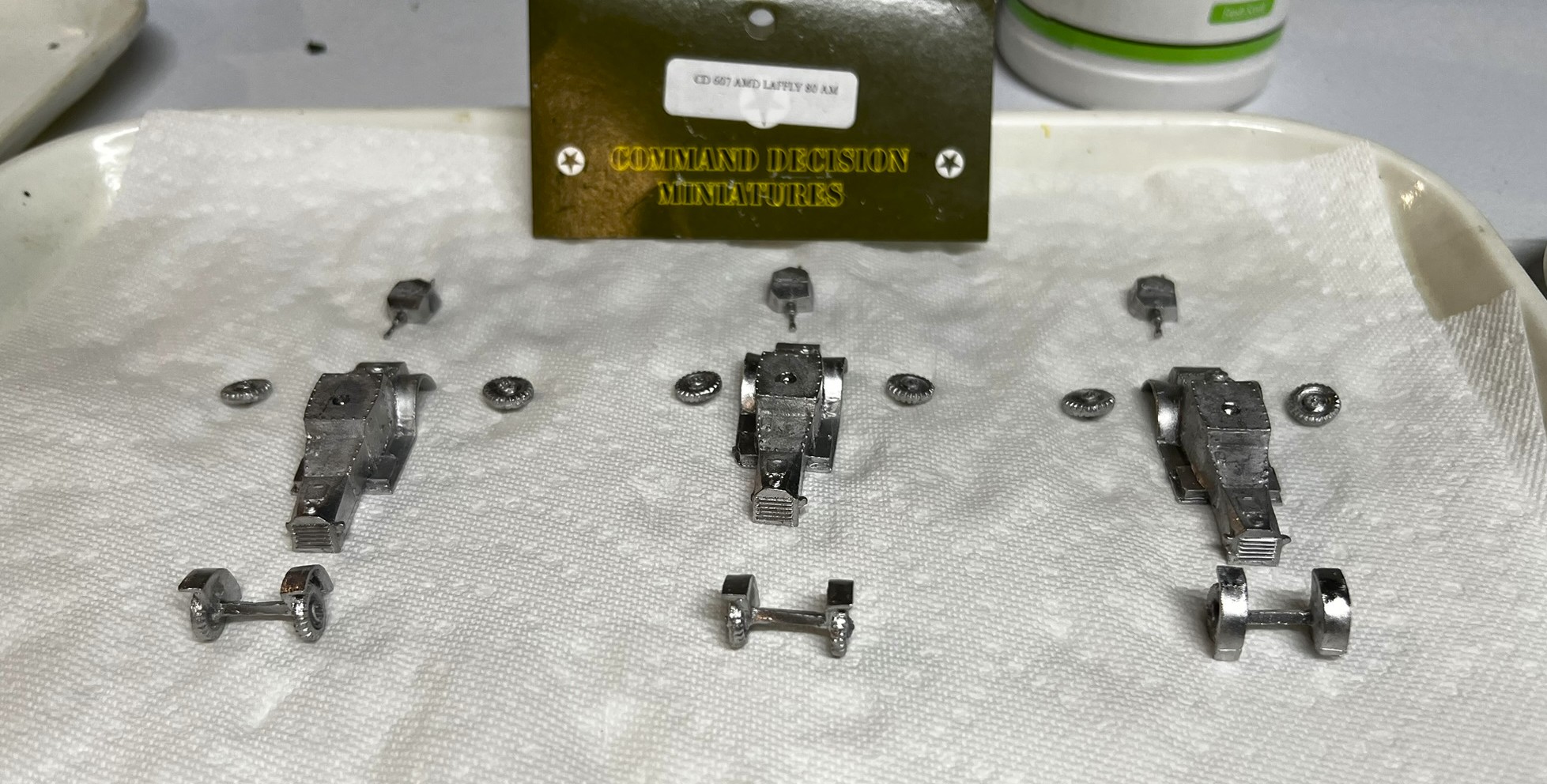
The Old Glory Command Decision models as received. There were 3 of each type. I printed off some examples of paint schemes to start with them.

I got the models in April, and started work on them on the 26th. I did the usual drilling and washing in preparation for assembling and painting. I also used small magnets to affix the turrets. These magnets also serve to help to hold the brewed-up markers (also on magnets) that I use to indicate knocked-out tanks.

The White-Laffly AMD 80 models drilled and washed.
The Schneider AMC P16 models drilled and washed.

Metal miniatures don’t always cast perfectly. In the case of the AMD 80’s, the headlights were not great, but fixable.

Close up example of a missing White-Laffly headlight.

I used a little green stuff and they started looking old again!

Headlights are back!

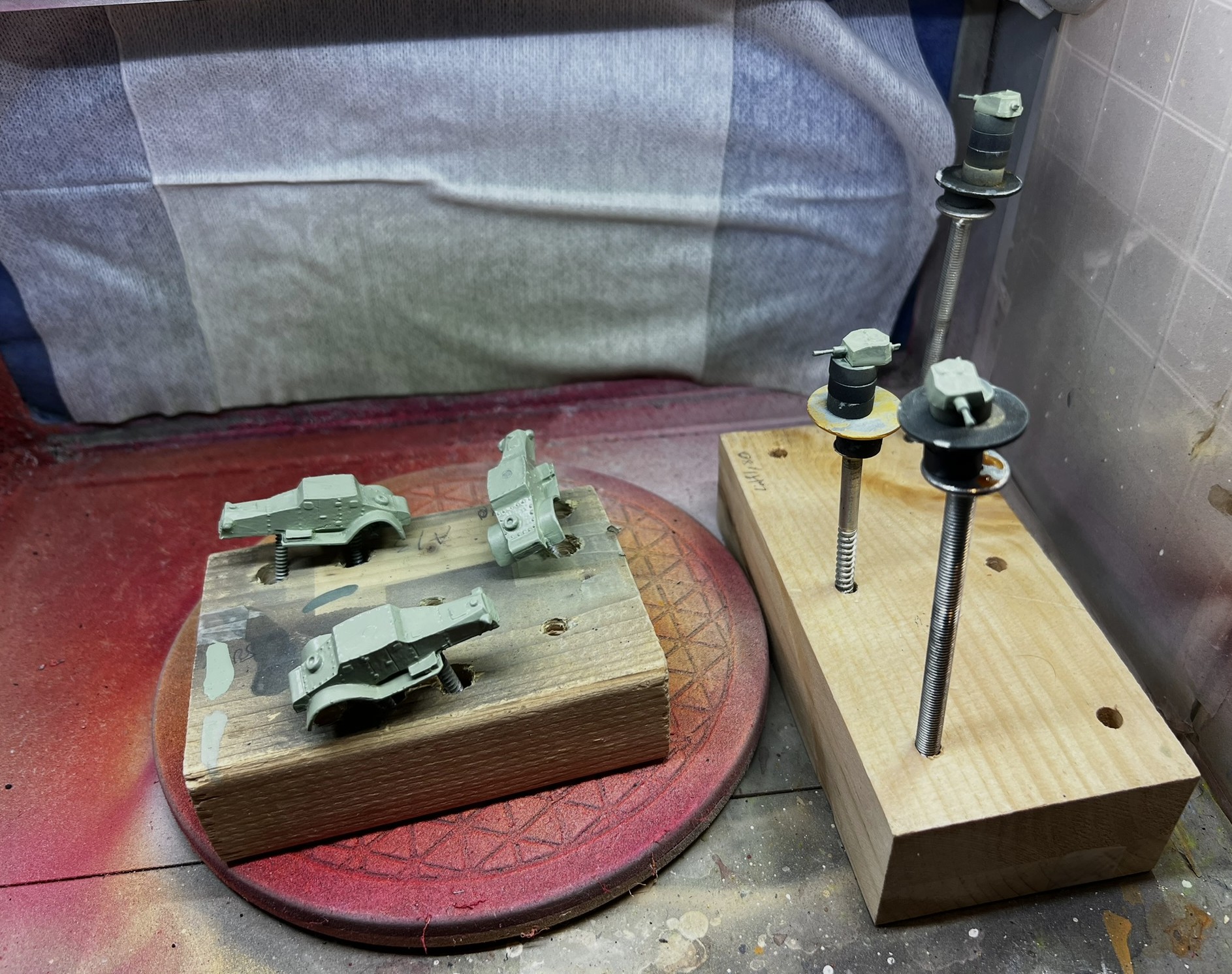
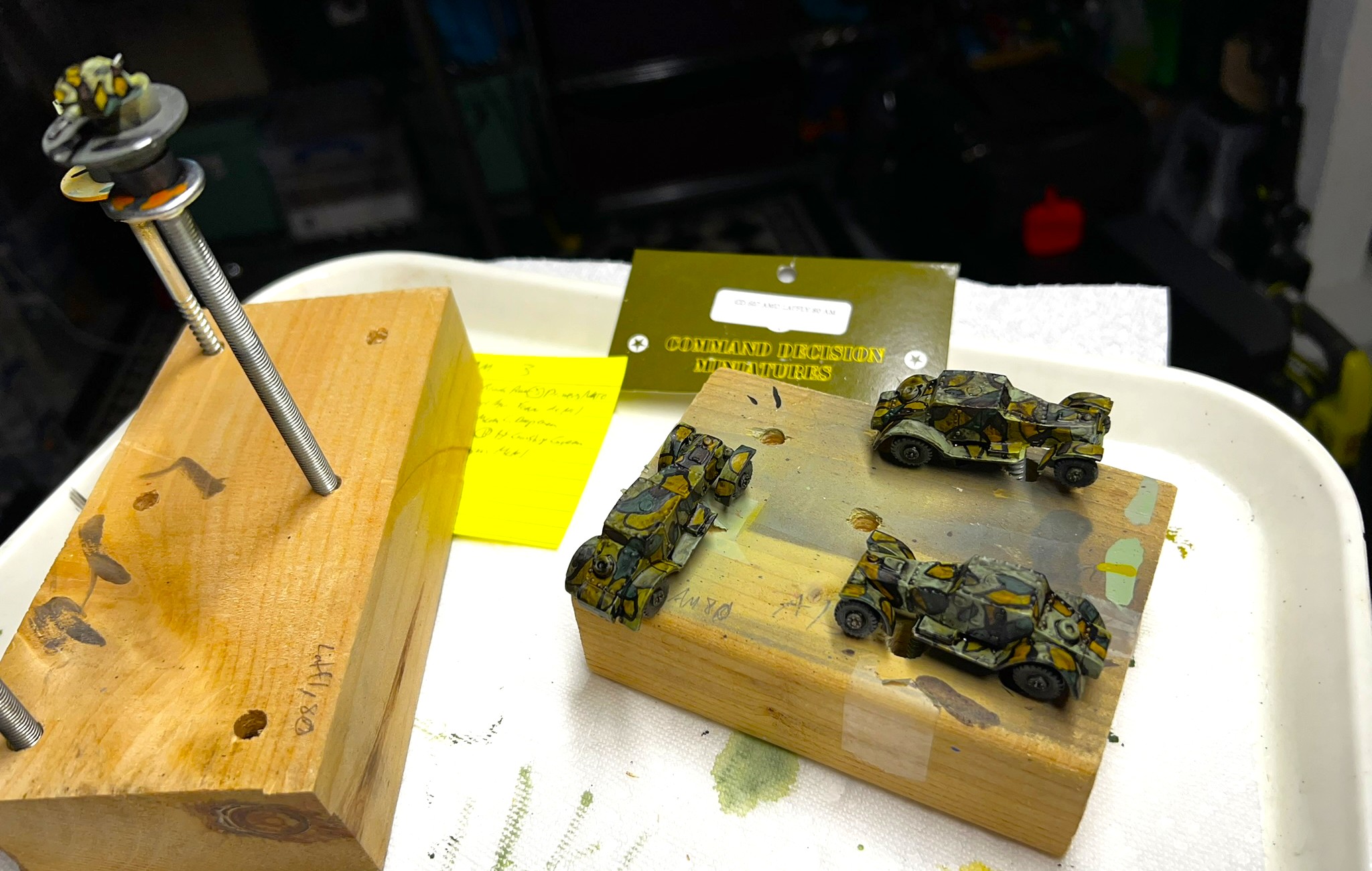
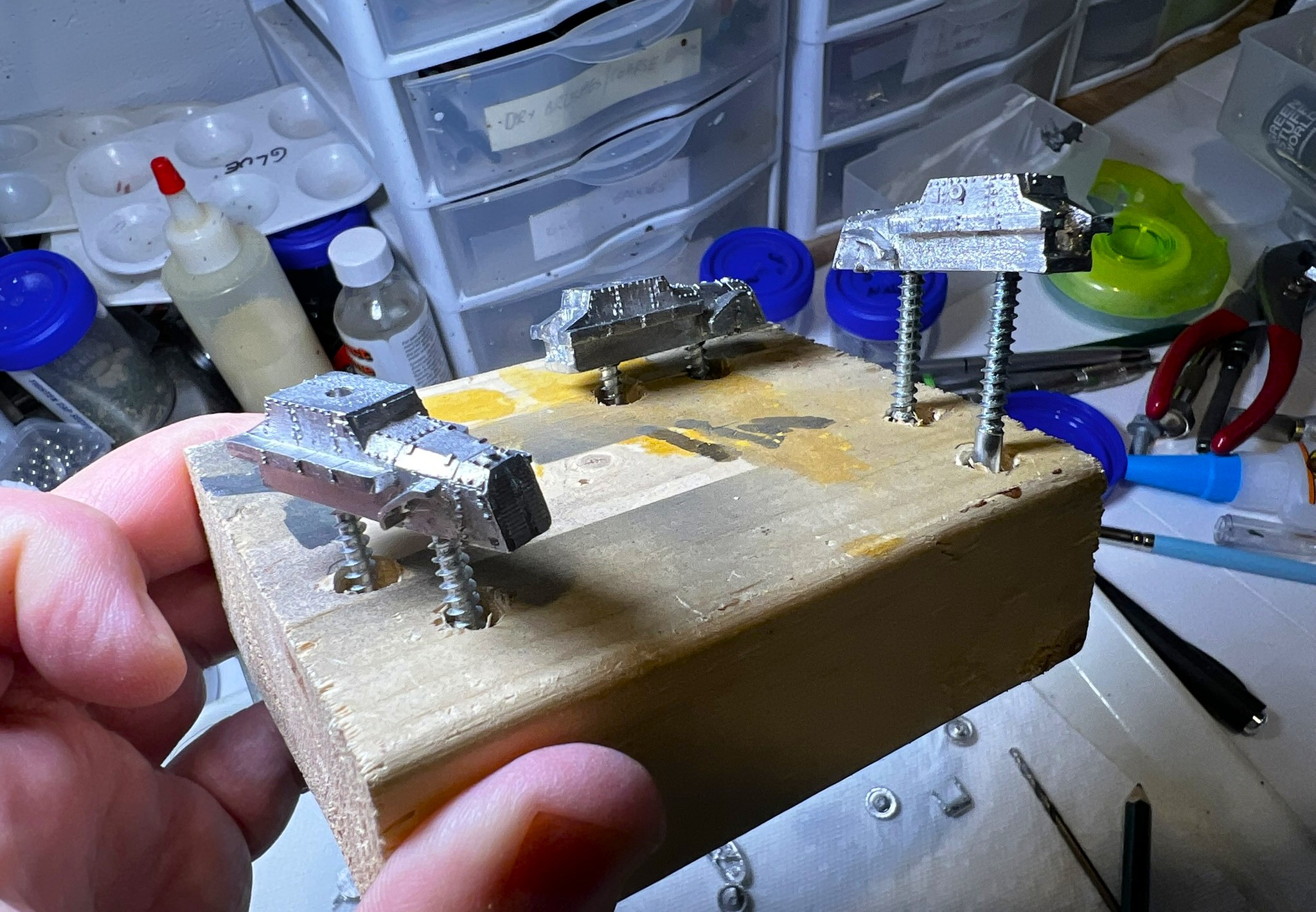
I also used green stuff and to fill the cavities under the vehicles. I waited until the green stuff had hardened just slightly, then inserted screws as you can see. Once that had fully set, I had a nice way of setting up the models on wooden blocks for painting, as the screws would come out easily later.

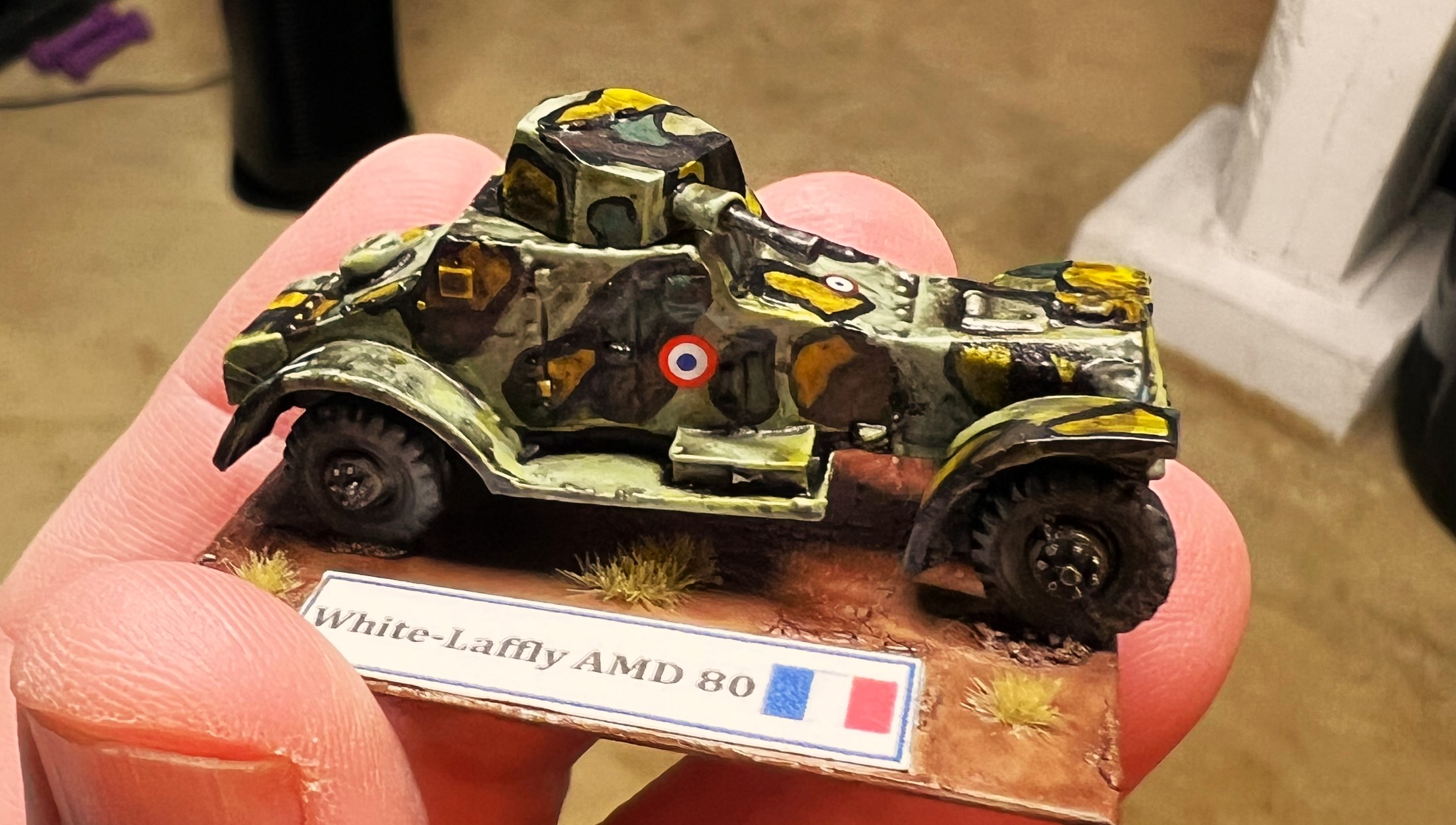
I ended up with a typical French camouflage pattern on the AMD 80’s as opposed to the pattern in the reference.

The P16’s got a brown and green camouflage pattern.

The Schneider AMC P16’s got a darker green – shown here ready for decals.

To be efficient and productive, I worked on these (and others you will see shortly in future posts) at the same time. I ended up deciding to base these on steel bases so as to allow each type a label. Let’s face it, I can’t expect most gamers at a convention to recognize these old and rare types. Labels help. I just needed to explain to the players that the bases are irrelevant to targeting the vehicles.

Decals and labels applied, still needed an application of matte varnish, some tufts and their turrets!

I managed to finish these on May the 8th.

Eye Candy

White-Laffly AMD 80

White-Laffly AMD 80 right side.
White-Laffly AMD 80, frontal view.
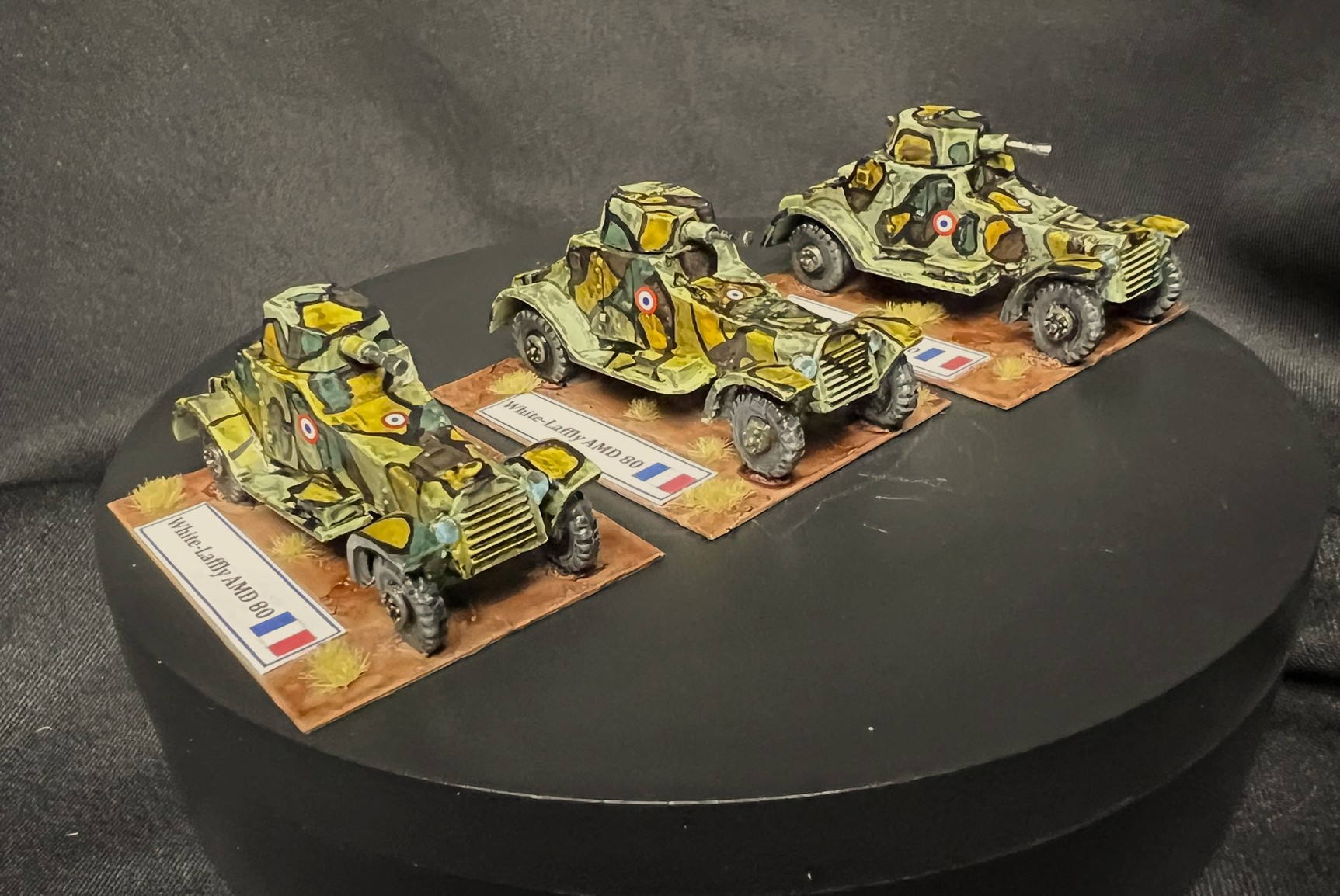
Group shot of the three White-Laffly AMD 80 models completed.

Here is my Instagram White-Laffly AMD 80 video link: https://www.instagram.com/p/DMtJSygOJqJ/

Schneider AMC P16

Right side of a Schneider AMC P16.
Left side of a Schneider AMC P16.
Group shot of the three Schneider AMC P16 80 models completed.

Here is my Instagram Schneider AMC P16 video link: https://www.instagram.com/p/DMtJ_a1OSg4/

Thanks for looking!

For all of my posts on WWII games and projects – there is a consolidated list of posts and their links located here.

I hope you enjoyed the post – there are several more entries coming soon! I’d love to hear any feedback – feel free to let me know your thoughts in the comments section.

MATERIALS USED

PAINTS, INKS, GLAZES, SHADES, WASHES, PIGMENTS AND FLOCKING USED ON THE WHITE-LAFFLY AMD 80 MODELS:

  1. Vallejo “Flow Improver”
  2. Green Stuff
  3. War Games Accessories Steel Bases Number 23 (1½” x 2″)
  4. Neodymium magnets (⅛” and ¼”)
  5. Gorilla Glue Vallejo Surface Primer “Black”
  6. Wooden Blocks, steel bolts, steel washers, magnets, steel screws
  7. Vallejo Primers “NATO Green”
  8. Vallejo Model Air “Duck Egg Green”
  9. Vallejo Model Air “Dark Brown”
  10. Vallejo Mecha Weathering Effects “Dark Rust Wash”
  11. Vallejo Mecha Color “Deep Green”
  12. Vallejo Model Color “Dark Yellow”
  13. Vallejo Model Color “Black”
  14. Battlefront “Gunship Green”
  15. Vallejo Mecha Color “Sky Blue”
  16. Vallejo Model Air “Gun Metal”
  17. Vallejo Model Air “Tire Black”
  18. Vallejo Model Color “Dark Sea Grey”
  19. Army Painter “Dark Tone” (wash)
  20. Vallejo “Mecha Varnish Gloss”
  21. Microscale Industries “Micro Set”
  22. Microscale Industries “Micro Sol”
  23. Microscale Industries “Liquid Decal Film”
  24. Flames of War French Decal Set (FR940)
  25. Peddinghaus-Decals 1/100 2181 “World of Flames French tanks early war”
  26. Citadel “‘Ardcoat”
  27. Vallejo Surface Primer “German Green Brown”
  28. Vallejo “Gloss Acrylic Varnish”
  29. Citadel “Agrellan Earth” (texture)
  30. Army Painter “Mid Brown” (shade/wash)
  31. Reaper MSP Core Colors “Blackened Brown”
  32. Vallejo Flow Improver Vallejo Thinner
  33. Vallejo “Matte Polyurethane Varnish”
  34. Printed labels on card stock
  35. Gamers Grass “Tiny Beige 2mm Tufts” (flocking)
  36. PVA Glue

PAINTS, INKS, GLAZES, SHADES, WASHES, PIGMENTS AND FLOCKING USED ON THE SCHNEIDER AMC P16 MODELS:

  1. Green Stuff
  2. War Games Accessories Steel Bases Number 23 (1½” x 2″)
  3. Neodymium magnets (⅛” and ¼”)
  4. Gorilla Glue
  5. Vallejo Surface Primer “Black”
  6. Wooden Blocks, steel bolts, steel washers, magnets, steel screws
  7. Steel ball bearings
  8. Vallejo Primers “NATO Green”
  9. Vallejo Model Air “Dark Brown”
  10. Vallejo Mecha Weathering Effects “Dark Rust Wash”
  11. Vallejo Model Air “Tire Black”
  12. Vallejo Model Color “Dark Sea Grey”
  13. Army Painter “Dark Tone” (wash)
  14. Vallejo “Mecha Varnish Gloss”
  15. Microscale Industries “Micro Set”
  16. Microscale Industries “Micro Sol”
  17. Microscale Industries “Liquid Decal Film”
  18. Flames of War French Decal Set (FR940)
  19. Peddinghaus-Decals 1/100 2181 “World of Flames French tanks early war”
  20. Citadel “‘Ardcoat”
  21. Vallejo “Gloss Acrylic Varnish”
  22. Vallejo Surface Primer “German Green Brown”
  23. Citadel “Agrellan Earth” (texture)
  24. Army Painter “Mid Brown” (shade/wash)
  25. Reaper MSP Core Colors “Blackened Brown”
  26. Vallejo Flow Improver
  27. Vallejo Thinner
  28. Vallejo “Matte Polyurethane Varnish”
  29. Printed labels on card stock
  30. Gamers Grass “Tiny Beige 2mm Tufts” (flocking)
  31. PVA Glue
The 308 Lakeside Open of 2025 (Tour of the Brookfields)
Our fourth regular season TOB event at Quail Hollow Golf & Country Club in Oakham, MA was held on the morning of Saturday, July 26th, 2025. This was the 2025 308 Lakeside Open sponsored by 308 Lakeside restaurant. We had 96 players on 24 teams in three divisions.

Weather was once again in our favor – which was nice. We had several new players – and welcome to all of you! There are two more regular season TOB’s before the FINALS. All are at Quail Hollow Golf & Country Club:

  • Saturday, August 16th: Hardwick Crossing Open
  • Sunday, September 7th: Lamoureaux Ford Open
  • Saturday, September 27th: THE FINALS

In order to qualify to play in THE FINALS, a player must have signed up to participate in three TOB’s. For example, those who signed up for the originally rained-out TOB in April, get credit for participating as one event. You can sign up to play at Still Harts Cafe, Quail Hollow, or on the TOB Facebook page.

Back to the results from the 308 Lakeside Open. See the results and details below. Once again, you can get these updates automatically by becoming an email subscriber to this blog (you can do this at the end of the blog post). The cost – nothing! It’s free!

2025 308 Lakeside Open Results

There were some excellent scores this time – and several teams in each division had a shot at the top place. For the first time this year, there were no playoffs.

In the Nicklaus Flight, the team of Jack Dorman, Dennis Trela, Brian Lacroix, and Deb Durgin won with a great score of 11-under par! Just one shot back in second place was the team of Josh Russell, Tom Waugh, Jay Gregory, and Cathy Patchen. Congrats to both for hitting double-digits under par!

In the Player Flight, yet another team won by scoring in double-digits under par! At -11 was the team of Ron McCann, Brandon McEvoy, Jason McCarthy, and Mark Bruso. Outstanding!

In second place were two teams at -8:

  • Adam Kettles, John DeSimone, Jarred Dandurant, and Leo Forget
  • Matt DeSimone, Stan Nolin, Matt McLeod, and Marcy Kimball

In the Palmer Flight, at 9-under par, the team of Ed McLeod, Bill Gaudette, Tom McCarthy, and April Pagnoni came out on top! Close behind them tied for second were two teams at -7. These teams were:

  • Shane Higgins, Ron Jette, Joe Pagnoni, and Kathleen Soltys
  • Beth McCann, Nelson Malin, Rick Gemme, and Jim Parker

Superb golf by all there!

As for skins, this was amazingly competitive. We ONLY had one this time – and that skin was a birdie on the par-four tenth hole. The team walking away with all of the skin money was Amanda Pierce, Paul Boulette, Ted Balicki, and Eddie Kosla. Great job!

As for closest to the pin, that award went to Ron Jette and his team with a distance of 4 feet, 4 inches.

Here are all of the results:

Congrats again to the winners and thanks to all the players!

The Next Tournament and Some Notes

Special thanks again to 308 Lakeside restaurant for their longstanding sponsorship of this event!

Also, as always, thank you to Carl Fitz, Jim LeBlanc, and all the staff at Quail Hollow who work so hard to make the Tour of the Brookfields possible.

IMPORTANT!!!

The next tournament is in August on the 16th. It is a Saturday. It will be the Hardwick Crossing Open sponsored by Hardwick Crossing Country Club. It is held at Quail Hollow.

Sign ups will be coming down VERY QUICKLY – closing on August 10th.

This event will also be VERY well-attended, so sign up early at Still Harts, at Quail Hollow, or on the Tour of the Brookfields Facebook page!

Again, you can sign up for this event up until August 1oth. Teams will be published by the committee on August 13th.

Remember, to qualify as a player for the FINALS on September 27th, playing three events is the normal needed threshold (with a very few exceptions).

Registration on August 16th will start at 7 AM, so please arrive before 7:30 AM.

A FEW REQUESTS:

First, thanks everyone for being timely in arriving. It helps us to get going much faster, please keep that up.

Second, if you want to sign up, PLEASE use one of the three sign up opportunities (Still Harts, at Quail Hollow, or on event section of the Tour of the Brookfields Facebook page). Texts do get lost or buried…so please use the lists.

Lastly, if you write your name down on the closest to the pin list, MAKE SURE WE CAN READ IT AND THE DISTANCE! If we cannot read it, well…you might lose out…

A Few Photos:

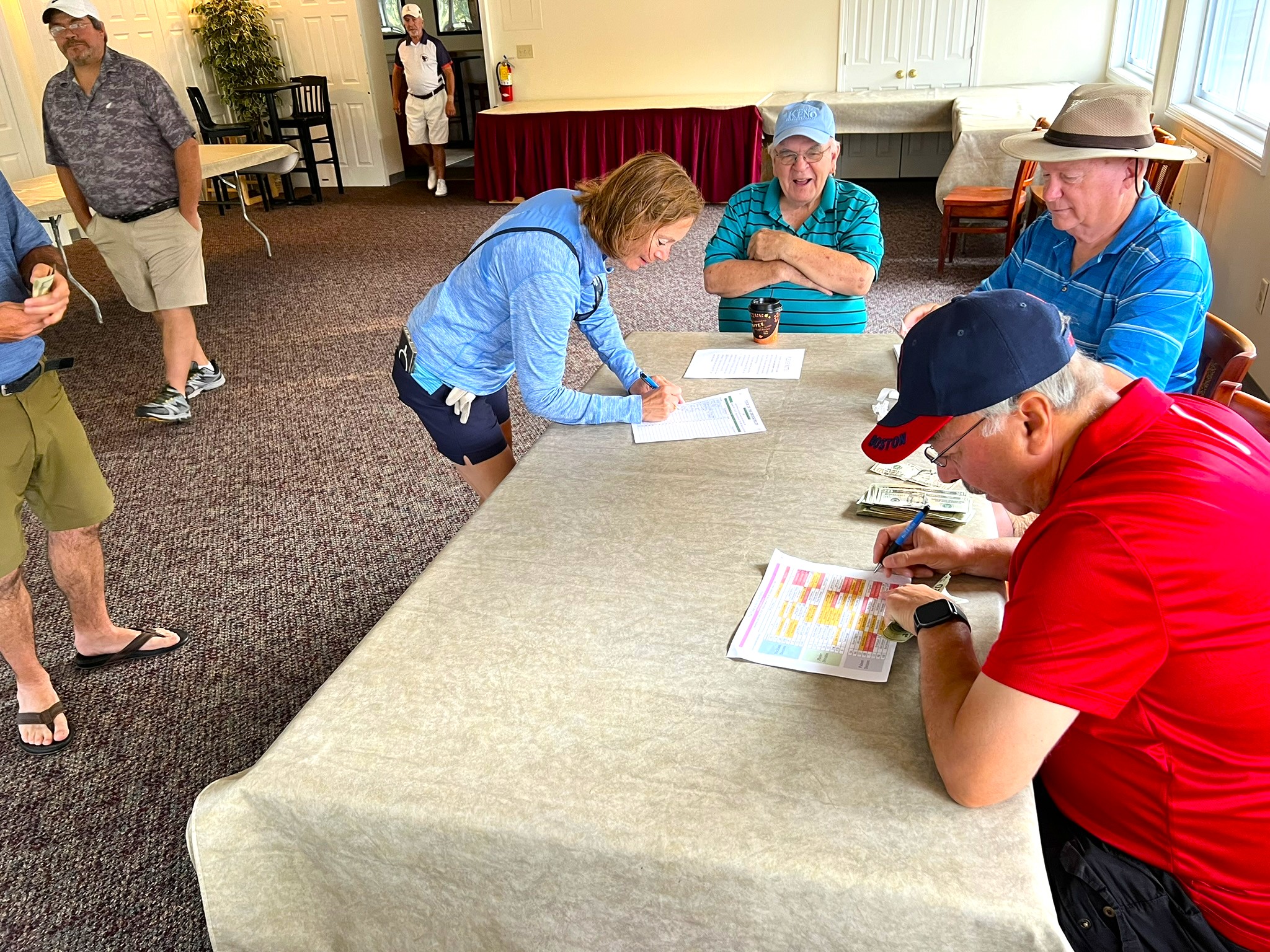
The registration desk is rocking!
Mark and Lynn Morin
The ever-cheerful Clayton Rice
Ron Jette and Norm Laliberte.
Dave Fiske ready for action
Matt, Tony, and Clayton with Tara at the bar pre-round

Any comments? Add them here in the comments section or on the Facebook page! Until next event!

A Special note to my Wargame/Miniature blog followers…

Wargame “Stuff” is coming to this blog soon- I can hear it on the road…or at least I can smell the smoke…

Operation Torch: Planning My WWII Gaming Experience for HISTORICON

It’s been a while for the return of several blog-related things here.

First, this marks the first hobby post I have done in a while. The last one I did was on Professor Nitpik’s Mechanical Mini Swarm back in April. I also never got around to a recap of my games at HUZZAH in May (but I hope to at some point as I do have a good number of photos).

Secondly, I have not done any WWII-related hobby work since March of 2020 (wow 5 years!). After my last What a Tanker tank project, I did a lot with my Feudal Patrol Mesoamerican project (Aztecs, Conquistadors, Maya), and then Wars of Ozz. Luckily for me (and maybe you), I catalog and link all my posts by genre on multiple pages for easy recall. As an aside, for new readers, here are the links for all of these:

There are others as well, and these pages help me to remember how I did certain aspects of projects in terms of painting and assembly (and anything else).

Additionally, as many of you know, the US Army is celebrating its 250th Anniversary. The Historical Miniatures Gaming Society (HMGS) is celebrating that anniversary as its theme for this year’s HISTORICON gaming convention. As a proud US Army veteran, I just HAD to get a game or two together for it. As game submission was back in March, that might seem like plenty of time to get such an endeavor together. But I had HAVOC, HUZZAH, a Florida trip, my reelection, and golf in between then and now! Blogging took a back seat to actually finishing off any projects. Until now!

I usually try to create scenarios and run games that are not common or run-of-the-mill. For the US Army, there is a wide swath of stuff to choose from.

I ended up deciding on looking into the early days of WWII. I dug into Operation Torch, the Allied invasion of North Africa. I further read up on the combat in Morocco, where the US and Vichy France actually fought for several days before agreeing to an armistice and coming over to the Allies’ side. I chose to focus on the Western Task Force under then-MG George S. Patton, that invaded Morocco in three places. My specific focus would be on Sub-Task Force Goalpost, which was led by MG Lucien Truscott, Jr. – and what really intrigued me, as I did my research, was his response to a Vichy armored counterattack. Apparently the Vichy French launched an armored counterattack with what they had to interdict one of the US landing beaches. Truscott sent all his armor (7 M5 Stuart tanks) and some support to stop the threat, which outnumbered him by more than 2:1. Now I had a game concept!

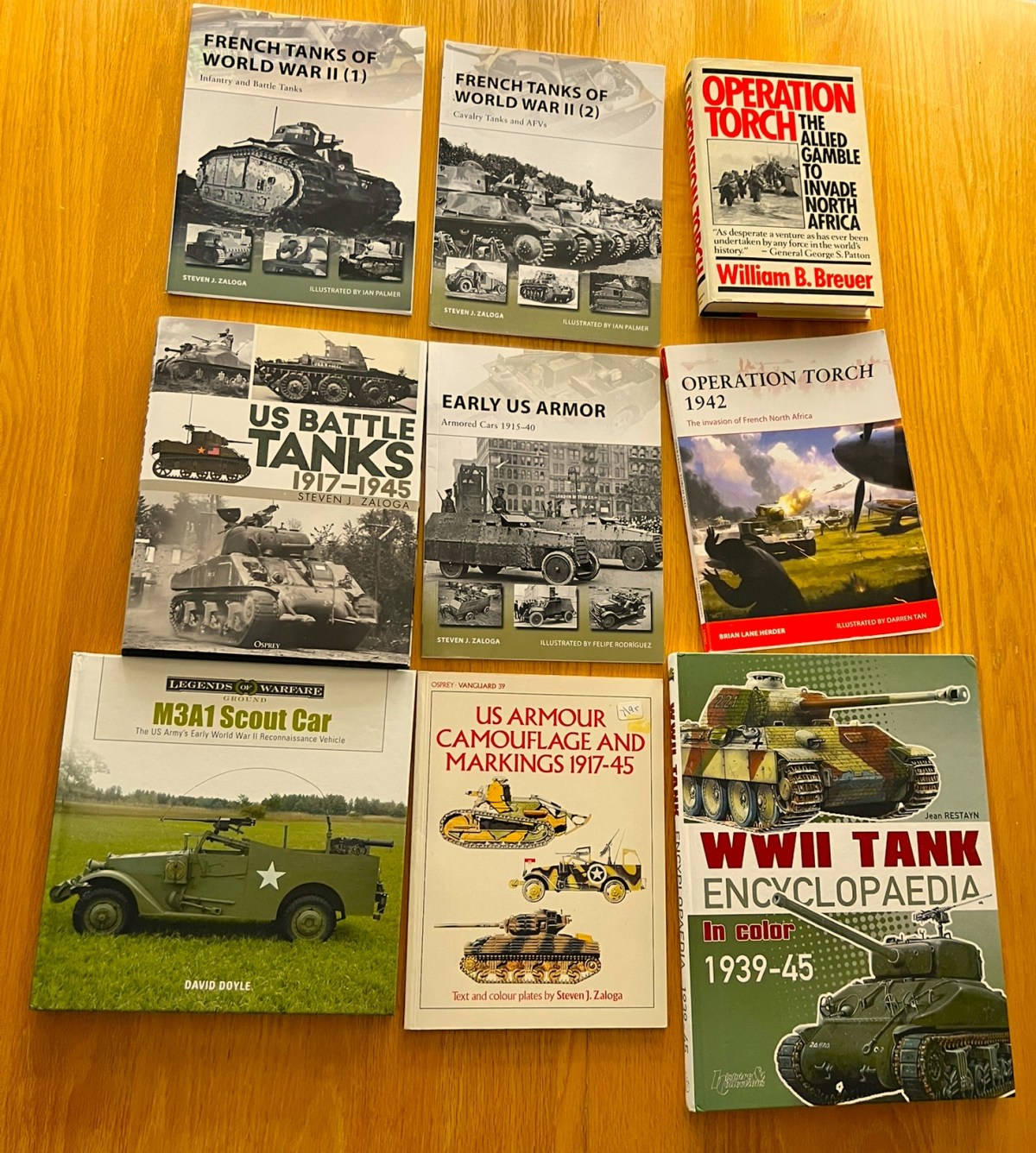
As for research, here are all the books I read and used:

Certainly a lot of Steven Zaloga here, and the Breuer and Osprey books were the most helpful. There indeed was significant armored Vichy forces in the North African colonies. In Morocco was a motley assortment of tanks (WWI -era FT-17’s, Hotchkiss H35’s and H39’s, plus some R35’s that had been hidden from the German and Italian Armistice Commission). Sources vary as to what was available, but certainly these types were in Morocco in November 1942. There also were multiple old armored cars dating back to the 1920’s and early 1930’s. Vichy also had naval assets there, plus any of their air force that had flown there to escape Armistice terms. A good number of Dewoitine D.520 fighter planes and others made up a strong air component for Vichy.

The US here did not have M3 Lee’s or M4 Sherman tanks available to stop he counterattack. Those were on large ships that needed a port to unload, unlike the M5 Stuarts. The US had the Stuarts, M3 GMC’s, M3A1 Scout Cars, and the weird stopgap M6 Fargo. On the other side, the US had F4F Wildcats and Avenger TBF’s. Offshore were these significant naval assets that I would also add to the game design. Interestingly, many French tanks were hit with impact-fused depth charges from the air – plus naval gunfire from the USS Savannah.

The US Army in November 1942 was seeing its first real amphibious landing and combat in the ETO, so I incorporated that with regards to their shooting abilities. The Stuarts had gotten their radios wet, and hence inoperable, in the landing – so that was another aspect I added. The French had a lot of very worn out vehicles, and I did add an aspect of mechanical unreliability to them as well.

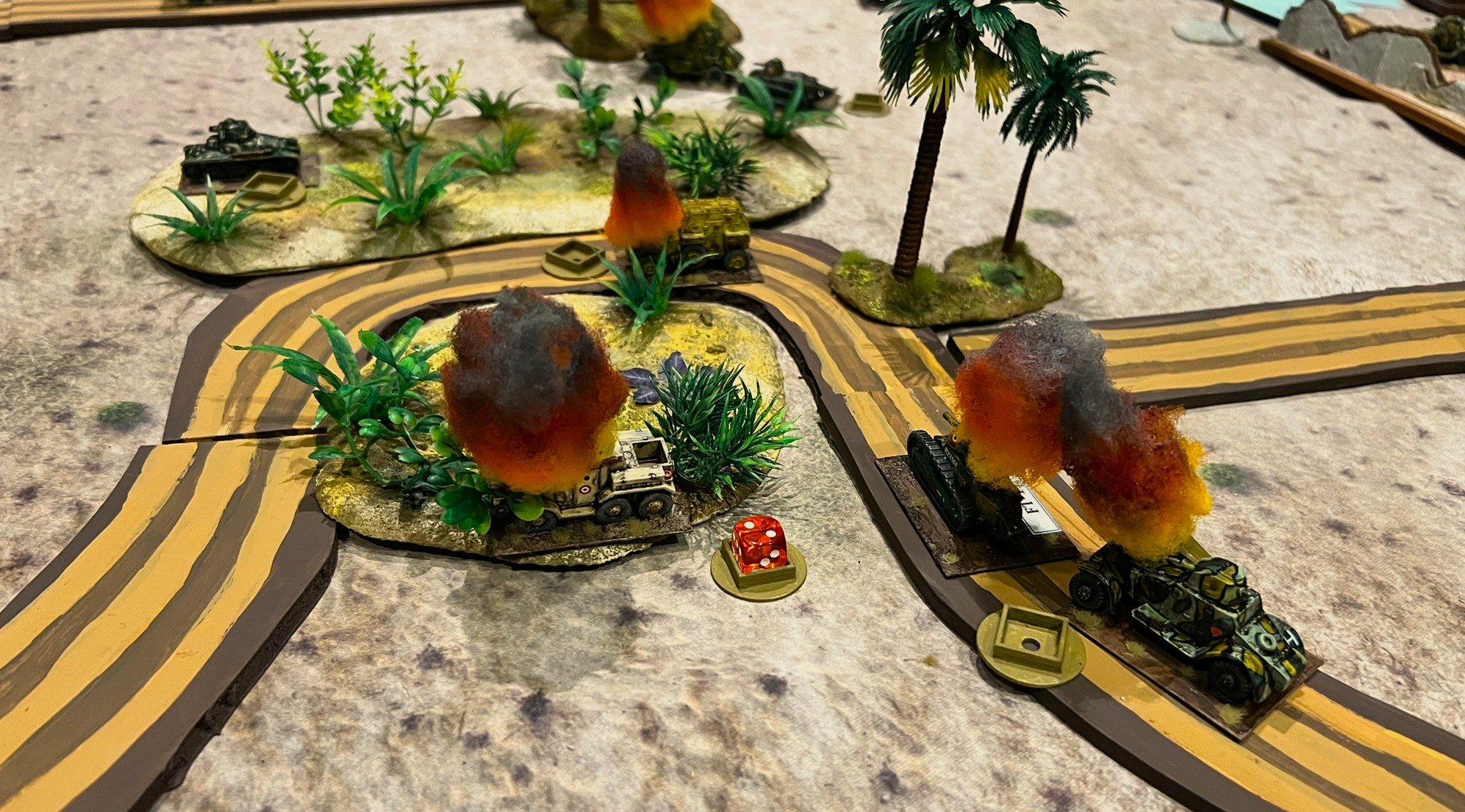
With these equipments as my baseline, I resurrected my WaT rules. Sourcing all of the vehicles took time, and I will chronicle each of the types in successive posts. My thought is that its better to focus on each vehicle type with a short post than a massive one now that blurred the lines. Writing all of these will take some time, and I also hope to share a review of my HISTORICON 2025 experience. If you are at the convention, I will be in the H.A.W.K.’s room as below. While my games are “sold out”, you never know if space becomes available! Besides my two Ozz games on Thursday and Friday, I’ll be running the “Operation Torch: Vichy mounts a Counterattack” game twice on Saturday. Come by!

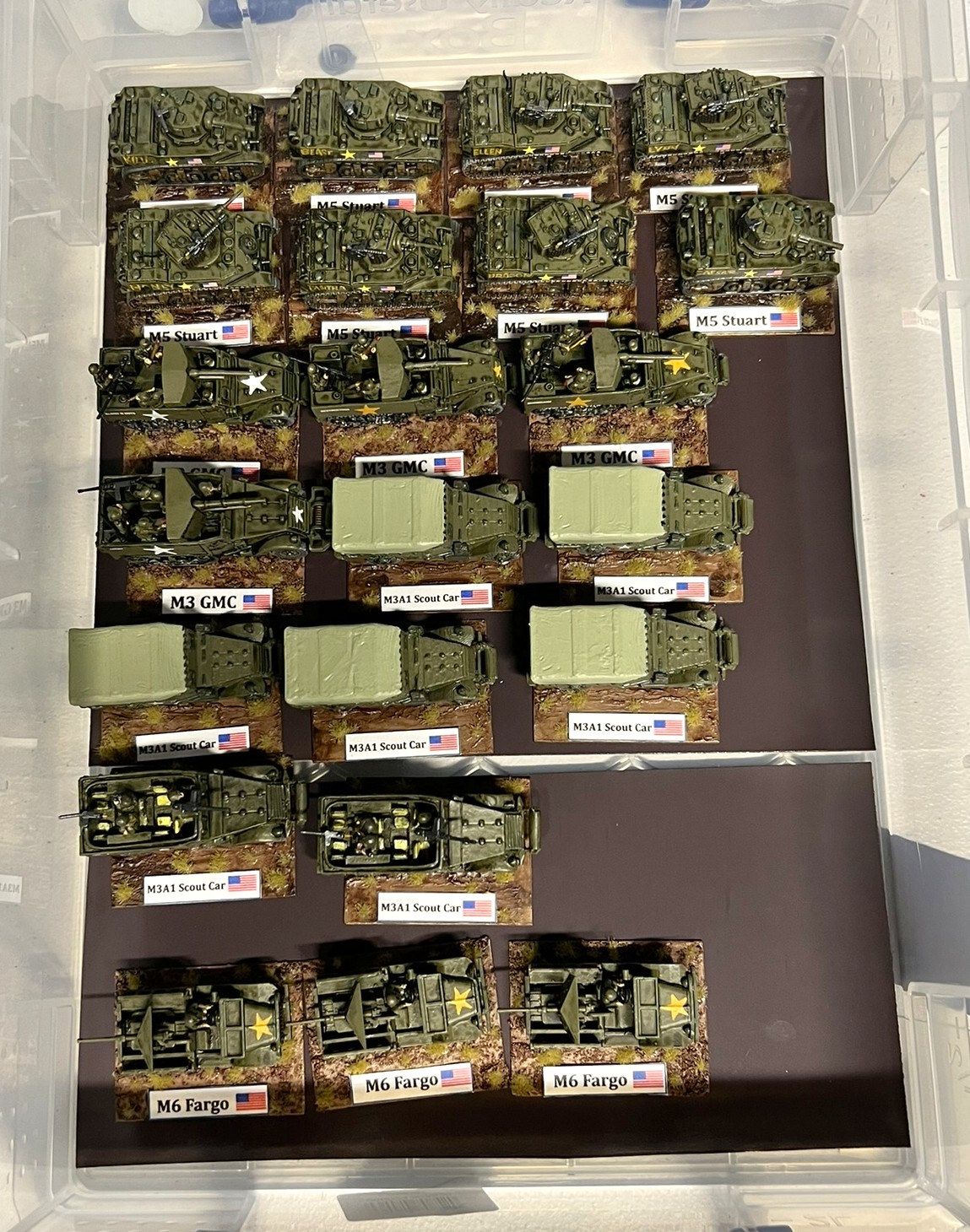
Here is a tease on the 31 French and 22 American vehicles that I have amassed and painted for the game since March. All are 15 mm/1:100 scale. They will get their own posts in the next few weeks (I hope).

Vichy French Vehicles
US Vehicles for the game

I do want to join in a couple of painting challenges – like Fort Syllabub’s “Jagpanther Juni”, and Dave’s annual “Season of Scenery” at Wargames Terrain Workshop. With HISTORICON looming, my hope is to get these individual posts out as I can. It is golf season…

Plus I have MANY of my fellow blogger’s posts to catch up on – I have been reading them and there is some great work out there!

I hope I’ve piqued your interests! Let me know!

My WWII posts master list is again here for your enjoyment.

Until next post!

Despatches from Fort Syllabub

An account of fictional adventures on the North West Frontier - and other times and places, real or imagined

Man of Tin blog

Toy soldiers, gaming, Imagi-Nations

Zauberwurfs Blog

Ein Blog über Tabletop und Miniature Wargames.

Frank Tank Rants

musings of a fat old bloke on tanks and wargames

Dragons of Lancasm

Games, miniatures, painting, books and more games

Tiny Painted Heroes

The Adventures of a lifelong Tabletop Gamer, Game Design hobbyist, and full-time Software Engineer

Steve's Paint Brush

Grimdark model making and mini painting

Wargamesculptors Blog

Life, Golf, Miniatures, & Other Distractions

Dead Dick's Tavern and Temporary Lodging

Life, Golf, Miniatures, & Other Distractions

Guru Pig - the gaming Guru

Guru's thoughts on wargaming, life, and the universe!

Wisely lead... without a head!

History, Miniatures and Wargaming

Kuribo's Painting

Fallout Wasteland Warfare, Warhammer, and Hellboy Painting, Terrain, Dioramas, and Battle Reports

Don't Give Greg Ideas

Seriously, just don't

War Across the Ages, and other dark horrors

A discussion of miniatures collecting, painting and gaming.

Classic Warhammer 40K

Painting diary focused on Warhammer 40K 2nd ed., 5th ed. WHFB, related GW games, and miscellaneous whimsy

Colonel Mustard

WW2 Modelling in 1/72 Scale

Bogenwald

Random painting and terrain making.

Pat's 1:72 Military Diorama's

Scale diorama tips and ideas

Arcade Dreams

Building the Arcade Dream

P.B.Eye-Candy

Phil's 20th century wargame pages

SP's Projects Blog

A futile fight against entropy or 'Every man should have a hobby'? Either way it is a blog on tabletop wargames, board games and megagames

30mmdave

Wargaming Plausible reality?

The Imperfect Modeller

Miniature Figure Painting and Diorama Modelling

Double Down Dice

Painting miniatures and rolling dice!

Just Needs Varnish!

My ongoing wargames projects!

miniaturepopcorns

Sculpting some worlds

Despertaferres

Wargaming with the ability of a dull nine year old

Dawn of the Lead

Miniature wargaming and the occasional zombie

Rantings from under the Wargames table

Wargames, Figures, Sculpting and Converting Miniatures

Simple as War

Miniatures & Terrains

Buck's Blog

Life, Golf, Miniatures, & Other Distractions

IRO aka Imperial Rebel Ork

- I model - therefore I am -

Azazel's Bitz Box.

Painting, Modelling, Miniatures, 1:6, Games... Whatever else I find interesting.

diggingforvictoryblog

Smallholding and Wargaming.......not always at the same time!

Shamutantis

Nørdblog numero uno