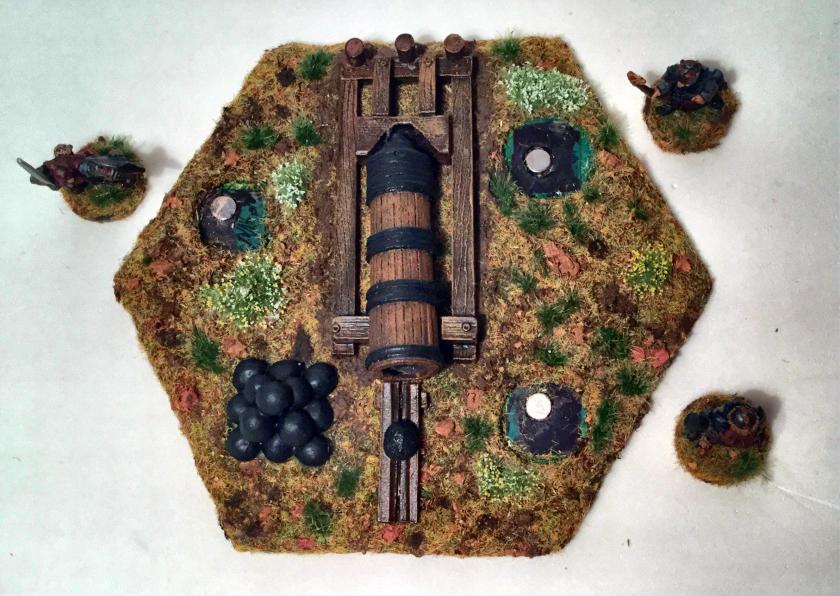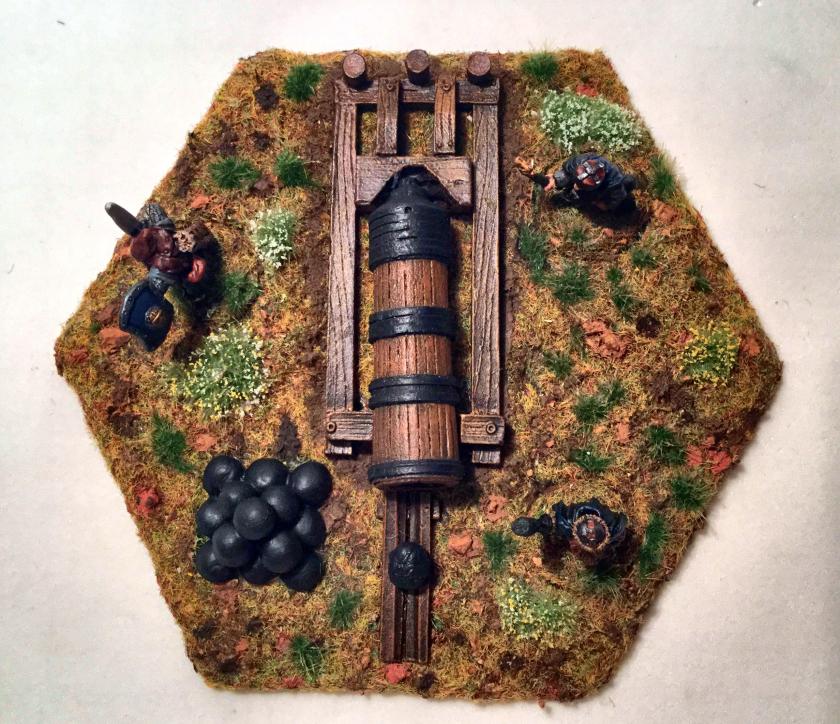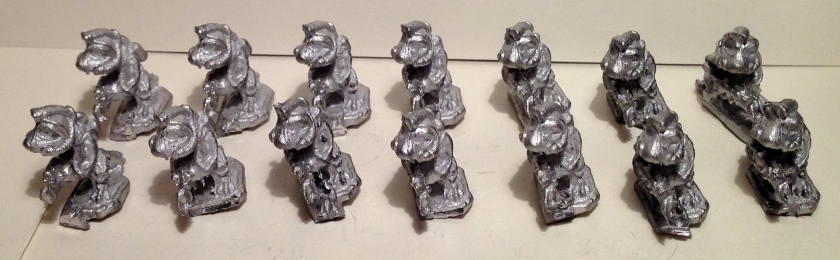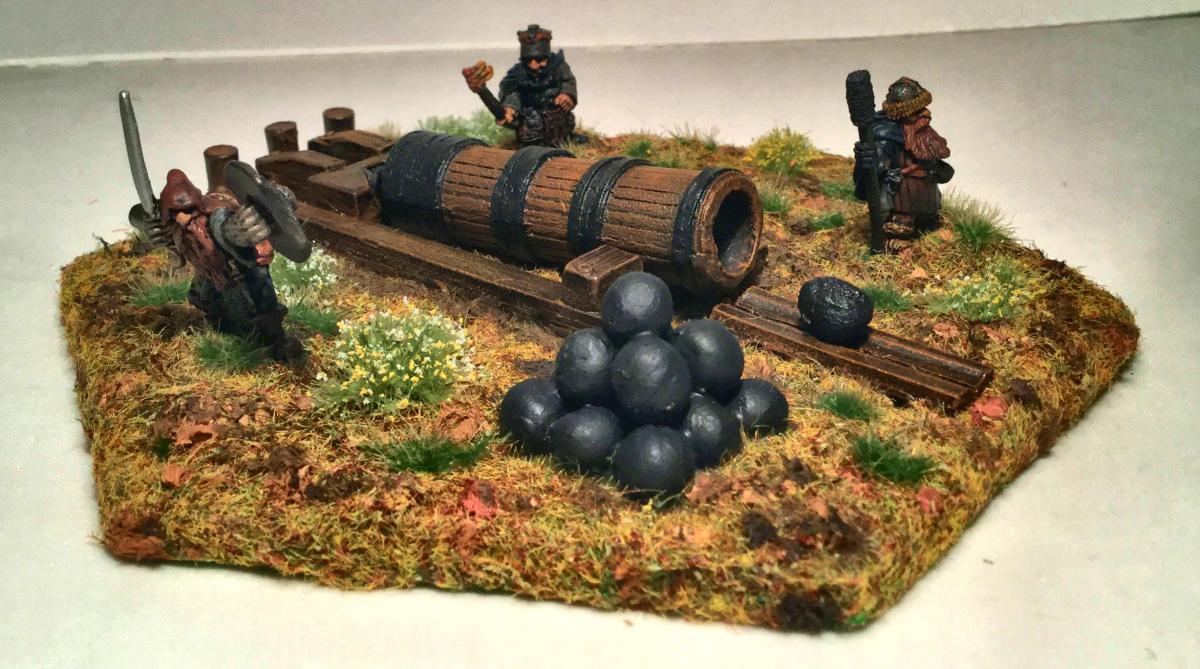
Large Bombard, RAFM SE-29 or RAF00929, with a crew of Dwarves

I have been putting together crew-served weapons for my fantasy miniature tabletop war games.  I have been looking out for primitive cannon, bombards, catapults, ballistae, onagers, and the like.  There seemed to be many good kits from the 1980’s that would work, but the challenge was in finding them  – and completing them satisfactorily.  This project turned out to be more complex than I originally thought – and in the end was a great learning experience and very satisfying.

My thoughts were also that my Dwarven forces did not have any troops with ranged weapons – and that primitive cannon or bombards would be a good addition.  That would also make sense with Dwarves being ostensible masters of forging iron.  I know that Ral Partha has a Dwarf Steam Cannon (which I now have because of the first Iron Wind Metals 2015 kickstarter), but I was hoping to get something sooner.  Another eBay find was just the ticket – a “Large Bombard” (SE-29 in the 1986 RAFM catalogue on page 44, later changed to RAF00929).

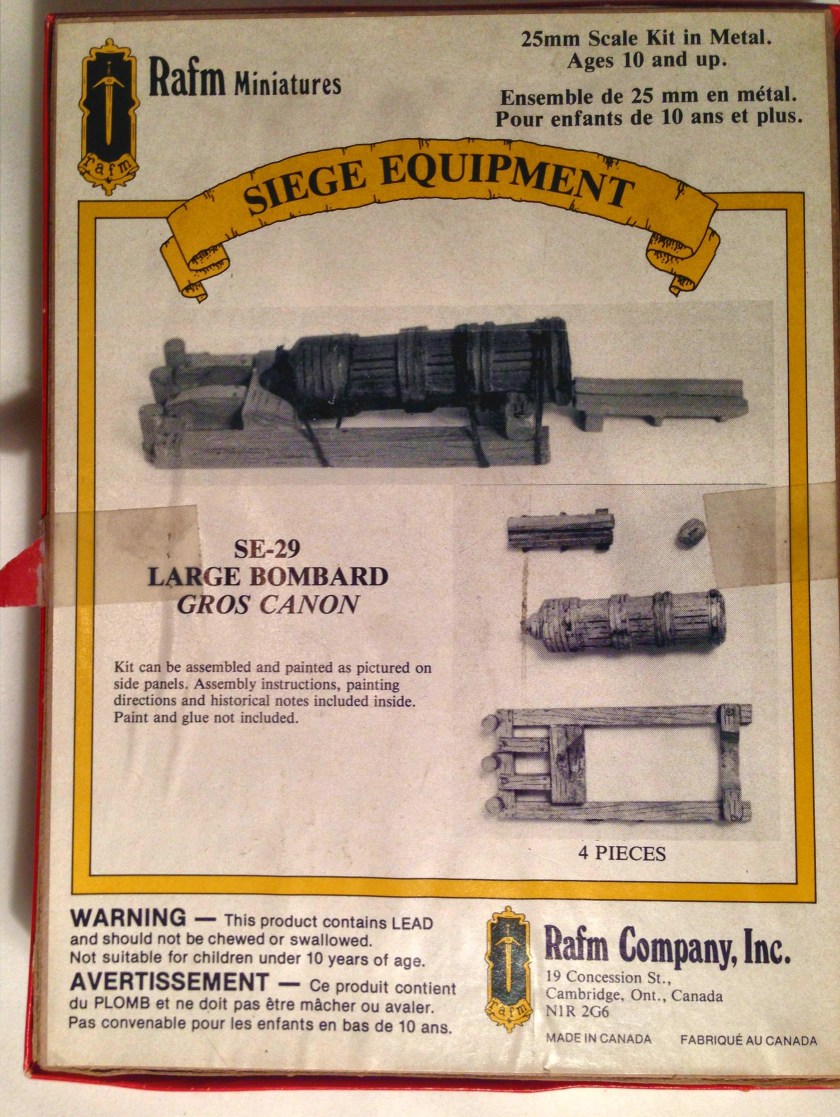
This was part of the “Siege Equipment” line from RAFM.  Apparently RAFM was unwilling to expend resources to print a picture of the bombard on the cover of the box.  The company settled for a picture on the bottom and the side and a label over a trebuchet picture on the front cover for all of the line.  I can’t help but think that this was not great marketing on RAFM’s part.

1 RAFM SE-29 Large Bombard Box, Front
Box cover top – Is it a trebuchet, no wait, RAFM put a label on the box!
1a RAFM SE-29 Large Bombard Box, Back
Box cover bottom – I added this picture to Lost Mini’s Wiki
2 RAFM SE-29 Large Bombard Box, Side
Side of Box

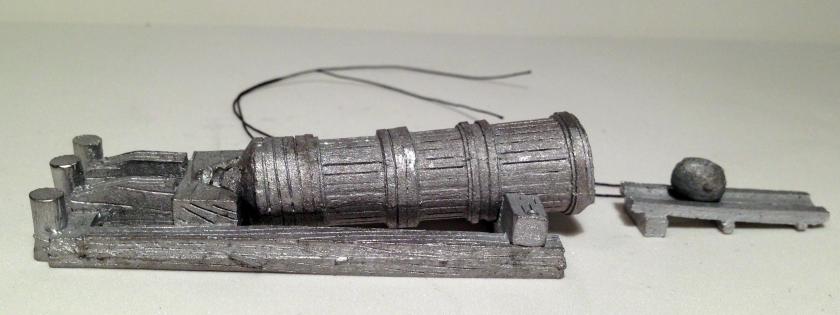
All of the pieces shown were included – and I used them all except for the string (I thought it did not add any value visually to the model).  I know that bombards were roped down in history – but this was my call!
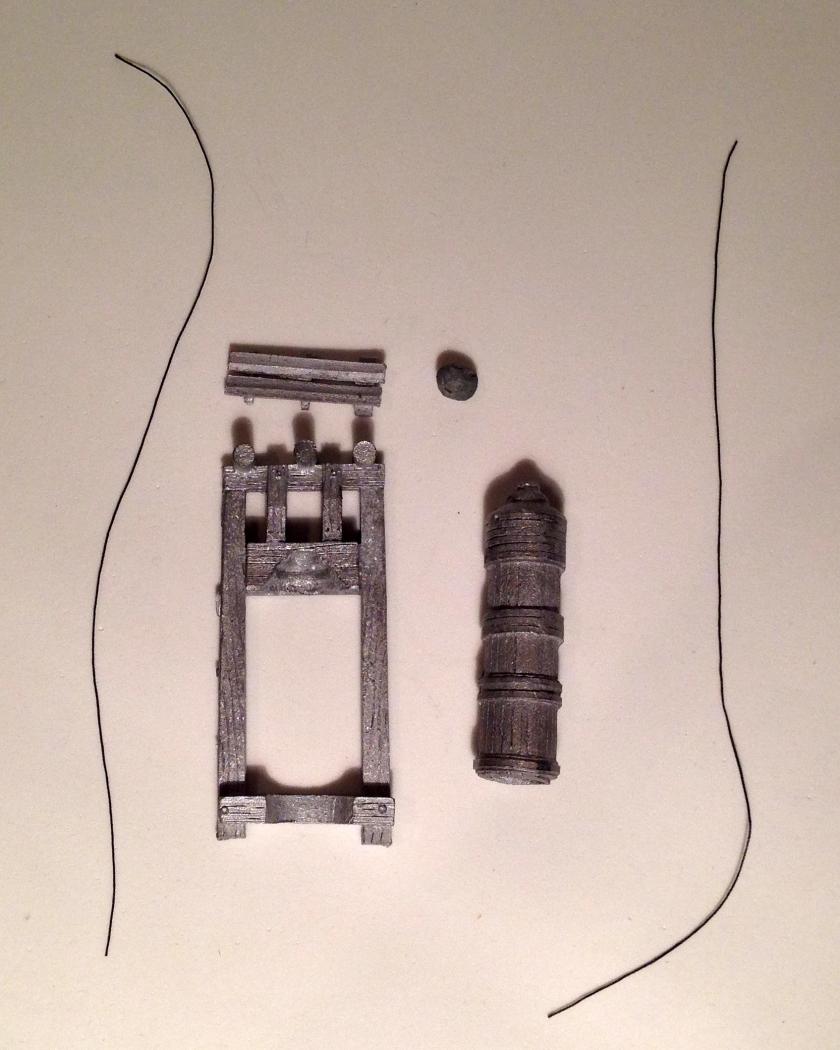
4 RAFM SE-29 Large Bombard contents
The original kit was complete as shown
5 RAFM SE-29 Large Bombard contents side view
Side view before any work on the kit

I obviously needed a crew.  Luckily, I acquired a pair of Dwarves from a Ral Partha blister that had been opened and was incomplete.  It was from the late 1980’s or early 1990’s – “Dwarf-Bombard” by B. Ollie (02-161).  As I had an 02-161 that was complete, I was familiar with the two figures left – one was a had a ram for the bombard, and one held a torch for igniting the weapon’s fuse.  From my hoard of lead, I added a Dwarf with a sword as a leader to round out the crew.  This figure was a Grenadier figure, but I have been unable to determine anything else about the figure that I designated as the leader.

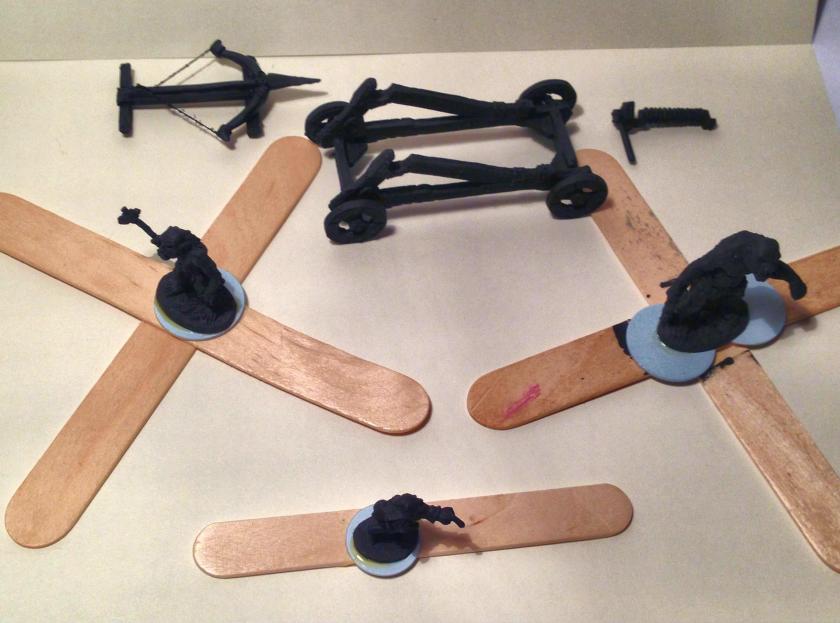
I primed the crew and the bombard in the winter depths in February at Jeff Smith’s workshop with Krylon Ultra-flat Black spray paint.  Then I mounted them on ¾” washers with wood glue, which was subsequently glued to popsicle sticks

5a RAFM SE-29 Large Bombard and crew primed
The crew and bombard primed (the gun carriage is upside down for some reason)

I started by working on the bombard.  The kit came with one cannonball, and I used some Milliput to make a stack of them with the help of wood glue and some toothpicks for a frame.  This took two iterations of gluing as shown below.  Once done, I also primed these with Krylon Ultra-flat Black spray paint.  I then painted them with Secret Weapons Washes “Heavy Body Black” ink.  I also cut a base for the kit with my scroll saw – a 5½” hex base with 30° beveled sides from 1/8″ luan plywood.  I glued ¾” steel washers to the base for easier storage on magnetic sheets that I have glued to my “Really Useful” plastic boxes.  I used some old German Deka-Lack “Grun” from when I was stationed in West Germany (yes, paint from 1987) to prime the base.  This finished off this vial after 29 years!

7 home made cannon balls
Cannonball stack – step 1
8 home made cannon balls (STACK)
Cannonball stack, step 2

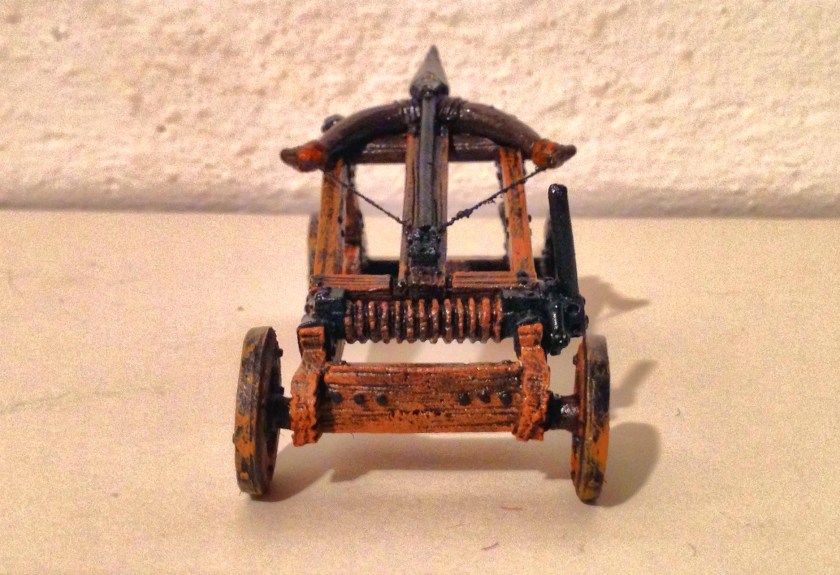
Then I proceeded to paint the bombard.  I base-coated the weapon and its component carriage and loading ramp with Citadel “Dryad Bark”.  This I followed with a successive series of four washes with Secret Weapons Washes “Heavy Body Black” and “Sewer Water”, and tow applications P3 “Brown Ink”.   Then I dry-brushed the wooden parts twice – first with Citadel “Skrag Brown” and then with Citadel “Balor Brown”.  I then added another wash, this time with Citadel “Agrax Earthshade”.  I painted the metal sections of the gun and the cannonballs with Americana “Ebony”.  To finish the weapon with varnish, three coats were applied successively and over two days – Krylon “Clear Glossy”, Krylon “Clear Matte”, and Testors “Dull Coat”.
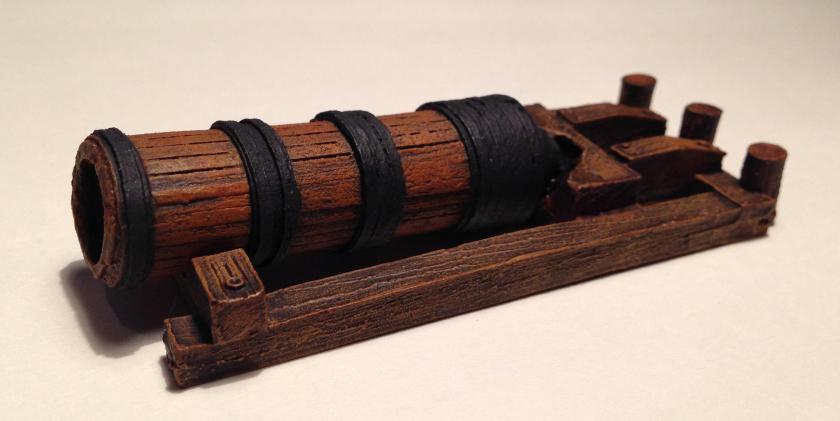
6 RAFM SE-29 Large Bombard PAINTED BEFORE VARNISH
The Large Bombard painted and varnished

The crew now needed to be worked on – and I had three different ones to paint.  I will cover each in turn.  The Dwarf with the Ram (“A”), the leader Dwarf (“B”), and the torch-bearing Dwarf (“C”).  All three got their visible skin painted with P3 “Midland Flesh”.  I like this color on Dwarven skin.  Any visible eyes were painted with Americana’s “Snow” and “Ebony”.

For “A”, I used Citadel “Balor Brown” on his breeches and Armory “Chestnut” on his leather armor.  His beard was painted with Polly-S “Venetian Dull Red”.  I covered his cape with Armory “Prussian Blue”, and his leggings with a mix of Craftsmart “Khaki” and Citadel “Balor Brown”.  Armory “Red”  was my choice for the trim on the cape.  For the ram shaft, I again used Citadel “Dryad Bark”, with Americana “Ebony” on the ram head.  The cape I highlighted with a mix of Armory “Prussian Blue” and Americana “Sky Blue”.  The pouches were initially painted with Americana “Zinc” and subsequently highlighted by adding Craftsmart “Grey”.  The metals (helmet, belt buckle) were done with Folk Art “Gunmetal Gray”, while the leatherwork was done with Armory “Chestnut”.  A wash of Citadel “Agrax Earthshade” was applied, followed by more highlighting, and another repetitive wash.

“B” was started with Americana “Zinc” on his tunic.  Armory “Chestnut” was used for his hat/hood, and his boots.  Similar to “A”, I painted his beard with Polly-S “Venetian Dull Red”.  His breeches were painted with Armory “Prussian Blue”, as was his shield and breeches.  I painted his bow and the back of his shield with Citadel “Dryad Bark”, while Americana “Snow” and Citadel “Balor Brown” were my choices for the arrow fletchings and quiver respectively.   His gauntlets and sword were done with Tamiya “Metallic Gray and highlighted with Tamiya “Flat Aluminum”.  My choice for his mail coat was Folk Art “Gunmetal Gray”.  I then highlighted all areas with lighter versions of the base coats similar to that described for “A”.  “B” then got a wash with Citadel “Agrax Earthshade”, followed by some minor highlights again, to include  Martha Stewart Crafts “Brushed Bronze” on the sword pommel and the shield boss.  I ended with Tamiya “Flat Aluminum” on the blade.

“C” followed a similar pattern as “A” and “B”.  His tunic was painted with Americana “Zinc” and his cape and boots were completed similar to “A”.   I chose Citadel “Dryad Bark” for the shaft of the torch.  For the flame, I painted it with a successive mix of Armory “Red”, Tamiya “Orange”, and Craftsmart “Yellow”.  Highlighting followed as before, and a wash of Citadel “Agrax Earthshade”.

I then painted all three crew bases and the hex base with Polly-S “Basilisk Dark Green” from 1984, retiring this paint after 32 years.  I took the hex base, and applied an initial flocking with Ziterdes “Alpine Meadows” and removing half of the cork “boulders”.  After a day, I then used my Dremel to score places for the different weapon components and the crew bases.  I put in Aleene’s magnetic sheets in the 3 wells for the crew, as well as subsequently drilling ¼” holes for neodymium magnets.  I used wood glue to secure the bombard, the cannonballs, and the loading ramp to their respective scored areas.  Lastly I put in the neodymium magnets – securing them with wood glue and steel washes on the bottom of the base.

A note here – in the future, I would only use the neodymium magnets – the magnetic sheets are superfluous and can cause reversal of magnetic flux forces which complicates figure placement (though I got mine fixed).

I next flocked the bases (crew and bombard) again so as to try to hide the wells with the Ziterdes “Alpine Meadows”.  I also used Army Painter “Meadow Flowers”, and “Wilderness Tuft” with wood glue.  I also added more cork rocks (the Ziterdes product is loaded with way too many so I had a lot left over) , and alternated painting them with Americana “Ebony”, Armory “Chestnut” and Citadel “Balor Brown”.  I gave the bases a light coat of a white glue and water slurry so as to secure all the flocking. I think that I achieved a nice effect on the base in terms of a natural look.

Once everything had dried, I gave the three coat varnish to the crew as I had to the bombard as before.  Each coat was allowed to dry fully.  The whole kit then got a light coat of Testors Dull coat.  The series of photos below show the production process.

I am very happy with the kit, though I wish it had taken less time!  Still, I think that this will be a valuable piece in many future games.

9 Dwarf crew for RAFM SE-29 Large Bombard before wash front
Front of “A”, “B”, and “C” from left to right after base coat painting but before washes and highlights
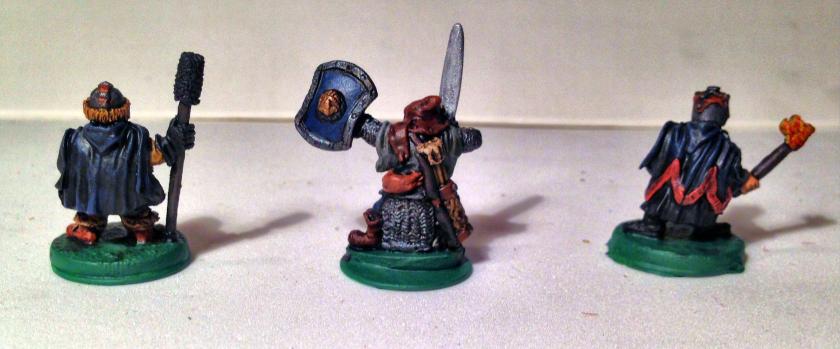
10 Dwarf crew for RAFM SE-29 Large Bombard before wash back
Back of “C”, “B”, and “A” from left to right after painting but before washes and highlights
14 Dwarf crew for RAFM SE-29 Large Bombard after varnish front
Front of “A”, B”, and “C” from left to right after washes and highlighting
15 Dwarf crew for RAFM SE-29 Large Bombard after varnish back
Back of “A”, “B”, and “C” from left to right after washes and highlighting
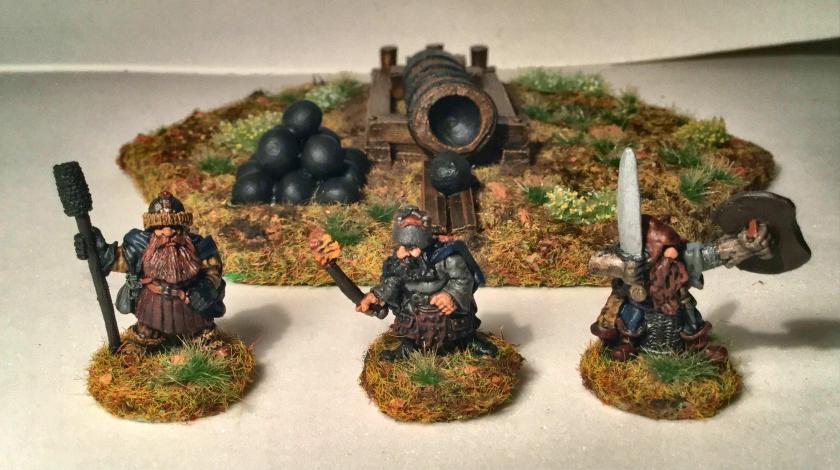
19 Dwarf crew for RAFM SE-29 Large Bombard after basing crew in front
The Dwarven crew in front of their bombard – complete!
20 Dwarf crew for RAFM SE-29 Large Bombard after basing top view crew removed
Top view of the Dwarven Large Bombard showing crew wells
18 Dwarf crew for RAFM SE-29 Large Bombard after basing top view with crew intact
Top view of the Dwarven Large Bombard with Crew
16 Dwarf crew for RAFM SE-29 Large Bombard after basing front view
Completed front view of the Dwarven Large Bombard
17 Dwarf crew for RAFM SE-29 Large Bombard after basing side view
Nice angle view of the completed Dwarven Large Bombard

More Ducks – this time Warrior Ducks or “Gurads”

The last casting project I had in June involved a Ral Partha figure from a collection known as “Non-Human Adventurers” (Ral Partha 18-014).  This was part of a Runequest collection. See this link from Lost Minis Wiki: http://www.miniatures-workshop.com/lostminiswiki/index.php?title=Image:RP-18-014z.jpg

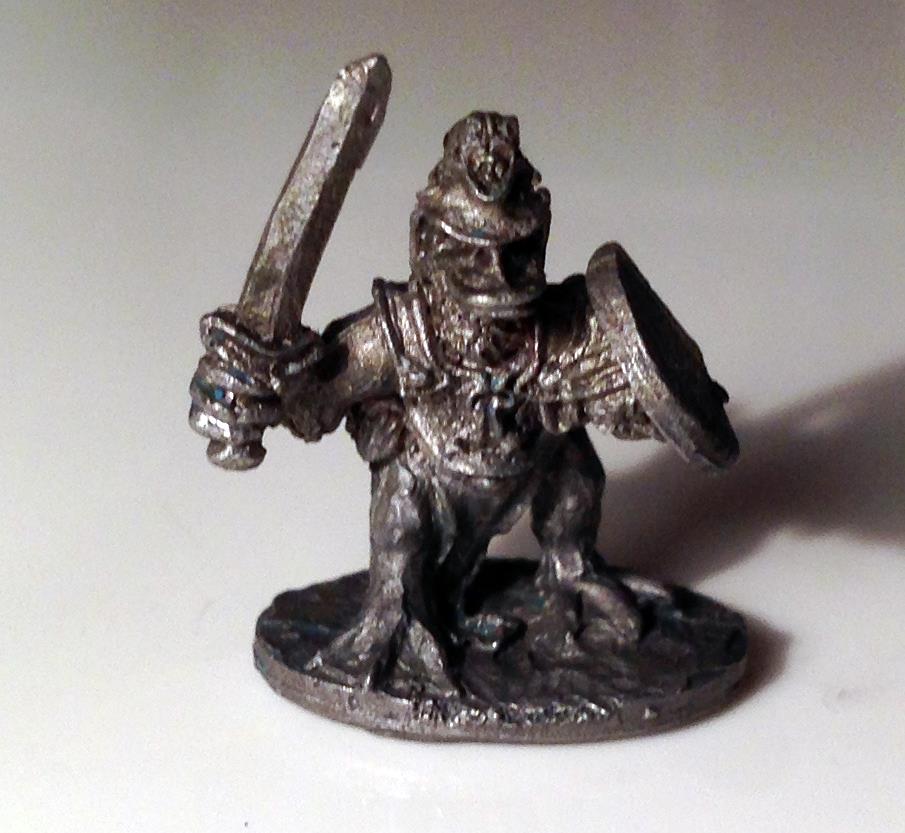
Buck Surdu sent me this as a challenge.  It was a Warrior Duck armed with a sword.  This figure was the smallest I had yet to try to mold and cast.  Buck, back when we were at West Point, misspelled “Guards” as “Gurads” in one of his Tunnels and Trolls games he ran.  I seem to remember you had to make a saving roll when you saw them or you laughed uncontrollably while they mercilessly gutted you.  For nostalgia’s sake alone, I looked forward to making a couple of “Gurad” units

1 Warrior Duck master front
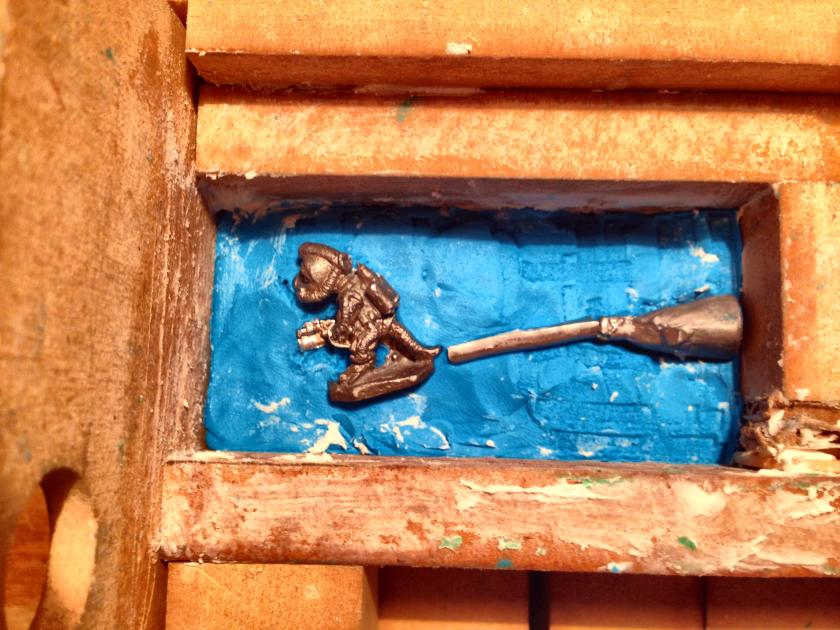
The master original figure (with blue clay still between his fingers) – less the base I added

My previous experiences told me that the base was too thin and friable for a mold for gravity casting.  Therefore, I used one of my bases that I made from Aves® Apoxie Sculpt to help fill the mold out.  Even so, it was small enough that it moved slightly between the making of the first mold half and the second.  The only down side was that I had to do a little surgery with an Exacto knife on the mold, and that led to the sword having a split at its tip.  Even so, this is easily filled with paint or clay, so its not a big deal.

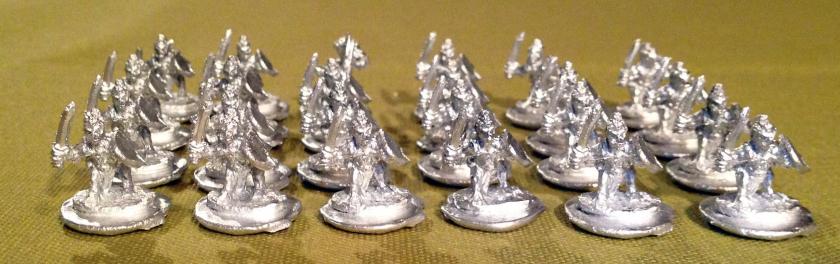
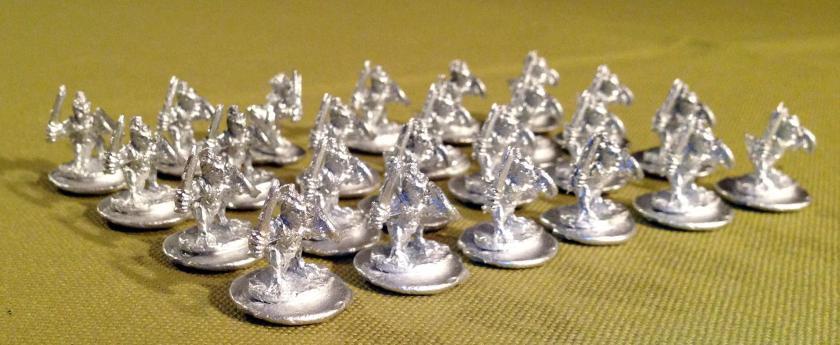
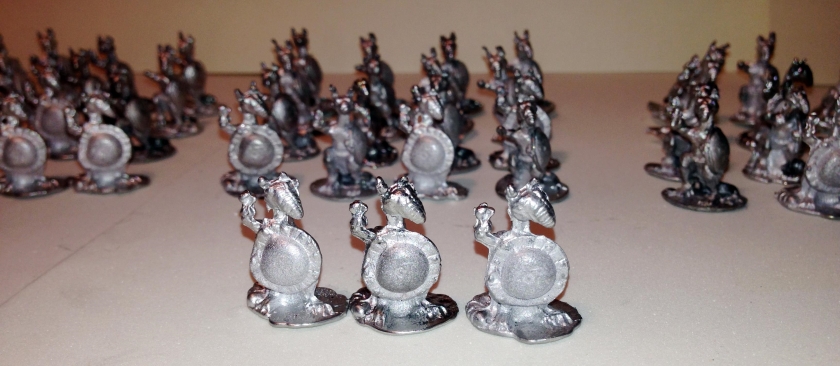
I cast 24 from a mix of 67% tin and 33% lead, at 565° F.  Some of the figures did not initially come out, but after adjustments, the gravity mold worked fine.  I sent Buck half, while retaining the other half for myself.  They are pretty cool and hope to get them on the tabletop soon.

2 Gurad Regiment, front
A Regiment of Gurad Warrior Ducks

3 Gurad Regiment, side

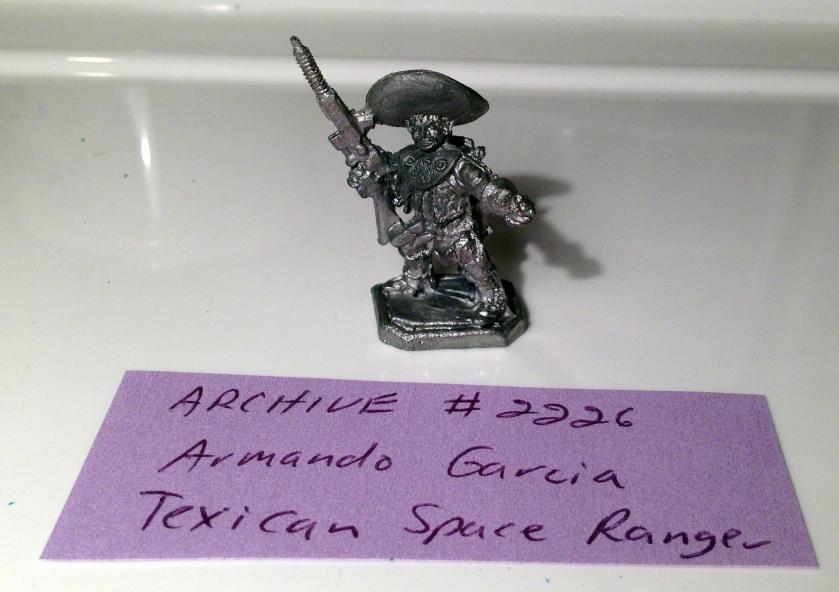
Archive 2206, “Armando Garcia, Texican Space Ranger”

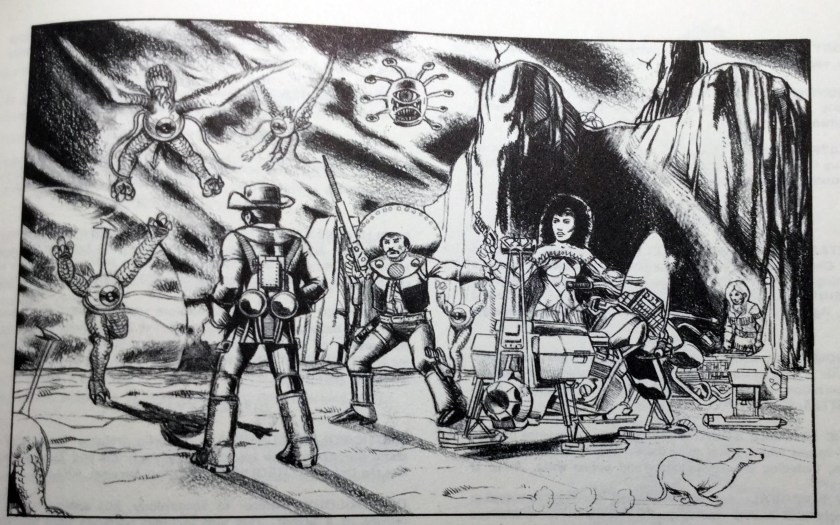
I acquired another group of Archive figures from their long-defunct “Star Rovers” line.  One of them was 2206, “Armando Garcia, Texican Space Ranger”.  Armando had a jet pack and a blaster or laser rifle (and a huge sombrero).  He also had a partner, Travis B. Crokit, another Texican Space Ranger.  On page 5.03 of the Star Rovers Module 1 game rules, there is a nice drawing of both of them and some other characters.

1a Armando Garcia in game
Texican Space Rangers Travis B. Crokit (back turned) and Armando Garcia from the Star Rovers Rules


At the time of the mold making for Armando, I did not yet have Travis, but I do now.  He is quite cool as well, and wears goggles – looking like Doc Brown from Back to the Future!  He will eventually be the subject of one of my molding projects as well.

1 Armando Garcia master front
Original Armando Garcia Figure, front


2 Armando Garcia master back
Original Armando Garcia figure, back.  Note the jet pack!
3 Archive 2225 Travis B. Crokit front standing
Travis B. Crokit, front

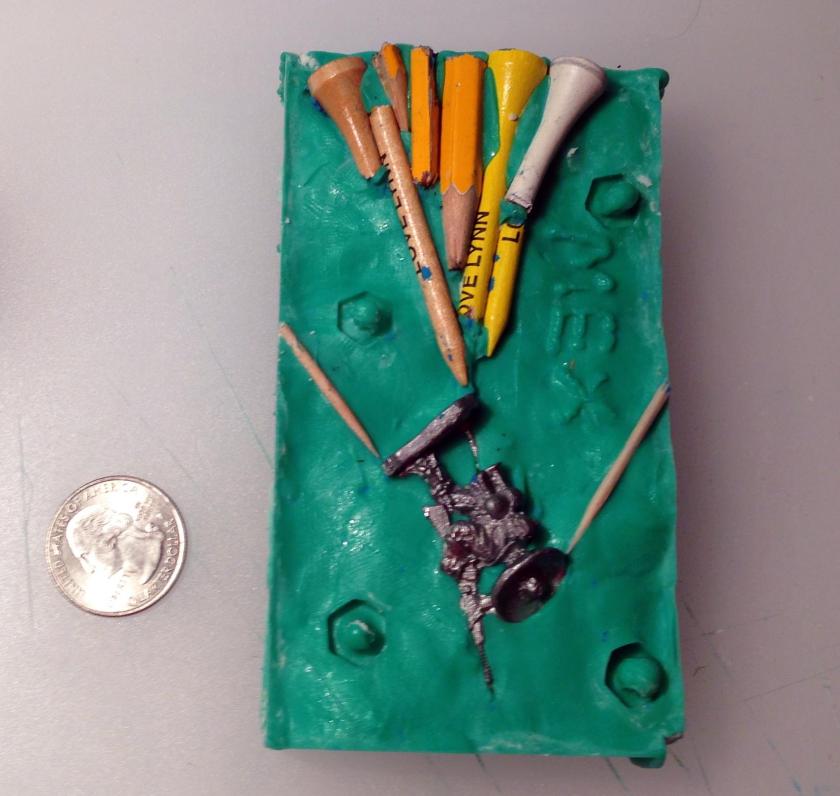
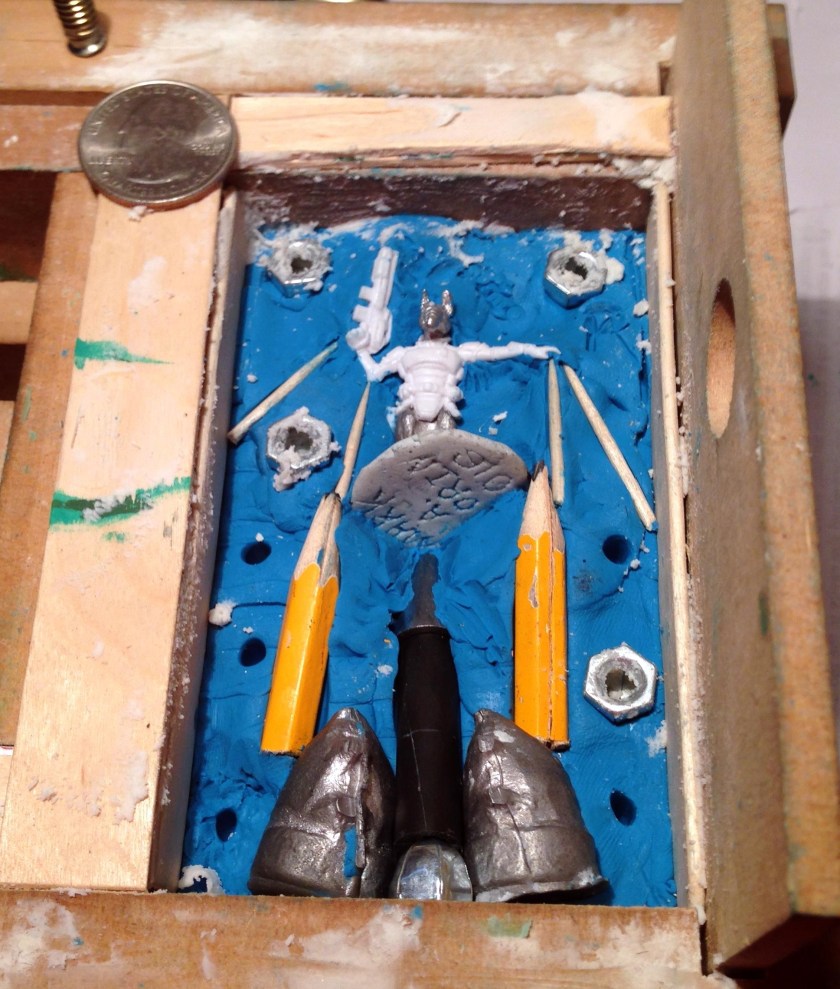
As for Armando, I made a two-piece mold from Castaldo Quick Sil.   I continued to experiment with different configurations for my pouring aperture – this time with pencils and golf tees.  I also tried to see if I could add something to the mold that would help me identify it better as after graphite powder is applied its pretty hard to tell sometimes.  In this case – I added “MEX”.

3 first half Armando Garcia mold
Armando Garcia first mold half

The mold design worked well enough.   I was able to cast without hardly any failures, which made me happy.  I again used 67% tin and 33% lead at 565° F.

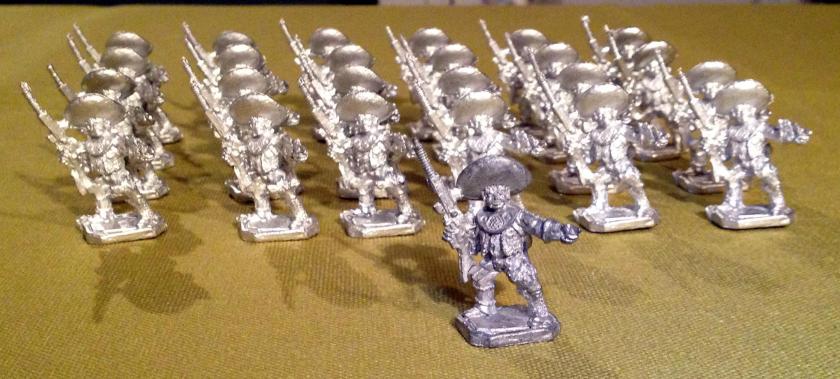
I cast 24, and again sent 12 off to Buck Surdu for his future sci-fi gaming projects.  Once I get Travis done, I may add some other retro-looking sci-fi weapons to the Rangers.  Buck just sent me a nice sprue of some that I will look to mold for that purpose (thanks Buck).  After seeing what he did with the Star Ducks (adding sci-fi weapons), I am intrigued to try this as well.

4 first half Armando Garcia regiment
24 Armando Garcia’s led by the master figure
5 first half Armando Garcia regiment
Side view of the group

Archive 2103 “Macron” Molding & Casting

A couple of figures that I saw on eBay caught my eye.  They were retro-looking astronauts/cosmonauts that had no provenance.  I could not tell that they were probably 54mm from the photo, but I did believe that they would be great for future sci-fi games.  They also looked fun to cast!
After a little research on Lost Mini’s Wiki  – http://www.miniatures-workshop.com/lostminiswiki/index.php?title=Main_Page  I found that these were Archive figures from a board game called Cosmic Encounter.

Originally these were Archive 2103, “Macron and the Mind”.

Archive-cosmic-2103
From http://www.miniatures-workshop.com/lostminiswiki/index.php?title=Image:Archive-cosmic-2103.jpg

I do not have the brain figure, but I did have two Macrons.  I decided to mold them, thinking they could be “Space Giants”.

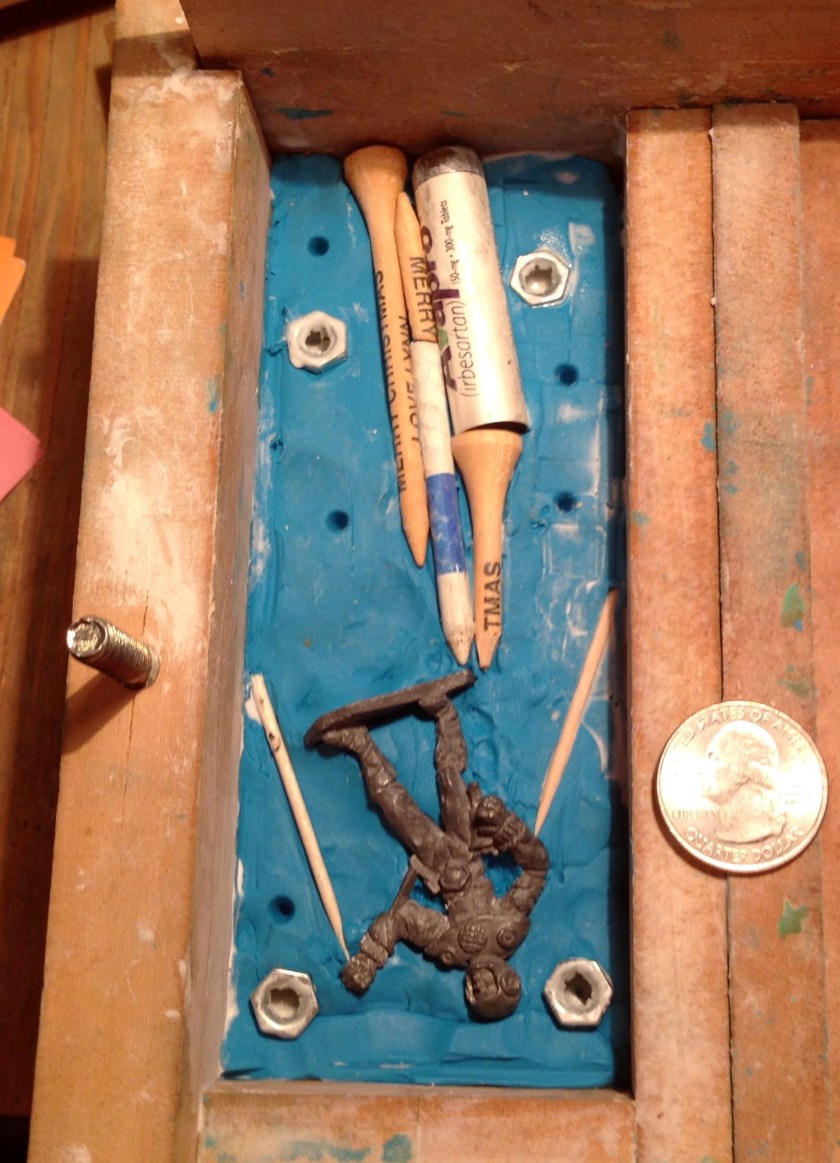
They were both in good shape.  I made a two-piece mold with Quick-Sil from Castaldo with one of the Macrons.  I made this mold rather tall to accommodate a large plug that would give the figures better detail.  I also experimented with using golf tees (that had “Merry Christmas Love Lynn” on them and an old pharma pen top for my mold opening.  I also added toothpicks for venting.

1 first half Macron Mold
Macron mold – first half


The mold desighn worked fine, and I was able to cast 24 satisfactory examples with a mix of 67% tin and 33% lead at 565° F.  The mold did not need much tapping at all which was great.  They did use up a lot of metal though relative to smaller figures, as one would expect.

3 Cast Macrons Mold
24 Macrons


I sent off half to Buck Surdu, and I kept the rest.  I am looking forward to getting them painted soon!

My first figure conversion for casting – “Space Roomans”!

I have been a bit behind on blogging but I hope to catch up over the next few days.  I have been quite busy with work and projects on the weekend (and golf of course!).  I also sent Buck Surdu some of these miniatures, and I did not want his first look to be on my blog.  His trip to Costa Rica meant that I’d need to wait a week while the figures awaited his return and inspection (he is after all an Infantry Officer).

I wanted to wait to do this as he inspired this project.  During an April conversation with Buck about my recent casting project to resurrect the 1977 Ral Partha “Rooman War Party” (01-044), he suggested that I was somewhat adept at making Quick-Sil molds and casting. Perhaps I should consider making “Space Roomans”?  Intrigued, I pondered how to do this in a quality way.  Luckily I have been getting good ideas about conversions by reading other blogs, such as Buck’s and Chris Palmer’s.

I started by searching eBay for a nice jewelry saw – as I thought this would work better than my Dremel for fine cutting of metal.  I found one cheap, and then looked for a suitable sci-fi miniature that was worthy of conversion.  There was a large lot of 38 resin figures from a Reaper Kickstarter that I got for $29 that included pulp figures and science fiction figures.  I was taking a chance, but it worked out. Once the figures arrived, I looked at all of them for possibilities, and one stood out.

1 Space Roomans pickup from ebay
The eBay entry – the eventual conversion figure is in the red circle


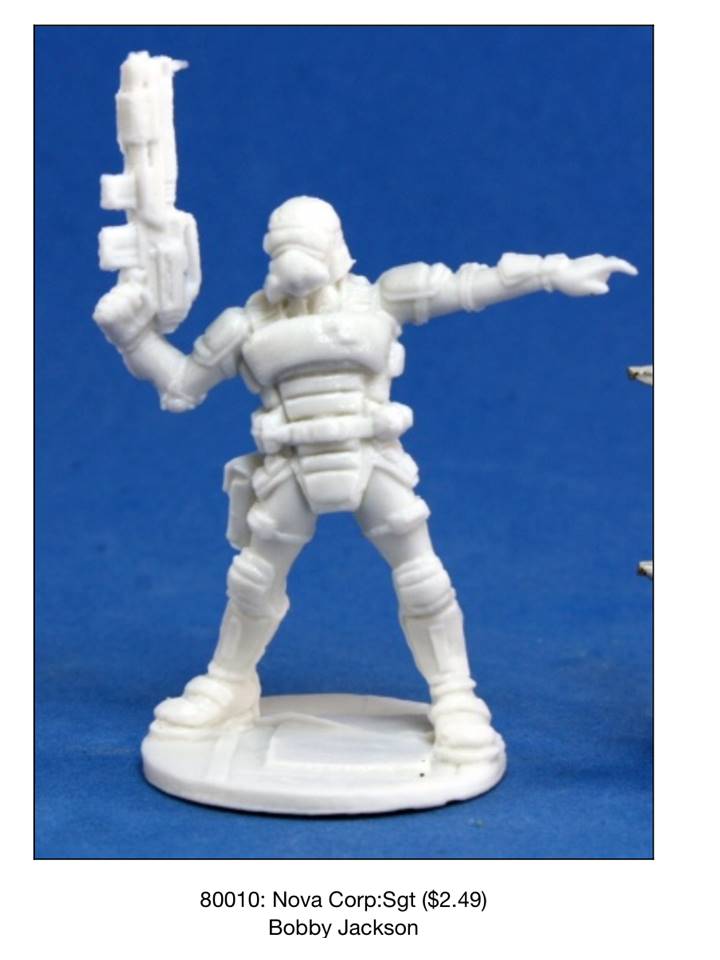
This figure was Reaper 80010, “Nova Corp Sergeant”, by Bobby Jackson.

1a 80010 Nova Corp Sgt Reaper Space Roomans pickup from ebay
Picture of figure from Reaper website


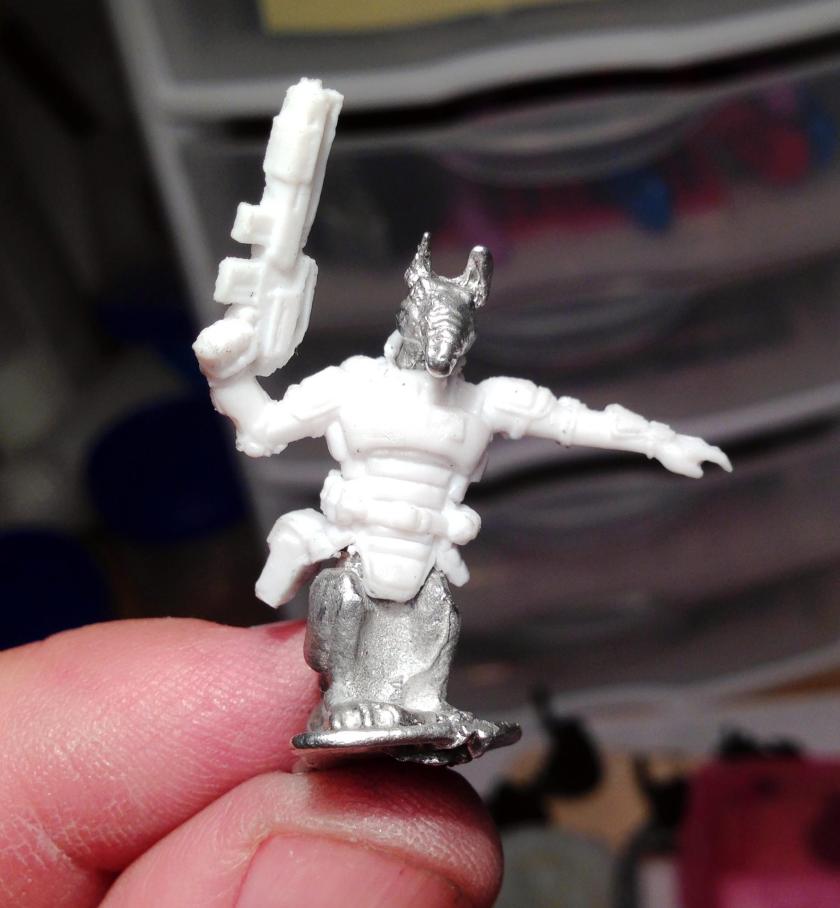
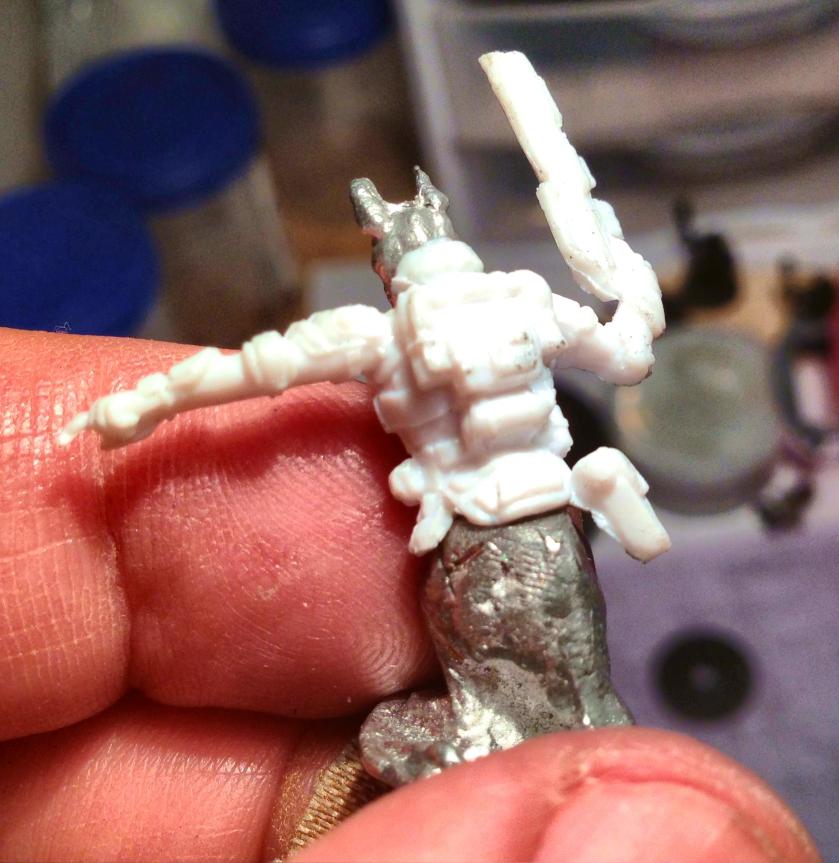
I then looked for a suitable Rooman to convert as well.  I did not have the heart to sacrifice an original Rooman, so I used one of my castings.  There are two types, one with a shield on the front, and one with a shield on the side –  and only the one with the shield on the side looked capable of conversion.  I used the jewelry saw and an Exacto knife to cut the shield from the Rooman.  I then cut the Rooman in half and removed his head (sounds brutal doesn’t it?).  The Nova Corp Sergeant was a lot easier to cut being made of resin!  I used the Exacto knife to cut off his head and carefully remove his legs, preserving his body armor.  Simultaneously, I sculpted some bases to assist in my casting.  These I made from Aves® Apoxie Sculpt modeling compound that I got in Bel Air, MD at a Hobby Shop that I found when I attended HARCON.  It’s a modeling shop and not the gaming shop that Buck suggested to me, but my error proved fruitful as I found this product to be is much easier to use than Milliput.  I have found that I need these bases to create better castings – the older miniatures had pretty thin bases that did not always come out when I molded and cast them.

1c First step in conversion
The Nova Corp Sergeant (before losing his head and legs), an unconverted Rooman example, and a bisected and decapitated Rooman in the process of conversion.  Note my Apoxie Sculpt bases curing in the background.

After I had done my Dr. Frankenstein cutting, I drilled a small hole in the Rooman and the torso of the Nova Corp Sergeant, and pinned the two with a paper clip wire and super glue.  This allowed me to get a proper angle between the two figures.  Then, I carefully carved out space for the Rooman head, and it fit well in the armor.  Lastly, after a 24 hour cure for the Apoxie Sculpt bases, I affixed the conversion to one.


2 Converted front
The front of the initial Space Rooman conversion before adding the base


3 Converted back
The back of the Space Rooman Conversion (less the base).  Note the file marks on the Rooman haunches – I smoothed those out with wood glue


4 Converted final
The master figure awaiting a base!


The next step would be to create a two-piece mold using Castaldo Quick-Sil.  I tried this time to create a better flow of molten metal via three channels made from pens and pencils – which worked great for gravity casting.  I found that pointing the tips at the edge of the base worked well.  I also used toothpicks for venting the mold and helping with flow.  This, with some excision with my Exacto knife, made a very large plug at the top that would get all the mold filled by virtue of its weight.

4a first mold half Converted final
The first mold half – note the Apoxie Sculpt base (with my name on it for posterity).  I used a combination of old casting plugs, a pen, two pencils, and toothpicks to create the flow system of this mold.


4b second mold half Converted Rooman
The completed first mold half awaiting the second pour of Quick-Sil.

I then mixed together approximately 66% tin, and 34% lead (probably some trace bismuth in there too), and melted the alloy to 560° F.

I tapped the mold on my steel-sheeted table after pouring, and employed all the safety equipment that I have previously described in this blog.  As always, this is dangerous!

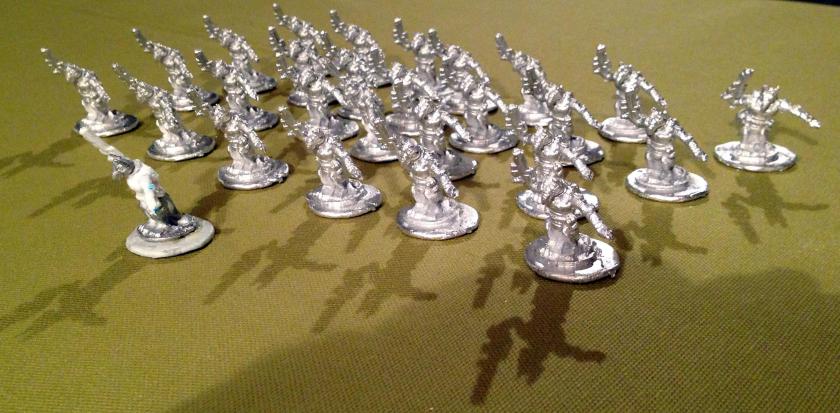
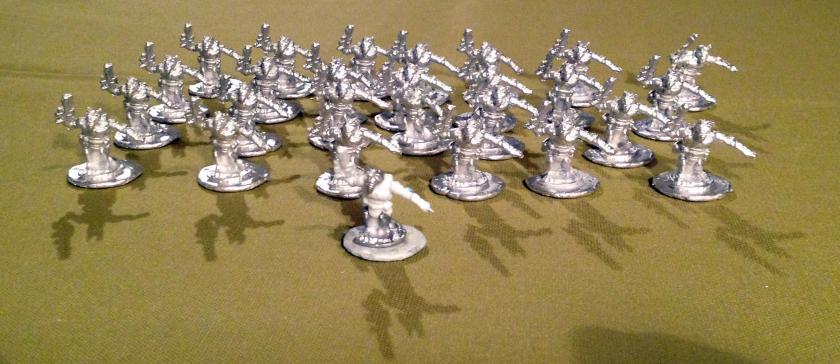
I must say that the final product exceeded my expectations.  Very few of the molds failed to come out as desired which I attribute to my design above.  I ended up with 26, and sent a lucky 13 to Buck for use in sci-fi games!

5 Cast Space Roomans with Master in front
A Regiment of Space Roomans, led by the master!

6 Cast Space Roomans with Master in front

7 Cast Space Roomans with Master in front
Front view of the Space Roomans with master figure in front

Grenadier Ballista, crewed by Trolls (Grenadier #9204 & #3107 from 1994 Catalog)

I saw an item on eBay that was listed as “Ogre Baleesta”.  As I already had an Elven Ballista, I thought it a good idea to have a crew-served weapon for the bad guys.  Little did I know that this would turn out to be a pretty involved project!  I paid a little more than $30 for the three figures and the ballista.

1 Troll Ballista before cleaning
The figures as shipped
I love doing a little research on Lost Mini’s Wiki site: http://www.miniatures-workshop.com/lostminiswiki/index.php?title=Main_Page.  I want to document my figures as best as possible, and I have gotten a bit more familiar with digging into the catalogs there.  I found these all in the 1994 Grenadier catalog.   However, they were not Ogres, but “Trolls” and a separately listed “Heavy Bolt Thrower with Hunchback Gunner”.

The set of Trolls is #3107, sculpted by Sandra Garrity, and included both Trolls in a blister pack.  It was part of the “Fantasy Legends Blisters” line.  The figures themselves had “1992” and SM-33 and SM-34 and “Garrity” on the bases.

The ballista and gunner was #9204, and was in the “Fantasy Warriors Grand Pack Line”.  I then proceeded to treat them all as a Troll crew and a ballista.  To call them Ogres when they were Trolls seemed so inappropriate!

The ballista had been crudely cemented, and that took some work to correct.  I was happy that a string had been attached to the ballista as that saved me some work.


5 Troll Ballista before cleaning back view
Ballista rear view as shipped
7 Troll Ballista crew sm33 and sm44 before cleaning
Detail of the bottom of #3107 Trolls by Sandra Garrity

I removed the old cement and disassembled the ballista.  I then primed the set in Jeff Smith’s workshop on a cold February day with Krylon “Ultra Flat Black” and mounted as below for painting.

8 Troll Ballista crew primed
On washers on popsicle sticks and ready for painting!

I used Citadel’s “Dryad Bark ” as a base coat for the ballista wooden elements.  I subsequently employed two inks in succession as washes – Secret Weapon’s Washes “Heavy Body Black” and P3’s “Brown Ink”.  On this I applied a dry brush application of Citadel’s “Scrag Brown”, followed by a wash with Citadel’s “Agrax Earthshade”.  For the bolt and other iron parts, I used Tamiya’s “Gun Metal” and Polly-S “Rust”.  Finally, I used Citadel’s “Nuln Oil”  as a light wash to darken the iron components even more.  Eventually I was able to apply a couple of coats of varnish to the ballista.  As I needed to apply coats of varnish to the undercarriage and the top of the ballista, and as New England would not warm up, this took longer than I wanted!  I was able to apply Krylon “Clear Glossy” followed by Krylon “Clear Matte” varnish and moved on to the crew.

18 Troll Ballista painted (back lighter)
The ballista completed
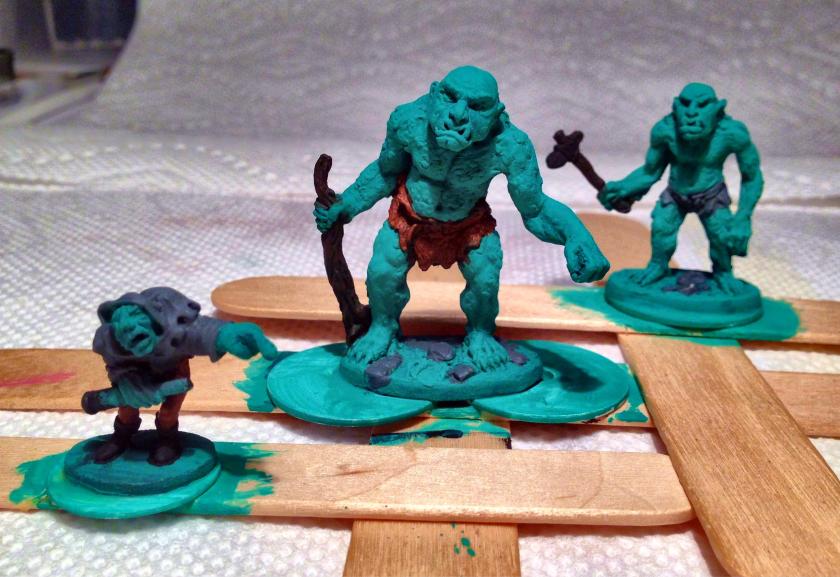
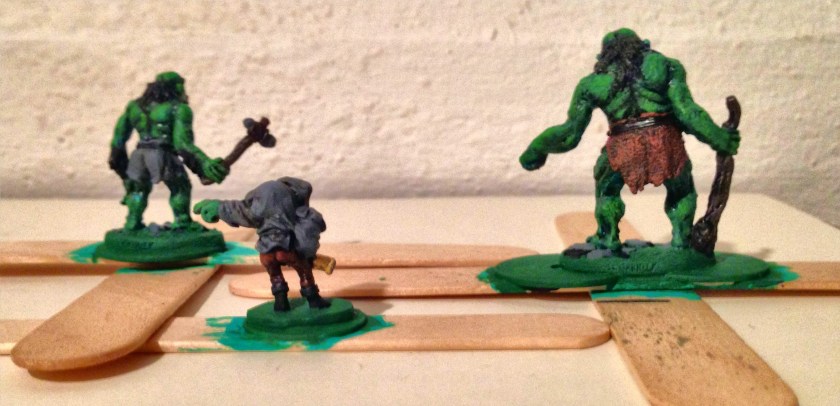
I base coated the crew with Armory “Dark Green” on the skin, with Armory “Chestnut” and Americana “Zinc” on pants and cloaks and stones at the figures’ bases.  For the clubs and handles I used Citadel’s “Dryad Bark”.  The gunner’s boots got Americana “Black”.  Then I applied a wash with two inks – Secret Weapon Washes “Storm Cloud” and Citadel’s Agrax Earthshade on the skin.  For the eyes, I used Citadel’s “Ushabti Bone” and  Americana “Lamp Black”.  I further wanted to get the right tone for the skin – I wanted greasy, sweaty Trolls!  To accomplish this, Citadel’s “Waaagh! Flesh” and Polly-S “Slime Green” worked well when highlighted with Citadel’s “Niblet Green”.  Then I used Americana “Lamp Black” on all the Trolls’ hairy parts.  For the gunner’s telescope, I used Martha Stewart Craft’s “Pale Bronze”.  I proceeded to add highlights (with Americana “Black Tie” on the hair and lightened “Zinc” on the cloak) and depth to the skin with the use of washes (more “Nuln Oil”, “Agrax Earthshade”, and Secret Weapons Washes “Stone”.  Then I varnished them the same way as the ballista.


12 Troll Ballista crew primed
The first base coat on the Trolls
15 Troll Ballista crew painted (front)
After painting and varnishing
16 Troll Ballista crew painted (back)
Rear view after painting and varnishing.

My concept was to craft a hex base large enough to deploy the set.  I cut out a hex base from 1/8″ plywood (luan), and primed it with Deka-Lack “Grun”.  On the bottom of the base I glued several  washers for the model to be stored on magnetic sheets.  I flocked the base with Ziterdes “Alpine Meadows” and painted any rocks “Skrag Brown”.  Using my Dremel, I carefully removed enough wood to install magnetic sheets in the base so that I could have the crew leave the ballista.  These sheets proved insufficient to the task in terms of being able to hold the figures to the base.  I fixed this by drilling 1/4″ holes with a spade bit and adding neodymium magnets (1/4″) in the middle of each base.  These are powerful magnets.  The figures can hang upside down from the base without falling now!

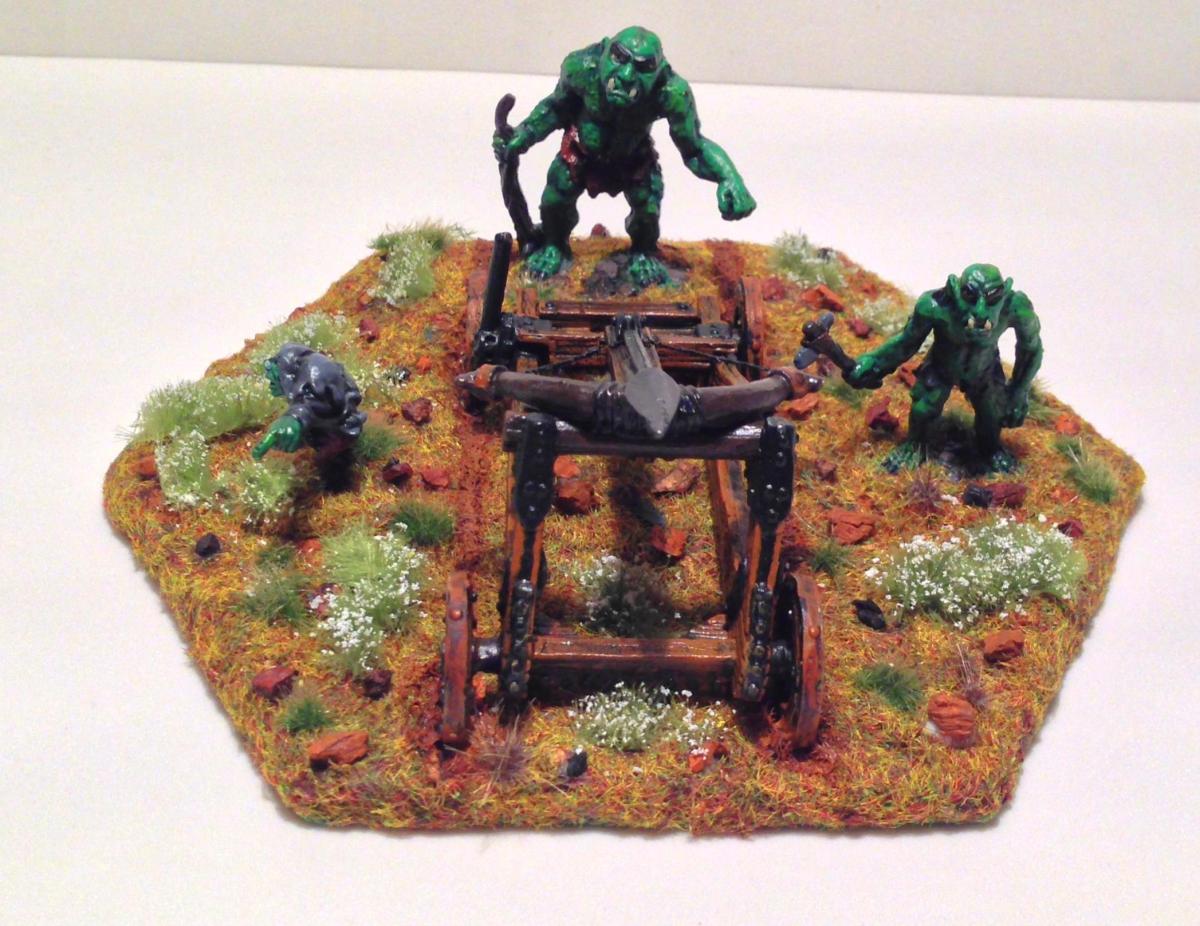
I wanted the idea of the model to be that the large Troll was the locomotive force for the large ballista, with the other Troll being the loader and the small Troll the gunner.  The large Troll would push the ballista through the turf leaving wheel ruts.  Therefore, I used more “Skrag Brown” to create the image of the wheel ruts.  I then reflocked the bases of the figures and the main base and added more rocks, grass, and meadow flowers from Army Painter.  After a couple of iterations, I was able to disguise the fact that the crew  could be removed.

19 Troll Ballista painted base after routing
The initial routing for magnets and slots for ballista
21 Troll Ballista painted base after routing first magnets
First shot at magnets and flocking
22 Troll Ballista painted base after routing first magnets crew removed
Before addition of 1/4″ neodymium magnets
23 Troll Ballista painted base after routing final basing
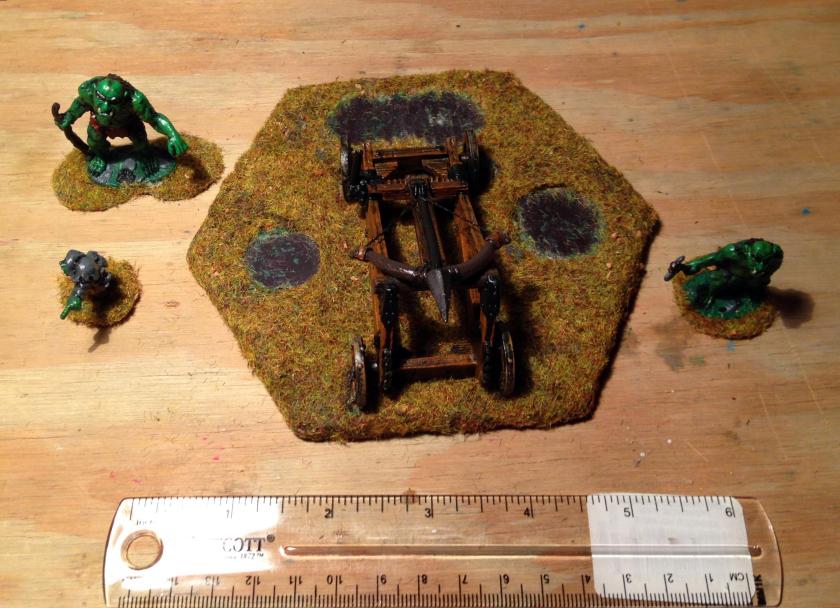
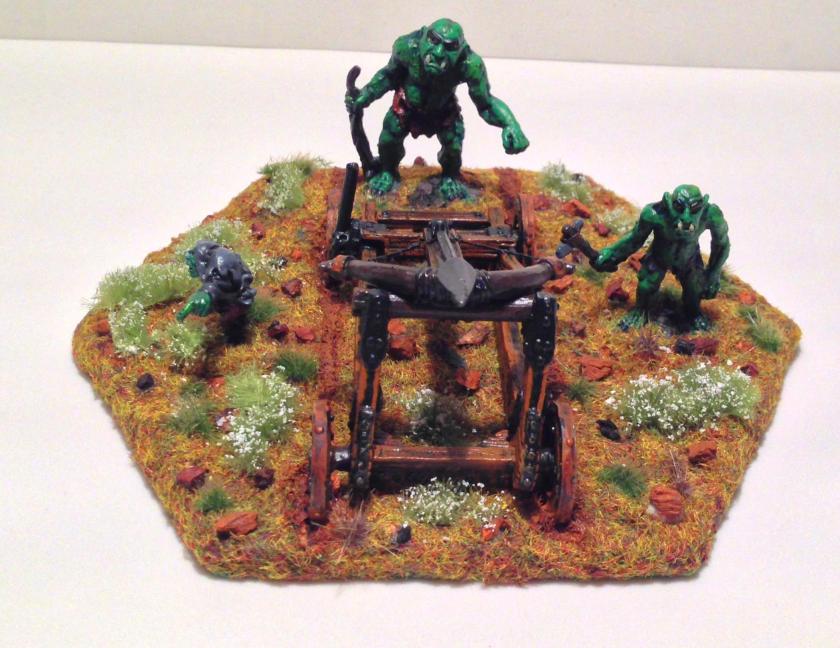
Final frontal view of the model
24 Troll Ballista painted base after routing final basing side view
Gunner side view
25 Troll Ballista painted base after routing final basing side view
Loader side view

26 Troll Ballista painted base after routing final basing back view
Rear view angle

27 Troll Ballista painted base after routing final basing crew in front removed
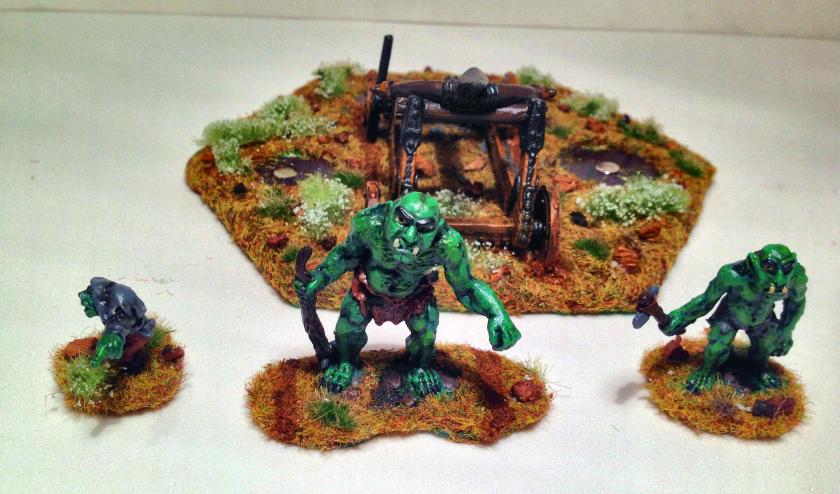
Crew detached – note neodymium magnets in the center of where figures are mounted

29 large Troll  crew Ballista front
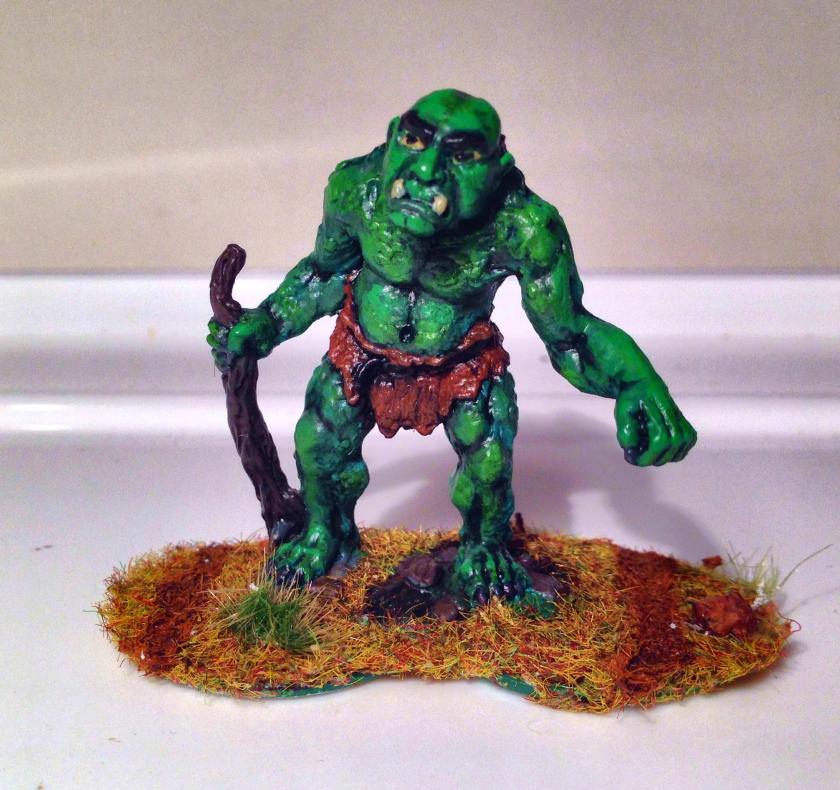
Large Troll, Frontal view
 

30 large Troll  crew Ballista back
Large Troll, reverse side
31 Medium Troll  crew Ballista front
Medium Troll
32 Medium Troll  crew Ballista back
Medium Troll reverse side
33 Small Gunner Troll  crew Ballista front
The Hunchback Gunner
34 Small Gunner Troll  crew Ballista back
The Hunchback Gunner, reverse side

All in all, I am happy with the way that it all came out.  I like the deployability of the crew, and will use this technique in other models.  I hope that they are fun to control in my next game!

Iron Winds Metals’ Second Kickstarter is worth a look!

Certainly Iron Winds Metals is attempting to outdo its Kickstarter project from last year!

There are a LOT of options here and anyone who wanted to get in would certainly find much here to be desired.  Unlike last year, the miniatures will be shipped as orders are filled.  It ends soon – and these are great Ral Partha figures!

Kudos to IWM – this is pretty impressive.  I am still working through my projects (like last year’s Kickstarter!), which is  the only thing holding me back!

It ends this week for those interested!

Where do Star Ducks and Frinx Come from? Archive Miniature’s 1981 Star Rovers Game of course!

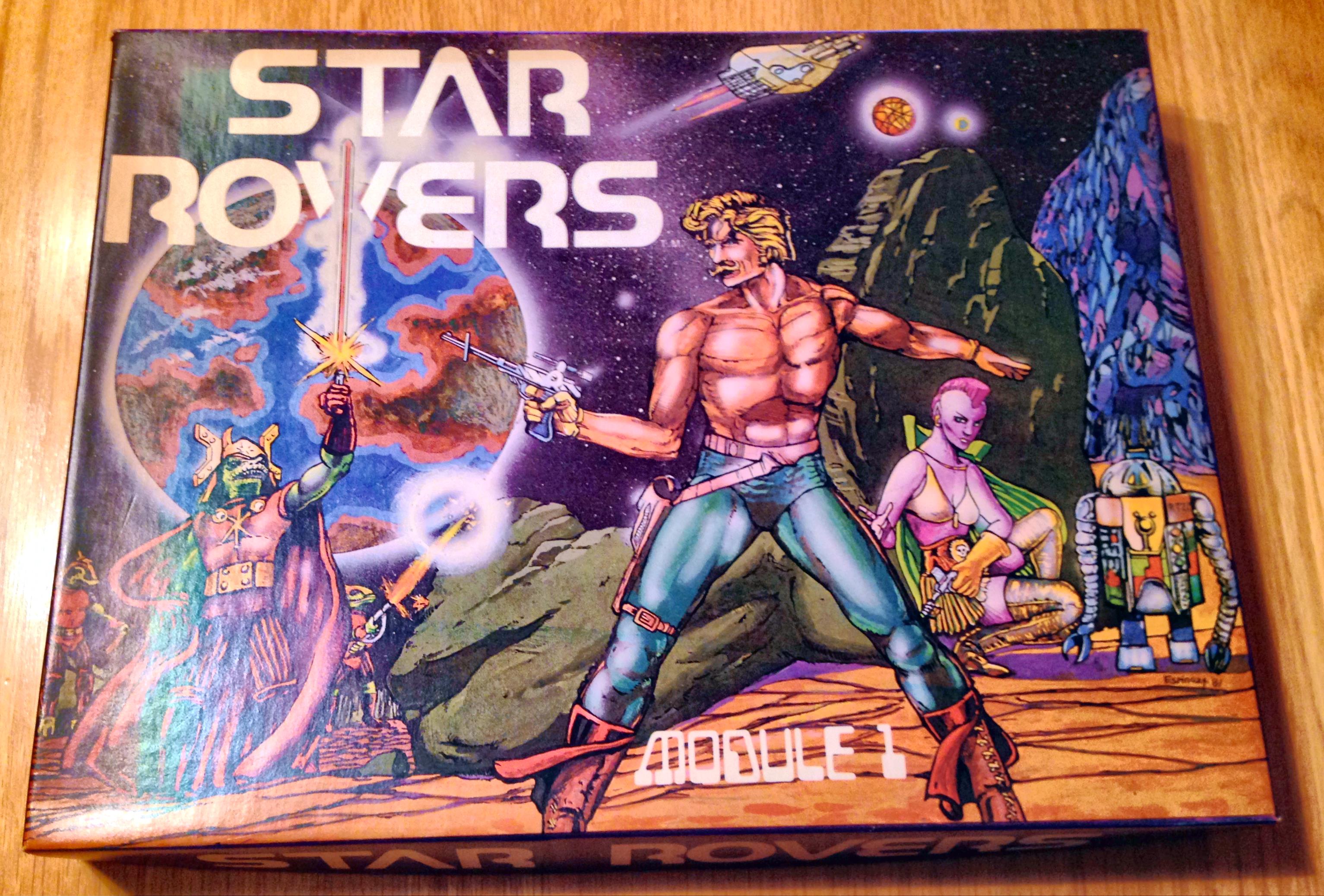
Having recently discovered how cool the miniatures from Archive Miniatures “Star Rovers” line was – I was interested in getting a copy of the game.  Thanks to eBay, I got a brand new one at a reasonable price.

It was an sci-fi RPG from 1981.  While it was “Module 1”, I do not believe that any other modules were printed.

1 Star Rovers Box front
Cover of Box
2 Star Rovers Box back
Back of Box


The game looks pretty cool – and there was a lot of cool artwork.  As I have been amassing Archive Miniature Star Rovers figures like Star Ducks and Power-Armored Frinx, I am hoping that reading the game will help me.  Also, there was an original Archive catalog in mint condition in the box as well.

Enjoy!

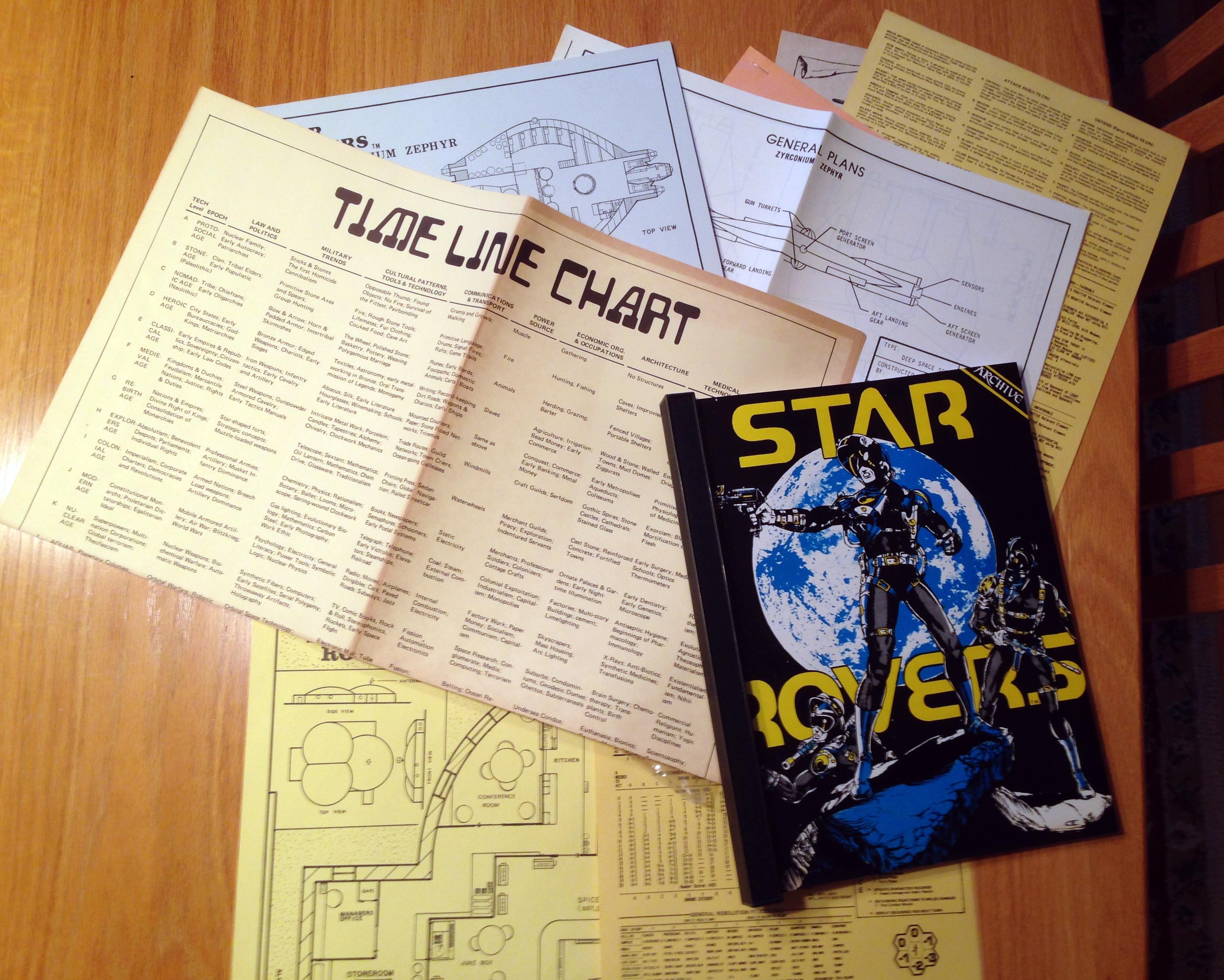
3 Star Rovers Box contents
Game contents


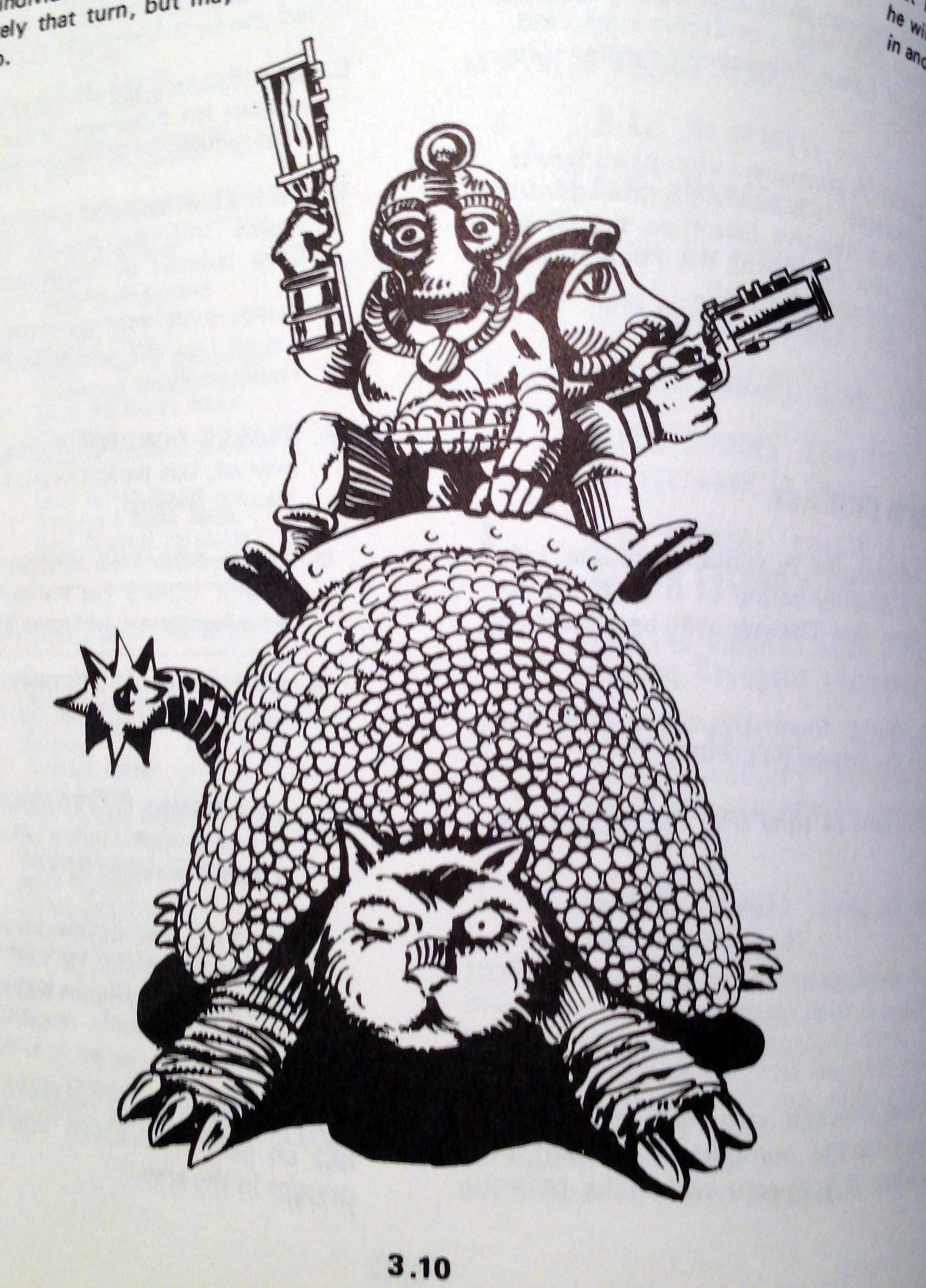
4 Star Rovers Armored Frinx on glyptodon
Artwork – Power-Armored Frinx on Glyptodon
5Star Rovers Power Armored Frinx
Power-Armored Frinx
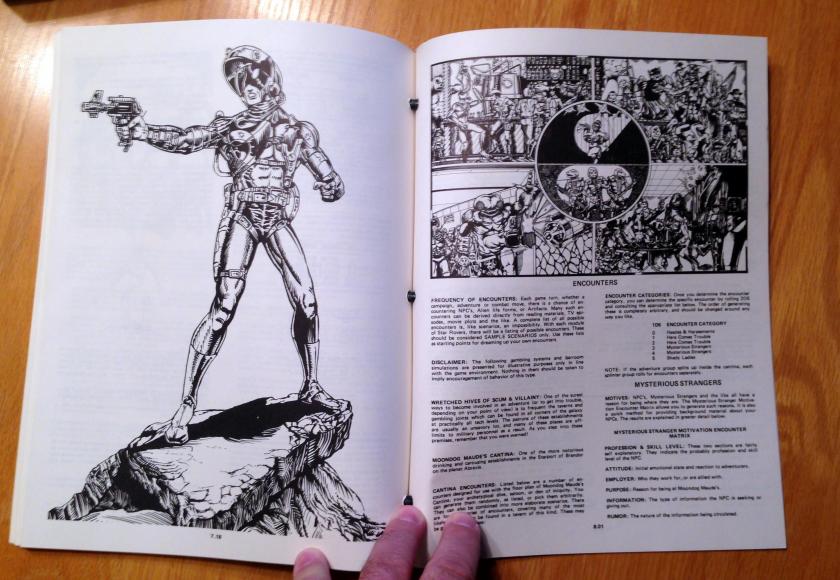
6 Star Rovers Artwork 1
More Artwork
7 Star Rovers Artwork 2
Nice spread
8 Archive 1981 catalogue
Archive Catalogue
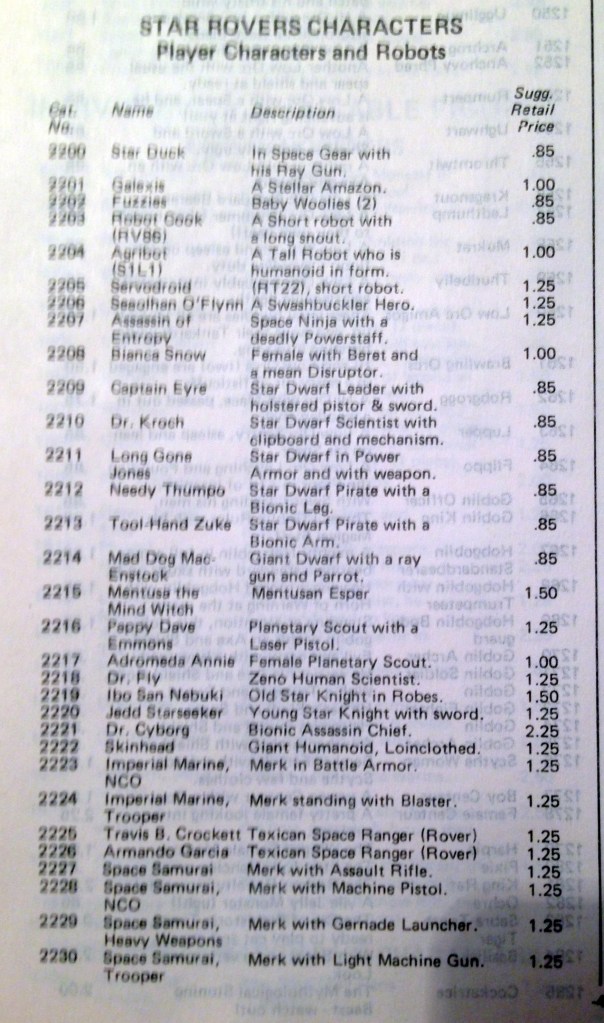
10 Archive 1981 catalogue SR 1
Star Rovers Miniatures Listing, part 1
11 Archive 1981 catalogue SR 2
Star Rovers Miniatures listing, part 2

WOODCON & HARCON – gaming with the HAWKS in Maryland

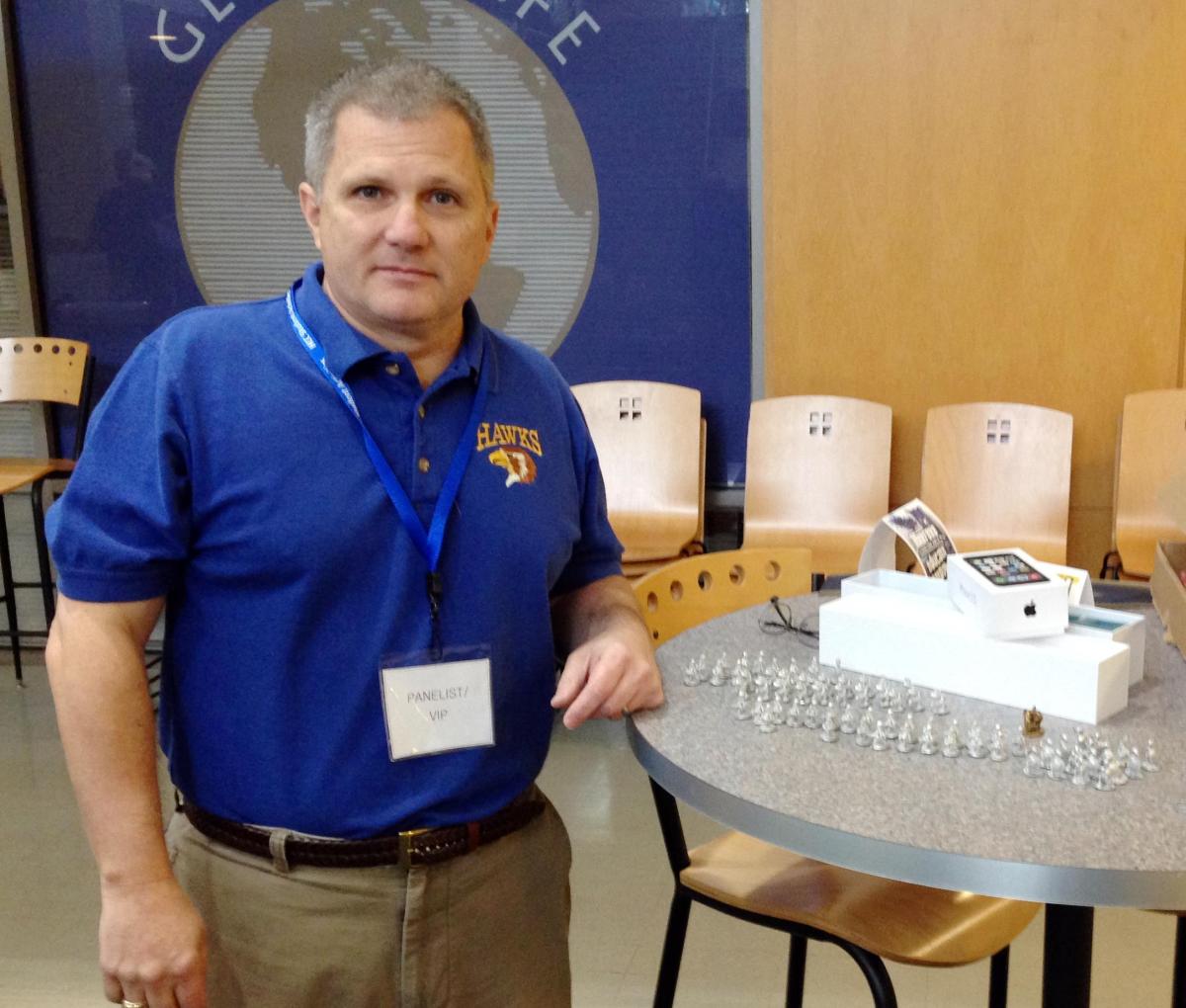
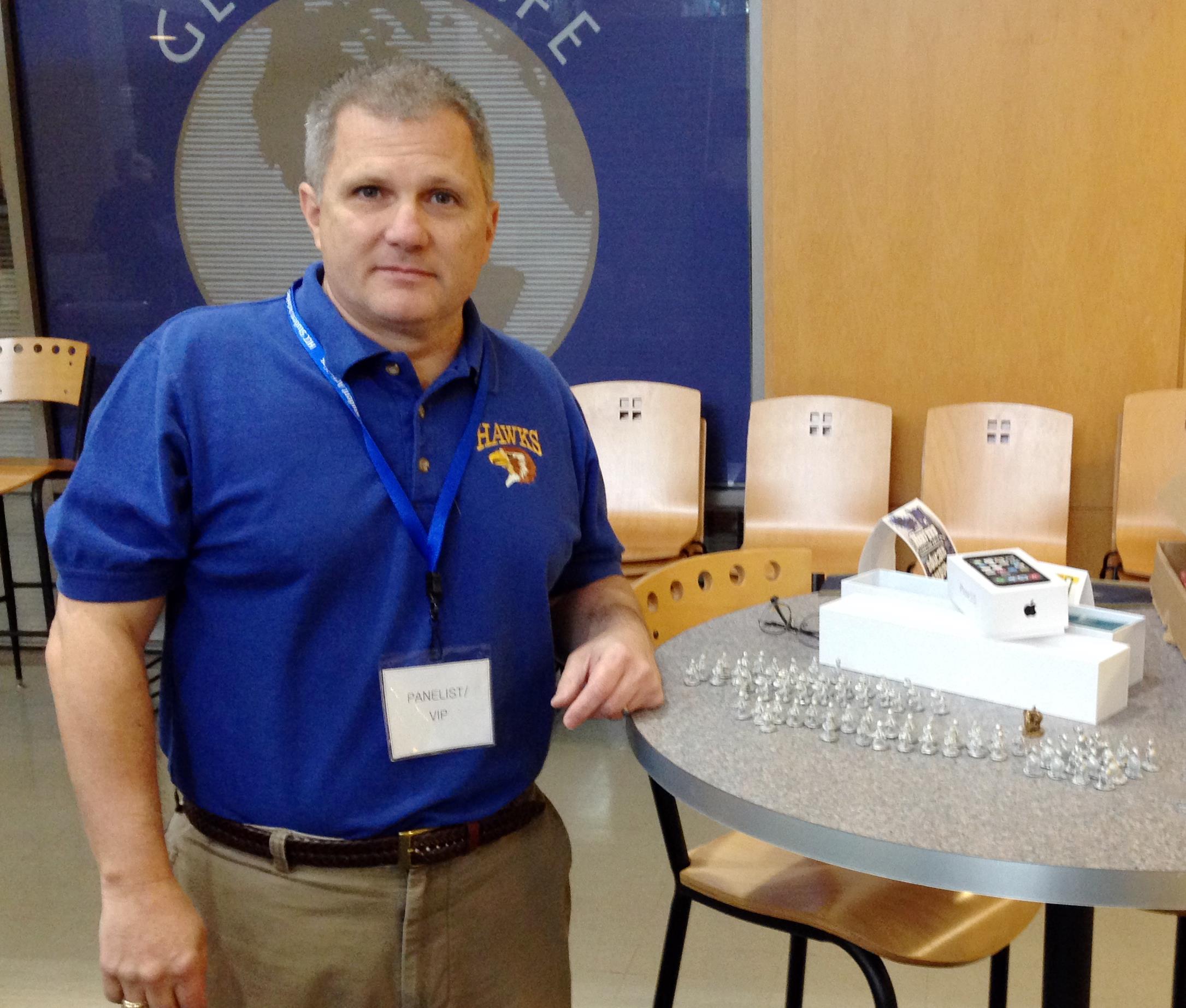
I was fortunate to be able to meet with Dave Wood for a couple days in Abingdon, MD (let’s call it WOODCON) and with Buck Surdu at the Harford, MD HARCON in the last week of April.  To round out the month of April, what could be better than getting together with friends and getting some gaming in?  Plus, I got to deliver to both the miniatures that I had been casting for them that have been discussed extensively in this blog.  Dave got Roomans and crossbows, while Buck got Star Ducks, Power-Armored Frinx, Roomans, and crossbows.  I also supplied him with an Apple watch box and an iPhone box for his sci-fi Combat Patrol project.

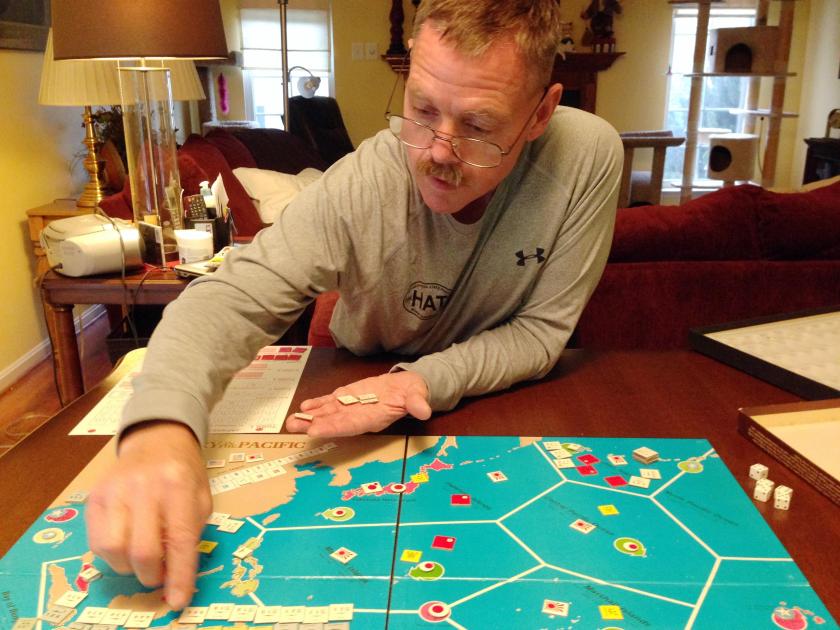
Dave and I started out with a game that we had played probably dozens of times back when we were roommates at West Point.  It was the old Avalon Hill game Victory in the Pacific.  Its a board game simulating the naval conflicts in World War II.  I played the Japanese, and lost to Dave in the last turn, but it was a nice time.

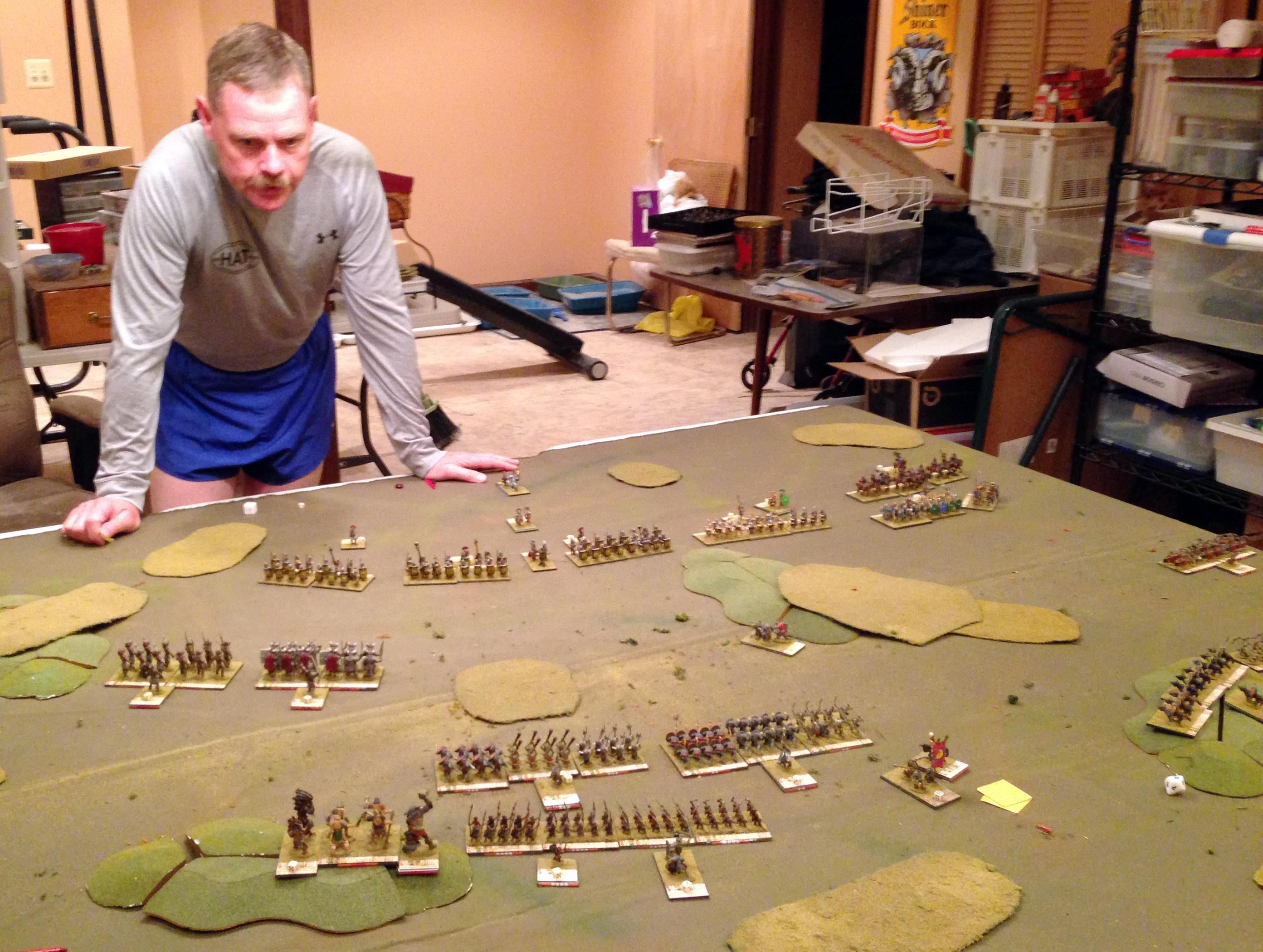
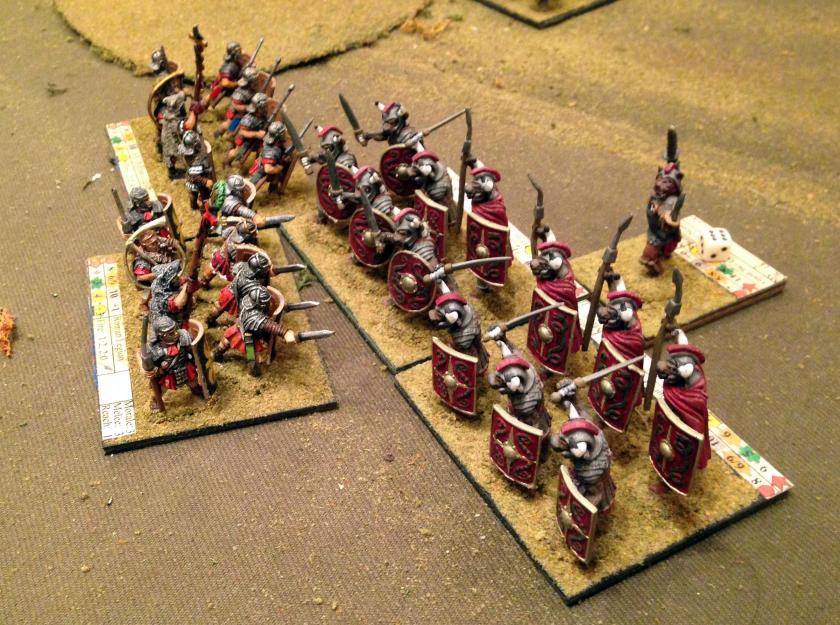
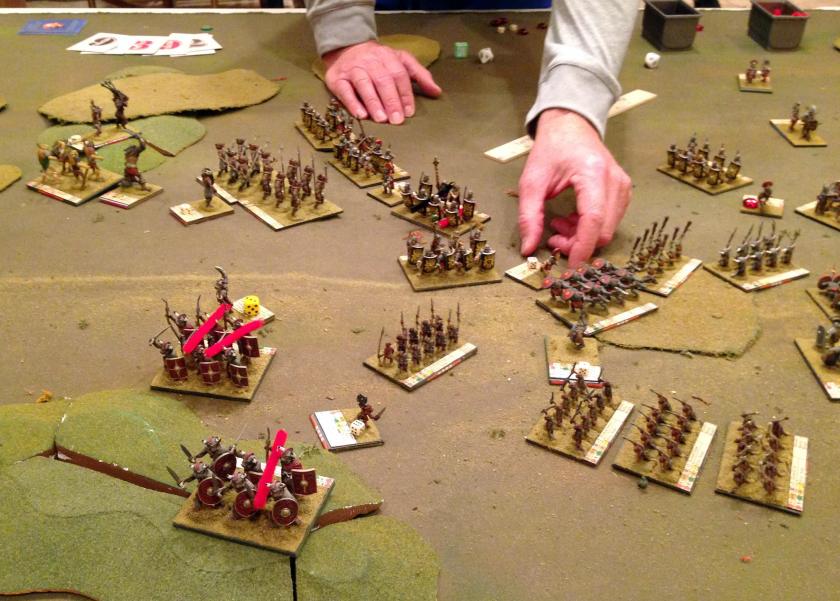
The next day, we started by getting in a fantasy game with Romans defending against a horde of Orcs, Goblins, Minotaurs, and some other bad guys.  I wanted some more experience with the Bear Yourselves Valiantly rules, and Dave was happy to help.  I took the bad guys side.  The highlight of the game was being able to use a spell on an Orc ballista which was then able to hit his overall Roman Army Commander.  Luckily, Dave was able to get that commander safely out of the way of the ballista, so he lived.   Dave’s Roman Legions did a number on my Minotaurs, while my Goblins and wargs had better luck with his Roman Auxiliaries.  We called it early (I think Dave would have prevailed easily) so we could get in some game play with Buck’s Combat Patrol rules.

1 04282016 BYV Dave Wood
Dave surveys the battlefield and prepares his defense


2 04282016 BYV Initial part of battle
Starting positions – Romans on left
3 04282016 BYV Roman Legion vs Minotaurs
Dave’s Roman Legion dispatches the Minotaurs
4 04282016 BYV Roman Legion Commander hit by Orc Ballista
The Orc Ballista hits the Roman Army Commander (with the help of a spell)
5 04282016 BYV Minotaurs repulsed by the Roman Legion and melee in middle
Melee in the Middle
6 04282016 BYV Roman Auxiliary Commander finds himself swarmed by warg riding goblins
The Roman Auxiliary Commander faces an Onslaught of Goblins on Wargs


The scenario we used for the Combat Patrol game was Boers versus Zulus.  I took the Boers, and it was a great skirmish game.  While I own these rules and the card decks, I had not yet played with the.  My hats off to Buck and Chris Palmer on putting together a really nice system.

Here, I was able to hold off the Zulus, although not without casualties.  In fairness, Dave did give me a substantial advantage in forces.


7 04282016 CBT PTRL ZULU MELEE
Boers hold the line against Zulus
8 04282016 CBT PTRL ZULU MELEE 2
The Boers Survey the Carnage


The last thing that Dave and I got to play was another Victory in the Pacific game, with  us swapping sides from the previous game.  As the Americans, I was able to win.  We both feel that the Americans have an advantage in the game, which is counter to what you might see in the Wikipedia entry!  Anyways, thanks Dave for a great time, and thanks Brenda for letting me borrow Dave!

Of course, I also have to thank Dave as he loaded me up with some great Thunderbolt Mountain miniatures (that eventually I will paint!), and a few others.

9 04282016 VITP
Dave plays the Japanese Empire in Game 2


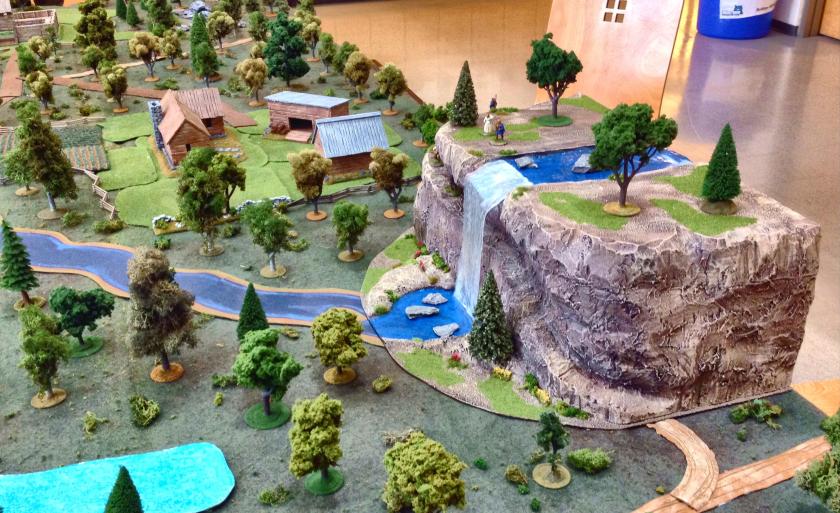
On Saturday I attended the HARCON with the HAWKS.  It was great to hang out with Buck again, and the Muskets and Tomahawks game (French and Indian War skirmish) was a blast.  I got to play twice.  As you can see, the tabletop was phenomenal!

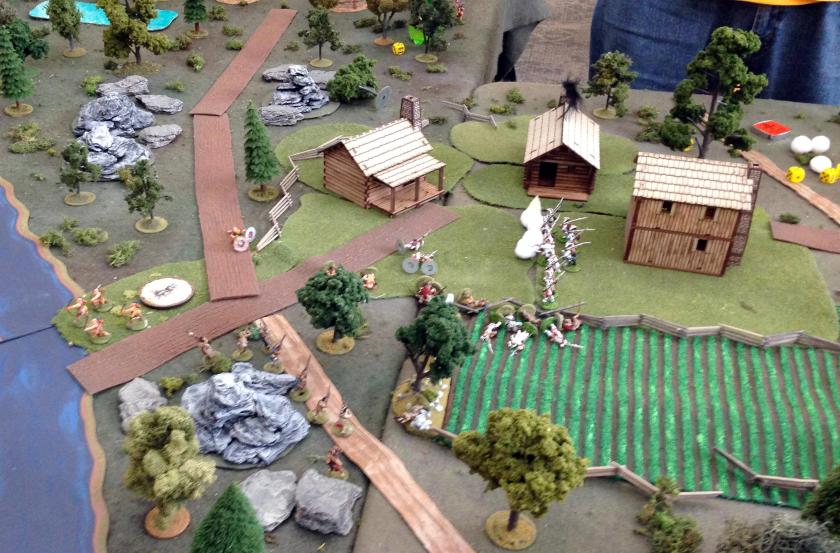
The first game I had three groups of Iroquois (British allies) who had to raid a trading post and burn down half of the buildings (there were three so hmmm).  I went up against Kurt, who luckily for me did not get his Huron allies until later in the game.  Still, he conducted a great defense and I only burned down one building.  Great GM’ing by Don!

Between games, there was a nice seminar about game design with Buck, Chris, and Zeb.  That was very interesting!

The second game was against Eric, and I took the French side.  That game come down to a final roll, where Eric charged my French officer with the Iroquois sachem and another Iroquois warrior.  I had one other French figure left, and my office pulled a rabbit out of his hat and died dispatching the attackers.  Here, Kurt was a great GM!

It was a great day and thanks again to the HAWKS who made me feel welcome yet again!

1 04302016 Buck with Star Ducks, Frinx, and Roomans
Buck gets his Star Ducks, Power-Armored Frinx, and Roomans
2 04302016 HARCON Muskets & Tomahawks battlefield
Muskets and Tomahawks Tabletop
3 04302016 HARCON Muskets & Tomahawks battlefield 2
Great Looking Waterfall!
5 04302016 HARCON Muskets & Tomahawks Melee at the fence
My Iroquois attempt to flank the French in the first game
6 04302016 HARCON Muskets & Tomahawks French push Iroquois back
After a close assault, my Iroquois take some lead
7 04302016 HARCON Muskets & Tomahawks Fight around first building
My Iroquois got around the building and ignited it, but the French fought back
8 04302016 HARCON Muskets & Tomahawks Building burns
The building is burned!
9 04302016 HARCON Muskets & Tomahawks 2nd game French repulse Iroquois
In game 2 against Eric, the French save the trading post!

Lots of Casting in the Snow – Roomans, Star Ducks, and Power-Armored Frinx

This weekend was cold and blustery.  Definitely no golf!  Saturday was cold and rainy, and we got 5″ of snow on Saturday night, and 5″ more all Monday – kept me looking for Spring!

I took the opportunity to make a couple of more molds on Saturday.  I made another Rooman War Party mold of the smooth shield Rooman from Ral Partha 01-044 or ES-44 (1977 miniature).  I also made a new mold for eventual sci-fi play with Buck Surdu’s “Combat Patrol” rules.  This was a 1981 “Power-Armored Frinx” (2040) from now-defunct Archive Miniatures “Star Rovers” line.  From what I can see, a Frinx is a goofy reptilian biped.  He could be armed with a large gun or a flamethrower, or perhaps a blaster?  The figures looked cool and worthy of casting.  I made both of these two molds a little longer and less wide.

4 Archive Armored Frinx 1st mold half
Power-Armored Frinx Mold Half


Sunday came, and with it the miserable cold, wind, and snow.  Undaunted, I set up my operation in my unheated garage.  When the wind got too strong, I just shut the door- which was most of the day.

5 04032016 casting weather
Ahh, April in Massachusetts!  My casting operation is set up in the garage.


I also exclusively used some new alloy metal that Buck was kind enough to send in in support of my casting efforts.  It is 50% Tin, 39% lead, and 11% antimony from Castings (http://miniaturemolds.com/1-50-Tin-39-Lead-11-Antimony-10-oz-Ingot-CM3.htm) .

I was able to have a much lower melting temperature than my last efforts ( a range of 360-400 °F versus 600-650 F°).  The flow was better and more manageable.  As I got the hang of it, my castings got better, even with molds that I thought I might have damaged with the higher temperatures on my last casting.  With six molds, I was able to crank out 82 miniatures, which really was satisfying.

13 assembly of the new Regiment of Roomans front
A Regiment of Roomans

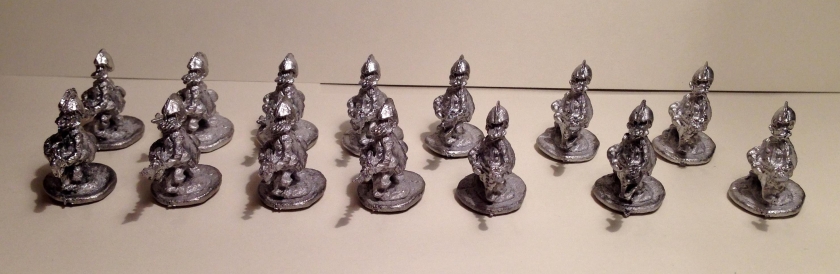
I had a total of 83 Roomans now, enough to complete my units, with a battalion for friends Dave Wood, Buck, and my daughter Ellen.  In the process of cleaning up flash and doing Quality Control, I ended up putting 8 into the recasting collection – but that just left me with the best of the Roomans left for myself, Ellen, Buck, and Dave.  Some were better than others – but all in all they should paint up nicely and could have a variety of weapons and not just their original pikes.


14 assembly of the new Regiment of Roomans front command
Rooman Regiment Close Up on Command Group


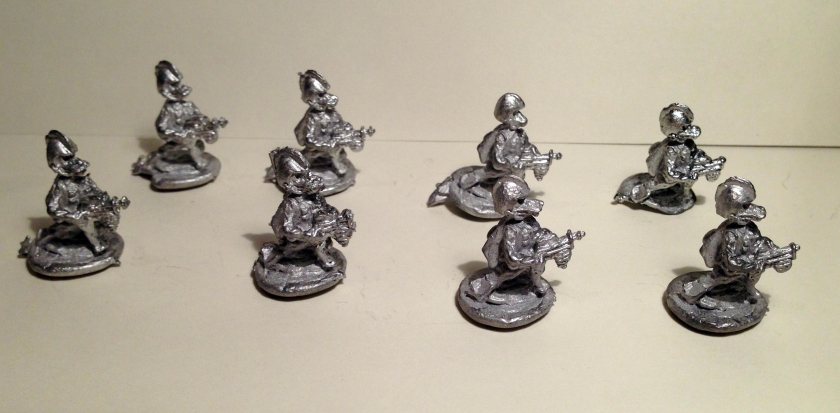
The Archive Star Ducks (2200) came from the “Star Rovers” line.  These were a challenge as their ray guns did not always come out.  I decided that the Star Ducks with truncated Ray Guns looked like and would be armed with submachine guns – and be just fine.  With some practice and the new alloy, I had greater success as the afternoon went on, and ended up with a total of 14 armed with ray guns with 8 with submachine guns.

8 Duck (Gurads!) with Ray Guns first 14
Star Ducks with Ray Guns
9 Duck (Gurads!) with SMG first 8
Star Ducks with Submachine Guns

I was very pleased with the Power-Armored Frinx figures.  The longer molds allowed me to get more details into the molds by tamping and rotating them after filling them with the molten metal.  I ended up with 14 of these Frinx, and I can’t wait to see them get the Surdu touch!

6 Archive Armored Frinx 1st 14 cast
Power-Armored Frinx

I had several key learnings from my efforts.

  • I found that longer molds are easier than wider ones for casting.
  • Using an alloy with 50% tin as described above was a lot easier than using plain lead, in terms of being able to use lower temperatures as well as better flow.
  • Each figure averaged 0.39 ounces of the alloy after recycling plugs and flash.  With that ratio, I could cast 25 figures from 10 ounces.
  • I think six molds is the perfect number for quality production and safety.
  • The Quick-Sil is a great material to make molds with, but you need to be prepared to have an Exacto knife to add venting gates and open channels.  Luckily, Quick-Sil is easily cut.  If the mold needs adjusting, do it with the Exacto knife.
  • After pouring, tap/tamp/bang gently and rotate the mold to get the metal into the details.
  • The use of a specialized thermometer  (mine is a Lyman that goes up to 1000 °F – http://www.amazon.com/Lyman-2867793-Lead-Thermometer/dp/B001TQ8Y6Q ) and allows for better control and better casting.  Temperature control is very important.  My crucible (a Hot-Pot 2 http://www.amazon.com/Do-It-Molds-1892-Hot-Pot-2/dp/B002QG3H9M/ref=sr_1_1?s=sporting-goods&ie=UTF8&qid=1459824499&sr=1-1&keywords=hot-pot+2 ) has no control other than on and off.  By watching the temperature and shutting the crucible off I was able to have a modicum of control.  Having extra metal ready and on-hand to add to the crucible to lower the temperature when it gets too hot is another good tip.
  • Safety is paramount.  The molten metal can indeed fly around, and it is HOT.  I would not even think to try this without heat-resistant gloves, eye protection, and a respirator (breathing lead fumes is not a good choice).  Having all of my skin protected is important, as well as anything that could get hot metal on it, like shoes, pants, long-sleeve shirts, etc.  Protect your workspace too.  I use steel sheets to insulate my work bench, which also has the advantage of making splattered metal easy to clean up and recast.

This was a fun project – and I am so happy that now I can round out any unit of out-of-print miniatures as long as I have one to mold and cast.

Man of TIN blog two

Toy Soldiers, Gaming, ImagiNations

Gisby's Gaming Blog

Miniatures gaming projects, products, and reviews

Carrion Crow's Buffet

Narrative Wargaming, Fiction and General Musings on the Universe

Despatches from Fort Syllabub

An account of fictional adventures on the North West Frontier - and other times and places, real or imagined

Man of Tin blog

Toy soldiers, gaming, Imagi-Nations

Zauberwurfs Blog

Ein Blog über Tabletop und Miniature Wargames.

Frank Tank Rants

musings of a fat old bloke on tanks and wargames

Dragons of Lancasm

Games, miniatures, painting, books and more games

Tiny Painted Heroes

The Adventures of a lifelong Tabletop Gamer, Game Design hobbyist, and full-time Software Engineer

Steve's Paint Brush

Grimdark model making and mini painting

Wargamesculptors Blog

Life, Golf, Miniatures, & Other Distractions

Dead Dick's Tavern and Temporary Lodging

Life, Golf, Miniatures, & Other Distractions

Guru Pig - the gaming Guru

Guru's thoughts on wargaming, life, and the universe!

Wisely lead... without a head!

History, Miniatures and Wargaming

Kuribo's Painting

Fallout Wasteland Warfare, Warhammer, and Hellboy Painting, Terrain, Dioramas, and Battle Reports

Don't Give Greg Ideas

Seriously, just don't

War Across the Ages, and other dark horrors

A discussion of miniatures collecting, painting and gaming.

Classic Warhammer 40K

Painting diary focused on Warhammer 40K 2nd ed., 5th ed. WHFB, related GW games, and miscellaneous whimsy

Colonel Mustard

WW2 Modelling in 1/72 Scale

Bogenwald

Random painting and terrain making.

Pat's 1:72 Military Diorama's

Scale diorama tips and ideas

Arcade Dreams

Building the Arcade Dream

P.B.Eye-Candy

Phil's 20th century wargame pages

SP's Projects Blog

A futile fight against entropy or 'Every man should have a hobby'? Either way it is a blog on tabletop wargames, board games and megagames

30mmdave

Wargaming Plausible reality?

The Imperfect Modeller

Miniature Figure Painting and Diorama Modelling

Double Down Dice

Painting miniatures and rolling dice!

Just Needs Varnish!

My ongoing wargames projects!

miniaturepopcorns

Sculpting some worlds

Despertaferres

Wargaming with the ability of a dull nine year old

Dawn of the Lead

Miniature wargaming and the occasional zombie

Rantings from under the Wargames table

Wargames, Figures, Sculpting and Converting Miniatures

Simple as War

Miniatures & Terrains

Buck's Blog

Life, Golf, Miniatures, & Other Distractions

IRO aka Imperial Rebel Ork

- I model - therefore I am -