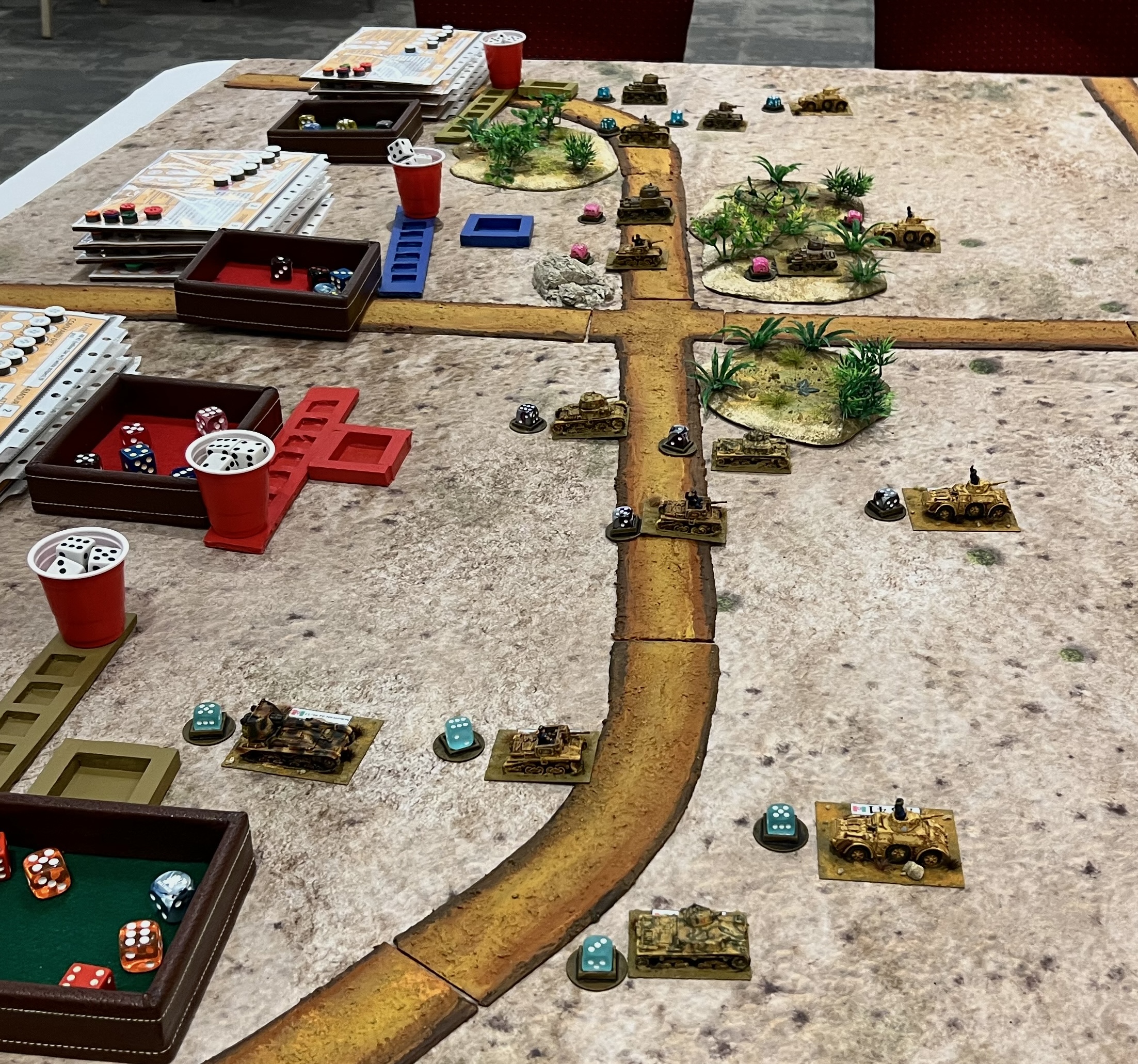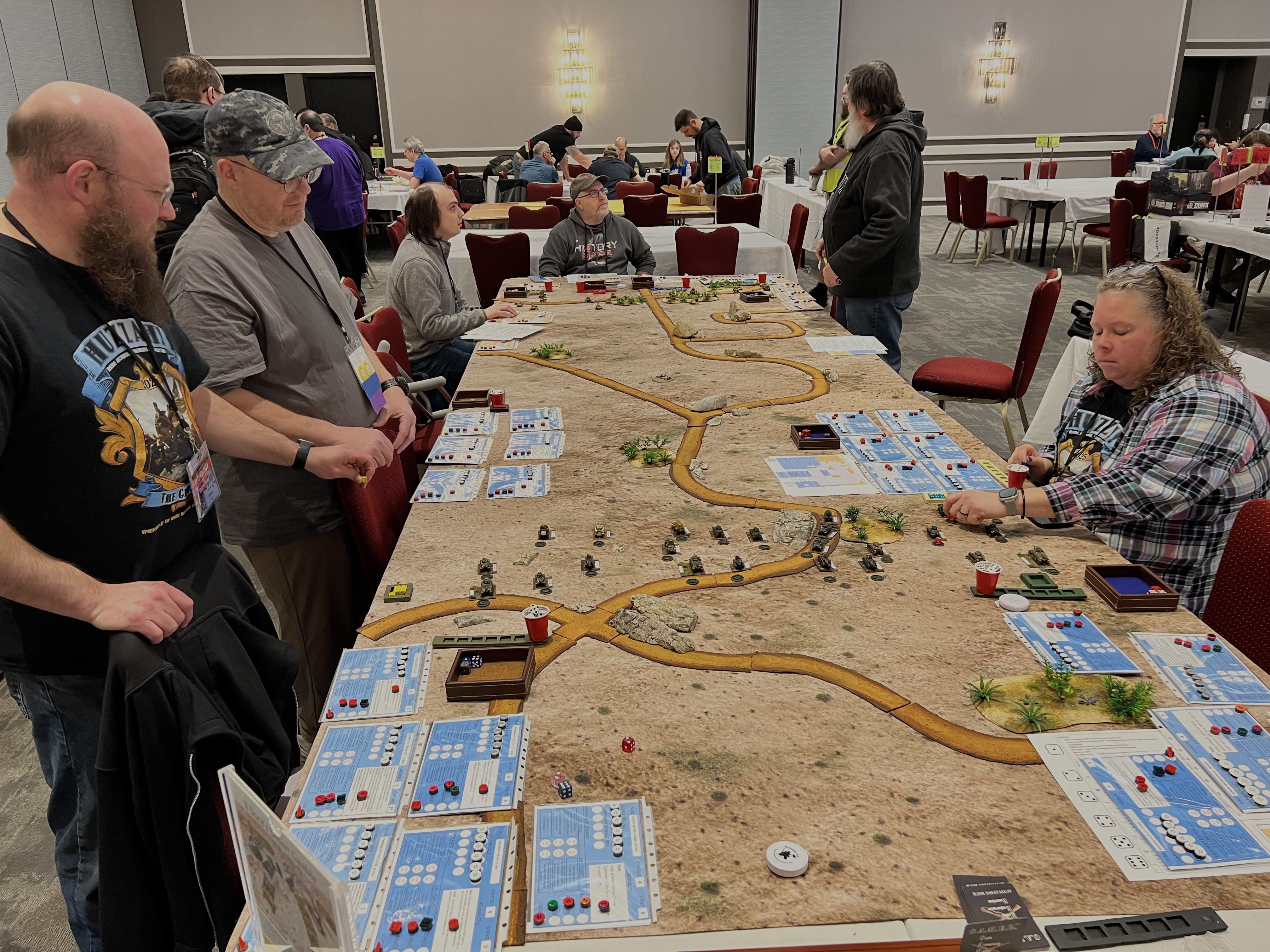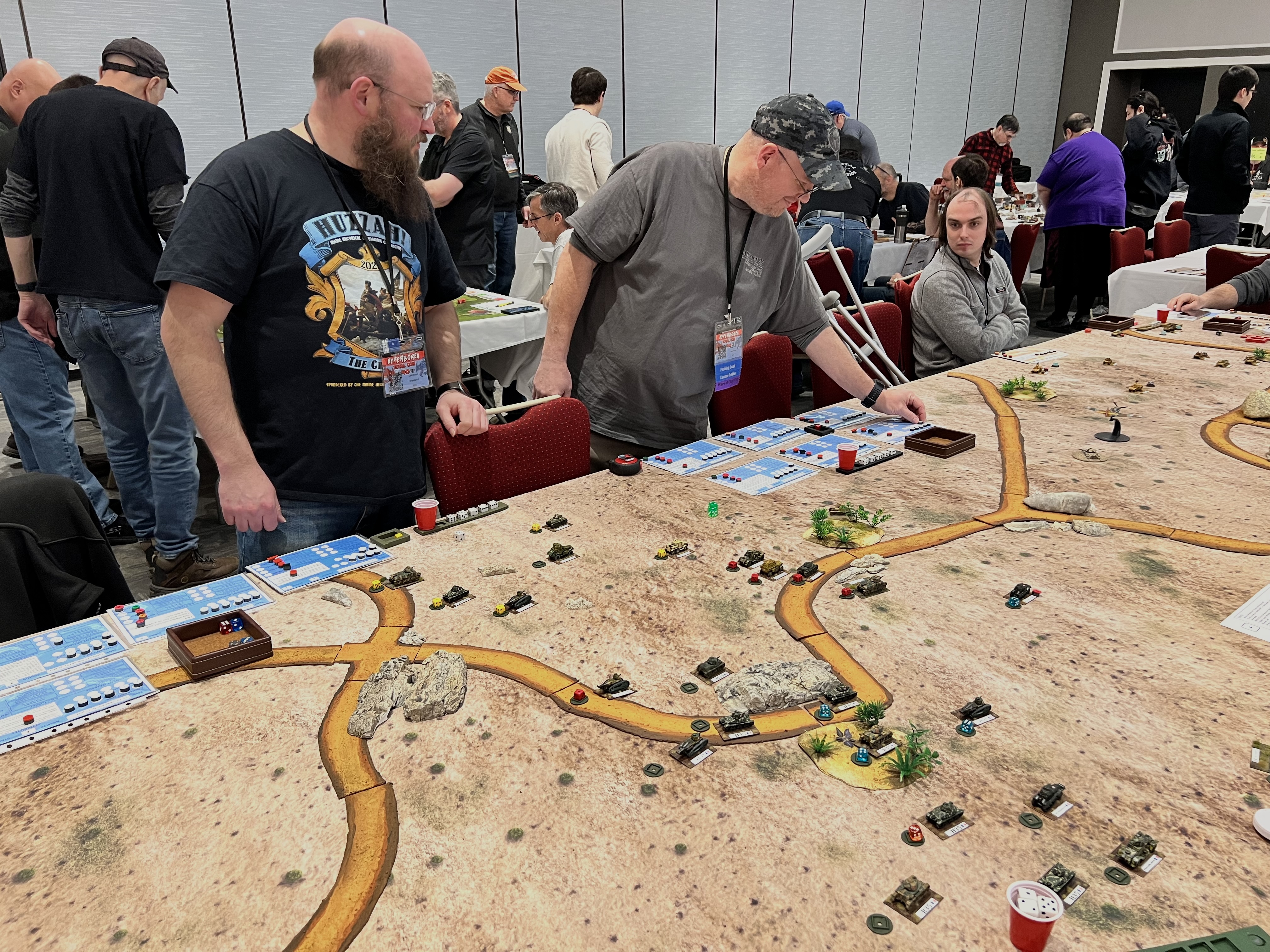
Italian Armored Cars and Tank Destroyers for “Il Duce’s Desert Gamble”

In WWII, the Royal Italian Army was heavily engaged in the North African Campaign starting in June 1940. They fought first alone against the British and then in concert with Nazi Germany’s Afrika Korps after February 1941. The tide of battle ebbed and flowed across North Africa. The Italians and the Germans formed the Panzerarmee Afrika. They battled the British 8th Army in Egypt, Libya, and eventually Tunisia. There, along with US and UK troops from Operation Torch, Axis forces were driven from North Africa in May 1943. Shortly afterwards, in early July of 1943, Operation Husky – the invasion of Sicily – occurred. By the end of that month, Mussolini was ousted. Italy then requested a separate armistice and was out of the war. German forces seized any available Italian war materiel and continued to fight in Italy. Italy then was really in a state of civil war. Some Italian forces fought with the Allies. Others sided with the Germans. Partisan attacks were common – and continued even after the German surrender in April 1945.

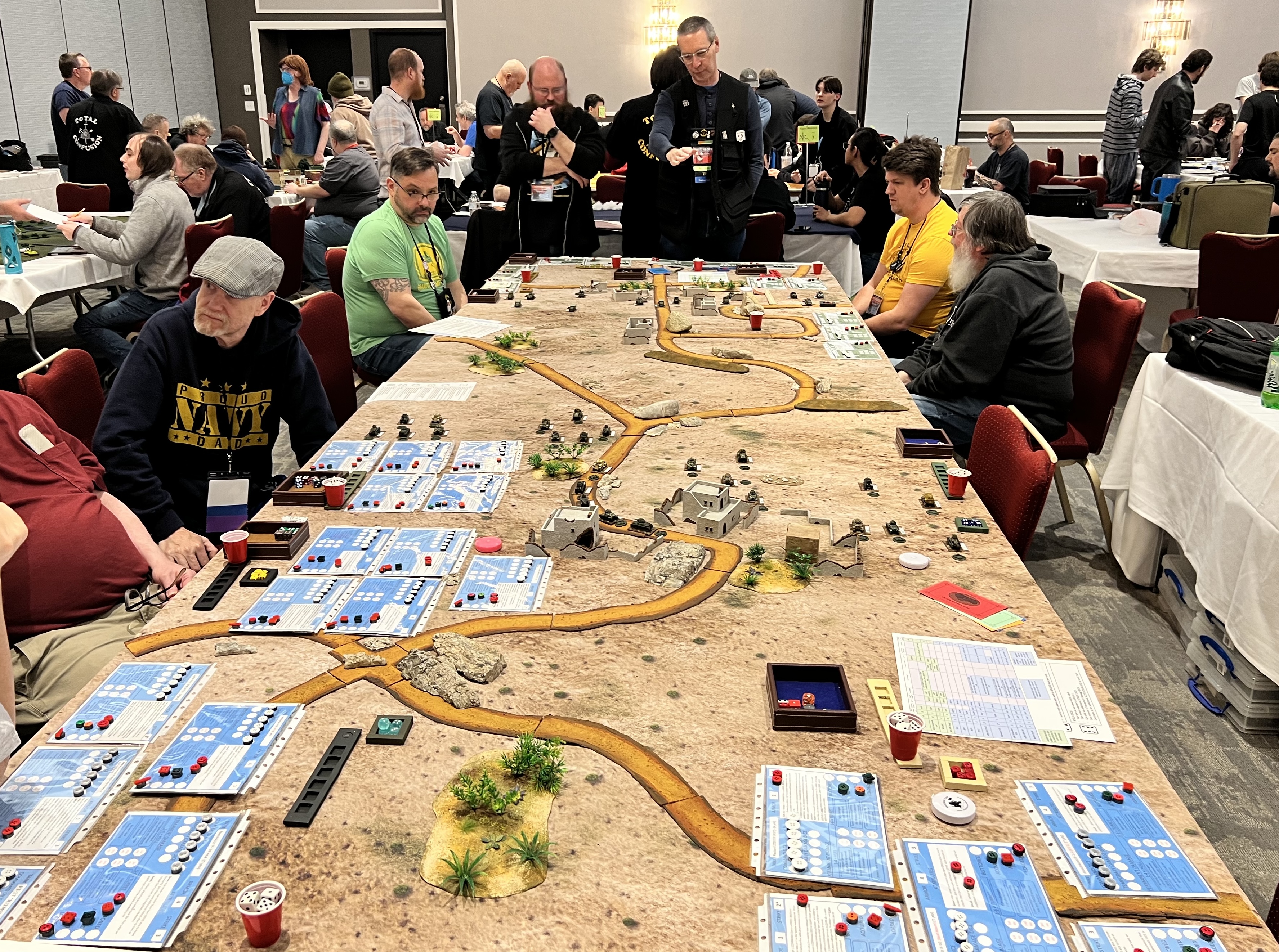
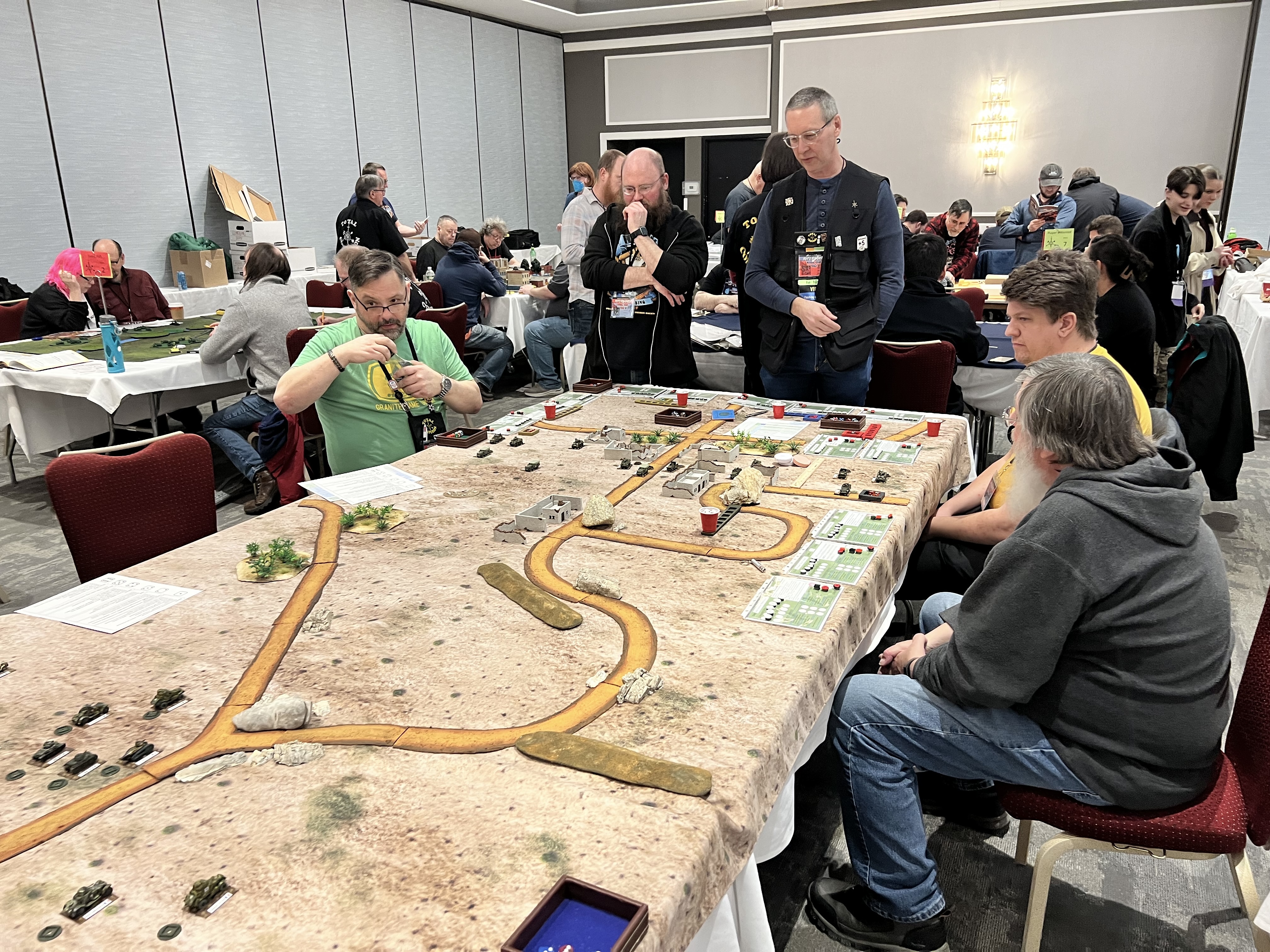
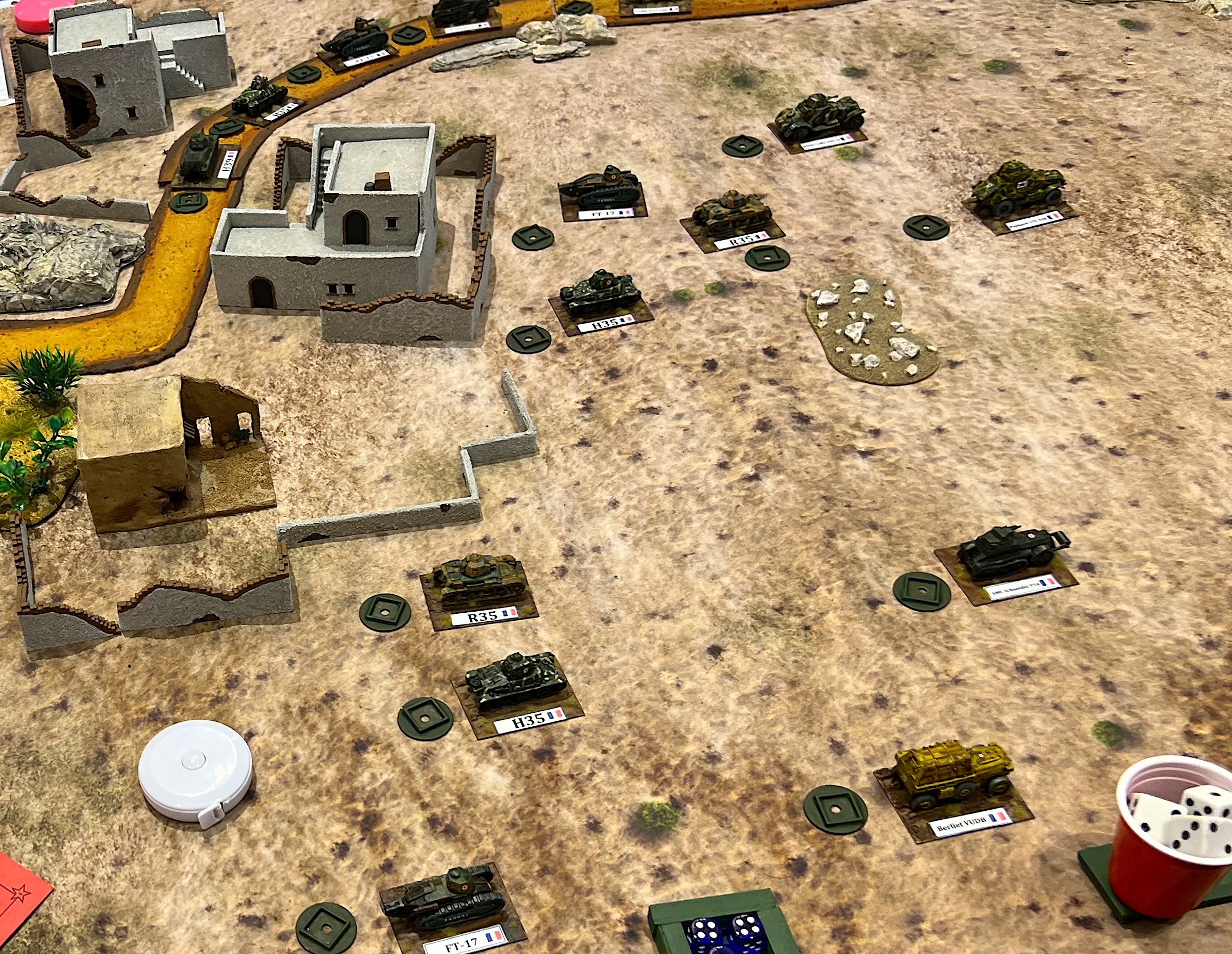
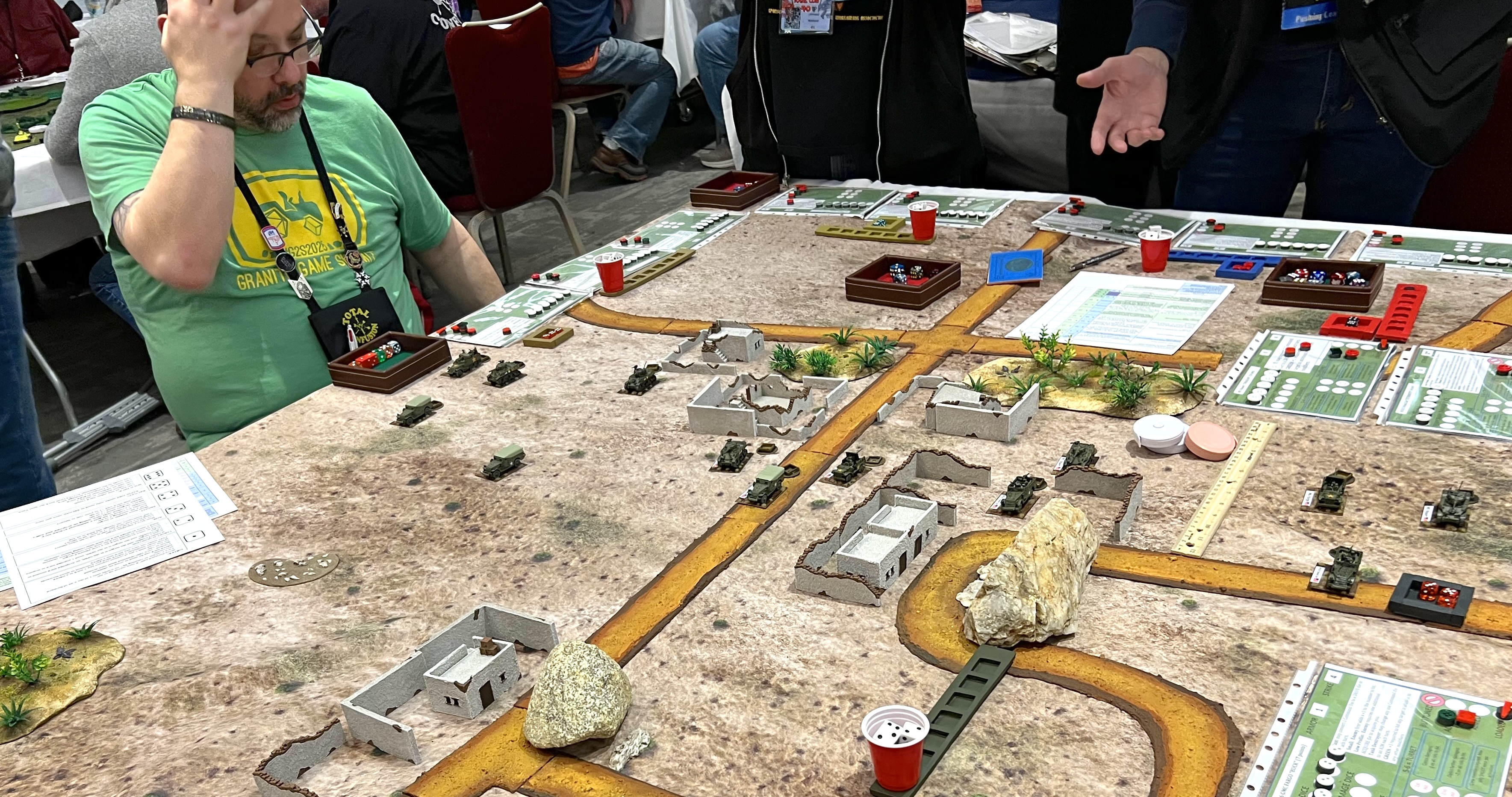
I have found the Royal Italian Army and its equipment interesting. At HAVOC I had run a big North Africa What a Tanker game back in 2019. At this year’s HISTORICON, discussions with one of the players intrigued me. We talked about a “what if” scenario for a “What a Tanker” game where I could have the French defending against the Italians. Mulling that over the summer, I decided to do it! I call it “Il Duce’s Desert Gamble“.

It’s 1942 or 1943. Here, the Allies do not launch Operation Torch. Instead, with the USSR on the verge of collapse, they make the disastrous decision to launch Operation Sledgehammer . It fails miserably. The USSR seeks a separate peace with Germany. The British 8th Army is routed and German forces advance towards the Middle East and its oil fields. The US and UK are in no position militarily or logistically to try any invasion anywhere in Europe for years. The US refocuses on Japan and the Pacific.

Meanwhile, Mussolini sees an opportunity to further his vision of a new Roman Empire that would dominate the Mediterranean. He sees France’s colonies as ripe for the taking, and gains Hitler’s assent to take them. This sets up my desert battle scenario between Vichy French armor and the Italians.

In preparation for the game – I have enough French from my Operation Torch game. I did however need to augment the Italians.

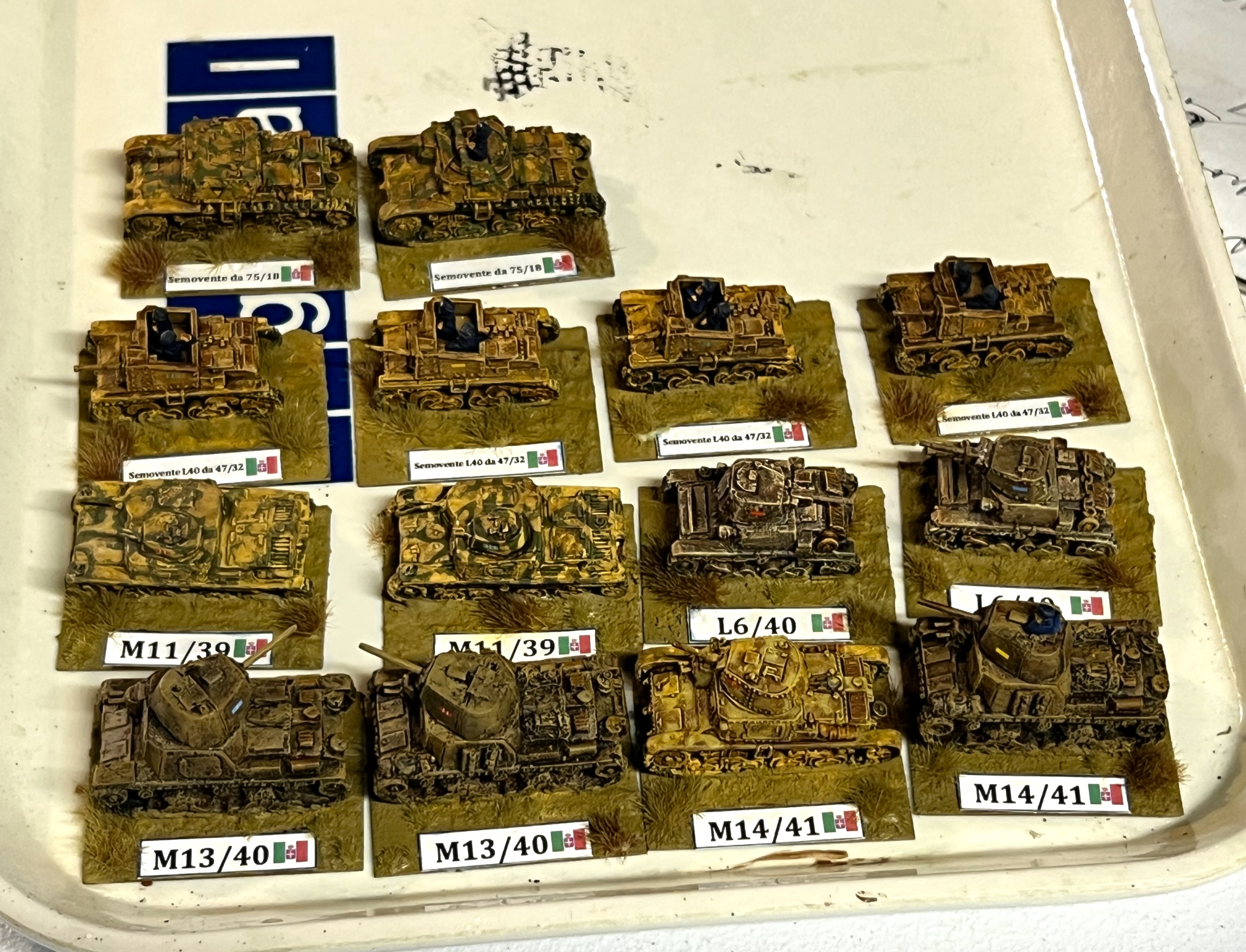
My Italian armor before this project.

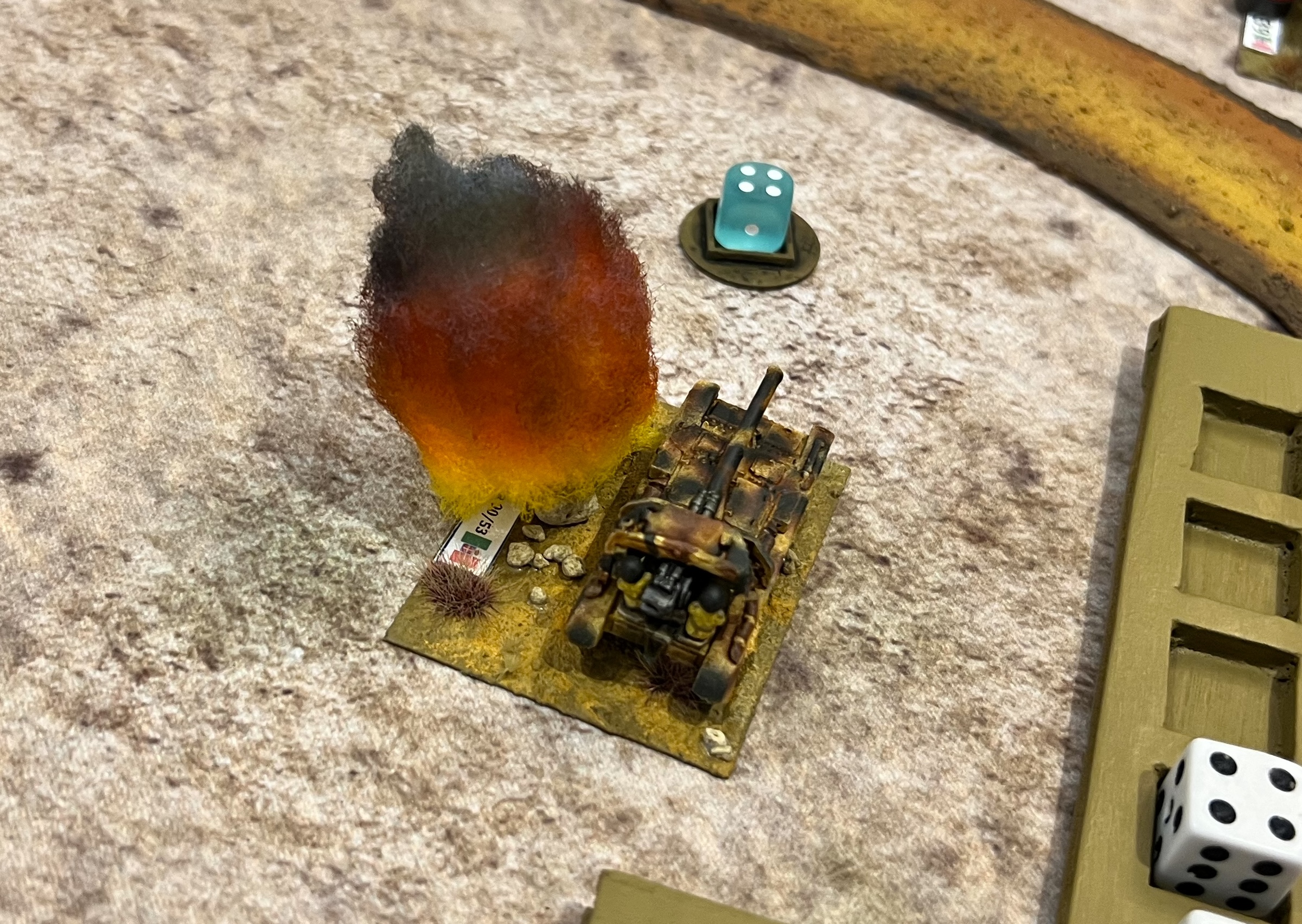
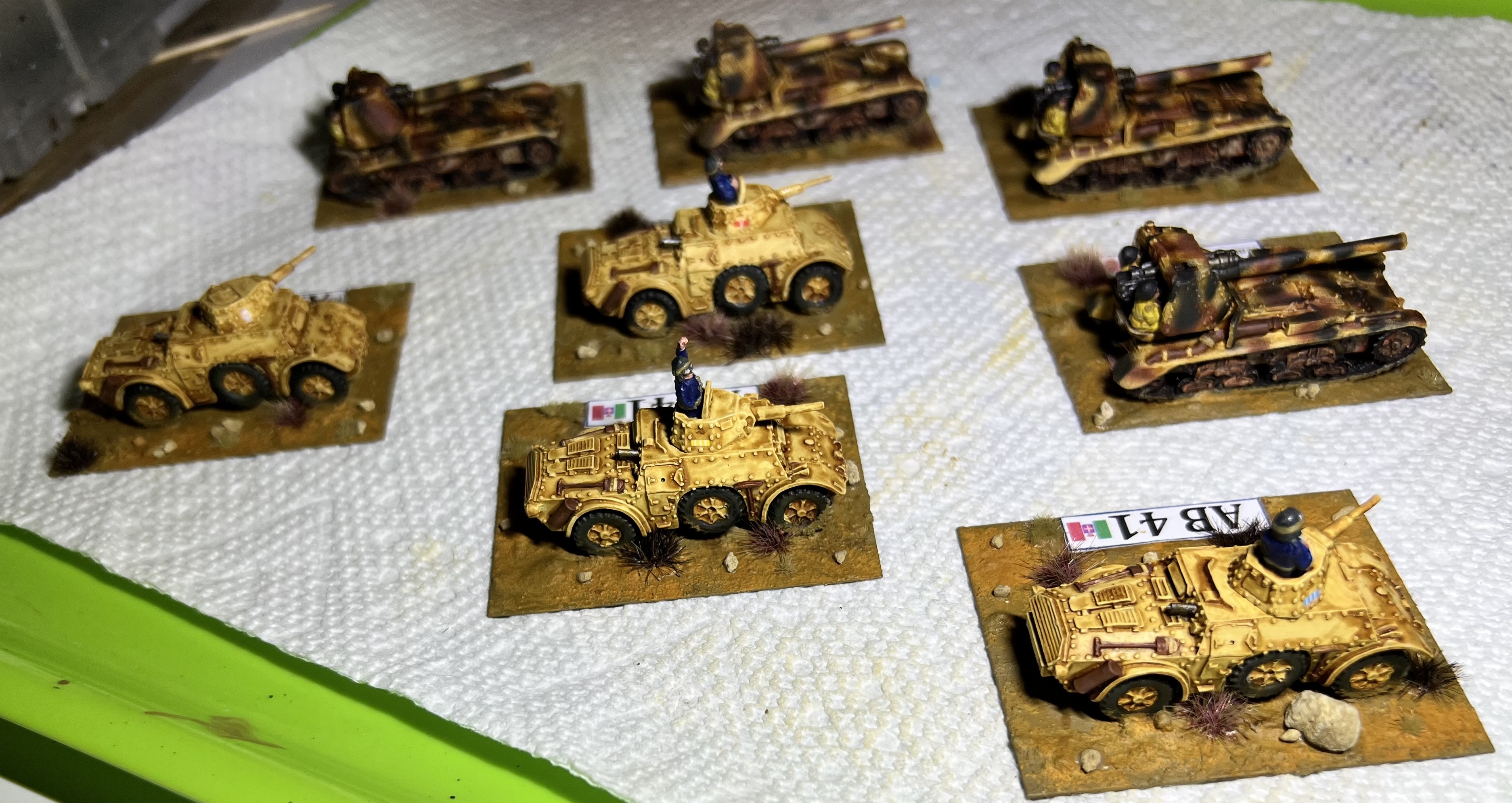
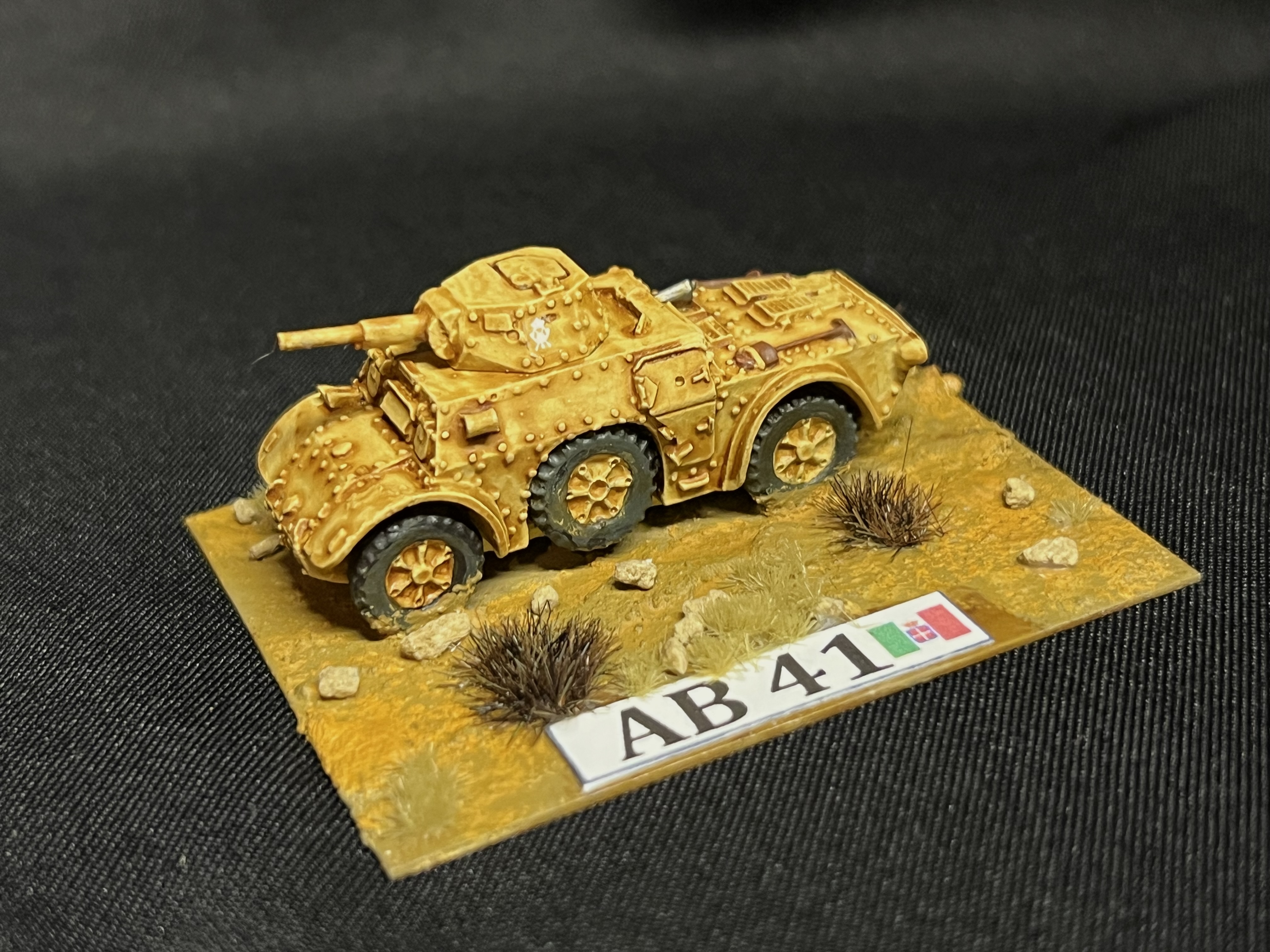
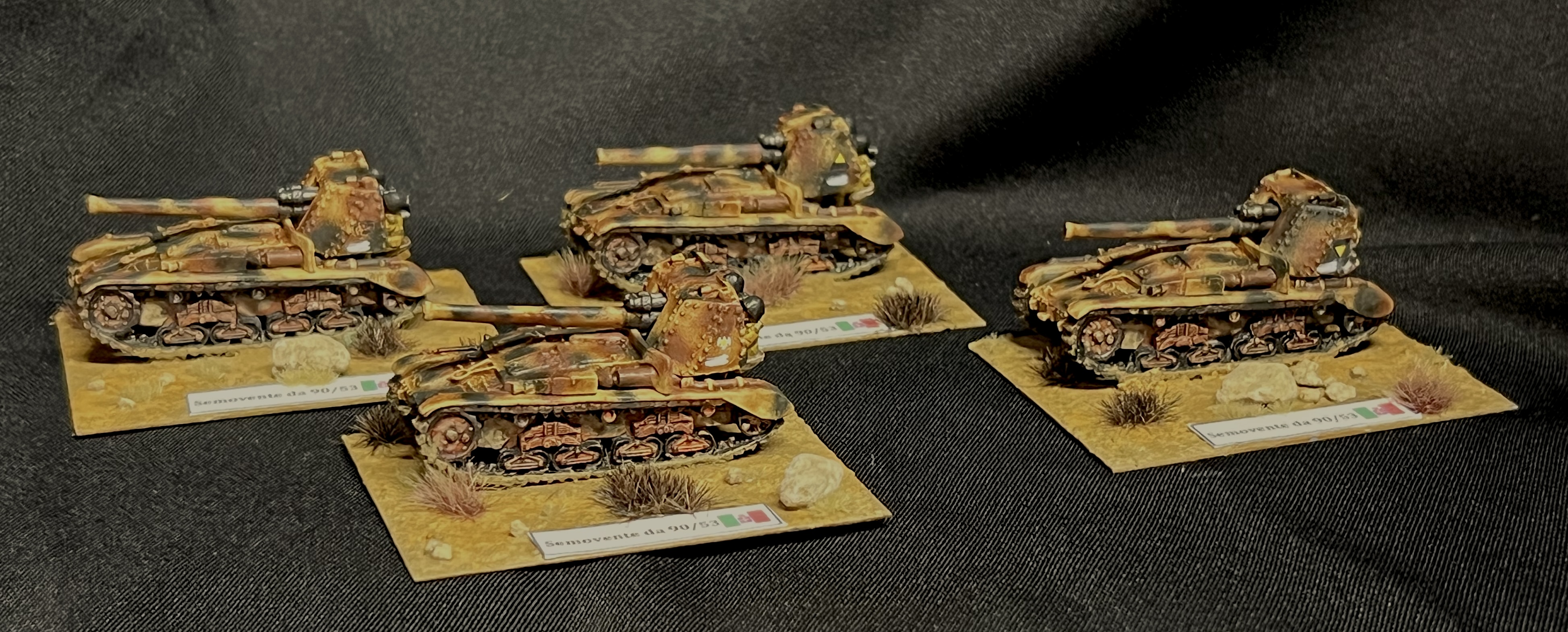
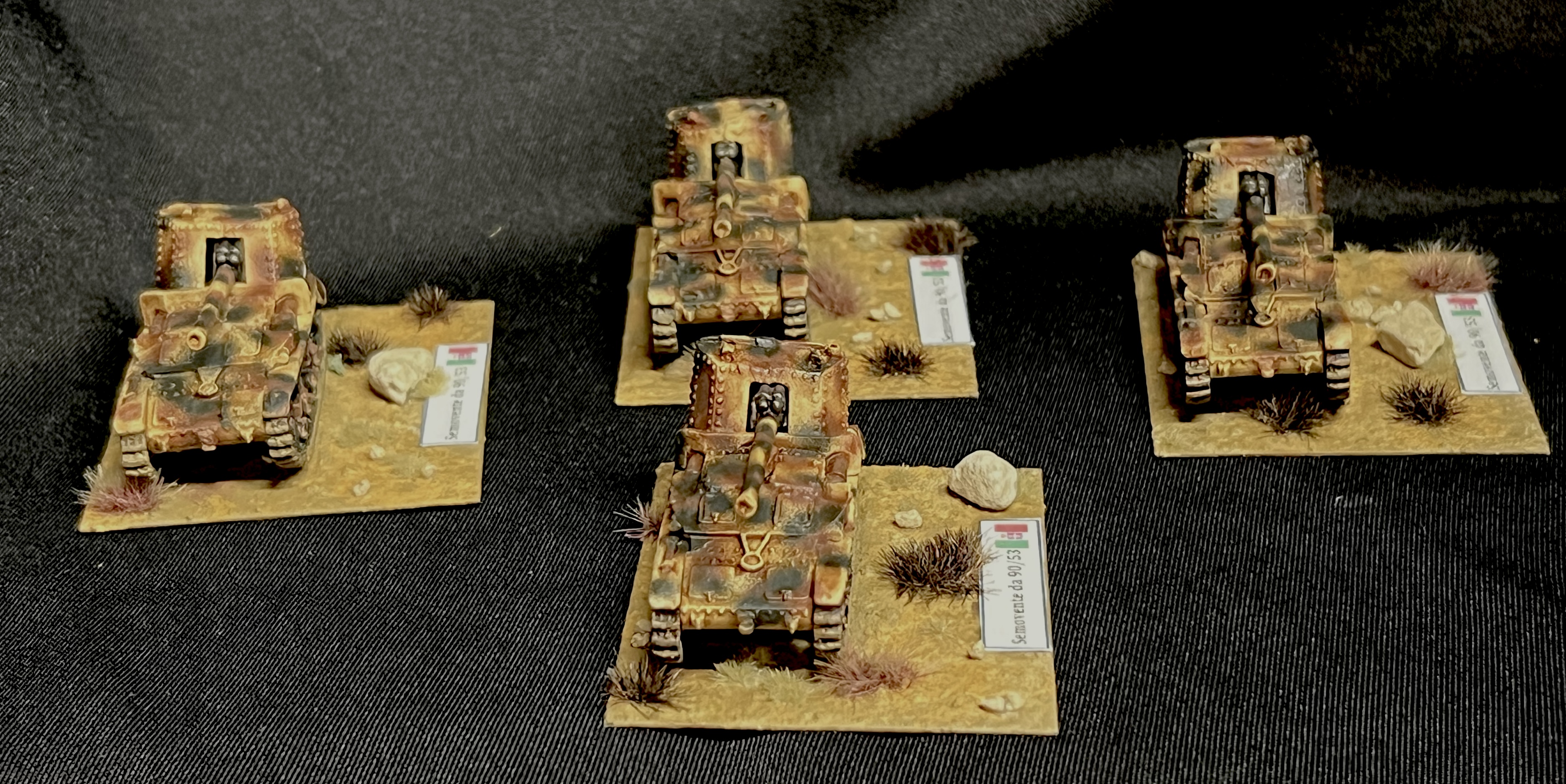
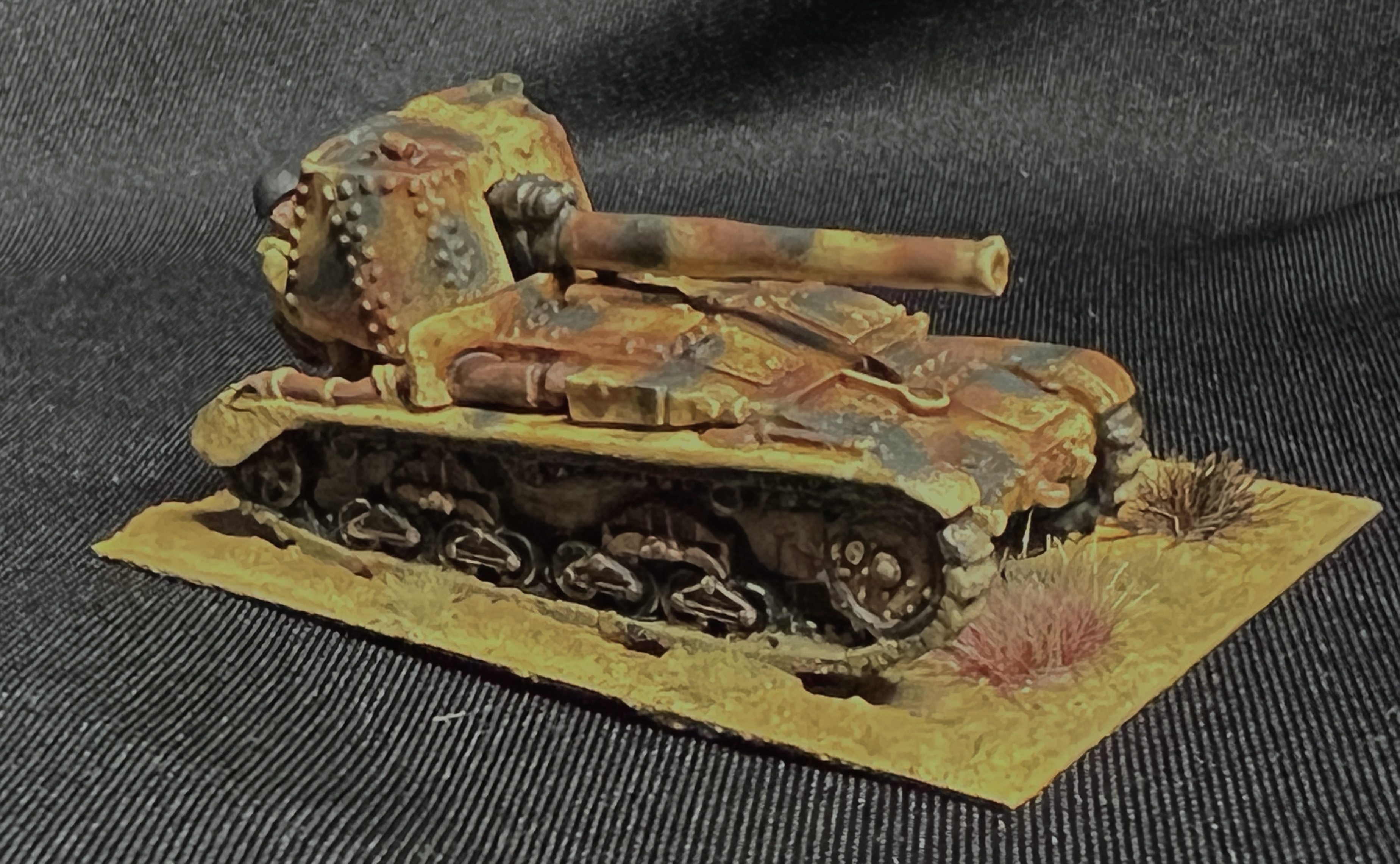
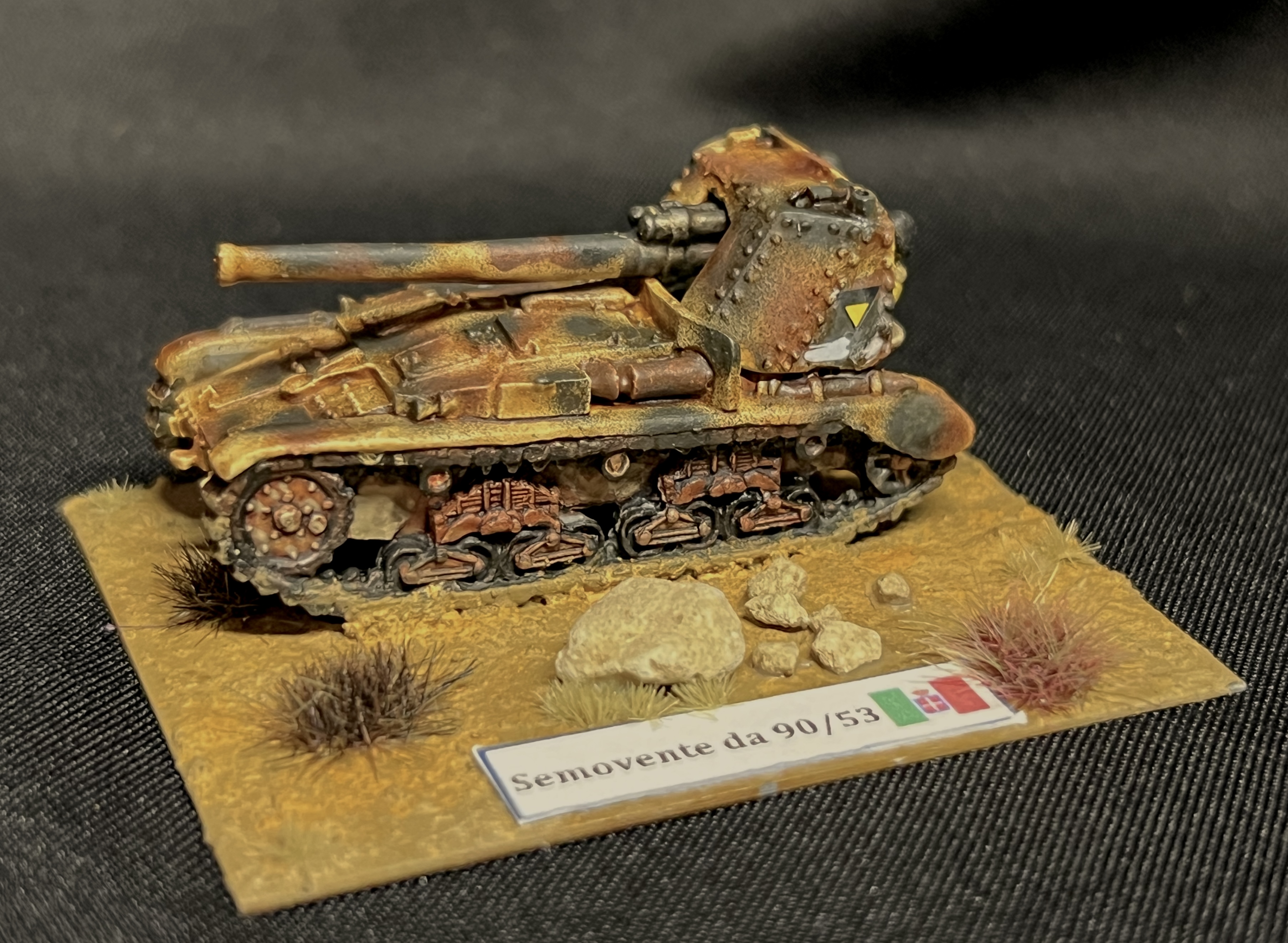
Specifically, I wanted to give them some armored cars. These include the Autoblinda Fiat-Ansaldo 41, also known as AB 41. I also wanted to provide another newer and more powerful tank destroyer, the Semovente 90/53. I use 15mm/1:100 scale models for these games. I acquired a 4-vehicle platoon of the AB 41’s. Simultaneously, I bought a 4-vehicle battery of the Semovente 90/53’s. Both kits are from Battlefront (Flames of War).

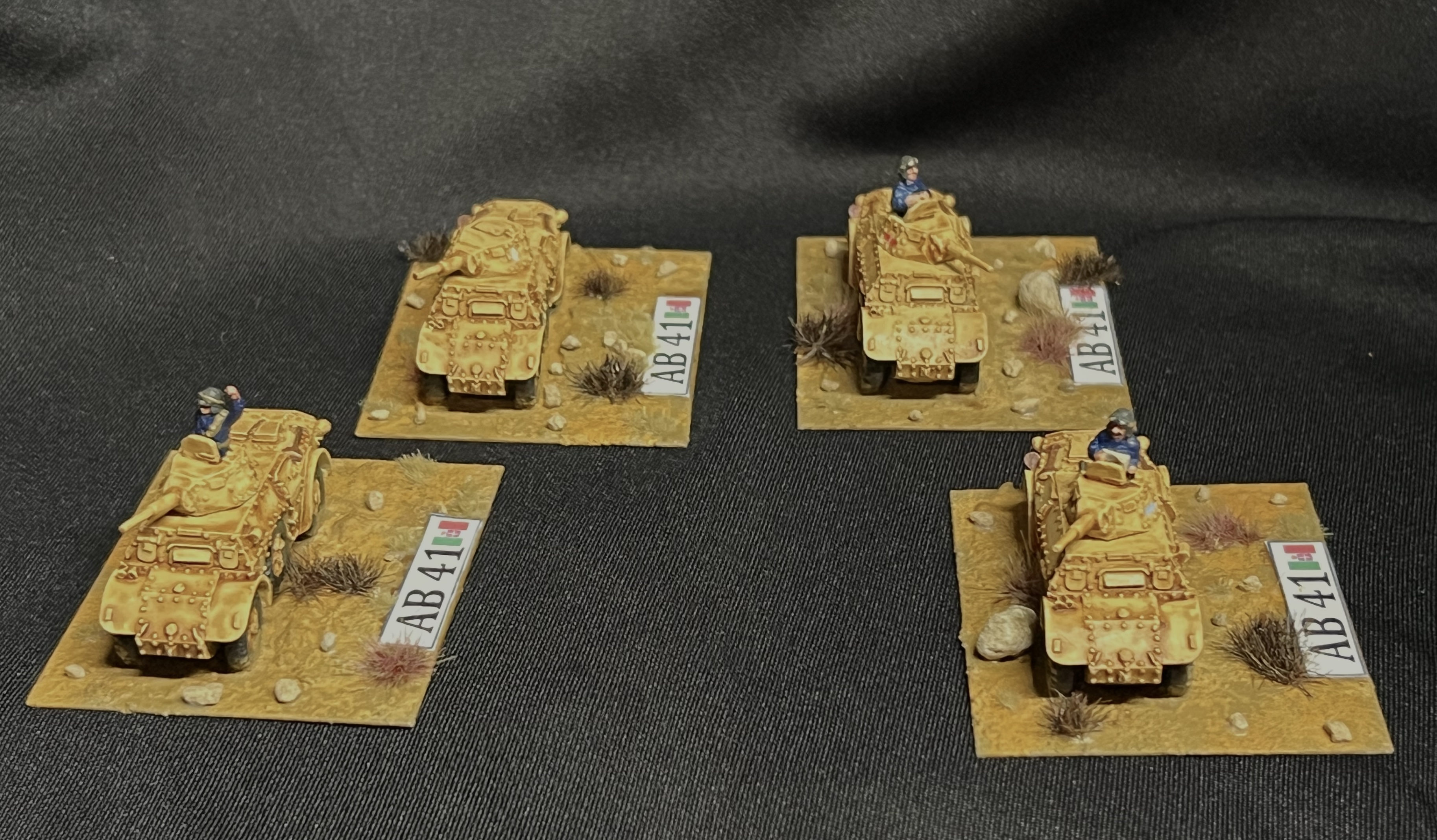
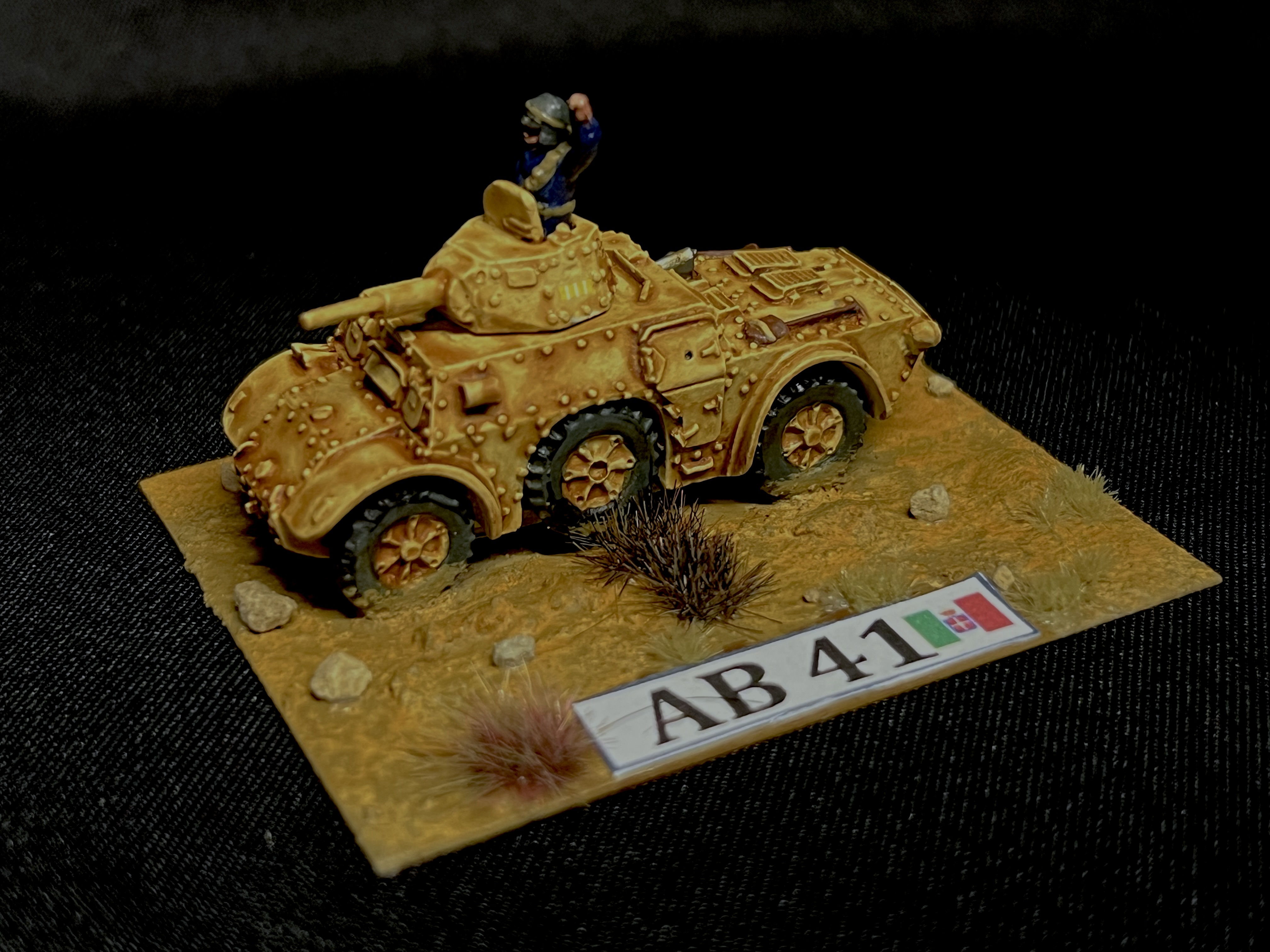
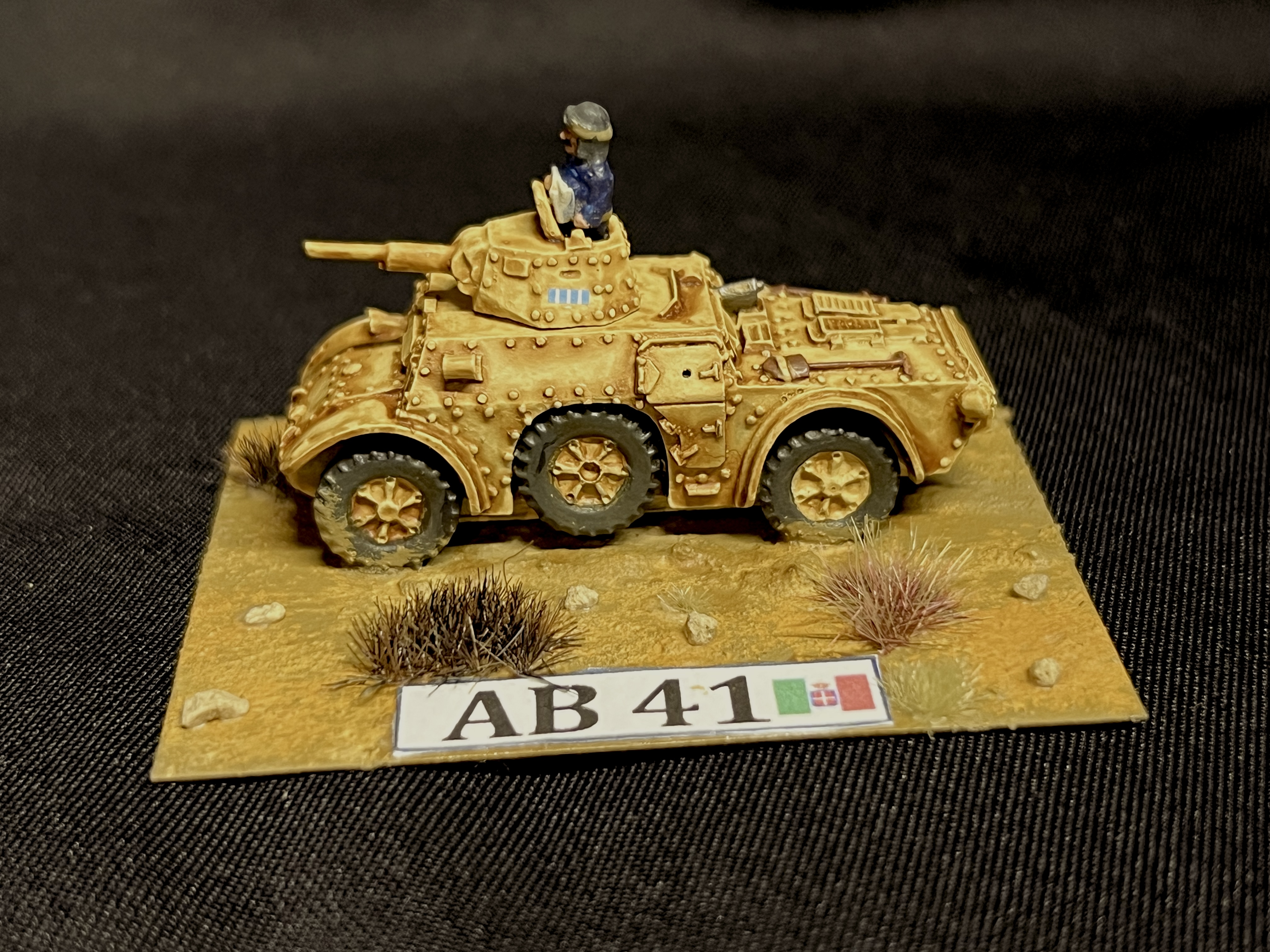
The AB 41 had a 20mm Breda autocannon – similar to the Panzer II- with decent anti-armor penetration capabilities. Its armor was effective against infantry small arms. 667 were built, and served everywhere the Royal Italian Army fought. It served also post-war until the mid-1950’s.

The Semovente 90/53 was built too late and in too few a quantity (only 30 were ever built) to see much WWII action. It had some (not much) experience in North Africa and Sicily under Italian control. The Germans also used seized examples. It’s design was inspired by the Italian experience on the Eastern front. The Italians there found that they had no way of stopping T-34’s or other more modern armor. It took a 90mm cannonne da 90/53 anti-aircraft gun and put it on an M14/41 tank chassis. The gunners would be exposed as they were behind a mantlet. It also needed an L6 tank modified to carry its ammunition. It’s armor penetration was impressive and any Allied tank it faced was vulnerable even at long range. I have decided to forego using any L6 tanks as ammo carriers for the game. I’ll just assume they are there. I’m also assuming that these would have been available in sufficient numbers for my game scenario in the absence of the Italian Armistice. Just one survives to this day at Fort Sill here.

An interesting aside note – 12 of the same type of anti-aircraft gun were taken from the Italian battleship Vittorio Veneto. These guns were awarded to Yugoslavia as war reparations. I remember playing with that ship’s token in Avalon Hill’s War at Sea game as a kid. That they ended up firing in 1991 is somewhat odd!

According to Wikipedia:

After the war, the twelve 90/53 guns from the Italian battleship Vittorio Veneto were assigned to Yugoslavia as a part of war reparations. They were mounted on a coastal artillery battery on island Žirje off Šibenik as a part of the Cold War defense strategy. These guns saw action in September 1991 during the Croatian War of Independence, deterring the Yugoslav People’s Army assault on Šibenik and blocking 34 Yugoslav Navy’s patrol boats and minesweepers which were later captured by Croatian forces in the inner harbor.

Reminiscing ended – back to the vehicles!

WIP Shots

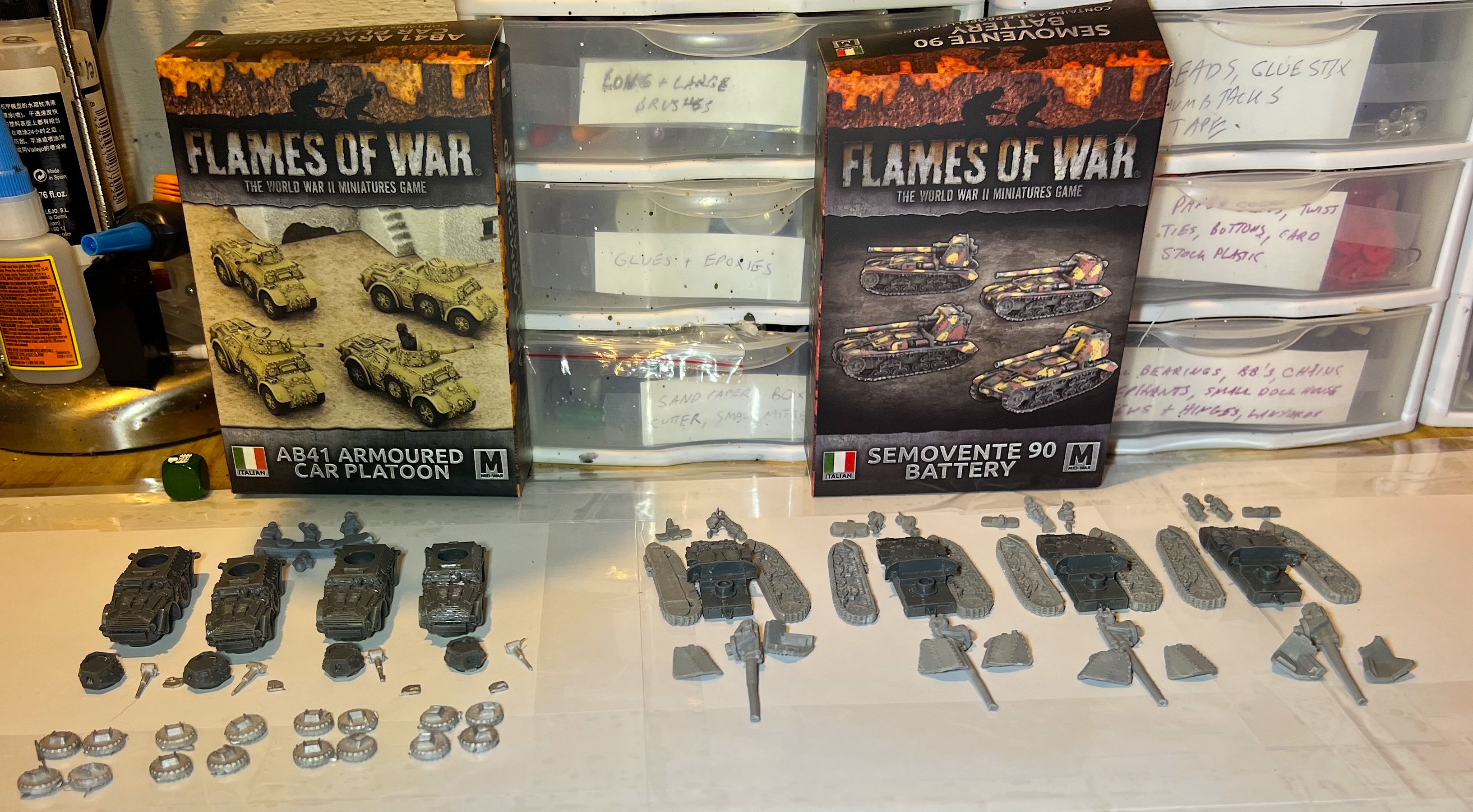
The two kits as received.

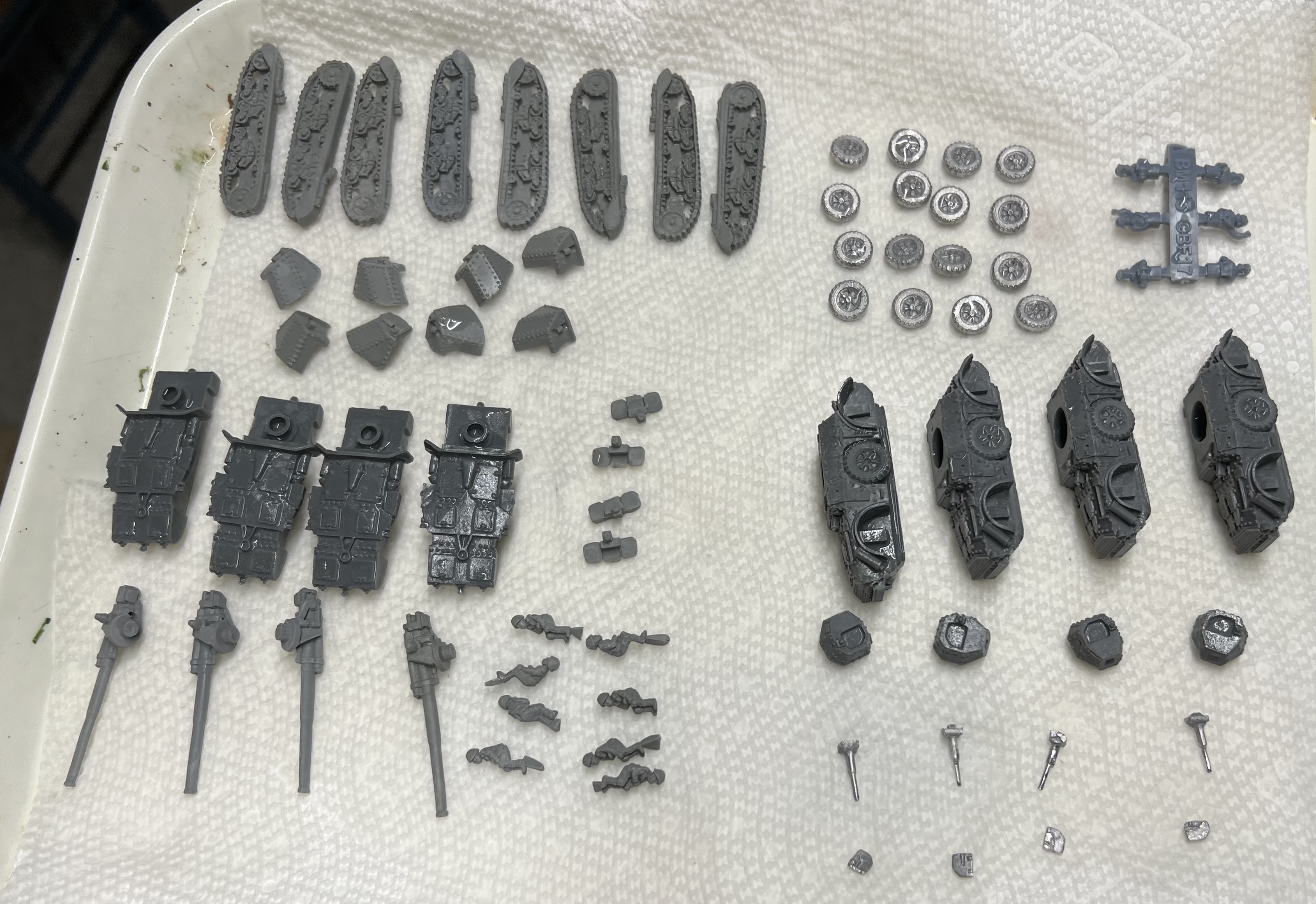
As is my usual practice, I washed and scrubbed the components.

Ready for assembly.

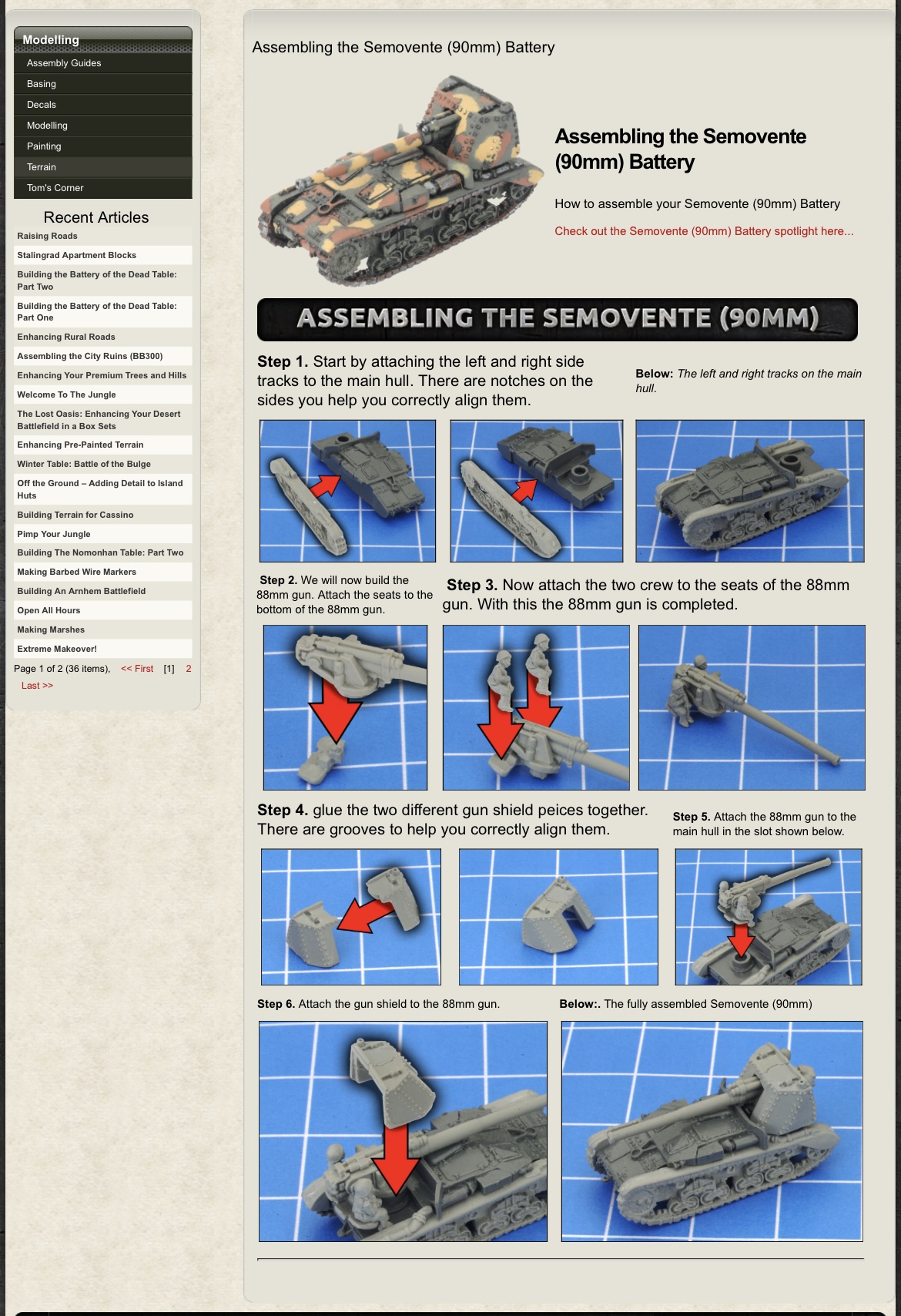
I assembled and painted the tracks, wheels, crews, mantlets, and chassis separately. Battlefront has a page on assembling the Semovente which was helpful.

Screenshot

That model was not so easy to work on – mainly the crew and weapon mounting. I ended up using green stuff on the fiddly mantlets. I did paint the crew of the Semovente’s – though no one will ever see their faces! As for the commanders of the AB 41’s – I used three different poses plus one with the hatch shut.

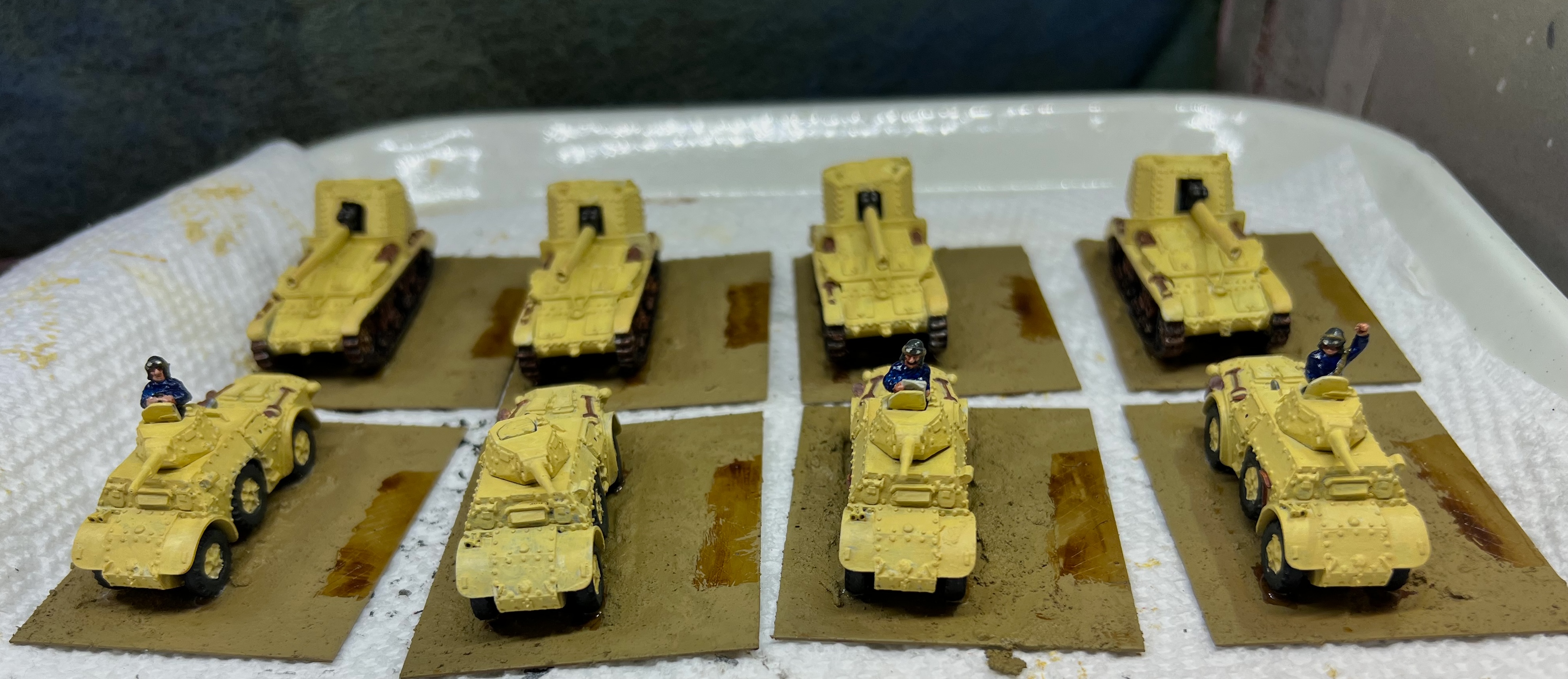
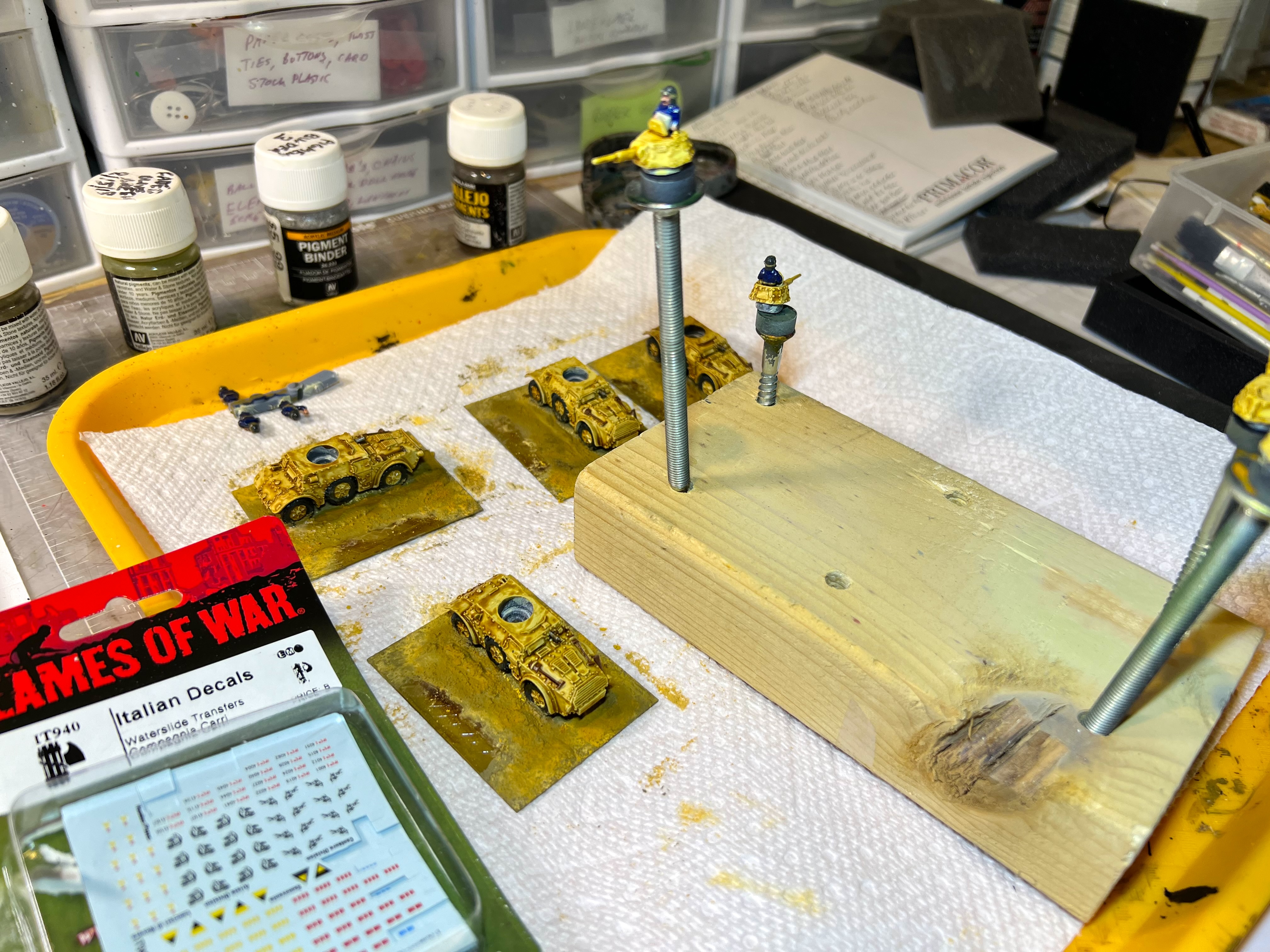
I mounted the vehicles on their bases as shown below. Once painted, I applied decals for better tabletop recognition (for the players).

I shaded the AB 41’s. I applied decals on the vehicles and pigments to some texture paints on the bases. All paints and more that I used are listed at the end of this post.

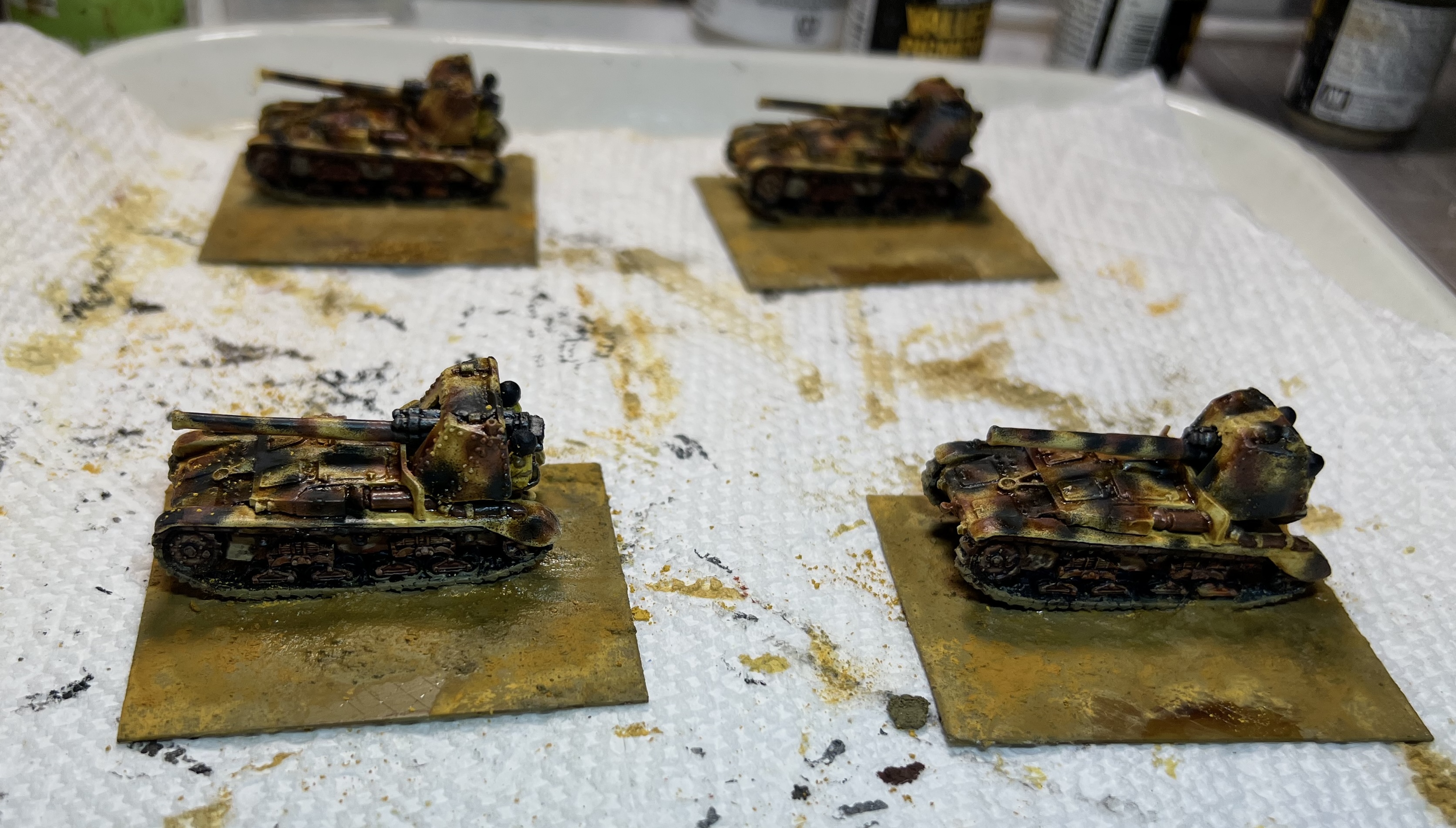
I airbrushed the camouflage pattern on the Semovente’s.

At this point, the models were finished!

Let’s now see some eye candy of the models.

AB 41

AB 41 frontal view
AB 41 right side
AB 41 rear view

Lastly, close up shots of the 4. Note that they all have different decals on their turrets.

Semovente da 90/53

Semovente da 90/53 left view
Semovente da 90/53 frontal view
Semovente da 90/53 right side view
Semovente da 90/53 rear view showing gunners

Lastly, close up shots of the 4. Note that they all have different decals on their mantlets.

These will be on the tabletop at Cold Wars, TotalCon, and other upcoming conventions. Please let me know your thoughts and feedback in the comments section. Thanks in advance for your input. As always, thanks for reading.

For all of my posts on WWII games and projects, there is a consolidated list. You can find the posts and their links located here.

MATERIALS USED

PAINTS, INKS, GLAZES, SHADES, WASHES, PIGMENTS AND FLOCKING USED ON THE FOUR BATTLEFRONT/FLAMES OF WAR AB 41 ARMORED CAR MODELS

  1. Green Stuff
  2. Gorilla Glue
  3. War Games Accessories Steel Bases Number FOW 3 (2″ x 2½”)
  4. Neodymium magnets (⅛”)
  5. Vallejo Primers “Desert Tan”
  6. Vallejo Surface Primer “Panzer Grey”
  7. Vallejo Model Color “Dark Sand”
  8. Vallejo “Thinner Medium”
  9. Vallejo Model Air “Tire Black”
  10. Vallejo Model Color “Dark Prussian Blue”
  11. Vallejo Model Air “Rust”
  12. P3 “Midland Flesh”
  13. P3 “Flesh Wash”
  14. Citadel “Tallarn Sand”
  15. Reaper MSP Core Colors “Pure Black”
  16. Vallejo Model Air “Dark Brown”
  17. Battlefront “Worn Canvas”
  18. FolkArt “Champagne”
  19. Vallejo Thinner
  20. Vallejo “Gloss Acrylic Varnish”
  21. Citadel “Armageddon Dust” (texture)
  22. Army Painter “Light Tone” (wash)
  23. Vallejo “Dark Yellow Ochre” (pigment)
  24. Vallejo “Light Yellow Ochre” (pigment)
  25. Vallejo “Light Sienna” (pigment)
  26. Vallejo “Pigment Binder”
  27. Microscale Industries “Liquid Decal Film”
  28. Flames of War Italian Decal Set (IT940)
  29. Microscale Industries “Micro Set”
  30. Microscale Industries “Micro Sol”
  31. Vallejo Mecha Varnish “Matte Varnish”
  32. Shadow’s Edge Miniatures “6mm Pink Sunset” (flocking)
  33. Shadow’s Edge Miniatures “4mm Badlands Tufts” (flocking)
  34. Gamers Grass “Tiny Beige 2mm Tufts” (flocking)
  35. PVA Glue
  36. Printed labels on card stock
  37. Small talus

PAINTS, INKS, GLAZES, SHADES, WASHES, PIGMENTS AND FLOCKING USED ON THE FOUR BATTLEFRONT/FLAMES OF WAR SEMOVENTE DA 90/53 MODELS

  1. Green Stuff
  2. Gorilla Glue
  3. War Games Accessories Steel Bases Number FOW 3 (2″ x 2½”)
  4. Vallejo Primers “Desert Tan”
  5. Vallejo Surface Primer “Panzer Grey”
  6. Vallejo Model Color “Dark Sand”
  7. Vallejo “Thinner Medium”
  8. Vallejo Model Color “Dark Prussian Blue”
  9. Vallejo Mecha Color “Steel”
  10. Vallejo Mecha Weathering ” Dark Rust Wash” (wash)
  11. Vallejo Model Air “Gun Metal”
  12. P3 “Midland Flesh”
  13. P3 “Flesh Wash”
  14. Army Painter “Dark Tone” (wash)
  15. Vallejo Model Color “Japanese Uniform WWII”
  16. Citadel “Karak Stone”
  17. Citadel “Tallarn Sand”
  18. Battlefront “Worn Canvas”
  19. Army Painter Speed Paint 1.0 “Pallid Bone”
  20. Reaper MSP Core Colors “Pure Black”
  21. Battlefront “Boot Brown”
  22. Vallejo Model Air “Rust”
  23. Vallejo Thinner
  24. Citadel “Armageddon Dust” (texture)
  25. Army Painter “Light Tone” (wash)
  26. Wooden Blocks, steel bolts, steel washers, nails, magnets, steel screws
  27. Vallejo “Dark Yellow Ochre” (pigment)
  28. Vallejo “Light Yellow Ochre” (pigment)
  29. Vallejo “Light Sienna” (pigment)
  30. Vallejo “Pigment Binder”
  31. Vallejo “Gloss Acrylic Varnish”
  32. Vallejo “Light Sienna” (pigment)
  33. Vallejo “Pigment Binder”
  34. Microscale Industries “Liquid Decal Film”
  35. Flames of War Italian Decal Set (IT940)
  36. Microscale Industries “Micro Set”
  37. Microscale Industries “Micro Sol”
  38. Vallejo Mecha Varnish “Matte Varnish”
  39. Shadow’s Edge Miniatures “6mm Pink Sunset” (flocking)
  40. Shadow’s Edge Miniatures “4mm Badlands Tufts” (flocking)
  41. PVA Glue
  42. Printed labels on card stock
  43. Small talus

M5 Stuart tanks for “Operation Torch: Vichy Mounts an Armored Counterattack” Game

I promised back in August that I would post about my US M5 Stuart tanks. These would be the linchpin of my US forces in my “Operation Torch: Vichy Mounts an Armored Counterattack” games.

M5 Stuart in Casablanca.

Yes, the US and UK did briefly engage French forces of Vichy in North Africa in WWII. After the US Operation Torch landings, Vichy did put up a resistance. Technically they were supposed to be neutral after the 1940 Armistice. However, the Soviets were dealing with massive battles on the Eastern Front, and the US/UK allies were not yet ready to successfully invade Fortress Europe. As the Dieppe raid showed, it would have been a catastrophic failure in 1942.

The idea was to take off some of the pressure on the Soviets by getting in the war somewhere and tie down the Germans. French North Africa became the chosen option, with the hope that the Vichy French would welcome the US/UK invaders as liberators and not invaders. For a brief period in November 1942, both of these two options played out in Morocco, Tunisia, and Algeria – until the French there decided to cease resisting the Allies. Subsequently, back in Europe, Hitler was enraged at the Vichy capitulation and ordered his forces to invade the remaining southern part of France that was not yet occupied.

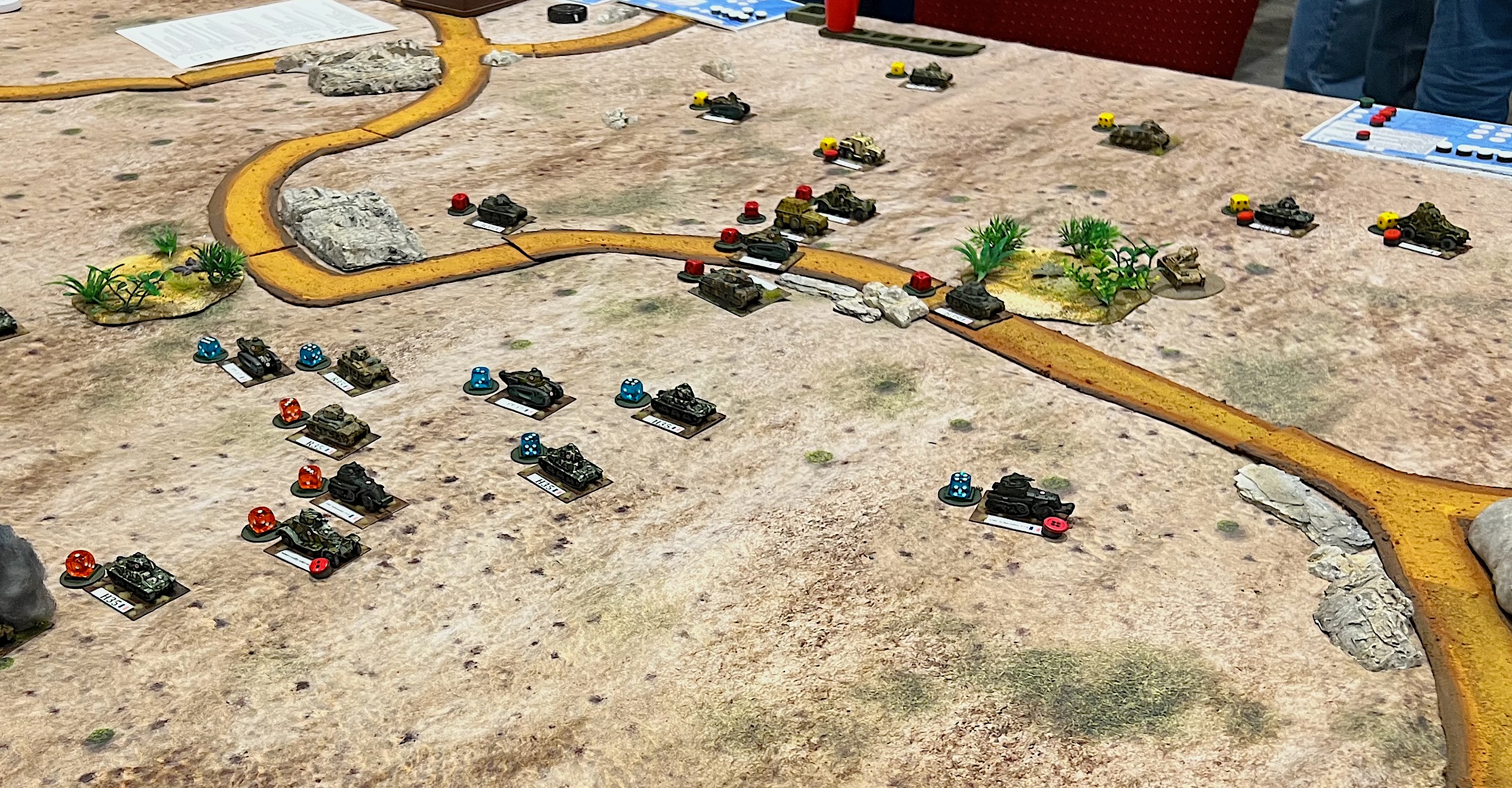
Back in North Africa in November 1942, one of the more obscure incidents of the conflict was in Morocco – where the French 1er Regiment de Chasseurs d’Afrique launched an armored counterattack towards the landing beaches. At that critical juncture, the 66th Armored Regiment of the 2nd Armored Division (and Sub-Task Force Goalpost) had just 7 M5 Stuart tanks that it could cobble together to intercept the French. Their M4 Sherman tanks needed a port to unload, and that had not happened yet.

I found this article/post by Patrick Chaisson to be an excellent description of the combat that happened in November 1942.

As far as a concept for a wargame, I liked the idea of a game that would recreate this clash of armor – especially as one side was green as hell, and the other fielded such a hodgepodge of elderly and obsolescent armor.

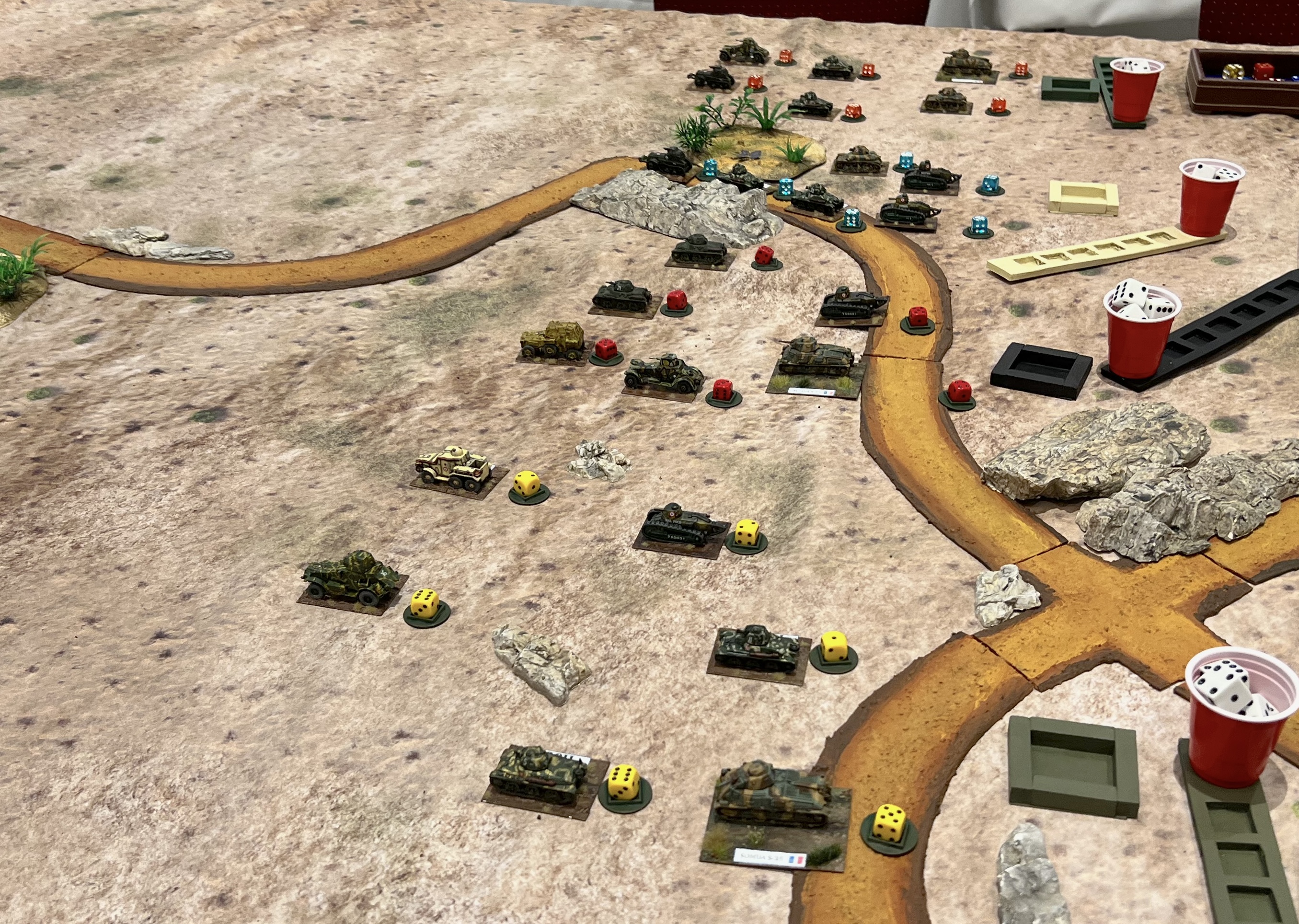
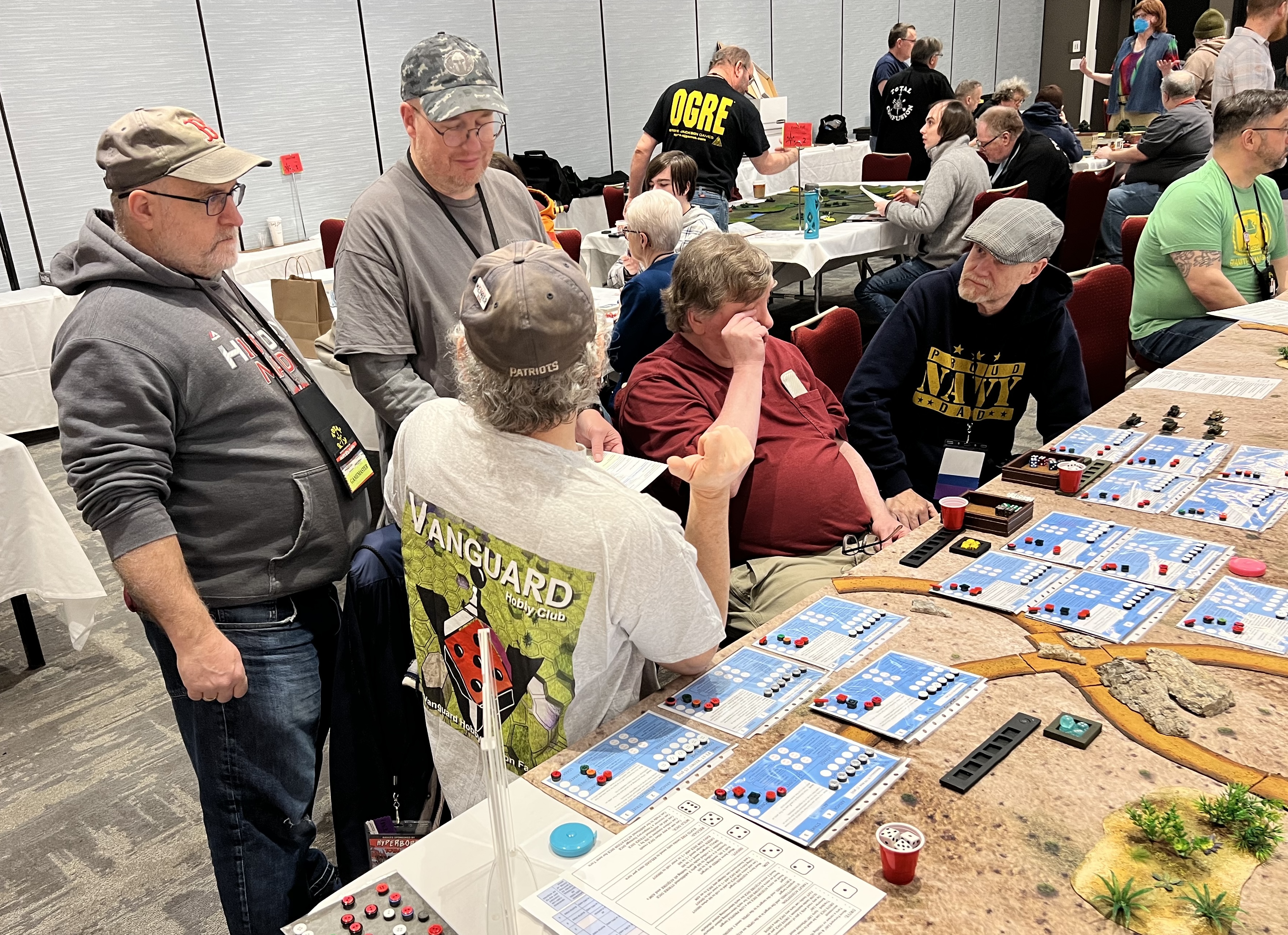
I ran this game twice at HISTORICON 2025, along with two Wars of Ozz games. All went well. I hope to post some convention shots in my next post (albeit very late). Unfortunately golf season was very busy this summer (well, fortunately for my golf game and not my hobby projects). Still, I keep my word. I thought I’d add a bit about the game as well, while saving specific game/convention photos for the next post. However, the game is coming back!

I will be running the game again twice at HMGS Fall In this November. Here are the inks – one is on Friday afternoon and one is on Friday night. I can handle up to 10 players per game – and I can scale it for fewer as well. as of this writing, there are still slots available.

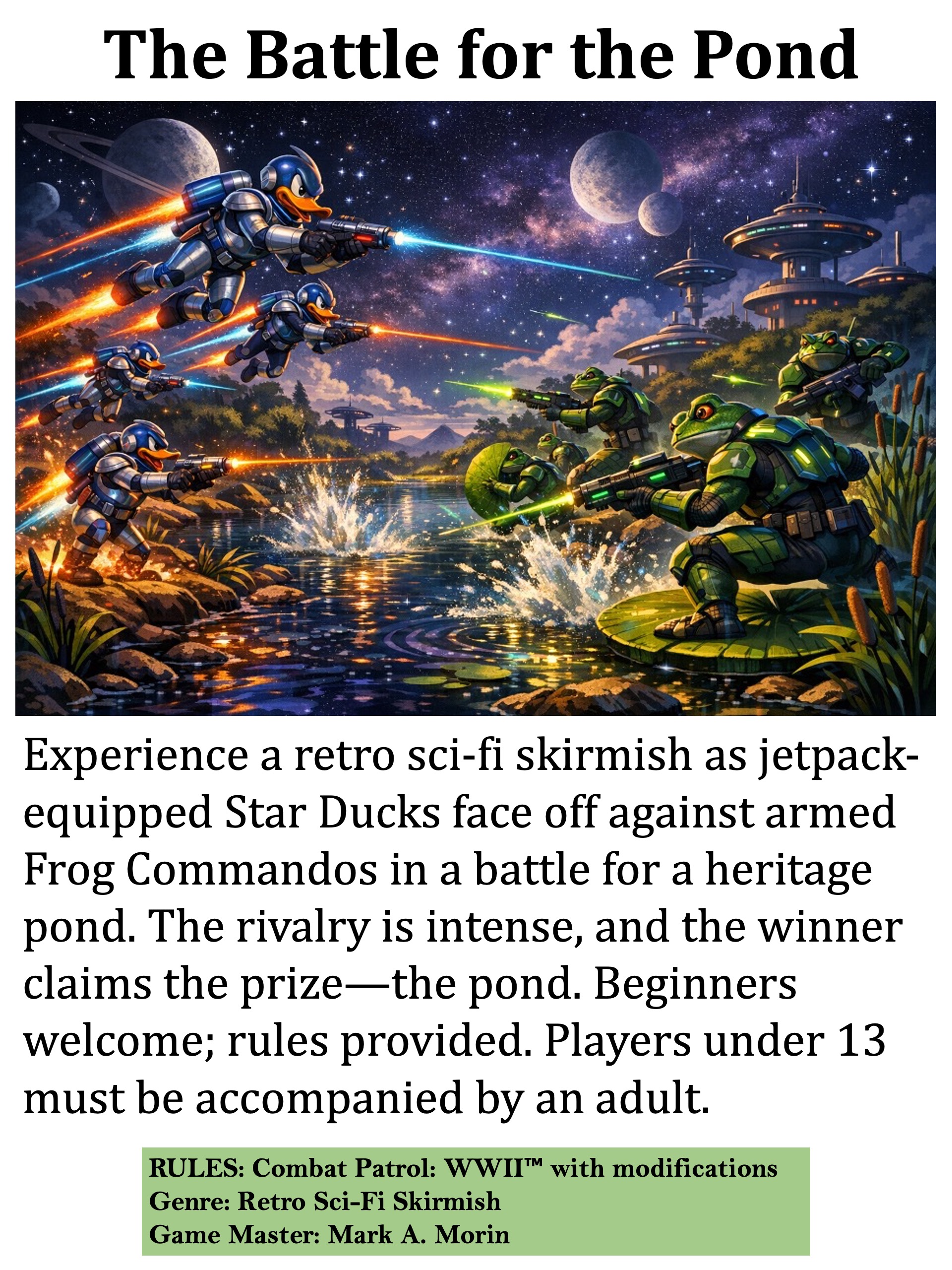
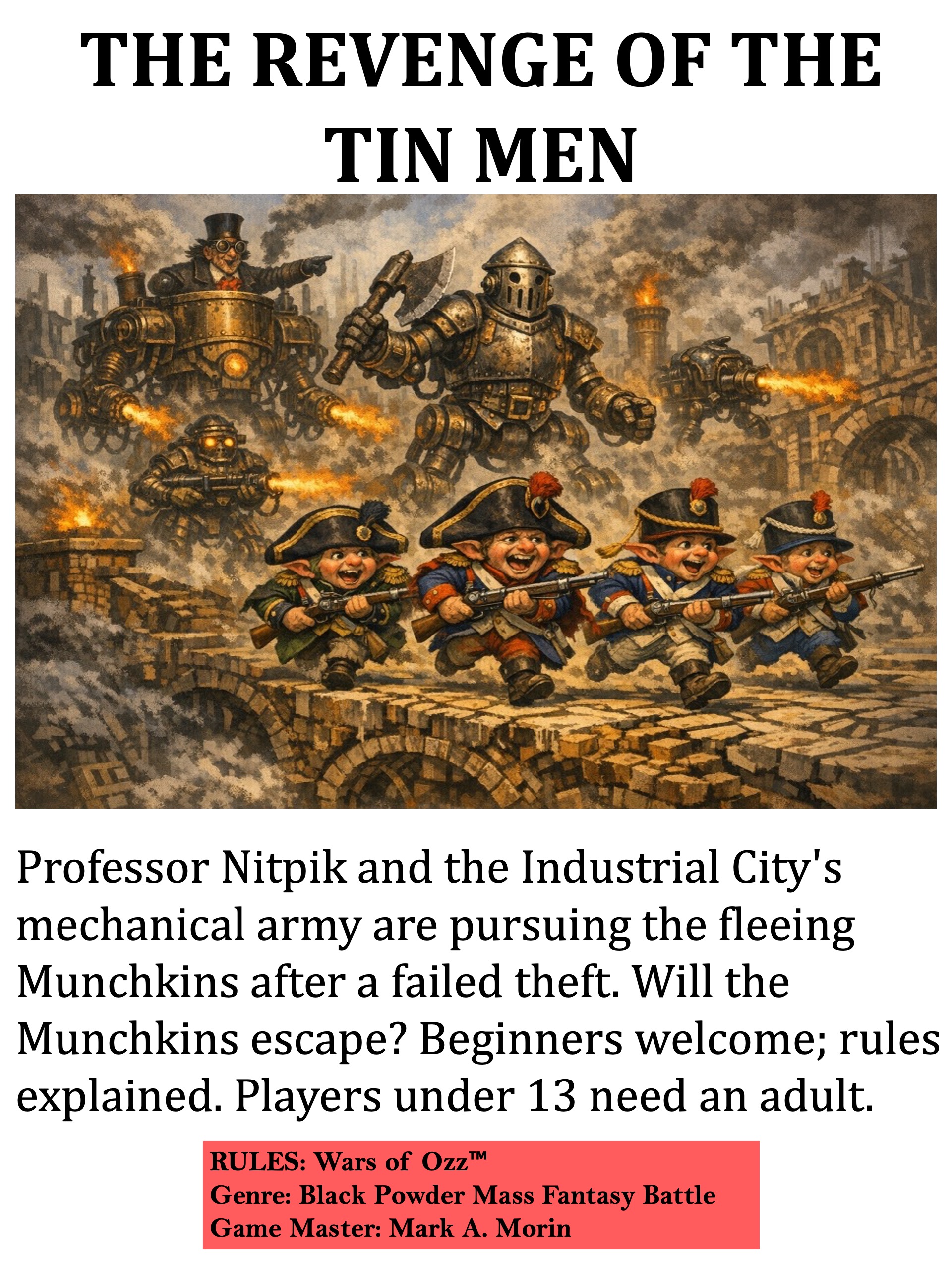
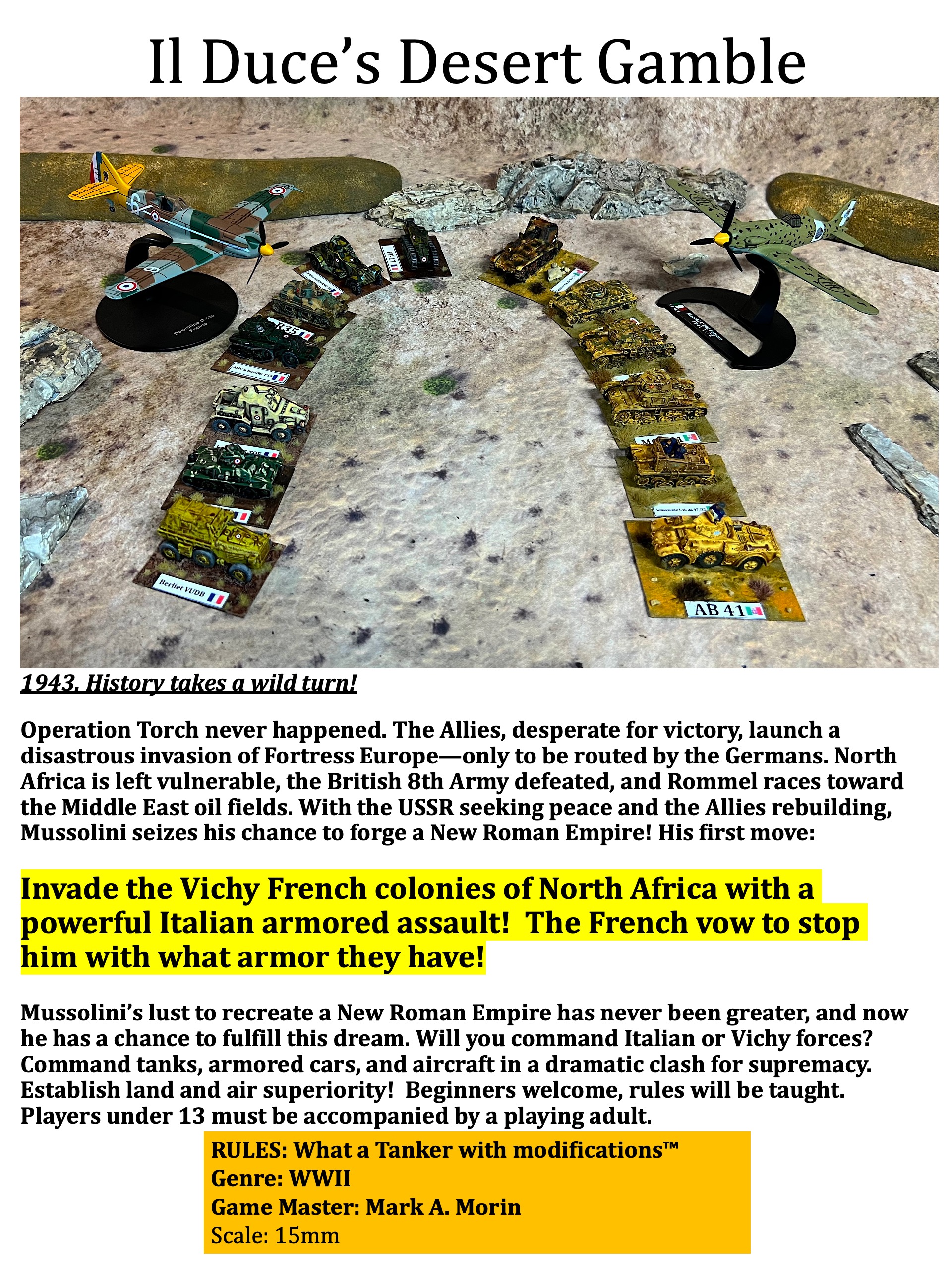
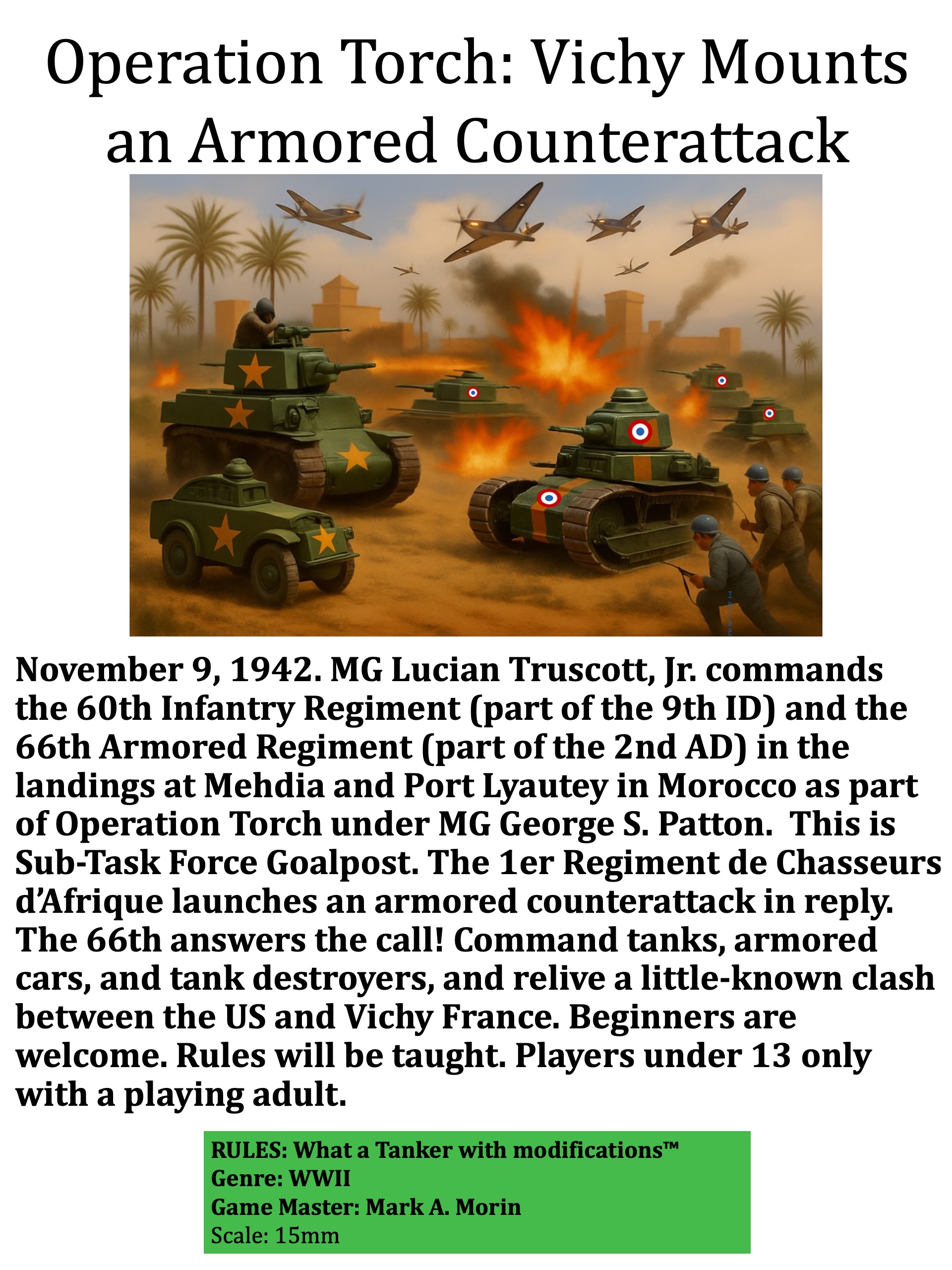
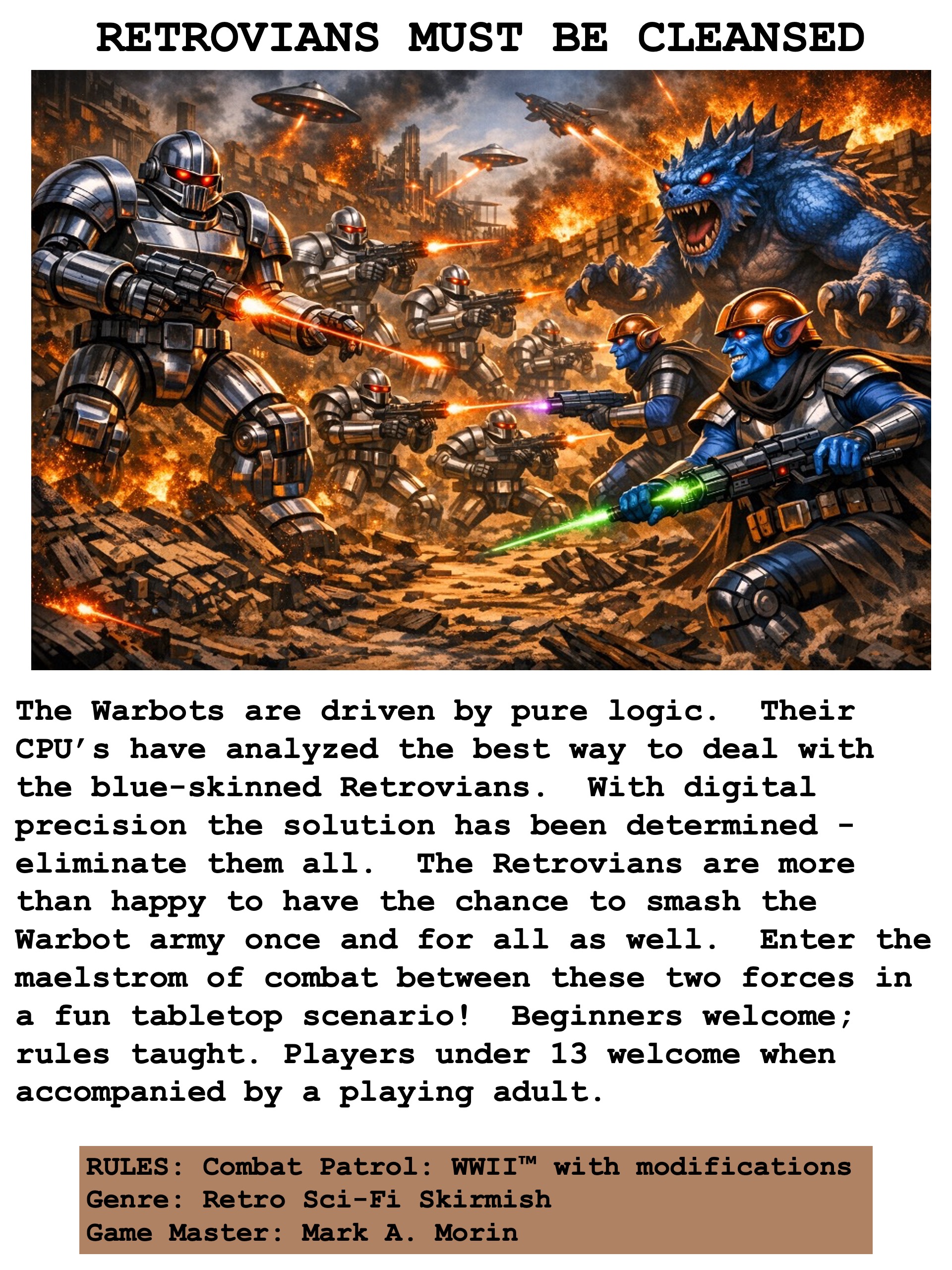
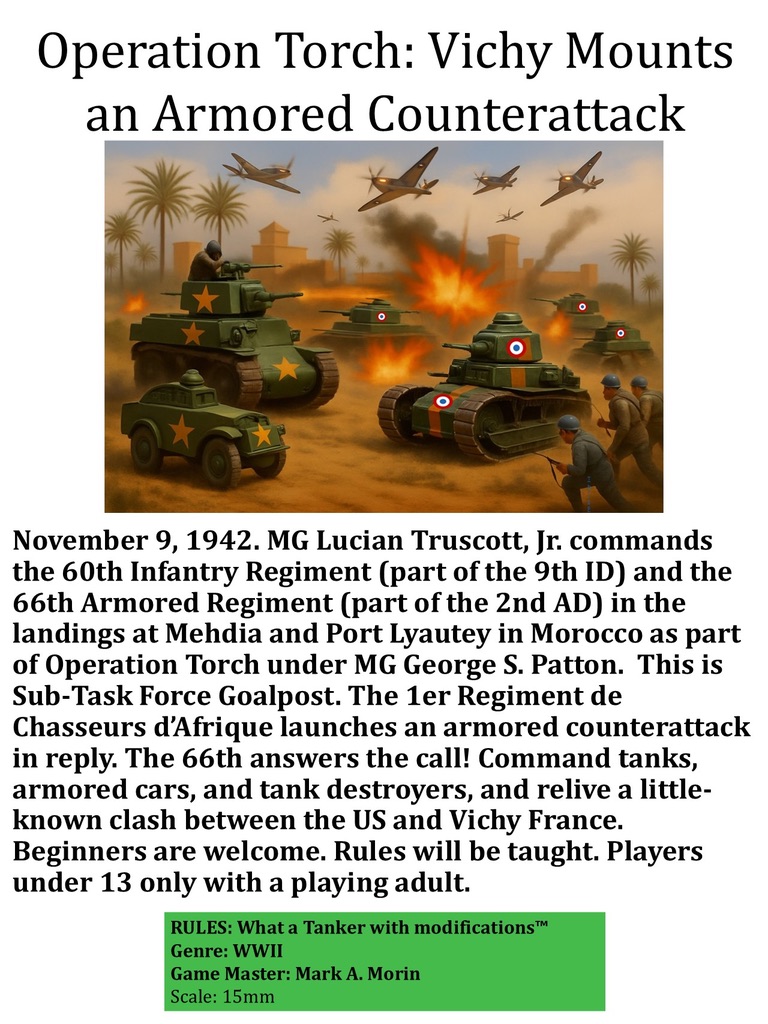
My game poster. It marks my first foray using AI (Freepik) to generate an image. I wasn’t completely thrilled with the result, but it’s OK for a flyer.

The game uses modified What a Tanker rules. The major modifications that I use are:

  • Using Bonus Attack Cards to simulate infantry, anti-tank, artillery, naval gunfire, and air actions. These are deployed by scout cars according to each sides’ historical capabilities. Bonus Attack Cards are purchased with “Tanker Bucks”, which also play into Victory Conditions. Having more Tanker Bucks at the games end is better. Yet, you need to use resources to take out the enemy. So, a balancing act exists for the players. Do they hoard their Tanker Bucks, or use them effectively against their opponent?
  • Representing the French vehicles’ advanced age and mechanical unreliability. “OLD” French vehicles that try to move and roll a 5 or less will lose 1 die to temporary damage. Mathematically, there is an 11% chance of that happening. So the Vichy Forces are indeed slow. But there are more of them, and not all of the French tanks are OLD.
  • Creating a way for armored cars to engage other armored cars – and tanks, with heavy machine guns or Bonus Attack Cards. Also I have rules that show how devastating any cannon fire would have been against thin-skinned vehicles.
  • Representing the US Army as being totally GREEN at this point in the war. Their base roll needed to hit goes from needing a 6 on 2d6 added together to a 7. Add to that the concept that most of the French vehicles are SMALL, necessitating an addition +1 to hit at short range, and another +1 at long range. Oh yeah, the Stuarts have just a 37mm gun. This means that the US has a tough time making damaging hits at long range against French tanks.
  • The US use of Bonus Attack Cards is limited to just the US and French Armored Cars. The M5 Stuart’s radios got wet during the landings and were not working. Many French tanks in North Africa did not have radios.
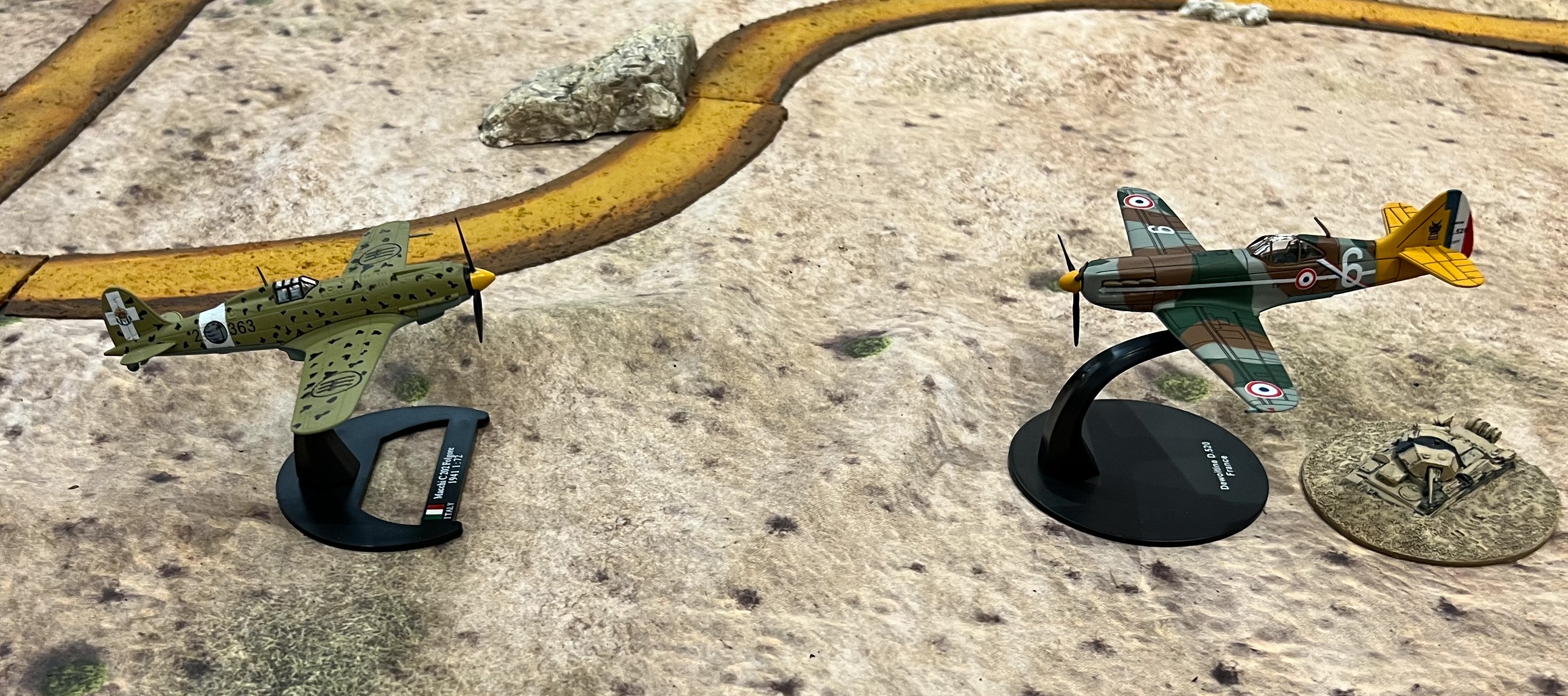
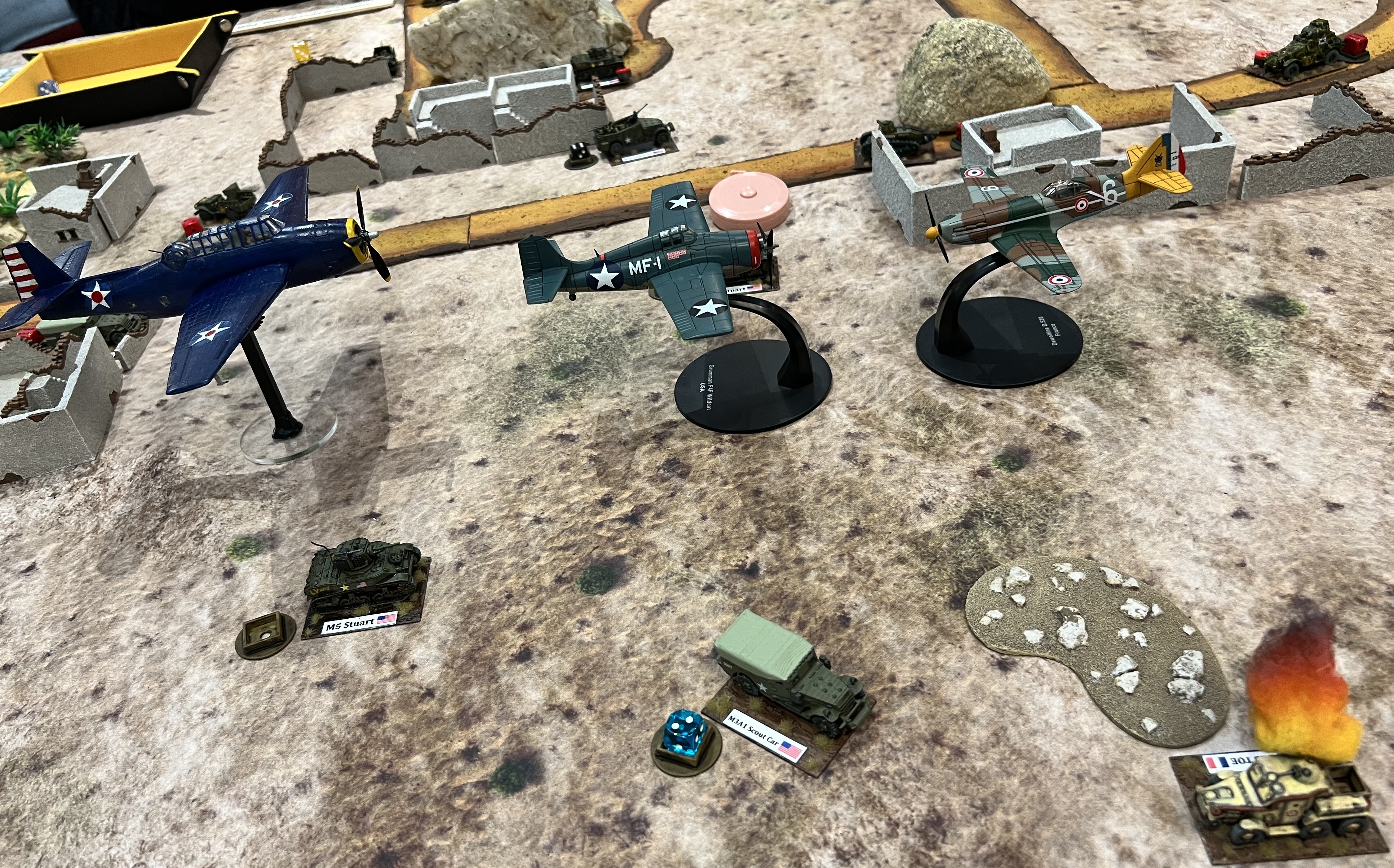
  • Use of Bonus Attack Cards also represented that the US had both carrier-based air support as well as naval gunfire from the USS Savannah. I added F4F Wildcat’s and Avenger TBF’s for US air support. The F4F’s can provide air superiority, which allows them to also do limited close air support missions. Having air superiority enables the US player to deploy the Avengers, which can act as spotter planes for both artillery and naval gunfire. The Avengers can also bomb the French vehicles with depth charges (yes that happened). The French can contest the US air superiority by deploying Dewoitine D.520’s.
  • Modifying the activation sequencing methodology by using Buck Surdu’s “Double Random Activation” method. It’s the same one used with Wars of Ozz, Feudal Patrol, and Combat Patrol games.

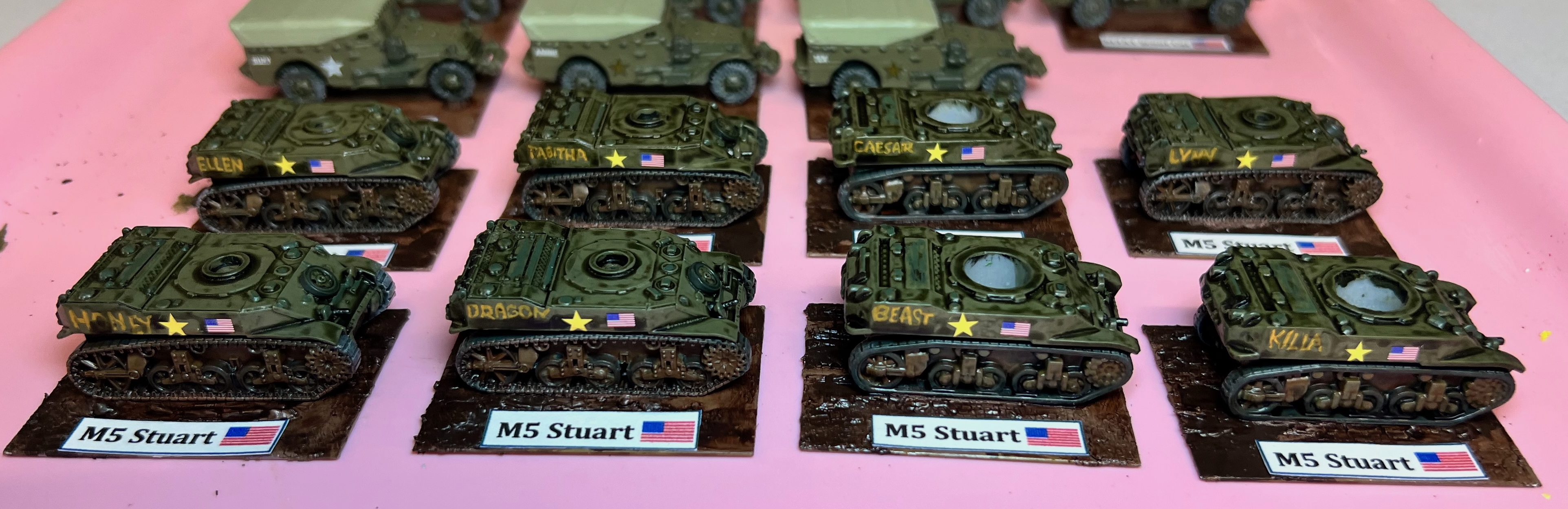
Back to the Stuarts. The M5 vehicles are 15mm/1:100 scale. I sourced them from two places. I got an OOP Flames of War 5-tank platoon (plastic) from Noble Knight Games. I also bought five 3D-printed resin models on eBay from HobbyHouse&Miniatures LLC. The plastic models were fun to work on, and I was glad to have the additional resin ones. Historically, 7 M5 Stuarts were sent to counter the Vichy counterattack. When I drilled out the resin models for magnet installation, two broke in half (not the fault of the model, just me. In the end, I had 3 of those, making 8 models in total, which was fine given that seven were originally sent along with some M3 and M6 tank destroyers.

I worked on the M5 tanks in parallel with the M3A1 Scout Cars and the M3 and M6 Tank Destroyers that I have discussed previously. I tried to incorporate the gold stars and US flags that were unique to that period of the war. I also decided to give the vehicles hand-painted names:

  • Honey (my Mom’s nickname)
  • Dragon
  • Beast
  • Killah
  • Ellen (my daughter’s name)
  • Tabitha (my granddaughter’s name)
  • Caesar (my late cockatiel’s name)
  • Lynn (for my ever-so-tolerant wife)
The M5’s without their turrets, showing the basing and details. I list the paints and other materials used at the end of this post.
The eight M5’s completed.
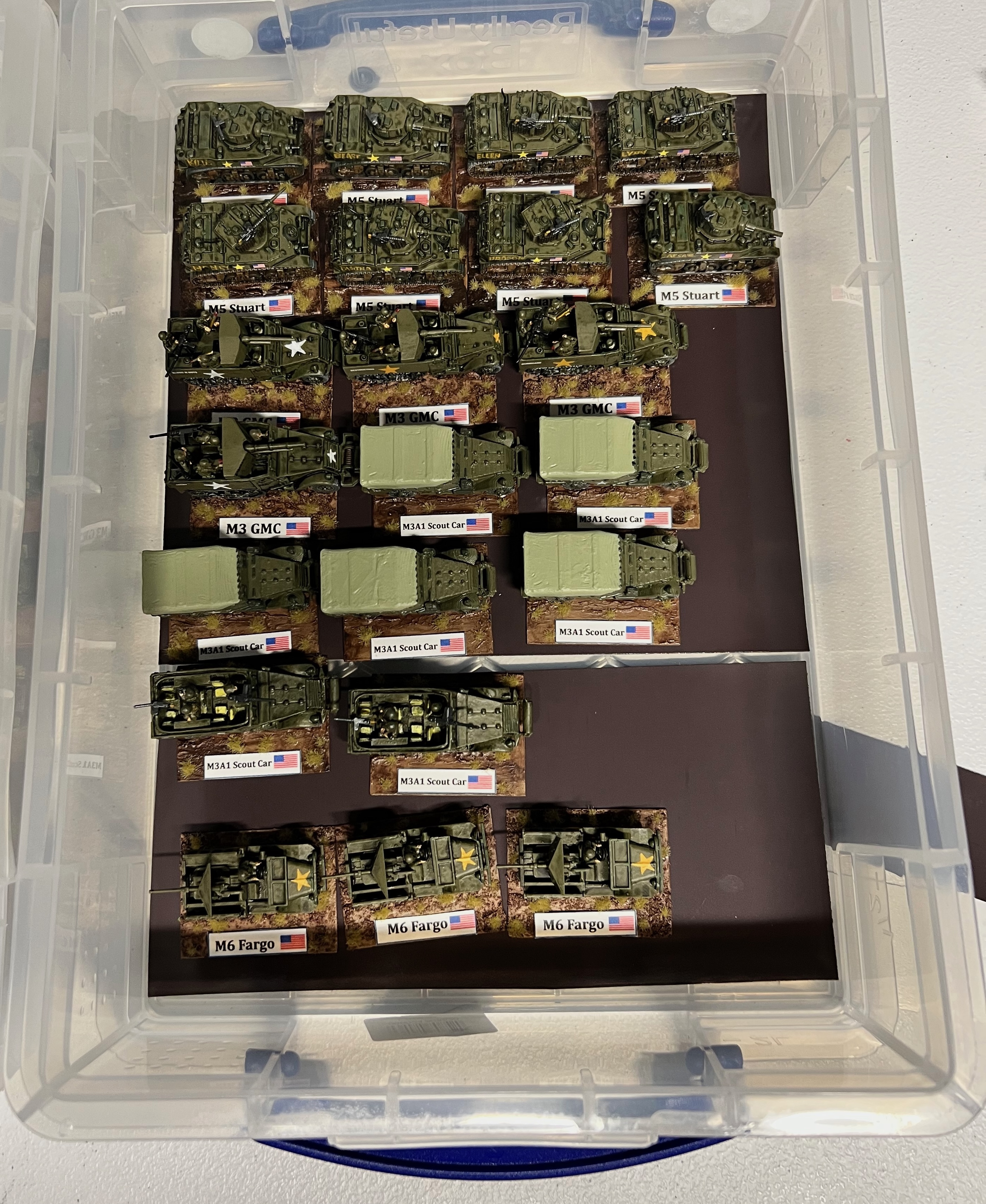
The 22 US Army vehicles for my game in a Really Useful Box.
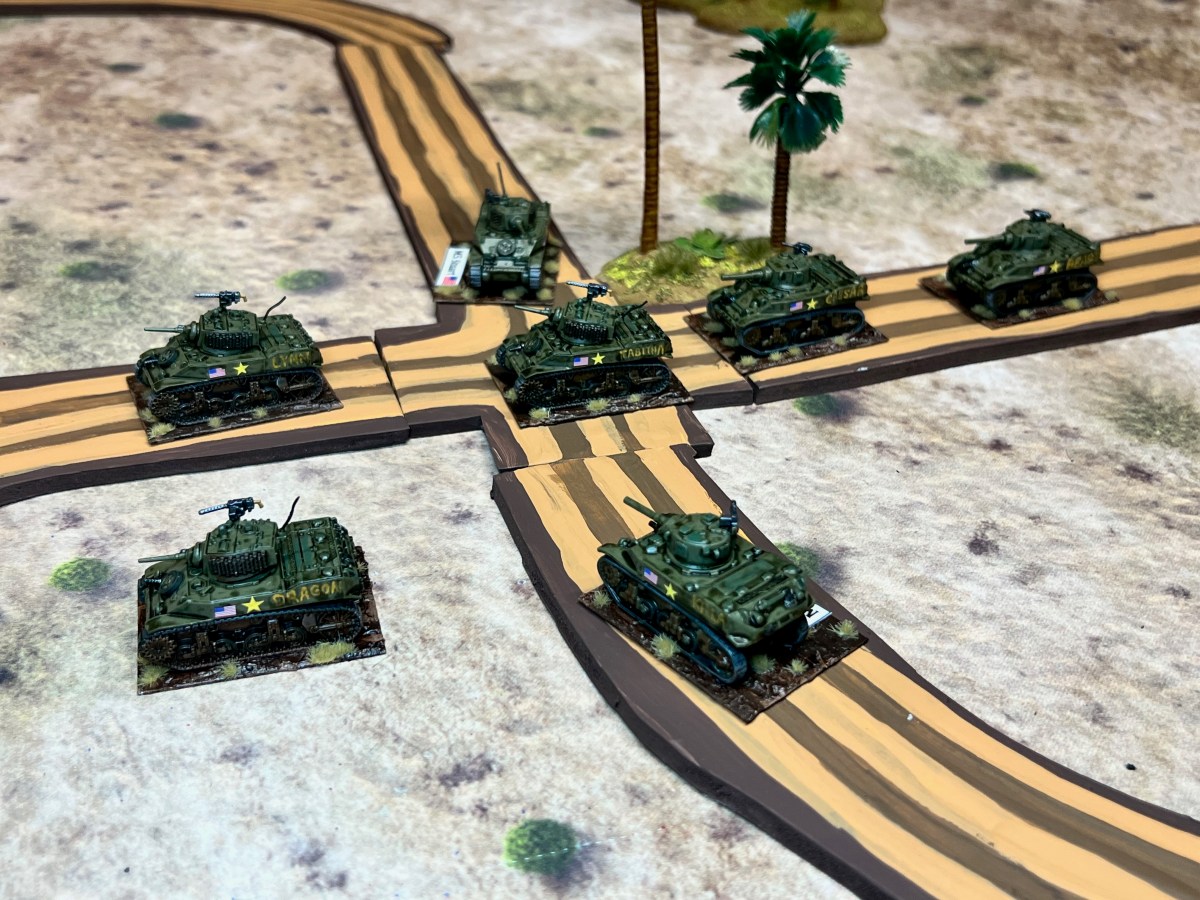
The 8 M5’s on my tabletop.

This wraps up this post on my 8 M5’s. If you have any feedback – please let me know in the comments section!

Lastly, for all of my posts on WWII games and projects – there is a consolidated list of posts and their links located here.

MATERIALS USED

PAINTS, INKS, GLAZES, SHADES, WASHES, PIGMENTS AND FLOCKING USED ON THE FIVE BATTLEFRONT/FLAMES OF WAR PLASTIC M5 TANK MODELS AND THE THREE HOBBYHOUSE&MINIATURES LLC 3D-PRINTED RESIN M5 TANK MODELS:

  1. Green Stuff
  2. Paper Clip wire
  3. War Games Accessories Steel Bases Number 16 (½” x ½”)
  4. Wooden Blocks, steel bolts, steel washers, magnets, steel screws
  5. Neodymium magnets (⅛” and ¼”)
  6. Gorilla Glue
  7. Tamiya Extra Thin Cement
  8. Daisy BB’s
  9. Plastic broom bristles
  10. Vallejo Surface Primer “Black”
  11. Vallejo Surface Primer “USA Olive Drab”
  12. Vallejo Model Air “Black Metallic”
  13. Army Painter “Military Shader” (shade/wash)
  14. Hataka “Vert Fonce”
  15. Vallejo Model Color “USA Olive Drab”
  16. Vallejo Model Air “Tire Black”
  17. Vallejo Model Color “Dark Sea Grey”
  18. Vallejo Model Air “Gun Metal”
  19. Vallejo Model Air “Wood”
  20. Vallejo Mecha Weathering Effects “Dark Rust Wash”
  21. War Games Accessories Steel Bases Number 23 (1½” x 2″)
  22. Vallejo Surface Primer “German Green Brown”
  23. Citadel “Agrellan Earth” (texture)
  24. Army Painter “Mid Brown” (shade/wash)
  25. Reaper MSP Core Colors “Blackened Brown”
  26. Vallejo Thinner Medium
  27. Citadel “Averland Sunset”
  28. Vallejo “Mecha Varnish Gloss”
  29. Microscale Industries “Micro Set”
  30. Microscale Industries “Micro Sol”
  31. Microscale Industries “Liquid Decal Film”
  32. Battlefront US Army decals
  33. Vallejo “Gloss Acrylic Varnish”
  34. Citadel “‘Ardcoat”
  35. Vallejo “Gloss Acrylic Varnish”
  36. Vallejo Flow Improver
  37. Vallejo Thinner
  38. Vallejo “Matte Polyurethane Varnish”
  39. Printed labels on card stock
  40. Gamers Grass “Tiny Beige 2mm Tufts” (flocking)
  41. PVA Glue

US Vehicles for Operation Torch: TANK DESTROYERS – M3 GMC’s and M6 GMC Fargo’s

The US Army had a lot of catching up to do at the start of World War II. This was true both in terms of vehicles and doctrine in the way of armored warfare. This included anti-tank units.

Initially, the US Army experienced internal squabbles about anti-tank troops and control. These were among the infantry, cavalry, and artillery branches. They disputed over which would control what were then-called “anti-tank battalions”. Interestingly, the Armor Branch (created in 1940) had little interest in that fight. It desired to stay focused on offensive operations.

The September 1941 Louisiana Maneuvers demonstrated the efficacy of anti- tank battalions. In June 1942, the Army created a new branch for this force. They also developed a doctrine to support their use (Field Manual 18–5, Tactical Employment, Tank Destroyer Unit). Tank destroyer battalions were then created and began to be fielded.

Developing doctrine is one thing – fielding self-propelled anti-tank equipment is another. When Operation Torch was launched, there were not any of the tank destroyers that you saw in later battles. No M10 Wolverines, M18 Hellcats, or M36 Jacksons – or even towed M1 57mm or M5 guns – took part in Torch.

Nope, at the start of the war, the US Army fielded just two models of tank destroyer. One was on an M3 half-track, which mounted the venerable 75mm Canon_de_75_modèle_1897. This combination was called the M3 Gun Motor Carriage (GMC). The other was the M6 Gun Motor Carriage (GMC). This was a Dodge Fargo truck with a rear-mounted M3 37mm gun. Defensively, needless to say, both of these types were not well-armored at all.

Offensively, while the 75mm gun could still pack an anti-armor punch, the 37mm was well on its way to complete obsolescence. Add to that the M6 GMC was rearward-facing. It would have to be turned around to fire, That would have been quite a challenge in combat. I imagine that it was inspired by the British use of portee anti-tank weapons. However, the main reason was probably the urgency of fielding something to fight in the anti-tank role. Add to that – US industrial might had not yet reached full production capacity seen later in the war.

M3 GMC
M6 GMC

But you go to war with the Army you have. Tank Destroyer battalions were formed, consisting of a headquarters company, a reconnaissance company (including a pioneer platoon – Engineers!), and 3 twelve-vehicle tank destroyer companies. Each company fielded each one platoon of M6 Fargo GMC’s and two platoons of M3 GMC’s. Each M6 platoon had 4 vehicles, and each of both of the M3 platoons had 4. These would see combat starting in November 1942 during Operation Torch.

At that point, doctrinally, tank destroyers were by nature defensive forces. They were supposed to blunt any enemy armored attack or counterattack – obviously by destroying tanks. This would allow for counterattack by US tanks and infantry. Operation Torch would be the first test.

For my What a Tanker games for Operation Torch at HISTORICON 2025, I needed both types of tank destroyers. For the M3 GMC’s, I bought 6 from Old Glory (SKU CD-223A) and assembled and painted up just 3. I also found one Battlefront/FOW model (SKU US101) at HAVOC that joined the mix. Now I had 4 M3 GMC’s for gaming. M6 GMC were not easy to source – and I also had never heard of them. So my friend Greg Priebe agreed to 3D-print some for me. You may remember that Greg printed the French vehicles for me I previously wrote about here. He made Panhard 175 TOE’s and Berliet VUDB’s for me.

Thanks again Greg!

I was able to put together 3 M6 GMC’s with what Greg sent me. I worked on these in June as well.

June was a crazy month – and I was able to get these together before HISTORICON 2025. As for photos – well you’ll see what I have.

M3 GMC

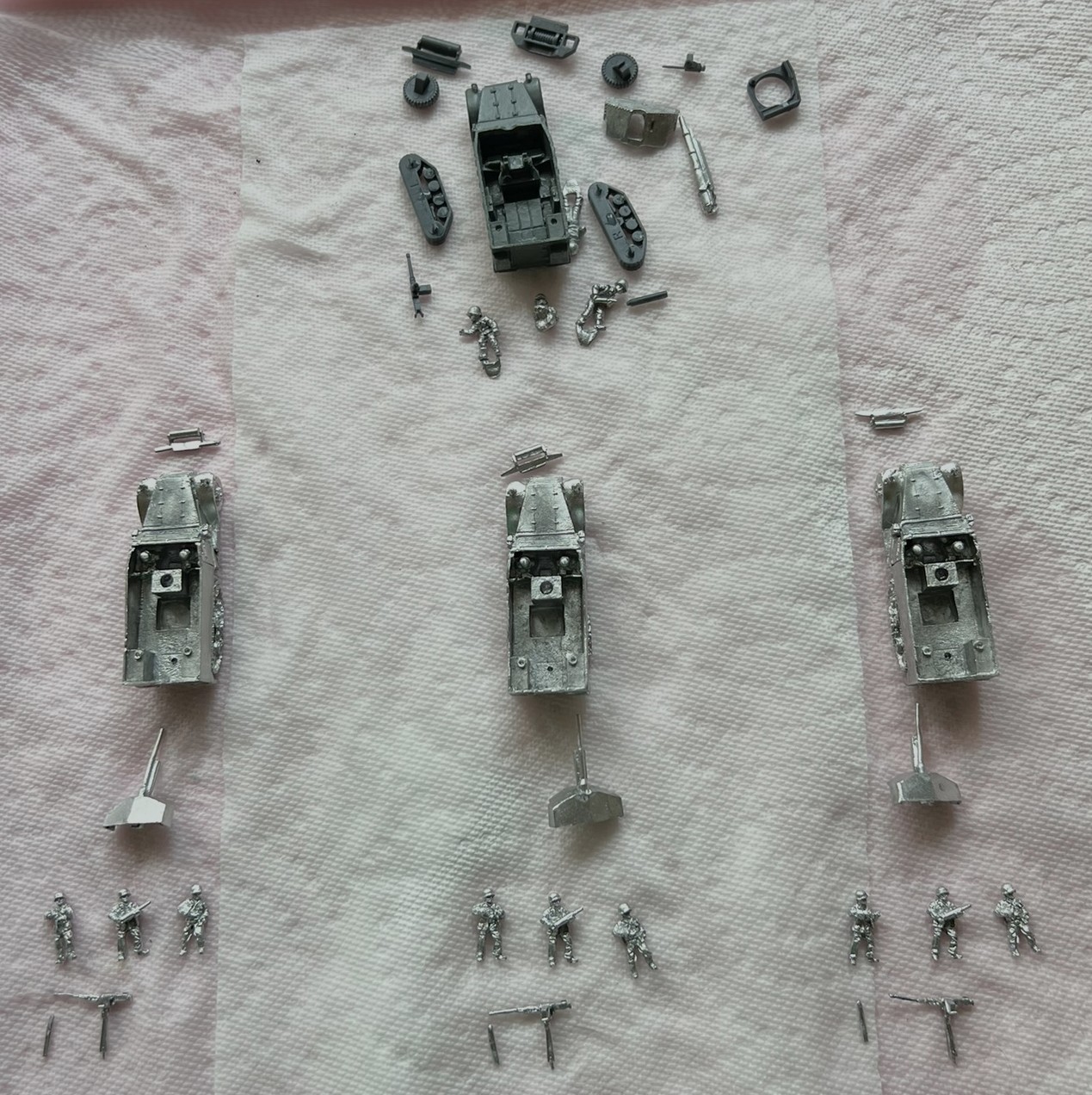
The three Old Glory models are metal, while the FOW model is metal and resin. all are 15mm/1:100 scale. Painting the crews was challenging (and fun)!

Three Old Glory M3 GMC models are on the bottom, with the FOW model at the top of the photo.

I painted them up with both gold and white stars. The gold stars were unique to the North African campaign. I thought they gave a more authentic Operation Torch look. Apparently in November of 1942, standardization to white stars was not yet part of the US Army’s official painting scheme. Unlike my M3A1 Scout Cars, I freehand painted the stars. I found they looked better than my decals. For more variation, I either painted the stars on the hood or the grills. Also, each got a name – I used the decals that I had available. The names of these were:

  • BLOOD N GUTS
  • DESTRUCTION
  • HURRICANE
  • LUCKY
My 4 M3 GMC’s. From left to right, BLOOD N GUTS, HURRICANE, DESTRUCTION and LUCKY (the only FOW model).
Close ups of DESTRUCTION and HURRICANE.

M6 GMC (FARGO)

These were all 3D-printed resin in 15mm/1:100 scale. I wish that I had been able to add crew to these. They were already so fiddly and small, that I satisfied myself with just having a driver. Even at that I had to do a good amount of surgery to get him to fit in his seat!

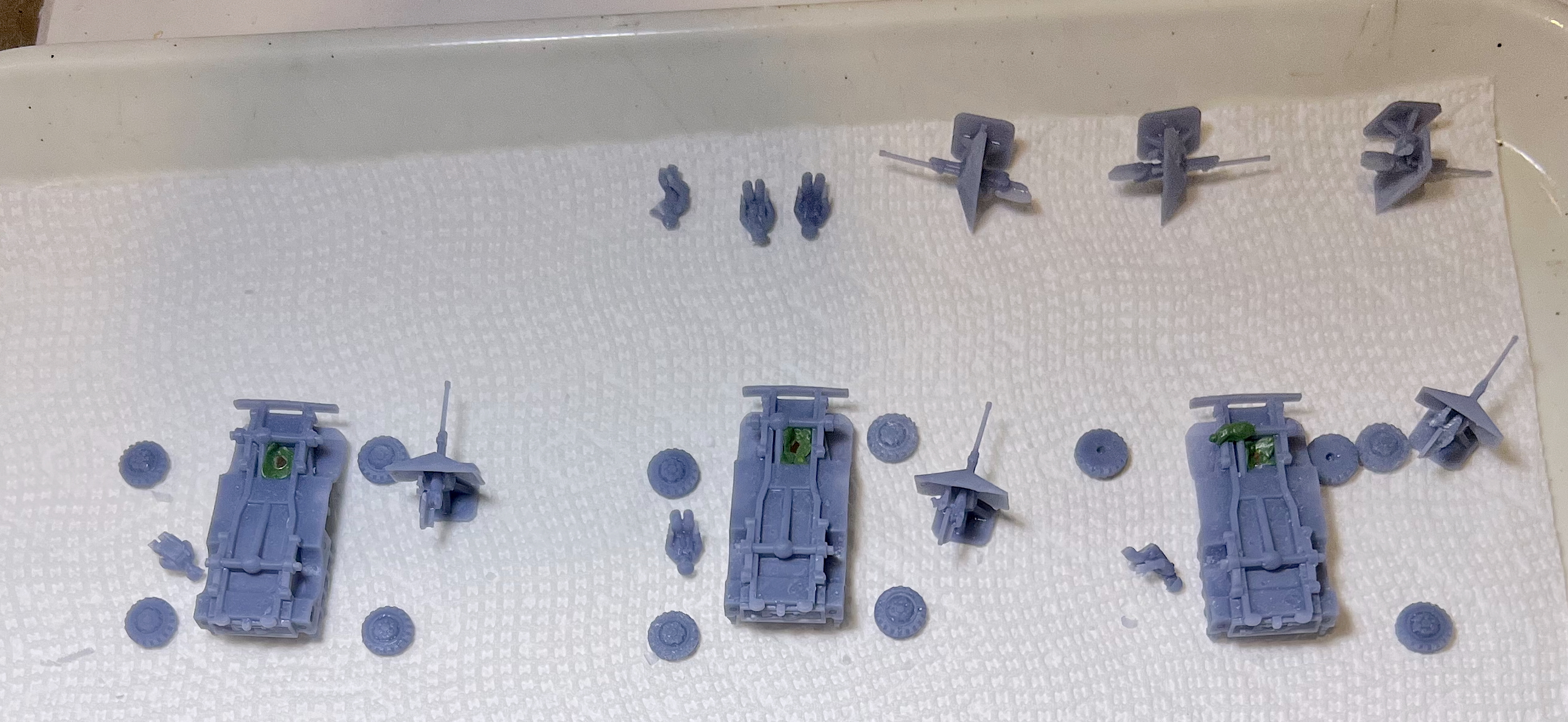
The M6 GMC’s washed after putting in magnets and ready for assembly and painting. I added magnets to each M3 and M6 to allow brewed-up markers to stick to the vehicles on the tabletop.
The M6 GMC’s shown here painted staring at the back end of my Berliet VUDB’s. The M6’s are awaiting basing work and varnishing.

Like with the M3 GMC’s, I gave names to these as well. These names were the only differentiator for these models. The names were:

  • BUCK (for Buck Surdu)
  • DUKE
  • TEX
A close up of two completed models. Here, BUCK is maneuvering into a hide firing position. It would of course have to turn around to fire. Behind is DUKE moving up the road.
A closer view of BUCK.

While the M3 GMC was partially effective in North Africa, the M6 was not. Clearly, both were very vulnerable to direct and indirect fire. As time progressed, they were both replaced by self-propelled vehicles with turrets and better protection. The M3 GMC’s were converted back into half-tracks. The M6 GMC’s were stripped of their guns, and were later used as just trucks.

In conclusion, I had some tank destroyers for Operation Torch games of What a Tanker! I also hope that you enjoyed this post on my early war tank destroyers. All that I have left to share on this project are my 8 American M5 Stuart tanks. I will also share a bit about my games at HISTORICON.

What did you think of these tank destroyers? Did anything surprise you? Motivate you to get some for yourself? Please let me know your thoughts in the comments section!

Lastly, you can find all of my posts on WWII games and projects in one place. There is a consolidated list of posts and their links located here.

The next lists are what I used on these vehicles. I review these lists for my own uses on future projects. For some of you, they may also be helpful.

MATERIALS USED

PAINTS, INKS, GLAZES, SHADES, WASHES, PIGMENTS AND FLOCKING USED ON THE ONE BATTLEFRONT/FLAMES OF WAR RESIN M3 GMC MODEL AND THE THREE OLD GLORY M3 GMC MODELS:

  1. Green Stuff
  2. Vallejo Surface Primer “Black”
  3. Vallejo Surface Primer “USA Olive Drab”
  4. Gorilla Glue
  5. Battlefront “European Skin”
  6. Vallejo Thinner Medium
  7. War Games Accessories Steel Bases Number 23 (1½” x 2″)
  8. War Games Accessories Steel Bases Number 16 (½” x ½”)
  9. Green Stuff Wooden Blocks, steel bolts, steel washers, magnets, steel screws
  10. Neodymium magnets (⅛” and ¼”)
  11. Vallejo Surface Primer “German Green Brown”
  12. Army Painter “Mid Brown” (shade/wash)
  13. Reaper MSP Core Colors “Blackened Brown”
  14. Vallejo Model Color “USA Olive Drab”
  15. Army Painter “Flesh Wash” (shade/wash)
  16. Vallejo Model Color “Brass”
  17. Vallejo Model Air “Tire Black”
  18. Vallejo Model Color “Dark Sea Grey”
  19. Vallejo Primers “NATO Green”
  20. Army Painter “Military Shader” (shade/wash)
  21. Reaper MSP “Pure White”
  22. Citadel “Averland Sunset”
  23. Vallejo Mecha Color “Dark Steel”
  24. Army Painter “Dark Tone” (wash/shade)
  25. Citadel “Agrellan Badlands” (texture)
  26. Citadel “Agrellan Earth” (texture)
  27. Vallejo Mecha Weathering Effects “Dark Rust Wash”
  28. Vallejo “Mecha Varnish Gloss”
  29. Microscale Industries “Micro Set”
  30. Microscale Industries “Micro Sol”
  31. Microscale Industries “Liquid Decal Film”
  32. Gin Fritter US Army decals
  33. Battlefront US Army decals
  34. Vallejo “Gloss Acrylic Varnish”
  35. Citadel “‘Ardcoat”
  36. Vallejo “Gloss Acrylic Varnish”
  37. Vallejo Flow Improver
  38. Vallejo Thinner
  39. Vallejo “Matte Polyurethane Varnish”
  40. Printed labels on card stock
  41. Gamers Grass “Tiny Beige 2mm Tufts” (flocking)
  42. PVA Glue

PAINTS, INKS, GLAZES, SHADES, WASHES, PIGMENTS AND FLOCKING USED ON THE THREE RESIN M6 GMC MODELS (FARGO’S):

  1. Gorilla Glue
  2. Green Stuff Neodymium magnets (⅛”)
  3. Wooden Blocks, steel bolts, steel washers, magnets, steel screws
  4. Vallejo Surface Primer “Black”
  5. Vallejo Surface Primer “USA Olive Drab”
  6. Battlefront “European Skin”
  7. Vallejo Thinner Medium
  8. War Games Accessories Steel Bases Number 23 (1½” x 2″)
  9. Vallejo Surface Primer “German Green Brown”
  10. Army Painter “Mid Brown” (shade/wash)
  11. Reaper MSP Core Colors “Blackened Brown”
  12. FolkArt “Champagne”
  13. Army Painter “Flesh Wash” (shade/wash)
  14. Vallejo Model Air “Tire Black”
  15. Vallejo Model Color “Dark Sea Grey”
  16. Vallejo Primers “NATO Green”
  17. Army Painter “Military Shader” (shade/wash)
  18. Citadel “Averland Sunset”
  19. Citadel “Agrellan Badlands” (texture)
  20. Citadel “Agrellan Earth” (texture)
  21. Vallejo “Mecha Varnish Gloss”
  22. Microscale Industries “Micro Set”
  23. Microscale Industries “Micro Sol”
  24. Microscale Industries “Liquid Decal Film”
  25. Battlefront US Army decals
  26. Vallejo “Gloss Acrylic Varnish”
  27. Citadel “‘Ardcoat”
  28. Vallejo “Gloss Acrylic Varnish”
  29. Vallejo Flow Improver
  30. Vallejo Thinner
  31. Vallejo “Matte Polyurethane Varnish”
  32. Printed labels on card stock
  33. Gamers Grass “Tiny Beige 2mm Tufts” (flocking)
  34. PVA Glue

Thanks for checking this out!

US Vehicles for Operation Torch: M3A1 Scout Cars

Now that I have shared all of the Vichy French vehicles that I completed on this blog, it is time for me to add the American models. These will also be used in my What a Tanker games for Operation Torch at HISTORICON 2025. I am starting with the American reconnaissance scout car – the M3A1 Scout Car.

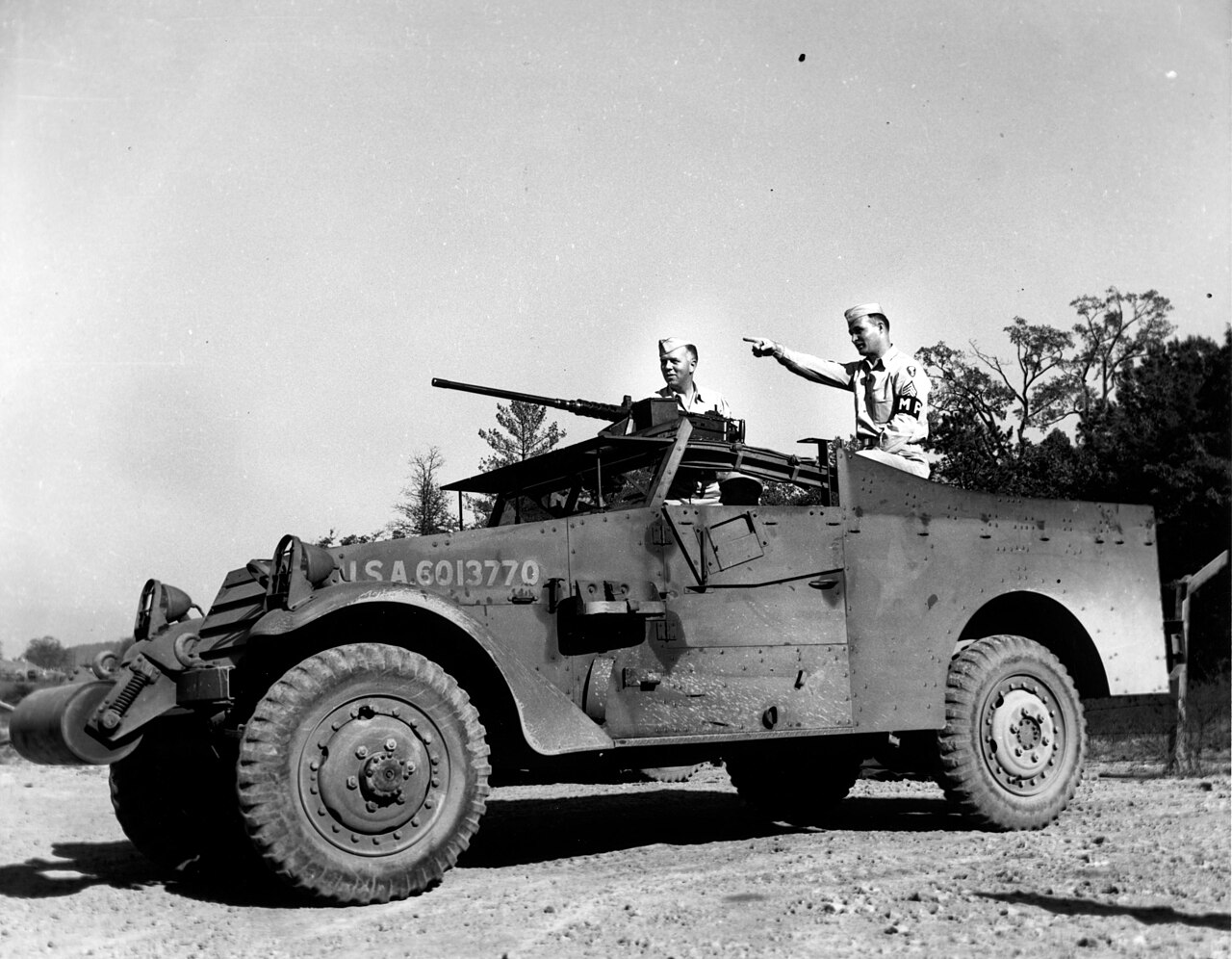
It was designed and built by the now-defunct White Motor Company, with the chassis interestingly being a product of the Diebold Lock and Safe Company. It was a 4×4, and could do up to 50 mph on the road (80 kph). Many of you will notice how similar the M3A1 is to the M3 half-track. And for good reason, as the M3 half-track was a development of the M3A1 Scout car.

It typically carried a Browning M2 .50 caliber machine gun plus up to two additional Browning M1919 .30 caliber machine guns. It was open-topped with armor on the chassis up to 13mm/.5″ in thickness. It could carry up to 6 soldiers in addition to the driver. A canvas cover was available for protection against the elements. The M3A1 was intended to be a reconnaissance vehicle, but its lack of protection made it less desirable than the M3 half-track in that role. In US use, it was relegated to rear-echelon uses after Operation Torch and Operation Husky (the invasion of Sicily). Over 21,000 were made, with over half of that number going as Lend-Lease, mainly to the British Commonwealth and the Soviet Union.

I found David Doyle’s book, M3A1 Scout Car: The US Army’s Early World War II Reconnaissance Vehicle (Legends of Warfare: Ground, 8), very interesting and useful.

For my Operation Torch What a Tanker games, I decided that these would serve as the cavalry scouts that would run into those quirky French armored cars that I’ve been posting about recently.

Sourcing of the M3A1 models came from two different places. I got two Battlefront Flames of War models (SKU US 300) from a flea market at the HAVOC gaming convention in April. These models came with crew and machine guns. As the Battlefront model seems to be out-of-production, I needed to look elsewhere for more models. I went to eBay as a second source.

There from Wolverine3d.com I found models with the tarpaulin covers on. Given that a) these were different from the Battlefront models, b) there would be no crew to paint (saving time), and c) very reasonably-priced, I ordered 5, bringing my total available to 7 M3A1’s. They were not too crisp, and made of PLA plastic, but good enough for tabletop use. I started work on them all on May 23rd, and finished them on June 2nd. As I was hurrying to complete the entire project, photography of in-progress work took a backseat. I did work on multiple types of US vehicles concurrently as well. I judged doing separate posts for each type was better for me and you dear reader!

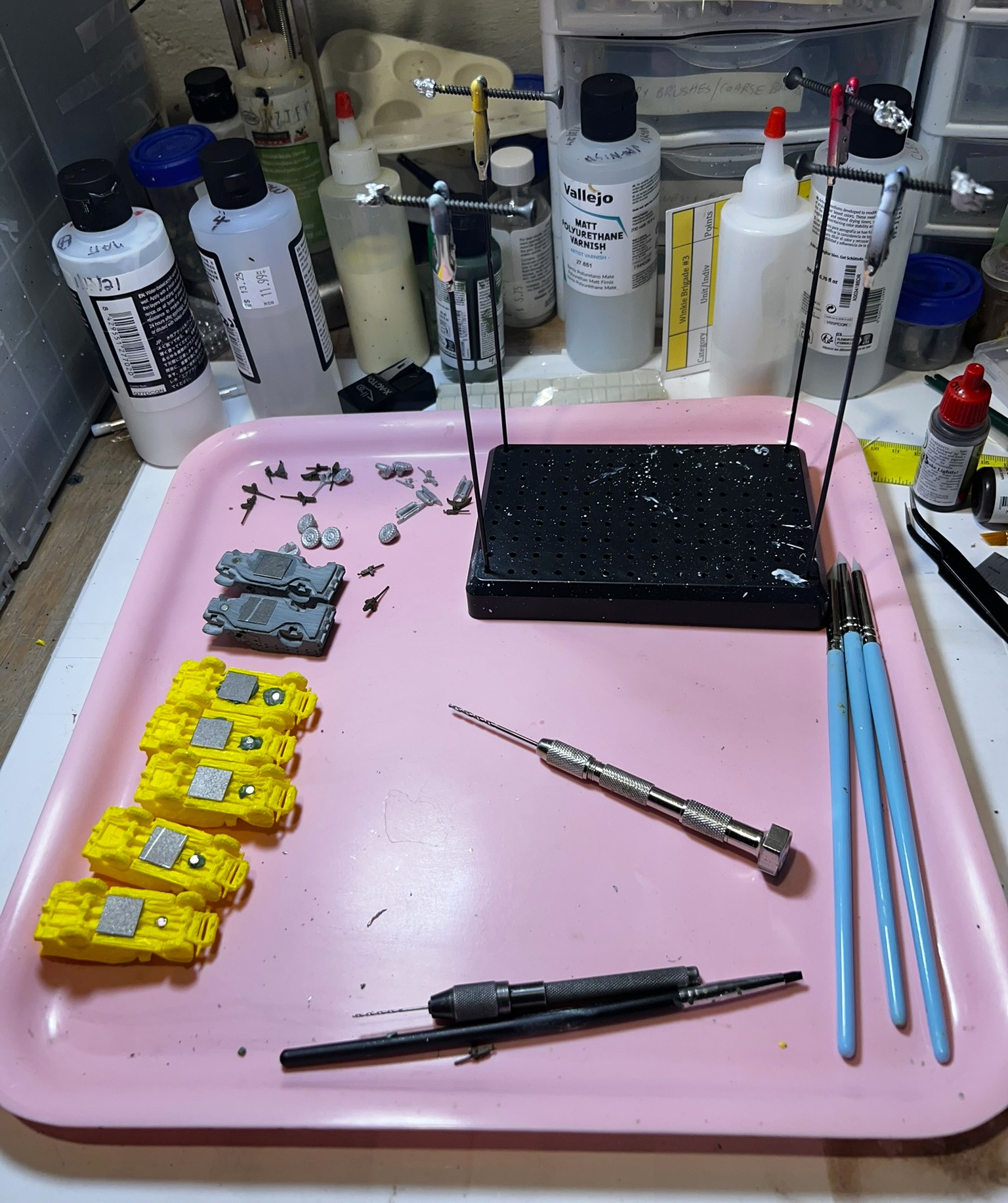
I cleaned up the models and washed them. For ease of painting I then mounted a small 1/2″ square steel base under each M3A1 model. This would allow me to use magnets to support the vehicles while I painted them. I also drilled out and installed small neodymium magnets (secured with green stuff) so that I would be capable of using my equally-magnetized blast markers on any that got brewed up in a game. As for crew- I used my alligator clip stand and some wood screws on them as supports – in a painful way for them (if they were capable of pain of course).

May 23rd – the work begins.

After painting I added decals and labels. Each M3A1 got a different name. Because in Operation Torch there was a mixed use of gold and white stars on US vehicles, I varied their application as well with some home-made gold star decals. They were ok – but not 100% to my liking, and you will see the different approach that I took on the other US vehicles (in future posts).

The seven M3A1’s before I added any tufts as final flocking. The bases are 1.5″ x 2″.

Once completed, I took a few photos of them assembled on my tabletop set up.

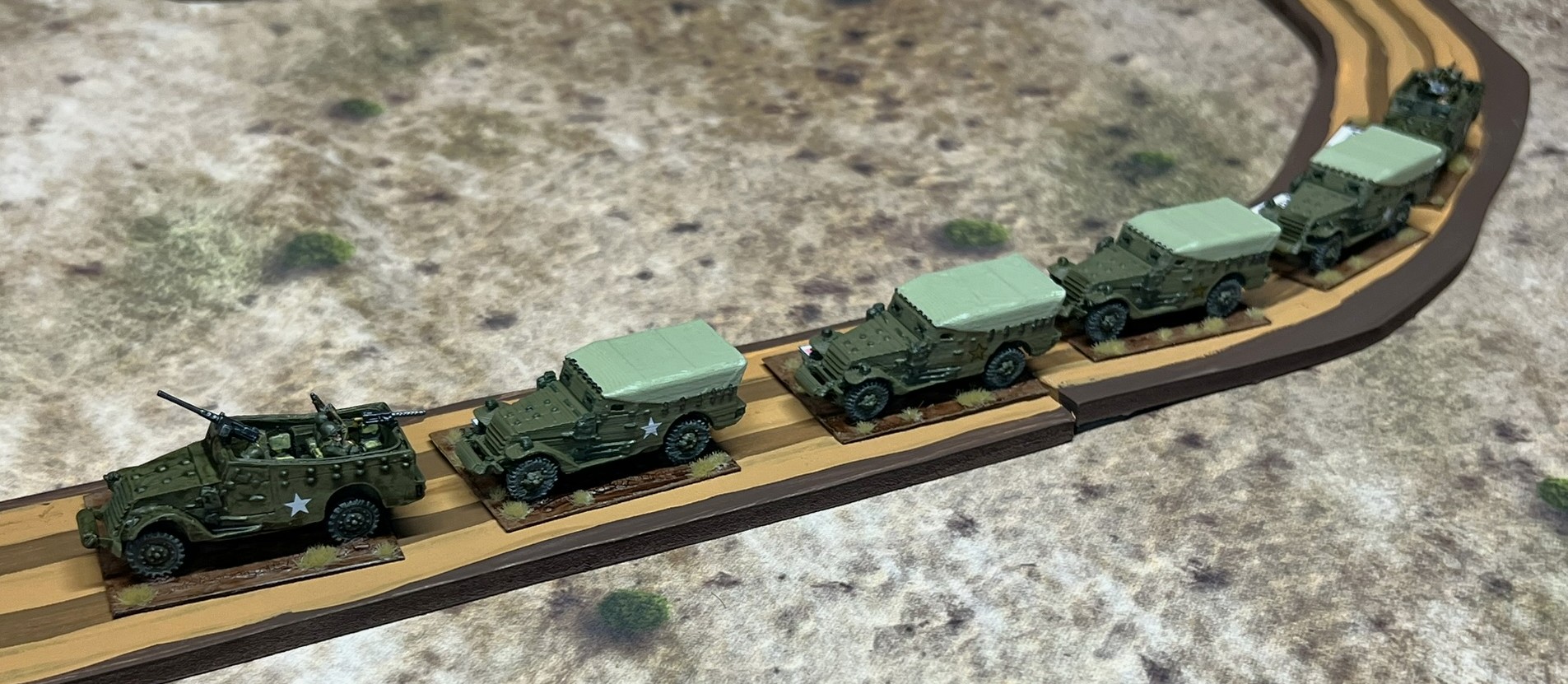
M3A1’s in convoy from the drivers’ sides.
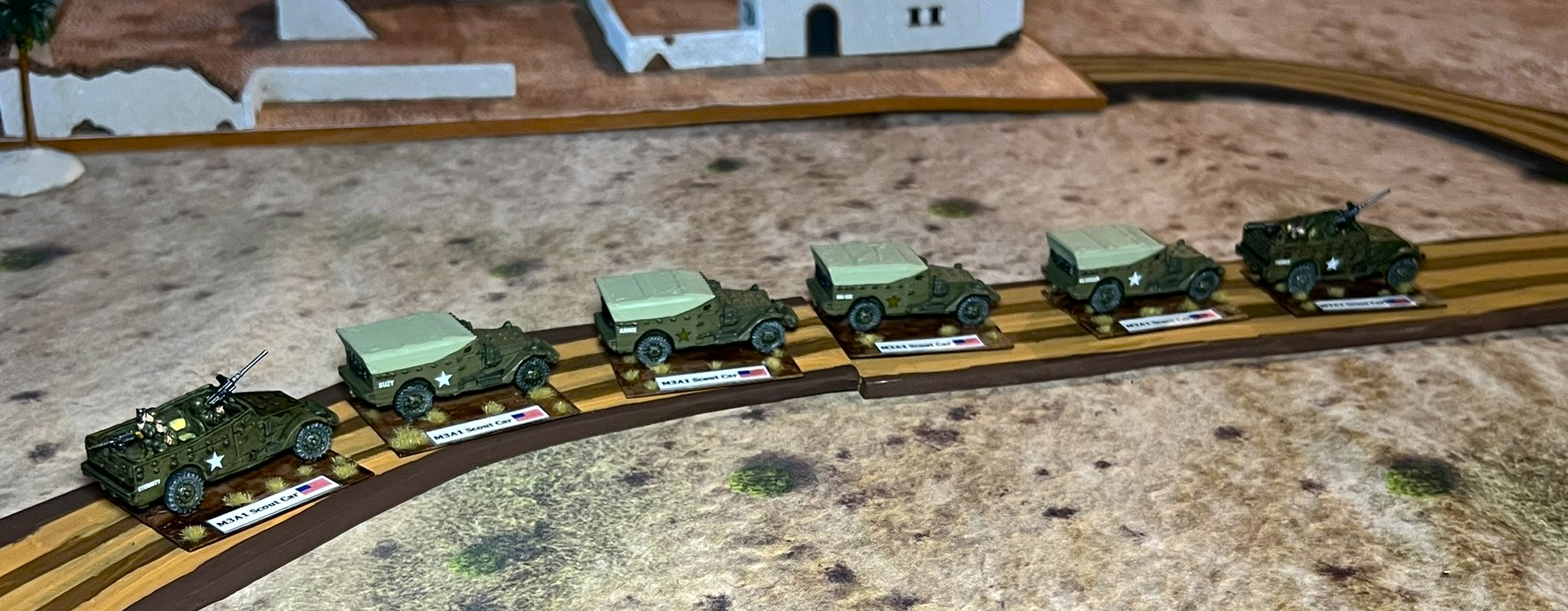
M3A1’s in convoy from the other side.
Close up shot of M3A1 “Fierce”. Each Battlefront model had a driver and two soldiers in the back. I also replaced some of the bendy metal machine guns with plastic ones from another kit.

This wraps up this post on my 7 M3A1’s. Remaining are I have 8 American tanks and 6 tank destroyers to share. Which ones? You can probably guess – rightly or wrongly! What did you think of the M3A1’s? Did you learn anything? Maybe I motivated you to get some for yourself? Please let me know your thoughts in the comments section!

Lastly, for all of my posts on WWII games and projects – there is a consolidated list of posts and their links located here.

MATERIALS USED

PAINTS, INKS, GLAZES, SHADES, WASHES, PIGMENTS AND FLOCKING USED ON THE TWO BATTLEFRONT/FLAMES OF WAR RESIN M3A1 MODELS AND THE FIVE WOLVERINE3D.COM M3A1 3D-PRINTED MODELS:

  1. Green Stuff
  2. War Games Accessories Steel Bases Number 23 (1½” x 2″)
  3. Vallejo Surface Primer “German Green Brown”
  4. War Games Accessories Steel Bases Number 16 (½” x ½”)
  5. Gorilla Glue
  6. Alligator clips and stand
  7. Wooden Blocks, steel bolts, steel washers, magnets, steel screws
  8. Neodymium magnets (⅛” and ¼”)
  9. Vallejo Surface Primer “Black”
  10. Vallejo Surface Primer “German Green Brown”
  11. Plastic machine guns from Battlefront M5 Stuart Platoon kit
  12. Vallejo Surface Primer “USA Olive Drab”
  13. Citadel “Agrellan Earth” (texture)
  14. Army Painter “Mid Brown” (shade/wash)
  15. Reaper MSP Core Colors “Blackened Brown”
  16. Vallejo Model Air “Tire Black”
  17. Vallejo Model Color “Dark Sea Grey”
  18. Battlefront “Tommy Green”
  19. Vallejo Model Air “Ivory”
  20. Vallejo Model Color “Off White”
  21. Citadel “Tallarn Sand”
  22. Reaper MSP “Pure Black”
  23. Battlefront “European Skin”
  24. Vallejo Model Air “Black Metallic”
  25. Vallejo Model Color “Wood Grain”
  26. Vallejo Model Air “Wood”
  27. Army Painter “Flesh Wash” (shade/wash)
  28. Army Painter “Military Shader” (shade/wash)
  29. Hataka “Vert Fonce”
  30. Vallejo Model Color “USA Olive Drab”
  31. Vallejo “Mecha Varnish Gloss”
  32. Microscale Industries “Micro Set”
  33. Microscale Industries “Micro Sol”
  34. Microscale Industries “Liquid Decal Film”
  35. Expert’s Choice Ink Jet Clear Decal Paper
  36. Gin Fritter US Army decals
  37. Battlefront US Army decals
  38. Vallejo “Gloss Acrylic Varnish”
  39. Citadel “‘Ardcoat”
  40. Vallejo “Gloss Acrylic Varnish”
  41. Vallejo Flow Improver
  42. Vallejo Thinner
  43. Vallejo “Matte Polyurethane Varnish”
  44. Printed labels on card stock
  45. Gamers Grass “Tiny Beige 2mm Tufts” (flocking)
  46. PVA Glue

Despatches from Fort Syllabub

An account of fictional adventures on the North West Frontier - and other times and places, real or imagined

Man of Tin blog

Toy soldiers, gaming, Imagi-Nations

Zauberwurfs Blog

Ein Blog über Tabletop und Miniature Wargames.

Frank Tank Rants

musings of a fat old bloke on tanks and wargames

Dragons of Lancasm

Games, miniatures, painting, books and more games

Tiny Painted Heroes

The Adventures of a lifelong Tabletop Gamer, Game Design hobbyist, and full-time Software Engineer

Steve's Paint Brush

Grimdark model making and mini painting

Wargamesculptors Blog

Life, Golf, Miniatures, & Other Distractions

Dead Dick's Tavern and Temporary Lodging

Life, Golf, Miniatures, & Other Distractions

Guru Pig - the gaming Guru

Guru's thoughts on wargaming, life, and the universe!

Wisely lead... without a head!

History, Miniatures and Wargaming

Kuribo's Painting

Fallout Wasteland Warfare, Warhammer, and Hellboy Painting, Terrain, Dioramas, and Battle Reports

Don't Give Greg Ideas

Seriously, just don't

War Across the Ages, and other dark horrors

A discussion of miniatures collecting, painting and gaming.

Classic Warhammer 40K

Painting diary focused on Warhammer 40K 2nd ed., 5th ed. WHFB, related GW games, and miscellaneous whimsy

Colonel Mustard

WW2 Modelling in 1/72 Scale

Bogenwald

Random painting and terrain making.

Pat's 1:72 Military Diorama's

Scale diorama tips and ideas

Arcade Dreams

Building the Arcade Dream

P.B.Eye-Candy

Phil's 20th century wargame pages

SP's Projects Blog

A futile fight against entropy or 'Every man should have a hobby'? Either way it is a blog on tabletop wargames, board games and megagames

30mmdave

Wargaming Plausible reality?

The Imperfect Modeller

Miniature Figure Painting and Diorama Modelling

Double Down Dice

Painting miniatures and rolling dice!

Just Needs Varnish!

My ongoing wargames projects!

miniaturepopcorns

Sculpting some worlds

Despertaferres

Wargaming with the ability of a dull nine year old

Dawn of the Lead

Miniature wargaming and the occasional zombie

Rantings from under the Wargames table

Wargames, Figures, Sculpting and Converting Miniatures

Simple as War

Miniatures & Terrains

Buck's Blog

Life, Golf, Miniatures, & Other Distractions

IRO aka Imperial Rebel Ork

- I model - therefore I am -

Azazel's Bitz Box.

Painting, Modelling, Miniatures, 1:6, Games... Whatever else I find interesting.

diggingforvictoryblog

Smallholding and Wargaming.......not always at the same time!

Shamutantis

Nørdblog numero uno