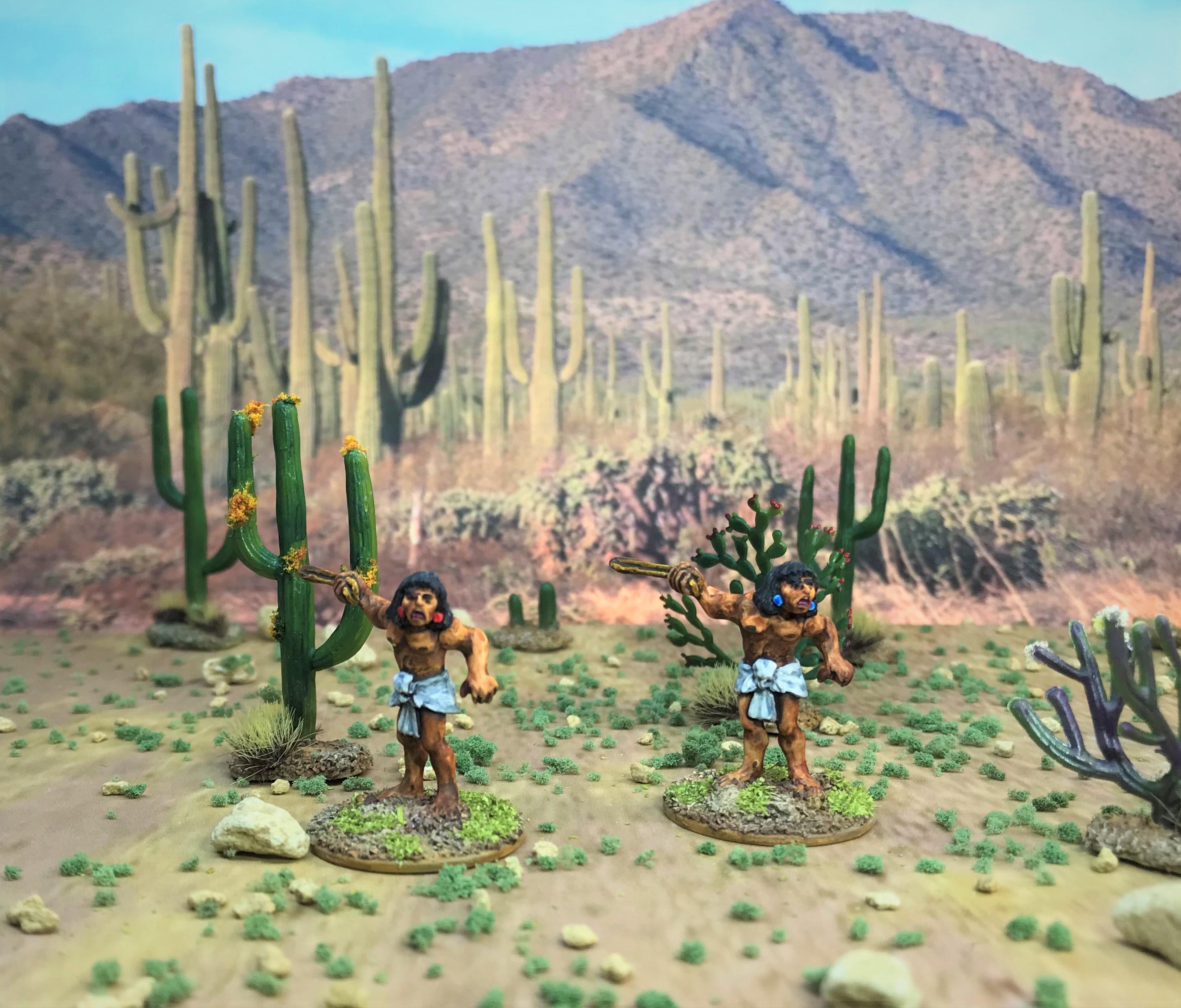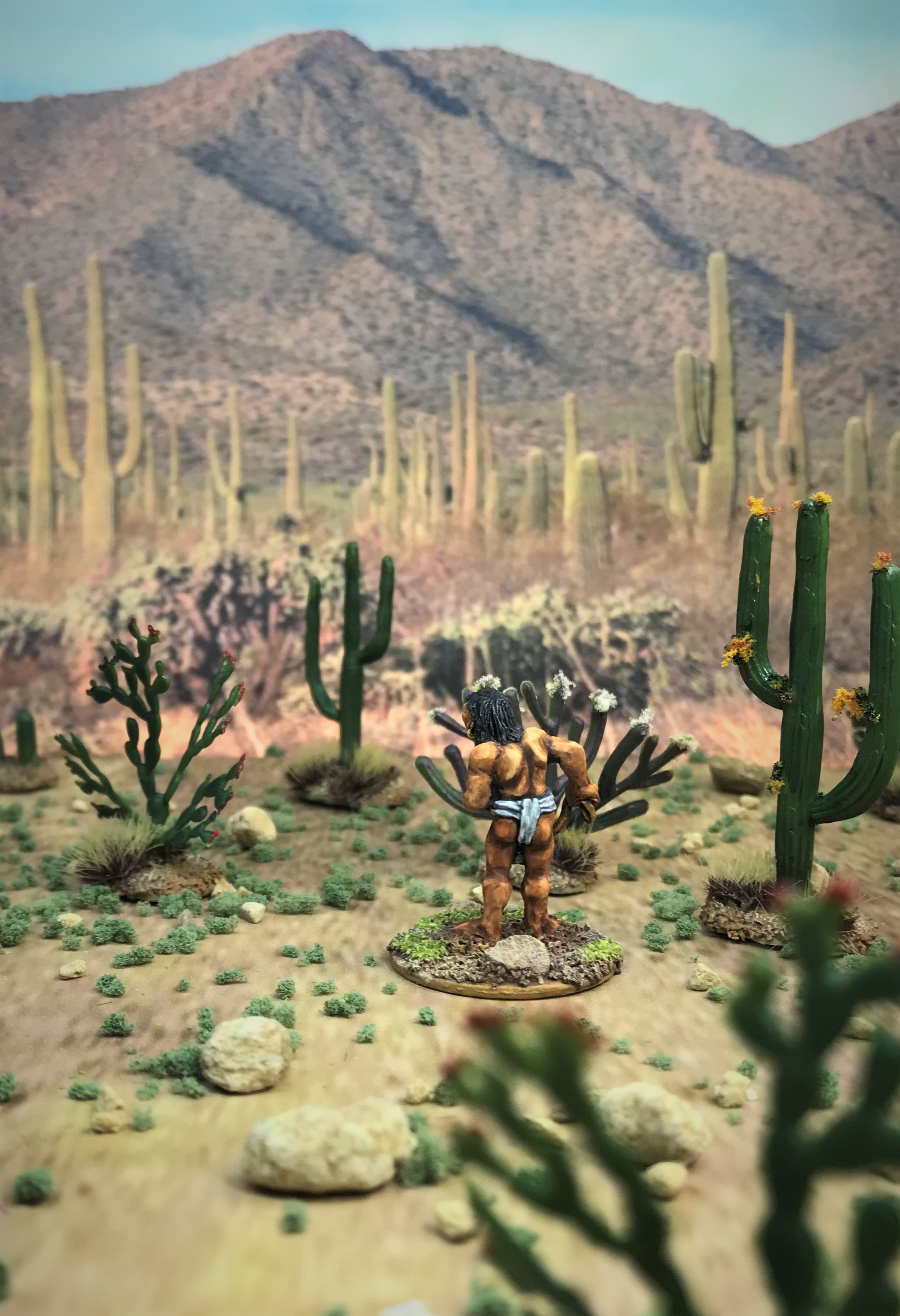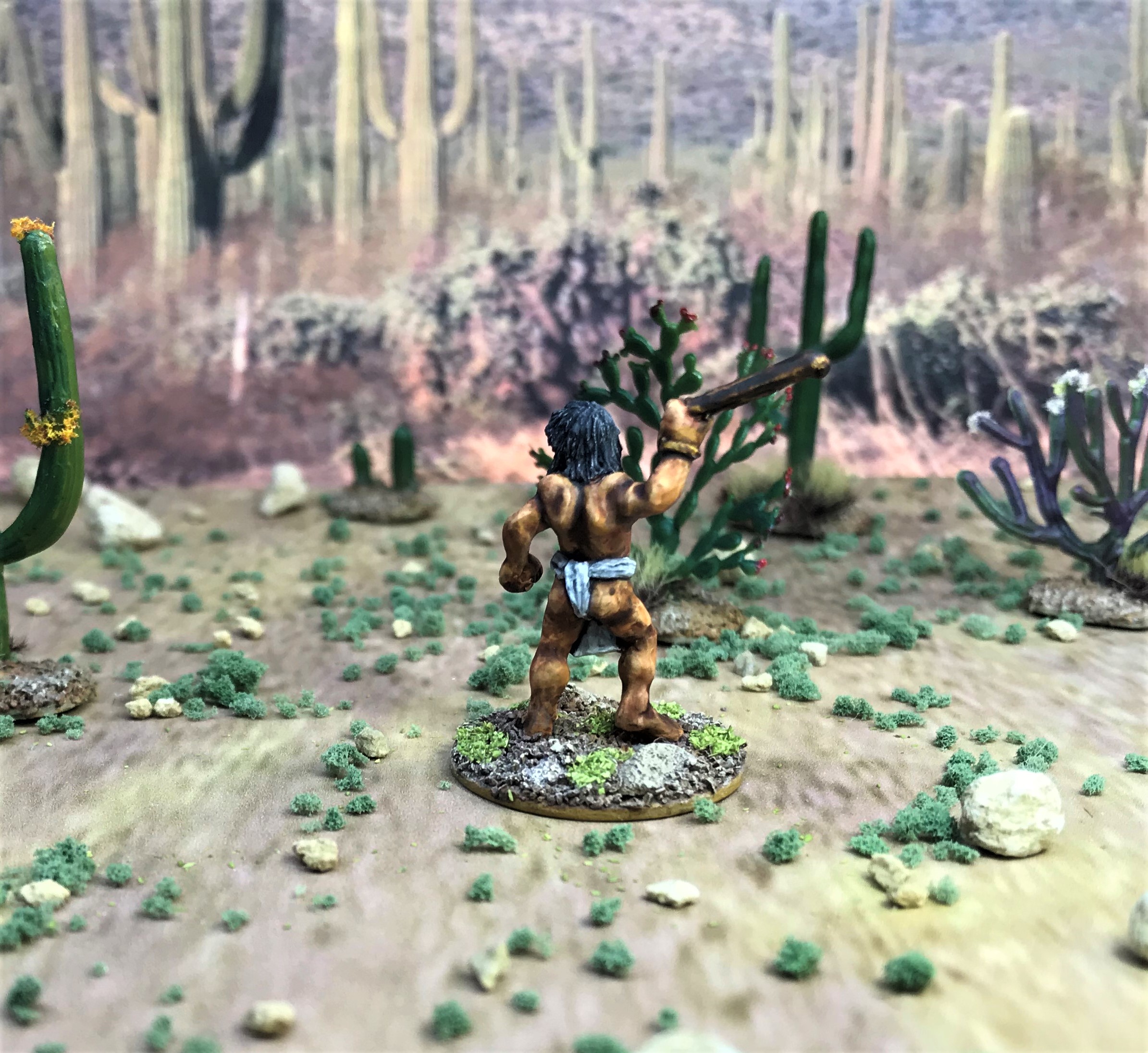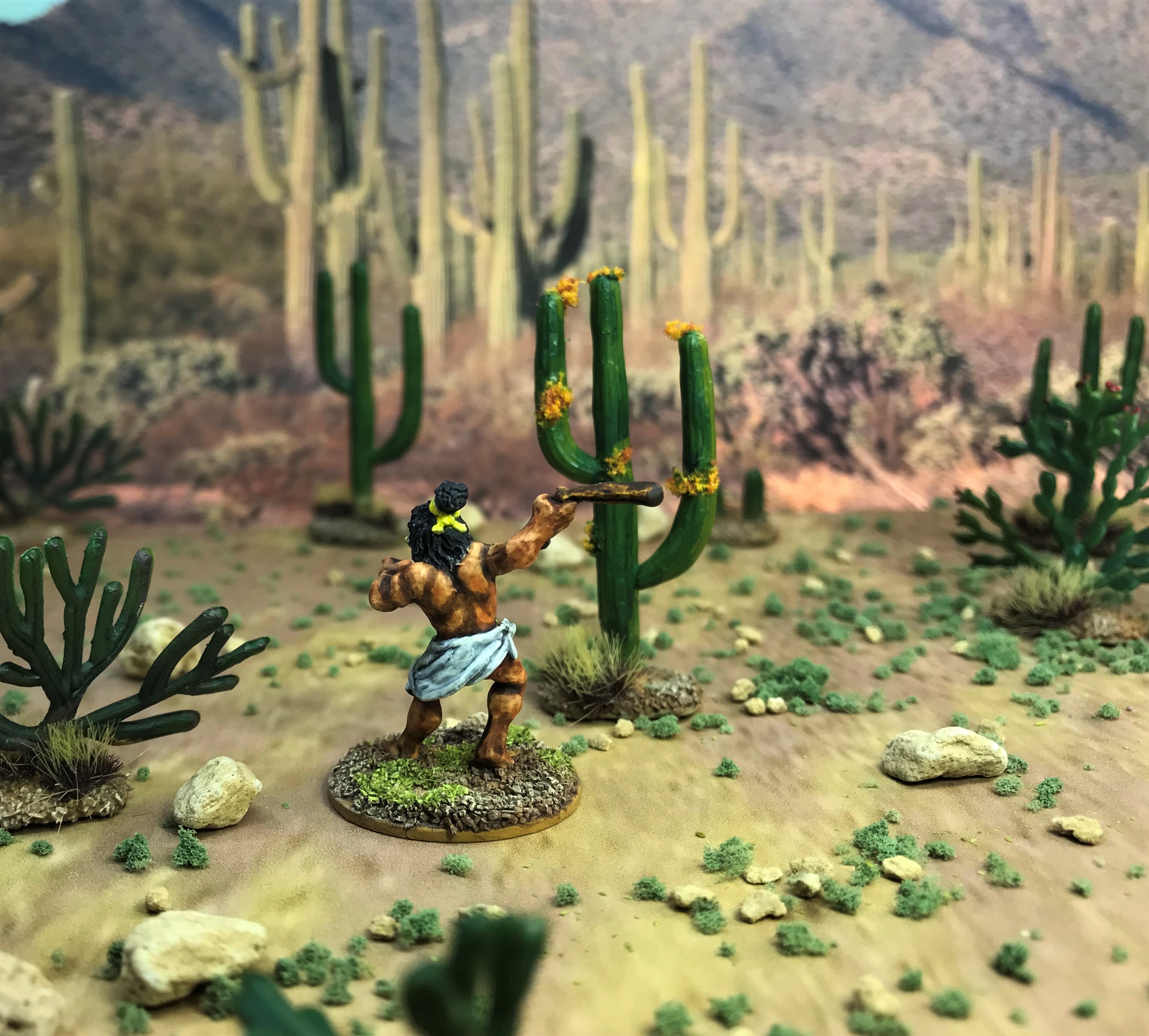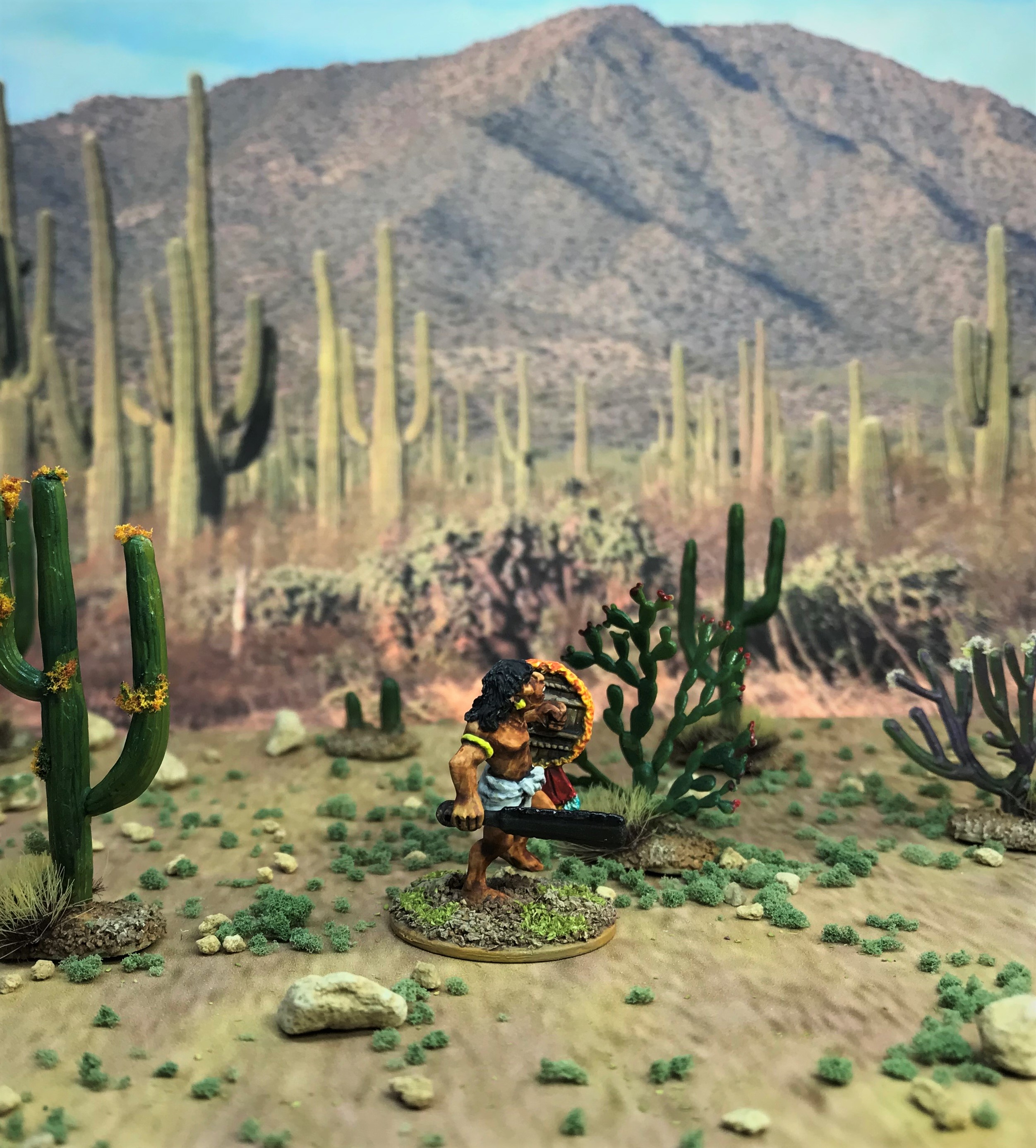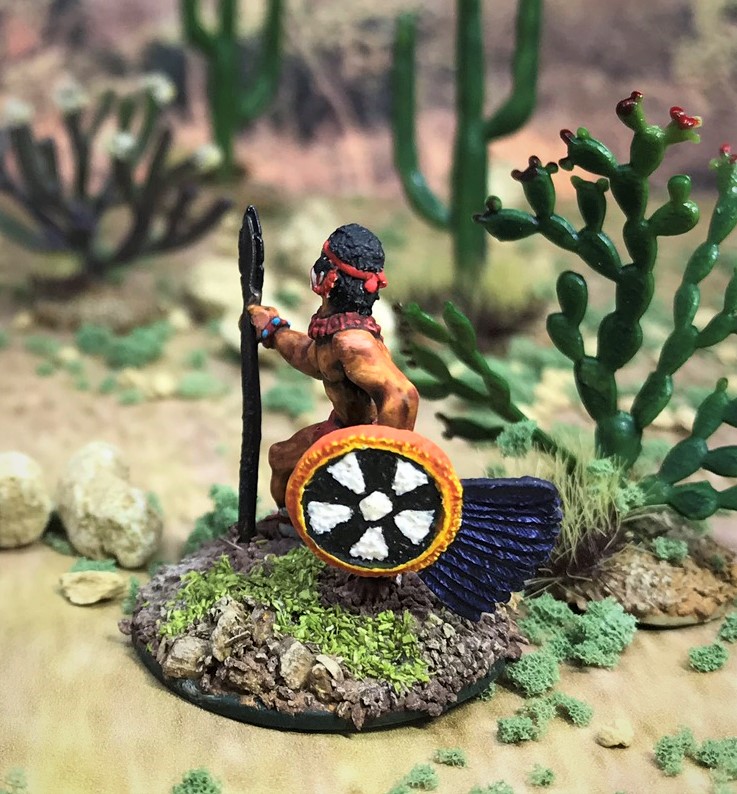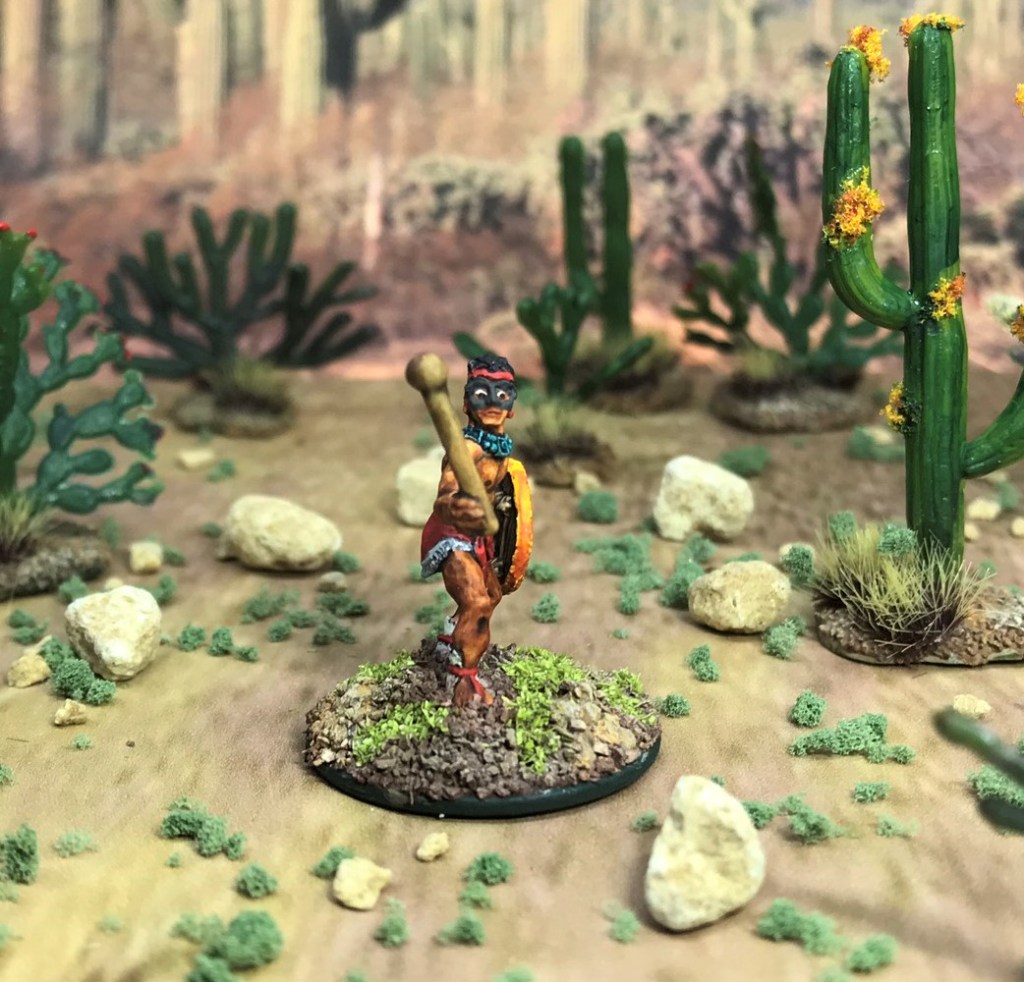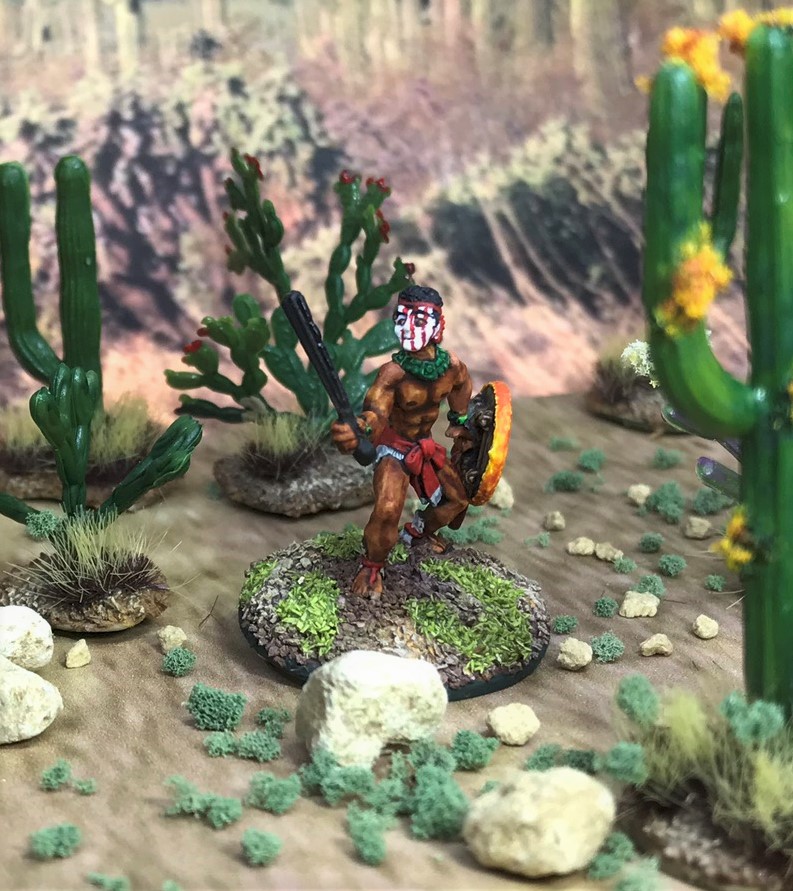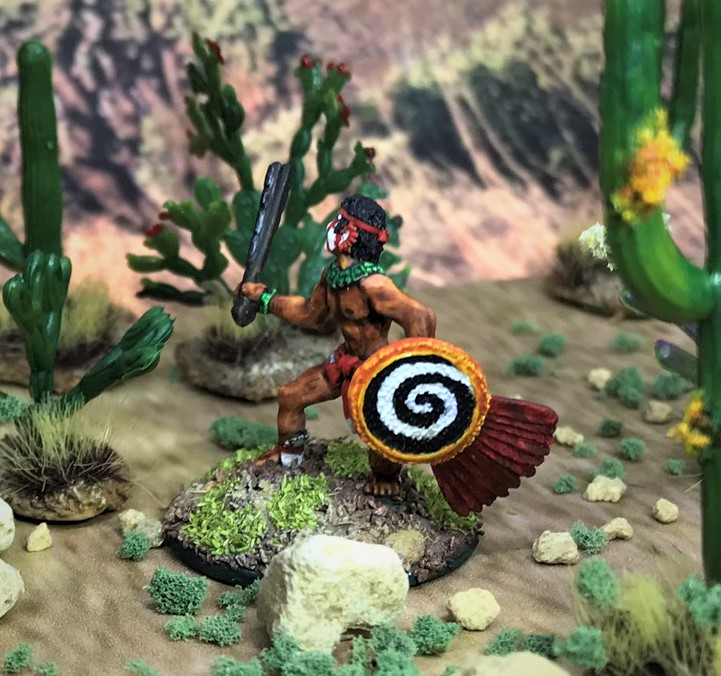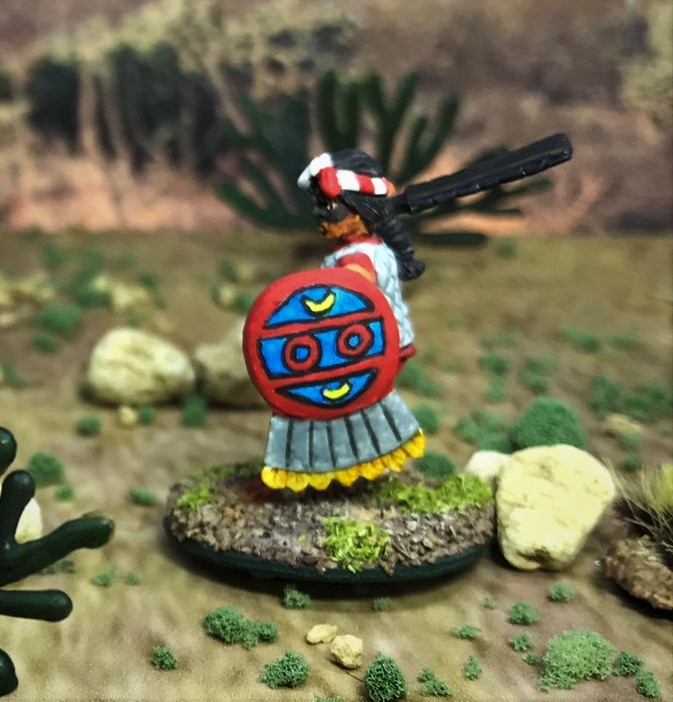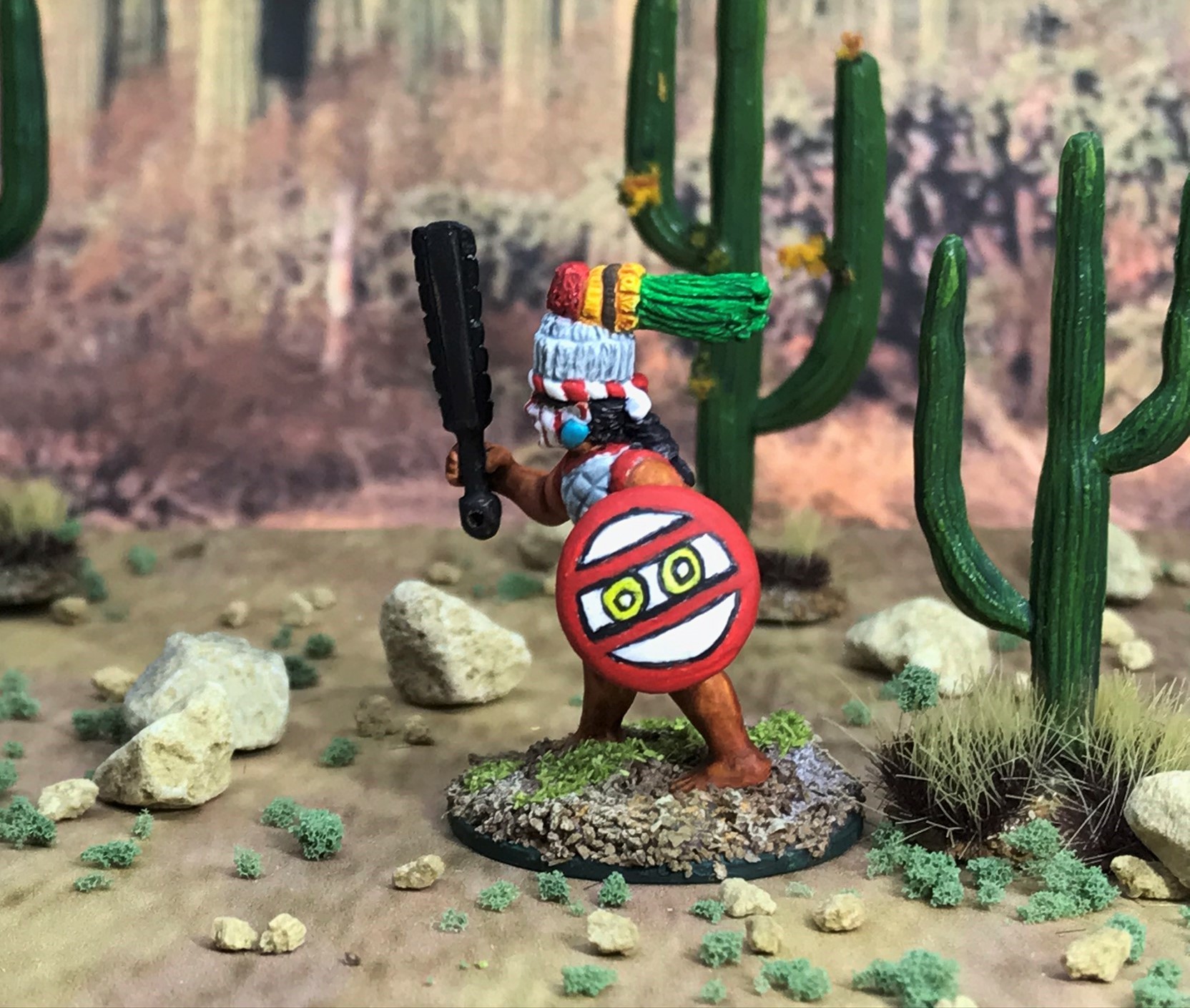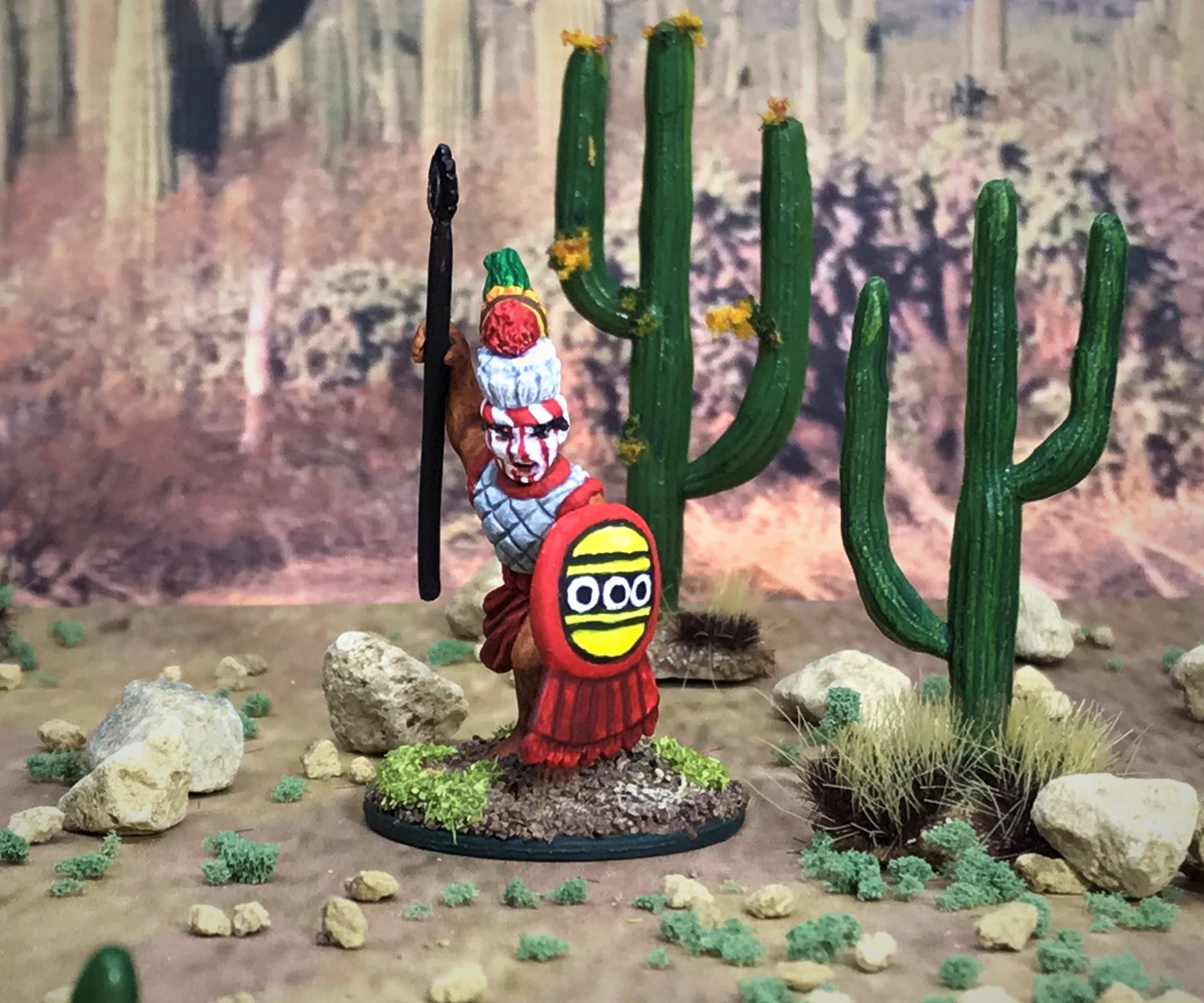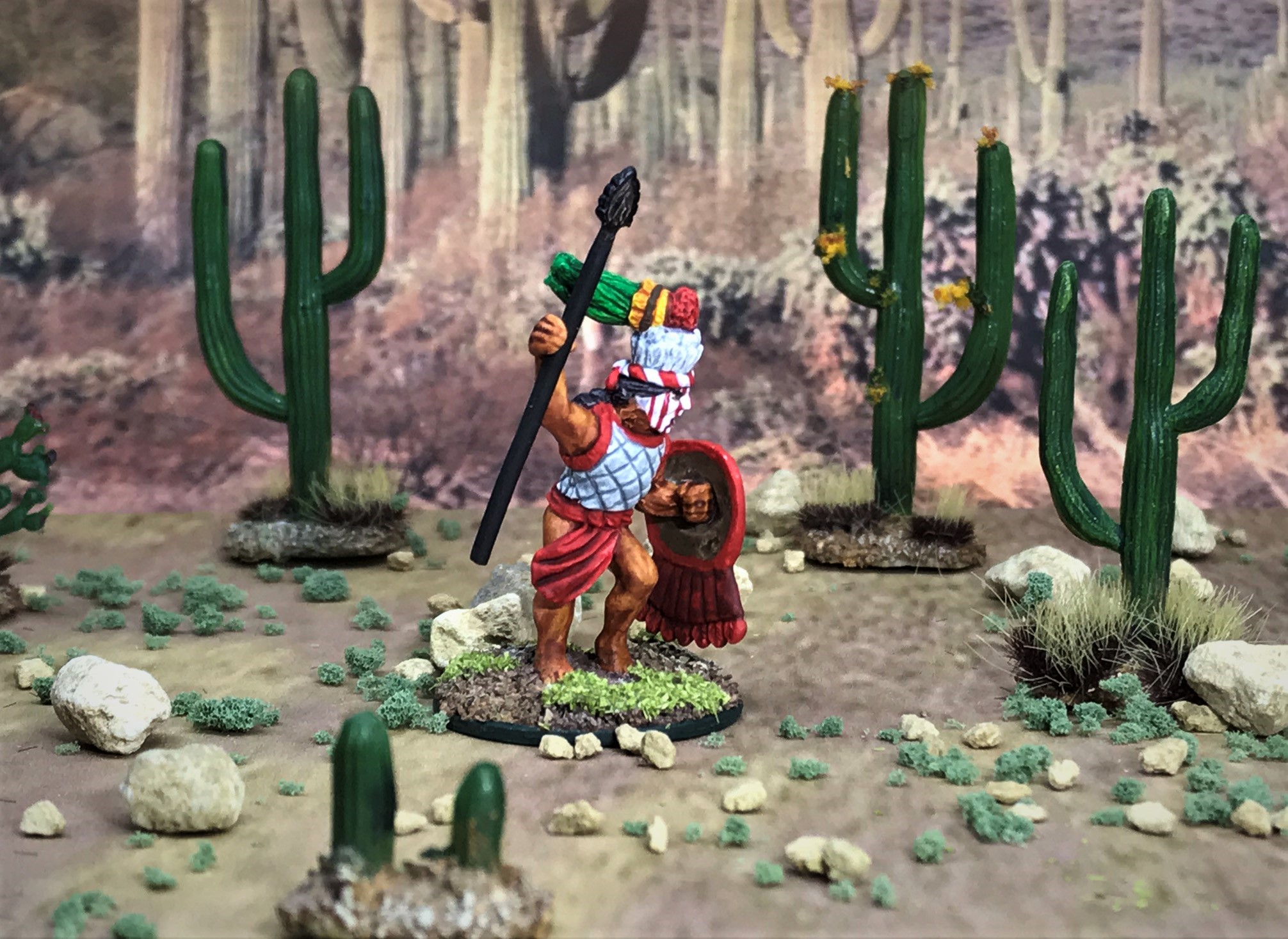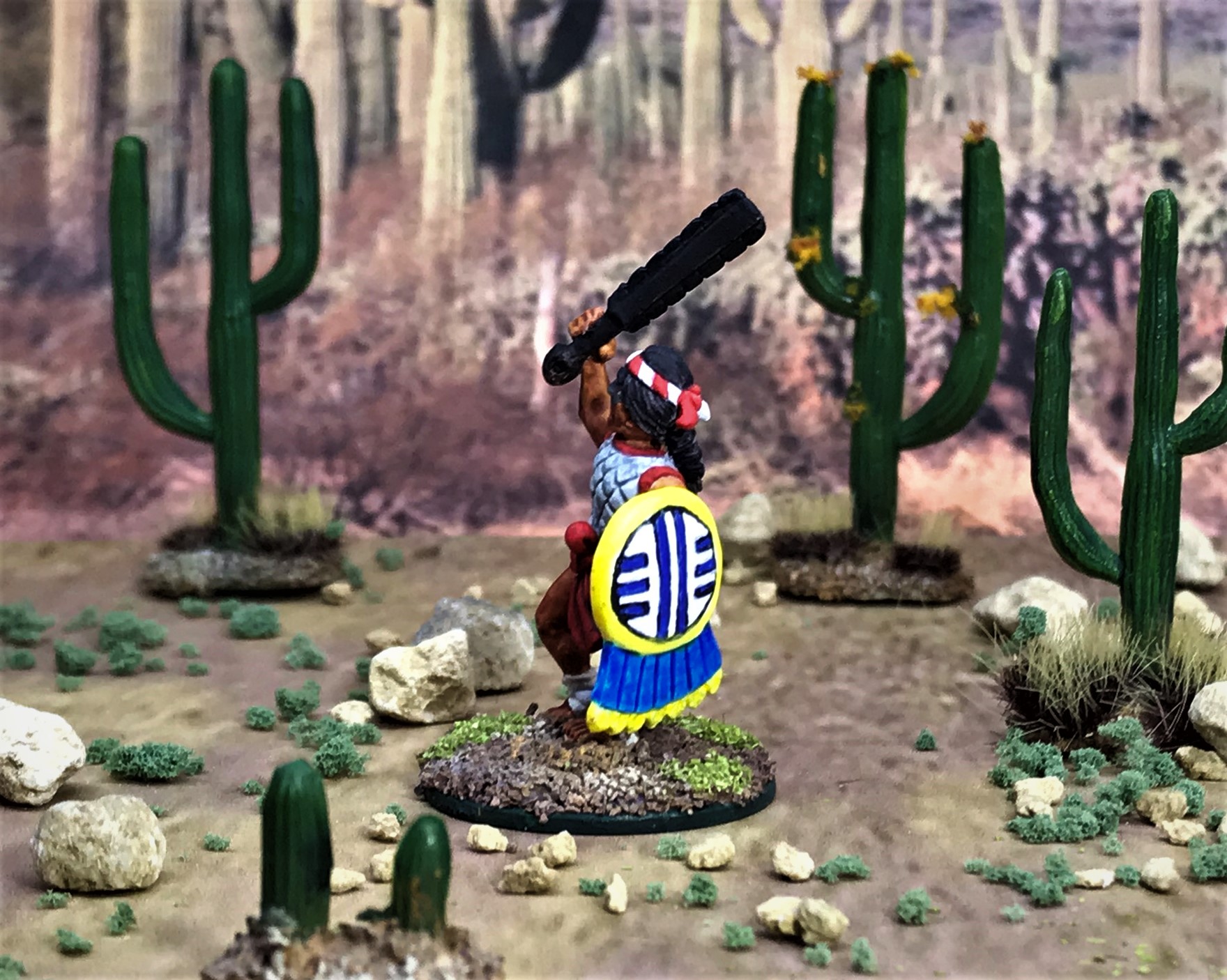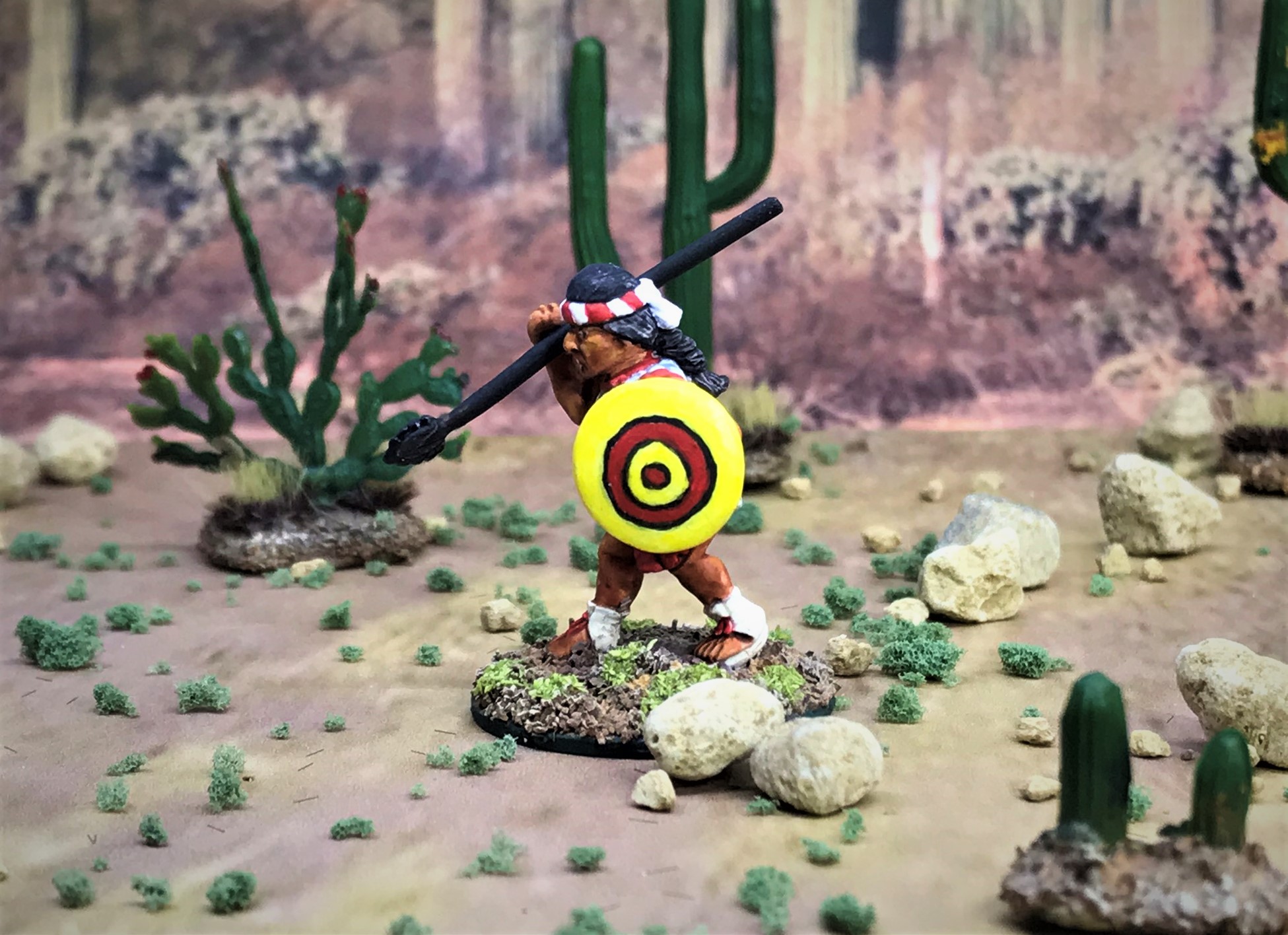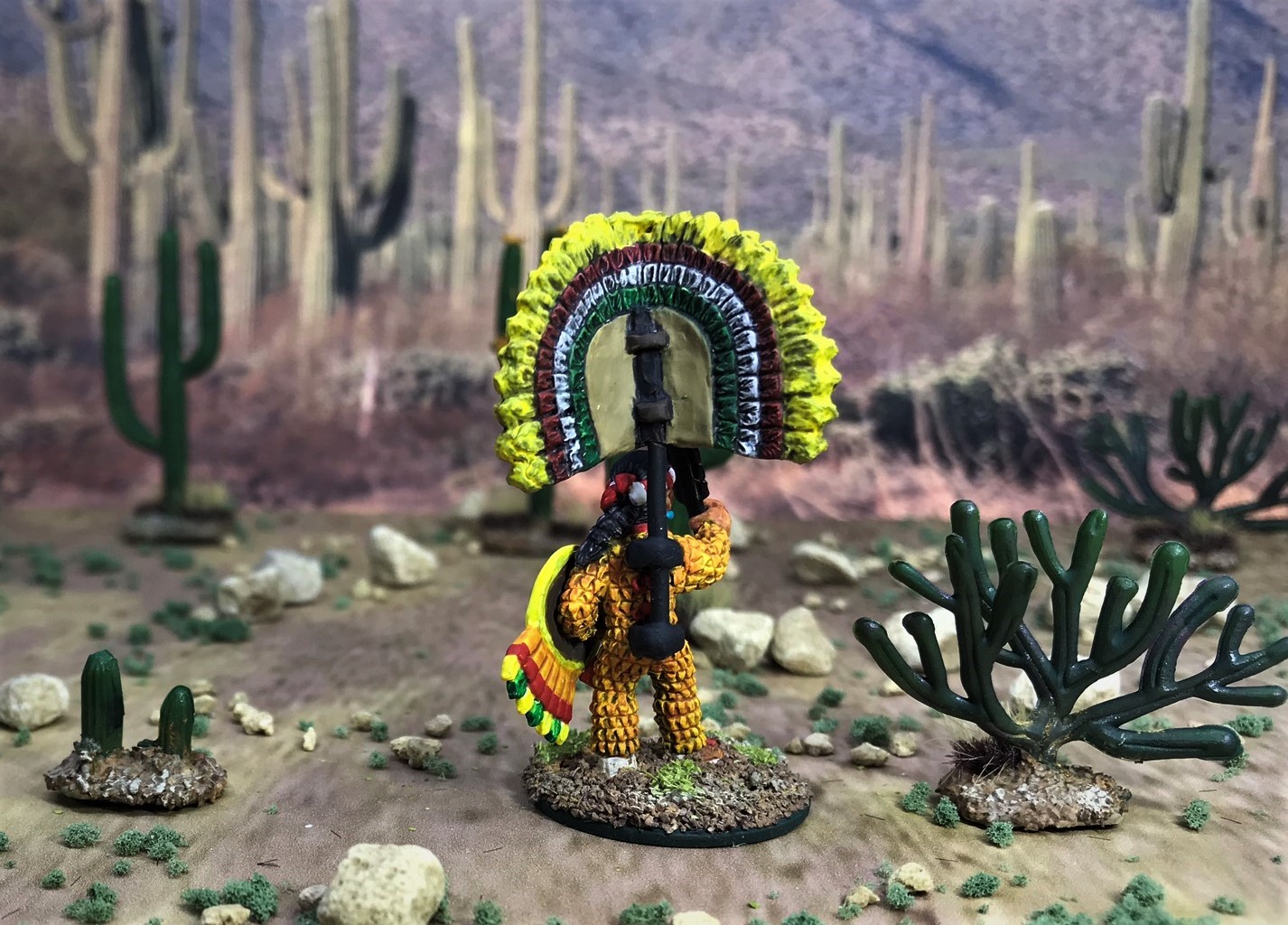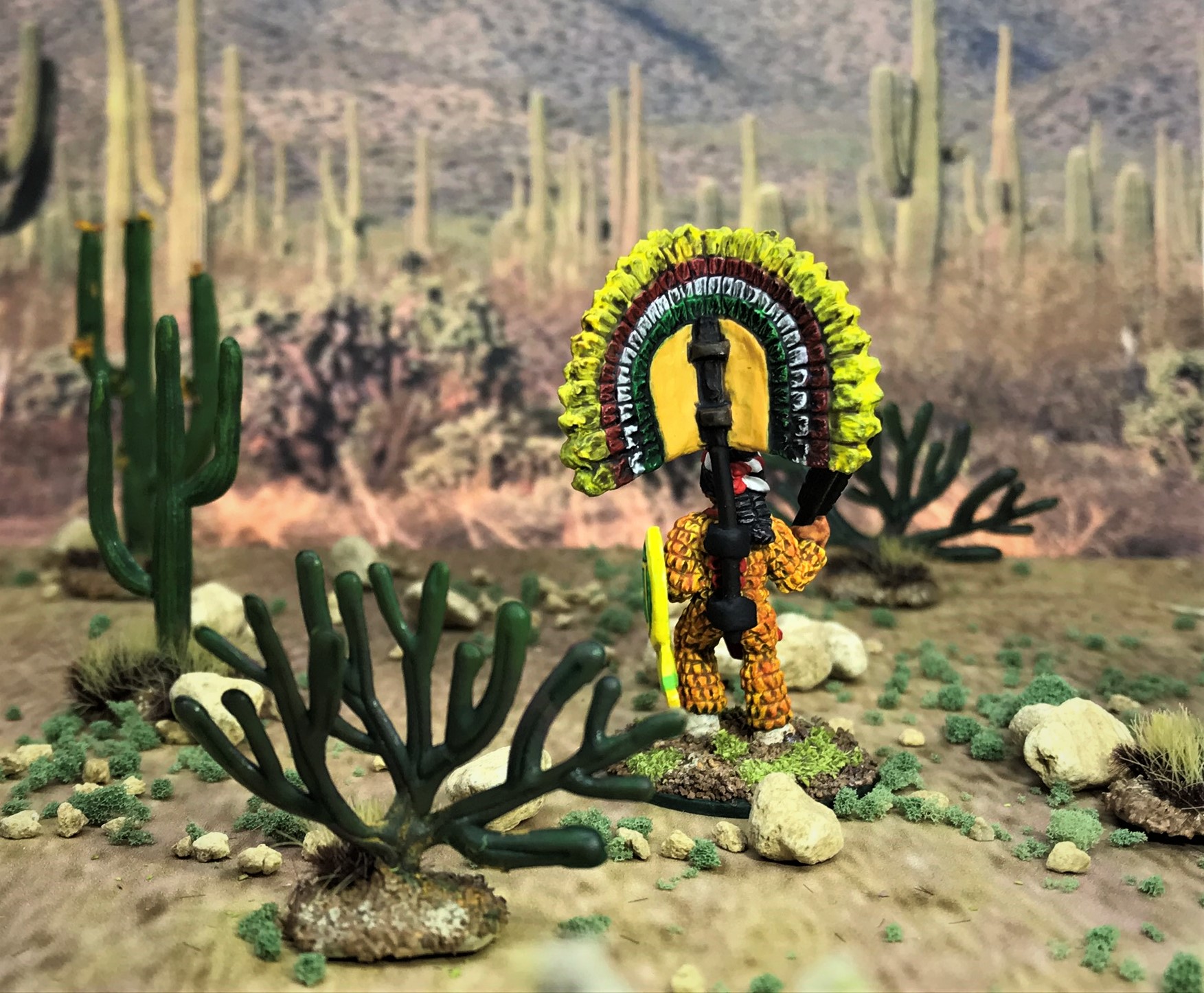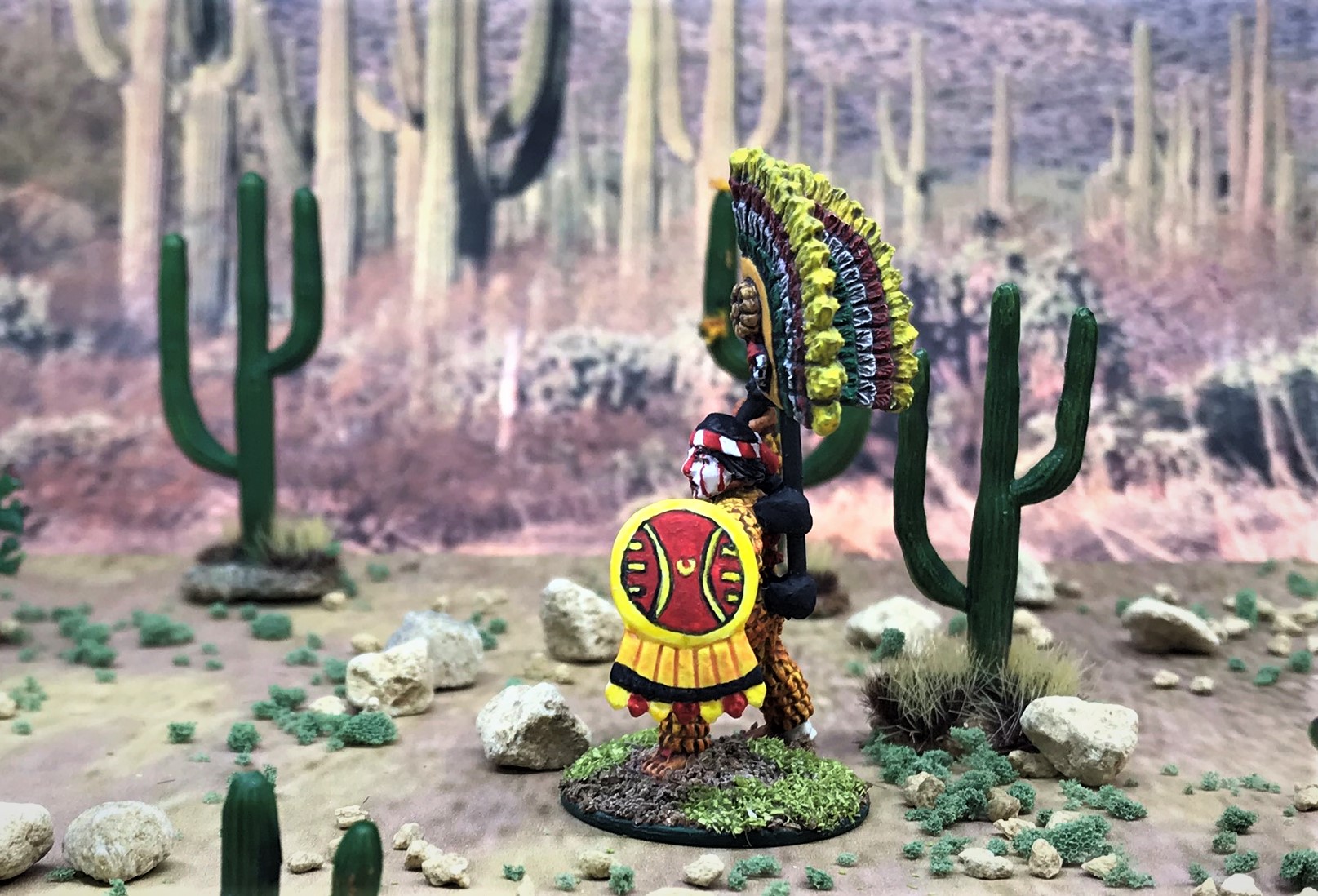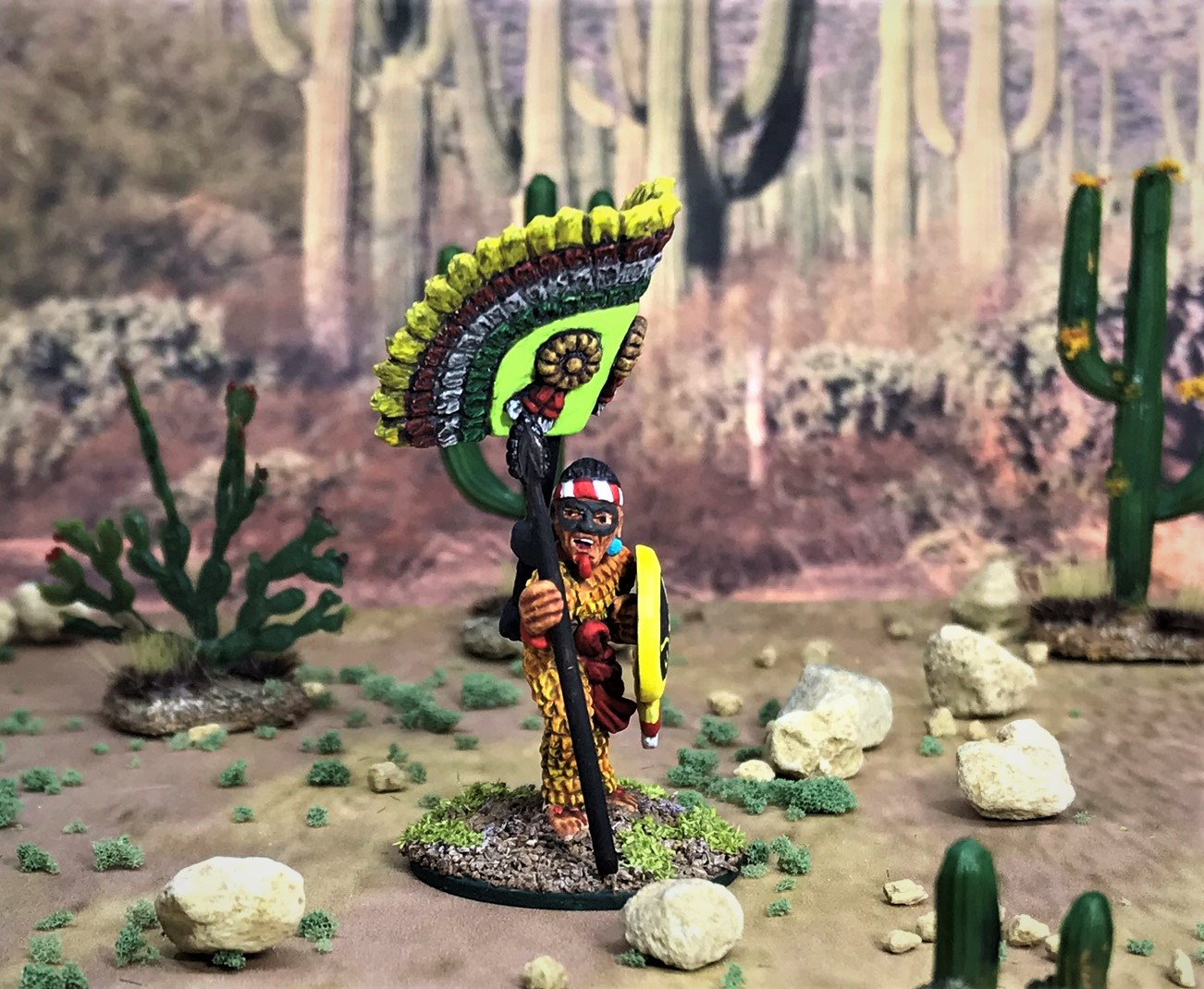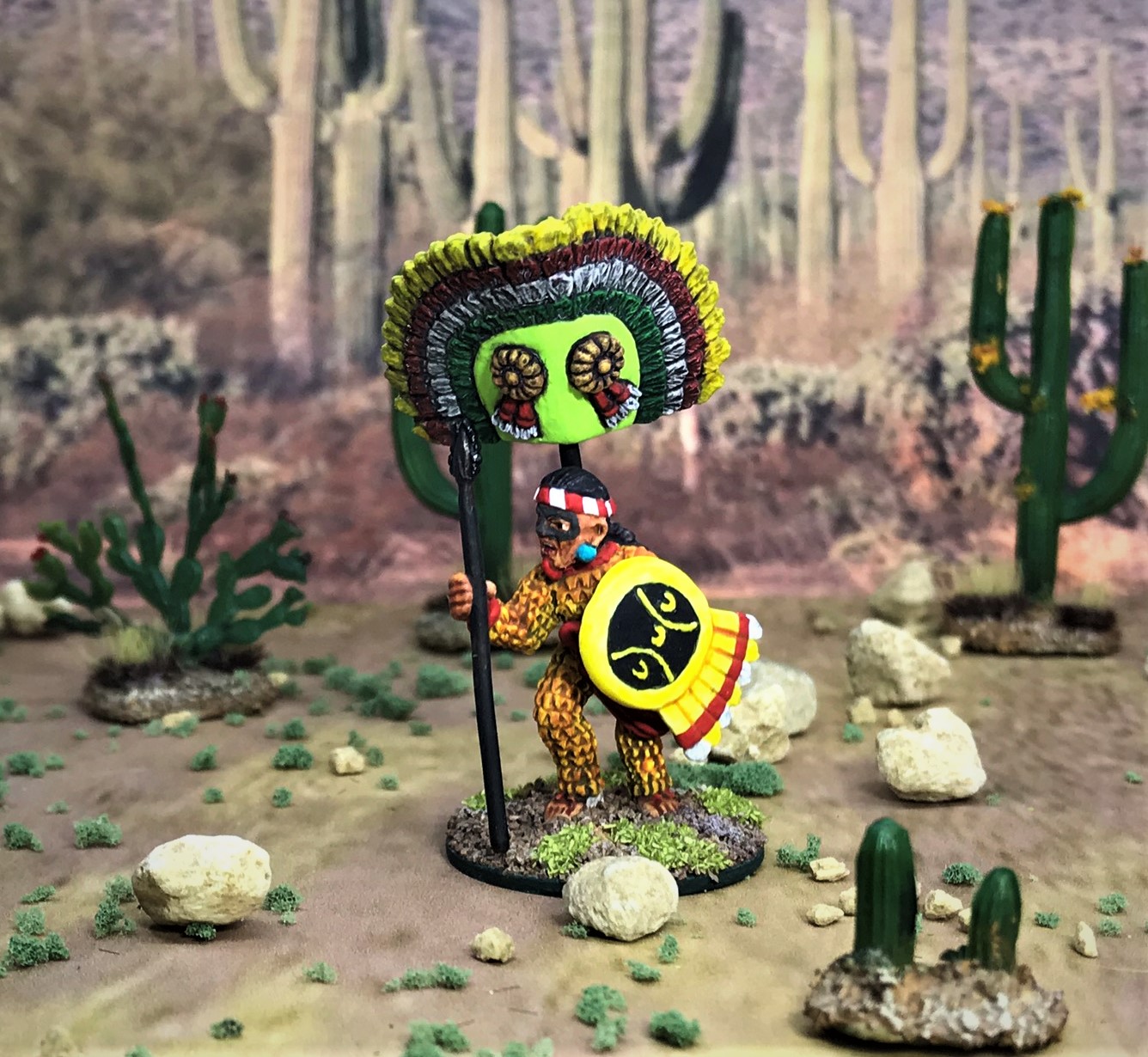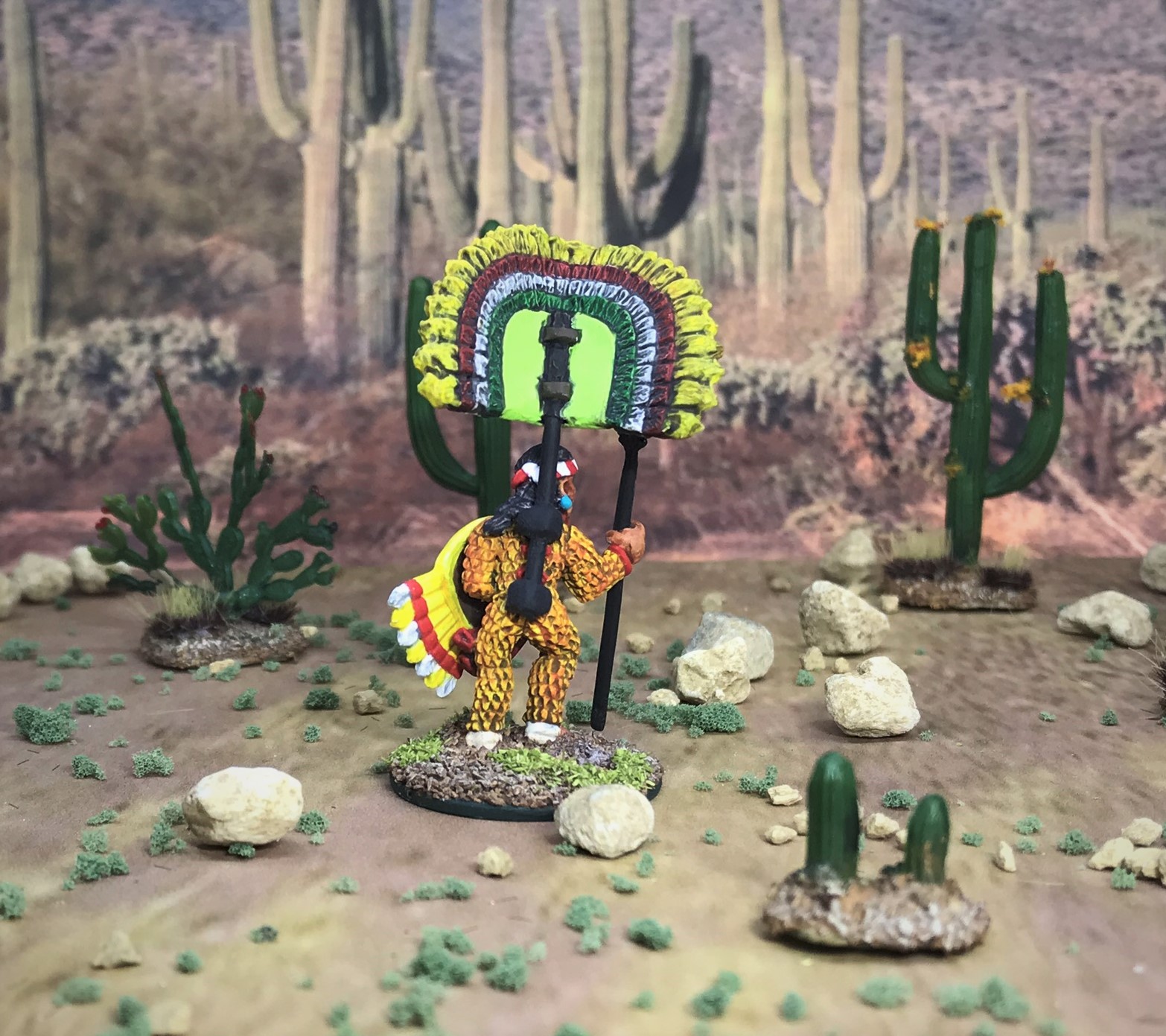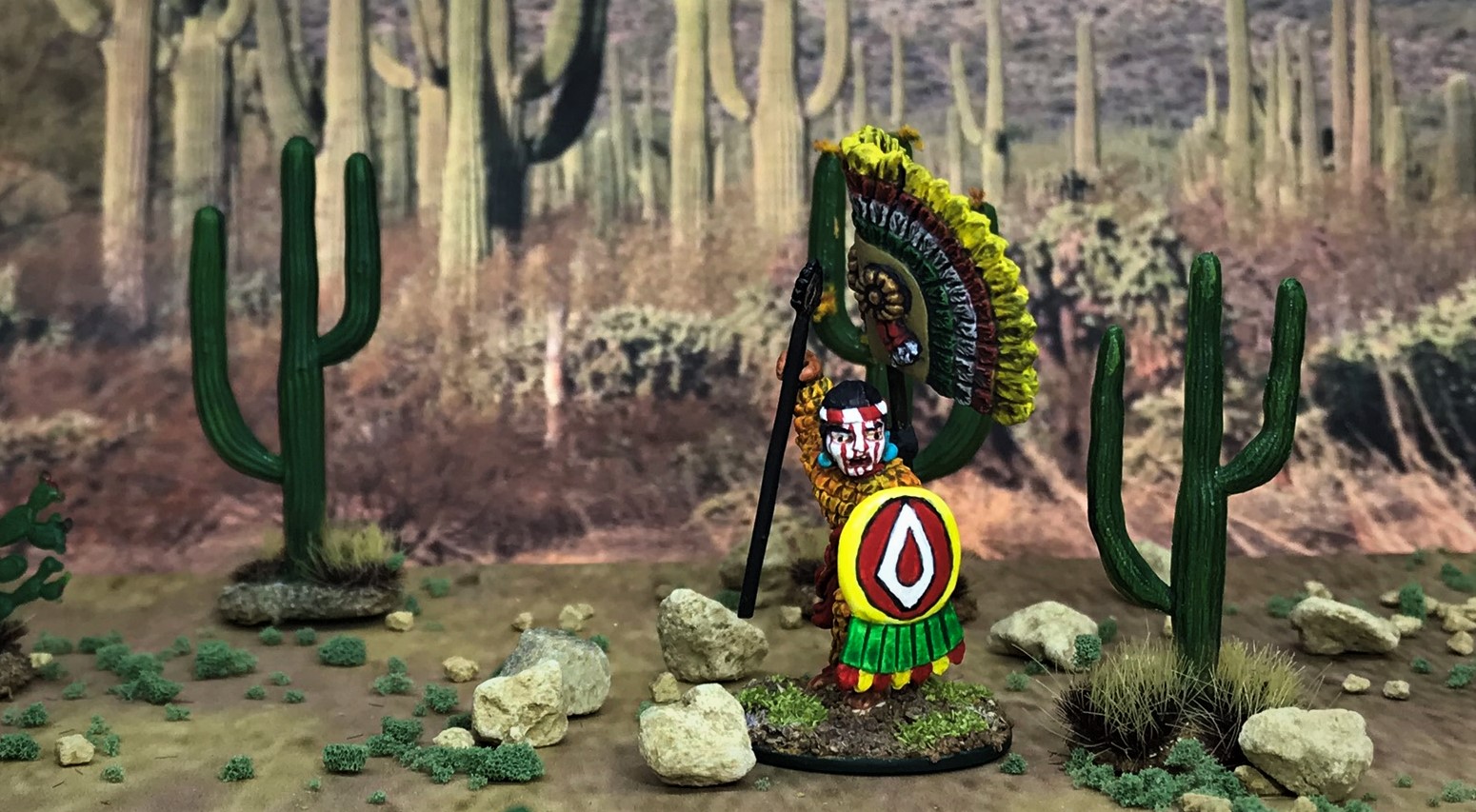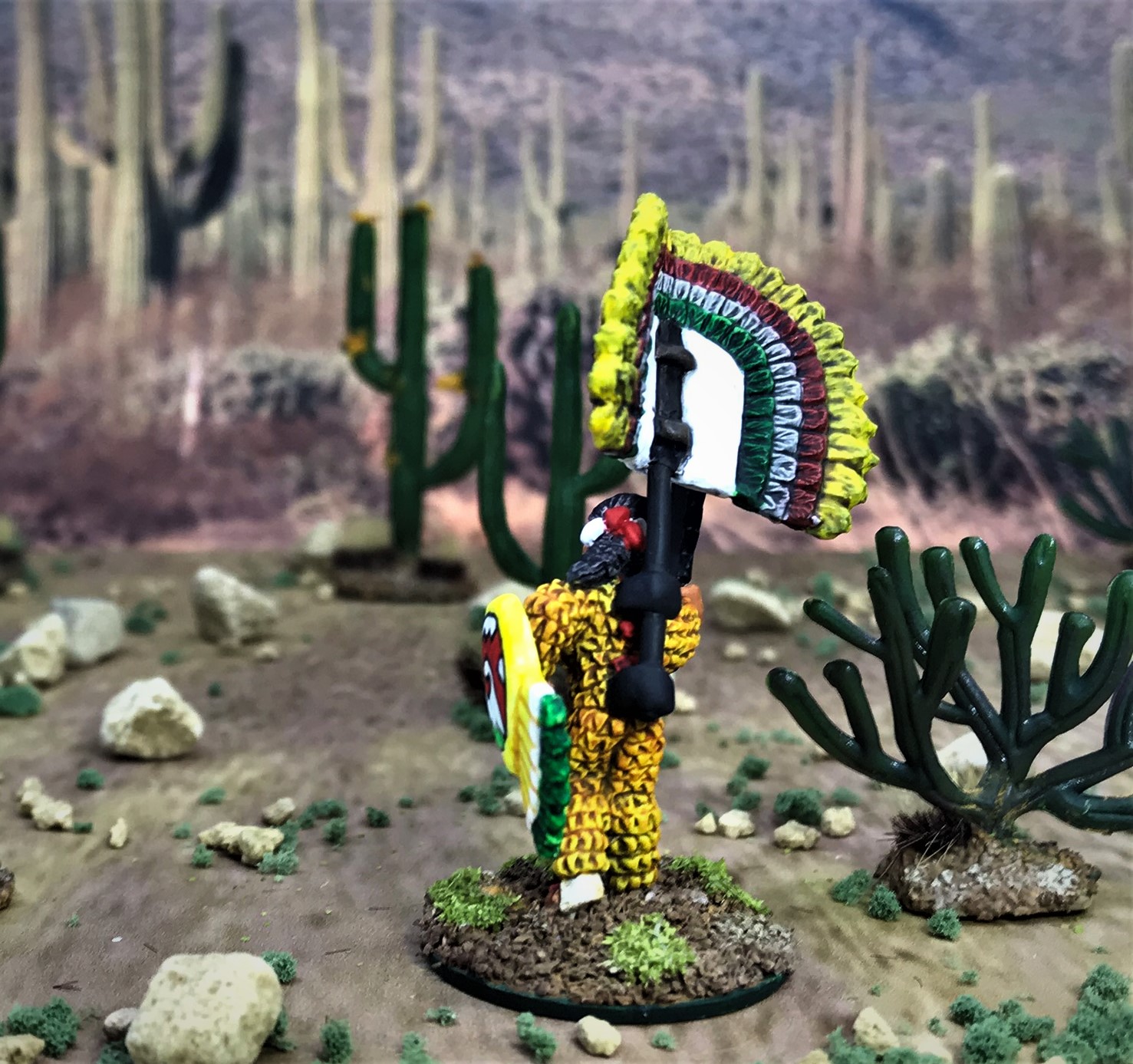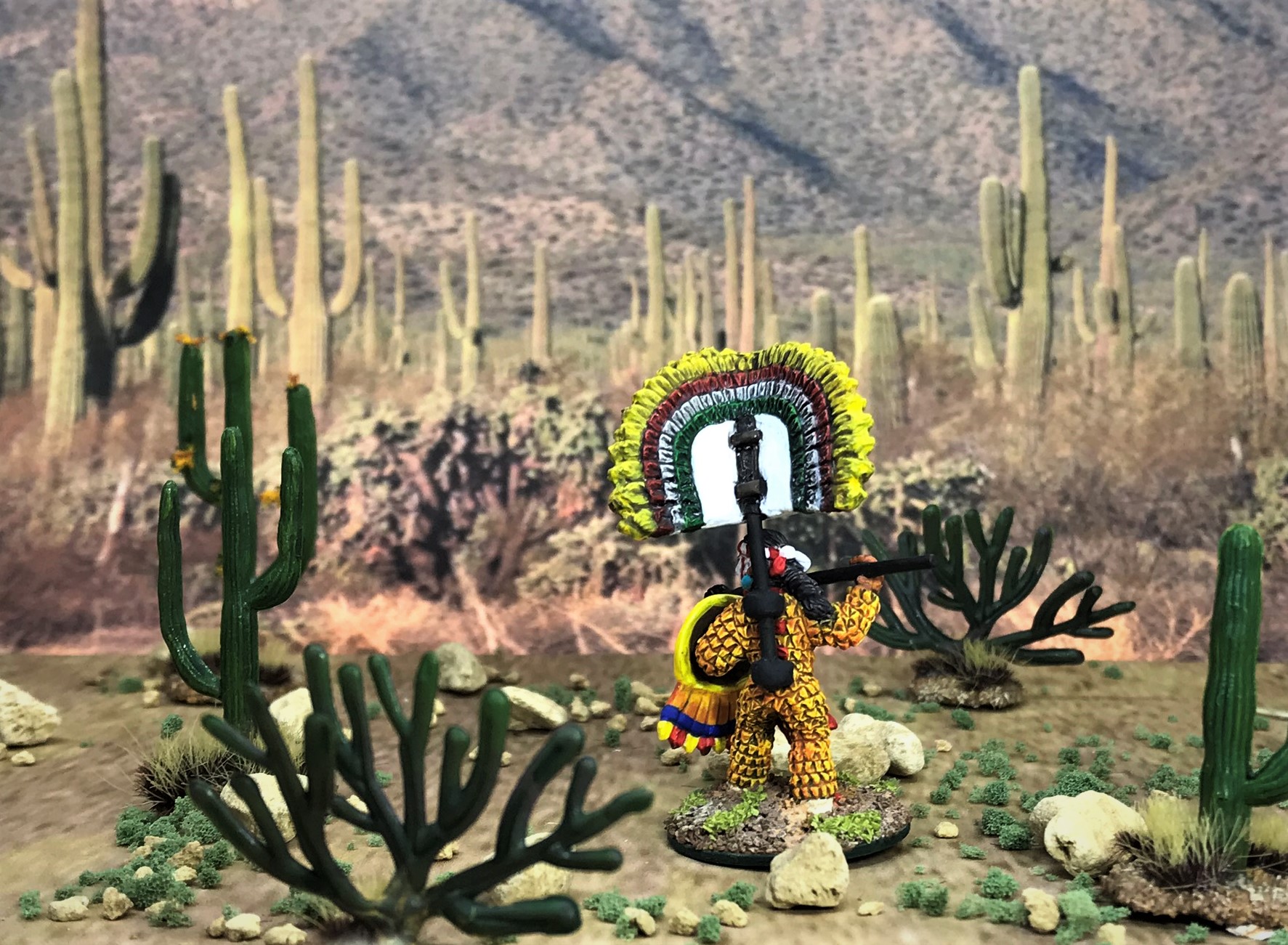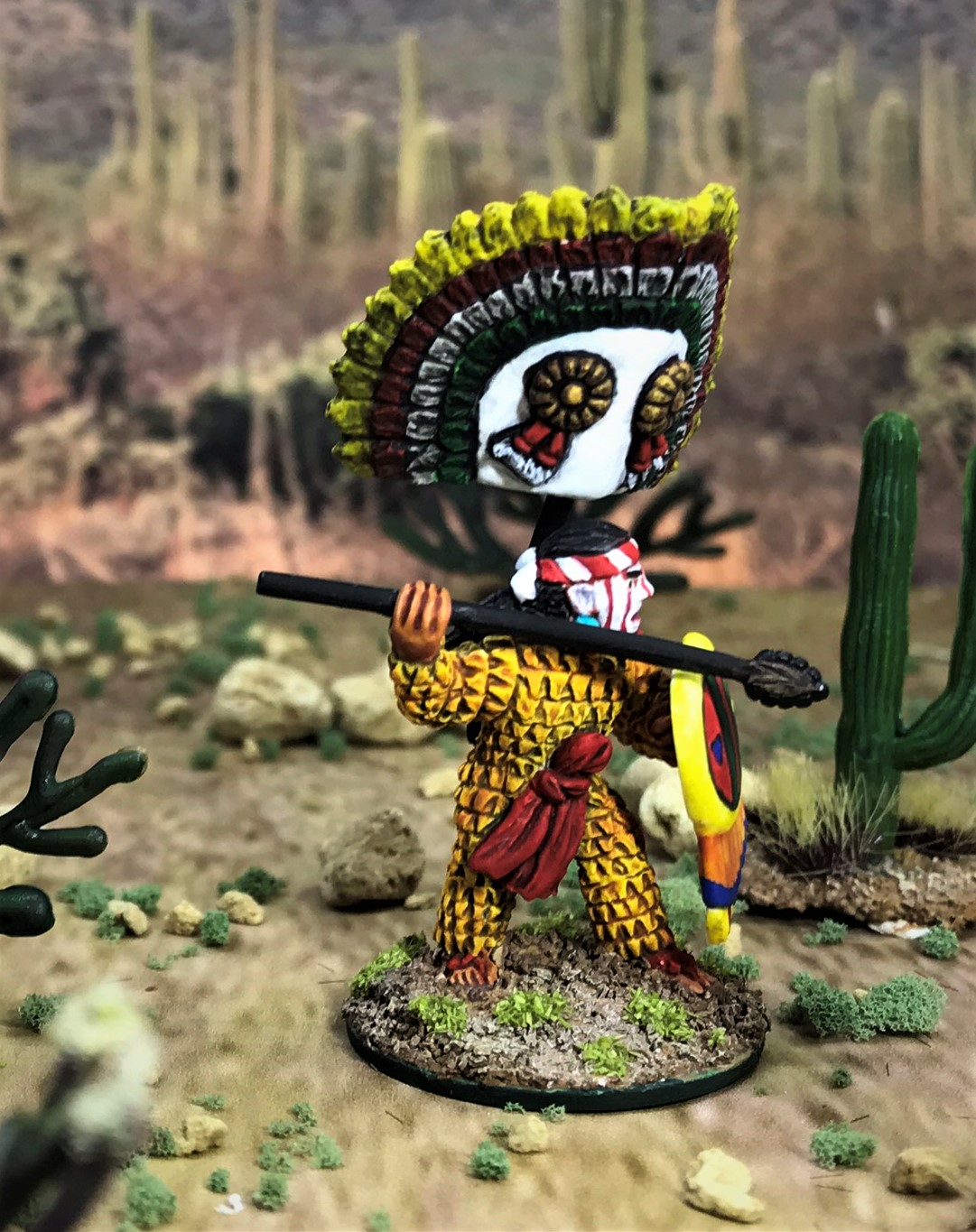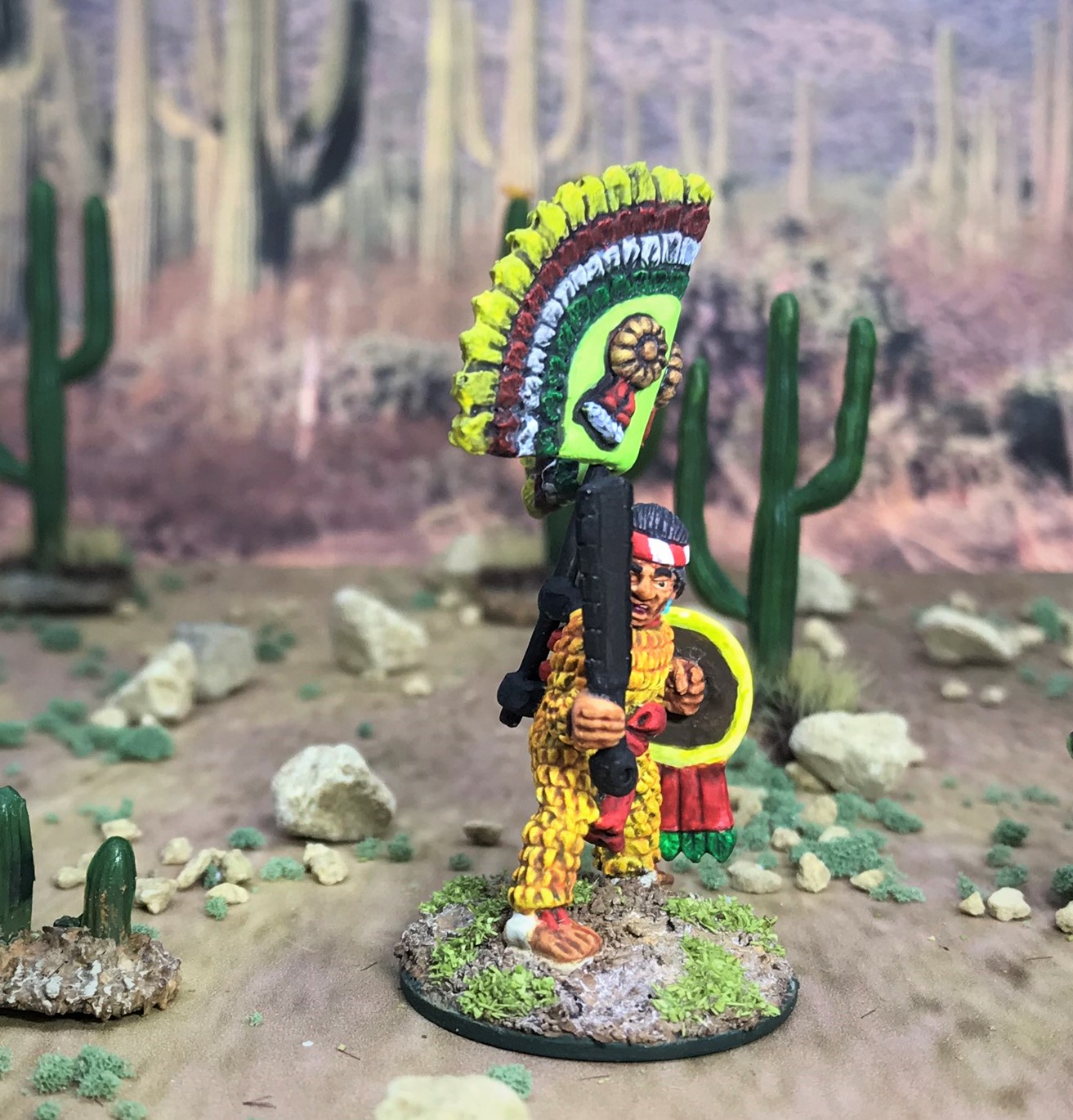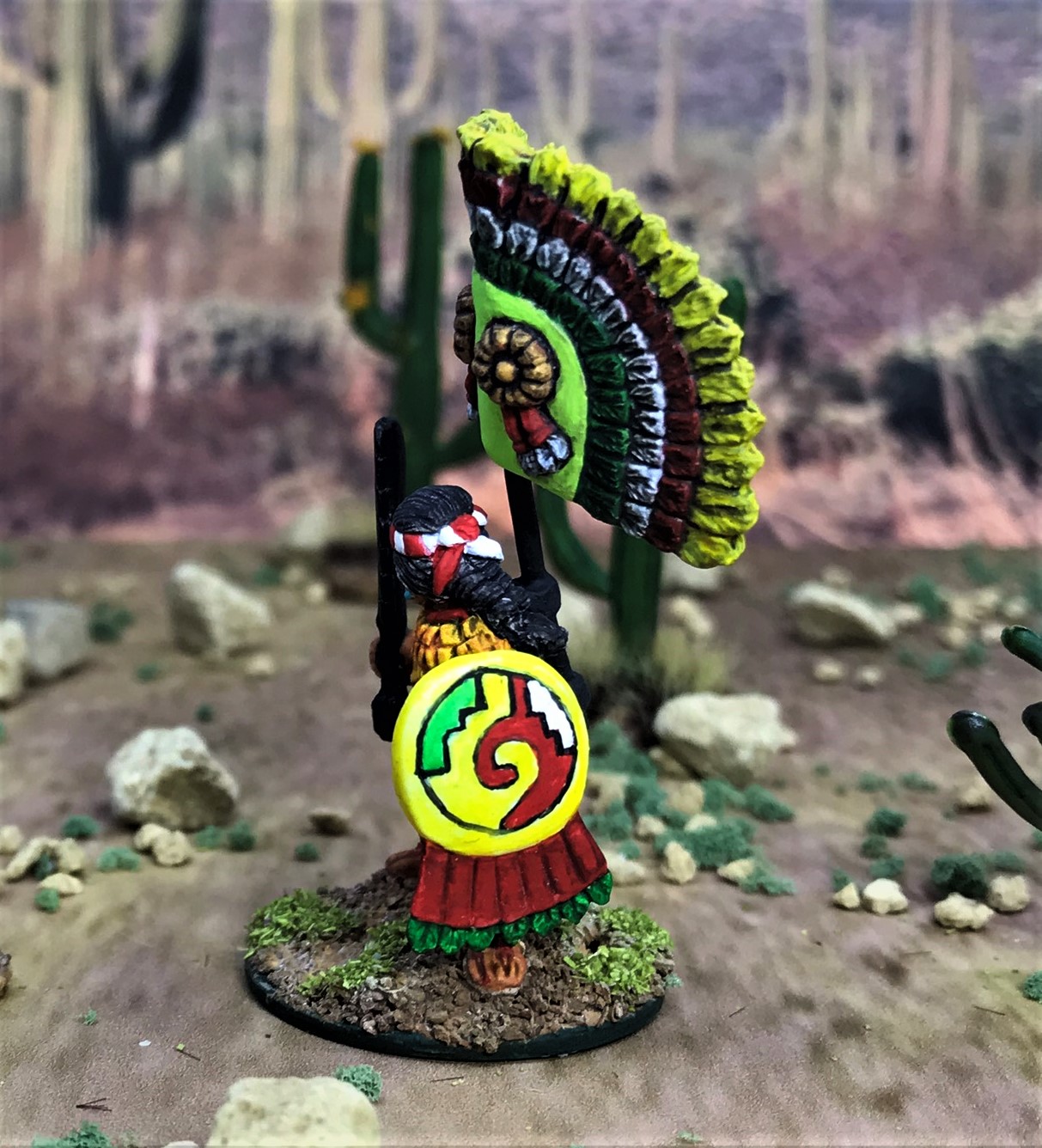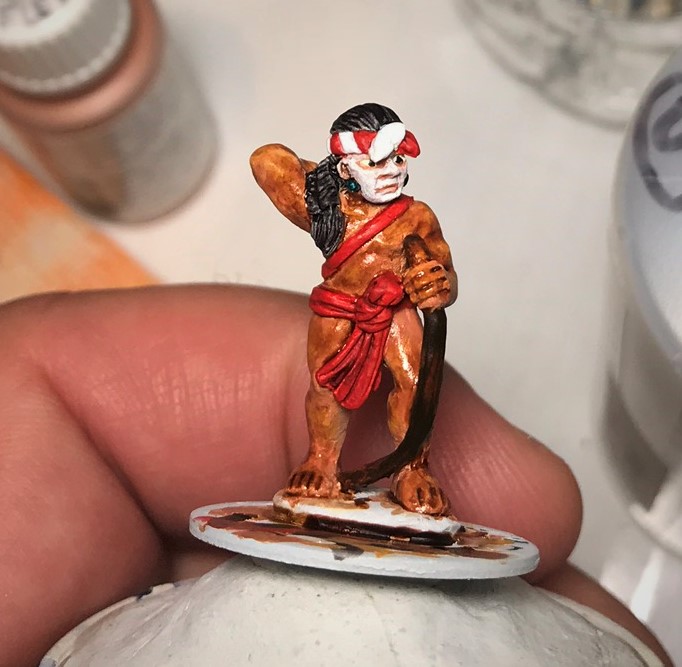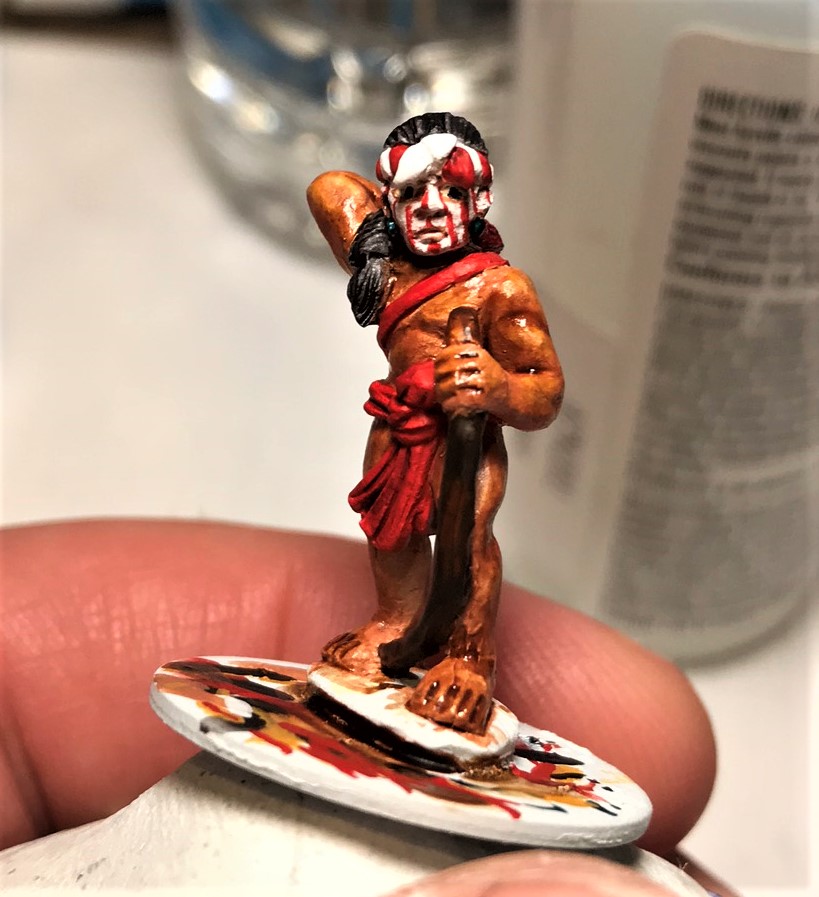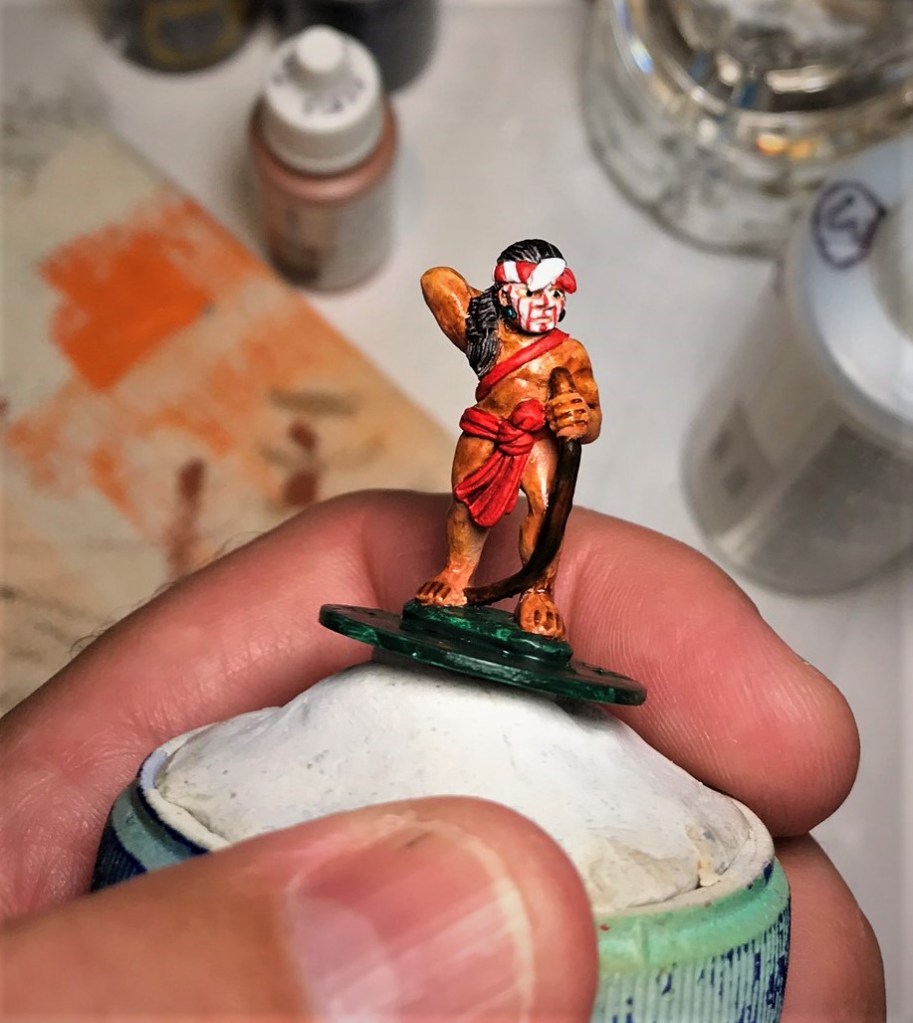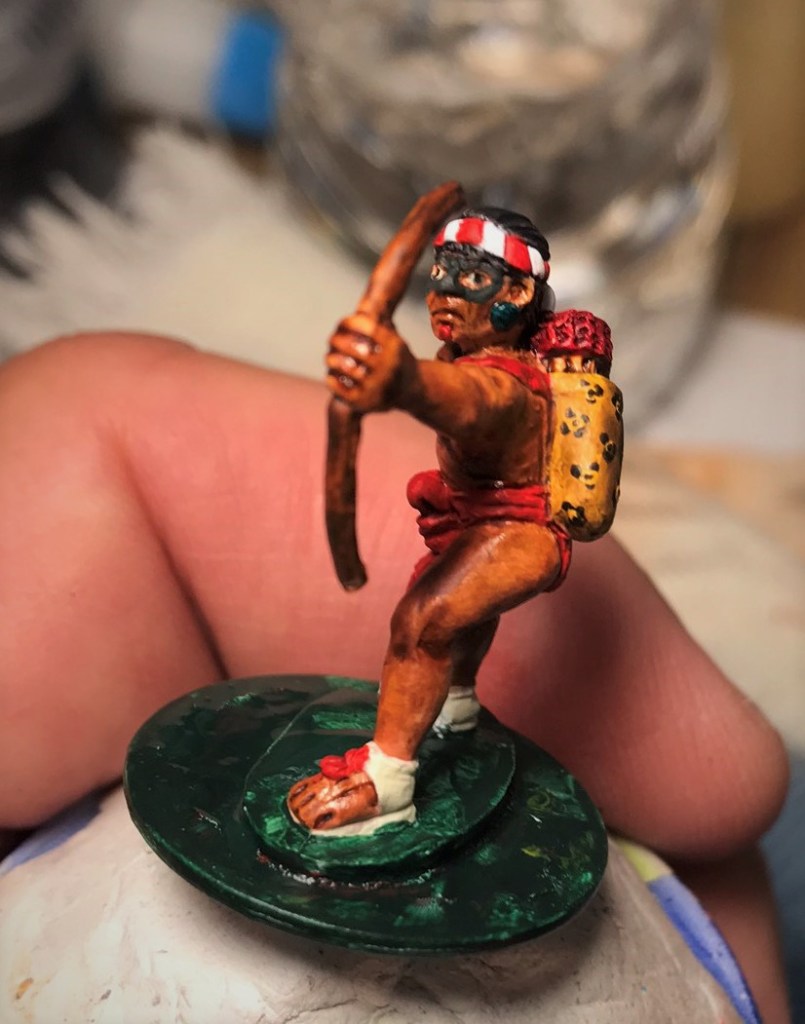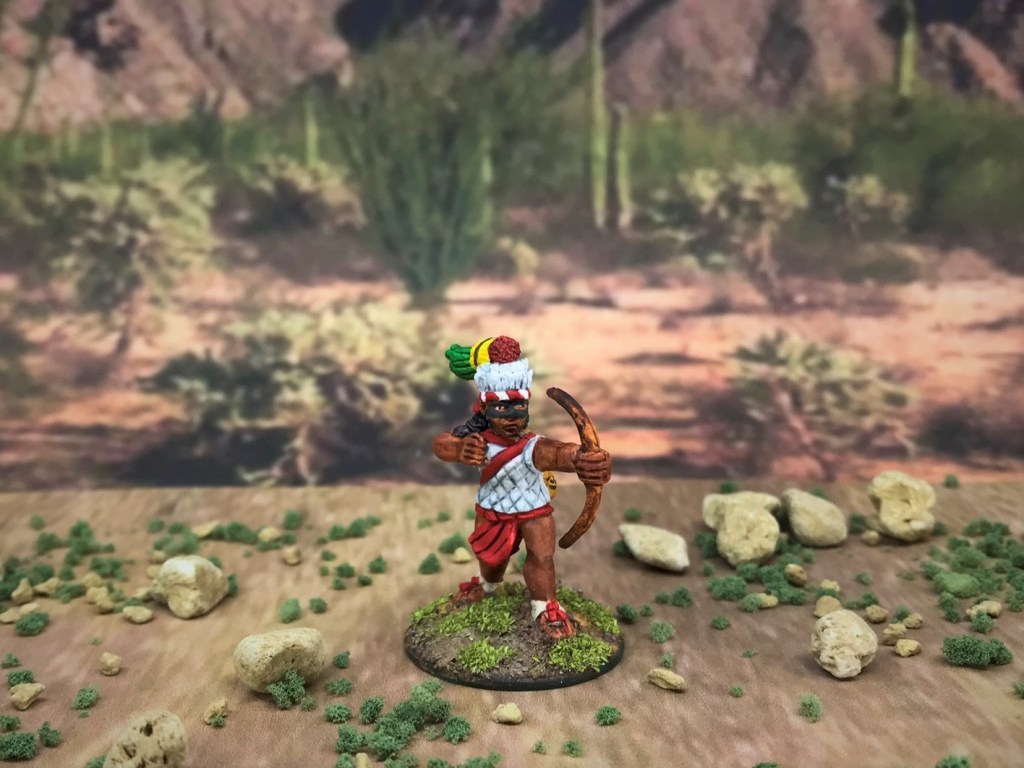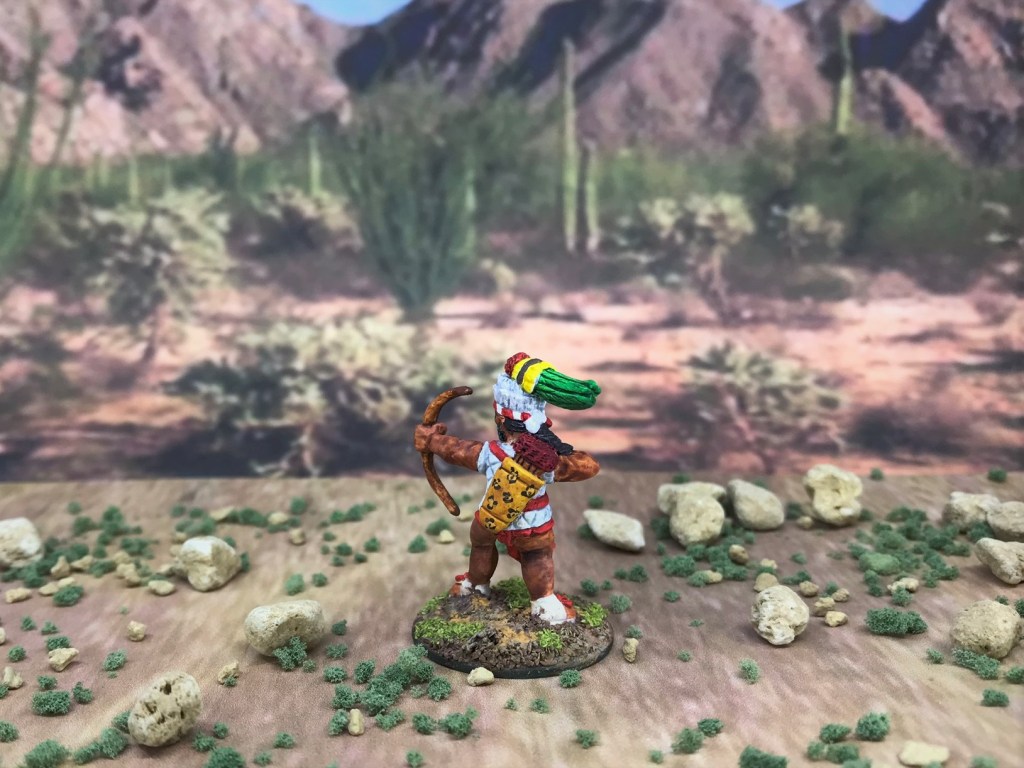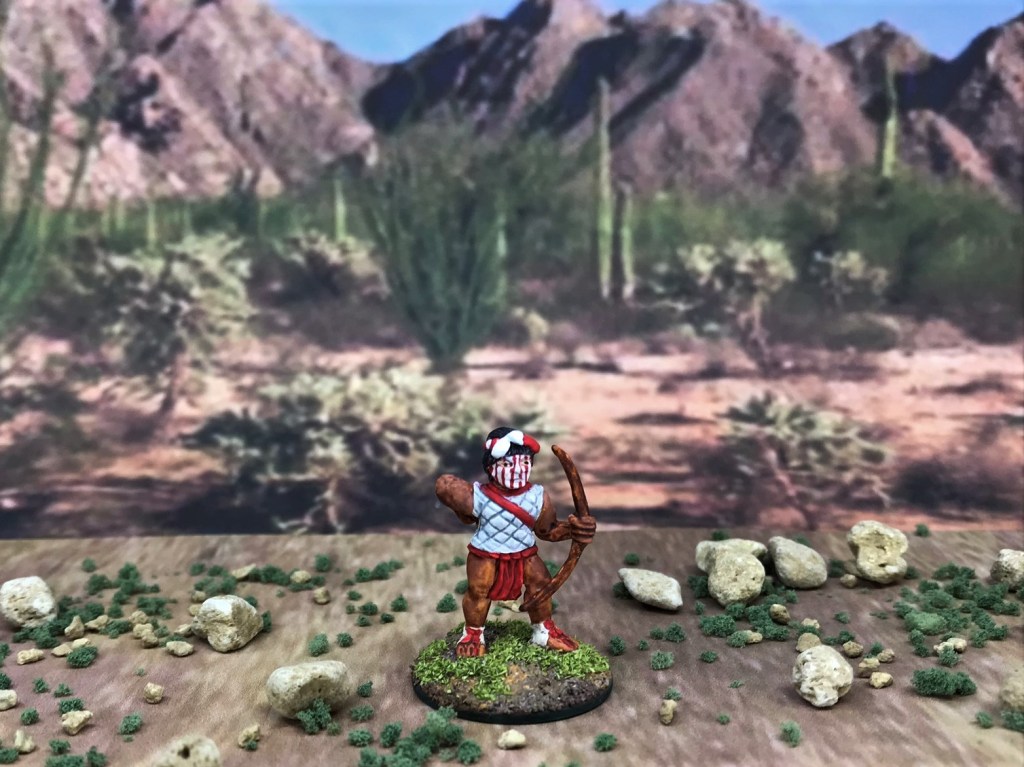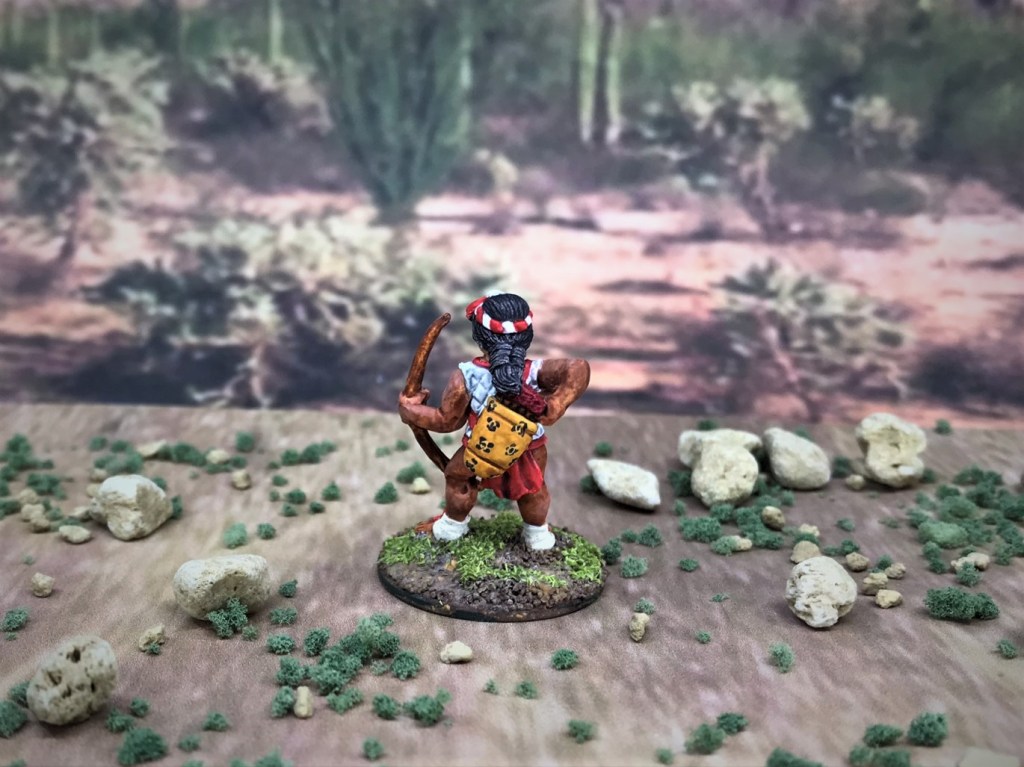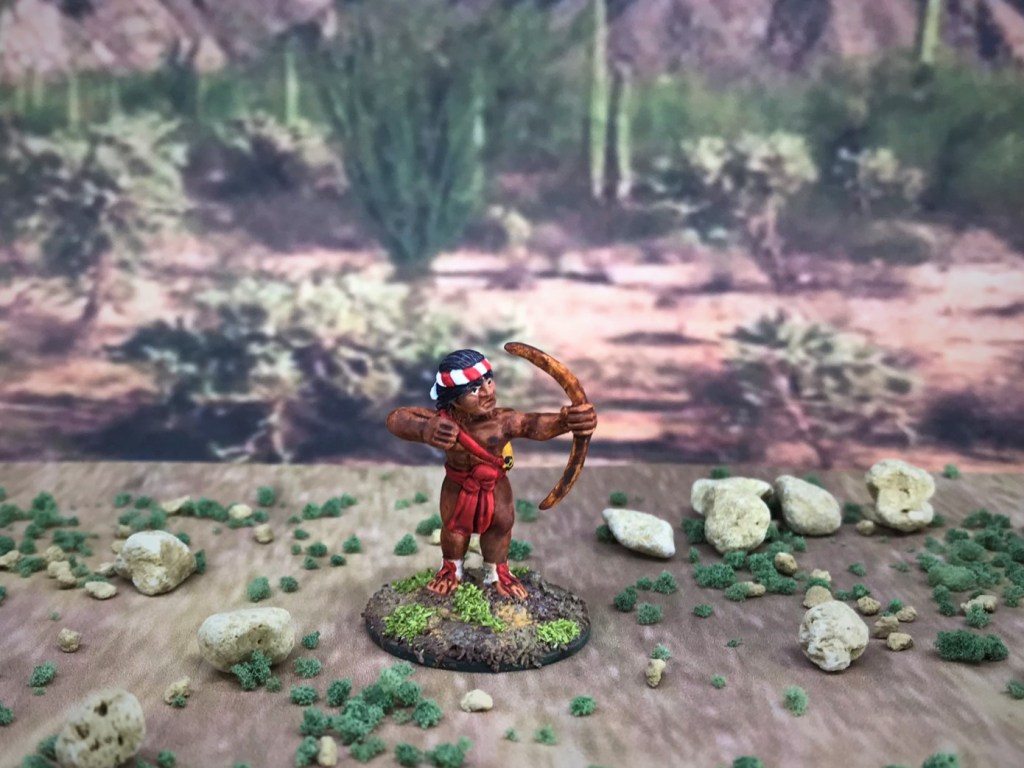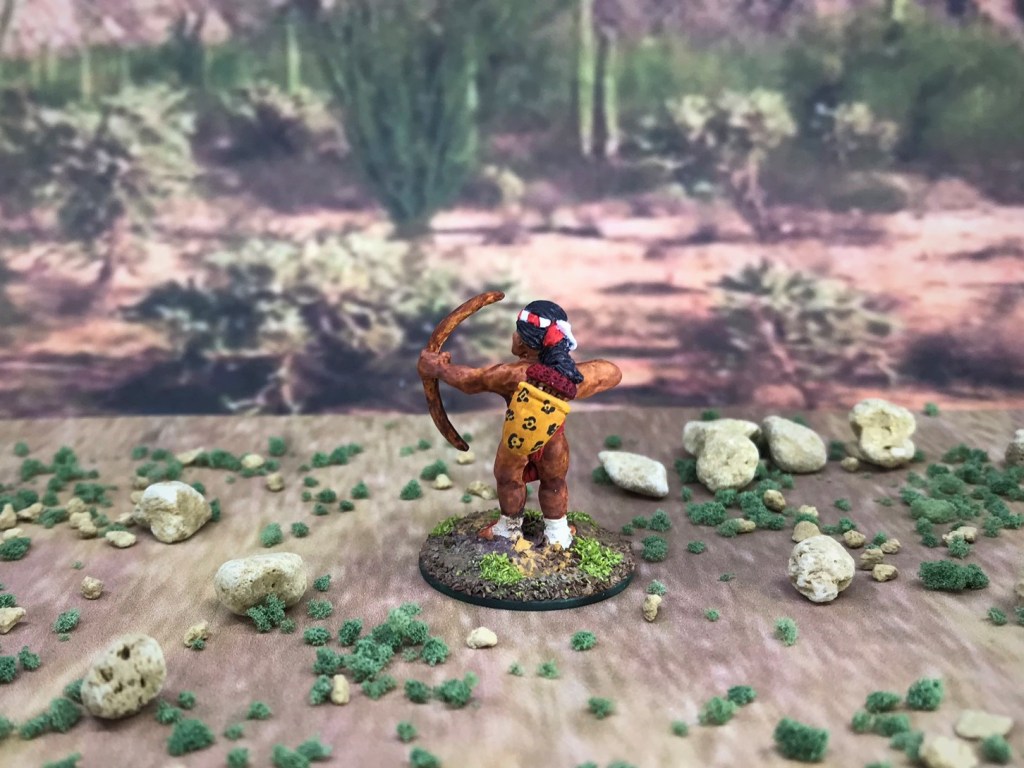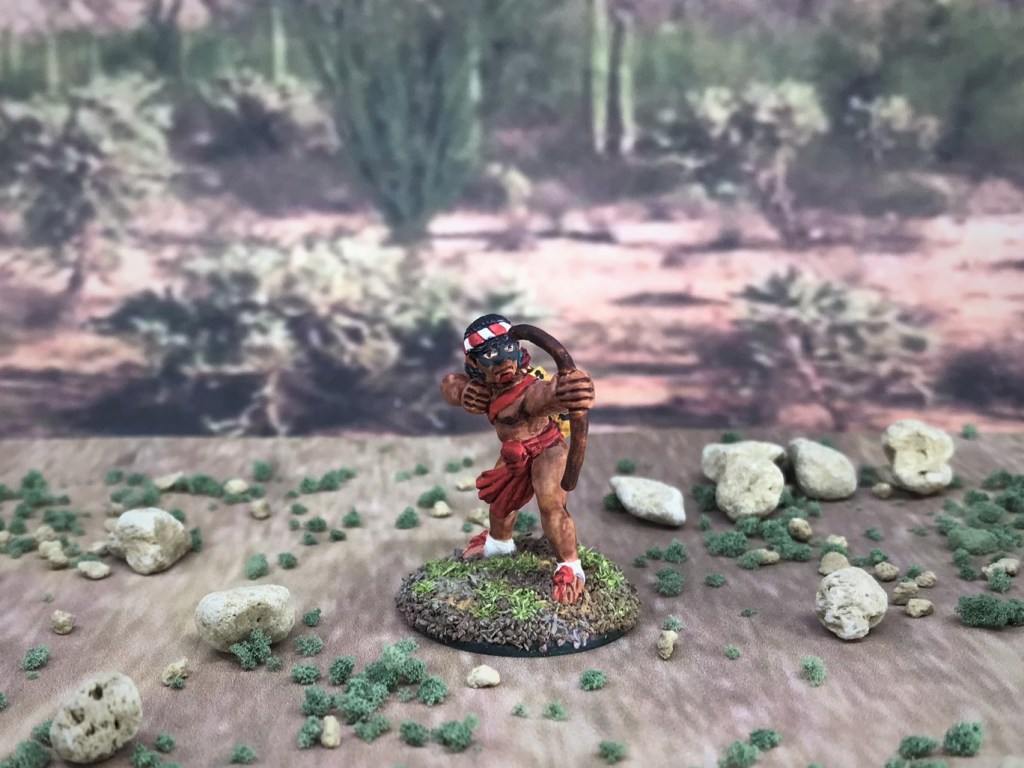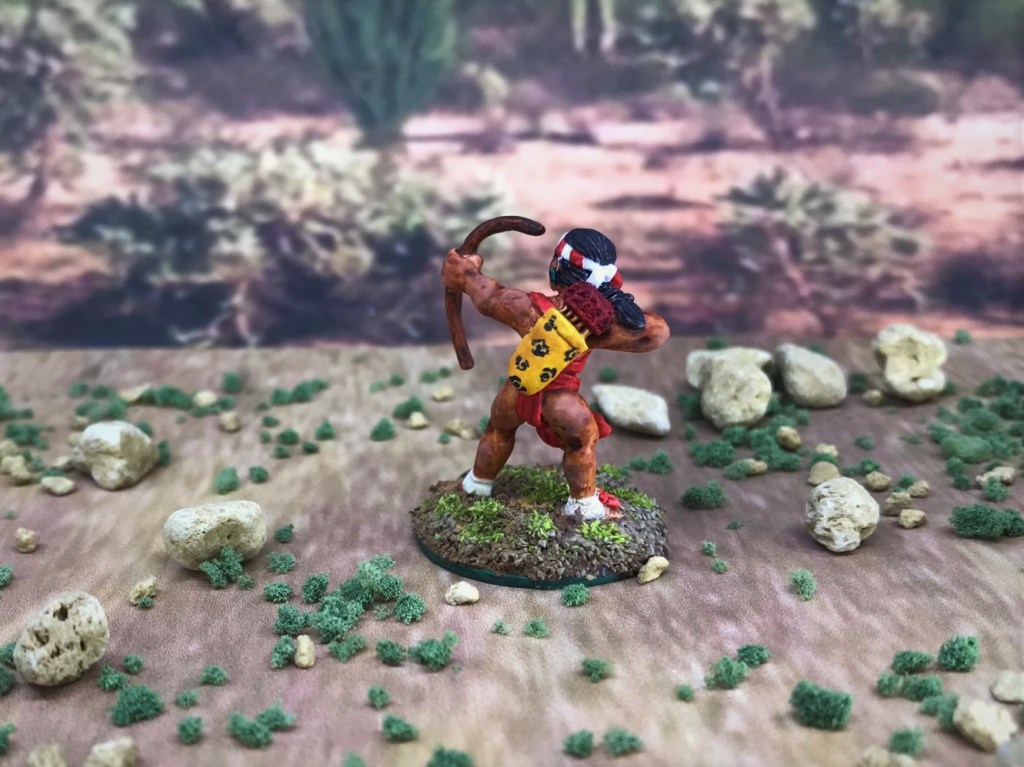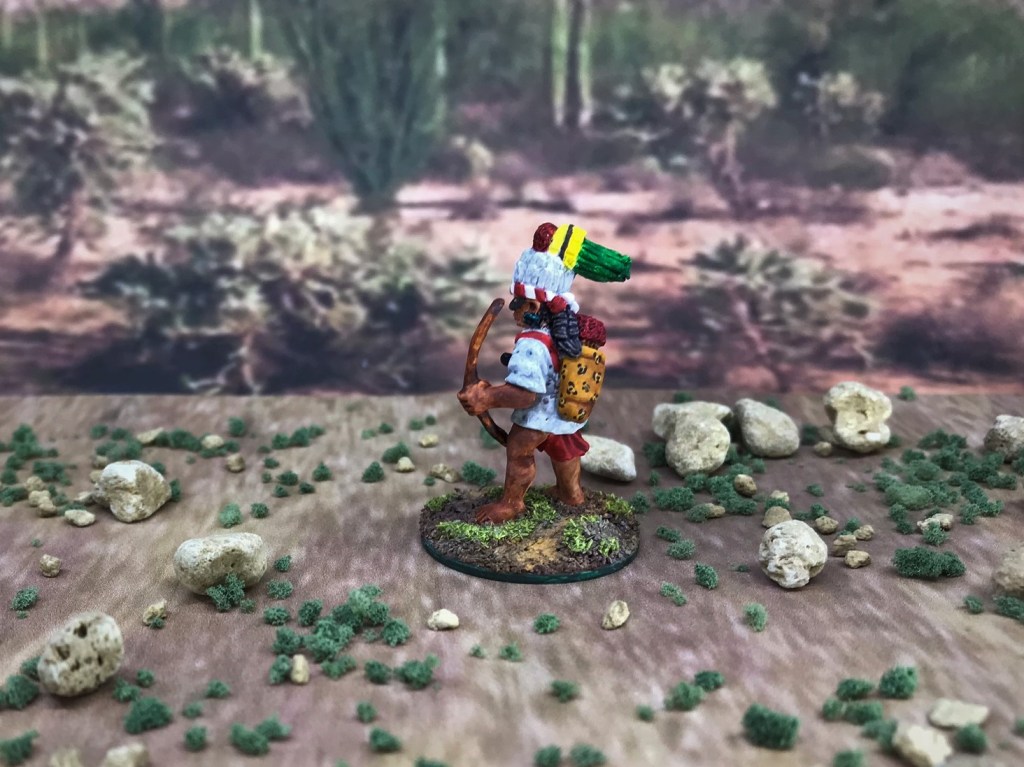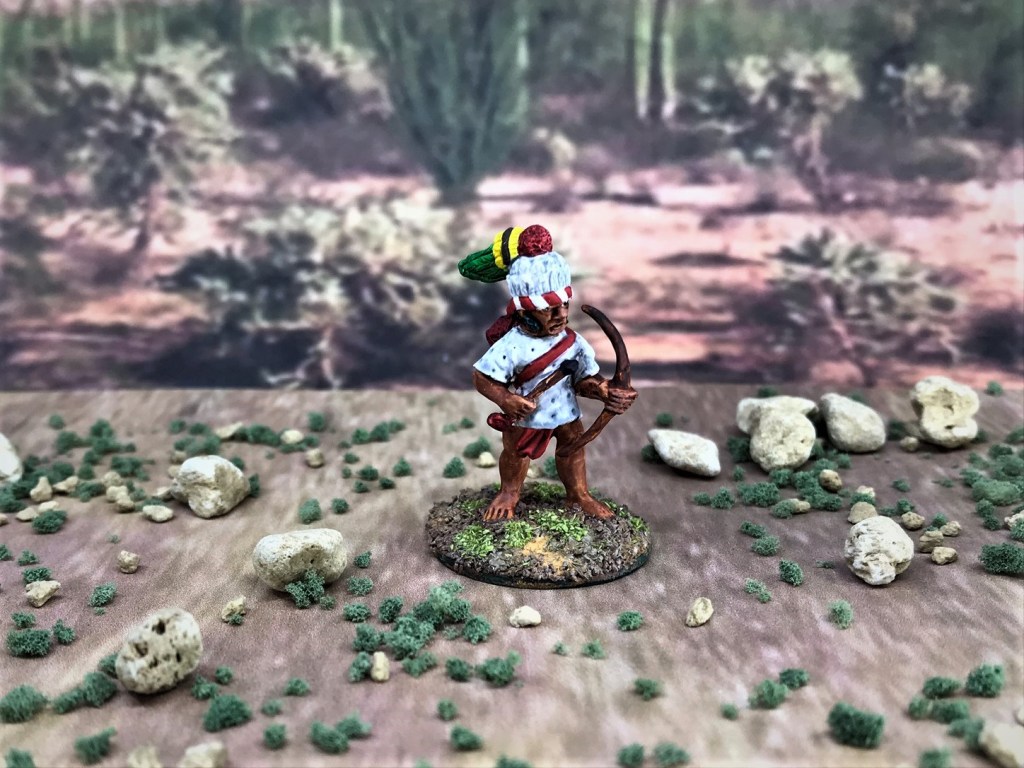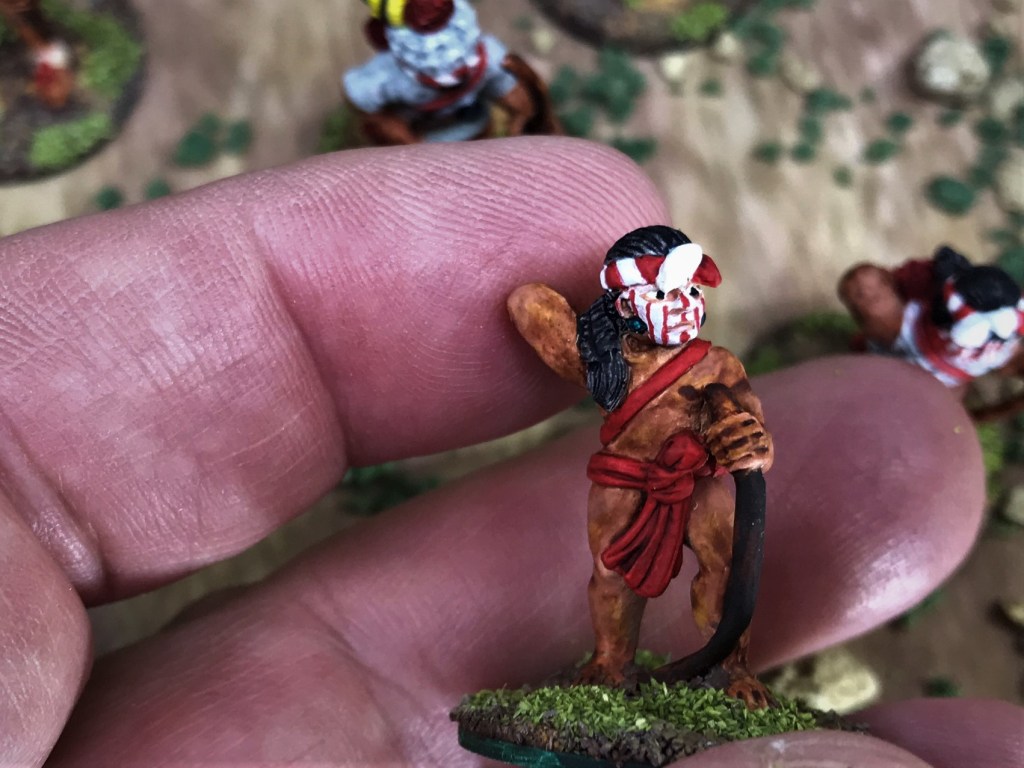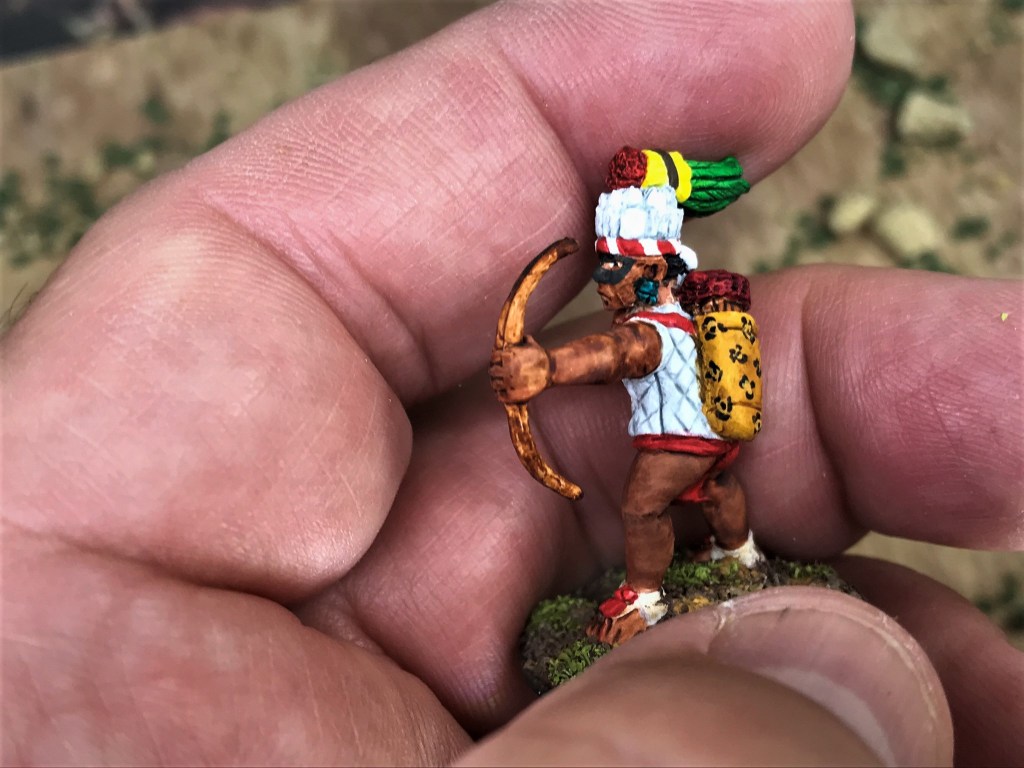
Aztec Shock Troops – Cuachic Warriors aka The Shorn Ones

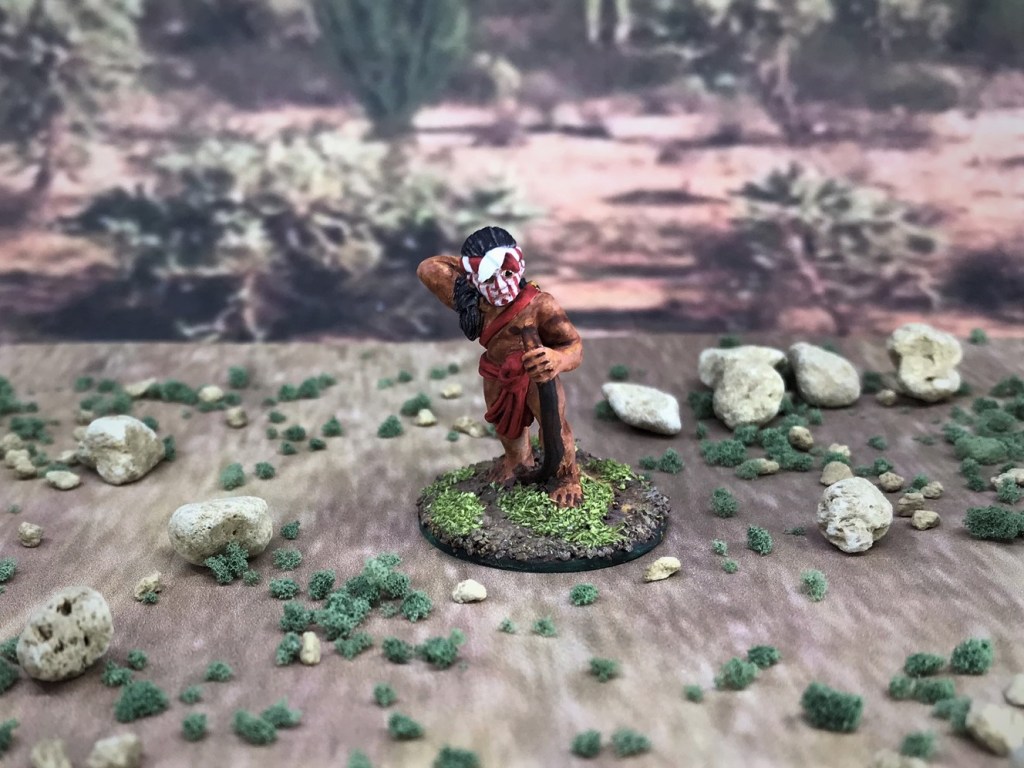
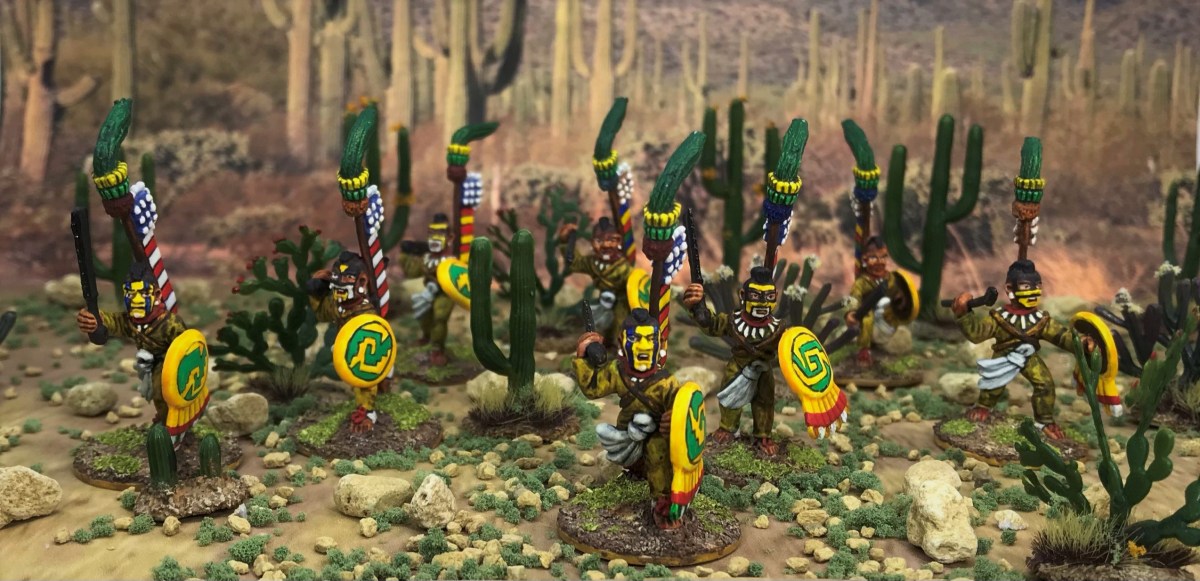
The super elite troops of the Aztec Empire were the cuachicqueh (kwa-cheek-kweh). These were their imperial shock troops, and held prestigious social status. To be able to join their ranks, a warrior would have had to have captured 6 or more enemy warriors, as well as demonstrated other acts of bravery.

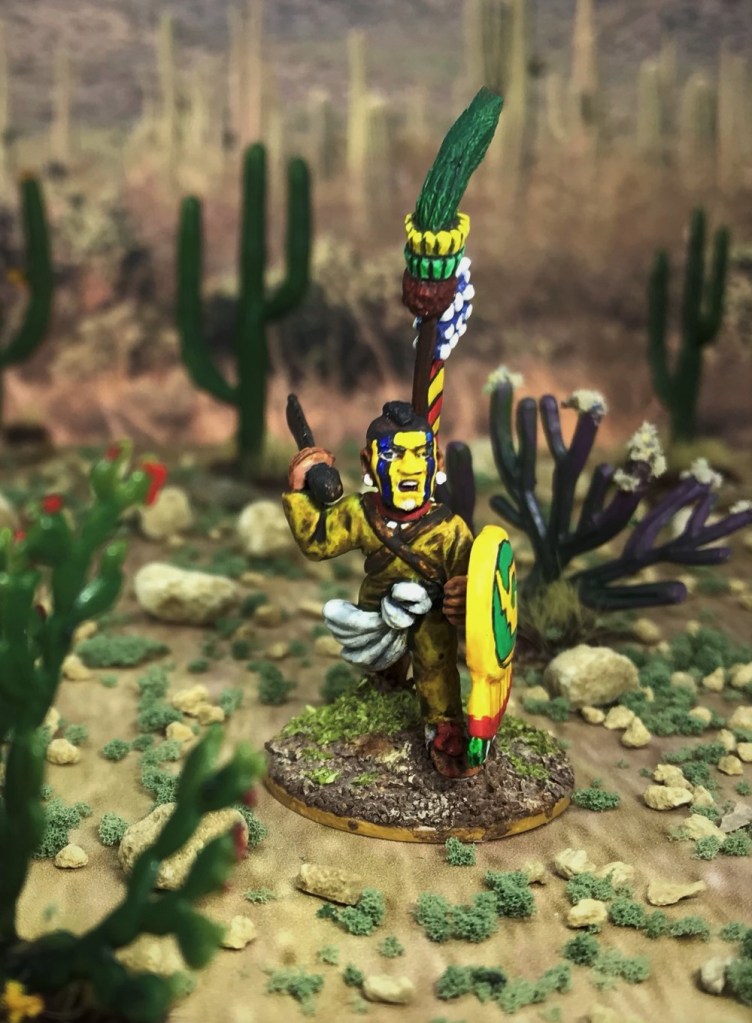
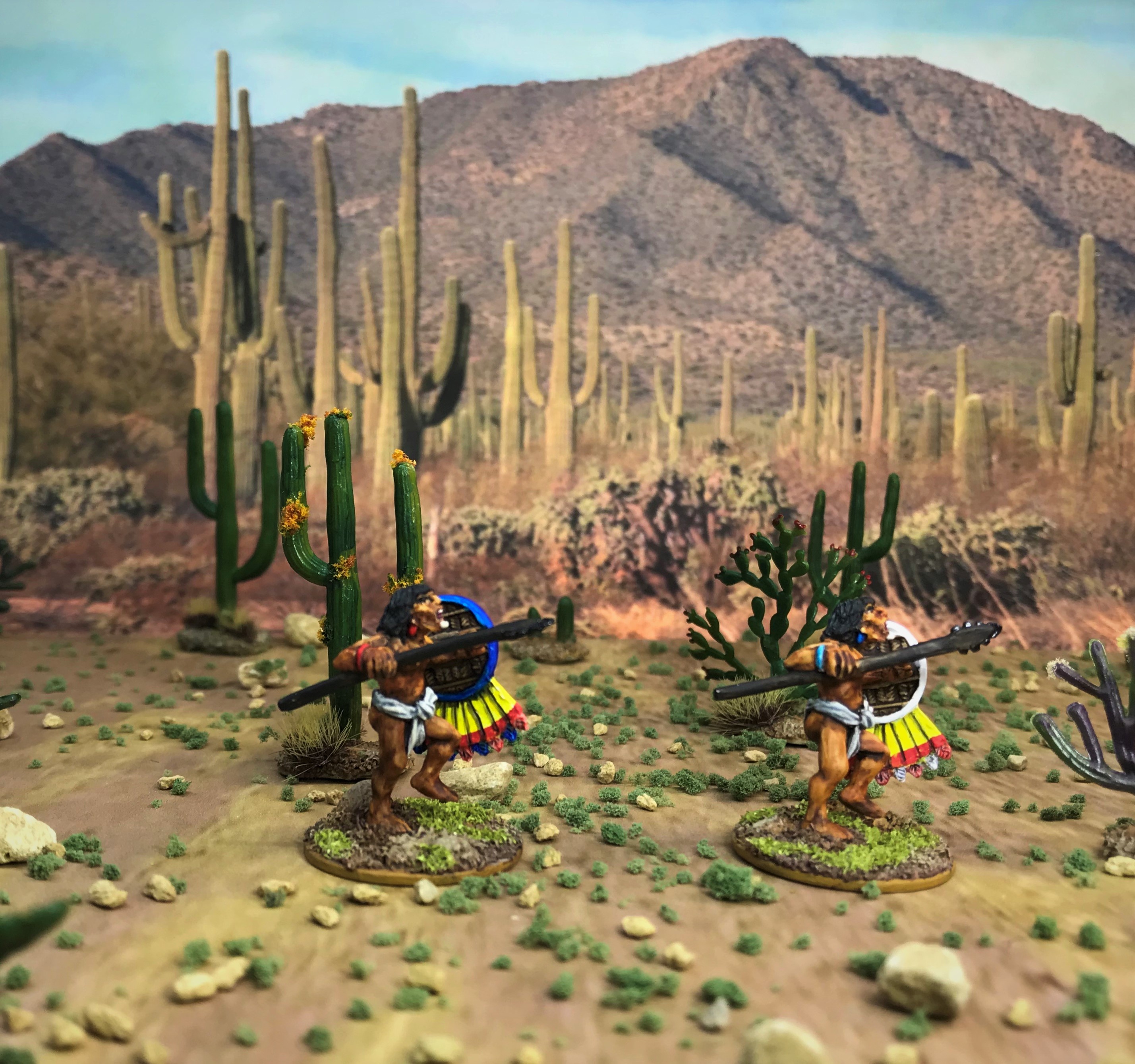
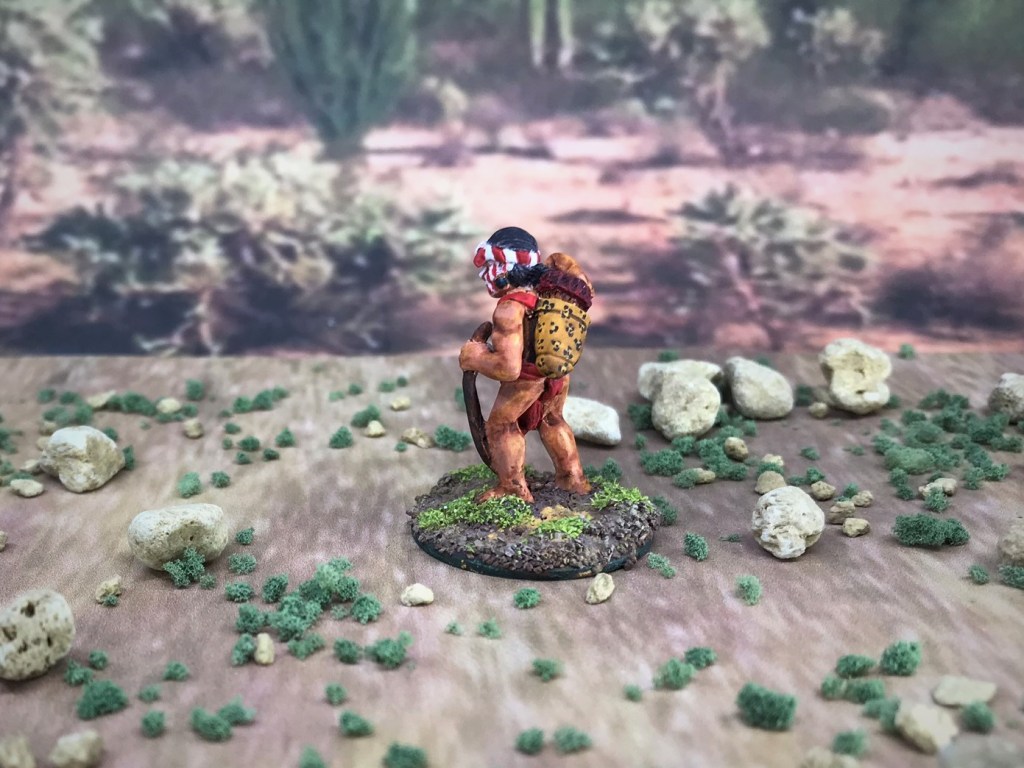
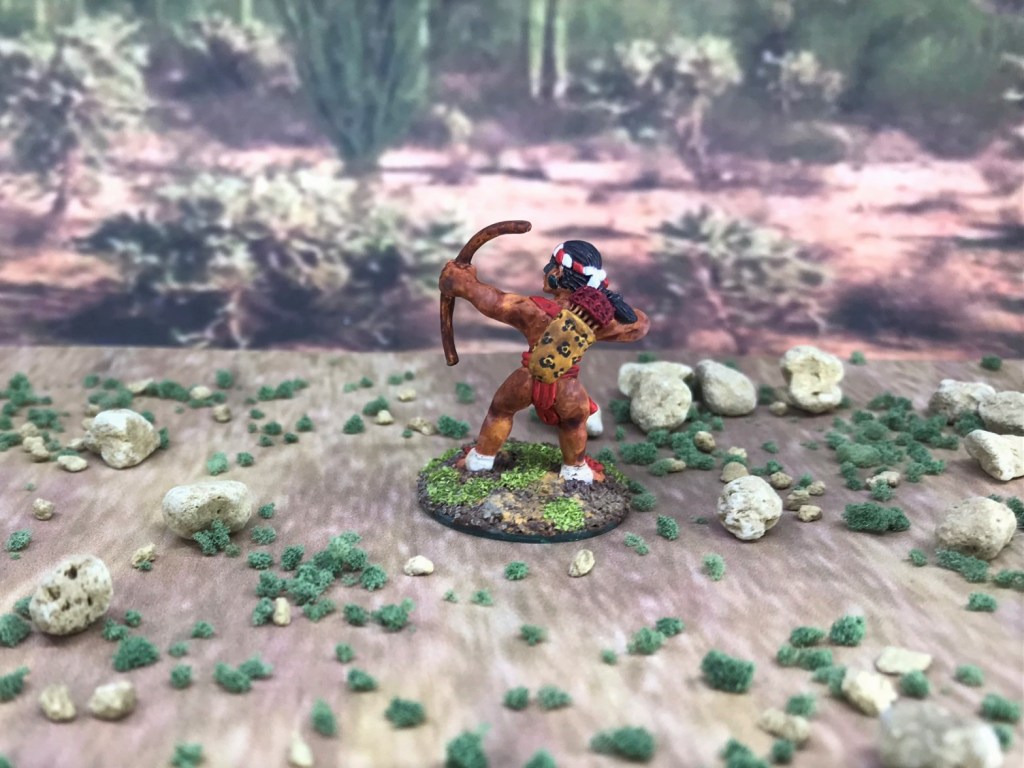
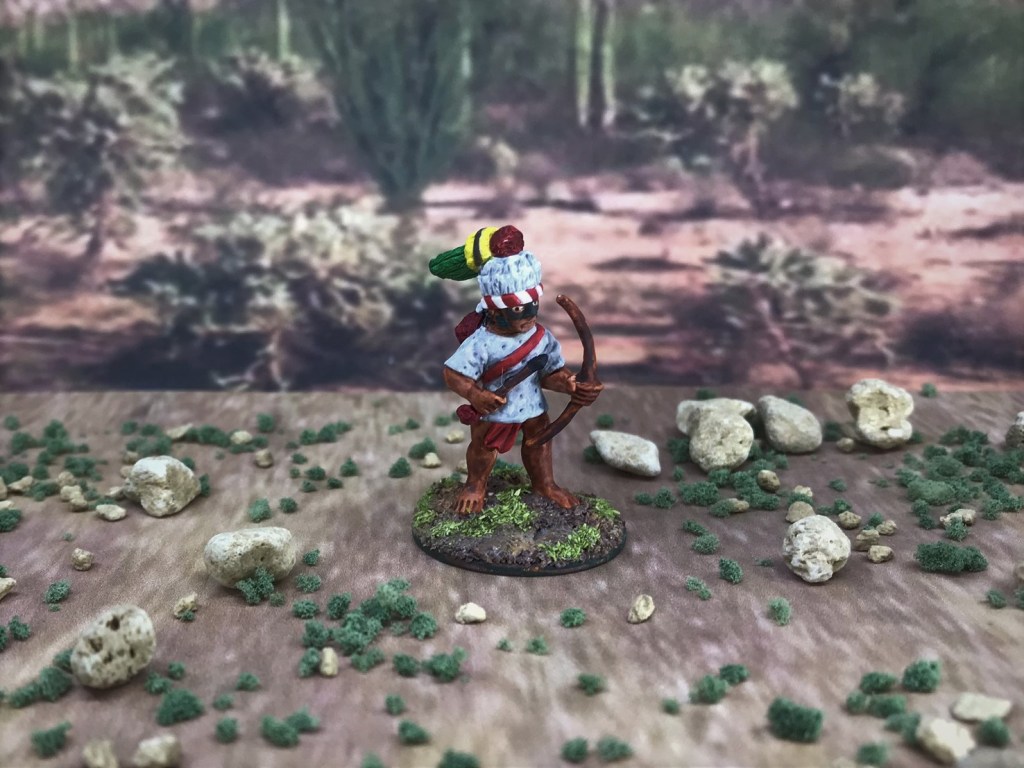
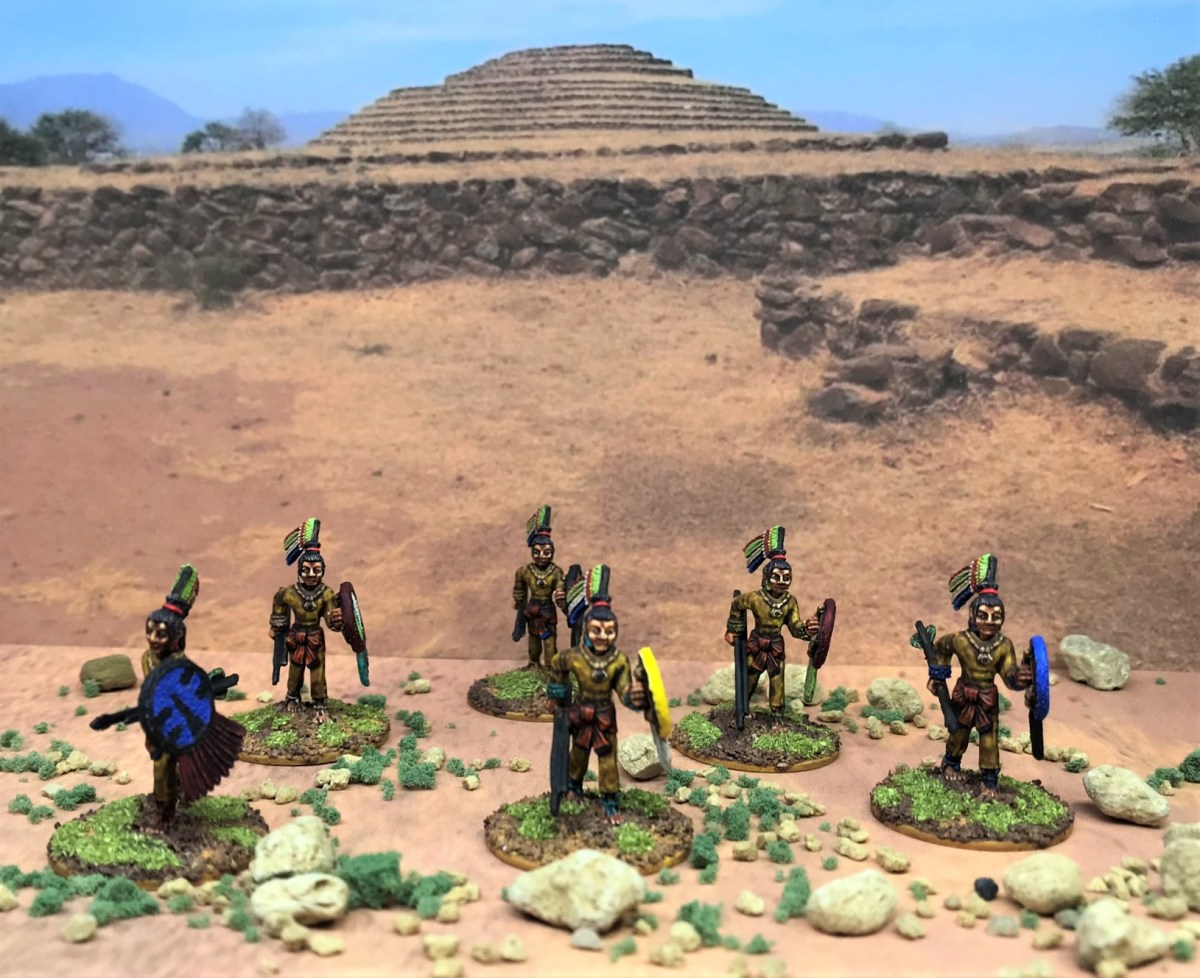
A cuachic (kwa-cheek – the singular is cuachic, the plural is cuachicqueh – yes still more tough-to-pronounce Aztec words!) was a member of the ultimate Aztec warrior caste. They all had passed on the opportunity of becoming captains or officers in order to remain hardened elite front-line warriors. Their appearance was striking. They wore a distinctly yellow tlahuiztli (tu-lah-huz-ly) suit, had shaved heads with mohawks, and often had fierce yellow, red, and blue war facial paint. The Shorn Ones sported unique and colorful back banners to intimidate any foes. They were called “The Shorn Ones” due to their mostly-shaven haircuts. Cuachicqueh swore to never retreat in battle – and if any did – they would agreed to dispatched by their own comrades for this dishonor.

I was really looking forward to adding cuachicqueh to my Aztec forces for games of Feudal Patrol™, using my supplement, Civilizations Collide. I have discussed the game on previous posts, as well as my supplement.

As a reminder Feudal Patrol™ – Buck Surdu’s rules and the decks of cards for “Skirmish Miniature Gaming in the Ancient, Medieval, and Fantasy Periods” is now available commercially. In the US, it can be bought from On Military Matters website here.  It is also being sold in the US by Noble Knight Games website here. In the UK, it is being sold by Sally 4th on their website here. My supplement for the period is a free download on Sally 4th’s website here or the Feudal Patrol™ website here. Cuachicqueh can have a big impact in the game if used properly.

In my game, the cuachicqueh have special abilities – in addition to being total bad-asses on the battlefield. They can operate in smaller units. They can also act as berserkers. Tactically, their greatest advantage is that they can – through the use of obscene gestures and insults – provoke an enemy to charge them – even if that charge causes the targeted enemy to abandon a good and protected defensive position to its detriment. This ability has a good historical basis.

To understand this, imagine you’re a good Tlaxcalan bowman, safely ensconced behind a nice wall. Yet the cuachicqueh in front of you have just insulted and offended you and your people so gravely – that you rush out to ostensibly try to attack the miscreants. Your hasty assault only to serves the cuachicqueh – who now, as the Aztecs best, engage you in vicious melee – minus the protection you just abandoned. It’s not for nothing that cuachicqueh were the toughest of the Aztecs.

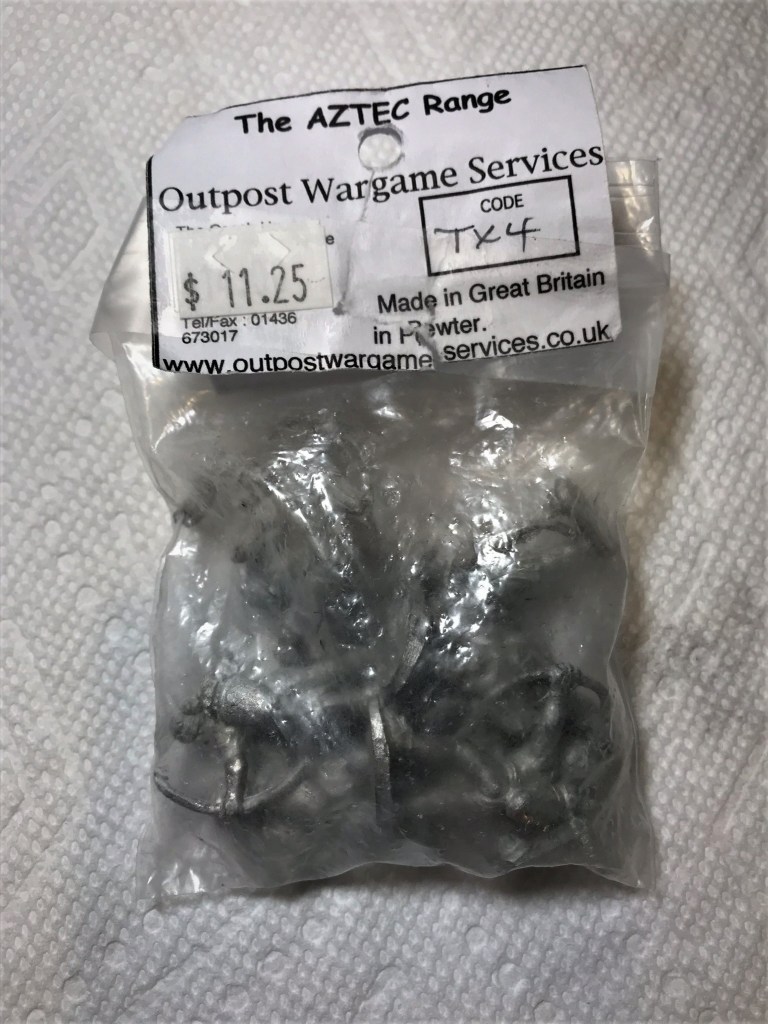
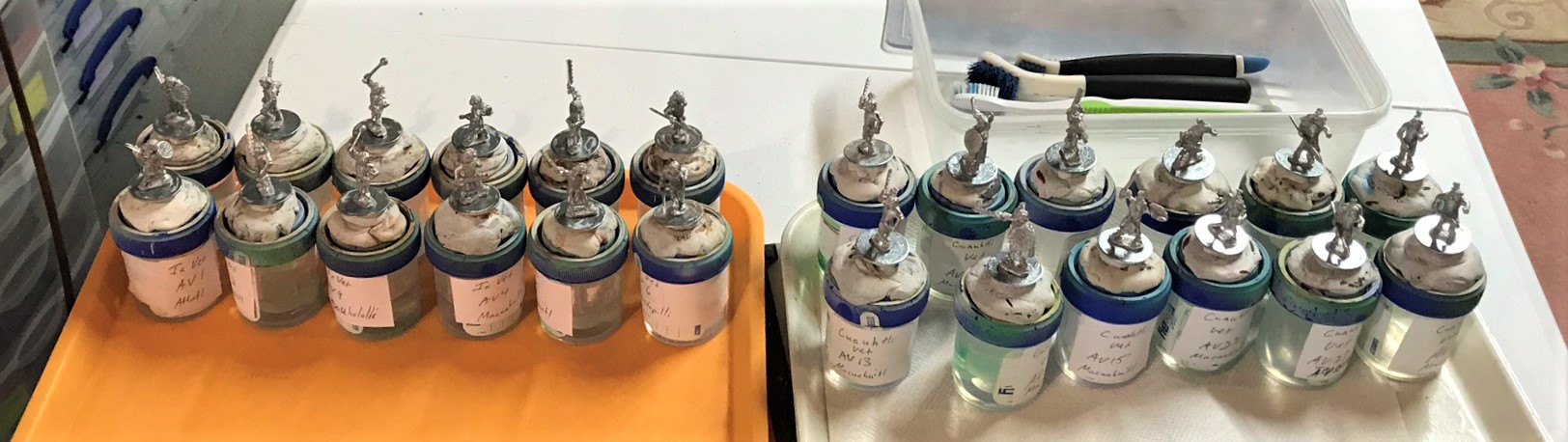
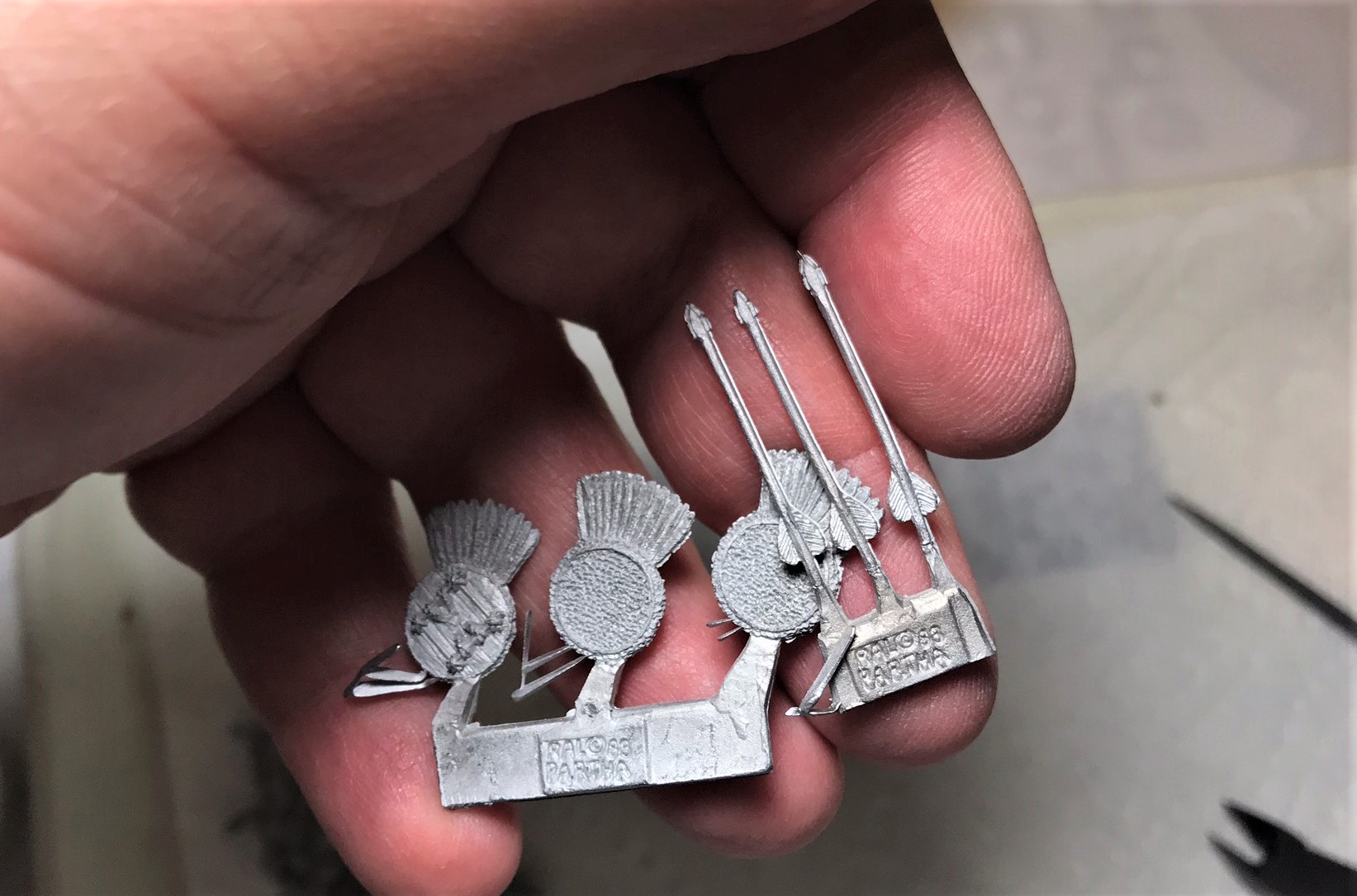
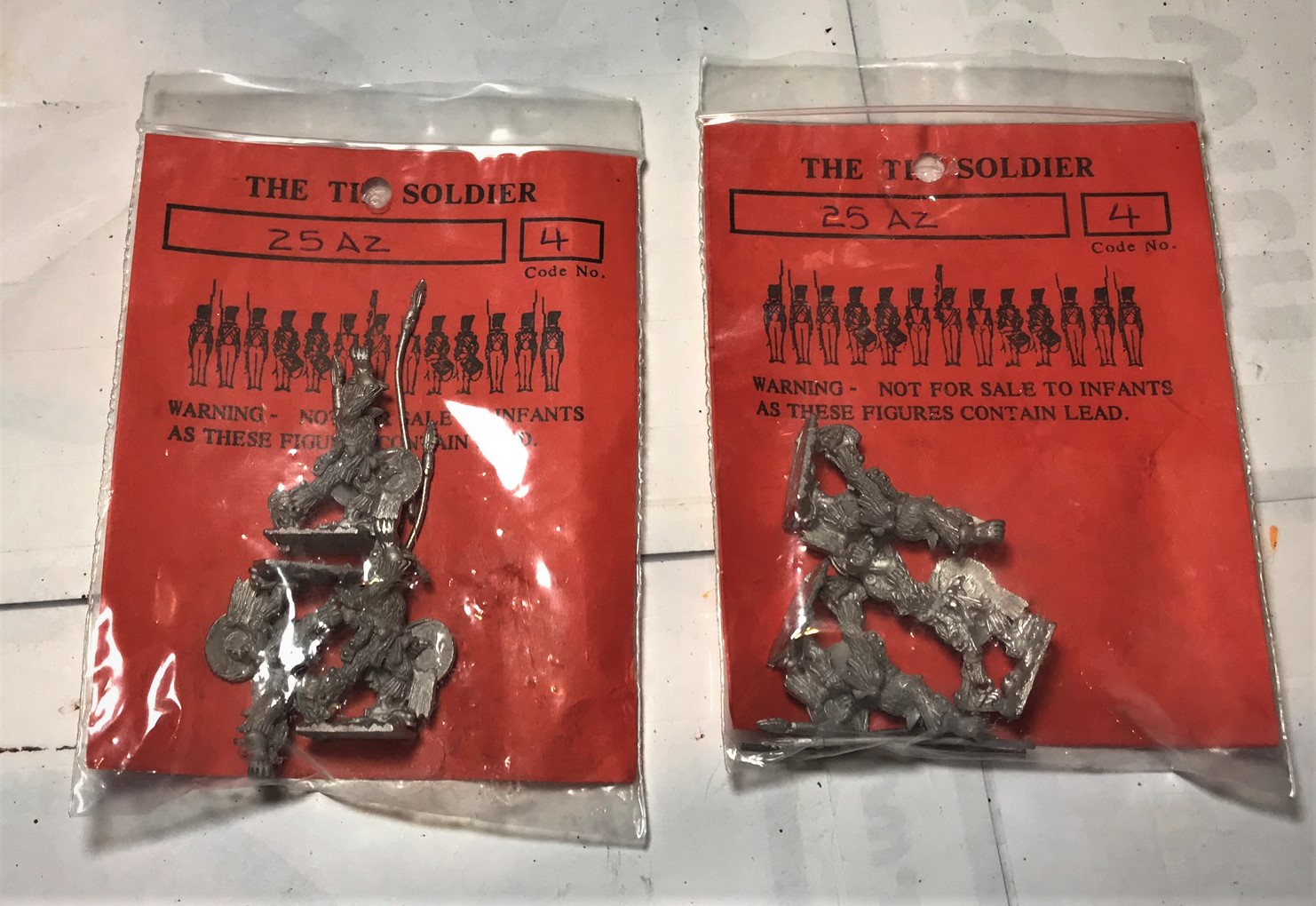
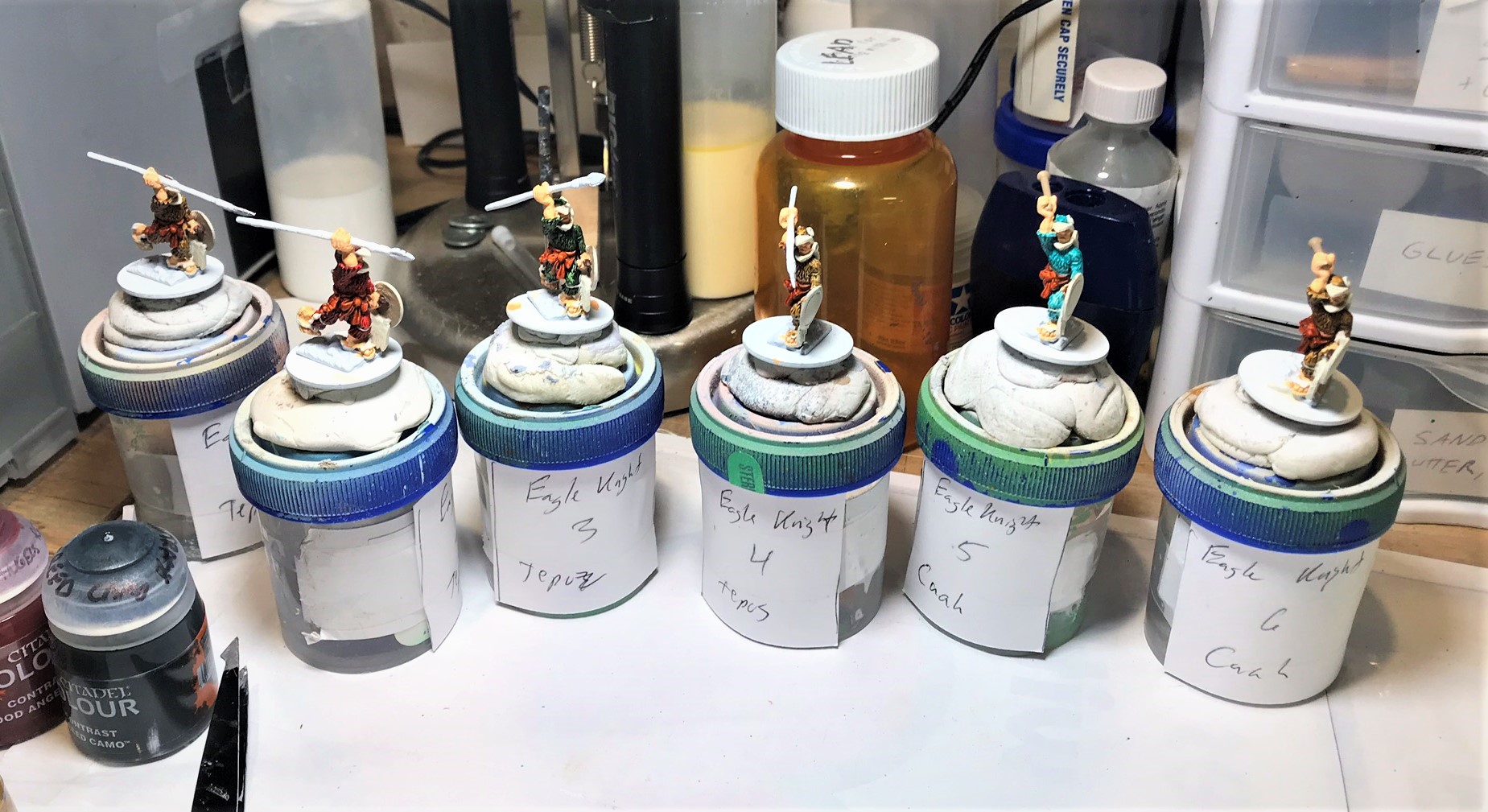
I bought some of these Aztecs in AZ06 “Cuachic Warriors – Body Suit and Back Banners” (from Badger Games here). The SKU came with eight 28mm metal figures complete with weapons, shields, and back banners. The figures were cast by Outpost Wargames Services in the UK. The figures were in really great shape and needed little cleanup. Initially I was a bit apprehensive about assembling and painting them due to the proximity of the back banners to the figures’ heads. I tried to use green stuff to achieve some degree of separation on the first two figures but abandoned that approach as I did not think that it added enough benefit structurally. I also worried that it would detract from the models’ aesthetics. In the end, good old Gorilla Glue worked just fine on the remaining ones and I just worked around the banners and heads intersections while painting. I decided to mount the back banners and the weapons before priming, and do the shields separately.

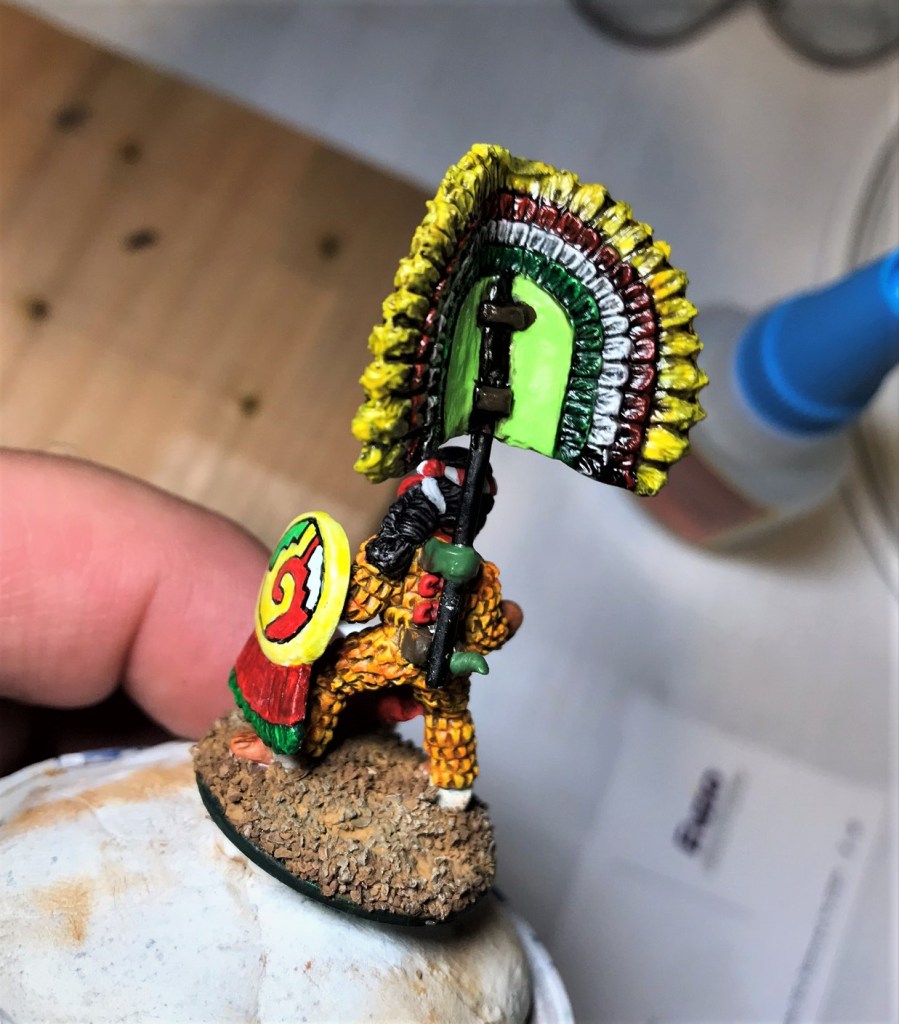
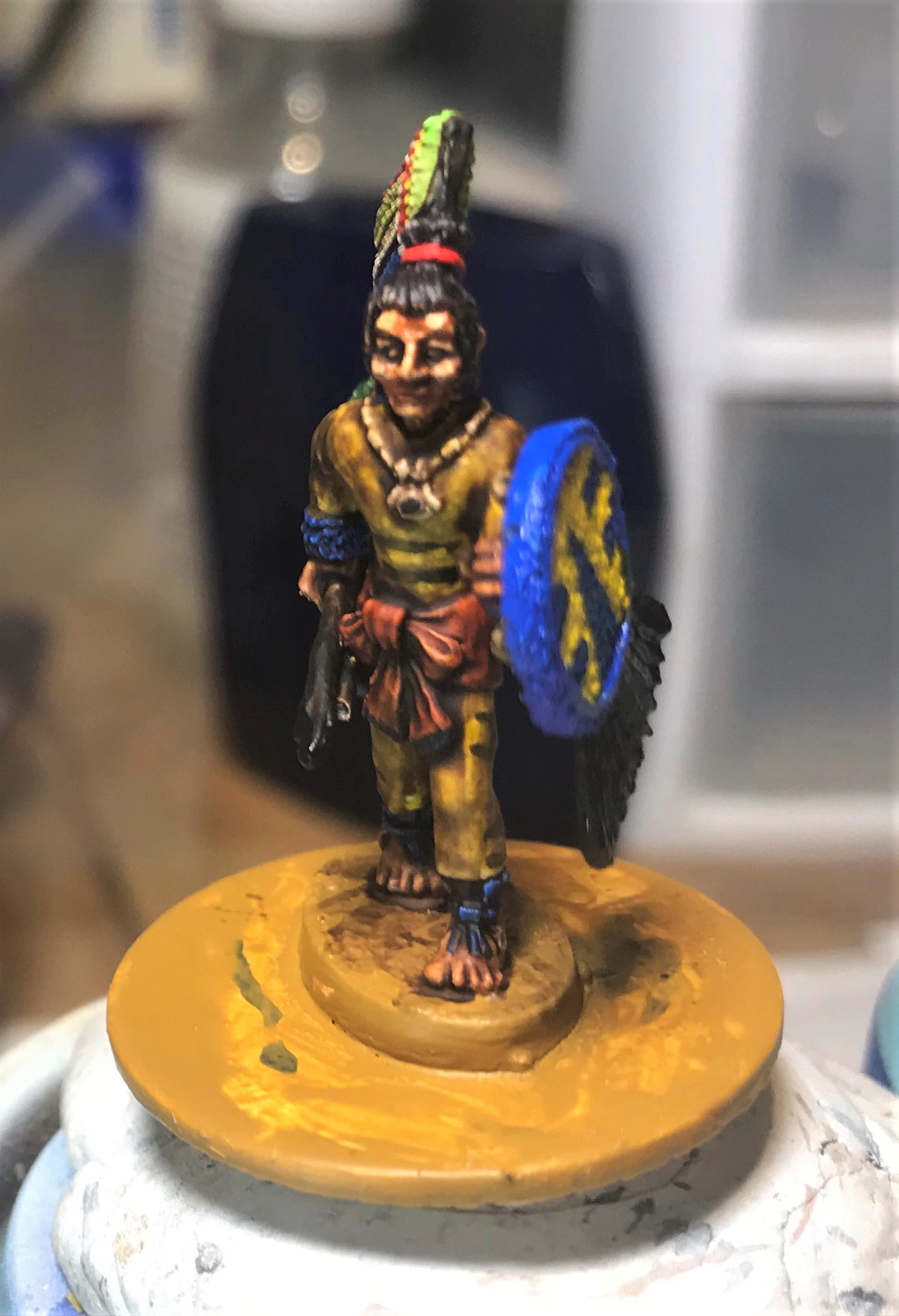
As a resource, I used the many books that I had with some nice plates showing the dress of the Shorn Ones. Clearly, they dressed similarly – and their shields were similar (but not identical). Trying to get the yellow tlahuiztli suits correctly colored was a challenge. Painting anything yellow, especially a dullish yellow, is always a painting challenge. I hope these will look good on the table. The back banners took some methodical planning and measuring (as you’ll see below) for painting as the stripes needed to look symmetrical.

I took some group WIP shots below (with comments) that will show this group’s progress, and then I will share some eye candy of the finished figures. I’ll conclude with a summary of where the overall project is so far, plus links to the previous posts (in case you just joined me here), and the paints I used if that sort of thing is interesting to you (if not that’s why it’s why it’s at the end!).

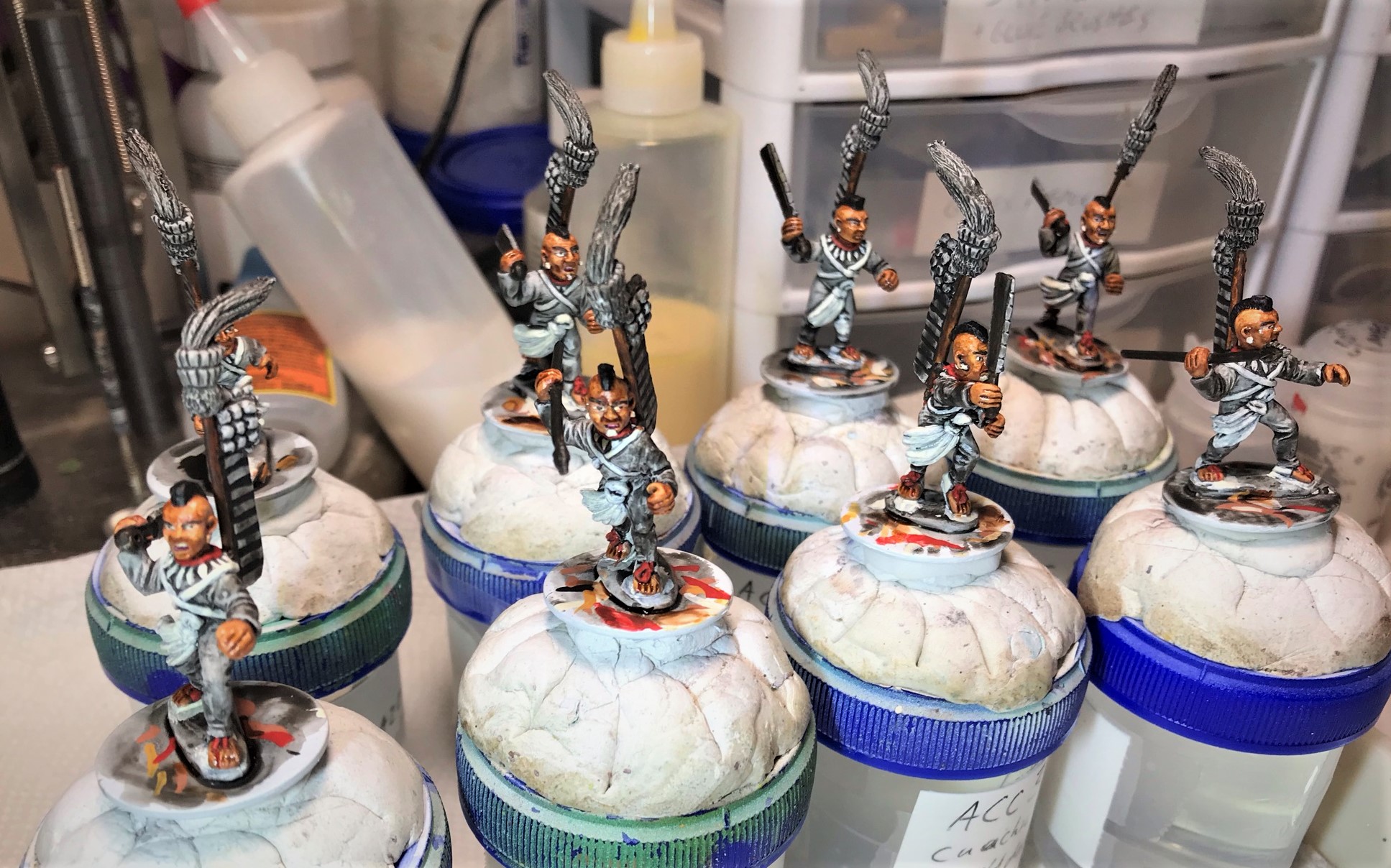
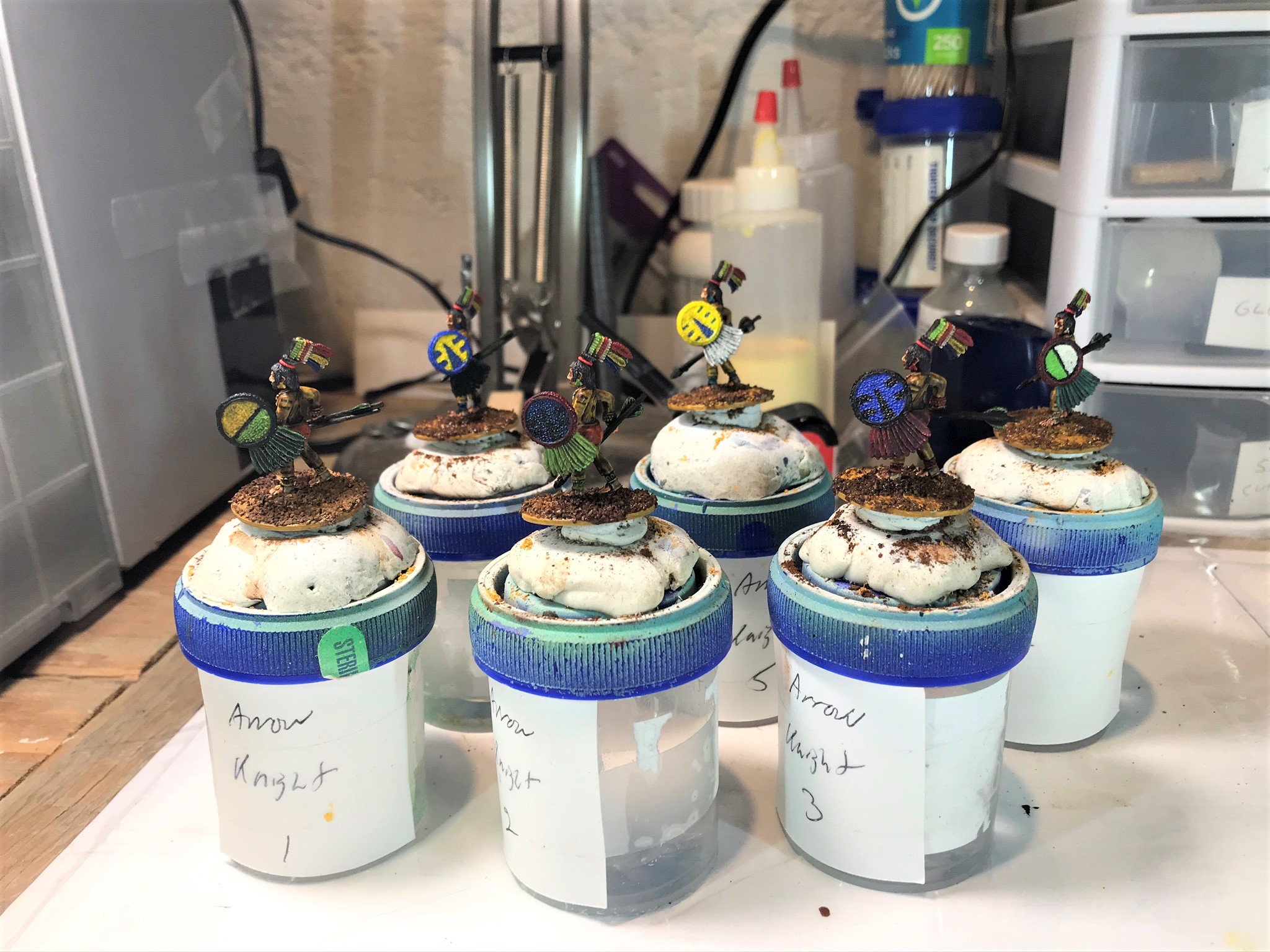
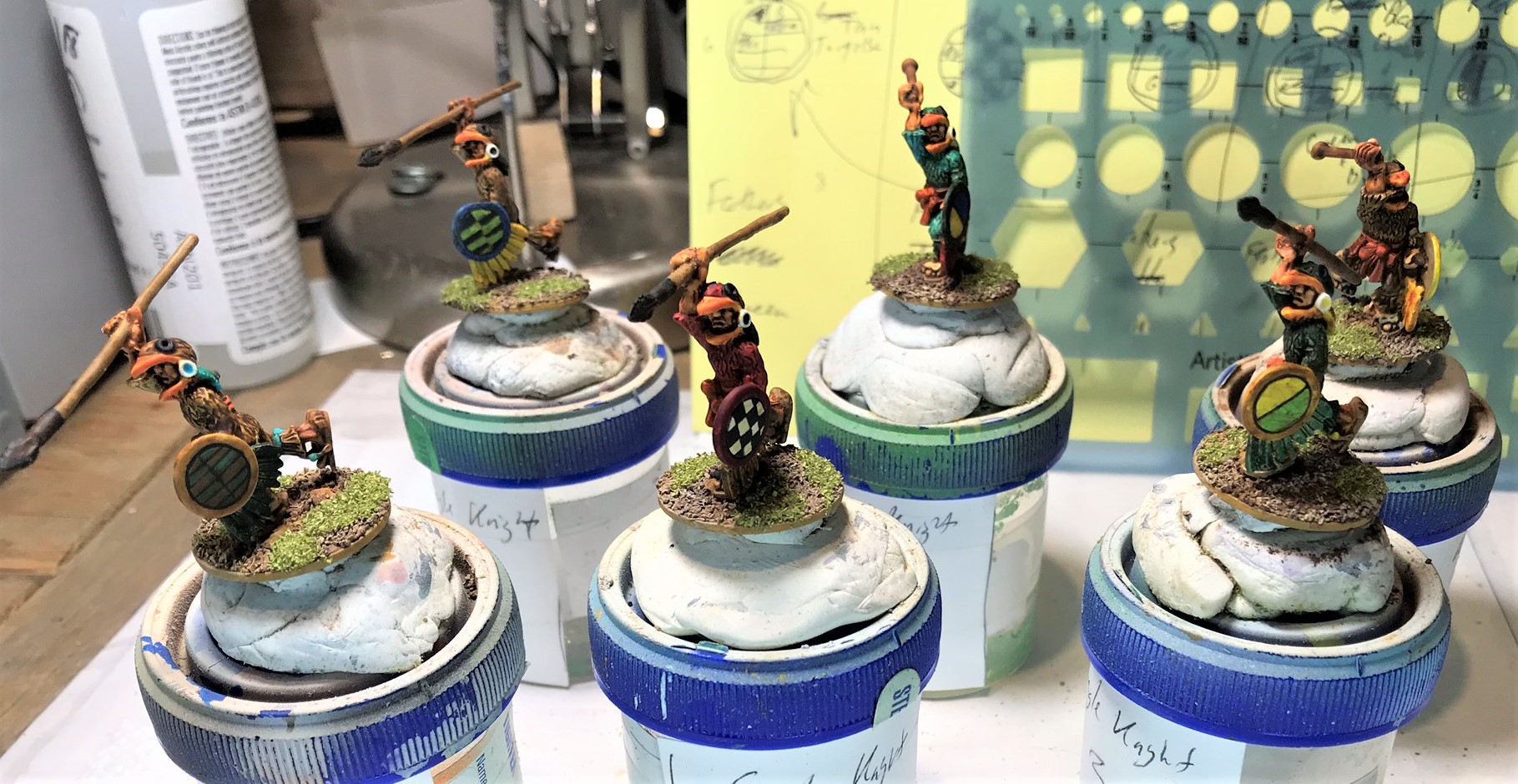
Here you see the primed figures with the back banner marking lines set. The back banners’ proximity to the figures’ heads is clear here.
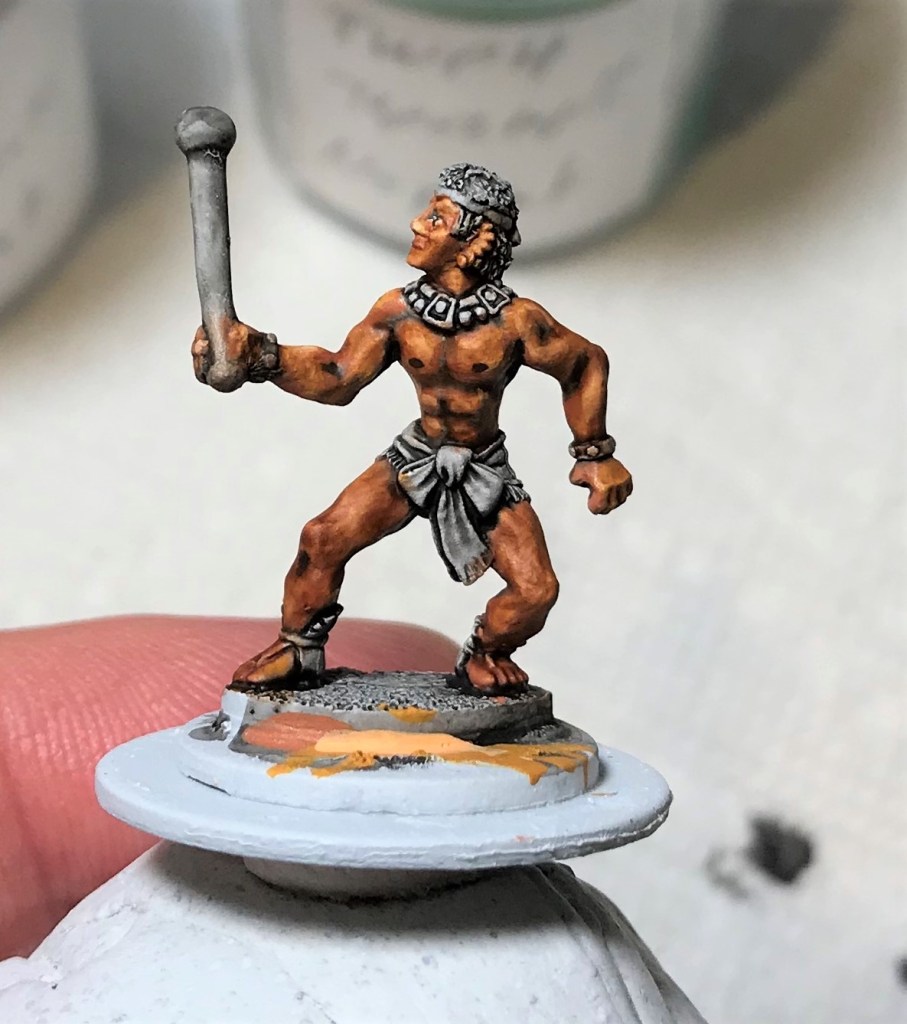
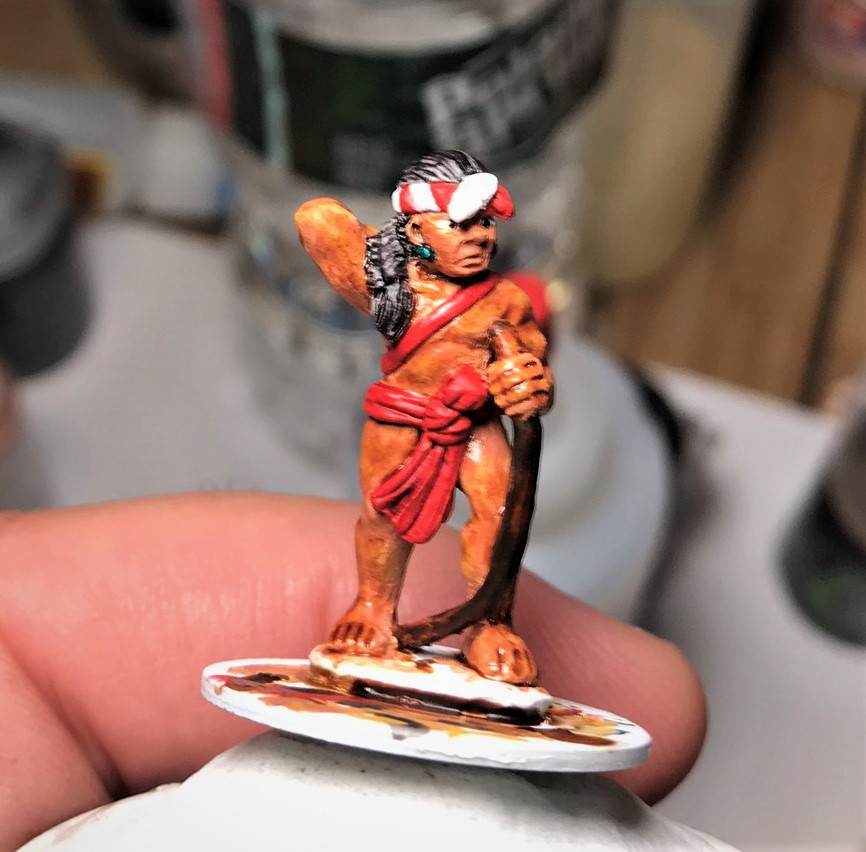
I washed the figures with Citadel “Nuln Oil” to help with overall creation of depth, and then began the early flesh tones as shown here. I knew war paint would come later, but I find painting the faces first as if there would be no war paint helps make war paint look better, especially around the eyes.
I darkened the flesh and used Vallejo Model Air “Weiss” (off-white) on the sandals, loincloths, and straps to overcome the Nuln Oil.
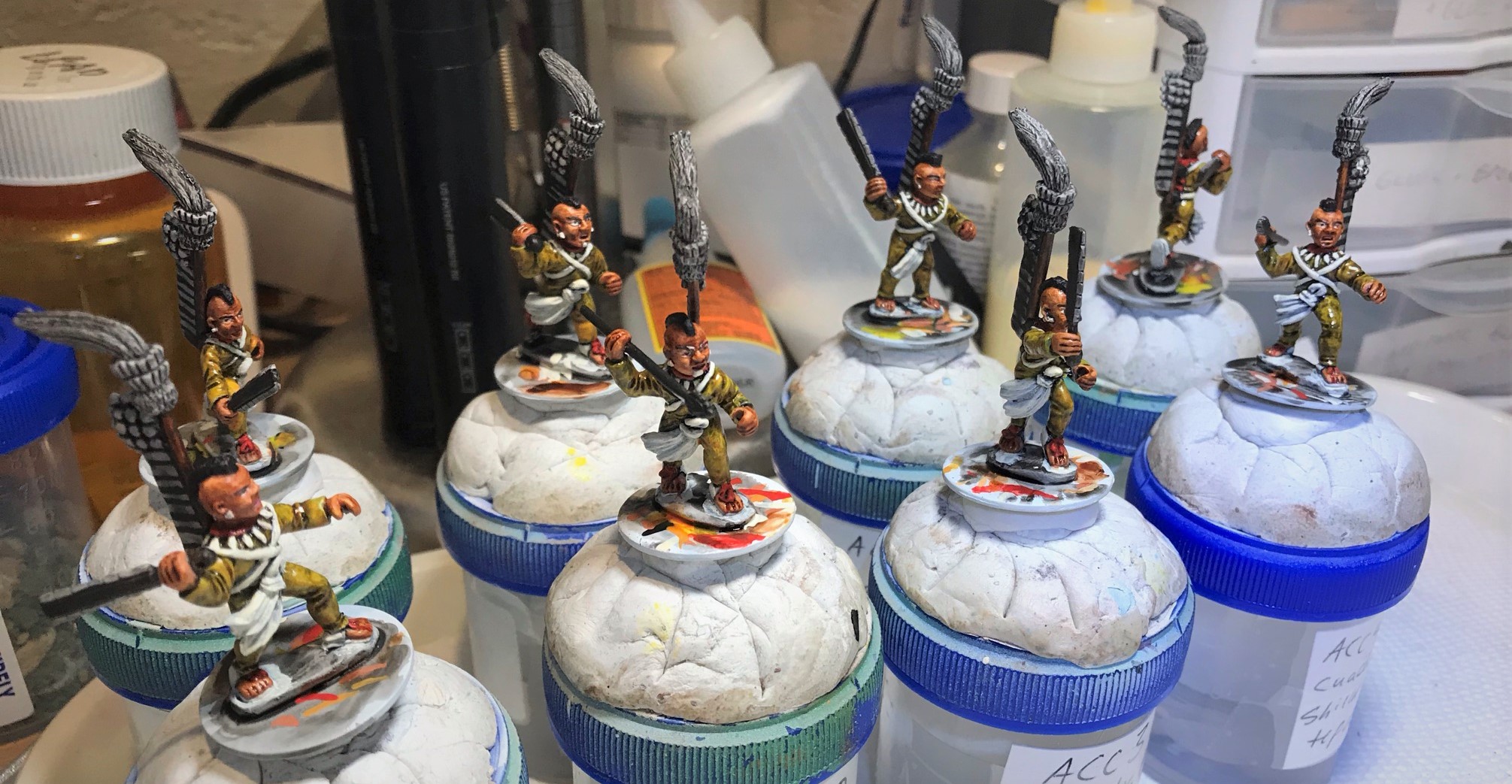
My start on the yellow tlahuiztli suits. This would take much highlighting and shading. I found Citadel “Nuln Oil GLOSS” very helpful against the yellow inks (yes that’s plural – inks!) and contrast paints.
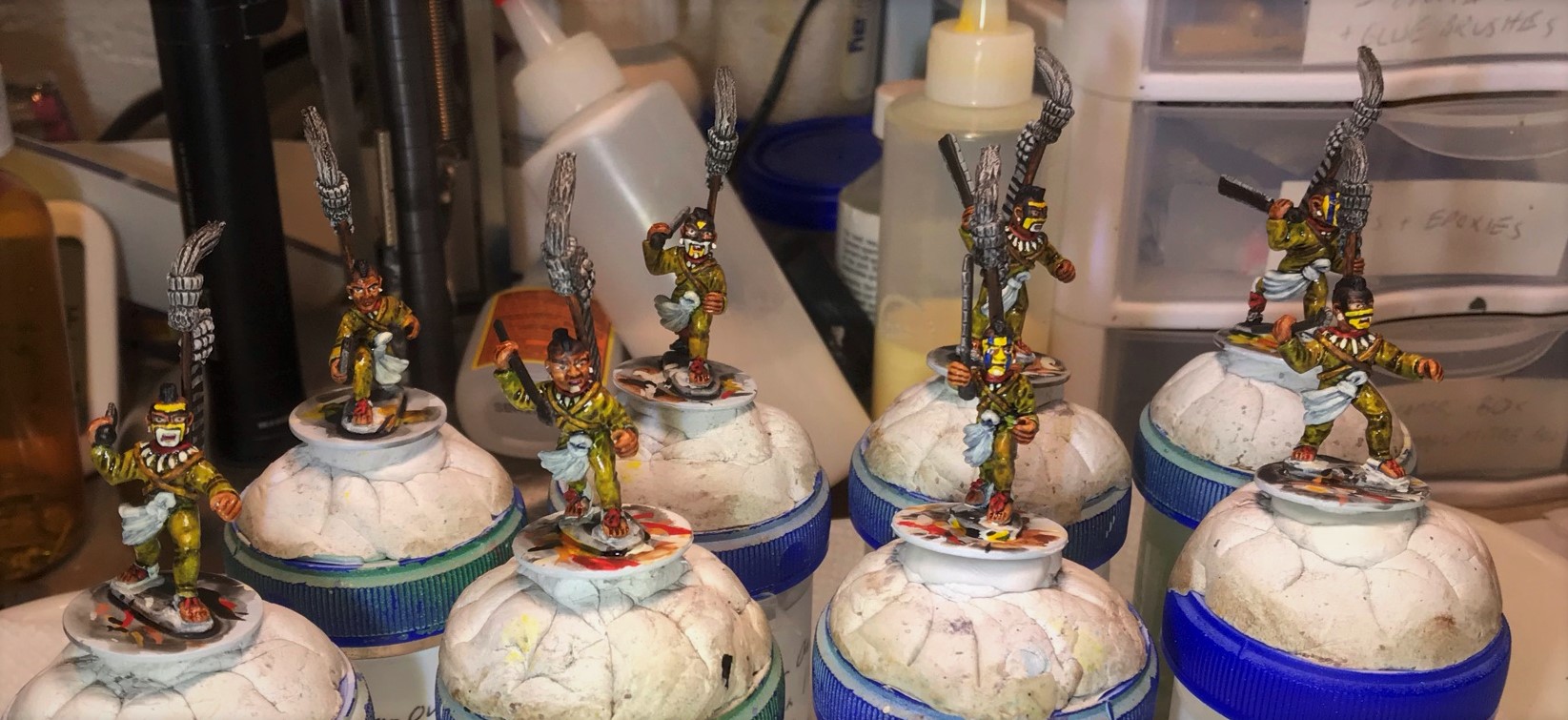
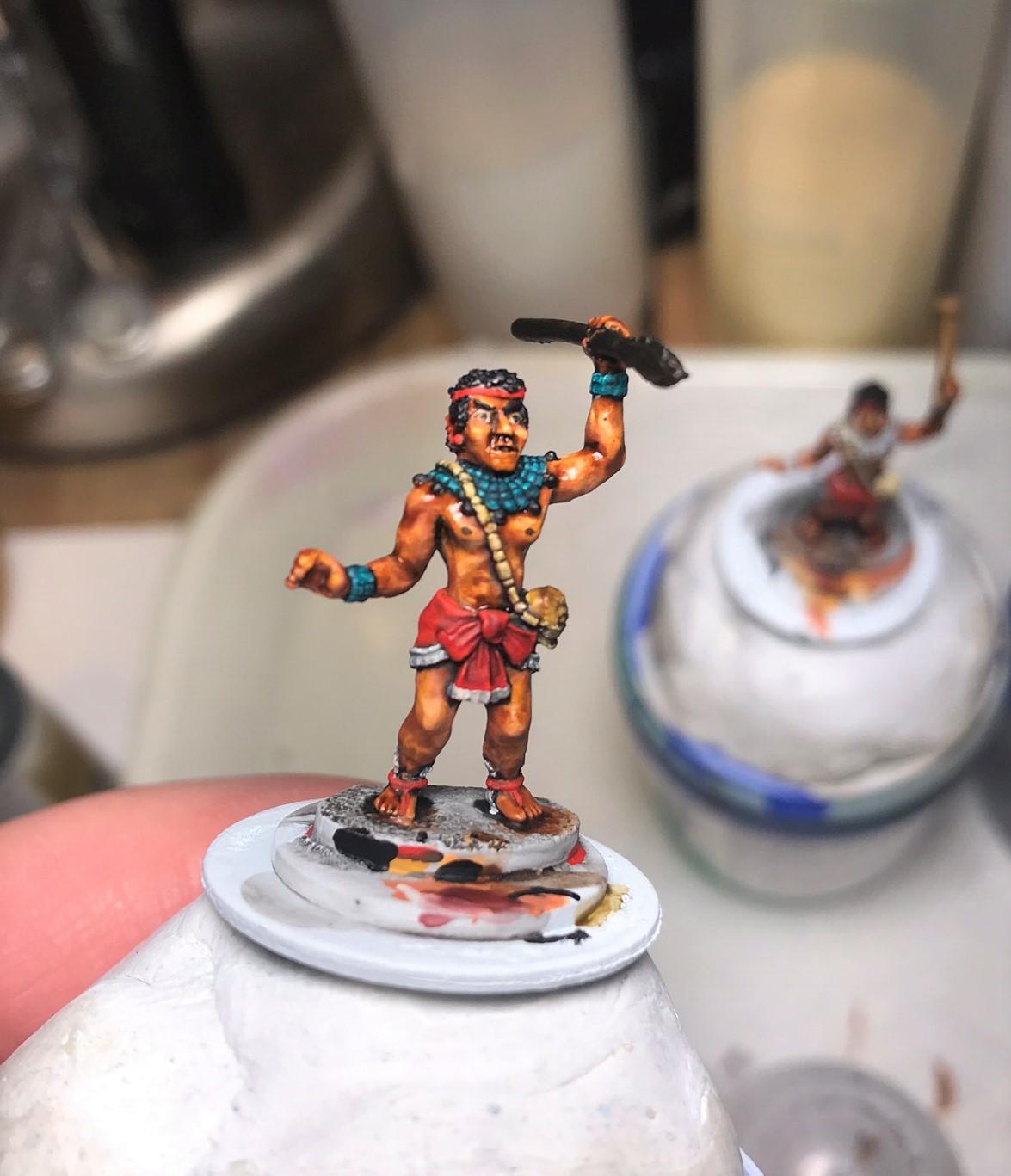
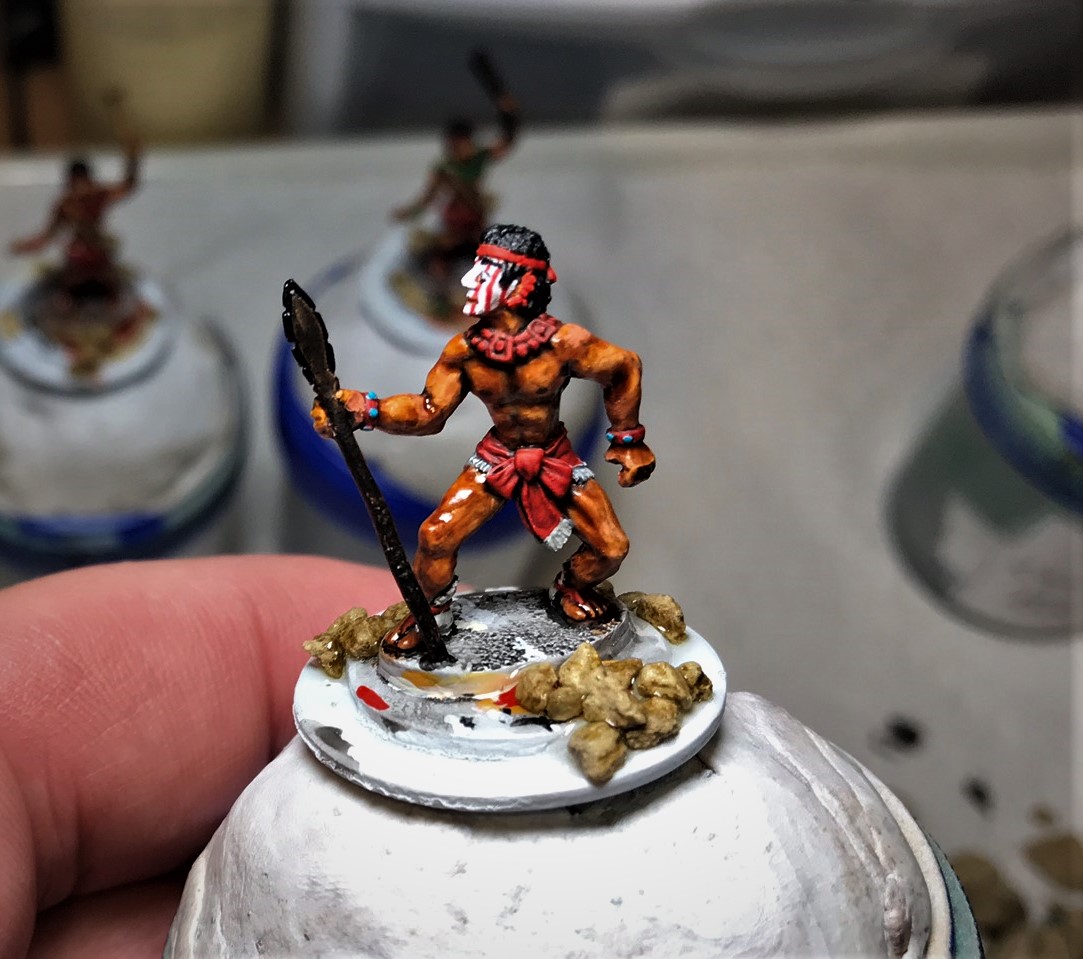
I then moved on to shading their heads to simulate close-shaved heads (they’re the Shorn Ones not the Bald Ones). I also added war paints to most of the faces.
At this point, I moved on to the back banners. I wanted these to pop, so I used “Weiss” again under a number of inks. Here you see the off-white between the earlier-painted lines on the back banners.
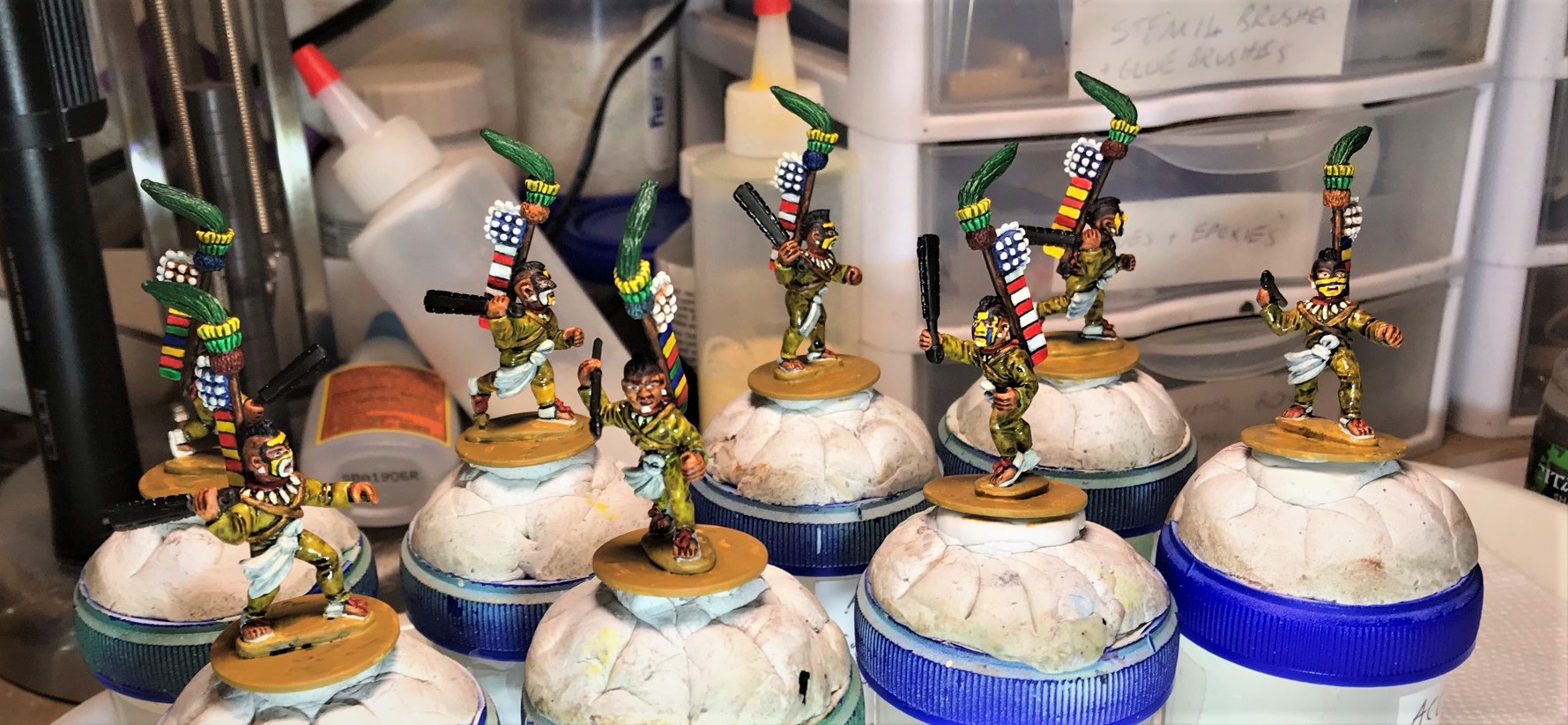
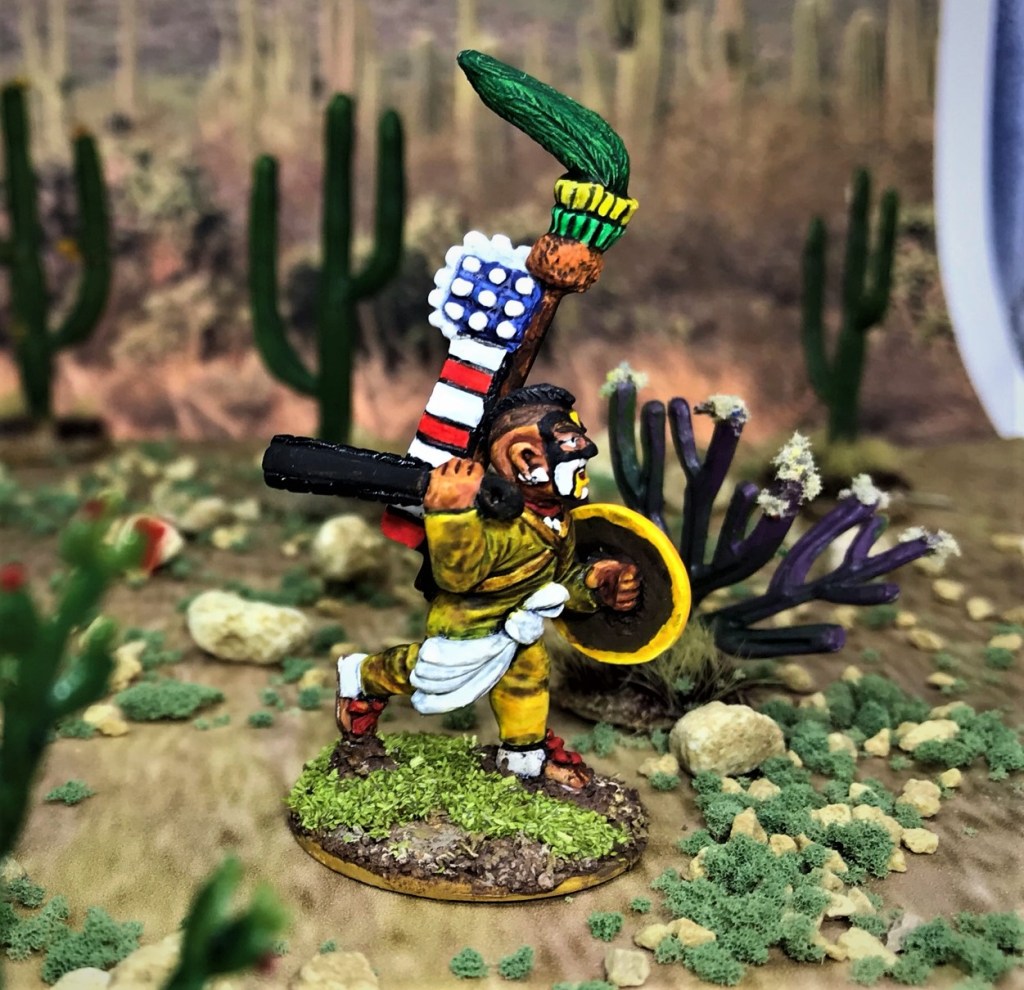
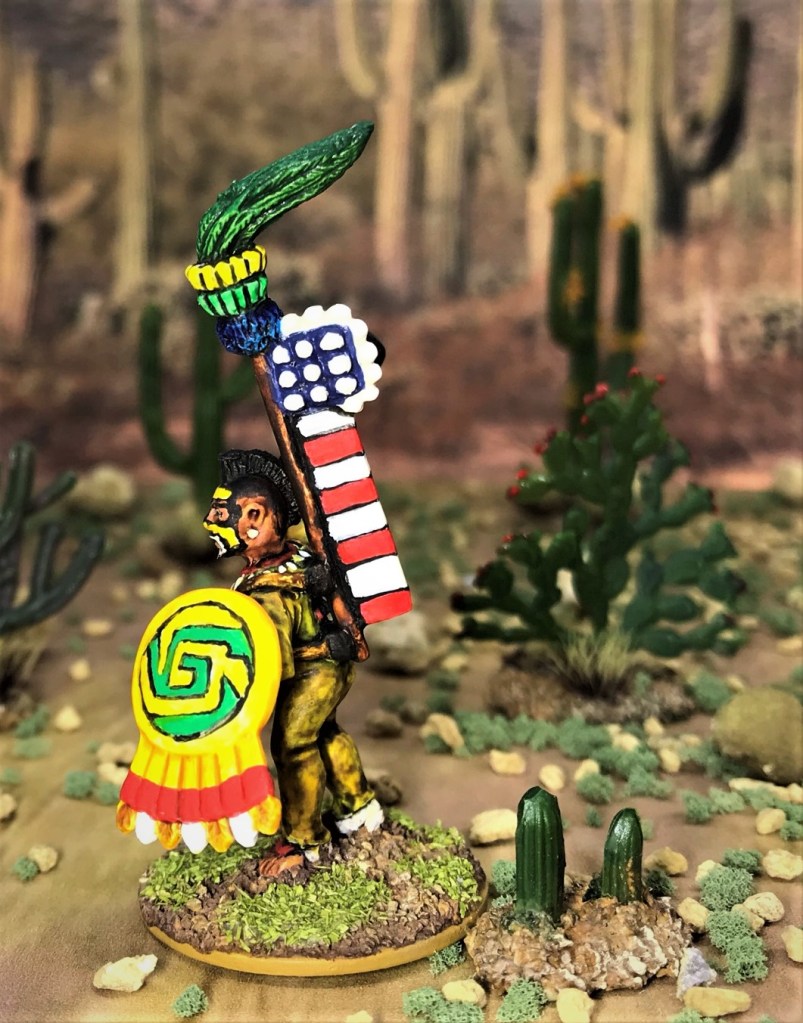
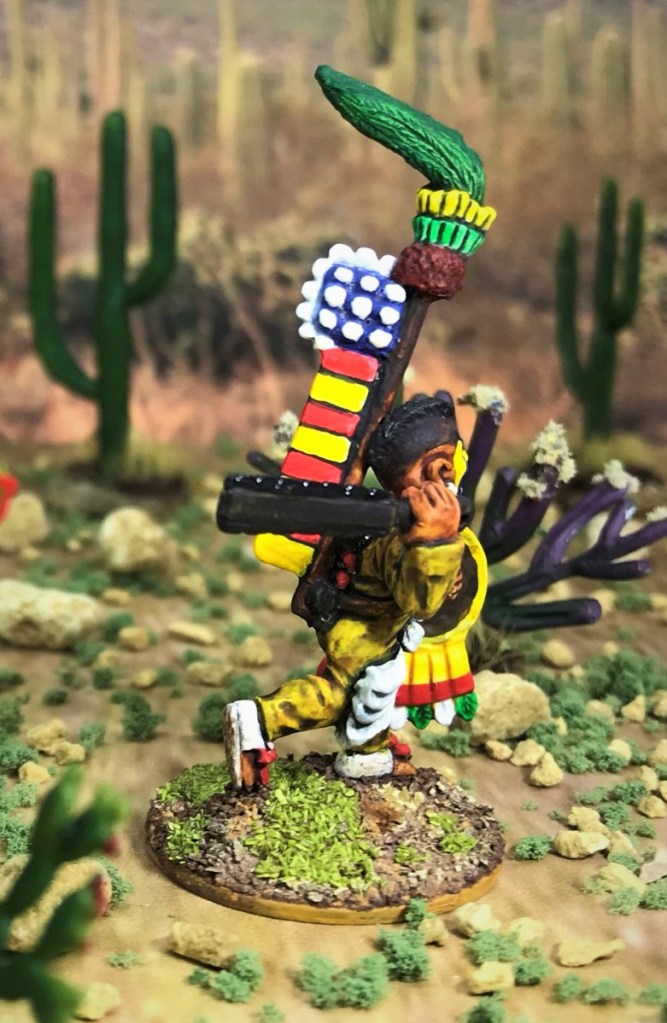
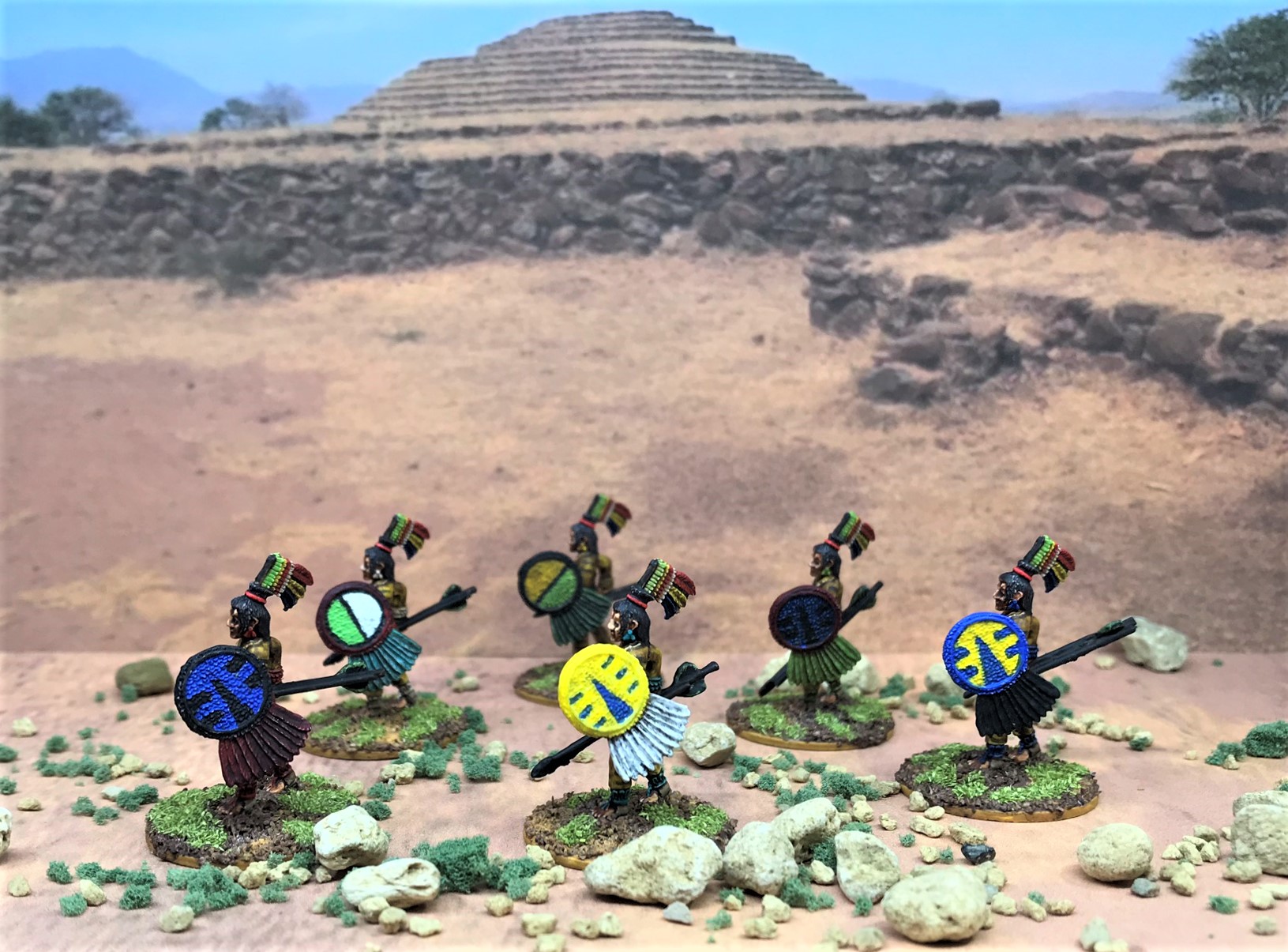
The back banners with the colors added. Some of these back banners resemble flags of the US or even the LGBT Pride Flag, but these were actually the colors used by the Shorn Ones in the 16th century according to my research. I varied the colors of the “feather balls” immediately above the back banners in accordance with the Osprey resource books. Also, historically the 9-dotted field on the back banners had either a bluish or light brownish background, so I adopted this as well. Hopefully this will help with tabletop identification as well as the back banners, the poses, and the war paints.
At this point in painting this group, I began to worry that sealing inked areas on these with an airbrush application of Vallejo “Mecha Varnish Matte Varnish” could possibly activate the multiple dried inks and ruin the models. Yeah, that was a bit scary! So I decided to seal the faces and back banners with Vallejo “Gloss Varnish” as that would seal those surfaces and also allow them to stay a bit brighter. I don’t think I needed to worry, but in any case this approach (IMO) worked well. You can let me know if you agree or not. Then I flocked the figures and moved onto the shields.
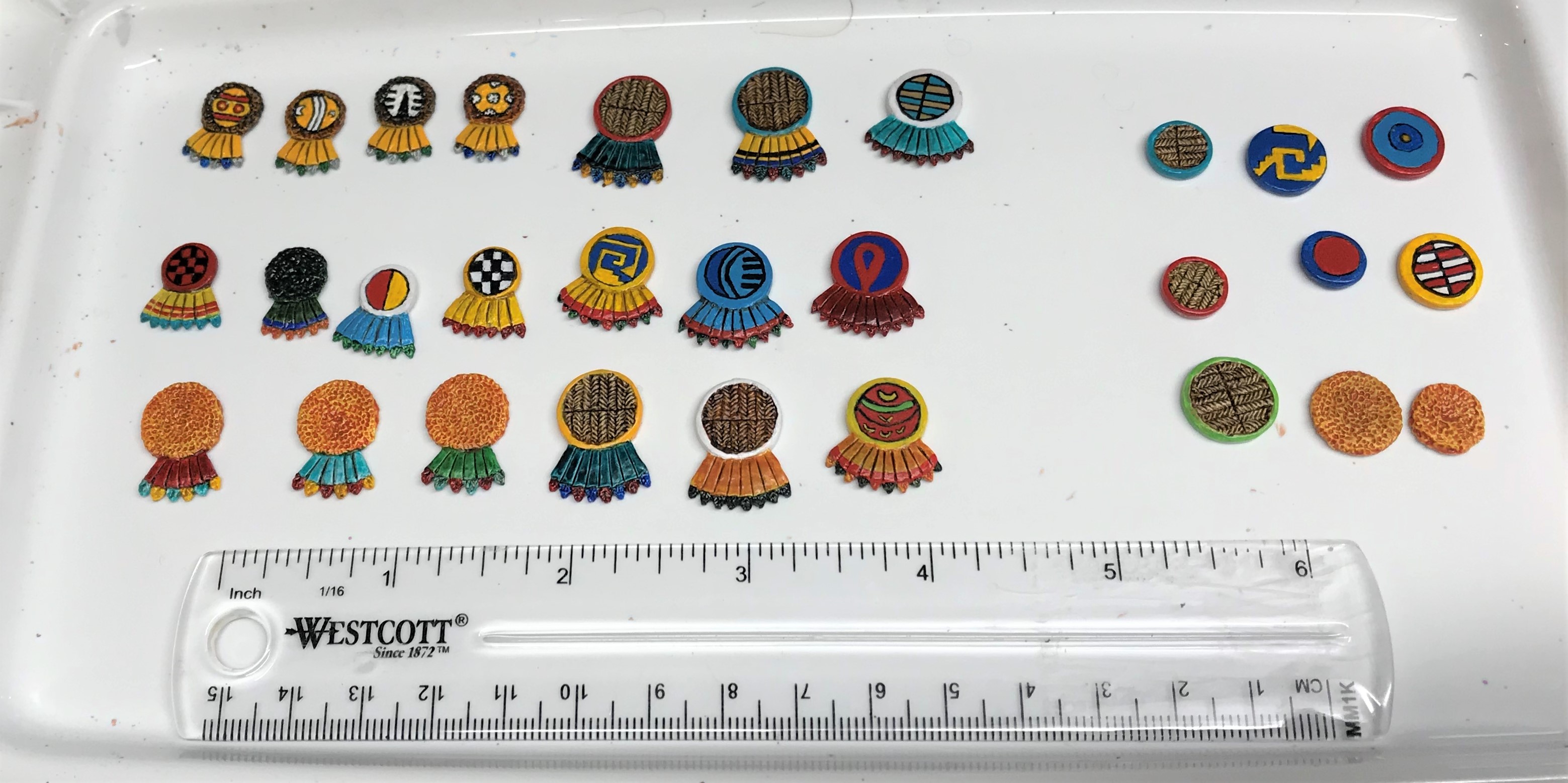
Here I just started painting the shields – and I have not gotten to the feather frets. I use poster tack over gloss-varnished surfaces to try to paint both sides safely. First do one side, let dry, then the other.
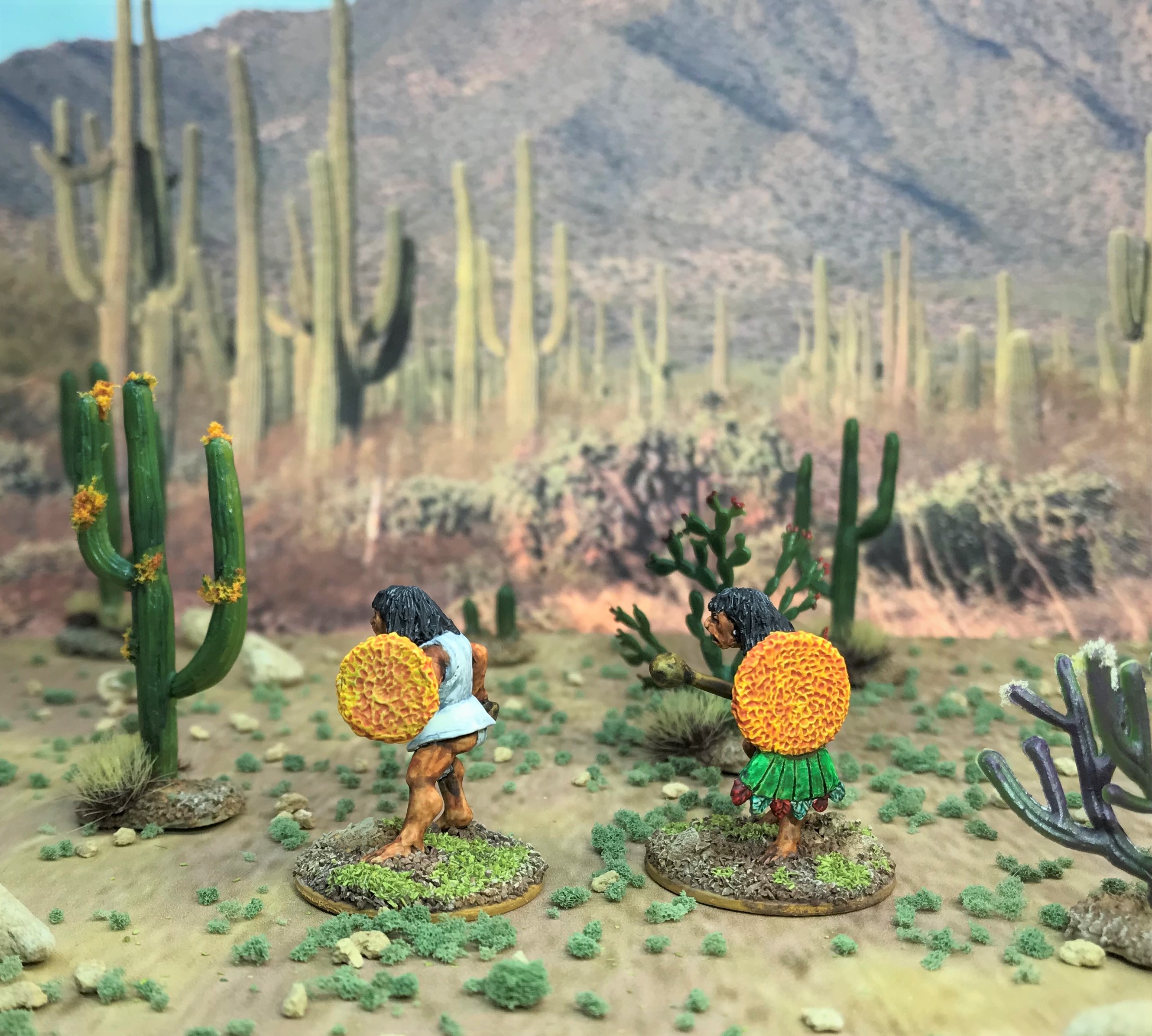
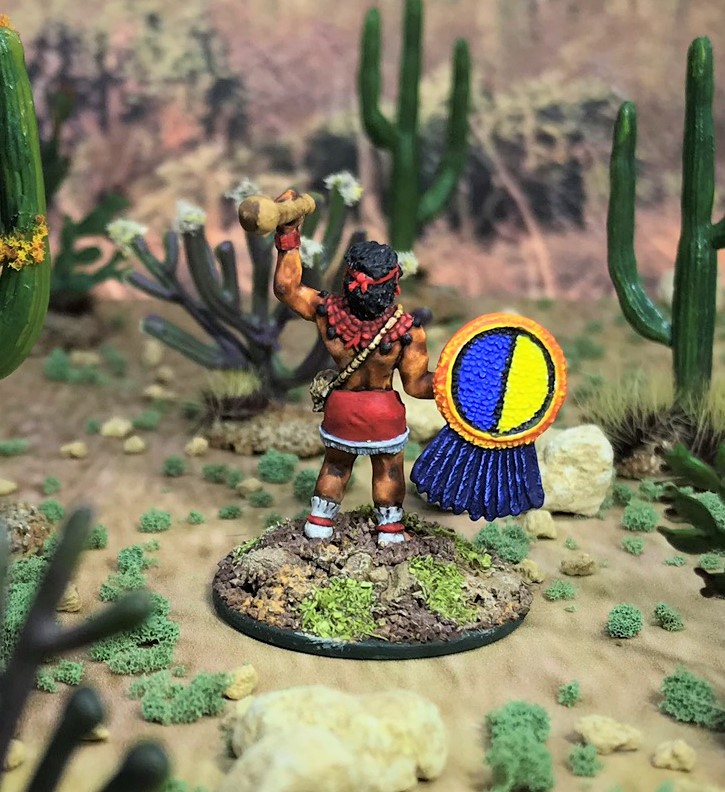
After a few iterations of painting and lining, the shields were done and I also varnished them with the Vallejo “Gloss Varnish” for the same reasons as I did the faces and the back banner. At quick glance, most cuachicqueh shields look similar, but these are all different. Just look closely!
Here the shields are mounted with a “sandwich” of 2 drops of Gorilla Glue surrounding a dab of E6000 epoxy in the middle of the shields. This combination yields a quick hold with the Gorilla Glue while the E6000 cures over 24 hours and provides a stronger and slightly more flexible bond. You also see that I have added pigments to the flocking on the bases. These are ready for base dry brushing followed by an application of the matte varnish. Lastly, I add static grass.
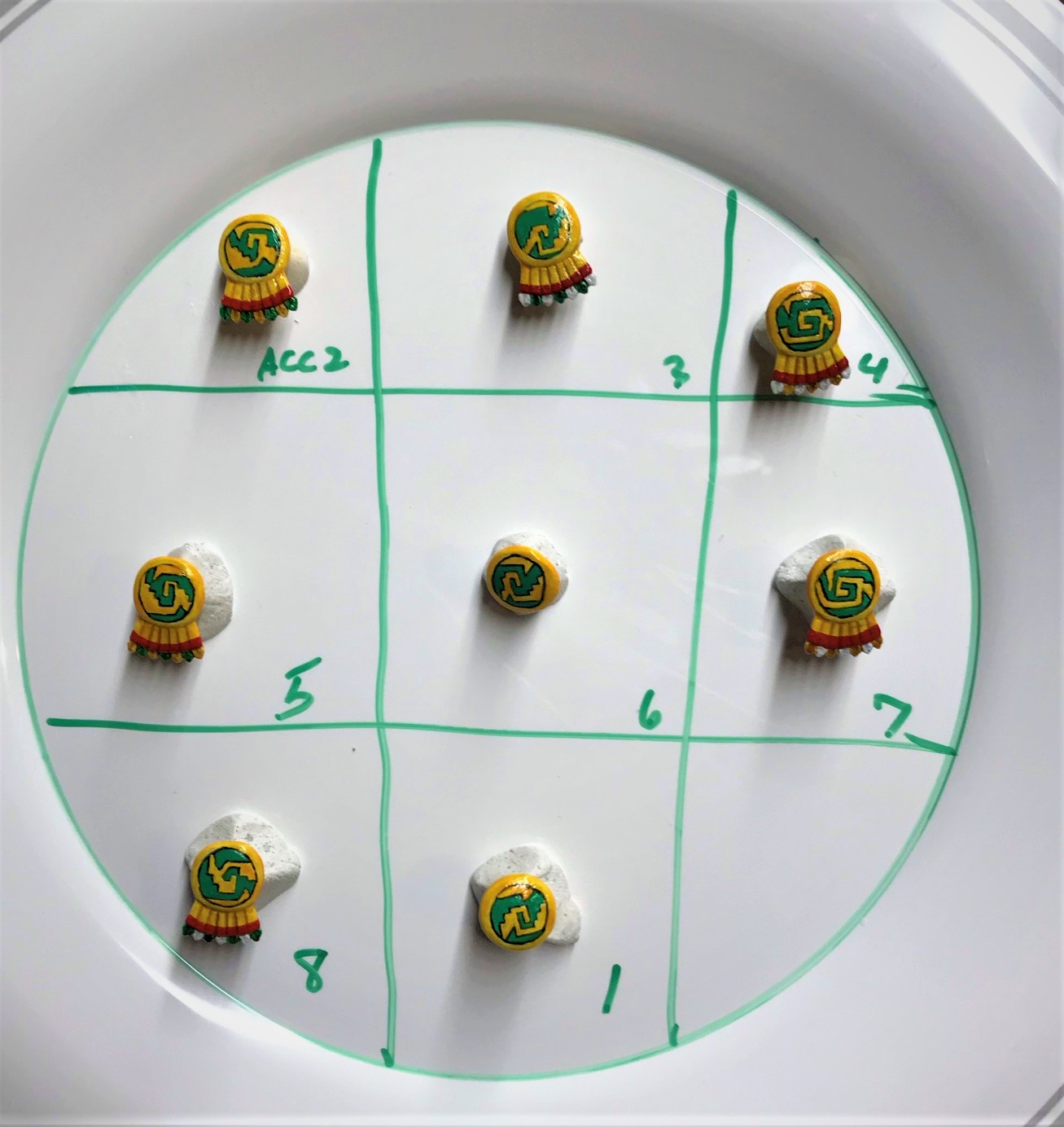
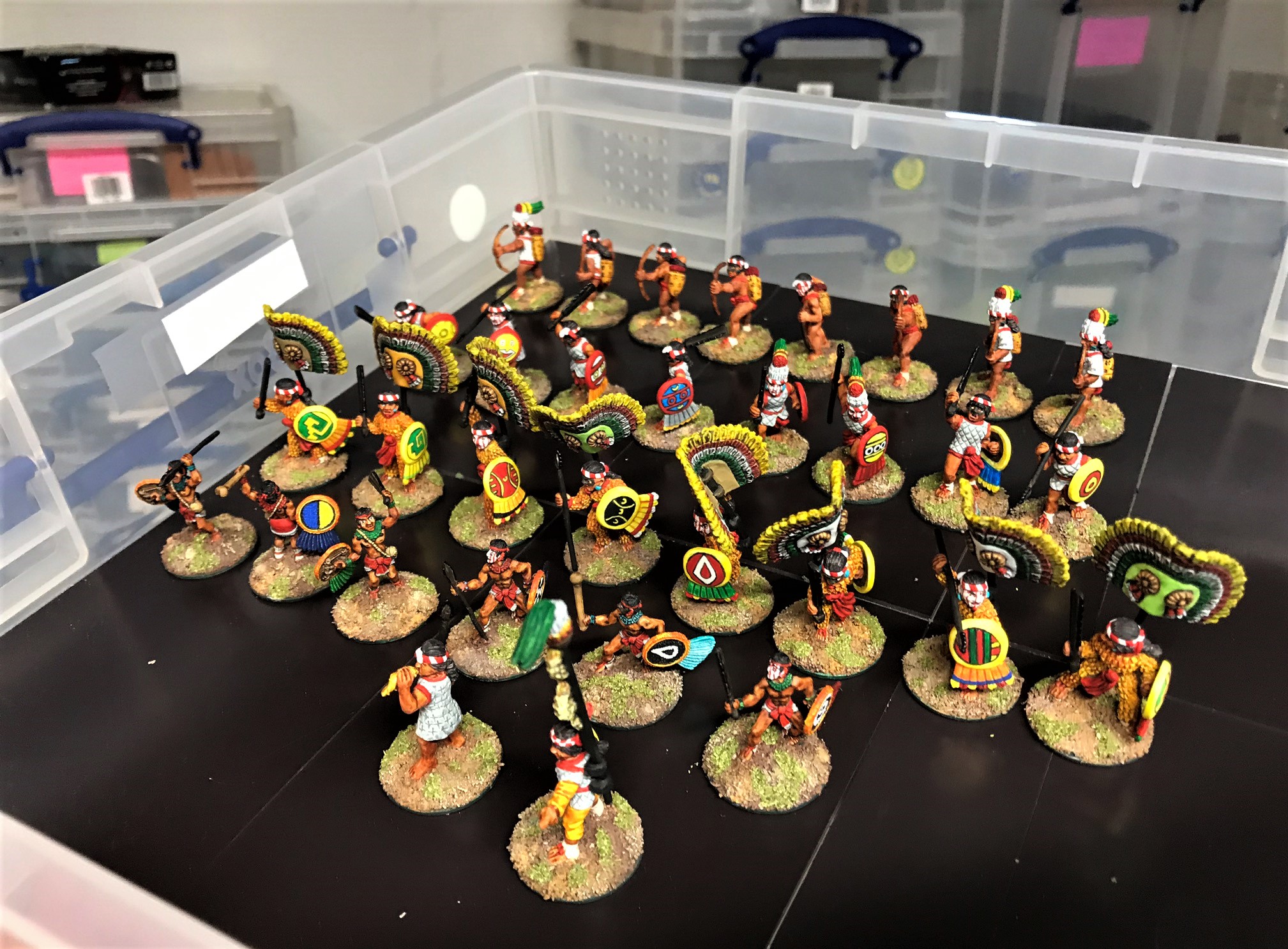
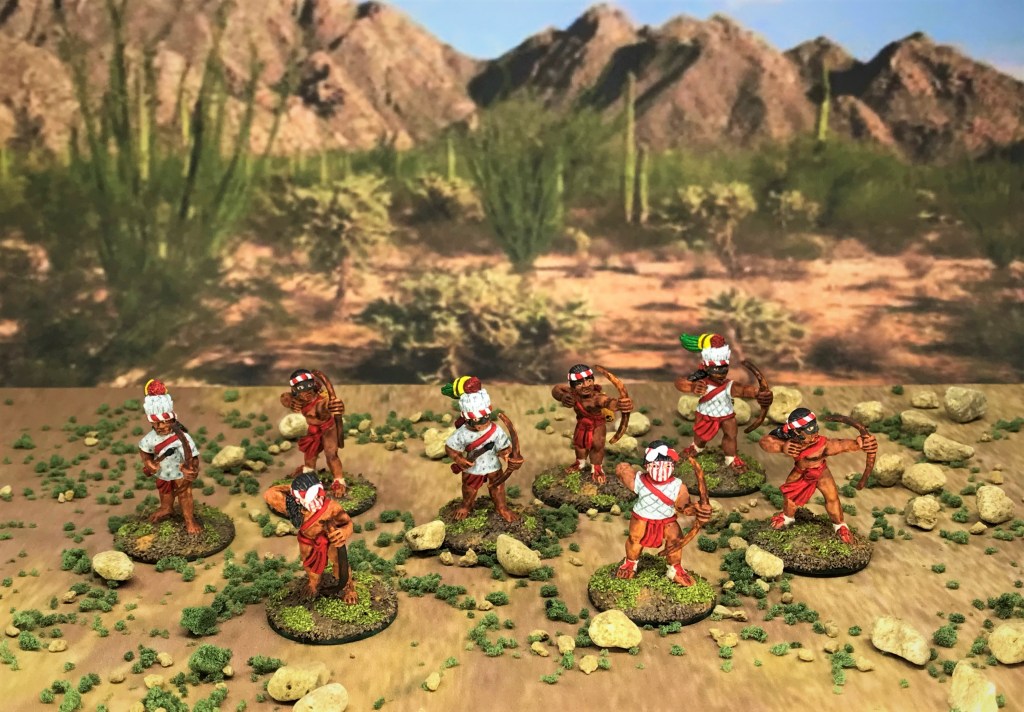
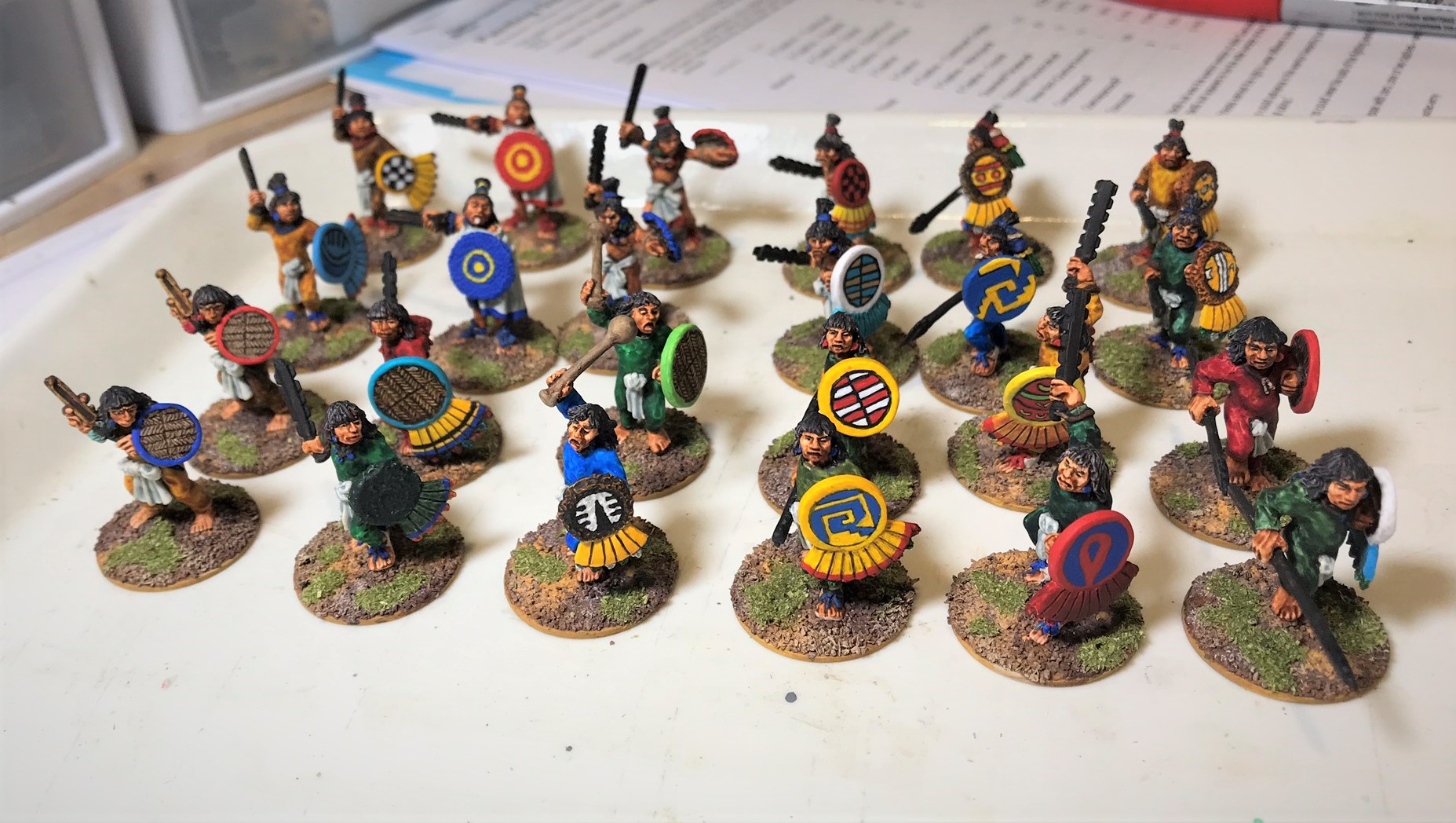
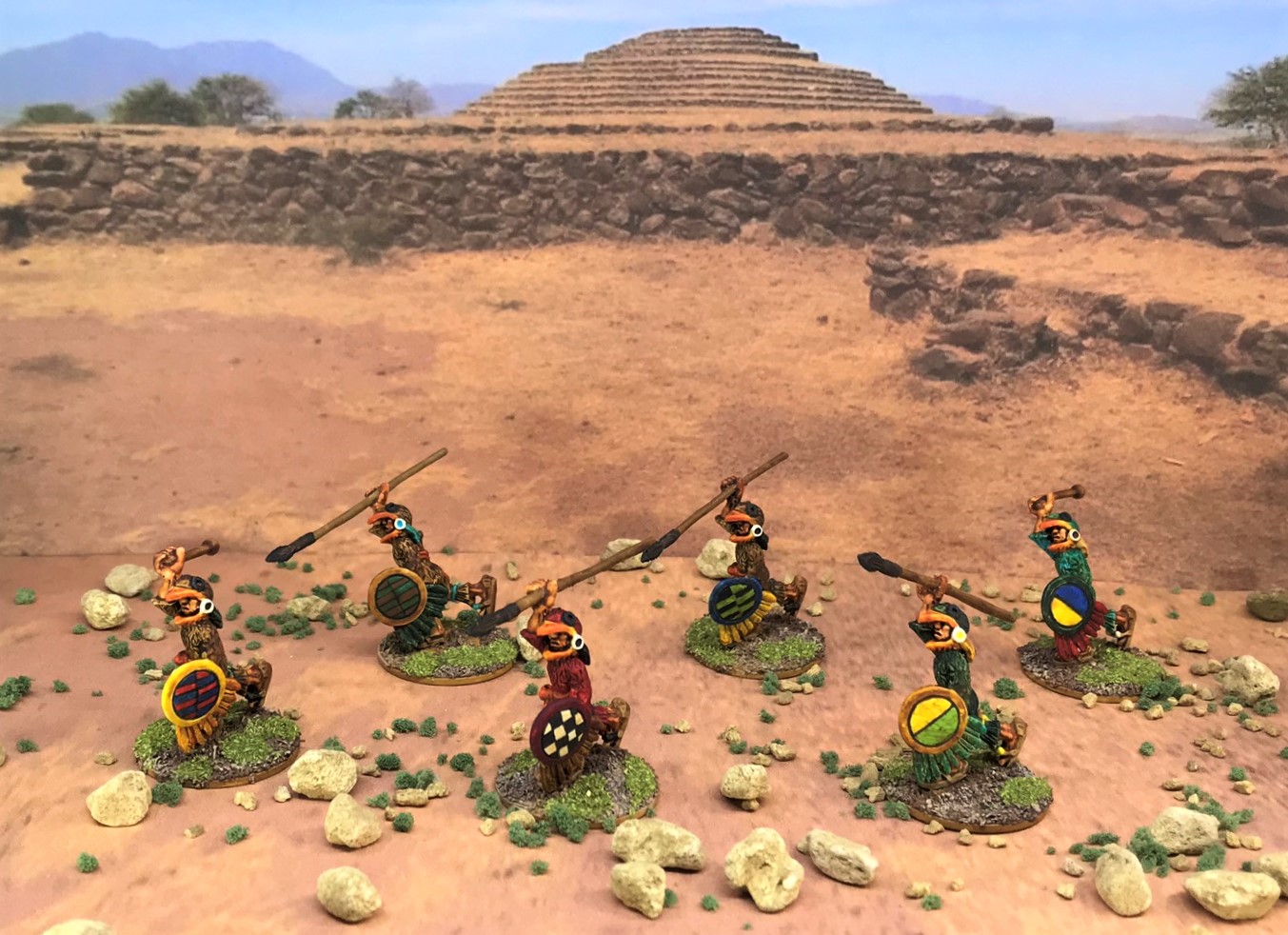
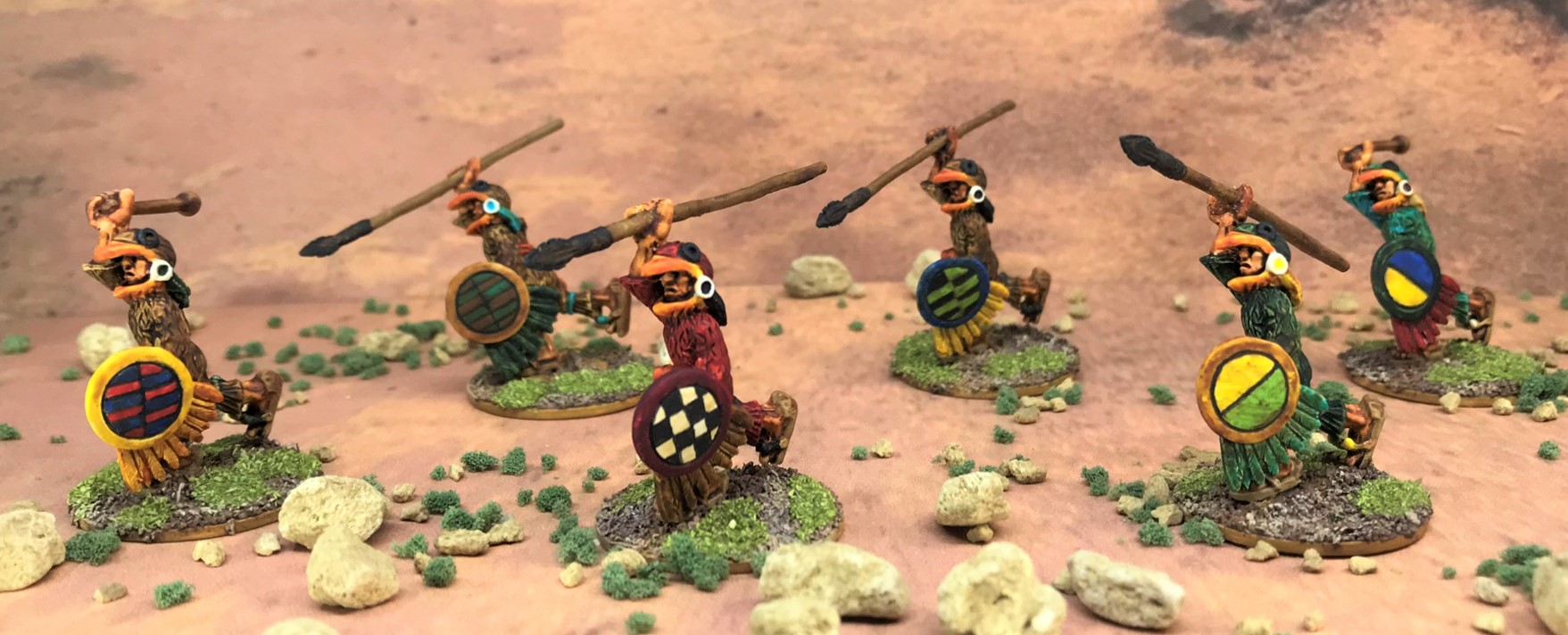
The eight models are shown here completed and “frolicking” on the various images and pages that I used as painting guides.

The eight are numbered for my cataloging system as ACC1 to ACC8. Now, let’s move to:

Eye Candy

Click on any of the images for a larger view!

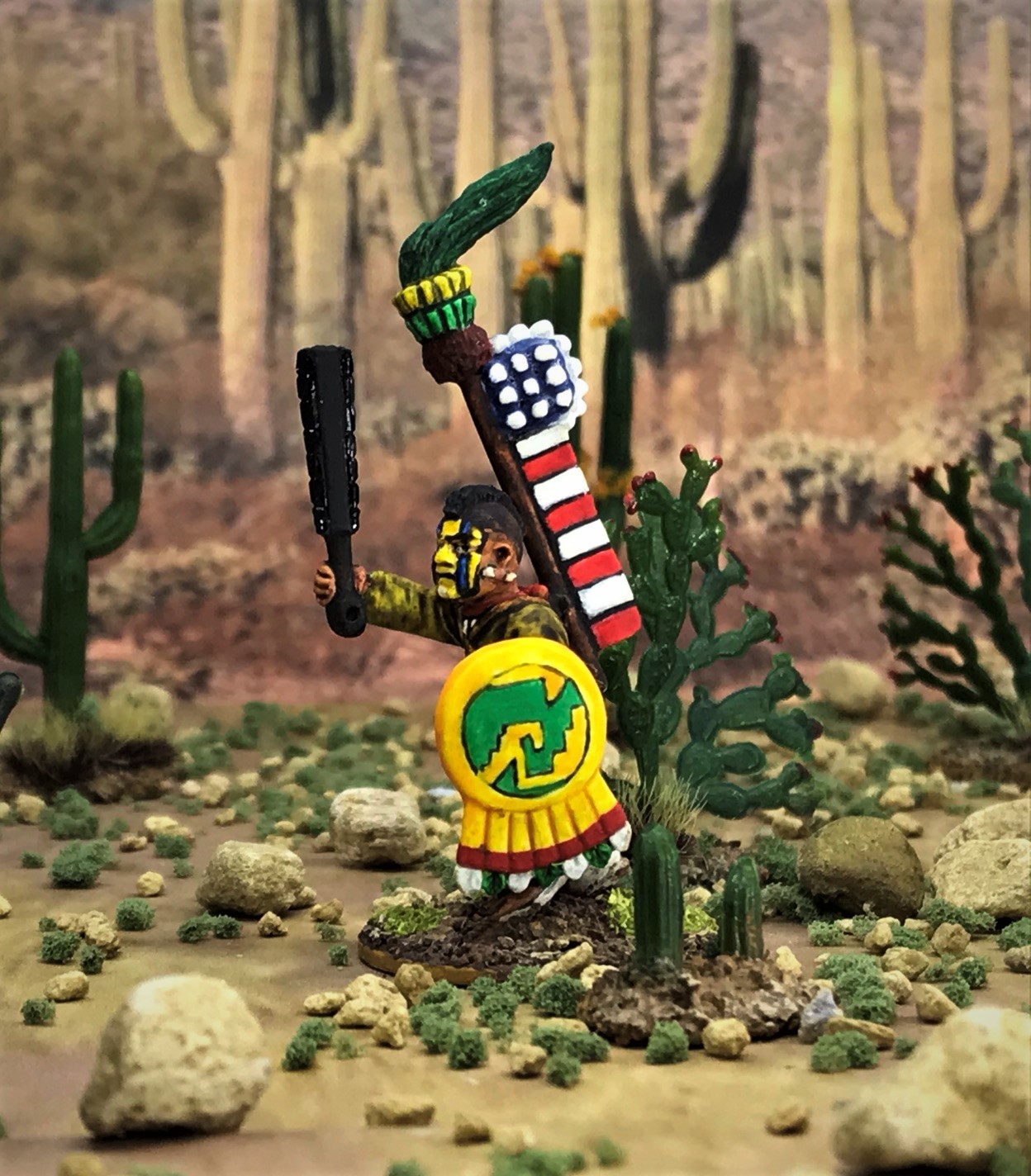
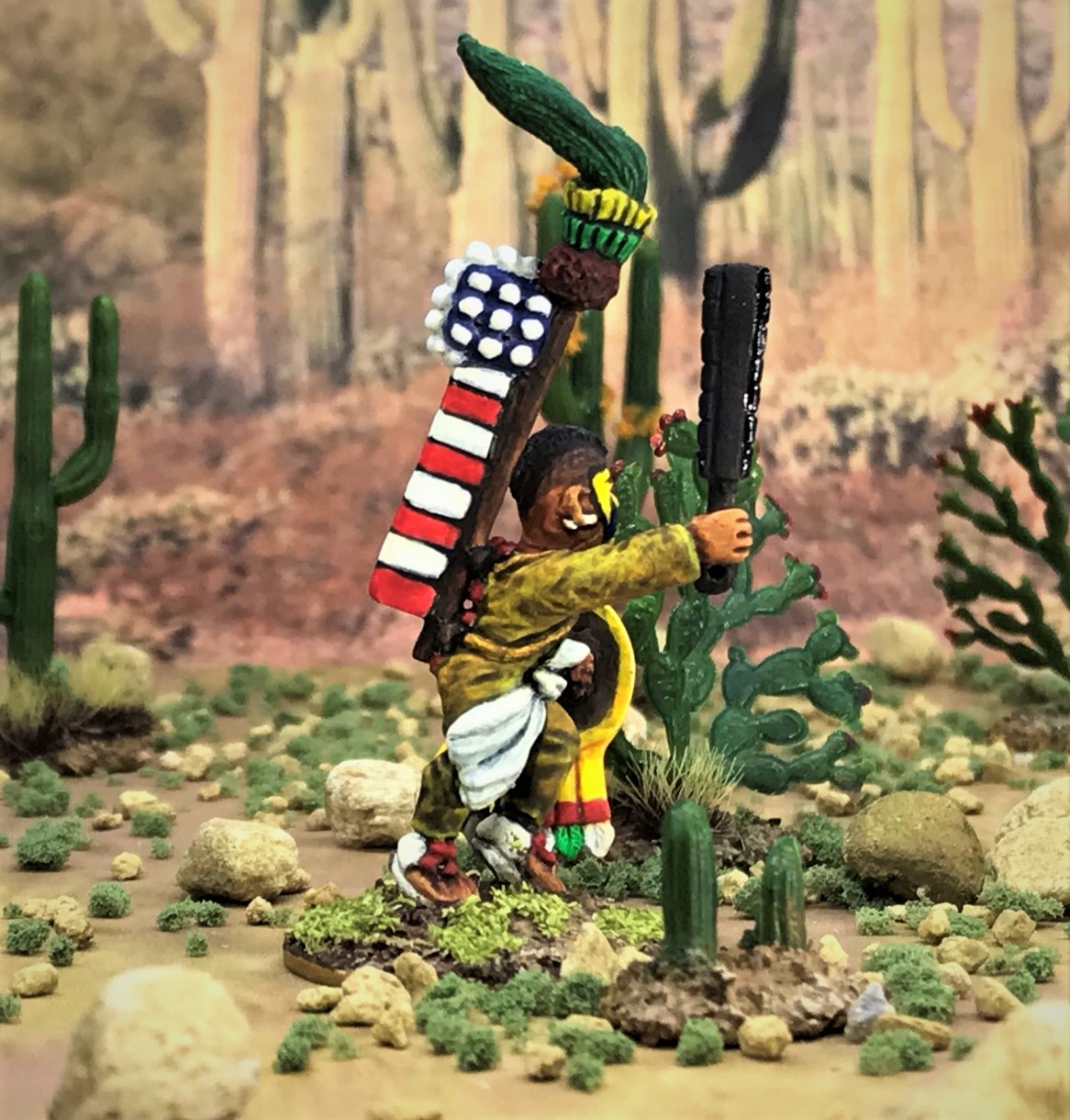
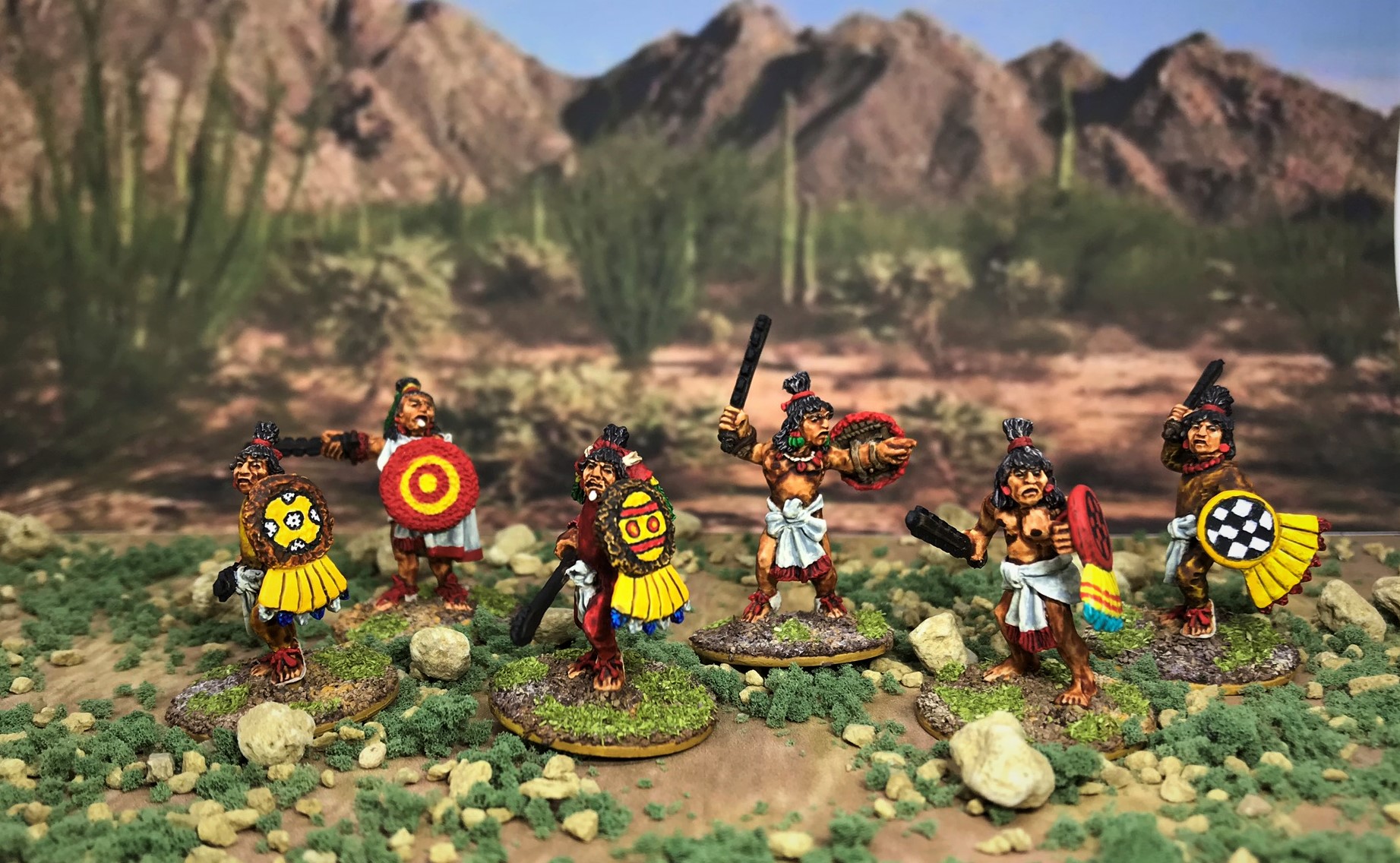
ACC1

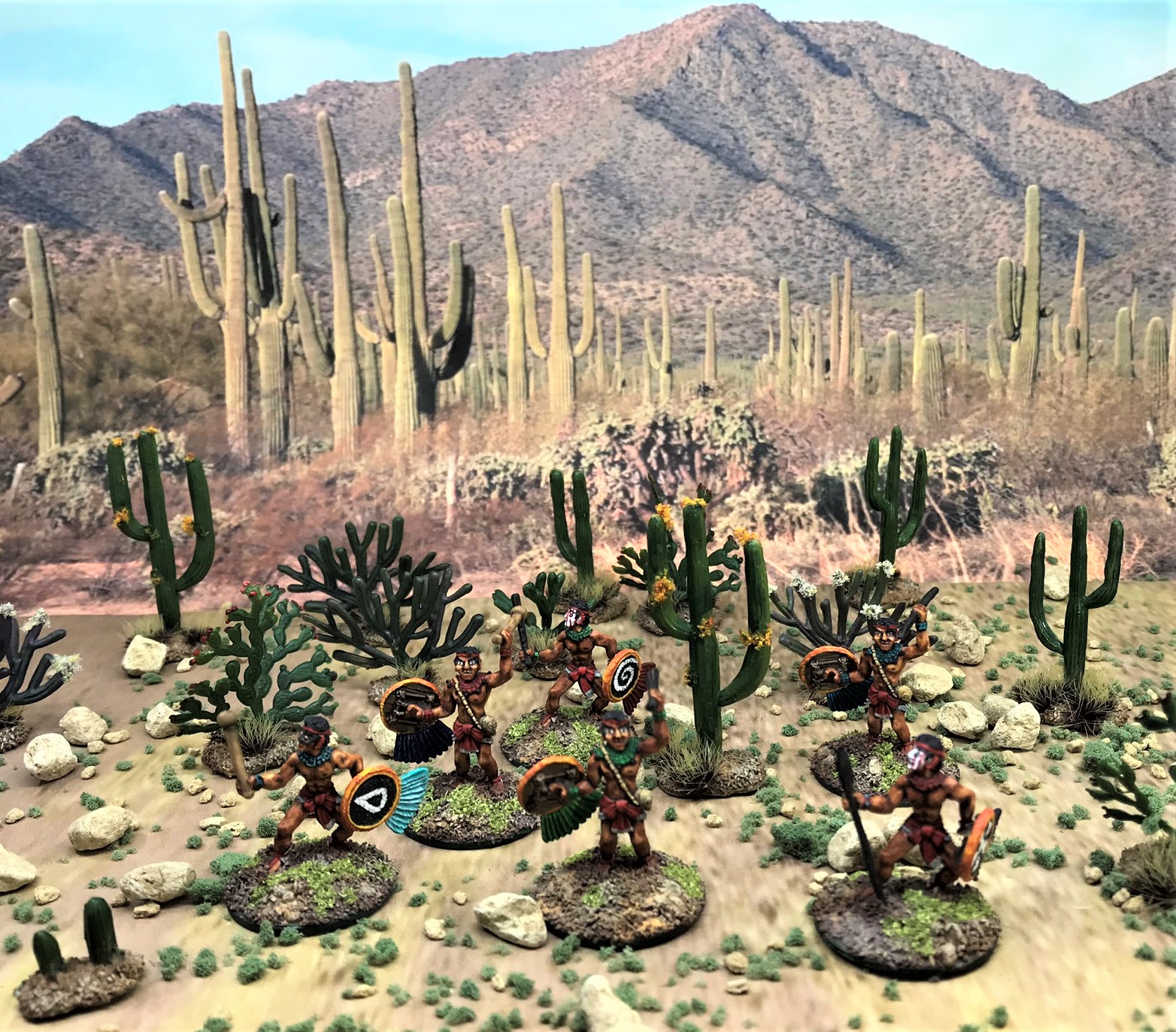
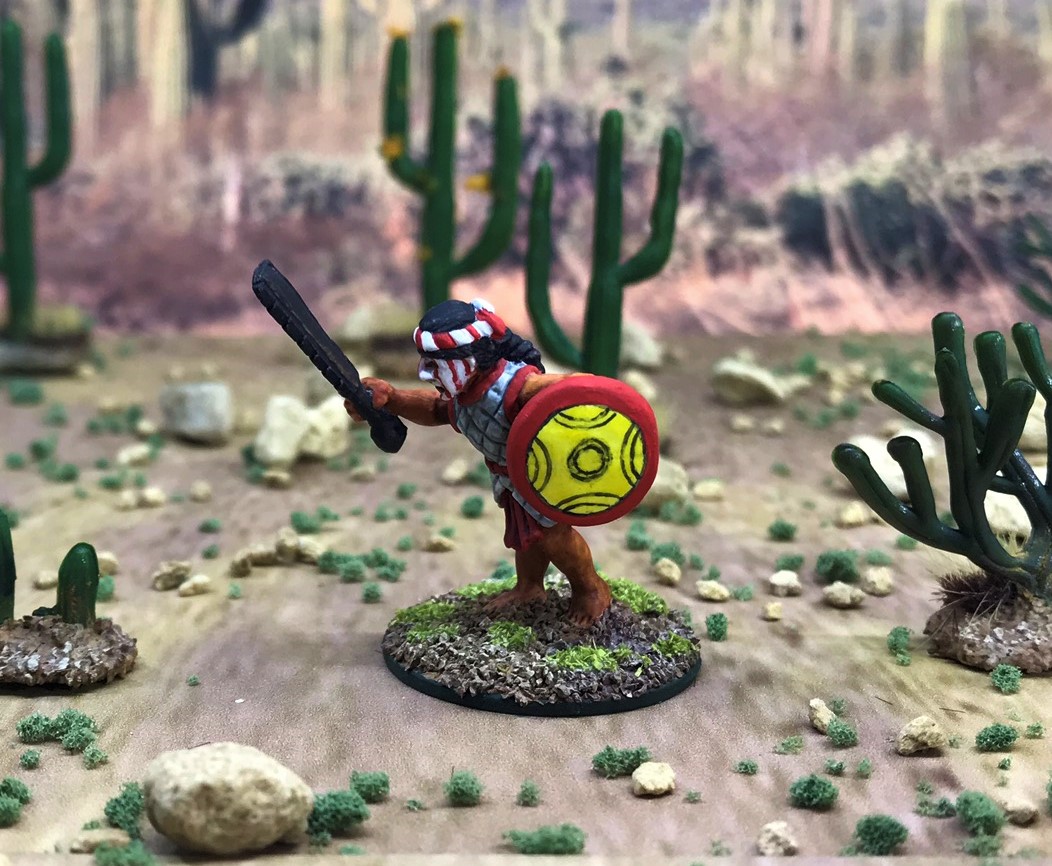
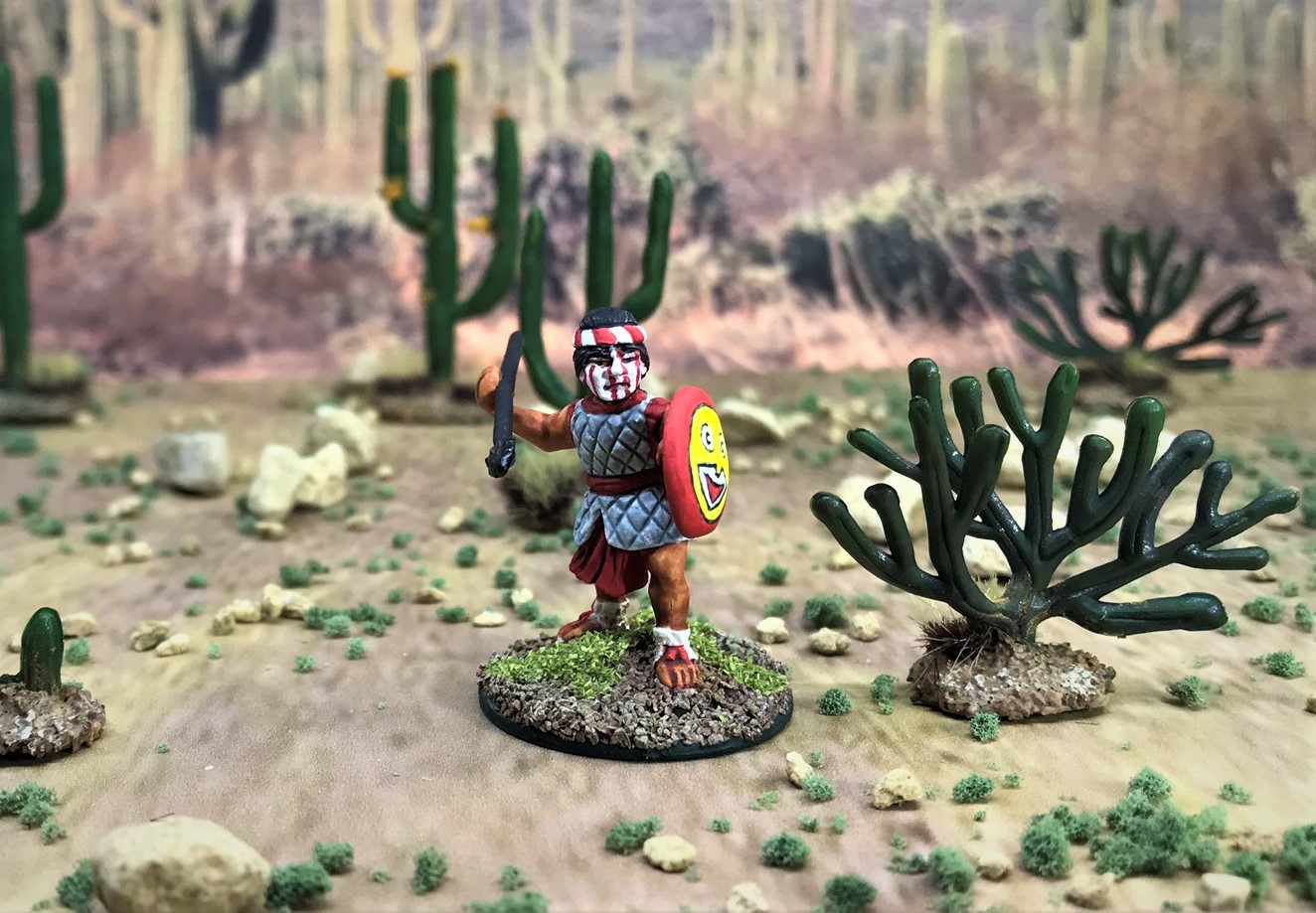
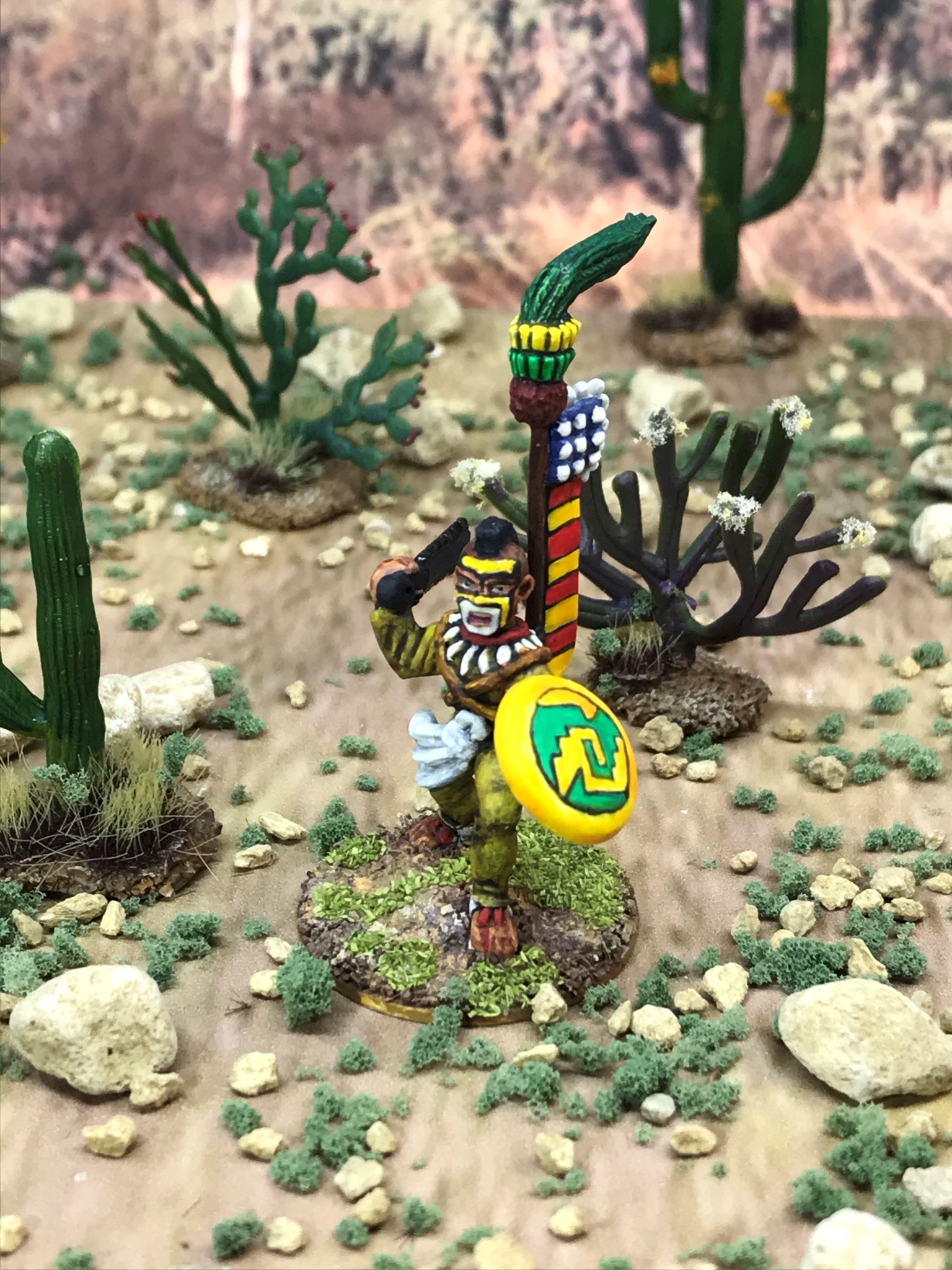
ACC1 – armed with a macuahuitl (obsidian-edged club/broadsword) and a non-fretted shield. He has war paint, and his back banner has the bluish background with red and yellow stripes. The back banner feather ball here is reddish.
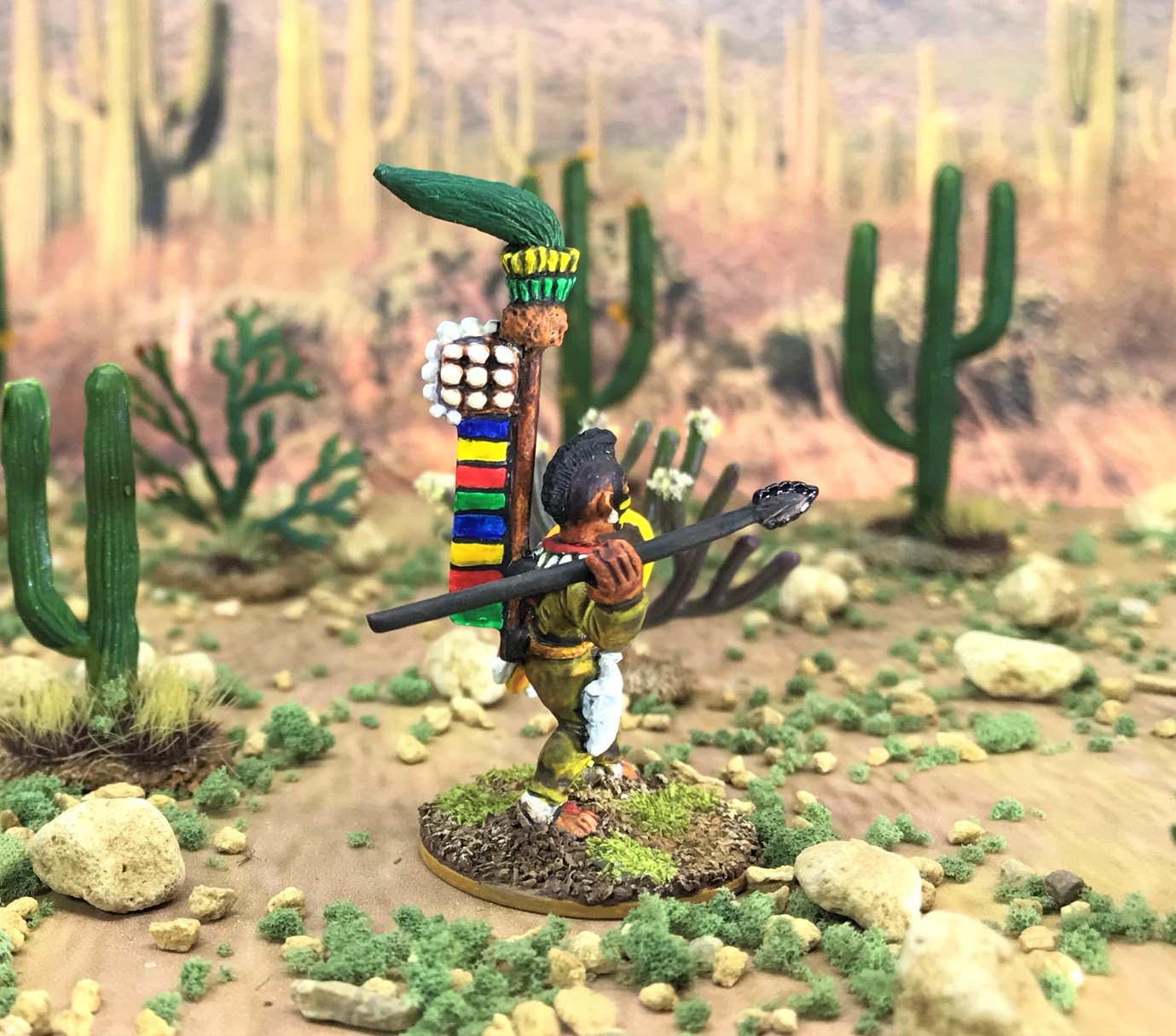
ACC2

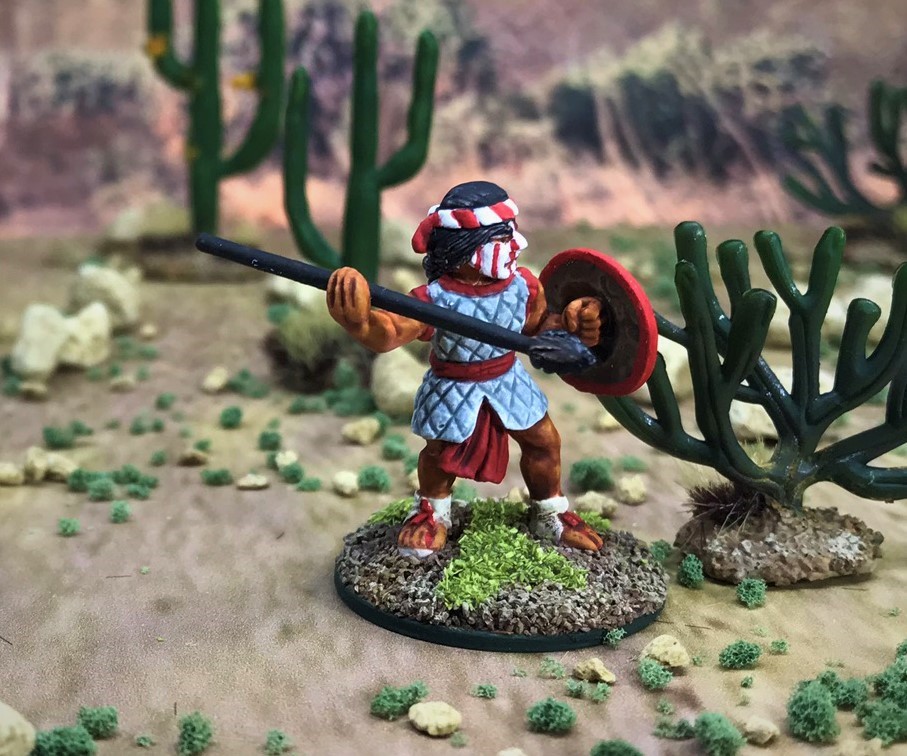
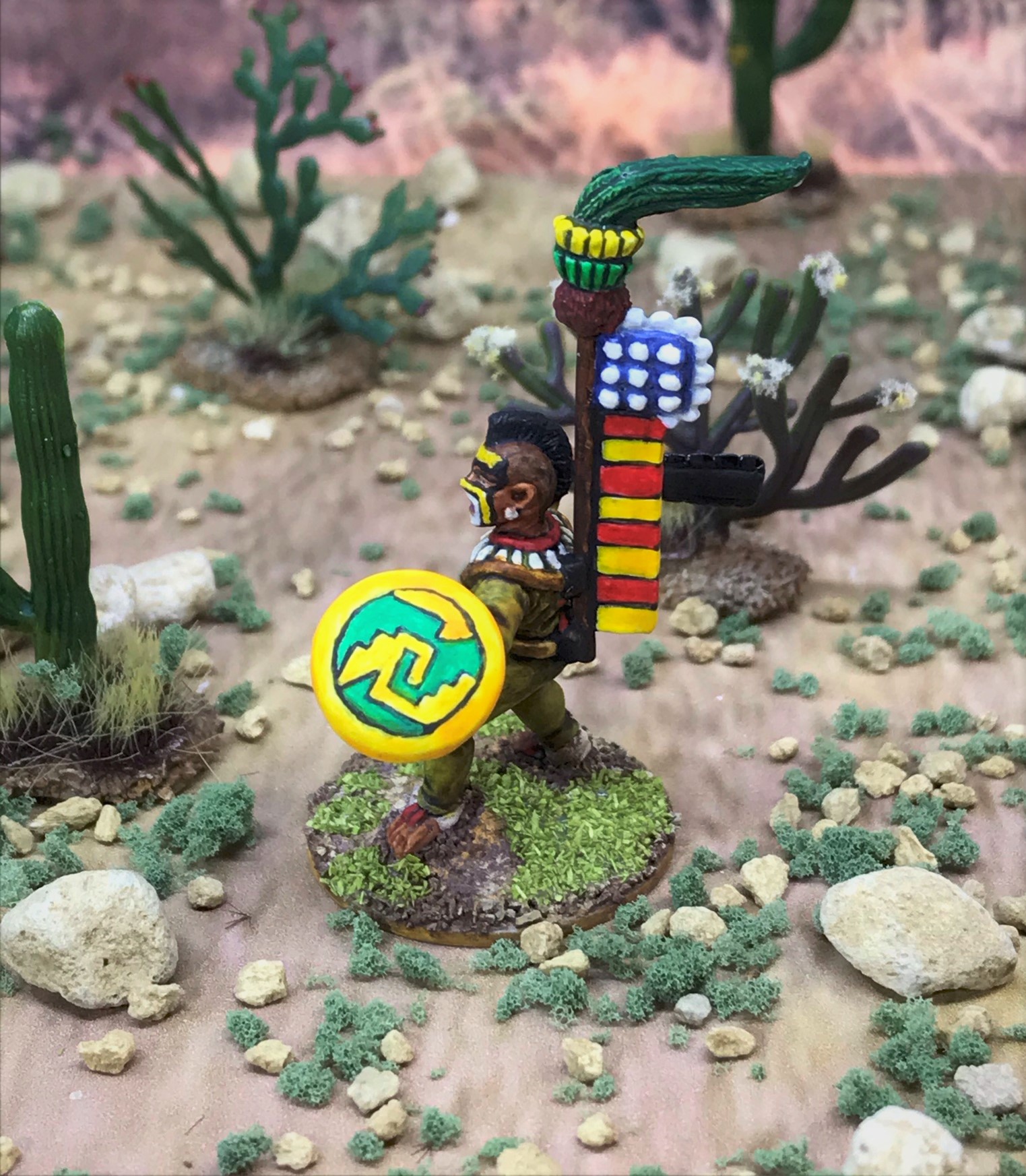
ACC2 – armed with a tepoztopilli (obsidian-edged thrusting spear) and a fretted shield. He has no war paint, and his back banner has the brownish background with blue, yellow, green and red stripes. The back banner feather ball here is light blue.

ACC3

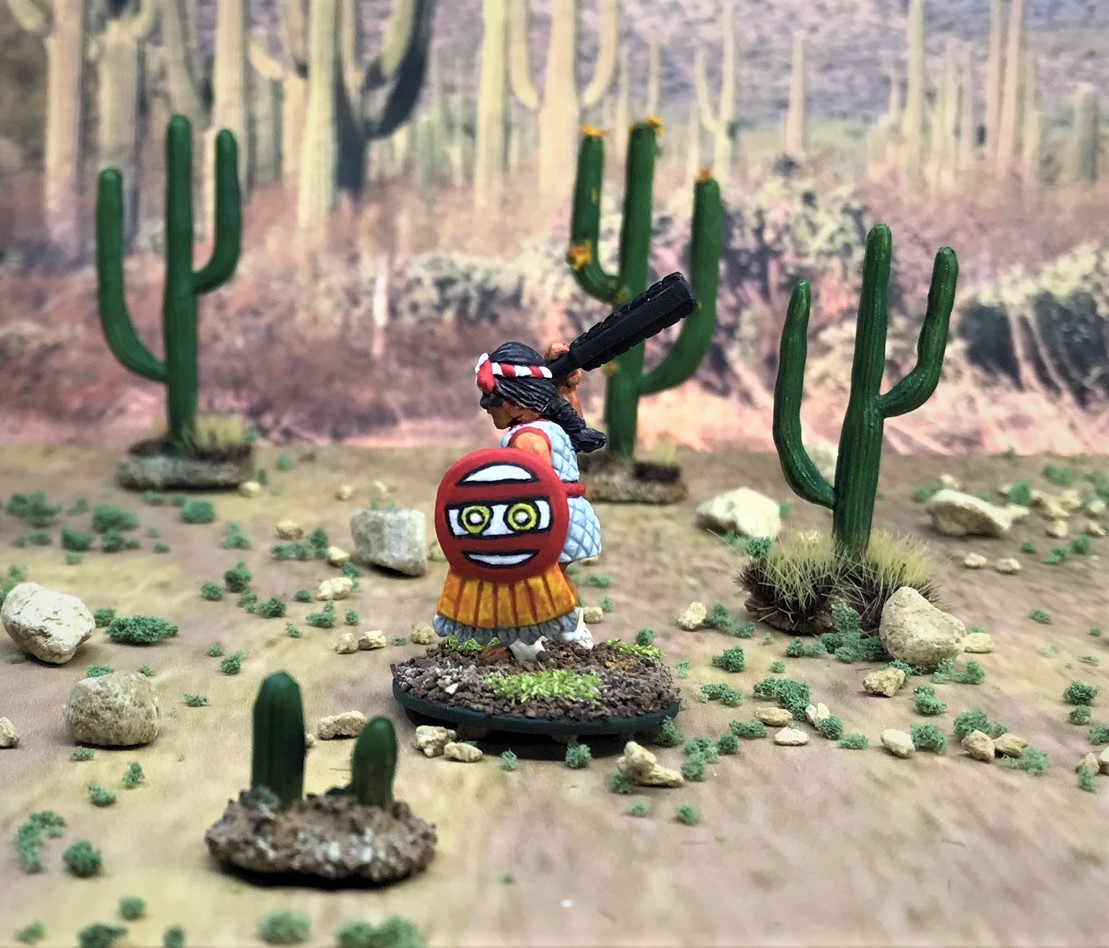
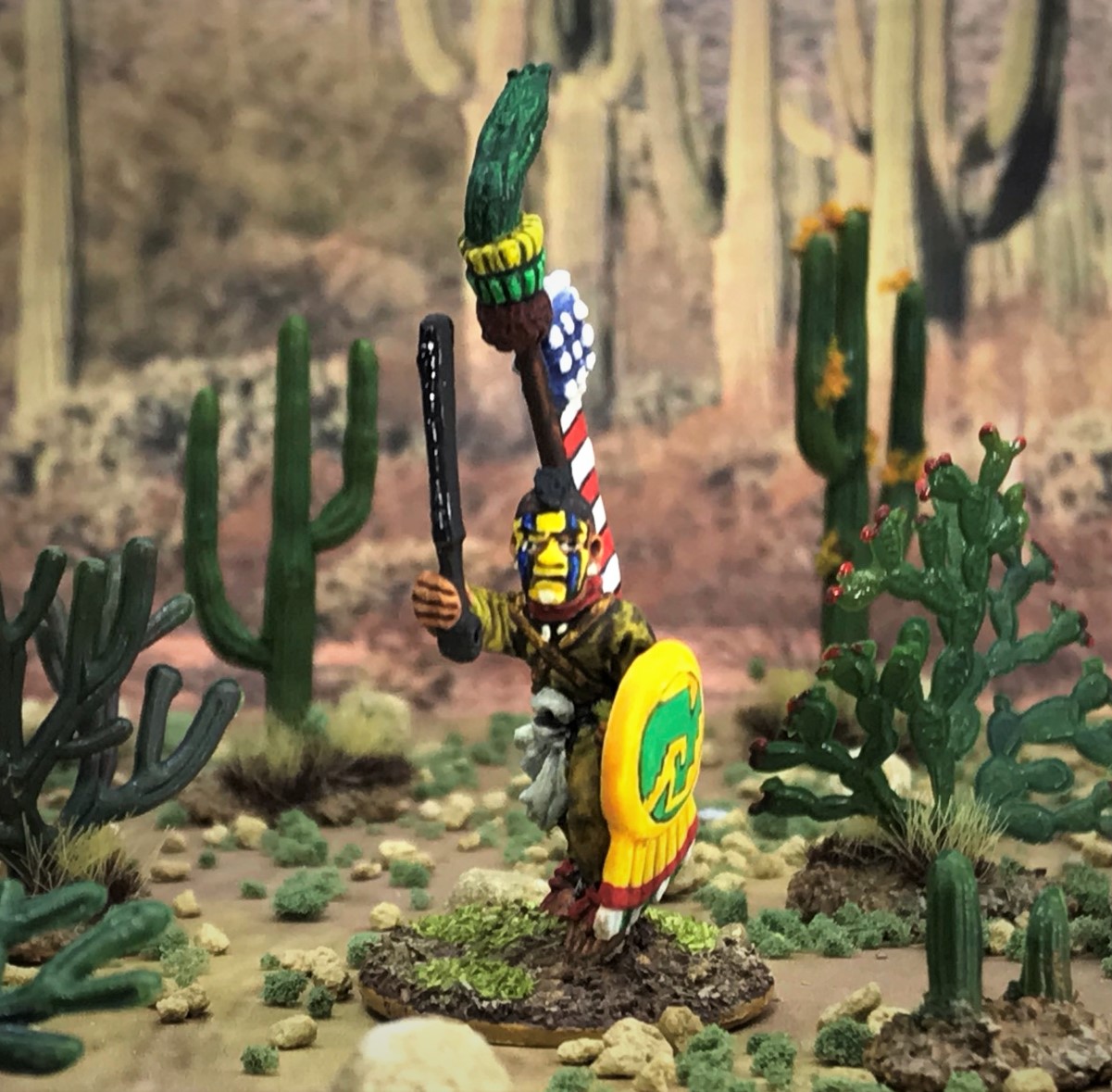
ACC3 – armed with a macuahuitl and a fretted shield. He has war paint, and his back banner has the bluish background with red and white stripes. The back banner feather ball here is reddish.

ACC4

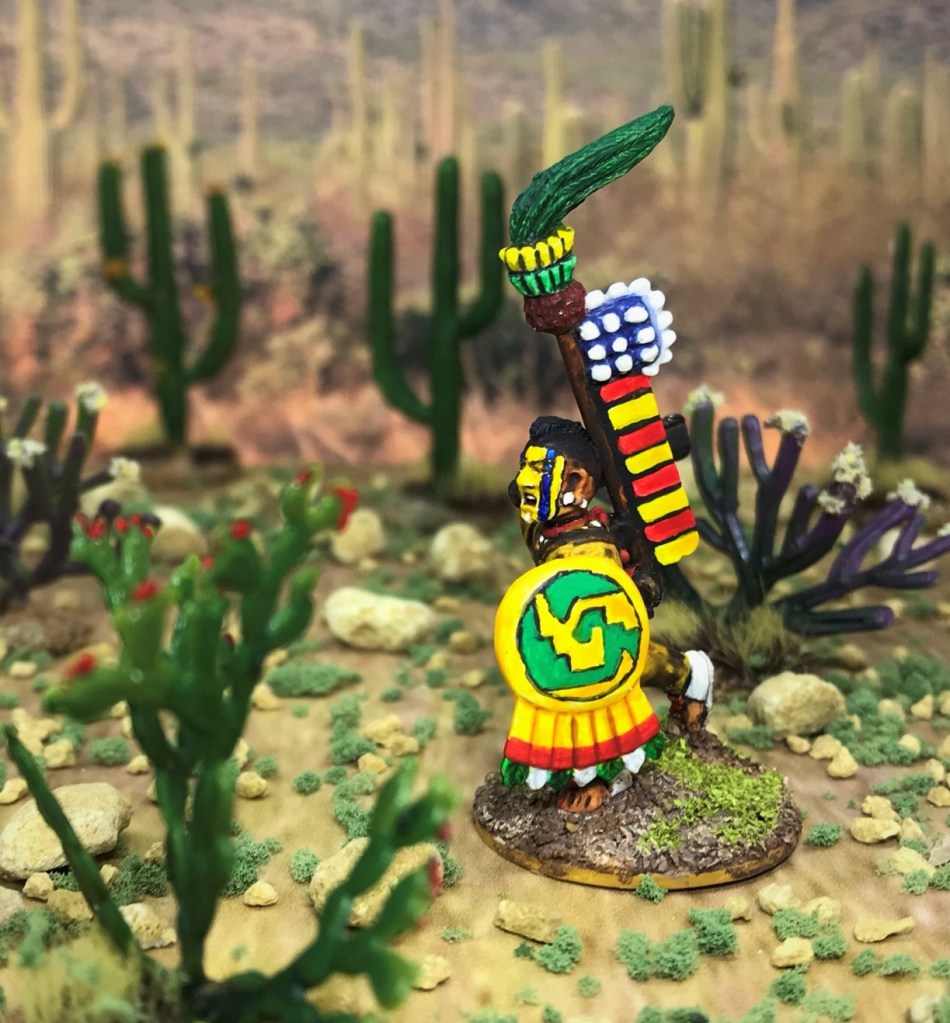
ACC4 – armed with a tepoztopilli (obsidian-edged thrusting spear) and a fretted shield. He has war paint, and his back banner has the brownish background with blue, yellow, green and red stripes. The back banner feather ball here is slightly orange in color.

ACC5

ACC5 – armed with a macuahuitl and a fretted shield. He has no war paint, and his back banner has the brownish background with blue, yellow, green and red stripes. The back banner feather ball here is dark blue.

ACC6

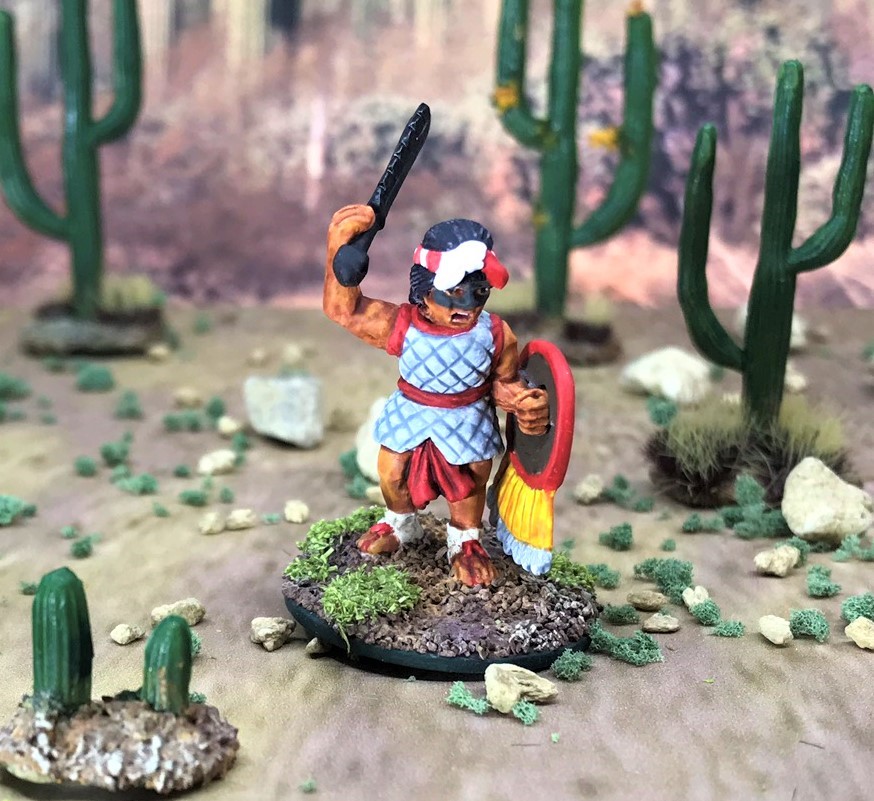
ACC6 – armed with a macuahuitl and a non-fretted shield. He has war paint, and his back banner has the bluish background with white and red stripes. The back banner feather ball here is orange.

ACC7

ACC7 – armed with a macuahuitl and a fretted shield. He has war paint, and his back banner has the bluish background with white and red stripes. The back banner feather ball here is dark blue.

ACC8

ACC8 – armed with a macuahuitl and a fretted shield. He has war paint, and his back banner has the bluish background with yellow and red stripes. The back banner feather ball here is reddish.
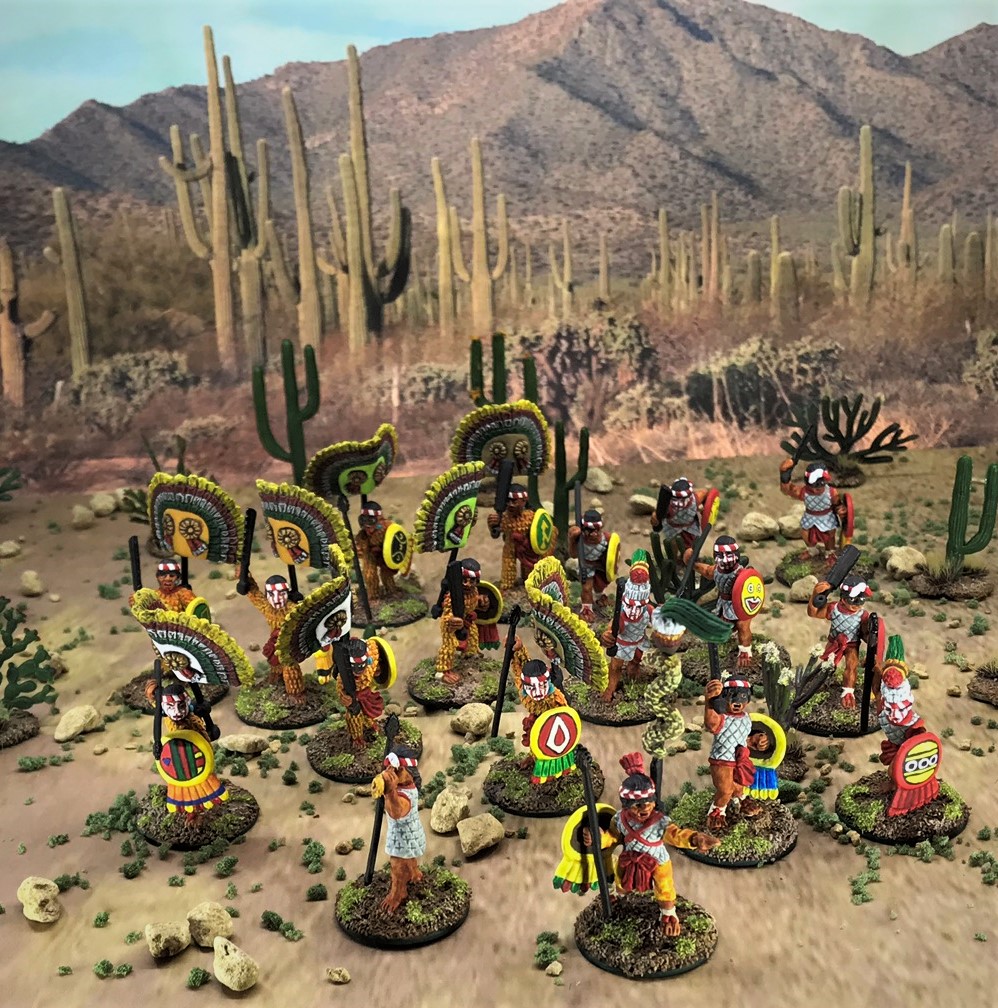
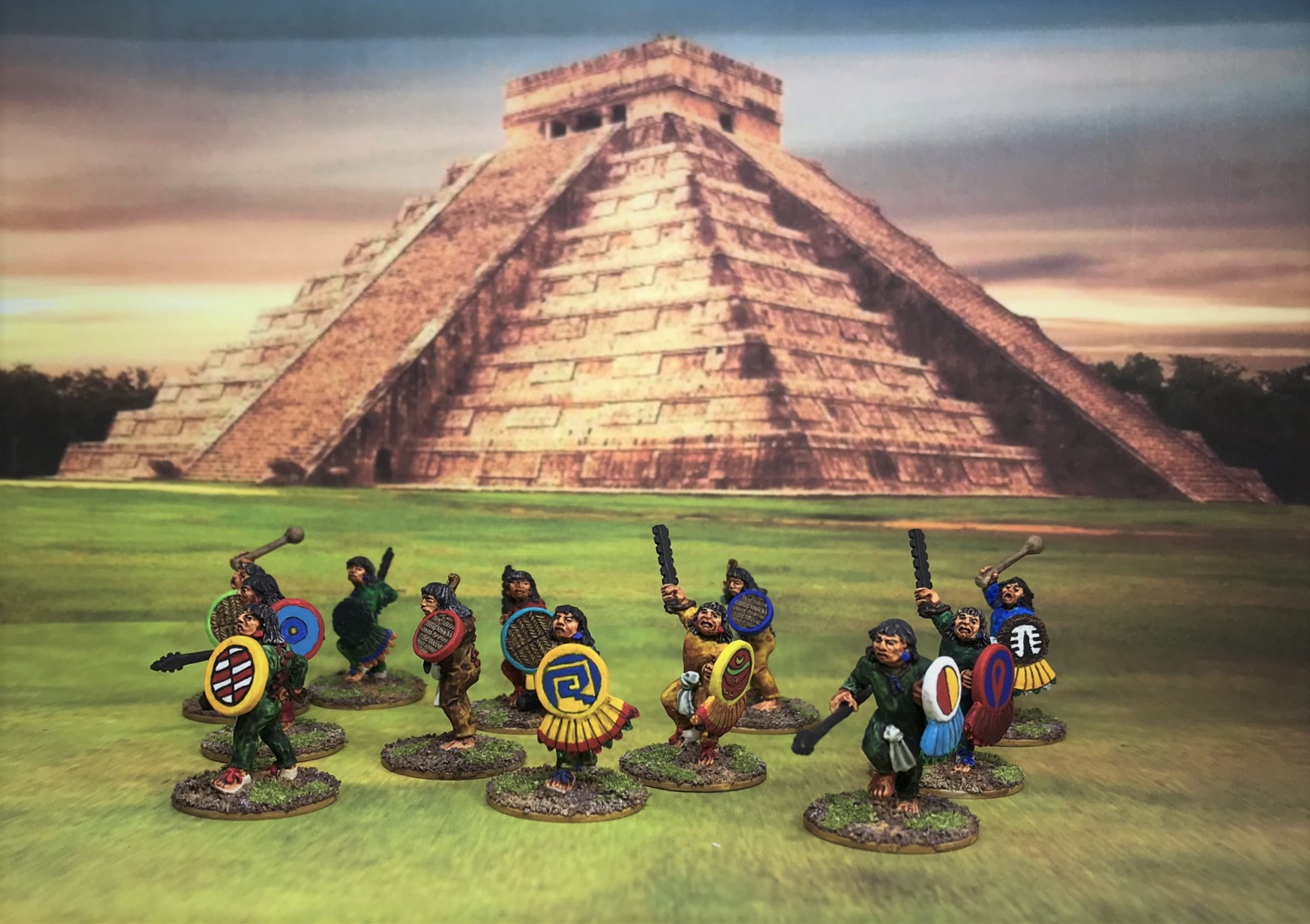
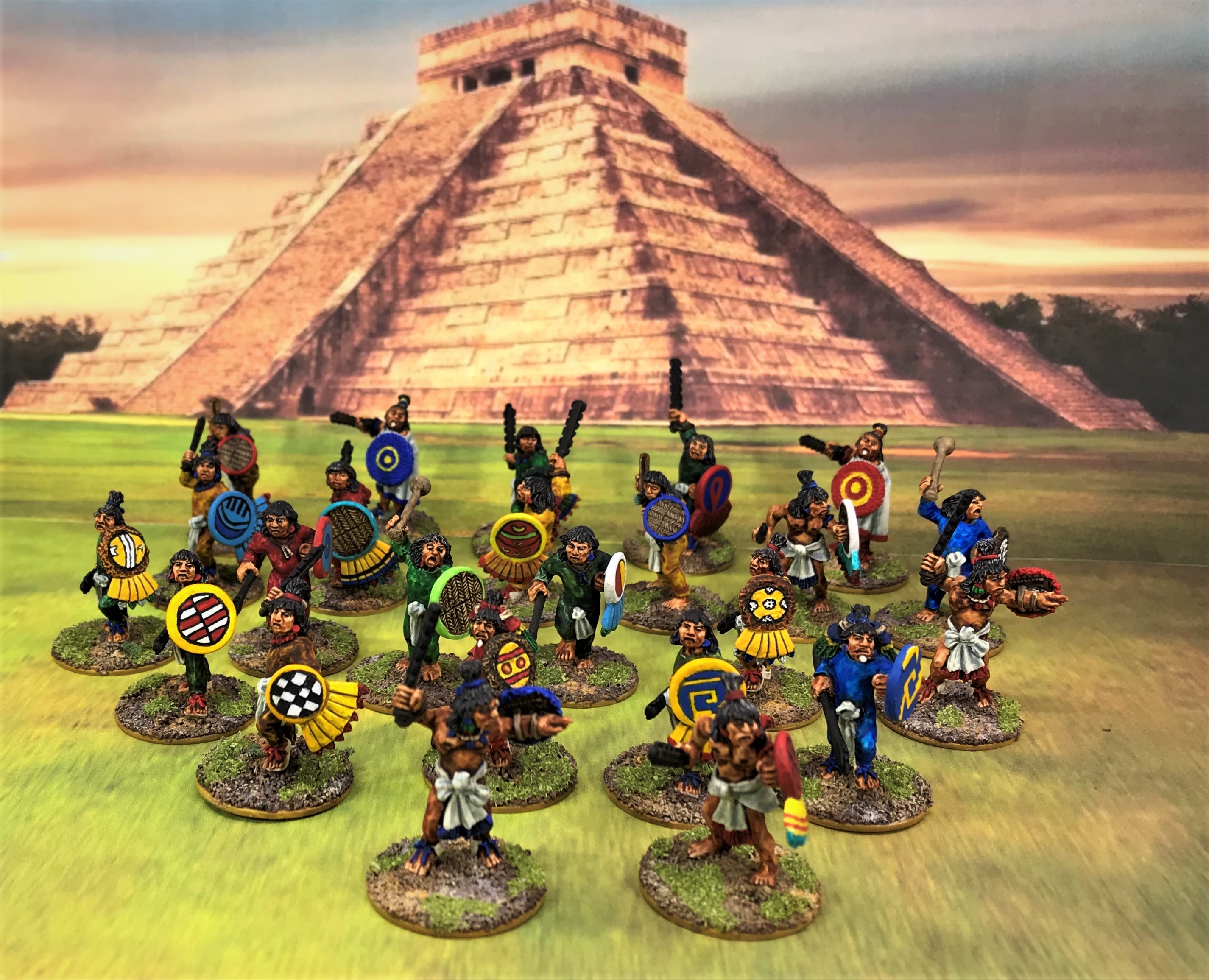
Group Shots

I hope that you enjoyed looking at this post and these figures. This is my penultimate (love that word) Aztec post – the last will be one with Montezuma, some Aztec captains and some warrior priests. Six more Aztecs, and then it’s on to the Spanish Conquistadores!

I’d love to know if you have a favorite – and any thoughts or questions and suggestions that you may have on the work here are always appreciated.

Miscellaneous details and references for those interested in that sort of thing:

Posts on games, units, and other projects for my 16th Century Spanish Conquest supplement for Feudal Patrol™ – “Civilizations Collide”

  1. Aztec Shock Troops – Cuachic Warriors aka The Shorn Ones (this post) – 8 Aztec cuachicqueh warriors
  2. Tloxtoxl and the Priests of the Great Temple, Wargames Foundry AZ021 – 2 warrior priests, 1 priestess, 1 priest, 1 leader, and 1 signaler
  3. Civilizations Collide – The Wars of the Aztecs, the Inca, the Maya, and the Conquistadores is now available as a FREE Download for Feudal Patrol™ – plus a Feudal Patrol™ review!
  4. 18 Aztec Novice Warriors for Feudal Patrol Walk into a Bar – 18 Novice Warriors
  5. Aztec Warrior Priests (painted as Tlaxcalans), Ral Partha 42-302, circa 1988 (this post) – 6 figures – 6 Tlaxcalan Warrior Priests
  6. Tlaxcalan Novices, Elite Warriors, and Command Group – 18 figures – 8 Novice Tlaxcalan Warriors, 8 Elite Tlaxcalan Warriors, 1 Tlaxcalan Captain, 1 Tlaxcalan Conch Blower
  7. Tlaxcalan Archers – 8 Veteran Tlaxcalan Archers
  8. Aztec Game for Feudal Patrol across thousands of miles – via Zoom!
  9. Aztec Snake Woman and Drummer – 1 Aztec General, 1 Aztec Drummer
  10. A June and July Jaguar Warrior Frenzy (plus some Aztec Veterans and a Warrior Priest to Boot) – 3 Aztec Veteran Warriors, 17 Jaguar Warriors, 1 Aztec Warrior Priest
  11. Doubling Down – Aztec Veteran Warriors – 24 Aztec Veteran Warriors
  12. Aztec Arrow Knights, Ral Partha circa 1988 – 6 Aztec Arrow Knights
  13. Aztec Eagle Warriors from Tin Soldier UK – 6 Aztec Eagle Knights
  14. Aztec Novice Warriors and a few Frinx – 12 Novice Warriors

Total figures to date for this project: 135 figures:  103 Aztecs, 32 Tlaxcalans

PAINTS, INKS, GLAZES, SHADES, WASHES, PIGMENTS, FLOCKING, GLUES AND MORE THAT I USED ON THESE AZTEC FIGURES:

  1. Gorilla Glue
  2. 1/8″ x 1″ Everbilt Fender Washers
  3. Poster tack
  4. Vallejo “Surface Primer – White Primer”
  5. Vallejo “Flow Improver”
  6. Vallejo “Airbrush Thinner”
  7. Testors “Universal Acrylic Thinner”
  8. Reaper MSP “Black Primer”
  9. Citadel “Nuln Oil” (shade)
  10. Army Painter “Tanned Flesh”
  11. Vallejo Model Air “Weiss” (off-white)
  12. Vallejo Game Air “Black”
  13. Citadel “Contrast Paint – Gore-Grunta Fur”
  14. Vallejo Game Color “Bronze Fleshtone”
  15. Vallejo Model Color “Sunny Skin Tone”
  16. Citadel “Contrast Paint – Volupus Pink”
  17. Citadel “Contrast Paint – Darkoath Flesh”
  18. Citadel Air “Evil Sunz Scarlet”
  19. Citadel “Contrast Paint – Contrast Medium”
  20. Army Painter “Flesh Wash” (wash)
  21. Secret Weapon Washes “Yellow Snow” (ink/wash)
  22. Vallejo Game Air “Moon Yellow”
  23. Citadel “Contrast Paint – Iyanden Yellow”
  24. Secret Weapon Washes “Sunshine” (ink/wash)
  25. Citadel “Nuln Oil GLOSS” (wash)
  26. Citadel “Contrast Paint – Basilicanum Grey”
  27. Citadel “Contrast Paint – Snakebite Leather”
  28. Citadel “Contrast Paint – Apothecary White”
  29. Battlefront “Wool Brown”
  30. Vallejo Game Ink “Yellow”
  31. Vallejo Game Ink “Blue”
  32. Citadel “Contrast Paint – Blood Angels Red”
  33. Citadel “Contrast Paint – Talassar Blue”
  34. Citadel “Contrast Paint – Ultramarines Blue”
  35. Citadel “Contrast Paint – Fyreslayer Flesh”
  36. Citadel “Contrast Paint – Gryph-Hound Orange”
  37. Citadel “Troll Slayer Orange”
  38. Vallejo Game Ink “Green”
  39. Vallejo Game Air “Dead White”
  40. Vallejo Model Color “Glossy Black”
  41. Citadel “Contrast Paint – Warp Lightning”
  42. Citadel Air “Balor Brown”
  43. E6000 Epoxy
  44. Battlefront “Chocolate Brown”
  45. Americana “Kelly Green”
  46. Citadel “Seraphim Sepia” (shade)
  47. Vallejo “Gloss Varnish”
  48. Citadel “Agrax Earthshade” (shade)
  49. Citadel “Contrast Paint – Wyldwood”
  50. Elmer’s PVA Glue
  51. Army Painter “Brown Battlefields” (flocking)
  52. Vallejo “Dark Yellow Ochre” (pigment)
  53. Vallejo “Burnt Umber” (pigment)
  54. Citadel “Steel Legion Drab”
  55. Citadel “Tallarn Sand”
  56. Citadel “Karak Stone”
  57. Americana “Desert Sand”
  58. Vallejo Mecha Varnish “Matt Varnish”
  59. Army Painter “Grass Green” (flocking)

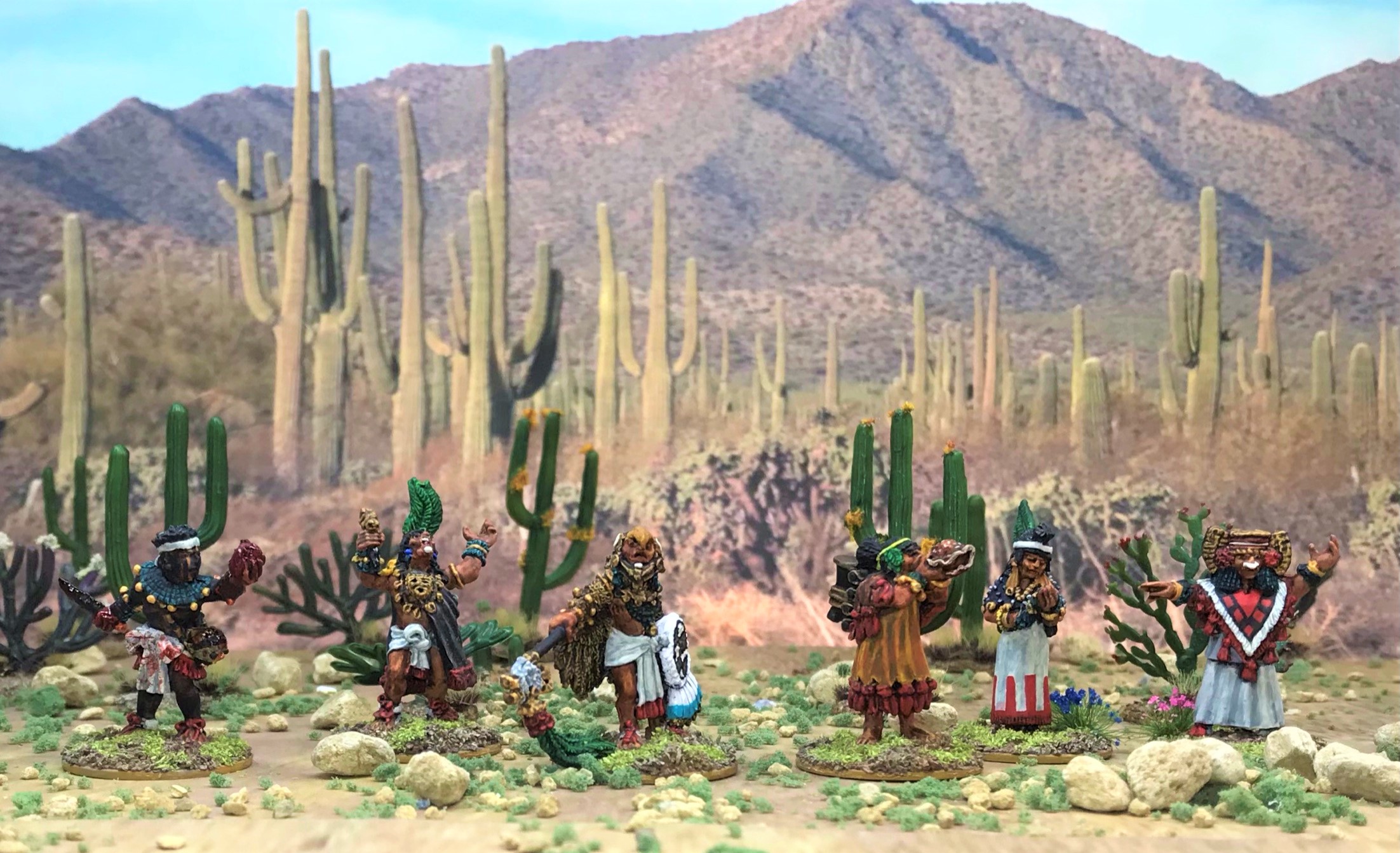
Tloxtoxl and the Priests of the Great Temple, Wargames Foundry AZ021

In the Civilizations Collide supplement (described on my last post) that I wrote for Feudal Patrol™, priests and shamans can be bought for points and deployed along with units. In the game, a warrior priest can both boost the fighting morale of your own troops as well as erode the morale of your defeated non-Spanish enemies. Plus, they can fight as heroes as well.

For my Aztec forces, I needed to paint up some more warrior priests. I already had one figure that I have painted from Wargames Foundry Heroes of Tenochtitlan (seen here). I also have six warrior priests for the Tlaxcalans (seen here), so this disparity needed to be fixed.

Originally to meet this figure deficit I purchased the Wargames Foundry blister pack AZ021 “Tloxtoxl and the Priests of the Great Temple” from Badger Games as I believed that this would get me six Warrior Priests. There is nothing historic about the name, but it sounds very Aztec! However, the pack was a bit different than I had expected. As you will see, two are definitely good as warrior priests, two are priests/priestesses who probably hung around the temple, and two are a command pair. No worries, as I can use all of these one way or another. The figures are metal, 28mm in size, and sculpted by Josef Ochmann. This group was in very good shape and was easy to prep for painting.

I did not take very many shots this go around – but my painting approach was similar to my previous posts which are catalogued below if you are new to this project. So without further ado…

Eye Candy

First, the two warrior priests – I think these will be fine on the tabletop battlefield, though underarmed a bit:

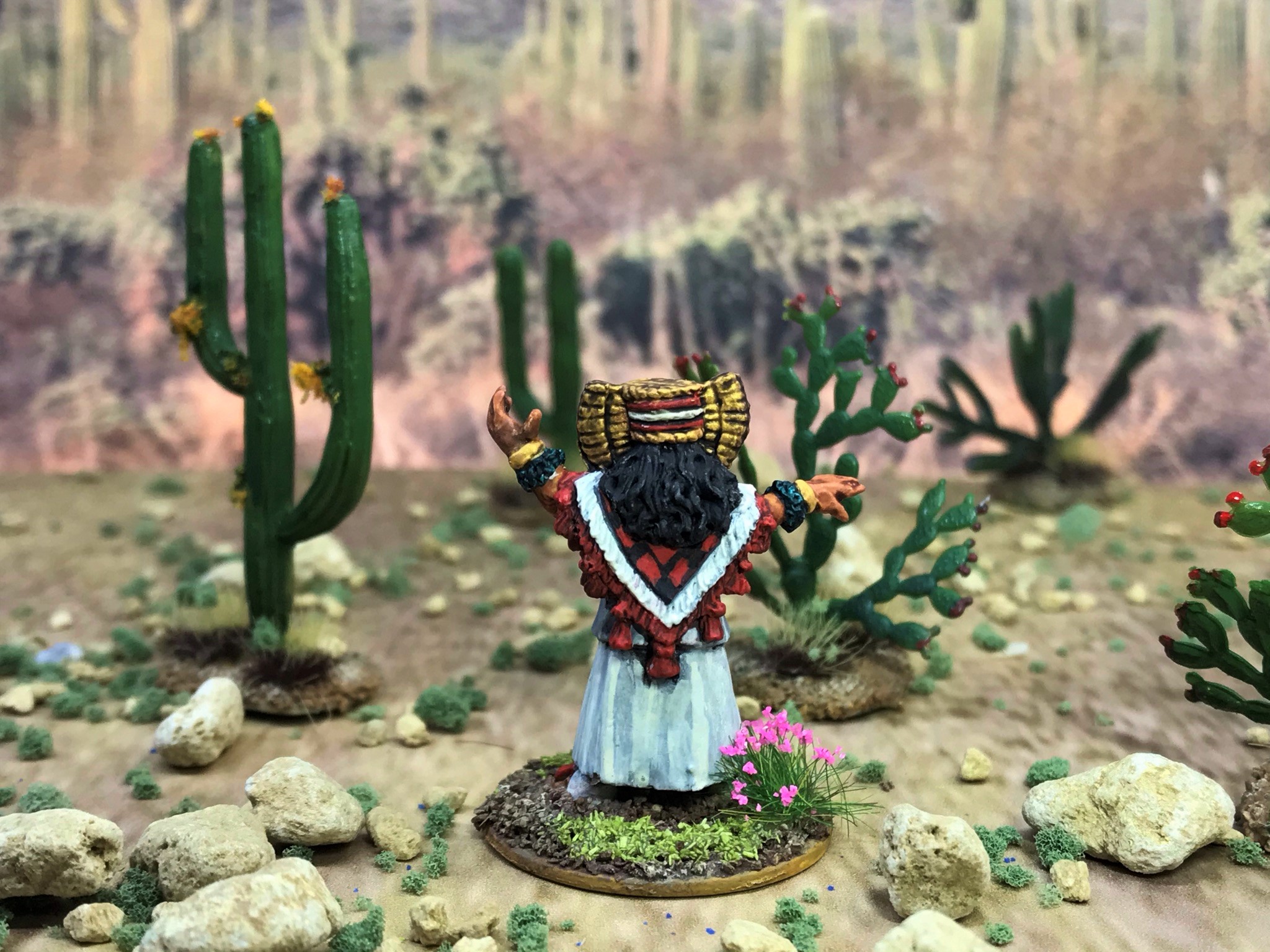
AWP2 this figure is armed only with an obsidian dagger, and no shield or armor.

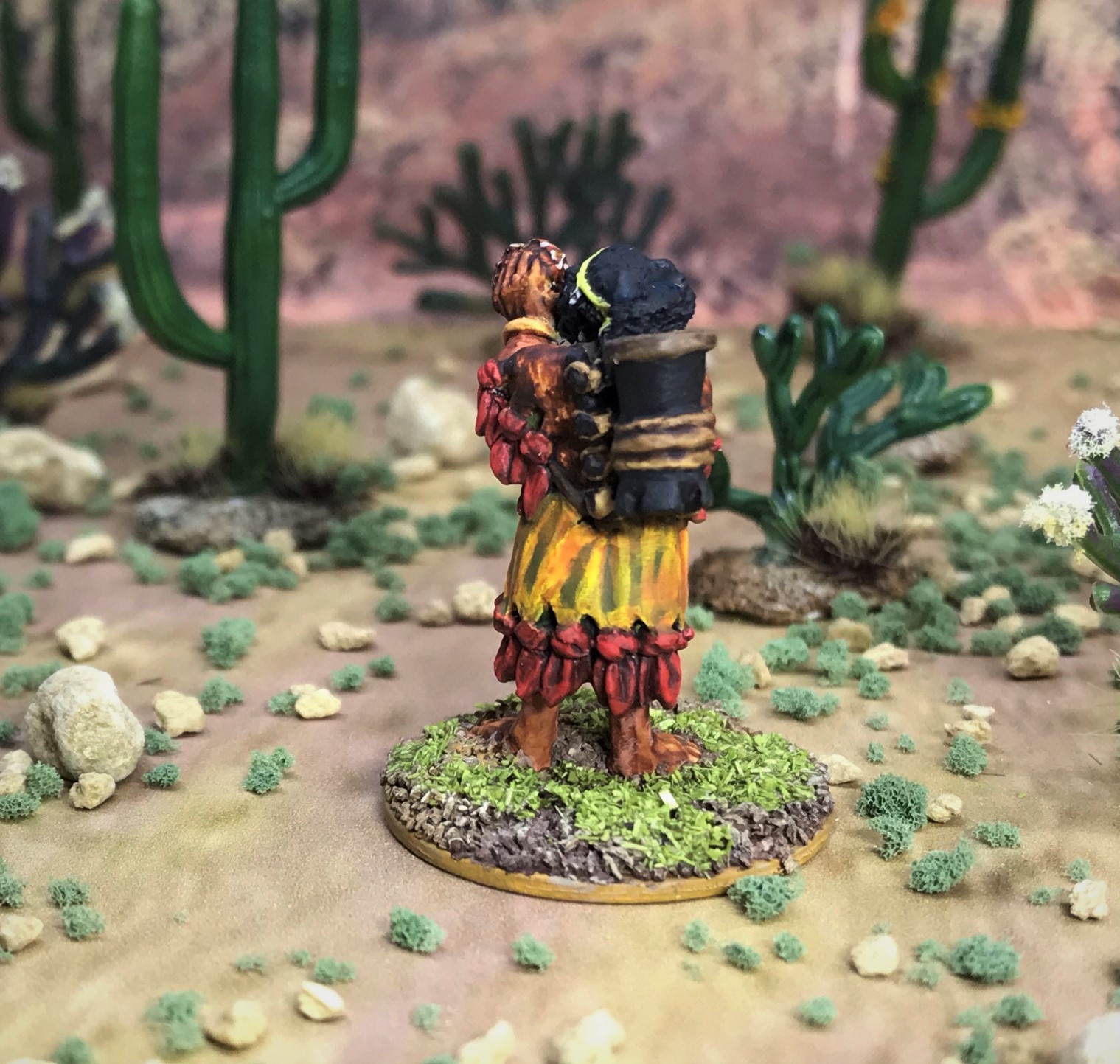
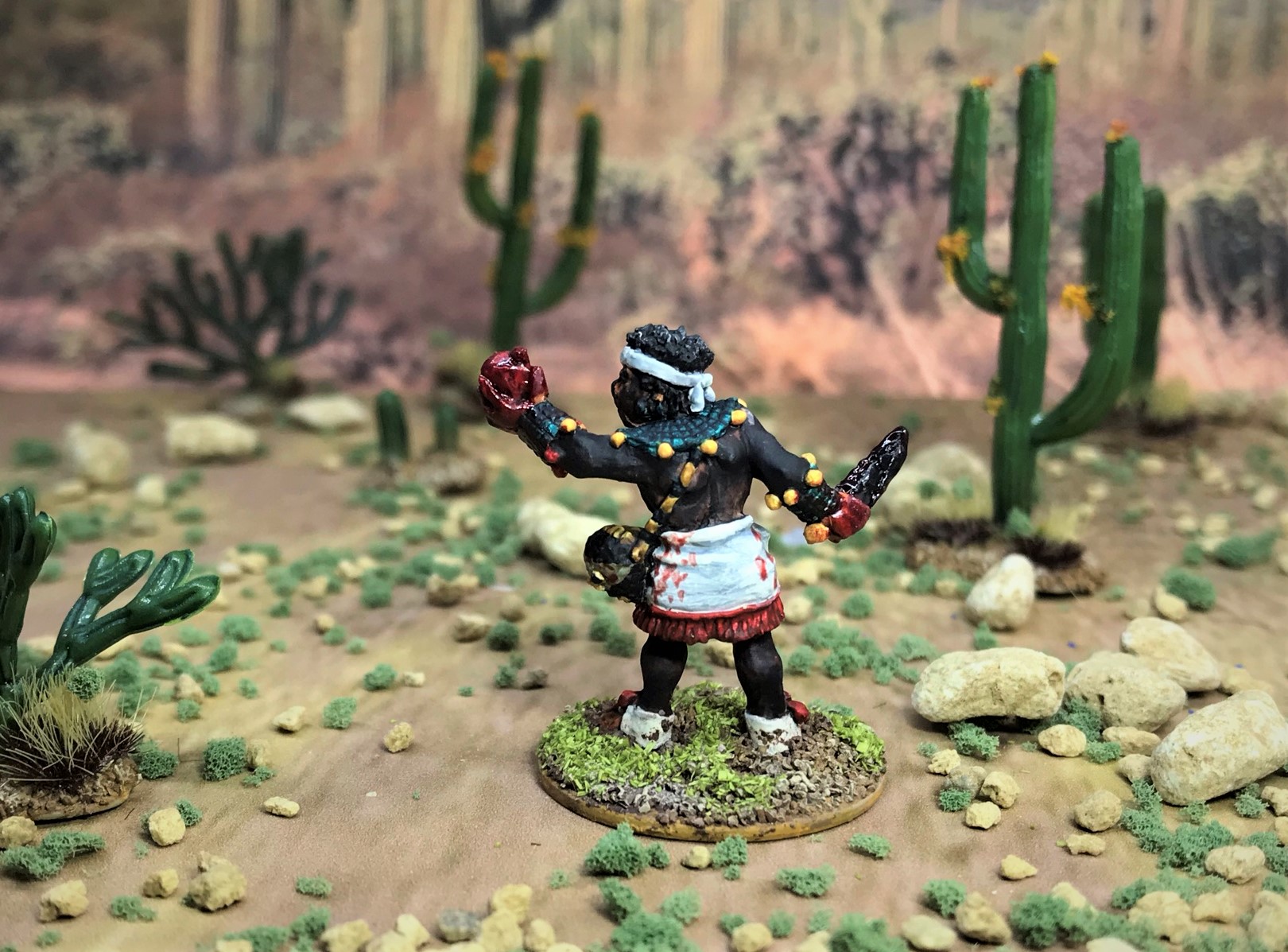
AWP3 this figure reminded me of IRO’s stuff! He is armed only with an obsidian dagger, and no shield or armor, but is slick with blood after a captive live sacrifice. The dark war paint on his face and body and the skull on his hip were painted according to an Osprey image I had. I tried not to overdo the blood, but I think he would be pretty bloody.

The next group includes a priestess and a priest that do not look overly worthy of battle, but I can always put them in if needed or use them in some other way. Besides, they could be an objective possibly. I thought I’d paint them anyways – and give them flowers on their bases.

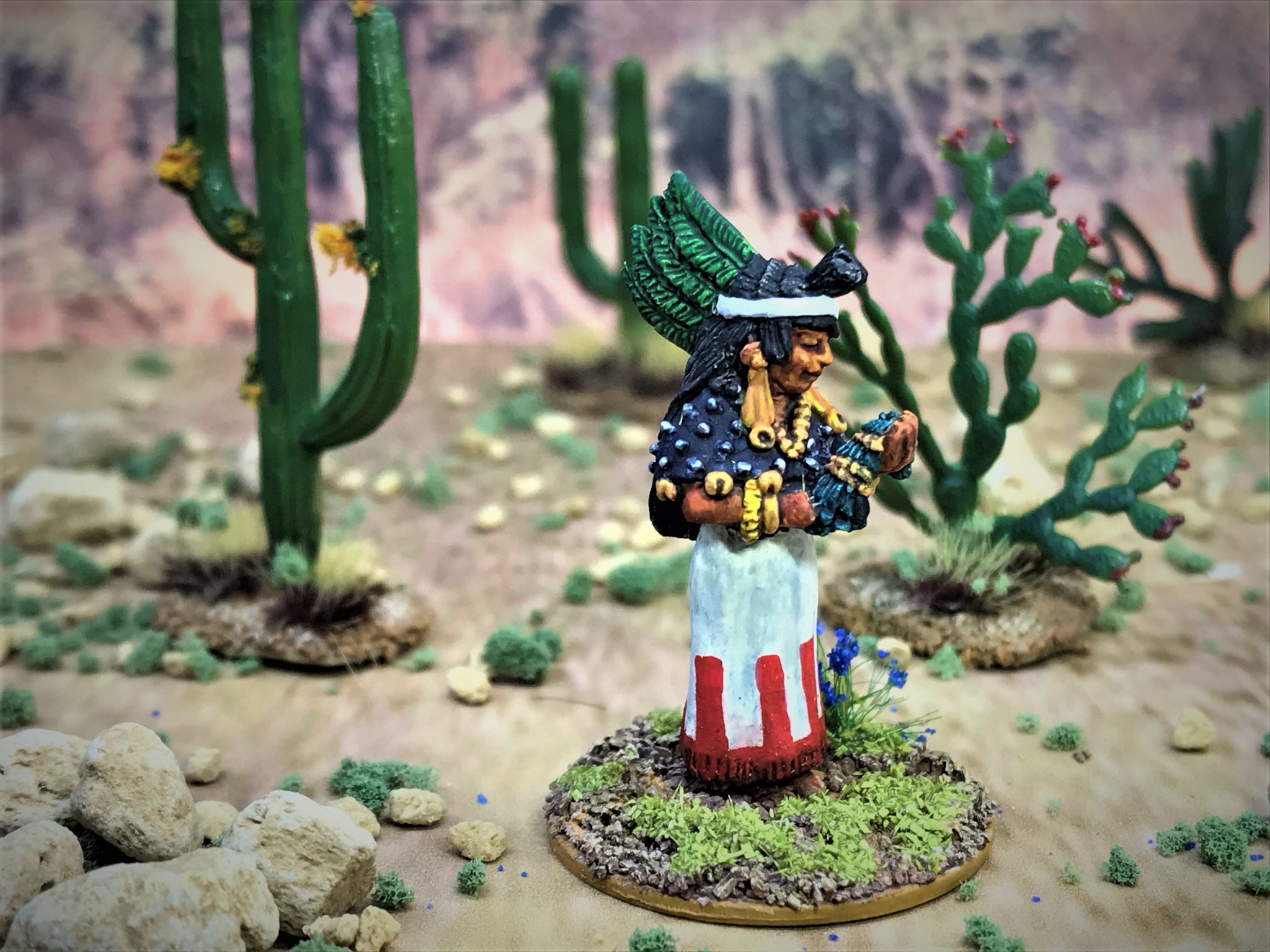
AP1 – this Priestess is admiring some turquoise jewelry or some such thing. I would have her armed with only an obsidian dagger, and of course no shield or armor. I tried to give the dress a pattern, but this was not squarely in my wheelhouse. Maybe that’s why I gave her a tuft of flowers as compensation?

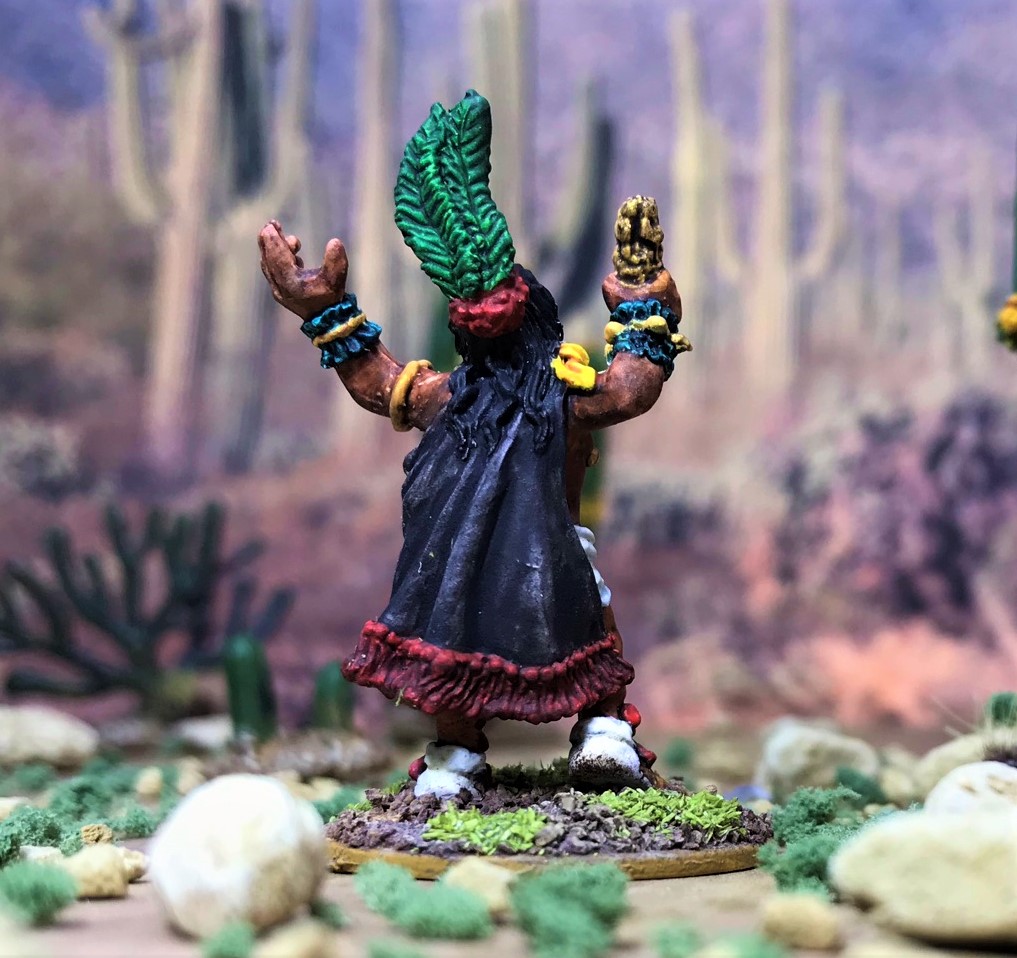
AP2 – this Priest was not my favorite, though I did like experimenting with his headdress and his garb patterns. He is also armed with only an obsidian dagger, and of course no shield or armor. He also was missing some fingers. Maybe that’s why I also gave him flowers!

The next two really are a command group pair, and I will use them together as a higher commander of a warband or better.

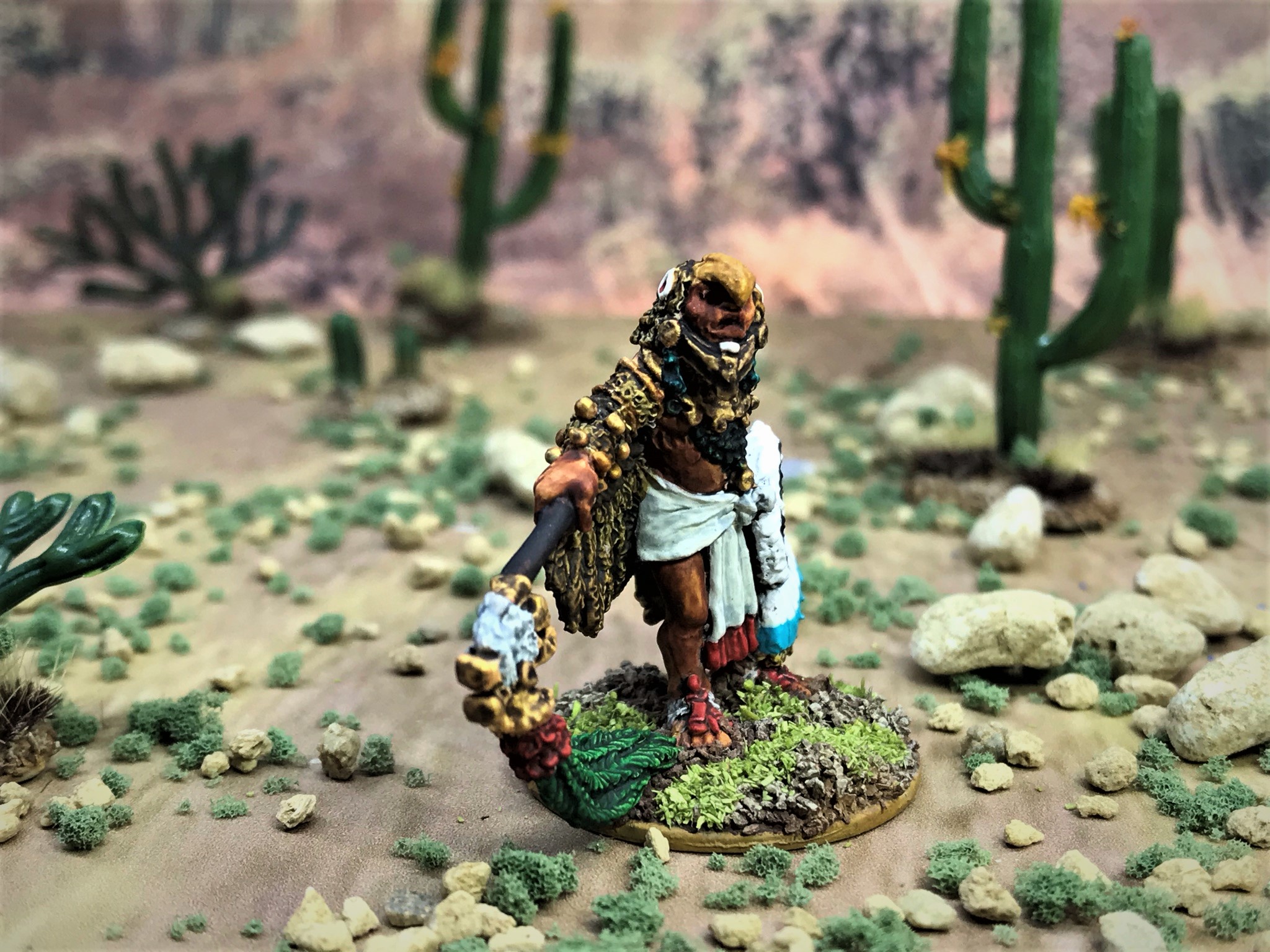
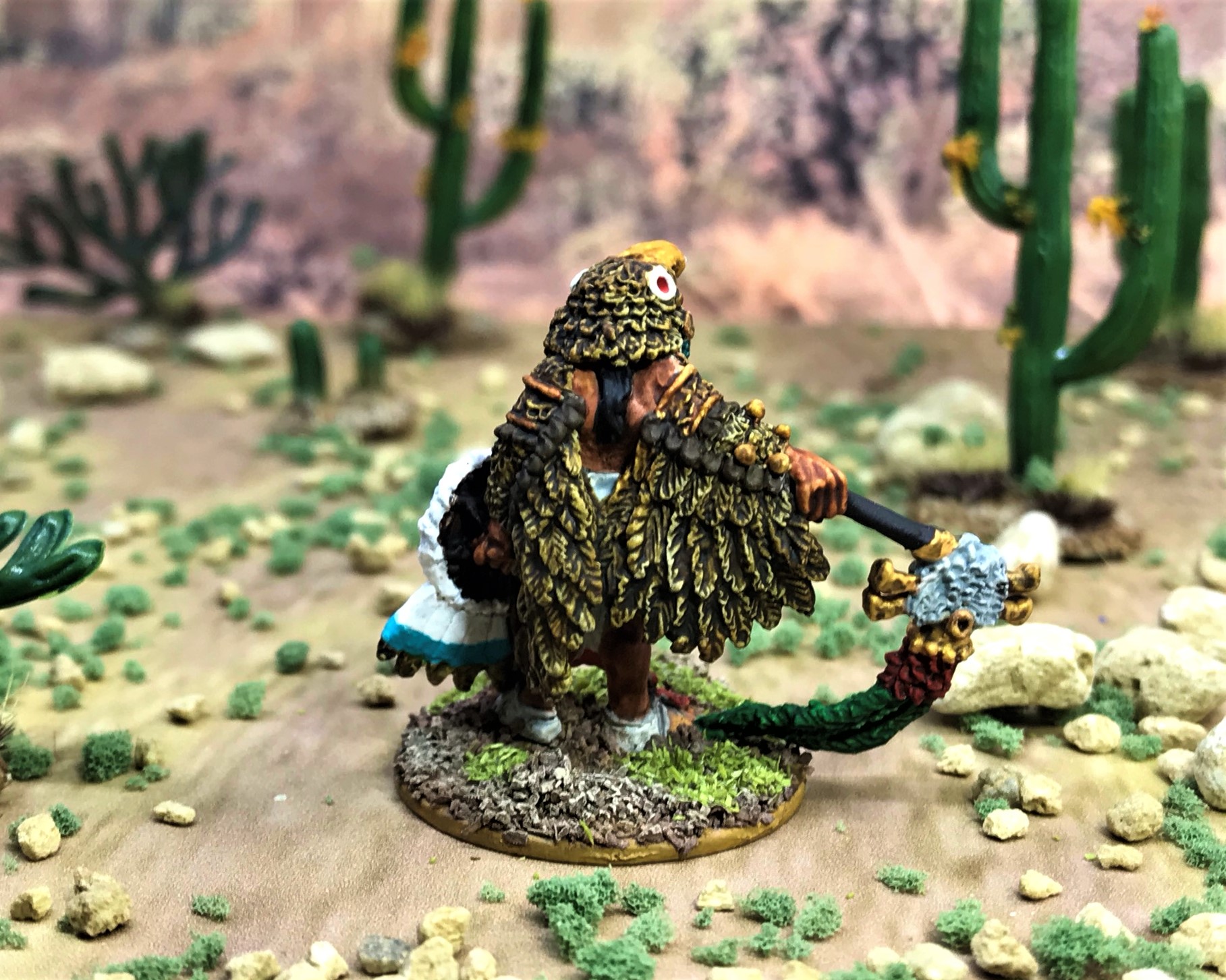
AZC1 – this leader is dressed as an Eagle Warrior. I painted 6 Eagle Warriors early in the project that you can see here. I really liked this figure. I will treat his weapon as a tepoztopilli, and give him credit for his shield, some cotton armor and his helmet. He of course will need his assistant with the conch shell and drum to send battle signals out.

AZC2 – the leader’s signaler with a conch shell as a horn and a drum. I really liked this figure, though getting the shell right was a conundrum. I am only giving him a hand axe and but he gets cotton armor but no shield. So, he’s a bit vulnerable.

Here’s a group shot:

Thanks for looking – and please let me know your thoughts and feedback in the comments section. Do have a favorite? I do hope you enjoyed this!

I am almost through my Aztecs – and I am excited to have the highest warrior group – cuachicqueh shock troops (the “Shorn Ones”) – next in the painting queue.

Miscellaneous details and references for those interested in that sort of thing:

Posts on games, units, and other projects for my 16th Century Spanish Conquest supplement for Feudal Patrol™ – “Civilizations Collide”

  1. Tloxtoxl and the Priests of the Great Temple, Wargames Foundry AZ021 (this post) – 2 warrior priests, 1 priestess, 1 priest, 1 leader, and 1 signaler
  2. Civilizations Collide – The Wars of the Aztecs, the Inca, the Maya, and the Conquistadores is now available as a FREE Download for Feudal Patrol™ – plus a Feudal Patrol™ review!
  3. 18 Aztec Novice Warriors for Feudal Patrol Walk into a Bar – 18 Novice Warriors
  4. Aztec Warrior Priests (painted as Tlaxcalans), Ral Partha 42-302, circa 1988 (this post) – 6 figures – 6 Tlaxcalan Warrior Priests
  5. Tlaxcalan Novices, Elite Warriors, and Command Group – 18 figures – 8 Novice Tlaxcalan Warriors, 8 Elite Tlaxcalan Warriors, 1 Tlaxcalan Captain, 1 Tlaxcalan Conch Blower
  6. Tlaxcalan Archers – 8 Veteran Tlaxcalan Archers
  7. Aztec Game for Feudal Patrol across thousands of miles – via Zoom!
  8. Aztec Snake Woman and Drummer – 1 Aztec General, 1 Aztec Drummer
  9. A June and July Jaguar Warrior Frenzy (plus some Aztec Veterans and a Warrior Priest to Boot) – 3 Aztec Veteran Warriors, 17 Jaguar Warriors, 1 Aztec Warrior Priest
  10. Doubling Down – Aztec Veteran Warriors – 24 Aztec Veteran Warriors
  11. Aztec Arrow Knights, Ral Partha circa 1988 – 6 Aztec Arrow Knights
  12. Aztec Eagle Warriors from Tin Soldier UK – 6 Aztec Eagle Knights
  13. Aztec Novice Warriors and a few Frinx – 12 Novice Warriors

Total figures to date for this project: 127 figures:  95 Aztecs, 32 Tlaxcalans

PAINTS, INKS, GLAZES, SHADES, WASHES, PIGMENTS, FLOCKING, GLUES AND MORE THAT I USED ON THESE AZTEC FIGURES:

  1. Gorilla Glue
  2. 1/8″ x 1″ Everbilt Fender Washers
  3. Poster tack
  4. Vallejo “Surface Primer – White Primer”
  5. Vallejo “Flow Improver”
  6. Vallejo “Airbrush Thinner”
  7. Testors “Universal Acrylic Thinner”
  8. Citadel “Nuln Oil” (shade)
  9. Vallejo Model Air “Weiss” (off-white)
  10. Vallejo Game Air “Black”
  11. Army Painter “Tanned Flesh”
  12. Vallejo Game Color “Bronze Fleshtone”
  13. Vallejo Model Color “Sunny Skin Tone”
  14. Army Painter “Flesh Wash” (wash)
  15. Citadel “Agrax Earthshade” (shade)
  16. Citadel “Contrast Paint – Darkoath Flesh”
  17. Citadel “Contrast Paint – Basilicanum Grey”
  18. Citadel “Contrast Paint – Black Templar”
  19. Citadel “Contrast Paint – Blood Angels Red”
  20. Citadel Air “Balor Brown”
  21. Citadel Air “Evil Sunz Scarlet”
  22. Battlefront “Chocolate Brown”
  23. Citadel “Contrast Paint – Warp Lightning”
  24. Citadel “Auric Armor Gold”
  25. Citadel “Contrast Paint – Contrast Medium”
  26. Citadel “Nuln Oil GLOSS” (wash)
  27. Vallejo Model Color “Glossy Black”
  28. Vallejo Game Ink “Black Green”
  29. Vallejo Game Ink “Red”
  30. Citadel “Contrast Paint – Flesh Tearers Red”
  31. Citadel “Contrast Paint – Citadel “Contrast Paint – Volupus Pink”
  32. Citadel “Contrast Paint – Terradon Turquoise”
  33. Citadel “Contrast Paint – Apothecary White”
  34. Citadel “Bloodletter” (glaze)
  35. Citadel “Blood For The Blood God”
  36. Citadel “Contrast Paint – Aggaros Dunes”
  37. Citadel “Seraphim Sepia” (shade)
  38. Vallejo Mecha Color “Grey Green”
  39. Vallejo Game Air “Dead White”
  40. Citadel “Contrast Paint – Cygor Brown”
  41. Vallejo Mecha Color “Turquoise”
  42. Citadel “Contrast Paint – Gryph-Hound Orange”
  43. Secret Weapon Washes “Fallout” (ink)
  44. Battlefront “Sicily Yellow”
  45. Citadel “Contrast Paint – Wyldwood”
  46. Citadel “Contrast Paint – Leviadon Blue”
  47. Vallejo Model Color “Gloss White”
  48. Vallejo Model Air “Silver”
  49. Citadel “Drakenhof Nightshade” (wash)
  50. Elmer’s PVA Glue
  51. Army Painter “Brown Battlefields” (flocking)
  52. Vallejo “Dark Yellow Ochre” (pigment)
  53. Vallejo “Burnt Umber” (pigment)
  54. Citadel “Steel Legion Drab”
  55. Citadel “Tallarn Sand”
  56. Citadel “Karak Stone”
  57. Americana “Desert Sand”
  58. Vallejo Mecha Varnish “Matt Varnish”
  59. Army Painter “Grass Green” (flocking)
  60. Shadows Edge Miniatures Tufts (blue and pink)

Civilizations Collide – The Wars of the Aztecs, the Inca, the Maya, and the Conquistadores is now available as a FREE Download for Feudal Patrol – plus a Feudal Patrol review!

I have always wanted to be part of a putting together rules for a tabletop wargame. Now, I can officially say that I can check off that box on my life’s “To-Do” list – at least in a smallish way.

Feudal Patrol™ – Buck Surdu’s rules for “Skirmish Miniature Gaming in the Ancient, Medieval, and Fantasy Periods” is now available commercially. In the US, it can be bought from On Military Matters website here.  It is also being sold in the US by Noble Knight Games website here. In the UK, it is being sold by Sally 4th on their website here.

It is a fantastic skirmish system, similar to his Combat Patrol -WWII™ and Albedo Combat Patrol™ systems. Unlike many other games, the Combat Patrol family has eliminated the clutter of multiple charts and markers with the use of specialized playing card decks. The decks in each game enable players to resolve movement, melee, missile fire, morale, cover protection, and more all from a single 50 card deck. Feudal Patrol is appropriate for periods when melee dominated warfare instead of firepower – so the 16th Century and earlier, as well as being adaptable for fantasy gaming. To be clear, I am not totally unbiased. I have been friends with Buck for nearly 40 years since our cadet days at West Point, and I did participate in several playtests of these rules and helped as I could.

As for a good review of Feudal Patrol by a more neutral party, there is a fine one on the BoardGameGeek website by Scouter (Brian Ivers) that you can see here. You can see that this is a game worth checking out. Here’s a snippet from the review:

Overall an Excellent effort by Buck and his band of Tabletop warriors. The cards and rules were purchased by me under a pre order program through On Military Matters. The rules were produced by Sally4th, a wonderful company out of the UK. Noble Knight games are also a US conduit. The amount of support available for this product is excellent, this can be found on both Buck Surdus web site as well as Sally4th. And Google Groups IO page. Buck has produced an excellent You Tube video introduction to Feudal Patrol. https://youtu.be/SlpLbMdgVv8

I highly recommend this rule set.
Brian Ivers.

https://boardgamegeek.com/boardgame/318641/feudal-patrol/ratings
My official copy of the rules arrived in early November! The book looks great, and the layout inside is equally nice.
The inside cover. Thanks for the shout out Buck! BTW, the “Ma’k” is a nod by Buck to my Massachusetts accent that I will never lose.

Buck asked me if I was interested in writing a supplement for the rules. I was very interested and thought it would be a fine opportunity to check the box I wrote of above. I also wanted to develop a skirmish game for the Spanish Conquest as the period and the garb of the period was fascinating to me. So I agreed, and did a lot of research on the period, and developed my supplement to Feudal Patrol™ that I called “Civilizations Collide”. That supplement is a FREE download – and I hope all who read this will download it and please take a look (after all it’s free! – did I mention that?). Plus it has a lot of pics of the miniatures that I have painted up (and more will come in this blog of course!

A sneak peek!

Where can you get it?

Civilizations Collide is available for download on Sally 4th’s website here or the Feudal Patrol website here.

As readers of this blog know, I have been also actively painting figures for the period from many companies. You may want to get started – so as a help, here is my list of what I have found available:

  1. Wargames Foundry (I get them in the US here from Badger Games but Foundry’s own UK website is here) – 28mm
  2. Outpost Wargames Services (I get them in the US here from Badger Games but OWS’s UK website is here – 28mm
  3. Eureka Miniatures (US site is here, Eureka Australian website is here) – 28mm
  4. Tin Soldiers UK (I get them in the US from Silver Eagle Wargames here, UK website is here) – 25mm
  5. Naismith and Roundway sells some (I have not bought any yet) here – 25mm
  6. Even the old Ral Partha (which I have), now sold by Iron Winds Metals, has some here – 25mm

All of these are still commercially available. I do prefer the 28mm over the 25mm, but I do use both

Thanks for checking this out and a real big thank you if you downloaded the supplement! More to come!

Miscellaneous details and references for those interested in that sort of thing:

Posts on games, units, and other projects for my 16th Century Spanish Conquest supplement for Feudal Patrol™ – “Civilizations Collide”

  1. Civilizations Collide – The Wars of the Aztecs, the Inca, the Maya, and the Conquistadores is now available as a FREE Download for Feudal Patrol™ – plus a Feudal Patrol™ review! (this post)
  2. 18 Aztec Novice Warriors for Feudal Patrol Walk into a Bar – 18 Novice Warriors
  3. Aztec Warrior Priests (painted as Tlaxcalans), Ral Partha 42-302, circa 1988 (this post) – 6 figures – 6 Tlaxcalan Warrior Priests
  4. Tlaxcalan Novices, Elite Warriors, and Command Group – 18 figures – 8 Novice Tlaxcalan Warriors, 8 Elite Tlaxcalan Warriors, 1 Tlaxcalan Captain, 1 Tlaxcalan Conch Blower
  5. Tlaxcalan Archers – 8 Veteran Tlaxcalan Archers
  6. Aztec Game for Feudal Patrol across thousands of miles – via Zoom!
  7. Aztec Snake Woman and Drummer – 1 Aztec General, 1 Aztec Drummer
  8. A June and July Jaguar Warrior Frenzy (plus some Aztec Veterans and a Warrior Priest to Boot) – 3 Aztec Veteran Warriors, 17 Jaguar Warriors, 1 Aztec Warrior Priest
  9. Doubling Down – Aztec Veteran Warriors – 24 Aztec Veteran Warriors
  10. Aztec Arrow Knights, Ral Partha circa 1988 – 6 Aztec Arrow Knights
  11. Aztec Eagle Warriors from Tin Soldier UK – 6 Aztec Eagle Knights
  12. Aztec Novice Warriors and a few Frinx – 12 Novice Warriors
I ponder life with poor Franco the unlucky Conquistador

18 Aztec Novice Warriors for Feudal Patrol Walk into a Bar…

Well, not exactly…more like into one of my storage boxes to await a future game…but now that I have your attention, welcome!

A completed slinger from this project. Nine of the 18 figures that I will discuss and display here are armed with slings. In my game, these Aztec slingers are very accurate – and very dangerous. Most Aztecs learned how to take small game with slings from a very young age. The Conquistadores described taking many grave injuries and casualties from slingers like these.

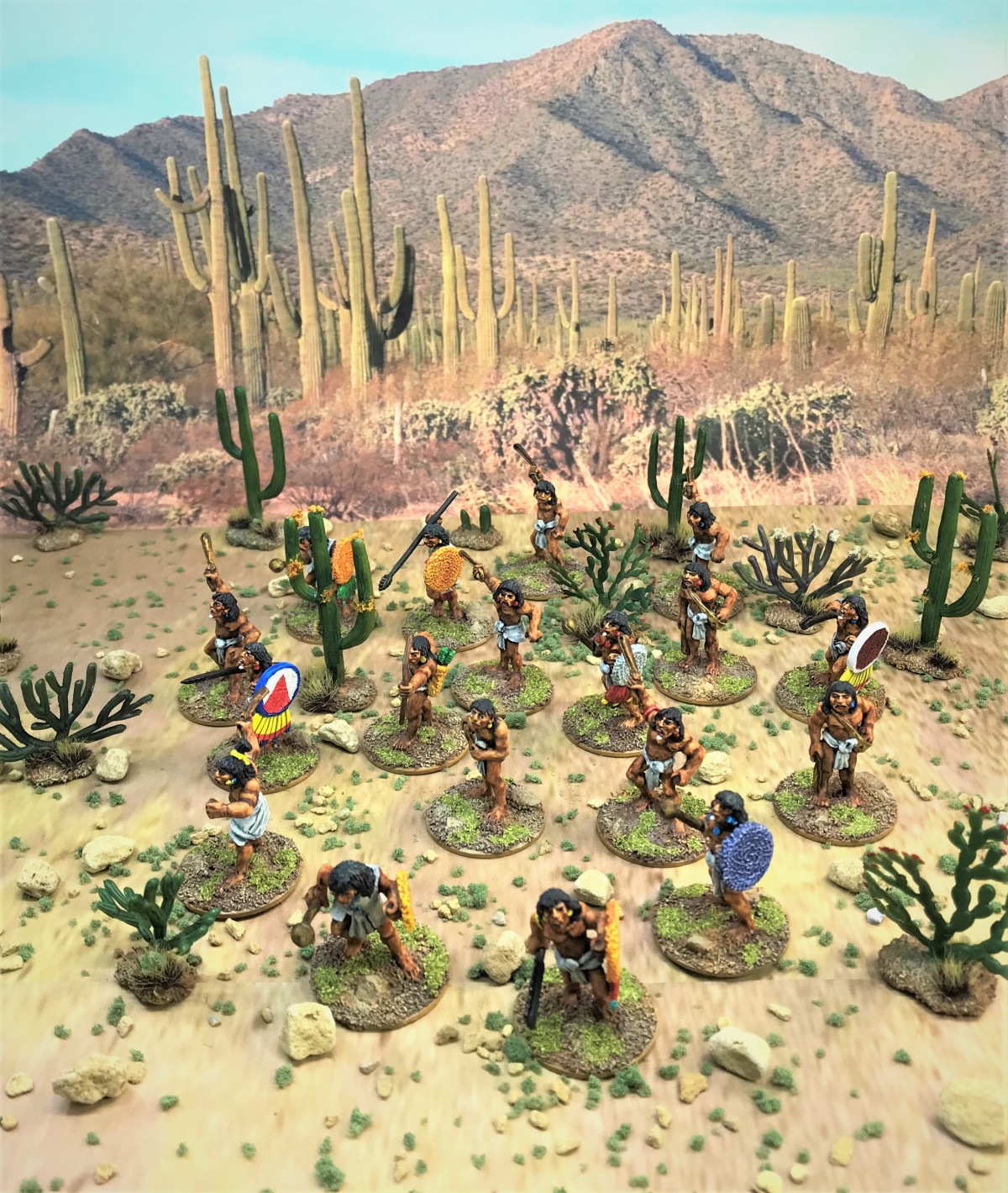
I just finished adding 18 Aztec Novice Warriors to my forces for games of Feudal Patrol™ –  using the “Civilizations Collide” supplement that I have discussed previously on several posts (you can see list of these posts at the end of this post if you’d like to see what you’ve missed). I had needed to add some more novices to pair up with veterans for the game. Aztec veteran warriors would have novices attached to them for training and development in the tactics and techniques of Mesoamerican warfare. Aztecs preferred capturing their enemies versus killing them – after all, they wanted live captives for sacrifice.

Under veteran tutelage, novices would try to capture enemy warriors. Their success at this would allow them to gain rank as well as increased Aztec societal and cultural prestige (depending upon the number and quality of the captured enemy warriors). This increase in rank would also be shown by the warriors having the right to wear different and fancier uniforms. Of course the captured warriors would be most often sacrificed alive on the altar of Huitzilopochtli in the Aztec capital of Tenochtitlan.

Returning to the gaming project, I now have figures for 30 novices and 27 veterans, which should put me in good stead game-wise. These figures came from Badger Games and were manufactured by Wargames Foundry. The 18 figures discussed here came from two blisters of AZ016 “Novice Warriors I” and one of AZ028 “Novice Warriors III”. All were sculpted by Josef Ochmann. I previously painted up 12 from AZ018 “Novice Warriors II” that I posted about here. These were similar to those models, and most of this group are armed with slings. Unfortunately, for the non-slingers, there were no other weapons in the AZ028 blister, just shields. Not a problem, as I had some Outpost Wargames Services extra weapons and some extra shields already painted up for any non-slingers (Badger also sells OWS). I am sure that Badger would have taken care of it if I let them know (they are great), but I had the situation under control.

I must say that the Foundry mold lines here on some of the models were a greater problem than those I have painted before from OWS. I tried my best to fix what I could without destroying the figures, but there’s only so much one can file away before the cure becomes worse than the disease. I am going to jump right into some pictures and then as usual some references for those interested in that sort of detail.

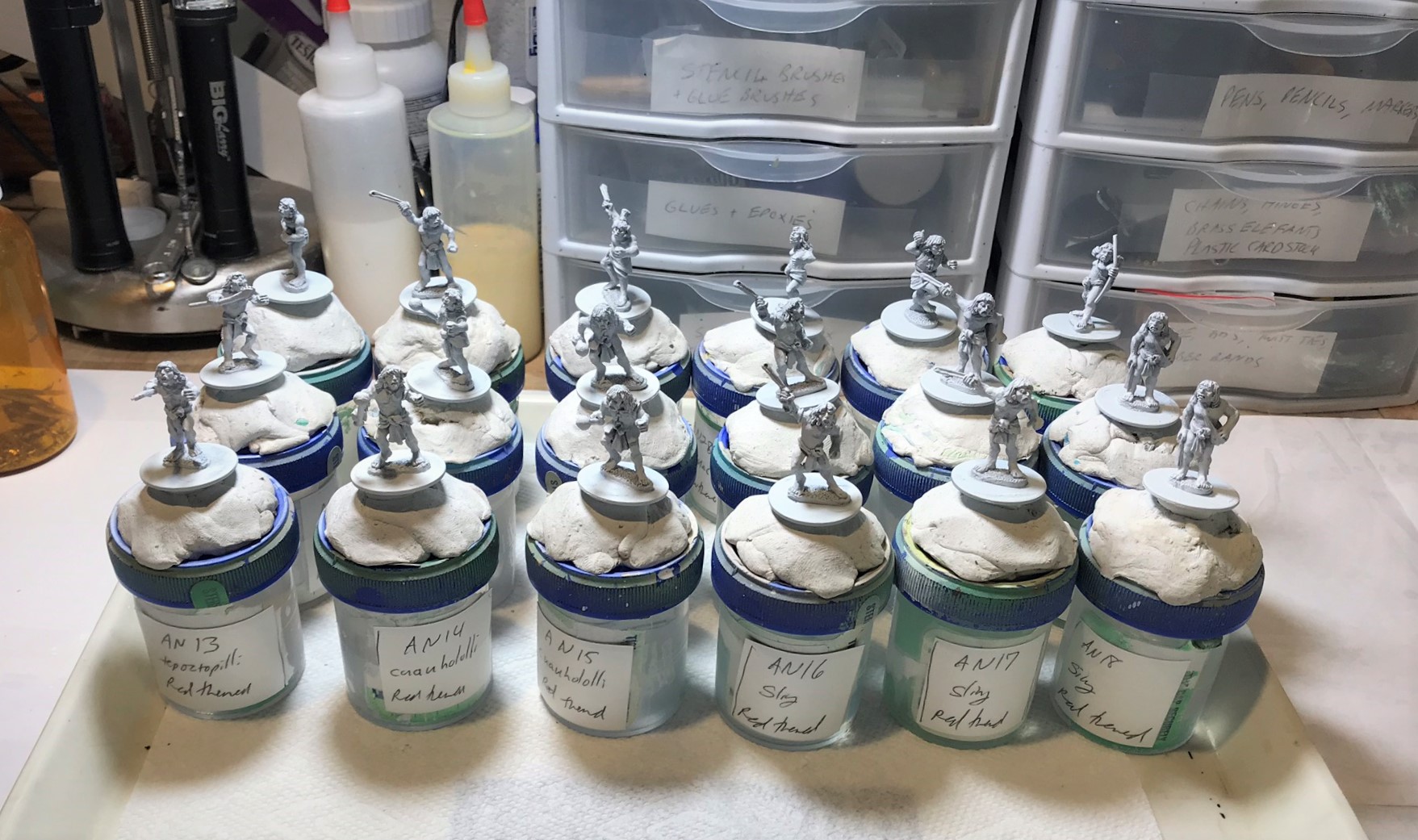
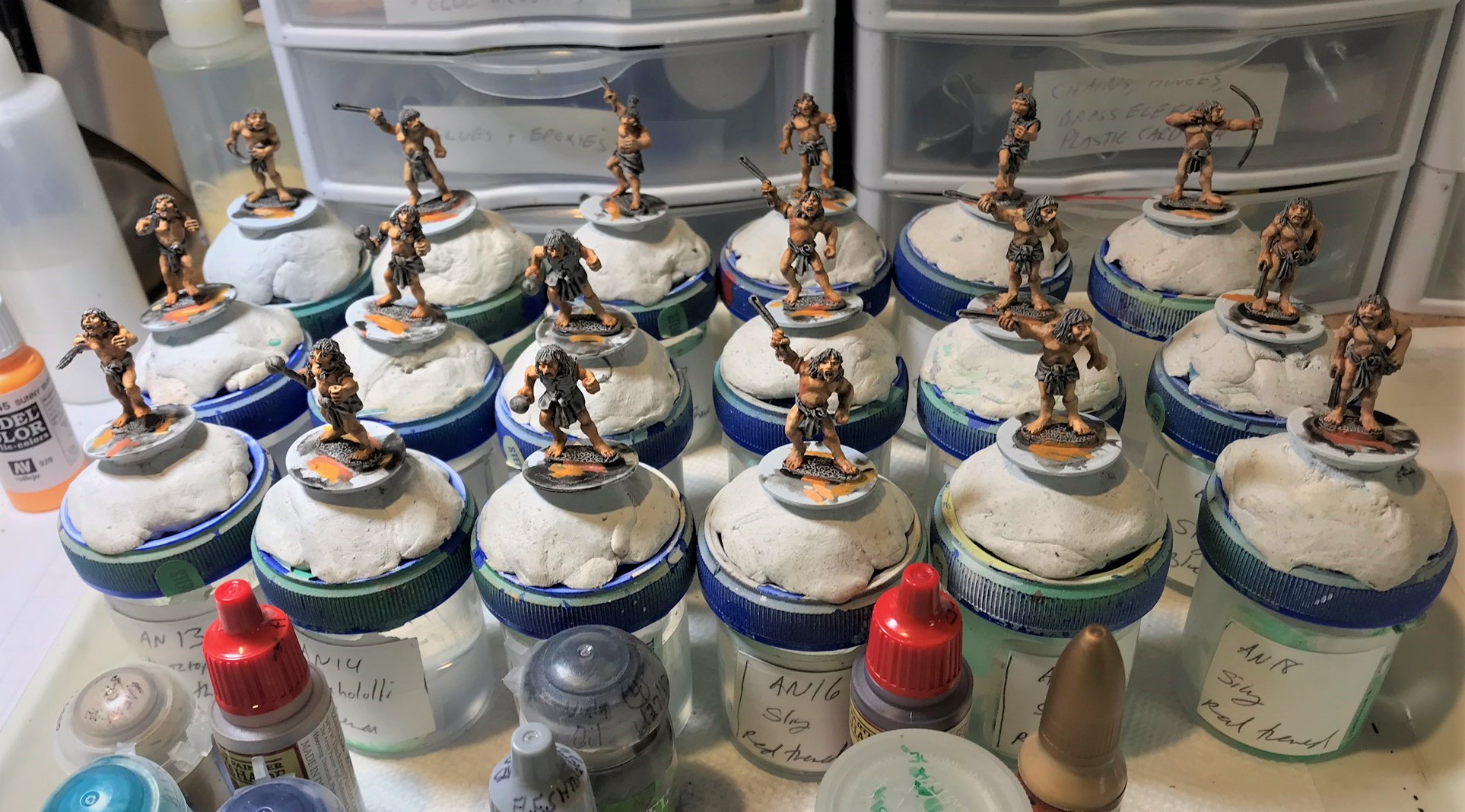
Mounted and ready for painting.
Early flesh tone work.
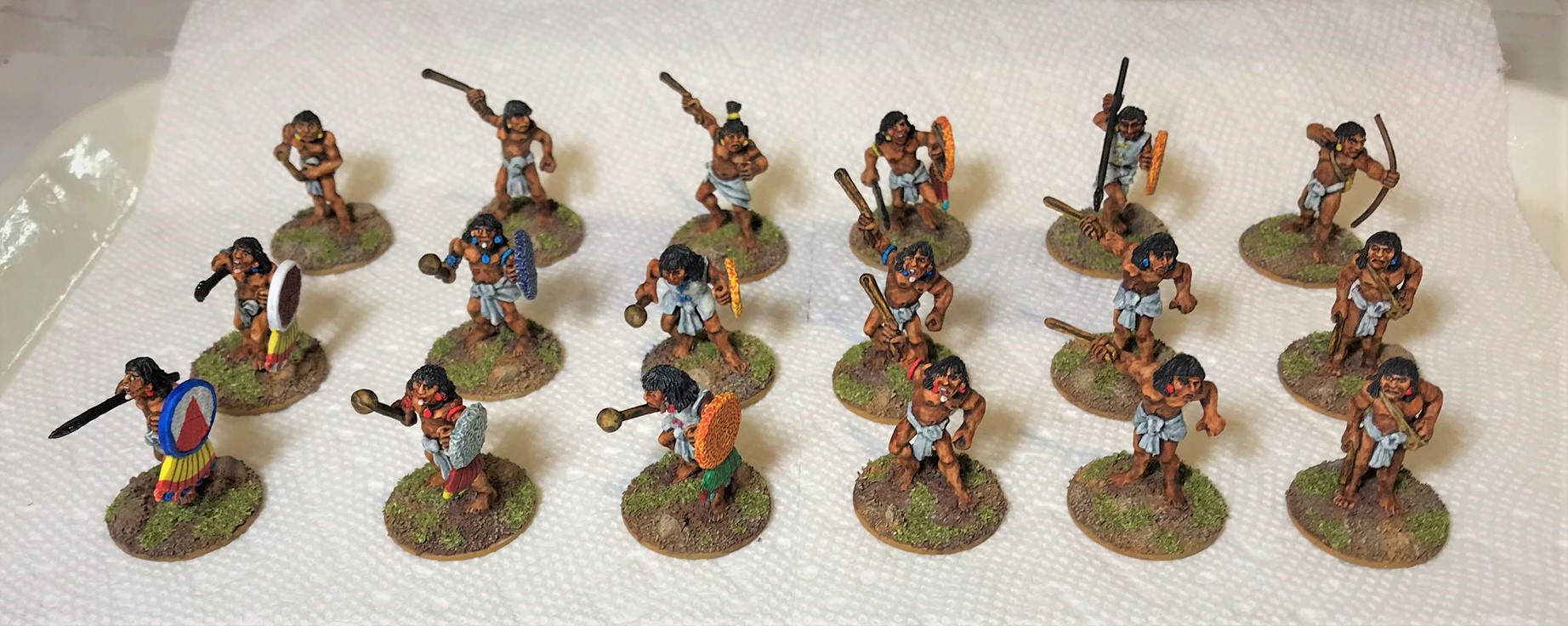
Completed.
Completed and removed from the specimen jars – ready for eye candy!

Because I had bought two 6-figure blisters of AZ016, I wanted to paint them differently enough so that they would be interesting on the tabletop. I will show the similar poses together, and then the single poses.

I have numbered my novices AN1 to AN30, with this project concerning AN13 to AN30.

AN13 and AN19 – armed with a tepoztopilli (obsidian-edged thrusting spear pronounced tay-pose-toe-pee-lee) and a shield, but no other armor.

AN 13 and AN19 figures from the front.
AN13 and AN19, the view from the side.

AN14 and AN20 – armed with a cuauhololli (round-headed wooden club – pronounced kwa-ho-lolly) and a shield, but no other armor.

AN14 and AN20 from the front.
AN14 and AN20, reverse angle. As these are all novices, I did not give them overly fancy shields.

AN15 and AN21 – armed with a cuauhololli (round-headed wooden club) and a shield, and quilted cotton armor called ichcahuipilli (pronounced each-ca-we-pilli).

From the front, AN15 and AN21. I painted the shields and ichcahuipilli drawstrings differently.
AN15 and AN21 from the shield side. AN21 has feather frets on his shield.

AN16 and AN22 – armed with slings, no shield, and no armor.

AN16 and AN22 looking very choreographed from the front. Note the blue and red arm rings and earrings as differentiators for the tabletop.
AN16 and AN22 looking no less choregraphed from the back!

AN17 and AN23 – armed with slings, no shield, and no armor.

AN17 and AN23 looking a bit more ominous than the previous pair of slingers. I did not like the size of these figures’ left hands. A shield could have hidden that but I did not think that having slingers should be so equipped.
AN17 and AN23 reverse view.

AN18 and AN24 – armed with slings, no shield, and no armor.

AN18 and AN24. These were my favorite sculpts from the AZ016 blister. I really thought the faces were great.
AN18 and AN24, reverse view.

AN25 – armed with a sling, no shield, and no armor. This is the first figure from the AZ028 blister.

AN25 looks for a target.
AN25 reverse angle.

AN26 – armed with a sling, no shield, and no armor.

AN26 from the front. The figure is similar to, but not exactly the same, as AN17 and AN23, but I am hoping that the yellow earrings will stand out on the tabletop.
AN26, reverse angle.

AN27 – armed with a sling, no shield, and no armor.

AN27 from the front, with some yellow color for his hairband and earrings. I liked the sculpting of his face too.
AN27 from the back side.

AN28 – armed with a macuahuitl (an obsidian-edged club/broadsword), a shield, and no armor.

AN28 from the front, moving to attack. This is the only figure in this group to be armed with the common macuahuitl (pronounced ma-kwa-wheat). The macuahuitl came from a previously painted OWS kit. You can see an interesting video on this weapon later in this post.
AN28 from the side, ready to hack and slash.

AN29 – armed with a tepoztopilli and a shield, and quilted cotton armor (ichcahuipilli).

AN29 front. This was my least favorite figure of all of these – I just did not like the face, though here it looks ok. The weapon is also from OWS.
AN29 from the side.

AN30 – armed with a bow, no shield, and no armor.

AN30 from the side. I really liked this figure, plus he is now the only Aztec I have with a bow. Bows were much more the choice of peoples like the Tlaxcalans (as shown here), but Aztecs did use bows at times too.
AN30 showing the side with the quiver.

That’s a lot of troops – and this month (October 2020) I have painted 42 in total after adding these 18 – a record for me. And I still have 2 days left, but likely this is it for October. I am nearly through what I need to paint for the Aztecs – then I can move on to the Spanish.

And as for the video I promised, here it is below. A group in Baltimore built a macuahuitl. I found it interesting, even though they did not know the correct pronunciation of macuahuitl! There’s obviously an old gamer there as shown by the paints used. Enjoy!

That’s all for this post. I’d be interested in your thoughts on this post and the project in general. Let me know in the comments section, share this post if you’d like, and as always, thanks for looking!

Project production to date – 121 figures…and counting!

Miscellaneous details and references for those interested in that sort of thing:

Posts on games, units, and other projects for my 16th Century Spanish Conquest supplement for Feudal Patrol™ – “Civilizations Collide”

  1. 18 Aztec Novice Warriors for Feudal Patrol Walk into a Bar (this post) – 18 Novice Warriors
  2. Aztec Warrior Priests (painted as Tlaxcalans), Ral Partha 42-302, circa 1988 (this post) – 6 figures – 6 Tlaxcalan Warrior Priests
  3. Tlaxcalan Novices, Elite Warriors, and Command Group – 18 figures – 8 Novice Tlaxcalan Warriors, 8 Elite Tlaxcalan Warriors, 1 Tlaxcalan Captain, 1 Tlaxcalan Conch Blower
  4. Tlaxcalan Archers – 8 Veteran Tlaxcalan Archers
  5. Aztec Game for Feudal Patrol across thousands of miles – via Zoom!
  6. Aztec Snake Woman and Drummer – 1 Aztec General, 1 Aztec Drummer
  7. A June and July Jaguar Warrior Frenzy (plus some Aztec Veterans and a Warrior Priest to Boot) – 3 Aztec Veteran Warriors, 17 Jaguar Warriors, 1 Aztec Warrior Priest
  8. Doubling Down – Aztec Veteran Warriors – 24 Aztec Veteran Warriors
  9. Aztec Arrow Knights, Ral Partha circa 1988 – 6 Aztec Arrow Knights
  10. Aztec Eagle Warriors from Tin Soldier UK – 6 Aztec Eagle Knights
  11. Aztec Novice Warriors and a few Frinx – 12 Novice Warriors

Total figures to date for this project: 121 figures:  89 Aztecs, 32 Tlaxcalans

PAINTS, INKS, GLAZES, SHADES, WASHES, PIGMENTS, FLOCKING, GLUES AND MORE THAT I USED ON THESE AZTEC NOVICE WARRIORS:

  1. Gorilla Glue
  2. 1/8″ x 1″ Everbilt Fender Washers
  3. Poster tack
  4. Vallejo “Surface Primer – White Primer”
  5. Vallejo “Flow Improver”
  6. Vallejo “Airbrush Thinner”
  7. Testors “Universal Acrylic Thinner”
  8. Citadel “Nuln Oil” (shade)
  9. Vallejo Model Air “Weiss” (off-white)
  10. Vallejo Game Air “Black”
  11. Army Painter “Tanned Flesh”
  12. Vallejo Game Color “Bronze Fleshtone”
  13. Vallejo Model Color “Sunny Skin Tone”
  14. Citadel “Agrax Earthshade” (shade)
  15. Battlefront “Chocolate Brown”
  16. Citadel “Contrast Paint – Darkoath Flesh”
  17. Citadel “Contrast Paint – Contrast Medium”
  18. Army Painter “Flesh Wash” (wash)
  19. Citadel “Contrast Paint – Black Templar”
  20. Citadel “Contrast Paint – Citadel “Contrast Paint – Volupus Pink”
  21. Secret Weapon Washes “Blue” (wash)
  22. Secret Weapon Washes “Sunshine” (wash)
  23. P3 “Red Ink” (ink)
  24. Citadel “Contrast Paint – Apothecary White”
  25. Citadel “Contrast Paint – Snakebite Leather”
  26. Citadel “Contrast Paint – Aggaros Dunes”
  27. Citadel “Contrast Paint – Skeleton Horde”
  28. Citadel “Contrast Paint – Gore Grunta Fur”
  29. Citadel “Contrast Paint – Warp Lightning”
  30. Citadel “Contrast Paint – Blood Angels Red”
  31. Citadel “Contrast Paint – Ultramarines Blue”
  32. Citadel “Contrast Paint – Aethermatic Blue”
  33. Citadel “Contrast Paint – Iyanden Yellow”
  34. Citadel Air “Evil Sunz Scarlet”
  35. Citadel Air “Balor Brown”
  36. Citadel “Contrast Paint – Wyldwood”
  37. Citadel “Contrast Paint – Terradon Turquoise”
  38. Battlefront “Wool Brown”
  39. Vallejo Model Color “Glossy Black”
  40. Vallejo Model Color “Dark Blue”
  41. Vallejo Model Air “Moon Yellow”
  42. Vallejo Game Air “Satin Varnish”
  43. E6000 Epoxy
  44. 4Ground small talus pieces
  45. Elmer’s PVA Glue
  46. Army Painter “Brown Battlefields” (flocking)
  47. Vallejo “Dark Yellow Ochre” (pigment)
  48. Vallejo “Burnt Umber” (pigment)
  49. Citadel “Steel Legion Drab”
  50. Citadel “Tallarn Sand”
  51. Citadel “Karak Stone”
  52. Americana “Desert Sand”
  53. Vallejo Mecha Varnish “Matt Varnish”
  54. Army Painter “Grass Green” (flocking)

Please let me know your thoughts and feedback in the comments section – I really appreciate learning any impressions or thoughts in general (or specific) that you have.

Thanks for looking!

Aztec Warrior Priests (painted as Tlaxcalans), Ral Partha 42-302, circa 1988

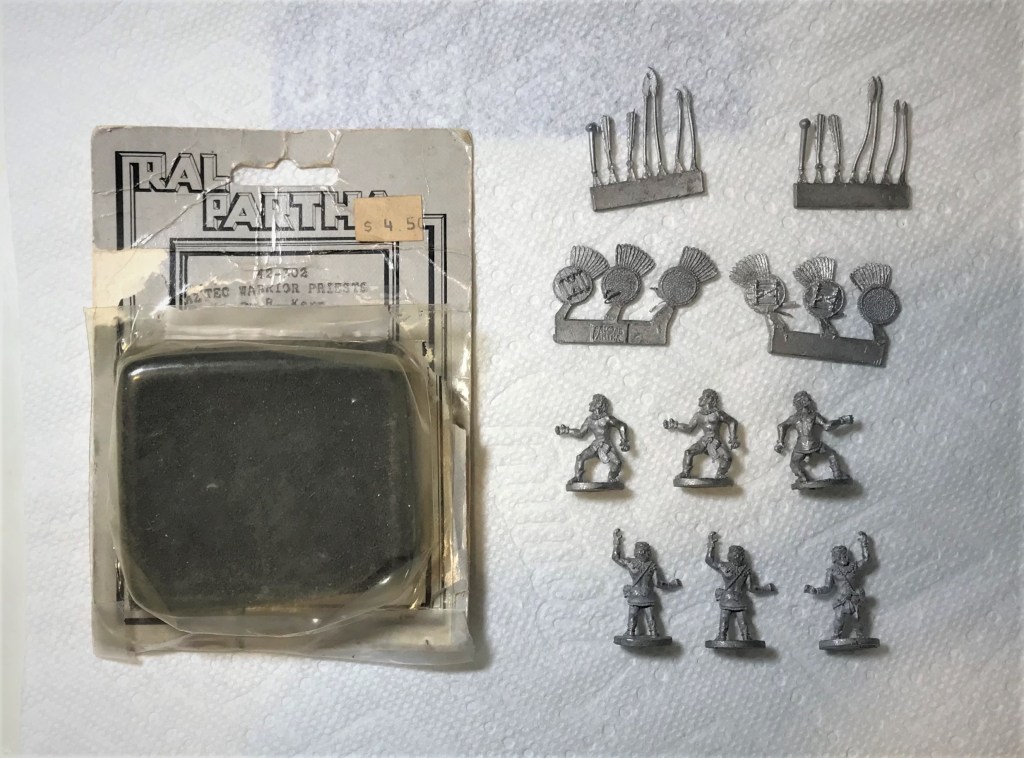
Ral Partha had a historical line of 25mm figures that were cast and sold back in the 1980’s. One of them was the “1200 A.D” line, which included Aztec figures, and one of their blister packs was “Aztec Warrior Priests”. It had 6 figures with two poses. Also supplied were 3 different weapons, and shields for each figure.

On my previous post on Tlaxcalans, I mentioned that I needed to have some warrior priests for their army. Unfortunately, I could not find a suitable 28mm version for the Tlaxcalans. I do have some Wargames Foundry Aztec Warrior Priests in the painting queue but they were not going to be right as Tlaxcalans in my view.

I did have (among several other blisters from that era) a single blister pack of 6 figures of Ral Partha 42-302. Now these were Aztecs, not Tlaxcalans, and 25mm size, not 28mm. Generally 28mm figures are 1:61-1:68 range, and 25mm figures are 1:68-1:71 range in scale. So from a gaming distance, I think that they will work. I have already incorporated other 25mm figures such as the historical Eagle Warriors from Tin Soldier and the ahistorical Ral Partha Arrow Warriors into my Aztec forces for the upcoming launch of Buck Surdu’s Feudal PatrolTM skirmish tabletop war game. (as a side note – my Civilizations Collide supplement will cover this period, and will be a free download from the website).

Getting back to filling the Tlaxcalan ranks with some Warrior Priests – I chose to paint the 42-302 figures up in Tlaxcalan colors and war paint. It allowed me to make use of the figures – which have been waiting 32 years to be painted anyways – and to not add any more to my unpainted stuff. Sometimes you just have to find a way to liberate the unpainted hordes! When they get deployed in my supplement, Warrior Priests are add-on troops that get individually attached to units. They have the ability to help keep a unit they are attached to from breaking morale, and also can cause a defeated non-Spanish enemy to be more likely to want to flee the battlefield.

The six figures were more than enough to round out my Tlaxcalans. It’s always a challenge to go smaller than usual in painting, and these figures were no exception. One initial issue was the height, which I “leveled” by adding a 3/4″ x 1/8″ small washer on the 1″ washer base. This was to make the height disparity less noticeable. I also gave the somewhat pliable weapons a light coat of Gorilla Glue to stiffen them up a bit

Primed, mounted, and ready for painting.

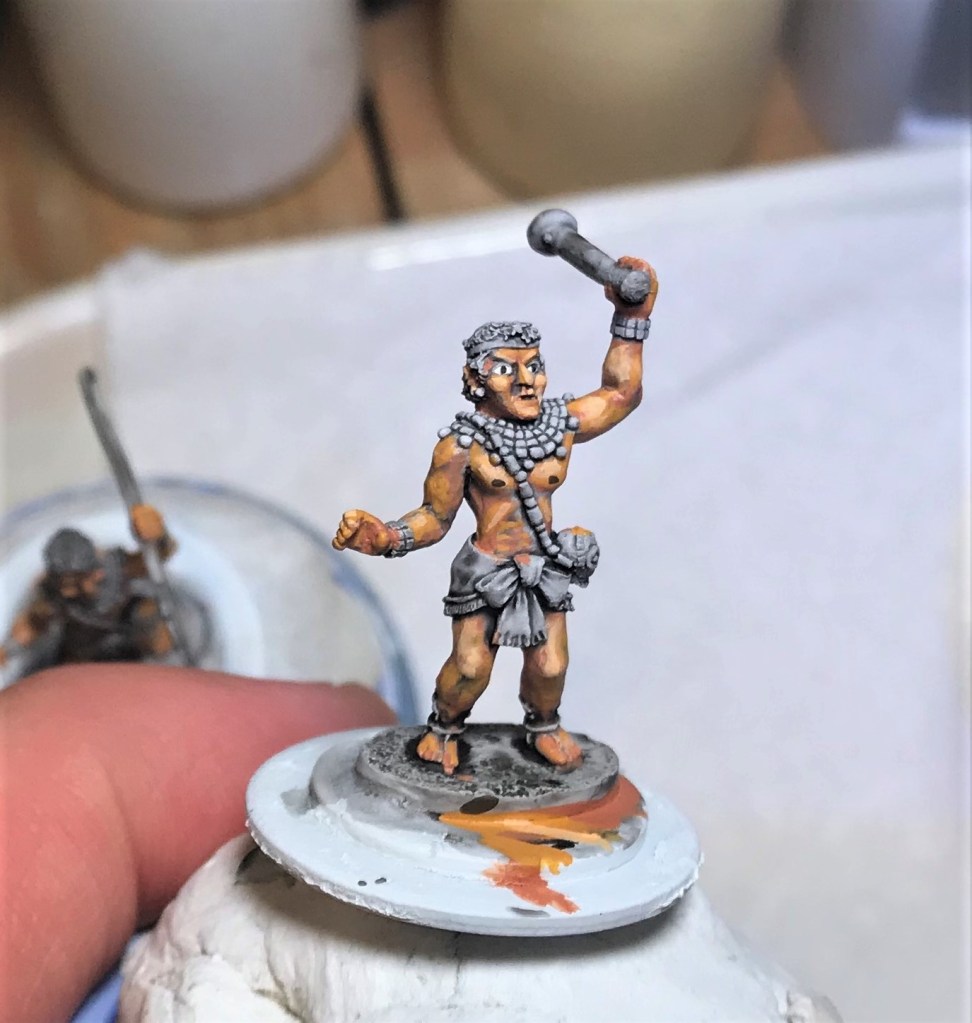
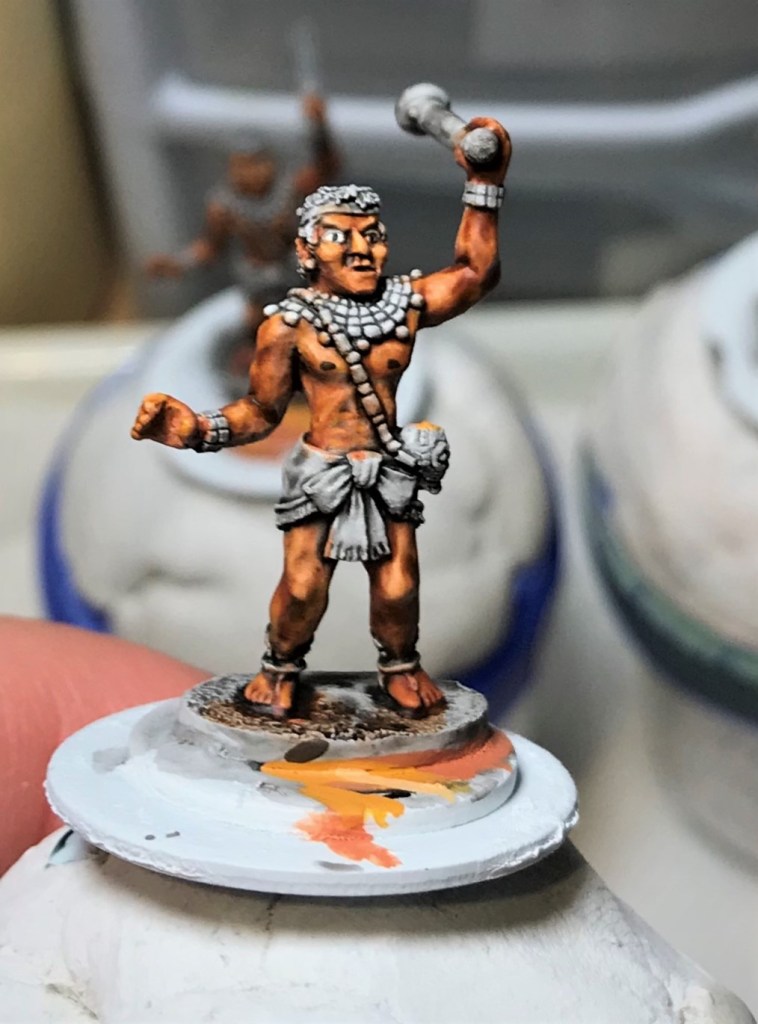
A second challenge was capturing the delicate details on the figures. Here, I decided to steal an idea I have seen on Chris Palmer’s blog on the H.A.W.K.’s combined blog site – that is to prime figures white and use a dark wash over that to help with details. I think it helped – see the examples of WIP below.

Here is a second example:

The Tlaxcalans favored red loincloths and headbands – so those were easy to add. The war paint design mix that I used was similar to my previous group – a red-striped over white design or a black mask (or none at all). As for shield, I perused Steven’s Balagan and my Osprey books for inspiration (while modifying the colors a bit).

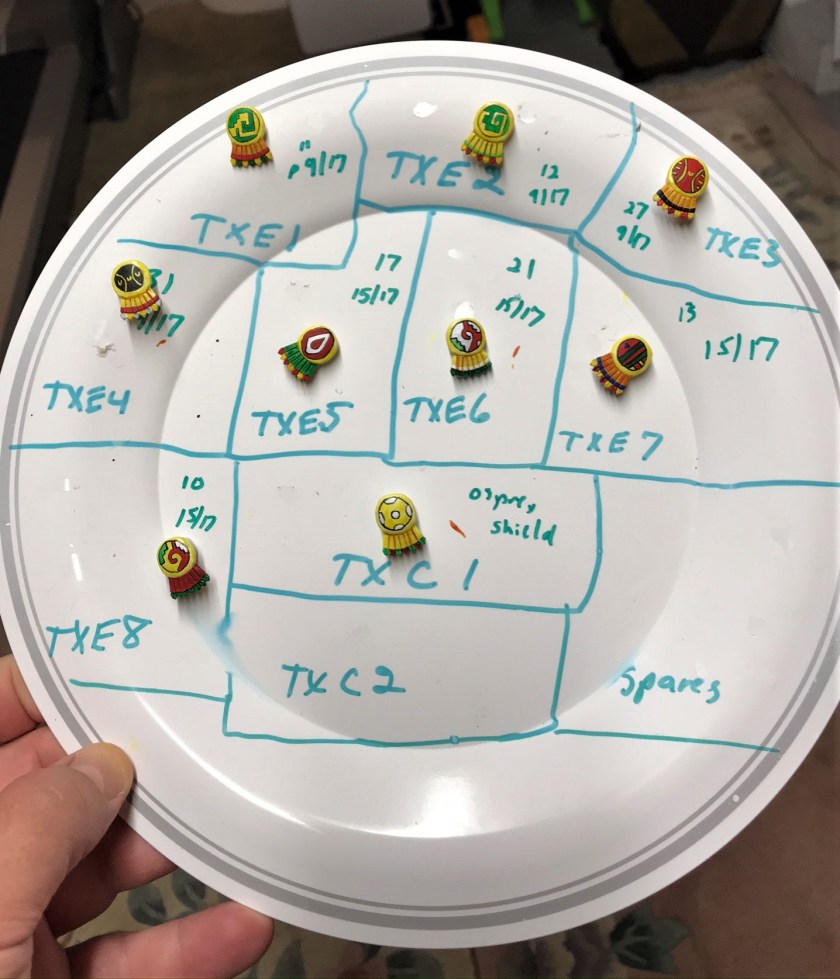
The shields as completed – I used different contrast paints for the feathers and denoted on the plate (because I might forget when I went to paint the other sides!).

Three of the models had a lovely little (ok, tiny) engraved skull at their waists on a bone necklace. I was unaware of this engraved skull aspect of Mesoamerican “art”. You can see a modern interpretive example from Amazon here and shown below:

Maybe not a Mother’s Day present…

I tried out my new Army Painter drybrush (the smallest one) and was very happy how well it performed, especially on the skulls. The bristles are round and it is just the right stiffness. Here is the link and the photo below if you are interested:

I bought this set and liked them.

Back to painting the models, my goal was to get a nice blending on the flesh before varnishing the figures. They do end up shiny from the Army Painter Flesh Wash, but with matte varnish the shine goes completely away.

Before varnishing – a bit shiny. You can see the extra washer here too.

Once I added the extra washer, you could see that the elevation on the base could pose a flocking issue – such that it would look “rounded” under the flocking. To deal with this, I glued some very small pieces of modeling talus on the washers to more or less camouflage the underlying round shapes. I would leave some of that exposed as well once flocked.

A model with the added talus pieces.

So let’s see the finished models! As usual, I gave each a number for future reference and creation of gaming aids:

Eye Candy

TWP1 – armed with a tepoztopilli (obsidian-edged thrusting spear), and no war paint. Interestingly this pose of the two types in the blister was a lefty!

TWP2 – armed with a cuauhololli (round-headed club), with no war paint.

TWP3 – armed with a macuahuitl (obsidian-edged club/sword), again no war paint.

TWP4 – armed with a tepoztopilli (obsidian-edged thrusting spear), and the red-stripes-over-white war paint. This pose of the two types in the blister was right-handed!

TWP5 – armed with a cuauhololli (round-headed club), wearing the black mask war paint.

TWP6 – armed with a macuahuitl (obsidian-edged club/sword), and the red-stripes-over-white war paint.

Here’s a scale comparison with a 28mm Tlaxcalan Archer figure:

I think that they can safely share the same gaming tabletop!

Here are the three left-handed figures together.

Here are the three right-handed figures together.

All of Ral Partha 42-302.

This project also allowed me to help with one of my favorite websites, the Lost Minis Wiki, which is a fantastic resource for OOP stuff, especially from the 1970’s and 1980’s. Here is the entry photo for this blister.

So, my Tlaxcalan forces are done – I have now 32 figures for their army. When added to the 71 Aztecs that I have done, that brings me to over 100!

All of my Tlaxcalan troops.

Thanks for taking a look – below you’ll find my updated details list for the overall project and this particular one (paints, etc. used).

Miscellaneous details and references for those interested:

Posts on games, units, and other projects for my 16th Century Spanish Conquest supplement for Feudal Patrol™ – “Civilizations Collide”

  1. Aztec Warrior Priests (painted as Tlaxcalans), Ral Partha 42-302, circa 1988 (this post) – 6 figures – 6 Tlaxcalan Warrior Priests
  2. Tlaxcalan Novices, Elite Warriors, and Command Group – 18 figures – 8 Novice Tlaxcalan Warriors, 8 Elite Tlaxcalan Warriors, 1 Tlaxcalan Captain, 1 Tlaxcalan Conch Blower
  3. Tlaxcalan Archers – 8 Veteran Tlaxcalan Archers
  4. Aztec Game for Feudal Patrol across thousands of miles – via Zoom!
  5. Aztec Snake Woman and Drummer – 1 Aztec General, 1 Aztec Drummer
  6. A June and July Jaguar Warrior Frenzy (plus some Aztec Veterans and a Warrior Priest to Boot) – 3 Aztec Veteran Warriors, 17 Jaguar Warriors, 1 Aztec Warrior Priest
  7. Doubling Down – Aztec Veteran Warriors – 24 Aztec Veteran Warriors
  8. Aztec Arrow Knights, Ral Partha circa 1988 – 6 Aztec Arrow Knights
  9. Aztec Eagle Warriors from Tin Soldier UK – 6 Aztec Eagle Knights
  10. Aztec Novice Warriors and a few Frinx – 12 Novice Warriors

Total figures to date for this project: 103 figures:  71 Aztecs, 32 Tlaxcalans

PAINTS, INKS, GLAZES, SHADES, WASHES, PIGMENTS, FLOCKING, GLUES AND MORE THAT I USED ON THESE TLAXCALAN WARRIOR PRIESTS:

  1. Gorilla Glue
  2. 1/8″ x 1″ Everbilt Fender Washers
  3. 1/8″ x 3/4″ Everbilt Fender Washers
  4. Plastic plates
  5. Poster tack
  6. Vallejo “Surface Primer – White Primer”
  7. Vallejo “Flow Improver”
  8. Vallejo “Airbrush Thinner”
  9. Testors “Universal Acrylic Thinner”
  10. Citadel “Nuln Oil” (shade)
  11. Vallejo Model Air “Weiss” (off-white)
  12. Vallejo Game Air “Dead White”
  13. Vallejo Game Air “Black”
  14. Army Painter “Tanned Flesh”
  15. Vallejo Game Color “Bronze Fleshtone”
  16. Vallejo Model Color “Sunny Skin Tone”
  17. Citadel “Contrast Paint – Darkoath Flesh”
  18. Battlefront “Chocolate Brown”
  19. Army Painter “Flesh Wash” (wash)
  20. Citadel Air “Evil Sunz Scarlet”
  21. Citadel “Contrast Paint – Wyldwood”
  22. Battlefront “Sicily Yellow”
  23. Citadel “Contrast Paint – Black Templar”
  24. Vallejo Model Air “Tire Black”
  25. Citadel “Contrast Paint – Terradon Turquoise”
  26. Citadel “Contrast Paint – Skeleton Horde”
  27. Citadel “Contrast Paint – Contrast Medium”
  28. Battlefront “Wool Brown”
  29. Army Painter “Red Tone” (shade)
  30. Citadel “Agrax Earthshade” (shade)
  31. Vallejo Model Color “Glossy Black”
  32. Citadel “Contrast Paint – Blood Angels Red”
  33. Citadel “Contrast Paint – Iyanden Yellow”
  34. Citadel “Contrast Paint – Apothecary White”
  35. Citadel “Contrast Paint – Warp Lightning”
  36. Citadel “Contrast Paint – Aethermatic Blue”
  37. Citadel “Contrast Paint – Akhelian Green”
  38. Citadel “Contrast Paint – Ultramarines Blue”
  39. Citadel “Contrast Paint – Leviadon Blue”
  40. Secret Weapon Washes “Sunshine” (ink)
  41. Citadel “Ushabti Bone”
  42. Citadel “Seraphim Sepia” (shade)
  43. Vallejo Model Color “Dark Blue”
  44. Vallejo Model Air “Moon Yellow”
  45. Vallejo Game Air “Satin Varnish”
  46. Vallejo Mecha Color “Turquoise”
  47. Citadel “Caliban Green”
  48. E6000 Epoxy
  49. 4Ground small talus pieces
  50. Elmer’s PVA Glue
  51. Army Painter “Brown Battlefields” (flocking)
  52. Vallejo “Dark Yellow Ochre” (pigment)
  53. Vallejo “Burnt Umber” (pigment)
  54. Citadel “Steel Legion Drab”
  55. Citadel “Tallarn Sand”
  56. Citadel “Karak Stone”
  57. Americana “Desert Sand”
  58. Vallejo Mecha Varnish “Matt Varnish”
  59. Army Painter “Grass Green” (flocking)

Please let me know your thoughts and feedback in the comments section – I really appreciate learning any impressions or thoughts in general (or specific) that you have.

Thanks for looking!!!

Tlaxcalan Novices, Elite Warriors, and Command Group

The Tlaxcalans were a Nahua people that were at a constant state of war with the Aztecs of the Triple Alliance for decades. The Aztecs never fully conquered the Tlaxcalans, as they found them to be a far more useful source of slave labor, sacrificial victims, and resources than as a vassal state. The Aztecs were able to take these captives and supplies by allowing the Tlaxcalans to merely exist – and by challenging them repeatedly to a series of “Flower Wars”. Flower Wars were basically ritualized arranged gang-like “throw downs” where usually the Aztecs would emerge victorious, as they were a larger and far more powerful empire based in Tenochtitlan. Certainly, with this level of abuse, there was no love lost between the Tlaxcalans and the Aztecs.

Into this theater of conflict came a new revolutionary factor in the early 16th century. Hernan Cortes and his Conquistadores arrived in Mesoamerica in February of 1519. In September of that year, he encountered the Tlaxcalans and briefly fought them – as the Tlaxcalans were unaware of who the Conquistadores were or from whence they came. Both sides came to peace terms relatively quickly after some tough fighting – during which mutual respect was gained for their respective courage and capabilities in battle. The Tlaxcalans informed Cortes of the vast riches (especially in terms of gold) of Tenochtitlan and their emperor, Montezuma II. The Tlaxcalans happily joined the Spanish on their march to Tenochtitlan and indeed were staunch allies for them. Indeed, without the Tlaxcalans who formed the bulk of Cortes’ forces, the Spanish would never have been able to defeat the Aztecs during their conquest of New Spain.

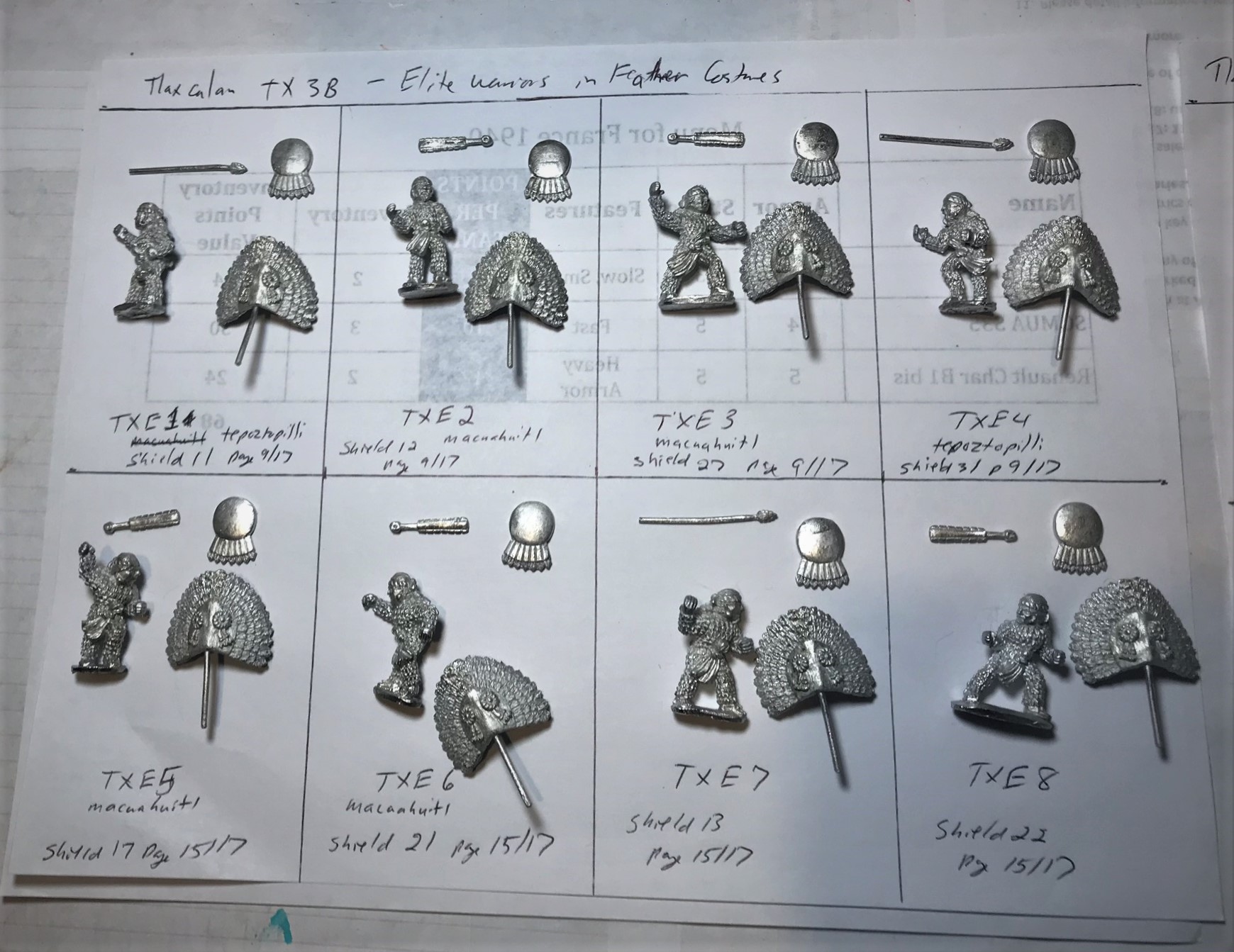
I have been working on building Aztec, Tlaxcalan, and Spanish forces for the upcoming launch of my rules supplement for Buck Surdu’s Feudal PatrolTM skirmish tabletop war game. My supplement will be a free download from the website and will be called Civilizations Collide. The supplement will cover many aspects of the Spanish Conquest to include the Aztecs, the Inca, the Maya, and more. Back in August, I began to work on the Tlaxcalans. I was working on my Tlaxcalan Archers, (which you can read about here), and quickly realized that the level of detail that I wanted to achieve on these figures could not be achieved if I was to work on too many at a time. Therefore, I broke up the project into two phases. The first phase was the completion of the 8 Tlaxcalan Archers. For the second phase – which this post concerns – I had 18 figures, all from Outpost Wargames Services via their US distributor, Badger Games. Eight were from TX2 “Tlaxcalan Novice Warriors in Padded Vest”; eight were from TX3b “Elite Warrior in Feather Costume”; and two were from TXC01 “Tlaxcalan Captain and Conch Blower. These are all 28mm in scale and metal. Still, this two-phase approach took me a lot longer than I had expected to take to finish these – primarily as there were (as you will see) multiple shields, weapons, and backbanners to paint and assemble. As source materials I used both multiple Osprey books and especially the two blog posts from Steven’s Balagan blog on Tlaxcalan painting and especially his post on shield painting and design. These are fantastic resources and I recommend them highly for anyone interested in the period in addition to the Osprey books. I also recommend Badger Games as a source for these figures as well as those they sell from other manufacturers.

I will generally show some WIP stuff and discuss some of the aspects and challenges of the project and how I dealt with them. I’ll end with a recap of where the overall project progress is now, and what paints and stuff I used here. I did not take as many WIP shots as I normally do because while I have tackled more figures at a time previously, this project phase kept me very busy (and as this was during golf season, that took some hobby time too!). If WIP shots are not for you, just scroll down to the “Eye Candy” section to see how they all came out. With all of the photos – just click on them if you want a bigger view.

TX2 “Tlaxcalan Novice Warriors in Padded Vest” WIP Shots

The TX2 baggie of Novice Warriors as received
The painting plan for the Tlaxcalan Novices. I did find that I needed to change the weapons selection after painting as some of them did not fit quite well into the figures’ hands or did not look as good. I chose specific shield designs from Steven’s Balagan and the Osprey books. The numbers you see are applied to the base bottoms and help with my ability to make game menus and aids later on.
Here you see the novices mounted on 1″ steel washers on specimen jars with poster tack for ease of painting. I also labeled them (and all the figures) with their numbers, their future weapons, and their planned shields. The Tlaxcalan Archers behind them were completed in phase 1 (a previous post described them.

I chose to try to paint all of the separate components (figures, shields, weapons) before assembly. I did find that I had a bit of difficulty getting certain the weapons to fit easily to some models so I ended up switching between issuing a macuahuitl (broadsword/club-type with obsidian edges) or a tepoztopilli (obsidian-edged thrusting spear) for a few. I should have tried to widen the figures’ hands a bit more than I did. Certainly, I think using Citadel “Apothecary White” contrast paint on the white ichcahuipilli (quilted cotton vest armor) was a big win.

TX3b “Elite Warrior in Feather Costume” WIP Shots

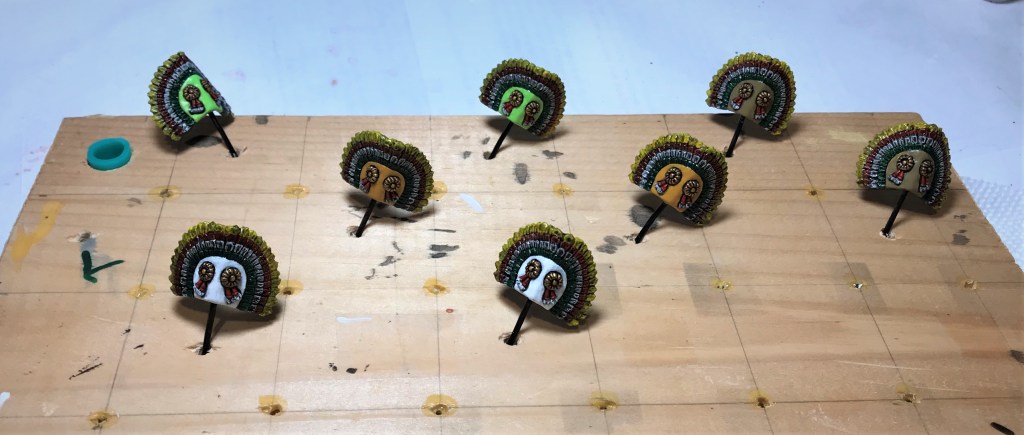
The Tlaxcalan Elites would be a bigger challenge – primarily because in addition to the figures, weapons, and shields, each had a huge (and relatively heavy model-wise) feather backbanner. I ended up using a wooden jig to hold them during the project in between painting colors. According to my research, there were other types of backbanners – and even this type (TX3b) was supposed to have the white egret backbanner as an option. All I had were 8 of the same type of backbanners- so I diverged a bit with color selections on the center section to aid with tabletop identification. I also decided to paint them a bit differently. I used Citadel “Nuln Oil” as a wash immediately after priming white. This allowed me to get better shading – especially with subsequent uses of contrast paints on the feathers. After I painted the backbanners, I applied a satin varnish to preserve the brighter colors as I used a final matte varnish at the end of the assembly. Clearly, between the costume and the feathered backbanner, these elites had a lot of “battle plumage”! Historically, fighting in melee with the backbanner on must have been tough. I do wish I had had one of the egret backbanners, but not enough to buy any more…yet.

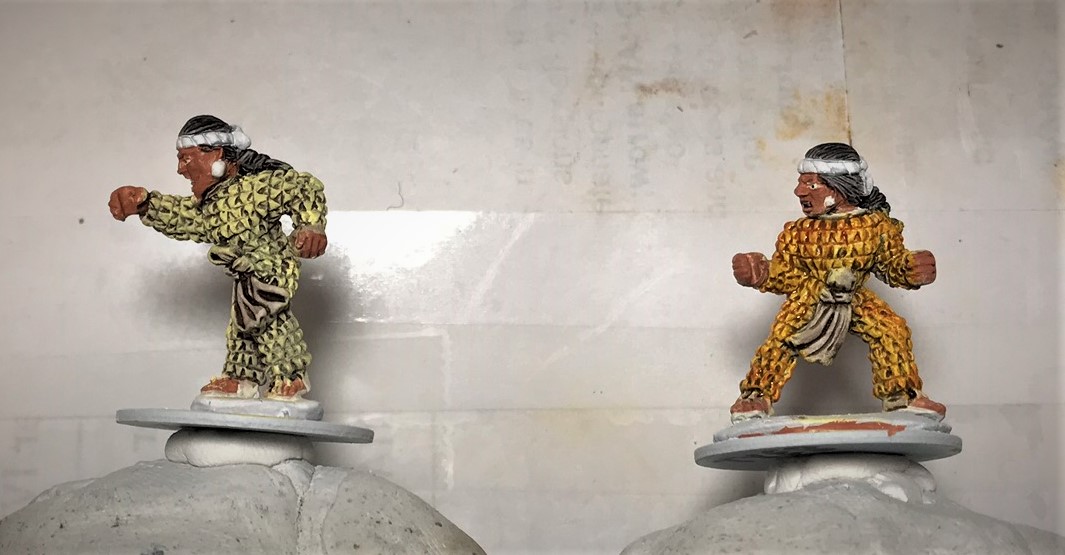
I did paint the elite figures a bit differently as well. I find that dry brushing over contrast paints leads to too much abrasion and wear on the contrast-painted areas. These Tlaxcalan elites have a nice feathered costume, and I wanted to bring that aspect out. So, I painted the figures’ flesh first, then similarly applied Citadel “Nuln Oil” as a wash. Then I dry brushed the costume with Citadel “Hexos Palesun”, followed by an wash-like application of Citadel “Iyanden Yellow” contrast paint thinned with Citadel “Contrast Medium”. My only change going forward would be to paint the flesh base after as of course I had to cover up some errant dry brushing.

Left is an elite figure after dry brushing but before adding the contrast paint. The right one has had the contrast paint added as I described above.
A finished Tlaxcalan Elite figure – more to see in “Eye Candy” below.

TXC01 – “Tlaxcalan Captain with Conch Blower”

Finally, I wanted to add some leadership for the group. For painting, I followed a similar path as described above for the elites and the novices.

TXC1 as received. I ended up giving both a tepoztopilli (spear).
Gotta have a plan!
Fast forward – and the Captain completed. I do like the way he came out – and more eye candy below.

Notes on Painting Shields, Assembly, and Basing

As discussed, this project took a lot of time on details. Each figure had its own distinctive shield design. After free-handing these, I used a satin varnish similar what I did on the backbanners.

The shields were affixed with a “sandwich” of E6000 epoxy and Gorilla Glue. The weapons were attached with Gorilla Glue. Assembling the backbanners was trickier. They weighed a lot, and I wanted to make sure that they would be set up for both tabletop survival and looking good. I used Gorilla Glue on them, and then finished off the mount with green stuff. This necessitated yet another wait for curing. I primed the green stuff black and left it black as I liked it better than the brown I originally planned. Better yet, it is solid, and will support the figure as it is picked up!

Figures painted – need weapons, shields, backbanners, and bases flocked and finished!

As for basing, I probably do too much, but I think bases are so important. This time I did the bases before affixing any weapons, shields, or backbanners. I used Army Painter Brown Battlefields with PVA (Elmer’s) glue. I then add two kinds of Vallejo pigments with Vallejo airbrush thinner. Once that is dry (again a wait) I drybrush the base with four different shades of tan. After varnish, the last step is to add some static grass with PVA, and gently vacuum that mix (once a bit tacky) so that the grass gets a little frilly.

The absolute last thing I do after final matte varnish is added and static grass is to highlight the obsidian-edged weapons with some Vallejo Model Color “Glossy Black”.

Eye Candy

For shots here, I got a new background from previous posts – and added some cacti that I had flocked and washed. Hope it adds to the shots!

Tlaxcalan Novices

TXN1 – has the red-striped-over-white war paint and is armed with a macuahuitl.

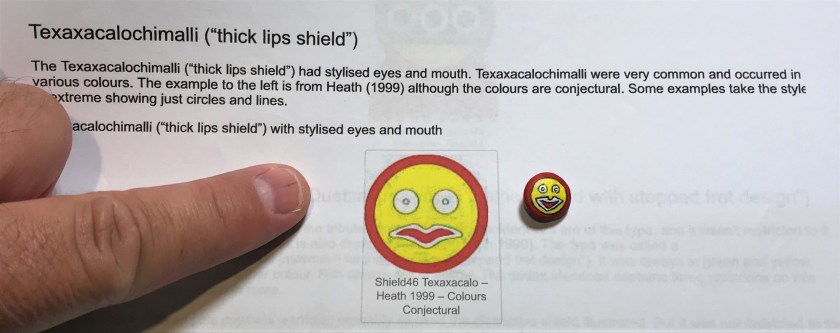
TXN2 – has the red-striped-over-white war paint and is armed with a tepoztopilli. Also has the “thick-lipped” shield.

TXN3 – has the black mask war paint and is armed with a macuahuitl.

TXN4 – has the black mask war paint and is armed with a macuahuitl.

TXN5 – has the red-striped-over-white war paint and a different head cover, and is armed with a macuahuitl.

TXN6 – has the red-striped-over-white war paint and a different head cover, and is armed with a tepoztopilli.

TXN7 – has the black mask war paint and is armed with a macuahuitl.

TXN8 – has no war paint and is armed with a tepoztopilli.

Tlaxcalan Elite Warriors

TXE1 – has no war paint and is armed with a macuahuitl. The center of his backbanner is tan.

TXE2 – has no war paint and is armed with a macuahuitl. The center of his backbanner is yellowish-tan.

TXE3 – has the red-striped-over-white war paint and is armed with a macuahuitl. The center of his backbanner is yellowish-tan.

TXE4 – has the black mask war paint and is armed with a tepoztopilli. The center of his backbanner is light green.

TXE5 – has the red-striped-over-white war paint and is armed with a tepoztopilli. The center of his backbanner is tan.

TXE6 – has the black mask war paint and is armed with a macuahuitl. The center of his backbanner is bright white.

TXE7 – has the red-striped-over-white war paint and is armed with a tepoztopilli. The center of his backbanner is bright white.

TXE8 – has no war paint and is armed with a macuahuitl. The center of his backbanner is light green.

Tlaxcalan Command Group

TXC1 – Tlaxcalan Captain, with no war paint, armed with a tepoztopilli. His backbanner has a serpent on it.

TXC2 – Conch Blower, with no war paint, armed with a tepoztopilli.

Tlaxcalan Command Group

Next up I need to add some warrior priests for the Tlaxcalans – and I have some old Ral Partha ones that will do the trick – I hope – stay tuned!

Miscellaneous details and references for those interested:

Posts on Games and Units for my 16th Century Spanish Conquest Supplement for Feudal Patrol™ – “Civilizations Collide”

  1. Tlaxcalan Novices, Elite Warriors, and Command Group (this post) – 18 figures – 8 Novice Tlaxcalan Warriors, 8 Elite Tlaxcalan Warriors, 1 Tlaxcalan Captain, 1 Tlaxcalan Conch Blower
  2. Tlaxcalan Archers – 8 Veteran Tlaxcalan Archers
  3. Aztec Game for Feudal Patrol across thousands of miles – via Zoom!
  4. Aztec Snake Woman and Drummer – 1 Aztec General, 1 Aztec Drummer
  5. A June and July Jaguar Warrior Frenzy (plus some Aztec Veterans and a Warrior Priest to Boot) – 3 Aztec Veteran Warriors, 17 Jaguar Warriors, 1 Aztec Warrior Priest
  6. Doubling Down – Aztec Veteran Warriors – 24 Aztec Veteran Warriors
  7. Aztec Arrow Knights, Ral Partha circa 1988 – 6 Aztec Arrow Knights
  8. Aztec Eagle Warriors from Tin Soldier UK – 6 Aztec Eagle Knights
  9. Aztec Novice Warriors and a few Frinx – 12 Novice Warriors

Total figures to date for this project: 97 figures:  71 Aztecs, 26 Tlaxcalans

PAINTS, INKS, GLAZES, SHADES, WASHES, PIGMENTS, FLOCKING, GLUES AND MORE THAT I USED ON THESE TLAXCALAN NOVICE AND ELITE WARRIORS AND THE COMMAND GROUP:

  1. Gorilla Glue
  2. 1/8″ x 1″ Everbilt Fender Washers
  3. Plastic plates
  4. Poster tack
  5. Vallejo “Surface Primer – White Primer”
  6. Vallejo “Flow Improver”
  7. Vallejo “Airbrush Thinner”
  8. Testors “Universal Acrylic Thinner”
  9. Citadel “Nuln Oil” (shade)
  10. Battlefront “Wool Brown”
  11. Citadel “Contrast Paint – Wyldwood”
  12. Citadel “Contrast Paint – Contrast Medium”
  13. Army Painter “Tanned Flesh”
  14. Vallejo Game Air “Black”
  15. Citadel “Agrax Earthshade” (shade)
  16. Citadel “Contrast Paint – Basilicanum Grey”
  17. Citadel “Contrast Paint – Volupus Pink”
  18. Vallejo Game Air “Dead White”
  19. Citadel Air “Evil Sunz Scarlet”
  20. Vallejo Model Air “Weiss” (off-white)
  21. Citadel “Averland Sunset”
  22. Vallejo Game Color “Bronze Fleshtone”
  23. Vallejo Model Color “Sunny Skin Tone”
  24. Citadel “Contrast Paint – Darkoath Flesh”
  25. Army Painter “Flesh Wash” (wash)
  26. Army Painter “Red Tone” (shade)
  27. Citadel “Caliban Green”
  28. Vallejo Model Air “Tire Black”
  29. Citadel “Contrast Paint – Apothecary White”
  30. Citadel “Contrast Paint – Blood Angels Red”
  31. Vallejo Model Air “Moon Yellow”
  32. Citadel “Contrast Paint – Warp Lightning”
  33. Battlefront “Chocolate Brown”
  34. Citadel “Biel-Tan Green” (shade)
  35. Citadel “Seraphim Sepia” (shade)
  36. Citadel “Contrast Paint – Iyanden Yellow”
  37. Citadel “Hexos Palesun”
  38. Vallejo Game Color “Livery Green”
  39. Citadel “Auric Armour Gold”
  40. Citadel “Nuln Oil GLOSS” (shade)
  41. Citadel “Contrast Paint – Terradon Turquoise”
  42. Citadel “Contrast Paint – Snakebite Leather”
  43. Citadel “Hexwraith Flame”
  44. P3 “Sunshine” (ink)
  45. Secret Weapon Washes “Blue” (wash)
  46. Vallejo Model Color “Dark Blue”
  47. Citadel “Contrast Paint – Talassar Blue”
  48. Vallejo Game Air “Escorpena Green”
  49. Vallejo Model Air “Cockpit Emerald Green ‘Faded’”
  50. E6000 Epoxy
  51. Elmer’s PVA Glue
  52. Army Painter “Brown Battlefields” (flocking)
  53. Vallejo “Dark Yellow Ochre” (pigment)
  54. Vallejo “Burnt Umber” (pigment)
  55. Citadel “Steel Legion Drab”
  56. Citadel “Tallarn Sand”
  57. Citadel “Karak Stone”
  58. Americana “Desert Sand”
  59. Green Stuff
  60. Reaper MSP “Black Primer”
  61. Vallejo Mecha Varnish “Matt Varnish”
  62. Vallejo Model Color “Glossy Black”
  63. Army Painter “Grass Green” (flocking)
Thanks for looking!!! Please let me know your thoughts and feedback in the comments section – I really appreciate hearing what you think.

Tlaxcalan Archers

The time had come for me to get some opponents painted up to oppose the Aztecs of the Triple Alliance from Tenochtitlan (now Mexico City). In this case, these opponents are the Tlaxcalans, a Nahua ethnic group that never was conquered by the Aztecs. They did briefly fight Hernan Cortez and his conquistadors before allying with them against their longtime-hated enemy, the Aztecs. They were noted as being a major part of Cortes’ forces, and for having excellent archers. In my Tlaxcalan figures, have a group of veteran archers, a group of novices, a small command group, and a group of elite warriors for games of Feudal Patrol™ using my supplement called Civilizations Collide. All will eventually be shared here. They all are 28mm scale metal models from Outpost Wargames Services acquired from Badger Games in the US.

After the Zoom play test that I had described here, it was time to get some Tlaxcalans into the fray! I start her with TX4 “Tlaxcalan Archers”, an 8 figure set.

The TX4 “Tlaxcalan Archers” baggie of 8 figures as received from Badger Games.

I chose to start with these archers as they had no shields to paint (time saver) – but also because the Tlaxcalans had a couple of very interesting types of war paint on their faces. From the Osprey plate in one of my books, one style resembled a black “superhero mask” around the eyes. The other one was a series of fine red stripes on a white background. Not all Tlaxcalans had war painted faces, so I could mix in some regular tanned skin as well. Given that some of the 8 figures were similar, this would aid in tabletop differentiation as well. Lastly, painting this unit would allow me some good practice on the faces with war paints as well as the common color themes of the Tlaxcalans according to the Osprey plates (which themselves were based on the various historical codices of the period). I chose to paint 4 figures with the black mask war paint, 2 with the white and red-striped painted war paint, and 2 with no war paint at all.

It would be appropriate for me to make a few more points on paints here. While I do list all the paints that I used at the end of this post for those interested (and for me when I forget and want to know I ended up using when I have another similar future project!), I want to share a few key items.

First, I tried a new tanned flesh paint that I really liked – Army Painter “Tanned Flesh”- and it worked well. I thinned it appropriately as a base coat and used other lighter paints, contrast paints, and washes over it as shades and highlights. Second, I also want to give credit to Faust at Double Down Dice as I had not tried Citadel “Gore-Grunta Fur” for wood – as I did here for bows. I had seen his work on his blog here and was impressed enough to give it a shot. Third, I used Citadel “Averland Sunset” and Vallejo Model Air “Black” to recreate a slightly different color pattern on the quivers to represent them being made from jaguar hides. And lastly, I gave the steel washers a different color – Citadel “Caliban Green” – than the tan undercoat that I had given the washers under my Aztecs. It only shows on the rim of the bases, but I think will help with tabletop differentiation. Many of the poses are similar, and a few are the same (6 poses and 8 figures).

I assign each figure a number – which helps with the painting plan as well as for later when prepping for games. The numbers go on a spreadsheet and are also on the bases of the figures. I did drop the dash though!

Overall, I loved the figures, but painting them was a bit more challenging than I had thought. The main difficulties were around getting the flesh to where I was happy (again working with a new flesh tone), and the bright reds, black hair, and dark flesh next to bright whites – especially on the headbands. You can judge my efforts, though I did not do as many WIP shots here. You can click on all the images here for a better view.

Here you see the black mask war paint and the effort on the jaguar-hide quiver. In the game, I give the Tlaxcalans a high rate of fire with their bows.

So let’s get a look at the completed models!

Close up shot of the completed TXB5
Close up shot of TXB1.
All 8 figures assembled for battle

I hope that you found this post enjoyable. Let me know – and stay safe out there!

Miscellaneous details and references for those interested:

Posts on Games and Units for my 16th Century Spanish Conquest Supplement for Feudal Patrol™ – “Civilizations Collide”

  1. Tlaxcalan Archers – (this post) – 8 Veteran Tlaxcalan Archers
  2. Aztec Game for Feudal Patrol across thousands of miles – via Zoom!
  3. Aztec Snake Woman and Drummer – 1 Aztec General, 1 Aztec Drummer
  4. A June and July Jaguar Warrior Frenzy (plus some Aztec Veterans and a Warrior Priest to Boot) – 3 Aztec Veteran Warriors, 17 Jaguar Warriors, 1 Aztec Warrior Priest
  5. Doubling Down – Aztec Veteran Warriors – 24 Aztec Veteran Warriors
  6. Aztec Arrow Knights, Ral Partha circa 1988 – 6 Aztec Arrow Knights
  7. Aztec Eagle Warriors from Tin Soldier UK – 6 Aztec Eagle Knights
  8. Aztec Novice Warriors and a few Frinx – 12 Novice Warriors

Total figures to date for this project: 79 figures:  71 Aztecs, 8 Tlaxcalans

PAINTS, INKS, GLAZES, SHADES, WASHES, PIGMENTS, FLOCKING, GLUES AND MORE THAT I USED ON THESE TLAXCALAN ARCHERS:

  1. Gorilla Glue
  2. 1/8″ x 1″ Everbilt Fender Washers
  3. Poster tack
  4. Vallejo “Surface Primer – White Primer”
  5. Vallejo “Flow Improver”
  6. Vallejo “Airbrush Thinner”
  7. Testors “Universal Acrylic Thinner”
  8. Citadel “Contrast Paint – Contrast Medium”
  9. Vallejo Model Air “Weiss” (off-white)
  10. Army Painter “Tanned Flesh”
  11. Vallejo Game Air “Black”
  12. Citadel “Agrax Earthshade” (shade)
  13. Citadel “Contrast Paint – Basilicanum Grey”
  14. Vallejo Game Air “Dead White”
  15. Citadel Air “Evil Sunz Scarlet”
  16. Citadel “Contrast Paint – Gore-Grunta Fur”
  17. Citadel “Contrast Paint – Terradon Turquoise”
  18. Citadel “Contrast Paint – Flesh Tearers Red”
  19. Army Painter “Red Tone” (shade)
  20. Vallejo Game Color “Bronze Fleshtone”
  21. Vallejo Model Color “Sunny Skin Tone”
  22. Citadel “Contrast Paint – Darkoath Flesh”
  23. Army Painter “Flesh Wash” (wash)
  24. Citadel “Caliban Green”
  25. Vallejo Model Air “Tire Black”
  26. Citadel “Contrast Paint – Apothecary White”
  27. Citadel “Contrast Paint – Blood Angels Red”
  28. Vallejo Model Air “Moon Yellow”
  29. Citadel “Contrast Paint – Warp Lightning”
  30. Battlefront “Chocolate Brown”
  31. Vallejo Model Color “Glossy Black”
  32. Citadel “Lamenters Yellow” (glaze)
  33. Citadel “Biel-Tan Green” (shade)
  34. Citadel “Seraphim Sepia” (shade)
  35. Citadel “Averland Sunset”
  36. Elmer’s PVA Glue
  37. Army Painter “Brown Battlefields” (flocking)
  38. Vallejo “Dark Yellow Ochre” (pigment)
  39. Vallejo “Burnt Umber” (pigment)
  40. Citadel “Steel Legion Drab”
  41. Citadel “Tallarn Sand”
  42. Citadel “Karak Stone”
  43. Vallejo Mecha Varnish “Matt Varnish”
  44. Army Painter “Grass Green” (flocking)
Thanks for looking!!! 

Doubling Down – Aztec Veteran Warriors from Wargames Foundry

Readers of this blog have seen that I have been building a large force (Aztecs, Conquistadores, and others) for the 16th Century Spanish Conquest of Mesoamerica for the upcoming game of Buck Surdu’s Feudal Patrol™.  This game is exciting for me as I got to write the supplement for this period (“Civilizations Collide”).  I invested in a number of figures, and I have a need to push myself production-wise, without sacrificing quality.  I had two blisters each (AZ017 “Ixtlilxochitl’s Veteran Warriors” and AZ023 “Cuauhtli’s Veteran Warriors”) from Wargames Foundry.

Those Aztec names just roll off of your tongue so easily don’t they!  There were two Ixtlilxochitl’s – Ixtlilxochitl I was a Chichimec leader who fought against the Aztecs of the Triple Alliance, and Ixtlilxochitl II was his grandson who fought against Montezuma II.  So they were Aztecs – just not the ones that fought Cortes and the Conquistadores.  Cuauhtli means “Eagle”, but these so designated are not Eagle Warriors.  So, the names chosen by Wargames Foundry for the blisters sound Aztec, but are a bit off historically.  Still, the sculpts are great.

These metal figures were sculpted by Josef Ochmann and are 28mm in scale.  They are available in the US from Badger Games and from Wargames Foundry internationally.  Each of the two blister packs had 6 figures leaving me with 24 figures – with 12 of them being duplicates.  Similar to what I did with the Novice Warriors, I decided to differentiate them by both a color theme and by their shield designs.

As I had finished 24 figures previously, this project would effectively double my Aztecs – hence I am doubling down.

I also had a few technical goals here for this project.  One was to improve upon my painting of flesh tones on the models.  The second goal was to attempt to improve my shields by freehand painting historically accurate and authentic shield designs.  The last goal was to try better to use contrast medium to thin contrast paints on these figures.  As always, dear reader, you may be the judge and jury on that – and I am open to how well or how poorly you think I did here.  I find that sometimes when I am doing a platoon-sized project, I can easily overlook mistakes that would not be overlooked when doing a smaller group or even an individual figure.  Hopefully, I was able to catch any errors.

This will be a photo-heavy post.  I’ll share some WIP and some eye candy of the finished figures, along with the list of paints used here.  To do 24 figures at a time can make quite a list as you will see at the end of this blog post.

Figure Prep and Priming

1 mounted group for painting
The group here is mounted for painting.  I label the vials and the base bottoms, and I had a matrix for keeping the colors straight on all of these so as to make them realistic enough and to help with tabletop identification.  I needed this as historically each Aztec warrior’s uniform was unique to the status of that warrior, and based upon his individual accomplishments in battle, as opposed to the unit to which he belonged.  The elite units were the exception to this – these are of course veterans warriors, not elites.

2 Contrast painting blending
I must give a nod and thanks to my blog buddy Azazel’s suggestion as to how to use contrast medium, I did the above.  Basically I placed a drop of the contrast medium next to some of the contrast paint on the palette, and drew them together to get the shade I wanted.  I did this with flesh here (also used Gulliman here as the main flesh contrast paint instead of Fyrestarter) as well) – and it really was helpful.  Check out Azazel’s blog too – his stuff is really good!

There were a few problematic mold lines – most I caught and filed/fixed but some were on the figure’s faces like below.  To eradicate some mold lines, I would have had to nuke the face, which I did not want to do.  In the end, I think I minimized most of the more egregious mold lines.

The shields that came with the blisters was more than sufficient.  For the 24 figures, I needed an additional 18 shields for figures that did not have one.  I also had leftover shields from the Novice Warrior project that I saved – so I ended up painting 29 shields.  It was a good chance to try some new techniques and practice with some different Aztec designs (of which there are many luckily).  The most difficult type to paint were the type that were cloth-covered types with “crenelated” surfaces (as on those the paint flows into the shields’ low areas).  I also had to be careful when painting both sides so as to protect the previous coats of paint.  Using diluted satin varnish between side swapping helped to protect the work, but I still did need to go back over the shields and touch them up.  In the end, I was happy with the results and will save the extras for future use.

3 finished shields
My shields completed and ready to mount.  Thankfully, I got a shipment of Windsor & Newton brushes (0000) which was a must for my freehand work here!

6 finished!
The group shown here freshly off of their specimen jars.  They have been flocked and are ready for some eye candy shots.

Eye Candy

First, here are Ixtlilxochitl’s Veteran Warriors – there are 6 poses with two of each painted.  One was “blue-themed” and one was “red themed”, mainly to add to tabletop differentiation in addition to the shields.

Ixtlilxochitl’s Veteran Warrior 1 – armed with an atlatl

Ixtlilxochitl’s Veteran Warrior 2 – armed with a macuahuitl

Ixtlilxochitl’s Veteran Warrior 3 – armed with a cuauhololli

Ixtlilxochitl’s Veteran Warrior 4 – armed with a macuahuitl

Ixtlilxochitl’s Veteran Warrior 5 – armed with a macuahuitl

Ixtlilxochitl’s Veteran Warrior 6 – armed with a tepoztopilli


8 AZ017 Group shot - red themed
Here are the warriors from the “blue-themed” blister pack of Ixtlilxochitl’s Veteran Warriors assembled for battle.

7 AZ017 Group shot - blue themed
The “red-themed” blister pack  of Ixtlilxochitl’s Veteran Warriors defending the temple.

9 all AZ017 group
Ixtlilxochitl’s Veteran Warriors (all 12).

Secondly, here are Cuauhtli’s Veteran Warriors – there are also 6 poses with two of each painted.  Once again, I painted 6 as “blue-themed” and 6 as “red themed” in addition to the shields.

Cuauhtli’s Veteran Warrior 1 – armed with a macuahuitl

Cuauhtli’s Veteran Warrior 2 – armed with a macuahuitl

Cuauhtli’s Veteran Warrior 3 – armed with a macuahuitl

Cuauhtli’s Veteran Warrior 4 – armed with a macuahuitl

Cuauhtli’s Veteran Warrior 5 – armed with a tepoztopilli

Cuauhtli’s Veteran Warrior 6 – armed with a macuahuitl

7 AZ023 Group shot - blue themed
Cuauhtli’s Veteran Warriors in the “blue theme” moving out.


8 AZ023 Group shot - red themed
Cuauhtli’s Veteran Warriors in the “red theme” form up for battle.

9 AZ023 Group shot - all AZ023
All 12 Cuauhtli’s Veteran Warriors in the desert.

I enjoyed painting these – though I do not think that I will be doubling down with a project of 48 at a time – “a man’s gotta know his limitations” as Dirty Harry so eloquently said.

Here’s the 24 all together:

All AZ017 and AZ023

Oh yeah, I also just got a set of Feudal Patrol™ cards from Buck as a gift – try and guess which deck backings are my current favorites?

0 Feudal Patrol Decks

Hope that you enjoyed the post and the minis – if not, let me know – if yes, the same.

Until next time – take care and stay safe all!
Posts on Units for my 16th Century Spanish Conquest Supplement for Feudal Patrol™ – “Civilizations Collide”

  1. Doubling Down – Aztec Veteran Warriors (this post) – 24 Aztec Veteran Warriors
  2. Aztec Arrow Knights, Ral Partha circa 1988 – 6 Aztec Arrow Knights
  3. Aztec Eagle Warriors from Tin Soldier UK – 6 Aztec Eagle Knights
  4. Aztec Novice Warriors and a few Frinx – 12 Novice Warriors

Total figures to date for this project:  48 Aztecs

All Aztecs as of May 31, 2020

PAINTS, INKS, GLAZES, SHADES, WASHES, PIGMENTS, FLOCKING, GLUES AND MORE USED ON THESE AZTEC VETERAN WARRIORS:

  1. Gorilla Glue
  2. 1/8″ x 1″ Everbilt Fender Washers
  3. E6000 Epoxy
  4. Poster tack and plastic plates
  5. Vallejo “Surface Primer – White Primer”
  6. Vallejo “Flow Improver”
  7. Vallejo “Airbrush Thinner”
  8. Testors “Universal Acrylic Thinner”
  9. Vallejo Model Air “Weiss” (off-white)
  10. Citadel “Agrax Earthshade” (shade)
  11. Vallejo Model Color “Sunny Skin Tone”
  12. Vallejo Model Air “Weiss” (off-white)
  13. Vallejo Game Air “Black”
  14. Citadel “Contrast Paint – Volupus Pink”
  15. Vallejo Model Color “Dark Blue”
  16. Citadel Air “Evil Sunz Scarlet”
  17. Citadel “Contrast Paint – Warp Lightning”
  18. Citadel “Contrast Paint – Contrast Medium”
  19. Vallejo Game Air “Moon Yellow”
  20. Citadel “Contrast Paint – Basilicanum Grey”
  21. Citadel “Contrast Paint – Nazdreg Yellow”
  22. Citadel “Contrast Paint – Aggaros Dunes”
  23. Battlefront “Dark Leather”
  24. Battlefront “Wool Brown”
  25. Citadel “Contrast Paint – Wyldwood”
  26. Citadel “Contrast Paint – Aethermatic Blue”
  27. Citadel “Contrast Paint – Flesh Tearers Red”
  28. Battlefront “Sicily Yellow”
  29. Vallejo Mecha Color “Turquoise”
  30. Vallejo Game Air “Dead White”
  31. Vallejo Game Air “Escorpena Green”
  32. Citadel “Contrast Paint – Blood Angels Red”
  33. Citadel “Contrast Paint – Iyanden Yellow”
  34. Citadel “Yriel Yellow”
  35. Citadel “Contrast Paint – Apothecary White”
  36. Citadel “Contrast Paint – Ork Flesh”
  37. Citadel “Contrast Paint – Talassar Blue”
  38. Citadel “Contrast Paint – Militarum Green”
  39. Citadel “Contrast Paint – Creed Camo”
  40. Vallejo Model Color “Glossy Black”
  41. Vallejo Model Color “Light Flesh”
  42. Citadel “Contrast Paint – Gulliman Flesh”
  43. Army Painter “Flesh Wash” (wash)
  44. Citadel “Contrast Paint – Fyreslayer Flesh”
  45. Citadel “Balor Brown”
  46. Citadel “Contrast Paint – Skeleton Hordes”
  47. Citadel “Contrast Paint – Terradon Turquoise”
  48. Vallejo Game Air “Sun Yellow”
  49. P3 “Cygnar Blue Highlight”
  50. Vallejo Game Air “Electric Blue”
  51. Americana “Desert Sand”
  52. Vallejo Model Air “Matt Varnish”
  53. Elmer’s PVA Glue
  54. Army Painter “Brown Battlefields” (flocking)
  55. Vallejo “Dark Yellow Ochre” (pigment)
  56. Vallejo “Burnt Umber” (pigment)
  57. Vallejo Mecha Varnish “Matt Varnish”
  58. Army Painter “Grass Green” (flocking)

Thanks for looking!!

Aztec Arrow Knights, Ral Partha circa 1988

In building a set of troops for the Spanish Conquest, I came across a couple of blisters of 25mm Ral Partha figures called “Aztec Arrow Knights”.  These were in my lot of unpainted lead for the period, sculpted by R. Kerr, and dated from 1988.  The blisters held 6 figures armed with huge feathered arrows – think javelins with fletching.  As I thought that they were interesting potential elite troops with unique weapons, I decided to add one of the two blisters to my Aztec forces, keeping the other in reserve for future painting.

1 Ral Partha Arrow Knights 42-305 in blister
The blister pack – waited 32 years to be opened.

As I discussed previously, I had been doing research on the Aztecs.  I looked for suitable color plates or guides to paint up this unit.  To my surprise, there is a bit of mystery and possibly even controversy about Arrow Knights.  History provides little evidence in the codices as to their existence – though there are clues here and there.

I suppose it’s not out of the question that an elite unit of Aztec warriors specializing in launching massively huge javelin-like arrows could have existed.  Perhaps there was some confusion with the atlatl (ot-la-t) a spear-throwing device?  Just because old Ral Partha made these does not mean that they did exist – but for the purposes of my games and my Aztec Army – they do now.

atlatl
Atlatl use.

Of course, painting them would be up to me for choosing the colors.  The only picture that I found was from a computer gaming site – and it did not match any of the plates.  I did like the markings known as “hawk scratches”.  I decided that I would give the unit a coloration similar to the cuahchic elites – that being a yellowish suit of tanned hide that would have been worn over their quilted-cotton armor ichcahuipilli (each-ca-we-pee-lee).

Aztec_Arrow_Warriors_old.JPG
From the internet – not likely historically correct but a start.

It was fun to break into this old blister from Ral Partha’s 1200 A.D.” line.  The figures were all in the same pose, but I figured that I could orient their arrows in slightly different positions, use slightly different colors on each , and give different shields to each for aesthetics and ease of tabletop identification and playability.  A familiar challenge was that the arrows were all lead – and vulnerable to bending and breaking.  I also wanted them to have two big arrows – one to throw and one to use in melee.

The problem with doing this were twofold.  First, I did not want to sculpt 6 little extra arrows – and second the little 25mm hands were too small to accommodate even the arrows provided.  My solution was to use some steel wire pikes I had gotten from Iron Winds Metals during my Rooman War Party project.  I cut the pikes to size and used super glue to affix them to the arrows.  They would be the “second” arrow, albeit without fletching or another obsidian head.  I think it worked – and you can be the judge.

4 Ral Partha Arrow Knights 42-305 shields and arrow sprues
One of the shield and weapon sprues with the “RAL PARTHA 1988” on it.

5 Ral Partha Arrow Knights 42-305 arrow fix
The arrows shown here reinforced by the steel wire.

6 Ral Partha Arrow Knights 42-305 mounted on washers
The Arrow Knights after affixing their “double arrows” to their hands and the figures themselves to the 1″ steel washers.  I would paint the shields separately.

7 Ral Partha Arrow Knights 42-305 mounted on washer, close up
Close up shot before painting.

10 Ral Partha Arrow Knights 42-305 tunic and hawk scratches May 4th
I used a series of yellow and tan inks, washes, and glazes over the hard-lined “hawk scratches” to get a good color that would darken appropriately but still show the markings.

11 Ral Partha Arrow Knights 42-305 tunic and hawk scratches May 4th close up
Close up shot mid-stage before darkening.

12 Ral Partha Arrow Knights 42-305 after shields added May 5th
After shields affixed and washes applied.

13 Ral Partha Arrow Knights 42-305 after shields added May 5th close up
Close up of  Arrow Knight prior to flocking.  I did like how the faces came out, and the uniforms as well.

14 Ral Partha Arrow Knights 42-305 after adding pigments to flocking May 6th close up
I flock the bases with Army Painter “Brown Battlefields”, then add pigments before varnishing.  After varnishing, I add static grass.  Here you see the pigments wet with Vallejo “Airbrush Thinner” which hardens up nicely.  Sometimes I drybrush the bases as well, but I opted this time not to and to instead use more pigments.

15 Ral Partha Arrow Knights 42-305 after adding pigments to flocking May 6th group
Dried and ready for varnishing in the spray booth.

Next, I’ll share some close up eye candy shots of each, a scale comparison, and some group shots.

Arrow Knight

Arrow Knight

Arrow Knight #3

Arrow Knight

Arrow Knight

Arrow Knight

Scale Comparison

17 scale comparison
Just for scale comparison – the Arrow Knight is on the left, a 28mm Wargames Foundry Novice Warrior is in the center, and a 25mm Tin Soldier UK Eagle Knight is on the right. I think they will work fine on the tabletop together.

Group Shots

18 group shot shield side
Good view of the six different shields together.

19 group shot shield front

I am also adding a new feature here.  I want to be able to share related posts on the larger Aztec project with folks who have not seen all of the previous posts.  Additionally, I need a way to help me keep track of my progress!  Therefore, the list of links below will accomplish both for me.

Posts on Units for my 16th Century Spanish Conquest Supplement for  Feudal Patrol™“Civilizations Collide”

  1. Aztec Arrow Knights, Ral Partha circa 1988 (this post) – 6 Aztec Arrow Knights
  2. Aztec Eagle Warriors from Tin Soldier UK – 6 Aztec Eagle Knights
  3. Aztec Novice Warriors and a few Frinx – 12 Novice Warriors

Total figures to date for this project:  24 Aztecs

20 army progress
Progress so far!

Thanks for looking and let me know what you think – I love the chance to learn your thoughts and to have a discussion!

Lastly, here are the paints and supplies I used on this project.

PAINTS, INKS, GLAZES, SHADES, WASHES, PIGMENTS, FLOCKING, GLUES AND MORE USED ON THESE AZTEC ARROW KNIGHTS:

  1. Gorilla Glue
  2. 1/8″ x 1″ Everbilt Fender Washers
  3. Steel wire lances from Iron Winds Metals
  4. Poster tack and plastic plates
  5. Vallejo “Surface Primer – White Primer”
  6. Vallejo “Flow Improver”
  7. Vallejo “Airbrush Thinner”
  8. Testors “Universal Acrylic Thinner”
  9. Vallejo Model Air “Weiss” (off-white)
  10. Vallejo Game Air “Black”
  11. Vallejo Model Color “Sunny Skin Tone”
  12. Vallejo Model Color “Light Flesh”
  13. Citadel “Contrast Paint – Fyreslayer Flesh”
  14. Vallejo Model Air “Moon Yellow”
  15. Vallejo Game Air “Escorpena Green”
  16. Citadel Air “Evil Sunz Scarlet”
  17. Vallejo Model Color “Dark Blue”
  18. Vallejo Mecha Color “Turquoise”
  19. Vallejo Game Air “Dead White”
  20. Citadel “Contrast Paint – Wyldwood”
  21. Army Painter “Flesh Wash” (wash)
  22. Citadel “Contrast Paint – Gryph-Hound Orange”
  23. Citadel “Contrast Paint – Basilicanum Grey”
  24. Battlefront “Wool Brown”
  25. Secret Weapons Washes “Parchment” (wash)
  26. Secret Weapons Washes “Sunshine” (wash)
  27. Citadel “Contrast Paint – Creed Camo”
  28. Citadel “Balor Brown”
  29. Citadel “Agrax Earthshade” (shade)
  30. Citadel “Lamenters Yellow” (glaze)
  31. Army Painter “Soft Tone” (shade)
  32. Vallejo Model Air “Armour Brown”
  33. Citadel “Praxeti White” (dry)
  34. Citadel “Contrast Paint – Aethermatic Blue”
  35. Citadel “Contrast Paint – Flesh Tearers Red”
  36. Citadel “Contrast Paint – Apothecary White”
  37. Vallejo Model Color “White”
  38. Vallejo Model Color “Glossy Black”
  39. Elmer’s PVA Glue
  40. Army Painter “Brown Battlefields” (flocking)
  41. Vallejo “Dark Yellow Ochre” (pigment)
  42. Vallejo “Burnt Umber” (pigment)
  43. Vallejo Mecha Varnish “Matt Varnish”
  44. Army Painter “Grass Green” (flocking)
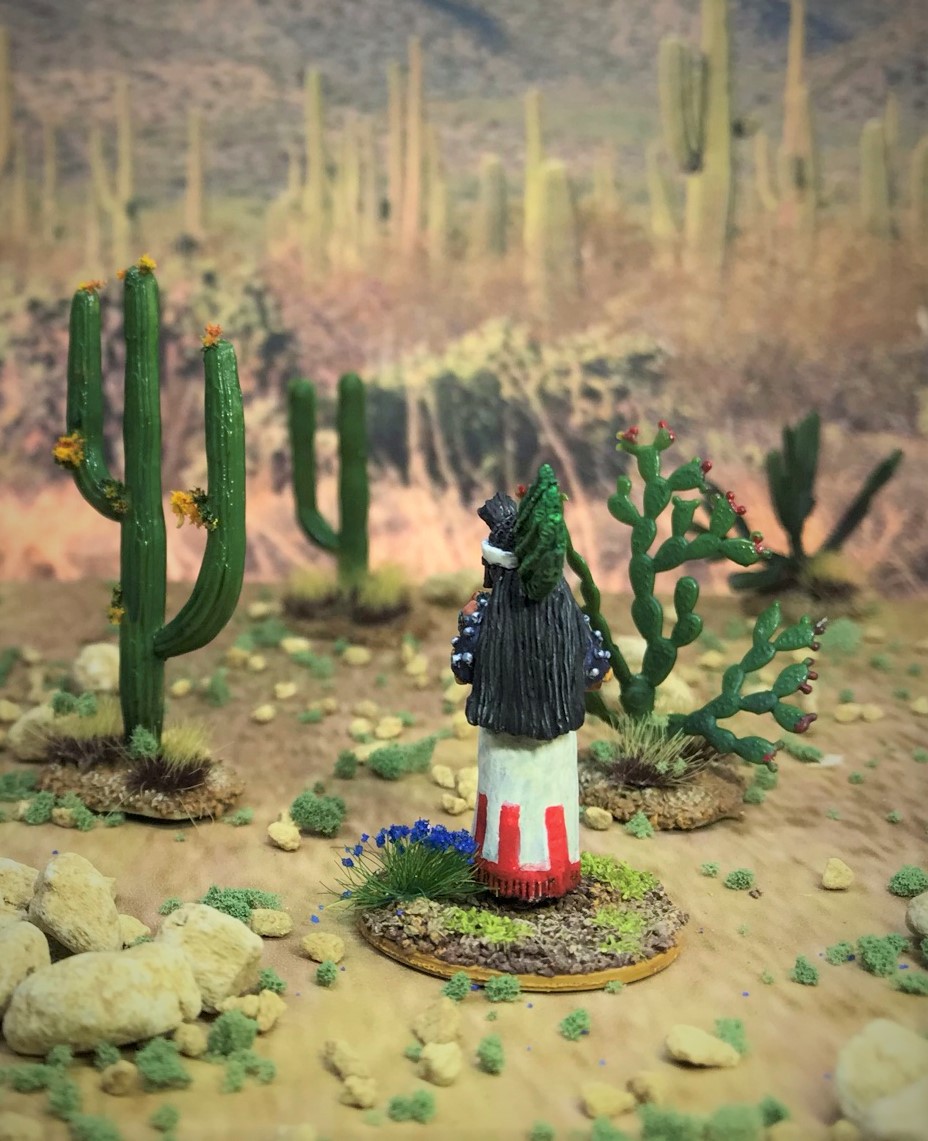
Thanks for looking – please let me know your thoughts and feedback!


Aztec Eagle Warriors from Tin Soldier UK

As shown in my last post, I have started building forces of appropriate figures for tabletop wargames using the soon-to-be published Feudal Patrol™.  These are Aztecs and other troops from the era of the Spanish Conquest in the 16th Century.  This is a major project for which I eventually hope to have over 150 painted figures.  I have a ways to go, as this project brings that total to a mere 18.  Still, the journey of 1,000 miles begins with a single step…

I acquired a large lot of Aztec figures on eBay probably 4 or 5 years ago.  Most of them 25mm scale, and from Ral Partha dating from around 1988.  In the lot were also two baggies of 3 Aztec Eagle Warriors (#25 AZ4) – ostensibly 25mm as shown on the Tin Soldier UK website.    I was not familiar with Tin Soldier UK, but they have a pretty nice range of figures worth checking out.  Of course, 28mm is the scale that I am going for – and sometimes 25mm can work for 28mm.  While I was waiting for my order of new 28mm stuff to arrive (which I received this week), I decided to paint up some of the older figures and see if they could work with my 28mm figures visually.  To my eyes, the Tin Soldier UK Eagle Warriors looked close enough to 28mm to work.

1 Tin Soldier 25AZ in bags
The Tin Soldier UK baggies of Eagle Warriors.  Note the noodle-like tepoztopilli (obsidian-bladed thrusting spears) – more on that in a bit.

The Aztecs had two main elite unit types – the Jaguar Warriors,  and the Eagle Warriors (sometimes referred to as the Eagle Knights).  There were also the lesser-known Arrow Knights, which I will post about next time.  To be an Eagle Warrior, one had to have captured up to 20 enemy for sacrifice or equivalent deeds of valor (well, in the eyes of Aztec society anyways).  They were full-time professional warriors and along with the other elites were equivalent to nobility among the Aztecs.

Normally, Aztec Eagle Warriors would be armed with melee weapons, in particular the macuahuitl obsidian-edged club/sword.  All of these 6 had the same pose and were armed with tepoztopilli (obsidian-bladed thrusting spears).  They also had the weapons in a throwing versus a thrusting pose.  Therefore, I decided to go through the 25mm Ral Partha Aztecs that I had and see if I could get any macuahuitl or cuauhololli (round-headed club) as extra weapons.  The extra Ral Partha macuahuitl were way too small and bendable, but there were some cuauhololli that would work.  I ended up using two of the cuauhololli and four of the tepoztopilli as weapons for the six.  My plan was to orient each of  their weapons slightly differently and also to have different shield patterns and different colors for authenticity and ease of tabletop play.

Now, as for the spaghetti-like tepoztopilli, they needed a solution as they were made from lead and were as floppy and vulnerable to bending as most leaden miniature spears are unfortunately, especially those from the 1980’s and earlier.  The odd thing is that the model shown on the website indeed does have a macuahuitl instead of a tepoztopilli!  My guess is that they redid the mold at some point as these model thrusting spears were too weak for use in gaming.  In any case, I decided to try using a thin layer of Apoxie Sculpt on the shafts.  Apoxie sculpt is easy to use and can be made more workable when used with wet fingers – and it gets hard as a rock when it cures in 24 hours.  This process gave me much improved tepoztopilli, but still the underlying lead made them somewhat (though less) vulnerable to bend.

2 Tin Soldier 25AZ limp tepoztopilli
This bendy tepoztopilli will not do!

5 AZ4
From the Tin Soldier UK website – I definitely would have preferred this macuahuitl as a weapon for the models – but it is available now.

3 Tin Soldier 25AZ limp tepoztopilli Apoxie Sculpt
My set up for firming the tepoztopilli shafts – first I straightened them with a pair of needle-nosed pliers then rolled on wet Apoxie Sculpt.  Insert crass joke here…

5 Tin Soldier 25AZ Apoxie Sculpt limp tepoztopilli fix
New shafts reinforced with the Apoxie Sculpt after a 24 hour cure.

The models themselves were not too difficult to assemble.  I did need to clean up the mold lines and the hands needed to be drilled out carefully to hold the weapons.  I did pull out some of the molding rubber out of one model’s eyes, but overall I was happy with the quality of the castings.  I definitely liked that the shields were not separate.

I made a unit plan as there were many ways to do the unit – and I wanted to have something to refer to along the way.  In particular, one of my goals for this project was to give each Eagle Warrior a different shield design – and for that design to be historically correct.  Over at Steve’s Balagan, I found his blog to be a wonderful resource for Aztec and other shields.

6 Tin Soldier 25AZ the plan
Eagle Warriors primed and the painting plan – I did end up deviating a bit as I observed the colors of the models.

Most pictures that I have found on Eagle Warriors showed them in golden brown outfits – but some mention that there were possibly red, green, and blue ones as well.  I decided to make three in golden brown, and then make the others in red, green, and blue.  The accouterments and shields would also add to the differentiation on the tabletop.  Unlike the novices, the pics that I saw of Eagle Warriors all had orange loincloths, so that feature was common here.

7 Tin Soldier 25AZ April 29 progress
By April 29th, I had the basic colors down.  Citadel contrast paints were useful with these models, as their details for the most part were not really suited for dry brushing as opposed to shading.

8 Tin Soldier 25AZ April 30 progress
Progress by April 30 – still needed to paint the shields and weapons.

9 Tin Soldier 25AZ April 30 progress close up
Close up of April 30 progress.

My next big challenge was painting designs on the shields.  My handwriting is awful, and hand-drawing designs on shields has not been a strength for me – and these are tiny.  I decided to let the engineer in me break out.  I used an art template to trace a 9/32″ circle on a piece of paper, and then I cut that out.  It proved useful in helping me to lightly sketch the designs on the shields in pencil – as guides for painting.  I tried several designs that I saw on Steve’s Balagan blog.

10 Tin Soldier 25AZ May 1st shield template
Putting the template on the shield for marking up designs.

I wanted to get these done for the weekend, and my wife helped fuel my push with a home-made pizza (that tasted even better than it looked!).

11 Fuel to finish
Fuel for the finish!

Below are a couple of WIP shots after I finished painting the shields – for me, this was a result that I was surprised to see.

12 Tin Soldier 25AZ May 1st shields painted 1 to 3
Close up of Eagle Warriors 1, 2, and 3 showing shield details.

13 Tin Soldier 25AZ May 1st shields painted 4 to 6
Close up of Eagle Warriors 4, 5, and 6 showing shield details.

On May 1, I finished them with flocking and varnishing, ending with some static grass (all the materials I used are listed at the end for those interested).  This counts hopefully as my second entry into Ann’s Immaterium Painting Challenge “Paint the Crap you Already Own”.

14 Tin Soldier 25AZ May 2nd ready to go
The Aztec Eagle Warriors ready to come off their painting posts.

Here are some close up and group shots of the project:

Eagle Warrior 1, with tepoztopilli:

Eagle Warrior 2, with tepoztopilli:

Eagle Warrior 3, with tepoztopilli:

Eagle Warrior 4, with tepoztopilli:

Eagle Warrior 5, with cuauhololli:

Eagle Warrior 6, with cuauhololli:

Lastly, a couple of group shots:

22 group shot 1
Eagle Warriors attacking!

23 group shot 2
Close up shot – do you have a fave?

As for scale – here is a comparison between a 25mm Eagle Warrior and a 28mm novice warrior  – I think they will be OK.  Do you?

24 scale shot

What do you think?  Always wondering that – so let me know below in the comments section.  Now it’s back to painting more figures during the lockdown and beyond…

PAINTS, INKS, GLAZES, SHADES, WASHES, PIGMENTS, FLOCKING, GLUES AND MORE USED ON THESE AZTEC EAGLE WARRIORS:

  1. Apoxie Sculpt (White)
  2. Gorilla Glue
  3. 1/8″ x 1″ Everbilt Fender Washers
  4. E6000 Epoxy
  5. Poster tack and plastic plates
  6. Vallejo “Surface Primer – White Primer”
  7. Vallejo “Flow Improver”
  8. Vallejo “Airbrush Thinner”
  9. Testors “Universal Acrylic Thinner”
  10. Vallejo Model Air “Weiss” (off-white)
  11. Battlefront “Wool Brown”
  12. Battlefront “Dark Leather”
  13. Citadel “Contrast Paint – Gryph-Hound Orange”
  14. Vallejo Model Color “Sunny Skin Tone”
  15. Citadel “Contrast Paint – Skeleton Horde”
  16. Citadel “Contrast Paint – Blood Angels Red”
  17. Citadel “Contrast Paint – Creed Camo”
  18. Citadel “Contrast Paint – Aethermatic Blue”
  19. Vallejo Model Color “Basic Skin Tone”
  20. Citadel “Contrast Paint – Fyreslayer Flesh”
  21. Citadel “Contrast Paint – Iyanden Yellow”
  22. Army Painter “Light Tone” (shade)
  23. Vallejo Mecha Color “Turquoise”
  24. Vallejo Game Air “Black”
  25. Vallejo Model Air “Moon Yellow”
  26. Vallejo Model Air “Armour Brown”
  27. P3 “Sunshine Yellow” (ink)
  28. Vallejo Model Color “Red”
  29. Vallejo Model Color “Black Grey”
  30. Vallejo Model Color “Sunny Skin Tone”
  31. Battlefront “Chocolate Brown”
  32. Vallejo Mecha Color “Brown”
  33. Citadel “Contrast Paint – Flesh Tearers Red”
  34. Vallejo Game Air “Escorpena Green”
  35. Vallejo Model Color “Dark Blue”
  36. Citadel Air “Evil Sunz Scarlet”
  37. Citadel “Contrast Paint – Wyldwood”
  38. Citadel “Balor Brown”
  39. Vallejo Model Color “Glossy Black”
  40. Citadel “Seraphim Sepia” (shade)
  41. Elmer’s PVA Glue
  42. Army Painter “Brown Battlefields” (flocking)
  43. Vallejo “Dark Yellow Ochre” (pigment)
  44. Vallejo “Burnt Umber” (pigment)
  45. Americana “Desert Sand”
  46. Vallejo Mecha Varnish “Matt Varnish”
  47. Army Painter “Grass Green” (flocking)
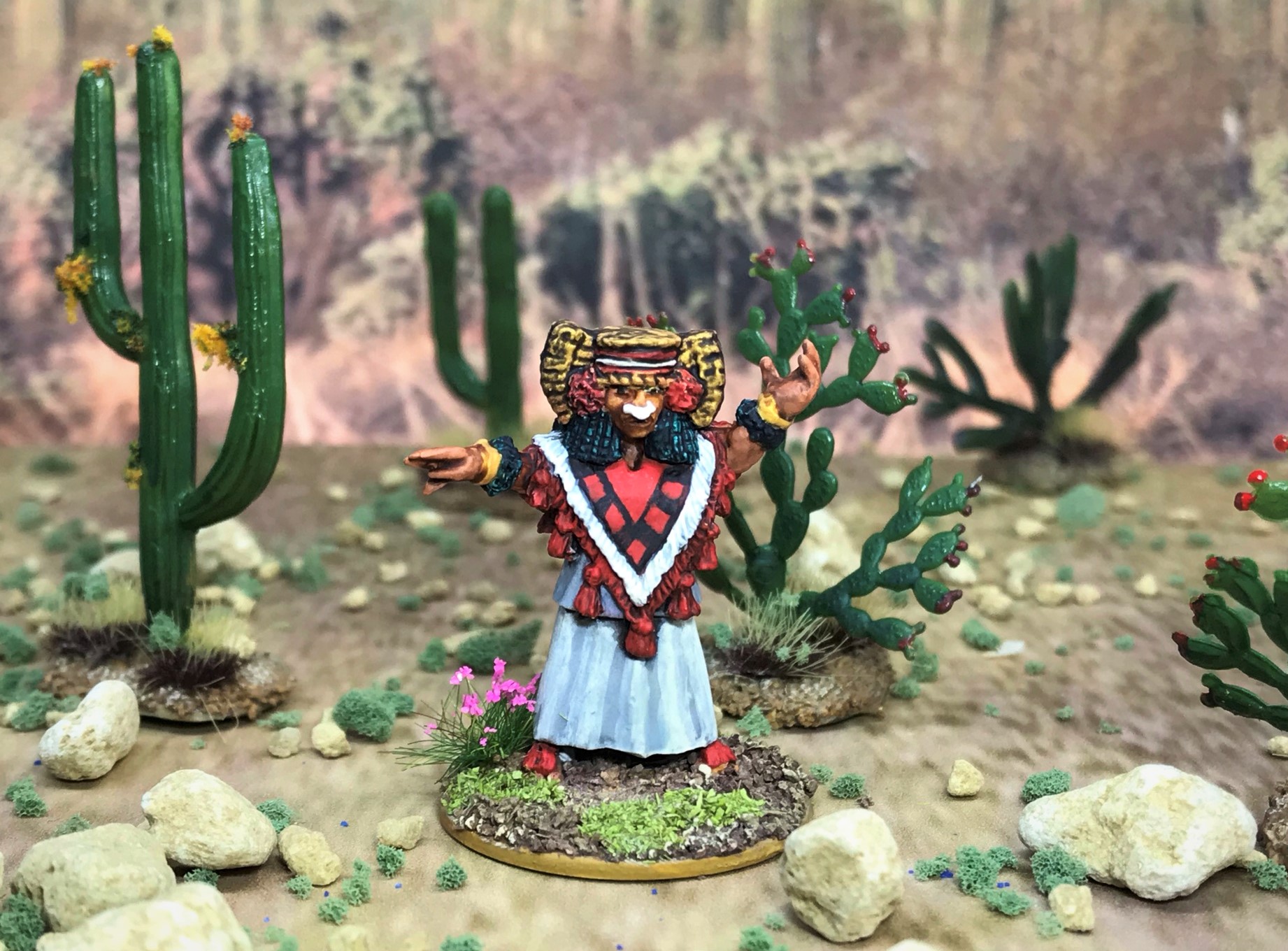
Thanks for looking – please let me know your thoughts and feedback!

Gisby's Gaming Blog

Miniatures gaming projects, products, and reviews

Carrion Crow's Buffet

Narrative Wargaming, Fiction and General Musings on the Universe

Despatches from Fort Syllabub

An account of fictional adventures on the North West Frontier - and other times and places, real or imagined

Man of Tin blog

Toy soldiers, gaming, Imagi-Nations

Zauberwurfs Blog

Ein Blog über Tabletop und Miniature Wargames.

Frank Tank Rants

musings of a fat old bloke on tanks and wargames

Dragons of Lancasm

Games, miniatures, painting, books and more games

Tiny Painted Heroes

The Adventures of a lifelong Tabletop Gamer, Game Design hobbyist, and full-time Software Engineer

Steve's Paint Brush

Grimdark model making and mini painting

Wargamesculptors Blog

Life, Golf, Miniatures, & Other Distractions

Dead Dick's Tavern and Temporary Lodging

Life, Golf, Miniatures, & Other Distractions

Guru Pig - the gaming Guru

Guru's thoughts on wargaming, life, and the universe!

Wisely lead... without a head!

History, Miniatures and Wargaming

Kuribo's Painting

Fallout Wasteland Warfare, Warhammer, and Hellboy Painting, Terrain, Dioramas, and Battle Reports

Don't Give Greg Ideas

Seriously, just don't

War Across the Ages, and other dark horrors

A discussion of miniatures collecting, painting and gaming.

Classic Warhammer 40K

Painting diary focused on Warhammer 40K 2nd ed., 5th ed. WHFB, related GW games, and miscellaneous whimsy

Colonel Mustard

WW2 Modelling in 1/72 Scale

Bogenwald

Random painting and terrain making.

Pat's 1:72 Military Diorama's

Scale diorama tips and ideas

Arcade Dreams

Building the Arcade Dream

P.B.Eye-Candy

Phil's 20th century wargame pages

SP's Projects Blog

A futile fight against entropy or 'Every man should have a hobby'? Either way it is a blog on tabletop wargames, board games and megagames

30mmdave

Wargaming Plausible reality?

The Imperfect Modeller

Miniature Figure Painting and Diorama Modelling

Double Down Dice

Painting miniatures and rolling dice!

Just Needs Varnish!

My ongoing wargames projects!

miniaturepopcorns

Sculpting some worlds

Despertaferres

Wargaming with the ability of a dull nine year old

Dawn of the Lead

Miniature wargaming and the occasional zombie

Rantings from under the Wargames table

Wargames, Figures, Sculpting and Converting Miniatures

Simple as War

Miniatures & Terrains

Buck's Blog

Life, Golf, Miniatures, & Other Distractions

IRO aka Imperial Rebel Ork

- I model - therefore I am -

Azazel's Bitz Box.

Painting, Modelling, Miniatures, 1:6, Games... Whatever else I find interesting.