Creating a WWII Vichy Counterattack Game Scenario

Over the summer, happily, golf dominated my free time for the most part. I didn’t really have much time for hobby work or wargames. Blogging about what little I did complete or participate in fell to the wayside. The “little” that I refer to is work on my 15mm/1:100 scale WWII scenario, Operation Torch: Vichy Mounts a Counterattack. This scenario is part of a What a Tanker game. It is set in Morocco in November 1942. The Vichy French responded to the American landings during this time with an armored counterattack.

It is a little-known clash. France the June 1940 post-armistice was titurlarly neutral, and had the responsibility to defend its colonies against any allied invasions. At this time in 1942, the Soviets were under massive German pressure on the Eastern Front. They were begging the Allies to get in the fight against the Germans – anywhere at all. However, at this point in the war, the US/UK were not in a position logistically to assault Fortress Europe. They also lacked the necessary forces to execute such a mission successfully.

The invasion of North Africa – and the colonies of Vichy France – became the compromised option. Operation Torch thus came to be. In addition, this assault would open up a line of attack on Rommel’s rear. This would reduce pressure on the British 8th Army in Egypt. However, no one knew how much the Vichy French would resist.
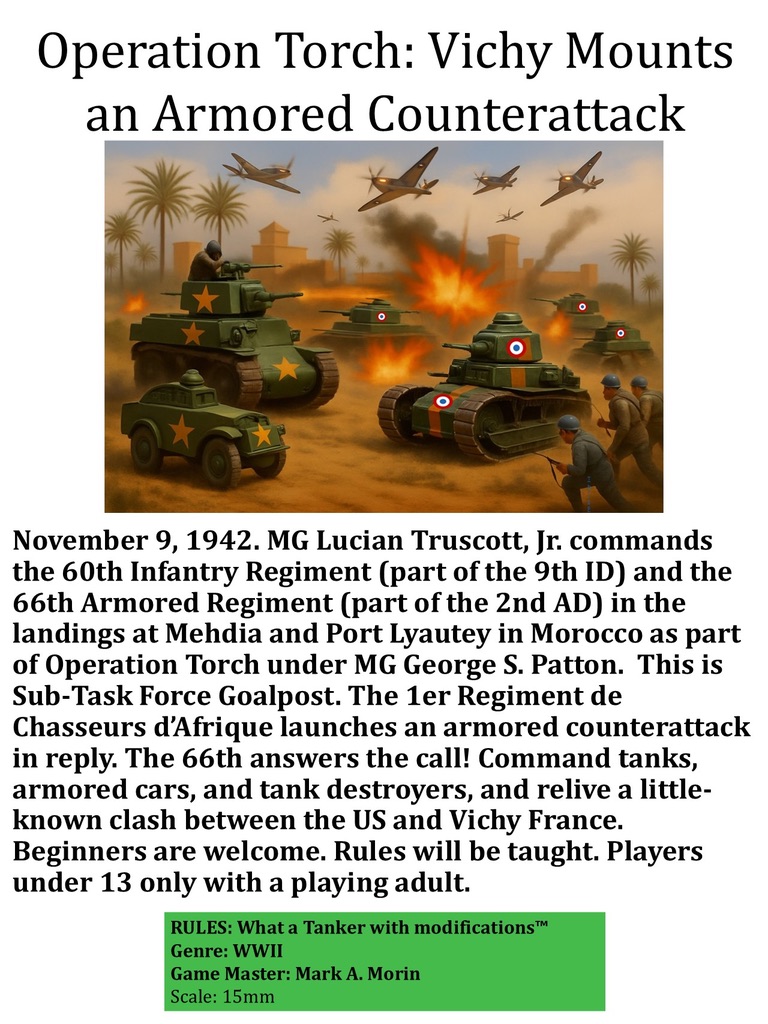
My flyer for the game scenario.

As I write this, the 2025 golf season is over now. At least it is here in balmy Massachusetts in November. It’s time for me to capture my summer and fall efforts that led to my running this games at conventions. This post will cover some of my preparations, upgrades, and the actual games themselves. I will discuss the initial games at HMGS HISTORICON, then my upgrades, then the games at HMGS FALL IN! and EllisCon.

By the time I attended HISTORICON in July of 2025, I had the scenario pretty much where I wanted it. I had play-tested it with friends, and was ready to roll it out. This year, in total I have run the game twice at three different conventions. These are HMGS HISTORICON in July, and both HMGS FALL IN! and EllisCon in November. This makes six iterations so far since the spring.

For vehicles for the game, I have finished many AFV’s for that I have discussed in previous posts. Here below are those posts in reverse chronological order in case you missed them:

  1. M5 Stuart tanks for “Operation Torch: Vichy Mounts an Armored Counterattack” Game
  2. US Vehicles for Operation Torch: TANK DESTROYERS – M3 GMC’s and M6 GMC Fargo’s
  3. US Vehicles for Operation Torch: M3A1 Scout Cars
  4. French Armor for Operation Torch: Panhard 175 TOE’s, Laffly S15 TOE’s, and Berliet VUDB’s
  5. French Armor for Operation Torch: Hotchkiss H35’s, H39’s, and Renault R35’s
  6. French Armor for Operation Torch: Renault FT-17’s
  7. French Armor for Operation Torch: White-Laffly AMD 80’s & Schneider AMC P16’s
  8. Operation Torch: Planning My WWII Gaming Experience for HISTORICON
The vehicles for the game
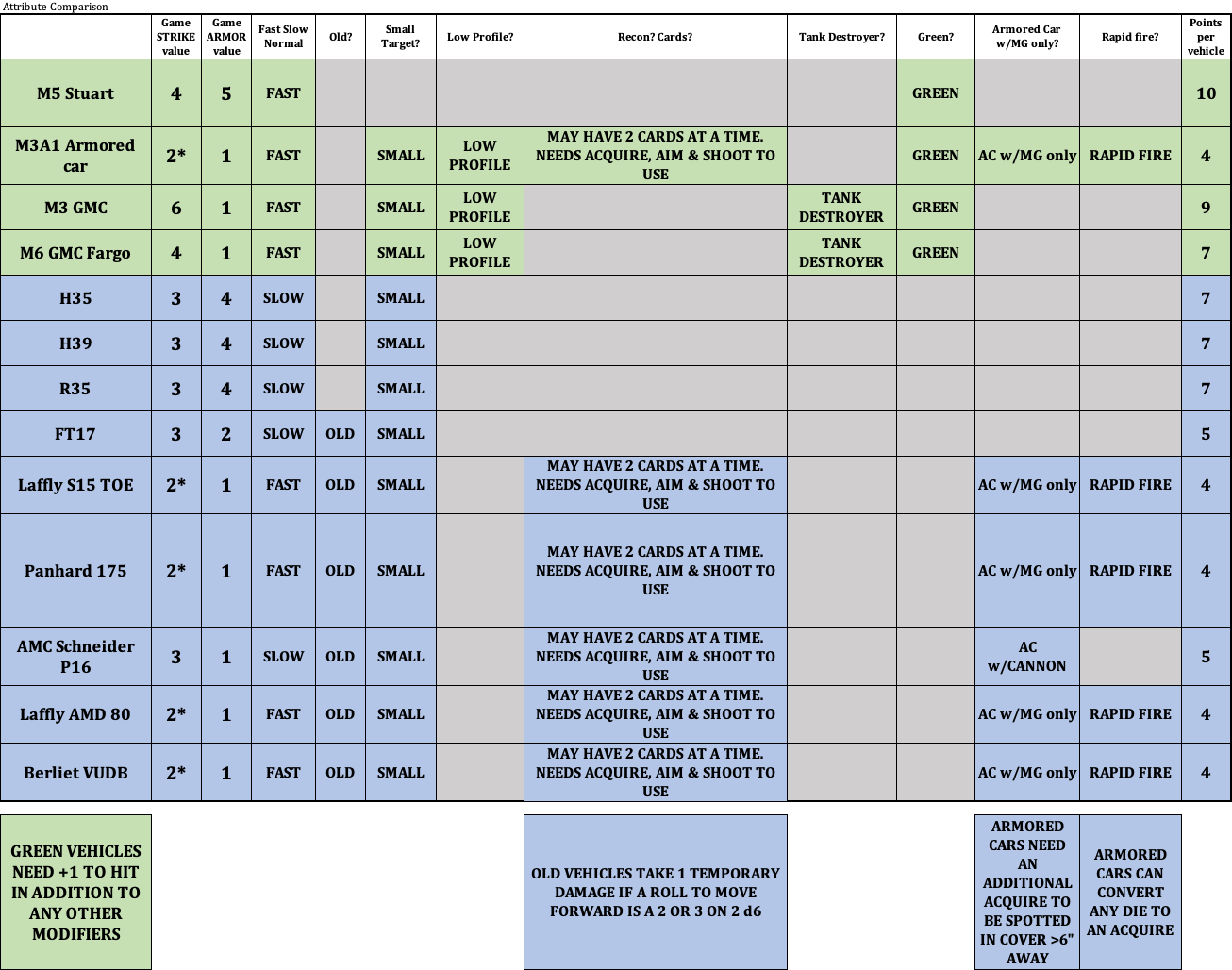
AFV attributes for the game

In addition to the vehicles, many game aids also were on my to do list. Before HISTORICON, I made road sections and town bases out of poster board and painted them. I also built dice boxes and dice frames for ease of play. Plus, I needed more blast markers for destroyed vehicles.

I was making these dice aids to make play better. What a Tanker is a great game. However, for a multiplayer game at a convention, the activation sequence is not the greatest. It does not keep the players engaged. I decided to borrow Buck services Double Random ActivationTM activation methodology, and that seemed to serve the game well. I also added Bonus Attack Cards and other changes as discussed in the next section.

Overview of My Scenario Rules Modifications

The game uses modified What a Tanker rules. The major modifications that I use are:

  • The game starts with each player receiving $75 in Tanker Bucks.
  • Before there are any play or purchases of extra resources, there is a VICHY FREE ATTACK PHASE. All US vehicles on the table will receive both 1 French infantry attack and 1 French AT attack.  This phase represents the Vichy infantry attacks that were repulsed in November 1942 prior to the armor engagement. This happens only once at the beginning of the game.
  • There is an ACQUISITION PHASE after the free attacks conclude. More vehicles and Bonus Attack Cards may be purchased. This phase happens once at the beginning of each turn.
  • Uses of Bonus Attack Cards in the game simulate infantry, anti-tank, artillery, naval gunfire, and air actions. These are deployed by scout cars according to each sides’ historical capabilities. These cards can be shared across the team. Bonus Attack Cards are purchased with “Tanker Bucks”, which also play into Victory Conditions. Having more Tanker Bucks at the games end is better, as high amount remaining wins the game. I allow teams to share their Tanker Bucks as well. However, you need to use resources to defeat the enemy. You earn $25 for each AFV or plane destroyed. See the card below to see the costs for acquisitions and for rewards. So, a balancing act exists for the players. Do they hoard their Tanker Bucks, or use them effectively against their opponent?
Costs and Rewards as shown on the requisition form.
  • To represent the French vehicles’ advanced age and mechanical unreliability. “OLD” French vehicles that try to move and roll a 3 or less will lose 1 die to temporary damage. Mathematically, there is an 8.33% chance of that happening. So a good number of the Vichy Forces are indeed OLD (mainly the armored cars and the FT-17’s). In addition, all of the French tanks and some armored cars are SLOW – which limits their advances. But, in the game, there are more of them, and not all of the French tanks are OLD.
  • Any vehicle touching a road can convert any die to a DRIVE dice.
  • Armored and scout cars may engage other armored cars and tanks with heavy machine guns or deploy Bonus Attack Cards. Also I have rules that show how devastating any cannon fire would have been against thin-skinned vehicles. Cannon fire causes double hits on thinly armored vehicles that are not tanks.
  • The US Army was inexperienced before these landings. To represent that, their status is GREEN at this point in the war. GREEN means their base roll needed to hit increases. It goes from needing a 6 on 2d6 added together to a 7 as a base number. Most of the French vehicles are SMALL. This necessitates an additional +1 to hit at short range. There is also another +1 at long range. Oh yeah, the Stuarts have just a 37mm gun. This means that the US has a tough time making damaging hits at long range against French tanks.
  • The US use of Bonus Attack Cards is limited to just the US Scout and French Armored Cars. The M5 Stuart’s radios got wet during the landings and were not working. Many French tanks in North Africa did not have radios. The one-man-turrets in all of these Vichy tanks made coordinating activities very difficult.
  • To represent the fight for air superiority, I added Bonus Attack Cards that allow the deployment of French Dewoitine D.520’s and American carrier-bases F4F Wildcats. These vie for air superiority and can also convert to ground attack missions with other Bonus Attack Cards as well.
  • Having air superiority enables the US player to deploy the Avenger TBM’s as spotter planes. These can improve US artillery accuracy significantly. They also can also bomb the French vehicles with depth charges (yes that happened). Lastly, Avenger deployment also opens up the chance for devastating naval gunfire from the light cruiser USS Savannah.
  • Modifying the activation sequencing methodology by using Buck Surdu’s “DOUBLE RANDOM TM ACTIVATION” method.
  • Because of the different activation sequence from What a Tanker, I now use three types of dice. Larger white d6 are used for COMMAND DICE (these let your AFV take actions). Larger colored d6 are used for ACTION DICE (for rolling for movement and firing). Smaller colored d6 are used for ACTIVATION DICE (to, well, activate an AFV in the game).
  • Scoring is done with TANKER BUCKS. Most wins at game end. See the rules file below (downloadable) for all the details.

I was asked to share my rules on the Facebook What a Tanker page. As I am a wicked nice guy (as we say here in Massachusetts), I am happy to do so. Below is the Word document that outlines all of the rules changes in detail. Feel free to download. If you use them, please do share your thoughts and experiences with me, I’d love to hear them.

Let’s look at some photos from the HMGS HISTORICON convention games next.

HMGS HISTORICON 2025 PHOTOS OF THE GAME

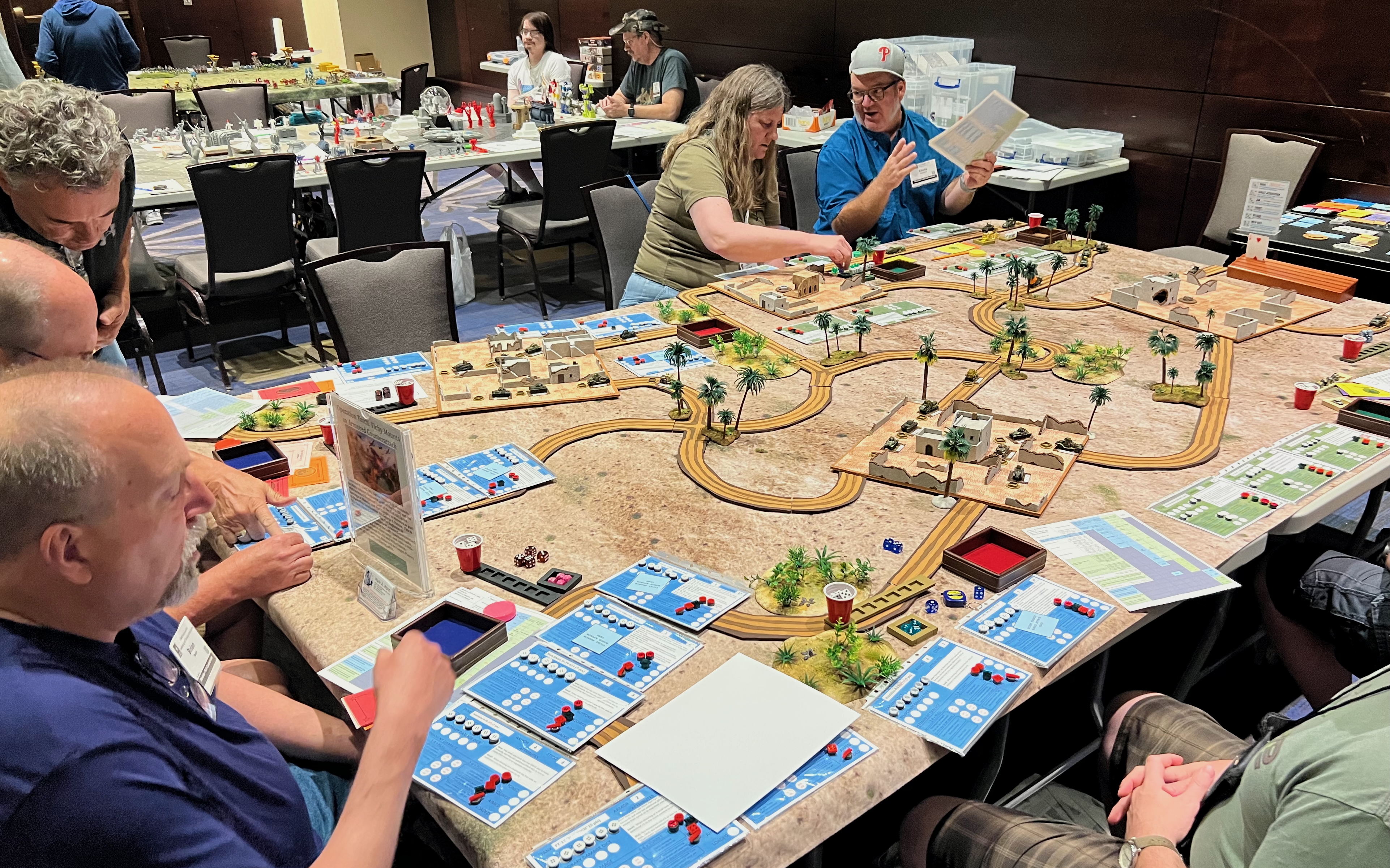
I ran the scenario twice at HISTORICON in July 2025. The games went well. Each side won once.

The tabletop set up from the French side. Note the painted poster board roads and town pavements.
Each French player started with 5 vehicles. The number of American vehicles varied by player, usually 2-3 including one M5 Stuart tank.
Set up with Tanker Bucks. I did eventually decide on $75 per player on each side with the differentials being the cost of resources.
The players from the first game – the French won here.
In the second game, the US won. This victory was mainly because Dan Eustace successfully used his Bonus Attack Cards. He successively achieved air superiority with Wildcats, then got the Avenger deployed. This led to calling in naval gunfire from the USS Savannah – unleashing a volley from its 15 6″ guns. The results on the French armor was devastating.

After the game, I pondered what improvements I could make. The tweaks in the rules are reflected in the file I shared previously. However, I need to add:

  • More game aids like dice holders
  • More blast markers
  • Better roads – I wanted rubber ones that laid flat and took up less space in a box.
  • Better town bases that also were rubber and laid flat on the tabletop.
  • Actual plane models to represent the aircraft. I was using photos on flight stands at HISTORICON for the planes, and I wanted better.

I wanted to read a book on the campaign that I learned about. It was recommended to me in a comment to one of my blog post links on TMP. It focused on this phase of WWII, and I planned to do this before I did any more hobby work. Rick Atkinsons’s An Army at Dawn is a true gem of a historical book, and a must read. This was my August effort.
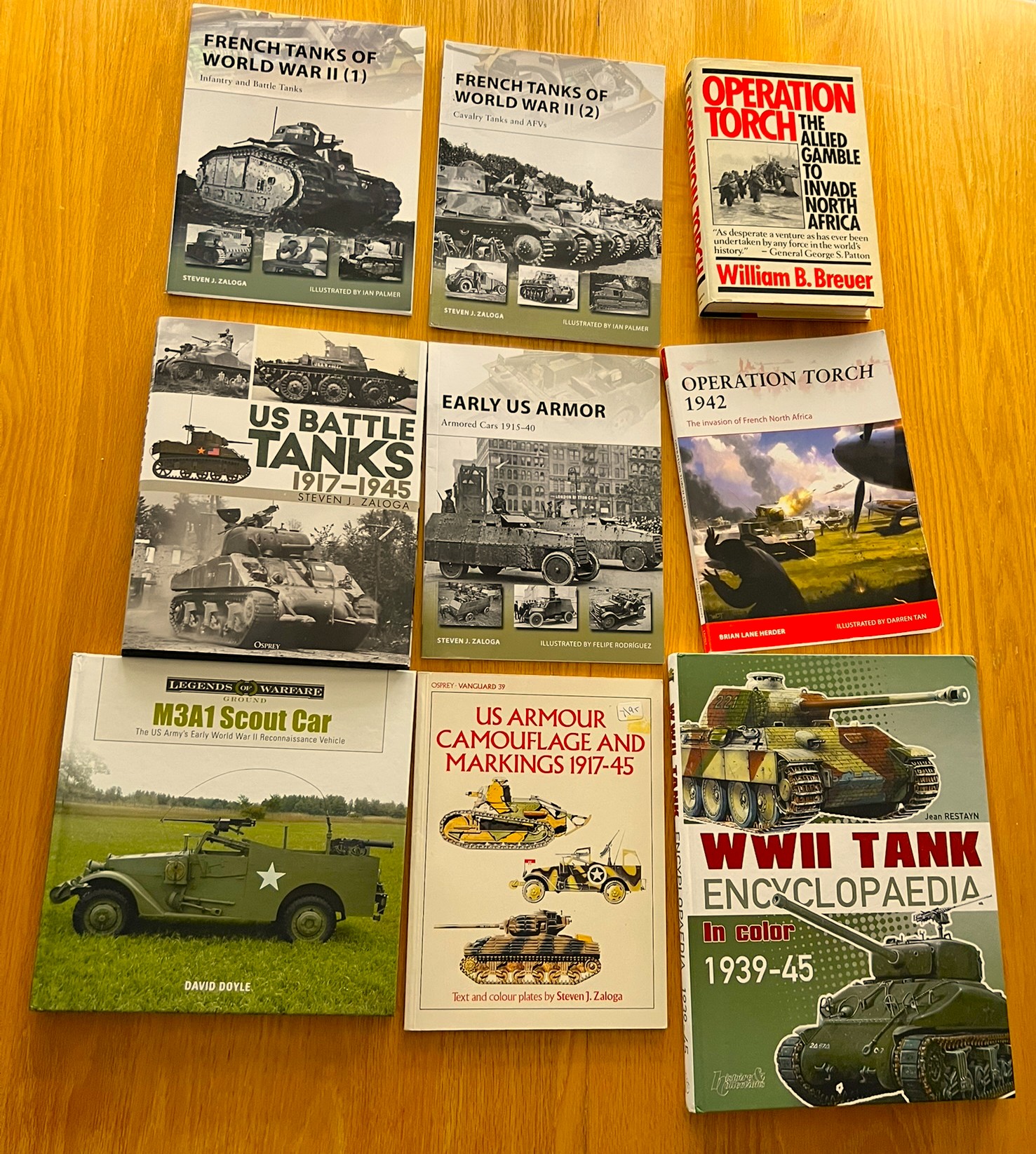
After reading these, it was time to get going on the additional “stuff” listed above. I knocked out the dice frames and similar tasks quickly. I had enough for 8 players, and now I was set for 10.

Building Dirt Roads and City Bases WIP Shots

Now it was time to make the roads and city bases. I stumbled on this excellent video on how to make rubber wargaming roads. It became the blueprint I used and I highly recommend his process.

Here is a link to the excellent video.

Below are progress WIP shots of how I built 54 sections of road and 4 bases.
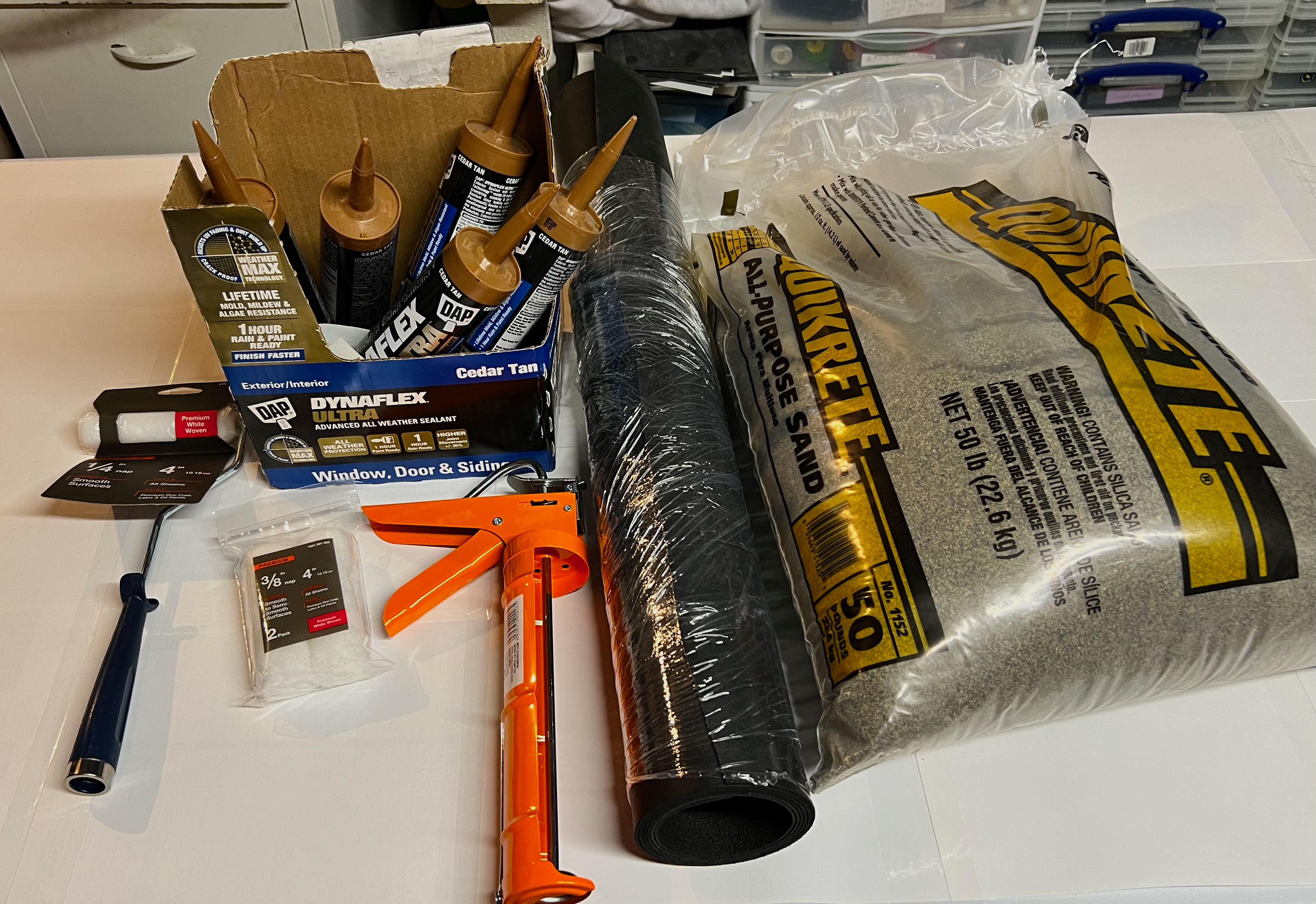
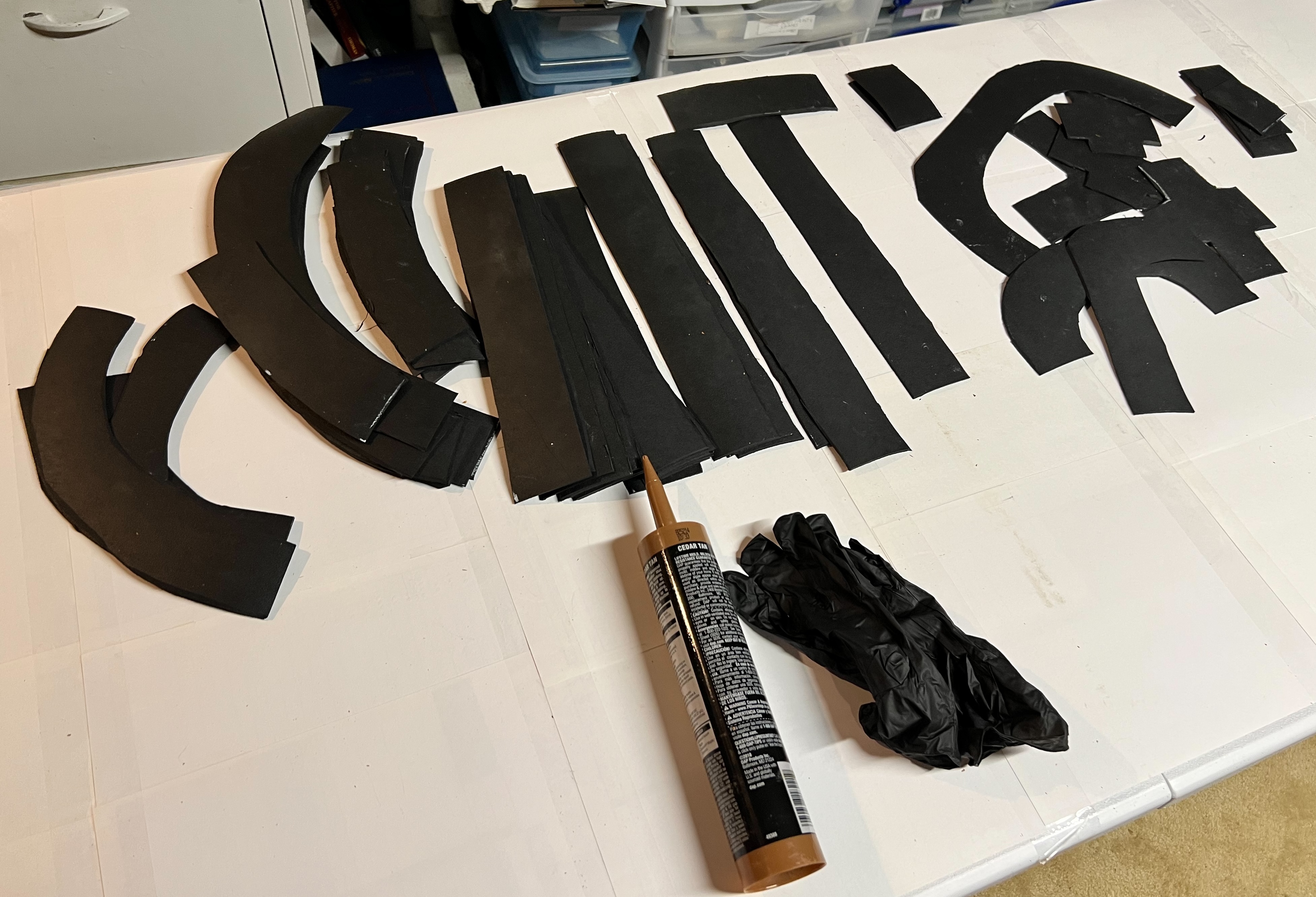
What I needed included a small paint roller, a caulking gun, and paintable caulk sealant. It also involved cutting up rubber floor runner material. Additionally, play sand and chinchilla dust were used on the roads for texture.
I cut the floor runner rubber with a box cutter on a wooden cutting board. I made the same number and types of dirt roads I had previously made with the poster board (54).

For a working space to work on the roads, I covered one of my gaming tables with paper. The sheets were secured with packing tape and this was sufficient to protect the table.
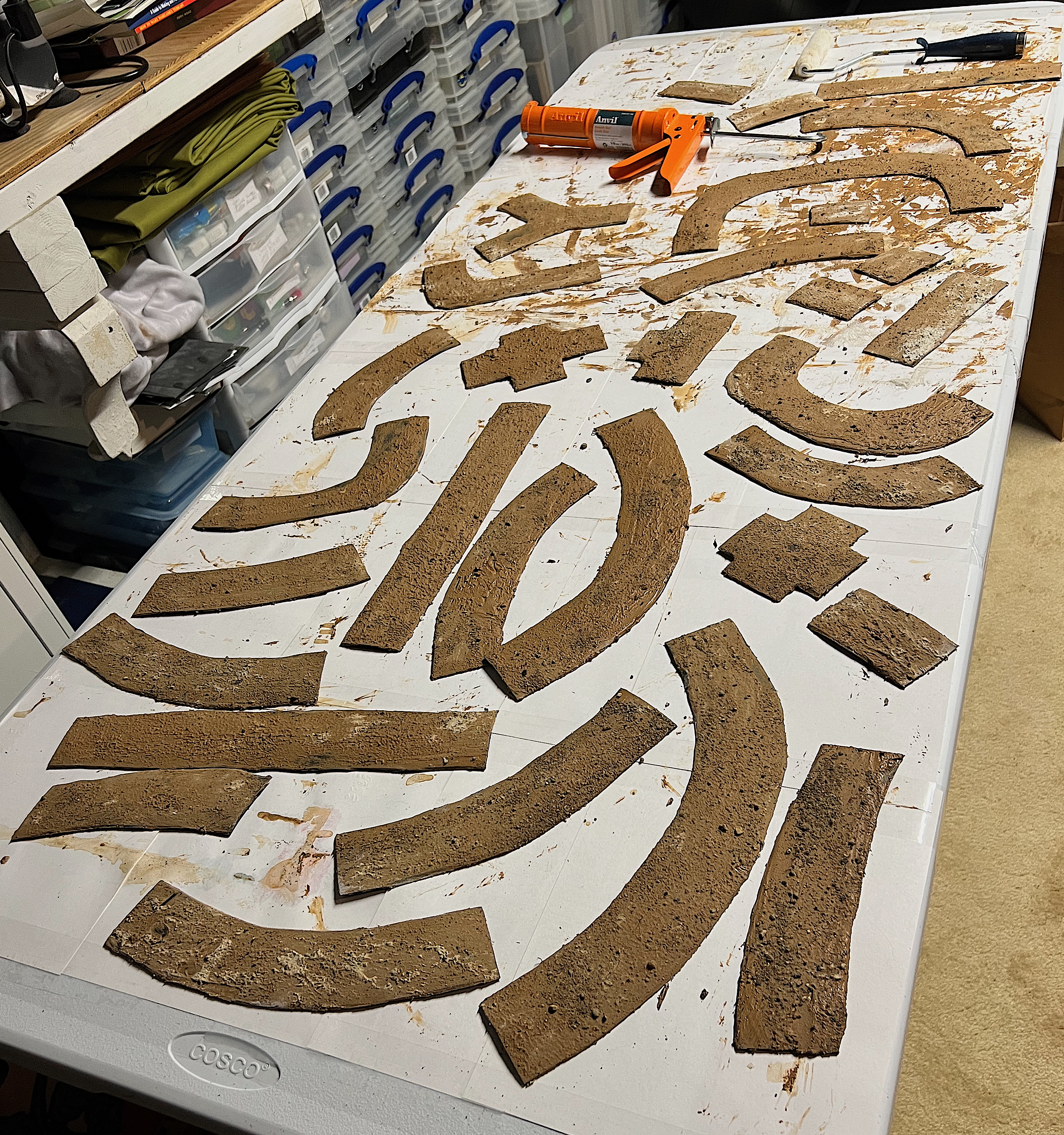
Here you see some of the road sections in progress. Sand and chinchilla dust were both rolled onto the caulk with a wet paint roller.
The first tranche of roads drying…
…and here painted minus some final dry brushing.
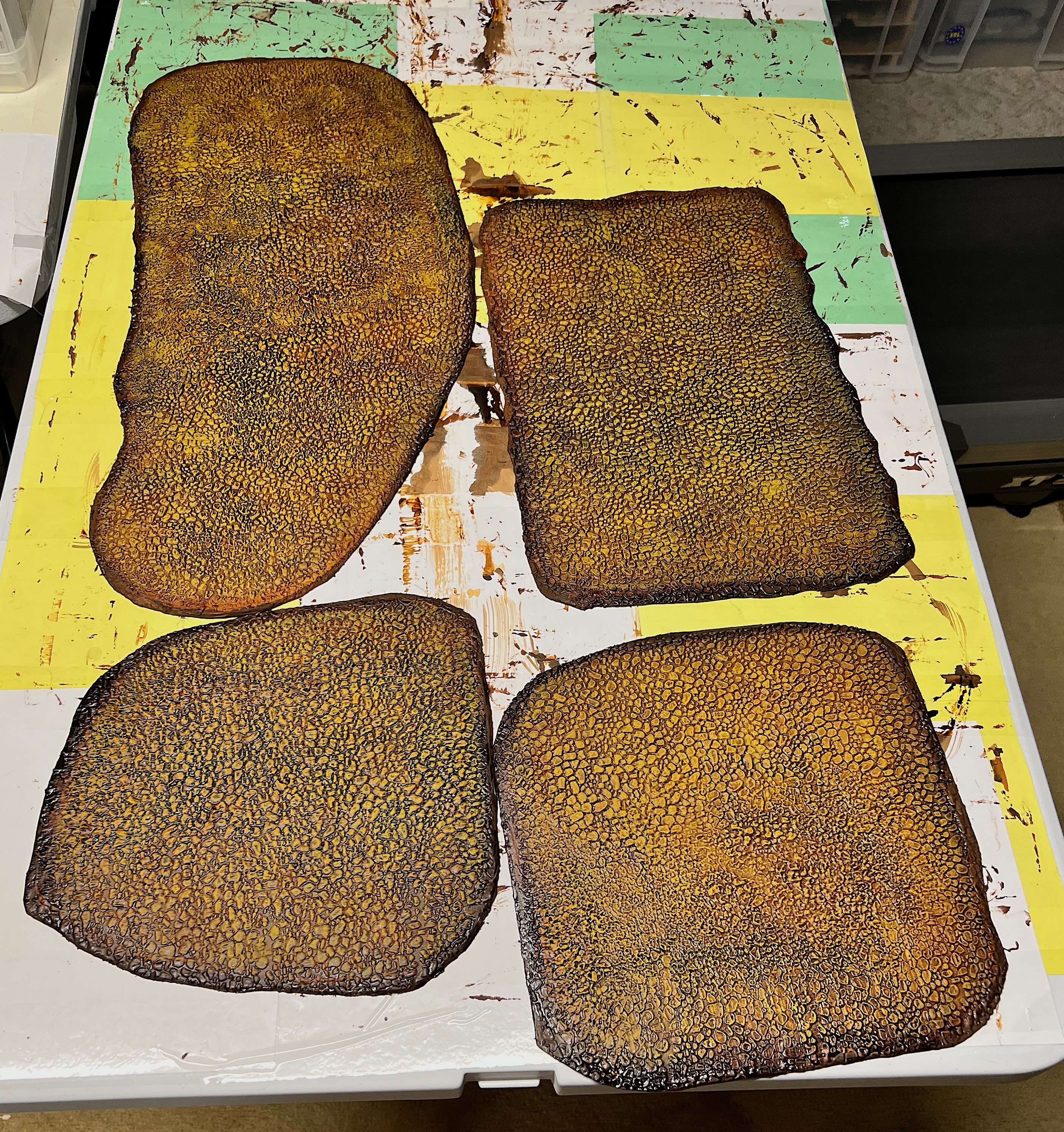
Then it was on to the city bases. I limited the width of the city bases to accommodate using a Green Stuff World Mega roller. The roller made a cobblestone imprint.Greg Priebe was kind enough to gift me the roller. Here I cut the first piece of rubber floor runner. As I did with the roads, I beveled the edges slightly. The edge angle was around 45 degrees.
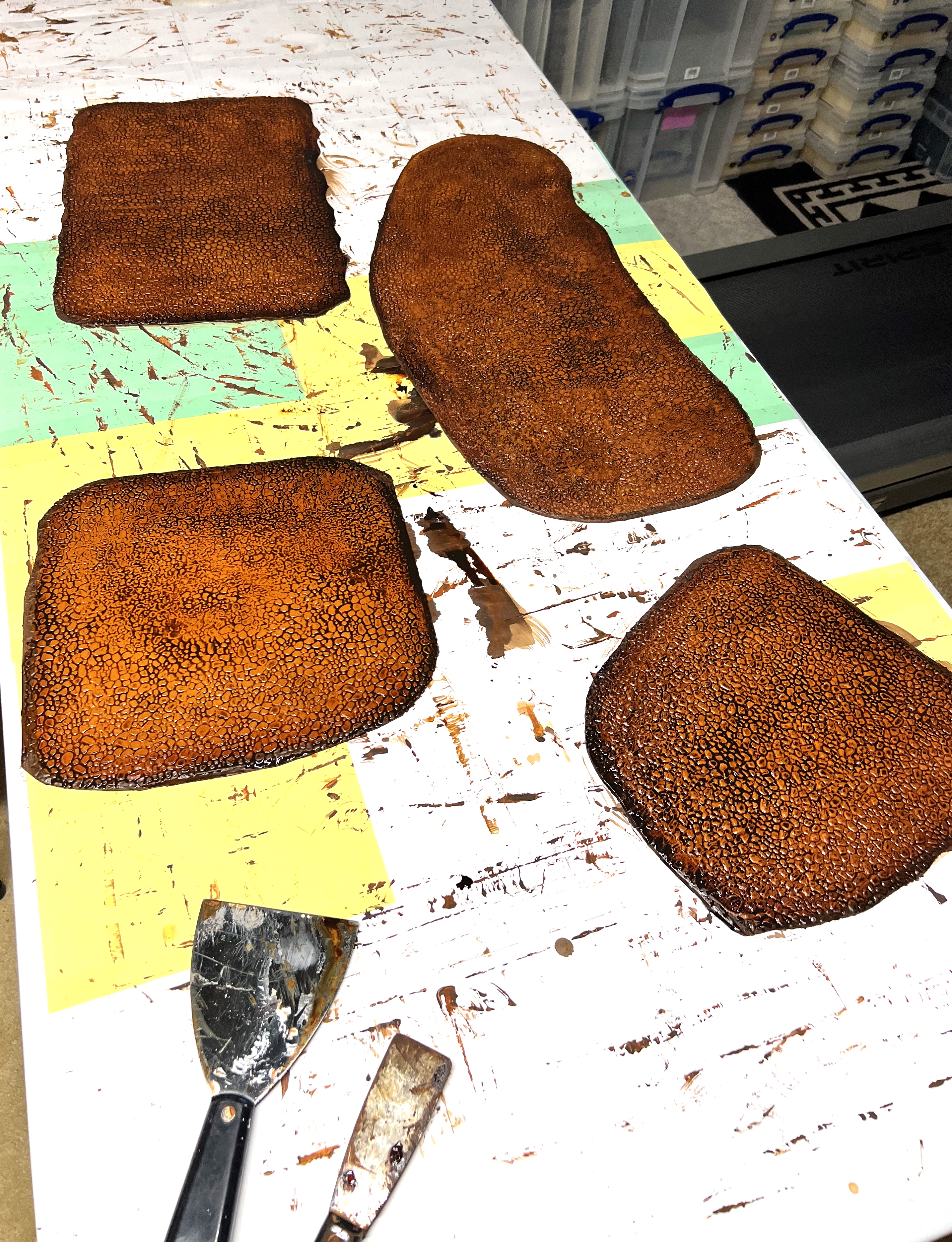
A caulking gun spread out the sealant. Then I smoothed it as you see with two different putty knives, before rolling the cobblestone patterns. This was the approach for all four bases – I just sized and shaped them differently.
The painting scheme was basically the same for all four. Here you can see the imprinted cobblestones. To accentuate them, I used a Liquitex “Burnt Umber” ink cut with thinner. Then I let them dry before adding a quick dry brush.
The final bases completed. I would place 15mm buildings on them.

This was far more economical than buying similar roads. Now that the dirt roads and town bases were completed, it was time to add my 3 aircraft.

Aircraft Model WIP Shots

My search initially was for the right three 1:100 scale planes, but that effort proved fruitless. No one really makes aircraft in that scale, at least not the ones that I was looking for. Most models were 1:72. I did find some die cast models that would work just fine. They are more like game status makers. Those diecast models were the carrier-based Grumman F4F Wildcat and the Dewoitine D.520. Both had flight stands – an important feature as I wanted their landing gear to be retracted in flight.

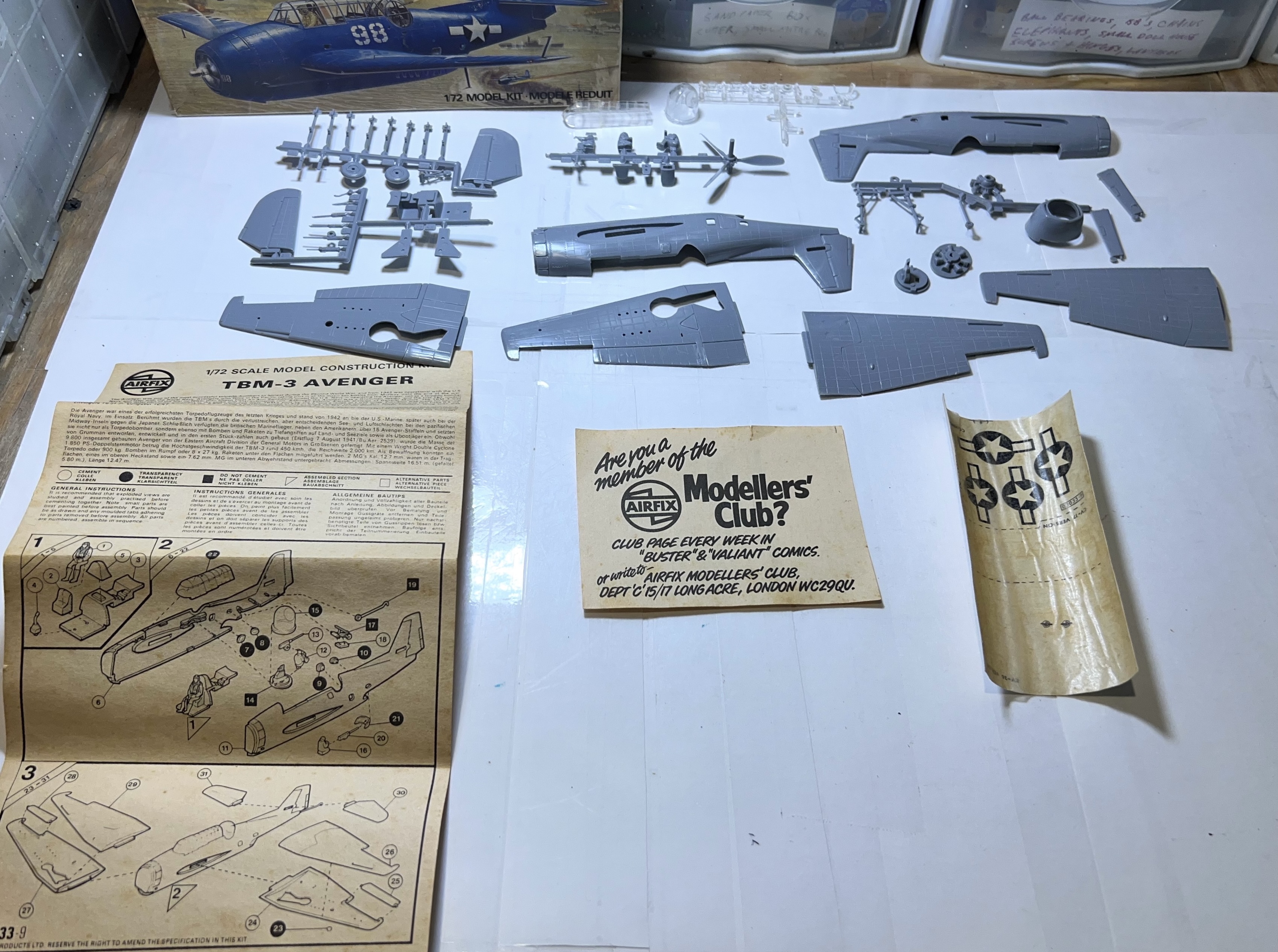
A bit of assembly for these two diecast models was required, but not much. That left the Grumman Avenger TBM to source. And lucky me, I found one on eBay – obviously left unassembled since at least 1979 – if not much earlier. It was an Airfix plastic model, and it was complete. The papers inside were amazingly yellowed with age as you will see. I had not built a plastic model like this since I was a kid. It was probably for sale back then!

The F4F Wildcat, the Dewoitine D.520, and the Avenger kit. It says “new”, but…I guess it was at some point in the 1970’s? 1960’s?
The kit contents.
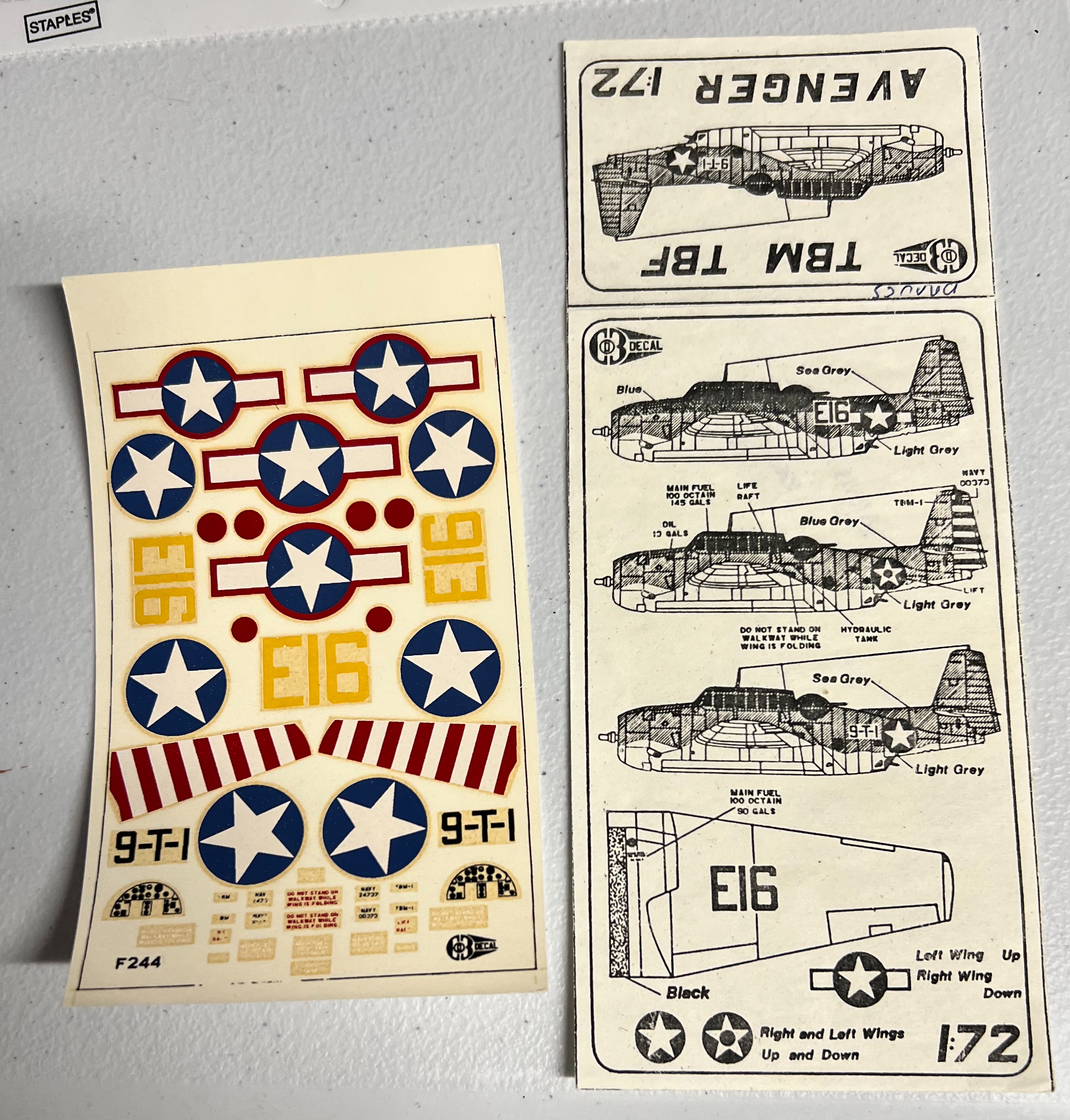
The components laid out so as to figure it all out. The directions were fine. The decals were, well, as you can see, trash. I did order some replacements from eBay as you will see.

As for assembly, it went fine. I painted the three crewmen. The tail gunner will never be seen because the acrylic window was not too clear. As for the outside, I went with a Vallejo “Deep Prussian Blue” – it seemed closest to the box color. In my research, I saw several different color schemes for the undercarriage. Some were blue, some were two-toned. The model would be on a flight stand. This stand would not afford visibility to the bottom, so I decided that blue was sufficient.

Inside the wing – how old was this?
The three crewmen and the rear landing gear and tailhook. The tailhook would not survive the build.
Avenger TBM assembled and painted (and below in the gallery).

The last assembly from the kit for the Avenger was the rockets underneath. I assume that any depth charges would have been in the bomb bay – as unseen as the gunner underneath. So that works!

The rockets are mounted. Next, we moved on to applying appropriate decals. That proved to be the most difficult part.

The decals I bought were from the US and came via a modeling shop in Latvia of all places. I have no idea of the age – except likely post-Cold War I imagine. I used multiple coats of Microscale “Liquid Decal File” to restore them as best I could. Even with that, several of them disintegrated into multiple jigsaw pieces in the progress of placing them on the model. This led to my having to reconstruct the decals while wet. Ugh. I made it work.
But wait – before all the decal work – I needed a flight stand! I made one with a 1/4″ wooden dowel, green stuff, and a 2″ acrylic base. I carefully carved out a hole on the model to accommodate the stand.

Then it was on to applying decals as best as I could.
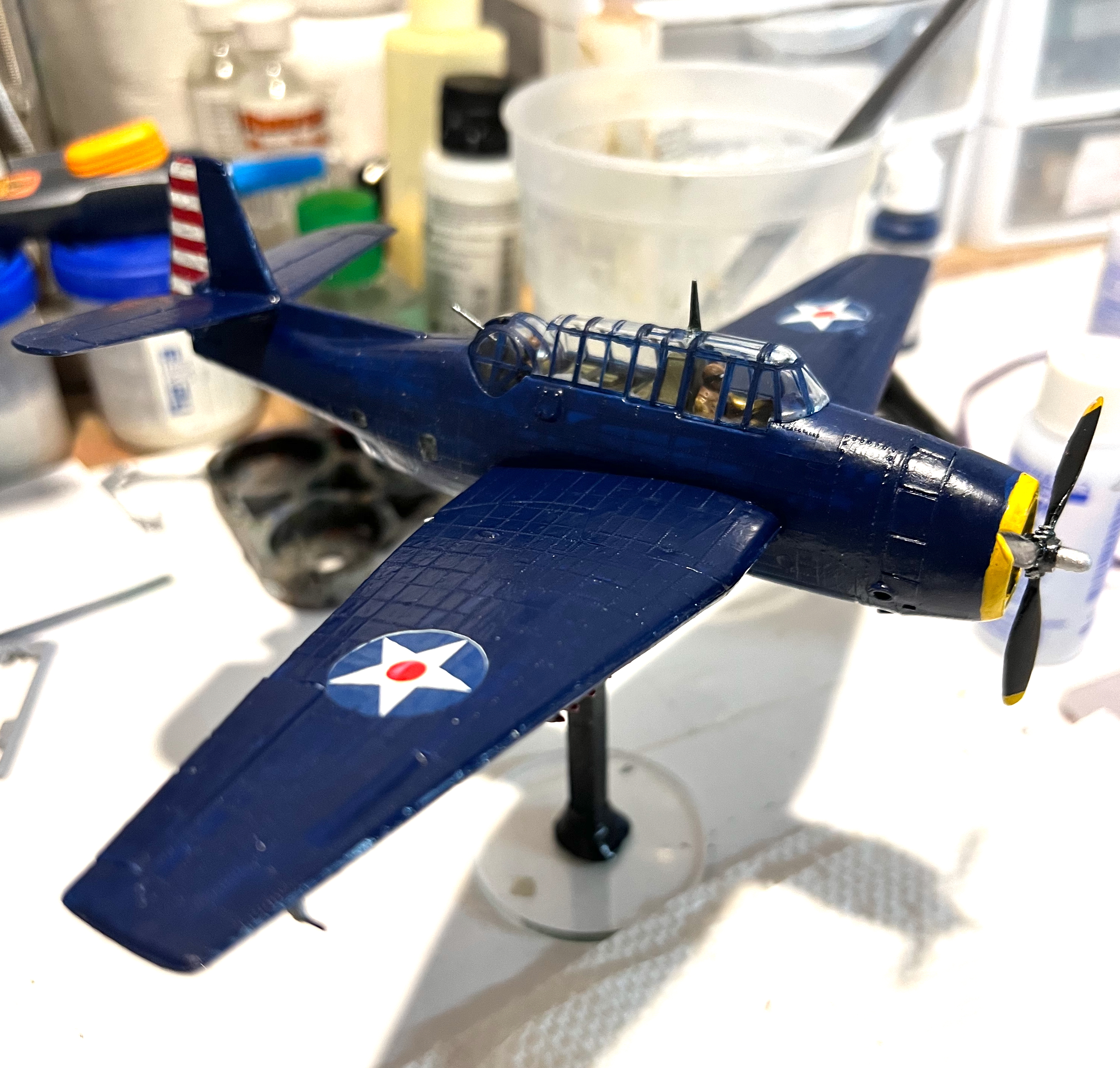
Mid-stage with the decals. The tail and rudder ones were really finicky.

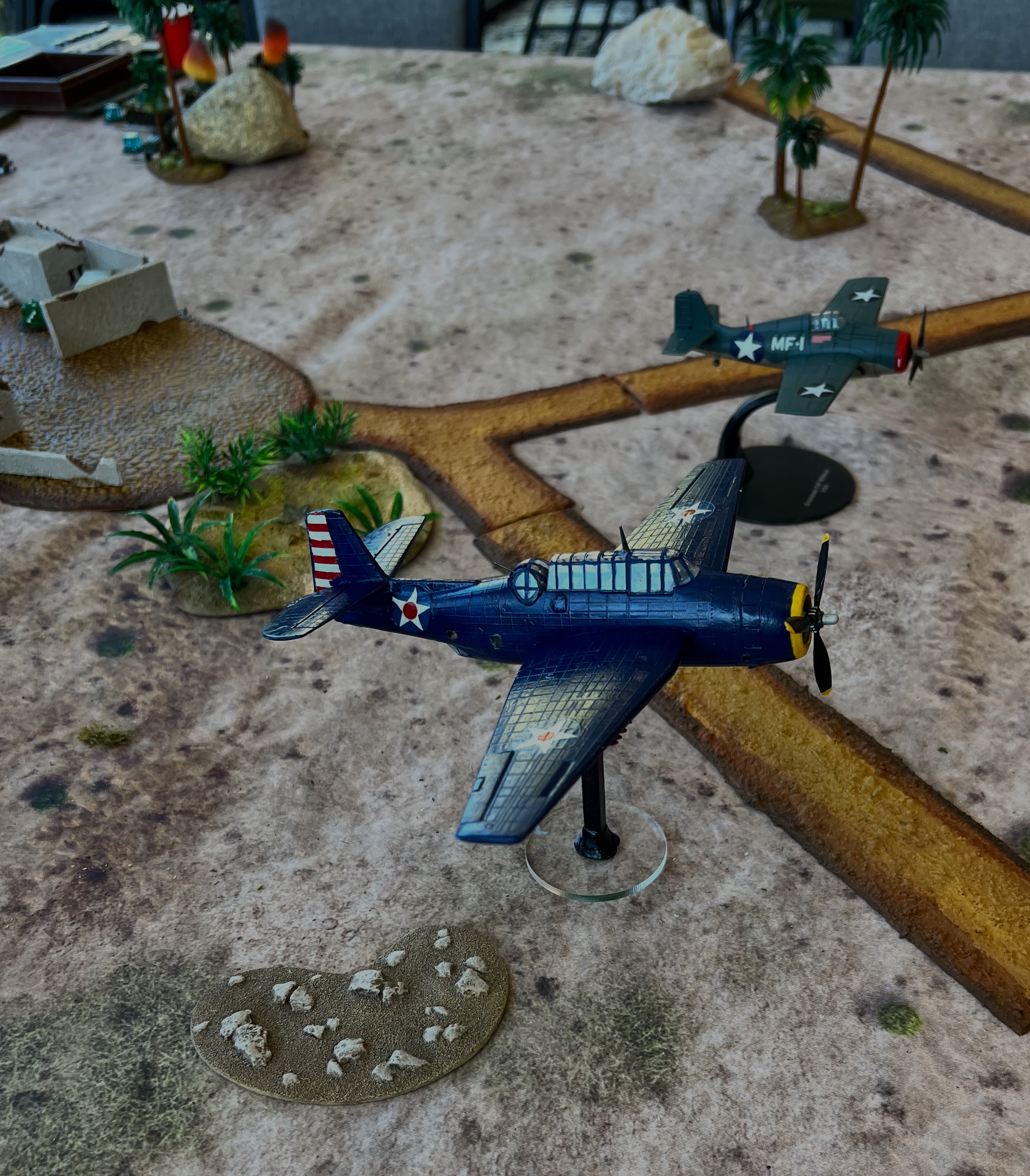
Finally the planes were done. I also built a special travel box for the Avenger. For the other two, the original package blisters served that purpose.

All three planes for the game, frontal view…
…and a side view.

Upon completion, I could mock up the tabletop in the cellar in preparation for HMGS FALL IN! in Lancaster PA and EllisCon in Danielson, CT.

Mock up of the Tabletop

I used photos of this mock up in my cellar to guide its recreation at both upcoming gaming conventions.

First up, HMGS FALL IN!

HMGS FALL IN! 2025 PHOTOS OF THE GAME
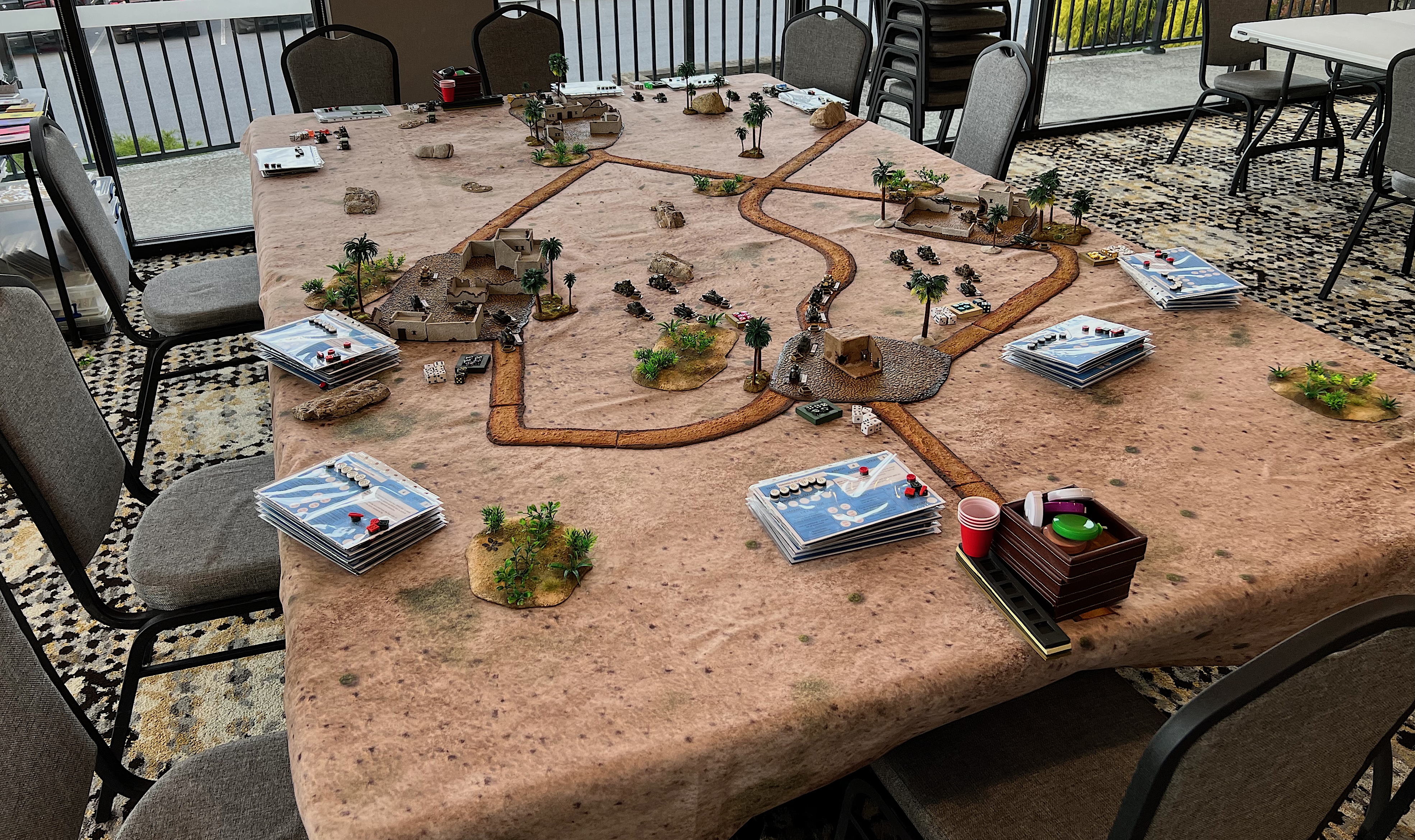
The game as set up in the H.A.W.K.’s room.
The players in my first game. It was nice to have my Wargame Wingman Leif Magnuson in the game. Several Maine Historical Wargame Association members joined as well! As I am also a member of MHWA, that was VERY cool.
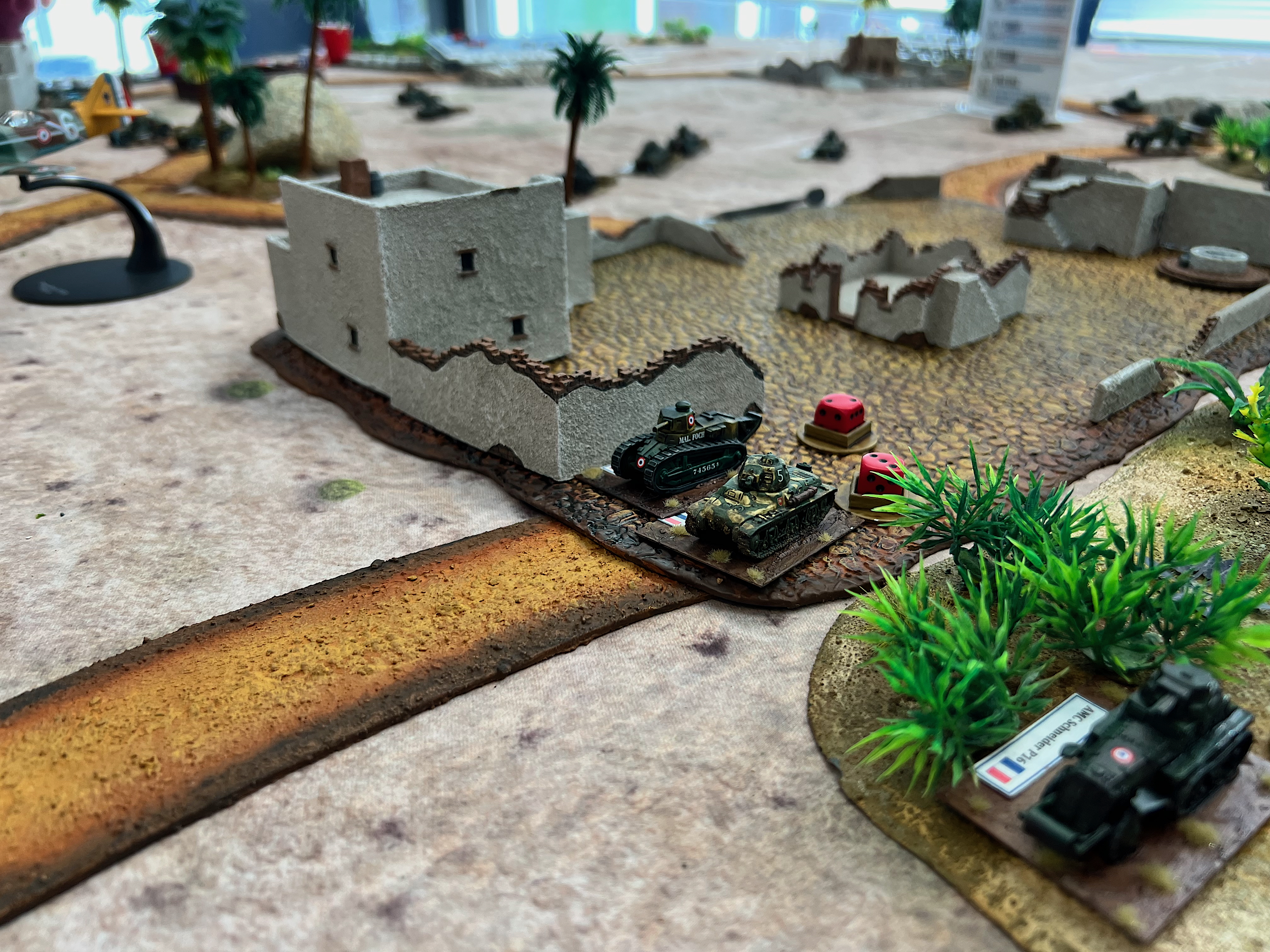
The French tanks and armored cars were cautious about leaving a town here.
The Mainers plot their strategy.

The US then deployed air, achieved superiority, and brought on the Avenger.

The F4F Wildcat about to dispatch the Dewoitine D.520.
While US vehicles burn in the background, the Avenger deploys, and calls in naval gunfire…
…blasting the Vichy armor.

With that, the US won the first game I ran.

In the second game, the tables turned. The US never got going very well. Or, perhaps, the French were very lucky. Take your pick. I don’t have any photos of that game (apologies) – but it was a complete French victory.

Next up, one week later, was EllisCon.

EllisCon 2025 Photos

Here I also ran the game twice.

The first game at EllisCon had 4 players. Leif joined us again for both games. Here he strategizes for the French with his teammate Brian.
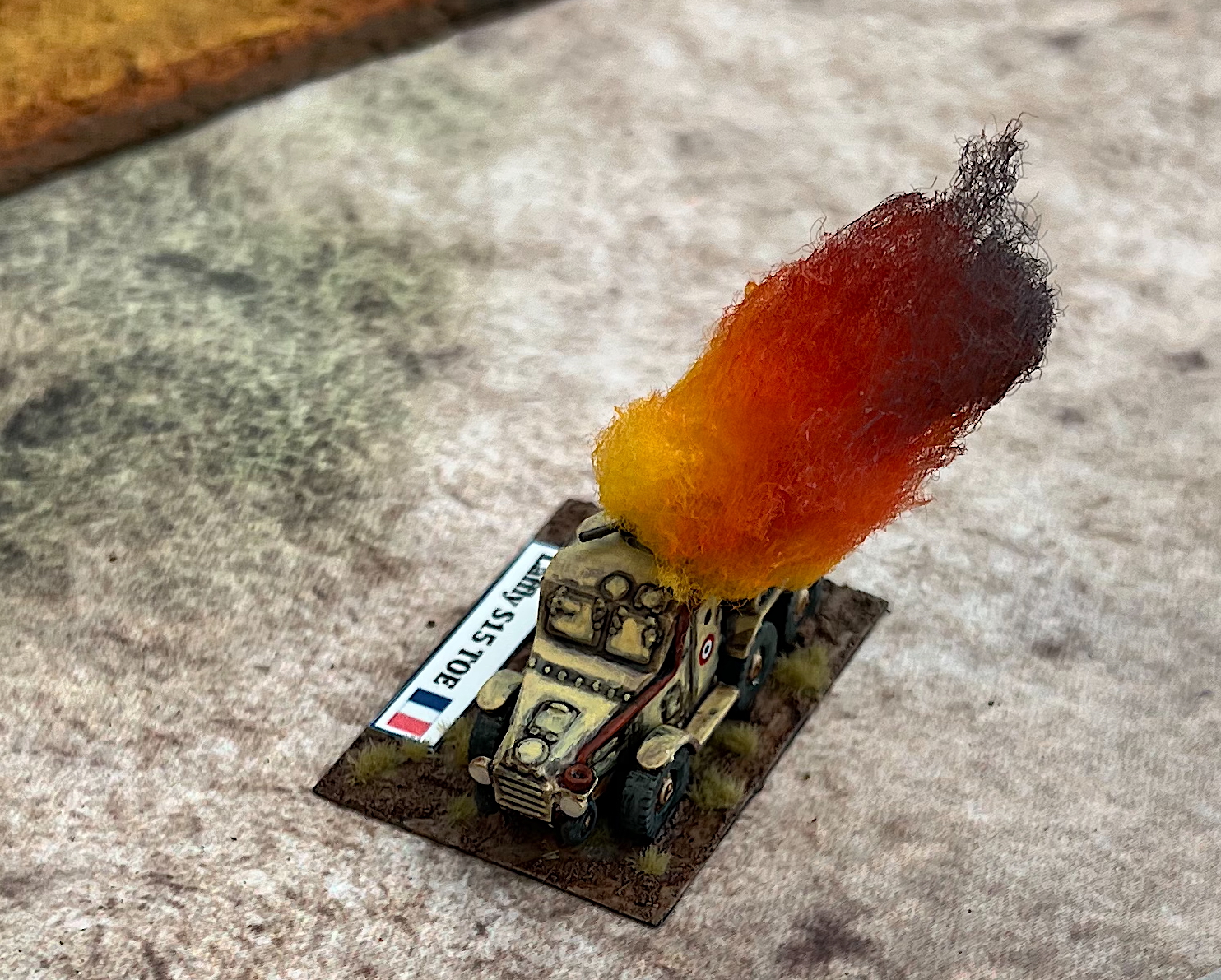
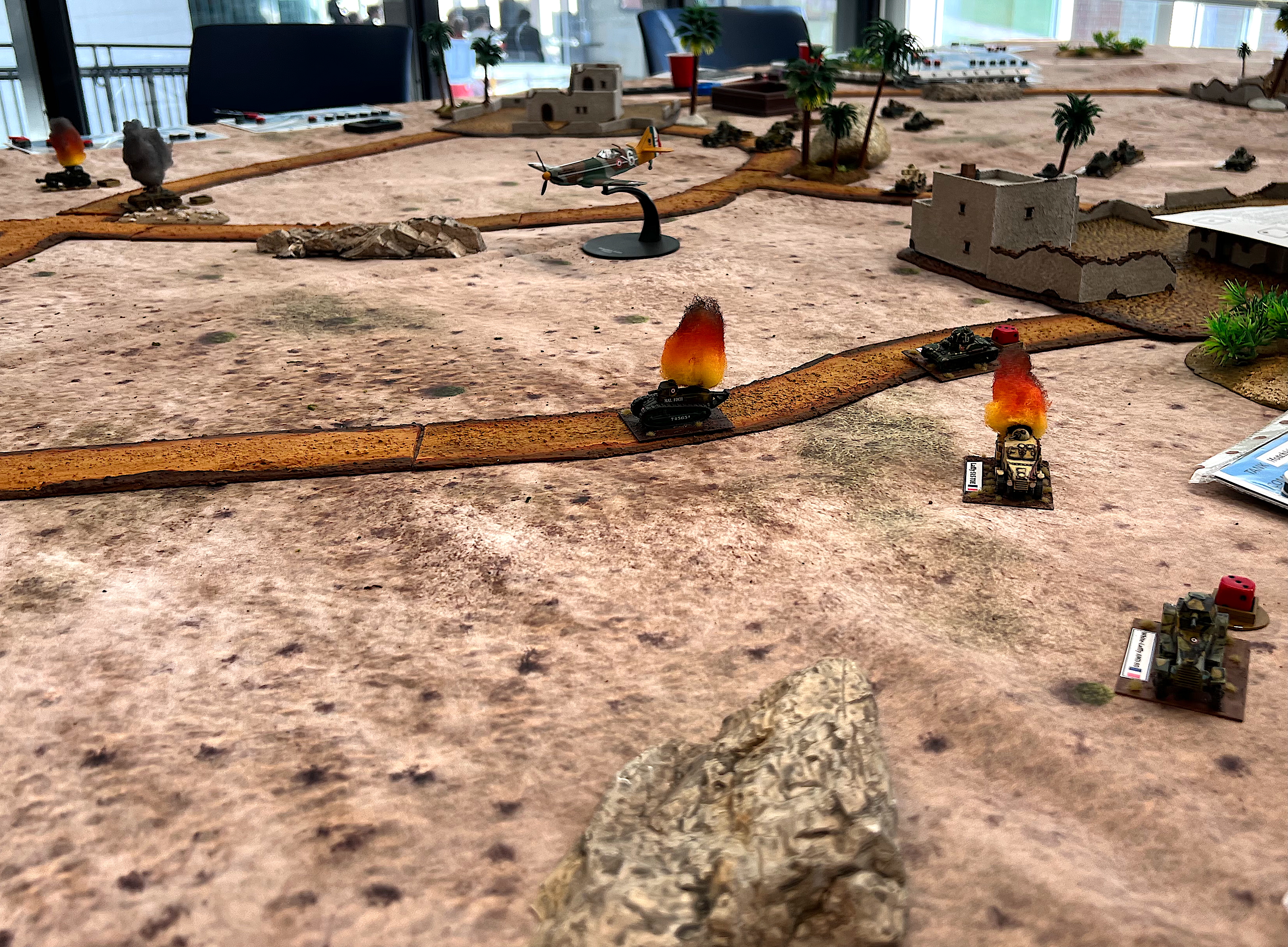
A Laffly S15 TOE armored car is hit and burns early in the game.
The US players are then hit hard, as the M5 Stuart “Beast”, and M3A1 Scout Car “Annie” are destroyed. The M3 GMC “Hurricane” takes cover in a brush firing position.
Once again, though at a different convention, the Vichy armor looks to leave the town safely in the face of “Hurricane”.
The French gain air superiority.
An AMC Schneider P16 (the old armored car on right) uses its 37mm gun to destroy the M5 Stuart “Beast”.
The FT-17 ” Marechal Foch” is taken out near r=the end of the game.

At the end, the Vichy claimed a victory, as their Tanker Bucks were more than the Americans total.

In game two, the fortunes reversed yet again. Leif played again and was joined on the other side by Gregg Belevick. Both were involved in my initial play testing of this scenario.
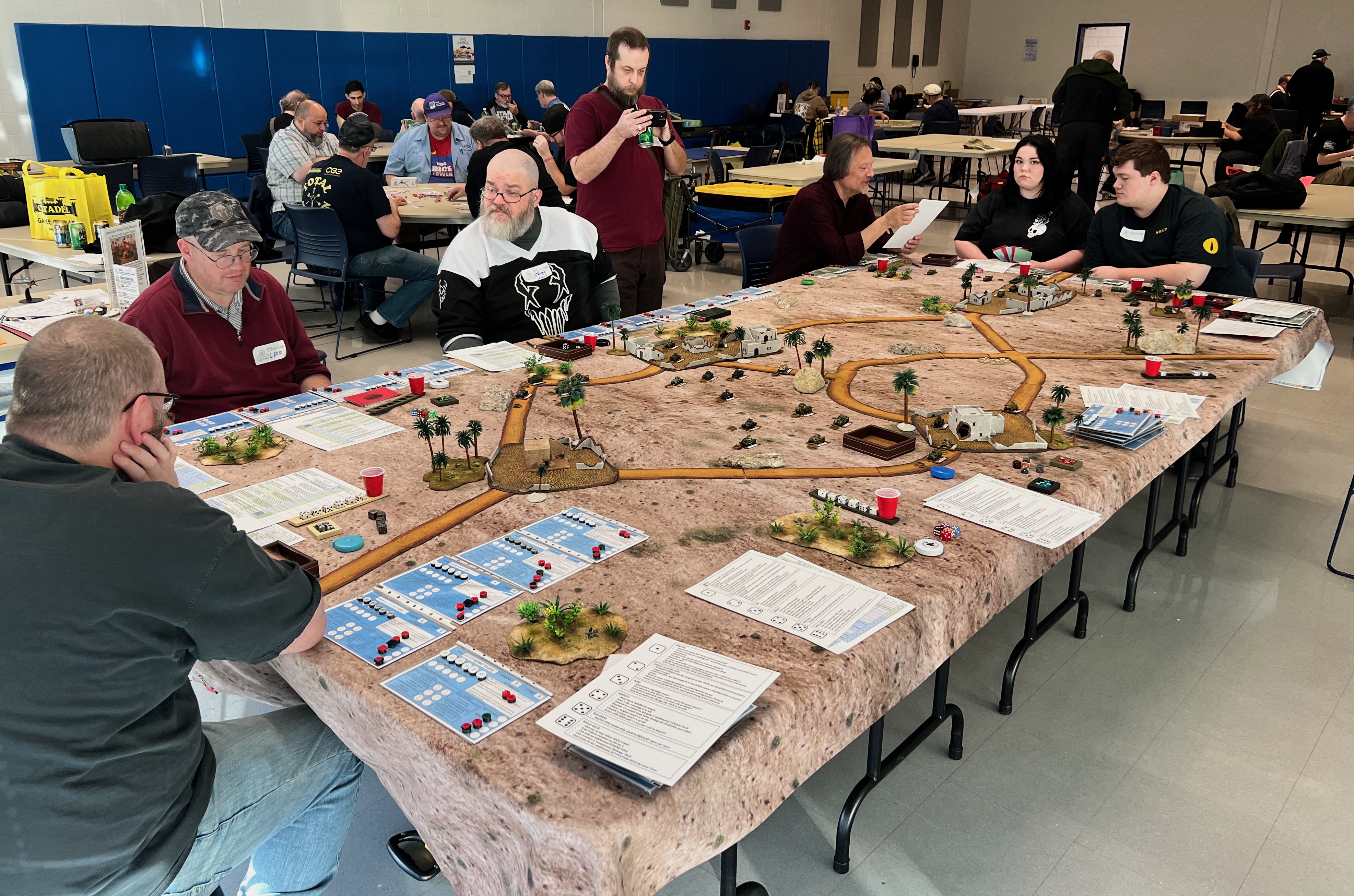
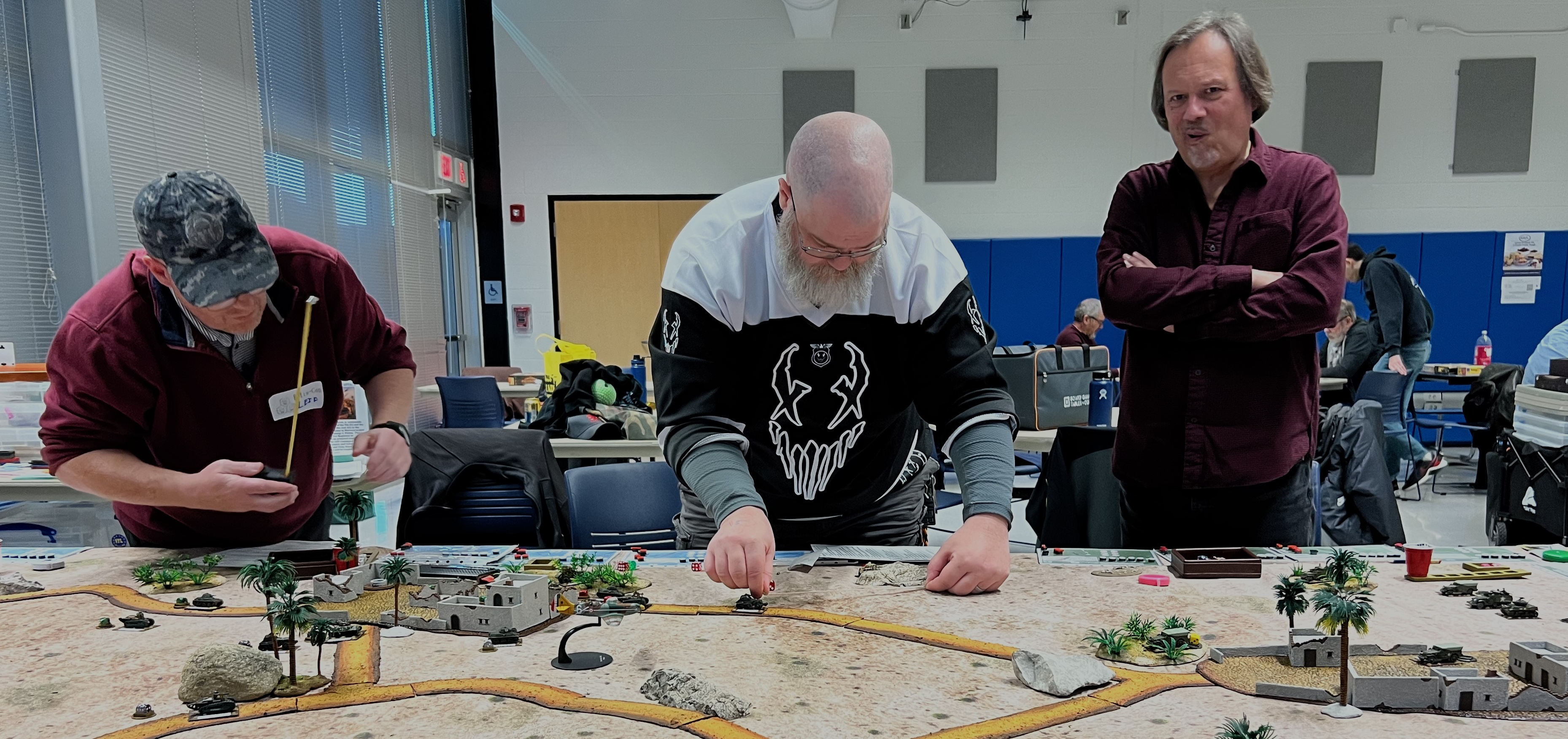
The players discuss their game strategies.
The French players move up – and Gregg has a twinkle in his eye – does he have a plan?
Yours truly GM’s the game. Photo courtesy of David DeVeau
I guess Gregg did have a plan – naval gunfire! Convention history repeats itself as 5 Vichy vehicles burn on the Moroccan sand.

The US won this game with the last barrage destroying 1/3 of the Vichy force deployed at the time. A massive US victory!

I really like this scenario. So far, the victories have been 3 for each side. It seems pretty fairly balanced. It’s fun and highlights a little-known part of WWII. It’s likely coming again to a convention in 2026.

I list the paints that I used for the roads at the end of this blog post. For my records, I am sharing these materials I use for these projects with you, dear reader. You’ll see the list below detailing the process and materials for both the roads/bases and the Avenger torpedo bomber.

I hope that you found this tale of my journey interesting. If you do use my rules modifications, again please let me know how they worked out. If you have any questions, certainly throw them at me. I’d also enjoy any feedback on the work or this post in the comments section. Thanks in advance for that.

Lastly, I have compiled all of my posts on WWII games and projects. There is a consolidated list of posts and their links located here.

MATERIALS USED

PAINTS, INKS, GLAZES, SHADES, WASHES, PIGMENTS AND FLOCKING USED ON THE DIRT ROADS:

  1. TrafficMaster Rubber Floor Runner from Home Depot, SKU 1003092882
  2. DynaFlex Ultra Advanced All Weather Sealant “Cedar Tan”, (paintable caulking)
  3. Quikrete “All Purpose Sand”
  4. Chinchilla Dust
  5. DecoArt Americana “Cinnamon Stick”
  6. DecoArt Americana “Deep Ochre”
  7. DecoArt Americana “Raw Sienna”
  8. DecoArt Americana “Raw Umber”
  9. Apple Barrel “Burnt Umber”
  10. Vallejo Thinner

PAINTS, INKS, GLAZES, SHADES, WASHES, PIGMENTS AND FLOCKING USED ON THE TOWN BASES:

  1. TrafficMaster Rubber Floor Runner from Home Depot, SKU 1003092882
  2. DynaFlex Ultra Advanced All Weather Sealant “Cedar Tan”, (paintable caulking)
  3. Quikrete “All Purpose Sand”
  4. Chinchilla Dust
  5. DecoArt Americana “Cinnamon Stick”
  6. DecoArt Americana “Deep Ochre”
  7. DecoArt Americana “Raw Sienna”
  8. DecoArt Americana “Raw Umber”
  9. Apple Barrel “Burnt Umber”
  10. Vallejo Thinner
  11. Liquitex “Burnt Umber” (ink)

PAINTS, INKS, GLAZES, SHADES, WASHES, PIGMENTS AND FLOCKING USED ON THE AIRFIX AVENGER TBM-3 MODEL:

  1. Airfix Grumman Avenger TBM-3 1:72 plastic model kit
  2. Tamiya “Extra Thin Cement”
  3. Vallejo Surface Primer “USA Olive Drab”
  4. Vallejo Surface Primer “Sun Yellow”
  5. Vallejo Surface Primer “German Dark Yellow”
  6. Vallejo Surface Primer “Leather Brown”
  7. Vallejo Surface Primer “Black”
  8. P3 “Midland Flesh”
  9. Army Painter “Soft Tone” (wash)
  10. P3 “Flesh Wash”
  11. Vallejo Model Color “Dark Prussian Blue”
  12. Vallejo Thinner Medium
  13. Hataka “Gris Clair Neutre”
  14. Reaper MSP Core Colors “Pure White”
  15. Vallejo Model Air “Black Metallic”
  16. Tamiya “XF-16 Flat Aluminum”
  17. Green Stuff
  18. Vallejo Model Air Metallic “Signal Red”
  19. Vallejo Model Color “Red”
  20. Vallejo “Mecha Gloss Acrylic Varnish”
  21. Vallejo Thinner
  22. Citadel “Nuln Oil Gloss” (shade/wash)
  23. 1/4″ square wooden dowel
  24. 2″ Clear acrylic disk
  25. 2″ steel washer
  26. Gorilla Glue
  27. Microscale Industries “Liquid Decal Film”
  28. Avenger decals from eBay
  29. Microscale Industries “Micro Set”
  30. Microscale Industries “Micro Sol”

Thanks for looking!
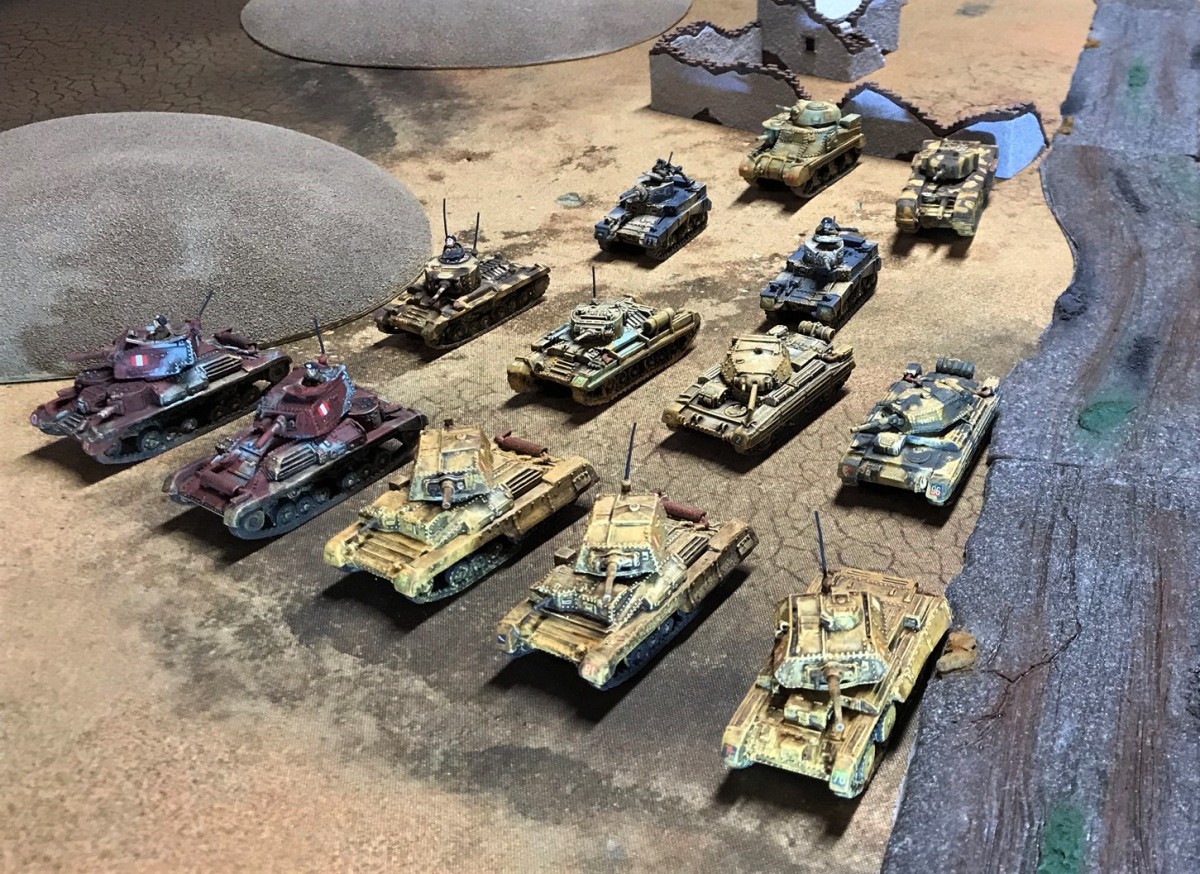
More 8th Army tanks – A10’s, an A13, Valentines, Crusaders, a Grant and a Churchill!

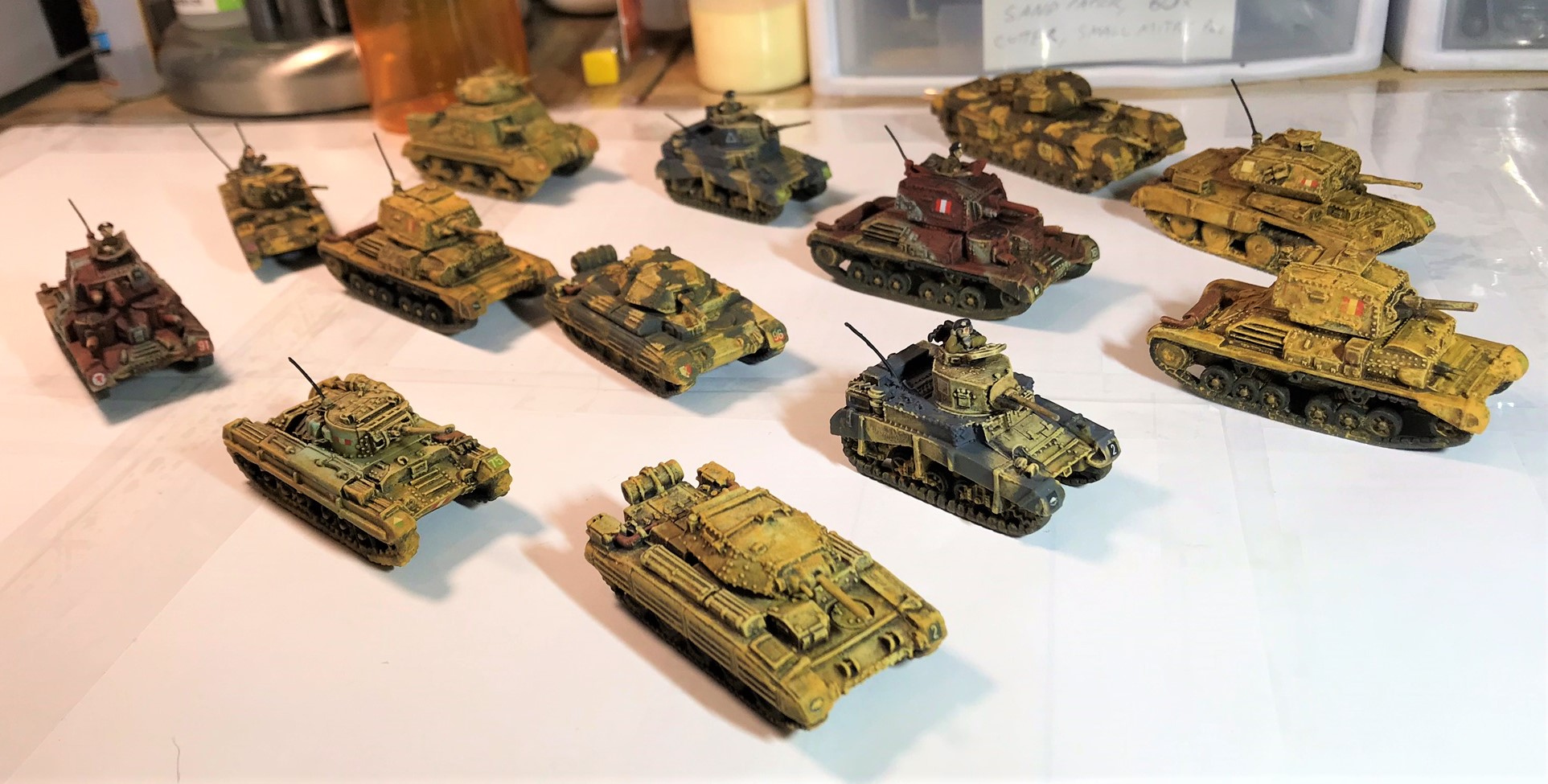
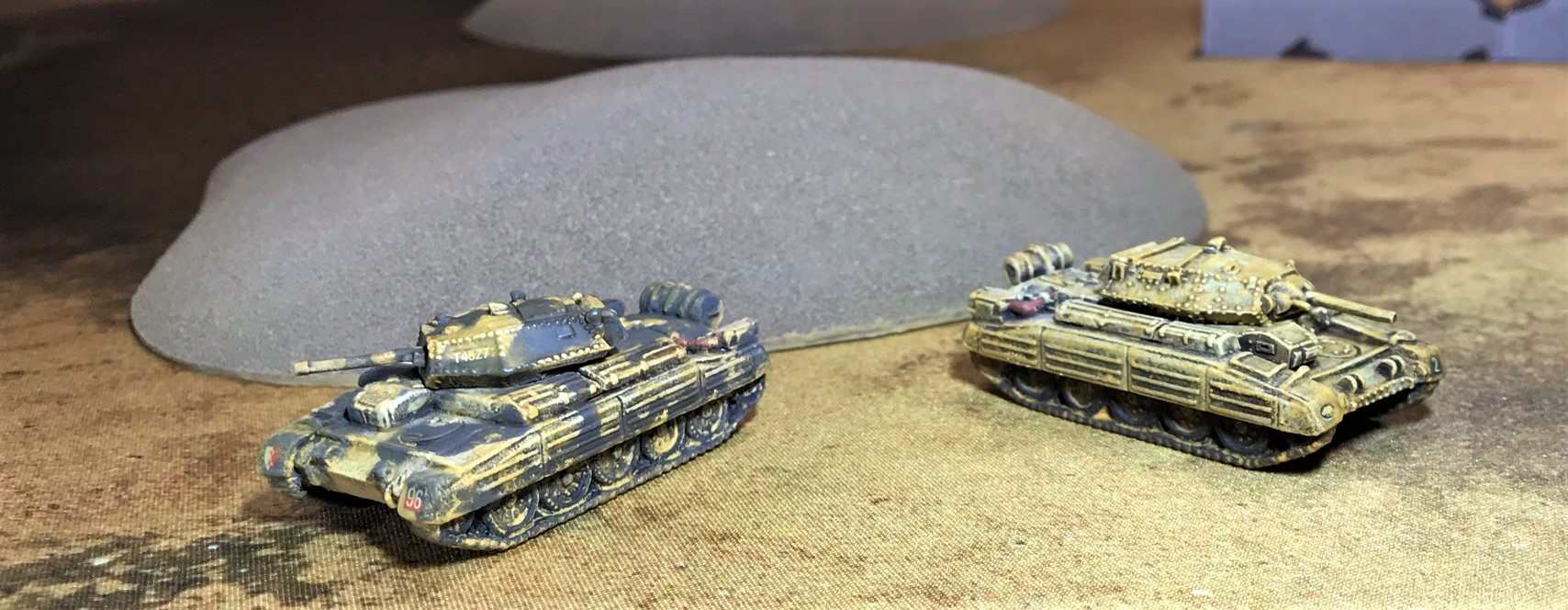
This week I was able to finish off my 8th Army tank force for What a Tanker© games.  The group was composed of 9 Battlefront/Flames of War 15mm scale tanks – two A10 Cruiser Mark IIA’s, one A13 Cruiser Mark IVA, two Valentine tanks (a II and a III), two Crusader tanks (a II and a III), one M3 Grant, and one Churchill II.  These would add to my previous two A9 Cruiser Mark I’s and my two M3 Stuart “Honeys” tanks that I finished in November (those are discussed here).  Including a  couple of prepainted Matilda II’s that I had bought from Wargames Models in Ohio, my 8th Army force now has 15 tanks.  Noticeably absent from this group of course are the Sherman tanks that arrived in time for the British push at the Second Battle of El Alamein, but I am sure I’ll get to adding them eventually.  I wanted to have a group of earlier war tanks ending with the Grant and Churchill for now, as most folks are less familiar with them.

I did not take as many pictures in the assembly and painting processes this time as I wanted to get these done.  I need to move onto the Germans and the Italians!  My goal is to run these in What a Tanker© games at gaming club meetings and at local conventions.  I do feel that these, as well as my last tank project attempts, have been fun and have stretched my hobby skills a good bit.

I’ll cover each of the types individually, then some eye-candy shots at the end for your (I am hopeful) enjoyment.  Of course, I will list my paints and materials at the end for those interested.  I used my airbrush and standard brushes on all of these.

A10’s and A13

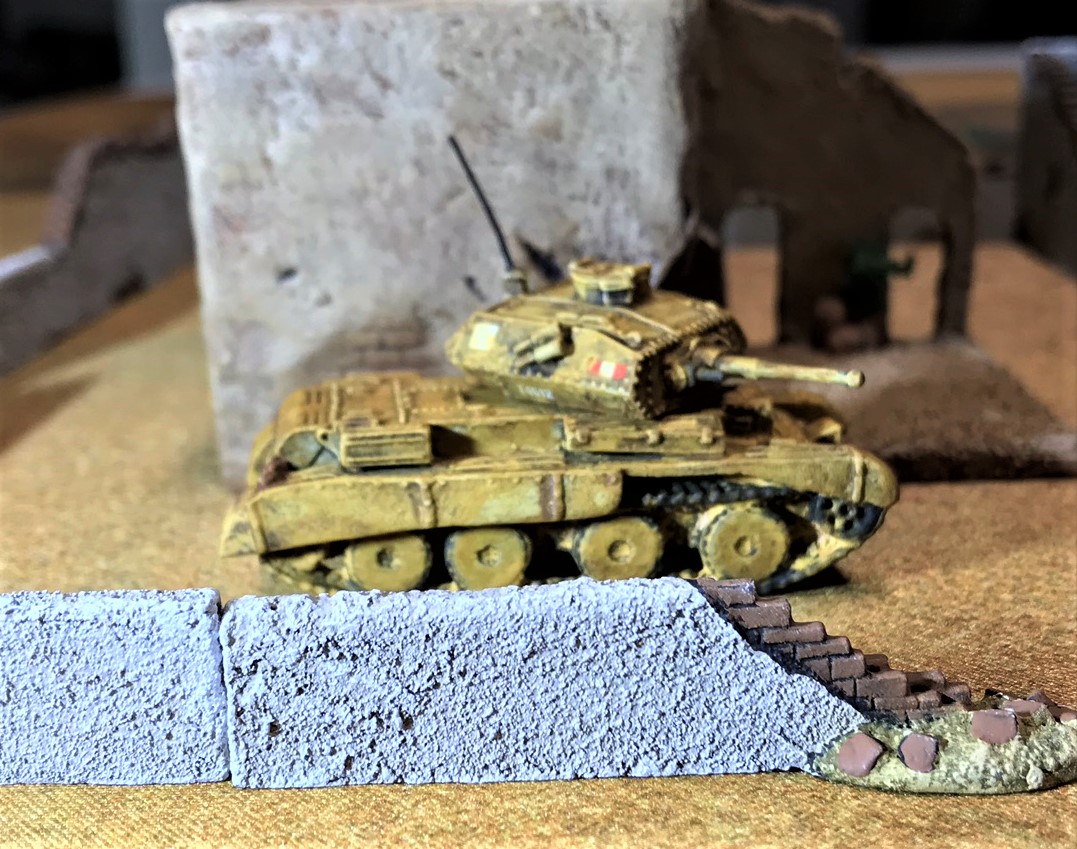
I finished three more cruiser tanks –  two A10 Mark IIA’s and one A13.

I find that cleaning, filing, and general preparation of these models does take a bit of time.  I know that washing the resin parts is very important.  My last step in cleaning the resin involves a gentle brush wash/application of isopropyl alcohol (rubbing alcohol to some of you) to it.  This has been helpful I think – you just need to let that dry before handling or you may leave fingerprints on the resin.  I also added radio antenna aerials with 24 gauge wire if the model would withstand the drilling and mounting process structurally.  Sometimes, I just could not add one without damaging the model.

3 a10 final with book (2)
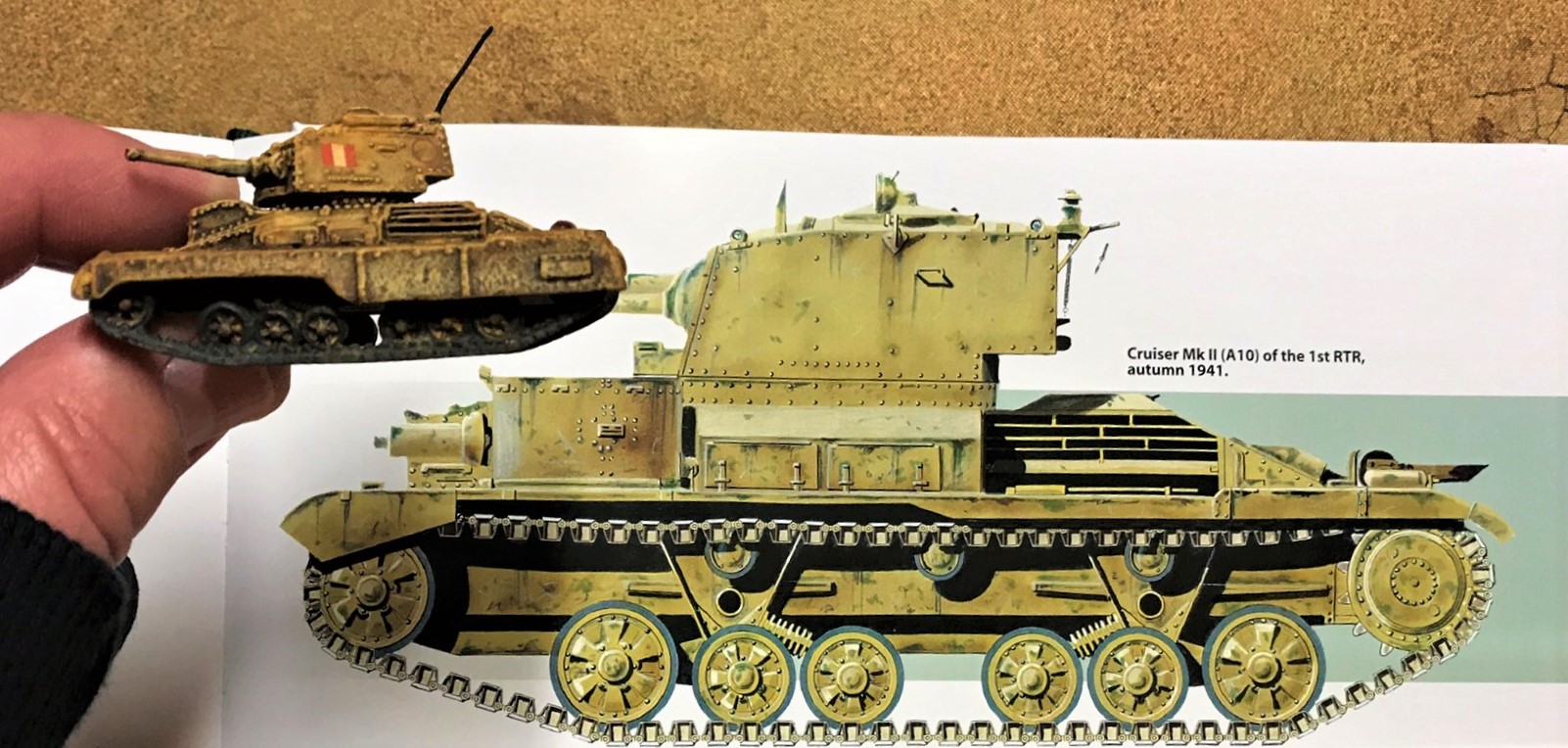
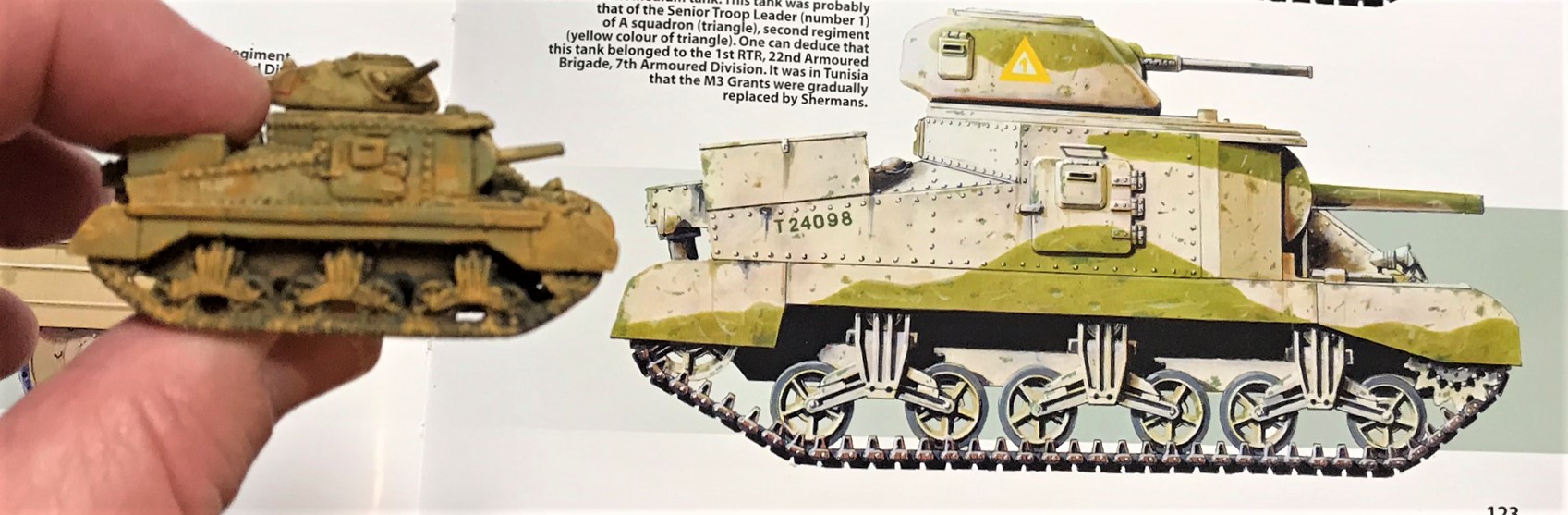
One of the two A10’s as completed.  I went with a sandy look compared to the Caunter scheme I used on the A9’s, mainly for tabletop identification.  This is what I was aiming for, but of course I add pigments and dirty up my tanks!  Note that either the book or my model has a different skirt, possibly because mine were A10 Mark IIA’s.

During the war, compared to the A10’s, the A13’s were much faster due to the Christie suspension and a better engine.  Combat wise, they were not much better, and are not better in the game rules either.  They are adequate foes for Panzer II’s and some Italian light AFV’s.

On all of my tanks I tried to use different FoW decals that seemed to make sense – they are so small! Of course, getting the decals to look sand-worn was important, and the pigment helped.  Getting the decals to conform to the curved surfaces took many slow applications of Micro-Set, Micro-Sol, and Liquid decal film. Our hobby blog-guru Azazel mentioned using barely-moist sponges to lightly apply pigments, so I gave that a shot, especially on the decals.  While I think I got a darker look, it did made the decals look less out of place, and I liked the effect.

1 a13 final with book
My A13 and the painting scheme that I went with, minus the remnants of the blue Caunter camouflage pattern  – as I thought that bluish tinge would be nearly impossible to see at 15mm scale.

Valentines

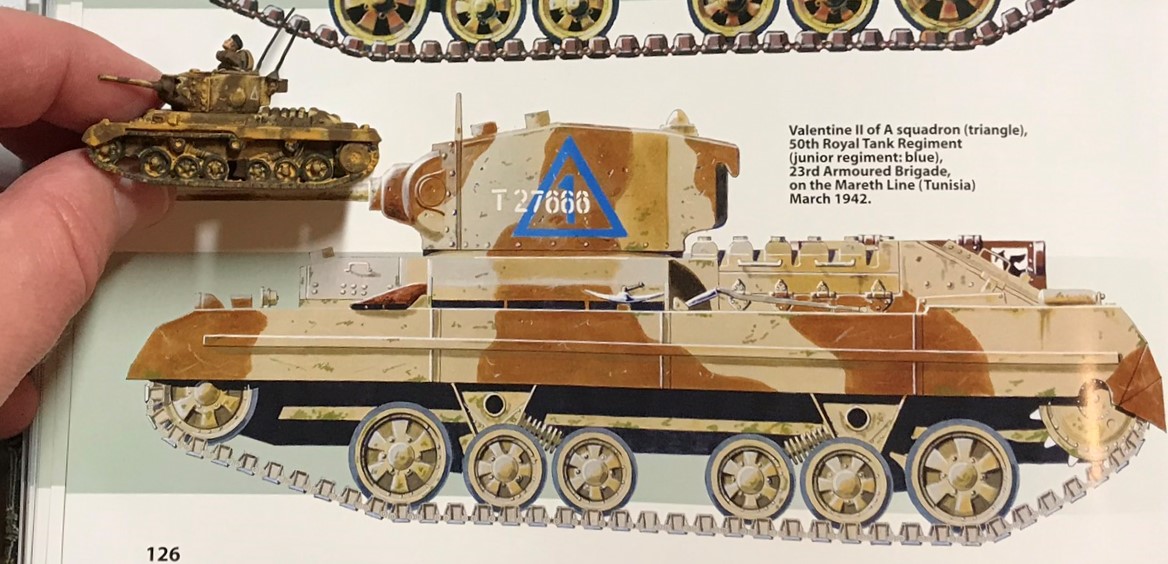
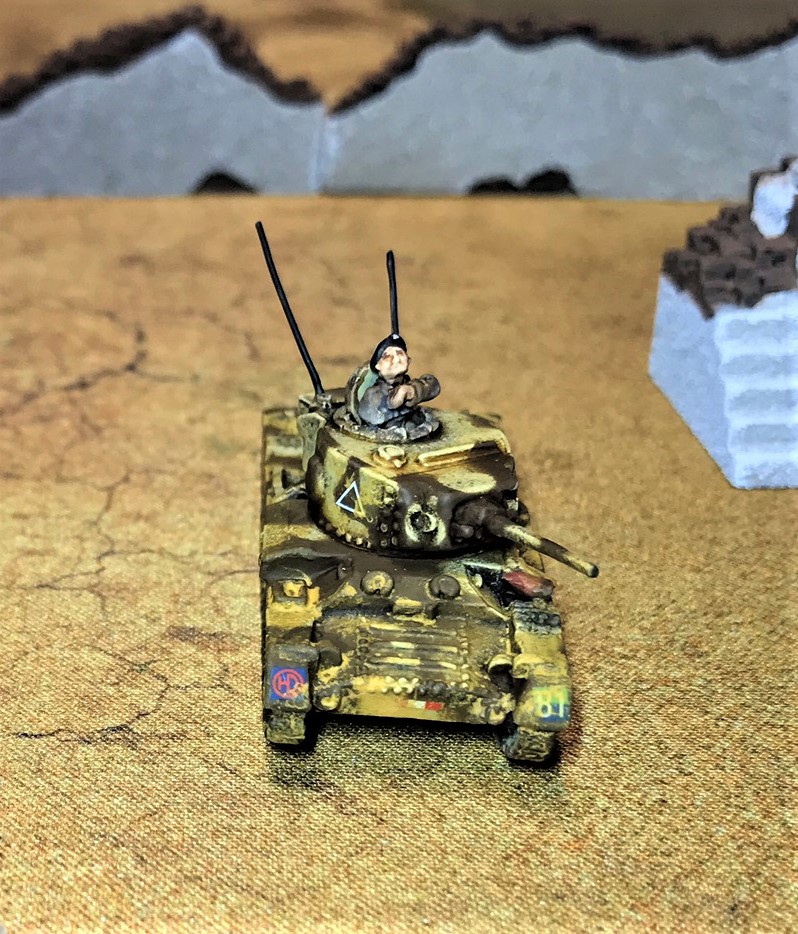
I picked up the two Valentine infantry tanks on sale at two different hobby shops.  The track treads were a bit different.  Of note, the Valentine II needed significant reinforcing with green stuff to come together as it was either poorly designed or not well made.

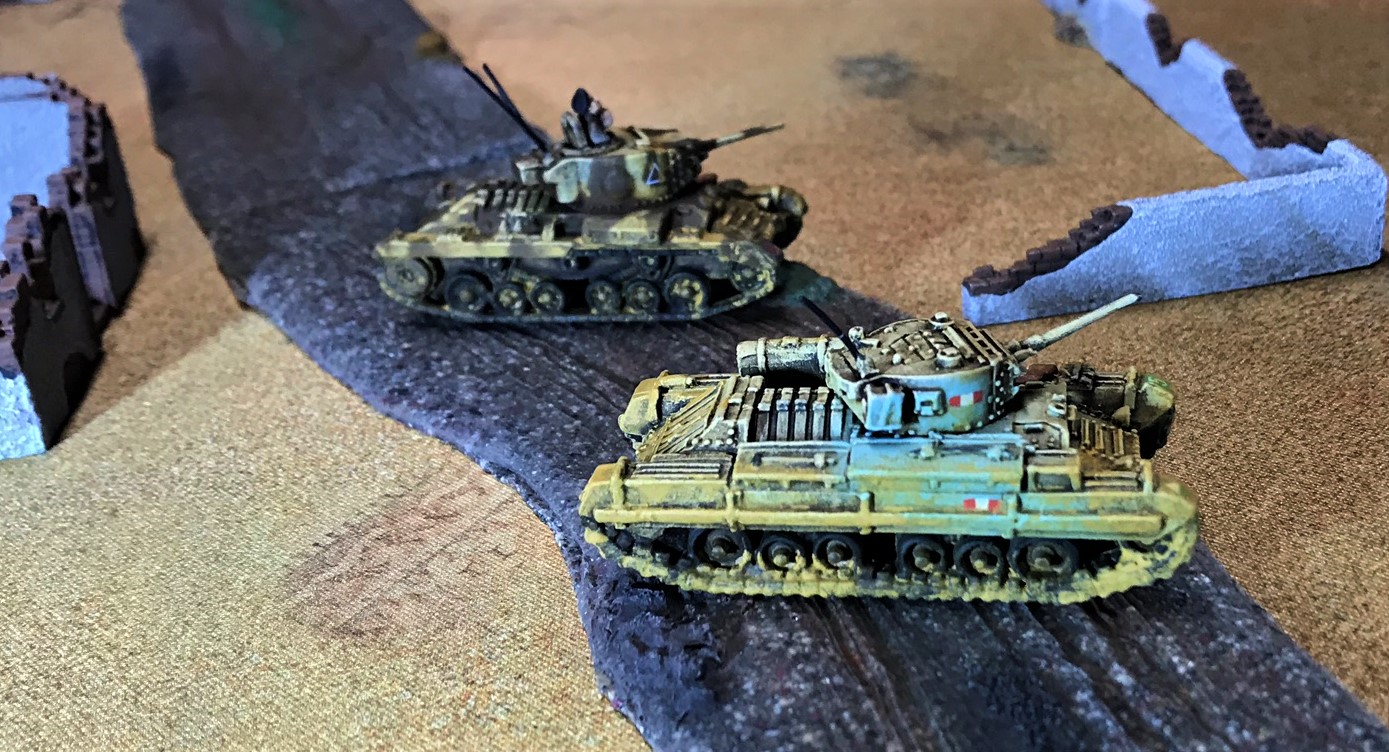
For the Valentine II, I chose a Caunter camouflage scheme that was more bluish than what I had done previously with the A9’s or the Honeys.  That would help on the tabletop as well – and the biggest difficulty was masking the appropriate parts of the tank for airbrushing the blue.

5 valentine ii prepped for caunter
Valentine II masked for airbrushing the blue Caunter camouflage scheme.

I am not sure how effective the blue scheme was in WWII combat, but as the British abandoned it my guess is not very.  Still, it does look striking and different.

6 valentine ii final with book
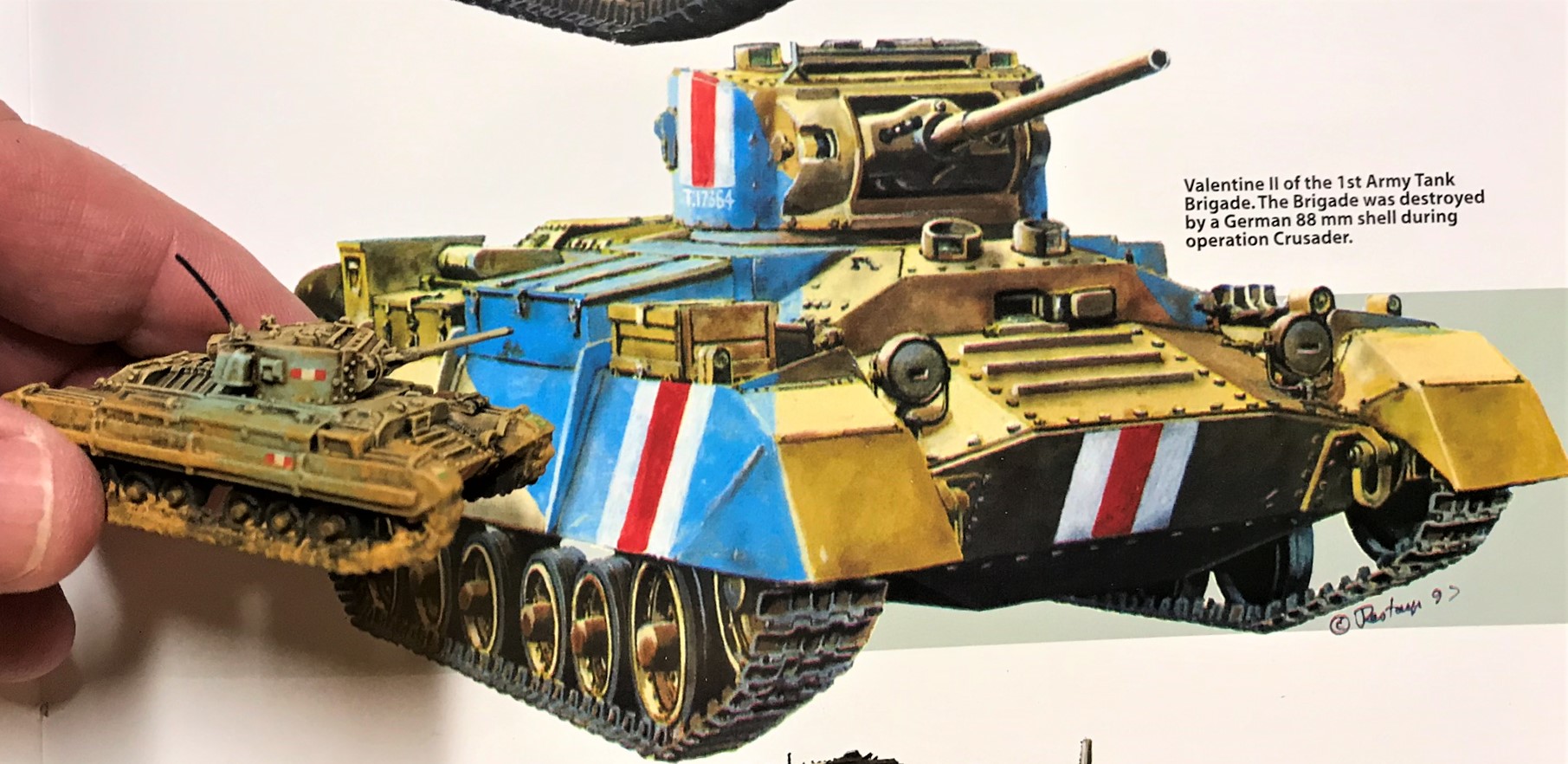
My Valentine II versus its model in the book.  The red and white markers were too small for me to mask and paint, so I went with decals.  Also, the sides of my model differed a bit as well.  I chose to have a lighter blue – it was tough to bring myself to paint that bright of a blue on a tank!

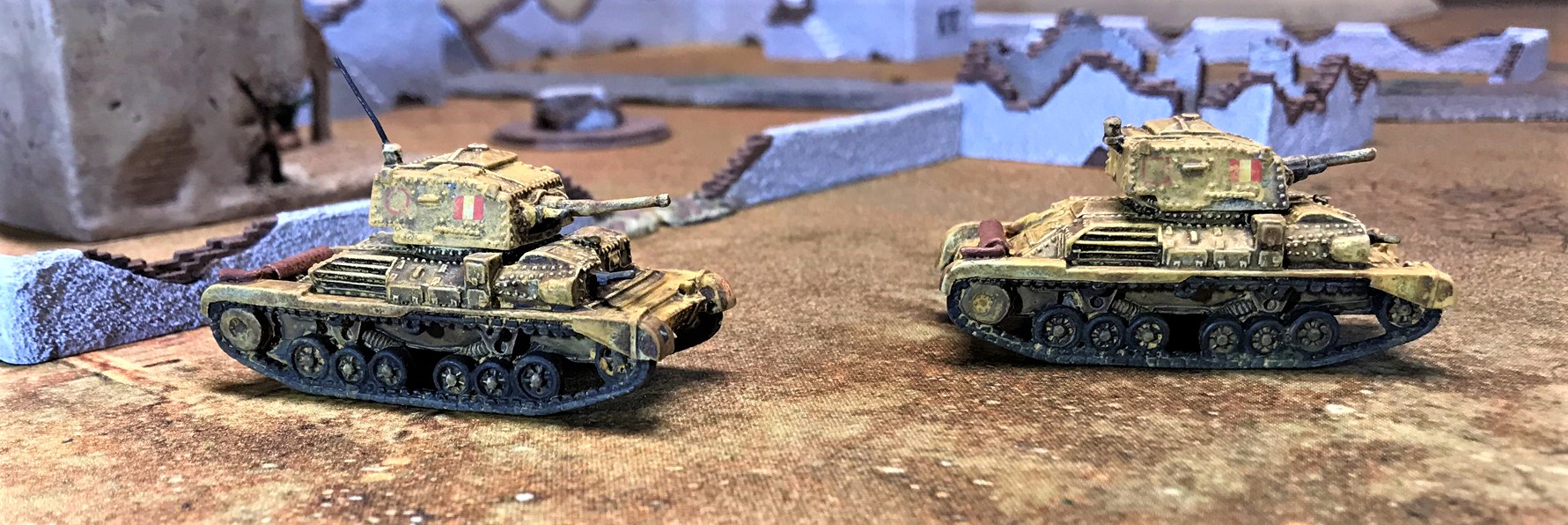
For the Valentine III, I went with a camouflage scheme that was more brown and sand.  I also added two aerials to this one.

7 valentine iii final with book
The Valentine III and the paint scheme I emulated.  Once again, my pigment use darkened it, but in the eye-candy section below, you can see it better.

Crusaders

I definitely wanted to have a couple of Crusader cruiser tanks in my force.  They do look good, though in combat their armor was not effective enough against their Axis counterparts.

I decided to use two different painting schemes here as well.  The earlier Crusader II would get a sandy look, while the Crusader III would get a brown camouflage pattern.

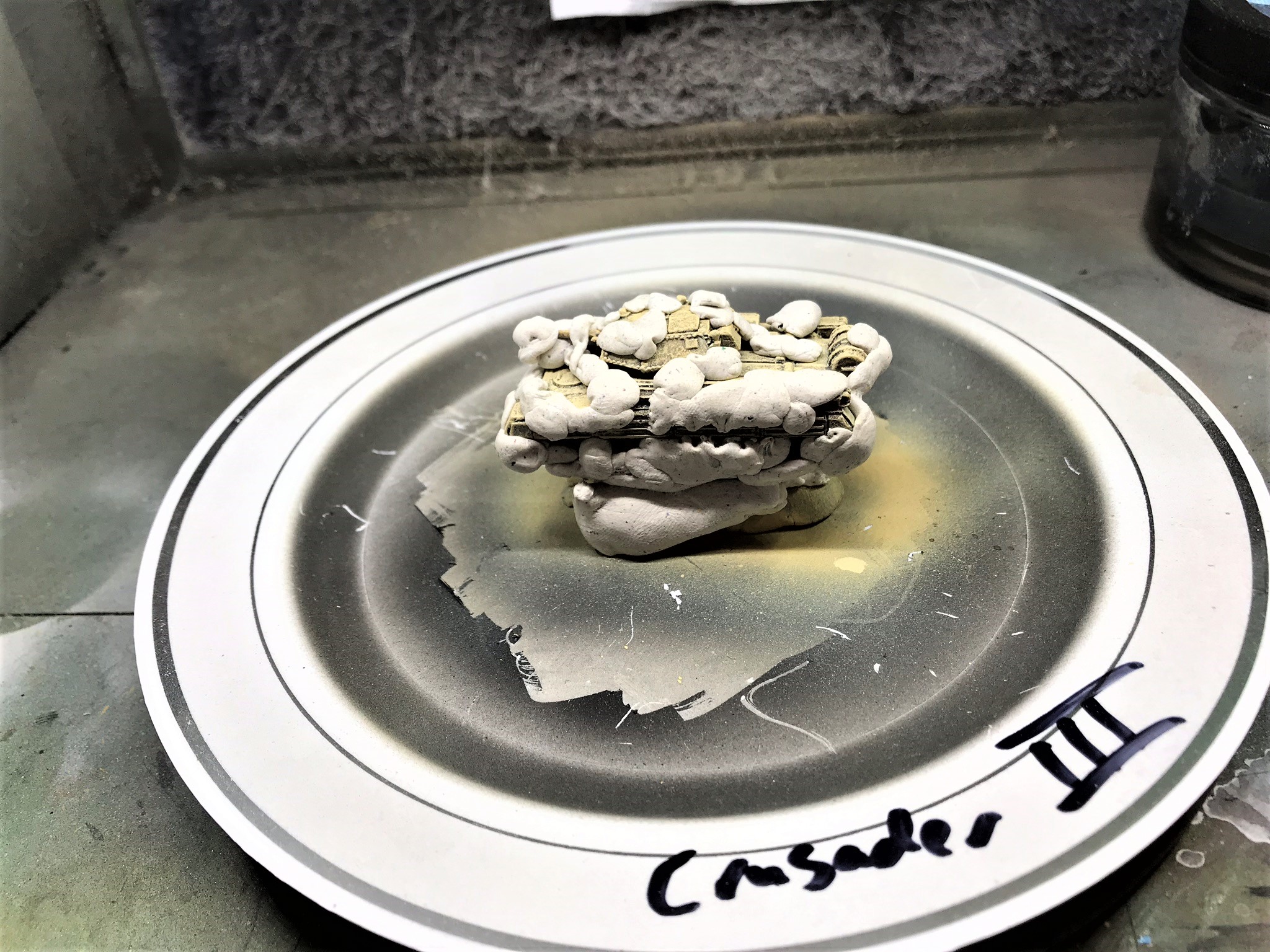
4 crusader iii ready for camo
My Crusader III awaits the airbrushing of the brown camouflage.  Poster tack works great for this kind of masking.

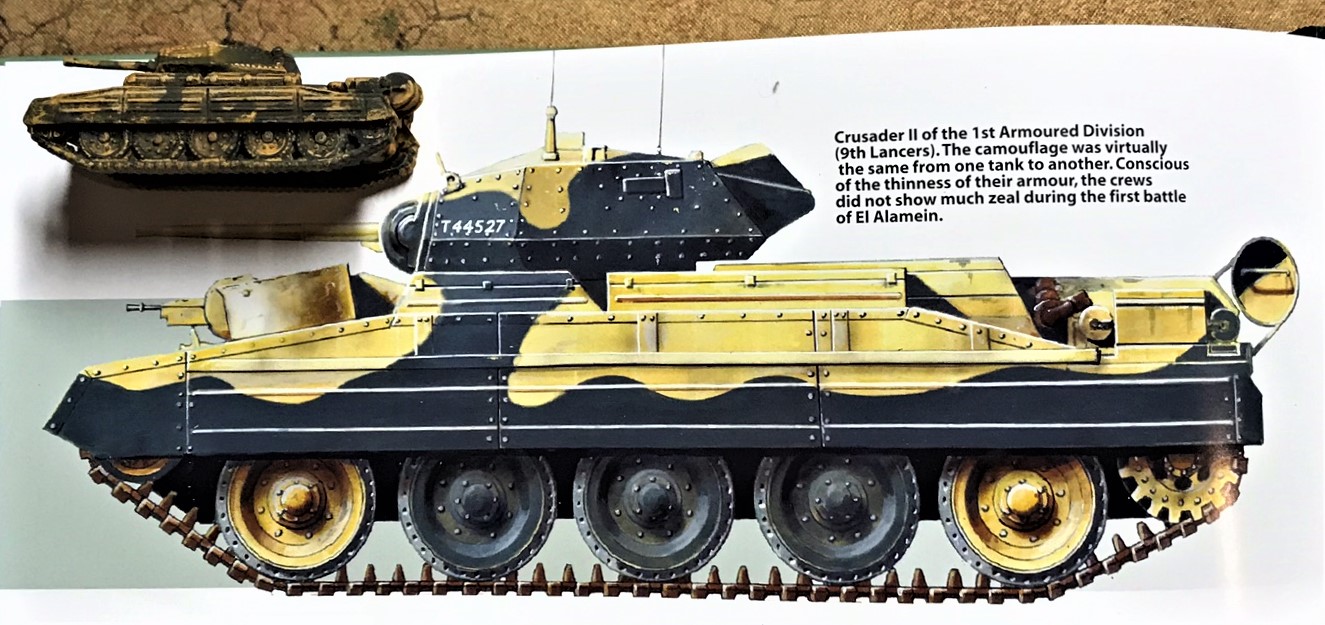
5 crusader ii final with book
The finished Crusader II and the book version.

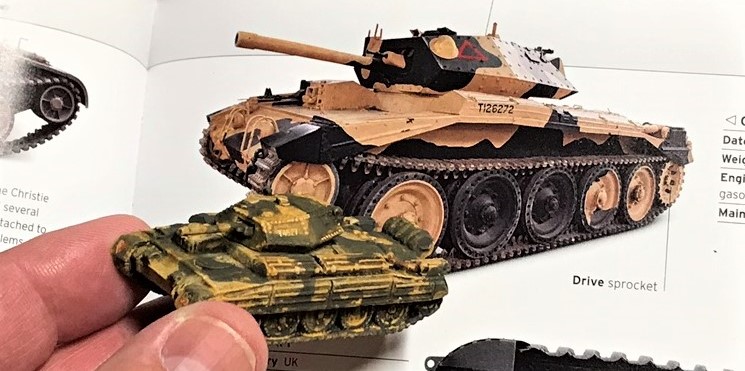
6 crusader iii final with book
The Crusader III was for me a mix of two images – first this one…

7 crusader iii final with book
and secondly this one.  Again, I want dirty tanks that look like they have been driving in the desert and not off the show room/museum floor.

M3 Grant

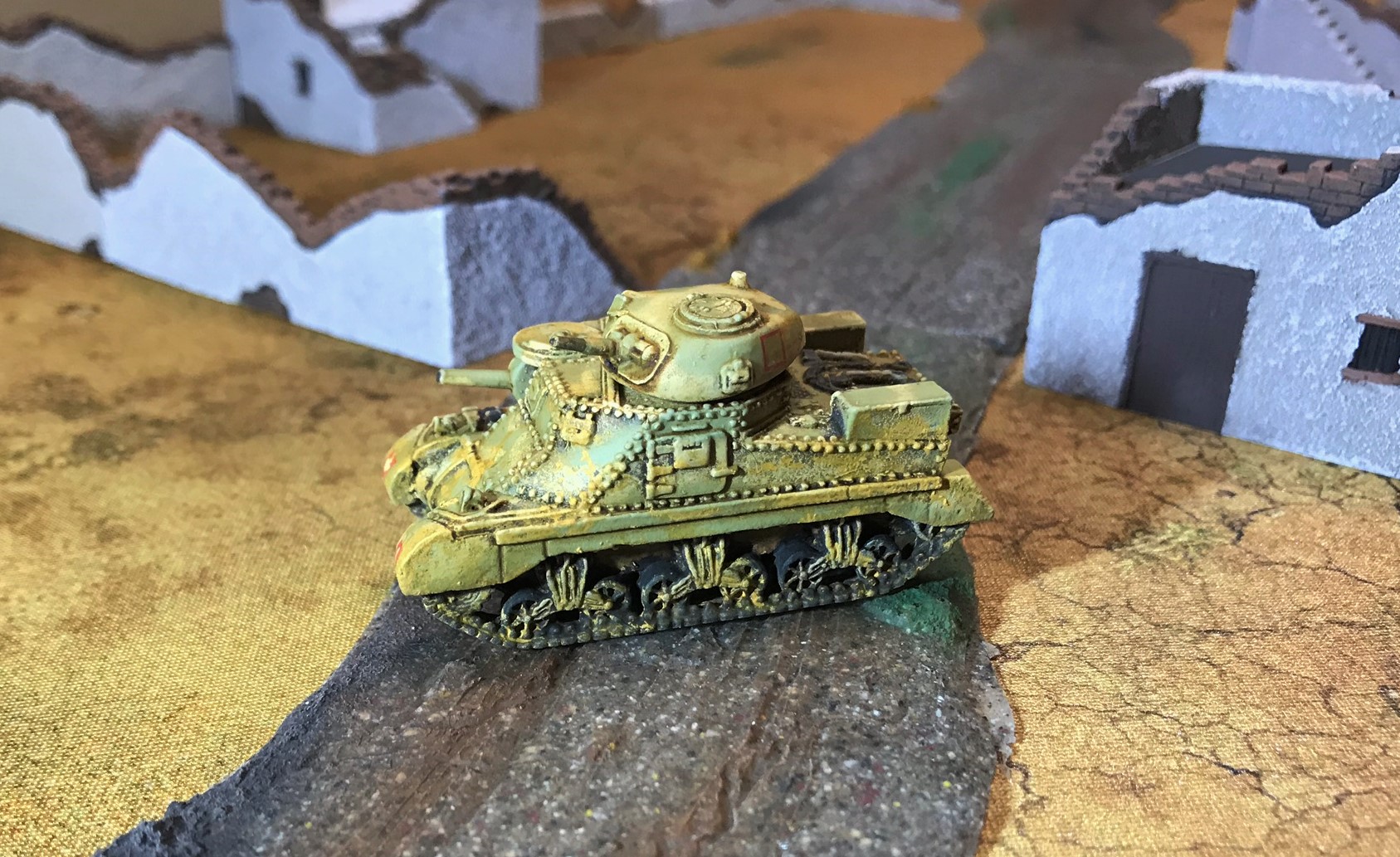
The British were not happy to get American tanks at first.  They did invent the tank after all in WWI, and they were proud of them.  They wanted the US to build British designs, but with the risk of the UK losing the war early on, we Americans balked and said we would only build US designs.  That way, if the British lost, we would not have our factories tooled for non-American designs.  One of these was the light tank M3 Stuart, another was the medium tank M3 Lee.  To placate the Brits, a different and more rounded turret was made than that of the American M3 Lee, and that is the major difference between a Grant and a Lee.  So, my tank is a Grant.  In doing my research, it was interesting to learn that the sponson-mounted 75mm gun was more prized (eventually) because it had an HE round.  That meant that the Grant 75 was far better able to deal with anti-tank gun crews, like the dreaded 88mm, than a solid shot AP round would have been.   In the turret, a 37mm gun was the main anti-tank weapon (though certainly the sponson gun was used in that role as well).

If the chassis looks familiar, yes, it was used as the basis for the M4 Sherman as well.

3 grant final with book
My Grant with its model – the light green was interesting to apply – better pictures in the eye-candy section below.

Churchill Mark II

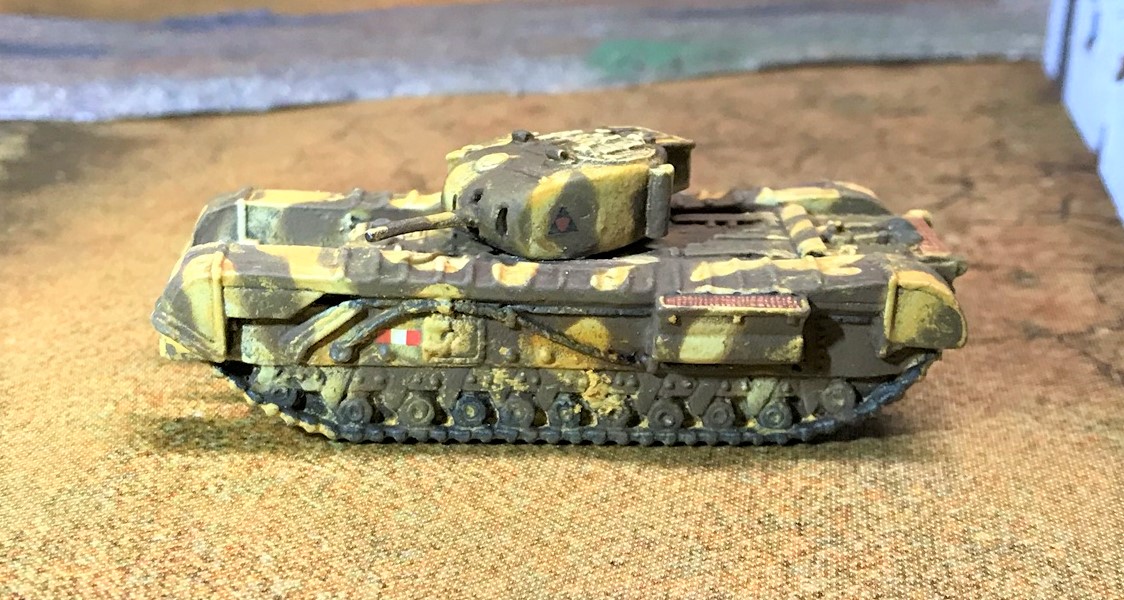
The Churchill infantry tank made its unhappy debut in the costly Canadian forces raid at Dieppe (these were Churchill Mark I’s).  The Churchill Mark II was first used by the “Kingforce” detachment (6 Churchill II tanks) in North Africa in October 1942, and Churchills were used in that theater and in Western Europe throughout the rest of the war.

1 churchill ii in blister
The Churchill in the blister – I chose to make it a Churchill II as the Mark I was only at Dieppe.

2 churchill turret mounting
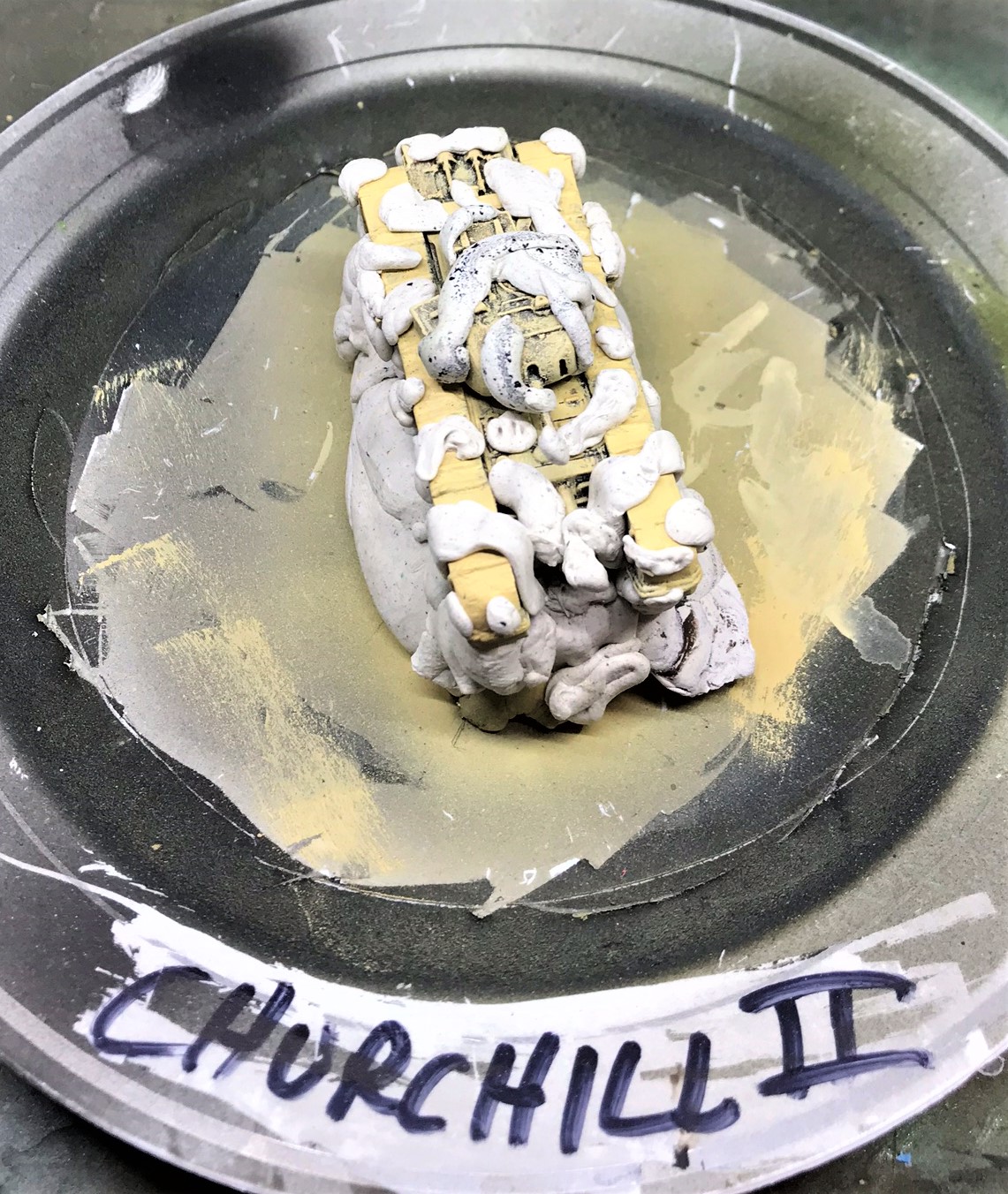
How I started painting the turrets – I later transitioned my approach to using drill holes in wooden blocks instead of styrofoam.  That approach worked much better.  The #14 2″ screw held a magnet and a steel washer, and the magnetized turret stayed on top for painting.

I then masked this big behemoth (for 15mm).  The effort on this tank took some doing – I needed a lot of poster tack.

3 before camo
Churchill tank awaits its desert camouflage paint job.

4 final with book
What I was going for – and again more dirty on mine.

Now my force was – as you Brits out there might say – “proper” in terms of game-worthiness.

1 lots of tanks
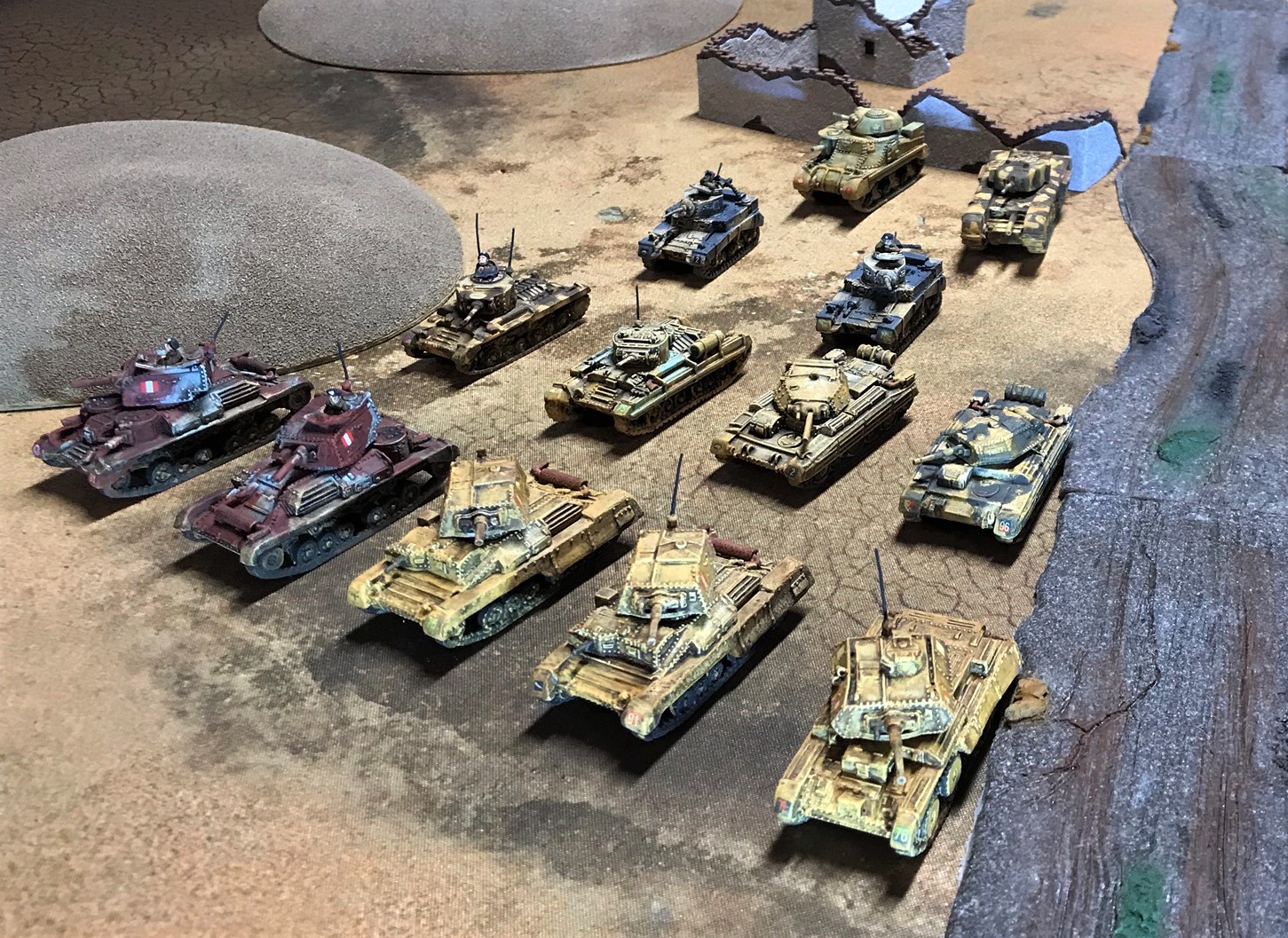
All of the 8th Army tanks I painted since November.

That concludes the history/what-I-did section – now for the…

Eye Candy

2 a10's right side
Right side view of the two A10’s.

3 a10's rear
Left rear view of the same A10’s approaching the village.

4 a13 side
The A13 patrols a village.

5 the 5 cruisers
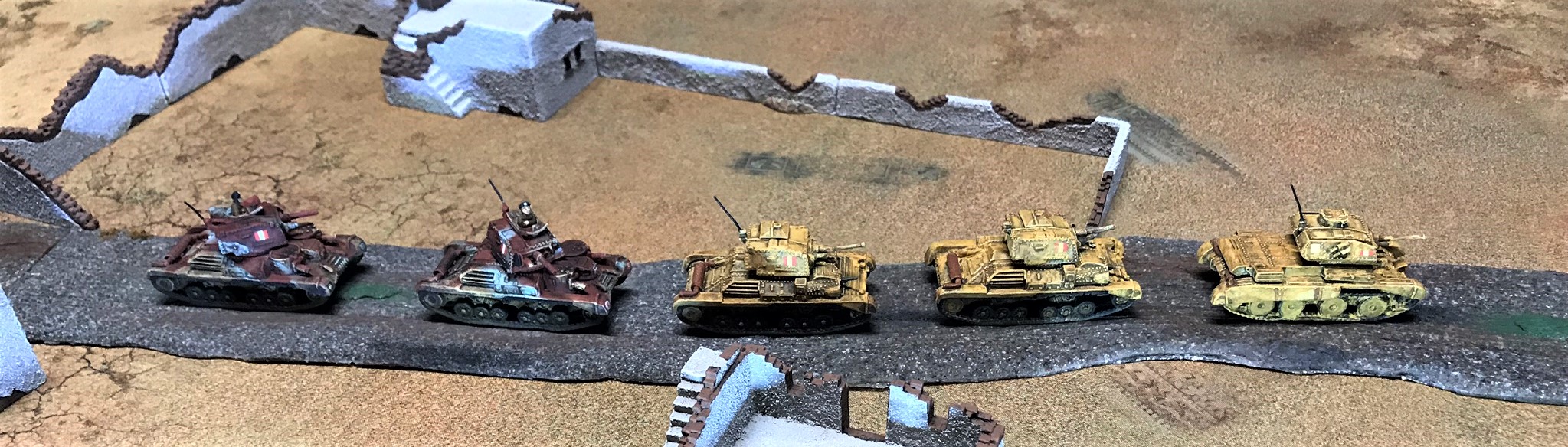
Just for fun, I lined up all of my early Cruiser tanks in a convoy.

6 valentine ii by the well
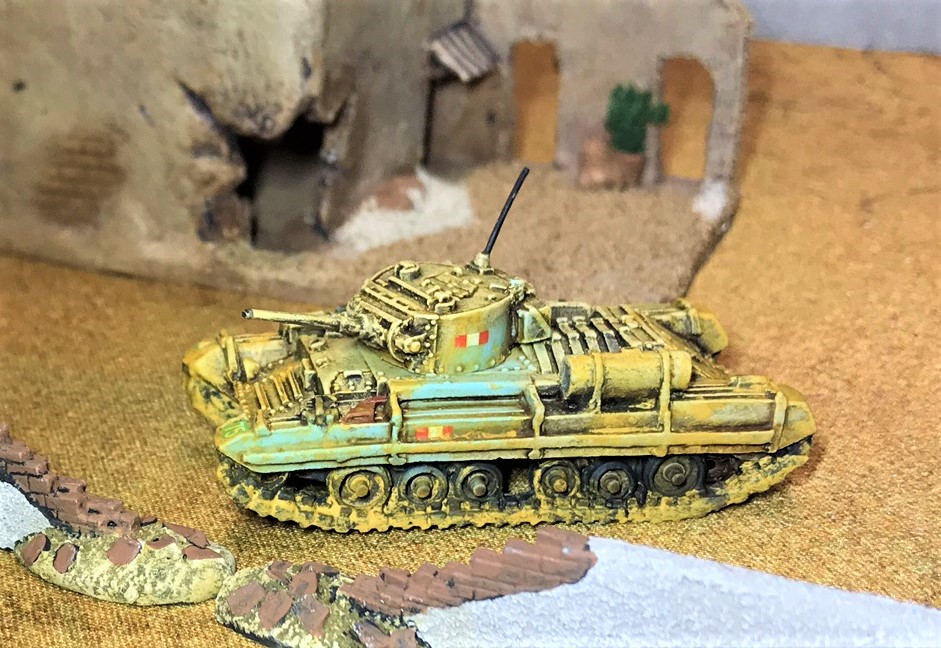
The Valentine II, with its blue Caunter camouflage scheme, guards a well.

7 valentine ii by the wall
Opposite side view of the Valentine II.  I do like the muted appearance of the blue.  The decals were practically microscopic to work with!

8 valentine iii left side
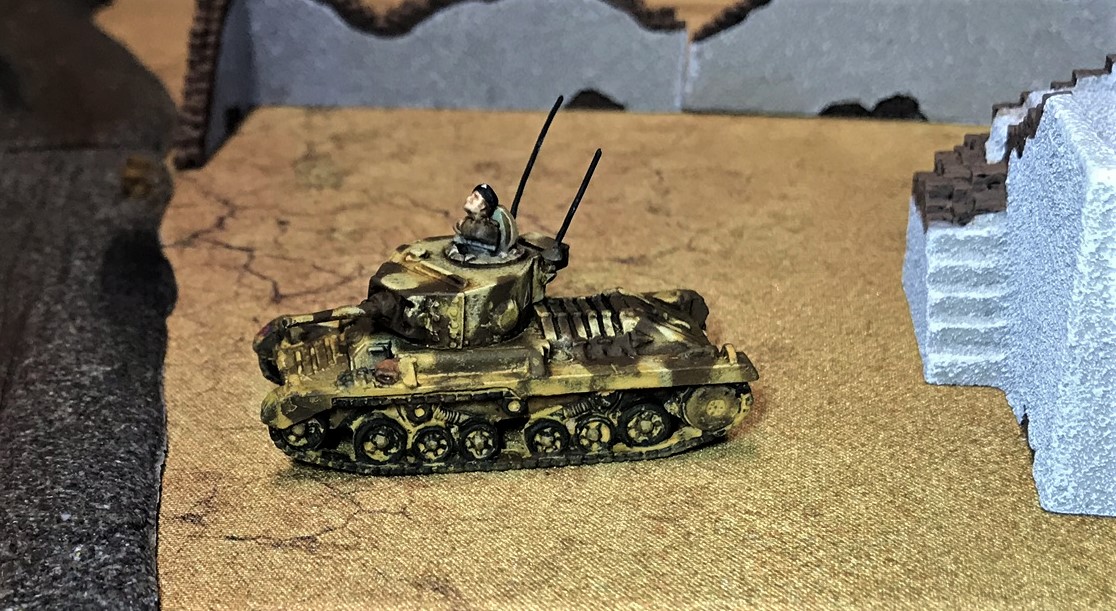
The Valentine III with its brown camouflage pattern approaches a road.

9 valentine iii front facing
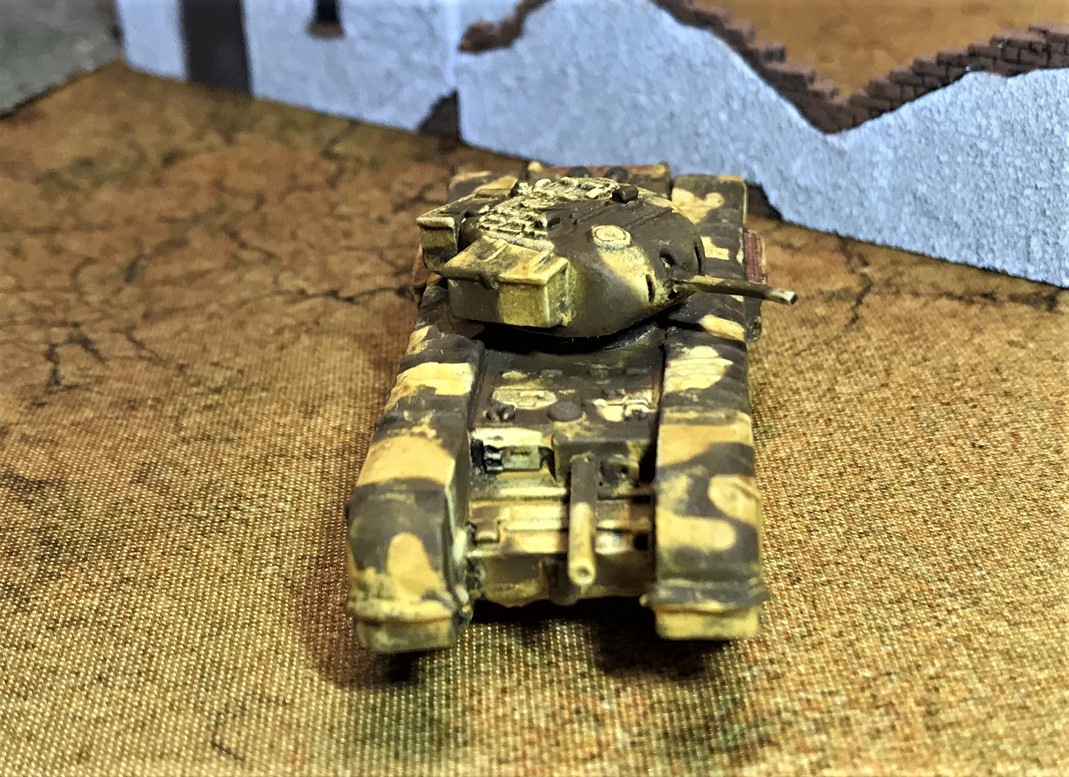
Head on view of the Valentine III.  For perspective, the front of this tank is little more than an inch wide, so this image is 3-4 times the size of the model.

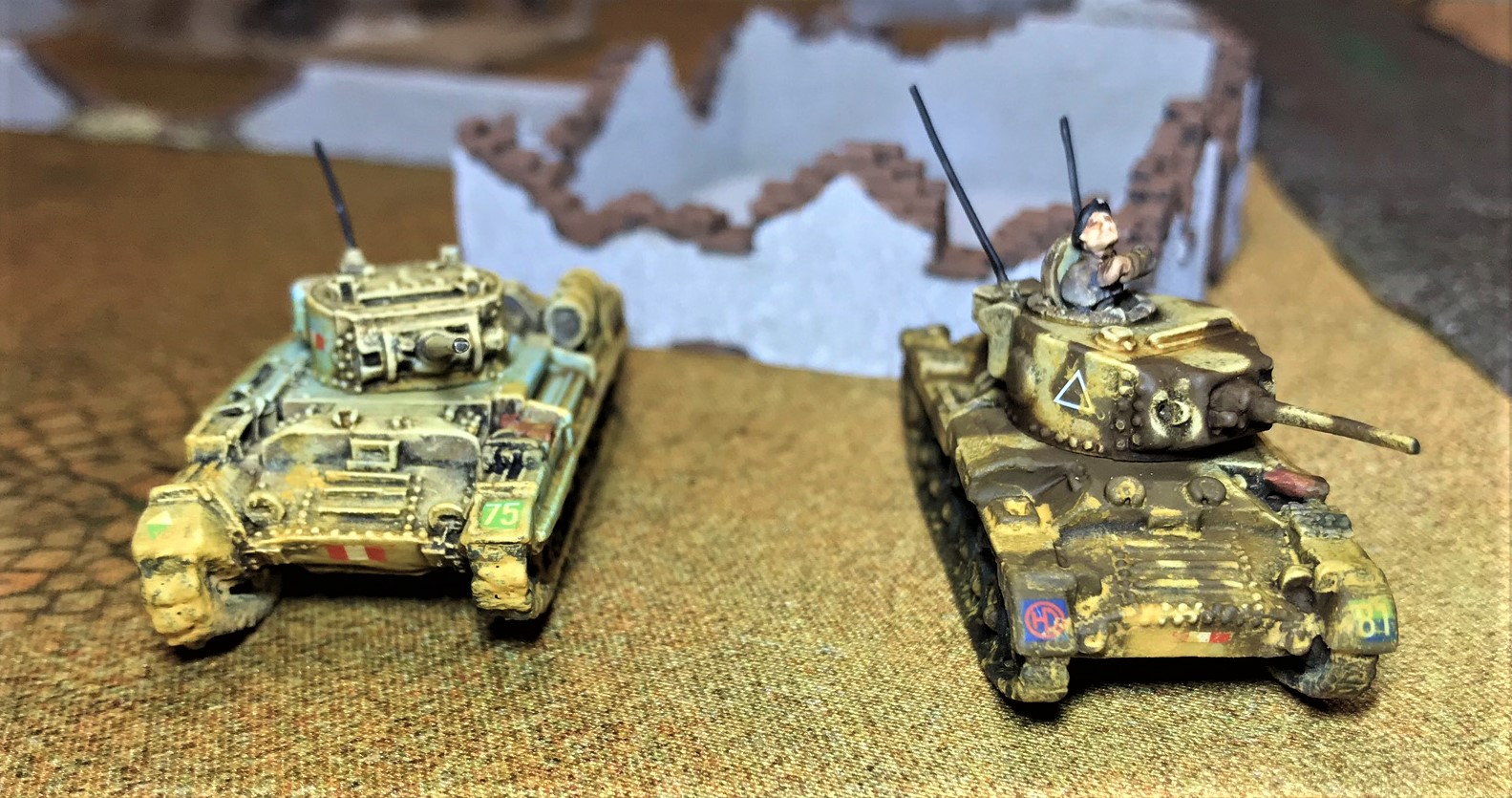
10 the two valentines right sides
My two Valentines (soon to be a romantic comedy perhaps on the BBC?).

11 the two valentines facing front
Nice view of the fronts of the Valentines.  I had a bit of a concern with the tracks of the Valentine II on the left .  As you can see they are a slight bit off – and this was the one Valentine that I needed to reinforce during assembly.  Again, these are the things you notice when your picture is 3-4 times the size of the model!

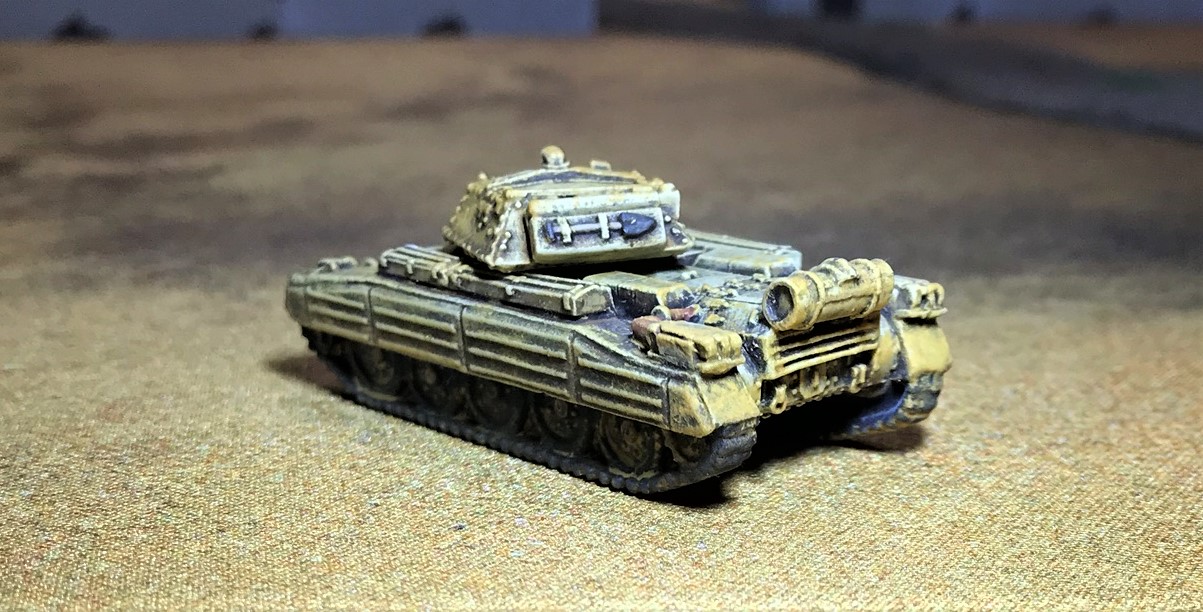
12 crusader ii
Crusader II right side view.

13 crusader ii rear left view
Crusader II left rear view.

14 crusader iii side view
Left side view of my Crusader III with its camouflage scheme.

15 crusader iii rear view
Right rear view of the Crusader III.

16 two crusaders in front of the dune
The two Crusaders, not caped like Batman and Robin though…and this is not Gotham City…

17 grant in front of wall
Frontal view of the M3 Grant.  As a nod to its possible Canadian forces use and/or manufacture, I gave it a Canadian unit marking.  Many of the Grants were made in Montreal, at a locomotive plant.  AND I did this as a Bruins fan (its a hockey thing)!

18 grant side view
The light green camouflage is a little more visible here.  I did not want it to be overwhelming, but it is tough to photograph.

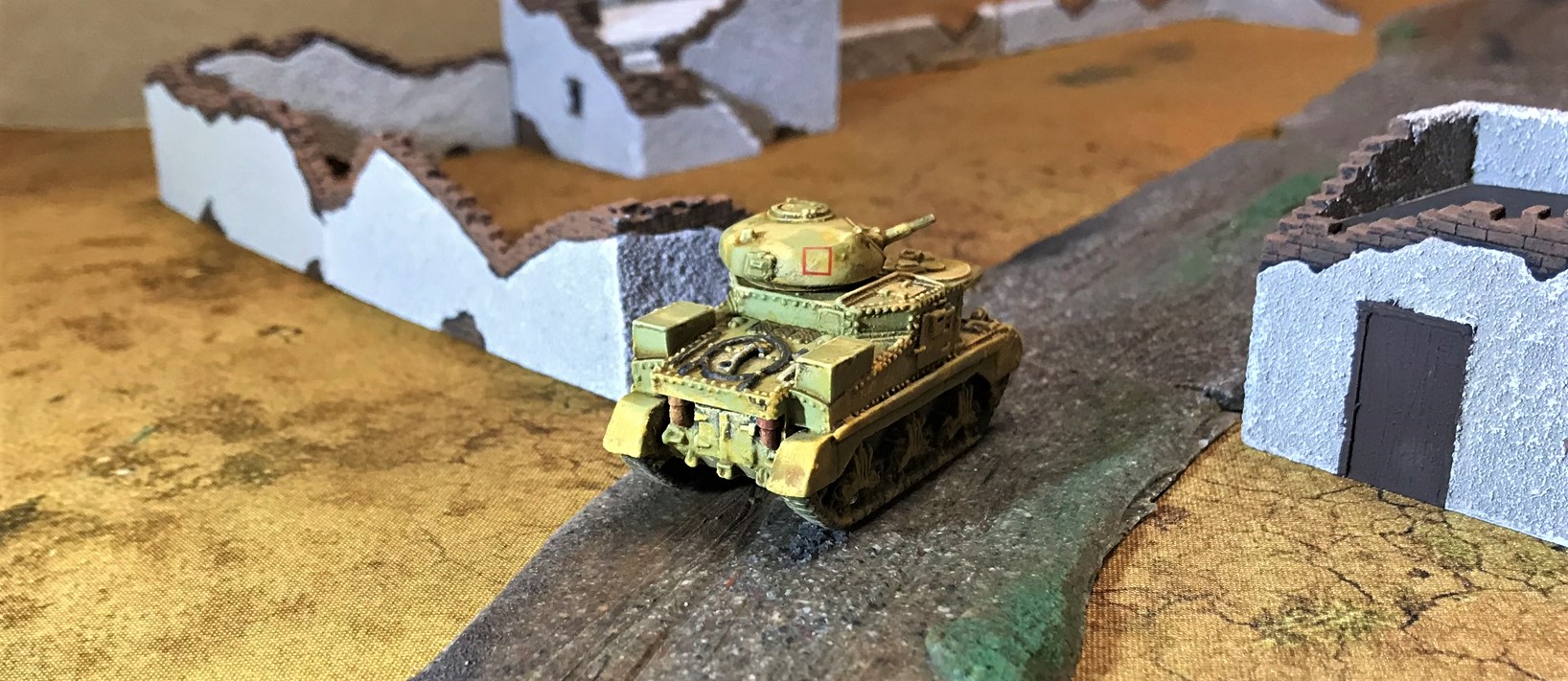
19 grant rear view
Entering the village.

20 churchill right side
My Churchill II, left side.

21 churchill left side
Right side of the Churchill II.  The camouflage painting on this and the others was fun.

22 churchill front side
Front view of the Churchill II.

23 traffic!
For even MORE fun, I convoyed all of my painted 8th Army tanks.

24 parking lot
Is this a motor pool or what?  Nice group shot – my Matilda II’s did not make the shot, but I only touched them up so they hardly deserve to be in this shot.  Still like them though, but they are kind of adopted…

Now it’s onto the Germans and Italians – which I hope to finish soon.  But never soon enough…

Thanks for looking, and I very much hope that you enjoyed seeing these.  Any favorites?  Feedback?  Winning lottery numbers?  Please leave me your thoughts in the comments section!

PAINTS, INKS, GLAZES, SHADES, WASHES, AND FLOCKING USED ON THIS TANK GROUP:

  1. Vallejo “Flow Improver”
  2. Vallejo “Airbrush Thinner”
  3. Vallejo “Surface Primer – Black”
  4. Testors “Universal Acrylic Thinner”
  5. Citadel “Imperium Primer”
  6. Battlefront “European Skin”
  7. Battlefront “Skin Shade” (shade)
  8. Vallejo “English Uniform”
  9. Battlefront “Crusader Sand”
  10. Vallejo “Desert Sand”
  11. Battlefront “Worn Canvas”
  12. FolkArt “Champagne”
  13. Battlefront “Black”
  14. Citadel “Agrax Earthshade” (wash)
  15. Citadel “Nuln Oil” (wash)
  16. Vallejo “Dark Sand”
  17. Battlefront “Dry Dust”
  18. Battlefront “Wool Brown”
  19. Battlefront “Boot Brown”
  20. Battlefront “Rommel Shade” (shade)
  21. Battlefront “Bradley Shade” (shade)
  22. Battlefront “Dark Gunmetal”
  23. Battlefront “Dark Leather”
  24. Battlefront “Oxide Red”
  25. Battlefront “Tommy Green”
  26. Gorilla Glue
  27. Green stuff (kneadatite)
  28. Tamiya masking tape
  29. Vallejo Mecha Varnish “Gloss Varnish”
  30. Microscale Micro-Set
  31. Microscale Micro-Sol
  32. Microscale Liquid Decal Film
  33. 1/8″ rare earth neodymium magnets
  34. Appropriate decals from Battlefront
  35. Vallejo Mecha Varnish “Matt Varnish”
  36. Vallejo Mecha Color “Sky Blue”
  37. Aleene’s poster tack
  38. Vallejo Model Air “Blue Grey”
  39. Secret Weapons Washes “Armor Wash” (wash)
  40. Vallejo “Dark Yellow Ochre” (pigment)
  41. Sponges
  42. Army Painter Quickshade “Light Tone” (wash)

Thanks again for looking and for sharing your feedback!

RESEARCH MATERIALS

As for research materials, I used the same ones as I cited before – but for completeness here they are in case you are interested (you can find them on Amazon):

  • Two by David Fletcher:
    • British Battle Tanks: British-made tanks of World War II
    • British Battle Tanks: American-made World War II Tanks
  • One by Jean Restayn:
    • WWII Tank Encyclopaedia, 1939-45
  • One by the Smithsonian/DK:
    • Tank: The Definitive Visual History of Armored Vehicles
  • One by Michael Green:
    • Axis Armoured Fighting Vehicles of the Second World War (Images of War)
  • One by Robert Jackson:
    • Tanks and Armored Fighting Vehicles Visual Encyclopedia

I would easily recommend all of these books as good resources for gamers and modelers.

Despatches from Fort Syllabub

An account of fictional adventures on the North West Frontier - and other times and places, real or imagined

Man of Tin blog

Toy soldiers, gaming, Imagi-Nations

Zauberwurfs Blog

Ein Blog über Tabletop und Miniature Wargames.

Frank Tank Rants

musings of a fat old bloke on tanks and wargames

Dragons of Lancasm

Games, miniatures, painting, books and more games

Tiny Painted Heroes

The Adventures of a lifelong Tabletop Gamer, Game Design hobbyist, and full-time Software Engineer

Steve's Paint Brush

Grimdark model making and mini painting

Wargamesculptors Blog

Life, Golf, Miniatures, & Other Distractions

Dead Dick's Tavern and Temporary Lodging

Life, Golf, Miniatures, & Other Distractions

Guru Pig - the gaming Guru

Guru's thoughts on wargaming, life, and the universe!

Wisely lead... without a head!

History, Miniatures and Wargaming

Kuribo's Painting

Fallout Wasteland Warfare, Warhammer, and Hellboy Painting, Terrain, Dioramas, and Battle Reports

Don't Give Greg Ideas

Seriously, just don't

War Across the Ages, and other dark horrors

A discussion of miniatures collecting, painting and gaming.

Classic Warhammer 40K

Painting diary focused on Warhammer 40K 2nd ed., 5th ed. WHFB, related GW games, and miscellaneous whimsy

Colonel Mustard

WW2 Modelling in 1/72 Scale

Bogenwald

Random painting and terrain making.

Pat's 1:72 Military Diorama's

Scale diorama tips and ideas

Arcade Dreams

Building the Arcade Dream

P.B.Eye-Candy

Phil's 20th century wargame pages

SP's Projects Blog

A futile fight against entropy or 'Every man should have a hobby'? Either way it is a blog on tabletop wargames, board games and megagames

30mmdave

Wargaming Plausible reality?

The Imperfect Modeller

Miniature Figure Painting and Diorama Modelling

Double Down Dice

Painting miniatures and rolling dice!

Just Needs Varnish!

My ongoing wargames projects!

miniaturepopcorns

Sculpting some worlds

Despertaferres

Wargaming with the ability of a dull nine year old

Dawn of the Lead

Miniature wargaming and the occasional zombie

Rantings from under the Wargames table

Wargames, Figures, Sculpting and Converting Miniatures

Simple as War

Miniatures & Terrains

Buck's Blog

Life, Golf, Miniatures, & Other Distractions

IRO aka Imperial Rebel Ork

- I model - therefore I am -

Azazel's Bitz Box.

Painting, Modelling, Miniatures, 1:6, Games... Whatever else I find interesting.

diggingforvictoryblog

Smallholding and Wargaming.......not always at the same time!

Shamutantis

Nørdblog numero uno