I am catching up as I can in my blog on projects that I have completed in August and September. Last year, I was looking on eBay for some interesting Ral Partha additions to my fantasy armies. Specifically, some large creatures that Wizards could control in my War Must Be game. In the game, Wizards can use a Mundane Spell (His Master’s Voice) to control a large creature such as the giant scorpion, giant tarantula, or giant spiders that I have previously described in this blog. They use some of their action chips to accomplish this.
His Master’s Voice Spell Card
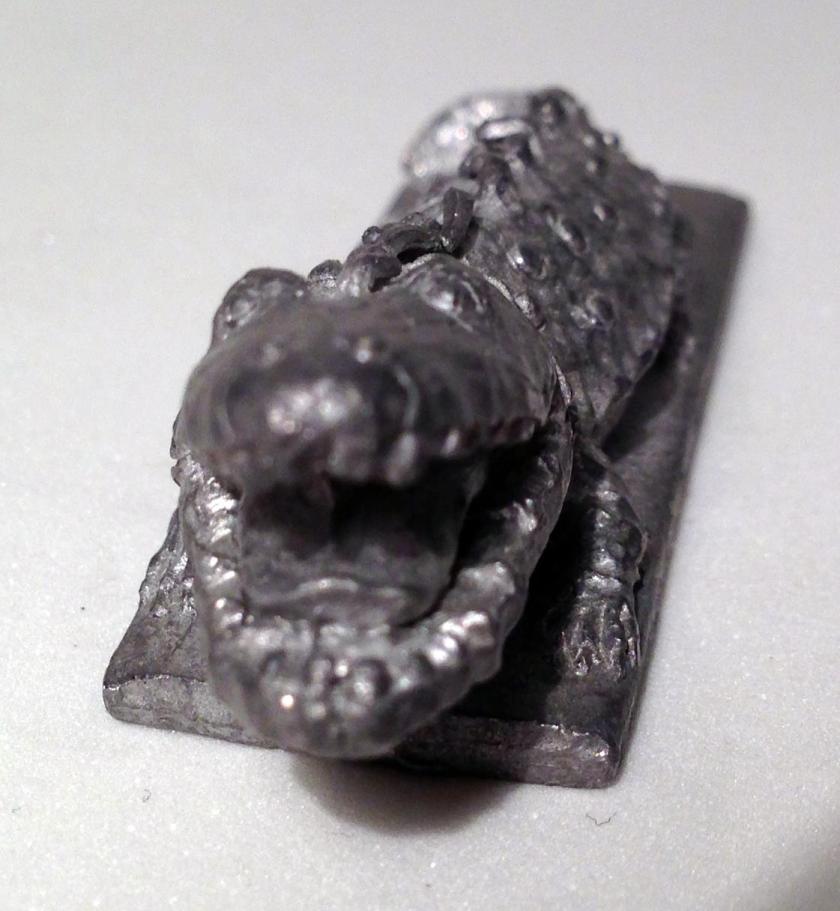
Once again, I happened upon an eBay find that intrigued me. There was a group of four “Fire Breathing Salamanders” available, and my imagination took over – this would be like having a Wizard controlling a living flame thrower – pretty cool stuff. Each will have a limited number of powerful short range flame attacks in the game, in addition to tooth and claw capabilities. These figures were sculpted by Dennis Mize as part of the Children of the Night line, and were designated 13-028, and released in 1982.
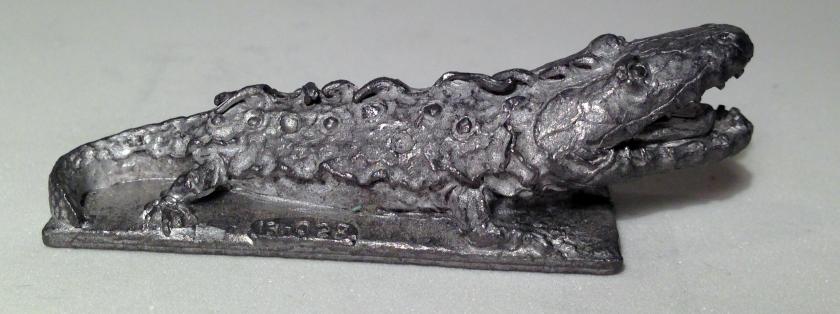
Unpainted Fire Breathing Salamander, side view
Unpainted Fire Breathing Salamander, business endBottom of figure – waiting 34 years to get painted!
Way back in February, I primed these in Jeff Smith’s heated workshop with Krylon “Ultra Flat Black” spray paint with a gaggle of other figures. Later in the spring, I mounted one on a 3½” beveled hex base made out of 1/8″ luan, but it did not look correct for play. Subsequently, I remounted all four on bases that were roughly octagonal or elliptical, which worked better. I glued two 1″ steel washers to the bottom of each base for future magnetic storage.
Initial basing of primed figure which I changed to different bases
As inspiration, I wanted to give these the coloring of a salamander that is native to Massachusetts that I had seen only rarely. I believe that it was a blue-spotted salamander, and the memory I had was of a blackish blue to purple-skinned creature with light spots.
Blue Spotted Salamander
The Dennis Mize figures were more alligator-like, but this was my starting point.
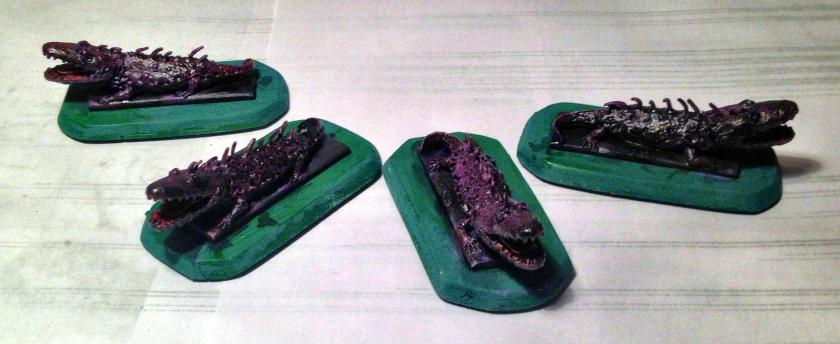
I began by painting the interior of the mouth with Americana “Primary Red”. I mixed equal parts of American “Dioxazine Purple” and “Ebony” for the upper skin. For the lower belly and the spots, I used an equal mix of “Dioxazine Purple”and Americana “Buttermilk”. For the eyes, I used straight “Dioxazine Purple”. I then washed the figures’ skin with Secret Weapons Washes “Purple”, and the mouth with SWW “Heavy Body Black”. I drybrushed the figures with Americana “Lavender”, and then applied two more sequential washes with SWW “Sewer Water” and “Heavy Body Black” as I tried to get a shade that I was happy keeping. This seemed to work adequately.
After base coating and initial series of washes
After dry brushing and more washes
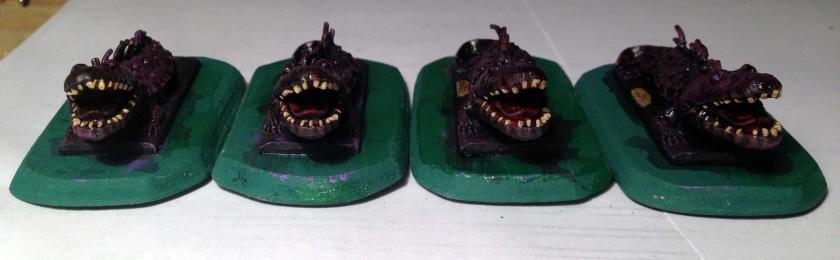
For the teeth and eyes , I used Citadel “Ushabti Bone” and “Wild Rider Red” respectively. I added an iris with veteran 1984 Polly-S “Slime Green”.
Smile!
I then touched up the nails with a mix of the “Ebony” and “Dioxazine Purple”, and added some more “Ushabti Bone” to the spots, then another two washes – first with the SWW “Purple” watered down a bit, and then a light one with Citadel “Agrax Earthshade”.
There is a small plaque on each figure with 13-028 on it. These I painted with Martha Stewart Crafts “Brushed Bronze” and washed with SWW “Heavy Body Black” to highlight the numbers.
Fire Breathing Salamanders painted before flocking of bases
I used Army Painter “Moss Green” flocking, and I was not happy with the effect. These creatures needed to look as if they were crawling out of a swamp or tall elephant grass. I wanted better. I used two coats of varnish sequentially – Krylon “Clear Matte” and Testors “Dull Coat” to seal the paint job ensuring adequate drying time between coats. Then I moved back to the bases.
Detail of plaque and initial flocking
The four after varnishing
I had a good number of Army Painter “Swamp Tuft” and “Jungle Tuft” accessories that I thought would do the trick, and this approach did work. The trick here was to cut the “Jungle Tuft” in half on the cellophane before using and mixing in the “Swamp Tuft”. I affixed these with Elmer’s white glue. This had the advantage of hiding the rectangular base lines and give the “crawling through grass” impression.
The Fire Breathing Salamanders
Overall, I am very happy with the results. I really think that the final basing, which took some time and a lot of gluing, was worth the effort. I look forward to watching them roast some enemies at the behest of their Wizards!
Buck Or is that Roo-men? Sometime in ancient history, Ral Partha made a single pack of figures, called Rooman War Party, which had Roomans in two poses, but all armed with pikes or spears. They are no longer available. Over the years, I collected dozens of the originals, but they have become quite rare, even […]
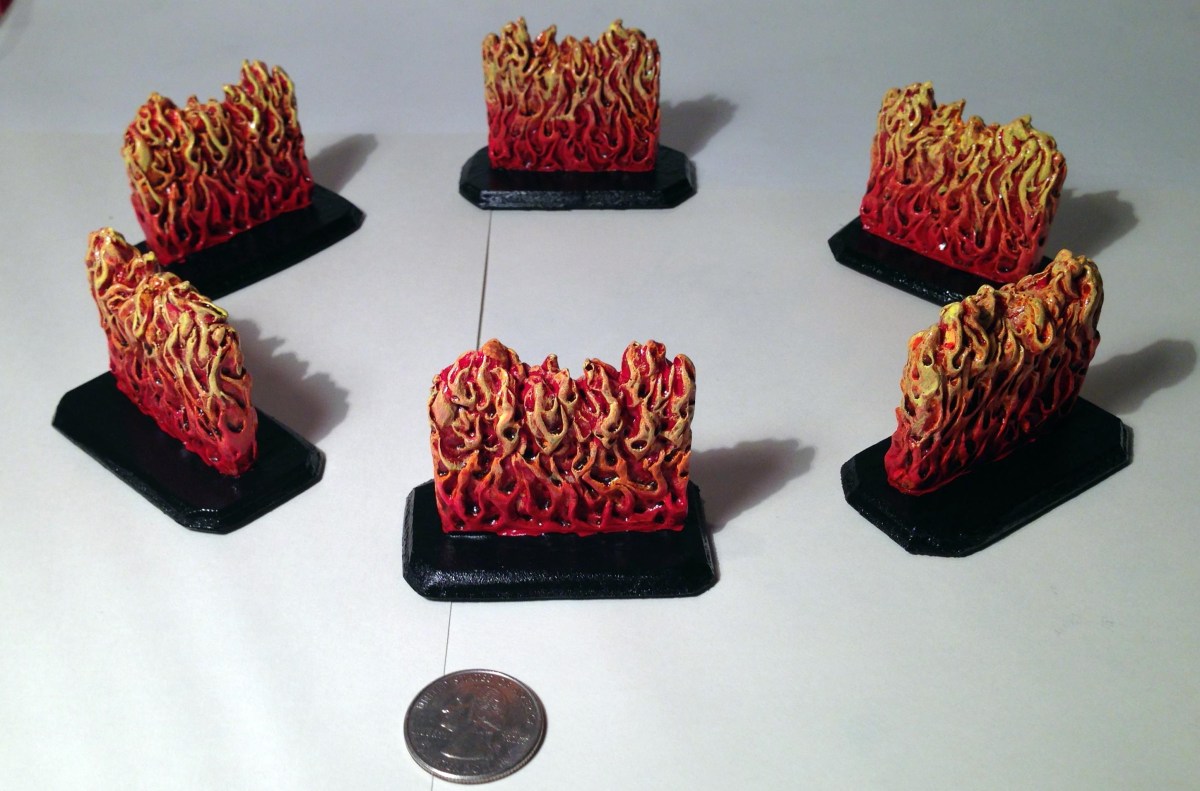
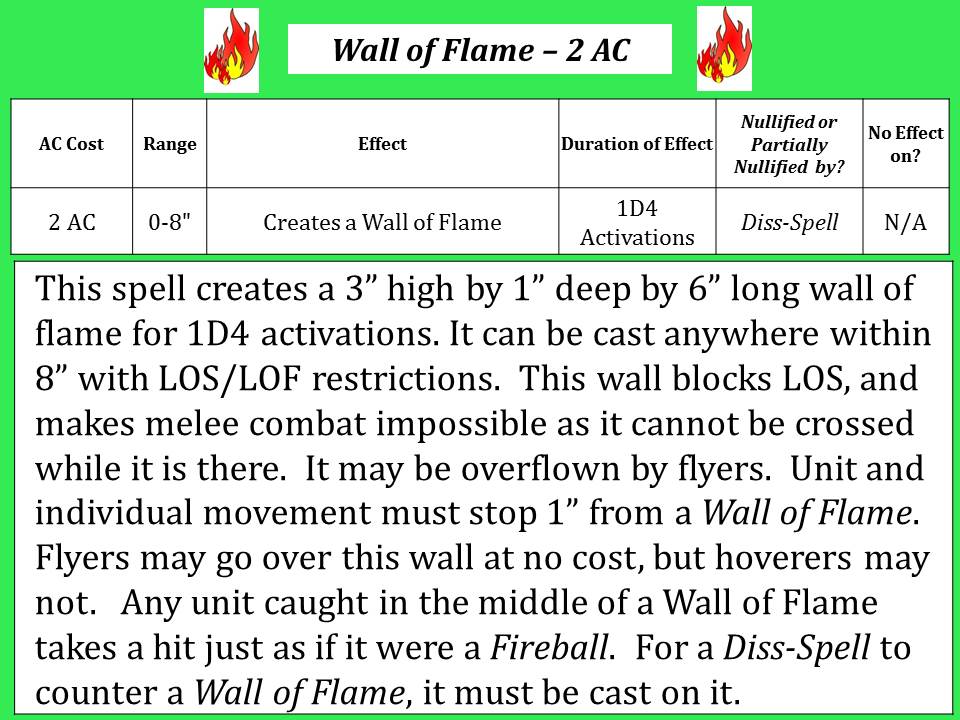
Luckily, I found a listing at Noble Knight Games (or possibly on their eBay site) for 6 Ziterdes Fire Walls that would serve my purposes well. They were resin (not metal). Ziterdes makes very high quality German hobby products, and Noble Knight games has many of them for sale.
Ziterdes Fire Walls in package I soaked them in dish soap and cleaned them with a toothbrush (something I learned from Chris Palmer – thank you Chris!). I had cut several bases out of 1/8″ plywood with my scroll saw so I used these for mounting the Walls of Flame. I also mounted two 1″ steel washers to the underside of each base for magnetic attachment in my storage boxes. I painted the bases with Americana “Jungle Green”.
Walls of Flame mountedThen, I used up the last of my Armory “Red” from 1996 to base coat the walls. I had wanted to use my Armory “Scarlet” as well but that had become unusable after 20 years!
After that dried, I then applied Americana “Primary Red”, followed later by a wash with Secret Weapons Washes “Ruby”. After that I highlighted the walls with Citadel “Wild Rider Red”.
I thought it appropriate to use some of my German 1986 Deka-Lak “Gelb” (Yellow) for flame highlights with a drybrushing technique (after all these are a German product). For the middle part of the flames, I used Tamiya “Orange X-6”. Then I washed them sequentially with Secret Weapons Washes “Just Red” and “Ruby”, allowing both to dry in between. I thought the bottom of the flames needed a deeper red, so I went back to using Americana “Simply Red” as a highlight at the lower end of the flames.
I second-guessed my use of green for the bases. Would not all the organic material at the base of a Wall of Flame be burned? Therefore, I went with Americana “Ebony/Lamp Black”.
For varnishing, I went with Krylon “Clear Glossy” as I wanted the walls to be as bright as possible.
Final product!I am very happy with how these came out. They really “pop”!
I will use them as walls of flame, and also potentially as fireballs for my wizards, discharges from flame weapons and even as breaths of flames for dragons. My Fire Breathing Salamanders will use them as well!
I am behind on my blogging as I have been a little under the weather and, ahem, I cannot sit down without pain! So blogging is a bit challenging! The good news (if any) is standing is fine and I have completed a few projects that I’d like to document.
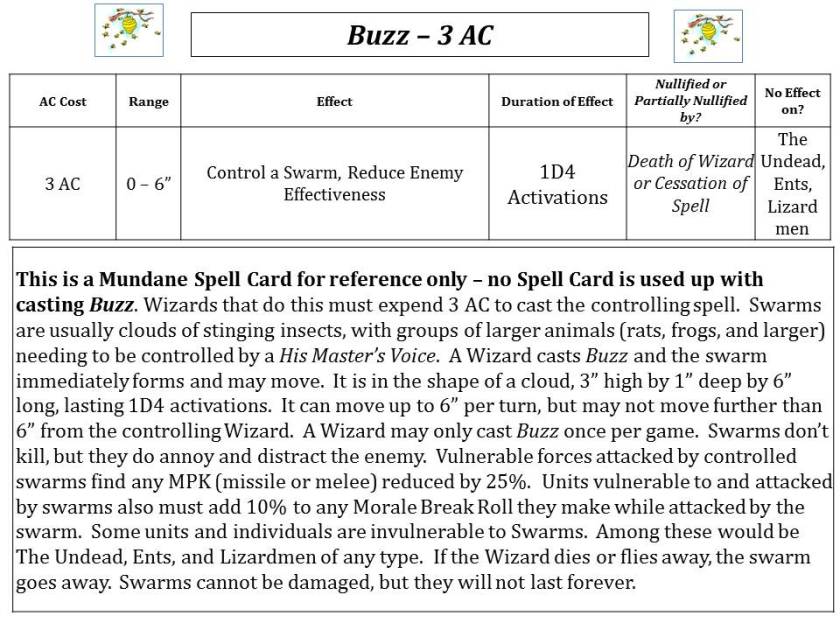
I have made Spell Cards for my fantasy miniatures war game War Must Be. Among the Spell Cards is a Mundane Spell called Buzz that enables a Wizard to summon a swarm once per game. Hence, I needed some swarms!
Spell Card for a Buzz spell
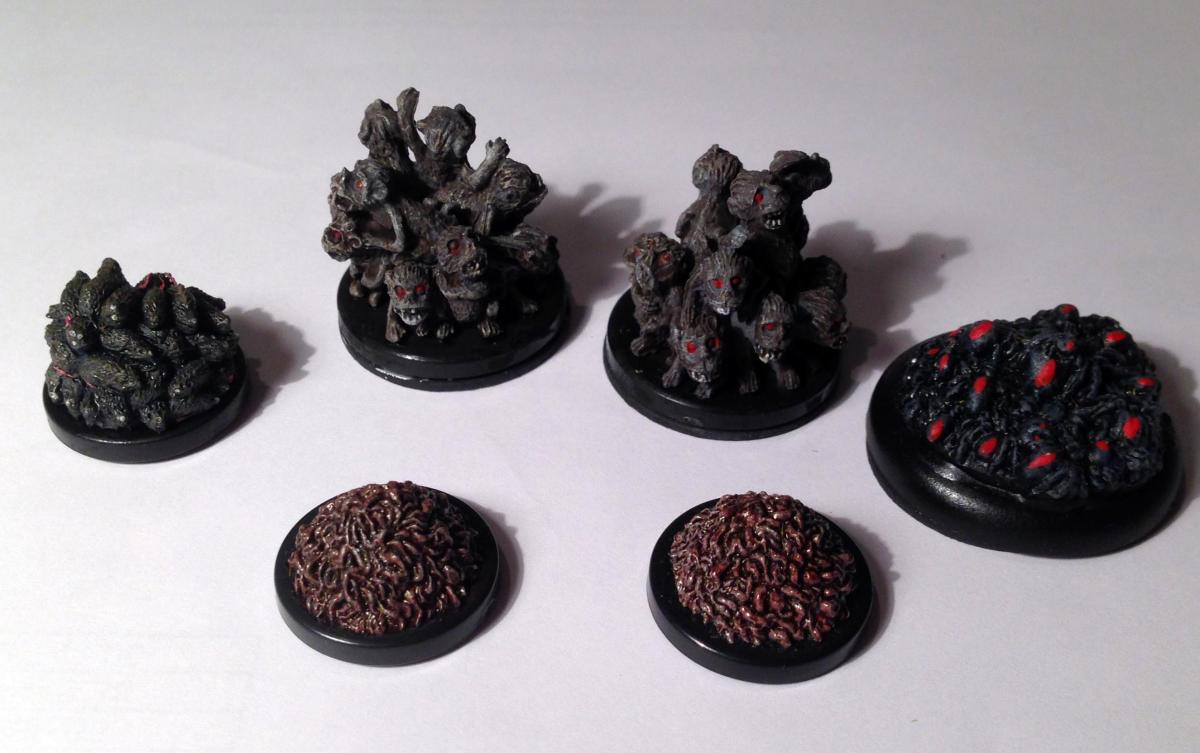
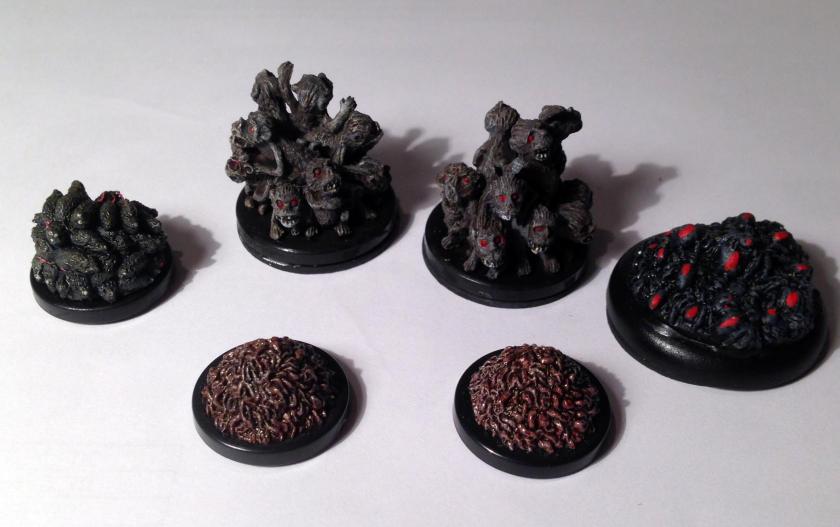
The swarms that I found on eBay are below.
I don’t think that they were made unpainted but I am unsure.
In the front row, I have two grub swarms (Wizkids), and in the back row there are left to right a rat swarm (Wizkids), two monkey swarms (Wizkids), and a Reaper Vermin black widow spider swarm. I painted the grub swarms with Citadel’s Dryad Bark and applied a wash with Citadel’s Agrax Earthshade to each. I also applied the same wash to the others. Each swarm got an appropriately sized washer glued to its underside so as to be easily stored in my magnetically-lined storage boxes.
In the end it is irrelevant which type of swarm is summoned as they all have similar effects in the game.
While I was looking for the original picture that Buck just posted about (“The Final Act”), I found an original printout from the USMA computer lab (same paper with the green and white striped backing) of The Athelfrog’s Castle, by Buck Surdu. This was the first Tunnels & Trolls game I ever played, with Buck as the GM.
I have been reading through it and laughing a lot – wishing we could go back at this oldie but goodie campaign.
The pages are perforated but still not torn apart. I imagine Buck printed this off under the nose of the “gold coats” (the old computer lab assistants). See back then, there were only mainframes for us to use and we had to go to the computer lab!
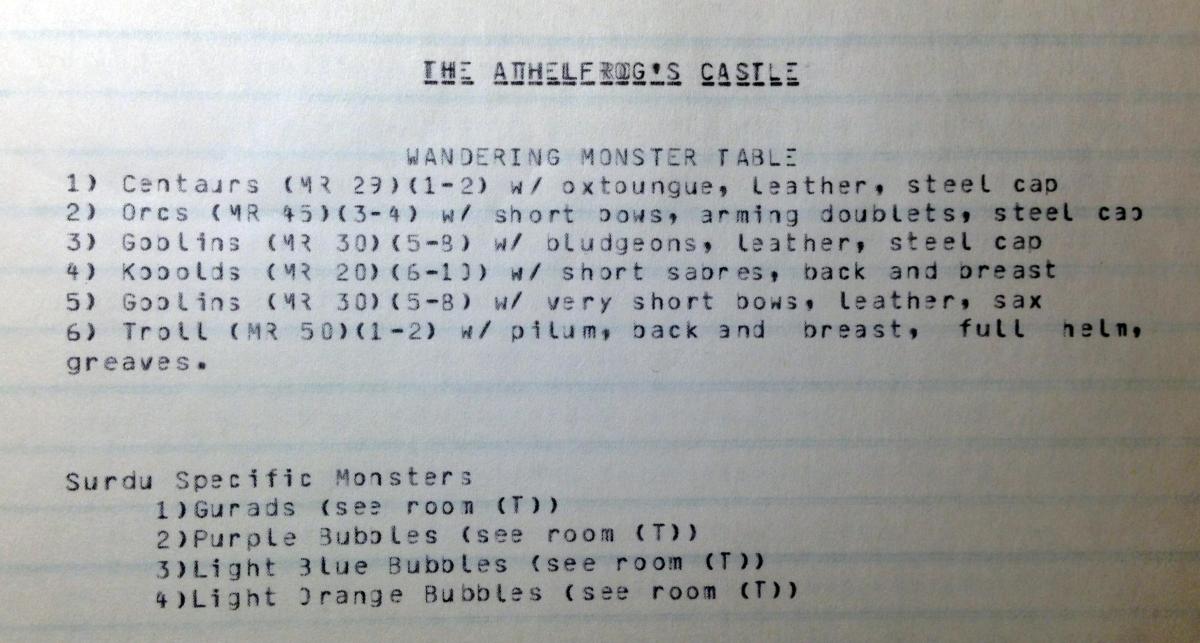
The old printer matrix from back then is funny to see! But wait, here also is the debut of the Gurad!
Except from Cover – note Surdu Specific Monster 1
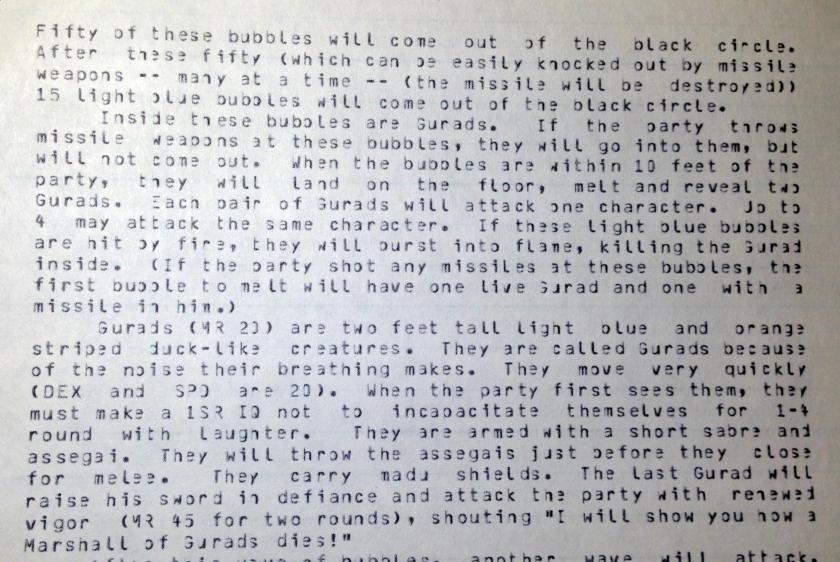
Here is the interesting part from the room where they appeared – read and enjoy!!
Where do Gurads Come From Daddy?
Anyways, I also found rules Buck wrote for clerics, special equipment, weapons expertise, and more for Tunnels and Trolls. He’s still at it – now with multiple publications over the last including Combat Patrol ™ which is a pretty cool system. His creativity and imagination are truly great and personally inspiring – if only he was closer to Massachusetts! Thanks for the memories Buck!
Last Saturday I got the opportunity to GM a fantasy tabletop war game battle with Ellen Morin and Chris Smedile using my War Must Be set of rules. One of my goals was to play test the rules, especially the crew-served weapons and the adjusted morale rules. The other was to let Ellen and Chris play using my shortcut cards and determine if game play moved along well.
Chris had the evil attackers, consisting of several units of Orcs led by a Gnoll, two Insect Men skirmisher units, a Troll large ballista, the skeletal Nightmare Legion, and two wizards controlling large creatures respectively (a giant scorpion and a giant tarantula). The overall HQ was the Nightmare Legion’s command group. Their objective was a bridge at the rear of their enemy’s lines.
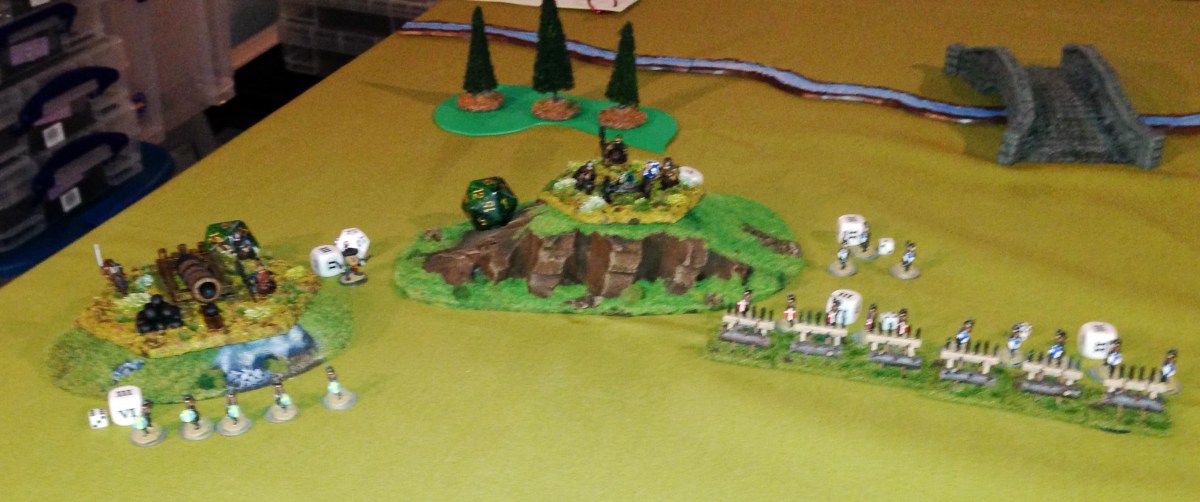
The attacker’s view
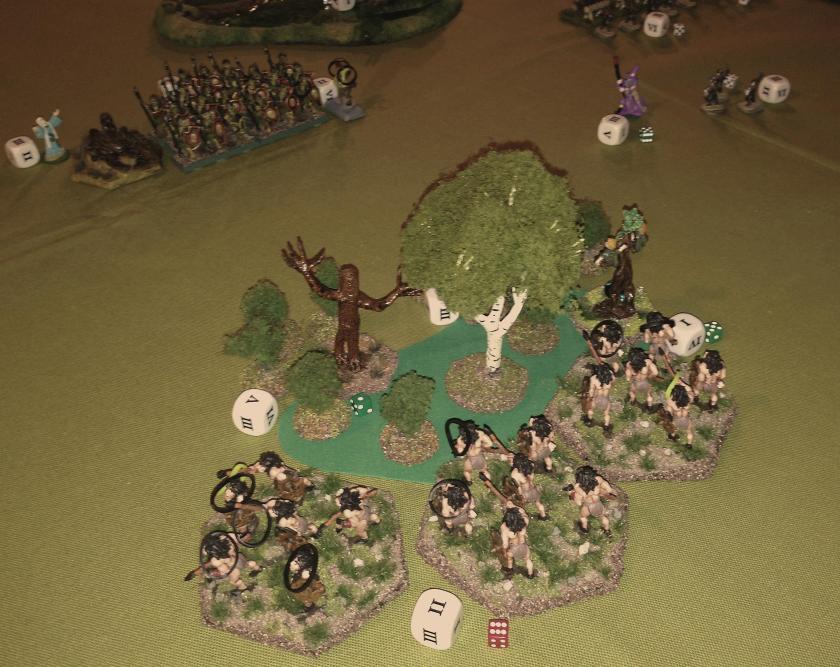
Defending against them was a collection of Dwarves, Neanderthals, and Ents. The Dwarves had excellent positioning of two primitive cannons (one large and one small bombard) on top of two escarpments – both with excellent fields of fire. These veteran crews were led by the infamous “Dwarf with No Name”, armed with two black powder pistols. These were reinforced with three Scandinavian Dwarf Skirmishers (Danes, Finns, and Swedes). The Swedes guarded the base of the escarpment with the large bombard, while the Danish and Finnish Dwarves defended chevaux de fries in front of the flank of the small bombard’s escarpment. A large mass of neolithically-armed Neanderthals held a gap between a swamp and a forest on the left flank. While they held, two Ents (Redbeard and Tanbeard) recruited small trees to augment the defenders. These two plus Waldo the Wizard were under the command of the overall force commander, Treebeard.
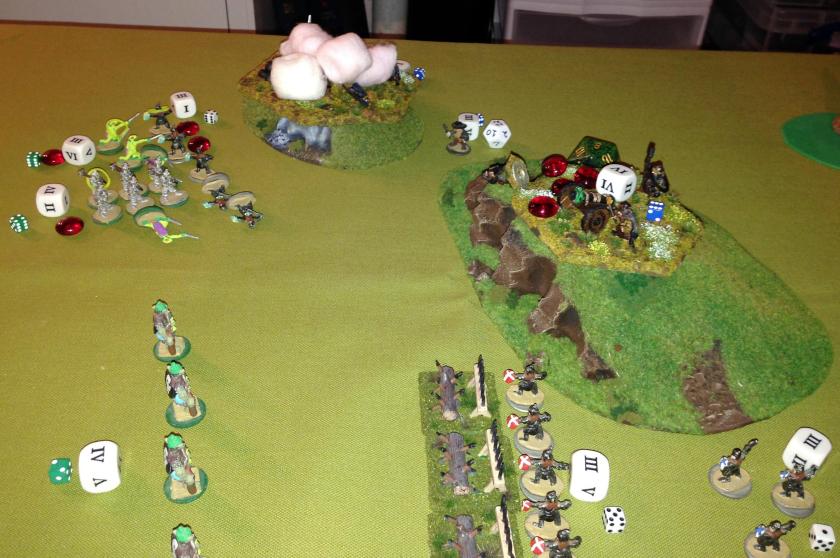
The defender’s viewLeft Flank of Defenders at set upThe attackers left flank at set upDwarven Bombards (Large on right, small on left) and supporting Scandinavian Dwarves at set upNeanderthals hold the gap, while Redbeard and Tanbeard recruit trees. Treebeard and his Wizard await at set up.
This set up forced Chris to move his forces up right under the guns of the Dwarves. The first salvo from the large bombard missed the forward unit of Insect Men skirmishers. However, it struck the follow on unit and killed 3/4 of them. The remaining figure, once activated, failed its morale check, and went buzzing off into cover.
The second Insect Men are devastated by the large bombard
Ellen continued to hold her position while her Ents recruited trees for the fight. Chris, realizing that he needed to bring pain onto at least one of the bombards, moved his Orc Death Head Longbow up, and made a miraculous set of rolls – killing one of the crew of the small bombard, and degrading its effectiveness at reloading and firing. He took his best melee Orcish troops with maces and put them into column as they moved into point-blank range of the large bombard. It looked like bowling for Orcs was about to happen. Ellen got the card activating the large bombard – aimed, and gave the order to fire…
She rolled a misfire…
She rolled for the consequences of the misfire…
The large bombard BLEW UP, killing one crew member, severely wounding the crew chief, and putting the gun out of action for the remainder of the game.
Things go from bad to worse for the Dwarven Bombards
The other undamaged Insect Men fought the Swedish Dwarves, driving them back. This allowed them to swing around the hill and hit the Dwarf with No Name. The DWNN raised his pistols to fire…
BOTH misfired.
One jammed, and the other blew up, wounding him severely.
Meanwhile, the Neanderthals were being attacked by Kaadastral, Bringer of Plagues (a demon), and a Giant Scorpion controlled by the evil Wizard Greencape. A large Tarantula controlled by the evil Wizard Rooney was closing in as well, but it took a fireball from the good Wizard Waldo, wounding it but not killing it.
Neanderthal Melee Scrum
The Neanderthals gave a good fight, damaging the attackers, but not killing them. After losing about a third of their number, with the Nightmare Legion closing in, they said “we’re outta here” and ran for shelter in the Ents woods (as peasants are wont to do).
Neanderthals seeking shelter
At this point, the game was halted as my parents arrived and we had dinner. This was the day of the East Brookfield fireworks – so that took over and we celebrated Independence Day East Brookfield-style (a week later for cheaper but still fantastic fireworks show).
Both Ellen and Chris thought that the rules upgrades worked well, as did the shortcut cards. Of course, Ellen did get the bad rolls, but Chris took some maneuver chances that worked out for him. I’m not sure how it would have turned out. While the bad guys could have shot at the Dwarves with longbow and ballista with some degree of impunity, the Ents had recruited several trees and the fight was by no means certain.
I am still working on adding some large creatures for fantasy gaming. These could be controlled by Wizards, or used as wildcard elements by themselves. Another eBay find that I made was a Ral Partha Giant Scorpion (11-452) from the early 1990’s. It had the top of the blister pack removed. I have seen many older surviving blisters in this shape – which seems rather senseless, for if it was done to save storage space it really does not. Of course, it makes it easier to buy these cheaper.
How I got the blister packageMarking on Model “TSR 1991 RAL PARTHA”
I removed it from the package, and gave it a quick scrub with a toothbrush and some dishwashing soap. After it dried, I looked at the model and tried to plan for assembly and painting.
The two pieces
I assembled the model using E6000 epoxy, and let that set up. Then I primed the model with Krylon “Ultra-flat Black” spray paint.
The assembled model before painting
I built a 2½” hex base with 30° beveled edges for the model. I glued #8 steel washers to its bottom, and put that base aside.
This figure was simple, but frustrating. To make it realistic, I needed to portray it as an ambush predator with excellent camouflage. I went through a lot of steps and colors to achieve what I wanted.
To do this, I base-coated it with a mix of Citadel “Balor Brown” and Secret Weapons Washes “Sewer Water”. Subsequently, I applied a dry brush application of Citadel “XV-88”. Not content with the coloring, I applied a wash of Citadel “Agrax Earthshade”, and highlighted with a dry brushing of Citadel “Dryad Bark”, and a wash with P3 “Brown Ink”.
The scorpion was not in a good position for mounting flat on a base. The legs were not going to be easily affixed, and it looked unnatural. I envisioned it pouncing on prey from higher ground. I took the base that I had made and glued ¾” steel washers to the top with wood glue and let the washers dry solid. I then took my Aves Apoxie Sculpt to create a rock and mud mound from which the Giant Scorpion could attack prey and enemies. I mounted the material to the base and sculpted it while mounting the Giant Scorpion to it before it hardened. The washers really do a good job of providing a affixing surface for the sculpted Apoxie Sculpt. I let this solidify for 24 hours.
After the initial mounting on the base
With a wet mix of Citadel “Balor Brown” and Craftsmart “Khaki” I painted the entire model and base again. After it had dried, I drybrushed the model with Citadel “Balor Brown”, and finished with a wash of Citadel “Agrax Earthshade”. I then used Deka-Lack “Braun” for the stinger. Lastly, I applied a sequential triple varnishing with Krylon “Clear Glossy”, Krylon “Clear Matte”, and Testors “Dull Coat”, allowing for complete drying between each coat.
I added a couple of painted boulders and Army Painter “Wasteland Tuft” to the base.
Giant Scorpion completed
I think that the model is up to my standards – it looks realistic and is set up for play. Nature’s camouflage is not flashy.
I have even considered using this as a paperweight in my office, or even a ball marker on the golf course! The Apoxie Sculpt makes this a solid weighty model.
Lynn and I celebrated with a round of 9 holes at Bay Path Golf Course in East Brookfield, MA today. We had picked her up a nice starter set of Top-Flite Women’s clubs on Sunday at Dick’s Sporting Goods in Worcester. We hit the range, and she tried them out. She also got a “fancy” orange towel, some purple Pinnacles, and a couple of gloves.
Today, after all the other golfers were done, we played her first round with her new clubs. She did try golf at the couples league on Friday night by borrowing some clubs from Justyne Smith – but this was just her and I. I am so grateful that she is giving this a tentative “go” so far.
I did want to take a picture there at the course, but I worried she’d get upset. Golf is not easy on the beginner (or the veteran player for that matter). She was a GREAT sport, and did her best. We will be back out sometimes, but I don’t think that 18 holes in in the cards anytime soon for her. Still, I truly enjoyed spending the time playing with her on her first day with the new clubs. I love my wife!!!
Here she is afterwards barbecuing some delicious chicken breasts!
The other Dwarven crew-served weapon that I have been working on is a complete Ral Partha “Dwarf-Bombard” (02-161) that I got on eBay. The sculptor was B. Ollie, and the model is 25mm scale (I believe). It is a smaller bombard than the large RAFM one for certain, but two of the crew are identical figures – so I painted them differently.
The set in the original blister
Back of the blister – originally sold in Canada?
This would be a more mobile weapon for my Dwarven forces. It was part of the “All Things Dark and Dangerous” line. There are three crew figures and the bombard. One was a had a ram for the bombard, one held a torch for igniting the weapon’s fuse, and the other was a loader holding a cannonball.
Unassembled setMy Dwarf Bombard set before any assembly or painting. This is also the picture used on the Lost Wiki for 02-191
After a quick scrub with a toothbrush and some dishwashing soap, I let the set dry. I then primed the crew and the bombard (also in the winter depths in February at Jeff Smith’s workshop) with Krylon Ultra-flat Black spray paint. Then I mounted them on ¾” washers with wood glue, which was subsequently glued to popsicle sticks.
I started by working on the bombard and some cannonballs. The blister did not come with any cannonballs, so I used some Daisy BB’s I got at Wal-Mart to make a stack of them with the help of wood glue and some toothpicks for a frame. Once done, I also primed these with Krylon Ultra-flat Black spray paint. I then painted them with Secret Weapons Washes “Heavy Body Black” ink.
Here again, I wanted a wooden hex base with magnetic attachments for the set. I cut a smaller base for the kit with my scroll saw – a 3″ hex base with 30° beveled sides from 1/8″ luan plywood. I glued ¾” steel washers to the base for easier storage on Aleene’s tacky magnetic sheets that I have affixed to my “Really Useful” plastic boxes.
Next, I proceeded to paint the bombard. I base-coated the weapon carriage and its component wheels with Citadel “Dryad Bark”. This I followed with an application of P3 “Brown Ink”. Then I dry-brushed the carriage and the wheels with Citadel “Skrag Brown” and then washed it with Citadel “Nuln Oil”. I then added another wash, this time with Citadel “Agrax Earthshade”. I painted the metal sections of the gun and the cannonballs with Americana “Ebony”. There was a Goblin head on the bombard’s business end and back end – and those I painted with an old Polly-S “Slime Green”. I chose to paint the metal bands holding the bombard to its carriage with Martha Stewart Crafts “Brushed Bronze”. I added some Americana “Primary Red” to the goblin heads’ eyes and tongue on the bombard, as well as some Americana “Snow” to the sculpted fangs on the goblin. To finish the weapon with varnish, three coats were applied successively – Krylon “Clear Glossy”, Krylon “Clear Matte”, and Testors “Dull Coat”.
Rear view of the bombard after varnishingSide view of the bombard after varnishing
I now had another crew now needed to complete – and I had three different ones to paint. I will cover each in turn. These were the torch bearing Dwarf (“A”), the Dwarf with the Ram (“B”), and the Dwarf loader (“C”). All three got their visible skin painted with P3 “Midland Flesh”. Any visible eyes were painted with Americana’s “Snow” and “Ebony”.
For torch bearing “A”, I used Citadel “Balor Brown” on his tunic and Americans “Zinc” on his cape. I painted his leather armor with Armory “Chestnut”. His beard was painted with Polly-S “Venetian Dull Red”. I wanted the boots to be black, so I used Americana “Ebony” to good effect here as well as on the bolts in the leather armor. I chose Citadel “Dryad Bark” for the shaft of the torch. For the flame, I painted it with a successive mix of Armory “Red”, Tamiya “Orange”, and Craftsmart “Yellow”. Highlighting followed as before, and a wash of Citadel “Agrax Earthshade”. I painted “A”‘s cape frill with Armory “Prussian Blue”, and his leggings with a mix of Craftsmart “Khaki” and Citadel “Balor Brown”. Armory “Red” was my choice for the trim on the cape. I chose Citadel “Dryad Bark” for the shaft of the torch. For the flame, I painted it with a successive mix of Armory “Red”, Tamiya “Orange”, and Craftsmart “Yellow”. I used Folk Art “Gunmetal Gray” on the helmet and belt buckle. I highlighted the cape frill with a mix of Armory “Prussian Blue” and Americana “Sky Blue”, and the cape itself with a mix of Americana :Zinc” and Craftsmart “Grey”. I touched up the leather and the skin tones, then applied a wash of Citadel “Agrax Earthshade”.
The ram bearer “B” was started with Citadel “Balor Brown” on his tunic and Americana “Zinc” on his cape. Here again, I employed Armory “Chestnut” on his leather. I chose for this rammer to have a black beard – so I used Americana “Ebony” for that, as well as for his gloves, and his ram. His helmet straps got Armory “Leather Brown”. I then mixed Citadel’s Balor Brown” and Craftsmart “Khaki” for his helmet ruff and his boot spats. I chose Citadel “Dryad Bark” for the ram shaft. The cape I highlighted with a mix of Americana “Zinc” and Craftsmart “Grey”. The metals (helmet, belt buckle) were done with Folk Art “Gunmetal Gray”, while the leatherwork was highlighted with Citadel “Balor Brown”. A wash of Citadel “Agrax Earthshade” was applied, followed by more highlighting, and another repetitive wash.
The loader “C” was next. Similar to “A”, I painted his beard with Polly-S “Venetian Dull Red”. “C” followed a similar pattern as “A” and “B”. His overcoat was painted with Americana “Zinc” and his leatherwork on it and his pouches were completed similar to “A”‘s leatherwork. I used Americana “Ebony” for his sleeves and the cannonball in his hands. For the sword, I used Folk Art “Gunmetal Gray”, chestnut, and Martha Stewart Crafts “Brushed Bronze”. Highlighting followed as before, and a wash of Citadel “Agrax Earthshade”, and a touch up of skin tones with P3 “Midland Flesh”.
The crew after painting but before highlights and washes are applied (front)The back of the crew after paintingAfter highlights and washes (front)After highlights and washes (back)
I then painted all three crew bases and the hex base with Americana “Forest Green”. I took the hex base, and applied an initial flocking with Ziterdes “Alpine Meadows” and removing half of the cork “boulders”. After a day, I then used my Dremel to score places for the wheels and back of the bombard as well and the crew wells. I put in Aleene’s magnetic sheets in the 3 wells for the crew, as well as subsequently drilling ¼” holes for neodymium magnets. I used wood glue to secure the bombard and the cannonballs to their respective scored areas. Lastly I put in the neodymium magnets – securing them with wood glue and steel washes on the bottom of the base.
I next reflocked again the bases (crew and bombard) so as to try to hide the wells with the Ziterdes “Alpine Meadows”. I also used Army Painter “Meadow Flowers”, and “Wilderness Tuft” with wood glue. I also added more cork rocks (the Ziterdes product is loaded with way too many so I had a lot left over again) , and alternated painting them with Americana “Ebony”, Armory “Chestnut” and Citadel “Balor Brown”. I gave the bases a light coat of a white glue and water slurry so as to secure all the flocking. I think that I achieved a nice effect on the base in terms of a natural look.
Once everything had dried, I gave the three coat varnish to the crew as I had to the bombard as before. Each coat was allowed to fully dry. The whole kit then got a light coat of Testors Dull coat. The series of photos below show the final product.
.
View from left flank, completed setView from right flank, completed setTop view with crew removedTop view with crew magnetically held in place
I am very happy with this kit as well! It will be a great addition to Dwarven Army with the larger bombard kit.
I have been putting together crew-served weapons for my fantasy miniature tabletop war games. I have been looking out for primitive cannon, bombards, catapults, ballistae, onagers, and the like. There seemed to be many good kits from the 1980’s that would work, but the challenge was in finding them – and completing them satisfactorily. This project turned out to be more complex than I originally thought – and in the end was a great learning experience and very satisfying.
My thoughts were also that my Dwarven forces did not have any troops with ranged weapons – and that primitive cannon or bombards would be a good addition. That would also make sense with Dwarves being ostensible masters of forging iron. I know that Ral Partha has a Dwarf Steam Cannon (which I now have because of the first Iron Wind Metals 2015 kickstarter), but I was hoping to get something sooner. Another eBay find was just the ticket – a “Large Bombard” (SE-29 in the 1986 RAFM catalogue on page 44, later changed to RAF00929).
This was part of the “Siege Equipment” line from RAFM. Apparently RAFM was unwilling to expend resources to print a picture of the bombard on the cover of the box. The company settled for a picture on the bottom and the side and a label over a trebuchet picture on the front cover for all of the line. I can’t help but think that this was not great marketing on RAFM’s part.
Box cover top – Is it a trebuchet, no wait, RAFM put a label on the box!Box cover bottom – I added this picture to Lost Mini’s WikiSide of Box
All of the pieces shown were included – and I used them all except for the string (I thought it did not add any value visually to the model). I know that bombards were roped down in history – but this was my call!
The original kit was complete as shownSide view before any work on the kit
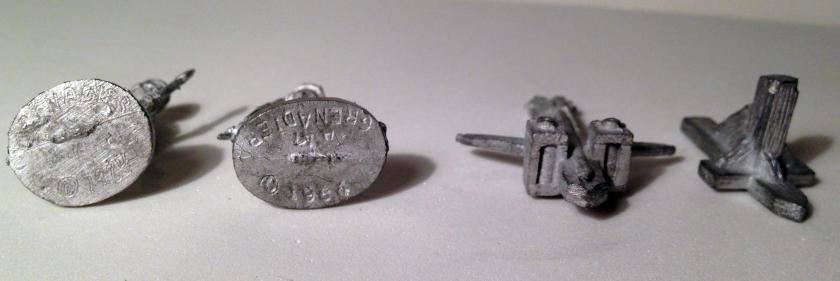
I obviously needed a crew. Luckily, I acquired a pair of Dwarves from a Ral Partha blister that had been opened and was incomplete. It was from the late 1980’s or early 1990’s – “Dwarf-Bombard” by B. Ollie (02-161). As I had an 02-161 that was complete, I was familiar with the two figures left – one was a had a ram for the bombard, and one held a torch for igniting the weapon’s fuse. From my hoard of lead, I added a Dwarf with a sword as a leader to round out the crew. This figure was a Grenadier figure, but I have been unable to determine anything else about the figure that I designated as the leader.
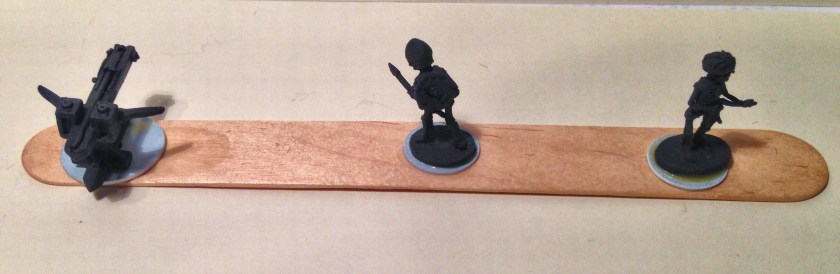
I primed the crew and the bombard in the winter depths in February at Jeff Smith’s workshop with Krylon Ultra-flat Black spray paint. Then I mounted them on ¾” washers with wood glue, which was subsequently glued to popsicle sticks
The crew and bombard primed (the gun carriage is upside down for some reason)
I started by working on the bombard. The kit came with one cannonball, and I used some Milliput to make a stack of them with the help of wood glue and some toothpicks for a frame. This took two iterations of gluing as shown below. Once done, I also primed these with Krylon Ultra-flat Black spray paint. I then painted them with Secret Weapons Washes “Heavy Body Black” ink. I also cut a base for the kit with my scroll saw – a 5½” hex base with 30° beveled sides from 1/8″ luan plywood. I glued ¾” steel washers to the base for easier storage on magnetic sheets that I have glued to my “Really Useful” plastic boxes. I used some old German Deka-Lack “Grun” from when I was stationed in West Germany (yes, paint from 1987) to prime the base. This finished off this vial after 29 years!
Cannonball stack – step 1Cannonball stack, step 2
Then I proceeded to paint the bombard. I base-coated the weapon and its component carriage and loading ramp with Citadel “Dryad Bark”. This I followed with a successive series of four washes with Secret Weapons Washes “Heavy Body Black” and “Sewer Water”, and tow applications P3 “Brown Ink”. Then I dry-brushed the wooden parts twice – first with Citadel “Skrag Brown” and then with Citadel “Balor Brown”. I then added another wash, this time with Citadel “Agrax Earthshade”. I painted the metal sections of the gun and the cannonballs with Americana “Ebony”. To finish the weapon with varnish, three coats were applied successively and over two days – Krylon “Clear Glossy”, Krylon “Clear Matte”, and Testors “Dull Coat”.
The Large Bombard painted and varnished
The crew now needed to be worked on – and I had three different ones to paint. I will cover each in turn. The Dwarf with the Ram (“A”), the leader Dwarf (“B”), and the torch-bearing Dwarf (“C”). All three got their visible skin painted with P3 “Midland Flesh”. I like this color on Dwarven skin. Any visible eyes were painted with Americana’s “Snow” and “Ebony”.
For “A”, I used Citadel “Balor Brown” on his breeches and Armory “Chestnut” on his leather armor. His beard was painted with Polly-S “Venetian Dull Red”. I covered his cape with Armory “Prussian Blue”, and his leggings with a mix of Craftsmart “Khaki” and Citadel “Balor Brown”. Armory “Red” was my choice for the trim on the cape. For the ram shaft, I again used Citadel “Dryad Bark”, with Americana “Ebony” on the ram head. The cape I highlighted with a mix of Armory “Prussian Blue” and Americana “Sky Blue”. The pouches were initially painted with Americana “Zinc” and subsequently highlighted by adding Craftsmart “Grey”. The metals (helmet, belt buckle) were done with Folk Art “Gunmetal Gray”, while the leatherwork was done with Armory “Chestnut”. A wash of Citadel “Agrax Earthshade” was applied, followed by more highlighting, and another repetitive wash.
“B” was started with Americana “Zinc” on his tunic. Armory “Chestnut” was used for his hat/hood, and his boots. Similar to “A”, I painted his beard with Polly-S “Venetian Dull Red”. His breeches were painted with Armory “Prussian Blue”, as was his shield and breeches. I painted his bow and the back of his shield with Citadel “Dryad Bark”, while Americana “Snow” and Citadel “Balor Brown” were my choices for the arrow fletchings and quiver respectively. His gauntlets and sword were done with Tamiya “Metallic Gray and highlighted with Tamiya “Flat Aluminum”. My choice for his mail coat was Folk Art “Gunmetal Gray”. I then highlighted all areas with lighter versions of the base coats similar to that described for “A”. “B” then got a wash with Citadel “Agrax Earthshade”, followed by some minor highlights again, to include Martha Stewart Crafts “Brushed Bronze” on the sword pommel and the shield boss. I ended with Tamiya “Flat Aluminum” on the blade.
“C” followed a similar pattern as “A” and “B”. His tunic was painted with Americana “Zinc” and his cape and boots were completed similar to “A”. I chose Citadel “Dryad Bark” for the shaft of the torch. For the flame, I painted it with a successive mix of Armory “Red”, Tamiya “Orange”, and Craftsmart “Yellow”. Highlighting followed as before, and a wash of Citadel “Agrax Earthshade”.
I then painted all three crew bases and the hex base with Polly-S “Basilisk Dark Green” from 1984, retiring this paint after 32 years. I took the hex base, and applied an initial flocking with Ziterdes “Alpine Meadows” and removing half of the cork “boulders”. After a day, I then used my Dremel to score places for the different weapon components and the crew bases. I put in Aleene’s magnetic sheets in the 3 wells for the crew, as well as subsequently drilling ¼” holes for neodymium magnets. I used wood glue to secure the bombard, the cannonballs, and the loading ramp to their respective scored areas. Lastly I put in the neodymium magnets – securing them with wood glue and steel washes on the bottom of the base.
A note here – in the future, I would only use the neodymium magnets – the magnetic sheets are superfluous and can cause reversal of magnetic flux forces which complicates figure placement (though I got mine fixed).
I next flocked the bases (crew and bombard) again so as to try to hide the wells with the Ziterdes “Alpine Meadows”. I also used Army Painter “Meadow Flowers”, and “Wilderness Tuft” with wood glue. I also added more cork rocks (the Ziterdes product is loaded with way too many so I had a lot left over) , and alternated painting them with Americana “Ebony”, Armory “Chestnut” and Citadel “Balor Brown”. I gave the bases a light coat of a white glue and water slurry so as to secure all the flocking. I think that I achieved a nice effect on the base in terms of a natural look.
Once everything had dried, I gave the three coat varnish to the crew as I had to the bombard as before. Each coat was allowed to dry fully. The whole kit then got a light coat of Testors Dull coat. The series of photos below show the production process.
I am very happy with the kit, though I wish it had taken less time! Still, I think that this will be a valuable piece in many future games.
Front of “A”, “B”, and “C” from left to right after base coat painting but before washes and highlightsBack of “C”, “B”, and “A” from left to right after painting but before washes and highlightsFront of “A”, B”, and “C” from left to right after washes and highlightingBack of “A”, “B”, and “C” from left to right after washes and highlightingThe Dwarven crew in front of their bombard – complete!Top view of the Dwarven Large Bombard showing crew wellsTop view of the Dwarven Large Bombard with CrewCompleted front view of the Dwarven Large BombardNice angle view of the completed Dwarven Large Bombard