
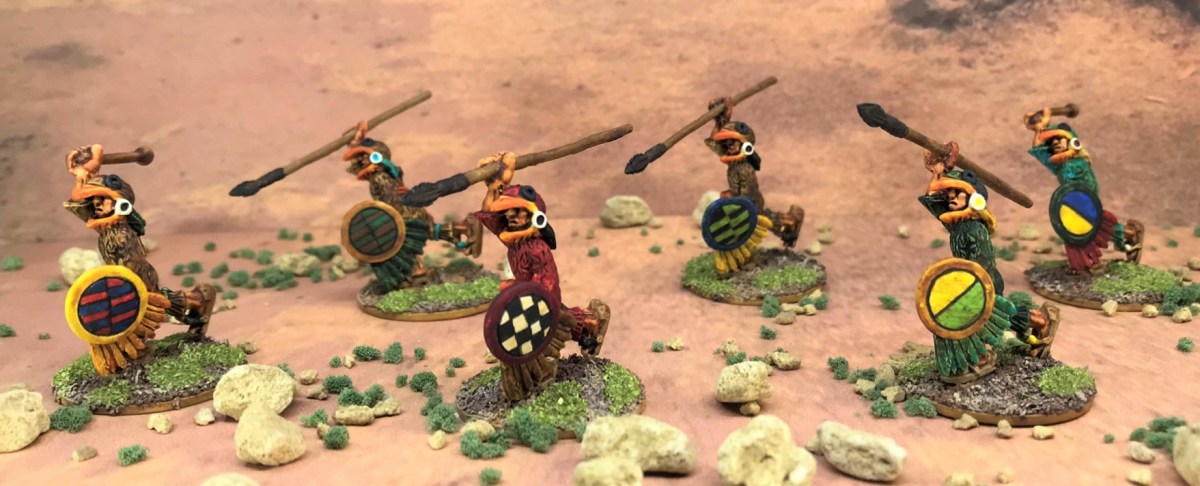
As shown in my last post, I have started building forces of appropriate figures for tabletop wargames using the soon-to-be published Feudal Patrol™. These are Aztecs and other troops from the era of the Spanish Conquest in the 16th Century. This is a major project for which I eventually hope to have over 150 painted figures. I have a ways to go, as this project brings that total to a mere 18. Still, the journey of 1,000 miles begins with a single step…
I acquired a large lot of Aztec figures on eBay probably 4 or 5 years ago. Most of them 25mm scale, and from Ral Partha dating from around 1988. In the lot were also two baggies of 3 Aztec Eagle Warriors (#25 AZ4) – ostensibly 25mm as shown on the Tin Soldier UK website. I was not familiar with Tin Soldier UK, but they have a pretty nice range of figures worth checking out. Of course, 28mm is the scale that I am going for – and sometimes 25mm can work for 28mm. While I was waiting for my order of new 28mm stuff to arrive (which I received this week), I decided to paint up some of the older figures and see if they could work with my 28mm figures visually. To my eyes, the Tin Soldier UK Eagle Warriors looked close enough to 28mm to work.

The Aztecs had two main elite unit types – the Jaguar Warriors, and the Eagle Warriors (sometimes referred to as the Eagle Knights). There were also the lesser-known Arrow Knights, which I will post about next time. To be an Eagle Warrior, one had to have captured up to 20 enemy for sacrifice or equivalent deeds of valor (well, in the eyes of Aztec society anyways). They were full-time professional warriors and along with the other elites were equivalent to nobility among the Aztecs.
Normally, Aztec Eagle Warriors would be armed with melee weapons, in particular the macuahuitl obsidian-edged club/sword. All of these 6 had the same pose and were armed with tepoztopilli (obsidian-bladed thrusting spears). They also had the weapons in a throwing versus a thrusting pose. Therefore, I decided to go through the 25mm Ral Partha Aztecs that I had and see if I could get any macuahuitl or cuauhololli (round-headed club) as extra weapons. The extra Ral Partha macuahuitl were way too small and bendable, but there were some cuauhololli that would work. I ended up using two of the cuauhololli and four of the tepoztopilli as weapons for the six. My plan was to orient each of their weapons slightly differently and also to have different shield patterns and different colors for authenticity and ease of tabletop play.
Now, as for the spaghetti-like tepoztopilli, they needed a solution as they were made from lead and were as floppy and vulnerable to bending as most leaden miniature spears are unfortunately, especially those from the 1980’s and earlier. The odd thing is that the model shown on the website indeed does have a macuahuitl instead of a tepoztopilli! My guess is that they redid the mold at some point as these model thrusting spears were too weak for use in gaming. In any case, I decided to try using a thin layer of Apoxie Sculpt on the shafts. Apoxie sculpt is easy to use and can be made more workable when used with wet fingers – and it gets hard as a rock when it cures in 24 hours. This process gave me much improved tepoztopilli, but still the underlying lead made them somewhat (though less) vulnerable to bend.
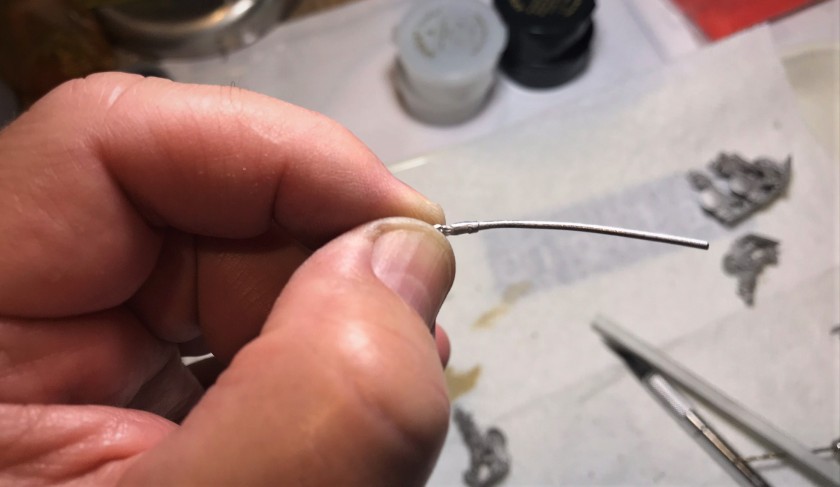
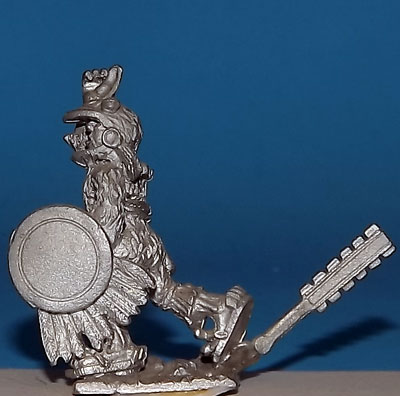


The models themselves were not too difficult to assemble. I did need to clean up the mold lines and the hands needed to be drilled out carefully to hold the weapons. I did pull out some of the molding rubber out of one model’s eyes, but overall I was happy with the quality of the castings. I definitely liked that the shields were not separate.
I made a unit plan as there were many ways to do the unit – and I wanted to have something to refer to along the way. In particular, one of my goals for this project was to give each Eagle Warrior a different shield design – and for that design to be historically correct. Over at Steve’s Balagan, I found his blog to be a wonderful resource for Aztec and other shields.

Most pictures that I have found on Eagle Warriors showed them in golden brown outfits – but some mention that there were possibly red, green, and blue ones as well. I decided to make three in golden brown, and then make the others in red, green, and blue. The accouterments and shields would also add to the differentiation on the tabletop. Unlike the novices, the pics that I saw of Eagle Warriors all had orange loincloths, so that feature was common here.


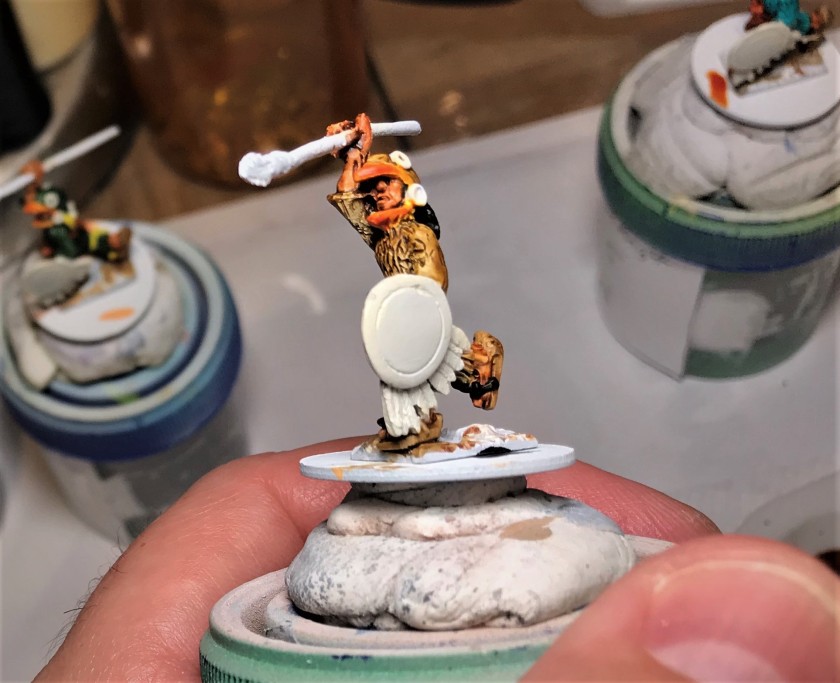
My next big challenge was painting designs on the shields. My handwriting is awful, and hand-drawing designs on shields has not been a strength for me – and these are tiny. I decided to let the engineer in me break out. I used an art template to trace a 9/32″ circle on a piece of paper, and then I cut that out. It proved useful in helping me to lightly sketch the designs on the shields in pencil – as guides for painting. I tried several designs that I saw on Steve’s Balagan blog.

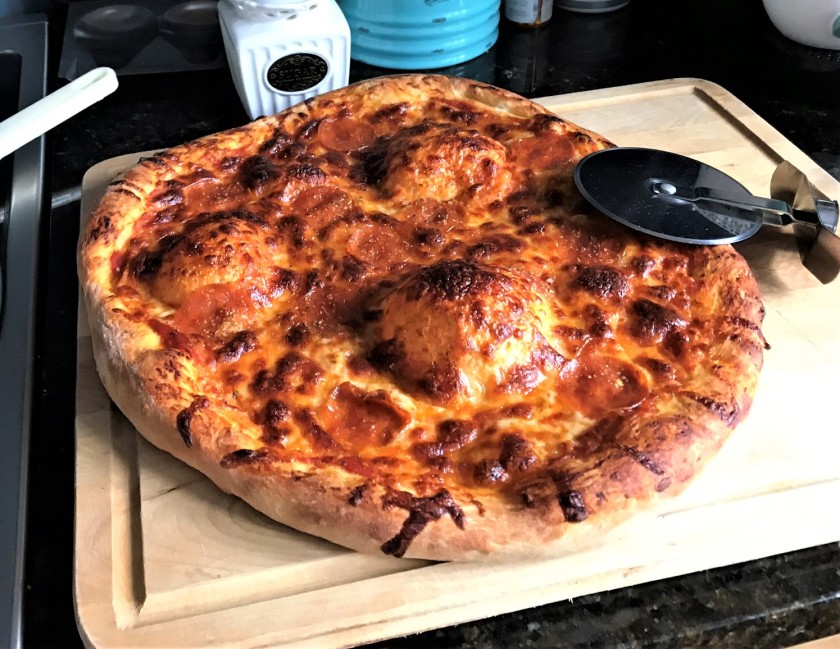
I wanted to get these done for the weekend, and my wife helped fuel my push with a home-made pizza (that tasted even better than it looked!).
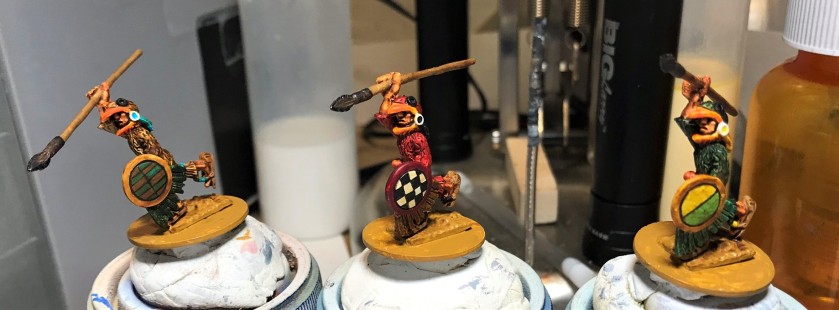
Below are a couple of WIP shots after I finished painting the shields – for me, this was a result that I was surprised to see.

On May 1, I finished them with flocking and varnishing, ending with some static grass (all the materials I used are listed at the end for those interested). This counts hopefully as my second entry into Ann’s Immaterium Painting Challenge “Paint the Crap you Already Own”.

Here are some close up and group shots of the project:
Eagle Warrior 1, with tepoztopilli:


Eagle Warrior 2, with tepoztopilli:


Eagle Warrior 3, with tepoztopilli:


Eagle Warrior 4, with tepoztopilli:


Eagle Warrior 5, with cuauhololli:


Eagle Warrior 6, with cuauhololli:


Lastly, a couple of group shots:


As for scale – here is a comparison between a 25mm Eagle Warrior and a 28mm novice warrior – I think they will be OK. Do you?

What do you think? Always wondering that – so let me know below in the comments section. Now it’s back to painting more figures during the lockdown and beyond…
PAINTS, INKS, GLAZES, SHADES, WASHES, PIGMENTS, FLOCKING, GLUES AND MORE USED ON THESE AZTEC EAGLE WARRIORS:
- Apoxie Sculpt (White)
- Gorilla Glue
- 1/8″ x 1″ Everbilt Fender Washers
- E6000 Epoxy
- Poster tack and plastic plates
- Vallejo “Surface Primer – White Primer”
- Vallejo “Flow Improver”
- Vallejo “Airbrush Thinner”
- Testors “Universal Acrylic Thinner”
- Vallejo Model Air “Weiss” (off-white)
- Battlefront “Wool Brown”
- Battlefront “Dark Leather”
- Citadel “Contrast Paint – Gryph-Hound Orange”
- Vallejo Model Color “Sunny Skin Tone”
- Citadel “Contrast Paint – Skeleton Horde”
- Citadel “Contrast Paint – Blood Angels Red”
- Citadel “Contrast Paint – Creed Camo”
- Citadel “Contrast Paint – Aethermatic Blue”
- Vallejo Model Color “Basic Skin Tone”
- Citadel “Contrast Paint – Fyreslayer Flesh”
- Citadel “Contrast Paint – Iyanden Yellow”
- Army Painter “Light Tone” (shade)
- Vallejo Mecha Color “Turquoise”
- Vallejo Game Air “Black”
- Vallejo Model Air “Moon Yellow”
- Vallejo Model Air “Armour Brown”
- P3 “Sunshine Yellow” (ink)
- Vallejo Model Color “Red”
- Vallejo Model Color “Black Grey”
- Vallejo Model Color “Sunny Skin Tone”
- Battlefront “Chocolate Brown”
- Vallejo Mecha Color “Brown”
- Citadel “Contrast Paint – Flesh Tearers Red”
- Vallejo Game Air “Escorpena Green”
- Vallejo Model Color “Dark Blue”
- Citadel Air “Evil Sunz Scarlet”
- Citadel “Contrast Paint – Wyldwood”
- Citadel “Balor Brown”
- Vallejo Model Color “Glossy Black”
- Citadel “Seraphim Sepia” (shade)
- Elmer’s PVA Glue
- Army Painter “Brown Battlefields” (flocking)
- Vallejo “Dark Yellow Ochre” (pigment)
- Vallejo “Burnt Umber” (pigment)
- Americana “Desert Sand”
- Vallejo Mecha Varnish “Matt Varnish”
- Army Painter “Grass Green” (flocking)
Thanks for looking – please let me know your thoughts and feedback!
 Mark A. Morin