
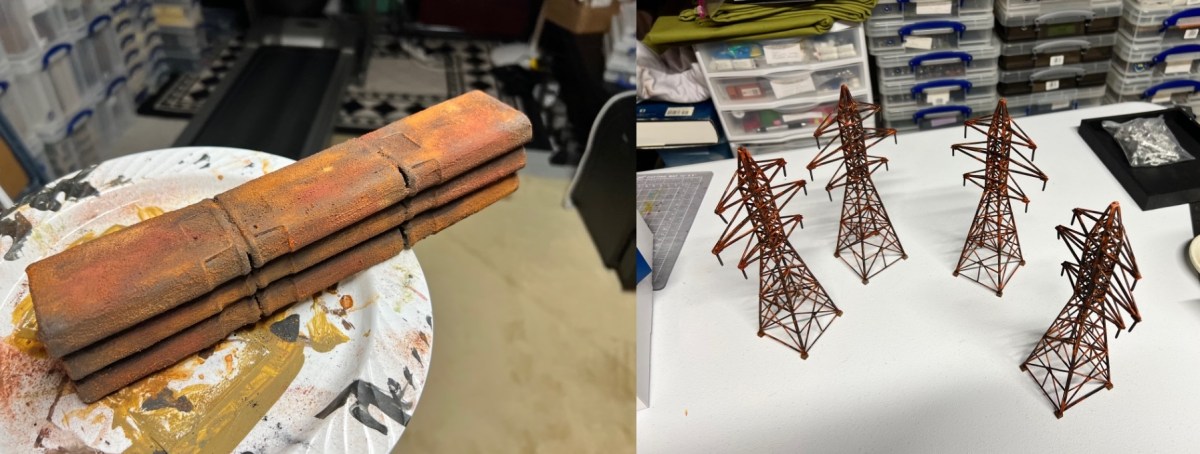
Imagine an industrial cityscape – an apocalyptic one. One that shows that “something really terrible happened here”. Now add 300 years to it and an arid desolate climate with a lot of rust. Lastly, add mystery – “what am I looking at?”, and you are here.
These were the thoughts that I had last month as I prepared to create and build components for such a wasteland ruin. As my 2026 “convention season” was nearing, I needed to build terrain for my tabletop games. For games of Wars of OzzTM, my goal was to build terrain pieces for Professor Nitpik’s Industrial City (aka the Robotic Sanctum). I also wanted to get back into some retro sci-fi games using Buck Surdu’s Combat Patrol:WWIITM gaming system (with my modifications). One of the games I envisioned for that would be using Archive “Space Cowboys”, my converted “Space ‘Roos” defending against an invasion of blue-skinned “Retrovians”. Click those links to learn more about those forces – and more about them in a future post. For now, I needed more rust than just my rusty generators and my ruined chemical plant.
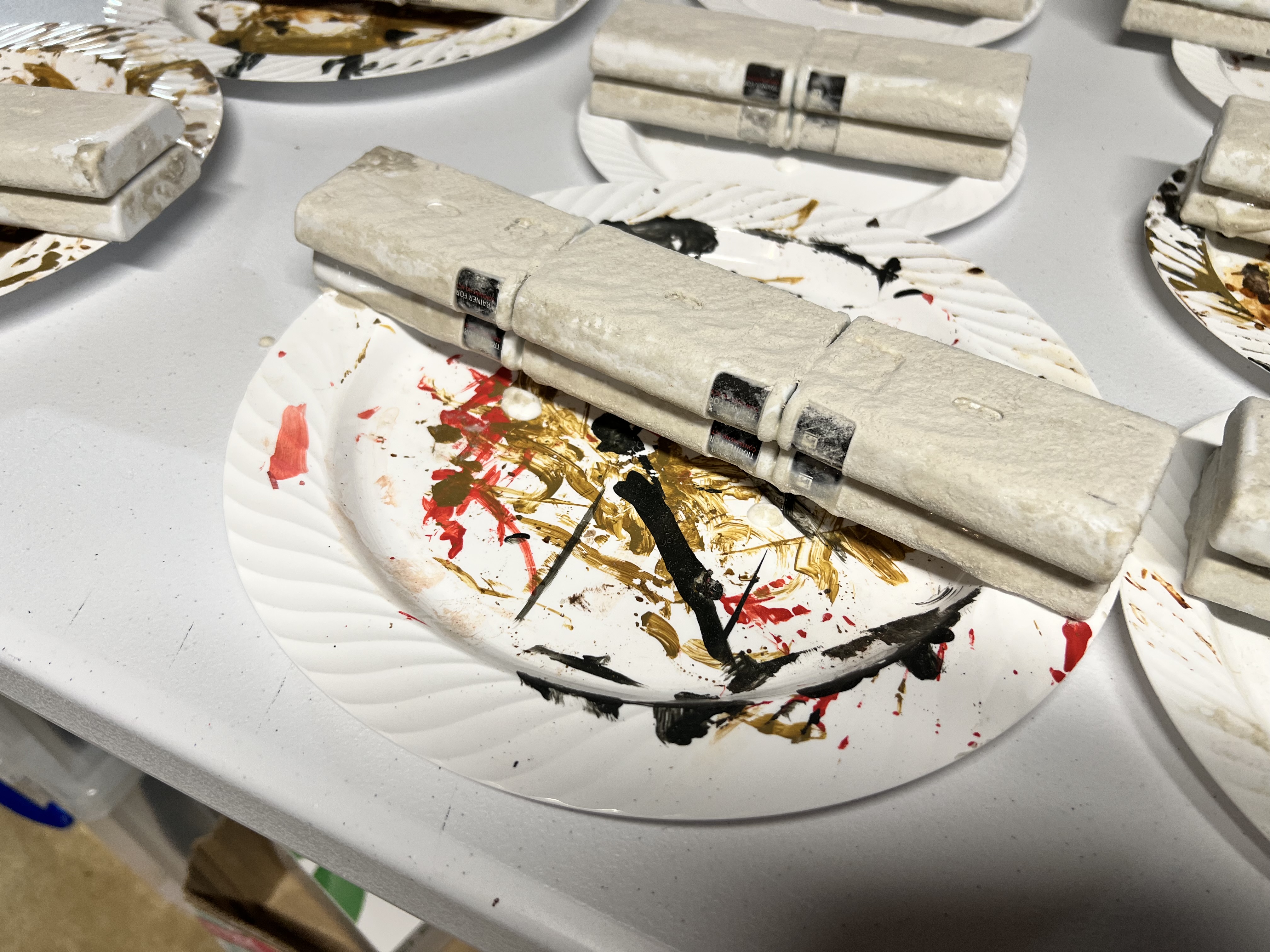
I’ve been retired now since 2019. I got laid off of my last job when the company I was working for pulled the product line off the market. Never found a replacement gig. Back to the product I was selling – it was a pharmaceutical autoinjector device. We had dozens of electronic trainer devices we handed out to potential customers. These trainers acted like the real thing except without any needles or drug inside. After the layoff happened, I had a bunch of them, and was told by my former employer to just throw them away. They had a unique shape, like a cross between a card deck and a tapered brick. The outer layer was plastic, with a label glued on to it. I was running retro sci-fi games, and thought these would be good for making walls. I saved them, and they waited to fulfill their destiny until December 2025!
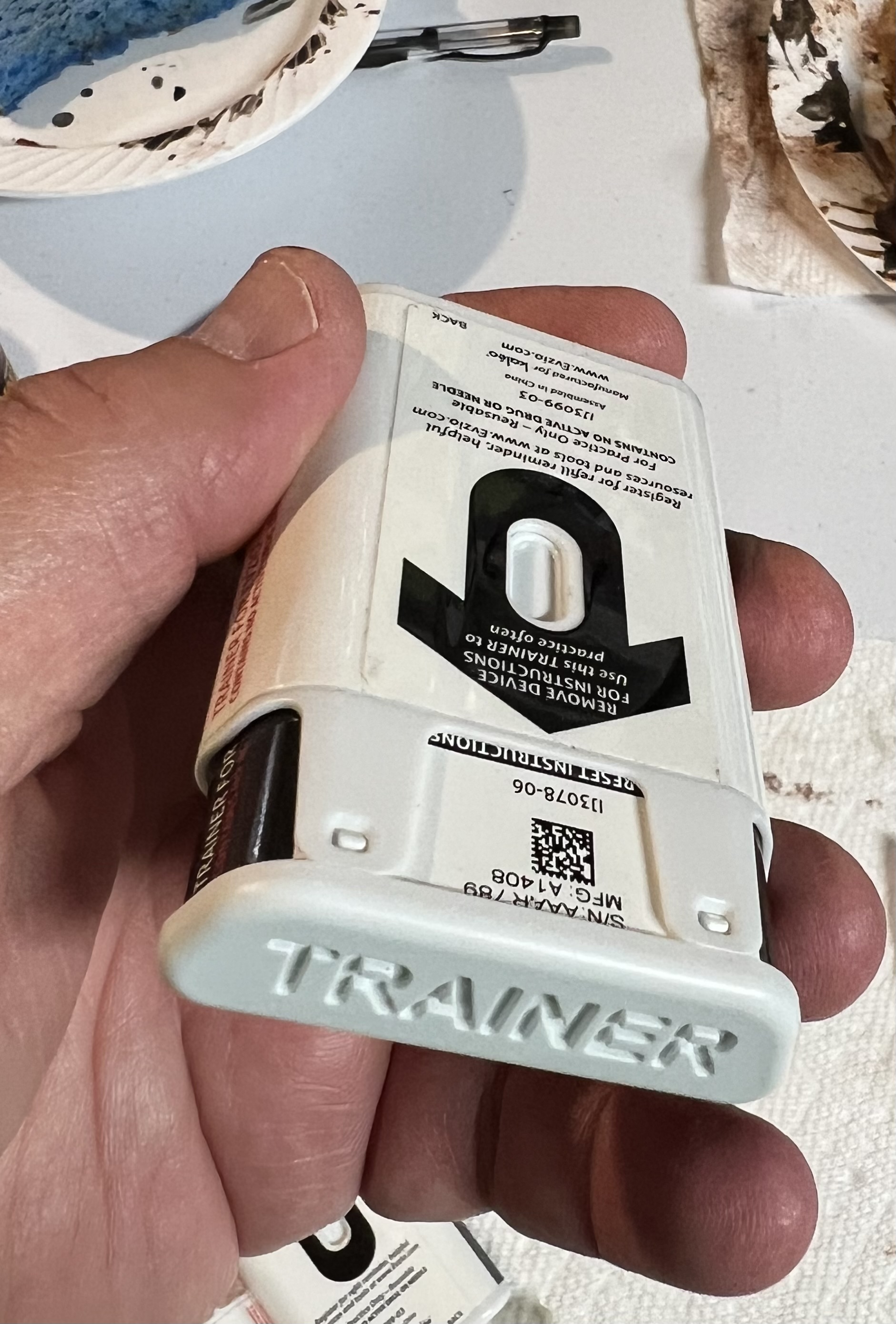
To make sure what I wanted to do would work (and to learn from any errors), I went with a prototype. I used an Exacto blade to remove the outer label. Then, I sanded the exterior to make it rough. To attach multiple units together, green stuff was the solution. After that hardened, I coated the outside of the attached trainers with PVA – followed by a dusting of chinchilla dust on the glue. When that combination had hardened, I primed the combinations with black primer.
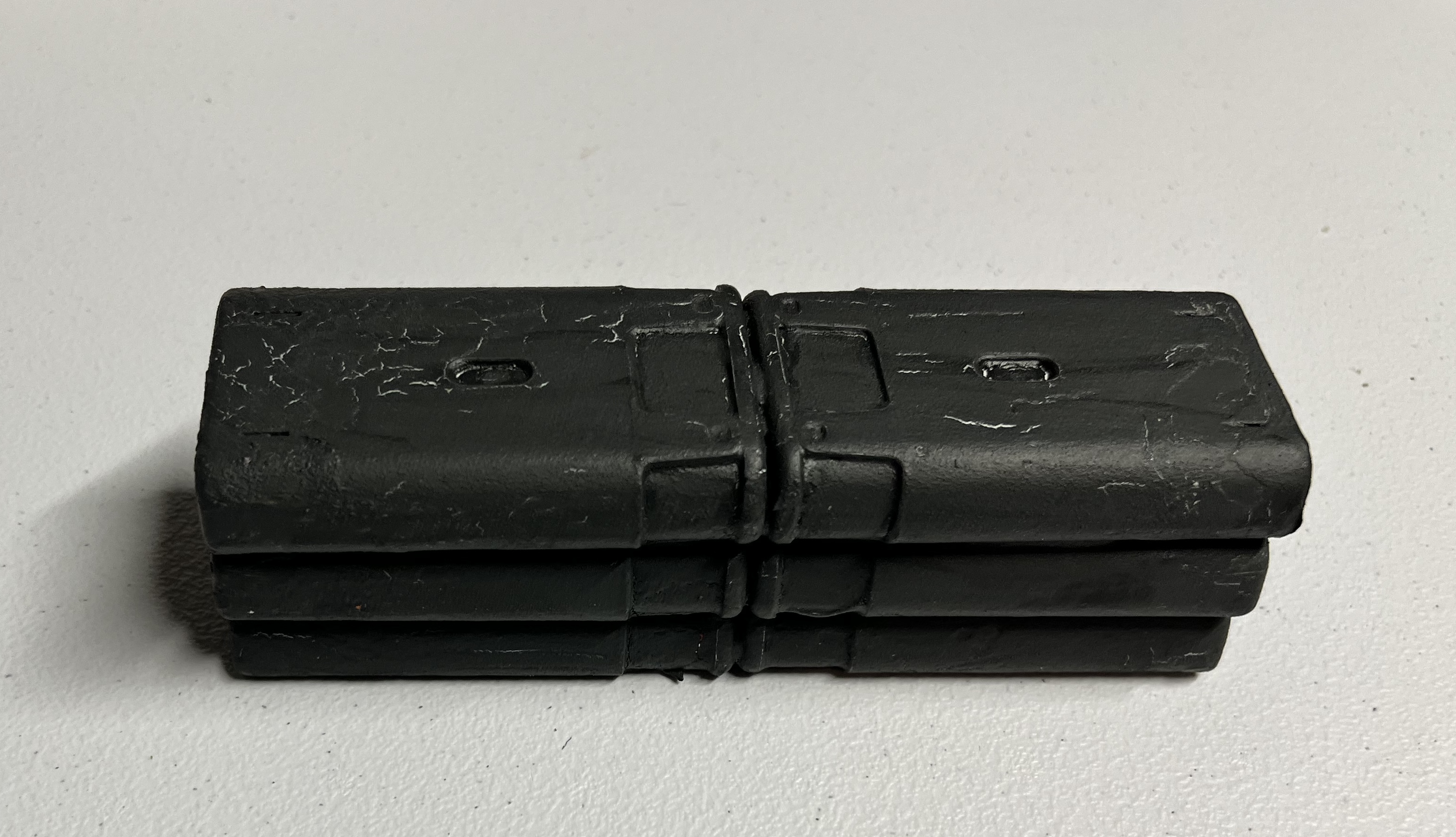
From this point, I used corrosion texture paint(let that harden), then used a number of rusting paints and pigments. I really liked the results and moved on to making two large batches of different combinations.
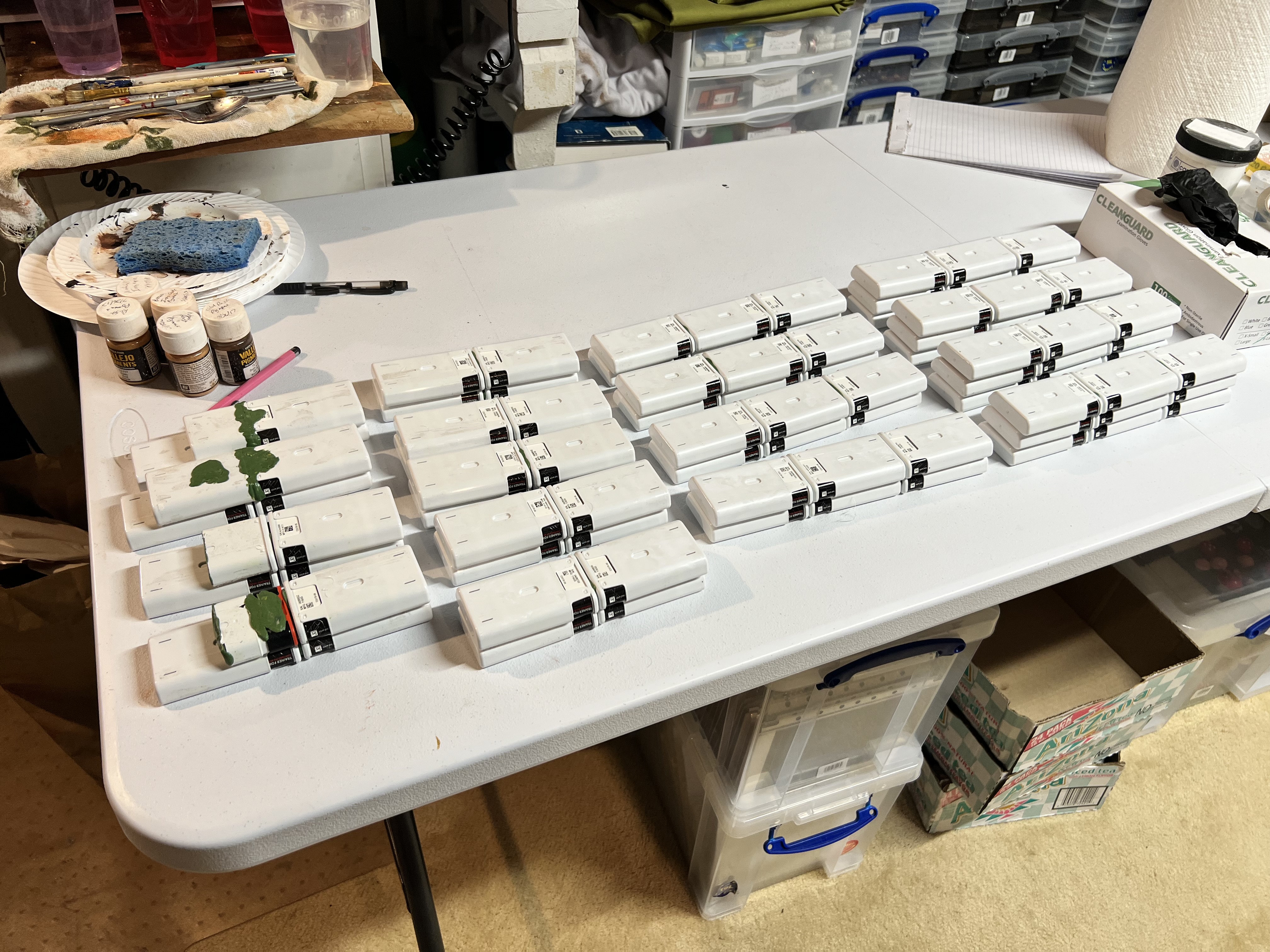
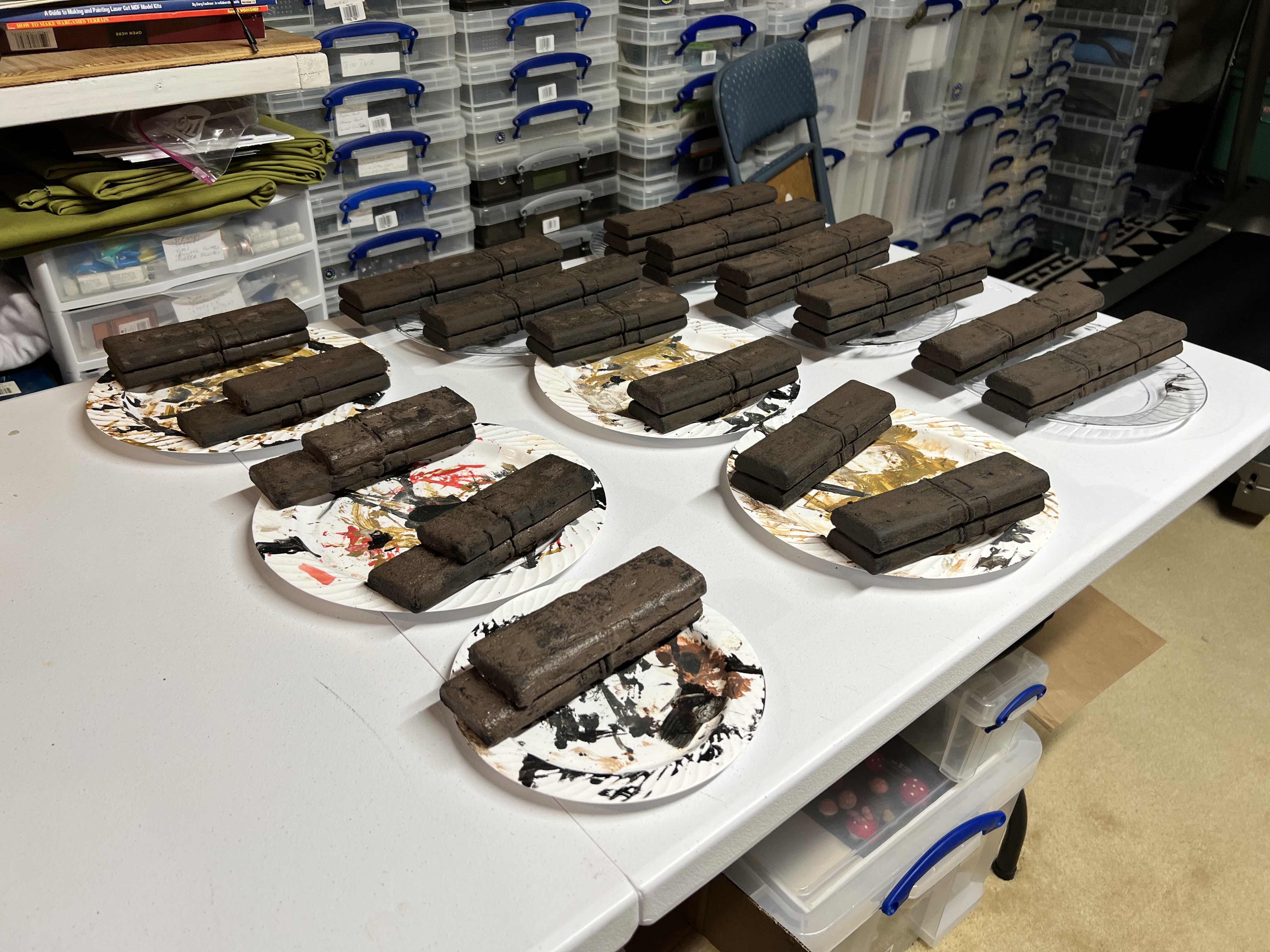
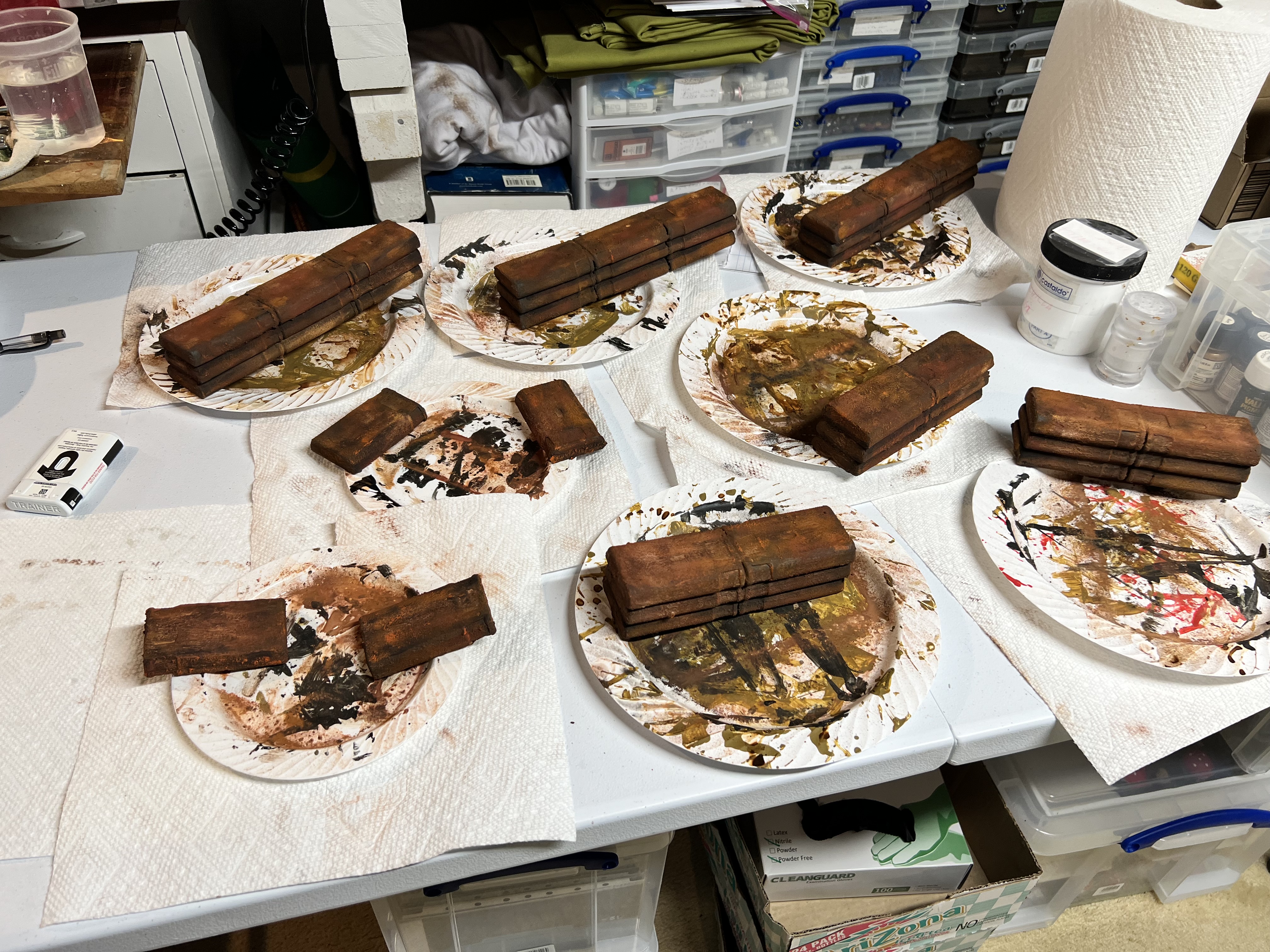
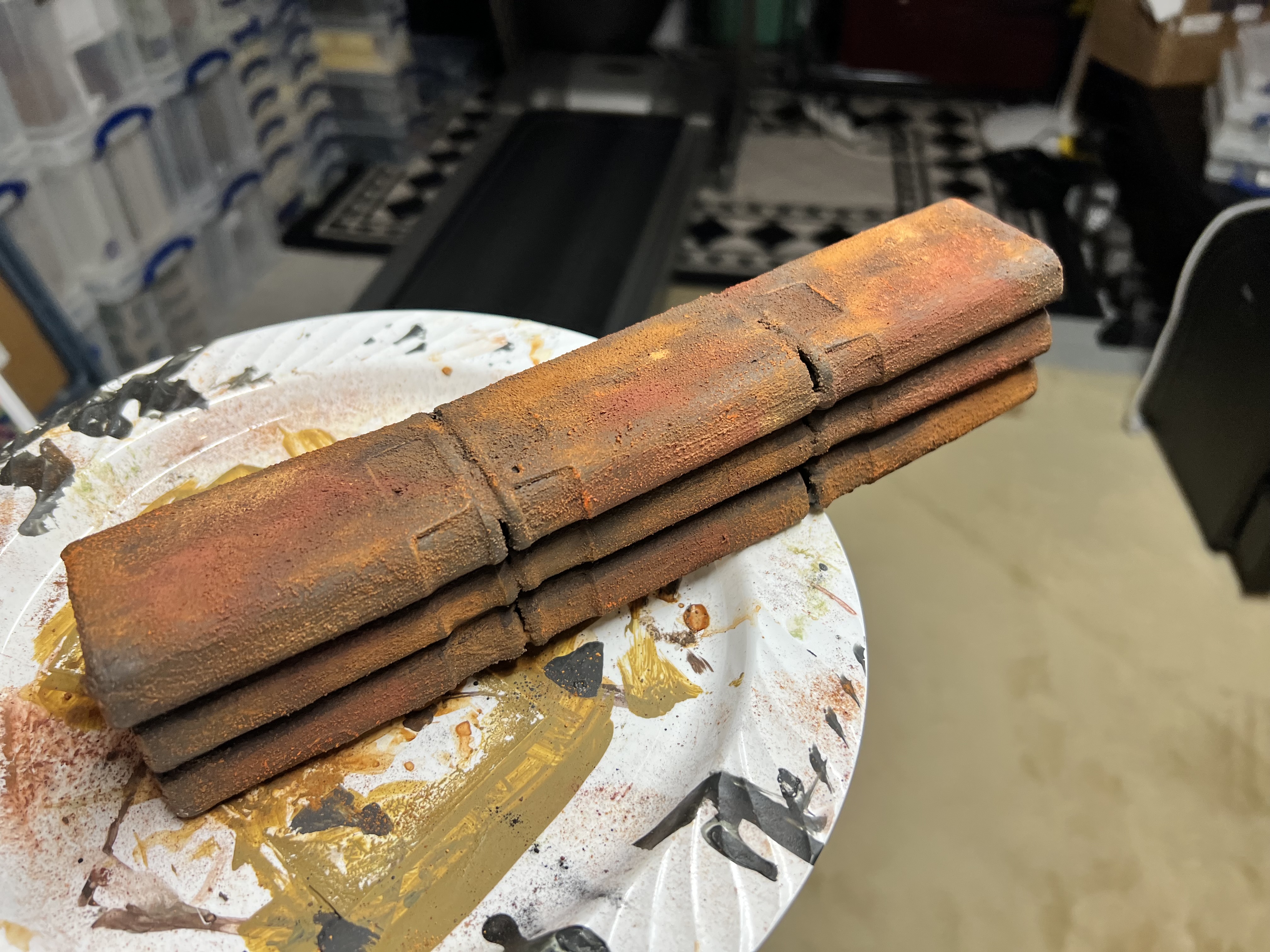
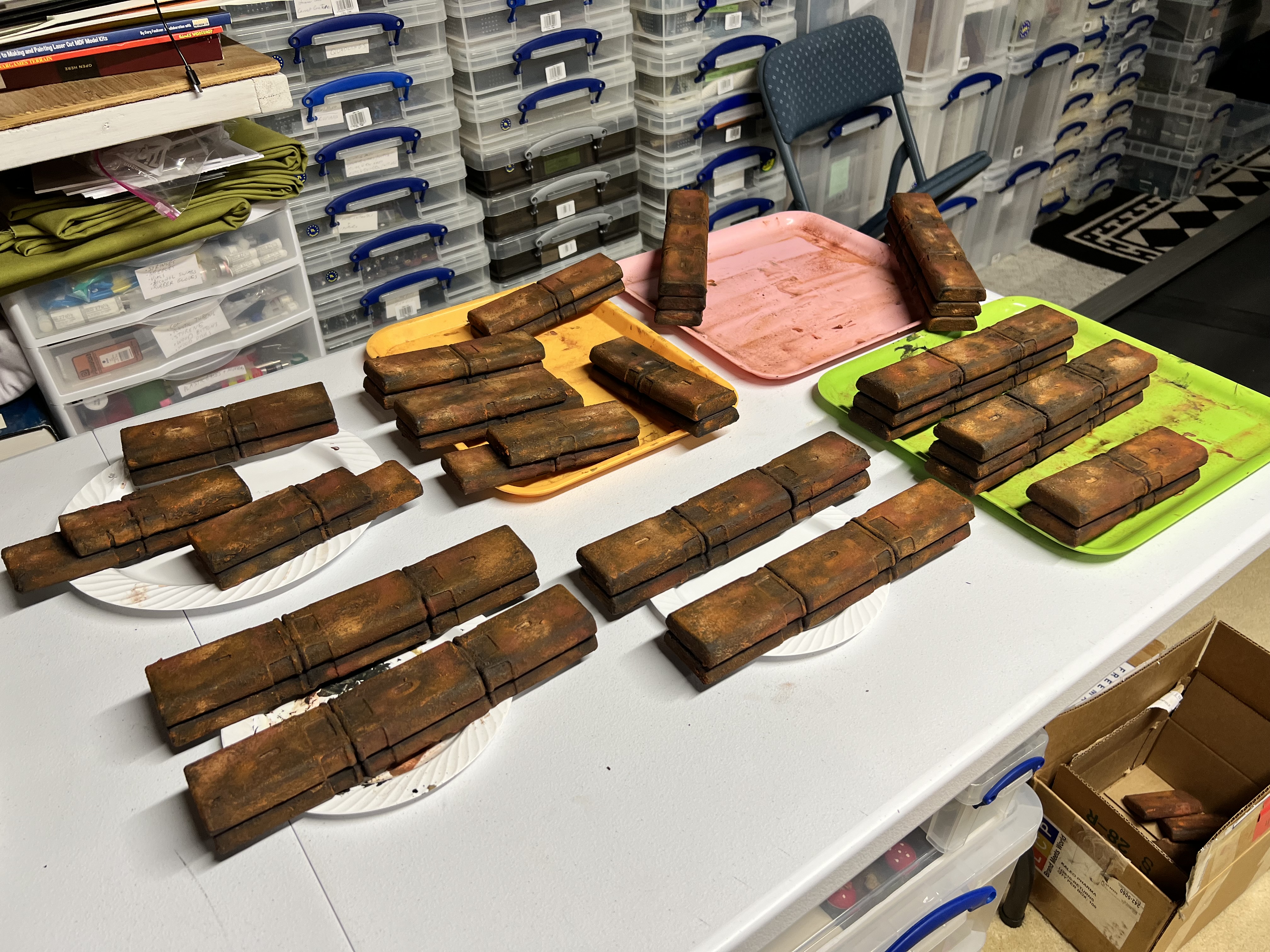
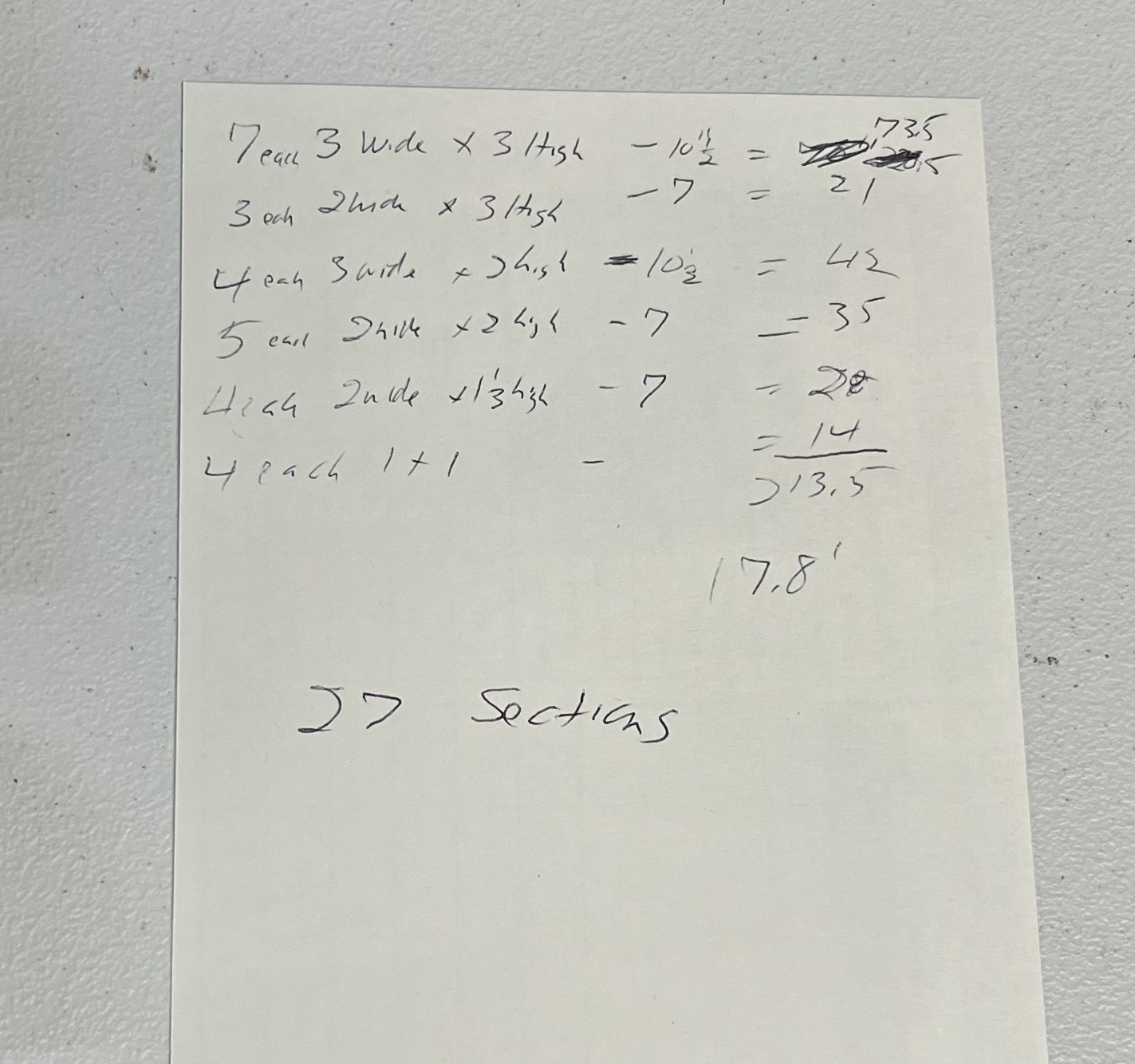
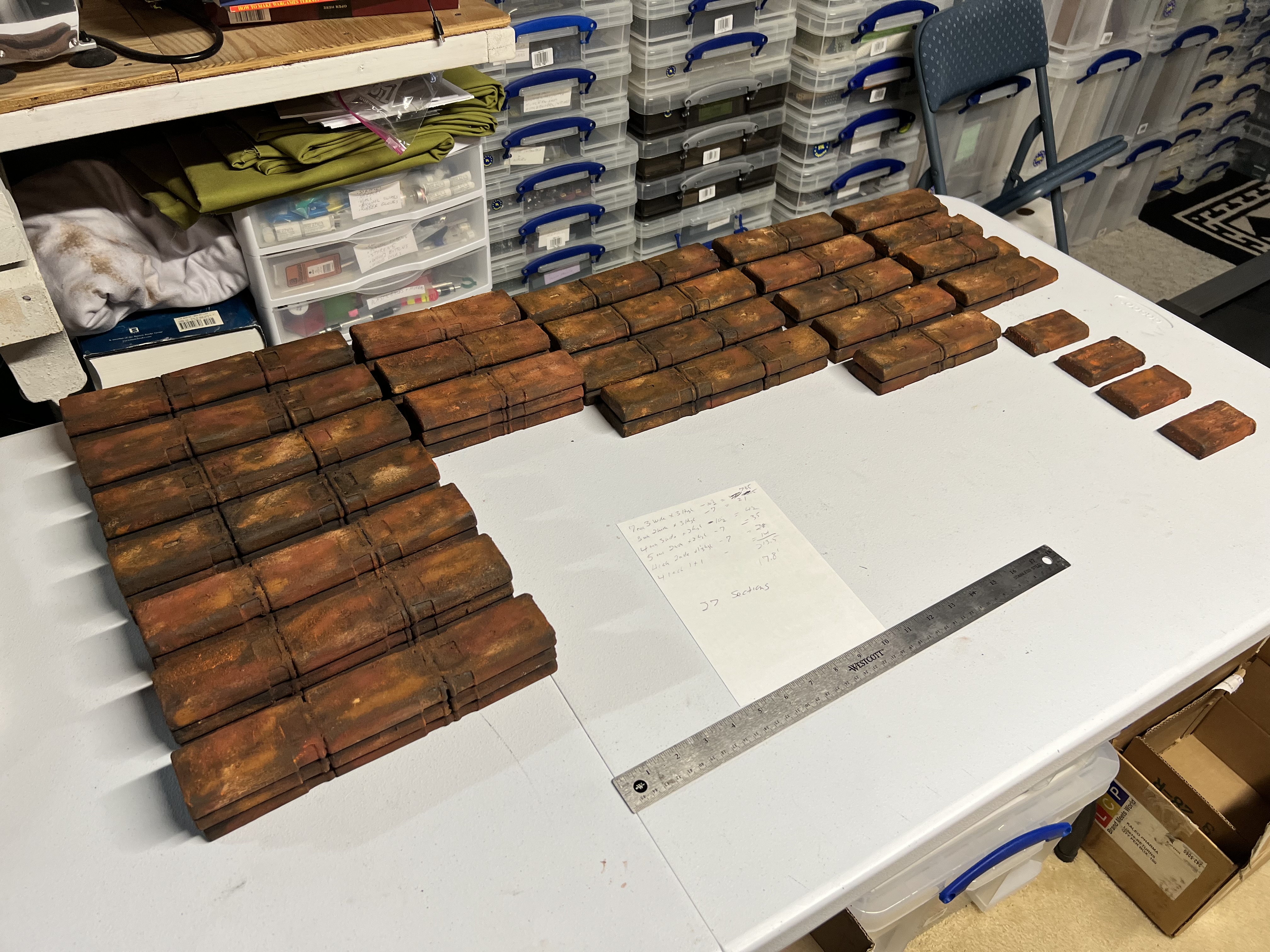
I ended up with 27 sections = a total of 17.8′ worth of rusty wall.
And here they are in total finished up mid-December.:
With the walls done, it was time to get some verticality for the tabletop. And get them done BEFORE Christmas.
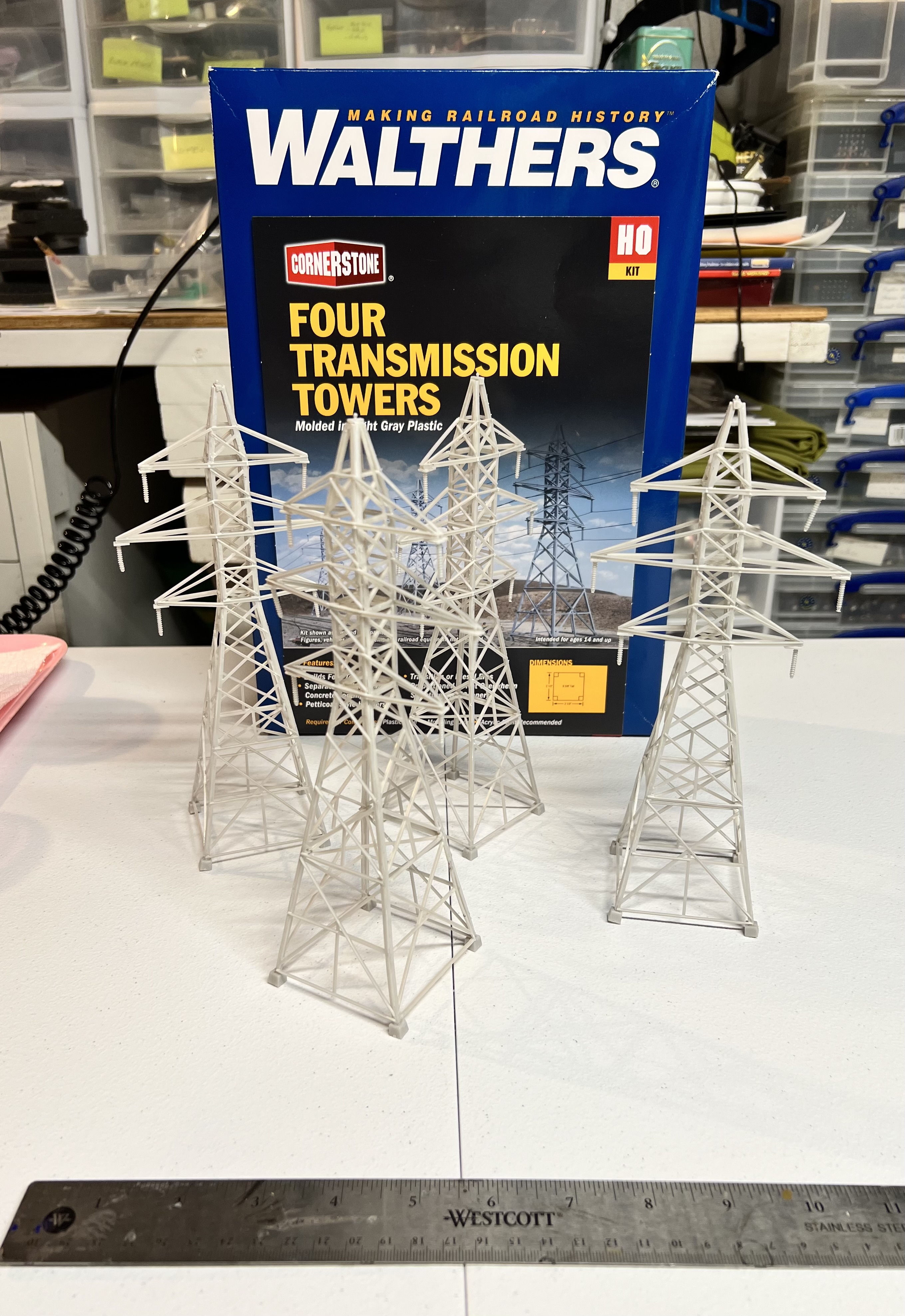
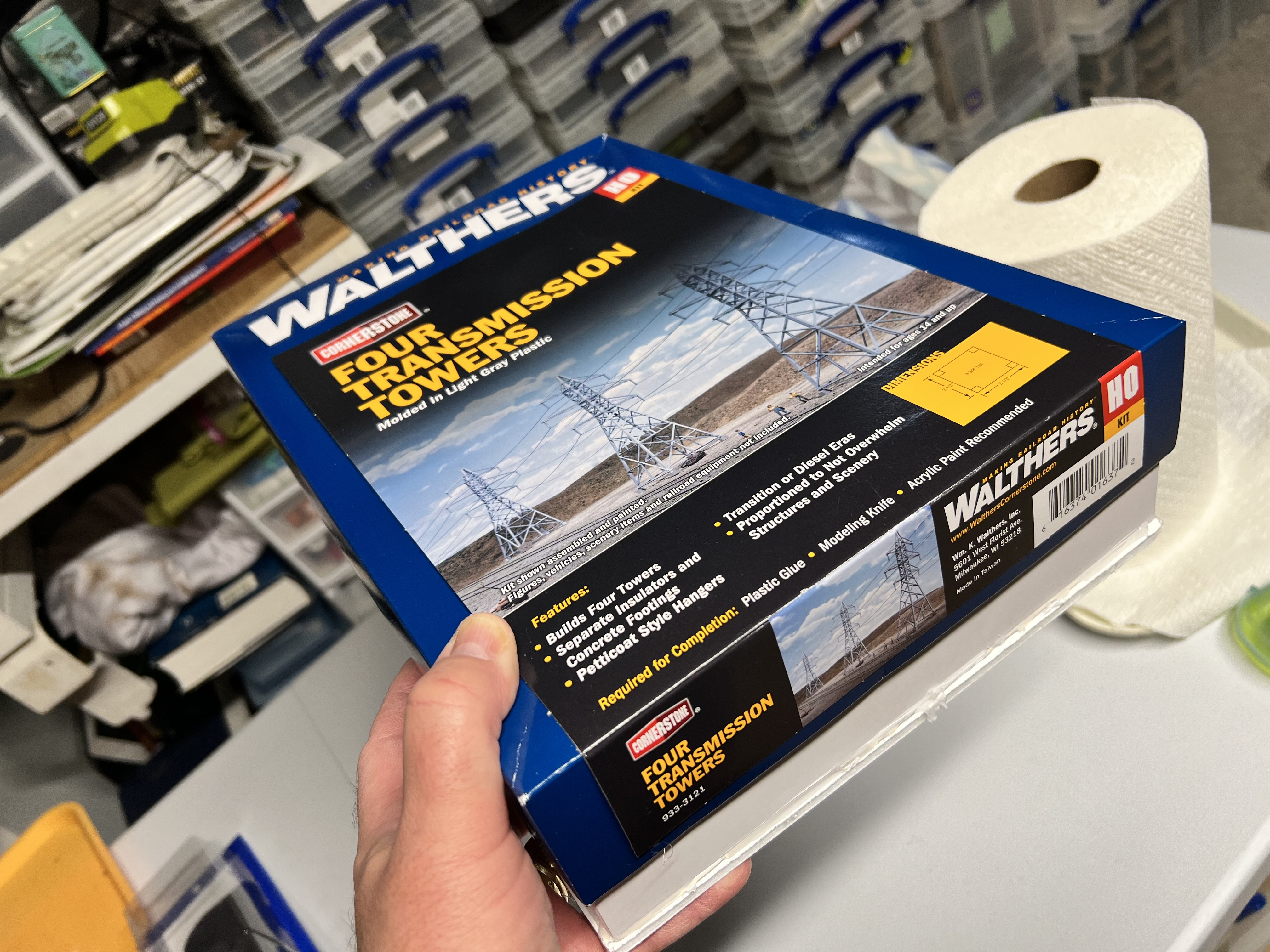
I thought transmission towers – rusty ones – would be great in that role. I found a railroad terrain kit on eBay. It was HO scale. It would go well with the other pieces of rusty fun. These were “Walther’s Cornerstone Four Transmission Towers”.

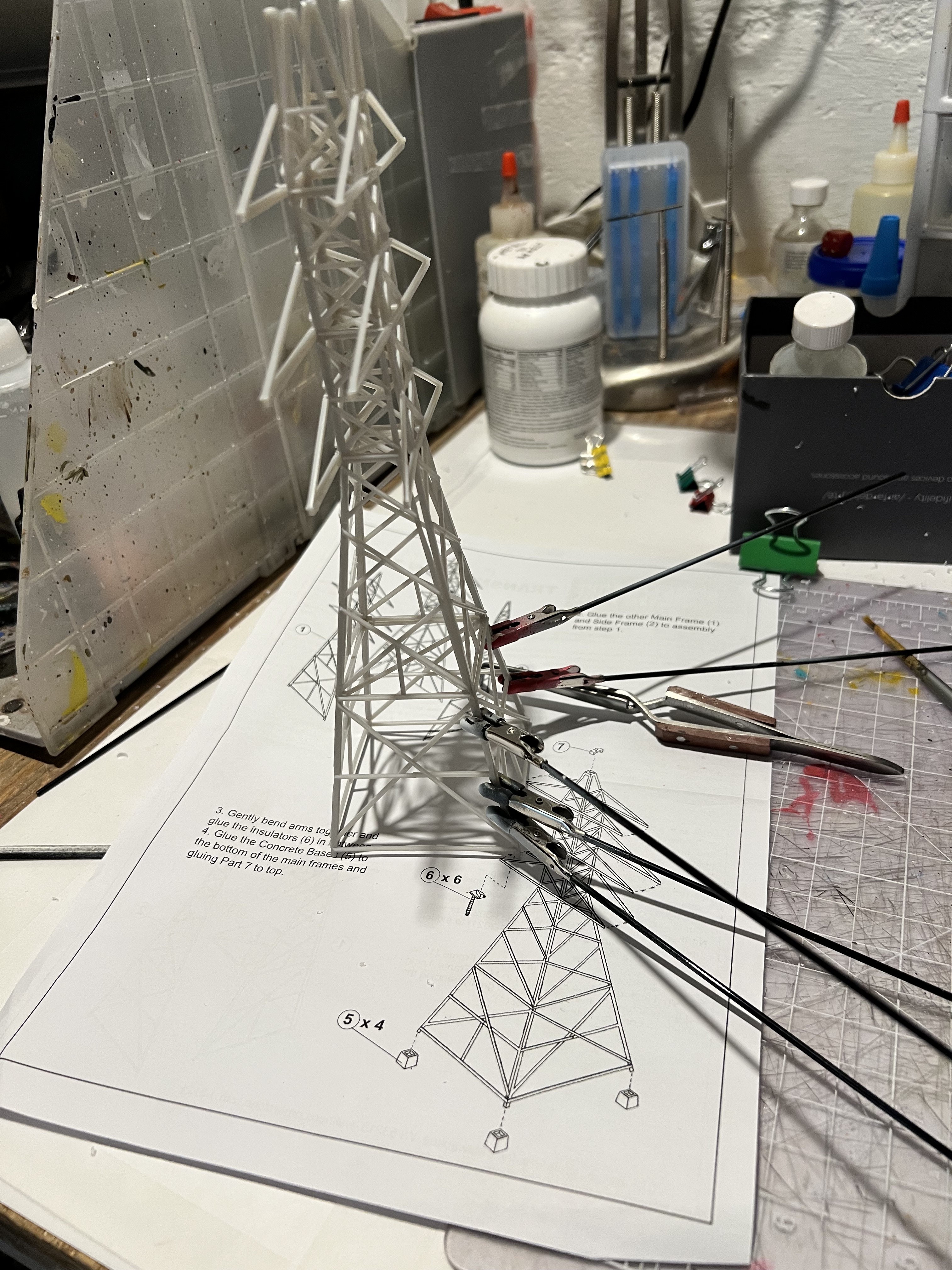
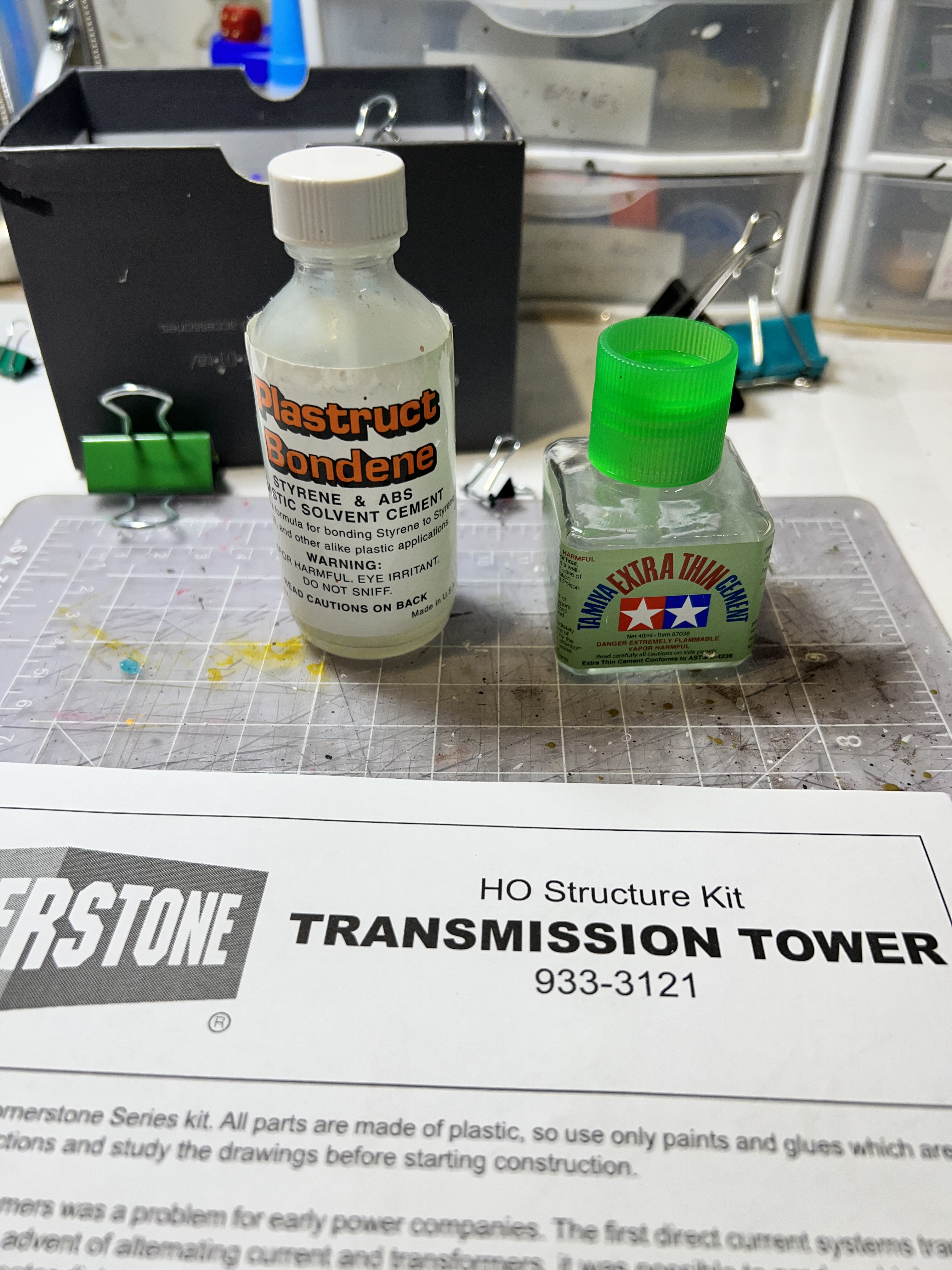
Assembly was a bit fiddly but manageable. It was not immediately clear to me which sides were front or back – but by the fourth iteration I got it down. Luckily, plastic cement covers any mistakes in assemble. I did find using rubber-shoed alligator clips to hold sections together while the cement set to be VERY helpful.
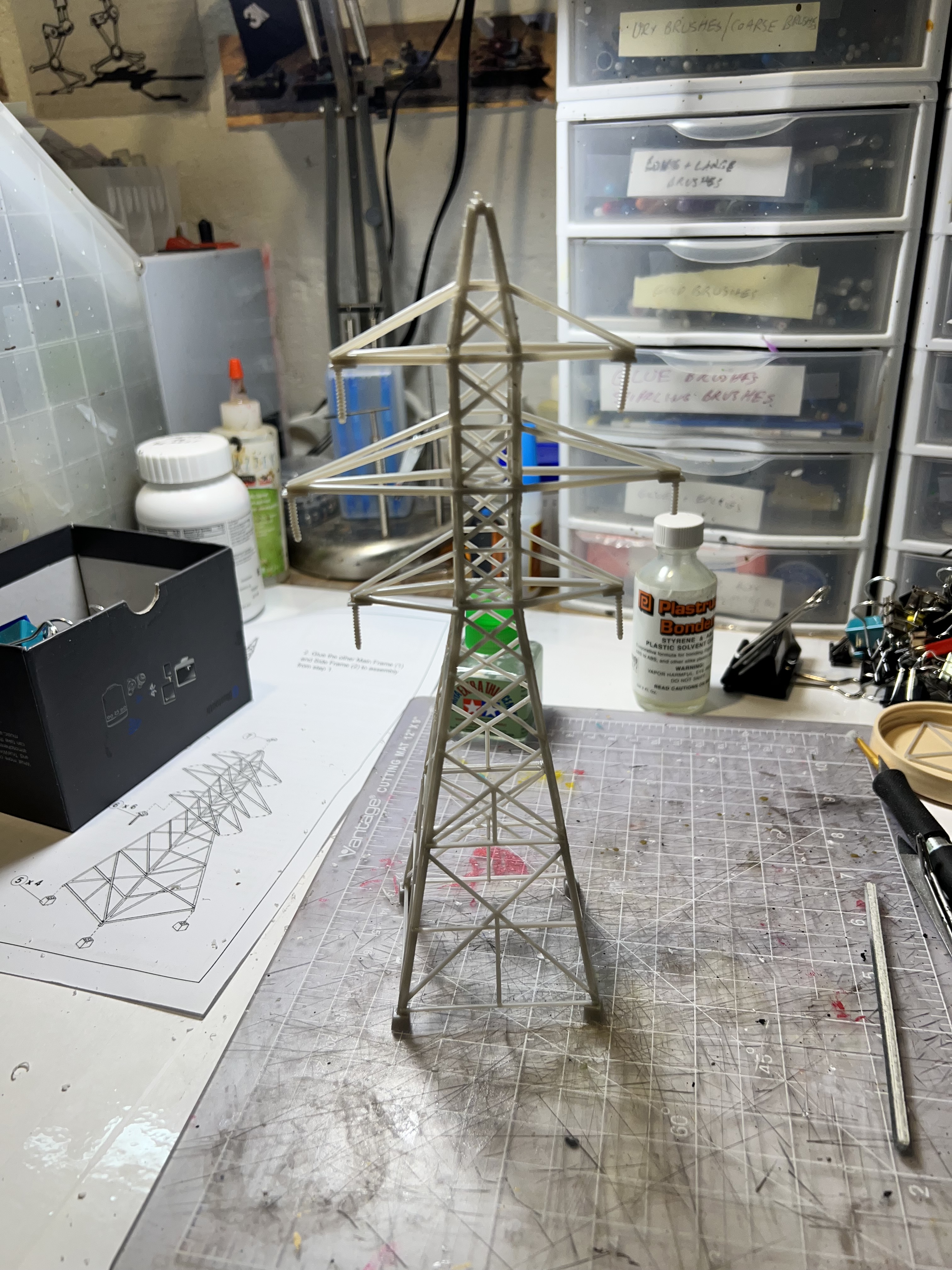
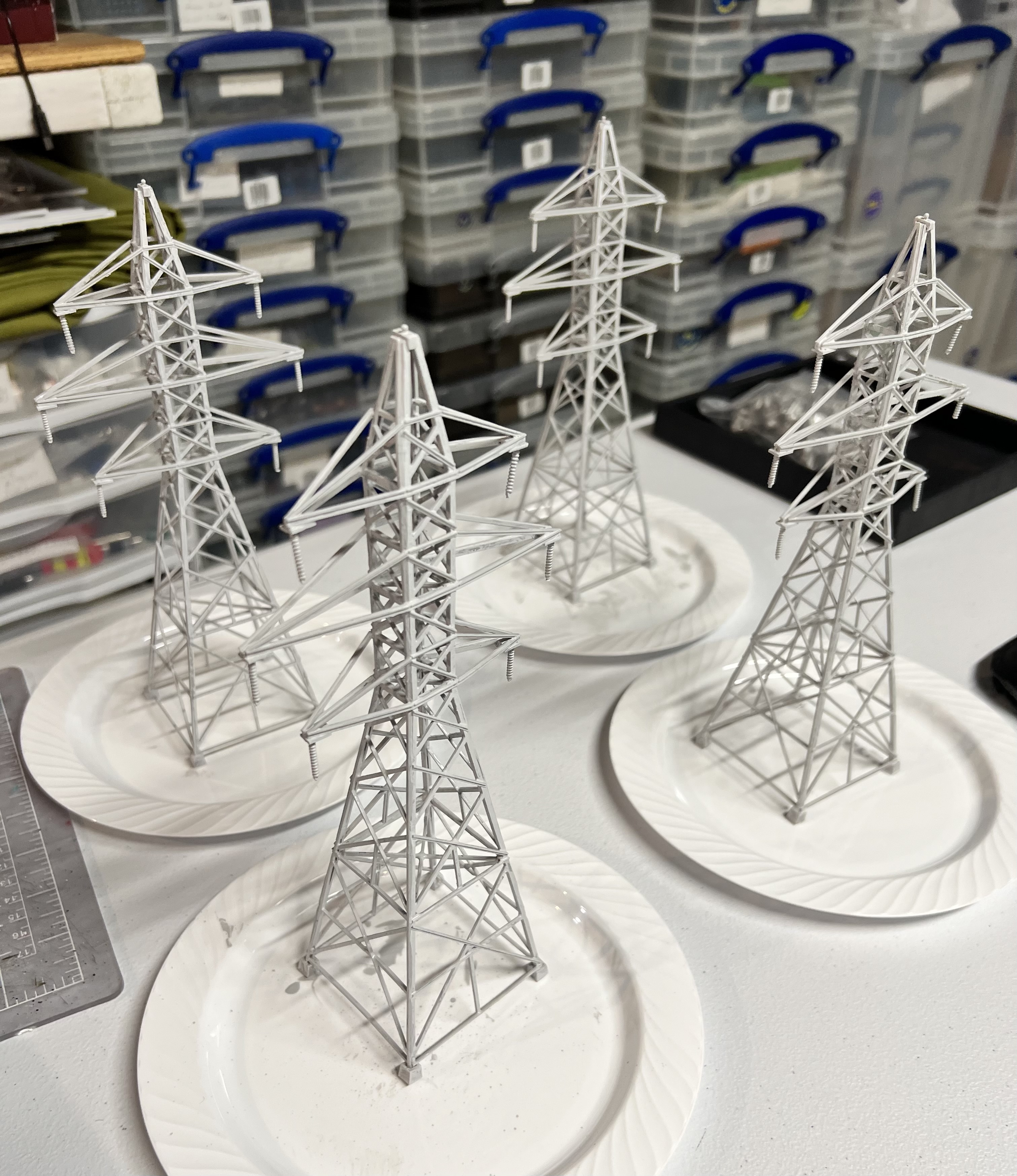
Rusting them up was similar to the walls – basically minus the use of the corrosion texture paint. The lists of what I used for these and the walls will be listed at the end of this post.
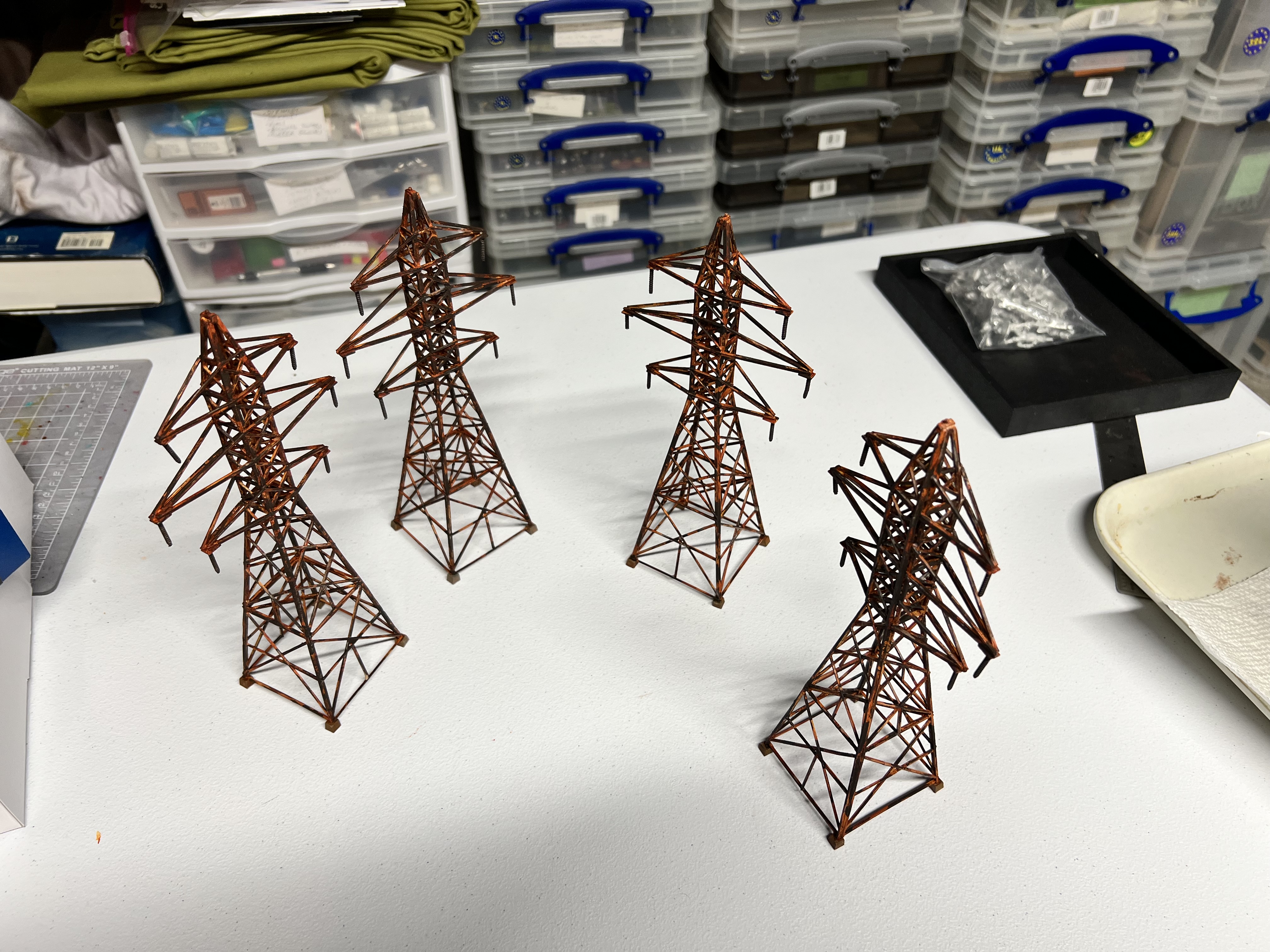
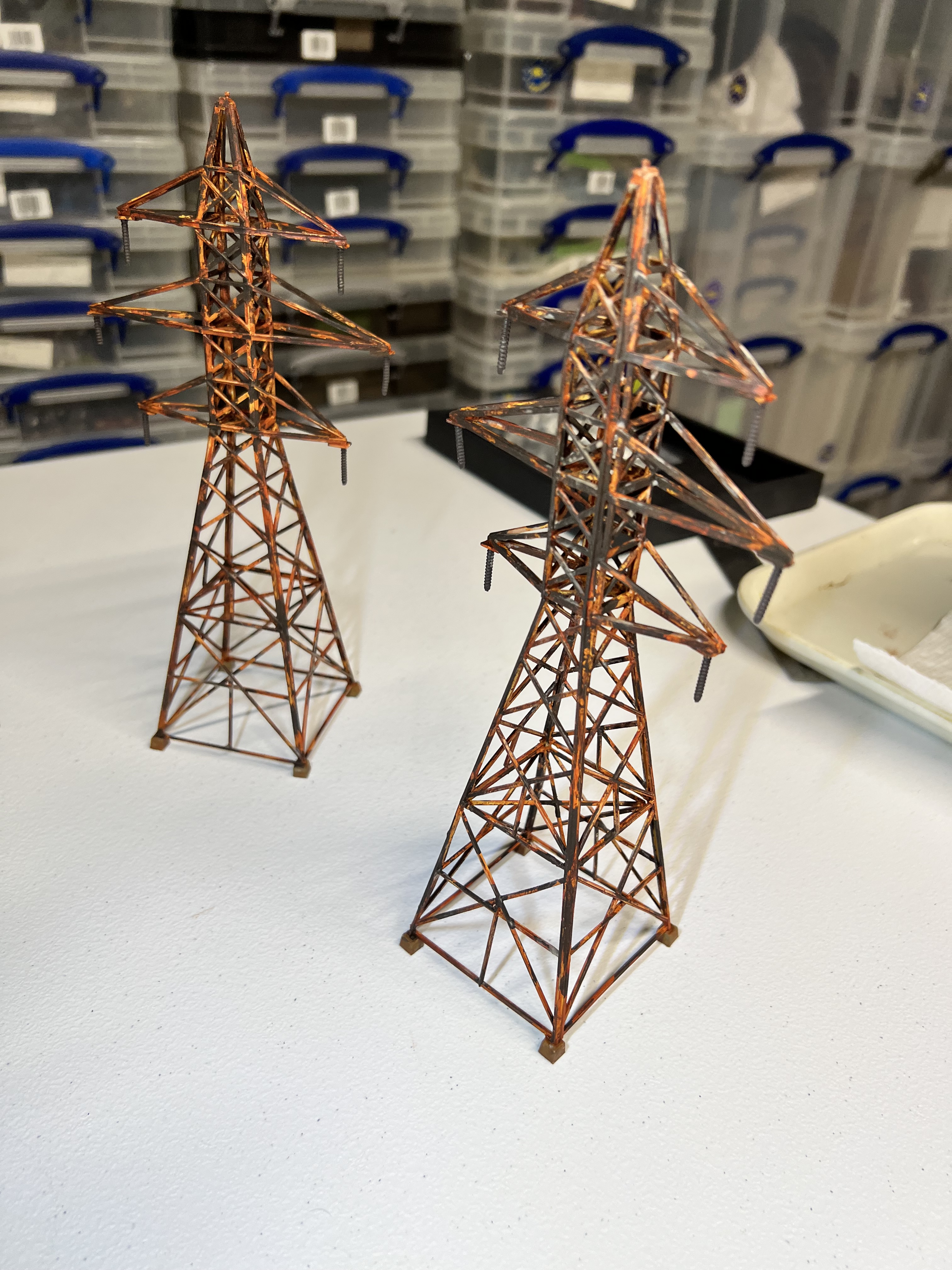
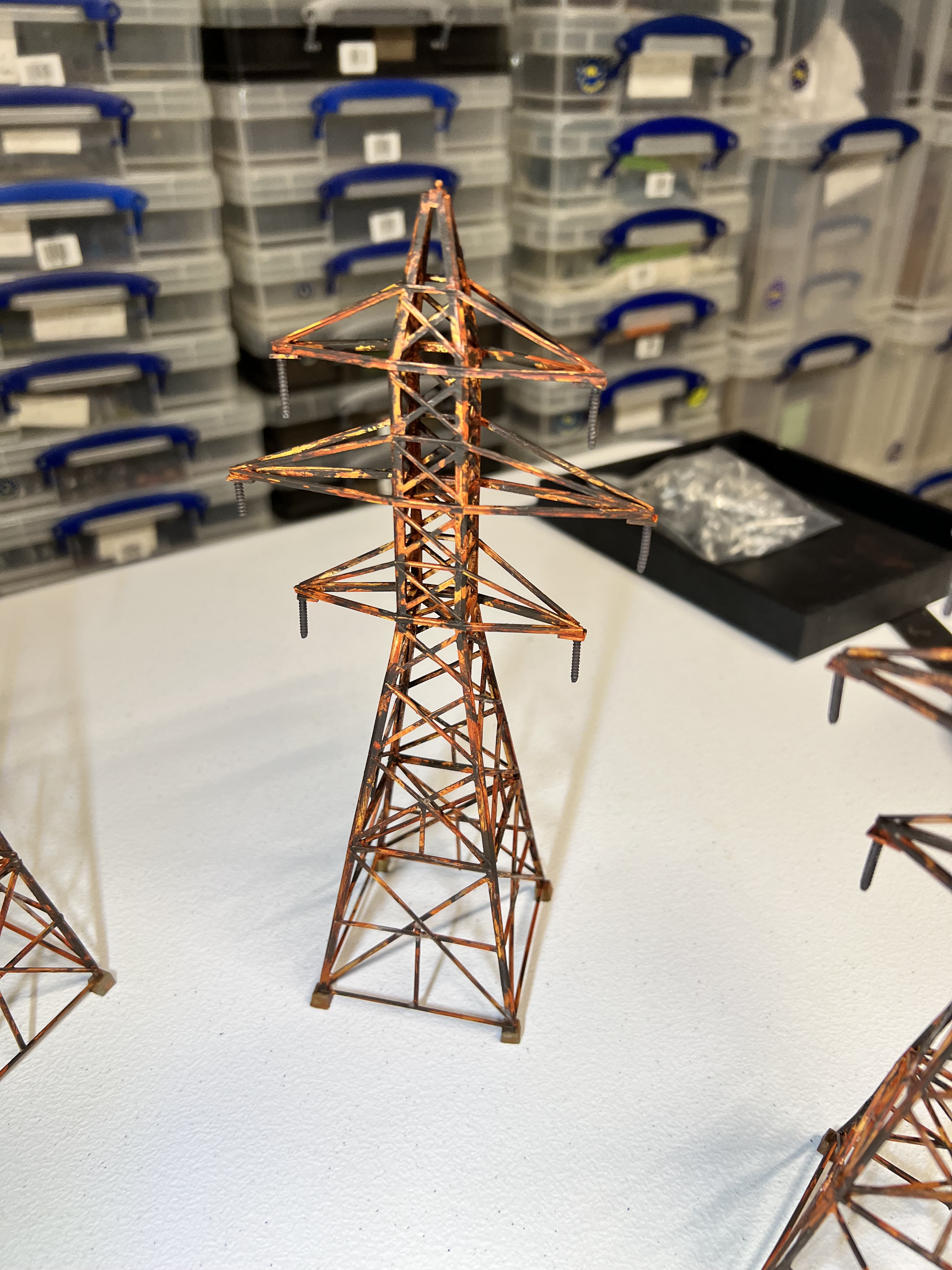
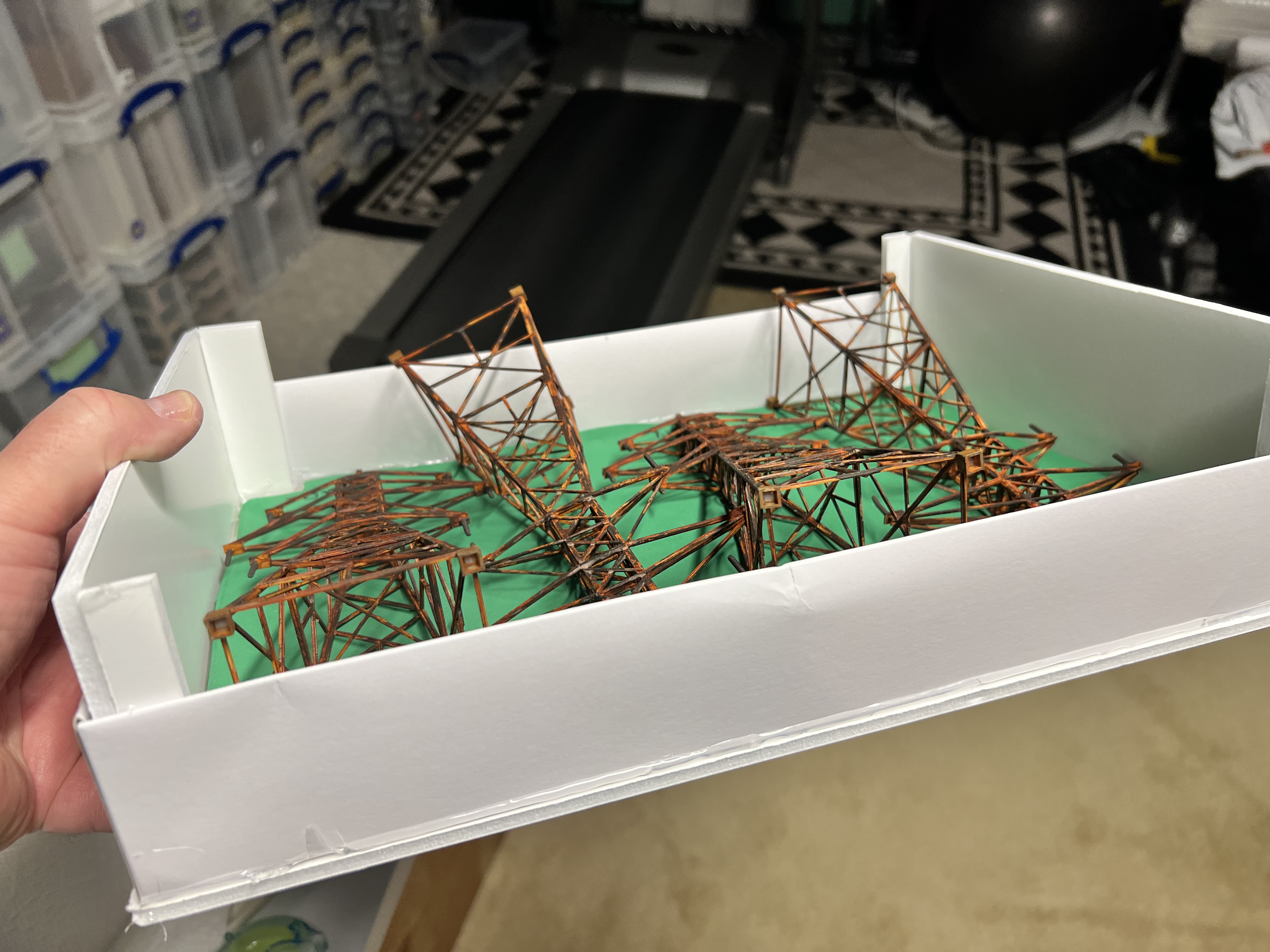
As you can see these are just plastic models and vulnerable to damage in transport! Unlike the walls, which went into a cardboard wine bottle box with some foam padding between levels, these needed a sturdy solution. They required something strong. I decided to modify the original box to accommodate the greater height needed when the models were lying down. I used more foam padding on the box bottom, and foam board to extend and strengthen the box as you see below:
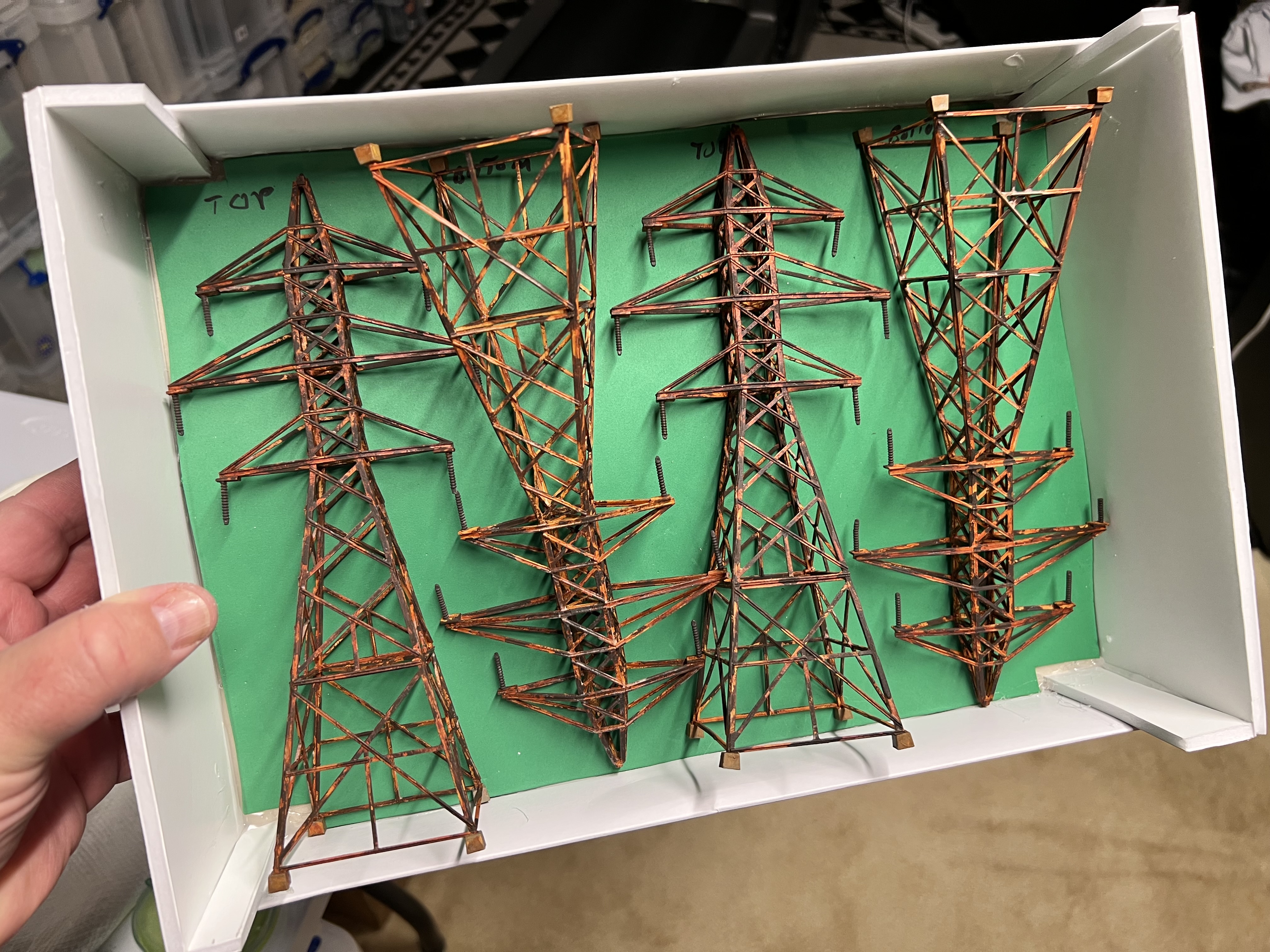
That’s about it for this rusty old post. I hope it inspired you to rust up some stuff yourself!
As I teased, I will be sharing how these fit into both of the tabletop set ups for 2026. I’ll also be sharing some of the new 2026 units of mechanical tin men that will find these structures as part of their apocalyptic homes. Until next time.
For all of my previous posts on terrain projects, please see this page. For all of my previous posts on sci-fi projects, please see this page…for any of my previous posts on Wars of Ozz, see this page.
PAINTS, INKS, GLAZES, SHADES, WASHES, PIGMENTS, FLOCKING, GLUES AND MORE THAT I USED ON THE RUSTY WALLS PIECES:
- Old autoinjector trainers
- Green stuff
- Chinchilla dust
- PVA Glue
- Vallejo Surface Primer “Grey”
- AK “Corrosion Texture”
- Citadel “Typhus Corrosion” (Technical)
- Citadel “Ryza Rust” (Dry)
- Vallejo “Old Rust” (pigment)
- Vallejo “Brown Iron Oxide” (pigment)
- Vallejo “Natural Iron Oxide” (pigment)
- Vallejo Model Air “Rust 73.117” (pigment)
- Vallejo Model Air “New Rust 73.118” (pigment)
- Vallejo Thinner
- Vallejo Model Color “Dark Rust”
- Vallejo “Natural Umber” (pigment)
PAINTS, INKS, GLAZES, SHADES, WASHES, PIGMENTS, FLOCKING, GLUES AND MORE THAT I USED ON THE RUSTY TRANSMISSION TOWER MODELS:
- Walther’s Cornerstone Four Transmission Towers (HO Scale)
- Tamiya “Extra Thin Cement”
- Plastruct Bondene “Styrene & ABS Plastic Solvent Cement”
- Alligator clips
- Vallejo Thinner
- Vallejo Surface Primer “Grey”
- Citadel “Ryza Rust” (Dry)
- Vallejo “Old Rust” (pigment)
- Vallejo Mecha Weathering “Light Rust Wash” (wash)
- Vallejo Mecha Weathering “Dark Rust Wash” (wash)
- Vallejo Mecha Weathering “Rust Texture Matt”
- Vallejo Model Color “Camouflage Black Brown”
- Vallejo Model Air” Concrete”
- Vallejo Mecha Varnish “Matte Varnish”

 Mark A. Morin
Very nice work Mark, I especially like those walls love a bit (lot) of rust and reusing something not model related to build something that is (if you see what I mean 😀). Cheers Roger
LikeLiked by 5 people
Cheers Roger. These will see Retrovians very soon!
LikeLiked by 2 people
Very impressive, Mark. I really like both of these and especially how well they all turned out.
LikeLiked by 4 people
Thanks Az,may my players be equally happy!
LikeLiked by 2 people
Nice work on the walls, Mark!
I noticed that some of the barcodes are still stuck to your RUBs. If you want to remove them, I found that the easiest way is to warm them with a hair dryer. The glue melts and they will peel off with very little tearing or residue left behind.
Regards, Chris
LikeLiked by 3 people
Thanks Chris for the tip. What I think you are seeing are not barcodes but instructions on how to use the trainers. Those are actually on the inner sleeves of the trainers. When I made the prototype I saw that I could reasonably obscure those instructions. As these have batteries inside I was loathe to apply any heat- even though the batteries are 6 years old now at least. The label on the outer jackets came off pretty easily but I could have used a blow dryer there and will give that a shot if I make more. Thanks so much again for the help I really appreciate it!
LikeLiked by 3 people
Ah, I was looking at the clear Really Useful Boxes that you are using for storage rather than the battery boxes that you are using for the walls. Sorry, I should have been clearer. 🙂
LikeLiked by 3 people
Ah, that is a good idea!
LikeLiked by 2 people
Looking like an excellent project Mark. Apocalyptic wasteland is something I like. Some great figures out there too. Good use of rusting, really looks the part and I always like the imagination of something being recycled. 🙂
LikeLiked by 3 people
Cheers Dave! Plus the chinchilla dust is another good use inspired by you!
LikeLiked by 3 people
Great work Mark. Love them.
LikeLiked by 3 people
Thanks maen! Hope you are ok and your chewing pup!
LikeLiked by 3 people
Great work.
Cheers,
Pete.
LikeLiked by 3 people
Appreciate that Pete!
LikeLiked by 2 people
I wasn’t expecting some terrain that fits the post-apocalypse so well from you, Mark! I might have to stop by for a future game of Fallout now that I know that you have some cool terrain for it too haha. In all seriousness, the rust looks great and I love that you turned those medical devices into something positive as well. Its a shame you had to go through that but I would imagine using those old castaways in terrain brought at least a little solace.
LikeLiked by 4 people
Thanks Jeff, glad to surprise you! Glad you like the rust, I am enjoying that process. The trainers have been sitting in a box for almost 7 years now so they were definitely overdue. I have a few more that I can convert and hopefully soon I’ll be able to show you some tabletop set ups. Conventions start Super Bowl weekend so coming up quickly!
LikeLiked by 3 people
These look great! I don’t know if I would have your modeling skill and patience on those transmission towers…haha! I wonder if someone does them in 3-D print? Love your rust effects!
LikeLiked by 3 people
Glad to know you like them! Interestingly in my search for transmission towers I did see 3d printed models but not big enough for my needs. I was ready to try scratch building with dowels but this was a far better option! As far as patience, yes, with plastic cement it’s not optional. The alligator clips made life much easier.
LikeLiked by 2 people
Nicely rusted, Mark! 🙂 That’s quite a bit done!
LikeLiked by 3 people
Cheers John, never enough!
LikeLiked by 2 people
Excellent rust work Mark, and very clever use of a throw away item to make new scenery.
LikeLiked by 3 people
Cheers Dave!
LikeLiked by 2 people
Brilliant work on those pylons , funny thing is we have just had a bush fir just up the road and the intensity of the fire melted it somewhat so our town was without power. We are fine but 50 houses were lost so at the moment we are all rallying to help the town and the victims,
Well mate we are still all on stand buy and being a bit hot outside it’s given me a to catch up
While I sound like I’m complaining I’m not as when i heard you guys over in your beautiful country are suffering those negative temps I feel guilty enjoying the warmth over here, take care and I’ll be back in contact soon🤞🏻.
LikeLiked by 2 people
Great to hear from you, Pat and sorry about that fire – that’s horrible. Cold and snow are annoying but fires like that are truly tragic. It’s been a long cold streak here but at least it’s been too cold to even snow. It’s too dry. Was -5 Fahrenheit this morning. Won’t get above freezing in the next 10 days so our snow isn’t going anywhere anyway. Hope you get time and space to work on your dioramas! Thanks for the kind words on the transmission towers. Next weekend they should see the table top in a few games. Cheers!
LikeLiked by 1 person
Wow Marky mate ! The fires were bad but not as bad as the California ones that burnt parts of the city, that fire was tragic and has made a lot of folks over her revise there thinking that us country folk can be burned. We are taking all the precautions we can as the fire season is only just starting.
It does amaze me how cold it gets in US , but what staggers me is how far south the cold gets, I have to say you Americans must be a hardy bunch, yesterday it was 36c but today it topped at 22c weird eh! And I had to put a sweater on 😂
Anyway I hope to put more up soon, I have been doing some model aircraft in between, not good but a bit of fun.
Oh as we have been in drought , winter and summer , all the birds have come in from the bush which is keeping me busy keeping up with the bird feeding stations on my block but with all the squillon varieties Im still to see a cockatiel 😢.
LikeLiked by 1 person
Yeah but as we are refrigerated for 4-5 months per year we stay fresh longer!
LikeLiked by 1 person
😂😂😂👍🏻
LikeLiked by 1 person