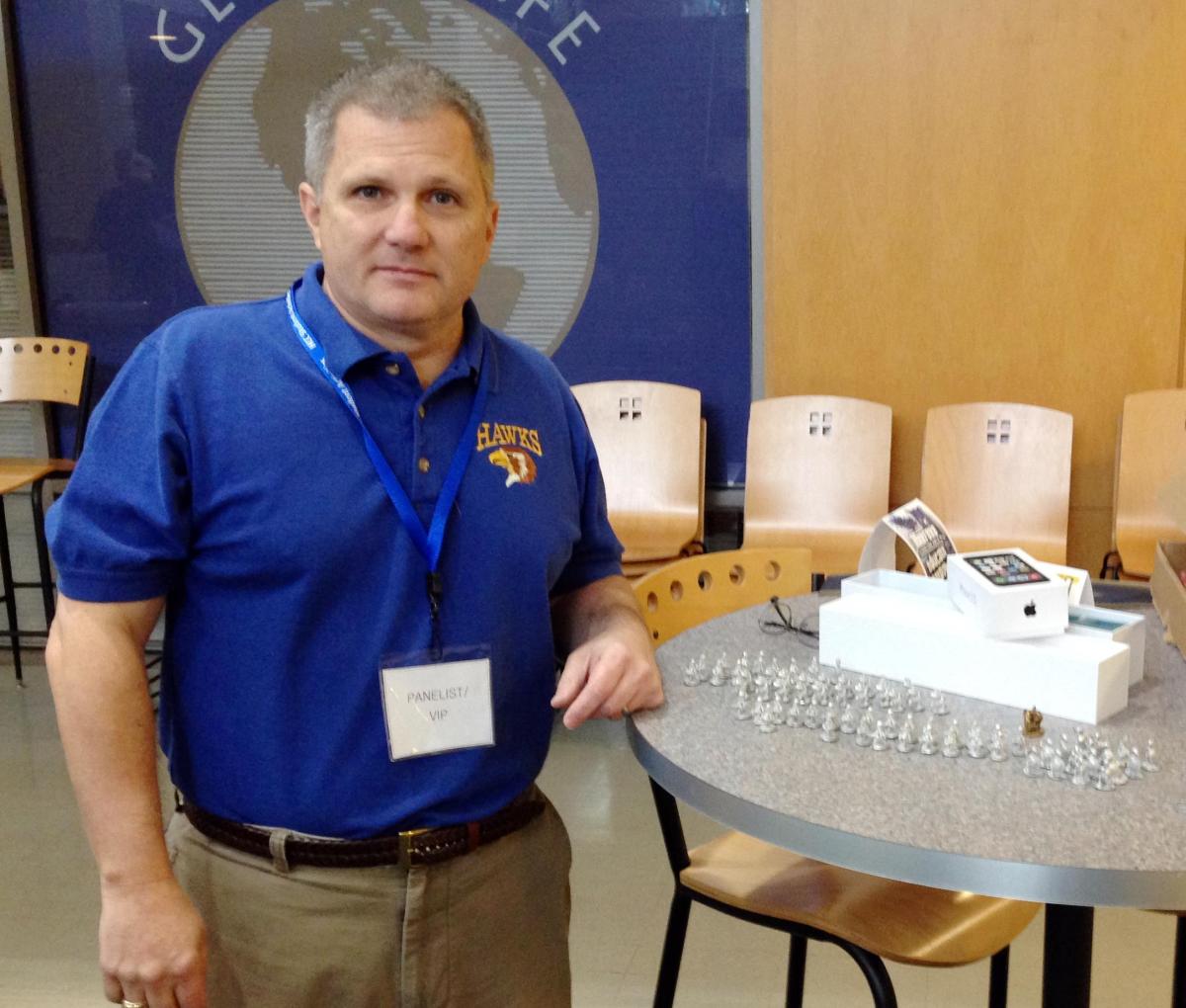
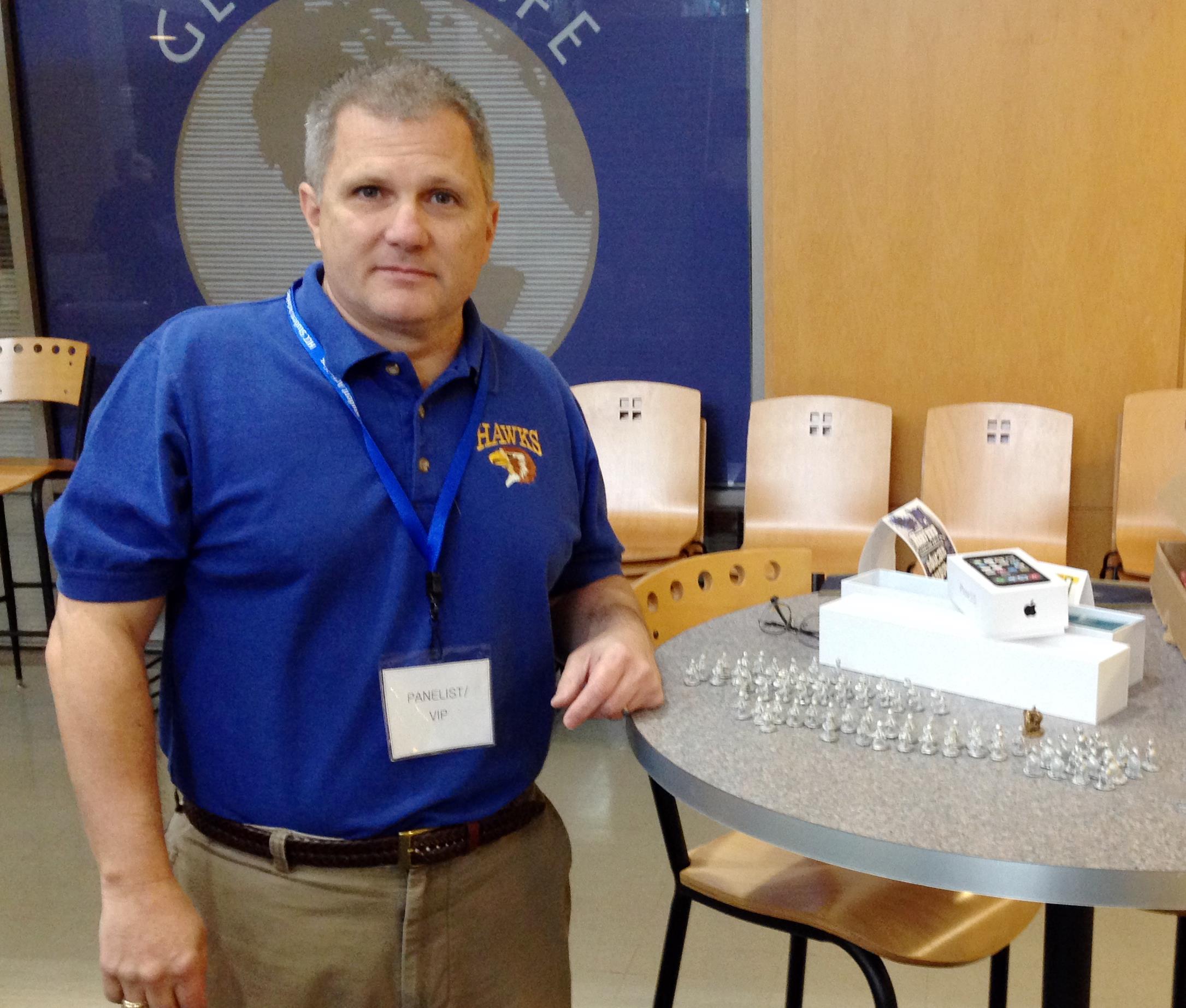
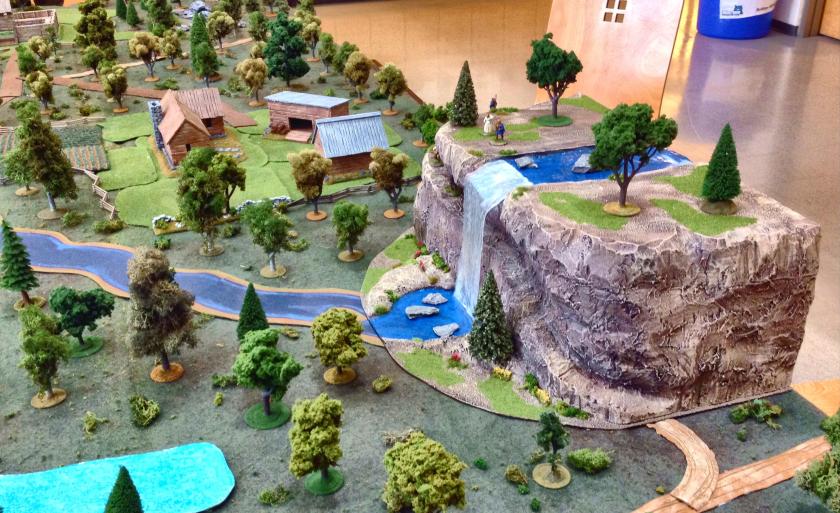
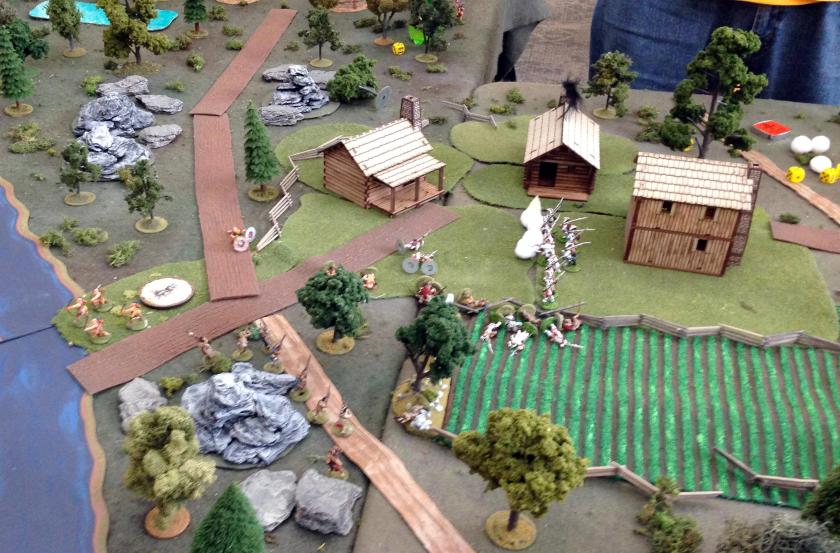
Chris Palmer This past Saturday, the HAWKs attended the HAR-CON gaming convention put on by the game club at the local Harford Community College. This con is a mixed gaming con, with video games, role-playing games, card games, board games, and miniatures games. A group of us posing with the French & Indian […]
Lots of Casting in the Snow – Roomans, Star Ducks, and Power-Armored Frinx
This weekend was cold and blustery. Definitely no golf! Saturday was cold and rainy, and we got 5″ of snow on Saturday night, and 5″ more all Monday – kept me looking for Spring!
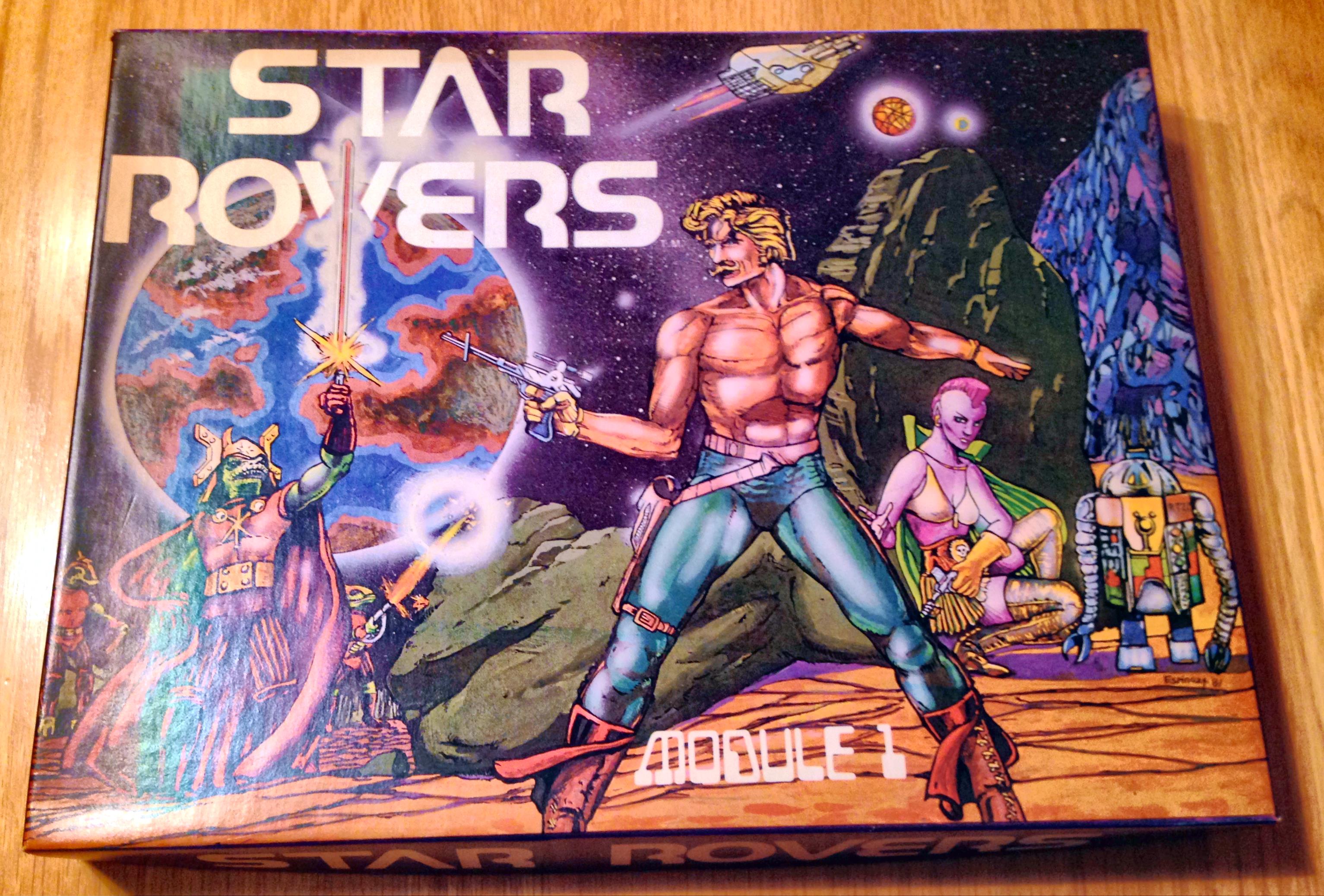
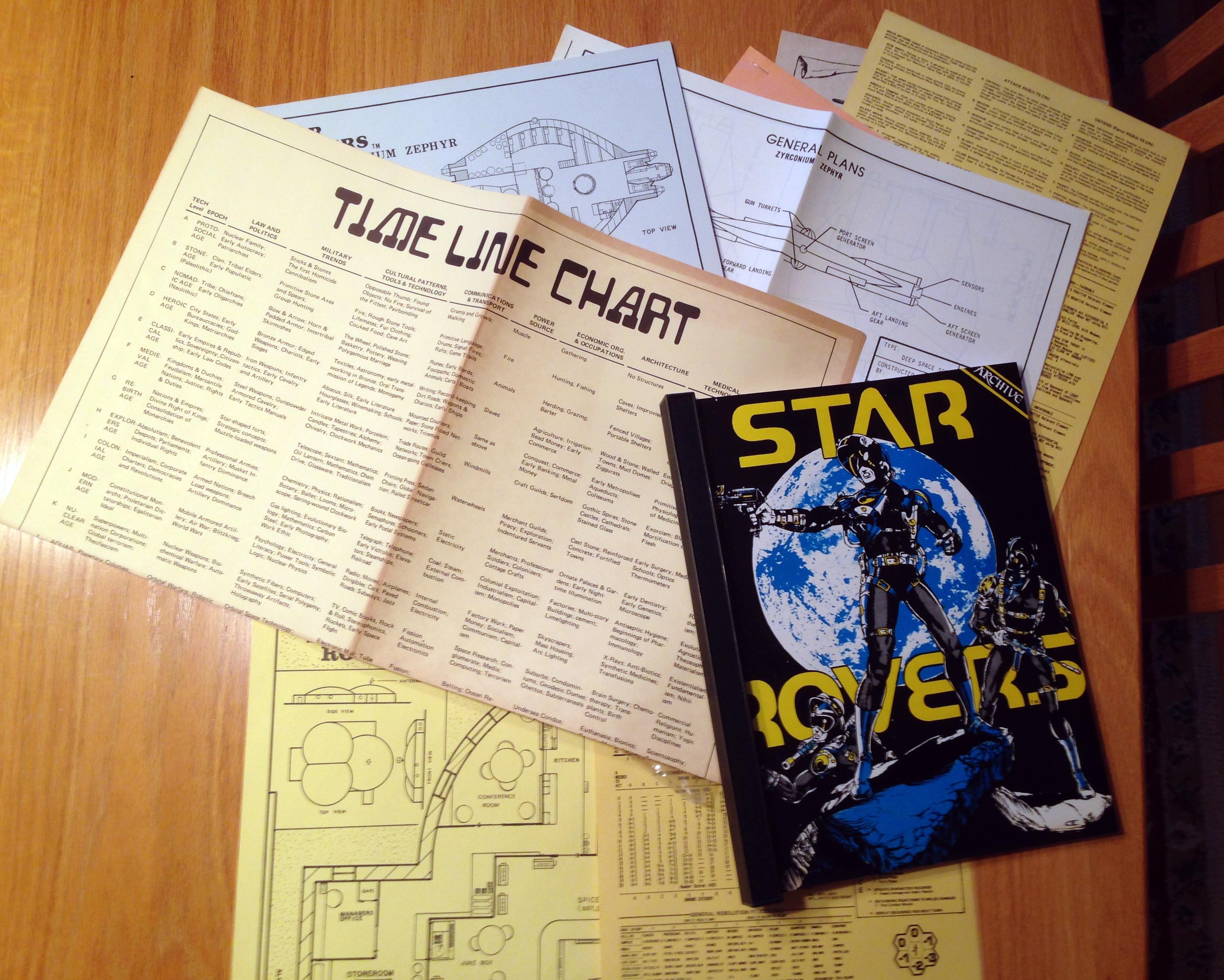
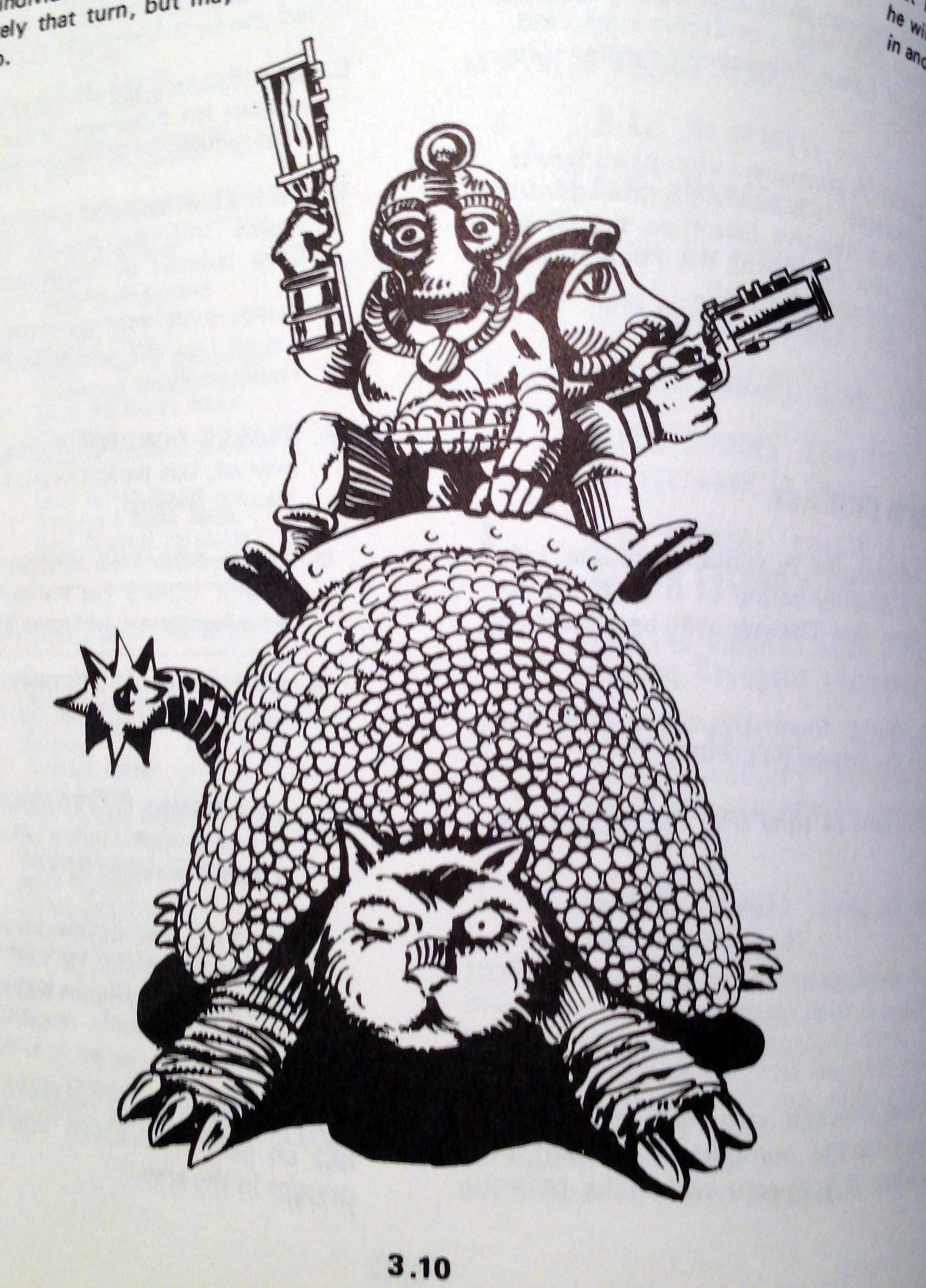
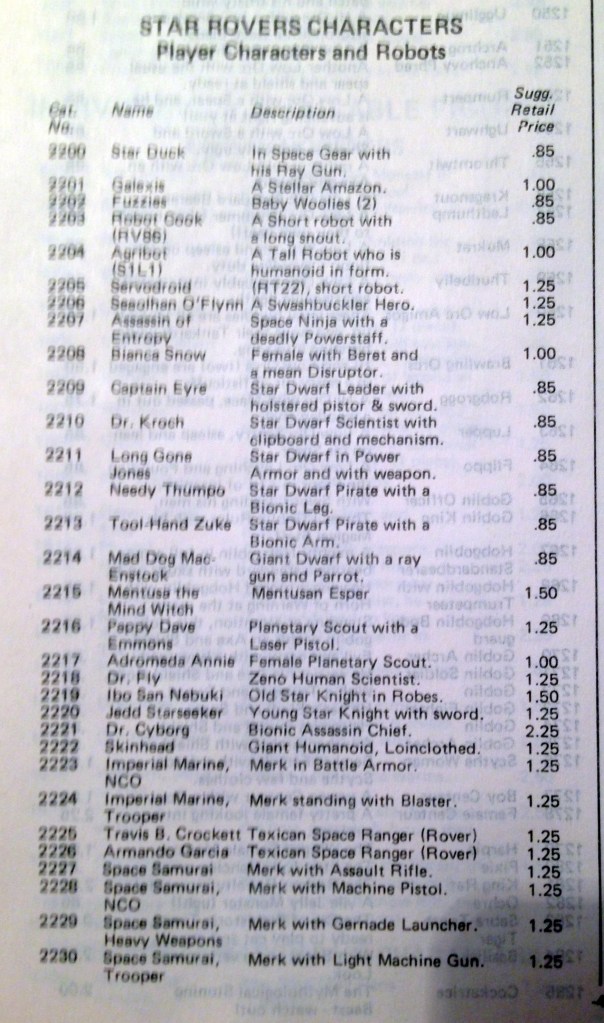
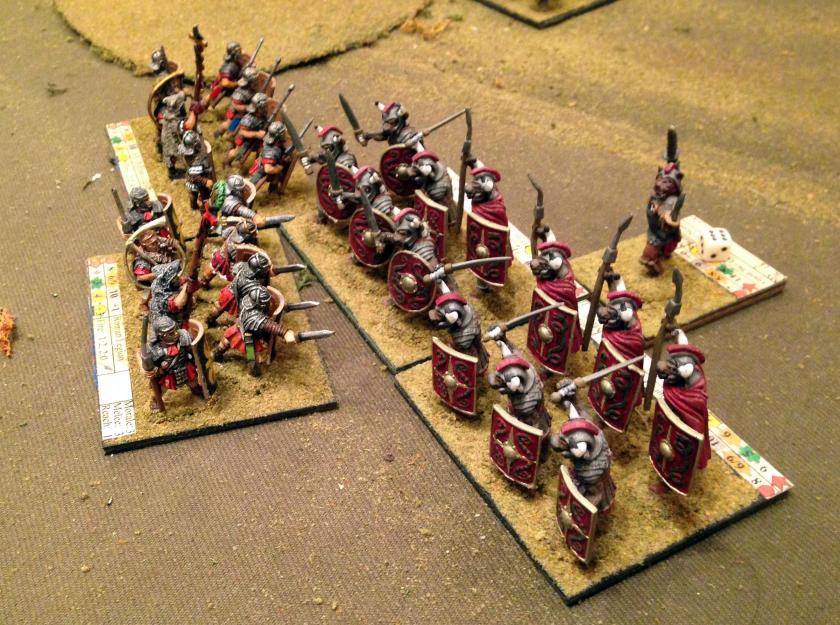
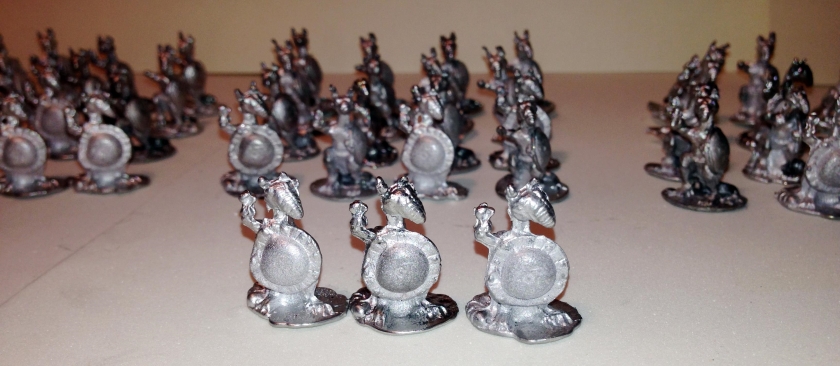
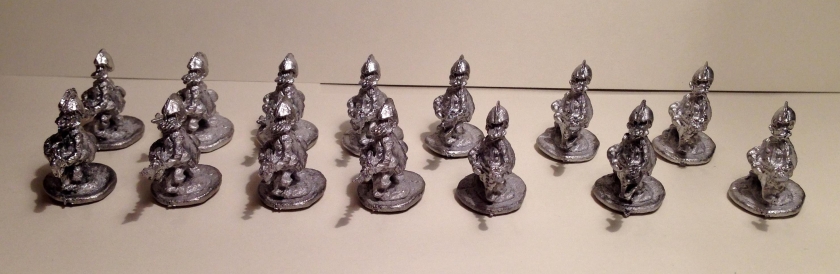
I took the opportunity to make a couple of more molds on Saturday. I made another Rooman War Party mold of the smooth shield Rooman from Ral Partha 01-044 or ES-44 (1977 miniature). I also made a new mold for eventual sci-fi play with Buck Surdu’s “Combat Patrol” rules. This was a 1981 “Power-Armored Frinx” (2040) from now-defunct Archive Miniatures “Star Rovers” line. From what I can see, a Frinx is a goofy reptilian biped. He could be armed with a large gun or a flamethrower, or perhaps a blaster? The figures looked cool and worthy of casting. I made both of these two molds a little longer and less wide.

Sunday came, and with it the miserable cold, wind, and snow. Undaunted, I set up my operation in my unheated garage. When the wind got too strong, I just shut the door- which was most of the day.

I also exclusively used some new alloy metal that Buck was kind enough to send in in support of my casting efforts. It is 50% Tin, 39% lead, and 11% antimony from Castings (http://miniaturemolds.com/1-50-Tin-39-Lead-11-Antimony-10-oz-Ingot-CM3.htm) .
I was able to have a much lower melting temperature than my last efforts ( a range of 360-400 °F versus 600-650 F°). The flow was better and more manageable. As I got the hang of it, my castings got better, even with molds that I thought I might have damaged with the higher temperatures on my last casting. With six molds, I was able to crank out 82 miniatures, which really was satisfying.

I had a total of 83 Roomans now, enough to complete my units, with a battalion for friends Dave Wood, Buck, and my daughter Ellen. In the process of cleaning up flash and doing Quality Control, I ended up putting 8 into the recasting collection – but that just left me with the best of the Roomans left for myself, Ellen, Buck, and Dave. Some were better than others – but all in all they should paint up nicely and could have a variety of weapons and not just their original pikes.

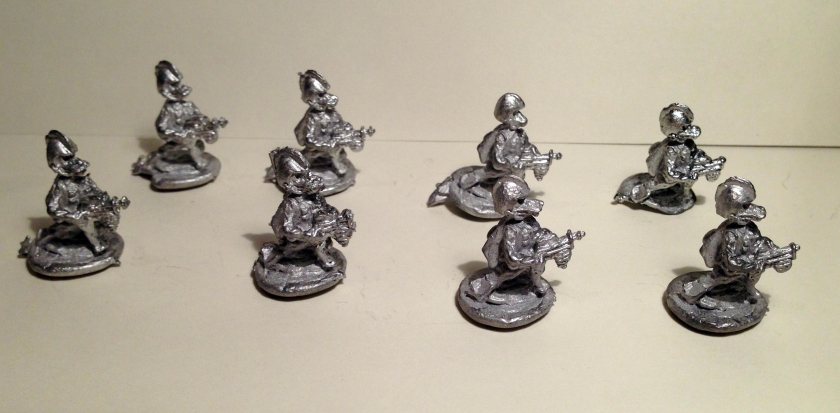
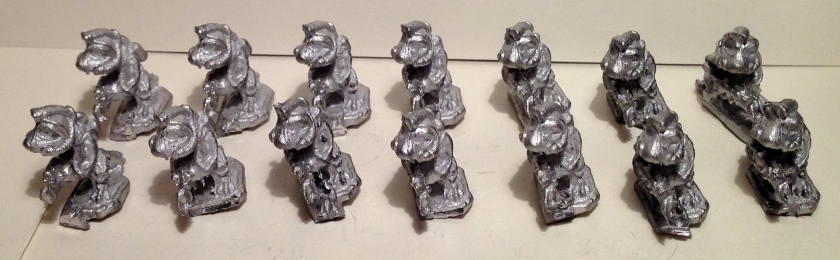
The Archive Star Ducks (2200) came from the “Star Rovers” line. These were a challenge as their ray guns did not always come out. I decided that the Star Ducks with truncated Ray Guns looked like and would be armed with submachine guns – and be just fine. With some practice and the new alloy, I had greater success as the afternoon went on, and ended up with a total of 14 armed with ray guns with 8 with submachine guns.


I was very pleased with the Power-Armored Frinx figures. The longer molds allowed me to get more details into the molds by tamping and rotating them after filling them with the molten metal. I ended up with 14 of these Frinx, and I can’t wait to see them get the Surdu touch!

I had several key learnings from my efforts.
- I found that longer molds are easier than wider ones for casting.
- Using an alloy with 50% tin as described above was a lot easier than using plain lead, in terms of being able to use lower temperatures as well as better flow.
- Each figure averaged 0.39 ounces of the alloy after recycling plugs and flash. With that ratio, I could cast 25 figures from 10 ounces.
- I think six molds is the perfect number for quality production and safety.
- The Quick-Sil is a great material to make molds with, but you need to be prepared to have an Exacto knife to add venting gates and open channels. Luckily, Quick-Sil is easily cut. If the mold needs adjusting, do it with the Exacto knife.
- After pouring, tap/tamp/bang gently and rotate the mold to get the metal into the details.
- The use of a specialized thermometer (mine is a Lyman that goes up to 1000 °F – http://www.amazon.com/Lyman-2867793-Lead-Thermometer/dp/B001TQ8Y6Q ) and allows for better control and better casting. Temperature control is very important. My crucible (a Hot-Pot 2 http://www.amazon.com/Do-It-Molds-1892-Hot-Pot-2/dp/B002QG3H9M/ref=sr_1_1?s=sporting-goods&ie=UTF8&qid=1459824499&sr=1-1&keywords=hot-pot+2 ) has no control other than on and off. By watching the temperature and shutting the crucible off I was able to have a modicum of control. Having extra metal ready and on-hand to add to the crucible to lower the temperature when it gets too hot is another good tip.
- Safety is paramount. The molten metal can indeed fly around, and it is HOT. I would not even think to try this without heat-resistant gloves, eye protection, and a respirator (breathing lead fumes is not a good choice). Having all of my skin protected is important, as well as anything that could get hot metal on it, like shoes, pants, long-sleeve shirts, etc. Protect your workspace too. I use steel sheets to insulate my work bench, which also has the advantage of making splattered metal easy to clean up and recast.
This was a fun project – and I am so happy that now I can round out any unit of out-of-print miniatures as long as I have one to mold and cast.
Easter Brings More Roomans and Star Ducks
On Easter Sunday after dinner, Chris Smedile and I were able to crank out 6 Archive (1981) Star Ducks (#2200 from the “Star Rovers” line) and 22 Roomans (both types from Ral Partha “Rooman War Party”). I made two molds earlier in the day and we had fun trying to get the casting process correct.


Thanks to Chris there was a good number produced. Two of the Star Ducks did not have their ray guns fully formed, but ended up looking like they had submachine guns, so I kept them. The other four were good, and had flash that looked like the guns were firing – an unexpected bonus.
The Roomans mostly came out, but some were remelted for recasts. Some were missing an ear, which my daughter Ellen Morin described as “battle damage”!
Still have more to do but having fun making them – and even more fun doing them with Chris!

Bay Path Golf Course Opens for 2016
The 2016 Golf Season started (for Bay Path) on Saturday, March 23rd with a round of 18 with Bob Tilton and Jerry Dufresne. Not my best pic, but selfies are not my thing!
The course is in good shape for March Thanks to the hard work of Jeffrey and Justyne Smith.
Temperatures were cold. It ranged from 38° F to 43° F, and we were all rusty. We had a quota match. Bob and I tied on the front, and Bob won the back and the total on the 18th hole. Anytime you can walk 18 with an 83 year old, and lose to him, well that’s pretty cool! We at least got to be the first to play, and I got my first birdie of 2016 on the 10th hole! I did not play on Sunday as it was Easter, but I did work on miniatures – see my next blog entry!

Making Molds and Casting a figure from “Rooman War Party” (Ral Partha ES-44 or 01-044) with Quick-Sil Kit
Back when I was at West Point, I was introduced to “Roomans” by Buck Surdu. He had a unit of them armed with pikes. He had painted them green and called them “Beaks”. He even had altered one to be armed with a sword and gave it a scratch-made airborne beret – I think that Buck still has them!
Over the years, I looked for them in hobby stores and only managed to find one package of three at Eric Fuch’s hobbies (I think in the mall at Burlington, MA – the shop long ago went out of business I believe). Ral Partha first cast these figures in 1977 as part of their “Personalities and Things That Go Bump in the Night” series as “Rooman War Party”. Originally, they were ES-44, and later 01-044. In fact, they were kangaroos (think beastmen) and did not have “beaks”, and were armed with piano wire pikes. Two of the three figures in the pack were the same with a smooth shield on the side, while the third had a riveted shield that was held in front. With the advent of eBay, occasionally I see some, but very infrequently. Sometimes I’m lucky – and have even found one ES-44 in its original packaging. Other times I find one or two in a lot mislabeled as goblins or just loose in an estate collection that I’d have to strip down. My goal was to get to 36 Roomans , and then paint them up at once.
As part of my search, I contacted Iron Winds Metals and they told me that unfortunately the old molds for the Rooman either no longer exist or cannot be found. I was able to get some of the piano wire pikes from them however which was appreciated!
So, as I cannot get them from the folks who made them, I made the decision to see if I could cast some and make my goal (these are for personal use and I have no plans to sell them although that seems to happen a lot on eBay – I wish that I could buy the originals!).
I have cast figures before with some Prince August molds back in the 1980’s. However, I was not using the right safety equipment back then to say the least (no respirator, no gloves, and heating on the gas stove in the kitchen). I did not have any way of checking the temperature of my metal, which was a mish-mash of old figures, modeling metal, fishing weights, and any lead or tin I could cobble together. My results were less than great, but acceptable – and any bad figures just got recycled into new ones.
I looked at some ways of making a mold and casting again, and some required a spin casting set up (not happening don’t have the space), vulcanizing rubber molds in my kitchen oven (I know enough to not even think to try to get my wife to go for that option), or liquid RTV (room temperature vulcanizing) rubber. The last option was a good possibility, as it came in a can and you added a catalyst. It did seem messy, and there was some discussion I saw about degassing with bubbles and that seemed problematic.
Luckily, I came upon a product called “Quick Sil” by Castaldo at a distributor known as Castings – http://miniaturemolds.com/main.sc. You mix equal amounts of two different putties and in 15 minutes it forms a hard silicone rubber. They sold me a mold-making kit (RTV Quick-Sil Starter Kit) that had the putty, a mold press, and all the items I’d need to make a mold. http://miniaturemolds.com/MAKE-YOUR-OWN-MOLD_c80.htm . They did warn of a learning curve with the product, which was true as you will see – but I do like the product.

The mold press is necessary to drive out bubbles from the rubber as it cures. It has a series of wooden blocks to create the mold shape and size that you want, with wing nuts and a cover to make a press. You can use it to make one or two-piece molds. For this Rooman project, I did need a two piece mold.

My first attempt involved trying to make one mold for three Rooman figures.
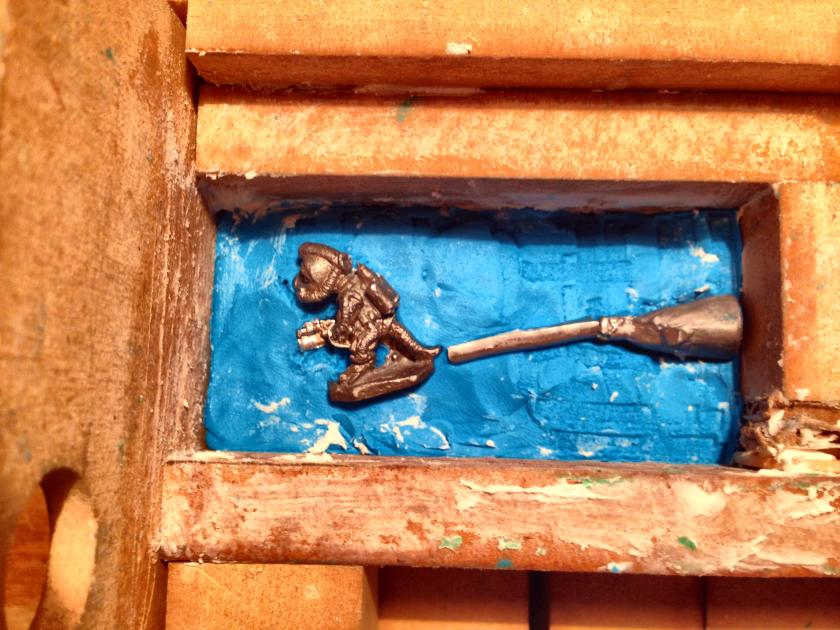
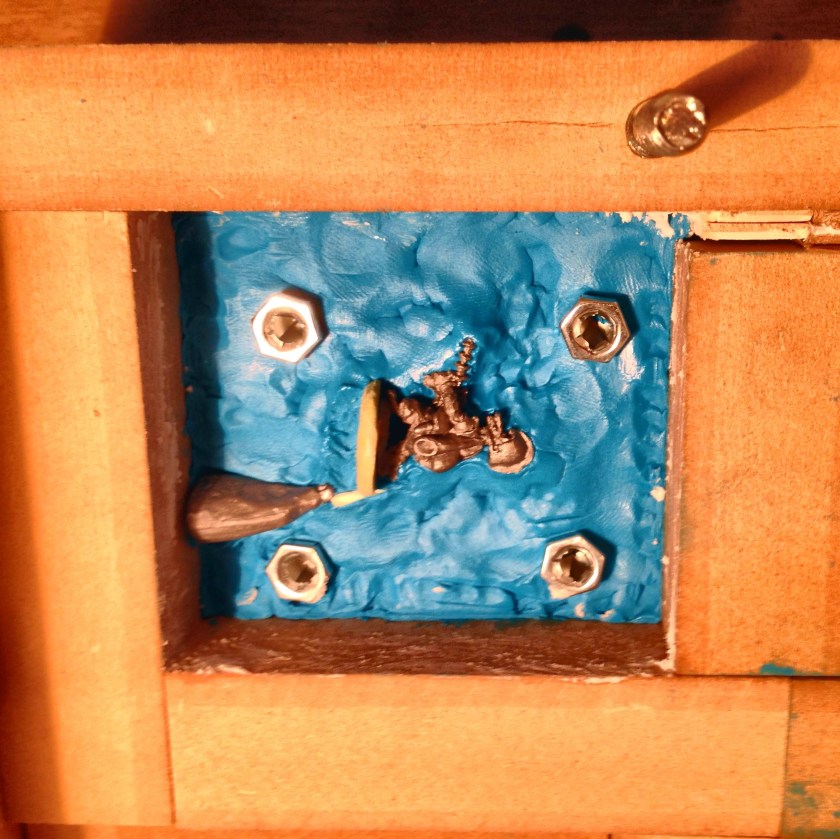
The procedure is as follows (more or less). First, you put down a blue sulfur-free clay upon which the figures and mold keys are placed. Then you mix the two parts of the Quick-Sil – which you need to get in the mold within two minutes. The Quick-Sil will be placed over the figure and the blue clay. You compress the mold in the wooden press, and let the Quick-Sil cure. Then you remove the combination from the press. The blue clay is then removed from the new mold half. You apply a releasing cream to the mold half, avoiding the figure. You then prepare a second batch of Quick-Sil, and repeat the process, ending up with a two-piece mold – theoretically.
My first try to make a mold was overly ambitious and failed, wasting a lot of Quick-Sil, but provided key learnings. This failure occurred for a few reasons. I was too concerned with overworking the Quick-Sil putties which have a two-minute working time. I ended up underworking it. Also, my first try was too thick to cure in 15 minutes in a cold mold press. I needed to make a much thinner mold, and work the two putties longer before putting into the mold press. I also needed to warm the press and the figure with a blow dryer before adding the Quick-Sil and warm the mold while it was curing. I also needed to wait 26-28 minutes for the mold to fully cure.

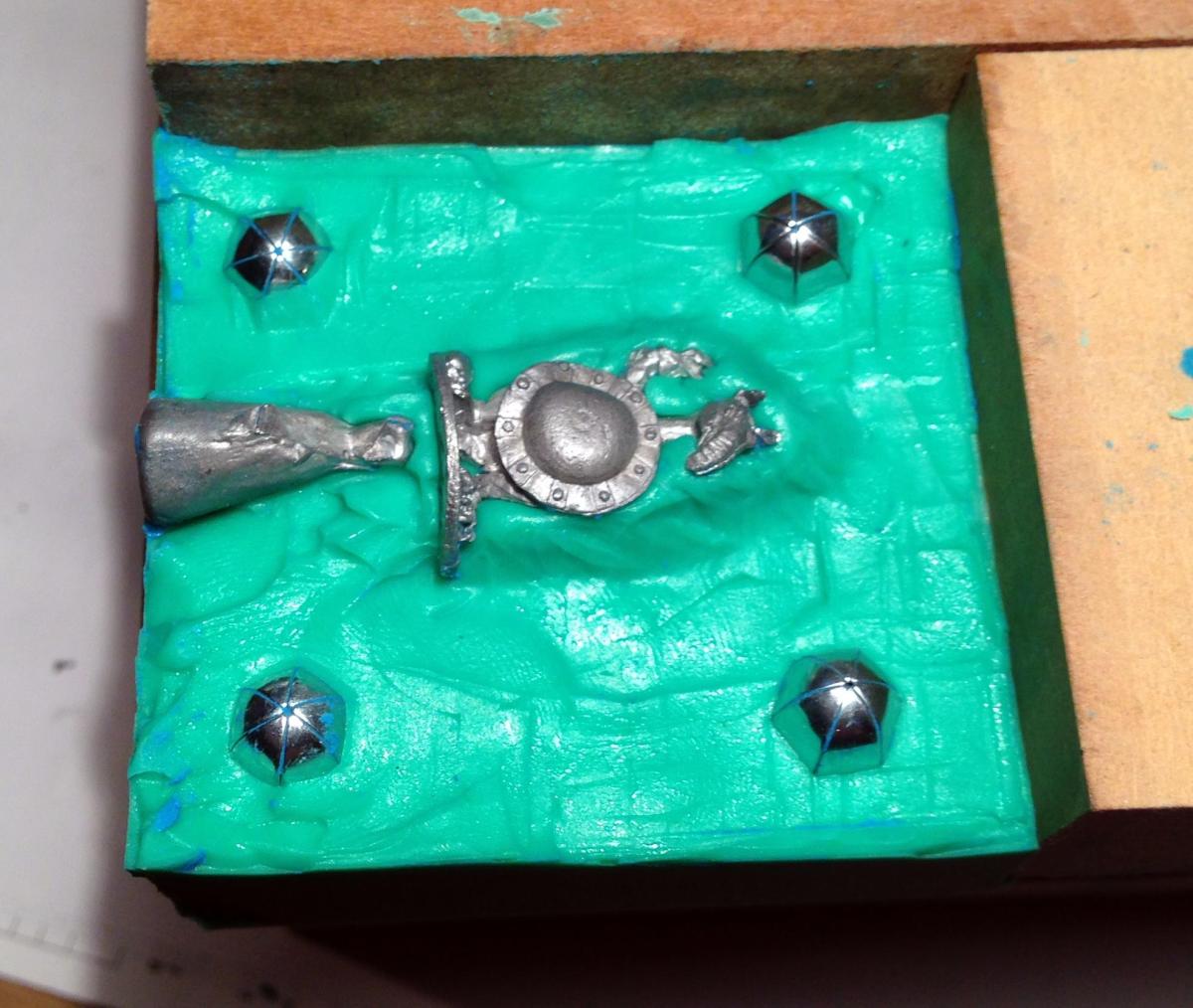
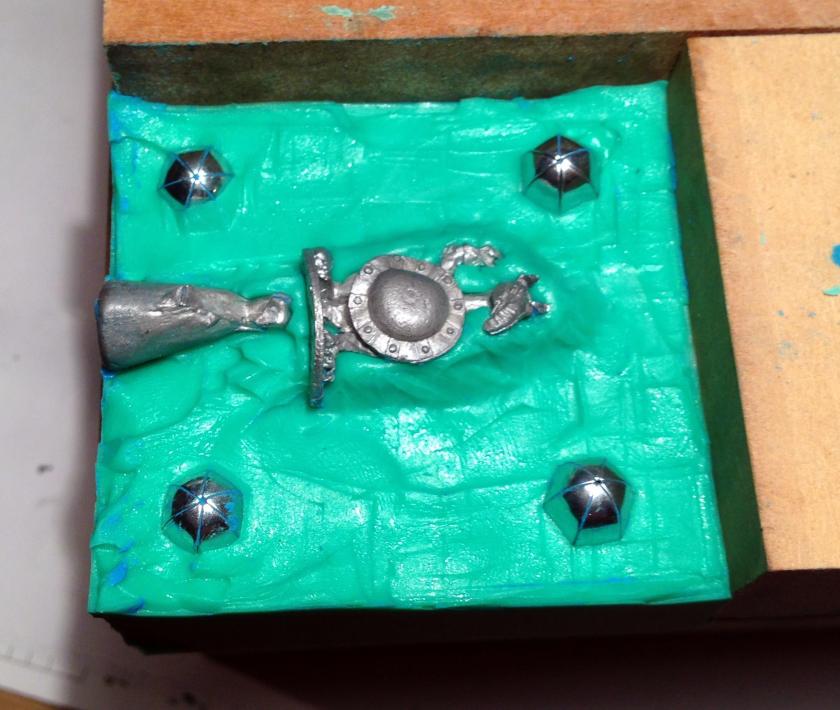
My second try was much better. I used just one figure, and made the mold smaller and thinner. I warmed the mold and the figure with a hand-held blow dryer before and after putting in the Quick-Sil. I also put in the keys correctly this time. These actually act as nice ways to align and shut the mold.

I flipped the mold half, and removed the blue modelling clay.

I then applied the Castaldo mold release cream on the mold avoiding the figure (Quick-Sil sticks to itself so this lets the two halves not stick together). I then repeated the process with the press. I did need to add cardboard shims to get the second mold half to the correct depth. Later on I made a third two-piece mold of the same figure. Using an Exacto knife is critical to getting the pieces out of the press.


I needed to apply graphite powder to the mold interior so that the hot metal would flow properly. I got this from a locksmith in Worcester. Later on in the casting process, I would learn that its good to tap the mold with the hot metal in it to get all the mold filled. I am glad I had great heat-protective gloves, eye-protection, a respirator, long-sleeves, and pants on when I did that as hot metal flew around! My wife is glad I am outside!
Please note that I had steel sheets from Home Depot clamped to my work bench as well as a working surface. This was a big help when I casted – and a pretty inexpensive way to make a safe place to work with hot metal. I also had a Lyman thermometer to check the molten metal in my crucible as it had no temperature control except being on or off. I’d recommend this and I found that it cast well between 500° and 600° F. My metal was a combination of old broken figures plus any saved lead and tin alloyed metal I had kept since the second Reagan Administration.


I ended up needing to cut some venting gates in the molds as well for better casting. This is easy in the Quick-Sil with an Exacto knife, as the rubber cuts fairly easily. I am fairly certain that I was responsible that day for all the world’s Rooman production!

I ended up with 12 this weekend – 9 from the first mold and 3 from the second. after a while, the castings got better and easier.

I removed the plugs with a pair of cutting pliers, and now I have 12 more Roomans. I need a few more though to complete the total.

My next attempt will be with the other Rooman model, and with some Archive Miniatures Space Ducks that I found on line as well. Stay tuned. I am happy to now have a way of getting out of production miniatures when I need them. I would recommend the RTV Quick-Sil starter kit for anyone wanting to do the same.
A Couple of Spiders (but not from Mars)
Winter is always a tough time to complete miniature projects in New England. I like to prime my figures, which involves spray paint, and I like to save and protect my paint jobs, which involves spray varnishes. Unfortunately, both of these are sensitive to cold and humidity – if only I had a heated garage! I did get lucky his month with the help of Jeff Smith who let me use his workshop to prime, but more on that in a bit. Work travel impacted production as well for me.
I needed a few “large creatures” for Wizards to control for my fantasy war game rules. I have a few that I got on eBay that are in progress, but I did not want a month to go by without any production at all.
Maybe because of the passing of David Bowie last month, I had “Ziggy Stardust and the Spiders from Mars” echoing through my head. I really was a big fan of Bowie, and was lucky enough to see him one time back in the 90’s. It was a great concert. So, with a nod to the Spiders from Mars, I focused on two spiders I got on eBay. The first one was the smaller and older of the pair, called “Huge Spider”. It was made by Grenadier in 1980 as part of 5004 “Tomb of Spells” boxed set for AD&D. The second was a larger Ral Partha figure that came in 3 pieces and looks like a tarantula. It was made in 1995 for TSR’s AD&D 2nd edition Monsters series. It is 11-515, and according to Lost Mini’s wiki it was called “Spider/Steeder”. I will deal with each in turn.
The Tomb of Spells set had 20 miniatures in it (pictures of box and insert below from Lost Mini’s Wiki). Originally, the Huge Spider had only 6 legs, but subsequent versions were given 8 legs. The eyes were not those of a spider and more akin to the compound eyes of an insect.


I wanted to prime them, but the weather was around -5° Fahrenheit that Saturday. Thankfully, Jeff Smith was working in his wood shop up at Bay Path Golf Course. I took advantage of his kind offer to work there and prime several miniatures. He had a nice turntable for me to use which helped a lot. I primed the figures with Krylon Ultra-Flat Black at a safe distance from his roaring wood stove with the door ajar. Most of the vapors got sucked right into the stove which was a great solution!
I then mounted the figure on a #8 stainless steel washer and then used the washer to mount to a popsicle stick for painting. I used my scroll saw to cut a hexagonal 2½” base out of 1/8″ plywood for a permanent base. I learned from previous projects that a beveled base would hold flocking better, so I set my saw up to have about a 85° (instead of 90°) slope. I glued several zinc coated steel #8 washers to the bottom of the final base to provide a way for the model to attach to magnetic sheets in my storage drawers. My plan was to have the spiders be dark in a field of grass. To help make flocking easier I used some Deka Lack satin green (from 1987 and still good) to paint the final base. I then went back to painting the Huge Spider itself.

I gave it a nice light coat of Americana “Lamp Black”. When that had dried, I used Special Weapons Washes “Heavy Body Black” on the figure. I then applied a dry brush of Citadel “XV-88” all over the figure.

I then washed the figure again, this time with Special Weapons Washes “Red Black”. For the mandibles, Armory’s “Gloss Black” gave a menacing glint. Lastly, the eyes deserved menace, so Citadel’s “Wild Rider Red” was my choice.

As for mounting and finishing, I used wood glue to mount the figure to the hex base. Being careful to avoid the legs, I used toothpicks and small brushes to apply white glue for the flocking around and under the figure. The flocking base material was Army Painter Battlefields “Moss Green” which worked well with the underpainted green base. I sprinkled some 4Ground TSM-122 “Loose Foliage – Green” around to alter the color a bit and create depth. I sealed the entire base flocking with a slurry of diluted white glue which I let dry.

Back to weather and conditions challenges for varnishing – still too cold! And my wife really does not want varnish propellant in the house – I’ve pushed that before and will not again. Besides, it really is a health hazard. Traveling with the figure to Jeff’s workshop seemed too burdensome as I did need the usual two coats (Krylon Clear Glossy followed six hours later by Krylon Clear Matte). I also did not want dust or bumping the miniature to affect the varnish.
I came up with a nice solution using my cellar bulkhead. I opened the inner door to heat the stairway of the bulkhead from the cellar. Once warm, I affixed a couple of magnetic battery-powered LED lights for illumination on the interior of the outer bulkhead door. I put on my respirator, and shut the interior door, and used the spray varnish under the LED lights to coat the figure in a clean cardboard box with cutaways that was set on the stairs. I then opened the outer bulkhead door to vent the fumes, and quickly went back into the house from the back door with the figure before it got cold – and it worked!
After the second coat (Matte) of varnish, I used a combination of Army Painter Battlefields “Wilderness Tuft” with a few “Wasteland Tuft” and some “Battlefield Rocks” to create a more 3D effect.


Now I shall discuss the Ral Partha Spider/Steeder. It was made for TSR’s AD&D Monsters line in 1995. It posed some new challenges, as well as some of the same as the Grenadier model. The first was assembly. It was not immediately clear as to how to put the creature together – especially the middle. Additionally, the rod at the back was supposed to go into all three pieces, but it was not anywhere near long enough to do that. I tried E600 epoxy, and it became clear to me quickly that I needed a structural solution. Hearkening back to my Engineer days, I went to rebar and concrete – well, sort of anyways!

Using my pin vise and my smallest bit, I drilled 2 holes, one in each major end. I then cut off small pieces from a large paperclip and shaped them to go through the holed in each. I had some Milliput that I had never used before. It comes in two cylinders, and when you mix them in equal proportion, it goes from clay-like to rock overnight.
I combined the two types (and used more than I needed as it turns out). I then worked it into the cavities and around the paperclips, and braced it overnight. It held up great! The model was structurally sound. I sanded and filed the excess off and went on to prime the model and prepare its final base. The only differences here from the previous spider’s was that the base was larger (3″) – everything else was the same (paint, washers, bevel). I also had previously primed this model at the same time at Jeff’s workshop before assembling with Milliput and paperclips!


This figure had not been previously painted. I mounted it on washers and then mounted to a popsicle stick. As with the other model, I gave it a base coat of Americana “Lamp Black” followed by Special Weapons Washes “Heavy Body Black”, and a dry brush of Citadel “XV-88” all over the figure. The Milliput was not visible.
This figure was more akin to a tarantula. I used Citadel “Mechanicus Standard Gray” on the pads on the legs.


I then mounted the figure on the hex base, and followed the exact same procedure as the Grenadier model as to basing, flocking, varnishing, and finishing with grasses and rocks.


Overall, I am very happy. The figures look menacing and will be great for the Wizards to control, or as autonomous monsters…Scary Monsters…another David Bowie reference if you are paying attention!
Sunday Afternoon Battle to End January
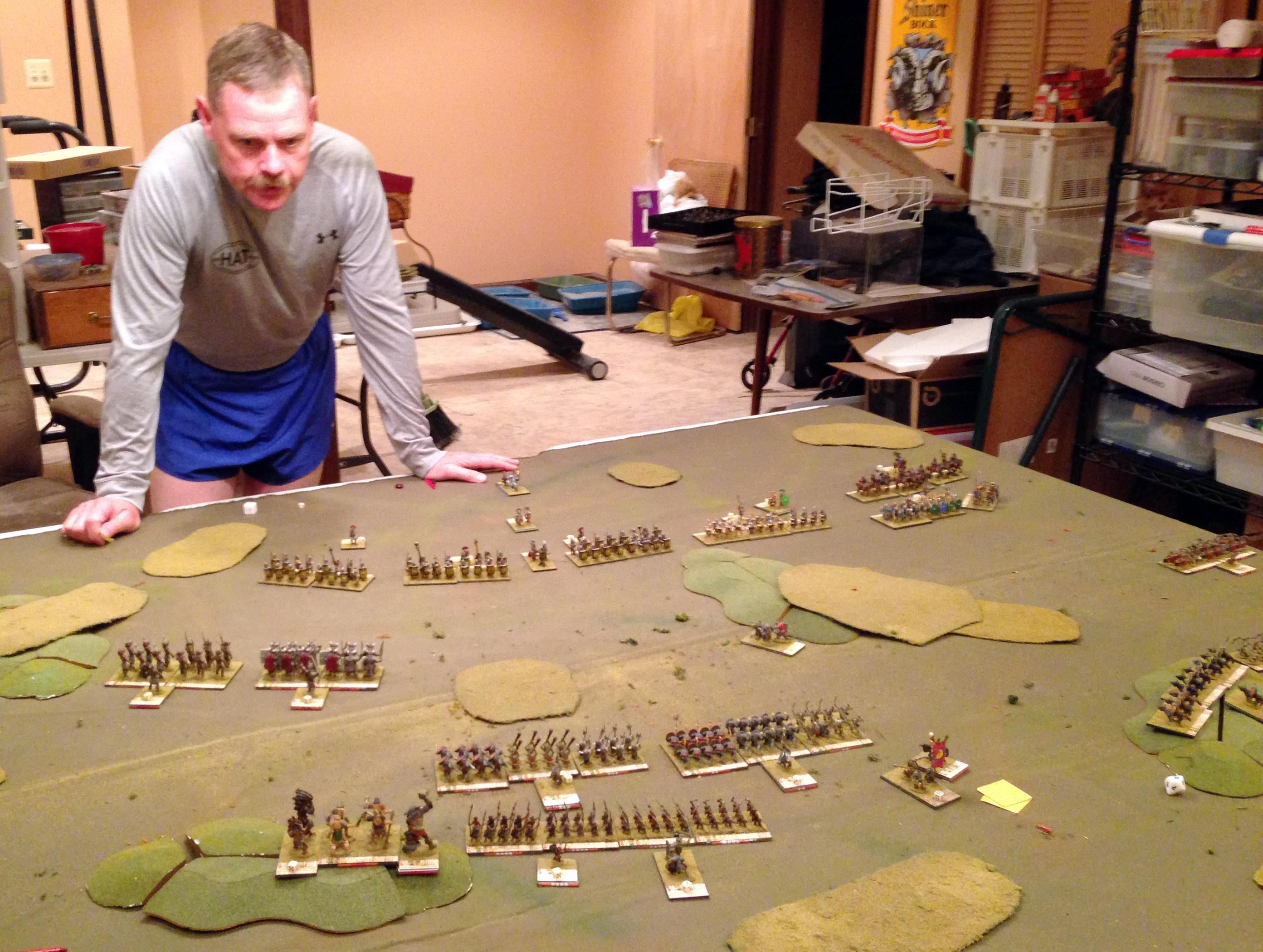
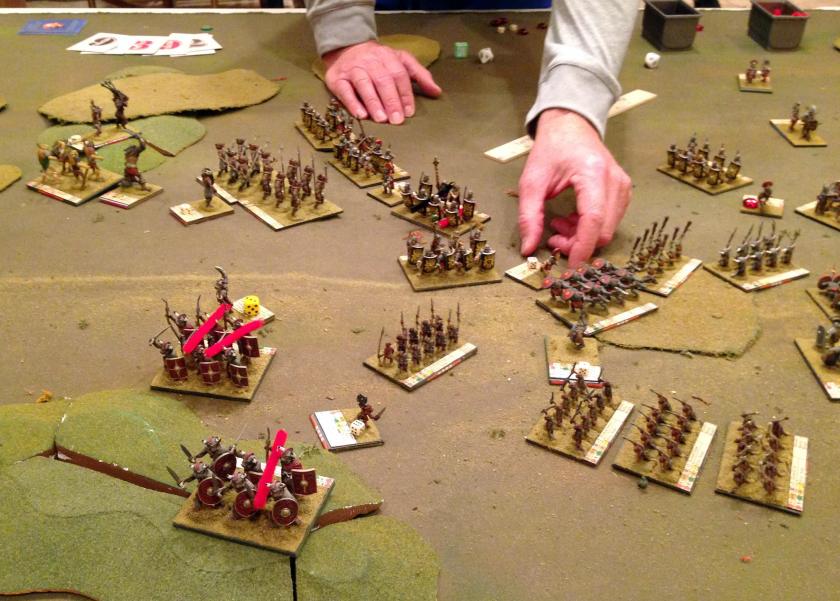
On Sunday, January 31st, Ellen Morin, Chris Smedile, myself, and Lynn Morin gathered in the Morin basement to beta-test the rule set I have been working on for a while. The battle consisted of two forces attacking. First, for the forces of Evil a skeleton regiment, two supporting Wizards, and other Undead forces attacked by crossing a bridge on their right flank. Second, on their left flank, the bad guys (led by Alzura a female half-orc pirate) attacked with warg-riding Goblins, Insect Men, a Wizard, an Umber Hulk, Orcs, and a demon by crossing a river at a ford. The overall leader was Urldra, another female half-orc.
Defending against The Undead were a group of Ents in the forest next to a mass of cavemen. In the middle were a high-level Wizard, and an Elven heavy ballista on a hill facing the bridge. The overall Elven HQ was also on the hill. The right flank faced the orcs with Swedish and Finnish Dwarven skirmishers, backed up by a Finnish Dwarven regiment. The Finnish Dwarven HQ also commanded the Dwarf with No Name who readied himself from an overwatch position with black powder pistols that were way out of range. In reserve were two Wood Elf Cavalry Squadrons.

On the bridge side, the Nightmare Legion and a Skeleton Sword unit quickly crossed. The Elven ballista quickly misfired at the Nightmare Legion and missed a few more times before killing a few. The good Wizard (Whitebeard the Envoker) flew out of his protected position and used a couple of Cold Spells against the Nightmare Legion to a small effect. The Ents sent Greybeard out after he found a boulder, which took out a few more of the Legion. Luckily, the Activation Deck draw allowed him to get away from the Legion before they could retaliate. The other Ents recruited smaller trees for the fight, and the cavemen (being Peasants) waited for the fight to come to them.


Meanwhile, on the other flank, the Umber Hulk went subterranean for a planned surprise attack on the Dwarves from underground. An amphibian demon (Mxomycetes, Duke of the Mire) was attacked by the Swedish Dwarves and was driven back. The Insect Men skirmishers went into battle with the Swedish Dwarves and began to make headway.

The Death Head Orc Longbow set up to provide withering fire on the Dwarves while one of the two Insect Men attempted to move around the woods with the warg-riding Goblins. It looked dire, so the reserve Elven cavalry squadrons conducted a pincer move – hitting the Orcs in the rear by the river and the Insect Men in the rear by the heavy woods. This was made possible because of the withdrawal of the wizard Waldo who had been protecting the bad guys’ rear by the river.

Finally, the cavemen were engaged by the Grayshield Skeletons. The fight was a draw until we called it. But two wizards were about to go at them, and the Ents were coming as well.

The game ended without the Umber Hulk getting to launch his attack, which would have been a great move by Chris. The ballista was not so effective, and it was a good playtest for all the rules. Even Lynn had fun!
Next, I will update a few things in the rules based on the feedback I got. The journey continues!
I now need more crew-served weapons and will hopefully get some done.
THANKS ELLEN, CHRIS, AND ALWAYS LYNN! GREAT AFTERNOON!
Reaper Dark Heaven Legends Female Half-Orcs for my daughter, Ellen Morin
My daughter Ellen plays Pathfinder with her boyfriend Chris and a group in Worcester. She told me in the past that she had a couple of characters that were half-orc females and quite tough. One was a pirate (Alzura) and one was a mythic warrior (Urldra). I had wanted to get her some figures and paint them for Christmas, but time ran out.
Still, I found these two Reaper Dark Heaven Legends figures on eBay when I did a search on female half-orcs. As luck would have it, they were perfect! Rozmina (03242) became Alzura, and Janara (02708) became Urldra.

I then asked Ellen for some details, and she actually had a drawing that she made of Alzura – which I used as a starting point for color.

For simplicity, I will describe each in turn. Alzura was on a ship base, which was a new one for me. I found an old circular slotta base, mounted it on a washer for weight, and then mounted Alzura on it with wood glue. I then used matchsticks (bought in Germany in 1987!) that I split to size to the base to create a deck-like appearance with wood glue.

Basing Urldra was done similarly, without the need for matchsticks.

I then primed both figures with Krylon “Flat White” primer, and once dry, coated both figures with Citadel “Agrax Earthshade”.


Alzura was the easier figure to paint of the two. I base coated her after the first shade with Citadel “Castellan Green”. I then did the eyes in the usual way. After that, I added a second layer with Citadel’s “Waaagh! Flesh”. I base coated her trousers, her top, and her sandals with Americana “Raw Sienna”. Her hair was a mix of Americana “Raw Umber” and Armory “Red Brown”. I painted her cutlass blade with Tamiya “Gun Metal” and the hand guard with Tamiya “Metallic Grey”. As Ellen’s favorite color is blue, I used Deka Lack “Blau” for her do-rag/hair scarf. For her arm band I used Tamiya “Titanium Silver”. For her armbands and her earrings, I used Tamiya “Gold Leaf”. Her dagger handle is Americana “Ivory” and her leg straps are Americana “Black”. I then outlined the figure with Secret Weapons Washes “Sewer Water” ink. I have her trousers another wash – again “Agrax Earthshade”.
I then proceeded to layer her skin using a series of mixes of Citadel’s “Waaagh! Flesh” cut with (amusingly so) Americana “Buttermilk”. I lined the edge of her cutlass blade with “Titanium Silver”. I dry brushed her trousers and top with a series of lightened “Raw Sienna” and “Buttermilk”. As I did this, I alternated more “Agrax Earthshade” at the deeper borders of the muscles. Her lip is Polly-S “Demon Dark Red” and her teeth are Americana “Snow”. I finished off the base with Citadel XV-88. I then varnished the model with Krylon “Clear Glossy”, followed several hours later by a second coat with Krylon’s “Clear Matte” varnish.


Urldra was the harder figure to paint. She had a lot of details that were close together. I base coated her after the first shade with Citadel “Castellan Green”. I then did the eyes in the usual way. After that, I added a second layer with Citadel’s “Waaagh! Flesh”. I base coated her leather armor with a combination of 1/3 Americana “Raw Sienna” and 2/3 Americana “Raw Umber”. Her hair was done with Americana “Black Tie” which is a satin paint and gave some shine to her head. I painted her sword blades and her armor with Tamiya “Gun Metal” and the sword pommels with with Tamiya “Titanium Silver”. Later when I used Secret Weapons Washes “Sewer Water” the “titanium Silver became slightly gold-colored or brassy. The bow was painted with Citadel’s XV-88, as were her boots, though these were darkened with “Agrax Earthshade” and Armory “Musket Brown”. Her sleeping roll was painted with Deka Lack “Braun”. All straps were painted with Americana “Black”.
I alternated with Armory “Red Brown” and “Leather Brown” for the quiver, her “bustier” (if that is what that was), and some highlights on her leather armor. I painted her earrings with Tamiya “Gold Leaf. I then outlined the figure with Secret Weapons Washes “Sewer Water” ink and more “Agrax Earthshade”.
I then proceeded to layer her skin as I did Alzura’s using a series of mixes of Citadel’s “Waaagh! Flesh” cut with (again) Americana “Buttermilk”. Her lip is Polly-S “Demon Dark Red” and her teeth are Americana “Snow”. I finished off the base with Citadel XV-88, and flocked it with Army Painter’s “Battlefield Brown”. I then varnished the model with Krylon “Clear Glossy”, followed several hours later by a second coat with Krylon’s “Clear Matte” varnish. I then added some grass to the model from Army Painter as well as some loose foliage from 4Ground.


I then got a small Really Useful box from Staples (blue of course). I mounted a magnetic sheet on the bottom from Michael’s, giving Ellen a safe way to bring home her figures.
I am very pleased with how the figures came out, and Ellen was very happy too. As you can tell, she is ecstatic and looking forward to using her figures this weekend! It felt awesome to give her a gift like that!

Ral Partha “Tree Shepherds” (ES-49) and Mithril Miniatures “Treebeard and the Hobbits” (M185)
I have been wanting to have some Ents in my collection for over 30 years. Sometimes they are called Tree Shepherds or Dryads by different manufacturers. I just remember them fondly from the Lord of the Rings. I managed to wrangle four of them this fall on eBay and wanted to add them to my collection.
The first one I got was a Ral Partha 1977 ES-49 that was painted but not to my tastes. His hands looked like Gumby to me. It was my first project at stripping paint from a miniature. I discovered that simple green works well – though now I use a plastic food container and not a zip-lock bag (as they leak).


I kept on looking on eBay, and got two more of the figures over a few months, including one in the original blister.
I also found that Mithril Miniatures had a series “Fangorn Forest” that came out in 1991. Now, Mithril’s figures are 32mm, and mine are 25mm (mostly). But with an Ent, who cares! It’s a huge tree! The one that caught my eye was “Treebeard and the Hobbits” with Treebeard holding Merry and Pippin. It was unpainted, but apparently Mithril precoated their miniatures with a base coat. It was thick, so I used the simple green here as well and got some detail back.


After stripping, which I augmented with a toothbrush, and more stripping, I finally got the figures where I wanted them. I cleaned them off in water with dishwashing soap, and dried them. I cut 2″ hex bases out of 1/8″ plywood, and used wood glue to mount the four. I then lightly primed them with Krylon “White Ultra Flat” primer.
I used Americana “Snow” for all of the eyes, which I then dotted with Citadel “Mechanised Standard Gray”. Then I base coated the four with a mixture of Americana “Bittersweet Chocolate”, Armory “Leather Brown”, and Citadel “XV-88”. I then applied a wash with Citadel’s “Agrax Earthshade”.

I then worked on the Ral Partha Tree Shepherd models separately from the Mithril Treebeard one. For the Tree Shepherds, I wanted to dry brush them all slightly differently so that they could have more individuality. They also needed to be less confusing to players.
Therefore, I dry brushed one with Craftsmart “Gray”, one with Americana “Desert Sand”, and one with Armory “Leather Brown” – becoming respectively “Graybeard”, Tanbeard”, and “Redbeard”. I then again used Citadel’s “Agrax Earthshade” to darken them. I then used the respective colors previously cited to highlight facial features, roots, and limbs.

I then painted their bases with Americana “Bittersweet Chocolate” and used Army Painter “Brown Battleground” to flock the bases. I then varnished each figure with Krylon “Clear Glossy” varnish, followed several hours later by a second coat with Krylon “Clear Matte” varnish. For each base, I added different combinations of Army Painter “Wilderness Tuft” “Wasteland Tuft”, and “Meadow Flowers”. I also added combinations of 4Ground 10G Basing Materials (TSM-122 “Loose Foliage Green Leaves”, TSM-123 “Loose Foliage Brown Leaves”, and TSM-124 “Loose Foliage Copper Leaves”). I experimented with adding some leaves to the branches, but that did not look good, and I abandoned that approach.


As for Treebeard, the details of the hobbits and those of Treebeard posed some challenges. The base coating was the same as the Tree Shepherds. For the Hobbits, I used Citadel’s “Castellan Green” for their cloaks, and Deka Lack “Dunkelblau” and Craftsmart “Gray” for their breeches. The shirts were painted with Americana “Raw Sienna” and Armory “Prussian Blue”. For the hobbits’ hair, I used different mixtures of Citadel “Yriel Yellow” and Armory “Leather Brown” so that there was a little difference between the two hobbits. I then highlighted the robes with lighter versions of the “Castellan Green” mixed with Americana “Buttermilk”. I used P3’s “Ryn Flesh” and “Midland Flesh” on the hobbits skin, with lighter mixes for highlighting after shading with P3 “Flesh Wash”.
To get Treebeard’s face, hair, and beard to pop without seeming ostentatious, I used Americana “Hauser Light Green”, which I then highlighted with Secret Weapons Washes “Green”. I shaded a lot of the wooden crevices with P3 “Brown Ink” and more Citadel “Agrax Earthshade”. I highlighted Treebeard’s bark afterwards with a mix of Americana’s “Raw Sienna” and “Raw Umber”. I then followed the same color combinations and sequences as I did for the Tree Shepherds through varnishing. Finally, I added Army Painter “Meadow Flowers” and 4Ground 10G Basing Materials TSM-122 “Loose Foliage Green Leaves” to the base.


Overall, I am happy with the figures, and am excited to see them on the tabletop soon. After all, 32 years without Ents is long enough!
Rehabilitating a 1983 Grenadier Frost Giant (Fantasy Lords – First Series 103)
I have loved this John Dennett figure for many years. I know that I got it when I was back at West Point. The main problem was that its axe was prone to breaking off, and mine of course did. I tried different repairs over the years but to no avail. When I used the figure, I always had to say “imagine the axe being there”! Below is how the figure should have appeared as I purchased it. Note that it was guarding a treasure.


When my Frost Giant lost his axe, I tried all kinds of glue, but nothing worked. In fact, some of the glue actually went over the figures hair, which obscured some detail. At some point over the last 30 years, I came across a tomahawk charm that looked like it might work. At the time I did not have a pin vise and the project waited, with the figure looking like this below, for at least 25 years.

I used an Exacto knife to shave off the end of the tomahawk and my pin vise to drill a small hole in the shaft of the axe in the Frost Giant’s hands. This fit well, though less appropriately than the previously missing axe.

I then began to play with some paints and inks to improve the figure. The shaft of the new axe and the leather straps were base painted with Citadel “XV-88”. I then mixed the “XV-88” with Armory “Leather Brown” and Americana “Raw Umber”. I tried to see if a dry brush technique with Citadel “Prayeti White” would help the his loincloth pelt and his hair. It did not, so those waited for other interventions.
I used Tamiya “Gun Metal” on the axe itself, as well as on parts of his belt, armor, and helmet.

For his skin, I applied a very light coat of Americana “Sky Blue Satin” to cover some of the chips. I then mixed that with Americana “Snow” to add further highlights.
I changed the stone colors on his bracelet. I replaced the pinkish color on the bracelet’s stones with two altered colors. I used Polly-S “Demon Dark Red”, while I used Americana “Dioxazine Purple” on the other stones. I darkened the axe and its straps with Secret Weapons Washes “Heavy Body Black” wash. The horns I dry brushed with Craftsmart “Ivory”.
For the treasure, I used Citadel “Auric Armor Gold” on the coins. For the skull in the treasure pile, I used Craftsmart “Ivory” to cover the white color it had. I darkened the quiver with P3 “Brown Ink”, and used Polly-S “Demon Dark Red” on the fletchings. All the treasure pile then got a light wash with the Secret Weapons Washes “Heavy Body Black”.
I then decided that the white pelt and boots and snow-white beard had to go. For this, I used a combination of three inks – P3 “Brown Ink”, and “Sewer Water” and “Heavy Body Black” from Secret Weapons Washes. This made the boots and pelt more like something from a brown bear. For the beard, I just used diluted Secret Weapons Washes “Stone” to create a sooty appearance. These worked well. I then went back to the skin – luckily I had not painted that too thickly back in the 1980’s! I highlighted the muscles and the skin depressions on the arms and the legs, and then used Secret Weapons Washes “Blue” ink to wash the skin. I then did a second skin highlight, and used Secret Weapons Washes “Heavy Body Black” on the armor and the helmet. I applied a light highlight on the edge of the axe with Tamiya “Titanium Silver”.
On the plywood base, I worked in air-dry modeling clay and tried to make it like real snow. I even made footprints behind the figure. I let that dry for a day, and applied Americana “Snow” on the entire base. I used Citadels flocking snow with white glue to give a more snowy appearance to newer drifts. I sealed the figure with a spray coat of Krylon “Clear Glossy” varnish followed several hours later by a finishing coat of Krylon “Clear Matte”. I then used white glue to add some Army Painter “Wasteland Tuft” to represent dead plants popping through the snow.